/
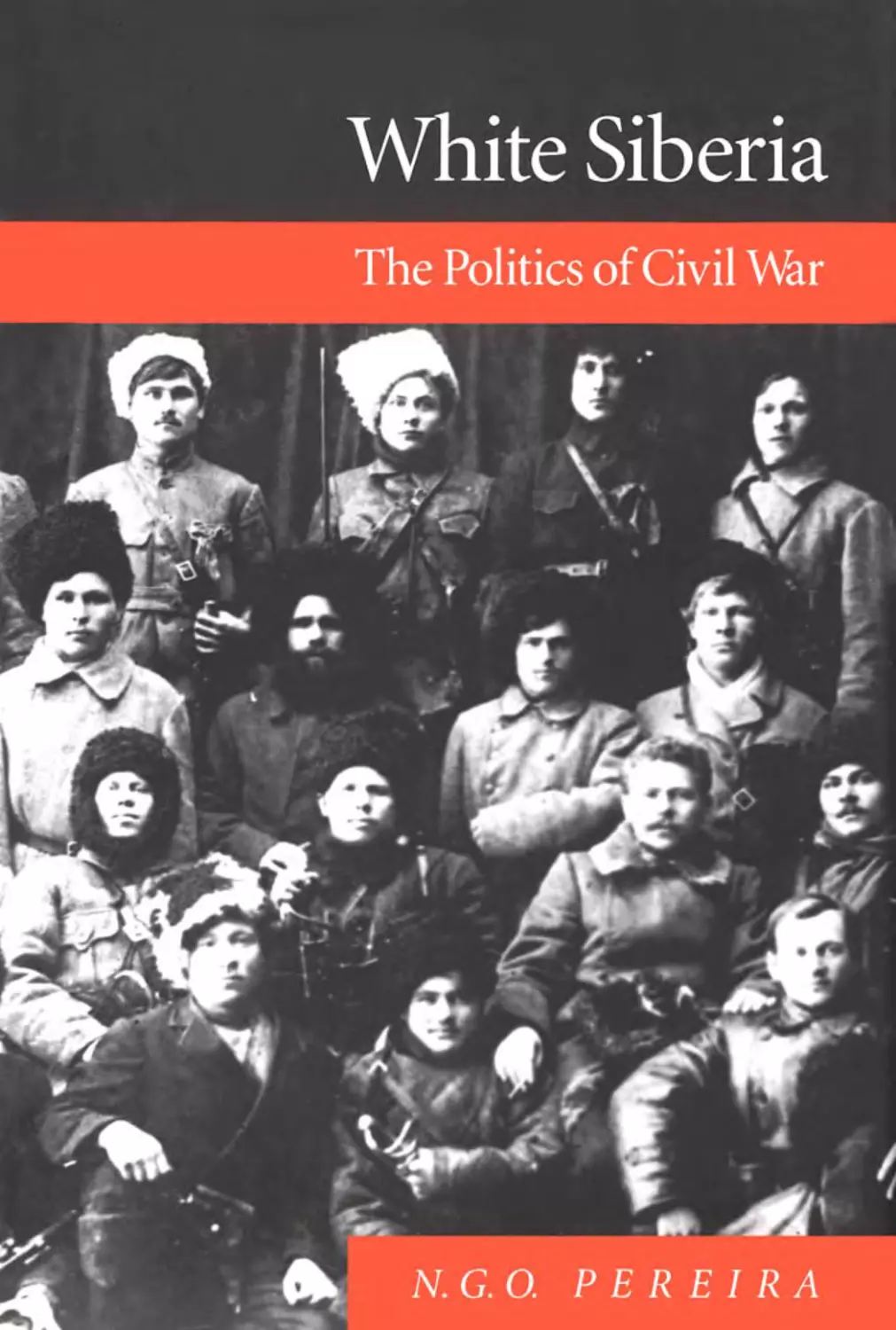


Author: Pereira N.G.O.
Tags: history of russia revolution anti-communism history of siberia
ISBN: 0-7735-1349-3
Year: 1996


Text
                    White Siberia

This page intentionally left blank

White Siberia
The Politics of Civil War
N . G . O . PEREIRA

McGill-Queen's University Press
Montreal & Kingston • London • Buffalo

© McGill-Queen's University Press 1996
ISBN 0-7735-1349-3
Legal deposit first quarter 1996
Bibliotheque nationale du Quebec
Printed in Canada on acid-free paper

This book has been published with the help of a grant
from the Social Science Federation of Canada, using
funds provided by the Social Sciences and Humanities
Research Council of Canada.
McGill-Queen's University Press is,grateful to the Canada
Council for support of its publishing program.

Canadian Cataloguing in Publication Data
Pereira, N.G.O. (Norman G.O.), 1942White Siberia: the politics of civil war
Includes bibliographical references and index.
ISBN 0-7735-1349-3
1. Siberia (Russia) - History - Revolution, 1917-1921.
2. Siberia (Russia) - Politics and government. 3. Anticommunist movements - Russia (Federation) - Siberia.
4. Russia (Federation) - History - Revolution, 19171921. I. Title.
DK265-8.S5P47 1995

957'.o8'4i

Typeset in New Baskerville 10/12
by Caractera inc., Quebec City

095-900686-9

For Linda

This page intentionally left blank

Contents

Maps / ix
Preface / xi
Introduction / 3
1 Physical Setting, Background, and Regional
Development / 11
2 Revolution in Siberia - Similarities and Differences with
European Russia
February to December 1917 / 29
3 Early Resistance to Bolshevik Rule, Contending White
Governments, and the Rise of Omsk
January to July 1918 / 50
4 Democratic Counter-Revolution and White Union
Spring to Fall 1918 / 82
5 Kolchak's Regime in Ascendancy
18 November 1918 to Spring 1919 / 104
6 Kolchak's Regime in Decline
Spring 1919 to February 1920 / 127
7 Aftermath and Consolidation of Soviet Power
Early Spring 1920 to Fall 1922 / 151
Conclusion / 172

viii

Contents

Notes / 177
Bibliography / 2 21
Index / 255

Maps

1 Siberia (1898) / 10
2 General situation on the eve of the overthrow of Soviet
power in Siberia (July 1918) / 90
3 Liquidation of the Eastern front (August 1918 to April
1920) / 128
All maps by Paul Duffy

This page intentionally left blank

Preface

With the opening up of the former Soviet archives a great deal of new
material has become available for scholarly research. The present
study is based in part on the fonds of the Central State Archive of the
October Revolution (TSGAOR), recently renamed the State Archive of
the Russian Federation, especially the so-called Prague Archive containing documents drawn from both Red and White sources that were
taken out of Russia temporarily by the evacuating Czechoslovak Legion
in 1920 and returned under the supervision of Academician I.I. Mints
in late 1945 to TSGAOR in Moscow. Use also has been made of selected
materials at the Archives du Quai d'Orsay's Ministere des Affaires
etrangeres (Direction des Affaires politiques et commerciales, "Russie
d'Asie") in Paris; the Public Records Office in London and Kew; the
Hoover Institution Archives in Stanford, California; the Bakhmeteff
Archives at Columbia University in New York; and the National
Archives and Records Service in Washington, D.C.
I am grateful for the assistance I received from several other institutions and their staffs: the New York Public and Columbia University
libraries during my tenure as a senior fellow at the Harriman Institute
for the academic year 1987—88; the Library of Congress during two
sojourns at the Kennan Institute; the Russian State Library (formerly
the Lenin State Library) in Moscow and the Library of the Academy
of Sciences in St Petersburg; the State Museum of the Political History
of Russia in St Petersburg; the Bancroft Library of the University of
California in Berkeley; the Bibliotheque Nationale in Paris; the School
of Slavonic and East European Studies Library in London; and most

xii Preface
of all the Killam Library at Dalhousie University and its interlibrary
loan and reference specialists (Gwyn Pace, Oriel MacLennan, and Paul
Duffy) who were always willing to trace obscure references and help
locate much-needed titles.
This work has benefited greatly from critical readings and technical
assistance by kind colleagues and friends: Peter Kenez, Elizabeth
Haigh, M.P. Iroshnikov, Alan Wood, and especially Olga M. Verbitskaia,
and my editors, Joan McGilvray and Henri Pilon. Andrea Chandler
and Yanni Kotsonis helped with research at Dalhousie University and
Columbia University, respectively. In addition, David R. Jones allowed
generous access to his private collection of rare Sibirica andJ.D. Smele
shared some of the British research materials from his ph D dissertation. I have been fortunate to receive the continuing support of the
Social Sciences and Humanities Research Council of Canada, which
has funded this project since its inception ten years ago. My wife,
Linda, has read the manuscript at three very different and difficult
stages from cover to cover with painstaking care. She has contributed
a great deal to its organization and clarity.
Russian words and names have been transliterated according to the
modified Library of Congress system (with diacritical marks omitted),
except for those, like Kerensky, Guins, and Trotsky, which have established English spellings. Dates are given in the Old Style or Julian
calendar until 1/14 February 1918 when Russia adopted the Gregorian standard used in the West, thereby eliminating the thirteen-day
gap that separated the two in the twentieth century.
NGOP
Halifax, Nova Scotia

Members of the Provisional Siberian Government, formed in June, 1918. Unknown
source

The supreme ruler and supreme military commander, Admiral Aleksandr Vasil'evich
Kolchak. Unknown source

\.V. Kolchak, General Alfred Knox, and officers from the British military mission.
Snvirons of Omsk, 1919. Illustration courtesy of the State Museum of the Political
History of Russia in St Petersburg

"The House of Freedom." Building which served as seat ot Kolchak s government in
Omsk during 1918-19. Illustration courtesy of the State Museum of the Political History
of Russia in St Petersburg

Kolchakovite "Building." The illustration shows Kolchak sitting on the shoulders of
a priest, who in turn is on top of a kulak (rich peasant). The caption reads: "Comrade!
Strike at the foundation." Unknown artist and source

The Great Siberian [Rail]way. Tunnel no. 18 (circling
Lake Baikal). Postcard

The Great Siberian [Rail]way, No. 19. Sentry outpost at verst 643. Postcard

View of Omsk. Kennan, Siberia: Natural Scenery, plate 28

A group of Kolchak's shock troops under the command of General Pepeliaev, 1919.
Illustration courtesy of the State Museum of the Political History of Russia in
St Petersburg

Arrested ministers of the Kolchak Government, Omsk, 1920. Illustration courtesy of
the State Museum of the Political History of Russia in St Petersburg

Anti-Kolchak "Green" Partisan Detachment, 1919. Illustration courtesy of the State
Museum of the Political History of Russia in St Petersburg

White Siberia

This page intentionally left blank

Introduction

For seventy years Civil War scholarship in the USSR was a thriving
industry that produced an overwhelming number of tediously tendentious monographs as well as several invaluable sources of detailed
information, the latter published, for the most part, in the relatively
free igaos. 1 As might be expected, the triumphs of Bolshevism were
at the centre of virtually all these studies, but a suprisingly large
amount of attention was given to Siberia. Indeed, since the beginning
of the Khrushchev period more source materials on Siberia have been
published than on any other region in Russia.
Soviet historiography on the Civil War in Siberia may be subdivided
into a number of related fields and topics. Among the most important
are i) works detailing the Allied intervention, in combination with
the "counter-revolutionary" activity of Czechoslovak prisoners of war;
2) attempts to explain away the fall of Soviet power in Siberia (which
coincided with the Czechoslovak evacuation) during the late spring
and early summer of 1918; 3) explanations of how and why cooperative, regionalist, and other "bourgeois" organizations threw their support to anti-Bolshevik governments that formed in several Siberian
locations; 4) descriptions of the major White parties and personalities
with a view to showing the fundamental similarities among the enemies
of Bolshevism, from Kolchak and the Cossack atamans (chieftains) on
the right to parliamentary liberals and moderate socialists on the left;
and 5) analyses of the social question which seek to demonstrate that
only the Bolsheviks represented the true interests of workers, peasants,
and soldiers, and that the partisans also followed their lead.2

4 White Siberia
Both before and after 1917 the flow of information from Russia to
the West was controlled and filtered by both sides. The dominant
Western view was defined by Russian belles-lettres and fiction, as well
as by socio-political criticism, with a strong urban, liberal bias. Western
perceptions and predispositions were also reinforced by the major
Russian emigration, immediately following the Civil War, that brought
thousands of the most articulate and cosmopolitan members of educated society to the West, where several of their leaders took up
teaching posts and helped form the outlooks of the first generation
of academic Russianists. Their intellectual offspring into the third
generation are currently spread across the universities and colleges of
North America and Western Europe.
Emigre historiography - beginning with the work of the first wave
of refugees who were actively involved in the revolutionary events they
subsequently described - has been characterized by a natural desire
to recast the past in the most favourable light for the foes of Bolshevism while simultaneously settling old scores with personal enemies.3
Nevertheless, it remains an invaluable resource and one that is still
not very well known, mainly because only a small portion of the corpus
has been translated and published in any Western language. With the
current renewed interest in all things White within the former Soviet
Union, moreover, many long-neglected memoirs, accounts by eyewitnesses, and other primary documents that were previously either
unavailable or printed in very small editions abroad are now appearing
in the pages of major periodicals in Moscow and St Petersburg, as well
as in Novosibirsk, Tomsk, Irkutsk, and other provincial centres.4
Mainstream Western scholarship, to the limited extent that it has
taken an interest in the Siberian theatre of the Russian Civil War, has
also been one-sided: it has concentrated almost exclusively on questions related to the Allied interventions and to the larger conflict with
Germany. In the United States, Great Britain, France, and Canada the
focus has been on the respective roles of the intervening powers in
Russia, their mutual antagonisms and competition, and, only marginally, their relations with the local populations.5 Even the most current
scholarship is Eurocentric and pays scant attention to Siberia or other
peripheral areas.6 Moreover, the rare exceptions to this general pattern allot much more attention to the Bolshevik winners than to the
White losers.7 Apart from a few popular and partial treatments, there
has been no serious study of the history of the Whites during 191722 in Siberia.8
It is only during the past decade or so that Civil War and (to a lesser
extent) Siberian studies in the West have come into their own. The
British Universities Siberian Studies Seminar was founded at Lancaster

5 Introduction
University in 1981 by Alan Wood. While there was important work
being done in the 19705 by Peter Kenez, and even earlier by David
Footman, in the last few years a number of Anglo-American scholars
have brought increased attention to both subjects.9 But apart from
some emigre memoirs,10 this work is the first monograph in English
to concentrate on the domestic politics of Siberia during the Civil War
period, in contrast to the approach adopted by previous Western
scholarship, which has treated the events in the region as no more
than a sideshow to the main drama in central Russia and the international conflict between the allies and Germany.
With the recent greatly increased access to the main archival collections in Russia - especially in combination with emigre and other
holdings in the United States, Great Britain, and France - a general
reassessment of the Russian Civil War has become possible and is
indeed underway. There have already been several important contributions by the younger generation of Anglo-American historians.11
They are now being joined by a wave of newly mobile Russian scholars
who are able to take research and teaching positions in the West.12 An
added benefit of these developments is the attendant shift of focus
from an almost exclusively centralist historiography to the neglected
outlying regions of the southern, north-western, and eastern parts of
the former Soviet Union.
The present volume is not the definitive or comprehensive narrative
history of the Russian Civil War in Siberia. Rather it is a detailed
analysis of the White movement in Siberia, its internal struggles no
less than its contest with the Reds, and the reasons for and the
consequences of its defeat. The term "White," generically associated
with the ancien regime and derived from the colours of the Bourbon
dynasty, is used in a broadly political sense to contrast with the "Red"
Bolsheviks and to encompass all those forces in Russian society - from
monarchists on the right to moderate socialists on the left - whose
opposition to V.I. Lenin's ascension to power in the fall of 1917 led
them subsequently to take up arms against the Soviet government.
As the breadth of this definition suggests, it was not merely a matter
of Whites against Reds. In many ways the conflicts within the White
camp were no less serious than those that separated them from the
common enemy. Elements within the left wings of both the Mensheviks and the Socialist Revolutionaries (SRS) - not to mention groups
such as the Menshevik Internationalists and the Left SRs which split
formally from their parent parties - stood very close to and in several
instances crossed over to the Reds.13 If such divisions did not exist
within Lenin's organization, nevertheless many of the Siberian Bolsheviks did continue to cooperate with their moderate socialist allies even

6 White Siberia
after the October Revolution in Petrograd (the name St Petersburg
was given between 1914 and 1924). This was a logical and necessary
response to the power balance in Siberia where the Soviets remained
under SR and Menshevik leadership long after they had come under
Bolshevik ascendancy elsewhere.
The approach followed here can fairly be described as political
history, but it also takes into account institutions and ideas as well as
parties and policies. Moreover, comparative aspects of social history
are addressed insofar as they bear directly upon the progress and
outcome of the Civil War. One obvious example of that linkage was
the mentality of the Siberian peasantry relative to that of its counterparts in European Russia and how it was affected by the nature and
significance of Siberia's regional economy, which by Russian standards
had always been more capitalist and less feudal than the rest of the
country.
Given the partisan and unforgiving nature of all civil wars, the
remoteness and insularity of this one in particular, the unfavourable
treatment generally accorded counter-revolutions by the dominant
liberal historiography in the West (not to mention the former Soviet
Union), and the fate of historical records after seventy-five years of
Communist rule, many questions are likely to remain. How, for
instance, are we to assess the respective mandates of the nineteen
White governments in the region; who empowered them and to what
extent did they represent the popular will of Siberians? Even if all the
public and private archives with relevant data were suddenly open and
accessible to researchers - and we are still far from that - so much
has already been lost through a combination of time and faulty memory, selective destruction, and purposeful obfuscation that at least
parts of the puzzle will never quite fit. Thus the historian's task
continues to require imaginative reconstruction, with all the challenges and foibles which that process implies.
To summarize, this book is about the nature and the causes of the
failure of the White counter-revolutionaries ("democratic" or otherwise) in Siberia. The argument is that their defeat was the result of a
combination of objective geographic, historical, and demographic
circumstances together with critically inadequate political leadership.
In assessing the relative importance of these factors, the role and
attitudes of the Siberian peasantry towards the contending White and
Red authorities that tried to control their destiny are obviously crucial.
The condition of the peasantry, in turn, raises the difficult but vital
questions of the connection between public support and success in a
civil war situation, the relationship between town and country, and the

7 Introduction

concurrent phenomenon of the Green partisan movements which
from the second half of 1918 became increasingly active in Siberia.
The constitutional programs and ideologies of the main White
governments that vied for power in Siberia will be examined in detail
with a view to establishing their differences and similarities. Did parliamentary democracy stand any real chance under the circumstances,
or was it, as alleged by the Bolsheviks and other critics, merely windowdressing for the benefit of Western consumption while the real agenda
was to bring about counter-revolution through military means and to
restore the ancien regime or something very close to it?
The role of Siberian regionalism is described and evaluated. What
were its purposes and goals, how broad or narrow was its support, and
was it viable as a political alternative? How to account for its initial
successes yet quick absorption by the centralist statism of the larger
White movement?
The interventions by foreign (especially Allied) powers are
reviewed, together with the presence of Czechoslovak prisoners of war
on the strategic Trans-Siberian Railway. Both the quality and the
quantity of the expeditionary forces, as well as their relationship to
the Whites, are examined against the background of the differing and
at times conflicting agendas of their respective governments; in the
case of Britain and especially France, anti-Bolshevik feelings were
exacerbated greatly by the Treaty of Brest-Litovsk and concerns over
the issue of reopening the eastern front with Germany.
Finally, an overview and assessment is provided of the specific political and military features of the Kolchak government in its role as the
chief counter-revolutionary force in the region during the period of
the Civil War, as well as an explanation for the renewed resistance to
Soviet authority in Siberia after the Whites ceased to be a threat.
For the sake of perspective, selective comparisons are drawn with
reference to developments in other provincial centres such as Samara
and Saratov that were located much closer to the seat of Bolshevik
power. One obvious and key contrast was that Lenin's government did
not gain full control in Siberia until after 1921; in this, at least, the
political pattern in Siberia was very different than in the Volga region
where the struggle was between the dominant Bolsheviks and their
critics on the left - notably Left SRS and smaller splinter groups - and
more like the southern and (to a lesser extent) north-western parts
of Russia where White governments also existed during most of the
Civil War.
A final word on periodization and historical methodology: it is much
easier to see events in context when they are framed within discrete

8 White Siberia
times rather than in the chaotic sequence in which they actually
occurred. The historian's task invariably involves a measure of telescoping (to borrow from Trotsky and Parvus), since the evidence is
dynamic rather than static and always incomplete. There will always
be some, often important, pieces missing from almost any interpretation - more so for Russia than elsewhere. Nevertheless, the goal is to
produce a picture that faithfully represents and explains the essential
elements of the story. The inductive methodology acts as a reminder
of the dangers of venturing beyond the evidence to an artificial order
which may exist only in the historian's mind. Yet only through such
acts of reconstructive imagination can a pattern or shape emerge from
the chaos of raw "facts and events."
The period under review covers five and a half years (1917-22), but
the focus is on 1918 and 1919 in Western Siberia when prospects
for viable alternatives to Bolshevik rule appeared at their brightest.
The year 1918 was the time of the so-called Democratic CounterRevolution associated with the Siberian Regional Duma, which in
Tomsk had ties with the government in Samara; the latter was composed largely of members of the Party of the Socialist Revolutionaries
(PSR) and was made up of former delegates to the recently dispersed
All-Russian Constituent Assembly. Already during the summer and fall
of that year, however, political power in Western Siberia was shifting
increasingly toward the more conservative and militaristic leadership
in Omsk. This trend culminated in the accession of Admiral A.V.
Kolchak (1873-1920) as supreme ruler in November 1918 (with at
least tacit support from British and other Allied representatives) over
an area Lenin referred to as "Kolchakia," which at its zenith included
not only Siberia but also contiguous parts of the Volga-Kama basin and
the Urals in European Russia. The admiral's initial military successes
brought his administration to the verge of international recognition
as the legitimate government of all Russia, but it then suffered a series
of disastrous political and military reversals. Kolchak's forces spent the
latter half of 1919 in a general retreat eastward to Irkutsk, where their
unstable coalition came apart.
For the general population, the worst chaos of the entire Civil War
in Siberia occurred during the next two and a half years, between the
admiral's execution in February 1920 and the Japanese evacuation
from the Russian Far East in the autumn of 1922. This was the time
of the most destructive atamanshchina (petty war-lordism) and peasant
insurrections that threatened to dismember the region and overthrow
Soviet authority altogether.
The organization of this volume is chronological rather than thematic. Each of these formats presents advantages as well as problems.

9

Introduction

A chronological approach benefits from narrative continuity but often
involves going over the same topic at subsequent stages of the story.
Indeed, whether involving peasant insurrection, regional consciousness, or political differences within the White coalition, many issues
did recur throughout the Civil War period in Siberia. On the other
hand, repetition is almost as likely if several overlapping themes are
divided into separate chapters. The topical approach, however, is more
disruptive of narrative flow and rather less conducive to producing an
overview.
The history of the Revolution and Civil War in Siberia may be
subdivided in several ways. The periodization used here has four parts:
i) from February (Old Style) 1917 to the end of the year, that is, the
term of the Provisional Government and the interregnum between
the October Revolution in Petrograd and the extension of its authority
to Siberia; 2) from January to November 1918 - the early months of
Soviet rule and the Democratic Counter-Revolution in Siberia; 3) from
November 1918 to January/February 1920 - the Kolchak regime in
Siberia; and 4) from February 1920 to October 1922 - the end of the
White movement, the removal of all foreign forces, and the reimposition of Soviet authority throughout Siberia against the background
of strong peasant resistance.14

Siberia (1898) by Paul Duffy.
Source: FMtsiklapedicheskii slovar', 2gA:74O-i.

i Physical Setting, Background,
and Regional Development

From west to east Siberia extends nearly 4,000 miles between the Ural
Mountains and the Pacific Ocean, and from north to south approximately 1,750 miles between the Arctic Ocean and the borders of
central Asia and China. With a total area of just under five million
square miles (more than 30 per cent greater than all of Canada), it
is the second largest territorial unit in the world.
The expanse of Siberia traditionally has been divided into three
parts - Western, between the Urals and the Enisei River and composed
of Tomsk and Tobol'sk provinces (gubernii); Eastern, from the Enisei
River to the mountain ranges near the Pacific coast, with Eniseisk and
Irkutsk gubernii as well as lakutsk and Transbaikal districts (oblasty);
and the Russian Far East, from the Amur and Maritime gubernii to the
Kamchatka Peninsula and Sakhalin Island.1 Western Siberia is quite
flat, while Eastern Siberia is hilly, rough, and thickly forested. The
Western Siberian Lowland is an enormous plain, running i ,500 miles
from north to south and 1,000 miles from east to west. Because of
excessive surface moisture, 100,000 square miles of it is marshland.
Permafrost causes a variety of problems, both for agriculture and for
building construction. Only the southernmost part of Western Siberia
is free of these natural impediments. A comparison of sowing seasons
shows that in Siberia as a whole the frost-free period is only about half
that of European Russia; similarly, shipping access through its great
rivers (four of the world's ten largest) is frozen from November
through May. The intense cold and minimal precipitation, especially
in Eastern Siberia, is not conducive for the growth of most forms of

12 White Siberia

vegetation. Instead of the mixed forest of European Russia, much of
the region is taiga, a vast northern coniferous forest.2
Russian colonization of Siberia is dated from 1581-82 when a small
band of Cossack soldiers of fortune under Ermak Timofeevich made
the first incursions into Western Siberia.3 In the following years several
fortified outposts were established - Tiumen' in 1585, Tobol'sk in
1587, Tomsk in 1604, Kuznetsk in 1617, Krasnoiarsk in 1628, lakutsk
in 1632, Okhotsk on the Pacific coast in 1649, the Amur basin in
1651, and Irkutsk in 1652. Their main purpose was to project a
military presence, facilitate trade (especially in furs), and collect tribute (iasak) for the Great White Tsar of Muscovy from the native
peoples (inorodtsy), who at the time of the Russian incursion could be
divided into at least 120 indigenous linguistic groupings. Among the
most important of these were the Eskimos (known as Inuits in Canada)
and the related Chukchis, Koriaks, Itelmens, and lukagirs, all of whom
used so-called Palaeoasiatic languages; the Tatar-Turkic speaking
lakuts (Sakha); the Tungus Evenks and Evens; the Mongol Buriats; and
the Nentsy (Samoeds) and Kets.4 It is estimated that at the beginning
of the nineteenth century the total number of inorodtsy in Siberia
proper remained under a million, but that figure does not include
the neighbouring and far more populous Kazakhs and Kirghiz.5
Despite bouts of resistance to the Russian incursion from the
Chinese along the Amur, the Treaty of Nerchinsk in 1689 recorded
major gains for Moscow as it established the border along the Argun
and Gorbitsa rivers and the Stanovoi mountains. In practice, however,
much of the disputed area remained beyond the administrative
control of both Russians and Chinese. Distant Kamchatka was
annexed in the name of the tsar in 1699, but it was not until the
Aigun and Peking treaties of 1858 and 1860, respectively, that China
formally renounced all claims to the Amur basin and the Pacific coast
between the mouth of the Amur and Korea. In south-western Siberia,
the Kazakh region came under Russian dominion in 1740, with the
Altai following suit in 1756. At the end of the seventeenth century
there were still only about 11,400 Russian peasant households (including 27,000 adult males) in Siberia, and nearly all of these belonged
to the freer and generally more prosperous state peasant - rather
than serf - category.6
Russian administration of Siberia was directed by the Siberian office
(Sibirskii prikaz) until 1763, first in Moscow and then in St Petersburg.
It was not a happy arrangement for the Siberians in general and for
the native peoples in particular. The adminstrative system concentrated all power in the hands of quasi-colonial officials (voevody) who
were encouraged to "feed off the land" since they did not receive state

13 Physical Setting, Background, Regional Development

salaries for their services. Given their remoteness from St Petersburg,
they inevitably aquired "broader powers than their colleagues in the
European part of the country," and this led to extraordinary abuses.7
As a result of the administrative rationalization introduced by
Mikhail Speranskii in 1822, however, there were major improvements
in the life of the region. His Special Statute on the Siberian Native
Tribes provided some protections and improvements for the inorodtsy
and was especially far-sighted for the time and place. Other aspects of
his reforms included setting limits on the arbitrary rule of the governors, easing the lot of the exiles, raising the level of culture and
science and of the general educational system, and introducing measures to facilitate the development of free enterprise.8 To make matters
more manageable, two governors-general were appointed, one for
Eastern Siberia in Irkutsk, the other for Western Siberia, first in
Tobol'sk and then (after 1838) in Omsk.9 In 1882 the Western Siberian provinces of Tobol'sk and Tomsk were exempted from the jurisdiction of the governor-general in Omsk, who thereafter retained
authority only over the Kazakh steppe. Finally, in 1884 a viceroy was
appointed for the newly acquired territories in the Far East together
with the old Russian possessions on the Pacific coast.
The main development that marked the transition of Siberia from
a traditional resource-laden but undeveloped economy into a more
modern one was the building of the Trans-Siberian Railway. Not everyone welcomed the coming of the railway as a panacea for all of Siberia's
problems, however. Some regionalists believed that it was better for
Siberia to develop its own local industry and infrastructure rather than
become more closely tied to the centre in an unequal relationship.
They also correctly anticipated a great influx of Russian peasants with
no ties to the region, which would not bode well for the cause of selfdetermination and autonomy. But these reservations could hardly
influence the course of events once the imperial government in St
Petersburg had committed itself to this major initiative. Construction
of the railway began in 1891 simultaneously in Cheliabinsk at the
western extremity and Vladivostok at the eastern and was completed
in 1905. It served as the decisive catalyst in the industrialization of
Russia and opened the floodgates of immigration into Siberia.10 In
the year 1908 alone, 758,812 people came from European Russia,
many of them illegally and without government subsidies.11
The opening of the Trans-Siberian Railway marked a major new
phase in the attitude of the Russian imperial government towards
Siberia. It ended many decades of not-so-benign neglect and, for the
first time, brought the Siberian question to public attention in a
positive light. After some eleventh-hour misgivings at the highest levels,

14 White Siberia

St Petersburg adopted an unambiguous position in favour of encouraging Russian peasant migration to Siberia; the deciding factors
appear to have been a desire to reduce rural over-population in
European Russia and simultaneously to garrison the Asian frontier.12
This reversed earlier policy (especially in the years immediately following the Emancipation of 1861) when the official line had been to
discourage out-migration, in part because of concern lest the supply
of cheap peasant labour for the large landowners in central Russia be
put in jeopardy.13 From the perspective of the common man, the
railway removed the chief obstacle to resettlement and opened up
unparalleled opportunities for a new and better life. Siberia appealed
especially to people looking to start afresh in surroundings unhampered by social impediments such as the traditions of serfdom and
manorialism that characterized the European part of the country. At
the time of the Emancipation, there were only about 4,000 serfs in
all of Siberia.14
The new arrivals (novosely, also called pereselentsy), like the old inhabitants (starozhily) whose presence dated back to the end of the sixteenth and beginning of the seventeenth century, were almost all
peasants of ethnic Slavic origins - Russians mostly, but also a fair
number of Ukrainians and Belorussians. They were both free and
indentured, and came mainly from either the central agricultural
region of European Russia - the gubernii of Kursk, Tambov, Voronezh,
and the fringes surrounding them, as well as Ukraine - or the middle
Volga areas around Perm, Viatka, and Samara gubernii.
Until late in the seventeenth century, the Siberian economy was
largely dominated by the fur trade. Thereafter the mining industry
became more important, especially for silver and copper in the Altai
and silver and lead in the Nerchinsk area of the Transbaikal. Initially
mining was largely in the hands of the state and the imperial household, which routinely made use of bonded labour and convicts, but
after the discovery of gold during the first third of the nineteenth
century private enterprise and free labour became more important.15
There were not many industrial workers among the novosely. In the
twenty years between 1897 and 1917 the population of the workingclass neighborhoods of Siberian towns grew from around 328,000 to
767,000. But, because a quarter to a half of the urban population
worked in government institutions there did not exist the sort of
proletarian base which was already evident west of the Urals. During
the same period, moreover, better than four million peasants came to
Siberia via the railway, about half of them former state peasants. The
new settlers congregated mainly in the fertile south-western part of
the region where they continued their customary farming practices.

15 Physical Setting, Background, Regional Development

In the vicinity of Omsk and Petropavlovsk they not only produced a
wide variety of vegetables but even melons and tobacco.1
Government policy subsidizing eastward migration generated a disproportionate growth of the ethnic Russian population by comparison
to inorodtsy. The idea was to provide manpower for the creation of an
agricultural base in Siberia while simultaneously securing the vast
region as an integral part of the Russian empire. Under these increasing demographic pressures, the "smaller nations" (as Russian administrators often referred to the aboriginal peoples) could put off total
subjugation and assimilation only by escaping into the interior, as far
away as possible from the European settlements. That strategy worked
reasonably well throughout the seventeenth century and into the
eighteenth. But Russian government policies, technology, consumer
goods, and alcohol combined to rob the inorodtsy of their independence, separate culture, and capacity to resist, though some Chukchi
warriors continued to resist Soviet administration into the 19308, when
like everyone else they too succumbed to Stalin's control.17 The sharpest decline in aboriginal self-sufficiency and morale occurred in and
around the main urban centres, which saw the greatest rise in Russian
immigration and impact upon traditional native mores.
In the middle of the nineteenth century the native population of
Siberia amounted to about 648,000; at the time of the 1897 census it
had risen to 870,536, and in 1911 it was estimated at 972,866. By
contrast, the immigrant population was 2,288,036 in 1858, 4,889,633
in 1897, and 8,393,469 in ign. 18 Thus, while the natives increased
by about a third, the Slavic (mainly Russian) immigrants experienced
a growth rate of more than three and a half times.19 A breakdown of
the figures for the inorodtsy shows that from 1897 to 1911 the Buriats
increased from 289,480 to 332,656, the lakuts from 221,467 to
246,405, and the Tungus from 62,068 to 75,204. The smaller groups
of native peoples grew at a slower rate or, in some instances, actually
decreased in number. At the same time, tens of thousands of Poles,
Latvians, Armenians, Georgians, Gypsies, Jews, Koreans, Chinese, and
Japanese were arriving on the scene/0 Overall in Siberia at the beginning of the twentieth century, the inhabitants divided along the following lines: Slavic (Russian, Ukrainian, Belorussian) peasants concentrated in the south-western region and along the railway line
- constituted about 70 per cent of the population, Cossacks were
another 4.5 per cent, urban dwellers were 5.5 per cent, and the
inorodtsy were about 15 per cent. The remaining 5 per cent included
convicts, exiled political dissidents, and religious sectarians. For the
sake of comparison, in Russia as a whole, peasants made up about 87
per cent of the population.

i6 White Siberia
Another distinct feature of the Siberian situation was that, in addition to ethnic tensions, there was increasing conflict between different
categories of Russian peasants, specifically between starozhily and
novosely, with the former trying to hold on to a disproportionate
amount of the best agricultural land against the claims of the new
settlers. With the Cossacks, the more established starozhily resisted any
change to the existing terms of landholding and, not surprisingly,
developed an appropriately conservative world-view to go along with
their socio-economic interests. Cossacks had the largest holdings, totalling about thirteen million acres of the best land. Per capita, their
average was 50 desiatins (135 acres), compared to 30 for the starozhily
and under 20 for the pereselentsy. The wealthiest Cossacks owned up
to 1,000 desiatins.21
On balance, the impact of the rising influx of Russian peasants and
Cossacks upon the inorodtsy was distinctly negative. Smaller and weaker
tribes especially succumbed to exploitation by merchants and corrupt
officials, as well as to poverty and to diseases imported by the Russian
colonists. Among the more numerous peoples, the lakuts, Buriats, and
Kazakhs were best able to adjust themselves to the new situation, and
in some cases even profited from contact with the Russians that
enabled them to get certain material goods and technology which
were otherwise unavailable to them. But in all cases the price paid was
very dear, both in terms of actual cost or value exchanged and because
of the loss and degradation of aboriginal cultural identity.
On the positive side, tsarist officialdom, while hardly responsive to
local needs and interests, generally steered clear of interference with
native customs and rituals. Thus, Islam, Buddhism, Shamanism, and
other non-European religions were usually permitted to exist side-byside with Russian Orthodoxy as long as the latter's position as the state
religion was not challenged overtly. Indeed, many outside observers
noted that in Siberia even the official church tended to be more
tolerant, independent-minded, and less subject to regulation by the St
Petersburg hierarchy.22 The freer atmosphere of Siberia was also a
major reason in its attracting numerous communities of Old Believers
(Starobriadtsy) and other active religious dissenters.
While the Russians did bring with them new strains of wheat and
other grains, farm and draught animals, as well as agricultural machinery and techniques that could contribute to higher levels of economic
productivity and living standards, not everything they brought was
equally suited to the different regions of Siberia.23 Eastern Siberia and
the Russian Far East remained relatively backward and neglected into
the twentieth century. By 1916 somewhat less than three million acres
of land were cultivated, with nearly half of that in Transbaikal. The

17

Physical Setting, Background, Regional Development

staple crops were wheat, oats, barley, rye, and millet. Agricultural
production in the Russian Far East was not adequate to feed the local
population, and so the shortfall was made up by imports from neighbouring areas, especially Manchuria on the other side of the Chinese
frontier. Within the Russian Far East the chief activities were beekeeping, lumbering, mining, and fishing (salmon and herring). The
total number of cattle raised in Eastern Siberia was estimated at under
five million head in the year before the revolutions of 1917. Among
the indigenous peoples, only the Burials kept many horned cattle,
goats, and sheep.24
The railway made much more of a positive difference for the Western Siberian economy, as it reduced transport costs to the main cities
of European Russia by as much as ninety per cent. Thus, that part of
Siberia underwent a fundamental reorientation towards agricultural
activity.25 By the peak year of 1913 large grain surpluses were available
for export. But the most impressive development was in the butter
industry, which, under the leadership of the cooperative movement,
increased to 102 tons in that year from a mere seven in 1894; with a
value of 60 million rubles (about U.S. $30 million), it accounted for
over 40 per cent of total Siberian exports.26 The other leading exports,
with their ruble values in millions, were gold (28), furs (24), wheat
(21), meat (11), and fish (4).27 Between 1901 and 1910 the amount
of Siberian grain exported to Russia and Europe increased from
110,000 tons to over a million. During the course of the next three
years the rise was even more dramatic. In Tomsk guberniia, for example, wheat production doubled. Nevertheless, the value of commodities imported into Siberia (especially its eastern portion) was far
greater than what was exported; even regionalists had to concede that
"altogether the central government spent more than it received from
Eastern Siberia ... In 1911 its revenue ... amounted to 27 million
rubles, but it spent nearly 140 million."28 The principal imported
items were manufactured goods, machinery, metals, textiles, glass,
sugar, tea, and tobacco.29
By 1917 the Siberian grain harvest is estimated to have reached over
18 million tons, or about 17 per cent of the total for all of Russia.30
Because the rate of increase in the cultivated area was higher than the
rate of the growth of population, Siberian peasants had more to eat
and more grain to sell than their brethren in Europe. In the western
part of the region the soil was especially fertile; indeed, in many
instances it did not require manuring - though it used less seed grain
Western Siberia nevertheless produced per desiatina more than any
area in European Russia. The local peasants also had between two and
three times more horses, cattle, sheep, and pigs per capita, as well as

18 White Siberia

50 per cent more farm machinery. Prosperous (so-called kulak) households were 50 per cent more prevalent in Siberia.31
As long as the Ukrainian and central agricultural bread baskets were
available to satisfy domestic Russian consumption, Siberian wheat and
other grains - mainly from Eniseisk, Tobol'sk, and Tomsk gubernii were still too far from the big markets to make their production as
profitable as other commodities. Siberian grain did not have the
advantages in transportation and export enjoyed by butter and meat;
it was a commodity with a low value per unit weight and thus transportation costs made up a large share of its delivered price in European Russian markets (and still more abroad), especially with the
addition of the Cheliabinsk "break" (a tariff to protect European
Russian producers from Siberian competition) which raised grain
transport costs per pood (i pood or pud equals 36 Ibs.) by 8 to 10 kopeks
above the rate that would have been in effect without the tariff.32 But
the First World War would introduce several new elements into these
relationships.
EMERGENCE OF SIBERIAN REGIONALISM

The reign of Tsar Alexander n (1855-81) marked, in its early years,
a general turning point in the intellectual and political climate of
Russia. For the first time a full civil society emerged as large numbers
of commoners (raznochintsy), including Siberians, streamed to the
capitals of St Petersburg and Moscow in search of higher education
and careers. The defeat of Russia in the Crimean War, combined with
the accession of a reform-minded tsar, seemed to herald an era of
dramatic new opportunities for the country and its different regions
and peoples.
The combination of a local class of merchants and industrialists and
of a revolutionary intelligentsia drawn from exiled Decembrists and
Polish rebels in 1825 and 1830-31 respectively provided the background for the emergence in the 186os of a small but vocal group of
Siberians with a federalist and regionalist perspective. They were
inspired by the lectures and writings of A.P. Shchapov (1830-76), a
professor of Russian history at Kazan University who issued the first
protest from the periphery "against Muscovite violence, centralization,
and the gathering of the Russian lands."33
The main regionalist agenda was to raise local consciousness and
focus attention upon the distinctness of Siberian society as an argument in favour of eventual self-government. The Siberians pointed to
the injustices and exploitative nature of their "colonial status" under
the dominion of metropolitan European Russia, the administrative

ig Physical Setting, Background, Regional Development

abuses compounded by a criminal exile system that gave all their
region an unsavoury reputation, and the wretched plight of their
inorodtsy.34 What most alarmed the regionalists was not merely the
extent of the immigration - by the end of the nineteenth century
more than 80 per cent of the population of Siberia consisted of first
and second generation settlers - but that so many of these people
(approximately 6 per cent) were political and criminal exiles, especially in the eastern reaches of Siberia.35
To be sure, in addition to the exiles there were at least four other
recognizable groups of settlers: free peasants and escaped serfs, Cossack hosts (voiska), military and civil bureaucrats, and religious fundamentalists, especially Starobriadtsy. It must also be noted that despite
all this immigration Siberia's population density was only 3 per cent
that of European Russia, with most of it concentrated in a fertile strip
about 400 miles wide in western and central Siberia. The northern
four-fifths of the region had only 7.5 per cent of the inhabitants
overall.36
Some young men from Siberia - notably G.N. Potanin (1835-1920)
and N.M. ladrintsev (1842-94) - struggled to find a place for themselves and their "native land."37 As with provincials in other times and
places, the exciting process of burgeoning self-consciousness also stimulated disturbing new views and invidious comparisons with the outside world. The more educated Siberians soon came face to face with
how others perceived them and their region. It was not altogether a
happy or flattering picture: at best benevolently dismissive, at worst
hostile and misinformed. The common impression of Siberia in St
Petersburg society was of a frozen waste land inhabited by diseased
and drunken oriental natives of small stature and commensurate
intelligence.38 A more positive view, ironically but not unreasonably,
was held by the poorest peasants and miscreants — they saw the region
as a remote refuge and haven from the misery of their own daily
existence in congested European Russia. This sentiment was evident
in the common saying, "Siberia is terrible, but life there is better than
life in Russia."39
For the young Siberian patriots, the challenging experience of student life in the elite institutions of St Petersburg and Moscow, where
they were obliged to come to terms with the dominant European side
of Russian imperial culture and its demeaning stereotypes of them and
their region, was an intellectual trial by fire. Teased and ridiculed for
their provincialism, they responded by banding together in a Siberian
self-help group (zemliachestvo). They were also moved by the idealism
of the period and the notion of public service. In the words of
ladrintsev, "The idea of conscious service to the region, at a moment

2O White Siberia
when social consciousness was also awakening in European Russia ...
lay at the basis of our coming together."40 Forced to think about who
they were and how their region differed from the metropolis, these
young men tried to develop a sense of what it meant to be Siberian
as distinct from metropolitan. It was with some difficulty and confusion
that they staked out an identity that was necessarily more territorial
and cultural than conventionally ethnic - after all, they too were
Russian.
Russian intellectual history offered the Siberian regionalists no obvious models. Thus they had to look elsewhere, and it was only natural
that the young United States of America, with its frontier parallels,
vigorous democracy, and federalist structure appeared particularly
appealing. Such was the enthusiasm of the Siberians that some went
so far as to suggest a political union between the two regions. The
idea was first mooted as early as 1845 when the Decembrist I.I.
Pushchin wrote: "I can think of Siberia only in terms of the United
States. It could at once separate from the mother country and it would
not be in need of anything."41 Similar ideas were the subject of heated
and serious discussion during the 18505 in the small circle of advisers
around the eccentric N.N. Murav'ev-Amurskii, governor-general of
Eastern Siberia.42
Comparisons with the United States appealed not least because they
permitted the Siberians - following Alexander Herzen's famous
dictum that history favoured the younger nations that, like grandchildren, appeared late on the scene - to imagine themselves jumping
over the experience of Russia and even Western Europe all the way to
the unspoiled splendour of the New World.43 Siberian federalism did
not operate in a North American political environment, however, and
from the beginning it took on a very different configuration, developing as it did against a background of the St Petersburg Juridical
School's centralist and statist traditions. Thus, a Right Hegelian and
specifically Russian nationalist perspective marked the intellectual
limits of Siberian regionalism and restrained its mainstream from
becoming too radical or "too American."44
In any case, what the Siberian patriots really wanted was not a
separate country but a proper appreciation for their region's contribution to the state and a place as a full partner in a Russian federal
union. For them, this political solution constituted the ideal reconciliation of local rights with the broader state-consciousness (gosudarstvennosf] that was at the centre of the prevailing intellectual orthodoxy
in St Petersburg. Moreover, they continued to believe that the central
authorities would eventually acknowledge and appreciate the importance of Siberia, as well as its resources and materials, for the overall

21

Physical Setting, Background, Regional Development

welfare of the country. That recognition would in turn lead to the
repudiation of all government policies that discriminated against Siberia and kept the region in a subordinate and exploited position.
The continuing failure of the central government to accommodate
these more hopeful views was a major factor in precipitating the first
political crisis of Siberian regionalism and the emergence of a more
radical approach, the 1865 Omsk proclamation "To Siberian patriots,"
which appealed for rebellion and immediate secession. The proclamation followed on the heels of St PetersbTurg's decision to exclude or
at least delay the extension of the 1864 Zemstvo Reform to Siberia
because of the not altogether unfounded perception that to do otherwise would be dangerous: "If there was to be a Siberian zemstvo, the
government must either create a Siberian gentry artificially or accept
local peasant self-government."45 A second manifesto soon appeared
in Irkutsk under the slogan "Long live the Republic of the United
States of Siberia! Long live Siberian freedom - from the Urals to the
shores of the Pacific Ocean."46 The Irkutsk manifesto concluded with
words that reverberated ominously all the way to St Petersburg: "We
must have faith that in Siberia - a country populated by descendants
of exiles, of the rebellious streltsy [fusiliers], of the banished raskolniki
[religious schismatics] ... the sacred banner of independence, freedom, and progress will be easy to raise! Remember that Siberia may
be the first Slavic nation to achieve the great popular deed - a
democratic republic."47
At about the same time student radicals and populist intelligentsia
- frustrated by what they believed were the unrealized promises of the
reforming tsar - circulated in the streets of the capital their own
proclamation, Velikoruss (Great Russia), which called for a federation
of Russia, Ukraine, and Siberia. This eruption at the imperial centre
greatly alarmed the authorities because it coincided with the peasant
Emancipation decree of 1861, which was neither popular nor clearly
understood in the countryside. There was also violent opposition
among other volatile constituencies, most notably the nationalist Poles
who rose in revolt in 1863. As a result of these events, Siberia gained
several thousand new exiles from the Russian capital as well as from
"the Vistula Region."48
It is worth repeating that the main regionalist program stopped well
short of separatism. As developed over the course of the latter part of
the nineteenth century, it consisted of five specific demands: i) ending
the system of criminal exile to Siberia; 2) eliminating restrictive and
discriminatory barriers (such as the infamous Cheliabinsk Tariff) and
other impediments to the economic and commercial development
of Siberia in its own right; 3) developing an indigenous Siberian

22

White Siberia

intelligentsia through the founding of a university and of a local press
dedicated to regional issues; 4) subsidizing the immigration of free
peasants from European Russia by providing them with access to state
and crown (kabinet) lands; and 5) ameliorating the condition of the
inorodtsy and minority populations of the region.49
It is significant that Potanin, as co-author of this program, did not
choose to have it or himself described as regionalist; he preferred the
term "local Siberian patriotism," which he believed better captured the
spirit of his proposals and ideas. He made this distinction partly, at
least, in order to reconcile his program with the dominant political
culture of St Petersburg and Moscow. Potanin believed that Siberian
patriotism was consistent with the idea of gosudarstvennosf, while the
term regionalism suggested local particularism (if not separatism) and
the dissolution of Great Russia. From his pragmatic, "small-deeds," and
liberal perspective, there was no need to repudiate the principle of
statehood, but the priorities in its order of development should be
reversed: "Centralized government brings more harm than good. In
building a state one must proceed from the periphery toward the center, not vice-versa. First the regions must be organized, then the state
composed of them will be based on law, justice, and real freedom."50
Having thus made his peace with the existing order, Potanin was
then free to champion local self-determination, which he flavoured
with an element of the credo of the Starobriadtsy. "We [in Siberia],"
he wrote, "want to live and develop independently, to have our own
mores and laws, to read and to write whatever we wish rather than
what Russia ordains, to rear our children as we see fit, to collect taxes
on our own, and to spend them only on ourselves."5' At least implicitly,
as well, there was the assumption that Siberian peasants were more
hard-working, self-sufficient, individualistic, and property-minded
than their European counterparts. The latter, by contrast, were notorious for resenting individual entrepreneurial activity among their
fellows and for preferring a common penury to the responsibility and
challenge of personal initiative. Both the terms and the practices
associated with the Russian peasant commune, such as equalizing the
redistribution of the land and other restrictive regulations, were seen
to be less characteristic of Siberia.52
As a reformist intelligent Potanin accepted the moral obligation to
serve "the people," but with this difference: for him Siberians of all
social ranks had fundamentally the same interests, which were defined
by their unique regional location and circumstances.53 Siberians, he
maintained, had more in common with each other than with their
class or social equivalents in Moscow or St Petersburg. In addition,
according to another regionalist, "the Siberian intelligentsia was closer

23 Physical Setting, Background, Regional Development
to the popular masses than was its Russian counterpart because it
emerged from the people themselves."54 Taken together, these views
explicitly contradicted not only the traditional Marxist analysis but
also, by implication, the moderate and liberal premise by Westerners
that there was one universal model for social development and that it
could be applied outside Europe, with minor variations to take into
account differing historical circumstances.55
Given this supra-class, ethical, and territorial orientation rather than
emphasis on economic and social issues, Siberian regionalism was
vulnerable to criticism from the dominant "progressive" intelligentsia
for ignoring the institutional structure which retarded the development of all of late imperial Russia.5*5 To use the "civic" vocabulary of
the day, the movement smacked of bourgeois-liberal idealism, with its
characteristic stress upon "superstucture" over "substructure" - politics
over social and economic issues. Even staunch regionalists like I.I.
Serebrennikov had to concede that the program of Siberian regionalism "did not include any social reforms."57
Nevertheless, by the 18705, through his major role in founding
newspaper journalism in Siberia, ladrintsev was promoting views that
combined a unique blend of federalism, Russian populism (including
faith in the peasant commune), and a lively admiration for the
achievements of Western civilization.58 He supported industrial free
enterprise for Siberia, but always mitigated by ethical considerations,
specifically social welfare measures.59 He remained deeply suspicious
of the motives and goals of the metropolitan centre, and was convinced that Siberia would gain little from mere substitution of revolutionary agitators for tsarist bureaucrats: their priorities would remain
equally Eurocentric and untouched by local interests. As early as the
18705 he observed that "the tendency to view the life of the people
from a centralistic perspective ... [has become a part] of liberal ...
populist, and revolutionary theories. The centralist bureaucrats have
been replaced by centralist culture-bearers, centralist 'goers to the
people,'Jacobin centralists, and the like."60 The regionalist argument
went against the overwhelming intellectual tide and fashion of the day.
It could not even win over a majority of the young Siberian intelligentsia that, like its central counterpart, continued to be influenced more
by the exciting ideologies of the Left Hegelianism of Russian revolutionary democracy than by regionalist sentiments and concerns.
ladrintsev understood that the critical issues for Siberia would continue to be decided in European Russia for the foreseeable future, but
he hoped to appeal to the conscience of educated society in St Petersburg and Moscow. This was his main motivation in writing his magnum
opus, Sibir' kak koloniia (Siberia as a Colony), which appeared in 1882.

24 White Siberia
The book's provocative title conveyed its thesis: central Russia behaved
toward Siberia much the way other European powers treated their
overseas colonies. ladrintsev hoped to counter this "internal colonialism" by convincing his readers that Siberia deserved better and that
the widespread image of the region as a waste land that had no
alternative to being a dumping ground for the metropolitan centre
was both unwarranted and uncharitable. European Russians must
come to see Siberia as something more than a contiguous, land-locked,
and frozen "Australia" - a refuge for misfits and criminals, and a
source of cheap resources and produce.6'
To strengthen the forces promoting a positive view of Siberia, as
well as to raise the level of local consciousness, ladrintsev founded
Vostochnoe obozrenie (Eastern Review) in 1882 and served as its editor-inchief and publisher until his death in i8g4.62 The first issue contained
a clear statement of its perspective and purpose: "Wishing to represent
the needs and requirements of Russian society in the outlying regions,
we have undertaken a publication which acquaints European Russia
with Asia and Siberia, and conversely, the inhabitants of the regions
with [European] Russia's life and development."63
ladrintsev's arguments drew a storm of condemnation from the
central press. "Siberia," inveighed a typical rejoinder, "is not a colony
of Russia, but Russia proper, not a Russian America, but a Russian
province and must develop in the same way as have done the other
outlying regions of 'the Russian state.'"64 Comparisons with North
America, where contemporary movements for independence or at
least autonomy were well established, might be useful for rhetorical
purposes, but ladrintsev recognized the critical differences in their
economic history and geopolitics. For better or worse, Siberia's relationship to Russia was closer to Canada's with Great Britain than the
break-away United States;65 the region's prospects for development
and prosperity in the first instance were also more heavily dependent
upon the central government as well as other external agencies than
was the American frontier. According to the subsequent testimony of
the Siberian scholar and White government official G.K. Guins (Gins),
"Siberia needed capital, various investments for its economic development ... a considerable increase in the population for a labor supply
... an organization for administration and cultural needs ... [and]
scientists and professors for the research and educative work. And
finally, it had to be well-protected."66
Under the circumstances, that assistance realistically could only
come from continuing close ties with European Russia. The reaction
of Siberian patriots, however, was to stress the benefits going the other
way in the relationship: the many (putative) contributions from their

25 Physical Setting, Background, Regional Development
region to the centre. In addition to enormous material resources,
these included intangibles such as social egalitarianism, which the
Siberians believed was their special characteristic and a great advance
over the servile atmosphere that prevailed in European Russia. As
noted on the pages of Sibir', "the absence of ... large estates is one of
the guarantees of [Siberia's] great future, through the possibility of
an even distribution of prosperity and of the development of the chief
industry - agriculture."6"7 In sum, thanks to its unique historical, ethnic, and geographic circumstances, Siberia enjoyed an altogether
more wholesome and freer environment than European Russia and
did not have its rigid social categories and conflicts. "In Siberia there
is no class that monopolizes cultural life by itself, and therefore the
Siberian peasant and the middle class of the population act unconstrained, in a free and easy manner. The Siberian peasant feels equal
in rights ... [and] Siberian society, undivided by any restrictions, constitutes a homogeneous mass, where life and its interchange are free."68
The course of economic development, in particular, continued to
bring Siberia ever closer to European Russia. By 1905 the region was
well on its way to becoming an integrated part of the greater Russian
system. The opening of the Tiumen'-Omsk railway branch-line in
1913 consolidated this process, making it much easier to move Siberian grain, among other goods, westward. The distance and transport
time to the European capitals was reduced by hundreds of miles and
several days, with commensurate savings in rail charges which minimized the Cheliabinsk Tariff differential. New industrial growth was
further boosted by the development of coal mining in several key
locations along the railway line, as well as by strategically located
engineering plants for repairing rail-stock. All this contributed to
making Siberia an integral part of the national and world economy to
a degree which would have been impossible just a few years earlier.
Moreover, the tsarist government committed itself to active encouragement of grain production in Siberia for the sake of export. In the
peak year of 1913 about 85 per cent of the region's grain (mostly
wheat) was going abroad.69 Still, not everything was changing for the
better, and many of the old problems were simply taking new forms.
"[W]hat Siberia lacks," wrote a French official, "is, on the one hand,
the necessary capital for using its natural wealth, and on the other
hand, the transportation making it possible to export its raw material
and to import the manufactured objects and machines which it needs
... It is therefore, forced to have recourse to foreign cooperation in
economic as well as in military affairs."70
Increasingly it was clear to Siberians that the region's geographic
isolation and remoteness, combined with sparse population, made

26 White Siberia
economic coordination a matter of the utmost urgency. This was the
impetus behind the startling growth of the cooperative movement.
Starting with the butter manufacturers, but soon spreading to other
industries and including a vast network of consumer purchasing and
distribution agencies, the cooperatives assumed the leading economic
coordinating role throughout Siberia. Members sold their dairy products to, and bought commodities from, an integrated network of
cooperative societies known from 1908 as the Union of Siberian
Creamery Associations. The process culminated with the formation in
1916 of the Union of Siberian Co-operative Unions (Zakupsbyt) which immediately became the most important force in the entire
regional economy. By that time the overall membership numbered
well over one million people.71 Bernard Pares was moved to comment
that "Nothing was more impressive than the part which Co-operation
then played in the life of Siberia. They ran about half the newspapers
and about three-quarters of the magazines. Many of the theatres and
even the circuses were their property. All this machinery they utilized
for educational purposes; for instance, they kept a staff of playwrights.
Whatever little was done ... in primary education was mostly their
work."72
By 1917 there were nearly 40,000 cooperative unions throughout
Russia, which was greater than the combined totals of England, Germany, Japan, France, and Italy, and the number continued to grow in
Siberia despite the revolutions.73 Cooperatives ranged across a broad
variety of functions serving both consumer and producers, and provided dynamic examples for the Russian peasantry of the benefits of
modern capitalism when combined with local initiative and mutual
assistance. The other side of the Siberian economy, however, was
essentially non-productive. It was concentrated in the main towns,
where a very large portion - perhaps as much as half - of the work
force were civil servants and white-collar clerks, while industrial proletarians were few and far between except in the immediate vicinity
of the rail lines. This description was particularly true for Omsk (with
its long tradition as an administrative centre), but it also applied to
Irkutsk, Novonikolaevsk, Tomsk, and Tobol'sk.
The urban demography together with the absence of serfdom in the
countryside contributed to the region's relative social stability and
political tranquility, notwithstanding anarchic episodes of violent confrontation between roaming bands of desperadoes and the more settled population.74 By contrast with European Russia, in Siberia it was
not the towns but (for reasons which will be described below) the
villages which experienced the greatest revolutionary turmoil.75 Altogether, Siberian towns and cities at the beginning of the twentieth

27 Physical Setting, Background, Regional Development
century were flourishing and enjoyed a remarkably high level of the
latest technology: electrification, telephone and telegraph service,
stock exchanges, restaurants, theatres, public libraries, book stores,
and cultural societies. Local philanthropists - notably P.I. Makushin did a great deal to overcome the central government's not-so-benign
neglect. Two of the most important examples of Makushin's combination of business enterprise and social conscience were his pioneering
academic bookstore and the Society for the Promotion of Primary Education, founded in Tomsk in 1873 and 1882 respectively. Both
reflected the liberal view that access to the most up-to-date information
and education were the keys to Siberia's growth and development.76
In the critical period from 1897 to 1917, the population of Siberia's
main cities grew in spectacular fashion: Omsk from 36,000 to 114,000,
Tomsk from 52,000 to 101,000, Barnaul from 21,000 to 56,000,
Novonikolaevsk from 8,000 to 70,000, Krasnoiarsk from 27,000 to
70,000, Irkutsk from 51,000 to 90,000, Verkhneudinsk from 7,000 to
30,000, and Chita from 30,000 to 70,000. On the other hand, the
1897 census reveals that only 10 per cent of the Siberian population
lived in cities and that there were just 6,000 primary schools and fewer
than 600 hospitals, with under 1,000 doctors in attendance.
It was against this background that the distant but turbulent events
of the 1905 Revolution in St Petersburg resounded in Siberia. Local
regionalists saw an opportunity for the first time to establish legally an
organization which might openly promote the political interests of the
region. In August 1905 their newly formed Siberian Regional Union
sponsored a conference in Tomsk under Potanin's presidency which
announced "Basic Statutes" calling for Siberian autonomy while still
opposing separation. A Siberian Regional Duma was to be convened
with a mandate to deal with questions concerning public education,
health, security, communications and transportion, the right to use
and dispose of lands in the region (as a means of mitigating the
immigration problem), and the degradation of the native peoples.
Though the Union did not survive the 1905 Revolution, its ideals
continued to inform the regionalist movement.77
In summary, Siberian society was seen by most Russian and foreign
observers as being significantly sui generis in 1917. Both the peasant
commune and seigneurial ownership of land were significantly less
entrenched there than west of the Urals, while a frontier egalitarianism also kept status differences to a minimum, with the result that
social tensions were substantially lower. This was consistent with the
general pattern throughout the empire, whereby regions which had
the greatest social polarization - as, for instance, Saratov with over 80
per cent of its population from serf backgrounds - experienced the

28 White Siberia

greatest immediate revolutionary upsurge.78 With the vast majority of
Siberians from non-servile backgrounds and relatively well off, the
region was not an early hotbed of insurrectionary activity.
As the revolutionary year of 1917 began, Siberia appeared in many
ways to be better off than the rest of Russia. It remained relatively
unscathed by the ravages of the First World War, especially in comparison to the country's western and central provinces. There finally
seemed to be some hope that the imperial government would get
around to completing the process of extending the long-awaited Great
Reforms into Asiatic Russia. But before that could happen, the streets
of Petrograd exploded with popular discontent that swept away the
Romanov dynasty, leaving many issues - including those most dear to
Siberia - unresolved.

2 Revolution in Siberia Similarities and Differences
with European Russia
February to December 1917

The February-March Revolution of i g 17 was a distinctly capital affair.
Most outlying areas of the Russian empire were neither actively
involved in nor even immediately aware of the unfolding drama in
Petrograd. Siberia in particular appeared to be peripheral to the whole
process of the downfall of the Romanov dynasty. This was hardly
surprising given the region's remoteness from the centre of events and
its relative social stability and prosperity. Nevertheless, the February
Revolution signalled a sharp increase in regionalist activity in Western
Siberia, especially Tomsk guberniia, as it did in other parts of the
Russian empire, notably the other multi-ethnic borderlands. The
heightened desire and new opportunity for greater self-determination
were felt especially keenly among those peoples of Ukraine, the Caucasus, the Baltics, Poland, and Finland who had traditionally shown
the strongest national consciousness.
In Siberia, regionalist sentiment had been building underground
for years and it now could finally come out into the open, but its free
expression in 1917 did not precipitate a mass movement. Indeed,
regionalist agitation remained limited to the relatively small educated
circles around Tomsk University. A vague, general sentiment in favour
of self-government and control over local affairs, however, had become
more widespread and had the potential, with appropriate leadership,
to be politically significant on a far wider scale. Throughout the spring
and summer of 1917 different groups, including at least one peasant
congress, called for broad measures of autonomy - that is, not political
separation from European Russia but equal status within a federated

30 White Siberia

state.1 According to local activist M.P. Golovachev, "throughout Siberia
all social and political organizations began to discuss the question of
the forms and means of realizing the idea of Siberian Regionalism."2
The Russian state began to unravel during the last part of World
War i and this made possible unprecedented varieties of local initiative. The central government could no longer effectively control Petrograd, much less places thousands of miles to the east. By March 1917
the major cities of Siberia were in the hands of Committees of Public
Safety (or Public Organizations, as they were often called) led by
executives that were in most cases amalgams of the peasant-oriented
Party of the Socialist Revolutionaries (PSR) and Marxist Social Democrats and that included both Bolsheviks and Mensheviks, with the
latter generally in control.3 It was explicit Menshevik policy to ally with
the PSR in an electoral bloc whenever there was "the danger of the
predominance of the bourgeois [that is non-socialist] parties."4
The Committees of Public Safety were effective organs of local selfgovernment, closely allied with municipal dumas and acting to coordinate the programs of various public organizations and democratic
parties.5 They often overlapped with both the local Soviets and the
authority of the new Provisional Government in Petrograd. John Keep
suggests that the provinces in this way reflected some of the political
divisions and tensions of the capital: "The relationship between the
municipal authorities (or 'committees of public organizations') and
these unofficial bodies [factory committees, trade unions, and urban
and city-district Soviets] reproduced in microcosm the so-called 'dual
power,' the uneasy coexistence between the Provisional Government
and the Petrograd soviet."6
The initial response in Siberia to the events in Petrograd, though
somewhat more muted than elsewhere in Russia, appears to have been
overwhelmingly against the Romanovs. The Omsk soviet met on the
evening of 3 March, endorsed the revolution in Petrograd, and
promptly ordered the arrest of the imperial governor-general. In
Tobol'sk guherniia about 600 delegates to a peasant congress declared
themselves in favour of the new regime; they also approved the idea
of a Russian democratic republic, a call for the quick convocation of
an all-party Constituent Assembly chosen by universal suffrage, and
even the continuation of the war against Germany to a victorious
conclusion.7 On 20 April in Akmolinsk oblast', peasants who had
moved spontaneously to expropriate local estates, were reprimanded
by the Executive Committee of the West-Siberian Council of Peasants'
Deputies, which ordered that until the Constituent Assembly met there
should be no more unilateral changes made in the ownership of land.
Only in "Red" Krasnoiarsk - and then largely because of pressure from

gi

Revolution in Siberia

Bolshevik demobilized soldiers just back from the front (frontoviki) did a peasant congress pass a resolution at the end of April calling for
the immediate confiscation of private property instead of waiting for
the Constituent Assembly to resolve the land question. It was not until
September, however, that a majority at the First Congress of Soviets of
Central Siberia, also meeting in the radical atmosphere of Krasnoiarsk,
finally demanded an end to the policy of "accommodation [soglashatel'stvo] with the bourgeoisie" and the transfer of "the plenitude of
state power ... to ... the Soviets, both at the centre and locally."8
On balance, the soviet apparatus appeared later in Siberia and
played a less assertive role than in many other areas of provincial
Russia.9 Moreover, Siberian Soviets were perceived as workers' organizations rather than as alternatives to such existing government institutions as the zemstvos and municipal boards, and they were
generally prepared to subordinate themselves to the Provisional Government in preparation for the full convocation of the Constituent
Assembly.10 To be sure, the nature and configuration of the Soviets
varied considerably from place to place. Those in Omsk, Barnaul,
Tomsk, Verkhneudinsk, and especially Krasnoiarsk were militant from
the start, with a leadership that included Menshevik Internationalists
and Bolsheviks;11 however, most of the others, like those in European
Russia, were willing to cooperate with the Provisional Government overtly in terms of its war policy, and tacitly on social issues such as
that of postponing the controversial and divisive land question until
after the end of international hostilities. In Novonikolaevsk, Irkutsk,
and Chita, the Bolsheviks and smaller radical parties were hardly a
factor at all.12
While the left was organizing itself into Soviets, the right was also
busy. In Omsk, for instance, the business classes created their own
local "organizational bureau" (org bureau) to represent their interests,
and on 2 March a coalition committee was elected at a meeting of the
town duma. Similar committees subsequently formed in almost all the
Siberian towns. Members included former tsarist bureaucrats and
others from the local establishments. In Omsk the key figures were
the president of the Stock Market Committee, the local Kadet leader,
and a prominent industrialist.13
What emerged was a Siberian version of "dual power" - in this case,
the soviet versus the Coalition Committee. But the Omsk organization
was so moderate that rather than call itself the soviet of workers' and
soldiers' deputies, it preferred to be known as the soviet of workers and
military lest the officers feel excluded. On 22 March it also pledged
unqualified support to the Provisional Government. Even the Bolsheviks in Omsk were known for their willingness to cooperate with

32 White Siberia
and deference to the Mensheviks.14 This was all the more significant
because, after Krasnoiarsk, Omsk had the largest and most influential
Social Democratic organization in Siberia. An informal coalition of
left-wing Mensheviks and right-wing Bolsheviks united informally
around an anti-war platform of Zimmerwald Internationalism and
pan-socialist cooperation. Siberian Zimmerwaldism occupied a middle
position between the dominant SR-Menshevik "defensism" - defending
the country against German aggression, but without "annexations or
compensations,'"5 - and Bolshevik "defeatism," which openly advocated the defeat of Russia as a means of triggering class warfare and
the socialist revolution at home and then throughout Europe. Zimmerwaldism permitted good socialists to remain true to their traditional internationalism without being unpatriotic, and it also
represented the best hope for reunifying Russian Social Democracy,
which had been so deeply divided by the issue of whether or not and
in what measure to support the war.'6 The influence of Zimmerwaldism upon Siberian Bolsheviks was an obvious point of concern for
Moscow. Apart from the so-called Leninist-Pravdists (who, as their
name suggests, adhered closely to the line taken by the central party
organ), most of the local cadres continued to ignore the injunctions
of their own Central Committee against political cooperation with
Mensheviks and SRS well into the autumn of 1917.'7
In any case, anti-war sentiment among the peasantry was much less
important in Siberia than in European Russia, and the same could be
said of the land issue. Thus, the Bolsheviks were deprived of their two
main appeals. But if the Siberian countryside was resistant to Bolshevik
propaganda, it was not much more receptive to the agrarian policies
of the Provisional Government. This was quite evident in the popular
response to its decree of 25 March on the Transfer of Grain into the
Jurisdiction of the State, which made trading in grain a state monopoly
as part of a larger effort to increase and control agrarian production
and distribution. The official rationale for the new law appealed to
the populations of the cities of European Russia, and at the same time
it reassured the peasants that there would be reciprocity in meeting
their urgent need for essential consumer goods:
The difficult situation regarding food and the need to provide grain for the
army and the population as soon as possible forces the Provisional Government to resort to the most urgent measures in the region of food. Henceforth
all surplus grain reserves must be turned over to the state ... In accepting
grain at new fixed prices in order to achieve a uniform and equitable distribution of food, the government at the same time considers that its first duty
is to proceed at once to the establishment of fixed prices on articles of prime

33 Revolution in Siberia
necessity (iron, textiles, kerosene, leather, etc.) and to make these available
to the population at the lowest possible prices.'8

The Provisional Government's intention was to gain control over all
food and grain surplus through local committees designated by the
government for that purpose. The plan did not work, however,
because the government was never able to ensure an adequate supply
of necessary goods to the countryside in exchange. Peasants were thus
unwilling to surrender their grain and the local food committees
usually lacked the power to take it by force. By late spring hoarding
was causing a steady decline in food supplies, accompanied by prices
that at first rose gradually but then climbed more dramatically. During
the summer the increases became hyper-inflationary, and over the last
four months of 1917 they rose by more than 500 per cent.19 A clear
gulf was developing between the villages, which were still viable, and
the cities, which were bankrupt, as well as between Siberia, which was
relatively prosperous and the central industrial zones, which were
rapidly collapsing.
While economic conditions deteriorated precipitously everywhere,
political and civil freedoms flourished as never before. In the liberated
atmosphere that followed the overthrow of the Romanovs, the time
seemed ideal for raising the issue of Siberian autonomy. Even the
Kadets, with their aggressive Great Russian orientation, initially
seemed well disposed to the idea.20 Tomsk, as the birthplace of Siberian regionalism, was the logical place to begin the debate. There, in
early May 1917, the first meeting of an openly regionalist All-Siberian
Provincial Assembly, under the leadership of the venerable eighty-twoyear-old G.N. Potanin, issued a call for "wide self-government."21 After
lengthy discussions and many meetings spanning several weeks, a
follow up All-Siberian Regional Congress called in August for the
formation of an autonomous government for Siberia. A white and
green Siberian regionalist flag was unveiled with the inscription "Long
Live Autonomous Siberia." Radical activists - against the strong objections of Potanin and other moderates - set the tone by unilaterally
claiming supreme legislative power for a Siberian Regional Duma. This
body was to assume political sovereignty in Siberia until the meeting
of a Siberian Constituent Assembly and was to be elected by universal
suffrage but with only the active political participation of "the Democracy" (that is, only the socialist parties, including the Bolsheviks if they
could be prevailed upon to participate), while excluding the "bourgeois" propertied elements, such as the Kadets and their allies.22
Despite numerically unimpressive turnouts of not more than a
hundred delegates for the regional convocations and the presence of

34 White Siberia

precious few representatives of the "common people" among them,
there were grounds for optimism that the regionalist movement would
succeed. Thus, Vol'naia Sibir' (Free Siberia), a weekly newspaper published in Petrograd by the Union of Siberian Regionalists, celebrated
the regionalist cause: "Only autonomy guarantees for Siberia a more
complete and multifaceted development of its cultural creative forces
and a more intensive development of the husbandry [khoziatsvennoe]
activities of the population in the use of the natural resources of
Siberia."23 There was less evidence, however, that regional consciousness had spread beyond a literate minority. Even during the liberal
euphoria of spring 1917 in Siberia the movement was limited to a few
specific places and groups and other issues attracted much wider
support in the general population. For example, just as the Tomsk
meetings were passing their autonomist resolutions, a congress of
peasant deputies in Altai guberniia was implicitly moving in the other
direction by voting to endorse the majority SR position in favour of
an all-socialist coalition government responsible to the Central Executive Committee of the Soviet of Workers', Soldiers', and Peasants'
Deputies (VTSIK) in Petrograd.
Nevertheless, the activity of the Tomsk intelligentsia was not without
results: an Extraordinary All-Siberian Assembly met in December
despite a boycott by the Bolsheviks and other far-left groups which
denounced it as bourgeois. The meeting was the crucial penultimate
step in convening a Siberian Constituent Assembly for early 1918;
until then interim multi-party democratic government would be provided by the Siberian Regional Duma, which would serve as an alternative to the Bolsheviks' Council of People's Commissars (Sovnarkom)
in Petrograd. But it is a moot point just how broad the popular
mandate was for these regionalist initiatives, or even how much was
known about them outside the environs of Tomsk.24 One important
indication of the lack of political consensus for the future configuration of Siberia was the difficulty in building an anti-Bolshevik coalition.
At Omsk and other key locations within Western Siberia, there was a
variety of forces at work that were often mutually antagonistic and that,
while opposed to rule by Soviets, were also hostile to political and
(especially) social democracy.
For transplanted imperial military officers, retired civil servants,
conservative businessmen, and gosudarstvennye intellectuals, Petrograd
and Moscow remained their spiritual home and Siberia represented a
temporary exile at best. They could hardly be expected to find the
ideals of regionalism attractive. On the contrary, they had a vision of
a centralized and all-powerful Great Russian state that was fundamentally threatened by any such ideas. Finally, there was, as the Russians

35 Revolution in Siberia

say, a "psychological moment": accustomed to thinking of themselves
as the uniquely qualified leaders of society, these metropolitan leaders
in exile tended to regard Siberian patriots as declasse upstarts with no
qualifications or aptitude for governing.
Local Siberian conservatives were also concerned about the "antistate" implications of regionalism, such as the encouragement it gave
to the growth of national consciousness among the inorodtsy, as was
evident in their burgeoning demands for greater self-determination.
In July in Orenburg, at the Convention of Kirghiz Representatives of
Siberia, the Steppe Country and Turkestan, delegates voted overwhelmingly in favour of national-territorial autonomy. Subsequently,
similar resolutions were passed by the All-Siberian Moslem Congress
in Tomsk and by the Buriat National Congress in Irkutsk. By the end
of 1917 a Kirghiz Congress voted to establish its own national government under the name of Alash-Orda at Semipalatinsk.25
R E G I O N A L PARTY P O L I T I C S

The political atmosphere of Siberia throughout 1917 remained
calmer and certainly more tractable than in many other places in the
country. In Petrograd, Moscow, and other major urban centres of
European Russia mounting tensions and conflicts between the workers' and soldiers' Soviets and the Provisional Government were palpable, but in Siberia their respective local agents cooperated on most
routine matters of government, with several instances of soviet officials
even serving on Committees of Public Safety and zemstvos with formal
links to the Provisional Government. This contrasted with other provincial areas: "If the Saratov example is at all representative ... the
[Provisional Government's] edicts on an array of important issues
merely sanctioned what local administrations had already done. Other
directives went ignored ... In Saratov as elsewhere the Soviet stepped
into the political vacuum and soon generated tremendous political
power."26
The relative social calm and high level of support for the Provisional
Government in Siberia was in part a reflection of the general popularity in the region of the SRS - who, as members of A.F. Kerensky's
cabinet, received principal credit for the Provisional Government's
decision in June to extend the zemstvos to Siberia. These institutions
of rural self-government were also given greater powers than their prerevolutionary counterparts, with enhanced jurisdiction over the
police, questions of elementary education, and medical and veterinary
services, among other welfare functions. Ironically, just as the zemstvos
were making their way into Siberia, elsewhere in the country they were

36 White Siberia

being undercut from below: "Literally hundreds of different peasant
committees and executives were set up in the villages and volost'
[small rural districts] townships during the spring [of 1917] ... They
sabotaged the work of the district zemstva which were dominated by
hostile gentry interests. They transformed themselves into autonomous local 'governments.'"*7
The contrast with European Russia extended to the urban areas of
Siberia as well. Again with the exception of Krasnoiarsk - where they
took over almost all public organizations, the Bolsheviks exerted considerable influence upon the trade unions and the garrisons in particular in the great majority of Siberian towns, but they did not gain
control of local Soviets from the Mensheviks and the SRS. Their failure
to do so was attributed by the Leninists to the local cadres conforming
"with the line taken by [L.B.] Kamenev and other 'soft' members of
the Central Committee, who sought to combine elements of 'soviet'
and 'bourgeois' democracy."28
There were reasons for these regional differences. Issues that stymied the Provisional Government in Petrograd, such as grain supplies
and land redistribution, were simply not major factors in Siberia,
thanks in large part to a surplus of grain and virtually unlimited
expanses of land for new settlement. Apart from Siberia, however, the
land question was critical, and it was handled poorly by the Provisional
Government. A declaration on 5 May 1917 was an obvious delaying
tactic that did nothing to reassure poor peasants hungry for chernyi
peredel [black repartition]: "Leaving it to the Constituent Assembly to
decide the question of the transfer of land into the hands of the
workers, and carrying out the preparatory work for this, the Provisional Government will take all necessary measures to ensure the
greatest production of grain to satisfy the needs of the country, and
to regulate the utilisation of land in the interests of the national
economy arid the working population."29
While Siberia largely escaped the social and political consequences
of the Provisional Government's short-sighted land policy, regions in
Russia where a higher proportion of real property was owned by classes
above the peasantry witnessed dramatic increases in revolutionary turmoil: "All the gubernii in which the peasants owned more than 80 percent of the land, with the exception of Riazan, were characterised by
comparatively low levels of unrest, while those in which peasant ownership was at a lower level generally experienced higher levels of disturbances."^0 In the main Siberian cities the authority of such populist
organizations as factory committees, Soviets, soldier committees, and
volost' and village executive committees remained either relatively
undeveloped or assumed less confrontational forms.3' Nevertheless,

37 Revolution in Siberia

change was in the air, and by mid-igi7 the Siberian countryside was
also witnessing a growing polarization between land-hungry novosely
on the one hand, and Cossacks and starozhily on the other.
Many of the newcomers naturally gravitated to the Bolshevik agenda
for radical social and economic levelling, including a form of land
redistribution that at least tacitly recognized the rights of the poorer
peasants to a greater use of both private and state lands. Inevitably,
this led to violent conflicts with the starozhily. According to reliable
estimates, there were 956 instances of peasant disturbances in Siberia
during the period from March to October 1917, with twice as many
occurring in the weeks immediately after the February Revolution as
in September and October. Western Siberia, with its large number of
novosely - particularly in Tomsk and Tobol'sk gubernii and in the Omsk
district - experienced the most turbulent activity.32 The alignment of
political parties in Siberia during 1917 naturally reflected the divisions
between the village haves and have-nots as well as the equally significant gulf between countryside and city. These patterns existed elsewhere in Russia but the Siberian political spectrum had its own
peculiarities and differences. One important distinction was the relative weakness of the Constitutional Democrats or Kadets, even in the
larger Siberian cities where, following the pattern in European Russia,
they were expected to have significant support.
The Kadets, as representatives of the urban professional classes the dominant group within that self-conscious upper 10 per cent that
constituted the only truly modern portion of Russian society - saw
themselves as the logical leaders of a liberal and Westernized posttsarist Russia and the only viable alternative to the chaos and tyranny
threatening from both right and left. Eurocentric gentlemen and
cosmopolitans, they were at the same time politically tough-minded;
in this respect they resembled the Bolsheviks much more than either
the SRS or the Mensheviks. In addition, their ideology was statist,
centralist, and imperialist. The Kadets never doubted that only they
had the necessary combination of political culture and experience to
lead the country out of its backwardness and towards a deserved place
at the side of the other great powers of Europe.
In fairness, there was some basis for the elevated view the Kadets
had of themselves. Many of the best minds in the academic establishment as well as the most progressive lawyers and entrepreneurs in the
country as a whole were among their senior members. Moreover, it
was the Kadet program that had defined the goals of the 1905 Revolution, provided much of the rhetoric surrounding Russia's involvement on the side of the allies in the Great War, and even set the
opening agenda for 1917. But at the same time, the Kadets had to

38 White Siberia
bear the terrible responsibility - second only to the imperial regime
itself- for ignoring public opinion in continuing the war. In addition,
it was Kadet legalism (or perhaps class interest) in combination with
a fear of the army disintegrating and heading home that prevented
the Provisional Government from taking decisive action on land redistribution, the one issue that could have won over the peasantry en
masse.
In Siberia, with its weaker bureaucratic infrastructure and loose ties
to the imperial centre, a party like the Kadets could enjoy only limited
appeal, and most of that was restricted to the administrative capital of
Omsk. The regionalist orientation of the Siberian intelligentsia was
quite antithetical to the core beliefs of the Kadets, which stressed the
central and progressive role of the Great Russian state. Thus, despite
active support in Omsk from one of Siberia's most respected newspapers, Sibirskaia rech' and the adherence of influential business and
industrial leaders as well as many leading public figures, the Kadets
were never able to compete effectively for support among the Siberian
middle classes, much less the workers and especially peasants, among
whom the SRs enjoyed overwhelming popularity. Another problem for
the Siberian Kadets was that their natural constituency was pre-empted
by the regionalist movement: "They [the regionalists] drew their support from the same intellectual and professional strata as did the
Kadets, but [had the advantage of not being] regarded as outsiders."33
As in Ukraine at this time, Kadet state-centralism and opposition to
all forms of regional autonomy alienated the urban professionals who
otherwise would have been attracted by the liberal economic and
political aspects of their program.
The Kadet leadership was neither unaware nor indifferent to the
problem of the party's declining prestige and to the need for a radical
resolution. But unless it redefined itself, the party had poor prospects
for achieving greater popular support in the short-term. Given the
increasing narrowness of its electoral base, the only way out of the
dilemma was to co-opt the PSR, the party that enjoyed the widest
following in Siberia and Russia and that simultaneously was the most
open to its influence. Thus, following the Bolshevik take-over in October, leading Kadets purposefully drew closer and gradually infiltrated
the right wing of the PSR. This was in some sense a continuation of a
trend, already evident in the later stages of the life of the Provisional
Government, that culminated in the amalgamation of all the duma,
or parliamentary, parties under the leadership of the Kadets against
the Bolshevik dictatorship.
If, as already noted, the Kadets suffered from too narrow a base of
support, paradoxically the SRS had the opposite problem: their party

39 Revolution in Siberia

membership was too diverse and amorphous. Socialist Revolutionaries
in Siberia, as in European Russia, were a hodgepodge of interest
groups with no agreed agenda or leadership. It was no secret that the
PSR was less a single party than a loose collection of factions that
adhered (in varying degrees) to the ideology and traditions of Russian
revolutionary populism. When it came down to making specific policy
decisions, however, these factions more often than not disagreed with
each other and felt no obligation to abide by party decisions or
discipline. The left wing of the PSR was inclined to cooperate with the
Mensheviks and even the Bolsheviks against what they regarded as the
greater threat from the right, specifically military dictatorship, pointing to the September events in Petrograd, when General L.G. Kornilov
very nearly toppled the beleaguered Kerensky government. For this
group of SRS the Bolshevik seizure of power was clearly the lesser evil,
especially because any Soviet government - even one which unfortunately did not include all the socialist parties - stood a better chance
of resisting the imminent counter-revolution: "Against Lenin [we]
must fight with strength of words and organization; against [the Cossack leader] Kaledin, with strength of arms."34 This distinction was at
the heart of the left-centrist politics of the PSR leader, Victor Chernov,
and virtually made it impossible for the PSR to function as a united
movement, given that the party's right wing regarded Lenin as the
chief enemy and increasingly was prepared to ally with anyone against
him.
The idea of regionalism, on the other hand, at least in principle,
was not incompatible with the federalism of most SRS, in contrast to
the extreme centralism of the Bolsheviks and the Kadets. Indeed, some
Siberian SRS alerted the party leadership to the utility of the issue as
a potential means for broadening the anti-Bolshevik coalition in Siberia.35 But of course there was also countervailing fears that it might
further diffuse and fragment the already chaotic membership. This
lack of a clearly defined and approved agenda was precisely what made
the party, and especially its left and right wings, so susceptible to cooptation by the Bolsheviks and Kadets respectively. There were, moreover, telling signs of the underlying political centralism of the majority
SRS; during the night of 26 October 1917 former members of the
Fourth Duma formed an All-Russian Committee for the Salvation of the
Motherland and the Revolution and called upon citizens to ignore the
"anti-state" edicts of the new Soviet government and to work in restoring the Provisional Government. The Committee was led (as might be
expected) by Kadets, but it also included several prominent SRs.36
Critics of the majority SRs, especially from the left, were quick to
point out that their program was becoming virtually indistinguishable

40 White Siberia
from that of the Kadets on such critical issues as social policy, relations
with the allies, and the central role of the state. In any case, the
deepening polarization of Russian society forced many moderate
socialists to ally themselves with either the Bolsheviks or the Kadets as
the leaders of the two main camps contesting for power. The main
loser in this process was the PSR arid its genuinely democratic "third
path."37 The doyen of SR studies in the West, O.H. Radkey, concludes
unequivocally that the majority SRS were a "nonrevolutionary party
after February and, in effect, a counterrevolutionary one after October [1917]." They underwent a metamorphosis "from insurrectionists
in 1905 to jaded democrats in the period between the revolutions and
then to fervent patriots, partisans of the Entente, and devotees of the
cult of the state with the coming of war ... [A] large segment ... had
become Kadets without admitting it."38 Contemporary Soviet writers
made a still harsher indictment, repeating the original Bolshevik argument based on rigid class distinctions:
[The PSR was] the party of the bourgeois intelligentsia ... the privileged
section of the [secondary school] teachers, the cooperative white-collar workers and bank clerks, bureaucrats; in a word - that part of the petty bourgeoisie
which in bourgeois-monarchical society enjoyed a series of material and work
benefits, as well as the village kulaks ... They were interested in preserving
privileges that were only possible in a bourgeois society. Therefore they were
separated from the workers and the peasants by the most basic [consideration]
- their economic self-interest.39

At the end of October, with the emergence of the Left SRS, a formal
schism occurred within the PSR, although it was not felt as deeply in
Siberia as in European Russia. Even in Tomsk, with its rich tradition
of SR diversity and considerable sympathy for the frustration felt by
the schismatics, the vast majority of rank and file members remained
in the main party. But the Left SRS did have a profound effect upon
events in Siberia on at least two counts. Firstly, as elsewhere in Russia,
by allying with the Bolsheviks they provided the latter with entree and
credibility in the countryside, and especially among the middle and
poorer peasants. Secondly, perhaps even more than the Bolsheviks,
they had a radicalizing effect upon soldiers returning from the front.4"
Even before the frontoviki began coming home in large numbers in
late summer 1917 as the Great War wound down, revolutionary seeds
were sprouting in the Siberian countryside - surprisingly, more so than
in the towns and cities. This was evident in the growing difficulty of
the central government - whether imperial, Provisional, or Soviet - to

41

Revolution in Siberia

enforce its writ with each passing month. The radicalizing process
among the peasants, moreover, was occurring almost as much within
the village proper as in relation to the outside world: they were rejecting all the traditional sources of authority, including the elders (starosty) who were unsympathetic to their rising anti-war and antigovernment mood.
Spontaneous peasant radicalism was fed by an absence of political
leadership in the region. Not even the Soviets, much less the Provisional Government, could implement a consistent social policy, especially when it came to the land hunger of the peasants. A good
example of this inability occurred in the obscure settlement of Kruglovka, some thirty miles from Omsk, where in May 1917 local peasants petitioned the SR-dominated soviet in Omsk to give them some
surplus state land for their use. The soviet responded, following the
lead of the VTslK in Petrograd, by advising the petitioners that they
would have to wait for the meeting of the Constituent Assembly. Other
provincial Soviets that were dominated by non-party radicals and anarchists rather than SRS and Mensheviks were willing to go against the
guidelines from the centre, however, and simply took matters into
their own hands; in many cases, the official representatives of the
central government appeared helpless. In Tobol'sk guberniia land summarily changed hands to benefit frontoviki and others who needed it,
but without the formal approval from either the soviet or the Provisional Government.41
Not surprisingly, the radical frontoviki were only too happy to aid
such spontaneous local initiatives. As the summer of 1917 turned into
fall, the number of war veterans swelled, and so did their militancy
and influence. They were rapidly moving to the left of the majority
SRS, and were even outpacing their Bolshevik mentors. The impact of
these tough, armed, young men upon isolated rural gatherings may
be imagined; it was enough to cause grave concern to any government.
Although relatively few in number in Siberia, the frontoviki were usually
able to carry the day against the combined authority of the starosty
and parish priests, not to mention any Provisional Government official
who dared to show his face. Their forcefulness and cockiness quickly
intimidated the pro-SR village schoolteachers, clerks, and civil servants
who had been the mainstay of the Provisional Government's local
infrastructure. From the ranks of the frontoviki also emerged almost
all the leaders of the spontaneous peasant movement in Siberia, as
well as of the subsequent partisan armies.
The situation in urban Siberia was not nearly as volatile as in the
countryside. In the main towns political cooperation, at least among

42

White Siberia

the socialist parties, continued throughout most of 1917. Only the
Leninist-Pravdists as early as March disavowed the "Menshevik" accommodations of the majority of their Siberian comrades and called
unequivocally for the overthrow of the Provisional Government. Following directives received from Lenin via lakov Sverdlov, they set up
a Central Siberian Regional Bureau of Bolsheviks separate from the
United Krasnoiarsk Social Democratic organization, which was still
dominated by the Mensheviks.'a Of fifteen Bolshevik urban committees (gorkomy) in the region, eight refused to follow Lenin's militant
line in setting up a separate administration until after the Sixth Party
Congress, which took place at the end of July, and five held out until
October or later. Indeed, at a conference in Irkutsk during 20-21 July
Bolsheviks joined Mensheviks in calling for the reunification of the
two wings of the Social Democratic Party.43 It was even agreed that the
Mensheviks would play the leading role since they were more numerous and more experienced in local affairs. Only in Krasnoiarsk was
there an effective purely Bolshevik apparatus; elsewhere in Siberia, not
only did the two Marxist parties routinely work together but they did
so often in collaboration with other socialist partners as well.44
In May the Transbaikal Bolsheviks and Mensheviks had joined with
the PSR on a single, united ticket for elections to the local Committee
of Public Safety. As late as July there were still meetings in Chita of all
Social Democrats to define and prepare a common program. It was
only in the days before the Bolsheviks came to power in Petrograd
that a majority of Siberian comrades fell into line with the directive
of their own Central Committee to break with the Mensheviks.45 At
the same time, an All-Siberian Executive Bureau of the Russian Social
Democratic Workers' Party, Bolshevik (KSDRp(b)), finally established
itself in Irkutsk. 46
Throughout 1917 Bolshevism remained marginal as a political force
in much of the region, certainly by comparison to the far more
numerous arid entrenched representatives of the moderate socialists,
especially of the PSR. In the words of John Keep, "This organizational
weakness explains why many local [Bolsheviks and their sympathizers]
were not adequately informed about the [October] insurrection in
Petrograd and as a consequence were ill prepared to take similar
action themselves."47 The relative weakness of Bolshevism in Siberia
reflected, in part, the special circumstances of the region. Local society
contrasted in at least two important ways with European Russia: the
industrial working class was less numerous (constituting only one-third
of the urban population of Siberia), and the middle classes - including
industrialists, manufacturers, merchants, traders, civil servants, professionals, arid clerks - were a higher proportion of the population of

43

Revolution in Siberia

the towns and cities. The total Siberian proletariat, not including the
small number of poor peasants who worked on other people's land,
did not exceed 300,000, and of these only about one-sixth were
actually located in the large cities; the rest lived and worked along the
railway line.18 Before the February Revolution Siberia had few trade
unions, but by July, according to one estimate, the number had grown
to over 170 organizations with a membership of approximately
66,ooo.49
Another problem impeding Bolshevik growth in Siberia was the lack
of local roots, an obstacle similar in many respects to that facing the
Kadets, though the latter had connections to the PSR intelligentsia
and the regionalists. Also, with few exceptions the Bolshevik leaders,
like the Kadets, were Eurocentric intellectuals who tended to regard
Siberia as peripheral and only a stepping-stone to the real action at
the metropolitan centre. This provided the immediate background to
the abiding mutual suspicion between the Siberian muzhik and the
citified party worker who was sent out in the early days of soviet rule
to organize the collection of grain and other food supplies for transfer
to the starving cities of European Russia. If at first explicidy antiBolshevik feelings were less evident in Siberia than in many parts of
Russia closer to the centre of Soviet authority, it was not long before
passive suspicion turned into alarm amid complaints like the one
made by a Menshevik member of the Petrograd Duma that "language
is inadequate to describe the chaos, the anarchy perpetrated by bands
of cutthroats, branded criminals, and ex-convicts, now calling themselves Bolsheviks."5"
This theme, with embellishments, was taken up eagerly by the Kadet
establishment: "to understand Bolshevism, one must bear in mind that
the Bolsheviks deny all moral standards."51 The point was that Lenin's
party categorically stood apart from all others because it alone dismissed all traditional values and common rules as bourgeois while
sanctioning any means to achieve victory for itself. This was.more than
mere political opportunism; it represented a new and terrible nihilism
that threatened the foundations and achievements of Western and
Russian history. "Bolshevism consists just in the organisation and gathering of these barbarian forces existing inside contemporary society,
hostile to culture and civilisation."52
OCTOBER

IN

SIBERIA

During the weeks and days preceding the October 1917 Revolution
the Bolsheviks may have been misled by the revolutionary turmoil
evident in the Siberian countryside to believe that things were going

44 White Siberia

their way. For instance, on 26 September in Akmolinsk oblasf a district
congress of peasant deputies called for all crown, church, and other
private land to be made available for everyone's use; henceforth, hired
labour was to be "forbidden forever" and "all factories, plants, and
mines ... should become the property of the people without compensation." The peasant deputies denounced all manner of speculation
and middle-man activity at the expense of the consumer, demanded
free schools and libraries, and declared that henceforth Russia should
be "a republic with a president."53
Just prior to the October Revolution there was some evidence of an
upturn in Bolshevik organizational performance. At the important
First All-Siberian Congress of Soviets in Irkutsk, the Krasnoiarsk
Pravdists managed to orchestrate an ideological majority: of the 184
delegates, sixty-four were Bolsheviks, while another thirty-five were
Left SRs and ten were Menshevik-Internationalists, both allies of the
Bolsheviks; on the other side were fifty regular SRS, eleven MenshevikDefensists, and fourteen others.54 A reliable Central Executive Committee (Tsentrosibir) was thus elected under the chairmanship of Boris
Shumiatskii, who, as it happened, was a leader of the Krasnoiarsk
group.55
At the same time, however, the results of the October elections to
the town duma of Tomsk were less gratifying for the Bolsheviks, or at
least for the Pravdist wing. Out of 102 places, the Bolsheviks and
Menshevik-Internationalists jointly won thirty-four, the SRs twenty-four,
the Kadets seventeen, the conservative Union of Householders ten,
and the Menshevik-Defensists six.36 But perhaps most significant was
the outcome of the subsequent elections to the All-Russian Constituent Assembly which involved the broadest cross-section of the population. Here the SRS got nearly fifty per cent of the total Siberian vote,
about five times more than the Bolsheviks.57
The overall disparity throughout Russia may have been more apparent than real, according to Lenin. His argument was that the PSR'S
percentages were misleadingly high because they did not make allowance for Left SR supporters, who were subsumed in the majority party's
electoral list, and because many of the more radical soldiers did not
get an opportunity to vote. Moreover, even among those who consciously cast their ballots for the PSR were some tactical allies whose
true allegiances lay elsewhere, such as to their own minority nationality, religion, or region.58 Lenin's argument, of course, did not stop
there. Parliamentary elections were too easily subject to manipulation
by the upper classes and their hired opinion-makers, and therefore
should be discounted. He denounced the moderate socialists as advocates of "compromise with the malignant bourgeoisie" and for their

45

Revolution in Siberia

adherence to an empty political democracy that permitted power to
be vested in a Constituent Assembly elected by universal suffrage
where the workers' representatives would not be in a majority. The
Bolsheviks, he added, were not afraid of "civil war ... as we will not
give up Soviet power for anything in the world."59 Almost all the other
political parties - the PSR in particular, for obvious reasons - took the
opposite view, arguing that the elections to the Constituent Assembly
accurately and properly reflected the minority status of the Bolsheviks,
who therefore had no legitimate claim to power. Under the circumstances, Lenin's decision to disband the Constituent Assembly in January 1918 in the name of the higher authority of the Soviets was
virtually certain to bring on the civil war he had predicted.
With one or two exceptions, the reactions in Siberian cities to the
Bolsheviks' seizure of power in Petrograd were not positive and varied
from indifference to outright resistance. In the regional capital of
Omsk, during the evening and night of November 1-2 hundreds of
residents took to the streets, and similar protests occurred in Irkutsk,
Novonikolaevsk, and several smaller towns. More commonly, however,
there was no reaction at all; indeed, the news took several days to
reach the more remote eastern parts of the region.60 The quick
passing of these uncoordinated and unfocused protests in Siberia was
not the result of Bolshevik strength so much as a reflection of widespread popular exhaustion and ennui. Despite the absence of general
support for, or even an understanding of what had transpired in
Petrograd, on 30 November a new Omsk soviet elected its Executive
Committee made up of eleven Bolsheviks, three Mensheviks, and two
SRS, which then proceeded to declare the establishment of Soviet
authority in Omsk. Tomsk and Novonikolaevsk followed in due course.
It was several weeks before the new order was established as far east
as Irkutsk, and beyond that there were additional delays. In Chita the
local soviet did not became Bolshevik until February.61 As usual, Vladivostok was the exception: there was a Bolshevik majority in its Soviet's
Executive Committee already on 19 November.62
Most pre-existing public organizations were vociferously condemnatory of the Bolshevik coup but, with the demise of the Provisional
Government, could offer no alternatives.63 The reaction of the Omsk
town duma - still dominated by SRS and Mensheviks - was typical in
decrying the "anarcho-Bolshevik demarche in Petrograd." Even the local
soviet initially was opposed on the grounds that the coup interfered
with all "all power going to the Constituent Assembly." Siberian business and civic leaders gathered together in a Union for the Salvation
of the Motherland, Freedom, and Order, and promised to subsidize
armed resistance to the "Bolshevik usurpers."64

46 White Siberia

The less than enthusiastic response in much of Siberia to his revolution came as no great surprise to Lenin. He acknowledged that the
October Revolution had much less to offer the Siberian muzhiks than
to their central Russian counterparts. The latter, acting on their own
initiative even before the famous edict proclaimed by the Second
Soviet Congress in Petrograd during the night of 26 October 1917,
took over both public and private property, that is, state, appanage,
monastic, and church lands, as well as big landowners' estates, and
subsequently even some holdings of more affluent fellow peasants.
Bowing to the inevitable, Lenin made sure that the Soviet government
would receive credit among the poor peasants for what in any case it
was powerless to prevent. A supplemental decree of 19 February 1918
incorporated three elements: the levelling of land holding and farming, the important Bolshevik principle calling for the nationalization
of all the land with legal title kept in the name of the state,6-5 and the
reorganization of land tenure and use into larger social units. While
de jure these arrangements placed the confiscated tracts at the disposal
of cantonal land committees and the district soviet of peasants, these
bodies were in many cases simply too weak to do anything about the
peasants' spontaneous "personal" appropriations.
Questions about how much the Soviet land decrees owed to the PSR
and to peasant socialism generally, and about who gained the most
from them have been highly controversial. Western sources tend to
see the populist debt as great, whereas Soviet scholars have argued the
opposite.66 In any case, almost three million formerly propertyless
peasants did receive new holdings.67 The big winners from the Soviet
decrees were undoubtedly the poor peasants of the central agricultural
zones, but in Siberia the land legislation remained largely a symbolic
gesture: there by 1917 the state held 35.5 per cent of the land,
peasants 49 per cent, the Cossacks 8 per cent, the crown 7 per cent,
and private landlords only .5 per cent.68
Nevertheless, the political and symbolic impact of the land decrees
was enormous throughout the former Russian empire, and they were
all the more remarkable in view of Lenin's own negative feelings about
petty peasant proprietorship. To be sure, he left the details of ownership purposefully vague in order to avoid any permanent entrenchment of petty proprietorship in the countryside. Moreover, his longterm goal continued to be the introduction of large farms operated
collectively and with a high level of mechanical sophistication - factories in the field with an industrialized work force. A certain vagueness
or imprecision in the agrarian program at this stage was useful, lest
the peasants turn against the new regime. Similar considerations

47 Revolution in Siberia

caused Lenin to refrain from alienating property belonging to enlisted
Cossack soldiers or to middle (as opposed to affluent) peasants.
The Siberian countryside was even less disposed than other rural
areas to welcome the new agrarian initiatives emanating from Soviet
Petrograd. Moreover, Bolshevik decrees in the first days after October
that called for increasing the supply of grain to the cities of European
Russia could go unheeded with little fear of retribution. Many Siberians firmly believed that the socialist government would soon follow its
immediate predecessor into oblivion.69 Local authorities (including
most incumbent municipal officials), with their institutional ties to the
Provisional Government, saw little reason to cooperate with the Soviets
even after the Bolshevik coup. Thus, the Kurgan town duma passed a
resolution on 28 October condemning the events in Petrograd as an
infringement on "the sovereign authority of the Constituent Assembly." Similar resolutions were passed by the municipal dumas in
Tiumen', Omsk, Tomsk, and elsewhere. 70 In its declaration of
22 December 1917 the Novonikolaevsk (Novosibirsk) town duma reasserted "the authority of the guberniia, district, and town administrations and reject[ed] in principle the transition of local power to the
Soviets."7' The Tomsk Mensheviks were almost alone in advocating
some accommodation with the new regime, but they too insisted that
the Bolsheviks would have to agree on an all-socialist coalition government responsible to VTsiK: "The Tomsk organization of United Mensheviks recognizes the necessity for unity of all revolutionary forces
and organizations in the decisive struggle with bourgeois counterrevolution and for the defence of the gains of the revolution ... [and
calls] for the creation of an authoritative ... [not merely Bolshevik]
socialist ministry of representatives from all the socialist parties."72
Of course, the Bolsheviks were not in fact distracted or swayed by
these debates from pressing on with their own political agenda,
which consisted of consolidating their exclusive power. By the end of
December the agencies of the Provisional Government were forced
to withdraw or go underground, while Bolshevik-controlled Soviets
(often with the help of local Red Guards) imposed their authority in
most towns in Siberia. The SRs in Omsk, Tomsk, and Irkutsk tried to
resist but failed, even when they had the support of some sympathetic military forces. Opposition was more effective in Siberian
villages where armed resistance to the central government combined
with traditional hostility toward outsiders to create a strongly antiBolshevik atmosphere.73 Many peasants regarded the political developments of 1917 as alien and unrepresentative of their interests or
values:

48 White Siberia
The whole revolution was manufactured in the towns, and it is as flimsy as
other town productions ... They say, "This is a democracy. We speak for all
the people." But how can they claim to speak for us when we have never heard
of them? What right have they to speak in our names and say that the peasants
want this and that, when we have not yet opened our mouths? That is
damnable trickery! Between them and us there is the same gap as between a
man who drives a sledge and another man who rides on a train.74

Popular opposition to Bolshevism, however, should not be construed as endorsement of any other political option, including regionalism. For example, at the end of December in Tomsk, SRS,
Mensheviks, Popular Socialists,75 regionalists, and unaffiliated individuals making up the All-Siberian Extraordinary Congress of Delegates
from Public Organizations finally appointed a temporary government
known as the Provisional Siberian Regional Council, which in turn
undertook to convene the Siberian Regional Duma as an alternative
to illegal Soviet power in Siberia; these events all went virtually unnoticed outside a narrow circle of local intellectuals. In its political
makeup and purpose, the Siberian Regional Duma was most reminiscent of the ill-fated Constituent Assembly in Petrograd. Like it, the
Duma was broadly based and democratic in the political and parliamentary, if not social and economic, senses. In both assemblies the
PSR was the dominant party, and both convened under the shadow of
imminent Bolshevik sanction. The main difference was that, by contrast to the centrally located Constituent Assembly, the Tomsk-based
Siberian Regional Duma had an explicitly regional focus. Even so, it
was separatist only to the extent that it wanted more autonomy for
Siberia within a reconstituted federalist Russian union, and its regionalism was always mitigated by other considerations, notably the PSR'S
preoccupation with power politics and statist "defensism."76 In a vain
attempt to broaden its mandate, the Duma appealed to all "democratic" (that is socialist) political parties to participate. Predictably, the
Bolsheviks were sharply critical of the proceedings, while the propertied classes resented their arbitrary exclusion.77
But it was the mass apathy towards the Duma that left a gaping
political vacuum which undoubtedly encouraged local Soviet authorities to believe that things were going their way. They were mistaken,
however, in equating popular indifference to the niceties of parliamentary democracy, or regional self-determination with passivity in
the face of onerous Soviet edicts like the immensely unpopular grain
requisitions. Quite the contrary proved to be the case: during December only half the assigned norm, about 16,000 tons of grain, could be
extracted from Siberia; in January 1918, because of even greater

49

Revolution in Siberia

resistance, the amount shipped westward decreased to 10,500. Only
the use of bloody strong-arm measures by the Cheka security police
and by the army would reverse the trend and enforce the will of the
centre. February deliveries went back up to 33,000, and in March the
figure was an impressive 55,000 tons.78
As 1917 came to a close Soviet policies generated strong popular
opposition throughout Siberia and talk of counter-revolution and civil
war became widespread. The success of any effort to combat Lenin's
government, however, had to be predicated on an effective use offeree
(almost certainly involving foreign troops) plus a social and economic
program that could offer the broad mass of the people an alternative
to Bolshevism. As will become more evident in the following chapters,
that was a good deal easier said than done.

3 Early Resistance to Bolshevik
Rule, Contending White
Governments, and
the Rise of Omsk
January to July 1918

In Siberia opposition to the new Soviet government did not assume
the immediate or extensive forms that were apparent in parts of European Russia. The reaction to the Bolshevik coup was more muted and
isolated: there was no immediate equivalent to the counter-revolutionary
Volunteer Army and its Cossack allies that appeared in the south.1
Instead, local resistance was at first limited to such episodic occurrences as the mutiny of officer cadets in Omsk and in Irkutsk. Somewhat more significant, but still relatively small in scale, was the effort
at the very end of 1917 by a Captain Kirilov to organize some former
tsarist officers into his "White Legion." At about the same time, local
Cossacks revolted against Soviet authority in Orenburg, parts of Western Siberia, and the Transbaikal.a
Opposition that was formal and politically more respectable had
become apparent at the end of January 1918 with the convening in
Tomsk of the Siberian Regional Duma dominated by followers of the
leader of the Party of the Socialist Revolutionaries (PSR), Victor Chernov. The Duma offered itself as the regional equivalent of the democratic principle most clearly expressed by the Constituent Assembly. As
such, it claimed to be the legitimate alternative both to the Second
All-Russian Soviet Congress dominated by the Bolsheviks which sanctioned the October coup and to the new central government Council
of People's Commissars (Sovnarkom) in Petrograd. From the beginning,
however, the Siberian Regional Duma's mandate and make-up were
quite restricted. By excluding the propertied classes ("census society"
- tsenzovoe obshchestvo)3 in the hopes of appeasing the Bolsheviks and

51

Early Resistance to Bolshevik Rule

other radicals, the Duma only succeeded in further isolating itself. The
net result of its machinations was a narrowing of the political base to
members of the PSR and a few non-party regionalists. The Bolsheviks
were in any case not appeased and they refused to participate or even
to recognize the Duma's legitimacy, while the Kadets denounced the
disenfranchisement of the middle and upper classes as a gross violation
of political democracy.4
Nevertheless, there was some initial support for the Siberian
Regional Duma among the frontoviki returning from the front lines as
Russian participation in the war drew to a close. In the reserve units
stationed near Tomsk, "the majority is sympathetic to the Regional
Duma and even the 12th Army, known for its Bolshevism, is 2/3 for
the autonomy of Siberia."5 A leading regionalist warned, however, that
the SRS were using the Duma as a tool in their own larger struggle for
power in Russia and that they were out of touch with local interests
and needs: "To say that the Duma represents the Siberian population
is impossible."6 As with so many other institutions at this time, assessments of the Duma tended to reflect the ideological loyalties of the
observers rather than any measure of clear and objective criteria.
Federalist-minded SRS and their regionalist allies found themselves
opposed on the role of the Duma by a curious combination of Bolsheviks and equally centralist Kadets-cum-monarchists. These strange
political bedfellows rarely agreed, and so their common hostility to
the Duma was particularly significant and did not augur well for its
prospects.
It was thus something of an accomplishment when forty leading
activists of the Siberian Regional Duma managed to form an executive
under the chairmanship of a young PSR lawyer, RIa. Derber. As a
recent arrival from European Russia, with no claim on local loyalties
or any expertise to qualify him for the job of heading a vast regional
government, his sudden prominence can only be explained by his
shrewdness in positioning himself close to the party's left-centre under
Victor Chernov. That no one more senior or widely respected in the
PSR came forward at this time to assume the leadership role was a
clear indication of the Duma's isolation and essential weakness.
Paradoxically, there were almost no limits on Derber's political
aspirations. In the temporary absence of serious countervailing claims
and encouraged by the free air of Siberia, he gave his little group the
high-sounding title of the Provisional Government of Autonomous
Siberia (PGAS). 7 The power vacuum in the region during the early
months of 1918 encouraged far-reaching pretensions and a sense of
unreality. Even so, the lack of support for the PGAS and its parent
Duma became all too obvious when the Bolshevik-dominated Central

52 White Siberia

Executive Committee of the Soviets of Siberia (Tsentrosibir'} quickly
ordered its Soviet affiliate in Tomsk on 26 January to disperse the
Siberian Regional Duma and arrest any recalcitrant members. Tsentrosibir', founded with the goal of bringing together the forces of
revolutionary democracy, was made up of a majority of five Bolsheviks
with four Left SRs and Mensheviks, and of a minority of four Right
SRS and Menshevik-Defensists. The decision to act against the Duma
was thus by no means unanimous and was made under the influence
of militant appeals and pressures from local trade unionists and soldiers' deputies who denounced it as counter-revolutionary.8 With the
political situation deteriorating rapidly and fearing for their personal
safety, a majority of the delegates to the Duma decided to go underground, while most of the PGAS followed Derber in hurried escape
(just ahead of the advancing Red Army) to the safe havens of the Far
East.
As with the case of disbanding of the Constituent Assembly in Petrograd, there was no widespread public outcry. P.V. Vologodskii, who was
destined to play a major role in Siberian politics in the period that
followed, provided an explanation. Though not entirely unbiased, it
contained more than an element of truth: "I cannot say that the Siberian population was particularly sympathetic to this convocation [of the
Duma]. No. It accepted it rather indifferently."9 Nevertheless, according to one account in a sympathetic local PSR newspaper, delegates at
an Extraordinary All-Siberian Peasant Congress in early February overwhelmingly endorsed the Siberian Regional Duma as the legitimate
government authority until the convening of the All-Siberian Constituent Assembly and condemned the Soviet action against it.10 The same
Congress voted a strong condemnation of both the Bolsheviks and the
SR-Maximalists for their role in the October "experiment upon the
living flesh of Russia," and reiterated that only the Constituent Assembly had legitimate claim to "all political authority in the country." The
meeting closed with a call for the convocation of an all-Russian congress
of peasant deputies, with mandatory representation exclusively from
the local districts as the only way to establish "the true will of all the
working peasantry."1' For the next several months Western Siberia continued in a state of political dormancy. Neither the clandestine representatives of the anti-Bolshevik PGAS (operating increasingly without
the "Autonomous" part of the original title) nor Tsentrosibir' exercised
effective control over the vast region. Farther to the east there was still
less Soviet presence and more confusion among contending "White"
forces, as the enemies of Bolshevism were starting to be called.
Even before the arrival of Derber and company in the Russian Far
East, there already existed - in addition to a variety of local Soviets -

53

Early Resistance to Bolshevik Rule

several independent regional "governments" and autonomous Cossack
fiefdoms, such as the Transbaikal domain of the notorious Ataman
G.M. Semenov.12 For Russia's Maritime Province, the overwhelming
fact of life was the proximity of Tokyo, separated from Vladivostok
only by open sea. The Japanese were not shy about taking an active
role in Siberian affairs, and they were known to be opposed to the
formation of any strong (and especially socialist) Russian government
that could resist their expansionist designs in the region. Any limits
on Japanese policy in Eastern Siberia were set by Tokyo's extreme
sensitivity to American opinion rather than by concern with local
Soviet authorities.13 President Woodrow Wilson's objections were the
chief reason for Japan's decision to put off massive intervention until
there was Allied agreement on a coordinated plan. This, however, did
not prevent Tokyo from acting unilaterally in response to an incident
that occurred during the evening of 4 April 1918 in Vladivostok: the
Japanese landed less than seven hours after three Japanese store clerks
were killed in the course of a robbery. To ensure against Tokyo stealing
a march, the British followed the next day.14
The best measure of the weakened state of political authority in the
region was that the strongest Russian "government" was not even
located on Russian territory but rather just across the border in
Manchuria. With headquarters in Harbin, General D.L. Khorvat,
imperial governor of the Chinese-Eastern Railway and the last official
representative of the Provisional Government in the Far East, saw
himself as the sole legitimate representative of Russian political
authority in the region, despite the anomaly of his extraterritoriality.15
In his role as director of the railway in Manchuria, Khorvat alone had
an established administrative apparatus, the experience of having
governed, and some armed force at his disposal. Moreover, he spoke
for Harbin's conservative Far Eastern Committee for the Defence of
Fatherland and Constituent Assembly, and was able to co-opt its members into his "Business Cabinet," which then included such prominent
national figures as arms manufacturer A.I. Putilov, right-wing Kadet
and former tsarist ambassador to Peking Prince N.A. Kudashev, and
Vice-Admiral A.V. Kolchak, recently of the Russian Black Sea Fleet.16
With two prominent Kadets, two Popular Socialists, and three nonparty conservatives, the Business Cabinet was clearly to the right of
Berber's PSR politics.17
At a minimum, the Business Cabinet saw itself as the guardian in
the Far East of the interests of the Russian state, even if its claim, based
on its formal connection with the deposed Provisional Government,
was tenuous on both political and legal grounds/ 8 Khorvat was
encouraged in these pretensions by the Japanese, who favoured his

54 White Siberia

government as the most congenial to and compatible with their own
interests in Manchuria and Eastern Siberia.'9 It was no secret, moreover, that Khorvat and his associates were anathema in the eyes of
Berber's group of moderate socialists, and they fully reciprocated the
sentiment.20 In fact, none of the contending parties in the region was
disposed to recognize the authority of the diminutive Jewish "PrimeMinister" of the PGAS and his odd assortment of "European intellectuals" who claimed to represent the Siberian Regional Duma, about
which no one in Vladivostok or Harbin knew anything. As the acerbic
contemporary observer Baron A.P. Budberg commented, "Some new
Siberian Government ... emerged, made up of persons of very low
caliber who are totally unknown in the Far East."21
Derber, therefore, found himself in the unenviable position of
having a formal mandate from the Siberian Regional Duma but little
else in the way of either economic resources or political power. His
only hope was to play on the presumed preference of the allies for
democratic government. But the U.S. mission in Vladivostok, which
was in the best position to help PGAS, was at all times limited by
President Wilson's instructions to avoid interference in Russia's
domestic affairs and to stick strictly to the business of guarding the
Allied war supplies (that had originally been intended for the Provisional Government). Nevertheless, Derber continued to talk and
behave as though Allied intervention was imminent and would be on
his behalf. He argued that because it was essential for the allies to
control the main means of communication in order to protect against
the danger of the war materiel ending up in the hands of the German
enemy, cooperation with a like-minded and loyal Russian partner, such
as his government, was their only possible choice. Derber appealed to
the United States in particular and attempted to link recognition for
his government (as at least the regional authority) with a role in
administering the Trans-Siberian and the Chinese-Eastern railways.
But the transparently desperate nature of these tactics only served to
underscore the PGAS'S evident lack of legitimacy and viability.*2 All the
high-sounding rhetoric and claims contrasted with the sorry reality of
the Derber government, stuck near Harbin in railway cars and giving
new and comic meaning to the notion of seat of government.23
While the PGAS technically had the best connections with the Siberian Regional Duma and therefore some measure of legal sanction,
its only real hope for attaining power in the Russian Far East was
through foreign intervention. Indeed, it was only after 29 June 1918
- when the fragile Soviet system in the Pacific Maritime Region crumbled under minimal external pressure from Czechoslovak prisoners of
war in transit to their homeland - that Derber and his ministers

55

Early Resistance to Bolshevik Rule

fortuitously were able to make their way to Vladivostok and stake their
claim from Russian, as opposed to Manchurian, soil.24
The PGAS'S brief window of opportunity, however, amounted to
nothing. Allied recognition, and effective government were effectively
blocked by the opposition of local interest groups intensely jealous of
their own turf and prerogatives. Civil administration existed only in
the limited form of municipal institutions left over from the Provisional Government, while military control passed into the hands of
the Czechoslovaks.25 Even the Vladivostok Zemstvo Board under A.S.
Medvedev, which was reasonably close to Berber's strongly pro-Western and mildly socialist position, was unwilling to surrender any power
to the PGAS. Thus the U.S. consular representative in Vladivostok
came to the inescapable conclusion on 5 July 1918 that Berber "has
no authority for claiming to be the government of Siberia."26
Despite the PGAS'S continued insistence on its legal authority and
its denunciations of General Khorvat's pretensions, his prestige actually increased. This was probably less a tribute to the general's leadership than the absence of any serious alternatives in the White ranks.
Nevertheless, to many observers Khorvat seemed the most qualified
candidate for the job of political command in the Russian Far East at
this time.27 If he happened to be an uninspired administrator and
anathema to the democrats, that did not count against him with either
of the two groups that really mattered, the local White military and
the Japanese. The general's chief disadvantage, however, remained his
physical location in remote Harbin and his evident inability to move
his base of operations onto Russian territory.
Another independent and totally unpredictable variable in the politics of White Siberia was the activity of the wild Cossack atamans,
notably G.M. Semenov, R.E Ungern-Sternberg, I.R Kalmykov, I.M.
Gamov, and B.V. Annenkov. The names of these men became synonymous with the worst atrocities of the Civil War, at the same time that
they represented the most active anti-Bolshevik forces in the region.28
Their behaviour was so utterly disreputable and wantonly predatory
that they probably brought more harm to their allies than to their
enemies. The Maritime Regional Zemstvo Board - no hotbed of radicalism - complained of arbitrary actions taken by Cossack bands
against political offenders, especially Bolsheviks, an open-ended category which could include virtually anyone who stood in their way or
was in possession of something they coveted. Cossack marauders dispensed equally harsh and random punishments to villagers without
regard to the gravity of their alleged offences, which might range from
serious matters such as hiding arms and munitions to the most trivial
issues.29

56 White Siberia

Ataman Kalmykov in Khabarovsk district was notorious for his especially severe measures, which included killing a twelve-year-old boy and
an assortment of elders for not knowing the whereabouts of some local
Bolsheviks. On several occasions Kalmykov's men, in the company of
Japanese officers, beat up on peasants. The Khabarovsk District Zemstvo Board reported that the "whole population [was] in a panic, with
women and children completely terrified ... [and that] in the absence
of the appropriate apparatus, [they were] utterly powerless to do
anything about it."3° At the other end of Siberia, a similar pattern
existed. The Semipalatinsk Cooperative Union issued several formal
protests against the actions of Ataman Annenkov, warning that they
damaged the reputation of the Omsk government and constituted a
threat to the overall goal of reconstructing the Russian state.31
The atamans did not need any additional encouragement for their
total disregard for the rights of the civilian population, but got some
anyway. The Japanese secretly, and right-wing Russian political circles
more openly, saw the activity of the atamans as a major destabilizing
force, one which could create such chaos in Russia that foreign intervention would be seen as a lesser evil even by those who presently
opposed it. Moreover, the Japanese knew that in the remote outposts
of the Transbaikal, especially, decisive advantage could be achieved
with relatively few well-armed, well-supplied, and mobile men. A small
number of Cossacks could terrorize, if not always effectively control,
a territory larger than all of Europe or Japan. It mattered little to the
Japanese that these desperadoes were far more likely to despoil
defenceless Russian peasants than to take on armed Soviet forces.
Tokyo harboured no illusions about winning a popularity contest in
Siberia and saw regional turmoil there as its natural ally. Indeed, for
the Japanese, part of the appeal of the atamans was their refreshing
disregard for all the civil libertarian niceties so dear to the Derbers
and other westernizing Russians who modelled themselves on the
principles of Paris, London, and especially Washington.3*
Yet it would be an oversimplification to regard these steppe warlords
as simple tools of Tokyo or any other foreign power. Fiercely antiBolshevik, anti-intellectual, anti-Semitic, and proudly jealous of their
prerogatives, the Cossack atamans were deeply patriotic according to
their own lights. In many cases they were strong champions of Russian
Orthodoxy and nationalism, even when they themselves (as in the
case of the half-Buriat Semenov) and their followers were multiethnic.33 Nevertheless, their negative impact upon the destiny of
Siberia and the Russian Far East during 1918 and 1919 was great,
perhaps decisive.

57

Early Resistance to Bolshevik Rule

GROWING IMPORTANCE OF OMSK

Western Siberia in the first half of 1918 was undergoing a somewhat
different experience. The emergence of Omsk as the main centre of
the anti-Bolshevik movement in the region was no accident. While
lacking the relative cosmopolitanism and commercial activity of Vladivostok and Irkutsk, with their large Oriental and Jewish communities,
or of Tomsk, with its university and cultural consciousness, Omsk had
served for years as the imperial administrative centre for Western
Siberia and was located closest to the country's European capitals.
Consequently, it had bigger buildings, wider streets, better lighting
and sewage systems, and many of the other amenities of a provincial
administrative centre. The ambience was characterized by a militarism
and a bureaucracy more reminiscent of European Russia than Siberia.
More than half the town's population consisted of government
employees and pensioners, every fourth man was in uniform, and one
in ten was a member of the gentry. Many retired officers and civil
servants came to Omsk because it was a relatively cheap place to live
out their lives. This pattern was already evident in the third quarter
of the nineteenth century. Industry, on the other hand, was minimally
developed, and even in the town duma, normally the bastion of
liberals arid the Third Element, about half the members were military
men and civil servants.31
At the end of the nineteenth century, visitors from the West were
not favourably impressed with Omsk. George Kennan provided this
drab description: "The largest building is a military academy and the
most picturesque building a police station ... There is neither a
newspaper nor a public library, and ... one half the population wears
the Tsar's uniforms and makes a business of governing the other
half."35 Even among Siberians the main attraction of Omsk was its
material benefits rather than any aesthetic or cultural qualities. With
characteristic generosity, G.N. Potanin tried to paint a balanced picture: "[T]here was the lowest cost of living of any place between
Petersburg and Irkutsk, and at the same time thanks to the fact that
it was the governor-general's residency, life was more animated here
than in any other provincial town; there were concerts here, shows,
balls, and fireworks ... [From] the other cities of Siberia, even from
Irkutsk and Orenburg, retired civil servants congregated here to live
out their lives as pensioners."36 By the early years of the twentieth
century Omsk had acquired a reputation as the place in Western
Siberia for good restaurants and lively entertainment. It reminded
visitors of Harbin, with much the same combination of late-starting

58 White Siberia
days filled with political gossip and epicurean evenings that lasted into
the wee hours.37 But it was the Civil War which gave the town added
prominence, first in the spring of 1918 as the capital of the regional
Provisional Siberian Government (PSG), then the All-Russian Directory in September-October, and finally Admiral Kolchak's administration after November.
Already towards the end of 1917 assorted refugees from European
Russia, ranging from aristocrats and the old intelligentsia to petty
criminals, began arriving by the thousands. Judging from the firsthand account of Bernard Pares, despite obvious class and cultural
differences these people shared a common antipathy to the Soviet
order that had taken over in Moscow as well as a remarkable lack of
interest in their new eastern surroundings.
Omsk is less normal than any other place in Siberia ... This is largely due to
the mass of emigrants of the higher classes from European Russia and the
dominance of a military atmosphere. These people have hardly learned anything at all, and try to live as much as possible as they did before the
revolution. They are really living in a kind of oasis which has nothing in
common with Siberia, consisting of the Aquarium Garden [a famous night
spot] and other places of entertainment, where they spend extravagant sums
derived from unknown sources on luxuries or absurdities ... The military are
in this the worst offenders, especially the juniors of them.s8

The usual tensions that arise with the arrival of large numbers of
refugees were exacerbated in Omsk by the unsettled political situation
and the struggle for power among the different anti-Bolshevik forces.39
Not only were rowdy young men in resplendent uniforms making their
presence felt at all hours of the day and night, but they were doing
so on the streets and in public places, as well as on the dance floors
of the Evropa, Apollo, and Rossiia restaurants, which they clearly
prefered to the front line.40 Moreover, like their counterparts in other
White enclaves of the former Russian empire, they combined a "lack
of the most elementary understanding of politics [with a] distrust of
politicians - that is, of [democratic] intellectuals."4' Fortunately for
the White cause, Omsk society had at its core much more substantial
and productive people. Chief among these were financially solvent and
powerful members of the Siberian producers' and consumers' cooperatives. These cooperatives, led by the politically conscious dairy
industry, combined the resources and the will to bankroll alternatives
to the Soviet government.
As early as February 1918 the All-Siberian Congress of Cooperatives
meeting in Novonikolaevsk passed a resolution overwhelmingly rejecting

59

Early Resistance to Bolshevik Rule

the authority of Lenin's Sovnarkom, and it also called for complete
Siberian autonomy and granted a sizeable loan to the PSG (as the PGAS
affiliate was known in Western Siberia) .42 Bolshevik agitators, as well
as some Siberian peasants, countered with charges that these actions
were clear indications of the class nature of the cooperatives which,
after all, were organizations of the well-to-do. "They have sugar, tea,
white flour, beautiful things [krasnyi tovar], while we have nothing!"43
It was clear that the cooperatives were not only economic bulwarks of
the most dynamic form of capitalism in Siberia, but were also politically
committed to liberal government.
Nevertheless, throughout the first half of 1918 most of the region
remained beyond anyone's effective control.44 The chief local alternative to Soviet power was the so-called West-Siberian Commissariat of
the PSG, in the persons of four obscure SRS in Tomsk, P. Mikhailov, B.
Markov, M. Lindberg, and P. Sidorov.45 While adopting a conciliatory
tone on social issues, the West-Siberian Commissariat was quick to
announce that it would not permit any organizations of a divisive "class
and parly" nature lest they interfere with or challenge the governmental authority of the PSG.4'' But the Commissariat was also careful not
to infringe upon the gains of the February Revolution, particularly in
the areas of labour legislation and land usage.47 On the latter point,
it left vague the legal status of private property while confirming the
use of land by all.48 Most of its energies, however, were concentrated
on restoring civil liberties, freedom of the press, municipal and zemstvo self-rule, and economic rights originally granted by the Provisional Government.49
At about the same time, anti-Bolshevik military groups were organizing in several key West Siberian locations. They were undermanned, lacked a common program, and had only the vaguest ties to
each other or to the West-Siberian Commissariat and the Siberian
Regional Duma. The most important among them was the Organization of the Thirteen in Omsk under the ataman of the Siberian
Cossacks, P.P. Ivanov-Rinov, and it had a membership of 3,000 men;
in Tomsk there were another i ,500 under A.N. Pepeliaev, and Novonikolaevsk had 600. By late spring 1918 these groups, together with a
few smaller ones, accounted for some 7,000 men under arms. By the
standards in the area west of the Urals this was a very modest number,
but at that time and in that region it constituted a serious threat to
Soviet authority.50
As in Eastern Siberia, the power vacuum also encouraged armed
bands of strategically located Cossacks to intimidate the surrounding
rural population.5' This had the effect, at least temporarily, of driving
the peasants towards the Soviets, which were already at odds with the

6o White Siberia

Cossacks following Sovnarkom's decision of 13 December 1917 to
abolish traditional Cossack privileges. The Western Siberian peasantry
had particularly bad experiences at the hands of atamans A.I. Dutov
and B.V. Annenkov, both infamous for their unquenchable thirst for
booty and blood as well as utter contempt for civil authority and due
process of law.
If atamanshchina was clearly a major disruptive factor and one that
became identified with right-wing forces in Siberia at this time, there
was also, in the so-called Czechoslovak Legion, a countervailing proWestern element. As World War i drew to its protracted conclusion on
the eastern front, the approximately 50,000 battle-tested, estranged,
Austro-Hungarian prisoners of war who made up the Legion found
themselves on Russian and Ukrainian soil in the midst of the great
revolutionary transition between the Provisional Government and
Lenin's Sovnarkom. While this group contained diverse elements, there
is general agreement that overall their sympathies were very much
with Russia's moderate socialist parties, in particular the PSR.5* Under
almost any circumstances, several thousand armed and disciplined
men would constitute a dangerous and formidable force. But in the
chaos of Russia in 1918, the Czechs were much more than that, they
were potentially the decisive military and political arbiters, especially
in remote places where the Red Army was less present or effective.
Moreover, these men were not derelicts or bandits but soldiers and
officers of relatively high professional standards; they were "reported
to be as good as French troops by the French officers who were with
them. Fifty per cent of the men had received a higher and another
80 per cent a middle education, whilst there was not an illiterate man
among them."53 For the defeated and scattered enemies of Bolshevism
- and the PSR first of all - the Legion was nothing less than a godsend, a second chance at power.5'
While there remains some question about the good faith on both sides
in the negotiations between the Czechs and the new government in Moscow, initially it appeared that a quick evacuation was what both wanted.
For their part, the men in the Legion were anxious to return to their
homeland as soon as possible in order to assist in fighting the Germans
and participate in the setting up of their newly independent state. But
great power politics intervened, with far-reaching consequences for all
parties involved. The French, in particular, seemed to change their mind
about the desirability of a speedy removal of the Legion and, as the chief
patrons of Thomas Masaryk's nationalist campaign for an independent
Czechoslovak state, their views were decisive.55
The Czechs thus remained on Russian territory and continued to
be a major strategic force. Moreover, because they could not pass

6i Early Resistance to Bolshevik Rule
through hostile Austro-German territory, even if agreement on their
evacuation could be reached they were obliged to take the long way
around by sea through either Murmansk or Vladivostok. To reach the
latter destination meant an extremely arduous and dangerous trek
along the Trans-Siberian Railway into the politically volatile Russian
hinterland, and naturally it also raised serious misgivings among the
Soviets. The French volte-face further delayed the process. The reasoning in Paris was never entirely clear or consistent; however, it appears
to have been influenced by the expectation that the Czechs' continued
presence in Russia would constitute a mini-eastern front, thereby
relieving German pressure on France while simultaneously deterring
the new Soviet leadership in Moscow from pursuing a pro-Berlin
foreign policy.5*3
If Paris wished to register strong opposition to any separate RussoGerman peace initiative, delaying the Legion's evacuation certainly
did that; it also helped to destabilize further the Soviet rear. The
change in French policy from favouring the immediate departure of
the Czechs, so that they could help out on the western front, to
virtually its opposite very likely reflected increased alarm at the Quai
d'Orsay over the Bolshevik menace.1'7 Paradoxically, the Soviet government also saw some advantages in a policy of delay. Trotsky initially
favoured the idea of collaborating with the allies against Germany and
only decided on evacuating the Legion when it became clear that he
was not going to be able to strike a deal with the western powers and
therefore that the armed Czechs represented a major threat to Moscow.58 Sending the Czechs out through Siberia had the added appeal
of potentially pitting them against the Japanese, who were becoming
increasingly more aggressive in the area.
Such was the background then for the Legion's transmigration
across Siberia. While relatively minor players in the arena of international diplomacy, the role of the legionnaires in Russia during 1918
was nothing less than critical. Whatever their original intentions - and
Ambassador Kennan probably comes closest to the truth with his
suggestion that they wanted to score points with the allies but had no
long-term interests in domestic Russian politics or territory59 - their
progress along the Trans-Siberian Railway had major consequences
because it brought them into direct conflict with soviet authorities. If
the latter regarded them with ever-growing suspicion as counter-revolutionaries and foreign agents, the Czechs reciprocated by subscribing
to a view of the Soviets as potential collaborators with the Germans.
Negotiations between the Legion and the Soviets stalled in the
middle of May when the Czechs were broken up by Trotsky into several
contingents and ordered to disarm in preparation for final evacuation

62 White Siberia
through ports of departure at opposite ends of Russia. According to
one source, when they began to mutiny on 25 May the westernmost
gjroup at Penza consisted of about 8,000 troops under Colonel S.
Cecek, at Cheliabirisk there were about an equal number under General S.N. Voitsekhovskii, in central Siberia there were some 4,500
commanded by R. Gajda, and at Vladivostok under General M.K.
Diterikhs there were between 12,000 and 14,000 men.60 If the Soviet
authorities saw the disarming as simply a measure to reduce the
security risk, to the Czechs it appeared a deliberate attempt to reduce
their capacity to defend themselves. This atmosphere of mutual suspicion and hostility was compounded by the Czechs' obvious sympathy
for the programs and "legitimate role of the SRs as leaders of the
Russian Democracy."
Trotsky had not helped his own situation by issuing an unenforceable order to arrest legionnaires who refused to surrender their arms
during the evacuation. It was a bluff, and a bad one, because it pushed
the Czechs into open revolt. The precipitating incident was an unfortunate confrontation at Cheliabinsk station between the legionnaires
and a group of pro-Soviet Hungarian prisoners of war. With the local
authorities taking the side of the Hungarians but unable to disarm
the rebellious Czechs, the mutiny spread rapidly along the length of
the Trans-Siberian Railway. What followed was a close approximation
of Trotsky's worst nightmare. The advance by the rebellious Czechs
along the railway line served as a catalyst and rallying point for all
varieties of anti-Bolshevik forces to emerge from underground, including former officials and agents of the Provisional Government as well
as representatives of the dispersed Constituent Assembly. A majority
belonged to one or another branch of the PSR, but there were also
Kadets, Popular Socialists, Mensheviks, minority ethnic groups, nonparty regionalists, and assorted monarchists.
The Soviet view of the Czech mutiny as an Allied conspiracy against
the new regime contrasts with the scholarly consensus in the West, which
has emphasized instead the spontaneous initiative of rank-and-file
legionnaires:6' "It must be attributed to the Czechs on the spot. It was
a revolt by resolute young men against their timid local leaders, who
can also be absolved of responsibility for its preparation ... The revolt
was a sudden and spontaneous affair, which surprised everybody, foe
and friend alike. It caught the allies utterly unprepared, and although
it provided them with the pretext they had been seeking for so long,
they were very slow to exploit it."62 It has also been suggested that the
timing of the revolt had much to do with the growing fear among the
legionnaires that the Bolsheviks were about to turn them over to the
Germans, who would treat them as deserters and execute them all.63

63 Early Resistance to Bolshevik Rule
While the role of the Czechs is well documented, much less is known
about other prisoners of war and foreigners in Russia who took the
Red side at this critical time. It is not surprising that over the years
(for patriotic and other ideological reasons) Soviet sources have
sought to play down their contribution while exaggerating the negative impact of the interventionists and the "White Czechs." Yet, by the
spring of 1918 there existed more than a dozen such "internationalist"
detachments that brought tens of thousands of additional foreign
sympathizers to the Communist side.64
Nevertheless, Moscow had reason to be alarmed by the ease with
which the Czechs occupied key points along the railway line and
quickly overran everything in their path. Even reluctant Soviet audiorities conceded that the rapidity of this advance was at the very least
an indication of the relative weakness of the Bolshevik party infrastructure in Siberia.65 By the end of May undermanned Red positions
collapsed in Penza and Syzran. There was little resistance to the
legionnaires because the bulk of Moscow's forces - which still numbered only about 300,000 men, drawn mostly from the urban proletariat - was concentrated in the south, fighting the more immediate
threat of Denikin's Volunteer Army several hundred miles from the
Siberian theatre.66 Cheliabinsk itself fell to the Czechs on 27 May. In
June, together with their resurgent White Russian allies and with
financial assistance from the Siberian cooperatives, they captured Kurgan, Omsk, Barnaul, Achinsk, Krasnoiarsk, Semipalatinsk, Biisk, Buzuluk, and Ufa. Thus, the full length of the Trans-Siberian Railway, from
the Urals to the Pacific coast, came under the control of the Czechs,
though they were in no position to administer these vast territories.
Nevertheless, by mid-summer 1918 in much of Siberia "the deciding
word in everything belonged to the Czechs.'*7
While the PSR and its allies in the cooperative movement were the
chief beneficiaries of the Legion's activities, several other groups also
welcomed the overthrow of Soviet power, and some of them, as we
shall see, were in a better position to take advantage of it. Moreover,
despite the obvious benefits, the Czech role was not seen by even the
most anti-Bolshevik Russians in an entirely favourable light. In fact,
bad feelings came to the surface almost immediately. The legionnaires
tended to look down upon their eastern Slavic cousins as culturally
inferior, and they did not hesitate to assert their privileges in obvious
and petty ways, whatever the cost to local pride and feelings. Russian
soldiers routinely complained that all their best girls were taken by
the Czechs and that they could not compete with the largesse of the
foreigners. Many shopkeepers and merchants felt powerless in the face
of Czech demands and requisitions. And several of the Czech officers

64 White Siberia

were known to have engaged in unseemly business practices, exploiting the competitive advantage they enjoyed by virtue of their control
of more than 1,200 miles of the Trans-Siberian Railway, as well as some
of its best rolling-stock.
If a majority of Siberian society looked upon the presence of the
Czechs as a mixed blessing, members of the cooperative movement
were much less equivocal. For them, as for the PSR, the Czechs represented a second chance - specifically, a second chance to do their
own thing economically. Soviet rule, needless to say, had interrupted
their flourishing entrepreneurial capitalism. In addition, the arrival of
the Czechs freed the cooperatives from constraints in pursuing not
only their economic interests but also their political power. In the
words of one of their leaders, N. Fomin, with the help of the legionnaires "authority in Siberia had passed" to his organization. It should
be noted, however, that Fomin did not regard this as a return to the
old pre-revolutionary order. On the contrary, he and other cooperative activists were among the chief champions of the SR-Chernovite
notion of a democratic "third path" between the reactionary "Bolshevism of the right," represented by Omsk, which acted as a magnet for
the militarism and ultra-nationalism of ex-imperial officers and likeminded civil servants of the old regime, and the harsh "Bolshevism of
the left" in Lenin's Sovnarkom. Because of the expansive nature of their
economic activities, the perspective of the cooperatives tended to be
national (indeed even international) rather than regional. Their
leaders looked beyond Siberia. Fomin urged his organization "to
declare that the [new White] government ought to be i) national,
directed toward the national resurrection and the national defence of
the country; 2) all-state, representing the interests of the whole and
not a part [of society]; 3) democratic, based upon the participation
of the majority of the country in recognition of the one path to the
salvation of the country, the path that leads to democracy through
popular authority."68
DEMOCRATIC COUNTER-REVOLUTION

The net effect of the Czech uprising, in combination with anti-Bolshevik
insurrections in the south and north of Russia, was the reduction of
Soviet power to the territorial limits of medieval Muscovy, and even
within those borders it was not secure because of the activity of such
"counter-revolutionary" organizations as the multi-party Union of
Regeneration (Soiuz vozrozhdeniia), the Kadets' National Centre, and
the more conservative Right Centre.69

65

Early Resistance to Bolshevik Rule

The Union of Regeneration was founded in the Russian capital in
April 1918 as an underground coordinating agency for "democratic
resistance" to the Bolshevik dictatorship. It grew out of a decision by
the Kadet Central Committee to reach out beyond its own party
organizations to unite (ob"edinif) "all healthy social forces" in the task
of national renaissance. The goal was to form "a wide inter-party social
and political front, whose duty would be to prop up the anti-Bolshevik
fighting force, to give a focal point for Allied aid, and to facilitate the
formation of the Russian state system."70 The Union was to provide
coordination and leadership for all those who shared a common set
of principles which included "state-consciousness, patriotism, and civil
liberties." It had "personal" representatives from the Kadets as well as
from the right wing of the PSR, and it included the entire membership
of the Central Committee of the Popular Socialists. Somewhat later, a
few Mensheviks and several cooperative leaders joined. On 8 May 1918
the Eighth Party Council of the PSR took an overtly anti-Soviet stand
and tacitly acknowledged the leading role of the Union.
The main Union goals were i) to liberate Russia from her foreign
enemy, Germany, and her domestic one, Bolshevism; 2) create an
effective army for that purpose; 3) organize an all-Russian authority
that would unite all the parts of Russia and take the lead in the process
of regeneration; 4) set aside party and class differences in the name
of national salvation; 5) base the regenerated Russian state on the
principle of comprehensive civil liberties for all citizens; 6) establish
organs of local elected self-government with real authority and responsibility; 7) restore order and productivity in the domestic economy;
and 8) lead the country to the Ail-Russian Constituent Assembly to be
convened on the basis of universal, direct, equal, and secret franchise,
but only after the liberation from the "Germano-Bolshevik yoke."7' A
Siberian branch of the Union was formed in Omsk in July.72
The National Centre, on the other hand, reflected the views of the
Kadet party in favouring strong political leadership to restore a centralized and indivisible Russian state, capable of continuing the struggle against Germany. It was founded in Moscow in June 1918 and
some of its members were also active in the Union, but it viewed the
alternative of a three- or five-man directory as much less desirable than
a one-man military dictatorship; it was also strongly opposed to compromising with the PSR or the regionalists on any decentralizing
initiatives. The program of the National Centre included the following
main points: war against Germany and Bolshevism; restoration of a
unified and undivided Russia; loyalty towards the allies; support for
the Volunteer Army in the south as the basis for a forceful restoration

66 White Siberia
of Russia; formation of an all-Russian government in close concert
with the Volunteer Army; and a constitutional order to be determined
by a freely elected popular assembly at some future date. The Centre's
agents in Siberia, notably V.N. Pepeliaev, N.A. Borodin, and A.K.
Klafton, all on the right wing of the party, were particularly outspoken
in their preference for a military dictatorship in the short term under
someone like General Khorvat:
The National Centre believes that under the present condition of extreme
disorganization, only a military dictatorship of a single person, firm in his
decision, can bring the country to that state of organization and pacification
under which it would be possible to transfer the authority to a permanent
government, legally established and recognized by all the nation ... The
building of the Russian state on the principles of federation is inconsistent
with and dangerous to the unity of Russia ... The right of private ownership,
which is a fundamental principle of the life of contemporary civilized nations,
must be restored.73
Despite these differences among the parties of the centre and the
moderate left - the Kadets, the Popular Socialists, the PSR, and the
Mensheviks - the political logic of multilateral cooperation against the
Soviet regime was compelling, especially in light of their individually
uncertain popular support and prospects. "In the very beginning of
1918," noted one of the key participants, "among the Kadets active in
the Right Centre there arose the idea of attempting union in a multiparty organization with some representatives of the [moderate] socialist parties. The same idea occurred among the Popular Socialists."74
The Kadets were prominently targeted for Soviet repression. A
Sovnarkom proclamation on 11 December 1917 declared their party
to be the "headquarters of all counter-revolutionary forces in the
country ... and the [main] enemy of the people." 75 Following this
decree, a number of leading Kadets were arrested: Countess C.V.
Panina, A.I. Shingarev, F.F. Kokoshkin, Prince P.O. Dolgorukov, N.N.
Kutler, M.M. Vinaver, and F.I. Rodichev. A few days later orders went
out for the arrest as well of several SRs and Mensheviks: I.G. Tsereteli,
V.M. Chernov, F.I. Dan-Gurevich, M.M. Bramson, M.I. Skobelev, A.R.
Gotz, V.N. Rozanov, M. Binasik, G. Vengerov, VV. Ivanovskii, P. Gamburov, and V. Herman-Kamenskii.
The opposition parties responded to these arrests with varying
degrees of alarm and resistance. The Upolnomochennye (empowering)
Movement was organized in Petrograd at the Menshevik Club on 13
March 1918 to appeal to the non-party working class in an attempt
to mobilize the majority of the industrial proletariat against the

67

Early Resistance to Bolshevik Rule

Bolsheviks' growing authoritarianism.76 The Kadets, at their May 1918
party conference in Moscow, endorsed the policy of all-party unity
against Bolshevism, but again insisted on a single unlimited ruler and
a reconstituted Constituent Assembly.77 Neither the Mensheviks nor
the PSR was prepared to go so far, but the latter did call for the
transfer of Soviet functions to municipal, zemstvo, and parliamentary
organizations, and it also sanctioned limited foreign intervention.78
Siberian SRs were heartened by evidence that public opinion continued to move in their direction and they believed that the trend would
only accelerate as people learned of the undemocratic nature of
Bolshevism. Thus, they encouraged publicity (glasnost') for any
instances of soviet repression of local government, such as when the
Tomsk zemstvo was abolished by order of the Second Provincial
Congress of the Soviets of Peasant Deputies in March 1918.79 But, as
elsewhere in provincial Russia, popular reaction tended towards indifference rather than indignation.8"
The Bolsheviks attempted to turn this apathy to their own advantage. From March to July 1918 the Soviets, recognizing their extreme
vulnerability both at home and abroad, were careful not to pursue an
aggressive social and political agenda. In particular, Sovnarkom did not
engage in a radical nationalization of industry. Even the banks were
left alone until they refused to cooperate with the new government
on the transfer of operating funds. Nevertheless, even the moderate
socialists would not be appeased as long as the Bolsheviks refused to
surrender their monopoly on political power. In Samara, the Committee of Members of the Constituent Assembly (Komuch), with the strongest lawful claim to power as the political successor of the disbanded
All-Russian Constituent Assembly, set the tone for the centre-left democrats by cancelling all Soviet decrees, denationalizing banks and
many other public sector enterprises, and, most signficantly, restoring
free trade. This latter measure was immensely popular among the rich
and middle peasants who had surplus grain for the market. "The
people want free trade all over the country, without fixed prices on
food items in light of the fact that in the present circumstances it is
difficult to get consumer and other goods at low prices."8'
Komuch's order no. i, issued on 8 June 1918, stressed the removal
of Bolshevik political restrictions: "In the name of the Constituent
Assembly we hereby declare the Bolshevik Government ... has been
removed. All commissars are dismissed from their posts. All organs of
local self-government abolished by the soviet government are reinstated to full powers ... All restrictions on freedom and repressive
measures introduced by the Bolsheviks are declared void. Freedom of
speech, of the press, and of assembly is reinstated."82 At the same time,

68 White Siberia
Komuch was careful not to reverse the main popular gains of the
February Revolution, such as the eight-hour workday (introduced in
the spring of 1917), or the Constituent Assembly's land law of 5
January 1918. A Komuch declaration of 24 July gave assurance that
"the land has irrevocably become the property of the people and the
Committee will not sanction any attempt to return it to the landlords."83 Samara's politics were closest to those of the West-Siberian
Commissariat in Tomsk, except for the more regional orientation of
the latter, as was evident in its white and green (rather than Samara's
red) flag symbolizing Siberia's snows and forests. Both believed in local
self-government, in particular that zemstvos were more democratic
and better suited than Soviets to meet the needs of the people of their
region. But, as noted by a White official, many zemstvos in Siberia
lacked sufficient funds to carry out their duties, and those that did
have the means put a heavy burden on the local peasant population
to feed and house their functionaries.84 In the words of a local informant, "The population was especially hostile to zemstvos in those rural
districts and villages where there were no schools, or where there were
schools but no teachers. 'Why do we need zemstvos,' said the peasants
of these settlements, 'when they take our taxes and levies but leave
our children the same ignorant [people] that we are.'"85
The problem for both the West-Siberian Commissariat and Komuch
throughout their existence, however, was not merely administrative, it
was also their lack of credibility. Despite their claims that they "alone
can save the country through the route of unifying all the forces of
revolutionary democracy,"86 they never had sufficient military power
at their disposal to enforce their authority among their own constituents, much less against Soviet belligerents. A good indication of the
true state of affairs was the offer on 10 June 1918 by representatives
of the West-Siberian Commissariat to send food to the hungry cities
of European Russia in return for guarantees that the forces of
Sovnarkom would not attempt to reassert Soviet power east of the
Urals.87 The sorry fact was that the Commissariat - as only a temporary
agent of a provisional local government - never had a military force
of its own. At the same time, Samara's optimistically named People's
Army was undermanned and undoubtedly weaker than any of the
other armies in the region: the friendly Czechs who were nearby, the
rather less benign White Siberian Army that was operating from Omsk,
and the openly hostile Third and Fifth Red Armies that were
approaching from the west.88
The military situation at the end of June, in turn, caused a general
rightward turn in Siberian politics. The rump of the original PGAS,
which remained behind in Omsk and, known as the Cabinet of Five,

69 Early Resistance to Bolshevik Rule
was made up of LA. Mikhailov, G.B. Patushinskii, M.B. Shatilov, V.M.
Krutovskii, and P.V. Vologodskii, ordered the moderate West-Siberian
Commissariat to cease its activities. In a confidential memo dated 29
June to Vologodskii, Mikhailov described the transfer of power from
the Commissariat to their inner circle as both a matter of course and
of increasing urgency because it had become clear that the latter "had
no authority among the Siberian population and none in the eyes of
foreigners."89
In its Charter (Gramota) of 30June 1918, the reconstituted PSG then
called upon "all state-conscious elements [gosudarstvenno-mysliashchie],
for whom is dear the resurrection of Russia and the freedom of Siberia,
to unite around the Government in its state-building [effort] on the
principles of popular rights as articulated by the Siberian Regional
Duma."90 Initially there appeared to be a genuine political consensus
when even the president of the Duma, LA. lakushev, who was known
to have misgivings about the rightward orientation of the Cabinet of
Five, vigorously endorsed the re-emergence of the PSG and pledged
his support for the new government based upon the principle of popular sovereignty (narodopravstvo). He also affirmed that "Siberia [was]
as an inseparable [nerazdd'naia] part of the great all-Russian democratic republic."91 lakushev's enthusiasm for the PSG, however, was not
unqualified; it was more of a reflection on the relative decline in the
fortunes of the alternative, namely Komuch, which was proving itself
unable to attract either extensive political support or recruits to its
army even in its own backyard. This was evident in the Samara municipal elections of August and September 1918 when only about onethird of the eligible voters bothered to exercise the franchise and fewer
than half of them cast their ballots for the combined PSR-Menshevik
list.92
Not even the fact that Komuch's People's Army offered its recruits
more democratic working conditions - such as equal pay of fifteen
rubles per month for all soldiers regardless of rank; a ban on saluting
while both soldiers and officers were to be addressed as "citizen"; and
the elimination of epaulettes from the uniforms - seemed to add
much to its popular appeal.93 If anything, these measures affected
morale adversely; the one striking exception to the pattern was the
largely working class Izhevsk and Votkinsk contingent which, under
the inspired command of V.O. Kappel', more than held its own against
the best Red units.94
Samara's PSR leadership quickly became the object of open derision
in military and conservative circles throughout Siberia. As the acerbic
Baron A.P. Budberg observed, "It is too bad ... there has emerged a
SR-ism that is in a class by itself when it comes to undermining and

70 White Siberia

overthrowing governments, but is hopeless in terms of healthy construction; it means that once again there will be endless discussions
and various democratic posturings, [including] vague attempts to
create the socialist paradise on earth."95
Not surprisingly, the general populace continued to view all these
developments with unsympathetic suspicion. The chief lesson once
again was that outsiders (chuzhye liudi) making empty promises with
big words were seeking to gain advantage for themselves, given that
what they really wanted was to take provisions for their cities and
recruits for their armies. Moreover, adding to the confusion, not only
did Samara and Omsk each have their own military forces that
regarded the other with antagonism, but also the Reds, who opposed
both, were making similar claims for a democratic base. Whom was
the simple peasant to trust and what did it all mean anyway? Many
villagers believed that the apocalypse was near at hand: "Such times!
One is a People's Army and the other is also a People's Army, and
they fight each other! Oh, Lord, we can't begin to make it out. Is this
perchance the end of the world, as the Scripture says that in the last
days brother will rise against brother and son against father?"96
In this frenetic atmosphere, even the most reasoned and eloquent
appeals to the peasantry fell on deaf ears. Still, it did not prevent some
patriotic regionalists from trying. The difficulty of their task - in terms
both of the balance of the ideological message and of finding the right
language for communication - was formidable, as may be seen in the
address "To All Citizens," drafted by a group of Siberian officers:
We joined the ranks of the army not at all in order to restore the old,
universally hated times; we have no intention of taking away from the working
people their civil liberties, any more than of taking away from the peasantry
their right to the land or from workers the 8-hour workday ... The will of the
working people of Siberia, as expressed through the All-Russian and AllSiberian Constituent Assemblies, will be sacred for us. Working people should
not be alarmed by our military association. Time and the facts will demonstrate the truth of our words. We are not part of any White Guards ... but
wear ribbons [that are] white and green ... [denoting] the national colours
of Siberia.97

Siberian peasants, nevertheless, remained skeptical about "pretty
words" from above and continued to resist the recruiters, passively
when possible, actively when necessary. As a result, Samara's People's
Army probably never had more than 35,000 troops and was constantly
troubled by desertions. This voting with the feet (to borrow from
Lenin) reflected a long-standing and widespread opposition in the

71

Early Resistance to Bolshevik Rule

villages to any "Government [that] will take our sons, moreover the
young ones, with the idea of training them and then sending them
against us if we express unwillingness to go to war."98 While these
peasant attitudes existed throughout Russia and were applied to all
the combatant armies, their negative impact was much greater on
Samara than on Omsk. With its haphazard drafts and general lack of
military professionalism, Komuctis army was clearly no match for the
army of the PSG, much less that of the Reds.
If relations between Samara and Omsk were never very good, they
became worse as many of the best fighting men in the People's Army
defected to the service of the PSG." The main attraction seemed to
be the traditional (and considerably less egalitarian) military regimen,
as well as the more dependable pay. Even KomucJis senior military staff
was rumoured to be on the verge of transferring en masse', as one
officer remarked in explaining the non-monetary appeals of Omsk,
"The ultra-democratic principles of [Samara's] People's Army did not
exist in the Siberian Army. [Omsk Minister of War] Grishin [-Almazov]
... declared that the army should be created 'on the basis of strict
military discipline, without any committees, conferences, or meetings
whatsoever and without limiting the prerogatives of commanders.'"100
Outside forces also played into the hands of the Omsk military and
Siberian conservatives by underscoring the political weakness of the
KomuchrPSR position in the international arena. It was no secret that
the closely related politics of PGAS had been unable to do anything
to prevent the Japanese from intervening in Vladivostok, and that only
the American army prevented further occupation of Eastern Siberia.
Indeed, the official communique from Tokyo stressed the Japanese
intention "to fall in with the desires of the American government and
also to act in harmony with the allies ... [in] main tain [ing] order
along the Siberian railway."101
The tone and comportment of the Japanese soldiers on Russian soil
did little to assuage or reassure Russian patriotic sensibilities. The
Japanese commander, General Fuji, issued an extraordinary public
warning that was more appropriate for conquerors than for allies:
It may be said that the Japanese army is the real savior of the Russian nation,
but if anyone resists our army or puts any obstacle in the way of our sacred
purpose, our army will adopt severe measures and persecute him without
making any discrimination as to his nationality, and in this way will remove all the
obstacles which might prevent the solutions of the problems of our army. As
I desire to bring real happiness to the Russian people, I advise you to live
peacefully and work for yourselves and your own social welfare and not
become agitated by false ideas which will bring you complete destruction.102

72

White Siberia

Even in Western Siberia the Japanese move was welcomed to the
extent that it was thought to signal the beginning of the long-awaited
Allied push to oust the Bolshevik usurpers. Optimism soared in White
circles with the landing of the American expeditionary force in August
in Vladivostok and of smaller contingents of British, French, and other
allies (there and in Murmansk and Arkhangelsk). There was talk of
the imminent fall of Moscow: Vologodskii declared that "the time may
be near when we meet in the walls of the Holy Kremlin, on the square
where the 'Tsar-Bell' and the 'Tsar-Cannon' stand, those historical
symbols of Russia's might."103
The truth, however, was that the Allied interventions had several
different and even contradictory purposes and that they were not
generally effective. There were, of course, military and strategic considerations, with each intervening power hoping to gain some advantage for itself. Specifically, the British had major interests in Siberian
industry arid banking, and coveted the region's raw materials and
markets; the French also had capital investments, especially in the
railways; the Americans wanted an "open door" in the Far East and
limits placed on Japanese expansion; and Tokyo hoped to get Allied
approval for control, if not annexation, of at least part of the Russian
Far East and Manchuria. Only the Americans (and not all of them)
appeared to believe their own official pronouncements - that they
were there to protect Allied munitions in Vladivostok and to facilitate
the evacuation of the Czechs: "Whether from Vladivostok or from
Murmansk and Archangel, the only legitimate object for which American or Allied troops can be employed ... is to guard military stores
which may subsequently be needed by Russian forces and to render
such aid as may be acceptable to the Russians in the organization of
their own self-defense. For helping the Czecho-Slovaks there is immediate necessity and sufficient justification."'"4
Some resident American officials - such as Consul General E. Harris
in Irkutsk - acting on their own initiative but with tacit support from
the State Department, worked at cross-purposes with representatives
of the Department of War and actually encouraged the Czechs to delay
their departure until the political situation in Siberia and Russia was
stabilized.105 While the political message was always left vague and
ambiguous, the Czechs naturally assumed that American diplomats
like Harris reflected their government's true position. They could not
know that a battle was going on behind closed doors in both Washington and London to determine whether the interventionists of the
State Department, in alliance with their British counterparts (notably
Winston Churchill), would be able to convince President Wilson and
Prime Minister David Lloyd George to act more aggressively.100

73

Early Resistance to Bolshevik Rule

In the meantime, the commander of the American Expeditionary
Force in Siberia, General W.S. Graves, put a strict construction on his
orders from the president to keep U.S. forces away from any direct
involvement in Russian domestic affairs. From the beginning of his
mission in Vladivostok Graves thereby found himself in conflict with
U.S. consular officials who, he concluded, were guilty of leading "the
Czechs [and the Whites] ... to believe the United States and the Allies
were going to intervene in Siberia. As a result of this belief, the Czechs
willingly remained in Western Siberia, always hoping and expecting
that United States and Allied troops would soon come to their assistance."107 The truth was that Wilson and Lloyd George were less likely
to take such steps with each passing month. Official British pronouncements took on an increasingly defensive tone as Whitehall
stressed that the intervention had as its sole purpose to guard the
territorial integrity of Russia against Germany and "is not, as seems to
be commonly supposed, an attempt on the part of His Majesty's
Government to carry out a campaign against Bolshevism."108 The
French, after a brief initial flirtation with the Soviet government,
became the most hostile of the three Western powers, but dared not
diverge significantly from the Anglo-American policy on the limits of
intervention.'"9
R 1 G H T W A R D TURN IN OMSK

Within days of reasserting its authority at the end of June 1918 in
Omsk the Provisional Siberian Government began moving away from
positions taken by its two affiliates, the West-Siberian Commissariat in
Tomsk and the Provisional Government of Autonomous Siberia in
Vladivostok, not to mention those by the overtly socialist Komuch in
Samara and the Siberian Regional Duma, also in Tomsk.110 A leading
SR participant and observer of these events noted in his memoirs that
"members of the Siberian government in Omsk did not wish, under
any circumstances, to unite with the other members of the Siberian
government, who had been elected at the same time as they by the
Oblast Duma but who [now] ... found themselves in the Far East."111
For their part, Berber and his associates in the PGAS in Vladivostok
continued to insist on their coequal status with the Omsk government,
but this only had the effect of convincing Omsk that it was preferable
to deal with the pro-Japanese Khorvat than with its own embarrassing
PGAS affiliate.
Still overtly regionalist in orientation and with an eye to American
history, the PSG chose July to announce the independence of Siberia.
In retrospect, the declaration was meant more as a rejection of Soviet

74 White Siberia
authority than as an affirmation of separate sovereignty or a repudiation of a great and united Russian state. Indeed, the PSG statement
was carefully qualified by the caveat that the region was not going to
be "permanently cut off from those territories that in their totality
constituted the Russian state ... [arid would] direct all its strength to
the restoration of Russian statehood.""2 On social and economic
matters the PSG immediately took positions that were meant to reassure the census society, even if that meant antagonizing the democrats
and the peasants. Going much further than the West-Siberian Commissariat or Komuch, the new Omsk leadership summarily annulled all
Soviet decrees and banned the Soviets themselves, imposed strict
guidelines for political meetings, abolished factory committees and
severely restricted trade unions, and restored all industries and confiscated lands to their former owners."3
For Siberia proper the latter decree represented more of a symbolic
gesture than substantive revision since very little land had changed
hands in the first place. Nevertheless, the point was made that the new
authorities in Omsk were in favour of the landlord and would safeguard the interests of the upper classes. The response to these edicts
in Siberian villages, even according to Omsk's own agents, was not
positive, with only a third of the population willing to express itself in
support of the government and no more than 10 per cent prepared
to join its army."4 Vologodskii's belated attempt to explain Omsk's
policy on legalistic grounds sounded both unconvincing and strongly
reminiscent of Provisional Government pronouncements on the subject: "[Any] radical resolution of the land question, in the view of the
Siberian Government, is the business of the Constituent Assembly.
That is why the Government has not taken it upon itself to decide the
root problem of the nationalization of the land and has limited itself
to partial solutions ... in the context of the urgent demands of the
existing situation.""5
Meanwhile, however, prices were allowed to rise on all items of consumption, including staples like bread and meat, which respectively
immediately tripled and doubled in cost."6 On the other hand, the
eight-hour workday was confirmed by the awkwardly entitled "Statute
regarding measures for the restoration of the normal development of
the work of industrial enterprises and the increase in the productivity
of labour" of 31 July, though there were immediate instances of individual enterprises getting their workers to work for as many as ten
hours. The statute also prohibited trade unions from getting involved
in the hiring and firing of workers, abolished the committees of workers' control, and freed employers from having to make contributions
to trade union funds and to hospitalization and social insurance."7

75 Early Resistance to Bolshevik Rule
The real assault on the eight-hour day, however, came in the fall of
1918 with the introduction of piece (sdel'naid) wages, which were a
major precipitating factor for railway strikes in October. The PSG
responded harshly to the labour unrest. "[A]t this moment every
railway strike is a treason to our country ... [We will] take resolute
steps in order to stop the strike, including military execution of
agitators on the spot, and of persons who hinder the re-establishment
of work.""8 Following the crushing of the malefactors, the normal
workday rose to over ten hours. The response to the strike was part
of a larger government policy for treating labour demands: they were
to be put down by force, if necessary through the agency of punitive
Cossack expeditions. Ostensibly the tactics were directed against the
Bolsheviks, but in practice no distinctions were made among militant
workers organized in trade unions, as was evident in Tomsk during
August and in Omsk the following month."9
The social policies of the government in Omsk exacerbated its
already strained relations with the Siberian Regional Duma. Mutual
antipathy deepened throughout July and soon overshadowed even
their common hostility to Bolshevism. For several weeks the PSG
purposefully delayed reconvening the Duma in order to avoid what
everyone anticipated would be a major confrontation over programs
and political power.'*" Within Omsk itself the growing military presence accelerated the turn rightward of the political balance. This
could be seen in the increasingly influential role of the conservative
Omsk Bloc, made up of big merchants and industrialists, civil servants,
senior officers, and community leaders. Sensing that power was shifting in its favour, the Omsk Bloc did not bother to hide either its
distrust and contempt for parliamentary democracy or its preference
for undivided political authority in the person of a military dictator.
Some elements within the Bloc would not even acknowledge the
legitimacy of the PSG. The Siberian Kadet leader, V.A. Zhardetskii,
refused to participate in the Omsk government because it was too
narrowly regionalist and did not adequately address larger national
issues.
Regionalism was unceremoniously abandoned when the statist views
of the Kadets took precedence at the Commercial-Industrial Congress
held in Omsk in July 1918. Zhardetskii set the tone when he stated
aggressively that "it is essential to bring in strong unipersonal authority" in order to restore Russia's position as a whole, not merely Siberia's.121 The notion of military dictatorship increasingly appealed even
to those whose political loyalties lay somewhere closer to the centre
of the political spectrum. In Omsk itself newspaper editorials came
out strongly in support of the idea, with additional comments to the

76 White Siberia

effect that General L.G. Kornilov had been on the right track in
August-September 1917 when he tried to restore order and prevent
further drift to the left. 122 In any case, by early July the PSG removed
all doubts about its priorities when it announced that "everything
[should be] for the army, [and] politics should be kept out of it."123
In point of fact, Omsk was anything but free of politics. Gossip and
intrigue were the order of the day and involved virtually everyone,
from the lowest dvornik (yard-keeper) to the highest government
minister. It was no secret that among those championing the military
ideal most vigorously were profiteers. The Wild East atmosphere
encouraged political opportunism and naked self-promotion. It also
made possible the meteoric rise of political fortunes. No better example of this can be found than LA. Mikhailov (born in 1895 in Irkutsk
prison to populist revolutionary Adriana Mikhailova), whose career is
worth following in some detail because of its intimate connections with
the fate of the White movement in Siberia. He was a young man of
unlimited ambition and extraordinary capacity for political in-fighting
who, at the tender age of twenty-three, talked himself into the key job
of minister of finance in the PSG. His dramatic rise to power was all
the more remarkable because it occurred despite an absence of formal
education and his only experience was limited to being personal
secretary to A.I. Shingarev, a Kadet minister in the Provisional Government. Nevertheless, Mikhailov may have been the most powerful
individual behind the scenes in Omsk and throughout White Siberia
during the critical periods of the Civil War.124 Hegel once observed
that the impact of historical figures has much to do with timing and
location. Mikhailov's quick and easy ascendancy can partly be
explained by the relative weakness of the other members of the PSG
and by the contrasts in their characters. Among the more senior
leaders, P.V. Vologodskii suffered from a hypochondria that frequently
prevented him from doing anything more taxing than pursuing his
passion for playing cards, while I.I. Serebrennikov had neither the
motivation nor the refined capacity of Mikhailov for political
intrigue.125
In the cacophony of clashing ambitions, corruption, speculation,
and back-room politics in Omsk in 1918, it was no easy task for the
assorted opponents of Bolshevism to organize themselves into an effective fighting unit. Indeed, a contemporary French observer remained
sceptical that battling the Bolsheviks ever was anyone's top priority and
remarked that "For the most part, they only thought about how to line
their pockets."126 Whatever the complex of motivations, the political
climate in Omsk increasingly coincided with the position of the Kadet
party, which heretofore had not been strongly represented in Siberia.

77 Early Resistance to Bolshevik Rule
Moreover, the imperatives of civil war and of Fighting the Bolsheviks
were overwhelming all earlier loyalties and considerations, including
liberalism, democracy, and regionalism. The process blurred many of
the distinctions between traditional positions on the left and the right
of the political spectrum for the sake of two main principles, the overthrow of Soviet rule and the restoration of the unified Russian state.
By mid-summer 1918 a clear trend had become evident: the centralist statism of the Kadets was pushing aside the earlier autonomism
that had peaked with the 4 July declaration of Siberian independence
by the PSG. Later that month, events overtook regional ideals when
all attention focused on stopping the eastward advance of the Red
Army. To that end, groups ranging from conservatives to Mensheviks
agreed on the necessity of "the establishment, first of all, of a temporary all-Russian [anti-Bolshevik] central authority."127
An additional factor in the changing ideology of the PSG was internal to its nature. While outwardly Socialist Revolutionary and regionalist, its most important figures - Mikhailov, Guins, and Vologodskii were essentially pragmatic careerists. What attracted them increasingly
to the Kadet approach was its hard-headed Realpolitik that gave priority
to the military victory over the Bolsheviks. N.V. Ustrialov, later an
important adviser to Admiral Kolchak, confirmed that "although the
Omsk ministers were not part of the ... Kadet [Party], in essence they
were Kadets, as were the ideology and program of the government ...
[Thus] our Civil War [was throughout] 'a war between the Bolsheviks
and the Kadets.'"128
The phenomenon of the growing influence of the Kadets and of
their centralist and statist Great Russian ideology upon high politics
in Omsk requires additional comment because of its broader implications for the intellectual history of this period. The Kadets were the
party of the 1905 Revolution and, to a lesser degree, of the Constitutional Experiment that followed. From 1905 to 1914 and increasingly
thereafter, however, they and their constituents grew disenchanted with
each other. The Kadets' dilemma deepened when their initial political
advantage in February 1917 dissipated in favour of the Petrograd
soviet, which was at that time dominated by the PSR and by Mensheviks.
The clear choice facing the traditional party of liberalism was either
political marginalization or making common cause (preferably as the
senior partner) with the moderate socialists. Even the second option
did not guarantee success because by fall 1917 Bolshevik majorities
emerged in the Soviets of both Petrograd and Moscow, as well as in
several strategically-located military garrisons. The final blow to the
Kadet scheme of things came with the elections to the Constituent
Assembly in the fall of 1917 which produced a feeble 8 per cent vote

78 White Siberia

for the party.'ag The theories of liberal democracy and political pluralism did not provide any satisfactory rationalizations for this massive
repudiation in the freest election in Russian history. Finding someone
to blame, in good Russian fashion, was no way out of the dilemma
either. What was needed was some creative new thinking and a refashioning of the Kadet program.
Of the two issues for which the party was most severely criticized
during its tenure in the Provisional Government - continuation of the
war and inaction on the land question - the former appeared easier
to modify. Paul Miliukov and some other senior Kadets had already
suggested a fundamental reorientation of Russian foreign policy.'30 In
Siberia (by contrast to Ukraine and the south), however, there was
little support for their idea of a separate peace, much less a general
tilt in favour of Germany. The question of land redistribution
remained too controversial and divisive to broach during civil war.131
Nothing was left but to move away from the party's traditional parliamentary focus toward a more controlled and indirect political model.
In the Kadet world-view, after all, liberalism had always been less
important than Russian gosudarstvennosf; prior to 1917, however, there
had been few occasions for the two principles to oppose each other.132
The other side of the Kadets' belief in the centrality of the state was
a deep suspicion - which they shared with the Bolsheviks and, it is
worth noting, the old imperial regime - of rebellious peasant spontaneity, especially in the form of the violent mass anarchism of pugachevshchina (mass peasant rebellion of the sort that was led by E. Pugachev
against Empress Catherine n). The danger of this became especially
acute during 1917-18 and served to deepen the existential malaise of
the Kadet leadership to the point that it effectively abandoned the
party's long-standing commitment to liberal democracy. At the very
least, there had to be some redefinition of the party's traditional terms
of reference in order to account for the fact that the vast majority of
the people chose freely not to vote for the Kadets. An internally
consistent, if not entirely convincing, explanation was that the peasants remained an unconscious and dangerously nihilistic mass, whose
blatant disregard for property rights and laws in general demonstrated
that they were too ignorant, depraved, and irresponsible to understand even their own best interests, much less the greater issues confronting the Russian state.
Within weeks of the October Revolution the Kadet leadership developed a new formula that treated the large peasant vote for the PSR the majority party in the Constituent Assembly, with overwhelming
support in virtually every election in Siberia in 1917 and 1918 - as
an indirect mandate for themselves. The argument was based on an

79 Early Resistance to Bolshevik Rule
ingenious theory that the SRS were the Kadets' immediate constituency
as well as their intermediary (or leftward bridge) to the people: 'The
liberals had no troops of their own ... and, most important, no mass
following. If they wanted an army, they had to turn to others.'"33 The
new formula allowed the Kadets to discount the disappointing percentages of their recent electoral record and to reiterate their claim
to be the true, if once removed, representatives of both the statist and
the national principles. They could find corroboration of this view in
the report of P.D. lakovlev, a regional administrator for the Omsk
government. It demonstrated that the Irkutsk duma, while formally
overwhelmingly PSR, was dominated politically by the Kadets, and that
even the Social Democrats (presumably Mensheviks) could be
expected to follow the Kadet lead.'34
However ingenious the new theory of the Kadets, it could not have
worked in a political vacuum. Specifically, it needed a large, divided, •
and accessible PSR on the immediate left of the Kadets. Fortunately
for this strategy, the PSR was less a party in the traditional sense than
a collection of loosely affiliated dissenters who were loath to accept
any party discipline whatsoever. In the words of a close observer of
the political scene in Siberia, "the SR party began to resemble an army
staffed exclusively by officers."1*5 Many SRS, especially on the fringes,
were very susceptible to co-option from both left and right, that is,
from both the Bolsheviks and the Kadets. As Radkey and others have
shown this was facilitated by such serious internal divisions that by
1917 it was impossible for the PSR to agree on a party platform or
program.'36
Even apart from the extreme left of the PSR, which split off after the
October Revolution to form the Left Socialist Revolutionary Party that
allied briefly with the Bolsheviks, there still remained two other subgroups: the left-centre, under Chernov, and the pro-Kadet right, led
by A.R. Gotz, N.D. Avksent'ev, and V.M. Zenzinov. The latter "was small
in numbers but large in influence, and clung to [its liberal] partners
in coalition as a protection against all ... evils.'"37 In fairness, the Bolsheviks also had a hand in forging the Kadet-Right SR entente. Lenin's
abrupt dissolution of the Constituent Assembly on 7 January 1918 was
the final straw for the majority of the PSR who had been hoping for a
compromise that would resurrect the old dream of a democratic, allsocialist government. After that day, therefore, the Avksent'evs and
Zenzinovs, if not the party's Central Committee, felt fully justified in
cooperating with other "democrats" against the Bolsheviks. Indeed, for
these Right SRS the main lesson of the preceding three months was
that the Chernovite leadership had been profoundly mistaken in its
soglashenie (accommodation) policy of "no enemies to the left."

8o White Siberia
For many Right SRS an alliance with the Kadets provided the best
antidote to the self-destructive romantic populism that had clouded
the judgement and interfered with the effectiveness of the later cabinets of the Provisional Government. Moreover, after their humiliation
in October 1917 and January 1918 at the hands of the Bolsheviks,
followed by the banning of their party and its expulsion from the
Soviet executive, they were prepared to ally with the devil if that would
bring about the overthrow of the Leninist dictatorship and the recall
of the Constituent Assembly. On 8 May 1918, at the PSR'S Eighth Party
Council, the following resolution was passed: "The fundamental task
of the party is the struggle for the restoration of the independence of
Russia [by nullifying the Treaty of Brest-Litovsk] and for ... her
national-state unity ... The main obstacle in the way of realizing these
tasks is Bolshevik power. Therefore liquidation of [that power] is the
immediate and urgent task of all democracy."'38
Implicit in this statement was a recognition that the Kadets and their
philosophy represented the only viable alternative to Bolshevism in
Russia and Siberia.'39 For Siberia that meant turning away from the
more democratic tendency represented by the Siberian Regional
Duma in Tomsk. Its juridical claim to sovereignty, as the most representative freely elected body in the region, was thus summarily set
aside in favour of the undisguised militarism of Omsk. On 18 July, the
Omsk Trade-Industry Conference called for abolishing the Duma
altogether for the sake of strong, unified government under the PSG.
When the Duma was permitted to meet again on 15 August, out of
ninety-two delegates in attendance, exactly half still identified themselves as members of the PSR while no other party could claim more
than seven representatives. Hardly anyone bothered to notice that
there were precious few workers or peasants in that number.'40 The
Duma's sitting was interrupted after just five days and closed down by
order of the Omsk Council of Ministers. The pretext given for the
decision was the "divisiveness" of the Duma, but the real reason, as
everyone understood, was that the PSG no longer recognized its constitutional subordination to the Duma and wished to be rid of it once
and for all.
[T]he socialist groups stood for the strengthening of the Siberian Regional
Duma ... and for the quick summoning of the Constituent Assembly ... [But
the members of the PSG] were enthusiastic about ... the notion of a military
dictatorship. For them the dispersed Constituent Assembly ceased to exist ...
Their chief concern was organizing a military force capable of continuing the
war with Soviet power and the Communists. From this point of view the role
of the Siberian Regional Duma had to be reduced to the minimum ... [in
favour] of the Provisional Siberian Government.'4'

8i Early Resistance to Bolshevik Rule
The power brokers in Omsk had become totally disenchanted with
the Duma as well as the social democracy it represented; V.V. Kulikov
of the Omsk branch of the Union of Regeneration noted that "at the
present time it is impossible to establish parliamentarism, [while]
essential to introduce state dictatorship and to dismiss the Duma."142
That, of course, had for some time been the view of the Kadets.

4 Democratic Counter-Revolution
and White Union
Spring to Fall 1918

In spite of agreement in Siberia on the evils of Bolshevism (fuelled by
more than a tinge of anti-Semitism) and vigorous common opposition
to the Treaty of Brest-Litovsk, the early months of 1918 witnessed little
unity or coordination among the assortment of political parties and
groups that came to be known as the Whites.
There was certainly no consensus on either domestic political or
social policy. On the left of the White spectrum, Komuch, the WestSiberian Commissariat, and the Siberian Regional Duma all stood for
a mildly socialist agenda: civil liberties, local government (zemstvos
and municipal dumas), minority rights, collective bargaining, and
social welfare.1 By mid-year, however, a rightward shift was evident with
the re-emergence of the Provisional Siberian Government (PSG) in
Omsk and of its regional allies in Ekaterinburg and elsewhere; their
emphasis was on a free-market economy, the restoration of property
rights to former landowners, and the denationalization of industries
and enterprises taken over by the Bolsheviks.2
Not everyone accepted or appreciated the differences that existed
among the Whites. The Bolsheviks, in particular, gained political
advantage from arguing that both groups were counter-revolutionary
and, if anything, those who called themselves socialists were more
dangerous than those who openly called for restoration of the old
order. Regionalists, Kadets, Socialist Revolutionaries (SRS), and Mensheviks - in whatever combination or location - all accepted the
precepts of Western parliamentary democracy, while the Bolsheviks

83 Democratic Counter-Revolution and White Union
regarded these principles as bourgeois deceptions meant to confound
the working classes and contribute to their false consciousness.3
To be sure, the Siberian peasantry were not concerned so much
with Bolshevik rhetoric or analysis as with specific Soviet policies that
affected them directly. Measures limiting their freedom of movement
and trade, attempts to requisition their grain at less than market value,
and efforts to interfere with their local self-government were all
extremely unpopular. Despite being far enough away from the centre
of Soviet power to escape the ^harshest aspects of the government's
new agrarian programs, many Siberian peasants concluded that Bolshevism did not represent their interests and that other parties, with
stronger local connections, at least might be more responsive. The
residents of Bashorskii settlement in Akmolinsk district on 8 August
1918 approved a resolution that stated in part: "[We] decided that
Bolshevik authority did not justify the hopes and desires of the majority of the population of the Russian state ... Before convocating the
All-Siberian Constituent Assembly, the legislative and executive authority should be placed in the hands of the democratic Siberian Regional
Duma."4 While this should not be taken to mean that Siberian peasants
had suddenly become great champions of parliamentarism or regionalism, it suggested that they were at least unhappy with Bolshevik
policy pronouncements, and that they preferred what was closer and
more familiar to them. East of the Urals the new Soviet government's
land policy was largely irrelevant, but its initiatives directed at grain
requisitioning were bound to be resisted vigorously.
From the perspective of Sovnarkom, however, there really was little
choice: whatever the political differences between it and its predecessors, the Russian central government had to secure a guaranteed
supply of food for the cities and the army at the lowest possible
cost. The feelings of the peasantry could not be permitted to interfere
with this priority. Indeed, many elements of the Bolsheviks' plan for
a full state grain monopoly were remarkably similar to the wartime
programs of their immediate predecessors in the tsarist and provisional governments.5
Bolshevik agrarian policies undoubtedly presented the Whites with
an opportunity to gain political capital among the peasants, but for a
variety of reasons they failed to do so. In large measure this was
because the Whites could not agree among themselves on a common
land program or, for that matter, a general political platform. Their
evident vagueness, however, was necessary protective covering,
designed to paper over ideological differences until after the main
threat of Bolshevism had been defeated. The White coalition included

84 White Siberia
diverse and often contradictory positions that could not easily have
been reconciled under the best of circumstances, much less under the
conditions of civil war. Thus, while the Komuchin Samara accepted the
1917 agrarian revolution in full - that is, the nationalization of land
by the sole session of the Constituent Assembly on 5 January 1918 the same could not be said for the PSG in Omsk or for many of the
Cossacks and other regional authorities in Western Siberia.
These variations reflected differences between moderate socialists
and Kadets, with the latter becoming daily more conservative as their
ranks were supplemented by a wide range of people from the political
right who had no place else to go. The land question also divided the
Party of the Socialist Revolutionaries (PSR) internally. Even after the
split that resulted in a separate Left SR party, the remaining left-centre
was in many ways closer to the Soviet position than to its own right
wing. As a result, while both Samara and Omsk had governments run
by men who at one time or another called themselves SRS, the differences between them were substantial, extending beyond considerations
of turf, personality, and political ambition. The Samara government
tried to appeal both to the poor peasant beneficiaries of the land
transfers and to the more affluent middle and upper peasants who
wanted assurances that there would be no more such activity. Thus,
Komuch order no. 124, issued on 22 July, sanctioned the status quo in
property use, while allowing former owners to gather the crops they
had planted before the land was alienated. This measure satisfied
neither side, and only added to the general confusion about the true
intention of the government.
In its effort to steer a middle course to reassure the business interests and political conservatives (who might otherwise transfer their
allegiance and their resources to Omsk), while not abandoning the
welfare programs with which the PSR was identified traditionally,
Komuch issued a series of decrees that were not entirely consistent.
Thus, banks were denationalized on 12 June, but lockouts were
declared illegal by order no. 88 on 7 July and collective bargaining
was reaffirmed, as were several progressive labour laws. Even so, a
distinct drift to the right could be detected.6 By 14 August 1918 V.K.
Volskii, who represented the extreme left wing of the PSR and served
as president of Komuch, felt obliged to make a public statement affirming the stability of the existing capitalist order. In an obvious appeal
to the apprehensive middle classes, he promised that the Samara
government would not threaten their economic and social interests.
"There should not even be any talk about different sorts of socialist
experiments. The capitalist system cannot be liquidated at the present
time."7

85 Democratic Counter-Revolution and White Union

Ironically, while White governments in Siberia and die Urals were
busy appeasing forces on their right, in Moscow the Bolshevik Central
Committee was being challenged from the opposite direction by Left
Communists, Workers' Oppositionists, and Democratic Centralists.8 It
particularly alarmed the Central Committee that this new thrust coincided with the return of the arlmed and dangerous ultra-democratic
frontoviki, who espoused their own distinct brand of Leninist Bolshevism as "a spontaneous and unconscious protest against all forms of
inequality, and not merely against economic inequality."9 From Moscow's point of view, the frontoviki had been welcome revolutionary
allies in the countryside during the build-up to October, but shortly
thereafter they became a serious negative factor representing alternatives to Bolshevik leadership in many parts of Russia and Siberia. Even
Soviet agents in Siberia conceded that this was especially the case
because "the Siberian peasantry's economic position [made them]
indifferent to the socialist revolution." Indeed their overtly antiBolshevik nature brought several peasant assemblies into violent conflict with local Soviet authorities during the spring of 1918 in Siberia.10
Even in the absence or relative insignificance of coercive grainrequisitioning by Committees of the Peasant Poor (Kom.be.dy) - often
staffed or led by urban workers from European Russia - Bolshevism's
hostility to the type of independent petty farming that characterized
much of Siberia was no secret." The instructions received by a Kombed
in European Russia read in part: "Announce to your citizens that [they
have] three days to supply 10,000 poods of bread ... The authorized
agent[s] ... [are] empowered, at non-compliance, to shoot."12 And
shoot they did. It was no easy task to seize Siberian grain during the
early months of 1918, even before there was an organized opposition
to Soviet rule. Moscow's procurement campaign during the winter of
1917-18 was supposed to be preceded by the delivery from European
Russia of a substantial amount of manufactured goods as a quid pro
quo, but because of technical difficulties and unforeseen demands on
limited supplies this never occurred.
These circumstances help explain why Siberian peasants delivered
far less than the planned 43 million poods of grain they were supposed
to provide by i May; in fact, only about 3 million poods were transferred from the beginning of February to the middle of April.'3 L.M.
Spirin concludes that this was |a traditional form of peasant passive
resistance, and that the bread issue was critical in determining rural
political loyalties: "The vast majority of the Siberian peasantry did not
support soviet power. The kulaks, the wealthy peasants, and a significant portion of the middle peasants followed the SRs who promised
[them] free trade in bread; the rest of the middle peasants adopted

86 White Siberia

a neutral position. There spoke the 100 million poods of surplus bread
located in Siberia [in the spring of 1918].'"4 Better-off peasants in
Siberia - those who, with some property and livestock, managed to
live above the poverty line - constituted about 60 per cent of the
population, and had obvious reasons for resisting the levelling social
policies of the Bolsheviks.'5 More often than not they were also joined
by significant numbers of poorer villagers in a show of rural solidarity
against the food-grabbing urbanites, including representatives of the
working class. The picture bore a striking resemblance to 1916-17,
the last winter of the old regime:
There were fights between hoarders and government agencies, attacks on
estates to force them to cultivate land or give up their grain, attacks by foodcollecting gangs on villages, fights between army and civilian grain purchasers,
fights between grain purchasers from different gubernias and uezds, etc. None
of this constituted a struggle of poor vs. rich, nor did it constitute a peasant
'movement.' The capital cities were attacking farmers of all sorts, and farmers
were trying to hide their harvests.'6
Apart from some important instances in the central agricultural
zone of European Russia, there was not much evidence (and least of
all in Siberia) of villages dividing into the three major Leninist categories of poor, middle, and rich peasants, with the first two falling in
behind the militant proletariat.17 In truth, the poor and middle peasantry were not generally revolutionary; if anything, their natural
instinct was to follow the lead of the kulaks. As in the pre-revolutionary
past, the dominant sentiment in the village was fear of the outsider,
even from neighbouring districts. All strangers (neznakomye), whether
new settler, urban worker, Red commissar, White general, Cossack, or
Kirghiz, were regarded with the deepest misgivings, but no one more
so than those intelligent^ and political workers from the big cities of
European Russia, who took from the peasants the hard-earned product of their toil.18 In the face of these requisitions there was almost
total social solidarity in the villages.19
Spontaneous reactions against Bolshevik policies increasingly
assumed violent form in "mass manifestations of dissatisfaction." The
new Soviet laws curtailing free trade in grain were deeply resented;
they were seen as unfairly depriving the peasants of their livelihood.
A common response was to hide all surpluses and to refuse to take
any grain to market. New taxes on horses and cattle that were ostensibly aimed at the rich were also seen to affect a high proportion of
all Siberians.20 Resentment ran especially deep in those village households that had managed through hard labour to better themselves.

87 Democratic Counter-Revolution and White Union
The opinion was widespread that Soviet agrarian policy was meant to
divide the peasants while appealing to the worst criminal elements in
their midst. The more cynical came to an obvious conclusion: "Why
should we sow? Better to remain without grain, and to be classed as
the poor, when we can take it away from others without doing any
work."21
Siberia was spared the worst of Sovnarkoms ministrations because
Moscow was too busy fending off threats closer at hand to be able to
pay much attention to Asiatic Russia. Nevertheless, the situation was
steadily deteriorating there as elsewhere. A Soviet official in Irkutsk
warned Lenin himself of the political consequences at the end of April
1918, after several earlier pleas for relief for the growing number of
urban homeless and poor had gone unheeded: "The most opportune
time for neutralizing [rassosatl the largest part of the unemployed,
who otherwise are capable of devouring Siberia and Russia, is slipping
by." In the same report he characterized the government's highhanded treatment of Siberia as similar to a fiefdom (votchina) administered under the medieval practice of feeding (kormknie), whereby a
region was stripped of its resources while nothing was given in return.
Because of this short-sighted policy, the author concluded, "Siberia is
no longer capable of providing Russia with that which would have
been possible under the right set-up."22
With expenditures far outpacing revenues, however, Sovnarkom was
simply unable to respond to the impassioned appeals from all sides
for urgent assistance. To take just one example, the Tobol'sk soviet in
early June sent an urgent telegram to Moscow stating that it had
received "not one cent from anywhere" over the past two months and
that it would have to suspend its activities as well as support for the Red
Army if 300,000 rubles were not forthcoming from Moscow immediately.23 Such dire warnings had to be taken seriously, yet resources were
so strained that it was a matter of making some very difficult and harsh
choices in order to satisfy at least the key constituencies. Thus, strategically located railway workers, proletarian shock troops in the kombedy,
and especially party cadres and Red Army men were given preferential
rations in addition to other special benefits; in an economy of severe
deprivation this inevitably meant that many others, ranging from
"bourgeois class enemies" to just plain folks, got less than they needed
to survive.24 This policy of overtly preferential treatment for the urban
workers and the military - largely at the expense of the peasantry was dictated not only by circumstances but equally by the ideological
predisposition of the Bolsheviks.25 Needless to say, it exacerbated
existing points of friction, notably over the terms of the Treaty of BrestLitovsk and over restrictions on the activities of all other political

88 White Siberia

parties, even including such allies as the Menshevik Internationalists
and the Left SRS.
Despite the fact that the peace treaty with the Germans was unpopular both within the Central Committee of his own party and outside
(some Bolsheviks and virtually all other socialists regarded it as nothing
less than a betrayal of revolutionary ideals, as well as an enormous loss
of territory, resources, and prestige), Lenin remained adamant on the
issue. He was confident that he could ignore the views of the politicians
because the popular mood was on his side; if ever there had been any
enthusiasm for the war, it had dissipated long ago. In the words of a
Siberian peasant, "We will not go to war; let them shoot us at home."2'
Nevertheless, at major Soviet meetings, such as the Second All-Siberian
Congress held in February 1918 that was attended by 202 delegates,
including 123 Bolsheviks and 53 Left SRS, resolutions against the treaty
passed by overwhelming votes. No democratic parliamentary government could have survived such a crisis of confidence.
For the Left SRS, the only (and temporary) allies of the Bolsheviks,
the combination of Brest-Litovsk with the onerous agrarian policy of
razverstka (grain tax) was just too much. Emergency food requisitions
in time of war were one thing, but a shameful peace that simultaneously institutionalized draconian confiscations under the wider campaign of "War Communism" convinced them that the Bolsheviks had
conclusively turned against the Left SR constituency of middle peasants who produced the bulk of the grain in the countryside: "Until
now the party of the Bolsheviks was the party of genuine revolutionary
socialism. But now it has turned away from this path."7' Their worst
fears and suspicions were confirmed by the decree on grain of the
Central Executive Committee of Soviets (VfslK) that was printed in the
government newspaper hvestiia on 14 May 1918:
There must be an end of this stubbornness of the greedy village kulaks and
rich [peasants]. Experience with the food problem in preceding years has
shown that the breakdown of fixed prices for grain and the abolition of the
grain monopoly, while it would make it possible for a handful of our capitalists
to feast, would place grain absolutely out of reach for millions of the workers
and would condemn them to an unavoidable death from hunger. To the
violence of the owners of the grain against the starving poor the answer must
be violence against the bourgeoisie.28
It should be noted that this VTslK decree could only be applied to the
Volga region, as the other main grain-producing areas (including
Western Siberia, the northern Caucasus, the Don and Kuban' valleys,
and Ukraine) were all under White control. But the message was clear:

89 Democratic Counter-Revolution and While Union

Peasant non-compliance with razverstka would not be tolerated, and if
the Left SRS refused to accept his policies Lenin was prepared to
govern without them and even against them.
That had quickly become a certainty when in March Lenin forced
through both his own Central Committee and the Soviet government
the fatal decision to sign a separate peace with Germany. There could
be no question in his mind about the negative consequences of the
Treaty of Brest-Litovsk for the already fragile Soviet coalition government. Whether or not Lenin wanted civil war, there may have been
no better alternative if he wished to stay in power. Under the circumstances, a rump state surrounded by external enemies and crisscrossed by internal ones was still preferable to German occupation
and the restoration of the Romanovs. Nevertheless, Lenin may have
been surprised by the ferocity of the public outcry, especially among
the Left SRS. In the event, they promptly withdrew from the ruling
coalition and began to wage "revolutionary war" on both the Germans
and on the Bolsheviks.
Adding to the Soviet government's vulnerability, several of its former
Left SR allies were well sittiated to do real damage from strategic posts
within the Cheka and the military leadership. Lenin himself was
gravely wounded in an attack on 30 August by Fania Kaplan and other
prominent officials, notably M.S. Uritskii, fell to the bullets and bombs
of Left SR assassins, as did the German ambassador in Moscow, Count
Mirbach, a few weeks earlier, on 6 July. To make matters worse, this
campaign (depicted in the Bolshevik press as a full-scale Left SR
uprising in Moscow) grew in intensity as spring passed into summer,
and coincided with Right SR insurrections in more than a dozen
Russian provincial centres, notably in laroslavl under Boris Savinkov
with French backing, and with Allied landings at Arkhangel'sk and
Vladivostok.29
In addition to these already serious complications, there were critical mutinies within the Soviet front lines. The most damaging of the
latter occurred in Simbirsk on 10 July 1918 when M.A. Murav'ev, the
Left SR Red Army commander on the Siberian front, crossed over to
the White side with 10,000 of his best men. This was just days after
Savinkov's demarche north of Moscow and it also coincided with the
fall of Ekaterinburg to the Czechs, the execution of Nicholas n and
his family, and anti-Soviet workers' risings in the industrial towns of
Izhevsk and Votkinsk along the Kama. Of these developments, the last
proved to be the most consequential for the government in Moscow.
Its inability to deal effectively and expeditiously with that rebellion
continued to be a major impediment to the success of the Red Army
on the eastern front throughout the Civil War. Moreover, the very

General Situation on the Eve of the Overthrow of Soviet Power in Siberia (7/1918) by Paul Duffy.
Source: Kakurin, Kak srazhalas' revoliutsiia, i:2o8ff.

gi

Democratic Counter-Revolution and White Union

existence of a Izhevsk-Votkinsk army within the White ranks called into
question basic Soviet premises about the loyalties and interests of
working-class men: drawn largely from the proletariat of these two
towns, the units, under General V.O. Kappel', were by far the best
Russian fighting force in White Siberia.30 In late July, thanks in large
part to the successes of the "Kappelites," a decisive military breakthrough by the Whites seemed imminent. The entire eastern (Siberian) front was in shambles, with the Red Army deeply demoralized.
Kappel's stunning victory in Simbirsk was followed in early August by
his capture of Kazan and the great unexpected prize of the imperial
gold reserve - over 750 million rubles worth of precious metals - that
subsequently served as the main White war chest.3'
At this critical moment, Trotsky intervened personally with the full
backing of Lenin to restore discipline and to redeploy to Siberia the
forces he needed from the southern and western fronts and from the
centre. Lenin identified Siberia as the main and critical theatre of
the Civil War, warning his followers that the socialist revolution was
imperilled by the progress there of the White armies and their Czech
allies. He called upon all good proletarians and Communists to throw
themselves into the fray: "It is essential to move the maximum number
of workers from Petrograd. Otherwise we shall fall, for the situation
... is as bad as could be."3*
The problem for the Bolsheviks, however, was that they still had very
limited local infrastructure or organizational support in Siberia.33
Moscow's chief agency in the region, the Tsentrosibir', was for the most
part unable to enforce its directives; its many calls to the peasants and
workers of Siberia to come to the defence of Soviet power, to organize
partisan detachments, and to provision the latter with bread, feed, and
horses were widely ignored.34 The relative disposition of forces only
began to shift with the appointments of I.I. Vatsetis in September and
later of M.V. Frunze as commanders of the main Red armies in the
region. These personnel changes and the massive reinforcements from
working-class districts of European Russia on the Soviet side, as
opposed to the lack of coordination and leadership among the innumerable White parties and governments, turned the military tide back
in favour of the Soviets in Siberia. This strategic improvement also
owed a great deal to new diplomatic agreements with Germany that
removed the immediate danger of German attack and freed the Red
army to concentrate its forces on the eastern front.35
Despite the obvious military necessity to coordinate their efforts, it
is doubtful whether the Whites would ever have come together to
form a united movement without strong outside pressure from their
foreign friends. Against the background of the Omsk leadership's

qa

White Siberia

open contempt for civil rights and Siberian Regional Duma parliamentarism, only the concerted pressure of the allies was capable of
overcoming all the petty jealousies and territorial disputes that
throughout the summer of 1918 stood in the way of any effective aritiBolshevik coalition. But the Allied role itself was neither clearly nor
consistently defined. In part this was because serious tensions existed
between London and Paris as well as between their representatives in
the region. The British General, Alfred Knox, had little use for his
French counterpart, General P.T.C.M. Janin, who nominally was his
superior as supreme commander of all troops - Allied, Russian or
other - in east Russia and Siberia west of Lake Baikal.'6 In turn, Janin
resented the Englishman's evident influence in the highest quarters
in Omsk.37 While the French and the British were equally anxious to
see "their" Russians united, each wanted its own main man to have
the lead role in the process, not so much out of concern for the local
populations as to safeguard its own strategic and economic interests
in the area. Thus, although they urged cooperation on the Whites,
the two European powers shamelessly jockeyed with each other to gain
advantage and influence: "The outlook and actions of the French
government in regard to Siberia during the summer of 1918 highlight
a burgeoning rivalry with Britain and the other intervening Allies in
Russia. The Quai d'Orsay's efforts to create an Allied high commission
were intended to preserve political and economic influence for
France vis-a-vis its more powerful allies."38
Largely to please Paris and London, as well as with a sideward glance
to Washington and Tokyo, the PSG and Komuch, the leaders of the two
main antagonists in the anti-Bolshevik movement of eastern Russia,
finally agreed to seek an accommodation between themselves. Even
so, relations continued to be very strained between Omsk and Samara
as demands, reproaches, and territorial jurisdictional claims (over
such prizes as the semi-autonomous Ural Regional Government in
Ekaterinburg) went back and forth. It would not be easy to find
common ground: "The politics of Samara and Omsk sharply differed
one from the other ... In a word, Samara wanted to keep the revolution at the limits of the SR programs, while Omsk strived to move back
from the revolution, even to the extent of resuming certain old external forms."39
Neither side was prepared to compromise on the basic questions,
and particularly not on the leadership of the White movement. Matters
very nearly came to open warfare between the PSG and Komuch when
they set up mutual tariff barriers against each other during the
summer of 1918: "one region did not allow passage of bread to the
other, while the latter refused to send any of its goods to the former."40

93 Democratic Counter-Revolution and White Union

When negotiations began at two meetings during July and August in
Cheliabinsk they only served to raise the level of mutual antipathy
without bringing the sides any closer to an agreement. The common
gossip was that the Omsk delegation came under instructions not to
reach any agreement since, with the deteriorating military situation,
further delay could only strengthen the bargaining position of the PSG
relative to both the Samara Komuch and the Siberian Regional Duma.
With its own army and administrative apparatus firmly in place, Omsk
clearly had the least to gain and the most to lose from the creation
of a superordinate central government, especially one with SRS in
positions of leadership.'1
Nevertheless, great pressure from representatives of the allies persuaded both the PSG and Komuch to make another attempt to come
to an agreement at Ufa in September. This proved to be the most
comprehensive of the conferences, with participants from not only all
the parliamentary democratic parties (though not the Bolsheviks, Left
SRS, Menshevik Internationalists, or anarchists), but also most of the
national minorities and the Cossacks. The Kadets immediately took
upon themselves the role of defining the agenda for the proceedings:
"The first task ... [must be] the reestablishment of a great, united,
and undivided Russia ... [We believe] that the best form of government is a one-man government. But if we have to settle for a directory,
then it ought not to be responsible to anyone ... [We] advocate a
government which stands outside any control."42
The Omsk contingent arrived late and its members conducted
themselves throughout with the arrogance of people who knew that
they had the strongest Russian military force in the region at their
disposal and thus were much less dependent on the goodwill of the
Czechs or the allies. They were led by the mild regionalist I.I. Serebrennikov who was, however, in constant touch by telegraph with the
much tougher-minded Mikhailov and who did nothing without the
latter's approval. Serebrennikov was further influenced in a conservative direction by the presence of such fellow delegates as P.P. IvanovRinov, the powerful Cossack general and newly-appointed war minister, and the right Kadet leader V.N. Pepeliaev, both of whom were such
Great Russian chauvinists that they objected to the representation of
the Siberian minority nationalities at the Ufa State Conference on the
grounds that these people were not sufficiently "state-conscious."43
As the delegations jockeyed for position, the failure of Samara's
military establishment to stem the eastward advance of the Red Army
(Kazan and Simbirsk fell during the second week of September)
undermined the credibility of Komuch and so demoralized its People's
Army that several dozen senior officers were reported to have removed

94 White Siberia
their uniforms and donned those of Omsk.44 Mikhailov was quick to
instruct his representatives to play the situation for maximum political
advantage and to be firm, "not to make any concessions ... even at
the risk of a rupture [of the negotiations]."45 The aggressive attitude
of the Omsk group did not surprise observers like Baron Budberg,
who concluded that one could hardly expect .more from such a
"greedy, stupid, and dishonest camarilla."46 What Mikhailov wanted
was nothing less than the transfer of all governmental authority to the
existing apparatus in Omsk. By September he had already managed
effectively to wrest day-to-day decision-making from the Council of
Ministers and put it into the hands of the Administrative Council that,
while ostensibly chaired by Serebrennikov and answerable to the
Council of Ministers, was really his personal instrument.
Founded on 24 August 1918, the Administrative Council contained
the heads and deputy heads of each ministry of the PSG. Its official
duty was to assist with the administrative functions of the Council of
Ministers, but in fact it was used by Mikhailov to further his own
political ambitions and to undermine the power of the socialists in
the government and in the Siberian Regional Duma. Moreover, on
7 September 1918 the Administrative Council's powers were broadened so that, in the absence of a majority of the Council of Ministers,
it would assume full governmental authority. The following day a
decree (of dubious constitutional validity) gave it complete jurisdiction over the Duma, up to and including authority to dissolve that
body.47 The power of the Administrative Council and its rightward bent
became obvious with the removal of the moderate A.N. GrishinAlmazov and his replacement by Ivanov-Rinov as minister of war in
the first days of September.48 The precipitating event in GrishinAlmazov's disgrace had occurred on 23 August at Cheliabinsk when
he committed a serious breach of diplomatic protocol by loudly questioning the benefits of Allied support. This caused an uproar and
demands for his resignation, probably orchestrated by Mikhailov. The
personal animus was widely believed to be generated by Mikhailov's
scandalous romantic liaison with the very beautiful Mme GrishinAlmazov.49
In the event, Ivanov-Rinov immediately restored epaulettes and
other traditional military insignia, reinstated the old ranks and formal
address, and gave commanders in the field summary powers to impose
discipline as they saw fit. These changes were not merely cosmetic: the
importance of symbols of rank and other icons for both ordinary
peasants and for more sophisticated officers should not be underestimated. The sight again of "brilliant epaulettes" signified for many
people the return of the old order, including the twin evils of renewed

95 Democratic Counter-Revolution and White Union

recruiting and tax collecting.50 There was no mistaking that the
change in Omsk was not merely superficial. New directives from
Ivanov-Rinov reflected a much less democratic military philosophy
which gave the army virtually a free hand to deal with the civilian
population as it pleased, and which removed even the semblance of
civil controls over the Omsk generals.
These developments and their implications were brought to a head
by the notorious "Novoselov Incident" that unfolded in the midst of
the Ufa negotiations. At the time, only one member, LA. Mikhailov,
of the six-man Council of Ministers (the other members were P.V.
Vologodskii, I.I. Serebrennikov, M.B. Shatilov, G.B. Patushinskii, and
V.M. Krutovskii) was definitely present in Omsk: Vologodskii was on
his way to the Far East, Serebrennikov was in Ufa, and Patushinskii
was in Irkutsk; there is some question on the whereabouts of Krutovskii
and Shatilov. On 19 September the president of the Siberian Regional
Duma, LA. lakushev, probably in the company of Krutovskii and
Shatilov and certainly with their consent, attempted to use the temporary absence of Mikhailov's allies to effect the liberalization of the
Council of Ministers by forcing the co-option of the recent arrival of
the Provisional Government of Autonomous Siberia minister, A.E.
Novoselov, which would give the progressive forces on the Council of
Ministers at least a temporary majority.5'
Needless to say, Mikhailov was not slow to understand the implications of lakushev's stratagem or to respond. With the addition of
Novoselov to Krutovskii and Shatilov, the Council of Ministers would
have a quorum and it would be one that Mikhailov could not control.
The Council of Ministers could then reassert its executive prerogative
over or even disband the Administrative Council. In any case, it was
quite clear that lakushev's intention was to use this oppportunity to
re-establish the constitutional and political primacy of the Siberian
Regional Duma. lakushev's cleverness backfired, however, as he and
his allies proved to be no match for the quick-witted Mikhailov, who
had all four men arrested. The subsequent murder of Novoselov (on
22 September, just as the Ufa Conference was concluding) by Cossacks
under the command of Colonel V.I. Volkov and Captain I. Krasil'nikov
shocked polite society and brought home the harsh reality of the true
balance of power in Siberia. Despite protestations by lakushev,
assorted SRs, and several Czechs and Allied representatives, nothing
was done to punish the perpetrators even though their identity was
no secret.52
The whole Novoselov affair brought discredit upon all parties
involved and added to the sense that what was going on in Ufa was a
sideshow or window-dressing for the benefit mainly of foreigners.53

96 White Siberia

The incident, however, did much to polarize and entrench the mutual
hostility between the militarists of Omsk and the members of the PSR,
while exposing to full public view the latter's weakness. Even when, in
late September, the sympathetic Czechs offered to intervene on behalf
of the "progressive forces" to remove Mikhailov and his ally A.A.
Gratsianov (assistant minister of internal affairs in the PSG) by force
and to bring them to justice, no Russian authority, including the
vociferous leaders of the Duma and the PSR, was prepared to take
responsibility for such action. Whether this was out of simple fear or
the result of poor political judgement is difficult to say, but it certainly
added to the general impression of the debility of "the democracy."
Fifteen difficult days of negotiations in Ufa did finally produce an
agreement that set up an All-Russian Provisional Government (ARPG)
with a Directory of Five that consisted of two moderate SRS (N.D.
Avksent'ev and V.M. Zenzinov), one former SR turned Kadet fellowtraveller (P.V. Vologodskii), one Kadet in good standing (V.A. Vinogradov), and one non-partisan representative of the Union of Regeneration (Soiuz vozrozhdeniia) (General V.G. Boldyrev). Altogether it was
a respectable, moderate, and markedly pro-Western group, although
not one that commanded wide recognition or enthusiasm. Despite the
presence of Avksent'ev and Zenzinov, who were in any case identified
with the right wing of the PSR, the political momentum of the ARPG
was much more in the direction of capitalist Omsk than of socialist
Tomsk or Samara.
Without heavy pressure from Major Guinet of France in particular,
even this measure of unity would not have been achieved by the Ufa
Conference. Only the threat of an Allied boycott forced the acceptance of the two SR directors, who otherwise almost certainly would
have been vetoed by Omsk. Guinet was abetted in these efforts by
Bogdan Pavlu, the main representative of the Czechoslovak Legion at
the meetings.54 Allied pressure also was necessary to achieve the main
terms of the Ufa agreement, which provided that the Directory was to
act as a provisional government until i January 1919 when power
would revert back to the Constituent Assembly, assuming that 250 of
its members had been assembled by then. If the first deadline was not
met, the transfer of power would occur on i February, but again only
with the participation of at least 170 members.
In the meantime, those members of the disbanded Constituent
Assembly who were already present, together with most of the Komuch
leadership, gathered in Ekaterinburg as a quasi-official assembly, the
Congress of Members of the Constituent Assembly (CMCA). The one
hundred or so members of this body considered the outcome of
the Ufa meeting to be unacceptable, and on 13 September issued a

97 Democratic Counter-Revolution and White Union

statement claiming to be "above and independent of the provisional
government [the Directory] and its organs."55 The CMCA saw itself as
the legitimate extension of the one true Constituent Assembly and
therefore at least temporarily as the body where sovereignty resided,
while the Directory "regarded itself as the reborn Provisional Government."56 To add further to the confusion, the so-called Council of
Directors of Departments remained behind in Ufa and continued to
function as a branch of Komuch.5'7 All these claims and counter-claims
were made with the deadliest earnestness, despite the fact that they
represented little more than fanciful wishful thinking with little and
diminishing relationship to the surrounding realities.
The action and exercise of real power was in fact elsewhere, as was
evident in P.Ia. Derber's and D.L. Khorvat's formal subordination to
the PSG in late September, and by the Directory's reluctant decision
on 9 October 1918 to move its base of operations from Ufa to Omsk,
rather than to Ekaterinburg, which was the original preference of its
SR members, given that the Ural city housed the CMCA as well as the
Czechoslovak National Council and a good number of friendly Czech
troops. In the end, Omsk was selected as the home of the Directory,
ostensibly because it was more secure and further from the front lines
which were being pushed eastward by the advancing Red Army. In
fact, during the first week of October Syzran and then Samara itself
were taken by the enemy. The fall of the latter thoroughly undermined
what was left of Komuch's and the PSR'S authority and conversely
strengthened the appeal of Omsk's established administrative apparatus and powerful military machine without which, it was becoming
clear, no White government had any chance of succeeding against
Trotsky's rampant forces.
Once in Omsk, the members of the Directory found themselves in
a very delicate and undignified position, reminiscent of Derber's
experience in the Far East. They were totally dependent upon the
good will of the PSG'S Council of Ministers and its omnipresent
Administrative Council. What followed was not the expected co-option
of the PSG by the Directory, but almost exactly the opposite, disguised
by a name change that did not affect the existing balance of power in
Omsk. The combination of Mikhailov and the military in such close
and intimidating proximity proved too much for the politically isolated
Directory whose authority was marginal "long before Kolchak put an
end to the game of SR-Menshevik 'democracy' in Siberia."58 Lacking
their own bureaucratic apparatus, the members of the Directory were
obliged to accept the existing PSG structure and attach themselves to
it as best they could. A true measure of their weakness was the unseemly haste with which they agreed to co-opt the entire PSG Council

98 White Siberia

of Ministers; each Omsk official simply assumed the identical post in
the new government. P.V. Vologodskii served as chairman in both, and
LA. Mikhailov, P.P. Gudkov, N.I. Petrov, I.I. Serebrennikov, N.S. Zefirov,
L.I. Shumilovskii, V.V. Sapozhnikov, and G.K. Guins did the same in
their key posts at the ministries of finance, trade and industry, agriculture, supply, food, labour, public education, and administrative
secretary respectively. This meant that the Council of Ministers of the
Directory, the executive arm of the multi-party all-Russian coalition
that had been negotiated with such difficulty at Ufa, was now constituted without a single socialist.59 Moreover, the central and superordinate role of Mikhailov's Administrative Council was also accepted
without qualification.60
If, in terms of personnel and power, the Directory was absorbed by
the PSG, the paradox was that in the process, the political orientation
of Omsk changed dramatically in the direction of the all-Russian
character of the ARPG. Henceforward, the focus would be not merely
on Siberia but on the whole country: "Let everyone unite around one
slogan, precious to every Russian citizen: 'Hail to the United, Independent, Great [and] Free Russia.'"61 This was the major alteration to
the politics of Omsk, and it proved to be irreversible. Indeed, there
were signs of the change even before the formal transfer of power to
the coalition government established during the Ufa meeting, with
leaders of the PSG abandoning their autonomist rhetoric in favour of
a modified federalism that sounded more and more like the mainstream statism of the Kadets: "Without a Great Russia, Siberia cannot
exist. In the hour of extreme danger all forces and all means should
be made to serve one main purpose, namely the regeneration of
one united and strong All-Russian State ... [while] the principles of
Siberian autonomy would be acknowledged and affirmed, after the
solution of the political difficulties in Russia."62 Tactically this abandonment of the regional orientation may have been a critical error:
"The turning point in the sympathies of the local population was
reached when the Omsk government, which was a local organisation,
became 'All-Russian.'"63 It was also far from certain that maintaining
a more regional focus would have made much difference in broadening the appeal of the anti-Bolshevik coalition in Siberia, but it would
certainly have alienated key elements of the White Russian officer
corps.
The centralist consensus was growing stronger by the day. Even the
Siberian Regional Duma announced that it "unconditionally recognize [d] the Central All-Russian Government [i.e., the Directory] and
would obey its orders";64 similar statements followed from the smaller
regional governments. As a gesture of good faith directed at the

99 Democratic Counter-Revolution and White Union

Mikhailov clique, the Directory accomplished what had frustrated the
PSG by getting the Duma to dissolve itself on 10 November.63 Notwithstanding these efforts and its grandiloquent all-Russian title, the ARPG
remained isolated and without a power base in Siberia; as one of its
own alternate directors was obliged to admit, it "did not have ...
[support] even in left circles, not to mention the right."66 Fearful of
antagonizing the conservative Omsk establishment, the Directory followed the failed path of its spiritual predecessor, the Provisional Government, and put off addressing controversial political and social
issues. Once again, popular demands for freedoms, equality, and fair
treatment at the hands of government could not, or would not, be
satisfied, despite vocal entreaties from the villages. In a petition to the
Directory, peasants asked it "to pass a law so that the freedoms of
speech and press and all civil liberties generally will become real
freedoms, and not just on paper. When the army and the people know
that [these] freedoms are being trampled underfoot, then they will
rise up immediately and without mercy strike down those who have
strangled popular freedoms and the individuals in power who have
allowed such disgraceful behaviour."6" What was requested was very
close to the program of the Directory and it should have been implemented forthwith. After all, the directors were on record as favouring
several similar principles: self-determination for national minorities in
cultural, educational, and language areas; restoration of the powers
and functions of zemstvos and town dumas as organs of local selfgovernment; and full civil liberties for all Russian citizens regardless
of class, gender, religion, or national origin. But the truth was that all
these civil concerns were secondary to the ARPG'S military priorities
of liberating Russia, and not merely Siberia, from Soviet power, reuniting the separated parts of the whole country, repudiating the Treaty
of Brest-Litovsk, and continuing the war against Germany.
In the sphere of economics the Directory's announced goals were
to attract domestic and foreign capital investment for industrial development, and to encourage private initiative and enterprise. Some
government regulation of industry and commerce, however, was
deemed to be necessary. As well, there was to be legislation to protect
workers against unfair labour practices. The principle of the bread
monopoly and fixed prices in grain was repudiated, but allowance was
made for maintaining fixed rates for certain food items in short supply.
While expressing their general sympathy for the land-hungry peasants,
the directors were unwilling to take actions that might prejudice the
final resolution of the land question by the Constituent Assembly.68
This balanced and moderate combination of policies predictably
pleased almost no one.69 Yet, if the main point was to reassure and

ioo White Siberia

encourage the business and industrial classes, the interests of the
peasants were not abandoned either. Thus, nothing was said about
restoring expropriated land to former owners; on the contrary, the
transfer of land that had already occurred was tacitly confirmed:
the All-Russian Provisional Government [intends] to develop the productive
forces of the country with the help of private Russian and foreign capital, and
to stimulate private initiative and enterprise. [It] will refrain from introducing
such changes in the existing system of land tenure as would interfere with the
subsequent and final solution of the land question by the Constituent Assembly. The land will, therefore, be left for the time being in the hands of its de
facto holders.70
As if the Directory's position in Omsk was not already problematic,
it was further undermined by the actions of the SR Central Committee.
In a document issued on 24 October, which came to be known as the
Chernov Gramota (Manifesto), after its main author, the SR leaders
harshly criticized the Ufa agreement as a betrayal of the democratic
February Revolution and the party's program, stopping just short of
urging the overthrow of the new government. It called upon all SRS
to rally around the old Constituent Assembly and to organize the
people as "a third force" for struggle on two fronts: against the Bolsheviks in the west and the counter-revolution in the east. In an
explanatory memorandum, Chernov implied that his original draft
was made more radical by unnamed colleagues. As published, however,
the manifesto condemned the Bolsheviks and the Whites equally and
in very intemperate language.71 Only the forceful intervention of the
Czechs spared Chernov and his entourage from the wrath of Cossacks
in Ekaterinburg. On 26 October 1918 in Omsk, SR leader B.N. Moiseenko was not so fortunate and was murdered by Krasil'nikov's men.
Not surprisingly, the meaning of these events, and the question of
who was responsible for what, produced still more controversy. Chernov's assessment, as usual, was self-serving but not without a measure
of truth. "The principle of the Constituent Assembly was not salvaged
but abandoned without a fight. After the Ufa Conference there could
be no further talk of the 'fully-empowered Constituent Assembly' that
the [SR] party had always defended."72 On the other hand, the U.S.
Consul General at Irkutsk, Ernest Harris, drew the exact opposite
conclusion: "The [Ufa] convention was dominated by the Social Revolutionary Party of Samara and the difference between it and the
Bolsheviks is in name only."73 Whatever the merit of Chernov's argument, it ignored the circumstantial weakness of the PSR and attributed
all the recent political failures to the misbehaviour of certain right-

ioi Democratic Counter-Revolution and White Union
wing members. In fact, it was quite unreasonable to expect that the
Ufa (or any other) meeting could somehow reverse the unfortunate
"correspondence of forces outside the conference that did not favour
Komuch." What really mattered was that Omsk had the strongest army
around, and that the allies and the Czechs were still unwilling to
become more deeply involved on the White side.74
In his anger at what he deemed to be the pusillanimous accommodation by his comrades Zenzinov and Avksent'ev of the Omsk camarilla, Chernov had overreacted so badly that he ended up doing grave
damage to his own prestige and that of his party within moderate left
circles. He also added fuel to the fire of conservative misgivings about
the possibility of coexistence with "the democracy" under any circumstances. Chernov's intemperate actions had the predictable effect of
reinforcing the view of the right that SRs were not much better than
Bolsheviks and that their presence on the Directory compromised it
categorically. No less a figure than General Alfred Knox was quoted
to the effect that the SR leader and all like-minded members of his
party ought to be shot for treason.75 All differences between Zenzinov
and Avksent'ev, on the one side, and the Chernovite leftist majority,
on the other, were ignored, depite the fact that the two SR directors
vehemently denounced the October 24th Manifesto and joined in
calling for the arrest and prosecution of its authors.76
The net effect of all this was a further polarization of political
positions. V.N. Pepeliaev, at a gathering of Omsk Kadets in late October,
vigorously attacked the Ufa Conference as "a victory for the anti-state
elements." The delegates then voted overwhelmingly in favour of a
resolution calling for a "unipersonal [edinolichnyi] dictatorship."77 A
month earlier in Omsk, at a meeting of merchant-industrialists, the
monarchist Prince A.A. Kropotkin had made a similar statement to
enthusiastic applause: "We have seen all the parties in power but they
have only destroyed Russia ... In order to preserve Russia a strong
authority is needed, with a stone heart and tough intelligence. In as
much as Russia is at war ... she cannot afford two sources of authority
- there must be unitary power - [i.e.] military."78 By the end of October
1918, in Omsk virtually everyone anticipated an imminent coup d'etat.
According to Guins, "the idea of a dictatorship was ... in the air";79
educated society (obshchestvo) and public opinion had reluctantly come
to the conclusion that there was no viable alternative if law, order, and
the state were to be preserved. Unfortunately, Guins continued, the
notion that "everything [should be] for the army, [and] that politics
should be kept out of it,"8t) seemed to operate in only one direction,
with officers and Cossacks becoming completely shameless in ugly
public displays of drunken chauvinism. Their overbearing behaviour

102

White Siberia

came to a head at a celebratory dinner in the middle of October for
the newly arrived British colonel, John Ward, and the Middlesex
Regiment, when Krasil'nikov and his Cossacks forced the orchestra at
gunpoint to play "God Save The Tsar," causing Ward and his company
to walk out in protest.81
Ironically, and rather comically, it was at this precise time, when the
fortunes of the Directory were reaching their nadir in Siberia, that
Great Britain, and possibly France as well, were coming around to
granting diplomatic recognition to the ARPG. It may, however, have
been more than mere coincidence that the British War Cabinet's
fateful decision of 14 November 1918 was overtaken by the events
three days later (during the night of 17-18) in Omsk which brought
Admiral A.V. Kolchak to power as supreme ruler of Russia: the architects of the coup would have had every reason to make their move
against the Directory before rather than after it gained formal international status.82 While all the details are still not clear, it is possible
to reconstruct the essence of the story. A secret meeting was held on
17 November at the headquarters of the Omsk Military-Industrial
Committee, probably at the initiative of Mikhailov but involving also
such other key figures of the conservative Omsk establishment as the
Kadet leaders V.N. Pepeliaev and Zhardetskii, General Syromiatnikov
of the Stavka (General Headquarters), and several Cossack officers.
Following it, the decision was taken to replace the Directory with a
military dictatorship headed by Kolchak.
There have been suggestions from several sources of some British
complicity in the coup d 'etat, most likely in the persons of Lieutenant
Colonel J.F. Nielson and Captain L. Steveni, but no conclusive evidence has been adduced.83 All that can be said with certainty is that
the Allied representatives and soldiers on the scene did not interfere
on 18 November when the Council of Ministers hastily convened and
proceeded to order the dissolution of the Directory, to arrest its two
socialist members, Avksent'ev and Zenzinov, on the dubious grounds
that they "were preparing a traitorous agreement with the Bolsheviks,"
and to transfer all power to the supreme governorship of Kolchak.84
The coup was bloodless; at the critical moment there was no one
to defend the Directory. Subsequently, in the official Omsk account
the events of 17-18 November were justified on the grounds that "to
all state-minded elements" it would be obvious that the issue had
been forced by the Central Committee of the PSR, "led by its antigovernment group - the very same group that disrupted, disarmed,
and led the Provisional Government of Kerensky to its death."85 In
any case, the nature of the demarche reflected public apathy and

103 Democratic Counter-Revolution and White Union

disillusionment, as was evident in the words of a local worker: "What
Directory, what Kolchak - one and the same devil. Are we to bust our
heads for the sake of Avksent'ev?"86 The message of the moderate
socialists, with their precious distinctions from the Bolsheviks on the
left and the White military on the right, was still not getting through
to a wide audience.

5 Kolchak's Regime in Ascendancy
18 November 1918 to Spring 1919

What happened in Omsk during the night of 17-18 November 1918
is still not known in all details. For instance, what were the degree and
the nature of Allied, in particular British, involvement in the coup,
the precise role of LA. Mikhailov and other members of the Council
of Ministers, and the advance knowledge and attitude of Admiral A.V.
Kolchak.
We can at best provide only tentative answers to these questions:
Colonel Ward and his men, by choosing not to take sides, at the very
least tacitly tolerated the move against the duly constituted Directory,
even though General Alfred Knox categorically denied their involvement, noting that the "coup d'etat which placed Kolchak in power ...
was carried out by the Siberian Government without the previous
knowledge, and without in any sense the connivance of Great Britain."
On the other hand, a well-informed (if no less biased) French
observer was convinced that "the coup d 'etat was certainly effected with
the support of English military representatives."1
Quite apart from the question of direct involvement, it was no secret
that the Allied representatives in Siberia generally favoured a military
dictatorship. This was not only true of the British, French, and Japanese,
all deeply engaged in internecine intrigues with rightward-leaning
White Russian clients, but also of the American diplomats, who often
appeared to be acting on their own discretion and at some variance
with the stated intentions of their president. Ernest Harris, U.S. consul
general in Irkutsk, was an early and strong supporter of Kolchak; he
stated flatly that "a military dictatorship should be established in Siberia

105 Kolchak's Regime in Ascendancy
and Russia during the time of war [so that] the Russian people will
have an opportunity to find themselves politically,"2 a view he repeated
on several occasions.
The one obvious exception was General W.S. Graves, commander
of the American Expeditionary Forces in Siberia. He fastidiously limited his role to guarding the Allied supplies stored in Vladivostok and
to help expedite the repatriation of the Czechoslovak prisoners of war
through that city. Graves's admirably strict adherence to orders against
interfering in domestic Russian affairs, however, only succeeded in
antagonizing virtually everyone, without achieving the desired results.
The Bolsheviks remained deeply suspicious of American motives, while
their enemies saw the general as a dupe of his staff and of certain
"Russophobic elements" - often an anti-Semitic code for Jews. The
French representatives in Vladivostok seemed to believe that the Americans favoured the Bolsheviks and were prejudiced against the Russian
Whites,3 while the British privately concurred that Graves and his party
were "plainly influenced by their interpreters who for the most part
are Russian Jews, with strong sympathies for the Bolshevists."4
The chief beneficiaries of these mutual antagonisms and suspicions
in the short-term were the Japanese, who relished the growing American isolation and did nothing to discourage anti-Graves sentiments
among the Russian leadership or the other allies. For Japan, the major
ongoing obstacle to achieving its expansionist designs in Siberia was
not so much the Russian armies, Red or White, but the American
general and his moralistic commander-in-chief in Washington. With
far and away the largest contingent - over 70,000 men, many more
than were necessary to rescue any Japanese citizens stranded in the
Russian Far East - Tokyo was not bothering to disguise its larger
agenda. A comparison with the other major Allied forces in the region
reveals quite different levels of commitment. There were only 9,000
Americans, 1,600 British, and 700 French, as well as the 50,000
Czechoslovak prisoners of war and about 27,000 assorted Poles, Serbs,
Romanians, Italians, and Chinese, not to mention 4,000 Canadians.
Despite its small contingent of troops, however, Britain was spending
the most money, about £100 million, the bulk of which went to
Kolchak. In addition, between October 1918 and October 1919 British ordnance at Vladivostok included 600,000 rifles, 346 million
rounds of small-arms ammunition, 6,831 machine-guns, 192 field
guns, 300,000 rounds of artillery ammunition, 435,000 blankets,
210,000 sets of uniforms, 400,000 sets of underclothing, and one
million hand-grenades.5
Nevertheless, as we have seen, the evidence for Allied, or even
British, involvement cannot be described as conclusive. All that can

io6 White Siberia

be said with certainty is that on that night the Directory's Council of
Ministers met in emergency session, relieved the directors of their
powers (arresting the two SR members, N.D. Avksent'ev and V.M.
Zenzinov), and set up Kolchak, its own recently appointed minister of
war and marine, as supreme ruler.6 Mikhailov himself was almost
certainly party to the plot, if not its chief architect; all the key military
players in Omsk - the commander of the garrison, Colonel V.I. Volkov,
Captain I. Krasil'nikov, and the city commandant, Major G. Katanaev
- were his close associates. In a revealing letter dated five months later,
another participant congratulated Mikhailov on the centrality of his
role and outlined the terms of their conspiracy:
If it were not for you, the Council of Ministers would never have decided to
give full authority to Admiral Kolchak ... [And] various political groups would
not have responded with such sympathy to the overturn, and, possibly, Volkov
might not have agreed to arrest the members of the Directory, since, [he]
demanded ... four preconditions: i) assurance from leaders of the main
political parties that the coup had their support; 2) your participation in the
coup; 3) assurances from the allies that they would not oppose the coup;
4) [his own] promotion to general.7

Admiral Kolchak purposefully absented himself from Omsk that
night in order to avoid any suggestion of personal impropriety. In
addition, G.K. Guins, the administrative secretary, always insisted that
he and those closest to him in the government did not know of the
planned coup in advance.8 But even apart from contrary testimony as
cited above, the attitude of those around the admiral may be inferred
from the subsequent failure to prosecute the perpetrators even though
the illegality of their action was formally recognized. Indeed, they
were all promoted, Volkov (his fourth condition) to general, and
Krasil'nikov and Katanaev to colonel.9
It is worth noting that the transfer of power, sensu strictu, was not to
the person of Kolchak but to the new All-Russian Supreme Governorship that included the Council of Ministers (rather like the British
situation of King in Parliament, according to one participant).10 A
more credible reading of the transfer of power, however, was expressed
by a Czech soldier who voiced the concern of many of his confreres:
"Brothers, this is nothing very fine. I heard that in Omsk many
members of the Constituent Assembly have been arrested by Kolchak
... Does the whole thing simply mean, then, that Kolchak, a former
Admiral of the Tsar, is trying to restore monarchy in Russia?"11 While
the coup came as no surprise, reactions nevertheless ranged across a
wide spectrum, from outright disapproval and outrage (by most, but

107 Kolchak's Regime in Ascendancy
by no means all, SRS and Mensheviks, the Czechs as a group, the British
prime minister, and the American president), to watchful scepticism
(by regionalists, Ataman G.M. Semenov and his allies, and the Japanese), 12 indifference (by the bulk of the peasantry), and finally enthusiastic support (by Kadets and all parties to their right, Russian officers,
several British and American officials in Siberia, and Omsk business
circles).
By an Act of Provisional Governmental Organization in Russia the
defunct Directory's Council of Ministers gave unlimited and exclusive
authority for the conduct of the war to the supreme ruler. Civil
matters, however, continued to require confirmation by the Council.
In practice, because of Kolchak's dislike of politics and administrative
details, the Council of the Supreme Ruler, an inner cabinet of five
comprising A.N. Gattenberger, interior, lu.V. Kliuchnikov, foreign
affairs, G.G. Tel'berg, administrative secretary, P.V. Vologodskii, chairman, and, of course, LA. Mikhailov, finance, immediately took charge
of day-to-day government.13 With the partial exception of Tel'berg, all
had served in the same positions in the Directory. Moreover, the first
three were formally members of the Kadet party, as were the other
two in all but name. The same political orientation applied to the rest
of Kolchak's top aides and confidants, G.K Guins, V.N. Pepeliaev, I.I.
Sukin, and S.G. Feodos'ev.14
"The democracy," and SRS in particular, objected in the strongest
terms to the coup and the arrests through their numerous newspapers,
and the Czechs registered their disapproval, though in more muted
tones. Most of educated Russian society and the chief Allied representatives in Omsk said little or nothing, however, leaving the impression
that they were secretly pleased or at least not unhappy with the turn
of events. On 19 December 1918 Kolchak received the strong endorsement of the Omsk Bloc, the influential umbrella group that represented eleven different organizations, spanning the political spectrum
from moderate socialist to right of centre.15 The Kolchak coup was
also vigorously defended in emigre publications, especially those that
all along had been critical of the leftist leanings of the Chernov
leadership of the Party of the Socialist Revolutionaries (PSR):
It was but a very small fraction of the Constituent Assembly that took part in
the election of the Directorate ... [and] during the six weeks of their existence
they did not show the necessary qualities for a successful struggle against the
Bolsheviki. The intrigues of Chernov with the Social-Revolutionary members
of the Directorate made the formation of a strong, well disciplined army
almost impossible, and the coup d'etat by which Kolchak came into power
was the inevitable result of the failure of the Directorate. To compare his

io8 White Siberia
action with the dissolution of the Constituent Assembly by the Bolsheviki is
manifestly absurd.'6

Initially there was hope even among those who normally might have
been expected to oppose military dictatorship that the chivalrous
admiral would be above petty and partisan politics, and thus make the
ideal national saviour. The Kadets, ever pragmatic and quick to claim
any Napoleon as their own, called for a "dictatorship in the name of
democracy.'"7 But many ordinary Russians also responded to Kolchak
as the knight errant sans peur et sans reproche who could unite the
people in the sacred task of national reconstruction. This appealed to
the admiral's vanity, as did comparisons with the symbolic role of the
British constitutional monarchy, which probably came closest to his
own political values. Kolchak immediately announced his intention to
concentrate on doing military battle with the Bolsheviks while avoiding taking sides on controversial political issues that might further
divide his unwieldy constituency. "I will not go down the path of
reaction, nor the ruinous path of party politics. The main goal I will
set myself is the creation of a battleworthy army, victory over Bolshevism, and the establishment of law and order, so that the people may
without prejudice choose for themselves the manner of government
which they prefer, and realize the great ideas of freedom which are
currently being proclaimed across the entire [civilized] world.'"8 Apart
from his own generally conservative nature, there was at least one
other consideration that must have disposed Kolchak to avoid taking
a clear stand on the major social issues. The fragility of his immediate
political coalition, spanning moderate socialists on the left to monarchists on the right, was such that delay and vagueness might well have
appeared necessary in order to keep it together and to give it a chance
of defeating the Bolsheviks militarily.
By most standards, nevertheless, Kolchak was an unlikely candidate
for the job. Baron A.P. Budberg described him as "absolutely unfamiliar with military matters and with administration," adding that his
most positive qualities, "sincerity, dedication to the idea of fighting for
Russia, crystal honesty, hatred of illegality - all this [amounted to] very
little for the wielder of supreme power in times like these.'"9 By his
own admission, Kolchak was not a statesman or a civic leader but a
traditional officer, with old-fashioned notions about the superiority of
apolitical soldiery virtues at a time when all around him everything
and everyone were being politicized and vulgarized. Writing in January 1918, Kolchak observed that "the only form of state administration
which corresponds to the very notion of the state is that which has
come to be called militarism."20

log Kolchak's Regime in Ascendancy

For the admiral, war specifically represented purifying catharsis.
"War is beautiful even though it is tied to many negative manifestations; still it is everywhere and always good ... I put the war [even]
higher than my homeland, higher than everything."21 It followed that
service in the army was the highest human calling and should take
priority over everything else, especially during the present conflict
which threatened the very existence of the Russian state. "Without the
army there can be no state; without the army there is no way to
preserve the dignity and the honour of the homeland."22 Unadulterated Western democracy, in his view, was not suitable for Russia precisely because, as a political system, it denied the necessity of warmaking. By disposition, as we have seen, a constitutional monarchist
and admirer of the British tradition, he had reluctantly come around
to the view that in Russia the Romanov dynasty was bankrupt and that
therefore the authority of the Provisional Government should be
accepted in good faith and indeed defended.23
For Kolchak, however, democracy was inextricably tied to pacifism,
socialism, and internationalism, all of which were counterpoised to
the chief human virtues of nationalism and militarism. He was unalterably committed to continuing and winning the struggle against
Germany, from which the anti-state Bolshevik usurpers had so dishonourably withdrawn Russia. He regarded the terms agreed to by Lenin
at the Treaty of Brest-Litovsk as a national disgrace and a catastrophe
of unprecedented dimensions. "We shall lose our political independence, our borderlands, and shall finally be reduced to a 'Muscovy,'
an inland state, forced to do whatever [the Germans] please; all that
has stood back of our political independence and freedom will be
taken from us. This was the essence of the matter."24
In the Omsk of 1918 the supreme ruler's politics actually appeared
centrist, especially by comparison to the overt monarchism of certain
business and military circles around Prince A.A. Kropotkin.25 Both
ideologically and personally, Kolchak was closest to the right (and
increasingly dominant) wing of the Constitutional Democrats, in Siberia, although he would never permit his office to be associated formally with any political party. Nevertheless, the Omsk Kadets,
representing the party of lawful order within a Great Russian state,
saw Kolchak as very much their man and his program as a close
corollary of their own. The i June 1919 edition of the New York Times
contained the text of an open telegram they addressed to Kolchak
that was also intended for Western consumption: "The Constitutional
Democratic Party shares fully your views that the Government must be
above all parties and classes, that order must be established upon law
and liberty, and that the future of Russia shall be established upon the

no White Siberia

free will of the Russian people."26 Kolchak's minister of information,
N.V. Ustrialov, was also very clear about the Kadet connection: "The
Kadet milieu, such as it was, served as the base of Kolchak's power.
Although the Omsk ministers were not part of the [Eastern] Committee of the Kadet [Party], in essence they were Kadets, as were the
ideology and program of the government ... [Thus the Kadet spokesman] Novogorodtsev was right when he characterized our Civil War
as 'a war between the Bolsheviks and the Kadets.'"27
From Kolchak's perspective the Kadets recommended themselves in
two very important ways: they shared his devotion to the ideal of a
great Russian state, and their affinity for politics made up for his own
inexperience in that arena. But the real irony was that Kolchak was
not at all suited temperamentally for the role of military dictator.
Despite a notoriously violent temper, he was in fact a lax disciplinarian
who could not control his own staff. The admiral's bark was well
known to be worse than his bite, and he was terribly thin-skinned
about any criticism. Often ill-informed and intellectually lazy, he made
a habit of delegating details of routine management and even major
decisions to others. Moreover, Kolchak was a notoriously bad judge of
character, surrounding himself with men who were not worthy of his
trust or very good at their jobs. "Unreservedly brave, direct and
sincere, of crystalline honesty and nobility, Kolchak lacked the one
quality essential for a dictator - a strong will ... It was not Kolchak
who led the government, but a crowd of intriguers and politicos who
controlled Kolchak. He was only the screen behind which ... hid these
petty egoists."28
From the outset, moreover, the admiral's authority was constitutionally limited by the necessity of getting prior approval for any action
from the Council of Ministers, and he never was able to implement
fully even those orders that were properly sanctioned. The army, while
nominally under Kolchak's leadership, operated with a great 'degree
of autonomy and internal divisions among rival commanders, and he
frequently saw his orders ignored or reversed in the field. He could
not always effectively curtail instances of flagrantly insubordinate
behaviour in the environs of Omsk, much less in remote areas of
Eastern Siberia, which experienced the most predatory forms of atamanshchina.2g An American military observer reported that Kolchak
"has not the power to enforce his will. For instance, the Cossack
Atamans, such as Semenoff [Semenov], Dytoff [Dutov] and Ivanoff
[Ivanov] cannot be controlled by Kolchak, as facts have indicated on
many different occasions ... [E]very Ataman is in reality a monarchist
... Should [Kolchak] attempt to oppose the Cossacks openly he would
imperil the existence of his Government."30

in Kolchak's Regime in Ascendancy
It was no accident that the most belligerent and unsavoury of the
Cossack fiefdoms were located in those areas of Eastern Siberia farthest away from the centralizing authority of Omsk and nearest not
only to their Japanese benefactors but also to a country like China,
where the phenomenon of warlordism had so many of the same
features.3' Kolchak's failure to control the behaviour of these wild men
of the steppes seriously damaged his authority and reputation, both
at home and abroad.32 Such blatant flaunting of law and order, as well
as of property and civil rights, could only have the most serious
consequences for the credibility of the supreme ruler's oft-stated commitment to pravoporiadok (law and order). Indeed, the fact that the
Cossack atamans continued their pillaging and brigandage, even in
Western Siberia, without effective intervention from Omsk led many
people to conclude that these activities enjoyed tacit sanction.33
Whether or not that was actually the case, the inaction of the Kolchak
administration served to underline its own internal weakness and
disorganization, while doing nothing to dissociate it in the public
mind from the worst abuses of the atamanshchina. In the words of one
eyewitness, "even the Bolsheviks did not behave in this way."34
Unquestionably these were among the main concerns that delayed
the formation of a common Allied policy toward Omsk, with the
British and French generally disposed to recognition, and the Americans and Japanese (for different reasons) more hesitant. Throughout
the spring there were rumours that Allied recognition was going to
occur any day. On 26 May 1919 the Herald in England announced,
"Allies to Recognise Kolchak," and on the next day the Times bore the
headline, "Kolchak Regime Recognised." But for a number of reasons
having more to do with domestic politics in Britain and the United
States than foreign policy issues and despite the obvious urgency, it
did not happen. Kolchak and his supporters believed that a strong
and united Allied endorsement at this time might well have made the
crucial difference.35
The delay in international recognition naturally added to Kolchak's
domestic problems. But it also seemed that the supreme ruler and his
advisers had learned nothing - or perhaps the wrong things - from
the mistakes of their predecessors in the Provisional Government.
With familiar promises to address all outstanding national issues as
soon as the Bolsheviks and their German allies were defeated, Omsk
called once again upon the people of Russia to sacrifice their narrow
self-interests for the greater good of the state, with no regard, moreover, for the particular needs of its immediate Siberian constituency.
The wishful assumption was that the Provisional Government in Petrograd had failed because it lacked the proper leadership and state-

112

White Siberia

consciousness, not because of its policies. Now, with a proper military
dictatorship in charge, instead of the proto-Bolshevik SRS and Mensheviks, Russia had a real chance to defeat both her domestic and
foreign enemies.36
The official Omsk rhetoric echoed imperial and PG wartime slogans
in an endless and unconvincing stream. Once again, there was an
unhappy attempt to achieve a balance between, on the one hand, the
political pluralism so dear to the "Russian Democracy" and to influential Western allies and their Czech proteges, and, on the other hand,
the militarism and patriotism of Kblchak's main supporters in the
army and in business circles.37 Despite profound misgivings about the
motives of the moderate socialist parties (especially the Chernovites),
Kolchak recognized the importance of at least appearing to cooperate
with them for the sake of international public opinion and benefit of
the strongly pro-PSR Czechs in Siberia. Specifically, Kolchak wanted to
demonstrate the falseness of allegations circulated by disgruntled
socialist emigres like Kerensky, now joined by Avksent'ev and Zenzinov.
"We have no political tendencies, and therefore charges that we are
reactionary are unjust," Kolchak insisted to the New York Times on
2 August 1919. He even tried to turn things around on his critics by
insisting that he was observing constitutional limits in not usurping
the issues that fell beyond his government's mandate. Omsk was "not
entitled to decide many pending questions concerning territory and
nationality, since to do so would be to exercise autocratic powers."38
The question of Kolchak's true feelings on many of these issues
remains controversial. One thing is certain: he was not going to repeat
what he believed to be the Provisional Government's greatest political
mistake, its futile and self-defeating attempt to please all segments of
public opinion, including the extreme left. Moreover, the admiral
would not allow parliamentary politics to interfere with the paramount
goal of waging effective war against Bolshevism and the other enemies
of the Great Russian state.39 As Kolchak's minister Tel'berg put it, "we
are for democracy, but our only [true] task is the restoration of the
state."40
For Kolchak qua officer, the chief objective was always to uphold
the honour of his country, especially in the eyes of the Western allies
with whom Russia shared the bloody bond of the Great War for four
years. That was why some of his first decrees announced his government's sacred ties to the allies and its solemn intention to repay the
burdensome national war debt in full. As early as 2 December 1918
the Manchester Guardian had printed a proclamation signed by the
supreme ruler and his Council of Ministers that recognized all Russian
foreign debts and obligations and all internal loans except those

113 Kolchak's Regime in Ascendancy
incurred by the Bolsheviks. For Kolchak as head of state and of the
legitimate government, moreover, a restored Russia meant a great and
united empire, which was why, like Nicholas n, he could not make
any separate deals or give up any part of the country's historical
territory, even if that meant risking defeat and disaster. From a strategic standpoint, nothing would have been easier or more cost-effective
than to have given the Poles, the Ukrainians, and especially the Finns
their independence in exchange for help against the Bolsheviks. In
June 1919 the Finnish General Mannerheim offered Kolchak a force
of 100,000 men to help take Petrograd in return for recognition of
the independence of Finland. Without a moment's hesitation, Kolchak
defiantly (and perhaps stupidly) rejected the offer.41
The political atmosphere in Omsk had become belligerently and
urealistically chauvinistic. Already by nature strongly inclined to a
course of intransigence, Kolchak surrounded himself with similarly
minded people, such as the industrialist S.G. Feodos'ev and the leader
of the Siberian Kadets, V.A. Zhardetskii. While neither man had an
official position, both were powerful local personalities, known for
their advocacy of a firm governing hand that would tolerate no territorial or other concessions to "anti-state elements."42 The grandiose
sense of mission and exaggerated self-confidence in Omsk was fostered
by early White military successes against the undermanned Red Army
in Siberia. Moreover, from May 1918 to about the same time in 1919
it was undeniably the main theatre of the whole Russian Civil War,
first, because it was the battleground where the largest number of
White troops were supplemented by the Czechoslovak Legion and the
potentially vast resources of the Allied interventionary forces,43 and
secondly, because Western Siberia was the crucial source of the surplus
grain that the populations of the central industrial regions of the
country under Soviet control depended on for survival. Sovnarkom
explicitly recognized the priority of the Siberian front when it ordered
the bulk of its Red Army regulars (105,000 out of a total of 213,000
in September 1918) to be concentrated there.44
Despite the refusal of Semenov and some other renegades to accept
the overall authority of Omsk, all the main White armies fell into line.
These included the forces fighting under generals A.I. Denikin in the
south (Ukraine), E.K. Miller in the north (White Sea), and N.N.
ludenich in the north-west (Baltic), as well as most of the Cossack and
ethnic groups in the non-Russian parts of Siberia and central Asia.
The tide really seemed to be flowing in Kolchak's direction when, on
26 May 1919, he was notified that the Allied and associated powers
were willing to provide arms, supplies, and food and help establish
him as the official ruler of Russia if he, in turn, promised that he

114 White Siberia

would abide by specified guidelines for political pluralism and civil
liberties. Kolchak accepted all the more important conditions and sent
back an answer that seemed to satisfy the Allied leaders on 12 June.
Whatever his true feelings, the volatile military situation in Siberia and
the vulnerability of his armies forced his hand. In the words of one
of the admiral's top aides, "[T]o get the support of the Allies - which
was as necessary for the White government as air - required masquerading as a civil democratic regime."45
CIVIL LIBERTIES AND SOCIAL POLICIES

In times of civil war, press liberties are restricted and suspended even
in free societies. It was hardly surprising then that this should have
been the case in Russia and Siberia. The record of the Omsk governments in this respect was certainly no worse than the Soviet one. For
instance, it was not until 5 April 1919 that the pro-Bolshevik Rabochii
put'was suppressed in Siberia, well after Soviet censorship had closed
down all non-socialist (and most SR and Menshevik) newspapers in
Petrograd and Moscow. In the period immediately preceding, however,
between 157 and 201 periodicals appeared in 42 different Siberian
towns and cities. These included 24 that were Bolshevik, another 28
that were SR-Menshevik, and 8 that were Kadet, as well as over 100
affiliated with such organizations as the cooperatives, zemstvos, and
free trade unions. To be sure, by September 1919 even the progovernment Zaria was shut down because it published an article suggesting that Bolshevik sympathies seemed to be on the rise in Siberia.4*5
Freedom of the press naturally has been less important for peasants
than unlimited access to the land or unregulated trading in grain, and
Lenin fully understood that distinction. Almost alone among his fellow
Russian Marxists, he had the political judgement and will to satisfy
village priorities, even if that meant temporarily adopting the PSR
program. While retaining his belief in the superiority of land nationalization and large-scale collective farming (to both of which he fully
intended to return), Lenin recognized the political expediency of
bowing to peasant spontaneity in the interim. However, the land taken
by the peasantry was to be transferred to the jurisdiction of local
Soviets and communes rather than to individual households, even if
in practice the distinction was not always meaningful.47 The land
question was another example of Lenin's pragmatism coming into
conflict with the ideology of more orthodox Marxist colleagues, even
within his own party. Years of viewing the rural masses as "pettybourgeois and counter-revolutionary" disposed most Bolsheviks to
treat not just the kulaks but also the middle peasants as class enemies

115 Kolchak's Regime in Ascendancy

who should be squeezed rather than encouraged. But this approach
was particularly problematic in Siberia where the remaining "rural
proletariat" (poor peasants) consitituted less than half of all village
households, a fact that left the party with, at best, a small potential
constituency.1*
In any case, Bolshevik policies did not recommend themselves to
the Siberian peasantry. While restrictions on such practices as the
employment of wage-labour and the private enclosure of communal
land did not reach the region until somewhat later, rumours detailing
requisitions and government excesses in European Russia abounded
and were circulated actively through the White press. But even in
remote Siberia it was not difficult to see that the trend of Soviet
legislation was increasingly against private farming. On 14 February
1919 regulations on socialist land measures were introduced in Moscow; these declared all agriculture based on peasant family farms to
be "transitional and obsolescent" and called for the development of
state and collective farms. From the middle of 1918 until the beginning of 1921 this policy was supplemented by a ruthless campaign to
confiscate surplus grain from the peasantry under the banner of War
Communism. In the summer of 1918, in the areas which they controlled, the Bolsheviks had already begun to limit further the freedom
of the peasantry by requiring them to have written permission from
their volost'authorities to leave their village, even to travel to the next
town on routine business. The purpose was to prevent the peasants
from engaging in free trade by taking their produce to the market.
But, though this did indeed limit the mobility of the peasants, it did
not prevent bagmen (meshechniki) from coming to them. So in the
end, the policy did not work and encouraged more imaginative marketing and hoarding techniques in the countryside. Voluntary cooperation with grasping Soviet officials was out of the question since "to
each peasant all that is his, however petty, is precious."49
In contrast with European Russia, where the Bolsheviks' social revolution brought on a major levelling of land holdings (and therefore,
at least in theory, benefited the poor peasants), not much land actually
changed hands in Siberia.5" As noted above, there was much less "land
hunger," even among the novosely who initially might be obliged to
hire themselves out as wage farmers. Everyone was better off than in
"the mainland" because of the tight labour market in Siberia, especially in Tomsk and Eniseisk gubernii. Moreover, while many Siberian
peasants also lived on communes, it was much easier to get out and
set up individual households.5'
In general, the Siberian peasantry had a less collectivist mentality
and were less bound by communal regulations than their brethren in

n6 White Siberia
European Russia. Their local organizations were freer on all counts:
villagers usually did not work in common fields or have to satisfy their
needs from common storehouses. By contrast to the situation west of
the Urals, Siberian peasants had considerable mobility and could
engage in a far wider range of business initiatives.52 But arguably the
most important reason for the greater well-being of Siberian villages
was the absence of serfdom - according to one estimate, there were
never more than 3,700 serfs in the whole region - with its attendant
bad habits of dependence and passivity.53
A relatively free economy without servile labour, remoteness from
the centre, traditions of rural autonomy, suspicion of outsiders, all
combined to make Siberian society particularly resistant to Bolshevism.
Moreover, except in small proletarian communities such as the workers along the railway, there was almost no grass-roots support for the
party, even in the towns. The upper layers of urban society, including
the important group of service personnel, middle management, and
petty bureaucrats that, elsewhere in Russia, made significant contributions to consolidating Soviet power, were put off by what was seen as
Bolshevik intransigence and arbitrariness in dealing with fraternal
socialist parties and representative institutions like the Siberian
Regional Duma and the Constituent Assembly.54 While our judgement
must remain impressionistic in the absence of more comprehensive
statistical data, the Whites were apparently getting a more sympathetic
hearing than the Bolsheviks from the Siberian peasantry during the
summer of 1918. If so, it was, at least in part because of the local
influence of village intelligentsia, who were members of the very active
and popular Siberian branch of the PSR and therefore highly critical
of the new Soviet government. These men understood the village
mentality and made every effort to appeal to it by scaring the peasants
with the threat that the Soviet government would prevent them from
freely marketing their grain as they saw fit.55 It was no secret that the
Siberian muzhik wanted most of all to be left alone: "We need a
government which allows us to sow, reap, and sell [our produce] so
that in our old age there will be something with which to wash away
[zamalivatl our sins."56
The truth of the matter, however, was that under the circumstances
of a war economy any government, whether tsarist, liberal, or Soviet,
would have resorted to many of the same unpopular and coercive
tactics, including military recruiting, agrarian taxes, fixed grain prices,
and other centralizing administrative measures, to mobilize and control those precious resources that were in the possession of the
peasantry. In this critical regard ideology was less important than
administrative necessity, as may be seen in the short duration of the

117 Kolchak's Regime in Ascendancy

White honeymoon in Siberia. The imperatives of governing and
making war caused the authorities in Omsk to resort to many harsh
measures against the peasantry similar to those used during the "old
Romanov times."57 Indeed, punitive recruiting expeditions were being
launched by the Provisional Siberian Government (PSG) shortly after
it reorganized itself in July, and they intensified with each passing
month. This was undoubtedly the main reason why "a widespread
peasant movement began already in September, that is before the
[pro-Kolchak] coup of 18 November and even before the formation
of the Directory."58
The wholesale application of brute force to villages that refused to
cooperate in surrendering their young men to military service was a
key element in defining the negative public image of the government
in Omsk well before Kolchak came to power. One of the worst incidents occurred in September when Ataman B.V. Annenkov's Cossacks,
acting in the name of the PSG, slaughtered hundreds of resisting
peasants in the Slavgorod district of Altai guberniia.59 Playing on the
cruel logic of the village aphorism, "People die, the road is made
smooth for us," Annenkov rewarded those who identified the hiding
places of their neighbours or turned them over to his recruiters.60
For most of the Siberian peasants, the advent of the supreme ruler
was a non-event that may have seemed as remote as Soviet power. They
did not know who Kolchak was or what he stood for; some believed
he was somehow tied to Lenin and Trotsky, others that he was the
agent of the tsar's brother, Grand Duke Michael, and still others that
he was a British officer. G.K. Guins recounted a revealing episode
where this last view of Kolchak was expressed with absolute conviction
by a village elder just outside Omsk months after the admiral had
come to power. In fact, the connection was not so far-fetched: the
British had donated surplus army uniforms to the Whites, and in due
course they made their way through desertions and the black market
from the backs of soldiers in Kolchak's Siberian Army to Red Army
men. It was not only Siberian peasants who must have found it confusing to see Russians fighting Russians with some of the combatants
on both sides wearing British uniforms.6'
In any case, there was no reason to believe that Kolchak's ascension
to power would lead to a better life in the Siberian countryside. If
anything, there would be greater demands on the villages, both in
terms of recruits and produce. Already in October violent uprisings
occurred against the White draft and food levies in eighteen districts.
Morale among White troops was so bad that desertions were commonplace: "Order is maintained only by the Czechs and the Cossacks."62
By November these mutinies had grown and spread to the Minusinsk

118 White Siberia

district of Eniseisk guberniia and the Mariinsk district of Tomsk guberniia. There was also an unsuccessful workers' uprising at the beginning
of October in Novonikolaevsk. Some 500 participants were arrested.
Similar disturbances took place in Krasnoiarsk, and in Omsk a wellorganized strike committee demanded overtime pay or threatened to
strike immediately.63 Not that the Bolsheviks were having much better
luck with their recruiting efforts. But their chief advantage was that
they drew from constituencies - frontoviki, workers, and religious schismatics - who had regarded the old regime with utmost hostility and
for whom the Whites, as its successors, seemed to offer little improvement.64
Even in Omsk, however, where the workers were better organized
and more politically conscious than elsewhere in Siberia, Bolshevik
support was a mere fraction of that found in the large urban centres
of Petrograd and Moscow. This was all the more significant because
the total working-class population of Siberia was only about threequarters of a million people who were easily outnumbered, even in
the towns, by middle-class professionals, merchants, and craftsmen.65
The social balance, moreover, continued to shift towards the middle
classes as Omsk became a magnet for all manner of refugees, including the malcontented "former people" of European Russia: "Here
appeared uprooted landowners still clinging to the idea of revenge,
representatives of industry anxious for restoration [of their factories]
... former Petersburg civil servants."66
The original Bolshevik idea was to promote urban unrest in Siberia
following the pattern that had proved so effective west of the Urals,
thereby demonstrating to peasants and workers alike their common
interest in establishing Soviet power. In fact, living conditions for the
urban proletariat were deteriorating toward the end of 1918. But a
Bolshevik-led uprising of radical railwaymen on 20-22 December
1918 in Kulomzino, a working-class suburb of Omsk, failed badly from
poor planning and execution. Among the main reasons for the fiasco
were a weak local Bolshevik organization and Moscow's inexplicably
cavalier approach, reflected in the very limited resources and personnel of the recently created Siberian bureau of the party, which was
supposed to act as the coordinating agency.
At about the same time, P.P. Ivanov-Rinov and his Siberian Cossacks
were suppressing a major railway strike with characteristic exuberance
and excessive force - pour decourager les autres - causing up to 500
civilian deaths and seriously alienating large sections of urban society
from the Kolchak government. Even some of its own ministers (Serebrennikov, as well as Guins in retrospect) saw this as a turning-point
in public opinion; after this "the government of Admiral Kolchak did

i ig Kolchak's Regime in Ascendancy

not enjoy the sympathy of the broad masses of the urban population."67 Few of these victims were actually Bolsheviks, but it was convenient to treat them as such anyway. Genuine party members, on the
other hand, were singled out for particularly savage attention. There
were wholesale arrests and executions of underground cadres across
Kolchakia, from Khabarovsk to Omsk and Ekaterinburg.68 Among
them were active trade unionists and community leaders who at one
time or another had been critical of the Omsk regime and the strongarm tactics of some of its agents. Unfortunately, it did not end there.
Another sickening display of barbaric blood vengeance followed in
late December. Several political prisoners, mainly PSR and other moderate leftists, released by insurgents were foolish enough to return
voluntarily to jail on the explicit promise from the Omsk authorities
that they would not be harmed. Instead, armed and drunken Cossacks
dragged the unfortunates out of their cells in the dead of night and
shot them for "trying to escape." While no conclusive evidence of
direct government complicity has been established, suspiciously little
effort was made to punish the malefactors. The message was clear: in
the eyes of Omsk (no less than of Moscow), those who were not fully
with us were against us, and would be treated as enemies of the state.
This experience reinforced the view of Chernovite SRs as well as
most Mensheviks that the greater threat still came from the right and
that "the revolution had to be saved from the bourgeoisie, not from
the Bolsheviks."69 For one group in particular, the December outrage
in Omsk constituted the final provocation. These radical veterans of
Komuch, calling themselves the narod faction under V.K. Volskii, crossed
over to the Soviet side at Ufa in early January 1919 and issued the
following statement: "The delegation of members of the PSR and the
presidium of the Congress of Members of the All-Russian Constituent
Assembly calls upon all the soldiers of the People's Army to stop the
Civil War against Soviet power ... and to turn their arms against the
dictatorship of Kolchak."7°The numbers involved were not great, but
the symbolic significance of this action should not be ignored; it
completed the process of political polarization, eliminating Chernov's
"third course" and reinforcing hard-liners at both extremes who
wanted the choice to be narrowed to the dictatorships of the left and
of the right. The big losers, once again, were the parties of "the
democracy" - especially the majority PSR - as well as the institutional
integrity of the original Constituent Assembly.71 Indeed, it was now
much easier for Kolchak to dismiss that body as "an artificial and
partisan assembly," adding that "even though the Bolsheviks had few
worthy traits, by dispersing [it] ... they performed a service and this
act should be counted to their credit."72

120

White Siberia

Believing that they had successfully intimidated the peasantry and
"the democracy" in Siberia and that Moscow's military position in the
east was deteriorating, Omsk became overly optimistic, even arrogant,
at the beginning of 1919. So convinced were the men around Kolchak
that things were going their way that they summarily rejected an Allied
invitation to participate in peace parleys with all the combatant Russian factions at Prince's (Prinkipo) Island in the Sea of Marmara. By
contrast, the Soviets were quick to accept, even though they never
received a formal invitation. Moscow's public statement of 4 February
1919 was a measure of Lenin's and Trotsky's grave concerns about the
unfavourable combination of circumstances and forces facing their
young Soviet state. While appealing to pacifist sentiments in the West,
the statement promised major and unprecedented concessions in
return for guaranteed (if greatly reduced) boundaries:
The Soviet Government is so anxious to secure an agreement that would put
an end to hostilities, that it is ready to enter at once into negotiations to this
end, and ... is even willing in order to obtain such an agreement to make
serious concessions, provided they will not menace the future development of
Soviet Russia ... [With regard to the outstanding] Russian loans, the Soviet
Government first of all declares its readiness to make concessions in this
matter ... [It also will] guarantee the payment of interest on its [future] loans
by a certain amount of raw materials ... [grant] concessions in mines, forests,
and other resources ... [and give] consideration to the question of annexation
of Russian territories by the Entente Powers.'7*

The contrast between the conciliatory Soviet position and Omsk's
intransigence at this time could hardly have been greater. At the
height of its (transitory) military success, the White government
believed itself to be in the driver's seat and saw no advantage in sitting
at the same negotiating table with the Bolshevik "usurpers," as though
the claims of the latter to represent Russia were equally legitimate.
These heady illusions in Omsk were also encouraged to some extent
by the rise of interventionist sentiments among the Tories in Britain.
It will be remembered that the White cause was championed by no
less a figure than the secretary of state for war, Winston Churchill,
who argued in 1918 that the moment for overthrowing Bolshevism
and reopening the eastern front against Germany would never be as
opportune.74 The Omsk leadership, however, had no way of knowing
or understanding that Britain's cabinet politics had little in common
with Russia's manner of making decisions, and that even the persuasive
Churchill might not be able to impose his will upon a majority of his
colleagues.

121

Kolchak's Regime in Ascendancy

The French were another matter; they were not led by a prime
minister or a president troubled by non-interventionist scruples. But
their chief military representative in Siberia, General Janin, did not
get off to a good start with Kolchak and remained on bad terms with
him. This was not merely a matter of personality conflict, but had
rather more to do with the nature of the Frenchman's assignment.
Janin had been sent to Siberia in August 1918 (arriving just ahead of
Kolchak) to assume supreme command of all Allied armed forces in
Western Siberia, including the White Russians and the Czechs. It really
should not have surprised anyone that this would be offensive to
patriotic Russians, especially someone as thin-skinned as the admiral.
The government in Omsk therefore ignored the French general (as
well as his Czech subalterns) and dealt with the allies as much as
possible through his British rival, General Alfred Knox.75
But the key to Allied involvement in the Russian Civil War was not
to be found in Paris or London; it was in Washington. Only Woodrow
Wilson had the resources and the prestige to expand the intervention,
and he was unlikely to do so. It was clear that without the American's
approval and support, nothing could be done to enlarge the relatively
minor Allied contingents already there; indeed, given Wilson's stubborn adherence to principle, there was a good chance that he would
insist that they all be withdrawn.
Omsk's best hope for assistance from the outside, therefore,
remained with the Czechoslovak Legion, now under the command of
Janin. This was hardly a viable option, not only because of wounded
Russian pride and Kolchak's personal objections, but also because the
Czechs, like their French mentors, were very astute about knowing
which way the political wind was blowing and were not disposed to
waste their precious capital on the "bankrupt eastern cousins." Without an explicit quid pro quo from the allies, they saw less and less
reason to continue to risk their lives on behalf of a military government that could not even carry its own weight on the battlefield,
looked increasingly like the old tsarist regime, and was hostile to them
and their French commander. Many White Russian officers in Siberia,
as well as members of both local officialdom and the intelligentsia, on
the other hand, came to feel like second-class citizens in their own
country. Naturally this caused a great deal of resentment and xenophobia. "The Russian population," in the words of one contemporary,
"during the intervention had to suffer a lot from different foreigners
who came to Russia as new rulers, [thus] the ignorant population
began to think that better to be under our own tyrants, than to suffer
the tyranny of different foreigners, whom they do not even understand."76 The Czechs came in for particular criticism in this regard.

122

White Siberia

Several senior White officers commented on their "highhanded treatment of Russian troops on Russian soil."77 And since it was known that
the Czech commander, General J. Syrovy, answered directly to Janin,
there was also growing anti-French sentiment.78 Franco-Czech ties, it
must be remembered, were a major factor in making Siberia the major
beneficiary of French investments during the Civil War. These grew
out of the July 1918 agreement to maintain the Czech Legion in
Russia, followed in early 191 g by a commitment to provide Omsk with
a monthly credit of 18 million francs. Together this amounted to 700
million francs annually. For a variety of reasons, including the proBritish bias of Omsk's policies and Russian resistance to some highly
speculative French financial initiatives, Paris became thoroughly disenchanted, and the decision was made to send the Czechs home and
to end all subsidies to Kolchak.79
From the fall of 1918, as it became clear that the Russian Civil War
would be a protracted and terribly costly affair and that their own
evacuation would be neither speedy nor uneventful, the Czechs tacitly
removed themselves from the conflict. They concluded that their own
interests would be served best by staying out of the way of the Red
Army and by retaining control of the Trans-Siberian Railway, which
still represented their only way home. Needless to say, this did nothing
to endear them to their White Russian allies. From the perspective of
the Whites, the railway clearly ought to be under the jurisdiction of
the Russian national government, that is, Omsk. It was one thing for
the Czechs to fill temporarily a power vacuum left by the overthrow
of Soviet authority in the region, but quite another for foreigners,
even the allies, to act as if they owned the place.80
Russian sensibilities over how the railway should be run were taken
into account by the American engineer, J.F. Stevens, and his Commission, but less so than the political and military realities. The plan of
the Commission for the Allied administration of the Trans-Siberian
Railway called for setting up an Inter-Allied Railway Committee with
a Russian chairman and representatives from the United States, Japan,
China, Britain, France, Italy, and Czechoslovakia. The countries on the
Committee were assigned responsibility for guarding individual sections of the line, with each agreeing to provide security for its zone.
The Americans took charge of the area around Vladivostok; the
Japanese covered the distance from Khabarovsk to Chita and then
Verkhneudinsk, including the Amur Railway; the Czechs were responsible for the territory west of Irkutsk to Omsk. Overall, positions west
of Lake Baikal answered to General Janin; those to the east were under
the Japanese commander. General Graves did not recognize any Allied
authority over his command, however, and Kolchak never approved

123 Kolchak's Regime in Ascendancy
of the whole arrangement. Still, U.S. troops did their part in keeping
the track open, and Omsk was not about to object too strongly since
the railway was its lifeline.
Nevertheless, Kolchak's lack of confidence in the support of the
allies, and even more of the Czechs, was evident in his rash decision
at the end of 1918 to strike without consulting any of them. He did
so with three main armies which, in ascending order of importance,
were the Southern (or Orenburg), under Cossack Ataman A.I. Dutov,
the Western, under M.V. Khanzhin, and the Northern (also referred
to as the Siberian), under the renegade Czech Rudolf Gajda. The
strongest of the three, with approximately 60,000 combatants, was
Gajda's and it also faced the least effective resistance from the Red
Army. This, as well as the appeal of linking up with the small AngloRussian forces descending from the north-west under the command
of the British general, Edmund Ironside, proved decisive in Kolchak's
decision to give priority to the northern campaign despite the contrary advice of several more seasoned military strategists who argued
that efforts should be concentrated in the southern part of European
Russia, where General A.I. Denikin's White Volunteer Army was enjoying significant successes.
To be sure, Gajda's Northern Army made major initial advances, all
the more striking in view of the fact that these were achieved without
Czech participation, the latter having ceased playing an active role
after November 1918.8> Perm fell to the Northern Army on 24 December, and with it came 31,000 prisoners of war and large amounts of
munitions. But a disturbing pattern of behaviour by the victors immediately became evident as they engaged in random violence against
the civilian population. A "thousand and five hundred workmen ...
were thrown in the river Kama. The motive given for this, was, that
these men were Bolsheviki. No attempt was ever made to investigate
and establish the truth if these men really were Bolsheviki."82 The
victory, moreover, was not all that it appeared at first glance. It was
greatly facilitated by a decision of the Soviet high command to withdraw several divisions from Siberia to reinforce the southern front
against Denikin. Thus, it was a weakened and exhausted Third (Red)
Army that collapsed under Gajda's offensive. The White advance
quickly spanned more than 200 miles and exposed the road to Viatka
and Arkhangelsk.83 It continued to Gla/ov, stalling just short of General Ironside's forces, which were en route horn Arkhangelsk along the
rivers Dvina and Pinega. But it went no further; the critical link
between the Russians and the British was never achieved.
Kolchak's decision to give priority to the northern theatre may have
been his basic strategic error, but at the time it seemed reasonable

124 White Siberia

enough. On military grounds alone, the decision could be defended
as the best way to stretch and disperse the Red Army along the widest
possible front.84 It has also been suggested, however, that personal
considerations may have been more important: in particular, that
Chief of Staff D.A. Lebedev and his coterie of aides - by one estimate,
as many as 2,000 officers were occupied in staff work in Omsk wanted to achieve victory in the north independently of the southern
Volunteer Army lest they be obliged to share the glory of defeating
the Bolsheviks with Denikin or anyone else.85 In the event, Khanzhin's
Western Army, formed from the nucleus of Komuctis People's Army
and numbering about 40,000, and Gajda's army were supposed to
cover each other's flank. However, at the critical point, after Khanzhin's quick advance to the Volga in April 1919 had left his army
vulnerable to counter-attack, Gajda refused to be diverted from his
own campaign and move his forces southward to bolster the central
front.86 Instead he continued to advance until his southern flank
became exposed by Khanzhin's retreat. When Gajda finally recognized
his tactical error, it was too late; the Siberian Army had to give up all
the ground it had conquered and fall back.87 If Kolchak disagreed
with his northern commander, he took no action when it might have
made a difference.
Meanwhile, further to the south, Ataman Dutov's forces of 33,000
men, mainly Cossack combatants, made only modest advances. Moreover, there was a clear pattern to their successes and failures: "[W]here
the battle lines never crossed the Cossack homeland, the Cossacks
. were not eager to fight. This explains why the Don, Orenburg, and
Ural Cossacks fought so doggedly for the Whites; the front swayed
back and forth across the frontiers of these three regions."88 The first
half of April saw the White armies, now totalling between 130,000 and
140,000 men against approximately 100,000 in the Red Army, advancing along three fronts stretching over 700 miles from the Caspian Sea
in the south to the Kama River in the north. The front line ran west
of Glazov, Urzhum, and Malmyzh, and eighty miles east of Kazan. In
the centre it followed the Viatka River; in the south it curved down
from Samara to Krasnyi lar on the Caspian Sea.89
The White advance halted as abruptly as it had begun. A major
contributing factor in this dramatic reversal was the reinvigoration of
the Fifth Red Army under its capable new commander, M.V. Frunze.
The Soviet forces held their ground at the end of April and then
counter-attacked, blowing a gaping hole in the Western Army's left
flank at Buzuluk. To the north, the Siberian Army refused to turn
around and come to their comrades' assistance. Thus, in early June
Ufa was retaken by the Reds under V.I. Chapaev. Because Gajda

125 Kolchak's Regime in Ascendancy

stubbornly continued his offensive, this created a situation where both
the Siberian and Western armies were fighting with badly exposed
flanks. Further White advance became impossible, at least for a time,
and Moscow got breathing space to redeploy its forces to the south
where they were desperately needed.90
The White military success during the early spring of 1919 masked
fundamental problems in Kolchak's "hands-off" management style:
ineffective mobilization of men and resources compounded by venality
and corruption (especially in the war-related industries), a pattern of
amateurish staff and personnel decisions that resulted in inexperienced and incompetent men being given many of the top military
appointments, and a lack of coordination, even outright conflicts, in
the chain of command itself. Symptomatic of these problems was
Kolchak's selection as chief of staff of the 36-year-old Lebedev, who
had only arrived in Omsk in October 1918 without the benefit of any
command experience. Kolchak's choice was all the more inexplicable
since there were several more qualified candidates close at hand;
perhaps the most obvious was the eccentric but capable M.K. Diterikhs
(Dieterichs), who had already served as a general in the imperial army,
but there were several other candidates as well. Instead the supreme
ruler picked a nonentity whose appointment was certain to fan existing internal jealousies among senior commanders, as well as between
the field and stavka. It was difficult to understand "what got into the
admiral to take on this accidental [sluchainyi] youth without any status
or experience as his aide."9'
Within a matter of weeks, a serious breach of military discipline
occurred as the fiery and perpetually ambitious Gajda ceased altogether to accept orders from headquarters. Moreover, in the middle
of the spring 1919 offensive he demanded that Lebedev be fired and
even threatened to shoot him personally. Kolchak could not bring
himself to part with either his young chief of staff or his most successful general. He attempted to placate Gajda - by adding the command
of the Western Army to his existing responsibilities - while reaffirming
Lebedev in his place.98 This, of course, made no one happy. What
finally decided the issue were not military considerations, but once
again the personalities in play: the Czech's lack of tact in dealing with
the supreme ruler and Lebedev's refined capacities for intrigue and
character assassination. In June it was Gajda who lost out, relieved of
his duties by Kolchak.
The impact of all these developments upon civil government could
hardly have been beneficial. This was doubly unfortunate because
initial victories on the battlefield seemed to encourage Kolchak to be
more forthcoming with policies designed to satisfy the crucial

126 White Siberia
demands of the peasantry. Major land reforms were being considered
in Omsk during the late winter and early spring of 1919, just prior to
and during the first successful stages of Kolchak's new offensive. These
popular initiatives, however, could not be pursued if the White military
position in Siberia deteriorated, and that, of course, is exactly what
happened. But if we may judge by Kolchak's strongly pro-peasant
speech in Ekaterinburg on 16 February 1919, the rightward turn in
Omsk politics two and a half months later, when several moderate
ministers were replaced by more conservative ones, was neither inevitable nor a true reflection of his social agenda.93 Nevertheless, an
American diplomat was not far from the truth when he noted that
these "ministerial changes undoubtedly had for their object the limitation of the influence of the Zemstvos and municipal Dumas whose
representatives were nearly all socialist] revolutionaries many of
whom belonged to the left wing of that party."94
As a consequence of the combination of these circumstances and
forces, the Omsk regime lost the support of the Siberian peasantry at
the most critical stage of its military campaign against the Reds.
Arbitrary and roughly applied instances of "barracks' justice" were
becoming so commonplace that even hardened White bureaucrats
resigned their posts in protest. In explaining his decision - taken
precisely during the month of April when the tide of battle was turning
against Kolchak at the front - one such official described some of the
excesses practised by the military against the civilian population:
Legal irregularities, reprisal without trial, the flogging even of women, the
death of those arrested "while trying to escape," arrests solely on the basis of
accusations, the transfer of civil legal cases to military authorities, prosecution
that can be explained only by slander arid intrigue - when this is inflicted on
the civilian population, the territorial administrator can only be a witness of
what is taking place. I am not aware of a single case when a military official,
guilty of anything listed above, has been called to account ... I can no longer
administer a hungry territory held by bayonets in a state of dissembled calm.95
These were the desperate devices of a losing army and government in
disarray taking out their frustrations on civil society just before their
own rendezvous with disaster in the next phase of the Civil War in
Siberia.

6 Kolchak's Regime in Decline
Spring 1919 to February 1920

There are many theories and explanations for the White military
debacle on the eastern front in the Russian Civil War that occurred
during the late spring and early summer of 1919, but none is entirely
satisfactory. Graves, the American general, suggested that Kolchak's
recruiting techniques were in large part to blame. These methods were
so brutal and unpopular that the new recruits were "embittered by
fear, not of the enemy, but of their own forces. The result was, as soon
as they were armed and equipped they deserted by regiments, battalions, and individually to the Bolsheviks."1
It has been suggested also that Kolchak's inability to hold the loyalty
of his troops could be traced to his failure to provide the mobilized
peasants who made up his army adequate incentive for fighting on
the White side.2 By comparison, the Bolsheviks seemed preferable.
As one popular formulation put it, "the Bolsheviks fight for the
people so that there shall be no Tsar any more and so that the land
shall be taken from the lords and given to the peasants ... [while]
the White Army ... is the army made up mostly of people from the
well-to-do class, who want everything in Russia to remain as it used
to be under the Tsar."3 Similar sentiments were commonly expressed
in many of the places subject to the rule of Omsk: "So this is how
things stand; for nothing at all they will arrest muzhiks and take them
away, God knows where, and then they say that they will recruit village
people for Kolchak, and it is his epaulets the soldiers wear, and I'm
telling you there won't be any more epaulettes on us. We have had
enough of that. You just wait till the Bolsheviks come, and we'll see

Liquidation of the Eastern Front (8/1919-4/1920) by Paul Duffy.
Source: Kakurin, Kak srazhalas' revoliutsiia, s:288ff.

12g Kolchak's Regime in Decline
who is the strongest ... It seems that there is more justice on the
Bolshevik side."4
Even if this is taken to be representative of an overall attitude or
trend, it says nothing about why the turning point occurred when it
did. Certainly the renewed strength of the Soviet side, in particular
the reorganized Fifth Red Army, was a major factor in the White
defeat, as was the infusion of strategically placed Bolshevik cadres. Still,
at the end of 1918 the condition of the Red Army in Siberia was far
from ideal; official Soviet reports described the morale among soldiers
there to be unsatisfactory (nevazhnoe) because many of them were
without proper clothing and footwear. Moreover, their level of political
education was very low or non-existent, and drunkenness was commonplace.5 Things only began to change for the better in the spring
of 1919 when large numbers of party-conscious (partiinye) workers
raised discipline and morale where it was most needed by going to
the front lines. According to one source, "from April to July 1919, the
party mobilization [in central Russia] gave the Red Army 20 thousand
Communists, of which the major portion was sent to the Eastern
Front."6 Trotsky himself believed that these were the men who turned
the tide of battle in Siberia. "We owe these victories, first and foremost,
to the Soviets of Petrograd and Moscow, in the shape of the proletarians they hurled into battle on the Eastern Front."7
Lenin's decision to soften his grain requisitioning policy as part of
an effort to win over the middle peasants was also an important
ameliorating factor. At his urging, the Eighth Party Congress in
Moscow on 22 March 1919 passed a resolution calling off the war
against the rural majority and appealing to it for support. "The middle
peasantry does not belong to the exploiters, because it does not
extract profit from the labour of others. Such a class of small producers cannot suffer from socialism, but, on the contrary, will gain very
much from the overthrow of the yoke of capital, which, even in the
most democratic republic, exploits it by thousands of means."8 This
change in party policy reflected a tacit recognition that the initial
Bolshevik effort to divide the villages while forging an alliance between
the predatory kombedy and the rural lumpenproletariat was a failure.
Still, it was not easy to abandon the idea that had for so long been
central to Lenin's world-view: 'The organization of the rural poor is
the most important problem of our internal development and even
the most important problem of our revolution ... [It] separates the
bourgeois from the socialist revolution."9 The decision was, therefore,
all the more a measure of Lenin's realism and tactical flexibility. In
the event, by December 1918 the kombedy themselves were disbanded
and some of the worst discriminatory taxes removed from the middle

130 White Siberia

peasantry. There was a growing recognition in Moscow that at the very
least a tactical readjustment of the government's social policy in favour
of the peasant majority was unavoidable because the "attitude and the
behaviour of the middle peasantry had a decisive significance for the
outcome of the Civil War."10
On the other side, there were specific negative features of the
Kolchak administration that also contributed to its military reversal.
To begin with, the rapid advances of Kolchak's armies in March and
April masked disarray, cynicism, and rampant corruption in Omsk. An
American observer commented that "All official reports of strength
are false. Kolchak was supposed to have ten army corps, but each corps
did not number more than 2,000 bayonets. Desertions are constant
and unpunished. There is no discipline. A commander makes a return
for 20,000 troops and considers himself fortunate if he receives rations
and pay for 5,000. As a matter of fact he will have 2,000 bayonets and
will pocket the extra pay."11 Moreover, many of the 100,000 uniforms
provided by the British ended up on the black market and subsequently on the backs of Red Army men. For some regiments as much
as 85 per cent of their allotments of food, clothing, tobacco, and other
necessities were similarly siphoned off.12 There was serious social
unrest in several key locations along the railway, fueled by the failure
of the Omsk government to provide the workers with desired social
guarantees. An illegal strike of 2,000 coalminers in strategically
located Suchan near Vladivostok was so badly mishandled by the local
authorities that in July 1919 Cossacks had to be called in, with predictable mayhem, bloodshed, and disruption of important railway
services.13
It was not only the Siberian working class, however, that proved
resistant to the political authority of Omsk. Too often Kolchak's government had great difficulty finding a credible public voice and identity, appearing mainly to be concerned with the sensibilities of Allied
capitals and content to leave the Russian masses in the dark. This could
only add to the general confusion, trepidation, and misinformation.
Making intelligent choices under the circumstances was difficult for
educated society; for illiterate peasants it was almost impossible. Moreover, their ignorance and anxiety disposed them to fanciful conspiracy
theories, which nevertheless often contained more than a grain of
truth. An anti-Kolchak Siberian partisan leader provided the following
revealing account, via Maxim Gorky, of the popular state of mind:
Our people are not ready for events. They flounder about blindly ... [M]y
lads asked me: don't you think that Kolchak's right? Aren't we fighting our
own? And some days I myself feel like a sheep, I don't understand anything

131 Kolchak's Regime in Decline
... A wounded Kolchak marine ... proved to us that Lenin was playing into
the hands of the Germans. He had documents and they showed that Lenin
had been corresponding with German generals about money. I had him shot
so he wouldn't bother our people, but all the same I was long troubled in my
heart. Nothing is straightforward, who are you to believe? Everybody is against
everyone else. You're frightened even to believe yourself.'4

The decisive consideration for most peasants in Siberia during 1919
was the identity of their immediate tormentor, usually either a representative of the Kolchak government or someone associated with it.
Thus they rose up throughout Eniseisk guberniia against White recruiting agents, and in Tiumen' and Tomsk workers and peasants also
resisted mobilization and were only overcome at the cost of over 500
fatalities, including 36 Bolshevik agitators. The critical railway lines,
despite Allied guards and heavy government subsidies, were so susceptible to sabotage by Red sympathizers, partisans, and the railwaymen
themselves that Kolchak was obliged to declare martial law and order
his troops to shoot striking workers on sight.15
An additional factor in undermining morale and confidence in the
Omsk government was Finance Minister Mikhailov's ill-advised and
drastic currency reform of April 1919 that was meant to be a quick
fix for the unhappy situation in Siberia whereby, apart from actually
printing bills, the only significant source of income was the government monopoly on alcohol and sugar. Instead of the intended results,
by the end of the month the value of the new Omsk ruble declined
by 50 per cent against the Japanese yen and the U.S. dollar, and the
people who had been forced to exchange their imperial and Provisional Government currency felt victimized and cheated.16 The timing
of Mikhailov's monetary reform was in response to the escalating costs
of the spring military campaign, but it only made matters worse.
Widespread loss of confidence in the government fuelled a speculative
panic that "inflicted great hardships on the population of Siberia and
caused popular discontent."17 The immediate impact of the Omsk
currency legislation was to shoot prices up by 25 per cent, and within
a few days by another 50 per cent.18
Official figures in Omsk indicated that i .8 billion rubles were issued
from May 1918 to May 1919; another 500 million were produced by
the various regional governments, and Omsk was printing an average
400 million or so every month.19 An unofficial calculation concluded
that "throughout the existence of the Omsk State the amount of actual
currency issued reached a total of almost 15 billion rubles and in
addition to this sum, more than one billion rubles in certificates ...
continued ... to flood the money market for as long as a month and

132

White Siberia

a half after the fall of Admiral Kolchak's government."20 Soviet agents
purposefully contributed to the financial havoc and consequent social
turmoil by printing and distributing large amounts of forged bank
notes, especially the Provisional Government's issue. In the second
quarter of 1919 there were at least six currencies circulating side by
side in Siberia: three foreign ones (the U.S. dollar, the Japanese yen,
and the British pound), and the three main Russian issues, in descending order of value, the imperial, the Provisional Government "green"
(also known as kerenki), and the Omsk "yellow." But increasingly it was
the dollar and to a lesser extent the yen that became the standard of
exchange.21
Controlling as it did the imperial gold reserve captured in Kazan,
the government of Omsk could have forestalled the deepening fiscal
crisis. Its most obvious recourse was to make use of the reserve to back
the Siberian currency with gold. Instead, under the growing deluge
of forged bank notes coming from European Russia, Mikhailov issued
a decree invalidating the most widely transacted of these bills, the
twenty- and forty-ruble kerenki, and replaced them with new issues of
unsupported Siberian money. The result, as noted above, was a speculative panic: merchants would only accept kerenki at half their face
value, and Omsk notes at still steeper discounts, further fuelling inflation.22 Because the replacement bills were of such poor quality and
could not be brought into circulation before the beginning of the
summer, precisely when military reverses caused confidence in the
Kolchak government to reach an all-time low, the new currency
dropped precipitously in value as the quantity increased in a disastrous
spiral that Omsk was powerless to check.23
Another coincident negative factor for the Whites was the breakdown of a critical ethnic alliance within their coalition. In the early
days of the civil conflict, Cossacks and Bashkirs had been among the
best Siberian troops because they fought fiercely to protect their
homes and privileges against what they perceived to be the levelling,
anti-nationalist policies of the Red intruders. They were a Turkic
people who were disposed to ally with the Whites. Living between the
middle Volga and the Urals, they were astride the battle lines of the
Civil War and initially were strongly opposed to Bolshevism.24 However,
they turned against Kolchak because of his nationalist stand, and
specifically because of his order to dissolve the separate Bashkir corps
and to incorporate its units into the regular Siberian army. After the
Bashkir leaders had gained a commitment from the Reds for an
autonomous Bashkir republic, in February 1919 some 2,000 of their
best troops defected from the White army and crossed over the lines
to join the other side. This demarche had a devastating effect on the

133 Kolchak's Regime in Decline

stability of Kolchak's already shaky command.25 Some observers
believed that it was a critical moment for the military campaign in the
region.26
The volatility and changing make-up of the White armies in Siberia
were evident in other important ways as well. From elite volunteer
forces at the outset, made up largely of Cossacks, officers, and noncommissioned officers, they were becoming of necessity mass-based.
On 18 June 1918 more than half of Omsk's small army of 6,000 men
were officers; by the end of the summer the overall number had
already risen to 40,000, of whom half were Cossacks and a quarter
were ex-officers, perhaps 5,000 were military cadets, and peasants
constituted the remainder, only about 12 per cent. These proportions
were completely reversed, however, by the spring of 1919, thereby
changing the social and psychological base of the army, making it
much more broadly representative of the peasant population and
much less voluntary.27 There was a sharp decrease in morale and
preparedness, with unwilling peasant recruits by the tens of thousands,
for the most part inadequately clothed and supplied, forced to serve
under increasingly onerous conditions. According to a British report,
"The men at the front were marched to a standstill, without drafts to
replace casualties. They were without the smallest comforts such as
tea, sugar and tobacco. Their winter felt boots had not been replaced
by leather boots and fell to pieces in the spring slush."28The stronger
men deserted, and those who stayed behind often did so not out of
loyalty or discipline, but because they saw army service as a convenient
way to plunder the surrounding civilian population. Kolchak was not
unaware of the problem, and attempted to do something about it; he
issued a stream of instructions, noble in sentiment but ineffective and
unenforceable: "It is imperative that the troops respond with consideration to the needs of the peasants and of the population in general
... that nothing should be arbitrarily destroyed, that nothing should
be taken without remuneration, and even more, that there should be
no violation of civil rights."29
In fairness, most of the abuses were not unique to Kolchak's armies
or to Siberia. Lenin and Trotsky also had their hands full with desertions, insubordination, plunder, rape, pillage, and generalized exploitation of the civilian population.30 But a comparison reveals important
differences that favoured the Reds. Chief among them was that
Moscow drew its recruits as much as possible from among the industrial working class, a constituency that could not as readily switch sides
because of both practical and political obstacles. A decree on compulsory military training, adopted by the All-Russian Soviet Central Executive Committee on 22 April 1918, specified limits on the class make-

134 White Siberia

up of the Red Army: "military training and the arming of the people
in the coming transitional epoch will be extended only to the workers
and to the peasants who do not exploit hired labour."31 Although this
definition had to be expanded to satisfy Trotsky's growing demands
for men, a critical core remained proletarian.
Morale in the Red Army by the middle of 1919 was improving while
the opposite trend was evident in Kolchak's ranks. Whether this was
the result of victories on the battlefield or the other way around, the
contrast was increasing and undeniable:
The regular Red soldiers showed themselves in the summer and fall of 1919
to be more disciplined than the White soldiers ... [The latter] and especially
the[ir] officers engaged in drunken and debauched behaviour while by all
accounts the Reds behaved themselves with great restraint. [Moreover, the
Reds] accurately and honestly paid [for what they took from] the local
population ... The secret of the discipline of the Reds can be explained,
parenthetically, very simply. As soon as the Soviet forces fully occupied some
region, they began to implement a general requisition, of which the lion's
share went to the Red Army. Guaranteed in advance of the 'spoils of war,' [the
latter] learned to display revolutionary restraint.32
In addition, the Reds seemed better able to adapt their message and
their tactics to the village mentality. Their main arguments - that the
peasant poor had more in common with industrial workers than either
had with kulaks and landlords, and that the White army would take
away their possessions and their sons - played to the most common
rural fears and suspicions and were close enough to reality to offset
Omsk's counter-efforts to focus attention on the excesses of Bolshevism. Initially at least, the Soviet system had the great advantage of
representing something new and unknown, while its chief enemies
appeared to be virtually a replica, especially as seen from below, of the
discredited old order. Moreover, Bolshevik propaganda had the ring
of truth about it in precisely the negative tones that have always
resonated best in the peasant mind. This was the case even in Siberia,
where otherwise the general audience was not receptive to revolutionary appeals.
The Soviet effort was certainly abetted by the fact that throughout
Kolchak's vast domain, civil authority increasingly was overshadowed
by the military, which often treated local peasants more like the enemy
than a population it was ostensibly seeking to defend. The signs and
symbols of the Omsk regime, moreover, were by and large suggestive
of reaction and restoration. As one close and astute critic observed,
almost immediately after the proclamation of Kolchak as supreme

135 Kolchak's Regime in Decline
ruler many of the old attributes of tsarist pomp and circumstance
started to return: the same phrases in official documents, the same
imperial tone and manner, even a physical resemblance between the
admiral and the last Romanov. "The complete parallel between Kolchak and the [former] autocrat became stronger and stronger."33 The
resemblances went beyond external appearances and several already
have been noted in the previous chapter, but at least one more
deserves to be mentioned: Kolchak's mystical and errant assumption,
so reminiscent of the late emperor, that he had special insight and
access to the popular mind.34 It was therefore unnecessary and unworthy to engage the Bolsheviks or any other "anti-state" groups in vying
for the people's affections.
N.V. Ustrialov, the head of the Press-Bureau that was charged with
responsibility for propaganda under the supreme ruler, complained
that his office was given insufficient funding to do a proper job; even
basic items like typewriters and paper were not always available. This
contrasted sharply with the Soviet situation where both the Commissariat of Enlightenment and the Political Administration of the
Revolutionary-Military Soviet (Politicheskoe upravlenie revvoensoveta)
were given high priorities for the use of precious resources. The Red
military press continued to expand its operations, even when shortages of supplies seriously reduced the production of all other Soviet
newspapers. The successful literacy cum political-education campaign
in the Red Army was a direct result of this policy.35 Ustrialov believed
that his department's relatively low profile was a reflection of the fact
that neither the admiral nor most of his senior advisers regarded
dissemination of information, especially in the villages, as a priority.36
It was also clear that the Omsk government took little interest in local
issues. In no case would such petty considerations be permitted to
interfere with the larger state priorities as defined by the White leadership. "Our ideology ... was not Siberian, but All-Russian. Here we
were not willing to compromise. After all, the very person of Kolchak
was a symbol least of all of regionalism or of Siberia."37
Because of these and similar assumptions, the Omsk government
did very little even to satisfy the needs or secure the loyalties of its
fighting men. For instance, there was no White equivalent of the
Sovnarkom decree that guaranteed special care and provisions for Red
Army invalids and their families. Not surprisingly, Ustrialov's propaganda had a minimal effect on the White recruits: "[Men] were supposed to sacrifice their blood at the front ... [but] their salary was
pennies, their future - vague, their families - insecure. [They] were
told of the villainy of the Bolsheviks. But the speeches were given
without enthusiasm, without faith ... The soldier bulged his eyes,

136 White Siberia
listened and responded as before: Yes, Sir! No, Sir! And it was clear
that the aristocratic explanations did not fit into his head."38 It was not
until the summer of 1919 that Kolchak finally ordered a bonus of 100
rubles for soldiers serving in the front lines. The measure was long
overdue and it might have made a big difference in White fighting
morale had it been introduced a year earlier when the idea of a
coordinated military opposition to Bolshevism was first being broached
in Siberia.39
At that early stage, while "the overthrow of Bolshevik power was
greeted everywhere with enthusiasm by the most diverse sections of
the population," the political momentum in Siberia clearly favoured
the Whites. But it was a fleeting and deceptive opportunity. Even
allowing for the normal exaggerations of a government press, the
mournful tone in Omsk during May 1919 was unmistakable, with
officials condemning the "shameful apathy [and] ... indifference" of
the Siberian citizenry towards the anti-Bolshevik struggle.40 This
declining support reinforced the hawks around the supreme ruler in
their view that the country was still not ready for genuine political
pluralism and that civil liberties were somehow unfairly exploited by
the Bolsheviks and other enemies of the state to undermine popular
support for the White cause.
It was therefore all the more remarkable that Kolchak did not
abandon his government's social agenda. Despite his often-stated belief
in the priority of military concerns, he seemed to understand that
other issues also counted. However, he lacked the political will and the
administrative skills to carry through on a social compact with the
broad peasant constituency that would have demonstrated the relative
narrowness and the vulnerability of Bolshevik support. Moreover, a
social compact would have been the most effective way to counter
Lenin's argument that the Whites were nothing more than the party
of the landlords, while offering a concrete alternative for rebuilding
the Russian state (following Stolypin) upon the strong foundation of
the small peasant householder. Of course, such policy initiatives
required daring, imagination, and time - qualities that were in short
supply everywhere in Civil War Russia, and especially in Omsk, where,
moreover, they would have risked the alienation of landlord and possibly middle-class support. What is more, even if Kolchak himself
understood the necessity of undertaking such programs (though the
evidence for this is not conclusive, neither is it negligible), he lacked
the power to do so on his own, and might well have been removed
from office if he had attempted to go too far in a reformist direction.41
Unreservedly brave in formal combat situations, the admiral was not
adept at the political infighting that was necessary in order to promote

137 Kolchak's Regime in Decline

any new policy in Omsk. Nevertheless, he could sound very much like
a populist at times: "without a secure, strong and happy peasantry,
there is and can be no well-being for the whole Russian state. All the
efforts of the supreme ruler are directed toward the creation of a
Russian state on such a sound peasant base."42 The best indication that
these were not just pretty words came on 8 April 1919 when Omsk
announced a new agrarian policy that seemed to be inspired by an
unlikely combination of social welfare and conservative principles.
The obvious precedent was Stolypin's plan, with its underlying assumption that security in private land possession and exploitation was the
key to making a responsible and patriotic citizen of the peasant-farmer.
The idea was to "create strong, small working peasant households
based on private property and free of the coercive controls of the
obshchina [peasant commune]."43 Skirting the thorny issue of who held
legal title to the land, the decree tacitly sanctioned and guaranteed
the status quo in the countryside while promising relief for the poor
peasantry: "The Government therefore states that everyone who now
possesses the land, everyone who sowed it and worked on it, whether
he [is] the owner or the renter, has the right to gather in the harvest.
Moreover, the Government will take measures to provide in the future
for the landless peasants and for those who have little land, utilizing,
first of all, the land of private owners and of the state that has already
passed into the actual possession of the peasantry."44
If taken at face value, this represented a significant shift in emphasis
for the Omsk regime away from the principle of the inviolability of
private property in all circumstances to a looser usage that allowed at
least some "transfer of the land to the tilling peasants."45 Moreover,
according to Kolchak's leading domestic adviser, G.K. Guins, the
Council of Ministers gave serious consideration to the redistribution
of private estates. Guins's own proposal, which would have allowed the
tilling peasants to keep the land with reimbursement to the former
owners coming from a special government fund, was just barely
defeated by a vote of seven to six.46
The delay of several months in addressing the land issue was at least
in part a reflection of the fact that only in April 1919 was Kolchak's
military position sufficiently strong at the front to allow for social
engineering in the rear. In any case, it was no mere coincidence that
it was at the apogee of his military success that the supreme ruler
moved on the domestic front as well. Finally able to act from a position
of strength, he gave some hopeful signs of where he planned to take
Russian society. But like Stolypin before him, Kolchak needed time
and peace to implement his land reforms, and Lenin's Bolsheviks
would give him neither.47 Even allowing that the April legislation was

138 White Siberia
close to Kolchak's heart, there was never any doubt where his first
loyalties arid priorities remained. As he never tired of stating, he saw
his job as supreme ruler to be principally military, and only success in
that sphere gave him the moral authority as well as the political clout
to take on the "Omsk camarilla" - to borrow Budberg's apt term again
- which was generally indifferent (when not hostile) to specific social
reforms.
If as a naval officer Kolchak's qualifications for commanding a
major land campaign were questionable, there was also almost nothing in his background to prepare him for political leadership. His
failure on both counts was predictable (indeed it was predicted by
several contemporaries, including some who were not unsympathetic
to him), but it was not inevitable. In the first instance, that failure
occurred because of the unstinting efforts of dedicated Red Army
men and of anti-Omsk partisans who together turned the military tide
in the late spring of 1919. This in turn caused Kolchak to lose
confidence in his own judgement and to accept the wild delusions of
some of his less scrupulous military and civilian advisers. Following
the rightward cabinet shuffle that was meant to appease the disgruntled and alarmed conservatives in Omsk, the admiral's stewardship
began to show signs of serious deterioration and opposition on several
fronts.48 Increasingly, his government reverted to the failed formula
of previous administrations: an unholy mixture of Great Russian chauvinism, xenophobia, and anti-Semitism. The first and third were intimately related but so volatile and offensive to international public
opinion, especially in the United States, that even some of their
strongest advocates recognized the potential liabilities. The second,
which in this instance sought to depict the Bolsheviks as German
agents, was also a double-edged sword - after all there was the little
matter of the allies and the Czechs on the White side.
General Janin tried to warn the White leaders that their antiSemitism was "ultra dangerous in view of [the Jews'] power in the
entourage around [President] Wilson."49 But this only seemed to
reinforce their prejudices, if one may judge from statements such as
the one made by Captain N.F. Romanoff who spoke on behalf of many
Russians, especially Kolchakovite officers: "There is one [main] reason
why the Russians are against America. At the American headquarters,
the American Red Cross and the American Y.M.C.A., there [are] too
many Russian Jews ... The Americans should not forget that the
Russian people have a very strong feeling against Jews for centuries."50
These explanations did little to win over the Americans, although they
may have been received more sympathetically in western Europe. In
England, for instance, at the end of March 1919 Wickam Steed

139 Kolchak's Regime in Decline

editorialized in the pages of the Daily Mail against any agreement with
the Bolsheviks, suggesting that Jewish financial interests "wished above
all to bolster up the Jewish Bolshevists in order to secure a field for
German and Jewish exploitation of Russia."51
It should not be surprising then that Siberia in 1919 also experienced the anti-Semitic blight, despite some half-hearted efforts by
official Omsk to discourage the worst offenders. Generally speaking,
White officials tended to look the other way during pogromist activities. By contrast, in areas controlled by the Bolsheviks severe punishments were exacted for even spontaneous anti-Semitic outbursts. The
comparisons were obvious to all, but especially to the Russian Jews
themselves: "Soviet rule ... offered the best chance of survival ...
[Only] soviet leaders were willing to fight against pogroms and punish
the offenders."52 While Kolchak himself gave assurances to Jewish
business and religious leaders, both at home and abroad, and antiSemitic excesses in Siberia were notably less widespread and frequent
than in such other places as Ukraine and Poland where the Jewish
population was much greater, nevertheless they continued throughout
his administration. His own military headquarters was the source of
some of the most vicious proclamations depicting Jews, along with
socialists and certain foreigners, as by nature hostile to Russia's legitimate state aspirations and national character.53
In any case, the Jews were always perfect scapegoats. It was no
coincidence that the Ekaterinburg pogrom, taking 2,000 Jewish lives,
occurred in July 1919 just days after one of the most humiliating White
military defeats at the hands of the Red Army of the Jew Bronstein,
better known as Trotsky. Unarmed Jewish civilians paid the terrible
price of belonging to the same "nationality" as him, even though most
of them had nothing else in common. The Jewish issue had always
lent itself to manipulation by Russian governments seeking to deflect
criticism from their own failures in other areas, and in this sense
Kolchak's administration was no different. But the popular response
was changing, as public apathy and passive resistance reached new
depths. This was evident even in the urban centres of Siberia where
growing numbers expressed their true feelings by boycotting the political process, such as it was. Thus, in the spring 1919 the rate of
participation in the Novonikolaevsk town duma elections was only
22 per cent.54
The breakdown of civil government in Omsk was a major contributor to the general political cynicism. Institutions like Kolchak's State
Economic Council seemed to be largely for show, while the real
business of government remained as ever the exclusive preserve of the
small clique around the supreme ruler, accountable to no one but

140 White Siberia

themselves. A good indication of the problem was the decision to sever
trade relations with European Russia which was made without wide
consultation and was based on what turned out to be false assumptions
about what the allies would do to pick up the slack. When that
assistance did not materialize, it was of course ordinary Siberians who
suffered most. Soviet sources have suggested that the immediate result
was a Siberian "mini-scissors' crisis," with the price of manufactured
goods rising much faster than foodstuffs: a Siberian peasant would
have to sell twelve pounds of butter in order to be able to buy one
pound of iron.55
Moreover, Omsk actively encouraged cheap prices for agricultural
products and high ones for manufactured goods in order to facilitate
the growth of capital investment by the manufacturing-industrial class
at the expense of both peasant and cooperative producers. This process has been described as "a market war between the countryside and
the towns."56 It was little consolation to the Siberian peasant that the
situation was even worse in the Soviet-controlled areas, according to
the economist P.P. Maslov. As compared to 1913, "for every unit of
their own products the agricultural population now receives from 2
to 20 times less in industrial products, depending on the nature of
the goods. For each pood of flour, for instance, it now receives about
7 times less in manufactured wares, about 2 to 3.7 times less in iron
and about 22.5 times less in kerosene than before the War."57
MILITARY

REVERSALS

By May-June 1919, the tide turned against the Whites in Siberia when
first Kolchak's Southern Army, and then his Western Army suffered
major reversals. The long anticipated formal recognition from the
allies never came despite a flurry of exchanged memoranda and basic
agreement between Omsk and the Western capitals on specific terms.
At the same time, ironically, the Bolsheviks felt sufficiently vulnerable
themselves, especially to the threat of concerted Allied action, that
they were fully prepared to make major concessions to their enemies.
This was evident in their acceptance of the mediation efforts of an
American diplomat, William Bullitt, who proposed relatively unfavourable terms that would have left Soviet Russia only the central portion
of the former empire while relegating the larger outlying regions to
the Whites.
It was clear to Lenin that he could not afford to continue the
struggle on all fronts for very much longer. The combination of forces
aligned against the young Soviet state, especially if fully coordinated,
would almost certainly mean its destruction. The obvious (and already

141 Kolchak's Regime in Decline

tested) way to win time for his cause was to make territorial concessions in the western, non-Russian parts of the old empire where
Marshal Jozef Pilsudski's armies were pushing Polish irredentism eastward. In fact, Sovnarkom was willing to go to great lengths to placate
the marshal and his French sponsors. But nothing short of conceding
Ukraine would satisfy Pilsudski's appetite, and not even Lenin found
that acceptable. It would take another full year of war before the Poles
finally agreed to a settlement with Soviet Russia that set boundaries
well to the west of those they could have had in 1919 without the
additional bloodshed.58
For London and Paris the Red military successes, rather than any
democratic scruples about the nature of the Kolchak government,
were ultimately the deciding factor against recognizing Omsk. Moreover, despite the best efforts of Churchill and a few other like-minded
Western conservatives, by the middle of 1919 the possibility of additional British and French intervention had become even more remote.
Moscow's prospects were further enhanced by the fact that both imperial Germany and Pilsudski's Poland were in no position to engage
actively in an anti-Soviet campaign: "This was of enormous value to
the Bolsheviks, for without Germany and Poland it would be impossible to launch an attack against Soviet Russia from the west."59 In the
event, July 1919 saw the White strategic position in the east virtually
collapse when in quick succession Perm and Kungur, Krasnoufimsk,
Zlatoust, and Ekaterinburg all fell to the Reds. By August the White
retreat had turned into a great rout throughout Siberia, even as White
armies in Ukraine and the Baltics were scoring major victories. Minsk
was occupied by the Poles at about the same time that Denikin captured Kiev and ludenich advanced towards Petrograd. At this point
Trotsky and his commander-in-chief, I.I. Vatsetis, were inclined to halt
the drive in Siberia to concentrate Soviet forces against Denikin in the
south, where, in fact, the largest part of the Red Army already was.
Field commanders in the east objected, however, on the grounds that
this would permit Kolchak to regroup; their view prevailed, and Vatsetis was replaced by S.S. Kamenev.60
After the retreats of July and August from advanced positions just
west of the Urals, White troops were re-formed in September into
three new armies east of the Tobol' River under General M.K. Diterikhs (Dieterichs), who finally replaced Lebedev as chief of staff.6' In
his diary entry for 9 June 1919 Budberg lamented that Kolchak's
unconditional loyalty both to Lebedev and to others in his inner circle,
while personally admirable, served to "exacerbate the break between
the front [line soldiers] and the [Omsk] rear, between the army and
the Admiral."62 In the new setup under Diterikhs' overall command,

142 White Siberia

the first army was led by General A.N. Pepeliaev, the second by General
A.N. Lokhvitskii, and the third by General K.V. Sakharov.
These changes did little to stabilize the Siberian front. By late September masses of civilian refugees were joining White deserters in
fleeing eastward, overcrowding the towns, paralysing the transportation
facilities in Western Siberia the Czechs did not control, and overrunning the villages along the way with dispirited and rapacious troops. In
the meantime, the Soviet First Army broke through Kolchak's southern
flank and linked up with Red units in Turkestan. To make matters even
worse, the Czechs kept several de luxe trains at key points along the
railway line for exclusive use by themselves and Allied diplomatic and
military missions, making it virtually impossible for Kolchak to organize
a proper retreat in order to regroup his forces in Irkutsk or to move
desperately needed supplies and reinforcements back and forth.63
The critical moment of the Civil War came and passed far away from
Siberia, however, when in October Denikin in the south and ludenich
in the north-west only just failed to link up their armies, although the
former's advance brought him to Orel, a mere 400 kilometres from
Moscow. If, at that time, Kolchak's forces had been in a position to
play an offensive role in Western Siberia and the Urals similar to what
they had done in the spring, the whole Soviet campaign might have
collapsed. Instead, the Omsk military command was in such disarray
that even the most essential supplies like footwear could not be delivered to the front lines.64 The moment of crisis passed for the Reds,
and the Whites fell back on all fronts.
In the east, by the end of October the Third Red Army recaptured
Ishim, Tobol'sk, and Petropavlovsk. Omsk itself fell on 14 November
to the Fifth Red Army. Despite all the warning signals, it came as a
great shock to residents of the White capital: "We were too inclined
to believe in the generals and the military specialists as a whole. They
constantly assured us that there was no danger to Omsk, and continued to assert that until virtually the appearance of the Reds at the
gates of Omsk.'*5 Novonikolaevsk, Tomsk, Taiga Station, and Mariinsk
followed in quick succession. The ensuing White retreat involved all
segments of the population and was a debacle: roadways were strewn
with so many dead bodies that it was difficult to distinguish age or
gender, or even whether the corpses were human or animal. A general
breakdown in railway services, brought on by workers not getting paid
and rolling-stock deteriorating into terrible disrepair, meant that only
the military could gain access to the trains and that there was no
organized civilian evacuation.66
This quick collapse of the White military positions in Siberia demonstrated what many observers, both Russian and foreign, had been

143 Kolchak's Regime in Decline

saying for some time, that the civil infrastructure was fragile or nonexistent and that the government in Omsk rested on a very thin layer
of public apathy rather than support. In the estimation of American
Consul Eichelberger, as recorded in a report he filed a week before
the fall of Omsk, an opinion confirmed by an independent French
source,67 97 per cent of the people of Siberia today are anti-Kolchak.
This alienation he attributed in large part to the fact that "in the
name of the Kolchak Government ... Ataman Kalmikoff and Ataman
Semenoff have murdered, tortured and robbed in Eastern Siberia,
and ... Rozanoff and Annenkoff have murdered in Western Siberia."68
The best summary of the situation was made in August 1919 by the
U.S. ambassador to Japan, Roland Morris, while on a fact-finding
mission in Omsk. His comments, which were consistent with those
made earlier by representatives of both the British and the French
governments, are worth quoting at some length:
Nothing like civil administration exists ... The Government [has] lost all touch
... with those groups in the population, the Co-operatives, the Zemstvos, the
existing party organizations - which know the conditions and might suggest
practicable measures. The result has been inaction in every department, and
this has offered to the military leaders the opportunity they have sought. On
the ground that the only object of the Government was the destruction of
Bolshevism by force, they have seized the power in every locality and have
wielded it with a ruthlessness which has antagonized the population and with
a disregard of vital economic and financial problems which now endanger the
success of the whole movement... The result is now a total collapse - financial,
economic and sanitary; the transportation system alone survives under the
protection of Czech and Allied troops and the supervision of Allied engineers.
But even this arrangement cannot long survive the present financial and
economic chaos. To mistakes of military policy must be added an incredible
amount of corruption among individual officials which Kolchak has not
seriously attempted to correct or punish.t>9

The supreme ruler's inability to maintain order and security in his
own backyard was arguably the critical factor in his undoing. Under
the very trying circumstances of civil war, people were probably willing
to put up with authoritarian government, material hardships, and
personal sacrifice. But they had to believe, at the very least, that the
man in charge knew what he was doing and could control his own
agents and territory. Thus, paradoxically, Kolchak's greatest failure
may have been not his violations of civil and political liberties or
slowness in implementing economic and social reforms but his inability to impose the minimal standards of governmental authority over

144 White Siberia

the domain under his nominal rule, particularly over his own army
and assorted allied or associated brigands.
The military situation in Siberia was also profoundly affected by the
growing strength and direct involvement of self-contained, largely
autonomous, and strategically located partisan movements. Beginning
as early as the summer of 1918, with as few as several hundred men
but rapidly gaining in numbers and strength thereafter (perhaps
reaching 15,000 by the end of the year in Western Siberia alone), the
partisans - or "Greens" - were the independent variable that in many
instances shifted the military balance against Omsk. It was, for
instance, partisan armies that took Minusinsk and Krasnoiarsk as early
as December 1918, Tomsk the following September, and Slavgorod in
November.70 Because of these activities, ever larger areas behind the
White lines, especially after April 1919, became insecure and inaccessible to Omsk even if they also remained beyond Moscow's control.
In the words of a recent Soviet account, "The partisans diverted onto
themselves major resources of the [White] enemy ... They disrupted
communications, destroyed existing resources, and interfered with the
functioning of Kolchak [government] institutions."71 A British historian has come to similar conclusions:
Partisan contribution should ... be measured by what they denied to the
Whites. All through the campaign the Kolchak forces were short of men, of
horses and supplies ... [O]nce the Partisans got going there were large and
increasing areas from which no men and no supplies could be obtained, and
into which an ever increasing flow of recalcitrant peasants and unwilling
recruits could fly for refuge. And above all there was the moral factor. The
Partisan movements were a practical alternative to Omsk. They stood for
freedom from injustice, from extortion and from interference. They seemed
to satisfy that inarticulate longing for a peasant Utopia.72

That the partisan movement arose against a government in Omsk
seen as unresponsive to needs in the Siberian countryside seems
undeniable, but that this made it pro-Soviet, much less a formal part
of the Red armed forces, is much more contentious. Indeed, by the
second half of 1919 it was clear that when the Siberian Greens called
for soviet power they had in mind Soviets dominated by the peasants
rather than by the urban proletariat or the Bolsheviks.73 Nevertheless,
White policies - specifically forced recruiting and requisitioning - did
have the effect of driving Reds and partisans into each other's arms.
It has been suggested, moreover, that the best recruiting grounds for
anti-Kolchak partisans proved to be those places most affected by the
dictates of the all-Russian and international market-place and where

145 Kolchak's Regime in Decline

the local peasant economy suffered the most, such as in the Altai and
Eniseisk provinces, with their large numbers of novosdy.74
Among the most active of the partisan bands were those of V.I.
Shevelev-Lubkov in Tomsk guberniia and I.V. Gromov and E.M. Mamontov in Altai guberniia. They and other partisan leaders were all men
who violently opposed the Omsk government, although they were not
for the most part poor peasants or formally affiliated with the Bolsheviks. Mamontov, for instance, the commander-in-chief of the Altai
Peasant Red Army (formed in September 1919 by merging Gromov's
and Arkhipov's units with Mamontov's own men, and not to be confused with the Soviet Red Army), was a middle peasant and zfrontovik.
Others, such as Shevelev-Lubkov, la.P. Zhigalin, M.A. Ignatov, and I.N.
Zinov'ev, came from the village intelligentsia (most often teachers),
served as non-commissioned officers in the old imperial army, and
remained outside party ranks or leaned in the direction of the Socialist
Revolutionaries (SRS). A few exceptions - Gromov, R.P. Zakharov, I.P.
Mazdrin, and LA. Ivanov - were from poor peasant origins or early
adherents of Bolshevism or both.75
It was inevitable that the partisans would come into greater and
more immediate conflict with the Omsk authorities than the Soviets,
if for no other reason than because the Whites were the ones trying
to impose order in the Siberian villages during 1918-19. An American
reporter described how, upon entering a settlement, White forces
"would demand the name and residence of every partisan, the location
of hostile bands and a guide to lead them in a surprise attack. Failing
to secure this information, every house was burned, and in the event
that the demands were not complied with, every fifth male was shot
regardless of age."76
As long as the Omsk government remained a more or less viable
operation, most Siberian partisans were not disposed to judge the
Bolsheviks too critically, although at least one group fought under
the slogan of a free Siberia "without Communists and Kikes [Zhidy]."77
More typical was Mamontov's call to his constituents to join him in
actively resisting the Kolchak government with the goal of "founding
genuine, popular Soviet authority in Siberia." To sensitive Bolshevik
ears, however, this must have sounded alarmingly similar to the
position of the Left SRs.?8 By the end of 1919, the Altai Peasant
Red Army had a combined strength of more than 16,000 men (with
9,000 rifles, 60 machine-guns and about 90 grenade-launchers), and
they were located in a strategically critical part of Kolchak's rear.
Overall, partisan groups controlled an area that included over
200 volosty with a population of 1.8 million, about 25 per cent of the
total for Siberia.79

146 White Siberia
DEMISE OF THE S U P R E M E RULER

The finale for Kolchak came quickly. By September opposition SRS
had formed military organizations in Krasnoiarsk and Irkutsk under
Gajda's staff officers. The two centres, along with Vladivostok,
renounced the supreme ruler's authority with the encouragement of
the Czechoslovak Legion. The latter also took over exclusive control
of the railway line between Irkutsk and Krasnoiarsk, which meant that
Kolchak's echelons and those of his three main army corps that were
retreating eastward could not move without permission from Syrovy.
So desperate was the situation that V.N. Pepeliaev tried to convince
the admiral to bribe the legionnaires to let the Russians through.80
It was the ultimate humiliation for Kolchak personally to become
effectively a hostage to the restive and increasingly hostile Czechs, who
could wilfully deny him passage eastward through what was, after all,
still Russian territory over which he had supreme command. U.S. ViceConsul T.R. Hansen sent this eyewitness account from the scene:
"Admiral Kolchak's train was being detained by the Czechs at Krasnoyarsk as well as all other Russian trains between Taiga and Krasnoyarsk.
This was a very complicated situation; no cooperation at all among
these parties, the Czechs having the superior armed forces held up
both Russian and Polish transportation; Poles having good armed
forces held up the Russian and the Russians were powerless as their
troops were retreating on foot."8' Thus, Kolchak's train, with the gold
reserve in tow, was sidetracked for several days at a time (in Novonikolaevsk, Krasnoiarsk, and finally Nizhneudinsk, 300 miles west of
Irkutsk), while echelon after echelon of Czechs, their camp-followers,
and their booty were given priority on the main line eastward.82 It was
no wonder that the hot-tempered admiral, who still had plans to
regroup his military command and civil government in Irkutsk or even
further east, finally lost his composure and good sense. His rash
decision to call upon the only force still at his disposal, that of the
ever-adaptable Ataman Semenov who belatedly rallied to the defense
of the supreme ruler as the symbol of Russian statehood, only made
him appear desperate, irresponsible, and even more isolated.83
Semenov's men were among the worst criminal elements in Siberia.
While they never numbered more than 12,000 and were now down
to a fraction of that, they could still do a lot of damage, especially to
unarmed civilians.84 For this particular occasion, they threatened to
blow up the tunnels through which the Czech echelons would have
to pass after Irkutsk unless the admiral was allowed to proceed without
further delay or interference.85 This was no empty threat, as events
over the next month and a half demonstrated.86 It was, however, also

147 Kolchak's Regime in Decline

of not much help to Kolchak, who by the middle of November faced
insurrection in his rear as he was trying to withdraw what was left of
the Siberian White forces in some order from the onrushing Red
Army. Former associates, from Irkutsk to Vladivostok, were combining
with reinvigorated enemies against him. Only their ineptness salvaged
the situation, and then only briefly, for the supreme ruler. For example, his man in Vladivostok, the notorious General S.N. Rozanov, had
no difficulty in putting down a bizarre Czech-PSR uprising that barely
lasted one day.
Both the irrepressible Gajda and President lakushev of the Siberian
Regional Duma were chameleons with unlimited ability to reinvent
themselves,87 but even by the fantastic standards of Vladivostok's
comic-opera politics they achieved new quixotic heights on 17 November 1919. Before the mailed fist of Rozanov could strike, lakushev
managed to issue a statement pointing to the supreme ruler's failure
to preserve civil order against the depredations of the lawless atamans
("local satraps, each one acting as a full sovereign") and concluding
that "Nine months of the dictatorship of Admiral Kolchak ... have
brought Siberia to total ruin and catastrophe ... Cut off from the
population, the peasants and the workers, not recognized by the
organs of self-government [zemstvos and municipal boards], the Government of Kolchak has shown itself incapable of fulfilling that task
which it set itself as the first priority, to organize the defence of the
ou
country.
There was no denying either the truth or the irrelevance of this
judgement, as the beleaguered admiral played out the last act of his
personal drama several hundred miles away. With Eastern Siberia still
nominally subject to the supreme ruler and the seat of the White
government transferred from Omsk to Irkutsk, officials loyal to Kolchak anxiously awaited his arrival there. On 19 November they issued
an appeal to "all healthy public forces" to set aside differences in the
name of saving the state from chaos and usurpation by Bolsheviks and
their foreign agents, a statement almost identical to one made by the
Provisional Government just before its demise, and with similar nonresults. Two days later another official announcement from Kolchak's
government promised a new and more responsive Supreme Council.
In addition, Vologodskii was replaced as prime minister by the more
decisive and vigorous V.N. Pepeliaev. Several of the most controversial
ministers were relieved of their duties; Mikhailov, Sukin, and Nekliutin
were indicted for various acts of malfeasance. The changes made
sense, but they too were largely irrelevant. As the ever mordant Baron
Budberg observed, "I am sure that 4/5 of the population of Siberia
does not even know who Vologodskii is; [and] the 1/5 which does

148 White Siberia
know from newspapers and is interested in politics would be quite
happy with any change in the make-up of the government, inasmuch
as that would give hope of better times to come."89
Pepeliaev sought to broaden the base of popular support by increasing the mandate of the State Economic Conference and by convening
a State Zemstvo Conference. At this late stage, however, most of the
zemstvos were unwilling to having anything more to do with Kolchak's
government in whatever form; the influential one in Irkutsk called for
the resignation of both Pepeliaev and the supreme ruler, followed by
a full constituent assembly in the form of a Zemskii sobor (Zemstvo
Convocation). For once, the moderate left found allies among the
White military. A meeting of officers in Novonikolaevsk called for
"Peace with Soviet Russia" and the convening of a Siberian constituent
assembly. Kolchak's loyal General S.N. Voitsekhovskii was able to arrest
and execute the leaders of this particular insubordination, but the
trend was irreversible. On 9 December, General A.N. Pepeliaev,
brother of the new prime minister, echoed the demand for a Siberian
Constituent Assembly, and he added that for the sake of the cause
Kolchak himself should resign. The two brothers then moved to
replace General K.V. Sakharov with the talented V.O. Kappel' as commander-in-chief. These initiatives might still have made some difference a month or two earlier, before Sakharov's ill-conceived and very
costly defence of Omsk destroyed what at that time was still a viable
army.90
Given the consequent disarray as well as the hostility of the Czechs
who still controlled the railway, even the withdrawal eastward from
Omsk of the vestiges of the White armies was uncertain and unpredictable. There was no telling when they would reach Irkutsk. Nor
could Kolchak count on the support of the local garrisons there. In
fact, during the evening of 24 December on the left bank of the
Angara near the railway station, two battalions of the 53rd Regiment
and the garrison of nearby Batareina mutinied. In the absence of a
reliable force in Irkutsk to reassert the authority of Omsk's rump
Council of Ministers, it simply expired, unlamented and virtually
unnoticed. In its place stood the loosely organized Military-Socialist
Union, a small paramilitary outfit with left-of-centre sympathies and
loyalty to the Irkutsk Political Centre, made up largely of PSR veterans,
plus a few Mensheviks and unorthodox Bolsheviks.
The Centre itself had been preceded at the end of September and
beginning of October 1919 by an illegal zemstvo-socialist congress that
had formed a Political Bureau for all the anti-Kolchak forces in the
region to gather around.91 On 5 January 1920 the Centre announced
the formal overthrow of the Kolchak government, restored civil liber-

149 Kolchak's Regime in Decline

ties, reaffirmed relations with the allies and the Czechs, and, most
significantly, called for immediate peace with the Soviets.92 In acknowledgement of his desperate situation, on 4 January 1920 the admiral
had named Denikin as his successor and, in a final act of defiance,
appointed Semenov viceroy "with the fulness of both military and civil
power" over the Russian Far East.93 This obvious slap at the Czechs
and the PSR, together with the brutal murder of several hostages
removed from Irkutsk by the Semenovites and another mutiny by
workers at nearby Cheremkhovo, convinced the Irkutsk Political
Centre that there was nothing to do but to take power immediately.
Finally, on the night of 14-15 January the supreme ruler's train
reached the outskirts of Irkutsk where, despite solemn Allied guarantees for his personal safety, he was surrendered by Syrovy on instructions fromjanin to representatives of the Irkutsk Political Centre. This
decision was taken in direct contravention of the Allied High Commissioners' promise to take Kolchak "under their protection and ...
conduct him to such locality as he might specify."94 The French general tried to argue that he was in fact following standard procedure
and that he had no right "to contradict prior orders and to prescribe
an intervention which would put the army in danger." He reassured
Syrovy: "Do your best in safeguarding the Czech name. I will support
you."95
Janin spent several years afterwards defending this decision to sacrifice Kolchak, on the grounds that he had no choice but to accept
Syrovy's judgement given that he himself was some 150 miles from
the scene and therefore could not determine at firsthand what was
going on in Irkutsk. But his true feelings and reasoning come through
in an addendum to his apologia pro vita sua:
[Since the Czechs] were under strict orders from [President] Masaryk to
remain neutral in Russian internal conflicts ... I had no right to contravene
this, much less to put in jeopardy the troops entrusted to [my command] ...
In any case, the Czechs would not have obeyed me, and they would have been
right. The last acts of Kolchak ... showed him to be their inveterate enemy ...
But even if I had the right to give the Czechs the order to protect the Admiral
... at the risk of their own probable peril, in conscience ought I to have done
so? Did I have the right to add this disaster to all the rest which the Admiral
had caused in Siberia over the past year?9*5

In the event, the Centre was already fading from the scene, under the
opposing pressures of the Irkutsk soviet, especially through its military
arm, the Irkutsk Military-Revolutionary Committee (Revkom), and the
approaching White forces. On 22 January Kolchak and V.N. Pepeliaev

150 White Siberia
were handed over to that Committee, which was tantamount to putting
them in the hands of the Bolsheviks. The Czechs were anxious to cut
a deal with the Bolsheviks and quite prepared to sacrifice Kolchak if
necessary.97 The subsequent interrogation of the supreme ruler and
his last prime minister coincided with the approach of the army led
by Kappel', which threatened Irkutsk and raised the possibility of their
rescue. This was probably why Moscow's plan to bring Kolchak to the
Soviet capital for a show trial was jettisoned in favour of a quick
execution on the spot.
In contrast to the hysterical Pepeliaev who begged for mercy from
his executioners, the admiral's only comment when he was informed
of the decision by the Irkutsk Military-Revolutionary Committee, was,
"that means there will be no trial?" At five o'clock in the morning of
7 February 1920, in the presence of S. Chudnovskii of the Cheka and
I. Bursak, military commander of Irkutsk, Kolchak went to his death
with extraordinary dignity.98 He exchanged pleasantries with his
guards and members of the firing-squad, refusing the preferred blindfold but smoking a final cigarette. The two bodies were thrown under
the ice of the Angara River.99 With the end of the Kolchak phase of
the Civil War in Siberia, only one chapter - to be played out largely
in the Russian Far East - remained.

7 Aftermath and Consolidation of
Soviet Power
Early Spring 1920 to Fall 1922

The summary by Roland Morris, U.S. Ambassador to Japan, of the
reasons for Kolchak's failure are worth citing in detail:
I submit the following as the chief causes [of] Kolchak's failure to win any
substantial popular support: First: Distrust of Cossack leaders who have represented him in Eastern Siberia. Second: Inability of the Russian military and
civil officials, trained under the old regime, to realize the change in popular
feeling since the war and the revolution ... Third: Absence of constructive
measures to meet the serious financial and economic conditions ... Fourth:
Resentment, particularly among the peasants, against the system of conscription which has taken more boys from the towns and villages ... Fifth: Suppression of all attempts at local self-government in larger towns and cities.1

The demise of the Kolchak government in the region from the Urals
to Irkutsk also signalled the end of any pretence of loyalty in the
Russian Far East to a central national authority. It meant that local
governments in the region would have to deal directly with the Japanese, whose overwhelming military presence would now be felt all the
more strongly. During the early months of 1920 what was left of
Kolchak's retreating forces began to arrive, adding another destabilizing ingredient to the already volatile mix of forces, especially in
Vladivostok. These survivors, veterans of the "Icy March" across the
full breadth of Siberia, were the remnants of the army of Kappel'
(without their leader who died in transit), still battleworthy under
generals S.N. Voitsekhovskii and V.M. Moltchanoff (Molchanov).2

152 White Siberia
Upon their arrival in the Far East they found themselves facing a
confusing array of feuding local authorities, from the leftish Maritime
Regional Zemstvo Board (Primorskaia Oblastnaia Zemskaia Uprava) in
Vladivostok under A.S. Medvedev, which in January had replaced the
Kolchakovite administration of General S.N. Rozanov, and a similar
zemstvo organization in Verkhneudinsk (soon taken over by local
Bolsheviks), to the reactionary warlords G.M. Semenov in Chita and
I.P. Kalmykov in Khabarovsk. Not far away in Blagoveshchensk there
was also the government of M.A. Trilisser, which barely disguised its
Communist sympathies.3
The most important of the transitional authorities was the Far
Eastern Republic, led by the two veteran Communists, A.M. Krasnoshchekov and P.M. Nikiforov, whose headquarters had been moved from
Blagovechensk to Chita in November. Founded on 6 April 1920 - that
is, within two months of Kolchak's execution in Irkutsk - the Far
Eastern Republic was supposed to be an independent state that could
act as a buffer between Soviet Russia and the Japanese for an indefinite
period of time.4 It was to be endowed with enormous territory, extending from Lake Baikal to the Pacific Ocean and incorporating the route
of the Chinese-Eastern Railway, the Transbaikal, Amur, and Maritime
provinces, Sakhalin Island, and Kamchatka peninsula. For Moscow the
Far Eastern Republic represented a sort of Treaty of Brest-Litovsk for
the east, a temporary exchange of territory for time to recuperate.
The main idea was to avoid direct conflict with Tokyo, especially any
provocation that would increase or extend Japanese involvement in
the Russian Far East. Simultaneously, measures had to be taken to
impose central party controls over the remote region precisely in
order to prevent local Bolsheviks and other radicals from undertaking
revolutionary actions on their own initiative.
Thus, as soon as the Red Army had taken Irkutsk and opened
channels of communication eastward, an immediate halt was imposed
on further sovietization in order to avoid provoking the Japanese or
their Russian clients. Every effort to appease Tokyo also was made by
the Bolshevik-backed Maritime Provisional Government in Vladivostok, formed on 31 January 1920 in the vacuum created by Kolchak's defeat and the removal of his local agents, by some Socialist
Revolutionaries (SRS) with the support of the departing Czechs. Both
the Japanese and the Bolsheviks were suspicious of the Maritime
Provisional Government, but Moscow believed it was the safest alternative under the circumstances. The main reason for Sovnarkoms
reasonableness was not just the threat but the reality of Tokyo's superior military force in the region. This was made very evident when a
minor incident involving the death of a Japanese civilian on the night

153 Aftermath and Consolidation of Soviet Power

of 4 April was used to justify attacks on Soviet positions in several
Maritime Province locations. After some days of desultory fighting,
with hundreds of Russian casualties but no clear-cut decision, both
sides agreed to a cease-fire under which the Bolshevik-backed Russian
government in Vladivostok continued to function but the Japanese
army retained control over the main towns of the province. Indeed,
the agreement of 29 April barred Soviet armed forces from a twentymile zone around all major railways as well as the borders of China
and Korea. From Moscow's standpoint, the benefit of the deal was that
it bought a precious respite and reduced the likelihood of further
hostilities.5
What had really changed the political power balance, however, was
the departure of the Americans from Vladivostok on April Fool's Day.
Finally, Japan had a free hand to do what it wanted throughout the
Transbaikal, Amur, and Maritime provinces. In the weeks following
there were several incidents of Japanese military intervention, most
notably during the early part of May 1920 at Nikolaevsk-na-Amure
where partisans under a man named Triapitsyn had earlier caused
some 700, mainly civilian, Japanese casualties. Now the Japanese retaliated with a brutal show of force that claimed between two and three
times as many Russian lives.6 Moscow was obliged to accommodate
Tokyo because, although its strategic position was clearly improving,
it remained vulnerable at several places thousands of miles apart. As
the remotest point from the centre of Soviet power, the Russian Far
East was the most expendable and could be sacrificed temporarily, if
necessary, to the ministrations of the Japanese, bands of White soldiers, and marauding Cossacks. During the spring of 1920 the focus
was elsewhere, as the Red Army swept aside its adversaries from Rostov
and Astrakhan to Vladikavkaz, Baku, and Enzeli in convincing fashion.
The Polish attack stalled after the dramatic conquest of Kiev by Pilsudski's forces in April, and by June they were thrown back beyond
the starting-point of their incursion; there was a real danger that
Warsaw itself might fall to the Red counter-offensive.
Because the overall situation was so unstable, however, once again
Moscow did not press its advantage and offered to make peace with
the Poles on generous terms.7 Also contributing to this spirit of accommodation was a concern over the presence of the anarchistic and
peasant-based Greens in the midst of the turmoil. While more antiWhite than anti-Red, these combative rural partisans were a dangerous
wild card whose impact on events was highly unpredictable. In the
event, it was several more months before the Red Army fully liquidated
the Green forces of N.I. Makhno in Ukraine and A.S. Antonov in
Tambov province.8

154 White Siberia
These troubles in the south and the west were the main reasons why
any further conflict in the Far East with Japan had to be avoided, even
at the cost of major territorial and political concessions. Moreover, by
contrast to the Treaty of Brest-Litovsk, when Lenin was initially unable
to convince the majority of his own Central Committee to accept the
onerous terms of the enemy, this time around no one dared challenge
his judgement. Going through the charade of the creation of the Far
Eastern Republic as well as accepting a limited Japanese presence in
the Maritime Province and a long-term Japanese occupation of half
of Sakhalin Island were the price that had to be paid for the precious
breathing space (peredyshka). The critical trade-off was that Red forces
could then concentrate on the more urgent business at hand. By midAugust they were successful in repulsing the offensive by General
Denikin's successor, Baron Wrangel, in the Crimea and the Caucasus.
This, in turn, made it possible by the fall of 1920 to shift the focus
back to Siberia and the east.9
Under pressure from the Western powers, led by the United States,
and because of significant divisions between the civilian and military
leadership in Tokyo over the policy to pursue in the Russian Far East,
on 21 October Japanese forces began their withdrawal from Khabarovsk.10 Lenin and the Soviet military command recognized that
their best hope of getting the Japanese out of the region altogether
was to convince the allies (first of all the Americans) that Moscow was
prepared to coexist with an independent and pluralistic buffer state
in the Far East, as long as that state was not a direct threat to Soviet
Russia. It was in order to reassure the world of its peaceful intentions,
as well as to avoid any hint of offence to the Japanese, that Moscow
continued to recognize and support the Far Eastern Republic, well
after its military forces were in a position to reclaim all the territory
for the Soviet state."
The Red Army thus delayed its attack on Chita until after the first
Treaty of Riga was signed on 12 October 1920 with Poland and, even
more importantly, the Japanese had evacuated the Transbaikal.
Towards the end of October, in concert with local partisans, Chita was
cleared of Kappel's and Semenov's troops, who retreated to the southeast. Even after this resounding victory, however, Moscow's line continued to be conciliatory. On 29 October the independent and multiparty nature of the Far Eastern Republic was again reaffirmed, along
with its capital in Chita and boundaries that corresponded to the
entire Far Eastern territory of the former Russian empire. The Vladivostok provisional government, moreover, was not dissolved in order
to avoid giving offence to the Japanese, whose military had established
relations with it. Under V.G. Antonov, an old Bolshevik with close ties

155 Aftermath and Consolidation of Soviet Power

to the centre, its chief function was to mediate between Chita and
Tokyo.12
But time was on Moscow's side. With each passing day the continuing presence of the Japanese in the Russian Far East served to further
isolate Tokyo in international opinion; American displeasure, in particular, was mounting and could not be ignored indefinitely. In terms
of domestic public opinion as well, this helped Soviet Russia. Russian
patriotism now shifted towards the Bolsheviks and against all those
who were seen to be too closely tied with the Japanese. In elections
held for the Siberian Constituent Assembly in December 1920, Bolsheviks captured well over half the votes in Vladivostok and elsewhere.
Moreover, an influential group of White intellectuals (including
former Kolchakovite officials) calling themselves smenovekhovtsy
(changing eras) to indicate the sea change that had occurred in both
the external realities and their own consciousness urged the acceptance of the Soviet victory in the Civil War in the name of Russian
national unity and greatness. A recent Russian emigre has aptly termed
this phenomenon National Bolshevism to suggest the continuation of
the old statist tradition that, under a similarly strong, undivided central authority over the ages, had defended the Russian motherland
against foreign and domestic enemies.13
If, as it seemed, the tide was running in favour of the Bolsheviks,
that was all the more reason for desperate White leaders in the Russian
Far East to act sooner rather than later. While the Japanese army still
occupied in the southern portion of the Maritime Province and northern Sakhalin Island, there was always the possibility that Tokyo might
reverse the process of disengagement. Moreover, strategic access
points in Manchuria and Outer Mongolia were occupied by Kappelites, Semenovites, and the notorious Ungern-Sternberg. With the
support of the Japanese, S.D. and N.D. Merkulov at the end of May
1921 ousted the Far Eastern Republic authority in Vladivostok and
established themselves as the Provisional Priamur Government. A few
days later Semenov arrived in Vladivostok and grandly proclaimed
himself commander-in-chief and Omsk's viceroy for the Far East, an
assertion that was not without some legal standing in light of Kolchak's
final orders but that was meaningless in practice because the ataman
no longer enjoyed the support of his old Japanese benefactors and
thus was unable to do more than cause the local Russians some
moments of increased anxiety. Soviet accounts have stressed that the
background to these events was a March 1921 meeting in Port Arthur
where Japan and France signed a secret treaty that provided for the
establishment of a pro-Japanese Merkulov government in Vladivostok
as a counterweight to the Far Eastern Republic.14

156 White Siberia

For the next several months the Provisional Priamur Government
struggled unsuccessfully to gain support among the fractious yet still
viable remnants of the anti-Bolshevik movements in the Russian Far
East.'5 But whatever remaining hopes there may have been for preventing a total Soviet victory disappeared with Tokyo's announcement
on 24 June 1922 that it was evacuating all its troops from Siberia by
the end of October. At the urging of the Japanese, the government
of the discredited Merkulov brothers was replaced by martial law. This
precipitated the final episode in Vladivostok's theatre of the bizarre
in search of political legitimacy. During July the historic institution of
the Zemskii .wiorwas revived and it proceeded to install an increasingly
eccentric arid mystical General M.K. Diterikhs, Kolchak's former chief
of staff, as military dictator.
None of this, to be sure, slowed down the advance of the Red Army,
which entered Vladivostok on 25 October 1922. Three weeks later the
Far Eastern Republic government dissolved itself and transferred all
its authority and territory to Soviet Russia. Not until January 1925,
however, did Japan finally withdraw her troops from the northern half
of Sakhalin Island/6
RURAL UNREST

AND

PARTISAN

MOVEMENTS

As the military campaign in the Russian Far East drew to its desultory
close, many of the factors that contributed to the defeat of the Whites
became more obvious. General Moltchanoff, successor to Kappel' as
commander of Kolchak's rump army in the east, came to harsh conclusions about both the White political leadership and the populace:
"What we did not have was an ability to lean on the people and get
the people's support. Had we been able to come to the people from
some direction or other, things might have been different, but we were
not able to do this. The Russian people are not just a devout people;
they can also be beasts, and with them you have to deal in that
fashion.'"7 While other White generals also recognized that they could
not win a civil war without the support of the rural masses and that
they ought to regard them as their natural constituency and allies
against the urban-oriented Bolsheviks, no concerted effort was made
by the government in Omsk to implement a social policy that would
win over the countryside. Small wonder then that popular response
to White military and political exhortations was frequently apathetic
when not overtly hostile. Moltchanoff conceded that it was quite
impossible to win a civil war "where the population is willing to attack
you from the rear ... [as] was happening to us in Siberia."18

157 Aftermath and Consolidation of Soviet Power
By contrast, as already noted in the two preceding chapters, Soviet
relations with the peasantry, even taking into account differences from
one region to another, were generally more successful, especially
during the early stages of the Civil War. But this had less to do with
populism than the political acuity of the Leninist leadership. One of
the many ironies of the Russian Civil War was that it showed Bolshevik
and Kadet attitudes towards the peasants to have more in common
than either party would care to admit publicly. Both mistrusted the
rural masses and saw them as politically immature, subject to nihilistic
spontaneity (stikhiinosf), and unwilling or unable to make the transition on their own to modernity, that is to an industrialized society. It
may seem a paradox that peasant unrest in Siberia actually increased
after the fall of Kolchak.19 Moreover, Moscow was not quick to pick
up the warning signs, despite receiving regular alarming reports, such
as the one from its agent in Slavgorod dated 17 October 1920: "After
spending four months in Siberia ... I can say that the estrangement
of the Siberian peasantry from Soviet construction [stroitel'stvo]
remains a fact."20 By far the most powerful expressions of this spontaneous peasant antagonism were the series of partisan movements that,
with the subsiding of the White threat, now turned against the Reds.
Soviet historiography has treated the phenomenon of the Siberian
partisans with extreme caution and ambivalence. This is not surprising
given the origins and the make-up of the movement. By nature a
transclass phenomenon that was never fully subject to Moscow's control, it seriously challenged Lenin's neat, if overschematized, social and
ideological categories for the peasantry. One close observer has argued
that in terms of their economic and social position, most partisans
were at the level of the middle peasantry. In any case, "poor peasants
were an insignificant number in the[ir] ranks."21 Even at the height of
the military campaign against Kolchak, during which the partisans were
so helpful, Lenin and Trotsky had regarded them as a mixed blessing.
For one thing, the partizanshchina (partisan chaos) involved more than
a bit of banditry, pillage, and stikhiinost' that could not but gravely
alarm the Bolshevik leaders. In addition, Siberian partisans "neither
asked for nor expected help from the towns. They were suspicious of
anything that came from the towns, including the proletariat. This cut
away the ground from under the feet of the Communist Party in
attempts to organize and control the movement."22
When the partisans got around to addressing questions of purpose
and ideology, moreover, they sounded more like Socialist Revolutionaries (SRS) or, even worse, anarchists. A good summary of their views
may be seen in the Declaration of the Congress of the Representatives
of the Peasant Army issued in 1919 in Minusinsk which, though giving

158 White Siberia
unqualified support to the notion of a Soviet Russia, at the same time
echoed many standard populist (and unBolsheuik) catch-phrases, such
as proportional representation in the Soviets, guarantees of freedom
of speech, press, and meetings for "every individual," and, perhaps
most importantly, the formation of an united socialist front. The focus
of the declaration was entirely rural, with only passing mention of the
urban proletariat.23 Similar pan-socialist sentiments were expressed in
other publications. The organ of the south Eniseisk partisans in October 1919 argued that "Our struggle is not a party matter. We [peasants] are not Bolsheviks or SRS, although in our ranks there are the
ones and the others ... Our struggle is purely a class struggle, that is
labour against capital."24
This catholicity did not recommend itself to Moscow where, as
already noted, there was great reluctance to acknowledge a major role
for any spontaneous peasant movements behind Kolchak's front lines;
forces under E.M. Mamontov, I.V. Gromov, and F.I. Arkhipov were
regarded with suspicion for several months. Only in July 1919 had the
central party leadership come around to the view that it would be
better to co-opt existing partisan detachments in Siberia before they
became any more powerful on their own. At about the same time,
Moscow also began to increase significantly the subsidies it made to
its own Siberian Revolutionary Committee (Sibrevkom), reaching 1,347
million rubles in the second half of 1919.25 Bolshevik control over the
partisan movement was never very effective, and remained something
of an afterthought even as the Kolchak government crumbled. A
recent study by a scholar of Siberia of the connection concluded that
"The thesis of Bolshevik direct supervision of the partisan movement
is mainly a matter of declaration ... Factual material essential for its
validation is not provided by the literature, and theoretical argumentation likewise is lacking. As a consequence of this, there have arisen
problems in defining the political character and class essence of the
struggle waged by the Siberian partisans."26
In other words, far from being pliable instruments of Sovnarkom
policy the partisans were a force unto themselves and quite possibly
represented different political and social interests. To minimize the
immediate threat, the West-Siberian Regional Committee of the Bolshevik party tried during the summer to gain direct control over the
partisans near the Ob River and to subordinate them to the Red Army,
but this met with strong resistance from rank and file partisans who
regarded Red commissars from Moscow with deep suspicion.27 The
rapidly growing number of Green partisans in the fall of 1919 raised
the possibility of their maintaining separate status as a counterweight
to both Reds and Whites, in the manner of Nestor Makhno in Ukraine.

159 Aftermath and Consolidation of Soviet Power

Indeed, spontaneous peasant resistance to Soviet authority in Siberia
was evident well before the so-called SR-kulak mutinies of 1921. The
two most obvious examples were G.F. Rogov and I.P. Novoselov, popular partisans in the Altai who were killed leading their men against
the Bolsheviks only shortly after having helped defeat Kolchak.28
The armed force represented by such organized peasant detachments - and their political ideology - could not be taken lightly. Lenin
himself warned that "The partisan movement is to be feared like fire,
[as is] the wilfulness of individual detachments unwilling to subordinate themselves to the central authority; this leads to ruin, as the Urals,
Siberia, and Ukraine all have shown. "*g Nevertheless, the final Soviet
military victory in Siberia was facilitated greatly by the prior efforts of
that movement and its "individual detachments." Even the official
Soviet historical encyclopedia was obliged to concede that "about
100,000 Siberian partisans liberated enormous areas [of Siberia] from
the White-guardists well before the approach of the Red Army."30
Other Soviet sources, which were also not disposed to give credit
liberally, have indicated that in the Barnaul, Slavgorod, and Semipalatinsk regions there were about 30,000 partisans and that another
40,000 served under A.D. Kravchenko and RE. Shchetinkin.3' Estimates of overall strength ranged from 140,000 to 175,000 combatants
for Western Siberia alone.32 In any case, the numbers were sufficient
to warrant a special campaign to bring the different Siberian partisan
movements to heel through a combination offeree, appropriate political re-education, and other incentives.
Still, it was only after considerable additional debates and vacillations in policy that on 19 August 1919 a special decision was reached
by the Bolshevik Central Committee concerning the Siberian partisan
detachments. This decree ordered that they "must immediately establish among themselves a regular line of communication and coordinate their actions and the transition to a centralized command." Party
workers were instructed to take "measures eliminating the negative
aspects of the partisan movement. "33 The goal was the absorption of
partisan units into the regular structure of the Red Army, but guidelines for that process were slow in coming and not fully worked out
until 11 December 1919. These specified stricter military discipline,
excluded former partisans from front-line units, and launched a major
educational campaign aimed at convincing rank and file members of
the advantages of the regular army over their old organizations.34
On 26 December 1919 Soviet authorities assigned all partisans in
Siberia up to the age of thirty-five to reserve units of the Fifth Red
Army, where they were to undergo military and political re-education.
The process did not run smoothly. For instance, M.V. Kozyr's Fourth

160 White Siberia
Peasant Corps, meeting on 15 January 1920 at Ust'-Kamengorsk, voted
not to give up their arms and not to subordinate themselves to the
Communists.35 Siberians showed themselves to be quite capable of
accepting strict military discipline when it came from their own leaders, as was evident in Mamontov's Altai partisan army in particular.3*5
But Soviet agents deplored their tendency to make decisions for
themselves: "the partisans' unwillingess to give up their unlimited
freedom and to subordinate themselves to the rules and discipline of
the Red Army is the basic reason for ... [their] massive desertions."37
In any case, by February 1920 many Western Siberian partisans had
been forcibly disarmed or integrated into reserve units of the Fifth
Army or both; the process involved anywhere from 20,000 to 30,000
men, no mean feat under the circumstances.38
Nevertheless, this did not prevent the re-emergence of a formidable
Green peasant movement in Western Siberia by the end of the year,
and by then it was strongly anti-Bolshevik. In the towns there was less
evidence of organized opposition, although some leftovers from the
Kolchak regime, such as former Finance Minister Mikhailov and his
friends, were busy plotting a return to power in Omsk (on a muchreduced bankroll that still, however, amounted to about 1,150 pounds
of gold).39 Beginning in April and May 1920 and growing in strength
and numbers with each passing month, mutinies involving from fifty
to seven hundred people - peasants, Cossacks, priests, frontoviki, and
some town folk - occurred in Semipalatinsk, Tiumen', Tomsk, Omsk,
Krasnoiarsk, Altai, and Eniseisk gubernii amid cries of "death to the
Communists."40 The rebels had a very specific purpose in mind getting rid of the "Red yoke" with its twin harnesses of razverstka and
labour and carting conscription (trudovaia i guzhevaia povinnost') .4l
According to a local Cheka agent, the situation was very serious and
the atmosphere highly dangerous for supporters of the party. "The
absence of political education in the countryside [and] the ignorance
[temnota] of the peasantry has reached the point that the word 'Communist' has become [the object of] hate ... The [kulaks] slaughtered
Communists with all their families and small children. In the villages
a massive massacre of Communists is occurring."42
Considering the fact that this was happening several months after
the decisive defeat of the Whites in Western Siberia, it suggests that
anti-Soviet feelings were spontaneous, intense, and widespread. Moreover, these outbursts occurred despite Moscow's conscious attempt to
move gradually to introduce many of its more controversial social
measures. For instance, it nationalized only large industrial and business enterprises at first; not until the end of 1920 did those that
employed as few as five workers also become affected. But these

161 Aftermath and Consolidation of Soviet Power
measures touched far fewer people and thus mattered much less than
the Soviet agrarian program. The July 1920 Sovnarkom decree that
fixed the grain procurement goal for Siberia at 163,800 tons did more
than anything else to fan anti-Soviet sentiments.43 The requisition was
about a quarter of the total state plan and amounted to nearly half
the projected Siberian harvest. It meant, among other things, that very
little grain would be left over for moonshining (samogon), a widespread
activity seen as a basic right in Siberia. Local officials were warned that
peasants who did not cooperate in the production and delivery of
surpluses, as well as all those responsible for supervising the process,
would face the severest punishment, including "confiscation of property and imprisonment in concentration camps as traitors to the cause
of the worker-peasant revolution."44
To enforce these measures, Moscow dispatched over 26,000 militant
cadres from the hungriest regions of European Russia where, despite
the most vigorous efforts, the total yield in bread grains during 192021 was still only about half of what it had been in 1916-17.45 In
addition, as if to punish Siberia for having been White for so long and
for being so uncooperative in general, the introduction of the New
Economic Policy (NEP) in March 1921, which would allow peasants
greater freedom to market their produce, was deliberately delayed in
Siberia.46
The substitution of the milder tax in kind (prodnalog) for requisitioning was put off until August and then was set at a higher rate,
20 to 30 per cent of gross harvest, compared with an average of 12
to 13 per cent in the Russian republic as a whole. Even after the
introduction of NEP, these tactics continued: the grain procurement
campaign of 1922 assigned an excessively burdensome 27 per cent of
the total as Siberia's share. Prodnalog, nevertheless, did represent a
significant easing of demands on Siberian peasants. The state took
only 58 per cent of the amount of grain that had previously been
requisitioned under razverstka.4'7 For reasons of both accessibility and
productivity, Altai guberniia continued to be hit with the highest impositions, which undoubtedly contributed to the tradition of peasant
resistance there. In the middle of March 1922 Siberian peasants were
delivering to Soviet authorities 1,260 million pounds of bread, 36
million pounds of meat, and 13 million pounds of butter. Siberia
accounted for more than a quarter of all the grain produced in the
Russian republic. Even local Bolshevik officials recognized that this
excessive burdening of the Siberian peasantry had deeply alienated
the mass of the population.48
In addition, the central authorities were slow to react in correcting
the technical difficulties of transport and distribution. A local official

162 White Siberia
in Omsk had sent a message dated 13 October 1920 that contained
the following warning: "Lack of fuel on the Siberian Railway makes it
impossible ... to fulfil the transshipment of foodstuffs according to
the instructions of the centre." The report went on to urge that strict
measures be taken by Moscow to provide emergency coal supplies to
the Siberian railway on a level of priority "equal to front-line military
transport."49
The problem with the Soviet grain policy was not only that the rural
masses were unlikely to cooperate voluntarily but also that local party
cadres were not provided with the means to enforce the will of the
centre. Though the number of Communist cells increased, party work
in both town and country remained weakly developed.50 Under the
circumstances, a resort to massive coercion in order to get the foodstuffs necessary to forestall the very real prospect of starving cities in
the Russian heartland was predictable, even if paradoxically it was also
creating conditions for the unprecedented catastrophe of the famine
of 1921-22. The food crisis was a test that confronted each of the
succeeding Russian central governments, from the imperial, through
the Provisional, to the Soviet and the White. What was striking about
the responses was their degree of continuity and similarity, suggesting
that certain common and unalterable elements persisted. The imperial and Provisional governments introduced most of the coercive
techniques that were subsequently adopted by both the Soviets and
Kolchak.
Nevertheless, while the process was cumulative and the underlying
resentments of the peasantry against government controls and expropriations had been building for generations, a new stage of estrangement was reached during the six particularly brutal and exhausting
years of war and civil conflict. In 1920, with the removal of all serious
White and foreign alternatives to Soviet power in Western Siberia,
these popular antipathies had burst forth in a series of spontaneous
insurrections in Tiumen', Omsk, and Altai gubernii. As even some
Soviet officials conceded, the conflict with the Siberian peasantry were
brought on principally by the government policies themselves.
Because the issue was the survival of the regime, however, there could
be no question of Moscow backing off, only how best to take what was
needed from the countryside whatever the cost:
We had no choice but to break the alliance between the workers and the
peasants, made during the October days ... in order to save the Socialist
Revolution ... We know how we took the peasants' last seed materials but we
had to do it... Nobody doubts that all those outrages by the Soviet authorities,
that all these mistakes in assessing how much grain to take engendered the

163 Aftermath and Consolidation of Soviet Power
hatred of the peasantry towards the Soviet regime, and their hatred was
justified; the peasants were right to protest.5'

In February peasant insurrectionists took control of seven districts
in Tiumen' guberniia, four in Omsk, and one in Cheliabinsk.52 Belatedly the message got through to Moscow that something had to be
done to mollify the peasants, but the official response continued to
be inadequate. Measures like the declaration of 6 March 1920 by
Sibrevkom on the allotment and use of land, which liquidated all
discriminatory tax distinctions among starozhily, pereselentsy, Cossacks,
inorodtsy, and other groups, wiped out all tax arrears, and created a
land fund for peasants who were landless or who had insufficient
holdings from former church and court lands, were not enough to
overcome popular aversion to Soviet collectivism.53 Reliable units of
the Red Army had to be brought in force, especially to Novonikolaevsk, to put down the rebellions.54 The Western Siberian peasant
uprisings, along with coincident disturbances in Tambov and Kronstadt, and Moscow's response to these challenges, redefined the
nature of the Russian Civil War in this its last stage. If it was ever only
or even mainly a conflict of landlords versus peasants and capital
versus labour, the terms of reference by mid 1920 had changed
significantly. During this phase, with the departure of many of the
"former people" and the dispersal of the White officers to places as
distant as California and Argentina, it became a struggle between the
new Soviet order and all those (from whatever social categories) who
refused to go along with the Bolsheviks. Moscow's last remaining
adversary was the so-called kulak, a category of peasant defined by
Lenin not so much on the basis of economic as of ideological criteria.
In this final stage, with no White officers, bourgeoisie, or foreigners
on the opposing side, the Red Army had to wage war against the
Russian peasantry.
From May through July 1920, major rebellions occurred in Semipalatinsk and Tomsk gubernii; in Slavgorod district (uezd) alone there
were at least 10,000 rebels.55 By January 1921 popular uprisings were
in progress in Kokchetav, Petropavlovsk, Ishim, and Tobol'sk. The
participants were well-off, middle, and poor peasants, contrary to
Soviet characterizations of their opposition in the countryside as exclusively "kulak-SR."5<3 Among the more predictable consequences was a
drastic reduction in grain production, as much as half in some
places.57 It was no accident, moreover, that armed opposition took the
most serious form in the Altai, home of some of the strongest partisan
detachments throughout 1919. Here veteran units under G.F. Rogov
and I.P. Novoselov rose up in 1920 against the increasing constraints

164 White Siberia

of the Soviet regimen. Rogov, in particular, enjoyed enormous personal prestige among his men for his bravery and earlier successes
against the superior forces of Admiral Kolchak, as well as for his
unauthoritarian style of command. In the eyes of the Cheka in Altai
this, of course, made Rogov all the more dangerous.58 He embodied
an inflammatory and non-Marxist mixture of peasant populism with
anarchism, and echoed an increasingly common theme - Soviets free
of Communist domination. Indeed, his message was remarkably similar to a declaration issued in Buzuluk on 14 July 1920 by A.P. Sapozhkov, which described the Communist party as unfit to govern and
called for the election of free Soviets, the abolition of the requisitioning brigades and the Cheka, and the declaration of free trade.59
Local Bolsheviks blamed the success of Rogov and Novoselov on
fundamental mistakes in a policy that was formulated in Moscow with
scant regard for or understanding of conditions in Siberia.60 A telegram from Barnaul dated 11 April 1920 protested the negligence of
Sibrevkom in permitting kulak elements to prosper, thus undermining
the revolutionary alliance in the village and the authority of the party
as the defender of the poor peasantry. "The almost unlimited permission for hiring labour and renting land ... facilitates the transformation of middle peasants into kulaks ... alienates from us the poorest
part of the middle peasants and the poor peasants [themselves, and]
strengthens the position of the Right SRs."61 But it is unlikely that the
socio-political configuration of Siberian villages could have been
affected from Moscow by merely tactical adjustments. Nor were the
peasants going to be fooled at this stage by promises of future benefits.
They responded as they did to Novoselov and Rogov because they were
finding the Red bosses to be no better than their White predecessors.
Moreover, the defeat of the latter permitted all the fundamental
differences between the partisans and the Bolsheviks to come out into
the open.
The movement in the Altai had begun very modestly. At the end of
April Rogov gathered about 200 men in his home village some seventyfive miles north-east of Barnaul. Just days later, at a meeting nearby,
that number rose to 1,000 men, who then called for the abolition of
all state authority. Soviet rule was described as being similar to that of
Nicholas n, Kerensky, and Kolchak in its anti-democratic nature. The
meeting ended with adoption of a battle cry, "Down with all forms of
authority, whatever they may be. Hail anarchy - the mother of order."62
A Federation of Altai Anarchists, with the explicit purpose of overthrowing Soviet power, had come into being. Fuelled by widespread
hunger and by shortages that could be attributed directly to Soviet
grain policies, and offering an attractive blend of populist ideology

165 Aftermath and Consolidation of Soviet Power
and down-home rhetoric, Rogov's May insurrection burst forth on a
wave of popular support. But Moscow was now in a better position to
respond, having eliminated Kolchak and, for the time being at least,
facing a diminished military threat on the other fronts, which would
permit redistributing scarce resources back to Western Siberia.63 Still,
Cheka agent I.P. Pavlunovskii proved to be unduly optimistic when he
reported at the end of June that the insurrection "can be considered
to be completely liquidated."64
Rogov, moreover, was only a small part of the problem. Flash points
appeared in dozens of places throughout Siberia during the spring
and summer of 1920. Secret intelligence reports serve to illustrate the
extent and nature of the opposition: an agent in Irkutsk described
continuing SR successes in recruiting both peasants and workers to
their cause; from Omsk came word that "the peasants and workers
understand poorly the structure of Soviet power"; in Semipalatinsk it
was reported that the Kirghiz did not trust Soviet authorities, while
Cossacks, kulaks, and the village intelligentsia were openly hostile; in
Omsk evangelists and Doukhobors refused to recognize Soviet rule,
while minority nationalities were forming new counter-revolutionary
organizations. The general atmosphere was summarized by one agent
in the following stark terms:
[It] has changed dramatically for the worse ... The attitude of the better-off
peasants and the Kirghiz towards Soviet authority ... is universally hostile. In
a majority of instances, the Cossacks are also hostile. Among the workers of
the urban enterprises, factories, plants, railways and related institutions, the
attitude towards Soviet authority is sympathetic, but in part unclear. There is
hostility among a significant section of the population, in the towns as well as
in the villages, towards the Communists.1'"'
Even from radical Barnaul there were reports that peasants were
refusing to cooperate with razverstka and were plotting to kill any
Communists they could find; from Novonikolaevsk that popular opposition was growing because of the absence and expense of foodstuffs
and other essentials, and because of the high-handedness of some
Soviet officials; from Tomsk and Novonikolaevsk (Novosibirsk) that
uprisings were anticipated at the end of September; again from Novonikolaevsk that some Cheka agents participated in the looting of
government storehouses, while militia officers and other Soviet officials were engaged in "criminal behaviour ... every step of the way [na
kazhdom shagu]."6b
Despite these warnings, which, while not conclusive, were certainly
indications of deep-seated popular alienation, the "kulak mutinies" of

i66 White Siberia

1920-21 surprised almost everyone by their intensity, extent, and
duration. That neither Moscow nor local Soviet authorities anticipated
these developments may be inferred from the Sibrevkom resolution of
4 December 1920 that lifted martial law (voennoe polozhenie) for all of
Siberia with the exception of parts of Irkutsk guberniia.67 It seemed
that Moscow was taken in by its own propaganda to believe that with
the defeat of Kolchak and the withdrawal of the allies and the Czechs,
the military threat to Soviet hegemony was over.
As we have seen, however, it was precisely as the White threat
receded that the forces of local opposition "from below" began to
organize. Now, under the leadership of the broadly based and strongly
anti-Communist Siberian Peasant Union, tens of thousands of peasants
rallied to the very same democratic principles the SRs had been unable
to promote successfully during their brief time in power. According
to Cheka agent Pavlunovskii, Altai guberniia was especially receptive to
the Siberian Peasant Union recruiters. This may help explain why the
Civil War blazed there for two more years after 192O.68 The rebels
called for "peasant dictatorship" and true "peoples' power." Specifically, the Union wanted to convene a Siberian constituent assembly to
decide the issues of state power; in the meantime, all the land would
be "put back in the hands of the people," which in this instance meant
denationalization and an end to the policy of levelling.69
In the second half of 1920, local representatives of the Siberian
Peasant Union were all over the place, organizing anti-Bolshevik resistance. In the Ishim uezd alone, peasant rebels may have numbered as
many as 60,000, while smaller and less organized contingents fought
against Soviet power in much of the area between Novonikolaevsk and
the Urals. At the height of their success, in the first months of 1921,
peasant insurgents controlled all or parts of Eniseisk, Tiumen', Omsk,
and Cheliabinsk gubernii, reaching as far west as Agbasar and Akmolinsk.70 Apart from their geographic scope, these uprisings were noteworthy for the fact that they brought together different nationalities
that had not always cooperated in the past, Russian peasants, Kirghiz
tribesmen, and Cossacks.71
The Western Siberian peasant insurrection was not an isolated phenomenon in Soviet Russia. A recent study of the Volga region describes
similar developments and circumstances at roughly the same time.
Peasant uprisings there were brought on by many of the same issues
and espoused similar goals and concerns:
an intolerable increase in the tax burden on the rural economy as a result of
the civil war; a sharp swing in the urban-rural terms of trade against the
peasantry; and a process of political centralization, which undermined the

167 Aftermath and Consolidation of Soviet Power
influence of the peasants in the local Soviets ... [Tjhe sabotage of the food
requisitionings and the sporadic village riots of 1918-19 developed into the
mass peasant wars of 1920-1 as the economic crisis deepened. The appearance of the "peasant armies" in the field awaited the final defeat of the Whites:
because they supported the October revolution, the peasants dared not endanger the Bolshevik government until the counter-revolution had been
defeated.72

From the perspective of Moscow, there was no credit earned for earlier
services in defeating the common White enemy. And the present
danger was the more serious because it came from below; it had to be
liquidated ruthlessly as well as discredited. The Left SR I.N. Steinberg,
who served briefly as commissar of justice in Sovnarkom, observed that
the Bolsheviks resorted to terror in large part because of their sense
of isolation in the vast peasant sea. The partisans rebelled against
Soviet authority because they valued what the Bolsheviks were trying
to take away from them, "the human rights they had just won: the
rights to personal liberty, to free, creative labor, to individual responsibility. They sensed that the one-time barin [lord] and his knout were
returning to the village in a new disguise ... [as] the 'proletarian
state.'"73 Peasants may not have been sure about what they wanted in
every instance, but there is little reason to doubt that they were pretty
clear about what they wished to avoid and about what constituted at
any given time the greatest threat to their well-being. For most of the
period between 1917 and 1920 a majority of Russian peasants, even
in relatively affluent and remote Siberia, preferred the Reds over the
Whites. But by 1921, at the latest, they were starting to change their
collective mind.74
For the Whites it was, of course, too late. To be sure, among their
most able field commanders and politicians some - Kappel' and Guins
come to mind - may have understood the importance of appealing to
the rural population, and especially of securing the support of the
middle peasants with their natural preference for stable property
relations and a market economy. But the Omsk leadership had shortsightedly "concerned [itself] almost exclusively with urban problems,"
where the advantages, both political and geographic, clearly resided
with the Bolsheviks. Gajda had tried to convince Kolchak that this was
a suicidal course because "no power will be able to do its job if the
peasantry regards it as alien, as an authority [not] close to home."75
It may be said, however, that Lenin and the Bolsheviks proved
Gajda wrong. Lenin was no romantic populist and harboured no
illusions about the narodJ6 Moreover, he was never squeamish about
using whatever force was necessary to neutralize opposition in the

i68 White Siberia

countryside and to impose discipline. "One of the last and most
determined struggles which we shall conduct," he asserted, "is against
the 'petty bourgeois' peasantry, because we have not conquered that
'petty bourgeois' anarchic element, and upon the victory over it immediately depends the destiny of the revolution in the very near future."77
Siberian partisans - along with Kronstadt, the insurrections led by A.S.
Antonov and N.I. Makhno, and other instances of peasant stikhiinost'
- fell before that inexorable Leninist logic.
Moscow's response to peasant insurrections provided the first hints
that the Bolshevik version of socialism was to be based upon a combination of coercive agricultural collectivization and intensified industrialization - what would come to be known under Stalin as the "UralSiberian Method" - and that peasant resistance would be smashed
without compunction and with the active support of at least a portion
of urban society. It became clear, moreover, that no genuine popular
movement would be acceptable to the Bolsheviks. In fact, when in
1921 spontaneous disturbances threatened to spill over from one rural
district to another and to involve soldiers or sailors (as in the case of
the 15,000 armed men of Kronstadt), the Bolshevik response was not
just mass repression but also a campaign of organized defamation and
terror. Least of all was Lenin willing to tolerate challenges to his claim
to represent the true proletarian and peasant democracy such as those
that were evident in the Petropavlovsk Resolution adopted by the men
of the battleship Petropavlovsk in Kronstadt on 28 February 1921.
Among its demands were free elections to the Soviets in order to
ensure the representation of the will of the workers and the peasants;
organizational freedom for all socialist parties as well as elimination
of the Bolshevik political monopoly; trade unions and peasant unions
operating without interference or dictates from above; political
amnesty for all imprisoned socialists, workers, peasants, soldiers, and
sailors; and full peasant control of the land and its produce, free from
arbitrary government confiscations.78
For the Bolshevik winners, arguably the most important lessons of
the Civil War experience were the utility of "mass terror as a means
of socialist transformation in the countryside" and the applicability of
military techniques to civilian life.79 The specific cost of the five years
of turmoil between 1917 and 1922 would be very difficult to measure
even if the data about loss of property and life were fully available and
reliable. According to standard Soviet sources, the Civil War in Siberia
caused a total destruction of 24,724 peasant households, with another
36,724 partly damaged, and left 27,200 children orphaned.80 For
Russia as a whole those numbers must be multiplied many times over;
and in the process over 12 million people died, roughly 8 per cent of

169 Aftermath and Consolidation of Soviet Power

the country's pre-revolutionary population.8' Beyond the concrete
losses, the principles of liberalism and regionalism suffered a total
eclipse from which they have only begun to emerge after seven and a
half decades.
PEASANT CHARACTERISTICS AND
RED VICTORY

The scholarly convention, for both Western and Soviet historiography,
has been to treat peasant wars and rebellions in general as negative,
apolitical, and ephemeral, although recent nationalist and populist
historiography in Russia has taken a much more sympathetic, indeed
ardent, approach.82 Among Western students of Russia, the antipeasant prejudice has been especially strong, both because of Eurocentric terms of reference and because the Russian muzhiks, with their
myriad superstitions and antediluvian ways, have done little to alter
the worst of their misgivings. Of course, the key has been the nature
and limits of the sources of information available in the West.
While Slavophile elements within the Russian intelligentsia have
always tended to romanticize the common folk, Westernizers "looked
upon the peasant as a first-class scoundrel, a thorough cheat, idler and
drunkard, who would 'eat his own father in his porridge.'"83 For them
the muzhik's least endearing trait was a combination of petty materialism and reluctance to assume responsibility for his own situation.
This in turn led him to resent even the slightest advantages enjoyed
by his neighbour, but also prevented him from actively seeking ways
to improve his own lot. His attitude toward authority was therefore
ambiguous: he wanted it to do things for him, but not for others. Most
of his energy was expended in deflecting attention from his own
failings and building resentment against those he imagined to be
better off than himself, including all outsiders, but especially Jews,
Mongols, and other Orientals. One of novelist Ivan Bunin's characters
suggests that these qualities went beyond the peasantry and were
typically Russian: "[We] blame our neighbours instead of ourselves!
The Tatars oppressed us, you see! We're a young nation, you see! Just
as if, over there in Europe, all sorts of Mongols didn't oppress folks a
lot, too! As if the Germans were any older than we are!"84
This refusal to assume responsibility for the situation in which one
finds oneself was, of course, not unique to the Russians, but it may
help explain why the Reds won the Civil War. If the Whites were too
far removed from the peasants, and the Greens were too close, only
the Reds combined an appealing vision of the future with coercive
discipline in the present: they treated the peasants like children (in

170 White Siberia

truth, the same could be said of the proletariat) and promised them
security in return for complete subordination. It worked, if only in the
short-term, because unlike the Whites they had no illusions about the
muzhik's patriotism or loyalty, and unlike the partisans, they were not
populists bound by democratic scruples.
Just as the Democratic Counter-Revolution may be seen to have
degenerated into the Kolchak dictatorship by the fall of 1918, so too
the partisan movement can be disparaged as a form of atamanshchina,
especially after 1920. A more sympathetic - and balanced - picture,
however, must reflect the spontaneous and democratic nature of a
phenomenon which expressed the deep-rooted peasant belief that
the Reds, Whites, and parties in between, neither really understood
nor cared about their interests. A recent study has suggested that the
major contenders in the Civil War "represented national politics
[while] the peasants represented the pre-national identity and
regional allegiance."85
The Bolsheviks, at least, made a point of avoiding the tired rhetoric
of God and country that every peasant knew to be code words for the
status quo ante. Instead they offered a vision of a brave new world that,
while somewhat alien (especially for Siberia) and not widely understood, had the negative virtue of being untested. Its biggest selling
point was in the contrast with White governments, which often
appeared to take pride in the absence of any social policy and a
staunch refusal even to address issues of primary importance for the
countryside. The latter attitude was clearly reflected in the words of
Ivan Mikhailov: "We don't have a program, and see no need for one.
We do from day to day whatever is necessary."86
If the peasants generally accepted Soviet power only under extreme
duress and never in its entirety, there were other former opponents
who rallied to Moscow with genuine enthusiasm.87 Several prominent
White leaders from both civilian and military life came to the conclusion that it was their patriotic duty to accept the new political reality
because a great Soviet Russia was better than a dismembered and
fatally weakened country. Here was the ultimate irony: the Bolsheviks
became the heirs of the Russian statist tradition that had always been
the hallmark of their most intransigent enemies. Even some right-wing
Russian intellectuals turned to Lenin at the end of the Civil War as a
bulwark against the breakup of the state and the inchoate nihilism of
the twentieth-century pugachevshchina that they believed threatened
the Russian nation.88
Bolshevism's essentially urban, statist, centralist, and anti-peasant
nature made the transition easier. The Soviet government emerged as
the institution that could best co-opt the wild muzhik and resurrect

171 Aftermath and Consolidation of Soviet Power

the great Russian nation.89 But the process itself, as Maxim Gorky
predicted, might spell the end of civil society: "All that is finest in art
and culture in Russia, all that has been built up with such pain and
sacrifice, will ultimately be killed. The peasant is angry and revengeful
for the wrongs he believes the city and city leaders have done against
him and he would destroy the very life of the cities. He will revolt and
throw the whole country into anarchy."90 Indeed he did, and it is still
not certain that Russia will ever fully recover.

Conclusion

What, if anything, could have changed the outcome of the Civil War
in Siberia and Russia? Concerted Allied intervention in support of the
Whites as advocated by Winston Churchill certainly was a necessary
precondition, both for morale and materiel. As it was, virtually all the
bullets fired by Kolchak's troops came from abroad (mainly from
Britain), and the same was true for the rest of their ordnance and
even for their uniforms.1 It would also have required a more farsighted leadership in Omsk, one that had a clearer understanding of
the relationship between social policy and success in civil war and that
was capable of acting decisively in the former arena no less than the
latter to win support from the general population. The key prior
condition was to recognize the revolutionary land transfers of 191718 in the countryside; otherwise the Whites could never hope to
broaden their appeal and compete on an equal footing with the Reds.
Lenin was prepared to make (if only temporarily) this non-Marxist
concession to the peasantry, but the Whites vacillated and thus missed
their historic opportunity.
A.V. Kolchak's ultimate failure as supreme ruler was more political
than military. He never succeeded in getting his vision of a resurrected
Great Russian state across to a sufficiently wide constituency. He
believed incorrectly that it would be enough to stigmatize the Bolsheviks as unpatriotic for public support to rally to his banners. Kolchak,
and the White leadership generally, did not take into account adequately the underdeveloped nature of political culture in Russia and
the Bolshevik capacity to co-opt the resentment, anger, and anarchism

173 Conclusion

of the "dark" masses. In addition, the admiral's inability and unwillingness to appreciate the regional distinctions of Siberia or of its
people dissipated the significant initial political advantage that he
enjoyed in the fall of 1918; whether that advantage could have been
translated into a broadly-based anti-Bolshevik alliance of all the contending forces in the region is less clear, but his government never
made a consistent attempt to do so. Instead, the supreme ruler mistook rhetoric and symbols for substance, an illusion the Siberian
peasants rejected. Kolchak's idea of leadership too often consisted of
little more than repeating the tired and discredited God-and-Country
slogans of the imperial past while ascribing all that was wrong to his
enemies on the left.
Even if all or most of the internal political and administrative
problems could have been resolved by superior leadership in Omsk,
however, the Whites still would have had to overcome several objective
advantages of the enemy. Among these was the fact that the Reds
occupied the densely populated geographic centre, the old Muscovite
state that included the main industrial and agricultural zones of the
country, while the Whites were spread around the periphery in lands
that were either thinly populated and remote (like Siberia) or nonRussian (as in the south and parts of the north-west). Given the
obvious demographic disadvantages of his location, Kolchak's initial
successes were all the more impressive.2 They were a testament to the
relatively small number of effective and skilled combatants on both
sides during the first year of the Russian Civil War.3 In the early goings,
as the Czechoslovak Legion demonstrated, a few thousand veteran
soldiers could dominate the vast eastern reaches of the country.
Indeed, even as late as the middle of 1919, when the Red Army had
swollen, on paper at least, to more than two million men, disease and
mass desertions so riddled their ranks that the difference between
defeat and victory might have been a few tough and well-placed
regiments around Kazan.4 If the spring 1919 offensive of the Whites
from Siberia had been delayed or extended to coincide better with
the fall campaigns of Denikin and ludenich, the month of October
might well have witnessed a three-pronged (instead of just two, from
the south and north-west) and decisive assault on the Soviet heartland.
As we have seen, numerical superiority by itself or even in combination with ethnic homogeneity was no guarantee of military success.
In Siberia, by contrast to central Russia, the comparative number of
combatants until mid 1919 generally favoured the Whites; thus, at the
time of the critical April campaign there were only 80,000 Soviet
troops facing a considerably larger White force.5 Other factors, notably
morale and supplies, seemed to favour the Red Army, however. This

174 White Siberia

was the judgement of several independent observers, including U.S.
Ambassador Morris, who added that he could "personally confirm the
fact that captured Bolshevik soldiers are well fed and on the whole
well clothed; they are arrogant in their confidence and profess their
communistic faith with almost religious zeal."6
It is commonplace to recognize that the Bolshevik organization was
closer in many ways to a military machine than to a conventional
political party, and thus that it enjoyed a distinct advantage over an
ancien regime or a parliamentary democratic government in making
war, whether external or internal. Lenin's determined leadership provided the direction, dedication, and discipline that were so manifestly
absent from both White military and civil ranks. M.V. Frunze did not
overstate the case: "If you take the whole life of the Red Army from
its beginning ... you will see that an outstanding role has been played
by our political organs. This was and is the factor sharply differentiating the Red Army from the [other] armies."7 By contrast, the divisions
and often competing nature of civil authority on the scattered White
territories constituted major impediments to the unity of the antiSoviet forces and virtually guaranteed the demise of the Democratic
Counter-Revolution of 1918 in favour of military dictatorship as the
only realistic response to the Red threat. This development lent support to the Bolshevik depiction of the White cause, which, in fact,
always encompassed a broad range of political philosophies, as a
facade for restoring the old order. The credibility of the White movement increasingly depended on military success, which in turn
required total mobilization of both society and the economy; this was
understood too late, if ever, by the ruling camarilla in Omsk.
On the subject of Kolchak's leadership, G.M. Semenov may have
been closer to the truth than the admiral's critics from the left,
however, when he argued that the major reason for the failure of the
supreme ruler was a lack, rather than an excess, of dictatorial capacity.
Far from being a right-wing version of Lenin and Trotsky, Kolchak was
"very soft and subject to the influence of surrounding conditions and
personalities."8 In their more candid moments, even an Omsk official
like Minister of Lands N.I. Petrov came to a similar conclusion: "There
[among the Reds] all elements are subordinated to one dominant
idea, one will. Here everyone acts on the basis of his own desire and
at his own risk."9
In Trotsky and Lenin the Reds had leaders who understood that
victory in the Civil War necessitated not only strict and ruthless military discipline, flexibility in adapting to changing conditions and
exigencies (including a selective use of officers from the old imperial
forces), arid a regular mass army, but also a political program that met

175 Conclusion

the chief demands of the workers and poor peasants. The latter meant
temporary concessions in the countryside to reassure the "rural proletariat" that under Red rule they would be permitted to keep the
land they had recently appropriated, as well as massive propaganda
depicting the Whites as restorers of the property rights of landlords.
It also helped that the Bolsheviks (unlike the Mensheviks) were not
unduly burdened by prior ideological strictures that otherwise might
have prevented them from baldly co-opting the (recently) reviled land
program of the populist Socialist Revolutionaries.
Even at the very end of the Civil War, however, the difference
between victory and defeat was very small. Armed resistance continued
in several parts of Siberia until the mid-igaos - long after the dispersal
of the White forces - and the peasantry as a whole was even then not
reconciled to Soviet power. But the Red Army did finally establish
effective control over Siberia as part of its general campaign of sustained aggression against the recalcitrant Russian countryside.10 Victory came at unprecedented cost - both immediately in the form of
the calamitous famine of 1921 and in the long-term in the retardation
of the development of a pluralistic political culture. It remains a moot
point whether, after centuries of autocracy, the numerous factions of
the Constituent Assembly could have set aside their differences in
order to create a viable constitution, even if Lenin had not cut short
their proceedings as he did in January 1918. The failure to achieve
parliamentary democracy and a stable market economy in the years
immediately following 1917 makes the task at the end of the twentieth
century all the more formidable.
As recently as a decade ago almost no one imagined that A.V.
Kolchak would become a hero in Russia itself.11 The land-locked
admiral who lost Siberia to the Reds has been the subject recently of
several hagiographic reviews, especially in the popular conservativenationalist press.12 Nothing could be a better indication of the total
reversal in values and judgements since 1985 than that Kolchak,
portrayed for decades as the worst of the White bandits, is now
depicted as the gallant and chivalrous knight who died a martyrpatriot, fulfilling his officer's oath to a great and restored rodina
(homeland). The truth, once again, lies somewhere between the two
extremes.

This page intentionally left blank

Notes

INTRODUCTION

1 These include Bubnov et al., Grazhdanskaia voina 1918-1921; Piontovskii, Grazhdanskaia voina v Rossii; and Maksakov and Turunov, Khronika
grazhdanskoi voiny v Sibiri.
2 For a summary, see my "Soviet Historiography of the Civil War in Siberia," 38-51.
3 The notorious exchange of insults and recriminations between A.F.
Kerensky and P.N. Miliukov is merely the best known of many similar
incidents.
4 In this regard, see Sibirskie ogni (Novosibirsk) and the new serial, Russkoe proshloe (St Petersburg).
5 White, The Siberian Intervention; Carley, Revolution and Intervention; Morley, The Japanese Thrust into Siberia; Ullman, Britain and the Russian Civil
War, Unterberger, American Intervention in the Siberian Civil War, Bradley,
Allied Intervention in Russia; Kettle, The Road to Intervention, MarchNovember 1918; and MacLaren, Canadians in Russia, 1918-1919.
6 Koenker et al., Party, State, and Society in the Russian Civil War, Pipes,
The Russian Revolution; and Debo, Survival and Consolidation. An important exception to the centralist focus is Raleigh's Revolution on the Volga.
7 A good example is Snow, The Bolsheviks in Siberia.
8 Connaughton's book on Admiral Kolchak, The Republic of the Ushakova,
is particularly superficial and derivative in nature. Bobrick, East of the
Sun is a broad popular history of Siberia which makes extensive use of
recent scholarship in English; chapter 15 is a survey of the Civil War

178

Notes to pages 5-12

period. Collins and Smele, Kolchak i Sibir', contains important original
documents with solid scholarly annotations and background materials,
but it is not a monographic study.
g Recent British contributions include Collins, Siberia and the Soviet Far
East; Mawdsley, The Russian Civil War, and Wood, The History of Siberia.
Footman's earlier works were Civil War in Russia; Siberian Partisans in
the Civil War, The Last Days of Kolchak, and The Red Army on the Eastern
Front. Among the Americans, the most important volumes are the two
by Kenez, Civil War in South Russia, 1918 and Civil War in South Russia,
1919-1920. Lincoln's Red Victory provides an excellent overview.
10 One of the most readable and reliable of the emigre memoirs is Dotsenko, The Struggle for a Democracy in Siberia.
11 V. Brovkin, D. Foglesong, Y. Kotsonis, J. Long, M. Melancon, D.
Raleigh, J. Smele, and M. Von Hagen are among those doing the most
interesting new work.
12 See especially V.I. Shishkin on Siberia during the period of the Civil
War and V.G. Bortnevskii on the White movement generally.
13 Brovkin "Identity, Allegiance and Participation in the Russian Civil
War," 541-67.
14 The term soviet refers simultaneously to the councils of workers, soldiers, and, later, peasants that appeared during the 1905 Revolution
and really became important after February 1917, as well as to the
hierarchy of elected government bodies in Soviet Russia. After 1917
the term was often also used interchangeably (if not always accurately)
with the Communist party and the Bolsheviks.
CHAPTER

ONE

1 In some accounts the Russian Far East is not considered to be a part
of Siberia, but the more comprehensive definition here follows the
useage in Entsiklopedicheskii slovar', 58:748-814.
2 This physical description of Siberia is taken in large part from Gibson,
"Paradoxical Perceptions of Siberia," 67-93.
3 The Cossacks were a warrior caste of free Russian and Ukrainian rural
residents who won privileges and land along the frontiers of the
expanding Russian empire in exchange for military service. Unlike the
peasants, they never experienced serfdom, and even to the extent that
they were part of the communal land tenure system they were not subject to quit-rent (obrok), corvee (barshchina), or land redemption payments. Most importantly, Cossacks were exempt from the podushnaia
podat' (soul tax or capitation). This was widely seen as a fundamental
distinction between the quasi-bourgeois Cossacks and the poor peasants. See McNeal, Tsar and Cossack, 1855-1914, 7ff.

179

Notes to pages 12—18

4 ladrintsev, Sibirskie inorodtsy, ikh byt' i sovremennoe polozhenie.
5 Forsyth, 'The Siberian native peoples before and after the Russian conquest," 71. Also Turchaninov, "Naselenie aziatskoi Rossii," 64-92.
6 Gibson, "Paradoxical Perceptions of Siberia," 85.
7 Okladnikov and Shunkov, Istoriia Sibiri, 2:127-31.
8 Raeff, Michael Speransky.
9 Mohrenschildt, Toward a United States of Russia, go.
i o Treadgold, The Great Siberian Migration. Also Marks, Road to Power.
11 Poppe, "The Economic and Cultural Development of Siberia," 141.
12 Okladnikov and Shunkov, Istoriia Sibiri, 3:173-211.
13 Macey, Government and Peasant in Russia, 1861-1906, 87-9. Also Goryushkin, "Migration, settlement and the rural economy of Siberia, 18611914," 140-5714 Golovachev, "Chastnoe zemlevladenie v Sibiri," 134. There may have
been another 140,000 peasants living on imperial or crown lands.
15 Kerner, The Urge to the Sea.
16 Levin and Potapov, The Peoples of Siberia, 139; Kaufman, Pereselenie i kolonizatsiia, 183; and Alferov, Krest'ianstvo Sibiri v 1917 godu, 3.
17 This had been foreseen by S.S. Shashkov (1841—82) who believed that
the main issue in Siberian history was the struggle between the Russians and the inorodtsy, with the latter doomed to absorption and
extinction. Mirzoev, Istoriografiia Sibiri, 334-5.
18 Poppe, "The Economic and Cultural Development of Siberia," 144-5.
19 In Canada over the same period the rise was roughly comparable to
Siberia and also mainly due to immigration.
20 Poppe, "The Economic and Cultural Development of Siberia," 145.
Also Serebrennikov, "Eastern Siberia."
2 1 1 desiatina equals 2.7 acres. Gushchin, Sibirskaia derevnia na puti k sotsializmu, 29. Also Goriushkin, Sibirskoe krest'ianstvo na rubezhe dvukh vekov,
272.
22 Herzen, Childhood, Youth and Exile, 222.
23 Goriushkin, Agrarnye otnosheniia v Sibiri perioda imperializma (1900-1917
gg-)24 HI A, Serebrennikov, "Eastern Siberia."
25 Goriushkin, Sotsial'no-ekonomicheskie predposylki sotsialisticheskoi revoliutsii v
sibirskoi derevne, 56.
26 Tiukavkin, Sibirskaia derevnia nakanune oktiabria, 365, 378.
27 Osobennosti agrarnogo stroia Rossii v period imperializma, 175.
28 HI A, Serebrennikov, "Eastern Siberia."
29 Baikalov, "Siberia since 1894," 338.
30 Snow, The Bolsheviks in Siberia, iqij-iqiS, 24-5.
31 El'sukova, "Krest'ianskie vosstaniia v zapadnoi Sibiri osen'iu 1918
goda," 48. Also Baikalov, "Siberia since 1894," 332-3.

180

Notes to pages 18—20

32 Glink, Aziatskaia Rossiia, 1:258; Tiukavkin, Sibirskaia derevnia, 340.
33 Quoted in Aristov, "Zhizn' Athanasiia Prokof'evicha Shchapova," 310.
34 ladrintsev, Sibir' kak koloniia v geograficheskom, etnograficheskom, i
istoricheskom otnoshenii. Also Svatikov, Rossiia i Sibir', 51—3.
35 Poppe, "The Economic and Cultural Development of Siberia," 140-2,
puts the percentages even higher.
36 Okladnikov and Shunkov, Istoriia Sibiri, 3:219.
37 Nikolai Mikhailovich ladrintsev was an accomplished archaeologist and
ethnographer. He was arrested in 1865 for his regionalist agitations
and writings and spent nine years in jail and exile. Subsequently he
became Siberia's leading populist muckraker through the newspaper
Vostochnoe obozrenie (Eastern Review), in which he criticized the Russian
central government's policies towards Siberia, especially its one-sided,
colonial exploitation of the region's land and resources. Another leading journal of the regionalists was Sibirskaia gazeta (Siberian Newspaper)
in Tomsk.
Grigorii Nikolaevich Potanin was an explorer, ethnographer, and folklorist who dedicated his long life to the study of Siberia and central
Asia. He attended a military secondary school in Omsk, followed by
five years of active duty in provincial Siberia. During 1859—61 he was
enrolled at St Petersburg University, where he was very active in student political life. Potanin's studies were interrupted by his arrest for
participation in revolutionary activity and consequent exile to Siberia.
Not until 1874 was he again free to resume his normal life and career.
During the next few years Potanin visited several remote and littleknown parts of Siberia where he gathered valuable information about
the flora and fauna of the region. He also made significant contributions to the knowledge of the Turkic- and Mongol-speaking peoples of
Siberia, and of others in central Asia. He was among the first Russians
to acknowledge the latter as positive influences upon Russian culture.
In later life Potanin became a universally respected elder statesman
who was seen by many as the greatest living symbol of Siberia's struggle for recognition and respect.
38 Just the opposite view, however, prevailed in some radical circles. For
instance, Gertsen [Herzen], Sobranie sochinenii, 8:256-7, believed that
"the Siberian People are healthy, well-formed, intelligent, and
extremely positive."
39 Quoted in Gibson, "Paradoxical Perceptions of Siberia," 69.
40 Lemke, Nikolai Mikhailovich ladrintsev, 34-5.
41 Quoted in Mohrenschildt, Toward a United States of Russia, 95. Bassin,
"A Russian Mississippi?," 186, confirms "the close affinity which developed in Russia in the [mid-nineteenth century] ... toward the United
States."

181

Notes to pages 20—3

42 Kropotkin, Memoirs of a Revolutionist, 184.
43 According to Lemke, ladrintsev, 53-5, ladrintsev was among those who
saw the futures of Siberia and North America as linked.
44 Even ladrintsev was in his own way a Russian nationalist, as was evident
in his views on the desirability of proselytizing for Russian Orthodoxy
in Mongolia and Central Asia. See Glinskii, "Nikolai Mikhailovich
ladrintsev," 447.
45 Treadgold, The Great Siberian Migration, 21.
46 Nevertheles, Sesiunina, G.N. Potanin i N.M. ladrintsev - ideologi sibirskogo
oblastnichestva, 40-1, argues that both the authorities and subsequent
scholarship have exaggerated the radicalism of the demands made by
the Siberian regionalists.
47 Quoted in Mohrenschildt, Toward a United States of Russia, 104.
48 See Wood, "Administrative Exile and the Criminals' Commune in Siberia," 395-414.
49 Mirzoev, Istoriografiia Sibiri, 298.
50 Quoted in Mohrenschildt, Toward a United States of Russia, 85.
51 Quoted in Shilovskii, Sibirskie oblastniki v obshchestvenno-politicheskom
dvizhenii v kontse ^okh-6okh godakh XfX veka, 78. This statement and
others made by leading regionalists may have been influenced by Old
Believers' communities in Siberia. The latter were models of local selfdetermination, numbered among the most independent and prosperous in Siberia and the north, did the most to retain traditional Russian
folk-ways, and had higher educational and cultural levels than other
Russian peasant communities. They also steadfastly stood apart from
the political dialogue and had their own reasons for being hostile to
the central government.
52 Orshanskii, Issledovaniia po russkomu pravu obychnomu i brachnomu, 129,
commented that "every peasant looks upon himself primarily and
before all else as a member of the mir [peasant commune], and [only]
then as an independent person." Also Channon, "Regional Variation
in the Commune: The Case of Siberia," 66-85.
53 According to Mohrenschildt, Toward a United States of Russia, 97, many
of these ideas orginated with A.R Shchapov.
54 BAR, Golovachev, "Rapport du Professeur Golovatchoff." Also Potanin,
Oblastnicheskaia tendentsiia v Sibiri, 11. ladrintsev was of a similar mind
in stressing "the idea of conscious service [by the Siberian intelligentsia] to the region." Quoted in Lemke, ladrintsev, 34.
55 Shanin, Russia as a "Developing Society", 2:203, suggests that "ethnic divisions have often proven in Russia as significant as class conflict, or
more so, in the defining of political camps."
56 As Potanin put it, "The basis of the Siberian idea is purely territorial."
Potanin, "Nikolai Mikhailovich ladrintsev. Nekrolog," 171.

182

Notes to pages 23—5

57 Serebrennikov "The Siberian Autonomous Movement and its Future,"
406; Sesiunina, "K voprosu ob evoliutsii sibirskogo oblastnichestva
(70-6 - nachalo go-kh godov xix v.)," 99.
58 In 1875 Siberia's first important regional newspaper was founded in
Irkutsk by V.I. Vagin and M.V. Zagoskin under the title Sibir' with
about 600 subscribers. In its very first issue, the editorial staff identified regional economic development as the top priority. See Sibir, no.
i (1875); also Potanin, "Iz istorii provintsial'noi pressy," 31. ladrintsev
wrote over a dozen articles that appeared on its pages over the next
five years, mostly on the topics of exile, social conditions, and Siberian
autonomy and self-sufficiency.
59 The admiration among Siberians for entrepreneurial achievement was
evidently well established. "Merchants, in particular, seem to be more
esteemed here. For while they are regarded as nothing in Russia,
where everyone is judged according to military rank ... they are
valued in Siberia all the more as there are here fewer people of military station and of rank, and one sees people esteemed more according to the size of their real estate and capital than according to their
character, rank, and title." From The Journey of Hans Jakob Fries, 17741776, as quoted in Gibson, "Paradoxical Perceptions of Siberia," 88.
60 ladrintsev, "K moei avtobiografii," 166.
61 While many of the political deportees subsequently made significant
contributions to raising the region's cultural level, that was not generally the case for the others who only added to the large number of
brigands and sociopaths wandering about rural Siberia. Not until the
legislation of lojune 1900 would the routine exiling of criminals to
Siberia be terminated. See Wood, "Russia's 'Wild East': Exile, Vagrancy
and Crime in Nineteenth-Century Siberia," 118-20.
62 A more centralist and statist orientation reasserted itself shortly after
Vostochnoe obozrenie moved its base of operation to Irkutsk in 1888. This
paradox can be explained by the fact that in St Petersburg the ladrintsevs and other regionalists were actually more influential on the editorial board, while in Irkutsk the paper was run by younger men who
were more Eurocentric.
63 As Quoted in Lemke, ladrintsev, 134.
64 Quoted in Svatikov, Rossiia i Sibir', 89.
65 ladrintsev, "Nachalo pechati v Sibiri," 380. This was also the conclusion of Potanin, "Goroda Sibiri," 234.
66 Guins, "Impressions of the Russian Imperial Government," 91-2.
Guins was a professor of Law at Tomsk University, a moderate regionalist, and a major player in all the White Siberian administrations. He
also wrote several books, most importantly Sibir', soiuzniki, i Kolchak.
67 Sibir' (1877), nos. 20-21:2.

183 Notes to pages 25-30
68 ladrintsev, Sibir' kak koloniia, 64-5. Similar observations had been made
earlier by the Decembrists, Herzen, Bakunin, and other members of
the radical Russian intelligentsia.
69 Gushchin, Sibirskaia derevnia, 62-4.

70 USNARS, RG 165, MID 164-313, "Report from the Military Attache of
the French Embassy to Japan" (20 May 1919): 25.
71 Baikalov, "Siberia since 1894," 335-6; Snow, The Bolsheviks in Siberia,
27-8.
72 Pares, My Russian Memoirs, 522. Also see his "Political Conditions in
Western Siberia."
73 Ackerman, Trailing the Bolsheviki, 270.

74 Wood, "Russia's 'Wild East,'" 129-30: "It was the exile system itself
which contributed more than anything else to the lawlessness from
which Siberia suffered and which helped to create the territory's 'Wild
East' image."
75 lurasova, Omsk: ocherki istorii goroda, 110—13.

76 Snow, Bolsheviks in Siberia, 23; Levin and Potapov, Peoples, 193-4.
77 Svatikov, Rossiia i Sibir', 115-16.
78 Figes, Peasant Russia, Civil War, 23.
CHAPTER

TWO

1 The Second Irkutsk Provincial Peasant Congress met in August and
took this position. Maksakov and Turunov, Khronika grazhdanskoi voiny
v Sibiri (icjij-icjiS), 43.
2 Golovachev, "Siberian Movement and Communism," 93.
3 The Russian Social Democratic Workers' Party - in Russian the initials
are RSDRP - split at its Second Congress in 1903 into two wings, the
Majoritists (Bolsheviks) and Minoritists (Mensheviks). Each of the two
factions had subgroups, although these were much less prominent
within the former, especially after 1917. From the beginning, the dominant figure among the Bolsheviks was V.I. Lenin, whose singular political style, which combined a quasi-military chain of command and
organizational discipline with total dedication to revolutionary politics,
set his faction apart from not only the more moderate and parliamentary Mensheviks (who in many ways resembled the German Social
Democratic Party) but also every other political party in existence.
Schapiro, The Origin of the Communist Autocracy, 77-9.
4 "Soveshchanie predstavitelei sotsial-demokraticheskikh organizatsii gorodov zapadnoi Sibiri" (25 March 1917) in Cherniak, Politicheskie partii v
Sibiri, 13. This was modified somewhat in the following month at a
meeting in Krasnoiarsk (presumably under the influence of radical
local Bolsheviks) to the effect that cooperation with the PSR was only

184

Notes to pages 30—2

possible if the latter accepted the RSDRP'S definition of a minimal program. See "Soveshchanie predstavitelei pravdistskikh grupp RSDRP
eniseiskoi gubernii" (10-13 April 1917) in ibid., 29.
5 In some parts of Eastern Siberia they also included Kadets. Morley,
"The Russian Revolution in the Amur Basin," 454.
6 Keep, The Russian Revolution, 91. Also Snow, The Bolsheviks in Siberia,
igij-iyiS, 127-9, shows that many of the same people were active in
both the public safety committees and the Soviets.
7 Goriushkin et al., Krest'ianskoe dvizhenie v Sibiri iqi^-iqij, 132.
8 Kosykh, S"ezdy, konferentsii i soveshchaniia, 126. Also Goriushkin et al.,
Krest'ianskoe dvizhenie v Sibiri 1914—1917, 156-60.
9 Raleigh, Revolution on the Volga, 266-7, shows that in Saratov the soviet
was consistently more Bolshevik than its Petrograd counterpart, and
completely overshadowed the local municipal equivalent of the Provisional Government after February. The closest parallel in Siberia was
Krasnoiarsk, but even it was less revolutionary.
10 This was entirely consistent with the position of the PSR which continued to call for "All Power to the Constituent Assembly." See "Soveshchanie Eserov tomskoi gubernii" (14 January 1918) in Cherniak,
Politicheskie partii, 125.
11 Soviet studies such as Shornikov, Bol'sheviki Sibiri v bor'be za pobedu
oktiabr'skoi revoliutsii, tend to exaggerate the general importance of the
Bolsheviks in Krasnoiarsk, and in particular the Siberian Regional
Bureau of the RSDRp(b) which was formed at the end of March 1917.
The reality was that many Siberian Bolsheviks ignored the militant
Leninist strictures of this body.
12 Snow, Bolsheviks in Siberia, 74.
13 Kadet or KD are transliterations of Russian acronyms for the Constitutional Democratic Party, also known as the Party of the People's Freedom.
14 lurasova, Omsk: ocherki istorii goroda, 120-7.
15 For a statement of Siberian Menshevik "defencism," see "Rasshirennoe
sobranie Sotsial-Demokratov Chity i Dal'nego Vostoka" (3-4 April
1917) in Cherniak, Politicheskie partii, 15-6.
16 For the Siberian SR position on Zimmerwaldism, see "Novonikolaevskaia gorodskaia konferentsiia Partii Sotsialistov-Revoliutsionerov" (14
May 1917) in ibid., 37.
17 Raleigh, Revolution on the Volga, 116, notes that before the Revolution
in Saratov, "local Bolsheviks stood very close to other socialists on most
tactical matters." But cooperation broke down immediately after March
1917, while in Siberia it lasted several months longer. In the Caucasus
the pattern resembled Siberia's. According to King, "Sergei Kirov and
the Struggle for Soviet Power in the Terek Region, 1917-1918," 197,

185 Notes to pages 33-40
the Vladikavkaz Bolsheviks continued to follow a "tactically cautious revolutionary policy well after the Bolshevik seizure of power in Petrograd." No less a figure than S.M. Kirov had supported the idea of "a
united Social Democratic Party in Vladikavkaz until October 1917,
when the First Caucasus Regional Congress of Bolsheviks ordered all
local organizations to split with the Mensheviks" (ibid., 259). Also
Kuchiev, Oktiabr' i sovety na Tereke (7917-791$ gg.), 96-7.
18 Quoted in Gill, Peasants and Government in the Russian Revolution, 49.
19 Keep, The Russian Revolution, 257.
20 "Obshchesibirskii s"ezd partii 'Narodnoi Svobody'" (30 April-2 May
1917) in Cherniak, Politicheskie partii, 34-5.
21 HIA, Serebrennikov, "The Siberian Autonomous Movement and its
Future," 9.
22 Ibid., 14. In its contemporary Russian usage the term democracy
embraced the idea of Western parliamentary systems and assumed the
participation of centre-left parties that accepted due process of law
and political pluralism, thereby generally excluding the Bolsheviks on
the left and everyone from the Kadets rightward.
23 Vol'naia Sibir', no. i (14 January 1918): i.
24 Spirin, Klassy i partii v grazhdanskoi voine v Rossii, 93-6.
25 Maksakov and Turunov, Khronika, 45.
26 Raleigh, Revolution on the Volga, 120.
27 Figes, Peasant Russia, Civil War, 35. Also Polner, Russian Local Government, 289-90.
28 Keep, "October in the Provinces," 191. For comparison see Rabinowitch, The Bolsheviks Come to Power.
29 Quoted in Gill, Peasants, 89. Raleigh, Revolution on the Volga, 182-3,
makes it clear that peasants in Saratov were not so easily satisfied.
They prevailed upon a provincial soviet congress to redistribute land
immediately, before the convocation of the Constituent Assembly.
Keep, The Russian Revolution, 176, notes that the 25 May Petrograd resolution had the secret support of Chernov.
30 Gill, Peasants, 159. Also see Figes, Peasant Russia, Civil War, 46-7.
31 For comparisons see Raleigh, Revolution on the Volga, 189-90.
32 Goriushkin et al., Krest'ianskoe dvizhenie v Sibiri 1914-1917, 82-91.
33 Rosenberg, Liberals in the Russian Revolution, 384.
34 Quoted in Radkey, The Sickle under the Hammer, 93.
35 BAR, Golovachev, "Siberian Movement and Communism," 96.
36 Dumova, Kadetskaia kontrrevoliutsiia i ee razgrom, 25.
37 Mawdsley, The Russian Civil War, 62-3.
38 Radkey, The Sickle under the Hammer, 469.
39 Vladimirova, God sluzhby 'sotsialistov' kapitalistam, 95.

i86 Notes to pages 40-5
40 Guins, Sibir', 1:55, noted the close ties between the veterans and the
Bolsheviks. A factor which contributed to the radicalizing of the soldiers in particular, beginning early in the spring of 1917 and culminating with the June offensive, was the threat of being sent back to the
front.
41 Alferov, Krest'ianstvo Sibiri v 1917 godu, 32—4.

42 "Chastnoe soveshchanie Bol'shevikov-Pravdistov g. Krasnoiarska" (26
May 1917) in Cherniak, Politicheskie partii, 43.
43 "Irkutskaia gubernskaia konferentsiia RSDRP" (20-21 July 1917) in
ibid., 55-6. Also Zykova, S"ezdy, konferentsii i soveshchaniia, 64.
44 "I-ia zabaikal'skaia oblastnaia konferentsiia RSDRP" (11-13 July 1 9 1 7)
in Cherniak, Politicheskie partii, 49.
45 "Sobranie aktiva Bol'shevistkikh grupp irkutskoi gubernii" (8 October
1917) in ibid., 112.
46 Shumiatskii, Sibir' na putiakh k oktiabriu, 77-9; also Maksakov and
Turunov, Khronika, 4-6, 46.
47 Keep, "October in the Provinces," 189.
48
49
50
51
52
53

Snow, Bolsheviks in Siberia 1917-1918, 34.
Vegman, Profsoiuzy Sibiri v bor'be za vlast' sovetov, 22.
Quoted in Bunyan and Fisher, The Bolshevik Revolution, 1917-1918, 670.
Tyrkova-Williams, From Liberty to Brest-Litovsk, 295.
Ouspensky, Letters from Russia, 1919, 37.
Quoted in Goriushkin et al., Krest'ianskoe dvizhenie v Sibiri 1914-1917,
211-12.

54 Vilenskii-Sibiriakov, Bor'ba za sovetskuiu Sibir', 3-4.
55 Tsentrosibir' should not be confused with the similar sounding AllSiberian Executive Bureau of the RSDRp(b) cited earlier in this chapter.
See Maksakov and Turunov, Khronika, 46-7.
56 Vegman, "Kak i pochemu pala v 1918 g. Sovetskaia vlast' v Tomske,"
128. Also Sibirskaia zhizn', no. 217 (6 October 1917): 2.
57 Dedenev, "Bol'shevistskie organizatsii Sibiri," 38, states that in the general population of Siberia, the Bolsheviks only got 10 per cent of the
vote to Constituent Assembly, but they did somewhat better than that
among the poor peasantry.
58 Radkey, The Elections to the Russian Constituent Assembly 0/1917, 42ff.

59 This prophetic statement was made on 6 January 1918. Lenin, Polnoe
sobranie sochinenii, 35: 240—2.
60 Leikina, "Oktiabr1 po Rossii," 217-29.
61 Maksakov and Turunov, Khronika, 57. Also Sokolov, "Oktiabr' za
Baikalom," 389-91; and Snow, "The Russian Revolution of 1917-1918
in Transbaikalia," 208—12.
62 Reikhberg, "Bolsheviki Dal'nego Vostoka," 77-8. At the end of December in Khabarovsk the Third Congress of Far Eastern Soviets proclaimed

187 Notes to pages 45-8
Dakovnarkom (Far Eastern Council of People's Commissars) as the government of the entire Russian Far East. See Stephan, The Russian Far
East, 114-15.
63 Keep, "October in the Provinces," 211, noted that "the anti-Bolshevik
forces in particular seemed to suffer from a curious paralysis of the
will."
64 lurasova, Omsk, 130-2.
65 The point here is that nationalization implied that the land was not
being given permanently to the peasantry for their individual exploitation and tenure, as many peasants believed and as advocated by the
PSR.

66 Bunyan, The Bolshevik Revolution, 7977-797$, 377-8; and Pershin, Agrarnaia revoliutsiia v Rossii, 2:36-9. Macey, Government and Peasant in Russia, 195, notes that as early as 1906, populists were calling for the
expropriation of all private, state, and church lands that were not
being personally cultivated into a national fund for peasants who
would work it with their own labour; compensation to the landowners
was to be paid by the state, not the peasantry.
67 Spirin, Klassy i partii, 77. These figures and their significance have
been challenged by Bernshtam, "Storony v grazhdanskoi voine 19171922 gg-," 28iff.
68 Gushchin, Sibirskaia derevnia na puti k sotsializmu, 26-8.
69 Dedenev, "Bol'shevistskie organizatsii Sibiri," 36.
70 Equally negative sentiments appear to have prevailed in other parts of
provincial Russia such as the Caucasus. On 30 October 1917 a congress
of the Union of Towns of the Terek Region voted against recognizing
Sovnarkom, and ordered all local governments to take appropriate measures to forestall Bolshevik seizure of power. See Dolunts, Kirov na severnom Kavkaze, 145.
71 Zemlia i volia, no. i (9 January 1918): 2.
72 Quoted in Golos svobody, no. 175 (2 November 1917): i.
73 According to Maxim Gorky, "On the Russian Peasantry," 17: 'The peasants in Siberia dug pits and lowered Red[s] ... into them upside down,
leaving their legs to the knees above the ground; then they gradually
filled in the pit with soil, watching by the convulsions of the legs which
of the victims was more resistant, livelier, and which would be the last
to die."
74 Poole, The Village: Russian Impressions, 97.
75 The Popular Socialists (Narodnye Sotsialisty) were a small but influential
party which formed an essential part of the democratic coalition
under the old Provisional Government. Their brand of moderate populism occupied a place on the political spectrum between the PSR (on
their immediate left) and the Kadets (on their immediate right).

i88 Notes to pages 48-53
76 On the Siberian SRS' attitude towards regionalism, see "n Tomskii
gubernskii s"ezd chlenov Partii Sotsialistov-Revoliutsionerov" (22-28
September 1917), in Cherniak, Politicheskie partii, 99.
77 Zemskaia gazeta, no. 8 (28 January 1918): i.
78 Snow, Bolsheviks in Siberia, 220—1.
CHAPTER

THREE

1 Kenez, Civil War in South Russia, 1918, i^ff.
2 Guins, Sibir', i:2gff; and Safronov, Oktiabr' v Sibiri, gyff. Dacy, "The
White Russian Movement," 198, has suggested that "in so far as the
Whites had any claim to be a people's movement, the Cossacks were
that people. There was no one else ... The Cossack component of the
White armies made up perhaps 50% of the total."
3 The term "census society" meant roughly the same group as the
propertied classes; it probably derived from usage in the official prerevolutionary government censuses.
4 This exclusiveness was the explicit basis for the opposition of the
Kadets. See Sibirskaia rech', no. 171 (20 December 1917): i.
5 HIA, "Morozov Memorandum" in Mel'gunov (Melgounov) Collection,
(12 September 1918): 2.
6 Serebrennikov, Moi vospominaniia, 1:213.
7 In addition to Berber, PGAS included P.V. Vologodskii, V.M. Krutovskii,
A.A. Krakovetskii, A.E. Novoselov, LA. Mikhailov, I.I. Serebrennikov,
G.B. Patushinskii, D. Ripchino, M.A. Kolobov, L.A. Ustrugov, I.S. ludin,
V.T. Tiber-Petrov, N.E. Zherniakov, V.I. Moravskii, M.B. Shatilov, S.A.
Kudravtsev, E.V. Zakharov, G.Sh. Neometullov, and someone named
simply Sulim. LA. lakushev was elected president of the Siberian
Regional Duma. See Guins, Sibir', 1:76-9.
8 GARF/rsGAOR, fond 130, opis 2, ed.khr. 133:128.
9 Quoted in Zaria, no. 24 (i i July 1918): 2.
10 Zemlia i volia, no. 3 (22 January 1918): i.
11 Cherniak, S"ezdy, konferentsii i soveshchaniia, part 2:159-60.
12 Ataman roughly translates as headman (from which it may have
derived) or chieftain, and was the title used initially among the Don
Cossacks and subsequently among all the other voiska of Russia and
Siberia. See Entsiklopedicheskii slovar', 3:411-12.
13 Morley, The Japanese Thrust into Siberia, 1918, 173, notes that the Japanese were very sensitive to the charge that they had territorial ambitions
in Siberia. This "suspicion would undoubtedly arouse the hostility of the
Americans ... and would destroy the understanding which the empire
was laboring so hard to build." The dominant faction in Tokyo's Advisory Council on Foreign Relations only supported intervention if it had

189

Notes to pages 53-5

the public support of the United States, if Japan was put in supreme
command of the Allied expeditionary forces, and if the intervention did
not go beyond eastern Siberia; the British and the French were prepared to give the Japanese a much freer hand. Ibid., 229.
14 GARF/TsGAOR, fond 130, opis 2, ed.khr. 600:2.
15 Khorvat is sometimes transliterated as Horvat or Horvath. In any case,
the general never went beyond Grodekovo, the last town in Russian territory on the railway line between Vladivostok and Harbin.
16 Kolchak was not exactly enamoured of his colleagues in Harbin. "At
Harbin ... I never met two people who would speak well of each other
... It was an atmosphere of such deep disintegration that to build up
anything was unthinkable. This was one of the reasons why I considered Horvath's government so skeptically: it consisted of men who
lived in that Harbin gutter." Varneck and Fisher, The Testimony of Admiral Kolchak, 143.
17 Mel'gunov, Tragediia Admirala Kolchaka, part 1:148.
18 For an outline of Khorvat's moderately conservative program, see Challener, United States Military Intelligence, 19/7-7927,4:17-18.
19 Morley, The Japanese Thrust into Siberia, 1918, 161.
20 See the report on Berber's denunciation of Khorvat as a traitor and
counter-revolutionary in the Manchester Guardian of 19 July 1918.
21 Budberg, "Dnevnik," 13:208 .
22 White, The Siberian Intervention, 104. On the indifference towards
PGAS of the Cossacks in particular, see the telegram dated 15 August
1918 from an agent named Fet in HIA, Russia: "Vremennoe Sibirskoe
Pravitel'stvo."
23 Budberg, "Dnevnik," 13:234.
24 Klante, Von der Wolga zum Amur, 77ff. Also Stephan, The Russian Far
East, 124.
25 Bunyan, Intervention, Civil War and Communism in Russia, 322.
26 Papers relating to the Foreign Relations of the United States (Russia), 2:261.
Also SSEES, Pares Papers, box 23, Pares, "Siberian Diary," 28, refers to
the government as "a number of nobodies headed by a Jew, Derber."
For a detailed report of the positions taken by the Derber government, see ibid., 100-3.
27 Budberg, "Dnevnik," 13:199.
28 See the report from A. Pedashenko in Chita to P.V. Vologodskii in
Omsk, GARF/TSGAOR, fond 176, opis 3, ed.khr 21:4, where it was noted
that though a powerful force against the Bolsheviks throughout the
Transbaikal, Semenov "systematically plundered the public purse, in
the most varied forms."
29 See the petition, dated 12 December 1918, of a refugee named la.
Egoshkin to Kolchak in GARF/TSGAOR, fond 176, opis 4, ed.khr. 9:70,

igo Notes to pages 56-9
which described the bestiality of Ataman Annenkov's men who
behaved as though they were "in a conquered country." Egoshkin
appealed to Kolchak to stop the depredations of these Cossack units
which nominally served his government.
30 GARF/TSGAOR, fond 176, opis i, ed.khr. 2:23-ob., 26, 26-ob.
31 Ibid., i.
32 HIA, Andrushkevich, "Posledniaia Rossiia," 7.
33 In the Russian Far East, the Cossack voiska, concentrated along the
Trans-Siberian Railway, included the Transbaikal (1916 population:
265,000), the Amur (49,000), and the Ussuri (34,000). See Smith,
"Atamanshchina in the Russian Far East," 58. While many of the atamans were known for their anti-Semitism, Semenov's very influential
and strong-willed mistress was in fact Jewish; moreover, his immediate
entourage included not only Russians, but also Chinese, Koreans, Buriats, and other nationalities. Indeed he saw himself as a champion of
these ethnic groups, especially of the Mongols and Burials, whose languages he spoke fluently. See letter from A. Ivanova in GARF/TSGAOR,
fond 193, opis i, ed.khr. 3:3 (Lichnyi fond P.V. Vologodskogo).
34 Novikov, "Omsk v period kapitalizma (1861-1917 gg.)>" 116-18. Also
Gibson, "Paradoxical Perceptions of Siberia," 88.
35 Kennan, Siberia and the Exile System, 1:140-1.
36 Potanin, "Nuzhdy Sibiri," 250.
37 Budberg, "Dnevnik," 13:197 (10 April 1918): "[MJoney pours like
water, nightclubs and speakeasies [shantany] are overcrowded; prices
are going up on everything."
38 HIA, Pares, "Political Conditions in Western Siberia," 4-5 (20 June
1919). Also SSEES, Pares Papers, box 44.
39 lurasova, Omsk: ocherki istorii goroda, 115: "Omsk was literally overrun
with recently arrived speculators. The dominant role was played by
Moscovite, Petersburg, and Nizhegorod entrepreneurs, [and by] representatives of foreign power[s] ... [all] making additional profits from
Siberian bread, meat, [and] butter."
40 Dubarbier, "Omsk under Kolchak," 168: "Every evening the fashionable restaurants ... were crowded to the doors."
41 Kenez, Civil War in South Russia, 1918, 18.
42 GARF/TSGAOR, fond 131, op. i. ed.khr. 87:1: "The main task of the Provisional Siberian Government is the liberation of Siberia from Bolshevik bondage and the transformation of Siberia through the Siberian
Constituent Assembly (elected on the basis of universal, equal, secret
and direct suffrage) to full statehood."
43 Quoted in GARF/TSGAOR, fond 1561, opis i, ed.khr. 156:30 ("Iz donesenii s mest o nastroenii krest'ian v krasnoiarskom uezde.").

191

Notes to pages 59-62

44 GARF/TSGAOR, fond 1561, opis i, ed.khr. 68:2-4 (Fond NKVD SSSR).
45 GARF/TSGAOR, fond 131, opis i, ed.khr. 2:i-ob ("Iz sobraniia postanovlenii i rasporiazhenii Zapadno-Sibirskago Komissariata Sibirskago Vremennago Pravitel'stva.").
46 Ibid., 21.
47 The parallels with the moderate SR government in northern Russia
were striking. See Kotsonis, "Arkhangelsk, 18," 526-44.
48 Nikolaev, "Politika 'Komucha'," 118.
49 See the wsc decree (postanovlenie) of 28 June 1918 denationalizing
businesses and ordering them to be restored to their former owners.
GARF/TSGAOR, fond 131, opis i, ed.khr. 2:io-ob.
50 Mel'gunov, Tragediia Admirala Kolchaka, part 1:71.
51 Kenez, Civil War in South Russia, 1918, 65, dates the beginning of the
Civil War in the south to this time, when Ataman Raledin attacked and
occupied Rostov on the Don.
52 PRO, FO 4098, "Memorandum on Siberia," 11 (20 December 1919)
gives the Czechoslovak strength at the beginning as 42,500 men but
this figure appears to have increased to 60,000 in transit. Also Skacel,
Ceskoslovenskd armada v Rusku a Kolcak, 92-5; and Papoushek, "Prichiny
Chekhoslovatskogo vystupleniia v 1918 godu," 287-350.
53 IOR, The War: Eastern Reports, L/P&S/1O/587, no. 75 (3 July 1918). In
the south the Germans had a similar impact. Kenez, Civil War in South
Russia, 1918, 127: "The arrival of the Germans radically changed the
course of the Civil War in South Russia in favor of the Whites. In overthrowing Bolshevik rule the Germans enabled the Whites to organize
at a time when, if left on their own, they could not have survived."
54 Fie, The Bolsheviks and the Czechoslovak Legion, 29; and Thunig-Nittner,
Die Tschechoslowakische Legion in Russland, 78.
55 The Czechoslovak nationalist dream was, in fact, accomplished without
the Legion when on 20 October 1918 the Czech national government
was formed in Paris. See Masaryk, The Making of a State, 82-5.
56 MAE, serie E, carton 127, dossier 3 (1918-22), 1:8-13.
57 Carley, "The Origins of the French Intervention," 438, observes that
"the French were the first of the Allies to move toward a rapprochement with the Bolsheviks, and then the first to veer away. In late January [1918] the French general staff initiated the period of detente; in
late March the Quai d'Orsay acted to end it."
58 Debo, Revolution and Survival, 272.
59 Kennan, "The Czechoslovak Legion," 16:3-16 and 17:11-28.
60 Klante, Von der Wolga zum Amur, 157.
61 Naida and Naumov, Sovetskaia istoriografiia grazhdanskoi voiny. According
to Carley, "The Origins of the French Intervention," 437, "The uprising

192

Notes to pages 62—7

of the Czech Legion in late May 1918 furnished the French with the
necessary pretext to draw their British and American allies into a position of unambiguous hostility toward the Soviet regime."
62 Bradley, "The Allies and the Czech Revolt against the Bolsheviks in
1918," 292.
63 Bradley, The Czechoslovak Legion in Russia, 95-6.
64 Safronov, Oktiabr' v Sibiri, 600. Dotsenko, The Struggle for a Democracy in
Siberia, 17, argues that these foreign forces were crucial in the establishment of Soviet authority in most Siberian cities. According to Trotsky,
How the Revolution Armed, 1:276, about 50,000 former German and
Austro-Hungarian prisoners of war eventually served in the Red Army.
65 GARF/rsGAOR, fond 130, opis 2, ed.khr. 124-^40.
66 Ericksori, The Soviet High Command, 31.
67 Boldyrev, Direktoriia, Kolchak, Interventy, 28.
68 Fomin, "Kooperatsiia i perevorot v Sibiri," 1-9.
69 Rosenberg, Liberals in the Russian Revolution, 287-8.
70 Dolgorukov, Natsional'naia politika i Partita Narodnoi Svobody, 9. Also
Krol', Za tri goda, 28.
71 Zariia, no. 47 (8 August 1918): 1-2 ("Adres biuro omskago otdela
Soiuz vozrozhdeniia Rossii"). Also BAR, Astrov, "Moskovskie organizatsii
1917-1918 g.," 8-11.
72 A poster dated 20 July 1918 announced the formation of the Omsk
Branch of the Union of Regeneration and invited those of "StatistPatriotic" point of view to join. Its aims were very close to those of the
main branch. See SSEES, Pares Papers, box 28.
73 USNARS, RG 395, E-6oi i, box 40 (from Dal'nevostochnoe obozrenie,
8 August 1919). Also BAR, Panina, "Civil War - Kadets (in general)";
also Dumova, Kadetskaia kontrrevoliutsiia, 120-1, 149.
74 BAR, Astrov, "Moskovskie organizatsii 1917-1918 g.," 8-9.
75 Bunyan and Fisher, The Bolshevik Revolution, icjij-icjiS, 359-66.
76 Vladimirova, God sluzhby 'sotsialistov' kapitalistam, 196-7.
77 Spirin, Klassy i partii v grazhdanskoi voine v Rossii, 137.
78 For a discussion of the relationship between the SRS and the Mensheviks, as well as the political resurgence of the latter in the spring of
1918, see Brovkin, "The Mensheviks' Political Comeback," 1-50; and
his The Mensheviks after October. There was also renewed support among
the workers of Moscow, Petrograd, and elsewhere for both the majority
SRS and the Left SRS, as well as for smaller groups such as the Revolutionary Communists (Revoliutsionnye Kommunisty) and the Popular Communists (Narodniki-Kommunisty). See Raleigh's forthcoming Civil War on
the Volga, and Fel'shtinskii, Bol'sheviki i Levye Esery.
79 Babikova, "Bor'ba s kontrrevoliutsionnym zemstvom v tomskoi gubernii," 201. Also Spirin et al., Neproletarskie partii Rossii, 391.

193

Notes to pages 67—70

80 GARF/TSGAOR, fond 9550, opis 2, ed.khr 59:1. "On a large part of the
territory of Siberia ... the local population is completely disenchanted
with zemstvo institutions." A similar conclusion is reached in Kotsonis,
"Arkhangel'sk, 18," 538.
81 GARF/TSGAOR, fond 1561, opis i, ed.khr. 68:8-9 °b- (Fond NKVD
SSSR), report from Alekseevskoe sel'skoe obshchestvo; also ibid., 32
("Doklad Instruktora Peremilovskogo o rabote 1-31 avgusta 1918 g.").
82 Maiskii, Demokraticheskaia kontrrevoliutsiia, 175-8. This freedom did not
apply to the Bolsheviks or even to the newspaper of the MenshevikInternationalist.
83 Bunyan, Intervention, Civil War and Communism in Russia, 284.
84 GARF/TSGAOR, fond 1561, opis i, ed.khr. 156:30 ("Iz donesenii s mest o
nastroenii krest'ian v krasnoiarskom uezde"): "In the whole district
there is not a single zemstvo office that has adequate personnel ... In
many cases, there was no one other than a caretaker. There was no
administrator, nor even any secretaries, and what happened to them
no one knows."
85 GARF/rsGAOR, fond 1561, opis i, ed.khr. 82:25 (report of P.L. Barsuk).
86 Spirin, Klassy, 266-7. Also Maiskii, Demokraticheskaia kontrrevoliutsiia, 82.
87 Lenin and Trotsky, after careful consideration, declined the offer
because they feared that the Whites would not be satisfied for long
with holding the line in Siberia and would soon try to roll back the
Soviets west of the Urals as well. GARF/TSGAOR, fond 130, opis 2, ed.khr.
785:41-2.
88 On the weakness of the "People's Army," see HIA, Vyrypaev, "Vladimir
Oskarovich Kappel,'" 4-7.
89 Dotsenko, The Struggle for a Democracy in Siberia, 37. There is confirmation of this account in HIA, Vologodskii, "Diary," 4. Also Delo Sibiri, no.
35 (2 July 1918): i.
90 Sobranie uzakonenii i rasporiazhenii Vremennago Sibirskago Pravitel'stva, no.
i (5 July 1918): 2. Kotsonis, "Arkhangel'sk, 18," 542, observes that in
the north of Russia, as in Siberia, the moderate socialists started calling themselves sotsialisty gosudarstvenniki - "those who understood the
exigencies of statehood if the electorate did not."
91 Guins, Sibir', 1:120.
92 Maiskii, Demokraticheskaia kontrrevoliutsiia, 145.
93 Spirin, Klassy i partii v grazhdanskoi voine v Rossii, 258.
94 Vladimir Oskarovich Kappel' was by far the most effective and the
most popular commander in the People's Army. He believed that the
only antidote to Bolshevism was to "give [the people] what they
needed, in order to satisfy their just hopes." Quoted in HIA, Vyrypaev,
"Vladimir Oskarovich Kappel,'" 12.
95 Budberg, "Dnevnik," 13:249.

194 Notes to pages 71—5
96 Quoted in Varneck, Testimony of Admiral Kolchak, 267.
97 GARF/TsGAOR, fond 9550, opis 2, ed.khr. 103:1.
98 GARF/TSGAOR, fond 1561, opis i, ed.khr. 128:72.
99 For an example of the strongly anti-Komuch attitude prevalent in
Omsk, see "Konferentsiia Kadetskikh organizatsii Urala i Sibiri," (2024 August 1918) in Cherniak, Politicheskie partii v Sibiri, 168.
100 Quoted in HI A, Vyrypaev, "Vladimir Oskarovich Rappel,'" 28-9.
101 Quoted in Morley, The Japanese Thrust into Siberia, 290.
102 Quoted in HIA, Harris, "Conditions in Chita." Emphasis added.
103 HIA, Vologodskii, "Diary," 3.
104 Statement of 17 July 1918 in Russian Series, 2:288-9.
105 USNARS, RG 165 (MID), 2376-87.
106 Schmid, Churchills privaler Krieg, 46-8.
107 Graves, America's Siberian Adventure, 72—4.
108 PRO, Foreign Office memorandum to Eliot in Vladivostok (8 December 1918), wo 106/1224.
109 Carley, Revolution and Intervention, 37-48.
no According to Soviet sources, up to 10,000 Bolsheviks, Red Army men,
and Red Guards were arrested and jailed almost immediately. GARF/
TsGAOR, fond 130, opis 2, ed.khr. 559:11.
i n Dotsenko, The Struggle for a Democracy in Siberia, 38-9.
112 Quoted from "Deklaratsiia Vremennago Sibirskago Pravitel'stva," in
Delo Sibiri, no. 40 (7 July 1918): i. Emphasis added.
113 GARF/rsGAOR, fond 131, opis i, ed.khr. 2:2i-ob.-22 ("Ob annulirovanii
dekretov sovetskoi vlasti"). Despite the closing of the Soviets, the right
of professional organizations that "are not pursuing political agendas"
was confirmed.
114 GARF/rsGAOR, fond 1561, opis i, delo 156:31 ("Doklad gospod. zaved.
informatsionno-agitatsionnym otdelom srednei Sibiri - MVD Vremennago Sibirskago Pravitel'stva, Eniseiskii gubernskii instruktor").
115 Vologodskii, Deklaratsiia Vremennago [Sibirskago] Pravitel'stva, 17. Also Sobranie uzakonenii i rasporiazhenii Vremennago Sibirskago Pravitel'stva, no.
2:10-39.
116 GARF/rsGAOR, fond 130, opis 2, ed.khr. 559:12.
117 Kadeikin, "Antirabochaia politika Vremennago Sibirskago Pravitel'stva,"

!54118 Novosti zhizni (22 October 1918).
119 Kal'nin, "Trud pri belykh," 134-40; and Sibirskoe biuro RKP(b), 19181920: sbornik dokumentov, 139. Kadeikin, "Antirabochaia politika Vremennogo Sibirskogo Pravitel'stva," 151, argues that "in terms of the
trade unions the Provisional Siberian Government took a more reactionary position than had the government of Kerensky." Espe, God v

195

Notes to pages 75-80

tsarstve Kolchaka, 20, also sees the Omsk government's strongly promanagement policies as responsible for the work stoppages and strikes.
120 HIA, "Sibirskaia Oblastnaia Duma" in Nikolaevsky Collection, no. 145,
box i, file no. i.
121 Quoted in Dumova, Kadetskaia kontrrevoliutsiia, 195. See also Rosenberg, Liberals in the Russian Revolution, 384-8.
122 Sibirskii vestnik (2 August 1918): 1-2.
123 Guins, Sibir', 1:287.
124 Dotsenko, The Struggle for a Democracy in Siberia, 46-51.
125 HIA, Andrushkevich, "Posledniaia Rossiia," 9.
126 Mel'gunov, Tragediia Admirala Kolchaka, part 2:96.
127 "Obshchesibirskaia konferentsiia Sotsial-Demokratov" (19-24 August
1918) in Cherniak, Politicheskie partii v Sibiri, 161.
128 HIA, Ustrialov, "Belyi Omsk," 52-3. Both Mikhailov and Vologodskii
began their political careers as SRS and never formally renounced
those affiliations.
129 Radkey, The Elections to the Russian Constituent Assembly of 1917, 42ff.
130 Mel'gunov, Grazhdanskaia voina v osveshchenii P.N. Miliukova, 41.
131 Solov'ev, "O roli vnutrennei kontrrevoliutsii v razviazyvanii interventsii," 407-8.
132 Freeze, "The Soslovie (Estate) Paradigm and Russian Social History,"
11-36.
133 Burbank, Intelligentsia and Revolution, 122. Also Dumova, Kadetskaia
kontrrevoliutsiia, 36-53, confirms this general picture of Kadet dominance over the PSR.
134 GARF/TSGAOR, fond 176, opis 3, delo 23:97 ob. Report dated 23 January 1919.
135 Guins, Sibir', 1:48.
136 Brovkin, "Identity, Allegiance and Participation in the Russian Civil
War," 553.
137 Radkey, The Sickle Under the Hammer, 2. Despite their extreme volatility and
subsequent violent quarrels with the Bolsheviks, the Left SRS regarded
themselves as ardent supporters of Soviet power and adamant opponents
of the White counter-revolution in all its forms. Their position was in
sharp contrast to that of the PSR majority. Vladimirova, God sluzhby, 200i, noted that both the majority SRS and the Kadets preferred the
umbrella of the Soiuz vozrozhdeniia to a formal alliance along party lines.
138 Spirin, Neproletarskie partii Rossii, 391-5. At the end of May in Moscow,
there was also a major Menshevik conference that called for the
replacement of "Soviet power by an authority which unites the forces
of all the democracy," but the Mensheviks remained reluctant to join
Soiuz vozrozhdeniia.

196 Notes to pages 80-5
139 Kotsonis, "Arkhangelsk, 18," comes to similar conclusions about
events in the north.
140 White, The Siberian Intervention, 106.
141 Krol', "Sibirskoe pravitel'stvo i avgustovskaia sessiia sibirskoi oblastnoi
dumy," 73.
142 Sibirskaia kooperatsiia, no. 9-10 (1918): i.
CHAPTER

FOUR

1 Berk, "The Democratic Counterrevolution," 443-59.
2 In the beginning of August 1918 an Ural Government formed under
the Kadets P.V. Ivanov and L.A. Krol', with some participation of moderate socialists. Its program was therefore a mixture of free enterprise
and some government sponsored social welfare - much closer to
Omsk than to Samara ideologically. Guins, Sibir', 1:134-5. Also
Dumova, Kadetskaia kontrrevoliutsiia i ee razgrom, 161-3.
3 Lenin, Polnoe sobranie sochinenii, 28:302-3.
4 GARF/TSGAOR, fond 1561, opis i, ed.khr. 68:5 (Fond NKVD SSSR),
"Otchetnye materialy o rabote instruktorsko-informatsionnogo otdela
MVD Vremennago Sibirskago Pravitel'stva." (8 August 1918).
5 Lih, "Bread and Authority in Russia," 264, identifies the period from
January to July 1918 as the critical time during which People's Commissar A.D. Tsiurupa and his colleagues set up the food-supply dictatorship and a centralized apparatus to run it under a system of state
capitalism. Lih argues that this initiative predated the outbreak of the
Civil War and would have occurred even without its imminent threat.
6 Shikanov, "K voprosu o khronologicheskikh ramkakh 'demokraticheskoi' kontrrevoliutsii v Sibiri," 62-7.
7 Quoted in Maiskii, Demokraticheskaia kontrrevoliutsiia, 84.
8 Daniels, The Conscience of the Revolution, 85-6.
9 Kolosov, Sibir pri Kolchake, 27. Figes, Peasant Russia, Civil War, 214: "Bolshevism ... took root in the countryside among beardless peasant sons
educated during the decade prior to 1914 and radicalized in the Imperial or the Red Army."
10 GARF/TSGAOR, fond 130, opis 2, ed.khr. i24-b:68. Dotsenko, The Struggle
for a Democracy in Siberia, 12.
11 This mutual urban-rural antipathy has already been noted, but it is
worth adding that the Marxists were not alone in having a low opinion
of the Russian peasantry. One of the least flattering characterizations
may be seen in Engel'gardt, Iz derevni. n pisem, 430: "Envy, mistrust of
each other, intrigue against each other, the humiliation of the weak
before the strong, forceful arrogance, worship of wealth - all of this is
highly developed in the peasant culture ... Every peasant ... will be

197 Notes to pages 85-7
the most excellent example of an exploiter of anyone else, be he lord
or peasant, to squeeze the juices out of him, to exploit his needs."
12 Quoted in Steinberg, In the Workshop of the Revolution, 154.
13 A pud equals 36 pounds or about 16 kilograms. See the report in Svoboda Rossii, no. 7 (19 April 1918): 5. According to Shumiatskii, Sibir'
na putiakh k Oktiabriu, 34, over six million poods of grain were shipped
from Western Siberia to the capital cities between December 1917 and
March 1918.
14 Spirin, Klassy i partii v grazhdanskoi voine, 247.
15 Ibid., 145, provides this proportional breakdown of the peasant population of Siberia.
16 Yaney, The Urge to Mobilize, 472.
17 Figes, Peasant Russia, Civil War, 126: "The Volga peasantry gained a relatively large amount of land as a result of the revolution, compared
with the other regions of European Russia." At the other extreme was
Siberia where the peasants acquired very little from Soviet legislation.
18 GARF/TsGAOR, fond 1561, opis i, ed.khr. 68:32-ob., "Doklad Instruktora
Peremilovskogo o rabote 1-31 avgusta 1918 g.," for evidence of the hostility of Siberian peasants towards what they saw to be the privileges of
both Cossack and Kirghiz. They did not have much more use for each
other, however, according to Bunin, The Village, 106: "But with us, all are
enemies of one another, every one envies and slanders every one else,
goes to see acquaintances once a year, sits apart, each in his kennel; all
bustle about like madmen when any one drops in for a visit, and dash
around to put the rooms in order. But what's the truth of the matter?
They begrudge the guest a spoonful of preserves! The guest will not
drink a second cup of tea without being specially invited. Ygh, you slanteyed Kirghizi! You yellow-haired Mordvinians! You savages!"
19 Meijer, "Town and Country in the Civil War," 259. Figes, Peasant Russia, Civil War, 192, argues that "the natural-patriarchal bonds of the
peasant farmers in the village were still very much stronger than the
socio-economic divisions between them."
20 GARF/TsGAOft, fond 130, opis 2, ed.khr. 430:35.
21 Quoted in Tyrkova-Williams, Why Soviet Russia is Starving?, 13.
22 GARF/TSGAOR, fond 130, opis 2, ed.khr. 675:78.
23 Ibid., 117. Emphasis added.
24 Von Hagen, Soldiers in the Proletarian Dictatorship, 123-4. By contrast,
the White government failed to provide its own officers with adequate
salaries, which drove many of them to take what they needed from the
civilian population; one can only imagine how much worse the situation of the ordinary soldier must have been.
25 This hostility was reciprocated by the Russian peasants who, according
to Bernshtam, "Storony v grazhdanskoi voine," 295-6, were "always

198 Notes to pages 88-94
completely conservative and profoundly religious" and had nothing in
common with even the Kadets, much less any of the socialist parties.
26 Quoted in GARF/TSGAOR, fond 1561, opis i, ed.khr. 69:15, "MVD Vremennago Sibirskago Pravitel'stva, informatsionno-agitatsionnyi otde.l."
27 "O nashikh putiakh," Znamia truda, no. 155 (16 March 1918): i.
28 14 May 1918: i.
29 Haefner, "The Assassination of Count Mirbach," 324-44, argues convincingly that the Left SRS never intended a military uprising or to
overturn the government; they assassinated the German ambassador
because they wanted to disrupt the Brest-Litovsk peace process and to
poison relations with the Germans.
30 Kakurin, Kak srazhalas' revoliutsiia, 1:236.
31 Petrov, Rokovye gody (igiq—iqzo), 104-10.
32 Quoted in Debo, Revolution and Survival, 325.

33 There were pockets of support, to be sure. At the Second Congress of
Peasant Deputies of Altai Guberniia, 27 January~3 February 1918, in
Barnaul, with 98 delegates present, a resolution was adopted by vote
of 58 to 10 and 14 abstentions that read: "Power must belong exclusively to the class of the workers and exploited, that is workers, peasants, and soldiers; there is no place for the class of the exploiters, and
all power, at the centre as well as locally, must be in the hands of the
Soviets of peasants', workers', and soldiers' deputies." Cherniak, S"ezdy,
konferentsii i soveshchaniia, 85.
34 See the newspaper Tsentrosibir', no. 21 (i August 1918).
35 Debo, Revolution and Survival, 366-7.

36 PRO, wo 106/1232 (21 November 1918).
37 Livshits, Imperialisticheskaia interventsiia v Sibiri, 54—6.

38 Carley, Revolution and Intervention, 87. Also Kolz, "British Economic
Interests in Siberia," 483-91.
39 Krol', Za tri goda, 62.
40 HIA, Nikolaevsky Collection, "Czech Diary," no. 189. Krol', Za tri goda,
68, adds that Samara also threatened to cut off the supply of fuel.
41 Dotsenko, The Struggle for a Democracy, 51-2.
42 Quoted in Bunyan, Intervention, Civil War and Communism in Russia,

349-

43 Spirin, Neproletarskie partii Rossii, 259.
44 Dotsenko, The Struggle for a Democracy, 43.

45 Quoted in Maksakov and Turunov, Khronika grazhdanskoi voiny v Sibiri,
240.
46 Budberg, "Dnevnik," 13:262. Also HIA, Serebrennikov, "K istorii sibirskago pravitel'stva," 2-3.
47 GARF/TSGAOR, fond 131, op. i, ed.khr. 3:55-0^ ("Vysshii sovet snabzheniia Kolchakovskoi armii. Sobranie prikazov i zakonopolozhenii"). The

igg

Notes to pages 94-7

members of the Administrative Council were Professor V.V. Sapozhnikov (popular enlightenment), A.N. Grishin-Almazov (military), Stepanenko (communication and transport); Prof. P.P. Gudkov (trade and
industry); Assistant Professor N.I. Petrov (land and resources), S.S.
Starynkevich (interior), N.S. Zefirov (food production), L.I. Shumilovskii (labour), A.P. Morozov (justice), M.P. Golovachev (foreign
affairs), Buianovskii (finance), and G.K. Guins (administration and liaison with the Council of Ministers). See Guins, Sibir', 1:185-6, and HIA,
Vologodskii, "Diary," 25-6 (entries for 29 and 30 September 1918).
48 Guins, Sibir', 1:195. Another indication was the decree of the Administrative Council of 24 October 1918 that allowed bread prices in the
Cheliabinsk region to rise up to a maximum of 20 per cent.
49 The story was recounted to me by Paul Dotsenko during an interview
that took place in Stanford, Calif., in October, 1987. HIA, Harris, "Political Situation in the Omsk District covering Period from May 1918 to
Date" (10 November 1918), box 2:10, confirms that Grishin-Almazov
was removed after having offended Allied officers in Omsk.
50 HIA, Ovchinnikov Collection, "Outlines of My Reminiscences," 6-9.
51 Guins, Sibir', i: 233-4. Maiskii, Demokraticheskaia kontrrevoliutsiia, 252—3,
blames the PSG for precipitating the conflict when its agents prevented the Siberian Regional Duma from sending a delegation to the
Far East to counter Vologodskii's mission, but the conflict was inevitable in any case. The same incident, but from the opposite point of
view, is recounted in HIA, Vologodskii, "Diary," 25.
52 G.N. Potanin, A.V. Adrianov, N. Novomberskii, and V.M. Popov, "O konflikte Sibirskoi Oblastnoi Dumy s Vremennym Sibirskim Pravitel'stvom," Sibirskii vestnik, no. 53 (26 October 1918): 2-3, assert that
both the tragic incident and the proroguing of the Siberian Regional
Duma were "an inevitable consequence of the obstinate struggle for
power carried out by the SR party from the beginning of the February
Revolution to the present day." Bernard Pares came to a similar conclusion about the "proto-Bolshevism" of the PSR. See SSEES, Pares Papers,
box 48.
53 If Serebrennikov is to be believed, however, the circumstances surrounding the death of Novoselov so mortified him and his colleagues
in the Omsk delegation that they agreed to a compromise at Ufa that
they otherwise would have resisted. See HIA, Serebrennikov, "K istorii
sibirskago pravitel'stva," 10.
54 Bradley, Allied Intervention in Russia, 103.
55 Quoted in Gutman, Rossia i bolshevizm, 279-80.
56 Guins, Sibir', 1:261.
57 Maiskii, Demokraticheskaia kontrrevoliutsiia, 320-2. Also Brovkin, "The
Mensheviks' Political Comeback," i4ff.

i>oo Notes to pages 97—100
58 Shikanov, "K voprosu o khronologicheskikh ramkakh 'demokraticheskoi' kontrrevoliutsii v Sibiri," 64-5.
59 GARF/TsGAOR, fond 180, opis 3, ed.khr. 11:1 (Fond Vremennago Vserossiiskago Pravitel'stva): Vologodskii, president of the Council of Ministers arid minister of foreign affairs; Serebrennikov, minister of
supplies; Mikhailov, minister of Finance; Sapozhnikov, national enlightenment; Starynkevich, interior; Stepanenko, transport and communications; Petrov, lands and colonization; Zefirov, food provisions;
Shumilovskii, labour; Surin, war; Moro/.ov, justice; Shchukin, commerce and industry; Nikolaev, president of the Provisional Council of
State Control; Guins, administrator for the Council of Ministers. See
also Bunyan, Intervention, Civil War and Communism in Russia, 369-71.
Go GARF/TSGAOR, fond 180, opis i, ed.khr. 1:6-7 (Fond Vremennago Vserossiiskago Pravitel'stva, delo I-go otdeleniia).
61 Ibid., 16.
62 The original document, "O peredache verkhovnoi vlasti na territorii
Sibiri Vremennomu Vserossiiskomu Pravitel'stvu," was dated 3 November 1918 and may be seen in GARF/TSGAOR, fond 131, opis i, ed.khr.
2:2O7-ob. Also quoted in HIA, Serebrennikov, "The Siberian Autonomous Movement and its Future," 20, and in Piontovskii, Grazhdanskaia
voina v Rossii, 275-6.
63 Miliukov, "Admiral Kolchak," 73.
64 Quoted in HIA, Nikolaevsky Collection, no. 145, box i, file no. a: "Protokoly komiteta Sibirskoi Oblastnoi Dumy" (29 September 1918).
65 See the telegram of 13 November 1918 to Zenzinov announcing that
in the name of "the greater interests of the motherland and the
achievements of the revolution which require the complete unification
of all the diverse parts of the country around one state centre, the
Siberian Regional Duma is taking the decision to terminate its work as
the organ of regional [self-]government." GARF/TSGAOR, fond 180, opis
i, ed.khr. 1:42.
66 Argunov, "Omskie dni v 1918 godu," 198. Also Rosenberg, Liberals in
the Russian Revolution, 395.
67 GARf/TsGAOR, fond 180, opis i, ed.khr. 5:53.
68 GARF/TSGAOR, fond 9550, opis 2, ed.khr. 119:1 and i-ob.
69 HIA, "Russia: Posol'stvo (United States)," box 9.
70 Quoted in Bunyan, Intervention, Civil War and Communism in Russia,
355. This was in contrast with the Bolsheviks' land and fiscal policies
which, according to Guins, Sibir', 1:48, "unmercifully stole from the
SKS." Mints, God iqiSi, 252, however, argues that "there should be no
confusion of the Bolshevik and SR positions on the land question,
despite superficial similarities, since the Bolsheviks saw the key to be
the "social exploitation of the land, whereas the SRs believed in ... (he

201

Notes to pages 100-2

socialization of the land, that is the withdrawal of the land from commercial transactions and the equalizing of holdings among peasant
households."
71 Varneck and Fisher, The Testimony of Admiral Kolchak, 247. Also Boldyrev, Direktoriia, Kolchak, Interventy, 94.
72 Chernov, Pered burei, 376.
73 Papers Relating to the Foreign Relations of the United States (Russia), 2:421.
74 Garmiza, "Bankrotstvo politiki 'tret'ego puti' v revoliutsii," 12. On 18
October 1918 the Czechoslovak National Council in Paris proclaimed
the independence of its country. As soon as the news reached them,
the Czechs in Siberia lost all interest in continuing to fight.
75 Zenzinov, Gosudarstvennyi perevorot Admirala Kolchaka, 191.

76 Ibid., 77-86.
77 Mel'gunov, Tragediia Admirala Kolchaka, part 1:235.
78 Quoted in "Vserossiiskii torgovo-promyshlennyi s"ezd," Golos rabochago
(10 September 1918): 1-2.
79 Guins, Sibir', 1:284.
80 Ibid., 287.
81 Il'in, "Omsk, Direktoriia, Kolchak," no. 72, 204-5. Also Dotsenko, The
Struggle for a Democracy in Siberia, 53.
82 Ibid., 63. Also Bourne and Watt, British Documents on Foreign Affairs,
part 2, series A, 2:37-9.
83 Parfenov, Uroki proshlogo, 82; alsojanin, Ma mission en Siberie, 84-6.
84 Quoted in Dotsenko, The Struggle for a Democracy in Siberia, 63. A.V.
Kolchak was born in 1873 in St Petersburg into a well-placed military
family. He attended the Sixth Classical Gymnasium in the capital city,
and then the Naval College from which he graduated second in his
class at age 19. In 1900-2 he became involved in a major scientific
exploratory expedition to the Taimyr Peninsula and the New Siberian
Islands in the Arctic Ocean. There followed a tour as instructor at the
Naval Academy in St Petersburg, but after several months he returned
to his research interests. In 1908 he volunteered to participate in an
expedition to establish a sea route connecting the Atlantic and Pacific
oceans through the northern reaches of Siberia, and he spent most of
the next two years working in oceanography and hydrology. From
1910 to 1912 Kolchak was reassigned to a prestigious post at the Naval
General Staff. In 1912 he received his first command of a ship, a
destroyer in the Baltic Fleet and by 1916 had risen to the rank of viceadmiral of the Russian Black Sea Fleet. In the late summer of 1917 he
resigned this command by ostentatiously throwing his sword overboard
after denying to the assembled crew that either he or his officers were
counter-revolutionary. Varneck, Testimony of Admiral Kolchak, 81. Also
Egorov, Kolchak Aleksandr Vasil'evich, 64-88.

202

Notes to pages 102-7

85 Pravitel'stvennyi vestnik, no. 26 (26 January 1919): i.
86 Quoted in Maiskii, Demokraticheskaia kontrrevoliutsiia, 337.
CHAPTER

FIVE

1 Knox, "General Janin's Siberian Diary," 724. Janin, Ma mission en Siberie, 31. Mel'gunov, Tragediia Admirala Kolchaka, part 2, 1:104-13, suggested that Grishin-Almazov, Rudolf Gajda, Colonel Ward, and General
Knox were all involved to varying degrees.
2 Papers Relating to the Foreign Relations of the United States (Russia), 2:313.

3 The French view was expressed in MAE (21 August-15 October 1919),
book 12:3: 'The partiality of the Americans in favour of Bolshevism is
undeniable, [as] is their manifest hostility towards the Russians."
4 Quoted in PRO, FO 4110 (2 March 1919), memorandum entitled "Attitude of Americans in Siberia."
5 Stewart, The White Armies of Russia, 153. Chamberlin, The Russian Revolution, 2:152; and Dacy, "The White Russian Movement," 222-3.
6 The Council of Ministers' decision, at Mikhailov's urging, to order the
expulsion of the two arrested SR Directors might well have been preliminary to their physical elimination as well. The pair only barely
escaped across the Chinese frontier with their lives, thanks to the protection of an Allied escort. "Supreme State Authority" had been delegated to Kolchak with the title of Verkhovnyi Pravitel'by an order of the
Council of Ministers dated 18 November 1918. GARF/TSGAOR, fond
9550, opis 2, ed.khr. 134:1. It is worth adding that the original initiative for Kolchak's appointment to that ministry came from the PSR
and not, as one might have expected, from the right. See Mel'gunov,
Tragediia Admirala Kolchaka, part 2, 1:51.
7 GARF/TSGAOR, Kollektsia TSGAOR, "Pis'mo A.L. Syromiatnikova Ivanu
Aleksandrovichu [Mikhailovu]" (14 April 1919): 1-2.
8 Varneck and Fisher, The Testimony of Admiral Kolchak, 175-6. Kolchak
admitted to learning the identity of the chief coup makers after the
fact, and added with his characteristic, if misguided, sense of dignity
that "I never returned to this question and never spoke of it with any
of the ministers," presumably because he did not want to know the
details or be involved any more than absolutely necessary.
9 Guins, Sibir', 1:306-7.
10 Ibid., 1:310.
11 Varneck and Fisher, The Testimony of Admiral Kolchak, 271.

12 The story of Kolchak's relationship with Semenov was not a happy
one. It dated back to the former's brief involvement, during his stay in
Harbin, with the board of Horvath's Chinese-Eastern Railway in the
early months of 1918. The admiral was appalled by Semenov's total

203 Notes to page 107
disregard for higher Russian authority and his arrogant flirtation with
the Japanese. Matters came to an ugly denouement when Semenov's
men raided a store and robbed it of much of its contents. Kolchak
responded violently: 'This adventure made me boil, as this constituted
an invasion of the territory directly subordinate to me. I immediately
gathered a detachment of about forty men under command of two
officers and sent them by special train to that station in order to have
that gang arrested and to restore the seized property. The gang was
arrested and brought to Harbin, and everything was returned to the
store." Semenov, and even more important, his Japanese backers, felt
that they had been publicly humiliated. Kolchak, moreover, disregarded the sound advice of the Russian ambassador to Tokyo: "You
have assumed from the beginning too independent a position with
regard to Japan, and they have understood it. You allow yourself to
speak to them in a too imperative and independent tone - this was a
mistake on your part. You ought to have smoothed it over. They have
come to regard you as an enemy of theirs who is going to oppose anything they initiate, the whole work; therefore, naturally, they not only
will not help you but will oppose your work." Quoted in Varneck and
Fisher, The Testimony of Admiral Kolchak, 126-8. From Semenov's perspective, Kolchak had been hostile and uncooperative from the time
they first met, when the admiral prevented his troops from getting
needed arms and supplies from Harbin. See GARF/TSGAOR, fond 193,
opis i, ed.khr. 3:8 (Lichnyi fond P.V. Vologodskogo).
13 SSEES, Pares Papers, box 43, "Siberian Diary," 48. Pares observed that
Kolchak "meant well but was surrounded by quite inferior instruments.
Men who had neither his patriotism nor his honesty."
14 According to Zenzinov, Gosudarstvennyi perevorot Admirala Kolchaka, 1924, Mikhailov could count on the support of a clear majority within the
Council, including Sukin, Smirnov, Tel'berg, Gattenberger, Petrov,
Zefirov, and Guins.
15 Guins, Sibir', 2:34-5. Specifically, the Bloc at this time comprised representatives from: the Council of All-Siberian Cooperative Congresses, A.
Sazonov; the Omsk Section of the Union of Regeneration (Soiuz vozwzhdeniia), V. Kulikov; the All-Russian Council of Congresses of Trade
and Industry, D. Kargalov; the Omsk Committee of the Labour Popular Socialist Party, A. Novikov; four Cossack hosts: E. Berezovskii from
Siberia, I. Lapshakov from Transbaikal, S. Shendrikov from Semireche,
and S. Melent'ev from Irkutsk; the Omsk Group of the SRS (Volia naroda), I. Stroganov; the Eastern Section of the Central Committee of
the Party of the People's Freedom (Kadets), V. Zhardetskii; the CentralMilitary-Industrial Committee, N. Dvinarenko; the Akmolinskii Regional
Section of the All-Russian National Union, G. Riazhskii; the Russian

204 Notes to pages 108—11
Social Democratic Worker's Party (Edinstvo), I. Rubankov; and the Bloc
of Political and Social Unity (Ob"edinenii}, A. Balakshin.
16 Struggling Russia, 1:319.
17 BAR, Panina Collection, box 13, "Kadet Conferences in Omsk, November 1918 & May 1919" (quoted in the entry for 21 May 1919).
18 GARF/TSGAOR, fond 9550, opis 2, ed.khr. 125:1 ("K naseleniiu Rossii,"
iS-xi-igiS).
19 Budberg, "Dnevnik," 13:267. Egorov, Kolchak Aleksandr Vasil'evich, 4,
describes Kolchak as "a Russian to the marrow of his bones. He loved
Russia more than anything else on earth."
20 Quoted in Guins, Sibir', 2:94.
21 GARF/TSGAOR, fond 5844, opis i, delo 33:76, 85 ("Dnevnik A.V. Kolchaka," 22/11/1917-29/^/1918.)
22 Guins, Sibir', 2:32.
23 Varneck and Fisher, The Testimony of Admiral Kolchak, 46-8.
24 Ibid., 71.
25 HIA, Vologodskii, "Diary," part 2:13-14: 'The principal nest of the
monarchists centers around the new editorial office of the newspaper
Russkaia armiia ... This group advances for the future monarch ... a
rurikovich by descent ... Prince A.A. Kropotkin."
26 New York Times (i June 1919): 3. Emphasis added.
27 HIA, Ustrialov, "Belyi Omsk," 52-3. The entry for 20 May 1919 in
BAR, Panina Collection, "Kadet Conferences in Omsk," reads: 'The
Civil War and bolshevism have pushed Russian political thought
towards two magnetic poles, at one are the bolsheviks and their socialist ideology, while at the other are we Kadets with our ideology."
28 HIA, Elachich, "Obryvki vospominanii," 67-9.
29 In a letter dated 8 December 1918 to his ambassador to the United
States, Kolchak wrote: "I suspended [Ataman G.M.] Semenov from his
command and all his posts, and ordered my troops to force him ... to
curtail [his] wild arbitrariness and anarchy. But there are objections in
this regard from Japan which is Semenov's protector." The admiral
ordered his emissary to complain to the Americans that the Japanese
were interfering in Russian internal affairs in so flagrant a manner
that it constituted "de facto occupation of Russian territory." GARF/
TSGAOR, fond 200, opis i, ed.khr. 407:13. Semenov continued to exact
heavy and arbitrary payments from railway passengers who traversed
his territory and he did not stop this practice even after his relations
with Omsk improved. See GARF/TSGAOR, fond 176, opis 3, ed.khr 21:64.
30 USNARS, RG 45 (NRC), WA-6, box 611 (from Peking, 20 January 1919,
quoting Captain George W. Williams).
31 McCord, 'The Emergence of Modern Chinese Warlordism," 2:37ff.

205

Notes to pages 111-14

32 See the telegram from an agent named Klemm (17 June 1919) in
GARF/TSGAOR, fond 200, opis i, ed.khr. 405:165, which reported on the
negative impression upon the allies of Kolchak's rapprochement with
Semenov. Klemm warned that it might affect the chances of Allied recognition of the Omsk government.
33 See the report to Kolchak (11 March 1919) in GARF/TSGAOP, fond 176,
opis 7, ed.khr. 30:2.
34 GARF/TSGAOR, fond 193, opis i, ed.khr. 3:18 (Lichnyi fond P.V. Vologodskogo). When Tomsk merchant A.I. Reshetskii complained through
official channels to Omsk about the way in which Ataman Annenkov's
men had barged in on a private card-playing party and confiscated all
the money in the house, he got a sympathetic hearing from chairman
of the Council of Ministers, Vologodskii. But when the latter called
upon Annenkov to explain his behavior, the ataman did not even
bother to reply and nothing more could be done about it. GARF/
TSGAOR, fond 176, opis 2, ed.khr. 86:8.
35 Silverlight, The Victors' Dilemma, 215.
36 Pravitel'stvennyi vestnik (14 December 1918): i.
37 HIA, Ustrialov, "Belyi Omsk," 55.
38 New York Times (2 August 1919): 2.
39 Despite the obvious political differences, there were some striking similarities between the positions of the Provisional Government and the
Omsk government. See Kakurin, Kak srazhalas'revoliutsiia, 1:67.
40 Quoted in Mel'gunov, Tragediia Admirala Kolchaka, part 3, 1:245. Kolchak's program and rhetoric in Siberia, down to the specific words used,
bore a striking resemblance to those of Denikin in the south despite the
fact that there was very little communication or coordination between
the two. Many of the White leaders in the south were also Kadets, in fact
if not always in name. See Kenez, Civil War in South Russia, 1918, 80.
41 Budberg, "Dnevnik," 15:273. Here again, the similarity between Kolchak's position and Denikin's is striking. See Kenez, Civil War in South
Russia, 1918, 179, for a description of the latter's very negative attitude toward the role of an independent Kuban army.
42 Guins, Sibir', 2:22-3.
43 There were in fact more foreigners fighting on the side of the Bolsheviks than with their enemies. Danilov, Istoriia otechestva, 56: "The
number of internationalists in the Red Army (250-300,000) far outnumbered the number of [pro-White] interventionists."
44 Bourne and Watt, British Documents on Foreign Affairs, part 2, series A,
2:37. Also Lenin, Polnoe sobranie sochinenii, 29:67—8.
45 HIA, Ustrialov, "Belyi Omsk," 90. Also Stewart, The White Armies of Russia, 276-7.

206

Notes to pages 114—15

46 MAE (21 August-i5 October 1919), book 12:252. "The suppression of
Zaria produced the worst impression on all of the population of Siberia and of Omsk in particular." Also Adrianov, Periodicheskaia pechat' v
Sibiri, 18-19; ar|d Mel'gunov, Tragediia Admirala Kolchaka, part 3, 1:268.
47 Shanin, The Awkward Class, 145, argues for basic continuity by contrast
to the standard Soviet view that in the first stage of the revolution
(1917-18) the property of the upper classes was divided up by the
peasants but that there was also a second stage (from late 1918
onwards), when the land of the rich peasants and kulaks was taken by
the village poor in a levelling second revolution. Bernshtam goes
much further in "Storony v grazhdanskoi voine," 281-3, and argues
that, contrary to the Soviet view (broadly accepted in the West) of the
peasantry receiving an additional 375 million acres of land as a result
of the land settlement after October 1917, they actually lost land. He
asserts that prior to October 1917 the peasants already owned 316 million acres, or over 77 per cent of all arable land (the gentry share was
under 17 per cent), but that by the end of 1918, because of confiscations and the reversal of Stolypin's private ownership policies, personal
peasant land holdings actually declined by 78 million acres.
48 Plotnikov, Bol'sheinstskoe podpol'e v Sibiri, 45, gives the following breakdown: in 1917 poor peasants in the Siberian countryside constituted
less than 50 per cent of all peasant households, middle peasants were
another 30 to 35 per cent, and the remainder were well off or kulaks.
Also Zhurov, Eniseiskoe krest'ianstvo, 40. For parallels with the Ukrainian
peasantry, see Adams, Bolsheviks in the Ukraine, 386-404.
49 Okinskii, Dva goda sredi krest'ian, 101, 217, 265. Tambov province provides a good example of these perceptions at work. In the beginning
of April 1919 there were constant rumours that any surplus grain
would be requisitioned by force. This followed the successful harvests
of the previous summer when peasants had been able to set aside
enough grain to engage in a profitable trade with the bagmen and
also to produce samogon (home-brewed illegal vodka) to make up for
the absence of state-monopoly vodka. These developments confirmed
the Bolshevik authorities in their view that the peasants could not be
trusted and had to be kept under strict control and surveillance, at
the same time convincing the peasants that the Bolsheviks wanted to
take away their possessions.
50 According to Danilov, Rural Russia under the New Regime, 84: "The egalitarian use of land ... [introduced by] the October Revolution ... satisfied the peasants' mood and aspirations, while they sought to expand
their smallholding family farm economy." Poliakov, Sovetskaia strana
posle okonchaniia grnzhdanskoi voiny, 220, concludes that thanks to
Soviet policy there was "a dramatic decline by 1920 in the number of

207

Notes to pages 115-19

landless households." Frenkin, Tragediia krest'ianskikh vosstanii, 21, concedes that the peasants of European Russia got significant amounts of
additional land for their use: average holdings for the bedniak (poor
peasant) went from five acres in 1917 to slightly over six acres in
1920. According to Andreev, "Prodrazverstka i krest'ianstvo," 43, from
1917 to 1920 poor peasants increased their landholdings by 150 per
cent, while kulaks saw theirs diminish by 54 per cent.
51 The single law of greatest importance for the land tenure system
during this period had been enacted in 1904. It gave Siberian peasants the right to demand the partitioning of their own lands from that
of the commune. See Glink, Aziatskaia Rossiia, 2: 562. Whereas
Stolypin's liquidation of the commune in European Russia was based
on the ukase of 9 November 1906, and later on the laws of 14 June
1910 and 29 May 1911, these measures did not apply initially to Siberia. Shanin, Awkward Class, 192-5, argues that the commune was the
key socio-economic levelling force in the rural revolution throughout
Russia, but that it was also often at odds with the proletarian dictatorship of the Communist party.
52 Gushchin, Sibirskaia derevnia na puti k sotsializmu, 77-81.
53 Golovachev, "Chastnoe zemlevladenie v Sibiri," 133-4.
54 Orlovsky, "State Building in the Civil War Era," 180-209.
55 GARF/TSGAOR, fond 1561, opis i, ed.khr. 68:32 (fond NKVD SSSR),
"Doklad Instruktora Peremilovskogo o rabote 1-31 avgusta 1918 g." "The people want free trade all over the country, without fixed prices
on food items."
56 Quoted in Maksakov and Turunov, Partizanskoe dvizhenie v Sibiri, 1:166.
57 Quoted in Nikitin, Dokumental'nye istochniki, 62.
58 Mel'gunov, Grazhdanskaia voina v osveshchenii P.N. Miliukova, 46. There
were uncoordinated peasant insurrections simultaneously in Akmolinsk,
Mariinsk, Minusinsk, and Slavgorod.
59 Romanenko, "Slavgorodskoe vosstanie," 61-72.
60 Gorky, "On the Russian Peasantry," 24.
61 Guins, Sibir', 2:245-6.
62 GARF/TSGAOK, fond 1235, opis 54, ed.khr. 2:14.
63 Ibid., 3.
64 Agurskii, "L'Aspect millenariste de la Revolution bolchevique," 505,
makes the suggestive assertion that "Old Believer peasants supported
the Bolsheviks, especially in the peripheries of the country, notably in
the Far East."
65 Alferov, Krest'ianstvo Sibiri v ityij godu, 3.
66 Guins, Sibir', 2:20.
67 Serebrennikov, Moi vospominaniia, 1:243. Also Mel'gunov, Tragediia
Admirala Kolchaka, part 3, 1:41.

208

Notes to pages 119—25

68 Adelman, "The Development of the Soviet Party Apparat in the Civil
War," 99. General Rozanov was particularly notorious for his bloody
reprisals. According to HIA, Andrushkevich, "Posledniaia Rossiia," 11,
he ordered his troops to have no pity for the populations sympathetic
to the Bolsheviks.
69 Mel'gunov (Melgounov), The Bolshevik Seizure of Power, 181.
70 Spirin, Klassy i partii v grazhdanskoi voine, 300.
71 Serebrennikov, Moi vospominaniia, 216-17.
72 Varneck and Fisher, The Testimony of Admiral Kolchak, 107.
73 Gumming and Pettit, Russian-American Relations, 299-300. Emphasis
added.
74 Ullman, Britain and the Russian Civil War, 139.
75 In order to avoid precisely this kind of conflict, the Allied plan had
Janin in charge of the front and Knox of the rear. Also HIA, Vologodskii, "Diary," part 2:2.
76 BAR, Abrikosov, "Memoirs," 29.
77 Moltchanoff, "The Last White General," 96.
78 Janin, Ma mission en Siberie, 212.
79 Carley, Revolution and Intervention, 184.
80 BAR, Pokrovskii, "Printed Materials - Civil War Broadsides."
81 Bradley, Allied Intervention in Russia, 114.
82 USNARS, RG 164, no. 289, Eugene Trupp, "Leaflets from the History
of the Civil War in Russia," 3:9.
83 Debo, Survival and Consolidation, 25.
84 Stewart, The White Armies of Russia, 254-5. Also Chamberlin, The Russian Revolution, 2:189.
85 Dacy, "The White Russian Movement," 63.
86 The strategically important city of Ufa was captured in March. For
details of what some considered the turning point of the military campaign in the east, see Kakurin, Kak srazhalas' revoliutsiia, 2:239.
87 Dacy, "The White Russian Movement," 61-2.
88 Ibid., 199.
89 Spirin, Klassy i partii, 290. Also Kakurin, Kak srazhalas' revoliutsiia,
2:130; and PRO, FO 4098, "Memorandum on Siberia" (20 December
1919): 1-2.
90 Overall the Red Army in May 1918 had only about 300,000 men, but
by September it was 550,000, and at year's end, 800,000. Another two
million were called up in the course of 1919. By 1920 there were
more than five million soldiers; of these 77 per cent were peasants, 15
per cent were blue-collar workers, and 8 per cent were white-collar
workers. Spirin, "Iz istorii PKp(b) v gody grazhdanskoi voiny i interventsii," 37. Also Azovtsev, Grazdanskaia voina v SSSR, 2:76-89.

209 Notes to pages 125—31
91 Budberg, "Dnevnik," 14:227. See Mel'gunov, Tragediia Admirala Kolchaka, part 3, 5:144-45. This combination of bad judgement and
wilful arbitrariness, as well as fierce personal loyalty to those who
served him, were among the many traits in Kolchak which resembled
those in Nicholas n.
92 Vologodskii, "Diary," part 2:31.
93 At the Interior Ministry, V.N. Pepeliaev took A.N. Gattenberger's place;
at Justice, S.S. Starynkevich was replaced by G.G. Tel'berg; at Trade
and Industry, N.N. Shchukin gave way to Mikhailov; the sole Menshevik,
Labour Minister Shumilovskii, lost his job to L.I. Shundevskii; and at
Education, P.I. Preobrezhinskii succeeded Professor V.V. Sapozhnikov.
94 HIA, Harris, Assorted Papers, box 2, "Memo of A.R. Thomson."
95 Guins, Sibir', 2:183-6. Also Brovkin, Behind the Front Lines, 201.
C H A P T E R six
1 Graves, America's Siberian Adventure, 20iff.
2 Dacy, "The White Russian Movement," 74-5.
3 Varneck and Fisher, The Testimony of Admiral Kolchak, 291-2.
4 HIA, Ovchinnikov Collection, "Outlines of my Reminiscences," 12-13.
5 GARF/TSGAOR, fond 130, opis 2, ed.khr. 575:100.
6 Kadeikin, Sibir' nepokorennaia, 418.
7 Trotskii, How the Revolution Armed, 1:455.
8 Piontovskii, Grazhdanskaia voina v Rossii, 248.
9 Quoted in Shanin, The Awkward Class, 149.
10 Logvinov, V bor'be s kolchakovshchinoi, 89. Also Vos'moi s"ezd RKP(b), 402—
6. The change in policy towards the rural population was reflected in
the influx of peasants into the party; according to Figes, Peasant Russia, Civil War, 227, by 1921 the peasantry represented nearly one-third
of the Bolshevik party membership in the Volga region.
11 USNARS, RG 165 (MID), 2327-A-i8 (Memorandum of a conversation
with an Allied army officer).
12 Stewart, The White Armies of Russia, 273-5, nots that a very large proportion of other supplies also failed to reach the front altogether.
13 USNARS, RG 165 (MID), AEF Siberia (10 July 1919), "Report from R.L.
Eichelberger," 164—75.
14 Gorky, "On the Russian Peasantry," 22.
15 The railway was the largest of the three major recipients of subsidies
from Omsk; the other two were the banks and private businesses. See
Struggling Russia, i: 293.
16 HIA, Pogrebetskii, "Currency Difficulties under the Kolchak Government," 4-6.

2io

Notes to pages 131—3

17 White, The Siberian Intervention, 303-4. Budberg, "Dnevnik," 13:306,
refers to Mikhailov's currency reform as a disaster reflecting his "financial illiteracy and state cretinism."
18 According to Bourne and Watt, British Documents on Foreign Affairs, part
2, series A, 2:261, in the four months between December 1918 and
April 1919 the value of the ruble in relation to pounds sterling fell by
42 per cent.
19 The Kolchak government was especially active in this regard during
March and April of 1919; in those two months alone, it issued nearly
three billion new rubles. The relative value and popular confidence in
Omsk's currency plunged accordingly. Even friendly foreign banks in
Siberia refused to accept the government's script. See Shikanova,
"Denezhnaia reforma Kolchaka," 151.
20 HIA, Pogrebetskii, "Currency Difficulties under the Kolchak Government," 2.
21 USNARS, RG 45 ( N R C ) , WA-6, box 6 l l .

22 Shikanova, "Denezhnaia reforma Kolchaka," 154, estimates the consequent increase in the price of food and consumer goods to have been
between 100 and 150 per cent.
23 Guins, Sibir', 2:118, 404.
24 SSEES, Pares Papers, box 41: 'They are for the most part landowners,
small or great, and for that reason are opposed to Bolshevism."
25 Dacy, "The White Russian Movement," 290-1. In Eastern Siberia at
about the same time, Semenov was threatening to help set up an independent Mongol state with the support of Japan, which would have
liked nothing more than to "have the Mongols under its exclusive influence." See the telegram from Klemm (2 April 1919) in GARF/TSGAOR,
fond 200, opis i, ed.khr. 405:119. Two months earlier Semenov had
helped organize a Mongol conference in Chita that proposed the formation of an independent state to include Mongolia, Tibet, and a
large part of Transbaikal Russia bordering on Manchuria. See Doklad
predsedatelia chrezvychainoi sledstvennoi komissii po delu polkovnika Semenova
(25 March 1919) in GARF/TSGAOR, fond 200, opis i, ed.khr. 404:49.
26 Gajda specifically warned of this danger in his report to Admiral Kolchak
at the end of May 1919. See GARF/TSGAOR, fond 176, opis 3, delo 45:1.
27 Spirin, Razgrom armii Kolchaka, 114.
28 PRO, wo 32/5707 (10 December 1919) "Report on the Work of the
British Military Mission to Siberia, 1918-1919," 12-13.
29 Quoted in Guins, Sibir', 2:191.
30 Raleigh, A Russian Civil War Diary, 65, notes that there was "much discontent among soldiers who have recently returned from the front,
shabbily dressed and shod and underfed, with the refusal of the Bolsheviks to furnish them necessary clothing."

211
31
32
33
34

Notes to pages 134-8

Quoted in Piontovskii, Grazhdanskaia voina, 98-9.
Guins, Sibir', 2:420.
HI A, Mel'gunov Collection, box 13, "Prestupleniia Kolchaka," 12.
To be sure, there were also important differences, notably in the realm
of marital and family relations. Unlike the devoted tsar, the supreme
ruler was far from an ideal husband and father. He maintained a mistress in Omsk while his wife and son were kept at a safe distance hundreds of miles away. Nevertheless, the former's portrait of Kolchak in
her reminiscences is very romantic and flattering. Kniper, "Fragmenty
vospominanii," 99-190.
35 Berezhnoi, K istorii partiino-sovetskoi pechati, 5-7.
36 Kenez, Civil War in South Russia, 1919-1920, 77, observes that "the
very notion of propaganda went contrary to the White leaders' conception of the Civil War."
37 HIA, Ustrialov, "Belyi Omsk," 73, 85.
38 HIA, Andrushkevich, "Posledniaia Rossiia," 33-4.
39 Budberg, "Dnevnik," 14:332.
40 GARF/TsGAOR, fond 176, opis 3, delo 45:i-ob.
41 Guins, Sibir', 2:196-7.
42 Bonch-Osmolovskii, Gramota Verkhovnago Pravitelia o zemle, 8.
43 GARF/TSGAOP, fond 193, opis i, ed.khr. 42:22 - P.V. Vologodskii's testimony in "Zapiska o napravlenii agrarnoi politiki pravitel'stva, MarchApril 1919."
44 Piontovskii, Grazhdanskaia voina, 301-2. Another version, slightly modified to appeal to Western opinion, may be found in Struggling Russia,
1:183-4. Also see BAR, Pokrovskii, "Printed Materials - Civil War Broadsides." The declaration, however, also included a statement noting that
the final resolution of the land question would have to await the
"National [as distinct from the previous Constituent] Assembly," and
that in the meantime no more spontaneous grabbing of land would be
tolerated. It was signed by Kolchak and his Council of Ministers.
45 Quoted in Aver'ev, "Agrarnaia politika kolchakovshchiny," 6:30. Nevertheless, Aver'ev sees Kolchak's agrarian program, especially the idea of
creating a state land fund out of alienated lands, as essentially Kadet
and conservative. He also makes the point that it was better suited
to conditions in European Russian (with which Kolchak was both
more familiar and more concerned) than those in Siberia. Mel'gunov,
Tragediia Admirala Kolchaka, part 3, 1:262-3, however, believed that Kolchak himself favoured transferring state and crown lands to needy
peasants.
46 Guins, Sibir', 2:151-8.
47 Smele, "'What Kolchak Wants!,'" 52-110.
48 Guins, Sibir', 2:2oiff.

212

Notes to pages 138—42

49 Janin, Ma mission en Siberie, 105. Also see MAE, Serie E, carton 127, dossier 3, book 1:59 (Janin's note to the French Minister of War, 27
November 1919).
50 HI A, Russia PosoVstvo (United States), box 18, "Report of Captain N.F.
Romanoff," 8. The sentiment was widespread and at least to some
degree it was encouraged by the government in Omsk (if not personally by Kolchak). Propaganda pamphlets and posters released by the
Russian Press Bureau frequently drew attention to Trotsky's very Jewish
sounding family name and to the alleged connections between international Jewry, Communism, and imperial Germany. See GARF/TSGAOR,
fond 9550, opis 2, ed.khr. 145:1, especially the pamphlet labelled
"Lenin-Trotsky/Bronshtein, The Federated Soviet Monarchy."
51 Quoted in Silverlight, The Victors' Dilemma, 162.
52 Kenez, Civil War in South Russia, 1919-1920, 170. Gorky, "On the Russian Peasantry," 18, captured the popular anti-Semitic animus: "[No
one] ... enjoined the terrorist hundreds taking part in the pogroms to
cut off the breasts of Jewish women, beat their children, drive nails
into Jewish skulls - all these bloody abominations must be seen as
'manifestations of the personal initiative of the masses.'"
53 SSEES, Pares Papers, box 43, "Siberian Diary," 114.
54 Gimpel'son, "Vybory v sel'skie sovety v 1919 g.," 414-32.
55 Spirin, Klassy i partii v grazhdanskoi voine, 350.
56 Aver'ev, "Agrarnaia politika kolchakovshchiny," 8:42.
57 Struggling Russia, 1:293.
58 Debo, Survival and Consolidation, 403.
59 Ibid., 70.
60 Chamberlin, The Russian Revolution, 2:41.
61 During the early fall of 1919 Diterikhs attempted to recoup the fading
fortunes with a counter-attack at Cheliabinsk. He issued orders to Siberian Ataman Ivanov-Rinov to effect a vital flanking movement, but the
orders were rebuffed. When Diterikhs discharged the insubordinate
ataman, the governing council of the Siberian Cossacks reinstated
their leader at the head of his troops. See Dacy, 'The White Russian
Movement," go.
62 Budberg, "Dnevnik," 14: 283. Also ibid., 285: "When it comes to matters relating to the front, the Admiral only listens to Stavka." Lebedev
lasted as long as he did because he not only enjoyed the personal confidence of the supreme ruler but had also made effective political alliances with Mikhailov's clique.
63 Stewart, The White Armies of Russia, 293-4.
64 Ataman Dutov complained that his men were inadequately supplied,
especially because of the total absence of any clothing. How, he asked,
were his men to fight in mud and snow when they had no boots or

213 Notes to pages 142—6
even valenki (peasant felt boots). Dutov pleaded for Kolchak's personal
intercession to provide his men with "the basic necessities." GARF/
TSGAOR, fond 5873, opis i, ed.khr. 8, "Dnevnik I.I. Serebrennikova,"
142 (31 October 1919).
65 Quoted in Serebrennikov, Moi vospominaniia, 1:263.
66 HI A, Mel'gunov Collection, box 13, "Reziume doklada lu.V. Kliuchnikova," 8 (2 June 1919).
67 MAE, Serie E, carton 127, dossier 3 (i July-2O August 1919), book
11159. A French diplomat made this observation after visiting the
front: "The name of Admiral Kolchak is little known at the front and
... his popularity has hardly penetrated there."
68 American Consul Eichelberger's report of 7 November 1919 in
USNARS, RG 395, E6on, box 53:1. Similar conclusions are drawn by
Pares; see SSEES, Pares Papers, box 43, "Siberian Diary," 79.
69 Papers Relating to the Foreign Relations of the United States (Russia), 3:404.
Also MAE, Serie E, carton 127, dossier 3 (25 May~3O June, 1919),
book 10:114: "What is most striking to the foreigner arriving in the
'Russia of Order' [Kolchakia] is the disorganization which prevails
everywhere - in the transportation, monetary, army, and command
[structures]." And PRO, FO 4098, "Memorandum on Siberia," 8 (20
December 1919): "Nor in the purely political realm has anything ever
been done to remedy the genuine grievances of the civilian population or to take any account of their political aspirations. In particular,
Kolchak's disregard of the zemstvos led to the greatest estrangement
of political opinion."
70 Maksakov and Turunov, Partizanskoe dvizhenie v Sibiri, i: 29. Seliunin,
"Istoki,"i66, argues that already in 1918 it was a three-way struggle
among Reds, Whites, and Greens.
71 Logvinov, V bor'be s kolchakovshchinoi, 94.
72 Footman, Siberian Partisans in the Civil War, 6-7.
73 Nikitin, Dokumental'nye istochniki, 66—7, 85.
74 Aver'ev, "Agrarnaia politika kolchakovshchiny," 8:43.
75 Stishov, Bol'shevistskoe podpol'e i partizanskoe dvizhenie, 316-7.
76 Graves, "The Truth about Kolchak," 671.
77 Quoted in Mel'gunov, Tragediia Admirala Kolchaka, part 3, 1:207. At
roughly the same time, very similar slogans circulated widely in Kazan'
guberniia and Ukraine. See Litvin, Kazan': vremia grazhdanskoi voiny,
159; and Adams, Bolsheviks in the Ukraine, 297.
78 Quoted in Seleznev, Partizanskoe dvizhenie v zapadnoi Sibiri, 67—8.
79 Gushchin and Il'inykh, Klassovaia bor'ba v sibirskoi derevne, 45. Also
Erickson, The Soviet High Command, 65.
80 Bradley, The Czechoslovak Legion in Russia, 144.
81 Quoted in HIA, Harris, Assorted Papers, box i.

214

Notes to pages 146-50

82 Of course, it was common knowledge that Kolchak's officers routinely
abused their privileges by taking onto their convoys "not only family
members but even acquaintances" at a time when desperately needed
military supplies were left standing by the wayside at depots. GARF/
TSGAOR, fond 5873, opis i, ed.khr. 8:60.
83 Actually Semenov had recognized Kolchak as supreme ruler in late
May and promised his "disinterested [beskorystnoe] service" for the sake
of the motherland. See the telegram from Semenov to Kolchak (27
May 1919) in GARF/TSGAOR, fond 200, opis i, ed.khr. 405:153. However, Semenov did not make his move until after Kolchak had
rescinded decree no. 60 against the Ataman and restored him to his
previous duties, with a promotion to lieutenant general. Semenov had
insisted all along that the admiral would have to make the first gesture
of reconciliation. See ibid., 100, 124.
84 In the spring of 1919 sources in Irkutsk put the number of men
under Semenov's command at about 4,000, "including Chinese and
Mongols." See ibid., 102.
85 Bourne and Watt, British Documents on Foreign Affairs, part 2, series A,
2:123.
86 Svetachev, Imperialisticheskaia interventsiia v Sibiri, 194-5.
87 After returning home, Gajda became in due course a leader of the
Czechoslovak Nazis. Khromov, Grazhdanskaia voina i voennaia interventsiia v SSSR, 139
88 Quoted in HIA, Nikolaevsky Collection, no. 145, box i, file 7, "Gramota I. lakusheva," 1-2.
89 Budberg, "Dnevnik," 15:333-4.
90 Sakharov, Belaia Sibir', 7&ff.
91 Kolosov, Sibir pri Kolchake, 27.
92 The Irkutsk Political Centre was not acting in total isolation from the
central party leadership. At the Ninth Council of the PSR in June 1919
in Moscow, several pro-Soviet resolutions were passed.
93 See Kolchak's decree of 4 January 1920 from Nizhne-Udinsk in GARF/
TSGAOR, fond 200, opis i, ed.khr. 405:229.
94 Quoted in Krol', Za tri goda, 207. This "betrayal" by the agents of the
allies has long been the subject of bitter recriminations among emigre
admirers of the admiral. Recently the cause has been taken up in
Russia as part of the rehabilitation of Kolchak in particular and of the
Whites in general; both are now being portrayed as true Russian patriots and nationalists. See Egorov, Kolchak Aleksandr Vasil'evich, 4, where
the admiral is described glowingly as "a Russian to the marrow of his
bones. He loved Russia more than anything else on earth."
95 Janin, Mission, 261.
96 Ibid.
97 Bradley, Czechoslovak Legion, 149.

215 Notes to pages 150-8
98 Egorov, Kolchak Aleksandr Vasil'evich, 56.
99 Varneck and Fisher, The Testimony of Admiral Kolchak, 222.
CHAPTER

SEVEN

1 USNARS, RG 164 (MID), 164-223 (26 July 1919): 1-3.
2 Moltchanoff, "The Last White General," 92-5.
3 Smith, Vladivostok under Red and White Rule, xiii.
4 Parfenov, The Intervention in Siberia, 51, concedes that the Far Eastern
Republic "was formed on the initiative of the Soviet Republic as a temporary measure to avoid friction with the Japanese, who were still
ensconced in the Maritime Region."
5 Debo, Survival and Consolidation, 380-4.
6 Subbotovskii, Soiuzniki, russkie reaktsionery i interventsiia, 176.
7 Debo, Survival and Consolidation, 212—18.
8 Adams, Bolsheviks in the Ukraine, 280.
9 An additional incentive was the surplus grain in Siberia at this time.
GARF/TSGAOR, fond 130, opis 4, ed.khr. 345:191.
10 Smith, Vladivostok under Red and White Rule, 62.
11 Norton, The Far Eastern Republic of Siberia, 79.
12 Debo, Survival and Consolidation, 388.
13 Agurskii, Ideologiia natsional-bol'shevizma.
14 Parfenov, The Intervention in Siberia, 52-4.
15 Moltchanoff occupied Khabarovsk as late as December 1921. Stephan,
The Russian Far East, 150.
16 Balakshin, Final v Kitae, 1:98; and Smith, Vladivostok under Red and
White Rule, 152-65.
17 Moltchanoff, "The Last White General," 130.
18 Ibid., 131. See Kenez, Civil War in South Russia, 1919-1920, xiii, for
similarities.
19 GARF/TSGAOR, fond 1561, opis i, ed.khr. 69:14 ("MVD Vremennago
Sibirskago Pravitel'stva, Informatsionno-Agitatsionnyi Otdel").
20 GARF/TSGAOR, fond 130, opis 4, ed.khr. 602:416.
21 El'tsin, "Krest'ianskoe dvizhenie v Sibiri v period Kolchaka," 3:59.
22 Ibid., 80.
23 Quoted from the Declaration in Nikitin, Dokumental'nye istochniki, 82:
"The freedoms of speech and the press are the most essential conditions for the development of the human being."
24 Sokha i molot, 18 October 1919, as quoted in Nikitin, "Gazeta Sokha i
molotkak. istochnik," 160-1.
25 GARF/TSGAOR, fond 130, opis 3, ed.khr. 885:i-ob. Also Mirzoev, Partizanskoe dvizhenie v zapadnoi Sibiri, 23—4.
26 Shishkin, "Bol'sheviki i partizanskoe dvizhenie v Sibiri v osveshchenii,"
73-4-

216
27
28
29
30

Notes to pages 158-61

Shishkiri, "Kozyrevshchina i ee likvidatsiia," 67-70.
Kanev, Ohtiabr'skaia revoliutsiia i krakh anarkhizma, ggff.
Quoted in Gromov, Partizanskoe dvizhenie v zapadnoi Sibiri, 128.
Sovetskaia istoricheskaia entsiklopediia, 10:884. Parfenov, Grazhdanskaia
voina v Sibiri, 91, puts the figure at closer to 120,000.
31 According to HIA, Andrushkevich, "Posledniaia Rossiia," 21, Shchetinkin
repeated this tale, except that in his confused version, "in the Far East the
[Grand] Prince Mikhail Aleksandrovich was appointed a minister by
Trotsky and Lenin; and that only one thing remained, to defeat Kolchak."
32 Golub, Revoliutsiia zashchishchaetsiia, 255.
33 Stishov, Bol'shevitskoe podpol'e i partizanskoe dvizhenie, 198-9. Also Mirzoev, Partizanskoe dvizhenie v zapadnoi Sibiri, 122—4.
34 Nenarokov, Vostochnyi front 1918, 154-7.
35 Shishkin, "Bor'ba bol'shevikov za ob"edinenie sibirskikh partizan," 8990.
36 Seleznev, Partizanskoe dvizhenie v zapadnoi Sibiri, 134.
37 Zhigalin, Partizanskie otriady zanimali goroda, 97.
38 Shishkin, "Bor'ba bol'shevikov za ob"edinenie sibirskikh partizan," 100i.
39 GARF/TSGAOR, fond 130, opis 3, delo 414:34-6. The Cheka responded
by intervening actively and arresting hundreds of suspects. See ibid.,
59-ob., 60.
40 The clergy were especially fearful for their properties and privileges,
and were among the most outspoken critics of the new regime. See
GARF/TSGAOR, fond 130, opis 3, delo 4i4:27-ob.
41 Ibid., 57.
42 Ibid., 57, 59.
43 GARF/TSGAOR, fond 130, opis 4, ed.khr. 345:222.
44 Dekrety sovetskoi vlasti, 10:239-40.
45 Kabanov, Krest'ianskoe khoziastvo, 183. And GARF/TSGAOR, fond 130, opis
4, ed.khr. 345:191.
46 It was no mere coincidence that in these first months of 1921 the
entire Menshevik leadership (about 2,000 individuals) were arrested
or sent into exile. According to Schapiro, 1917: The Russian Revolutions, 190, this marked "the virtual end of the party."
47 GARF/TSGAOR, fond 130, opis 4, ed.khr. 599:124^, indicates that as of
August 1920 local razverstka was completed to the following extent in
these gubernii: Omsk-58 per cent, Tomsk-23 per cent, Altai-2g per
cent, Semipalatinsk-43 per cent, Eniseisk-28 per cent, and Irkutsk56 per cent.
48 Gushchin, Sibirskaia derevnia na puti k sotsializmu, 61-6. This was, of
course, not a pattern peculiar to Siberia. Figes, Peasant Russia, Civil
War, 270, points out that there was great resentment in many places

217

Notes to pages 162-7

because "the peasants lost a part of their basic food and seed stores as
a result of the 1919-20 procurement campaign."
49 GARF/TSGAOR, fond 130, opis 4, ed.khr. 599:13i-ob.
50 GARF/TSGAOR, fond 130, opis 3, delo 414:28.
51 Quoted in Figes, Peasant Russia, Civil War, 273.
52 Shishkin, "Prodovol'stvennaia kampaniia 1920-21 goda v Sibiri," 136.
53 Goriushkin, "Ob izuchenii istorii krest'ianstva Sibiri," 102.
54 GARF/TSGAOR, fond 130, opis 3, delo 414:59-0^
55 Gushchin and Il'inykh, Klassovaia bor'ba v sibirskoi derevne, 64.
56 Shanin, The Awkward Class, 161, suggests that common village interests
were paramount, especially in response to an "increase in the external
pressures from the state." Even "the so-called kulak rebellions [of
1919-21] seem nearly always to have been general peasant uprisings,
in which no class distinction can be traced ... All strata of the peasantry seem to have risen by localities with remarkable unity and with
no trace of internal class division." Ibid., 147.
57 Stishov, Bol'shevistskoe podpol'e, 192-4.
58 GARF/TSGAOR, fond 130, opis 3, delo 414:43-0^ On Novoselov's antiSoviet activity in Krasnoiarsk guberniia, see ibid., 60, 6o-ob.
59 Figes, Peasant Russia, Civil War, 339. Also Trotskii, How the Revolution
Armed, 2:137; Kenez, Civil War in South Russia, 1919-1920, 162-5; and
Pietsch, Revolution und Staat, 27-9.
60 GARF/TSGAOR, fond 130, opis 3, delo 4i4:6o-ob.
61 Ibid., opis 4, ed.khr. 981:94-5.
62 Quoted in Shishkin, "Iz istorii bor'by kommunisticheskoi partii i
sovetskoi vlasti protiv anarkhizma," 22.
63 GARF/TSGAOR, fond 130, opis 3, delo 414:23.
64 Pavlunovskii, Obzor banditskogo dvizheniia po Sibiri, 27.
65 GARF/TSGAOR, fond 393, opis 22, ed.khr. 219:18.
66 GARF/TSGAOR, fond 130, opis 3, ed.khr. 414:76-101.
67 GARF/TSGAOR, fond 130, opis 4, ed.khr. 345:394.
68 Pavlunovskii, "Sibirskii krest'ianskii soiuz," 123.
69 Ibid. Also Bogdanov, Razgrom zapadno-sibirskogo kulatsko-eserovskogo
miatezha, 12-19; GARF/TSGAOR, fond 130, opis 3, ed.khr. 414:68.
70 Kakurin, Kak srazhalas' revoliutsiia, 2:136-8.
71 Frenkin, Tragediia krest'ianskikh vosstanii, 124.
72 Figes, Peasant Russia, Civil War, 322.
73 Steinberg, In the Workshop of the Revolution, 265-6.
74 Vladimir Brovkin is rather more critical of the peasantry: "Survival of
the Bolshevik dictatorship out of the ordeal of the Civil War [was] not
... a manifestation of popular support but ... the pre-national consciousness and backwardness of the Russian peasantry, the majority of the
nation. And the brutality of the new regime was partly a manifestation

218

Notes to pages 167—70

of the crassness and brutality of those peasant upstarts who strove to be
the new masters." Brovkin, "Identity, Allegiance and Participation," 563.
75 Report of Lieutenant General Gajda to Admiral Kolchak (May 1919)
in GARF/TSGAOR, fond 176, opis 3, delo 45:2-0^
76 For a thoughtful analysis of Lenin's mentality, see Scheibert, Lenin an
der Macht.
77 Quoted in Owen, The Russian Peasant Movement, 247.
78 Avrich, Kronstadt 1921, 72-4.
79 Figes, Peasant Russia, Civil War, 355. The overlap of Marxist and militarist values is a main thesis of Von Hagen, Soldiers in the Proletarian
Dictatorship.
80 Sibir' v proshlom i nastoiashchem, 25.
81 Bernshtam, "Storony v grazhdanskoi voine," 325-6. Moroever, Bernshtam asserts that of these, 10.5 million disappeared as a direct result of
revolutionary violence rather than of hunger, disease, or emigration,
and 80 per cent of them were civilian bystanders.
82 Kolchak, "la znal bor'bu," 87-96. Another exception may be seen in
the words of Left SR leader Maria Spiridonova (quoted in Steinberg,
In the Workshop of the Revolution, 246), during her own incarceration
under the Soviet government in Butyrki prison, that "Everybody knows
that the resistance of peasants acting in self-defense is not counterrevolution, that counter-revolution is rather in the acts that are responsible for these uprisings and in their brutal suppression."
83 Dineo, "The Russian Peasant-What Is He," The New Russia, 2:265.
84 Bunin, The Village, 63.
85 Brovkin, "Identity, Allegiance and Participation," 562, concludes: "One
of the reasons the peasant movement did not win militarily, despite its
magnitude and scope, was that each province or area of several provinces had its own political dynamics, out of tune with the rest of the
country." Alroy, The Involvement of Peasants, 26, observes that the conduct of civil war is "actually premised on advantage flowing from the
victimization of peasants."
86 Quoted in Krol', Za tri goda, 190.
87 There were small pockets of armed anti-Soviet resistance well into the
19205 in remote areas of Siberia like Kolyma and along the Mongolian
frontier. See Krotov, "Bor'ba s kontrrevoliutsiei v severo-vostochnoi
lakutii," 66-102. And Spence, "White against Red in Uriankhai," 97-120.
88 In the Far Eastern Review (5 February 1920): 3, Kolchak's former propaganda chief, N.V. Ustrialov, wrote that the chief reason for the Bolsheviks' trivimph was that they came to represent the Russian nation. The
White "anti-governments tied themselves too closely with foreigners,
and this is what made the Bolsheviki [appear] ... as defenders of the
national cause."

21 g

Notes to pages 171-4

89 For many patriotic anti-Communists the choice was clear and irresistible. Professor Ustrialov expressed it best (as quoted in Serebrennikov,
Moi vospominaniia, 1:272): "I am now completely at peace about Russia: she once again is gathering herself into an unified whole." To be
sure, most Whites did not reconcile with the new masters of the Russian state and many emigrated eastward instead. In the middle of the
19205, in Harbin alone, with an overall population of half a million
people, about 150,000 were Russians. Among the many prominent
anti-Communists in the Manchurian city were professionals (like the
Russian-Jewish leader LA. Kaufman), academics (G.K. Guins and V.N.
Riasanovsky), journalists, businessmen, and former civil servants. Some
helped organize political groups, such as the Russian Fascist Party with
its emphasis upon Orthodoxy and nationalism; it, along with the Toiling Peasants' Party and the Brotherhood of the Russian Truth,
believed in the viability of armed struggle and continued to finance
forays into the Soviet borderlands for several years after the end of the
Civil War. See Balakshin, Final v Kitae, i:iO5ff.
90 Struggling Russia, 2:433.
CONCLUSION

1 The French estimate was that it would take 100,000 Allied expeditionary
troops to turn the tide of battle in favour of the Whites in Siberia. MAE,
Serie E, carton 128, dossier i (i June 1918-31 July 1918), book 2:88.
2 Mawdsley, The Russian Civil War, 213-14, estimates the population of
the Red-controlled central regions to have been on average (taking
into account constantly shifting fronts) more than twice the combined
total of the territories under Kolchak and Denikin.
3 Figes, 'The Red Army and Mass Mobilization," 184: "Given its enormous social and political significance, the Russian civil war was actually
fought between miniscule armies (the forces deployed by either side
on a given front rarely exceeded 100,000)."
4 Degtiarev, "O sotsial'noi strukture krasnoi armii," 55; Movchin, "Komplektovanie krasnoi armii," 2: 75-90; Olikov, Dezertirstvo v krasnoi armii,
27-33; and Molodtsygin, Raboche-krest'ianskii soiuz, 138-9.
5 Spirin, Klassy i partii v grazhdanskoi voine, 290, states that in the spring
of 1919 Kolchak had brought military strength up to about 400,000
men, with fully a third of them at the front. According to Pipes, Russia
under the Bolshevik Regime, 78, however, Lenin's decision to concentrate
all manpower on the eastern front meant that by June it was the Reds
who enjoyed a numerical advantage of 20,000 to 30,000 men.
6 Papers Relating to the Foreign Relations of the United States (Russia), 3:211.
In fact, desertions and inadequate supplies for the men were serious

220

Notes to pages 174—5

problems for both sides, with the Whites having an obvious advantage
only in terms of food. Rations in the Red Army declined significantly
from the norm set in February 1919 at approximately one pound of
bread per day, which itself was lower than what the tsar's army
received during most of World War i. See Figes, "The Red Army and
Mass Mobilization," 191. Brovkin, Behind the Front Lines, 192, argues
that the triumph of the Reds over the Whites should be seen as "a victory of one weak and unpopular regime over another weak and unpopular regime."
7 Frunze, Sobranie sochinenii, 2:175.
8 Semenov, O sebe, 127.
9 Guins, Sibir', 2:272.
10 Pipes, Russia under the Bolshevik Regime, 373, however, goes too far
when he asserts that by "1920-21, except for its own cadres, the Bolshevik regime had the whole country against it."
11 On the question of Western misreading of the final crisis of the Soviet
Union, see Malia, The Soviet Tragedy.
12 A more scholarly but still sympathetic approach may be seen in recent
volumes of Russkoe proshloe and in major journals like Voprosy istorii
(Drokov, "Aleksandr Vasil'evich Kolchak.").

Bibliography

ARCHIVES
ARCHIVES DU QUAI D'ORSAY, Paris

Ministere des Affaires etrangeres (MAE), Russie d'Asie. Direction des Affaires
politiques et commerciales. (1918-22).
BAKHMETEFF ARCHIVES (BAR), Columbia University, New York
Abrikosov, D.I. "Memoirs."
Akintievskii, K.K. "K istorii grazhdanskoi voiny v Sibiri i na Dal'nem Vostoke
1818-1922 gg." (1955).
Astrov, N.I. "1918 god." S.V. Panina Collection, box 13.
- "Moskovskie organizatsii 1917-1918 g." S.V. Panina Collection, box 10.
Denikin, A.I. Collection. (1918), box 56.
Fedotov [Fedotoff] White, D. N. "Untitled Autobiography," folders 7-15.
Golitsyn, A.D. "Vospominaniia."
Golovachev, M.P. "Perevorot Admirala Kolchaka." (1918).
- "Programma sibirskoi narodnoi partii." (1918).
- "Rapport du Professeur Golovatchoff." (1918), box 2.
- "Siberian Movement and Communism." (1918), box i.
- "Territoriia Rossii." (1918).
Martynov, N.A. "Civil War Memoirs."
Mikhailov, V.A. "Memoirs on Russian Revolution & Civil War."
Miliukov, P.N. "Diary of Paul N. Miliukov (1918-1920)."
- "The First Step in Russian Regeneration." (1919).
- "Kadet Party in Civil War."

222

Bibliography

Panina S.V. Collection, "Civil War - Kadets (in general)," box 13.
Pokrovskii, V.L. & B.L. "Printed Materials - Civil War Broadsides." (1919).
Reitzel, G.B. "Shifting Scenes in Siberia." (1920). Paul B. Anderson Collection.
S.R. Party Collection. "Siberia." (1919).
Zenzinov, V.M. "Collection." (1919).
GOSUDARSTVENNYI ARKHiv ROSSiiSKOi FEDERATSii [formerly Tsentral'nyi
gosudarstvennyi arkhiv oktiabrskoi revoliutsii] (GARF/TSGAOR), Moscow
Fondy 130, 131, 176, 180, 193, 200, 393, 1235, 1561, 5844, 5873, 9550.
HOOVER INSTITUTION ARCHIVES (HiA), Stanford, California
Andrushkevich, N.A. "Posledniaia Rossiia."
Anichkov, V.P. "Vospominaniia."
Ceska Druzhina. The Operations of the Czechoslovak Army in Russia in the Years
79/7-7920.
Elachich, S.A. "Obryvki vospominanii."
Fedichkin, D.I. "Izhevskoe vosstanie, ot 8 avgusta po 15 oktiabria 1918 goda."
Guins (Gins), G.K. "Collection."
Harris, E.L. "Assorted Papers." (1918-21), boxes 1-3.
Kolobov, M.V. "Bor'ba s bol'shevikami na Dal'nem Vostoke (Khorvat, Kolchak,
Semenov, Merkulovy, Diterikhs): vospominaniia uchastnika."
Kriukov, B.A. "Collection." (1919).
Markov, A. "Encyclopedia of the White Movement." 4 vols.
Mathews, S.E. "Siberia." (1918-20).
Maklakov, V.A. "Papers." (1917-1956), boxes 1-22.
Mel'gunov (Melgounov), S.P. "Collection." box 13.
Moravsky, V.I. "Collection." (1917-34).
Nikolaevsky, B.I. "Collection." (1918-19), boxes 1-2.
Ostroukhov, P. "Collection." (1918).
Ovchinnikov, A.Z. "Collection." (1920).
Pares, B. "Political Conditions in Western Siberia." (1919), box i.
Pogrebetskii, A.I. "Currency Difficulties under the Kolchak Government."
Puchkov, F.A. "The Icy March." (1921-22).
Russia: "Posol'stvo (United States)." (1914-33), boxes 9, 18.
Russia: "Vremennoe Sibirskoe Pravitel'stvo." (1918-20).
Semenov, G.M. "Istorii moei bor'by s bol'shevikami." (1918).
Serebrennikov, I.I. "Eastern Siberia," box 9.
- "K istorii sibirskago pravitel'stva," box 9.
- "Pamiatka sibiriaka."
- "Poslednyi put' Admirala Kolchaka."
- "The Siberian Autonomous Movement and its Future," box 11.
- "Sibirskoe tsarstvo."
- 'Vospominaniia ob A.V. Kolchake."

223 Archives
Sychev, E. "Vosstanie v Irkutske." (1919-20).
Tibbar, W. "Revolutionary Odyssey of the White Rabbit."
United States Army. "American Expeditionary Force-Siberia." (1919).
Upovalov, I. "How We Lost Our Liberty." (1918-19).
Ustrialov, N.V. Collection. "Belyi Omsk." (1920-34), box i.
Varneck, E. 'The Revolution and Civil War in Siberia and the Russian Far
East."
Volkov, B. "About Ungern." (1921-31).
Vologodskii, RV. (Varneck, E. trans.). "Diary." (1918), box i.
- "Otchet po poezdke na pervyi obshchesibirskii s'ezd'" (1918-25).
Vyrypaev, V.I. (Varneck, E. trans.). "Vladimir Oskarovich Kappel': vospominaniia uchastnika beloi bor'by." (1918), box i.
INDIA OFFICE RECORDS ( l O R ) , London

The War: Eastern Reports. L/P&S/10/587. (1917-19).
PUBLIC RECORDS OFFICE (PRO), London and Kew
British Cabinet Papers. "Memorandum on the Japanese Role in the Intervention in Siberia & Notes on the Intervention of Japan in Siberia." (1918).
Foreign Office Files (FO), 4098, 4110.
War Office Files (wo), 32, 106.
RUSSIAN MUSEUM, San Francisco
Fedulenko (Fedoulenko), V.V. "Rol' byvshikh soiuznikov Rossii po otnosheniiu
k belomu dvizheniiu v Sibiri." (1961).
SCHOOL OF SLAVONIC AND EAST EUROPEAN STUDIES, UNIVERSITY OF

LONDON (SSEES), London
Pares Papers, boxes 28, 41, 42, 43, 44, 46 and 48.
UNITED STATES NATIONAL ARCHIVES AND RECORDS SERVICE (USNARS),

Washington, B.C.
Military Intelligence Division (MID).
Naval Records Collection (NRC).
Record Groups (RG) 45, 164, 165, 395.
NEWSPAPERS

Dalekaia okraina (1918-19).
Delo Sibiri (1918).
Delo svobody (1918).
Far Eastern Review (1920).
Golos Altaia (1918).

224

Bibliography

Go/05 rabochago (1918).
Golos svobody (1917).
hvestiia (1918-20).
Kooperativnoe slovo (1918).
Manchester Guardian (1918—20).
Nasha derevnia (1918-19).
New York Times (1918-20).
Novosti zhizni (1918).
Pravitel'stvennyi vestnik (1918-19).
5ifaV'(i875, 1877).
Sibiriak-Krest 'ianin (1918).
Sibirskaia kooperatsiia (1918).
Sibirskaia rech' (1917).
Sibirskaia zhizn' (1917).
Sibirskii vestnik (1918).
Sotsialist-Revoliutsioner (1918).
Soviet Russia (1920).
Svoboda Rossii (1918).
Times (London) (1918-19).
Vol 'naia Sibir' (1918).
Vol'nyi Kazak (1918).
Volia (1918).
Vozrozhdenie (1919).
Zapadnaia Sibir' (1918).
Zaria (1918).
Zemlia i volia (1918).
Zemskaia gazeta (1918).
Znamia truda (1918).
MONOGRAPHIC AND PERIODICAL
LITERATURE

Abov, A. "Oktiabr' v vostochnoi Sibiri." Sibirskie ogni, no. 4 (1924): 107-21.
Abrams, R. "The Local Soviets of the RSFSR, 1918-1921." Columbia University:
PH D dissertation 1966.
Ackerman, C.W. Trailing the Bolsheviki; Twelve Thousand Miles with the Allies in
Siberia. New York: Charles Scribner's Sons 1919.
Adams, A.E. Bolsheviks in the Ukraine, 1918-19. New York: Kennilcat Press 1973.
Adelman,J.R. "The Development of the Soviet Party Apparat in the Civil War:
Center, Localities, and Nationality Areas." Russian History, no. 9 (1982): 86110.
Adrianov, A.V. Periodicheskaia pechat' v Sibiri. Tomsk: Tipo-Litografiia tomsk.
zhel.-dorogoi 1919.

225

Monographic and Periodical Literature

Agalakov, V.T. "Bol'shevistskoe rukovodstvo v sovetakh Sibiri v kontse 19171918 gg." Sibirskii istoricheskii sbornik, no. 2 (1974): 101-28.
- Podvig tsentrosibiri. Irkutsk: Vostochno-Sibirskoe kn. izd. 1968.
- Sovety Sibiri (1917-1918). Novosibirsk: Nauka 1978.
Agurskii, M. "L'Aspect millenariste de la Revolution bolchevique." Cahiers du
Monde russe et sovietique 29, no. 3-4 (1988): 487-514.
- Ideologiia natsional-bol'shevizma. Paris: YMCA-Press 1980.
Alekseev, S.A., ed. Grazhdanskaia voina v Sibiri i severnoi oblasti. 6 vols. MoscowLeningrad: Gosizd. 1926-30.
Alekseev, V.V., ed. Velikii oktiabr' i sotsialistichekie preobrazovaniia v Sibiri. Novosibirsk: Nauka 1980.
Alferov, M.S. Krest'ianstvo Sibiri v 1917 godu. Novosibirsk: Nauka 1958.
Alroy, G.C. The Involvement of Peasants in Internal Wars. Princeton, N.J.: Princeton University Press 1966.
Amfiteatrov, A.V. Sibirskie etiudy. St Petersburg: Obshchestvo Pol'za 1904.
Andreev, L., ed. "K istorii razgroma vooruzhennykh sil Kolchaka." Krasnyi
arkhiv6(4Q) (1931): 55-91Andreev, V.M. "Prodrazverstka i krest'ianstvo." Istoricheskie zapiski 97 (1976):

5-49Andrushkevich, N.A. "Posledniaia Rossiia." Beloe delo 4 (1928): 108-45.
Anishev, A. Ocherki istorii grazhdanskoi voiny 79/7-1920 gg. Leningrad: Gosizd.
!925Antsiferov, A.N., A.D. Bilimovich, et al. Russian Agriculture during the War. New
Haven: Yale University Press 1930.
Arans, D. How We Lost the Civil War. Bibliography of Russian Emigre Memoirs on
the Russian Revolution, 1917-1921. Newtonville, Mass.: Oriental Research
Partners 1988.
Argunov, A.A. "Omskie dni v 1918 godu." Sibirskii arkhiv, no. 5 (1935): 191208.
Aristov, N.Ia. "Zhizn' Athanasiia Prokof'evicha Shchapova," Istoricheskii vestnik,
no. 10 (1882): 307-14.
Arnoldov, L.V. Zhizn' i revoliutsiia. Shanghaii: Zaria 1935.
Astrov, N.I. "Priznanie Gen. Denikinym Admirala Kolchaka." Golos minuvshago
na chuzhoi storone, no. 1(14) (1926): 201-22.
Atkinson, R.O. "Traveling through Siberian Chaos." Harper's Magazine (November 1918): 813-27.
Aver'ev, V.N. "Agrarnaia politika kolchakovshchiny." Na agrarnom fronte, no. 6
(1929): 24-45; no- 8 (1929): 23-44.
Avrich, P. Kronstadt 1921. Princeton: Princeton University Press 1970.
Azadovskii, M.K., et al., eds. Sibirskaia sovetskaia entsiklopediia. 3 vols. Novosibirsk: Sibirskoe kraevoe izd. 1929-32.
Azovtsev, N.N., et al., eds. Grazhdanskaia voina v SSSR. 2 vols. Moscow: Voenizd.
1980-86.

226

Bibliography

- V boiakh rozhdennaia, 1918-1920: boevoi put' 5 armii. Irkutsk: VostochnoSibirskoe knizhnoe izd. 1985.
Babikova, E.N. "Bor'ba s kontrrevoliutsionnym zemstvom v tomskoi gubernii
(i9i7-aprel' 1918 gg.)." Voprosy istorii Sibiri, vyp. 4 (1969): 189-202.
Baikalov, A.V. "Siberia since 1894." Slavonic and East European Review 11, no.
3* (1933): 328-40.
Balakshin, P. Final v Kitae. 2 vols. San Francisco: Sirius 1958.
Bartlett, R., ed. Land Commune and Peasant Community in Russia. Communal
Forms in Imperial and Early Soviet Society. London: ssEES/Macmillan 1990.
Bassin, M. "A Russian Mississippi? A Political-Geographical Inquiry into the
Vision of Russia on the Pacific 1840-1865." University of California, Berkeley: PH D dissertation 1983.
Batalov, A.N. Bor'ba bol'shevikov za armiiu v Sibiri igi6-fevral' 1918. Novosibirsk:
Nauka 1978.
Baturin, V. "Eshelon smerti. (Vospominaniia rabochego)." Sibirskie ogni, no. 6
(1929): 129-39.
Belikova, L.I. Kommunisty Primor'ia v bor'be za vlast' sovetov na Dal'nem Vostoke
(primorskaia organizatsiia RKP(b) v 1917-1922 gg.). Khabarovsk: Khabarovskoe
knizh. izd. 1967.
Beling, A.B. "The Question of Allied Recognition of the Kolchak Government." Columbia University: MA thesis 1949.
Berezhnoi, A.F. K istorii partiino-sovetskoi pechati. Leningrad: Izd. leningrad. gos.
universitet 1956.
Berk, S.M. "The 'Class-Tragedy' of Izhevsk: Working-Class Opposition to Bolshevism in 1918." Russian History 2, no. 2 (1975): 176-90.
- "The Coup D'Etat of Admiral Kolchak: The Counterrevolution in Siberia
and East Russia 1917-1918." Columbia University: PH D dissertation 1971.
- "The Democratic Counterrevolution: Komuch and the Civil War on the
Volga." Canadian-American Slavic Studies 7, no. 4 (1973): 443-59.
Bernshtam, M.S. "Storony v grazhdanskoi voine 1917—1922 gg." Vestnik
russkogo khristianskogo dvizheniia, no. 128 (1979): 252-357.
-, ed. Ural i Prikam'e noiabr' 191 j-ianvar' 1919. Paris: YMCA-Press 1982.
Bobrick, B. East of the Sun. New York: Poseidon Press 1992.
Bogdanov, M.A. Razgrom zapadno-sibirskogo kulatsko-eserovskogo miatezha 1921 g.
Tiumen': Tiumenskoe knizhnoe izd. 1961.
Boldyrev, V.G. Direktoriia, Kolchak, Interventy. Novonikolaevsk: Sibkraiizd. 1925.
- "Vospominaniia byvshego glavkoverkha Ufimskoi Direktorii (s predisloviem
i primechaniami V. Vegmana)." Sibirskie ogni, no. 5-6 (1923): 105-26.
Bol'tin, E.A. Kontrnastuplenie iuzhnoi gruppy vostochnogo fronta i razgrom Kolchaka
(1919). Moscow: Voenizd. 1949.
Bonch-Osmolovskii, A., ed. Gramota Verkhovnago Pravitelia o zemle. Omsk:
Russkoe biuro pechati 1919.

227

Monographic and Periodical Literature

Bondarenko, A.A. "Levye Esery Sibiri v nachal'nyi period grazhdanskoi voiny."
In Oktiabr' i grazhdanskaia voina v Sibiri, Istoriia. Istoriografiia. htochnikovedenie,
86-101. Tomsk: Izd. tomsk. universiteta 1985.
Borman, A. "My Meetings with White Generals." Russian Review, no. 27(2)
(1968): 215-24.
Borrero, M. "Hunger and Society in Civil War Moscow." Indiana University:
PH D dissertation 1992.
Bortnevskii, V.G., et al., eds. Russkoe proshloe. St Petersburg: Svelen 1991-.
Bourne, K,, and D.C. Watt, eds. British Documents on Foreign Affairs: Reports and
Papers from the Foreign Office Confidential Print. Frederick, Maryland: University Publications of America 1984.
Bradley, J.F.N. Allied Intervention in Russia. London: Weidenfeld and Nicolson
1968.
- "The Allies and the Czech Revolt against the Bolsheviks in 1918." Slavonic
and East European Review 43, no. 6 (1965): 275-92.
- Civil War in Russia, 1917-1920. London: B. T. Batsford 1975.
- The Czechoslovak Legion in Russia, 1914-1920. Boulder, Colorado: East European Monographs 1991.
British Foreign Office Historical Section. "Eastern Siberia." London: H.M.
Stationery Office 1920.
Brovkin, V.M. Behind the Front Lines of the Civil War. Princeton, New Jersey:
Princeton University Press 1994.
- "Identity, Allegiance and Participation in the Russian Civil War." European
History 22, no. 4 (1992): 541-67.
- The Mensheviks after October: Socialist Opposition and the Rise of the Bolshevik
Dictatorship. Ithaca, N.Y: Cornell University Press 1987.
- "The Mensheviks' Political Comeback: The Elections to the Provincial City
Soviets in Spring 1918." Russian Review 42, no. i (1983): 1-50.
- "The Mensheviks under Attack: The Transformation of Soviet Politics,
June-September igi8." Jahrbucherfur Geschichte Osteuropas 32 (1984): 37891Bubnov, A.S., S.S. Kamenev, and R.P. Eideman, eds. Grazhdanskaia voina 19181921. 3 vols. Moscow: Gosizd. 1928-30.
Budberg, A. P. "Dnevnik." Arkhiv russkoi revoliutsii (1923-24), 12:197-290,

^igT-S^. i4:225-34!> !5:254-345-

Bunin, I. The Village. Translated by I. Hapgood. London: Martin Seeker 1934.
Bunyan, J., ed. Intervention, Civil War and Communism in Russia, April-December
1918: Documents and Materials. New York: Octagon Books 1976.
- and H.H. Fisher, eds. The Bolshevik Revolution, 1917-1918. Documents and
Materials. Stanford: Stanford University Press 1961.
Burbank,J. Intelligentsia and Revolution: Russian Views of Bolshevism, 1917-1922.
New York: Oxford University Press 1986.

228

Bibliography

Bystrianskii, B. Raboche-Krest'ianskaia revoliutsiia v Rossii v otsenke burzhuaznoi
publitsistiki. Petrograd: Izd. petrograd. soveta 1919.
Carley, MJ. "The Origins of the French Intervention in the Russian Civil War,
January-May 1918: A Reappraisal." Journal of Modern History 48, no. 3
(1976): 413-39.
-Revolution and Intervention: The French Government and the Russian Civil War,
1917-1919. Kingston and Montreal: McGill-Queen's University Press 1983.
Challener, R.D., ed. U.S. Military Intelligence, 79/7-1927: Weekly Summaries.
5 vols. New York and London: Garland Publishing 1978-79.
Chamberlin, W. H. The Russian Revolution. 2 vols. New York: Grosset & Dunlap
i965Channon, J. "Regional Variation in the Commune: The Case of Siberia." In
R. Bartlett, ed., Land Commune and Peasant Community in Russia. Communal
Forms in Imperial and Early Soviet Society, 66-85. London: ssEES/Macmillan

1990- "'White' Agrarian Policy: A Research Commentary and Documentary Material." Sbornik, no. 12 (1986): 108-17.
Chase, W.J. Workers, Society, and the Soviet State. Labor and Life in Moscow, 19181929. Urbana and Chicago: University of Illinois Press 1987.
Chechek, S. "Ot Penzy Do Urala." Voliia Rossii 8-9 (1928): 246-65.
Cherniak, E.I. Eserovskie organizatsii v Sibiri v 191 j-nachale 1918 gg. Tomsk: Izd.
tomsk. universiteta 1987.
-, ed. Politicheskiepartii v Sibiri (mart igiy-noiabr' 1918gg.). Tomsk: Izd. tomsk.
universiteta 1993.
- "Razgrom kontrrevoliutsii na vostoke strany i formirovanie osnovnykh elementov ideologii 'smenovekhovstva.'" In Iz istorii interventsii i grazhdanskoi
voiny v Sibiri i na Dal'nem Vostoke, 1917-1922 gg., 194-9. Novosibirsk: Nauka
i985—, ed. S"ezdy, konferentsii i soveshchaniia sotsial'no-klassovykh, politicheskikh, religioznykh, natsional'nykh organizatsii v Tomskoi gubernii (mart-noiabr' 1918 gg.).
2 pans. Tomsk: Izd. tomsk. universiteta 1992.
Chernov, V.M. Pered burei. Vospominaniia. New York: Izd. im. Chekova 1953.
Coleman, F.Japan Moved North. The Inside Story of the Struggle for Siberia. London:
Cassell and Co. Ltd. 1918.
Collins, D., ed. Siberia and the Soviet Far East. Oxford: Clio Press 1991.
- and J. Smele, eds. Kolchak i Sibir': dokumenty i issledovaniia, 1919—1926. New
York: Kraus International 1988.
Colton, TJ. "Military Councils and Military Politics in the Russian Civil War."
Canadian Slavonic Papers 8, no. i (1976): 36-57.
Congressional Record-House 58. Washington, D.C.: United States Congress 1919.
Connaugton, R. The Republic of the Ushakova. London: Routledge 1990.
Gumming, C.K, and W.W. Pettit. Russian-American Relations, March 19i1}'-March
1920, Documents and Papers. New York: Harcourt, Brace and Howe 1920.

22Q

Monographic and Periodical Literature

Dacy, D. "The White Russian Movement." University of Texas: PH D dissertation 1972.
Dallin, D. "The Outbreak of the Civil War." In L.H. Haimson, ed., The Mensheviks, 156-90. Chicago: University of Chicago Press 1971.
Daniels, R.V. The Conscience of the Revolution. New York: Simon & Schuster 1969.
Danilov, A.A. et al., eds. htoriia otechestvavyp. i. Moscow: Obshchestvo 'Znanie'
rossiiskoi federatsii 1992.
Danilov, V.P., ed. Kooperativno-kolkhoznoe stroitel'stvo v SSSR, 1917-1922. Moscow:
Nauka 1990.
-Rural Russia under the New Regime. Bloomington, Ind.: Indiana University
Press 1988.
Debo, R.K. Revolution and Survival: The Foreign Policy of Soviet Russia, 19171918. Liverpool: Liverpool University Press 1979.
— Survival and Consolidation: The Foreign Policy of Soviet Russia, 1918—1921.
Montreal and Kingston: McGill-Queen's University Press 1992.
Dedenev, L.S., "Bol'shevistskie organizatsii Sibiri v izbiratel'noi kampanii po
vyboram v uchreditel'noe sobranie (iun'-dekabr' 1917 g.)-" In Sbornik robot
aspirantov kafedry istorii KPSS, 22-40. Tomsk: Izd. tomsk. universiteta 1971.
Degras, J., ed. Soviet Documents on Foreign Policy. 2 vols. London: Oxford
University Press 1953.
Degtiarev. "O sotsial'noi strukture krasnoi armii." Politrabotnik, no. 2 (1922):
55-62.
Dekrety sovetskoi vlasti. 10 vols. Moscow: Izd. pol. lit. 1986.
Demidov, V.A. et al., eds. Bol'sheviki Sibiri v trekh revoliutsiiakh. Novosibirsk:
Novosibirsk, gos. universitet 1981.
— Partiinye organizatsii Sibiri i Dal'nego Vostoka v period oktiabr'skoi revoliutsii i
grazhdanskoi voiny (1917-1922 gg.). Novosibirsk: Novosibirsk, gos. universitet
1978.
Dineo. "The Russian Peasant - What Is He?" The New Russia 2 (1920): 264—9.
Dolgorukov, P.D. Natsional'naia politika i Partita Narodnoi Svobody. Rostov-nadonu: Svobodnaia rech' 1919.
Dolinin (Moravskii), E.Z. V vikhre revoliutsii. Detroit: Izd. Drug 1954.
Dolunts, G.K. Kirov na severnom Kavkaze. Moscow: Politizdat. 1973.
Dotsenko, P. The Struggle for a Democracy in Siberia 1917-1920. Stanford, California: Hoover Institution Press 1983.
- "The Struggle for the Liberation of Siberia, 1918-1921." Interviewed by
R.A. Pierce. California-Russian Emigre Series. Berkeley, California: Regional
Oral History Office 1960.
Drokov, S.V. "Aleksandr Vasil'evich Kolchak." Voprosy istorii, no. i: 50-67.
Dubarbier, G. "Omsk under Kolchak." The Living Age 322, no. 4179 (1924):
167-72.
Dubrovskii, K.V. V tsarstve nagaiki i viselitsy. Sibirskaia kontrrevoliutsiia 19181919 godou Moscow-Leningrad: Gosizd. 1929.

230

Bibliography

Dubrovskii, S.M. Krest'ianstvo v igi'j godu. Moscow-Leningrad: Gosizd. 1927.
Dugarm, D. "Hunger and Duty: Food Supply in Rural Russia, 1914-21."
Stanford University: PH D dissertation 1992.
Dumova, N.G. Kadetskaia kontrrevoliutsiia i ee razgrom (oktiabr' 79/7-7920 gg.).
Moscow: Nauka 1982.
-Kadetskaia partita v period pervoi mirovoi voiny i fevral'skoi revoliutsii. Moscow:
Nauka 1988.
Dvorianov, N. and V. V tylu Kolchaka. Moscow: MysF 1963.
Dzhon. "Dva generala." Golos minuvshago na chuzhoi storone, no. 1/14 (1926):
189-99.
Efimov, A.G. "Pamiati Admirala Kolchaka." Voennaia byl\ no. 66 (1964): 2-10.
Efremov, M.R, et al., eds. Nezabyvaemoe. Moscow: Voenizd. 1961.
Egorov, G.V., ed. Kolchak Aleksandr Vasil'evich-^poslednie dni zhizni. Barnaul:
Altaiskoe knizhnoe izd. 1991.
Eikhe, G.Kh. Oprokinutyi tyl'. Moscow: Voenizd. 1966.
— Ufimskaia avantiura Kolchaka (mart-aprel' 1919 g.). Moscow: Voenizd. 1960.
Elagin, V, ed. "Iz istorii semenovshchiny v 1919 g." Krasnyi arkhiv 6(67)
(i934) : iS1^6El'sukova, Z.M. "Krest'ianskie vosstaniia v zapadnoi Sibiri osen'iu 1918 goda."
In Novosibirskii elektrotekhnicheskii institut, trudy kafedr obshchestvennykh nauk
vyp. i (1960): 44-52.
El'tsin, B. "Krest'ianskoe dvizhenie v Sibiri v period Kolchaka." Proletarskaia
revoliutsiia, no. 2(49) (1926): 5-48; no. 3(50) (1926): 51-82.
Engel'gardt, A.N. Iz derevni. n pisem. Moscow: Mysl' 1987.
Entsiklopedicheskii slovar'. 86 vols. St. Petersburg: F.A. Brokgauz and I.-A. Efron
1900.
Erickson, J. The Soviet High Command. Boulder, Colorado: Westview Press 1962.
Espe. God v tsarstve Kolchaka. Materialy po istorii rabochego dvizheniia v Sibiri s
iiulia 1918 g. do iiulia 7979 g. Kazan: Izd. vneshkol'nogo 1920.
Eudin, XJ. "Soviet National Minority Policies, 1918-1921." American Slavic and
East European Review 21 (1943): 31-55.
Fedotov [Fedotoff] White, D.N. The Growth of the Russian Army. Princeton, N.J.:
Princeton University Press 1944.
Fedulenko (Fedoulenko), V.V. "Russian Emigre Life in Shanghai." Interviewed
by B. Raymond. California-Russian Emigre Series. Berkeley, California:
Regional Oral History Office 1967.
Fel'shtinskii, G. Bol'sheviki i Levye Esery, oktiabr' icjij-iiul' 1918: na puti k
odnopartiinoi diktature. Paris: YMCA-Press 1985.
Fie, V.M. The Bolsheviks and the Czechoslovak Legion: The Origins of their Conflict,
March-May icjiS. New Delhi: Abhinar Publishers 1978.
Figes, O. Peasant Russia, Civil War, the Volga Countryside in Revolution. Oxford:
Clarendon Press 1989.

231

Monographic and Periodical Literature

- "The Red Army and Mass Mobilization during the Russian Civil War, 19181920." Past and Present, no. 129 (1990): 168-211.
- "The Russian Peasant Community in the Agrarian Revolution, 1917-18." In
R. Bartlett, ed., Land Commune and Peasant Community in Russia: Communal
Forms in Imperial and Early Soviet Society, 237-53. New York: St. Martin's Press

199°Filat'ev, D.V. Katastrofa belogo dvizheniia v Sibiri. Paris: YMCA-Press 1985.
Filimonov, B.B. Na putiakh k Uralu. Pokhod stepnykh polkov leto 1918 goda.
Shanghai: T.S. Filimonovoi 1934.
Fitzpatrick, S. 'The Civil War as a Formative Experience." In Bolshevik Culture,
57-76. Bloomington, Ind.: Indiana University Press 1985.
Fleming, P. The Fate of Admiral Kolchak. London: Hart-Davis 1963.
Foglesong, D.S. "America's Secret War against Bolshevism: US Intervention
in the Russian Civil War, 1917-20." Rutgers University: PH D dissertation
^Q1Fomin, N. "Kooperatsiia i perevorot v Sibiri." Sibirskaia kooperatsiia, no. 6-8
(1918): 1-9.
Fominykh, S.F. K istorii interventsii i grazhdanskoi voiny v Sibiri i na Dal'nem
Vostoke. Kriticheskii analiz amerikanskoi diplomaticheskoi perepiski kak istoricheskogo
istochnika. Tomsk: Izd. tomsk. universiteta 1988.
Footman, D. Civil War in Russia. London: Faber and Faber 1961.
- The Last Days of Kolchak. Oxford: Oxford University Press 1953.
- The Red Army On The Eastern Front. Oxford: Oxford University Press 1955.
- Siberian Partisans in the Civil War. Oxford: Oxford University Press 1954.
Forsyth, J. A History of the Peoples of Siberia: Russia's North Asian Colony, 15811990. New York: Cambridge University Press 1992.
- "The Siberian Native Peoples before and after the Russian Conquest." In A.
Wood, ed. The History of Siberia, 69—91. London: Routledge 1991.
Foster, G.M. "Peasant Society and the Image of Limited Good." American
Anthropologist 67, no. 2 (1965): 293-315.
Freeze, G.L. 'The Soslovie (Estate) Paradigm and Russian Social History."
American Historical Review 91, no. i (1986): 11-36.
Frenkin, M. Tragediia krest'ianskikh vosstanii v Rossii 1918-1921 gg. Jerusalem:
Leksikon 1987.
Frierson, C. "From Narod to Kulak: Peasant Images in Russia, 1870-1885."
Harvard University: PH D dissertation 1985.
Frunze, M.V. Sobranie sochinenii. 3 vols., ed. A.S. Bubnov. Moscow: Gosizd.
1
92 7-9Furmanov, D. "Kratkii obzor literatury (neperiodicheskoi) o grazhdanskoi
voine (1918-1920)." Proletarskaia revolutiutsiia, no. 5 (1923): 321-41.
Furshchik, M. "K voprosu o vozrozhdenii burzhuaznoi ideologii." Sibirskie ogni,
no. 5 (1922): 84-101.

232

Bibliography

Gardner, L.C. Safe for Democracy: The Anglo-American Response to Revolution,
1913-192j. New York: Oxford University Press 1984.
Garmiza, V.V. "Bankrotstvo politiki 'tret'ego puti' v revoliutsii (ufimskoe gosudarstvennoe soveshchanie 1918 g.)." Istoriia SSSR, no. 6 (1965): 3-25.
- "Direktoria i Kolchak." Voprosy istorii, no. 10 (1976): 16-32.
- "Iz istorii bor'by rabochikh Sibiri protiv 'Demokraticheskoi kontrrevoliutsii.'" Istoriia SSSR, no. 4 (1975): 120—32.
- Krushenie eserovskikh pravitel'stu Moscow: Mysl' 1970.
Gavrilov, D.V., ed. Istoriia Urala v period kapitalizma. Moscow: Nauka 1990.
Gerasimiuk, V.R. "Uravnitel'noe raspredelenie zemel' v evropeiskoi chasti
rossiiskoi federatsii v 1918 g." Istoriia SSSR, no. i (1965): 94-103.
Gertsen [Herzen], A.I. Childhood, Youth and Exile. Oxford: Oxford University
Press 1980.
- Sobranie sochinenii. Moscow: Izd. AN SSSR 1954—65.
Gessen, I.V., ed. Arkhiv russkoi revoliutsii. 6 vols. Berlin: Slowo-Verlag 1922.
Getzler, I. Kronstadt 1917-1921: The Fate of a Soviet Democracy. Cambridge:
Cambridge University Press 1983.
Gibson, J.R. 'The Significance of Siberia to Tsarist Russia." Canadian Slavonic
Papers, no. 14 (1972): 442-53.
- "Paradoxical Perceptions of Siberia: Patrician and Plebian Images up to the
Mid-i 8oos." In G. Diment and Y Slezkine, eds., Between Heaven and Hell, 6793. New York: St. Martin's 1993.
Gill, GJ. Peasants and Government in the Russian Revolution. London: The
Macmillan Press 1979.
Gimpel'son, E.G. Rabochii klass v upravlenii sovetskim gosudarstvom noiabr' icjiy—
icj2O gg. Moscow: Nauka 1982.
- "Voennyi Kommunizm": politika, praktika, ideologiia. Moscow: Mysl' 1973.
- "Vybory v sel'skie sovety v 1919 g." In Oktiabr' i grazhdanskaia voina v SSSR,
414-32. Moscow: Nauka 1966.
Glink, G.V., ed. Aziatskaia Rossiia. 2 vols. Cambridge, Mass.: Oriental Research
Partners 1974.
Glinskii, B.B. "Nikolai Mikhailovich ladrintsev," Istoricheskii vestnik, no. 8
(1894): 422-58.
Glukharev, V. "Kontr-revoliutsiia v Sibiri." Krasnaia letopis', no. 5 (1923): 35670.
Golinkov, D.L. Krushenie antisovetskogo podpol'ia v SSSR. 2 vols. Moscow: Izd.
polit. literatury 1980.
- "Razgrom ochagov vnutrennei kontrrevoliutsii v sovetskoi Rossii." Voprosy
istorii, no. 12 (1967): 131-44; no. i (1968): 133-49.
Golovachev, L.M. "Chastnoe zemlevladenie v Sibiri," Sibirskie voprosy, i (1905):
1
29-43Golovin, N.N. Alphabetical Index of Books and Periodicals in Russian Dealing with
the History of the World War, Russian Revolution and Civil War. N.p. 1929.

233

Monographic and Periodical Literature

Golub, PA. Revoliutsiia zashchishchaetsiia. Moscow: Izd. polit. lit. 1982.
Gordeev, A.A. Istoriia Kazakov. Velikaia voina 1914-1918 gg. Otrechenie gosudaria.
Vremennoe pravitel'stvo i anarkhiia. Grazhdanskaia voina. Moscow: Strastnoi
bul'var 1993.
Gordon, A. The Russian Civil War. London: Cassell 1937.
Gorenskaia, V.G. "RoF gazety 'Bednota' v politicheskom prosveshchenii
krest'ianstva v gody grazhdanskoi voiny i inostrannoi voennoi interventsii
(1918-1920 gg.)." In Voprosy istorii partiinykh organizatsii Sibiri, vyp. 2:37-42.
Krasnoiarsk: Izd. Krasnoiarsk. gos. universiteta 1973.
Goriushkin (Goryushkin), L.M. Agrarnye otnosheniia v Sibiri perioda imperiatizma
(1900-1917 gg.). Novosibirsk: Nauka 1976.
-, ed. Istochniki po islorii osvoenia Sibiri v period kapitalizma. Novosibirsk: Nauka

1989- "Migration, settlement and the rural economy of Siberia, 1861-1914." In
A. Wood, ed., The History of Siberia, 140-157. London: Routledge 1991.
- "Ob izuchenii istorii krest'ianstva Sibiri v period oktiabr'skoi revoliutsii i
grazhdanskoi voiny." In Probkmy istorii sovetskogo obshchestva Sibiri, 94-106.
Novosibirsk: SOAN SSSR 1970
- Politicheshaia ssylka v Sibiri xix-nachalo xx v. Novosibirsk: Nauka 1987.
- Revoliutsionnoe. i obshchestvennoe dvizhenie v Sibiri v kontse xix-nachalo xx v.
Novosibirsk: Nauka 1986.
- Sibirskoe krest'ianstvo na rubezhe dvukh vekov. Novosibirsk: Nauka 1979.
- Sotsial'no-ekonomicheskie otnosheniia i klassovaia bor'ba v Sibiri dooktiabr'skogo
perioda. Novosibirsk: Nauka 1987.
— Sotsial'no-ekonomicheskie predposylki sotsialisticheskoi revoliutsii v sibirskoi derevne.
Novosibirsk: Nauka 1962.
-Ssylka i obshchestvenno-politicheskaia zhizn' v Sibiri. Novosibirsk: Nauka 1978.
-, G.A. Nozdrin and A.N. Sagaidachnyi. Krest'ianskoe dvizhenie v Sibiri 1914I I
9 7 gg- Khronika i istariografiia Novosibirsk: Nauka 1987.
Gorky, M. "On the Russian Peasantry." In R.E.F. Smith, ed., The Russian Peasant
1920 and 1984. London: Frank Cass & Co. Ltd. 1977.
Gnrniaki Sibiri, 1917-1927 gg. Novosibirsk: Izd. TsK. sibkraikoma 1928.
Graves, S.C. "The Truth about Kolchak." New York Times Current History Magazine (July 1921): 668-71.
Graves, W.S. America's Siberian Adventure, 1918—1920. New York: Cape and
Smith 1941.
Gromov, I.V. Za vlast' sovetskuiu. Barnaul: Altaiskoe knizh. izd. 1966.
-, et al., eds. Partizanskoe, dvizhenie v zapadnoi Sibiri (1918-1920 gg.). Novosibirsk: Nauka 1959.
Grondijs, L.H. La guerre en Russie et en Siberie. Paris: Editions Bossard 1922.
- Le. Cas-Koltchak. Leiden: A.W. Sijthoff 1939.
Gronsky, P.P., and NJ. Astrov. The War and the, Russian Government. New York:
Howard Fertig 1973.

234

Bibliography

Grushin, I. "Bor'ba s kolchakovshchinoi v Kustanae." Proletarskaia Revoliutsiia,
no. 9(56) (1926): 150-92.
Guins (Gins), G.K "Impressions of the Russian Imperial Government." Interviewed by R.A. Pierce. California-Russian Emigre Series. Berkeley, California:
Regional Oral History Office 1971.
- "Professor and Government Official: Russia, China, and California." Interviewed by B. Raymond. California-Russian Emigre Series. Berkeley, California:
Regional Oral History Office 1966.
- "The Siberian Intervention, 1918-1919." The Russian Review 28, no. 4
(1969): 428-40.
-Sibir', soiuzniki, i Kolchak.2 vols. Peking: Izd. obshchestvo vozrozhdeniia
Rossii 1921.
Gul', R. la unes Rossiiu. 3 vols. New York: Most 1989.
Gurevich, B. "The End of Ataman Annenkov." Far Eastern Affairs, no. 6 (1990):
92-103.
Gusev, K.V., ed. Bol'sheviki v bor'be s neproletarskimi partiiami, gruppami i techeniiami. Materialy konferentsii. Kalinin: Kalinin, gos. universiteta 1983.
- Partiia eserov: ot melkoburzhuaznogo revoliutsionarizma k kontrrevoliutsii. Moscow:
Mvs1
' !975Gushchin, N.Ia. Istoriografiia sovetskoi Sibiri (1917-1945 gg.). Novosibirsk:
Nauka 1968.
- Sibirskaia derevnia na puti k sotsializmu. Novosibirsk: Nauka 1973.
-, and V.A. Il'inykh. Klassovaia bor'ba v sibirskoi derevne 1920-6 - seredina igjo-kh
gg. Novosibirsk: Nauka 1987.
Gutman, A. (Anatolii Gan). Rossia i bol'shevizm: materialy po istorii revoliutsii i
bor'by s bol'shevizmom 1914-1920. Shanghai: Russkago tov. 1921.
Haefner, L. "The Assassination of Count Mirbach and the 'July Uprising' of
the Left Socialist Revolutionaries in Moscow, 1918." Russian Review, no. 3

(199 1 ): 324-44Haimson, L., ed. The Mensheviks. Chicago: University of Chicago Press 1974.
- "The Mensheviks after the October Revolution, Part n: The Extraordinary
Party Congress." Russian Review 39, no. 2 (April 1980): 181-207.
- "The Problem of Social Identities in Early Twentieth Century Russia." Slavic
Review 47, no. i (spring 1988): 1-20.
Halpern, M. "The Morality and Politics of Intervention." In International
Aspects of Civil Strife, 249-88. Princeton, N.J.: Princeton University Press
1964.
Hard, W. Raymond Robins' Own Story. New York: Harper 1920.
Heald, E.T Witness to Revolution. Ohio: Kent State University Press 1972.
Hobsbawm, EJ. "Peasants and Politics." Journal of Peasant Studies i, no. i
(1973) : 3-22-

Hughes, J. Stalin, Siberia and the Crisis of the New Economic Policy. Cambridge:
Cambridge University Press 1991.

235

Monographic and Periodical Literature

ladrintsev, N.M. "K moei avtobiografii." Russkaia mysl', no. 6 (1904): 161-8.
- "Nachalo pechati v Sibiri." In Literaturnyi sbornik, Izdanie redaktsii 'Vostochnago
obozreniia'. St Petersburg: Tipograflia I.N. Skorokhodova 1885.
- Sibir' hah koloniia v geograficheskom, etnogmficheskom, i istoricheskom otnoshenii.
St Petersburg: Izd. I. M. Sibiriakova 1882-92.
- Sibirskie inorodtsy, ikh byt' i sovremennoe polozhenie. St Petersburg: Izd. I. M.
Sibiriakova 1891.
lakushev, LA. "Fevral'skaia revoliutsiia i sibirskie oblastnye s"ezdy." Vol'naia
Sibir', no. 2 (1927): 13-40.
- "Manifesto of the President of the Regional Duma of Siberia." Contemporary
Review, no. 117 (1920): 253-5.
- "Ocherki oblastnogo dvizheniia v Sibiri." Vol'naia Sibir', no. 3 (1928): 9-27;
no. 4 (1928): 100-13; nos. 6-7 (1928): 88-103.
Taroslavskii, E. "Bol'sheviki v fevral'sko-martovskie dni." Proktarshaia revoliutsiia,
no. 2-3 (1927): 36-60.
— "Po Sibiri." Sibirskie ogni, no. 3 (1922): 132—45.
- "Zarodishi kornmunizma v sibirskoi derevne - ogni Sibiri." Sibirskie ogni, no.
i (1922): 100-4.
Il'in, I.S. "Omsk, Direktoriia, Kolchak." Novyi zhurnal, no. 72 (1963): 198217; no. 73 (1963): 216-43.
Inostrantsev, M.A. "Pervoe poruchenie Admirala Kolchaka." Heloe delo, no. i
(!92?): 95-108'
loffe, G.Z. "Iz istorii kadetsko-monarkhicheskoi kontrrevoliutsii v Rossii." In
h istorii interventsii i graztidanskoi voiny v Sibiri i na Dal'nem Vostoke, ic/ij1922 gg., 161-9. Novosibirsk: Nauka 1985.
- Kolchahovskaia avantiura i ee krakh. Moscow: Mysl' 1983.
- "Ot kontrrevoliutsii 'demokraticheskoi' k burzhuazno-pomeshchich'ei diktature. (Omskii perevorot)." Istoriia SSSR, no. i (1982): 108-19.
Iroshnikov, M.P. Rozhdenie Oktiabria. Leningrad: Nauka 1987.
Istoriia krest'ianstva v Sibiri. 4 vols. Novosibirsk: Nauka 1982-85.
Istoriia Sibiri. Informatsionno-bibliogrqfisheskii biutteten'. 4 vols. Novosibirsk 1970.
Istoriografiia krestianstva sovetskoi Sibiri. Novosibirsk: Nauka 1976.
lurasova, M.K. Omsk: ocherki istorii goroda. Omsk: Zapadno-Sibirskoe knizhnoe
izd. 1972.
lurkov, LA. "Financial Policies of the Soviet Government and Monetary Trade
Relations during the Civil War (1918-1920)." Soviet Studies in History 23,
no. 2 (fall 1984): 62-89.
Ivanov, M. "Oktiabr' v Sibiri." Proletarskaia revoliutsiia, no. 10(81) (1928): 36288.
Ivanov, V.N. V grazhdanskoi voine. h zapiska omskogo zhurnalista. Harbin: Zaria
1921.
tz istorii sotsial'no-ekonomicheskoi i politicheskoi zhizni Sibiri. Tomsk: Izd. tomsk.
universiteta 1976.

236

Bibliography

h istorii sovetskogo Omska (icjij-iun' 1941 gg.). Omsk: Zapadno-Sibirskoe knizhnoe izd. 1975.
Janin, P.T.C.M. Ma Mission en Siberie. Paris: Payot 1933.
K.V. "Oblastnoe obozrenie." Sibirskie zapiski, no. 3 (1919): 84-93; nos. 4~5
(1919): 96-109.
Kabanov, P.I. Obshchestvenno^politicheskie i istorichskie vzgliady A.P. Shchapova. Moscow: Gos. ucheb.-pedagog. izd. 1954.
Kabanov, V.V. Krest'ianskoe khoziastvo v usloviakh 'voennogo kommunizma'. Moscow: Nauka 1988.
Kadeikin, V.A. "Antirabochaia politika vremennogo sibirskogo pravitel'stva."
In Voprosy istorii Sibiri, vyp. 4:148-61. Tomsk: Izd. tomsk. universiteta 1969.
- "Grazhdanskaia voina v Sibiri." In Istoriografiia sovetskoi Sibiri (19/7-1945
gg.), 32-72. Novosibirsk: Nauka, 1968.
— Sibir' nepokorennaia. Kemerovo: Kemerovskoe knizh. izd. 1968.
Kakurin, N. Kak srazhalas' revoliutsiia. 2 vols. Moscow-Leningrad: Gosizd. 1925.
— Strategicheskii ocherk grazhdanskoi voiny. Moscow-Leningrad: Gosizd. 1926.
Kal'nin, la. "Trud pri belykh." Sibirskie ogni, no. 3 (1929): 134-42.
Kaminskii, S.B., and A.I. Romanenko. "Istoriografiia partiinogo prosveshcheniia v Sibiri v 1917—1937 gg." In Istoriografiia kultury i intelligentsii sovetskoi
Sibiri, 98-118. Novosibirsk: Nauka 1978.
Kanev, S.N. Oktiabr'skaia revoliutsiia i krakh anarkhizma. Moscow: Mysl' 1974.
Katkov, N.F. Agitatsionno-propagandistskaia rabota bol'shevikov v voiskakh i tylu
belogvardeitsev v period 1918-1920 gg. Leningrad: Izd. Leningrad, universiteta

!977Kaufman, A.A. Krest'ianskaia obshchina v Sibiri. St Petersburg: Tipografiia P.P.
Soikina 1897.
- Pereselenie i kolonizatsiia. St Petersburg: Tipografiia obshchestvennaia pol'za
i905Kayden, E.M., and A.N. Antisiferov. The Cooperative Movement in Russia during
the War. New Haven: Yale University Press 1929.
Kazmer, D.R. "The Agricultural Development of Siberia, 1890-1917." MIT:
PH D dissertation 1973.
Keep, J.L.H. The Russian Revolution: A Study in Mass Mobilization. New York:
Norton 1976.
-, ed. The Debate on Soviet Power: Minutes of the Ail-Russian Central Executive
Committee of Soviets, Second Convocation, October 191 y-January 1918. Oxford:
Clarendon Press 1979.
- "October in the Provinces." In R. Pipes, ed., Revolutionary Russia: A Symposium, 229-75. New York: Doubleday 1969.
Kenez, P. The Birth of the Propaganda State. Cambridge: Cambridge University
Press 1985.
- Civil War in South Russia, 1918. Berkeley and Los Angeles: University of
California Press 1971.

237

Monographic and Periodical Literature

- Civil War in South Russia, 1919-1920. Berkeley and Los Angeles: University
of California Press 1977.
- "The Ideology of the White Movement." Soviet Studies 32, no. i (1980): 5883.
Kennan, G. Siberia and the Exile System. 2 vols. New York: The Century 1891.
- Siberia: Natural Scenery. New York: The New York Public Library 1935.
Kennan, G.F. "The Czechoslovak Legion." Russian Review 16, no. 4 (1957): 316; 17, no. i (1958): 11-28.
- The Decision to Intervene. Princeton, N.J.: Princeton University Press 1958.
- Russia Leaves the War. Princeton, N.J.: Princeton University Press 1956.
Kerner, RJ. The Urge to the Sea: The Course of Russian History. Berkeley, California: University of California Press 1942.
Kesarev, S.P., A.N. Korolev, and S.G. Pichugov. Osobaia brigada. Moscow:
Voenizd. 1962.
Kettle, M. The Road to Intervention, March-November 1918. New York: Routledge
1988.
Khromov, S.S., et al., eds. Grazhdanskaia voina i voennaia interventsiia v SSSR
Entsiklopediia. Moscow: Sovetskaia entsiklopediia 1983.
King, R.D. "Sergei Kirov and the Struggle for Soviet Power in the Terek
Region, 1917-1918." University of Illinois: PH D dissertation 1983.
Kirilov, A.A. "Sibirskaia armiia v bor'be za osvobozhdenie." Vol'naia
Sibir', no. 4 (1928): 36-68.
Klante, M. Von der Wolga zum Amur. Die tschechische Legion und der russische
Burgerkrieg. Berlin: Ost-Europa verlag 1931.
Klarov, lu. "Fakty svidetel'stvuiut." In Perepiska na istoricheskie temy, 266-307.
Moscow: Izd. Politicheskoi Literatury 1989.
Kniper, A.V. "Fragmenty vospominanii." Minuvshee, no. i (1986): 99—190.
Knox, A. "General Janin's Siberian Diary." Slavonic Review 3, no. 9 (1925): 724.
Kochan, L. "Kadet Policy in 1917 and the Constituent Assembly." Slavonic and
East European Review 14 (1967): 183-92.
Koenker, D., W.G. Rosenberg, and R.G. Suny, eds. Party, State, and Society in
the Russian Civil War. Bloomington and Indianapolis: Indiana University
Press 1989.
Kolchak, A.V. "la znal bor'bu, no ne znal schast'ia pobedy." Morskoi sbornik,
no. 10 (1990): 87-96.
- "Pis'mo verkhovnago pravitelia." Belyi arkhiv i (1926): 136-7.
Kolchak, R. "Admiral Kolchak, ego rod i sem'ia." Voenno-istoricheskii vestnik, no.
16 (1960): 14-20.
"Kolchak's Methods in Siberia." New York Times Current History Magazine. (January 1920): 95-8.
Kolosov, E.E. "Krest'ianskoe dvizhenie pri Kolchake." Byloe, no. 20 (1920):
223-67.
- Sibiri pri Kolchake. Petrograd: Izd. Byloe 1923.

238

Bibliography

Kolz, A.W.F. "British Economic Interests in Siberia during the Russian Civil
War, 1918-1920." Journal of Modern History, no. 48(3) (1976): 483-91.
Komu zemlia? Omsk: Izd. Novaia Rossiia 1919.
Konstantinov, M.M. Poslednie dni kolchakovshchiny. Sbornik dokumentov. MoscowLeningrad: Gosizd. 1926.
Korablev, lu.I. "Grazhdanskaia voina 1918-1920 godov: novye podkhody." In
Stranitsy istorii swetskogo obshchestva, 56-87. Moscow: Izd. poHticheskoi literatury 1989.
- and V.I. Shishkin, eds. 7z istorii interventsii i grazhdanskoi voiny v Sibiri i na
Dal'nem Vostoke, 1917-1922 gg. Novosibirsk: Nauka 1985.
Kosykh, E.N. Pmodicheskaia pechat' Sibiri. Tomsk: Izd. tomsk. universiteta 1989.
- S"ezdy, konferentsii i soveshchaniia sotsial'no-klassovykh, politicheskikh, religioznykh,
natsional'nykh organizatsii v eniseiskoi gubernii (mart-noiabr' 1918 gg.). Tomsk:
Izd. tomsk. universiteta 1991
Kotsonis, Y "Arkhangelsk, 18: Regionalism and Populism in the Russian Civil
War." Russian Review 51 (1992): 526-44.
Krol', L.A. Za tri goda. Vladivostok: Svobodnaia Rossiia 1921.
Krol', M.A. "Sibirskoe pravitel'stvo i avgustovskaia sessiia sibirskoi oblastnoi
dumy." Vol'naia Sibir', no. 4 (1928): 69-82.
- "Stranitsa iz sibirskoi obshchestvennosti." Sibirskii arkhiv 3 (1930): 105-20.
Rropotkin, P. Memoirs of a Revolutionist. New York: Dover Publications 1971.
Krotov, M. "Bor'ba s kontrrevoliutsiei v severo-vostochnoi lakutii." Prolelarskaia
revoliutsiia no. 5 (1928): 66-102.
Krusser, G.V. Kolchakovshchina. Novosibirsk: Sibkraiizdat 1927.
Kubanin, M.I. "Anti-sovetskoe krest'ianskoe dvizhenie v gody grazhdanskoi
voiny (voennogo kommunizma)." Na agrarnomfronte, no. 2 (1926): 36-45.
Kuchiev, V.D. Okliabr' i sovety na Tereke (1917-1918 gg.). Ordzhonikidze: Izd.
Ir 1979Kudriavtsev, R.A., and G.A. Bendrikh. Irkutsk. Ocherki po istorii goroda. Irkutsk:
Irkutskoe kn. izd. 1958.
Kulikowski, M. "A Neglected Source: The Bibliography of Russian Emigre
Publications since 1917." Solanus 3 (1989): 89-102.
Kurlov, P.G. Gibel' imperatarskoi Rossii. Moscow: Sovremmenik 1992.
Kuz'min, G.V. Razgrom interventov i belogvardeitsev v 1917-7922 gg-. Moscow:
Voenizd. 1977.
Lampe, A.A., ed. Beloe delo. 7 vols. Berlin: Mednyi vsadnik 1926-33.
The Lansing Papers, 1914-1920: Papers Relating to the Foreign Relations of the
United States. Washington, D.C.: United States Department of State 1940.
Lasch, C. "American Intervention in Siberia: A Reinterpretation." Political
Science Quarterly 77, no. 2 (June 1962): 205-23.
Leadenham, C.A. Guide to the Collection in the Hoover Institution Archives relating
to Imperial Russia, the Russian Revolutions and Civil War, and the First Emigration.
Stanford, California: Hoover Institution Press 1986.

239 Monographic and Periodical Literature
Lebedev, V.I. "Armiia poslednei russkoi reaktsii." Volia Rossii 2 (1925): 18391; 4 (1925): 167-81.
- Bor'ba russkoi demokratii protiv bol'shevikou New York: First Russian Publishing
Corporation 1919.
Leggett, G. The Cheha: Lenin's Political Police. Oxford: Clarendon Press 1981.
Lehovich, D.V. White against Red: The Life of General Anton Denikin. New York:
Norton 1974.
Leikina, V. "Oktiabr' po Rossii." Proletarskaia revoliutsiia, no. 49 (1926): 21729Lemke, M.K. Nikolai Mikhailovich ladrintsev: biograficheskii ocherk, k desiatiletiiu
so dnia konchiny. St Petersburg: Izd. red. gazety "Vostochnoe obozrenie"
1904.
Lenin, V.I. Polnoe sobranie sochinenii, 5th ed. 56 vols. Moscow: Gospolitizd.
1958-66.
Levin, M.G., and L.P. Potapov. The Peoples of Siberia. Chicago: University of
Chicago Press 1964.
Levinson, A. "Poezdka iz Peterburga v Sibir' v ianvare 1920 g." Arkhiv russkoi
revoliutsii i (1922): 190-209.
Lih, L.T. "Bolshevik Razverstka and War Communism." Slavic Review 45, no. 4
(1986): 673-88.
- "Bread and Authority in Russia: Food Supply and Revolutionary Politics,
1914-1921." Princeton University: PH D dissertation 1984.
Lincoln, W.B. The Conquest of a Continent: Siberia and the Russians. London:
Random House 1994.
- Red Victory. New York: Simon and Schuster 1989.
Lipkina, A.G. 19/9 God v Sibiri. Moscow: Voenizd. 1962.
Lisovoi, la.M., ed. Belyi arkhiv. 3 vols. Paris: 1926-8.
Litvin, A.L. Kazan': vremia grazhdanshoi voiny. Kazan': Tatarskoe knizhnoe izd.
1

igg -

Livshits, S.G. Imperialisticheskaia interventsiia v Sibiri v 1918-1920 gg. Barnaul:
Altaiskoe knizhnoe izd. 1979.
Logvinov, V.K. V bor'be s kolchakovshchinoi. Ocherki o krasnoiarskom bol'shevistskom
podpol'e i partizanskom dvizhenii v eniseiskoi gubernii, 1918-1920 gody. Krasnoiarsk: Krasnoiarskoe knizhnoe izd. 1980.
Luckett, R. The White Generals. London: Longman 1971.
Lunacharskii, A.V. Byvshie liudi. Moscow: Gosizd. 1922.
McCord, E.A. "The Emergence of Modern Chinese Warlordism: Military
Power and Politics in Hunan and Hubei." 2 vols. University of Michigan:
PH D dissertation 1985.
Macey, D.A.J. Government and Peasant in Russia, 1861-1906. Dekalb, 111.: Northern Illinois University Press 1987.
MacLaren, R. Canadians in Russia, 1918-1919. Toronto: University of Toronto
Press 1976.

240

Bibliography

McNeal, R.H. Tsar and Cossack, 1855-1914. New York: St. Martin's Press 1987.
Maiskii, I.M. Demokraticheskaia hontrrevoliutsiia. Moscow-Petrograd: Gosizd.

1923Maksakov, V.V., and A.N. Turunov, eds. Khronika grazhdanskoi voiny v Sibiri
(11)17-1918). Moscow: Gosizd. 1936.
- Partizanskoe dvizhenie v Sibiri. Moscow-Leningrad: Gosizd. 1925.
Malia, M. The Soviet Tragedy. New York: The Free Press 1994.
Malle, S. The Economic Organization of War Communism, 1918-1921. Cambridge:
Cambridge University Press 1985.
Manning, C.A. The Siberian Fiasco. New York: Library Publishers 1952.
Marks, S.G. Road to Power: The Trans-Siberian Railroad and the Colonization of
Asian Russia, 1850-1917. Ithaca, N.Y.: Cornell University Press 1991.
Masaryk, T.G. The Making of a State. London: George Allen & Unwin 1927.
Mawdsley, E. The Russian Civil War. Boston: Allen & Unwin 1987.
Medvedev, R.A. The October Revolution. New York: Columbia University Press
!979Meijer, J.M. "Town and Country in the Civil War." In R. Pipes, ed., Revolutionary
Russia. New York: Anchor 1969.
Mel'gunov (Melgounov), S.P. The Bolshevik Seizure of Power. Santa Barbara: ABCCLIO 1972.
- Grazhdanskaia voina v osveshchenii P.N. Miliukova. Paris: Rapid-Imprimerie
!929— Nikolai Vasil'evich Chaikovskii v gody grazhdanskoi voiny. Paris: Rodnik 1929.
- The Red Terror in Russia. London: J.M. Dent & Sons 1926.
- Tragediia Admirala Kolchaka. 3 vols. Belgrade: Russkaia tip. 1930-31.
- Vospominanii i dnevniki. 2 vols. Paris: Les Editeurs Reunis 1964.
Melnik, I.S., ed. Sibir': ee sowemennoe sostoianie i ee nuzhdy. St Petersburg: Izd.
A.F. Devrena 1908.
Miliukov, P.N. "Admiral Kolchak." In The New Russia, 1:73. London: The
Russian Liberation Committee 1920.
Mints, I.I. God 19181. Moscow: Nauka 1982.
- htoriia velikogo oktiabria. 3 vols. Moscow: Nauka 1977-79.
-, et al., eds. Iz istorii grazhdanskoi voiny i interventsii 1917-1922 gg. Moscow:
Nauka, 1974.
Miroshnichenko, P., ed. "Iz istorii kolchakovshchiny." Krasnyi arkhiv 3(28)
(1928): 225-8.
Mirzoev, V.G. Istoriografiia Sibiri. Moscow: Izd. Mysl' 1970.
- Partizanskoe dvizhenie v zapadnoi Sibiri (1918-1919 gg.). Kemerovo:
Kemerovskoe kn. izd. 1957.
Mohrenschildt, D.V. Toward a United States of Russia: Plans and Projects of Federal
Reconstruction of Russia in the i()th Century. Rutherford, N.J.: Farleigh Dickinson University Press 1981.
Molodtsygin, M.A. Raboche-krest'ianskii soiuz, 1918-1920. Moscow: Nauka 1987.

241

Monographic and Periodical Literature

Moltchanoff, V.M. "The Last White General." Interviewed by B. Raymond.
California-Russian Emigre Series. Berkeley, California: Regional Oral History
Office 1972.
Montandon, G. Deux cms chez Koltchak et chez les Bolcheviques pour la Croix-Rouge
de Geneve (79/9-1921). Paris: Lib. Felix Alcan 1923.
Morley, J.W. The Japanese Thrust into Siberia, 1918. New York: Columbia University Press 1957.
- "The Russian Revolution in the Amur Basin." American Slavic and East
European Review, no. 16 (December 1957): 450-72.
Morokhovets, E.A. Agrarnyeprogrammy rossiiskikh partii v 1917 godu. Leningrad:
Priboi 1929.
Mole, V.L. "The Cheliabinsk Grain Tariff and the Rise of the Siberian Butter
Industry." Slavic Review 35, no. 2 (1976): 304-17.
Movchin, N. "Komplektovanie krasnoi armii v 1918-1920 gg." In A.S. Bubnov,
S.S. Ramenev, and R.P. Eideman, eds., Grazhdanskaia Voina 1918-1921,
2:75-90. Moscow: Gosizd. 1928-30.
Murby, R.N. "The Canadian Economic Commission to Siberia." Canadian
Slavonic Papers 11, no. 3 (1969): 374-93.
N. [Gen. V. Flug]. "Otchet o komandirovke iz dobrovol'cheskoi armii v Sibir'
v 1918 godu." Arkhiv russkoi revoliutsii 9 (1923): 243-304.
N. [P.D. lakovlev]. "Poslednie dni kolchakovshchiny." Sibirskie ogni, no. 2
(1922): 76-95N.N. "Zapiski belogvardeitsa." Arkhiv russkoi revoliutsii 10 (1923): 56-113.
Naida, S.F., and V.P. Naumov, Sovetskaia istoriografiia grazhdanskoi voiny i inostrannoi intervenlsii v SSSll Moscow: Izd. moskovskogo gos. universiteta 1966.
Nelidov, N., ed. "Kolchak i Finlandiia." Krasnyi arkhiv 2(33) (1929): 82-144.
Nenarokov, A.P. Vostochnyi front 1918. Moscow: Nauka 1969.
-, ed. Pervoe sovetskoe pravitel'stvo (oktiabr' iqij-iul' 1918). Moscow: Izd. polit.
literatury 1991Newman, H.W. "Siberia Under Kolchak's Dictatorship." New York Times Current
History Magazine (May 1920): 300-9.
The NKIU Russia. 2 vols. London: The Russian Liberation Committee 1920.
Nezhdanov, L. "Pokhod na Rossiiu." Minuvshie dni, no. 3 (1927): 39-66.
Nikitin, A.N. Dokumental'nye istochnikipo istoriigrazhdanskoi voiny v Sibiri. Tomsk:
Izd.tomsk.universiteta 1994.
- "Gazeta Sokha i molot kak istochnik po istorii partizanskogo dvizheniia na
iuge eniseiskoi gubernii." In Voprosy istorii obshchestvenno-politicheskoi zhizni
Sibiri perioda oktiabria i grazhdanskoi voiny, 154-73. Tomsk: Izd. tomsk. universiteta 1982.
Nikolaev, S.N. "Politika 'Komucha'" In Grazhdanskaia voina na Volge v 1918 g.,
103-64. Prague: Izd. obshchestvo uchastnikov volzhskogo dvizheniia 1930.
Norton, H.K. The Far Eastern Republic of Siberia. London: G. Allen & Unwin
1

9'*3-

242

Bibliography

Novikov, I.N. "Omsk v period kapitalizma (1861-1917 gg.)-" In h istorii Omska
(i 716-1917 gg.), 112-40. Omsk: Zapadno-Sibirskoe knizhnoe izd. 1967.
Oganovskii, N.P. Zakupsbyt i soiuzy. Novonikolaevsk: Izd. sekret. zakupsbyta
!9i9Okinskii, A. Dva goda sredi krest'ian. Riga: M. Didkovska izd. N.d.
Okladnikov, A.P., ed. Krest'ianstvo Sibiri v epokhu kapitalizma. Novosibirsk: Nauka
'983.

- Krest'ianstvo Sibiri v period stwitel'slva sotsializma ("1917-1957). Novosibirsk:
Nauka 1983.
- Ocherki russkoi literatury Sibiri. 2 vols. Novosibirsk: Nauka 1982.
-, and V.I. Shunkov, eds. Istariia Sibiri. 5 vols. Leningrad: Nauka 1968.
Olikov, S. Dezerlirslvo v krasnoi armii i bor'ba s nim. Leningrad: Gosizd. 1926.
Orlovsky, D.T. "State Building in the Civil War Era." In D. Koenker, W.G.
Rosenberg and R.G. Suny, eds., Party, State, and Society in the Russian Civil
War. Bloomington and Indianapolis: Indiana University Press 1989.
Orshanskii, I.G. Issledovaniiapo russkomupravu obychnomu i brachnomu. St Petersburg: A.E. Landau 1879.
Osobennosti agrarnogo strain Rossii v period imperializma. Moscow: Nauka 1962.
Ouspensky, P.D. Letters from Russia, 1919. London: Routledge & Kegan Paul
1978.
Owen, L.A. The Russian Peasant Movement, 1906-1917. London: Russell &
Russell 1963.
Packard, L.B. '"Over There' in Siberia." Social Studies for Teachers and Administrators 10 (1919): 481-5.
Papers Relating to the Foreign Relations of the United States, 1918—19 (Russia).
4 vols. Washington, B.C.: United States Department of State 1931-37.
Papin, L.M. Krakh kolchakovshchiny i obraznvanieDal'nevostochnoi Respubliki. Moscow: Izd. moskovskogo universiteta 1957.
Papoushek, la. "Prichiny Chekhoslovatskogo vystupleniia v 1918 godu." Voliia
Rossii 8-9 (1928): 287-350.
Pares, B. "Dopros Kolchaka." Slavonic Review 8, no. 22 (1929): 225-30.
- My Russian Memoirs. London: Jonathan Cape 1931.
Parfenov, P.S. Grazhdanskaia voina v Sibiri, 1918-1920. Moscow: Gosizd. 1924.
- "Sibirskie es-ery i rasstrel slavgorodskikh krest'ian v avguste 1918 g." Proletarskaia revoliutsiia, no. 7 (1922): 59-71.
- Uroki proshlogo: grazhdanskaia voina v Sibiri 1918, 1919 gg. Harbin: Izd. Pravda
1921.
Parfenov, V. The Intervention in Siberia, 1918-1922. New York: Workers Library
Publishers 1941.
Partiia Sotsialistov-Revoliutsionerov. Chto dali bol'sheviki narodu. N.p.: Izd. PSR
1921.
Pavlov, G. "Kolchak nastupal." Sibirski ogni, no. 6 (1929): 109-16.

243 Monographic and Periodical Literature
Pavlunovskii, I.P. "Sibirskii krest'ianskii soiuz." Sibirskie ogni, no. 2 (1922): 12431- Obzor banditskogo dvizhe.niia po Sibiri s dekabria 1920 g. po ian'varia 1922 g.
Novonikolaevsk: 1922.
Pepeliaev, V.N. "Dnevnik." Krasnye zori, no. 4 (1923): 75-90; no. 5 (1923):

3a-50- "Razval kolchakovshchiny." Krasnyi arkhiv 31 (1928): 51-80.
Pereira, N.G.O. "The 'Democratic Counter-Revolution' in Siberia during
1918." Nationalities Papers, no. i (1988): 71-93.
- "The Idea of Siberian Regionalism In Late Imperial and Revolutionary
Russia." Russian History 20, nos. 1-4 (1993): 163-78.
- "Lenin and the Siberian Peasant Insurrections." In G. Diment and Y. Slezkine, eds., Between Heaven and Hell, 133-50. New York: St. Martin's Press

!993- "The Partisan Movement in Western Siberia, 1918-1920." Jahrbucher fur
Geschichte Ost europas 38, no. i (1990): 87-97.
- "Regional Consciousness in Siberia before and after 1917." Canadian
Slavonic Papers, no. i (1988): 113-33.
- "Soviet Historiography of the Civil War in Siberia." Revolutionary Russia 4,
no. i (1991): 38-51.
- "White Power during the Civil War in Siberia (1918-1920): Dilemmas Of
Kolchak's 'War Anti-Communism.'" Canadian Slavonic Papers, no. i (1987):
45-62.
Pershin, P.N. Agrarnaia revoliutsiia v Rossii. 2 vols. Moscow: Nauka 1966.
Petrov, M.N. The Rise and Fall of the Minority Party Socialist Revolutionaries." Soviet Studies in History 23, no. 2 (1984): 12-33.
Petrov, P.P. Ot Volgi do tikhogo okeana v riadakh belykh (1918-1922). Riga: Izd.
M. Didkovskago 1930.
- Rokovye gody (1914-1920). California: Possev-Verlag 1965.
Pichon, Colonel. "Le Coup d'etat de 1'Amiral Koltchak." Le Monde Slave, no. i
(1925): 1-26; no. 2 (1925): 248-70.
Pietsch, W. Revolution und Stoat: Institutional als Trager der Macht in Sowjetrussland 1917-1922. Cologne: Verlag Wissenschaft und Politik 1969.
Piontovskii, S.A., ed. Grazhdanskaia voina v Rossii (1918-1921 gg.) Khrestomatiia. Moscow: Gosizd. 1925.
- Khrestomatiia po istorii oktiabr'skoi revoliutsii. Moscow: Gosizd. 1926.
- "Kontrrevoliutsiia v Sibiri. Doklad podpolkovnika Glukhareva." Krasnaia
letopis', no. 5 (1923): 356-70.
- "Materialy po istorii kontrrevoliutsii." Proletarskaia revoliutsiia, no. i (1921):
114-46.
- "Ufimskoe soveshchanie i vremennoe sibirskoe pravitel'stvo." Krasnyi arkhiv
6 (61) (1933): 58-81.

244

Bibliography

Pipes, R., Russia under the Bolshevik Regime. New York: Alfred A. Knopf 1993.
- The Russian Revolution. New York: Alfred A. Knopf 1990.
Plotnikov, I.F. Bol'sheiiistskoe podpol'e v Sibiri v period inostrannoi voennoi intervene
tsii i grazhdanskoi voiny (1918-1920 gg.). Sverdlovsk: Sverdlovskii gornyi
institut 1966.
- Vo glave revoliutsionnoi bor'by v tylu kolchakovskihh voisk: sibirskoe (uralo-sibirskoe)
biuro TsK RKp(b) v 1918-1920 gg. Sverdlovsk: Izd. uralskogo universiteta

1989Plotnikova, M.E. "K istorii eserovskoi kontrrevoliutsii v Sibiri v 1918 g." Voprosy
istorii Sibiri, no. 4 (1969): 172-88.
- "Kolchak i eserovskaia 'oppozitsiia.'" Voprosy istorii Sibiri 190, no. 3 (1967):
168-81.
- "Rol' 'vremennogo sibirskogo pravitel'stva' v podgotovke kolchakovskogo
perevorota v Sibiri." In Sbornik nauchnykh rabot istoricheskikh kafedr. Trudy
tomskogo gos. uniu, 167: 51-67. Tomsk: Izd. tomsk. universiteta 1964.
- Sovetskaia istoriogmfiia grazhdanskoi voiny v Sibiri. Tomsk: Izd. tomsk. universiteta 1974.
-, et al., eds. Oktiabr' i grazhdanskaia voina v Sibiri. htoriia. Istoriografiia. Istochnikovedenie. Tomsk: Izd. tomsk. universiteta 1985.
Poliakov, lu.A. Sovetskaia strana posle okonchaniia grazhdanskoi voiny. Moscow:
Nauka 1986.
-, ed. Velikii oktiabr': problemy istorii. Moscow: Nauka 1987.
Polikarpov, V.D., ed. Velikaia oktiabr'skaia solsialistiskaia revoliutsiia. Khronika
sobitii. Moscow: Nauka 1986.
Polner, TJ. Russian Local Government during the War and the Union of Zemstvos.
New Haven: Yale University Press 1930.
Poltoratskii, N.P. '"Za Rossiiu i svobodu ...': ideino-politicheskaia platforma
belogo dvizheniia." Russkoe proshloe, no. i (1991): 280-308.
Poole, E. "The Dark People": Russia's Crisis. New York: The Macmillan Company
1918.
- The Village: Russian Impressions. New York: The Macmillan Company 1918.
Poppe, N. "The Economic and Cultural Development of Siberia." In G. Katkov,
et al., eds., Russia Enters the Twentieth Century, 1894-1913, 138-51. London:
Methuen 1971.
Potanin, G.N. "Goroda Sibiri." In I.S. Mel'nik ed., Sibir': ee sovremennoe sostoianie
i ee nuzhdy. St Petersburg: Izd. A.F. Devrena 1908.
- "Iz istorii provintsial'noi pressy," Otechestvenniia zapiski 260, no. 3 (1881):
27-36.
- "Nikolai Mikhailovich ladrintsev. Nekrolog." Etnogmficheskoe. obozrenie 4
(1894): 171-2.
- "Nuzhdy Sibiri." In I.S. Mel'nik, ed., Sibir': ee sovremennve sostoianie i ee nuzhdy.
St Petersburg: Izd. A.F. Devrena 1908.

245

Monographic and Periodical Literature

- Oblastnicheskaia tendentsiia v Sibiri. Tomsk: Sibirskoe t-vo pechatn. dela 1907.
Rabinowitch, A. The Bolsheviks Come to Power: The Revolution of 1917 in Petrograd.
New York: W.W. Norton 1976.
- Prelude to Revolution. The Petrograd Bolsheviks and the July 1917 Uprising.
Bloomington, Indiana: Indiana University Press 1968.
Radkey, O.H. The Agrarian Foes of Bolshevism. New York: Columbia University
Press 1958.
- The Elections to the Russian Constituent Assembly of 1917. Cambridge, Mass.:
Harvard University Press 1950.
- The Sickle under the Hammer: The Russian Socialist Revolutionaries in the Early
Months of Soviet Rule. New York: Columbia University Press 1963.
- The Unknown Civil War in South Russia: A Study of the Green Movement in the
Tambov Region, 1920-21. Stanford: Stanford University Press 1976.
Raeff, M. Michael Speransky: Statesman of Imperial Russia, 1772-1839. The
Hague: Mouton 1957.
Rakov, D.F. V zastenkakh Kolchaka. Golos iz Sibiri. Paris: Pour la Russie 1920.
Raleigh, D.R. A Russian Civil War Diary. Durham, N.C.: Duke University Press
1988.
- Civil War on the Volga: Saratov Province, 1918-22. Forthcoming.
- Revolution on the Volga. Ithaca, N.Y.: Cornell University Press 1986.
- "Revolutionary Politics in Provincial Russia: The Tsaritsyn 'Republic' in
1917." Slavic Review 40, no. 2 (1981): 194-209.
Razgon, I.M., and L.M. Goriushkin, eds. Oktiabr' v Sibiri Khronika sobytii. Novosibirsk: Nauka 1987.
-, et al., eds. Pobeda velikogo oktiabria v Sibiri. 2 vols. Tomsk: Izd. tomsk. universiteta 1987.
Reikhberg, G.E. "Bol'sheviki Dal'nego Vostoka." Proletarskaia revoliutsiia 3
(!939): 7 2 ~8iRieber, AJ. "Landed Property, State Authority, and Civil War." Slavic Review 47,
no. i (1988): 29-38.
Rodney, W. "Siberia in 1919: A Canadian Banker's Impressions." Queens'
Quarterly 79, no. 3 (1972): 324-35.
Romanenko, I.I. "Slavgorodskoe vosstanie." In Nezabyvaemoe, 61-72. Barnaul:
Altaiskoe knizhnoe izd. 1960.
Rosenau, J.N. "Internal War as an International Event." In International Aspects
of Civil Strife, 45-91. Princeton, N.J.: Princeton University Press 1964.
Rosenberg, W.G. Liberals in the Russian Revolution. Princeton, N.J.: Princeton
University Press 1974.
- "Russian Labor and Bolshevik Power after October." Slavic Review 44, no. 2
(i9 8 5) : 213-38Rozwene, E.G., ed. American Intervention in the Russian Civil War. Lexington,
Mass.: D.C. Heath 1969.

246

Bibliography

Russian Series: Records Relating to Internal Affairs of Russia and the Soviet Union.
5 vols. Washington, D.C.: United States Department of State 1910-29.
Safronov, V.P. Oktiabr' v Sibiri. Krasnoiarsk: Krasnoiarskoe knizhnoe izd. 1962.
Sakharov, K.V. Belaia Sibir'. Munich: H. Graf 1923.
Sakwa, R. Soviet Communists in Power: A Study of Moscow During the Civil War,
1918-1921. London: Macmillan 1988.
Schapiro, L. The Communist Party of the Soviet Union. New York: Vintage 1971.
- 191 j: The Russian Revolutions and the Origins of Present-Day Communism. Hounslow: Maurice Temple Smith 1984.
- The Origin of the Communist Autocracy: Political Opposition in the Soviet State,
First Phase, 1917-1922. London: G. Bell And Sons 1978.
Scheibert, P. Lenin an der Macht: Das russische Volk in der Revolution 1918-1922.
Weinheim: VCH 1984.
Schmid, A.P. Churchills privater Krieg: Intervention und Konterrevolution im russischen Burgerkrieg, November iqi8-Marz 1920. Zurich: Atlantis 1974.
Scott, J.C. The Moral Economy of the Peasant. New Haven: Yale University Press
1976.
Seleznev, K., ed. Partizanskoe dvizhenie v zapadnoi Sibiri v 1918-1919 gg. Novosibirsk: zapadno-sibirsksoe kraevoe izd. 1936.
Seliunin, V. "Istoki." Novyi mir, no. 5 (1988): 162—90.
Sellen, R.W. 'The British Intervention in Russia, 1917-1920." Dalhousie Review
40 (1960-61): 360-71, 520-31.
Semenov, G.M. O sebe. Vospominaniia, mysli i vyvody. Harbin: Zaria 1938.
Serebrennikov, I.I. "Iz istorii sibirskago pravitel'stva." Sibirskii arkhiv, no. i
(1929): 5-22.
- Moi vospominaniia. 2 vols. Tientsin: Star Press 1937-40.
- "The Siberian Autonomous Movement and its Future." Pacific Historical
Review 3 (1934): 400-15.
- Velikii otkhod 1919-1923. Harbin: Izd. M.V. Zaitseva 1936.
Service, R. The Bolshevik Party in Revolution: A Study in Organizational Change,
1917-1924. London: Macmillan 1979.
-, ed. Society and Politics in the Russian Revolution. London: Macmillan 1990.
Sesiunina, M.G. "Delo sibirskogo separatizma." In Politicheskaia ssylka v Sibiri
xix-nachalo XX v., 39-48. Novosibirsk: Nauka 1987.
- G.N. Potanin i N.M. ladrintsev - ideologi sibirskogo oblastnichestva. Tomsk: Izd.
tomsk. universiteta 1974.
- "K voprosu ob evoliutsii sibirskogo oblastnichestva (70-6 - nachalo go-kh
godov xix v.)." In Trudy tomskogo universiteta 190 (1967): 89-100.
Shanin, T. The Awkward Class: Political Sociology of Peasantry in a Developing
Society: Russia 1910-1925. Oxford: Clarendon Press 1972.
- Russia as a "Developing Society. "2 vols. New Haven: Yale University Press 1986.
Shchetinkin, P.E. Bor'ba s kolchakovshchinoi. Ocherk partizanskoi bor'by na minusinskomfronte. Novosibirsk: Sibkraiizdat 1929.

247

Monographic and Periodical Literature

Shchetinov, lu.A. Krushenie melkoburzhuaznoi honlrrevoliutsii v Sovetskoi Rossii
(konets 1920-1921 g.). Moscow: Izd. moskovskogo universiteta 1984.
Shebeko, B. "Russian Civil War, 1918-1922 and Emigration." Interviewed by
R.A. Pierce. California-Russian Emigre Series. Berkeley, California: Regional
Oral History Office 1961.
Shereshevskii, B.M. V bitvakh za Dal'nii Vostok (1920-1922 gg.). Novosibirsk:
Nauka 1974.
Sherman, I.L. Sovetskaia istoriografiia grazhdanskoi voiny v SSSR (1920-1931).
Kharkov: Izd. kharkov. universiteta 1964.
Shikanov, L.A. "K voprosu o khronologicheskikh ramkakh 'demokraticheskoi'
kontrrevoliutsii v Sibiri." In Iz istorii interventsii i grazhdanskoi voiny v Sibiri i
na Dal'nem Vostoke, 1917-1922 gg., 62-7. Novosibirsk: Nauka 1985.
Shikanova, I.S. "Denezhnaia reforma Kolchaka." In Numizmatika, bonistika,
faleristika., 148-66. Moscow: Trudy GIM 1992.
Shilovskii, M.V. Sibirskie oblastniki v obshchestvenno-politicheskom dvizhenii v kontse
5okh-6okh godakh xix veka. Novosibirsk: Izd. novosibirskogo universiteta

1989- "Sibirskoe oblastnichestvo i kontrrevoliutsiia: k probleme vzaimootnosheniia." In Iz istorii interventsii i grazhdanskoi voiny v Sibiri i na Dal'nem Vostoke,
1917-1922 gg., 169-75. Novosibirsk: Nauka 1985.
Shiriamov, A.A. "Irkutskoe vosstanie i rasstrel Kolchaka." Sibirskie ogni, no. 4
(1924): 122-39.
Shishkin, V.I., ed. Aktual'nye problemy istorii sovetskoi Sibiri. Novosibirsk: Nauka
1990- "Bol'sheviki i partizanskoe dvizhenie v Sibiri v osveshchenii sovetskoi literatury 2O-nachala go-x gg." In Bol'sheviki Sibiri v bor'be za pobedu velikoi
okliabr'skoi sotsialisticheskoi revoliutsii, 57-77. Novosibirsk: Novosibirskii gos.
universiteta 1987.
- "Bor'ba bol'shevikov za ob"edinenie sibirskikh partizan s krasnoi armiei
(dekabr' igig-aprel' 1920 g.)." In Bol'sheviki vo glave trudiashchikhsia mass
Sibiri v trekh rossiiskikh revoliutsiakh, 81-105. Novosibirsk: Novosibirskii gos.
universiteta 1986.
- "Diskussionnye problemy istorii partizanskogo dvizheniia v Sibiri v sovetskoi
istoriografii 2o-kh-nachala 3o-kh godov." In Sotsial'naia aktivnost' trudiashchikhsia sovetskoi sibirskoi derevni, 6-29. Novosibirsk: Nauka 1988.
- "Iz istorii bor'by kommunisticheskoi partii i sovetskoi vlasti protiv
anarkhizma v zapadnoi Sibiri v 1919-1920 gg." In Klassovaia bor'ba v sibirskoi
derevne v period postroeniia sotsializma, 3-38. Novosibirsk: Nauka 1978.
- "Kolybanskii miatezh." Sibirskie ogni, no. 10 (1990): 132-48.
- "Kozyrevshchina i ee likvidatsiia." In Klassovaia bor'ba v sibirskoi derevne v
period postroeniia sotsializma, 52-77. Novosibirsk: Nauka 1978.
-, ed. Pervye istoriki oktiabr'skoi revoliutsii i grazhdanskoi voiny v Sibiri. Novosibirsk:
Nauka, 1988.

248

Bibliography

- "Politicheskie pozitsii sibirskikh eserov v period kokhakovshchiny." In
hvestiia sibirskogo otdeleniia Akademii Nauh ssstt, 8-14. Novosibirsk: Nauka,
1984.
- "Prodovol'stvennaia karnpaniia 1920-21 goda v Sibiri." In Problemy istarii
sovetskogo obshchestva Sibiri, 124-40. Novosibirsk: Nauka 1970.
- "Rabochie prodovol'stvennye otriady tsentral'noi Rossii v bor'be za zagotovku khleba v zapadnoi Sibiri." htoriia sssn, no. 3 (1981): 147-57.
- Revoliutsionnye komitety Sibiri v gody grazhdanskoi voiny (avgust igig-mart 1921
g.). Novosibirsk: Nauka 1978.
- Sotsialisticheskoe stroitel'stvo v sibirskoi derevne. Novosibirsk: Nauka 1985.
Shornikov, M.M. Bol'sheviki Sibiri v bor'be za pobedu oktiabr'skoi revoliutsii. Novosibirsk: Nauka 1963.
Shumiatskii, B.Z. Sibir' na putiakh k Oktiabriu. Moscow: Gosizd. 1927.
Sibiriakov, N.S. "Konets zabaikal'skogo kazach'ego voiska." Minuvshee, no. i
(1986): 193-254.
Sibirskoe biuro RKP(b), 1918-1920: sbornik dokumentnv. Novosibirsk: Nauka 1978.
Sibir'vproshlom i nastoiashchem. Novosibirsk: Novosibirskoe oblastnoe izd. 1937.
Silverlight, J. The Victors' Dilemma: Allied Intervention in the Russian Civil War.
London: Barrie & Jenkins Ltd. 1970.
Skacel, J. Ceskoslovenska armada v Rusku a Kolcak. Prague: Pamatnik Odboje
1926.
Slonim, M. "Metamorfozy natsional liberalizina." Volia Rossii, no. a (1928):
14-16.
Smele.J.D. "An Attempt to Utilize the Northern Sea Route to Siberia in 1919."
Sibirica, no. 4 (1988): 28-39.
- "Labour Conditions and the Collapse of the Siberian Economy under Kolchak, 1918-1919." Study Grimp On The Russian Revolution Sbornik, no. 13
(i9 8 7) : 3!-59- "'What Kolchak Wants!': Military versus polity in White Siberia, 1918-20."
Revolutionary Russia 4, no. i (1991): 52-110.
- "White Siberia: The Anti-Bolshevik Government of Admiral Kolchak, 191820." University of Wales (Swansea): PH D dissertation 1992.
Smirnov, I.N., et al., eds. Bor'ba za Ural i Sibir'. Vospominaniia i stati uchastnikov
bor'by s uchredilovskoi i kolchahovskoi kontrrevoliutsiei. Moscow-Leningrad: Gosizd. 1926.
Smirnov, M.I. Admiral Aleksandr Vasil'evich Kolchak. Paris: Izd. voenno-morskogo
soiuza 1930.
- "Admiral Kolchak." Slavonic and East European Review 11, no. 32 (1933):
373-87Smith, C.F. "Atamanshchina in the Russian Far East." Russian History 6, no. i
(1979): 57-67- Vladivostok under Red and White Rule. Seattle, Washington: University of
Washington Press 1975.

249

Monographic and Periodical Literature

Smith, C.H. "Four Years of Mistakes in Siberia." Asia 22 (June 1922): 479-83.
- "What Happened in Siberia." Asia 22 (May 1922): 373-8; 402-3.
Smith, G. "Canada and the Siberian Intervention, 1918-1919." American Historical Review 64 (July 1959): 866-77.
Smith, R.E.F., ed. The Russian Peasant. London: Frank Cass & Co. 1977.
Sinolin, A.V. Krushenie "severo-zapadnoi" kontrrevoliutsii igiS-igzo gg. (nachalo
bor'by). Leningrad: GPU im. A.I. Gertsena 1990.
Smolka, M.P. "Arctic Siberia." Slavonic and East European Review 16, no. 46
(1937): 60-70.
Smyshliaev, V.A., et al., eds. Bor'ba kommunisticheskoi partii protiv neproletarskikh
partii, grupp i techenii. Leningrad: Izd. leningrad. universiteta 1982.
Snow, R.E. The Bolsheviks in Siberia, 7977-797$. Rutherford, N.J.: Farleigh
Dickinson University Press 1977.
- "The Russian Revolution of 1917-1918 in Transbaikalia." Soviet Studies 23,
no. 2 (1971): 201-15.
Sobranie uzakonenii i rasporiazhenii Vremennago Sibirshaga Pravitel'stva. Omsk:
Tipografiia akmolinskogo oblast. upravleniia 1918.
Sobranie uzakonenii i razporazhenii pravitel'stva, izdavaemoe pri pravitel'stvuiushchem
senate. Omsk: Tipografiia akmolinskogo oblast. upravleniia 1919.
Sokolov, S.N. "Oktiabr' /.a Baikalom (ianvar'-fevral' 1918 g.)." Proletarskaia
revoliutsiia, no. 10 (1922): 389-97.
Solodiankin, A.G., et al., eds.Gody ognevye, gody boevye. Sbornik vospominanii.
Irkutsk: Irkutskoe kn. izd. 1961.
Solov'ev, O.F. "O roli vnutrennei kontrrevoliutsii v razviazyvanii interventsii
antanty letom 1918 g." In Oktiabr' i grazhdanskaia voina v SSSR, 400-13.
Moscow: Nauka 1966.
Soskin, V.L. Isloriografiia kul'tury i intelligentsii sovetskoi Sibiri. Novosibirsk: Nauka
1978.
— Ocherki istorii kul'tury Sibiri v gody revoliutsii i grazhdanskoi voiny (konets igi7nachalo 1921 gg.). Novosibirsk: Nauka 1965.
Sovetskaia istoricheskaia entsiklopediia, 16 vols. Moscow: Sovetskaia entsiklopediia
1967.
Spence, R.B. "White against Red in Uriankhai: Revolution and Civil War on
Russia's Asiatic Frontier, 1918-1921." Revolutionary Russia 6, no. i (1993):
97-120.
Spirin, L.M. "Iz istorii PKp(b) v gody grazhdanskoi voiny i interventsii." Voprosy
istorii KPSS, no. i (1989): 36-52.
- Klassy i partii v grazhdanskoi voine v Rossii ("7977-7920 gg). Moscow: Mysl'
1968.
- Razgrom armii Kolchaka. Moscow: Izd. polit. literatury 1957.
-, ed. Razgrom Kolchaka. Sbornik vospominanii. Moscow: Voenizd. 1969.
- Rossiia 7977 god. Moscow: Mysl' 1987.
-, et al., eds. Neproletarskie partii Rossii. Moscow: Mysl' 1984.

250

Bibliography

-, and A.L. Litvin A/a zashchite revoliutsii. V. I. Lenin, RKP(b) v gody grazhdanskoi
voiny. Leningrad: Lenizdat. 1985.
Steinberg, I.N. In the Workshop of the Revolution. New York: Rinehart 1953.
- Ot fevralia po oktiabr' 1917 g. Berlin: Skify 1919.
Stephan, JJ. The Russian Far East. Stanford: Stanford University Press 1994.
Stewart, G. The White Armies of Russia. New York: MacMillan 1933.
Stishov, M.I. Bol'shevistskoe podpol'e i partizanskoe dvizhenie v Sibiri v gody grazhdanskoi voiny (1918-1920 gg.). Moscow: Izd. moskov. univ. 1962.
Strod, I. "Ungerovshchina i semenovshchina." Proletarskaia revoliutsiia, no.
9(56) (1926): 98-149.
Struggling Russia. 2 vols. New York: Russian Information Bureau in the U.S.
1919-20.
Subbotovskii, I. Soiuzniki, russkie reaktsionery i interventsiia. Leningrad: Vest.
leningrad. soveta 1926.
Svatikov, S.G. Rossiia i Sibir'. Prague: Izd. obshchestva sibiriakov 1929.
Sverdlov, la.M. Izbrannye proizvedeniia. 3 vols. Moscow: Gospolitizdat. 1957-60.
Svetachev, M.I. Imperialisticheskaia interventsiia v Sibiri i na Dal'nem Vostoke
(1918-1922 gg.). Novosibirsk: Nauka 1983.
Taylor, R. "A Medium for the Masses: Agitation in the Soviet Civil War." Soviet
Studies 22 (April 1971): 562-74.
Thompson, J.M. "Allied and American Intervention in Russia, 1918-1921."
In C.E. Black, ed., Reuniting Russian History, 334-400. New York: Praeger

!956- "Lenin's Analysis of Intervention." American Slavic and East European Review
17 (April 1958): 151-60.
- Russia, Bolshevism and the Versailles Peace. Princeton, N.J.: Princeton University
Press 1966.
Thunig-Nittner, G. Die Tschechoslowakische Legion in Russland. Wiesbaden: Harrassowitz 1970.
Titov, V.Ia., et al. "K istorii partizanskogo dvizheniia v Sibiri." Istoriia SSSR, no.
4 (1988): 159-70.
Tiukavkin, V.G. Sibirskaia derevnia nakanune oktiabria. Novosibirsk: Nauka 1966.
Trani, E.P. "Woodrow Wilson and the Decision to Intervene in Russia: A
Reconsideration." Journal of Modern History 48, no. 3 (1976): 440-61.
Treadgold, D.W. The Great Siberian Migration: Government and Peasant in Resettlement from Emancipation to the First World War. Princeton, N.J.: Princeton
University Press 1957.
Trotskii (Trotsky), L.D. How the Revolution Armed. 3 vols. London: New Park
Publications 1979.
Tumarkin, D. "Kontrrevoliutsiia v Sibiri." Sibirskie ogni, no. i (1922): 87-99.
- "Ot partii sotsializma k partii kapitalizma." Sibirskie ogni, no. 5 (1922): 123-34.
Turchaninov, N.V. "Naselenie aziatskoi Rossii." In G.V. Glink, ed., Aziatskaia
Rossiia, 1:64-92. Cambridge, Mass.: Oriental Research Partners 1974.

251

Monographic and Periodical Literature

Turunov, A.N., and V.D. Vegman. Revoliutsiia i grazhdanskaia voina v Sibiri,
Ukazatel' knig i zhurnal'nykh statei. Novosibirsk: Sibraiizdal. 1928.
Turunov, A.N., ed. "Razval kolchakovshchiny. (Iz dnevnika V.N. Pepeliaeva)."
Krasnyi arkhiv 6(31) (1928): 51-80.
Tyrkova-Williams, A. From Liberty to Brest-Litovsk: The First Year of the Russian
Revolution. London: Macmillan 1919.
- Why Soviet Russia Is Starving? London: Russian Liberation Committee 1919.
Ullman, R.H. Britain and the Russian Civil War. Princeton, N.J.: Princeton
University Press 1968.
- Intervention and the War. Princeton, N.J.: Princeton University Press 1961.
Umnov, A.S. Grazhdanskaia voina i srednee krest'ianstvo (igi8-igio gg.). Moscow: Voenizd. 1959.
United States War Office. Siberia and Eastern Russia. 3 vols. Washington, B.C.
1918.
Unterberger, B.M. American Intervention in the Siberian Civil War. Boston: D.C.
Heath and Company 1969.
- The United States, Revolutionary Russia, and the Rise of Czechoslovakia. Chapel
Hill, N.C.: University of North Carolina Press 1989.
Usatykh, V.S., ed. V bor'be i trevoge. Barnaul: Altaiskoe knizh, izd. 1977.
Ustrialov, N.V. V bor'be za Rossiiu. Harbin: "Okno" 1920.
Varneck, E. "Siberian Native Peoples after the February Revolution." Slavonic
and East European Review 21 (1943): 70—88.
-, and H.H. Fisher. The Testimony of Admiral Kolchak and Other Siberian Materials.
Stanford, Calif.: Stanford University Press 1935.
Vegman, V.D. "Kak i pochemu pala v 1918 g. Sovetskaia vlast' v Tomske."
Sibirskie ogni, no. 1-2 (1923): 127-47.
- "Oblastnicheskie illiuzii i vozrozhdennie kolchakovshchiny." Sibirskie ogni,
no. 5-6 (1923): 140-62.
- "Oblastnicheskie illiuzii, rasseiannye revoliutsiei." Sibirskie ogni, no. 3 (1923):
89-116.
-, ed. Profsoiuty Sibiri v bor'be za vlast' sovetov, igiJ-iqK) gg. Novosibirsk:
Sibraiizdal 1928.
- "Sibirskie kontrrevoliutsionnye organizatsii 1918 g." Sibirskie ogni, no. i
(1928): 135-46.
- "Sibolduma." Sibirskie ogni, no. 4 (1923): 89-111.
Vel'man, V. "Fevral'skaia revoliutsiia v Sibiri." Proletarskaia revoliutsiia, no. 10
(1922): 167-200.
Vermenichev, I. "Agrarnoe dvizhenie v 1917 godu." Na agrarnom fronte, no. 3
(1926): 46-61.
Vilenskii-Sibiriakov, V.D. Bor'ba za sovetskuiu Sibir'. Moscow: Mospoligraf 1926.
- Tsarstvo Kolchaka. Moscow: Izd. federatsiia 1931.
Vitol'dova-Liutyk, S. Na vostok ... vospominaniia vremen kolchakovskoi epopei v
Sibiri v i^ic>~it)2o gg. Riga: Izd, "Orient" 1928.

252

Bibliography

Vladimirova, V. God sluzhby 'sotsialistov' kapitalistam. Moscow-Leningrad: Gosizd.
1927.
- Iz nedavnego proshlogo. Moscow-Leningrad: Molodaia gvardiia 1924.
Vologodskii, P.V. Deklaratsiia Vremennago [Sibirskago] Pravitel'stva. Tomsk: igi8.
Von Hagen, M. Soldiers in the Proletarian Dictatorship; the Red Army and
the Soviet Socialist State, 1917-1930. Ithaca, New York: Cornell University
Press 1992.
Vos'moi s"ezd RKP(b) (mart, 1918), protokoly. Moscow: Gosizd. 1959.
Wade, R.A. "Irakli Tsereteli and Siberian Zimmerwaldism."/oamaZ of Modern
History 39 (December 1967): 425-31.
Ward, J. With the "Die-Hards" in Siberia. London: Cassell 1920.
Watrous, S.D. "Russia's 'Land of the Future'; Regionalism and the Awakening
of Siberia, 1819-1894." University of Washington: PH D dissertation 1970.
"What Happened at Omsk." Independent, no. 97 (8 February 1919): 175-6.
White, J.A. The Siberian Intervention. New York: Greenwood Press 1969.
Wilgress, D. "From Siberia to Kuibyshev." International Journal 22 (summer

i967): 364-75-

Wood, A. "Administrative Exile and the Criminals' Commune in Siberia." In
R. Bartlett, ed., Land Commune and Peasant Community in Russia. Communal
Forms in Imperial and Early Soviet Society, 395-414. New York: St. Martin's
Press 1990.
- "Russia's 'Wild East': Exile, Vagrancy and Crime in Nineteenth-Century
Siberia." In A. Wood, ed., The History of Siberia, 117-37. London: Routledge

1991Woodward, D.R. 'The British Government and Japanese Intervention in
Russia during World War I." Journal of Modern History 46 (1974): 663-85.
Woodward, E.L., and R. Butler, eds. Documents on British Foreign Policy, 19191939. First series, 2 vols. London: H.M. Stationery Office 1948.
Yaney, G. The Urge to Mobilize: Agrarian Reform in Russia, 1861-1930. Urbana,
111.: University of Illinois Press 1982.
Zeman, Z.A.B. Germany and the Revolution in Russia, 1915-1918: Documents from
the Archives of the Foreign Ministry. London: Oxford University Press 1958.
Zenzinov, V.M., ed. Gosudarstvennyi perevorot Admirala Kolchaka v Omske 18
noiabria 1918 g. Paris: Tip. I. Rirakhovskago 1919.
Zhigalin, la.P. Partizanskie otriady zanimali goroda. Irkutsk: Vostochno-Sibirskoe
knizhnoe izd. 1980.
- "Partizanskoe dvizhenie v zapadnoi Sibiri." Proletarskaia revoliutsiia, no. 11
(1930): 98-112.
Zhurov, lu.V. Eniseiskoe krest'ianslvo v gody grazhdansoi voiny. Krasnoiarsk: Krasnoiarskii gos. ped. institut 1972.
- Grazhdanskaia voina v sibirskoi derevne. Krasnoiarsk: Krasnoiarskii gos. ped.
institut 1986.

253 Monographic and Periodical Literature
- et al., eds. Bor'ba bol'shevikov Sibiri za narodnye massy v gody revoliutsii i grazhdanskoi voiny. Krasnoiarsk: Krasnoiarskii gos. ped. institut 1983.
Zykova, V.G. S"ezdy, konferentsii i soveshchaniia sotsial'no-klassovykh, politicheskikh,
religioznykh, natsional'nykh organizatsii v irkutskoi gubernii (mart-noiabr' 1918
gg.). Tomsk: Izd. tomsk. universiteta 1991.

This page intentionally left blank

Index

Achinsk 63
Adrianov, A.V. 199052
Agbasar 166
Aigun, Treaty of 12
Akmolinsk 30, 44, 83,
166, 207058
Alash-Orda 35
Alexander n 18
Allied intervention 7, 72,
172; and conflicts
between Britain and
France 92; and expeditionary numbers and
supplies 105; and getting the Whites to
cooperate 93
Ail-Russian Committee
for the Salvation of the
Motherland and the
Revolution 39
All-Russian Provisional
Government (Directory) 58, 96, 104; and
British diplomatic recognition 102; and the
Omsk conservatives 979; and political and
economic policies 99;
and the Socialist Revolutionaries 100

All-Siberian Constituent
Assembly 52, 83
All-Siberian Executive Bureau of the RSDRP(b) 42
All-Siberian Extraordinary Congress of Delegates from Public
Organizations 48
All-Siberian Provincial
Assembly 33
All-Siberian Regional Congress 33
Altai 14, 34, 160-3, *66;
and the Peasant Red
Army 145
Amur 12, 152; and the
Railway 122
Anarchism 93, 172
Angara River 148, 150
Annenkov, B.V. 55-6, 60,
117, 143, 190029,
205n34
Antonov, A.S. 153, 168
Antonov, V.G. 154
Arkhangelsk 72, 89, 123
Arkhipov, F.I. 158
Astrakhan 153
Ataman 55, i88ni2; and
atamanshchina 8, 11011, 170

Avksent'ev, N.D. 79, 96,
101-2, 106, 112
Baikal, Lake 92, 122, 152
Baku 153
Bakunin, M.A. 183068
Balakshin, A. 204015
Barnaul 27, 31, 63, 159,
164, 165
Barshchina I78n3
Barsuk, P.L. 193^5
Bashkirs 132
Batareina 148
Bedniak 2O7n5O

Berezovskii, E. 2O3ni5
Biisk 63
Blagoveshchensk 152
Boldyrev, V.G. 96
Bolsheviks: and antipeasant ideology and
terror 87, 167; and
civil war 45; and Germany 138; and limits
on free trading in
grain 115, 2Oon7o;
and opposition in Siberia 42-3, 116; and partisans 145, 157-8; and
support in Siberia 114;
and vision of the

256

Index

future 170. See also
Lenin
Borodin, N.A. 66
Bramson, M.M. 66
Brest-Litovsk, Treaty of 7,
80, 82, 87-9, 99, 152,
154, 1981129; and Kolchak's attitude 109
Budberg, A.P.: and opinion of Kolchak 108
Buddhism 16
Bullitt, W. 140
Bunin, I. 169
Buriats 12, 15—16
Bursak, I. 150
Buzuluk 63, 124, 164
Cabinet of Five 68
Caspian Sea 124
Catherine n 78
Caucasus 88
Cecek, S. 62
Central Siberian Regional
Bureau of Bolsheviks 42
Chapaev, V.I. 124
Cheka 49, 89, 150, 160,
164, 165, 2i6n39
Cheliablnsk 13, 62, 93,
94, 166; and the tariff
l8, 21, 25

Cheremkhovo 149
Chernov, V.M. 39, 50—1,
66, 79, 100-1, 107,
119. See also Socialist
Revolutionaries
Chinese-Eastern Railway
53—4, 152, 2O2ni2. See
also Khorvat
Chita 27, 31, 42, 45, 152,
154
Chudnovskii, S. 150
Chukchi 12, 15
Churchill, W. 72, 120,
141, 172
Committees of Public
Safety 30, 35, 42
Congress of Members of
the Constituent Assembly 96
Constituent Assembly 30,
45, 50, 100, 116, 175,
i85n29

Cooperatives 58, 64; and
the butter industry 17,
26; and the Siberian
economy 26
Cossacks 15-16, 19, 47,
50, 53, 84, 163-6,
I78n3, 188112; and
attacks against civilians
55; and conflict with
Soviet authorities over
their privileges 60; and
conquest of Siberia 12;
and defence of their
homelands 124; and
massacre of political
prisoners in Omsk 119;
and the Socialist Revolutionaries 100. See also
Ataman
Crimean War 18
Currency reform 131—2,
2ioni9
Czechoslovak Legion 7,
54, 60, 105, 173,
ig2n6i; and Kolchak
and the Russian populace 64, 121, 146; and
the Soviet authorities
61-3
Czechoslovak National
Council 97, 20in74
Daily Mail 139
Dahmmarkom i87n62
Dan-Gurevich, F.I. 66
Decembrists 18, i83n68
Declaration of the Congress of Representatives
of the Peasant Army
"57
Democratic Centralists 85
Democratic Counter-Revolution 8-9, 170, 174
Denikin, A.I. 63, 113,
123-4, H1"2' *49>
173, 205H41, 2ign2
Berber, P.Ia. 51-5, 73,
188117, i89n2o; and
the legitimacy of PGAS
54; and the Provisional
Siberian Government
in Omsk 97

Diterikhs (Dieterichs),
M.K. 6a, 125, 141, 156
Dolgorukov, P.O. 66
Don River 88
Dotsenko, P. iggn4g
Doukhobors 165
Dual Power 30—1
Dutov, A.I. 60, no, 123—
4, 2i2n64
Dvina River 123
Dvinarenko, N. 3031115
Edinstvo 2O4ni5
Egoshkin, la. i8gn29
Eichelberger, R.L. 2ogni3
Eighth (8th) Party Congress lag, 135; and
Siberia 87, 113, 158,
161
Ekaterinburg 82, 89, 119,
126, 141; and the
pogrom 139
Emigre historiography 4
Eniseisk 11, 18, 160, 166
Enzeli 153
Ermak Timofeevich i a
Eskimos 12
Evens 12
Extraordinary All-Siberian
Peasant Congress 52
Far Eastern Committee
for the Defence of
Fatherland and Constituent Assembly 53
Far Eastern Republic 1526, 2isn4
Federation of Altai Anarchists 164
Feodos'ev, S.G. 107, 113
Fifth Red Army 124, 129,
159
Frontmiiki 31, 40-1, 51,
85, 118, 160
Frunze, M.V. 91, 124, 174
Gajda, R. 62, 123-4, L467, 167, 2ion26, 2141187
Gamov, I.M. 55
Gattenberger, A.N. 107,
2O3ni4, 2ogng3
Glazov 123-4

257 Index
Golovachev, M.P. 30,
i<J9n47
Gorky, M. 130, 171
Gosudarstvennost' 20, 22,
78
Gotz, A.R. 66, 79
Gratsianov, A.A. 96
Graves, W.S. 73, 105,
122, 127
Green partisan movements 7, 138, 144-5,
i53. !57-9. l6 9>
2131170. See also Anarchism
Grishin-Almazov, A.N. 94,
I9gn47 and n4g, 202111
Grodekovo i8gni5
Gromov, I.V. 145, 158
Gudkov, P.P. 98, iggn47
Guins (Gins), G.K. 24,
77, 98, 101, 106-7,
117-18, 137, 167,
1991147, aoonsg,
2ogni4, 2ign8g
Hansen, T.R. 146
Harbin 53-5, i8gni5,
i8gni6, 2O2ni2,
2ign8g
Harris, £.72, 100, 104
Herzen, A.I. 20, i83n68
ladrintsev, N.M. 19, 23-4,
i8on37, i8in44. See
also Regionalism in Siberia
lakushev, I .A. 69, 95, 147,
i88n7
lakuts 12, 15, 16
lasak 12
Icy March 151

Ignatov, M.A. 145
Imperial gold reserve
146
Inurodtsy 12, 15, 163
Irkutsk 11-12, 21, 26-7,
31, 35, 42, 44-5, 50,
52, 79, 142, 146; and
Military-Revolutionary
Committee 149; and
Political Centre 148
Ironside, E. 123

Ishim 142, 163
Islam 16
Itelmens 12
ludenich, N.N. 113, 1412, 173
ludin, I.S. iSSn?
lukagirs 12
Ivanov, I.A. 145
Ivanov, P.V. ig6ns>
Ivanov-Rinov, P.P. 59, 934, 118, 2i2n6i
Ivanovskii, V.V. 66
Izhevsk 69, 8g
hvestiia 88
Janin, P.T.G.M. g2, 121—2,
138, i4g, 2o8n75
Japanese: and expansionist designs in Siberia
71, 105, i88ni3; and
occupation of Maritime
Province and Sakhalin
Island 155
Jews in Siberia 57; and
Cossack anti-Semitism
56, igon33; and partisans 145
Kadets 33, 37-8, 65-6,
75-8, i84nig; and centralist statism 77, g8;
and elections to the
Constituent Assembly
7g; and the Kolchak
coup d'etat 102, 109;
and pro-German foreign policy 78; and the
Socialist Revolutionaries 78; and the Ufa
State Conference 93
Kaledin, A.M. 39
Kalmykov, I.P. 55-6, 143,
152
Kama River 89, 123, 124
Kamchatka 11, 12, 152
Kamenev, L.B. 36
Kamenev, S.S. 141
Kappel', V.O. 6g, gi, 148,
150, 151, 154, 156,
167, ig3ng4
Kargalov, D. 2O3ni5
Katanaev, G. 106

Kaufman, I A. 2ign89
Kazakhs 12, 16
Kazan 18, 91, 93, 124,
173
Kennan, G. 57
Kerenki 132
Kerensky, A.F. 35, 39,
102, 164, i77n3,
ig4nng; and Kolchak
112
Kets 12
Khabarovsk ng, 152,
154; and District Zemstvo Board 56
Khanzhin, M.V. 123-4
Khorvat, D.L. 53-5, 73,
i8gni5; and the Provisional Siberian Government in Omsk 97; and
the Soiuz vozmzhdeniia
66
Khrushchev, N.S. 3
Kiev 153
Kirghiz 12, 35, 86, 165,
166
Kirov, S.M. i85ni7
Klafton, A.K. 66
Kliuchnikov, lu.V. 107
Knox, A. ga, 101, 104,
1 2 1 , 2O2nl

Kokoshkin, F.F. 66
Kolchak, A.V. 3, 53, 58,
g7, 2oin84, 2iin34;
and his agrarian program 136; and antiSemitism 138—9; and
his ascent to power as
supreme ruler 8-9,
102, 104, 108, 113;
and the Bashkirs 132;
and Britain 172; and
civil rights 126; and
concessions to the peasantry 125; and corruption and abuses in his
administration 130;
and the Czechs 14650; and diplomatic recognition by the allies
111; and failure to control Cossack atamans
111; and the Kadets

258

Index

log; and leadership
qualities no, 174; and
main sources of his support 112; and morale,
recruiting, and desertions in his military
command 127, 133;
and recent rehabilitation 175; and resemblance to Nicholas n
135; and his views on
warfare and politics 109
Kolobov, M.A. i88n7
Kombedy 85, 87, 129
Komuch: and the Congress
of Members of the Constituent Assembly 97;
and the Provisional
Siberian Government
92; and the Ufa State
Conference 101; and
military weakness 6971, 93; and social and
economic policies 678, 84. See also Constituent Assembly
Koriaks 12
Kornilov, L.G. 39, 76
Kozyr, M.V. 159
Krakovetskii, A.A. i88n7
Krasil'nikov, I. 95, 102,
106
Krasnoiarsk 12, 27, 30-1,
36, 42, 44, 118, 144,
146, 160
Krasnoshchekov, A.M. 152
Krasnoufimsk 141
Kravchenko, A.D. 159
Krol', L.A. ig6n2
Kronstadt 163, 168
Kropotkin, A.A. 101, 109,
2O4n25
Krutovskii, V.M. 69, 95,
i88n7
Kuban' River 88
Kudashev, N.A. 53
Kudravtsev, S.A. i88n7
Kulak 18, 134, 164,
2i7n56; and the
middle and poor peasantry of Siberia 86
Kulikov, V.V. 81, 203ni5

Kulomzino 118
Kungur 141
Kurgan 47, 63
Kursk 14
Kutler, N.N. 66
Kuznetsk 12
Lapshakov, I. 2O3ni5
Lebedev, D.A. 124-5,
141, 2i2n62
Left Socialist Revolutionaries 5, 79, 88-9, 145,
!95nl37
Lenin, V.I. 7-8, 39, 42,
44, 49, 87, 89, 133,
174, i83n3; and the
assassination attempt by
F. Kaplan 89; and diplomacy 88, 120, 140; and
the dissolution of the
Constituent Assembly
79; and the Far Eastern
Republic 154; and the
October Revolution in
Siberia 46; and the
peasantry 46, 86, 114,
!29. 157' !59. l63'
168; and Russian
nationalism 170; and
the Siberian cooperatives 59; and the Siberian front 91
Leninist-Pravdists 32, 42
Lloyd George, D. 72, 73
Lokhvitskii, A.N. 142
Makhno, N.I.. 153, 158,
168. See also Green partisan movements
Makushin, P.I. 27
Malmyzh 124
Mamontov, E.M. 145,
158, 160
Manchester Guardian 112
Manchuria 17, 53, 72, 155
Mannerheim, C.G. 113
Mariinsk 142, 2O7n58
Maritime Provisional Government 152
Maritime Regional Zemstvo Board 55, 152
Masaryk, T. 60, 149

Maslov, P.P. 140
Mazdrin, I.P. 145
Medvedev, A.S. 55, 152
Melent'ev, S. 2O3ni5
Menshevik Internationalists 5, 31, 88
Mensheviks 5, 30, 36, 42,
47, 148, 175, i83n3,
ig2n78, igsnisS,
2i6n46; and Bolsheviks
in Siberia 32; and the
Soiuz vozrozhdeniia 65
Merkulov, S.D. and N.D.
*55
Michael, Grand Duke 117
Middlesex Regiment 102
Mikhailov, I.A. 69, 76-7,
94-5, 98, 107, 147,
160, 170, 2oon59,
2O2n6,2O3ni4, 2ogng3,
2i2n62; and the Czechs
96; and A.N. GrishinAlmazov 94; and Kolchak's ascent to power
104; and monetary
reform 131; and
Novoselov affair 95. See
also Provisional Siberian
Government
Miliukov, P.N. 78, I77n3_
See also Kadets
Miller, E.K. 113
Minsk 141
Minusinsk 117, 144,
2o7n58
Mirbach, W. 89
Moiseenko, B.N. 100
Moltchanoff (Molchanov), V.M. 151, 156
Mongols 169, 2ion25
Moravskii, V.I. i88n7
Morozov, A.P. iggn47,
20on5g
Morris, R. 143, 151, 174
Murav'ev, M.A. 8g
Murav'ev-Amurskii, N.N.
20
Murmansk 61, 72
National Bolshevism 155
National Centre 64-6. See
also Kadets

259 Index
Nekliutin, K.N. 147
Nenlsy (Samoeds) 12
Neometullov, G.Sh. 188ny
Nerchinsk 14
Nerchinsk, Treaty of 12
New Economic Policy
(NEP) 161
New Siberian Islands
2011184
Nicholas n 89, 113, 164,
2ogngi
Nielson, J.F. 102
Nikiforov, P.M. 152
Nikolaevsk-na-Ainure 153
Nizhneudinsk 146
Northern (Siberian)
Army 123
Novikov, A. 2031115
Novogorodtsev, P.I. 110
Novomberskii, N. 1991152
Novonikolaevsk (Novosibirsk) 26-7, 31, 45, 47,
58, 139, 142, 146, 163,
165-6
Novoselov, A.E. 95,
i88n7,iggn53
Novoselov, I.P. 159, 163-4
Novosely 14, 16, 37, 115,
*45
Obrok I78n3
Obshchina 137
Okhotsk 12
Old Believers 16, 19,
181051, 2071164; and
their impact upon Siberian regionalism 22
Omsk 8, 15, 21, 26-7, 30]
. 34, 37-8, 41, 45, 50,
57-8, 166; and the
Bloc 107; and inflation
131; and Kadet politics
76; and military demography 71, 95, 133; and
the Military-Industrial
Committee 102; and
occupation by the Fifth
Red Army 142; and
working-class organizations 118
Orel 142
Orenburg 35, 50

Outer Mongolia 155
Panina, C.V. 66
Pares, B. 26, 58, iggn52
Parvus (Helphand), A. 8
Patushinskii, G.B. 6g, 95,
i88n7
Pavlu, B. 96
Pavlunovskii, I.P. 165-6
Peasant Red Army 145
Pedashenko, A. i8gn28
Peking, Treaty of 12
Penza 62-3
People's Army ^3094
Pepeliaev, A.N. 59, 142,
148
Pepeliaev, V.N. 66, 93,
1O1-2, 107, 146-9,

2°9"93

Pereselentsy 16, 163
Perm 14, 123, 141
Petropavlovsk 15, 142,
163; and the Resolution 168
Petrov, N.I. 98, 174,
199047, 2Oon59,
203014
Pilsudski, J. 141, 153
Pinega River 123
Popov, V.M. iggn52
Popular Communists
ig2n78
Popular Socialists 53, 656, 187075
Port Arthur 155
Potanin, G.N. 19, 22, 27,
33, 57, 180037,
199052. See also Regionalism in Siberia
Preobrezhinskii, P.I.
209093
Priiikipo Island 120
Prodnalog 161
Provisional Government
9, 30, 80, 111, 18409;
and agrarian policies
32, 36; and comparisons
with the Directory 97;
arid the frontoviki 41;
and Soviets and local
authorities in Siberia
3i, 35,42, 47

Provisional Government
of Autonomous Siberia
51-2. See also Derber
Provisional Priamur Government 155
Provisional Siberian Government 58, 73,
igon42, 19411119; and
the Administrative
Council 94, 98,
iggn47, 199048; and
the Council of Ministers 80, 95, 97-8, 102,
106, no, 137, 2O2n6;
and the Directory 97;
and the Komuch 93, 97;
and the Omsk Bloc 75;
aod Siberian autonomy
98; aod social policies
75, 117. See also Guins;
Mikhailov; Vologodskii
Provisional Siberian
Regional Council 48
Pugachev, E. 78, 170
Pushchin, I.I. 20
Putilov, A.I. 53
Rabochii put '114
Raznochintsy 18
Razverslka 88-g, 160, 165,
2161147
Red Army: and the eastern (Siberian) front gi;
and preferential rations
8?
Regionalism in Siberia 7,
13, 17-18, 23-7, 33-4;
and the American example 20; and the impact
of immigration ig; and
opposition to Bolshevism 48; and popular
appeal 23; aod Russian
nationalism and separatism 20-1; aod the
Socialist Revolutionaries 3g. See also ladrintsev; Potanin
Reshetskii, A.I. 2O5n34
Revolutionary Communists ig2O78
Riasanovsky, V.N. 219089

a6o Index
Ria/hskii, G. 2O3ni5
Riga, Treaty of 154
Right Centre 66. See also
Kadets
Ripchino, D. i88n7
Rodichev, F.I. 66
Rogov, G.F. 159, 163-5
Romanoff, N.F. 138
Rostov 153
Rozanov, S.N. 143, 147,
152, 208068
Rozanov, V.N. 66
Rubankov, I. ao^nij
Russian Far East n, 16
Russian Fascist Party
aignSg
Russian Social Democratic
Workers' Party i83ng
Russkaia armiia 2041125
Russkoe proshloe 177n4,
22OH12

Sakhalin Island 11, 152,
!54
Sakharov, K.V. 142, 148
Samara 14, 67, 97, 124
Samugon 161, 2o6n4g
Sapozhkov, A. P. 164
Sapozhnikov, V.V. 98,
I99n47. aoonsg,
2091193
Saratov 35
Savinkov, B.V. 89
Sazonov, A. 2O3ni5
Second Irkutsk Provincial
Peasant Congress 183111
Second Provincial Congress of the Soviets of
Peasant Deputies 67
Second Soviet Congress 46
Semenov, G.M. 53, 55-6,
107, 110, 113, 143, 146,
149- 158-5- 174. 1891128,
igon33, 2021112,
204029, 205032,

2i4n83, 2141184. See also
Ataman; Cossacks
Semipalatinsk 35, 56, 63,
159, 160, 163
Serebrennikov, I.I. 23, 76,
93, 95, 98, 118, i88n7,
aoonsg

Shashkov, S.S. 1791117
Shatilov, M.B. 69, 95,

i88n7

Shchapov, A.P. 18, 181053
Shchetinkin, P.E. 159,
2i6n3i
Shchukin, N.N. 2001159,
2°9n93
Shendrikov, S. 2ogni5
Shevelev-Lubkov, V.I. 145
Shingarev, A.I. 66, 76
Shumiatskii, B.Z. 44
Shumilovskii, L.I. 98,
199047, aoonsg,
2091193
Shundevskii, L.I. 2ogng3
Siberian Constituent
Assembly 33, 148, 155,
166, igon42
Siberian peasantry: and
anti-Soviet uprisings in
Western Siberia after
Kolchak 157, 161-4;
and losses incurred
during civil war 168;
and outlook and mentality i 15-16, 169, 173;
and popular rumours
and myths about Kolchak .117; and Soviet
social and economic
policies 83-7; and the
White governments 83,
126-31
Siberian Peasant Union
166
Siberian Regional Bureau
of the RSDRP(b) i84nn
Siberian Regional Duma
8, 27, 33, 48, 50-1, 54,
69, 116, iggn5i,
2001165; and the Directory 98; and the Provisional Siberian
Government 80. See also
Socialist Revolutionaries
Siberian Regional Union
27
Sibir' 25
Sibir.skaia gazeta i8on37
Sibirskaia rech' 38
Sibirskie ogni 177114

Sibrevkom 158, 163—4, J 66
Simbirsk 89, 91, g3
Skobelev, M.I. 66
Slavgorod 117, 144, 157,
'59. l6 3
Slavophile 169
Smenovekhovlsy 155
Smirriov, M.I. 203014
Socialist Revolutionaries
5. 3°. 36, 39. 148, 175.
1841110, 187065,
2001170, 214092; and
inter-party cooperation
32, 79-80; and intraparty divisions 40; and
popular support in Siberia 116
Society for the Promotion
of Primary Education
27
Soiuz vozrozhdeniia 64-5,
81, 96, 192072,
I95 n i37. I95 nl 3 8 >
203015. See also Kadets
Stolypin, P.A. 136-7,
2061147
Southern (Orenburg)
Army 123
Soviet historiography 3
Saunarkom 50, 5g, 60, 87,
141, 152, 187070. See
also Lenin
Speranskii, M.M. 13
Spiridonova, M. 218082
SR-kulak mutinies i5g,
l6
3-5
su-Maximalists 52
Stalin, I.V. 15, 168
Starozkily 14, 16, 37, 163
Starynkevich, S.S.
199047, 20onsg,
2ogng3
State Economic Conference 148
State Zemstvo Conference
148
Steed, W. 138
Steinberg, I.N. 167
Steveni, L. 102
Steyeos Commission 122
Stroganov, I. 203015
Suchan 130

26i

Index

Sukin, I.I. 107, 147,
2031114
Surin, V.I. 2001159
Sverdlov, la.M. 42
Syrovy.J. 122, 146, 149
Syzran 63, 97
Taiga Station 142
Taimyr Peninsula 2ion84
Tambov 14, 153, 163
Tatars 169
Tel'berg, G.G. 107, 112,
2031114, 2ogng3
Third (Red) Army 123
Tiber-Petrov, V.T. iSBn?
Tiumen' 12, 25, 131,
160, 162, 166
Tobol'sk 12, 18, 26, 30,
37,41,87, 142, 163
Toiling Peasants' Party
2ign89
Tomsk 8, 12, 18, 26-34,
37, 40, 44-5, 50, 131,
142, 144, 160, 163, 165
TransTSiberian Railway 7,
13, 64; and control by
Czechoslovak Legion 122
Trilisser, MA. 152
Trotsky, L.D. 8, 61-2,
129, 133, 139, 141;
and leadership qualities
174; and military discipline and successes in
Siberia 91, 97; and the
partisans 157; and Tsentrosibir' 44, 52, 91
Tsereteli, I.G. 66
Tsiurupa, A.D. ig6nj
Tungus 12, 15
Turkestan 35, 142
Ufa 63; and State Conference 93, 101

Ukraine 88, 141, 153, 158
Ungern-Sternberg, R.F.
55- '55
Union for the Salvation
of the Motherland, Freedom, and Order 45
Ural Regional Government 92
Ural-Siberian Method 168
Uritskii, M.S. 89
Urzhum 124
Ustrialov, N.V. 77, no,
135, 2i8n88, aignSg
Ustrugov, L.A. i88n7

Vagin, V.I. i82ns8
Vatsetis, I.I. 91, 141
Velikaruss 21
Verkhneudinsk 27, 31,
152
Viatka 14, 123, 124
Vinaver, M.M. 66
Vinogradov, V.A. 96
Vladikavkaz 153
Vladivostok 13, 45, 53-4,
72, 89; and the anti-Kolchak mutiny of Gajda
and lakushev 147; and
Zemstvo Board 55
Voitsekhovskii, S.N. 62,
148, 151
Volga 7, 166
Volia naroda 2O3ni5
Volkov, V.I. 95, 106
Vol'naia Sibir' 34
Vologodskii, P.V. 52, 69,
72. 74-7. 95-6. 98.
107, 147, i88n7,
iSgnaS, 2001159,
2O5n34. See also Provisional Siberian Government
Volskii, V.K. 84, i i g

Volunteer Army 50, 124
Voronezh 14
Vostochnoe oboz.rm.ie 24,
i8on37, i82n6a
Votkinsk 69, 89
War Communism 88
Ward.J. 102, 104, 2O2ni
Warsaw 153
Western Army 124-5
West-Siberian Commissariat 59, 68, 191049. See
also Provisional Siberian
Government
Williams, G.W. 2O4n3O
Wilson, W. 53-4, 72-3,
121, 138
Workers' Opposition 85
World War I 28, 40, 112
Wrangel, P.N. 154
Zagoskin, M.V. i82n58
Zakharov, E.V. i88n7
Zakharov, R.P. 145
Zakupsbyt 26
Zaria 114
Zefirov, N.S. 98, iggn47,
2oon5g, zo;$ni4
Xemskii sobor 148, 156
Zemstvo z i , 68, 99, 126,
143. H7. 158. I93n84.
2i3n6g
Zenzinov, V.M. 79, 96,
101-2, 106, 112,
20on65
Zhardetskii, V.A. 75, 102,
113, 203ni5
Zherniakov, N.F.. i88n7
Zhigalin, la.P. 145
Zimmerwald Internationalism 32, i84ni6
Zinov'ev, I.N. 145
Zlatoust 141