/























Text
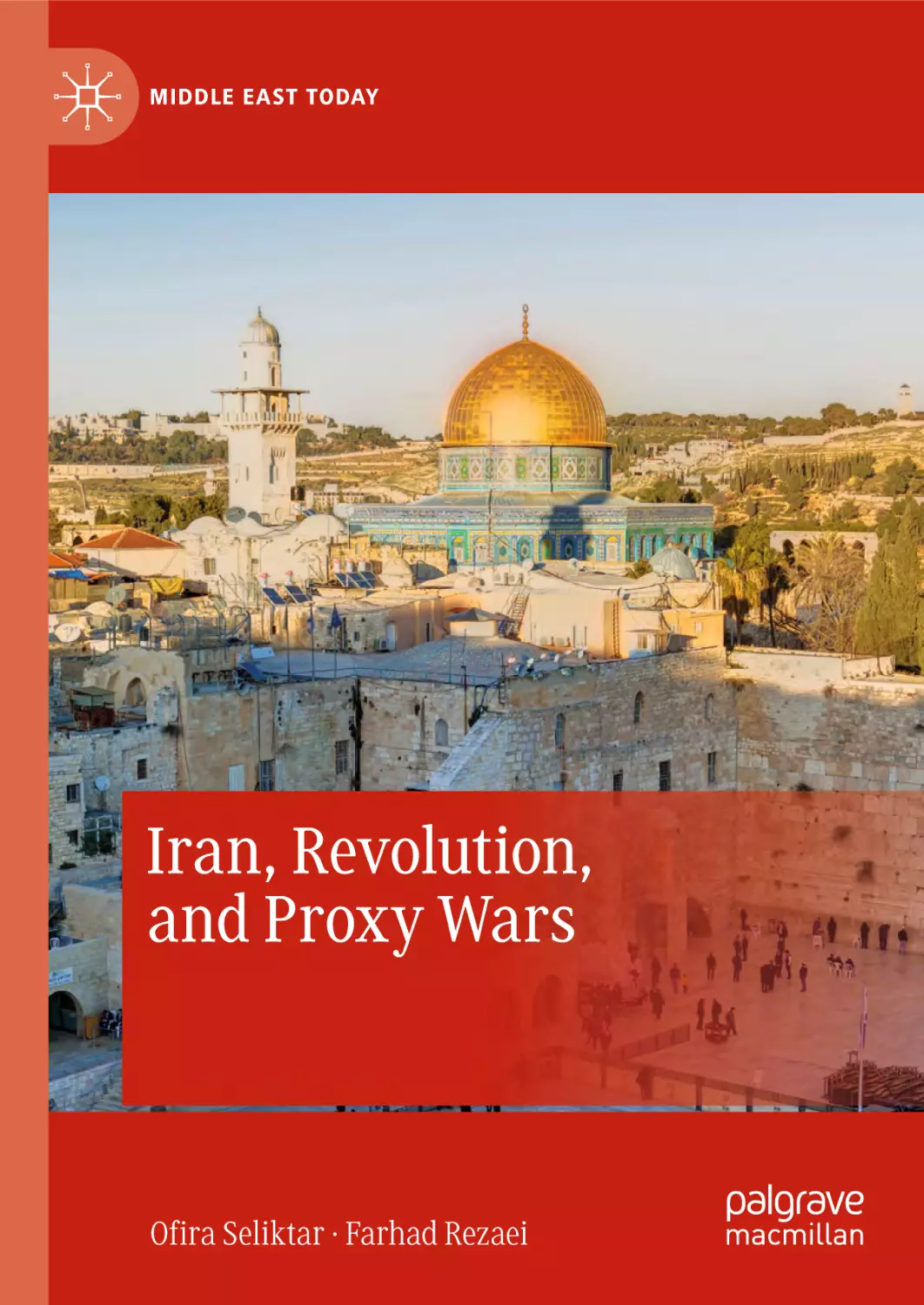
MIDDLE EAST TODAY
Iran, Revolution,
and Proxy Wars
Ofira Seliktar · Farhad Rezaei
Middle East Today
Series Editors
Fawaz A. Gerges
Department of International Relations
London School of Economics
London, UK
Nader Hashemi
Center for Middle East Studies
Josef Korbel School of International Studies
University of Denver
Denver, CO, USA
The Iranian Revolution of 1979, the Iran-Iraq War, the Gulf War, and the
US invasion and occupation of Iraq have dramatically altered the geopolitical landscape of the contemporary Middle East. The Arab Spring uprisings have complicated this picture. This series puts forward a critical body
of first-rate scholarship that reflects the current political and social realities
of the region, focusing on original research about contentious politics and
social movements; political institutions; the role played by non-
governmental organizations such as Hamas, Hezbollah, and the Muslim
Brotherhood; and the Israeli-Palestine conflict. Other themes of interest
include Iran and Turkey as emerging pre-eminent powers in the region,
the former an ‘Islamic Republic’ and the latter an emerging democracy
currently governed by a party with Islamic roots; the Gulf monarchies,
their petrol economies and regional ambitions; potential problems of
nuclear proliferation in the region; and the challenges confronting the
United States, Europe, and the United Nations in the greater Middle
East. The focus of the series is on general topics such as social turmoil, war
and revolution, international relations, occupation, radicalism, democracy,
human rights, and Islam as a political force in the context of the modern
Middle East.
More information about this series at
http://www.palgrave.com/gp/series/14803
Ofira Seliktar • Farhad Rezaei
Iran, Revolution,
and Proxy Wars
Ofira Seliktar
Gratz College
Philadelphia, PA, USA
Farhad Rezaei
Center for International Policy
Studies (CIPS)
University of Ottawa
Ottawa, Canada
Middle East Today
ISBN 978-3-030-29417-5 ISBN 978-3-030-29418-2
https://doi.org/10.1007/978-3-030-29418-2
(eBook)
© The Editor(s) (if applicable) and The Author(s), under exclusive licence to Springer Nature
Switzerland AG 2020
This work is subject to copyright. All rights are solely and exclusively licensed by the
Publisher, whether the whole or part of the material is concerned, specifically the rights of
translation, reprinting, reuse of illustrations, recitation, broadcasting, reproduction on
microfilms or in any other physical way, and transmission or information storage and retrieval,
electronic adaptation, computer software, or by similar or dissimilar methodology now
known or hereafter developed.
The use of general descriptive names, registered names, trademarks, service marks, etc. in this
publication does not imply, even in the absence of a specific statement, that such names are
exempt from the relevant protective laws and regulations and therefore free for general use.
The publisher, the authors and the editors are safe to assume that the advice and information
in this book are believed to be true and accurate at the date of publication. Neither the
publisher nor the authors or the editors give a warranty, expressed or implied, with respect
to the material contained herein or for any errors or omissions that may have been made.
The publisher remains neutral with regard to jurisdictional claims in published maps and
institutional affiliations.
Cover illustration: © Gavin Hellier / Alamy Stock Photo
This Palgrave Macmillan imprint is published by the registered company Springer Nature
Switzerland AG.
The registered company address is: Gewerbestrasse 11, 6330 Cham, Switzerland
Contents
1 Exporting the Revolution and Building Hegemony 1
2 Hezbollah in Lebanon: Creating the Model Proxy 21
3 Deploying Proxies Against the “Zionist Enemy” and
Undermining the Oslo Peace Process 57
4 Al-Qaeda: Islamist Ecumenism Against the United States
and the West 95
5 From the Badr Brigade to the Popular Mobilization
Forces: Fighting the Americans While Turning Iraq into
a New Lebanon127
6 Rescuing the Assad Regime and Turning Syria into a
Client State167
7 Proxies in the Gulf and Beyond: Saudi Arabia, the Gulf
Principalities, and Yemen203
v
vi
CONTENTS
8 Conclusion: The Success of the Proxy Strategy and Its
Limits235
Index241
About the Authors
Ofira Seliktar is Professor of Political Science (em.) at Gratz College.
She was previously a senior fellow at the Middle East Research Institute,
University of Pennsylvania. She has specialized in intelligence analysis in
the Middle East. Seliktar is the author of ten books, scores of articles in
refereed journals, and book chapters.
Her previous book is Iran, Israel, and the United States. The Politics of
Counter-Proliferation Intelligence (2018; with Farhad Rezaei). She is currently working on a new book, American Intelligence and Islamist
Terrorism: From Hezbollah to ISIS.
Farhad Rezaei is a research fellow at Center for International Policy
Studies (CIPS), University of Ottawa. He is the author of four books,
numerous articles in refereed journals, and chapters on a broad range of
topics including Iran’s foreign policy, Iran’s nuclear program, nuclear
intelligence within the framework of counterproliferation, and nuclear and
radiological terrorism. His writings have appeared in Harvard’s Iran
Matters, The National Interest, Atlantic Council, Middle East Journal,
Middle East Policy, British Journal of Middle Eastern Studies, Journal of
International Affairs, Insight Turkey, Korean Journal of Defense Analysis,
Asian Affairs, among others.
vii
Abbreviations
A2/AD
AAH
AIPAC
AMIA
AQI
ATGM
CCC
CIA
CJSOTF
CNAS
CPA
CTC
DGSE
DOP
DOT
EFP
ESA
FEDAT
FOIA
FSA
GIA
4GW
HHN
IAEA
IAF
IAO
Anti-Access, Area-Denial
Asaib Al al Haq
American Israel Public Affairs Committee
Argentine-Jewish Mutual Association
Al-Qaida in Iraq
Advanced Anti-Tank Guided Missiles
Commodity Credit Corporation
Central Intelligence Agency
Combined Joint Special Operation Task Force
Center for a New American Security
Coalition Provisional Authority
Counterterrorism Center
Direction Generale de la Securite Exterieure
Declaration of Principles
Department of the Treasury
Explosively Formed Projectile
External Security Apparatus
Field of Expansion of Deployment of Advanced Technology
Freedom of Information Act
Free Syrian Army
General Intelligence Apparatus
Fourth Generation Warfare
Harakat Hezbollah al Nujaba
International Atomic Energy Agency
Israel Air Force
Islamic Action Organization
ix
x
ABBREVIATIONS
ICSIRPP
IDF
IED
IFLB
INC
INF
IRGC
IRGC-QF
IRIB
IRP
IRU
ISAF
ISCI
ISF
ISG
ISIS
JC
JCPOA
JI
JSOC
LDF
MAFAT
MEK
MNF
MOIS
NDAS
NDF
NEDSA
NIF
OGR
OIC
OIRAP
OLM
ORHA
OSP
PA
PCMDSZ
PFLP
PIAC
International Conference in Support of the Islamic Revolution of
the People of Palestine
Israel Defense Force
Improvised Explosive Device
Islamic Front for the Liberation of Bahrain
Iraqi National Congress
Islamic National Front
Islamic Revolutionary Guard Corps
Islamic Revolutionary Guard Corps-Quds Force
Islamic Republic of Iran Broadcasting
Islamic Republican Party
The Islamic Resistance Unit
International Security Assistance Force
Islamic Supreme Council of Iraq
Iraqi Security Force
Iraq Study Group
Islamic State of Iraq and Syria
Jihadi Council
Joint Comprehensive Plan of Action
Jamaat Islamiyah
Joint Special Operations Command
Local Defense Force
Ministry’s Administration for the Development of Weapons and
Technological Infrastructure
Mujahedeen-e Khalq
Multination Force
Ministry of Intelligence and Security
National Democratic Action Society
National Defense Force
Neyroye Daryaee Sepah-e Iran
National Islamic Front
Office of Global Revolution
Organization of Islamic Cooperation
Organization for Islamist Revolution in the Arabian Peninsula
Office for Liberation Movement
Office of Reconstruction and Humanitarian Assistance
Office of Special Plans
Palestinian Authority
Popular Committee for the Mobilization to Defend Sayyidah
Zaynab
Popular Front of Liberation of Palestine
Popular Islamic and Arab Congress
ABBREVIATIONS
PIJ
PLO
QF
SATJA
SCID
SCIRI
SFLI
SID
SIHCC
SISM
SIUP
SOLA
SLA
SNA
SNSC
SOU
SRG
SRGC
TAJ
TFL
UNOSOM
WMD
Palestinian Islamic Jihad
Palestinian Liberation Organization
Quds Force
Sazman-e Enqelabi-e Todehay-e Jomhory-e Islami-e Iran
Strategic Counterintelligence Directorate
Supreme Council for the Islamic Revolution in Iraq
Students Following the Line of Imam
Special Investigative Directorate
Syrian-Iranian Higher Cooperation Committee
Somali Islamic Salvation Movement
Somali Islamic Union Party
South Lebanon Army
Shiite Liberation Army
Somali National Alliance
Supreme National Security Council
Security Organ Unit
Somali Revolutionary Guards
Syrian Revolution General Commission
Jamaat Tawhid al Jihad
Terrorism Financial Links
United Nations Operation in Somalia
Weapons of Mass Destruction
xi
CHAPTER 1
Exporting the Revolution and Building
Hegemony
Ayatollah Ruhollah Khomeini arrived in Tehran on February 1, 1979. His
tumultuous welcome was the crowning touch of the revolutionary turmoil
which swept away the Pahlavi dynasty from power. The Islamic Republic of
Iran that Khomeini established was destined to send shock waves throughout the Middle East and the world. Its subsequent politics have never left
the headlines. In the name of exporting the Islamist revolution, Iran used
assorted Shiite militias to carve out a sphere of influence known as the
Shiite Crescent. These revolutionary foot soldiers engaged in terrorism and
other forms of violence to destabilize neighboring countries and strike out
against real and perceived enemies of Khomeini’s brand of Islamism.
As in other cases or revolution regimes, underpinning the lofty rhetoric
of revolutionary export were more pedestrian concerns of regime survival
and national interests of Iran as a nation-state. These tangled imperatives
could be best understood by analyzing the peculiar duality of Iran.
The Duality of the New Regime: Iran as a State
and an Exporter of the Revolution
There was nothing in traditional Shiite theology to indicate an inclination
to partake in political activism. In the conventional Shiite jurisprudence,
the issues of governance and government have rarely been mentioned.
Known as quietism, this tradition stipulated that the leadership of the
society rests solely with Imam Mahdi, the 12th Imam believed to be
© The Author(s) 2020
O. Seliktar, F. Rezaei, Iran, Revolution, and Proxy Wars, Middle
East Today, https://doi.org/10.1007/978-3-030-29418-2_1
1
2
O. SELIKTAR AND F. REZAEI
hidden in the Major Occultation. Until his return to bring justice to the
world, Muslims must tolerate the government and the concomitant idolatry and oppression. Because of this stipulation, the religious class, the
ulama, remained largely apolitical and never proposed an alternative to the
ruling system.
Shiite quietists justify their stance by referring to a hadith of Imam
Jaafar al-Sadeq, the sixth Shiite Imam who asserted that raising any flag
before the return of Imam Mahdi was idolatrous. According to this hadith, Shiites should avoid imposing their true belief on the government, no
matter what its nature is, to give them a chance to live under adversity
imposed by the unjust rulers.1
Grand Ayatollah Seyyed Hossein Borujerdi, the marja-e taghlid (the
Source of Emulation), who founded the Qom Seminary—the central religious authority in the Shiite world—was a strong advocate of clerical quietism. Borujerdi explained that politics is a highly complex issue, which the
ulama were ill-prepared to tackle. For instance, he repeatedly noted that
“the Constitutional Revolution in Iran taught me not to get involved in
political affairs if I did not have a clear idea of their origins and outcomes.”
During the tumultuous period of Mohammad Mosaddegh2 rule and the
debate about nationalizing Iran’s oil industry, Borujerdi forbade clergy to
interfere in political affairs. Because the Grand Ayatollah was universally
revered, quietism officially prevailed in Iran until his death in 1961.3
For all his influence, Borujerdi encountered opposition from activist
clergy associated with the teaching of Ayatollah Abulqassem Kashani, a
left-leaning clergy closely involved with the anti-colonial movement in
Iran. Kashani, who opposed, capitalism, colonialism, and imperialism, was
only of the clergy to defy Borujerdi to support Mosaddegh. Although he
subsequently had a falling-out with the nationalist leader, Kashani has
been considered a true leader of the activist camp. Indeed, to demonstrate
the synergy between religion and politics, Kashani went on to serve in the
Iranian parliament in the 1950s.4
1
As-Sahifa Al-Kamilah Al-Sajjadiyya, published by Moasesat AlElmi Al-Matboat, Beirut,
pp. 26–27.
2
Mosaddegh was Iran’s prime minister from 1951 to 1953 when his government was
overthrown by a coup d’état orchestrated by the US Central Intelligence Agency (CIA) and
the United Kingdom’s MI6.
3
Marjaeyat va Syasat: Ayatollah Boroujerdi Political Biography, www.broujerdi.ir/index.
php/2016-03-25-16-38-40/2016-03-25-16-40-41/393-2016-03-26-07-11-50.
4
Nasrullah Shifteh, Relationship between Mosaddegh and Kashani, Islamic Studies Center,
http://iscq.ir/?part=menu&inc=menu&id=308.
1 EXPORTING THE REVOLUTION AND BUILDING HEGEMONY
3
More consequentially, Kashani did not limit his activities to legitimate
politics. He joined up with Navab Safavi, a devotee of the Sayyid Qutb,
the founder of the Egyptian Muslim Brotherhood who advocated political
violence. Kashani and Safavi believed that the Muslim regimes needed to
be “purified,” and it was up to the true believers to get rid of “corrupt”
government officials by assassinating them. They founded the first Islamist
terrorist group in Iran, the Fadā’iyān-e Islam (Fighters of Islam). The
Fadā’iyān-e Islam was involved in several assassinations and assassination
attempts. On December 25, 1955, Safavi and three other members of the
group were executed. Ayatollah Borujerdi, who expelled the Fadā’iyān-e
Islam from Qom in 1950, refused to intervene on his behalf.5
Sayyid Ruhollah Mūsavi Khomeini, a rising start in Qom, however, was
far more sympathetic to the cause of the Fadā’iyān. Although loyal to
Borujerdi, the young cleric felt it was imperative for the ulama to get
involved in the political realm. Indeed, Khomeini was well acquainted
with both Kashani and Safavi who visited him in 1943 and 1944. It was
also through Safavi that Khomeini became open to the Muslim
Brotherhood idea of Muslim ecumenism. In one of his early writings,
Kashf al Asrar (Uncovering of Secrets), Khomeini revealed his predilection for engaging in the political arena. The pamphlet was a radical denunciation of the secularization of the society and a thinly veiled attack on the
anti-clerical activist and historian Ahmed Kasravi. Khomeini decreed
Kasravi to be a Madhur-al-Dam (one whose blood needs to be shed by
believers). On March 11, 1946, two members of the Fadā’iyān, Hoseein
and Ali-Mohamed Emami murdered Kasravi and his assistant. Khomeini
intervened with the Shah to spare their lives.6
If the Kasravi murders were an early indication that Khomeini was willing to embrace political violence, his subsequent history revealed a radical
transformation in personality and ideology. Following an unsuccessful
effort to derail the Shah’s White Revolution, an attempt to modernize and
Westernize Iran, Khomeini was exiled to Turkey in 1964. Less than a year
later, in November 1965, Khomeini was allowed to move to Najaf, the
center of Shiite learning in Iraq, where many of his students followed him.
Despite the shared faith, Khomeini found Najaf less than congenial, often
referring to it as a “den of snakes.” What bothered Khomeini the most was
Con Cochlin, Khomeini’s Ghost, HarperCollins, e-edition, p. 106.
Amir Taheri, The Spirit of Allah, 1985, 98, 102; Con Cochlin, The Ghost of Khomeini,
104.
5
6
4
O. SELIKTAR AND F. REZAEI
the fact that senior Iraqi Shiite leaders were quietists who frowned on
his activism and especially his evolving notion of a theocratic state.
Instead, he surrounded himself with a handful of like-minded activist
clerics such as Ayatollah Mohammed Bakr al Sadr, the founder of the
Dawa Party, and Musa Sader who became part of the so-called Najaf
circle. Khomeini’s former students in Qom who attended classes in
Najaf noted the change in his demeanor: “In Qom he wanted to be a
religious leader; in Najaf he wanted to be a political leader” in the
words of one of them.7
Khomeini first articulated his political vision in a series of lectures in
Najaf, “The Islamic State,” which appeared in a 1970 book published in
Beirut. In a radical departure of historical Islamic practices, Khomeini
used post-Occultation theology to postulate that a proper Islamic order
needed to be based on a principle of velayat-e faqih, the rule of a capable
jurist. The government of the faqih was essentially a form of guardianship
awaiting the arrival of the truth ruler, the Hidden Imam. While the theocratic feature captured much of the popular attention, a deeper analysis of
Khomeini’s teaching revealed that it amounted to a radical revision of
Shiism, known as neo-Shiism or Khomeinism.
It is not entirely clear how many of participants in the anti-Shah revolution realized that the rule of the monarchy would be replaced by an all-
encompassing neo-Shiite philosophy. However, shortly after the arrival of
Khomeini, decisive steps were made to turn the velayat-e faqih theory into
practice.8
Although Khomeini received a tumultuous welcome, his top advisers,
Ayatollah Mohammad Beheshti and Akbar Hashemi Rafsanjani, realized
that the democratic fervor which toppled the Shah needed to be acknowledged. To satisfy the democratic impulse without undermining too much
of the rule of the faqih, the Khomeinists created a complex system of representation. The Majlis (parliament) members and the president were
elected by popular vote, albeit from a list of names approved by the
7
Con Coughlin, Khomeini’s Ghost: The Iranian Revolution and the Rise of Militant
Islam, Harper Collins Publishers, 2014, pp. 151–154.
8
Ruhollah Khomeini, Velayat-e faqih, The institute for compilation and publication of the
works of Imam Khomeini, 2005.
1 EXPORTING THE REVOLUTION AND BUILDING HEGEMONY
5
Council of Guardians. The Council was also in charge of making sure that
the Majlis legislation was compatible with the Koran. The Constitution of
November 1979, which codified this peculiar “theocratic democracy,”
stipulated that an 86-member body known as the Council of Experts
would choose the faqih, elevated to the position of a Supreme Leader.
Even with the added constraints of Islamist theocracy, Iran could have
passed as a conventional nation-state. As in other countries, the
Constitution provided for a hierarchical power structure in which a higher
level indicates a more significant measure of power and control over the
lower levels and the chain of command extends from top to bottom.
According to the Constitution, the executive branch—that is, the president—the government, the state bureaucracy, and the security forces were
in charge of the political and economic system. The Majlis and the duly
elected officials were called upon to uphold the national interest of the
state within the limits of international law and partake in the community
of nations. Since the international community operated within the framework of the Treaty of Westphalia which elevated the principle of the sovereign state, the Islamic Republic was expected to refrain from interfering
in the affairs of other sovereign nations.
However, Ayatollah Khomeini and his followers were not content with
creating an Islamic Republic in Iran alone. Velayat-e faqih asserted that the
mandate of the religious ruler extends beyond Iran to include the entire
Ummah, the universe of Muslim countries. Indeed, according to
Khomeini, the nation-state was a Western construct, and part of the
imperial-colonial design considered heresy (kufr) in Islam. Liberating the
mustazafeen thus required propagating Islam (tabligh-e eslam) and exporting the revolution (sudur engilab). For instance, on January 14, 1980,
Ayatollah Khomeini stated: “We are at war against the infidels…, I ask all
Islamic nations, all Muslims, to join the holy war. There are many enemies
to be killed or destroyed. Jihad must triumph.” In a New Year message on
March 21, 1980, he announced that “we must strive to export our revolution throughout the world and must abandon all ideas of not doing so.”9
Khomeini was hardly alone in espousing revolutionary export. If anything, Grand Ayatollah Hussein-Ali Montazeri, a one-time heir to Khomeini,
9
Yossef Bodansky, Target America: Terrorism in the U. S. Today, S.P.I. Books, 1993, 167;
Richard J. Leitner and Peter M. Leitner, Unheeded Warnings: The Lost Reports of the
Congressional Task Force, p. 193; Shmuel Bar, Iranian Terrorist Policy and Export of
Revolution, Institute for Policy and Strategy, Working Paper, 2009.
6
O. SELIKTAR AND F. REZAEI
emerged as the most enthusiastic booster of a global Islamist revolution. In
his words, exporting the revolution meant “supporting the oppressed
[Muslim] nations.” Montazeri noted that the Prophet said “a person who
spent one night while he does not care about the affairs of the Muslims, is
not a Muslim, and a person who has heard an oppressed voice which calls
for help from Muslims, but he does not answer to him, he is not a Muslim.”
On another occasion, he stated that under Islamic ethics, it was the responsibility of Muslims to help each other and that this help should extend to the
realm of foreign affairs.10
While highly enthusiastic, Khomeini and his fellow exporters faced considerable opposition from the government of the moderate politician
Mehdi Bazargan. Even some stalwarts of the Islamic Republican Party
(IRP), such as Ayatollah Mohamed Beheshti and Ali Akbar Rafsanjani
who represented the landowning clergy and the merchant class, had little
appetite for an immediate revolutionary push. Realizing early on that this
kind of foreign policy adventurism would hurt the national interest of
Iran, they tried to tamper the “Trotskyites.” With neither side holding the
upper hand, the bitter debate about “the logic of the state versus the logic
of the revolution” had underlaid the functioning of the regime and would
periodically break public. In what was the most conspicuous display of this
struggle, the hard-liners were forced to agree on the nuclear negotiations
leading to the 2015 Joint Comprehensive Plan of Action (JCPOA). A
study of the nuclear project revealed that the international sanctions created a profound crisis of legitimacy and persuaded the embattled Supreme
Leader Ayatollah Ali Khamenei to side with the moderates.11
However, the lesson that foreign policy adventurism could bring punishing costs was still in the future. In the meanwhile, even those worried
about the potential damage stemming from “Trotskyite” impulse with
Khomeini agreed that to safeguard the revolution, a set of dedicated institutions outside of the purview of the state needed to be created.
On April 22, 1979, Ayatollah Khomeini announced the foundation of
the Islamic Revolutionary Guard Corps (IRGC), known popularly as the
Revolutionary Guards. Ostensibly, the IRGC was limited to domestic
10
Hossein Ali Montazeri, Islam Dine Fetrat, Nashr-e Sayeh, 2009, p. 400; Afshon Ostovar,
Vanguard of the Imam: Religion, Politics, and Iran’s Revolutionary Guards, Oxford
University Press, 2016, loc. 2435.
11
Ofira Seliktar and Farhad Rezaei, Iran, Israel, and the United States: The Politics of
Counter-Proliferation Intelligence, NY: Lexington Books, 2017.
1 EXPORTING THE REVOLUTION AND BUILDING HEGEMONY
7
operations, but it was quite clear that spreading the revolution was also on
the agenda. As Montazeri put it in a talk to IRGC commanders, “You
Guardian brothers, should protect Islam and the Islamic Revolution, and
with your efforts, our Islamic revolution will be exported to other
countries.”12 He added that “We want people of the region, affected by
the essence of our revolution, to wake up and start their revolutionary
movement.” In due time, the IRGC described its mission in transnational
terms: “The Islamic Revolution does not have any borders… The Islamic
Revolutionary Guard Corpse does not have the word ‘Iran’ in its title. This
means that it seeks to defend the Islamic Revolution and its achievements
without regard to particular borders.” As one observer put it, the Guards
declaration was nothing short of “an assault on the Westphalian system.”13
Rhetoric aside, the IRGC was given considerable independent resources
to carry out its mission. The organization could count on a large number
of foundation (bonyads) and other “charitable” institutions such as the
Mustazafeen Foundation, Astan-e Qods-e Razawi Foundation, Martyr’s
(Shahid) Foundation, Imam Khomeini Emdad Committee, Setad-e Ejray-e
Farman-e Imam, known as Setad (the Headquarter for Executing the
Order of the Imam), among others. In due course, the Guards would create a vast economic empire which made them largely independent from the
state, let alone accountable to it. As would be discussed in later chapters,
they used some of their assets such as the Khatam al Anbia Construction
Company to build terror infrastructure in Lebanon and Sudan.14
This separate parastatal structure posed a considerable challenge to the
statist part of the regime. Theoretically, the Supreme Leader was tasked
with settling the debates between the state and the parastatal, but in practice the process was cumbersome and opaque, involving endless negotiations, bargaining, strong-arming, and intimidation. Due to absence of a
clear hierarchical delineation of power, the complex negotiating political
order made tracking decision-making difficult, a feature which observers
have often complained about. As one of them noted, “decision making
remained secret … in a complex web of institutions and circles, constantly
in flux.” Another likened the “bitter and complex infighting” to a
Hossein Ali Montazeri, the Memoir, Ketab Corp, 2001, p. 565.
Nader Uskowi, Temperature Rising, Iran’s Revolutionary Guards and Wars in the Middle
East, Lanham, MD. Rowman & Littlefield, 2019, loc. 158; Montazeri, The Memoir, p. 565.
14
Iran: The Rise of the Revolutionary Guards’ Financial Empire, National Revolutionary
Council of Iran, National Revolutionary Council of Iran, 2017, loc. 427–438.
12
13
8
O. SELIKTAR AND F. REZAEI
“kaleidoscope … [for] as soon as one pattern formed, it was quickly
shaken apart, only to reform in a different pattern.” Another lamented
that “Iran’s lines of power and authority are almost impossible to follow.
They seem to change between morning and night.”15 Whatever configuration de jour had emerged, the unresolved tension between the interest
of the state and the interest of the revolution was always in the background. As Henry Kissinger famously quipped, “Iran must decide whether
it is a nation or a cause.”16
Much as the international community hoped that Iran would revert to
a traditional nation-state, the “Trotskyites” developed a powerful narrative against the West.
The Enemies of Islam: The Great Satan
and the Little Satan
For Khomeini and Montazeri, and the cohort which came of age during
the nationalist upheaval in Iran, the West was a primary enemy. In the early
twentieth century, it was the British Empire that epitomized in their eyes
the enemy that was aggressive and rapacious with imperialism and colonialism. It was also the source of collective humiliation and shame that,
according to one historian, was growing since Napoleon smashed his way
into Egypt in 1798. Together with the British, the colonial project robbed
Islam of its dignity.17
By the early fifties, however, the United States had replaced Great
Britain as the arch-enemy of Iranian nationalist clergy like Ayatollah
Kashani. Khomeini had his reasons to oppose the United States which, in
his view, pushed the Shah into a process of modernization embodied in
the White Revolution. Anti-American sentiments were rife in the “Najaf
circle,” which exposed Khomeini to the writings of Ali Shariati, a leading
sociologist and philosopher who proposed a synthesis of socialism and
Islam. Shariati, in turn, was influenced by the anti-Western crusader Jalal
al Ahmad who warned his countrymen about the danger of gharbzadegi,
Westoxification, his term for Westernization.
15
Ofira Seliktar, Navigating Iran: From Carter to Obama, Palgrave Macmillan, 2012,
p. 29.
16
Quoted in Sean Durnes, “Forty Years of Misreading Iran.” Washington Examiner,
February 11, 2019.
17
Ed Husain, The House of Islam, A Global History, 2018, 5.
1 EXPORTING THE REVOLUTION AND BUILDING HEGEMONY
9
Khomeini’s speeches and writings were rife with anti-American sentiments. Typically, he would declare that “the biggest betrayal of America to
our nation is imposing Pahlavi regime on us and supporting it unconditionally and this is only a part of America’s oppressing our nation.” He would
add that “America is the number one enemy of Islam and our nation
because it is supporting the Shah. America wants to humiliate the dignity of
mankind. It is the responsibility of all Muslims to stand up against and
eliminate America; otherwise, the world will remain corrupted as far as
America is alive.” Montazeri was in total agreement, writing in an open letter: “It is the responsibility of all Muslims to stand up against America and
Israel. America wants to destroy Islamic countries by any possible means.
People should not forget that America is the number one enemy of Islam.”18
Seizing power only increased Khomeini’s motivation to challenge the
United States. To sacralize the struggle, Khomeini and numerous regime
representatives had begun referring to the United States as the Great
Satan. Chants of “death to America” were a routine part of every rally,
whipping up a public frenzy and motivating vigilantes who thrived in the
chaotic first year of the revolution. On November 4, 1979, one such
group, Students Following the Line of Imam (SFLI), attacked the
American embassy in Tehran and took the embassy staff hostage. Despite
efforts by the Bazargan government to free the diplomats, they were held
in captivity for 400 days. The unprecedented breach of international protocol cemented the regime’s status as a revolutionary crusader and an
uncompromising foe of the Great Satan.
While tracing the logic of the anti-American animus was easy, the origin
of the hostility to Israel, the “Little Satan,” was not clear. There was nothing in the traditional Shiite tradition to indicate an even passing interest in
the subject of Jerusalem, the Palestinians, or the Jews. Since the return of
the Mahdi was not conditioned on controlling any particular of real estate,
Muslim holy places were only marginal to the Shiite eschatology. Mecca
and Medina were worshiped sacred space where the revelation and the
writing of the Koran took place but had no intrinsic value in the process of
salvation through the coming of the Mahdi. To the extent that the clergy
referred to the issue of Israel, the topic was political and not theological.
For instance, in 1933, the Iraqi Ayatollah Sheikh Mohammad Hossein
Kashful-gheta, apparently influenced by the tension between Jews and
Arabs in Palestine, issued a fatwa urging Muslims to fight against Jews.
18
Kayhan Newspaper, November 2, 1979.
10
O. SELIKTAR AND F. REZAEI
When the Shah recognized the State of Israel, Seyyed Javad Hosseini, an
influenced cleric in Qom, attempted to mobilize his cohorts against the
move. Ayatollah Borujerdi, however, banned him from public speaking.19
The lack of historical precedent did not bother Ayatollah Khomeini
who launched a full-throated attack on the Jews while in exile in Najaf. In
Velayat-e faqih, Khomeini quoted a passage from the Koran to claim that
“from the very beginning Islam was afflicted by the Jews. They established
anti-Islamic propaganda and engaged in various plots against the Muslims.”
Khomeini described the Jews as sinful and as being constantly reprimanded
by God for their wickedness. In his view, Jews plotted against Muslims
more recently as well, seeking to undermine the most important feature of
Islam to facilitate the imperialist penetration of the Muslim countries. As
Khomeini put it, “the Jews may God curse them are opposed to the very
foundations of Islam and wish to establish Jewish domination throughout
the Islamic world. They meddle with the text of the Koran and published
false translations that distort its meaning to slander Islam.” Echoing
Shariati and Al-e Ahmad, Khomeini describes the Jews as fifth columnists
in the Islamic world and as subversive agents of the West who attempts to
undermine Islam. Most specifically, he argued that the Shah was a “Jew in
disguise” who was subservient to Israel and used to destroy Islam in Iran.20
Harsh as these statements were, they could be viewed as part of a classic
anti-Semitic repertoire popularized by Al-e Ahmad and Shariati, an opinion espoused by the extensive literature on the regime’s anti-Semitism.
However, to the surprise of many, Khomeini’s real radical innovation pertained to the place of Jerusalem and Palestine in the Shiite theology. In
1979, Khomeini declared that the liberation of Jerusalem the central component of Iran’s Islamic ideology. Following the 1979 revolution,
Khomeini declared Shiite Islam to be the new liberator of Jerusalem and
the Holy Land from the Zionist enemy, or Little Satan. Khomeini argued
that the Islamic Revolution in Iran was a prelude to the liberation of
Jerusalem and the revolution would not be completed until Jerusalem was
back in Muslim hands. He defined the conflict with Israel as the struggle
between good and evil, adding that it was the religious obligation of all
Montazeri, the Memoir, pp. 145–147.
Ruhollah Khomeini, Velayat-e Faqih; Hawzah, Zionism Waist Broke in Iran, Hawzah.
net, https://hawzah.net/fa/Magazine/View/5737/6768/80895; Katajun Amirpur,
Iran’s Policy Toward Jewish Iranians and the State of Israel,” Die Welt des Islam, 52 (2012),
370–399.
19
20
1
EXPORTING THE REVOLUTION AND BUILDING HEGEMONY
11
Muslims to resist the profane Jewish entity. In other words, the liberation
of Jerusalem was not considered to a Palestinian responsibility alone, but
an undertaking of the entire Muslim world led by Tehran.21
Scholars who analyzed Khomeini’s narrative pointed out that elements
of it were adopted from the teachings of Qutab who considered the secular Muslim leaders to be “crypto-Jews” bent on destroying Islam from
within. Indeed, Ayatollah Khomeini often charged the Shah of being a
“crypto-Jew.” However, others noted that the Islamic Republic of Iran
espoused “the most radical anti-Israeli or anti-Zionist position in the
Muslim Middle East.” In this view, the regime practiced “redemptive anti-
Semitism,” a highly virulent form of anti-Semitism which considered the
physical annihilation of Israel to be the highest callings. There is little
doubt that redemptive anti-Semitism was an integral part of neo-Shiism.
Still, the obsessive focus on Jerusalem might have had a realpolitik purpose as well. Since the Saudi Kingdom, the main rival of Khomeinism, was
the custodian of Mecca and Medina, Khomeini tried to even the playing
field by declaring the Muslim shrines of Jerusalem to be of equal value and
essentially appointing Iran as its custodian.22
Erecting the Infrastructure for Revolutionary
Export: Asymmetrical Warfare by Proxies
Although Khomeini declared America to be a “fake power” and boasted
that “our nation will defeat this fake power,” the new regime realized that
Iran could not win a conventional war because of the huge disparity in
power. Brigadier General S.K. Malik, an Islamist who served on the
Pakistani General Staff, offered a solution to the quandary of power imbalance in his popular book, the Koranic Concept of War. Malik argued that
unlike Western military strategy, Islamic warfare was rooted in jihad, the
holy war which was, by definition, asymmetrical. He added that jihad
allowed for terror operations, including suicide attacks on civilians. Malik
explained that terror operations create fear and panic among the target
population, lowering its morale and eroding its staying power in a conflict.
21
A Quick Look at the History of Struggle Against Zionism by Shiite Ulama, http://revolution.pchi.ir/show.php?page=contents&id=4928.
22
Meir Litwak, “The Islamic Republic of Iran and the Holocaust: Anti-Semitism and antiZionism,” Journal of Israeli History, vol. 25, no. 1, 2006; Ben Cohen, “Global anti-Semitism
Now Has a Leader,” The Tower, September 2015.
12
O. SELIKTAR AND F. REZAEI
As for Muslim civilians, Malik postulated they were bound by the Koran
to sacrifice their life for the jihad. To the individual volunteer, the title of
mujahid (holy warrior) gave meaning in life and bestowed greatness after
death. Not incidentally, this type of redemptive sacrifice was the only way
to avenge the Western-inflicted Karama, a notion that both the Shiite and
the Sunni jihadis have shared. To them, jihadi terror was “holy terror,” to
be used in the conflict between good and evil. Analysts subsequently confirmed Malik’s assumption. As one of them put it, “terrorism—use of violence by a non-state actor primarily against noncombatants,” creates a
political and psychological reaction “which is out of proportion to the
actual destruction it inflicts.”23
While neither Khomeini nor Montazeri was a strategist, they could rely
on a cadre of professional revolutionaries and guerrilla fighters led by
Mustafa Chamran. A physicist who lived in the United States, in 1965,
Chamran created the Red Shiism organization to train Shiite militants.
Chamran propagated his ideas during his travels to Egypt and Cuba, eventually moving to Lebanon in 1971, where the Palestinians put him in
touch with an international terror network. In 1972, George Habash, the
head of the Popular Front of Liberation of Palestine (PFLP), organized a
conference in Baddawi, a Palestinian refugee camps in Lebanon. The
Baddawi summit forged the International Center for Resistance of
Imperialism, Zionism, Racism, Reaction, and Fascism, a loose alliance of
Middle East terror groups which Chamran had joined. He established
close links with Yasser Arafat who offered him and other Iranian militants,
including the sons of Khomeini and Montazeri, to train with the elite unit,
Fatah Force 17.24
In 1979, these revolutionary cadres returned to Iran where they played
a leading role in the Revolutionary Guards and Sazman-e Enqelabi-e
23
S.K. Malik, The Quranic Concept of War. Lahore, Reprint in India: Adam Publishers
and Dirtributors, 1979; Ed Husain, The House of Islam, A Global History, Bloomsbury
Publishing, 2018, 5; Daniel E. Price, Sacred Terror: How Faith Becomes Lethal, Praeger,
2012, 65, 183; Ronen Bergman, the 30 Year Old War: The Secret Struggle, 378; Nance,
Malcolm, Defeating ISIS: Who They Are, How They Fight, What They Believe, Skyhorse
Publishing, 2016, p. 12.
24
MNA, The story of the most powerful Lebanese Student of Shahid Chamran,
Mashregh News Agency, June 23, 2014, https://www.mashreghnews.ir/news/320827/
چمران-شهید-لبنانی-شاگرد-ترین-قوی- ;ماجرایISNA, Martyr Chamran According to Adel Aoun,
Iranian Students News Agency, June 21, 2015, https://www.isna.ir/news/94033117479/
عون-عادل-روایت-به-چمران-شهید.
1
EXPORTING THE REVOLUTION AND BUILDING HEGEMONY
13
Todehay-e Jomhory-e Islami-e Iran (SATJA). Mohammed Montazeri, son
of Ayatollah Montazeri, was in charge of SATJA, but after his death in
1981, Mehdi Hashemi, his close associate, took over the group, renaming
it Office for Liberation Movement (OLM). In 1984, OLM joined the
Ministry of Foreign Affairs. Ahmed Vahidi, the head of the intelligence
department of the Guards, co-directed the foreign operations group
SATJA and OLM, until in 1989 when he was appointed to head the newly
created Quds Force (QF).
Even before the revolutionary project was formally institutionalized
within the Quds Force, the IRGC launched a multipronged program to
carry out Khomeini’s mandate. At the theoretical level, the Guards
invested considerable efforts in developing the asymmetrical warfare doctrine and tactics. Hassan Abbassi, a noted strategist, helmed the Center for
Borderless Doctrinal Analysis (Markaz-e Barresihay-e Doctorinal Amniyat-e
Bedone Marz), also called the Yaghin think tank (Andishkadeye Yaghin). In
2005, the IRGC’s Imam Hussein University founded the Center for
Asymmetrical Warfare. Ali Jafari, a future IRGC chief, served as the first
head and, in a testimony to its importance, virtually all top IRGC-QF
commanders either graduated or taught there.25
Asymmetrical warfare has been used throughout history, but four innovations gave the Iranians a winning edge. First, the Guards networked
with both Shiite and Sunni proxies on a sliding scale principle, according
to network theory. Hezbollah and other Shiite militias enjoyed close and
intense contacts with the Guard. On the other hand, relations with Sunni
groups like Al-Qaeda were undertaken to achieve a narrowly defined goal,
and were minimal and sporadic. The resultant network made intelligence
work challenging. Terror network experts noted that “diffuse networks
and unclear sponsorship” resulted in failure to connect the dots. Parts of
the terror web could turn into the “dark network” with an “undetermined
amount of missing data.” With regard to Iran—proxy network in particular—“the blending of jihadist groups Shiites and Sunnis is a hard target for
intelligence agencies and law enforcement to track and interdict due to the
fluid and sometimes short-lived nature of such alliances.”26
25
Hassan Abassi, Soft Government and Doctrine of Asymmetrical Warfare, http://andishkadeh.ir/جه-در-نامتقارن-اقدام-دكترين-و-نرم-حكومت/.
26
Ian O. Lesser, et al. Countering the New Terrorism, Santa Monica: Rand Corporation,
1999; James F. Morris and Richard F. Deckro, SNA Data Difficulties with Dark Network,
“Behavioral Science of Terrorism and Political Aggression, vol. 5, 2013 issue 2, 70–93; Dave
14
O. SELIKTAR AND F. REZAEI
Use of proxies gave Iran deniability which “prevented the state actor
from being tainted by the actions, allowed it to negotiate in apparent good
faith by claiming they are not responsible for the actions of parties who are
merely sympathizers or avoid being accused of belligerent actions or war
crimes.” In the words of one commentator, these “connections were
largely circumstantial, buried in complex, poorly understood networks of
operatives, fundamentalist leaders and wealthy Arab donors.”27 Even when
linkage was suspected, the covert nature of IRGC’s project enabled the
regime to either strongly deny or obfuscate its role. For instance, the Quds
Force worked with cultural and philanthropic organizations to conceal its
input or send “volunteers” in civilian clothing, acting as advisors, or
removed markings from weapons and munitions. Financial contributions
were so well concealed, making estimations difficult.28
Second, by adopting suicide bombing as a weapon of choice, IRGC-QF
achieved “the best of both worlds: the precision and sophistication of the
most complex technology and the reliability and simplicity of delivery.”
The Israeli military described this tactic as the “poor person’s smart
bomb,” a tribute to the ingenuity of the Guards. Because the Koran forbade suicide, Ayatollah Khomeini had to break new theological grounds
on this score as well. Initially, Khomeini praised the collective sacrifice of
the teenage boys deployed by the Guards as human waves against the Iraqi
military. When one of them, Hossein Fahmideh, threw himself on a tank
in what was an act of suicide, the Supreme Leader declared him to be a
martyr. Sheikh Fadlallah, the spiritual leader of Hezbollah, used the
Fahmideh precedent to issue a fatwa declaring that suicide bombings are
equivalent to combat action which could also be perpetrated against
enemy civilians. Known also as “offensive jihad” or “martyrdom
operations,” this so-called sacred terror became part of Islamist indoctrination disseminated in pamphlets and brochures to battlefield militants.29
Dilegge, Iranian and Hezbollah Hybrid Warfare Activities, Small Wars Journal Anthology,
2016, 253.
27
Assaf Moghaddam, Nexus of Global Jihad Understanding Cooperation Among Terrorist
Actor, New York: Columbia University Press, 73; John Miller, The Cell: Inside the 9/11
Plot, and Why the FBI and CIA Failed to Stop It, Simon & Schuster, 2002, 139.
28
Austin Carson, Secret Wars Covert Conflict in International Politics, Princeton University
Press, 2018.
29
Daniel Helmer, “Hezbollah Employment of Suicide Bombing,” Military Review, vol.
86, July–August 2006; Dilegge, Iranian and Hezbollah Hybrid Warfare Activities, p. 287.
1
EXPORTING THE REVOLUTION AND BUILDING HEGEMONY
15
Third, the Guards instructed their proxies to embed within the local
population whenever the occasion allowed. In the Guards parlance,
embedding meant hiding the militants and their assets in private houses
and in public spaces such as hospitals, schools, and libraries. As would be
discussed in Chaps. 2 and 3, this practice has been most popular in the
south of Lebanon and the Gaza Strip.30 Khomeini considered it a duty of
Muslim noncombatants to welcome embedding even at the risk of death
or injury; international law denounced using civilians as human shields. By
violating the laws of war, the Guards and their proxies risked international
censure and terror-related sanctions. In 1984, the State Department designated Iran as a leading state sponsor of terrorism. In 1997, Hezbollah
was added to the list.31
However, the advantages of embedding, especially in densely populated
urban, have been considerable. Hassan Abbassi who was well versed in the
law of war noted that mingling with civilians would hinder the response of
regular armies bound by international conventions. Abbassi described
asymmetrical warfare by using an analog from a football game: “Consider
a football game, which has two half courts, our courts and theirs. We will
play in our half-court based on our own rule, and our rival arranges its
players based on its own rule. Then we will play in the rival’s half-court
based on our own rule, which is called positive asymmetrical. The court is
theirs, but we will set the game rule.” He took particular pride in the
Hezbollah war with Israel in 2006: “Hezbollah skillfully used different
places including the mixing of military forces with civilians rather than just
military bases. And it also stashed military hardware and communication
systems devices inside cities so that they could not be identified.”32
Fourth, lacking nuclear weapons, the regime had used the far-flung terror groups as deterrence against its enemies, notably the United States,
Israel, and Saudi Arabia, or even domestic opposition. Officially, the ark of
terror organizations was known as the Axis of Resistance. Unofficially,
30
Mohammad Mahdi Shariatmadar, Lebanese Hezbollah: Strategy, Past, and its Future,
Nashre Ettellaat, 2017.
31
USDS, Chapter 3: State Sponsors of Terrorism Overview, Bureau Of Counterterrorism
Country Reports on Terrorism U.S. Department of State, 2014, https://www.state.gov/j/
ct/rls/crt/2014/239410.htm; USDS, Chapter 6—Terrorist Organizations, Country
Reports on Terrorism Office Of The Coordinator For Counterterrorism, U.S. Department
of State, April 30, 2007, https://www.state.gov/j/ct/rls/crt/2006/82738.htm.
32
Hassan Abassi, What Does Asymmetrical Warfare Mean? https://www.aparat.com/v/
PNQ4c/29%__دکتر_عباسی28%_جنگ_نا_متقارن.
16
O. SELIKTAR AND F. REZAEI
however, the militias played an important role in deterrence. As one
observer summarized the unspoken rule of engagement as “either we are
safe, or no one is,” meaning that attempts against Iran would trigger a
wave of terror in the Middle East and beyond. Interestingly enough, after
signing the nuclear agreement in 2015, threats to active proxy terror network had increased, much to the dismay of the Obama administration
which hoped to convert Iran into a law-abiding member of the international community. As the following chapters indicate, the regime used
terror threats and terror attacks against an array of its enemies.33
To train militants, the IRGC opened a facility in Manzariah Camp
(Shahid Bahonar Camp) in Tehran which Ayatollah Khomeini inaugurated on February 11, 1982. The sprawling facility was a laboratory for
asymmetrical warfare tactics, known as “niche means.” Suicide bombings,
hijackings of planes, bomb-making, large explosive devices, guerrilla warfare were among the skills taught. Ayatollah Fazlollah Mahdizadeh
Mahalati, known as Fazlollah Mahalati, Khomeini’s representatives to the
Revolutionary Guard, lectured in the suicide program for specially selected
volunteers. The first commander of Manzariah was Abbas Golru, a
Guardsman who distinguished himself in 1981. Golru and his successors
reached out to experts from North Korea, Syria, and various radical
Palestinian groups. Farsi-speaking KGB officers joined the foreign trainers. Between 1981 and 1985, a total of 3000 individuals were trained,
making Iran the second-best terrorist state after the Soviet Union, according to some accounts. By the summer of 1996, intelligence sources
revealed the existence of 11 camps which graduate some 5000 extremists
annually.34
In yet another innovation geared toward exporting the revolution, the
IRGC-QF worked very closely with the Foreign Ministry to utilize the
Iranian embassies. The idea was the brainchild of Javad Mansouri, the first
commander of the IRGC who went on to assume the post of the Deputy
Foreign Minister on March 20, 1981. Shortly after, on November 1,
Mansouri was placed in charge of “transforming every Iranian embassy
33
Chahram Chubin, Iran and the Arab Spring: Ascendancy Frustrated, Gulf Research
Center, September 2012, p. 4.
34
Richard J. Leitner, Peter M. Leitner, Unheeded Warnings: The Lost Reports of the
Congressional Task Force on Terrorism and Unconventional Warfare, Washington, Crossbow
Books, 2007, p. 194; Bodansky, Target America, 10–11: Tabnak, In Memory of Martyr
Fazlollah Mahalati, https://www.tabnak.ir/fa/news/149217/محالتی-هللا-فضل-شهید-یاد-;به
Coughlin, Khomeini’s Ghost, pp. 325–329.
1
EXPORTING THE REVOLUTION AND BUILDING HEGEMONY
17
abroad into an intelligence center and a base for exporting the revolution.” Ali Akbar Mohtashamipour, a disciple of Ayatollah Khomeini from
his Najaf days and a collaborator of Mohammed Montazeri in SATJA
days, became a prototype of the ambassador-revolutionary exporter. As
would be discussed in Chap. 2, Mohtashamipour, who served as the
ambassador in Damascus, was pivotal in establishing Hezbollah.35
Along the military side, “soft measures” such as political activism, propaganda, education about Khomeinism, and other forms of outreach have
been developed and lavishly funded. Iranian cultural centers became ubiquities throughout the Middle East as well as the Muslim communities
around the world. The Quds Force identified promising “identity entrepreneurs,” who specialized “in articulating and publicizing ethnoreligious
grievances.” After a process of “maturation,” these groups were counted
upon to foment social protest. In more advanced cases, proxy groups
morphed into political parties, a process which the Iranians encouraged
and nurtured. These dual-use proxies garnered political legitimacy while
offering a cover for terror. Altogether, the combination of tactics fits the
characteristics of Fourth Generation Warfare (4GW), which described as a
conflict where lines between politics and war, civilians and combatants,
are blurred.36
4GW experts explained that the simultaneous use of all available networks “political, economic, social and military” aimed at persuading the
enemy decision makers that its “strategic goals were either unachievable or
too costly.” Inflicting heavy casualties on the civilian population was one
way to prove this point. Another way was to keep the enemy in perpetual
violence-laced tension. This so-called strategy of tension was said to cause
“psychological exhaustion” among policy makers and rank and file alike,
causing a retreat.37
The structure of the book is well suited to analyzing the working of the
proxy system. Each chapter covers a project engineered by the Iranian
regime acting through the IRGC-QF; it offers a detailed analysis of the
way in which the goals of revolution export are melded with the imperative of regime defense and national interests. Chapter 2 covers the
Leitner, Unheeded Warnings, 193.
William S. Lind, “The Changing Face of War. The Fourth Generation,” Marine Corps
Gazette, October 1989; Matthisen, The Other Saudis, 2015, 17.
37
Dilegge, Iranian and Hezbollah Hybrid Warfare Activities, 75; Jonathan Spyer, “Iran
Response: The Strategy of Tension, Jerusalem Post. June 1, 2018; Michael Griffith, Islamic
State, Rewriting History, London: Pluto Press, 2016, 179.
35
36
18
O. SELIKTAR AND F. REZAEI
Hezbollah in Lebanon, Chap. 3 analyzes Hamas and Palestinian Islamic
Jihad in Israel, Chap. 4 details Iranian manipulation of Al-Qaeda, Chap. 5
summarizes the extensive proxy network in Iraq, Chap. 6 looks at the
pivotal role of the Revolutionary Guards and the Shiite Liberation Army
in Syria, and Chap. 7 dissects the working of the proxy system in the Gulf.
The concluding chapter looks at the successes and failures of the
proxy strategy, with a special emphasis on its performance during the
challenging time.
References
A Quick Look at the History of Struggle Against Zionism by Shiite Ulama,
http://revolution.pchi.ir/show.php?page=contents&id=4928.
Afshon Ostovar, Vanguard of the Imam: Religion, Politics, and Iran’s Revolutionary
Guards (Oxford University Press, 2016).
Amir Taheri, The Spirit of Allah (Adler & Adler, 1985).
As-Sahifa Al-Kamilah Al-Sajjadiyya. Published by Moasesat AlElmi
Al-Matboat, Beirut.
Assaf Moghaddam, Nexus of Global Jihad Understanding Cooperation Among
Terrorist Actor (New York: Columbia University Press, 2017).
Austin Carson, Secret Wars Covert Conflict in International Politics (Princeton
University Press, 2018).
Ben Cohen, “Global Anti-Semitism Now Has a Leader,” The Tower,
September 2015.
Chahram Chubin, Iran and the Arab Spring: Ascendancy Frustrated (Gulf Research
Center, September 2012).
Con Coughlin, Khomeini’s Ghost: The Iranian Revolution and the Rise of Militant
Islam (Harper Collins Publishers, 2014).
Daniel E. Price, “Sacred Terror: How Faith Becomes Lethal,” Praeger 65
(2012), 183.
Daniel Helmer, “Hezbollah Employment of Suicide Bombing,” Military Review,
vol. 86, July–August 2006.
Dave Dilegge, Iranian and Hezbollah Hybrid Warfare Activities, Small Wars
Journal Anthology (iUniverse, 2016).
Ed Husain, The House of Islam, a Global History (Bloomsbury Publishing, 2018).
Hassan Abassi, Soft Government and Doctrine of Asymmetrical Warfare, http://
andishkadeh.ir/جه-در-نامتقارن-اقدام-دكترين-و-نرم-حكومت/.
Hassan Abassi, What Does Asymmetrical Warfare Mean?., https://www.aparat.
com/v/PNQ4c/29%__دکتر_عباسی28%_جنگ_نا_متقارن.
Hawzah, Zionism Waist Broke in Iran, Hawzah.net, https://hawzah.net/fa/
Magazine/View/5737/6768/80895.
1
EXPORTING THE REVOLUTION AND BUILDING HEGEMONY
19
Hossein Ali Montazeri, Islam Dine Fetrat (Nashr-e Sayeh, 2009).
Hossein Ali Montazeri, The Memoir (Ketab Corp, 2001).
Ian O. Lesser, et al., Countering the New Terrorism (Santa Monica: Rand
Corporation, 1999).
Iran: The Rise of the Revolutionary Guards’ Financial Empire (National
Revolutionary Council of Iran, 2017).
ISNA, Martyr Chamran According to Adel Aoun, Iranian Students News
Agency, June 21, 2015, https://www.isna.ir/news/94033117479/
عون-عادل-روایت-به-چمران-شهید.
James F. Morris and Richard F. Deckro, SNA Data Difficulties with Dark Network,
Behavioral Science of Terrorism and Political Aggression, vol. 5, 2013.
John Miller, The Cell: Inside the 9/11 Plot, and Why the FBI and CIA Failed to Stop
It (Simon & Schuster, 2002).
Jonathan Spyer, “Iran Response: The Strategy of Tension,” Jerusalem Post,
June 1, 2018.
Katajun Amirpur, “Iran’s Policy Toward Jewish Iranians and the State of Israel,”
Die Welt des Islam, 52, 2012.
Kayhan Newspaper, November 2, 1979.
Malcolm Nance, Defeating ISIS: Who They Are, How They Fight, What They Believe
(Skyhorse Publishing, 2016).
Marjaeyat va Syasat: Ayatollah Boroujerdi Political Biography, www.broujerdi.ir/
index.php/2016-03-25-16-38-40/2016-03-25-16-40-41/393-201603-26-07-11-50.
Meir Litwak, “The Islamic Republic of Iran and the Holocaust: Anti-Semitism and
Anti-Zionism,” Journal of Israeli History, vol. 25, no. 1, 2006.
Michael Griffith, Islamic State, Rewriting History (London: Pluto Press, 2016).
MNA, The Story of the Most Powerful Lebanese Student of Shahid Chamran,
Mashregh News Agency, June 23, 2014, https://www.mashreghnews.ir/
news/320827/چمران-شهید-لبنانی-شاگرد-ترین-قوی-ماجرای.
Mohammad Mahdi Shariatmadar, Lebanese Hezbollah: Strategy, Past, and Its
Future (Nashre Ettellaat, 2017).
Nader Uskowi, Temperature Rising, Iran’s Revolutionary Guards and Wars in the
Middle East (Lanham, MD: Rowman & Littlefield, 2019).
Nasrullah Shifteh, Relationship between Mosaddegh and Kashani, Islamic Studies
Center, http://iscq.ir/?part=menu&inc=menu&id=308.
Ofira Seliktar, Navigating Iran: From Carter to Obama (Palgrave Macmillan, 2012).
Ofira Seliktar and Farhad Rezaei, Iran, Israel, and the United States |the Politics of
Counter-Proliferation Intelligence (New York: NY: Lexington Books, 2017).
Richard J. Leitner and Peter M. Leitner, Unheeded Warnings: The Lost Reports of
the Congressional Task Force on Terrorism and Unconventional Warfare
(Washington: Crossbow Books, 2007).
Ronen Bergman, The 30 Year Old War: The Secret Struggle.
20
O. SELIKTAR AND F. REZAEI
Ruhollah Khomeini and Velayat-e Faqih, The Institute for Compilation and
Publication of the Works of Imam Khomeni, 2005.
S.K. Malik, The Quranic Concept of War (Lahore, Reprint in India: Adam
Publishers and Dirtributors, 1979).
Sean Durnes, “Forty Years of Misreading Iran,” Washington Examiner,
February 11, 2019.
Shmuel Bar, Iranian Terrorist Policy and Export of Revolution, Institute for Policy
and Strategy, Working Paper, 2009.
Tabnak, In Memory of Martyr Fazlollah Mahalati, https://www.tabnak.ir/fa/
news/149217/محالتی-هللا-فضل-شهید-یاد-به.
Toby Matthisen, The Other Saudis (Cambridge University Press, 2015).
USDS, Chapter 3: State Sponsors of Terrorism Overview, Bureau of Counterterrorism
Country Reports on Terrorism U.S. Department of State, 2014, https://www.
state.gov/j/ct/rls/crt/2014/239410.htm.
USDS, Chapter 6—Terrorist Organizations, Country Reports on Terrorism Office
of the Coordinator for Counterterrorism, U.S. Department of State, April 30,
2007, https://www.state.gov/j/ct/rls/crt/2006/82738.htm.
William S. Lind, “The Changing Face of War. The Fourth Generation,” Marine
Corps Gazette, October 1989.
Yossef Bodansky, Target America: Terrorism in the U.S. Today (S.P.I. Books, 1993).
CHAPTER 2
Hezbollah in Lebanon: Creating
the Model Proxy
In many ways, Lebanon was an ideal country to test the new formula of
revolutionary export by proxy. By the early 1970s, the confessional political system of Lebanon dominated by the Maronite Christians, the Sunnis,
and the Shiites had unraveled. An early example of the so-called failed
state, Lebanon was plagued with corruption, struggles over profits from
the flourishing narcotics trade, and finally a fully-fledged civil war. After
King Hussein expelled the Palestinian Liberation Organization (PLO)
from Jordan in 1970, Yasser Arafat relocated his Fatah group to the south
of Lebanon, followed by other PLO factions. Arafat understood that the
weak government of Lebanon would not challenge him, but he did not
count on the pushback from the Christians and, to a lesser extent, the
Shiites who found themselves unwilling hosts to the well-armed and violent militants.1
Even without the Palestinian intrusion, the Shiites, an economically
and politically marginalized minority, were receptive to Khomeini’s appeal
to the mustazafeen. Mousa Sader and other Lebanese members of the
Najaf circle were well acquainted with the writings of Ali Shariati and his
syncretic take on Islam and socialism. Subhi Tufayli, the most radical
member of the Najaf clergy, was a passionate spokesman for the Shiite
poor. His movement, Thorat al-Jiya (Revolution of the Hungry), urged a
1
Jonathan V. Marshall, “The Lebanese Connection,” Corruption, Civil Wars, and
International Drug Traffic, Stanford: Stanford University Press, 2012, 259–260.
© The Author(s) 2020
O. Seliktar, F. Rezaei, Iran, Revolution, and Proxy Wars, Middle
East Today, https://doi.org/10.1007/978-3-030-29418-2_2
21
22
O. SELIKTAR AND F. REZAEI
fully-fledged political revolution in Lebanon, with a particular emphasis
on sectarian redistribution of wealth.
It was, however, Musa Sader, a highly charismatic cleric, who emerged
as the leader of the fledgling movement. The Iranian-born Sader came
from a distinguished clerical dynasty in Lebanon but spent most of his
early years in Iran where he enjoyed close relations with some of the first
followers of Ayatollah Khomeini. Upon return to Lebanon, Sader formed
the Amal movement (Ḥ arakat Amal) which, in line with the proxy theory, comprised a political and military wing. Mustafa Chamran, a veteran
revolutionary who formed the anti-shah Red Shiism group and received
training in terrorism in Cuba and Egypt, advised Sader on military affairs.
Chamran, who was involved in the International Center for Resistance of
Imperialism, Zionism, Racism, Reaction, and Fascism and had good relations with the Palestinian terror groups, recommended that Amal members train in Fatah camps. The secret collaboration was exposed when, in
April 1975, a training accident killed some 30 Amal recruits. A year later,
Imad Mughniyah, a Shiite from a modest background, and his cousin
Mustafa Badreddine joined another Fatah training camp. Mughniyah
demonstrated impressive organizational and military skills from a young
age, according to Anis Nakash, the Lebanese terrorist who headed one of
the camps. Soon after, Mughniyah founded the Students Brigade, a group
of 100 young Shiite men who fought with Arafat’s elite Force 17.2
In August 1978, while on a visit to Libya, Sader disappeared under
suspicious circumstance. With the leader missing, tensions within Amal
had quickly surfaced. Nabi Berri, a secular lawyer, took over the organization, but the Islamists within the movement pushed to embrace the
velayat-e faqih ideology. The success of the Khomeini revolution deepened
the split between the so-called Saderists and the Khomeinists, also known
as the “turbaned” Shiites. Sheikh Hassan Fadlallah, a prominent cleric
who settled in Lebanon in 1966 after spending years in Najaf, emerged as
the de facto leader of the group. Sheikh Subhi Tufalyi, Ragheb Harb,
Abbas Musawi, and Hassan Nasrallah, among others, joined the group.
Signaling their early commitment to Khomeinism, Harb became the head
of the Committee to Support the Islamist Revolution in Iran. In the summer of 1979, he and a large delegation of clerics traveled to Tehran to
meet with Chamran, the soon-to-be defense minister. Meanwhile,
2
Nicolas Blanford, Warriors of God, Inside Hezbollah’s Thirty Year Struggle Against Israel
2011, loc. 459, 557.
2 HEZBOLLAH IN LEBANON: CREATING THE MODEL PROXY
23
Mohammad Montazeri, who co-founded Sazman-e Enqelabi-e Todehay-e
Jomhory-e Islami-e Iran (SATJA) with Chamran, sent 100 Iranian volunteers to start an Islamist revolution in Lebanon. Their plans collapsed
when Hafez Assad of Syria, then in partial control of Lebanon, stopped
them while in transit in Damascus.3
It fell to Ali Akbar Mohtashamipour, a close associate of Khomeini and
a leading revolutionary exporter, to implement the Lebanon project.
Mohtashamipour, appointed as an envoy to Damascus, turned his embassy
into a fully-fledged political-military operation, along with the directives
of Javad Mansouri mentioned in the previous chapter. Unlike other ambassadors, he had a large budget and was said to use the diplomatic pouch to
transfer military supplies. He worked hard to unite several small factions,
namely, the Lebanese al Dawa, al-Amal al Islamyia (Islamic Amal), the
Islamic Jihad, the Association of Islamic Students, Hussein Suicide Squad,
Jundallah (Soldiers of God), and the Islamic Jihad Organization. Quds
Force (QF) emissaries and embassy employees mounted an outreach to
the Shiite clans in the Beqaa Valley. While the stronger clans aligned with
Berri’s Amal, some of the weaker ones—al Sayeeds, al Tahas, al Tufalys,
the al Younis, and the al Musawis—followed the Khomeinists. By 1983,
Mohtashamipour could claim the title of the architect of Hezbollah.4
Not to be outdone, Ministry of Intelligence and Security (MOIS) sent its
representative, Hussein Sheikholeslam, a protégé of Chamran to Lebanon;
Sheikholeslam was one of the hostage takers in the American embassy who
served as an assistant for political affairs in the foreign ministry. Ayatollah
Montazeri dispatched Sheikh Mohammed Ismael Khaleq “Razali” as his
personal envoy. The rush of envoys signified the importance of Lebanon as
the anchor of the regime’s revolutionary project. Mohtashamipour was very
explicit on this point: “Hezbollah is part of the Iranian rulership … a central
component of the Iranian security and military establishment, the ties
between Iran and Hezbollah are far greater than those between a revolutionary regime and a revolutionary party outside its borders.”5
3
Shimon Shapira, Hizbullah between Iran and Lebanon, Hakibbutz Hameuhad, 2000,
p. 71 (Hebrew), p. 71 (Hebrew); Mohammed Ataie, “Revolutionary Iran’s 1979 Endeavor
in Lebanon,” Middle East Policy, vol. 20, Summer 2013.
4
Nizar A. Hamze “Class Conflict, Hezbollah and the Lebanese State,” The Journal of
Social, Political, and Economic Studies, winter 1994.
5
Ofira Seliktar, Navigating Iran: From Carter to Obama, NY: Palgrave Macmillan, 2012,
p. 49; David Dilegge, Iranian and Hezbollah. Hybrid Warfare Activities, A Small War
Journal Anthology, Small Wars Foundation, 2016, 286.
24
O. SELIKTAR AND F. REZAEI
The Political and Military Structure of Hezbollah:
A State Within a State Within an Ummah
Following the proxy blueprint, Hezbollah was conceived as a hybrid organization whose political and social wings were designed to garner popular
legitimacy. Duplicating some of Iran’s bonyads, Hezbollah sat up a comprehensive welfare system for the Shiite poor. The organization offered
discounted or free medical services, free education, and cultural event.
Abbas Musawi, the soon-to-be Secretary General of Hezbollah, established a prominent seminary in the Beqaa Valley where Hassan Nasrallah,
its future leader, became his protégé. Promising students were sent on
scholarships to Iran. Hezbollah moved energetically to create its own mass
communication system, featuring newspapers, radio, and TV stations. As
Sheikh Abbas Musawi noted, “When the stands of the mosques will associate themselves with the modern stands of television, it is at this moment
that we would be able to create the Ummah.” One analyst commented
that this totalistic neopatrimonial system created a “culture of dependency
… a bedrock on which Hezbollah could build its society of resistance.”
Such a unique blend of “religious observance with violence” gave
Hezbollah a steady flow of foot soldiers and commanders alike. Musawi
acknowledged that all Hezbollah operations, military, and others “were
part of a plan launched by the Islamic resistance to seize the initiative and
escalate the jihad” in Lebanon first, and then to the Muslims of the world.6
On the advice of the Iranians, Hezbollah joined the political process in
Lebanon. In their first election in 1992, the party gained 12 seats in the
128-seat parliament. Although in subsequent polls, Hezbollah went down
to 10 and 8 places, respectively, it rebounded in 2004, winning 14 seats.
Hezbollah’s showing in local elections was also quite respectable, garnering an average 20 percent of the municipalities in the 2000s. While valuable in their own right, the political activities of Hezbollah provided a
protective shield to its terrorist wing. As one scholar summed it up, “you
cannot single out a legitimate political party for an attack.”7
None of Hezbollah’s extensive infrastructure came cheap. Several large
Iranian foundations funded the revolutionary export. The Imam Khomeini
6
Quoted in Joseph Dahar, Hezbollah: The Political Economy of Lebanon’s Party of God, Pluto
Press, 2016, p. 159; Blanford, Warriors of God, loc. 1453, 1491; Yossef Bodansky, Target
America: Terrorism in the U.S. Today, 1993, p. 58.
7
Dilegge, Iranian and Hezbollah, 251.
2 HEZBOLLAH IN LEBANON: CREATING THE MODEL PROXY
25
Relief Committee (IKRC), founded on March 5, 1979, was vital in this
effort. Better known as the Emdad Committee, it provided the bulk of the
funds, but help to Hezbollah came through new foundations, the Islamic
Revolutionary Guards Corps (IRGC) and even its construction arm,
Khatam al Anbiya (Construction Headquarters). Over the years, Iranian
underwriting of its key proxy had varied; current estimates put the figure
at some 800 million dollars.8
Building a state within a state required a tightly controlled, authoritarian party structure. After the process of consolidation, the founding
groups agreed that the Decision-Making Consultative Body (Majlis Shura
al-Qarar) would run Hezbollah. Commonly referred to as Shura, it comprised the Secretary General of the party, his deputy, and five high-ranking
members. The General Convention (al Mutamar al Am), a body of some
200 high rankings of Hezbollah, elected the Shura.
Nominally, Shura controlled the party’s civil and military wings. However,
the military al Majlis al Jihadi, Jihadi Council (JC), enjoyed considerable
autonomy in running its three military departments. As a state within a
state, the Security Organ Unit (SOU) has operated as a “quasi-state apparatus” responsible for the security of Hezbollah members and campaigns
against “internal enemies,” ranging from the rival Amal to individual critics
of the organization. The SOU also runs extensive counterespionage and
counterterror operations. The Islamic Resistance Unit (IRU) was geared
toward the struggle with Israel, and the External Security Apparatus (ESA)
was in charge of operations conducted outside Lebanon. The SOU, IRU,
and ESA were an iteration the Special Research Apparatus (Jihaz alMubakhathat al Kassa), renamed Unit 980, which Mughniyah and his
brother-in-law Mousa Badreddine established in 1981. Three brothers from
the Hammadi clan were also close to the inner circle. Abdul Haddi Hammadi
was the chief of security of Hezbollah, and his two brothers, Mohammad
Ali, and Abbas Ali, occupied important positions in the ESA.9
8
NCRI-U.S. Representative Office, IRAN: The Rise of the Revolutionary Guards’ Financial
Empire: How the Supreme Leader and the IRGC Rob the People to Fund International
Terror, National Council of Resistance of Iran-US Office, 2017; Hagai Amit, More Powerful
Than Nuclear Weapons: Iranian Money Is Taking Over the Mideast, Haaretz, May 11, 2018,
https://www.haaretz.com/middle-east-news/.premium-more-powerful-than-nukes-iranianmoney-is-taking-over-the-the-mideast-1.6075916.
9
Joseph Dahar, Hezbollah: The Political Economy of Lebanon’s Party of God, Pluto Press,
2016, p. 232; Magnus Ranstorp, Hezbollah in Lebanon: The Politics of Western Hostage
Taking, p. 99; Ronen Bergman, “The Megaterrorist Who Never Gave Up on the Good
Life,” Ynet News, May 15, 2016.
26
O. SELIKTAR AND F. REZAEI
Quick to recognize his skills, the IRGC commander, Mohsen Rezaei,
commissioned Mughniyah as an officer, and Ahmed Vahidi, the head of
the newly created Quds Force, placed him under his direct control. Having
been aware that the Central Intelligence Agency (CIA) built an individual
listening station on Mount Sannine, the Iranians constructed two independent telephone exchanges to protect Mughniyah’s communications.
Hundreds of Hezbollah militants trained in Manzarieh and other camps in
Iran, while Quds Force commanders had opened compounds in the
Beqaa Valley.10
The Israeli Invasion of Lebanon: Iran’s Carpe
Diem Moment
The Israeli invasion in June 1982 proved highly fortuitous for the Iranian
hardliners. On June 6, 1982, the Israel Defense Force (IDF) crossed the
border to start the Operation Peace of Galilee which, to the surprise of many
in the Likud cabinet, ended in Beirut. By executing this allegedly deceptive
move, Ariel Sharon, the Ministry of Defense, and Lieutenant General Rafael
Eitan, the IDF chief, hoped to install a pro-Israeli government under Bashir
Gemayel. However, Gemayel was assassinated in September, and the
Christian Falangists retaliated by massacring some 800 Palestinians and
Shiites in the Sabra and Shatila camps. Although the IDF did not directly
participate in the atrocity, the international community roundly condemned
Israel. Facing a public backlash, the IDF had gradually withdrawn to a security belt in the south of Lebanon controlled with the help of the South
Lebanon Army (SOLA), a Christian militia under its control.
Ali Khamenei, the then president of Iran, declared that “to us, there is
no difference between the fronts in the South of Iraq and South Lebanon.”
Far from hyperbole, Khamenei was signaling to the Bazargan government,
an opponent of the expansionist foreign policy, that the Israeli occupation
changed the parameters of the discourse and that IRGC-QF would be free
to intervene. Hassan Nasrallah subsequently acknowledged that there
would be no Hezbollah without the Israeli occupation.11
10
David Crist, Twilight Wars, The Secret History of America’s Thirty-Year War with Iran
New York Penguin Books, 130; Ronen Bergman, The Secret War with Iran: The 30-Year
Clandestine Struggle Against the World’s Most Dangerous Terrorist Power, Free Press,
2008, 360; Blanford, Warriors of God, loc. 1342.
11
Blanford, Warriors of God, loc. 801; Crist, Twilight Wars, 124.
2 HEZBOLLAH IN LEBANON: CREATING THE MODEL PROXY
27
Less than a month after the invasion, the Revolutionary Guards moved
to create the infrastructure for implementing the asymmetrical warfare
strategy. In July 1982, Mohtashamipour facilitated a meeting between a
delegation of Guards commanders and President Hafez Assad to request
permission for an IRGC contingent to cross into the Beqaa Valley. Assad,
whose forces had suffered a humiliating blow at the hands of the Israeli Air
Force, was open to the overture. Brigadier General Ali Reza Ashgari was
put in charge of the operation, and a contingent of 1500 Guards from the
Mohammed Rasullulah Division under Mohsen Rafiqdoost arrived, ostensibly to fight the IDF. Rafiqdoost, another alumnus of the PLO training
camps, had a good grasp of the problems on the ground. The 500 volunteers who stayed on set up an operational base in the Sheikh Abdullah
Barracks in Baalbek and a training camp in Jana. While the Guards trained
the Lebanese volunteers in traditional guerrilla methods, suicide bombing
received special prominence. A notice on the door of the Guards office
“proclaimed them to be lovers of martyrdom.”12
In the Lebanese context, extortion to martyrdom was hardly an empty
slogan. Except for the human waves in the Iran-Iraq war, martyrdom
operations were not popular in Iran. The Lebanese Shiites, however,
embraced Khomeini’s call to martyrdom with uncommon zeal. Sheik
Fadlallah, the spiritual leader of Hezbollah, praised suicide bombing as the
highest form of sacrifice. He argued that foreign occupation of Muslim
land justified such means, notably because it was the only weapon that
could make even the odds against Western military might.13
Mughniyah’s Special Research Apparatus was in charge of implementing the asymmetrical warfare strategy through a series of devastating suicide bombings that caught both the Americans and the Israelis by surprise.
Using his PLO connections, Mughniyah procured explosives from Yasser
Arafat’s second-in-command, Khalil Wazir, known as Abu Jihad. Ahmed
Qassir, a teenager from the village of Deir Qhanoun Al Nahar, volunteered for the first mission. On November 11, 1982, Qassir drove a car
packed with explosive into the IDF headquarters in Tyre, killing 75 people. Encouraged by the success, in March 1983, Mughniyah met with
12
Jeffrey William Lewis, The Business of Martyrdom. A History of Suicide Bombing, 113;
Bergman, “The Megaterrorist Who Never Gave Up on the Good Life.”
13
Daniel E. Price, Sacred Terror: How Faith Becomes Lethal, Praeger, 2012, 65, 183; Daniel
Helmer, “Hezbollah Employment of Suicide Bombing,” Military Review, vol. 86, July–August,
2006.
28
O. SELIKTAR AND F. REZAEI
Mohtashamipour and Syrian intelligence officials to plan more attacks.
Mughniyah took it upon himself to provide the organizational structure,
the Syrians furnished intelligence, and the Iranians supplied the finances.
On April 18, a suicide bombing destroyed the American embassy in Beirut,
killing 63 people, including Robert C. Ames, the CIA lead Middle East
intelligence officer, and many of his colleagues. The CIA believed that the
Syrians supplied the information on the intelligence gathering in the
embassy. On October 24, a suicide bomber drove a track into the marine
barracks in Beirut, with the loss of 241 lives. Within seconds, a suicide
bombing targeted the French barracks, killing 55 paratroopers. The
Americans and French troops who served as part of the Multination Force
(MNF) subsequently withdrew from Lebanon.
On November 4, a suicide attack killed 28 personnel in an IDF compound. In another blow to the United States, on September 20, 1984, a
total of 24 people died in an explosion in the Annex of the American
embassy in East Beirut. Propelled by these successes, suicide bombing, a
rapidly diffusing technology, became a staple of both Sunni and Shiite
jihadism.14
In contrast to suicide bombings, legitimizing kidnapping proved controversial. Fadlallah for once argued that the type of moral justification
accorded to suicide martyrdom could not be applied to kidnapping and
hostage-taking. Much to the surprise of his followers, he defined such acts
as “inhumane and irreligious” and “un-Islamic methods.” Fadlallah
explained that kidnapping and hijacking had “many negative aspects”
whose costs outweigh the benefits. In his words, “we must not get carried
out by this method. Today you do the highjacking and tomorrow you are
a victim of a highjack.” However, the IRGC overrode his objection on the
ground that abductions leveled the asymmetrical playing field between
“oppressed nations” and “imperialists.” Fadlallah admitted as much in an
article published in Middle East Insight in 1986 titled “Islam and Violence.”
In his words, “I came up against a blank wall because there is a mysterious
force that is behind this action.”15
There was little mystery about the “mysterious force” which Fadlallah
complained of. Both the Quds Force and Mughniyah considered abductions an important tool in eroding American willingness to project its
14
Blanford, Warriors of God, loc. 967; Jeffrey William Lewis, The Business of Martyrdom: A
History of Suicide Bombing, Naval Institute Press, 2012; Bergman, The Thirty Year War, 113.
15
Bergman, The Thirty Year War, 162.
2 HEZBOLLAH IN LEBANON: CREATING THE MODEL PROXY
29
power in Lebanon and beyond. Besides, the different clans and families
associated with Hezbollah turned kidnappings for ransom into a profitable
cottage industry. Between 1982 and 1992, a total of 96 Western hostages
were seized; Americans led with 25 hostages, followed by British and
French. David S. Dodge, the president of the American University in
Beirut, was the first to be kidnapped on June 19, 1982; Terry Anderson,
a journalist released on December 4, 1991, was the longest kept hostage.
William B. Buckley, the CIA chief in Beirut, abducted on March 16, 1984,
was tortured to death before disclosing enough information to fill a 400-
page report. In 1988, Colonel William R. Higgins who served with the
United Nations (UN) peacekeeping mission was kidnapped in southern
Lebanon while returning from a meeting with Amal representatives.
Mohtashamipour and Brigadier General Ali Reza Asgari (nicknamed
“Reza Chieftain” by his colleagues) ordered the action. Higgins was tortured and killed; a year and a half later, his captors released images of his
body hanged by the neck. When informed about the circumstances of
Higgins death, Ali Shamkani, then Minister of Revolutionary Guards, was
outraged because of a loss of valuable hostage.16
Details of the Iranian involvement in the abduction network were revealed
when Terry Anderson sued Hezbollah in an American court. Robert Oakley,
a former ambassador to Pakistan and the director of the State Department’s
Office of Terrorism, “positively identified the head of MOIS as responsible
for the seizure of the Americans in Beirut.” Giandomenico Picco, a UN
official in charge of the hostage negotiations, recalled that a slightly disguised Mughniyah was sometimes present at the meetings. As for Buckley,
the listening post on Mount Sennine indicated that the CIA chief was held
for a while in Guard’s Sheikh Abdullah Barracks in Beqaa.17
While the Lebanese militants tried to consolidate their enterprise, the
IRGC-QF sought to deploy them more directly in the Iran-Iraq war.
16
Walter Reich, ed. Origins of Terrorism. Psychologies, Ideologies, Theologies and States of
Mind, 154; Martin Kramer, “Hamas, Hezbollah, and Iran: The Challenges for Israel and the
West,” The Sydney Papers (Sydney), vol. 18, no. 3–4 (Winter-Spring 2006), pp. 19–27;
VOA, This Day in History: Journalist Terry Anderson Abducted in Beirut, VOA, March 16,
2017, https://www.voanews.com/a/ap-journalist-terry-anderson-abducted-in-beirut-thisday-in-history/3768836.html; David Crist, The Twilight War. The Secret History of America’s
War with Iran. 2012, p. 154.
17
Bergman, The Thirty Year War, 167; Blanford, Warriors of God, loc. 1342; Giandomenico
Picco, A Man without A Gun, One Diplomat’s Secret Struggle to Free the Hostages, Fight
Terrorism, and End a War, Crown, 1999.
30
O. SELIKTAR AND F. REZAEI
Retribution for Operation Staunch:
The Attack in Kuwait
Caught unprepared by the Iran-Iraq war, the Reagan administration was
initially hesitant about getting involved. There were even some in
Washington who felt that the mutual blood-letting by the two rivals was
beneficial to American national interests. However, as Iraq had begun losing momentum, the White House decided to help Saddam Hussein as the
lesser of two evils. In early 1983, Washington declared a global embargo
on arms known as “Operation Staunch” which deprived Iran of desperately needed arms and ammunition. Iraq was given satellite intelligence on
the movement of Iranian troops, and some restrictions on selling American
dual technology items were lifted. The administration also opened a line
of credit through the Commodity Credit Corporation (CCC) that ultimately reached one billion dollars annually.18
In an act of retaliation, the Quds Force orchestrated massive coordinated attack against multiple targets in Kuwait on December 12, 1983. A
suicide bomber detonated explosives in front of the American embassy,
and a car exploded close to the gate of the French embassy. Kuwait’s main
oil refinery, the Shuaiba Petrochemical Plant, the desalination plant, the
airport, the Electricity Control Center, and the living quarters of the
American employees of Raytheon Corporation were also targeted. If successful, the attack would have been the “worst terrorist episode in the
twentieth-century in the Middle East,” according to one analyst. Luckily,
only a fraction of the poorly rigged devices exploded, leaving six people
dead. The Islamic Jihad Organization, one of the names which Hezbollah
used, and the Iraqi-based Shiite group Dawa, took responsibility for the
bombing. The Kuwaiti authorities tried 17 perpetrators, including Mustafa
Badreddine.19
To free his brother-in-law Badreddine and the other prisoners from the
Kuwaiti jail, Mughniyah orchestrated a string of kidnappings and plane
hijacking. On August 26, 1983, he ordered the hijacking of an Air France
airplane to force the release of Kuwaiti terrorists. On July 31, 1984,
18
Judith Miller and Laurie Mylroie, Saddam Hussein and the Crisis in the Gulf. New York:
Times Books, 1990, p. 145; Jentleson, Bruce W. 1994. With Friends like These: Reagan,
Bush and Saddam 1982–1990, New York: W.W. Norton; Teicher, Howard, and Gayle
Radley Teicher. 1993. Twin Pillars to Desert Storm: America’s Flawed Vision in the Middle
East from Nixon to Bush. New York: William Morrow.
19
Caryle Murphy, “Bombs, Hostages Family Link,” Washington Post, July 24, 1999.
2 HEZBOLLAH IN LEBANON: CREATING THE MODEL PROXY
31
another Air France flight was hijacked in Germany and flown to Iran,
where the Islamic Organization for the Release of Jerusalem destroyed it
after releasing the passengers. On December 4, 1984, a Kuwaiti plane was
forced to land in Iran in a bid to free the Dawa prisoners.20
On June 17, 1985, a Trans World Airlines (TWA) plane in Athens was
hijacked and flown to Beirut with 153, mostly American, passengers
aboard. The hijackers, who included Mughniyah, threatened to kill the
Americans if their compatriots in Kuwait and Israel were not released. To
show their resolve, the hijackers murdered a navy diver, Robert Stethem,
and threw his body onto the tarmac. The United States planned a rescue
operation and moved the aircraft Nimitz off the coast of Beirut, prompting Assad and Akbar Hashemi Rafsanjani, the powerful Majlis Speaker, to
mediate. Syria offered the hijackers a haven, and Israel released 300 Shiites
from its prisons as a gesture of goodwill to the United States. Much to the
disappointment of Hezbollah, the Kuwaiti government stood firm and
refused to release the so-called Kuwaiti 17. Badreddine and the others
escaped after Iraq invaded Kuwait in 1990.21
The Great Debate: The Logic of State Versus
the Logic of Revolution
For the IRGC-QF, the architects of the asymmetrical war, the suicide
bombings, kidnappings, and hijackings were a low-cost game. Mohsen
Rezaei and Ahmed Vahidi could point out that the United States, whose
citizens suffered the brunt of the attacks, had shown little appetite for
retaliation, an argument which was crucial for assessing the cost and benefit of the policy. Indeed, even a cursory glance of the American policy
seemed to corroborate their claim. Although President Ronald Reagan
promised to challenge Iran, his administration was paralyzed by a split
between those who wanted to punish the Revolutionary Guards and those
who urged caution. William Casey, Reagan’s CIA director, and the
National Security Adviser William P. Clark pressured the president to
approve the bombing of the Guards barracks in the Beqaa valley. The
20
Helen Chapin Metz, Iran: A Country Study (Washington, DC: Library of Congress,
1987), 223; Michael Rubin, “Tehran Is the Obstacle to U.S.-Iranian Talks,” Middle East
Forum, November 25, 2008.
21
Halah Jaber, Hezbollah Born with a Vengeance Columbia University Press, 1997,
pp. 127–129; Bergman, The Thirty Year War, 162.
32
O. SELIKTAR AND F. REZAEI
French government, acting on the evidence of Direction Generale de la
Securite Exterieure (DGSE), had also urged Washington to shell the
Iranian bases. However, Secretary of Defense Caspar Weinberger argued
that there was not enough evidence to link Hezbollah with Iran, leaving
the angry French to act on their own.22
Washington also lacked resolve in freeing the hostages. The CIA helped
Eli Hobeika, a commander in the Christian Falangist militia, to train a
special commando unit “Strike Force” to rescue the kidnapped Americans.
The plan collapsed because the Americans demanded an assurance of success which the Lebanese could not provide. Saddled with the hostage situation, Reagan described his considerable anguish because he “could not
bring them home.” Anguish aside, the president understood well that the
ordeal of the hostages “made [his] declaration about American strength
seem ridiculous,” in the words of one commentator. Adding to the pressure on Washington was the hijacking of the TWA plane and the very
public execution of the navy diver. Two more Americans were murdered
in the hijacking of a Kuwaiti plane on December 4, 1984.23
Robert McFarlane, the National Security Adviser, and William Casey,
helped by the Israelis, devised a plan to trade the hostages for arms. As
part of what became the Iran-Contra affair, McFarlane delivered 700
TOW missiles to Iran to gain the freedom of several hostages. While three
hostages were released, three more Americans were subsequently kidnapped by Subhi Tufayli’s militia acting on the orders of Mohtashamipour
and Asgari. Mohtashamipour, who was ousted from his position in
Damascus and transferred to the Foreign Ministry in 1985, was a bitter
opponent of any ties with the United States.24
America’s lack of resolve stood in sharp contrast to the reaction of the
Soviet Union. In September 1985, a group calling itself the Khaled
Al-Walid Force, a Hezbollah surrogate, took hostage four Soviet diplomats. The KGB chief of station in Beirut allegedly ordered the kidnapping
of relatives of the hostage takers, killed and mutilated one of them, and
22
Samuel Segev, The Iranian Triangle: The Untold Story of Israel’s Role in the IranContra Affair, Free Pr, 1988; Dilip Hiro, The Longest War: The Iran-Iraq Military Conflict,
Routledge, 1990, 118; Ofira Seliktar, Doomed to Failure? The Politics and Intelligence of
the Oslo Peace Process (Westport, CT: Praeger, 2009), 32.
23
Crist, Twilight Wars; Blanford, Warriors of God, 1315; Helen Chapin Metz, Iran: A
Country Study (Washington, DC: Library of Congress, 1987), 223; Michael Rubin, “Tehran
Is the Obstacle to U.S.-Iranian Talks,” Middle East Forum, November 25, 2008.
24
Seliktar, Navigating Iran.
2 HEZBOLLAH IN LEBANON: CREATING THE MODEL PROXY
33
warned that others would meet the same fate. The three diplomats who
survived the kidnapping were promptly released, and no further attacks on
the Russians were attempted. After the murder of Higgins, Washington
Post ruefully asked, “If Higgins Was Russian, Would He Be Free Now?”25
While the hardliners in Tehran mocked the cautious and bumbling
response of the Americans, Rafsanjani developed doubts about the aggressive tactics of the revolutionary exporters. Put in charge of the overall
conduct of the war, Rafsanjani realized that Iran’s image as a rogue state
made weapon procurement extremely difficult. As noted, he intervened to
release the TWA passengers and worked on the release of some American
hostages. However, in the negotiated political order, Rafsanjani could not
reign-in the revolution exporters. Ayatollah Montazeri, in particular, was
determined to carry on the legacy of his son Mohammed who was killed
in 1980. Montazeri relocated several operators of the Office for Liberation
Movement (OLM) to his compound in Qom under the name of Office of
Global Revolution (OGR). He appointed Mehdi Hashemi, a close friend
of Mohammed, and the brother of his son-in-law, Hadi, to run the new
organization. Mohtashamipour and other radicals from the former SATJA
rallied behind the Hashemi brothers whose main support came from the
network loyal to Montazeri. In the words of one analyst, “combating
imperialism and liberating Jerusalem remained in the forefront of their
agenda. They saw Lebanon as a successful example of what exporting the
revolution could achieve.” As Chap. 6 would illustrate, Hashemi’s men
were also accused of smuggling weapons into Saudi Arabia to disrupt the
haj in 1986, and of kidnapping and beating the Syrian chargé d’affaires in
Tehran in October 1986.26
Notching up his public posture, on November 3, 1986, Montazeri
gave a speech in Qom, asserting that the revolution needed to be exported
and criticized those who were too squeamish about supporting revolutionary violence. Rafsanjani responded in a statement of his own, blasting
those “who spread rumors that tarnish the image of the believers.” Fearing
the destabilizing effect of the freelancing Hashemi brothers, Rafsanjani
and Khamenei ordered the head of MOIS, Mohammad Reyshahri, to
move against Montazeri and his followers. In the ensuing sweep, on
October 12, the brothers and other members of the Office of Global
Terrell E. Arnold, February 8, 1988.
Afshon Ostovar, Vanguard of the Imam: Religion, Politics, and Iran’s Revolutionary
Guards, Oxford University Press, 2016, loc. 2706; Seliktar, Navigating Iran.
25
26
34
O. SELIKTAR AND F. REZAEI
Revolution were arrested, along with three Majlis members and some
influential officers in the Artesh and the IRGC. Montazeri retaliated by
mobilizing activists from the Students Following the Line of Imam (SFLI)
who protested in Tehran, accusing Reyshahri of plotting against Iran and
the Hashemi brothers.27
To put further pressure on Rafsanjani, Montazeri supporters disclosed
details of the secret mission of McFarlan which Mohtashamipour had
leaked to them. Because of censorship in Iran, the story was published in
the Lebanese newspaper al Shiraa on November 3, 1986. The article
deplored the developing schism between the “logic of the state” and the
“logic of the revolution,” and “glorified the export of the revolution.”
Not coincidentally, the piece also disclosed that, in addition to the hostages, McFarlane sought assurances from his interlocutors that Iran would
stop exporting the revolution and guarantee the stability of the Gulf states.
The article’s subtext was clear; Rafsanjani was ready to sell out the revolution for better relations with the United States.28
Fearing a drawn-out contest with the feisty cleric, the Special Clerical
Court convicted Mehdi Hashemi and sentenced him to death. Despite
Montazeri’s emotional appeal to Khomeini, Mehdi was speedily executed
in September 1987, allegedly before the latter could intervene. The adroit
maneuvering saved the mainstream leadership from an immediate challenge—the prospect that Montazeri, whom the ailing Khomeini designated as his successor, would soon assume the mantle of the Supreme
Leader was unsettling. To prevent this from happening, detractors started
circulating rumors that Montazeri was incompetent and senile, psychologically damaged after spending long years in the Shah’s prisons. In a
subsequent book, Ahmad Khomeini, who ran the office of his father, wrote
that it was “the stubbornness and naivete” of Montazeri which brought
him down. Ahmad Khomeini, Rafsanjani, Khamenei, and Ayatollah Ali
Meshkini, a member of the Assembly of Experts, persuaded Khomeini to
disinherit Montazeri. When Khomeini died in 1989, they picked Ali
Khamenei, a move which marginalized the once prominent Ayatollah.29
There is little doubt that dismantling the Qom base of the radical revolutionary exporters trimmed the interventionist foreign policy of Iran.
Seliktar, Navigating Iran, 63–65.
Toby Matthieson, The Other Saudis. Shiism, Dissent, and Sectarianism. Cambridge
University Press, 2014, 131–132.
29
Seliktar, Navigating Iran, 63–65.
27
28
2 HEZBOLLAH IN LEBANON: CREATING THE MODEL PROXY
35
Even so, the negotiated political order gave elements in the IRGC-QF,
who opposed Rafsanjani policies, considerable leeway. As noted earlier,
Mohtashamipour and Brigadier General Ali Asgari ordered the murder of
Colonel Higgins, a significant embarrassment for Rafsanjani and the Amal
leader Berri. Subhi Tufayli, their principal agent in Lebanon, was also
behind the kidnapping of the three Americans mentioned earlier on
January 24, 1987.30
Tufayli also shared Mohtashamipour’s disdain for Rafsanjani’s request
that Hezbollah join the political process. The fiery cleric denounced the
plan and chastised Hezbollah for abandoning its revolutionary ethos.
With the tacit support of fringe elements in the IRGC-QF, Tufalyi created
a small militia which, in 1989, occupied a Hezbollah religious school and
touched off a violent confrontation with the Lebanese army. Rescued by
Syrian forces stationed nearby, Tufayli set up a small opposition base in his
home town. According to rumors, Saudi Arabia took over the support of
Tufayli who had morphed into one of the fiercest critics of Iran.31
Although Montazeri and Tufayli were marginalized, Rafsanjani won
only half of his battle on behalf of the “logic of the state.” By the end of
the 1980s, the IRGC-QF had full control of Hezbollah which accepted
the destruction of the “Zionist enemy” as a sacred national mission.
The Israeli Occupation as a Laboratory
for Asymmetrical Warfare by Proxy
When the IDF crossed into Lebanon and proceeded to take Beirut, its
goal was to dismantle the extensive terror structure of the PLO. Ariel
Sharon, the Defense Minister, and Chief of Staff Raphael Eitan enlisted
the help of the Maronite Christians and hoped to install Bashir Gemayel as
the head of a pro-Israeli government. But Gemayel was assassinated in
September, and the Christian Falangists retaliated by massacring some
800 Palestinians and Shiites in the Sabra and Shatila camps. Although the
IDF did not participate in the atrocity, the international community
roundly condemned Israel, and domestic opposition had begun questioning the wisdom of the decision.
Ibid., 65–66.
Gary C. Gambill and Ziad K. Abdelnour, Hezbollah: Between Tehran and Damascus,
Middle East Intelligence Bulletin, vol. 4, no. 2, February 2002.
30
31
36
O. SELIKTAR AND F. REZAEI
To make matters worse, the Israelis had little understanding of the
Shiite community, and Imad Mughniyah was hardly a household name in
the Military Intelligence Division of the IDF known by its Hebrew acronym Aman, the Mossad, and the Shin Bet (the equivalent of the Federal
Bureau of Investigation—FBI). Yitzhak Rabin, the iconic military and
political leader, expressed his surprise: “It was as if the Shiite genie was
released from the bottle, in a way that no one had foreseen. The most
neglected ethnic group in Lebanon suddenly seized the opportunity to
battle for its role within the Lebanese society by uniting Shiite interests
with terrorism against the IDF.”32
The bombing of the military government building in Tyre in 1982 was
a case in point. The seven-story structure collapsed, killing 76 Israeli soldiers, border law enforcement officers, and Shin Bet agents, along with
others. Although witnesses saw a small Peugeot car driving into the building, the official report claimed that malfunctioning cooking gas cylinders
had caused the disaster. It was much difficult to dismiss the second suicide
bombing in Tyre almost a year later, where 28 Israelis died. While the
Israeli learning curve had subsequently improved, the Iran-Hezbollah
nexus eluded intelligence officials. Crucially, they could not decipher the
“hierarchical arrangements between the various components of Hezbollah
and Syria and Iran.” Neither could they figure out the place of Imad
Mughniyah in the complex network. The investigative journalist Ronen
Bergman maintained that even after a prolonged debate, the intelligence
community could not form a consensus on the question.33
More to the point, the Israelis, like their American counterparts, played
down the importance of Shiite suicide terror. Neither the Mossad nor
Aman paid attention to a report about a memorial service which Hezbollah
had organized for Ahmed Qassir, the 17-year-old driver of the Peugeot, in
his village near Baalbek in 1985. The information about a certificate signed
by Ayatollah Khomeini honoring the “martyr Qassir” which was read at
the ceremony was similarly ignored.34
However, Israel had a harder time overlooking the increasingly aggressive tactics of Hezbollah against its soldiers. In early 1985, the military
32
Bergman, The Thirty Year War, 106; quoted in Daniel Sobelman, New Rules of the
Game. Israel and Lebanon After the Withdrawal from Lebanon, Jaffe Center for Strategic
Studies, Memorandum No. 69, January 2004, p. 10.
33
Bergman, The Thirty Year War, pp. 151, 360.
34
Ibid., p. 106.
2 HEZBOLLAH IN LEBANON: CREATING THE MODEL PROXY
37
withdrew from Sidon and established a new security zone south of the
Awali River. Emboldened by the success, Hezbollah released its manifesto
which read like a declaration of war: “We see in Israel the vanguard of the
United States in our Islamic world. It is the hated enemy that must be
fought until the hated ones get what they deserve. Therefore, our struggle
will end only when this entity is obliterated. We recognize no treaty with
it, no cease-fire, and no peace agreements, whether separate or consolidated.” In 1986, Nasrallah added that “our strategy is to build a future for
ourselves through confrontation with the Zionist enemy.”35
The National Reconciliation Accord of 1989, known as the Taif agreement that ended the civil war in Lebanon, had improved Hezbollah’s
position. While other militias were forced to disband, Hezbollah retained
its title as “resistance group” because of the Israeli occupation of the
south. Facing no credible threat from its former enemies, Hezbollah could
relocate its fighters and receive more advanced training and weapons systems. In addition to the “poor man’s smart bomb,” the Quds Force
instructed the Hezbollah fighters in a range of asymmetrical warfare tactics. Chapter 1 noted that these tactics were geared toward inflicting maximum casualties on the enemy which was deemed to be highly sensitive to
the loss of human life.
One popular method was the roadside bomb, the improvised explosive
device (IED) deployed against the IDF and its SOLA partners. An inexpensive and easy-to-manufacture device, the IEDs killed and wounded
scores of Israeli soldiers and SOLA personnel. The more sophisticated
explosively formed projectile (EFP) was more lethal, being capable of penetrating armor effectively. The IRGC also supplied Hezbollah with AT-3
Sagger and Sam-7 anti-tank missiles and the 122 mm Katyusha to shell
Israeli settlements. As one observer put it, “for so long the Middle East
nasties practices had taken shape first in the petri dish of Lebanon, tested
there and then replicated with great fury elsewhere.”36
To minimize the cost of its actions, Hezbollah dispersed its infrastructure and fighters among the civilian population. As noted, Malik and other
ideologues of jihad stipulated that using civilians as human shields would
give Muslims a chance of martyrdom. Heavenly rewards aside, embedding
had a critical tactical benefit. In 1999, Nasrallah explained that in guerrilla
Blanford, Warriors of God, 1425.
Thanasis Cambanis, A Privilege to Die: Inside Hezbollah’s Legions and the Endless War
Against Israel. p. 67; Bergman, The Thirty Year War, 378.
35
36
38
O. SELIKTAR AND F. REZAEI
warfare it is essential to “reduce the importance of the [enemy] air force by
hiding targets and not appearing openly.” Israeli officials agreed, writing
that the [embedding] tactics posed challenges to acquiring intelligence that
has “assimilated into the villages and disappeared in real time.” They also
admitted that dispersion among the population limited the IDF range of
responses because of the concept of proportionally in the laws of armed
conflict. Accordingly, “the loss of life and damage to property incidental to
the attack must not be excessive. In other words, the military goal must be
achieved “without causing excessive incidental loss of life, injury or damage
to civilians.” By hiding among civilians, Hezbollah forced Israel to choose
between suboptimal tactics and international law which, as noted in the
preceding chapter, demanded proportional response to provocations.37
To prepare Hezbollah for a future conflict with Israel, the IRGC
designed and funded an impressive hybrid warfare infrastructure in southern Lebanon commanded by Brigadier General Mir Faysal Baqr Zadeh.
Using a false cover story, the Iranian embassy in Beirut imported North
Korean engineers who constructed an intricate network of tunnels, command and control bunkers, and storage facilities. Also, Hezbollah created
a system of autonomous cells in villages which, using preplanned coordinates, positioned Katyusha rocket launchers in local houses and public
institutions, including mosques. To foil the Israeli intelligence, Hezbollah
employed decoys and dummy traps. The Center for Special Studies
directed by Efraim Halevy, a former Mossad chief, would later describe
this sophisticated build-up: “The construction of a broad military infrastructure, positioned and hidden in populated areas, was intended to minimize Hezbollah’s vulnerability. Besides, it was designed to provide it with
a kind of immunity to IDF attacks by using civilians as human shields, rely
on the knowledge that it is IDF commitment to avoid harming civilians
whenever possible. Hezbollah would also gain a propaganda advantage if
it could represent Israel as attacking innocent civilians.” The report went
to state that “to this end, Hezbollah instituted a broad logistic system in
south Lebanon based on hundreds of private residences and public institutions (including mosques).”38
37
Itai Brun, “Air Force Intelligence, in Amos Gilboa and Ephraim Lapid, Silent Defenders.
Inside Look at Sixty Years of Israeli Intelligence, Tel Aviv: Gefen Publishers, 2016, 264; Amos
Gilboa, “Intelligence and the Lebanese Arena,” In Amos Gilboa and Ephraim Lapid, Israel’s
Silent Defenders, 118.
38
David Dileggo, Alma Keshavarz, Robert J. Bunker, eds. Iran and Hezbollah. Hybrid
Warfare Activity, A Small Wars Journal Anthology. Bloomington, Indiana:? 2016, 251–261;
2 HEZBOLLAH IN LEBANON: CREATING THE MODEL PROXY
39
Short of a full-blown conflict, the Hezbollah found support for its
assumption that Israel’s Achilles heel was extreme sensitivity to human loss
as manifested in the Ron Arad affair. Arad, a navigator, shot down in 1982,
was captured by Amal and ended up in the hands of Mousa Dirani, Amal’s
security chief, whom Nabih Berri subsequently expelled over the murder
of Colonel Higgins. Dirani took Arad with him to the village of Nabi Chit
in the Beqaa Valley, and by all accounts, sold him to Asgari for millions of
dollars. Frantic to recover the missing airman, Israel launched Operation
Body Heat, a massive multipronged search effort. Frustrated by the lack
of results, Ehud Barak, then Chief of Staff, planned the kidnapping of
Abbas Musawi, the Hezbollah Secretary General. When the abduction
was foiled, Barak ordered Musawi assassinated on February 16, 1992.39
Retaliation was virtually instantaneous. On March 17, a massive explosion hit the Israeli embassy in Buenos Aires, killing 32 diplomats and
Argentinian civilians and injuring 252. Two years later, on July 18, 1994,
a suicide bomber drove a van into the Argentine-Jewish Mutual Association
(AMIA) building. The explosion leveled the structure and caused extensive damage to adjacent buildings. The human toll was staggering: 85
people killed, and hundreds wounded. Argentinian authorities, as well as
Israeli and American intelligence, determined that officials at the highest
levels of the regime were involved. On August 14, 1993, a meeting which
included Ayatollah Ali Khamenei, Akbar Hashemi Rafsanjani, and the
MOIS chief, Ali Fallahian authorized the attack which Mughniyah and
MOIS co-directed, using contacts among the Lebanese immigrants in the
tri-border region of Argentina, Brazil, and Paraguay. The Argentinian
Ministry of Justice would later indict Nasrallah, Fallahian, Ali Akbar
Parvaresh, a former speaker of the Majlis, Ali Balesh Abadi, a former
spokesman in the Iranian Embassy in Buenos Aires, and the cultural attaché Mohsen Rabbani.40
The obsessive search for Arad convinced Hassan Nasrallah, Musawi’s
successor, that killing IDF soldiers was the right tactic to pursue. In June
Andrew McGregor, “Hezbollah’s Rocket Strategy,” Terrorism Monitor, vol. 4, is. 6,
Jamestown Foundation, August 11, 2006; Reuven Erlich, Hezbollah’s Use of Human
Shields” Intelligence and Terrorism Information Center, Center for Special Studies,
Jerusalem, November 2006.
39
Bergman, The Thirty Year War, 235.
40
Yehudit Barasky, “Hizballah the Party of God,” AJC, May 2003, pp. 16–20. Farhad
Rezaei, The American Response to Pakistani And Iranian Nuclear Proliferation: A Study in
Paradox, Asian Affairs, Vol. 48, No 1, 27–50.
40
O. SELIKTAR AND F. REZAEI
1993, Hezbollah fighters killed five soldiers and shelled an Israeli village
across the border. On July 25, Israel responded with Operation Accountability
which displaced some 300,000 Shiite residents. After a seven-day operation,
which also destroyed Lebanese infrastructure, both sides reached a verbal
agreement to refrain from attacking civilians. The Israeli leaders hoped that
the massive relocation of the population would prompt the Lebanese government to rein in Hezbollah. At the very least, the IDF expected the extensive damage to serve as deterrence. However, the Lebanese government was
too weak to rein in Hezbollah which increased its harassment of the IDF
troops. So much so that in February 1995 the IDF chief of staff Lieutenant
General Amnon Lipkin Shahak ordered the CO of the Northern Command
Moshe Kaplinsky to create an anti-terror unit, Anti-Guerilla ve Lohama
Zeira (Anti-Guerilla and Microwarfare), known by its Hebrew acronym
Egoz. The unit went operational in July but failed to make a significant dent
in the guerrilla fighting. A 1996 Aman report acknowledged that in creating
Hezbollah, Iran found a perfect tool: “Iran uses terror against Israel rarely
and rationally, out of an awareness of the grave diplomatic damage which it
could cause itself if its role were to be exposed.”41
Just as Israel was catching up with Hezbollah’s guerilla-like operation
in which Egoz would eventually prove its mettle, the Revolutionary
Guards decided to transform it proxy into a hybrid force capable of taking
down the IDF Merkava II tank, considered one of the best in the world.
The Iranians send two advanced anti-tank guided missiles (ATGM) to
Lebanon. One was the Iranian-made Toophan 1, a reversed-engineered
American BGM-71 TOW missile which was a mainstay of the Artesh. The
second one was the Russian AT-4 Spigot which, in early autumn 1997, hit
a Merkava tank, followed by two more hits in mid-October. Taken aback
by Hezbollah’s newly acquired capabilities, the Israelis were forced to
introduce upgrades to the tank, leading to the subsequent development of
Merkava Mark 3 and Mark 4 models. The unique challenges of the
Hezbollah warfare led the Rafael Advanced Defense Systems (RADS) to
introduce the Trophy Active Protection System (TAPS) which intercepts
anti-tank missiles and rockets.42
Not satisfied with its success against the military, Hezbollah resumed
shelling Israeli settlement across the border. Responding to one such
Bergman, The Thirty Year War, 109–110, 311.
Blanford, Warriors of God, loc. 2555; Marsh Gelbart, Modern Israeli Tanks and Infantry
Carriers, London: Osprey Publishing, 2004, 32.
41
42
2 HEZBOLLAH IN LEBANON: CREATING THE MODEL PROXY
41
barrage, in April 1996, Israel launched Operation Grapes of Wrath. Things
went awry when the Israel Air Force (IAF) bombed a large group of civilians sheltering in UN compound in the village of Qana. One hundred and
eight people were killed, and hundreds wounded. The IDF contended
that the bombing of the UN compound was an operational mistake, but
Hezbollah argued that the Israelis hit the civilians because its fighters took
shelter among them. Whatever the truth, Hezbollah utilized the Qana
incident to create a shrine and a site of pilgrimage. A large number of banners denounced in strongest possible way the “Zionist Satan” and proclaimed that Qana was the “Karbala of the twentieth century.”43
IDF’s next move to protect its forces from the incessant road bombs
was to ferry troops by air. However, on February 4, 1997, two helicopters
with 73 personnel on board collided, killing all. Dubbed ason hamesokim,
the “disaster of the helicopters,” it was the deadliest air disaster in Israeli
aviation history. The Four Mothers, an anti-war movement of mothers of
soldiers serving in Lebanon, had seized upon the tragedy to press for a
withdrawal from Lebanon. Coming on the heels of the helicopter disaster,
on September 1997, a team from the famed Shayetet 13, a top commando
unit equivalent to the American Seals, was dispatched to kill a senior
Hezbollah commander on the southern coast of Lebanon near Ansariya.
After intercepting signals from an Israeli drone, Hezbollah ambushed the
commandos, killing 13 members of the group and a medical doctor who
joined the rescue operation. Quick to profit from the demoralization of
the Israeli public, the IRGC-QF and Mughniyah devised a program to
target senior Israeli officers. Over a short period, Unit 910 killed one
brigadier general, two colonels, and two lieutenant colonels. The assassination of Brigadier General Erez Gerstein, a highly regarded and charismatic officer, on February 28, 1999, was especially traumatic. In a measure
of how unpopular the occupation had become, the media took to describing Lebanon as the “Israeli Vietnam.”
Ehud Barak, by then the leader of the Labor Party, campaigned on the
promise of withdrawing from Lebanon. When Labor won in July 1999,
Barak was prepared to make good on his pledge. However, to avoid a unilateral pullout, the prime minister tried to reach a deal with Hafez Assad in
several rounds of intense negotiations under American auspices in the winter of 1999–2000. The possibility of a peace agreement with Syria shook
the Iranians and Hezbollah to the core, not least because it would have
43
Richard Norton, Hezbollah A Short History, Princeton University Press, 2018, p. 108.
42
O. SELIKTAR AND F. REZAEI
stopped the weapons transfers through the Damascus airport. Hezbollah
signaled its displeasure with the talks in Shepherdstown, Virginia, by intensifying attacks on Israeli troops and shelling of settlements.44
Much to the relief of the Iranians and Hezbollah, the talks collapsed,
forcing Barak into a unilateral withdrawal. According to account, some
Aman officials urged to assassinate Nasrallah and Mughniyah before the
pullout, but Barak refused. To prevent more attacks on the troops, IDF
left abruptly on May 25, followed by some 2500 SOLA members and their
families amid scenes of utter chaos. Thousands of triumphant Hezbollah
fighters took over the Israeli and SOLA military infrastructure. During a
massive victory rally in Bint Jabal, Hassan Nasrallah described the departure of the IDF as a “divine victory” and stated that “Israel is feebler than
a spider’s web.” Reports attributed to the Revolutionary Guards asserted
that the hasty withdrawal fully confirmed the utility of killing Israelis.45
The Hazards of the Proxy Strategy: The Road
to the Second Lebanon War
While celebrating in public, the Iranian and Hezbollah leaders were privately worried because the end of the occupation renewed calls to lay
down arms. Highly reluctant to disarm, Hezbollah sought ways to retain
the title of the leader of the Axis of Resistance. A manufactured dispute
over the border delineation provided a solution. The Israelis were careful
to claim that the withdrawal was per a 1978 United Nations Resolutions
425 which called for complete withdrawal from Lebanon. To make its
compliance with Resolution 425 clear, Israel asked the UN to delineate
the border based on a cease-fire map of 1948. After studying some 80
Blanford, Warriors of God, loc. 4061–4067; 4117.
Yossi Melman, “An Israeli Opportunity Missed to Cut Hezbollah’s Head Off,”
Haaretz, March 15, 2016; Ronen Bergman, “The Megaterrorist Who Never Gave Up on
the Good Life,” Ynet News, May 15, 2016; Ronen Bergman, Rise and Kill First The Secret
History Of Israel’s Targeted Assassinations, Penguin Random House, 2018, 447; Amos
Gilboa, “Decision Making: The IDF Leaving Lebanon as a Case Study,” Meir Amit
Intelligence and Terrorism Center, February 22, 2016; Mark Lindemann, “Laboratory of
Asymmetry: The 2006 War and the Evolution of Iranian Grand Tactics,” Military Review,
May–June, 2010; TNA, Factors Contributed to Zionist Defeat in Southern Lebanon,
Tasnim News Agency, https://www.tasnimnews.com/fa/news/1396/03/04/1419192/
لبنان-جنوب-در-صهیونیستی-رژیم-خفتبار-شکست- ;عواملFNA, The Eleventh Year of the Zionist Escape
from Southern Lebanon, Fars News Agency, May 25, 2011, https://www.farsnews.com/
news/9003040308%20%20%20%20/صهيونيست-فرار-سال-يازدهمين%E2%80%8Cلبنان-جنوب-از-ها.
44
45
2 HEZBOLLAH IN LEBANON: CREATING THE MODEL PROXY
43
maps, the UN cartographers approved the new border known as the “blue
line” after Israel made small changes in some 13 positions. Shebaa Farms,
a small strip of land known in Hebrew as Har Dov, which was part of
Syrian territory before the 1967 war, was left outside the blue line.
However, the Iranians encouraged Hezbollah to dispute the findings and
use its political clout to pressure the reluctant Lebanese government to
claim the territory. As one observer put it, “Hezbollah needed the grievance of Shebaa Farms to justify its stay as a resistance movement.”46
The death of Hafez Assad in July 2000, soon after his failed bid in
Shepherdstown, boosted Hezbollah’s standing. Whereas the elder Assad
considered Nasrallah as a subordinate, his young and untested son Bashar
made Hezbollah and Iran a center of his security doctrine. Brigadier
General Muhammad Suleiman, a close aide to Assad, was a long-time
advocate of better relations with Iran and its Lebanese proxy, and a contact point for the IRGC-QF and Imad Mughniyah. In a radical change,
Syria not only liberalized its policy of arms transshipments but became an
arms supplier as well. Assad’s resolve to help Hezbollah only increased
when, on July 1, 2002, the IAF hit a Syrian radar station in Lebanon,
wounding two soldiers. Over a period of five years, Syria supplied
Hezbollah with large quantities of the most sophisticated Russian-made
weapons including the 9k115-2 Metis-m, RPG-29, 9M133 Kornet anti-
tank missiles, 220-millimeter and 302-millimeter missiles, both equipped
with anti-personnel warheads. According to sources, Assad “gifted”
Hezbollah a Chinese-made 220 mm rocket which was sold to the Syrian
Army by the Chinese. According to some accounts, Hezbollah took possession of a 1000 Russian rockets with a range of 42 km, and a 1000
Syrian and Iranian made 122 mm and 220 mm rockets with a range of
50 km, Fajr 3 and Fajr 5 with a range of 75 km, and Zalzal 1 and Zalzal 2
with a range of 125 km and 210 km, respectively.47
46
Asher Kaufman, Who Owns the Shebaa Farms? Chronicle of a Territorial Dispute,
Middle East Journal, Vol. 56, No. 4 (Autumn, 2002), pp. 576–595; Blanford, Warriors of
God, loc. 4718–4719; Bergman, The Thirty Year War, 2008, 378; Amos Harel, “Thirteen
Israeli Border Points with Lebanon,” Haaretz, February 27, 2018; Dore Gold, The Rise of
Nuclear Iran. How Iran Defies the International Community, Regnery Publishing, 2009,
p. 239.
47
Nicholas Blandford, “The Mystery Behind a Syrian Murder,” Time, August 7, 2008;
Amos Harel and Alouf Benn, “No Longer a Secret,” Haaretz, March 21, 2018; Bergman
2008, 382; Amos Harel & Avi Issacharoff, 34 Days: Israel, Hezbollah, And The War In
Lebanon, NY: Palgrave Macmillan, 2008, 82.
44
O. SELIKTAR AND F. REZAEI
Iranian advisers had also reorganized Hezbollah into a military formation resembling a regular army. The line-up included several infantry brigades, artillery, anti-tank, engineering, communications, and logistic
units, and even a countersignals group to crack IDF communications.
Headquartered in the Beirut suburb of Dahya, the general Hezbollah
command had a unit in charge of missiles, an air unit which operated
drones, and a naval unit trained by the Neyroye Daryaee Sepah-e Iran
(NEDSA), the Guards naval unit.48 Although the Iranians did not reveal
the extent of Hezbollah’s transformation, it was clear that they consider
the proxy to be “southern command” against Israel.
Reading Hezbollah to assume the mantle of the “southern command”
could not have come too soon for Iran. In the summer of 2002,
Mujahedeen-e Khalq (MEK), an Iran’s opposition group known for its
ties to Israel, revealed the existence of Tehran’s nuclear program. Embraced
by the disclosure, the International Atomic Energy Agency (IAEA) initiated a series of robust inspections which confirmed that Iran had a reasonably advanced project run by Mohsen Fakhrizade Mahabadi, the head of
the Field of Expansion of Deployment of Advanced Technology (FEDAT).
Fearing an Israeli preemptive strike, Tehran made it clear that Hezbollah
would launch a devastating retaliation on Israeli territory.49
While Iran restructured Hezbollah to act as a deterrent against an
Israeli anti-nuclear attack, Nasrallah had his private agenda to push.
Having faced pressure from families whose sons were imprisoned in Israel,
the Hezbollah leader wanted to abduct IDF personnel to trade for the
militants. Hezbollah also hoped to force Israel out of the Shebaa Farms,
adding another feather to its cap as an Axis of Resistance warrior. Having
determined that the Israeli society transited into the so-called post-military
stage, a reluctance to fight wars, Nasrallah judged his new strategy to be a
low risk. In the words of Nasrallah, “Israel’s Achilles hill is Israel society
itself … a brittle post-military society that cannot endure wars anymore
and that under pressure it can succumb to Arab aggression.” As one commentator put it, in Nasrallah’s view, “Israel had no appetite for war and the
butcher bill which came with it.”50
48
Bergman, The Thirty Year War; Con Coughlin, Khomeini’s Ghost: The Iranian
Revolution and the Rise of Militant Islam, Harper Collins, 2014.
49
Ofira Seliktar and Farhad Rezaei, Iran, Israel, and the United States: The Politics of
Counter-Proliferation Intelligence, NY: Rowman & Littlefield, 2018.
50
Scott C. Farquhar, ed. Back to Basics, A Study of the Second Lebanon War and Operation
Cast Lead, Progressive Management, 2014, 18.
2 HEZBOLLAH IN LEBANON: CREATING THE MODEL PROXY
45
Mughniyah translated this philosophy into a string of provocations centered around the Shebaa Farms. Just months after the withdrawal, on
October 7, 2000, Hezbollah abducted three Israeli soldiers on patrol near
the Farms. Although the soldiers died during or shortly after the attack,
Hezbollah refused to divulge any information to the Red Cross. Ehud
Barak’s Labor government responded with a limited December 2000
bombing which left parts of Lebanon without electricity. Emboldened by
the feeble response, Hezbollah took to publicly mocking its “weakling”
adversary. Moshe Kaplinsky, the commander of the Galilee Division, urged
the prime minister to retaliate with power, telling him that “we have to
create new rules on the ground.” Barak was reluctant to confront
Hezbollah’s violations because of his reluctance to admit that his precipitous pullout triggered an “escalatory” development.51
Despite his hawkish reputation, Ariel Sharon, who came to power in
February 2001 as the head of a Likud government, was not keen on confronting Hezbollah either. As described in the next chapter, Israel found
itself in the grip of a ferocious Intifada, requiring maximum attention
from the IDF. More crucially, in 2004, Israel exchanged 435 prisoners,
including two top-level Hezbollah officials, Mustafa Dirani and Sheikh
Abdel Karim Obeid, for the bodies of the three Shebaa Farms soldiers.52
Convinced more than ever that kidnapping was a successful strategy, on
November 21, 2005, five Hezbollah fighters tried to abduct soldiers from
an outpost in Ghajar. The attempt failed, but IAF targeted a modest number of Hezbollah positions. On May 27, 2006, Hezbollah shelled Israeli
communities, apparently in revenge for an assassination of one of its commanders. The IAF responded with more bombing raids. According to
Yaakov Amidror, a former head of Research Division of Aman, the military
hoped that the punishing aerial warfare would deter Hezbollah from further mischief.53
However, the Israelis were bound to be disappointed because, according to a 2016 Hezbollah account, Imad Mughniyah started planning a
new kidnapping operation immediately after the Ghajar fiasco. The seven-
month preparation included an analysis of previous abduction attempts
Blanford, Warriors of God, loc 4975.
Bergman, The Thirty Year War, 2008, 388.
53
Zeev Schiff, “Israel’s War with Iran,” New York Times December 4, 2006; Yaakov
Amidror, “Strategic Lessons of the Winograd Commission Report,” Jerusalem Center for
Public Affairs, May 7, 2007.
51
52
46
O. SELIKTAR AND F. REZAEI
and a mockup of the area of the intended attack near the Israeli village of
Zarit. On July 13, 2006, a Hezbollah cell attacked a convoy patrolling the
Israeli side of the border, killing three soldiers, and seizing two, Eldad
Regev and Udi Goldwasser.54
As Hezbollah predicted, the kidnapping touched a raw nerve in Israel.
During the six years since the IDF left Lebanon, Hezbollah carried out 64
attacks in which 11 soldiers and civilians had died, mostly as a result of
anti-tank missile attacks, roadside bombings, and shelling of Israeli settlements near the border. Ehud Olmert, who replaced the ailing Sharon and
formed a new government in April 2006, came under extreme pressure to
respond. Acting together with his Defense Minister Amir Peretz and Chief
of Staff Dan Halutz, a former Air Force commander, Olmert ordered massive artillery and air campaign in Lebanon. In addition to the country’s
infrastructure, the air campaign devastated the suburb of Dahiya, a
Hezbollah stronghold, and the Shiite-controlled areas in the south and
the Beqaa Valley. However, the IDF had little success in silencing the
Katyusha rockets and some longer-range missiles which reached Haifa and
beyond, paralyzing the north of the country. One million civilians were
ordered to stay near shelters and 250,000 were evacuated from the most
vulnerable stretch of territory along the border.
To liquidate the Katyusha and missile sites, the IDF launched a limited
ground invasion which failed to accomplish its goals. Hezbollah militants
operating from tunnels, bunkers, and dugouts managed to damage 48
Merkava tanks and destroy 5. Israel was also on the losing end of a public
relation campaign based on the disparities in casualties. Whereas Israel lost
120 soldiers and 45 civilians, some 1200 Lebanese died. Since the
Lebanese authorities refused to list combatants separately, the actual number of civilian deaths was hard to determine. The IAF estimated that
between 100–400 civilians had probably died in attacks that were aimed
to take out the Fajr rockets hidden in private homes and public buildings.
Still, as the IRGC-QF playbook envisaged, the international community
roundly criticized Israel.55
The official commission investigating the performance of the IDF,
known as the Winograd Commission, named after its chair, the retired
54
Jack Khourey, “Hezbollah Reveals New Details on Kidnaping that Sparked the Second
Lebanon War,” Haareatz, July 31, 2016; Yaakov Amidror, “Strategic Lessons of the
Winograd Commission Report,” Jerusalem Center for Public Affairs, May 7, 2007.
55
Amos Harel and Avi Issacharoff, 36 Days, 127.
2 HEZBOLLAH IN LEBANON: CREATING THE MODEL PROXY
47
judge Eliyahu Winograd, issued a scathing assessment. The Commission
concluded that “A semi-military organization of a few thousand men
resisted, for a few weeks, the strongest army in the Middle East, which
enjoyed full air superiority and size and technology advantages.” The
Commission found that Olmert and Peretz were highly inexperienced in
security matters and followed a poorly thought-out plan.56
Much blame was ascribed to the military, which one prominent journalist accused of “blatant nonvigilance.” The Commission and other analysts blamed the IDF for poor training, failure of preparedness, lack of
updated intelligence on the Hezbollah positions, and absence of adequate
leadership at the level of the chief of staff and the divisional level. A team
of US Army researchers also found much wrong with the new doctrine
which the IDF adopted in April 2006. The document was authored by the
highly controversial Brigadier General Shimon Naveh, head of the
Operational Theory Research Institute or Maltam, the Hebrew acronym
of Machon Leheker Torat Hamaaracha, and signed by Halutz. Known as
the “Systemic Operational Design,” the doctrine was drawn from “post-
modern French philosophy, literary theory, architecture, and psychology,”
according to its author. Full of postmodern jargon, the doctrine was difficult to understand and was filled with ambiguity. Never to shy from controversy, Naveh noted that the doctrine “was not for mere mortals” and
called Halutz an “idiot” who did not read or understood the document he
had signed.57
The new doctrine generated confusion among the officers who failed to
grasp the meaning of the outlandish terminology with titles like “Political
Directive, Strategic Purpose, System Boundaries, Operational Boundaries,
Campaign Organizing Theme, and Opposite System Rational,” among
others. Many of the officers who were required to read the 170-page document confessed to not understanding half of it. As one Israeli military
analyst summed it up, “the terminology used was too complicated, vain,
and could not be understood by the thousands that needed to carry it
out.” Gadi Eisenkot, the future chief of staff, called the manual a “hostile
virus.” Following a scathing report of the Comptroller General, Maltam
56
Final Report of the Commission to Investigate the Lebanon Campaign of 2006,
http://www.vaadatwino.gov.il/pdf/סופי20%דוח.pdf.
57
Quoted in Blanford, Warriors of God, 4980; Scott C. Farquhar, ed. Back to Basics. The
Study of the Second Lebanon War and Operation Cast Lead. Progressive Management, 2014,
27–29. Yotam Feldman, “Dr. Naveh, or How I Stopped Worrying and Walked through
Walls,” Haaretz, October 25, 2007.
48
O. SELIKTAR AND F. REZAEI
was disbanded in 2005, but the IDF never explained how Naveh, whom
critics compared to the purveyor of the Emperor’s new clothes, could
shape its doctrine. In a post-note to the affair, Brigadier General Gal
Hirsh, a leading student of Naveh and the commander of the 86 Division,
was forced to resign. Hirsch was held responsible for the kidnapping of
Regev and Goldwasser and for “the poor performance of his troops during
the incursion.”58
Fear of sustaining causalities which the IDF command harbored was a
less tangible but equally debilitating reason for the problematic incursion.
Ironically, like Nasrallah, Halutz believed that Israel is a “post-heroic society,” highly sensitive to loss of life of both its citizens and soldiers. Avi
Kober, a former member of the IDF Planning Staff and expert on military
doctrine, noted that “the no casualty approach” affected the chief of staff
who demanded personal updates on every fallen soldier. In one case, an
entire battalion fighting near Eyta a-Shaab was ordered out after one of its
men died. Allegedly, this was not the only “tactical retreat,” as the army
named it, which occurred during the operation.59
Despite the loss of life and the extensive damage to property in the
36-day conflict, Nasrallah proclaimed the war to be a success. However,
faced with withering public criticism, a rare phenomenon in the tightly
controlled discourse which Hezbollah permitted, Nasrallah admitted in an
August 27, 2006 TV interview to having made a mistake. “I certainly
would not have done it, for moral, humane, military, and political reasons.” Foreign diplomats stationed in Beirut explained that “not even in
his worst nightmares” had Nasrallah counted on a full-scale war. At most,
the Hezbollah leader and his security chief Mughniyah envisioned a
medium-range encounter lasting a few days, a prediction based on Israel’s
past behavior.60
Hezbollah’s IRGC-QF masters were furious with the recklessness of
Nasrallah and Mughniyah which triggered the war. Estimates indicated
that the overall cost to the Lebanese economy exceeded 5 billion. Some
10,000 private homes were destroyed, 22,500 severely damaged, and
73,000 partially damaged. The civilian infrastructure of Hezbollah—that
Farquhar, Back to Basics, pp. 25–26; Amos Harel and Avi Issacharoff, 36 Days, 97.
Avi Kober, “The Israeli Defense Forces in Second Lebanon War: Why the Poor
Performance,” Journal of Strategic Studies, 31, no. 1 February 2008, 3–40; Amos Harel and
Avi Issacharoff, 36 Days, 369.
60
Harel and Issacharoff, 36 Days, 132, 375.
58
59
2 HEZBOLLAH IN LEBANON: CREATING THE MODEL PROXY
49
is, educational, welfare, and cultural institutions—was also heavily ravaged. The cost of rebuilding the Shiite parts of the country was staggering. With help from Iran, Hezbollah shouldered much of the reconstruction
project through its construction company Jihad al Bina, in addition to
disbursing $10,000–$12,000 vouchers for temporary housing. Iran also
bore the cost of replenishing most of the military arsenal which Israel
destroyed during the war. For instance, virtually the entire stock of Zelzal
and Fajr rocks was wiped out along with most of the command and storage centers. Hezbollah lost nearly 700 best, Iranian-trained fighters as well.
A documented complaint from the Iranian Supreme National Security
Council stated that Hezbollah “wasted” Iran’s military investment. After
Mughniyah was assassinated in February 2008, Quds Force appointed an
IRGC commander Hassan Mahdavi, also known as Mohammad Reza
Zahedi, to replace him. According to analysts, sending Mahdavi signaled
the Guards’ intention to keep a tight rein on its model proxy. Mahdavi
ordered a broad inquiry into the Hezbollah’s finances and reportedly
advised Hezbollah on the drug trade as another revenue source to fill the
void left by Mughniyah.61
However, money was not the only concern. The war exposed the military strategy, and elaborate defenses of Hezbollah had developed to serve
as Iran’s deterrence against a possible preemptive Israeli action on its
nuclear facilities. The timing could not be any worse. In 2005, much to
the surprise of everyone, the hardliner Mahmoud Ahmadinejad won the
election on a Principalist platform which called for unfettered nuclear
development. As one analyst pointed out, “Instead of retaining the capability of using those rockets during a major confrontation, such as an
attack on Iran’s nuclear program, they were squandered by Nasrallah’s
reckless miscalculation.”62
Perhaps most damaging to Iran was the fact that, by blowing the cover
off the hybrid strategy prematurely, Hezbollah allowed the IDF to restructure its approach radically.
61
Blanford, Warriors of God, loc. 1444, Amos Harel and Avi Issacharoff, 34 Days. Israel,
Hezbollah and the War in Lebanon, 374; Steven K. O’Hern, Iran’s Revolutionary Guard. The
Threat that Grows when America Sleeps, Washington: Potomac Publishers, 2012, 95; Seth
J. Franzman, “A Different Hezbollah Prepares for the Next Big War,” The Tower, June–July
2017.
62
Seth J. Franzman, “A Different Hezbollah Prepares for the Next Big War,” The Tower,
June–July 2007.
50
O. SELIKTAR AND F. REZAEI
Lessons Learned from the Second Lebanon War:
The War Between the Wars
Reforming the military in light of the lessons of 2006 war fell to Major
General Gadi Eisenkot who replaced Udi Adam who resigned as the head
of the Northern Command following criticism of his failures. Eisenkot, a
no-nonsense commander who had a little patience for the postmodern
notions of war, unveiled a multilevel plan for fighting Hezbollah. At its
core was the principle of degrading the capabilities of terror group rather
than defeating it. Eisenkot believed that such a strategy would lengthen
the periods between wars, giving Israel a breathing space to strengthen its
own defenses and increase the probability of success in case of a war which
required a decisive victory. Dubbed the “War Between the Wars” or, in
Hebrew, Maaracha bein Milchamot (Campaign Between the Wars), it
entailed an array of covert and overt tactics, including assassination of
enemy officials, raids on storage and manufacturing facilities, and sabotage
of command and control systems.63
In this view, Israel offensive deterrence needed to be backed by an
improved deterrence messaging system. Reports on the failures of the
2006 war were unanimous that Israel required to broadcast in clear terms
the high costs of future Hezbollah aggression. Eisenkot espoused the so-
called Dahiyah Doctrine, named after the Beirut neighborhood which was
heavily damaged in aerial bombings, as a model of effective deterrence
messaging. He emphasized that “what happened in the Dahiya will happen in every village from which shots were fired in the direction of Israel.
We will wield disproportional power against [them] and cause immense
damage and destruction. From our perspective, these are military bases.”64
Along the steps to restore Israel’s traditional deterrence posture, the
military establishment adopted the principles of deterrence by denial. First
discussed in the 1960s, deterrence by denial was a series of specific tactics
or capabilities “to make it difficult for an enemy to achieve his objective. It
seeks to make aggression unprofitable by rending the target harder to
take.”65 Even before 2006, Hezbollah boasted a whole range of RAMM
projectile (Rockets, Artillery, Mortars, and Missiles) and used them to shell
Yaacov Lapin, “The War between Wars,” Fathom Journal, October 2018.
“Israel Warns Hezbollah Would Invite Destruction,” Yediot Ahronot, October 3, 2008.
65
Glenn Snyder, Deterrence and Defense: Toward a Theory of National Security
(Princeton: Princeton University Press, 1991), 14–16; A. Wess Mitchel, “The Cause for
Deterrence by Denial,” The American Interest, August 12, 2015.
63
64
2 HEZBOLLAH IN LEBANON: CREATING THE MODEL PROXY
51
Israeli settlements periodically. In 2004, the Research and Development of
the IDF conceived of an air defense system against short-range projectiles.
Rafael Advanced Defense System and Israel Airspace Industries developed
the Iron Dome, an all-weather mobile system capable of intercepting shortrange rockets and artillery shells (up to 70 km). After finding itself on the
receiving end of the some of the 4000 projectiles which Hezbollah fired in
2006, the Israelis expediated the project which became operational in
2011. The high-performing Iron Dome was a classic weapon of defensive
deterrence because it made it much harder on Hezbollah to inflict civilian
casualties.
Finding and destroying the Hezbollah tunnels was a less orthodox
defensive deterrence capability. Eisenkot was not the first high-ranking
commander to worry about the Hezbollah advantage of tunnel warfare.
Research on tunnel detection was already part of Rafael’s file in the mid-
2000. However, as analysts pointed out, the technology for tunnel detection was only in its infancy, making tunnel destruction a difficult task.
After several years of trial and error, the technology was made operational in 2014.66
In December 2018, the IDF launched Operation Northern Defense
which destroyed six cross-border tunnels which Hezbollah had dug for the
elite Radwan unit to infiltrate Israeli settlements and kill as many civilians
as possible. According to the information released by the military, the
operation used Mobility Artillery Rocket System (MARS), a multi-sensor
system developed by Rafael Advanced Defense System and Elbit that comprised thermal imaging, laser range-finder GPS, compass, day channel, and
recording system. There were some political benefits as well. Israel charged
Lebanon with responsibility for the tunnels and forced the international
community to take a stand against Hezbollah’s violation of laws of war.67
The MARS technology was behind yet another defensive deterrence
measure, the construction of a protective barrier along the northern border. As the next chapter points out, the barrier was first built along the
Green Line to deny the jihadists the opportunity to launch suicide attacks.
66
Daphne Richmond-Barak, Underground Warfare in Urban Areas, NY, Oxford: Oxford
University Press, 2018, pp. 35–36, 105–111.
67
Anna Ahronheim, “Meet the IDF Unit That Is Eyes and Ears of Operation Northern
Shield,” Jerusalem Post, December 23, 2019; “A Multi-Sensory System on the Gaza Border.”
Israel Defense, June 20, 2011; Orna Mizrachi, Operation Northern Shield. An Interim
Assessment,” Institute for National Security Studies, January 8, 2019.
52
O. SELIKTAR AND F. REZAEI
After drastically reducing bombings, the technology was extended to Gaza
and the border with Lebanon.
Hezbollah’s large stock of rockets and missile estimated at some
150,000, however, is less amenable to defensive deterrence. The IRGC
had mounted a large-scale project to turn inventory into guided projectiles, through either retrofitting them with a GPS guidance system or
manufacturing new ones. According to the IDF, this effort has failed so far
because of preventing actions in Lebanon and Syria, where the facilities
have been located. Still, the military admits that its anti-missile defense
system would be initially overwhelmed by the sheer number of projectiles,
causing an estimated 1000 civilian causalities in a full-scale conflict. The
rockets and missiles are based in private houses and public sites in 250
Shiite villages, which makes it difficult to take them out. Israeli officials
have repeatedly complained that the Hezbollah is using the population as
a human shield, but, as noted in the preceding chapter, treating Muslims
as “volunteer” martyrs has been at the core of the asymmetrical conflict
espoused by Iran.68
References
Afshon Ostovar, Vanguard of the Imam: Religion, Politics, and Iran’s Revolutionary
Guards (Oxford University Press, 2016).
Amos Gilboa, “Decision Making: The IDF Leaving Lebanon as a Case Study,”
Meir Amit Intelligence and Terrorism Center, February 22, 2016.
Amos Gilboa, “Intelligence and the Lebanese Arena,” in Israel’s Silent Defenders,
ed. Amos Gilboa and Ephraim Lapid (Gefen Books, 2012).
Amos Harel, “Thirteen Israeli Border Points with Lebanon,” Haaretz,
February 27, 2018.
Amos Harel and Avi Issacharoff, 34 Days: Israel, Hezbollah, and the War in Lebanon
(New York: Palgrave Macmillan, 2008).
Amos Harel and Alouf Benn, “No Longer a Secret,” Haaretz, March 21, 2018.
Andrew McGregor, “Hezbollah’s Rocket Strategy,” Terrorism Monitor, vol. 4, no.
6, Jamestown Foundation, August 11, 2006.
Anna Ahronheim, “Meet the IDF Unit That Is Eyes and Ears of Operation
Northern Shield,” Jerusalem Post, December 23, 2019.
Asher Kaufman, “Who Owns the Shebaa Farms? Chronicle of a Territorial
Dispute,” Middle East Journal 56, no. 4 (Autumn 2002): 576–596.
68
Felicia Friedson, “Defending Israel’s Defense,” Jerusalem Post, September 10, 2018;
Yona Jeremy Bob, “The Rocket Man,” Jerusalem Post, October 19, 2018.
2 HEZBOLLAH IN LEBANON: CREATING THE MODEL PROXY
53
Avi Kober, “The Israeli Defense Forces in Second Lebanon War: Why the Poor
Performance,” Journal of Strategic Studies, 31, no. 1 (February 2008): 3–40.
Bruce W. Jentleson, With Friends like These: Reagan, Bush and Saddam 1982–1990
(New York: W.W. Norton, 1994).
Caryle Murphy, “Bombs, Hostages Family Link,” Washington Post, July 24, 1999.
Con Coughlin, Khomeini’s Ghost: The Iranian Revolution and the Rise of Militant
Islam (Harper Collins, 2014).
Daniel E. Price, Sacred Terror: How Faith Becomes Lethal (Praeger, 2012).
Daniel Helmer, “Hezbollah Employment of Suicide Bombing,” Military Review,
vol. 86, July–August, 2006.
Daniel Sobelman, New Rules of the Game. Israel and Lebanon After the Withdrawal
from Lebanon, Jaffe Center for Strategic Studies, Memorandum No. 69,
January 2004.
Daphne Richmond-Barak, Underground Warfare in Urban Areas (Oxford:
Oxford University Press, 2018).
David Crist, Twilight Wars, the Secret History of America’s Thirty-Year War with
Iran (New York: Penguin Books, 2012).
David Dilegge, Iranian and Hezbollah: Hybrid Warfare Activities, a Small War
Journal Anthology (Small Wars Foundation, 2016).
Dilip Hiro, The Longest War: The Iran-Iraq Military Conflict (Routledge, 1990).
Dore Gold, The Rise of Nuclear Iran. How Iran Defies the International Community
(Regnery Publishing, 2009).
Farhad Rezaei, “The American Response to Pakistani and Iranian Nuclear
Proliferation: A Study in Paradox,” Asian Affairs 48, no. 1 (2017): 27–50.
Felicia Friedson, “Defending Israel’s Defense,” Jerusalem Post, September 10, 2018.
FNA, The Eleventh Year of the Zionist Escape from Southern Lebanon, Fars News
Agency, May 25, 2011, https://www.farsnews.com/news/9003040308%20
%20%20%20/صهيونيست-فرار-سال-يازدهمين%E2%80%8Cلبنان-جنوب-از-ها.
Gary C. Gambill and Ziad K. Abdelnour, “Hezbollah: Between Tehran and
Damascus,” Middle East Intelligence Bulletin, vol. 4, no. 2, February 2002.
Giandomenico Picco, A Man without a Gun, One Diplomat’s Secret Struggle to Free
the Hostages, Fight Terrorism, and End a War (Crown, 1999).
Glenn Snyder, Deterrence and Defense: Toward a Theory of National Security
(Princeton: Princeton University Press, 1991).
Hagai Amit, “More Powerful Than Nuclear Weapons: Iranian Money Is Taking
Over the Mideast,” Haaretz, May 11, 2018, https://www.haaretz.com/middle-east-news/.premium-more-power ful-than-nukes-iranian-moneyis-taking-over-the-the-mideast-1.6075916.
Halah Jaber, Hezbollah Born with a Vengeance (Columbia University Press, 1997).
Helen Chapin Metz, Iran: A Country Study (Washington, DC: Library of
Congress, 1987).
54
O. SELIKTAR AND F. REZAEI
Howard Teicher and Gayle Radley Teicher. Twin Pillars to Desert Storm: America’s
Flawed Vision in the Middle East from Nixon to Bush (New York: William
Morrow, 1993).
ID, “A Multi-Sensory System on the Gaza Border,” Israel Defense, June 20, 2011.
Itai Brun, “Air Force Intelligence,” in Silent Defenders. Inside Look at Sixty Years
of Israeli Intelligence, ed. Amos Gilboa and Ephraim Lapid (Tel Aviv: Gefen
Publishers, 2016).
Jack Khourey, “Hezbollah Reveals New Details on Kidnaping that Sparked the
Second Lebanon War,” Haareatz, July 31, 2016.
Jeffrey William Lewis, The Business of Martyrdom: A History of Suicide Bombing
(Naval Institute Press, 2012).
Jonathan V. Marshall, The Lebanese Connection, Corruption, Civil Wars, and
International Drug Traffic (Stanford: Stanford University Press, 2012), 259–260.
Joseph Dahar, Hezbollah: The Political Economy of Lebanon’s Party of God (Pluto
Press, 2016).
Judith Miller and Laurie Mylroie, Saddam Hussein and the Crisis in the Gulf (New
York: Times Books, 1990).
Magnus Ranstorp, Hezbollah in Lebanon: The Politics of Western Hostage Taking
(Palgrave Macmillan, 1997).
Mark Lindemann, “Laboratory of Asymmetry: The 2006 War and the Evolution
of Iranian Grand Tactics,” Military Review, May–June, 2010.
Marsh Gelbart, Modern Israeli Tanks and Infantry Carriers (London: Osprey
Publishing, 2004).
Martin Kramer, “Hamas, Hezbollah, and Iran: The Challenges for Israel and the
West,” The Sydney Papers (Sydney), vol. 18, no. 3–4, 2006.
Michael Rubin, “Tehran Is the Obstacle to U.S.-Iranian Talks,” Middle East
Forum, November 25, 2008.
Mitchel A. Wess, “The Cause for Deterrence by Denial,” The American Interest,
August 12, 2015.
Mohammed Ataie, “Revolutionary Iran’s 1979 Endeavor in Lebanon,” Middle
East Policy, vol. 20, Summer 2013.
NCRI-U.S. Representative Office, IRAN: The Rise of the Revolutionary Guards’
Financial Empire: How the Supreme Leader and the IRGC Rob the People to
Fund International Terror, National Council of Resistance of Iran-US
Office, 2017.
Nicholas Blandford, “The Mystery Behind a Syrian Murder,” Time, August 7, 2008.
Nicolas Blanford, Warriors of God, Inside Hezbollah’s Thirty Year Struggle Against
Israel (Random House, 2011).
Nizar A. Hamze, “Class Conflict, Hezbollah and the Lebanese State,” The Journal
of Social, Political, and Economic Studies 19, no. 4 (winter 1994): 433–446.
Ofira Seliktar, Doomed to Failure? The Politics and Intelligence of the Oslo Peace
Process (Westport, CT: Praeger, 2009).
2 HEZBOLLAH IN LEBANON: CREATING THE MODEL PROXY
55
Ofira Seliktar and Farhad Rezaei, Iran, Israel, and the United States: The Politics of
Counter-Proliferation Intelligence (New York: Rowman & Littlefield, 2018).
Ofira Seliktar, Navigating Iran, from Carter to Obama (New York: Palgrave
Macmillan, 2012).
Orna Mizrachi, “Operation Northern Shield. An Interim Assessment,” Institute
for National Security Studies, January 8, 2019.
Reuven Erlich, “Hezbollah’s Use of Human Shields,” Intelligence and Terrorism
Information Center, Center for Special Studies, Jerusalem, November 2006.
Richard Norton, Hezbollah a Short History (Princeton University Press, 2018).
Ronen Bergman, The Secret War with Iran: The 30-Year Clandestine Struggle
Against the World’s Most Dangerous Terrorist Power (Free Press, 2008).
Ronen Bergman, “The Megaterrorist Who Never Gave Up on the Good Life,”
Ynet News, May 15, 2016.
Ronen Bergman, Rise and Kill First: The Secret History of Israel’s Targeted
Assassinations (Penguin Random House, 2018).
Samuel Segev, The Iranian Triangle: The Untold Story of Israel’s Role in the Iran-
Contra Affair (Free Press, 1988).
Scott C. Farquhar, ed., Back to Basics, a Study of the Second Lebanon War and
Operation Cast Lead (Progressive Management, 2014).
Seth J. Franzman, “A Different Hezbollah Prepares for the Next Big War,” The
Tower, June–July 2017.
Shimon Shapira, Hizbullah between Iran and Lebanon (Hakibbutz Hameuhad,
2000 (Hebrew)).
Steven K. O’Hern, Iran’s Revolutionary Guard. The Threat that Grows When
America Sleeps (Washington: Potomac Publishers, 2012).
Thanasis Cambanis, A Privilege to Die: Inside Hezbollah’s Legions and the Endless
War Against Israel (Free Press, 2010).
TNA, Factors Contributed to Zionist Defeat in Southern Lebanon, Tasnim News
Agency, https://www.tasnimnews.com/fa/news/1396/03/04/1419192/
لبنان-جنوب-در-صهیونیستی-رژیم-خفتبار-شکست-عوامل.
Toby Matthieson, The Other Saudis. Shiism, Dissent, and Sectarianism (Cambridge
University Press, 2014).
VaadatWino, Final Report of the Commission to Investigate the Lebanon
Campaign of 2006, http://www.vaadatwino.gov.il/pdf/סופי20%דוח.pdf.
VOA, This Day in History: Journalist Terry Anderson Abducted in Beirut, VOA,
March 16, 2017, https://www.voanews.com/a/ap-journalist-terry-andersonabducted-in-beirut-this-day-in-history/3768836.html.
Walter Reich, ed., Origins of Terrorism. Psychologies, Ideologies, Theologies and States
of Mind (Woodrow Wilson Center Press, 1990).
YA, “Israel Warns Hezbollah Would Invite Destruction,” Yediot Ahronot,
October 3, 2008.
Yaacov Lapin, “The War between Wars,” Fathom Journal, October 2018.
56
O. SELIKTAR AND F. REZAEI
Yaakov Amidror, “Strategic Lessons of the Winograd Commission Report,”
Jerusalem Center for Public Affairs, May 7, 2007.
Yehudit Barasky, “Hizballah the Party of God,” AJC, May 2003.
Yona Jeremy Bob, “The Rocket Man,” Jerusalem Post, October 19, 2018.
Yossef Bodansky, Target America: Terrorism in the U. S. Today, 1993.
Yossi Melman, “An Israeli Opportunity Missed to Cut Hezbollah’s Head Off,”
Haaretz, March 15, 2016.
Yotam Feldman, “Dr. Naveh, or How I Stopped Worrying and Walked through
Walls,” Haaretz, October 25, 2007.
Zeev Schiff, “Israel’s War with Iran,” New York Times, December 4, 2006.
CHAPTER 3
Deploying Proxies Against the “Zionist
Enemy” and Undermining the Oslo
Peace Process
If the Israel Defense Force’s (IDF) withdrawal from Lebanon in 2000 was
a classic victory for the Islamic Revolutionary Guards Corps-Quds Force
(IRGC-QF) asymmetrical warfare strategy, the Iranian plan to wipe out
the “Little Satan” was a more complex and infinitely more difficult project. On the positive side, according to Khomeini’s followers, the large
concentration of Jews in Israel facilitated their tasks. In the words of Hasan
Nasrallah, the creation of Israel saved the Islamists the task of hunting for
individual Jews who were “dispersed at the end of the world.”1
Yasser Arafat offered the Khomeinists easy access to the Palestinian cause.
As noted in the preceding chapter, many of the revolutionary exporters had
long-standing ties with the Palestinian Liberation Organization (PLO).
Ayatollah Khomeini’s two sons, Mustafa and Ahmed, trained with Fatah
Force 17; the latter became an honorary member of the organization.
Urged by the younger Khomeinists, Arafat visited Khomeini in Najaf to
discuss further collaboration.2
Likewise, Mohammed Montazeri, son of Ayatollah Hossein Ali
Montazeri, and 700 of his followers trained with Fatah in 1976–1977.
Upon taking power in 1979, the new regime rewarded Arafat handsomely.
In a gesture which was as symbolic as it was political, the PLO was handed
1
Bret Stephen, “When anti-Zionism Tunnels Under Your House,” New York Times,
December 13, 2018.
2
Ronen Bergman, The Secret War with Iran: The 30-Year Clandestine Struggle Against
the World’s Most Dangerous Terrorist Power, Free Press, 2008, p. 89.
© The Author(s) 2020
O. Seliktar, F. Rezaei, Iran, Revolution, and Proxy Wars, Middle
East Today, https://doi.org/10.1007/978-3-030-29418-2_3
57
58
O. SELIKTAR AND F. REZAEI
the key to the Israeli compound in Tehran. Not incidentally, Hani al
Hassan, PLO’s first ambassador to Tehran, was one of the militants who
trained the Iranians in Lebanon. A veteran commander, al Hassan was in
charge of Khomeini’s bodyguards and was instrumental in setting up the
intelligence service of the new regime. Although Arafat would fall out
with the Iranians over his support for Saddam Hussein in the Iran-Iraq
war, the IRGC-QF maintained good relations with the more radical
Palestinian groups. Iran provided financial and logistical support for the
political and military wings of the Popular Front for the Liberation of
Palestine (PFLP) and had links with the Democratic Front for the
Liberation of Palestine (DFLP), Popular Front for the Liberation of
Palestine-General Command (PFLP-GC), the Abu Nidal Group, and the
Syria-based Al Saiqa.3
Grooming the radical Palestinian groups generated considerable payoffs. With a relatively modest international reach, the Quds Force relied
on the hardcore terror factions to conduct operations in Europe. Ali Akbar
Mohtashamipour offered Ahmad Jibril, the head of the PFLP-General
Command, a considerable sum of money to attack American forces in
Europe. The Abu Nidal group, by far the most violent of the terror fraternity that organized the December 1985 Rome and Vienna airport massacres, was implicated in Pan Am Flight 73 hijacking in Karachi in
September 1986.4
When, in 1988, Arafat accepted Israel’s right to exist as a prelude
toward a possible peace deal, the Iranians could count on the extremist
3
Bergman, The Secret War with Iran, p. 57; Al-Monitor, “Iran Increases Aid to PFLP
Thanks to Syria Stance.” Al-Monitor. Retrieved 17 July 2015; Hazem Balousha, Iran
Increases Aid to PFLP, Al-Monitor, https://www.al-monitor.com/pulse/originals/2013/09/iran-pflp-gaza-palestine-syria.html; as quoted in Youssef Azmeh, “Iran’s
opposition to peace deal raises fears of violence”; September 19, 1993; Jason Burke, “Attack
on Gaza army base kills three.” The Guardian, August 26, 2001, https://www.theguardian.
com/world/2001/aug/26/israel1; EU-Turn. “Institut MEDEA.” DFLP (Democratic
Front for the Liberation of Palestine), September 28, 2007, https://web.archive.org/
web/20070928121505/http://www.medea.be/?page=2&lang=en&doc=72; Delegation
of Palestinian factions meet Larijani in Tehran, The Palestinian Information Center, https://
www.palinfo.com/news/2016/2/13/-طهران-في-الريجاني-يلتقي-الفلسطينية-الفصائل-وفد.
4
Bergman, The Secret War with Iran; Elaine Sciolino, Abu Nidal Backing Is Said To Be
Wide, The New York Times, Jan. 19, 1986 https://www.nytimes.com/1986/01/19/
world/abu-nidal-backing-is-said-to-be-wide.html; USDJ, “United States of America v.
Wadoud Muhammad et al. Indictment” (PDF). justice.gov. United States Department of
Justice, June 11, 2001.
3 DEPLOYING PROXIES AGAINST THE “ZIONIST ENEMY”…
59
groups to subvert the PLO. Although using secular militias was well within
the proxy doctrine according to Chap. 1, the IRGC-QF pushed for a more
congenial Islamist movement to carry out its anti-Israel mission. The
Third Revolutionary Conference held in Tehran in February 1988 adopted
a resolution to invest in a Palestinian Jihadist network.5
The Palestinian Islamists: From Muslim
Brotherhood to Iranian Proxies
In 1981, several activists established the Palestinian Islamic Jihad (PIJ), a
small but radical offshoot of the Muslim Brotherhood. Headed by Fathi
Shikaki, a Gaza-based physician, Sheikh Abdelaziz Awda, and Ramadan
Saleh, the group preached total resistance to Israel and wanted to establish
a Palestinian state within the borders of Mandatory Palestine. Shikaki,
whose interest in Islamic ecumenism was sparked during his studies in
Egypt, saw Khomeini’s “greatness to illuminate the great cultural clash
between the Islamic nations.” He also often quoted Khomeini’s izala
fatwa, a call to eliminate the Zionist enemy.
In March 1979, Shikaki published a book entitled Khomeini, The
Alternative and The Islamic Solution, which predicted that the liberation
of Palestine would unite the entire Arab world. He was among the first in
the Arab world that praised the 1979 Islamic Revolution in Iran. Using
the pen name Izzeddin Al-Fares, he published a series of articles in
Al-Mukhtar Al-Islami magazine, glorifying Khomeini and his revolution.
In one article, he wrote: “Khomeini’s revolution is the most important
and latest effort in Islamic awakening for creating an alliance of Islamic
nations … Iran is the only country that is genuinely focusing on the
Palestinian issue.” According to the Shikaki, the Islamic Revolution is representing the true revolutionary Islam and the manifestation of the Islamic
jihad. As he put it, “the Islamic Revolution of Iran is an Islamic revolution
in the broad sense of the Koran … The commonalities between the two
wings of Muslims, Sunnis, and Shiites, form the core of this revolution.”
The PIJ chief called on the Palestinians to follow Khomeini’s fatwa to
vanquish Israel and liberate the Palestinians.6
Yossef Bodansky, Target America, Terrorism in the US Today, 1993, p. 64.
Seyed Ahmad Sadat, Islamic Republic of Iran Relations with Islamic Resistance Movement
of Palestine, with emphasis on Islamic Jihad Movement, Islamic World Political Studies
5
6
60
O. SELIKTAR AND F. REZAEI
Sheikh Abd Al Aziz Awda, the co-founder of the PIJ, also praised
Khomeini and the Islamic Revolution in Iran and called on Islamic countries to learn from Iran as a model in the struggle against Israel.7
PIJ military wing, Saraya al Quds (Jerusalem Brigade), pledged to fight
Israel until the liberation of Jerusalem. The Jerusalem Brigade commended terror attacks in 1984, but waited five years to launch its first
suicide bombing, the signature tool of asymmetrical warfare making. In
1990, the IRGC-QF facilitated the opening of a PIJ office in Tehran, and
the Foundation of Martyrs and Veterans Affairs financially supported the
families of PIJ martyrs. Observers gave the PIJ high marks for its faithful
representation of Khomeinism. In the words of one of them: “the Islamic
Jihad, which was born in the densely populated and slum areas of the Gaza
Strip, used violence and preparedness for martyrdom to achieve an Islamic
system, based on the teachings of Ayatollah Khomeini.”8
Hamas (Ḥ arakat al-Muqāwamah al-ʾIslāmiyyah or Islamic Resistance
Movement), a much larger organization, had its roots in the Gaza-based
Mujama al-Islamiya branch of the Egyptian Muslim Brotherhood. With a
quietist ideology, the Mujama al Islamiya focused on providing welfare
services to the Palestinian population. Ironically, the Israelis encouraged
the spread of the movement as a counterpart to the PLO in what was
known as the “divide and rule” strategy devised by the Military
Administration of the territories.
While less enthusiastic about Islamic ecumenism and Ayatollah Khomeini
than Shikaki, Sheikh Ahmad Yassin, the founder of Hamas, took his orders
from Abdullah Azzam, the radical head of the Muslim Brotherhood from
Jordan who collaborated with Osama Bin Laden in creating al Qaida in
Pakistan and Afghanistan. Azzam used his ties with wealthy Saudis to raise
money for Yassin to launch a jihad against Israel. Starting in 1981, Yassin
set up several military cells under the command of his close associate Saleh
Shahade, a precursor to the military wing of Hamas, the Izz ad-Din
Quarterly, Vol. 4, No. 16, 2016; Fathi Shaqaghi, Islamic Jihad, Imam Khomeini, Shiite and
Sunnis and Palestinian Cause, Tehran: Ettellaat Publishing, 1997, p. 67.
7
Hrair Darakjian, the Contemporary Islamic Movements in the Arab World, Tehran,
Entesharat Kayhan, Translated by Hamid Ahmadi, 1999, p. 354; Roghayeh Javidi, Islamic
Revolution and Palestinian Islamic Jihad, Farhang Pajohesh Quarterly, No. 18, 2014.
8
J.J. Millard Burr and Robert Collins, Revolutionary Sudan: Hasan al-Turabi and the
Islamist State, 1989–2000, Brill, 2003, p. 80; Darakjian, the Contemporary Islamic
Movements in the Arab World, p. 354; Roghayeh Javidi, Islamic Revolution and Palestinian
Islamic Jihad, Farhang Pajohesh Quarterly, No. 18, 2014.
3 DEPLOYING PROXIES AGAINST THE “ZIONIST ENEMY”…
61
al-Qassam Brigades. When the first Intifada started in 1987, Yassin, then
imprisoned by the Israelis, was one of the best known political-religious
leaders in the territories, on par with Yasser Arafat. Militants from PIJ and
Hamas received training in Sudan which, as discussed in the next chapter,
became a vital center for the Iranian Revolution export. In 1991, Hamas
opened an office in Khartoum which became involved in Iranian-sponsored
terror network in Africa.9
The Rise and Fall of Oslo Peace: The Iranians
as Peace Spoilers
Networking with the Palestinian Islamists paid off when the United States
brought together the Israelis and the Palestinians for a peace conference in
Madrid at the end of October 1991. A peace deal would have dealt a devastating blow to revolutionary export doctrine, a fact which the regime
leaders freely acknowledged. Masoud Eslami, an official in the Iranian
Foreign Ministry, wrote that “If the Arabs were to get closer to Israel, Iran
would become even more isolated. And then Israel would be in a position
to turn itself into a major problem for Iran.” They accused Arafat of having “committed treason against the Palestinian people.” It was “a treacherous step that would lead to the crippling result of divisions within the
Islamic nations of the world.” Though calls for Israel’s destruction had
been made in the past, their frequency increased as Iran’s policy on Israel
hardened.10 To overcome differences with Palestinian groups, Iran’s
Foreign Minister Ali Akbar Velayati accused the PLO of ignoring the
wishes of the Palestinian people and declared: “We are supporting those
who are struggling for their rights, regardless of whether they are from
Hamas or belong to other groups.”11
Desperate to avert an Israeli-Palestinian deal, the regime adopted the
so-called spoiling strategy which the international relation theorist Steven
J. Stedman conceptualized. Stedman described spoilers as armed political
factions that strive to spoil negotiations to end a conflict. In doing so, they
battle the so-called custodian of peace, that is, factions which embrace the
J. Millard Burr and Robert Collins, p. 58.
Trita Parsi, Treacherous Alliance: The Secret Dealings of Israel, Iran, and the United
States, NY: Yale University Press, 2007, p. 175.
11
Kayhan Newspaper, “Iran supports those who are struggling for their rights” Kayhan
Newspaper, April 30, 1994; Parsi, Treacherous Alliance, p. 176.
9
10
62
O. SELIKTAR AND F. REZAEI
peace process. By all measures, the Iranian leaders and their Palestinian
proxies were “total spoilers” who were prepared to use extreme violence
to undermine the growing peace process. Critically, the goals of such
spoilers never change, and the peace custodians cannot co-opt them.12
The first step in the spoiling strategy was to create a “rejectionist front”
which Shikaki and Yassin were tasked with organizing shortly before the
delegates met in Madrid. On October 4, 1991, Ayatollah Abdulkarim
Mousavi Ardebili, a former chief justice and a member of the Assembly of
Experts, bemoaned the “great calamity of the American domination” and
called for an immediate terror campaign against the American. The
“Palestinians” and others “should form resistance cells and endanger
American interests.” We do not know about classical warfare, but we know
about this sort of thing [terrorism]. He promised “that whoever is killed
in the process, he would be a martyr.” On October 16, 1991, Ali Khamenei
explained that Americans rushed to Madrid because they were anxious
about the rise of Islamism and wanted to stop it “before it is too late to
save the west.” He went on to warn that “the struggle and jihad will
remain with great vigor” and urged all Muslims to take up jihad “so that
the Israelis will not feel secure in any place all over the world.”13
On October 18, 1991, Tehran convened the second International
Conference in Support of the Islamic Revolution of the People of Palestine
(ICSIRPP) in which 400 delegates from 45 countries participated. Sheikh
Khalil Qawqa, Al-Alami, and Musa Abu Marzook represented Hamas.
Numerous regime speakers offered variations on the theme of peace spoiling. Akbar Hashemi Rafsanjani, by then the president, announced “Iran’s
readiness to join the jihad for the liberation of Palestine” to the point of
dispatching troops “to fight Israel along with the Palestinians.” Ali Akbar
Mohtashamipour, serving in his new post as the head of the Defense and
Revolutionary Guards Committee in the Majlis, reminded the audience
that hindering the peace process is a part of a larger battle against the
“global alliance of arrogance,” a reference to the United States, Israel, and
the West. Mehdi Kharubbi, the Majlis speaker, added that Iran would
12
Steven J. Stedman, “Spoiler Problems in Peace Processes,” in Paul C. Stern and Daniel
Druckman, eds. International Conflict Revolution after the End of the Cold War. Washington,
DC: National Academic Press, 2000; Kelly M. Greenhill and Solomon Major, “The Perils of
Profiling,” International Security, 31 (Winter 2006–7, no. 3), 7–40; Benjamin Walter and
Mehran Gadhiri, “Recognizing the Problem with Spoiler Theory in Iraq,” Small Wars &
Insurgencies, 20 (2009, issues 3–4), pp. 659–680.
13
Bodansky, Target America, pp. 125, 128–129.
3 DEPLOYING PROXIES AGAINST THE “ZIONIST ENEMY”…
63
provide extensive help to the Muslim mujahedin. Abdolvahed Mousavi
Lari, a future Minister of Interior, was named the chair of a new organization to give “aid in terms of finance, arms, training Muslim Palestinian
resistance fighters.” The Iranian parliament voted a $20 million annuity
for the Palestinian jihadists.14
ICSIRPP was only the beginning of a process of fully incorporating
Hamas in the peace-spoiling scheme. On the advice of Velayati, the
Revolutionary Guards helped Hamas to open an office in Tehran in early
1992. Imad al-Alami (Abu Hamam) served as the chief liaison with the
Quds Force, declaring that “Iran and Hamas share an identical view in the
strategic outlook toward the Palestinian cause in its Islamic dimension.”
Osama Hamdan, another Hamas operative, served as his assistance from
1992 to 1994 when he was promoted to head the office. Less publicly, the
Quds Force was said to have developed a plan to offer intelligence and
terror training to Hamas operatives, through either Hezbollah or its camps
in Iran and Sudan.15
In 1992, Hamas published a pamphlet titled The Holiness of Palestine,
which replicated Khomeini’s contention that Palestine was holy to all
Muslims. Part of the pamphlet read: “In Islam, the sacredness of the Qods
is emphasized repeatedly. Ten years after Mohammad became Prophet of
Islam, he moved from Mecca (Masjid al-Haram) to Jerusalem (al-Aqsa
Mosque), and there he went to Ascension in the night of the Asra.
Jerusalem was the first qiblah of Muslims, and all of these represent a great
deal of sacredness of Beyt Almughadas (Jerusalem) for Muslims.” The
argument went on, “the existence of sacred places of Islam, including the
graves of the Prophets, the elders of the Companions and the followers,
the mosques, etc., also added to the sanctity aspect of the mosque.” Not
surprisingly, the Hamas pamphlet bore more than a passing resemblance
to Khomeini’s frequent proclamations that liberation of Jerusalem was
critical to the success of the Islamist revolution and to his equally frequent
assertion that the revolution would not be completed until Jerusalem was
back in Muslim hands.16
Ibid., pp. 125, 128–129.
Seliktar, Doomed to Failure? p. 40; MN, How Hamas Movement Formed, Mashregh
News,
https://www.mashreghnews.ir/news/333116/تصاویر-گرفت-شکل-چگونه-حماس-;جنبش
Ups and Donws of Hamas-Islamic Republic Relations, Radio Farda, https://www.radiofarda.com/a/f35_iran_hamas/27166377.html.
16
TPIC, The Holiness of Jerusalem from the perspective of Islam and Jews,
The Palestinian Information Center, https://farsi.palinfo.com/news/2017/12/11/
14
15
64
O. SELIKTAR AND F. REZAEI
More consequentially, both the PIJ and Hamas which created its own
military wing, Izz ad-Din al-Qassam Brigade, launched numerous attacks
on Israeli civilians and soldiers. Following the abduction and killing of a
solider and a border police guard, the Labor government ordered the
expulsion of some 400 Islamists to Lebanon on December 1992. Denied
entry by Lebanon, the deportees set up camp in a no man’s land in Marj
al Zuhor. The IRGC-QF, in collaboration with Hassan Nasrallah, reached
out to the stranded activists. Wafiq Safa, the head of Hezbollah’s internal
security and a deputy to Brigadier General Hossein Mahdavi, the top
Quds Force coordinator in Lebanon, liaised with the deported. Imad
Mughniyah set up a training facility which offered the activists classes in
terror-related activities including bomb making as well as courses in communication and encryption. Yahya Ayyash, an electrical engineer, was
made a commander in the Izz ad-Din al-Qassam Brigade in charge of
fabricating explosive devices. Ayyash, code-named the “Engineer,” proved
to be indispensable, especially after Sheik Yassin issued a fatwa permitting
suicide bombing. Like Fadlallah, Yassin argued that, as opposed to suicide,
self-sacrifice in battle is the ultimate religious act of martyrdom. In what
was a sign of things to come, the PIJ and Izz ad-Din al-Qassam launched
two suicide attacks on July 6, 1989, and April 16, 1991, respectively.17
The signing of the Oslo Accord 1, officially known as Declaration of
Principles (DOP) in Washington on September 13, 1993, stunned Hamas
which compared it to an “earthquake,” according to one analyst. Islamist
scholars representing Hamas declared it “an-Islamic,” a theme which the
Iranians had also adopted. Political commentators predicted its failure.
For instance, a Hamas publication of October 1993, titled “The Gaza/
Jericho Agreement: Scope and Consequences,” listed numerous reasons
for why the accord was not viable. Ironically, the publication credited
Hamas for Israel decision to accept the PLO. In the view of the authors,
Prime Minister Rabin wanted to strike a deal before “it was too late,” a
reference to the fact that the Islamists were poised to take control of the
Palestinians. Both Hamas and the PIJ organized numerous demonstration, protests, and strikes against the DOP.18
يهود-و-اسالم-منظر-از-المقدس-بيت- ;تقدسTabyan, Palestine from Imam Khomeini’s point of
view Imam Khomeini (RA) publishing and publishing institute Tehran, 2008.
17
Bergman, The Secret War with Iran, p. 415.
18
Quoted in Yehezkel Shabat, “Hamas and the Oslo Process,” Nativ, vol. 12, September
1999.
3 DEPLOYING PROXIES AGAINST THE “ZIONIST ENEMY”…
65
In Tehran, the Oslo accord created a virtual panic. In early 1994, top
regime leaders agreed that a peace deal was an existential threat to
Khomeinism which drew its legitimacy from the pledge to liberate
Jerusalem. The leaders decided that the DOP needed to be defeated at all
cost. Ahmed Vahidi, the Quds Force chief, ordered the Quds Brigade and
Izz ad-Din al-Qassam Brigade to launch a round of devastating suicide
bombings on Israeli civilians. Unit 1800 of Hezbollah, a spin-off of
Mughniyah’s original 910 Unit, was set up to help the jihadi elements in
the West Bank and Gaza. Shimon Shapira, a retired brigadier general with
an extensive background in intelligence, asserted that Oslo had challenged
Iran’s revolutionary ideology and its geopolitical ambitions. He added
that Tehran had no recourse but to order Hamas and Hezbollah to derail
it. As one Iranian political figure noted, “the aim was to create a situation
in which the Israelis couldn’t reach the deal because the messier the situation, the better off we are because it wins us time.”19
The first post-DOP suicide attack occurred on October 4, 1993; by
mid-1996, scores of Israelis had died or were injured in scores of suicide
attacks claimed by PIJ and Hamas. This strategy exceeded the expectations of the Iranians. Public opinion in Israel turned sour on the peace
process, a mood that affected the Labor Party and its promise that “we are
approaching a stage in which it will transpire that there is no future for
terror and it will vanish.” The government’s decision to refer to the victims as korbanot shalom (victims of peace) further enraged the public. A
vigil outside Rabin’s residence in Jerusalem kept a running tally of those
killed and wounded since the accord was signed. Despite an increased
effort, the intelligence and security services had little luck in preventing
the jihadist suicide attacks from mushrooming.20
Rabin had equally bad luck in urging Arafat, appointed to head the
Palestinian Authority (PA) to curtail the Islamists. After the much-publicized
kidnapping and killing of the soldier Nahshon Wachsman in October 1994,
Rabin pressured Arafat to roundup Hamas operatives. However, the arrest
of several Hamas activists triggered massive protest in the territories. A dem19
Shimon Shapira, Hezbollah between Iran and Lebanon, Hakibbutz Hameuchad, 2000;
Quoted in Trita Parsi, Losing an Enemy: Obama, Iran, and the Triumph of Diplomacy, NY:
Yale University Press, 2017, p. 177; Ronen Bergman, “The Megaterrorist Who Never Gave
Up on the Good Life.” Ynet News, May 15, 2016.
20
Seliktar, Doomed to Failure? p. 84; FNA, AMIA, A Case that Sacrificed its Planners,
Fars
News
Agency,
https://www.farsnews.com/news/13970427001207/
پرونده-آمیا%E2%80%8Cکرد-قربانی-را-خود-طراحان-که-ای-.
66
O. SELIKTAR AND F. REZAEI
onstration outside a mosque in Gaza City on November 18 deteriorated
into a bloody confrontation which resulted in the killing of 14 people and
the wounding of more than 100. To staunch the decline of his popularity,
Arafat signed a secret agreement with Hamas which allowed for the continuation of the terror attacks. Shimon Peres, who had a good relationship
with the PA chief, commented that the latter failed to understand how badly
suicide bombings affected the peace prospect and his own rule. Arafat would
subsequently admit, according to Peres, that “the terror ruined me, finished
me off, removed me from power.”21
By mid-1995, the security situation became so dire that Rabin and
some of his cabinet colleagues were ready to consider a separation fence to
block the jihadist from crossing into Israel. Amnon Soffer, a geography
professor at Haifa University with links to the security establishment, submitted a preliminary proposal titled “Unilateral Separation of Israel from
the Palestinian Authority by Means of a Separation Fence.” Under pressure from the dovish Shimon Peres, however, the cabinet rejected the
proposal, a decision which left plenty of opportunities for further attacks.22
For the Iranians, the political dividends of the suicide bombings
increased dramatically after Rabin’s assassination on November 5, 1995.
Peres decided to call an early election in May of 1996 in which Labor was
predicted to win because of the “sympathy vote” for the murdered prime
minister. However, the IRGC-QF determined that Likud’s Benjamin
Netanyahu who had grave misgiving about Oslo would be more beneficial
to the goal sabotaging the peace process. To “terror out” Labor, as one
analyst put it, Tehran ordered the Palestinian jihadists to intensify their
action. In a series of spectacular attacks, 69 civilians were killed, and hundreds wounded. To add to the trauma, in March, Hezbollah unleashed a
barrage of rockets on Northern Galilee dubbed in Israel “the Hezbollah
rain.” Peres responded with Operation “Grapes of Wrath” during which
the Israel Air Force (IAF) flew some 1500 sorties. As noted in the preceding chapter, the operation turned into a public relations debacle because
of the Qana compound disaster. Angered by the incident, the Israeli Arabs,
a vital Labor constituency, boycotted the election, giving the Likud a
razor-thin edge.23
21
Matthew Levitt and Dennis Ross, Negotiating Under Fire: Preserving Peace Talks in the
Face of Terror Attacks, Rowman & Littlefield, 2008, 95; Bergman, The Secret War with Iran,
p. 447.
22
Seliktar, Doomed to Failure, p. 86.
23
Ibid., pp. 103–104.
3 DEPLOYING PROXIES AGAINST THE “ZIONIST ENEMY”…
67
Despite Netanyahu’s pledge to improve the security situation, suicide
bombings had continued and even intensified during the second part of
1996 and 1997. Part of the reason pertained to a domestic dispute in
Hamas. Opinion polls in the PA indicated that despite setbacks, most
Palestinians supported the agreement, a statistic which prompted some of
the more moderate domestic Hamas leaders—Mahmud Zahar, Sheikh Sid
Abu Mesameh, and Sheikh Ahmed Abu Bater—to urge reconciling with
the PLO. However, Izz ad-Din al-Qassam commanders, backed by Abu
Marzook and Khaled Mashal, Hamas external leaders, as well as the PIJ
vehemently opposed such a policy. Using the new round of bombings as
spoilers, they effectively upended the process of reconciliation with Arafat.24
To stiffen the resolve of the hardliners, Iran’s Supreme Council for
Intelligence Affairs organized a “terrorist summit” in Tehran on June
21–23, 1996. In addition to Imad Mughniyah who represented Hezbollah,
the conference boasted Ramadan Sallah who took the helm of PIJ after
the assassination of Shikaki, Imad al Alami, and Mustafa al Liddaw from
Hamas. In July, a large Hamas delegation traveled to Tehran to receive
their “marching orders.” Local activists vowed not to listen to “those who
live in five star hotels” (a reference to the allegedly opulent lifestyle of the
external leaders), but dependent on Iran’s support, they quickly fell in line.25
Major General Moshe Yaalon, the head of Aman, and Amos Gilad, the
chief of the Research Division, concluded that Arafat was unlikely to finalize Oslo even though the pressure from the Islamist abated somewhat as
the peace process became bogged down in 1998. The officials speculated
that in the absence of momentum, the Islamist proxies and their masters
in Iran felt no need to employ their weapon of choice, the suicide attack.
Yaalon and Gilad warned that Arafat’s collusion with the jihadist had the
potential to turn the territories into a “violent Hamastan.”26
By 1998, there were new indications of the Iranian resolve to sabotage
Oslo. Osama Hamdan was ordered to Lebanon to serve as a liaison
between Hamas and Hezbollah. In 1999, Ehud Barak, who had just
assumed office at the head of a Labor-led coalition, received intelligence
that senior Hamas officials based in Jordan, Khalid Mashal, Marzook, and
Ibrahim Gosheh, traveled to Tehran to discuss ways to disrupt the Oslo
negotiations. George Tenet, the Central Intelligence Agency (CIA) chief,
Ibid., p. 75.
Ibid., p. 75.
26
Bergman, The Secret War with Iran, p. 125.
24
25
68
O. SELIKTAR AND F. REZAEI
persuaded King Abdullah to arrest them upon their return on September
24. 1999. After a brief imprisonment, in November, the three were
expelled to Qatar which became the new hub for Palestinian Islamists.27
The EU, which was keenly interested in seeing the peace accord concluded, tried to help as well. Acknowledging that the suicide bombings
left the Oslo peace in “critical condition,” EU leaders called for “practical
steps to fight terrorism and safeguard the Middle East peace process.” In
a rare step, the EU parliament protested Iran’s sponsorship of terrorism
and called on the “international community to end such activities.”28
Well-intentioned as these gestures were, they were too late to save the
peace process, not least because by late 1999, Arafat had begun exhibiting
signs of unexpected radicalization. He took to proclaiming that Jews had
no right to Jerusalem which, in his opinion, was the eternal domain of the
Palestinians and Muslims. The PA chief also claimed that the ancient
Jewish temple stood in Nablus, not Jerusalem. Although the Israelis considered the notion bizarre and questioned Arafat’s sanity, the theory was
peddled by Hojatolislam Mohammad-Taghi Rahbar and the IRGC’s
Center for Strategic Studies in Iran.29
Labor’s withdrawal from Lebanon in 2000 made Arafat’s position vastly
difficult. Unsurprisingly, the Islamists victory over the “Zionist enemy”
emboldened the Palestinian Islamists. As Denis Ross, the chief American
negotiator of the Oslo accord, saw it, the Hezbollah motto, “Don’t make
concessions. Don’t Negotiate. Use Violence. And the Israelis Will Grow
Weary and Withdraw” made Arafat look weak in the eyes of his people.
Ross recalled a distraught Arafat delivering an “obscenity-laced” tirade
against Barak for allegedly “screwing him.” PLO officials readily acknowledged the impact. Marwan Barghouti, the head of the Tanzim terror unit,
noted that “the thinking of the entire new Palestinian generation is influenced by the experience of our brothers in Hezbollah and the Israeli retreat
in Lebanon.” Ahmed Qurei, a senior Palestinian negotiator, and
Mohammed Dahlan, a security chief in the Palestinian Authority, agreed
that the “hasty retreat gave out to people the message that violence wins.”30
27
Matthew Levitt and Dennis Ross, Negotiating Under Fire. 181; Seliktar, Doomed to
Failure, p. 141.
28
Ibid., 181.
29
Mohammad-Taghi Rahbar, Haj in Jewish Religion, Mighate Haj, Article 3, Vol. 10, No.
40, 2002.
30
Quoted in Seth J. Franzman, “A Different Hezbollah Prepares for the Next Big War.”
The Tower, June–July, 2017; Mathew Levitt, “Hezbollah Finances: Funding the Party of
God.” In Jeanne K. Giraldo and Harold A. Trinkunas, eds. Terrorism Finance and State
3 DEPLOYING PROXIES AGAINST THE “ZIONIST ENEMY”…
69
The Iranians wasted no time on capitalizing on the Israeli retreat. On
June 1, 2000, Hussein Sheikholeslam, Tehran’s ambassador to Syria, met
with Ramadan Saleh to urge the PIJ to start a new round of violence.
Sheikholeslam also met with representatives of the PFLP-GC, DFLP, and
Hamas in Damascus and assured them of Iran’s continued military and
financial support for the Intifada. In September 2000, Iran ordered Imad
Mughniyah to work with Hamas and PIJ, a task which fell to Hezbollah’s
Unit 1980 created to help with the Intifada.31
While it is impossible to estimate to what degree the spoiler actions of
the IRGC-QF and its two proxies intimidated Arafat, the participants of
Camp David II, which commenced on July 11, 2000, noticed a negative
change in his demeanor. Despite an unexpectedly generous offer from
Barak—a virtual return to the 1967 borders, a Palestinian capital in the
Jerusalem neighborhood of Abu Dis, and a condominium in the Holy
Basin—Arafat refused. To complicate the matter, the Palestinian delegation seemed to have adopted the so-called right to return, a demand that
all the 1948 refugees and their descendants should be eligible to return to
Israel.32 For the IRGC-QF, the derailed peace process was the clearest
indication yet that using proxies was a low-cost, high-yield strategy. In the
words of a noted Israeli political commentator, “Israel had offered to
withdraw from virtually the entire West Bank and Gaza. In return, it
received the worst wave of terrorism in the world.”33
Having contributed to the collapse of Camp David II, the IRGC-QF
wasted little time to sponsor move violence which turned into the
Second Intifada.
The Second Intifada: Iran’s Nail
in the Oslo Peace Coffin
Speaking on Iranian TV on October 20, 2000, Ayatollah Khamenei stated
that “we regard Palestine as an organ of our body, and the Palestinian
nation is pride for the Iranian people… The Palestinian people must continue the blessed Jihad and its standing against the enemies of Islam…”
Response. A Comparative Perspective (Stanford: Stanford University Press) Brian Cunningham,
Islamic Revolution Corpse Instability in the Middle East. Marine Corps University.
31
Seliktar, Doomed to Failure?, pp. 145–146.
32
Seliktar, Doomed to Failure?
33
Yossi Klein Halevi, “How the Israelis See the World,” New York Times, May 4, 2018.
70
O. SELIKTAR AND F. REZAEI
Khamenei further stated that “The Hamas, Islamic Jihad and Fatah forces
must continue the struggle in a united way… But, indeed, the only solution [to the crisis in the region] is the elimination of the root of this crisis,
which is the Zionist regime imposed on the region.” In January 2001, he
asserted that “the foundation of the Islamic regime is opposition to Israel,
and Iran’s continuous issue is the obliteration of Israel from the region.”
Speaking on behalf of the Revolutionary Guards, Brigadier General
Mohammed Baqer Zolqader stated in June 2002 that “Palestine is the
focus of inspiration for all Muslims, and Israel is a cancerous tumor that
must be destroyed.” A statement released by the Guards in April 2002
said: “The hearts of the members of the Revolutionary Guards are today
filled with hatred and animosity toward the Zionist murderers and their
supporters and are ready for the leader’s order to sacrifice their fortunes
and souls to defend the Palestinians.”34
A special gathering in support of the Second Intifada was held in Tehran
in June 2002, and the national television aired Ayatollah Khamenei’s
address to the nation: “today, the Palestinian issue is an indicator of adherence to human principles and against humanitarian principles. This Intifada
is an insurrection of those people who that has been disappointed with all
the compromising methods and learned that victory depends solely on
their resistance.”35
The IRGC-QF, either alone or in conjunction with Hezbollah, offered
a broad range of support to the Palestinians. There were several components to this effort. On June 1, 2002, in a secret meeting in the Tehran
suburb of Darja, the IRGC-QF proposed a comprehensive plan for
training the Islamists militants in a series of camps in the Beqaa Valley
under the command of Brigadier General Ali Reza Tamzar. Members
from Hamas, PIJ, and PFLP-General Command trained in fabricating
large suicide devises and operating the short-range Fajr-5 missiles and the
SA-7 anti-aircraft rocket. Tamzar’s outfit trained some of the operatives in
an underwater suicide attack. According to Israeli intelligence, the suicide
34
Ali Khamenei, Statements in support of the Palestinian Intifada, Khamenei.ir, http://
farsi.khamenei.ir/speech-content?id=3061; IMFA, “Iranian Activities in Support of the
Palestinian Intifada,” Israel Ministry of Foreign Affairs, January 30, 2003; IMFA, “Iran and
Syria as Strategic Support for Palestinian Terrorists, Israel Ministry of Foreign Affairs,
September 2002.
35
Ups and Donws of Hamas-Islamic Republic Relations, Radio Farda, https://www.
radiofarda.com/a/f35_iran_hamas/27166377.html
3 DEPLOYING PROXIES AGAINST THE “ZIONIST ENEMY”…
71
bombing in the Park Hotel in Netanya in 2002 was the work of
Mughniyah’s Unit 1800.36
Recruiting wounded Palestinians treated in Iranian military hospitals
was another form of help for the Intifada. A special committee,
Headquarters for the Coordination and Support of the Intifada (Komiteye
Hamahangi va Hemayat az Entefazeh), visited the wounded and organized outings to religious sites like the grave of Khomeini. Mahdi Najafi
(aka Abu Mohammed Mansour), from the IRGC-QF, headed a special
unit which handled the recruits. Najafi had run its recruitment drives and
managed dozens of suicide squads various in the West Bank through its
Unit 1800. Hezbollah has used its geographical proximity to gather intelligence on the IDF and civilian defense. Israeli Arab drug smugglers in the
Galilee served as the primary conduit, but, on occasions, some higher-
level informants came forward. One of them, Azmi Bashara, a Knesset
member from the Balad Party, allegedly provided intelligence which
helped Hezbollah pick targets for its artillery barrage in the north. Bashara
denied the charges but fled Israel to avoid a trial.37
Perhaps equally important, the Iranians transferred large sums of money
to the terror groups. In April 2001, Ramadan Saleh visited Ayatollah
Khamenei who agreed to increase the organization’s funding by some 70
percent. The funding was to cover the costs of recruiting young Palestinians
for suicide attacks. The Supreme Leader praised the “heroic acts” of the
suicide bombers and expressed hope that the organization would continue
to do its splendid work. Amin al-Hindi, the head of the PA General
Intelligence Apparatus (GIA), reported that Iran transferred more than a
million dollars to the Islamists. The Iranian largess was not limited to the
Islamist groups, as some funding supported PLO groups and affiliates. For
example, Tehran funded the Tala’e Al-Jayish Al Shaabi Kataeb Al Awdah,
The Pioneers of the Popular Army-Return Brigade. One expert described
the unit as “bomb makers and a proactive spoiler of the Middle East peace
process.”38
36
Mathew Levitt, “Hezbollah Finances: Funding the Party of God.” In Jeanne K. Giraldo
and Harold A. Trinkunas, eds. Terrorism Finance and State Response. A Comparative
Perspective (Stanford: Stanford University Press); Brian Cunningham, Islamic Revolutionary
Corpse Instability in the Middle East. Marine Corps University, 2009.
37
Amos Harel and Avi Issacharoff, 36 Days, p. 84.
38
“Iranian Activities in Support of the Palestinian Intifada,” Israel Ministry of Foreign
Affairs, January 30, 2003; “Iran and Syria as Strategic Support for Palestinian Terrorists,
Israel Ministry of Foreign Affairs, September 2002; Mathew Levitt, “Hezbollah’s West Bank
72
O. SELIKTAR AND F. REZAEI
Weapon smuggling was yet another way in which the Iranians and
Hezbollah helped the Intifada. In January 2001, the Israeli navy intercepted the Santorini which tried to smuggle weapons from Lebanon. To
bolster his chances, Arafat worked out an agreement with the Iranians
while on a visit to Moscow in May 2001 with two of his confidants, Fouad
Shobaki and Fathi al Razem, deputy commander of the Palestinian
navy police. In October 2000, Adel Moughrabi, the chief weapon procurement officer of the PLO, bought the Karina A, a vessel that was loaded
in the Iranian port of Bandar Abbas. However, in January 2002, the navy
stopped the Karina A, a vessel which carried Iranian weapons for the
Palestinian Authority. Slightly more than a year later, in May 2003, the
navy intercepted an Egyptian fishing vessel, Abu Hassan, which carried
Hezbollah explosives.39
The Iranian investment paid off quite handsomely in the spectacular
increase of suicide bombings. Over five years—starting in October 2000
and continuing until 2005—the unofficial end of the Second Intifada,
there were thousands of attacks. By 2007, a total of 1137 Israelis died, 78
percent of whom were civilians. The highest-profile attack took place during Passover Seder in the Park Hotel in Netanya where 30, mostly elderly
people perished, followed by the death of 30 Israeli holidaymakers in the
Egyptian resort town of Taba. The Israeli intelligence held that Park Hotel
“massacre” was the work of Mughniyah’s Unit 1800. More commonly,
suicide bombers targeted municipal buses, bus stations, restaurants, and
even open markets. Jerusalem, a magnet of suicide terrorism, saw the most
carnage, followed by Tel Aviv and Netanya. In one audacious attack, in
March 2004, a naval cell of Hezbollah arrived by sea to attack the
Ashdod port.40
Terror Network,” Middle East Intelligence Bulletin, The Washington Institute, August–
September, 2003.
39
Iranian Activities in Support of the Palestinian Intifada, Israel Ministry of Foreign
Affairs, January 30, 2003; Mathew Levitt, “Hezbollah’s West Bank Terror Network,”
Middle East Intelligence Bulletin, The Washington Institute, August–September, 2003;
Douglas Franz and James Risen, “A Nation Challenged: Terrorism- A Secret Iran-Arafat
Connection,” New York Times, March 24, 2002.
40
Mathew Levitt, “Hezbollah Finances: Funding the Party of God.” In Jeanne K. Giraldo
and Harold A. Trinkunas, eds. Terrorism Finance and State Response. A Comparative
Perspective (Stanford: Stanford University Press); Brian Cunningham, Islamic Revolution
Corpse Instability in the Middle East. Marine Corps University; Ups and Donws of HamasIslamic Republic Relations, Radio Farda, https://www.radiofarda.com/a/f35_iran_
hamas/27166377.html.
3 DEPLOYING PROXIES AGAINST THE “ZIONIST ENEMY”…
73
For those acquainted with the negotiated political order in Iran, it was
no coincidence that the peak of the terror campaign coincided with the
second term of President Khatami who tried to normalize the Iranian foreign policy through his Dialogue of Civilizations. Khatami also broke the
regime’s taboo by announcing that Iran would have no objection to the
Oslo peace should the Palestinians support it. Khatami’s statement
unleashed speculations about a possible breakthrough in relations with
Israel, a prospect which hardliners verbally savaged. Without taking credit
for the wave of terror, the IRGC-QF could discredit Khatami and signal
to him that he did not control the situation on the ground.41
Observers have assumed that Hamas, PIJ, and the secular terror groups
linked to IRGC-Quds Force and Hezbollah used the so-called out suffering option to compel “Israel to negotiate on equal terms.” In other words,
the Islamists hoped that the suffering of its civilians would bring the Israeli
government to its knees. However, the primary mission of the jihadi campaign was to prevent the pro-Oslo elites from regaining traction lost with
the collapse of Camp David II. Ahmed Qurei admitted as much in his
book Peace Negotiations in Palestine; From the Second Intifada, castigating
the “persistence of the separate agendas of the militant factions.” Qurei
explained that as the Palestinian leaders tried to pursue negotiations,
“competing voices from the militant Palestinian factions began to talk
about making preparations for a battle of Jerusalem, or even a battle for
the liberation and independence of the entirety of the Palestinian territory.” Mahmoud Abbas explained that Arafat felt compelled to resort to
violence but could not stop it. Abbas went as far as to state that the “second Intifada was one of our worse mistakes.” Either way, the outcome was
highly detrimental to the peace camp. In the words of one analyst, it led
“to a near collapse of the left as a viable political force.”42
Iran lauded Arafat and other Palestinian militant groups for their resistance, saying that “the continuing resistance by the Palestinians and adherence to their causes and beliefs will annul Israeli efforts.” In 2001, Iran
held a second conference, entitled “Support for the Palestinian intifada,”
41
Rachel Brandenburg, “Iran and the Palestinians,” The Iran Primer, United States
Institute of Peace, 2010.
42
Nada Matta and Rene Roujus, “The Second Intifada. A Dual Strategy Arena,” European
Journal of Sociology, vol. 57, issue 1, 2016; Ahmed Qurie, Peace Negotiations in Palestine.
From the Second Intifada, London: Taurus, 2015; Haaretz Service, “Abbas: Second Intifada
Was One of Our Worst Mistakes,” Haaretz, May 26, 2010; Yossi Klein Halevi, “How Israelis
See the World,” New York Times, May 4, 2018.
74
O. SELIKTAR AND F. REZAEI
attended by Palestinian parliamentarians and representatives from Hamas,
Islamic Jihad, and Hezbollah. In the opening of the conference, Ayatollah
Khamenei praised the Intifada for restoring Palestinian unity. Following
the conference, Iran renewed support for Arafat’s Palestinian Authority.
The Quds Force loaded a ship with 50 tons of advanced weaponry including Katyusha rockets, rifles, mortar shells, mines, and anti-tank missiles
and dispatched it Palestinians, but it was captured by Israeli commando
raid in the Red Sea.43
The Labor Party preferred to place the blame on Iran rather than on
their Palestinian partners. For instance, Shimon Peres argued that Iran is
seeking to topple his government in favor of the anti-Oslo Likud Party.
“They are doing whatever they can to bring an end to peace and bring an
end to the government that goes for peace … we have evidence they are
pressing upon [Islamic] Jihad and other subversive organizations to act
against Israel before the elections.” As long as the terror continued, however, Likud and its right-wing allies castigated the Labor Party and the
peace camp as misguided, if not delusional, for harboring hopes for solving
the conflict. The Israeli public seemed to agree, swinging its support behind
Likud. As Keith Weissman of the American Israel Public Affairs Committee
(AIPAC) explained, “It’s not an unreasonable assertion, really, that the
Iranians understood that by electing [Binyamin “Bibi”] Netanyahu, you
would slow down the peace process. And that is what happened.”44
Scuttling the peace process was only the first step in the Iranian strategy. Shaping the reality on the ground was equally important given that
the Sharon government revived the 1995 Shahal Plan for a separation barrier with the West Bank. By 2006, in all, 362 km of the fence was completed, dramatically reducing the number of suicide attacks. Yaakov
Amidror, the former head of Research Aman, explained that the fence was
part of the new IDF strategy to overcome the most debilitating factor of
asymmetrical conflict, notably the steady supply of suicide volunteers who
could freely cross into Israel. Physical separation, or spatial separation, was
the only way to deter these martyrdom seekers, making the fence an effective tool of deterrence by denial. Ironically, Ramadan Saleh agreed with
the effectiveness of deterrence by denial. The PIJ chief complained in an
43
Ali Khamenei, Statements in support of the Palestinian Intifada, Khamenei.ir, http://
farsi.khamenei.ir/speech-content?id=3061; Brandenburg, “Iran and the Palestinians.”
44
Trita Parsi, Treacherous Alliance, p. 193; Seliktar, Doomed to Failure?; Quoted in Trita
Parsi, Treacherous Alliance, p. 193.
3 DEPLOYING PROXIES AGAINST THE “ZIONIST ENEMY”…
75
interview with Manar-TV that “if it [the barrier] were not there the situation would be entirely different.” He told Asharq al Awsat, a Saudi paper
based in London, that the separation barrier limits Al Aqsa Brigades,
Hamas, and PIJ deep within the Israeli territory carry out suicide bombing attacks.”45
Still, the decision of the Sharon government to disengage from the Gaza
Strip offered a new political opportunity. In June 2004, after a heated
debate about the costs and benefits of spatial separation, Knesset voted on
the unilateral Disengagement Plan (Tokhnit HaHitnatkut). Eager to create
a “mini-Hezbollah state” in the Gaza Strip, Qassem Suleimani took personal charge of guiding Hamas and the PIJ through the process. First, to
minimize any Israeli opposition to leaving the Gaza Strip, the Quds Force
chief made sure to keep jihadist terror attacks to a minimum before the
withdrawal planned for August 2005. In late 2004, Hezbollah was told to
lower its terror profile so as not to jeopardize the pullout. Nasrallah welcomed the new orders because six militants of the 1800 Unit were liquidated in ambiguous circumstances—Raleb Alawi, considered very close to
Nasrallah, was a particularly heavy loss. Israel intelligence officers who
monitored the Alawi’s funeral concluded that “Nasrallah smelled death in
the yard.” Two years later, Mahmoud Majzoub, the PIJ liaison officer with
Hezbollah, and his brother Nidal were killed while driving a car in Sidon.46
Second, the Islamists were encouraged to engage politically against the
PLO which was still popular with large part of the Palestinian population.
In January 2006, Hamas won the parliamentary election and, soon after,
following directions from Tehran, moved violently against Fatah in Gaza.
Tension reached a boiling point after Hamas militants kidnapped the IDF
soldier Gilad Shalit on June 25, 2006. Mahmoud Abbas, the head of the
PA, condemned the abduction but was powerless to intervene. Conflict
over the control of the border crossings from Israel and other issues
inflamed the violence, and, by mid-2007, Fatah was expelled from the
Strip. Known as Palestinian Civil War or the Wakseh (self-inflicted ruin),
the bloody clash between Fatah and Hamas left over 616 Palestinians
45
Yaakov Amidror, “Winning Counter-Insurgency War. The Israeli Experience,” Jerusalem
Center for Public Affairs, 2012; quoted in Eliezer Ben Rafael and Sigal Ben Rafael Galanti,
“Israel-Palestine: Concrete Fences and Fluid Borders,” in Alberto Gasparini, ed. The Walls
Between Conflict and Peace (Brill, 2016), 228 e-edition.
46
Nicholas Blanford, Warriors of God: Inside Hezbollah’s Thirty-Year Struggle Against
Israel, Random House, 2011, loc. 6123.
76
O. SELIKTAR AND F. REZAEI
killed according to the Palestinian Independent Commission for Citizens’
Rights. Having achieved full control over the territory, Hamas proceeded
to recreate a mini-Hezbollah state.47
Tunnels and Projectiles: Taking a Page
from Hezbollah
Technically, Hamas was bound by the 2005 cease fire agreement between
Mahmoud Abbas and Israel which officially ended the Second Intifada.
Under its terms, all the Palestinian factions committed to refraining from
terrorism conditioned on Israel’s cessation of attacks. The expulsion of
Fatah complicated things, but Hamas promised to abide by the term of
the 2005 deal.
However, friction aroused because Israel moved to control access to the
Gaza Strip by land, air, and sea. To overcome the physical isolation, Hamas
launched an ambitious program of tunnel building. The Gazans had a history of tunnel digging going back to the peace treaty between Israel and
Egypt in 1979. At the time, the tunnels were used for smuggling goods,
an economic activity which posed little security threat to Israel. In the
1990s, shortly after the DOP was signed, Gaza-based terror cells which
became part of Iran’s orchestrated anti-Oslo drive switched to using tunnels for smuggling weapons, abduction attempts, attacks on Israeli soldiers
who were still present in Gaza, and infiltration into Israeli territory. For
instance, during the Second Intifada, it was common to booby trap tunnels to lure patrols. The IDF created a special unit known as “tunnel
teams,” to find and seal such tunnels. On September 16, 2001, Hamas
operatives dug an extension tunnel under an IDF post, detonating explosives and injuring three solders.48
After Israel disengaged from Gaza, smuggling of good through the
cross-border tunnel in Rafah provided a considerable income for Hamas.
Shin Bet which compiled statistics on Hamas’ finances claimed the Rafah
operations generated one-fifths of its revenue in 2007, in addition to local
47
Amos Harel & Avi Issacharoff, 34 Days: Israel, Hezbollah, And the War In Lebanon, NY:
Palgrave Macmillan, 2008, p. 84; Ynet, “Over 600 Palestinians killed in internal clashes since
2006” Ynet. June 6, 2007, https://www.ynetnews.com/articles/0,7340,L-3409548,00.
html.
48
Daphne Richemond-Barak, Underground Warfare, New York: Oxford University Press,
2018, 25.
3 DEPLOYING PROXIES AGAINST THE “ZIONIST ENEMY”…
77
taxes. However, it was the security use of the tunnels which worried Israel
the most. According to Eado Hecht, an expert in underground warfare,
Hamas built a maze of tunnels with multiple entrances and exits in homes,
mosques, schools, and public buildings. The design was similar to the one
in Lebanon, and sporting finished walls, electricity, and other amenities for
extended stays. The “underground city” enabled Hamas and PIJ commanders to stay in their command bunkers and the militants to emerge
and attack IDF targets, retreat, and pop up somewhere else.
While most tunnels were located in the enclave, some were cross-
border, designed to capture Israelis. Teams called “nuhba” were specially
trained to carry out abductions. On May 25, 2006, a nuhba cell used a
tunnel to infiltrate a tank position on the Israeli side of the border. The
militant killed two of the soldiers, captured Gilad Shalit who was wounded,
and dragged him back through the tunnel. The entire incident lasted six
minutes, making it impossible for an IDF contingent to pursue the perpetrators.49 Hezbollah considered the Shalit kidnapping a great victory for
its own underground warfare strategy. That Hamas could implement it
near the Israeli settlements pleased the IRGC-QF as well. Iranians claimed
that 15,000 skilled workers built the tunnels which could be used for firing rockets and seize Israelis.50
Conversely, the IDF had virtually no resources to cope with the threat.
Brigadier Shimon Daniel, head of the Engineering Corps from 2003 to
2007, admitted that at the time the military could not deal with such a
complex threat. Eado Hecht, an expert in underground warfare, explained
that the IDF had first to ascertain whether the tunnel was “defensive,”
that is, if it was used as a bunker or command center or “offensive,” meaning dug for the purpose of cross-border terror attacks and abduction.
Since international law on underground warfare was ambiguous, the international community blamed the Israelis for raiding the tunnels.51
For all its notoriety, the Shalit kidnapping was a rare success for Hamas.
Using rockets and mortars, a proven Hezbollah tactic, was a more routine
way to respond to Israel’s blockade. Starting in 2004, Hamas and PIJ had
begun a stockpiling rocket, mostly homemade versions of Iranian ones.
Richemond-Barak, Underground Warfare, p. 26.
Iran Diplomacy, Drilling and constructing tunnels by Hamas, www.irdiplomacy.ir/fa/
news/1939851/حماس-توسط-تونل-ساخت-و-حفر-سرگیری-از.
51
Eado Hecht, “Hamas Underground Warfare,” BESA Center Perspective, July 27, 2014;
Harriet Sherwood, “Inside the Tunnels Hamas Built,” Guardian August 2, 2014, https://
www.theguardian.com/world/2014/aug/02/tunnels-hamas-israel-struggle-gaza-war.
49
50
78
O. SELIKTAR AND F. REZAEI
The Qassam rocket family was the largest segment of the arsenal, produced from everyday-use components in Gaza workshops, which took
only 15 minutes to activate. However, the Qassams had no precision guidance and were of limited range: Qassam-1 had a range of up to 5 km and
carried a 5 kg warhead, Qassam-2 had a range of 10 km with a 10 kg
warhead, and Qassam-3 could fire a 20 kg warhead to a distance of 16 km.
In 2006, Hamas began firing Grads, a rocket which was previously
smuggled into Gaza from Iran. Hamas was also in possession of Grad-type
Katyusha rockets. Grads had a range of 18–40 km and could carry an
18 kg payload. The WS-1 E, a rocket which the Iranians produced from a
Chinese blueprint in a facility in Sudan, was smuggled into Gaza through
tunnels from Egypt. Subsequently, the Gaza militants acquired more
sophisticated rockets from the Fajr series. Fajr-4, with a range of 40 km
and able to carry an 18–22 kg payload, and Fajr-5, with range of up to
75 km and with a capacity to carry a 175 kg warhead were considered very
efficient. Khaibar M-302 was a Syrian-made rocket shipped from Iran to
Sudan. The M-302 has a range of up to 150 km and a payload of 145 km,
which could target Tel Aviv, Jerusalem, or Israeli offshore rigs. In March
2014, a Panamanian-flagged ship off the coast of Sudan was found carrying 40 M-302 rockets picked up in Iran.52
With a large arsenal of projectiles, Hamas could respond to the punitive
IDF raids, creating a cycle of violence. For instance, the Shalit abduction
triggered one such cycle codenamed Operation Summer Rain, after a
series of incursions into the enclave to search for the captive. The militants
responded with rocket volleys in Western Negev, prompting the Air Force
to launch air attacks. Summer Rain was followed by Operation “Autumn
Clouds” (November 1, 2006), and Operation “Hot Winter” (February
29, 2008) which followed a massive breach of a wall near the Rafah
Crossing on January 23, 2008.
As tension in Gaza rose, the IRGC stepped up its intervention on a
number of levels. The regime leaders—Ali Khamenei, President Mahmoud
Ahmadinejad, and the Majlis speaker Ali Larijani—offered strong rhetorical support for Hamas. Ali Jafari, the IRGC chief, implied in July 2008,
that Hezbollah and Hamas were part of Iran’s line of defense against an
Israeli attack. Suleimani provided tactical support. His deputy commander,
Abdul Reza Shahlai, and the Ministry of Intelligence and Security (MOIS)
chief, Gholam Hossein Mohseni-Ejehei, met with Khaled Mashal, Abu
52
Jeremy Bender, “These Are the Rockets Hamas has Been Shooting at Israel,” Business
Insider, July 11, 2014.
3 DEPLOYING PROXIES AGAINST THE “ZIONIST ENEMY”…
79
Marzook, and Hamas’ representative in Tehran, Abu Usama Abd al Muti.
In late May 2008, there were reports that Iran increased its support to
Hamas to $150 million annually. It was allegedly transferred to Gaza via
the Damascus branch of Bank Melli, a bank associated with the IRGC.53
There was also an increase in weapons and munitions sent from Iran,
including rockets and 120 mm mortars. New collapsible rockets, comprising four sections of 50 cm sections allegedly produced in Tehran from a
Chinese design, were easier to smuggle than previous versions.
Hamas modified new shipments of the explosively formed projectile
(EFP) to produce the highly lethal Shawaz 4 model which could penetrate
the Merkava tanks and the IDF’s armored personnel carriers. The Quds
Force invited some 150 militants to train in Iran; upon returning, they
trained others in the so-called train the trainer scheme. To supervise the
situation on the ground, in July 2008, ten Quds Force members entered
Gaza on forged Iranian passports.54
Belying these increased preparations, on June 19, 2008, Egypt brokered
a six-month pause in the hostilities which required Hamas to cease rocket
attacks in return for Israel’s end to incursions into the enclave. Hamas was
careful to maintain the agreement, but the construction of offensive tunnels was not suspended. On November 4, 2008, Israel launched a crossborder raid codenamed Operation Double Challenge on a newly discovered
tunnel in Deir al Balah that reached within 300 feet of the border. Hamas
argued that the invasion violated the terms of the agreement and responded
with an intense barrage of rockets on Sderot and other nearby towns. Talks
about renewing the June truce bogged down amid the demands of Hamas
to relax border controls and a series of Israeli claims which included the
return of Shalit. On December 18, 2008, Hamas declined to renew the
temporary truce. On December 24, 2008, the IDF killed several militants
in Gaza, and Hamas announced Operation Oil Stain, which commenced
with a barrage of Qassam and Grad rockets along the border. Hamas leaders threatened to expand the operation and “put thousands of Israelis
under fire.” Hamas also stated that the organization was much better prepared to defend itself against the “Israeli aggression.”55
53
Charlie Szrom, “Iranian-Hamas Prelateship in 2008,” Critical Threats American
Enterprise Institute, February 18, 2009.
54
Szrom, “Iranian-Hamas Prelateship in 2008.”
55
Anthony Cordesman, “The Gaza War: A Strategic Analysis.” Center for Strategic and
International Studies, February 2, 2009.
80
O. SELIKTAR AND F. REZAEI
Despite such bold public pronouncements, Hamas was far from unified
on the issue of waging war. Local Gaza leader such as Ismael Haniya urged
caution, but Khaled Meshal, and the military wing commanders,
Mohammed Deif, Ahamed Jabari, and Nizar Riyan, pushed for a confrontation. Known as the Kuwaidia (the Kuwaiti group), they were supported
by IRGC-QF which, in a December 2008 meeting in Damascus, gave
them a green light to go ahead. New consignments of rockets and combat
equipment were sent to Gaza through the complex network of tunnels.56
With tensions running high, on December 25, 2008, Prime Minister
Ehud Olmert gave an interview to Al Arabiya. He warned Hamas not to
proceed with the escalation “because Israel is stronger.” Hamas responded
with a new round of rockets, paving the way to a full Israeli invasion.
Operation Cast Lead: Lessons Learned
from the Second Lebanon War
On its face, the three-stage action which started on December 27, 2008,
promised to reproduce the Second Lebanon war. Like Hezbollah in 2006,
Hamas was surprised by the Israeli decision, but it was seemingly well
prepared to face the invasion. In total, it could count on some
15,000–16,000 fighters, with 3000 elite members of the Izz ad-Din al-
Qassam Brigade. Taking a page from the Hezbollah playbook, Hamas sat
up an offensive-defensive plan. Offensively, it used its array of artillery,
including the new Grads, to shell across the entire length of the border.
Defensively, it prepared an elaborate system to protect its leadership,
thwart attacks, and exact a heavy toll on the IDF ground troops. If anything, the “operational shielding” “in the densely populated Gaza Strip
was easy to implement. Embedding, also known as “shielding operation,”
forced Israel to abstain from action due to fear of collateral damage on
private residences, public buildings including mosques, schools and libraries, and even diplomatic posts and United Nations (UN) compounds.
Hamas used civilian locations to shield its rocket launchers for maximum
56
Matthew Levitt, “Political Hardball within Hamas: Hardline Militants Calling Shots in
Gaza,” Policy Watch # 1450, January 6, 2009, WINEP https://www.washingtoninstitute.
org/policy-analysis/view/political-hardball-within-hamas-hardline-militants-calling-shotsin-gaza; Con Coughlin,” Israel’s Gaza Offensive Also Confronts Iran, “Telegraph, January
11, 2009, https://www.telegraph.co.uk/news/worldnews/middleeast/israel/4214324/
Analysis-Israels-Gaza-offensive-also-confronts-Iran.html.
3 DEPLOYING PROXIES AGAINST THE “ZIONIST ENEMY”…
81
protection. The vast network of tunnels which crisscrossed the enclave
enabled militants to travel underground without risking exposure while
enabling it to carry out “hit and run” attacks. The heavily booby-trapped
tunnels were designed to hinder the movement of the ground troops.57
In reality, however, Hamas performed quite poorly, according to virtually all professional estimates. Some of the failures were intrinsic to the
Palestinian combatants. Unlike their Lebanese peers, the Gaza militants
failed to use their most effective tools, namely, mortars, anti-tank guided
missiles (ATGM), snipers, and suicide bombers. The leaders, isolated in an
underground pocket of Gaza City, had little effective communication with
their combat forces. Most critically, in the land invasion stage, the fighters
abandoned their position, donned civilian clothing, and escaped instead of
Hezbollah signature of fighting to the end. Those who stayed, such as the
“Iranian unit,” that is, fighters who trained in Iran, were killed. One
observer compared the Hezbollah to the US elite Delta Force, and Hamas
to the National Guard.58
Conversely, the Israelis had implemented the lessons from their 2006
failure across the board. Analysts pointed to the remarkable improvement
in intelligence collection, analysis, and real-time support for air, naval, and
ground operation. The troops were well trained in urban combat, tunnel
warfare, and other elements of asymmetrical warfare. The IDF could considerably decrease the number of the rocket attacks, from Gaza to Western
Negev in Israel, in particular, the city of Sderot at the end of the operation
which ended on January 17, 2009.
There was also a significant effort to decrease the collateral damage to
the civilian population which Hamas’ shielding operations had endangered. Israel used leaflets, phone calls, and the so-called knock on the roof
technique, dropping off a small charge on the roof of a building before the
bombing to warn the population to leave. In another innovation inspired
by the Lebanon war, the IAF used precision bombs to decrease civilian
casualties.
57
Joshua L. Gleis, Benedetta Berti, Hezbollah and Hamas: A Comparative Study, Johns
Hopkins University Press, 2012.
58
Yoram Cohen and Jeffrey White, “Hamas in Combat. The Military Performance of the
Palestinian Islamic Resistance Movement,” WINEP Policy Focus #97, October, 2009; Gleis
and Berti, Hezbollah and Hamas; Amos Harel, Yanir Yagna, Avi Issacharoff, “Palestinian
Source: Iran Unit of Hamas Has Been Destroyed,” Haaretz, January 16, 2009; Matt
M. Matthews, “Hard Lessons Learned. Lesson from in Foruquart,” Back to Basics.
82
O. SELIKTAR AND F. REZAEI
Even so, the final tally of causalities was highly disproportional. Israel
lost three civilians and 110 soldiers compared to some 1300 Palestinians
killed. Israel estimated that more than 700 of the victims were militants,
but the Gaza authorities vehemently questioned these statistics. Given the
public relations aspect of asymmetrical warfare as outlined by the Iranians
and Hezbollah, the number of civilians killed was key to eliciting international sympathy. Iran, Syria, and Hezbollah took the lead with constant
coverage of the suffering of the population and rhetoric support for
Hamas. In a show of support, several hundred Iranian students who volunteered to fight in Gaza conducted a sit-in at Mahrabad airport.59
For the Tehran hardliners, Operation Cast Lead offered additional
opportunities as well. They could contrast their commitment to the
Palestinians with the alleged indifference of Saudi Arabia and Egypt. Indeed,
students affiliated with the Basij movement held daily protests outside the
Saudi embassy, accusing Riyadh and Cairo of collusion with Israel. Ayatollah
Ahmed Khatami, a member of the Haqqani circle of Ayatollah MohammedTaqi Mesbah Yazdi, claimed that Egypt permitted the IAF to fly over its
territory and gave Israel intelligence to target the position of the militants.
Taking maximum advantage of the situation, the hardliners had also accused
the Reformers of having “pro-Zionists” sympathies.60
While the attitude of Iran and its allies was predictable, the real push
to condemn Israel for failure to maintain proportionality was waged in
the international arena. Richard Goldstone, a distinguished international
jurist from South Africa, wrote the original UN report which essentially
blamed Israel. Under a firestorm of criticism for using poor methodology,
biased witnesses, and disregarding Hamas’ use of human shields, Goldston
amended his report, but the controversy has lingered. In his analysis of
the Operation Cast Lead, Anthony Cordesman, a leading security expert,
listed the problems with assessing proportionally in international law. He
noted that there was no scientific formula for quantifying proportionally
in asymmetrical conflicts where “shielding operations” that turns civilians
into human shields are the rule. Cordesman noted extremist group
manipulating international humanitarian laws to be a tool in its own
right. Indeed, this “empowers and incentivizes extremists to use civilians
as the … human shields by embedding their forces in civil areas and using
59
60
Sadeqh Zibakalam, “Iran and the Gaza War,” OpenDemocracy.net, January 26, 2009.
Zibakalam, “Iran and the Gaza War.”
3 DEPLOYING PROXIES AGAINST THE “ZIONIST ENEMY”…
83
sensitive building like mosque or schools.” Indeed, “the debate over proportionally is becoming an extension of war by other means.”61
While Cordesman argued that IDF acted proportionally in Cast Lead,
he gave the Israeli authorities poor grades for efforts to counter the propaganda of Hamas and its allies. Winning the battle of perceptions,
Hamas moved energetically to shore up its domestic position. Despite
more than $1.9 billion in losses, Hamas claimed victory and valorized
the martyrdom of its fighters and the spirit of sacrifice of the population
at large. Internally, however, Hamas faced fierce criticism for the failed
operation. With guidance from Quds Force, Hamas launched two investigations in the performance of the Izz ad-Din al-Qassam Brigades in
which Ahmed al Jabari and Ahmed al Ghandour, commander of the
northern brigade, were listed for particular censure. On the recommendation of Suleimani, a number of commanders were fired and the training protocols reorganized. The review process was said to have aimed at
producing a new doctrine to bring Hamas closer to the fighting capabilities of Hezbollah. Also, on orders of Suleimani, Hamas was forced to
accept supervisions from Hezbollah. On May 23, 2018, the Guards
media confirmed that Hamas is in touch with Hezbollah “on an almost
daily basis” and has received a lot of money, equipment, and expertise
from Hezbollah.62
The Iranians were also anxious to replenish the arsenal lost in the conflict as well as improve the quality of weapons and munitions shipped to
Gaza. In the largest operation of its kind, Iran sent 120 tons of arms and
explosives through Port Sudan, a favorite smuggling route of Hamas. The
cargo was unloaded into 23 trucks and transported to Gaza through the
Sinai deserts where the IAF bombed it in early January. Several Iranians
who traveled with the convoy were killed. Not deterred, the Iranians were
eager to replenish the arsenal in the Gaza Strip, a move which led to new
rounds of conflict.63
Anthony Cordesman, “The Gaza War. A Strategic Analysis.”
Jonathan Spyer “Terrorism: Hamas Seeks New Doctrine after Gaza War Failure,”
Jerusalem Post, September 10, 2009.
63
Time Staff, “How Hamas Foiled an Arms Convoy Bound for Hamas,” Time, January
25, 2009; MNA, Relationship Between Hamas and Hezbollah is Perfect, Mashregh News
Agency, https://www.mashreghnews.ir/news/857647/است-عالی-هللا-حزب-با-ما-روابط-حماس.
61
62
84
O. SELIKTAR AND F. REZAEI
Operation Pillar of Defense and Operation
Protective Edge: Testing the Limits of the Balance
of Deterrence
As noted in Chap. 1, proxies had a significant role in developing the
Revolutionary Guards asymmetrical doctrine and testing new tactics and
weapons systems. Nowhere was this task clearer than the run-up to
Operation Pillar of Defense. Within the span of three years, Hamas and
associated militias replenished their arsenal and acquired improved weapons. The Israelis were most concerned with the longer Fajr-5 rockets and
the Russian-made Grads which were capable of reaching Beersheba,
Ashdod, Ashkelon, Rishon LeZion, and even Tel Aviv. Israeli intelligence
concluded that factories in Sudan were producing a new generation of
rockets and that the Revolutionary Guards developed now maritime smuggling routes via Cyprus and Egypt. To interdict the weapons, Israel imposed
a strict 3-mile fishing limit in Gaza, curtailing much of the fishing industry
in the Strip. The Israeli navy had also searched private boats and detained
fishermen suspected of smuggling contraband. The Palestinians responded
with sabotage, planting of IEDs (improvised explosive device), and increasingly frequent shellings, triggering the tit-for-tat retaliation cycle.
For Israel, keen to protect its population from the increasing range of
the Iranian rockets, interdiction was hardly an effective way to maintain
the balance of deterrence. As described in the preceding chapter, the Iron
Dome was a sophistical passive deterrence response to rockets and missiles. With a 90 percent interception rate, the anti-missile defense system
promised to reduce the cost of shelling from Gaza dramatically.
Both sides were eager to test their respective strategy. During early fall
of 2012, the Palestinians countered Israeli actions with increased shelling.
Intelligence reported 117 rocket and mortars attack in October alone. On
October 23, a factory in Khartoum associated with rocket production and
smuggling was hit and destroyed, allegedly by the IAF. Despite several
attempts at mediation by Egypt, the Israeli actions and shelling by
Palestinians had continued throughout mid-November. Israel, which held
Ahmed Jabari, the Izz ad-Din al-Qassam commander in Gaza, responsible, assassinated him on November 14, triggering Operation Pillars
of Defense.64
64
David E. Sanger and Thom Shanker, “For Israel, Gaza is a Test for an Iran Confrontation,”
New York Times, November 12, 2012.
3 DEPLOYING PROXIES AGAINST THE “ZIONIST ENEMY”…
85
During the operation, the IAF struck some 1500 sites, including rocket
launchers and weapon depots. Hamas responded with Operations Stones
of Backed Clay, firing some 1500 rockets into Israel. Fajr-5 and advanced
Grad rockets landed as far as Beersheba and Rishon LeZion, and Tel Aviv
was hit once. Iron Dome intercepted 421 rockets; 875 fell into open areas,
and 142 exploded over Gaza. Only 58 projectiles penetrated urban areas,
killing 4 and injuring 219. Analysts agreed that the low casualty rate made
it possible for Israel to conclude the operation on November 21, 2012,
without involving ground troops. On the Palestinian side, 174 people
died, including 107 civilians, according to Palestinian authorities. Israel
contested this number, claiming that 120 of the killed were militants.
Both Israel and the Palestinians engaged in a sharp public relations campaign to hash out the issue of proportionality and other points of humanitarian law.65
Iranian media covered the Gaza operation extensively, stating that the
174 victims were mostly women, children, and old people. The Guardsrelated sites emphasized that the Iron Dome was an utter failure. According
to one outlet, “the Iron Dome was only able to shoot down half of the fired
rockets, clearly far from what Israelis boast about its success rate.”66
The Iranian reaction should have come as no surprise to the Israeli
government. By the end of 2012, Prime Minister Benjamin Netanyahu
was concerned with Tehran’s nuclear program and ready to consider a
preemptive action. According to the long-standing Iranian strategy, the
proxies bordering on Israel—Hezbollah, Hamas, and PIJ—were all
expected to retaliate for a kinetic action against nuclear sites. Indeed, the
IDF considered this scenario and was eager to test its defenses, while
Hamas was equally anxious to try out its offensive tactics. As one journalist
put it, the Gaza conflict was a practice run for an Iran confrontation.
Without mentioning Iran, Netanyahu stated that the “good grades” in
Gaza would stand the IDF in a broader conflict.67
65
Michael Herzog, “Operation Pillar of Defense,” Jerusalem Center for Public Affairs,
January 21, 2013.
66
Qods, Operation Pillar of Defense and Operation Protective Edge: Success or Failure?
http://qodsna.com/fa/153718/بازاریابی-برای-تالشها-کارآمدی؟-یا-شکست-آهنین؛-گنبد-و-ابر-ستون-عملیات%D9%90
-است-سامانه-این-شدید-مالی-فشار-کاهش-هدف-با-است-یافته-طرفدارانی-شرقی-جنوب-آسیای-کشورهای-کهدرمیان-سامانه-این-.
67
David E. Sanger, and Thom Shanker, “For Israel, Gaza Conflicts is a Test for an Iran
Confrontation.” New York Times, November 22, 2012; Amir Oren, “For Netanyahu Gaza
Escalation Could Pave the Way to Iran Strike,” Haaretz, November 16, 2012.
86
O. SELIKTAR AND F. REZAEI
Operation Pillars of Defense, however, did not interrupt the underground warfare. In October 2013, the IDF discovered a sizeable cross-
border tunnel which ended 300 meters from Kibbutz Ein Hashlosha, the
third tunnel found that year. Having determined that the tunnel required
500 tons of cement to construct, earmarked for private construction, the
IDF banned cement imports, causing additional problems for the struggling Gazan economy. The situation was compounded by Abdel Fattah al
Sisi, who replaced the more Hamas-friendly Mohammed Morsi in Egypt.
Al Sisi, who reestablished close relations with Israel, ordered the Rafah
smuggling tunnels sealed. Squeezed on all sides, Hamas embarked on a
new round of negotiation with Mahmoud Abbas to establish a national
unity government. However, the Quds Force, the PIJ, and hardliners in
the Izz ad-Din al-Qassam Brigades were reluctant to accept the agreement. To the contrary, by his admission, Saleh al Arouri, a co-founder of
Izz ad-Din al-Qassam who was exiled to Turkey and close to the outside
leader Khaled Mashal, wanted to start a massive new Intifada in the West
Bank. Al Arouri did not act on his own. In 2013, he traveled to Tehran to
meet with Quds Force officials who wanted to use the new uprising to
undermine Abbas and blow up the national unity deal. As a part of a campaign to besmirch the PA leader, the Kayhan newspaper ran an editorial
describing him as a Bahai by origin and accused him of taking orders from
Israel. The Quds Force encouraged Meshal and Arouri to start an Intifada
to shoot down the national unity agreement with the PA.68
In March 2014, the PIJ took responsibility for firing 60 rockets after
three of its fighters were killed by the IDF. It was also in March that the
IDF intercepted a shipment of rockets from Iran to PIJ. It was the abduction and murder of three Israeli teenagers in the West Bank, however, that
precipitated another round of violence. A Hebron-based cell of Hamas
carried the actual abduction on June 12 for which al Arouri took credit.
The military conducted a large-scale action codenamed Operation
Brother’s Keeper, which included the arrest of some 500 Hamas activists,
some who were previously exchanged for Gilad Shalit. Hamas felt compelled to answer what it called an “Israeli provocation” by firing rockets.
On July 7, 2014, seven militants were killed when Israel hit a tunnel near
Khan Younis, prompting a new rocket and artillery barrage from Hamas.
The following day, Israel launched Operation Protective Edge with air
68
Kayhan Newspaper, Mahmoud Abas is Baha’i and has Iranian Origin, www.asriran.com/fa/
news/182933/کردند-مهاجرت-شاه-ناصرالدین-زمان-است-افندی-عباس-نوادگان-از-و-تبار-بهاییایرانی-عباس-محمود-کیهان
3 DEPLOYING PROXIES AGAINST THE “ZIONIST ENEMY”…
87
raids which were expended on July 17 into a ground invasion aimed at
destroying the tunnels. The ground forces withdrew on August 5, and a
cease-fire was announced 20 days later. The IDF reported that during the
period of the fighting, Hamas and the other groups fired 4564 rockets and
mortars, but Iron Dome intercepted 735 on the trajectory to hit Israeli
urban areas. Only six civilians were killed, proving once again that Iron
Dome was a highly effective passive deterrence system.
On the Gaza side, losses were heavy. Some 2200 Palestinians were
killed (both civilians and militants) and more than 10,000 wounded. Israel
attacked 5263 targets, destroyed 34 tunnels, and two-third of the rockets
were either destroyed or used up. The cost of rebuilding of the civilian
infrastructure and housing stock was estimated at some $4–6 billion.
Despite the devastating outcome, Hamas declared victory on the ground
that it had forced the Israeli military out of Gaza. Even by the standards of
Hamas propaganda, this argument sounded hollow because the IDF
announced in advance that the ground incursion was of limited duration.
With no real success to show, the Islamists took to glorifying the sacrifice
which the Palestinians had made. One observer noted the change of tone,
writing: “Hamas gains from the violence because the outside world may,
as result of the grim publicity generated by the bloodshed, feel obligated
to consider its grievance afresh.”69
Iran also congratulated Hamas for an overwhelming barrage of rockets
and mortars unleashed on Israeli cities and belittled the Iron Dome. The
Guards media noted that in one single day, Hamas fired 117 rockets onto
“Zionist settlements” and Iron Dome only could intercept eight of them.
According to the editorial, as a result of the Hamas action, three million
Jews sought shelters, and economic activities of Jewish settlements were
interrupted. Also, due to Hamas rockets, Israel had to suspend flights to
and from Ben Gurion and Eilat airports, “a major victory for Hamas and
resistance movement.”70
Unlike in the Second Lebanon War, however, the Iranians were not
able to offer much financial assistance to the Gaza Strip. Their economy
was hurt by the nuclear sanctions and expansive rescue operation of Bashar
“Why Hamas Fires These Rockets,” The Economist, July 19, 2014.
Ettelaat, 117 rocket of Resistance Hit the Zionist area, http://www.ettelaat.com/new/
index.asp?fname=2014%5C07%5C07-09%5C22-24-13.htm&storytitle=%C7%D5%C7%C8
%CA117%20%E3%E6%D4%DF%20%E3%DE%C7%E6%E3%CA%20%C8%E5%20
%E3%E4%C7%D8%DE%20%D5%E5%ED%E6%E4%ED%D3%CA%20%E4%D4%ED%E4.
69
70
88
O. SELIKTAR AND F. REZAEI
Assad regime in Syria. Abu Marzook was quoted as saying, “all assistance
had stopped both civilian aid to the Gaza Strip and military assistance to
Hamas.” But he still praised Iran for helping the “resistance in Palestine,”
for without the assistance, “it will be hard for us to cope.”71 Although Iran
was eventually able to restore some of the weapon stock, by 2014, Hamas’
balance of deterrence was to change adversely.
As detailed in the preceding chapter, Israel’s Defense Ministry’s
Administration for the Development of Weapons and Technological
Infrastructure (MAFAT)72 developed a tunnel finding system that enabled
the IAF to identify and bomb Hamas tunnels. Using the same technology,
in 2017, the IDF started to build a 37-mile barrier around the border with
Gaza. The above ground fence had an underground part to prevent cross-
border tunneling. The $833 million structure projected for completion in
2019 was even extended into the Mediterranean to foil attacks from the
sea. In a ceremony to honor MAFAT, a senior official commented that
“we have taken away from Hamas its strategic weapon, in which it has
invested most of its rearmament budget, hundreds of millions of dollars.”73
The loss of its main offensive capability coupled with the economic
squeeze made worse by the recurring failure to reconcile with the PA,
limited Hamas options. Yahya Sinwar, the new head of Hamas in Gaza
who spent 22 years in Israeli prison, understood that Israel’s superior technology required a new approach. In a move which spoke to this predicament, in April 2018, the organization announced the Great March of
Return, a series of events which featured mass protest around the border
fence, a low-tech but effective tactic to keep Hamas in the news. As one
observer put it, “given that the Hamas responses—suicide bombers, rockets, or tunnel attacks,” did not work, “the novel option of ‘human waves’
seemed appealing.” To the media-savvy Gaza leader, the spectacle of
masses of Palestinians readily chanting “our refined pure blood will enrich
the land of Palestine” offered hope that the international community
would pay attention. It was more than a passing irony that after two
71
SAN, Why Hamas Distanced From Iran, Shahr Ara Newspaper, http://shahraraonline.
ir/final/site/news-content.php/55789?id=55789; Jack Moore, Iran Ceases Financial Aid
To Hamas In Gaza, Official Claims, July 28, 2015, https://www.newsweek.com/
iran-ceases-financial-aid-hamas-gaza-official-claims-357651.
72
https://en.wikipedia.org/wiki/Administration_for_the_Development_of_Weapons_
and_Technological_Infrastructure
73
Judah Ari Gross, “Tunnel Busting System Wins Top Israeli Defense Prize,” Times of
Israel, June 26, 2018.
3 DEPLOYING PROXIES AGAINST THE “ZIONIST ENEMY”…
89
decades of trying to establish itself as the Hezbollah of Gaza, Hamas was
forced to resort to human waves, a tactic that the Revolutionary Guards
pioneered during the Iran-Iraq war. In the new strategy, “the victory [over
Israel] was measured in the number of Palestinian casualties.”74
Sinwar and the Hamas leadership could notch some success with the
new tactic. In response to a year-long public protest along the border, the
Likud government and the military, in collaboration with the Egyptians,
worked out a system to relax some of the restriction on Gaza. Qatar
offered cash transfers to alleviate the dire economic situation in the Strip,
especially as in March 2019, Hamas faced unprecedented public protest.
There have been persisted rumors that the Egyptians were working on a
long-term cease-fire between Gaza and Israel. Accordingly, in return to a
commitment to abandon its role as part of the Axis of Resistance, Hamas
was promised a relaxation of the blockade and investment to stimulate
the economy.
The prospect of losing its main Gaza Strip proxy alarmed the
Revolutionary Guards which decided to sabotage the agreement. Ziyad al
Nakhalah, appointed as the new head of the PIJ on September 28, 2018,
was ideally suited for the task. An extreme hardliner with extensive ties to
Suleimani and Nasrallah, al Nakhalah strenuously objected to the budding
rapprochement with Israel. Because the PIJ owned a separate arsenal of
projectiles, including longer ranges missiles, and commanded its network
of tunnels, it could defy the low-profile policy of Hamas. Indeed, it has
been widely assumed that the missile which destroyed a house near Tel
Aviv in March 2019 was fired by PIJ on Suleimani’s order. Israel’s decisive
response included hits on more than 100 targets in the Strip, including the
building that housed the office of Ismael Haniyeh. Reservists from a variety of units were also called up and massed outside Gaza, but after further
Egyptian mediation, the ground offensive was suspended.75
74
Eran Lerner, “Understanding the Hamas March of Return,” American Jewish
Committee, Global Voice, April 9, 2018; Jonathan D. Levi, “Why Is Hamas Interested in
Palestinian Deaths,” Jerusalem Center for Public Affairs May 16, 2018; Jonathan D. Levi,
“Why Is Hamas Interested in Palestinian Deaths,” Jerusalem Center for Public Affairs, May
16, 2018.
75
Ilanit Chernick, Hamas Official: Iran Ordered Rocket Attack On Central Israel - Report,
Jerusalem Post, March 27, 2019, https://www.jpost.com/Arab-Israeli-Conflict/Hamasofficial-Iran-ordered-rocket-attack-on-central-Israel-584712; Shoma News, Ghasem Suleimani
Ordered the Attack, https://shomanews.com/fa/news/886602/داد-حمله-دستور-سلیمانی-قاسم.
90
O. SELIKTAR AND F. REZAEI
References
Ahmed Qurie, Peace Negotiations in Palestine. From the Second Intifada (London:
Taurus, 2015).
Al-Monitor, “Iran Increases Aid to PFLP Thanks to Syria Stance.” Al-Monitor.
Retrieved 17 July 2015. https://www.al-monitor.com/pulse/fr/originals/2013/09/iran-pflp-gaza-palestine-syria.html.
Ali Khamenei, Statements in support of the Palestinian Intifada, Khamenei.ir,
http://farsi.khamenei.ir/speech-content?id=3061.
Amir Oren, “For Netanyahu Gaza Escalation Could Pave the Way to Iran Strike,”
Haaretz, November 16, 2012.
Amos Harel and Avi Issacharoff, 34 Days: Israel, Hezbollah, and the War in Lebanon
(New York: Palgrave Macmillan, 2008).
Amos Harel, Yanir Yagna, and Avi Issacharoff, “Palestinian Source: Iran Unit of
Hamas Has Been Destroyed,” Haaretz, January 16, 2009, www.haaretz.com/
hasen/spages/1056131.html.
Anthony Cordesman, “The Gaza War: A Strategic Analysis.” Center for Strategic
and International Studies, February 2, 2009.
Benjamin Walter and Mehran Gadhiri, “Recognizing the Problem with Spoiler
Theory in Iraq,” Small Wars & Insurgencies 20, no. 3–4 (2009): 656–680.
Bret Stephen, “When anti-Zionism Tunnels Under Your House,” New York Times,
December 13, 2018.
Brian Cunningham, Islamic Revolutionary Corpse Instability in the Middle East
(Marine Corps University, 2009).
Charlie Szrom, “Iranian-Hamas Prelateship in 2008,” Critical Threats American
Enterprise Institute, February 18, 2009.
Con Coughlin, “Israel’s Gaza Offensive Also Confronts Iran,” Telegraph, January
11,
2009,
https://www.telegraph.co.uk/news/worldnews/middleeast/
israel/4214324/Analysis-Israels-Gaza-offensive-also-confronts-Iran.html.
Daphne Richemond-Barak, Underground Warfare (New York: Oxford University
Press, 2018).
David E. Sanger and Thom Shanker, “For Israel, Gaza Conflicts is a Test for an
Iran Confrontation.” New York Times, November 22, 2012.
Delegation of Palestinian factions meet Larijani in Tehran, The Palestinian
Information Center, https://www.palinfo.com/news/2016/2/13/-الفصائ-وفد
طهران-في-الريجاني-يلتقي-الفلسطينية-ل.
Douglas Franz and James Risen, “A Nation Challenged: Terrorism—A Secret
Iran-Arafat Connection,” New York Times, March 24, 2002.
Eado Hecht, “Hamas Underground Warfare,” BESA Center Perspective,
July 27, 2014.
Elaine Sciolino, “Abu Nidal Backing Is Said to Be Wide,” The New York Times,
January 19, 1986, https://www.nytimes.com/1986/01/19/world/abu-nidalbacking-is-said-to-be-wide.html.
3 DEPLOYING PROXIES AGAINST THE “ZIONIST ENEMY”…
91
Eliezer Ben Rafael and Sigal Ben Rafael Galanti, “Israel-Palestine: ‘Concrete
Fences and Fluid Borders’,” in The Walls Between Conflict and Peace, ed.
Alberto Gasparini (Brill, 2016).
Eran Lerner, “Understanding the Hamas March of Return,” American Jewish
Committee, Global Voice, April 9, 2018.
Ettelaat, 117 rocket of Resistance Hit the Zionist area, http://www.ettelaat.com/
new/index.asp?fname=2014%5C07%5C07-09%5C22-24-13.htm&storytitle=
%C7%D5%C7%C8%CA117%20%E3%E6%D4%DF%20
%E3%DE%C7%E6%E3%CA%20%C8%E5%20%E3%E4%C7%D8%DE%20
%D5%E5%ED%E6%E4%ED%D3%CA%20%E4%D4%ED%E4.
EU-Turn. “Institut MEDEA”. DFLP (Democratic Front for the Liberation of
Palestine), September 28, 2007, https://web.archive.org/web/200709281
21505/http://www.medea.be/?page=2&lang=en&doc=72.
Fathi Shaqaghi, Islamic Jihad, and Imam Khomeini, Shiite and Sunnis and
Palestinian Cause (Tehran: Ettellaat Publishing, 1997).
FNA, AMIA, A Case that Sacrificed Its Planners, Fars News Agency,
https://www.farsnews.com/news/13970427001207/پرونده-آمیا%E2%80%8C
کرد-قربانی-را-خود-طراحان-که-ای-.
Haaretz Service, “Abbas: Second Intifada Was One of Our Worst Mistakes,”
Haaretz, May 26, 2010.
Harriet Sherwood, “Inside the Tunnels Hamas Built,” Guardian, August 2, 2014,
https://www.theguardian.com/world/2014/aug/02/tunnels-hamas-israelstruggle-gaza-war.
Hazem Balousha, “Iran Increases Aid to PFLP,” Al-Monitor, https://www.almonitor.com/pulse/originals/2013/09/iran-pflp-gaza-palestine-syria.html.
Hrair Darakjian, The Contemporary Islamic Movements in the Arab World,
Translated by Hamid Ahmadi (Tehran, Entesharat Kayhan, 1999).
Ilanit Chernick, “Hamas Official: Iran Ordered Rocket Attack on Central Israel Report,” Jerusalem Post, March 27, 2019, https://www.jpost.com/ArabIsraeli-Conflict/Hamas-official-Iran-ordered-rocket-attack-on-centralIsrael-584712.
IMFA, “Iran and Syria as Strategic Support for Palestinian Terrorism,” Israel
Ministry of Foreign Affairs, September 2002.
IMFA, “Iranian Activities in Support of the Palestinian Intifada,” Israel Ministry of
Foreign Affairs, January 30, 2003.
Iran Diplomacy, Drilling and constructing tunnels by Hamas, www.irdiplomacy.
ir/fa/news/1939851/حماس-توسط-تونل-ساخت-و-حفر-سرگیری-از.
“Iranian Activities in Support of the Palestinian Intifada,” Israel Ministry of
Foreign Affairs, January 30, 2003.
J. Millard Burr and Robert Collins, Revolutionary Sudan: Hasan al-Turabi and
the Islamist State, 1989–2000 (Brill, 2003).
92
O. SELIKTAR AND F. REZAEI
Jack Moore, “Iran Ceases Financial Aid to Hamas in Gaza,” Official Claims, July
28, 2015, https://www.newsweek.com/iran-ceases-financial-aid-hamas-gazaofficial-claims-357651.
Jason Burke, “Attack on Gaza army base kills three”. The Guardian, August 26,
2001, https://www.theguardian.com/world/2001/aug/26/israel1.
Jeremy Bender, “These Are the Rockets Hamas Has Been Shooting at Israel,”
Business Insider, July 11, 2014.
Jonathan D. Levi, “Why Is Hamas Interested in Palestinian Deaths,” Jerusalem
Center for Public Affairs, May 16, 2018.
Jonathan Spyer, “Terrorism: Hamas Seeks New Doctrine after Gaza War Failure,”
Jerusalem Post, September 10, 2009.
Joshua L. Gleis and Benedetta Berti, Hezbollah and Hamas: A Comparative Study
(Johns Hopkins University Press, 2012).
Judah Ari Gross, “Tunnel Busting System Wins Top Israeli Defense Prize,” Times
of Israel, June 26, 2018.
Kayhan Newspaper, “Iran supports those who are struggling for their rights”.
Kayhan Newspaper, April 30, 1994.
Kayhan
Newspaper,
Mahmoud
Abas
is
Baha’i
and
has
Iranian
Origin,
www.asriran.com/fa/news/182933/
کردند-مهاجرت-شاه-ناصرالدین-زمان-است-افندی-عباس-نوادگان-از-و-تبار-بهاییایرانی-عباس-محمود-کیهان.
Kelly M. Greenhill and Solomon Major, “The Perils of Profiling,” International
Security 31, no. 3 (Winter 2006–2007): 7–40.
Mathew Levitt, “Hezbollah Finances: Funding the Party of God.” In Terrorism
Finance and State Response. A Comparative Perspective, ed. Jeanne K. Giraldo
and Harold A. Trinkunas (Stanford: Stanford University Press, 2007).
Mathew Levitt, “Hezbollah’s West Bank Terror Network,” Middle East Intelligence
Bulletin, The Washington Institute, August–September 2003.
Matt M. Matthews, “Hard Lessons Learned,” in Back to Basics, ed. Scott
C. Farquhar (Fort Leavenworth: Combat Studies Institute Press, 2009).
Matthew Levitt, “Political Hardball within Hamas: Hardline Militants Calling
Shots in Gaza,” WINEP, Policy Watch #1450, January 6, 2009, https://www.
washingtoninstitute.org/policy-analysis/view/political-hardball-withinhamas-hardline-militants-calling-shots-in-gaza.
Matthew Levitt and Dennis Ross, Negotiating Under Fire: Preserving Peace Talks
in the Face of Terror Attacks (Rowman & Littlefield, 2008).
Michael Herzog, “Operation Pillar of Defense,” Jerusalem Center for Public
Affairs, January 21, 2013.
MN, “How Hamas Movement Formed,” Mashregh News, https://www.
mashreghnews.ir/news/333116/تصاویر-گرفت-شکل-چگونه-حماس-جنبش.
MNA, Relationship Between Hamas and Hezbollah is Perfect, Mashregh News Agency,
https://www.mashreghnews.ir/news/857647/است-عالی-هللا-حزب-با-ما-روابط-حماس.
3 DEPLOYING PROXIES AGAINST THE “ZIONIST ENEMY”…
93
Mohammad-Taghi Rahbar, “Haj in Jewish Religion,” Mighate Haj, Article 3, vol.
10, no. 40, 2002.
Nada Matta and Rene Roujus, “The Second Intifada. A Dual Strategy Arena,”
European Journal of Sociology 57, no. 1 (2016): 65–113.
Nicholas Blanford, Warriors of God: Inside Hezbollah’s Thirty-Year Struggle
Against Israel (Random House, 2011).
Ofira Seliktar, Doomed to Failure? (ABC-CLIO, 2009), 40.
Qods, Operation Pillar of Defense and Operation Protective Edge: Success or
Failure? http://qodsna.com/fa/153718/-یا-شکست-آهنین؛-گنبد-و-ابر-ستون-عملیات
بازاریابی-برای-تالشها-کارآمدی؟%D9%90--شرقی-جنوب-آسیای-کشورهای-درمیان-که-سامانه-این
است-سامانه-این-شدید-مالی-فشار-کاهش-هدف-با-است-یافته-طرفدارانی-.
Rachel Brandenburg, “Iran and the Palestinians,” The Iran Primer, United States
Institute of Peace, 2010.
Roghayeh Javidi, “Islamic Revolution and Palestinian Islamic Jihad,” Farhang
Pajohesh Quarterly, no. 18, 2014.
Ronen Bergman, “The Megaterrorist Who Never Gave Up on the Good Life.”
Ynet News, May 15, 2016.
Ronen Bergman, The Secret War with Iran: The 30-Year Clandestine Struggle
Against the World’s Most Dangerous Terrorist Power (Free Press, 2008).
Sadeqh Zibakalam, “Iran and the Gaza War,” OpenDemocracy.net, January 26, 2009.
SAN, Why Hamas Distanced From Iran, Shahr Ara Newspaper, http://shahraraonline.ir/final/site/news-content.php/55789?id=55789.
Seth J. Franzman, “A Different Hezbollah Prepares for the Next Big War.” The
Tower, June–July, 2017.
Seyed Ahmad Sadat, “Islamic Republic of Iran Relations with Islamic Resistance
Movement of Palestine, with Emphasis on Islamic Jihad Movement,” Islamic
World Political Studies Quarterly, vol. 4, no. 16, 2016.
Shimon Shapira, Hezbollah between Iran and Lebanon (Hakibbutz
Hameuchad, 2000).
Shoma News, Ghasem Suleimani Ordered the Attack, https://shomanews.com/
fa/news/886602/داد-حمله-دستور-سلیمانی-قاسم.
Steven J. Stedman, “Spoiler Problems in Peace Processes,” in International
Conflict Revolution after the End of the Cold War, ed. Paul C. Stern and Daniel
Druckman (Washington, DC: National Academic Press, 2000).
Tabyan, Palestine from Imam Khomeini’s Point of View Imam Khomeini (RA)
Publishing and Publishing Institute Tehran, 2008.
TE, “Why Hamas Fires These Rockets,” The Economist, July 19, 2014.
Time Staff, “How Hamas Foiled an Arms Convoy Bound for Hamas,” Time,
January 25, 2009.
TPIC, The Holiness of Jerusalem from the perspective of Islam and Jews, The
Palestinian Information Center, https://farsi.palinfo.com/news/2017/12/11/
يهود-و-اسالم-منظر-از-المقدس-بيت-تقدس.
94
O. SELIKTAR AND F. REZAEI
Trita Parsi, Losing an Enemy: Obama, Iran, and the Triumph of Diplomacy (New
York: Yale University Press, 2017).
Trita Parsi, Treacherous Alliance: The Secret Dealings of Israel, Iran, and the United
States (New York: Yale University Press, 2007).
“Ups and Donws of Hamas-Islamic Republic Relations,” Radio Farda, https://
www.radiofarda.com/a/f35_iran_hamas/27166377.html.
USDJ, “United States of America v. Wadoud Muhammad et al Indictment (PDF),”
justice.gov. United States Department of Justice, June 11, 2001.
Yaakov Amidror, “Winning Counter-Insurgency War. The Israeli Experience,”
Jerusalem Center for Public Affairs, 2012.
Yehezkel Shabat, “Hamas and the Oslo Process,” Nativ, vol. 12, September 1999.
Ynet, “Over 600 Palestinians killed in internal clashes since 2006,” Ynet, June 6,
2007, https://www.ynetnews.com/articles/0,7340,L-3409548,00.html.
Yoram Cohen and Jeffrey White, “Hamas in Combat. The Military Performance
of the Palestinian Islamic Resistance Movement,” WINEP, Policy Focus #97,
October, 2009.
Yossef Bodansky, Target America, Terrorism in the US Today, 1993.
Yossi Klein Halevi, “How Israelis See the World,” New York Times, May 4, 2018.
Youssef Azmeh, “Iran’s Opposition to Peace Deal Raises Fears of Violence,”
September 19, 1993.
CHAPTER 4
Al-Qaeda: Islamist Ecumenism Against
the United States and the West
If the Islamic Revolutionary Guards Corps-Quds Force (IRGC-QF) relations with Hezbollah were high-order, continuous, and intense, the links to
Al-Qaeda were, according to the network theory, low-order, intermittent,
and patchy. The alliance was essentially opportunistic, born out of a common
goal of fighting the United States in the Middle East and beyond. Ayatollah
Ruhollah Khomeini, and his revolutionary exporters, came to realize the
potential of the Sunni Salafists during the siege of the Grand Mosque in
Mecca in November 1979. Juhayman al Otabi, a leader in the Jamaat al
Salafiyah al Muhtasiba (The Salafi Group that Command Right and Forbids
Wrong), who carried out the attack, was a harsh critic of the Saudi rulers and
the Wahhabi clerical class. Like Khomeini, al Otabi denounced the Kingdom
for compromising the strict principles of Islam and selling out to the West.
Many of the militants who survived the violence would later join Osama Bin
Laden in Afghanistan. In the meanwhile, the regime cashed in on the violence by spreading false rumors that American and Israeli paratroops occupied the mosque. Mobs in Pakistan burned down the American embassy in
Islamabad to the ground, and there were widespread riots against the United
States in other Muslim countries.1
One month later, the Soviet Union invaded Afghanistan, and the
Islamic Revolutionary Guards Corps (IRGC) spotted an opportunity to
expand its revolutionary export there among the Shiite Hazara. Three
1
Yaroslav Trofimov, The Siege of Mecca: The Forgotten Uprising in Islam’s Holiest Shrine,
and the Birth of Al-Qaeda (New York: Doubleday), 2007.
© The Author(s) 2020
O. Seliktar, F. Rezaei, Iran, Revolution, and Proxy Wars, Middle
East Today, https://doi.org/10.1007/978-3-030-29418-2_4
95
96
O. SELIKTAR AND F. REZAEI
IRGC commanders linked to Office of the Liberation Movement (OLM),
Mohammad-Reza Hakim Javadi, Abdul Reza Rahmani, and Ali Tajalee,
were sent to recruit and train Hazara volunteers. One of them, Ali Reza
Tavassoli, moved to Iran and joined the Abouzar Brigade, the Afghan
branch of OLM. The Revolutionary Guards hoped to mobilize the
Hazaras to fight against the Taliban which took a very hostile stand against
the Shiites in general, and Iran in particular.2
At the same time, the Guards made choices which confounded the
strict Sunni-Shiite divide. One of them was to support Osama Bin Laden
and the returning Al-Qaeda militants, known as “Afghan Arabs,” or
“Afghan alumni.”
Iran in Sudan: The African “Lebanon”
of the Islamist Revolution
Ayatollah Ali Khamenei, who took the office of the Supreme Leader in
July 1989, was an enthusiastic revolutionary exporter and, more to the
point, had a long-standing friendship with the Revolutionary Guards, dating to the Iran-Iraqi war. In this view, the return of the Afghan alumni was
a prophetic event likely to trigger an Islamist wave not only in the Middle
East but also in North Africa. In a lucky coincidence, Brigadier General
Omar Bashir, who came to power in Sudan in 1989, allied with Hassan al
Turabi, the head of the Islamic National Front (INF). The veteran Islamist
activist and theologian was an advocate of taqrib, the Shiite-Sunni collaboration movement. Married to the daughter of Abdullah Azzam, al Turabi
was an admirer of Khomeinism and wanted to turn Sudan into a center of
a global anti-Western jihad movement. As such, the ambitious theologian
was a perfect fit for the IRGC-QF which sought an outpost in Africa. For
the impoverished nation, the oil-rich Iran was a potential national savior.
In November 1989, a sizeable Sudanese delegation traveled to Tehran to
discuss details of economic and security arrangement. The Iranians reciprocated on December 1991, when President Akbar Hashemi Rafsanjani
arrived at the head of a 157-person delegation. Iran offered Sudan oil at a
discounted price and committed itself to significant infrastructure projects,
including the building of the so-called Peace Highway to link Kusti, Malakal,
and Juba, on the White Nile. Khatam al-Anbiya Construction Headquarter,
2
Ali Alfoneh, “Four Decades in the Making,” The Arab Gulf States Institute in Washington,
July 25, 2018.
4 AL-QAEDA: ISLAMIST ECUMENISM AGAINST THE UNITED STATES…
97
the IRGC construction company, was in charge of the project, which had a
significant strategic importance to the Sudanese military fighting secessionist rebellion in the South. Bashir also announced that Iran was helping to
equip the Sudanese army. Both sides made no efforts to disguise their relations which culminated with a deal to let Iran use strategic Port Sudan.
Observers were quick to note that by 1992, Sudan became a forward base
for the export of the Islamic Revolution.3
Wasting no time, al Turabi moved to create the jihadist infrastructure in
Sudan. In April 1991, he hosted the Popular Islamic and Arab Congress
(PIAC) conference attended by some 500 delegates from 45 nations. The
list of participants read like the “who is who” of the word terrorist fraternity, boasting the names of Osama Bin Laden, Ayman al Zawahiri of the
Egyptian Islamic Jihad (EIJ), Sheikh Omar Abdul Rahman, the chief of
Jamaat Islamiyah (JI), Fathi Shiqaqi of the Palestinian Islamic Jihad (PIJ),
Khaled Meshal of Hamas, Yasser Arafat of the Palestinian Liberation
Organization (PLO), among others. Members of the Revolutionary Guards
and Ministry of Intelligence and Security (MOIS) were also in attendance.
As al Turabi boasted, “I am close to, known every Islamic movement in the
world, secret or public.” The conference elected al Turabi, nicknamed the
“Sudanese Lenin,” as its secretary general; a small executive, known as the
“Islamic Comintern,” was put in charge of running its daily affairs. The
Iranians supplied encryption and other tools for secret communication. To
please his new patron, al Turabi declared that PIAC was opposed to the
Saudi-based Islamic Conference Organization (ICO), calling it “no more
than a symbol” that did little to promote the Islamist movement.4
To the Iranians eager to mobilize the Afghan Arabs, al Turabi’s grand
vision for leading was highly propitious. Starting in late 1991, several
high-ranking IRGC-QF commanders arrived in Sudan to scope training
facilities, including the Kasala camp in Eastern Sudan. The first contingent
of the Revolutionary Guards came in 1990 and was housed in the Kobar
prison in Khartoum and on Sudanese military bases. They were subsequently moved to two training camps, al Shambat and al Mazraah. Ahmed
Vahidi, the Quds Force chief, put Brigadier General Mohammed Bagher
3
Amy Ayalon, Middle East Contemporary Survey, the Moshe Dayan Center, vol. 16, 1992,
201; Shaul Shay, The Red Sea Triangle, Transaction Publishers, 2007, 38; J. Millard Burr
and Robert Collins, Revolutionary Sudan, p. 79.
4
J. Millard Burr and Robert Collins, Revolutionary Sudan, 74; Shay, The Red Sea Triangle,
p. 36; Ayalon, Middle East Contemporary Survey, p. 200.
98
O. SELIKTAR AND F. REZAEI
Zolghader in charge of the training project. The number of Iranian personnel in Sudan was subject to intense speculation. According to Egyptians
and Saudi sources, they numbered in the thousands, but the American
intelligence asserted that there were only a few hundred. A Congressional
Task Force on Terrorism estimated the strength at 5000 by the end of
1991. The Task Force noted that up to 13 camps were set up to accommodate the influx of the forces, including Albarah and Wadi al Humar.
Most camps trained militants segregated by country of origin, but al
Kamiliyan, known as the “Suicide Camp,” prepared the most dedicated
Islamists from all over the Middle East for suicide missions.5
The number of militants staying in the camps was not precise either. In
1990, Sudan abolished visas for Muslims, making it the favorite destination for the Afghan mujahedeen and fighters from more than a dozen
countries. Islamists fleeing from Egypt and Algeria found the proximity of
the camps particularly reassuring. For his part, Vahidi tried to harness this
substantial revolutionary potential to create the Tide Brigade in Europe, a
long-term project to destabilize Western Europe. Candidates for the first
course comprised 66 militants selected from trainees in Shambat and other
camps and given extensive training in espionage, sabotage, and assassinations. Preference was given to French-speaking militants from the Maghreb
who would raise little suspicion in parts of Europe. Volunteers from Egypt
and Morocco trained in separate camps to assassinate officials and destabilize their own countries.6
The Iranian revolutionary exporters were helped by a fortuitous development regarding Osama Bin Laden. On loggerheads with the Saudi
Kingdom, in 1991, Bin Laden accepted a proposition to move his headquarter to Khartoum, a considerable success for al Turabi. The Saudi
businessman known for spending his own money in Afghanistan, invested
in the Sudanese economy, opening some 11 businesses and deposited 50
million dollars in the al Shamali Bank in Khartoum. In exchange, Sudan
gave him a virtually free hand in opening training camps and transferring
5
Richard J. Leitner & Peter M. Leitner, Unheeded Warnings: The Lost Reports of the
Congressional Task Force on Terrorism and Unconventional Warfare Volume 1: Islamic
Terrorism and the West, Peter Leitner, 2010, 133; David L. Phillips and Ahmed Hussain
Adam, Bashir’s Sudan and Iran: An Alliance of Terror, Sudan Tribune, www.sudantribune.
com/spip.php?article45145.
6
Leitner and Leitner, Unheeded Warnings, pp. 133–134; J. Millard Burr and Robert
Collins, Revolutionary Sudan: Hasan Al-Turabi and the Islamist State, 1989–2000 (Social,
Economic And Political Studies Of The Middle East And Asia), Brill Academic Pub, 2003,
p. 80.
4 AL-QAEDA: ISLAMIST ECUMENISM AGAINST THE UNITED STATES…
99
money to Islamist entities, according to his assistant, Jamal al Fadel. By the
end of 1991, there were up to 2000 Afghan Arabs in Sudan. Senior commanders arrived later—Saif al Adel in 1992, and Mohammed Atef in
January 1993. Al Adel, a former member of the Egyptian special forces
who distinguished himself in Afghanistan, was the self-appointed archivist
of Al-Qaeda. During his stay in Khartoum, he published the Encyclopedia
of the Jihad in Afghanistan, which was distributed on CDs as a teaching
tool. Like the Iranian revolutionary exporters, Bin Laden felt strongly that
the time was ripe for a significant Islamist movement against the West and
the Muslim countries it supported.7
It was just a matter of time before the Al-Qaeda chief was introduced
to the Iranians. The 9/11 Report section on “Assistance from Hezbollah
and Iran to Al-Qaeda” provided a preliminary outline of the contacts.
Several subsequent accounts of Al-Qaeda insiders and experts rounded up
the picture. Al Turabi, the Sudanese scholar Ahmed Rahman Hamadabi,
and Ayman al Zawahiri took the lead in creating the connection. On the
Iranian side, a number of officials and theologians served as intermediaries. Al Fadhl, one of the founding members of Al-Qaeda and the business
manager of Bin Laden who later defected, recalled that a certain Sheik
Nomani visited Bin Laden in his simple house in Khartoum. Ayatollah
Mohamed Ali Taskhiri, Khamenei’s envoy to the Sunnis, was also involved.
Because of the importance of Sudan, Supreme Leader personally picked
Taskhiri to serve as an executive for cultural affairs.8
Al Zawahiri who had prior relations with Vahidi became the point man
in maintaining communications between Al-Qaeda and the IRGC-QF. In
April 1991, al Zawahiri met Imad Mughniyah to discuss a training program and joined the action. In July 1992, al Zawahiri arrived in Tehran for
more advanced talks on future cooperation. In 1995, Al-Qaeda purchased
a guest house in the Beqaa Valley for its men. Quds Force promised to
transfer 800 Al-Qaeda militants from Afghanistan and Pakistan, train
them, and send them to Sudan.9
7
Shaul Shay, Red Sea Terror Triangle (New Brunswick, NJ: Transaction Books, 2007),
40–41; Ari Weisfuse, Negotiating Oblivion. Sayf al Adel. Al-Qaeda Top Operative, Brandeis
University, 2014.
8
Thomas Joselyn, Iran’s Proxy Wars Against America, Foundation for the Defense of
Democracies, 2007; Mohammadreza Shakiba, The Shine of Thought and the Buoy of
Knowledge in the Works of Ayatollah Mohammad Ali Teshkiri, Al-Huda publisher, 2014.
9
Jossef Bodansky, Target America. Terrorism in the U.S. Today, S.P.I. Books, 1993, 156;
Assaf Moghadam, Nexus of Global Jihad: Understanding Cooperation Among Terrorist
Actors (NY: Columbia University Press), 2017, 197; Shaul Shay, The Red Sea Triangle, 44.
100
O. SELIKTAR AND F. REZAEI
The Failed State of Somalia: Testing the Anti-
American Strategy
Somalia, a country strategically situated at the Horn of Africa, was a logical target for the Iranians involved in spreading the Islamist revolution in
Africa. Its coast overlooked the waterway between the Red Sea and the
Indian Ocean, in a sense flanking Saudi Arabia from the West. A long-
standing Islamist movement—al Jamaat al Islamiyah and Wahdad al
Shabaab that merged into Al Ittihad al Islamiyah (The Islamic Union)—
declared its opposition to the United States and its support for an Islamic
state in Somalia. However, like much of Muslim East Africa, through its
charities and cultural institutions, Saudi Arabia exercised a considerable
influence in Somalia. The brutal civil war which led to the collapse of the
government of Mohamed Siad Barre in January 1991, gave the IRGC-QF,
Bin Laden, and al Turabi a better shot at taking control.10
Long nourished by al Turabi, the plan to get involved in Somalia rested
on an alliance with Mohamed Farah Aidid, a warlord with a strong base
around Mogadishu and his tribal land in the central and north-central
regions of Mudug and Galgaduud. Despite being secular, Aidid, arguably
the most ruthless among the warlords, was given generous help from the
Iranian-Sudanese and Al-Qaeda triumvirate. Aidid’s prospects improved
dramatically when, in 1992, the United Nations announced the creation
of the United Nations Operation in Somalia (UNOSOM). Codenamed
“Restoring Hope,” its mission was to distribute humanitarian aid to the
starving Somali population. Having encountered opposition from local
warlords, the UN asked President Clinton to provide military protection
for the mission. Both Iran and Sudan announced their opposition to
American forces and called on Islamist movement to expel them. In the
words of one observer, “both countries regarded the United States … as
the main enemy impeding the realization of Islamic vision in the Horn of
Africa, and therefore took joint action to the bloc and remove this threat.”11
Secretly, however, the triumvirate prepared for invading Somalia since
early 1992. A joint committee headed by Yahia Rahim Safavi, the then
Deputy Commander of the IRGC, and Ali Othman Taha, a high-ranking
Sudanese official, was set up to coordinate the Somali project. On
November 28, 1992, Ayatollah Mohammad Yazdi arrived in Khartoum at
10
11
Shaul Shay, The Red Sea Terror Triangle, 2007, p. 90.
Ibid., p. 75.
4
AL-QAEDA: ISLAMIST ECUMENISM AGAINST THE UNITED STATES…
101
the head of a delegation to further the revolutionary project in East Africa.
Yazdi signed an agreement to bolster Sudan’s military and security structure. As a way to gain control over the erratic Aidid, the IRGC-QF decided
to create the Somali Revolutionary Guards (SRG) to be trained by its
personnel and Hezbollah operatives. Ali Manshawi, a Guard official, was
in charge of the SRG project. For his part, al Turabi consolidated several
Islamist groups operating in northern Somalia into the Somali Islamic
Union Party (SIUP) under the nominal leadership of Mohamed Othman
who resided in London. His chief coordinator for Somalia was Colonel
Mohamed Suleiman from National Islamic Front (NIF).12
Using his resources and the considerable organizational skills acquired in
Afghanistan, Osama Bin Laden created the financial and logistic infrastructure for the Somali operation. He purchased several farms in Somaliland and
the Ogaden region of Ethiopia to serve as a cover for training camps. The
SIUP fighters, in particular, were in need of necessary training, as their first
engagement in June 1992 in Bosaso proved to be a debacle. Safavi and Taha,
who arrived soon after, recommended an intensive course of training on
updated weapons in Bin Laden’s camps. According to accounts, the Iranians
supplied RPG, mortars, and leftover Stinger missiles from Afghanistan. Still,
not sure about the capability of the SIUP of Aidid’s fighters, in 1993, Bin
Laden had a few hundreds of Al-Qaeda transferred from Pakistan and Yemen
in a complex operation which did not raise any flags.13
With preparation to challenge the Americans who had arrived at the
end of 1992 nearing completion, in February 1993, al Turabi hosted a
conference in Khartoum to create a combat strategy for the triumvirate. In
the following weeks, Revolutionary Guards commanders, Aidid representatives, and Bin Laden’s aides exchanged messages and visits. Bin Laden
visited Somalia but was not scheduled to take part in the fighting. Instead,
he charged the members of his military council with overseeing the action
on the ground: Abdullah Ahmed Abdullah (Abu Mohamed al Masri), the
head of operations in Africa, Ali Amin al Rashidi (Abu Ubeida al Banshiri),
Mohamed Atef, and Saif al Adel (Mohamed Silah al Din al Halim Zaidan),
a former special force officer in Egypt with extensive knowledge of asymmetrical warfare. Al Banshiri and Atef were in charge of the Somali operation. Suleimani helped to arrange a trip for the Al-Qaeda commanders to
Somalia where they opened a training camp in Ras Kamboni in the spring
12
13
Ari Weisfuse, Negotiating Oblivion, p. 40.
Shaul Shay, The Red Sea Terror Triangle, pp. 76–80.
102
O. SELIKTAR AND F. REZAEI
of 1993. The Al-Qaeda lamented the poor discipline and lack of training
of the Somali militants, prompting Bin Laden to transfer a few hundreds
of Al-Qaeda from Pakistan and Yemen in a complex operation which did
not raise any flags with the American intelligence.14
By the summer of 1993, however, the forces were all assembled and
ready. They included the Somali National Alliance (SNA) which had bases
in Mogadishu and Galacio, the SIUP headquartered in Maraka, the SRG
and its Iranian trainers, and volunteers from the Iraqi-based Vanguard of
Islamic Salvation. Aidid had also drawn on his own extended clan Habar
Gadir to create the Somali Islamic Salvation Movement (SISM). Al-Qaeda
combatants were stationed mostly in Mogadishu.
The triumvirate conducted the anti-UN and an anti-American campaign at two levels. Acting through the local media, the triumvirate incited
the population to attack the UNOSOM personnel, describing them as
colonial invaders and enemies of Islam. An SIUP spokesman who broadcasted from Tehran warned the Americans that the Muslim world would
fight them, a theme which the Sudanese media took up as well.15
Kinetically, the Aidid forces, a somewhat unruly band referred to as the
mooryaan, commenced a campaign against the UN personnel. On June 5,
1993, the militants ambushed a convoy of Pakistani peacemakers, killing
26. The UN responded by declaring the SNA an illegal organization, and
Admiral Jonathan Howe, the American chief of the UN forces, offered a
$25,000 prize for the capture of Aidid. On June 13–15, the American
conducted raids on Aidid’s house and positions, but could not find him.
The Aidid-friendly media intensified its campaign against the UN presence,
and his followers harassed soldiers and pelted them with stones. On August
11, militants from SISM killed four American soldiers, and on September
5, the SNA attacked a UN Nigerian contingent, killing seven. It was in
early September that SISM militants began attacking Somalis identified as
UN supporters, triggering riots and fighting all over the country.16
14
Ari Weisfuse, Negotiating Oblivion, 40; Shaul Shay, The Red Sea Terror Triangle, 2007,
pp. 76–80.
15
Shay, The Red Sea Terror Triangle, p. 83.
16
TAP, 26 U.N. Troops Reported Dead in Somalia Combat, The Associated Press/New
York Times, June 6, 1993, https://www.nytimes.com/1993/06/06/world/26-un-troopsreported-dead-in-somalia-combat.html; Major Roger N. Sangvic, “Battle of Mogadishu:
Anatomy of Failure” (Monograph, School of Advanced Military Studies, US Army CGSC,
Ft. Leavenworth, KS, 1998–99), 13–46; Robin Wright, 4 U.S. Soldiers Killed in Somalia:
Africa: Clinton pledges “appropriate action.” Men die when vehicle hits land mine in area
4
AL-QAEDA: ISLAMIST ECUMENISM AGAINST THE UNITED STATES…
103
With Somalia spinning out of control, the American military determined that Aidid had to be taken out before order could be restored. In
July, the highly secretive team from US Army Intelligence Support Activity,
known as Activity, under the command of Michael L. Nagata, was recalled
from Columbia to take part in Operation Gothic Serpent commanded by
Major General William F. Garrison. Made up of Rangers, Delta Force, and
Navy SEALS, it spent time rehearsing a scenario of snatching Aidid and his
top lieutenants.17
Meanwhile, in the capital which bore the brunt of chaos, the Americans
and Aidid forces were engaged in heavy fighting starting on September
13. On September 15, Aidid attacked the UN headquarters with mortar
fire, and the Americans retaliated by bombing his forces. In the streets,
Aidid followers, including women and children, harassed UN personnel,
making the situation even more chaotic. At the end of September, a
Ranger task force captured Aidid’s financier Othman Hassan Ali Ato. But
in another round of retaliatory fighting, Aidid’s forces shot down a
Blackhawk helicopter. An incited crowd mutilated the bodies of the pilots
and dragged them along the streets of Mogadishu. The incident seen on
television around the world shocked and dismayed the American public.18
A further “Snatch and Grab” mission on October 3 to capture Aidid’s
two senior aides, Osama Saleh and Mohamed Hasan Awali, ended in
another debacle. The Rangers task force was directed to the Olympic
Hotel, but it blundered into an ambush laid out by Aidid and Islamist
forces. Although Saleh and Awali were apprehended, two Black Cobra
helicopters were downed. In the ensuing fight, 18 Rangers were killed and
78 wounded. One helicopter pilot was taken captive. Facing a growing
public furor, President Clinton ordered the withdrawal of the troops,
effectively ending Washington’s participation in humanitarian missions.19
Although the losses in Somalia were minor, the debacle had a substantial
impact on the United States. Congress held hearings, and a subsequent
investigation found Les Aspin, the Secretary of Defense, responsible. The
dominated by supporters of warlord Mohammed Farah Aidid, Los Angeles Times, https://
www.latimes.com/archives/la-xpm-1993-08-09-mn-22019-story.html.
17
Michael Smith, Killer Elite: The Inside Story of America’s Most Secret Special Operations
Team (NY: St. Martin’s Griffin), 2011.
18
Shaul Shay, Somalia between Jihad and Restoration, Transaction Publishers, 2012.
19
Art Pine, President Clinton ordered the withdrawal of the troops, Los Angeles Times,
October 20, 1993, https://www.latimes.com/archives/la-xpm-1993-10-20-mn-47764story.html.
104
O. SELIKTAR AND F. REZAEI
Clinton administration resolved not to send the military to support
humanitarian missions again. One commentator described the new policy
as “involvement without intervention.” More consequentially, the
Mogadishu debacle was a “show stopper” according to Professor Richard
Shultz, who wrote a report on the use of Special Forces for the Pentagon.
Shultz noted the operation produced the so-called Somalia syndrome, an
extreme reluctance to use counterterror operations against Al-Qaeda and
other terror groups until 9/11. A British observer called this reaction “the
Somalization of the American armed forces.”20
Bin Laden was pleased with Clinton’s decision to pull the troops out.
He noted that “only eighteen US troops were killed. Nonetheless, they
fled in the heart of darkness, frustrated that they had caused a great commotion about the New World Order.” Bin Laden added that “We believe
that our battle against America is much simpler than the war against the
Soviet Union … some of our mujahidin who fought in Afghanistan also
participated in operations against the Americans in Somalia, and they were
surprised at the collapse of American morale. This convinced us that the
Americans are a paper tiger.” Bin Laden subsequently told the British
journalist Robert Fisk that he would advise the Americans to withdraw
their troops from Saudi Arabia, lest they meet the end.21
Iranians were even more triumphant, calling Mogadishu the worse
American failure after the Vietnam War and a huge embarrassment to the
American military. According to the Iranians, after spending 102 billion
dollars, the US policy in Somalia resulted in losing 44 soldiers and 177
wounded. Like Bin Laden, they concluded that the Americans had no
staying power and were easily roiled by loses. Not coincidentally, the
Iranian commentary was a variation on the theme which Hassan Nasrallah
used in describing the Israeli withdrawal from Lebanon.22
Shay, The Red Sea Terror Triangle, p. 85; Smith, Killer Elite, p. 233.
Peter L. Bergen, Holy Inc. Inside the Secret World of Osama bin Laden NY: Free Press,
2002, p. 123; Shay, The Red Sea Terror Triangle, p. 80; Robert Fisk, 9/11 remembered: Robert
Fisk’s close encounter with Osama Bin Laden, the man who shook the world, The Independent,
https://www.independent.co.uk/voices/9-11-osama-bin-laden-interview-robert-fiskworld-trade-center-attack-al-qaeda-terror-a8532256.html.
22
Nozar Shafi’e, US Policy in the Horn of Africa (Somalia as Case Study),
African Studies Quarterly, 2010; TNA, 5 Great Failure of American Special
Operations in the World, Tasnim News Agency, https://www.tasnimnews.com/fa/
news/1396/02/26/1409386/5-جهان-در-آمریکا-ویژه-عملیات-بزرگ-شکست.
20
21
4
AL-QAEDA: ISLAMIST ECUMENISM AGAINST THE UNITED STATES…
105
Ironically, while Bin Laden was bragging about the exploits of his jihadists in Somalia, neither Garrison’s men nor the Central Intelligence Agency
(CIA) knew about their presence in the battle. The initial investigation
was primarily concerned with the American performance in Gothic
Serpent. Subsequent disclosers and court procedures revealed that Saif al
Adel and a four-man team of Al-Qaeda fighters were involved. By any
measure, this was a belated realization considering that Aidid benefited
from the help of “Iranian inspired militias” training in Sudan.23
The abrupt American departure gave the hardliners a boost in their
struggle with President Rafsanjani who wanted to curb their revolutionary
zeal. Rafsanjani went so far as to call Iran’s physical presence in Somalia a
wrong policy that may cost the country dearly. He even welcomed the US
presence in Somalia as a stabilizer, after “the time revolutionaries brought
down the government in Mogadishu, the American forces stepped in to
stabilize the country and to help the poor people with foodstuffs.”24
Flush with success, the IRGC ignored the president, and, in 1994,
arranged for a group of top Bin Laden associates to train with Mughniyah’s
Unit 910, the external operations unit. Al Adel, who trained in Abdullah
Azzam’s Saada Camp in Lebanon in 1988–1989, was already acquainted
with Mughniyah. This time around, the Al-Qaeda militants received a
refresher course in target identification, counterintelligence, and multiple coordinated attacks. As would become apparent later, such training
was to prepare them for the assault on the American embassies in
East Africa.25
23
Michael Gordon, “US Officers Were Divided on the Somali Raid, New York Times, May 13,
1994, https://www.nytimes.com/1994/05/13/world/us-officers-were-divided-on-somaliraid.html; Yossi Melman, “The Secular General Meets the Religious Fanatics,” Los Angeles
Times, October 10, 1993; Bill Roggio, “Shabaab Leader Recounts Al-Qaeda Role in Somalia in
the 1990s,” Long War Journal, December 31, 2011; Ari Weisfuse, Negotiating Oblivion. Sayf al
Adel. Al-Qaeda Top Operative, Brandeis University, 2014; Hashemi Rafsanjani, Why the
Supreme Leader was Happy with Hashemi Interview? January 30, 1993 https://rafsanjani.ir/
records/خارجی-و-داخلی-خبرنگاران-جمع-در-رفسنجانی-هاشمی-هللا-آیت-مطبوعاتی-?مصاحبهq= ;سومالیHashemi
Rafsanjani, Friday Prayers in Imam’s Shrine, February 4, 1993, https://rafsanjani.ir/records/
229-رفسنجانی-هاشمی-هللا-آیت-امامت-به-تهران-جمعه-?نمازq=سومالی.
24
Hashemi Rafsanjani, Why the Supreme Leader was Happy with
Hashemi Interview? January 30, 1993, https://rafsanjani.ir/records/-آیت-مطبوعاتی-مصاحبه
خارجی-و-داخلی-خبرنگاران-جمع-در-رفسنجانی-هاشمی-?هللاq= ;سومالیHashemi Rafsanjani, Friday
Prayers in Imam’s Shrine, February 4, 1993, https://rafsanjani.ir/records/
229-رفسنجانی-هاشمی-هللا-آیت-امامت-به-تهران-جمعه-?نمازq=سومالی.
25
Avi Weisfuse, Negotiating Oblivion, p. 43.
106
O. SELIKTAR AND F. REZAEI
The Limits of Sudan as an “African Lebanon”
If Israel was a theologically proscribed enemy of the Islamist regime,
Egypt was a realpolitik adversary of the regime since 1979. Cairo made
peace with Israel and hosted the Shah after he fled Iran, making President
Anwar Sadat a target of Tehran animus. When Egypt executed Khalid
Islambouli for assassinating Sadat in 1981, the municipality of Tehran
named a street after him. The relations between the two countries became
unusually acrimonious when, in 1987, Egypt blamed Iran for supporting
an assassination attempt against a former Minister of Interior, Hassan Abu
Basha. Ayman al Zawahiri’s brother Hassan was convicted for his part
in the plot.
Symbolism aside, as noted, the revolutionary exporters were eager to
undermine the secular and pro-Western governments in the Middle East,
and Egypt was a preferred target. Preparations started as early as the Iran-
Iraq war when their captors indoctrinated Egyptian prisoners of war who
fought with Iraq. The Quds Force monitored returning Egyptians
Afghans. Some were sent for retraining in Iranian camps, others were sent,
as noted, to Sudan where they were joined by EIJ and JI militants escaping
the purges in Egypt. This dedicated cadre was considered ideal for undermining the government of President Hosni Mubarak who continued the
pro-Western policy of his predecessor and refused to abandon the peace
treaty with Israel. With the help of al Turabi and Bin Laden, the IRGC-QF
hatched a plan to attack Egyptian officials, a first step in destabilizing the
country. In August 1993, the Vanguard of Conquest, an offshoot of EIJ,
tried but failed to assassinate the Interior Minister Hassan al Alfi who was
responsible for the widespread anti-Islamists purges. Three months later,
in November, the same group was unable to assassinate Prime Minister
Atef Sedky.26
Desperate to increase the odds, the Iranians and their partners devised
a more daring plan during several meetings in Tehran in early 1994. They
decided to assassinate Mubarak as a prelude to a major Islamist uprising in
the country. The Iranians covered the expenses for weapons and logistics
of the complex operation. Militants from both of the Egyptian Islamist
groups were tasked with implementing the plan which included, for the
first time, the use of a suicide bomber. Because of the high anti-terror alert
in Egypt and Europe, Mubarak’s visit to Ethiopia in June of 1995 was
26
Shay, The Red Sea Terror Triangle, pp. 46–47.
4
AL-QAEDA: ISLAMIST ECUMENISM AGAINST THE UNITED STATES…
107
chosen. A suicide bomber who graduated from one of the “suicide
schools” in Afghanistan was flown to Sudan. Separately, the Egyptian
jihadists and their sponsors amassed weapons in Egypt to start the popular
uprising. However, because of last minute changes in the convoy of vehicles in which Mubarak traveled, the operation failed.27
If Somalia was the high point for turning Sudan into another Lebanon,
the botched assassination in Ethiopia spelled the end of the vision. The
investigation by the Ethiopian and Egyptian authorities revealed the role
of Sudan as a hub of Iranian and Al-Qaeda terrorists. The backlash was
immediate and widespread. Osama Bin Laden who operated under the
radar found himself the object of unwelcome scrutiny. The CIA, which
had considered him to be a “terrorist financier,” became aware of his true
role in Sudan. Interestingly, the Israeli Mossad which had previously
tracked Hamas and PIJ militants to camps in Sudan became alarmed to
the point of creating a unit World Jihad in the early 1990s. The probe into
the terrorist setup in Sudan, codenamed Sig va Siah, revealed Bin Laden’s
far-reaching influence, promoting the Israelis to try and assassinate him.
The plot failed because their collaborators—the intelligence service of a
friendly Arab country—withdrew at the last moment. The dossier which
the Mossad forwarded to Washington helped to designate Bin Laden as a
terrorist.28
Adding Bin Laden to the State Department terror list helped the
United States to pressure General Bashir to dismantle the Al-Qaeda terror
infrastructure. Despite their initially close relations, Bashir came to view al
Turabi as a liability, not least because the United Nations and the United
States imposed sanctions on Sudan. It did not help al Turabi’s case that
Sudan became an international pariah, isolated by most of the African and
Arab states and excoriated by Saudi Arabia and its close allies. After al
Turabi was marginalized, Bin Laden was expelled from Sudan in 1996,
ending Guards’ plan to turn Sudan into a new Lebanon. Millions of dollars spent on building the terror infrastructure and support of the impoverished country were wasted, but there were broader geopolitical
implications as well. With Mubarak firmly in charge, Saudi Arabia could
27
Al-Qaeda in Kenia, alwahabiyah.com/fa/Article/View/1327/کنیا-در-القاعده: We Tried to
Assassinate Mubarak More Than 12 Times, Mehr News Agency, https://www.mehrnews.
com/news/1334033/ترور-مهم-دلیل-دو-اعالم-کردیم-تالش-مبارک-ترور-برای-بار-12-از-بیش.
28
Yediot Ahronot, “Israel Tried to Kill Bin Laden,” Yediot Ahronot, January 26, 2006;
Ronen Bergman, The Secret War with Iran: The 30-Year Clandestine Struggle Against the
World’s Most Dangerous Terrorist Power, Free Press, 2011, pp. 220–224.
108
O. SELIKTAR AND F. REZAEI
rely on its closest ally to stand up to Iranian hegemonic quest. Equally
consequential, the ambitious project of launching an Islamic revolution in
Africa fizzled out.
Still, the Revolutionary Guards counted on Bin Laden to mount attacks
on the United States and Saudi Arabia as he relocated to Afghanistan.
There were even reports that Guards refueled Bin Laden’s plane at the
Shiraz airport, although the media attacked Al-Qaeda as an anti-Shiite terror group.29
Al-Qaeda and Iran in Afghanistan: The Ups
and Down of a Troubled Relationship
Well before Bin Laden made his mark, the IRGC-QF developed a close
relation with Gulbuddin Hekmatyar, a brutal warlord known as the
“Butcher of Kabul” because of his indiscriminate shelling of the capital
which killed thousands of civilians. One of the low-intensity associations
described in Chap. 1, the relations with Hekmatyar, started in the 1980s
when the IRGC created small cells to penetrate the Afghan resistance
against the Soviet Union. Although, as noted, the Shiite Hazara were natural allies, Hekmatyar’s Hezbi-e Islami network provided important services, such as protection on the Herat-Kabul road and transfer of money
to Iranian-backed cells. Hekmatyar, a favorite of the Pakistani Inter-
Services Intelligence (ISI), was able to procure false travel documents for
Iranian agents traveling to the West. Drug trafficking in which Hekmatyar
and the Quds Force were both profitably involved, strengthened the relation. He offered protection on the Herat-Kabul road and transferred
money to Iranian-backed cells. Bin Laden, who lost a significant amount
of money in Sudan, received help from Iran, funneled through Hekmatyar’s
network. When Hekmatyar was forced to leave Afghanistan in 1996,
Suleimani arranged for him to stay in Iran.30
When Bin Laden relocated to Afghanistan, Quds Force operatives
trained Al-Qaeda members in planting explosives, surveillance, and other
terror-related skills. Three of Bin Laden’s lieutenants, Mohsen Ayed, Fazel
Who Brought Bin Laden to Afghanistan? 8 Sobh, https://8am.af/x8am/1395/07/18/
ben-ladan-america-afghanistan/.
30
Leiter and Leiter, Unheeded vol. 2, 44–45: Six Years Negotiations for Peace: Why
Hekmatyar Fled from Iran? Etelaat Rooz, https://etilaatroz.com/43347/-چرا-حکمتیار
کرد؟-فرار-ایران-از/; Simon Tisdall, “Afghanistan War Logs. Iran’s Covert Operations in
Afghanistan,” Guardian, July 25, 2010.
29
4
AL-QAEDA: ISLAMIST ECUMENISM AGAINST THE UNITED STATES…
109
al Fadil, and Seif al Adl, traveled to Iran to meet with Suleimani. Abu
Mohammad al-Masri, in charge of operation planning, and Adel Radi Saqr
Al-Wahabi al-Harbi, who bombed US embassies in Tanzania and Kenya,
also traveled to Iran. The Quds Force turned a previous war prisoner
located 15 km from Ayatollah Khomeini’s tomb on Qom Highway into a
training camp for Al-Qaeda militants.31
In addition to training, the Iranians were determined to reconstitute al
Turabi’s PIAC. On June 7, 1996, Ayatollah Khamenei declared that the
new movement must reach “all continents and all countries.” Mehdi
Chamran, the head of external intelligence of MOIS, organized a three-
day conference in Tehran, starting on June 21, 1996, under the slogan of
“Hezbollah International.” Inaugurated in Tehran on June 21, the gathering showcased members of high-profile terror groups, including representatives of Al-Qaeda and Gulbuddin Hekmatyar. The attendees pledged
to set ideological and sectarian divisions aside to fight Israel and the United
States. The conference selected a Committee of Three—Osama Bin
Laden, Imad Mughniyah, and Ahmed Saleh from the EIJ—to decide and
coordinate terror operations, and streamline funding and training of terrorists. The official name of the group, World Islamic Front for Jihad
Against Jews and Crusaders, offered a cover for Iran.32
Even before the Committee was officially launched, Bin Laden, whose
knowledge of the Saudi networks was unsurpassed, was involved in two
operations. The first one, on November 13, 1995, was an attack on
Office of Management of the Saudi National Guard in Riyadh, where the
Unites States ran a training program through the Virginia-based Vinnell
Corporation, a firm allegedly used by the CIA. The 220-pound bomb
hidden in a car killed 4 Americans and 2 Indian nationals and wounded
some 40. Two groups took credit for the assault: Tigers of the Gulf
which was not previously known, and Movement for Change, a radical
group which advocated severing all relations between Saudi Arabia and
the United States.33
31
Waleed Abu al-Khair, Iran has long been a refuge for wanted al-Qaeda members, afghanistan.asia-news.com/prs/articles/cnmi_st/features/2018/09/05/feature-01.
32
Jossef Bodansky and Nadia May, Bin Laden: The Man Who Declared War on America
(NY: Blackstone Audiobooks) 2002, loc. 3700; Adam Robinson, Bin Laden. The Man
Behind the Mask (2011), pp. 189–190.
33
Ambassador: Car bomb destroyed military building, CNN, November 13, 1995,
www.cnn.com/WORLD/9511/saudi_blast/11am/; Elaine Sciolino, Bomb Kills 4
Americans in Saudi Arabia, The New York Times, November 14, 1995, https://www.
nytimes.com/1995/11/14/world/bomb-kills-4-americans-in-saudi-arabia.html.
110
O. SELIKTAR AND F. REZAEI
The scope of the blast and its professionalism put the spotlight on
Osama Bin Laden who, in August 1995, sent an open letter to King Fahad
chastising him of allowing the deployment of American troops. Previously,
the Al-Qaeda chief issued a fatwa authorizing attacks on military targets in
the Arabian Peninsula. For those who followed the palace power struggle,
it was no coincidence that Bin Laden chose the National Guard which was
controlled by Prince Abdullah, an advocate of ties with the United States.
There were rumors at the time that the operation which discredited
Abdullah would have empowered the anti-American faction contending
for the throne.34
Less than a year later, on June 25, 1996, a massive explosion destroyed the
Khobar Towers in Dhahran, near the headquarters of Aramco housing a US
Air Force unit which enforced the no-fly zone in Iraq. Nineteen airmen and
one local were killed, and some 500 civilians of many nationalities were
wounded. The United States declared Hezbollah al Hijaz responsible, but,
in reality, the operation was carried out by Al-Qaeda with the guidance and
support of the IRGC-QF, MOIS, and the Lebanese Hezbollah. Three Saudi
operatives were trained by Hezbollah in the Baqaa Valley, where the 25,000pound bomb was assembled. Brigadier General Ahmed Sharifi from the
Revolutionary Guards was in charge of the operation. He and Ali Fallahian
from MOIS provided $250,000, and the Iranian embassy in Damascus furnished fake passports. Ayatollah Khamenei allegedly approved the mission,
and senior Quds Force officials gathered in the Parchin military base to follow the outcome. The SNA intercepted a call from Mustafa Hadadian, an
aide to Supreme Leader, informing Rafsanjani of its success.35
The large-scale terror attacks in Saudi Arabia rattled the Clinton administration, already burdened by its failure in Somalia. In January 1996,
Winston P. Wiley, the head of the Counterterrorism Center (CTC), created a dedicated station Terrorism Financial Links (TFL) on the assumption that Bin Laden was a “financier.” Michael Scheurer, its first chief,
broadened the scope of the investigation into Bin Laden, but there was
little understanding of the role of Al-Qaeda in the anti-American and
Saudi campaign. There was even less comprehension of the pivotal part of
34
Bodansky, Bin Laden, loc. 3770–3801; Michael S. Smith, “The Qaeda-Qods Force
Nexus, Scratching the Surface of a Known Unknown,” Kronos Report, April 29, 2011,
p. 138.
35
Steven O’hern, Iran’s Revolutionary Guard: The Threat That Grows While America
Sleeps (NY: Potomac Books), 2012, pp. 75–77.
4
AL-QAEDA: ISLAMIST ECUMENISM AGAINST THE UNITED STATES…
111
Iran in the events. Louis Freeh, the FBI director who investigated the
Khobar Towers, concluded that Iran was deeply involved in the attack.
Despite the detailed evidence, the Clinton administration did not accept
the findings. Freeh went so far as to accuse the president of suppressing
the inquiry for political reasons. He noted that the president wanted to
improve relation with Iran after the reformist Mohammed Khatami was
elected in August 1997.36
Additional officials confirmed that the Clinton administration underestimated Al-Qaeda and its extensive links to Iran. William Perry, Clinton’s
Secretary of Defense, admitted the military had contingency plans to hit
Iran after the Khobar Tower bombing, but the connection between
Al-Qaeda and Iran was “never clearly established.” A top-secret document
obtained by the National Security Archives through the Freedom of
Information Act (FOIA) bore out Freeh’s assertion. Accordingly, in June
1999, President Clinton sent a letter to President Khatami, revealing that
the United States had evidence of Iranian participation in Khobar Towers.
Clinton wanted Khatami to punish those viewed responsible and offered to
initiate a rapprochement between the two countries. The Iranian replay
was abrasive and uncompromising, leading top White House officials to
conclude that Khatami had no control of the hardliners.37
Absent a White House acknowledgment that Khobar Towers were a
portend of future terrorism, Al-Qaeda was virtually ignored in the public
discourse. John Miller, who interviewed Bin Laden in 1998, complained
that his story hardly made a ripple in the media. The notion that “the
Iranians were senior partners in Bin Laden organization” was even a
harder sell. Miller explained that “Bin Laden’s willingness to put aside
long-standing cultural and religious differences with Shiites … to unite
behind their common enemy” was “alarming.” At the time, the veteran
journalist seemed to be disappointed that his considerable effort to get the
interview, let alone Bin Laden’s declaration to lead a jihad against the
United States, gained no traction.38
36
Louis Freeh, My FBI, “Former FBI Director. Clinton Undermined Saudi Bombing
Probe,” CNN, October 10, 2005.
37
Malcolm Byrne, “Secret Overtures to Iran in 1999 Broke Down Over Terrorism
Allegations,” Martin Indyk, a national security official in the White House, admitted that it
was a mistake to the belief that Khatami had the power to control the government. National
Security Archives, Electronic Briefing Book, no. 318, May 30, 2010.
38
John Miller and Michael Stone, with Chris Mitchell, The Cell: Inside the 9/11 Plot. And
Why The FBI and CIA Failed to Stop it (NY: Hyperion Books) 2003, p. 164.
112
O. SELIKTAR AND F. REZAEI
In retrospect, the intelligence community should have been better prepared to meet a terrorist challenge from Bin Laden. Al Fadl, who defected
to the United States in 1996, provided valuable evidence on the history of
the organization, its modus operandi, and its connections to Hezbollah
and Iran. The former Al-Qaeda business manager recalled that Saif al Adel
and his team had gone to the Beqaa Valley to train in handling explosives
and noted that Bin Laden was keen to emulate the bombing of the Marine
Barracks in Beirut. L’Houssain Kherchtou, another defector, had also provided relevant information on the functioning of Al-Qaeda. Both men
repeated Osama Bin Laden’s belief that a spectacular terror attack would
force Clinton to pull out of the Middle East. The Federal Bureau of
Investigation (FBI) and the CIA which handled both defectors disseminated this information in the intelligence community.39
Unsurprisingly, thus, the bombing of the American embassies in East
Africa caught Washington by total surprise. On August 7, 1998, two simulations suicide bombing hit the embassy in Dar al-Salam, Tanzania, and
Nairobi, Kenya, causing the death of more than 200 people, mostly locals.
The FBI placed Bin Laden on its ten most wanted list, and the Clinton
administration ordered Operation Infinite Reach, a series of cruise missiles
on Al-Qaeda compound in Afghanistan and a factory in Khartoum thought
to be connected to Bin Laden’s production of chemical weapons. Even so,
American intelligence could not prevent the bombing of the USS Cole in
the port of Aden on October 12, 2000. As noted earlier, the Iranians and
Bin Laden discussed plans to challenge the United States in Bab al Mandab
waters in Sudan. His departure to Afghanistan interrupted the project, but
when American ships resumed refueling in Aden in 1997, the project was
revived. As one analyst wrote, “the presence of American battleships in
Yemenite ports was … perceived as an additional expression of U.S. desire
to fortify its presence in the Arab Peninsula, a presence that they believed
contaminated Islam’s holy sites.”40
Abd al Rahim al Nashiri, in charge of planning the attack, considered
using RPGs but realized that the damage would be minimal. Al Nashiri
and his team decided to use a suicide boat, a technique first suggested by
the Naval Division of the IRGC (Neyroye Daryaee Sepah-e Iran—NEDSA).
After observing the refueling routines of American vessels, the naval ter39
9/11 Commission Report, available at https://www.9-11commission.gov/report/
911Report.pdf.
40
Shaul Shay, The Red Sea Terror Triangle, p. 125.
4
AL-QAEDA: ISLAMIST ECUMENISM AGAINST THE UNITED STATES…
113
rorists settled on USS Sullivan on January 3, 2000. However, their overloaded boat sunk, and the attack was rescheduled for October. Several
unknown organizations claimed responsibility, including Islamic Deterrent
Forces and the Brigades of the Martyrs of the Al Aqsa Intifada. The
Yemenite authorities who apprehended several of the perpetrators quickly
made the connection to Al-Qaeda.
The Congressional investigation of the Cole bombing offered a critique of the policy which led to the berthing of the ship in Aden. The
report noted that after a suspension of several decades, the Navy returned
to refueling in Aden in April 1997 as part of the so-called engagement
policy of the Clinton administration. According to an official document, it
was in the American national interest to engage with countries to pull
them into the peace orbit. General Anthony Zinni, a former United States
Central Command (CENTCOM) chief, argued that engagement with
Yemen would prevent it from “becoming another Afghanistan.” Despite
terror warnings, until the attack, officials viewed engagement rather than
troop protection as a prime priority. Only after the incident, these officials
“realized that the terrorists are at war with United States.”41
Declassified information revealed that intelligence officials notified the
White House about the Al-Qaeda connection and even urged the president to retaliate against Bin Laden. President George W. Bush received
the same information when he took office in January 2001. However,
neither of them acted, emboldening the Al-Qaeda chief who composed a
poem about the “heroic exploit” and read it during the wedding of one of
his sons in the Tarnak compound. Bin Laden was especially proud that a
boat and explosives worth some $5000, inflicted severe damage to a
billion-dollar ship. The NEDSA was equally encouraged, declaring that
asymmetrical naval strategy and the threat of compromising busy ship
lanes were adequate answers to American maritime superiority.42
It was more than a passing irony that Bin Laden would complain about
a lack of response to the Cole bombing. Frustrated by a lack of exposure
despite his fatwas and interviews, the Al-Qaeda chief hoped to provoke the
Americans into a conflict which would have also satisfied his promise to
41
“The Investigation into the Attack on the USS Cole.” Report of the House Armed
Service Committee Staff, May 2001, 5–6.
42
Stephen Hughes, Yemen, Iran’s strategic naval expansion, anti-access/area denial (A2/
AD) Part I of III, Jerusalem Post, April 28, 2015, www.jpost.com/Blogs/The-Iran-Threat/
Yemen-Irans-Strategic-Naval-Expansion-anti-access area-denial-A2AD-Part-I-of- III-399400.
114
O. SELIKTAR AND F. REZAEI
fight the United States. The 9/11 Commission, however, noted that the
administration was most reluctant to retaliate because, according to the
testimony of President Clinton, there was not enough firm evidence.
Samuel Berger, his National Security Adviser, told the Commission that
Al-Qaeda responsibility for Cole as “unproven premise.”43
As for Al-Qaeda’s relations with Iran, the Report found substantial evidence of collaboration on multiple fronts. It noted that Al-Qaeda operatives were sent to Hezbollah camps for training, including fabricating
large bombs. It described the attack on Khobar Towers as a collaboration
between Iran which acted through the Saudi Hezbollah cell and Al-Qaeda.
In a section titled “Assistance from Iran and Hezbollah to Al-Qaeda,” the
Commissioners noted other instances of collaboration, adding that “we
believe that this topic requires further investigation by the US government.” While the government failed to investigate the issue, several lawsuits in American courts fill in the picture. District Judge John Bates who
presided over a lawsuit involving the African embassy bombings held Iran,
along with Sudan, accountable. Based on extensive data which included,
among others, testimony from Jamal al Fadl, he concluded that Iran, via
Hezbollah, was instrumental in providing Al-Qaeda with the knowledge
to fabricate powerful bombs. The judge added that “throughout the
1990s at least- Iran regarded Al-Qaeda as a useful tool to destabilize US
interests.” Royce Lamberth, the federal judge presiding over the lawsuit of
the Khobar Towers victims, wrote that “the Khobar Tower bombing was
planned, funded and sponsored by senior leadership in the government of
the Islamic Republic of Iran.”44
Needless to say, the American intelligence which failed to predict the
9/11 attack, had no information on the role of Iran in facilitating the event.
Post-9/11 Al-Qaeda in Iran: Useful Houseguests
in a New Crusade Against the United States
Two years before 9/11, Pakistan, under pressure from Washington, began
to clamp down on Al-Qaeda militants, forcing them to travel through
Iran. Saif al Adel, who wrote a biography of Abu Musab al Zarqawi
9/11 Commission Report, pp. 190–19, 193–194.
Moghadam, Nexus of Global Jihad, p. 200; 9/11 Commission Report, pp. 120–121,
317, 447; Iran Ordered to Pay $254 Million in Khobar Towers Bombing,” Reuters, January
20, 2007.
43
44
4
AL-QAEDA: ISLAMIST ECUMENISM AGAINST THE UNITED STATES…
115
(Ahmed Fadeel al Nazal al Khalayleh), a Jordanian jihadist, noted that
“Iran became a safe passage for the brothers after the Pakistani authorities
tightened the noose around our movement.” While the passage through
Pakistan became perilous, “it was easy … for the brothers to take Turkey
[Iran] to Afghanistan route.” Al Adel added that “this issue prompted us
to think about building good relationships with some virtuous people in
Iran.” He described these “sincere people” as “hostile to Americans and
the Israelis.”45
Proximity to Iran was also a significant element in al Zarqawi’s decision
to establish a training camp for militants from his al-Tawhid Wal Jihad,
previously known as Jund al-Sham (Soldiers of the Levant). Al Adel persuaded a somewhat reluctant Bin Laden to provide $5000 seed money;
the Iranian offered additional help. Al Adel who served as Bin Laden’s
liaison to the Revolutionary Guards had good reasons to work on moving
Al-Qaeda’s center of gravity to Iran. The Pakistanis considered the
Egyptians as persona non grata because he blew up the Egyptian embassy
in Islamabad on November 19, 1995.46
In the run-up to 9/11, Iran became the main conduit for moving the
would-be hijackers and other Al-Qaeda militants. The 9/11 Commission
determined that Al-Qaeda volunteers went “through Iran, on the way in
and out of Afghanistan,” without having their passports stamped by Iran.
The Report noted that 10 out of the 14 hijackers from 9/11 traveled
through Iran between October 2000 and February 2001. In October
2000, Imad Mughniyah arrived in Saudi Arabia to assist with the travel of
the would-be hijackers. Although the Report noted that “there was strong
evidence that Iran facilitated the transit of the hijackers,” it also acknowledged there “was no evidence that Iran or Hezbollah was aware of the
planning that later became 9/11.”47
More recently, Mohammad Javad Larijani, the head of the Judiciary
High Council for Human Rights, admitted in a TV interview that “our
government agreed not to stamp passport of some transiting terrorists.” An
American court ordered Iran to pay $6 billion to families of those killed in
the 9/11 attack. As with the Khobar Towers and USS Cole, the lawsuit
45
Peter L. Bergen, The Osama Bin Laden I Know: An Oral History of Al-Qaeda’s Leader
(NY: Free Press), 2006, p. 354.
46
Moghadam, Nexus of Global Jihad, p. 200; Weisfuse, p. 56; Mary Ann Weaver, “The
Short, Violent Life of Abu Musab al Zarqawi, Atlantic, July/August 2006.
47
9/11 Commission Report, pp. 446–447.
116
O. SELIKTAR AND F. REZAEI
provided detailed information on Iranian involvement. Among the document were orders that the Iranian government issued to border guards not
to stamp the passport of Al-Qaeda travelers.48
Even the Commission could not determine that the Iranians had
advanced knowledge about the pending attack, but it was abundantly clear
that the IRGC-QF mobilized to help Al-Qaeda militants in the wake of
the American invasion of Afghanistan. The decision to admit the militants
was puzzling because the government of the moderate President
Mohammed Khatami had a unique opportunity to mend relations with
the United States by joining the emerging White House “war on terror”
coalition. Ryan Crocker, a senior State Department official, traveled to
Geneva where he met with Mohammed Javad Zarif, President Khatami’s
representative, who told him that Tehran wanted to “get rid of Al-Qaeda
and Taliban altogether.” In early December 2001, the United Nations
brokered a conference in Bonn, where Zarif took the lead in fashioning a
peace plan for Afghanistan. He told James Dobbins, the US ambassador
to Afghanistan, that Iran “has done it all.” Dobbin, like Ryan Crocker,
believed that “behind the Iranian negotiations there is a genuine desire to
normalize relations with the United States.”49
The American diplomats might have been right about the moderate
faction that Khatami represented. Joining the anti-Al-Qaeda coalition,
however, was an anathema to the hardliners whom the Supreme Leader
tacitly supported. Ahmed Vahidi, the former Quds Force chief, and his
successor Qassem Suleimani took the leading role in authorizing the clandestine escape route. The Sepah-e Nsar Corps (also known as the Ansar
Corps or Fifth Nasr Division) responsible for Afghanistan, Pakistan, and
central Asia used the Hekmatyar network to exfiltrate Bin Laden’s militants from Afghanistan. Brigadier General Gholamreza Baghban, the
commander of the Sepahe Ansar headquartered in Zahedan, played a sub48
Mary Kay Linge, “Iranian Official: We Protected Al-Qaeda Terrorists Before 9/11,”
New York Post June 9, 2018; Salman al Dosary, Iran Escalates, Europe Defends, Asharq al
Awsat, June 10, 2018; Fararu, The US Government Accused Iran based on Javad Larijani
Statements,
January
13,
2018,
https://fararu.com/fa/news/363492/-دولت
کرد-محکوم-را-ایران-الریجانی-جواد-اظهارات-براساس- ;آمریکاKalame, Larijani’s Remarks were Caused
Iran’s Condemnation, Kalame.Org, January 14, 2018, https://www.kaleme.
com/1397/03/24/klm-267292/?theme=fast.
49
Adrian Levy, The Exile: The Stunning Inside Story of Osama bin Laden and Al-Qaeda in
Flight (Bloomsbury USA) 2017, p. 34, pp. 80–81; Dexter Filkin, “The Shadow Commander,
New Yorker, September 30, 2013.
4
AL-QAEDA: ISLAMIST ECUMENISM AGAINST THE UNITED STATES…
117
stantial role in the exfiltration project. Al Adel wrote that “we began to
flock to Iran one after the other. We set up a central leadership circle and
subordinate circles.” He noted that the “brothers of the Islamic Party of
Gulbuddin Hekmatyar helped them with apartments and farms.”50
Over a short time, the Guards managed to settle a large number of Bin
Laden family member, key commanders, and an unknown number of rank
and file fighters. Two of Bin Laden’s wives, Khairiah and Seham, and seven
of his children including his nominal heir Saad and their families, were
held in Hekmatyar’s farm and then moved to a Revolutionary Guards
complex in Tehran. Al Adel, who inherited the position of Mohamed Atef,
Bin Laden’s military chief killed in action in November 2001, became the
head of the military arm of Al-Qaeda. He created a management council
that facilitated traffic between Al-Qaeda Central and its fragmented outposts elsewhere. Several senior advisers to Bin Laden such as Abu Hafs al
Mauritanian (Mahfouz Ibn Al Waleed), who negotiated the initial
approach to the Quds Force, Abu Mohamad al Masri (Abdulla Ahmed
Abdullah), and Abu al Khayer al Masri served on the council. Atiyah Abd
al Rahman was the go-between Al-Qaeda Central and the al Adel group,
rotating between Iran and Pakistan, the new home of Al-Qaeda Central.51
Iran was also an instrument as a transit point in the shipment of
Al-Qaeda gold after 9/11. Testimony before the Task Force to Investigate
Terrorism Financing, of the House Committee on Financial Services,
revealed that Al-Qaeda curriers transferred the gold to Karachi, Pakistan,
from where it was shipped in boats to Iran and Dubai. It was then flown
to Khartoum and dispersed in other places. American intelligence tracked
some of these shipments, but could not disrupt the smuggling routes.52
50
Saif al Adel, Jihadist Biography of the Slaughtering Leader Abu Musab al Zarqawi,
August 17, 2009; Moghadam, Nexus of Global Jihad, p. 200; FNA, General Baghbani: Sistan
and Baluchistan is still the forefront of the sacred defense, Fars News Agency, https://www.
farsnews.com/news/13971003000274/- خط-هم-هنوز-بلوچستان-و-سیستان-باغبانی-سردار
است-مقدس-دفاع- ;مقدمBrigadier General Gholam Reza Baghbani, Commander of the Ansar
Division of Quds Force in Drug Trafficking, Hambastegi Melli, https://hambastegimeli.
com/34576-2012-03-12-22-09-50/رژيم-پرده-پشت/ها-ديدگاه.
51
Adrien Levy and Cathy Scott-Clark, “Al-Qaeda Has Rebuilt Itself -with the Help of
Iran,” Atlantic, November 11, 2017, https://www.theatlantic.com/international/
archive/2017/11/al-qaeda-iran-cia/545576/.
52
Rensselear Lee, “Terrorist Financing: The U.S. and International Response,” Report to
Congress, Congressional Research Service, Library of Congress, December 6, 2002, p. 12;
Douglas Farah, Testimony Before the Task Force to Investigate Terrorism Financing,
Houses. Committee on Financial Services, June 23, 2016, Shaul Shay, Red Sea Terror, p. 58;
Douglas Farah, “Al-Qaeda Road Paved with Gold,” Washington Post, February 17, 2002.
118
O. SELIKTAR AND F. REZAEI
Experts debated the IRGC-QF’s motives in extending protection to
the Al-Qaeda group despite Khatami’s wishes. Some analysts argued that
holding senior Al-Qaeda members and Bin Laden’s family were a type of
“insurance policy” against a future attack by the group. Recently released
documents from the raid on Osama Bin Laden house in Abbottabad,
however, revealed that the Quds Force wanted Al-Qaeda to continue targeting the United States and its allies in the Gulf. Indeed, on May 12,
2003, an Al-Qaeda cell simultaneously attacked three residential compounds in Riyadh housing Americans and other foreigners in which scores
were killed and wounded. Al Adel and Saad Bin Laden, the son of Osama,
were allegedly in charge of the operation. Crucially, in early May, Ryan
Crocker, the then ambassador to Pakistan, provided information on the
imminent attacks to his Iranian counterparts, but nothing was done to
prevent the operation.53
If sheltering Al-Qaeda was an investment in the Axis of Resistance in
the broader Middle East, helping al Zarqawi had a more neighborly goal.
Specifically, Ahmad Vahidi, the former Quds Force chief, and Suleimani
hoped to deploy al Zarqawi in Iraq, still under control of Saddam Hussein.
Unlike the rather motley assembly of Al-Qaeda members and their families, al Zarqawi’s group was seen as “battle ready,” having shown
uncommon bravery in defending Kandahar in Operation Enduring
Freedom. Vahidi was so impressed with the group that he arranged for al
Zarqawi to be treated for his wounds in a military hospital in Mashhad
province. In December 2001, some 300 of al Zarqawi’s men crossed into
Iran. Al Zarqawi stayed in one of Hekmatyar properties and later joined
him in operating a reception camp for Al-Qaeda fighters outside Mahshad.
The Quds Force furnished al Zarqawi with nine different Iranian passports
and two cellphones which he used on his recruitment trips.54
The presence of al Zarqawi in Iran attracted the attention of the
American intelligence community. In March 2002, the New York Times
reported that intelligence officials were uncertain about “how much direct
support senior Iranian officials give Zarqawi.” Forced to respond to this
scrutiny, Khatami ordered MOIS to round up al Zarqawi’s men, jailing
some 80 percent of them in Evin Prison and other facilities. However, for
reasons that were never revealed, they were soon released and exfiltrated
53
Seth G. Jones, “Al-Qaeda in Iran,” Foreign Affairs, Thomas Joselyn, “Analysis.
Al-Qaeda’s Interim Emir and Iran,” Long War Journal, May 18, 2011.
54
Levy, The Exile, p. 201; 146; Michael Griffin, Islamic State: Rewriting History, Pluto
Press, 2013.
4
AL-QAEDA: ISLAMIST ECUMENISM AGAINST THE UNITED STATES…
119
to Iraq. He joined the Anṣār al-Islām (AAI), a Sunni Salafi movement in
Iraq Kurdistan with links to Al-Qaeda. AAI’s leaders, Asou Kurdi, Abdul
Sattar, Kak Hossein Araghi, and Abu Abdullah Al-Shafei, were known to
travel to the Kurdish region in Iran, keeping the relation between Quds
Force and al Zarqawi current. In 2002, al Zarqawi moved to Iraq where
he set up sleeper cells to act against Saddam Hussein.55
Finding Common Ground in Afghanistan: Quds
Force, Al-Qaeda, and Taliban
The United States, unwilling to repeat past mistakes that led to the rise of
the Taliban, pledged to support the new government of Hamid Karzai in
Kabul fully. In 2002, the United Nations created the International Security
Assistance Force (ISAF), manned by NATO contingents of American,
British, Canadian, and other troops. While President Khatami wanted to
collaborate with ISAF to the point of handing the Americans a map of
Taliban positions, the IRGC-QF was looking to undermine it. The
Al-Qaeda “guests” in Iran, the Hekmatyar network, and the post-9/11
Taliban were convenient tools in this regard.
Even before crossing into Iran, Saif al Adel took preliminary steps to set
up an alliance with an element of Taliban and some warlords ready to take
on ISAF. After the American invasion, for instance, the Iranian Al-Qaeda
was in touch with Nek Mohammed Wazir, a Pakistani jihadist, who agreed
to shelter some of Al-Qaeda and Taliban fighters. Mohammed Wazir was
killed in 2004, but the network in Afghanistan sustained his passionate
hatred toward the Americans.56
ISAF aside, the emergence of Islamic State of Iraq and Syria (ISIS) in
Afghanistan—especially in provinces that border Iran, such as Herat,
Farah, and Nimruz—rattled the Iranian regime. Unlike Al-Qaeda and the
more malleable Taliban, the radical anti-Shiite ISIS posed a real threat to
Iran’s interests in Afghanistan. Providing better training for the Taliban
was thus not only a way to undermine the government of Karzai’s succes55
Nowgara, Better understanding of the Jamaat Ansar al-Islam, Nowgara, eslahe.
com/13155/بشناسیم-بهتر-را-االسالم-انصار- ;جماعتWeakening the Qods Force is even More
Stranger Than the Imaginative Stories www.irdiplomacy.ir/fa/news/1897342/-نیروی-تضعیف
است-تر-عجیب-هم-تخیلی-های-داستان-از- ;قدسDouglas Frantz and James Risen, “A Nation
Challenged: Terrorism, A Secret Iran-Arafat Connection,” New York Times, March 24, 2002,
https://www.nytimes.com/2002/03/24/world/nation-challenged-terrorism-secretiran-arafat-connection-seen-fueling-mideast.html; Levy, The Exile, 201.
56
Levy, The Exile, pp. 98–103.
120
O. SELIKTAR AND F. REZAEI
sor Ashraf Ghani, but a barrier to a new ISIS Caliphate growing in the
vicinity of the Iranian border.57
By 2018, the improvements in the Taliban’s performance prompted
observers to link it to Iran. As one of them put it, the “scale, quality, and
length of training is unprecedented and marks not only a shift in the proxy
war between the United States and Iran in Afghanistan but also a potential
change in Iran’s ability and will to affect the outcome of the Afghan war.”
Other commentators noted that the Taliban’s assaults on government
forces were linked to water issues.58
Iran has used the Taliban to derail energy projects under construction,
namely, the Poze Lich Hydropower plant in Ghor, and the Bakhshabad
and Salma dams in the neighboring province of Farah and Herat, respectively. By boosting Afghani energy and water supplies, the dams were
impacting Iran’s downstream use. On July 5, 2017, President Hassan
Rouhani declared that Iran “cannot remain indifferent to the issue [water
dams], which will damage our environment.” According to Rouhani,
“construction of several dams in Afghanistan would affect Khorasan and
Sistan-Baluchistan provinces,” and Tehran “is not going to stand idly by.”59
Drug smuggling from Afghanistan to Iran has been a profitable business for the Quds Force, known for its extensive ties to drug cartels in
South America. In 2012, the US Department of the Treasury (DOT)
designated Gholamreza Baghbani, a narcotics trafficker. The DOT document noted that in return for Iranian business, Afghan traffickers moved
weapons to the Taliban.60
57
Afghan Army chief: Iran provides military equipment to the Taliban, www.bbc.com/
persian/afghanistan-41174669; Iran funding, equipping Taliban in Farah: Afghan police
chief, www.1tvnews.af/en/news/afghanistan/34500-iran-funding-equipping-taliban-infarah-afghan-police-chief; Mounting Afghan Ire Over Iran’s Support For Taliban, https://
gandhara.rferl.org/a/afghanistan-iran-taliban-support/28651070.html.
58
Anthony Loyd, “Taliban Best Fighters being Trained by Iran,” Times of London, July 2,
2018; Pamela Constable, “After Taliban Assault in Western Afghanistan, Allegations of an
Iranian Role, Washington Post, June 6, 2018.
59
SNA, Building Dam in Afghanistan; from Rouhani’s remarks to the Reaction of
Afghan Authorities, Sana News Agency, were sana.af//خارجی-سیاست/سیاسی
وا-روحانی-اظهارات-افغانستان-در-سازی-سد/.
60
David Dilegge, Iranian and Hezbollah: Hybrid Warfare Activities, A Small War Journal
Anthology, Small Wars Foundation, 2016, p. 233; Will Fulton and Ali Alfone, “Quds Force
Commander and Candidate,” Critical Threat April 13, 2012; Stephen Hughes, “The Dirty
Secrets No One Wants to Talk About. Tehran’s Heroin Drug Trade, Jerusalem Post, March
10, 2015; Tony Duheaume. “Tracing Iranian Quds Force Links to the Illegal Drugs Trade,”
Al Arabiya, June 2, 2017.
4
AL-QAEDA: ISLAMIST ECUMENISM AGAINST THE UNITED STATES…
121
The Trump administration’s decision to open negotiations with the
Taliban has posed a challenge to the Iranian playing field. Responding to
the president’s desire to pull the American troops from Afghanistan, Mike
Pompeo, the Secretary of State, asked Zalmay Khalilzad, the former ambassador to Iraq, to reach a Framework Agreement with the Taliban. Critics
pointed out that Khalilzad failed to include the Ghani government in the
highly secretive talks and may shortchange its interests. A spokesperson for
Ghani implied that Khalilzad who was born in Afghanistan wanted to delegitimize the government to run for president in the next election. At the
very least, given his problematic tenure in Iraq, observers warned that
Khalilzad would fall victim to the deceptive practices of Taliban negotiators.61
Iranians across the board consider the water issue to be of primary strategic importance. The assumption is that the weak central government
besieged by Taliban and ISIS would be more amenable to Iranian concerns. The use of a friendly Taliban group or cells formed by fighters
returning from the Fatemiyoun Afghan Brigade in Syria could be used as
a bargaining tool. More significantly, a low-intensity conflict could preserve Iranian influence in Afghanistan for a long time to come.
References
8-Sobh, Who Brought Bin Laden to Afghanistan? 1-Sobh, https://8am.af/
x8am/1395/07/18/ben-ladan-america-afghanistan/.
9/11
Commission
Report,
https://www.9-11commission.gov/report/
911Report.pdf.
Adam Robinson, Bin Laden. The Man Behind the Mask (Arcade Publishing, 2011).
Adrian Levy, The Exile: The Stunning Inside Story of Osama bin Laden and
Al-Qaeda in Flight (Bloomsbury USA, 2017).
Adrien Levy and Cathy Scott-Clark, “Al-Qaeda Has Rebuilt Itself -with the Help
of Iran,” Atlantic, November 11, 2017, https://www.theatlantic.com/international/archive/2017/11/al-qaeda-iran-cia/545576/.
Afghan Army chief: Iran provides military equipment to the Taliban, www.bbc.
com/persian/afghanistan-41174669.
Al-Qaeda in Kenia, alwahabiyah.com/fa/Article/View/1327/کنیا-در-القاعده:
We Tried to Assassinate Mubarak More Than 12 Times, Mehr News Agency,
h t t p s : / / w w w. m e h r n e w s . c o m / n e w s / 1 3 3 4 0 3 3 /
ترور-مهم-دلیل-دو-اعالم-کردیم-تالش-مبارک-ترور-برای-بار-12-از-بیش.
61
Kimberly Dozier, “Is Zalmay Khalilzad, Trump’s envoy to Taliban Talks, Angling to Take
Over Afghanistan,” Daily Beast, March 14, 2019; Michael Rubin, Don’t Blame Afghanistan
for Blowing Whistle on Zalmay Khalilzad,” Washington Examiner, March 15, 2019.
122
O. SELIKTAR AND F. REZAEI
Ali Alfoneh, “Four Decades in the Making,” The Arab Gulf States Institute in
Washington, July 25, 2018.
“Ambassador: Car Bomb Destroyed Military Building,” CNN, November 13,
1995, www.cnn.com/WORLD/9511/saudi_blast/11am/.
Amy Ayalon, Middle East Contemporary Survey, vol. 16 (The Moshe Dayan
Center, 1992).
Anthony Loyd, “Taliban Best Fighters being Trained by Iran,” Times of London,
July 2, 2018.
Ari Weisfuse, Negotiating Oblivion, Sayf al Adel. Al-Qaeda Top Operative (Brandeis
University, 2014).
Art Pine, President Clinton Ordered the Withdrawal of the Troops, Los Angeles
Times, October 20, 1993, https://www.latimes.com/archives/la-xpm-199310-20-mn-47764-story.html.
Assaf Moghadam, Nexus of Global Jihad: Understanding Cooperation Among
Terrorist Actors (New York: Columbia University Press, 2017).
Bill Roggio, “Shabaab Leader Recounts Al-Qaeda Role in Somalia in the 1990s,”
Long War Journal, December 31, 2011.
Brigadier General Gholam Reza Baghbani, Commander of the Ansar Division of
Quds Force in Drug Trafficking, Hambastegi Melli, https://hambastegimeli.
com/34576-2012-03-12-22-09-50/رژيم-پرده-پشت/ها-ديدگاه.
David Dilegge, Iranian and Hezbollah: Hybrid Warfare Activities, A Small War
Journal Anthology (Small Wars Foundation, 2016).
David L. Phillips and Ahmed Hussain Adam, Bashir’s Sudan and Iran: An Alliance
of Terror, Sudan Tribune, www.sudantribune.com/spip.php?article45145.
Dexter Filkin, “The Shadow Commander,” New Yorker, September 30, 2013.
Douglas Farah, “Al-Qaeda Road Paved with Gold,” Washington Post,
February 17, 2002.
Douglas Farah, Testimony Before the Task Force to Investigate Terrorism
Financing, Houses, Committee on Financial Services, June 23, 2016.
Douglas Frantz and James Risen, “A Nation Challenged: Terrorism, A Secret Iran-
Arafat Connection,” New York Times, March 24, 2002, https://www.nytimes.
com/2002/03/24/world/nation-challenged-terrorism-secret-iran-arafatconnection-seen-fueling-mideast.html.
Elaine Sciolino, “Bomb Kills 4 Americans in Saudi Arabia,” The New York Times,
November 14, 1995, https://www.nytimes.com/1995/11/14/world/
bomb-kills-4-americans-in-saudi-arabia.html.
Fararu, The US Government Accused Iran based on Javad Larijani
Statements, January 13, 2018, https://fararu.com/fa/news/363492/
کرد-محکوم-را-ایران-الریجانی-جواد-اظهارات-براساس-آمریکا-دولت.
FNA, “General Baghbani: Sistan and Baluchistan Is Still the Forefront of the
Sacred Defense,” Fars News Agency, https://www.farsnews.com/news/
13971003000274/است-مقدس-دفاع-مقدم-خط-هم-هنوز-بلوچستان-و-سیستان-باغبانی-سردار.
4
AL-QAEDA: ISLAMIST ECUMENISM AGAINST THE UNITED STATES…
123
Hashemi Rafsanjani, Friday Prayers in Imam’s Shrine, February 4, 1993, https://
rafsanjani.ir/records/229-رفسنجانی-هاشمی-هللا-آیت-امامت-به-تهران-جمعه-?نمازq=سومالی.
Hashemi Rafsanjani, Why the Supreme Leader Was Happy with Hashemi
Interview?
January
30,
1993,
https://rafsanjani.ir/records/
خارجی-و-داخلی-خبرنگاران-جمع-در-رفسنجانی-هاشمی-هللا-آیت-مطبوعاتی-?مصاحبهq=سومالی.
Iran Funding, Equipping Taliban in Farah: Afghan Police Chief, www.1tvnews.af/
en/news/afghanistan/34500-iran-funding-equipping-taliban-in-farahafghan-police-chief.
J. Millard Burr and Robert Collins, Revolutionary Sudan: Hasan Al-Turabi and
the Islamist State, 1989–2000 (Social, Economic and Political Studies of The
Middle East And Asia) (Brill Academic Publishers, 2003).
John Miller and Michael Stone, with Chris Mitchell, The Cell: Inside the 9/11 Plot.
And Why The FBI and CIA Failed to Stop it (New York: Hyperion Books, 2003).
Jossef Bodansky and Nadia May, Bin Laden: The Man Who Declared War on
America (New York: Blackstone Audiobooks, 2002).
Jossef Bodansky, Target America. Terrorism in The US Today (S.P.I. Books, 1993).
Kalame, Larijani’s Remarks were Caused Iran’s Condemnation, Kalame.Org, January
14, 2018, https://www.kaleme.com/1397/03/24/klm-267292/?theme=fast.
Kimberly Dozier, “Is Zalmay Khalilzad, Trump’s envoy to Taliban Talks, Angling
to Take Over Afghanistan,” Daily Beast, March 14, 2019.
Louis Freeh, My FBI, “Former FBI Director. Clinton Undermined Saudi Bombing
Probe,” CNN, October 10, 2005.
Major Roger N. Sangvic, “Battle of Mogadishu: Anatomy of Failure,” Monograph,
School of Advanced Military Studies, US Army CGSC, Ft. Leavenworth, KS,
1998–1999.
Malcolm Byrne, “Secret Overtures to Iran in 1999 Broke Down Over Terrorism
Allegations,” Martin Indyk, a National Security Official in the White House,
Admitted that It Was a Mistake to the Belief that Khatami Had the Power to
Control the Government. National Security Archives, Electronic Briefing
Book, no. 318, May 30, 2010.
Mary Ann Weaver, “The Short, Violent Life of Abu Musab al Zarqawi,” Atlantic,
July/August, 2006.
Mary Kay Linge, “Iranian Official: We Protected Al-Qaeda Terrorists Before
9/11,” New York Post, June 9, 2018.
Michael Gordon, “US Officers Were Divided on the Somali Raid,” New York
Times, May 13, 1994, https://www.nytimes.com/1994/05/13/world/usofficers-were-divided-on-somali-raid.html.
Michael Griffin, Islamic State: Rewriting History (Pluto Press, 2013).
Michael Rubin, “Don’t Blame Afghanistan for Blowing Whistle on Zalmay
Khalilzad,” Washington Examiner, March 15, 2019.
Michael S. Smith, “The Qaeda-Qods Force Nexus, Scratching the Surface of a
Known Unknown,” Kronos Report, April 29, 2011a.
124
O. SELIKTAR AND F. REZAEI
Michael Smith, Killer Elite: The Inside Story of America’s Most Secret Special
Operations Team (New York: St. Martin’s Griffin, 2011b).
Mohammadreza Shakiba, The Shine of Thought and the Buoy of Knowledge in the
Works of Ayatollah Mohammad Ali Teshkiri (Al-Huda Publisher, 2014).
Mounting Afghan Ire Over Iran’s Support for Taliban, https://gandhara.rferl.
org/a/afghanistan-iran-taliban-support/28651070.html.
Nowgara, Better Understanding of the Jamaat Ansar al-Islam, Nowgara, eslahe.
com/13155/بشناسیم-بهتر-را-االسالم-انصار-جماعت.
Nozar Shafi’e, “US Policy in the Horn of Africa (Somalia as Case Study),” African
Studies Quarterly, 2010.
Pamela Constable, “After Taliban Assault in Western Afghanistan, Allegations of
an Iranian Role,” Washington Post, June 6, 2018.
Peter L. Bergen, Holy Inc. Inside the Secret World of Osama bin Laden (New York:
Free Press, 2002).
Peter L. Bergen, The Osama Bin Laden I Know: An Oral History of Al-Qaeda’s
Leader (New York: Free Press, 2006).
Rensselear Lee, Terrorist Financing: The US and International Response, Report to
Congress, Congressional Research Service, Library of Congress,
December 6, 2002.
Reuters, “Iran Ordered to Pay $254 Million in Khobar Towers Bombing,”
Reuters, January 20, 2007.
Richard J. Leitner and Peter M. Leitner, Unheeded Warnings: The Lost Reports of
the Congressional Task Force on Terrorism and Unconventional Warfare Volume
1: Islamic Terrorism and the West (Peter Leitner, 2010).
Robert Fisk, “9/11 Remembered: Robert Fisk’s Close Encounter with Osama Bin
Laden, the Man Who Shook the World,” The Independent, https://www.independent.co.uk/voices/9-11-osama-bin-laden-interview-robert-fisk-worldtrade-center-attack-al-qaeda-terror-a8532256.html.
Robin Wright, “4 U.S. Soldiers Killed in Somalia: Africa: Clinton Pledges
‘Appropriate Action.’ Men Die When Vehicle Hits Land Mine in Area
Dominated by Supporters of Warlord Mohammed Farah Aidid,” Los Angeles
Times, https://www.latimes.com/archives/la-xpm-1993-08-09-mn-22019story.html.
Ronen Bergman, The Secret War with Iran: The 30-Year Clandestine Struggle
Against the World’s Most Dangerous Terrorist Power (Free Press, 2011).
Saif al Adel, Jihadist Biography of the Slaughtering Leader Abu Musab al Zarqawi,
August 17, 2009.
Salman al Dosary, “Iran Escalates, Europe Defends,” Asharq al Awsat,
June 10, 2018.
Seth G. Jones, “Al-Qaeda in Iran,” Foreign Affairs, 2012.
Shaul Shay, Red Sea Terror Triangle (New Brunswick, NJ: Transaction
Books, 2007).
4
AL-QAEDA: ISLAMIST ECUMENISM AGAINST THE UNITED STATES…
125
Shaul Shay, Somalia between Jihad and Restoration (Transaction Publishers, 2012).
Simon Tisdall, “Afghanistan War Logs. Iran’s Covert Operations in Afghanistan,”
Guardian, July 25, 2010.
“Six Years Negotiations for Peace: Why Hekmatyar Fled from Iran?,” Etelaat
Rooz, https://etilaatroz.com/43347/کرد؟-فرار-ایران-از-چرا-حکمتیار/.
SNA, Building Dam in Afghanistan; from Rouhani’s remarks to the Reaction of
Afghan Authorities, Sana News Agency, were http://sana.af/-سیاست/سیاسی
وا-روحانی-اظهارات-افغانستان-در-سازی-سد/خارجی/.
Stephen Hughes, “The Dirty Secrets No One Wants to Talk About. Tehran’s
Heroin Drug Trade,” Jerusalem Post, March 10, 2015.
Stephen Hughes, “Yemen, Iran’s strategic naval expansion, anti-access/area denial
(A2/AD) Part I of III,” Jerusalem Post, April 28, 2015., www.jpost.com/
Blogs/The-Iran-Threat/Yemen-Irans-Strategic-Naval-Expansion-anti-accessareadenial-A2AD-Part-I-of- III-399400.
Steven O’hern, Iran’s Revolutionary Guard: The Threat That Grows While America
Sleeps (New York: Potomac Books, 2012).
TAP, “26 U.N. Troops Reported Dead in Somalia Combat,” The Associated Press/
New York Times, June 6, 1993, https://www.nytimes.com/1993/06/06/
world/26-un-troops-reported-dead-in-somalia-combat.html.
The Investigation into the Attack on the USS Cole. Report of the House Armed
Service Committee Staff, May 2001.
Thomas Joselyn, “Iran’s Proxy Wars Against America,” Foundation for the
Defense of Democracies, 2007.
Thomas Joselyn, “Analysis. Al-Qaeda’s Interim Emir and Iran,” Long War Journal,
May 18, 2011.
TNA, “5 Great Failure of American Special Operations in the World,” Tasnim
News Agency, https://www.tasnimnews.com/fa/news/1396/02/26/1409
386/5-جهان-در-آمریکا-ویژه-عملیات-بزرگ-شکست.
Tony Duheaume. “Tracing Iranian Quds Force Links to the Illegal Drugs Trade,”
Al Arabiya, June 2, 2017.
Waleed Abu al-Khair, Iran Has Long Been a Refuge for Wanted al-Qaeda Members,
afghanistan.asia-news.com/prs/articles/cnmi_st/features/2018/09/05/
feature-01.
Weakening the Qods Force Is Even More Stranger Than the Imaginative Stories, www.
irdiplomacy.ir/fa/news/1897342/است-تر-عجیب-هم-تخیلی-های-داستان-از-قدس-نیروی-تضعیف.
Will Fulton and Ali Alfone, “Quds Force Commander and Candidate,” Critical
Threat, April 13, 2012.
Yaroslav Trofimov, The Siege of Mecca: The Forgotten Uprising in Islam’s Holiest
Shrine, and the Birth of Al-Qaeda (New York: Doubleday, 2007).
Yediot Ahronot, “Israel Tried to Kill Bin Laden,” Yediot Ahronot, January 26, 2006.
Yossi Melman, “The Secular General Meets the Religious Fanatics,” Los Angeles
Times, October 10, 1993.
CHAPTER 5
From the Badr Brigade to the Popular
Mobilization Forces: Fighting the Americans
While Turning Iraq into a New Lebanon
The close historical ties between the Iranian and the Iraqi Shiites made
them a natural ally of the regime. Many fled to Iran after Saddam Hussein
increased his persecution of the Shiite clergy and political leaders in the
1970s. Some of them fought with the Revolutionary Guards during the
Iraq-Iran war in the 1980s. For the proxy-minded Office of the Liberation
Movements (OLM) and the Quds Force (QF), this demographic offered
a substantial pool of recruits and better still, leaders of “organic social
movements” embedded within the political system of Iraq. Chapter 1
noted that these groups already possessed members, communication networks, and solidarity incentives which the Quds Force could profit.
Unlike in Iran, however, the activist ulama faced steep resistance from
some of the prominent marajis in Najaf such as Abu al Qassim al Khoei
and his student, Mohammed al Sistani. Al Khoei clashed with the activist
Grand Ayatollah Mohammed al Shirazi who developed the theory of
Hukumat al Fuqaha that called for a theocracy based on a group of jurists
rather than a single leader. Al Khoei was so opposed to a theocracy that he
sought to deprive al Shirazi of his religious title. In the ensuing struggle,
and prompted by Saddam Hussein’s persecution, many of the followers of
al Shirazi, known as shiraziyyin, went into exile.1
Al Shirazi, whose family had Persian roots, moved to Tehran in 1979
where he worked with OLM to found the Harakat al Risaliyyen al
1
M. Ismail Marcinkowski, Religion and Politics in Iraq: Shiite Clerics Between Quietism
and Resistance (Pustaka Nasional Pte Ltd.), 2004.
© The Author(s) 2020
O. Seliktar, F. Rezaei, Iran, Revolution, and Proxy Wars, Middle
East Today, https://doi.org/10.1007/978-3-030-29418-2_5
127
128
O. SELIKTAR AND F. REZAEI
Talaiyeen, the Movement of Vanguard Missioners (MVM), a pan-Arabic
terror group. MVM militants were part of the Guards coalition helping
General Aidid in Somalia. Al Shirazi was also involved with the Munazzamat
al-‘Amal al-Islami Islamic Action Organization (IAO), a terrorist group
which functioned in Iraq under the spiritual leadership of Ayatollah al
Modarresi. In 1980, the IAO militants tried to assassinate Tariq Aziz, an
act which triggered the Iran-Iraq War.2
Quds Force’s proxy architecture received a significant boost when
Ayatollah Hashemi Shahroudi, the Iraqi-born cleric residing in Qom and
a leader of the Dawa Party, conceived of creating the Badr Brigade in
1982. Shiite defectors from the Iraqi Army were among the first volunteers in the militia which initially boasted some 500 fighters. Their numbers grew because of recruitment among the Iraqi Shiite prisoners of war
(Ahrar) and defectors from the Iraqi Army. One of them, Major Yossef
Ghani al Amara, who defected in 1982 was put in charge of an artillery
unit of the Badr Brigade and fought in the Iran-Iraq War. Brigadier
General Ismail Daghayeghi, a commander of the Islamic Revolutionary
Guards Corps’ (IRGC) division in Khuzestan, was in charge of the Badr
Brigade, along with Brigadier General Shaban Nasiri, a senior commander
in the secretive Nosrat Base which included intelligence and logistical
units. Ayatollah Abdel-Aziz al-Hakim served as the spiritual leader. In the
early 1980s, Nouri al Malaki, the veteran leader of the Dawa Party commanded a camp near Ahwaz where volunteers were trained in cross-border
actions. Abu Mahdi al Muhandis (Jamal Jafaar Mohammad Ali Ebrahimi)
was another promising Dawa figure working with the Revolutionary
Guards. He helped to plan the 1983 bombings in Kuwait for which he was
sentenced to death in absentia.3
According to the IRGC-QF “dual use” proxy blueprint, however, it
was the political organization which gave the militia groups their legitimacy. In 1982, Maliki, and a Dawa Party faction joined the IAO to form
the Supreme Council for the Islamic Revolution in Iraq (SCIRI), later the
Islamic Supreme Council of Iraq (ISCI) under the leadership of Ayatollah
2
Mahdi Khalaji, Arab Shiites and the World Politics, www.bbc.com/persian/
arts/2012/11/121127_l44_book_review_arab_shiites; Ali Alfoneh, Iran’s Support of Iraqi
Shia Militias Ensures Dependency and Loyalty, https://agsiw.org/irans-support-of-iraqishia-militias-ensures-dependency-and-loyalty/; Laurence Louer, Transnational Shiite Politics:
Religious and Political Networks in the Gulf (New York: Columbia University Press), 2008.
3
George Packer, The Assassins Gate America in Iraq George Packer (Farrar, Straus and
Giroux), 2006, 568.
5 FROM THE BADR BRIGADE TO THE POPULAR MOBILIZATION FORCES…
129
Mohammad Baqir al-Hakim who pledged allegiance to Khomeini’s
velayat-e faqih.4
The Iraqi invasion of Kuwait in 1990 and the Gulf War of 1991 was a
dress rehearsal for spreading the Iranian brand of the revolution. President
George H. W. Bush encouraged the Iraqi people to depose Saddam
Hussein and mobilized the Shiites in the south. Acting on SCIRI’s command, the Badr Brigade fighters launched a rebellion against Saddam
Hussein, only to be brutally put down. The failed uprising left the Shiites
bitter over the perceived betrayal by the United States. Muqtada al Sadr,
the head of the populist Sadrist movement started by his father, Grand
Ayatollah Mohammed Sadeq al Sadr, emerged as a vociferous critic of the
Americans. Because of his young age and low religious standing, however,
Muqtada relied on the spiritual advisor of Grand Ayatollah Kazem al
Haeri, a prominent Iraqi cleric who lived in exile in Qom since the 1970s.
The younger al Sadr translated his anti-Americanism into his militia, the
Mahdi Army (Jaysh al Mahdi or JAM).5
America Invasion: “God’s Gift to Iran”
Despite President Bush’s refusal to depose Saddam Hussein in 1991, the
Iranians were looking for new ways to undermine the dictator. Ironically,
it was the Clinton administration which opened the door to a new anti-
Iraqi venture. Anxious about the nuclear weapon program which was discovered in Iraq and vexed by the antics of the unpredictable tyrant, the
National Security Council authorized the Central Intelligence Agency
(CIA) to look for ways to remove Hussein. Ahmed Chalabi, the head of
the Iraqi National Congress (INC), a London-based opposition group,
proposed an ingenious plan to foment a military coup cum popular
uprising against the regime, known as a “rolling coup.” But in 1995, the
coup collapsed amid recrimination among the White House, the CIA, and
Chalabi. Iyad Allawi, the head of the rival Iraqi National Accord (INA),
4
Amir Toumaj, “Death of a General: What Shaban Nasiri Reveals About Iran’s Secretive
Qods Force,” War on the Rocks, March 23, 2018; Interview with Ayatollah Mohammad
Baqir al-Hakim, Imam Khomeini website, www.imam-khomeini.ir/fa/n136631/
مصاحبه_با_آیت_هللا_سید_محمدباقر_حکیم.
5
Tahmineh Bakhtiyari, The role of George Bush Father in the Shaabaniya Uprising, www.
iribnews.ir/fa/news/2290883/شعبانیه-خیزش-در-پدر-بوش-جورج-نقش#_ftn1; Ayatollah Haeri and
Armed operations of Muqtada al-Sadr in Iraq, www.bbc.com/persian/news/
story/2004/05/printable/040504_ssabahaeri.shtml.
130
O. SELIKTAR AND F. REZAEI
accused Chalabi of mismanaging the coup, but his own plan to enlist anti-
Saddam officers failed as well.6
Chalabi, a controversial figure with a dubious financial past and murky
tie to the Iranian regime, did not give up on his advocacy for a regime
change in Iraq. In fact, in the years preceding 9/11, Chalabi relations with
the Islamic Revolutionary Guards Corps (IRGC) grew strong enough for
him to meet its chief, Yahya Rahim-Safavi, who was an early advocate of
overthrowing Saddam Hussein. Chalabi found a sympathetic audience
among the neoconservatives in the George W. Bush administration.
Richard Perle, a prominent neoconservative who served on the Defense
Policy Advisory Board, freely admitted to relying on Chalabi: “I believed
at the time that we didn’t know enough about Iraq to go in and remake
the place. We had to work with somebody and, and I thought that he was
the right person.” In contrast, William J. Burns, an Assistance Secretary of
State at the time of the invasion, called Chalabi “an exiled charlatan preferred by the Pentagon.”7
According to one of his biographers, Chalabi understood that Americans
were receptive to the values of democracy and developed a few relevant
themes, such that the Iraqis would be able to create a model democracy in
the Middle East. As such Iran, his message was simple and consistent:
“Iran was less of a threat than Iraq,” and that, in any event, the Shiites of
Iraq would counterbalance to the influence of Iran. David Wurmser, an
advisor to Vice President Dick Cheney and a leading neoconservative,
echoed Chalabi’s themes in his 1999 book Tyranny’s Ally. Wurmser wrote
that the “overthrow of Saddam Hussein” would “sever Iran from its Shiite
foundation [in Iraq].” The Iraqi Shiites, if liberated from tyranny, could
be expected to present a challenge to Iran’s influence and revolution. He
explained that the “spiritual faith characteristic of these Muslims is seldom
compatible with zealotry.” In other words, “the good Shiites of Iraq”
would vanquish the “bad Shiites” of Iran.8
6
Ofira Seliktar, The Politics of Intelligence and American Wars with Iraq. New York:
Palgrave Macmillan, 2008, pp. 75–78.
7
Richard Bonin, Arrows of the Night. Ahmad Chalabi’s Long Journey to Triumph in Iraq.
New York: Doubleday, 2011, chapter 1; William J. Burns, “How We Tried to Slow the Rush
to War in Iraq,” Politico, March 13, 2019.
8
Aram Rostam, The Man Who Pushed America to War: The Extraordinary Life, Adventures,
and Obsessions of Ahmad Chalabi, 223; Bashgah Andishe, I Worship the God of Ayatollah
Sistani, Bashgah Andishe, January 27, 2004, www.bashgah.net/fa/content/show/5637;
5 FROM THE BADR BRIGADE TO THE POPULAR MOBILIZATION FORCES…
131
Plans to depose Saddam Hussein accelerated after 9/11. Perle invited
Chalabi to address the Defense Policy Advisory Board on September 19,
2001. In a well-received speech, Chalabi argued that deposing Hussein
would create a democratic Iraq and extend American influence in the
region. To prove this point, he offered to initiate contacts between the
administration and SCIRI. In August 2002, Chalabi brought Abdel Aziz
al Hakim for a meeting with Donald Rumsfeld, the Secretary of Defense;
Cheney, who was vacationing in Wyoming, participated by conference
call. Al Hakim told the officials that SCIRI would welcome a US invasion
and pledged his support. Upon his return from Washington, al Hakim
briefed the IRGC officials on the American resolve to affect a regime
change in Iraq.9
Even before the return of al Hakim, there was plenty of speculation in
Tehran about the prospects of Saddam Hussein. Immediately after 9/11,
several outlets associated with the Guards posted about a possible American
invasion, a theme echoed by several think tanks. For instance, a 2002
panel discussion of the Center for Persian Gulf Studies in Tehran concluded that “US attack on Iraq despite Baghdad’s attempts to disarm is
definitive.”10
Internal deliberation in Tehran indicated a mixture of apprehension
and hope. In a secret meeting of the Supreme National Security Council
(SNSC) at the end of January 2003, Ayatollah Ali Khamenei stressed the
“grave danger” of a direct American presence in the Middle East. He
repeated the same warning in a public speech on February 17, 2003. On
the other hand, once the immediate danger of an American attack passed,
the prophetic-minded Supreme Leader deemed the invasion to be divine
intervention. In his speech to families of the Martyrs of Holy Defense, a
reference to those who died in the Iran-Iraq War, Khamenei said: “the
removal of Saddam was a gift from God.”11
Aram Roston, The Man Who Pushed America to War: The Extraordinary Life, Adventures,
and Obsessions of Ahmad Chalabi, 2008, p. 41.
9
Andrew Cockburn, Rumsfeld, His Rise, Fall, and Catastrophic Legacy, p. 202; Bashgah
Andishe, I Worship the God of Ayatollah Sistani.
10
The Persian Gulf’s Strategic Future, www.persiangulfstudies.com/fa/pages/349:
Hossein Masoudnia, Federalism and the triangle of power (Shiites, Kurds, and Sunnis) in the
new Iraqi political structure, The Contemporary Political Queries, Center for Social Science
and Cultural Studies, 2016, pp. 161–183.
11
Yossef Bodansky, A Secret History of the Iraqi War, Harper Perennial, 2005, p. 218; Ofira
Seliktar, Navigating Iran: From Carter to Obama. Palgrave Macmillan, 2012; Speech in
132
O. SELIKTAR AND F. REZAEI
Although the moderate circles of President Khatami had nourished
hopes for a rapprochement with Washington, according to the preceding
chapter, the hardliners took a diametrically opposite stance. The IRGC-QF
rolled out a plan to undermine the American-sponsored government in
Baghdad and turn Iraq into a Shiite-dominated country. To this end, the
Guards expedited the infiltration program into Iraq. According to some
estimates, some 100,000 Iraqis crossed the Iraqi border thrown open by
the Hussein regime. As already noted, Abu Musab al Zarqawi was among
the first to cross into Iraq. The Guards’ Ramazan base in Kermanshah
under Brigadier General Iraj Masjedi intensified the training of would-be
infiltrators. Badr Brigades fighters who contained Quds Force operatives
traveled on the Al Amara-Basra Road to take up positions around Basra.
Among the infiltrators were also Guards’ fronts like Thar Allah, the
Revenge of God.12
Since most of the American intelligence before Operation Iraqi
Freedom focused on Weapons of Mass Destruction (WMD), little was
known about the Shiite-dominated political culture in Iraq. The CIA was
not aware of Chalabi’s ties to the Revolutionary Guards even as it received
his information about the WMD program. Neither was there awareness of
the IRGC plan to infiltrate Badr and other Iraqi Shiite fighters into Iraq.
Even Ryan Crocker, a savvy career diplomat who had served as the head
of the Iraq desk in the Bureau of Near East Affairs (NEA), among others,
expressed hope of “flipping an enemy [Iran] into a friend.” One neoconservative booster of Operation Iraqi Freedom conceded that “in retrospect,” “the American intelligence community reading of Iran’s influence
and ability to obstruct operations was woefully wrong … particularly a
comprehensive social and political reading of the population.” Charles
(Chas) Freeman, a former ambassador to Saudi Arabia, aptly noted that
“we invaded Iraq, but the Iraq of our dreams, a country that did not exist,
that we did not understand.” Colin Powell, Bush’s Secretary of State, told
a committee that no notions of demands of occupation, Iraq would snap
together. At best, there was ignorance about the political culture of Iraq.
Friday Prayers, Khamenei.ir, April 11, 2003, http://farsi.khamenei.ir/speechcontent?id=3168; Michael Rubin, The Guldimann Memorandum: The Iranian “roadmap”
wasn’t a roadmap and wasn’t Iranian, Weekly Standard, https://www.weeklystandard.com/
michael-rubin/the-guldimann-memorandum.
12
George Packer, Assassins’ Gate, p. 576; Bodansky, The Secret History of the Iraq War,
41–43; Malcolm Nance, Defeating ISIS: Who They Are, How They Fight, What They
Believe, Skyhorse Publishing, 2016, p. 11;
5 FROM THE BADR BRIGADE TO THE POPULAR MOBILIZATION FORCES…
133
For example, Meghan O’Sullivan, a consultant to the Coalition Provisional
Authority (CPA), urged “not to allow clerics to overrule” political
decisions.13
At worst, there was no understanding of the military implications of the
IRGC-QF actions in Iraq. Steven O’Hern, who directed the Strategic
Counterintelligence Directorate (SCID) of the Multi-National Force-Iraq
(MNF) in the early years of the occupation, recalled that his superior,
Major General John Defreitas, commander of US Army Intelligence and
Security Command, refused to consider evidence about Iranian involvement: “We did not engage … Iran because our senior leadership failed to
recognize that a protracted insurgency was in the best interest of Iran.”
Due to political sensitivity, the White House and the State Department
opted for discreet admonitions to Tehran instead. In 2003, Condoleezza
Rice, then Bush’s National Security Adviser, urged the Iranian Foreign
Ministry to detain Abu Mousab al Zarqawi’s militants.14
The 2019 US Army Report on the war in Iraq, a two-volume 1450-
page definitive study of the subject, detailed the consequence. The
Combined Joint Special Operation Task Force (CJSOTF) started tracking
some 10,000 Badr Brigade militants in mid-April 2003. However, the
Americans did not realize yet that through their proxies the Iranians
embarked on a multifaceted strategy to “bind a new more federated Iraq
closer to Iran while simultaneously forcing the United States from the
region.” The strategy involved creating “instability inside Iraq, placing the
responsibility for the chaos on the United States and its Iraq partners, and
ensuring pro-Iranian politicians dominate the Iraq government.” The
Report details the many ways in which the Iranians furthered the destabilization of Iraq, including Badr Brigade death squads which hunted for
Baath Party officials and Shiite collaborators, incitement to violence, and
appropriation of Sunni property, among others. Badr militants broke into
13
Quoted in Dexter Filkin, “The Shadow Commander,” New Yorker, September 13,
2013,
https://www.newyorker.com/magazine/2013/09/30/the-shadow-commander;
Quoted in Peter Galbright, The End of Iraq, p. 136; Yossef Bodansky, Secret History, 2004,
414; Michael R. Gordon and Bernard E. Trainor, Endgame. The Inside Story of the Struggle
for Iraq, 31.
14
Steven K. O’Hern, The Intelligence Wars. Lessons from Baghdad. Potomac Books, 2008,
loc. 144; 166; 209; 686; Michael R. Gordon, The Endgame: The Inside Story of the Struggle
for Iraq, from George W. Bush to Barack Obama, Vintage, 2013, 45; 423; Steven K. O’Hern,
The Intelligence Wars. Lessons from Baghdad. Potomac Books, 2008, loc. 144; 166; 209; 686.
134
O. SELIKTAR AND F. REZAEI
Iraqi Army depots and stole massive amounts of arms and munitions,
which were then used against the Sunnis and Americans.15
By all accounts, the failure to appreciate the internal dynamics and the
Iranian strategy for destabilization led to a number of questionable decisions. General Tommy Franks, the commander of the American force,
refrained from intervening in the widespread looting which occurred in
the aftermath of the invasion. In addition to the Baath Party property,
government ministries, hospitals, police stations were stripped of equipment, supplies, and even fixtures. Looters swarmed the Iraqi National
Museum, which housed priceless artifacts, and archeological sites.
Rumsfeld defended the decision not to deploy troops, commenting that
“stuff happens” but critics disagreed. In the words of Noah Feldman, a
law professor who worked on the Iraqi constitution, “invading Iraq created in Iraq a weak state—or maybe no state at all.” Crucially, the Iranian
media used the collapse of law and order to blame Washington for the
chaos, narrating it with TV reports and documentaries. The Farsi news
agencies close to the Revolutionary Guards noted that “Washington
should be held accountable for the destruction of Iraq.”16
Of greater consequence were the highly controversial decisions of de-
Baathification and the disbanding of the Iraqi army. The Army Report
noted that to prevent chaos and seal the border with Iran, Colonel Paul
Hughes, who worked for Walter B. Slocombe, Senior Adviser for Security
and Defense at the CPA, suggested recalling some Iraqi Army troops and
even paying them $20 emergency stipend. However, Douglas Feith, the
head of the Office of Special Plans (OSP), objected, echoing Chalabi’s
comparison with the de-Nazification policy in Germany.17
Chalabi did not reveal that he picked up the idea in Iran, where it was
promoted in numerous academic panels and articles in Tehran. The
Iranians pointed out that the “the roots of Baath ideology go back to the
15
Colonel Joel D. RayburnColonel Frank K. Sobchak, The US Army in Iraq War: Surge
and Withdrawal, 2007–2011, Vol. 1, p. 187.
16
Noah Feldman, What We Owe Iraq War and the Ethics of Nation Building (Princeton
University Press), 2004, p. 23; MNA, America is responsible for the destruction of the
ancient city of Babylon in Iraq, Mehr News Agency, https://www.mehrnews.com/
news/909326/است-عراق-در-بابل-باستانی-شهر-ویرانی-مسئول- ;آمریکاIRNA, America is Responsible
for the Destruction of Iraq, The Islamic Republic News Agency, tnews.ir/site/256c11
5763172.html.
17
Colonel Joel D. Rayburn, Colonel Frank K. Sobchak, The US Army in Iraq War: Surge
and Withdrawal, 2007–2011, Vol. 1.
5 FROM THE BADR BRIGADE TO THE POPULAR MOBILIZATION FORCES…
135
Fascism and Nazism … and one can also see the symbols of Fascism and
Nazism in Baath’s symbols.” Accordingly, like the Nazi Party, the Baath
Party was “irreformable” and its vestiges needed to be purged from society.
Having made a persuasive case for replacing the dictatorship, the Iranians
stop short of defining the new political system. However, John. A. Nagl,
the Military Assistant to Wolfowitz who served a tour of duty in Iraq contended that disbanding the military was a disaster. Describing the chaotic
decision making in the Pentagon and its almost “undeclared war” with the
State Department, Nagl wrote that “great nations rarely make national
decisions that explode so quickly and complicity in their faces.”18
Neoconservative advocates believed that stamping out the Baathist
influence would promote democracy in a country long brutalized by a savage dictator. Meyrav Wurmser typified this position. She wrote that
“replacing the Baath Party’s cult of enslavement and hate” would help to
shape “Iraq’s political culture with liberal democratic ideas.” Paul
Wolfowitz strongly supported this view. He told an interviewer that the
prospects for democracy in Iraq were excellent: “Look, fifty percent of the
Arab world are women, they don’t want to live in a theocratic state. The
other fifty percent are men. I know a lot of them. I don’t think they want
to live in a theocratic state.”19
After agreeing on de-Baathification, the administration split over the
level of its application. The State Department and the CIA felt that only
the top echelon—around 1 percent of party members—would be let go.
However, the OSP decided on purging four tiers of membership down to
lowly firqa, divisional level. Over the objection of General Jay Garner, the
head of Office of Reconstruction and Humanitarian Assistance (ORHA),
Paul Bremer, the newly appointed CPA chief, implemented the de-
Baathification policy. In May 2003, CPA Order 1 banned the Baath Party
and authorized the removal of its members from all public position, and
CPA Order 2 disbanded the Iraqi Army. With Pentagon’s backing, Bremer
appointed Chalabi to chair the newly created Supreme National
18
Saddam, Religion and Government, Paygahe Hawzah, No. 107, November 1, 2003,
https://hawzah.net/fa/Magazine/View/3814/3952/24658; Review of the thoughts of
Zaki al-Arsuzi: The spiritual father of the Arab Ba’ath Party, Iran’s Sociology Association,
www.isa.org.ir/جامعه-گروه-نشست-گزارش-368/ها-نشست-گزارش%E2%80%8C-بررسی1177-/دین-شناسی
عربی-بعث-حزب-معنوی-پدر-ارسوزی-زکی-های- ;اندیشهJohn A. Nagl, Knife Fights. A Memoir of Modern
War in Theory and Practice. New York: Penguin Books, 2014, 212.
19
Meyrav Wurmser, “Reading, Writing and De-Baathification, Weekly Standard, December
5, 2003; quoted in George Packer, The Assassins’ Gate, 2005, p. 157.
136
O. SELIKTAR AND F. REZAEI
De-Baathification Commission. Observers noted Chalabi had uncommon
zeal for purging former Baathists, most of whom were Sunnis. Chalabi
fought especially hard for the disbanding of the military, allegedly to
undercut Allawi who still had good relations with many of the officers.
Ryan Crocker noted that “he [Chalabi] used it as a political tool.” An
expert on transitional justice concluded that “The de-Baathification process in Iraq has fallen profoundly short as a transitional justice mechanism
over the past decade. Poorly conceived, badly implemented, and controlled by hardliners, the process has been so highly politicized that it has
eroded the rule of law and intensified the sectarian tensions that are at the
heart of the violence haunting Iraq.”20
In retrospect, the de-Baathification policy proved highly damaging to
American plans to turn Iraq into a democracy. Many have blamed the
program for contributing to the unprecedented chaos and violence which
had gripped the country for years. The removal of a large number of civil
servants and teachers left many government departments unable to deliver
essential services and schools scrambling to replace teachers. Local police
stations were also decimated, making it hard to control the spiraling crime,
especially as Saddam Hussein released thousands of hardened criminals
from jails. The disbanding of the military created a large pool of unemployed soldiers ready to join the Sunni insurgency. Given that Chalabi, a
Shiite, was closely associated with Washington, Sunnis were inclined to
reason that the United States colluded with the Shiites to marginalize them.21
Much as the CPA misread the Sunni reaction, it was even more ill-
informed about the various currents within the Shiite community.
Prompted by the belief that the moderate Shiites would collaborate with
the new authority, the CPA reached out to quietists’ clergy, notably Grand
Ayatollah al Sistani, and Abdul Majid al Khoei who arrived in Najaf from
his exile in Great Britain on April 4, 2003. Al Khoei reestablished contact
with al Sistani and convinced him to issue a fatwa banning Shiites from
20
George Packer, Assassins Gate, 552; Beth K. Dougherty, “De-Baathification in Iraq;
How Not to Pursue Transitional Justice, Middle East Institute, January 30, 2014; Alissa
J. Rubin, “Ahmed Chalabi and the Legacy of De-Baathification,” New York Times, November
3, 2015; The Endgame: The Inside Story of the Struggle for Iraq, from George W. Bush to
Barack Obama (Vintage 2013), 79.
21
AP, Lessons in War: Iraq’s Public Education in Crisis, Associated Press, May 14, 2007,
www.nbcnews.com/id/18662854/ns/world_news-mideast_n_africa/t/lessons-war-iraqspublic-education-crisis/#.XMHRhy-ZOL8.
5 FROM THE BADR BRIGADE TO THE POPULAR MOBILIZATION FORCES…
137
fighting the Americans. The fatwa raised the alarm in Tehran which prevailed upon senior Iraqi clerics in Qom to counter al Sistani. On April 8,
Ayatollah Kadhim al-husseini al-haeri issued a fatwa directing Shiite clergy
to fill the vacuum power created by the collapse of the regime. Pro-Iranian
clerics in Najaf organized a demonstration which demanded that al Sistani
leave the city within two days but did not harm the revered marja.22
Instead, on April 10, 2003, a group attacked al Khoei who went to pray
at the Imam Ali Shrine. He was savagely murdered, and his body dumped
in the street. There have been conflicting reports about the culprits, but a
number of investigative reports as well as British and American intelligence concluded that Muqtada al Sader was behind the murder. Iranian
sources added that Quds Force agents who penetrated the Sadr’s Mahdi
Army organized the melee in front of Imam Ali. There were further allegations that by getting rid of al Khoei, the Iranians were trying to weaken al
Sistani and replace him with Ayatollah Mahmoud Hashemi Shahroudi, an
Iraqi citizen and a member of Dawa who resided in Iran. Whatever the real
version, one journalist wrote that the killing of Khoei “shows the depth of
the divisions within the Shiite community in Iraq, and the difficulty it will
have in taking and keeping power.”23
By getting rid of al Khoei and creating tension between al Sistani and
Sader, the Iranians took the first step in implementing their plan to
Lebanonize Iraq. Mohsen Rezaei, the former IRGC chief and the head of
the Discernment Council, told a gathering in early April that he expected
Iraq to follow the pattern of Lebanon. Many in the Guards believed that
Sader could become the next “Hassan Nasrallah” with Hezbollah serving
as a model for the Mahdi Army. The Iranians were particularly pleased by
22
Paul Vallely, Held under house arrest by Saddam for a decade, could this cleric be a secret
weapon for the Allies?, Independent, April 4, 2003, https://www.independent.co.uk/
news/world/middle-east/held-under-house-arrest-by-saddam-for-a-decade-could-thiscleric-be-a-secret-weapon-for-the-allies-113673.html; Iraqi officials emphasized the
Withdrawal of US Troops from the Country, Resalat Newspaper, No. 7250, p. 21; An Iraqi
Shiite cleric calls for a guerrilla army to fight US troops, Radio Farda, https://www.radiofarda.com/a/355408.html; Phillip Smyth, THE Shiite Jihad In Syria And Its Regional
Effects, The Washington Institute for Near East Policy, Policy Issue 138, 2015.
23
Patrick Cockburn, “Death in the Temple,” The Independent, May 9, 2003; Patrick Cockburn,
Muqtada al Sadr. The Battle for the Future of Iran (Scribner, 2008); Yossef Bodansky, The Secret
History of the Iraq War, Harper Perennial, 2005, 386; Harit Hasan al Qarawee, “Iraq’s Sectarian
Crisis, A Legacy of Exclusion” Carnegie Middle East Center, April 23, 2014, http://carnegiemec.org/2014/04/23/iraq-s-sectarian-crisis-legacy-of-exclusion-pub-55372.
138
O. SELIKTAR AND F. REZAEI
Sader’s slogan “the smaller devil has gone, but the bigger devil has come,”
an allusion to the fact that the Americans turned into successors of Saddam
Hussein. On April 6, 2003, Hossein Shariatmadari, the editor of Kayhan,
a mouthpiece for Ayatollah Khamenei, warned that the Americans would
suffer a war of attrition which they could not win. Indeed, when Sadr
arrived in Iran on June 2, 2003, the media covered his visit in great detail
and praised his anti-American stand. Tellingly, he met Qassem Suleimani,
in addition to Ayatollah Khamenei and Ayatollah Shahroudi and Ali
Larijani, the highly influential head of the Islamic Republic of Iran
Broadcasting (IRIB).24
Sadr did not disappoint those who hoped to see the American occupation destabilized. He legitimized the widespread looting which took
place in mid-April by issuing the so-called al Hawasim fatwa. Al Sadr
ruled that looting was permissible as long as the looters offered khums,
one-fifth of their gains, to local Sadrist organization. The fiery cleric
delivered aggressive anti-American speeches, including one which
praised the 9/11 attack. When Bremer ordered al Sadr’s newspaper al
Hawza closed for 60 days for inciting violence, al Sadr responded with
massive demonstrations in Sadr City and elsewhere. In a series of violent
attacks, the JAM tried to take over shrines in Najaf and, more ominously,
turned against American soldiers and civilian personnel. In one infamous
incident, five contractors for Blackwater were ambushed and killed and
in a scene reminiscent of Mogadishu, their mutilated bodies were hanged
from a bridge.25
Because the Mahdi Army was unpaid and poorly organized, often consisting of no more than local bands formed by the Shiite underclass in Sadr
City, Quds Force operatives found it easy to penetrate it. Iranians recruited
young volunteers who were paid $300–$400 for training in the Ramazan
Division base. The Iranians offered $800 for killing American soldiers as
well as officials in the Saddam Hussein regime whose names were included
in carefully curated lists distributed to the Shiite militias. Lacking disci24
Entekhab, January 23, 2004: Karim Azghandehpour, The Hidden Secrets of Muqtada
al-Sadr Trip to Iran, Sharq Newspaper, January 30, 2006; Cockburn, Muqtada al Sadr,
p. 210: Kambiz Ghafouri, Muqtada al-Sadr and Iran; 14 years of ups and downs, www.bbc.
com/persian/blog-viewpoints-40850865; Iraj Jamshidi, Secretary of Supreme National
Security Met Muqtada Sadr, Sharq Newspaper, January 23, 2006; PBS, Interview with
Hossein Shariatmadari, PBS, https://www.pbs.org/wgbh/pages/frontline/showdown/
interviews/shariatmadari.html.
25
Cockburn, Muqtada al Sadr, pp. 130–138.
5 FROM THE BADR BRIGADE TO THE POPULAR MOBILIZATION FORCES…
139
pline and supervisions, however, the Mahdi Army death squads murdered
ordinary Sunnis, either as acts of symbolic revenge or to gain property in
a mixed neighborhood. By 2005, this massive ethnic cleansing reconfigured the demographics of Baghdad and other cities to the point of eliminating mixed quarters.26
If the violent Mahdi Army posed an explicit threat to the CPA, the Badr
Brigades presented a more covert but a highly insidious challenge.
Renamed Badr Organization after it voluntarily disbanded, a large number
of its members entered the police force under the Ministry of Interior
(MOI) headed by Bayan Jaber (Baqir Jaber al Zubeidi). The MOI created
the infamous Special Investigative Directorate (SID) which was accused of
mass torture and murder. The secret prison in Yadriya Street in Baghdad
was a case in point. After an increasing number of Sunnis disappeared in
2004, their relatives complained to the American authorities. In 2005, US
soldiers raided the secret prison, one of the dozens of SID detention centers around the country, where they found emaciated and badly tortured
prisoners. The Americans investigated the secret prisons but did not publish the report so as not to inflame passions even further. MOI also run a
number of special counterterror commando units, including the Wolf
Brigade which became notorious for its mobile death squads. However,
regular police units, including highway patrol police, were also known to
execute Sunnis. Commenting on the disastrous situation, one journalist
called Bayan Jaber, the “minister of civil war.”27
As the Quds Force anticipated, al Zarqawi contributed to the chaos in
Iraq. Shortly after the invasion, al Zarqawi, still the head of Jamaat Tawhid
al Jihad (TAJ), activated the cells he set up in Baghdad and the Sunni
Anbar Province to mount an insurgency against the Americans, the United
Nations (UN), and the Shiites. Anbar was an ideal place of action because
foreign fighters could cross from the unguarded border with Syria. In
addition to attacking the military, al Zarqawi engaged in spectacular atrocities like the bombing of the UN compound in Baghdad and the beheading of American hostages such as Nicolas Berg, a civilian contractor
26
Cockburn, Muqtada al Sadr, p. 261; MNA, A Story of the Formation of Irregular War
Forces of the IRGC, Mashregh News, https://www.mashreghnews.ir/news/571647/
سپاه-ویژه-نیروهای-چرا-سپاه-در-نامنظم-جنگ-نیروی-تشکیل-از- ;روایتیFrom Guerrilla Operations to
Cooperation with Iraqi Opponents at the Ramadan Camp, defapress.ir/fa/news/86415/
عملیات-از%E2%80%8Cرمضان-مرزی-برون-قرارگاه-در-عراقی-معارضان-با-همکاری-تا-چریکی-های.
27
Ken Silverstein, “The Minister of Civil War,” Harper’s Magazine, August 2008.
140
O. SELIKTAR AND F. REZAEI
working in Baghdad. The international community reacted with outrage
when the beheadings were posted on the Internet.28
Even if Iran publicly condemned al Zarqawi, privately it was pleased with
his aggressive operations against the Americans and their coalition allies.
Things, however, took a darker turn when the Jordanian terrorist declared a
holy war against the Shiites. Analysts noted that Abu Mohammed al Maqdisi
(Essam Muhammad Tahir al-Barqawi), al Zarqawi’s Jordanian mentor, considered the Shiites to be takfiris. Al Zarqawi referred to the Shiites as rafidah,
rejectionists of true Islam, noting that “they are a lurking snake, the crafty and
malicious scorpion, the spying enemy, and the penetrating venom.” On
September 14, 2005, he issued an official declaration of jihad against the
Shiites. Al Zarqawi explained that his decision stemmed from the brutal Shiite
retribution against the Sunnis, adding that the Shiites penetrated the new
Iraqi army, the police, and other institutions of power. He announced the
creation of the Omar Brigade, named after the caliph who conquered Persia,
to serve as a counterbalance to the Badr Organization and its Iranian patron.29
Al Zarqawi wasted little time in demonstrating his anti-Shiite animus.
On August 29, 2003, a huge suicide car blast killed the head of SCIRI,
Ayatollah Mohammed Baqr al Hakim, and some 100 others in front of the
Shrine of Imam Ali in Najaf. Further attacks on holy shrines in Karbala and
Baghdad and other Shiite gatherings killed thousands more. Al Zarqawi,
who eventually swore allegiance to Osama Bin Laden in 2004, renamed
his organization Tanzim Qaida al Jihad fi Bilad al Rafidyan, Al-Qaida in
Iraq (AQI) and initially won praise from Bin Laden who proclaimed him
the Emir of Iraq. The new Emir was sure that the continuous mayhem
would provoke a sectarian war, undermining the American effort to bring
a measure of control to Iraq.30
However, Ayman al Zawahiri, the chief of Al-Qaeda Central, worried that
the massive killings of Shiite would tarnish the Al-Qaeda brand in the Muslim
28
Dexter Filkins, Iraq Videotape Shows the Decapitation of an American, the New York
Times, May 12, 2004, https://www.nytimes.com/2004/05/12/international/middleeast/iraq-videotape-shows-the-decapitation-of-an.html.
29
Quoted in Steven K. O’Hern, The Intelligence Wars. Lessons from Baghdad, Pantheon
Books, 2008, p. 44; Gordon, Endgame, 150.
30
Mahan Abedin. “The Supreme Council for the Islamic Revolution in Iraq (SCIRI).”
Middle East Intelligence Bulletin, Vol. 5 No. 10, October 2003; Dexter Filkins, Wanted Rebel
Vows Loyalty to bin Laden, Web Sites Say, The New York Times, October 14, 2004, https://
www.nytimes.com/2004/10/18/world/middleeast/wanted-rebel-vows-loyalty-to-binladen-web-sites-say.html.
5 FROM THE BADR BRIGADE TO THE POPULAR MOBILIZATION FORCES…
141
worlds. He chastised al Zarqawi in an eight-page letter which the American
military intercepted in September 2005 and later circulated in the media. His
former mentor al Maqdisi likewise turned against him in public. But the
Iranian reaction was quite muted; there was no condemnation of the al
Zawahiri actions, and the media limited itself to reporting the facts. After
disclosing the al Zawahiri letter, the moderate news agency ISNA noted that
“Dr. Ayman al Zawahiri had a better understanding of the realities in Iran.”31
Iran’s subdued reaction to al Zarqawi was undoubtedly due to his role in
creating mayhem for the Americans. Indeed, less than a year after the invasion, the commanders of the Multinational Forces in Iraq (MNF-I), the
American-created military force, considered AQI to be the top threat.
Steven K. O’Hern, an intelligence officer with Strategic Counterintelligence
Directorate (SCID), recalled that the “level of violence against US troops
began to grow in late 2003 and early 2004.” On April 29, 2004, General
George Casey made AQI the number one priority of the Multi National
Forces in Iraq (MNF-I). After an extensive manhunt, al Zarqawi was killed
in 2006 when a 500-pound ordnance was dropped on a house he was hiding in outside Baghdad.32
However, as O’Hern noted, the AQI was only one of the many insurgency
challenges facing the military. He recalled that “the shifting and hard-to-identify networks were carrying out attacks on coalition forces daily.” Fighting
“this never-ending game of whack-a-mole” was made difficult because, in his
opinion, the American military was unprepared for a Fourth Generation
Warfare (4GW). O’Hern explained that “fourth generation warfare required
special attention that has been lacking because the [army] abandoned the
institutional knowledge of counterinsurgency it had acquired in Vietnam.”33
Like the performance of Hezbollah in Lebanon, the accomplishments
of the Badr Brigade and Mahdi Army proved the value of the proxy doctrine. With a modest investment, the IRGC-Quds Force’s proxies humiliate the Bush administration and convinced many in the United States that
Operation Iraqi Freedom was a costly failure. Diplomat Peter Galbraith
spoke for many who felt that Bush handed Iraq on a plate to Tehran.34 The
detailed US Army Report supported this conclusion, noting that “the war
produced profound consequences. An emboldened and expansionist Iran
31
ISNA, Al-Zawahiri’s advice to ISIL leaders; watch out for people’s hatred, https://
www.isna.ir/print/94071912316/باشید-مردم-تنفر-مراقب-داعش-رهبران-به-الظواهری-قدیمی-توصیه.
32
Steven O’Hern, The Intelligence Wars, loc. 294.
33
O’Hern, The Intelligence Wars, loc. 99, 439.
34
Peter Galbraith, There is one way to preserve Iraq—and give us a way out, The Guardian,
May 17, 2004, https://www.theguardian.com/world/2004/may/17/usa.iraq2.
142
O. SELIKTAR AND F. REZAEI
appears to be the only victor. Iraq, the traditional regional counterbalance
for Iran, is at best emasculated, and at worst has key elements of its government acting as proxies for Iranian interests. With Iraq no longer a
threat, Iran’s destabilizing influence has quickly spread to Yemen, Bahrain,
and Syria, as well as other locations.”35
A Shiite-Dominated Iraq: The Iranian Version
of an Ethno-Religious Democracy
To prepare for the post-invasion period, the State Department created the
Future of Iraq Project which, among others, was tasked with discussing
the political system and the constitution. Several experts participate in several workshops in 2002, but the constitutional issues proved hard because
of the multiethnic and sectarian character of Iraq. Kanan Makiya, a leading
Iraqi intellectual who was co-opted by Chalabi into the Iraqi National
Congress (INC), emerged as an important voice for a secular and
democratic Iraq. Makiya who spent decades in the West fully believed that
his countrymen would embrace democracy after the brutal Baath Party
dictatorship. Under Makiya’s guidance, the Future of Iraq Project drafted
a scrupulously democratic constitutional document.36
Things could not be further from the wishes of Tehran. While Makiya
and Chalabi lauded their draft, Ayatollah Khamenei expressed doubts that
a Western-inspired system could fit a country where more than half the
population was Shiite. Khamenei’s preference for a velayat-e faqih political
system was well known, but the regime found it prudent to espouse a
somewhat less provocative concept called velayat-e ummah. Two scholars
from the Institute for Humanities and Cultural Studies in Tehran argued
that the latter would be better suited to the complexities of Iraq. Initially,
35
Colonel Joel D. Rayburn, Colonel Frank K. Sobchak, The US Army in Iraq War: Surge
and Withdrawal, 2007–2011, Vol. 2, p. 639.
36
Dexter Filkin, “Regrets Only?” New York Times, October 7, 2007, Dexter Filkin,
“Regrets Only?” New York Times, October 7, 2007, http://query.nytimes.com/gst/fullpage.html?res=9C01E0DD143CF932A15753C1A9619C8B63&legacy=true&status=nf&l
egacy=true&status=nf&legacy=true&status=nf&legacy=true&status=nf&legacy=true&statu
s=nf&legacy=true&status=nf&legacy=true&status=nf&legacy=true&status=nf&legacy=true
&status=nf&legacy=true&status=nf&legacy=true&status=nf&legacy=true&status=nf&lega
cy=true&status=nf&legacy=true&status=nf&legacy=true&status=nf&legacy=true&status=n
f&legacy=true&status=nf&legacy=true&status=nf&legacy=true&status=nf&legacy=true&st
atus=nf.
5 FROM THE BADR BRIGADE TO THE POPULAR MOBILIZATION FORCES…
143
the Iranians hoped that Ayatollah al Hakim would be able to popularize
the velayat-e ummah concept, but Abdul Aziz who took over SCIRI after
his brother’s assassination did not rank high enough to compete with
Grand Ayatollah al Sistani. The latter rejected categorically a Shiite theocracy, under whatever name. Still, Tehran tried to apply pressure by placing
the book My Leader Khamenei (Rahbaram Khamenei) and other materials
on velyat-e faqih in the Najaf seminary. Tellingly, the book started with an
admonition to “always walk behind Sayyed Ali Khamenei and support
velayat -e -faqih.” On the apparent order of al Sistani, however, the books
swiftly disappeared.37
With the political stakes high, the quietist al Sistani was forced into the
political arena, undergoing a “metamorphosis” in the words of Feldman.
The law professor disclosed that during the negotiations for a new
constitution, SCIRI and Dawa made several demands. They wanted Sharia
to replace the civil code, to have the leading maraji to be recognized in
the Constitution, to let religious courts to review whether legislation comported with the principles of Islam. As Feldman put it, they wanted “a
system closely based on the Iranian” one. Both al Sistani and secularists
objected to many of these demands.38
In the end, the Constitution, which was ratified in 2005, was a peculiar
compromise between the Iranian model and the civic democratic one. On
its face, the document guarantees civil rights and other democratic principles, but it also contains the “repugnancy clause,” the right of a special
judicial body to overthrow laws which are “repugnant” to Islam. Feldman
called this blend of Islam and democracy, or “Constitutionalization of
Sharia.” Even though Feldman believed that this peculiar blend would
suit Iraq better than the Western democratic ideal, he expressed some
anxiety that “the Iraqi Shiite scholars (faqihs) may overreach in the
Iranian manner.”39
Critics noted that the balance between democracy and Sharia was never
resolved in the sense that the Constitution took two seemingly contradic37
Hossein Masoudnia and Javad Imam-Jomezadeh, Federalism and the Triangle of Power
(Shiites, Kurds and Sunnis) in the New Iraq’s Political Structure, The Contemporary Political
Thoughts, Vol. 7, No. 1, pp. 161–183; Hayder Al-Khoei, Post-Sistani Iraq, Iran, and the
Future of Shia Islam, September 8, 2016, https://ir.voanews.com/a/iraq-sistani-shiiteiran/3499287.html; Mushtaq Al Hello, Scholar at Center for Iranian Studies in Ankara,
personal interview, April 18, 2018.
38
Noah Feldman, The Fall, and Rise of the Islamic State, 2008, pp. 54, 168.
39
Feldman, The Fall and Rise of the Islamic State, pp. 54, 168.
144
O. SELIKTAR AND F. REZAEI
tory positions. Article 2, paragraph A stated that “no law can be enacted
that contradicts the established provisions of Islam” and paragraph B
stated that “no law can be enacted that contradicts the principles of
democracy.” As a result, the document offered Western-style civil rights to
individuals regardless of ethnic or sectarian background, but at the same
time ascertained that all legislation should comport with Islamic standards
which do not adhere to the concept of individual rights. Additional contradiction emerged because of the broad regional autonomy which the
Constitution allowed. Strong regional autonomy benefited the Kurds in
the north who comprised about 20 percent of the population and the
Shiites in the south who constituted 60 percent of the population.
Conversely, it hurt the 20 percent of Sunnis.40
The Sunnis did not help their case by boycotting the CPA and refusing
to join the drafting of the Constitution. Concerned American officials
understood that isolating the Sunnis and empowering the Islamist-inclined
Shiites was fracturing the country and deepening the sectarian strife. They
tried to remedy the situation by working with Allawi who served on the
Governing Council of Iraq, an interim political body created by Bremer.
Allawi took several unpopular decisions to counter the Sadrist upheaval
including authorizing a raid in Najaf and a counterattack against al Zarqawi
in Fallujah. He also established the General Security Directorate (GSD) to
fight both the Sunni and the Shiite insurgencies. Qassem Suleimani, whose
Iraqi portfolio included political, as well as military affairs, was determined
to undermine Allawi by launching a character assassination campaign. The
ploy paid off when in the January 2005 election the United Iraqi Alliance
(UIA), a coalition of Shiite parties, won 140 seats in the 275-seat parliament. Allawi’s Iraqi List garnered 40 seats despite considerable American
investment in the campaign; the Kurds received 75 seats.41
40
Iraqi Constitution of 2005, https://www.constituteproject.org/constitution/
Iraq_2005.pdf?lang=en; Sharon Otterman and Lionel Beechner, “Iraq. Drafting the
Constitution.” Council on Foreign Relations, April 27, 2005.
41
Hassan Hatam, Allawi: Allawi: reminds us of a lesson we cannot forget (Yazkorona Be
Darse La Yomken Lana An Nansah) https://www.iraqcenter.net/vb/showthread.
php?t=16669; Who is Iyad Allawi? (Man Whoa Ayad Allawi?) Sawtul Aragh, January 11,
2005; Akram Alfazli, What will Allawi give to the Iraqis again? (Malazi Sayaghdamaho
Thania Allawi Lelaraghieen), https://www.iraqcenter.net, November 29, 2005.
5 FROM THE BADR BRIGADE TO THE POPULAR MOBILIZATION FORCES…
145
The Maliki Government: Qassem Suleimani’s Man
in Baghdad
Twenty-two parties comprised the UIA, but only a few set the tone;
SCIRI, the Badr Organization, and the Dawa Party. Ahmed Chalabi,
briefly arrested by the Americans in 2004 on charges of transmitting intelligence to the Iranians, remade himself into a supporter of Muqtada al
Sadr and joined the Alliance as head of INC. Having established himself as
a neutral player, Ayatollah al Sistani offered no endorsement, but it was
known that he was behind the Alliance, dubbed the “Sistani list.”42
For the Iranian patrons of SCIRI, Badr Organization, and Dawa, the
victory of the democratically elected UIA was a triumph of their long-
term strategy. With Ibrahim al Jaafari, a senior Dawa leader who spent
years in Iran and Syria, slated to become the new prime minister, Qassem
Suleimani could move to turn Iraq into another Lebanon. Al Jaafari, who
was sworn as prime minister on May 3, 2005, approved Quds Force’s plan
to open new camps to train Sadr’s Mahdi Army. As noted, having
determined to turn Sadr into the “Nasrallah of Iraq,” the Iranians wanted
to remake the ragtag Mahdists into a new “Hezbollah.” The move enraged
the Sunnis and the Kurds, forcing Jaafari to retreat. Adding to Jaafari’s
problems was his unpopularity. Known as the “gas machine” because of
his long and circuitous speeches, Jaafari had poor managerial skills and was
fond of long trips abroad. American commanders were particularly
incensed because the prime minister refused to impose martial law after
AQI bombed the iconic Al Askari Mosque in Samarra on February 22,
2006. In the ensuing Shiite reprisals, scores of Sunnis were killed
and wounded.43
With all sides expressing dissatisfaction, a search for a new prime minister was launched in the beginning of 2006. As before, in addition to the
Shiites and the Kurds, al Sistani, the Iranians, and the Americans were
involved. Ali Khedary, an Arabic-speaking aide in the American embassy,
revealed that he and his colleague, another Arab-speaking aide, Jeffrey
42
George Packer, Assassins’ Gate, 552; Ahmad Chalabi, It Proved that I was with Iraqis,
Ettelaat, May 24, 2004, No. 2379, www.ettelaat.com/etbarchive/1996-2014/2004/05/24/
P5.pdf.
43
Michael Gordon, The Endgame, p. 191; Robert Worth, Blast Destroys Shrine in Iraq,
Setting Off Sectarian Fury, The New York Times, https://www.nytimes.com/2006/02/22/
international/middleeast/blast-destroys-shrine-in-iraq-setting-off-sectarian, February 22,
2006.
146
O. SELIKTAR AND F. REZAEI
Beals, recommended Nouri al Maliki to Ambassador Zalmay Khalilzad “as
the only man we knew with a chance to win support.” The CIA vetted
Maliki and two other potential candidates but did not know about his
long association with Iran and his role in the bombing of the Iraqi embassy
in Beirut and the attack in Kuwait. In his efforts to convince President
Bush, Khalilzad called Maliki “clean with maybe the potential to be a
strong leader.” Al Sistani supported Maliki’s candidacy because the number two on the Dawa list, Ali al Adib, was of Iranian origin and thus
unsuitable for the position.44
In retrospect, Maliki proved to be a problematic choice for the
Americans who hoped the new government would heal the sectarian divisions, end corruption, and turn Iraq into a model of democracy. To the
contrary, Maliki used his considerable power to aggravate the relations
between the Sunnis and the Shiites while plunging the country into a full-
fledged civil war. Beholden to al Sadr, his principal supporter, Maliki
appointed several Sadrist ministers to his cabinet. Most notorious was the
Minister of Health Abdul Mutalib Mohammed Ali and his deputy Hakim
Zamili who was implicated in murdering Sunni patients in Baghdad area
hospitals and using ambulances to ferry militants to attack Sunnis.
Americans had arrested Zamili in 2007 on charges of transferring millions
of US dollars to the Mahdi Army. American efforts to curb sectarian vigilantism run into a brick wall because Maliki refused to authorize raids on
the Mahdi Army and other Shiite militia. In 2006, the United Nations
human rights observer in Iraq held MOI responsible for the massive killings of Sunnis, a report which reflected poorly on the American ability to
control the increasingly violent country.45
Building a balanced force to replace the Baathist-dominated army, a
major item on the American plan for national healing encountered similar
resistance. Maliki created the extra-constitutional Office of the Commander
in Chief (OCINC) and staffed it with prominent Sadrists. Bassima al
Jaidri, in charge of personnel, was determined to block Sunni officers from
joining the force. Worse, OCINC was blamed for purges of Sunni officers
most effective in fighting the increasingly violent Mahdi Army militants.
44
Ali Khedary, “Why We Stuck with Maliki and Lost Iraq.” Washington Post, July 3, 2014;
David Rhode, Warren Strobel, Missy Ryan, and Ned Parker, “Our Man in Baghdad,”
Atlantic, July 1, 2014.
45
Michael R. Gordon, Endgame, 222. Ken Silverstein, “The Minister of Civil War,”
Harper’s Magazine, August 2008.
5 FROM THE BADR BRIGADE TO THE POPULAR MOBILIZATION FORCES…
147
In a secret cable released by WikiLeaks, Ambassador Ryan Crocker who
replaced Khalilzad complained about the pernicious influence in Maliki’s
office and described the prime minister as “having a paranoid mind,” a
reference to his anxiety about the possible comeback of the Baathists.46
In the sectarian-oriented Maliki government, corruption was almost an
afterthought. Having been given control of the Ministry of Transportation,
the Sadrists penetrated the Baghdad International Airport, including the
customs office. Mahdi Army operatives used the airport for large-scale
operations such as shipping weapons. When he moved to the Minister of
Finance, Bayan Jaber was most reluctant to allocate resources to the
Sunnis, depriving their provinces of essential services. Cronyism and nepotism were so rampant that Iraq scored number one on the list of most
corrupt countries in the world. Ahmed Maliki, the prime minister’s son,
was considered one of the most corrupt figures in Baghdad. Some $200
billion allocated to reconstruction projects just vanished, with some of the
money rumored to be shipped to Lebanon.47
Fueled by the persecution of the Sunnis, the AQI responded with a new
wave of spectacular atrocities which targeted the Shiites and, increasingly,
the Sunnis of Anbar Province who crossed its path. While al Zarqawi’s
successor, Abu Hamza al-Muhajir, was more restrained in killing other
Sunnis, the animosity between the Anbar tribes and AQI driven by local
turf wars was insurmountable. Presiding over a country spinning out of
control, Maliki was forced to accept the Bush administration surge of
more than 20,000 troops which brought the number of American troops
in Iraq to 152,000 forces. General David Petraeus, who took command of
MNF-I on February 10, 2007, was able to harness this opposition by
turning it into the Sunni Awakening, a loose coalition of Anbar tribes who
fought alongside the Americans to significantly degrade the strength of
AQI. For his part, Maliki promised to pay the Awakening fighters and
integrate them into the Iraqi security force.48
46
Michael R. Gordon, Endgame; Public Library of US Diplomacy, May 15, 2007, https://
wikileaks.org/plusd/cables/07BAGHDAD1593_a.html. Joshua Partlow “Maliki’s Office Is
Seen Behind Purges in Forces,” Washington Post, April 30, 2007.
47
Michael R. Gordon, Endgame, 221; Dexter Filkin, “What We Left Behind,” New Yorker,
April 28, 2014, https://www.newyorker.com/magazine/2014/04/28/what-we-left-behind.
48
David Sanger, Bush Adds Troops in Bid to Secure Iraq, The New York Times, January 11,
2007, https://www.nytimes.com/2007/01/11/world/middleeast/11prexy.html.
148
O. SELIKTAR AND F. REZAEI
The Iranians considered the surge a severe threat to their highly successful terror campaign against the American and their allies. Just before the
surge, they have inflicted serious harm on the collation forces. In addition
to the explosively formed projectiles (EFPs), the militants had access to an
increase in sophisticated weapons such as the RPG-29 rockets. Captured
explosives were stamped by the Iranians Defense Industries Organization,
a match to the cargo of Karine-A which the Israeli had seized during the
Second Intifada. As noted in Chap. 2, the EFPs could penetrate heavy
armor and cause heavy casualties. Indeed, the EFP and IED (improvised
explosive device) road bombs caused about half of the American casualties
in Iraq. The British forces stationed in Basra were the first to report on the
EFP and pointed the finger to Iran. By early 2005, there was substantial
information that the Iranians had supplied the devices to the Shiites militias, but not much was done to stop the practice. Tehran consistently
denied that it was involved in the Shiite insurgency, blaming the Americans
for disinformation. The US Army Report noted that despite the overwhelming evidence of Iran’s culpability, both the political and military officials in the CPA insisted that “a sweeping hostile force declaration against
the IRGC-QF could result in an increase in Iranian response support for
the Iraqi insurgents and lead to open confrontation with Iran.”49
The dilemma of how to react to Iran was political. As one analyst put it,
“for many months American officials were torn between a desire to do
something and a wish to avoid confrontation.” Given that the Bush
administration came under harsh criticism for destabilizing Iraq, a frontal
attack on Iran was rejected off hand. There was also little appetite for
Rumsfeld’s more modest proposal to launch a covert action inside Iran.
Such an operation would have strengthened critics who accused Bush and
Cheney of trying to provoke a war with Iran because of its alleged nuclear
program. Splitting the difference, in November 2006, the president signed
a directive authorizing of the killing of Iranian operatives in Iraq. This task
fell to the Joint Special Operations Command (JSOC) under General
Stanley A. McChrystal. The JSOC teams developed effective techniques
to hunt down Shiite fighters as well as their Iranian handlers. However,
anxiety about taking on the Iranians continued lingered. McChrystal
admitted that, in 2007, he passed up an opportunity to kill Qassem
49
Steven K. O’Hern, The Intelligence Wars, 2008, 166, 686; Colonel Joel D. Rayburn
Colonel Frank K. Sobchak, The US Army in Iraq War: Surge and Withdrawal, 2007–2011,
Vol. 1, p. 499.
5 FROM THE BADR BRIGADE TO THE POPULAR MOBILIZATION FORCES…
149
Suleimani whom he described as a “ghostly puppet master” of Iraq. The
JSOC chief explained that the “contentious politics that would follow”
acted as a constraint.50
Although General Petraeus reduced the bloodshed, the Sadrists were
far from subdued. They showed their displeasure with Prime Minister
Maliki by increasing the pace of sectarian killings and attacking coalition
forces. They also challenged the government by engaging in skirmishes
with the Iraqi Security Force (ISF). Finally, persuaded to act against his
former ally, in 2008, Maliki decided to take on Basra, a Mahdi Army
stronghold. In the so-called Raid of the Knights, Maliki personally directed
ISF units which, with the help of the American air strikes, won a narrow
victory against the militia. Sadr who retreated to Qom let Qassem
Suleimani negotiate a withdrawal of his militia and subsequently announced
a truce with the government. The Mahdists in Baghdad, however, defied
the cease-fire and continued with the killings of Sunnis and the occasional
ISF unit which ventured into their stronghold in Sadr City. To quell the
persistent rebellion, Maliki reluctantly authorized Petraeus to take down
the militia and bring a measure of calm to Baghdad. After a hard-fought
campaign, the MNF-I commander quelled the rebellion, prompting Sadr
to disband the militia on August 28, 2008. On November 28, he
announced the creation of a new military organization, the Liwa al Yum
al Mawud (Promised Day Brigade). Two sister organizations—the
Muhamidoon and Monasseroun—were said to deal with welfare and “mobilization of support” respectively.
These ostensibly peaceful gestures, however, mattered little because the
Iranians, dismayed by the moody and unpredictable Sadr, decided to
undercut his influence. Things came to a head when, in 2008 and 2009,
al Sadr gave an interview to al Jazeera criticizing Maliki and the “undue”
Iranian influence in his country. Giving up on their “Iraqi Nasrallah,” the
Quds Force propaganda machine delegitimized al Sadr by spreading
rumors about his alleged mental illness. However, Tehran was not ready
to give up on turning Iraq into a new Lebanon. Ryan Crocker noted that
success of the surge compelled the Iranians to change their tactics, but
50
Stanley A. McChrystal, “Iran Deadly Puppet Master,” Foreign Policy, winter 2019; Mark
Ambinder and D. B. Grady, The Command. Deep Inside the President Secret Army, Wiley
2012, pp. 85–86; Matthew Levitt, Hezbollah: The Global Footprint of Lebanon’s Party of
God, 293; Michael Gordon, Endgame, 18, 318.
150
O. SELIKTAR AND F. REZAEI
“the thrust of their strategy—Lebanonization of Iraq” was unlikely
to change.51
As part of the new strategy, the Quds Force “peeled off” some hardline
Mahdi Army militants and put them under the command of trusted Iranian
allies. Referred to by American intelligence as Special Groups (SGs), they
run the gamut from fully trained militias to criminal-smuggling gangs.
Leading the list was Asaib Al al Haq (AAH)—(the League of the
Righteous)—under Qais al Khazali and Kataib Hezbollah (KH) which the
veteran terrorist Abu Mahdi al Muhandis commanded. Led by Mustafa al
Shabani, the Shabani network specialized in smuggling Iranian weapons and
ammunition to the militias. Among them was the Badr Organization, which
had very close ties to the Quds Force. Despite the tensions with Sadr, the
Quds Force was also assisting the Promised Days Brigade. Captured by the
Coalition forces, Qais al Khazali revealed during his interrogation the complex network of Iranian support for the SGs. At the asymmetrical warfare
level, the Quds Force hoped to achieve the so-called Mogadishu on the
Tigris scenario, a reference to the American withdrawal from Somalia.52
With the SGs taking the lead in the insurgency, the Bush administration
was forced once again to deal with the role in Iran. The intelligence reports
were scathing: “all the problems were aggravated by Iran’s Quds Force …
which was persecuting a proxy war.” The Ramazan Division was behind a
long list of SGs actions, many documented on a one-gigabyte flash drive
found in a ride on an SG hideout. Along with major operations like sabotage
of oil pipes and the electricity grid, there was more score settling with former Sunni officers including pilots who bombed Iranian position during the
war with Iraq. Hezbollah, whose Arabic-speaking trainers were very much
in demand, was frequently embedded with the SGs. In 2007, the coalition
forces captured Ali Musa Daqduq, a senior Hezbollah operative implicated
in the deadly attack on American soldiers in Karbala and other offenses.53
51
Michael Gordon, The Endgame, p. 534.; Profile: Muqtada al-Sadr, https://www.
aljazeera.com/news/middleeast/2008/04/200861517227277282.html;
Anti-Iranian
Remarks of Muqtada al-Sadr, https://www.khabaronline.ir/news/13085/-ایرانی-ضد-اظهارات
صدر- ;مقتدیAnti-Iranian Statements of Muqtada al-Sadr in Syria, www.irdiplomacy.ir/fa/
news/5208/سوريه-در-صدر-مقتدى-ايرانى-ضد- ;اظهاراتKambiz Ghafouri, Muqtada Sadr and Iran:
14 Years Ups and Down, www.bbc.com/persian/blog-viewpoints-40850865.
52
“Top Iraq Pol Admitted Iran Trained Militias to Attack U.S. Troops, Declassified
Documents Show,” Daily Beast, August 30, 2018, https://www.thedailybeast.com/irantrained-iraqi-militias-that-attacked-us-troops-say-declassified-documents; Nader Uskowi,
Temperature Rising, Iran’s Revolutionary Guards and Wars in the Middle East, Lanham,
Md.: Rowman & Littlefield, 2019, loc. 2314–2377.
53
Michael Gordon, Endgame, pp. 133, 319, 315, 357.
5 FROM THE BADR BRIGADE TO THE POPULAR MOBILIZATION FORCES…
151
The timing for taking a bold step against the regime could not have
been any worse. By the end of the second term, the administration faced
overwhelming public criticism for invading Iraq and wasting blood and
treasure. Even those who realized that the Maliki government acted as an
agent of Tehran found it hard to recommend a military action. Others
urged a diplomatic engagement with Iran. For instance, the bi-partisan
Iraq Study Group (ISG), nicknamed the “bible of the war critics,” mentioned briefly Iranian support for the Shiites. However, the report went on
to state that “diplomatic efforts” should be taken to persuade Iran to
“stem the flow of equipment, technology, and training to any group
resorting to violence in Iraq.” Furthermore, “Iran ‘should make clear its
support for the sovereignty of Iraq and its government’ and use its influence over the Shiite groups to encourage national reconciliation.” The
ISG did not explain how to persuade Iran “to stem the flow of equipment”
or clarify its support for the sovereignty of the Iraqi government or use its
influence to encourage national reconsolidation.54
Quite clearly, Qassem Suleimani was not ready to follow the suggestions of the ISG. With the blessing of Ayatollah Khamenei and the belligerently anti-American Mahmoud Ahmadinejad who replaced the
moderate President Khatami, the Quds Force chief came to consider himself the “viceroy of Iraq.” Using the services of Ahmed Chalabi, Suleimani
conveyed a message to General Petraeus that Washington should deal with
him on all matters concerning Iraq. In a gesture that was as symbolic as it
was substantive, the two Iranian ambassadors to Baghdad were Quds
Force commanders—Brigadier General Hassan Kazemi-Qomi, and
Brigadier General Hassan Danaeifard. Also, SCID documented an extensive intelligence and operational networks of Quds Force personnel masquerading as diplomats, a tactic which the regime developed in its early
days, according to Chap. 1. Thus, it came as a little surprise that Ambassador
Crocker was reported to have a few “unproductive” meetings with Iranian
diplomats in Baghdad. In a rare public comment on a meeting with
Kazemi-Qomi, Crocker voiced his displeasure with Iran’s “meddling.”55
In making their influence in Iraq public, the Iranians were encouraged by Senator Barack Obama whose presidential campaign pledged to
54
Michael Gordon, Endgame. 18, 318; James Addison Baker and Lee Hamilton, Iraq
Study Group, United States Institute for Peace, 2008, 104.
55
Michael Gordon, Endgame, 313–314; Julia Lenarz, “Iran’s Influence Trough Powerful
Militias,” The Tower, May 4, 2018; Mariam Karouny, “U.S. Accuses Iran Over Support for
Militias in Iraq” Reuters, July 23, 2007.
152
O. SELIKTAR AND F. REZAEI
bring the war to “a responsible close.” Ben Rhodes, then a speechwriter
for the candidate who had previously worked on the ISG report, and
Colin Kahl, a fellow in the progressive Center for a New American
Security (CNAS), helped Obama to formulate the Iraqi policy. Echoing
the ISG, they recommended a speedy drawn down of American troops
and working with the Maliki camp. Once in office, President Obama
picked Hillary Clinton to head the State Department. The new secretary raised some eyebrows when she chose Christopher Hill, a North
Korea specialist with no knowledge of the Middle East, to replace
Ambassador Crocker. Hill, the self-proclaimed “un-Crocker,” a reference to his disdain for micro-managing the Iraqi policy, also refused to
be “an adjunct to the military.” He immediately clashed with General
Ray Odierno, the then head of the MNF-I, and his civilian adviser,
Emma Sky. Odierno warned that the pending withdrawal ordered by
the Obama administration would encourage both Al-Qaeda and the
Iranian SGs to resume attacks.56
Hill faced his first major test after the hotly contested election of March
2010. Despite Suleimani’s broad covert action against Iyad Alawi, his al
Haraka al Wataniya al Iraqiyya (Iraqi National Movement) also known as
the al Iraqiyya List garnered 91 seats, two seats more than Maliki’s State
of Law Coalition. Constitutionally, Alawi had the right to form a government, but Maliki refused to relinquish power. Placed in a quandary, the
Americans engaged in a bitter internal debate. Hill, expressing the opinion
of the Obama administration, supported Maliki. General Odierno, General
Petraeus, Crocker, and Ali Khedary, who had a change of heart, vehemently opposed the prime minister citing his persecution of the Sunnis,
the preference given to Iranian interests, and his growing authoritarian
tendencies. In the words of Khedary, “Maliki’s one-man, one-Dawa Party
looks a lot like the Hussein one-man, one-Baath Party.” The embassy
actually ordered a psychological profile of Maliki, but, at the end, the
Maliki option prevailed.57
Ironically, Qassem Suleimani who pushed hard for Maliki ran into
problems as well. Many Shiite politicians supported Adel Abdul Mahdi,
a powerful member of ISCI and the vice president of Iraq. They considered Mahdi to be less sectarian and a more rational figure than Maliki
Michael Gordon, The Endgame, p. 583.
Michael Gordon, Endgame, pp. 560, 572; Ali Khedary, “Why We Stuck with Maliki and
Lost Iraq,” Washington Post, July 3, 2014.
56
57
5 FROM THE BADR BRIGADE TO THE POPULAR MOBILIZATION FORCES…
153
who was known for his erratic behavior and paranoid conspiracy theories. But Suleimani considered the more malleable Maliki to be more
useful for the “Lebanonization” project. To expedite the formation of
the new government, Suleimani summoned a number of the politicians
to Tehran where they were told that the Supreme Leader Khamenei
wished Maliki to head the government. He also persuaded al Sadr to
throw the support of the Sadrist bloc behind Maliki, blocking both
Allawi and Mahdi. Khedary commented on the Iranian-ordained
arrangement: “our debates mattered little, however, because the most
powerful man in Iraq and the Middle East, Gen. Qassem Suleimani”
dictated that “Maliki would remain premier.” The Quds Force chief ’s
dictates extended to the filling of political position. Chalabi, who served
on the Accountability and Justice Committee, the former de-Baathification Commission, disqualified some 500 Sunni politicians, including
Saleh al Mutlaq, a prominent member of the al Iraqiyya List. Odierno
contended that the Iranians were behind the mass disqualifications and
warned that “a government assembled by Qassem Suleimani would not
get the support of Iraqi Sunnis.”58
Maliki did not disappoint his patrons in Tehran. Like before, he used
extra-constitutional bodies filled with loyalists to control the political and
military process. OCINC protected the Sadrists and SGs militants who
were caught by coalition forces; many were surreptitiously released after a
short time in prison. The revolving-door policy exasperated the American
military who risked lives, not to mention time and effort in apprehending
the militants. On the other hand, Maliki stopped paying salaries to the
Sunni Awakening fighters, breaking an agreement that General Petraeus
helped to negotiate with the tribes.59
Still, it was Maliki’s restriction on the coalition forces which threatened the
tenuous stability of the country the most. MNF-I intelligence concluded that
the SGs were smuggling prodigious amount of military supplies, including
the deadly Improvised Rockets Assisted Munitions (IRAMs), rocket-boosted
mortars. To cut down on the smuggling, the Americans decided to target the
smuggling networks. In one such encounter with a KH cell, several Iraqis
were killed. In response, Faruk al Araji, the head of OCINC, informed the
58
Ali Khedary, “Why We Stuck with Maliki and Lost Iraq,” Washington Post, July 3, 2014;
Michael Gordon, The Endgame, pp. 609, 619.
59
Michael Gordon, The Endgame, pp. 361, 364, 591, 621; Michael Griffin, Islamic State.
Rewriting History, London: Pluto Press, 2016, p. 134.
154
O. SELIKTAR AND F. REZAEI
coalition forces that further activity against the SGs would be contingent
on permission from the prime minister’s office. In any event, targeting
the SGs was soon to become a moot point because the Obama administration had run into difficulties in negotiating the terms of the final
American withdrawal. While the military urged the president to insist on
a small residual force to keep the fragile peace, Maliki came under tremendous pressure from Suleimani to dispense with any American help.
Reportedly, Suleimani warned Maliki that should he sign a new US-Iraq
Status of Force Agreement (SOFA), he would encourage Ayatollah
Sistani to drop his support from the Maliki government. Given that
Ayatollah al Sistani expressed discomfort over the 2008 SOFA, the threat
sounded credible.60
Bowing to the inevitable, Maliki announced in December 2010 that all
American forces would leave Iraq: “The agreement is not subject to extension, not subject to alternation. It is sealed.” Critics blamed Obama for
not pressuring the Iraqis harder, but Maliki’s dependence on the Iranians
posed too high a bar for Washington. Making the best of the situation, the
president chose to ignore the Iranian involvement, telling Maliki that
“Some people will think that our withdrawal will bring more influence by
Iran. I am confident in your independent leadership.” On October 21,
2011, the White House announced that the last troops would leave Iraq
at the end of the year.61
Qassem Suleimani saw the departure of the Americans as a personal
triumph and an opportunity to finalize his Lebanonization of Iraq. Maliki,
though reluctant to lose the MNF-Iraq effective counterterror operations,
hoped that the ISF would be able to pick up the slack. Within a short
period, however, a new and unprecedented wave of terror had shaken the
country to its core.
60
Al-Maliki called for an American retreat program, www.bbc.com/persian/worldnews/
story/2008/07/080707_v-iraq-maleki-us.shtml; Demonstrations in Baghdad against the
US-Iraq
agreement,
https://www.radiofarda.com/a/f7_Iraq_Sadr_protest_
march/469408.html; Ayatollah Sistani’s Advice to Maliki About the Security Agreement,
Hamshahri Online, August 27, 2008, www.hamshahrionline.ir/news/61791/
امنیتی-توافقنامه-درباره-مالکی-به-سیستانی-هللا-آیت-توصیه.
61
Michael Griffin, Islamic State. Rewriting History, London: Pluto Press, 2016, p. 94;
quoted in Michael Weiss and Hassan Hassan, ISIS: Inside the Army of Terror, New York:
Simon & Schuster, 2015, p. 389.
5 FROM THE BADR BRIGADE TO THE POPULAR MOBILIZATION FORCES…
155
The ISIS Debacle and the Future
of the Lebanonization of Iraq
With AQI virtually wiped up by the Petraeus surge and the Sunni
Awakening, the Maliki government and the Obama administration were
seemingly justified when declaring the virulent Salafist movement to be
over. In 2010, American and Iraqi special forces killed Zarqawi’s successors, Abu Ayyub al Masri, and Abu Omar al Baghdadi. However, Maliki’s
political and tactical missteps gave the group, renamed the Islamic State of
Iraq (ISI)—later the Islamic State of Iraq and Syria (ISIS)—a new lease of
life under Abu Bakr al Baghdadi.
Even before the last Americans soldiers departed, Maliki ramped up the
political persecution of the Sunnis, including many in the Sunni Awakening.
OCINC drew up mass lists of former Awakening fighters who were incarcerated in appalling conditions. For their part, the SGs, dispensing with
any pretext of legality, killed scores of Sunnis in Anbar Province. When
emulating the Arab Spring, the Sunnis launched a peaceful protest, the
government responded with violence against the “peace camps” which the
protesters set up near Falluja and Ramadi. The turning point came in
Hawija in the Kirkuk Province, when the authorities stormed a peace
encampment on April 19, 2013, killing more than 50 people. In subsequent clashes, an additional 300 people died, prompting Gyorgy Bursztin,
the UN Special Representative, to call to stop “the senseless bloodshed
and to prevent those dark days from returning.”62
Maliki exacerbated the tension by going after high-ranking Sunni politicians. He ordered the arrests of Vice President Tariq al Hashemi who
was tried and sentenced to death in absentia. Rafi al Issawi, the popular
Finance Minister and an ally of Hashemi, was also targeted and 150 of his
office workers and bodyguards were arrested. Issawi accused Maliki of
kidnapping his employees and Hashemi who fled Iraq declared that “the
tyrant of Baghdad will not keep quiet until he targets all his opponents.”
In a rare public rebuke, the US embassy warned all parties to abstain from
actions which would upset the stability of the country. Maliki, however,
did not heed the warnings, triggering speculations in Baghdad about his
puzzling behavior which some attributed to a personality change.63
Michael Griffin, Islamic State. Rewriting History, London: Pluto Press, 2016, p. 98.
Sinan Salaheddin, Iraq Confirms the Arrest of Ministers Bodyguards, The Washington
Post, December 21, 2012.
62
63
156
O. SELIKTAR AND F. REZAEI
Whatever the reasons for Maliki’s self-defeating politics, the SGs did
even more damage on the ground. Whether acting on the order of
Suleimani or pursuing their own agenda, the Asaib Al al Haq, Kataib
Hezbollah, and the Badr Organization engaged in numerous acts of
revenge killings, ethnic cleansing of Sunni neighborhoods and towns, frequently abated by the ISF and the police. Jaber al Jaberi, a prominent
Sunni tribal leader and politician, accused Maliki for a “failure of foresight,” his reference to the coming of a new Sunni-Shiite war. The Iranians,
however, encouraged members of the State of Law Coalition to accuse the
tribal chief of acting as an American agent on a mission to help Washington
to secure the control of the Iraqi government.64
As al Jaberi predicted, Maliki’s high-octane sectarianism revived the
fortunes of ISIS. While many Sunnis joined for economic reasons, others
sought to exact revenge on the Shiites. The destabilization in neighboring
Syria and the Arab Spring elsewhere brought thousands of volunteers
under the ISIS distinctive black flag. Maliki’s amnesty in 2009 released
hundreds of hardened Salafists from Camp Bucca and other detention
centers previously run by Americans. Others escaped during Operation
Destroying the Walls, a cycle of attacks which al Baghdadi ordered on the
prison system. According to some estimates, up to 7000 hard-core jihadists were freed to rejoin the terror group. Flush with new fighters, ISIS
which expanded into Syria in 2013, launched the Northern Iraq offensive
to take control of the country in January 2014. After capturing a string of
towns in Anbar Province, in June 2014, ISIS fighters captured Mosul,
defeating the large, American-equipped Iraqi army. Initially, John Kerry,
Obama’s Secretary of State, ruled out an American intervention, the
administration changed its mind after a nearly genocidal assault on the
Yazidis. In October, Washington announced Operation Inherent Resolve,
a mostly airborne campaign against ISIS targets in Iraq and Syria.65
The rapid expansion of the self-proclaimed ISIS Caliphate discredited
Maliki and his highly sectarian rule. Under tremendous pressure, the
prime minister announced his resignation on August 14, 2014, and was
replaced by his Dawa Party colleague, Haider al Abadi. Suleimani, the
main architect of Maliki’s policy, came for his share of criticism in Tehran.
President Hassan Rouhani who took office in 2013 on a platform of nor64
The United States Wants to Impose its Allies on the government, 217.218.67.229/
farsi/detail/1393/06/16/6145/iraq-cabinet-us/.
65
Griffin, Islamic State, p. 95.
5 FROM THE BADR BRIGADE TO THE POPULAR MOBILIZATION FORCES…
157
malizing Iranian relations with the international community decried
Suleimani as a poster boy of the revolutionary exporters. To the moderates, Suleimani was the epitome of the adventurist “Trotskyite” who
turned Iran into an international pariah. Rouhani wanted to replace
Suleimani with Rear Admiral Ali Shamkhani, a former commander of the
Revolutionary Guards Navy and the Secretary of the Supreme National
Security Council (SNSC). Ali Jafari and the Supreme Leader, however,
vetoed the decision but agreed that Shamkhani, as per his official position
would be in charge of the Iraqi portfolio. In a remarkable piece of editorializing, Mashreq News, an outlet with ties to the Revolutionary Guards,
stated that “many do not pay much attention to the fact that the main
mission of Suleimani is fighting against Israel. Suleimani was put in charge
of Iraq’s political portfolio only because of the need to coordinate between
the Iraqi and the Syrian front operations.” According to Mashreq News, in
the new division of labor, “Shamkhani will be in charge of Iraq and
Suleimani will fulfill the decisions which will be made by SNSC.”66
To his credit, Suleimani, already deeply involved in the civil war in
Syria, made the best of a catastrophic situation. After Ayatollah al Sistani
issued a fatwa to fight ISIS, thousands of volunteers flocked to take up
arms against ISIS in an array of militias. Primary alliances divided the 63
groups which made up this irregular army known as the Popular
Mobilization Force (PMF), Hashd al Shaabi. However, factions loyal to
Ayatollah Khamenei and the principle of velayat-e faqih such as the Asaib
Al al Haq, Kataib Hezbollah, Saraya Khurasani, and Abul Fadhl al-Abbas,
and the Badr Organization under Hadi al Amiri comprised the critical
mass of the PMF.67
Although ISIS was officially defeated in 2017, the PMF has shown
considerable staying power. An estimated half of the 100,000 militants
joined the ISF, institutionalizing the Quds Force proxy power. Equally
significant, in line with the dual-use strategy, key militias geared up to
compete in the 2018 election. Hadi al-Ameri, the chief of the Badr
Organization and Hashd Al-Shaabi (Popular Mobilization Forces) and his
66
Mashreqnews, What Is Behind Suleimani Removal from Being in Charge of Iraq Portfolio,
https://www.mashreghnews.ir/news/345951/عراق-پرونده-از-سلیمانی-سردار-رفتن-کنار-شایعه-پرده-پشت.
67
Farda News, Ayatollah Sistani Issued Fatwa Against ISIS, Farda News, June 13, 2014,
https://www.fardanews.com/fa/news/347406/ -جهاد-فتوای-عراق-در-سیستانی-هللا-آیت
ک%D9%90شوند-مسلح-همه-کربال-در-مرجعیت-نماینده-کرد-صادر- ;فاییAyatollah Sistani Issued Fatwa
Against ISIS, Hawzah.net, June 13, 2014, https://hawzah.net/fa/News/View/97209/
کرد-صادر-جهاد-فتوای-سیستانی-هللا-آیت.
158
O. SELIKTAR AND F. REZAEI
election coalition, the Fatah, or Conquest, challenged Prime Minister
Haider al-Abadi.68
On its face, the ballot was quite disappointing to the Iranians. Muqtada
al Sadr list, the Saairun Movement, won 54 seats, making it the largest
voting bloc in the 329-seat parliament. The Victory Alliance of Haider al
Abadi garnered 42 seats. The two pro-Iranian lists—al Maliki’s State of
Law Coalition and Hadi al Amiri’s Fatah Alliance—won 25 and 47 seats
respectively. To make matter worse, the ever-unpredictable Sadr had run
on an anti-Iranian platform, accusing his former hosts of manipulating
Iraqi politics and damaging its economy. During intense behind-the-scene
bargaining, Suleimani pushed for either Maliki or al Amiri to become
prime minister whereas Bret McGurk, the American envoy, wanted al
Abadi returned to office. In the end, the veteran politician Adel Abdul
Mahdi emerged as a compromise candidate. While pro-Western observers
expressed hope that Mahdi, a skilled technocrat, would be able to stir an
independent course, sources in Tehran noted that Abudul Mahdi was
weak and could be counted upon to do Iran’s bidding.69
Whatever the assessment of Abdul Mahdi, the new prime minister
would face formidable challenges. Fifteen years after Operation Iraqi
Freedom and despite enormous oil wealth, the economy has been stagnant at best. Unemployment rates have been high, notably among young
people, and basic services such as electricity and clean water have been
deficient in many parts of the country such as oil-rich Basra. Iran, plagued
by years of drought, diverted waters from the Karun River which feeds
into the Shatt al Arab, triggering the 2018 riots in Basra. Protesters targeted the Iranian consulate and the headquarters of several Iranian-backed
parties and militias. Tehran acknowledged the problems and offered to
help fix them, a promise it would be hard-pressed to deliver. For one, facing a new wave of sanctions, Iran’s economy, already under pressure,
would most likely shrink.
68
Hashd Al-shaabi Entered Political Phase, Taadol Newspaper, www.taadolnewspaper.ir/
شد-سیاسی-فاز-وارد-الشعبی-حشد-114057/68-جهان-بخش.
69
ISNA, Adil Abdul Mahdi, between the challenge of forming a technocratic government
and the support of political parties, Iranian Student News Agency, https://www.isna.ir/
news/97071608935/سیاسی-احزاب-حمایت-و-تکنوکرات-دولت-تشکیل-چالش-بین-عبدالمهدی-;عادل
FNA,
Opportunities and Threats for the “Adil Abd Al-Mahdi” government in Iraq, Fars News
Agency,
https://www.farsnews.com/news/13970803000288/فرصت%E2%80%8C
عراق-در-عبدالمهدی-عادل-دولت-برای-تهدیدها-و-ها.
5 FROM THE BADR BRIGADE TO THE POPULAR MOBILIZATION FORCES…
159
More critically, experts pointed out that the Iraqi economy, boasting a
top-heavy state sector and riddled with corruption and mismanagement,
needs radical restructuring and privatization. Such steps would not be easy
to pass as sectarianism, and its peculiar spoil system has been driving much
of the corruption to date. Iran has had a significant hand in the corruption
on multiple levels, including the IRGC habit of coercing the Iraqis to sign
commercial contracts benefiting Iran. The Quds Force had selectively
boosted its proxies at the expense of other sectors of the society. In one
notorious case, Quds Force agents delivered boxes full of money to al
Amiri’s Fatah Party. After the Trump administration pulled out of the
JCPOA (Joint Comprehensive Plan of Action) and imposed sanctions on
Iran, Tehran was expected to use Iraq to foil Washington’s punitive measure.70
The Trump administration designation of the Revolutionary Guards as
a terror group on April 8, 2019, would undoubtedly complicate Abdul
Mahdi’s government efforts to keep an equidistance between Iran and
Washington. As part of the American-led anti-terror coalition, Iraq would
find it harder to treat the IRGC leniently, once its status had hanged on
April 15, 2019. The new dynamics had also provided Saudi Arabia with an
opportunity to build relations with Baghdad. On April 18, Abdul Mahdi
traveled to Riyadh where he signed some trade and cultural agreements.
With a robust economic hand to play, the Saudis may be able to tilt the
balance away from Iran which has struggled under the weight of sanctions. The Iranian media reacted negatively to the deepening ties between
Baghdad and Riyadh but had no alternatives to offer.71
Boxes full of Money from Iran to Iraq, https://farsi.alarabiya.net/fa/middleeast/2018/05/10/عراق-انتخابات-ایران-به-نزدیک-نامزدهای-از-یکی-عکس-و-پول-از-مملو-های-جعبه-ویدیو.
html.
71
Ghassam Adnan and Isabel Coles, “Iraqi Premier Visit to Saudi Arabia Reflects Deeper
Ties to the Kingdome.” Wall Street Journal, April 18, 2019; TWH, Statement from the
President on the Designation of the Islamic Revolutionary Guard Corps as a Foreign
Terrorist Organization, The White House, April 8, 2019, https://www.whitehouse.gov/
briefings-statements/statement-president-designation-islamic-revolutionary-guard-corpsforeign-terrorist-organization/; AYN, Iraq Cannot Sign Security Agreement with Iran’s
Enemy, Aftab Yazd Newspaper, aftabeyazd.ir/134411-نمی-عراق%E2%80%8C-و-ایران-با-هم-تواند
شود-امنیتی-توافق-وارد-ایران-دشمن-با-هم.html; Entekhab, Iran Warned Iraqi Prime Minister About
Signing Electric Agreement with Saudi Arabia, Entekhab.ir, https://www.entekhab.ir/fa/
news/471692/-غیر-هشدار-عراق-وزیر-نخست-به-عربستان-با-برقی-توافق-امضای-درباره-ایران-العرب-ادعای
می- ا و- ند ا د ه- پا سخی- هشد ا ر- ا ین- به- عبد ا لمهد ی- د ا د ه- مستقیم% E 2 % 8 0 % 8 C
نشود-وارد-ضرری-هم-ایران-منافع-به-طوریکه-کند-جزئی-استفاده-عراق-برق-تامین-برای-عربستان-پیشنهاد-از-خواهد.
70
160
O. SELIKTAR AND F. REZAEI
Given the massive Iranian influence in Iraq, it is hard to envisage
Baghdad’s move into the Saudi sphere of influence. However, it is equally
difficult to fathom the success of Suleimani’s plan to turn Iraq into a
new Lebanon.
References
Ahmad Chalabi, “It Proved That I Was with Iraqis,” Ettelaat, May 24, 2004, NO.
2379, www.ettelaat.com/etbarchive/1996-2014/2004/05/24/P5.pdf.
Akram Alfazli, “What Will Allawi Give to the Iraqis Again?” (Malazi Sayaghdamaho
Thania Allawi Lelaraghieen), November 29, 2005, https://www.iraqcenter.net.
Al-Maliki Called for an American Retreat Program, www.bbc.com/persian/
worldnews/story/2008/07/080707_v-iraq-maleki-us.shtml.
Ali Alfoneh, Iran’s Support of Iraqi Shia Militias Ensures Dependency and Loyalty,
https://agsiw.org/irans-support-of-iraqi-shia-militias-ensures-dependencyand-loyalty/.
Ali Khedary, “Why We Stuck with Maliki and Lost Iraq,” Washington Post,
July 3, 2014.
Alissa J. Rubin, “Ahmed Chalabi and the Legacy of De-Baathification,” New York
Times, November 3, 2015.
Amir Toumaj, “Death of a General: What Shaban Nasiri Reveals About Iran’s
Secretive Qods Force,” War on the Rocks, March 23, 2018.
“An Iraqi Shiite Cleric Calls for a Guerrilla Army to Fight US Troops,” Radio
Farda, https://www.radiofarda.com/a/355408.html.
Andrew Cockburn, Rumsfeld, His Rise, Fall, and Catastrophic Legacy (New York:
Scribner Press, 2007).
Anti-Iranian Remarks of Muqtada al-Sadr, https://www.khabaronline.ir/
news/13085/صدر-مقتدی-ایرانی-ضد-اظهارات.
Anti-Iranian Statements of Muqtada al-Sadr in Syria, www.irdiplomacy.ir/fa/
news/5208/سوريه-در-صدر-مقتدى-ايرانى-ضد-اظهارات.
AP, Lessons in War: Iraq’s Public Education in Crisis (Associated Press, May
14, 2007), www.nbcnews.com/id/18662854/ns/world_news-mideast_n_
africa/t/lessons-war-iraqs-public-education-crisis/#.XMHRhy-ZOL8.
Aram Roston, The Man Who Pushed America to War: The Extraordinary Life,
Adventures, and Obsessions of Ahmad Chalabi (Nation Books, 2008).
Ayatollah Haeri and Armed Operations of Muqtada al-Sadr in Iraq, www.bbc.
com/persian/news/story/2004/05/printable/040504_ssabahaeri.shtml.
“Ayatollah Sistani’s Advise to Maliki about the Security Agreement,” Hamshahri
Online,
August
27,
2008,
www.hamshahrionline.ir/news/61791/
امنیتی-توافقنامه-درباره-مالکی-به-سیستانی-هللا-آیت-توصیه.
AYN, “Iraq Cannot Sign Security Agreement with Iran’s Enemy,”
Aftab Yazd Newspaper, html.aftabeyazd.ir/134411-نمی-عراق%E2%80%8C
شود-امنیتی-توافق-وارد-ایران-دشمن-با-هم-و-ایران-با-هم-تواند.
5 FROM THE BADR BRIGADE TO THE POPULAR MOBILIZATION FORCES…
161
Bashgah Andishe, “I Worship the God of Ayatollah Sistani,” Bashgah Andishe,
January 27, 2004, www.bashgah.net/fa/content/show/5637.
Beth K. Dougherty, “De-Baathification in Iraq; How Not to Pursue Transitional
Justice,” Middle East Institute, January 30, 2014.
Boxes Full of Money from Iran to Iraq, https://farsi.alarabiya.net/fa/middleeast/2018/05/10/-ایران-به-نزدیک-نامزدهای-از-یکی-عکس-و-پول-از-مملو-های-جعبه-ویدیو
عراق-انتخابات.html.
Colonel Joel D. Rayburn, Colonel Frank K. Sobchak, The US Army in Iraq War:
Surge and Withdrawal, 2007–2011, Vol. 2. (Carlisle, PA: United States Army
War College Press, 2019).
Colonel Joel D. Rayburn, Colonel Frank K. Sobchak, The US Army in Iraq War:
Surge and Withdrawal, 2007–2011, Vol. 1. (Carlisle, PA: United States Army
War College Press, 2019).
David Rhode, Warren Strobel, Missy Ryan, and Ned Parker, “Our Man in
Baghdad,” Atlantica, July 1, 2014.
David Sanger, “Bush Adds Troops in Bid to Secure Iraq,” The New York Times,
January
11,
2007,
https://www.nytimes.com/2007/01/11/world/
middleeast/11prexy.html.
Demonstrations in Baghdad against the US-Iraq Agreement, https://www.radiofarda.com/a/f7_Iraq_Sadr_protest_march/469408.html.
Dexter Filkin, “Regrets Only?” New York Times, October 7, 2007, http://query.
nytimes.com/gst/fullpage.html?res=9C01E0DD143CF932A15753C1A961
9C8B63&legacy=true&status=nf&legacy=true&status=nf&legacy=true&statu
s=nf&legacy=true&status=nf&legacy=true&status=nf&legacy=true&status=nf
&legacy=true&status=nf&legacy=true&status=nf&legacy=true&status=nf&le
gacy=true&status=nf&legacy=true&status=nf&legacy=true&status=nf&legacy
=true&status=nf&legacy=true&status=nf&legacy=true&status=nf&legacy=tru
e&status=nf&legacy=true&status=nf&legacy=true&status=nf&legacy=true&s
tatus=nf&legacy=true&status=nf.
Dexter Filkin, “The Shadow Commander,” New Yorker, September 13, 2013,
h t t p s : / / w w w. n e w y o r k e r. c o m / m a g a z i n e / 2 0 1 3 / 0 9 / 3 0 / t h e shadow-commander.
Dexter Filkin, “What We Left Behind,” New Yorker, April 28, 2014, https://
www.newyorker.com/magazine/2014/04/28/what-we-left-behind.
Dexter Filkins, “Iraq Videotape Shows the Decapitation of an American,” The
New York Times, May 12, 2004, https://www.nytimes.com/2004/05/12/
international/middleeast/iraq-videotape-shows-the-decapitation-of-an.html.
Entekhab, “Iran Warned Iraqi Prime Minister About Signing Electric Agreement
with Saudi Arabia,” Entekhab.ir, https://www.entekhab.ir/fa/news/471692/
-داده-مستقیم-غیر-هشدار-عراق-وزیر-نخست-به-عربستان-با-برقی-توافق-امضای-درباره-ایران-العرب-ادعای
می- ا و- ند ا د ه- پا سخی- هشد ا ر- ا ین- به- عبد ا لمهد ی% E 2 % 8 0 % 8 C
-هم-ایران-منافع-به-طوریکه-کند-جزئی-استفاده-عراق-برق-تامین-برای-عربستان-پیشنهاد-از-خواهد
نشود-وارد-ضرری.
162
O. SELIKTAR AND F. REZAEI
Entekhab, “January 23, 2004: Karim Azghandehpour, The Hidden Secrets of
Muqtada al-Sadr Trip to Iran,” Sharq Newspaper, January 30, 2006.
FNA, “Opportunities and Threats for the ‘Adil Abd Al-Mahdi’ Government in
Iraq,”
Fars
News
Agency,
https://www.farsnews.com/news/
13970803000288/فرصت%E2%80%8Cعراق-در-عبدالمهدی-عادل-دولت-برای-تهدیدها-و-ها.
From Guerrilla Operations to Cooperation with Iraqi Opponents at the
Ramadan
Camp,
defapress.ir/fa/news/86415/عملیات-از%E2%80%8C
رمضان-مرزی-برون-قرارگاه-در-عراقی-معارضان-با-همکاری-تا-چریکی-های.
George Packer, The Assassins Gate America in Iraq George Packer (Farrar, Straus
and Giroux, 2006), 568.
Ghassam Adnan and Isabel Coles, “Iraqi Premier Visit to Saudi Arabia Reflects
Deeper Ties to the Kingdome.” Wall Street Journal, April 18, 2019.
Harit Hasan al Qarawee, “Iraq’s Sectarian Crisis, a Legacy of Exclusion,” Carnegie
Middle East Center, April 23, 2014, http://carnegie-mec.org/2014/04/23/
iraq-s-sectarian-crisis-legacy-of-exclusion-pub-55372.
“Hashd Al-shaabi Entered Political Phase,” Taadol Newspaper, www.taadolnewspaper.ir/شد-سیاسی-فاز-وارد-الشعبی-حشد-68/114057-جهان-بخش.
Hassan Hatam, Allawi: Allawi: Reminds Us of a Lesson We Cannot Forget
(Yazkorona Be Darse La Yomken Lana An Nansah), https://www.iraqcenter.
net/vb/showthread.php?t=16669.
Hayder Al-Khoei, “Post-Sistani Iraq, Iran, and the Future of Shia Islam,”
September 8, 2016, https://ir.voanews.com/a/iraq-sistani-shiite-iran/
3499287.html.
Hossein Masoudnia and Javad Imam-Jomezadeh, “Federalism and the Triangle of
Power (Shiites, Kurds and Sunnis) in the New Iraq’s Political Structure,” The
Contemporary Political Thoughts 7, no. 1.
Hossein Masoudnia, “Federalism and the Triangle of Power (Shiites, Kurds, and
Sunnis) in the New Iraqi Political Structure,” The Contemporary Political
Queries, Center for Social Science and Cultural Studies, 2016.
Interview with Ayatollah Mohammad Baqir al-Hakim, Imam Khomeini Website,
www.imam-khomeini.ir/fa/n136631/مصاحبه_با_آیت_هللا_سید_محمدباقر_حکیم.
Iraj Jamshidi, “Secretary of Supreme National Security Met Muqtada Sadr,” Sharq
Newspaper, January 23, 2006.
Iraqi Constitution of 2005, https://www.constituteproject.org/constitution/
Iraq_2005.pdf?lang=en.
Iraqi Officials Emphasized the Withdrawal of US Troops from the Country,
Resalat Newspaper, No 7250.
IRNA, “America Is Responsible for the Destruction of Iraq,” The Islamic Republic
News Agency, tnews.ir/site/256c115763172.html.
ISNA, Al-Zawahiri’s Advice to ISIL Leaders; Watch Out for People’s Hatred,
h t t p s : / / w w w. i s n a . i r / p r i n t / 9 4 0 7 1 9 1 2 3 1 6 /
باشید-مردم-تنفر-مراقب-داعش-رهبران-به-الظواهری-قدیمی-توصیه.
5 FROM THE BADR BRIGADE TO THE POPULAR MOBILIZATION FORCES…
163
ISNA, “Adil Abdul Mahdi, between the Challenge of Forming a
Technocratic Government and the Support of Political Parties,” Iranian
Student
News
Agency,
https://www.isna.ir/news/97071608935/
سیاسی-احزاب-حمایت-و-تکنوکرات-دولت-تشکیل-چالش-بین-عبدالمهدی-عادل.
James Addison Baker and Lee Hamilton, Iraq Study Group, United States Institute
for Peace, 2008.
John A. Nagl, Knife Fights. A Memoir of Modern War in Theory and Practice (New
York: Penguin Books, 2014), 212.
Joshua Partlow “Maliki’s Office Is Seen Behind Purges in Forces,” Washington
Post, April 30, 2007.
Julia Lenarz, “Iran’s Influence Trough Powerful Militias,” The Tower, May 4, 2018.
Kambiz Ghafouri, “Muqtada Sadr and Iran: 14 Years Ups and Down,” www.bbc.
com/persian/blog-viewpoints-40850865.
Ken Silverstein, “The Minister of Civil War,” Harper’s Magazine, August 2008.
Laurence Louer, Transnational Shiite Politics: Religious and Political Networks in
the Gulf (New York: Columbia University Press, 2008).
M. Ismail Marcinkowski, Religion and Politics in Iraq: Shiite Clerics Between
Quietism and Resistance (Pustaka Nasional Pte Ltd, 2004).
Mahdi Khalaji, Arab Shiites and the World Politics, www.bbc.com/persian/
arts/2012/11/121127_l44_book_review_arab_shiites.
Malcolm Nance, Defeating ISIS: Who They Are, How They Fight, What They Believe
(Skyhorse Publishing, 2016).
Mariam Karouny, “U.S. Accuses Iran Over Support for Militias in Iraq” Reuters,
July 23, 2007.
Mark Ambinder and D. B. Grady, The Command. Deep Inside the President Secret
Army (Wiley, 2012).
Mashreqnews, “What Is Behind Suleimani Removal from Being in
Charge of Iraq Portfolio,” https://www.mashreghnews.ir/news/345951/
عراق-پرونده-از-سلیمانی-سردار-رفتن-کنار-شایعه-پرده-پشت.
Matthew Levitt, Hezbollah: The Global Footprint of Lebanon’s Party of God, 293
(New York: Georgetown University Press, 2015).
Meyrav Wurmser, “Reading, Writing and De-Baathification,” Weekly Standard,
December 5, 2003; quoted in George Packer, The Assassins’ Gate, 2005.
Michael Griffin, Islamic State. Rewriting History (London: Pluto Press, 2016).
Michael R. Gordon, The Endgame: The Inside Story of the Struggle for Iraq, from
George W. Bush to Barack Obama (Vintage, 2013).
Michael Rubin, “The Guldimann Memorandum: The Iranian ‘Roadmap’ Wasn’t
a Roadmap and Wasn’t Iranian,” Weekly Standard, https://www.weeklystandard.com/michael-rubin/the-guldimann-memorandum.
Michael Weiss and Hassan Hassan, ISIS: Inside the Army of Terror (New York:
Simon & Schuster, 2015).
164
O. SELIKTAR AND F. REZAEI
MNA, “A Story of the Formation of Irregular War Forces of the
IRGC,” Mashregh News, https://www.mashreghnews.ir/news/571647/
سپاه-ویژه-نیروهای-چرا-سپاه-در-نامنظم-جنگ-نیروی-تشکیل-از-روایتی.
MNA, “America Is Responsible for the Destruction of the Ancient City of Babylon
in Iraq,” Mehr News Agency, https://www.mehrnews.com/news/909326/
است-عراق-در-بابل-باستانی-شهر-ویرانی-مسئول-� آمریکا.
Nader Uskowi, Temperature Rising, Iran’s Revolutionary Guards and Wars in the
Middle East (Lanham, MD: Rowman & Littlefield, 2019), loc. 2314–2377.
Noah Feldman, The Fall, and Rise of the Islamic State (2008).
Noah Feldman, What We Owe Iraq War and the Ethics of Nation Building
(Princeton University Press, 2004).
Ofira Seliktar, From Carter to Obama (Palgrave Macmillan, 2012).
Ofira Seliktar, The Politics of Intelligence and American Wars with Iraq (New York:
Palgrave Macmillan, 2008).
Patrick Cockburn, “Death in the Temple,” The Independent, May 9, 2003.
Patrick Cockburn, Muqtada al Sadr. The Battle for the Future of Iran
(Scribner, 2008).
Paul Vallely, “Held Under House Arrest by Saddam for a Decade, Could This
Cleric Be a Secret Weapon for the Allies?,” Independent, April 4, 2003, https://
www.independent.co.uk/news/world/middle-east/held-under-house-arrestby-saddam-for-a-decade-could-this-cleric-be-a-secret-weapon-for-theallies-113673.html.
Peter Galbraith, “There Is One Way to Preserve Iraq—And Give Us a Way Out,”
The Guardian, May 17, 2004, https://www.theguardian.com/world/2004/
may/17/usa.iraq2.
Peter Galbright, The End of Iraq, 136 (Simon and Schuster, 2007).
Phillip Smyth, “The Shiite Jihad in Syria and Its Regional Effects,” The Washington
Institute for Near East Policy, Policy Issue 138, 2015.
Profile:
Muqtada
al-Sadr,
https://www.aljazeera.com/news/middleeast/2008/04/200861517227277282.html.
Public Library of US Diplomacy, May 15, 2007, https://wikileaks.org/plusd/
cables/07BAGHDAD1593_a.html.
Review of the Thoughts of Zaki al-Arsuzi: The Spiritual Father of the
Arab Ba’ath Party, Iran’s Sociology Association, www.isa.org.ir/
جا معه- گر و ه- نشست- گز ا ر ش- 3 6 8 / ها- نشست- گز ا ر ش% E 2 % 8 0 % 8 C
عربی-بعث-حزب-معنوی-پدر-ارسوزی-زکی-های-اندیشه-بررسی1177-/دین-شناسی.
Richard Bonin, Arrows of the Night. Ahmad Chalabi’s Long Journey to Triumph in
Iraq (New York: Doubleday, 2011).
Robert Worth, “Blast Destroys Shrine in Iraq, Setting Off Sectarian Fury,” The
New York Times, https://www.nytimes.com/2006/02/22/international/
middleeast/blast-destroys-shrine-in-iraq-setting-of f-sectarian;
February 22, 2006.
5 FROM THE BADR BRIGADE TO THE POPULAR MOBILIZATION FORCES…
165
“Saddam, Religion and Government,” Paygahe Hawzah, No 107, November 1,
2003, https://hawzah.net/fa/Magazine/View/3814/3952/24658.
Sharon Otterman and Lionel Beechner, “Iraq. Drafting the Constitution.” Council
on Foreign Relations, April 27, 2005.
Sinan Salaheddin, “Iraq Confirms the Arrest of Ministers Bodyguards,” The
Washington Post, December 21, 2012.
Speech in Friday Prayers, Khamenei.ir, April 11, 2003, http://farsi.khamenei.ir/
speech-content?id=3168.
Stanley A. McChrystal, “Iran Deadly Puppet Master,” Foreign Policy, Winter 2019.
Steven K. O’Hern, The Intelligence Wars. Lessons from Baghdad (Pantheon
Books, 2008).
Tahmineh Bakhtiyari, The Role of George Bush Father in the Shaabaniya Uprising,
www.iribnews.ir/fa/news/2290883/شعبانیه-خیزش-در-پدر-بوش-جورج-نقش#_ftn1.
The Persian Gulf’s Strategic Future, www.persiangulfstudies.com/fa/pages/349.
The United States Wants to Impose Its Allies on the Government, 217.218.67.229/
farsi/detail/1393/06/16/6145/iraq-cabinet-us/.
“Top Iraq Pol Admitted Iran Trained Militias to Attack U.S. Troops, Declassified
Documents Show,” Daily Beast, August 30, 2018, https://www.thedailybeast.
com/iran-trained-iraqi-militias-that-attacked-us-troops-say-declassifieddocuments.
TWH, “Statement from the President on the Designation of the Islamic
Revolutionary Guard Corps as a Foreign Terrorist Organization,” The White
House, April 8, 2019, https://www.whitehouse.gov/briefings-statements/
statement-president-designation-islamic-revolutionary-guard-corps-foreignterrorist-organization/.
Who Is Iyad Allawi? (Man Whoa Ayad Allawi?) Sawtul Aragh, January 11, 2005.
William J. Burns, “How We Tried to Slow the Rush to War in Iraq,” Politico,
March 13, 2019.
Yossef Bodansky, The Secret History of the Iraq War (Harper Perennial, 2005).
CHAPTER 6
Rescuing the Assad Regime and Turning
Syria into a Client State
During the reign of the Shah, Iranian relations with Syria were correct but
not overly close. Due to several factors, the ties have improved dramatically after the 1979 revolution. The radically anti-Israeli regime of Hafez
Assad was looking for a new partner after Egypt signed a peace treaty with
Israel. Saddam Hussein, a foe of Syria, was poised to attack Iran, making
the alliance stronger. Indeed, Syria was the only Arab country to support
Tehran in the war, a decision for which it was rewarded with discount oil.
When the Assad regime intervened in the Lebanese civil war in 1976,
Iran’s dependence on Syria’s goodwill had only grown, not least because
Syrian troops occupied a large swath of Shiite-populated territory.
However, it was Syria’s geography which made Damascus indispensable to
the revolutionary expert project. For Mustafa Chamran, who became the
leading Iranian figure in Lebanon, according to Chap. 2, Syria was a vital
part of the Hezbollah architecture. Chamran and some of his colleagues,
nicknamed the “Syrian Mafia,” persuaded Ayatollah Khomeini to embrace
Assad, despite Khomeini’s initial reservations about the secular leader. The
Ayatollah was even less pleased with the fact that Musa Sader, another
member of the “Syrian Mafia,” issued a fatwa declaring the Alawites to
be Shiites.1
With Khomeini’s resistance neutralized, the Revolutionary Guards set
out to transform Syria into a vital part of the “Axis of Resistance” to move
1
Mohsen Milani, “Why Tehran Would Not Abandon Assad (ism),” The Washington
Quarterly, Vol. 36, No. 4, 2013, pp. 79–93.
© The Author(s) 2020
O. Seliktar, F. Rezaei, Iran, Revolution, and Proxy Wars, Middle
East Today, https://doi.org/10.1007/978-3-030-29418-2_6
167
168
O. SELIKTAR AND F. REZAEI
personnel and material to Hezbollah. After the United States imposed an
embargo on arms to Iran in 1983, Damascus became a life-line for smuggling arms to Iran. In the words of Mohsen Rafiqdoost, the then Minister
of Islamic Revolutionary Guards Corps (IRGC), “Damascus was transformed into the transit center for transportation of weapons to Iran.” It
was also in this period that Ayatollah Khomeini, inspired by the ancient
Royal Road linking Khorasan to China, decided that Syria should form a
part of a land bridge to Lebanon.2
Despite some ups and downs in the relations between the two countries, notably in the mid-1980s, when Syria backed Amal to the detriment
of Hezbollah, the Damascus-Tehran axis proved resilient. After Syria lost
its Soviet patron at the end of the Cold War, the two countries created a
new strategic alliance to counter the American domination in the Middle
East. In October 1990, they established the Syrian-Iranian Higher
Cooperation Committee (SIHCC) with Islamic Revolutionary Guards
Corps-Quds Force (IRGC-QF) officials representing Iran. Topping the
agenda was a program to develop ballistic missiles and Syrian help to
Hezbollah. After investing heavily in this cooperation, the Iranians were
frustrated when Hafez Assad agreed to peace negotiations with Israel in
the winter of 2000. Despite Israel’s extensive concessions, including a
retreat to the edge of the Sea of Galilees, the talks in Shepherdstown,
Virginia, failed. According to sources, the then Labor Prime Minister
Ehud Barak wanted a Syrian pledge to terminate help to Hezbollah, a
condition which the Syrians were unwilling or unable to accept. Hafez
Assad died soon after in June 2000.3
When his son Bashar took over, the relations between the two countries
became very close. The inexperienced young leader was forced to rely on
Tehran, which became the senior partner in the alliance. Whereas his
father seldom traveled to Iran, Bashar visited Tehran in 2004 and again in
2005 to congratulate Mahmoud Ahmadinejad on his election as president. After the assassination of the Lebanese Prime Minister Rafik Hariri,
on February 14, 2005, in which Damascus and Hezbollah were i mplicated,
2
Nader Uskowi, Temperature Rising, Iran’s Revolutionary Guards and Wars in the Middle
East, Lanham, Md. Rowman & Littlefield, 2019, loc. 216; Milani Why Tehran Would Not
Abandon Assad.
3
Afkar News, A Review of Syria’s Support of Iran, Afkar News, https://www.afkarnews.
com/ایران-از-سوریه-های-حمایت-بازخوانی-469358/3-سیاسی- ;بخشRound One at Shepherdstown,
The New York Times, January 12, 2000, https://www.nytimes.com/2000/01/12/opinion/round-one-at-shepherdstown.html.
6
RESCUING THE ASSAD REGIME AND TURNING SYRIA INTO A CLIENT STATE
169
Syria was condemned by the international community and forced to withdraw its troops from Lebanon. Facing growing isolation, in 2006, Syria
was persuaded to sign a defense agreement with Iran topped by the
Supreme Defense Commission of Iran and Syria, long-term NATO (North
Atlantic Treaty Organization)-style military cooperation.4
There was nothing in the agreement that warranted Iran’s intervention
to save the regime from internal problems. However, the Arab Spring
which Tehran seized upon to undermine Saudi Arabia and its other enemies, threatened to sweep the Assad regime from power. Given the importance of Syria to the Axis of Resistance architecture, there was little doubt
that the IRGC-QF would move to rescue the dictator.
The Syrian Spring: From Popular
Protest to Mass Violence
Like in other Arab Spring countries, a seemingly minor incident triggered
the protest. In February 2011, the authorities arrested some high school
students in Daraa, a small town near the Jordanian border, for painting
anti-government graffiti. Demonstrations in support of their release had
spread around the country, triggering a brutal crackdown by the authorities. Some of the mass killings, such as the massacre in the Houla region
in May 2012, were perpetrated by the Shabiha (Ghosts), violent criminal
gangs that worked for the regime. While unhappy about the brutal tactics
and the negative international optics, the Iranians were convinced that the
Mukhabarat (Idarat Mukhabarat al-Amma), the notorious intelligence
service, would be able to put down the popular rebellion. By mid-2012,
however, the IRGC-QF had become alarmed because the Free Syrian
Army (FSA) formed by anti-Assad officers, the long-suppressed Muslim
Brotherhood, and other anti-regime elements had increased their profile.
The Revolutionary Guards was particularly bothered by the fact that Saudi
Arabia, Qatar, and Turkey were betting on their favorite groups in order
to topple Assad.5
4
David Wallsh, “Syrian Alliance Strategy in the Post-Cold War Era: The Impact of
Unipolarity,” The Fletcher Forum of Word Affairs, Summer 2013: Syrian Defense Minister’s
talks in Tehran, Hamshahri Online, images.hamshahrionline.ir/hamnews/1385/850323/
news/siasi.htm.
5
Syrian Conflagration: The Syrian Civil War, 2011–2013, Helion and Company, 2016,
p. 72.
170
O. SELIKTAR AND F. REZAEI
After decades of fruitful cooperation, Supreme Leader Ayatollah Ali
Khamenei considered losing the Assad dynasty, a strategic disaster for Iran.
The Supreme Leader was said to be shaken when Hassan Nasrallah told
him in December 2011 that the regime could be toppled. Khamenei took
to emphasizing in public that Syria was “the golden link” (Halgheye
Talaee) in the chain of the Axis of Resistance while declaring that the public protest was an “an American and Zionist plot.” Mehdi Taeb, the head
of the Ammar Garrison who chaired a think tank linked to Khamenei went
as far as to declare that Syria was Iran’s 35th province. Qassem Suleimani
summarized such concerns succinctly; he told Ahmed Chalabi that “if we
lose Syria we lose Tehran.” The Guards’ chief, Ali Jafari, who occasionally
traveled to Syria was likewise profoundly preoccupied with the conduct of
the war. With so many senior officers either visiting or serving in Syria, the
IRGC dispatched troops from the Ansar al Mahdi, a protection and security unit tasked with protecting senior officials of the regime.6
Rhetoric aside, Suleimani devised a two-step plan to save the regime.
Step one was the release of 1500 hardened Islamists from the notorious
Sednaya Prison in December 2011. Most of the parolees were from Jabhat
al Nusra, the Syrian branch of Al-Qaeda. Suleimani also pressured Nouri
Maliki to release another 1000 Salafists from Iraqi jails. Codenamed
Project Infiltration and Project Knapsack, the mass pardons aimed to create divisions in the ranks of the opposition and incite violence between the
various groups. One observer called the maneuver “sawing dragon teeth”
among the opposition. Suleimani hoped that the Salafi violence would
create a “binary option,” meaning that Assad’s brutal oppression would
become more palatable when compared to the Salafi savage code of fiqh
al-dima (jurisprudence of blood).7
6
Ali Akbar Velayati, Syria Is the Golden Ring of Resistance line, in Mohammad Khalilpour, A
Different Story of Logic of Being in Syria (Tehran: Masir-e Aftab, 2017), pp. 103–109; Qassem
Suleimani, Victor of Faith and Virtue over Terrorism, in Mohammad Khalilpour, A Different
Story of Logic of Being in Syria (Tehran: Masir-e Aftab, 2017), pp. 31–42; Asriran, Chief of Amar
Base, Syria is the 35th province of Iran, Asre Iran, February 14, 2013, https://www.asriran.
com/fa/news/257730/-خوزستان-یا-سوریه-بخواهد-دشمن-اگر-است-پنجم-و-سی-استان-سوریه-عمار-قرارگاه-رئیس
نیست-قبل-مثل-ها-تحریم-است-سوریه-حفظ-اولویت-بگیرد- ;راAdam Rawnsley, “Inside Iran’s Secret War in
Syria,” Daily Beast, November 13, 2015; Martin Chulov, “Amid Syrian Chaos Iran’s Game Plan
Emerges. A Path to the Mediterranean,” Guardian, October 8, 2016.
7
Bernard Rougier, The Sunni Tragedy in the Middle East: Northern Lebanon from
Al-Qaeda to ISIS, Princeton University Press, 2015, 154; NCRI, How Iran Fuels Syria War,
loc. 97; Interview with John Kerry, Fox News, November 17, 2015, State Department
Website, http://www.state.gov/secretaty/remarks/2015/11/249588.htm; National
6
RESCUING THE ASSAD REGIME AND TURNING SYRIA INTO A CLIENT STATE
171
Step two entailed helping Assad to suppress the popular uprising.
Within days after the first disturbances, a small cadre of Quds Force arrived
in Damascus to assess the situation. On May 18, 2012, US intelligence
reported that Mohsen Chizari, once detained in Iraq, was among them.
He was joined by Brigadier General Hossein Hamedani, the head of the
Rassoulollah Corps overseeing Greater Tehran. In 2009, Rassoulollah
Corps and the Basij put down the Green Movement protest against the
fraudulent election which gave Ahmadinejad a second term. Basij operatives traveled to Damascus with equipment for crowd control. The Iranians
also trained Syrian operatives in methods of disrupting social networks and
the Internet. In August 2012, opposition forces captured a group of 48
Iranians pretending to be pilgrims. Assad agreed to release 2000 rebel
prisoners in exchange for the group, signifying their importance to
the regime.8
While the amnesty worked as anticipated, the mass violence overwhelmed the regime. In addition to the radical Islamists, the Muslim
Brotherhood stepped up their engagement. By one account, the Islamists
dominated the Syrian Revolution General Commission (SRGC), a large
coalition that represented some 70 percent of local revolutionary councils.
With the Syrian army crumbling, Suleimani sought an alternative in a
mixed regular-guerrilla force. The Quds Force chief brought up the issue
on his visit to Damascus on February 9, 2012, his second trip since the
beginning of the unrest. The massive explosion in July 2012 which killed
the Syrian Defense Minister and other senior officials expedited the project. President Mahmoud Ahmadinejad was said to support the decision of
the Supreme Leader to dispatch Quds Force officers and hundreds of tons
of military equipment including, guns, rockets, and shells that were transferred through Iraq.9
Put on an accelerated schedule, the project to augment the Syrian
army known as the Syrian Arab Army (SAA) took shape in 2012. The
Council of Iran Resistance How Iran Fuels Syria War, loc. 98. Michael Griffith, Islamic
State. Rewriting History, London: Pluto Press, 2016, p. 77; Mark Townsend, “The Core Isis
Manuel That Twisted Islam to Legitimize Barbarity,” Guardian, May 12, 2018.
8
Milani, “Why Tehran Won’t Abandon Assad”; Uskowi, Temperature Rising, loc. 1826;
Rawnsley, “Inside Iran’s Secret War in Syria.”
9
William van Wagenen, “Did Assad Deliberately Release Islamic Prisoners to Militarize
and Radicalize the Syrian Uprising,” The Libertarian Institute, February 22, 2018; Con
Couhglin, “Iran Send Elite Troops to Aid Bashar al Assad Regime,” Telegraph, September 6,
2012.
172
O. SELIKTAR AND F. REZAEI
National Defense Force (NDF) was made up of the former Popular
Committees and the Shabiha elements. By the summer, the Iranian and
Hezbollah personnel trained the NDF volunteers who also received a
salary. The command structure was semi-hierarchical: units operated
mostly in local areas supervised by a provisional commander. Brigadier
General Ghassan Nasour based in Damascus was appointed as the coordinator of the force. By opting for this rather non-orthodox structure,
Suleimani hoped to mobilize local fighters with excellent local knowledge of the terrain as well as tap into local grievances. Indeed, many of
the NDF members stated that they were ready to die in defense of their
towns or that joined up to avenge the death of loved ones killed by the
anti-regime militias.10
An auxiliary Local Defense Force (LDF), Quwat al Difa al Mahali,
provided a second layer of defense. Unlike the NDF, which lost favor with
the IRGC-QF over issues of control, the militias which formed the LDF
sprung up from local groups with no national affiliation. Katibat al
Nayrab al Mahsam al Kasa (the Nayrab Battalion-Special Operations),
Liwa al Baqir (the Baqir Brigade), Fawj al Safira (the Safira Regiment),
and the Nable and Zahara Fawj (the Nable and Zahara Regiment, Saraya
al Waad (Brigades of the Promise), Liwa al Saayda Ruqayya were
among them.11
Given the time framework, Suleimani’s accomplishment was quite
impressive. The NDF and the LDF reached some 150,000 fighters, in
addition to the SAA which shrank by half from its prewar number of
220,000. The regime could also count on several unaffiliated militias
which declared themselves for Assad. However, the quality of militias varied widely. For instance, the Baqir Brigade evolved into a premier fighting
force, posting to its Facebook names of numerous “martyrs,” killed in
action. Brigades of the Promise deployed to the Aleppo front was also
10
William van Wagenen, “Did Assad Deliberately Release Islamic Prisoners to Militarize
and Radicalize the Syrian Uprising,” The Libertarian Institute, February 22, 2018.
Alex Spillius, “Syria: Iran’s Elite Quds Force Advising Assad’s Regime,” Telegraph,
February 9, 2012; Aron Lund, “Who are the Pro-Assad Militias?, Carnegie Middle East
Center, March 2, 2015; Syria has Trained Guerrilla Forces with the Help of Iran, https://
ir.voanews.com/a/syria-army-paramilitary/1588396.html.
11
Aymenn Jawad al Tamimi, “The Local Defense Forces,” May 23, 2016; http://www.
aymennjawad.org/2017/10/saraya-al-waad-damascus-local-defence-forces; Aymenn Javad
al Tamimi “The Think Tanks Bark and the IRGC Moves On,” July 13, 2018, http://www.
aymennjawad.org/21387/the-think-tanks-bark-and-the-irgc-moves-on.
6
RESCUING THE ASSAD REGIME AND TURNING SYRIA INTO A CLIENT STATE
173
known for its resolve. Most of the groups, however, were small family or
clan affairs that could not match the array of opposition forces.
Indeed, by 2013, the initially fluid military picture crystalized enough
to indicate that the Assad regime faced considerable odds from three
directions. The Free Syrian Army (FSA) formed by defecting officers of
the SAA under the command of Colonel Riad al Asaad in July 2011
formed the first group. In September 2011, the FSA merged with the Free
Officers Movement, and in January 2012, it attracted the highest-ranking
defector, General Mustafa al-Sheikh. By mid-2012, the FSA mounted
challenges to the Assad loyalists across the entire county—Idlib and
Aleppo in the North West, Homs and Hama governorates in the center,
the coastal area around Latakia, and the Daraa governorate in the south.
The FSA which was represented in the umbrella opposition Syrian National
Council boasted of some 25,000 fighters.
The second camp consisted of assorted Islamist militias. Some like
Ahrar al Sham (Harakat Ahrar al Sham al Islamiyya) were initially loosely
allied with the FSA. But in November 2013, Ahrar al Sham joined six
other Islamist groups—Jaysh al-Islam, Suqour al-Sham, Liwa al-Tawhid,
Liwa al-Haqq, Ansar al-Sham, and the Kurdish Islamic Front—to form
the largest Islamist alliance with some 45,000 fighters. It was also around
the same time that Al-Qaeda (Central) spanned Jahbat al Nusra (Nusrat
Front), renamed later Jabhat Fatah al Sham. The Syrian Al-Qaeda swore
allegiance to Ayman al Zawahiri and quickly became the most aggressive
and successful of the Islamist groups, according to observers. Al Nusra’s
bitter competitor, the Islamic State of Iraq and Syria (ISIS), was also growing in strength, bolstered by foreign volunteers, notably the Iraqi contingent which began crossing into Syria in early 2013, and some local Salafists
such as the Yarmouk Martyrs Brigade which pledged allegiance to al
Baghdadi.12
Syrian Kurds presented a third front that challenged Assad. Unlike
the other anti-regime fighters, the Kurds were localized and focused on
creating an autonomous region named Rojava. People Protection Units
(Yekineien Parastiana Gel—YPG) was formed in 2004 as the military
arm of the Kurdish Democratic Union Party (KDUP). The YPG had
proliferated after the civil war started and was bolstered by the YPG
International Battalion. Branching out, the YPG joined Arab and
12
David Ignatius, “Al-Qaeda Affiliate Playing Larger Role in Syria Rebellion,” Washington
Post, November 30, 2012.
174
O. SELIKTAR AND F. REZAEI
Assyrian/Syriac militias to form the Syrian Democratic Forces (SDF).
The YPG was by far the most effective military force, proving itself in
crucial battles against ISIS.
Even a perfunctory review of the positions of the various militias indicates the complexity of the situation. Only the YPG was relatively self-
contained in a stretch of territory in the north. The ISIS which infiltrated
from a sector of the border with Iraq made significant but narrow incursions along two axes; north-south and northwest. From the perspective of
the regime, the most problematic was the FSA and the Islamist militias
which dominated swaths of the countryside in virtually all regions of the
country—the northern Idlib and Aleppo governorate, the central Homs
and Hama governorates, coastal region around Latakia, and the Daraa
governorate in the south. The anti-Assad forces gained a toehold in many
cities, including Damascus and Aleppo.
The wide geographical dispersion of the opposition forces required
a large number of fighters which could not be recruited in Syria.
Mobilizing extant Shiite militias and creating new ones was the next
logical step.
The Shiite Liberation Army: Quds Force
Expeditionary Force
Chapter 1 indicated that the IRGC-QF conceived of the proxy project as
a pan-Shiite irregular, but fully coordinated force based in different countries. Hezbollah, the proxy prototype, provided services in the Gaza Strip,
Iraq, and Yemen, as explained in the preceding chapters. However, the
dire situation in Syria called for a more robust and coordinated approach,
initiating a drive to create Artesh-e Azadibakhahsh, the Shiite Liberation
Army (SLA). A brainchild of Qassem Suleimani, the plan called for a large
force from several Middle Eastern countries and beyond. In mid-April
2013, Nasrallah arrived in Tehran for a secret meeting with the Quds
Force chief and the Supreme Leader to discuss ways to implement the
project. Brigadier General Mohammed Ali Falaki explained that “we are
working on sending men who can train, supervise, and organize the non-
Iranian forces in Syria so that Iranian forces would be leading there.” An
expert on the Shiite groups in Syria noted that the IRGC-QF created “for
6
RESCUING THE ASSAD REGIME AND TURNING SYRIA INTO A CLIENT STATE
175
the first time an international Shiite jihad modeled on Sunni jihadist in
Afghanistan.”13
At the center of the marketing strategy was the call to defend the shrine
of Sayyidah Zeinab in a mosque located in a southern suburb of Damascus.
Zeinab, the daughter of Ali and Fatima and granddaughter of Mohammed,
has been revered by the Twelver Shiites and given particular prominence
by Ayatollah Khomeini who turned the shrine into a major pilgrimage and
study center in the 1980s. Attacks by Sunni militants on Shiite shrines in
Iraq served as an excellent mobilization tool for what became the “Syrian
Shiite jihad.” Signaling the desire to provide a religious cover for helping
the Assad regime the Iranians named the project “The Defenders of the
Shrine.” Using slogan on social media to attract recruits was easy but
legitimizing the Shiite jihadists proved more difficult.14
Because Ayatollah Khamenei had limited influence on Arab Shiites, he
could not issue the appropriate fatwa. Grand Ayatollah Ali al Sistani, whose
relations with the Iranian regime were uneasy at best, as outlined in the
Chap. 5, resisted all effort to bless the would-be Shrine defenders. Indeed, al
Sistani’s circles in Najaf contended that traveling to fight in Syria was considered “disobedient.” Reaching out to activist clerics, however, paid off. One
of them was Sheikh Jalal al-Din al Saghir, a politician representing Islamic
Supreme Council of Iraq (ISCI) and the imam of the Buratha Mosque in
Baghdad. On April 7, 2006, Musab al Zarqawi’s AQI targeted al Sahghir in
a triple suicide attack that killed 85 worshippers but missed the Imam.
Recalling the violence, in May 2013, al Saghir delivered several sermons
lauding the defenders of Sayyidah Zaynab and later visited Shiites wounded
in Syria. Ayatollah Kadhim al Husseini Haeri, the one-time spiritual adviser
of Muqtada al Sadr, issued an official fatwa on November 5, 2013.15
13
ONA, “Iranian General: Suleimani is Forming Shia Liberation Army,” Orient Net,
August 8, 2016, https://www.orient-news.net/en/news_show/120751/0/Iraniangeneral-Suleimani-is-forming-Shia-Liberation-Army; Phillip Smyth, The Shite Jihad in Syria
and its Regional Effects, Washington Institute, February 25, 2015; Shimon Shapira, “Iran’s
Plans to Take Over Syria,” Jerusalem Center for Public Affairs, May 2, 2013.
14
MNA, Signing up for Dispatching Volunteers to Syria, Mashregh News Agency, May
5, 2013, https://www.mashreghnews.ir/news/212358/سوريه-به-داوطلب-نيروي-اعزام-نويسي-;نام
Namnak, Conditions and Methods of Registration of Shrine Defenders, January 26, 2016,
namnak.com/حرم-مدافعان-نام-ثبت.p26059.
15
Phillip Smyth, The Shite Jihad in Syria and its Regional Effect, Washington Institute,
2015, pp. 13–15.
176
O. SELIKTAR AND F. REZAEI
With the religious legitimacy in hand, in December 2013 the IRGC-QF
created the Lijna al-Tabia al-Shabiyah an al-Sayyeda Zainab, the Popular
Committee for the Mobilization to Defend Sayyidah Zaynab (PCMDSZ),
an umbrella recruitment organization. The PCMDSZ operated an intricate web of militias, some with links to extant Iranian-backed groups in
Iraq or the Lebanese Hezbollah. Best known in this respect was the free-
standing Fateymiyoun Division made up of the Shiite Hazara Afghans was
estimated to have some 10,000 fighters. The Liwa Khadum Al Aqila, a
separate group, included Afghans who obtained Syrian citizenship before
the conflict erupted. The much smaller Zenebiyoun Brigade featured about
2000 Pakistani Shiites. According to Falaki, the fighters received a minimum of US$100 a month, but there were additional inducements. For
instance, the families of the Hazara refugees in Iran qualified for a residence permit and were compensated for relatives killed in action. Some
SLA members killed in action were buried in the holy city of Qom in a
specially designated cemetery for “martyrs.”16
By and large, militants were recruited from members of Asaib Al al Haq
(AAH)—(the League of the Righteous)—under Qais al Khazali, the Badr
Organization, the Kataib Hezbollah (KH) or other less known pro-Iranian
groups in Iraq. Even though Moqtada al Sadr did not approve the Syrian
jihad, some militias used him or his martyred father, Grand Ayatollah
Mohammed Sadiq al Sader, as their symbol. Liwa Abu Al Fadl al-Abbas
(LAFA), was created in 2012 and widely celebrated in the Iranian media
as a pioneering Shrine Defender. In due time, LAFA established a network
of satellite group which, in turn, split or changed their identities. Phillip
Smyth, a researcher on the Syrian jihad, explained that the IRGC-QF
encouraged this so-called cell replication practice to give the Syrian jihad
16
TNA, Funeral of the Afghan martyrs’ protector of Hazrat Zainab’s Shrine in Qom,
Tasnim News Agency, https://www.tasnimnews.com/fa/news/1392/09/05/203730/
عکس-قم-در-س-زینب-حضرت-حرم-مدافع-افغان-شهدای-پیکر- ;تشییعMNA, Narrated by a Witness: The Burial
of the Martyrs Defender of the Shrine, Tasnim News Agency, https://www.mashreghnews.
ir/news/398211/عکس-حرم-مدافع-شهید-غریبانه-دفن-از-شاهد-یک- ;روایتBultan News, Afghan Shrine
Defenders Receive 100 Dollars Gift Monthly, Bultan News, https://www.bultannews.com/fa/
news/385539/پیش-فاطمیون%E2%80%8Cافغان-حماسه-بودند-سوریه-نبرد-قراول%E2%80%8Cمثال-ها
%E2%80%8Cمی-هدیه-دالر-100-حداکثر-ماهیانه-حرم-مدافعان-به-وهللا-دارد-شهادت-داوطلب-لشکر-چندین-ارتش-است-زدنی
%E2%80%8Cدهند.
6
RESCUING THE ASSAD REGIME AND TURNING SYRIA INTO A CLIENT STATE
177
project a massive public appearance and manage the internal tensions in
the groups by letting them reconfigure.17
LAFA’s outposts included Liwa Assad Allah al Ghalib (LAAG), Liwa
Dhulfiqar, and Saraya Talia Abu-Khurasani among others. The nominal
leader of LAFA, Abu Ajeeb, was also involved with the other groups. For
instance, the head of Liwa Dhulfiqar, Ammar al Tamimi, was occasionally
mentioned among the LAFA fighters. Officials previously associated with
the Sadrist movement launched private initiatives to bolster the Iraqi
Shrine Defenders movement. Sheikh Aws al Khafaji, a former ally of
Muqtada al Sadr, founded the Qaeda Quwet Abu Fadl al-Abbas (QQAFA)
in July 2014. Ahram al Kaabi, the co-founder of AAH, established the
Harakat Hezbollah al Nujaba (HHN)—Movement of the Party of God’s
Nobles, the largest Shiite militia in Syria. HHN mustered four brigades in
Syria: the Liwa Ammar Ibn Yasser (Ibn Yasser Brigade), Liwa al Hamad
(Praise Brigade), Liwa al Imam al Hassan al Mujtaba (Brigade of Imam
Hassan the Chosen), and the Golan Liberation Brigade. Kataib Sayyid al
Shuhada (KSS) —Battalion of Sayyid Martyrs and Kataib al-Imam Ali
(The Imam Ali Battalions) were spawned by Harakat al Iraq al Islamiyah
(Movement of the Iraq Party of Islam) led by Secretary-General Shibil al
Zayidi and Abu Mahdi al Muhandis. Al Saghir established his militia,
Saraya Ansar al Aqeedah, led by Mohammad Jaafar Shaker al Mousawi, a
security official in the Buratha compound. Wathiq al Battat, a former
member of the Badr Organization and KH, launched the Jaish al-Mukhtar.18
In addition to the officials SLA militias, an unknown number of Shiite
volunteers from as far as Canada, the Caribbean, Africa, and the Gulf
arrived in Syria. Individual Houthis joined the fight as well as Shiites from
the Far East. More intriguing, elements of the Iraqi security apparatus
made their way to Syria. Iraq Special Operation Forces Team were spotted
in Damascus and Aleppo, the site of some of the most ferrous battles
against the insurgency. It was not entirely clear whether al Maliki personally authorized what amounted to semi-official state intervention or officials in the Ministry of Defense. Suleimani also pushed for an elite force,
ordering the creation of the Rapid Deployment Force (RDF) drawn from
top fighters from the best performing SLA militias such as HHN and
17
Phillip Smyth, The Shite Jihad in Syria and its Regional Implications, Washington
Institute, 2015, 37; N. Moses, “Iran Tightens Grip on Syria Using Syrian and Foreign
Forces,” MEMRI, May 4, 2015.
18
Phillip Smyth, The Shite Jihad in Syria.
178
O. SELIKTAR AND F. REZAEI
LAFA. The RDF was to be equipped with an aviation unit, the Combat
Helicopter Directorate featuring assault and freight choppers.19
The Quds Force chief devised a sophisticated system blending all pro-
Assad forces—Iranian, Syrian, and SLA. At the top where Iranian forces
made up IRGC, Quds Force, and Artesh (Iran’s regular army) personnel
in specialized units such as artillery and logistics. For instance, Brigadier
General Ali Arasteh, deputy chief liaison of Artesh ground forces revealed
that up to 200 commandos from Brigade 65 (the Nohed Brigade) were
dispatched to Syria. The local Shiite militias and the SLA fighters were
attached to regular Syrians army units or fought with the large Hezbollah
contingent, estimated at 8000 fighters, and an axillary, Saraya al
Muqawama al Lubnaniya (Lebanese Resistance Brigade). Danny Danon,
the Israeli ambassador to the United Nations (UN), asserted that SLA
boasted some 8000 fighters, but others estimated the forces to be closer
to 70,000. Whatever the real number, the Iranian success was undeniable.
In the words of one expert, the anti-ISIS campaign [and the war in Syria]
“have given Iran the opportunity to formalize and expand networks of
Shiite foreign fighters.”20
An analysis of the military geography of the battlefield indicated that
Suleimani deployed the militias in virtually all of the five fronts that he had
created—Central Command, the Southern Command, the Middle
Command, the Northern Command, and the Eastern Command.
The Lebanese Hezbollah surged toward al Qusayr and helped in Homs
whereas the LAFA network featured prominently around Aleppo. Ansar
al-Haq (aka Quwet al-Haydariyya) deployed in Idlib, Liwa Kafeel Zaynab
deployed near Damascus Airport, KH based in Iraq had an ancillary operation in Aleppo, Deir al-Zor and Albukamal. Kataib Sayyid al-Shuhada
fought in several areas, particularly in Aleppo and near Damascus.21
19
Debka File, “The Next Iranian-Israeli Engagement in Syria Is Due in Late April, Early
May,” Debka File, February 12, 2018.
20
Uskowi, Temperature Rising, loc. 1544–1553; Seth Franzman, “Who Are the 80,000
Shite Fighters in Syria? Jerusalem Post, April 28, 2018; NCRI, How Iran Fuels Syria War, loc.
157; Abbas Qaidaari, “Who Sent Iranian Green Berets to Syria?” Al Monitor, April 28, 2016;
Colin Clarke, Phillip Smyth, “The Implications of Iran’s Expanding Shia Foreign Fighters
Network.” CTC Sentential, vol. 10, issue 1, 2017.
21
NCRI, How Iran Fuels the Syria War, loc. 183; Phillip Smyth, The Shiite Jihad in Syria
And Its Regional Effects, Policy Focus 138, The Washington Institute for Near East Policy,
2015.
6
RESCUING THE ASSAD REGIME AND TURNING SYRIA INTO A CLIENT STATE
179
In what was the first victory for the pro-government forces, al Qusayr
and the villages of Burhaniya, Saqraja, and al Radwaniyha near the
Lebanese borders were captured in April 2013. However, in other locations a standstill developed between the regime and the opposition and, in
some cases, such as the Menagh Military Base, ISIS won the battle after a
ten-month siege. The much-heralded government winter offensive of
2015 aimed at retaking the Daraa governorate failed despite a surge of
Hezbollah, and SLA militias. It did not help that most of the Iraqi SLA
units were called back home to fight ISIS which opened a major offensive
there in 2014. The “back and forth deployment shuffle,” as one analyst
put it, made planning for the Syrian theater difficult. Suleimani and the
Iranian commanders were also taken aback by the ferocity of the ISIS
fighters, for which even the seasoned Hezbollah was no match. Especially
alarming was the fact that the pro-regime forces were losing their grip on
the regime power bastions—Damascus and the Alawite Strip region along
the Mediterranean.22
Critics in Tehran, however, blamed Suleimani for “poor planning and
amateurish leadership” and the failure to establish a clear chain of command. The reliance on “volunteers for martyrdom,” many of them young
and inexperienced, and aging veteran of the Iran-Iraq War created a poor
match for skills needed. At one point, there was pressure to replace
Suleimani with a more seasoned military leader, the former IRGC chief,
Major General Mohsen Rezaei. The Supreme Leader vetoed the suggestion but, in a compromise gesture, named Rezaei as his “personal emissary” to Syria. It was also understood that Brigadier General Mohammad
Jafar Assadi, a highly respected IRGC commander and a close ally of Ali
Jafari who took over after the death of Brigadier General Hossein
Hamadani in 2015, was expected to back up Suleimani.23
By the spring of 2015, the Assad regime whose control extended to
about one-fifth of its original territory was in real danger of collapsing.
Facing a grim situation, the IRGC-QF prepared “Plan B,” a grinding
resistance by the Syrian militia and the SLA against a new government
22
Phillip Smyth, “How Iran Is Building Its Syrian Hezbollah,” Policy Watch, 2580, The
Washington Institute, March 8, 2018.
23
Amir Taheri, “Why Iran’s Intervention in Syria Proved So Costly,” Asharq al- Awsat,
March 14, 2018; “Iran Appoints New Commander in Syria,” NCRI, https://www.ncriran.org/en/ncri-statements/terrorism-fundamentalism/19701-iran-irgc-appoints-newcommander-in-syria.
180
O. SELIKTAR AND F. REZAEI
even if democratically elected. However, before this worst-case scenario
could play out, the Iranians decided to seek help from Russia.24
Turning the Tide: Russian Intervention
and the Russian-Iranian Alliance
While not directly involved, the Russians were keeping a close eye on the
military developments. Syria, a staunch Soviet ally during the Cold War,
was home to a naval facility in Tartus, leased by Moscow since 1971. After
the collapse of the Soviet Union, Russia had continued to retain the Tartus
installation which served as a repair and resupply base for Russian ships in
the Mediterranean. Losing the Tartus base would have been a considerable setback for Vladimir Putin whose relations with the United States and
the EU became strained because of the seizure of the Crimea Peninsula in
March 2014. Supporting Assad in the Syrian civil war was a low-cost payback for Western sanctions imposed on Moscow and a demonstration of
the new assertiveness of the Russian foreign policy.
As part of the new approach, Putin ordered a review of the traditionally
chilly Russian relations with Iran. For their parts, the Iranians were highly
interested in deepening relations with Moscow, part of the so-called Pivot
to the East which President Mahmoud Ahmadinejad first envisaged in
order to fight the nuclear-related sanctions. The first step in the budding
relationship pertained to intelligence cooperation. In October 2014, the
Fars News Agency reported that the two countries signed a Memorandum
of Understanding (MoU) on fighting terrorism. Nikolai Patrushev, the
head of National Security Council and a close aide of Putin, stated that
“Iran has been one of Russia’s key partners in the region, and it will remain
so in future” after meeting with his counterpart Ali Shamkhani.25
More diplomatic traffic followed the MoU. In January 2015, Ali Akbar
Velyati, Ayatollah Khamenei’s senior adviser met Putin. Velyati, accompanied by the Iranian ambassador to Moscow, Mahdi Sanai, and the Deputy
Foreign Minister Ebrahim Rahimpour, appraised the Soviet leader of
24
Karen DeYoung and Joby Warrick, “Iran and Hezbollah Build a Militia Network in Syria
in the Event that Assad Falls, Officials Say,” Washington Post, February 10, 2013.
25
FNA, Iran, Russia Discuss Bilateral Ties, Regional Developments, Fars News Agency, en.
farsnews.com/newstext.aspx?nn=13930801000523; TIC, “New Intelligence Cooperation
Between Moscow and Tehran,” XX Committee, October 24, 2014, https://20committee.
com/2014/10/24/new-intelligence-cooperation-between-moscow-and-tehran/.
6
RESCUING THE ASSAD REGIME AND TURNING SYRIA INTO A CLIENT STATE
181
Assad’s poor prospects. However, it was only during a visit by Qassem
Suleimani in July 2015 that a more detailed plan for Russian involvement
emerged. According to sources, the Quds Force chief brought maps to
show the position of insurgent forces and urged Putin to order a bombing
campaign. Suleimani followed up with several more visits to Moscow. On
his visit to Tehran on November 23, 2015, Putin met with Khamenei sealing the intervention deal.26
The Obama administration which finalized the nuclear agreement with
Iran just days before Suleimani’s trip was taken by surprise but kept a low
profile so as not to cast doubts on a regime it had vouched. Some analysts,
however, argued that having taken a minimalist approach to the civil war,
President Obama approved the Moscow intervention on condition that it
would be limited to fight ISIS. The Russian leader seemed to have played
the part which Washington wanted him to project. In a TV interview on
October 11, 2015, Putin declared that Russian presence aimed at “stabilizing the legitimate power of Syria and creating the condition for political
compromise.” Beginning in August, Russian airplanes, T-90 tanks, and
artillery combat troops began arriving in Khmeimim airbase to commence
operations. Chief of Staff of the Russian Armed Forces noted that his
“aviators flew 19,160 combat missions and delivered 71,000 strikes on the
infrastructure of terrorists.” The Russian defense minister subsequently
revealed that some 48,000 servicemen “gained experience” during the
action. There were also some 2000 civilian contractors on the ground,
some of whom had trained at the Molkino base of the Russian 10th
Brigade Special Forces.27
Russian deployment was a game changer in Syria, something that
Vincent R. Stewart, the head of the Defense Intelligence Agency, acknowledged as early as February 2016. The Iranians who were de facto in charge
26
Leila Bassam and Tom Perry, “How Iranian General Plotted Out Syrian Assault
in Moscow,” Reuter, October 6, 2015; Ali Akbar Velayati, Why Velayati Met Putin?
velayati.ir/fa/news/1356/کرد-دیدار-پوتین-با-والیتی- ;چراTNA, Velayati Meeting with Putin,
Tasnim News Agency, https://www.tasnimnews.com/fa/news/1393/11/08/636498/
عکس-روسیه-جمهور-رئیس-به-روحانی-پیام-ابالغ-پوتین-با-والیتی-ساعته5-1-مالقات.
27
Enlarged meeting of the board of the Ministry of Defense, http://kremlin.ru/events/
president/news/56472; RG, More than 48,000 Russian military have experience in Syria,
RGRU, https://rg.ru/2017/12/23/bolee-48-tysiach-rossijskih-voennyh-poluchili-opytv-sirii.html; Leith Aboufadel, Russian Air Force paralyzes ISIS in southeast Homs, AMN,
https://www.almasdarnews.com/article/russian-air-force-paralyzes/; Maria Tsvetkova and
Anton Zverov, “Russian Civilians Helping Assad Use Military Back Home,” Reuter, April
25, 2018.
182
O. SELIKTAR AND F. REZAEI
coordinated their land operations with Russian air strikes. The new tactic
broke the stalemate in several cities seized by rebels including Aleppo,
Homs and, East Ghouta, a suburb of Damascus. To demoralize the opposition, the Russians bombed civilian facilities, namely, mosques, hospitals,
and schools, in areas occupied by Assad rivals. Ruthlessly efficient, the
policy caused thousands of casualties and triggered a massive exodus of
civilians. Human Rights Watch and other organizations reported that
Russian strikes killed some 6000 civilians adding to the thousands more
killed by the Syrian army. The Russians were reported to use cluster
bombs, incendiary bombs similar to the white phosphor, and thermobaric bombs.28
In yet another tactic designed to help the regime, the Russians bombed
mostly the moderate opposition which was supported by the United
States. A report by the US State Department which used open sources and
social media intelligence (OSSMINT) indicated that the vast majority of
Russian aerial and ground attacks in Syria targeted anti-Assad forces, such
as the US-backed Free Syria Army (FSA) and only 10 percent of the strikes
were directed against ISIS. Indeed, the initial raids on Rastan, Talbiseh,
Tatoul, Hamr, and Aideoun designed to clear out legitimate opposition
groups to preserve Suleimani’s “binary option” strategy. The Russian
maneuver was transparent enough to trigger condemnation from several
countries. A Saudi official in the UN demanded that Russia cease intervention because it targeted the moderate militias while ignoring ISIS. The
British Prime Minister David Cameron stated that “its absolutely clear
that Russia does not discriminate between ISIS and the legitimate Syrian
opposition.” US Secretary of Defense, Ashton Carter, noted that the
Russians were propping up Assad whom Obama repeatedly called
to resign.29
28
The Guardian, ‘More than 90%’ of Russian airstrikes in Syria have not targeted Isis, U.S.
says, The Guardian, October 7, 2015, https://www.theguardian.com/world/2015/
oct/07/russia-airstrikes-syria-not-targetting-isis.
29
Ryan Browne and Jamie Crawford, Russia’s most advanced fighter arrives in Syria,
https://edition.cnn.com/2018/02/23/politics/russia-su-57-advanced-fighter-jet-syria/
index.html; Reuters, Russia, Jordan agree on military coordination on Syria, October 23,
2015,
https://www.reuters.com/article/us-mideast-crisis-syria-russia-jordan/russia-jordan-agree-on-military-coordination-on-syria-idUSKCN0SH1ER20151023; Down but not
yet out: What Russian intervention means for the opposition, The Economist, https://www.
economist.com/middle-east-and-africa/2015/10/10/down-but-not-yet-out;
Tatev
M. Antonyan, “Russia and Iran in the Syrian Conflict. Similar Aspirations, Different
Approaches,” Israel Journal of Foreign Affairs Vol. 11, No. 3, 2017.
6
RESCUING THE ASSAD REGIME AND TURNING SYRIA INTO A CLIENT STATE
183
Those who decried the Russian policy and its Iranian masterminds
could do little to change the situation because the Obama administration
took only the most tepid steps to help the moderate anti-Assad forces. The
administration’s $500 million plan to train a rebel force to fight ISIS was
proclaimed to be a failure and discontinued on October 9, 2015. The
American-led coalition averaged 7 strikes a day compared to some 60
Russian sorties daily. Most indicative of the reluctance of the White House
to get involved, however, was the response to Assad’s chemical weapon
attacks. After declaring the use of such weapons to constitute a “red line,”
on October 29, Obama accepted Putin’s offer to remove the chemical
stockpile from Syria. In the end, the president was reduced to warning
Russia about the allegedly heavy price the Russians would pay for their
Syrian adventure. Addressing a meeting of NATO defense ministers on
October 8, 2015, Obama stated that “Russia would soon start paying the
price for its military intervention in Syria in the form of reprisal attacks and
casualties. He added that he expected “in the next few days the Russians
will begin to lose in Syria.”30
Unfortunately for the United States, the president’s prediction was
wrong. With little restraint from the international community, Qassem
Suleimani planned a ruthless offensive on Aleppo, a critical strategic goal
of the regime since its fall in 2012. In addition to SAA’s Tiger force, the
theater featured a large number of Iranian elements from the IRGC—
artillery, armor, field ballistic missiles, and Unmanned Aerial Vehicle
(UAV) units. A unit of the Saberin Takavar Battalion was also deployed.
Reflecting the importance of the battle, Suleimani ordered a number of
SLA militias—the Zenaybioun, the Fetamiyoun, the Lebanese Hezbollah,
and Harakat al Nujaba to join the fight. According to estimates, some
25,000 foreign fighters were posted to Aleppo.31
Under the cover of Russian airstrikes on the forward positions of the
rebels, the combined ground forces launched an offensive in the fall of
2015. The ferocity of the assault turned Aleppo into the “Syrian
30
Phil Stewart, As Russia escalates, U.S. rules out military cooperation in Syria, Reuters,
October 7, 2015, https://www.reuters.com/article/us-mideast-crisis-usa-cooperationidUSKCN0S11EH20151007; RT, Proof please? CNN claims Russian missiles crashed in
Iran, Moscow refutes, US can’t confirm, October 8, 2015, https://www.rt.com/
news/318059-russia-syria-ccn-iran-missiles/; Barbara Starr, Obama authorizes resupply of
Syrian opposition, CNN, https://edition.cnn.com/2015/10/05/politics/russia-groundcampaign-syria-isis/.
31
Uskowi, Temperature Rising, loc. 559.
184
O. SELIKTAR AND F. REZAEI
Stalingrad.” The regime used the “starve and surrender” tactics on top of
heavy bombardment of civilian targets, prompting the International Red
Cross to call the fighting as one of the most devastating conflicts in modern times. Both the Assad forces and the Russians were charged with
severe humanitarian violations such as chemical attacks, use of barrel
bombs, cluster bombs, and shelling of residential areas and hospitals. As
one seasoned journalist put it, “the savagery became primordial.”32
The liberation of Aleppo in December 2017 was a turning point in the
war, a development that elevated the stature of Suleimani. After several
years of criticism by those who described the Syrian involvement as “reckless“ and “costly,” the Supreme Leader, along with a long list of senior
officials, praised the Iranian fighters. He compared Syria to Karbala and
reiterated that “door to martyrdom which was closed by the end of the
Iran-Iraq war is now open in Syria.” As befitting the new narrative, funerals of Iranians killed in action turned into public events, especially when
high-ranking officers were involved. While initially shy about the losses,
the new openness revealed that the numbers were staggering. By one
count, more than 32 officers holding the rank of brigadier general and
some 25 colonels died in Syria. A highly emotional Suleimani was seen
participating in some of the funerals.33
Equally celebrated in Tehran was the view that the battle for Aleppo
cemented the Russian-Iranian alliance and strengthened Iran’s position
concerning the United States. Yahya Rahim Safavi, the former head of the
IRGC and an adviser on Syria, declared that “Aleppo was liberated thanks
to a coalition between Iran, Syria, Russia, and Lebanon’s Hezbollah …
Iran is on one side of this coalition which is approaching victory.” He
32
ICRC, “Syria: Aleppo One of the most devastating urban conflicts in modern times,” The
International Committee of the Red Cross. 15 August 2016, https://www.icrc.org/en/
document/syria-news-cities-aleppo-one-most-devastating-urban-conflicts; Robin Wright,
“The Battle for Aleppo, Syria’s Stalingrad, Ends.” New Yorker, December 13, 2016; Martin
Chulov, Saeed Kamali Deghan, and Patrick Wintour, “Iran Hails Victory in Aleppo as Shite
Militias Boost Syria’s Bashar al Assad,” Guardian, December 14, 2016; Zack Beauchamp,
“The Fall of Aleppo,” Vox, December 16, 2016.
33
Funeral of the Defenders of the Shrine in Islamshahr, September 8, 2017, https://
tamasha.com/v/LLy4x/اسالمشهر-در-حرم-مدافع-شهدای-پیکر-تشییع- ;مراسمJavan, Funeral of the
Defenders of the Shrine in Mashhad, Javan Online, April 23, 2015, www.javanonline.ir/fa/
news/714936/مشهد-حرم-مدافع-شهدای-پیکر-تشییع- ;مراسمGhaidaa Hetou, The Syrian Conflict: The
Role of Russia, Iran, and the US in a Global Crisis, Routledge, 2018, p. 89; How Iran Fuels
Syria War. National Council of Resistance of Iran. US Representative Office, 2016, loc.
442–472.
6
RESCUING THE ASSAD REGIME AND TURNING SYRIA INTO A CLIENT STATE
185
advised the president of the United States “to take heed of the power of
Iran.” Suleimani sent a message to the commander of American forces in
Syria to pull his forces or “the doors of hell will open up.” When Mike
Pompeo, then CIA chief, responded with a letter, Suleimani refused
to read it.34
The Russian diplomatic “umbrella particularly emboldened the
Iranians.” During the Aleppo crisis, John Kerry, Obama’s Secretary of
State, tried to negotiate a settlement which would have involved the moderate opposition. However, Sergei Lavrov, his Russian counterpart,
strongly rejected a compromise, siding with Tehran which vehemently
rejected any dealing with the opposition. One analyst described these
efforts as “wishful thinking in Washington D.C. that it could drive a wedge
between Russia and Iran.” With Aleppo in Assad’s hands, the administration could do little more than chastise the Russians and the Iranians.
Samantha Powers, Obama’s ambassador to the UN, accused Russia and
Iran of “acts of barbarism” against the civilian population, prompting the
Russian envoy to retort that the American “track record” did not allow
Washington to speak from a position of “moral superiority.”35
After Aleppo: Shaping Syria into
an Iranian Dependency
Although the Assad regime had ways to go to restore full control, on
November 21, 2017, Ayatollah Khamenei congratulated Suleimani and
declared victory over “takfiri terrorism” and the “American-Zionists sponsored groups.” For his part, the Quds Force chief hailed the leadership of
Khamenei for “defeating the black and dangerous plot” and thanked the
thousands of Shiite fighters who formed the “ax of resistance.” These
congratulatory exchanges followed a highly telling statement by the
34
Martin Chulov, Saeed Kamali Deghan, and Patrick Wintour, “Iran Hails Victory in
Aleppo as Shite Militias Boost Syria’s Bashar al Assad,” Guardian, December 14, 2016; Elijah
J. Magnier, “Qassem Suleimani’s Letter to the US,” https://ejmagnier.com/2017/12/09/
qassem-soleimanis-letter-to-the-us-leave-syria-or-else-could-al-hasaka-2018-become-beirut-1983/.
35
Martin Chulov, Saeed Kamali Deghan, and Patrick Wintour, “Iran Hails Victory in
Aleppo as Shite Militias Boost Syria’s Bashar al Assad,” Guardian, December 14, 2016;
Ghaidaa Hetou, The Syrian Conflict: The Role of Russia, Iran and the U.S. in a Global Crisis,
p. 89; Robin Wright, “The Battle for Aleppo, Syria’s Stalingrad, Ends.” New Yorker,
December 13, 2016.
186
O. SELIKTAR AND F. REZAEI
Supreme Leader made in March. Speaking about the prospects in Syria,
Khamenei asserted that the “far-reaching depth of the Islamic Republic is
the most significant progress in the last four decades.”36
In short order, the IRGC-QF launched a series of military infrastructure projects to bolster the newly acquired strategic depth in four of the
battle zones. The Central Command featured the Glass Building (Maghar
Shishe’i) located near the Damascus Airport which housed Brigadier
General Razi Mousavi, commander of logistics in Syria and up to 1000
Revolutionary Guards. The Imam Hussein Garrison, the former Shibani
Garrison, housed some 3000 Revolutionary Guards, as well as Fatemyoun
and Hezbollah fighters. The Middle Command boasted three dedicated
bases. Shairat Airbase housed three battalions of the Revolutionary
Guards. The T-4 military base located 50 kilometers from Palmyra was
used by the Syrian Army, the Russians, and the IRGC.37
Reflecting Iran’s geopolitical interest, the Northern Command had
seven bases. Mojanzarat near Tibat Tarki village was a secure military
installation for troops dispatched to the vicinity of southeast Aleppo. Abu
Darda near Sehin village housed several Guards battalions. The IRGC had
a dedicated base at the Aleppo Airport for the use of its airplanes and helicopters and another one at the Hama Airport which contained airlift facilities for weapon dispatches. The Guards took over the Assad Academy
Garrison northeast of Aleppo, and the Bouhout Garrison base renamed
Ruqiyah where an SLA unit was housed and where chemical weapons and
fuel for missile were produced. After the Guards took the towns of Shiite
towns of Nubel and Al Zahraa, they build the Mayer City base. They
evicted the citizen from the town and located the command and control
in the base along with a contingent of Fatemyioun fighters.
In the much smaller Coastal Command, the Iranians secured Camp
Talaeh (Shabibeh) near Latakia. The base served 2000 IRGC personnel
but a capacity to handle 6000. The Guards used the camp to dispatch
forces to fight the Kurds in Jabal al Akrad. The IRGC shared the strategic
Khmeimim Airport with the Syrian Army, turning it into a logistic point
to move forces and materiel north.38
36
Quoted in Yossef Bodansky, “Is the Iranian Empire Finally Re-emerging?” Defense &
Foreign Affairs Strategic Policy, Vol. 45, 11/12, November 1, 2017; Uskowi, Temperature
Rising, loc. 590.
37
Uskowi, Temperature Rising, loc. 2033.
38
NCRI, How Iran Fuels the Syria War.
6
RESCUING THE ASSAD REGIME AND TURNING SYRIA INTO A CLIENT STATE
187
In the Southern Command, the IRGC took over Base 1800, renamed
the Zeinab Garrison, where some of Guards armor units and logistic units
were stationed, in addition to Fatemyoun forces. A short distance from
Base 1800, the Yarmouk Base housed some IRGC and Hezbollah units.
Izra Base, near the city of Izra, air defense units equipped with SAM-1 air
to air missiles were stationed. Another Southern Front base, Al Dumayer
Military Base, served as a staging facility for units operating at the Middle
Front, and Naba al Fawar Garrison in Qunetra, 15 kilometers from the
Golan Height housed Hezbollah units.39
With the Americans and their allies shrinking the ISIS footprint, the
IRGC seized additional bases. Iranian forces and Hezbollah occupied
the airport at Deir ez-Zur where some SLA units were also stationed.
The Air Academy L-9 housed Iranian helicopters, and there was a helicopter landing pad in Al Safra south of Aleppo which served to transport
equipment, explosives, and ammunition. Another landing pad near
Raqqa was turned into an intelligence center and a drone command and
control center.40
While initially all the bases were considered to be temporary, by 2018
there were strong indications that some would be converted into permanent Iranian facilities. In a June 2018 interview, Assad asserted that he was
“open” to establishing Iranian compounds in Syria. For instance, the
IRGC had renovated a former Syrian base in al Kiswa, some 15 kilometers
south of Damascus. Analysts have struggled to identify which of the facilities were slated for evacuation or closing, but, according to some estimates, the IRGC-QF was committed to holding at least ten bases as well
as land strips for intelligence, command and control, and drone facilities.41
Discourse in the IRGC-related media hinted that the network of territorial holdings was part of an evolving policy of embedding which had
both military and political goals.
Ibid.
MEMRI, “Studies of Arab Researchers of Distribution of Foreign Bases Across Syria,”
MEMRI, December 2, 2018, https://www.memri.org/reports/studies-arab-researchersdistribution-foreign-bases-across-syria.
41
Al Monitor Staff, “Assad Say He Is Open to Establishing Iranian Bases in Syria,” Al
Monitor, June 14, 2018; Michael Bachner, “Iran Has 10 Military Bases in Syria, Two Near
Israel Border,” Times of Israel, February 19, 2018; Sue Surkes, “Alleged Iranian Base Near
Syria Border Caught on Camera,” Times of Israel, November 16, 2017.
39
40
188
O. SELIKTAR AND F. REZAEI
Land Bridge and Beyond: Turning Syria into
a Strategic Platform Against Israel
The use of far-flung proxies in several countries was the core of IRGC’s
strategy, according to Chapter 1. However, Ayatollah Khomeini did not
abandon the more traditional notion of geopolitical continuity, as noted
above. After creating Hezbollah, the Guards used the airport in
Damascus and boats off the coast of Latakia and Tartus to transfer
materials and troops to Lebanon. However, IRGC’s enemies could have
relatively easily monitored air or maritime routes, and in a case of a
regional war, an air and sea blockade could not be ruled out. A land
bridge between Iran to the Mediterranean was a preferable option on
several levels. The more than a thousand-kilometer-long land corridor
winding from Iran to Iraq, Syria, and Lebanon would have been more
difficult to monitor, giving the IRGC’s extra security. In the worst-case
scenario of a war with the United States, the corridor could turn into a
supply route away from the Gulf waters heavily patrolled by American
and allied warships. As one European official put it, “they will be able
to move people and supplies between the Mediterranean and Tehran
whenever they want, and they will do so along safe routes that are
secured by their people, or their proxies.”42
The American invasion of Iraq and the subsequent proliferation of the
Shiite militias pushed the project into high gear. Starting in 2014, a team
of officials in Tehran, Baghdad, and Damascus accountable to Suleimani
coordinated the plan. The original path envisaged a shorter northern
route passing through the city of Somar and Naftshahr, on Iran’s border
with Iraq, traversing through Baquba, the capital of Diyala Province, a
mixed Sunni/Shiite area north of Baghdad. In the next leg, the corridor
was planned to progress toward the town of Shirqat in Salaheddin province, followed by a line embracing the western edge of Mosul. The last leg
in Iraq pivoted around 50 miles southeast of Sinjar, and then on to Rabia,
a border crossing with Syria. In the Syrian leg, the proposed route aimed
at the towns of Qamishli and Kobani, going on to Irfin, and Aleppo. From
42
Uskowi, Temperature Rising, loc. 216; Fabrice Balanche “The Iranian Land Bridge in
the Levant: The Return of Territory in Geopolitics,” Telos, Scope, September 14, 2018;
Martin Chulov, “Amid Syrian Chaos Iran’s Game Plan Emerges a Path to the Mediterranean,”
Guardian, October 8, 2016; Martin Chulov, “Iran Changes Course of Road to Mediterranean
Coast to Avoid US Forces,” Guardian, May 16, 2017.
6
RESCUING THE ASSAD REGIME AND TURNING SYRIA INTO A CLIENT STATE
189
Aleppo, the route was expected to traverse to Homs, then move north
through the Alawite heartland of Syria, and ends at the port of Latakia.43
But the Iranians had to scrap the northern route because they found
the Kurds who would have been in charge of the northern Syrian leg of
the corridor less than reliable. The alternative southern course was much
longer but had the advantage of having all its legs secured by friendly
Shiite militias. Having also accounted for the American presence in al
Tanf, southern route was moved 140 miles further. The new iteration
would have pivoted toward the town of Mayadin, an Iranian hub in eastern Syria, then Deir ez-Zur, Damascus, Homs, ending at the port
of Latakia.44
Shortly after retaking Aleppo, the Iranians began withdrawing SLA
fighters from frontline battles vital to the regime such as Idlib in order to
secure the territory for the corridor. For instance, Suleimani mounted an
offensive on the M20 Highway connecting Palmyra to Deir ez-Zur and
the T2 pumping station in the desert, one of the four stations that transported Iraqi oil to Syrian coastline. In a symbolic gesture, Suleimani was
videotaped stepping across the Iraqi-Syrian border near Abu Kamal.
Likewise, pictures emerged showing the SLA fighters holding Iranian,
Iraqi, and Syrian flags.45
Ambitious as the land bridge was, it was just part of a broader project
to turn Syria into an extension of the Hezbollah-Lebanon front. In 2013,
the son of Imad Mughniyah, Jihad, and Samir Kuntar, a notorious terrorist released in a 2008 prisoners exchange, were put in charge of the operation. Both were killed by Israel in 2015, postponing the plan by two years.
In March 2017, Harakat Hezbollah al Nujaba (HHN) established the
Golan Liberation Brigade (Harakat al Tahrir al Julan—HTJ) under Nasr al
Shami who was also the deputy of HHN. The Brigade’s spokesperson
43
Martin Chulov, Amid Syrian chaos, Iran’s game plan emerges: A path to the
Mediterranean, The Guardian, October 8, 2016, https://www.theguardian.com/
world/2016/oct/08/iran-iraq-syria-isis-land-corridor.
44
Martin Chulo, Iran changes course of road to Mediterranean coast to avoid US forces,
The Guardian, May 16, 2017, https://www.theguardian.com/world/2017/may/16/iranchanges-course-of-road-to-mediterranean-coast-to-avoid-us-forces; An Iranian Project to
Access Mediterranean Shores, Iran Diplomacy, December 3, 2018, irdiplomacy.ir/fa/
news/1980376/هژورپ-یا-یارب-یسرتسد-ناریا-هب-لحاوس-هنارتیدم.
45
Uskowi, Temperature Rising, loc. 216, 2025, Jackson Doering, “Washington Militia
Problem is Iran’s Militia Problem,” Washington Institute for Near East Policy, Policy
Analysis, February 19, 2018; Fabrice Balanche, “The Iranian Land Bridge in the Levant: The
Return of Territory in Geopolitics.” Telos Scope, September 14, 2018.
190
O. SELIKTAR AND F. REZAEI
Seyed Hashem Mousavi stated that should the Syrian government require
“we are ready to take action and free the Golan.” Others explained that
the HTJ was a highly trained group special forces combining the experience of Lebanon, Iraq, and Syria. The group’s slogans were belligerently
anti-Israeli, and the uniform patch read “Israel Will Burn.”46
Two highly publicized visits added to the public attention lavished on
the HTJ. In December 2017, Qais al Khazali, the head of the AAH,
toured the Lebanese-Israeli border with Hezbollah commanders to
observer the Golan Height. The AAH chief declared that he was standing
“with his brothers” to fight Israel. In the same month, Al Haj Hamza, the
operational commander of Liwa al Baqir also toured the border. His
brother Ali Haj Khalid, the founder of the Liwa al Baqir, had a long history of anti-Israeli rhetoric. In 2018, the hardline Ebrahim Raisi visited
Syria and traveled to the Israeli border with Lebanon in the company of
Iranian and Hezbollah commanders. Raisi who had run for president
against Hassan Rouhani declared “Liberation of Jerusalem Soon.” Analysts
noted that such public manifestations were aimed at shaming Arab countries for allegedly reaching out to Israel and abandoning the Palestinians.47
While the HTJ was something of a publicity stunt, Suleimani and
Hassan Nasrallah directed a highly secret project to create a terrorist infrastructure in the Golan. Codenamed the Golan File by the Israel Defense
Force (IDF) intelligence, it was directed by Abu Hussein Sajid (Ali Mousa
Daqduq), a senior Hezbollah commander who spent time in prison in
Iraq, as indicated in Chap. 5. Daqduq and other Hezbollah operatives,
Bashar and Ismail Mustafa, Talal Hassoun, and Fahim Abu Qais, have
enticed local villagers with cash payments to form terror cells.48
46
Amir Toumaj, “IRGC-Controlled Iraqi Militia Forms Golan Liberation Brigade,” Long
War Journal, March 12, 2017.
47
Ghaidaa Hetou, The Syrian Conflict: The Role Russia, Iran, and the US in a Global Crisis;
Shimon Shapira “Iran Dispatches a Senior Commander of the Shite Foreign Legion to
Southern Lebanon, Jerusalem Center for Public Affairs,” December 11, 2017; Tamar Ben
Ozer, “Iran’s Prospective Supreme Leader Visited the Israeli Lebanon Border,” Jerusalem
Post, February 6, 2018; BKJ, Hojjatoleslam Ebrahim Raisi Visits Occupied Palestine Borders,
Bashgahe Khabarnegarane Javan, January 31, 2018, https://www.yjc.ir/fa/news/6420037/
عکس-اشغالی-فلسطین-مرزی-صفر-نقطه-در-رئیسی-ابراهیم-سید-االسالم-حجت- ;حضورAnna Ahronheim, “Second
Senior Shite Militia Commander Visits Israeli-Lebanese Border,” Jerusalem Post, December
29, 2017.
48
Anna Ahronheim, “IDF: Hezbollah Head of Golan Operations Murdered U.S. Troops
in Iraq,” Jerusalem Post, March 13, 2019; Israel Announced the Discovery of a HezbollahAffiliated Network in the Golan Heights, www.bbc.com/persian/world-47563998.
6
RESCUING THE ASSAD REGIME AND TURNING SYRIA INTO A CLIENT STATE
191
To support Hezbollah and a possible future confrontation with Israel,
the IRGC created a network of storage facilities and factories for upgrading and manufacturing weapons. The Guards had also cooperated with
the Syrian Scientific Studies and Research Center (SSRC) under Dr. Aziz
Asber who specialized in missile and rocket technology. Asber who was
allegedly killed by the Mossad in 2018 helped the Iranians with Project
Precision, a large-scale scheme to upgrade the Hezbollah missiles.
Intelligence identified several Iranian facilities including one in Safita, in
the northwest of Syria near the border with Lebanon. To bypass international sanctions, Iran created several dummy companies associated with
the SSRC, a Syrian government agency, which could procure parts in the
international market.49
Facing a prospect of a new front, Israel responded with considerable
force. General Gadi Eisenkot, the chief of staff, picked Major General
Nitzan Alon to head a new Iran task force in the IDF in 2018. A year
earlier, in January 2017, the government permitted the Israel Air Force
(IAF) to carry out attacks on Iranian targets in Syria. At first, the raids
were restricted to transshipment of weapons, but later came to include
storage facilities, factories, and bases. Before his retirement, the chief of
staff revealed that the IAF launched thousands of attacks and destroyed or
heavily damaged hundreds of sites. The Glass House, the command and
control facility at the Damascus International Airport, was among the targets, forcing the Iranians to abandon it. Suleimani retaliated with a drone
attack and missile attacks which had all failed. Eisenkot noted that
“Suleimani erred in choosing a playground where he is relatively weak.”50
Eisenkot’s successor, Lieutenant General Aviv Kochavi was equally
forceful in targeting Iran’s holdings in Syria. Since taking office in
49
Katherine Bauer, Hanin Ghaddar, and Asaf Orion, “Iran’s Precision Missile Project
Moves to Lebanon,” Washington Institute, December 2018; “Iran Send Hezbollah Rocket
Part to Turn Rockets Into Precision Missiles,” Times of Israel, October 19, 2018; Introducing
the scientific achievements of the high technology center in the exhibition of advanced
achievements of Iran in Syria, prjdsharif.blogfa.com/category/1; David M. Halbfinger and
Ronen Bergman, “A Top Syrian Scientist Is Killed, and Fingers Point at Israel,” New York
Times, August 6, 2018.
50
“New US-Israeli Project Iran Is Headed by IDF’s Major General Nitzan Alon,” Debka
File, July 3, 2018; Anna Ahronheim, “Before and After Images Show Israeli Strike on Iranian
Base,” Jerusalem Post, May 13, 2018; NCRI, How Iran Fuels the Syria War, loc. 200; TOI
staff, “Outgoing Chief of Staff: Israel Has Struck ‘Thousands of Iranian Targets in Syria,
Times of Israel, January 12, 2019.
192
O. SELIKTAR AND F. REZAEI
January 2019, the Air Force hit dozens of targets, including munition
depots, intelligence hubs, and missile fabrication facilities.51
The Political Project: Turning Syria
into a Client State
Preceding chapters demonstrated how the Iranians tried to emulate
Hezbollah “dual use” protocol in Iraq, the Gulf, and Yemen. On its face,
Syria, with a vast majority of Sunnis, promised little in the way of dominating the political system via the pro-Iranian militias. However, the IRGC-QF
used a number of tactics to embed itself in the political system. At the top
of the list was ethnic engineering which started well before 2012. In 1983,
the outreach arm of the Guards established the Society of Imam al
Murtadha to proselytize Sunnis. Because the Baggara tribe, the largest in
Syria, considered itself to be the descent of Imam Ali ibn Hussein Zain al
Abaidin, it was targeted for conversion. Baggara tribesmen of the Deir ez-
Zur governorate were behind the creation, in 2014, of the Liwa al Baqir
militia, among the strongest of the pro-Iranian groups. The Baggara and
other tribal confederations in eastern Syria have also offered a convenient
platform for political embedding. Reports indicated that the Iranians had
distributed food, cash, enhanced public services, and provide free education to the population dwelling along the Iraqi border.52
The civil war offered new opportunities for demographic engineering.
Shiites from Lebanon and Iraq were settled on land abandoned by fleeing
Sunni residents. To make reclaiming Sunni property more complicated,
the Land Registry in many locations was destroyed or tampered. Ethnic
swaps were another popular method for creating a solid Shiite bloc, especially along the routes of the land corridor leading toward Lebanon. As
one observer noted, “Iran … wanted a geographical continuation into
Lebanon.” A report on patterns of ethnic cleansing noted that the Iranians
wanted “a corridor linking Qalamun Mountain to Damascus, and Homes,
and the Alawite enclaves” to be Sunni free. For the IRGC, the presence of
Shiite population along strategic routes was critical because, in the words
51
Anna Ahronheim, “It IDF heats Syria, Are Daytime Strikes Army Chief of Staff Kochavi’s
New Strategy?” Jerusalem Post, January 20, 2019.
52
Northern Syrian Observer, “Iran Has the Stronger Influence in Eastern Syria,” NSO
Special Report, February 27, 2018; Raja Abdulrahim and Benoit Faucon, “Iran Moves to
Cement Its Influence in Syria,” Wall Street Journal, March 26, 2019.
6
RESCUING THE ASSAD REGIME AND TURNING SYRIA INTO A CLIENT STATE
193
of one analyst, the Iranians “must be able to relay a loyal population
because of the solidarity it provides at the sectarian level.”53
One way to achieve ethnic cleansing was the so-called starve or surrender tactic. Regime and Shiite militias would surrender Sunni neighborhoods or towns and prevent food delivery. When faced with the prospect
of starvation, the Sunni residence normally agreed to repatriation. Another
effective method was the “population swap” between two localities. In the
best-known incident of this kind, Suleimani orchestrated the so-called
four town deal between the Sunni towns of Madaya and Zabadani under
the siege by Hezbollah the Shiite villages of al Fua and Kafriya besieged by
a Qatari-sponsored militia. In September 2015, during a secret meeting
presided over by the UN, Quds Force suggested a “symmetrical population exchange,” but was rebuffed. Shortly after, in November, KH kidnapped a group of Qatari falconers related to the royal family hunting in
Iraq. After prolonged negotiations in which the Lebanese Hezbollah
served as an intermediary, the Qatari government agreed to a large ransom
payment and pressure on its militia to agree to a population exchange. The
displaced Sunnis felt particularly bitter, telling a Hezbollah commander
that his organization came to “displace us, to dominate our land.”54
Assuring a Shiite majority in specific location was only a partial answer
to the Iranian penetration of the Syrian state. Creating political parties out
of the militias was another way to assure political domination. Reports
have indicated that the new political entities were preparing to challenge
the Assad-run dominant Baath Party when necessary. Whether the new
military-political infrastructure could create an Iranian-run “parallel
state,” as some analysts suggested, is not clear. However, Tehran’s economic investments, mainly through the IRGC’s construction company
Khatam al Anbiya Construction Headquarters and its telecommunication
arm has the potential to put Syria in a chokehold. One Syrian expert
commented that “the emergent reality is one in which is difficult to discern where precisely the Syrian state end and Iran and its allies begin.”55
53
Robert Fisk, “Syria’s New Housing Law,” Independent May 31, 2018; Hanin Ghaaddar,
“The Iranian Empire Is Almost Complete,” Tower, December 2016.; Fabrice Balanche,
“From the Iranian Corridor to the Shite Crescent,” Hoover Institution, August 17, 2018.
54
Robert F. Worth, “Kidnapped Royalty Became Pawns in Iran’s Deadly Plot,” New York
Times, AW Staff, “The Tangled Web of Qatar’s Missing Falconers.” The Arab Weekly, March
22, 2018; New York Times, March 14, 2018; Martin Chulov, “Iran Repopulates Syria with
Shia Muslims to Help Tighten Regime’s Control,” Guardian, January 13, 2017.
55
Jonathan Spyer, “A New Order Emerges in Southern Syria as Assad Regions Control.”
Jerusalem Post, November 30, 2018.
194
O. SELIKTAR AND F. REZAEI
The IRGC-affiliated companies were slated to operate Syria’s telecommunication network, which, according to some observers, will provide the
IRGC with a platform for surveillance activities. The two countries also
signed agreements to repair and build several power plants in Syria.
Cultural and educational programs have also been afoot. Tehran unveiled
plans to establish a branch of the Islamic Azad University, Al Mustafa
Farabi Islamic Religious College, and Tarbiat Modarres located in
Damascus, Latakia, Deir ez-Zur, and Al Bukamal.56
The extensive military-political infrastructure erected by the Iranians
has raised questions about the ability of the Syrian regime to pursue independent policies. Developments after the civil war did not bode well for
the Syrian leader. For instance, the Golan File intelligence indicated that
Damascus was not aware of the secret cells run by Hezbollah. It was also
revealed that Assad’s secret meeting with Ayatollah Khamenei in Tehran
on February 25, 2019, was organized by Suleimani and did not comport
with a state visit. Neither President Hassan Rouhani nor his Foreign
Minister Mohammad Javad Zarif was informed ahead of time; the former
was invited to join in for a brief time, the latter resigned but subsequently
changed his mind. Deputy Quds Force commander Ismail Ghani explained
that this was a “sensitive operation … those who needed to know about it
were aware about it, and those who didn’t need to know, did not hear
about it.” The circumstances of the visit led some to speculate that Assad
was essentially ordered by Suleimani to Tehran to pay homage to the
Supreme Leader.57
The IRGC has a plan to create a rail link between the Shalamche, the
border crossing with Iraq and Latakia. According to the IRGC’s RAJA
News website, the railroad is part of a more ambitious plan to create a
“superhighway” reaching all the way to Afghanistan as a way to integrate
56
Ilan Berman, “New Report: Iran’s Influence in Syria Far Broader Than Commonly
Understand,” Tablet May 31, 2018; Seth J. Franzman, “Northern Exposure: Israel’s
Stability in Juln Question Amid Russian Offer,” Jerusalem Post, July 28, 2018; IRNA,
We are negotiating with Iranian Mobile Operators, www.ghatreh.com/news/
nn46342091/داریم-مذاکره-ایران-همراه-تلفن-اپراتورهای-سوریه-مجلس- ;رییسYJC, Iran’s contribution
to the reconstruction of Syria’s power plants, https://www.yjc.ir/fa/news/6239969/
نیروگاه-ایجاد-و-بازسازی-در-ایران-مشارکت%E2%80%8Cسوریه-برق-های.
57
Meir Javednafar, “Rouhani’s Iraqi Visit Raises Important Questions for Israel.”
Al-Monitor, March 18, 2019; Soleimani’s Deputy: Asad was brought to Tehran by the Quds
Force; Those who should know, were Aware about it, Radio Farda, https://www.radiofarda.
com/a/iran-irgc-commander-says-brought-assad-to-tehran/29806344.html.
6
RESCUING THE ASSAD REGIME AND TURNING SYRIA INTO A CLIENT STATE
195
with China’s Belt and Road Initiative. RAJA News stated that the Guards
enjoy full control of many of the roads which would form the superhighway in Iraq and Syria, and that Khatam al Anbiya Construction
Headquarters received a contract to manage the container port of Latakia.58
References
Abbas Qaidaari, “Who Sent Iranian Green Berets to Syria?” Al Monitor,
April 28, 2016.
Adam Rawnsley, “Inside Iran’s Secret War in Syria,” Daily Beast, November 13, 2015.
Afkar News, “A Review of Syria’s Support of Iran,” Afkar News, https://www.
afkarnews.com/ایران-از-سوریه-های-حمایت-بازخوانی-469358/3-سیاسی-بخش.
Al Monitor Staff, “Assad Say He Is Open to Establishing Iranian Bases in Syria,”
Al Monitor, June 14, 2018.
Alex Spillius, “Syria: Iran’s Elite Quds Force Advising Assad’s Regime,” Telegraph,
February 9, 2012.
Ali Akbar Velayati, “Syria Is the Golden Ring of Resistance line,” in A Different
Story of Logic of Being in Syria, ed. Mohammad Khalilpour (Tehran: Masir-e
Aftab, 2017).
Ali Akbar Velayati, Why Velayati Met Putin? velayati.ir/fa/news/1356/
کرد-دیدار-پوتین-با-والیتی-چرا.
Amir Taheri, “Mullahs and the English-Opium Eater,” Asharq Al-Awsat,
March 22, 2019.
Amir Taheri, “Why Iran’s Intervention in Syria Proved So Costly,” Asharq al-
Awsat, March 14, 2018.
Amir Toumaj, “IRGC-Controlled Iraqi Militia Forms Golan Liberation Brigade,”
Long War Journal, March 12, 2017.
“An Iranian Project to Access Mediterranean Shores,” Iran Diplomacy,
December
3,
2018,
irdiplomacy.ir/fa/news/1980376/
مدیترانه-سواحل-به-ایران-دسترسی-برای-ای-پروژه.
Anna Ahronheim, “Before and After Images Show Israeli Strike on Iranian Base,”
Jerusalem Post, May 13, 2018.
Anna Ahronheim, “IDF: Hezbollah Head of Golan Operations Murdered
U.S. Troops in Iraq,” Jerusalem Post, March 13, 2019.
58
Raja News, The railways connect Iran, Iraq and Syria, April 13, 2019, www.rajanews.
com/news/313979/می-وصل-هم-به-سوریه-و-عراق-،ایران-آهن-راه%E2%80%8C ;شودHamid Azizi,
“What Rouhani’s Visit to Iraq Tells Us about Iran’s Implications of Rouhani’s Visit to Iraq
on Syrian Policy,” Al-Monitor, March 18, 2019; Amir Taheri, “Mullahs and the EnglishOpium Eater,” Asharq Al-Awsat, March 22, 2019; MNA, Tehran will be Connected to Iraq,
Syria and Lebanon Through a Highway, Mashregh News Agency, https://www.mashreghnews.ir/news/845373/شود-می-وصل-لبنان-و-سوریه-عراق-به-بزرگراه-طریق-از-تهران.
196
O. SELIKTAR AND F. REZAEI
Anna Ahronheim, “It IDF Heats Syria, are Daytime Strikes Army Chief of Staff
Kochavi’s New Strategy?” Jerusalem Post, January 20, 2019.
Anna Ahronheim, “Second Senior Shiite Militia Commander Visits Israeli-
Lebanese Border,” Jerusalem Post, December 29, 2017.
Aron Lund, “Who Are the Pro-Assad Militias?” Carnegie Middle East Center,
March 2, 2015.
AW Staff, “The Tangled Web of Qatar’s Missing Falconers,” The Arab Weekly,
March 22, 2018.
Aymenn Javad al Tamimi, “The Think Tanks Bark and the IRGC Moves On,” July
13, 2018, http://www.aymennjawad.org/21387/the-think-tanks-bark-andthe-irgc-moves-on.
Aymenn Jawad al Tamimi, “The Local Defense Forces,” May 23, 2016,
http://www.aymennjawad.org/2017/10/saraya-al-waad-damascus-localdefence-forces.
Barbara Starr, “Obama Authorizes Resupply of Syrian Opposition,” CNN, https://
edition.cnn.com/2015/10/05/politics/russia-ground-campaign-syria-isis/.
Bernard Rougier, The Sunni Tragedy in the Middle East: Northern Lebanon from
Al-Qaeda to ISIS (Princeton University Press, 2015).
BKJ, “Hojjatoleslam Ebrahim Raisi Visits Occupied Palestine Borders,” Bashgahe
Khabarnegarane Javan, January 31, 2018, https://www.yjc.ir/fa/news/6420037/
عکس-اشغالی-فلسطین-مرزی-صفر-نقطه-در-رئیسی-ابراهیم-سید-االسالم-حجت-حضور.
Bultan News, “Afghan Shrine Defenders Receive 100 Dollars Gift Monthly,”
Bultan News, https://www.bultannews.com/fa/news/385539/پیش-فاطمیون
%E2%80%8Cافغان-حماسه-بودند-سوریه-نبرد-قراول%E2%80%8Cها-مثال%E2%80%8C
-هدیه-دالر-100-حداکثر-ماهیانه-حرم-مدافعان-به-وهللا-دارد-شهادت-داوطلب-لشکر-چندین-ارتش-است-زدنی
می%E2%80%8Cدهند.
Colin Clarke, and Phillip Smyth, “The Implications of Iran’s Expanding Shia
Foreign Fighters Network,” CTC Sentential 10, no. 1 (2017).
Con Couhglin, “Iran Send Elite Troops to Aid Bashar al Assad Regime,” Telegraph,
September 6, 2012.
David Ignatius, “Al-Qaeda Affiliate Playing Larger Role in Syria Rebellion,”
Washington Post, November 30, 2012.
David M. Halbfinger and Ronen Bergman, “A Top Syrian Scientist is Killed, and
Fingers Point at Israel,” New York Times, August 6, 2018.
David Wallsh, “Syrian Alliance Strategy in the Post-Cold War Era: The Impact of
Unipolarity,” The Fletcher Forum of Word Affairs, Summer 2013.
DF, “New US-Israeli Project Iran Is Headed by IDF’s Major General Nitzan
Alon,” Debka File, July 3, 2018.
DF, “The Next Iranian-Israeli Engagement in Syria Is Due in Late April, Early
May,” Debka File, February 12, 2018.
“Down But Not Yet Out: What Russian Intervention Means for the Opposition,”
The Economist, https://www.economist.com/middle-east-and-africa/2015/
10/10/down-but-not-yet-out.
6
RESCUING THE ASSAD REGIME AND TURNING SYRIA INTO A CLIENT STATE
197
Elijah J. Magnier, “Qassem Suleimani’s Letter to the US,” https://ejmagnier.
com/2017/12/09/qassem-soleimanis-letter-to-the-us-leave-syria-or-elsecould-al-hasaka-2018-become-beirut-1983/.
Enlarged Meeting of the Board of the Ministry of Defense, http://kremlin.ru/
events/president/news/56472.
Fabrice Balanche, “The Iranian Land Bridge in the Levant: The Return of Territory
in Geopolitics,” Telos Scope, September 14, 2018.
Fabrice Balanche, “From the Iranian Corridor to the Shiite Crescent,” Hoover
Institution, August 17, 2018.
FNA, “Iran, Russia Discuss Bilateral Ties, Regional Developments,” Fars News
Agency, en.farsnews.com/newstext.aspx?nn=13930801000523.
Funeral of the Defenders of the Shrine in Islamshahr, September 8, 2017, https://
tamasha.com/v/LLy4x/اسالمشهر-در-حرم-مدافع-شهدای-پیکر-تشییع-مراسم.
Ghaidaa Hetou, The Syrian Conflict: The Role of Russia, Iran and the U.S. in a
Global Crisis (Routledge, 2018).
Hamid Azizi, “What Rouhani’s Visit to Iraq Tells Us about Iran’s Implications of
Rouhani’s Visit to Iraq on Syrian Policy,” Al-Monitor, March 18, 2019.
Hanin Ghaaddar, “The Iranian Empire is Almost Complete,” Tower, December
2016, https://www.nytimes.com/2000/01/12/opinion/round-one-atshepherdstown.html?mtrref=www.google.com&gwh=B405A5F8CACDDCF
E458BF8CB5A4C7948&gwt=pay.
ICRC, “Syria: Aleppo ‘One of the Most Devastating Urban Conflicts in Modern Times,”
The International Committee of the Red Cross, 15 August 2016, https://www.icrc.
org/en/document/syria-news-cities-aleppo-one-most-devastating-urban-conflicts.
Ilan Berman, “New Report: Iran’s Influence in Syria Far Broader than Commonly
Understand,” Tablet May 31, 2018.
Interview with John Kerry, Fox News, November 17, 2015, State Department
Website, http://www.state.gov/secretaty/remarks/2015/11/249588.htm.
Introducing the Scientific Achievements of the High Technology Center in the
Exhibition of Advanced Achievements of Iran in Syria, prjdsharif.blogfa.com/
category/1.
IRNA, “We Are Negotiating with Iranian Mobile Operators,” www.ghatreh.com/
news/nn46342091/داریم-مذاکره-ایران-همراه-تلفن-اپراتورهای-سوریه-مجلس-رییس.
Israel Announced the Discovery of a Hezbollah-Affiliated Network in the Golan
Heights, www.bbc.com/persian/world-47563998.
Jackson Doering, Washington Militia Problem Is Iran’s Militia Problem,
Washington Institute for Near East Policy, Policy Analysis, February 19, 2018.
Javan, “Funeral of the Defenders of the Shrine in Mashhad,” Javan
Online,
April
23,
2015,
www.javanonline.ir/fa/news/714936/
مشهد-حرم-مدافع-شهدای-پیکر-تشییع-مراسم.
Jonathan Spyer, “A New Order Emerges in Southern Syria as Assad Regions
Control,” Jerusalem Post, November 30, 2018.
198
O. SELIKTAR AND F. REZAEI
Karen DeYoung and Joby Warrick, “Iran and Hezbollah Build a Militia Network
in Syria in the Event that Assad Falls, Officials Say,” Washington Post,
February 10, 2013.
Katherine Bauer, Hanin Ghaddar, and Asaf Orion, “Iran’s Precision Missile Project
Moves to Lebanon,” Washington Institute, December 2018.
Leila Bassam and Tom Perry, “How Iranian General Plotted out Syrian Assault in
Moscow,” Reuter, October 6, 2015.
Leith Aboufadel, “Russian Air Force Paralyzes ISIS in Southeast Homs,” AMN,
https://www.almasdarnews.com/article/russian-air-force-paralyzes/.
Maria Tsvetkova and Anton Zverov, “Russian Civilians Helping Assad Use Military
Back Home,” Reuter, April 25, 2018.
Mark Townsend, “The Core Isis Manuel That Twisted Islam to Legitimize
Barbarity,” Guardian, May 12, 2018.
Martin Chulo, “Iran Changes Course of Road to Mediterranean Coast to Avoid
US Forces,” The Guardian, May 16, 2017, https://www.theguardian.com/
world/2017/may/16/iran-changes-course-of-road-to-mediterraneancoast-to-avoid-us-forces.
Martin Chulov, “Iran Changes Course of Road to Mediterranean Coast to Avoid
US Forces,” Guardian, May 16, 2017.
Martin Chulov, “Iran Repopulates Syria with Shia Muslims to Help Tighten
Regime’s Control,” Guardian, January 13, 2017.
Martin Chulov, “Amid Syrian Chaos, Iran’s Game Plan Emerges: A Path to the
Mediterranean,” The Guardian, October 8, 2016, https://www.theguardian.
com/world/2016/oct/08/iran-iraq-syria-isis-land-corridor.
Martin Chulov, Saeed Kamali Deghan, and Patrick Wintour, “Iran Hails Victory
in Aleppo as Shiite Militias Boost Syria’s Bashar al Assad,” Guardian,
December 14, 2016.
Meir Javednafar, “Rouhani’s Iraqi Visit Raises Important Questions for Israel,”
Al-Monitor, March 18, 2019.
MEMRI, “Studies of Arab Researchers of Distribution of Foreign Bases Across
Syria,” MEMRI, December 2, 2018, https://www.memri.org/reports/
studies-arab-researchers-distribution-foreign-bases-across-syria.
Michael Bachner, “Iran Has 10 Military Bases in Syria, Two Near Israel Border,”
Times of Israel, February 19, 2018.
Michael Griffith, Islamic State: Rewriting History (London: Pluto Press, 2016).
MNA, “Narrated by a Witness: The Burial of the Martyrs Defender of the
Shrine,” Tasnim News Agency, https://www.mashreghnews.ir/news/398211/
عکس-حرم-مدافع-شهید-غریبانه-دفن-از-شاهد-یک-روایت.
MNA, “Signing up for Dispatching Volunteers to Syria,” Mashregh News
Agency, May 5, 2013, https://www.mashreghnews.ir/news/212358/
سوريه-به-داوطلب-نيروي-اعزام-نويسي-نام.
6
RESCUING THE ASSAD REGIME AND TURNING SYRIA INTO A CLIENT STATE
199
MNA, “Tehran Will be Connected to Iraq, Syria and Lebanon Through a
Highway,” Mashregh News Agency, https://www.mashreghnews.ir/news/
845373/شود-می-وصل-لبنان-و-سوریه-عراق-به-بزرگراه-طریق-از-تهران.
Mohsen Milani, “Why Tehran Would Not Abandon Assad (ism),” The Washington
Quarterly 36, no. 4 (2013): 79–93.
N. Moses, “Iran Tightens Grip on Syria Using Syrian and Foreign Forces,”
MEMRI, May 4, 2015.
Nader Uskowi, “Temperature Rising,” in Iran’s Revolutionary Guards and Wars
in the Middle East (Lanham, MD: Rowman & Littlefield, 2019), loc. 216.
Namnak, “Conditions and Methods of Registration of Shrine Defenders,” January
26, 2016, namnak.com/حرم-مدافعان-نام-ثبت.p26059.
NCRI, “Iran Appoints New Commander in Syria,” National Council of
Resistance of Iran, https://www.ncr-iran.org/en/ncri-statements/terrorismfundamentalism/19701-iran-irgc-appoints-new-commander-in-syria.
NCRI, “How Iran Fuels Syria War: Details of the IRGC Command HQ and Key
Officers in Syria,” National Council of Resistance of Iran-US Office, 2016.
Northern Syrian Observer, Iran Has the Stronger Influence in Eastern Syria, NSO
Special Report, February 27, 2018.
ONA, “Iranian General: Suleimani Is Forming Shia Liberation Army,” Orient Net,
August 8, 2016, https://www.orient-news.net/en/news_show/120751/0/
Iranian-general-Suleimani-is-forming-Shia-Liberation-Army.
Phil Stewart, “As Russia Escalates, U.S. Rules Out Military Cooperation in Syria,”
Reuters, October 7, 2015, https://www.reuters.com/article/us-mideast-crisisusa-cooperation-idUSKCN0S11EH20151007.
Phillip Smyth, “How Iran Is Building Its Syrian Hezbollah,” Policy Watch, 2580,
The Washington Institute, March 8, 2018.
Phillip Smyth, “The Shiite Jihad in Syria and Its Regional Effects,” Policy Focus
138, The Washington Institute for Near East Policy, 2015.
Qassem Suleimani, “Victor of Faith and Virtue over Terrorism,” in A Different
Story of Logic of Being in Syria, ed. Mohammad Khalilpour (Tehran: Masir-e
Aftab, 2017).
Raja Abdulrahim and Benoit Faucon, “Iran Moves to Cement its Influence in
Syria,” Wall Street Journal, March 26, 2019.
Reuters, Russia, “Jordan Agree on Military Coordination on Syria,” October
23, 2015, https://www.reuters.com/article/us-mideast-crisis-syria-russiajordan/russia-jordan-agree-on-military-coordination-on-syria-idUSKCN0SH1ER20151023.
RG, “More Than 48 Thousand Russian Military Have Experience in Syria,”
RGRU,
https://rg.ru/2017/12/23/bolee-48-tysiach-rossijskih-voennyhpoluchili-opyt-v-sirii.html.
Robert Fisk, “Worth, ‘Kidnapped Royalty Became Pawns in Iran’s Deadly Plot’,”
New York Times (n.d.).
200
O. SELIKTAR AND F. REZAEI
Robert Fisk, “Syria’s New Housing Law,” Independent, May 31, 2018.
Robin Wright, “The Battle for Aleppo, Syria’s Stalingrad, Ends.” New Yorker,
December 13, 2016.
“Round One at Shepherdstown,” The New York Times, January 12, 2000.
RT, “Proof Please? CNN Claims Russian Missiles Crashed in Iran, Moscow
Refutes, US Can’t Confirm,” October 8, 2015, https://www.rt.com/
news/318059-russia-syria-ccn-iran-missiles/.
Ryan Browne and Jamie Crawford, Russia’s Most Advanced Fighter Arrives in
Syria,
https://edition.cnn.com/2018/02/23/politics/russia-su-57-advanced-fighter-jet-syria/index.html.
Seth Franzman, “Who Are the 80,000 Shiite Fighters in Syria?” Jerusalem Post,
April 28, 2018a.
Seth J. Franzman, “Northern Exposure: Israel’s Stability in Juln Question Amid
Russian Offer,” Jerusalem Post, July 28, 2018b.
Shimon Shapira, “Iran’s Plans to Take over Syria,” Jerusalem Center for Public
Affairs, May 2, 2013.
Shimon Shapira, “Iran Dispatches a Senior Commander of the Shite Foreign
Legion to Southern Lebanon,” Jerusalem Center for Public Affairs,
December 11, 2017.
“Soleimani’s Deputy: Asad was Brought to Tehran by the Quds Force: Those Who
Should Know, Were Aware About It,” Radio Farda, https://www.radiofarda.
com/a/iran-irgc-commander-says-brought-assad-to-tehran/29806344.html.
Sue Surkes, “Alleged Iranian Base Near Syria Border Caught on Camera,” Times
of Israel, November 16, 2017.
Syria Has Trained Guerrilla Forces with the Help of Iran, https://ir.voanews.
com/a/syria-army-paramilitary/1588396.html.
“Syrian Defense Minister’s Talks in Tehran,” Hamshahri Online, images.hamshahrionline.ir/hamnews/1385/850323/news/siasi.htm.
Tamar Ben Ozer, “Iran’s Prospective Supreme Leader Visited the Israeli Lebanon
Border,” Jerusalem Post, February 6, 2018.
Tatev M. Antonyan, “Russia and Iran in the Syrian Conflict. Similar Aspirations,
Different Approaches,” Israel Journal of Foreign Affairs 11, no. 3 (2017).
The Guardian, “‘More Than 90%’ of Russian Airstrikes in Syria Have Not Targeted
Isis, U.S. Says,” The Guardian, October 7, 2015, https://www.theguardian.
com/world/2015/oct/07/russia-airstrikes-syria-not-targetting-isis.
TIC, “New Intelligence Cooperation Between Moscow and Tehran,” XX
Committee, October 24, 2014, https://20committee.com/2014/10/24/
new-intelligence-cooperation-between-moscow-and-tehran/.
TNA, “Funeral of the Afghan Martyrs’ Protector of Hazrat Zainab’s Shrine in Qom,”
Tasnim News Agency, https://www.tasnimnews.com/fa/news/1392/09/
05/203730/عکس-قم-در-س-زینب-حضرت-حرم-مدافع-افغان-شهدای-پیکر-تشییع.
6
RESCUING THE ASSAD REGIME AND TURNING SYRIA INTO A CLIENT STATE
201
TNA, “Velayati Meeting with Putin,” Tasnim News Agency, https://
w w w. t a s n i m n e w s . c o m / f a / n e w s / 1 3 9 3 / 1 1 / 0 8 / 6 3 6 4 9 8 /
عکس-روسیه-جمهور-رئیس-به-روحانی-پیام-ابالغ-پوتین-با-والیتی-ساعته5-1-مالقات.
TOI Staff, “Outgoing Chief of Staff: Israel Has Struck ‘Thousands of Iranian
Targets in Syria’,” Times of Israel, January 12, 2019.
TOI, “Iran Send Hezbollah Rocket Part to Turn Rockets into Precision Missiles,”
Times of Israel, October 19, 2018.
Tom Cooper, Syrian Conflagration: The Syrian Civil War, 2011–2013 (Helion and
Company, 2016).
William van Wagenen, “Did Assad Deliberately Release Islamic Prisoners to
Militarize and Radicalize the Syrian Uprising,” The Libertarian Institute,
February 22, 2018.
YJC, “Iran’s Contribution to the Reconstruction of Syria’s Power Plants,”
https://www.yjc.ir/fa/news/6239969/نیروگاه-ایجاد-و-بازسازی-در-ایران-مشارکت
%E2%80%8Cسوریه-برق-های.
Yossef Bodansky, “Is the Iranian Empire Finally Re-emerging?” Defense & Foreign
Affairs Strategic Policy 45, no. 11/12 (November 1, 2017).
Zack Beauchamp, “The Fall of Aleppo,” Vox, December 16, 2016.
CHAPTER 7
Proxies in the Gulf and Beyond: Saudi
Arabia, the Gulf Principalities, and Yemen
While the Islamist revolution’s most publicized goal was the elimination
of Israel, Ayatollah Khomeini made little secret of his profound enmity
toward Saudi Arabia. His disdain should have come as no surprise since
the Wahhabi domination of the religious discourse made it a center of
“doctrinal anti-Shiism.” However, as noted in Chap. 1, Khomeini personally loathed the Saudi royals whom he considered corrupt and unfit to
serve as custodians of the holy sites of Mecca and Medina. Mixing the
theological and the personal was easy because of the extreme wealth of the
House of Saud, which the austere Supreme Leader frequently reviled.
Since the Shiites, mostly confined to the Eastern Province, were the poorest segment of the Saudi population, Khomeini fused underclass sentiments with the vocabulary of the Islamist revolution.1
With the Quds Force (QF) still in the future, Office of the Liberation
Movements (OLM) activists spearheaded the export of the revolution to
Saudi Arabia and the string of oil wealthy principalities in the Gulf. To
recall the previous chapter, Ayatollah Mohammed al Shirazi, the scion of
an activist family based in Najaf, who shared Khomeini’s vision of velayat-e
faqih, founded the Movement of Vanguards’ Missionaries (Harakat al-
Risaliyin al-Tala‘i’ or MVM) organization in 1968. Fleeing persecution
in Iraq, al Shirazi and his core followers settled in Kuwait where, in 1971,
1
Toby Matthiesen, The Sectarian Gulf. Bahrain, Saudi Arabia, and the Arab Spring that
Wasn’t, Stanford University Press, 2013, loc. 20; Toby Matthiesen, The Other Saudis: Shiism,
Dissent and Sectarianism, Cambridge University Press, 2014, p. 21.
© The Author(s) 2020
O. Seliktar, F. Rezaei, Iran, Revolution, and Proxy Wars, Middle
East Today, https://doi.org/10.1007/978-3-030-29418-2_7
203
204
O. SELIKTAR AND F. REZAEI
he opened the Hawza al Rasool al-Azan, described as a “breeding ground
for Saudi activists” as well as students from around the Gulf. The sons of
the prominent al Sayef family, they joined early, along with Hassan al Saffar
Al Shirazi’s nephew and Mohammed Taqi al Mudarissi who presided over
the political section of the hawza which schooled students in underground
political activities. Over time, al Shirazi attracted thousands of followers to
his cause, who became known as the shiraziyyin.
Khomeini’s revolution energized al Shirazi who moved to Iran in 1979
and opened the Hawza al-lmam al-Qa’im in Tehran. Mohammed Taqi
followed his uncle to supervise the new Hawza and propagate the MVM.
In December 1979, Saudi activists created the Organization for Islamist
Revolution in the Arabian Peninsula (OIRAP) (Enghelab-e Eslami dar
Shebhe Jazireye Arab or Munathamat al-Thawra al-Islamiyya fi al-Jazira
al-Arabiyya) under the leadership of Hassan al Saffar, a promising Shiite
scholar. Mohammed Montazeri, the son of Grand Ayatollah Hossein Ali
Montazeri, and Mehdi Hashemi, who led the Saudi/Gulf section in the
OLM, gave the MVM substantial help. Montazeri was the main force
behind the MVM/OIRAP media network, including Radio Tehran and
Radio Ahwaz which broadcasted to Eastern Province.2
The Shiite activists echoed Khomeini’s claims that the House of Saud
lost its legitimacy because of corruption and links to the infidels in the
West. Ironically, as Chap. 4 indicated, local Salafists who belonged to the
Al Jamma al Salafiyha al Muhtashiba (The Salafi Groups Which Commands
Rights and Forbids Wrong), the forerunners of Al-Qaeda, leveled the
same charges against the Saudi monarchy. The Islamic Revolution inspired
Juhayman Al-Otaibi, a member of the group, and some of his followers to
launch a rebellion. On November 20, 1979, some 400 members of the
al-Otaibi group, many of whom were former members of the Saudi
National Guard, attacked the Grand Mosque in Mecca. It took the Saudi
authorities, helped by the Pakistani and French commandos, two weeks to
put down the rebellion which left hundreds of pilgrims and Saudi soldiers
dead. Although the initial rumors that the Shiites were behind the attack
proved wrong. Iran contributed to the chaos by claiming that it was the
work of “criminal American imperialism and international Zionism.” A
few months later, after OIRAP approved al-Otaibi’s action, the Islamic
Revolutionary Guards Corps (IRGC) invited member of the group to
2
Matthiesen, The Other Saudis, 116–117.
7 PROXIES IN THE GULF AND BEYOND: SAUDI ARABIA, THE GULF…
205
attend a conference titled Jonbesh’ha va Nehzathaye Azadibakhsh (Liberator
Movements).3
If Khomeini took a free ride on the Grand Mosque attack, he featured
front and center in the Muharram Intifada which broke out in the Eastern
Province on November 24. Agitation in Qatif and Al Hassa, the two large
governorates in the East Province and the home of the large installations
of Aramco, started before Muharram, the holy month in which the Shiites
observed the Ashura, the ritual mourning of Hossein. Al Saffar, the leader
of the soon-to-be announced OIRAP was determined to challenge the
government which outlawed the public celebration of Shiite holidays.
Protestors carrying portraits of Ayatollah Khomeini chanted slogans in
favor of the Iranian revolution and called for the death to the House of
Saud. Demonstrators clashed with police and the National Guard amidst
widespread looting and burning of government buildings, leading to several deaths.4
After a short pause, protest resumed on January 12, 1980—that is,
40 days after the death of the first “martyr” in Qatif. On February 1, demonstrators took to the streets to commemorate the first anniversary of the
return of Ayatollah Khomeini to Tehran. The Iranian media which followed the upheaval closely published an OIRAP statement vowing to continue with the protest until the creation of the Islamic Republic in Saudi
Arabia. In the end, the government crushed the rebellion, in which 10
soldiers and more than 20 Shiites were killed, hundreds wounded, and
thousands arrested.5
While focused on local concerns, the Eastern Province Intifada was also
driven by the deterrence by proxy doctrine of the IRGC detailed in Chap. 1.
3
FNA, Seizing of the Grand Mosque in Mecca by a Group of 100 persons, Fars
News Agency, October 24, 2012, https://www.farsnews.com/news/13910830000151/
نفره-صد-گروه-یک-توسط-کعبه- ;تصرفThe Islamic Revolution of Iran and the Reaction of the
Shi’ites of Saudi Arabia and Al Saud to it, https://hawzah.net/fa/Magazine/
View/5658/6887/82911/آن-به-سعود-آل-و-عربستان-شیعیان-واکنش-و-ایران-اسالمی-انقالب-; Reflection
of the Islamic Revolution of Iran on Saudi Arabia, Navide Shahed, navideshahed.com/fa/
news/204950/سعودي-عربستان-بر-ايران-اسالمي-انقالب-بازتاب.
4
Toby Matthiesen, Hizbullah al-Hijaz: A History of The Most Radical Saudi Shi’a
Opposition Group, Middle East Journal, vol. 64, no. 2 (Spring 2010), pp. 179–197.
5
Matthiesen, The Other Saudis, pp. 104–105; The Islamic Revolution of Iran and the
Reaction of the Shi’ites of Saudi Arabia and Al Saud to it, https://hawzah.net/fa/Magazine/
View/5658/6887/82911/آن-به-سعود-آل-و-عربستان-شیعیان-واکنش-و-ایران-اسالمی-انقالب-; Reflection
of the Islamic Revolution of Iran on Saudi Arabia, Navide Shahed, navideshahed.com/fa/
news/204950/سعودي-عربستان-بر-ايران-اسالمي-انقالب-بازتاب.
206
O. SELIKTAR AND F. REZAEI
Following the seizure of American diplomats in Tehran, the Carter administration dispatched a squadron of F-16, to Saudi Arabia, ostensibly to reassure
the Kingdom of American support. However, the intense speculations in
Tehran indicated that the new regime expected a kinetic attack in retaliation
for the hostage-taking. It was not surprising thus that in December, OIRAP
revealed that the Islamic Group of Aramco Workers (Al Tajammu al Islami
Li-ummal Aramco) sent a letter to Aramco warning that “they would be
targeted especially if the United States attacked Iran from Saudi soil.”
Although Carter did not plan a punitive bombing of Iran, the Central
Intelligence Agency (CIA) actually took the threat seriously enough to order
a contingency for pulling out the American employees of Aramco.6
Much as OIRAP was well suited for addressing sectarian grievances,
Khomeini’s plan to challenge the institution of the hajj required a more
multifaceted approach. When studying Ali Shariati’s writings in Najaf,
Khomeini picked up on the idea of turning the annual pilgrimage to Mecca
and Medina into a political as well as a spiritual event. His supporters distributed anti-Shah and anti-American pamphlets, a politicization which
the Supreme Leader encouraged after the revolution. So much so that he
appointed Mohammad Mousavi Khoieniha, the head of the Students
Following the Line of Imam (SFLI) who led the assault on the American
embassy, to be his envoy to the hajj. In 1982, Khoieniha urged the Iranian
pilgrims to chant pro-Khomeini slogans in the Grand Mosque, triggering
a violent confrontation with the Saudi police. In the same year, the SFLI
leader also chose to stage a demonstration in the al Baqi Cemetery in
Medina, where, in 1926, the government demolished the graves of the
four Imams venerated by the Shiites.7
To tamp down the tension, the then president Ali Khamenei and Akbar
Hashemi Rafsanjani speaker of the Majlis replaced Khoieniha with the
more moderate Mehdi Karrubi. However, Mehdi Hashemi, OLM’s primary contact with the MVM and OIRAP were bitterly opposed to efforts
to patch up relations with Saudi Arabia. Indeed, MVM publication arm
went into overdrive printing pamphlets and books about the alleged Saudi
transgression against the Shiites, including the destruction of the al Baqi
6
Ofira Seliktar, Failing the Crystal Ball Test: The Carter Administration and the
Fundamentalist Revolution in Iran, Westport, CT: Praeger, 2000; Matthiesen, The Other
Saudis, pp. 104–106; Ray Takeyh and Steven Simon, The Pragmatic Supper Power. Winning
the Cold War in the Middle East, p. 73; Hossein Haghighi, Witness to the Triple Falls (Shahede
Soghoothaye Seganeh), Ketab Corp, 2012.
7
Martin Kramer, Arab Awakening and Islamic Revival, pp. 161–183.
7 PROXIES IN THE GULF AND BEYOND: SAUDI ARABIA, THE GULF…
207
Cemetery graves. Ayatollah Montazeri was also on record reviling the
Saudi royals while Hashemi and radical elements in the IRGC smuggled
arms and explosives to Saudi Arabia ahead of the 1986 hajj. However,
OLM hardliners run afoul of the government when they leaked the details
of the secret American mission to Tehran in May 1986. Hashemi was
arrested and executed in 1987 and Ayatollah Montazeri, the designated
successor to Khomeini, was removed from political life and permanently
sequestered in his compound in Qom. The freelancing OLM was disbanded, and the newly created Quds Force took over its functions.8
Moving against extreme revolutionary exporters in the regime, however, came too late to prevent a significant conflagration between Iranian
pilgrims and the Saudis in 1987. Each side blamed the other for the outcome of the riot in the Grand Mosque which left more than 400 Iranians
dead. Khomeini lambasted the “vile and ungodly Wahhabis,” and
Montazeri described the royals as a “bunch of English agents from Najd
who have no respect for the House of God.”9
The Grand Mosque riot occurred during an intense debate within the
MVM and its OIRAP affiliate about the merits of an aggressive stance
toward Riyadh as opposed to a reconciliation with the regime. OIRAP
activists who stayed in Iran became radicalized and declared themselves in
favor of the velayat-e faqih principle. Known as Khate Imami (the Line of
Imam), they also advocated terror attacks in Saudi Arabia. However, when
the majority of OIRAP declared a truce with the Kingdom, the IRGC was
instrumental in creating Hezbollah al Hijaz in May 1986. A violent terror
organization under Ahmed Ibrahim al Mughassil was one in the chain of
the transnational Hezbollah groups crafted to bolster the Axis of
Resistance.
In its early years, the Saudi Hezbollah seemed to be somewhat redundant given in the warming relations between Iran and the Kingdom. In
1991, foreign minister Ali Akbar Velayati traveled to Riyadh to discuss
restoring relations. As a measure of good will, the Saudis agreed to raise
the quota for the hajj to 115,000, a twofold increase from previous years.
In 1996, the Saudis approached the Organization of Islamic Cooperation
(OIC) to hold its Islamic Summit Conference in Tehran on December
Steven K. O’Hern, Iran’s Revolutionary Guards, Potomac Books, 2012, p. 71.
Martin Kramer, Arab Awakening and Shiite Revival, pp. 169–173. Saudi Arabia cuts
diplomatic ties with Iran, Aljazeera, https://www.aljazeera.com/news/2016/01/saudiarabia-severs-diplomatic-relations-iran-160103202137679.html.
8
9
208
O. SELIKTAR AND F. REZAEI
9–11, 1997. The meeting ended with the “Tehran Declaration” which
promised to pursue “positive international, dialogue and rejecting the
theories of clash and conflict.”10
However, the IRGC-QF continuing activity in general and the Gulf, in
particular, did not match the lofty language of the declaration. Over the
years, the Saudi Hezbollah was implicated in numerous deadly terror
attacks, including the bombing of the Khobar Towers, Dhahran. As noted
in Chap. 4, the attack was carried out in collaboration with Al-Qaeda and
the Lebanese Hezbollah under Iranian supervision. In 2015, al Mughassil
who lived under the protection of Hezbollah in Lebanon was deported to
Saudi Arabia, Iran’s goodwill gesture that coincided with the signing of
the Iran’s nuclear agreement.11
Although a major target, Saudi Arabia was only one of the countries
in MVM’s purview. With more than 60 percent of Shiites population,
Bahrain was also high on Ayatollah al Shirazi agenda. In 1981,
Mohammed Taqi founded the al Jebha al Islamiyaa al Tabrin al Bahrain,
the Islamic Front for the Liberation of Bahrain (IFLB) and appointed his
brother Hadi to lead the organization. Soon after, the IFLB, which
pledged its full allegiance to the “universal Islamic revolution under the
leadership of Imam Khomeini,” launched a coup d’état against the ruling
Sunni al Khalifa dynasty. The plan called for an attack on the Dar al
Hukuma (government offices), the radio and television station in
Manama, and select military facilities. After the removal of the Khalifa
family, the IFLB hoped to appoint Hadi al Modarrisi as the Spiritual
Leader of the Islamic Republic of Bahrain. Ayatollah Khomeini publicly
blessed the would-be revolutionaries; other hardline clerics went as far as
to describe Bahrain as “the fourteenth province of Iran and called for
unification.”12
After the plot failed, the authorities arrested close to 300 individuals
whose interrogation revealed extensive connections with Iran. In addition
to training, the IRGC smuggled military equipment to Bahrain, and even
10
UN, Tehran Declaration the Eighth Islamic Summit Conference the Session of Dignity,
Dialogue, Participation Sha’aban, 1418-December 1997, General Assembly Security
Council, A/53/72 S/1998/156 27 February 1998.
11
Matthiesen, “Hezbollah al Hijaz.”
12
Hassan Tariq Alhassan, “The Role of Iran in the Failed Coup of 1981: The IFLB in
Bahrain,” Middle East Journal, vol. 65, no. 4, 2011, pp. 603–617.
7 PROXIES IN THE GULF AND BEYOND: SAUDI ARABIA, THE GULF…
209
police uniforms to be used in the plot. The British navy intercepted a boat
carrying Iranian supplies in the Bahraini coastal waters.13
Compared to Bahrain, the other Gulf principalities which had much
fewer Shiites were poor candidates for regime change. However, the IRGC
targeted Kuwait which supported Saddam Hussein in the Iran-Iraq War to
deter others. As one analyst put it, “massive destruction and heavy loss of
life” would have “provided an example to other oil-rich” allies of Iraq.
Recalling Chap. 2, the Dawa Party and the Lebanese Hezbollah planned
to carry out what would have been the largest bombing attack at the time.
Fortunately for Kuwait, a technical malfunctioning hampered the assailants, causing minimal casualties and little material damage. Still, Kuwait
was subject to years of bombings and hijackings aimed at freeing the jailed
perpetrators.14
Arab Spring in the Gulf: A Second Chance
for the Islamist Revolution
For the IRGC-QF strategists, the Arab Spring was a new opportunity to
spread the Khomeini revolution. From this perspective, the situation in
Saudi Arabia around 2011 was more in 1979. Ayatollah Mohammed al
Shirazi died in 2002, and his nephews, Mohammed Taqi al Mudarrisi and
his brother Hadi took over, creating the mudarrisiyya, a more confrontational movement than the old shirazyyia-driven OIRAP. The Mudarrisi
brothers instructed their followers in Qatif and Al Hassa to demand more
autonomy and a more balanced distribution of wealth. Two more organization founded in Iran helped to spread the revolution message in Easter
Province. One was the Hijazi Community in the Holy City of Qom (al
Jaliyya al Hijaziyya fi Madina Qum al Muqaddasa), a group of some 500
Saudi Shiites who studied in an exclusive seminary in Qom named for
Ayatollah Khomeini. The other was the Society for Development and
Change (Jami’at al Tanmir va Tagheer) led by Ahmed Mohammed al
Rebh, a secular activist who spent some years in exile in Iran and condemned Saudi policy toward Iran.15
13
Ali Alfone, “Between Reform and Revolution: Sheik Qassim, the Bahraini Shia, and
Iran.” AEI Reader, July 12, 2012.
14
“Iran and Iraq: The Next Five Years,” The Economist Intelligence Unit, 1987, p. 20.
15
Toby Matthiesen, “A Saudi Spring? The Shiite Protest in the Eastern Province, 2011–2011,”
Middle East Journal, 66, No. 4 Autumn, 2012, pp. 628–659; QO, The New Wave of Detention
210
O. SELIKTAR AND F. REZAEI
However, it was Sheik Nimr al Nimr, a mid-ranking clergy from the
village of Awamiya, near Qatif, who turned out to be the kind of ethno-
sectarian entrepreneur that the Quds Force favored. Al Nimr lived in Iran
from 1989 to 1999, first in Qom and then in Tehran attending Hazrat-e
Ghaem Seminary overseen by Mohammed Taqi Modarrisi. He returned to
Awamiya where he preached an anti-Saudi and anti-American message. A
cable published by WikiLeaks described a conversation of two American
diplomats with al Nimr in 2018. The Sheik told them that “the Shiites of
Saudi Arabia should avail themselves of foreign support” in case of trouble, implying that he would not hesitate to invite the Iranians to help with
active resistance. In 2010, al Nimr opened the al-Imam Ghaem religious
center in Awamiya which became a hotbed of anti-government activity.16
Unsurprisingly, when the protesters took to the street in the spring of
2011, their demands skewed to al Nimr and other radicals. Only one, the
call for more autonomy, was shared with the moderates such as the OIRAP
leader. Calls to release Hezbollah al Hijaz prisoners charged with the
Khobar Towers bombing and demands to windthrow Saudi troops from
Bahrain were not likely to be headed by Riyadh. Incensed by the refusal of
the authorities, al Nimr notched up his opposition, at one point also warning the government against attacking Iran. Tehran reciprocated by urging
Riyadh to stay away from al Nimr. Hossein Amir Abdollahiyan, Deputy
Foreign Minister for Arabian Middle East and African affairs, advised the
Saudi authorities to “abandon adventure and pursue rationality.” On
October 25, 2015, Abdollahiyan warned: “the execution of Sheikh Nimr
will cost Saudi Arabia a lot.” Several Iranian parliamentarians also called
on the Saudi government to exercise “rationality” with regards to the
Sheikh Nimr. However, after months of violence in the province, al Nimr
of Political Activists and Clerics in Saudi Arabia to Suppress Critics Voices, Quds Online, qudsonline.ir/news/615674/سرکوب-برای-عربستان-در-روحانیون-و-سیاسی-فعاالن-بازداشت-جدید-موج
Al-Alam, Wahabism is Seaking to Destroy Islam’s History, Al-Alam TV Network, https://
fa.alalamtv.net/news/283004/تيباهو-لابندب-زا-نیب-ندرب-خيرات- ;مالساFNA, Establishing
a Political Association in Saudi Arabia for Violating the People’s Right, Fars News Agency,
https://www.farsnews.com/news/13900621001064/سیسات-یتیعمج-یسایس-ردناتسبرع-یارب-ذخا-قوقح- ;مدرمABNA, The Latest Developments in the Arab Uprising: The
Fear of the Revolution has Caused Al Saud to Buy weapons, Abna News Agency, fa.abna24.
com/special-issue/archive/2013/02/09/389222/story.html.
16
Biography of Martyr Baqir Al-Nemar, ISNA, https://www.isna.ir/news/
94101206237/النمر-باقر-شهید- ;زندگینامهThe Al Saud Assassinated Ayatollah Sheikh Al-Nemar,
Tasnim News Agency, https://www.tasnimnews.com/fa/news/1394/10/12/959353/
نامه-زندگی-رساند-شهادت-به-را-النمر-شیخ-هللا-آیت-سعود-آل.
7 PROXIES IN THE GULF AND BEYOND: SAUDI ARABIA, THE GULF…
211
and some of his followers were arrested on July 8, 2012, and the authorities managed to quell the protest soon after.17
Faced with the prospect of losing its front man, Tehran reacted with
rage. Both Ayatollah Khamenei and the Revolutionary Guards commanders threatened Riyadh with “grave consequences” if Nimr is not released.
The Foreign Ministry summoned the Saudi ambassador but to no avail.
Nimr was executed on January 2, 2016, triggering violent protests in Iran.
On the day of the execution, hundreds of demonstrators in Tehran set fire
to the Saudi embassy before the police made 40 arrests. In Mashhad, four
more protesters were arrested after a crowd torched the Saudi consulate.
According to sources, elements in the Basij organized the assault. To contain the political fallout, President Rouhani denounced the attacks, calling
them “totally unjustifiable.” Rafsanjani also urged to restore calm, but his
efforts failed to appease the Saudis. Riyadh severed diplomatic relation
with Tehran on January 3, 2016.18
While Iran was bound to be disappointed by the Arab Spring in the
Eastern Province, developments in Bahrain in 2011 looked much more
encouraging. The initial protests against the al Khalifa monarchy were
broad-based, attracting an array of opposition groups, including leftists
such as the National Democratic Action Society (NDAS). However,
within a short time, the Islamists from the Wefaq Party and the more radical Haq Movement as well as newly formed February 14 Youth Coalition
asserted control over the demonstrations. Unsurprisingly, the Iranian
media gave extensive coverage to the upheaval in Manama including
demands to abolish the monarchy. Regime media renewed the claim that
Bahrain was the 14th province of Iran. Such calls went well beyond the
normal rhetoric because of the intense preoccupation of Tehran with the
American Fifth Fleet stationed in Bahrain since 1995. After years of
involvement in Iraq, as detailed in the preceding chapter, Iranian leaders
17
The execution of Sheikh Nimr will cost Saudi Arabia a lot, Tasnim News Agency,
h t t p s : / / w w w. t a s n i m n e w s . c o m / f a / n e w s / 1 3 9 4 / 0 8 / 0 3 / 8 9 7 8 8 4 /
کرد-خواهد-عربستان-متوجه-را-سنگینی-هزینه-نمر-شیخ-اعدام-امیرعبداللهیان.
18
Matthiesen, “A Saudi Spring?” pp. 628–659; Saudi Arabia cut all ties
with Iran, Tabnak, January 3, 2016, https://www.tabnak.ir/fa/news/558403/
ویدیو-کرد-قطع-کامل-طور-به-را-ایران-با-روابط-تمامی- ;عربستانSaham News, Rouhani: A Number of
Ignorant and Emotional People Inside Iran Gave Excuse to Saudi Arabia to Get Away
From Iran’s Pressures, Saham News, sahamnews.org/2016/09/302344/; Saham News,
Assaulting Saudi Embassy had no Result Except Discrediting Government, Saham News,
sahamnews.org/2016/03/297408/.
212
O. SELIKTAR AND F. REZAEI
were concerned about a possible American naval retaliation. In 2012,
senior military officials, such as Brigadier General Ali Fadavi and Major
General Amir-Ali Hajizadeh, warned that “we have a plan to destroy and
sink US navy in the Persian Gulf.” A pro-Iranian government in Manama
would have simply asked the Americans to leave.19
However, Iran’s hopes for regime change dimmed when Bahrain
invited the Gulf Cooperation Council (GCG) Peninsula Shield Force
which crushed the uprising. Still, the IRGC was reluctant to give up the
Bahrain project, leading to a change of tactics. In 2013, the Quds Force
founded the Saraya al Ashtar, the Al Ashtar Brigade (AAB), the military
wing of the banned al Wafa Movement. AAB fighters—a virtual Quds
Force front—were trained in Iran, and the Martyrs Foundation assumed
support for the family of AAB’s “martyrs.” Saraya al-Mukhtar (SaM) was
created in 2014, followed by a number of small groups, among them
Saraya al Karar, Saraya Waad Alla, Liwa Abis, self-described as Al
Muqawama al Islamiyya fi Bahrain (the Islamic Resistance of Bahrain),
Saraya al Muqawama al Shabiya (SMS), Harakat Ahrar Bahrain,
Hezbollah Bahrain, and the Youth Coalition. Iranian sources indicated
that they were essentially fronts for AAB, a policy model developed by the
IRGC-QF to create the appearance of a broad-based resistance front and
hide the Iranian input. Western analysts confirmed that “evolution toward
external backed resistance” involved “grooming and training of leadership” supplying arms, and helping with logistics. Brigadier General Ali
Gholam Shakuri and Brigadier General Abdulreza Shahlai were in charge
of coordinating the Bahrain project. Iran publicly acknowledged its
patronage of AAB and SaM by conducting a funeral for its “martyrs” in a
Qom cemetery. The Martyrs Foundation assumed support for the families
of AAB’s and SaM members killed in action.20
19
Fadavi: The IRGC is able to Sink US Navy, Mashregh News, https://www.mashreghnews.ir/news/381098/کند-غرق-را-آمریکا-هواپیمابر-ناو-تواند-می-سپاه-;فدوی
Sardar
Hajizadeh:
Sinking US Warship Navy is Easy, Aftab News, aftabnews.ir/vdccm1qss2bqp48.ala2.html;
General Fadavi, Kicking US from the Persian Gulf is the IRGC Plan, https://hawzah.net/
fa/News/View/98261/است-سپاه-های-برنامه-جزو-فارس-خلیج-از-آمریکا-خروج-فدوی-سردار.
20
The bodies of three Bahraini martyrs are buried in Qom, hawzahnews.com/detail/
News/441520; The Story of the Bahraini Martyrs who were Buried in Qom?
Tabnak, www.tabnakqom.ir/fa/news/570610/بود-چه-قم-در-شده-تشییع-بحرینی-شهدای-;ماجرای
The Body of Three Bahraini martyrs of the Islamic Resistance Front was Buried
in Qom, Mehr News Agency, https://www.mehrnews.com/news/4234857/
شد-تشییع-قم-در-اسالمی-مقاومت-جبهه-بحرینی-شهید--۳ ;پیکرSaudi Arabia and Bahrain Have Designated
the IRGC and General Suleimani on the list of terrorism, Shia News, www.shia-news.
7 PROXIES IN THE GULF AND BEYOND: SAUDI ARABIA, THE GULF…
213
Unlike other Iranian proxies, the Bahrain militias had refrained from
suicide bombings because of a fatwa by Ayatollah Isa Qassim, the leading
Shiite authority of the island. Instead, the terror cells targeted security
personnel, politicians, and critical oil infrastructure linking Bahrain to
Saudi Arabia. For instance, in 2017, the Bahraini authorities disrupted
an AAB plot to assassinate top politicians and bomb three critical
pipelines. However, AAB and SaM have also scored some successes by
killing and wounding several police officers, blowing up an oil pipe,
attacking ATMs of several banks, and even trying to sabotage the
American naval base.21
For its part, the IRGC-QF intensified its supply of more sophisticated
weapons, including the lethal EFPs. The Bahraini navy intercepted
numerous boats carrying Iranian weapons, and the security forces
uncovered large stockpiles in Shiite villages around Manama. Analysts
noted that IRGC-QF used the Bahraini militias to smuggle arms to
Eastern Province where, as noted, Shiite militants launched sporadic
attacks on government targets. The American decision to withdraw from
the JCPOA turned Bahrain into one of the IRGC-QF deterrence
“hotspots.” Military commanders promised to challenge the American
Navy should it deploy its ships into the Persian Gulf and, as on previous
occasions, threatened to disrupt oil shipment to retaliate for American
sanctions.22
With minor exceptions, the Arab Spring had little traction in Kuwait
and other Gulf states, quashing potential Iranian plans to profit from the
upheaval. Additional factors worked against Tehran as well. Memories of
the 1983 terror attack were still fresh in Kuwait, adding to the distrust of
all things Iranian. The Shiite treatment of the Sunnis in Iraq also weighed
heavily on the Gulf Sunnis who came to expect the worse from any Shiite
com/fa/news/172187/دادند-قرار-تروریسم-فهرست-در-را-سلیمانی-سردار-و-سپاه-بحرین-و-;عربستان
The Bodies of Martyrs of the Resistance of the People of Bahrain were Buried in Qom,
IRNA, www.irna.ir/qom/fa/News/82841143; Michael Knights and Matthew Levitt,
“The Evolution of Shia Insurgency in Bahrain,” Sentinel, January 2018, vol. 11, no. 1,
Combating Terrorism Center, West Point.
21
Ibrahim Zabad, Middle East Minorities. The Impact of the Arab Spring, 155; Phillip
Smyth, “Saraya al Karar: Bahrain’s Sporadic Bomber,” Hizabollah Cavalcade, Jihadology,
December 1, 2014; Phillip Smyth, “Liwa Abis: A New Active Militant Group in Bahrain,”
Hizbollah Cavalcade, Jihadology, May 5, 2014.
22
We Do Not Allow Stannis to Approach our Territorial Waters, ISNA, https://www.isna.
ir/news/97100301441/شود-نزدیک-ما-سرزمینی-های-آب-به-استنیس-دهیم-نمی-اجازه.
214
O. SELIKTAR AND F. REZAEI
victory. However, it was Tehran’s leading role in helping the Syrian regime
to brutally crash the popular demonstrations that wiped out whatever
legitimacy Iran had advocating for the Shiites in the Gulf. As one observer
put it, “Sunnis were asking Shiites what about Syria.”23
Disappointing as this turn of events was for the IRGC-QF strategy
of hitching a ride on the Arab Spring, Yemen, a marginal state not
initially targeted for revolutionary export, delivered a rather
unexpected success.
The Rise of the Houthis: From the Periphery
to the Center
While the majority of Shiites have followed the Twelve-Imam, the Yemeni
Zaydis, an eighth-century offshoot, considered themselves followers of
the fifth Imam, Zayd bin Ali because he led a rebellion against the Umayyad
Empire. Estimated at 30 percent of the population, after centuries of semi-
assimilation they had become close to Shafei madhab, one of the Sunni
schools of Islam than to classic Shiism. However, starting in the 1980s,
the Zaydi tribes of the mountainous northeast of Yemen launched a cultural renaissance aimed at pushing back at the perceived proselytizing of
the Saudi Wahhabism.
Badreddin al Houthi, a prominent Zaydi theologian, and his son
Hussein infused the cultural revival with a distinctive religious element.
The elder al Houthi spent time in Qom as a guest of Ayatollah Ali
Khamenei’s foundation the Majma Jahani Ahl-e Beyt (Global Association
of Ahle-e Beyt), a hardline institute which nourished promising Shiite religious leaders from the region. The institute also published al Houthi’s
influential work Tahrir al Afkar, an attack on Wahhabi influence and a call
to return to the Ahl-e Beyt school of thought, a thinly disguised effort to
pivot the Zaydis toward the path of the Twelve-Imam. In a piece of creative research, the Institute produced a genealogy which showed al Houthi
to be a direct descendant of the first Imam Ali. Hussein, who also studied
at the Institute, forged links with Ayatollah Khamenei and Hassan
Nasrallah. The al Houthi family closeness to the Iranian Shiite model did
not go unnoticed. Some Zaydi theologians lambasted Badreddin as being
“closet imamist,” a reference to his alleged effort to promote the younger
al Houthi as the new Zaydi Imam. Others noted that, whatever the
23
Matthiesen, The Sectarian Gulf, loc. 106.
7 PROXIES IN THE GULF AND BEYOND: SAUDI ARABIA, THE GULF…
215
ersonal ambition of the family, their teaching has moved the Zaydis closer
p
to the Twelver Shiites.24
Despite these objections, however, Hussein, who returned to Yemen in
2000, used the revivalist movement, the Believing Youth (BY), to spread
his view. After launching in mid-1990s, the group boasted youth clubs
and summer camps which offered sports and recreation activities. However,
students were also exposed to religious materials prepared by the Qom
Institute which included lectures by Mohammed Hussein Fadlallah and
Hassan Nasrallah. Iraqi clerics from Karbala had also visited the camps.
The BY movement also adopted Ayatollah Khomeini’s virulent anger at
the West. Hussein distilled the spirit of Khomeinism in a popular chant
(shiar) “God is the Greatest, Death to America, Death to Israel, Curse on
the Jews, Victory to Islam.” He also instituted the International Jerusalem
Day modeled on the Iranian Quds Day.25
Theology aside, Hussein al Houthi nursed serious political grievances
against the government of President Ali Abdullah Saleh who ruled the
country since its unification in 1990. Although a Zaydi himself, the president was suspicious of the Houthi family’s connection to Iran which
threatened his traditional pro-Saudi stand. Hussein, who was highly critical of the Kingdom, was even more incensed when the reluctant Saleh,
under considerable pressure from the United States and Riyadh, joined
the war on terror in the wake of 9/11. Accusations of selling out to
America and charges of economic neglect of the Zaydis became staples in
the rallies organized by the Houthi family. The American invasion of Iraq
radicalized the Houthi movement which renamed itself Ansar Allah and
adopted Hussein’s shi’ar as its official emblem. More crucially, the charismatic Hussein and his close aides, including his brother Abd Malik, transitioned from a peaceful protest movement to armed resistance. Given that
the Zaydis had access to arms, part of an ancestral tribal tradition, creating
a militia was not particularly difficult. The sprawling arms markets in Souq
24
Badreddin al Houthi, fa.wikishia.net/view/بدرالدین_الحوثی#cite_note-1; Alex Watanaki,
“Iran’s Yemen Play,” Foreign Affairs, March 4, 2015; Ludovico Carlino, “Militant Leadership
Monitor,” Academia, vol. 4, no. 8, August 2013, 12; Barak A. Salmoni, Bryce Loidolt,
Madeleine Wells, Regime and Periphery in Northern Yemen: The Houthi Phenomenon,
RAND, 2010, 116, 119.
25
Put the Farsi reference, then Alex Watanaki, “Iran’s Yemen Play,” Foreign Affairs, March
4, 2015; Ludovico Carlino, “Militant Leadership Monitor,” Academia, vol. 4, no. 8, August
2013, 12; Barak A. Salmoni, Bryce Loidolt, Madeleine Wells, Regime and Periphery in
Northern Yemen: The Houthi Phenomenon, RAND, 2010, 116, 119.
216
O. SELIKTAR AND F. REZAEI
al Talh and in Marib were ostensibly closed down by the government, but
business flourished in back streets. As one observer put it, “tribesmen
hoping to adorn themselves with rifles and pistols as it was customary in
Yemeni tribal tradition,” could not be deterred by the government’s effort
to cut down on weapons. The proliferation of arms stemmed from hundreds of years of tribal warfare which rendered large swaths of the country
lawless. The tribal tradition explained the existence of 60 million weapons
in a country of 30 million inhabitants. The Houthi leaders, “flush with
cash” from khums (a religious tax) could travel across the country to buy
illegal weapons to arm their followers.26
Hezbollah, fresh from its triumph of forcing the IDF out of Lebanon,
offered an inspiration. Hussein al Houthi who fashioned himself as the
“Nasrallah of Yemen,” regaled the BY participants of his weekly rallies in
Saada city, with stories of Hezbollah’s triumph over Israel, followed the
chanting the shi’ar. Hezbollah, which by the early 2000s took over some
of the Quds Force function, provided more than inspiration. As a former
American intelligence official put it, “Hezbollah offered mentoring and
expertise.” The hostile demonstrations unnerved Saleh whom the
Houthis accused of being a tool of Saudi and American oppression. In a
further complication, the Houthis were adamant that Al-Qaeda in
general and Al-Qaeda in the Arabian Peninsula (AQAP) in particular was
an American creation as part of “grand conspiracy” to take over Yemen.27
Initially, Saleh tried to buy off the Houthi family, an honored tradition
in dealing with the tribes, but they refused. When the president visited
Saada in January 2003, a hostile crowd chanting the shi’ar ran out of
town. In March 2003, chanting protestors marched on the American
embassy in Sana even though the government outlawed the offensive slogan. After attempted to appease the Houthis failed, the government
launched a counterinsurgency operation in June 2004, and killed Hussein
in September.28
26
Shaun Overton, “The Yemenis Arms Trade. Still a Concern for Terrorism and Regional
Security,” Terrorism Monitor, Jamestown Foundation, vol. 3, no. 9, May 6, 2005; John
R. Bradly, After the Arab Spring, 112.
27
Bruce Riedel, “Who Are the Houthis and Why Are We in War with Them,” The New
Geopolitics of the Middle East, Brooking Institute, December 18, 2017; Lucas Winter,
“Conflict in Yemen: Simple People, Complicated Circumstances,” Middle East Policy
Council, vol. 18, spring, no. 1, 2011.
28
Lucas Winter, “Conflict in Yemen: Simple People, Complicated Circumstances,” Middle
East Policy Council, vol. 18, spring, no. 1, 2011.
7 PROXIES IN THE GULF AND BEYOND: SAUDI ARABIA, THE GULF…
217
Rather than quelling the Houthi insurgency, Hussein’s death created a
“martyr” which his family used to mobilize a considerable resistance.
Unsurprisingly, Iranian media devoted extensive coverage to the death of
the leader, placing it in the context of the broader Shiite struggle against
the United States and Saudi Arabia. The Iranians emphasized that Hussein
was a victim of the Wahhabi hate of the Shiites. As one media outlet put it
“an ally of Wahhabis in Saudi Arabia killed the Shiite leader Hussein al
Houthi and other 400 Houthis.”29
To what extent the Iranian pro-Houthi rhetoric translated into immediate help for the insurgency is not clear. In the first five out of the six
rounds of the “Houthi wars” against the Saleh regime—June-September
2004, March–June 2005, November 2005-early 2006, January–June
2007, March–July 2008—the clashes were sporadic and confined to the
Saada governorate. Under the leadership of Abdul Malik, the younger
brother of Hussein, the Houthis scored few decisive victories, but Saleh
chose to suspend the fighting, either to regroup or to find a negotiated
solution. Major General Ali Mohsen al Ahmar, a close confidant of Saleh
who was in charge of the counterinsurgency, was criticized for his heavy-
handed policy which allegedly generated more resistance to the
government.
In any event, by 2004, the Houthi movement which attracted numerous Zaydi followers from neighboring tribes aimed at creating an autonomous region in the north. The Houthis run their prisons and schools,
collected taxes, recruited children soldiers, and smuggled arms and drugs.
Badreddine al Houthi who served as the spiritual leader of Ansar Allah
made statements alluding to a future imamate. In a widely quoted 2005
interview with Al Wasat, the older Houthi praised the imamate as superior
to democracy, adding that this was the only system that could restore a
week ummah. On the practical side, his son Abdul Malik laid the foundation of an independent media system to serve the region. In 2007, he
founded a website Al Minbar (the Pulpit) which offered khutbas, scholarly
teaching, and commentaries “to direct the nation and spread awareness of
Islamic teaching in the best possible way.” In due course, the Houthis
29
Kayhan Newspaper, A Review of the History of the Six Wars of the Yemeni Government
Against Al-Houthi: Ansarullah, A Leader of the Struggle for Demands of Yemenis, September
11, 2014, available at www.magiran.com/npview.asp?ID=3023747; Ansarullah Movement
from the Beginning to the Present Day; Hussein al-Houthi’s journey to Iran, defapress.ir/
fa/news/43191/ایران-به-الحوثی-حسین-سفر-تاکنون-پیدایش-از-انصارهللا-جنبش.
218
O. SELIKTAR AND F. REZAEI
created the al Masira TV channel which was streamed from Lebanon. The
Houthis also vigorously prompted the Eid al Ghadeer, named after the
event in which Mohammed proclaimed Ali to be the Imam. For its part,
the government accused Abdul Maliki of launching a Hezbollah-like organization in order to create a separate state in the north.30
The continuing violence, including attacks on the military and government officials, roadside bombs became a severe threat to the regime.
Adding to the atmosphere of lawlessness were the frequent kidnapping of
foreigners, a tribal custom used to pressure the government for concession. As a rule, the hostages were released after complex negotiations over
a particular grievance. However, in June 2009, nine foreigners were kidnapped and killed outside Saada. The president blamed the Houthis, but
others suggested that the atrocity was committed by an AQAP cell. Some
Western observers, however, argued that at the time Al-Qaeda in Yemen
did not kill civilians. Despite Saleh’s offer of a $250,000 reward, the murders remained unsolved.31
On August 11, 2009, the government responded with a massive attack
on Houthi strongholds codenamed Scorched Earth. The fighting which
killed thousands of government soldiers, Houthi rebels, and civilians
became internationalized when the Houthis crossed the Saudi border and
seized two villages in the Jabal al Dukhan region. The insurgents asserted
that the Saudis let the Yemeni army use their territory, a claim which
Riyadh vehemently denied. After several months of heavy fighting, in early
2010, Abdul Malik agreed to a deal, but sporadic violence persists.32
Yemen’s “Arab Spring” launched by youthful protesters against
President Saleh in Sana, in 2011, revived the Houthi prospects. After
considerable pressure, Saleh resigned, paving the way for his vice president
Abdrabbuh Mansur Hadi, a Sunni born in the southern governorate of
Abyan to assume power. On February 21, 2012, Hadi was elected
president for a two-year term; in 2014, his mandate was extended for
another year. Hadi’s immediate priority was to restore the ruined economy
30
Ginny Hill, Yemen Endures. Civil War, Saudi Adventurism, and the Future of Arabia.
New York: Oxford University Press, 2017, 178; Al Minbar, Mission Statement; Lucas
Winter, “Conflict in Yemen: Simple People, Complicated Circumstances,” Middle East Policy
Council, vol. 18, spring, no. 1, 2011.
31
Ginny Hills, Yemen Endures.
32
BBC, Yemen rebels ‘seize Saudi area,’ BBC News, news.bbc.co.uk/2/hi/middle_
east/8341875.stm; “Houthis Say They Will Withdraw from Saudi If Riyadh Ends Attacks,”
Naharnet (AFP), 23 December 2009. Retrieved 29 December 2009.
7 PROXIES IN THE GULF AND BEYOND: SAUDI ARABIA, THE GULF…
219
and put an end to the conflict in the north. However, his economic
reforms, dictated by the United Nations (UN) and international donors,
stirred up strong opposition from tribal leaders and segments of the
Yemeni elite which flourished in the traditional patronage system
perfected by Saleh. Political reforms fared no better because the proposed
federal structure was giving the provinces more autonomy run into
opposition from numerous elements aggrieved by efforts to turn Yemen
into a federation. The federal map drawn with the help with UN experts
failed to reflect the myriads of tribal arrangement and clashing
historical claims.
However, it was the manipulation of Saleh who resisted giving up
power which doomed the Hadi government. In a secret deal, Saleh, who
commanded the loyalty of some half of the Yemeni military, put his weight
behind his former foes. In 2014, the combined Houthi-Saleh forces
launched an offensive in which they took occupied Sana. In January 2015,
the Houthis seized the presidential palace, resolved the parliament, and
established the Revolutionary Committee. Hadi was put under house
arrest but managed to escape to Aden where he declared himself to be
lawful president. The international community, the powerful Hashid tribal
confederation, and the military forces loyal to Hadi rejected the Houthi
Revolutionary Committee. However, the victorious Houthis overrun
large swath of Yemeni territory, including the port of Hodeida, the southern governorate of Taiz, and almost took over Aden.
The swift victory of the Houthis surprised both the Yemenis and outside observers. The Houthis justified their action by claiming that the
Hadi administration was as corrupt and mismanaged as that of his predecessor. Supporters of Ansar Allah, many of them the young activists who
brought down the Saleh regime in the hope of creating a more democratic
and equitable society, were most susceptible to such claims. For their part,
Abdul Maliki and his brother Yahya al Houthi, the official spokesman of
Ansar Allah, categorically denied any ambition to rule the country, noting
that their only goal was to fight corruption and receive a fair share of the
economic pie after decades of governmental neglect. In yet another successful appeal, the Houthi portrayed Hadi as an “American stooge” for
allowing drone strikes on AQAP operatives, including the one that killed
Anwar al Awlaki in September 2011. Since the Houthis claimed that
Al-Qaeda was an American invention, they could justify their campaign as
“a preemptive war” to protect their ancestral home in Saada. As Ansar
Allah proclamation stated, Saada “was the center of future Islamic
220
O. SELIKTAR AND F. REZAEI
r esurgence during the Messianic age,” and both Jews and Christians tried
to prevent this outcome because it would “lead to their demise.”33
Foreign observers and United Nations officials were taken aback by the
event. Ginny Hill, a leading expert on Yemen who worked as a consultant
for the United Nations, recalled that “the rebels simply said they wanted
their people released from prison, the withdrawal of Yemeni army from
Saada, and the freedom to worship according to their tradition.”34
Admitting to an early sympathy for the Houthi narrative, the now chastened Hill criticized the diplomats and foreign advisers for failing to realize the Houthi role in undermining Hadi’s transition. Calling their
“arrogance staggering,” she explained that they bought into the “utopian” plans for a constitutional sound, a democratic system without realizing that in Yemen there were always “significant gaps between the formal
power structure and informal networks of patronage.” Other observers
were more lenient toward Westerner who had to deal with Yemen. As one
analyst put it, Yemen’s “tribal mosaic was complex and subject to frequently shifting alliances,” making the understanding of internal dynamics
difficult.35
If Westerners were oblivious to the complex Yemeni system, they were
virtually clueless to the Iranian role in supporting the Houthi insurgency.
The IRGC in Yemen: A2/AD and a “Southern
Hezbollah?”
As long as the Houthis were confined to their mountainous base in Saada,
Iran provided little material assistance to its fulsome rhetorical support. In
2009, the Yemeni Navy seized a small boat with Iranian weapons, but
there was little to indicate that the IRGC was invested in the project.
Things changed, however, around the time of the mass protests in Sana.
Appointed as deputy IRGC chief for political affairs, Brigadier General
Rasool Sanaee Rad spotted an opportunity to advance the Houthis amid
the growing chaos. As a semi-official spokesman for the Yemeni portfolio,
Sanaee Rad promised Houthis to send advisors and help “poor Yemeni
people” subject to Saudi bullying. However, it is not clear whether the
Ginny Hill, Yemen Endures, New York: Oxford University Press, 2017, 177.
Ibid., 181, 266.
35
Hill, Yemen Endures, 248, 265; Mehran Kamrava, Troubled Water. Insecurity in the
Persian Gulf, 2018, Cornell University Press, p. 144.
33
34
7 PROXIES IN THE GULF AND BEYOND: SAUDI ARABIA, THE GULF…
221
IRGC was behind Ansar Allah’s decision to take Sana and push south. In
August 2015, President Obama told a press conference that the Iranians
tried to discourage the Houthis from marching on Sana and beyond.
However, critics accused the White House of whitewashing the Iranian
regime to protect the legitimacy of the JCPOA. Still, other observers
argued that the links between the IRGC-QF and the Houthi leaders were
transactional, that is, lower order relations with limited input into the
decision-making process of Ansar Allah. According to this scenario, the
Iranians could not encourage or stop the Houthis from taking the fateful
decision.36
Whatever the circumstances of the decision, the transformation of the
Houthi from a motley tribal band to a disciplined military force was nothing short of astonishing. Arguably, Saleh’s agreement with the Houthis
played a significant role since parts of the Yemeni military loyal to the
former president joined the insurgency. It gave the Houthis access to bases
and equipment, including tanks, helicopters, and missiles. According to
experts, in many instances, the march to the south amounted little more
than a friendly takeover of an existing military base or an arms depot. Still,
the IRGC-QF and its Hezbollah partner deserved substantial credit for
turning the Houthis into formidable Fourth Generation Warfare (4GW)
warriors with a view of turning Yemen into an access point to the Bab al-
Mandab Strait.
To recall Chap. 4, after Osama Bin Laden’s expulsion from Sudan, the
Iranians gave up on their plan to encircle Saudi Arabia from the west.
However, military planners did not abandon their broader goal of enhancing Iran’s deterrence through the so-called Anti-Access, Area-Denial (A2/
AD) strategy. A popular naval strategy, A2/AD was defined as a “family of
military capabilities used to prevent or constrain the deployment of opposing forces into a given theater of operations and reduce their freedom of
maneuver once in a theater.” Maritime powers have used the A2/AD
strategy to create choke points in vital passages.37
36
Iran Tried To Stop Houthi Rebels In Yemen, Obama Says, Huffington Post,
August 6, 2015; Ginny Hill, Yemen Endures, 284; Saudi bluff from the point of
view of a political deputy of the IRGC, www.shia-news.com/fa/news/109193/
سپاه-سیاسی-معاون-دیدگاه-از-ها-سعودی- ;بلوفSaudi’s Bluff, Tabnak, https://www.tabnak.ir/fa/
news/558503/سعودی-سپاه-سیاسی-معاون%E2%80%8Cمی-بلوف-ها%E2%80%8Cزنند.
37
Luis Simon, “Demystifying the A2/AD Concept,” War on the Rocks, January 4, 2017;
Sam J. Tangredi, Anti-Access Warfare: Countering Anti-Access and Area-Denial Strategies,
261.
222
O. SELIKTAR AND F. REZAEI
During the Iran-Iraq War, Iran used the A2/AD strategy to disrupt oil
shipment in the Strait of Hormuz. In 1985, Ayatollah Khomeini ordered
the IRGC to create a naval unit, Neyroye Daryaee Sepah-e Iran (NEDSA)
under the command of Hossein Alaei. Initially, NEDSA engaged in the
“tankers war,” small boat attacks on oil tankers traversing the Straits,
prompting the United States to start a reflagging and protection operation. When, in April 1988, Iranian mines damaged one of its ships, the
United States launched Operation Praying Mantis which, among others,
destroyed two offshore Iranian oil terminals and compelled Ayatollah
Khomeini to sue for a cease-fire with Iraq. The NEDSA failure, however,
spurred the IRGC to search for an improved A2/AD strategy. On January
25, 2005, Mujtaba Zolnur, a high-ranking official at the Revolutionary
Guards stated that “this [naval warfare] is another weak point of the
enemy because we have certain methods for fighting in the sea, so war will
spread into the Sea of Oman and the Indian Ocean.”38
CENTCOM commanders were aware of the NEDSA’s goals. In 2006,
General John Abizaid stated that the IRGC’s naval strategy was “designed
primarily to internalize a conflict by chocking off oil exports through the
Strait of Hormuz.” General Lloyd Austin told a Senate hearing that “Iran
maintains hegemonic ambitions and will continue to pose a threat to the
region through the employment of various anti access and area denial
capabilities.” Mark Gunzginer, author of a study on the subject named it
“Anti Access/Area Denial with a Persian Twist,” noted that despite modest conventional naval resources, Iran would seek to use a “wide range
network of clients and proxy groups” to disrupt traffic in the Gulf and
hinder American operations.39
Yet, even those most familiar with Iran’s A2/AD plans did not realize
that the conflict in Yemen expanded Tehran’s ambition. In 2009, an
Iranian intelligence-gathering ship took up a position near the Eritrean
archipelago of Dahlak to monitor the maritime traffic. In the same year,
reports indicated that Tehran was looking for ways to invest in the Yemeni
port of Midi. According to Al Watan, Iran tried to “turn Yemen into a
regional arena for conflict,” by having a say over Bab al-Mandab, a
38
Quoted Anthony Cordesman and Martin Klieber, Iran’s Military Forces and Fighting
Capability, p. 14.
39
David Dileggo, Alma Keshavarz, Robert J. Bunker, eds. Iran and Hezbollah. Hybrid
Warfare Activity, A Small Wars Journal Anthology. (Bloomington, iUniverse) 2016, p. 36
and 436; Mark Gunzinger, “Outside In. Operating from Range to Defeat Iran’s Anti-Access
and Area-Denial Threats,” Center for Strategic and Budgetary Assessment, 2011, 21, 31.
7 PROXIES IN THE GULF AND BEYOND: SAUDI ARABIA, THE GULF…
223
assageway between the Red Sea and the Indian Ocean. Also, in 2009, the
p
Yemeni Navy intercepted an Iranian ship carrying military cargo between
the Midi and Hodeida, an important port on the Red Sea.40
With the Houthis triumphant march south, the Supreme Leader
Ayatollah Khamenei became confident enough to order NEDSA under
the command of Rear Admiral Ali Fadavi to work on ambitious 20-year
A2/AD plan (known in Farsi as Strategi-e Zed-e Dastresi/Enkar—ZD/E).
Published by IRGC-linked Imam Hussein University in 2012, the document was titled “Strategic Triangle Maritime, Irregular Maritime Warfare”
(Mosalath-e Estrategik-e Darayi, Jange-e Daryai Namonazam). The strategy to ward off a possible attack against its interests called for retaliatory
action by disrupting a triangle of maritime choke points stretching from
the Strait of Hormuz to the Bab al-Mandab Strait in the Red Sea, and the
Strait of Malacca in the Indian Ocean. NEDSA, in conjunction with the
regular navy (Neyroyi Daryai Artesh), planned to use traditional A2/AD
capabilities such as land and sea-based anti-ship missiles and sea mines.
Asymmetrical guerrilla tactics called for the deployment of swift boats for
swarming operations, man-operated suicide boats, and drone boats laden
with explosives.41
Houthis’ occupation of Sana in 2014 opened up a new vista for the
Iranians. Qassem Suleimani described the development as a “golden
opportunity” (moqiat-e tala’ee), prompting Alireza Zakani, a hardline
Majlis member to state that Iran was now in control of “four capitals,”
Beirut, Baghdad, Damascus, and Sana. Zakani was not the only one to
allude to Iran’s ongoing project of extending the “Shiite crescent” to its
southern rim. Even Hassan Rouhani, the moderate Iranian president
joined the celebration. In February 2015, he praised the Houthis control
of Sana as “brilliant and resounding victory.” After failing to destabilize
the Kingdom from within, as noted above, the Iranians considered the
low-intensity conflict along the Saudi border to be the next best thing. In
40
Michael Knights and Farsin Nadimi, “Curbing Houthi Attacks on Civilian Ships in the
Bab al-Mandab,” The Washington Institute, Policy-Watch 2998, July 27, 2018; Michael
Theodoulou, Rebellion reflects ‘regional rivalry,’ November 9, 2009, available at https://
www.thenational.ae/world/mena/rebellion-reflects-regional-rivalry-1.593779.
41
The Report of a US Think Tank About Iran’s Anti-Access Strategy,
Mashregh
News
Agency,
https://www.mashreghnews.ir/news/669094/
عکس-منطقه-در-ایران-ضددسترسی-راهبرد-از-آمریکایی-اندیشکده- ;گزارشFarhad Rezaei, Iran’s Foreign
Policy After the Nuclear Agreement: Politics of Normalizers and Traditionalists, NY: Palgrave
Macmillan, 2018.
224
O. SELIKTAR AND F. REZAEI
the words of one analyst, “somebody in Tehran seems to be playing with
a metaphorical dial of tension to irritate without actually prompting a
direct Saudi-Iranian clash.”42
As with all other IRGC-QF proxy programs, finding effective ways to
transfer weapons was key. Houthi’s takeover of Sana and the Hodeida port
solved Quds Force’s logistic problems of weapons delivery. By 2012, the
IRGC’s Weapons Transfer Unit (Unit 190) under the command of
Brigadier General Behnam Shahariyari and Brigadier General Sayyed Jabar
Hosseini looked for ways to smuggle weapons to Yemen. When Ansar
Allah took over Sana, Mahan Air, the IRGC airliner, moved to create an
“air bridge,” starting with two daily flights. Later on, an Iranian flotilla
delivered military cargo to the port of Hodeida.43
This logistic window of opportunity, however, closed in March 2015
when Saudi Arabia and a coalition of nine mostly Arab countries launched
an intervention at the request of the Abdrabbou Mansur Hadi. Codenamed
Operation Decisive Storm followed by Operation Restoring Hope.
Alarmed by the collapse of Hadi’s last outpost in Aden, the Saudis, under
the activist King Salman and his son, Mohammed bin Salman who held
the Yemen portfolio in the government, decided to roll back the Houthi
advances. Having determined that the free Iranian operation in Yemen
would endanger Riyadh, the Obama administration provided logistic and
intelligence support. The Americans had also helped with interdiction.
For instance, in April 2015, the United States dispatched the USS Theodor
42
Quds Online, The rise of Iran’s supreme power in the region, November 13, 2014, qudsonline.ir/news/246473/منطقه-در-ایران-برتر-قدرت- ;ظهورDana, Iran has dominated the four
Arab capitals, Dana.Ir, www.dana.ir/news/152213.html/است-شده-مسلط-عربی-پایتخت-4-بر-;ایران
Rouhani says “brilliant and resounding victory” in Yemen; Iranian prisoners freed, Aden
Alghad, adengd.net/news/124484/#.VCQUb_ldWjI; Nadir Uskowi, Temperature Rising.
Iran Revolutionary Guards and Wars in the Middle East, Rowman & Littlefield, 2019, 2603;
Thomas Juneau, “Iran’s Policy Toward the Houthis. A Limited Return on a Modest
Investment.” International Affairs, 92, No. 3 (2016), 649–963; Simon Henderson, “Conflict
and Cover Up,” The Hill, January 25, 2018.
43
Eric Schmitt and Robert F. Worth, “With Arms for Yemen, Rebels Seek Wider Middle
East War,” New York Times, March 15, 2012; Revision of US Strategies to Prevent Iran
from Transferring Weapons, Tabyin Center, www.tabyincenter.ir/qadim/index.php/rasad/
سالح-انتقال-از-ایران-بازداشتن-در-آمریکا-استراتژی-در-نظر- ;تجدیدMahan Air: An Airline that supports
Iranian-backed conflicts in the Middle East, afghanistan.asia-news.com/prs/articles/cnmi_
st/features/2017/03/27/feature-03.
7 PROXIES IN THE GULF AND BEYOND: SAUDI ARABIA, THE GULF…
225
Roosevelt to stop a flotilla of Iranian vessels bearing military cargo to
the Houthis.44
Having determined to turn the Houthis into a naval proxy, NEDSA
was keen to test its A2/AD strategy in the Bab al-Mandab Straits. Iranian
supply of asymmetrical warfare was hand-tailored to the peculiarities of the
geopolitical terrain. In addition to anti-ship cruise missiles (ASCAM), the
Houthis were given radar systems, sophisticated mines, and explosive
drone boats. In the ensuing four years, the Houthis launched several
attacks on Saudi ships and port facilities in Jizan, a strike on a Turkish-
flagged bulk food carrier, and engaged in extensive mining of crucial sea
lanes. In November 2016, the chief of staff of Artesh, General Mohammed
Hossein Baqeri, indicated that Iran might seek a naval base in Yemen,
apparently in Hodeida. Speaking to a group of naval commanders, Baqeri
explained that “we need distant bases, it may be possible to have a few
bases on the shores of Yemen or Syria, or bases on islands or floating
islands. Is having bases less than nuclear technology. I say it is worth a
thousand times more.”45
The Iranians wasted little time in implementing their A2/AD strategy
using the Houthis. On January 30, 2017, two speedboats attacked the
Saudi frigate al Madina killing two sailors and in April 2017 a drone boat
struck an oil distribution facility in Jazin and on November 27, 2017, Al
Masira warned of the danger to “enemy vessels” in Bab al-Mandab. The
TV station alluded to a speedboat attack on a Saudi frigate in January
which killed two sailors. In May 2018, Reuters reported that two Houthi
drone boats laden with explosives were destroyed in a failed attack on
three commercial Saudi vessels.46
Nader Uskowi, Temperatures Rising, loc. 2714.
Iran Diplomacy, Iran’s success in Syria and the possibility of a long-term conflict, March 16,
2017, irdiplomacy.ir/fa/news/1968033/مدت-طوالنی-درگیری-احتمال-و-سوریه-در-ایران- ;موفقیتMojtaba
Taleghani, Adventurous Expansionism Under the Guise of Defending Resistance Axis, Mihan,
December 18, 2016, mihan.net/1395/09/28/928/#m5.
46
Michael Knights and Farsin Nadimi, “Curbing Houthi Attacks on Civilian Ships in the
Bab al-Mandab,” The Washington Institute, Policy-Watch 2998, July 27, 2018; Reuters, UAE
Coaction Destroyed Two Boats, May 23, 2018; Maj. Gen. Bagheri: We May Have a Naval
Base on the Coast of Yemen or Syria, Asr Iran, https://www.asriran.com/fa/news/507927/
رکشلرس-یرقاب-دیاش-ینامز-رد-لحاوس-نمی-ای-هیروس-هاگیاپ-ییایرد-هتشاد- ;میشابWe May
Have a Naval Base on the Coast of Yemen or Syria, Donya-e Eqtesad, https://donya-e-eqtesad.
com/شخب-ربخ-64/1081134-دیاش-ینامز-رد-لحاوس-نمی-ای-هیروس-هاگیاپ-هتشاد-میشاب.
44
45
226
O. SELIKTAR AND F. REZAEI
Things came to a head when, on July 25, 2018, the Houthis attacked a
Saudi-flagged very large crude oil carrier Arsan and threatened another
tanker. Israeli intelligence sources asserted that Iran’s cargo ship Saviz was
instrumental in coordinating the assault. Nasser Shabani, a Revolutionary
Guards commander, admitted that Iran asked the Houthis to carry out the
assault. His interview published by Fars News Agency on August 8, 2018,
was quickly asserted that Shabani’s words were distorted. However, the
episode reflected a dispute at the highest level of the regime about how
much of the Iranian involvement should be published. Just days before,
Hossein Shariatmadari, the editor of Kahyan, a mouthpiece for Ayatollah
Khamenei, called on the Houthis to continue their naval strikes against the
Saudis. As an architect of the A2/AD, Khamenei held firm to the notion
that the Houthi proxy should be integrated into the asymmetrical naval
strategy.47
That the hardliners in Iran were compelled to hastily dissociate themselves from the Arsan attack indicated the high stakes of the Bab al-
Mandab game. The environmental community was the first to sound the
alarm about a potentially catastrophic oil spill from the tanker which carried two million barrels of crude oil. The Saudis temporarily suspended oil
shipment through Bab al-Mandab, and Israel, whose traffic with Asia has
traversed through the Red Sea, threatened a military response. Prime
Minister Benjamin Netanyahu stated that “Israel would deploy its military
if Iran were to try and block the Bab al Mandab Straits.” Taking heed, the
Houthis and their Iranian patrons ceased the campaign.48
Hopes for turning Yemen into “southern Hezbollah” to challenge
Saudi Arabia did not turn out to be a success either. In a February 2014
interview with Fars News, Qassem Suleimani implied that Iran would seek
to gain control of oil supplies in Shiite-populated regions of the Middle
47
General Sharif’s Reaction to a Claim Made by one of the IRGC
Commanders, Parsineh, August 7, 2018, https://www.parsine.com/fa/news/457100/
کنند-دفاع-کشورشان-از-بتوانند-که-هستند-سطحی-در-ها-لبنانی-و-ها-یمنی-شریف- ;سردارWho is Nasser Shabani,
the IRGC Commander who Made Controversial Statement on Yemen? Radio Farda, August
7, 2018, https://www.radiofarda.com/a/op-ed-who-is-the-irgc-controversial-commanderon-Yemen/29419666.html; Ansarullah Shooting to Riyadh: Dubai is the Next Target,
Kayhan Newspaper, available at http://www.ghatreh.com/news/nn40014737/
زند-خوی-کیهان-وقتی-تهران-لرزه-ریاض-انصارهللا-“ ;شلیکIran’s Saviz ‘Cargo Ship’ Set Up Red Sea
Attack on Saudi Tanker,” Debka, July 28, 2018.
48
Michael Knights and Farsin Nadimi, “Curbing Houthi Attacks on Civilian Ships in the
Bab al-Mandab,” The Washington Institute, Policy-Watch 2998, July 27, 2018; Simon
Henderson, “Conflict and Cover Up,” The Hill, January 25, 2018.
7 PROXIES IN THE GULF AND BEYOND: SAUDI ARABIA, THE GULF…
227
East. The Quds Force noted that the “Shiite crescent” is essentially an
economic crescent—“and the most important economic issue in the world
is oil. We know that 70 percent of global oil reserves are located in Iran,
Iraq and Saudi Arabia where 80 percent of the oil is located in Shiite areas
of the country such as Dammam and Katif.” Initially, the Houthis were
poised to destabilize the Eastern Province. They increased cross-border
raids into Jizan, Asaf, and Hajran provinces; they shelled military bases
and civilians, forcing Riyadh to relocate a number of border villages. The
Saudi air defenses intercepted missiles made fired into the Saudi territory.
For instance, the Houthis fired a missile at the King Khalid International
Airport in Riyadh. A January 2018 UN Panel of Experts identified that
“The missile remnants, related military equipment, and military unmanned
aerial vehicles that are of Iranian origin and were brought into Yemen.”49
Despite a new influx of Iranian weapons, including the sophisticated
radio-controlled improvised explosive devices (RCIED), the Houthis lost
ground to the Saudi-led coalition. While the insurgency held on to the
capital Sana, coalition forces made important inroads into large swaths of
its territory and pushed hard on the port of Hodeida. Even in areas still
under Ansar Allah, opposition to the Houthis has been on the increase.
Ironically, the former critics of President Saleh’s corruption created a
highly oppressive and corrupt regime. Houthi loyalists were rewarded and
their opponents subject to kidnappings for ransom, torture in special prisons, and forced disappearances. The capital Sana suffered especially badly
because many inhabitants were connected to the al Amari family, the leaders of the Hashid confederation, and a major opponent of the Houthis.50
Ansar Allalh’s control of Hodeida through which 70 percent of humanitarian aid came through gave rise to additional abuse and corruption, as
the food was disproportionally channeled to all Houthi loyalists.
Going beyond the misappropriation of aid, however, the civil war created
an unprecedented humanitarian crisis putting some 15 million at risk from
starvation. Extensive coalition bombing which destroyed vital infrastructure
was one of the reasons behind the tragedy. However, the c ollapse of the
49
UN Panel of Experts, Yemen, January 26, 2018, https://reliefweb.int/report/yemen/
letter-dated-26-january-2018-panel-experts-yemen-mandated-security-council-resolution.
50
“Harrowing Accounts of Torture in Houthi Prisons,” Al Sharq al Awsat, December 8,
2018; Maggie Michael, “ABC News AP Investigation Reveals Graphic Torture of Yemeni
Prisoners by Houthis,” Associated Press, December 7, 2018; Con Coughlin, “Iran is the
Force Behind the Houthis,” The National UAE, June 21, 2018.
228
O. SELIKTAR AND F. REZAEI
Yemeni economy in the territories controlled by the Houthis was also linked
to the inability or unwillingness of Iran to engage in the type of “dollar
diplomacy” through which Saudi Arabia had previously supported President
Saleh with billions of dollars. In fact, in the fall of 2017, the Saudis and the
United Arab Emirates (UAE) persuaded Saleh to rejoin the Hadi-led forces.
In a televised speech, Saleh blamed his former partners for “recklessness”
and called upon neighboring nations to stop their “aggression.” Soon after,
on December 4, a Houthi hit squad assassinated Saleh as he was fleeing Sana.51
Saleh’s death weakened the Houthis who, in addition to the Hadi
forces, had to face the former president’s loyalists when its forces had
become depleted after years of fighting. Having no way to make up for the
shortage, the Houthis were forced to rely on children recruits and instituted the death penalty for deserters. One survey found that Ansar Allah
inducted some 16,000 children as young as ten. However, even these
harsh measures were not enough to compensate for the fact that the Aden-
based secessionist movement, Hirak, known more recently as Southern
Resistance, added new muscle against the insurgency. Also, elements of
ISIS in search of a new space after their defeat in Syria had relocated to
Yemen, where they clashed with both AQAP and the Houthis whom they
consider apostates. Coupled with the prospect of losing Hodeida, the
mainstay of Houthi’s power, Ansar Allah was compelled to contemplate a
political solution under the auspices of the United Nations, a position
which it vehemently avoided in the past. In an unusual move for a movement which kept its connection to Iran and its proxies secret, in August
2018, a high-ranking Houthi delegation met with Hassan Nasrallah in
public. Less than two months earlier, on June 29, 2018, Hezbollah leader
paid homage to the Houthis: “I and all my brothers and the resistance in
the world … should bow in tribute to those fighters.”52
By publicizing its close ties with the Hezbollah, the Houthis were trying
to position themselves as a dominant player in the new round of negotiations
led by the UN in Sweden. The Stockholm Agreement of December 13,
51
Faisal Edroos, “How Did Houthi-Saleh Alliance Collapse,” Al Jazeera, December
4, 2017; Saeed Al Batati, Al Houthis radicalised after Saleh death: Lavrov, Gulf
News, December 28, 2017, https://gulfnews.com/world/gulf/yemen/al-houthisradicalised-after-saleh-death-lavrov-1.2148646.
52
UN Panel of Experts, Yemen, January 26, 2018, https://reliefweb.int/report/
yemen/letter-dated-26-january-2018-panel-experts-yemen-mandated-security-councilresolution; Sunniva Rose, Hezbollah is flaunting its support for Yemen’s Houthis, The
National, September 16, 2018, https://www.thenational.ae/world/mena/hezbollah-isflaunting-its-support-for-yemen-s-houthis-1.770904.
7 PROXIES IN THE GULF AND BEYOND: SAUDI ARABIA, THE GULF…
229
2018, provided for a de-escalation and confidence-building measures such as
demilitarization of Taiz, exchange of prisoners, and a mutual redeployment
out of the city and port of Hodeida supervised by a Redeployment
Coordination Committee. Since the Houthis received Iranian oil through
the port of Hodeida to finance their war, the latter was seen as vital to solving
the conflict. Despite efforts by Martin Griffith, the UN special envoy, no
meaningful progress on implementing the Stockholm Agreement was made.
Major General Michael Anker Lollesgaard, the head of the Redeployment
Coordination Committee, expressed confidence in the future of the negotiations but privately the UN officials expressed frustration with the Houthis.
Yemen’s Foreign Minister Khaled al-Yemeny was blunter, noting that “the
Houthis intransigence confirms their loyalties to Iran’s negotiating tactics.
These usually begin with the implicit approval of negotiating solutions, followed by complete retraction in order to force the international community
to make more concessions and implicit to fait accompli on the Yemeni
government.”53
Al-Yemeny has pressured the United Nations to state publicly that the
Houthis had hindered the peace process. It is not entirely clear, however,
whether such a declaration would help the peace process along. The
Revolutionary Guards have considered the struggle in Yemen to be an
important proxy war with Saudi Arabia and one they could win cheaply. In
the words of one analyst, “hardline elements appear to see as a relatively
low-cost and low-risk means of sustaining political, economic, and military pressure on Saudi Arabia.” Experts estimated it to be a few million
dollars a year, a fraction of the billions which Riyadh invested so far. Iran
also benefited from the series of highly publicized mishaps by the Saudi-
led coalition such as the bombing of school buses and civilian infrastructure. The international community had also blamed Saudi Arabia for the
widespread famine while the Houthis had escaped censure.54
Arguably, the Houthi case represents one of the more successful uses of
proxy power to date. However, as the concluding chapter makes clear, the
cost-benefit calculus of the proxy wars has varied across cases but has
recently moved into negative territory.
53
Sunniva Rose, “Hezbollah Is Flaunting Its Support for Yemen’s Houthis,” The National
UAE, September 16, 2018; quoted in Soeren Korn, “Is Iran Winning in Yemen?” Gatestone
Institute, April 11, 2019, https://reliefweb.int/report/yemen/letter-dated-26-january2018-panel-experts-yemen-mandated-security-council-resolutionn’s.
54
Soeren Korn, “Is Iran Winning in Yemen?” Gatestone Institute, April 11, 2019; Gerald
Feierstein, Iran’s Role in Yemen and Prospects for Peace, The Iran Primer, December 5, 2018,
https://iranprimer.usip.org/blog/2018/dec/05/iran’s-role-yemen-and-prospects-peace.
230
O. SELIKTAR AND F. REZAEI
References
ABNA, “The Latest Developments in the Arab Uprising: The Fear of the
Revolution Has Caused Al Saud to Buy Weapons,” ABNA News Agency, fa.
abna24.com/special-issue/archive/2013/02/09/389222/story.html.
Al Minbar, Mission Statement, http://alminbar.com/aboutus.asp.
Al-Alam, “Wahabism Is Seaking to Destroy Islam’s History,” Al-Alam TV Network,
https://fa.alalamtv.net/news/283004/اسالم-تاريخ-بردن-بین-از-بدنبال-وهابيت.
Alex Watanaki, “Iran’s Yemen Play,” Foreign Affairs, March 4, 2015.
Ali Alfone, “Between Reform and Revolution: Sheik Qassim, the Bahraini Shia,
and Iran,” AEI Reader, July 12, 2012.
“Ansarullah Movement from the Beginning to the Present Day: Hussein al-
Houthi’s
Journey
to
Iran,”
defapress.ir/fa/news/43191/
ایران-به-الحوثی-حسین-سفر-تاکنون-پیدایش-از-انصارهللا-جنبش.
“Ansarullah Shooting to Riyadh: Dubai Is the Next Target,” Kayhan Newspaper,
h t t p : / / w w w. g h a t r e h . c o m / n e w s / n n 4 0 0 1 4 7 3 7 /
زند-خوی-کیهان-وقتی-تهران-لرزه-ریاض-انصارهللا-شلیک
Anthony Cordesman and Martin Klieber, Iran’s Military Forces and Fighting
Capability; The Threat in the Northern Gulf, Center for Strategic and
International Studies (CSIS), September 25, 2007, https://www.csis.org/
analysis/irans-military-forces-and-warfighting-capabilities.
ASA, “Harrowing Accounts of Torture in Houthi Prisons,” Al Sharq al Awsat,
December 8, 2018.
Barak A. Salmoni, and Bryce Loidolt, Madeleine Wells, Regime and Periphery in
Northern Yemen: The Houthi Phenomenon (RAND, 2010).
Biography of Martyr Baqir Al-Nemar,” ISNA, https://www.isna.ir/news/
94101206237/النمر-باقر-شهید-زندگینامه.
Bruce Riedel, “Who Are the Houthis and Why Are We in War with Them,” The
New Geopolitics of the Middle East, Brooking Institute, December 18, 2017.
Con Coughlin, “Iran Is the Force Behind the Houthis,” The National UAE,
June 21, 2018.
Dana, Iran Has Dominated the Four Arab Capitals,” Dana.Ir, www.dana.ir/
news/152213.html/است-شده-مسلط-عربی-پایتخت--4بر-ایران.
David Dileggo, Alma Keshavarz, Robert J. Bunker, eds. Iran and Hezbollah.
Hybrid Warfare Activity, A Small Wars Journal Anthology (Bloomington, iUniverse 2016).
Debka, “Iran’s Saviz ‘Cargo Ship’ Set Up Red Sea Attack on Saudi Tanker,” Debka
File, July 28, 2018.
Eric Schmitt and Robert F. Worth, “With Arms for Yemen, Rebels Seek Wider
Middle East War.” New York Times, March 15, 2012.
Faisal Edroos, “How Did Houthi-Saleh Alliance Collapse,” Al Jazeera,
December 4, 2017.
Farhad Rezaei, Iran’s Foreign Policy After the Nuclear Agreement: Politics of
Normalizers and Traditionalists (New York: Palgrave Macmillan) 2018.
7 PROXIES IN THE GULF AND BEYOND: SAUDI ARABIA, THE GULF…
231
FNA, “Establishing a Political Association in Saudi Arabia for Violating the
People’s Right,” Fars News Agency, https://www.farsnews.com/
news/13900621001064/مردم-حقوق-اخذ-برای-عربستان-در-سیاسی-جمعیتی-تاسیس.
FNA, “Seizing of the Grand Mosque in Mecca by a Group of 100 Persons,” Fars
News
Agency,
October
24,
2012,
https://www.farsnews.com/
news/13910830000151/نفره-صد-گروه-یک-توسط-کعبه-تصرف.
General Fadavi, “Kicking US from the Persian Gulf Is the IRGC Plan,”
https://hawzah.net/fa/News/View/98261/
است-سپاه-های-برنامه-جزو-فارس-خلیج-از-آمریکا-خروج-فدوی-سردار.
“General Sharif’s Reaction to a Claim Made by One of the IRGC Commanders,”
Parsineh, August 7, 2018, https://www.parsine.com/fa/news/457100/
کنند-دفاع-کشورشان-از-بتوانند-که-هستند-سطحی-در-ها-لبنانی-و-ها-یمنی-شریف-سردار.
Ginny Hill, Yemen Endures. Civil War, Saudi Adventurism, and the Future of
Arabia (New York: Oxford University Press, 2017).
Hassan Tariq Alhassan, “The Role of Iran in the Failed Coup of 1981: The IFLB
in Bahrain,” Middle East Journal, vol. 65, no. 4, 2011, pp. 603–617.
Hossein Haghighi, Witness to the Triple Falls (Shahede Soghoothaye Seganeh) (Ketab
Corp, 2012).
Ryan Grim, Iran Tried To Stop Houthi Rebels In Yemen, Obama Says, Huffington
Post, August 6, 2015, https://webcache.googleusercontent.com/search?q=ca
che:DYtKOrPWYeQJ; https://www.huffpost.com/entry/iran-tried-to-stophouthi-rebels-in-yemen_n_55c3ba1be4b0d9b743db627c+&cd=1&hl=en&ct
=clnk&gl=ca&client=safari.
Ibrahim Zabad, Middle East Minorities. The Impact of the Arab Spring, 155 (Taylor
& Francis, 2017).
Iran Diplomacy, “Iran’s Success in Syria and the Possibility of a Long-Term
Conflict,”
March
16,
2017,
irdiplomacy.ir/fa/news/1968033/
مدت-طوالنی-درگیری-احتمال-و-سوریه-در-ایران-موفقیت.
John R. Bradly, After the Arab Spring.
Kayhan Newspaper, “A Review of the History of the Six Wars of the Yemeni
Government Against Al-Houthi: Ansarullah, A Leader of the Struggle for
Demands of Yemenis,” September 11, 2014, www.magiran.com/npview.
asp?ID=3023747.
Lucas Winter, “Conflict in Yemen: Simple People, Complicated Circumstances,”
Middle East Policy Council, vol. 18, no. 1 (Spring, 2011).
Ludovico Carlino, “Militant Leadership Monitor,” Academia, vol. 4, no. 8
(August 2013).
Luis Simon, “Demystifying the A2/AD Concept,” War on the Rocks,
January 4, 2017.
Maggie Michael, ABC News AP Investigation Reveals Graphic Torture of Yemeni
Prisoners by Houthis (Associated Press, December 7, 2018).
“Mahan Air: An Airline That Supports Iranian-Backed Conflicts in the Middle East,”
afghanistan.asia-news.com/prs/articles/cnmi_st/features/2017/03/27/
feature-03.
232
O. SELIKTAR AND F. REZAEI
Maj. Gen. Bagheri, “We May Have a Naval Base on the Coast of
Yemen or Syria,” Asr Iran, https://www.asriran.com/fa/news/507927/
باشیم-داشته-دریایی-پایگاه-سوریه-یا-یمن-سواحل-در-زمانی-شاید-باقری-سرلشکر.
Mark Gunzinger, “Outside In. Operating from Range to Defeat Iran’s Anti-Access
and Area-Denial Threats,” Center for Strategic and Budgetary Assessment, 2011.
Martin Kramer, Arab Awakening and Islamic Revival: The Politics of Ideas in the
Middle East (New Brunswick, NJ: Transaction Publishers, 1996), available at
h t t p s : / / s c h o l a r. h a r v a r d . e d u / m a r t i n k r a m e r / p u b l i c a t i o n s /
arab-awakening-and-islamic-revival-politics-ideas-middle-east.
Michael Knights and Farsin Nadimi, “Curbing Houthi Attacks on Civilian Ships in
the Bab al-Mandab,” The Washington Institute, Policy-Watch 2998, July 27, 2018.
Mehran Kamrava, Troubled Water. Insecurity in the Persian Gulf (Cornell University
Press, 2018).
Michael Knights and Matthew Levitt, “The Evolution of Shia Insurgency in
Bahrain,” Sentinel, vol. 11, no. 1 (January 2018), Combating Terrorism
Center, West Point.
Michael Theodoulou, “Rebellion Reflects ‘Regional Rivalry’,” November 9,
2009, https://www.thenational.ae/world/mena/rebellion-reflects-regionalrivalry-1.593779.
MN, “Fadavi: The IRGC Is Able to Sink US Navy,” Mashregh News, https://www.
mashreghnews.ir/news/381098/کند-غرق-را-آمریکا-هواپیمابر-ناو-تواند-می-سپاه-فدوی.
Nadir Uskowi, Temperature Rising. Iran Revolutionary Guards and Wars in the
Middle East (Rowman & Littlefield, 2019), 2603.
Ofira Seliktar, Failing the Crystal Ball Test: The Carter Administration and the
Fundamentalist Revolution in Iran (Westport, CT: Praeger, 2000).
Phillip Smyth, “Liwa Abis: A New Active Militant Group in Bahrain,” Hizbollah
Cavalcade, Jihadology, May 5, 2014.
Phillip Smyth, “Saraya al Karar: Bahrain’s Sporadic Bomber,” Hizabollah
Cavalcade, Jihadology, December 1, 2014.
QO, “The New Wave of Detention of Political Activists and Clerics in Saudi Arabia
to Suppress Critics Voices,” Quds Online, qudsonline.ir/news/615674/
سرکوب-برای-عربستان-در-روحانیون-و-سیاسی-فعاالن-بازداشت-جدید-موج.
Quds Online, “The Rise of Iran’s Supreme Power in the Region,” November 13,
2014, qudsonline.ir/news/246473/منطقه-در-ایران-برتر-قدرت-ظهور.
Ray Takeyh and Steven, “Reflection of the Islamic Revolution of Iran on
Saudi Arabia,” Navide Shahed, navideshahed.com/fa/news/204950/
سعودي-عربستان-بر-ايران-اسالمي-انقالب-بازتاب.
Reuters, “UAE Coaction Destroyed Two Boats,” May 23, 2018.
Revision of US Strategies to Prevent Iran from Transferring
Weapons, Tabyin Center, www.tabyincenter.ir/qadim/index.php/rasad/
سالح-انتقال-از-ایران-بازداشتن-در-آمریکا-استراتژی-در-نظر-تجدید.
Rouhani Says “Brilliant and Resounding Victory in Yemen; Iranian Prisoners
Freed,” Aden Alghad, adengd.net/news/124484/#.VCQUb_ldWjI.
7 PROXIES IN THE GULF AND BEYOND: SAUDI ARABIA, THE GULF…
233
Saeed Al Batati, “Al Houthis Radicalised after Saleh Death: Lavrov,” Gulf News,
December 28, 2017, https://gulfnews.com/world/gulf/yemen/al-houthisradicalised-after-saleh-death-lavrov-1.2148646.
Saham News, “Assaulting Saudi Embassy Had No Result Except Discrediting
Government,” Saham News, sahamnews.org/2016/03/297408/.
Saham News, “Rouhani: A Number of Ignorant and Emotional People Inside Iran
Gave Excuse to Saudi Arabia to Get Away from Iran’s Pressures,” Saham News,
sahamnews.org/2016/09/302344/.
Sam J. Tangredi, Anti-Access Warfare: Countering Anti-Access and Area-Denial
Strategies (Naval Institute Press, 2013).
Sardar Hajizadeh, “Sinking US Warship Navy Is Easy,” Aftab News, aftabnews.ir/
vdccm1qss2bqp48.ala2.html.
“Saudi Arabia and Bahrain Have Designated the IRGC and General Suleimani on
the List of Terrorism,” Shia News, www.shia-news.com/fa/news/172187/
دادند-قرار-تروریسم-فهرست-در-را-سلیمانی-سردار-و-سپاه-بحرین-و-عربستان.
“Saudi Arabia Cut All Ties with Iran,” Tabnak, January 3, 2016, https://www.
tabnak.ir/fa/news/558403/ .-کامل-طور-به-را-ایران-با-روابط-تمامی-عربستان
ویدیو-کرد-قطع.
“Saudi Arabia Cuts Diplomatic Ties with Iran,” Aljazeera, https://www.aljazeera.
com/news/2016/01/saudi-arabia-severs-diplomatic-relationsiran-160103202137679.html.
Saudi Bluff from the Point of View of a Political Deputy of the IRGC,” www.shianews.com/fa/news/109193/سپاه-سیاسی-معاون-دیدگاه-از-ها-سعودی-بلوف.
Saudi’s
Bluff,”
Tabnak,
https://www.tabnak.ir/fa/news/558503/
سعودی-سپاه-سیاسی-معاون%E2%80%8Cمی-بلوف-ها%E2%80%8Cزنند.
Shaun Overton, “The Yemenis Arms Trade. Still a Concern for Terrorism and
Regional Security,” Terrorism Monitor, Jamestown Foundation, vol. 3, no. 9,
May 6, 2005.
Simon Henderson, “Conflict and Cover Up,” The Hill, January 25, 2018.
Simon, The Pragmatic Supper Power. Winning the Cold War in the Middle East.
Soeren Korn, “Is Iran Winning in Yemen?” Gatestone Institute, April 11, 2019,
https://reliefweb.int/report/yemen/letter-dated-26-january-2018-panelexperts-yemen-mandated-security-council-resolutionn’s.
Steven K. O’Hern, Iran’s Revolutionary Guards (Potomac Books, 2012).
Sunniva Rose, “Hezbollah Is Flaunting Its Support for Yemen’s Houthis,” The
National, September 16, 2018, https://www.thenational.ae/world/mena/
hezbollah-is-flaunting-its-support-for-yemen-s-houthis-1.770904.
TEIU, “Iran and Iraq: The Next Five Years,” The Economist Intelligence Unit, 1987.
“The Al Saud Assassinated Ayatollah Sheikh Al-Nemar,” Tasnim News Agency,
https://www.tasnimnews.com/fa/news/1394/10/12/959353/
نامه-زندگی-رساند-شهادت-به-را-النمر-شیخ-هللا-آیت-سعود-آل.
The Bodies of Martyrs of the Resistance of the People of Bahrain Were Buried in
Qom,” IRNA, www.irna.ir/qom/fa/News/82841143.
234
O. SELIKTAR AND F. REZAEI
The Bodies of Three Bahraini Martyrs Are Buried in Qom,” hawzahnews.com/
detail/News/441520.
“The Body of Three Bahraini Martyrs of the Islamic Resistance Front Was Buried
in Qom,” Mehr News Agency, https://www.mehrnews.com/news/4234857/
شد-تشییع-قم-در-اسالمی-مقاومت-جبهه-بحرینی-شهید--۳پیکر.
“The Execution of Sheikh Nimr Will Cost Saudi Arabia a Lot,” Tasnim News
Agency, https://www.tasnimnews.com/fa/news/1394/08/03/897884/
کرد-خواهد-عربستان-متوجه-را-سنگینی-هزینه-نمر-شیخ-اعدام-امیرعبداللهیان.
“The IFLB in Bahrain,” Middle East Journal, vol. 65, no. 4 (2011).
“The Islamic Revolution of Iran and the Reaction of the Shi’ites of Saudi Arabia
and Al Saud to It,” https://hawzah.net/fa/Magazine/View/5658/
6887/82911/آن-به-سعود-آل-و-عربستان-شیعیان-واکنش-و-ایران-اسالمی-انقالب“The Report of a US Think Tank About Iran’s Anti-Access Strategy,”
Mashregh News Agency, https://www.mashreghnews.ir/news/669094/
عکس-منطقه-در-ایران-ضددسترسی-راهبرد-از-آمریکایی-اندیشکده-گزارش
“The Story of the Bahraini Martyrs Who Were Buried in Qom?,” Tabnak, www.
tabnakqom.ir/fa/news/570610/بود-چه-قم-در-شده-تشییع-بحرینی-شهدای-ماجرای.
Thomas Juneau, “Iran’s Policy Toward the Houthis. A Limited Return on a
Modest Investment,” International Affairs, vol. 92, no. 3 (2016): 649–963.
Toby Matthiesen, “A Saudi Spring? The Shiite Protest in the Eastern Province,
2011–2011,” Middle East Journal, vol. 66, no. 4 (Autumn, 2012).
Toby Matthiesen, “Hezbollah al Hijaz. A History of the Most Radical Saudi Shia
Opposition Group,” Middle East Journal, vol. 64, no. 2 (Spring, 2010).
Toby Matthiesen, The Other Saudis: Shiism, Dissent and Sectarianism (Cambridge
University Press, 2014).
Toby Matthiesen. The Sectarian Gulf. Bahrain, Saudi Arabia, and the Arab Spring
that Wasn’t (Stanford University Press, 2013).
UN Panel of Experts, Yemen, January 26, 2018, https://reliefweb.int/report/
yemen/letter-dated-26-januar y-2018-panel-experts-yemen-mandatedsecurity-council-resolution.
UN, “Tehran Declaration: The Eighth Islamic Summit Conference, the Session of
Dignity, Dialogue, Participation Sha’aban, 1418-December 1997, General
Assembly Security Council, A/53/72 S/1998/156 27 February 1998.
We Do Not Allow Stannis to Approach our Territorial Waters, ISNA, https://www.
isna.ir/news/97100301441/شود-نزدیک-ما-سرزمینی-های-آب-به-استنیس-دهیم-نمی-اجازه
We
May
Have
a
Naval
Base
on
the
Coast
of
Yemen
or
Syria,
Donya-e
Eqtesad,
https://donya-e-eqtesad.com/
باشیم-داشته-پایگاه-سوریه-یا-یمن-سواحل-در-زمانی-شاید-1081134/64-خبر-بخش
“Who Is Nasser Shabani, the IRGC Commander Who Made Controversial
Statement on Yemen?” Radio Farda, August 7, 2018, https://www.radiofarda.com/a/op-ed-who-is-the-irgc-controversial-commander-onYemen/29419666.html.
CHAPTER 8
Conclusion: The Success of the Proxy
Strategy and Its Limits
This study demonstrates that the Islamic Republic of Iran’s use of proxies
has been a resounding success in spreading its revolution and creating the
Shiite Crescent, also known as the Axis of Resistance across the Middle
East, the Gulf States, and Yemen. With limited conventional resources,
within three decades the regime has managed to expand its quest for political influence in the Middle East in ways which few would have predicted
in 1979. Hezbollah, the flagship of the proxy militias, has become the de
facto ruler of Lebanon while posing a serious threat to Israel. Hamas and
Palestinian Islamic Jihad (PIJ) enabled Iran to extend its reach to southern Israel.
The Revolutionary Guards saved the regime of Bashar Assad while
turning Syria into a semi-vassal of Tehran. By creating an extensive network of Shiite militias, Iran became deeply embedded in Iraq. On the
Shiite Crescent outer periphery, the Houthi insurgency in Yemen has
extended Iran’s Anti-Access, Area Denial (A2/AD) strategy into the Bab
al-Mandab Straits and threatened Saudi Arabia and its vital oil infrastructure.
There is no single explanation for the remarkable success of the proxy
project. Rather it is a combination of several Islamic Revolutionary Guards
Corps-Quds Force (IRGC) winning strategies. Turning non-enemy civilians into human shields to embed military assets has served as a strong
force multiplier because it reduced the deterrence capacity of state actors
restrained by the international humanitarian law of proportionality. As
well-known, state actors in a conflict must refrain from targeting a lawful
© The Author(s) 2020
O. Seliktar, F. Rezaei, Iran, Revolution, and Proxy Wars, Middle
East Today, https://doi.org/10.1007/978-3-030-29418-2_8
235
236
O. SELIKTAR AND F. REZAEI
military objective if the attack can be expected to result in unnecessary
civilian harm. In the early decades of the proxy era, Israel was restrained in
pursuing Hezbollah, Hamas, and Palestinian Islamic Jihad militants who
were hiding in public spaces such as schools, hospitals, mosques, and even
private residences. More recently, the Saudi-led coalition in Yemen has
encountered difficulties in targeting the embedded Houthis.
Another factor of success is the clandestine and complex nature of the
ties between the Revolutionary Guards, and its bank of proxies has kept
the spotlight off Iran, offering the regime the so-called plausible deniability. For instance, the Iranians have preferred to portray the groups operating in the Eastern Province of Saudi Arabia as authentic grass-root Shiite
opposition to the House of al-Saud. In Bahrain, where initially genuine
opposition to the Khalifa family has operated along with Iranian-backed
cells, the demarcation line was hard to draw. Even though recently, most
of the Gulf militias have received their orders from Tehran, critics have
rejected Saudi and Bahraini claims of Iranian subversion. Some went as far
as to accuse the authorities of so creating an “anti-Iranian hysteria” to hide
their ill-treatment of the Shiite minorities.
The lower-intensity, sporadic linkage which did not fit the paradigm of
the Sunni-Shite animosity proved even more impenetrable to outside
observers. For example, the American intelligence community did not
comprehend the extent of the initial contacts between Al-Qaeda and the
Revolutionary Guards in Sudan and the extent of the Iranian involvement
in the civil war in Somalia. Until the 2011 discovery of Osama bin Laden
documents in Abbottabad, the intelligence community did not realize the
extent of Quds Force’s patronage of Al-Qaeda. While most of the Osama
bin Laden family had left Iran, there have been reports that his son and
heir apparent, Hamza, had sought renewed shelter there, along with Saif
al Adel. The same reports indicated that Ayman al Zawahiri, the head of
Al-Qaeda Central, has been hiding in Iran. Quds Force long-standing support of elements of the Taliban in Afghanistan has been likewise ignored
until quite recently.
Although some of these strategies predated the creation of the Quds
Force, it is Qassem Suleimani, the second Quds Force commander, who
should be credited with their success. Considered one of the world’s best
practitioners of asymmetrical warfare, Suleimani attained a unique position in Iran. He can count on virtually unlimited support of Ayatollah
Khamenei, another ardent supporter of revolutionary export. As such, he
is the virtual embodiment of the ideological strain in Iranian foreign
8 CONCLUSION: THE SUCCESS OF THE PROXY STRATEGY AND ITS LIMITS
237
olicy. His self-image as the “viceroy of Iraq” and the de facto ruler of
p
Syria indicate that speaks volumes to Suleimani’s ambition to manage the
entire Shiite Crescent arena.
If the unique blend of strategy and personality have accounted for
much of Iranian success, the lack of Western resolve in standing up to the
proxy project and its brutal methods has also played an important role. As
noted, President Ronald Reagan refused to bomb Iranian targets after the
destruction of the American embassy and the marine barracks in Beirut.
The United States and Europe opted to bargain for their citizens that
Hezbollah held hostage. There was no censure of Iran despite its involvement in multiple attacks on American targets in the Middle East and
beyond. Indeed, the Clinton White House refused to name Tehran as a
culprit in the Dhahran bombing despite the findings of the Federal Bureau
of Investigation (FBI). Having extensive trade relations with Iran, the EU
was even more reticent than Washington to jeopardize its standing
with Tehran.
The international community was equally permissive in tolerating the
massive violation of the laws of war by Iranian proxies. Hezbollah constructed its entire infrastructure in the Shiite villages along the border with
Israel, exposing the population to Israeli bombing raids. Hamas and PIJ
borrowed a page from Hezbollah in configuring their defenses in the Gaza
Strip. The Houthis used civilians as a human shield, kidnapped and
inducted children, manipulated food supplies to punish tribes loyal to the
government, and laid up to two million mines which killed scores of non-
combatants. The pro-Iranian militia, however, has rarely been called out
by the international community. The 2019 UN International Mines
Awareness Day did not mention the Houthis and their victims in the roster of countries affected.
With little push-back from the West, there were few costs to international adventures, a highly fortuitous development for the revolutionary
exporters facing criticism for undermining state interests. Indeed, the
negotiated political order was suffused with a rigorous cost-benefit analysis of the revolutionary export venture. State-minded elites considered
some forms of foreign adventurism harmful to the interest of the state.
To recall, Ayatollah Akbar Hashemi Rafsanjani had the radical Office of
Liberation Movement (OLM) disbanded to protect Iranian relations with
Saudi Arabia. Most recently, the costly intervention in Syria amid growing
economic hardship had stirred up unrest around the country. It was hardly
comforting to the Revolutionary Guards that the demonstrators linked
238
O. SELIKTAR AND F. REZAEI
their predicament to the cost of hegemony. They frequently-heard chant,
“leave Syria, think about us,” was a clear indication that the proxy project
was not popular among the rank-and-file citizen.
However, it was sanctions that dramatically increased the “cost of doing
business” for both the Guards and the nation. The Islamic Republic has
lived with sanctions since the Carter administration, but in the last decade,
the economic pressure had intensified. Rattled by the prospect of Iran
acquiring nuclear weapons, the international community imposed harsh
sanctions, including a virtual ban on exporting oil. Faced with an unprecedented collapse of the economy, Ayatollah Khamenei sided with the state
elites that pushed for an agreement against bitter opposition from the
Guards and other hardliners. The latter considered a nuclear capability to
be the best protector of their revolutionary project, but the Supreme
Leader, sensing an existential threat to the regime, had overruled them,
paving the way to the 2015 Joint Comprehensive Plan of Action (JCPOA)
signed by the Obama administration, Great Britain, France, Germany,
Russia, and China.
In 2018, President Donald Trump pulled out of the JCPOA and
imposed new and harsh sanctions and named the IRGC a terror group,
not least because of its extensive network of proxies. Trump explained that
the Guards had funneled money released in the nuclear deal to their militias, which, in turn, fomented more chaos in the Middle East. The administration made clear that any attempt to renegotiate the agreement would
need to include Iran’s commitment to refrain from running the proxy
network. There is little doubt that adding the proxy provision on top of
limitations on the production of medium- and long-range missiles, another
stipulation of the administration, would make negotiations with Tehran
extremely difficult.
To gain tractions against Washington, the IRGC has deployed a two-
step strategy to push back on the American sanctions. Under the slogan of
“if we cannot sell oil, no one else would,” the naval IRGC unit Neyroye
Daryaee Sepah-e Iran (NEDSA) allegedly sabotaged two oil tankers in the
Straits of Hormuz and another two in the port of Fujairah, in the spring
of 2019. At the same time, the Shiite militias in Iraq and Yemen had
attacked American assets in Iraq and Saudi oil installations. The Houthis
used Iranian-made drones and missiles against targets in Saudi Arabia. All
along, the Iranians warned that a kinetic attack on their soil would prompt
a counterattack by Hezbollah, Hamas, and the PIJ on Israel, a deterrence
message not likely to go unnoticed by observers.
8 CONCLUSION: THE SUCCESS OF THE PROXY STRATEGY AND ITS LIMITS
239
Given the current amount of volatility, the results of the Iranian-
American confrontation can vary dramatically from regime change, a solution that Washington prefers, to a war in the Middle East, an outcome
which hardliners may prefer. To the extent that this study can offer an
insight into the Iranian conundrum, the conclusions are sobering. The
proxy militias have become an integral part of the regime’s playbook for
extending its dominance in the region. Only an extremely high “cost of
doing business” in the form of economically devastating sanctions may
persuade the regime to adopt a more conventional state-oriented foreign policy.
Index1
A
Abu Nidal Group, 58
Ahrar al Sham, 173
AIPAC, see American Israel Public
Affairs Committee
Al Ittihad al Islamiyah, 100
Ali Khamenei, Ayatollah, 6, 26
Al-Qaeda, 13, 18, 95–121, 140, 152,
170, 173, 204, 208, 216, 218,
219, 228, 236
Al-Qaida in Iraq (AQI), 140, 141,
145, 147, 155, 175
Aman, 36, 40, 42, 67
American Israel Public Affairs
Committee (AIPAC), 74
AMIA, see Argentine-Jewish Mutual
Association
Anṣār al-Islām (AAI), 119
Anti-Access, Anti-Denial (A2/AD),
220–229, 235
Arab Spring, 155, 156, 169,
209–214, 218
1
Arafat, Yasser, 12, 22, 27, 57, 58, 61,
65–69, 72–74, 97
Argentine-Jewish Mutual Association
(AMIA), 39
Assad, Hafez, 23, 27, 31, 41, 43,
167–173, 180–185, 187, 194
Asymmetrical warfare, 11–18, 27,
35–42, 57, 60, 81, 82, 101, 150,
225, 236
A2/AD, see Anti-Access, Anti-Denial
Azzam, Abdullah, 60, 96, 105
B
Badreddine, Mustafa, 22, 30, 31
Barak, Ehud, 39, 41, 42, 45,
67–69, 168
Believing Youth (BY), 215, 216
Bin Laden, Osama, 60, 95–102,
104–113, 115–118, 140, 221, 236
Borujerdi, Ayatollah Seyyed Hossein,
2, 3, 10
Note: Page numbers followed by ‘n’ refer to notes.
© The Author(s) 2020
O. Seliktar, F. Rezaei, Iran, Revolution, and Proxy Wars, Middle
East Today, https://doi.org/10.1007/978-3-030-29418-2
241
242
INDEX
C
Camp Talaeh, 186
CCC, see Commodity Credit
Corporation
Center for Borderless Doctrinal
Analysis, 13
Chamran, Mustafa, 12, 22,
23, 167
Commodity Credit Corporation
(CCC), 30
D
Dahiyah Doctrine, 50
Dawa Party, 4, 128, 145, 156, 209
Declaration of Principles (DOP),
64, 65, 76
Deir ez-Zur, 187, 189, 192, 194
Democratic Front for the Liberation of
Palestine (DFLP), 58, 69
Direction Generale de la Securite
Exterieure (DGSE), 32
E
External Security Apparatus
(ESA), 25
F
Fadā’iyān-e Islam, 3
Fajr, 43, 46, 49, 70, 78, 84, 85
Fakhrizade Mahabadi, Mohsen, 44
Fascism, 12, 22, 135
Fatah Force, 12, 57, 70
Field of Expansion of Deployment
of Advanced Technology
(FEDAT), 44
Fourth Generation Warfare (4GW),
17, 141, 221
Free Syrian Army (FSA), 169, 173,
174, 182
G
Golden link, 170
Golru, Abbas, 16
H
Halgheye Talaee, 170
Harakat Hezbollah al Nujaba (HHN),
177, 189
Hashd al Shaabi, 157
Hezbollah, 13–15, 17, 18, 21–52,
63–83, 85, 89, 95, 101, 112,
114, 115, 137, 141, 145, 150,
167, 168, 172, 174, 178, 179,
184, 186–188, 190–194, 207,
208, 216, 218, 221, 228,
235–238
al Houthi, Badreddin, 214, 217, 218
Hukumat al Fuqaha, 127
I
IDF, see Israel Defense Force
Intifada, 45, 61, 69–76, 86, 148
Iraqi National Accord (INA), 129
Iraqi National Congress (INC),
129, 142, 145
IRGC, see Islamic Revolutionary
Guard Corps
Iron Dome, 51, 84, 85, 87
Islamic Action Organization (IAO), 128
The Islamic Republican Party (IRP), 6
Islamic Republic of Iran, 1, 11, 114, 235
Islamic Revolutionary Guard Corps
(IRGC), 6, 7, 13, 14, 16, 25–28,
34, 37, 38, 49, 52, 68, 78, 79,
95–97, 100, 105, 108, 112, 128,
130–132, 137, 159, 168, 170,
178, 179, 183, 184, 186–188,
191–194, 204, 205, 207, 209,
212, 220–229, 235, 238
The Islamic State, 4, 100
INDEX
Islamic State in Iraq and Syria (ISIS),
119–121, 155–160, 174, 179,
181–183, 187, 228
Islamic Supreme Council of Iraq
(ISCI), 128, 152, 175
The Islamic Union, 100
Israel Defense Force (IDF), 26–28,
35–42, 44–49, 51, 52, 57, 71,
74–81, 83, 85–88, 190, 191, 216
Izz ad-Din al-Qassam, 64, 67, 84, 86
J
JCPOA, see Joint Comprehensive Plan
of Action
Jerusalem Brigade, 60
Joint Comprehensive Plan of
Action (JCPOA), 6, 159,
213, 221, 238
Joint Special Operations Command
(JSOC), 148, 149
K
Kashani, Ayatollah Abulqassem,
2, 3, 8
Kashf al Asrar, 3
Kasravi, Ahmed, 3
Khamenei, Ayatollah Ali, 26, 33, 34,
39, 62, 69–71, 74, 78, 96, 99,
109, 110, 131, 138, 142, 143,
151, 153, 157, 170, 180, 181,
185, 186, 194, 206, 211, 214,
223, 226, 236, 238
Khatam al-Anbiya Construction
Headquarter, 25, 96, 193, 195
al Khazali, Qais, 150, 176, 190
Khomeini, Ayatollah Ruhollah, 1, 5, 6,
8–17, 21–23, 27, 34, 36, 57–60,
63, 71, 95, 109, 129, 167, 168,
175, 188, 203–209, 215, 222
Koranic Concept of War, 11
243
L
Latakia, 173, 174, 186, 188, 189,
194, 195
Likud party, 26, 45, 66, 74, 89
Liwa al Yum al Mawud, 149
M
MAFAT, see Ministry’s Administration
for the Development of Weapons
and Technological Infrastructure
Major Occultation, 2
Manzariah Camp, 16
MARS, 51
Mashal, Khaled, 67, 78, 86
Mecca, 9, 11, 63, 95, 203, 204,
205n3, 206
Medina, 9, 11, 203, 206
MEK, see Mujahedeen-e Khalq
Ministry of Intelligence and Security
(MOIS), 23, 29, 33, 39, 78, 97,
109, 110, 118
Ministry’s Administration for the
Development of Weapons and
Technological Infrastructure
(MAFAT), 88
MOIS, see Ministry of Intelligence and
Security
Mossad, 36, 38, 107, 191
Mossadeq, Mohammad, 2, 2n2
Movement of Vanguard Missioners
(MVM), 128, 203, 204, 206–208
Mujahedeen-e Khalq (MEK), 44
Mujahid, 12
N
Nasrallah, Hassan, 22, 24, 26, 37, 39,
42–44, 48, 49, 57, 64, 75, 89,
104, 137, 170, 174, 190, 214,
215, 228
National Reconciliation Accord, 37
244
INDEX
Neyroye Daryaee Sepah-e Iran
(NEDSA), 44, 112, 113, 222,
223, 225, 238
O
Office of Liberation Movement
(OLM), 13, 33, 96, 127, 203,
204, 206, 207, 237
Office of Reconstruction and
Humanitarian Assistance
(ORHA), 135
Office of Special Plans (OSP), 134, 135
OLM, see Office for Liberation
Movement
Operation Autumn Clouds, 78
Operation Brother’s Keeper, 86
Operation Cast Lead, 80–83
Operation Peace of Galilee, 26
Operation Pillar of Defense, 84–89
P
Palestinian Authority (PA), 65–68, 72,
74, 75, 85, 86, 88
Palestinian Liberation Organization
(PLO), 27, 35, 57–61, 64, 67,
68, 71, 72, 75, 97
People Protection Units, 173
PFLP, see Popular Front of Liberation
of Palestine
PLO, see Palestinian Liberation
Organization
Popular Front of Liberation of
Palestine (PFLP), 12, 58
Popular Mobilization Forces, 127–160
Q
Qalamun Mountain, 192
Qassir, Ahmed, 27, 36
Quds Day, 215
Quds Force (QF), 13, 14, 17, 23, 26,
28, 30, 37, 49, 58, 63–65, 74,
75, 79, 83, 86, 97, 99, 106,
108–110, 116–121, 127, 128,
132, 137–139, 145, 149–151,
153, 157, 159, 171, 174, 178,
181, 185, 193, 203, 207, 210,
212, 216, 224, 227, 236
Qutb, Sayyed, 3
R
Rassoulollah Corps, 171
S
al-Sadeq, Imam Jaafar, 2
Sader, Musa, 4, 21, 22, 167
Safavi, Navab, 3
Saraya al Karar, 212
Saraya al Quds, 60
Saraya al-Mukhtar (SaM), 212, 213
Saraya Waad Alla, 212
Sazman-e Enqelabi-e Todehay-e
Jomhory-e Islami-e Iran (SATJA),
12, 13, 17, 23, 33
Second Lebanon War, 42–52,
80–83, 87
Security Organ Unit (SOU), 25
Shahid Bahonar Camp, 16
Shiite Crescent, 1, 223, 227,
235, 237
Shiite theology, 1, 10
Shiqaqi, Fathi, 97
SIUP, see Somali Islamic Union Party
Somali Islamic Union Party (SIUP),
101, 102
Somali National Alliance
(SNA), 102
South Lebanon Army (SLA), 26
Special Investigative Directorate
(SID), 139
INDEX
Students Following the Line of Imam
(SFLI), 9, 34, 206
Suleimani, Qassem, 75, 78, 83, 89,
101, 108, 109, 116, 118, 138,
144–154, 156–158, 160,
170–172, 174, 177–179,
181–185, 188–191, 193, 194,
223, 226, 236, 237
Summer Rain, 78
Syrian Arab Army (SAA),
171–173, 183
Syrian Revolution General
Commission (SRGC), 171
T
Taif agreement, 37
Tanzim Qaida al Jihad fi Bilad al
Rafidyan, 140
245
Theocratic democracy, 5
Trotskyites, 6, 8, 157
U
Unit 1800, 65, 71, 72, 75
Y
Yekineien Parastiana Gel (YPG),
173, 174
Z
al Zarqawi, Abu Musab, 114, 115,
118, 119, 132, 133, 139–141,
144, 147, 155, 175
Zelzal, 49
Zionism, 12, 22, 204