/
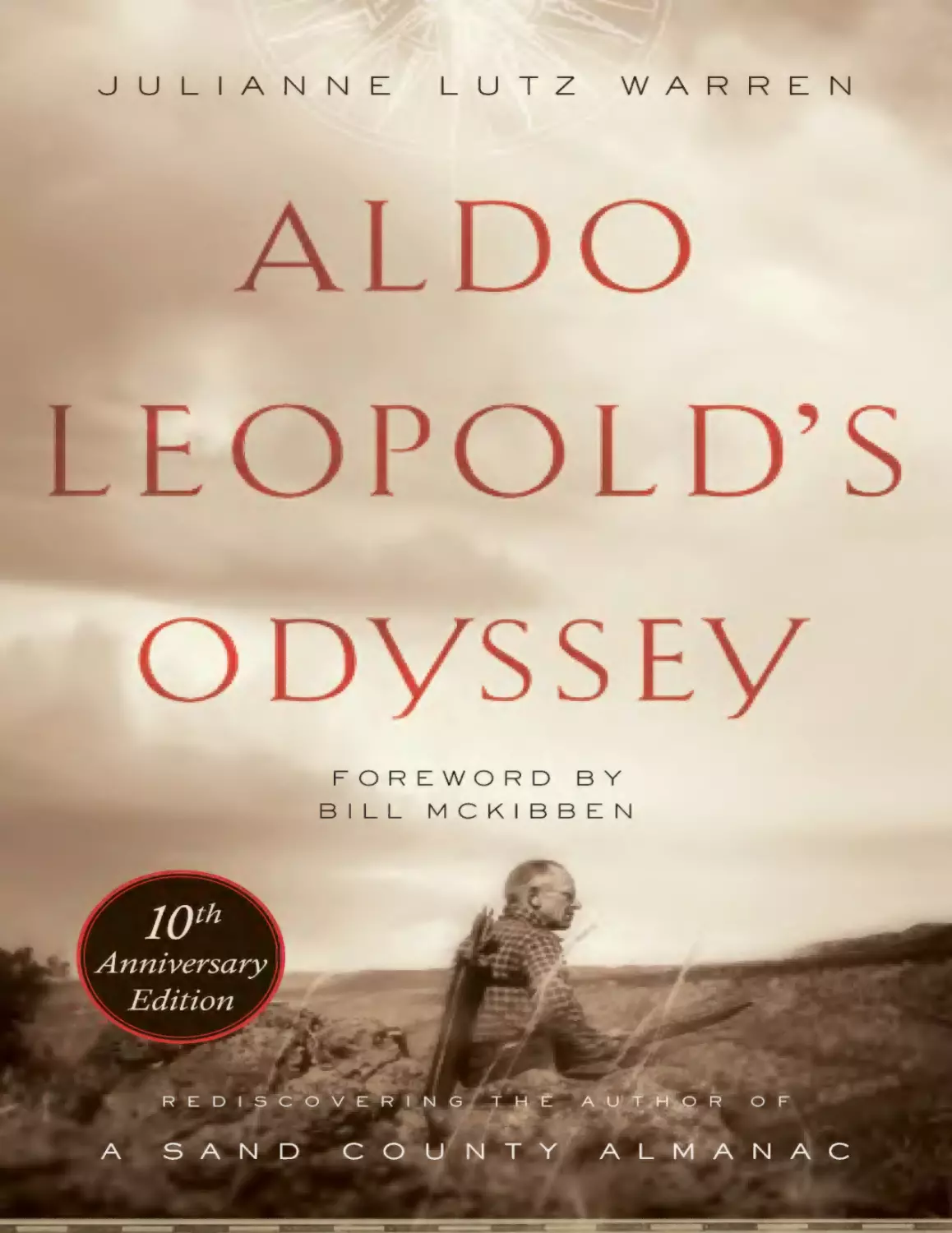


Author: Warren J.L.
Tags: ecology biographies environment nature conservation history of ecology
Year: 2016



Text
                    About Island Press

Since 1984, the nonprofit organization Island Press has been stimulating,
shaping, and communicating ideas that are essential for solving
environmental problems worldwide. With more than 1,000 titles in print
and some 30 new releases each year, we are the nation’s leading publisher
on environmental issues. We identify innovative thinkers and emerging
trends in the environmental field. We work with world-renowned experts
and authors to develop cross-disciplinary solutions to environmental
challenges.
Island Press designs and executes educational campaigns in conjunction
with our authors to communicate their critical messages in print, in person,
and online using the latest technologies, innovative programs, and the
media. Our goal is to reach targeted audiences—scientists, policymakers,
environmental advocates, urban planners, the media, and concerned citizens
—with information that can be used to create the framework for long-term
ecological health and human well-being.
Island Press gratefully acknowledges major support of our work by The
Agua Fund, The Andrew W. Mellon Foundation, The Bobolink Foundation,
The Curtis and Edith Munson Foundation, Forrest C. and Frances H.
Lattner Foundation, The JPB Foundation, The Kresge Foundation, The
Oram Foundation, Inc., The Overbrook Foundation, The S.D. Bechtel, Jr.
Foundation, The Summit Charitable Foundation, Inc., and many other
generous supporters.
The opinions expressed in this book are those of the author(s) and do
not necessarily reflect the views of our supporters.

Copyright © 2016 Julianne Lutz Warren
First Island Press cloth edition, November 2006
First Island Press paperback edition, February 2008
All rights reserved under International and Pan-American Copyright Conventions. No part of this
book may be reproduced in any form or by any means without permission in writing from the
publisher: Island Press, 2000 M Street, Suite 650, Washington, DC 20036.
ISLAND PRESS is a trademark of the Center for Resource Economics.
Library of Congress Control Number: 2016938110
Printed on recycled, acid-free paper
Manufactured in the United States of America
10 9 8 7 6 5 4 3 2 1
Keywords: Anthropocene; land health; land ethic; ecological conscience; Conservation Foundation;
wildlife management; U.S. Forest Service; Baraboo, Wisconsin; Gila National Forest

For
Nina Leopold Bradley
(1917–2011)
and for Jim

Contents

2016 Foreword by Bill McKibben
Preface
Preface 2016
Introduction

Launching Out

Chapter 1

Seed Plots

Chapter 2

Written on the Hills

Chapter 3

The Middle Border

Chapter 4

Interpreting Pharaoh’s Dream

Chapter 5

An American System

Chapter 6

A Common Concept of Land

Chapter 7

Ecological Poetry

Chapter 8

The Germ and the Juggernaut

Chapter 9

Wildlife and the New Man

Chapter 10

Knowing Nature

Chapter 11

A New Kind of Conservation
Notes
Bibliography

Sources of Illustrations and Excerpts
Index

Foreword

Aldo Leopold is one of the great figures of American intellectual history, a
truly original thinker who serves, it seems to me, as a hinge figure in the
progression of thinking about the natural world and our place in it.
Before him, there were heroic figures like John Muir, who invented the
grammar and vocabulary of wildness that birthed the environmental
movement. It was a world of awe and splendor, and it helped people see the
world in a new and useful way—the charge he provided (and the Sierra
Club he founded) drove the movement through much of the twentieth
century.
Though Leopold was clearly interested in wilderness (he helped found
the Wilderness Society, in fact), his was a quieter vision of the world, and
perhaps a more radical one. He realized that there was no way to wall man
off from the rest of the world—instead of the Yosemite backcountry, he
eventually retreated to the farmlands of Wisconsin, where he used the
ecological insights he had developed as the father of wildlife management
to think about our species as one among many. The ‘land ethic’ that
emerged—the idea that “a thing is right when it tends to preserve the
integrity, stability, and beauty of the biotic community”—was a first crucial
step in moving environmental thinking beyond Thoreauvian individualism,
toward a sense of land community—that is, toward ‘land health.’ In his
wake came Rachel Carson, and in our own time, above all, Wendell Berry.
The locus of environmental thinking now includes not just the national park
but the farmer’s market; not just the high Sierra vista, but the first few
inches of soil. It is no wonder, I think, that Aldo Leopold died fighting a fire

on a neighbor’s farm, because neighbors—of every kind—were of great
importance to him.
This remarkable volume—the deepest and most challenging explication
of Leopold’s thinking that I know—is a reminder that we are only
beginning to understand the depth of his thought. Indeed, the author’s
discovery, for the new edition, of the global thinking emergent in Leopold’s
final years helps tie him more directly to the battle to preserve the climate—
doubtless the greatest fight in human history.
But Leopold’s significance has been growing with every generation in
any event. A Sand County Almanac finds new readers with each passing
year. The sense that we could re-inhabit this continent and this planet, and
do so in a way that heals instead of damages, that heeds instead of ignores,
that makes the highest and not the lowest use of our traits as a species—that
excitement flows through each page of this work. Leopold is low-key; he
speaks in a dignified register; and yet the adventure on which he embarked
remains one of the most remarkable in human history.
Bill McKibben
January 24, 2016
Ripton, Vermont

Preface

I first heard of Aldo Leopold when I was a graduate student in wildlife
ecology at the University of Illinois. One day, in the midst of a conversation
about some research questions, a colleague at the Illinois Natural History
Survey pulled from his shelf a copy of A Sand County Almanac, offering
me my first discovery of its author. I read it and found the book interesting,
but I did not at the time grasp Leopold’s significance.
I continued with my education, doing fieldwork, collecting and
analyzing data, attending classes in wildlife science, statistics, and as many
’ologies as I could fit in. I loved what I was learning, but I began to feel
increasingly unsettled. Science could go far in helping people understand
the world, but in its objectivity it could never go far enough in making the
modern world a more pleasant and healthier place in which to live. For that,
something else was needed. At this point I happened into a class on
conservation literature, and it was here that I rediscovered Leopold. I
learned about Leopold in the context of the history and philosophies of the
conservation and environmental movements. And I began to see him not
just as a careful observer of nature but as something more—as someone
uniquely insightful and clear minded and as an artist with an unusual gift
for prose. Here, too, like many others, I began to see in Leopold’s work
what might be needed, in addition to good science, to help promote the
beauty of nature.
Leopold has become something of a household icon of the conservation
movement, perhaps most recognized for his “land ethic,” expressed
succinctly in his oft-quoted phrase “A thing is right when it tends to

preserve the integrity, stability, and beauty of the biotic community. It is
wrong when it tends otherwise.” But how, I wondered, did Leopold come to
call for a land ethic in the first place; what did Leopold mean by those
words; and, practically speaking, what did he think it might take for humans
to dwell on the land yet at the same time preserve its integrity, stability, and
beauty? And what did he mean by his less talked about though central idea
—what he came to call “land health”—an evolving vision that included
human-inhabited places?
Pursuing answers to these questions seemed just the sort of project that
not only would allow me to investigate Leopold’s provocative thinking but
also had relevance to contemporary environmental concerns and to the
search for more positive versions of modern, civilized life than the
prevailing one. My work began as simply a study of Leopold’s thinking
about land health; I soon found, however, that his concept of land health
was such a rich and integrated one that to comprehend it required probing
his scientific understandings—what Leopold meant by “land”—his
critiques of human culture and values, and how he brought them together.
Tracking along with Leopold’s intellectual journey, rediscovering his
life’s work, can help us to think more clearly and, ultimately, to act with
more skillful compassion toward the land—and by land, I soon understood,
Leopold meant not only fields and forests but the whole of nature. This was
Leopold’s hope, and it seems even more vital today, when the dangers of
not doing so are even more pressing and the pleasures of doing so are as
great as ever.
Leopold’s way of thinking, in the words of one of his former students,
Albert Hochbaum, was not “that of an inspired genius, but that of any other
ordinary fellow trying to put two and two together.” “Because you have
added up your sums better than most of us,” Hochbaum told his old
professor, “it is important that you let fall a hint [in your writings] that in
the process of reaching the end result of your thinking you have sometimes
followed trails like anyone else that lead you up the wrong alleys.”1
Leopold was an extraordinary ordinary man; like any of us, sometimes he
followed wrong trails, which twisted and turned, in his pursuit of a vision
and means to healthy lands. But his compass was set on this goal, and once
he found that he had headed astray, he retraced his steps and tried a

different path. In Leopold’s words, he made many excursions from “a single
starting-point”—the longing for truth and beauty—“to which man returns
again and again to organize yet another search for a durable scale of
values.”2 To follow along on that journey is to share in many discoveries; it
is to get to know the deeper thinking of Leopold and, indeed, to encounter
challenging yet realistic ideas for a more ecologically enlightened and
prosperous civilization, as relevant today as they were during his lifetime.
No person can ever know fully the mind of another. It can indeed be a
fearful thing to try. Fearful, in my case, in the sense that I wanted to give as
complete and honest a picture of Leopold and his thinking and experiences
as possible, yet I recognized that whatever I saw inevitably would be
colored by my own ignorance, ideas, and experiences. Nonetheless,
drawing on a wealth of archival materials, on his vast opus of published and
unpublished writings, on interviews, and on the critical work of others, I
have tried to give as objective a portrait as I could of Leopold’s intellectual
journey.
Aldo Leopold’s Odyssey portrays Leopold’s multifaceted adult
intellectual journey. It is not a full biography of Leopold; rather, it is an
account of the maturation of his thinking, which builds in part, as detailed
in the notes, on much fine Leopold scholarship that has come before it. Curt
Meine’s remarkable Aldo Leopold: His Life and Work remains the standard
biography, chronicling Leopold’s life from birth to death, and Meine’s more
recent Correction Lines: Essays on Land, Leopold, and Conservation
provides probing commentary on Leopold’s legacy. Susan L. Flader’s
Thinking Like a Mountain: Aldo Leopold and the Evolution of an
Ecological Attitude toward Deer, Wolves, and Forests insightfully traces the
evolution of Leopold’s thinking through study of a representative ecological
and land management puzzle, the relationship between deer, their predators,
the forest, and land-use attitudes and practices. J. Baird Callicott was
largely responsible for drawing attention to Leopold’s now famous land
ethic. Callicott’s seminal philosophic essays on Leopold are collected in
two volumes: In Defense of the Land Ethic: Essays in Environmental
Philosophy and Beyond the Land Ethic: More Essays in Environmental
Philosophy; he also edited A Companion to “A Sand County Almanac”:
Interpretive and Critical Essays, a very helpful guide for serious readers of

Leopold’s most well-known work. Legal scholar and conservation historian
Eric Freyfogle has shown the central importance in Leopold’s thinking of
conservation on private lands and the land health concept, e.g. in The Land
We Share: Private Property and the Common Good and Why Conservation
Is Failing and How It Can Regain Ground. Philosopher Bryan Norton has
perceptively examined Leopold’s philosophic ideas and has applied them in
Sustainability: A Philosophy of Adaptive Ecosystem Management.
Marybeth Lorbiecki has written a fine summary biography of Leopold’s
life, Aldo Leopold: A Fierce Green Fire, and Richard Knight and Suzanne
Riedel have edited a helpful book of essays connecting some of Leopold’s
ideas to contemporary issues, Aldo Leopold and the Ecological Conscience.
Aldo Leopold was also an avid photographer, and many of the
photographs in this book are ones he took himself. Leopold purchased a
camera while on a research trip to Germany in 1935. He bought the camera
for his son, he said, yet he imagined it would serve all of his family “as a
field glass for a long time.”3 Leopold, in fact, used it himself to take
thousands of black-and-white lantern slides, documenting the landscapes he
studied and incorporating many images into his lectures. Technical
photography became to him an important enough facet of conservation
work that he believed land management professionals should be trained in
it.4
Aldo Leopold’s Odyssey also could not have been written without the
help and guidance of numerous colleagues and friends. This book began as
a dissertation written for a PhD degree taken in the Department of Natural
Resources and Environmental Sciences at the University of Illinois at
Urbana-Champaign and fulfilled that role. I thank University of Illinois
ecologists Richard Warner, Ed Heske, Tim Van Deelen, Jeff Brawn, Scott
Robinson, Pat Brown, Gary Rolfe, and Wes Jarrell for their intelligent
guidance in fieldwork and as graduate committee members while I was
studying at the University of Illinois. I thank Richard Warner and his wife,
Zöe, for their enduring support, friendship, and patient and wise guidance
of inestimable value through two degrees and beyond. And I thank Richard
Warner, too, for orienting me in the field of wildlife ecology. Mary Lowry
—always alert and helpful—guided me through the mazes of graduate
school requirements and paperwork. I am grateful to Bill Sullivan, director

of the Environmental Council, who generously provided postgraduate
research support, which allowed me the valuable opportunity to explore
new fields and to finish this work. Todd Wildermuth, characteristically
generous, has been an insightful friend and colleague from the start and
helped gather many secondary sources on Leopold. Also, at the University
of Illinois, I thank Carol Augspurger in the Department of Plant Biology,
who read and commented on parts of this manuscript and, in her graduate
class in plant ecology, helped teach me to think. Val Beasley, in the College
of Veterinary Medicine, helped point me in the direction I needed to go
some years ago. Eric Freyfogle, in the College of Law, first suggested I
undertake this exploration and guided its progress. He contributed
substantially to the genesis, development, and content of this work.
In addition to his scholarship and writings about Leopold, I am also
indebted to Curt Meine for his help as a graduate committee member and
for stimulating postdegree conversations about Leopold, for his careful and
insightful comments on the manuscript at various stages, and for his
example as both a thoughtful and a practical conservationist. I also thank
Dave Foreman, executive director of the Rewilding Institute, and Volker
Radeloff of the UW Department of Forest Ecology and Management for
helpful conversations about conservation and Leopold. Courtney White,
founder of the Quivira Coalition and an inspirational practitioner and
promoter of land health, was also a helpful reader of parts of the
manuscript.
I am personally and professionally grateful to Nina Leopold Bradley for
sharing her knowledge and for her warm kindness, hospitality, and
friendship, kindled over many an evening fire. I thank Carl Leopold, Estella
Leopold, and the late Luna Leopold, too, for taking time to correspond and
talk with me about themselves, their own work, and their father.
I thank the Aldo Leopold Foundation of Baraboo, Wisconsin
(http://www.aldoleopold.org, which promotes Leopold’s legacy), and
especially executive director Buddy Huffaker, for their generosity and their
support of this work. Buddy at the Aldo Leopold Foundation, Bernie
Schermetzler, curator of the University of Wisconsin (UW) Leopold
archives, and Scott Craven, chair of the UW Department of Wildlife
Ecology, in addition to their encouragement, also kindly gave permission to
read and copy Leopold materials and to reproduce photographs from their

collections. And thanks go to Laurie Ballentine, also in the UW wildlife
department, for her always gracious administrative help. Susan Flader’s
prior work in organizing and cataloguing the Leopold papers at the
University of Wisconsin made my archival work approachable and pleasant.
I thank New Englanders Peter Forbes and Helen Whybrow of Knoll
Farm and Connie Kousman, Janice Orion, and Suzanne Lupien for teaching
me about practical conservation work, good farming, and how to eat.
Ashley Ravestein, in hiking solo up the Pacific Crest Trail, has taught me
much about foresight and courage, and I have been much encouraged
through her loyal friendship.
I thank the board of The Burroughs Institute at Woodchuck Lodge, Inc.
—Tom Alworth, Diane Galusha, Karen Rauter, Joe Farleigh, and John
McDaniel—for their enthusiasm and hard work.
My parents, John and Una Lutz, my brother, John Burroughs Lutz, and
my sister, Rebecca Cross, have loved me relentlessly.
It has been a pleasure to work with Island Press at every step of the way.
I am grateful to Barbara Dean for her supportive influence and kind
friendship. Emily Davis and Jessica Heise have worked skillfully on the
production of this book. Pat Harris’ wonderful attention to detail and
sensitivity to the text during copyediting have helped smooth the reader’s
path. This book has been shaped by many thoughtful comments and
probing questions by my editor, Jonathan Cobb. He is one of a rare and
special breed of editors who I hope will never die out; and, one of a kind, he
is an insightful friend.
For any errors, omissions, and misrepresentations in the text, I take full
responsibility.

Preface 2016

“That the situation is hopeless should not prevent us from
doing our best”
Aldo Leopold, 1946

Aldo Leopold broke away from his family and busy university schedule. He
traveled by cab from his home in Madison, Wisconsin, to the municipal
airport, recently deactivated as an Army airfield. On the night of March 7,
1947, Leopold’s plane landed in Newark, New Jersey. From Newark, a
limousine carried him to the brick-and-limestone Beaux-Arts-style Hotel
Seymour at 50 West 45th Street in Manhattan. The next morning, another
car took him a few blocks north to the University Club, where he walked on
rich marble through hallways frescoed with symbols of Music, History,
Science, Rhetoric, Literature, and Philosophy. Here, Leopold met
colleagues gathered by New York Zoological Society President Henry
Fairfield Osborn, including Leopold’s good friend, the ecologist William
Vogt. Osborn’s book Our Plundered Planet and Vogt’s Road to Survival
would come out the next year, and Leopold’s A Sand County Almanac,
posthumously, in 1949. From the club, this group of concerned scientists
motored up to the Society’s offices in Bronx Park where the zoo was
located. For the next two days, the men met within hearing range of its
enclosed animals’ voices—including lions, elephants, and Pére David deer,
the latter extinct in the wild. Perhaps, during his visit, Leopold also
celebrated memories of the first director of the zoo—the fiery game
protectionist William Hornaday (1854-1937)—one of Leopold’s earliest

mentors. Since their first meeting in 1915, the two had often clashed. Upon
the 1933 publication of Leopold’s seminal text Game Management,
however, Leopold had written immediately to his old friend, thanking him
for igniting his “whole venture into this field,” and for “subsequent
encouragement to stay in it.”1
The story of this ongoing venture—Aldo Leopold’s odyssey—unfolds
in the following pages of this book. Leopold’s own explorations, along with
momentous events of his lifetime—including two world wars, the Great
Depression, and the Dust Bowl—continued to shape his approaches to “the
oldest task in human history,” as he put it in 1938, “to live on a piece of
land without spoiling it.”2 “Land health” was the term Leopold was using,
by the 1940s, for his unfolding ethical and prudential vision of modern
success at “the oldest task”—that is, humans tuning with the self-renewing
capacity of soils, waters, plants, and other animals, collectively.
Traveling his own twisting and turning path toward land health,
Leopold discovered that he and all of humanity, unwittingly or not, were
participants in an “ecological odyssey” of life in a give-and-take of energy
and chemicals. This ecological odyssey intersected with an “evolutionary
odyssey,” originating from reaches of deep time and moving the whole of
increasingly diverse, interwoven life into a mostly unknown future. Leopold
understood that ongoing human survival, not to mention generations of
flourishing people, was inseparable from the whole ecological-evolutionary
picture. In light of this worldview, he also pointed out the need to retool
modern civilization for land uses in better keeping with greater-than-human
forces. Probing even deeper for a possible cure, he pressed for reform of the
rigid, dominating culture eliciting rapid land despoilment. What was
required, in sum, was scientific study, plus a fusion of people actively
caring. In Leopold’s words, humans needed an “ecological conscience” to
guide members of “thinking communities”3 to step more gently into the
evolving stream of interdependent life without unnecessarily muddying its
waters or reversing its long-term flows.
In the spring of 1947, Leopold merged his ideas with those of the other
members of the select group gathered in the global entrepôt of New York to
launch a bold new enterprise. In the aftermath of World War II, just two
years after the United Nations charter was signed, the men in the room had

ambitions to advance the inseparable aims of worldwide democratic peace
and ecological conservation.
UNFINISHED BUSINESS, INNOVATING SPIRIT
Writing Aldo Leopold’s Odyssey ten years ago, I wanted, in the end, not
only to look back on the history of the American conservation movement
and the accomplishments of its pre-eminent advocate, but also to look
forward. I wanted to consider what Leopold had left undone—and yet still
needed doing—when his sudden death in the spring of 1948 halted him
mid-stride. I pick up here, at the end of Leopold’s life, wishing for his
historic work to both give more meaning to present conditions and to
inspire us to further his legacy. Given growing recognition of scaleinterpenetration—that is, how dominating local practices accumulate into
global consequences, which in turn, envelop unique places—I would like to
highlight Leopold’s regard for Earth as a functioning “coordinated whole,”
as he put it in 1923, of interrelated “soil, mountains, rivers, forests, climate,
plants, and animals,”4 as well as his keynote counsel urging people to
develop intimacies within their own communities. In Leopold’s inclusively
innovating spirit, my other wish is for us to leap with Leopold’s ideas from
wildernesses to farmlands to cities, tailoring his legacy to not only an
industrialized, but an increasingly human-populated, class-divided, and
urbanized planet.
In 2006, my list of Leopold’s works-in-progress included unpublished
writings that develop his concept of land health—the focus of this book.
These writings of a mature Leopold, waiting quietly in dark files, contained
early sketches for a new “Conservation Ecology” text. Hand-in-hand with
developing the new science of land health was the ongoing challenge of
encouraging the land ethic in private landowners to help guide practices in
concert with “the capacity of the land for self-renewal”5—that is, with the
ability of soils, waters, plants, and animals, collectively, to continually
regenerate, build their own fertility, and enrich a diversity of co-evolving
kinds of life. Then, too, there were the graduate students Leopold was in the
process of mentoring while classes were filling with returning soldiers.
Leopold was about to become the published author of an unusual bestseller: a book of personal essays aimed at helping readers shift their values

“by reappraising things unnatural, tame, and confined in terms of things
natural, wild, and free.”6 Characteristically, he also was busy recording
phenological events and participating with his family in the wild dramas of
his own land. Leading up to his death, Leopold had been suffering
disruptive bouts of bashing pain from trigeminal neuralgia. Brain surgery
six months after his New York meeting had only partly diminished his
troubles. And, weighting Leopold’s heart was knowledge of the greedy
industrial juggernaut quickly rolling on, darkening the horizon.
Further into the darkening, writing today, I recognize the necessity all
the more sharply—for the survival if not the flourishing of lands and people
—of extending Leopold’s multiplicity of unfinished projects. I also realize
something important missing from my 2006 list of his unfinished work:
Leopold’s advisory role in launching the new Conservation Foundation,
beginning with the 1947 meetings in New York City. This role places him
squarely amid his influential, cosmopolitan cohort. More fundamental than
the organization itself is the accompanying aspiration. The Foundation’s
1948 Statement of Purpose did not mince words regarding the urgent need
for well-organized conservation action. “It is safe to predict,” read the
document, “that civilization will be faced with a series of mounting crises
unless a powerful movement counteracts present trends,” including the
deterioration of Earth’s “life-supporting resources,” interrelated with
“alarming social and political unrest throughout the world today.”7 Fifteen
years after Leopold’s death, a powerful environmental movement not yet
coalesced, the Foundation sponsored a path-breaking conference on the
“Implications of Rising Carbon Dioxide Content of the Atmosphere.” “The
present liberation of such large amounts of fossil carbon [by human
activities] in such a short time is unique in the history of the earth,” the
conference report read. There may be consequences “which will eventually
be alarming. . . . in terms of the health of the planet.”8
That eventuality of alarming resource-based, social, political, and
climate consequences has arrived. On many fronts—both scientific and
cultural—promising developments toward the lofty hope of worldwide just
and democratic peace tied to land health—coextensive with the whole
planet—are under way. So far, though, current trends are accelerating soil
erosion and fertility loss, mass extinction, global climate change, and unjust

suffering by those who have not caused these problems, including rising
generations.
MOUNTING ALARMS, GROWING MOVEMENT
Global crises have continued to mount, becoming more alarming—and
personal—to more people.
To impose a trace of my own odyssey, in 2011, Hurricane Irene thrashed
the Catskill Mountains, raising Schoharie Creek flood levels five feet above
previous records. My family’s floodplain hometown—houses, businesses,
soils, and all—washed into the torrents. In the aftermath, I trained up from
Manhattan where I was teaching at New York University. I suddenly
recognized, then, that a whole place that you love can, in fact, be lost. The
very next fall raised Superstorm Sandy. My university, along with most of
the city, was shut down. I walked from my uptown apartment beyond the
gaping absence of the World Trade Center, beyond sand-bagged Wall Street,
to the lower end of the island, where I linked up with relief efforts. These
were wondrously self-organized thanks largely to the Occupy Wall Street
movement. With new friends, I walked up many flights of stairs, through
pitch-dark stairwells lit only with our cell phones. We knocked on doors,
offering help to those nearest the inundated shoreline who were endangered
by electrical fires and without heat, lights, running water, flushing toilets, or
working elevators. Some people had been able to get away. Others,
including some of my students, whether by choice or because of illness,
immobility, or not being able to afford it, remained in perilous conditions.
Here was another sudden glimpse of what intensifying climate change
extremes mean, bringing environmental and social justice concerns to a
dramatic crossroads.9
Today, I write more consciously in a stretch of time, undetermined in
length, characterized by domination of Earth by some of its humans. Some
are calling this stretch by a new name, “The Anthropocene.”10 It is
manifest in jetting human population growth; urbanization; widening gaps
between privilege and want; more wars and rumors of wars; evictions from
homelands by interpenetrating forces of local land misuse and global-scale
soil, water, plant, animal, and atmosphere-related crises; and accelerating
losses of numbers and kinds of other life forms. The planet itself has been

so altered that activist and seminal author, Bill McKibben suggests it needs
a new name: Eaarth.11
In 2008, McKibben, with a group of students, founded 350.org—350
being the “threshold of safety” number in parts per million of atmospheric
carbon dioxide. The group is now actively organizing the sort of powerful
movement the Conservation Foundation, with Leopold’s endorsement, had
called for sixty years earlier. 350.org is effectively linking, around the
world, grass-roots actions to compel global climate justice, which is
inseparable, I believe, from global land health. Coordinated actions have
included educational workshops and workdays, nonviolent protests, Earth
art projects, and exacting divestment from the fossil fuel industry with
reinvestment in community energy innovation complementary to new kinds
of economies, agricultures and cities. My participation with 350.org in New
York City has been alongside students who teach me potent new forms of
inclusive belonging, “grounded in trust for one another and united in
indignant love for humanity and this Earth,” as one twenty-year-old, Sophie
Lasoff, put it.
Despite past conservation failures and how “hopeless” the present
situation is, those “doing our best”12 to bring about needed transformations
belong to a lengthening legacy of meaningful community-building. Leopold
remains a vital character in this ongoing work. Personally, and in my
classrooms, I have seen Leopold’s story—enfolding his sensibilities and his
limits—help bring forth active, ecologically conscientious people.
JUMPING THE GROOVES, OVERCOMING IMPEDIMENTS
Leopold’s own sense of urgency grew with the years. Prospects of an allied
war victory were only partially encouraging given the outlook of worldwide
industrialization. This meant, as he foresaw in 1944, that “many
conservation problems heretofore local will shortly become global.”13
Leopold did not believe that the practices of a “philosophy of industrial
culture” were compatible with real “ecological conservation.”14 He dug
deep to understand this incompatibility. He probed conservation’s
impediments and considered ways to overcome them—spatially,
temporally, and substantively.

Basically, Leopold impugned a dominating culture of machine reliance
and short-term economic self-interest that regarded land merely in terms of
commoditized parts. When ideas so out of synch with actualities infused
approaches to land problems, ensuing efforts, at best, were inadequate
solutions.
One corollary of this critique was that any such so-called conservation
action came too late. Only after people already were suffering the rippling,
unwanted consequences of deforestation; eroding plowlands; vast
biodiversity-quenching and fertility-mining monocultures; exchanging all
manner of wilderness and its members—that is, wild things—for
industrializing cities and factory-made things—did regret motivate action.
“Why not do the regretting and saving in advance?”15 Leopold asked,
reasonably suggesting preventive measures. If evidence signaled a direction
that would end in regret, why not change direction?
Not only did conservation come too late, it also was too little. The
second corollary to Leopold’s critique was that conservation efforts
remained remedial—that is, they did not go far enough to have net
beneficial outcomes on the ground. “At our present rate of progress,”
Leopold wrote in 1942, “we might arrive at decent land-use a century or
two hence. That is too little and too late.”16 Five years later, he wrote
pointedly, “Everyone ought to be dissatisfied with the slow spread of
conservation to the land.”17 In terms of actual effect, he observed,
conservation was one step forward and two steps backward. We leave a rare
old pine grove growing until the price of lumber soars, then we cut it down.
A third corollary, underlying the first two, was a failure of imagination.
If present culture headed land uses in the wrong direction, what were right
ones? On the matter of clarifying means and ends of conservation, Leopold
deepened his critique and turned it on conservation education. There was
something lacking not only in its volume, but its content, he thought. A
most incisive Leopold was quoted in the Foundation’s 1948 purpose
statement: “The so-called ‘conservation education’ now going on varies
widely. . . . every Tom, Dick and Harry is using the term ‘conservation
education.’ We have to make clear that that is not our ‘education.’”18

Our education, as Leopold’s own career made clear, involved not
merely lecturing to students, but modeling scholarship, collegiality, outdoor
recreational skills, ecological research, and wildlife management work
organized cooperatively with local land owners. Speaking directly to his
undergraduates, Leopold gently explained what he wanted them to learn:
“The object is to teach you how to read the land. . . . how to think in
scientific terms.”19 Along with such literacy, he wanted to inspire
appreciation of not only the essentialness of whole land for sustained use,
but also its beauty. He encouraged “a warm personal understanding” of
land, that is, the sort of intimate understanding that led to and flowed from
an intelligent “love.”20 Agrarian author Wendell Berry put it this way to
Leopold’s eldest daughter, Nina Leopold Bradley, in a 2003 letter: “Your
father’s work is so valuable, I think, because it begins in affection.”21 If
scientifically literate people cared deeply about land, they would not likely
misuse it. If people understood the workings of land scientifically, their love
would be skillful. The positive consequence would be land health—writ
large, global land health.
Healthy land was productive, beautiful, whole land. Whole land called
for whole thinking-caring-doing people. It also called for joining
fragmented disciplines—chemistry, ecology, evolution, sociology,
psychology, history, economics, engineering, architecture, philosophy,
religion, poetry, etc.—to bear on a common hope of persistent, mutual
flourishing. Healthy land, that is, called for a transformation of dominating
culture. As Leopold put it in a letter encouraging the work of the
Foundation, it required willingness “to jump the grooves” that “limited the
conservation movement.”22
Idealism notwithstanding, Leopold was sober-minded about the task of
“rebuilding Homo sapiens,” as he wrote to a colleague.23 “I have no
illusions about the speed or accuracy with which an ecological conscience
can become functional,” he publically confessed in 1947.24 Leopold
admitted it might even take centuries. If this was so, an obvious difficulty in
a time of rapidly mounting crises was how to get not only individuals but
entire societies and nations of the world to act as if they had informed,
moral regard for land before they actually did.

As Leopold thought long and hard about possible top-down and bottomup approaches to advancing conservation, he ventured it might be speediest
to mobilize citizens predisposed to think and care about complex issues,
even though that group was relatively small.25 All the more, Leopold urged
people of “suppressed”26 traditions and with solid conservation educations
—those early adopters of a modern ecological conscience—to “throw your
weight around on matters of right and wrong in land-use. Cease being
intimidated by the argument that a right action is impossible because it does
not yield maximum profits, or that a wrong action is to be condoned
because it pays.”27 Leopold offered not a recipe, but a leveraging principle
infused with visionary courage.
Leopold’s colleagues also put forth some bold ideas about organizing
“public action in all parts of the world.” The discussion document
circulated by staff of the Zoological Society before the Conservation
Foundation advisors’ first meeting explained, “The belief that action
automatically flows from knowledge is illusory. Action has to be planned,
stimulated, and fostered.” The initial plan was to enlist already existing
local action groups. Examples included rotary, 4-H, Boy Scouts, chambers
of commerce, and women’s federations. Leopold penciled into the margin
of his copy, “Labor Unions.”28 In addition to broad dissemination of
worthwhile conservation education, the Foundation’s work might have also
included coordinating local, grassroots efforts worldwide, motivating
private land users to regard the public interest, and electing and lobbying
government officials who would serve citizens well from the top-down in
conservation matters.
Between the Foundation’s 1947 discussion document and its 1948
purpose statement, however, the group, including Leopold, had signed on to
caution regarding their own participation in direct action. Wanting to
maintain “dignity and high professional integrity,” the men had decided that
the organization “should stand apart from direct agitation” even on behalf
of their own vital interests. The Foundation still wanted to investigate
methods for generating “great civic movements” and to collaborate with
complementary efforts, including what would become the International
Union for the Conservation of Nature. But, they tempered their albeit still

ambitious role into a two-fold thrust to orient conservation’s direction
through; 1) multimedia conservation education infiltrating every subject
with the “underlying truth. . . that to survive man must cooperate with
nature,” and 2) “objective fact-finding” research providing the most vital
international conservation information—including protection needs of
endangered fauna, flora, wilderness of varying degrees, and indigenous
people; scales and distribution of human-caused soil erosion; ground water
capacities and uses; and the relationship between “the health of the earth”
and human health—to be useful across rural / urban, private / public, old
world / new world, economic, ethnic, and generational divides, globally.29
IMAGINING LAND, GROUND-TRUTHING
Resonantly, Leopold himself urged well-organized, direct action while
focusing his particular talents on complementary education and research.
These efforts, he hoped, would help clarify strategies and objectives of a
growing common mission. “The urge to comprehend must precede the urge
to reform,”30 Leopold suggested. That is, reappraising worldviews and
practices—including population numbers, economies, energy and foodgetting, politics and city planning—in terms of “things natural, wild, and
free” would require working knowledge of these “things.”31
Leopold not only dug deep for the cultural roots of conservation
problems and solutions, he delved into bedrock to understand Earth. At the
same time, tracking interrelationships led him backward and forward
through time and space in a widening whirlpool of evolutionary and
ecological perspectives, including the realities of persistent human
ignorance and cosmic mystery. Overwhelming heaps of always incomplete
scientific evidence piled up amid continually changing conditions, bearing
into an unknown future. Yet, amid uncertainty and disturbances, patterns
emerged and Leopold was good at making sense of them. He highlighted a
trend of evolution to elaborate biological diversity and complexity, for
instance, revealing our kinship with “fellow-creatures.”32 He practiced
resolving tensions, for example, observing that needs of predator and prey
could be ecologically reciprocal and coalesce in the joint venture of
continuance, a shared human concern. He saw the big picture, like the self-

organization of organisms, facilitated by a prodigious intricacy of matter
and energy transactions within which our species was netted, for good or ill.
Central to this book is Leopold’s wont to accord complex volumes of
information with summary mental images that were at once apt,
comprehensible, and engaging. He understood that for people to use land
sensitively, we must be able to comprehend it recognizably. This was no
easy task. He prized poetic, symbolic power for orienting human morality,
but insisted on the primacy of actual land and how human actions affected
it. That is, a dialectic between imagining and ground-truthing was
necessarily ongoing. Some representations, Leopold thought, were
“truer”33 than others with regard to matching detailed knowledge, and the
lack of it, with essential form and meaning. But, there were always “pitfalls
of language.”34 When we live out skillful care for land, Leopold said, “we
shall then have no need of the word conservation, for we shall have the
thing itself.”35
For the meantime, Leopold came up with an array of what I have come
to think of as complementary moving pictures, each with their own more or
less prominent roles—e.g., an elastic pyramid, an organism, machinery, a
fountain, a round river, a revolving savings bank, a circulatory system, a
drama—converging on a common plot, in Leopold’s words, on a “common
concept of land.”36 Leopold admitted that his images might not be the best,
challenging others to help build up an ethically pivotal scientific concept.
Characteristically, according to his respected colleague F. Fraser Darling,
Leopold “was always seeing and learning.” He could “chuck out
misconceptions immediately”37—a habitual rigor supported by a humbling
concern, as Leopold put it in the 1930s, for “the future habitability of the
earth, materially and spiritually.”38
Today, not only do we not yet have “the thing itself,” the need for
conservation continues to expand, as Leopold and his cohort foresaw, if not
in detail, then in its global extent. To proceed, humans must expand our
studies and our imaginations. In the words of Wes Jackson, cofounder of
The Land Institute, discerning worldviews—and contemporary education—
must consider “the ecosphere.”39 The ecosphere is another word for the

entire dynamic world-of-life, with properties interpenetrating with every
particular place. The implications of comprehending the ecosphere
scientifically—including human beings as interwoven within it from sea to
sea and bedrock to sunlight—are crucial for unleashing—with the arts,
humanities, and traditional wisdoms—a powerful, skillfully moral
movement toward global land health, coinciding with climate justice.
ENLARGING THE CONCEPT, RIPPLING IMPLICATIONS
Leopold’s ideas—converging toward a “common concept of land”—remain
both an unfinished business and a thought-provoking starting place for
launching into codisciplinary ecospheric studies with the intent to advance
global land health. Overall, Leopold wanted to free people from crude
“grocer’s counter”40 commodification of land. He meant to “enlarge the
conventional concept of a landscape,” as he put it in the 1943 draft
introducing what might have become his new conservation ecology text.41
Keeping this in mind, in 1939, Leopold unveiled the “biotic pyramid” as
an operational “symbol of land” (diagram, p. 202). The pyramid framework
was inspired by eminent British ecologist, Charles Elton. This symbol also
features prominently in “The Land Ethic” essay concluding A Sand County
Almanac.
Elton’s pyramid idea does a lot of conceptual work. It was important not
only to Leopold, but to many other influential scientists, such as Yale
polymath G. Evelyn Hutchinson with his string of impressive students,
including paleolimnologist Edward Deevey, trophic ecologist, Raymond
Lindeman, and, later, Leopold’s youngest daughter, Estella.42 Elton’s ideas
also later helped inform Rachel Carson’s 1962 Silent Spring.43 The
Eltonian pyramid conceives the self-organization of different sets of life
forms as shaped largely by food relationships. Photosynthetic plants turn
sun’s energy and chemicals from air and soils into forms edible to animals,
some of whom may be eaten by other animals, thus passing matter and
energy from organism to organism. As Elton explained, larger animals, in
general, eat smaller ones who reproduce faster and are more numerous. This
results in a biotic architecture that can be visualized, for example, in a
temperate oak forest, with a base of trees and many other plants that support

hosts of herbivorous insects, large numbers of carnivorous ones, a lesser
number of small insect-eating birds, and only one or two hawks. The
hawks, in this case, would be the terminal member of their food chain. Any
given chain will be linked in multiple dimensions with others. A hawk may
also eat a plant-eating rabbit, for instance, who might also be eaten by a fox
or a human, etc.—creating a “tangle of chains,” in Leopold’s words, which,
upon close examination, is “a highly organized structure.”44
This complex structure, unlike the stone edifice that the word pyramid
may conjure, is dynamic in function. Elton’s focus as an animal ecologist
was on predator-prey interactions, leading him to notice the importance of
size and numbers of organisms in ordering food interrelationships. In the
1940s, Hutchinson and Lindeman, focusing on energy transfers, redefined
and confirmed the Eltonian pyramid in terms of productivities of trophic
groups and as shifting systems.45 The pyramid also could be loosely
expressed by measures of biomass, which represented a snapshot of
potential energy content. In these terms, in general, the pyramid was
heaviest at its base of vegetation, with the groups of herbivores and
predators progressively lighter in combined weights. In the late 1940s,
Leopold and Hutchinson both were active leaders in the Ecological Society
of America and listed as Conservation Foundation advisors with joint
interests in soil health.46 It is unclear, though, who may or may not have
influenced whom. Leopold oversaw student research in Wisconsin and
central Canada testing the pyramid model in both numerical and biomass
terms—that is, taking censuses of terrestrial animals in different groups and
also weighing them. Practicing his habit of investigating lands’ past and
present conditions before considering desirable future ones, Leopold’s
students also used historical data to compare structures of relationships
before and after industrial settlement, diagnosing disorganization and
dysfunctions in hard-used lands.47
Energy is the power of a body or systems of bodies to do work,
including the power of plants and animals to function—to grow, reproduce,
or move around—that is, to change things. Hutchinson championed the
bold work of the Russian biogeochemist Vladimir Vernadsky, who
conceived the domain of Earth’s totality of life from atmosphere to bedrock

as the “biosphere.”48 Lindeman’s energetic “trophic-dynamic” viewpoint
was allied to this approach, though he steered away from “clear-cut lines”49
between living and non-living matter, as did Leopold. It seemed that
transformative interrelationships between realms of physics, chemistry, and
biology could be most interesting in dark places—in ocean depths, in
lacustrine ooze, and beneath terrestrial soils. Here, potential energy exists as
organic matter, from fallen leaves, scales, and feathers to remains of killed
moose and wolf excrement.
For plants to become plants, which animals eat, they must have not only
sunlight’s energy, but also water and other chemicals from air and ground—
that is, nutrient atoms. For instance, photosynthetic fixation of atmospheric
carbon would not grow a phytoplankton or an oak tree without the fuel of
ATP required by all working cells, which in turn requires uptake of
phosphorus. Furthermore, as Leopold’s respected colleague William
Albrecht helped point out, scientists were linking not only soil quantity, but
more qualitative aspects of soil, including the presence of trace minerals, to
fullest plant and animal flourishing, including human health.50
Between each link and from the terminus of every food chain, then,
there was the possibility of biomass cycling back to the dark places,
enriching fertility—in Leopold’s words, enhancing “the ability of soil to
receive, store, and release energy.”51 This idea was largely implicit in
Elton’s work and made more explicit and detailed later by that of Leopold,
Lindeman, followed by many other scientists. Decomposers feeding on soil
organic matter made use of its stored, potential energy, which originated
from sunlight. Organisms like bacteria and fungi transformed chemical
compounds in the process, freeing up “nutrient salts. . . to be reutilized by
the autotrophic plants,” Lindeman wrote in 1942.52 “A landscape is
nutrients in motion,” as Leopold put it in the draft of his unfinished
textbook.53 “Land, then,” Leopold said in 1939 and repeated a decade later
in “The Land Ethic,” “is not merely soil; it is a fountain of energy flowing
through a circuit of soils, plants, and animals.” Land is like a “revolving
fund of life.”54 Leopold might have better clarified that plants don’t get
energy directly from soil. Plants do require, however, albeit indirectly, the

potential energy of matter used by feeding decomposers to release
necessary nutrients.
Leopold’s “pyramid” concept was dynamic in terms of internal
machinery. It also was spatially elastic. Imagine now an integrated,
functioning pyramid—energy streams continually from sun through
atmosphere into plants feeding animals, much is dissipated in respiration
and decay, but some returns to soil stored in organic matter from which
decomposers release nutrients that may recycle through plants and animals
and back again to soil—like a “circulatory system” or “round river.” Now
stretch the image further horizontally—across a landscape, uphill and
downhill between lands and waters. “Soil and water are not two organic
systems, but one,” Leopold emphasized to hydrobiologists.55 As Albrecht
also clarified56 and as Lindeman put it, since terrestrial systems tend to be
“convex,” gravity is always pulling downhill and soil is “subject to certain
nutrient loss by erosion.”57 This loss, depending on amount and rate, may
or may not contribute to eutrophication downstream. This loss may or may
not be replaced by rock weathering beneath soil, making fresh nutrients
available. Nutrient loss also may be slowed by the complex structure of a
coevolved, biodiverse pyramid good at chemical recycling, building soil,
absorbing water, and holding land in place. Another way to slow loss may
be by “back-current” transport of an animal feeding downhill, as Darling’s
work indicated.58 For example, a deer nibbling a dead fish at the edge of a
lake carries those minerals back uphill in her flesh where the atoms could
end up making more cycles through land. There is always a net loss of
stored energy and nutrient matter by “downhill wash” into rivers and
oceans, where more food cycles may occur until, eventually, some energy
and matter become part of the sediment and are perhaps transformed into
future rocks or buried fossil hydrocarbons. But in healthy lands—lands of
“integrity, stability, and beauty”—as Leopold famously wrote in “The Land
Ethic,” such loss both was retarded by plant and animal impoundment and
“offset by the decay of rocks,” portrayed vividly in Leopold’s essay,
“Odyssey” (diagram, p. 328).59
Next, imagine the elastic, dynamic pyramid stretching vertically: from
sunlight to Earth’s atmosphere to below weathering bedrock, originally

composed of exploded stars’ dust. Reach down to where fossil
hydrocarbons—coal, oil, and gas, those stores of ancient buried bodies full
of carbon gleaned by plants from air—have accumulated. Since the
nineteenth century, scientists have appreciated the importance of
atmospheric carbon dioxide in combination with solar energy not only to
photosynthesis, but also as a factor regulating Earth’s average surface
temperature and thus global climate.60 In A.J. Lotka’s remarkably
comprehensive, globally influential 1925 work, Elements of Physical
Biology, he astutely notes how “the present eminently atypical epoch” is
founded on “the fossil fuel accumulated in past geological ages.”61 This
was increasingly evident in 1933, when Leopold apprised: “we harness cars
to the solar energy impounded in carboniferous forests.”62 The age of
human population growth and consumption, that is, has been developed by
using and dissipating vast stores of energy in a quick flare, relative to
cosmic time, also returning long-buried chemicals back into Earth’s
atmosphere.
The rippling global implications of ongoing fossil fuel use—involving
the complex whole of life—were the subject of the Conservation
Foundation conference fifteen years after Leopold’s death. Several
members of Leopold’s former scientific network participated—including its
chair, Darling, along with Deevey and Hutchinson, the latter having taught
anthropogenic climate change since the 1940s (though illness prevented his
attending the 1963 conference). George Brewer of the Zoological Society
was also there. He had assisted Osborn in organizing the founding 1947
meeting in New York.
ONGOING BUSINESS, JUST, GENERATIVE WILD
New York—nearly a half-century before Sandy hit, those scientists gathered
here to discuss increasing atmospheric carbon dioxide had predicted it
would be inundated with rising, warming seas if business continued as
usual. The usual business has continued. I watched it turn off the lights of
that brightest of cities. I also watched a “new kind of people”63 emerging.
To go along with a new name for our time—the Anthropocene—and our
planet—Eaarth—I propose a new name for this offshoot of our own

evolving species: Homo generativus. We are members of humanity
rigorously comprehending the ecosphere. We continually ask, what are the
implications of its workings—ethically, culturally, and practically? We
actively participate in an uprising odyssey of global land health
Earth’s wildness—of beings and places—gave Leopold’s life, in his
words, “definition and meaning.”64 The raw wild was the point of
departure and return for all his searches. The situation—of irreconcilability
between today’s dominating culture and land health—which seemed plenty
hopeless in Leopold’s day, seems all the more so today. Earth’s
consequential losses and extremes, unprecedented, are upsetting. All over
the world, rising generations—of humans as well as other lifeforms—
particularly those least responsible for escalating troubles, already are
struggling. To many, the always-unknown future feels not only exciting, but
unusually frightening. At the same time, the intensifying droughts, shifting
species ranges, raging storms, and local, globally linked human uprisings
indicate the unplumbed reaches of the living planet’s still unquenched
wildness, a wonder inside as well as outside of ourselves.65 This world
remains our only hope.
Leopold obviously did not shy away from tough questions. So, I will
conclude with this one: When our own odysseys return us to the starting
place, what patterns and values do we find and can we share in that make
life worth living and deserve our best work?
2016 Acknowledgments
Jonathan Cobb remains my trusted friend. I am once again grateful to editor
Emily Davis and Island Press for reissuing this volume as the world needs
Leopoldian wisdom all the more urgently.
Major Leopoldian works published over the past decade include: The
Library of America volume, Aldo Leopold: A Sand County Almanac and
Other Writings on Ecology and Conservation, edited by biographer, Curt
Meine, whom I also thank as my friend; J. Baird Callicott’s Thinking Like a
Planet: The Land Ethic and the Earth Ethic; and Bryan Norton’s
Sustainable Values, Sustainable Change: A Guide to Environmental
Decision-Making. British philosopher Henry Dicks introduces a fresh take

in, “Aldo Leopold and the Ecological Imaginary: The Balance, The
Pyramid, and the Round River” in Environmental Philosophy. Reason in a
Dark Time is an important read by Dale Jamieson, as is Shrinking the Earth
by Don Worster—both authors are also generous colleagues.
Estella Leopold’s Tales from the Leopold Shack: Sand County Revisited
is forthcoming. Her life and work warmly encourage me, as does the spirit
of her sister, Nina—always. I thank Joan McGregor and Dan Shilling for
invitations, in 2009 and 2011, to collaborate with them and bands of
thoughtful colleagues in two NEH Summer Institutes invigorating
expansions of Leopold’s legacy. Conversations with ecologist Dan
Simberloff, as well as his scientific and historical writings, keep me on my
toes, supportively. Wes Jackson’s “The Land,” modeling “nature as model,”
is what this book is about. So, too, is the real land-community building of
Carl Wallman, farmer and NALMC founder, with his Northwood
neighbors; Carl’s hospitality is always an uplift, and his encouragement
helps keep me at it. “Ode to Dirt” by Sharon Olds rings true, as does the
rousing satisfaction of our lifting glasses in the city. I had been waiting for
the great work of Yale Forum on Religion and Ecology founders and now
dear companions, Mary Evelyn Tucker and John Grim. Encompassing
Leopold, their Journey of the Universe helped transform my classes in
environmental studies at New York University. Many students also attended
2012’s “Do the Math Tour” in New York—alive with Bill McKibben. His
genuine comradeship, smart writings, and dogged, over-the-top generosity
of actions, over many years, have inspired me to step up, also helping to
incite Sophie Lasoff. Over three years ago, Sophie launched NYU Divest. I
wish I had room to name each of the other young people of that stillgrowing, loving, “thinking community” who became my teachers—I will
call out Belinda Rodriguez and Costanza Maio. I am ever grateful to the
staff of the Center for Humans and Nature for their abundance of warm
support, including Brooke Hecht, Kate Cummings, Bruce Jennings, and
Gavin Van Horn. Interior Alaska’s whole land community, including Julie
Kaufman and Len Kamerling, is woven into me. Jim Warren, whose
surname I now share, makes me most happy.
For any errors, omissions, and misrepresentations in the text, I (still)
take full responsibility.

Notes To Preface 2016
See page 353 for a list of abbreviations used.
1. AL, letter to to William T. Hornaday, 1 March 1933, LP 10-6, 4.
2. AL, “Engineering and Conservation,” RMG, p. 254.
3. For example, “The Land Ethic, SCA,” pp. 207, 255.
4. AL, “Conservation in the Southwest,” RMG, 95.
5. AL, “The Land Ethic,” SCA, p. 221.
6. AL, “Foreword,” SCA, p. ix.
7. The Conservation Foundation, A Statement of Purpose and the Proposed Program for 1948
(New York: The Conservation Foundation, November, 1947), in LP, 10-2, 2, pp. 7-8.
8. Noel Eichhorn, Implications of Rising Carbon Dioxide Content of the Atmosphere (New York:
The Conservation Foundation, 1963), 5, 15.
9. Julianne L. Warren, “Connecting the Dots,” Minding Nature 6.1 (Winter 2013): 10-22.
10. Simon L. Lewish and Mark A. Maslin, “Defining the Anthropocene,” Nature 519 (March 12,
2015): 171-180.
11. Bill McKibben, Eaarth: Making a Life on a Tough New Planet (New York: St. Martin’s
Griffin, 2011).
12. AL, letter to William Vogt, 25 January 1946, LP 10-1, 3.
13. AL, “Post-War Prospects,” in Aldo Leopold: A Sand County Almanac & Other Writings on
Ecology and Conservation, ed. Curt Meine (New York: The Library of America, 2013), p.
492.
14. AL, letter to William Vogt, 25 January 1946, LP 10-1, 3.
15. AL, “Post-War Prospects,” p. 492.
16. AL, “Land-Use and Democracy,” RMG, 295.
17. AL, “The Ecological Conscience,” RMG, p. 338.
18. The Conservation Foundation, A Statement of Purpose and the Proposed Program for 1948
(New York: The Conservation Foundation, November, 1947), in LP, 10-2, 2, p. 31.
19. AL, “Wherefore Wildlife Ecology,” RMG, 336.
20. Ibid, pp. 336-337.
21. Nina Leopold Bradley, personal communication.
22. AL, letter to Fairfield Osborn, 10 March 1947, LP 10-2, 2.
23. AL, letter to Morris Cooke, 30 September 1940, LP 10-2, 4.
24. AL, “The Ecological Conscience,” RMG, 345.
25. AL, “Adventures of a Conservation Commissioner,” RMG, p. 331.
26. AL, “Ecology as an Ethical System,” unpublished ca. 1940s, LP 10-6, 17, p. 2.
27. AL, “The Ecological Conscience,” p. 346.
28. The Conservation Foundation, Natural Resources Conservation: A Preliminary Estimate of
the Problem (New York: The Conservation Foundation, March, 1947), in LP, 10-2, 2, p. 5.
29. The Conservation Foundation, A Statement of Purpose and the Proposed Program for 1948
(New York: The Conservation Foundation, November, 1947), in LP, 10-2, 2, pp. 19, 27, 57,
59.
30. AL, “Conservation,” RR, p. 156.
31. AL, “Foreword,” p. ix.
32. AL, “On a Monument to the Pigeon,” SCA, p. 109.
33. AL, “The Land Ethic,” SCA, p. 214.
34. AL, “Conservation in the Southwest,” p. 94.

35.
36.
37.
38.
39.
40.
41.
42.
43.
44.
45.
46.
47.
48.
49.
50.
51.
52.
53.
54.
55.
56.
57.
58.
59.
60.
61.
62.
63.
64.
65.

AL, “The Farmer as a Conservationist,” RMG, 263.
AL, “A Biotic View of Land,” RMG, 273.
Fraser F. Darling, Pelican in the Wilderness. (London: Oxford University Press, 1956), p. 84.
AL, “The Arboretum and the University,” RMG, 210.
The Land Institute, “Paradigm Shift U,” Land Report 112 (Summer 2015): 4-11.
AL, “A Biotic View of Land,” p. 267.
AL, “Land as a Circulatory System” (draft of Chapter 1), 12 July 1943, LP 10-6, 16, p. 1.
Thomas Lovejoy, “George Evelyn Hutchinson. 13 January 1903—17 May 1991,” Biogr.
Mems Fell. R. Soc 57 (2011): 167-177.
Frederick R. Davis, “‘Like a Keen North Wind’: How Charles Elton influenced Silent Spring,”
Endeavor 36, no.4 (2012): 143-148.
AL, “A Biotic View of Land,” p. 268; “The Land Ethic,” p. 214.
R.L. Lindeman, “The Trophic-Dynamic Aspect of Ecology,” Ecology 23, no. 4 (1942): 399418.
The Conservation Foundation, A Statement of Purpose, p. 21.
Lyle K. Sowls, “Pyramid of Numbers, 1940, for Delta Ridge, Delta, Manitoba,” unpublished,
LP 10-6, 5; A, Paul L. Errington, and Harold Hansen, “Animal Populations at Prairie Du Sac,
1929-1942,” unpublished, LP 10-6, 13.
V.I. Vernadsky, On Some Fundamental Problems of Biogeochemistry, Trav. Lab. Biogeochem.
Acad. Sci. URSS, 5 (1939): 5-17, republished in 21st Century (Winter 2005-2006): 39-49.
R.L. Lindeman, “The Trophic-Dynamic Aspect of Ecology,” Ecology 23, no. 4 (1942): 399.
E.C. Brevik and T. J. Sauer, “The Past, Present, and Future of Soils and Human Health
Studies,” Soil 1 (2015): 35-46.
AL, “The Land Ethic,” p. 217.
R.L. Lindeman, “The Trophic-Dynamic Aspect of Ecology,” Ecology 23, no. 4 (1942): 402.
AL, “Land as a Circulatory System,” p. 1.
AL, “A Biotic View of Land,” pp. 268-269; “The Land Ethic,” p. 216
AL, “Lakes in Relation to Terrestrial Life Patterns,” Aldo Leopold, p. 447.
W.A. Albrecht, “Pattern of Wildlife Distribution Fits Soil Patter,” Missouri Conservationist 4,
no. 3 (1943): 1-16.
R.L. Lindeman, “The Trophic-Dynamic Aspect of Ecology,” Ecology 23, no. 4 (1942): 402,
413.
Fraser F. Darling, A Herd of Red Deer (London: Oxford University Press, 1937), p. 7; AL,
“Lakes in Relation,” pp. 448-450.
AL, “The Land Ethic,” pp., 216, 224. See also: AL, “Lakes in Relation to Terrestrial Life
Patterns,” p. 447-448; “Land as a Circulatory System,” pp. 1-2; and “Odyssey,” SCA, 106.
Jesse H. Ausubel, “Annex 2: Historical Note,” in Changing Climate: Report of the Carbon
Dioxide Assessment Committee, National Research Council, (Washington, D.C.: National
Academy Press, 1983), 488-491.
A.J. Lotka, Elements of Physical Biology (Baltimore: Williams and Wilkins, 1925), 222.
AL, “The Conservation Ethic,” RMG, p. 184.
AL, letter to Douglas Wade, 23 October 1944, LP 10-8, 1.
AL, “The Land Ethic,” p. 201.
Julianne L. Warren, “The Story Isn’t Over,” in Relative Wild, ed. Gavin Van Horn and John
Hausdoerffer (Chicago: University of Chicago Press, forthcoming).

Introduction

Launching Out

Launch out on his story, Muse . . . start from where you will—
sing for our time too.
Homer, The Odyssey

Aldo Leopold landed in Casas Grandes, in the northern Mexican state of
Chihuahua, three days before Christmas 1937, just two and half weeks shy
of his fifty-first birthday. The flight, his first ever, had taken him over
winding streams and arroyos, rocky hills covered with twisted oaks and
junipers, and canyons abounding with white-tailed deer and wild turkeys. It
brought him into a region once inhabited by great thirteenth- through
fifteenth-century Mexican civilizations and several even older ones. Within
a short distance of the modern-day Hotel Regis, boasting the local
distinction of flushing bathroom fixtures, lay a broad labyrinth of smoothwalled rooms of pink clay, ruins of the sophisticated city of the ancient
Pacquime people. Leopold, staying in town for the night, took a black-andwhite photograph, documenting that, at least in this moment in the 1930s
Casas Grandes, no priests, traders, artisans, or farmers ambled by as in
centuries past; only a few men with cowboy hats and a woman in a long,
dark coat picked their way along the muddy main street after a recent
snowy rain. The throbbing drums and tinkling copper bells of former
Mesoamerican religious rituals no longer sounded under the clouded sky.

But a horse pulling a wooden buckboard over the rutted road rattled by the
flat white fronts of the local grocery store, barbershop, and two cantinas.
Leopold had come to Casas Grandes on vacation from his work as
professor of game management at the University of Wisconsin. It was the
starting point for a second annual two-week hunting and pack trip that
would see him into 1938 and what would be the final decade of his life.
Accompanied by his brother, his eldest son, and a few loaded burros, he
would soon enter the interior recesses of the Sierra Madre Occidental,
traveling along the trout-inhabited Rio Gavilan.
The greater southwestern region was divided into two nations by the
U.S.-Mexico boundary line, creating a landscape of similarities and
contrasts in time and in space. Its juxtapositions were not lost on Leopold.
In climate and form the mountains of the Sierra Madre in Mexico
resembled the nearby terrain where, nearly a quarter of a century earlier, he
had begun his career. In 1909 the twenty-two-year-old Ivy League kid from
Iowa had entered the ranks of professional life as a forest ranger. With
enthusiasm he took up his position in one of the new USDA Forest
Service’s most rugged, least populated districts. District 3 included the
forests in Southwestern Arizona and New Mexico—not far across the
border from Casas Grandes. Leopold served this district for fifteen years
before returning to the Midwest to settle down with his growing family.
On that Arizona–New Mexico frontier, Leopold had met the noble
Spanish woman who became his wife and fathered the first four of their five
children. He had traipsed the mountainous terrain on the U.S. side of the
border on foot and by horseback, mapping the location, quantity, and
quality of timber. Then he worked as a forest supervisor, inspecting forest
conditions while observing the spread of new ranches and the growth of
towns scattered within and around the area’s public lands. Traveling the
region, Leopold witnessed the ideal of pioneering technological progress in
action: the expansion of railroads, telephone wires, automobiles, mines,
dams, and reservoirs. He observed firsthand the spread of plowing and
cropping into the region. He watched the unfolding of all this rapid
economic development—what he would later term the “industrial
Juggernaut”—and witnessed its ill effects on these fragile, arid lands.
The Mexican side of the mountainous landscape, in contrast with
District 3, still remained largely unmapped, unowned, and unsettled in

1937. The Mexican government was implementing a development policy
that would promote road building, agriculture, towns, and tourism. In years
past, however, settlers had shied away from the Sierra Madre—most
recently because of lack of development funds for local services; in the
1910s because the Mexican rebel hero Pancho Villa roamed there; and
before that because of peril presented by warring Apache Indians. The
region’s lack of settlement gave Leopold the opportunity to move back in
time by simply crossing a political boundary line. By visiting Mexico’s
Sierra Madre he could “feast his eyes on what his own mountains were like
before the Juggernaut.” The contrast with the U. S. Southwest was great.
On the Mexican side of the border, Leopold observed,
these live oak-dotted hills fat with side oats grama, these pine-clad mesas spangled with
flowers, these lazy trout streams burbling along under great sycamores and cottonwoods,
come near to being the cream of creation. But on our [the U.S.] side of the line the grama is
mostly gone, the mesas are spangled with snakeweed,1 the trout streams are now cobblebars.2

The Mexican Sierra Madre was comfortably familiar yet strikingly new
to Leopold. His year-end visit on the eve of his fifty-second year thus
allowed him not only to savor the present moment but also to reflect on the
past and consider the future of “the land”—Leopold’s inclusive term for
soils, waters, plants, animals, and people collectively. Years later Leopold
recorded3 his observations in a penetrating essay, “Song of the Gavilan,”4
which appeared in his final and best-known work, A Sand County Almanac.
In this essay Leopold reflected on what he had learned as he explored the
territory belonging to this dancing, riffled river.
“Start from where you will, Muse,” Homer’s narrator commands in book I
of his Odyssey: sing of the adventuring “man of twists and turns,” tell the
tale of the man who was “fighting to save his life and bring his comrades
home.” Aldo Leopold’s years were not spent fighting to bring anyone home
from a dangerous voyage over “wine-dark seas,” as Odysseus’ were. His
struggles were less violent yet no less challenging. Leopold fought to save
lands from human recklessness and to help people prosper, generation upon
generation. Motivating his career was an elementary, lofty hope: that a

rising population of modern, technologically powerful humans would learn
and practice ways of living that met their various needs yet at the same time
kept the land healthy. To raise such a high hope in the face of increasing
land-use-related problems—severe soil erosion, looming timber shortage,
increasingly destructive floods, water pollution, and the loss of plant and
animal species—was to begin an intellectually adventurous journey
involving its own twists and turns.

The Gavilan River in Chihuahua, Mexico, January 1938. Leopold later wrote an essay about the
river, “The Song of the Gavilan,” which appeared in A Sand County Almanac.

On Christmas Eve 1937, the morning after their arrival in northern
Mexico, Leopold and his companions departed Casas Grandes for the wilds.
A few evenings later found the men comfortably weary and the campfire
low. An arrow had struck well, and they feasted on venison and biscuits

with gravy while drinking cherry bounce. As the others turned in, Leopold
sat silently in the still night, watching the stars climb high over the rimrock
that edged the Gavilan River. A lone wolf howled far off. Leopold thought
about all he had seen and had tried to understand in years past. He
contemplated the night sky hanging over the mountainous terrain on both
sides of the Mexican-American border—the one spangled with flowers, the
other with snakeweed. And rising like the moon in the darkness was an
insistent question demanding his attention, the question that had guided his
work over the past quarter century and that would continue to guide it for
the next decade until his death: how might today’s civilization inhabit lands
in ways prosperous to it and good for the whole of nature?
Leopold listened in the night air to the quiet rustle of leaves and the
rippling waters. Here was a river that had not yet witnessed the American
ideal of progress in action—the ideas, as Leopold later expressed it, “that
every river needs more people, and all people need more inventions” and
that “the good life depends on the indefinite extension of this chain of
logic.”5 What did the “good” in good life mean, Leopold wondered. And
where did human inventiveness and power cross the line between positive
creativity and destructiveness? Progress to most Americans was defined in
a way quite different from the vision slowly developing and gathering
cohesion in Leopold’s mind.
Leopold appreciated the many goods that civilization had wrought from
the land, goods that made a two-week trip into the wilds an adventurous
vacation rather than simply an exercise in outdoor survival. By now much
of the nation, the Leopold family included, benefited from the comforts of
indoor plumbing and electricity, railways and automobiles, square meals
and warm beds, enameled bathtubs and radios, sliced bread and cake mixes.
Leopold’s life began with the first Ball-Mason canning jars in 1887,
stretched to the 1910 tea bag and to Wonder Bread in 1921, and ended in
the year of Nestlé’s Quik, in 1948. Human population, too, had risen
between 1909 and 1948, from 91 million to more than 147 million people
eager to live well and prosper, putting increasing pressure on the
productivity of the land.

Leopold’s photograph of Casas Grandes, the Mexican town where he and his traveling companions
stayed overnight in late 1937 before embarking on a two-week trip along the Gavilan River.

Human creativity mixed with the land’s fruitfulness had brought many
benefits indeed. Yet these had come with costs that increasingly were
demanding payment. Leopold had witnessed the unhappy consequences of
ignoring nature’s charges—first in national forests of the New Mexico and
Arizona territories covered by USDA Forest Service District 3, and then
repeatedly over the course of his career and in landscapes across the
country. Such consequences jointly affected man and the rest of nature.
Leopold watched as human settlements literally eroded away under the feet
of pioneers in the Southwest following insensitive livestock grazing, dam
building, irrigation, and plowing. He saw the same thing happening to
farms in the Midwest. Overgrazing was a particular problem because it
destroyed the vegetation that held the soil and moderated water flows.
Heavy rains melted away vulnerable stream banks and cut into fertile valley
lands. As the soil washed away it silted rivers and newly built reservoirs, to

the harm of fish and human users alike. Damage also came when settlers
and government officials eliminated wolves, bears, and other large
predators. With predators gone, deer populations rose, leading to
overbrowsing, degraded lands, and starving deer. Meanwhile, farmers
across the nation were busy replacing millions of acres of diverse native
vegetation with wide expanses of wheat, corn, and other kinds of crop
monocultures. Along with the high crop productivity came explosions of
plant and animal pests, which brought problems of their own.
And then there were the dust storms—perhaps the most dramatic
evidence of land misuse. The year 1937, coming to a close now as Leopold
listened to the Gavilan sing, recorded the most frequent and intense Dust
Bowl storms. Winds carried black clouds of prairie soil—recently plowed,
sodless, now drought parched and barren—across the Great Plains states
and on to the Midwest and the East Coast, darkening the sun day after day.
Multitudes of people were made homeless, poor, and desperate as a result.
The misused land had evicted its human inhabitants.
Many communities newly established across the American landscape, in
sum, were suffering because of unwise land-use practices. So were the
soil’s fertility and native species diversity. Watersheds and human
livelihoods alike in many places were degraded and destroyed. Leopold’s
difficult questions were far from theoretical ones. They had to do with the
well-being and survival of families and neighborhoods and, ultimately—as
the productive capacity and habitability of lands declined—with the
endurance and strength of the country itself.
Leopold, of course, was far from the first American to worry about land
misuse. Explorer John Wesley Powell had worried before him, as had
linguist and diplomat George Perkins Marsh, writer Henry David Thoreau,
and naturalist Mabel Osgood Wright. The Forest Service that Leopold
entered in 1909, led by Gifford Pinchot under President Theodore
Roosevelt, was specifically charged with reforming America’s unwise
forestry practices. And Leopold’s career overlapped with those of nature
lover John Muir, agrarian essayist John Burroughs, anthropologist George
Bird Grinnell, sportsman and game scientist Herbert Stoddard, forester P. S.
Lovejoy, ornithologist William Vogt, soil scientist H. H. Bennett, educator
and horticulturist Liberty Hyde Bailey, wildlife advocate William T.
Hornaday, ecologist Paul Sears, zoologist Rachel Carson, and political

cartoonist Jay “Ding” Darling—all interested, like Leopold, in calling land
troubles to the attention of American citizens and working for positive
change.
Many others, indeed, had noticed the degradation of nature and labored
hard to halt it. Yet few of them, perhaps none, would travel as far or range
as widely as Leopold in probing the root causes of land degradation and in
figuring out what needed to change. In his quest after the hope of harmony
between humans and land, Leopold pursued two main intellectual paths.
One line of inquiry turned to the land itself, seeking to learn how it worked
and what land-use practices would promote intact, fertile soils; clean, wellflowing waters; and diversity of native species. The second line of inquiry
turned to people and culture, trying to understand human motives and
behaviors—particularly how people could be encouraged to want to
promote lands in good condition and follow through in practice. The first
path carried Leopold to discoveries arising from ecological and
evolutionary sciences. The second brought him face to face with
considerations of prevailing economic, social, political, and cultural values.
As he explored both paths, Leopold discovered that they ultimately
converged, and that conservation’s work must take place at their
confluence.6
When Leopold began his career in 1909, the science of ecology—the
study of organism and environment interrelations—was, as a formal
science, yet a fledgling. To the popular mind land was still understood as a
collection of individual resources—timber, minerals, water flows, and fish
and game species—not an integrated whole. Responding to signs of
resource shortages, conservationists of the day resolved to promote more
careful use of America’s raw materials. Early twentieth-century
conservation was both a prudential and a moral effort aiming to increase
efficiency of resource use, decrease waste, and leave an ample supply for
present and future generations.
As the new science of ecology matured through the first half of the
twentieth century, however, a growing number of botanists, zoologists, and
aquatic scientists, Leopold eventually among them, began to see
significance in the vast and dynamic intricacies of nature’s
interrelationships. Leopold and others were coming to understand land not

merely as a collection of discrete parts but as an integrated, dynamic
community of plant and animal life. Living organisms were linked with
their environments—soils, waters, climate—and flows of circulating energy
bound them together. No part of nature was independent of the other parts,
and humans, too, were included in the complexly woven web of life.7
Changes to one part of the land community triggered ripple effects that
spread elsewhere, for good or ill. When a hillside woodlot was clear-cut for
timber, for instance, soil and soil nutrients washed off the land and into
nearby creeks and rivers, creating problems far from their origin.
Indiscriminant cutting disrupted relationships among the soils, waters,
plants, and animals. Many resident species could no longer survive and
different ones took their places. Waterways experienced changes in
temperature, flow pattern, and water level and clarity that disrupted fish and
other aquatic life. In extreme cases land-use disruption could render lands
unfit for human habitation. In short, the land’s productivity could suffer
from ecological derangement as well as from resource exhaustion.
Ecologically informed conservationists needed to pay attention to nature’s
organization and functioning and not just to particular resource supply.
Leopold took naturally to the ideas developing within the new field of
ecology—the “science of communities,”8 as he also understood it—and he
played an important role in shaping them. From an early age he displayed a
bent for piecing together stories of land interrelationships. While a teenager,
he spent a week on his own traipsing through marshes to test his theory that
phoebes congregated around early-blooming skunk cabbage because the
cabbage attracted the season’s first emerging insects—prey for the birds.
Through research and observation he would spend his lifetime trying to
understand such stories—the “biotic dramas” of the land’s workings—and
how human activities were affecting them. Not long after his Gavilan trip,
Leopold declared that ecology had revealed the “outstanding discovery of
the 20th century”—the immense complexity of the collective interactions
and organizations of nature.9
In time Leopold came to conceptualize nature’s ways as a kind of
odyssey—in two dimensions. Accumulating scientific information was
indicating that, across the earth, not only humans but all forms of life were
creatures of “twists and turns” involved in a great drama: the age-old tale of

“[dust] unto dust.”10 All organisms fought continually for their places in
the sun, side by side, living and dying, eating and being eaten. As they did
so they participated collectively in an ecological “odyssey,” as members of
integrated systems bound together by energy flows into a web of life. Food
was a primary force of connectivity: the root of a tree nudged free a nutrient
atom from a limestone ledge, which became part of the soil, which grew a
tuft of bluestem, which hoarded the sunlight in its leaves until, nibbled by a
deer mouse, it fed the eagle flying overhead or the wolf howling on the
mountain, which in time died and returned the nutrient atom to the soil,
where it was picked up by a spiderwort, which was eaten by a rabbit, which
was eaten by a man. In general, Leopold surmised, the greater the diversity
within a community of life, the longer it could keep nutrients circulating
among its members, and thus the more fertile and productive of life it was.
Humans misused land when they diminished native diversity, shortened
food cycles, disrupted energy flows, and sent nutrients more rapidly
downstream and onward to the bottom of the sea.
This ecological odyssey taking place in the present in particular places
intersected, as Leopold put it, at a “right angle”11 the other natural odyssey
—an evolutionary one.12 The evolutionary odyssey was historical,
originating in the deep reaches of time and extending into an unknown
future. This enterprise of life unfolded for the most part beyond the sight of
mortal beings but was recorded in its living creations. Along the way it
offered the ultimate test of survival. With their “fellow voyagers,”13 in
Leopold’s words, humans were part of this succession of life, sharing in the
possibilities of both re-creation and extinction.
As characters in ecological and evolutionary stories, humans were
interdependent organisms integral to the whole community of life, Leopold
understood. But humans over the centuries, unlike any other creature, had
learned to make powerful tools that aided them in their comfort, expansion,
and endurance as a species. They had invented technologies that could
destroy competitors and greatly increase their take from the land. At the
same time humans had the capacity to choose how and where they wielded
their tools and whether and how they limited their take. It was at this
concourse—where what was possible met what was ideal—that Leopold

faced conservation’s toughest practical challenges, challenges that have not
yet been well met. Here it was, in other words, that Leopold would confront
both the scientific questions about how land was organized and functioned
and the set of questions bound up with his other path of inquiry about
people and culture: Could humans recognize their roles in promoting or
destroying the health of the land? What would it take to move us to care for
the land?

Leopold, age fifty, on his 1937–1938 Gavilan trip, an experience that would significantly shape his
understanding of land.

As Leopold probed the human predicament in nature he identified three
cultural attitudes that posed grave obstacles to conservation and ultimately
to an enduring and prosperous civilization: individualism, a get-rich-quick
mentality, and the commodification of nature.14

Individualism. Prevailing in American culture was the view that people
were free to pursue their individual self-interest as isolated actors as long as
they did not cause overt harm to other human individuals. Some of this
presumed autonomy of individuals clashed with basic lessons of ecological
and evolutionary sciences, which taught that humans were interconnected
with intricately organized sunlight, air, rock, soils, waters, plants, and
animals and their life processes, as well as with their human neighbors. No
action happened in isolation. A land-use practice occurring in one spot
resulted in rippling effects in other places. Conduct that seemed
inconsequential when carried out by one person could cause grave
communal damage when undertaken by many people, whereas keeping the
land healthy often could not be accomplished by individual landowners but
required neighbors working together across a landscape. The ethic of
individualism largely failed to take interconnection and cumulative
community effects into account.
Get-rich-quick mentality. The rapid accumulation of cash and
manufactured goods was the prevailing yardstick of American well-being.
As people pursued wealth in the short term they often pushed the land hard,
in ways that exhausted or otherwise damaged its self-organization and
functional capacities over the longer term. Ecological and evolutionary
sciences were teaching that land had limits, both in the quantities of
resources that could be removed before exhaustion occurred and in the
extent to which land could be disturbed (e.g., by agricultural techniques or
settlement patterns) without derangement. These limits were neither readily
nor immediately apparent. The get-rich-quick mentality failed to give due
weight to nature’s capacities and limits and human ignorance in regard to
them.
Commodification of nature. Finally, a third obstacle to conservation was
the dominant cultural tendency to view nature as a warehouse of distinct
commodities. Most Americans imagined that nature was divisible into
individual parts directly useful to themselves—timber, water, soil, game,
fish. Humans could live and thrive only by consuming parts of nature. But
nature’s parts were intricately woven into whole communities, and the
land’s productivity depended upon the ability of the community as such to
function. Community functioning depended, in often unknown ways, upon
the presence of many parts that humans did not directly value. The

commodification impulse thus was doubly flawed: it fragmented nature in
defiance of ecological interconnections, and it employed a grossly
incomplete measure of nature.
Conservation and long-term human prosperity, Leopold ultimately
concluded, required a scientific understanding of land and the emergence of
a new set of cultural values—what he termed an “ecological conscience.”
Just as ecology was the science of communities, an ecological conscience
incorporated an ethics of community life, a community that included as its
members not only humans but also soils, waters, plants, and other animals.
“When god-like Odysseus returned from the wars in Troy,” Leopold
wrote, in the midst of his own life’s journey,
he hanged all on one rope a dozen slave-girls of his household whom he suspected of
misbehavior during his absence.
This hanging involved no question of propriety. The girls were property. The disposal of
property was then, as now, a matter of expediency, not of right and wrong.
Concepts of right and wrong were not lacking from Odysseus’ Greece: witness the
fidelity of his wife through the long years before at last his black-prowed galleys clove the
wine-dark seas for home. The ethical structure of that day covered wives, but had not yet
been extended to human chattels. During the three thousand years which have since elapsed,
ethical criteria have been extended to many fields of conduct, with corresponding
shrinkages in those judged by expediency only.15

The keeping and hanging of human chattels in America had been
outlawed. But land, like Odysseus’ slave girls, was still a matter of
property, and conventions of ownership still allowed people to degrade
what they owned. To “sing for our time too,” Homer’s Muse would need to
be updated and enlightened with ecological and evolutionary
understandings. An ethical attitude—a common understanding of right and
wrong ways to treat nature—needed to be extended “to man’s relation to
land and to the animals and plants which grow upon it.”16
Considering again the ecological consequences of modern culture, in
the spring after his Gavilan trip Leopold wrote:
We end, I think, at what might be called the standard paradox of the twentieth century: our
tools are better than we are, and grow better faster than we do. They suffice to crack the
atom, to command the tides. But they do not suffice for the oldest task in human history: to
live on a piece of land without spoiling it.17

This was to Leopold not merely the end of the matter but also the
beginning. This never-ending challenge served as the “single starting
point”18 for practical land experiments and for successive intellectual
journeys, as important for our time as for his own: how then shall we live
prosperously within nature and keep it healthy, too?

Chapter 1

Seed Plots

The conservation of our natural resources and their proper use
constitute the fundamental problem which underlies almost
every other problem of our national life.
President Theodore Roosevelt, June 10, 1907

By 1909—the start of Aldo Leopold’s professional career—the United
States had traveled far on a journey toward material prosperity within its
continent of natural bounty. The New World was a cornucopia of land
products. Already it had fed industrial revolutions in western Europe and in
America, helping to transform the world. Its natural wealth also had
stimulated the emergence of a new, multiethnic civilization—a capitalist
industrial one characterized by individualism, faith in science and
technology, democracy, and economic growth. Most Americans were
engaged in a hopeful quest for progress,1 and they were working hard at it,
in a pulsing combination of people, land, and dreams. Fresh out of forestry
school and assigned to America’s southwestern frontier, Leopold was
caught up in the exciting bustle of the times, though doubts would soon
arise in his mind about where the country was heading.
Progress in America was calculated largely in expanding ciphers. If
emerging costs of growing prosperity were beginning to cast a shadow, for
more than a hundred years the general trend on the development side of the
national ledger had been upward. The geographic expansion of the nation

itself, for example, had been extraordinary. The thirteen original states
covered 210 million acres of land and water; by the early twentieth century
the territory of the United States had swelled to nearly 2 billion acres with
the addition of the Louisiana Purchase and the annexing of new states and
territories.2 From the beginning of the nineteenth century the U.S.
population rose from 5 million people, with an average density of 7 people
per square mile, to 91 million people, averaging 30 people per square mile
by 1909.3 Homestead entries, too, continued to rise as more new settlers
spread westward across the continent—1909 saw more than 12 million
acres claimed, double the amount registered just a decade earlier.4
Many Americans evidently believed that decent lives might still be built
by farming the land, and one-third of the 1909 laboring population, more
than 12 million workers (including 6 million farmers), was engaged in
agricultural pursuits, including dairying, lumbering, forestry, stock raising,
and crop growing. Stocks of cattle, horses, sheep, mules, and swine had
risen within a half century from 53 million to 206 million animals by
1909.5 The two largest cereal crops—corn and wheat—alone covered 57.5
million acres in 1870, and within forty years the acreage had nearly
tripled.6 By then irrigation had allowed 10 million additional acres of dry,
agriculturally unproductive land to grow grains, fruits, and vegetables.7
Just as agriculture was expanding and transforming the landscape, so,
too, were industry and commerce. By the time Leopold began his career
there were almost as many manufacturing workers in the nation as there
were agricultural workers,8 and between 1850 and 1909 the combined
value of manufactured products had risen from $1 billion to more than $20
billion, more than twice the value generated by the nation’s farms at the
time.9 To distribute foods and manufactured goods—grains, cotton,
livestock, coal, railroad ties, groceries, fabrics, ladies’ hats, linseed oil, and
axle grease—and to boost overseas trade, an elaborate network of
transportation and communication also was developing. In 1909 trains
carried close to 1 billion passengers and more than 1.5 billion short tons of
freight over 240,000 miles of rail lines.10 More than 2 million miles of
public roads crossed the nation11 and millions of short tons of commodities

were floated on the country’s inland rivers.12 By 1909, too, more than 8
million miles of telephone and telegraph wires knitted the countryside.13
The materials to develop America’s landscapes largely came from the
land itself. If conventional indicators of national progress were showing
steep upward trends, on the other side of the ledger the supplies of nature’s
raw materials needed for such growth—minerals, timber, fish, soils—were
noticeably declining. The nation’s forests, for example, had been heavily
used to build America’s homes, farms, industries, and expanding networks.
By the first decade of the twentieth century the forest products industry was
the nation’s fourth largest (behind food products, textiles, and iron and steel
industries), valued at more than $1 billion annually.14 In 1909 alone, for
example, the steam and electric railroad industries purchased nearly 124
million hewed and sawed railroad ties—of oak, southern pine, cedar,
chestnut, Douglas fir, tamarack, cypress, hemlock, and western yellow
pine.15 The same year, railroads and other utilities together purchased 4
million wooden poles, mostly of cedar, chestnut, oak, pine, and cypress.16
Fifteen billion roofing shingles were cut,17 and private mills produced 44
million M ft. of lumber18 that year for a multitude of building projects.19
Pine trees in southern states yielded 29 million gallons of turpentine for use
in paint thinners, cleaners, electrical insulation, soaps, and sizing.20 Before
European arrival, forests covered nearly half the country—around 1 billion
acres.21 In the 250 years between 1600 and 1850 new settlers had
deforested 173 million acres of the country. In the following half century
almost twice that amount—an additional 323 million acres of forest—fell to
the axe and saw. Barely 500 million acres of forest remained by 1909, when
Leopold began his career as a forest ranger, and the cutting continued.22
By the late nineteenth century pressures on the forests had prompted
efforts to promote their more efficient use. In 1905 the nation’s 60 forest
reserves regulated activities on 56 million acres.23 Four years later, as
Leopold began his career, these numbers, thanks largely to presidential
proclamations made by Theodore Roosevelt,24 had risen sharply, to 150

national forests covering 172 million acres—all the responsibility of the
USDA Forest Service, by then four years old.25
The national forests were created to protect the natural resources within
them. They were to do this, however, not by preventing all uses but by
managing forest resources better so that America’s progress could be
ongoing. In fact, some of these forestlands remained open for homesteading
and private settlement. The national forests also offered free timber to
individual home owners for firewood and home-building projects. In 1909,
under the program 33,431 citizens cut 105,205 M ft. of timber for private
use.26 Commercial timber sales took an additional 352,000 M ft. that
year,27 while leased grazing lands within national forests added up to 130
million acres and supported more than 9 million cattle, goats, hogs, horses,
and sheep.28 Forest-use pressures were intense, and juggling all the
demands on forest’s while keeping their productive capacities operative for
present and future generations was the challenging task presented to the
mostly young, all-male troupe of professional foresters.29

A photograph in Leopold’s collection. By 1909, when Leopold began his Forest Service career, the
forest products industry was the country’s fourth largest, and about half of the nation’s 1 billion acres
of forest had already been cut to help meet the growing demands of development.

OF MEN AND TREES
Aldo Leopold of Burlington, Iowa, at age twenty-two, received his Master
of Forestry degree from the Yale Forest School in 1909 and immediately
began work with the USDA Forest Service in Arizona. He was proud to be
counted among the first of the nation’s scientifically trained foresters, and
he dreamed of one day being supervisor of a public forest covering
thousands, even millions, of acres. Just before graduation, a classmate had
remarked, “I’d rather be a Supervisor than be the King of England.”
Leopold heartily agreed.30 Forestry was heady work, given what forests
had meant—and still meant—in the nation’s history. It was also sobering
work, given the alarms raised about the decline in the nation’s available
timber.
Among those showing the greatest concern about shrinking forests was
Gifford Pinchot, founder of the Yale school and first chief of the Forest
Service.31 By Pinchot’s estimate, with at least half of the nation’s timber
already gone, the nation’s forests retained only a twenty-year supply of
timber at the annual rate of use as the twentieth century began.32 Every
year Americans were cutting at a rate up to two-thirds faster than the forests
could grow. A timber famine was looming, Pinchot asserted, and it would
“touch every man, woman, and child in all the land.”33 Pinchot’s warning
echoed widely across the country, casting a shadow on the nation’s future
and giving force to the conservation impulse.34 It added urgency to the
labors of his young, developing Service, which was challenged to apply
scientific management to keep timber yielding.
Worries about the nation’s declining forests extended to the cultural and
political values that forests were said to promote. Writing in 1896, the
influential historian Frederick Jackson Turner proclaimed forest clearings
“the seed plots of American character.”35 Forests challenged pioneers one
by one, family by family, to turn dense vegetation into gardens and groves
for human habitation, in the process gaining self-reliance and fortitude—“a
forest-change,”36 Turner called it. Forest clearing, that is, forged a new
national type, the self-made man, free and equal—bearing the hope of a
better future for himself and his community. This typical settler, Turner

contended, displayed “faith in man, hope for democracy, belief in
America’s destiny, [and] unbounded confidence in his ability to make his
dreams come true.”37 The forest-forged man of action was quick to call on
the national government “to break down the mountain barrier by internal
improvements”38 so that no obstacle might frustrate his or his neighbors’
opportunities for economic prosperity. America’s aggressive forces of
democracy and nationalism, Turner concluded, came “stark and strong and
full of life.”39 And they emerged out of America’s forests.
These links between forests and America’s pioneering, self-reliant
culture were later echoed in a 1940 novel, The Trees, by Conrad Richter. In
Richter’s story a late eighteenth-century family, the Lucketts, headed west
to Ohio from their home in Pennsylvania, which suffered from a “woods
famine” and lack of reliable game. Arriving in Ohio’s unbroken forest, the
Lucketts felt both the allure of natural abundance and the dark foreboding
of land not yet refashioned by human hands:
They rounded a high ridge . . . for a moment Sayward reckoned that her father had fetched
them unbeknownst to the Western ocean and what lay beneath was the late sun glittering on
green-black water. Then she saw that what they looked down on was a dark, illimitable
expanse of wilderness. It was a sea of solid treetops broken only by some gash where deep
beneath the foliage an unknown stream made its way. . . . Though they waited here till night,
the girl knew that no light of human habitation would appear except the solitary spark of
some Delaware or Shawanee campfire. . . . This is the way it was, she would say to herself.
Nowhere else but in the American wilderness could it have been. . . . “You can smell the
game!” [Father said]. . . . “We mought even get rich and have shoes!” Sulie [the youngest]
spoke out.40

The fictional Lucketts would face a host of struggles and griefs as their
lives unfolded. Yet, because they and real settlers like them managed to
endure, the generations that followed had not only shoes but a great deal
more. Somehow the first crudely equipped settlers cleared a vast land,
giving rise to a striving, energetic culture—first carving out simple and
lonely dwellings, then creating forest neighborhoods with dirt paths and
cartways. In time small settlements grew into towns linked by carriage
roads and then railways. And at each step of development, forest products
played a role. Timber formed and warmed houses, stores, churches, and
courthouses. Shaped into logs and boards, it provided foundations for rail

ties and supplied structure for iron and coal mines. Forest trees, forest
clearings: from the beginning they played leading roles in America’s
civilization-building story.

A photograph taken by Leopold near Plainfield, Wisconsin, around 1939. Tree stumps remained for
years after a settler carved out a farm from the wilderness; the process, repeated by millions of
people, transformed the country’s landscape.

SETTLING IN
Aldo Leopold’s first post with the Forest Service was as an assistant
forester in a district containing some of the wildest landscapes remaining in
the United States. Nothing could have pleased him more. Arriving in
Springerville, Arizona, in July 1909, Leopold found grama grass underfoot
and an endless sky overhead. Giving character to Forest District 3 were
hollows fragrant with junipers and filled with the chatter of piñon jays. To
the southwest were the alpine-tipped White Mountains and the Mogollon
Rim; to the southeast, the tangled canyons of Blue River, full of wild cattle,
wild turkeys, white-tailed deer, and mallards on the river flats. Looming
large on the southern horizon was Escudilla, the “far blue mountain,” home
still to stray grizzlies, wolves, and mountain lions. Spread across it all was
the Apache National Forest. Here on the Apache, Forest Assistant Leopold

laid aside his Ivy League apparel and outfitted himself with boots, chaps,
bandanna, and a tall, very broad-brimmed hat. He took up pipe smoking,
found himself a good horse—“Jiminy Hicks”—and was issued his
regulation set of pistols. Fitted with a new saddle and given a few roping
lessons, Leopold set out, only a month after his arrival, on his first and none
too successful assignment. In spite of (or maybe because of) his zeal for his
work, Leopold botched the job of leading a reconnaissance crew on a
mission to map the unfamiliar landscape of the Blue Range and to inventory
its standing trees. Not only did he make serious computational errors;
Leopold also mismanaged and offended his men with an overconfident
attitude. When he was offered another reconnaissance assignment the next
summer, Leopold had a chance to redeem himself. This time—having
gained in both humility and experience while losing none of his vibrancy—
he successfully led his crew into the White Mountain Plateau, “some of the
most breathtaking country on the Apache.”41

Leopold (second from the right) and his men on their second, and this time successful,
reconnaissance assignment to map and inventory the White Mountain Plateau on the Apache
National Forest, 1910.

The Apache National Forest was in the drainage basin of the Gila River
—the headwaters of which rose from the high forested areas along the
western slope of the American Continental Divide. The region had long

been occupied by people—tillers of the soil and builders of irrigation
works, traces of whose ancient ruins could still be found. Later much of the
region became the hunting grounds of the Apache Indians. Then came
Jesuit missionaries, as early as 1539. Spanish occupation and development
of the area kept pace with the growth of the mission. When the Jesuits were
expelled in 1776, a general exodus of Spaniards followed. The Apache
Indians would retain their land claim longer, until the Treaty of Guadalupe
Hidalgo in 1848. The treaty ended the Mexican War and ceded to the
United States the territory north of the Gila River, the region’s major
watercourse; later the Gadsden Purchase of 1854 would add the territory
south of the Gila. Immediately Americans began arriving in the newly
appropriated lands, but fear of Apache hostilities kept farmers out of the
upper reaches of the Gila until the 1870s. From the 1880s on, settlement of
the area quickened,42 particularly in the region’s broad and fertile valleys.
Fertile soils, souls in need of converting, and abundant game were not
the only treasures that lured settlers to the region. Somewhere nearby lay
the fabled Seven Cities, said to overflow with gold, silver, and precious
jewels.43 No gold and silver ever turned up, but copper deposits awaited
just beyond the southern border of the Apache Forest, around Clifton,
Arizona. Mines required timber, and these would make the first large-scale
demand on the nearby forest.44 Bursting with the entrepreneurial spirit of
the times, Leopold, in October 1909, explained in a letter home that he
loved his work because “it deals with big things. Millions of acres, billions
of feet of timber, all vast amounts of capital.” “Why it’s fun to twiddle them
around in your fingers,” he admitted. “I want to handle these 15-million
[board feet] a year sales when they come. That would be something.”45
Leopold’s enthusiasm at the time for the Forest Service mission to help
keep up America’s progress was waxing. Two years later he declared in
another letter home that “[t]he Service is more than mere work or a mere
livelihood.” It was “[s]ervice and glorious service too.”46
For Leopold there were additional allures in this new land. High among
them was the dark and beautiful Estella Bergere of Santa Fe, whom
Leopold first met while on temporary detail in Albuquerque. He described
Estella as a wonder on a horse, slender, elegant, with a low voice and an

adventuresome spirit. She captured him completely. Around the same time
—less than two years after arriving in District 3—Leopold was promoted to
deputy supervisor and transferred to the Carson National Forest, seventy
miles north of Santa Fe. From his new station in Tres Piedras, New Mexico,
he could make occasional visits to the Bergere home, traveling down the
Rio Grande on the burro-slow train to Santa Fe. Leopold’s letters made
more frequent appearances. His skillful pen and lyrical, passionate prose
soon won Estella’s agreement to his marriage proposal.47
A few months before the wedding, Leopold was promoted twice more.
In March he was appointed acting supervisor of the Carson, and on August
10, 1912, Leopold became that forest’s full-fledged supervisor—the first of
his Yale class to receive so high a position.48 Although still rugged and
beautiful, the Carson had been used by people longer and harder than had
the more wild and remote Apache National Forest. The upper Rio Grande,
in fact, was perhaps the most heavily grazed watershed in the country,
mostly by cattle and sheep of large-scale ranchers. Vegetative cover in
many parts was sparse and degraded. The forests were depleted and
unregenerate, and soil erosion was gullying the range and muddying the
waters. The Forest Service staff in the Carson, furthermore, had a history of
high turnover and dishonorable practices, and few of its members spoke
Spanish. Plenty of challenges awaited the young Leopold.49
But first there were family matters to attend to. As Leopold wrote
proudly to his fiancée, the Forest Service appropriated “six-hundred-andfifty large round silver dollars, coin of the realm,”50 to construct a new
supervisor’s home at Tres Piedras. Aided by Estella’s advice, Leopold drew
up blueprints, and construction of the home began in May. Set among
piñons and granite boulders—visited by their own wandering mountain lion
—the structure was to face east over the thirty-mile-wide Rio Grande Valley
to the snow-tipped Sangre de Cristo Mountains. Cozy and simple, the house
would have an ample front porch where Aldo and Estella could rest on
pleasant, starlit evenings. Inside would be a great fireplace for cool days.
There they could sit and read to each other while Leopold puffed on his
pipe.51

Aldo and Estella courting on the railroad tracks near her family’s home, circa 1912.

Aldo and Estella married in Santa Fe on October 9, 1912, and
honeymooned in their new little house, which they named Mia Casita. Soon
Estella began tramping with her husband through the woods, hunting,
catching, and skinning rabbits for dinner, much to Leopold’s delight. At
some point during this time Leopold copied down lines from a Vachel
Lindsay poem that captured his own amorous feelings: “And I would sing
you of her beauty now . . . / And I will kiss her in the waterfalls / And at the
rainbow’s end, and in the incense / That curls about the feet of sleeping
gods.”52 By spring Estella knew she was pregnant with their first child.

“I was made to live on and work on my own land,” a twenty-two-yearold Leopold wrote to his mother on November 17, 1909, four months after
arriving in District 3. “Whether it’s a 100-acre farm or a 1,700,000-acre
Forest doesn’t matter—it’s all the same principle, and I don’t think I’ll ever
change my mind about it.”53 Here he was, three years later, already
realizing his dream of being a supervisor responsible for a vast forest. In his
outdoor freedom he could gaze at the sky and build his life into rugged soil.
He possessed all the “necessaries of life”: work, love, food, air, sunshine,
and adventure.54 The future was bright indeed. He was a happy man, living
on the land and infused with the pioneer spirit.
Leopold’s forestry work helped further the nation’s ongoing expansion,
using scientific principles of management. Yet, even as he vigorously
plotted timber cuts in the forests and enjoyed his new home life, Leopold
became increasingly aware of the tension between the limits to the land’s
bounty and the march of civilization. New settlers were rapidly changing
the land. He could see it happening all around. Soon after his arrival on the
Carson, Leopold was struck by its poor condition in comparison with the
Apache. Overgrazing was clearly a grave problem. Cavernous gullies were
evident, and game, he began to notice, was scarce. “If ever a country
needed radical constructive protection,” he declared, “that’s it!”55 After a
year on the Carson, Leopold was having disturbing dreams about land
problems and his responsibility to do well by both the forest he managed
and the people who depended on it. To Estella, a few months before their
wedding, he wrote, “I dreamed you and I were listening to [a mockingbird]
singing, and that we walked down to where he was and that—when we
came to ‘The River’ somebody said—‘please’—and . . . the river was very,
very wide, and deep, and . . . dry. It wasn’t my fault that the river was dry,
though—was it?”56
What would happen to wild nature and to the land’s beauty if human
demands continued to expand without limit? And would the land-use
practices of the growing population produce settlements that could survive
for generations? The United States was a land of great beauty. It was also a
land of natural wealth and opportunity. Could Americans come to enjoy
wild beauty in harmony with expanding civilization—and if so, for how

long? The tension had existed for decades. For Leopold it was becoming a
professional challenge.
THE SLEEPING TENSION
For the visitor from the East first viewing the Great Plains and semiarid
grasslands—the visitor, that is, whose sense of beauty was not confined to
green mountains and brook-fed forests—the West that Leopold inhabited
offered sweeping vistas, stunning and inspiring. Among such receptive
travelers to this West, late in his life and after the rail lines were laid down,
was Walt Whitman, a uniquely American poet, distiller of the ideals of his
age. Whitman was bright with hope and intoxicated with home-brewed
liberty. The vigorous American of Whitman’s poems was not the isolated
loner so much as he was the hearty comrade, the hale fellow who was at
once a free individual and a reliable citizen of the communities of men and
nature. Whitman’s American was attached to all that was around him. He
was part of things bigger than himself, and all that he took in he gave out to
others freely.
Born in 1819 and raised in the East, Whitman first saw the plains in
1879 while traveling by train to Colorado. He took in the colors and winds,
observed the flora, fauna, and people, and wrote about what he called
“America’s characteristic landscape.”57 If forest clearings were the seed
plots of American character, as Turner later put it, the prairies and
grasslands of the West fed the American spirit. Impressed by the “capacity
and sure future destiny of that plain and prairie area (larger than any
European kingdom),” Whitman could imagine the entire region transformed
by the human touch:
It is the inexhaustible land of wheat, maize, wool, flax, coal, iron, beef and pork, butter and
cheese, apples and grapes—land of ten million virgin farms—to the eye at present wild and
unproductive—yet experts say that upon it when irrigated may easily be grown enough
wheat to feed the world.58

It was not just the productive capacity of the region that impressed
Whitman so strongly. There was an aura to it all, an aesthetic presence, an
intangible force that seemed to arise from nature itself:

While I know the standard claim is that Yosemite, Niagara falls, the upper Yellowstone and
the like, afford the greatest natural shows, I am not so sure but the Prairies and Plains, while
less stunning at first sight, last longer, fill the esthetic sense fuller, precede all the rest, and
make North America’s characteristic landscape. . . . I have again been most impress’d, I say,
and shall remain for the rest of my life most impress’d, with that feature of the topography
of your western central world—that vast Something, stretching out on its own unbounded
scale, unconfined, which there is in these prairies, combining the real and ideal, and
beautiful as dreams.59

Writing in 1879 Whitman failed to see, or at least here did not comment
on, the sleeping tension that lay within this land of dreams, so lush with
prairie grasses yet so sensitive when humans dug into it—the tension
between civilizing the land’s humming productivity in order to “feed the
world” and respecting its wild beauty. As the century turned—as more train
track was laid, as mines were built with new timber, as water was diverted
onto new lands, and as Henry Ford emerged in Detroit—America’s
“characteristic landscape” would show its natural limits. To Whitman and
many others the new land still seemed inexhaustible: 10 million farms,
wheat for the world, beef and pork, wool and flax, apples and butter, if
tamed and irrigated. Yet what would be the future of the land’s most
impressive feature: its wildness, that “vast Something,” unbounded,
untamed, both “real and ideal, and beautiful as dreams”? Was it possible to
have both—the farms and the intangible essences, nature’s wild beauty and
expanding wealth? If the question earlier went unasked within Whitman’s
musings, Leopold would address it in earnest.
INTERDEPENDENCE
In Whitman’s youth another observer of America, the Frenchman Alexis de
Tocqueville, crossed the ocean to see what Americans were doing on their
continent. Traversing the country in 1831 and again in 1832, Tocqueville
saw clearly enough how Americans had altered the country’s newly settled
regions. A land-wasting civilization had triumphed over natural beauty in
many parts of the East, and pioneers were spreading it westward in hillsides
stripped of trees and in polluted waterways. “The Americans arrived but
yesterday in the land where they live,” Tocqueville recorded, “and they
have already turned the whole order of nature upside down.”60
Tocqueville’s note of caution gained strength over the decades. In 1864

Vermonter George Perkins Marsh, in Man and Nature; or, Physical
Geography as Modified by Human Action, issued a particularly forceful
warning to Americans about the destructive ways in which their actions
were transforming the natural world.61 Not quite twenty years later,
explorer John Wesley Powell pointed to the ecological limits of western
drylands and urged the nation to revise its land practices to take into
account nature’s sensitive realities.62
“Look at my wealth!” the prototypical pioneer cried proudly in 1800.
“Look at this continent of mine, fairest of created worlds, as she lies turning
up to the sun’s never failing caress of her broad and exuberant breasts,
overflowing with milk for her hundred million children.” This was pioneer
optimism in its purest, strongest form, according to historian Henry Adams,
writing near the close of the nineteenth century.63 And it expressed one of
America’s most influential myths—inexhaustible resources. Yet it was a
fool’s optimism, Adams complained. Although the continent might be
bountiful, the land’s milk did not always flow, not when settlers pressed it
too hard or for too long.
Such earlier warnings went largely unheeded until the decade in which
Leopold stepped into the Forest Service. The ills of rampant deforestation
first registered in national policy during the administration of President
Theodore Roosevelt (1901–1909). An avid big game hunter, Roosevelt had
served as first president of one of the first national conservation
organizations, the Boone and Crockett Club, which included among its
members Gifford Pinchot and other prominent political and industrial men.
All were dedicated to the preservation of big game and high standards of
sportsmanship, both of which were apparently waning. All were committed,
too, to conservation of the nation’s natural resources, which were linked to
one another and critical in making up homes for game species.
The problem that the Roosevelt-Pinchot era could see, ever more
unavoidably than the generations of the Lucketts, Tocqueville, Whitman,
Marsh, and Adams, was that the cutting of trees came with costs. Beginning
in the Northeast, settlers had shown a seemingly insatiable appetite for trees
and tree cutting. Entire hillsides and mountains, all but the most rugged
elevations, were stripped bare of hardwoods and hemlocks, both for the
wood itself—to build mines, railroads, and homes and supply tannins for

tanneries—and to clear the land for crops and livestock. In Michigan,
Wisconsin, and Minnesota towering white pines clogged rivers as huge log
masses were floated downstream to sawmills. Left behind were landscapes
denuded of virgin timber and soon scarred by raging fires. Long-term
residents claimed that heavy timber cutting even changed local climate in
harmful ways. Winters seemed colder and summers hotter and drier. Water
for irrigation became more limited.
By the late nineteenth century, the connections between forests and
waterways were becoming increasingly clear.64 Intact forests covered soils,
preventing them from eroding into waterways. Living trees helped maintain
the clear, flowing rivers that were indispensable for internal navigation. On
the other side, timber-cutting and timber-related industries, such as
tanneries and pulp-making operations, polluted rivers and disrupted the
catches of fishermen. And heavy deforestation allowed large amounts of
soil to slide downhill, silting and flooding and making navigation difficult.
Recognition of the interdependence of intact woodlands and clear,
navigable waterways provided the background for an unprecedented
national conservation conference convened by President Roosevelt in 1908,
as Leopold was finishing up at Yale. A Governors’ Conference it would be
termed, though its list of participants was far longer. Roosevelt’s call went
out to leaders of the states, to organizations grappling with resource
problems, to natural-resource experts, to members of Congress and the
Supreme Court, and to journalists. The time had come to think about
America’s resource problems in a coordinated manner, Roosevelt
proclaimed. It was time to rethink America’s laissez-faire attitude toward
land use and to usher in a new management era, more bureaucratic and
scientific.
In his opening address Roosevelt gave the conference its focus and set
its tone. Two national needs would dominate the agenda, he announced.
One was keeping waterways free for commerce. The other was conserving
natural resources, “the great fundamental sources of wealth of this
Nation.”65 Roosevelt linked these two issues to the story of America’s
founding:
It was in Philadelphia that the representatives of all the States met for what was in its
original conception merely a waterways conference; but when they had closed their

deliberations the outcome was the Constitution which made the States into a nation. . . . The
Constitution of the United States thus grew in large part out of the necessity for united
action in the wise use of one of our natural resources. The wise use of all our natural
resources, which are our national resources as well, is the great material question of
today.66

Almost from its inception the Roosevelt administration believed that (in
the words of forester R. A. Long) “[t]he forest problem”—linked as it was
to soil and waterways resources—was “the most vital internal problem
before the American public.”67 The Governors’ Conference emphasized
what had already become clear to those with eyes to see. The nation needed
to manage its forests with more foresight and wisdom, not just so that future
Americans would have trees to use but so that the future of the entire nation
would remain bright. The nation needed to find ways of inhabiting the land
that could endure for generations.
If forests posed the most obvious resource problem, the assembled
governors in Washington soon heard about other matters as serious or
worse. According to geologist Thomas Chamberlin, soil loss, not timber
famine, was the “key problem” of the day.68 If it could be addressed, if soil
erosion could be halted, the nation would at the same time solve a “whole
complex of problems,” including problems with navigation.69 The nation’s
soil, Chamberlin reported, was wasting away at an alarming rate. The upper
rate of soil formation from rock substrate was around one foot per 10,000
years. Yet foot after foot, a billion or more tons of the “richest soil-matter”
were being carried annually down the rivers into the seas.70 It was a loss
not just to the landowners involved but to the nation as a whole.
As for the nation’s mineral ores, which also drew the governors’
attention, it was difficult to forecast when supplies might come to an end.
Americans were consuming basic minerals at astounding rates of increase.
Between 1883 and 1907 production rates for gold increased by 63 percent,
for lead by 150 percent, and for zinc by 537 percent.71 In 1856 U.S. coal
production was just over 12 million tons; by 1907 it was 429 million tons
and rising.72 Charles Van Hise, president of the University of Wisconsin,
warned that “even the most sanguine calculations can not hold out the hope

that the available high-grade ores . . . at the present rate of exploitation, will
last for many centuries into the future.”73
Then there was the country’s water resource—arguably the “most
valuable of all assets.”74 “Water is power. Water is strength. Water is
health,” former senator Joseph Carey told the conference audience.75 And
of the nation’s 2 billion acres, fully one-third were economically
unproductive and uninhabited by reason of insufficient rainfall, according to
Dr. W. J. McGee, who was in charge of soil erosion investigations for the
U.S. Department of Agriculture.76 Even in the remaining two-thirds,
rainfall was often inadequate for crop growing and industrial use. In many
regions residents sustained water-use patterns by drawing recklessly on
groundwater stores. In at least half a dozen states water tables already had
fallen by ten to thirty feet.77
Water shortages were most apparent in the West, where it was clear to
many that aridity imposed grave limits on growth. The governors were
encouraged to think of America’s vast western places, not yet occupied, in
practical rather than mythical terms. In the Great Plains, devastating
droughts in the 1890s had pushed thousands of farmers off the land. The
land’s milk, indeed, did not always flow reliably. As farmers departed,
cattlemen appeared in their wake, until overproduction and overgrazing
diminished
the
industry’s
profitability.
Government-expanded
homesteading opportunities and government-endorsed advertisements lured
new settlers to the semi-arid and arid regions as the twentieth century
dawned. But pioneers and prairie grass had trouble coexisting. The coming
of the farms typically brought an end to the soil-protecting grass. Ranchers
and plowmen had come west to turn grass into meat and wheat. Too often
their gains came at the expense of the soil, turned up by the plow and
exposed overgrazing. Indeed, the soil—the foundation of America’s
prosperity, as Chamberlin phrased it78—was rapidly moving downstream,
sapping the land’s fertility and clogging waterways. To those who paid
attention, Leopold among them, the myth of resource inexhaustibility was
losing its force.
NATIONAL EXPANSION

In spite of the Governors’ Conference and warning figures and forecasts,
the expansive spirit retained its hold on the nation, and the dream of having
it all—Whitman’s “vast Something” plus rising prosperity—remained the
stronger cultural vision. Vacant public land, still available for
homesteading, beckoned the eager, restless, and unemployed. Railroads
drew settlers from the East and from Europe, offering small pieces of their
vast government land grants at low prices. Failing ranchers and speculators,
some with vast acreages of now overgrazed land, also were prepared to sell
cheaply to newcomers. The welcome signs remained out.
Only by claiming territory and mixing labor with it, only by mining its
wealth and connecting the country with roads and markets, could the nation
become great, many Americans believed. Revised versions of the 1862
Homestead Act in 1909 and 1912 encouraged continuing settlement,
particularly in arid lands, by doubling the acreage of allowable homesteads
there and reducing the number of years of residency required to gain land
titles.79 Other laws promoted the rapid building of railroads with
government loans and land grants. To the Progressive-era mind, strong,
scientifically informed conservation efforts could nevertheless overcome
the dangers of resource exhaustion that development entailed, allowing the
nation’s physical expansion to roll on.
Roosevelt himself believed that conservation meant development as
much as it did protection.80 He recognized the right and duty of Americans
to use the natural resources of their land. Yet he decried resource wastage,
believing that the right to use implied not merely looking out for one’s selfinterest but also being responsible to neighbors and to future generations:
We are coming to realize as never before the right of the Nation to guard its own future in
the essential matter of natural resources. In the past we have admitted the right of the
individual to injure the future of the Republic for his own present profit. In fact there has
been a good deal of demand for unrestricted individualism, for the right of the individual to
injure the future of all of us for his own temporary and immediate profit. The time has come
for a change. As a people we have the right and duty . . . of requiring and doing justice, to
protect ourselves and our children against the wasteful development of our natural
resources, whether the waste is caused by the actual destruction of such resources or by
making them impossible of development hereafter.81

SEEKING EQUILIBRIUM
The Forest Service’s work was part of a larger national undertaking, and
Teddy Roosevelt’s “New Nationalism” provided the backdrop for Leopold’s
early career. New Nationalism embodied the Progressive-era conflict
between expansion and conservation. It brought together and sought to
contain a combination of strong cultural and biological forces—democracy,
capitalism, immigration, reproductive increase, and the unforeseen but
increasingly recognizable limits of nature. Individual opportunity remained
a strong element of it, but it was an individualism linked to civic
engagement, the common welfare, and good citizenship.82 One part of this
vital mix, according to Roosevelt, was the American democratic ideal—the
Jeffersonian dream that every family might live and work independently on
its own land. There was also the American promise, the vision of selfadvancement and a perpetually better future, typically defined by greater
income and wealth.83 And there was the American nation as the mighty
“Mother of Exiles,” beckoning the “huddled masses” and their many
children to the “gold door.”84 These three elements largely coexisted
peacefully as long as the frontier remained open. But how could the nation
ensure its founding ideals of landownership, independence, and prosperity
to a rising population when its territory became full? To historian Turner,
the nation’s predicament was plain: the time finally had come for restless
Americans to learn to live where they were, to find ways of living in
peaceful equilibrium with one another and with the land. A new season of
national life seemed to be turning, from pioneering to the establishment of a
permanent civilization:
This, then, is the real situation: a people composed of heterogeneous materials, with diverse
and conflicting ideals and social interests, having passed from the task of filling up the
vacant spaces of the continent, is now thrown back upon itself, and is seeking an
equilibrium. The diverse elements are being fused into national unity.85

But how could this fusing be done? Was it possible to hold on to the
democratic ideal of landowner independence and the American promise of
economic opportunity while dealing with human population growth and
down-to-earth nature-imposed limits? One idea was for the nation to buy

more land, keeping the frontier open. Jefferson had taken this tack a century
earlier, with his Louisiana Purchase. The land-buying idea, though, had run
its course on the continent. No good land was left to take. A second idea
was to look inward, adding new farms by irrigating more drylands. This
was the job assigned to the federal Reclamation Service, established in
1902 under the U.S. Geological Survey and five years later made an
independent bureau within the Department of Interior. On the surface it
appeared to hold more promise.
The May 1909 volume of National Geographic included an
extraordinary article that illustrated and promoted this second strand of
nationalistic sentiment. Prepared on behalf of the new Reclamation Service,
it appeared with full-page photographs that portrayed visions of the new,
irrigated prosperity of the West. There were pictures of grapes heavy on
vines, reminding readers of Caleb’s Old Testament reconnaissance report on
the milk-and-honey land of Canaan. There were beehives, apple groves, and
cows knee-high in alfalfa with proud farmers standing nearby. There were
melon fields, orange groves, and contentedly grazing sheep. Pumpkins,
peaches, pears, plums, cherries, apples: all spilled out of a cornucopia of
drylands watered by human ingenuity. And there were the expected new
schools, churches, homes, flower gardens, pastures, and roads—whole
settlements, it seemed, springing up overnight. All of this was made
possible by towering concrete dams and irrigation systems, a source of
immense engineering pride for the American government. Conservation and
the American dream walked hand in hand.
C. J. Blanchard, statistician and spokesman for the Reclamation Service,
wrote the article accompanying these photographs, titled “The Call of the
West.”86 “The Great Plains invite the scientific farmer,” Blanchard wrote,
“to overcome the lack of rain by intelligent methods of cultivation and
wisdom in seed-production.”87 Even farther West, in the region too arid for
dryland cultivation, there was the “desert—mysterious, silent, expectant,
quivering under cloudless skies.”88 It, too, held a promise of freedom and
independence, Blanchard attested, for the careworn and the discouraged.
Untouched by plow, unleached by rain, the desert holds fast the accumulated fertility of
ages. It awaits the quickening kiss of canal-borne water to yield abundant harvests and to
provide homes for millions of our people. No national work is of more importance today

than that of reclaiming for home-builders an empire which in its present state is uninhabited
and worthless.89

The third idea for addressing the expansion-conservation tension was to
apply scientific methods to enhance the productivity of renewable resources
—such as forests, ranges, and fisheries—and to minimize resource waste.
Scientific management could extend, perhaps indefinitely, the time that
future generations could live on their own lands. It was chiefly to
implement this third option—conservation of natural resources—that the
Forest Service was founded. Leopold’s employer thus was charged with
more than growing trees and keeping waterways clear. It was entrusted with
perpetuating American dreams and ideals through science and wise
management. This vision provided the starting point for Leopold’s lifetime
of conservation work, for his quest to find some way to harmonize nature
and a demanding American culture.
THE COMMON WEALTH
Conservation, in Roosevelt’s mind, loomed as “a great moral issue”
involving “the patriotic duty of insuring the safety and continuance of the
nation.”90 The obvious aims of conservation were to stop wasteful resource
use and to plan for a prosperous future. Conservation was also, in the eyes
of national Progressives, about driving out special interests from politics
and fairly distributing wealth.91 As the final bells tolled on the Gilded Age,
resource monopolization carried a particular worry. It was critical to
American democracy, Chief Forester Pinchot cautioned, to keep control of
vital resources in public hands.92 Natural resources should profit the entire
country in ways that met needs and spread wealth fairly. One way both to
limit waste and to prevent monopoly, Pinchot thought, was to foster
multiple uses of a single resource. A stream, for example, was valuable not
only for navigation and irrigation but also for water power. Forests not only
supplied timber but also helped utilize rainfall, protected stream banks and
water flows, were home to game and other wildlife, and offered
opportunities for recreation. Multiple uses provided a system of checks and
balances on excessive pressure on any particular use. Developing all uses
together could maximize resources’ benefits and diminish waste while

guarding the commonweal from takeover by overweening private interests.
In short, multiple use—considering “not one resource, but all resources
together”93—could hopefully help achieve the conservation ideal of
promoting the maximum good for the maximum number of people over the
long term.
For the nation to challenge the cupidity and special interests of
Pinchot’s day it had to recognize forests, waters, minerals, and soils as
distinct, exhaustible resources. These resources needed identifying and
naming, Pinchot urged, before they could be regulated and managed
scientifically by government. Yet to sever the resources from their
connections to one another, considering them only discretely, paradoxically
was itself wasteful and inefficient. Forests helped keep rainfall in the soil,
soil on the land, and waters flowing in their channels. Uses of particular
resources, in short, were interconnected with uses of other resources. To
think seriously about the multiple-use ideal one had to understand how the
use of one resource affected the uses of other resources.
The trouble was, even conservationists tended to view the nation’s landuse challenges merely in terms of separate resources. W. J. McGee, in
charge of soil erosion investigations, opined, “without disparaging the other
resources, that water ranks first as the prime requisite of life.”94 Geologist
Thomas Chamberlin countered that “[t]he solution of the soil problem . . .
may thus prove to be the Key problem.”95 And forester R. A. Long, though
recognizing soil as a fundamental resource, nonetheless regarded the forest
as most nearly “supplying the every want of man.”96 Still the idea of
multiple and coordinated resource uses itself remained strong. Even
Congress had caught a glimpse of it when it set the purposes of the national
forests. The national forests, Congress announced, would have three
interrelated aims: to improve and protect the forests, to secure favorable
conditions for water flows, and to furnish a continuous supply of timber.97
THE EFFECT ON THE FOREST
As Aldo Leopold traipsed the forest, contemplating its management, he was
swept along by these powerful cultural currents. Like his fellow rangers,
and now as forest supervisor, Leopold thrived on panting up canyons to

count and qualify trees, standing on ridges in cold wind to survey stretches
of wildland, and suffering locust thorns and deerfly bites to bag wild
turkeys. Like other conservation workers he believed that America would
be strong if—guided by a rational conservation policy that limited waste,
resisted money power, and guarded the nation’s future welfare98—it built
the new railroads, mined the ores, and diverted its rivers onto drylands to
grow the meat and wheat needed for an expanding population. Leopold
thrived on knowing that he was contributing to it all.
Less than a year after he and Estella moved into Mia Casita, however,
Leopold’s forest outran him. Even though he had felt sick a couple of days
earlier, on April 7, 1913, Leopold began a trip to the Jicarilla district, home
to some of the worst overgrazing in District 3. He hoped to iron out
conflicts between the Forest Service and local sheepmen. While camping
out he was caught in a rainstorm. Then, already wet through, he endured a
hailstorm that lasted two days. On the way home he got lost taking a
shortcut, failing to reach camp until April 23, amazingly upbeat but with
body and knees so swollen that he had to cut open his riding boots to get
them off. He was severely ill. The doctor in Santa Fe diagnosed nephritis, a
life-threatening kidney condition, and prescribed bed rest. After a few
weeks Leopold still had not regained his strength. The doctor ordered him
back to Iowa, where the lower altitude might aid his health. Estella and
Leopold boarded the train for Burlington on June 6.99
Leopold had spent many months roaming the Southwest’s rocky ravines
and flowing rivers, filled with a sense of mission. At day’s end he would
then return to his warm hearth and his view of the sunrise over the Sangre
de Cristo Mountains. But as an invalid in Iowa he now faced long,
sedentary days in his parents’ home. It was a hard pill to swallow, even as
he enjoyed familiar surroundings and family members. Restless but
obedient to doctors’ orders—and with Estella and the little one on the way
to give him hope—Leopold began a slow recovery. He took advantage of
the enforced rest and fresh environment to gain perspective on his Forest
Service efforts. From his resting chair on the east-side porch and with pipe
in mouth, he reviewed back issues of Atlantic Monthly and National
Geographic. He plowed through important books, including works by
Henry David Thoreau, Theodore Roosevelt, William Temple Hornaday, and

Stewart Edward White, as well as a new volume by Will Barnes on western
grazing and forests.100 From the family porch perched high above the
Mississippi River, Leopold’s eyes took in the Flint Hills and the city of
Burlington below. Yet his mind remained in the Southwest, back in the
Carson, and with his coworkers on the land.

Aldo’s childhood home in Burlington, Iowa, to which he returned from the Southwest in 1913 and
1914 to recuperate from his illness.

On July 15, 1913, Leopold penned a lengthy letter to his fellow forest
officers of the Carson, a letter that soon appeared in an issue of “The
Carson Pine Cone,” a monthly circular that Leopold had started after his
arrival at the forest. In his letter Leopold’s thoughts ranged as expansively
as his physical activity was narrow, and evident now was a fresh emphasis
on land itself as the measure of Forest Service progress. Taking an overall
view of the Service’s work, he contemplated foresters’ standards of success.
The objective of his contemplations, he admitted, was “arriving at, and
pinning down, what seems to me a final, specific truth.”101 “We ride,”
Leopold asked of the Carson’s officers, “but are we getting anywhere?”102
To leave this question hanging, as busy Service officers were apt to do, was

to expose the Service to debilitating confusion over means and ends,
Leopold believed.
Operational efficiency was a popular concept in the day of Frederick
Winslow Taylor’s Principles of Scientific Management and the assemblyline innovations of “Henry Fordism.” Efficiency was a principle that the
Service actively promoted, and Leopold generally agreed about its
importance. But “in actual practice,” he wrote,
we are confronted, surrounded, and perhaps sometimes swamped, with problems, policies,
ideas, decisions, precedents, and details. We ride in a thicket. We grapple with difficulties;
we are in a maze of routine. Letters, circulars, reports, and special cases beset our path as
the logs, gullies, rocks, and bog-holes and mosquitoes beset us in the hills.103

The sole task of the Service, Leopold clarified, was to increase the
efficiency of forest operations. But a policy of operational efficiency was
not the object of the Service, Leopold argued. Long-run administrative
efficiency might be the Service’s task, but it should not be confused with its
principled conservation aim.
The aim of the Forest Service was to concretely apply “the well known
principles of conservation, to the resources within the National Forests.”
The Service was “entrusted with the protection and development, through
wise use and constructive study of the Timber, water, forage, farm,
recreative, game, fish, and esthetic resources of the areas under our
jurisdiction,” Leopold explained; “I will call these resources for short, ‘The
Forest.’”104 And, he continued, “the sole measure of our success is the
effect . . . on the Forest.” “My measure,” he repeated, this time in capital
letters, “is THE EFFECT ON THE FOREST. . . . Effects are good and
doubtful, the ‘doubtful’ ones being cases where we can not easily tell that
the net result is beneficial.”105 For foresters to do their jobs well, they
needed to keep their eyes on this overall land-use aim, considering each
action in terms of the forest itself. It was mostly to convey this “final
specific truth,” as Leopold termed it, that he had dispatched his letter.
This 1913 letter contained many seeds that would grow and flower in
Leopold’s developing thoughts and ultimately spread far beyond the forest.
Leopold’s chief point was that land managers needed some way to
determine whether the effects of their separate daily actions were “good or

doubtful,” on the forests as a whole, and to make improvements as
necessary. To answer the question of whether foresters were “getting
anywhere” they needed to experiment with how to apply broader
conservation principles to actual forests. They needed to think
independently about their work in unique locales in relation to more
general, overarching conservation aims. Leopold urged his fellow foresters
to think out loud and critically about means and ends in their conservation
work.
As Leopold talked about the forest at the time, he did so still in terms of
resources. His 1913 letter in that regard would be for him only a half step.
Yet in the years ahead, even as he focused in on aesthetics and became
increasingly ecological in his thought, he remained attentive to visions of
enduring, flourishing human settlements. Landscapes should provide not
merely raw materials to harvest but also places for families to live, thrive,
work, and play.
Yet what did it take for a landscape to provide a good home for
generations? If conservation was judged by its effect on the land itself, as
Leopold said, how did one evaluate those effects? Leopold would return to
these questions repeatedly, slowly constructing answers and gaining
confidence in them. How did the land’s many resources all fit together, and
how did beauty come in? How could people use land to meet their needs
and keep that “vast Something,” too?
Even as Leopold’s thoughts churned, his body rested and his health
slowly returned. In February 1914, his doctor in Iowa agreed that Leopold
could return to the Southwest, but he was not yet well enough to work.
Aldo, Estella, and their four-month-old son, Starker, traveled back to the
Bergere home in Santa Fe, where Leopold continued his recuperation. He
still harbored hopes that he would soon be restored as Carson’s supervisor.
In June, however, a relapse of illness sent him back to Burlington for
several months. Finally, on September 14, 1914, after sixteen and a half
months on medical leave, Leopold was back in the Southwest, reinstated by
the Forest Service, and given a desk job in the Office of Grazing in
Albuquerque. Leopold packed up Mia Casita in Tres Piedras and got ready
to move his family to their new town the next month. Although still not

reconciled with his inability to return to the forest, he was glad to be back at
work. “It will be a great relief,” wrote Leopold to his father that October,
“to have a roof of our own, and makes me feel pretty near like a U.S. citizen
again.”106

Chapter 2

Written on the Hills

Air, water, fire, soil, give us our strength and our growth; they
also destroy us if we fail to keep right relations with them.
John Burroughs, “The Good Devils”

In the presence of these characteristic catastrophes which
devastate civilization, one hesitates to judge their details. To
blame or praise men on account of the result is almost like
praising or blaming ciphers on account of the total.
Victor Hugo, Ninety-Three

Leopold returned to the Forest Service in September 1914 after his
recuperative leave of absence, which had stretched well over a year. Still
weak from his illness, he was assigned to paperwork in the Albuquerque
Office of Grazing, where he served as assistant to the district supervisor.
The administrative position gave him technical knowledge of range
management matters and brought to his focused attention the question of
how to determine a range’s “carrying capacity”—the number of livestock a
given grazing area could support without that degrading.1 This question
would set in motion in Leopold’s mind a cascade of other questions about
interconnections between soils and waters, as well as plants and animals,
which he would pursue back out in the field and, with remarkable results,
over the course of his career.

Nine months after Leopold’s reinstatement, with his vigor returning and
his frustration with being confined to an office mounting, the region’s head
forester put Leopold in charge of District 3’s new recreational policy. He
would also oversee publicity work and coordinate a new fish and game
program.2 Leopold’s new assignment took him on investigative and
speaking tours across the region to drum up support for game conservation.
At the same time his travels enabled him to observe how new settlers were
changing the landscape—its rangelands and its forests—and the problems
that often resulted.
As Leopold’s health returned and he began this new phase of his work,
Europe was sinking into war. “Life is a chaplet of little miseries which the
philosopher unstrings with a smile,”3 Leopold copied into his personal
journal. As turbulence was rising across the ocean, President Woodrow
Wilson urged an attitude of neutrality toward the European belligerents. The
United States, he proclaimed, would be the “one great nation at peace,”4
available when needed to play the part of impartial mediator and
international peacemaker. Like most Americans, though, Leopold was
worried. And as much as may have been hoped otherwise, America hardly
could remain unaffected, connected as it was to Europe economically,
historically, and sentimentally.
In fact, in December 1914, only four months after the war began,
Wilson urged legislators in Congress to consider America’s “common duty”
in this crisis as a great people of influence and power.5 Part of this duty,
Wilson believed, was to share the country’s plentiful natural resources with
other nations. For that to happen Congress would need to promote
transatlantic trade and increase shipbuilding. Although officially the United
States was economically neutral, between 1914 and 1916 commerce with
Germany and Austria fell from $169 million to $1 million and trade with
the Allies jumped from $825 million to more than $3 billion, intertwining
the success of the Allied cause and American economic prosperity.6
Importantly for conservation, Wilson asked Congress to “unlock” the
vast natural resources of the public domain. “We have,” argued Wilson,
year after year debated . . . the best policy to pursue with regard to the use of the ores and
forests and water powers of our national domain in the rich States of the West. . . . The key

is still turned upon them, the door shut fast at which thousands of vigorous men, full of
initiative, knock clamorously for admittance. The water power of our navigable streams
outside the national domain also . . . is still not used as it might be . . . because the laws we
have made do not intelligently balance encouragement against restraint.7

To achieve such a balance was the hope of the national conservation
movement. Now, however, new international pressures taunted prudence
and added weight to the “use” side of the scales. What degree of economic
resource development was appropriate, given war needs? In his first
inaugural address, Wilson critiqued the nation for its “inexcusable waste” of
resources. The nation had “not stopped to conserve the exceeding bounty of
nature” and had failed to count the cost of industrial achievements.8 But
now war was casting its shadow, and as 1914 ended sixteen European
countries were engaged in it. To many, war made conservation seem less
important than extracting resources to help supply potential allies.
Leopold himself was disturbed by the confusion the war was bringing
on. Eleven days after Wilson’s December speech, Leopold wrote home, “I
am still amazed at the astounding unintelligence of the American comment
on the war. I am not referring to its trend of sympathy, but [to] the general
lack of understanding.”9 Contemporary philosophers—German ones
included, he felt sorry to write to his German-descended parents—all were
making fools of themselves. “The most sensible comment I have read,”
Leopold confessed, “is Bernard Shaw’s.”
The war commentary that Leopold endorsed appeared, in the closing
weeks of November 1914, in both the New York Times and London’s New
Statesman. “Common Sense about the War,” a three-part article by British
playwright and essayist George Bernard Shaw, posed a hard-hitting critique
that blamed the war on competing groups of self-interested plutocrats. In
Shaw’s view the pursuit of individualistic wealth for its own sake and the
building of a just civilization ran toward opposite poles. Shaw hoped that
the citizens of the countries involved would come to their democratic senses
and move in a different direction.
Considering the effects the pursuit of wealth had on United States
landscapes, Leopold apparently agreed. The passion for “Money, and
money quick!” was an underlying cause of careless and unnecessary
resource destruction, Leopold had concluded early on.10 Civilized progress

required the incorporation of many noneconomic values, including implied
obligations to perpetuate forests and wildlife.11 An enduring civilization
did not rush to “unlock” all of nature and convert it to economic use; rather,
it took time to consider what the long-term effects of such use might be and
acted wisely.
The Forest Service existed to protect resources from abuse by wealthhungry speculators and monopolizing industries so that plain American
citizens could benefit from them. The intent was to keep forest resources
available for domestic and commercial use far into the future.12 Wilson’s
plea to Congress pushed against this restraint and temporarily shifted Forest
Service priorities. Timber demands increased and cattle were added to
already degraded ranges to meet wartime demands. While the United States
was still on the sidelines the Forest Service was directed to produce walnut
timber for 3 million rifle stocks.13 In the Pacific Northwest the call went
out for light, resilient Sitka spruce to build fleets of airplanes. Across the
country, as the United States entered the war, the private lumber industry
was prodded to cut “Uncle Sam’s lumber” ahead of more lucrative civilian
orders.14 By the war’s end, the forests of America had contributed to the
effort as much as a full year of peacetime timber consumption, with more to
come in the postwar building boom.15 Meanwhile, the stocking of cattle on
national forest grasslands more than doubled, from 1,627,321 head in 1915
to 2,137,854 in 1918.16
While his Forest Service colleagues labored to meet these demands,
Leopold worked relentlessly at his new game conservation duties, traveling
across the southwestern region to encourage sportsmen to organize new
local and state game protective associations (GPAs), the aim of which was
to “promote the protection and enjoyment of wild things.”17 He was busy,
too, surveying newly approved recreational lots in the district for
anticipated postwar use by returning soldiers.18 In June 1915 Leopold
made the first of several visits to the Grand Canyon to report on
conditions.19 In 1916 his surveys took him to Flagstaff and the Coconino
National Forest, to Silver City and the wild Gila River, and to the Apache
and Sitgreaves national forests. That September Leopold set up new GPAs

in Tucson and Payson and surveyed grazing lands leased to private
stockmen in the Crook and Tonto national forests.20 A minor recurrence of
nephritis that fall, however, forced him to ease up on his arduous schedule
and return to work in the Albuquerque office for several weeks.21
When the United States formally entered the war in the spring of 1917,
Congress adopted the Selective Draft Act. Because of his age, ill health, and
work and family situation, Leopold was exempt.22 Instead he worked with
Albuquerque civic groups on war-related activities, particularly the
Albuquerque Chamber of Commerce.23 The chamber was struck by his
clear-sightedness and his skills in organizing and communicating and
offered him the paid position of secretary. Although he had little interest in
promoting commerce and was no fan of “society” and “all the forty ’leven
kinds of tommyrot that includes,”24 he took the job, beginning early in
1918. Forest Service salaries were low, and the chamber job came with a
raise. His growing family could use it: in August 1917 Aldo and Estella’s
third child, Adelina, was born. In addition, Leopold hoped that in the
chamber job he could continue his game protection work without being
diverted to work on the Service’s wartime priorities of lumbering and
raising livestock.
Leopold viewed his new responsibilities broadly. He promptly pushed
the chamber to go beyond promoting local business interests and become
the “common center—the clearing house . . . of all public spirited effort in
Albuquerque.”25 The chamber of commerce should work to unify
fragmented sections of society, he proposed, while highlighting the
distinctive history and culture of Albuquerque. Leopold urged builders to
feature indigenous Spanish architecture in new projects and asked the city
to employ a professional planner. He invited labor groups to get involved in
chamber activities. And he voiced support for draining the Rio Grande
Valley to aid agriculture in the area—another means, he hoped, to promote
the common good.26
One civic project that united Leopold’s many aims was a city treeplanting campaign. The campaign, Leopold hoped, would both add
greenery to the city and get private landowners and businesses working

together. Leopold threw himself into it. He identified people who knew
something about trees and brought them together to set specifications for
appropriate tree species and the timing and care of local plantings. The
specifications were published in the newspaper, and private bids were
invited. Reasonable bidders that passed committee review (agreeing to
subject future work to inspection by a trained forester) then solicited
interest from property owners in the city, aided by a citywide chamber
advertising campaign. To Leopold’s delight, the response was exceptional.
More than 1,000 trees were planted in a single year, and 95 percent of them
thrived. The public and the contractors were pleased, the city looked better,
and civic spirit increased.27

Estella with the first three of their five children—Luna, Starker, and Nina (left to right)—in
Albuquerque, 1919.

While acting as chamber of commerce secretary, Leopold never left off
studying the natural world around him. He submitted several pieces for
publication in the well-respected ornithological journal The Condor. Some

of these came from his detailed hunting journal: on the relative abundance
of ducks in the Rio Grande Valley, the weights and plumages of ducks in
New Mexico, and the behavior of pintail ducks in a hailstorm.28 Other
pieces were on nongame species, particularly the red-headed woodpecker.
In a February 1918 note Leopold reported that the woodpeckers moved
across the treeless plains following railway lines and telegraph poles,
apparently using them in lieu of trees.29 The following spring Leopold
reported that he and two friends had been first witnesses of the birds’
breeding in New Mexico.30
Leopold also continued writing on national forest issues31 and grabbed
what time he could to promote game protective associations and to draft
ideas for a system of game protection,* parallel to scientific forestry.
Overall, though, he was able to fit in less wildlife work than he had hoped,
and he was disappointed also in the level of support for his more idealistic
civic experiments. Some movement toward conservation was taking place,
but it was proving difficult to muster among the citizens of Albuquerque a
broader than economic attitude.32
By early 1919 the Great War was winding down. Teddy Roosevelt died
suddenly in his sleep, ending another era. From Washington, word came
that the Service was returning to peacetime plans. As the year progressed
Leopold was offered and accepted the position of assistant district forester
in charge of operations, the second highest position in a district that
spanned 20 million acres in central and southern Arizona and New
Mexico.33 His responsibilities would be many—including everything from
handling personnel issues to forging good relationships between the Forest
Service and private landowners to carrying out law enforcement and
education work, in addition to evaluating the ways conservation was being
carried out on the district’s lands. To fulfill these duties he needed to make
regular inspection tours of the district’s forests, reporting on his
observations and recommending improvements.
Forest inspections covered all of the forest resource uses—particularly
timber, watersheds, grazing, and recreation—as well as the physical
conditions of the forests themselves. They also addressed mundane aspects

of forest management, from the treatment and feeding of work stock to the
accuracy of office records. Leopold attended to these details with increasing
rigor, eventually initiating a new districtwide system of report making.34 If
foresters could become more efficient in keeping records, he hoped, they
could attend more to the substance of their tasks.
What drew Leopold’s particular attention, though, were the larger issues
of land-use patterns and their consequences. To evaluate them successfully
he had to gain a better understanding of forests themselves and had to learn
to identify the ripple effects of various land-use practices—as he put it,
“namely Diagnosis of evidence supplied by nature.”35 If a few years earlier
Leopold had challenged his fellow officers always to evaluate their work in
terms of its “effect on the Forest,”36 now he was having to flesh out what
that meant. What was the best way to judge the effects of human actions on
the forest? When was a forest overall in good condition? The questions
were not easy.
Leopold visited and revisited forests throughout his district in 1919 and
1920, taking particular note in the Prescott National Forest of the severe soil
erosion there.37 In the spring of 1921 he inspected the Sitgreaves and
Lincoln national forests as well as the Apache, which included the Blue
Range. There, where he had begun his Forest Service career more than a
decade earlier, Leopold saw how people in the intervening years had
damaged the forest watershed—eroding soils, silting streams, and spreading
weeds—in the years he had been absent. Evidence of degradation was stark,
and it stuck with him.38
No job could have better positioned Assistant District Forester Leopold
to think seriously about human-used landscapes in their entirety. As he
traversed the Southwest, setting up GPAs and surveying and later inspecting
forests, Leopold had ample opportunity to witness the condition of new
human settlements and ranches scattered within and around the region’s
public forests. The picture was often discouraging. Through the war years
and beyond, into the 1920s, Leopold was developing a deeper concern. The
federal government, through an array of acts and incentives, continued to
respond supportively to the relentless national desire for private
landownership. Thousands of Wilson’s vigorous men—full of initiative and

clamoring for admittance—were arriving on the scene and gaining access to
the “unlocked” resources. Who could predict the full effects as these hopefilled, industrious citizens claimed their individual lands; built their mines,
railroads, churches, schools, storefronts, and homes; plowed and irrigated
drylands for crops; and unleashed their livestock to graze on the open
ranges? Would room be left for wild plants and animals, and what about the
soils and waterways?

This spreading, water-carved gully, one of many extensive ones in the region, drained and destroyed
a grassland in Arizona—a result of land misuse.

As Leopold undertook to unravel the causes and effects of recent landsettlement failures, he soon realized the magnitude of the task. To find the
underlying causes he first needed to understand better the ecology of the
region.39 To go further and prescribe enduring remedies, deep
understanding was needed. And conservation required coordination among
public and private land users in pursuit of a common land-use goal. This
meant coming up with one and then finding the most appropriate means to
reach it consistent with America’s democratic ideals.
Forests in the post–World War I years were threatened by a surge of
building demands. The greater than ever pressure on the nation’s forest
resources revived fears of timber shortage, and the pressure was not only on
public forests. Attention also was turned on the 75 percent of America’s

forests in private ownership.40 What, though, would encourage private
forest owners to operate in a way that would preserve the nation’s forests
for the future? Former chief Gifford Pinchot, leading one faction, called for
direct federal regulation of private timber harvesting. The American
Forestry Association and other conservationists urged instead that the
federal government promote education and use incentives to stimulate
voluntary compliance with minimal forestry requirements. Both views
appeared in competing bills introduced in Congress. How to promote
conservation on private as well as public lands was a matter that hardly
could be avoided, Leopold could see.
The national forests had been established in the first place to protect the
public interest in land from abuse by enterprising private citizens and
commercial interests. Yet many public forests were interspersed with
private landholdings, and forests often suffered degradation because of what
private owners were doing. Ownership boundaries or not, real lands were
interconnected and a land use in one place often affected lands downstream,
with no regard for political or ownership boundaries. It was an awkward
situation, raising questions about the obligations of private land users to
protect the public interest in multiple land values. In various reports and
articles Leopold called upon the officers of the Forest Service, even though
it was not technically their responsibility, to exercise leadership in
encouraging private owners to use their lands more responsibly.41
Leopold’s travels throughout District 3 gave him abundant opportunities
to observe and contemplate the complex tangles of causes and effects of
land-settlement failures within a landscape matrix that included publicly
and privately owned and managed forestlands and rangelands. And his
firsthand experiences motivated him to find solutions that worked—
ecologically and democratically. Leopold was particularly disturbed by the
failings of small agricultural settlements in the Southwest. Why had they
failed? One representative degraded community particularly drew his
attention—involving the lands along the Blue River in Arizona’s Blue
Range. If he could figure out what had gone wrong there, perhaps he could
identify a solution.
THE BLUE RIVER COMMUNITY

American settlements in the Southwest were relatively new when World
War I ended, yet their defects already were becoming apparent. As new
homes, farms, and villages were built in one place, recently established
ones elsewhere were deteriorating. Entire communities—private homes and
barns, gardens, orchards, and crop fields, some hardly a decade old—were
literally crumbling away. Soils were eroding under the feet of farmers and
ranchers in the mountain-creek areas of the Southwest—the cream of
agricultural lands in the region—carrying off with them the livelihoods of
the people. Creek bottoms—relatively level sites with deep, productive soils
—were among the few places where agriculture was possible. Only here—
where water was easily had simply by diverting it—could families raise hay
for milk cows and plant orchards and gardens. These areas also were natural
sites for ranch headquarters and the only feasible sites for building roads.
“[T]hese creek bottoms, by and large, are the key not only to the prosperity
of Forest industries, but to decent social conditions and the building up of
Forest homes,” Leopold commented in the early 1920s.42 Only by taking
care of these could humans inhabit and prosper in this rugged, dry
landscape.
In May and June 1921 Leopold inspected the Blue Range and along the
wild Blue River, running through the Apache National Forest. This had
been the area covered by his first reconnaissance trip as a green forest
ranger twelve years earlier, and he remembered enough from his earlier
work there to identify the disturbing changes that had occurred.43
By the mid-1880s the Blue River valley, a reliably watered and
relatively broad land, had been well settled by American pioneers. The Blue
River—its headwaters rising in the high forests of the White Mountains and
Blue Range—flowed into the San Francisco River, which was in turn the
largest tributary of the Gila River watershed. Nearly four thousand acres
along the Blue River’s course were under cultivation, mostly as hay
meadows, pastures, alfalfa fields, peach orchards, and flower and vegetable
gardens. In 1900 the land had supported some three hundred people on
forty-five family ranches. The bottomlands, averaging 700 feet wide, were
lined with tall pines and cottonwoods, while willows hung over the banks.
Across the open country cattle feasted on white grama grass, which grew
luxuriantly to a height of thirty inches.

With its clear water and abundant trout tumbling over red and white
cobblestones, the Blue River was generally a peacefully flowing
watercourse, though it was known to display changeable widths and
intermittent flooding. Floods typically were caused by rains of unusually
long duration, resulting in the river spreading out over wide areas. Pima
Indians had recorded floods of this sort in 1833, 1869, and 1884.44 Yet the
landscape showed no apparent signs that those earlier floods had caused
heavy erosion, either on the lower river or in the mountains.
By the first decade of the twentieth century, however, barely a
generation after initial European settlement, flash flooding and widespread
erosion were taking place. The new arrivals had cut down trees, grazed their
livestock, and plowed and planted crops. They had also diverted water
flows for irrigation, taking the water from Pima Indians, who had
successfully inhabited the area for centuries. In combination these activities,
grazing in particular, it seemed, quickly brought disastrous effects.45
Between 1909 and 1919 the entire agricultural area of the upper San
Francisco River, including the land along the Blue River, was swept away
by flash flooding of a kind not known in the region’s history.46 A storm in
October 1916 created an unprecedented deluge, degrading river bottoms
already torn up by the earlier intense floods. By 1917 the area was a wide
wash.47 Soils and entire livelihoods disappeared under roaring torrents.
Forty years earlier the bottomland had been well sodded and grassy, the
river lined with cottonwoods and tall pines. In 1921, Leopold recorded
soberly, the same place was “mostly boulders, with a few shelves of
original bottom land left high and dry between rocky points”; less than 8
percent of its arable area remained.48
By the time he made this description Leopold had already begun
refining his thinking about the dry southwestern land and the effects that
particular human uses were having upon it. He had made the fruits of this
thought public the previous winter, in an address delivered at the University
of Arizona’s Farmers’ Week. In the talk he emphasized the fundamental
importance of soil to the land’s productivity and the work of
conservation.49 The Southwest’s conservation problem had to do with the
greater landscape, Leopold realized; it was not just about trees. And at the

base of that landscape the fount of terrestrial life was the soil. “All
civilization,” Leopold proclaimed to his Arizona audience,
is basically dependant upon natural resources. All natural resources, except only
subterranean minerals, are soil or derivatives of soil. Farms, ranges, crops, and livestock,
forests, irrigation water, and even water power resolve themselves into questions of soil.
Soil is therefore the basic natural resource.

This was a new emphasis for Leopold, and he pushed it hard, connecting its
importance to other natural resources:
It follows that the destruction of soil is the most fundamental kind of economic loss which
the human race can suffer. With enough time and money, a neglected farm can be put back
on its feet—if the soil is still there. With enough patience and scientific knowledge, an
overgrazed range can be restored—if the soil is still there. By expensive replanting and with
a generation or two of waiting, a ruined forest can again be made productive—if the soil is
still there. With infinitely expensive works, a ruined watershed may again fill our ditches or
turn our mills—if the soil is still there. But if the soil is gone, the loss is absolute and
irrevocable.50

The case of the Blue River area vividly illustrated Leopold’s point. In
1900, according to Leopold’s figures, the valley had boasted 4,000 acres of
tillable land and 300 people on forty-five ranches. By the early 1920s, 3,600
acres had been lost through erosion, leaving only 400 acres and a mere 90
people on twenty-one ranches. “Not only were 34 established homes
destroyed,” summarized Leopold, “but the land carried away was a ‘key’
resource, necessary for the proper utilization of the range, timber, and
recreational values on half a million acres of adjacent mountains. There is
no other land in the region suitable for homes, stock-ranches, mills, roads,
and schools.”51 Regardless of the profit of the agricultural and rangeland
businesses, as things stood these were unsocial institutions,52 wasting away
entire communities.
The sad truth was that insensitive land use also had largely destroyed
the profit of the area’s ranching business, along with the homes of families
and the stability of communities. Without bottomlands for crops, hayfields,
and pastures, food both for livestock and for people had to be packed in
from the nearest railroad, sixty miles away. In one studied case, the loss of
sixty acres of farmland to erosion increased the stockman’s production costs

by $6.50 a head for 850 cattle and reduced his gross income by 24 percent.
Building a new road through this country—over rocks and hills rather than
level bottomland—was costing half a million dollars and because of erosion
would not even be connectable with the remains of the Blue River
community. The estimated value of the land lost to erosion along the Blue
River was $324,400, enough, noted Leopold, to have paid for a small
reclamation project.53
Leopold was stuck by the incongruity and waste of it all. It was absurd,
he complained, for the nation to “bring new land under irrigation by the
construction of huge and expensive works,” while “floods are tearing away,
in small parcels, here and there, an aggregate of old land, much of it already
irrigated, at least comparable to the new land in area and value.”54 And the
Blue River area was only one example of widely spreading conditions. By
January 1921 Leopold had tallied his observations of thirteen similar
agricultural creek valleys in Arizona, only two of which had no significant
damage.55 By 1923 Leopold had added to his survey tally nineteen
additional valleys in the national forests of District 3. Of the thirty-two
total, four valleys were ruined by erosion. Nineteen were partly ruined or
had the beginnings of erosion. The remaining nine had only slight erosion
or none.56 By Leopold’s estimate the agricultural lands in Arizona and
New Mexico lost to erosion by 1923 approached 100,000 acres. In
comparison, the total irrigable acreage of U.S. reclamation projects—
involving dam construction and diversion of water from streams and rivers
onto drylands—in the two states was 430,000 acres. Comparing the
estimates, “it would appear,” Leopold wrote, “that erosion has destroyed
somewhere around a fourth as much farmland as reclamation has
created.”57 Erosion also was degrading the region’s reservoirs, upon which
much agriculture depended. Water-storage capacity was being lost to silting
faster than engineers had calculated. “We, the community,” Leopold
lamented, “are saving at the spigot and wasting at the bunghole.”58 At best,
progress overall was mixed. The wasteful ways in which his countrymen
approached reclamation, land use, and erosion reminded Leopold of a good
line of the popular literary naturalist John Burroughs. At work was the
misguided “genius” of the potato bug, Leopold asserted, which, “by

exterminating the potato, thereby exterminates itself.”59 “The opening of
these great reclamation projects we celebrate by oratory and monuments,”
Leopold wrote in 1924,
[b]ut the loss of our existing farms we dismiss as an act of God—like the storm or the
earthquake, inevitable. But it is not an act of God; on the contrary, it is the direct result of
our own misuse of the country we are trying to improve.60

The devastation in the Blue River lands made a powerful impression on
Leopold. The test of true civilization, he was realizing, was whether it could
endure, whether its citizens could prosper for generations in a place. By this
measure the settlement along the Blue River had failed. Yet to call the
settlement a failure was merely to prompt new questions—about the land,
about the nation’s institutions and values, and about the conservation ideas
he had been taught.
Some of Leopold’s questions had to do with the land’s functioning.
Much of the erosion was evidentally initiated by overgrazing. But was the
problem a matter of exceeding the carrying capacity of a range’s forage by
grazing too many animals, or was it something else? In addition, erosion
was only one of several obvious landscape changes going on. Were the
changes all related? And how were uses in one place affecting land
conditions in another? Halting “the ravages of erosion and restoring our
organic resources to a productive condition,” Leopold was coming to
understand, “is so intricate and difficult a problem that we must know
something about causes before we can well consider remedies.”61
The Blue River settlement failures also prompted Leopold to think more
critically about American culture. The land-use troubles there apparently
were expressions of the new settlers’ dominant attitude toward land.
Ancient peoples had found ways to live in the region for generations,
Leopold understood. What, then, was wrong with American ways now that
led to such a disaster within a single generation? Much of the harm in the
valley had taken place on privately owned land. Was the common
understanding of private property itself part of the problem? “Thus far,”
Leopold complained, “we have considered the problem of conservation of

land purely as an economic issue.”62 A broader view was required, he
realized, one that considered all of the social forces affecting land uses.63
In the end the Blue River’s primary lesson for Leopold may have
involved the clash between ignorance and action. Americans were settling
the Southwest with precious little knowledge of how it worked. In time
science might unravel its ecological processes, which could lead to more
informed decisions about the land. But what was the nation to do in the
meantime? How were land-use decisions to be made in the face of
ignorance? Inevitably people had to make choices about the land based
upon values and pragmatic concerns that extended well beyond science’s
reach. Who was to make those decisions, and on what bases would they be
made? “The world has become a picture puzzle,” Leopold had copied from
a 1914 Atlantic Monthly article onto the first page of his personal journal.
“When we have put together the few pieces that science has given us, we
are often too pleased with our success to be impressed by the result.”64 But,
as Leopold understood, the proof was in the result. And in the ecologically
sensitive Southwest the results often were not good.
On the ecological issues posed by the Blue River disaster Leopold
would make substantial progress before he departed the Southwest for
Wisconsin a few years later. On the human cultural issues he also would
entertain theories. But they would remain tentative and speculative ones,
some of them so far removed from the assumptions of his Forest Service
colleagues that he was reluctant to speak of them openly.65
PRIVATE HOMES AND THE PUBLIC GOOD
As Leopold surveyed erosion damage in his region’s national forests, it
became all apparent to him that grazing was erosion’s chief and proximate
cause. In the eroded creek valleys that he had observed, the damage seemed
“to have started since the range began to be used for stock, and the case of
the Blue River indicates that an entire valley can be ruined within a
decade.”66 Leopold was far from the first observer to recognize this
connection. Some of the first public forest reserves had been created at the
request of towns and cities for watershed protection because livestock
grazing was silting up their water supplies.67 In 1913 Will Barnes of the

Forest Service, in his Western Grazing Grounds and Forest Ranges—a
book Leopold read and recommended to other foresters in his district—
described how the small community of Manti, Utah, had learned to connect
livestock grazing in mountainous headwater areas to increased flooding and
erosion.68 Rainwater cutting into livestock-worn passageways, for
example, within a decade could drain a wet, grassy meadow, producing a
gaping, barren hole as dry as a dusty road and as long as a mile, fifty feet
wide and fifteen feet deep.69 Grazing, in short, was a resource use that
could undercut a forest’s ability to serve other uses. The Forest Service’s
ideal of using an area for multiple purposes—managing timber, water
flows, and forage—sometimes worked better in theory than on the land.
Much of the Southwest’s grazing had taken place on private lands in
and around the national forests. One of Leopold’s first considerations, then,
as a forest supervisor was to determine how public and private use might
best fit together in forest watersheds. For the Service this issue was an old
one. National forests owed their origins to the failure of private parties to
use lands well. Timber and watershed resources were being degraded by
reckless cutting and fire, often on private land. From its inception the nation
had turned public lands over to private owners, as quickly and completely
as possible. Now some observers were having second thoughts: given the
degradation on private lands, perhaps remaining federal lands should stay in
public hands. Critics of reserves had long claimed that they “locked up”
resources, but the intent, at least, was plainly otherwise.70 Forest resources
were set aside with “suitable protection”71 for future use. Private parties
would use the forestlands under rules that would keep them productive over
the long term. Timber harvesting, grazing, mining, and other extractive
activities all would be undertaken by private entities, not by the government
itself. The prevailing policies for national forests, in short, were intended to
blend the public and private in ways that would keep resources flowing
indefinitely.
Public and private came together in the forest reserves in another,
contentious way as a result of the interspersion of public and private lands.
Most timberland in the West was interspersed with good livestock range.72
When the national forests were designated, sections of range were included

simply because of the difficulty of excluding them. The Forest Service fully
supported leased grazing and had no desire to end it. But it was determined
to protect the ranges from “being burned up or from being overcrowded and
overgrazed.”73 The Service also wanted to devote rangelands to their
highest-valued uses. In that calculation private home owners ranked higher
than large-scale grazing operations. Complicating matters was that some of
these rangelands, even though in national forests, remained open to
homesteaders. At any time these lands within the forests could be settled,
passing from public to private hands. The whole arrangement was fraught
with tension, as Leopold and others could see.74
Homesteading in the forests could take place under the Forest Reserve
Homestead Act,75 passed in 1906 to meet the clamor of complaints that
forest reserves were locking up land from private use. This act made
homesteading possible on nontimbered land classified as suitable for
farming so long as the homesteads would not threaten the well-being of the
forests. The Forest Service was under pressure to open lands to settlers, yet
it was reluctant to allow homesteading because of the fire threat farmers
posed to the nearby forests.76 Nevertheless, between 1906 and 1915 the
U.S. Department of Agriculture approved 13,000 forest homestead entries,
and by 1915 almost 2 million acres of national forest land had been opened
to entry—enough for 18,000 settlers.77
The theory behind this homestead policy was set forth in the 1907 Use
Book, in a defensive tone:
When a National Forest is created the home maker is not interfered with in the least. . . . The
home seeker can travel all through a Forest, pick out the agricultural land he wants for a
home, apply for it, have it listed, settle upon it when listed, enter it, build his home, cultivate
his fields, patent it, and spend the rest of his days there.78

A man could spend his days there, that is, if he figured out how to fit his
land use together with the realities of the arid landscape. But it was by no
means clear that homesteaders would do this.79 Private owners were
degrading their lands and endangering the forests in the process. Congress,
though, had set the governing policy: the individual home owner would
receive special consideration—not just in getting land but also in getting

free timber for domestic use; also, the man with a home in or near a forest
even had priority on nearby grazing rights.
An agreement of the secretaries of agriculture and the interior on
February 7, 1910, hinted at conflicts that were arising among the various
forest resource priorities even as it reemphasized the watershed protection
mission of the forests. The Forest Service’s statutory charter to protect
favorable water flows, according to the new interagency agreement, would
extend to “erosion prevention on any watershed important to irrigation,
water power, or water supply.”80 Between the lines of the agreement was
an implicit warning of looming trouble: the preference Congress was giving
to private home owners was causing conflicts with efforts to protect federal
lands, given the questionable practices of private owners.
The truth was, individual liberty and private property had an ecological
dark side in the Southwest. And Leopold was seeing it. Indeed, as he looked
out on the watersheds that private owners had degraded, he wondered
openly about how people understood the rights and responsibilities of
private landownership. How feasible was unregulated private ownership in
such ecologically sensitive terrain? Perhaps the public-interest impulse of
the National Forest System needed to be extended further, he mused.
Perhaps the federal government should inspect and manage nonforested
land that was also subject to private misuse. Such public oversight would
not supplant private enterprise, any more than it did in national forests. All
of the safeguarded resources in the forests were regularly made available to
private users in the form of legally protected private rights. But the living
forest itself, including its waters and wildlife, remained in public hands. In
this way public and private were mixed. Leopold carried this reasoning
even further. Had the time come, he wondered provocatively, to apply the
same mix of public and private control to the soil itself? Should the law
allow private use of soil but restrict that use to protect the public good?
“The long and the short of the matter,” he wrote,
is that semiarid countries cannot be occupied and used by man, and their resources acquired
as private property, without serious damage to their ultimate capacity to support man and
hence without serious damage to the public interest. . . . This is the fundamental reason why
the nation retains ownership of the mountain forests and why the nation builds and regulates
reclamation projects. But while partial provision has been made, through the Forest Service

and Reclamation Service, to conserve the forests and the water supply, no provision has
been made to conserve that fundamental resource, land.81

The possibility of expanded federal ownership or regulatory control,
Leopold recognized, would be an issue for the future. In the meantime
action was needed to address privately caused erosion. Private grazing was
seriously harming public interests in watersheds. It was the job of the Forest
Service to take action, or so Leopold emphasized in his 1922 inspection
report on the Prescott National Forest. The control of private-lands erosion
was essential
to the success of watershed conservation and to the welfare of all Forest industries and uses,
including grazing, timber, and recreation, as well as to the development of roads and trails.
While technically we are not responsible for it, we are forced to secure its conservation.82

Two years earlier Leopold had inspected that same forest. “Erosion of
agricultural creek valleys is serious throughout the Prescott division,” he
had written in his 1920 report.83 Actual erosion-control work was urgently
needed, Leopold asserted. Further studies alone were not enough:
The erosion of range lands is also starting in many places. The prevalence of soft granite
soils makes it impossible to check the process without artificial works. . . . I consider actual
work on erosion as a major problem on this Forest, and further “investigative work” of the
kind previously done by our office as a waste of time. What is needed is a series of actual
demonstrations, to test and improve technique and to serve as examples to private
interests.84

The problem in the early 1920s was the same one that had prevailed in
1913 when Leopold penned his instructive letter to the forest officers of the
Carson. It was hard to get Service offices to shift from mere investigative
and administrative work to actual beneficial work on the ground. It was
particularly difficult in this case because the Forest Service, rightfully proud
of its success in range improvement, found it hard to acknowledge that
grazing was still causing erosion. Leopold urged a hard look at the truth.85
In his 1920 “Report on the Prescott” he recommended two types of
essential demonstration projects. The preventive aim of the first type would
be to “demonstrate and develop technique in the saving of agricultural

valley lands from creek erosion.”86 The restorative object of the second
type would be to “demonstrate and develop technique in checking
gullies”87 in places where they had already started. Model projects,
Leopold proposed, should be constructed on each publicly owned ranger
station. Private landowners could then see clearly the value of such
measures. Perhaps they might even organize themselves voluntarily into
erosion-control ventures to address regional degradation.
Leopold spoke frankly to his fellow professionals about the failure of
the Forest Service to recognize the necessity for artificial erosion-control
works such as check dams, gully plugging, fencing, and vegetation
plantings along banks.88
There has been a widespread assumption among foresters that such works are unnecessary
and impracticable. I have even heard it said, by experts on watershed problems, that to admit
the necessity of artificial control works would be admitting the failure of our range control
system. I take strong exception to any such viewpoint. Our function is not to prove the
infallibility of our initial forest policies, but to conserve the Forests.
I have stated that any system of grazing, no matter how conservative, induces erosion.
The proof of this statement can not be set down in print, but may be seen almost anywhere
in the hills.89

By 1922 Leopold found himself entertaining numerous policy positions
more demanding than those of his Forest Service colleagues. The multiple
uses of the forest conflicted quite sharply with one another, Leopold
believed, at least on ecologically sensitive lands. Grazing was a particular
problem. In arid landscapes it undercut other resource values and produced
erosion almost everywhere it took place. Even sharper was Leopold’s
mounting critique of private landownership in places where insensitive land
use harmed the public. Private ownership as it was construed, he suggested,
not only permitted land misuse but almost inevitably produced it in grazing
areas with little rain. In any event, the basic principles of ecological
interconnection were such that the public had a legitimate interest in the
way private lands were used.
WRITTEN ON THE HILLS

On the day he submitted his 1920 report on the Prescott, Leopold sent a
letter home to Burlington. “I have a new hobby,” he explained:
I am seriously thinking of specializing in erosion control. The problem is perfectly
tremendous here in the Southwest, and I seem to be the only one who has any faith in the
possibilities of tackling it successfully. Don’t you think one more hobby would help keep
me out of mischief?90

Despite his lighthearted comment, Leopold was both worried and
perplexed by erosion and took seriously his obligation as a forester to do
something about it in and around national forest lands. His worry had
grown as his inspections had proceeded.91 “Erosion,” he observed,
eats into our hills like a contagion, and floods bring down the loosened soil upon our valleys
like a scourge. Water, soil, animals, and plants—the very fabric of prosperity—react to
destroy each other and us. Science can and must unravel those reactions, and government
must enforce the findings of science.92

“A diagnosis of the process of destruction,” Leopold believed, “gives the
most reliable pointers as to the best process of prevention and cure.”93
Carefully he began to piece together the ecological story of grazing and
erosion as it was written in the hills.
One investigative lead handed to Leopold was a tale repeatedly told by
ranchers in the southern Arizona foothills about how brush had taken over
the country, replacing many formerly grassy and wooded areas. Old-timers
could remember when an area that now hardly carried one cow had
supported up to thirty.94 As grazing had increased, changes had taken place
in the distribution of vegetation. These changes suggested that the climate
had become drier, but tree-ring studies showed no increase or decrease in
aridity during the past three thousand years.95 Why, then, was uphill
woodland changing to brush species, and why was woody growth
increasingly moving downhill to enter formerly grassy areas?96 As he
thought about these questions Leopold paid attention also to other, less
apparent landscape changes. In one area on the Prescott, the land now was
about half covered in oak brush, with about one-tenth in grama grass and
side oats. It also contained old, fire-killed junipers—about three burned

two-foot-diameter stumps per acre. A ring count of the new growth of
woody species revealed an average age of thirty-five to forty years. From
this Leopold guessed that the brush had grown out since the last fire, around
the time of first settlement. Given the area’s current vegetation, he knew
that it would not sustain a fire. So how had the junipers burned? What
vegetation had fueled a fire severe enough to burn the widely spaced
junipers forty or so years earlier?97
Somewhat heavier grass and piñons may have previously grown in this
area, according to the theory offered by forester Wales, in charge of the
Prescott National Forest. He surmised that such vegetation, not too different
from what had grown in the past, had since been consumed by decay and
then possibly by a light fire.98 Leopold’s theory, much different, was that
extremely heavy grass had once covered the land, thick enough to sustain a
very hot fire and to spread it from one juniper to another. Overgrazing had
then destroyed the grass.99 With the grass eaten, intense fires could no
longer spread. And with no fires and no grass to compete with the brush,
the brush had taken over the area. “These theories,” noted Leopold in his
report,
would carry with them two widely different objectives for grazing management and
watershed protection. The first theory must [approve] the present vegetation as measurably
close to satisfactory. The second theory must regard the present vegetation as a state of
denudation.
Granted such an important bearing on practical present problems, is it not important to
get the best available skill to diagnose such indicator-areas and recommend, for
administrative approval, pretty definite objectives or ultimate standards of conservation?100

Foresters could manage rangelands to achieve a variety of different
objectives in terms of desired types of vegetation, but the methods of
reaching these objectives would differ radically in each case. To promote
tree growth, Leopold observed, grazing should remain or perhaps even be
increased to keep down grass and brush; to restore grass cover, in contrast,
grazing would need to be reduced or eliminated. Two forest administrators,
both eager to conserve, could come to “opposite ideas as to what most
needed conserving, and hence with opposite plans of administration.”101
How, then, could a forester administer his area without knowing which

objective to work toward?102 And how would a person decide which
objective was most appropriate?
Before Leopold’s days as forest inspector the success of grazing had
largely been judged by its effects on forage and on the amount of grass it
grew to support live stock. Stocking levels were deemed proper as long as
the stock’s grazing did not exceed the forage carrying capacity. As Leopold
surveyed the southwestern landscapes, he began to doubt this wisdom. For
livestock rearing, Leopold suggested, the carrying capacity of the land itself
might be less than that of the land’s forage considered separately. In other
words, “the forage will carry more stock than the land.”103 Livestock
might survive adequately on a range’s vegetation even while the capacity of
the range for future habitability—its soils and waters—was nonetheless
being degraded. In economic terms, cows and sheep were eating not only
the land’s interest but also its principal—the very source of the nation’s
wealth. Ranchers and government institutions, paying attention only to the
forage, had been measuring the annual rate of interest while the land itself,
the principal, was dwindling.104
Step by step Leopold worked out his erosion-grazing theory on the basis
of evidence on the ground, figuring out the roles of grass, fire, timber, and
moving water. Here was one big puzzle. He continued to seek out clues,
reading the land as a detective might, making careful notes and diagrams of
his observations as he carried out his many inspections. He mapped
occurrences of erosion, counted tree rings, examined fire scars on trees, and
took notes on types of new vegetative reproduction taking place and on the
condition and placement of surviving species. In his 1923 report on the
Tonto National Forest Leopold brought many of his observations together
into a “grass-fire-brush-erosion theory” of land change as it applied to pine
and woodland landscapes.105 By 1924 he felt confident enough in his
overall theory to go public with it in an article published in the Journal of
Forestry.
Before European-American settlement of the country, Leopold thought,
fires had been started by lightning and by Indians and had kept brush thin.
With grass as its fuel, hot-burning fires killed the junipers and other tree
species, allowing the quick-growing grass to retain the upper hand. The

grass sod prevented erosion in spite of periodic fires, which bared the soil
from time to time. Then came new settlers with their livestock. The animals
grazed the grass intensively and trampled it, giving it little chance to
resprout or reproduce, eventually killing it. As the grass decreased, the once
widespread fires no longer had adequate fuel to burn. And without grass
roots to compete with, brush species could move into the soils and grow.
Soon young oak, pine, and juniper began invading also. It was evident from
this, Leopold concluded, that the conditions of soil and climate were suited
to grow vigorous woodland, as long as fire was kept out.106 That is, the
thick grass and thin brush before new settlement had remained dominant
only because periodic fires had swept across large regions. The substitution
of grazing for fire had brought on a vegetational transition type of thin grass
and thick brush, which eventually gave way to woodland. Remarkably,
then, it was fire—considered forestry’s number one enemy—that had
conserved soil, watershed values, and the land’s ability to support carefully
managed homesteads. And it had done so by promoting grass, not trees.107
To accept Leopold’s theory as to the “ecology of these brushfields”108
was to conclude that grass could sometimes be better at conserving
watersheds than foresters had been willing to admit. The theory also
explained what had been relatively obvious, that grazing was the prime
factor destroying watershed values. As livestock ate and trampled
vegetation, the original forage plants declined, giving way to vegetation that
was less successful in protecting soil. Particularly in places near water
holes, where livestock inevitably gathered, gullies could begin even when
surrounding landscapes remained well covered in vegetation. With fire and
no grazing, erosion had been minimal. With no fire and severe grazing,
erosion took hold.
Leopold had thus pieced together a supportable story about conditions
in the watershed before European-American settlement. He had pulled
together evidence of when, how, and why the present conditions had
developed. Now the question that arose was a matter of objectives. If the
purpose of the forest was to produce wood, then heavy grazing alongside
fire suppression was acceptable (though that choice had its own perils).109
Grazing helped the forest expand by keeping down grass and allowing

woody species to come in, in time producing more timber. But if the prime
objective instead was to protect watershed values—to minimize erosion,
flooding, and silting—then it would be better to promote grass. With its
firm policy of suppressing fire the Forest Service had made a choice and
was inadvertently experimenting with the land. Fire suppression and
grazing were allowing trees to take over the grasslands. The full ripple
effects of this landscape change were not known, but its effects on the
watershed were not at all promising.
WHAT IS THE GOAL?
As Leopold continued to work out the details of the grass-fire-timbergrazing-erosion story, he also was refining his views about the role of
science in managing lands. Science might be able to explain how
landscapes worked and how landscape change in one place affected natural
conditions elsewhere. But something other than science was needed to
determine whether or not the end results were desirable. To judge the results
the forester had to take that extra step, deciding on the ground what was
beneficial. But what criteria should be used? What would a good result look
like?
These questions had been implicit in Leopold’s 1913 letter wherein he
urged foresters to use the “effect on the forest” as their measure of
management success. They needed to distinguish clearly between means
and ends and then to think very clearly about the ends. In 1922 Leopold
returned to the question in a manuscript titled “Standards of
Conservation,”110 never completed and not published in his lifetime.111 In
it he probed the differences between what he called machinery standards
and conservation standards:
At the outset, it may be well to give examples of the two classes of standards. When an
administrative officer is directed to spend at least 40 days a year on grazing work or to make
at least two general inspections per year of each unit of range, there is set up a machinery
standard (heretofore vaguely called administrative standard, or standard of performance).
On the other hand when there is set up as an objective of administration that a certain unit of
range shall be brought to an .8 density of grama grass capable of carrying 1 head per 20
acres, there is established a standard of conservation for that unit.112

Leopold’s measure of success remained its effect on the land itself, on
the forest. As for administrative Forest Service efficiency, it was a desirable
trait of the means used to achieve a beneficial land-use effect, but it was not
and could not be the objective of that work. Nor was it enough, Leopold
could see, merely to claim that the proper goal was “conservation,” given
the ambiguities and vagueness of that word. Forest Service men and others
assumed that every resource should be conserved as far as possible. But the
on-the-ground meaning of conservation was itself vague. “It can be safely
said,” wrote Leopold, “that when it comes to actual work on the ground, the
objects of conservation are never axiomatic or obvious but always complex
and usually conflicting.”113
In Leopold’s mind, the protection of watersheds and thus of soil simply
could neither sensibly nor officially be a subordinate part of the Service’s
mission. Every acre of forest in the Southwest drained into rivers or basins
important to irrigation.114 In some settings the importance of watershed
protection was clearly prescribed by law. For instance, most of the Tonto
National Forest and parts of the Prescott and Crook national forests had
been established particularly for watershed conservation; other uses on
these forests were expressly subordinate to watershed values. On other
forests in the region, in contrast, the priority of watershed conservation was
not clear in law. It had to be determined by the principle of highest use,
drawing upon all relevant policy considerations. Everywhere foresters
needed clear standards of conservation—“a clearly defined ultimate
goal”115—to guide their work. If they possessed such a goal, they would
have far less need for machinery standards.
In 1923, after nearly fifteen years in the Southwest, Leopold assembled
the Forest Service’s first Watershed Handbook—a striking accomplishment
—to help guide the Service’s work on erosion. The discussion in the
Handbook was an important measure of how far he had come in his
thinking, not just about the land’s functioning but also about the essential
need for sound policy and sound science to come together.
NATURE’S STANDARD

Leopold’s assessment of the situation in the Southwest, particularly his
harsh judgment about erosion, cut against the optimism that had long
permeated the American West. The rain-follows-the-plow mentality, which
insisted that nature would bend to human desires, had hardly disappeared. It
was unsurprising, then, when colleagues questioned his conclusions about
grazing and erosion. In spite of Leopold’s detailed evidence from the Blue
River area and elsewhere, one reviewer of his 1923 manuscript, “Some
Fundamentals of Conservation in the Southwest,” directly challenged his
warnings about an erosion problem:
The world’s most outstanding example of the benefits of erosion is the valley of the Nile,
the wonderful fertility of which is due to a silt deposit each year of alluvial soil which, of
course, could not occur without erosion in the higher reaches. The soil is removed from its
location of rough and comparatively worthless inaccessibility to the valley of convenient
utilization by the process which you entirely condemn. I am not sure that we yet know what
erosion is harmful and what is beneficial.116

Leopold was well aware that certain levels of erosion were natural,
sometimes even beneficial. But much of it, to his observation, was neither.
What kind and degree of erosion was human caused, and how much erosion
was too much and should be controlled? The questions were difficult, and
scientists in the 1920s were unable to answer them exactly. But precision
was not needed to see clearly that erosion was destroying large portions of
formerly habitable land117—of key importance to Leopold the forester,
who had to think about human-related problems in human temporal and
spatial scales.118 From this perspective the matter simply had to be
addressed, even as scientists labored to learn more.
Leopold tackled the issue in the first section of his Watershed
Handbook.119 Over geologic time, he asserted, certain kinds and rates of
erosion existed in every place and wrought significant changes.120 It thus
made sense to distinguish “normal” erosion from the “abnormal.” Erosion
was normal when the configuration of a landscape did not change
materially over the course of a human generation. This kind of erosion, as
in the Nile River Valley, could prove beneficial to agriculture. Abnormal
erosion, on the other hand, visibly rearranged some part of the country
within a period of months, years, or a few decades. A series of cloudbursts,

for instance, might wash away creek bottoms or lead to the gullying of
hillslopes. This type of erosion often produced floods, gullies, silting of
waterways, and decreases in the land’s productivity. Erosion like this had
occurred before European-American settlement. Leopold nonetheless
labeled it abnormal because it typically was a local and temporary condition
—an exception to the more widespread and self-adjusting process of normal
erosion.
Both types of erosion, normal and abnormal, could be explained
mechanistically by the interplay of two forces, Leopold suggested. The first
force was resistance, defined as the capacity of a given land to remain
physically secure. Resistance depended on the types of vegetation and the
geologic formations involved.121 The second force was disintegration—the
various powers that could disrupt soil, including water flows, rainfall, the
actions of freezing and thawing, and wind.122 When the forces of
resistance and disintegration approximately balanced, the land was in
equilibrium and no erosion took place. When the force of resistance was
greater, soils had opportunity to build; when the opposite occurred and
disintegration was greater, erosion occurred.
In Leopold’s view, many people misunderstood erosion mostly because
they did not distinguish between normal and abnormal erosion and failed to
consider the important changes in erosion patterns occurring after their
arrival. The coming of livestock, irrigation, and modern agriculture had
brought new forces of disintegration. These new forces—including
concentrated and widespread trampling and grazing of domestic animals,
plowing, and cropping—brought an increase in abnormal erosion. Before
new settlement the forces initiating abnormal erosion—bursts of wind and
rain—had been local and temporary. The land typically had time to regain
equilibrium between resistance and disintegration before another disruptive
event. Grazing and plowing, in contrast, affected wider areas and were of
more continual duration: their ongoing impacts weakened the land’s
resistance, making soil more susceptible to erosion from other forces. Land
had less opportunity for “self-healing”123 through the regrowth of soilprotecting vegetation. The extent of the resulting destruction varied from
place to place on the basis of climate and local vegetation.

Grazing in a humid, flat region, for instance, might cause little erosion.
Nature here did not become “disorganized but adjust[ed] herself to the
changes wrought by man and continue[d], by and large, to be beneficent to
his use of her resources.”124 However, the same grazing in the semi-arid
Southwest could bring about destruction. In all landscapes, though, the
destruction would ultimately end when the land found a new condition of
equilibrium. At some point, that is, even abnormal erosion would cease of
its own accord. But this might occur only after soil had eroded down to rock
and cobbles. This new state of balance would be quite an unproductive one
from the economic standpoint, Leopold pointed out.125 The Blue River
valley was a reminder that it also would be quite an uninhabitable one.
There was no simple formula for remediation of grazing damage and
every locale was different, Leopold realized, but he was beginning to
develop some general principles. The immediate, practical lesson to be
drawn from all of this study, he urged, was for the Forest Service to move
fast to build up the forces of resistance in the land, which grazing and
plowing had so weakened. The Forest Service should become a model in
such efforts and should urge private landowners to follow its lead.126
Leopold recognized the importance of the livestock industry to the West
and rarely suggested that grazing be halted entirely. Nevertheless, it was
time to act. So much destructive erosion now was taking place that there
was little danger, thought Leopold, of control work being so successful that
it would interfere with normal or beneficial erosion. If humans wanted to
inhabit the Southwest for the long term, there was little choice but to adjust
their land uses and conservation techniques to the sensitivities of the
landscape—to the “most delicate ecological balance.”127 Leopold realized
that in this matter Americans were dealing with the fundamental question of
whether “we are here to ‘skin’ the Southwest and then get out, or whether
we are here to found a permanent civilized community with room to grow
and improve.”128 Once again, the desired end would determine the
necessary prescription for land use. And, once again, determining and
bringing about that end would involve cultural as well as ecological
insights.

In the final section of his Handbook Leopold brought up the ultimate
question of a land-use goal. He did so by posing a hypothetical but practical
question that forest officers would find familiar. “Where a conflict exists
between watershed conservation and other uses, what are the local Forest
officers expected to know and do toward applying the principle of highest
use?”129 The first step, Leopold proposed, was for the officer to learn
“what was the virgin condition of the watershed.” Next, he must identify
“when, how, and why the present condition resulted.” Finally, there was the
need to understand and bring together the various relevant policy values and
to execute a plan of action. On this final point of policy and action, it was
essential to “weigh the public service values of the conflicting uses, and to
know the extent and manner in which the one having the lesser value should
be controlled to the point where it will not destroy greater values than it
creates.”130 All of this was, of course, much easier said than done. These
four investigative steps for a landscape—identifying what was, what is, the
reasons behind changes, and what should be—went beyond identifying the
physical considerations. They presented a particular way of analyzing and
evaluating land based on its past, its present, the agents of change, and a
desired future. It was a sound investigative approach, Leopold thought, and
over the years he would use it many times. Leopold particularly liked the
approach because it separated facts from values, insofar as they could be
separated, and gave science the role appropriate to it. Most of all, it got
people to consider separately the desired aim of land management—a far
more complex issue than the Service realized.
SOMETHING TO GO BY
Leopold’s investigative work in the semi-arid Southwest was producing
more questions than answers. The more he looked, the more he realized
both the gaps in his knowledge and the difficulty of making sound
judgments. In the meantime, though, land-use decisions had to be made. So
what was the best way to make them in the face of factual ignorance and
vague goals? Leopold addressed these issues in two manuscripts, written in
1922 and 1923, neither of which was published. The ideas in both went
beyond anything foresters had learned in school.

Leopold’s earlier manuscript explored what he viewed as the natural
“skill” that certain people had in making judgments based on experience
and intuition.131 Leopold illustrated this innate skill with a forest example
involving two men, one a scientific tree specialist, the other a natural
woodsman. Independently each man had published an article on the factors
determining the reproduction of western yellow pine, and both had come to
the same “new and different” conclusions. The silviculturist spent ten years
and $25,000 to deliver his conclusions. The lumberman’s judgment, based
on observation and intuition, “cost the use of a pair of sharp eyes and some
spare time, and became available upon utterance.” It was a curious
situation.
Granting the former class of truth to be in every way a more valuable asset to forestry, the
fact remains that if there were a way to discover and test the latter class, it would give us
“something to go by” in a multitude of questions wherein we now flounder about, without
the means to even start a scientific analysis, much less to finish and use it.132

What if foresters with good judgment of this type could be identified
and allowed to make decisions, Leopold asked. Would not the results be far
better than if people without such skill merely went by the book or made
decisions based on fragmentary knowledge? The evidence of science
remained essential, and its conclusions, when arrived at, were more reliable.
But Leopold was intrigued by the idea that some people seemed to know
things that others did not. Maybe the best way to address ignorance was to
find and cultivate natural skill:
Who, for instance, has set down the laws governing erosion in the Southwest? And when
will they be set down? Maybe our grandsons will have them, but by that time the best parts
of the Southwest bid fair to repose in the Gulf of California. We must have “something to go
by” now.133

Natural skill, Leopold believed, was typically quite specialized within a
person when it existed at all. A person could have skill in cattle and cattle
management but know little or nothing about range conditions or erosion.
Indeed, Leopold contended, there was no such thing as a “good all-around
forester” because good forestry required natural skill in too many
subjects.134 But where skill existed it was wise to put it to use.

The negative comments that Leopold received on the manuscript
prompted him to set it aside. But he could not set aside the underlying
challenge of making good decisions despite ignorance. If a personnel
management system that graded employees on their natural skill was not the
answer, then he needed to keep looking.
Leopold’s 1923 manuscript, “Some Fundamentals of Conservation in
the Southwest,” was a more wide-ranging one—and one of the most
revealing that he would ever write. More strongly than in his published
papers, Leopold pointed an accusative finger at prevailing American
culture. He particularly criticized that “system of competitive destruction
inherited from frontier days,” which was being “perpetuated by the archaic
land policy of the government and some of the several states.”135 The
ongoing destruction of land was a direct manifestation of the narrow view
that nature was merely the raw material of wealth, that America’s natural
resources were essentially unlimited, and that profit making was so
desirable as to make it legitimate as an overall national vision regardless of
the consequences. With these attitudes had come a certain unwillingness to
adapt to the Southwest’s natural conditions, leaving the erosion problem
unchecked. Settlers were failing, in particular, to attend to the predictable
cycles of drought and to adjust their stocking levels accordingly. This
failure to plan for drought was “cause for astonishment”:
[A]nd, when drouth come, the stock eat up the range, ruin the watershed, ruin the stockman,
wreck the banks, get credits from the treasury of the United States, and then die. And the silt
of their dying moves on down into our reservoirs to someday dry up the irrigated valleys—
the only live thing left!136

Leopold may have decided that his criticisms of America’s economic
habits were simply too strident to put into print. Perhaps, though, it was the
final section of his paper and his uncertainties about it that led him to return
his essay to his desk drawer. In that final section he proposed consideration
of “conservation as a moral issue.” His was a less unusual way to
understand the subject, he admitted, but appropriate nonetheless:
A false front of exclusively economic determinism is so habitual to Americans in discussing
public questions that one must speak in the language of compound interest to get a hearing.

In my opinion, however, one can not round out a real understanding of the situation in the
Southwest without likewise considering its moral aspects.137

One place Leopold looked for moral guidance was the Bible, which he
had begun studying while a student at Yale University. He seemed
particularly fond of the Old Testament and copied passages from it into his
personal journal. The epitome of the moral question, Leopold believed, was
summed up by a passage from the book of Ezekiel:
Seemeth it a small thing unto you to have fed upon the good pasture, but ye must tread
down with your feet the residue of your pasture? And to have drunk of the clear waters, but
ye must foul the residue with your feet?138

“It is possible,” Leopold wrote, “that Ezekiel respected the soil, not only
as a craftsman respects his material, but as a moral being respects a living
thing.”139 Also influencing him was a unique volume he picked up
sometime in 1922 or 1923—Tertium Organum, by Russian philosopher
Piotr Ouspensky.140 Ouspensky’s philosophy dealt with the limits of
human perception, and he conceived of the earth as a living organism.
Whether or not this was an apt conception, Leopold found the perspective
provocative. “Many of the world’s most penetrating minds,” Leopold added
to his 1923 manuscript,
have regarded our so-called “inanimate nature” as a living thing, and probably many of us
who have neither the time nor the ability to reason out conclusions on such matters by
logical processes have felt intuitively that there existed between man and the earth a closer
and deeper relation than would necessarily follow the mechanistic conception of the earth as
our physical provider and abiding place.141

Having raised Ouspensky’s idea, Leopold proceeded to draw directly
upon his thesis:
[I]t is at least not impossible to regard the earth’s parts—soil, mountains, rivers, atmosphere,
etc.—as organs, or parts of organs, of a coordinated whole, each part with a definite
function. . . . In such a case we would have all the visible attributes of a living thing, which
we do not now realize to be such because it is too big, and its life processes, too slow. And
there would also follow that invisible attribute—a soul, or consciousness—which not only
Ouspensky, but many philosophers of all ages, ascribe to all living things and aggregations
thereof, including the “dead” earth.142

If this was true, Leopold asserted—if the earth was best understood as
“an organism possessing a certain kind and degree of life” that humans
might “intuitively respect”—then it followed that humans could not
“destroy the earth with moral impunity.”143 In any case, the essential thing
to recognize was “the interdependent functions of the elements.”144
Perhaps this interdependence itself was sufficient for the earth to deserve
moral status:
Possibly, in our intuitive perceptions, which may be truer than our science and less impeded
by words than our philosophies, we realize the indivisibility of the earth—its soil,
mountains, rivers, forests, climate, plants, and animals, and respect it collectively not only
as a useful servant but as a living being, vastly less alive than our selves in degree, but
vastly greater than ourselves in time and space.145

To view the earth this way was to pose fundamental questions about the
human predicament: “[W]as the earth made for man’s use,” Leopold
wondered, “or has man merely the privilege of temporarily possessing an
earth made for other and inscrutable purposes?” The question of what he
can properly do with it must necessarily be affected by this question.”146
Even if the earth were made for man, Leopold pushed, there was the
question, “What man?”147 Was it past races, present Americans, future
generations? Surely it was not only for the present, but also for the future,
he urged; surely living humans bore “the responsibility of passing it on, the
better for our use, not only to immediate posterity, but to the Unknown
Future.”148
For years, even after leaving the Southwest, Leopold would continue to
unravel the twisting and turning intrigues of the region’s erosion story.
Along the way he would develop new insights into the great drama of the
land, what he would come to perceive as an ecological “odyssey.” On
returning to the Midwest in 1924, Leopold would study similar land
problems there. In Wisconsin, though, his attention would first largely turn
to wildlife as a resource and as an essential part of the land community—
work that similarly build upon experiences and activities in the Southwest.

*Leopold generally used the term “game” when talking about animals hunted for sport or as a natural
resource, a subset of the broader category “wild life,” which also included nongame species.
Sometime in the mid-1930s, at least by 1936, “wild life” became “wildlife” for Leopold and others.
In the 1930s, too, a shift occurred within the conservation movement from usage of “game” in
organizational names to the more inclusive term “wildlife,” tracking with the broadening concerns of
the times. When discussing matters relevant to sport species, I use the term “game,” and when
referring to the more inclusive category, I use the one-word term in current usage, “wildlife.”

Chapter 3

The Middle Border

Let Americans turn to America, and to that very America which
has been rejected and almost annihilated. Do they want to
draw sustenance for the future? . . . Now is the day when
Americans must become fully self-reliantly conscious of their
own inner responsibility. They must be ready for a new act, a
new extension of life.
D. H. Lawrence, December 15, 1920

As Leopold was piecing together the erosion story in the Southwest and
beginning his professional game protection work—between 1914 and the
mid-1920s—the world was changing rapidly around him. Millions died in
the Great War and from an influenza pandemic, and political boundaries in
Europe were redrawn. On the American plains farmers plowed millions of
acres of land, transforming much of the vast, fertile American prairie. In the
fall of 1917, 42,170,000 acres were planted in wheat, 1 million more than in
any preceding year and 7 million more than the preceding five-year
average.1 Meanwhile, agricultural prices fluctuated widely. Wheat, corn,
and livestock prices nearly doubled between 1914 and 1919, only to drop
precipitously after the war.2 As prices fell, hundreds of thousands of
struggling farmers lost their farms—450,000 farmers in 1920 and 1921
alone went bankrupt.3 By 1920 more than half the land area of the United

States was taken up by farms,4 yet rural people increasingly were moving
into cities—by that year half the country’s roughly 100 million people were
urban dwellers.5 Meanwhile, millions of automobiles were rolling off
assembly lines, and to carry these cars, hundreds of thousands of miles of
public roads were transecting the country.6 Trade unions formed and
fractured, labor riots erupted, and the population became increasingly
diverse in ethnic background as nearly 3 million immigrants entered the
country between 1914 and 1920.7 For many it became ever harder to make
sense of the world. The 1914 comments of Walter Lippman, essayist and
editor of the New Republic, seemed even more apt after the war: “We are
unsettled to the very roots of our being.”8 A social radical, John Reed,
summed up the postwar times similarly, from the view of a man turning
thirty:
Sometimes it seems to me the end of the world’s youth. Certainly the Great War has done
something to us all. But it is also the beginning of a new phase of life, and the world we live
in is so full of swift change and color and meaning that I can hardly keep from imagining
the splendid and terrible possibilities of the time to come.9

America’s promise had been an ever better future; the Progressive-era
reformers had taught that a better future could be had only by sound
planning and self-construction.10
The postwar years in America were characterized by an unsettling
internal tension between moral disillusionment—a disappointed faith in the
rising goodness of civilized humanity and people’s ability to control their
future—and the headiness of stepping now into the spotlight of world
power. “The world broke in two in 1922 or thereabouts,”11 wrote Great
Plains novelist Willa Cather, lamenting the loss of the more ordered world
of the prewar era. Henry James was even more somber: “The plunge of
civilization into this abyss of blood and horror,” he wrote,
so gives away the whole long age during which we have supposed the world to be, with
whatever abatement, gradually bettering, that to have to take it all now for what the
treacherous years were really making for and meaning is too tragic for any words . . . [the
war] was an unspeakable giveaway of the whole fool’s paradise of our past.12

A far different view was offered by Henry Ford, who, not surprisingly,
foresaw a bright industrial future. Machinery was “binding the world
together,” he explained. Airplanes, radios, motion pictures “know no
boundary.” “These soon,” Ford said, would “bring the world to a complete
understanding. Thus may be visioned a United States of the World.”13
Leopold’s own vision for a modern world was broader than Ford’s and
more optimistic than James’. “Is it too much to hope,” Leopold wrote, “that
our future standard of civic values may even exclude quantity, obtained at
the expense of quality, as not worthwhile? When this is accomplished shall
we vindicate the truth that ‘the virtue of a living democracy consists not in
its ability to avoid mistakes, but in its ability to profit from them.’”14 One
mistake Leopold believed people had made was in thinking that economic
progress and development spelled the inevitable “disappearance of wild
life.”15 Wildlife, he believed, was “absolutely essential” to the highest
development of civilization.16 And civilized progress, he felt strongly, was
no excuse for destruction of native animals and birds.17 Gradually Leopold
would merge this worry with his concerns about degraded farms and
settlements. In the process he would forge a more comprehensive picture of
how land functioned ecologically and deepen his understanding of the
common cultural attitudes he saw at the root of the nation’s land problems.
Into the 1920s sagging wildlife populations would increasingly become a
national worry and, like so many issues of the era, would prove to be
fractious. In understanding and addressing this worry, Leopold within a
decade would become the nation’s leading expert.
PROGRESS FOR WILDLIFE
The plight of America’s game species first gained visibility in the midnineteenth century. In 1857, seven years before he published his wellknown Man and Nature, George Perkins Marsh expressed alarm that
Vermont’s fisheries were being ruined by unwise forest cutting, soil erosion,
dams, and industrial pollution. His worry echoed that of concerned citizens
who were pushing states to enact laws and create game and fish
commissions.18 A group of scientific birders established the American
Ornithologists’ Union, which formed its bird protection committee in 1884.

In 1887, the year of Leopold’s birth, Theodore Roosevelt and other hunters
founded the Boone and Crockett Club to conserve North America’s big
game animals and their habitats. A year earlier George Bird Grinnell had
formed the first Audubon Society “to protect wild birds and their eggs,”
particularly from the plume trade and other collectors; in 1905 it expanded
nationwide.
By the turn of the century the federal government also was getting
involved in wildlife conservation. In the U.S. federal system individual
states had jurisdiction over game and other wild animals. Migrating
animals, however, ignored political boundaries, and there was little
interstate cooperation on their behalf until 1900. In that year the federal
Lacey Act gave the USDA Biological Survey jurisdiction over interstate
commerce in game and fur animals and over the importation of wild
animals from foreign countries. In 1913 the federal Migratory Bird Act cut
off hunting seasons on most songbirds and shortened seasons on waterfowl
migrating across state boundaries, in response to estimates that, in a mere
half century, the wildfowl supply of the United States had dropped by more
than 90 percent.19 And in 1918 the Migratory Bird Treaty Act extended
protection to birds that traveled regularly between the United States and
Canada.
In 1918, as he began his employment with the Albuquerque Chamber of
Commerce, Leopold sketched a broad view of wildlife conservation. He did
so in an article that characterized as a fallacy the notion that progress of
industrial civilization must inevitably eliminate wildlife. The nation had
learned that extensive forests were compatible with, if not necessary to, the
highest development of civilization, doing away with “[a] stump [as] our
symbol of progress.” Unfortunately, millions of people still assumed that
“the abundance of game must bear an inverse ratio to degree of settlement.”
In Leopold’s view this assumption was exerting “an incalculably
mischievous influence against the progress of the movement for wild life
conservation.” “To let the people think,” he explained, “that economic
progress spells the disappearance of wild life, is to let them believe that
wild life conservation is ultimately hopeless.”20
Wildlife had been an interest of Leopold’s since his youth in Burlington,
Iowa. From his father, Carl, he learned woodsmanship and ethical

sportsmanship while hunting waterfowl along both banks of the Mississippi
River and game birds in choice upland spots. Leopold thrilled at a wellplaced shot to a duck or a quail. On family nature outings he and his
younger sister and brother learned about trees and bushes, birds and swamp
animals. Their father would open up a decaying log to reveal the mice or
large insects in it, point out signs of mink occupation in an old tree snag,
and identify the contents of a raccoon’s droppings to diagnose its dinner.21

Commercial hunters carry waterfowl to market, 1912. By the first decade of the twentieth century, it
was estimated that the country’s waterfowl population had dropped by more than 90 percent over the
previous fifty years, in part because of such hunting pressure. Leopold retained this photograph in his
collection.

Leopold caught on quickly. By the time he was fifteen his interest in
songbirds had gone beyond identification and description to the experience
of deep aesthetic pleasure. Although he was capable of the boyish ambition
of shooting a flock of crows, he was also intimately aware of wildflowers
and the dazzling colors of a Blackburnian warbler. While a teenager
attending The Lawrenceville School in New Jersey and preparing to enter

Yale University, Leopold spent one March week observing the habits of the
plain-looking phoebe. He learned that the birds gathered in spring around
foul-smelling skunk cabbage, one of the first blooming plants in the area. In
perhaps his first ecological theory he guessed that phoebes congregated this
way because skunk cabbage attracted the earliest emerging insects from
surrounding wetlands, prey for the birds. He corroborated his theory by
wading through springheads and bogs for several days.22
Sentiment for wildlife ran deep in Leopold and took a firm, practical
hold. As a seventeen-year-old, in the spring of 1904, he expressed dismay
about rampant waterfowl destruction in a letter he wrote home from
Lawrenceville. Upon receiving family news of that season’s ruthless hunts
back in Iowa, he promptly offered comment:
I am very sorry that the ducks are being slaughtered as usual, but of course could expect
nothing else. When my turn comes to have something to say and do against it and other
related matters, I am sure that nothing in my power will be lacking to the good cause.23

Leopold’s formal assignment in 1915 to the new Forest Service fish and
game work gave him opportunity to prove the sincerity of good intentions.
He quickly prepared his Fish and Game Handbook, his first substantial
work on game conservation. Like his Watershed Handbook a few years
later, it was a first in the Forest Service. Leopold’s work also took him on
travels across New Mexico and Albuquerque, “stirring up enthusiasm for
conservation.” He helped to establish numerous local and state game
protective associations under the nationwide umbrella of the American
Game Protective Association (AGPA). He also served personally as
secretary of both the Albuquerque GPA and the New Mexico GPA
(NMGPA). Working with the NMGPA, Leopold helped push for better
enforcement of existing game laws and encouraged the state to depoliticize
the process of appointing game wardens. He also urged that game refuges
be established in the national forests and supported the killing of wolves,
falcons, and other predators that seemed to threaten game populations.
Leopold was fired up by his success with his Fish and Game Handbook,
the GPA groups, and progress in game law enforcement. He was filled with
zeal for the cause. Leopold related his passion in a submission to the Yale
class alumni record for 1916:

We have about twenty million acres of Forest in this District, part of which is unfit for
livestock, and on these waste lands I ultimately plan to raise enough game and fish to
provide recreation for twenty thousand people and bring $25,000,000 a year into the
country. This is an ambitious project but I know it can be done and I have got the public to
where they are about ready to believe me. I am organizing game protective associations over
both states [AZ and NM], securing the reintroduction of locally extinct species, stocking
hundreds of waters with trout, fighting suits for violation of the game laws, giving illustrated
lectures to the public, hammering on game protection through the newspapers, raising a
fight on predatory animals, and have written a book outlining plans, ways, and means.
While making good progress I think the job will last me the rest of my life.24

In a way, it would indeed.
In January 1917 Leopold received a personal note of congratulation
from Teddy Roosevelt for his Albuquerque GPA game enforcement
work,25 and in July the Albuquerque GPA received the Gold Medal of the
Permanent Wild Life Protection Fund, established by game protectionist
William Temple Hornaday. In his “Address before the Albuquerque Rotary
Club” on the occasion of the award, Leopold painted in vivid colors the
grand aims of the wildlife cause and the practical role of the NMGPA:
We have hitched our wagon to a star, but we are using just ordinary axle grease to speed it
on its stony way. Let me illustrate what I mean. The G. P. A. ideal is to “restore to every
citizen his inalienable right to know and love the wild things of his native land.” We
conceive of these wild things as an integral part of our national environment, and are
striving to protect, restore, and develop them not as so many pounds of meat, nor as so many
live things to shoot at, but as a tremendous social asset, as a source of democratic and
healthful recreation to the millions of today and the tens of millions tomorrow. . . . We go to
the common man and say: “Here if you want to have anything left for your kid to shoot at,
it’s time to get busy.”26

Leopold showed no discomfort in working specifically to promote game
species, being an avid hunter himself and knowing that sportsmen were his
prime audience. But he regularly slipped into his remarks incidental
comments about wildlife generally, as in his Albuquerque address, with its
references to “the wild things of his native land.” Writing for professional
foresters in 1918, Leopold took a broader view than most: “[G]ame
management should always prescribe a mixed stand—that is, the
perpetuation of every indigenous species.”27 He repeated this stance in a
contribution to the bulletin of the Albuquerque GPA in which he described

a growing rift between “game farmers” and “wild lifers.”28 Game farmers
and wildlifers both were determined to tackle the problem of dwindling
game. The game farmers, concerned mainly with producing something to
shoot, proposed to do so using market devices—creating businesses in
game propagation under artificially regulated conditions—and opposed
more restrictive hunting laws. The wildlifers, by contrast, supported strict
laws when game was scarce, shuddered at the thought of a wide-open game
market, and sought to perpetuate at least “a sample of all wild life, game
and non-game.”29 “[T]he Wild Lifer,” explained Leopold, “regards the
perpetuation of native species as an end in itself, equal if not greater in
importance than the perpetuation of ‘something to shoot.’ It may be safely
concluded that as to this point the Wild Lifer enjoys the advantage of an
ethical as well as of a utilitarian objective.”30
Leopold supported hunting as a democratic form of vigorous outdoor
recreation, and he was dismayed by the mounting evidence that citizens
were losing the chance to engage in it. Farm owners were increasingly
posting their lands to keep off roaming hunters. Game conditions were so
degraded in many places that winter feeding, warden patrols, vermin
control, and habitat maintenance were necessary to sustain populations and
were costly. Inevitably, he feared, hunting privileges would be
commercialized. Meanwhile, the number of hunters was on the rise:
licensed hunters would increase nearly sixfold between 1911 and 1929.31
In combination these trends put greater than ever pressure on managers of
public lands, particularly foresters of national forests, to protect the public’s
interest in wild animals and free hunting.

Leopold duck hunting in New Mexico, November 1920.

VANISHING WILDLIFE
The person who helped stimulate Leopold’s early work on wildlife was the
man behind the 1917 Gold Medal awarded to the NMGPA—the fiery
conservationist William T. Hornaday. His first conservation book appeared
in 1889, before the National Audubon Society existed, the Lacey Act was
written, or the USDA Forest Service was established. Anyone seriously
involved in wildlife protection was bound to run into Hornaday’s bold
opinions and influence. Leopold listened to Hornaday respectfully and
retained many of his ideas. Yet Hornaday’s law-based, combative
approaches would serve only as intermediate steps in Leopold’s
conservation philosophy. Soon he would head in his own, much different
direction.
While on a speaking tour of the West, the sixty-one-year-old Hornaday
visited Albuquerque and met Leopold, on October 13, 1915. The visit was
perfectly timed for Leopold, who recently had received his fish and game
assignment. Hornaday gave an impassioned speech to the sportsmen of the
city, and they responded enthusiastically. Within a week, led by Leopold,
they had formed the Albuquerque GPA. Before leaving town, Hornaday
inscribed to Leopold a copy of his latest book, Wild Life Conservation in
Theory and Practice, based on lectures he had delivered to the Yale forestry

school, Leopold’s alma mater.32 “It is my desire to offer to the Yale Forest
School,” said Hornaday,
a foundation on which may be erected a structure of useful knowledge pertaining to the
extermination and preservation of the wild life of North America. . . . We hold that toward
our remnant of wild life, every forest ranger, every teacher of forestry and every intelligent
American in general, has a solemn duty which no conscientious man can evade.33

At least as provocative were ideas that Hornaday had expressed earlier
in 1915 in an article titled “The Seamy Side of the Protection of Wild
Game,” published in the New York Times. Among the conditions that he felt
needed “quick and radical treatment” Hornaday included “the deplorable
conditions in the national forests,” where many large game species were on
the brink of extermination.34 National forests encompassed many of the
last remaining blocks of habitat suitable for large game species and should
be turned into game reserves, Hornaday urged, with severe restrictions on
hunting most wild creatures.35 Foresters could see firsthand the shrinkage
in populations; they were the people, Hornaday hoped, who might have the
interest and sympathy to speak out on the matter—to “raise the flag of
conservation higher than ever before.”36
These conservation ideas, so engaging to Leopold and others, emerged
out of Hornaday’s own participation in the demise of wildlife. Hornaday
had studied under renowned botanist Charles Bessey and then under
taxidermist Henry Ward before going to work in Ward’s biological
specimen–collecting company. Soon he was traveling to India, Egypt,
Ceylon, and Borneo, hunting and stuffing rare, disappearing animals to add
to leading museum collections. It was back in the United States, in
Montana, though, while on the last federally sponsored scientific bison hunt
in 1886, that Hornaday was stirred to action in the wildlife cause. The bison
slaughter that was taking place on the American plains hit him hard. It was
possible, he realized, to hunt even a huge population of large mammals to
near extinction.37
When the trip was over, Hornaday undertook an inquiry into the rapid
decline of the great ungulate. The conclusions he came to would thereafter
shape his views on conservation policies and issues.38 Early bison hunting,

Hornaday argued, had sometimes reduced herds significantly, but it had
been necessary to feed hungry pioneers. By the 1830s, however, systematic
slaughter was taking place and market hunting had become dominant.39
The demise of a number of great American bison herds, Hornaday
concluded, had what to his mind were disgraceful causes: increasing
commercial greed, improved firearm power, and a lack of stringent hunting
regulations. If these causes undercut the bison population, he theorized,
perhaps they also accounted for other wildlife declines. Hornaday
responded to the bison crisis by writing a book that became a best seller,
The Extermination of the American Bison, and by founding in 1889 the
National Zoo in Washington, D.C., where imperiled North American
species could be protected and propagated.
Hornaday gave comprehensive coverage of the American wildlife
situation in his 1913 book, Our Vanishing Wild Life.40 Leopold, then
recuperating from nephritis at his parents’ Iowa home, purchased a copy as
a gift for his father as soon as it came out.41 Two years later Leopold
arranged to sell to local GPA members quantities of the volume—“the most
convincing argument for game protection ever written,” he pronounced.42
At the moment, Hornaday loomed big in Leopold’s understanding.
Our Vanishing Wild Life outlined for the common man the lay of the
wildlife conservation battlefield and Hornaday’s strategy for protection.
“We are weary of witnessing the greed, selfishness and cruelty of ‘civilized
man’ toward the wild creatures of the earth,”43 Hornaday wrote in his
preface. “It is time for a sweeping Reformation.” Chapter 1 opened with an
account of wildlife’s former abundance in America. “Nature gave to each
square mile and to each acre,” Hornaday claimed, “a generous quota of wild
creatures, according to its ability to maintain living things.”44
Hornaday had trouble attaching exact numbers to this abundance and
thus to the extent of loss, however. Board feet of timber were easier to
calculate than numbers and kinds of wild animals, and few sound animal
censuses had been conducted. Accounts of wild animals that had been
present before European settlers pushed through with axes, plows, and cows
were recorded not in pounds of animal flesh but as descriptive testimonials
written by naturalists, explorers and early pioneers such as James Audubon

and Lewis and Clark. The Norwegian O. E. Rölvaag was one pioneer who
recounted his personal experiences of the late 1870s frontier in his novel
Giants in the Earth.45 The story was told through the eyes of fictional
character Per Hansa, who with his family and earthly possessions had
moved west from Minnesota to the Dakota territory:
One Sunday evening the boys had come home wild with excitement. They had made a long
trip westward on the prairie to some big swamps which lay out there, with tall grass growing
from them, and long stretches of open water in between. They told of thousands upon
thousands of ducks, so tame that you could almost take them in your hand.46

Just as much as Hornaday, Leopold was intrigued by early accounts of
wildlife. He compiled notes on them from his readings, particularly on
game in the Southwest.47 From various works—James Pattie’s personal
narrative of 1824; S. W. Cozzens’ The Marvellous Country (1876); The
Daring Adventures of Kit Carson and Frémont (1887)—Leopold retrieved
data on the locations, numbers, ranges, and types of wild animals found in
the lands of District 3. The Tularosa abounded in trout, Leopold recorded;
wild turkey was eaten at Tubac, Arizona; a new kind of wild oxen was
observed four leagues east of the Indian pueblo Acoina; grizzlies, mountain
sheep, beavers, antelopes and elk, deer, prairie dogs, wild horses, wolves,
jaguars, panthers, white bears, wild geese—all numbered among the
inhabitants of the canyons and coves, the rivers and valleys, and the
mountain slopes and ravines of the Southwest. The first thing Spanish
conquistador Francisco Coronado had “mentioned in his diary when he
crossed the present border” of New Mexico, wrote Leopold, was “‘great
herds of wild sheep, with horns the girth of a man’s thigh.’ . . . Today [in
1917] there are less than 200 left in the entire State.”48 Leopold noted, too,
that in Arizona by 1916, in addition to mountain sheep, three other big
game species—the antelope, the javelina, and the Sonora deer—were
hovering on the verge of extinction.49 And by this year he had begun
keeping records of game killed, preliminary game censuses, and data on
rare species within and around the national forests of District 3.50
Like the fictional Luckett family portrayed in Conrad Richter’s novel
The Trees, eighteenth- and nineteenth-century pioneers found themselves

moving westward to follow the game, which had disappeared along with
the fallen trees: “It was the game that had fetched the Lucketts out of
Pennsylvania” and across the Ohio River.51 Hamlin Garland, a novelist of
the nineteenth-century western pioneer, gave his own firsthand account in
his autobiography, A Son of the Middle Border.52 The “middle border” was
Garland’s culturally symbolic name for the Missouri River Valley—where
late nineteenth-century homesteaders heading west met failed ranchers
heading back east. Across the landscape Garland recalled sharp declines in
prairie chickens and other wild animals from the 1880s onward, as cattle
and the plow took over the plains. He remembered even earlier, too, the
antlers and bones that he and others had found, lying bleached and bare,
reminders of the elk and bison herds that once fed in the flowery savannas.
The early 1870s, wrote Garland,
were years of swift change on the Middle Border. Day by day the settlement thickened.
Section by section the prairie was blackened by the plow. . . . Groves of Lombardy poplar
and European larch replaced the tow-heads of aspen and hazel through which we had
pursued the wolf and fox.53

Although his facts were fragmentary, Hornaday tried to catalogue and
explain America’s wildlife declines, such as those noted by Hamlin
Garland. In the second chapter of Our Vanishing Wild Life Hornaday
focused particularly on the North American birds that had gone extinct.
This was a somewhat easier task, since birds were among the animals most
noticed by humans, in their presence and their absence. His list was more
than a “roll call of the dead species of American birds,” including the great
auk, Pallas cormorant, Labrador duck, and passenger pigeon—“all
exterminated by civilized Man” between 1840 and 1910.54 He wanted it to
stand as a monument for all missing species and for the deep dishonor that
had descended upon “civilized man . . . the shameless destroyer of Nature’s
gifts”:55
To-day, the thing that stares me in the face every waking hour, like a grisly spectre with
bloody fang and claw, is the extermination of species. To me, that is a horrible thing. It is
wholesale murder, no less. It is capital crime, and a black disgrace to the races of civilized
mankind.56

Hornaday went on to identify, in addition to the natural causes of
extermination, the “guerrillas of destruction” and the “unseen foes”
destroying species. In his lists of villains Hornaday left out no one.
Sportsmen of various types came in for attack, as did market hunters, game
breeders, ornithologist-collectors, businessmen, fashionable ladies,
domestic cats, telegraph and telephone wires, Italians, southern Negroes,
poor whites, wild animal predators (“vermin”), and introduced species that
had become pests. In addition he issued a call for a new shooting ethic—for
the sportsman to purposefully limit the rising power of his artillery to the
defenses of his prey. And again he laid out plans for even stricter game laws
and more game preserves. Hornaday concluded pragmatically by calling
also for cash, “the duty of the hour”—“to pay workers [in the wildlife
conservation cause]; to publish things to arouse the American people; to
sting sportsmen into action; to hire wardens; to prosecute game-hogs and
buy refuges for wild life.”57
Leopold’s Game and Fish Handbook, published by the Forest Service in
1915 as a supplement to the regular Service manual, showed the early
influence of Our Vanishing Wild Life. The Handbook ranged widely,
covering the values of game and fish resources, state and national game
laws, Service regulations and instructions, refuge policies, fish planting,
censusing, maps, and the natural history of game, with a final section titled
“Six Rules for Sportsmen in the National Forests.” In his introductory
comments on the “biological value” of wild animals, Leopold directly
echoed Hornaday’s words and his combative tone:
North America, in its natural state, possessed the richest fauna in the world. Its stock of
game has been reduced 98%. Eleven species have been already exterminated, and twentyfive more are now candidates for oblivion. Nature was a million years, or more, in
developing a species. There are occasions when a refusal to heed lessons of the past
becomes a crime. If it is a crime to steal $25, what shall we say of the extermination of a
valuable species? Man, with all his wisdom, has not evolved so much as a ground squirrel, a
sparrow, or a clam.58

Leopold would remain firm in his belief in the goodness of life and in
the wisdom of protecting it. On these points he supported Hornaday, and the
two men remained friends. On the best means of protecting wildlife,
though, they were parting ways. The reasons for the bison’s decline did not

apply to all declining species, Leopold was seeing. Other factors were at
work, and they required different responses.
ZEAL WITHOUT KNOWLEDGE
Hornaday’s zealous, protectionist view toward wildlife enjoyed favor for
much of a generation. To save wildlife it relied upon captive propagation of
game species, greater limits on hunting, predator control, and additional
refuges, defined as areas off-limits to shooting. Once a sportsman
himself,59 Hornaday now believed that only greater cuts in game
harvesting could succeed in conserving game—even though, he predicted
grimly, they would not suffice to turn things around. By the 1920s
conservationists of various sorts, Leopold included, were resisting
Hornaday’s approach and his pessimism.60 The protectionist view simply
overlooked too many causes of population decline. Roads, growing urban
areas, new settlements, wetland drainage, and modernized agricultural
cropping all were shrinking wildlife habitat. Major groups such as the
National Audubon Society and the national AGPA, initially cooperative
with Hornaday’s views, were countering with the reality that wildlife
species required suitable food and cover to thrive, on both public and
private lands. In any case, many conservationists hoped for more than a
“strung-out” game supply; many wanted game and nongame populations of
wildlife to thrive. Was this possible, though, and what would it take to
achieve it? No one really knew, and the required scientific facts were
largely absent. The bottom line for both sides was that too few facts—such
as wildlife demographic information comparing shot areas with unshot
areas and ploughed, drained, dammed, grazed, or cutover lands with similar
virgin ones—were available to back up either viewpoint. Such data would
be difficult to come by, yet without them clashes of largely unsubstantiated
opinion would continue to rule the day.
Differences of opinion among wildlife advocates showed up clearly
over the roles of refuges, one of the major planks of the AGPA.61
Hornaday’s motive for refuges had been to protect game from hunters,
thereby cutting harvesting rates. In Leopold’s view refuges should protect
areas to build up game for hunting.62 Refuges should have hunting grounds

surrounding them. “A refuge is not a refuge unless it is surrounded by
hunting grounds,” he would argue.63 Leopold flatly rejected Hornaday’s
proposal to shut off entire national forests to hunting. Refuges should be
much smaller, he proposed. These areas could be fenced in or posted and
patrolled, with feed or extra cover provided and predators cleared out.64 In
due course rising game populations would overflow refuge boundaries,
thereby supplying game to areas where hunting was legal.65 Wildlife would
benefit, and so would hunters. With hunting already disallowed in national
parks, the national forest lands were virtually the last vast public areas in
which hunters could freely roam.66 To Leopold it was vital that they remain
open.
By 1918 Leopold already was outlining a new, positive plan for game
protection, going far beyond refuges. As it took shape through the 1920s
and into the 1930s, his approach would entail collecting scientific facts,
using those facts to make management decisions, and educating citizens.
Most of all it would view wildlife as a distinct crop and try to promote that
crop along with others. In an article published in the Journal of Forestry67
Leopold identified three reasons for the “lack of an aggressive game policy
on the National Forests.”68 There was the handicap of dual authority over
national forest game—the federal government owned the land while the
state owned the wild animals. There was the lack of strong local demand for
better game administration. And there was the fear that “a real crop of game
might interfere with both grazing and silviculture, as if grazing and
silviculture might not also interfere with each other!”69 None of the
obstacles was insurmountable, he urged. The first two could change, and as
far as the third—it seemed possible that timber, grazing, and game
production policies could be “dovetailed,” coordinated such that the
achievement of all three could stand as the forest’s “highest use.”70 The
only true difficulty—indeed, the greatest single obstacle to progress in
game conservation—was simply the “lack of constructive thought.”71 “The
time has come,” Leopold stressed,
for science to take the floor, prepared to cope with the situation. . . . If it is true that the
country is confronted with the eleventh hour necessity of developing the science of game

management, what can the new science borrow from the science of forestry? In the opinion
of the writer, a great deal.72

Leopold supported his proposal with an extended analogy between
forest science and the science of game management. As he did so he
catalogued the many facts needed to make sound judgments about
regulating the numbers and distribution of particular species. The first step
in scientific game management would be the game census, similar in
purpose to the forest reconnaissance or the timber estimate. The census
would include the numbers of game (stand estimates), their distribution
(type map), data on predator damage (fire and insect damage) and on water,
cover, and food (soils and site qualities), and information on past annual
kills per unit area (old cuttings). Next in line was to safeguard breeding
stock (growing stock) by patrolling against killing and predator damage
(timber-trespass and fire damage). Leopold assumed here an unlimited
demand for hunting—a plausible assumption, given the rapidly rising
numbers of hunting licenses—and therefore perceived a need to regulate the
annual kill (annual cut), with the aim of achieving a sustained annual kill
(sustained annual yield). Accomplishing these various steps in game
management would be a difficult job. But foresters—who had regular,
intimate contact with the land and already had the needed scientific training
—were qualified to perform the work and very much needed to do so.
The ultimate goal of game management would be to limit the annual kill
to protect the productive capacity of the wild breeding stock, enabling it to
thrive generation after generation. In achieving that goal the key
informational needs were to formulate “kill factors”73 and then to
determine the allowable annual kill. The kill factor was an index of the
productive capacity of a given wild population, that is, the ratio between the
number of breeding animals on the range and the number that hunters could
kill without decreasing the breeding stock (analogous to forestry yield
tables).74
In 1922 Leopold began gathering for publication in book form his by
then copious notes on game and game management.75 He titled the
manuscript “Southwestern Game Fields” and enlisted as coauthors two
fellow conservationists—J. Stokley Ligon of the USDA Biological Survey

and R. Fred Pettit, an Albuquerque dentist.76 As he worked on this project,
which continued through 1929 but never came to publication, Leopold
began comparing the new game management field not only to forestry but
also to animal husbandry and agriculture, while noting important points of
contrast. He considered replacing the concept of highest use with the idea of
dovetailing a wide range of uses. Most of all, he discussed not only limiting
kill but also promoting conditions amicable to the increased productivity of
game. This could be done, he asserted, by manipulating various
environmental factors, including cover, food and water, and number of
predators. It was simple enough. Well-designed environments would
produce more game. Yet there remained a knotty two-part question: what
types of species should inhabit a range, and what was the proper population
level of each?
As he proceeded with his wildlife work Leopold identified the vast gaps
in the biological knowledge needed to carry out effectively even simple
management tasks. Even basic data were missing, inconclusive, or
unreliable. This ignorance posed the biggest obstacle to game management.
Leopold’s recurring refrain—“We don’t know”—appearing in various
forms, was above all a challenge to find out. Yet he understood that landuse decisions in wildlife management as well as in forestry still had to be
made in the present. Human ignorance was not going to end soon. In the
meantime, decision-making processes somehow had to take that into
account.
GETTING TO WHAT SHOULD BE
In his draft of “Southwestern Game Fields” Leopold focused on what it
took to make good land-use decisions involving game. To begin with, he
urged, “[w]e must know something of the Southwest as an environment;
what it was, what it is, and why.”77 It was, for Leopold, a familiar litany,
for he had proposed a similar learning process in his Watershed Handbook.
Begin by figuring out what the land used to be like; then compare that with
the present; then identify what had changed and why.
What made his new project different and harder was that wild animals
now were included in the ecological mix, along with soils, waters,
livestock, trees, grasses, and humans. When all components were

considered, the resulting pictures of the land would show even more
variation over time and place. The complexity led Leopold to wonder
whether this land was “too complex for its inhabitants to understand; maybe
too complex for any competitive economic system to develop successfully.
For the white man to live in real harmony with it seems to require either a
degree of public regulation he would not tolerate or a degree of
enlightenment he does not possess.”78
Leopold applied his pattern of investigative questions to the Southwest’s
deer: What had been historical conditions before new settlements had
arisen? What were current conditions? And what were the possible causes
behind any changes occurring over time? He was able to offer a few
generalizations, but he quickly ran out of evidence.
This riddle of [deer population] distribution is intensely interesting to science, and its
solution is probably vastly important to game management. As we shall see later, there are
other riddles in the distribution of quail, turkey, and blue grouse. All of them fling down the
glove to research. All of them present the challenge: “Tell us why!” When we can tell why a
species cleaves to this country and not to that, then we shall probably know what to do to
make it thrive there.79

Reliable census numbers were simply not available. Without a clear idea
even of “what is,” it was not possible to figure out with any precision what
had changed and why. To get at the “what was” for deer, Leopold and his
coauthors combed through early written accounts. Where were deer in “the
old days,” and how many were there? Deer died and disappeared, unlike
“certain gnarled and ancient Junipers,” which were “chronographs of
ecological revolution.” So Leopold returned to the early accounts of
Coronado and other explorers, searching for clues. Again he was able to
draw only a few generalizations before his evidence ran out:
By and large, the following is the best guess we can make about the old days: (1) Deer were
not uniformly abundant; (2) the cream of deer country then is the cream now, only the
present cream is thinner; (3) certain poorly watered country is possibly better now than it
ever was; (4) certain southern brushfields are probably as good now as they ever were; (5) a
very large amount of northern country is much poorer now than it was in the old days; (6)
some low altitude country has been permanently lost to deer.80

Changes in deer numbers and distribution were linked to the landscape
changes wrought by overgrazing, fire control, irrigation, and agriculture, it
seemed. But the fundamental reality, once again, was that little was really
known.81 A few minor questions could be answered, but the authors were
forced to “leave the rest for the future.”82
If determining the past and present was hard, it was every bit as
challenging for Leopold and his coauthors to determine what ought to be in
the Southwest, in terms of desirable deer populations.83 “Any and all
attempts at game management,” they asserted, “must begin with two
questions: ‘Is the area properly stocked? Is the stock productive?’”84 Or,
more simply, “What is proper stocking?”85
Game management was like farming, Leopold believed, in the sense
that it involved cultivation of a crop. Yet there was a difference. “Farming,
except in hay meadows and pastures, does not employ natural species.”86
Farming by its nature was a process of “artificialization.” Not so in the case
of hunting. “The good sense (or good taste) of the average American
sportsman,” Leopold asserted,
revolts at the thought of an unlimited intensification of game culture. The prospect of an
abundant game supply produced by intensive game farming is to him only slightly less
dreary than the prospect of a gameless continent due to no culture at all.87

A better comparison, then, was between game stocking and forestry,
which also dealt with crops of wild species in situ. The techniques of
foresters therefore provided a useful place to start. A forester would
consider a tract of timber “properly” or “normally” stocked if, in
comparison with the most productive area of the same soil type, it contained
approximately the same number, species, and sizes of trees. Normal
stocking, that is, was equated with maximum stocking observed in any
environmentally similar area. The same idea could apply to game, Leopold
contended. Normal stocking of game could be defined as when “the
consensus and the kill factor” of a game species was “the same as that of
the most productive similar range.”88

Leopold and his coauthors chose the Gila National Forest as the best
range to serve as a yardstick for what was normal in the Southwest. An
alternative, the Kaibab National Forest, north of the Grand Canyon—not
hunted until recent years and mostly cleared of large predators—was
already becoming renowned for overstocking, which was leading to
reduced vegetative productivity and winter deer starvation. Overabundance
was a relatively new concept in an age that worried about too little game,
but would take on great significance. The Kaibab was also unsuitable
because the needed vital statistics on deer populations did not exist. The
same was true of the Apache National Forest, the only other large area in
the Southwest of “typically deer country.”89 The Gila, in contrast, had
continuous statistics beginning with 1923, although even there no formal
census data had been compiled. Without good census data the kill factor
could not be established with any confidence. This gap in data forced the
authors to find an alternative. As a substitute they suggested an index based
on the total number of bucks killed per square mile per year.90 Left open,
too, was the composition of a “normal deer herd.” What were normal ratios
of bucks to does, of bearing to barren does, and of fawns to bearing does?
This would be important information for management, but the authors did
not yet have it.91 The information gaps were increasing. Nonetheless, the
authors continued their work, even if chiefly to identify the critical factors
and to catalogue the unanswered questions.92
EAST MEETS WEST
Leopold began writing “Southwestern Game Fields” while in the
Southwest, as President Warren G. Harding preached his postwar politics of
normalcy and as his business-oriented administration swindled the nation,
profiteering and accepting bribes. Leopold would perform most of his work
on the manuscript, however, in Wisconsin and would continue developing
his game management ideas there.
Prompted by a specific request from William Greeley,93 the Forest
Service’s chief, Leopold became assistant director of the Forest Products
Laboratory in Madison. Its mission was to contribute to forest conservation
through better use and preservation of wood. Greeley valued this work and

sought to fill the open job with “one of the outstanding leaders of the
country in forest research.”94 Although Leopold had no experience with
forest products work, Greeley was impressed by his leadership and
investigative abilities. The job offered was coequal in status with those of
district foresters and thus one step up from Leopold’s position as assistant
district forester.95 Plus, Greeley hinted that the current director would
move on “sooner or later” and that Leopold might take over the
directorship.96 Leopold had never wanted to become a “[railroad] tie
pickler,”97 as he had put it in his youth. And he had serious reservations
both about leaving the field and about severing himself and his family from
the land and from his wife’s family in the Southwest. Still, for reasons he
never fully explained, he accepted the position in April and left for
Wisconsin a few weeks later.
The Leopolds—now six in number—settled in a campus neighborhood
in Madison. A nearby neighbor coincidentally was Wisconsin native
Frederick Jackson Turner, historian of the American West. “Wisconsin, now
much like parts of the State of New York,” Turner had written in 1896,
was at an earlier period like the State of Nebraska of to-day. . . . Thus the old Northwest
[today’s Ohio, Indiana, Illinois, Michigan, Wisconsin, and parts of Minnesota] is a region
where the older frontier conditions survive in parts, and where the inherited ways of looking
at things are largely to be traced to its frontier days. At the same time it is a region in many
ways assimilated to the East. It understands both sections. It is not entirely content with the
existing structure of economic society in the sections where wealth has accumulated and
corporate organizations are powerful; but neither has it seemed to feel that its interests lie in
supporting the programme of the prairies and the South. . . . It is still affected by the ideal of
the self-made man, rather than by the ideal of industrial nationalism. It is more American,
but less cosmopolitan than the seaboard. . . . Moreover, the old Northwest holds the balance
of power, and is the battlefield on which these issues of American development are to be
settled.98

The lives of “middle border” author Hamlin Garland and his family
poetically symbolized Turner’s theory about cultural change near the turn of
the twentieth century, as would the Leopolds’ a generation later—their
respective stories varying in detail, of course, and with the times, but telling
a classic American tale that was repeated and enlarged in the life of the
nation as a whole. Garland was born in 1860 in Wisconsin and later

succeeded as a writer in the East. In the meantime his father, full of pioneer
spirit, carried his family step by step farther west, homesteading and
moving on through the final decades of the nineteenth century. Garland’s
mother, longing for deeper roots and a place to stay, had endured many
hardships. Her children also had suffered, and two were dead. Now, at the
end of their lives and with wheat crops failing, Garland decided to move his
parents from the Dakota plains and himself from Boston together back to
Wisconsin, seeking to win the struggle for stability. The West and the East
would meet there, and stay:

Leopold’s Madison, Wisconsin, home, at 2222 Van Hise Avenue.
As May deepened I went on up to Wisconsin, full of my plan for a homestead, and the green
and luscious slopes of the old valley gave me a new delight, a kind of proprietary delight. I
began to think of it as home. It seemed not only a natural deed but a dutiful deed, this return
to the land of my birth, it was the beginning of a more settled order of life.99

Leopold returned to the center of the country in 1924, as the nation
itself, in the midst of tumultuous times, sought healing from fractures and a
more unified sense of its self. Likewise, the wildlife conservation
movement was increasingly in need of establishing common ground among
its often warring members. A few months after the Leopolds’ move to

Wisconsin, the New York Times ran a short article titled “Quarrel among
Game Conservationists.” Hornaday, it reported, was criticizing gun
manufacturers for promoting weaponry far too powerful for sport, while
gun interests were chastising Hornaday for excessively blaming
overhunting for game declines.100 A few months later, in another article in
the Times, George Bennett, author of “Our Game Protectors at War,”
portrayed the “paramount national question” of game protection as a battle
between eastern and western states. Western states were revolting against
“Roosevelt conservationist policy” on the ground that it locked up too much
western land under public management. Bennett urged conservationists of
the East and Midwest, who had been bickering over Hornaday’s ideas, to
join forces in preventing western interests from undoing “the conservation
work of half a lifetime.”101
More troubling for Leopold was the conservation movement’s
factiousness according to specific resource interests. For sportsmen and
game breeders, it seemed, the vision of conservation success was game
behind every bush; for the forester, success meant more trees than bushes;
for the fisherman, perpetually heavy nets and a fish on every hook; for the
nationalist, expanding prosperity and security; for the nature lover,
songbirds and wildflowers; for the recreationist and prophet, wilderness; for
the farmer, abundant, well-watered crops and everlasting soil fertility; for
the home builder, resources for comfortable life at an affordable cost; for
the capitalist, endlessly increasing wealth. What Leopold and a few others
were beginning to see was how interconnected and interdependent all of
these interests and ideals were. They were also seeing how futile it was to
try to manage them separately, even with the best of intentions.
Leopold had already displayed an urge to find middle ground among
competing land-use factions. Back in 1915 he suggested smoothing over
antagonism between game protectors and the livestock industry by focusing
on predator control, a problem of concern to both.102 A few years later he
suggested how and why settlements and wildlife might be mutually
beneficial rather than mutually exclusive.103 By 1918 he was regularly
writing about the ways forestry and game conservation could fit
together.104 Even mining men and foresters in the Southwest, he argued,

shared an interest in preventing forest fires,105 as did foresters and game
protectionists.106
Now Leopold wanted to broaden these areas of overlap. He wanted to
get all resource users to stop thinking only about their particular resources
and instead consider all of the land’s possible products together. They
should cease thinking about production in the “limited industrial sense” of
single commodities—“boards, meat, dollars, or even tourists”107—and
develop instead a more comprehensive definition that included “a certain
ability to see that a landscape, a covey of grouse, or a saw-log all represent
production and may be—nay, must be—all grown on the same forest
land.”108 Morals and beauty should also enter into this new vision of land
use. Conservation should include “a fundamental respect for living things
and that fundamental aversion to unjustifiable killing and to unnecessary
ugliness which in all lands and all times has been a necessary foundation for
good morals and good taste.”109
Leopold’s hope was that land-use factions would think less about their
individual pocketbooks and more about the common good. It was a high
ideal, showing his own community-mindedness, his wide-ranging
experiences in land use, and his Progressive faith in enlightened scientific
management. Yet even as he offered his vision Leopold very likely knew
that it fit poorly with the temper of the age. The old Progressive push for
the common good and moral reform, so strong two decades earlier, had lost
much of its strength. Harding had ushered in a new age, more comfortable
with self-centered behavior and individualistic morals.
The political conflict between old and new was particularly clear in
Wisconsin at the time the Leopolds arrived from the Southwest. A central
element of the Progressive ideology had been the “Wisconsin idea” of
expert administrative management in the public interest. No one was more
associated with the idea than Wisconsin’s governor turned senator, Robert
M. “Fighting Bob” La Follette. Now, with the presidential race of 1924, La
Follette was leading the charge to revive the populist spirit of
Progressivism. From his central vantage point in Madison, Leopold could
follow events closely.

Shunned by both political parties and running as an independent against
Calvin Coolidge, who contended that “wealth is the chief end of man,”110
La Follette reiterated Progressive themes that had carried the day two
decades earlier—the paramount issue remained “to break the combined
power of the private monopoly system over the political and economic life
of the American people.”111 He criticized the ill effects of concentrated
wealth and urged farmers and workers to organize and resist. Like many
Americans, La Follette was incensed by the Teapot Dome scandal and other
instances of fraud in the Harding administration, many having to do with
the management of public lands. He called for greater public control over
resources that were vital to the public welfare.
Leopold did not reveal his opinion of La Follette’s campaign, but La
Follette’s record of effective public service was one Leopold supported.112
Leopold, too, was calling for better management of public and private lands
for the common good. La Follette’s plea for all working people to unite was
similar to Leopold’s hope that resource users could rally behind a shared
vision of good land use, well grounded in morality. And, like La Follette,
Leopold kept his faith in skilled experts. La Follette’s campaign, though,
was out of touch with the times. Farm and labor interest groups were not
inclined to work together toward shared goals; they would go it alone, using
their separate organizations to work within the system for their own
economic gain. Few showed interest in pushing for fundamental political or
cultural change. La Follette’s messages furthermore sounded radical to
many audiences of the 1920s, and he was frequently attacked.113 Under the
slogan “Coolidge or Chaos,” Republican leaders accused La Follette of
communist sympathies, predicted an economic depression if La Follette
won, and called for confidence in the nation’s established economic leaders.
On election day La Follette received a record number of votes for a
third-party candidate, but it still was only 16.5 percent of the total, to
Coolidge’s 54 percent and 28.8 percent for the Democratic candidate, Wall
Street lawyer and southern native John W. Davis. For the moment,
regulatory-style Progressivism had come to an end on the national political
scene. Only months later, on June 18, 1925, La Follette died in Washington
after a heart attack; the next day his casket rolled into Madison, where

thousands awaited. La Follette’s death came during a period of little more
than a year that also saw the deaths of Eugene Debs, William Jennings
Bryan, Samuel Gompers, and Woodrow Wilson, as if to punctuate the
nation’s transition to a new era. An aloof and dignified Coolidge was in
charge, happy to give a free hand to the open market and its ethic of
competition.
Leopold may have been dismayed by the fading away of old-style
Progressivism, but he had shown little interest in political philosophy. He
was coming to believe that, in terms of conservation, public policies were
best determined from the ground up. Public forestry was best when it had
good effects on forests. Conditions of game populations themselves
provided the measure of successful game conservation. This was a
pragmatic view that potentially avoided many ideological conflicts,
especially between public and private interests.114 Yet it was also an
ambitious view. Ideology aside, how could land managers produce good
results overall without a clear vision of good land use? And what would it
take to get groups that were interested only in specific resources to elevate
their sights, merging their economic goals into a larger, coordinatedresource goal that considered a wider constellation of values?
FROM PUBLIC SERVANT TO PRIVATE CITIZEN
Between 1924 and 1928 Leopold continued to write articles on game
management and its links to forestry, grazing, and agriculture. Progress on
“Southwestern Game Fields,” though, was slow. Moreover, his work at the
Forest Products Laboratory was not bringing satisfaction. The director had
not left and Leopold’s expected promotion had not come through. Leopold
had put to good use his skills in organizing and composed characteristically
penetrating articles about wood products and timber conservation,115 but
his passions were plainly confined. In April 1928 Leopold announced his
intent to leave.116
Once Leopold publicized his interest in new work, job opportunities
arose. The contract that Leopold seized and signed came the next month
from an industry trade group—the Sporting Arms and Ammunition
Manufacturers’ Institute (SAAMI). SAAMI hoped to resolve the conflict

between Hornaday-type game protectionists, who continued to blame
hunting for game declines, and those who believed that better land
management could raise game numbers, including members of the National
Association of Audubon Societies, members of the American Game
Protective Association (AGPA), and the USDA Biological Survey. Without
solid facts only opinions could be volleyed, and the volleys were hurting the
conservation cause. In part to clear itself from the conflict, arms and
ammunitions companies withdrew their direct financial support from the
AGPA; SAAMI would cooperate above board with the AGPA instead.117
And SAAMI would look into the issue by funding a nationwide survey of
game conditions by an acknowledged expert. The game survey, it was
hoped, would find the relevant facts and produce the basis for sound
answers. Leopold was chosen for the job. On July 8, 1928, the New York
Times took note of the appointment:
Mr. Leopold’s first private undertaking will be an assignment from the Sporting Arms and
Ammunition Manufacturers’ Institute to make a survey of American game resources. The
purpose of the survey is to collect the experience and ideas of sportsmen and other
conservation agencies as to the best ways and means for inducing the sustained production
of game crops. By assembling the facts and making them available to sportsmen, the
sponsors of the survey hope to stimulate the formulation of an effective program of game
restoration.118

One of Leopold’s first steps in preparing for the survey, before the
national announcement of his appointment, was to pay a respectful visit to
Hornaday. On June 7, 1928, he journeyed to see his old mentor, now
seventy-three and confined to bed in Stamford, Connecticut. “I told him,”
wrote Leopold in his first game survey report,
that I wanted him to know first hand about my intended connection with the Game Survey. .
. . I told him that I was not asking for his advance approval of the findings of the Survey; I
was asking that in the event anything came up which met with his disapproval that he give
me a chance to come and see him before making his disapproval public.119

Hornaday was adamant that tighter restrictions on hunting offered the only
solution to game shortages,120 but he held respect for Leopold and agreed
to his request.121

Meanwhile, sportsmen would be waiting for information, surrounded by
mostly sobering news. Prairie chickens had disappeared almost entirely
from large regions, including Dane County, Wisconsin, where Leopold
lived.122 Leopold’s native Iowa was among the several states that had
rising numbers of hunters along with year-long closings on bobwhite quail.
And everywhere, it seemed, private landowners were putting up No
Trespassing signs to ward off frustrated shooters seeking out the few
remaining game animals.123 Hunting was in danger of becoming a rare
recreation unless something was done.
THE MEAT OF THE PROBLEM
By six months after the start of the survey Leopold had compiled data from
five midwestern states,124 and at the fifteenth annual American Game
Conference in December 1928 he presented a report on his progress. In it
Leopold summarized his appraisal of the state of upland game (e.g.,
partridges, prairie chickens, quail, grouse, pheasants, hares, squirrels) and
of game research efforts. Some trends, he noted, were positive, particularly
in methods of artificial propagation and in the training of skilled men. Less
progress was being made, though, in understanding where and when to
release or “plant” farm-bred pheasants and other artificially raised species.
Leopold wondered: Was there something fundamental about the land that
might have led to various outcomes? And where would it be most prudent
to plant game in the future?125 Until more was known, propagation could
prove wasteful.
Leopold’s questions were good ones, and his survey work already was
highly visible among game officials and conservationists. Although hardly
as well known as Hornaday, Leopold already was widely recognized and
respected in the game field. One mark of respect came with his appointment
by the American Game Conference, at the December 1928 meeting, to head
a small committee of professionals to draft a national game policy. The
conference had no legal authority—it was convened by various
conservation interests—and its policy would have no legal effect, but it was
the leading annual forum for wildlife discussions. A conference-backed

policy would carry weight. Leopold accepted the unpaid post and worked
on the policy alongside his survey work.
At the close of the 1928 conference Leopold also met with his SAAMI
sponsors. After discussing his progress they decided to scale back the
national survey to concentrate on the north-central block of states: Ohio,
Indiana, Michigan, Illinois, Wisconsin, Minnesota, Iowa, and Missouri. A
countrywide survey was simply not feasible. After covering this smaller
region Leopold was to publish a full report.126
By the end of 1929 Leopold had visited all eight states and was
beginning to envision a book that would draw together the information he
had gathered on game populations, on ongoing research, and on land-use
practices that affected game.127 He looked into public sentiment toward
game and its conservation and compiled data on game administration. And
he paid attention to private landowners and their organized efforts, if any, to
remedy local game problems. All of this was to appraise in each state the
prospects for the “sustained production of game crops.”128 During the year,
crisscrossing the region, he had collected a mountain of information from
direct observation and from conservation officials, sportsmen, and
naturalists. In his 1929 report presented at the sixteenth American Game
Conference he summarized three findings “outstanding in size and
significance” for policy making. These were his important conclusions, and
he did not want them lost:
1. All game crops in the agricultural belt were shrinking, Leopold
stated, and “clean farming” (which encouraged removal of tree
rows, roadside mowing, wetland drainage, stream straightening,
and planting of monocultures of machine-harvestable crops) was
the principal culprit. Intensive farming methods were depriving
game animals of food and cover. Overgrazing was a further
contributing factor, as was the absence of sound forestry on
private farm woodlots. These habitat declines were grave enough
to offset even closed hunting seasons.129
2. Game population cycles—episodically waxing and waning
numbers of animals—also played a role in game scarcity. And
they were not at all well understood. In the forest belt several

small game species could be hunted only one year in three
because of low numbers. From year to year populations of
species such as ruffed grouse and showshoe hares fluctuated
violently and regularly. The reasons for such fluctuations were
mysterious, thus far impossible to control. More research was
needed.
3. Finally, conservation efforts were being wasted in planting nonnative, or “exotic,” species on lands not well suited to them.
Wherever possible it was preferable to have native species,130
but many intensively used landscapes could no longer support
them. It was in such cases, Leopold thought, that sportsmen
might turn reasonably to exotics (e.g., Hungarian partridges and
pheasants as substitutes for quail, ruffed grouse, and prairie
chickens), if their habits and requirements enabled them to thrive
in the altered landscapes. But finding a match between exotic
species and altered landscapes was not easy. Many plantings had
failed and populations had quickly died out. Again, research was
needed.
Less than two years from the start of the game survey Leopold was able
to point strongly to unfavorable environmental factors—especially food,
cover, predators, and disease,131 in addition to hunting in some cases—as
chief causes of declines in upland game. Particularly to blame were
midwestern farmers and the agricultural agents who advised them:
Game coverts in the agricultural belt are shrinking by reason of clean farming and the
absence of forestry practice in farm woodlots. . . . The physical manifestations of the covert
shrinkage are plain to anyone who can look out of a train window: woodlots are grazed
clean of reproduction and undergrowth, there is less and less cover on fencerows and
drainage channels, hedges are uprooted to make room for metal fences, swamps are
increasingly drained or burned to make new pasture or tillage, and in many regions corn is
no longer left standing over winter, but shocked or gathered in fall. . . . All species are
adversely affected, including quail, rabbits, prairie chickens, pheasants, Hungarian
partridges, and squirrels. . . . The decline is taking place regardless of whether the game is
overshot or not shot at all.132

The ill effects of these farm practices, Leopold concluded, were great.
All upland game species were affected. At least in the case of midwestern
game, then, Hornaday was wrong and his critics were right. Overhunting

alone was not to blame, and greater restrictions on it would not go far
enough to aid game populations. Research was needed to make sense of
game cycles and to ensure sensible uses of exotic species—items two and
three on Leopold’s list. But needed fundamentally was a change in rural
land-use practices. Modern farming was bringing down game.
Incorporating these conclusions and building on further survey work,
Leopold’s game policy committee was ready, by the time of the seventeenth
American Game Conference in 1930, to present to conference members
their draft of an “American Game Policy,” in response to the problems they
had identified.133 “Something new must be done,” Leopold stressed in a
brief summary of it. “Radical changes” were in order; a more “positive
program” was needed.134 Needed, in other words, was a positive form of
game management that would seek to make land so attractive for game that
populations would thrive by virtue of their own reproductive powers rather
than by continual artificial restocking. After discussion and haggling,
mostly over the idea of landowner compensation for hunting privileges, the
group’s American Game Policy, authored by Leopold, was adopted by the
conference as submitted.135 It provided the country’s first comprehensive
national strategy, offering common ground for sportsmen, resource
managers, policy makers, researchers, and, Leopold and others hoped,
private landowners. It would remain the guiding statement of the wildlife
management profession until the 1970s.136
At the core of the 1930 policy were recommendations for actions to aid
game and other wildlife. Several of these were obvious and uncontroversial,
but others were certainly not. The policy proposed to increase the public’s
ownership and management of high-quality game lands, both to protect
wildlife and to support public hunting. On private lands it proposed to
recognize the landowner as custodian of the game, even though wildlife
under American law was owned by the public generally, with states acting
as trustees. Private landowners simply had to get involved in promoting
game or little could happen. Yet while the landowner would gain
recognition as custodian of public game, responsibility for promoting
wildlife in general would rest more widely: joint responsibility would lie
with the nonshooting protectionist, the scientist, the sportsman, and the

landowner. The policy called for a comprehensive conservation program
based on a recognition of joint “responsibility for conservation of wild life
as a whole,”137 of which game restoration was only one part. Also, a
greater number of well-trained professionals were plainly required, along
with extensive wildlife research. Money had to be raised, both privately
and, the policy proposed, by means of sporting-related taxes. In the end,
though, it was the call to experiment that stood as a key recommendation. In
some manner landowners, sportsmen, and the public needed to cooperate
and find mutually beneficial ways to promote game and the environmental
conditions that game required. Experiments could help find ways to do that.
Of all of the policy’s recommendations, the most controversial was its
call to give private landowners a major role in producing game crops. They
would most likely do that only if they could benefit in some way. And that
could mean public or private compensations, including the right to post
their private lands against outside hunters and perhaps charge hunters for
access. To some this seemed in contravention of the long-standing
American ideal of free public hunting. The idea rubbed many people the
wrong way, but Leopold and his committee came to view it as essential.
Without incentives, there would likely be little to shoot. In addition the
policy urged as big a program of free public shooting as had ever been
discussed at an American game meeting.138
Leopold urged those who cared about wildlife to rise above the disputes
of the past decade. It was time to quit arguing and start experimenting:
We conservationists are the doctors of our game supply. We have many ideas as to what
needs to be done, and these ideas quite naturally conflict. We are in danger of pounding the
table about them, instead of going out on the land and giving them a trial. The only really
new thing which this game policy suggests is that we quit arguing over abstract ideas, and
instead go out and try them.139

Leopold was eager to take his own advice and would press on
throughout the rest of his career actively doing so, as he continued to hone
his ideas of how to go about it. By 1931 Leopold had published his
comprehensive Report on a Game Survey of the North Central States,140
which amply supported the 1930 American Game Policy. He also had
published the first chapter of Game Management, which would become the

standard text in the field, shaping it for decades.141 Game Management
would incorporate material from his now abandoned manuscript
“Southwestern Game Fields” and draw extensively upon the results of his
game survey. As the survey ended, this text became his primary project. He
worked on it steadily, readying it for publication by the end of that year.142
The book project also provided him with a sense of sure purpose amid the
uncertainties of the early Depression. By mid-1931 SAAMI was looking to
curtail the survey. Leopold’s support from that source would soon end, and
his future income would become uncertain.
A PRICELESS OPPORTUNITY
“The agricultural depression,” Leopold had written optimistically the year
after the stock market crash, “represents a priceless opportunity to plant the
idea of game as a secondary farm crop, wholly free from any foreseeable
overproduction.”143 More than half of the country’s land area at the time
was in private farm ownership. Thus, as Leopold stressed in the
introduction to his 1931 survey report, “the crux of the game problem [was]
on the farm.”144 Game supply was dwindling largely for the same
fundamental reasons that other land crops were flooding the market,
pressing prices down and kicking up dust across the plains: too much slickand-clean farming, which pursued cash as its primary end. More intensive
farming was a powerful economic trend. For the individual farmer it made
sense to grow more and more; for the nation as a whole it did not. “The
effects of devegetation,” Leopold had written in his 1929 interim survey
report,
extend into fields of conservation even more important than game. A part of the erosion
which is undermining the fertility of farm lands and choking rivers and harbors with silt is
due to the same devegetation of gullies, creek banks, and drainage channels which is
undermining the game crop.145

The loss of game, in short, was not an isolated problem but part and parcel
of a larger derangement of the landscape. At the root of it was a dominant
economic approach to land that was degrading and destroying not only
game but whole landscapes.146 Leopold saw serious dangers in this

approach, yet if landowners were chiefly interested in producing crops, then
perhaps it made sense to talk about game that way. He could talk about
game using crop production language. As a discrete land crop, however,
game presented a particular economic challenge that distinguished it from
other crops. “In the case of ordinary economic products,” wrote Leopold in
his 1930 conference report,
the free play of economic forces automatically adjusts supply to demand. Game production,
however, is not so simple. Irreplaceable species may be destroyed before these forces
become operative. Moreover, game is not a primary crop, but a secondary by-product of
farm and forest lands, obtainable only when the farming and forestry cropping methods are
suitably modified in favor of the game. Economic forces must act through these primary
land uses, rather than directly.147

Without question this economic conundrum had no simple or quick
remedy. The main thing, Leopold would reiterate, was to start trying out
any idea that offered potential. It was time to do something. And one of the
first things that needed doing was to extend “positive recognition to the
farmer,” who with the right educational, social, regulatory, and
compensatory incentives might just participate in building up game on his
land.148
Leopold was anxious to try out his own advice and experiment with new
management ideas in the field—particularly on private lands. Even as he
looked forward to field testing, though, he recognized the still vast gaps in
his understanding of nature’s ways. Two problems seemed to loom above
all others in the attempt to come up with a management formula: What were
the causes of the wide, inexplicable swings that took place in the numbers
of many animal populations? And what about the role of predators and their
effects on game production and on population numbers generally? Without
these key pieces his management formula could only be tentative.
The predator problem soon would resolve itself with solid answers. The
cycle problem, on the other hand, would not. In the meantime, Leopold
found himself spending even more time thinking about another old matter
—soil erosion—and about the centrality of soil fertility to the durability of
the entire natural order. Soon Leopold would enter the academy as one of

the nation’s first professors of game management. There he would forge
important ties with professional scientists around the world, including
leading ecologists. In his new position he would continue gathering facts
about the land, and he would begin weaving together a mental picture of
how its parts fit together into a whole.

Chapter 4

Interpreting Pharaoh’s Dream

It is just as I said to Pharaoh: God has shown Pharaoh what he
is about to do. Seven years of great abundance are coming
throughout the land of Egypt, but seven years of famine will
follow them. . . . So Pharaoh said to Joseph, “I hereby put you
in charge of the whole land of Egypt.”
Genesis 41: 28–29, 41

By 1931, two years after the stock market crash, millions of Americans
were jobless, homeless, and destitute. “Hoovervilles” arose on the edges of
large cities—crude shelters built of packing crates, cardboard, and old metal
—while lines of hungry men waited for soup and bread. Families dug
through garbage dumps in St. Louis and sought table scraps outside
Chicago’s restaurants. In New York City hundreds suffering from
malnutrition or starvation were admitted to hospitals. Across the country
thousands of people were on the move, migrating in quest of relief or for a
simple sense of motion.1
THE LEAN AND THE FAT
During late July 1931, far from the breadlines of America’s cities, Copley
Amory of Boston hosted the Matamek Conference on Biological Cycles at
his summer home in Labrador, Canada, three hundred miles east of Quebec,
where the Matamek River flows into the Gulf of St. Lawrence. About thirty

prominent scientists from various specialties, Aldo Leopold among them,
assembled at Amory’s personal expense to discuss population fluctuations
and cycles of wild animals and to consider their possible links to human
prosperity. For Leopold, this meeting connected ideas, raised questions, and
stimulated his thinking in ways that would ripple through the rest of his
career.
With the Depression then in its third year, social and economic
instability provided the conference’s subtext, if not its rationale. “What
then, is our chief need?” Johan Hjort, a Norwegian fisheries scientist,
rhetorically asked the assembled group. It was “[s]ecurity for the future,”2
he responded. In a similar vein, Amory explained his goal for the
conference in his welcoming speech:
The vast resources of this Canadian sea have presented us with strange periods of rich
abundance and disconcerting scarcity. Our gulf fishermen, I am sorry to say, are now tasting
the bitterness of the lean years. No subject could find worthier place for discussion at this
table. . . . Any one who has lived in Labrador during the last twenty-five years is painfully
struck by the many evidences of vanishing wild life. . . . While one of the purposes of this
Conference is the consideration of the fluctuations which are the cause of the present
economic depression in this region so far as it is due to a diminished bounty from nature in
fur-bearers, food game and fish, the primary goal of our investigations and discussions
should, in my opinion, cover the wider range of world-wide biological conditions.3

Amory’s hope was not merely for scientific progress. It was for
practical help for the economy and for land conservation:
It is . . . a justifiable hope that the information so gained may pave the way for a steady
advance which in time may allow the prediction of the periods of fluctuation, thus aiding the
economic life of peoples, the stabilizing of certain industries, and the conservation of our
natural resources.4

The conference’s scope was visibly displayed for all in a flowchart,
prepared by Yale economic geographer Ellsworth Huntington, that
diagrammed relationships among humans, wildlife, and general
environmental factors.5 Humans were in the picture, front and center, yet
their well-being was attached to nature’s parts and forces. A box at the top
contained the words “Fluctuations in human prosperity in part dependant
upon variations.”6 The box was connected by lines to fishes, nonmigratory

birds, agriculture, fur, and forests, which in turn were connected to their
various food supplies and other life factors, including ocean currents,
temperature, plants, pests, and soil organisms. All of these, finally, were
linked with disease and climate. Huntington’s diagram displayed what the
Matamek discussion was all about: making sense of these interconnections,
influences, and factors so as to be able to predict and control fluctuations in
animal numbers.
The conference was widely reported in the media and in scientific
venues. Huntington’s summary of highlights appeared in the September
issue of Science,7 while more popular outlets stressed the possible links
between economic ups and downs and the ebbs and flows of animal
populations. A New York Times report carried the title “Find Hidden Forces
Run Animal Cycles . . . Strange Outside Influence Dominates Man, Beast
and Plant—Great Laws Link All.”8 American Weekly’s article of November
1, replete with provocative photographs and artwork, was equally vivid:
“Science Finds Everything Goes Up and Goes Down Once Every 10 Years:
Birds, Beasts, Fishes, Insects and Even Trees and Plants Have Regular
Cycles of Abundance and Hardship, Similar to Man’s Prosperity and
Panics; and Perhaps Sunspots Are to Blame for It All.”9 Accompanying the
article was a portrayal of the biblical story of Joseph, interpreting Pharaoh’s
dream of the lean and fat cattle and the ears of wheat. The dream allowed
Joseph to predict the seven prosperous years followed by the seven lean
ones, and to plan accordingly.
If the American Weekly’s account was a sensationalized version of the
sober proceeding, it exaggerated only modestly the hopes of the
participants. To discover and substantiate any such “hidden forces” or
“great laws”—perhaps the keys to human well-being—was a dream of
many scientists present. To do that, according to Donald Roy Cameron,
associate director of the Canadian Forest Service, the group had to stay
focused:
In all these studies of cycles, if we are to get anything out of them and learn enough so we
can predict the course of events which is our main objective, we must come down to the
simplest fundamentals.10

A major theme of the conference was the possible influence of sunspots
on animal populations. A number of animal cycles occurred simultaneously
across continents, apparently synchronized. What fundamental force could
exert an influence so broad? Sunspots flared up in cycles of approximately
11 years, with releases of ultraviolet light peaking once during each period.
Sunspot effects were complicated, however, by the interaction of sunspot
cycles with climate. Also occurring was a tidal cycle of 18.6 years, thought
to be connected to the moon and to climate and storm cycles, with tree-ring
evidence pointing to their biological effects. And that was just the
beginning.
At the microscopic end of the size scale there was the disease theory of
Robert Green, professor of bacteriology and immunology at the University
of Minnesota.11 Green was studying the disease tularemia, which he
discovered in a great number of species—including ground squirrels, game
birds, rabbits, foxes, coyotes, opossums, woodchucks, voles, sheep, cats,
and humans. The disease was found in all parts of the United States and in
Canada, Russia, and elsewhere. Because of its distribution and the number
of infected species the disease was a candidate for “fundamental principle”
status. Green’s work suggested that tularemia corresponded in its
prevalence to the approximately ten-year cycle of rabbit and grouse
population numbers. He suspected that the disease might display a
corresponding variation in virulence, killing more animals at its peak
strength than at its lows.
Linking the cosmic to the microscopic, Ralph DeLury, of the Dominion
Observatory of Ottawa and missionary for the sunspot theory,12
commented, “Green has made out a strong case for what seems to be a very
serious factor in cycles. At the same time, I think it is grand sunspot
material. . . . This cycle of virulence also links up well with the
sunspots.”13 In years of greater ultraviolet light, organisms were able to
produce more vitamin D than in years of lesser light. Virulence of
microorganisms could therefore be related to nutrition, which declined
when clouds came out.
Not everyone waxed enthusiastic over such blanket theories to explain
the many cycles. Archibald Huntsman, professor of marine biology at the
University of Toronto, addressed an abrupt question to Green: “Does Dr.

Green believe he could find a tularemic fish and explain the disappearance
of the salmon as well as the rabbit?”14 Perhaps not, Green suggested; the
disease theory was best understood as describing one of several factors.
Ecologist Charles Elton of Oxford University, founder and director of its
Bureau of Animal Population,15 called for greater attention to multifactor
explanations:
About seven years ago I started an idea; which I think many other people started in other
countries—namely sunspots. Since then I have had the satisfaction of proving myself
wrong. The average length of the [wildlife population] cycle is something less than ten years
—(9.7), not 11.2 as in the sunspot cycle. You can not predict whether it will be 9 or 10
years. That suggests there may be more than one periodicity at work.16

Plainly, this was a tricky business. “We are forgetting how extremely
complex these problems are,” Huntington observed, midway through the
conference:
We have insects and trees affecting each other and the parasites affecting both the tree and
the insect. All three may have different cycles. There are also temperature, rainfall and local
conditions. . . . Put ten variables together and you will find how unreliable a theory may
become. . . . We should not come to hasty conclusions.17

It was clearly critical not to settle upon false fundamentals. At the same
time, all participants longed to find common ground. Two days into the
conference Green challenged attendees to reach agreement: “I am therefore
hoping that it will be possible for the Conference to outline some
conclusions we can consider definite enough to carry back with us.”18 Aldo
Leopold readily agreed:
I would like to second Dr. Green’s plea for a definite and concrete outcome of this
Conference. It might be well to set forth not only the fields of work which need to be pushed
for evidence to deal with this phenomenon of cycles but also the ways and means.
The people with whom I am associated have started to finance research work to cover
the ground where cycles impinge upon their interests. The ammunition industry in addition
to providing fellowships in agricultural colleges have set up a fellowship [that of Ralph T.
King] to cooperate with Dr. Green in the University of Minnesota in studying [ruffed
grouse] cycles.19

Leopold had been invited to the Matamek Conference to talk about his
work on game bird cycles. His reports on his game survey had highlighted
the need to study these cycles, and he had recently produced (with coauthor
John Ball) two provocative articles on the subject.20 Even so, Leopold had
trouble getting leave to attend the conference from his employer, the
Sporting Arms and Ammunition Manufacturers’ Institute (SAAMI). On
May 4, 1931, Leopold wrote to John Olin, his supervisor, seeking approval
to be gone for two weeks. “I do not think we can afford to absent ourselves
from this recognition of game research and of our part in it,” Leopold
coaxed. “This trip will of course constitute an interruption to the work on
the game management text, but a very welcome one from my viewpoint,
since continuous writing is more or less a self-destructive activity.”21
Three days later, Olin responded:
[E]ven assuming as the result of the conference a clear definition of the facts which underly
cycling performance can be ascertained, I should like to know what can be done about it
after this information is developed. . . . I am asking you to tell me as frankly as you are able
what commercial benefit will accrue to the Sporting Arms and Ammunition Manufacturers’
Institute as a result of your attendance at the Labrador conference.22

Leopold’s response was coy but ultimately convincing to his employer.
“I appreciate your leaving the matter of the Matamek conference to my
discretion,” he wrote, at the same time outlining for him four practical
values that research on cycles might have for SAAMI’s sponsors: (1) If the
cycle were determined to be hitched to some permanent cause, such as
sunspots, it would enable prediction and aid game administration and
ammunition production, even if the cause were not controllable. (2)
Whatever the ultimate cause, it must work through some environmental
factor, which might be subject to control. (3) Knowledge was itself a good
thing and might become useful in unforeseen ways. (4) It was a good
strategy to keep game research in the scientific picture and to demonstrate
to the scientific community the goodwill of SAAMI’s supporters.23
After he returned home, Leopold submitted an upbeat report. “I am
extremely glad that I took a chance and went to the conference, because it
was the most significant thing of its kind which I have ever attended.”24

These presentations piled up overwhelming evidence of the fact that grouse, rabbits, fur
bearers, and fish all share the same 10-year cycle, that the cycle fits the variations in solar
radiation, and that the probable mechanism whereby solar radiation affects wild life is the
varying virulence of bacterial diseases as recently discovered by Green.25

If further work substantiated present beliefs about cycle causations,
Leopold went on, then the grouse cycle on managed areas perhaps could be
controlled by “the wholesale liberation of ticks carrying low-virulence
bacteria”26—a possibility, he hoped, that Olin would find appealing.
Leopold himself would continue his own fact-finding attack on the
mystery of game cycles. In an August 6, 1934, letter to Amory, Leopold
noted King’s recent theory that solar radiation caused vitamin fluctuations
in foods, which in turn interacted with the size of grouse clutches and
population density.27 Two months later he wrote to Amory that a
fellowship student of his, Leonard Wing, had discovered that the migration
dates of many birds also fluctuated with the solar cycle.28 In March 1943
Leopold reported to Ellsworth Huntington that he and Paul Errington had
completed a paper29 dealing with animal cycles and on-the-ground
environmental factors.
Even with these and other factual findings, however, game cycle
research overall produced inconclusive answers year after year. As the
problem continued to resist research it became for Leopold more than
merely a topic of inquiry. Cycles symbolized nature’s complexity and
humanity’s ignorance of it. Even so, Leopold’s curiosity led him to continue
to pursue various leads as to cycle mechanisms, from sunspots to disease; to
soil fertility; to ranges on the edges of optimum soils, climate, or habitat; to
violent human impacts; and to combinations of these. In a 1945 paper
Leopold proposed that pheasant declines were very likely due to “the
cycle,” only to add that “no one knows what the cycle is, so that isn’t saying
much.”30
PICKING UP THE MARCH
In March 1932 Leopold’s funding from SAAMI came to an end. He worked
out a deal for individual states temporarily to share expenses for the survey,

but by June his survey work was over.31 That January Leopold had signed
a book contract with Charles Scribner’s Sons for publication of his book
Game Management. For the rest of the year he worked on it, in consultation
with many of the nation’s best wildlife experts. He also hung out his shingle
as a “consulting forester” and gained intermittent work with the Wisconsin
Conservation Commission setting up game management demonstration
projects. Intent on keeping his family in Madison with his two eldest boys
enrolled at the university, Leopold largely provided for them from a $7,000
inheritance from his father, returns on stock from his father’s successful
Leopold Desk Company, and modest personal savings.32
The months between Franklin D. Roosevelt’s election and his
inauguration as the thirty-second U.S. president in March, 1933 were the
toughest part of the Depression for most in the nation. “That historically
cruel winter of 1932–33,” penned one writer, “chilled so many of us like a
world’s end. . . . It was like a raw wind; the very houses we lived in seemed
to be shrinking, hopeless of real comfort.”33 Roosevelt intended to turn
matters around. “I pledge you, I pledge myself,” Roosevelt had declared in
his presidential nomination speech at the Democratic National Convention,
“to a new deal for the American people.”34 The day after the speech an
alert cartoonist plucked out the words “new deal” and made them the
banner of the Roosevelt administration.
Roosevelt’s New Deal vision included ideas about land conservation. In
his nomination speech he proposed a massive effort to reforest cutover and
marginally useful lands. The work would provide relief while helping the
country to resume its “interrupted march along the path of real progress”:
We know that a very hopeful and immediate means of relief, both for the unemployed and
for agriculture, will come from a wide plan of the converting of many millions of acres of
marginal and unused land into timberland through reforestation. There are tens of millions
of acres east of the Mississippi River alone in abandoned farms, in cut-over land, now
growing up in worthless brush. Why, every European nation has a definite land policy, and
has had one for generations. We have none. Having none, we face a future of soil erosion
and timber famine. It is clear that economic foresight and immediate employment march
hand in hand in the call for reforestation of these vast areas.35

Roosevelt had experienced success in creating jobs for the unemployed
by organizing public work on reforestation and other conservation-related
projects as governor of New York. Now he would extend a similar program
to the nation. By the end of March Congress had authorized the Civilian
Conservation Corps (CCC). Its first inductee was enrolled in April 1933,
and by September 1935 more than five hundred thousand unemployed men
were working in CCC camps across the country. Their tasks were diverse: a
new “tree army” would plant trees and battle soil erosion; stock fish; build
wildlife shelters, fire trails, and roads; wage war against destructive insect
pests; and string telephone lines. Still without consistent work, Leopold was
invited back to his old southwestern haunts in New Mexico and Arizona to
help in this effort. He returned there at the end of April and stayed through
the summer, overseeing CCC erosion-control work and revising the
Watershed Handbook, already ten years old.36

Leopold returned to the Southwest for a few months in 1933 to oversee government erosion control
work, including the construction of check dams—structures built to plug gullies and prevent their
spread. In this photograph, taken in New Mexico a few years later, a gully is showing signs of
healing, supporting a good growth of grass.

In April 1933, too, Game Management finally rolled off the presses.
“My whole venture into this field,” Leopold wrote to William Hornaday,
“dates from your visit to Albuquerque in 1915 and subsequent
encouragement to stay in it.”37 On April 28 the New York Times announced
the publication:
Aldo Leopold, consulting forester, wrote “Game Management,” decorated with drawings by
Allan Brooks and published by the Scribner’s today. The book describes “the art of cropping
land for game and points the way toward its integration for other land uses.”38

Meanwhile, behind-the-scenes discussions had been going on regarding
Leopold’s future. Since 1927 Harry L. Russell, dean of the University of
Wisconsin’s College of Agriculture, had wanted to establish a game
management program under Leopold’s guidance. In June 1933 the
Wisconsin Alumni Foundation, directed by Russell, agreed to fund the
program. The university hired Leopold on a five-year trial basis, ending his
trauma of unemployment and making him one of the nation’s first
professors of game management. The appointment, too, drew a brief notice
in the New York Times.39 And William Hornaday wrote to Leopold saluting
“the University of Wisconsin, for its foresight and enterprise” and
congratulating “the Wisconsin Alumni Foundation on its correct initiative”
in choosing Leopold for the job. He also complimented Leopold on his
talents, which he knew would help in the “struggle to save American game
and sport from finally going over the precipice, A. D. 1940.”40
One of the painful anomalies of the early 1930s was the juxtaposition of
farm surpluses and widespread hunger. In the West ranchers who could
neither feed nor market their sheep because of low prices slit their animals’
throats and hurled them into canyons.41 In the Great Plains states, the
people in “breadlines marched under grain elevators heaped high with
wheat.”42 Back in 1909 the Reclamation Service had advertised new lands
by showing glossy photographs of heavy-laden grapevines, fat cattle, and
luxurious orange groves. One observer in 1932 offered a dismal contrast:
“Beginning in the Carolinas and extending clear into New Mexico are fields
of unpicked cotton that tell a mute story of more cotton than could be sold
for enough, even, to pay the cost of picking. Vineyards with grapes still

unpicked, orchards of olive trees hanging full of rotting fruits and oranges
being sold at less than the cost of production.”43 The irony was savage—of
want amid plenty, of poor people starving in a rich, overproductive nation.

Aldo Leopold, professor of game management, circa 1935.

The persistence of the Depression raised fundamental questions, some
reaching to the efficacy and goodness of capitalism itself. The Roosevelt
administration’s “Brain Trust”—an advisory group of college professors—
believed that the days of “small proprietors, corner grocers, and smithies

under spreading Chestnut trees” were gone forever.44 Needed now, they
claimed, were structural reforms to stabilize the economy. Effective reforms
required business-government cooperation, yet what that meant was not
entirely clear—widespread national planning or perhaps much less. Maybe
what was needed was not radical change but only a wiser combination of
elements to keep various powers in check and stabilize the country. No one
knew. The word that appeared most frequently in New Deal writings was
“balance.”45
Leopold’s own contribution to the search for balance was game
management. In 1931 he proposed a new definition of the activity: “It
consists in keeping the range ‘in balance,’ and limiting the kill on each farm
to its productive capacity. . . . ‘Balancing’ our range means providing on
each unit of land what our various species need to get through that season in
a thrifty condition.”46 Game management’s job, thought Leopold, would be
to balance theory and practice, science and use, biology and sport,
conservation and utilization. It was in the field and on the ground where
everything came together. Wrote Leopold, “There is no stabilizer like a
piece of land.”47
PULLING LEVERS
Observers of nature had long recognized that landscapes were constantly in
flux. At the same time one could walk in the woods or fields, day after day,
and recognize the natural surroundings—there was a sense that things were
the same. Nature, that is, kept its character in a readily identifiable way
even while alive and ever changing. Nineteenth-century naturalist John
Burroughs offered an explanation of the phenomenon:
Nature does not balance her books in a day or in ten thousand days, but some sort of balance
is kept in the course of the ages, else life would not be here. Disruption and decay bring
about their opposites. Conflicting forces get adjusted and peace reigns. If all forces found
the equilibrium to which they tend, we should have a dead world—a dead level of lifeless
forces. But the play of forces is so complex, the factors that enter into our weather system
even, are so many and so subtle and far-reaching, that we experience but little monotony.
There is a perpetual see-saw everywhere, and this means life and motion.48

What was new in the modern era was the intensity with which humanity
was disrupting this natural dynamism and now was trying to predict and
control it for more reliable human benefit. To do so, humans would need to
understand the mechanisms of the land so that they would know, as Leopold
put it, “which levers to pull.”49
Also changing with the times were the perceptions people were forming
of their own powers. Shaken by recent disasters and emboldened by new
inventions and grand engineering feats, many people rallied with hope that
future tragedies indeed might be prevented by humanity’s collective ability
to figure out what nature’s levers were and how to pull them. It was hopeful
confidence of this sort—as people peered into the vast storehouse of
knowledge made accessible by turning the key of science—that had
encouraged the development of professional forestry, the gathering of the
Matamek Conference on Biological Cycles, and Leopold’s new ideas of
game management. Fresh from Labrador, Leopold was impressed more than
ever with the great complexities of nature, yet he also shared this hopeful
zeal:
The mechanisms of nature, like any other engine, can be driven, if we know which levers to
pull. Only science can tell us which levers and why. . . . Scientists are beginning to
understand their responsibilities to wild life conservation, and . . . conservationists are
beginning to realize that their further progress in one field after another is being blocked by
lack of knowledge.50

The scientists assembled at the Matamek Conference had focused on
fluctuations that took cyclic form.51 Cycles of animal abundance, however,
hardly could be understood unless scientists also could make sense of
wildlife populations that were more numerically stable. What mechanisms
kept them that way? This was similar to the question Thomas Malthus had
so influentially considered more than a century earlier—with the welfare of
human societies in mind.52 In the late 1920s Leopold and his coauthors of
“Southwestern Game Fields,” their never published book manuscript, tried
to get at the larger principles and mechanisms that brought relative stability
to most animal populations.53 Even earlier, in his Watershed Handbook,
Leopold had explored stability in the context of soil, defining it as the

balance of positive and negative erosion forces.54 A similar balance, he
sensed, was at work in the case of animals. Populations that remained fairly
constant in number over a given time period in a given place appeared to do
so because the various “disintegrating forces” or “decimating factors”55
influencing game populations—such as predators, hunters, and disease—
and the various limiting “welfare factors”—such as food, cover, and water
—were all at work, thwarting the inherent tendency of any given population
to increase geometrically in number.56 It was important, Leopold sensed,
for people to appreciate the larger scheme of these contending forces and
not get lost in the details. “This survey of the breeding habits of deer in
relation to the mechanism of productivity is necessarily intricate,” Leopold
wrote in one draft of “Southwestern Game Fields”; however,
[t]he reader should also fix in his mind that in any stable [deer] herd the forces making for
unimpeded increase and the factors of environment are in equilibrium, and that the net
effects of the particular combination of variables operating on a given herd may be
expressed in the form of ratios or constants. These serve as standards for comparison with
other herds, and for setting up in each region criteria of normal or satisfactory
productivity.57

In the case of a deer population, for example, stability meant the
tendency of its numbers to vary within a given range. That stability was
brought about in nature by the dynamic and “collective effect of all the
factors on deer populations.” It was evident that the downward-pulling
forces were powerful because they were able “almost always” to “pull the
soaring curve of unimpeded increase down to the horizontal of stable
population.”58 Upward and downward forces were largely offset. “We may
conceive . . . of a population,” Leopold suggested in his 1933 Game
Management, “as a flexible curved steel spring which, by its inherent force
of natural increase, is constantly striving (so to speak) to bend upward
toward the theoretical maximum, but which the various factors are at the
same time constantly striving to pull down.”59 In his textbook Leopold
explored these countervailing forces in detail, considered their practical
implications, and expanded his ideas to multiple populations interacting as
communities,60 explaining that

[t]he so-called “balance of nature” is simply a name for the assumed tendency of the
population curves of various species in an undisturbed plant and animal community to keep
each other horizontal. The growth of biological knowledge trends strongly to show that
while population curves may oscillate about a horizontal median, a single curve seldom or
never stays horizontal from year to year even in virgin terrain. Fluctuation in numbers is
nearly universal.
A state of undisturbed nature is, of course, no longer found in countries facing the
necessity of game management; civilization has upset every factor of productivity for better
or for worse. Game management proposes to substitute a new and objective equilibrium for
any natural one which civilization may have destroyed.61

The concept of opposing natural forces affecting a population—a
natural tendency toward reproductive increase versus limiting factors—was
central to the new science of game management. If a game manager could
figure out which factor or factors were pulling down the curve, he might
release the population’s growth potential by softening or removing the
limiting factor or factors—by restricting hunting, for instance, removing
predators, preventing diseases, or adding more food, water, or cover to the
environment. He would know, in other words, which levers to pull to
increase a game population. The professional forester, Leopold reminded
his readers, had never been content to limit his harvest to the productivity of
unaided nature. His aim instead was to “make nature outdo herself in
productivity.”62 This, wrote Leopold, is also “the very heart of game
management.”63 A scientifically trained, observant game manager could do
much more than merely string out the dwindling game supply, as
protectionists envisioned. The hope was that he could build up game
populations by adjusting the operative factors in nature.

Controlling the tension between a population’s inherent tendency to increase in number (creating the
theoretical upward curve) and limiting environmental factors—for example, hunting, predators,
disease, food, cover—that prevent the population’s continual increase (resulting in the horizontal
curve) was at the heart of Leopold’s early game management technique. This graph appeared in a
draft of “Southwestern Game Fields” and, later, in Leopold’s text Game Management.

THINKING ABOUT POPULATIONS
As Leopold sought to make sense of game populations he drew extensively
upon the work of field ecologists. Particularly important was the research
that Herbert Stoddard based on a comprehensive, multiyear study of
bobwhite quail in a region around Thomasville, Georgia, and nearby
Tallahassee, Florida. The first real study of management of a game

population, Stoddard’s project was sponsored by a group of “public-spirited
sportsmen”64 who were concerned about declines in quail numbers, in
cooperation with the USDA Biological Survey. Out of it eventually came a
lengthy, elegant illustrated book about the bird.65
Stoddard’s investigation, which was conducted between March 1924
and June 1929, covered the types and qualities of the quail’s southeastern
territory, its life history, its voice, its food habits and its movements, its
patterns of mortality and disease, its relation to agricultural activities,
preserve development and management,66 control of natural enemies,
methods and techniques for quail study and for artificial propagation, and
popular attitudes and beliefs about the bird. No stone was unturned. It was a
model field study, and it set a high standard for Leopold’s and others’
research.67 Its influence on Leopold was great.
Stoddard’s work supported Leopold’s conclusions that changing landuse practices were the key to control of game bird populations. Although
bobwhites could be depleted by unregulated shooting even in the most
favorable environment, they could disappear just as surely under the
pressure of adverse agricultural tendencies that exhausted soil fertility68
and destroyed bird habitat, without the firing of a shot:
The well-founded belief that agriculture favors the quail is true only of agriculture of a
primitive type. . . . [N]ot only are modern agricultural practices seriously curtailing the food
supply of quail, but the recent tendency to clean up thickets, hedges, and fence rows serves
both to expose the birds to attack of natural enemies and to isolate coveys in widely
separated “islands” of thicket cover, or even to extirpate the birds from great areas.69

Animals of all kinds were hard to count, and quail were no exception.
Stoddard’s chapter on quail populations70 explored techniques for census
taking. Unlike grouse, quail were not visibly cyclic in population size: their
fluctuations seldom exceeded 50 percent. Quail populations also seemed to
have a “saturation point,” a maximum number of birds per unit of area. In
many places the saturation point seemed to hover around one bird per acre.
Using a concept Leopold also had applied to animal studies earlier in the
1920s (i.e. the “kill factor”), Stoddard explored the “annual yield” of the
quail, the number of birds that could be killed without depleting the

population, which supplied a measure of the land’s productivity. Stoddard’s
conclusion: it was safe in some places to shoot one-fourth to one-half of the
quail crop annually. Stoddard acknowledged that different soils and regions
varied in their “carrying capacity”—the ability of a given piece of land to
support a population without degradation.71 Among Stoddard’s provocative
conclusions was that under natural conditions bobwhite predators did not
lower population numbers:
Where cover and food supply are adequate, great reproductive powers usually enable the
bobwhites to maintain themselves against their natural enemies. When man enters into the
equation, however, [and hunts the birds and clears their habitat] . . . it soon becomes evident
that control of enemies is required to offset this unnatural drain.72

This suggestive conclusion, together with Stoddard’s observation that
good cover could protect quail from enemies, would take on vital
importance in the work of Paul Errington, one of the first SAAMI fellows.
Under Leopold’s oversight, Errington began work in July 1929 on the
restoration of quail coverts in the dairy region of southern Wisconsin,
where, as in Georgia, modern agricultural practices were reducing the birds’
habitat. He combined this work with a PhD program at the University of
Wisconsin, submitting his thesis on the northern bobwhite73 in May 1932,
a year before Leopold formally joined the faculty.74 Errington’s research
was more narrowly focused than Stoddard’s. Errington had set two specific
tasks for his work: to determine winter quail mortality (quail in Wisconsin
were on the extreme edges of their range) and to evaluate predators as a
factor in the quail environment.75
As Errington set out to determine the causes of cold weather bobwhite
losses he paid particular attention to the influences of food, cover, and
predators on mortality. Quail populations with sufficient food and cover, he
found, typically survived the winter, the most trying time for quail, without
serious loss. If quail were well fed, in strong “physical and psychic”
condition, and with ample cover, they could survive the cold and escape
their enemies. “The best way to protect bobwhite from predators,” he
concluded from this,

is to provide cover in which the birds can seek their own safety and to provide food which
enables them to reach that cover when they have to. . . . Much can be accomplished in quail
management merely by manipulation of the food factor.76

In general, whatever the season, when food and cover were readily
available, predators had little discernible effect on the bird’s numbers over
time:
Where native predator and strong native prey species cohabit a given area, the adjustment
between them seems sufficiently close yet sufficiently elastic that the prey species—given
proper living conditions otherwise—are capable of maintaining themselves satisfactorily
despite the predator pressure. . . . It is quite unlikely, in short, that the ordinary depredations
of native predators upon native prey . . . effect more than the removal of the surplus from the
species preyed upon.77

Predators might also cull unfit animals, helping quail populations to stay
healthy. More generally they could help keep populations in check. Quail
did not maintain a steady condition in any sense; population numbers were
always subject to fluctuations. But “the fact remains,” Errington noted,
that the two [predator and prey] were co-existent in a tolerable if not harmonious ecological
state when the white man invaded the new world. . . . It is immaterial that we cannot express
as an equation the full role of predators or that even were we capable of so doing we
probably could not understand it. Whatever function our native predators do or do not
perform, their existence is sanctioned by thousands or hundreds of thousands of years of
Nature’s experimentation. . . . They belonged in the original fauna which in salient essentials
we are fighting to preserve.78

Leopold took to heart these conclusions about the long-term
relationships between predator, prey, and environment, integrating them
into his thinking about game management and other conservation issues. In
the field they had broad and critical ramifications, most visibly in raising
doubts about popular predator-control policies. One of the primary jobs of
the U. S. Bureau of Biological Survey was to kill predators in order to
protect game and livestock. Even Hornaday had advocated control to
protect game species.79 Leopold had accepted the prevailing wisdom and at
one time had enthusiastically participated in control efforts. Now, in light of
new facts, control seemed problematic even when the aim was to maximize

game. Adequate cover and food were more important, a conclusion that
added to the mounting indictment of slick-and-clean farm practices.80
As Leopold absorbed these various ideas from Stoddard and Errington,
he combined them with other ideas, including some that came to him from a
more distant correspondent, Charles Elton of England. The two had begun a
friendship at the Matamek Conference, warming to each other immediately.
Elton had written to Leopold promptly upon his return to Oxford:
In returning here I found the volume of your Game Survey awaiting me. . . . I wish I had
seen it before coming to the Conference. I was in any case impressed by the work you
described there, but had hardly grasped the scale on which you had been doing it.81

In a reply a few weeks later Leopold responded, “I find many individuals
with whom I can pleasurably discuss some one little compartment of things,
but not things in general,”82 as he would with Elton. Leopold in this letter
also exchanged some ideas regarding a hypothesis of Elton’s and urged him
to read Stoddard’s 1931 book on quail.83 Elton, in turn, after Game
Management was out, later in 1933 praised it with high enthusiasm.84
Leopold found particular value in Elton’s understandings of how
coexisting populations formed complex societies or communities, which in
effect regulated animal numbers from the top down. Elton portrayed the
animals (and plants) living together in a given place as linked by food
interdependencies into food chains and these various food chains in turn
linked into dynamic community food cycles. Matters of food supply—
predators eating prey—structured animal societies into pyramids of
numbers based on food size, with smaller, more abundant herbivorous
animals at the bottom and the larger carnivores, relatively small in number,
at the apex. Animals, in other words, found their places within the pyramid
of numbers on the basis of their food habits and the food habits of those
around them.85 This was a pattern of arrangement found all over the world,
and it comported with Stoddard’s conclusion that managers could adjust
bobwhite populations by manipulating food factors.86

Matamek Conference on Biological Cycles, July 1931. Left to right: University of Alberta waterfowl
expert William Rowan and Oxford University professor of zoology Charles Elton, who became
Leopold’s lifelong friends, and Leopold.

Leopold, in Game Management, used Elton’s conceptualization of the
pyramid as the starting point for considering predator-caused game
mortality. Animal abundance tables, once developed for given locales (and
none yet had been developed completely, though Leopold provided a sketch
of one based on estimates for a southern Arizona quail range) might allow
managers to estimate predator-prey ratios and to determine whether
predator control would or would not increase a particular game
population.87 Elton’s pyramid concept would in fact remain a centerpiece
of Leopold’s thinking about land for the rest of his career.
Elton, in his works, paid particular attention to animal number
fluctuations and to the mechanisms that brought them about. “A great many
of the phenomena connected with [animal] numbers,” Elton concluded,
“owe their origin to the way in which animal communities are arranged and
organised, and to various processes going on in the environment of the
animals.”88 Elton spoke the language of descriptive ecology, yet the factors
and processes of interest to him were the same ones that Leopold the game
manager had found so critical. For Leopold the central question was about

proper stocking levels; for Elton the question was “What is the desirable
density of numbers for different animals?” “It will be seen,” Elton
contended,
that the whole question of the optimum number for a species is affected by the unstable
nature of the environment, which is always changing, and furthermore by the fact that
practically no animals remain constant in numbers for any length of time. We have further to
inquire into the effects of variations in numbers of animals, and into the means by which
numbers are regulated in animal communities.89

Elton began his own discussion of nature’s means of controlling animal
numbers by illustrating how abundant many species could naturally become
if populations were unchecked. “Almost everywhere,” he reminded readers,
Leopold among them, “the same tale is told—former vast numbers, now no
longer existing owing to the greed of individual pirates or to the more
excusable clash with the advance of agricultural settlement.”90 By way of
evidence Elton cited documented scenes of African zebra herds covering
two miles in extent, American buffalo as far as the eye could reach, and
eight hundred thousand earthworms in an acre of arable land. Elton posed
the rhetorical question “What would happen if any one species were
allowed to multiply unchecked for several years?”91 Beyond the fanciful
image of elephants packed together so closely they could only sit on one
another’s knees, there were plenty of real-life instances of smaller animals
—English mice and African springboks, for instance—that had increased to
immense abundance. The examples illustrated the “tremendous powers of
increase possessed by them and by all animals”:
Any species, if given the opportunity, is capable of increasing in the same alarming way as
the mice, the locusts, or the Gonyaulax; and as a matter of fact most species probably do so
occasionally, producing plagues which are rather sudden in onset. . . . It is not a rare or
exceptional thing for a species to break out of control of its normal checks . . . “plagues” of
animals are an inevitable consequence of the way in which animal communities are
arranged and of the great instability of the environment.92

The most striking incidences of sudden increase, Elton remarked, came
about when a new species was introduced “into a country strange to it, in
which it does not at first fit harmoniously, often with disastrous results to
itself or to mankind.”93 When this happened a characteristic sequence of

events often followed. First the new animal went unnoticed. Then came the
appearance of plague. Then, perhaps years later, the plague died down, a
result not of any control efforts by people but apparently of the species
itself having struck a new balance with its surroundings and acquired a new
set of population checks.94
Leopold was paying careful attention to Elton’s comments about
mechanisms behind species outbreaks, and Elton’s idea that disturbed
populations found new balances resonated with him. It paralleled his own
writing about the progress of erosion in the Southwest, which sometimes
continued to occur, washing away the soil until harder rocks were exposed
and the erosion slowed or ended. In most cases, Leopold had observed,
watercourses proceeded to revegetate, thereby restoring a new equilibrium.
But the new equilibrium, he concluded, was “a relatively unproductive one
from the economic standpoint.”95 Errington echoed the point in his 1931
thesis. Mankind’s changes might eventually come to a new equilibrium, but
whether humanity would end up ahead was far from certain. Leopold
attempted to draw from the evidence a general conclusion. Man, he agreed
in 1934, can never fully destroy the balance of opposing natural forces,
any more than he can prevent the conservation of energy. The new balance may be more to
his liking, or it may be extremely harmful to him. It is man’s job to understand the balance
well enough to be sure, when he changes it, that the new . . . will be to his advantage.96

When a new balance did emerge, bringing to an end a population
gyration, it gave evidence that some further mechanism existed to keep
populations in check. And it added to the evidence that there existed, for
each species in each place, an appropriate range for the size of its
population. Elton was inclined to discuss the issue in terms of a species’
“desirable density,” the word
“desirable” being used in the teleological sense of that density which will in the long run
give the best chances of survival for the species…. If we go into the question carefully, it
soon becomes clear that there is an optimum density in numbers for any one species at any
one place and time. This optimum number is not always the same and it is not always
achieved, but in a broad way there is a tendency for all animals to strike some kind of mean
between becoming too scarce and too abundant.97

The principle Leopold and his colleagues were closing in on went
something like this: The world contained vast numbers of coexisting animal
populations, all with a high power of population increase. This power of
increase, though it may become temporarily “unchecked,” is constantly
tending to an “optimum density,” which varies with time and place. How,
though, did this regulation take place, and by what means, and what
constituted optimum density? Recent research had added much, but wide
gaps remained. The discussions at Matamek, quantitative population
theories, Stoddard’s and Errington’s studies on quail, Elton’s Animal
Ecology, Leopold’s Game Management—all were concerned with these
fundamental questions. In an undated lecture titled “Theories of
Population,” probably written in the early 1940s, Leopold drew
comparisons between population studies and other scientific endeavors:
The constitution of animal populations is a problem comparable in some respects to the
constitution of matter. Both deal with aggregations of units, held together by an unstable
equilibrium between invisible forces. . . . In animals we see units but must largely infer the
aggregation; in physics we see the aggregation but must infer the unit. . . . [E]xperimental
verification of hypotheses [in ecology vs. physics] is beset with peculiar difficulties . . . [but]
what would the physicist give to band an atom?98

Leopold’s own efforts to make sense of things illustrated both his
openness to ideas and his willingness to toss out those that did not stand up.
Particularly on the most knotty issues such as cycle mechanisms, no idea
was too preposterous to be excluded without inquiry, yet no idea was so
sacrosanct that it could retain respect without evidence. Leopold saw
benefit in much of the work then taking place, particularly of the many
various types of scientists tackling specific parts of the larger populationmechanism problem.99 All of the work, Leopold emphasized, was aimed at
a common problem. If it seemed appropriate to talk about cycles, carrying
capacity, and territory as separate issues, it was only because separate
groups were exploring them. Understanding populations was the common
problem, and synthesis of all applicable work—the essence of Leopold’s
method—was required to make sense of it.100
Leopold’s own strength was not in quantitative studies;101 he was,
however, interested in the rising work of the mathematical ecologists,

including that of Alexander J. Nicholson of CSIRO Australia’s Division of
Economic Entomology—one of that nation’s top population scientists.102
Nicholson’s 1933 article titled “The Balance of Animal
Populations”103 offered an overview of why the author understood
competition as fundamentally important in limiting animal populations.
Nicholson noted that scientists sometimes argued against the existence of a
balance of animal populations with their environment because populations
did not maintain constant densities. For Nicholson the argument was
illogical. A population density that did not change with the environment
could not be in a state of balance with the environment, he asserted, but
must be fixed independently from it. Population fluxes, that is, were
actually indications of animals in balance with a changing physical,
chemical, and biological environment. “Let us take a simple analogy,”
Nicholson wrote:
A balloon rises until the weight of air displaced exactly balances the weight of the balloon,
but if ballast be then discarded the balloon again rises until it reaches a new position of
balance. Because a balloon in the air is a balanced system, there is a relation between the
weight it carries and the height it reaches; without balance, the height reached would be
indeterminate.
The balance of animal populations is similar. . . . The balloon is continually in a state of
tending towards a position of stationary balance, but continues to rise and fall because the
position of stationary balance is changing all the time. . . .
The observed fact that there is a relation between the population densities of animals and
environmental conditions can be explained only in terms of balance, just as the relation
between the weight carried and the height reached by a balloon can be explained only in this
way. Without balance the population densities of animals would be indeterminate, and so
could not bear a relation to anything.104

It was competition that played the central role, Nicholson urged, in
limiting animal populations and thus bringing about balance:
Indeed, any factor that produces balance is almost necessarily some form of competition, for
balance can be produced only if increasing density decreases the chance of survival of an
average individual. . . . [Diminishing quality of a population’s environment due to
increasing density of that population] appears to be of major importance in the control of
plants and micro-organisms, and not only limits the densities of species but also plays an
important part in determining what other species may exist in the same environment. . . .
Thus the alteration of the physical qualities of the environment by the activities of animals

may be of the utmost importance in determining what kinds of animals can live together in
any given environment.105

Competition, in short, sometimes operated indirectly and in complex ways,
according to Nicholson. Population numbers, for instance, interacted with
environmental factors to determine the numbers and kinds of species that
inhabited a given local community. Nicholson’s point bore similarities with
Elton’s vivid concepts of the pyramid of numbers, food chains, and food
cycles, all based on animal size and food habits in relation to animal
numbers.
Leopold would pick up and incorporate Nicholson’s points in his work,
just as he would draw ideas from Stoddard, Errington, Elton, and other
scientists at the Matamek Conference. Leopold was a synthesizer,106
willing to draw ideas from any and all reliable sources to compile an
understanding of how nature worked. And it was a particularly interesting
time to do so.
Between the time Leopold began his career, in 1909, and the early
1930s, the young field of ecology had matured into a full-fledged
professional science. In the early 1900s Victor Shelford—soon to become
one of America’s most rigorous community ecologists—was advised by a
top biologist that he ought to redirect his efforts to a more productive field
because ecology was “ignis fatuus”—a foolish endeavor.107 Yet the British
Ecological Society was formed in 1913, and two years later the Ecological
Society of America was established. By 1920, according to W. C. Allee,
ecology had become a fully “self-conscious” discipline, with several texts at
its disposal.108 By the 1920s, too, the need for organization of the facts that
had piled up over the past decades had become widely recognized within
the field. Some plant and animal ecologists, bothered that their fields were
developing separately, worked to bring about better coordination of their
ideas and some turned their attention to making sense of populations and
their fluctuating numbers, focusing on quantitative experimental and
laboratory studies and developing ecological theory. Such studies became
earnest in the 1920s, and mathematical theoretical ecology—which
eventually was extended from populations to the more complex
communities of populations—developed as a special effort to bring

integration to the field and identify general principles within the new
science.
In the 1920s and 1930s a number of ecologists and others hoped to
discover general principles to use in predicting and balancing not only game
populations but also a human world that for many seemed an insecure and
unstable place. The Matamek Conference of 1931 had been motivated by
such hope. By the early 1930s the Depression had brought high
unemployment rates and considerable despair. Barely a decade earlier great
numbers of people had died in fighting a war among members of the
world’s most industrially advanced civilizations and in the 1918–1919
influenza pandemic. It was becoming easy to believe that powerful forces,
beyond any individual’s control, were at work in the world—having drastic
effects on human populations.109 Understanding nature with an eye toward
predicting and controlling its activities and outcomes was certainly not easy.
But ecology, as Elton put it, was “perhaps more able to offer immediate
practical help to mankind than any of the other [zoological fields].”110
Leopold was coming to agree. From the beginning, as a conservationist
indoctrinated into the Progressive-era faith in science, Leopold studied
nature as a means of helping people live better. His aspiration was to make
sense of landscapes, including those that had people in them. To do so he
increasingly turned to ecology as a tool to understand nature and the human
place in it, drawing upon the work of the quantitative population ecologists
but increasingly attracted by the rising stars of energetics and economics in
ecology, including his new friend Charles Elton. In the early 1930s
Leopold’s ecological work had only just begun.
Meanwhile, as scientists, Leopold among them, were trying to make
sense of population mechanisms and natural cycles, the cause of
conservation in the United States was again receiving national attention.
The national enterprise had gone spectacularly awry, and the economy was
still stumbling. So grave were the problems that a suite of new ideas was
open for discussion, or so it seemed. Was it time to reconsider the nation’s
commitment to individualism in relation to social and ecological
interdependencies? Should organized planning rather than individual
autonomy provide the framework of the new age? And in an age of massive

soil erosion, rising dust clouds, and declining wildlife populations, should
unrestricted private property rights be rethought?
As millions looked to Washington for answers Leopold would be among
those on the margins calling for caution and careful attention to detail. The
questions for the New Deal administration, he urged, were in fact the ones
that had been around all along: How should people live on land? What were
the best mechanisms for integrating resource values on individual parcels of
land? Fellow conservationists asked loudly about the conservation needs of
the entire nation, and Leopold was involved in federal policy making. Yet
increasingly he was apt to look to the land-use attitudes and behaviors of
individual landowners. As Leopold considered the questions involved in
bringing about good land use, his ecological ideas about land and his
understanding of human attitudes and systems would continue to develop
and intertwine.

Chapter 5

An American System

Maybe we thought because the land went on
Liberty went with the land: there was always liberty:
There was all outdoors to be liberty . . .
There was always the grass ahead of us and on and on . . .
We wonder if the liberty was grass . . .
Or if there’s liberty a man can mean that’s
Men: not land.
Archibald MacLeish, Land of the Free

By 1933, as Franklin Delano Roosevelt took office as president and
initiated the relief programs of his dizzying first 100 days, the American
home-building dream had gone in reverse. Home foreclosures were taking
place at the rate of more than a thousand per day.1 New farm technology
made farming more efficient and sent countless unneeded agricultural
workers drifting into cities2 while at the same time the amount of land in
farms rose to more than a billion acres, covering more than half the land
area of the continental United States.3 With crop production high and crop
prices low, farm bankruptcies increased, also pushing many rural dwellers
out of their homes. More than 5 percent of the nation’s farms were subject
to forced sales in 1933—a national high.4

Contributing to these reversals of fortune was a severe drought,
beginning in the spring and summer of 1930 and spreading westward over a
band from Maryland and Virginia to Missouri and Arkansas. By 1931 the
drought was threatening communities in a greater part of the country, its
center having shifted to the Great Plains—particularly parts of Kansas,
Colorado, New Mexico, Oklahoma, and Texas.5 At harvest time in 1934
close to one-fifth of planted croplands had failed.6 Through the rest of the
decade drought and high winds would continue to sap the agricultural
southern plains in particular, helping to kick up heavy clouds of dust and
chase from their farms multitudes of people—this occurring across the
region Walt Whitman a half century earlier had proudly called “America’s
characteristic landscape.”
THE MOON WAS BORN
The moon, they say, was born when some mighty planet, zooming aimlessly through the
firmament, happened to pass so near the earth as to lift off a piece of its substance and hurl it
forth into space as a new and separate entity in the galaxy of heavenly bodies.
Conservation, I think, was “born” in somewhat this same manner in the year A.D. 1933.
A mighty force, consisting of the pent-up desires and frustrated dreams of two generations
of conservationists, passed near the national money-bags whilst opened wide for postdepression relief. Something large and heavy was lifted off and hurled forth into the galaxy
of the alphabets. It is still moving too fast to be sure how big it is, or what cosmic forces
draw rein on its career.7

Hardly any development in American conservation would cause Leopold to
feel more out of step than the whirlwind conservation effort of the New
Deal. On the surface the opportunity for progress was appealing. Not since
the administration of FDR’s cousin Theodore Roosevelt had conservation
enjoyed such visibility. Leopold, however, sensed that action was taking
place ahead of clear thinking. People did not really understand the causes of
land degradation or how to address them. With so little preparation, how
could the nation’s leaders seize the moment (and the money) to develop
conservation programs that would succeed? Indeed, was it even clear that a
massive infusion of money and effort would make the land better rather
than worse?
Many early New Deal programs, intending to help both urban and rural
people get back to work and into homes, were conservation related or had

land-use related components.8 Some were concerned with moving people
off lands ill suited for agricultural crops and into better situations. Others
sought to check erosion, agricultural overproduction, and poor timber
management while promoting reforestation, recreation, and better cropping
methods and drainage. The Agricultural Adjustment Act (AAA), signed
into law on May 12, 1933, provided subsidies and price supports to farmers
to retire unneeded croplands and to supplement low crop prices. A major
program—the Federal Emergency Relief Administration—was given $25
million to identify and buy up “submarginal” or even “marginal” farmlands
that owners had misused and that were not economically productive.9 Then
there was the Civilian Conservation Corps (CCC), designed to put hundreds
of thousands of unemployed to work rebuilding degraded lands10—
including Aldo Leopold, who spent the summer of 1933 in the Southwest
overseeing soil conservation efforts. Nearly all of the programs were
narrowly focused on specific land-use ills and dealt with problems one by
one.
Leopold’s CCC opportunity allowed him a chance to think further about
his erosion theory11 and to observe the consequences of multiple singletrack government land-use programs—trying to serve simultaneously, for
example, forestry, watersheds, wildlife, and recreation—as they were
implemented on the same piece of ground. On the basis of their effects on
land, how well were these government efforts working? The multiple-use
ideal was at least as old as the USDA Forest Service. That ideal, Leopold
concluded, had taken “the open money bags of 1933, however, to
demonstrate what a disparity still exists between this paper ideal”12 and
what actually happened on the land.
In a penetrating article from early 1934, “Conservation Economics,”
Leopold offered a sober assessment based on his observations of New Deal
conservation programs at work.13 “When applied to the soil,” he asserted,
single-track “measures frequently clash, or at best, fail to dovetail with each
other.”14 A roadside cleanup crew might fell trees and shrubs that were
essential for game and then burn the downed wood, which could have
fueled fireplaces in campgrounds being built by recreation crews.

Meanwhile a road-building crew might go to work cutting a grade along a
clay bank, which would roil the trout stream below it that another crew was
improving with dams and shelters. Worsening this lack of land-use
integration was the failure of New Deal programs to reform the land-use
practices that had caused the problems in the first place. In the same 1934
essay Leopold asked readers to imagine a hypothetical Wisconsin farm.15
The AAA paid a farmer to take his land out of corn or tobacco production
but did not encourage him to shift to less destructive land uses. The CCC
built check dams for a farmer to stop his gullies but did not address the
cause of the erosion by requiring him to move his grazing cows off steep
slopes. The government’s well-meaning efforts, in sum, were lacking in two
ways: the various conservation measures were not dovetailed, and remedial
measures typically addressed symptoms, not root causes, of land problems.
As Leopold thought about these deficiencies in conservation programs
he returned to his earlier questions from the Blue River settlement failure
about private versus public ownership.16 In Wisconsin, as in the Southwest,
private landowners often used their lands in ways that degraded them. In
addition to the consequences of lost fertility and depleted resources, such
land misuse was “actually creating a cash liability against the taxpayer.”17
It imposed economic burdens on citizens when private land owners
depended on public help to repair or make up for ruined land or when
misused land was abandoned with unpaid taxes, as it often was, and the
costs of government ownership and restoration shifted onto taxpayers’
shoulders. Leopold did not challenge the need for governments to acquire
lands for conservation: this was in fact much needed, and on a large scale,
he believed.18 The government should develop more proactive landacquisition programs, he thought. It should not continue allowing land
misuse only to take possession of abandoned lands after the fact.19 Instead
it should plan ahead to buy lands best suited for public ownership after
careful consideration of the land’s physical features—its soils, waters, and
characteristic plants and animals—and the human uses that they could
sustain. Such lands also could reasonably include samples of many types of
habitats to be set aside as parks and preserves for wildlife, scientific study,
and recreation. Migratory waterfowl required networks of widely dispersed

marshes and waters for feeding and breeding; these lands, too, were suited
for federal ownership and management.
Many conservation goals, however, could not be achieved merely on
scattered tracts of publicly owned lands. Private landowners also had to
promote them, over entire landscapes. Many wild species had “an inherent
intolerance of concentration”20 and thus required wide, well-dispersed
areas of habitat to survive. To thrive, in other words, many species had to
spread out across the countryside, sharing lands that were also prime areas
for human agriculture and human neighborhoods. This was true for
bobwhite quail and other upland game birds, many mammals, wildflowers,
amphibians and reptiles, and songbirds. The only way to protect them was
to manage “all suitable land,”21 Leopold calculated—lands that also
produced economic crops. Public ownership was simply not enough to
“assure the physical integrity of America in A. D. 2000, or even A. D.
1950,” Leopold concluded. Conservative land use would need to involve
“every acre on every watershed in America whether it be farm or forest,
public or private.”22
Leopold’s statement carried with it a critical implication. Conservation,
to be successful, would require both programs of public land acquisition
and the cooperation of private landowners. The former were under way but,
even if thoughtfully executed, could carry conservation success only part of
the distance. The need for cooperation from private landowners, Leopold
thought, was a neglected and in the end unavoidable reality and perhaps the
toughest and most critical conservation challenge. The public needed to
come up with ways to protect its interest in private lands—better ways than
the New Deal had so far developed. The matter of private land conservation
would occupy Leopold for the rest of his life. It would ultimately lead him,
when other measures failed to yield results, to insist on the need for a social
conscience in land use, a “land ethic”: a culturally agreed upon,
cooperatively practiced idea that there was a moral right and wrong in land
use, reaching beyond individual economic profit.23
Leopold had been developing his idea of “land use as a moral issue”
since at least the early 1920s, as we saw in chapter 2.24 A decade later, in
1933, he published an essay on the subject titled “The Conservation

Ethic.”25 By 1934 Leopold had made use of the term “land-ethic”26—for
which he would become well known. Moral change was at best a long-term
solution, though, and land problems were urgent. In the meantime, other
measures were needed to encourage landowners to use land better. Thus,
even while he developed his idea of extending an ethical relationship to
land, Leopold continued searching for economic vehicles and political
arrangements that might prompt more immediate conservation action by
landowners:
The crux of the [conservation] problem is that every landowner is the custodian of two
interests, not always identical, the public interest and his own. What we need is a positive
inducement or reward for the landowner who respects both interests in his actual land
practice. All conservation problems—erosion, forestry, game, wild flowers, landscapes, or
what not—ultimately boil down to this. What should this reward or inducement be? What is
a practical vehicle for it? These are the two basic questions in American conservation. An
answer seems to require the collaboration of economists, jurists, regional planners,
ecologists and esthetes.27

What was needed to make conservation successful at every scale and in
every realm—from land concept to policy to management and land-use
practice—was the cooperation of private landowners and the coordination
of public land programs toward a clear, geographically comprehensive
conservation goal. But what mechanisms could bring this about? How could
the nation get its private landowners to use their lands better, given nature’s
complexities, human ignorance, and America’s commitment to individual
liberty?
PASSING THROUGH REFORM
Leopold’s mounting questions about private and public landownership
challenged the allocation of power in America. Where various conservation
concerns were at stake, where should power lie, he implicitly asked—more
in private hands or in public? At the federal level or in government closer to
the people? The issues seemed particularly pressing in the early days of the
New Deal, with the nation’s economy in disarray. And for the moment
major reform seemed possible. Should the national government and big
business become working partners in the implementation of centralized
national planning? Instead, was big business so economically powerful and

socially dangerous that it needed to be broken up? Or, as a third choice, did
the economic system merely need to cleanse itself of excessive optimism
and allow the stern discipline of the market to restore order in a way that
would ultimately be beneficial to land conservation?
Although few may have recognized it at the time, the New Deal
narrowed its course between the first and second halves of the 1930s as the
initial round of lawmaking gave way to what appeared to some as a
“Second New Deal.”28 In the process reform ideas narrowed and the most
radical ones were dropped. The first New Deal had carried forward
influential ideals from the era of reform progressivism early in the century.
It had sought to rebuild America by reforming national economic
institutions, primarily banking and the stock market. It embraced a liberal
conviction that government ought to play a direct role in the economy,
keeping people free in the sense of protecting them from domination by
corporate economic power.29 The Second New Deal was based largely on
the popular laissez-faire model of the market and the belief that it should
remain dominant in ordering the nation. The liberalism of this second phase
focused less on national needs and more on increasing “individual liberties”
for people to act in their private interest, economic or otherwise.30 By the
late 1930s the “capitalists”—with ideals of open competition for individual
wealth and power—had largely conquered “the planners”—who proposed
to use government more actively to protect people from corporate economic
power, to guarantee some basic standard of living, and to promote better
land uses, even as on the surface talk of planning continued. In any case,
whatever the mechanisms the nation deployed to secure a just and stable
society and under whatever banners they were promoted, they would
continue to build upon a foundation of market capitalism and individual
liberty—nothing more radical. Nor would the policy of the nation
significantly amend its desired end, which had changed little since the
century began. It was, in the words of one planner,
the bringing about in an orderly, democratic manner of the highest possible standard of
living, the greatest amount of security, and the maximum possible measure of well-being for
the people of the Nation.31

LAND PATHOLOGY
In addition to urgent economic questions, Americans had a pressing
physical crisis to address, a natural disaster soon termed the Dust Bowl.
Centered in the western ends of Kansas and Oklahoma, it darkened, literally
and figuratively, the whole nation. Many would interpret the catastrophe as
an act of God, caused by nature rather than human folly. But sober minds of
the day could see what historians would later make clear: the Dust Bowl
had as much to do with ill-considered land-use practices as with drought
and wind patterns.
Beginning in 1931 high temperatures, low rainfall, and stiff winds set
upon the lands of the Great Plains, once held in place by the natural shortgrass prairie sod. Before the plow the prairie comprised a diverse
community of plant and animal species—grama and buffalo grasses, wire
grass, bluestem grass, bunchgrass, sand grass and sand sage, brown
snakeweed, yellow sunflowers, sundrops, poppy mallow, bee balm,
jackrabbits, grasshoppers, mice, pocket gophers, kangaroo rats, prairie
dogs, moles and badgers, ferrets and skunks, coyotes and wolves, lesser
prairie chickens, horned larks, and great white cranes, among hundreds and
thousands of other species. All of these had been well adapted to the
region’s climatic extremes—its predictably unpredictable periods of dryness
and high winds. In place of the prairie humans had created farms that grew
little more than wheat,32 which was not particularly well adapted to the
climate. Wheat was subject to wilting and burning in heat and dryness and
was susceptible to disease and insect plagues. Once destroyed, wheat left
nothing behind that would hold down the soil—nothing to hold the earth
together.33
Wheat, though, was one of the nation’s top staple crops and highestyielding exports. For farmers it was a crop that quickly maximized shortterm farm productivity and cash profits. To help cultivate it, new tractors
arrived on the southern plains as early as 1900 along with other innovations
in farm machinery, including the one-way disk plow and combines that both
harvested and threshed the wheat. With this popular new technology,
purchased by many in spite of drought and economic depression,34 farmers
remade in their culture’s own likeness the face of the earth and their rural

life. Mechanization put many farmhands and tenants out of work and
homes. It was not simply dust storms after all but also what was underlying
them—the machines, one-crop specialization, tenant insecurity, disease
(particularly tuberculosis), and soil misuse—that evicted the residents of the
Dust Bowl territory.35
Yet the dust storms blew in drama and great suffering of their own—in
degree and kind ample enough to get the attention of the whole country.36
For the better part of a decade dust was part of life: “day after day, year
after year, of sand rattling against the window, of fine powder caking one’s
lips, of springtime turned to despair, of poverty eating into selfconfidence.”37 A few small storms appeared in 1932. In the next year 179
occurred in April alone. In November 1933 a dust storm carried soil from
the plains all the way to Georgia and New York. But it was the storm of
May 9–12, 1934, that riveted the nation. Dirt from Montana, Wyoming, and
the Dakotas blew in dark, dense clouds to Chicago, where 12 million tons
fell on the evening of May 9. On the following day the blizzard turned
afternoon into night in Buffalo. On May 11 dust settled over Boston, New
York, Washington, and Atlanta, and by the twelfth Savannah’s skies had
become hazy. Ships three hundred miles off the Atlantic coast found dust on
their decks. Such storms, of varying ranges and intensities, would continue
into 1941.38
In the memories of many plains residents, the blackest year, though, was
1935. For six weeks between February and mid-March there were no clear
days. Then came what became known as “Black Sunday,” April 14, 1935—
the day that one of the greatest dust blizzards arose suddenly and spread
across the plains. The next day Leopold had occasion to speak publicly to a
group of scientist-colleagues about the unfolding tragedy. Now heavily
equipped with machines, Americans had accelerated “the velocity of [land]
destructive interactions” in ways “unmistakable and probably
unprecedented.”39 Conservation, he explained, was a “protest” against this
type of “destructive land use.”40 To remedy existing harms and prevent
future ones, Americans needed to better adjust their land uses, bringing
them into alignment with the realities of nature. This crisis, too, emphasized

the pressing conservation need, Leopold explained, to formulate
“mechanisms for protecting the public interest in private land.”41

One of the most catastrophic dust blizzards of the 1930s arose on April 14, 1935, which became
known as “Black Sunday.” It swept south from western Kansas and Oklahoma, approaching the
small town of Stratford, Texas (pictured here).

With dust clouding the air the New Deal had dawned with an intense
concern not only about putting millions of people back to work and into
homes but also about conserving soil—that “fundamental resource.”42 The
Soil Erosion Service (SES) was formed in the U.S. Department of the
Interior, with soil crusader Hugh Hammond Bennett named head in October
1933 (the agency in 1935 was renamed the Soil Conservation Service and
transferred to the U.S. Department of Agriculture). The Taylor Grazing Act
of 1934 subjected grazing on the western public domain to national
regulation in an effort to control erosion caused by livestock. In 1935
Congress enacted the Soil Conservation and Domestic Allotment Act,
which gave farmers money for sowing grasses and legumes instead of
wheat and other soil-depleting crops. The importance of combating erosion
was accentuated by Fortune magazine: “It is conceivable that when the
history of our generation comes to be written in the perspective of a

hundred years the saving of the broken lands will stand out as the great and
most enduring achievement of the time.”43 It was a hopeful observation.
To Leopold’s mind it was some of the work of the new Soil Erosion
Service under Bennett that gave particular cause for hope. It was one of the
few government-sponsored projects that addressed both of Leopold’s major
questions: how to integrate multiple land uses on a single piece of land and
how to get private landowners to work for the public interest on their own
land. The SES received $5 million to demonstrate how farmers could plan
farming operations that promoted the long-term productivity of the soil.44
In October 1933 the SES officially designated the hilly Coon Creek
watershed in southwestern Wisconsin its first soil conservation
demonstration area. Coon Valley farmers, beset with widening gullies and
increasingly frequent and intense flooding, were enthusiastic about
participating in the project. More than half of them joined up, signing fiveyear cooperative agreements with the government. The government would
supply fertilizer, lime, and seed. Farmers would follow recommendations
for soil-conserving farming techniques.45 Demonstration work on the land
began in the spring of 1934 and continued until it was phased out in 1935.
From his position at the University of Wisconsin, Leopold served as
extension advisor to these efforts, which aimed at formulating a “‘regional
plan’ for the stabilization of the watershed and of the agricultural
community which it supports.” Coon Valley would involve private farmers
in voluntarily growing crops and grazing livestock while promoting
woodlots, wildlife, and wildflowers and protecting streams and watersheds
from soil erosion and flooding—all on the same piece of land.46 No project
seemed closer to Leopold’s ideal, and he was enthusiastic about it. “We
have almost a plethora of conservation demonstrations,” he explained, “but
these [of the Soil Erosion Service] differ from the common run in one very
important respect: They propose to show how all kinds of conservation can
be combined on a single piece of private land, rather than to show that some
one particular kind is the sole road to salvation.”47 Coon Valley was one of
the few projects that would address the “crux of the land problem” and
show “that integrated land use is possible on private farms, and that such
integration is mutually advantageous both to the owner and the public.”48

The Coon Valley project today is still held up as a success story by what
is now the USDA Natural Resources Conservation Service. After the
demonstration closed, farmers voluntarily continued to follow some soil
conserving farm practices. In 1982 scientists calculated that erosion in Coon
Valley had been reduced by at least 75 percent since 1934, to the economic
good of farmers, who were still making a living on their lands, and to the
good of the entire community, members of which could again fish for trout
in Coon Creek.49

The Civilian Conservation Corps (CCC) camp in Coon Valley, Wisconsin, an army of help for
farmers interested in implementing soil conservation measures.

Yet when he looked back from the 1940s Leopold did not believe that
enough had been accomplished by such government projects.50 After the
five-year government contracts ended, farmers may have continued certain
soil-saving measures, such as strip-cropping (planting alternating rows of
cultivated and sod-forming crops following the land’s contour), that were
economically profitable to them individually, but they continued little else
in terms of wildlife, marshland, and woodlot restoration and management.
And while they indeed had slowed erosion, a decade later there would still
be less soil on the land. Government payments, it appeared, changed
behavior as long as the money flowed. When the money stopped, old habits

often returned. Many landowners appeared to be guided by money, not
ideals of good land use.
Through the 1930s and 1940s Leopold could see that private land use
and conservation posed challenges that economists of the day were ill suited
to address. According to prevailing economic theory, the individual pursuit
of self-interest would automatically promote the common good. But this
theory did not work when it came to land use, especially in ecologically
sensitive places. Self-interested landowners often acted in ways that harmed
the land, with consequences that extended beyond their property
boundaries. When all landowners practiced conservation in concert all
might benefit. But conservation by one landowner acting alone could prove
costly to the individual. The profit of conservation, that is, often accrued to
the community as a whole working together, not to individuals working in
isolation. Many parts of nature could not be conserved by individuals
working alone (e.g., a landscape’s soils, waters, wide-ranging wildlife,
scenery), and many parts of nature were not economically profitable to
conserve (e.g., songbirds and other wildlife, wildflowers, small fisheries) in
the first place but were parts of well-functioning and beautiful
landscapes.51 Given these economic realities, what could be done? Could
the factors affecting land use somehow be manipulated so as to prompt
individuals to act better? Could the economic system be adjusted so that
landowners found it profitable to use their lands conservatively?

A widening gully caused by land misuse on a farm in Coon Valley, Wisconsin, similar to what
Leopold witnessed in the Southwest.

ECONOMIC TOOLS
A first step in addressing these questions, Leopold believed, was to apply
scientific research to them. In a proposal prepared in 1934 he invited his
colleagues at the University of Wisconsin to join him in an interdisciplinary
project.52 Leopold’s reasoned justification for the proposed study was that
the present trend of substituting government initiative for private initiative
was unsound because the tax base could not carry the load and also because
only a person who lived on the land, in many cases, could properly manage
it. Government could not buy all land; therefore, private individuals must
participate for conservation to be successful. The common assumption,
Leopold asserted, was that the conservation toolbox included three
economic tools: the individual profit motive, public land purchase, and
public subsidy. But, he pointed out, “no thorough appraisal of the
comparative economy and effectiveness of the three vehicles, as applied to
particular local [land] problems, has ever been made.”53 Moreover, the
frugality of preventing abuse in the first place had not been weighed. What
was needed to help society move beyond inadequate measures, he urged,

was a comparative testing of new mechanisms that had potential to promote
good land use.54
Leopold’s proposed interdisciplinary study remained unfunded, but he
nonetheless continued to think over possible economic remedies for
rampant land misuse.55 An obvious tool was land-use regulation—some
form of rural zoning that curtailed bad land-use practices. Zoning had the
merit of being local and flexible in its administration, Leopold noted, but
was limited in being a negative rather than a positive measure (e.g., it told
people what they could not do, not what would be beneficial to do). It was,
therefore, in and of itself insufficient.56 Legislative compulsion would not
help in situations in which conservation required positive, locally applied
skill and not merely abstention or rote rules in the use of land and, in any
case, seemed not preferable. Another tool, not yet tried, was “consumer
discrimination.” This would involve putting “green” or “clean” labels on
products that came from well-managed lands to express approval for
conservative land use. It could also include boycotts to express disapproval
for poor land use and its products—for example, “erosion butter” and
“exploitation milk.”57 Plying purchasing and investment power for
conservation would work by using economic incentives or disincentives to
pressure producers and advertisers. Consumers might have to pay more for
a “green” product, Leopold realized, but might they not be willing, he
suggested, to buy wool from sheep grazed on “greener pastures” or to buy
paper for their children’s textbooks produced in ways that had not polluted
rivers?
A second proposal for a new kind of economic vehicle appeared in
Leopold’s richly woven 1934 “Conservation Economics”—which Jay
“Ding” Darling, conservationist, two-time Pulitzer Prize–winning
cartoonist, and new chief of the USDA Biological Survey, claimed was full
of ideas good enough that they ought to make Leopold president of the
United States.58 “It seems likely,” as Leopold explained matters, “that
really sound [land-use related] remedial forces will have to deal in some
way with the problem of motivating individual landowners to act for their
joint rather than individual benefit.”59 As far as Leopold could tell, the
“existing legal and economic structure” did not contain “the vehicle for

exerting economic pressure of this kind. If not, a vehicle must be built de
novo.”60 In “Conservation Economics” Leopold began such an effort,
raising the possibility of a “sweeping simplification of conservation law”61
that would reorient the overall focus of economically based decision
making. His idea might qualify him for the “asylum for political and
ecological dreamers,”62 Leopold confessed, but what if landowners were
rewarded for good land use? Instead of subsidizing landowners’ efforts to
restore damaged lands, why not put money into the prevention of land
destruction by aiding the integration of land uses? What about some
conservation law, he proposed,
which sets up for each parcel of land a single criterion of land-use: “Has the public interest
in all its resources been protected?” which motivates that criterion by a single incentive,
such as the differential tax, and which delegates the function of judging compliance to some
single and highly trained administrative field-inspector, subject to review by the courts.
Such a man would have to be a composite tax assessor, county agent, and conservation
ecologist. Such a man is hard to build, but easier, I think, than to build a law specifying in
cold print the hundreds of alternative ways of handling the land resources of even a single
farm.63

It would be a difficult job, though, to build a composite conservation
man.64 Added to that was the challenge of deciding how good and bad land
uses would be judged. “I have administered land too long to have any
illusion, or to wish to create one,” Leopold wrote,
that this idea of preventive subsidy is as simple as it sounds, but I doubt if it would be as
complicated as the cures on which we are now embarked. Differential taxes, I realize, must
reach far enough back into national finance to forestall the mere local shifting of the tax
burden, and must be based on some workable criterion of good vs. bad land use. How to
define it? Who to define it?65

As dust from the Great Plains flew, Leopold’s questions begged answers.
SERVING THE NATION
Leopold and other conservationists in the 1930s sensed a need not only for
new economic mechanisms but also for political remedies imposed at the
national level, particularly land planning from above. Localized private
actions alone would not suffice to solve land-use problems that were broad

in cultural and geographic scope any more than government programs
would be sufficient to attend to the infinite local social and ecological
peculiarities that existed across landscapes. Nor would local or even state
government actions be enough, even though when applied appropriately
they were critical. The political puzzle, like the economic one, involved
identifying the best way to blend public and private powers together into a
coherent, countrywide system of good land use.
Problems such as the Dust Bowl and declining wildlife populations
were nationwide political problems. They called for nationwide responses,
to the same degree as did stock market crashes, banking failures, and
widespread poverty. Only a national land-management plan could protect
flowing water, migratory birds, and other wide-ranging animals that crossed
political and private-public boundaries. Only a national plan could identify
and protect the public’s interest in all the country’s lands, including
privately owned ones. Only sound agricultural policies at the national level
would enable widely dispersed local farmers to consider wildlife’s needs
and keep soils well protected.
Throughout the 1930s the call for coordinated political action had
produced a string of national committees and administrative agencies, all
trying to bring order to the nation’s resource uses and its institutions. One
result of the push for land-use planning was the National Resources
Committee, which divided the country into eleven districts, with a
chairman, a consultant, and legislative liaisons for each. Focused primarily
on agricultural lands was the U.S. Department of Agriculture’s Agricultural
Extension Service, which was tapped to help administer some of the New
Deal’s AAA programs. The Resettlement Administration, led by brain
truster Rexford Tugwell, had the particular mission of withdrawing
unprofitable or submarginal lands from cultivation and moving the farmers
to more fertile places that were better able to sustain families. Cooperating
with these programs, on paper at least, were the National Park Service, the
Bureau of Indian Affairs, the Division of Grazing, the Soil Conservation
Service, the Biological Survey, and the Forest Service, along with the
recently established Tennessee Valley Authority. Within their spheres these
agencies were intended to add coordination to the national system. But their
sheer number and overlapping jurisdictions created yet another need for
coordination, among the agencies themselves. Particularly for people close

to the ground, worried about detailed land-use issues, this alphabetical
proliferation brought as much worry as it did solace.66
Leopold’s attitude about national planning and political life in general
revealed ambivalence—national leadership was necessary but usually
ineffective—and it included disdain for bureaucracy. Part of his response
seemed simply a matter of personal preference. Leopold was reluctant to
get into situations that meant he would have to “fight politics” or defend
“the intellectual rut of two generations.”67 But his ambivalence through the
1930s and beyond also reflected considerable thought about the best way to
accomplish conservation. In one sense Leopold’s dissatisfaction with topdown schemes was a more developed expression of his 1913 claim that
efficiency in the Forest Service was not an end but a means to an end. The
real measure of conservation success remained to Leopold’s mind not
organizational efficiency but conservation’s effect on land. Sound
conservation needed to start with the land itself, in other words, and with
people who understood the land and how to use it. It needed to begin with a
firm foundation at the bottom, rather than at the top with human schemes
based largely on power plays.
A letter from Leopold to John H. Baker, executive director of the
National Association of Audubon Societies, revealed elements of Leopold’s
experience and thinking about bureaucracy. To Baker Leopold expressed his
opposition to a proposed government plan to regroup federal agencies.68
His objection, Leopold explained, was “purely a psychological one”:
Any moving of bureaus is seized upon by the public mind as in itself constituting reform. I
do not believe it is a reform, and I believe this is the proper moment for the public to begin
to realize that reform is a much deeper question than that, hence my vote.

In a postscript Leopold added:
Perhaps the briefest way for me to express my doubts about reorganization bills is this: Such
bills are a manifestation of the basic political fallacy, “There ought to be a law.” I do not
deny that laws are important, but in the conservation field the passage of new laws has
continually served as a substitute for thought. We are now about to again defer, by same old
method, the needed processes of cerebration.69

Leopold did not particularly trust the conservation knowledge of the
leaders who had been, by the mid-1930s, pushing for some type of
reorganization for twenty years. What was needed was a real shift of ideas,
not merely a shift of seats.70 Conservation, Leopold urged, was more than a
sum of physical acts of government. It was more than bureaus, laws, land
purchases, road building, fire prevention, grazing permits, timber sales, and
hunting regulations. Conservation required a deeper-sprung national
philosophy toward land and the ways people used it.
Among the bureaucratic planning efforts initiated during the early New
Deal years that particularly frustrated Leopold was a little-noted national
committee on which he served that dealt with wildlife. On the first working
day of 1934 Secretary of Agriculture Henry A. Wallace announced the
appointment of a committee, eventually called the President’s Committee
on Wild Life Restoration, to “develop and supervise a nation-wide plan for
promoting and protecting wild life.”71 Thomas Beck, editor of Collier’s
magazine and the man who suggested the idea to FDR, was appointed
chairman; Leopold and Ding Darling were the two other members. The
committee’s ultimate plan, it was hoped, could be coordinated with the
efforts of the “National Recovery and the Agricultural Adjustment Acts” in
a way that aided economic recovery, agriculture, and wildlife all at once.72
Scarcely three weeks later the committee outlined its program for game
preservation at the annual American Game Conference. Chairman Beck,
rising to the occasion, declared that “the time for conservation has passed,
the time for restoration has come.”73 The committee recommended that
one-third of the 50 million acres of marginal land, earmarked for purchase
by the USDA under its national farm rehabilitation program, be set aside
chiefly to benefit migratory waterfowl. The committee also called for a
nationwide restoration program for upland game (including turkeys, quail,
grouse, rabbits, and other native species) and public acquisition of habitat
for various game and nongame species, particularly for species becoming
increasingly scarce. Overseeing these measures and others like them should
be a “coordinated and businesslike administration to carry the plan into
successful operation.”74 Authority over wildlife, which was scattered

through several agencies, should be orchestrated in order better to achieve
conservation and restoration of wildlife.75
The committee’s proposal encountered stiff resistance in gaining
legislative and executive approval.76 For money to flow the proposed
expenditures would have to be “drafted as a public works project providing
employment.”77 The president sensed that it would appear inconsistent to
spend money on wildlife when families were in need. The committee
promptly revised its plan, to include a call for the employment of 45,000
men for six months. According to an unofficial source reported in the New
York Times on June 7, the White House approved a budget request of $3.5
million for the plan.78 At this point, though, matters stalled. Wildlife was
not a priority, given the nation’s other needs.

A cartoon drawn by Pulitzer Prize–winning Jay “Ding” Darling. Darling was a member—along
with Leopold—of the federal-level “Beck Committee,” charged with forming a plan to restore the
nation’s wildlife. The cartoon was page 2 of the committee’s report to President Roosevelt.

Realizing that such a major federal program would not emerge from the
White House or Congress without greater public demand, Ding Darling put
the challenge to the wildlife conservation community. In a speech in
October 1935 to the National Association of Audubon Societies, Darling
complained that the various outdoor organizations—consisting of birders,
hunters, game breeders, wildlifers, the ammunition industry, and so on—
still seemed unable to subordinate their special interests to the common
cause.79 Conservation as a whole had no “single, unified program backed
by an organization representing all interests and strong enough to make a
fight before Congress and win its demands.”80 Until it did, and until public
pressure on the federal government mounted, there would very likely be no
national wildlife program.81 For his part Leopold distrusted committee
work that did not emphasize skilled, on-the-ground policy administration.
At decade’s end, looking back on his small role in the national planning
effort, he offered a somber assessment: “I am not at all proud of the work of
the President’s Committee.”82
PLANNING DRESSES FOR ANOTHER MAN’S WIFE
The fight over the national wildlife program continued in the midst of
bureaucratic frustrations. FDR supported wildlife efforts but needed other
supporters to confront the opposition. To elevate the issue and stimulate
greater public unity, he called a North American Wildlife Conference, to be
held in lieu of the annual American Game Conference. “It has long been my
feeling,” FDR wrote in remarks prepared for the conference,
that there has been lack of a full and complete public realization of our wildlife plight, of the
urgency of it, and of the many social and economic values that wildlife has to our people.
This, and my firm belief in the ability of the American people to face facts, to analyze
problems, and to work out a program which might remedy the situation, is what impelled
me to call the North American Wildlife Conference.83

As planning for the gathering began, conference organizer Seth Gordon
solicited ideas from Leopold about the subjects that should be covered.
Leopold answered Gordon’s letter from a hotel in Berlin, where he and five
other American forestry experts were engaged in a study of German

practices.84 His response to Gordon went on for six pages. The main
obstacle to conservation, Leopold contended, was a deeply rooted one—the
“basic assumption that land is a merely economic commodity” and “that
land-use is governed wholly by economic forces.”85 For conservation
measures to succeed, they “must be premised first of all on a revision of the
national attitude toward land, its life, and its products.”86 Somehow
landowners had to be motivated to keep their lands in good shape
ecologically. This was the only way to protect the public interest in its
private lands and resources. “The ownership and use of land,” he wrote,
“entails obligations and opportunities of transeconomic value and
importance, just as the establishment of a family does. Until this concept of
land becomes an integral part of the national philosophy, conservation can
be nothing but makeshift.” “Economic forces,” Leopold continued,
especially the forces of mechanized society, tend constantly to obstruct and defeat such an
attitude toward land. To this extent economic development has become, from the viewpoint
of conservation, a pathological process. The ways and means to conservation, then, must
deal primarily with arresting these pathological tendencies, and with the removal of
economic obstacles to better land use.87

Leopold’s ideas drew prompt comment from Ding Darling, who had
received a copy of Leopold’s suggestions from Gordon. Darling wrote to
Leopold pointing out to him how far his suggestions were drifting from
those of the dominant national culture, which accepted as a matter of fact
the goodness of pioneering individualism and economic resource
development.88 Groups as well as individuals could misuse land, Darling
reminded him. Socialist or democratic, any government could view nature
as a collection of inexhaustible resources available for economic
exploitation, with the same harmful effects on the land itself.89 Darling
admitted that poor government organization was perhaps not the most
significant challenge facing conservation. But if bureaucratic reform had to
wait until a new scientifically informed, public-spirited attitude toward land
emerged and if people’s attitudes resisted such change, where did that leave
conservation? Landscape planning made little sense given the independence

of landowners. Why prepare plans for private lands over which the public
had little managerial control?
Darling had no answers, but he was not sure Leopold did either. “I agree
with you as to the desired objective of a new national wildlife policy,”
Darling wrote. Both Leopold and Darling agreed on the basic importance of
enriching “the national life through contacts with nature”90 and agreed that
this would require a change in “the national attitude.” In his experience,
though, Darling pointed out, government leaders often pronounced upon
use of private lands without private landholders being present.
Understandably, landowners were “singularly unimpressed by . . .
philosophies and conclusions” made by distant bureaucrats. In other words,
“we have been planning dresses for another man’s wife,” Darling observed
wryly. Leopold’s hope was that landowners would eventually come to
embrace a new, community-based idea of good land use and that social
pressures would help prompt it. Darling could imagine a man coming to
“wish for his land to be popular with his neighbors as he wishes his wife
and children to be smart and useful citizens,”91 but it was a utopian ideal,
he warned, and would be long in coming if it ever did. In the meantime,
Leopold’s call for a new orientation toward land sounded, to Darling’s ear, a
troubling note:
I can’t get away from the idea that you are getting us out into water over our depth by your
new philosophy of wildlife environment. The end of that road leads to socialization of
property which I could only tolerate willingly if I could be shown that it would work. . . .
One of the most terrifying spectacles in modern socialized states is the rape of natural
resources to raise the level of an otherwise low standard of living. . . . The Napoleonic law,
under which Germany operates its wildlife program and on which rests the ownership of
wildlife in the government seems to me to be as near an approach to socialistic control as is
practical at this period of progress in civilization. I had looked for some expression from
you on this subject upon your return from your trip into Germany.92

Leopold was well aware of this tension regarding governing ideals, yet
he had also observed some of the conservation successes of Germany’s
more centralized system. He wrote on the subject in a 1936 report, “Notes
on Game Administration in Germany.” With a much denser population than
that of the United States, Germany had organized farm game administration
efficiently. Leopold, pondering the situation, observed:

[The] whole system is manifestly a surrender of individualism to the community. There is
no real distinction between government (organized from the top-down) and the popular
voice (organized from the bottom-up). . . . The combined spread of the system of law,
administration, ethics, customs, and procedures is incredibly complete and internally
harmonious.93

Leopold firmly believed in the need for an American form of game
administration that delivered at least equally good results. To accomplish
this, however, fresh ideas were needed.94 As he mused over his German
experience, Leopold wondered if the appropriate form of national game
administration might be determined by human population density.95
Perhaps top-down controls were more needed in crowded places. Perhaps
proper forms of governance might be related to some balance between
hunting and development demands and the amount of game and game
territory. Germans were ahead of Americans in their biological
understanding of game cropping, their system delivered results with a much
higher ratio of people to land than in the United States, and they had
achieved these results on the basis of field experience rather than scientific
study. Perhaps with good science, more land, and a lower human density
America could achieve equally good outcomes with a less controlled
system. “Is it a rosy dream,” Leopold asked,
to envisage the ultimate emergence of an American system, founded upon ecological
science, unencumbered by too much history, utilizing to the utmost our basic advantage of
elbow-room, and so integrated with our sociology and economics as to perpetuate
indefinitely the opportunity for contact with natural beauty?96

It seemed to Leopold “not a dream, but a challenge.”97
Plainly Leopold was wrestling with the enigma of fitting private
individuals who valued their liberties into larger economic and political
systems in ways that successfully promoted conservation.98 How could the
individual parts fit together into harmonious wholes, particularly in the
cases of individual landowners? What measures might motivate private
individuals to embrace conservative land practices for the good of their
community, state, and country? More generally, how should negative
personal freedom—the liberty of individuals to act as they pleased as long
as they did not harm one another—be balanced with positive collective

freedom—the liberty of people to work together to achieve shared
landscape goals? The issues, Leopold knew, lodged at the center of the
conservation predicament.
Many of Leopold’s writings were touching upon these questions, and at
least a few observant readers could see the struggles Leopold was having
with them. Particularly attentive during the 1930s and 1940s was a former
student, Douglas Wade. In a 1944 letter to his former teacher, Wade
recounted a recent discussion he had had with Eleanor King, editor of
Audubon Magazine and publisher of a number of Leopold’s articles.
“Several months ago,” wrote Wade on September 30,
I had an opportunity to chat with [Eleanor] King. . . . As far as I can recall, she felt that your
articles stopped short of conclusions that would show where we were headed. . . . I have
wondered if you felt this way about some of your essays? . . . Now I believe that I have hit
on something that might be of interest to you and Miss King. I have just finished reading a
review of [Friedrich A. von] Hayek’s book THE ROAD TO SERFDOM. . . . Hayek, like
many of the great political thinkers of the past, apparently believes that socialism and
national planning (perhaps a modern form of socialism) lead to “slavery.” Socialism and
national planning are probably successful only as they progressively remove all freedom of
choice from the individual. I believe that you have sensed this pull and have battled against
it. In other words you have wanted to be a “liberalist” but have been unable to conclude
many of your essays because they point in the direction of socialism or national planning; at
least this is what I seem to get from your essays.99

After taking note of Hayek’s book—in time a libertarian classic—Wade
summarized eight of Leopold’s articles that illustrated his point. Each
article left unclear the proper roles of private initiative and government
action on land-use issues. The articles, Wade suggested, revealed the battle
in Leopold’s mind between liberal individualism and a more coercive,
socialist-type order. Wade complimented Leopold, though, for wrestling
with the tension. “Impatience,” concluded Wade,
breeds contempt for the slower but perhaps safer ways of private initiative. We are impatient
because we believe that many plants and animals will be extirpated and that landscape
changes will be so radical as to destroy forever certain values. Hence we fall easy victims to
national planning and socialism. We need some philosophies to guide us. So far, you are one
of the few wildlife men who has attempted to give us some guideposts. We are in need of
some more guideposts; or, at least, some thoughts that will disturb our complacency.100

Leopold was clear, however, on one related point, particularly in his
recent writing: all conservation work, whether undertaken from the top
down or the bottom up, soon encountered the obstacle of popular attitudes
and understandings about nature. But to Leopold’s mind, while both
remained important, working from the bottom up held distinctly more
democratic promise in accomplishing conservation’s two interrelated
priorities: positive effects on the land itself and positive effects on people.
Leopold replied to Wade in a brief letter addressing the tension that
Wade had perceived. As he had in earlier letters to Seth Gordon and Ding
Darling, he focused on the role of cultural attitudes as foundations for
economic and political organizations. He had been reticent to discuss these
matters publicly, but he could see clearly enough that his own developing
conservation philosophy required deep changes in the American people:
The subject you bring up is one that interests me greatly, but I am not sure that we can
discuss it satisfactorily by letter. I’d like very much to talk it out with you. As far as I know
the thing that is lacking in my papers arises from my realization that nothing can be done
about them [conservation problems] without creating a new kind of people. Rules and
recipes are useless for those who can’t understand what’s behind them. I am not aware of a
conflict between liberalism and social planning in my mind because I am thoroughly
convinced that social planning in the degree apparently favored by me is thoroughly no
good. Things that are done wholly by government are really not done, because any decent
land-use is worthwhile, not only for its effect on the land, but for its effect on the owner. If
the owner is an impersonal government, nobody is benefited except the government
employee.
Please don’t consider this as a real reply to your very important letter. Will you bring the
matter up the next time we can have a beer together, or better still, two or three beers?101

To Leopold’s mind conservation needed to take place from the ground
up, both literally, in terms of physical effects on the land, and in human
terms, measured qualitatively in attitudes and values. Conservation, in other
words, would require not merely new political and economic mechanisms
and vehicles but also changes in the human values and attitudes that
ultimately shaped economic and political systems. Perhaps “‘democracy,’
‘communism,’ and ‘fascism’” were not the only three possible modern
political alternatives, he mused in a brief, uncompleted essay.102 All three
embraced industrial economies and rested on habitual human behavior
patterns. None promoted an ethical understanding toward the land. Perhaps
a new kind of government could emerge in the light of new conservation-

related discoveries. “The conservation professions,” Leopold wrote,
“occupy a peculiar and interesting position”:
They are something like the frog in a railroad switch, which “started out in life,” so to speak,
to be just a plain and humble piece of steel, but which later, by accident of placement, finds
itself responsible for routing the world’s traffic.103

Whatever its form, government was needed in conservation to fulfill
particular functions, including to help further much-needed research. And
government’s work would become “real and important” if and when
conservation did rise up from below:
Government is the tester of fact vs. fiction, the umpire of bogus vs. genuine, the sponsor of
research, the guardian of technical standards, and, I hasten to add, the proper custodian of
land, which, for one reason or another, is not suited to private husbandry. These functions
will become real and important as soon as conservation begins to grow from the bottom up,
instead of from the top down, as is now the case.104

To help create “a new kind of people” and better policies real facts were
required, based on well-designed scientific experiments that considered
local conditions.105 Until more local facts were gathered, even basic
understandings about land would remain tentative.
FROM THE GROUND UP
After Leopold returned from Germany in November 1935 he pulled
together materials dealing with his own bottom-up land-use experiments,
for presentation at the North American Wildlife Conference. Taking place at
the Mayflower Hotel in Washington, D.C., on February 3–7, 1936, the
conference included a broad gathering of conservation concerns. The
primary purpose was to assemble national leaders in conservation and allied
fields to draw up “a program for restoration of our wildlife resources.”106
Conference participants were looking to share new facts about wildlife and
to develop a national and international wildlife program, making “real
progress toward a common goal.”107 A third, more focused objective,
indicative of the continuing demand for greater cooperation, was to form a
national federation of wildlife interests. The federation ideally would
include sportsmen’s clubs, farm organizations, nature leagues, bird

societies, and other conservation associations. Once united, the groups
would be better able to speak with authority. Out of the conference, its
organizers hoped, would come the concrete national wildlife plan for which
FDR was still calling.108
Leopold spoke twice at the conference. In one talk he stressed the
importance of conserving private lands: “[N]o rounded program for wildlife
is possible unless it is applied on private as well as public lands,”109 he
declared. His other talk was delivered at a special session on farmersportsman cooperatives—a promising form of bottom-up conservation.
Cooperatives were local, voluntary organizations of farmers and
nonfarming hunters who came together to make farmlands produce more
game.110 A great variety of organizational arrangements were being tried
out across the country. Members typically pooled acreages and delegated
responsibilities among landowners and city-based hunters. As Leopold had
recommended in his 1931 game report, many cooperatives were
experimenting with various forms of farmer incentives—cash, service, or
protection of farm property—in exchange for use of their lands by hunters
and specific land-use measures to increase game populations. Leopold was
active in organizing such cooperative ventures in Wisconsin,111 just as he
had helped to establish game protective associations, promote associations
of livestock owners, and encourage community efforts to plant trees in
Albuquerque. Leopold understood that cooperatives were one way for
people and their neighbors to “help themselves,” to do their own work in
improving their farms and shared landscapes and to reap the shared
pleasures.112

A feeding trough set up with a protective cover to determine which foods game birds preferred during
cold months. Leopold and his students planned to use the results to help sportsmen and farmers
better manage habitat for game.

Leopold concluded his talk on cooperatives by explaining their vital
significance despite their small size. In terms of acreage cooperatives so far
encompassed relatively few “microscopic specks on a state map.” Still, they
were more important than “our more comprehensive strokes of propaganda
which sweep in graceful arcs [across the country].” “It is the difference,” as
Leopold put it, “between vertical and horizontal planning.” When a distant
government agency tried to promote any single type of conservation, he
explained, it was “trying to spread an idea over an infinite horizontal
expanse.” This did not work sufficiently because every spot on the map was
unique. When the government tried to dovetail two or more such ideas over
the same expanse (“together with sermons on bureaucracy and blue prints
for reorganization of departments”), the outcome was confusing, to say the

least. “If we could focus the minds of a whole battery of conservation
experts simultaneously on one spot,” Leopold suggested instead, the experts
would “often reach an agreement on its condition, its properties, and its
needs” and its best and most enduring uses. “It may take a long time to
cover the country,” Leopold admitted, but such “vertical planning” was
“preferable to a smear.”113
Conservation problems became too theoretical when viewed from a
distance. Successful work arose from the ground up. It involved real places,
with soils, waters, wild plants, animals, and real people who lived on their
lands. Without a firm foundation, top-down planning for conservation made
little sense and could even do significant harm. When it came to
conservation, sound planning needed to start with specific lands and the
wild creatures that were parts of them:
I also doubt, as a matter of hindsight, whether anything but ultimate discredit can come to
the wildlife movement if it encourages or participates in orgies of incontinent public
expenditure on half baked plans for wildlife betterment. . . . Perhaps a sounder start can be
made by beginning at the bottom-end of the problem, and building programs on the specific
needs of particular birds and mammals, rather than on the desires, ambitions, and
prerogatives of bureaus, departments, and public groups.114

Leopold reiterated his insistence on a bottom-up perspective in a 1935
exchange with Ding Darling on the subject of getting game management
advice into landowners’ hands.115 Darling was anxious to prepare a simple
game management guide to distribute to landowners throughout the
country. He wrote to ask for Leopold’s help in preparing the guide:
Farm Bureau directors and county agents together with many State game officials have
written in to know where a simplified plan of applied game management could be had. I
have cited your volume and the works and articles by Stoddard, etc. But almost invariably
the request has come back for something boiled down to A.B.C. simplicity.116

Leopold’s response was sympathetic yet firm. The sentiment was a worthy
one, but the project was unsound:
I thoroughly share your conviction that there is pressing need at this moment for published
game material in ABC form suitable for laymen.
I am certain, however, that this material must be compiled by regions, or preferably by
states. In other words, any attempt to compile it nationally would automatically contain so

many “ifs and ands” as to destroy its simplicity, and if these “ifs and ands” were omitted, it
would no longer be true. Accordingly I have [been] thinking in terms of state or regional
farmers’ handbooks, and for the last two years I have been preparing to get one out for
Wisconsin. . . .
If the Biological Survey can stimulate the compilation of such handbooks region by
region or state by state, it is one of the most important new steps which the Bureau could
possibly undertake. In many regions, of course, the material does not yet exist due to the
absence of local research and the absence of local demonstration areas from which local
techniques could be derived.117

By the late 1930s, Leopold could write hopefully, at least, that “the day
has passed when it is necessary to justify research.”118 Yet the picture was
not as rosy when one understood how little had been accomplished relative
to need and with what little tangible support. Thinking back over the course
of the decade, Leopold continued:
Half a dozen New Deal Bureaus are spending a score of millions on wildlife work, but not a
red penny for research. They [the bureaus] [come] to some research Unit whose total budget
would not pay their office boys and say: “Please give us the facts on which to build our
program.” Naturally we can’t. Nor could we if we stood with them under the financial
cloudburst. Facts, like pine trees, take not only rain, but time.119

In 1933 Leopold had compared conservation to the birth of the moon—
something heavy hurled forth into space, traveling rapidly through the
galaxy of the alphabets and passing near the open moneybags of postDepression relief. Near the end of the decade a frustrated Leopold
concluded, “At the present moment, however, it is easier to get help for the
problems of the moon than the problems of the Earth.”120
Leopold would spend the latter part of his life imagining and trying out
ways to bring America’s complex social, political, economic, and cultural
forces into a cohesive national vision and practice of good land use. With
increasing clarity he was seeing that a sound vision of good land use was
not possible until people gained a more comprehensive understanding of
how the land itself was organized and functioned. Near the bottom of all of
Leopold’s thinking was a growing collection of facts and observations
about real land. From the late 1930s into the 1940s and until his death,
Leopold’s thinking about scientific research and the meaning of gathered

facts would increasingly cohere and mature. He would continually work
with those facts and observations, synthesizing them, attempting ceaselessly
to give conservation the soundest ecological foundation.

Chapter 6

A Common Concept of Land

I hardly think it necessary to argue the importance of analogy
before a group of ecologists. . . . What homology is to the
geneticist, analogy is to the ecologist.
Alfred E. Emerson, Plant and Animal Communities

Conservation, to Leopold’s mind, was about the relationship between
human thoughts and actions and their effects on the land. A civilization
functioning in concert with the land’s conservation, he believed, would be
not only good for land but also more productive of rich human lives, which
were interwoven with it. To best integrate human ways with nature’s,
however, would first require understanding how the parts of the land—its
soils, waters, plants, and animals—interacted to sustain life. Nature was
vastly complex. Understanding its workings was much easier said than
done.
Leopold was not alone in recognizing the need for this kind of
ecological understanding. By the 1930s the demand for new ecologists had
exceeded the supply, particularly of ecologists with a broad practical
knowledge of the field, capable of advising a nation in ecological trouble.1
In their studies of nature’s dynamic interrelationships, ecologists were
dealing with vast intricacies—oftentimes difficult to probe experimentally
or to develop into general principles.2 So far ecologists had done better at
collecting facts than at connecting them into useful packages of

information. “Ecology,” pioneering ecologist Charles C. Adams lamented in
1913, was “a science with its facts all out of proportion to their organization
or integration.”3 More than a quarter of a century later the mismatch
remained, prominent University of Chicago ecologist Thomas Park
emphasized:
Ecology appears to stand in great need of coordination and synthesis. That the field [in both
population and community ecology] has produced an abundance of factual material in the
last thirty years is indisputable. However, the facts have not been adequately assembled into
principles and concepts.4

Ecology in the early decades of the twentieth century was also
struggling toward professional recognition as a fully fledged member of the
broader scientific community. By 1920 both the British Ecological Society
(founded in 1913) and the Ecological Society of America (ESA; 1915) were
growing in membership. But if ecology as a discipline was becoming
institutionalized, it had not yet gained internal coherence. Many basic and
applied fields of research—limnology, botany, zoology, physiology,
geography, fisheries science, soil science, hydrology, food crop agriculture,
entomology, ornithology, and forestry—included what could be considered
ecological explorations, yet each had been developing separately. The ESA
seemed “a polyglot organization made up of botanists, zoologists, etc., but
only a handful of ecologists. . . . The Society is not a group of one mind,”
founder Victor Shelford complained as late as 1939.5 Signs of increasing
cooperation, though, were present among members of different branches of
the scientific community. Ecologists were talking with more specialized
“economic scientists,” who studied nature in relation to resource production
problems. Wildlife conservation in particular had taken on a more
“ecological flavor,” noted another prominent ecologist, in no small part
because of the works of Herbert Stoddard (The Bobwhite Quail, 1931) and
Aldo Leopold (Game Management, 1933).6
Despite ecology’s youth and diversity, if not yet principles, core topics
and themes were emerging. Some scientists were probing nature’s ongoing
changes and were identifying patterns in them. Others were suggesting
theories about how nature’s parts and processes came to fit together in ways
that displayed degrees of balance or equilibrium. Among the most popular

ecological notions at the time was the community concept, which
incorporated ideas about both patterns of ecological change and conditions
of equilibrium.7 As early as the 1840s aquatic scientists had observed that
groups of organisms formed assemblages or communities. In 1877 German
zoologist Karl Möbius, after studying marine oyster beds, defined the
“biocoenosis,” a collection of species living together in community on a
given territory, the resources of which determined the number of organisms
living there.8 A seminal article by Stephen Forbes in 1887, “The Lake as a
Microcosm,” extended the holistic perspective of the organic community to
lakes.9 In 1899 Henry Cowles published a foundational article on the
dynamics of terrestrial plant communities as they developed in an
apparently orderly series of types.10 And in 1907 Victor Shelford produced
a study tracking animal community changes in relation to plant community
dynamics; by 1912 he was arguing for the unity of the plant-animal
community, or “biotic association.”11 By the 1920s the study of natural
communities had become widespread, although assemblages of plants and
animals still were often studied separately. Looking back on four decades of
ecology’s development, Park and his Chicago colleagues summarized its
history, emphasizing the importance of the community concept. “Early in
the century,” they wrote, “botanists and zoologists began to conceive of
biotic groupings as integrated wholes. These they designated
‘communities.’ The community concept flourished from then on and, for a
time, was identified by some as synonymous with ecology.”12
Although the community idea was popular, not all scientists liked it, and
many variations were advanced on what it meant and how it should be used,
if at all, in scientific research.13 By the mid-1930s, too, ecologists were
arguing over whether it was helpful to think of assemblages of coexisting
plants and animals as being like “complex organisms.”14 In an influential
1935 article in Ecology, the ESA’s primary journal, British ecologist Arthur
Tansley challenged nature-as-organism and even nature-as-community
language. He proposed instead the term “ecosystem,”15 which, he believed,
would better represent combined organic and inorganic physical systems as

wholes while promoting a sounder mental conception of the “basic units of
nature.”
Leopold’s own understanding of ecological science was maturing
alongside that of his colleagues and the discipline itself. In the early 1930s
Leopold conceived of game management as a branch of applied ecology
that included aspects of forestry, agronomy, mammalogy, ornithology, and
other land sciences.16 By the end of that decade he understood ecology as
the science that could help bring all of these approaches together with the
common aim of understanding the complexities of the land—its soils,
waters, plants, and animals—as a whole.17 Leopold understood that
ecology, still a “new science” in the 1930s, was “an infant just learning to
talk.”18 He would ply the field’s full range of vocabulary using both
organismic and systems terminology as well as creatively adding to its
lexicon to make ecological ideas accessible to diverse audiences. “Plants,
animals, men, and soil are a community of interdependent parts, an
organism,”19 he wrote. At the same time the land was a system, “a fountain
of energy flowing through a circuit of soils, plants, and animals,”20 as well
as a “biotic stream” or “round river.”21 By the 1930s Leopold had begun
referring regularly to land as a “biotic community.”22 And it would remain
a term he used often.
The years 1935–1939 were particularly fruitful in Leopold’s ongoing
effort to understand the basics of the land’s functioning. His 1935 trip to
Germany, with its opportunities to observe European-style game
management and forestry administration, had come shortly after his
purchase that spring of land along the Wisconsin River in Sauk County,
with a chicken coop soon dubbed “the Shack.” Here he and his family
would begin restoring some of the worn-out agricultural land about which
Leopold had thought and written so much, as dust from the Great Plains
drifted eastward. National wildlife planning was in the works, as were the
farmer-sportsman cooperative experiments and the Coon Valley Project,
which drew his attention and helped stimulate his research and teaching at
the University of Wisconsin. In 1936 and 1937 Leopold took two hunting
vacation trips in the wilds of Mexico along the Gavilan River. These, too,

would critically shape his evolving thought. In addition to these direct
experiences, Leopold was learning a great deal from fellow ecologists.
Knowledge about the land, in short, was coming from a variety of sources,
and Leopold was at work bringing pieces together in his mind.
Leopold took good advantage of an opportunity in 1939 to present a
summary of some of those ideas to his professional colleagues. The
occasion was the plenary session of a joint meeting in Milwaukee of the
Ecological Society of America and the Society of American Foresters. He
used the opportunity to explain his developing concept of the land’s
functioning and why such a concept was important for conservation efforts.
His presentation, quickly published, was titled “A Biotic View of Land.”23
It would be Leopold’s most sustained exposition on the subject, providing
the foundation for such of his later essays as “The Ecological
Conscience”24 and “The Land Ethic.”25 It also would be his single most
important contribution to the science of ecology. In what he considered
ecology’s most urgent task—developing an overall sense of how land
worked—Leopold at the moment stood at the forefront of the field.

The “Shack,” the only structure standing on a worn-out farm that Leopold acquired in 1935. Leopold
bought the Shack so that he and his family could enjoy restoring the land and spending time together
outdoors.

Before Leopold could draft that presentation, however, he had needed to
finish constructing his mental image of land as a dynamic operating system.
Piece by piece his understanding came together, and by 1939 he was ready
to speak.
ECOLOGY AS THE FUSION POINT FOR THE SCIENCES
During the mid-1930s it was becoming clear to many besides Leopold that
successful land management, integrating in one place the full range of
conservation values, was far from easy. “The plain lesson,” Leopold
observed in 1934,
is that to be a practitioner of conservation on a piece of land takes more brains, and a wider
range of sympathy, forethought, and experience, than to be a specialized forester, game
manger, range manager, or erosion expert in a college or a conservation bureau. Integration
is easy on paper, but a lot more important and more difficult in the field than any of us
foresaw.26

It was the repeated failure by land managers to succeed in this
integration endeavor that led to the persistence of many land-related
problems. “Nearly all maladjustments in land,” Leopold stated in a report
for the Society of American Foresters, “have one thing in common: the
difficulty of adjusting two or more simultaneous uses for the same soil.”27
A full solution to the problem would not come easily, but “a part of the
remedy,” Leopold contended, “seems to lie in the development of a keener
ecological perception in foresters and other land technicians.”28 Even in the
mid-1930s, decades into the new era of professionally managed public
lands, maladjustments remained common:
Continued overgrazing of public properties which have been under technical administration
free from politics can be ascribed only to two things: lack of courage, or lack of ecological
perception (ability to “read country”). Of the two, the latter seems by far the most probable.
. . . [D]eficiencies in ecological perception are the principal obstacle to the development of
game management.29

Leopold would return to the point again and again, urging others to keep
it in sight. “The last two years,” explained Leopold in a 1937 game policy
report, “have brought increasing confusion of thought to the entire
conservation field. An intellectual revolution seems to be in process, the net
effect of which is to vastly expand both the importance and the difficulty of
the conservation idea.”30 Coordinating land uses was the elusive goal, and
an ecological perception—a clear concept of land—was the necessary
precursor:
One mistake, probably made by us as individuals as often as by others, is the notion that
coordination of land uses is easy. In the enthusiasm of trying to get both game management
and silviculture started, both professions have adopted the uncritical assumption that they fit
beautifully together.
They do fit beautifully, but not always easily. Nor can the fitting be accomplished
without mutual concessions. . . . Exactly analogous difficulties and delays are being
experienced in fitting together the sciences underlying land uses.31

The challenge of understanding the land, Leopold analogized in his
1933 Game Management, was much like a “jig-saw puzzle,” and the key to
its solution was “the science of ecology.”32 Ecology, as he put it later in the

decade, could provide “the new fusion point for all the sciences.”33 If
ecology could fulfill that task, and if land managers could make effective
use of it, they would be “helping to write a new definition of what science
is for.”34 Equipped with an ecological concept of land, they would be
readied “to harmonize the increasing kit of scientific tools and the
increasing recklessness in using them with the shrinking biotas to which
they are applied.”35
A piece-by-piece approach to conservation was not successful because
the land’s parts were so intricately interwoven. It was therefore critical to
conservation, Leopold was coming to see, for people to understand land as
an integrated whole. By mid-decade Leopold, drawing from the science of
ecology, had collected a number of key pieces of the puzzle, revealing ways
in which the land was self-organized and functioned, and he was fitting
them together in his own mind. Over the course of his career in
conservation, already spanning a quarter of a century, sunlight, air, rock,
soil, water, plant, and animal emerged in Leopold’s understanding as
interacting parts common to landscapes, or, in other words, the “alphabet of
‘natural objects,’” which spelled out an ecological story—a story in which
people’s actions were playing an increasing role.36 It was this story—this
ecological odyssey—Leopold believed, that needed telling and retelling for
conservation to succeed, but first it needed to be understood. Leopold thus
set about the challenging work of synthesizing what was so far known
about the complex story of land.
AN ORGANIZED TANGLE
For years the issue of fluctuating animal population numbers and the
mechanisms behind them had intrigued scientists studying a diversity of
organisms and systems, including the scientists gathered at Matamek in
1931. Research into wildlife population cycles was one manifestation of
such interest, one that, as we have seen, held Leopold’s attention as a game
manager concerned about lows in game populations. On the other side of
the numbers question was the matter of animal populations that suddenly
rose in number to become pests: why did this happen? The irruption of
animal pests had drawn increasing notice among land managers since early

in the century. In 1917 Leopold’s friend P. S. Lovejoy had compiled a
useful overview of the mounting pest problems in the forests.37 Some pests
were native species whose numbers had gotten out of control. Tamarack
sawflies, for instance, had practically eliminated millions of acres of
tamaracks in the Great Lakes states; Dendroctonus beetles had killed
western yellow pines. Other pest problems were due to species that humans
had introduced into new places. These “ecological stowaways”38 or
“exotic” species could also become plaguelike. Gypsy and brown-tail moths
were accidentally loosed in the eastern forests; the chestnut blight, a fungus
from Asia, left little hope for the American chestnut. In the West and
Midwest rodent and insect pests were responsible for large losses to
farmers; in the southern cotton fields, the boll weevil caused crop failure
and farm devastation. The federal government’s principal response to pest
complaints was to support efforts to poison or otherwise kill them, but this
response was seldom effective in the long term.
Important new information on pest irruptions arose out of work in the
Southwest published in 1935 by another of Leopold’s colleagues, Walter
Taylor of the USDA Biological Survey.39 In “The Relation of Jack Rabbits
to Grazing in Southern Arizona”40 Taylor concluded that many pest
irruptions were less the cause of vegetative degradation than they were the
effect of that degradation. It was on heavily altered lands that populations of
grasshoppers, white grubs, and small rodents all tended to rise. Once they
became numerous, the pests then contributed further to the land’s
degradation. Taylor’s work with jackrabbits supported the theory. So did
research in British Columbia that showed a positive relationship between
range depletion and outbreaks of noxious grasshoppers.41 According to that
study, insect pests could be “fenced out” of grasslands simply by fencing
out cattle. Insects were seldom troubling when grasslands remained intact.
Similarly, in southern Wisconsin, pastures with thick, dense sod, ample
fertility, and favorable moisture conditions were relatively free from white
grub infestations, whereas grubs were more common in pastures that were
not judiciously grazed and where livestock had thinned the turf.
If Taylor’s assertions were true, Leopold noted in a December 1935
letter, “then the poisoning problem becomes a problem which cannot be

dissociated from the range problem. Rodent pests appear as one of the
penalties which we now face as a consequence of fifty-years of landabuse.”42 A further implication, important in terms of Leopold’s
understanding, was that such pest irruptions served as useful indicators of
ecological degradation, in much the same way as did abnormal erosion and
flash floods. For decades scientists and land users had understood that
heavy grazing did not merely deplete the vegetation in a place: it actually
changed the composition of resident plants. Perennial prairie plants often
were reduced or eliminated, replaced by annual grasses, herbs, and weeds
of various kinds and qualities.43 Now it was turning out that heavy grazing
could foster not just plant weeds but also animal pests. Taylor drew the
parallel directly: “Results of grazing are expressed not only in terms of
weeds and annual grasses, but of animal ‘weeds’ also. Both animals and
plants are likely to be different on a grazed area from what they are on an
ungrazed or lightly grazed area.”44
Taylor’s work helped Leopold not only in his ecological understanding
of pests but also in his continuing struggle with a second ecological issue,
the roles of competition and cooperation in shaping the mix of life that
inhabited a given place. Leopold’s thinking on this subject took place in the
context of the widely influential ideas of University of Nebraska plant
ecologist Frederic Clements regarding systematic changes in plant
communities—assemblies of plants in an area, Clements thought, largely
being determined by climate and soil substrates.45 Clements was intrigued
by the processes of change within natural systems, particularly the process
of vegetative succession,46 involving a series of developmental changes in
an area’s plant composition. Over time (and assuming no disruptions),
Clements believed, the process led to a final, particular mix of plant species.
Clements named the ultimate mix the climax stage;47 when it was reached
the progress of succession had come to its mature end. Plant communities
occurring in the sandy region of north-central Indiana served to illustrate
the phenomenon: first cottonwood trees would come in; these typically
would give way to jack pine and then black oak, which would be replaced
in turn by white oak and then red oak; finally the community would reach a
mature state dominated by a nonprogressing association of beech and

maple.48 Succession, Clements admitted, often was disrupted, and it
regularly got sidetracked or overshot the mark (he discussed a postclimax
stage as well), but it was a discernible process nonetheless and usefully
teased out of the larger mix of ongoing vegetation change. Clements’ work
provided a fruitful research framework for many ecologists, though many
found his single “climatic” climax idea either doubtful or unhelpful, given
numerous exigencies that often apparently prevented climaxes and the
difficulties that arose in identifying them.49
While Leopold and other scientists and land managers were at work
making sense of population mechanisms, Clements labored with Victor
Shelford and others to catalogue the various types of vegetative
communities in North America.50 This was a different, practical kind of
ecological work, requiring a holistic view of natural systems. With
Shelford’s influence Clements amended his ideas of dynamic successional
communities to include characteristic animal species—accompanying the
cottonwood on sandy Indiana soil was the white tiger beetle, with the jack
pine was the tiger beetle, and so on.51 A full categorization of such biotic
communities, Clements and Shelford assumed, would prove helpful to both
future scientific studies and land protection. It was urgent, as they saw
matters, for the nation to act immediately to preserve prime examples of as
many types of communities as possible before they were significantly
altered by humans.52 The climax community idea seemed as useful a guide
as any for the classification task, however inexact. Their work continued
throughout the 1930s even as Clements and Shelford disagreed endlessly in
their attempts to identify types.53
Leopold’s work in human-altered landscapes, however, did not require
him to categorize natural areas in detail by type. For that reason and
perhaps others he made less use of Clements’ ideas about particular climatic
climax stages, even though he embraced the idea of succession.54 The
climax vegetative stage, Leopold knew from his early days in the
Southwest, could be perpetually hindered by fire or other natural
disturbances. The climax stage also was not necessarily best for humans,
nor was it a necessary stage to reach for the land to remain productive.

Of greater personal value for Leopold was Clements’ and others’ work
on the role of competition in shaping plant and animal communities and
directing community dynamics, including succession.55 As vegetative
succession progressed, a wide variety of organisms, many with narrow
functional specialties, were linked in an intricate arrangement. Typically
this arrangement was remarkably efficient in sharing resources and
enhancing the land’s overall productivity—its issue of plant and animal life.
Before he could forge a full concept of land, Leopold had to understand
better how this complexity, specialization, and efficiency all came about.
Clements and his coauthors, plant ecologists John Weaver and Herbert
C. Hanson, described competition as a give and take between plants and
their physical environment.56 Plants competed with one another when there
was a shortage in the local environment of something they needed. The
more similar two plants were in terms of needs, the more likely they were to
compete;57 dissimilarity of plant form tended to reduce competition and to
allow invasion of new species, altering the community. Each plant affected
its habitat, and the habitat in turn affected the plant. As a plant successfully
captured nutrients and water, and as that plant’s leaf surface increased, for
example, it reduced the amount of light and heat available to those near or
underneath it. Although competition continued endlessly, its dynamic
effects, Clements believed, diminished as a community’s successional
development progressed toward its climax, making it harder for new plants
to displace established ones or otherwise to gain greater light, moisture, and
nutrients. Each new season, however, still brought new seedlings and shoots
and often changes in the land’s physical environment (rainfall, fire
episodes, and the like), which would also alter the community’s
conditions.58
According to Clements and his coauthors, “competition plays the basic
rôle in the community that food-making does in the plant. No community
escapes its effects.”59 “Indeed,” asserted the authors, the community “can
hardly be said to exist as such until the individuals come into this relation
with each other.”60 Only when competition became fierce, though, did the
vegetative community gain its full complexity, with the various plants
dividing up available resources. When allowed to operate without

overriding disruption, competition produced a tightly knit, reasonably stable
community of plants, one that, Clements believed, operated with a high
level of efficiency. Not unlike Adam Smith’s popular capitalist philosophy,
some invisible hand seemingly molded the “self-interest” of organisms into
a common good. Once the organisms had sorted out their respective spaces
the resulting community was characterized by what appeared to be
cooperation or coordination among the species. But competition, not any
motive to cooperate, was the driving force; it was what largely determined
the kinds and numbers of plants in a given place.
Competition, of course, took place among animals as well as among
plants. This competition, too, required understanding as Leopold was
piecing together his overall concept of land. Competition limited densities
of animal populations, determined what kinds of organisms might live in a
given place, and supplied a necessary mechanism for balance. As he probed
this issue Leopold paid attention to the work of mathematical ecologist
Alexander J. Nicholson61 and even more to the related work of his friend
Charles Elton.62 Competition among animals, Elton believed, centered on
their feeding habits. “The primary driving force of all animals,” wrote
Elton, “is the necessity of finding the right kind of food and enough of
it.”63 Animals were thus arranged according to their diets, with herbivores
feeding on plants and carnivores on other animals. The result was a web of
life consisting of animals linked together into complex food chains.64 Two
broad generalizations highlighted the central characteristics of this web:
“the enemy is larger than the animal upon which it preys,”65 and the “very
existence of food chains is due mainly to the fact that any one animal can
only live on food of a certain size.”66 Elton’s conclusion, based on this and
other evidence, was that “although the actual species of animals are
different in different habitats, the ground plan of every animal community is
much the same.”67
As Elton studied the varied roles that animals had in food webs, he
found it useful to describe their positions with the term “niche.”68 A niche
to Elton was the specific functional position that an animal filled within a
community in terms of what it was doing—“its relations to food and

enemies.”69 A niche was largely determined by an animal’s size and food
habits. Every community contained animals with certain types of food
habits; there were herbivores, seed eaters, pollen gatherers, carnivores, and
scavenging animals of various types. The exact species filling the niches
varied considerably from place to place, but the food-habit roles remained
much the same from community to community. “The importance of
studying niches,” wrote Elton, “is partly that it enables us to see how very
different animal communities may resemble each other in the essentials of
organisation.”70
Like Clements, Shelford, Tansley, and other ecologists, Elton wanted to
know how organisms in a given place changed over time and organized
themselves. And, ahead of many animal ecologists of the time, Elton
emphasized competition. Competition shaped a wide variety of niches over
time, generating distinct patterns of organisms bound together in complexes
of interdependent relationships. Niches, in a sense, helped turn competition
into cooperation, he believed. Through ecological and evolutionary
processes organisms in a particular place came to have specialized
community roles. As they did they divided limited resources among
themselves efficiently, enabling a diversity of species to coexist.
Paradoxically, that is, competition for resources apparently produced an
arrangement in which competition was reduced or contained.
As Elton and colleagues were studying competition and food
interrelations other ecologists were approaching similar issues of dynamic
community organization and functioning by focusing on energy flows
through physical inorganic-organic systems, applying fundamentals of
physics. The evolutionary trend, some scientists argued, was toward
increasing efficiency of energy flows. According to the “law of maximum
energy,” suggested in 1925 by mathematical population scientist A. J.
Lotka, the “net effect” of evolution was to “maximize . . . the energy flux
through the system of organic nature.”71 Similarly, Arthur Tansley thought
in terms of “whole webs of life,” which were the “living nuclei of systems
in the sense of the physicist,” subject to the law of the conservation of
energy.72 There was, Tansley argued, “a kind of natural selection of
incipient systems”: a system’s components through evolutionary processes

were shaped to work together with increasing efficiency, maximizing use of
the energy flows that sustained its survival.73
In the work going on around him Leopold found important pieces to add
to his emerging image of the land as a functioning system. Competition and
cooperation, Leopold sensed (as did others) were not independent forces; in
some way they were parts of a single community-shaping mechanism
involving both plants and animals. In a 1937 article Leopold made
reference to the jigsaw puzzle of competition and cooperation that
characterized communities in nature.74 By 1939 he was confident enough
to use the past tense when talking about species competition and
cooperation as separate and distinct functions. They should no longer be
thought about that way, Leopold implied; instead they were parts of a single
interwoven process that contributed to the “complex biota.”75 That biota—
all the living creatures in a given place—was held together by food chains,
as stressed by Elton, Shelford, and others. It also could be compared to an
unclosed circuit through which energy flowed, as Lotka and Tansley talked
about matters.76 “This interdependence between the complex structure of
land and its smooth functioning as an energy circuit,” Leopold summarized,
“is one of its basic attributes.”77
As Leopold continued pondering the entire web of life, he found
himself drawing upon Elton’s work to supply the frame for his own mental
concept of land. Leopold borrowed what Elton referred to in his 1927 book
as “the pyramid of numbers”78—the overall arrangement of animals in
predatory interrelationships and characteristic relative population numbers.
The foundational principle of the “pyramid” was that “the smaller an animal
the commoner it is on the whole.”79 “If you are studying the fauna of an
oak wood in summer,” Elton explained,
you will find vast numbers of small herbivorous insects like aphids, a large number of
spiders and carnivorous ground beetles, a fair number of small warblers, and only one or
two hawks. . . . To put the matter more definitely, the animals at the base of a food-chain are
relatively abundant, while those at the end are relatively few in numbers, and there is a
progressive decrease between the two extremes.80

The reason for this arrangement, observed Elton, was that small animals
were able to increase in number at a very high rate. This high rate of
reproduction left ample offspring to feed small carnivorous predators,
which in turn produced enough offspring for larger carnivores, and so on,
until at the top of the food chain resided a carnivore (such as a lynx or
peregrine falcon) whose numbers were too small to support another stage.
“This arrangement of numbers in the community,” wrote Elton,
the relative decrease in numbers at each stage in a food-chain, is characteristically found in
animal communities all over the world, and to it we have applied the term “pyramid of
numbers.” It results, as we have seen, from the two facts (a) that smaller animals are preyed
upon usually by larger animals and (b) that small animals can increase faster than large
ones, and so are able to support the latter.81

PLANTS AND ANIMALS TOGETHER
The pyramid of numbers, the idea of niches, the sequential changes of
succession, the links between competition and cooperation, energy flows,
the tendency of ecological and evolutionary forces to produce diversity and
efficiency: these and other concepts all were proving useful. There was, too,
the important matter of how plants and animals interacted. Frederic
Clements early in the twentieth century had raised the claim that vegetation
was the controlling element; the animals in a region, he asserted, were
largely determined by the plants there. After further consideration, however,
he came more to appreciate the effects of animals on plant distribution and
abundance.82 Animal ecologists were learning more about the important
roles animals played in nature’s overall dynamical processes, sometimes
even dominant ones.83
In his 1933 Game Management Leopold emphasized plant succession
and stressed a controlling role for vegetation in determining the kinds and
numbers of animals present in an area. “Each combination of soil, climate,
and animal life has its own series of vegetative types,”84 Leopold wrote.
Given this dependence, the art of controlling game populations, by means
of manipulating cover and food, was “largely a matter of understanding and
controlling plant succession.”85 If the game that a landowner wanted to
promote inhabited a given successional plant stage, then the key to

elevating game numbers was somehow to arrest the vegetative succession at
that stage—just as Indian fires and lightning had done in the Southwest by
keeping woody plants from taking over the grasslands.
Even as Leopold wrote his management text, however, he knew that
plant-animal interactions were not this simple. As he dug further he was
particularly struck by Elton’s observations on animal community succession
and evidence of how animals altered local plant life rather than merely
adapting to it.86 Elton’s work added to the understanding of how the
composition of animals in an area could go through developmental stages
just as plants did. This possibility, Elton urged, was easily seen in a simple
laboratory experiment involving a hay infusion in water, left exposed to air
for several weeks.87 Bacteria were the first organisms to become abundant;
then came protozoa. Soon it was possible “to see a whole animal
community being gradually built up, as each new species arrives and
multiplies and fits into its proper niche.”88 And Elton’s work, too, was
pointing out how powerful a force animals could be in shaping plant
communities. Leopold took particular note of what Elton labeled “Case 8,”
involving “a typical heather moor in Scotland, with its normal inhabitant,
the red grouse.”89 Over a fifteen-year period the heather had converted into
rushes and docks, apparently as a result of the arrival of a few pairs of
nesting gulls. Protected from harm by the landowner, the gulls had
increased to a population of more than 3,000. The birds manured and
trampled the soil, prompting the heather to change to coarse grass and then
rushes and docks. Pools of water formed among the plants, attracting large
numbers of teal. Meanwhile, the grouse—whose habitat had been so
transformed as to make it uninhabitable to them—vanished. At this point
the landowner ceased protecting the gulls. Over the next twenty years the
nesting gull population diminished to fewer than 60. The teal nearly
disappeared and the grouse returned. Ultimately the site became a heather
moor again.
What this case and others made clear was that animals, particularly deer,
rodents, and other herbivores, could themselves become a controlling factor
in vegetational succession. Elton’s interpretation was reinforced by the
work of Walter Taylor,90 who offered several examples of how animals

affected plant communities. Some changes were beneficial, such as when
bees and birds pollinated plants. Other changes, from the human point of
view, were destructive, as when human disruptions to landscapes led to
outbreaks of species that became pests. Taylor highlighted the matter with
the example of what happened when neither natural predators nor hunters
were allowed to keep deer herds trimmed. Without such checks deer
populations increased, leading to overbrowsing of woody plants, which
degraded the regenerative ability of forests.91 Clearly animals could
sometimes control the vegetation.
Elton brought his evidence and theories together into a simple
description of how all kinds of life fit together:
We may perhaps regard the organisms, both plants and animals, occupying any given
habitat, as woven into a complex but unstable web of life. The character of the web may
change as new organisms appear on the scene and old ones disappear during the phases of
succession, but the web itself remains.92

Leopold agreed with Elton’s view. And as he mulled the supporting
evidence from Elton, Taylor, and others he was particularly struck by how
the processes of competition and succession, in both plants and animals,
seemed to give rise to such complex, interwoven systems, with each species
playing its distinct part. Out of nature’s dynamic forces apparently came
greater efficiencies in the full arrangement, in terms of an ecological
system’s ability to use and cycle chemical nutrients. And this ability—
building from the ground up—was linked with soil’s ability “to receive,
store, and return energy”93—its fertility.

With neither native predators nor human hunters to keep herds trimmed, the deer population in this
forest increased. This burgeoning population overbrowsed herbaceous vegetation and young trees,
diminishing forest reproduction. The horizontal line shows the limit of the deers’ reach, an obvious
sign of food shortage.

WHAT MAKES THINGS GROW
From the beginning of his conservation career Leopold had been drawn to
the fundamental importance of soil. By the time the Dust Bowl occurred, he
already had spent years on efforts to encourage farmers and ranchers to
keep their lands from washing or blowing away. Now, as he thought about
Elton’s work and considered earlier comments of Stoddard and others about
soil fertility and animal life, Leopold tried to figure out how soil was related
to ecological communities. Soil, he understood, was not just the medium
that allowed plants to grow and thus animals to live; it was the foundational
link in the entire web of life, the base of the fountain of energy that flowed
through nature’s system. Of the pieces that Leopold added to his image of
land in the 1930s, none would take on a bigger role than his growing
understanding of soil.
Analysis of soils had long been important to foresters in determining
what trees would grow well in a given terrain. A forester recommended

proper stocking by comparing soils on different sites, as Leopold had
pointed out.94 On the same soil types in like climates similar trees
presumably would grow. From his days in the Southwest he understood
painfully that deterioration in soils led, in a kind of retrogressive
succession,95 to changes in an area’s array of plants. Plant changes, in turn,
could lead both to further deterioration in the soils and to changes in the
animals dependent upon them:
Most of these soils, when grazed, reverted through a successive series of more and more
worthless grasses, shrubs, and weeds to a condition of unstable equilibrium. Each recession
of plant types bred erosion; each increment to erosion bred a further recession of plants. The
result today is a progressive and mutual deterioration, not only of plants and soils, but of the
animal community subsisting thereon.96

In Game Management Leopold explained how the exhaustion of soil
fertility could bring about declines in upland game. Soil exhaustion, he said,
was the factor that managers should consider whenever a problem could not
be attributed to such obvious causes as clean farming (e.g., agricultural
methods emphasizing productivity of single crops), lack of proper habitat
interspersion (e.g., various mixtures of food and cover at a landscape
scale),97 overkilling, and predation. “There is a remarkable correlation,” he
observed, “between game supply and soil fertility throughout North
America.”98
Leopold’s confidence about soil-animal links would strengthen early in
the next decade on the basis of new research being done by William
Albrecht in Missouri.99 Albrecht was finding that soil fertility affected the
nutrient qualities of plants and that these nutritional effects cumulatively
were passed upward through food chains. Differing plant nutritional
conditions, he discovered, affected the distribution and health of wildlife.
Leopold noted in a letter to Paul Errington that Albrecht’s conclusions
called into question the assumption that as long as quantity and composition
of food and cover changed little visibly on a game range, there would be
“no great changes in environmental carrying capacity.” “Albrecht’s
(Missouri) papers,” Leopold noted, “indicate that soil fertility may affect

the welfare of animals profoundly, without any visible change in ‘food and
cover.’”100
Adding weight to these generalizations about soil and organism growth
was evidence gathered by John Weaver in Nebraska. Weaver was showing
that the condition of soils was itself dependent upon plant composition. The
interdependence between soils and plants, that is, worked both ways: soils
affected plants and plants affected soils.101 So struck was Leopold by
Weaver’s evidence that he mentioned it in a number of essays, even the
brief manifesto he prepared to announce the purpose of the newly formed
Wilderness Society in 1935:
Weaver at Nebraska finds that prairie soils lose their granulation [the grain structure of soil
promoting its porosity and aeration] and their water-equilibrium when too long occupied by
exotic crops. Apparently native prairie plants are necessary to restore that biotic stability
which we call conservation. It is possible that dust storms, erosion, floods, agricultural
distress, and depletion of range in the plains region all hark back fundamentally to
degranulation [resulting in poorly draining soils]. Perhaps degranulation also plays a part in
these same phenomena elsewhere.102

The lesson appeared to be clear. If native species built up fertile soils, as
Weaver’s work showed, and kept down erosion and pests, as Taylor’s and
others’ research revealed, and if people wanted to prosper enduringly, then
farmers and other land users would do well to take cues from nature and
mimic its ways.103
Not only plants but animals, too, had a direct effect on soil quality, and
some of the details of these effects also were emerging from Taylor’s
work.104 The excreta, hairs, horns, skin, feathers, and other shed parts of
animal bodies, and in the end the bodies themselves, were continually
added to soils. The cumulative effect was significant. According to Taylor’s
calculations, on one southwestern range at any given time approximately
forty-three rabbit and rodent bodies (about 8.7 pounds of combined animal
flesh) per acre enriched the soil, and that was but a small segment of all the
creatures on the range. In an acre of soil at Rothamsted, England, according
to another study, the combined weight of protozoa, insects, nematodes,
myriapods, and earthworms could be as high as 840 pounds. Decades
earlier Charles Darwin had estimated that more than ten tons of dry earth

per acre annually passed through the bodies of earthworms in many parts of
England. Animals, in fact, affected soils and soil quality in many ways. The
continuous packing of soils by large hoofed animals, for instance, tended to
exclude air and suffocate plant roots. Other animals physically changed the
conditions under which soils developed, such as the beaver with its dam
building. Then there were the effects that came from the removal of a
species, such as the wolf in large parts of Minnesota. A reduction in wolves
permitted beavers and deer to increase greatly. The beavers destroyed aspen
near waters, while deer curtailed young pine production in the region. Both
changes disturbed the synthesis and decomposition of organic matter and
nutrient exchange between plants and soil and thus the soil’s normal
development.105 “It is interesting to review,” concluded Taylor matter-offactly, “the extent to which living creatures are intimately connected with
soils.”106
As Leopold considered these many plant–animal–soil interactions he
also understood that evolutionary processes were very much at work. The
long-term trend of evolution by natural selection apparently was to lengthen
food chains, he suggested. Evolution operated so as to elaborate and
diversify life forms. As it did so it added “layer after layer, link after
link”107 to the pyramid of numbers, to the web of life, thereby keeping
nutrients cycling and conserving the energy flowing through ecological
systems.
By 1939 these apparent evolutionary tendencies had assumed an
important role in Leopold’s emerging view of land.108 At the time he could
state only general conclusions about evolutionary trends, which had not yet
been well studied by evolutionary biologists. Within a few years he would
fill in more details. A critical fact, as Leopold would express it in his 1944
essay “Conservation in Whole or in Part,” was that throughout geologic
time until the modern industrial age “the extinction of one species by
another occurred more rarely than the creation of new species by
evolution.” This meant that the “net trend of the original community” was
“toward more and more diversity of native forms, and more and more
complex relations between them.”109 Such complexity, he thought, was
necessary to the sustained flow of energy in an ecological system. A

simplified pyramid of numbers lacking diverse species or even entire layers
would fail to keep nutrients circulating. In a sense, energy formerly used by
other species would spill quickly back into soil, where it easily could erode
away or, at best, be picked up by organisms lower in the pyramid—insects,
small rodents, and birds—which now had fewer competitors. These lower
organisms, by making use of some of the additional energy, could increase
in number, transforming into what Walter Taylor called “animal weeds.” All
in all, without diversity of pyramidal layers and of organisms within them, a
landscape would also lose nutrients, which would cycle fewer times and
potentially erode away faster, leaving whole systems diminished. Weaver’s
work illustrated a related link between native diversity and efficiency of soil
exploitation within a plant community. Prairie flora were more drought
resistant than farm plants because native species practiced, as Leopold later
summarized it, “‘team work’110 underground—by distributing their rootsystems to cover all levels,” thereby dividing up and sharing available water
and nutrient resources maximally. Crop monocultures overdrew one soil
level and neglected others, resulting in cumulative deficits.111 “Any
prairie,” wrote Leopold by way of contrast,
is a model cooperative commonwealth. . . . Each prairie species draws its sustenance from a
different subterranean level, so that feast and famine are shared by all species alike. The
leguminous members of the community (such as prairie clover, trefoil, baptisia, vetch,
lupine, and lead-plant) manufacture nitrogen for the rest, and at such a rate as to exceed the
annual loss by prairie fires. The prairie community collectively enhances the flocculation of
soils [bringing together bits of soil, which can promote soil granulation desirable for
growing crops], whereas agricultural plants deplete it. From these two characters, nitrogenfixation-rate and flocculating capacity, stems that vast savings-bank of fertility which made
us a rich nation.112

Ecological and evolutionary processes both created and were sustained by
biological diversity, as Leopold understood matters. In his Midwestern
home region, native prairie blossoms of pasque flower and blazing star
were not only beautiful, but also symbols, to his mind, of land that was
whole, complex, and life-giving.113 These flowers also represented “the
greatest mass effort in evolutionary history to create a rich soil for man to
live on.”114 And it was conservation’s task, believed Leopold, to discover
how people could live within nature’s riches without depleting them.

Two native prairie plants, Silphium (featured in “Prairie Birthday” in A Sand County Almanac) and
Liatris, growing in the Faville Grove Prairie, which was “one of the largest and best remnants of
unplowed, ungrazed prairie sod” left in Wisconsin in 1937. These two plants, among others, do not
withstand grazing well, and because of agricultural practices they had become rare in a region
where they once flourished and helped promote the soil’s fertility—one reason why Leopold believed
that native plant and animal diversity should be maintained.

A COMMON CONCEPT
It seemed entirely possible, Leopold observed as the 1930s came to a close,
that prevailing failure of economic self-interest as a motive for better private land use has
some connection with the failure of the social and natural sciences to agree with each other,
and with the landholder, on a common concept of land.115

If landowners were to know how to manage their lands well, Leopold
believed, they first had to understand how land worked as a whole. Nature’s

parts were too numerous and interwoven to manipulate successfully
resource by resource. Nature, though, was too complex for humans to
comprehend directly in all its detail. What people needed, accordingly, was
a coherent way of thinking about land, some image or concept of land that
was both scientifically accurate and mentally graspable. Around such an
understanding, commonly held, private landowners and public lands
administrators might better adjust their land-use practices.
It was such a “common concept of land,” derived from ecology, “the
fusion point of the sciences and all the land uses,”116 that Leopold was
finally ready to propose in his June 21, 1939, plenary address to the joint
meeting of the Society of American Foresters and the Ecological Society of
America in Milwaukee, Wisconsin. Leopold’s presentation, titled “A Biotic
View of Land,” was soon published in the Journal of Forestry with an
accompanying diagram illustrating the structure of his concept and again in
condensed form in the National Park Service monthly circular. In modified
form the core of the talk later would be incorporated into his essay “The
Land Ethic,” in A Sand County Almanac under the heading “The Land
Pyramid.”117
Leopold’s proposed concept of land drew upon his lifetime of personal
observation, his own research and that of many others, and his skill in
synthesizing a vast accumulation of ideas and facts. It was, he knew, no
easy task to draw it all together. “When the human mind deals with any
concept too large to be easily visualized,” Leopold explained, “it substitutes
some familiar object which seems to have similar properties.”118 Some
such familiar image was needed to help the human mind grasp what was too
large for it—the workings of the land. This image could never be a
permanent, static depiction. Rather it was a starting place, to come back to
again and again on the perpetual path to understanding the vast and often
mysterious workings of nature.
As Leopold began his presentation he first had to set aside one popular
concept of land—the “balance of nature.” As a “mental image for land and
life,” explained Leopold, the balance-of-nature idea “grew up before and
during the transition to ecological thought.”119 While some laymen seemed
to accept it, ecologists did so, he asserted, only with reservations. For

ecologists, the balance of nature did have value in the senses that it
“conceives of a collective total, that it imputes some utility to all species,
and that it implies oscillations when balance is disturbed.”120 To the lay
mind, though, Leopold suspected, “balance of nature” probably conveyed
an actual image of the familiar weighing scale. “There may even be,”
Leopold observed, “danger that the layman imputes to the biota properties
which exist only on the grocer’s counter.”121 The defect in this notion of
balance of nature was the implication that there existed “only one point at
which balance occurs, and that balance is normally static.”122 On both
counts the implication was false.
“If we must use a mental image for land instead of thinking about it
directly,” Leopold suggested to his professional colleagues in Milwaukee,
“why not employ the image commonly used in ecology, namely the biotic
pyramid?” With certain additions, which Leopold intended to propose, the
pyramid presented “a truer picture of the biota.” Armed with such a truer
picture “the scientist might take his tongue out of his cheek” when he talked
about land as a whole. He could avoid using images that were true only
with great qualification. Laypeople guided by a sounder image, moreover,
“might be less insistent on utility as a prerequisite for conservation, more
hospitable to the ‘useless’ co-habitants of the earth, more tolerant of values
over and above profit, food, sport, or tourist-bait.” Not the least, a sound
picture of land might enable conservationists to obtain “better advice from
economists and philosophers.”123
Providing the structural framework for Leopold’s new concept of land
was Charles Elton’s biotic pyramid of food levels and food chains. In his
oral presentation Leopold proposed to “sketch the pyramid as a symbol of
land, and later develop some of its implications in terms of land use.”124 In
the printed versions he was able to insert a drawing of it, expanded in vision
from Elton’s 1927 pyramid and integrating research that Leopold and other
scientists had conducted since then.

Leopold’s “biotic pyramid,” which he later called the “land pyramid.” The sketch portrays a plant
and animal community organized into characteristic kinds and numbers of species, based on food

habits and body sizes. The whole community is like an energy circuit, cycling nutrients upward from
the soil to carnivores and then back down to the soil.

The base of the pyramid rested on and was linked with the soil. Above
that were plants, then plant-eating insects, insect-eating birds and rodents,
herbivorous mammals, bird- and rodent-eating mammals, and
carnivores.125 The levels of the pyramid were connected not only by food
habits but also by energy, including the food itself, and other lines of
dependence among organisms.126 Linking everything was continually
replenishing energy from the sun, absorbed by the plants and powering the
entire system:
This energy flows through a circuit called the biota. It may be represented by the layers of a
pyramid. The bottom layer is the soil. A plant layer rests on the soil, an insect layer on the
plants, and so on up through various groups of fish, reptiles, birds, and mammals. At the top
are predators.
The species of a layer are alike not in where they came from, nor in what they look like,
but rather in what they eat. Each successive layer depends on those below for food and often
for other services, and each in turn furnishes food and services to those above.127

The basic elements of Elton’s work and subsequent work by others
explained why the arrangement formed a pyramid. Leopold continued to
describe his concept:
Each successive layer decreases in abundance; for every predator there are hundreds of his
prey, thousands of their prey, millions of insects, uncountable plants.
The lines of dependency for food and other services are called food chains. Each
species, including ourselves, is a link in many food chains. Thus the bobwhite quail eats a
thousand kinds of plants and animals, i.e., he is a link in a thousand chains. The pyramid is a
tangle of chains so complex as to seem disorderly, but when carefully examined the tangle is
seen to be a highly organized structure. Its functioning depends on the cooperation and
competition of all its diverse links.128

A web of life, sketched by Leopold, showing interdependencies among humans and their agricultural
plants and animals and rocks, soils, and wild species.

At this point Leopold moved from merely describing the arrangement to
identifying the basic reasons why the arrangement was so central to the
land’s capacity to maintain itself:
In the beginning, the pyramid of life was low and squat; the food chains short and simple.
Evolution has added layer after layer, link after link. Man is one of thousands of accretions
to the height and complexity of the pyramid. Science has given us many doubts, but it has
given us at least one certainty; the trend of evolution is to elaborate the biota.
Land, then, is not merely soil; it is a fountain of energy flowing through a circuit of
soils, plants, and animals. Food chains are the living channels which conduct energy
upward; death and decay return it to the soil. The circuit is not closed; some energy is
dissipated in decay, some is added by absorption from the air, some is stored in soils, peats,
and forests; but it is a sustained circuit, like a slowly augmented revolving fund of life.129

The open flow of energy through the system, Leopold suggested—cycling
food matter from soil to top carnivore and downward back into soil—
depended upon a diversity of plant and animal species and the way they
were organized into a complex community structure. By “structure”
Leopold meant “the characteristic numbers, as well as the characteristic
kinds and functions of the component species,”130 of a system.
The complexity of the system, then—in terms of the numbers of
pyramidal levels and the intricate transformations of energy among them—
was critical to the ability of the entire system to operate normally, Leopold
suggested. When the system was disrupted—when pieces in it were added
or removed—then the functioning of the system was altered to varying
degrees and scales:
When a change occurs in one part of the circuit, many other parts must adjust themselves to
it. Change does not necessarily obstruct the flow of energy; evolution is a long series of selfinduced changes, the net result of which has been probably to accelerate the flow; certainly
to lengthen the circuit.
Evolutionary changes, however, are usually slow and local. Man’s invention of tools has
enabled him to make changes of unprecedented violence, rapidity, and scope.131

This, then, was a central lesson. The entire system in nature was
dynamic. Changes in it, though, were typically slow enough for other parts
to make adjustments without materially disrupting the system’s ability to

cycle nutrients. Man-made changes, however, were often of a radically
different order. Substantial alterations of natural systems could easily
disrupt energy flows in ways that sapped the land’s characteristic fertility.
Because the diversity of life in a place was a tightly interwoven complex,
Leopold explained, it was therefore virtually impossible to say which native
species were useful or harmful and to what degree, as “economic
biologists” and land managers had been trying to do for decades. All native
species, soils, and waters in a given landscape had places in the biotic
pyramid. They all contributed, however modestly, to its efficient
functioning.
As Leopold brought his presentation toward a close he distilled his
message even further:
This thumbnail sketch of land as an energy circuit conveys three basic ideas . . . :
1. That land is not merely soil.
2. That the native plants and animals kept the energy circuit open; others may or may not.
3. That man-made changes are of a different order than evolutionary changes, and have
effects more comprehensive than is intended or foreseen.132

Perhaps no ecologist before had presented such a comprehensive and
comprehensible concept of the land and explained its implications for the
broad range of conservation concerns.
WEIGHING THE PYRAMID
Leopold’s biotic concept of land was hardly a final answer to the question
of how land functioned. Gaps remained. Despite the importance of the
pyramid concept, no one had yet measured all the populations of a pyramid,
let alone studied in whole the localized implications of human changes
made to them.133 Further research was needed. One major project that
Leopold sponsored offered particularly clear insights into his thinking at the
time. The project, initially submitted on December 10, 1940, as a funding
request to the University of Wisconsin, bore the title “The Animal Pyramid
of Prairie du Sac.”134 What Leopold proposed was a detailed study of all
animal life in a given place, providing a concrete example of the biotic
pyramid and conducted in a way that allowed comparisons of what the

pyramid looked like before and after human newcomers altered the land.
The place to do it, Leopold thought, was the Prairie du Sac area of
Wisconsin, just north of Madison along the Wisconsin River. Leopold and
his colleagues had conducted wildlife censuses there for eleven years; it
was, Leopold believed, the longest continuous wildlife census in North
America. Leopold gave a developed explanation of the project in one of his
funding applications:
One of the basic concepts in ecology is Elton’s “Pyramid of Numbers.” Elton asserts that
each of the species comprising an animal community occurs in characteristic numbers which
diminish from the plant-eaters at the bottom to the carnivores at the top. . . . These numbers
may be expressed graphically as a pyramid, the successive layers representing dependency
for food. The disturbance of the characteristic number in one layer forces readjustment in
the others.
Management, the control of numbers by manipulating environment, can hardly be
successful unless conducted within this fixed limitations of the elasticity of the pyramid.135

In this study Leopold proposed to construct, as no one had yet done, the
biotic pyramid of a given area in terms of the weights of organisms
present.136 It would describe, in other words, the interrelationships of
animal populations in the Prairie du Sac region by comparing each species’
total weight in grams per acre before and after humans had transformed it
with modern agriculture.137 The wish was to learn how far people could go
in altering land and in what ways before the land showed symptoms of
maladjustment:
Agriculture is a distortion of the pyramid. There are, presumably, limits of elasticity, within
which agricultural manipulations are feasible, but beyond which they are not. It is possible
that the irruption of pests, the breakdown of soils, and the disappearance of species without
visible cause represent overstrains beyond the elastic limit of the pyramid.138

The plan was for Leopold’s graduate student Harold Hanson to gather data
on livestock and wild animals presently in the region and compare this with
historical records on wild animals that had inhabited the place before
European settlement.139 The data comparisons and ensuing deductions,
Leopold and Hanson explained in what became a joint proposal, would
largely

revolve around the comparative bulk and composition of the present wild-plus-tame
pyramid and the original wild pyramid, and around the present and former food-chains.
Agriculture is essentially a stepping up of the metabolic rate of the biota by shortening the
food-chains, by increasing the percentage of palatable foods in the plant succession, and by
decreasing the impoundment of nutrients in long-lived vegetation such as trees.140

In its basic arrangement the study bore striking similarities to the
scientific approach that Leopold had used again and again. The main
questions having to do with the study site were familiar ones, exploring the
organizations and mechanisms behind the workings of the land: What was?
What is? And what accounts for ecological change? In the case of Prairie du
Sac, an important agricultural region, the study would take into account
both nature’s ways and human needs and values. And the results would bear
on the critical question, how should people be using this land so as to meet
their needs and keep its sound functioning—what ought to be?141
A number of ecological investigations had taken place in the Prairie du
Sac study area over the past years, all focused on “learning the structure of
the animal community and trying to deduce mechanisms of population
behavior.”142 Among the studies was Paul Errington’s research beginning
in the 1920s on the bobwhite quail and its predators. After Hanson had
completed field data collection, Leopold, Errington, and Hanson prepared a
manuscript that synthesized information from their various projects. From
their data they developed two figures, each portraying an average square
mile of the Prairie du Sac community and giving the numbers and weights
of its constituent birds and mammals. Of the first figure143 one-half was
devoted to an Eltonian pyramid of numbers and the other half to a pyramid
of weights, for comparison. The second figure144 showed, side by side in
pyramid form, the weights of (1) domestic animals, (2) present wild
animals, and (3) historical, presettlement wild animals.145
From the comparison of the present-day wild and present-day domestic
animal pyramids, one conclusion was stark: “the domestic animals
[including English sparrows, Norway rats, house mice, dogs, chickens, and
large livestock]146 outweigh the wild so overwhelmingly that not a single
layer is plottable.”147 The wild animal data from the historical landscape,
were necessarily crude estimates, the authors admitted. Yet even when the

estimates were quadrupled the weight of the historical wild animal
community was negligible in comparison with that of domestic animals.148
Leopold and his team also took people into account, inserting them into
the pyramid as one of the mammals. The logical place for humans, they
thought, was near the semicarnivorous raccoon. The present human
population, they discovered, was “somewhat heavier than his chickens, and
twice as heavy as the entire present wild community.”149 The original Sauk
Indian population, they surmised (on the basis of the scanty reports of
explorer Captain Jonathan Carver from “October 1763”), was “much
lighter,” and about 1.2 percent of the human density in 1941. Complicating
the entire study was the fact that the total present-day animal community
was not supported entirely by the square mile on which it lived. The
farming community imported livestock feed and food for people while
exporting most of the dairy products, pork, and poultry that the imported
food helped grow. Even wild animals were supported by imports: if a fox
swallowed a mouse or an owl a chicken, it would be eating “not only local
produce but also Iowa corn and Dakota wheat.”150
Rising above the detailed conclusions from Prairie du Sac, though, was
a preeminent one. The entire square mile of study area was suffering from a
clear nutrient drain. Nutrients were being drawn from the soil at rates far
above what could be sustained. “That the land is suffering a net drain,”
wrote Leopold and his colleagues,
is attested by growing “sandblows,” and by a growing number of old fields, once cultivated,
but now useable only for pasture. What part of their fertility is carried away as milk, and
what part as erosion silt or dust, is hard to determine.
Previous to settlement the only transport capable of importing or exporting fertility
consisted of rivers, winds, and migratory birds. The community was substantially selfcontained in terms of any time-scale short of a geological one.151

The clear evidence of nutrient drain raised serious questions about the
wisdom and sustainability of farming methods:
The overwhelming bulk of the present domestic animals, as compared with either the
present or the former wild animals, raises the question: “At what cost are they supported? Is
agriculture mining the soil to feed its enormously expanded flocks and herds, or was the
original animal community an inefficient expression of the true food-producing capacity of
the soil?”

The answer is, we think, “both.”152

This troubling evidence brought Leopold back to his biotic view of land
and to the need to keep nutrients on the land. A conservation philosophy
based on the biotic pyramid, he believed, should seek to use land to its
fullest expression of fertility without diminishing it. It would take from
nature only what nature could give without reducing its life-promoting
capacities. So far as Leopold could tell, present-day land uses were far from
achieving that goal.
REVERSING THE FLOW
As Leopold continued developing his concept of land, he incorporated ideas
about water and gravity and how erosion could quickly carry away nutrients
from ecological systems. He imagined nutrients, under the constant forces
of nature, tending to move downhill from the hills and mountains to land’s
lowest point—the bottom of the sea. The rate of loss of nutrients from
systems depended on many factors, including ecological diversity and
complexity, organic content and fertility of soils, and storage capacities of
lakes. The more diverse and fertile a system, Leopold suggested, in general,
the more efficiently it could retain nutrients and the slower the downhill
pull—with nutrient loss tending to balance nutrient uptake from rock
decomposition. The work of Frank Fraser Darling, whom Leopold regarded
highly as an ecologist and a writer, contributed another idea: how animals
themselves played various roles in bearing nutrients around a landscape,
influencing amounts and rates of nutrients cycling and providing an
important connection between aquatic and terrestrial food webs. In
particular, Darling’s research on red deer in the Scottish Highlands showed
that animals could sometimes help move nutrients back uphill,
counteracting gravity’s draw and helping to slow their loss from downhill
wash.
Nutrients on the Highlands were scarce, Darling had noted in A Herd of
Red Deer,153 because the soil was largely derived from “sterile rocks.” The
red deer needed more calcium and phosphorus to grow his yearly antlers

than his Highlands range could supply.154 But how and from where did the
deer get them? How did the upland deer habitat gain nutrients?
Darling’s answer to these questions and Leopold’s thinking about them
in relation to his concept of land showed up in a 1941 paper by Leopold,
“Lakes in Relation to Terrestrial Life Patterns.”155 In it Leopold used a
flowing-water metaphor156 and a detailed figure to display the calciumphosphorus food chain of red deer that Darling had identified. The chain
included native herbs and grasses, nutrient-concentrated ashes left behind
by heath fires, the deer’s velvet horn casings, small rodents, and small
aquatic animals. Terrestrial sources did not supply enough of the minerals
the deer needed, Darling calculated. But the deer obtained additional
minerals by traveling downhill to tap the aquatic food chain of lakes and
tarns for frozen salt-rich frogs, duck eggs, and dead fish. Thus nourished
with minerals, the deer returned uphill to his terrestrial life, where the
minerals eventually were deposited by defecation or death and
decomposition. In this way the deer performed the task of moving nutrients
back uphill—from a lower place to a higher place in the landscape.
This movement uphill illustrated what Leopold termed “the backcurrent of the downhill stream.”157 By means of the red deer’s feeding
behavior, food temporarily impounded in lakes was pulled back into the
terrestrial circuit, against the usual downhill “flow of nutrients from the
hills to the sea.”158 Many animals merely circulated food within their
habitual aquatic circuit (e.g., diving ducks) or terrestrial circuit (e.g., quail).
But other animals, like the red deer, also transported nutrients between
water and land, some of them in addition carrying nutrients back uphill and
over long distances. River ducks, geese, terns, frogs, snakes, and muskrats
might eat in or at the edge of water and then die or defecate inland—though
they might do the reverse as well, moving nutrients downhill. Eagles,
crows, bears, and moose also carried food to and from water, often over
long distances, probably with a net uphill gain, Leopold thought. Riverspawning salmon dying inland performed a large and long uphill transport
of nutrients from the sea. Guano birds, penguins, otters, bats, and certain
“water-hatching, land-dying” insects probably performed net uphill
transport, but only over a short distance inland. At least two species—

humans and beavers—performed predominantly downhill transport, getting
most of their food on land and depositing most of it in water. All these
creatures and a host of others got caught up in back-currents, eddies, and
the regular, ongoing downhill roll through the food chain.
Everything—waters, soils, plants, and animals, including humans—was
integrated, Leopold realized, into “one organic system,” “one biotic
organism.”159 “Soil and water are not two organic systems, but one. Both
are organs of a single landscape,”160 he concluded. “There is a circulatory
system of food substances common to both, as well as a circulatory system
within each. The downhill flow is carried by gravity, the uphill flow by
animals.”161 The overall tendency in ecological systems, however, was for
nutrients to wash down to the sea. For a system to be self-sustaining,
therefore, its downhill nutrient losses needed to be retarded and offset to
balance its nutrient intake from rock decomposition. The longer the food
chain—the more diverse and complex an ecological community—the
longer a system could keep its nutrients cycling, preventing loss. Nutrient
storage in fertile soils and lakes and animals doing their uphill “backcurrent work,” too, helped soil-water systems hold on to their nutrients.
Aided by Darling’s work and other research, Leopold, by 1941, was
ready to try again to explain his concept of land, this time with additional
elements more expressly included: water, erosion, and other forces that
moved nutrients downhill and uphill within a landscape. He did so in what
he considered one of his most important essays, “Odyssey,” first published
in 1942 and later included in A Sand County Almanac.
In “Odyssey” Leopold portrayed two types of journey taking place in
two different dimensions.162 One journey, occurring over geologic time,
was implicit in the essay; it was the voyage that all the various types of the
earth’s creatures shared as they were shaped by evolution through natural
selection, resulting in the development of diversity and complexity of plant
and animal communities over long periods of time. The second journey—
the ecological odyssey, which evolution sustained—was depicted in the
essay directly. Leopold portrayed the land’s ecological functioning by
telling the story of the travels through the biotic community—through that
“never-ending circuit of life”163—of “X,” which was sucked out of a just-

decayed portion of rock by a burr oak root and “helped build a flower,
which became an acorn, which fattened a deer, which fed an Indian.”164
From the Indian, atom X was once again returned to the soil, only to be
sucked up by a bluestem rootlet. On and on went atom X, working its way
through the complex food web and returning, again and again, to the soil.
This is the way land worked, Leopold observed, when it was normal.
Another story, told side by side with X’s tale, was that of nutrient atom Y,
revealing what happened in nutrient-cycling terms when modern land use
removed native species and the land’s functioning was compromised. In a
significantly altered landscape, atom Y circulated through the food chain
more rapidly and fewer times before being lost to the land community. In
brief poetic form Leopold conveyed his common concept of land and
provided “a complete summary of the fundamentals of ecological
conservation.”165 Ecological conservation was about using land in ways
that promoted recycling nutrients along the path of atom X.
FROM SCIENCE TO WISDOM
Even as Leopold continued to develop his common concept of land, he
worked to make as clear as possible for a diversity of audiences some of its
practical implications. “If it is possible to manage game upward [in
numbers],” wrote Leopold in a typical advisory letter, “it is possible to
manage rodents downward,”166 not with poisoning or any other singletrack approach but by making use of an ecological understanding of how
the land worked and taking land-use cues from that understanding. In a
letter to W. L. Anderson of the Soil Conservation Service, Leopold distilled
out of his rich ecological understanding a set of critical recommendations
for land use goals:
1. it is desirable to maintain the largest possible variety of plants
and animals on the farm,
2. variety in animals automatically follows from variety in plants,
that is, food and cover,

3. a very small area devoted to food and cover produces
astonishing gains in the diversity of animal life.167
Time and again Leopold stressed the importance of the interconnections
among plants, animals, soils, and waters to the well-being of the entire
ecological system as a whole. Fertile soil not only promoted a diversity of
well-nourished plants and animals but also helped keep hydrologic systems
intact. And as he observed in another letter, organic content in soil
performed a variety of functions: “to create millions of little dams” (thus
reducing water runoff and erosion); to anchor plant nutrients so they did not
leach down or wash away; and to anchor moisture so the soil did not dry
up.168 These functions of organic matter Leopold had gleaned from his
friend the soil scientist W. C. Lowdermilk. Leopold termed the positive
relationship between rainwater absorption and plant and animal residues
present in and on the soil “Lowdermilk’s Law.” This law, he believed, was
“almost as fundamental to human continuity as the law of gravity.”169
The biotic or land pyramid showed up also in Leopold’s more
philosophic musings, providing his observations with a stronger ecological
grounding. Among his more polished contemplations was an introductory
lecture titled “Ecology and Politics,” prepared for students in his Wildlife
Ecology 118 class in the spring of 1941. With attention focused on the war
in Europe, he believed, too few people were noticing the ecological harms
that people were imposing on themselves:
Ecology tries to understand the interactions between living things and their environment.
Every living thing represents an equation of give and take. Man or mouse, oak or orchid, we
take a livelihood from our land and our fellows, and give in return an endless succession of
acts and thoughts, each of which changes us, our fellows, our land, and its capacity to yield
us a further living. Ultimately we give ourselves.
That this collective account between the earth and its creatures ultimately balances is
implicit in the fact that both continue to live.
It does not follow, however, that each species continues to live. Paleontology is a book
of obsequies for defunct species.170

Human beings had an internal drive to survive and an inherent fear of
their own extinction, Leopold went on. Modern people placed their faith in
science to guarantee their continuity. Yet now, he wrote,

[t]here remains a doubt whether war, famine, and pestilence are the only horsemen to be
feared. A new one, unnamed in holy writ, is now much in the headlines: a condition of
unstable equilibrium between soils and waters, and their dependent plants and animals.171

War was a disruption of the biotic equation of give and take. “What, if
anything, can ecology say about it?” asked Leopold. Perhaps not much.
Appraising the right and wrong of wars was beyond his power, Leopold
admitted. Yet “[i]f science cannot lead us to wisdom as well as power,”
Leopold wrote, “it is surely no science at all.”172 He thought that it might
be fitting for an ecologist, drawing upon biological analogies of density
dependence, carrying capacities, and predacious tendencies of animals, to
appraise the soundness of modern technological assumptions leading to
increasing human populations and human take from the land. “Every
environment carries not only characteristic kinds of animals, but
characteristic numbers of each,” he explained. “That number is the carrying
capacity of that land for that species.”173 Perhaps, he mused, “the present
world-revolution is the sign that we have exceeded that limit, or that we
have approached it too rapidly.”174
Leopold concluded his 1941 lecture on ecology and politics by suggesting
that conservation problems were rooted in modern industrialism’s
separation of human society from the land. Three years later, in “Post-War
Prospects,” Leopold stressed again the problems arising from the growth of
“economic man” away from “any consciousness of the land.”175 And in his
view this was not only an American phenomenon: it was an impending one
worldwide. The post-war prospect was largely gloomy, Leopold predicted,
yet it was not without glimmers of hope. Among “the most encouraging”
glimmers, Leopold announced in his 1944 essay, was “the recent discovery
that the fertility of the soil determines the nutritional value of plants grown
on it,”176 whereas before the only consideration had been the amount of a
crop. Though the information at first glance was seemingly irrelevant to
conservation, Leopold found in it seeds of a different kind of
“revolutionary” meaning. Now it was clear that all crops had not merely
quantitative, but also qualitative, values that needed to be taken into

account. “Wheat grown on healthy soil,” he explained, “carries the
potentiality of healthy animals and healthy people: wheat grown on abused
soil is something less than wheat.”177 This new understanding placed on
people a new obligation to conserve soil and all that went with it, Leopold
urged. This would be an obligation that affected living people, and as such
it would be more difficult to evade than obligations to future generations:
“He who erodes his field,” Leopold declared, “now erodes the health of his
children and his neighbors. It is ironical that chemistry, the most
materialistic of sciences, has thus unwittingly synthesized a conscience for
land-use.”178
Over the years, Leopold synthesized his most important scientific
understandings into his concept of land. His “common concept of land” was
a critical piece he felt was needed to craft and implement an overall
conservation vision that could help make it possible for modern people to
live well with the land. As important as science was, Leopold knew it
would take more than that to move toward such a vision. People would
need to gain consciousness of land—its soils, waters, plants, and animals as
a whole, in all their vibrant arrays. The most important matters for
conservation, Leopold believed, thus stepped beyond science.179

Chapter 7

Ecological Poetry

The river was cut by the world’s great flood and runs over
rocks from the basement of time. On some of the rocks are
timeless raindrops. Under the rocks are the words.
Norman Maclean, A River Runs Through It

In conjunction with his June 1939 talk, “A Biotic View of Land,” before the
joint meeting of the Ecological Society of America and the Society of
American Foresters, Leopold sent a copy of the address to a respected
friend and frequent correspondent, P. S. Lovejoy, asking for a critique.
Lovejoy, an Illinois native three years Leopold’s senior—once a fellow
forester and for twelve years chief of the Michigan Conservation
Department’s Game and Fur Division—wrote frequently about broadreaching land-use issues.1 Like Leopold, Lovejoy had an ecological mind
that was quick to see interconnections on the land. With a firm imagination,
he used a quirky vernacular in his letters, which Leopold termed
“Lovejoyiana” and which, for the uninitiated, sometimes required
translation.
Lovejoy responded to Leopold’s paper on July 12, 1939, acting, as
Leopold had hoped, as both friend and critic. “My prelim notion,” wrote
Lovejoy, using metaphorically their common language of forestry mapping
technique, “is that you have run your lines on several different magnetic
variations—which will need to be reduced to a common base before the

traverse will close properly.”2 Lovejoy thought Leopold had tried to cover
too much ground in “A Biotic View of Land” and perhaps would not be
well understood or appreciated for it. “But that is assuming that you are
going to shoot at a critical and professional audience—&I’m not sure that’s
intended,” Lovejoy surmised. “In spots you are evidently doing an ‘essay’
in the Thoreau et al. manner; or even verging on the poetic. Both may be
highly OK for given audiences or vehicles, but I’m trying to swing
comment on a straight-line professional biologist’s stance only.”
It was clear to Lovejoy that Leopold’s land pyramid included people
within it and that Leopold’s ultimate objective of developing the land
pyramid concept itself extended beyond science. Leopold had a sound grasp
of the science, Lovejoy affirmed. But, as to these other human-related
issues, he thought Leopold was “sorta fumbling with a very large &
important Sumpin”3 deserving of further thought and research. Leopold had
mixed together in one essay two types of work that he might better develop
separately, Lovejoy suggested. On the one hand was the scientific data in
diagram form—the pyramid and the energy flows through the circuitry of
the biota. On the other hand was Leopold’s conservation philosophy, which
combined ecology with history, sociology, ethics, and general cultural
observations. Leopold’s synthesis led to “one general deduction”: “the less
violent the man-made changes, the greater the probability of successful
readjustment in the pyramid.”4 Leopold believed that humans should
reduce violence to the land; they should keep soils fertile and waters
flowing; they should realize that parts of nature viewed by many as mere
“aesthetic luxuries”—prairie flowers, cranes and condors, otters and
grizzlies—deserved protection as contributing parts of the biota, however
small or unknown. “En route” between science and practice, Lovejoy told
Leopold, “seems like as if you stray into various other slants & now & then
into what is mostly (really?) poetry—i.e. more ‘feeling’ than ‘thinking.’ (Of
course & why not? Me too. . . .).”5 Although Lovejoy shared Leopold’s
ecological mind and his conservationist’s heart, he cautioned his friend
about combining scientifically wrought ideas with conservation philosophy,
particularly where scientific audiences were concerned.

Leopold did typically pay attention to the traits of his audience when
speaking and writing. He chose his language and metaphors carefully. He
could discuss his central ecological concept—that land was a whole entity
expressing properties that went beyond the sum of its parts6—from various
perspectives and using different words. As Lovejoy put it (as only he
could), effective conservation work, in addition to getting scientific facts
straight, involved understanding your audience and “‘selling’ The Dope so
it sticks etc.”7 With something of this in mind, Leopold emphasized the
energetic systems language preferred by Arthur Tansley when
communicating with other scientists; he used organismic language, the
choice of Frederic Clements, particularly when communicating with people
as citizens and leaning toward conservation philosophy; and he tended to
employ mechanistic language when addressing land technicians and
farmers who manipulated parts of nature for human benefit and tinkered
with tractors.
Often, however, Leopold used more than one metaphorical framework
in the same essay, combining scientific with “beyond science” discussions.
When choosing language he kept in mind not only his audience but also his
multifaceted objectives, striving, though not always successfully, to make
convincing conceptual matches. In “A Biotic View of Land,” for example,
when describing the scientifically grounded land pyramid, he talked about
land as energy flowing through “a circuit called the biota.” In the same
essay, as he moved from synthesizing scientific information to describing
harmful human effects on the land pyramid, he switched from the language
of physics to that of health, talking about “wastage in the biotic organism”
as “similar to disease in an animal.” When referring to remediation of landuse harms, he spoke in terms of mechanistic manipulations—“Professor
Weaver proposes that we use [italics added] prairie flowers to reflocculate
the wasting soils of the dust bowl.”8 In “The Farmer as a Conservationist,”
another 1939 essay, he again used a variety of metaphors. Farmland was
like a machine and conservation was “keeping the resource in working
order, as well as preventing overuse.” “Few realize today,” he explained to
his tractor-owning audience, “that soil, water, plants, and animals are an
engine, subject like any other, to derangement.”9 But in the same essay land

also was like a body whose legs or fingers might be regrettably lost, whose
creek was like a face that did not want mutilating, and whose “good health”
was the fertility of its fields. Language held rich possibilities, but, Leopold
knew, it also was beset with pitfalls.10 It often seemed inadequate to
express what was most important to him, which was the vital thing inspiring
the words—the land itself.
Leopold very likely took his friend Lovejoy’s critique seriously, and
Leopold’s philosophic and poetic bent had made scientists and land
technicians uncomfortable before.11 Yet rather than develop his scientific
and philosophic theses in separate papers, as Lovejoy had suggested,
Leopold took the opposite route, even for scientific audiences: he tried
instead to do a better job of showing how science and philosophy fit
together. He emphasized the importance of linking science with
conservation values in his 1940 presidential address to the newly formed
Wildlife Society: “We are attempting to manage wildlife,” Leopold told his
audience,
but it is by no means certain that we shall succeed, or that this will be our most important
contribution to the design for living.
For example, we may, without knowing it, be helping to write a new definition of what
science is for.12

Scientific research in America had been aimed “almost exclusively [at] the
creation and exercise of power,”13 Leopold asserted. Scientists played roles
in the American scheme of industrial and economic progress—emphasizing
(and receiving funding for) contributions towards new technological
inventions and ways to enhance wealth by increasing the efficiency and
productivity of resource-rich lands and factory workers. But why should
science be the tool merely of technological power and economic growth,
Leopold asked. Why should it not also be a tool to promote other important
values—such as “the creation and exercise of wonder, of respect for
[nature’s] workmanship”14—and for discovering ways to harmonize
modern humans with the biotas of which they were part? These were not
unrelated aims, to Leopold’s mind. Understanding land and having a
knowing affection for it were, he believed, the same thing as using it well,

and the only nearly sure guarantee of doing so. Scientists and land
technicians should help remove the “senseless barrier between science and
art,”15 Leopold declared to his audience of wildlife scientists. By exploring
and describing the “ecological dramas” all around them they could at once
promote perception, knowledge, affection, and wonder.
There was an important place in wildlife management and all the landrelated disciplines, believed Leopold, for both scientists and poets. Ideally,
both ways of perceiving and talking about land—empirical and aesthetic—
would be merged in individual men and women. “Land ecology,” Leopold
wrote two years later, “is putting the sciences and arts together for the
purpose of understanding our environment.” Who is the land? What are the
sciences? What is art? Leopold answered his own questions: humans and no
less the “meanest flower that blows” were together co-members of “the
land.”16 The sciences were merely systematic ways of thinking about the
land. Art was the drama of a land’s workings. In terms of language,
ecological metaphors were helpful for capturing the mind-boggling
complexity of nature, but poetry was perhaps the only way to express with
words what humans sensed as meaning and beauty in nature—what was, in
other words, to be discovered in the essences or under the surfaces of
things.
The beauty of nature—so vital a part of the definition of the “good life”
to Leopold, as to many others—was much in need of protection from
destruction. But beauty was difficult to talk about, and there were few
ecological poets. How could conservationists concerned with protecting
beauty make their case without words? Leopold, who could reach eloquent
heights of literary expression, like all artists struggled with the challenge,
seeking language to convey what went beyond language. As Lovejoy, who
had his own way with words, once wrote to his friend, “[H]a-ha I sez ta
self, Aldo, he’s fuzzy-fumbling, too. . . . Hunching a strong sumpin he can’t
yet quite see or say.”17
Constructive critiques similar to those of Lovejoy’s reached Leopold
from another of his favorite correspondents—a former student, Albert
Hochbaum. After reading some of Leopold’s essays (intended for what was
to become A Sand County Almanac) Hochbaum, too, noted the struggle
Leopold was having in blending science, aesthetics, and practical

conservation ideas. Hochbaum found it difficult at first to identify
Leopold’s central theme. He challenged Leopold to find a better balance
between his aesthetic “literary effects” and getting across a clear
conservation point of view. He found in Leopold’s essays “something quite
intangible” like music and a second chord having to do with the dialectic
reactions between humans and land in America. As best as Hochbaum
could tell, Leopold mainly was trying to get across something like a “state
of mind,” something having to do with the human perception of beauty,
something intangible, though probably common to all men.18 Leopold for
his part admitted that he indeed struggled with how to bring together
artistry, science, and conservation objectives in his writings. He wanted to
convey not merely fragments of an idea but a whole, clear point of view, a
comprehensive conservation philosophy; yet, as Leopold wrote to
Hochbaum, who was a painter, “[i]f you inserted all of the ideas on your
picture, it would spoil it.”19 Leopold’s literary talents were obvious to
Hochbaum, and Hochbaum’s criticisms, like those of Lovejoy, were rooted
in deep respect for Leopold’s work.20 Leopold sat, Hochbaum believed, “in
a circle which may never hold more than a dozen in the century,”21 and, in
the words of Henry David Thoreau, Leopold could “nail words to their
primitive senses,” transplanting them “to his page with earth adhering to
their roots.”22 But, like farming, writing was hard work. Hochbaum made
another perceptive point about Leopold’s essays: more than Leopold
probably realized or intended, his essays collectively were painting a
portrait not only of the land but also of Leopold himself—the scientist,
artist, and ordinary man.23
Criticisms aside, Leopold’s struggles to remove “the senseless barrier
between science and art” often produced works of high craftsmanship and
powerful effect. One such effort, “Song of the Gavilan,” came out barely a
year after publication of “A Biotic View of Land.” Both addressed the same
subject: the circulation of nutrient energy through a species-diverse land
pyramid and the need for humans to work in concert with nature’s scheme.
In “A Biotic View,” as we have seen, Leopold portrayed physical evidence
about the mechanisms of nature, yet he stepped beyond science to express
his ideas about how humans should appreciate and use it. In “Song of the

Gavilan” Leopold created poetry about the beauty of land yet also conveyed
his scientific knowledge in doing so. The domains of scientists and poets,
Leopold himself showed time and again, need not be so separate. Each
perspective could enrich the other. Enduring, vibrant human societies and
healthy rivers like the Gavilan, in fact, might both require that the barrier
between them be removed.
THE SPEECH OF HILLS AND RIVERS
In September 1936 Leopold returned to the Southwest with his friend Ray
Roark from the engineering department at the University of Wisconsin.
They were headed for a two-week bow-hunting vacation in the Sierra
Madre Occidental region of northern Mexico and along the Rio Gavilan, its
chief river. So much did Leopold enjoy the trip and the region that he
returned the next winter for another bow-hunting and “loafing” getaway,
flying into Casas Grandes as 1937 waned in the closing days of December.
It was here that Leopold first appeared in the introduction to this book as he
embarked with his eldest son, Starker, and younger brother, Carl, on this
second Gavilan excurson. Leopold’s experiences along the Rio Gavilan
during each trip greatly affected his thinking and were soon reflected in
both the substance of his writing and its poetic tone.
The Sierra Madre reaches its summit in Chihuahua, Mexico, south and
west of Casas Grandes and west of Colonia Pacheco, across the border from
the lands of New Mexico and Arizona that Leopold had come to know as a
young forest ranger. The region was unmapped, so far as Leopold could tell,
and comprised about 2 million acres. Who owned the Mexican land
Leopold did not know; most of it, he suspected, was public.24 The Apache
Indians had claimed the territory until recently, delaying Mexican
settlement of the region and creating a deep contrast with land conditions
on the north side of the Mexican-U.S. border. A small number of cattle
ranches, accessible only by packing in, were located in the area. Yellow
pine forest made up half of the landscape, while scrub oak grew in the
foothills. A composite forest of fir and pine spread over some 5 percent of
the region; another 5 percent supported grama grass in open parks. The area
retained its “full flora and fauna,” Leopold surmised, including top

predators, with only one known exotic—the wild horse. Grazing of the
grasslands had been intermittent and light.25
Through this rich, uncharted land the men tramped, rode, adventured,
and chased and schemed for game—snipe, teal, deer, quail, and turkey.
Their arrows typically missed the bounding deer and flushing birds, which
enjoyed the security of plentiful cover. But enough did strike home to put
meat sizzling over the campfire for most meals.26 There was plenty of time
for resting around the campsite. Sometimes members of the group sang
their own songs, calling themselves the “glee club.” Leopold oftentimes,
too, watched quietly, listened, and thought.
Running through the rimrock towering above the men’s camp, the song
of the river was audible to all who could hear. The rush of water against
boulders and mossy tree roots, the flow of the stream over riffles, the splash
of trout in cold deeps, the tinkle of rivulets down hillsides. Leopold knew
this kind of riverine music. He also knew another, much different kind of
music, sung in a language that testified to a realm of existence beyond the
surface of things. To hear even a few notes of this more subtle riverine
music, Leopold later recorded—the music that rested below, above, and in
the midst of the robust physical sounds—“you must first live here a long
time, and you must know the speech of the hills and rivers.”
Then on a still night, when the campfire is low and the Pleiades have climbed over rimrocks,
sit quietly and listen for a wolf to howl, and think hard of everything you have seen and
tried to understand. Then you may hear it—a vast pulsing harmony—its score inscribed on a
thousand hills, its notes the lives and deaths of plants and animals, its rhythms spanning the
seconds and the centuries.27

In the great house of knowledge there is a threshold between science
and poetry where physical nature is transformed. So Leopold thought, and
for him, food crossed that threshold. At least it did in the Sierra Madre,
where food supplied “the continuum in the Song of the Gavilan,”28 as he
explained in his essay of that name, written upon his return. Food kept the
land’s music humming and pulsing, food for all life, humans included.
“Every region has a human food symbolic of its fatness,” Leopold
observed, and for the particular gastronomic offering of the Gavilan, he
composed a mouthwatering recipe in parable form:

The hills of the Gavilan find their gastronomic epitome in this wise: Kill a mast-fed buck,
not earlier than November, not later than January. Hang him in a live-oak tree for seven
frosts and seven suns. Then cut out the half-frozen “straps” from their bed of tallow under
the saddle, and slice them transversely into steaks. Rub each steak with salt, pepper, and
flour. Throw into a Dutch oven containing deep smoking-hot bear fat and standing on liveoak coals. Fish out the steaks at the first sign of browning. Throw a little flour into the fat,
then ice-cold water, then milk. Lay a steak on the summit of a steaming sour-dough biscuit
and drown both in gravy.
This structure is symbolic. The buck lies on his mountain, and the golden gravy is the
sunshine that floods his days, even unto the end.29

Leopold, preparing to field dress his “mast-fed” Gavilan buck, hangs the carcass from a tree. This
buck, Leopold says in “Song of the Gavilan,” represents the land’s “fatness” and is to him a
symbolic part of the region’s nutrient-cycling land pyramid.

The “Song of the Gavilan” also might be called the “Song of the Food
Cycle,” the “Song of the Nutrient Atom’s Odyssey,” or the “Song of the
Land Pyramid,” for Leopold’s enthusiasm was rooted in his ecological

concept of land. The biscuit underneath the venison was most likely made
of wheat grown on prairie soils and of milk from cows grazed on grama
grass, which had captured the hot midday sun and carried nutrients into the
cow’s belly. The deer had been made fat on acorns from great threehundred-year-old oaks. The old oak’s fallen leaves—after completing their
annual task of delivering energy to its seed—had made a soft bed for the
panting deer, which was weary from being chased by a cougar or maybe a
wolf or bobcat, until finally it fell prey to and fed a man, leaving the leaves
to molder alone into soil for another season: “dust to dust.”30 But not only
for man was the song sung. The “glee club of the land” sang for all its
members, and all the lands’ members were its singers, eating and being
eaten. It was “food for the oak,” from the sun and the soil that sounded their
notes in the song,
which feeds the buck who feeds the cougar who dies under an oak and goes back into acorns
for his erstwhile prey. This is one of many food cycles starting from and returning to oaks,
for the oak also feeds the jay who feeds the goshawk who named your river, the bear whose
grease made your gravy, the quail who taught you a lesson in botany, and the turkey who
daily gives you the slip. And the common end of all is to help the headwater trickles of the
Gavilan split one more grain of soil off the broad hulk of the Sierra Madre to make another
oak.31

Leopold the ecologist had learned how to see, hear, and “think hard.”
Science aided that process by contributing, in addition to material blessings,
“the moral blessing” of logical objectivity: “This means doubting
everything except facts”32 and hewing to them. Yet, Leopold observed, few
people were open enough to question the prevailing assumption that “every
river needs more people, and all people need more inventions,” and that the
job of science thus is to serve these purposes. And few seriously considered
the fact that “the good life”33 did not necessarily flow automatically from
the “good invention”34 but depended, with or without inventions, on the
presence and perception of the song of the Gavilan. Indeed, why should
science not serve poetry and beauty at least as well as technological
innovation and economic progress? The speech of the hills and rivers, the
wholeness of the land, the meaning in the depths of it, the pleasures of

being a knowing part of it: all were, to Leopold’s mind, realities of priceless
worth.
In the Mexican hills Leopold was struck by another “fact,” heretofore
undiscovered by science, as he put it. He had observed the vital, communal
role played by one particular member of the local humming chorus. In its
physical features and behavior the thick-billed parrot (Rhynchopsitta
pachyrhyncha)—in Spanish, “Guacamaja”35—was known to naturalists
and scientists, though the bird was hardly well studied.36 The parrot’s call
resembled that of the piñon jay, only louder and with more “salty
enthusiasm.”37 About as big as pigeons, according to Leopold, the birds
“wore velvet green uniforms with scarlet and yellow epaulets and black
helmets.” In spring the Guacamaja made nests in holes; in fall they feasted
on ripe acorns and swept noisily from pine to pine, mostly in groups of even
numbers, eating seeds from cones.38 But none of these physical facts was
the discovery to which Leopold laid claim. What had never been recorded,
until Leopold did so in 1937, was that the Guacamaja was the “numenon”
of the Sierra Madre.39 The bird to him somehow represented the spirit of
the region and lent it some form of ecological life that went beyond what
was physical.
Leopold unabashedly submitted his discovery to a well-respected
ornithological journal, and The Condor was willing to publish it.
“Everybody knows,” Leopold told his American bird-watching audience,
that the autumn landscape in the north woods is the land, plus a red maple, plus a ruffed
grouse. In terms of conventional physics, the grouse represents only a millionth of either the
mass or the energy of an acre. Yet subtract the grouse and the whole thing is dead. An
enormous amount of some kind of motive power has been lost.40

“It is easy to say that the loss is all in our mind’s eye,” Leopold confessed to
his readers, many of them no doubt dubious. “[B]ut is there any sober
ecologist who will agree?” “He knows full well,” Leopold contended,
pressing the scientist-reader to “exercise wonder”
that there has been an ecological death, the significance of which is inexpressible in terms of
contemporary science. A philosopher has called this imponderable essence the numenon of

material things. It stands in contradistinction to phenomenon, which is ponderable and
predictable, even to the tossings and turnings of the remotest star.41

The grouse, in other words, held the essence of the woods and the
essence of the woods was in the grouse. A woods without its characteristic
spirit, without its numenon, was something less than that woods. The blue
jay was the numenon of the hickory groves; the whisky-jack that of the
muskegs; and the piñonero that of the juniper foothills—at least for many
ornithologists. In the Sierra Madre it was the Guacamaja that held the
character. Not only in terms of its organization but also in its characteristic
spirit the land was like an organism. To allow the loss of a landscape’s
numenon—the grouse or the parrot, the blue jay or the whisky-jack—was to
destroy, bringing about a kind of death to the whole.
Leopold had lifted the word “numenon” from the Russian philosopher
Piotr Ouspensky’s Tertium Organum.42 As mentioned in chapter 2,
Leopold first picked up Ouspensky’s newly translated work sometime
around 1922 or 1923 and seems to have found within it resonance with his
own hard-to-verbalize thoughts, returning to the book from time to time.
“Noumenal,” wrote Ouspensky (Leopold reconfigured the spelling when he
used it in 1937), “means perceived by the mind[,] and the characteristic
feature of the things belonging to the noumenal world is the fact that they
cannot be perceived by the same method as things of the phenomenal
world.”43 Such talk about things like numena and riverine music, Leopold
knew, could make a scientist turn on his heels. He also understood that he
was in good company in being drawn to such ideas. Among predecessors
sharing a similar perspective Leopold identified a few of those “ecological
poets whose lives spanned three millenniums,” including the Old
Testament’s prophet Isaiah, the Old Testament’s King David, and John
Muir.44 Prominent on Leopold’s list of like-minded nature observers, too,
was Muir’s contemporary John Burroughs, a poet-naturalist who by
reputation “hewed to the facts.” Along with Theodore Roosevelt, Burroughs
early in the twentieth century had stood up against “nature-fakers” whose
imaginations ran away from the truth, fabricating natural history to
compose a good story.45 Burroughs insisted that reports about nature
remain true to reliable empirical knowledge. Still there was understanding

that was beyond the reach of science, Burroughs believed, following in the
footsteps of his mentor Walt Whitman. Good natural-history writing took
readers beyond mere words. Into his personal journal Leopold had copied
ideas from a Burroughs volume, Whitman: A Study:
[Whitman] thinks natural history, to be true to life, must be inspired, as well as poetry. There
ought to be intuitive perception of truth, important conclusions ought to be jumped to—
laws, facts, results arrived at by a kind of insight or inspirational foreknowledge, that never
could be obtained by mere observation or actual verification. In science—some of the most
important discoveries seem inspirations, or a kind of winged, ecstatic reasoning, quite above
and beyond real facts.46

UNKNOWN PLACES
To perceive a thing both phenomenally and noumenally, as Leopold had
with the thick-billed parrot and Rio Gavilan, was to get a richer
understanding of that thing than either form of perception would give by
itself. Leopold experienced nature from as many different perspectives as
he could and urged others to do likewise. Science could help open up
understanding about the physical, phenomenal world. Its discoveries, in
turn, could become entryways to the noumenal world, the world of beauty
and pleasure, thereby stimulating wonder and respect for nature. Leopold
illustrated the kind of scientific endeavor that might yield such fruit in the
form of an imagined conversation with a hunting friend: “Dear Judge
Botts,” he jotted in a never finished, letterlike essay, “How does a hound
follow a trail? What is scent? By what alchemy of nose does a dog know
back-trail from forward. . . .”47 These were among the kinds of questions
that, unleashed on science, could lead to both knowledge and wonder. “I
must tell you first, my specifications of a perfect research enterprise,”
Leopold continued. First, it should promise to yield no gainful knowledge.
Second, it must be so challenging as to hold no assurance of success and
should most likely lead to a wider understanding of human ignorance.
Third, the quest for knowledge must lie in no single field of science. On the
contrary, it should take down such categorical barriers. Only in that way, by
removing intellectual frames and filters, could nature be known personally.

The frozen world of January—simple, cold, and peaceful—in Leopold’s
view was a perfect setting to engage in such idle musings and to open
personally to nature, not only asking “who has done what, but [speculating]
why.”48 Upon sight of a meadow mouse darting across a skunk track in the
snow one sunny day in the first month of the year, Leopold wondered why
this critter was so unusually “abroad in daylight.” Quite likely the thawing
snow, he surmised, had drenched and collapsed his grass tunnels. Then
came a hawk sailing over the meadow, dropping like a “feathered bomb”
into the marsh and not rising again. Surely he had caught some such
unwitting mouse forced out of her formerly safe and dry under-snow world,
imagined Leopold. To the mouse, snow meant freedom from want and fear.
To the hawk, thaw meant freedom from want and fear. It was a matter of
perspective.49 To see a thing from different viewpoints was to see it more
wholly.
Leopold allowed his musings and searches to take him sometimes not
only beyond species boundaries but also beyond the usual boundaries of
time and space: How did it come to pass, Leopold wondered, that he and his
dog on a walk before daybreak in Baraboo, Wisconsin, found all property
lines vanish as expanses unknown opened wide—“as far as the dew can
reach,” but not beyond the drying rays of the sun?50 Why, he asked
himself, did pine trees stimulate his deep imaginations and hopes so and a
somber wintry-white dusk infuse him with courage?51 Who could explain
how a sandhill crane could incarnate wildness and in its guttural baying
translate millions of years of evolutionary history into one moment?52
Leopold felt the values of mystery keenly. There was, to his experience,
“a peculiar virtue in the music of elusive birds,”53 and he knew a “painting
so evanescent that it is seldom viewed at all, except by some wandering
deer.” It was a river that wielded the brush dipped in green Eleocharis sod,
spangled with blue mimulus, pink dragonhead, and the milk-white blooms
of Sagittaria. And it was this same river that, before Leopold could bring
his friends to view its work, erased the painting forever from human
view.54

The transient aesthetic perception of nature easily merged into an
adventurous sensibility, yet another way of knowing the land. Adventure,
too, had to do with transcending boundaries, in both time and space. “If we
poor three-dimensional humans could be lifted for a moment into the
fourth, a lot of mere illusions like time, motion, mortality, and ether would
fall like scales from our eyes,” a young Leopold mused in “Thoughts on a
Map of Liberia,”55 under the sway of Ouspensky.56 Leopold, not one to be
carried away by mysticism even in youthful exuberance, though, brought
things back down to earth:
Thus speak the metaphysicians. But who has extolled those rather more frequent benefactors
which lift us out of two dimensions into three? And which of these is more potent than the
map? . . . Before we aspire to be lifted into the fourth dimension, it is best to give thanks that
these things [unmapped, unknown places] have helped lift us into the third.57

“Unknown places” were necessary to the “spiritual and physical welfare
of future Americans,”58 to Leopold’s view. Blank spots on a map were
fodder for mental creativity and risky adventures. A canoe, ignorance of
what was beyond the next bend, powers of vivid imagination, a sense of
open time, the freedom to make mistakes and suffer direct consequences,
and a legendary wild river that sings provided another doorway into
nature’s experience.59 To protect such blank spots—opportunities for
another way of knowing nature—was part of Leopold’s overall
conservation vision.
Another entry into the world beyond the physical senses was through
the portal of paradox. To find the common ground between apparent
contradictions, in other words, was often to find some revelation of
understanding. The relation between competition and cooperation in nature
was one example Leopold used. Considered individually from a scientific
point of view these ideas appeared antagonistic, but viewed together they
became parts of a single, interwoven process that created complex biotas.
From a philosophic perspective, competition and cooperation were akin to
“two spots where the fingers of two equally blind men touch a single
elephant.” To touch only one part of the elephant—to look at either
competition or cooperation in isolation—gave only a partial truth. “The
antagonism between them [competition and cooperation] is the antagonism

of opposing interpretations, both true. The truth inheres neither in the one
nor in the other, but in the coexistence and interaction of both and perhaps
of other interpretations as yet unknown.”60 Leopold explained this idea as
“a close analogy to Goethe’s philosophical principle of polarity.”61 Or, as
he put it another time, “Paradox is the earmark of valid truth.”62

Leopold paddles into an “unknown place” in the Colorado River delta, following the allure of
mystery and the possibility of coming to know nature in new ways.

THE TEST OF THE RIGHT

“Truth is that which prevails in the long run,” Leopold wrote first in a 1921
article arguing for the rightness of wilderness preservation.63 He repeated
the statement in his 1923 article “Some Fundamentals of Conservation in
the Southwest,”64 in which he discussed the rightness of a land-respecting
civilization. With this pithy wisdom, Leopold showed his practicality and
his willingness to go beyond science. Leopold’s assertion paraphrased the
writing of the pragmatist Arthur Twining Hadley, president of Yale
University while Leopold was in residence, between 1905 and 1909. It is
difficult to tell how much of Hadley’s philosophic work Leopold knew
directly, but on the elusive, vital concepts of truth and rightness, Leopold
shared something of the pragmatist’s general view.65
From the beginning Leopold’s Progressive-era forestry training
interjected a long-term perspective into resource arenas where short-term
considerations had governed. Looking upon the devastation of the Blue
River area he was impressed by nature’s power to wipe away human
activities that failed to respect basic ecological processes. Home building
was about making homes that would endure; in the Blue River settlement
the process largely had failed—thousands of acres had eroded away largely
because of inept land-use practices, and pioneering settlers had been left
without their land and their living. In sensitive landscapes, land-use
practices were immediately put to nature’s test to see whether they would
last. It is not surprising that Leopold saw merit in Hadley’s definition of
rightness.
Hadley’s pragmatic philosophy also held appeal because it
complemented the basic reality of evolutionary change, which linked fitness
and survival. If there was indeed, as so many people wanted to believe, “a
special nobility inherent in the human race—a special cosmic value,
distinctive from and superior to all other life,”66 Leopold argued, would it
not at least be evidenced by a similar standard—the test of time and its own
endurance? Truth, fitness, and survival were closely linked. Would modern
Americans be “a society like that of John Burroughs’ potato bug, which [if
left to its own devices] exterminated the potato, and thereby exterminated
itself?”67 Or would it exhibit not merely a prudential but also an ethical
form of self-restraint, a token of human nobility, that acknowledged

community membership and adjusted what humans took from the land
accordingly? Would Americans, Leopold wondered, prove to be “a society
decently respectful of its own and all other life, capable of inhabiting the
earth without defiling it?” “As one or the other”—self-defeating potato bug
or noble man—Leopold challenged, the human race “shall be judged in ‘the
derisive silence of eternity’”68 by the wider reaches of evolutionary time.
In 1937 Leopold produced an evocative essay, a meditation on
marshlands and the cranes that inhabit them, pouring into lovely prose
much of his philosophy about truth, beauty, and rightness as it meshed with
the standard of endurance and revelations of evolutionary science:
A dawn wind stirs on the great marsh. . . . A sense of time lies thick and heavy on such a
place. Yearly since the ice age it has awakened each spring to the clangor of cranes. . . . This
much . . . can be said: our appreciation of the crane grows with the slow unraveling of
earthly history. His tribe, we now know, stems out of the remote Eocene. . . . When we hear
his call we hear no mere bird. We hear the trumpet in the orchestra of evolution. He is the
symbol of our untamable past, of that incredible sweep of millennia which underlies and
conditions the daily affairs of birds and men.
And so they live and have their being—these cranes—not in the constricted present, but
in the wider reaches of evolutionary time. . . . Amid the endless mediocrity of the
commonplace, a crane marsh holds a paleontological patent of nobility, won in the march of
eons.69

“The cranes stand, as it were, upon the sodden pages of their own
history,” Leopold wrote. They were voyagers on an evolutionary odyssey
through vast reaches of time. And they were among the multitude of
creatures taking part in an ongoing ecological odyssey—in their energytransferring roles; as part of a successional landscape; and as community
members:
These peats [of the marsh] are the compressed remains of the mosses that clogged the pools,
of the tamaracks that spread over the moss, of the cranes that bugled over the tamaracks
since the retreat of the ice sheet. An endless caravan of generations has built of its own
bones this bridge into the future, this habitat where the oncoming host again may live and
breed and die.
To what end? Out on the bog a crane, gulping some luckless frog, springs his ungainly
hulk into the air and flails the morning sun with mighty wings. The tamaracks re-echo with
his bugled certitude. He seems to know.70

The endurance of crane marshes through the refining fires of eons-long
change had proved something of their “rightness,” in Leopold’s view. It had
patented their “nobility.” Cranes gulping frogs and flying into marsh
meadows and dying there, their bones crumbling into peat, where nutrient
atoms would be recollected by tamaracks and lady’s slippers, were playing
their roles in opposing gravity and bringing nutrients uphill, helping to
sustain the entire developing web of life. Crane and parrot, piñon jay and
pine tree, ruffed grouse and human: each in its place was “one of thousands
of accretions to the height and complexity of the land pyramid.”71 In the
test vial of evolutionary time the rightness of all types of creatures together
great and small was proved, and as fellow members of the humming,
nutrient-cycling ecological community of life each species was “entitled to
continuance.” To understand these things, to Leopold’s thinking, was to
admit the inherent value of species and their interrelationships and to imply
toward them an obligation of moral respect.72
There was for humans a practical side to this philosophic wisdom,
Leopold recognized: fighting against the land’s ways was as destructive and
useless as fighting against God. Instead humans needed to watch what
endured; learn from nature; heed the forces of nature rather than strive
against them. As a young forester in the Southwest, Leopold in 1913 had
urged colleagues to measure the success of forest management by “the
effect on the forest.”73 By 1921 he was applying the idea of survival to
forestry practices. Forestry and farming practices were not “right” if they
caused soil, the very capacity of the land for life, to erode down hillsides,
waters to rage over their banks and sweep away bottomlands, and cattle to
starve, leaving families destitute and communities isolated. And thus, check
dams would work only if they did not “oppose natural processes”;74 they
were useless if erosive forces were not human-caused, not due to livestock
grazing on surrounding lands.
Something was wrong with human attitudes and behaviors, Leopold
believed, when game supplies dwindled close on the heels of heavy human
settlement, clean farming, and “vermin” control. As for game management,
it was absurd to try to change the timing of dove reproduction in the Rio
Grande Valley, Leopold asserted in an early technical paper; it was the

hunter who must refrain from shooting in August stubble, while adult birds
were rearing their still-dependent young.75 Game management had sought
to understand the land’s mechanisms so that they might be manipulated, but
that task was turning out nigh impossible. Nature’s ways contained
enduring, embedded wisdom that humans needed to respect.
Among the Dust Bowl’s lessons was that Americans had failed to fit
their political organizations and economy with the ways of nature. Nature
had responded by rearing her head and raising her dust. The conservation
efforts of the New Deal could not be about reforming the ways the land
worked. They should have been, or needed to be, about reforming the ways
people interacted with the land—and in the process changing “their ideas of
what land is for.”76
If modern industrialized people wanted to survive and thrive in the long
term, Leopold concluded, they needed to learn better than they had who
they were in relation to the community of life. They needed to draw lessons
in survival from the “survivors”: from the layers of peat in a crane marsh;
from the rich prairie soil; from the age-old junipers and oaks of Mexico;
from the cliff dwellers of the Southwest and the testimony of their smiling
valleys. The survivors of the eons—the sandhill crane, the song of the
Gavilan, the thick-billed parrot, the flowery community of the prairie—all
had won a right from that success, a right to nobility and their place in the
sun. Would humans, too, remain among the survivors?
To Leopold’s mind it was not mere survival that was at issue; it was also
richness of life—the things that made the odyssey of a human life worth
living. For Leopold a life lived in a world devoid of its wild things—
devoid, in other words, of full meaning and poetic beauty—was hardly
worth living. “If, then, we can live without goose music,” Leopold wrote,
“we may as well do away with stars, or sunsets, or Iliads. But the point is
that we would be fools to do away with any of them.” “What value has
wildlife from the standpoint of morals and religion,” he asked.77 “It just
occurs to me,” Leopold once explained, “that God started his show a good
million years before he had any men for audience . . . and it is just barely
possible that God himself likes to hear birds sing and see flowers grow.”78
“I heard of a boy once who was brought up an atheist,” Leopold admitted,

perhaps with shyness, switching to the second person as he revealed an
intimate detail about himself.
[That boy] changed his mind when he saw that there were a hundred-odd species of
warblers, each bedecked like to the rainbow. . . . No “fortuitous concourse of elements”
working blindly through any number of millions of years could quite account for why
warblers are so beautiful. No mechanistic theory, even bolstered by mutations, has ever
quite answered for the colors of the cerulean warbler . . .—or goose music. I dare say this
boy’s convictions would be harder to shake than those of many inductive theologians.79

DIFFERENT CATHEDRALS
Although Leopold’s family of origin did not attend an organized church,
Leopold’s cultural heritage included Christianity, and as a student at Yale he
participated in formal Bible study.80 He was particularly drawn to the Old
Testament as a scholarly and historical book as well as a guide and
standard.81 He combed its pages for references to issues of land use,
responding to what resonated true. In his personal journal Leopold wrote
out six pages of quotations from the Old Testament books of Ecclesiastes,
Isaiah, Hosea, Ezekiel, Jonah, and Job, verses dealing with the urgency of
seeking wisdom, dependence on and humility before God, the insufficiency
of humans in and of themselves before God, active care for those weaker or
needier than oneself, respect for the creation of God, and satisfaction with
God’s provision.82 Religious texts echoing with philosophic ideas and
empirical evidence about nature supported Leopold’s developing
understanding of the world.
Even as Leopold found the Old Testament a source of wisdom, perhaps
a place for glimpsing what Hadley termed “something fixed and
permanent,”83 he was not a churchgoer. In marrying Estella, Leopold
became part of a noble, landowning Hispanic family, Catholic by religion
and tradition. To honor her beliefs and heritage, Aldo and Estella were
married in the “Cathedral” in Santa Fe. One requisite for doing so was
Aldo’s promise, as a non-Catholic, not to interfere with the religious
upbringing of their children. He kept his promise, increasing his reticence to
talk directly about his religious beliefs, even at home.84 While he respected

the traditions and beliefs of others, particularly those of his wife and her
family, Leopold by all appearances could give himself only to and for what
was living and whole. For him the church did not seem that way. Leopold in
his younger years copied in his journal an unattributed poem, “Portrait of an
Old Cathedral,” offering a rare glimpse of what he might have thought
about a religious tradition that had, as far as he could see, “died of its own
too much”:85 “What vigor raised those spires; what joyful hand / . . .
Making the structure greater than it planned! / . . . What laughter shook the
builders . . . / While, laid with love, each stone was made to stand! / And
now, . . . / These sober generations, self-deceiving, / Come with perfunctory
prayers and every small / Hatred that turns them hard and unforgiving, /
Dead worshipping the dead! / . . . Only the stone is living.”86
Deeply felt spiritual matters are difficult to bring into common words;
for such expressions Leopold often quietly turned to creating his affecting
essays. Leopold’s elder daughter, Nina—affirming the sense of so many of
his readers—knew her father as a particularly spiritual person. She
remembers feeling the need to be silent beside him when they walked in the
woods. As a young man Leopold also had copied into his journal lines from
Theodore Winthrop’s 1863 book The Canoe and the Saddle, perhaps
revealing his attitude while on such walks about his forested surroundings:
The trail took us speedily into a forest temple. Long years of labor by artists the most
unconscious of their skill had been given to modeling these columnar firs. Unlike the pillars
of human architecture, chipped and chiseled in bustling, dusty quarries and hoisted to their
site by sweat of brow and creak of pulley, these rose to fairest proportion by the life that was
in them, and blossomed into foliated capitals three hundred feet overhead.87

WALKING A POEM
By all appearances Leopold worshiped freely in living, leafy cathedrals and
buried prone “in the muck of a muskrat house.”88 One day, Leopold
recounted, he buried himself under the springtime sodden ground of a
Canadian marsh he had visited hoping “to see” a mysterious western grebe
mother launch her young into “their watery career.” With his eyes at mud
level Leopold absorbed the local color and the “lore of the marsh”—a
redhead duck with her ducklings, a Virginia rail, a pelican’s shadow, a

yellowlegs ascending with a whistle to a nearby pool. It occurred to him
then, he reported, “that whereas I write a poem by dint of mighty
cerebration, the yellow-leg walks a better one just by lifting his foot.”89
Finally, seemingly out of nowhere a mother grebe with two “pearly-silver
young” on her back rounded a bend and moved behind a curtain of reeds.
Here she let loose her “clear and derisive” bell-like call. “A sense of history
should be the most precious gift of science and the arts,” Leopold wrote,
reflecting on the experience,

Leopold discovered this nest of an eared grebe among some reeds. In Leopold’s view the grebe, a
species that had proven itself through ages of survival, represented evolutionary history and thereby
deserved our respect.
but I suspect that the grebe, who has neither, knows more history than we do. His dim
primordial brain knows nothing of who won the Battle of Hastings, but it seems to sense
who won the battle of time. If the race of men were as old as the race of grebes, we might
better grasp the import of his call. Think what traditions, prides, disdains, and wisdoms even
a few self-conscious generations bring to us! What pride of continuity, then, impels this
bird, who was a grebe eons before there was a man.
Be that as it may, the call of the grebe is, by some peculiar authority, the sound that
dominates and unifies the marshland chorus. Perhaps, by some immemorial authority, he
wields the baton for the whole biota.90

To respect the grebe, then, was to honor more than a single bird. It was
to promote beauty, grace, artistry, history, evolution, enduring truth, and the
whole community of life. What might it take, wondered Leopold, for his
neighbors and people all over the country indeed, the world—upon whom
the cooperative effort of conservation depended and against which so many
destructive forces presently were at work—to come to such an
understanding? What would it take to establish in society, in other words, a
new “understanding of what land is for”?

Chapter 8

The Germ and the Juggernaut

Have not invention, energy, and discipline consolidated the
gains of mankind securely against all danger, excepting our
own selfishness and capacity for mutual destruction in time of
war and peace?
Paul B. Sears, Deserts on the March

Culture is a state of awareness of the land’s collective
functioning. A culture premised on the destructive dominance
of a single species can have but short duration.
Aldo Leopold, “Land-Use and Democracy”

Leopold composed his ringing descriptions of the great marsh, with its
“sense of time . . . thick and heavy” and its noble cranes, “symbol of our
untamable past,” in the form of a “Marshland Elegy.” It was a sad song of
past, present, and future loss. After tracking the effects of intensifying,
machine-driven human land uses on the marsh, from first settlement to the
late 1930s, Leopold offered a bleak prediction:
Some day . . . the last crane will trumpet his farewell and spiral skyward from the great
marsh. High out of the clouds will fall the sound of hunting horns, the baying of the
phantom pack [of cranes flying overhead], the tinkle of little bells, and then a silence never
to be broken, unless perchance in some far pasture of the Milky Way.1

The gray tone in “Marshland Elegy,” first published in 1937,2 was
appearing in Leopold’s other writings also, and sensitive readers noticed it.
One who did was his former student, Albert Hochbaum, now a waterfowl
ecologist working in the marshes of Manitoba, Canada. Leopold sent
Hochbaum, in the early 1940s, several of the pieces he had gathered for his
essay collection.3 The somber tone in several of them, Hochbaum wrote to
Leopold, belied one of Leopold’s “strongest characteristics”: an
“unbounded enthusiasm . . . for the future.”4 Perhaps, Hochbaum hinted,
Leopold could reveal more of this trait.
Leopold’s zeal for good conservation work never waned, even in the
gloomiest of times. Alongside it, though, was increasing frustration as he
witnessed the man-wrought tragedies then shaping the world and the great,
perhaps unstoppable forces behind them. No force brought more darkness
than World War II, which gathered rage as Leopold worked on his various
essays recounting experiences that had taught him, “gradually and
sometimes painfully, that the [conservation] company is out of step.”5
Leopold rarley talked about the war outside his home,6 though in class
lectures ruminations about the conflict emerged as he tried to understand
aspects of it in ecological terms.7 As the war wore on, enrollment dropped
at the university—its young men and women were flung across the world,
Leopold’s students and sons included. Leopold’s youngest son, Carl,
enlisted with the U.S. Marines and was sent to an undisclosed (and by
Carl’s accounts badly overgrazed by land-crabs) Pacific island; his middle
son, Luna, enlisted with the U.S. Army and trained with the meteorology
division; and his eldest son, Starker, on the draft list, continued with his
graduate studies at the University of California, Berkeley.
Compounding these war worries were personal setbacks that Leopold
suffered. In August 1943 Leopold, now fifty-six, wanted to begin writing a
new conservation ecology textbook,8 in addition to the collection of his
literary essays. Instead he was laid up with sciatica, only the start of a series
of painful and debilitating neurological episodes.9 And that November,
during deer season, Leopold was forced to put down his beloved German
shorthaired pointer Gus, badly injured on a hunting trip by the kick of a

wounded deer. It was a sad, guilt-burdening accident for Leopold, more so
because Wisconsin state law banned deer hunting with dogs.10 Meanwhile,
Leopold, recently appointed to the Wisconsin Conservation Commission,
took part in a heated battle over deer management in the state. Northern
Wisconsin’s burgeoning deer population had been eating up its food supply,
leaving nothing but leafless sapling stalks, a high browse line on trees, and
a damaged capacity for forest regrowth. In some areas deer now were
starving to death, particularly in the hard winter months. To trim the herd
Leopold supported a management plan that included killing does and fawns,
for the good of the herd and the forest.11 But this plan met with
misunderstanding and hostile public resistance. The open season on female
and young deer was branded the “crime of ’43” and resulted in a smear
campaign against Leopold by the Save Wisconsin’s Deer Committee.12 On
Christmas Day 1944 Leopold wrote soberly to his son Starker and family in
California, “The war has us all worried”; and things overall were “not so
good.”13

A photograph in Leopold’s collection of his daughter Estella’s tame crow perched on his beloved dog
Gus, whom he had to put down.

A pile of forty-five starved deer, most of them fawns, collected in March 1943 in one northern
Wisconsin county. An excess of deer relative to food supply was a problem in many areas of the
country.

Meanwhile, though, Leopold found warm support at home in Madison
from his wife, Estella, and his younger daughter, also Estella, then a
teenager. Nina, Leopold’s elder daughter, was married to zoologist Bill
Elder and lived not far away, in Chicago. More distant encouragement came
to Leopold from “round-robin letters”—packets of correspondence that
gathered in bulk as they circulated from military post to post among his
war-dispersed students. The letters were filled with personal news,
developing wildlife research ideas and questions, warm humor, and goodnatured jabs the soldiers aimed at one another. On September 1, 1943,
Leopold took a turn, writing, “In the year since our round-robin ‘got global’
there has been a heavy consumption of brass buttons by the wildlife group.
Only 4 of us left now [in Madison].” After giving brief accounts of what he
had seen or heard of common friends, Leopold concluded, “So you see that
if somebody had banded wildlifers, there would be many far-flung returns,
and great mobility would be indicated. The most cheerful thing I have to
report is that there are no ‘recoveries’ so far.”14
One of the round-robin entries in May of the next year was a unique
graphic contributed by Leopold’s former student Douglas Wade, now
teaching at Dartmouth College. Wade had drawn a diagram revealing
something of the realism and hopefulness, as well as the content, of what
Leopold had taught him over the years. Wade’s aim, he explained, was “to
work out a pictorial presentation of a philosophy that will help the
ecologists attain a mature place in this world.” Yet he felt that some pieces
still were missing from his understanding. “That’s why,” Wade explained in
a small appended note, “we need the Professor’s book or books [i.e., his
ecology text and book of essays] soon. He can help us all so much.”15
Wade’s diagram took off from one that had appeared in Leopold’s 1933
game management text.16 Leopold’s original depicted the naturally rising
curve of an animal population as it was pulled down by various limiting
factors (hunting, predators, starvation, disease, etc.) and affected negatively
or positively by more generalizable influences (including weather, fire,
grazing, cutting, and drainage) (see p. 132). In Wade’s rendering the rising
curve was labeled “Unimpeded Curve of Life of Truth and Enjoyment
(Idealist Attainment).” Factors pulling down the curve included “hypocrisy,
ignorance, apathy, jealousy, selfishness, hate, fear.” Negative or positive

influences affecting it included the “physical, mental and aesthetic nature of
an individual; economic set-ups; scientific method and ecological
viewpoint; and philosophy, religion, art, and drama,” which “provide a
moral code which holds in check the ‘pressure’ of the anti-social factors
which present economic organization fosters.” “Our personal lives,” Wade
explained, “are strangely separated from our business life, political life, and
economic relationships, generally.” “What,” Wade asked, could “the
ecological viewpoint do to put an end to all of this so-called separation of
personal and so-called practical life?”17 What might unify, in Leopold’s
words, the “economic and esthetic, public and private” aspects of people’s
lives so as to achieve a “universal symbiosis with land”—the ultimate goal
of conservation?18 Wade had learned from Leopold that conservation was
not merely a scientific problem; it was also a cultural and social one. It was
a problem that eluded an easy solution. Whatever the knowledge and
wisdom of scientists and poets, if people could not, or did not want to,
adjust their land uses to fit a land’s characteristics and limitations, then
conservation would not succeed.
THE GERM OF HOPE
There was much for which a conservationist could be regretful in an
industrialized and war-torn world. And Leopold often was, deeply so. But,
as Hochbaum observed, Leopold believed even in dark times that there lay
within human nature at least the “germ of a better order of things.”19 If
well nourished, this seed might one day yield better fruits for humankind
and the whole community of life.
Leopold called this germ of hope by different names, including the
“decent opinion of mankind,” the “essence of civilization,” the human
conscience, and “that something”20 so deeply and commonly felt by
humankind. It was the wellspring of what was noble in humans, something
intuitive, something touching some “sub-economic stratum of the human
intelligence.” It made humans break their backs tilling the land to feed their
families and buy them shoes. It made a neighbor help a neighbor rebuild a
burned-down barn. It also, Leopold thought, distinguished people from

potato bugs or burgeoning deer, who lacked the capacity to intentionally
limit their appetites. It was this germ, if anything, that set humans apart
from other creatures, enabling them to practice respectful, ethical behavior
toward others. This seed of decency, Leopold believed, was related to what
people felt as “love of nature.”21 From it emerged the inner sensibility that
thrilled to the trumpeting of a crane overhead or gently appreciated
billowing prairie grass—wanting to keep and protect them or mourning
their loss, should that come to pass.22 For conservation to take hold,
Leopold believed, this germ of human decency would need to grow into
what Leopold later would call an “ecological conscience,” expressing itself
in ethical behavior not only toward other people but also toward land
itself.23
Leopold optimistically noted the budding of such a conscience
whenever he saw it. The cultural soil of the time, he knew too well, was
often inhospitable to its development, and he often found it in what seemed
unlikely places. He discovered it hidden within 1920s-era “Boosterism” or
“Babbittry,” for instance, which he had criticized for its “bigger and better”
mentality, narrow economic measures of success, and sprawling road
systems jammed with traffic and lined with billboards. Yet, Leopold
recognized, underneath the urge for more roads and more moneyed tourists
visiting Booster’s towns and cities resided the “decent” motive to build
better communities and better places to live.24
The ongoing problem of ruined “submarginal lands” also contained
hidden seeds of hope. Amid the land degradation were signs of public
dissatisfaction with merely economic rationales for land use. Farmers had
long been overproducing staple crops, and the government was already
spending millions of tax dollars to pay farmers to retire excess croplands. It
made economic sense, then, for government to take no remedial action on
the submarginal lands that farmers had “skinned . . . for profit” and left in
ruins. It made more practical sense to address crop surplus problems by
allowing erosion to wash away the sodless, damaged, economically useless
soil. Yet “no man has so spoken,” Leopold pointed out.25 No one had
promoted such public disregard for damaged lands. Just the opposite, in
fact: government programs were designed to restore and resettle them.

Americans could stomach the burning or plowing under of overproduced
cotton, coffee, or corn, Leopold pointed out. “But the destruction of motherearth, however ‘submarginal,’ touches something deeper”—the germ,
perhaps, of an ecological conscience.
Years later Leopold would identify similar signs of budding conscience
in another unlikely situation. Market hunters by the turn of the century had
slaughtered to extinction the passenger pigeon, a species that once
numbered in the billions.26 In 1947 the Wisconsin Society for Ornithology
marked the loss with a monument to the last pigeon of its kind shot in the
state, near Babcock, in 1899. Leopold spoke at the dedication, held in
Wyalusing State Park, along the Mississippi River. Standing by the
fieldstone monument with its engraved plaque—“This species became
extinct through the avarice and thoughtlessness of man”—Leopold found
hope in the act of dedication:
We have erected a monument to commemorate the funeral of a species. It symbolizes our
sorrow. . . . For one species to mourn the death of another is a new thing under the sun. . . .
To love what was is a new thing under the sun, unknown to most people and to all pigeons.
To see America as history, to conceive of destiny as a becoming, to smell a hickory tree
through the still lapse of ages—all these things are possible for us, and to achieve them
takes only the free sky, and the will to ply our wings. In these things, and not in Mr. Bush’s
bombs and Mr. DuPont’s nylons, lies objective evidence of our superiority over the
beasts.27

If there were anything distinctively noble in the human species, Leopold
had asked rhetorically years earlier—anything setting human beings apart
from other life-forms—by what would it be known? Might it be manifest,
he answered, “by a society decently respectful of its own and all other life,
capable of inhabiting the earth without defiling it?”28
THE WAR FOR VALUES
The growth of any seed is a mysterious and uncertain thing. Sprouts of
ecological conscience, Leopold realized, would require particularly careful
tending in modern America because factors opposing their growth were
strong. Rumbling below the surface of things was a war of values between
the prevailing philosophy of market individualism and a developing

philosophy of conservation. Socialism, communism, fascism, capitalism,
and what Leopold called “technocracy” all shared the same virtually
unquestioned end: “[t]he distribution of more machine-made commodities
to more people.” The underlying theory for all was “salvation by
machinery.”29 Land in this view was “merely an economic commodity,”
and economic land development, especially with the force of mechanization
behind it, was deemed inherently good.30 Industrial advocates talked often
about adjusting humans and machinery to the production of goods. They
had little to say about adjusting humans and machines to the land. It was a
mentality that, harnessed to powerful technologies, was running roughshod
over the very earth out of which humans had hammered their civilization in
the first place. And it was crushing under its wheels those qualities that
encouraged people to value not only material comfort but also natural
beauty; not only wealth but also health and wholeness; not only their
individual welfare but also that of their neighbors.31
Sometime earlier (probably in the late 1920s) Leopold had tried to
capture in verse something of the modern threats to that positive impulse he
sometimes termed the “germ of a better order.”32 Even though it may have
stumbled as poetry, Leopold’s expression was insightful, displaying his
sense of fundamental cultural conflict. His writing drew upon the
Nibelungenlied,33 a thirteenth-century epic drama involving an Icelandic
queen, Brunhild, who was renowned for her strength and sporting skill as
well as her beauty. In the drama, men who wooed Brunhild were required to
compete with her in physical contest, and all but one met death. What
unfolded thereafter was a complicated tale of magic, betrayal, and lost
power.34 In his personal journal Leopold composed an updated version of
this Germanic myth, set in the modern era of mechanization and industrial
culture. In Leopold’s version the reborn Brunhild lost her beauty and wild
strength, not to a man but to the lure of “yellow wheels” and a smooth,
inviting road, which distracted, subdued, and ultimately won her. Once a
daughter of the gods, Leopold’s Brunhild lived as if born of Sinclair Lewis’
Mr. Babbitt, enthralled by emerging technology and rising physical comfort.
Could she have forgotten who she really was? Leopold wondered: “Life
chained you / To a tan automobile / With a gold monogram on the door /

And yellow wheels . . . / As you sweep up the avenue / In robins-egg blue
silk . . . / I wonder if you know / Who you are.”35 Strength, beauty, vigor—
the attributes necessary to a vibrant, enduring human civilization—were
being sapped by the materialism and technological powers of the modern
age. If even Brunhild could fall victim to an industrial culture, who would
be strong enough to resist? How could society restrain this juggernaut of its
own making so that the values it was crushing might grow again and thrive?
Leopold raised these questions repeatedly, seeking different ways to
address them. In his 1933 essay “The Conservation Ethic,” for example, he
proposed that “the ultimate issue in conservation as in other social
problems” “is whether the mass-mind wants to extend its powers of
comprehending the world in which it lives [in order to adjust its wants and
ways to the world], or, granted the desire, has the capacity to do so.”36
Leopold did not know the answers, but some geneticists, he pointed out,
were attempting to probe the latter question.37 And, Leopold felt, Spanish
philosopher José Ortega y Gasset, in his newly translated best-seller The
Revolt of the Masses, had addressed the first question “with devastating
lucidity.”38
Ortega’s thesis—which captured Leopold’s attention—was that a
tripling of the population of Europe and America over the past two
centuries and the spread of material comforts to broader classes of people
(the more recent national and worldwide economic depressions aside) had
allowed “mass-man” to usurp “complete social power” from the elite. This
had occurred even though “mass-man” was incompetent to rule well. Set
free by technology and relative material ease, Ortega argued, the masses felt
independent from the sources of their prosperity, unencumbered by
limitations and dependencies, and without obligation to any higher
authority or principle than themselves. Without objective standards, he
asserted, there could be no basis for reason and no moral foundation upon
which a mature culture might develop.39 As Ortega characterized the
situation, the ascendancy of the masses had precipitated a crisis that
threatened the cultural and political achievements of the West.
Ortega’s definition of “the masses” was not merely a quantitative one; it
was also a condition of quality. Humankind for Ortega was divided into two

groups: the “noble men,” who made demands on themselves in terms of
excellence and duty, and the masses, who made little or no effort to pursue
ideals. “Strictly speaking,” wrote Ortega,
the mass, as a psychological fact, can be defined without waiting for individuals to appear in
mass formation. In the presence of one individual we can decide whether he is “mass” or
not. The mass is all that which sets no value on itself—good or ill—based on specific
grounds, but which feels itself “just like everybody,” and nevertheless is not concerned
about it; is, in fact, quite happy to feel itself as one [and the same] with everybody else.40

Ortega’s sense of conflict in society—between the more narrowminded, self-interested understandings of the masses and the more farseeing, socially responsible views of the noble minded—resonated with
Leopold. He could see these two mentalities at odds in the context of land
use and conservation. To the “mass-mind,” wrote Leopold in 1933—
connecting Ortega’s terminology with conservation—the relationship
between people and land was still “strictly economic, entailing privileges
but not obligations.”41 Land was simply a means to personal comfort and
economic wealth, nothing more. There was no more a moral right and
wrong in relation to land than there was a moral right and wrong in relation
to any other commodity or thing. Bathtubs, food, cars, timber, and soil: all
held the same moral status, and all could be traded freely in the
marketplace. To counter this fragmented view of the world, ecologists
needed to step out of their “cloistered sequestration”42 and play their part
as responsible, if not noble-minded, community members, Leopold urged.
They needed to promote an understanding of land based on ecological
knowledge, and this needed somehow to lead to a broader than economic
relation with and valuation of nature.
Leopold had once believed that if people were told how much harm
arose from ecologically insensitive land use, they would change their ways.
Over time he came to see that more was needed.43 Conservation indeed
required ecological knowledge, but it also entailed a struggle over
America’s cultural values and priorities, over what people thought right and
most wanted in life. “It is increasingly clear,” Leopold wrote sometime in
the early 1940s, “that there is a basic antagonism between the philosophy of
the industrial age and the philosophy of the conservationist.”

What are necessities to [the conservationist] are luxuries to his neighbors, and vice versa.
How shall he live in a world whose scale of values are, in important respects, inverse to his
own? What are those values? Why the difference in viewpoint? What can be done about it? I
am not competent to answer these questions, but it is time for somebody to try to answer
them.44

The philosophy of industrialism harnessed technology and economic
power and drove the automobile of American civilization toward its goal of
individual prosperity—toward an ideal of an ever more profitable and
comfortable future for all. Within this philosophy, “industry is the end and
conservation the means.” “Commodity conservation,” in other words,
“assumes as a matter of course that man-built power is more desirable than
salmon, or any other thing that grows of its own accord.”45 A profit-driven,
machine-run culture gained more Fords, roads, bathtubs, and radios in the
short term. But its triumph, Leopold believed, was merely a “Pyrrhic
victory.”46 It came at the cost of maladjustments in organization and
functioning of the land community, including troubling losses in landscape
diversity, beauty, and soil fertility.47 The philosophy of “ecological”
conservation, in contrast, reversed these matters: “the thrift and beauty of
the resource is the end, and industry merely the means of preparing and
distributing its fruits.”48 A culture of ecological conservation valued its
native landscape as a priority49 and its Fords, roads, bathtubs, and radios as
they were consistent with the land’s well-adjusted condition.
PYRRHIC VICTORY
To conquer some of the country’s land, converting it to intensive economic
use, was necessary for civilization. But to say that because some conversion
was necessary, conversion of all lands was therefore good made little sense
and ran against the grain of other important values—including aesthetic,
historical, recreational, scientific, and moral ones. Ultimately, this mentality
was also self-defeating.50 The Dust Bowl illustrated these truths
dramatically.
The Dust Bowl and the conquering mentality that stimulated it received
an unusually probing critique in a report issued by the federal government

in 1937 titled Future of the Great Plains.51 The report was prepared by the
Great Plains Committee, appointed by Franklin D. Roosevelt, with
members including some of the nation’s leading land planning intellects.52
The group was to identify how the nation could help people maintain
reasonable standards of living in a geographic area in which climatic
conditions made special land-use considerations necessary. Like Leopold
the committee blamed the Dust Bowl mainly on the failure of humans to
adapt to nature, rather than simply some misbehavior by nature itself.53
Many Americans, leading up to the crisis, had believed that there were no
restrictions in nature that could not be overcome with human energy. And
rain would follow the plow, they thought.54 Thus, not only with plows but
also with new tractors and other powerful farm machinery, millions of
enterprising neighbors had torn up the semi-arid short-grass prairie on their
homesteads and replaced it with wheat—which came to total nearly 33
million acres, or one-third of the Dust Bowl region55—intending to turn the
wheat into money and more comfortable personal lives in the future.
Underlying this land-use pattern were some cultural assumptions that, in
light of the disaster, needed reevaluation, the report claimed.56 One of these
was the belief that natural resources were inexhaustible. Another was the
belief in an owner’s unquestioned right to use private land without regard
for nature’s ways, without limits, and without regard for the public interest
in the future condition of such land. And implied underneath these beliefs,
also calling for closer scrutiny, was the dominating American proexpansionary, free-enterprise, fast-cash-generating ethos that had been
turning farms into factories and that, in addition to its ills elsewhere, was
devastatingly ill suited to conditions on the Great Plains:
The Plainsman cannot assume that whatever is for his immediate good is also good for
everybody. . . . [H]e cannot assume the right always to do with his own property as he likes
—he may ruin another man’s property if he does; he cannot assume that the individual
action he can take on his own land will be sufficient, even for the conservation and best use
of that land. He must realize that he cannot “conquer Nature”—he must live with her on her
own terms, making use of and conserving resources which can no longer be considered
inexhaustible. . . . In this new point of view . . . the whole Nation has more than a
sentimental stake.57

The report’s most powerful cultural critique came in chapter 5,
“Attitudes of Mind.” In it the authors drew extensively upon Leopold’s
1933 article “The Conservation Ethic.” “[I]n a deeper sense,” the report
intoned, “modern science has disclosed that fundamentally Nature is
inflexible and demands conformity. On this point Aldo Leopold has well
said” that
[c]ivilization is not . . . the enslavement of a stable and constant earth. It is a state of mutual
interdependent cooperation between human animals, other animals, plants, and the soils,
which may be disrupted at any moment by the failure of any of them. Land despoliation has
evicted nations, and can on occasion do it again. . . . It thus becomes a matter of some
importance, at least to ourselves, that our dominion, once gained, be self-perpetuating,
rather than self-destructive.58

The Great Plains offered a test case of America’s ability to see its faults
and remedy them, nurturing to growth the germ of a better order. Could
citizens of such an individualistic nation come together to address common
concerns? “We now know,” the report asserted, “that it is essential to adjust
agricultural economy on the Plains” to the region’s characteristic periods of
drought and severe winds rather than to a temporarily high price for wheat
or beef.59 A “purely individualistic system of pioneering”60 would simply
not suffice.
The cultural critique of the Great Plains Committee and Leopold’s
criticisms of countrywide land-use trends were similar. Its
recommendations, however, did not press for the kind of deep cultural
changes Leopold believed were necessary to bring about successful
conservation. Instead, the committee’s report expressed confidence that
problems of the plains would respond to institutional adjustments—an
“altered system which will invoke the power of voluntary cooperation
without sacrificing any of the virtues of local initiative and self-reliance.”61
The committee’s suggested remedies included government purchases of
submarginal private lands, cooperative grazing arrangements, creation of
larger farm units, new soil conservation districts and protective zoning,
farm loans tied to improved land practices, drought tax relief, and
conservation education. While likely to improve the land-use situation for
the short term, none could be expected to get to the root causes of land
problems, Leopold believed. None would require reform of hard-pushing

economic priorities,62 nor would they address other underlying cultural
values that had so visibly clashed with ecological realities. Modern,
prevailing trends would be allowed to continue fundamentally unchecked.
As industrial culture—with its ideals of efficiency, quick profit, and
powerful technology—gained momentum during the 1940s, Leopold began
to question whether a balance between industrial culture and conservation
was even possible. Perhaps, he mused, industrialism needed to be discarded
entirely.63 Conservation’s deepest challenge—to change cultural values—
was so large and complex and the industrial juggernaut had so much
momentum that restraining it seemed virtually impossible. It was destroying
what he loved, however, and he would not stop trying. Leopold expressed
his intensifying doubt as well as offering his idea of what it would take to
moderate industrialism—a new culture-of-conservation ethos—in a 1946
letter to his close friend William Vogt, who was at the time working on
what was to become a best seller, Road to Survival:64
The only thing you have left out is whether the philosophy of industrial culture is not, in its
ultimate development, irreconcilable with ecological conservation. I think it is.
I hasten to add, however, that the term industrialism cannot be used as an absolute. Like
“temperature” and “velocity” it is a question of degree. Throughout ecology all truth is
relative: a thing becomes good at one degree and ceases to be so at another.
Industrialism might theoretically be conservative if there were an ethic limiting its
application to what does not impair (a) permanence and stability of the land (b) beauty of
the land. But there is no such ethic, nor likely to be. . . .
That the situation is hopeless should not prevent us from doing our best.65

WHY CONSERVATION WAS FALTERING
A year after his letter to Vogt, Leopold reiterated publicly his somber
assessment of conservation’s overall ineffectiveness over the previous half
century: “Everyone ought to be dissatisfied with the slow spread of
conservation to the land.” “Our ‘progress,’” he explained, “still consists
largely of letterhead pieties and convention oratory. The only progress that
counts is that on the actual landscape of the back forty, and here we are still
slipping two steps backward for each forward stride.”66

By this time, too, Leopold had a pretty clear idea in mind of why the
backward slipping so often came about. It was related to the same
“conquering” attitudes that the Great Plains Committee blamed for the Dust
Bowl disaster. Three key elements in American culture were at work cutting
across the realities of ecological interdependencies.67 Conservation that left
these attitudes unchecked—no matter how well meaning—would inevitably
encounter problems,68 Leopold understood. One element had to do with
how Americans viewed themselves, another with what they used as a
yardstick of success, and a third with how they conceived of nature. Most
Americans, Leopold observed, understood themselves as isolated
individuals free to act in their own self-interest, they commonly understood
short-term economic profit (i.e., cash wealth) as the yardstick of their
success, and they tended to view land as readily and properly divisible into
products or commodities destined for the market. In contrast with these
three prevailing attitudes, ecology and evolutionary science were revealing
that humans were interdependent members of ecological communities.
Landscapes overall were most productive and stable in the long term when
their native species occurred in characteristic kinds and numbers. And each
of the land’s parts69 was connected to a host of others forming an
integrated whole.
Conservationists clearly cared about nature, Leopold readily admitted;
the germ of ecological conscience was budding within them. But their
cultural assumptions too often went unexamined, sometimes causing
conservation efforts to do more harm than good. One example Leopold used
was that of zealous deer protectors who desired abundant deer to hunt, to
enjoy watching, and to show to tourists. What they failed to see was that
focusing on only one species led to policies that harmed the larger
landscape, eventually boomeranging to harm the deer themselves. “These
people call themselves conservationists,” Leopold complained, “and in one
sense they are, for in the past we have pinned that label on anyone who
loves wildlife, however blindly.” But, he explained,
[t]he basic fallacy in this kind of “conservation” is that it seeks to conserve one resource by
destroying another. These “conservationists” are unable to see the land as a whole. They are
unable to think in terms of community rather than group welfare, and in terms of the long as
well as the short view. They are conserving what is important to them in the immediate

future, and they are angry when told that this conflicts with what is important to the state as
a whole in the long run.70

Leopold’s critique of deer conservationists applied to other single
resource–minded conservationists. Truly “ecological conservationists,”71
he urged, needed to rise above prevailing perceptions of land as consisting
of distinct parts and needed also to view it as an integrated whole. Valuing
nature was vital to conservation, but the love of nature needed to be
informed by ecological understanding. Ecological conservation was “an
affair of the mind as well as the heart.”72
Another obvious conservation “muddle,” as Leopold called it, resulted
from conservation efforts that failed to align economic policies with
ecological understanding. Confusion regularly occurred when well-meaning
conservationists told landowners that good land use was economically
profitable while at the same time government administrators promoted
subsidies on the ground that conservation was not profitable. In Leopold’s
view the matter was clear: conservation sometimes made economic sense
but often it did not. Wild-flowers and songbirds offered little conceivable
economic profit. Entire biotic communities—bogs, dunes, deserts, marshes
—could also lack economic value in the market sense. Some tree species
were not worth growing economically because they matured too slowly or
brought low prices. Beyond that, an action that made economic sense for
one landowner could harm the landscape as a whole. Landowners who
killed the hawks hovering over their fields might make their chickens safer,
but the entire neighborhood would decline physically and aesthetically by
losing a community member. Conservation might often require a landowner
to forgo an individually profitable act. Finally, there was the common
situation in which a conservation action made sense economically only
when all landowners in a region engaged in it—for example, when all
landowners planted windbreaks and established fencerows to help keep a
landscape’s soils in place. Whether an individual profited from
conservation, that is, could depend on the behavior of neighbors. The profit
motive, in short, would accomplish “a few, but only a few” of the things
that needed to be done on the land, Leopold instructed his wildlife ecology
students.73 The bottom line was that “a system of conservation based solely

on economic self-interest is hopelessly lopsided. It tends to ignore and thus
eventually to eliminate, many elements in the land community that lack
commercial value, but that are (as far as we know) essential to its healthy
functioning.”74 When viewing the conservation problem on the whole,
Leopold explained, “we see one common denominator: regard for
community welfare is the keystone to conservation.”75

A fencerow of Osage orange trees planted as a windbreak to help keep soils in place and create
wildlife habitat in an agricultural area otherwise cleared of trees. For both goals to be met across a
landscape, neighbors needed to agree to establish and maintain the windbreaks.

By the late 1930s it was clear to Leopold that economic and educational
incentives for better conservation practices did not necessarily motivate
landowners to pick up on and practice new methods on their own, nor did
they stimulate landowners to awaken to community obligations. When
landowners stopped getting government help they generally continued only
those activities that yielded visible economic gain for themselves, such as
liming (to reduce soil acidity and improve fertility) and strip-cropping
(growing alternating strips of two or more crops, following the land’s
contours and at right angles to prevailing wind patterns to prevent water and

wind erosion). They did not tend to continue practices that were good only
for their communities or good only in the longer term, such as planting
fencerows and windbreaks and excluding cows from steep slopes. When the
Wisconsin legislature gave citizens the opportunity to write their own
counties’ rules for land use, various counties organized to receive state help.
Yet over the next ten years no conservation district self-imposed legal
restrictions on how landowners used their lands. Payment programs and
other government efforts alone simply did not change the dominant land
culture.76
Relying heavily on the “Let Uncle Sam do it” formula was, Leopold
feared, ineffective. Although government ownership and management of
land was vital in some cases, most often “husbandry of land,” he wrote, “is
inherently an action calling for continuous synthesis of the ideal and the
practical. The government can not furnish the one ingredient while the
owner furnishes the other. The government is not around while the things
that matter happen.”77 If decent land use had to be bought by government
intervention on an ever-increasing scale, projected Leopold, it would mean
“the end of private landownership, the end of government solvency, and the
end of the present economic system.”78 From an ecological perspective an
owner of a land parcel really owned not a distinctly bounded piece of nature
but “a stock certificate in a common biota.”79 Landowners were co-owners
of a larger, integrated whole. Unless they understood that and accepted
responsibility for community welfare, conservation would falter and so
would the human enterprise.
SOCIALLY RESPONSIBLE INDIVIDUALISM
Conservation depended ultimately upon individuals taking greater personal
responsibility for community welfare, Leopold concluded. “The real
substance of conservation,” he wrote in 1937, began not with the “physical
projects of government” but “in the mental processes of citizens”80 and had
to be built up from there. “The basic defect” in conservation, as Leopold put
it a decade later, was that it had “not asked the citizen to assume any real
responsibility.”81 It had not yet called for private effort or sacrifice to meet

its challenges, nor had it pushed hard to change the prevailing philosophy of
cultural values. The “current doctrine of private-profit and public-subsidy”
did not demand a sense of community obligation from the private
landowners. It expected buyouts and subsidies to do more and private
owners to do less for the community than they were capable of doing. “We
rationalize these defects as individualism,” Leopold pointed out, “but they
imply no real respect for the landowner as an individual.”82 They reflected
instead a “bogus individualism.”83
Leopold returned to the issue repeatedly. “Is the individual landowner
capable of dedicating private land to uses which profit the community,” he
asked, “even though they may not so clearly profit him?” The assumption
was that the owner would not, but “we may be overhasty in assuming that
he is not,”84 Leopold suggested. What seemed to stand in the way was a set
of cultural assumptions that stood at cross-purposes to ecologically
sensitive land use:
I doubt if there exists today a more complete regimentation of the human mind than that
accomplished by our self-imposed doctrine of ruthless utilitarianism [bred of the dream of
sudden economic affluence]. The saving grace of democracy is that we fastened this yoke
upon our own necks, and we can cast it off when we want to, without severing the neck.
Conservation is perhaps one of the many squirmings which foreshadow this act of selfliberation.85

If they chose, American democrats could cast off the yoke of a merely
industrial philosophy.86 The question was, as Leopold had asked a few
years earlier, does the mass mind want to extend its powers of
comprehending the world in which it lives and adjust its goals and ways
accordingly? “A sufficiently enlightened society,” he believed, could “by
changing its wants and tolerances” change “the economic factors bearing on
land.”87
As Leopold surveyed the trends of individualistic, economically
motivated land use it became clear that landscapes across the country were
heading rapidly toward monotypes—large areas dominated by one species
—or separate fragments of community types, the antithesis of diversity in a
landscape and the antithesis of conservation.88 Just as Ortega’s mass men

were becoming “just like everybody” else, so were their various landscapes
becoming more alike. Economic efficiency in agriculture—not only in the
Great Plains but across the country—called for the use of ever bigger
machines that worked best on large, uniform sweeps of land. This created
factorylike farms specializing in single crops. Contributing to the trend
toward land simplification, too, was the American “pioneer” enthusiasm to
thoroughly conquer land, made manifest in the ideal of “clean farming,”
which cut down woodlots and tree rows, straightened streams, and drained
marshes. Public conservation, which set aside large tracts for forests, parks,
and other particular purposes, also tended to relegate nature into blocks of
types at the landscape scale. Simplification came, too, by killing off some
species and introducing to the landscape other non-native, invasive species,
thereby reducing native diversity.89
Leopold recognized that it was not necessary (and probably not
possible) to reverse all of these trends, nor indeed did he think they should
all be reversed.90 But his position was clear as to what was needed: “Kill
the economic doctrine which makes for monotypes”91 and replace it with
an ecologically informed philosophy for land use, he suggested. Modify the
prevailing trends by combining the task of meeting human needs with
ecological awareness. And go beyond the ideal of economic profit to create
a new motive for conservation—the good of the community. This would
express real individualism, Leopold believed. And this would be reflected
on the land itself. The landscape of any landowner, Leopold asserted, “is the
owner’s portrait of himself.”92 Landowners who revolted would show on
their lands the signatures of their unique personalities. They would create
appealing self-portraits by the particular good ways in which they used and
cared for their lands. Some would get started by a desire to hunt and would
provide ample wildlife habitat. Others might begin by emphasizing
ecologically sound forestry or a love of wildflowers or songbirds. As
neighbors expressed their interests, one thing would be discovered to
connect with another and the more the collective total could add up to a
beautiful, productive, and prosperous landscape.93 The harmonious growth
of “bread and beauty” could make farming “not only a business but an art;
the land not only a food-factory but an instrument for self-expression.”94

Landowners of the new order would be proud of their unique ecological
self-portraits, Leopold hoped. In seeing themselves as caring community
members rather than merely self-interested individuals, they would be
embarrassed by ecological land-use misjudgments. Landownerconservationists would understand that waters, soils, plants, and animals
were shared community responsibilities, just as were roads and schools.
Going even further, they would extend their understanding of community
membership to the land itself and see themselves as humble members of it,
respecting the rights of all its members to continuance regardless of
economic advantage to humans.95 You cannot hurry your soil down the hill
or “your water down the creek,” the conservation-minded individual would
recognize, “without hurting the creek, the neighbors, and yourself.”96

A landowner’s livestock grazing on a steep slope broke down the sod and allowed the soil to erode.
This caused the formation of a spreading gully that encroached on this neighbor’s land.

AN ECOLOGICAL CONSCIENCE
“All ethics begin with taboos,”97 Leopold taught his wildlife ecology class.
“An ethic, philosophically,” he explained, “is a differentiation of social

from anti-social conduct.”98 Leopold hoped that socially responsible
private landowners would begin creating ecological land-use taboos and
that the trend would spread. The first step was “to throw your weight
around on matters of right and wrong in land-use.”99 Criteria of societal
rights and wrongs were not lacking in America; indeed, they were plentiful.
But they had not yet been extended to the land community. On occasion
particular conservation norms had arisen, as when at the turn of the century
thousands of citizens had become concerned about declining songbird
populations and joined together to boycott the use of birds for millinery
ornaments. By making their collective disapproval known they succeeded
in turning around an entire industry and protecting songbirds. Leopold
asked: Might not similar social pressures be effective in improving private
land use? What if American society began to see land use as a reflection of
the qualities of the landowner? What if citizens offered praise to their
neighbors who used land well and somehow dispensed disapproval to those
who did not? What if a social stigma attached to farm gullies and
landowners who allowed them to happen, whereas creating a “fertile, stable,
and beautiful farmstead” was viewed as a great and difficult achievement?
100 That was the operation for any ethic: “[s]ocial approbation for right
actions: social disapproval for wrong actions.”101
What was needed for conservation in addition to economic yardsticks
was a shared understanding—a shared conviction102—regarding what was
ecologically and aesthetically right in land use.103 The aggregate of
conservation problems, Leopold declared in 1947, shows one common need
for conservation success: “an ecological conscience,”104 which was an
“ethics of community life” built upon “the positive conviction that
cohabitation of the land by wild and tame things is good.”105 This was a
matter both of valuing or expressing love for land and of doing so
knowingly: “The citizen who aspires to something more than milk-andwater conservation must first of all be aware of land and all its parts,”
Leopold explained.
He must feel for soil, water, plants, and animals the same affectionate solicitude as he feels
for family and friends. Family and friends are often useful, but affection based on utility

alone leads to the same pitfalls and contradictions in land as in people.106

For conservation to be successful, Leopold believed, a new kind of people
with this kind of understanding and conscience would need to carry it out.
In a letter written barely a month before his death, in 1948, Leopold
admitted his own limits in understanding. To Morris Cooke, a friend and
former member of the Great Plains Committee, Leopold confessed that he
lacked “a completely logical [conservation] philosophy all thought out, in
fact on the contrary, I am deeply disturbed and do not myself know the
answer to the conflicting needs with which we are faced.”107 Yet though
pieces may have been missing and his understandings incomplete, Leopold
had come a great distance.108
In the past, with low human densities and simpler tools, industrialistcapitalist human civilization had progressed by using economic yardsticks
as measures for using land, Leopold reasoned. With rising population
density and increasingly powerful technology those same measures had
proven insufficient for balancing take from the land with its ecological
capacities.109 Destructive land effects arising from intensifying economic
development by a still-expanding civilization eventually led to the
institutions of land-use restrictions, widespread predator control, public
preserves, artificial restocking of resources, and game farming.110 None of
these efforts went far enough to control the juggernaut. Next there came
scientific land management—forestry, game management, and the like.111
Now this, too, proved insufficient, given nature’s vast complexity. A new
approach was needed. The time had come, Leopold was seeing, for
civilization to nurture a widely shared, ecologically informed land ethic.112
To Douglas Wade’s honest challenges about his political and social
philosophies Leopold had responded in 1944, “[F]rom my realization . . .
nothing can be done about [conservation problems] without creating a new
kind of people”113—a “new kind of farmer, banker, voter, consumer,” and
the like.114 More conservation education was needed, Leopold could see,
but it was not quantity alone that was of issue. Conservation education
needed to improve its content as well, and it needed to include both science

and teachings that went beyond science to nurture a full range of land
values and land-use responsibilities.115 The germ of a better order was
present in people, Leopold believed. Perhaps if the seed of love of nature
were well watered by personal exposure to land and ecological knowledge
it would spring to life in the field of land use. Leopold had no illusions as to
how quickly this might occur. Defining “decent man-to-man conduct” was a
many centuries old and ongoing endeavor. The same would be true,
Leopold could imagine, in developing an ethical code for a decent man-toland relationship.116 What mattered for now was to move in the right
direction. Tree roots over time could crack boulders; perhaps then, too, a
germ could grow to obstruct a juggernaut.

Chapter 9

Wildlife and the New Man

We learned that you can’t conserve game by itself; to rebuild
the game resource you must first rebuild the game range [i.e.,
the land], and this means rebuilding the people who use it, and
all of the things they use it for.
Aldo Leopold, “A Survey of Conservation”

Once you learn to read the land, I have no fear of what you will
do to it, or with it. And I know many pleasant things it will do
to you.
Aldo Leopold, “Wherefore Wildlife Ecology?”

For Leopold, by the late 1930s it had become a regular drumbeat:
Conservation was not chiefly about restoring and protecting land. It was
about improving people and transforming culture, rebuilding values from
the ground up. It was about making “a new kind of people,” as he said in
his letter to former student Douglas Wade;1 it was about “rebuilding Homo
sapiens” and producing a “new kind of farmer, banker, voter, consumer,
etc.,” as he phrased it for Morris Cooke.2 How could we change the ways
we use land, Leopold asked, without “an internal change in our intellectual
emphases, our loyalties, our affections, and our convictions”?3 How could
we “improve the face of the land without improving ourselves”?4

This issue of cultural reform, as we have seen, had appeared early in
Leopold’s writings. In 1923 he speculated that conservation would succeed
only if people saw it as a moral issue; for that to occur, there had to be a
transformation in their perceptions and values.5 In the same year he sharply
criticized the “booster spirit” he was finding so prevalent in New Mexico:
“The booster seems almost proud of the ugliness and destruction that
accompany industrialism,” Leopold wrote. “The typical booster is entirely
out of contact with the most fundamental of his boasted resources, the
soil.”6
By the mid-1930s Leopold was directing his efforts toward creating
positive examples of connecting land and people. When he began work at
the University of Wisconsin in game management, Leopold also was
appointed research director of the university’s newly created arboretum—he
turned the job into an opportunity to practice land restoration, which he
hoped would help promote “a harmonious relationship between men and
land.” Leopold submitted a management plan for the area in October 1933,
recommending it be administered as a research area for university students,
a game management demonstration site, and a refuge for the region’s
dwindling native game species. By June 1934 he had conceived of a new
vision for the place—a site to restore native plant and animal communities.
In so doing, he hoped to cultivate in students and visitors an awareness of
and an interest in land history and future land possibilities.7
A short time later, in 1936, Leopold corresponded with a University of
Wisconsin colleague, P. E. McNall, about a university-related plan to
dedicate a tract of land to benefit students. Leopold was quick to express his
support for the land dedication, but more than that would be needed, he
stressed, to get to what he deemed vital: “What the young people need
most,” Leopold wrote, “is not buildings or tracts to facilitate their contact
with nature, but rather those inner qualities which enable them to enjoy
nature wherever they go.”8 The land involved was a privately owned fiveacre tract called Milford Meadows. It was adjacent to other lands included
in the Faville Grove Wildlife Area east of Madison, near the small town of
Lake Mills—a pooled area of ten farms established by Leopold and
octogenarian farmer Stoughton Faville and managed by Leopold’s student

Art Hawkins to promote wildlife and land restoration.9 Milford Meadows
was one of the few tracts of land in the area that, ungrazed and unfarmed,
remained diverse in its native flora and fauna. It was, to the nature lover,
beautiful: “[I]ts value lies in the satisfaction it brings to that inner
something—call it what you may—that makes man appreciate nature. Is not
the appreciation of the beauty of nature as much culture as Music of the
Masters, or beautiful paintings, or classical literature? All of these feed the
soul but not the pocket book.”10
Leopold agreed with McNall that it was a good idea to gain the tract of
land. But he also stressed the extra effort it would require to make it truly
worthwhile for students. “As I have told you,” Leopold wrote to McNall,
I think the Faville Grove and Lake Mills community would be an excellent place to make a
really serious test of the idea of reconnecting people with land. The facile extension and
uplift work we have heretofore done along those lines is much too superficial and spread
over too much ground to be successful. I would like to see the University start a 25-year
experiment to see whether the human mind in this (or some other) one community can be
put back into vital connection with natural beauty. If and when this is done, conservation
will be a reality.11

The long-term experiment Leopold had in mind would entail, in
addition to wildlife management demonstrations, natural history surveys, a
planting program to restore native vegetation, a number of special ongoing
studies, a variety of nature classes, nature clubs for children and adults, an
advisory council made up of community leaders, a weekly newspaper
column, involvement by Scout and 4-H groups, and opportunities for
individuals to hike and explore the area. Many of these activities were
already under way as part of the Faville project, led by Hawkins and other
students of Leopold.12 To reconnect people with land would require even
more than dedicated land and ongoing financial support, as necessary as
these were.
Leopold was interested in doing more than merely protecting acres of
land by fiat, though that work was critical. He sought to awaken in people
awareness and appreciation of the land and of their social responsibilities to
it as community members. If public awareness could arise, fewer fiats
would be required. Conservation needed to reach deep, helping to nurture

within people the seed of “love of nature”13 and of their neighbors. It
should “not stop at teaching techniques of biology and land use,” which was
good, Leopold explained in 1939, “but should likewise bridge the gap
between land use and human culture.”14 This was the very goal that
Leopold had set for himself, as he made clear in a 1939 letter to a friend in
Germany: “[T]he task of bridging this gap is the real objective of all my
present work at this university.”15 “Land, to the average citizen, means the
people on the land,” Leopold observed, as he worked out his thoughts about
education:

A pair of Leopold’s students move imperiled white lady’s slippers from the Faville Grove prairie,
recently opened to grazing, to a small nearby area where they could be preserved. The act was an
expression of a caring connection between people and land as well as a way to further strengthen
that bond, which became Leopold’s main objective in his university work.
There is no affection for or loyalty to the land as such, or to its nonhuman cohabitants. The
concept of land as a community, of which we are only members, is limited to a few
ecologists. Ninety nine percent of the world’s brains and votes have never heard of it.16

“The mass mind,” Leopold noted in the mid-1930s, using José Ortega y
Gasset’s phrase, “is devoid of any notion that the integrity of the land
community may depend on its wholeness.”17 And it did not see that “this
wholeness is needlessly destroyed by present modes of land-use.”18 An
effective conservation program had to be “premised first of all on a revision
of the national attitude toward land, its life, and its products.”19 This was
why, he told conference organizer Seth Gordon in 1935, the first North
American Wildlife Conference ought to have as its aim “the enrichment of
the national life through contacts with nature.” That goal required not just
“the preservation of nature” but also a significant enhancement in “the
capacity of the individual to observe and appreciate.”20 “The latter
capacity,” he lamented, “is, in comparison with what it might be, almost as
impoverished as the present remnants of nature are in comparison with what
they once were.”21
In light of these inadequacies, Leopold concluded, the wildlife
movement as a whole ought to have two objectives: “Perpetuating ‘outdoor
America’” and “[b]uilding citizens able to appreciate it.”22 The objectives
were essential for the earth to remain habitable and civilization to endure.23
This, then, was conservation’s chief challenge: fostering within people an
ability to see and value nature as a complex whole. It was a daunting
challenge, Leopold knew—the work not of years but of decades and
generations. As he would put it just before his death, in his foreword to A
Sand County Almanac, what was needed was “a shift of values.”24 For
successful conservation people simply had to view land as a community to
which they belonged, not as a commodity to exploit. Only then could land
and society survive the energies of mechanized man.
ECOLOGICAL PERCEPTION
Leopold’s own awakening to nature had come largely through contact with
wildlife, as a young birder in Burlington, as a hunter along the Mississippi
River, and on family vacations on Marquette Island in Lake Huron. Given
these beginnings and given his post as professor of wildlife management at

the University of Wisconsin, it was natural for him to think a lot about
wildlife and wildlife experiences when he considered the possible ways in
which people could be inspired by nature. Perhaps widespread experiences
with wildlife might combat the industrial mind-set and stimulate an
ecological conscience. In the final section of his 1933 Game Management
Leopold had hinted at this possibility. A game manager’s specific job was
to manipulate land, but this was “only a superficial indication of his social
significance.” “What he really labors for,” explained Leopold, “is to bring
about a new attitude toward land.” The love of game and sport, hoped
Leopold, would expand “with time into that new social concept toward
which conservation is groping.”25
At the university Leopold pushed to get wildlife study viewed in a new
way. It was not merely an academic field that professionals alone needed to
learn, he contended. Wildlife study could help students of all sorts see how
the land worked, how they fit within the land community, and why they
ought to respect nature’s processes. The time had come, Leopold told his
academic colleagues, to “cease teaching land ecology only to budding
professionals” and to start teaching it “to whomever will listen”:
If it be true that ecology offers a new view of the land, then it is unthinkable that its teaching
be relegated to ecologists alone. Nothing less than the full educational machine can do the
job, and nothing short of a generation or two can get the job well-started.26

Leopold expanded his argument in a paper prepared for the seventh
North American Wildlife Conference in 1942. The aim of wildlife study, he
urged, should be “to teach citizens the function of wildlife in the land
organism,” leading in turn to a more wide-ranging personal transformation:
The objective is to teach the student to see the land, to understand what he sees, and enjoy
what he understands. I say land rather than wildlife, because wildlife cannot be understood
without understanding the landscape as a whole. Such teaching could well be called land
ecology rather than wildlife, and could serve very broad educational purposes.27

By “very broad” purposes Leopold meant realignment in the ways
people perceived land and the human role within it. To see land wholly, as
Leopold urged, was to challenge academic dogma and the intellectual
fragmentation that characterized the big research university. It was to

remove barriers from between not only science and art, but from between
the sciences themselves:
What is the land? We are, but no less the meanest flower that blows. Land ecology discards
at the outset the fallacious notion that the wild community is one thing, the human
community another.
What are the sciences? Only categories of thinking. Sciences can be taught separately,
but they can’t be used separately, either for seeing land or doing anything with it.28

Leopold wanted wildlife ecology to be part of the education program of
as many students as possible. He understood, though, that not all students
were interested in it. The seed of interest was perhaps “a racial
inheritance,”29 he suggested, which did not persist in everyone. Among
students who did possess it the curiosity about wildlife could take various
forms:
The individual may express his interest in a wide variety of ways: hunting and fishing,
nature study, photography, biological research, artificial propagation, literary or artistic
description, or even the training of dogs and perfecting of equipments. These alternative
channels of expression, while often regarded as mutually antagonistic, are actually
individualistic elaborations of an identical impulse. They have as their common
denominator the inherited interest in wild things. For present purposes they may be regarded
as all good, or capable of becoming so.30

At the university Leopold attempted to teach wildlife ecology in just
this way, as a point of entry into a new perspective on land, science, and the
values of land as a whole. Not long before he died he composed a two-page
explanation of what he sought to accomplish in his introductory course,
Wildlife Ecology 118. “The object,” Leopold explained to his
undergraduate students, “is to teach you how to read land.”31 The parts of
the land community often had meaning and value as separate resources, but
they had “a much larger meaning as the component parts of the organism”:
No one can understand an animal by learning only its parts, yet when we attempt to say that
an animal is “useful,” “ugly,” or “cruel” we are failing to see it as part of the land. We do not
make the error of calling a carburetor “greedy.” We see it as part of a functioning motor.32

Leopold’s plain aim was to heighten his students’ interest in studying
wildlife within the context of the land community. He wanted them to view

ecological research as an outdoor sport; to engage in “amateur exploration,
research for fun, in the field of land.”33 Ultimately he was interested, of
course, in conservation.34 Without it, “our economy will ultimately fall
apart.”35 Without it, “many plants, animals, and places of entrancing
interest to me as an explorer will cease to exist.”36 On these prospects
Leopold commented, “I do not like to think of economic bankruptcy, nor do
I see much object in continuing the human enterprise in a habitat stripped of
what interests me most.”37
TRAINING PERCEPTION
Wildlife ecology as Leopold understood it was no easy subject to teach. In
truth, few were qualified to teach the kind of wide-ranging courses that he
had in mind. If ecologically minded instructors were to be had, they must be
cultivated. To begin with they would need to emerge from wildlife-training
programs that somehow produced graduates who in their breadth of
understanding rose above the individual faculty members who taught them.
A well-constructed program would do more than transmit information on
wildlife and wildlife-research techniques, as important as both were. It
would also develop ecological perception and an ecological conscience in
people who in turn could help cultivate these virtues in others.
Leopold saw an opportunity to promote this kind of professionaltraining interest when at the 1936 wildlife conference a new organization of
wildlife professionals was formed, tentatively called The Society of
Wildlife Specialists.38 In the minds of the leading wildlife experts who
formed the society, the emerging professional field needed its own journal
and a clear set of professional guidelines, including standards for the
training of the next generation of wildlife leaders.39 A year later, in St.
Louis, the society adopted a constitution and a new name, The Wildlife
Society.40 Membership was open to any person professionally engaged in
the practice or teaching of wildlife management, wildlife administration, or
wildlife research. It also was open to graduate students and to anyone else
who possessed in-depth understanding of wildlife work.41

Leopold was actively involved in the new organization from its
inception, taking particular interest in educational philosophies and in
developing a set of professional standards. Along with Herbert Stoddard
(joined later by Joseph Grinnell and Ralph King) he was named a society
advisor at the initial meeting.42 The next year he was urged to take on the
job of president. “The Society is going to need a President with a wiser and
steadier head than most of us possess,”43 Leopold was told by Rudolf
Bennitt, the first president. Leopold admitted the need but demurred:

One of Leopold’s wildlife students prepares to release a pheasant he has just banded to learn more
about its habits and survival.
Your argument is good and I am willing to do what I can but—quite bluntly—need I
shoulder the mechanics of the presidency in order to make my contribution? . . . My
predicament is very simple: it stretches me to the limit to make even partial success of my

Wisconsin job. I’m even beginning to fear I might flunk it. Hence I necessarily look on
other duties with apprehension.44

Unburdened for the time being by presidential duties, Leopold,
beginning in April 1938, instead took charge of the subcommittee assigned
to draft a statement of qualifications for wildlife professionals.45 It was a
task he had begun in the final chapter of Game Management. Among those
aiding him in the work were Herbert Stoddard, Paul Errington, Walter
Taylor, and fisheries biologist Carl Hubbs. Despite a capable committee, the
drafting job took Leopold much of the year. By the time the final version
appeared in print, in April 1939, Leopold had consented to his election as
the society’s third president.46
As he worked on devising the professional standards Leopold turned for
help to various colleagues and to his own graduate students,47 in addition
to fellow committee members.48 Charles Elton was among those he first
contacted. “I agree with all you say!” wrote Elton, with an offer to elaborate
later.49 Elton particularly approved the controversial main thrust of
Leopold’s proposal, which was to focus professional standards not on a
required course of formal education but instead on what a well-trained
professional ought to know and be. The focus, Leopold urged, should be on
“what a student is, what he knows, what he can do, and how he thinks.”50
University courses were merely a means. The desired end was an
ecologically minded person, one who could promote true conservation by
studying wildlife, managing land, and instructing students of all types in the
ecological perspective.
Leopold hoped that his own graduate students at Wisconsin would
become just such people. Fresh from a visit to Madison in 1938, Elton
wrote enthusiastically to Leopold: “It was a real experience to meet all
those men [Leopold’s students] and talk about wild life questions. This
place [Oxford University] is good and sound and grand, but it is not quite
alive in the way that you have kept your research and your young men.”51
Leopold was quick to relay to Bennitt Elton’s favorable view of his
professional-training vision: “I have talked with Elton about the present

idea of defining a wildlife manager in terms of what he is rather than what
schooling he has had. He was pleased with the proposal.”52
Predictably, Leopold’s professional-standards proposal encountered
resistance. A prescribed menu of training courses struck many colleagues as
more typical and preferable. Leopold countered that attitude by quoting
Herbert Stoddard, the pioneering American wildlife researcher. “Are we not
making an undue showing of our immaturity as a profession,” Stoddard had
asked, “by all this talk of courses, universities and so forth, as though they
were the aim of wildlife management, rather than a desirable transitory
period in the life of a wildlife manager?”53 The final iteration of the
standards document, submitted on November 30, 1938, retained Leopold’s
focus on the wildlife student himself.54 It included comments on minimum
educational requirements only by way of emphasizing the knowledge and
temperament expected of a top-quality wildlife manager.
In terms of formal education, the subcommittee’s proposed standards
were nevertheless demanding. Four undergraduate years and one graduate
year leading to a master’s degree was the minimum academic standard. A
three-year period of graduate training, the document noted, was already
commonplace in the better schools. More important as a training standard
was the matter of what a student was, what the student knew, how he
thought, and what he could do.55 These would be measured and judged at
two stages in the educational process: at the time of selecting an
undergraduate major and again at the time of completing professional
training. Leopold’s educational criteria give a good sense of his ideal
conservation professional.
What he is. At the undergraduate level, the subcommittee proposed, a
wildlife student should be physically healthy and personally cooperative.
Upon completion of graduate studies the student should have developed “an
intense conviction of the need for and usefulness of science as a tool for the
accomplishment of conservation.”56
What he knows. An undergraduate student selecting a wildlife-related
major should display a better-than-average scholastic record. His specific
choice of a major should take into account which biological field offered
“the best ‘gateway’ to professional training.” A student should avoid

narrow specialties, given the breadth of the land-management task, and
should choose a subject of focus based more on departmental quality than
on any particular departmental label. Also at this educational stage, the
subcommittee asserted, the student should have attained, by his own efforts,
considerable knowledge and field skill in some field of natural history (such
as
ornithology, mammalogy, or botany). Animals, plants, and soils are the alphabet of wildlife
management; a good school can in five years teach a student to spell words with it, but he
must in some degree know his alphabet from the start.57

Upon completion of graduate study the student should possess the
foundational skill of all wildlife management, which was “to diagnose the
landscape, to discern and predict trends in its biotic community, and to
modify them where necessary in the interests of conservation.”58 The
graduate should be able, in evaluating land, to deduce
(1) its original condition and recent history, (2) the present status of its principal wildlife
species and the population trend and behavior of each, (3) the status of its economic uses
and their effects on wildlife, (4) the modifications of economic use needed in the interest of
wildlife, [and] (5) the rough outlines of researches needed to refine and verify his
diagnosis.59

“To diagnose the landscape,” Leopold wrote in the proposal, required an
ecological viewpoint:
the student must know [the land’s] component parts and something of their
interrelationships. That is to say, he must know its plants and animals, its soils and waters,
and something of their interdependences, successions, and competitions. He must know the
industries dependent on that landscape, their effect upon it, and its effect upon them. He
must know and habitually use visible “indicators” of those slow landscape changes which
are invisible but nevertheless real.60

What he can do. At the stage of selecting an undergraduate major, a
student should display “more than average ability to express thoughts in
writing and in speech.”61 He should also have some preexisting skill in
woodsmanship, hunting, and fishing as well as familiarity with field
operations in farming, forestry, or some other land industry. Upon
graduation the student should know the basics of taxonomy and statistics

and possess a full toolbox of technical skills in field, laboratory, and office
operations: environmental inventories and mapmaking, census taking,
trapping, nest searching, vegetative measuring, artificial propagation, sign
reading, analysis of food habits, the making of study skins, and technical
photography. A student should habitually read current professional
literature and know something about the personalities represented in that
literature, so as to recognize how individual human perceptions color even
objective fields of science.62
How he thinks. The undergraduate student starting serious wildlife study
should already display a scholarly habit of mind, the all-important trait of
“habitual self-teaching.”63 The lure of the outdoors, however strong, was
insufficient in itself. Indeed, in the hands of an unprofessional mind,
technical skills attained in wildlife training could be useless or even
dangerous. It was this final category—the professional mind—that Leopold
considered most important. It was also the hardest to put into words. To
create a professional mind that combined both care and skill was “the aim
of all education, including wildlife,” Leopold explained, yet “to define such
a mind defies the best efforts of all committees, including this one.”64
Beyond these particular points were more general requirements of
professional maturity. A newly minted graduate should be able to talk
sensibly in public about basic questions of wildlife policy. He should have
developed some “appreciation of the ethics and esthetics as well as
economics of wildlife.”65 He should be able to seek out and use scientific
advice. When viewing a landscape the student should habitually raise the
broad questions of conservation science: “He should think in terms, not of
plant and animal species alone, but of communities; not of types alone, but
of successions.”66 Last and foremost, “he should have developed in some
degree that imponderable combination of curiosity, skepticism, and
objectivity known as ‘the scientific attitude.’”67
Having assembled its list of qualifications, Leopold’s committee
confessed that few students would score high on all criteria. Nonetheless,
modern schools should labor to raise the professional bar and attempt to

turn out graduates more competent overall than the faculty who taught
them.68
CREATING THE NOBLE HUNTER
For many graduates of wildlife programs, their professional lives would
involve the management of game and fish populations for hunters and
anglers. Nongame species, to be sure, were as important, and Leopold urged
as much attention to them. Conservation implied promoting not only game
species but “all the varied forms” of indigenous wildlife, Leopold believed,
and, moreover, “the greatest possible variety of them [should] exist in each
community.”69 But hunting and fishing were culturally popular and well
funded; they drew millions of people into contact with wild species and
wild places.70 It was thus essential for the ecologically minded professional
to consider whether and how hunting might promote appreciation of land
ecology. Did hunting stimulate ecological awareness? Did it breed an
ethical attitude toward nature?
Hunting had been one of Leopold’s formative activities. His thinking
about wildlife and outdoor ethics began during his youth as he went hunting
for ducks on the Illinois River at his father’s side. In the 1920s Leopold
took up archery and came to prefer a handmade bow over a gun and nature
observation to a full game bag. Once in Wisconsin, he hunted regularly in
the fields and forests around Madison. Well into his adult years he found
longer hunting trips restorative. Among other forays he enjoyed a long
canoe hunting expedition with his brother in 1922 along the Colorado River
—the subject later of the essay “The Green Lagoons” in A Sand County
Almanac. Additional hunting and fishing trips took him into Missouri,
Minnesota, and Canada. He enjoyed hunting in the mixed landscapes of
Germany and Silesia in 1935 and, as we have seen, relished his time in the
wilds of the Sierra Madre Occidental in 1936 and 1937. Long pack trips, in
particular, addressed his yearning for adventure.
From early in his adult hunting career Leopold linked the sport of
hunting with the fieldwork of the naturalist. While on outings he routinely
kept a detailed journal of nature observations, intermingled with the results

of his hunting exploits. From his field observations he prepared several
brief contributions to the scientific literature, including some of his first
published writings from the Southwest.71 Leopold commented on this link
between hunting and nature observation in an early unpublished manuscript
—a proposed article on the advantages and satisfactions of keeping a
hunting and fishing journal. The hunter who looked beyond the kill itself
and recorded his nature observations, Leopold suggested, enriched not only
science but himself:

Leopold collects data about a woodcock after returning from a hunt. From early in his adult hunting
career Leopold linked the sport of hunting with the fieldwork of the naturalist.
[K]eeping such a journal entails very little labor, and may be made to take rank with family,
dog, gun, old coat, and old memories as one of the possessions beyond price. In fact the
Journal is the old memories, but put down so that they can be classified, correlated, and
made the basis for conclusions that the owner never even dreamed of as he gradually
collected the seemingly insignificant observations on which they are based.72

At the core of hunting was the sporting element, Leopold believed.
Hunting in a rapidly developing America was no longer about putting food
on the table. It had become a test of outdoor skills and hardihood, a form of
enjoyable outdoor sport. Repeatedly Leopold sought to put into words the
essence of sportsmanship. The sportsman, Leopold wrote, was a “civilized”
hunter.73 He was “a hunter with a heart,” one who realized that “his power
to destroy carries with it [or] places upon him the responsibility to
conserve.” The sportsman “respects himself as his”; “has respect for the
land and its owner”; “has respect for the game”; “has respect for nature”;
“has respect for the future.”74 A sportsman was “a hunter or fisherman who
combines his intense enthusiasms for—the hunt, game, wild things, the
chase”—with “a decent respect for man and nature.”75 As his skill
increased, the good hunter reduced his armament rather than enlarging his
bag. Game laws and their restrictions provided merely the minimum
standard of ethical restraint for the true sportsman.76
Among the cultural benefits that hunters could gain from their sport was
what Leopold called “split-rail values.”77 To engage in the hunt was to
reenact the process by which America was settled, reminding the hunter of
the “distinctive national origins and evolution”78 of American society.
Hunting was closest to this historical practice when the hunter deliberately
traveled “light,” using as few gadgets and as few bullets as possible.79 To
the extent that the hunter did so, Leopold wrote during World War II, he
was “culturally prepared to face the dark and bloody realities of the
present.”80 When hunting was conducted as a sport it allowed the hunter to
engage in a variety of ethical restraints. When he hunted alone these were
tested by his own conscience, not by peer pressure, giving him an
opportunity to build up his self-respect and moral character.81
Sportsmanship, then, was “a voluntary limitation,”82 not just in what one
killed and how the killing took place but also in the use of the new
mechanical weaponry. When hunting abided by this sporting ethic, it
strengthened the “distinctively American tradition of self-reliance,
hardihood, woodcraft, and marksmanship.”83

Leopold expressed his support for hunting in his wildlife ecology
classes at the University of Wisconsin. One way he did so was by openly
questioning the anti-hunting sentiments expressed by Wisconsin-born
political economist Thorstein Veblen. In The Theory of the Leisure Class84
Veblen had condemned hunting as an undesirable carryover of the barbaric
tendencies of “ferocity and astuteness.”85 These tendencies were well
suited to help the individual thrive in battle, Veblen asserted, but were ill
suited to foster cooperative social arrangements in modern America.
First published in 1899, during the Spanish-American War, Veblen’s
book lambasted the militaristic attitude of the “leisure class.” Only the
wealthy leisure class and “lower-class delinquents”86 thought that fighting
was the way to resolve conflict. The leisure class, with its robber barons,
preyed upon the average citizen and disrupted domestic habits of life.
Individuals who displayed an aggressive mentality into adulthood pulled
down the community, Veblen contended. Predaceous leanings were normal
in people, especially young males, but maturity brought or should bring
them to an end. Too often, though, individuals never emerged from the
“fighting temper” stage of development, often with detrimental
consequences for society.87 People could enjoy physical fitness, general
good health, and contact with nature, Veblen argued; all could be had
without the predatory and exploitive elements.
Leopold had many reasons to agree with Veblen’s cultural criticism,
particularly his complaint against aggressive individualism and his call for
greater attention to communitarian values. Nonetheless, he regularly asked
his students in Wildlife Ecology 118, after reading a survey of hunting
history and game management, to answer the leading question “What is the
weakness in Veblen’s demolition of sports?”88
Leopold’s own answer included several parts even as he became
increasingly aware that hunting often did little to elevate the mass mind.
Properly undertaken, hunting could instill sound cultural values of both the
split-rail variety and the more elevated, ethical type, he believed. Hunting
was also a form of useful rebellion against the exaggerated tendencies of
the day, particularly its “ruthless utilitarianism.”89 As a way of putting food
on the table hunting was highly inefficient—and all the better because of it,

Leopold thought. In 1931, the year Veblen’s book was republished by
Viking Press, Leopold commented upon the intangible benefits of
reenacting the hunt:
Most of our atavistic instincts, including hunting, find their exercise only through the frank
acceptance of illusion. It isn’t really necessary to see the lady home—in most communities
she is quite safe anyhow. To keep a dog to guard the “castle” expresses our love for dogs,
not our solicitude for the family. To kill a mess of game “by strength of hound” or quickness
of trigger, and bring it home to the family, is just about as necessary to most grown
Americans as for their very young sons to go fishing in the family washtub. And that, in my
opinion, is very necessary indeed.90

Leopold expanded this line of thought in a 1935 talk before the ParentTeacher Association of the Randall School in Madison. His chosen topic
was “Hobbies.”91 “What is a hobby anyway?” Leopold asked the school
group. On the surface a hobby was a recurring activity that was largely
“useless, inefficient, laborious, or irrelevant.”92 It was, that is, a calculated
act in “defiance of the contemporary,” an “assertion of those permanent
values which the momentary eddies of social evolution have contravened or
overlooked.”93 If he was right on this point, Leopold asserted, “then we
may also say that every hobbyist is inherently a radical, and that his tribe is
inherently a minority.”94 Like other hobbies, hunting was not a means to an
end: The means itself, the act of recreation, was the central value.
Leopold’s defense of hunting, though, went still deeper. The urge to
hunt had roots deep in the human psyche, or so it seemed. It was embedded
by forces of evolution and had withstood the test of time. If so, “rightness”
of some sort was therefore contained within it, even if people could not
understand it. To view the impulse dismissively, as Veblen had, was to show
misunderstanding of a time-proven truth. There were dangers involved in
the exercise of the impulse, of course. It could be vented in distinctly
antisocial ways. Yet this danger merely heightened the need for hunting as a
socially accepted outlet.
Leopold hoped that the urge to hunt could be harnessed and turned into
something even more socially valuable. A hunter could connect to nature,
gaining respect for it and developing an ecological understanding. Linked to
hunting as expressions of this ingrained urge were the related hobbies of

falconry, archery, and bow-making, all of which the Leopold family
enjoyed.95 These related sports, as he saw them, similarly involved selflimitation, skill, craft, and adventure. And they contained the element of
predation: “The hawk, as a lethal agent,” wrote Leopold, “is the perfect
flower of that still utterly mysterious alchemy—evolution. No living man
can, or possibly ever will, understand the instinct of predation which we
share with our raptorial servant.”96
Even as Leopold was quick to rise to hunting’s defense, however, his
worries about it continued to grow. If his own hunting experiences had
proven useful in building his character, all around him were signs that
hunting did not similarly affect everyone. Too many hunters failed to
display the ethics that marked the true sportsman. Records of dead deer left
on hunting grounds, does in particular, offered painful evidence that many
hunters shot any animal in sight, whether it was legal or not. Too many
hunters were addicted to the latest mechanical gadgets of the day—steel
boats with “put-put motors,” “canned heat,” factory-made duck callers and
decoys—which separated them, step by step, from split-rail cultural
values.97 Duck hunters lined up side by side, competing with one another
to shoot incoming birds as quickly as possible. Automobiles roared hunters
to crowded counties where they hardly needed to leave their cars to do their
shooting. Information about good hunting spots was now for sale in the
form of paid guides or hunting books. No longer did hunters and anglers
need to learn the land themselves, adventuring through “unknown places,”
and gaining appreciation of the habits and territories of their prey. They
could buy their way to the front with everyone else.98

Hunters’ cars line the highway near a waterfowl refuge. The hunters stood beside their cars or
attempted to hide behind fence posts to watch for geese leaving the refuge. This kind of hunting was
antithetical to the sportsmanship Leopold promoted.

Linked to these problems of fascination with gadgetry, questionable
ethics, and mindless slaughter was the American cultural value of
individual liberty, which too expressed itself as a “free-for-all exploitation”
of nature.99 If the split-rail values that Leopold applauded were part of
America’s cultural inheritance, so too was this related, intertwined strand of
democratic vigor. It was hard to promote one without promoting the other.
Free-for-all exploitation had brought great devastation to the land. It also
undergirded the idea that in America hunting ought to be free and open to
the public, on private as well as public lands—contributing to increasing
posting by owners distraught over onslaughts of trespassers with guns. It
was this free-hunting attitude that almost had slowed the embrace of the
1931 American Game Policy, authored by Leopold, which viewed control

over access as an essential step in giving landowners incentive to manage
their lands to promote wild game.
In contrast with the free-for-all, industrial approach to hunting was
Leopold’s own approach, described in his jaunty essay “Red Lanterns.”100
In it he recorded the sights, sounds, and smells of the sand counties of
central Wisconsin in October, brought particularly to life as he watched his
sensitive dog respond eagerly to them. More than a dozen species played
roles in this hunt, yet Leopold left unmentioned whether he ever fired his
gun. In “Red Legs Kicking,”101 another brief essay in his Sand County
Almanac, Leopold recalled a hunt he undertook as a youth with a singlebarreled shotgun presented by his father. With the shotgun had come a
paternal admonition not to shoot partridges from trees. It was a stern ethical
limitation, Leopold felt. “Compared with a treed partridge, the devil and his
seven kingdoms was a mild temptation.”102 His second hunting season was
coming to an end, Leopold reported in the essay, again without feathers in
his bag, when by chance a big partridge roared in front of him, towering
over the aspens. He brought it down with a single swinging shot. His
success was all the sweeter and his memory made more vivid because of his
ethical restraint.103
As Leopold surveyed the various ways that people interacted with
wildlife, though, he came to see that hunting as often practiced rated low in
terms of cultivating an ecological attitude. Hunting done only to return the
kill was merely a form of trophy collecting. Focused on the trophy itself
and the taking of it, the collector often learned nothing about the land or
even about the living creature being taken. Trophy hunting was the
“prerogative of youth,” and the hunter of this type was merely “the
caveman reborn.”104 While “nothing to apologize for,” it was an activity
that a maturing adult ought to outgrow.
One problem with this form of nature interaction, relevant directly to
the wildlife professional, was that the aesthetic quality of trophy taking
diminished in response to overly intensive land management. The more
artificial hunting or fishing became, the less valuable it was in terms of
cultivating ecological perception and responsible behavior.105 The
hatchery-raised trout, newly released into a stream, was less valuable in

aesthetic terms than a wild trout. Artificiality, of course, was a question of
degree, “but as mass-use increases it tends to push the whole gamut of
conservation techniques toward the artificial end, and the whole scale of
trophy-values downward.”106 Artificial management for game, Leopold
complained, also tended to harm the surrounding natural community,
including its plant life. Particularly damaging in many settings was predator
control, which could indirectly harm land while often failing to increase
game populations. Predator control, killing carnivores that appeared to
threaten game or livestock, was doubly troubling because the thrill of
seeing a hawk or wolf in action could be just as satisfying, in terms of wild
experience, as the hunt itself.107
Before the 1940s Leopold had turned away from land management
aimed at elevating single populations. Only when land was managed as a
community would trophy collecting bring its full gains; even then ethical
restraint was required. Only when artificiality was avoided or minimized
would the land retain its fullest ecological vigor.
Leopold was clearly troubled late in his life by the ways modern
hunting was changing. Hunting was required, he knew, to deal with
excessive game populations, deer in particular, when human-caused
landscape changes disrupted nature’s population-control mechanisms. But
as a method of nurturing an ecological conscience, hunting could be
problematic. Even when hunting helped people engage with nature, the
hunter needed to go beyond hunting to reach higher levels of thinking and
action. One of the wildlife professional’s important jobs, Leopold therefore
concluded, given the costs of unnaturally elevated game populations, was to
provide hunters opportunities to mature. Indeed, this was the true heart of
the wildlife manager’s job—not merely to manage wildlife but to help
people grow in ecological perception and responsibility.
RECREATIONAL ENGINEERING
In Leopold’s view, well-trained wildlife managers could not merely
promote game populations and then open the land to public hunting. Far
more was needed if conservation was to achieve its goal. In “Conservation
Esthetic,” written in 1938 and incorporated into A Sand County Almanac,

Leopold drove home his main message. Far better than trophy collecting
was the ability to perceive nature, ecologically, aesthetically, and ethically.
Perception had to do with “the natural processes by which the land and the
living things upon it have achieved their characteristic forms (evolution)
and by which they maintain their existence (ecology).”108 One
characteristic of this form of interacting with nature was that the enjoyment
of it by one person did not diminish the ability of others to enjoy it. Unlike
trophy collecting and unlike activities that required solitude, an unlimited
number of people could learn to perceive ecologically. Here, then, was a
way that the professional wildlife manager could increase human benefits
from the land. Indeed, Leopold emphasized, promoting this type of
perception was “the only truly creative part of recreational
engineering.”109
Many people, of course, did not possess a clear perception of nature.
The engineering job was therefore formidable. The “first embryonic
groping of the mass-mind toward perception,” Leopold asserted—the early
germination of the seed of love of nature—was perhaps “that thing called
‘nature study.’”110 It was merely a beginning, to be sure, but it could get
people heading down the path. Full success would plainly take time.
“Recreational development,” Leopold reiterated, “is a job not of building
roads into lovely country, but of building receptivity into the still unlovely
human mind.”111 It was, as his good friend P. S. Lovejoy put it, “to take
the public where it will be glad to be when it gets there.”112 Leopold
returned to the issue in his important 1943 essay “Wildlife in American
Culture.” Among the benefits of contact with wildlife, he urged, was that it
could remind us that we were interdependent co-travelers with other species
in the ecological and evolutionary odysseys of life—eating and being eaten,
dust to dust, evolving over many generations.113 Recognition of this reality
was a central element of insightful land perception and thus a central goal
for conservationists.
As Leopold assessed how people interacted with nature, how they made
contact with wildlife, and how they gained truer ecological perception, his
thoughts turned more and more toward another activity from which he had
gained so much personally: wildlife research. Perhaps wildlife research

itself could be presented to ordinary citizens as a new form of outdoor
sport, he suggested. Whether undertaken by professional or amateur,
research could cultivate positive cultural values while respecting the
individual’s desire for liberty. Like other forms of wildlife observation (and
unlike hunting), wildlife research could accommodate an unlimited number
of people, and affirmative planning could promote it. It was, Leopold
asserted, a totally new form of sport, “which does not destroy wildlife.”
Wildlife research, he continued, is that which
uses gadgets without being used by them, which outflanks the problem of posted land, and
which greatly increases the human carrying capacity of a unit area. This sport knows no bag
limit, no closed season. It needs teachers, but not wardens.114

Saving the best for last, Leopold added, “It calls for a new woodcraft of the
highest cultural value.”115
Supported mainly in universities, scientific wildlife research retained
the aura of priesthood,116 and some problems, Leopold understood, might
properly remain in professional hands. But there were plenty of questions
suitable for citizens of all sorts to take on—doctors, factory workers,
farmers, housewives, and businessmen alike. Ecological perception did not
require a doctorate in ecology or, in fact, any degree. “The real game,”
wrote Leopold, “is decoding the messages written on the face of the
land.”117 And the outcome of that game, Leopold hoped more deeply, was
not only a more accurate reading of the land but also a growth of ecological
perception in the people engaged in exploring nature.
In 1940, ending his term as president of The Wildlife Society, Leopold
summarized his thoughts about the state of the wildlife movement. The
unfolding of professional wildlife management, he proclaimed, was “a story
of almost romantic expansion in professional responsibilities.”118 The
profession had begun with “the job of producing something to shoot.” In a
few years it had recognized the true breadth of its task: “to write a new
definition of what science was for”,119 to find a way to harmonize human
life with the rest of the biota. Somehow, using science, wildlife
professionals and their conservation colleagues needed to nurture ecological
perception and ecological conscience. Conservation required the inculcation

of a new cultural attitude toward land—no small thing, Leopold
emphasized, for to “change ideas about what land is for is to change ideas
about what anything is for.”120
“Thus we started to move a straw,” he concluded soberly in his
assessment of the profession, “and end up with the job of moving a
mountain.”121

Chapter 10

Knowing Nature

[T]here is also drama in every bush, if you can see it. When
enough men know this, we need fear no indifference to the
welfare of bushes or birds, or soil or trees. We shall then have
no need of the word “conservation,” for we shall have the
thing itself.
Aldo Leopold, “The Farmer as a Conservationist”

“Dawn on the Delta was whistled in by Gambel quail. . . . When the sun
peeped over the Sierra Madre, it slanted across a hundred miles of lovely . .
. wilderness rimmed by jagged peaks,”1 Leopold vividly recalled in his
1940s essay “The Green Lagoons.” The essay recounts the story of a
“voyage of discovery”2 that Aldo and his brother Carl had taken twenty
years earlier into the unknowns of the Colorado River delta at its
confluence with the Gulf of California.3 A sketchy map shows the delta
“bisected by a river”; in reality, however, “the river was nowhere and
everywhere”; it twisted and meandered through “awesome jungles” and
“lovely groves”4—and so did the adventurers. Discovering the hazards of
spearlike cachinilla plants; learning the hard way where to find potable
water; and feeling, though never seeing, the presence of el tigre, the great
jaguar, the two journeymen enjoyed all the more the land’s cornucopia of
culinary rewards—feasts of roasted goose, mallard, quail, dove, and teal, fat

and tender from feeding on mesquite, tornillo seeds, and wild melons. All
along Aldo and Carl shared with the delta’s abundant wildlife “their evident
delight in this milk-and-honey wilderness.” “Their festival mood became
our mood,” Leopold recounted; “we all reveled in a common abundance
and in each other’s well-being.”5

Some of the wilderness Leopold enjoyed on his 1922 Delta Colorado adventure, which inspired his
essay, “Green Lagoons.”

Some of the most authentic and engaging land-human experiences, to
Leopold’s thinking, were made possible by wide stretches of fresh, lightly
peopled places, like the Colorado delta. Yet he knew it was not only such
vast, ecologically intact expanses that could inspire people. A single

blossom of the tiniest of flowers, “weeds” growing in the crack of an urban
parking lot, birds visiting a cow pasture, a small suburban garden—all had
stories to tell of nature’s ecological and evolutionary odysseys, stories
available to any person with ears to hear and eyes to see.6 Coming to know
the land, Leopold believed, would require getting off sidewalks and out of
automobiles, perhaps paddling a canoe rather than running a motorboat or
learning how to make an effective duck call rather than buying a factorymade gadget.
Many people agreed, Leopold wrote, that it was “a good thing for
people to get back to nature.” But, he pressed his readers further, “wherein
lies the goodness?” And in an industrialized, mechanized world, “what can
be done to encourage its pursuit?”7 How could people be inspired to seek
out such goodness? Leopold raised these questions and pondered answers to
them. As he did so he struggled to identify not only ways in which human
culture shaped the land but also ways in which the land shaped people.
Many of Leopold’s interactions with land had positively transformed his
own perceptions and enlightened his values. What could be done for others,
he wondered, to encourage such land encounters, ones that might encourage
love of nature to bloom, transform values, and nurture an ecological
conscience? Contact with wildlife was one valuable form of engagement
that Leopold believed sound management could promote, as we have seen.
Visits to wilderness areas offered another opportunity. Farming, too,
particularly offered chances for landowners to grow in ecological
perception and to gain respect for the whole of nature.
As Leopold considered these options he refined his thinking about
wilderness—what it was and why it was valuable—as well as his ideas
about good farming. Out of Leopold’s concern over how to bring people
and the rest of nature together emerged his collection of essays, A Sand
County Almanac. One of Leopold’s veiled hopes for the book was that, by
sharing his personal experiences and awakenings, he might entice readers to
undergo their own transformative engagements with land.
THE ILLUSION OF REALITY

Leopold’s thinking about people–and–nature interactions was affected in
important ways by his trip to Europe in the fall of 1935. Although he
arrived in Germany as Adolf Hitler was consolidating his power, which
complicated and compromised matters, new forestry ideas had been gaining
influence in the country. As he traveled Leopold learned not only about
farm game, but also about these forestry ideas and he inspected landscapes
where the ideas were being tried out. His sense, as he did so, was that he
was glimpsing not where land conservation in the United States was or had
been but where it might be heading.
The ideal of sustained-yield forest management emerged in Germany a
full century before Gifford Pinchot’s 1889 arrival in Europe to study its
practice.8 The idea was an advance on the more vague economic concept of
Nachhaltigkeit—meaning “endurance” of the forest resource.9 As Georg
Ludwig Hartig had summarized the new thinking in 1795, “not more and
not less may be taken annually [from state forests] than is possible on the
basis of good management by permanent sustained yield.”10 Increasing
demands for timber in the country immediately conflicted with limits
dictated by the principle of sustained yield, however. Financial
considerations competed with biological ones in management calculations.
German liberal economist Robert Pressler, promoting what he termed
Weiserprozent—indicating percent or “money yield”—called for harvesting
trees as soon as a stand’s financial value reached its peak, paying little
attention to the future welfare of the woods. As the theoretical battles
waged, clear-cutting and forest monocultures spread.11
Germany’s most profitable cash tree crop was spruce. Planting it in
solid blocks, acre after acre, became the rage.12 By the end of the
nineteenth century the downside of this Fichtenomania (spruce mania) was
becoming apparent. The high yields of spruce monocultures lasted only a
single generation; over second and third rotations they progressively
declined. In addition, the closed stands of trees shaded out underbrush,
reducing timber regeneration. Litter failed to decay and piled up on the
forest floor, creating a dry, sterile blanket. Roots could not penetrate the
hardening soil, which became acidic, bleached, and separated from the
subsoil. What developed was a form of soil sickness termed

podsolization.13 Neither trees nor much else could grow well in such soils.
Spruce monocultures also held only half as many bird species as natural
pine forests.14 With the understory almost gone, many other animals had
little to eat. Hungry deer browsed anything they could reach, ultimately
eradicating their food supply.15 Foresters responded by eliminating top
predators and setting out hay and salt in winter (and often in summer, too),
thus keeping alive deer that would otherwise starve and sustaining the
forest-destructive cycle. “It’s a love affair”16 between Germans and their
deer, a forester explained to Leopold when asked about the irrational
feeding. The result was a shockingly artificial landscape—the spruce
monocultures, dead soil, lack of underbrush, low wildlife diversity,
overbrowsing, and fat, tame deer.

Examples of late nineteenth-century Germany’s “spruce mania”: on the left is pure mature spruce on
“sick” soil; on the right, a strip that was clear-cut and replanted in spruce with some birches also
growing; all other hardwoods are kept down by browsing deer.

While in Germany Leopold also took particular note of the ways people
responded to such contrived landscapes. For many Germans the landscapes
were now deficient as places for much real engagement with diverse nature.
Germans from all walks of life instead flocked on holidays to the
Carpathian Mountains, one of the last nearby areas with rugged terrain,
uncut forests, and large predators.17 A hunt in many German forests was
something more like a catered picnic compared with one in the Carpathians
or with the typical experience in American forests. Germany still had tall
forests, visible game, and clear streams and lakes; all the elements were
there. “But yet to the critical eye, there is something lacking that should not
be lacking in a country which actually practices, in such abundant measure,
all of the things we in America preach in the name of ‘conservation,’”18

Leopold wrote. With its artificially crowded trees, soil sickness, and
cowlike deer, the forest landscape was “deprived of a certain exuberance
which arises from a rich variety of plants fighting with each other for a
place in the sun,”19 Leopold observed. “It is almost as if the geological
clock had been set back to those dim ages when there were only pines and
ferns.”
I never realized before that the melodies of nature are music only when played against the
undertones of evolutionary history. In the German forest—that forest which inspired the
Erlkönig—one now hears only a dismal fugue out of the timeless reaches of the
carboniferous.20

This clash between authenticity and artificiality ran throughout
Leopold’s German journey. He was a guest on hunts; toured forest schools,
lumber mills, and marketplaces; and enjoyed performances in concert halls
and theaters. One outing took him to Schorfheide, a national park once used
by the kaiser for hunting and now set aside to preserve the “European
buffalo,” moose, wild horses (“no longer genuine”), cranes, the black stork,
and other species. In a letter home Leopold also noted another experience.
“[Dr. Hardy] Shirley was here in Berlin till yesterday,” he wrote. “We heard
Lohengrin and Madame Butterfly. I enjoyed Butterfly, but Siegfried was too
fat to hug his girl and I can’t preserve the illusion of reality under such
circumstances.”21
The deer in the spruce, the controlled national park, fat Siegfried and his
girl: they were not, in Leopold’s mind, unrelated dramas.22 All involved
attempts to create an aura of beauty and native authenticity that fell short
because of the artificiality they entailed. And the quality of aesthetic
experience one got from it, the perceptions one gained, all diminished as
artificiality crept in.
If Leopold departed Germany in November 1935 with criticisms of
conventional land-management methods there (and grave fear about the rise
of German militarism and oppression),23 he also left with considerable
respect for the willingness of German land managers to learn from their
mistakes. In response to spruce mania and soil sickness came a new forestmanagement philosophy, Dauerwald, or “permanent woods.” Dauerwald

was a form of sustainable forestry that attended not only to the productivity
of forests but also to their quality as vibrant communities. According to
Alfred Möller, who had written the 1920 “manifesto” of the movement, “the
most beautiful [e.g., naturally complex] forests will also be the most
productive.” Möller promoted the health of forests as dynamic organisms
and called for the natural regeneration of native species, leading to mixed,
uneven-aged stands.24 Arising also at this time in Germany was the
Naturschutz movement, which included an aggressive plan to restore
wildlife.25
The lands of Germany, though much altered, continued to support wild
flora and fauna. Their land was strong and resistant, particularly compared
with that of the American Southwest, and many Germans appeared willing
to adapt themselves to nature’s ways.26 Still, the German record was full of
warnings for the younger American nation, Leopold recognized. Land
management could quickly become too demanding of land, leading to
unexpected ecological problems. In addition, overmanagement could lead
to artificiality, reducing the land’s ability to inspire ecological perception
and a love of nature. A genuine land relationship had to build upon
authenticity rather than artificiality. People obviously could come to know
nature only to the extent that it was allowed to flourish.
THE RAW MATERIAL OF WILDERNESS
Leopold’s observations in Germany served to fuel his long-standing desire
to protect remaining wilderness areas in America. They also gave him new
or at least clearer reasons for doing so. To protect wilderness within
increasingly peopled landscapes was a land-use choice. Wilderness was, in
this sense, “a form of land use” potentially yielding not only raw physical
materials but also various social and cultural values.27 As Leopold thought
about wilderness he posed the same questions that he was also asking about
wildlife. In what way could wilderness, as place and experience, foster love
and responsibility for the land? How could it help trigger the cultural
changes that true conservation required?

The United States still contained large areas of wild nature, unbroken
places possessed of Whitman’s “vast Something.” But these had been much
reduced over the past century. Wild places contained “the raw material out
of which man has hammered the artifact called civilization.”28 So anxious
had early European settlers been to build their ideal of civilization in
America that they paid little attention to what, in aggregate, they were
losing. Leopold lamented the excesses of land clearing in a brief manifesto
written to introduce the new Wilderness Society, an organization that he had
helped found in 1934 and actively shape:29
This country has been swinging the hammer of development so long and so hard that it has
forgotten the anvil of wilderness which gave value and significance to its labors. The
momentum of our blows is so unprecedented that the remaining remnant of wilderness will
be pounded into road-dust long before we find its values.30

Did it not make profound sense to preserve the stuff of which the
American nation had been created in the first place? Was it not insolent for
the created thing to turn against its creator?31 And yet the American nation,
riding on “yellow wheels” and smooth highways, was doing just that.
Wilderness preservation involved a change in this philosophy of land use,
Leopold believed.32 It proposed a qualitative versus a merely economic
conception of progress.33 It demanded an “intelligent humility toward
man’s place in nature.”34 Wilderness was the one thing Homo sapiens
could not create or build, for the very essence of wilderness lay in its “will
of its own,” its independence from human design.35
Leopold had been a leader in the rise of America’s wilderness
preservation movement.36 Indeed, he proposed the term “wilderness
area”37 as a federally designated land classification and was among the first
to issue a public plea for official protection of wilderness in national forests
for recreational purposes, beginning with a seminal article in 1921.38 In his
early arguments Leopold justified wilderness areas as places for people to
undertake forms of solitary recreation that were not possible elsewhere. “By
wilderness,” Leopold wrote in 1921, “I mean a continuous stretch of
country preserved in its natural state, open to lawful hunting and fishing,

big enough to absorb a two weeks’ pack trip, and kept devoid of roads,
artificial trails, cottages, or other works of man.”39
In wilderness experience Leopold saw clear opportunities for at least a
minority of people to awaken to their connection with nature and the value
of conservation. He described that possibility in a brief essay written late in
his life, “Flambeau,”40 a lament for a wilderness “on its last legs”41 as
development encroached upon one of Wisconsin’s few remaining wild
rivers. Yet it was an essay, too, about a more promising vision and how that
stretch of fast-flowing water could promote healthy cultural values.
“Flambeau” described a canoe trip taken by Leopold and a small group of
friends. On their second day out on the river the group met two young men
who were enjoying a brief interlude of freedom between a regimented
campus life and the even stricter army life soon to come. Living by “suntime”42 and depending on their wits for food, shelter, and warmth, the
journeyers were coming alive through their immersion in the wild:
The elemental simplicities of wilderness travel were thrills not only because of their novelty,
but because they represented complete freedom to make mistakes. The wilderness gave
them their first taste of those rewards and penalties for wise and foolish acts which every
woodsman faces daily, but against which civilization has built a thousand buffers. These
boys were “on their own” in this particular sense.43

“Flambeau” distilled several of Leopold’s reasons for protecting
wilderness. Not all wilderness visitors, of course, but many of them might
be awakened to a more intimate perception of nature by coming to it in the
raw. They might be reminded of their ultimate dependence on the land
community44 or take pleasure in listening to the “speech of hills and
rivers.”45 Wilderness provided an opportunity for contemplative solitude
and a chance to be revived apart from the modern workaday life.46
There was a paradoxical limitation on wilderness experience as an
opportunity for authentic interactions with nature, however. This had to do
with the sensitivity of wilderness areas to overuse. High numbers of visitors
could quickly degrade a landscape’s native wild qualities. High use could
both alter wilderness physically and reduce its value as a place to find
solitude. “[A]ll conservation of wildness is self-defeating,” Leopold wrote

in his essay on marshlands, “for to cherish we must see and fondle, and
when enough have seen and fondled, there is no wilderness left to
cherish.”47
The governing standard for wilderness management should not be the
number of visitors who came but rather the quality of the experience they
enjoyed, Leopold urged.48 An authentic wilderness adventure necessarily
required time and effort. It should not be made too easy.49 It should be full
of risk and intrigue to stimulate the explorer’s curiosity and awareness of
interdependencies between humans and nature. “Of what avail are forty
freedoms without a blank spot on the map?” Leopold asked.50
REMNANT VALUES
Because even large, isolated wilderness areas could withstand only small
numbers of people, not everyone could visit such places successfully. Mass
visits were simply not an effective tool for connecting people with nature,
yet many opportunities existed outside untrammeled wilderness areas. As
early as the mid-1920s Leopold began explaining that wilderness and
wilderness values existed at many scales and in various conditions.
“Wilderness exists in all degrees,” he wrote in 1925, “from the little
accidental wild spot at the head of a ravine” in a farmer’s corn-belt woodlot
or a home owner’s yard to vast expanses of virgin country. “What degree of
wilderness, then, are we discussing?” he asked readers. “The answer is all
degrees. Wilderness is a relative condition.”51
Leopold extended his argument the next year in a talk before the
National Conference on Outdoor Recreation.52 In it he challenged those
who thought that true wilderness areas could not be established in the
eastern half of the country.53 It was wrong to assume, Leopold responded,
that wilderness existed only in large blocks or “that an area is either wild or
not wild, that there is no place for intermediate degrees of wildness”:
All land-planning must deal in intermediate degrees and especially in the skillful dovetailing
of many uses in a single area. If this were not true, even the generous proportions of

America would be already outgrown as a container for this nation. The wilderness idea is
merely a proposition in good land-planning.
What, now, would the land-planner do to supply New England with wilderness? All
absolute wilderness areas of large size have disappeared long ago. The small remaining wild
spots should be kept as such, but could not a larger area be devised by skillful combination
with other uses? I think so.54

The more or less pristine remnants of wildlands that were so valuable
for typical recreational pursuits such as hunting, fishing, swimming, and
hiking also were valuable as living museums. In them people could explore
“the origins of their cultural inheritance.” They could experience some of
the wild nature out of which America had been developed, Leopold
suggested.55 Moreover, “tag-ends of wilderness” were important for
ecological research,56 as places to study the workings of normal (or as
nearly so as possible) lands. Good representative types of natural areas were
rapidly disappearing. By the 1930s Leopold was among the many ecologists
urging hastened efforts to protect remaining samples of all biotic
communities for scientific study.57 Such samples—large or small—could
also serve as places where people could engage in ecological research as a
hobby or a new kind of outdoor sport, thereby gaining awareness and
broadening their values.58 This last rationale—wilderness as a place for
ecological sport—straddled the land protection interests of The Wilderness
Society and those of the Ecological Society of America and thus, Leopold
hoped, offered a way to unite the groups’ efforts.59 “Many members of the
Wilderness Society probably think the Ecological Society seeks mainly
small areas for scientific study,” Leopold explained in a 1940 Wilderness
Society document, while “many ecologists probably think the Wilderness
Society seeks mainly large areas for recreation.” What both groups should
realize, he continued, was
that only a nation-wide system of both large and small areas, will serve the needs of the
future. Both should realize that ecological observation is one of the highest forms of
recreation, while ecological studies without an esthetic appreciation of the biota are dull and
lifeless.60

While promoting wilderness as a place for research and cultural change,
Leopold did not lose sight of its value as game and other wildlife habitat.61
Through the late 1930s and the 1940s he promoted a national system of
wilderness remnants based on an inventory of the immediate needs of
particular species in particular places.62 Some of the areas protected would
necessarily be large, but not all of them. Remnants for spruce partridges,
Sonora deer, California condors, wolverines, wolves, migratory songbirds,
and otters, among many others, should be covered in the plan. Particularly
in need of protection was habitat for the “miracle of evolution” known as
the grizzly bear, a vital component of a healthy ecological community and
the fear-inspiring numenon of the places it lived.63 “Permanent grizzly
ranges and permanent wilderness areas,” as Leopold saw things, “are of
course two aspects of one problem.”64 Wilderness was needed, Leopold
believed, not just to protect this remarkable species but also to protect the
aura the bears created and the essential human experiences they made
possible.65 Even more value could come from such wild habitats if local
citizens were to help monitor and manage them as volunteer custodians of
particular remnants.66 Such involvement with nature could benefit the
people participating along with the wildlife. What better way to learn about
land and develop an affection for it?
HUSBANDRY
Ironically, perhaps no group of citizens was more in need of “getting back
to nature,” given the importance of their work, than the private landowners
who tended the land. Most of America’s lands were in the hands of
farmers,67 and thus much of conservation’s success depended upon them.
The farmer, Leopold put it, was the “key man in the national wild life
conservation movement.”68 Moreover, the work of food production offered
a natural opportunity to nurture ecological perception and affection for to
till the land was already to encounter it to some degree; it was to participate
in man–earth dramas, of domesticated, though potentially authentic forms.
One of the highest expressions of land engagement, in Leopold’s view, was

a caring way of farming—land husbandry. Done well it entailed an “art of
management applied to land by some person of perception.”69 And a
“sense of husbandry exercised in the production of crops,” Leopold wrote,
“may be quite as important as the crops themselves.”70
During the 1930s and 1940s Leopold considered numerous means to
promote opportunities for ecological awakening in farmers, for he was well
aware that much agriculture was not done well. It was with the aim both of
restoring land and of inspiring farmers, as well as urban sportsmen and
other citizens, to interact with more of nature that Leopold had organized
local farmer-sportsman cooperatives such as the Riley game cooperative in
Dane County, Wisconsin,71 and nearby Faville Grove. “[O]ne can get a big
kick out of building up the wild life which lives, or would like to live, in
our marshes, woodlots, and fencerows,” Leopold appealed. “It is a game
which preserves that tradition of woodsmanship which seemed to die with
the passing of the frontier, but which still lies dormant in thousands of landloving Americans, of both sexes and all ages. We envy Daniel Boone his
job of conquering the wild; what we should do is get busy on our job of
preserving the wild.”72 Husbandry of not only livestock, grains, and
vegetables, but also of wildlife, offered farmers a reminder of the
interdependent man-earth relation, Leopold suggested. This was especially
true when farmers embraced “ethical restraints” such as managing game
without resorting merely to predator control. Participants in this new
outdoor sport of wildlife husbandry necessarily learned about the
interconnections among members of the land community. To manage land
for a variety of wild species called for restraint, high skill, and a “lively and
vital curiosity” about the workings of nature.73
Leopold repeatedly emphasized to farm audiences the living dramas
playing out around them, hoping to awaken their sensibilities. On
Wisconsin farms that retained a little undrained marshland there often grew
a small bush, “mousy, unobtrusive, inconspicuous, uninteresting,” Leopold
wrote in “The Farmer as a Conservationist.” It carried the name “bogbirch.” “It bears no flower that you would recognize as such, no fruit which
bird or beast could eat. It doesn’t grow into a tree which you could use. It
does no harm, no good, it doesn’t even turn color in the fall.”74 In the

spring and summer, if allowed to grow, the little bush shaded out white
lady’s slippers. But on some snowy winter morning, Leopold recommended
to readers, follow the animal tracks around the bush. Starving deer, flocks
of sharp-tailed grouse, and rabbits all came to munch on it. When rabbits
reached a high in their population cycle and enough such browsing took
place, the formerly shade-suppressed flower was given its place in the sun
the next season. And so the bog birch was eaten down and grew up as
rabbits and lady’s slippers came and went and the sun continued shining on
bog birches, lady’s slippers, and rabbits alike.
Here, Leopold explained to readers, “I have translated one little scene
out of the life-drama of one species. Each of the 500 [species native to
Wisconsin farmland] has its own drama. The stage is the farm. The farmer
walks among the players in all his daily tasks, but he seldom sees any
drama, because he does not understand their language.” “Neither do I,”
Leopold added humbly, “save for a few lines here and there.” “Would it add
anything to farm life if the farmer learned more of that language?”75 “All I
am saying,” he explained, “is that there is . . . drama in every bush, if you
can see it. When enough men know this, we need fear no indifference to the
welfare of bushes or birds, or soil, or trees.”76 A farmer who perceived that
he was part of an unfolding drama of vibrant life would in time care deeply
for his fellow protagonists, or at least for the pleasure he got from them.
Like much modernized hunting, however, mechanized farming did not
tend to breed within farmers an ecological perspective or even a curiosity
about wild nature. Indeed, Leopold realized, it often did just the opposite.
Agricultural schools taught modern farmers how to push the land harder for
crop productivity and how to use bigger and more efficient machines. Both
practices had an artificializing effect on agriculture and on man-earth
relations. Farmers and agricultural advisors who aided them regularly
categorized species by their direct value to humans; a few species were
valuable, but the vast majority, such as bog birches and lady’s slippers, were
not. A particularly biting critique of this mentality appeared in “Illinois Bus
Ride,”77 an essay included in A Sand County Almanac. In it Leopold
portrayed the narrow-mindedness of farmers and of “State College”
advisors who dismissed native species in their self-appointed jobs “to make

Illinois safe for soybeans.”78 Leopold had worked with farmers enough to
know that most of them embraced prevailing cultural ideas and values,
which were far different from his own—ideas and values that distracted
farmers from perceiving the land as a whole and ultimately harmed the land
and the people living on it.79
From his days in the Southwest Leopold knew the ecological dangers of
farming based on prevailing values and thus poorly done. The Midwest was
less arid and fragile, but many farmers there had cut forests to gain
pasturage for cows, even on steeply sloping lands. Steep lands denuded of
their primary vegetation and grazed by livestock held up in the Midwest
little better than in the Southwest. The problem had been the “epic cycle,”
as Leopold put it, of competitive industrialization: “More cows, more silos
to feed them, then machines to milk them, then more pasture to graze
them.”80 The irony, of course, was that while the individual farmer in the
1930s felt pushed economically to squeeze all he could out of the land, the
nation itself was enjoying a food surplus that pushed prices down and made
farmers even more desperate. Abuse of the soil, wrote Leopold, had not
only “filled the national dinner pail” but also “created the Mississippi flood
problem, the navigation problem, the overproduction problem, and the
problem of its own future continuity.”81
Leopold was well aware that farmers had to alter land to grow their
crops. Nevertheless, there must be limits. Just as he had criticized
artificiality in German spruce monocultures and winter-fed deer, it was in
the Midwest that Leopold came to complain against the drastic
artificializing effects of “slick-and-clean” farming, first on game and then
on all forms of wildlife. “The physical manifestations of the covert
shrinkage,” wrote Leopold of this style of farming, “are plain to any one
who can look out of a train window”:
[W]oodlots are grazed clean of reproduction and undergrowth, there is less and less cover on
fencerows and drainage channels, hedges are uprooted to make room for metal fences,
swamps are increasingly drained or burned to make new pasture or tillage, and in many
regions corn is no longer left standing over winter, but shocked or gathered in fall.82

This devegetation and dewatering of the land adversely affected every
species of game bird and mammal. The ill consequences also extended
“into fields of conservation even more important than game. A part of the
erosion which is undermining the fertility of farm lands and choking rivers
and harbors with silt is due to the same devegetation of gullies, creek banks,
and drainage channels which is undermining the game crop.”83 Many
intensive land managers even mowed roadsides in the name of weed and
insect pest control. This disturbing practice, Leopold commented in 1931,
provided a “withering indictment of current public taste and morals” even
as it did little to reduce noxious weeds.84 It was a circular problem: the
more land was degraded, the more the man-earth relation was artificialized;
the less people came to know about and participate in the land’s authentic
dramas, the less they understood and cared about land; the less they knew
about land, the more they degraded it, pushed by prevailing economic
forces.85 Leopold found this thoughtless attitude predominating—there was
in the general farming population, as yet, “no sense of pride in the
husbandry of wild plants and animals, no sense of shame in the
proprietorship of a sick landscape”86 lacking native diversity and beauty.
There was no difference, Leopold believed, between growing crops well
and promoting native beauty:
We may postulate that the most complex biota is the most beautiful. I think there is much
evidence that it is also the most useful. Certainly it is the most permanent, i.e., durable.
Hence there is no distinction between esthetics and utility in respect of biotic objective. . . .
In actual practice esthetics and utility are completely interwoven. To say we do a thing to
land for either reason alone is prima facie evidence that we do not understand what we are
doing, or are doing it wrong.87

To Leopold these conclusions seemed clear. To the average farmer they
seemed not. And therein lay a problem, among the most grave of problems
that conservation faced as World War II came to a close.88 Here and there
one saw signs of change in the agricultural landscape, the rumblings, at
least, of a new cultural perspective. In Wisconsin, for instance, some
farmers with whom Leopold worked became serious about restoring trees
and wildflowers on their lands rather than cutting them down or plowing
them under as they had in the past. But the overall trends were not

encouraging. Farmer-sportsman setups, so promising in 1931, rarely lasted
more than a few years and typically did little to promote nongame
species.89 Economic incentives, also holding promise when the New Deal
began, did little to improve land use once the flow of money stopped. What
was needed, Leopold had concluded by the mid-1930s, was a “new
conception of agriculture,” one based on a relationship with the land that
went deeper than an economic one. “The [farm] problem is ethical and
social as well as economic,” Leopold wrote. Yet he had found that “the
average voter or political leader is as yet unconscious of a land-ethic.”90 If
conservation was to be successful—if the good condition of the land was to
be protected and restored—farmers had to adjust their values; farmers had
to become more aware of ecological processes and interconnections and
develop an ecological conscience. Leopold did not know how to achieve
this, but he experimented with various land-engaging activities on his own
worn-out farm. People could not be forced to love land, he knew, but one
thing he could offer was the testimony of his own encounters with nature.
CURIOSITY AND POSITIVE SKILL
Leopold’s thoughts about conservation and the need to cultivate close
farmer-earth relationships were considerably influenced by his own
experiences as a landowner. His farm-owning days began early in 1935
when a friend, Ed Ochsner,91 a taxidermist from Sauk County who dealt in
real estate, showed him an abandoned farm in poor condition on the
Wisconsin River about fifty miles north of Madison—only sandburs grew
on its spent soil.92 The farm’s single structure was a small, sturdy chicken
coop containing a year’s worth of livestock manure—donation of the
former tax-delinquent landowner. The parcel adjoined a neighbor’s stand of
tall pines—the last remnant of pine along the river. Leopold needed to see
nothing else.93 Here was his chance to practice much of what he had been
thinking and talking about: to know and care intimately for a piece of land,
particularly to nurture back to thriving life a formerly misused one—a
restoration effort. In time the coop became “the Shack” and the original 80acre tract expanded to 120 acres. So pleased was he with his newly

purchased land that through that fall, while far away in Germany, Leopold’s
mind kept returning to it. “I am more than ever enthusiastic about our
project of building a little forest for ourselves up there,” he wrote in a letter
to his eldest son, Starker, “and I hope you and Luna are also still keen about
it.”94
Spring 1936 at the Shack saw the first of several years of numerous tree
plantings—a family activity involving two thousand pine trees and dozens
of shrubs, including mountain ash, Juneberry, raspberry, and plum95—
many of which failed, thus providing one lesson of many that good land use
would come only by trying ideas out and learning from mistakes. Leopold
and his family—perhaps inspired by a small surviving prairie remnant on
the side of the road between Madison and the Shack, blooming in season
with sprays of native pink geraniums, man-high stalks of bright yellow
Silphium, and blue asters96—also initiated efforts to restore the former
prairie to their land.97 Bird banding, for ecological study of bird survival
and behavior and to stoke natural curiosity, began in 1938. By 1940
Leopold was referring to the Shack as his “‘experimental farm’ where
everything from pines to woodcocks” was being played with98 and where
the world was a stage and all the members of the community of life its
players.99
Among the activities Leopold and his family undertook at the Shack
was the new “sport” of phenology. This was the study of nature’s timing,
the detailed recording of the first flower to break out in the spring, the order
of arriving migrant songbirds, the date on which skunk tracks were first
seen in late winter snow. To record this unfolding order of nature was to
know the land more closely than ever.100 Phenology was “a very personal
sort of science.” “Once he learns the sequence of events,” explained
Leopold, “the phenologist falls easily into the not-very-objective role of
successful seer and prophet. He may even fall in love with the plants and
animals which so regularly fulfil his predictions, and he may harbor the
pleasant illusion that he is ‘calling shots’ for the biota, rather than vice
versa.”101

Phenology was precisely the kind of activity Leopold hoped that other
landowners would find appealing, and that through it they might gain an
enhanced ecological perception. “The phenology of crops and livestock is
the farmer’s own profession,” Leopold wrote, “and needs no elaboration
from me, but the phenology of wild plants and animals furnishes me with so
much sport and recreation that I would like to share it with others.”102
Some of his students and visiting friends got caught up in the game, which
family members still continue at the Shack, long after Leopold’s death.
Along with phenology Leopold paid special attention to how the work
of land restoration, particularly tree planting and prairie growing, might be
a way of engaging people with the workings of nature. And sometimes
others did catch on. “One Saturday night not long ago,” Leopold reported,
two middle-aged farmers set the alarm clock for a dark hour of what proved to be a snowy,
blowy Sunday. Milking over, they jumped into a pick-up and sped for the sand counties of
central Wisconsin. . . . In the evening they returned with a truck full of young tamarack trees
and a heart full of high adventure. The last tree was planted in the home marsh by lanternlight. There was still the milking.103

Game management, tree planting, phenology, natural history
observation, ecological research: any farm family could engage in at least
some of such pleasures, as Leopold did on his own farm and with his own
family. Widely practiced, the activities could enhance perception, help shift
values, and improve and restore the land. The key was to get landowners to
engage with nature. There was no easy way to do that, Leopold knew. What
he could and did do was describe possibilities to those who would listen.
And he could show how they gave him joy.
As Leopold thought about his work at the Shack property, which
differed so much from the work of other Wisconsin farm owners, he was
writing his unique signature on the land. So similar were practices of
market-driven slick-and-clean agriculture that landscapes became
increasingly more uniform. Row upon row of monocultures, whether of
corn, wheat, or spruce trees, reflected a lack of variation among the people
as well as among lands. How free could rural landowners be if, because of
economic forces, they saw no choice but to use lands precisely as their
neighbors did? Driving the land hard in a rush for short-term profits
resulted too often in land degradation, harming the owner in the long term,

the land, and the surrounding community. It displayed, Leopold believed, as
we saw earlier, merely “a bogus individualism”104 at work, based on
selfishness and shortsightedness. Poor land use was an exercise of license,
not true liberty. Good land use was an exercise of curiosity and positive
skill.
AN EXEMPLAR
Leopold’s vision for the ecologically land-engaged farmer was most
distinctly summarized in his essay “The Farmer as a Conservationist,”
published in 1939, the same year as his “Biotic View of Land”—his first
public articulation of his ecological “common concept of land.”
Conservation on private farms was “not merely a negative exercise of
abstinence or caution” but “a positive exercise of skill and insight.” It was
oriented toward maintaining fertile soils and keeping the land organism in
working order. It promoted “a certain wholeness” in the landscape, in terms
of keeping its natural parts. Wholeness implied “a certain pepper-and-salt
pattern in the warp and woof of the land use fabric.”105 Conservation,
which in its principles could be extended from rural to suburban and urban
areas, Leopold explained, was “harmony between men and land.”106
With a burning fire of curiosity about land and an affection for it,
Leopold’s ideal conservationist-farmer tried to learn all he could about the
land’s natural mechanisms and to use his land in tune with them. He threw
off the ideas that had become “dictators”—particularly the “self-imposed
doctrine of ruthless utilitarianism” in land use—and made his business a
personal and creative act of growing agricultural crops, native diversity, and
land beauty. He would no more mutilate his creek by straightening it or
denuding its banks than he would mutilate “his own face.”107 Were he to
inherit a straightened creek he would be embarrassed by it and would want
to explain it to visitors. The farmer was proud that his farm had no soil
erosion check dams or terraces, and no need for any, and that the fertility of
his soil was on an upward trend. He was proud also of his woods, with its
varied species, its “sprinkling of hollow-limbed veterans left for the owls
and squirrels,” and its “down logs left for the coons and fur-bearers.”108

An attentive naturalist generally, Leopold’s farmer was a particularly avid
birder, keeping track of the multitude of species attracted to his land. The
farm pond supplied “our farmer’s special badge of distinction,” wrote
Leopold, so full was it of diverse plant and animal life that the farmer
refused to drain it, whatever the engineers and agricultural colleges might
think.109 And, too, the farmer’s knowledge of nature extended beyond
biology to geology. In his clover field “a huge glacial erratic of pink
granite” was allowed to remain in place. “Every year, when the geology
teacher brings her class out to look at it, our farmer tells how once, on a
vacation trip, he matched a chip of the boulder to its parent ledge, two
hundred miles to the north.”110
With these details and others, Leopold gave flesh to his ideal Wisconsin
farmer, his exemplar of the developed ecological conscience. Good land use
was not a matter of knowledge alone, though detailed knowledge was
indispensable. It was about values, about affections and enthusiasms, and
about a holistic understanding of land. “Ruthless utilitarianism” had been
set aside in favor of scales of value more enduring and less selfish. The
farmer had a sense of belonging, to the land community and to the human
social community. And when wound up the farmer would entertain listeners
by telling stories about the bad old days, when “everybody worried about
getting his share; nobody worried about doing his bit.”111
ASCENDING THE MOUNTAIN
Leopold’s life at his own farm helped inspire yet another project—the
collection of essays he was gathering for a new book.112 The project was
challenging because the essays varied in length and tone. As the work
progressed, new pieces were added and the ordering changed; still potential
publishers had trouble identifying its unifying theme. With the particular
help of his friend Albert Hochbaum and several others Leopold worked
hard to clarify it. After a couple of rejections and further revisions and a
reorganization, as well as help from his son Luna in negotiating with
publishers, Leopold landed a contract with Oxford University Press in April
1948, just one week before he died.113

A Sand County Almanac was not a sustained argument on why an
ecological conscience was necessary or about how it might be stimulated,
though Leopold hoped to communicate both. His book was not an academic
study or a manual for fellow professionals about where their work should
head. It was instead a book intended to win people to the need for a shift of
perception and values, with ordinary citizens as its audience. With words,
Leopold tried to stimulate in readers just the kind of awareness that he
deemed so essential to the task. He told many ecological stories, portrayed
the land’s dramas, raised questions about nature’s mysteries, and looked at
things from multiple perspectives. He tugged at readers’ hearts, appealed to
their sense of beauty, teased their natural curiosity, disturbed and warned
them with signs of loss and degradation, challenged them to contemplate
their own and their society’s values, urged them to an understanding of
social responsibility as it extended to land, drew them into the land’s
history, and displayed the many ways in which humans and wild creatures
were, after all, parts of the same community.
Although many themes would run through the essays in the book, one
rose above the rest: the need for awakening to the values of things “natural,
wild, and free” and for reappraising society in terms of these values.
Leopold began part I of the book quietly, tracking the skunk in the January
snow, leading the reader to follow him and his family through a calendar
year of representative human-land dramas and ecological lessons taking
place at the Shack.114 The Shack, he explained to readers, was his family’s
refuge from modernity. It was where they came to be reminded that their
sustenance arose from the land. Part II—intended to show the ways modern
culture was “out of step” with conservation—would end in Manitoba, with
Leopold lying prone in the muskrat muck, once again inviting the reader to
come to see, know, love, and respect the land. Part III was not for the
fainthearted. It was Leopold’s rational exposition of the philosophical
justifications for conservation, including the relationship of his ecological
“common concept of land”—the mental image of the dynamic land pyramid
that had become central to his understanding—to an overall goal for
conservation: a vision for land, including people, that he came to call “land
health.” There was a considerable way to go in opening people’s eyes to the
land, Leopold observed. “Education, I fear,” began Leopold wryly in his

part II essay “Clandeboye,” “is learning to see one thing by going blind to
another.”115 And so it had been for many American people. The pioneers
who stepped off the boats from Europe had no choice but to attend to the
natural world. The educated moderns of Leopold’s day, though, not only
could ignore nature, for a while, but did so. If they did not turn the tide
soon, Leopold feared, wild things would be so lost and degraded that little
would be left to live for.116

Leopold followed these skunk tracks in the snow and invited readers of “January Thaw,” the first
essay in A Sand County Almanac, to come along and see where they headed.

There was the Illinois farmer’s lack of awareness of what made prairie
soil fertile, for example.117 There was the moral confusion that came from

failing to perceive one’s dependence on nature.118 There were the rushing
motorists, very few of whom noticed the roadside Silphium and “hardly
one” of a hundred thousand passing by annually who would record its
demise.119 There were people of all backgrounds who saw no virtue in
dead trees or wild bees.120 But then there was the whole world of nature
known only to those who rose before dawn, who sat in silence, who looked
closely at forest floors, and who knew the first signs of spring and could
read drama in a bush.121 Expert naturalists, Leopold suggested, must be the
most humble of the lot, for with their greater knowledge came recognition
of their vast ignorance. Who knew about animal home ranges122 or about
the behavioral motivations of the woodcock?123 Who knew why one
chickadee outlasted all others?124 In essay after essay Leopold would show
the dangers of our blindness, the lessons we might learn from nature but
have not, and the beauties that lie too often unseen and unappreciated.
Leopold’s essay “Thinking Like a Mountain” was about seeing into
such hidden ecological beauties. It was inspired by Hochbaum’s urgings to
be more honest about his own personal journey toward ecological
perception. Coming to agree that this might be helpful to readers, Leopold
wrote this piece, admitting some of the mistakes he had made along the
way.125 The essay seemed almost to take on a life of its own as Leopold
shared his inner awakening when, upon killing a wolf and seeing the “green
fire”126 in its dying eyes, he sensed something wrong in the loss of wolves
on the mountain.
“Thinking Like a Mountain” was a story of awakening—that much was
clear. But in what ways had Leopold awakened, and in what ways did he
hope that his readers might similarly wake up?
Leopold’s essay can be read as a personal story leading to his awareness
of the role wolves played in keeping deer populations in check. But
Leopold knew this fact from the beginning, as did everyone else; indeed, it
was the role of wolves in reducing deer populations that prompted efforts to
kill them. Closer to the truth and significant in appeal was his recognition
that deer themselves were a threat to the mountain. An overpopulation of
deer could prove as destructive to land as too many cows. Density-

dependent animals and seed eaters probably posed no problems to their
home ranges; browsers such as deer certainly did.127 Leopold’s awakening
included this simple ecological truth, and yet there was even more to it.
To Leopold as an ecologist, the wolf was at the tip of the food pyramid,
a vital link in keeping energy flowing through the food web and in retaining
nutrients in the landscape. In its position it was a symbol of wholeness and
native beauty. The wolf was a voice in the speech of river and hills. An
interdependent member of the ecological community and a noble survivor
of evolutionary processes, the wolf was also the preeminent symbol of
wildness in the land. As its “numenon” it was full of mystery and power,
and its presence was a reminder to be humble—to reflect that in nature
there is much that people do not know and may never know. The wolf was
quintessentially nonhuman, yet when Leopold looked into the “green fire”
in the wolf’s eyes something in him stirred—a sense of recognition, of
creaturely kinship rooted in the deep reaches of time. Humans, too, were
survivors of geologic ages and evolutionary change; they, too, were
members of the land community, and indeed humans, too, were full of
mystery and wildness. As a brother or sister and a fellow community
member, the wolf was a creature due respect, and to respect the wolf was to
honor the proper relations of the parts of the land to the whole, the
evolutionary processes that produced it, and the ecological forces that
sustained it—and us.
As Leopold wrote his essay he was no doubt mindful of the imagery in
it. There was the wolf, long the literary symbol of nature’s savagery and
now, he hoped, of things far different. Indeed, his essay was all the more
confrontational in its challenge to his readers precisely because the wolf had
played such a symbolic role through centuries of literature.
And then there was the symbol of the mountain itself, just as richly
suggestive. The mountain was the place where spiritual leaders long had
gone to receive ultimate wisdom. It was the place from which pilgrims
glimpsed promised lands just across the river. From the mountaintop one
could see the land as a whole and sense its timelessness. Do not think, then,
merely like the wolf, Leopold intimated, however embedded the wolf might
be in the land around it. The wolf lived only for itself, as all creatures did.
Think instead like a mountain. Rise to the mountaintop. When the land

community was knocked down, when the wolf was removed, the mountain
had reason to fear. And so, too, did its people. When the land community
was whole the mountain was nourished, and so, too, were its people.
Perhaps after all the job of wildlife management, which had started with the
job of producing something to shoot, ended with the job not of moving a
mountain but of encouraging people to climb one.

Chapter 11

A New Kind of Conservation

We were sawing firewood when we picked up an elm log and
gave a cry of amazement. It was a full year since we had
chopped down the trunk . . . and yet this elm log had still not
given up! A fresh green shoot had sprouted from it with a
promise of a thick leafy branch, or even a whole new elm tree.
We placed the log on the sawing horse, as though on an
executioner’s block, but we could not bring ourselves to bite
into it with our saw. How could we? That log cherished life as
dearly as we did; indeed its urge to live was even stronger than
ours.
Alexandr Solzhenitsyn, “The Elm Log”

By the time Leopold wrote “The Farmer as a Conservationist” and “A
Biotic View of Land,” his important essays from 1939, he was ready to face
again the question he had struggled with since 1913: what was
conservation’s object? He was also ready to speak directly about land use in
moral terms, a matter he had first broached in 1923.
Leopold addressed both of these issues repeatedly in his final years. On
the moral question his late writings exuded finality and confidence. He had
reached bedrock, or so he sensed. In the case of an overall conservation
goal, his late writings were focused in their content but less certain in tone.
His most extended pieces on what he termed “land health” remained in his
desk drawer “cooler,” apparently in his view unready for publication (three

would appear in print many years later, in 1991 and 1999).1 When he died,
in April 1948, Leopold had not offered his colleagues anything resembling
the full exposition on land health he had hoped to give. Still, he had
introduced the concept in numerous published writings and summarized its
main elements in three essays in A Sand County Almanac, published
posthumously.2 Human needs and values came into play, as did ecological
understanding.
Leopold’s writings leave no doubt about the importance to him of land
health as a concept (the term itself was of less significance). They
demonstrate also how his now famous “land ethic,” the term he increasingly
used as a shorthand way to talk about a moral relationship to land, was
directly tied to it. Land health became conservation’s vision, and his land
ethic, a guide to help people find their ways there.
FUNDAMENTAL LESSONS
Leopold’s conservation focus was on the land as a whole—not just
wilderness but entire landscapes, including those with people in them. Nor
did he lose sight of the nation’s democratic vision, even as he worried that
human numbers were too high for the land to sustain.3 The humans who
occupied his landscape visions were themselves part of the cycle of life that
he conceived of as a land pyramid, which functioned and evolved over time
according to the principles of his common concept of land. Soils were the
foundation of the pyramid of life, with native plants, insects, fish, birds, and
mammals in their characteristic numbers and kinds building upward in
interconnecting layers to the largest and fewest in number, the carnivorous
predators, at the point. Energy flowed from sunlit plants through food
chains of the pyramids and back down to the soil, ready to be released in
promoting a richness of life. For Leopold, life—“a rich variety” of native
plants and animals and the “exuberant” landscapes of which they were
members—was inherently good.4
The science of ecology supplied the chief means for understanding the
land’s interconnections. It was ecology, Leopold said, that accounted for
“the outstanding discovery of the 20th century”: the immense complexity of

the collective interactions and organizations of nature.5 No part of nature
was independent of the other parts, Homo sapiens included.6 When the land
was studied over time, the forces of evolution could be seen to provide a
motive power. Over geologic time, to Leopold’s understanding, the general
trend was for floras and faunas to become more elaborate and diverse7 as
the emergence of new species outran the extinction of old ones.
In the land’s evolutionary drama humans were kin and “fellow-voyagers
with other creatures in the odyssey of evolution.”8 Evolution and ecology
were two ways of studying the odyssey of life. Evolution revealed unfurling
life over time, whereas ecology clipped the arrow at a right angle,9
exposing life at a given moment. Ecology revealed the land pyramids as
fountains of energy flowing upward and downward through webs of
dependence. Evolutionary science revealed that these pyramids tended over
time to increase in dimension and complexity as life-forms became more
diverse. “Ecology,” wrote Leopold, “is a science that attempts this feat of
thinking in a plane perpendicular to Darwin”:
A rock decays and forms the soil. In the soil grows an oak, which bears an acorn, which
feeds a squirrel, which feeds an Indian, who ultimately lays him down to his last sleep in the
great tomb of man—to grow another oak. . . . Ecology calls this sequence of stages in the
transmission of energy a food chain, but it can be more accurately envisioned as a pipe line.
It is a fixed route or channel, established by evolution. . . . Thus we see each animal and
each plant is the “intersection” of many pipe lines; the whole system is cross-connected. Nor
is food the only thing transmitted from one species to another. . . . [C]hains of plants and
animals are not merely “food chains,” but chains of dependency for a maze of services and
competitions, of piracies and cooperations. This maze is complex; no efficiency engineer
could blueprint the biotic organization of a single acre. It has grown more complex with
time.10

Land was “a slowly augmented revolving fund of life,” Leopold said in
“The Land Pyramid.”11 The more diverse the flora and fauna became over
time, the more complex, vast, and well organized their interactions became,
thus promoting, he believed, the retention of nutrient energy in the system
and the endurance and life-promoting capacity of the whole. It was not just
nonhuman nature, Leopold knew, that was subject to the forces of
evolution. Humans, too, were being pushed along by it, in ways that they
understood little better than did other evolving life-forms.

The practice of conservation, in Leopold’s view, was not about
promoting some parts of nature—natural resources—at the expense of other
parts, given nature’s interconnections. It was about promoting the
functioning and endurance of the whole. As Leopold had put it earlier,
“there is only one soil, one flora, one fauna, one people, and hence only one
conservation problem.”12 “If the components of land,” he explained in a
1944 essay, “have a collective as well as a separate welfare,”
then conservation must deal with them collectively as well as separately. Land-use cannot be
good if it conserves one component and injures another. Thus a farmer who conserves his
soil but drains his marsh, grazes his woodlot, and extinguishes the native fauna and flora is
not practicing conservation in the ecological sense. He is merely conserving one component
of land at the expense of another.13

Resource exhaustion was an important consideration, Leopold knew;
human life depended upon continued production of the elements that
sustained them. But land often failed because its mechanisms were
disrupted, well before its human-desired products were used up.14
Moreover, given nature’s complexity it was often impossible to predict
degradation until it was too late, until soils started eroding and species
disappeared, perhaps forever. Grazing in one place could cause soils miles
downriver to wash away; a monocultural tree plantation could ruin soil
fertility, diminish plant and animal species, and increase diseases and pests
as timber production slowly declined. Conservation needed to consider the
condition of the integrated natural whole, humans included, in terms of its
collective functioning and organization.
A CULMINATING CONCEPT
Taking nature as a whole, Leopold often thought about it in terms of a
community and, more loosely, as an organism or as a living, biotic
mechanism. These concepts struck him as more apt than many others, and
they put a face on land. “We can be ethical,” Leopold averred in “The Land
Pyramid,” “only in relation to something we can see, feel, understand, love,
or otherwise have faith in.”15 It was impossible to love a collection of
natural resources thought about in strictly economic terms. The land

pyramid itself was a descriptively rich scientific concept of land, and
Leopold made frequent use of it. Yet the land pyramid image had something
of a factory aspect, its parts functioning like the parts of a machine. It
lacked the full connotation of a system that was brimming with life forces
and able to replenish and develop itself over time. Machines also lacked
essential moral value; it was often prudent to care for them, but not morally
obligatory. Vitally complementary were the images of community and
organism, with their living, self-directed, morally valuable connotations.
These concepts put a living face on the land pyramid. Thinking about land
in this way, Leopold believed, encouraged people to consider their actions
toward land as a whole as well as toward its members, in both moral and
prudential terms.
When land was conceived of as a community (or, even more, as an
organism) it made sense to consider its well-being in terms of health and
sickness. Both organisms and communities had parts working together as
wholes and could be variously healthy (i.e., objectively normal) or deranged
or ill (i.e., objectively abnormal). Leopold was hardly the first to speak of
nature in terms of its health. Such language had figured prominently, for
instance, in the important Governors Conference held in 1908.16 Health
connoted a desirable state; it was a condition productive of life, and life
itself was inherently good.17 The goal of conservation, then, focused as it
should be on the whole rather than the parts, was appropriately considered
in terms of the health of the land community, or land health.
By the early 1920s Leopold was talking publicly about land’s good
condition in terms of its overall health or normality. He increasingly made
reference to land sickness and to ecological health in talks and writings
during the 1930s, his meaning becoming more detailed as his ecological
concept of land developed. It was only around 1940, however, that Leopold
embraced the term “land health” (or, as an adjective and sometimes as
compound noun, “land-health”) with regularity, as a term of choice, to
capture his emerging overarching conservation idea.18
Based on decades of synthetic intellectual work—bringing together
ecological knowledge and practical wisdom—Leopold’s land health
concept became his culminating vision of enduring prosperity and

ecological harmony among humans and the entire community of life.19
Land health became for Leopold a yardstick for evaluating the ways people
lived on land. It became, in other words, the much-needed standard for
judging conservation’s “effect on the forest,” which he had called for in
1913.20 It provided the on-the-ground “conservation standard” or “ultimate
goal” that Leopold had sought in his 1922 “Standards of Conservation.”21
It was the moral standard that he had called for in “The Conservation Ethic”
in 1933.22 It was the framework for building a “workable criterion of good
vs. bad land use” that he had struggled to identify in his 1934
“Conservation Economics.”23 Land health was conservation’s sought-after
“collective purpose,” which Leopold talked about as such in the early
1940s.24 Land health provided the touchstone for a needed “shift of
values,” as he put it in A Sand County Almanac—a way of “reappraising
things unnatural, tame, and confined in terms of things natural, wild, and
free.”25 The condition of land health became the responsibility of people
with an ecological conscience, Leopold believed. It was the expression of
Leopold’s famous land ethic well practiced on the land itself.26
For years Leopold had considered the land’s healthful physical
condition in terms of its functioning. In his 1923 Watershed Handbook he
observed, for instance, that land in good or normal condition had “[self]healing power” after being “injured.”27 He carried this understanding28
into his final work. Land health, Leopold explained in the final pages of A
Sand County Almanac, “is the capacity of the land for self-renewal.”29 As
his concept of land developed through the 1930s, Leopold’s understanding
of the “self-healing” or regenerative processes of land became more directly
linked with the composition and organization of land’s native elements:
diverse forests in Germany were ecologically healthier than spruce
monocultures, he recognized in 1936; the Mexican side of the Sierra Madre
Occidental, with its wildflowers and trout, Leopold recognized in 1937, was
healthier than America’s eroding lands just across the border, which were
“spangled with snakeweed”; and the midwestern farmer who grew
tamaracks and lady’s slippers alongside cows and corn, to Leopold’s 1939
thinking, promoted healthier landscapes than did the conventional slick-

and-clean farmer who grew only cows and corn.30 Land health, he wrote in
1941—bringing together scientific evidence with his more sweeping
observations of land—was expressed in “the cooperation of the
interdependent parts: soil, water, plants, animals, and people”; it implied
“collective self-renewal and collective self-maintenance.”31 And again,
three years later:
The land consists of soil, water, plants, and animals, but health is more than a sufficiency of
these components. It is a state of vigorous self-renewal in each of them, and in all
collectively. Such collective functioning of interdependent parts for the maintenance of the
whole is characteristic of an organism. In this sense land is an organism, and conservation
deals with its functional integrity, or health.32

The land health concept had become, by the early 1940s, the centerpiece
of Leopold’s thinking about conservation, building directly upon his
common concept of land and his holistic moral vision. In nearly every
major essay from 1941 on, Leopold brought in the idea of land health if it
was at all relevant to the topic at hand, whether he spoke about wildlife,
wilderness, conservation education, or philosophy. Land health was a
condition of land in which wild nature was given free play apart from
human trammeling. It was also a condition, to Leopold’s mind, of humaninhabited land that had kept its regenerative capacities.
ODYSSEY
Leopold’s concept of land health arose directly out of his carefully crafted
concept of land—the nutrient-cycling biotic pyramid33—which he had
continued to develop after its 1939 unveiling. Nutrients rose upward
through food webs—from soil at the base of the pyramid to plants and
animals, with large carnivores at the pinnacle—and they spilled back down
into the soil through organisms’ wastage and death. In the soil, nutrients
from such spillage and from rock decomposition remained until picked up
by some other organism, the start of another upward trip. Moving animals,
too, Leopold had observed, carried nutrients from place to place, while
forces of gravity and water worked to transport nutrients downward across a
landscape—from hills and mountains, eventually into the sea.

Land was a kind of circulatory system, Leopold observed. There was a
constant tension in the land between the pull of gravity on nutrients and the
resistance of plants and animals sucking nutrients from the soil, eating and
being eaten, temporarily impounding the nutrients in their bodies. These
processes of ever-present pull and intermittent resistance created what
Leopold described as a continuous rolling movement of nutrients downhill.
The speed of this downhill roll was linked to the complexity of the land
community and to the soil fertility: the more complex the community,
Leopold believed, the longer the nutrients could be kept within it. As the
whole trend of evolution had been to make food chains more diverse and
complex, as he understood matters, the general effect had been to slow the
speed of the downhill motion, holding nutrients within the system. When
the downhill pull on nutrients was no faster than the speed at which the
landscape system gained them from decay of rocks—land had continuity
and was healthy. When nutrients washed away faster than they were gained,
on the other hand, the land began to show signs of sickness.34
Modern humans were reversing long-term ecological and evolutionary
trends, and therein lay the main source of land sickness, in Leopold’s view.
When modern agriculture and other industrial land uses came on the scene,
domesticated plants and animals were substituted for native ones and the
complexity of food webs was often drastically reduced.35 Downhill
nutrient roll became faster and faster as fewer (and shorter-lived) species
were present to keep nutrients circulating within the community, soil,
organic matter, and fertility declined, and all manner of disorganizations
and maladjustments in the land pyramid began to occur. It was that simple,
and yet that complicated, for the dynamic land pyramid was endlessly
intricate. Human activities inevitably affected it and could easily disrupt it.
Moreover, disruptions in one place could show up as signs of sickness in a
distant place. Keeping the land healthy was no easy task.
Nowhere did Leopold tell the story of land health in contrast with land
sickness more vividly and cunningly than in his essay “Odyssey”—the
dramatic representation of his “common concept of land” and his most
succinct statement of what ecological conservation was all about.36 The
essay spun a yarn about Wisconsin’s land-use history: about the
transformation of native prairie to the wheat epoch and then to the intensive

dairying epoch, and about the effects these changes had on the land. The
first part of Leopold’s story recounted the journey of nutrient atom “X”
through the circulatory system of the prairie, before the wheat epoch and
before the era of slick-and-clean farming. In the second half of the story,
nutrient atom “Y” journeyed through the same landscape after the arrival of
industrial farming. Like X, nutrient atom Y was released from a limestone
ledge and sucked up by a root, which had nosed into a crack in the rock.
But because so many species had been removed from the land—everything
from prairie flowers to passenger pigeons to predators—Y’s journey
through the food chain was much speedier than X’s—its route from soil
through biota back to soil took one year, not a decade or century. Nutrient Y
also made far fewer trips through the food chain before being washed
downhill and lost to the land community.
An oxteam turned the prairie sod, and Y began a succession of dizzy annual trips through a
new grass called wheat. The old prairie lived by the diversity of its plants and animals, all of
which were useful because the sum total of their co-operations and competitions achieved
continuity. But the wheat farmer was a builder of categories; to him only wheat and oxen
were useful. He saw the useless pigeons settle in clouds upon his wheat, and shortly cleared
the skies of them. He saw the chinch bugs take over the stealing job, and fumed because
here was a useless thing too small to kill. He failed to see the downward wash of overwheated loam, laid bare in spring against the pelting rains. When soil-wash and chinch bugs
finally put an end to wheat farming, Y and his like had already traveled far down the
watershed.
When the empire of wheat collapsed, the settler took a leaf from the old prairie book: he
impounded his fertility in livestock, he augmented it with nitrogen-pumping alfalfa, and he
tapped the lower layers of the loam with deep-rooted corn.
But he used his alfalfa, and every other new weapon against wash, not only to hold his
old plowings, but also to exploit new ones which, in turn, needed holding.
So, despite alfalfa, the black loam grew gradually thinner.37

On X’s prairie landscape, “for every atom lost to the sea, the prairie pulls
another out of the decaying rocks.”38 The system’s nutrient losses were
offset by its gains. On Y’s landscape, nutrient atoms were being lost more
quickly than they could be sucked out of rocks. The system was losing
fertility, sapping the land’s “capacity for self-renewal.” In a 1943
unpublished draft, “Land as a Circulatory System,” Leopold commented,
“Conservation is a matter of the size of the deficit in the circulatory system.
Land is healthy when its nutrient deficit is met by ‘new earnings.’”39

Conservation, in short, thus was about keeping nutrients within
ecological systems, cycling through long food chains and repeating their
cycles enduringly before being washed to the sea. Lands were degraded
when and to the extent that human changes in the land disrupted this
process. In a landscape the most obvious sign of nutrient loss took the form
of direct soil erosion. The loss of fertility—soil’s ability to “receive, store,
and return energy” and to produce life—provided another sure indication.
But even without such direct evidence it was possible to know that land was
sick. Nutrient cycling was altered when species were removed and new
ones added.40 Changes in hydrologic systems could disrupt nutrient cycling
as well, while signaling that nutrient cycles had already been disrupted.
Then there were, for Leopold, the telltale signs—overbrowsed deer ranges,
damaged forests, irrupting insect and rodent populations—that often
appeared particularly when predators at the top of the land pyramid were
removed.
From his early days in the Southwest Leopold had been in the habit of
identifying and cataloguing the signs that lands might be deranged or sick.
Soil erosion and flash floods provided the most stark evidence. His first list
of symptoms appeared in his 1923 Watershed Handbook,41 derived by his
comparison of current conditions of the land with those of its “normal” past.
The problem, he could see already, was not merely that too much grass had
been eaten or too many trees cut. It was that the foundation upon which
grass and trees grew was disappearing. The matter involved the degradation
of the land’s “self-healing power.” Siltage problems, abnormal floods,
gullies, loss of soil fertility and plant and animal productivity: these were
the signs that land’s regenerative capacity had declined. In ensuing years
Leopold returned to his list of symptoms, refining it and adding to it.42 In
1946 he drafted a comprehensive list.43 In his essay “Wilderness for
Science,” which would appear in A Sand County Almanac, Leopold
summarized the symptoms again, now categorizing them according to what
he considered as four fundamental parts or organs of land: soils, waters,
plants, and animals—loss of soil fertility and soil erosion; abnormal floods
and water shortages; “the disappearance of plant and animal species without

visible cause despite efforts to protect them; and the irruption of others as
pests despite efforts to control them.”44
Leopold’s definition of healthy land and his signs of sickness were
based on his assumption of the goodness of life and hence the goodness of
basic diversity, fertility and self-renewal. His judgment was thus not a
matter of science alone. Evolution had something to do with it; to preserve
fertility and the complexity of food pyramids was to move with rather than
against evolution’s long-term trends. The writings of Piotr Ouspensky,
Arthur Twining Hadley, José Ortega y Gasset, and many others had
contributed to his thinking about the importance and moral goodness of
healthy communities. The parts were linked to the welfare of the whole, and
the whole depended in the long run on the maintenance of the land’s
nutrient cycles. A healthy system was not one that was static. It was a
dynamic one that retained its local fertility, slowly building on it. When
fertility remained and nutrient cycles were rolling through a diverse
community, plant life could flourish. When plant life flourished, so, too, did
animal life. When the land as a whole was healthy, it was a good place for
people to live.

Leopold approvingly labeled this photograph “Picturebook Country”—a landscape found along
Route 33 in Vernon County, Wisconsin.

A NEW SCIENCE
Despite his confidence in listing signs of sickness and proposing definitions
of health, Leopold knew that there was much to learn about the whole
matter. Research was called for, and he was anxious to promote it. What
was needed was a new science of land health.45 The science would probe
the health of lands in various terrains and climates, finding out more about
the land’s regenerative capacities. The science would identify symptoms of
unhealthy land, diagnose the causes of land derangements, and prescribe
remedies for land illness.
In the summer of 1943 Leopold had begun work on a new conservationoriented textbook, but illness of his own and work demands kept him from
completing it.46 As his text Game Management had ten years earlier, this

work, he hoped, would help lay the groundwork for a new kind of
conservation science—this new science of land health. Draft notes for an
introduction explained what he had in mind for the text’s orientation:
“Ecological conservation,” or the science of land health, Leopold wrote,
was “a positive proposal” for conservation. Rather than focusing on the
threat of deficit in various natural resources, as conservationists had done in
the past, the new conservation science would look at the whole “biotic
stream” and attempt to learn “the attributes or properties of the whole [land]
mechanism: as it was; as it is; as it might be.”47 It would be an attempt to
find out more about the “collective functioning of [the land’s]
interdependent parts for the maintenance of the whole”48 and how humans
could promote it.

Leopold used this diagram to explain to students his concept of the land’s nutrient cycling. From left
(uphill) to right (downhill), nutrients spiral from the soil upward through the food chain—plants,
insects, herbivores, carnivores—and back down again to the soil. In a diverse community the
downhill movement of nutrients is gradual; the community can keep nutrients cycling within it for a
long time, holding out against the force of gravity. When species are removed from a community,
however, nutrient cycles are shortened and downhill nutrient loss is quickened as gravity gains the
upper hand.

In the draft for chapter 1, “Land as a Circulatory System,” Leopold set
out, as he put it, to “enlarge the conventional concept of a landscape” and to
describe the land’s “capacity for self-renewal.”49 As in “Odyssey,” he
portrayed the land in terms of a biotic pyramid and nutrient cycles. Here
Leopold likened the land to the vessels and organs in an organism; the
landscape system was best understood as “nutrients in motion”: “The plantanimal community, then, is a kind of circulatory system for nutrients, and
food-chains are the channels of flow.”50
Leopold also planned to discuss the general effects of modern land use
on the organization and functioning of land and the ecological
readjustments that had taken place as a result. “Regarded collectively, the
adjustments in flora and fauna consequent to civilization are prolonged,
radical, and complex,” Leopold wrote:
The conservationist knows them as facts, but previous attempts to explain those facts have
been unsatisfactory, because our ecology was too rudimentary to cope with them. Attempts
to guide these adjustments (conservation) have been largely unsuccessful for the same
reason.51

His new ecology text was to be “an attempt to explain and guide these
adjustments in the light of recent advances in ecological knowledge.”52 In
the following chapter he planned to develop “what happens to wild animals
and plants when they are no longer needed as links in the human foodchain.”53 In later sections Leopold intended to “describe the workings of
land by following the known history of a series of landscapes or
communities.”54 For illustration he apparently intended to describe a series
of case studies that he and his wildlife students at the University of
Wisconsin used for class assignments.55 These case studies traced the
histories over time of particular places, differing widely in size: a ragweed
patch, a roadside, a fencerow, a marsh, the vast landscape of northern
Wisconsin, and others. What had these areas been like when European
settlers arrived, and what were they like over the decades as humans
developed the land? What were the possible ecological mechanisms behind
the changes that took place? Leopold also asked his students to project land

conditions into the future—fodder for further observation and hypothesis
testing.56

Leopold used this diagram in his wildlife ecology class to show land-use history and changes in
species over time in northern Wisconsin since European-American settlement.

The big conservation question for people everywhere had to do with
human changes to the land. How far could people go in altering it, and in
what ways, before they compromised its capacity for self-renewal? For the
new science of ecological conservation or land health, it was a central
challenge. Related to that were more specific questions: What plant and
animal species were needed to keep the land’s regenerative abilities? How
many species could the land lose, and which ones, before its health
declined? Which would be needed to restore sick land to health?
By the 1940s Leopold had developed several approaches to use in
addressing these questions. One approach was to pay close attention to
lands that humans had altered little, if at all. Areas in native wilderness
condition provided a standard by which to measure how much humans had
changed land, particularly when a nearby area still in untrammeled
condition was similar to a human-altered area except for the human change

—the undeveloped Mexican and developed American sides of the Sierra
Madre Occidental in the Southwest being such an example.57 A second
approach, one that Leopold habitually used in studying land health was to
go back in time, comparing current conditions in a given place with
conditions in the same place before significant human change, to the extent
that historical conditions could be surmised. For Leopold the past, like a
wilderness area, could be “a laboratory.”58 What had lands looked like and
how had they functioned before industrial man arrived? Human-caused
changes in the land, particularly in nutrient cycling, might be abnormal if
they were noticeably out of character with past conditions.59 To reconstruct
historical conditions Leopold frequently used the records of trappers,
explorers, and early agrarian settlers. The land itself also provided evidence.
The tools of observation, which he had used since his early efforts to sort
out the grass-timber-fire-grazing-erosion story in Arizona and New Mexico,
were many: tree-ring studies, evidence of vegetative succession, fire
scarring, archaeological remains, geologic observations, and pollen
analyses.
A third approach, Leopold concluded, was to pay particular attention to
lands that people had long occupied yet that had maintained their overall
health despite alterations. These lands could provide special local and
general insights into a land’s ability to withstand human-caused change.
Further knowledge could come by contrasting healthy, human-inhabited
lands with lands that humans had used in similar ways but that had not
endured as well. A prime target for study was northwestern Europe,60
where water systems and soil fertility had apparently remained largely
normal despite centuries of human occupation, as he had observed in parts
of Germany.
Leopold’s historical work had begun in the Southwest with his study of
normal and abnormal erosion. From his travels for the game survey in the
late 1920s and early 1930s Leopold gained a sense of how farming had
affected the Midwest, again by studying the land and consulting as many
historical records as he could find. Particularly helpful was his work in
Iowa on quail, which gave him insight into the land’s functioning as a
whole. The “golden age” for quail and men had occurred between 1860 and

1890, he noted. Before then natural prairie conditions had provided plenty
of cover but scant food. Earlier settlers had improved conditions for quail
by adding food in the form of nourishing seed crops and better cover in the
form of hedgerows. But after 1890 agricultural methods became
increasingly intense, reducing both food and cover. So rapidly did quail
decline that even with a hunting ban the bird’s recovery was uncertain.61
In Wisconsin, too, in the marshlands along the state’s rivers, Leopold
identified a “golden age” or “optimum conditions” for both game and
humans. The “Arcadian age”62 for many wildlife populations came after
European settlers arrived.63 Only after the new agriculturists began burning
openings in the tamaracks for hay meadows did ideal conditions for many
kinds of animals arise. “The open hay meadows,” wrote Leopold,
separated by stringers of grass, oak, and popple, and by occasional remnants of tamarack,
were better crane, duck, and sharptail range than the primeval bogs. The grain and weeds on
the farms abutting the marsh acted as feeding stations for prairie chickens, which soon
became so abundant as to take a considerable part of any grain left in the fields. These were
the golden days of wildlife abundance. Fires burned parts of the marsh every winter, but the
water table was so high that the horses had to wear “clogs” at mowing times, hence no fire
ever “bit” deep enough to do any lasting harm.64

The Arcadian age, though, soon gave way as “the March of Empire”65
arrived in the marsh, bringing its drainage dredges and machine mind. Deep
ditches lowered water tables and dried out the land. During times of
drought, fires burned the peat until most of it was gone. For a time many
plants and animals thrived on the nutrients released by fires, but the ashes
soon leached or blew away. Plant species disappeared, and many animals
disappeared, too. Aspens, able to survive the new conditions, took over but
provided poor conditions for many species. The land had found a new
equilibrium, but at a lower level of fertility, plant and animal productivity,
and biological diversity. It would be a generation or longer before new soils
could build and a host of plant and animal species could return.66 The
downfall of the marsh could be seen in the loss of soils, the loss of species,
the emerging dominance of just a few plant species, and the land’s inability
to produce things needful to humans.67

Supplementing these studies was a more detailed look at land change in
Wisconsin. Here Leopold was able to draw upon the latest advance in
historical ecology—pollen analysis,68 which used microscopy to identify
the plants and animals that had coexisted in past ages.69 The primary
lessons that Leopold learned from these paleontological studies were
revealing. Before 1840 it appeared that Wisconsin’s lands had slowly
increased in species diversity and complexity. For thousands of years native
floral and faunal communities had remained dynamically “intact.” After
1840 many species began to disappear and communities became
deranged.70 This reversal of trends, Leopold believed, was a symptom of
sickening land.71
For a lecture on land health within the southwestern Wisconsin region,
first given in 1943 and repeated in tightened form the following year,
Leopold probed the region’s history, seeking insights into human land-use
options.72 He divided the region’s land-use history into four overlapping
epochs and then evaluated each in terms of whether or not downhill losses
of nutrients during the era tended to exceed natural gains from decaying
rocks. During the first era—the fur epoch, 1680–1832—furbearing
mammals had withstood heavy exploitation, but there were few signs that
the land itself had become deranged. Some furbearers, particularly the
beaver, had “bounced back” when excessive trapping pressure was relieved.
Some, like the otter, were reduced to persistently lower densities than
before the trapping. Some were extirpated (e.g., martin, fisher, wolverine),
but extirpations were a direct result of trapping pressure, not of any indirect
organic cause. Buffalo and elk endured for a time under heavy exploitation
before disappearing, again because of hunting pressure rather than any
derangement in the land. As Leopold put it in 1944, southwestern
Wisconsin had “lost some fingers” during the fur epoch but was not sick.73
The fire epoch, 1750–1850, overlapped with the fur epoch and was
characterized by deliberate annual burning of prairies by the “Winnebago
(Ho-Chunk)” Indians, who had driven out the Sioux by 1750. Burned and
unburned areas in the region obviously differed in the plant and animal
species that inhabited them; to various degrees burned forests changed into

prairie. But as in the fur epoch the land had not been deranged. There was
“[n]o evidence,” Leopold wrote,
that Winnebago fires hurt either soil, fauna, or flora (except as they replaced forest flora
with prairie flora). As to soil, the old prairies are our richest farm lands. As to fauna, we
have already seen how “tough” the fur mammals were to resist the exploitations of the fur
trade, both with and without fire. As to flora, the forest “bounced back” when the fire
pressure was removed. All these facts indicate that there was no organic derangement which
could be called sickness.74

A far different story unfolded during the ensuing wheat epoch, 1832–
1878. Small farms expanded in size and were planted in wheat year after
year. Timber was taken down for fencing. In a brief span the prairies and
oak openings of southern Wisconsin were transformed into fields of
billowing grain. Much of this was exported, carrying away many of the
land’s nutrients, thus creating a fast-leaking nutrient-cycling deficit. The
ecological effects were drastic. Early signs of trouble came in the irruption
of the native chinch bug as a pest and in the widely spreading wheat
diseases rust and smut. Declining crop yields provided evidence that soils
were being exhausted. Then came wheat gullies and sheet erosion on
slopes. When the wheat boom subsided—as it did, as a result of
competition from farmers on land farther west—pests and erosion subsided
as well. A general healing began to take place.75
From these three epochs Leopold drew several conclusions. Plowing
and the export of nutrients with the wheat crop did organic damage to land,
whereas fire and the decimation of some mammals had not. The damage
caused by nutrient export diminished when large-scale wheat export ceased,
even though farming and plowing continued. Leopold’s conclusion: when
erosion was not a problem a nutrient deficit was more dangerous than
plowing as such.76 The wheat epoch, in summary, had left scars on the
land, but changes in farm practices had halted the disease process enough
for the land to begin healing.
Then came the dairy epoch, in the end the worst, to Leopold’s
understanding. Cows gradually replaced wheat, and at first all went well,
even beautifully. Manure replaced a good portion of the nutrients exported
via butter, cheese, milk, and meat. Pastures and hay lands on flatlands were
resistant to erosion. Soils in general retained the humus built up by

centuries of wilderness vegetation. Trout streams ran clear, deep, narrow,
and full, seldom overflowing. Even the steepest fields and pastures had few
gullies.77 But soon, owing to economic pressures, more cows were added
and more machines arrived. Marshes were drained and woods were cleared
from sloping lands. Cows in woodlots inhibited tree reproduction, killing
the sprouting stumps and compacting soil. The resulting conditions
encouraged pests and diseases. Hillsides began to erode, gullies formed
anew, and the intensified flooding of rivers carried away more soil. Wildlife
declined radically.
Southwestern Wisconsin land history allowed Leopold to draw
important if tentative conclusions: “the land-health which withstood animal
exploitation and fire broke down under continuous wheat, healed under
general farming, then broke down again under [intensive] cow pressure.”78
The lesions of the wheat era had been reopened; the land’s health again
declined. As sickness progressed more soils, plants, and animals were lost,
pests and diseases became more prevalent, and watercourses were flooded
and silted. And the land’s fundamental capacity for self-healing had
declined. To effect a cure society had to address the root land-use causes.
The lessons from southwestern Wisconsin, like those from the
Southwest, Iowa, and the Wisconsin marshlands, suggested that humans
could live on land in ways consistent with its continued health. But if they
were not sensitive to the land as a whole they could degrade it, and
economic forces, which made adding more cows and planting more crops
profitable in the short run, too readily pushed them to do so.
Leopold’s lessons from regions of America were supplemented by
important data from Europe, some that he collected personally, much that
he got secondhand. While in Germany in 1935, Leopold had witnessed
obvious signs of forest “soil-sickness”79 taking place after the German bout
with “spruce mania,” which had ripple effects throughout forestry. Solid
spruce plantings had led to podsolization, which led to poor vegetative
reproduction in the understory, to artificial feeding of deer, to deer
overpopulation and overbrowsing, and to the loss of native flora and fauna.
It was in the mid-1930s, around the time he was talking about German
forest soils, that Leopold began regularly using the term “sickness” in
relation to land. The opposite of soil sickness, Leopold said then, was

“ecological health,” which Germans were hoping to restore by encouraging
a return to permanent mixed forests.80 Leopold was impressed by the
German readjustment.81 In addition to a cultural willingness to make such
changes, Leopold believed that the endurance of German civilization was
due to the climate, flexibility, and strength of the land itself. Northwestern
Europe seemed to be “resistant to abuse” and “to possess extraordinary
recuperative capacity, i.e., capacity, when disturbed, to establish new and
stable equilibria between soil, plants, and animals.”82 “European
civilization,” Leopold concluded,
developed on a landscape extraordinarily resistant to disorganization, i.e., one which
endures very rough usage and severe modification without derangement of function. Thus
the oak forests of England became closely grazed sheep downs without losing their soil. The
fauna and flora shifted, but did not disintegrate.83

Because lands varied significantly in their ability to withstand human
land use,84 land users had to be attentive to the particular capabilities and
limitations of their locales.85 The signs and principles of health and the
symptoms of illness might be fundamentally universal; the land-use
practices to maintain health clearly were not.
Yet another geographic region that drew Leopold’s attention for
studying land health was the Sierra Madre Occidental region of Mexico,
which had impressed him so favorably during his two visits along the
Gavilan in the late 1930s. It was a splendid example of a whole landscape
particularly because it offered such a stark comparison with American lands
just to the north.86 “[O]ur southwestern mountains,” Leopold wrote in
1937, “are now badly gutted by erosion, whereas the Sierra Madre range
across the line still retains the virgin stability of its soils and all the natural
beauty that goes with that enviable condition.”87 Despite every kind of
well-meaning and scientific conservation effort, the American side was “so
badly damaged that only tourists and others ecologically color-blind, can
look upon them without a feeling of sadness and regret,”88 whereas the
Mexican side, even without national parks or national forests, presented a
most lovely “picture of ecological health.”89 “It was here,” Leopold

reported, “that I first clearly realized that land is an organism, that all my
life I had seen only sick land, whereas here was a biota still in perfect
aboriginal health.”90 The entire Mexican region, Leopold believed, cried
out for protection, and Americans ought to get involved. “The preservation
and study of the Sierra Madre wilderness, by an international experiment
station, as a norm for the cure of sick land on both sides of the border,
would be a good-neighbor enterprise well worthy of consideration.”91
SHREWD GUESSES
As Leopold thought about land health through the 1940s and looked over
the relatively meager evidence collected about it, he was impressed as much
by his ignorance as by any knowledge that he had obtained. Nature was
extraordinarily complex, not just around the world but also in any given
place. The science of land health, in contrast, was in its infancy. It would
take many years for the science to gain maturity. In the meantime, land-use
decisions were proceeding briskly and conservation programs were being
framed. It was simply not possible to delay all action until science could
mature.
“The land mechanism is too complex to be understood,” Leopold
observed in 1944, “and probably always will be. We are forced to make the
best guess we can from circumstantial evidence.”92 Ecologists had no
choice but to offer their predictions about how lands worked and how
people could use them while still keeping them in normal condition. To
make best guesses, ecologists needed to supplement their knowledge in
some way by taking into account their ignorance. The time was not ripe,
Leopold wrote in “The Land-Health Concept and Conservation,” for
ecologists to speak with confidence. Still, it was essential for them to
present their “shrewd guess[es]” about keeping land healthy. When lands
were resilient, mistakes might be corrected.93 When lands were more
sensitive, caution was even more essential.
It was no easy task to come up with workable, practical yardsticks by
which to measure land health. To propose land health as an overall
conservation goal was to call for a new type of conservation, aimed at the

integrated whole of nature rather than the parts singly. The new
conservation would need to stress prevention of problems, while calling for
remediation if they arose. In his first major writing about land health, the
essay “Biotic Land-Use,” Leopold offered his own best guess about ways of
measuring the land’s health.94 He prefaced his observation by noting two
basic characteristics of “new” land—land not yet dominated by humans.
The first characteristic was what he called stability: “Undisturbed
communities change their composition and their internal economy only in
geological time,” he observed. “Within the time-scale of human affairs, they
are stable.”95 The second characteristic, he wrote, was diversity: “The
biotic community is diverse in composition, complex in organization, and
tends to become more so.”96
These two characteristics of new land, added to Leopold’s existing
understanding of nature and culture, led him to offer readers two
“yardsticks” that might be used to produce crude measures of a landscape’s
condition. The first was as obvious as it was essential: soil fertility. “That
the maintenance of at least the original fertility is essential to land-health is
now a truism, and needs no further discussion.”97 The best way to judge
the land’s condition was to look at its soil, in terms of what was normal for
a given landscape and climate. The second yardstick, related to the first, had
to do with the land’s “diversity of fauna and flora.”98 The more a landscape
retained its original fauna and flora, the more likely it was to be healthy.
As Leopold thought about these yardsticks—as he thought about land
health—his mind focused on the soil and on the biotic circulatory system
that kept it intact. Soil fertility was the foundational element of land health.
This was a base measure of land’s condition. Land was healthy when it
retained over long periods of time its ability to cycle nutrients efficiently
and continuously. When land could accomplish this feat it was, in Leopold’s
vocabulary, stable. “Stability,” Leopold explained in “Biotic Land-Use,” “is
the continuity of this organized circulatory system. Land is stable when its
food chains are so organized as to be able to circulate the same atoms an
indefinite number of times.”99 Erosion, floods, pest irruptions, species loss,
and other land symptoms without directly visible cause were expressions of
instability. They provided evidence of breakdowns in the circulatory

system; they emerged because of simplification and derangement of the
land pyramid, or degradation of the land’s capacity to sustain, renew, and
enrich itself over time.
Land stability as Leopold defined it appeared to be connected to the
maintenance of the land pyramid, and thus to the many native species of
plants and animals that lived in an area. Undeveloped land, as he had noted,
tended toward diversity in composition and complexity in organization,100
whereas the arrival of industrial civilization typically led to the reverse—
the loss of many native species and to organizational simplification and
land problems. From his many studies Leopold came to believe that the loss
of species was both a cause and an effect of declining land health.101
To get at this issue Leopold returned to his land pyramid and to the
principles upon which it was based. “Stability implies,” Leopold stated,
“not only characteristic kinds, but also characteristic numbers of each
species in the food chains.”102 This idea was not new; it had been a
premise of food web analysis for years. So far as Leopold could tell it was
sound. Particular species might come and go in a land community, but the
function of a departing species in the pyramid had to be taken over by
another species or the system as a whole would suffer, with nutrient cycles
becoming shorter. “The circumstantial evidence” provided by Wisconsin
history, Leopold stressed, “is that stability and diversity in the native
community were associated for 20,000 years, and presumably depended on
each other.”103 The connection here was not entirely clear; some lands
remained healthy despite significant changes in species composition. Still,
plentiful evidence supported the typical existence of a strong positive
connection. Both stability and diversity in many places were “now partly
lost, presumably because the original community [had] been partly lost and
greatly altered.”104 This observation led logically to another: “Presumably
the greater the losses and alterations, the greater the risk of impairments and
disorganizations.”105
The apparent link between stability (as thus defined) and diversity was
not one that Leopold thought he could prove, despite the historical
correlation; indeed, he believed, it never would be proven, and, in fact,

debates about it would continue within the ecological community.106
Evidence Leopold knew about from his studies of the land, however, tended
to support the connection between diversity and stability. Parts of
northwestern Europe demonstrated the only cases known to Leopold in
which a material loss of diversity had not resulted in major derangements in
the land pyramid and depleted soil fertility.107 All other lands that had lost
substantial diversity, to Leopold’s knowledge, had displayed serious
symptoms of sickness. In terms of the land mechanism itself, the land’s
circulatory system was dependent upon its complexity and organization.
“The question in hand,” he wrote in “Biotic Land-Use,” “is whether other
parts of the globe can remain stable without the deliberate retention of
diversity. All I can say is that I doubt it.”108
“Diversity” as Leopold used the term meant simply the variety of native
plants and animals that resided in a given place. As he continued working
on land health he began to find it helpful to use a word that captured more
precisely the kind of diversity that he deemed important. The term he seized
upon was “integrity.” An early use of the term came in a 1939 lecture,
“Basis of Conservation Education.” In the lecture he explained the fallacy
underlying the old kind of conservation, which viewed as sufficient the
coordination of single resource–use practices:
[The] fallacy in this is to regard any plant or animal as a “separate” thing. There are plenty
of parts of your industrial plant “of no economic importance.” Do you tear them out? No—
not if they are parts of the organism. In conservation we don’t yet realize that every living
thing is part of the organism. To the conservationist, the spar of a dying tamarack [in a
drained marshland] is not merely a dead tree—it is the symbol of a countryside which is
losing its wholeness, its integrity as an organism.109

As Leopold put it, integrity had to do with the parts of nature, but it
meant more particularly the parts of nature that were necessary for land to
keep its stability and its health. But what parts were necessary? If land
maintained its integrity when it kept the parts that it had possessed before
humans changed the land, given human ignorance, it was wise to keep all of
them.110 As a prudential matter, this was the integrity that ought to be
maintained. Integrity, then, had for Leopold two overlapping meanings,
which came together by means of his rule of caution in using land: it meant

the species needed to keep land stable, and it meant the full range of selforganized native plants and animals that had inhabited a place before
industrial civilization arrived. A third implication was that all member
species of the land community had value as such and were entitled to
continuance as a matter of “biotic right,”111 and, “at least in spots,” their
right to “continued existence in a natural state.”112
One of Leopold’s most extended treatments of integrity would appear in
his final major writing on land health, “The Land-Health Concept and
Conservation.” “It is necessary to suppose,” he concluded from all the
evidence, “that a high degree of interdependence exists between the
capacity for self-renewal and the integrity of the native communities.”113
Leopold admitted that it might not be worth debating the removal of some
species from some landscapes, which was perhaps necessary for civilization
—for example, the extirpation of buffalo and pigeons from settled regions
of the corn belt—and which did not necessarily preclude some habitable
degree of land health. But in other cases—for example, the extirpation of
wolves across most of the West and the Great Lakes states, leading to deer
irruptions—the removal of species could have more ecologically drastic
effects. Likewise, exotic species, which often spread to the detriment of
native species, could cause serious land maladjustments and generally were
undesirable. It was thus important to take the likely relationship between
integrity and stability as well as human ignorance seriously and to be
careful about altering communities unduly:
We must assume, therefore, that some causal connection exists between the integrity of the
native communities and their ability for self-renewal. To assume otherwise is to assume that
we understand the biotic mechanisms. The absurdity of such an assumption hardly needs
comment, especially to ecologists.114

As Leopold wrote about land health he continually searched for better
ways to express his ideas.115 In “Conservation: In Whole or in Part?” he
offered a definition for the new conservation and land health, phrased in
terms of “collective functioning” and “functional integrity”:
The land consists of soil, water, plants, and animals, but health is more than a sufficiency of
these components. It is a state of vigorous self-renewal in each of them, and in all

collectively. Such collective functioning of interdependent parts for the maintenance of the
whole is characteristic of an organism. In this sense land is an organism, and conservation
deals with its functional integrity, or health.116

In both “A Biotic View of Land” from 1939 and its condensed version
incorporated in “The Land Ethic,” Leopold used the words “complexity”
and “structure” to talk about “normal circulation” through the pyramidal
land community:
The velocity and character of the upward flow of energy depend on the complex structure of
the plant and animal community, much as the upward flow of sap in a tree depends on its
cellular organization. Without this complexity, normal circulation presumably would not
occur. Structure means the characteristic numbers, as well as the characteristic kinds and
functions, of the component species. This interdependence between the complex structure of
the land and its smooth functioning as an energy unit is one of its basic attributes.117

In retrospect it might have been more effective for Leopold to employ
less variety in his terms, or to more explicitly show their complementarity.
Nonetheless, one can see through the words to the bigger ideas that he
meant to capture. Land health was the goal of conservation. Land health
depended on soil that received nutrients at least at the rate it released them
and on the normal structure and functioning of the land pyramid. The land
pyramid, in turn, depended upon the self-organization of its full
complement of native species. It was wise to keep nature’s parts. It was
wise to use the land gently, avoiding violent changes whenever possible. It
made sense to remember the gradual pace at which nature worked,
particularly the forces of evolution, and attempt to work in concert with
them. Evolutionary changes were “slow and local.”118 Industrial changes,
by contrast, often occurred with “unprecedented violence, rapidity, and
scope.”119 “We are remodeling the Alhambra with a steam-shovel,”
Leopold observed in the closing paragraph of his section “The Outlook” in
A Sand County Almanac. “We shall hardly relinquish the shovel, which
after all has many good points, but we are in need of gentler and more
objective criteria for its successful use.”120
In his final major writing on land health Leopold included as a possible
“requisite” or rule of thumb for sound land use that people attempt to foster
land beauty. Much as did the other terms he used, “beauty” had for Leopold

a particular and rich meaning. The land’s beauty, Leopold said, was not
separable from its usefulness; utility and beauty went side by side. Both
utility and beauty in turn depended upon the health of the land as a whole.
The biota is beautiful collectively and in all its parts, but only a few of its parts are useful in
the sense of yielding a profit to the private landowner. Healthy land is the only permanently
profitable land, but if the biota must be whole to be healthy, and if most of its parts yield no
salable products, then we cannot justify ecological conservation on economic grounds alone.
To attempt to do so is sure to yield a lop-sided, and probably unhealthy, biotic
organization.121

Beauty, then, was an attribute of lands that were healthy, particularly
lands that retained their native integrity. Beauty was not a mere subjective
choice of the viewer; it was an objective ecological attribute of lands that
could endure. It was a characteristic that arose when the parts of nature
were linked harmoniously into a whole promoting the land’s stability and
long-term flourishing—its “capacity for self-renewal.” Beauty could not be
separated from ecological functioning, from the land’s enduring
productivity, and from the prosperity of human civilization:
The divorcement of things practical from things beautiful, and the relegation of either to
specialized groups or institutions, has always been lethal to social progress, and now it
threatens the land-base on which the social structure rests. . . . Tomorrow we shall find out
that no land unnecessarily mutilated is useful (if, indeed, it is still there). The true problem
of agriculture and all other land-use, is to achieve both utility and beauty, and thus
permanence.122

Year by year Leopold probed more deeply the conservation predicament
of the age, gaining greater wisdom about it. The more he progressed,
however, the more he distanced himself from his generation, even from
many other conservation professionals. He had traveled far enough that his
words, he suspected, were making less and less sense to other people. All
around him, conservation work as most other people understood it had to do
almost entirely with particular resources and specific technologies to
address merely the symptoms of land misuse. As farm fields deteriorated
fertilizers were added, or at most a leguminous rotation was added to a
cropping system, with little to no thought of the wild plants and animals
that had built the soil to begin with. Poisons were spread to deal with
agricultural pests, with no search for the organic causes of the irruptions or

invasions. Foresters who faced declining yields looked for new tree species
to plant, paying little attention to the disturbed microflora of the soil. Floodcontrol dams for flooding, check dams and terraces for erosion control:
none of them touched the true causes or proposed any lasting cure. Wildlife
refuges and fish hatcheries did not address the reasons behind widespread
declines in game and fish populations. Such treatments, wrote Leopold,
were not cures. They were merely “local alleviations of biotic pain.”123

Leopold inspects the tamarack seedlings he and his family planted at the Shack sometime in the mid1940s. For decades farmers in Wisconsin had been destroying tamaracks—burning and chopping
them down and draining the bogs in which they grew—to gain more land for crops and pastures.
Partly through Leopold’s influence, a few farmers enthusiastically planted young tamaracks and
restored their marshes and bogs, reintroducing sphagnum moss, lady’s slippers, and other
characteristic wildflowers.

YET THE TREES GROW
Leopold’s mature thinking about conservation would do more than take him
further from the world as he knew it, further even from his conservation and
research colleagues. What became clear to him was that nothing short of
fundamental cultural change was needed for lands to keep or regain their
health. More powerfully than before, he recognized how the industrialeconomic-individualist mind, so dominant in his age, was leading the nation

in precisely the opposite direction. The conservation movement, now
several decades old, had done little to improve land-use practices. And the
destructive technologies coming along, symbolized for Leopold by DDT
and the atomic bomb, were terrifying in what they portended.124
Industrialism as a mode of living, economic determinism as a cultural
ideology, and individualism as an ethical doctrine were gradually
destroying the land. In the long run they would very likely destroy the
people as well.
As the United States’ entry into a second world war approached,
Leopold drafted in late 1941 a somber commentary on the modern cultural
landscape, “Yet the Trees Grow.”125 Never published, it stayed in his desk
drawer, an expression of his inner thoughts, not of his outer persona. It bore
witness to Leopold’s mournful perception of the inherent conflict between
the industrial and ecological minds and of the far greater power that the
industrial one presently possessed. On came the slick-and-clean farming,
Leopold wrote; on came the plant and animal pest irruptions and the new
chemical poisons; away blew the soils and, with them, the native floras and
faunas and human homesteads; on came more roads and ever larger
machines; on came advertisers and assembly-line trinkets; on came war and
weapons of terror. The juggernaut of industrial civilization was having its
way.
Yet even then the life forces and seasons of nature continued to exert
themselves. The oaks continued to make wood, responding not to human
follies but to the fundamental forces of nature.
Empires spread over the continents, destroying soils, the floras and faunas, and each other.
Yet the trees grow.
Philosophies spread over the empires, teaching the good life with tank and bomb.
Machines crawl over the empires, hauling goods. Goods are plowed under, or burned.
Goods are hawked over the ether, and along the lanes where Whitman smelled locust
blossoms morning and evening. Quarrels over goods are planted thick as trees along the
rivers of America. . . . Yet the trees grow.126

Walt Whitman’s dream had been that the west-flowing settlers might
“plant companionship as thick as trees along all the rivers of America.”127
Looking back at America’s actual record, knowing as well as anyone what

had come to pass, Leopold could not help but be saddened. The trees,
rivers, prairies, wild creatures—all had been too often viewed as obstacles
on the road to progress, or as raw material whose primary reason to exist
was to be transformed into commodities and consumed. Companionship as
Americans understood it had little to do with nature and far more to do with
disposable manufactured “goods,” the production and exchange of which
bred competition, strife, and destruction. And yet the trees grew.
This was a somber side of Leopold’s imagination, a vivid portrait of a
world gone gravely awry. Here growing within the nation was an
undiagnosed cultural disease, lying face-up on the land while its root causes
lay in the hard-to-reach deep within the minds and hearts of people. In
essay after essay, particularly in part II of his Sand County Almanac,
Leopold would plumb the sources of his sorrow, his profound, aching sense
of loss. He would mention some of his losses specifically, in terms of the
plants, animals, and places that he held so dear. And in speaking of them he
would offer a vision of what was taking place overall and of what seemed to
lie ahead. It was wildness itself that was under assault, wildness itself that
was on the verge of being crushed. For Leopold, for the Wisconsin in which
he lived, the crane was a symbol of that “wildness incarnate,”128 a
representation of the land’s persistent inner force and its time-tested
wisdom. To fear for the crane was to fear for much more, as we read earlier:
Some day, perhaps in the very process of our benefactions, perhaps in the fullness of
geologic time, the last crane will trumpet his farewell and spiral skyward from the great
marsh. High out of the clouds will fall the sound of hunting horns, the baying of the
phantom pack, the tinkle of little bells, and then a silence never to be broken, unless
perchance in some far pasture of the Milky Way.129

In the silence never to be broken wildness would be gone, and with it the
world that Leopold so cherished.
RIGHTNESS
In his literary masterwork—A Sand County Almanac—written for all
citizens, especially the landowner, Leopold took his concept of land health
and transformed it into a moral duty.130 It was a moral duty placed not only

on society as a whole but also on the individual as a member of society. As
Leopold stated plainly, it reflected an “individual responsibility for the
health of the land”131 and an ecological conscience toward the community.
Leopold’s proposed ethic admonished the individual to “[e]xamine each
[land-related] question in terms of what is ethically and aesthetically right,
as well as what is economically expedient.” “A thing is right,” Leopold said
in his now famous summation, “when it tends to preserve the integrity,
stability, and beauty of the biotic community. It is wrong when it tends
otherwise.”132 This was the core of Leopold’s land ethic. It was the
distillation of his guidance, for those who could interpret it, on right and
wrong living on the land.
The “biotic community” as such, not any concept of human needs or of
resource flows, was what this land ethic sought to promote. It was a holistic
vision linked to the entire community of life, people included. By
“stability,” as we have seen, Leopold meant the capacity of the land to cycle
nutrients efficiently and continuously because its biotic pyramid was intact
and its energy circuits were open. By “integrity” Leopold meant that the
land possessed all the parts needed to maintain its stability. Given biotic
rights and human ignorance about what it took to maintain stability,
integrity in practical terms meant keeping the biotic parts that the land had
possessed before humans changed it, or as many of them as possible. As for
“beauty,” it was, in Leopold’s view, an attribute of lands that possessed
stability and integrity. Integrity, stability, and beauty: they were three ways
of describing one object—healthy land—in terms of its interrelated parts, its
nutrient cycling, and its pleasing appearance to the eye, ear, and soul.
With these key words Leopold gave his land ethic both an ecological
and a moral orientation, linked to his concept of land and to the overall goal
of land health. Leopold also situated his ethic in an evolutionary context.
Evolution had no ultimate goal, nor was it morally based or purpose driven,
but it had apparently produced historical trends toward increasingly diverse,
and complexly organized biotic communities. Humans as fellow objects of
evolutionary processes might expect to be included with other species on
that trajectory. In any event, in dominating culture the extension of human
ethics had so far embraced relationships between individuals and between
individuals and society. Perhaps, Leopold thought, if he was “read[ing] the

evidence correctly,” a next possibility would be a biological extension of
ethical behavior to the relationship between humans and land.133 From past
trends Leopold thought it at least possible—particularly if people preserved
and interacted with some of the natural environment out of which they had
been shaped—that more humans might evolve toward increasingly intuitive
cooperative interactions with the land community.134
In recent generations particularly, though, humans had embraced modes
of living that cut against nature’s enduring ways, in evolutionary as well as
ecological terms. They had exercised their unique powers to reason and
make deliberate choices in ways that seemingly hampered their own and
others’ long-term welfare. In the final section of “The Land Ethic” Leopold
sketched the chief ways in which humans were cutting against evolution’s
trends. “Perhaps the most serious obstacle impeding the evolution of a land
ethic,” he wrote, “is the fact that our educational and economic system is
headed away from, rather than toward, an intense consciousness of
land.”135 This was the obstacle that affected the vast majority of people,
those who no longer made their living on the land. “Almost equally serious”
as an obstacle to evolution was “the attitude of the farmer, for whom the
land is still an adversary.”136 This was the leading obstacle for landowners
who did possess a consciousness of land but who did not perceive it
ecologically.
“One of the requisites” for the removal of both obstacles was the
development of “an understanding of ecology”137—a matter of the right
kind of education, including face-to-face interactions with nature. For
ordinary citizens Leopold suggested that ecological knowledge and direct
experience with land would foster the kind of “intense consciousness”138
of land that landowners presently lacked; it would help promote “a vital
relation to it” and ongoing awakenings in people that would enable them to
see, know, understand, love, and respect the land. For farmers and other
land managers, an ecological comprehension of nature would help them
shift from an oversimplified, resource-oriented view of land to seeing it as
an integrated whole.

If a land ethic was only “an evolutionary possibility,” it was
nevertheless an “ecological necessity.”139 Until such a time as it might
become instinctual, caring for the land, Leopold urged, required people to
consciously “improve themselves” in the sense of improving their
ecological comprehension of land, improving their “social conduct,”140
and learning and practicing an “ethics of community life” extended to soils,
waters, plants, and animals as well as people.141 “I have no illusions about
the speed or accuracy with which an ecological conscience can become
functional,” Leopold wrote in 1947.
It has required 19 centuries to define decent man-to-man conduct and the process is only
half done; it may take as long to evolve a code of decency for man-to-land conduct. In such
matters we should not worry too much about anything except the direction in which we
travel. The direction is clear, and the first step is to throw your weight around on matters of
right and wrong in land-use. Cease being intimidated by the argument that a right action is
impossible because it does not yield maximum profits, or that a wrong action is to be
condoned because it pays. That philosophy is dead in human relations, and its funeral in
land-relations is overdue.142

In the short term, Leopold suggested, a land ethic might help people
broaden their ideals and bring themselves into line with nature’s forces.
Until that distant day when harmonious living with land became ingrained,
the land ethic could provide an interim land-use guide. It could serve as a
placeholder or outward standard, “a kind of community instinct in-themaking,”143 providing a practical guide for confronting the tangle of
ecological situations so complex and intricate that no human mind could
determine how to act.144
In hoping to cut through that complex tangle to clearer understanding,
Leopold phrased his land ethic in general terms, connecting it with a
comprehensible mental image of dynamic land grounded in the most up-todate ecological research. Leopold’s guiding land ethic and the goal of land
health could be applied to the use and conditions of all lands. On the other
hand, no two land parcels were alike. Even at the smallest scale lands were
unique. Some were more resilient than others because of climate or other
factors. On some lands the organization of the land pyramid appeared to be
more flexible and able to adjust to change without becoming deranged. A

particular action on one landscape might be right while the same action
elsewhere might be wrong.
In the end Leopold was able to address with his land ethic nearly the
full range of tasks that had drawn his attention during his professional life.
It pointed toward the overall goal of conservation—land health—offering
the prospect of redressing the fragmentation that so afflicted the
conservation cause. It provided the means to protect the public interest in
private land, an issue for Leopold from his first days in the Southwest. It
offered a remedy for the excessive individualism of the day. It provided the
ecological base for a new understanding of private landownership, giving
content to the individual’s duty, as he put it, “to manage his land in the
interest of the community, as well as in his own interest.”145 And it
addressed, finally, the need to respect the moral value that he believed
infused the natural world, the “biotic right”146 of species and biological
communities to exist as long as evolutionary forces allowed. A land ethic
“affirmed the right of community members to exist, and, at least in spots,”
as mentioned earlier, “to exist in a natural state.”147 Even creatures with no
conceivable value to humans were members of the biotic community and
entitled as such to a chance to endure.
“All history,” Leopold wrote as he closed his final writing on
wilderness, “consists of successive excursions from a single starting-point,
to which man returns again and again to organize yet another search for a
durable scale of values.”148 For Leopold this search for values began and
ended with the land. The land itself provided the guiding lessons, available
to all who would open themselves to them. The land—“things natural, wild,
and free”—provided a standard for reappraising things “unnatural, tame,
and confined,” for reappraising progress and the meaning of “the good
life.”149
Aldo Leopold died of a heart attack on April 21, 1948, while helping a
neighbor in Sauk County fight an accidental grass fire. He had suffered
health problems over the previous two years but was nonetheless at the
height of his professional powers. His death caught him in mid-stride. As

outgoing president of the Ecological Society of America, Leopold looked
forward to the customary address that he would deliver that September. He
apparently planned a major talk on land health, viewed from the perspective
of wilderness. In his desk lay a stack of unfinished manuscripts, mostly
having to do with land health and with the conservation challenge that
Leopold deemed most important: getting private landowners to use their
lands better. Included in Leopold’s files was the first chapter of his planned
textbook on ecology. Attached to it were the detailed ecological case studies
that he had put together for use in his wildlife ecology class and planned to
develop for his ecology text. Just a week earlier Leopold had received word
from Oxford University Press of its desire to publish his collection of
essays, so there was revising and editing that would need doing. His
graduate students were in the thick of important research projects.
Returning soldiers meant overflowing undergraduate classes and thus fresh
educational possibilities. For the land itself pressures toward an ever more
industrialized way of life were forming darker clouds on the horizon.
In the meantime, though, spring was in full swing at the Shack. There
was planting to do, and there were phenology notes to record. Overhead
were the migratory birds; underfoot there was “draba, the smallest flower
that blows.” And then, as in Aprils past, there was the “drama of the sky
dance”—the nightly entertainment of the male woodcock, offered to those
who lived by the land and not merely on it. For ages humans had watched
the woodcock in joy, yet its ways remained largely its own. People could
pose their questions, as Leopold and his family did. But many answers
would remain elusive. They would linger within the timeless mists, as did
so many of nature’s ways, veiled amid the “mysteries of the deepening
dusk.”150
The evening before his death, Leopold recorded a final dusk-time “skydance” in his journal: “Woodcock 7:10 p.m.”

Notes

Frequently cited works are identified by the following abbreviations:
AL
Aldo Leopold
ALSW D. E. Brown and N. B. Carmony, eds., Aldo Leopold’s Southwest (Albuquerque: University
of New Mexico Press, 1990).
FHL
J. B. Callicott and E. T. Freyfogle, eds., Aldo Leopold: For the Health of the Land;
Previously Unpublished Essays and Other Writings (Washington, DC: Island Press,
Shearwater Books, 1999).
LP
Leopold Papers (series number followed by box number), University of Wisconsin–
Madison
Archives.
LP
is
now
available
online:
https://uwdc.library.wisc.edu/collections/aldoleopold/
RAMC R. A. McCabe Collection of the Writings of Aldo Leopold, University of Wisconsin–
Madison Libraries.
RMG
S. L. Flader and J. B. Callicott, eds., The River of the Mother of God and Other Essays by
Aldo Leopold (Madison: University of Wisconsin Press, 1991).
RR
L. Leopold, ed., Round River: From the Journals of Aldo Leopold, Author of “A Sand
County Almanac” (New York: Oxford University Press, 1993).
SCA
A. Leopold, A Sand County Almanac and Sketches Here and There (New York: Oxford
University Press, 1987).
USFS
USDA Forest Service
UW
University of Wisconsin–Madison
UWDWE University of Wisconsin Department of Wildlife Ecology
For a full listing of Aldo Leopold’s publications, the reader is referred to the following:
S. L. Flader and J. B. Callicott, eds., The River of the Mother of God and Other Essays by
Aldo Leopold (Madison: University of Wisconsin Press, 1991).
C. D. Meine, Aldo Leopold: His Life and Work (Madison: University of Wisconsin Press,
1988).

Preface
1.

Albert Hochbaum, letter to AL, 11 March 1944. See also S. Flader, Thinking Like a Mountain:
Aldo Leopold and the Evolution of an Ecological Attitude toward Deer, Wolves, and Forests
(Madison: University of Wisconsin Press, 1974), p. 271: “Leopold wrote, ‘A prophet is one

who recognized the birth of an idea in the collective mind, and who defines and clarifies, with
his life, its meanings and its implications.’” In that sentence taken from Leopold’s tribute to
his colleague, “Charles Knesal Cooperrider, 1889–1944,” Journal of Wildlife Management 12,
no. 3 (July 1948): 337–339, writes Flader, “Aldo captured the essence of his own ecological
odyssey.” See also C. Meine, Aldo Leopold: His Life and Work (Madison: University of
Wisconsin Press, 1988), p. 521. In his epilogue Meine states, “Aldo Leopold’s odyssey ended
where it began, in the limestone bluffs above the Mississippi River at Burlington, Iowa,”
where Leopold was both born and buried.
2. AL, SCA, p. 200.
3. AL, letters to Estella Leopold, 15 August 1935 and 16 September 1935, LP 10-8, 9.
4. AL, “Professional Training in Wildlife Work,” 30 November 1938, LP 10-2, 9, p. 6.

Introduction: Launching Out
1.

2.
3.
4.
5.
6.
7.
8.
9.
10.
11.
12.
13.
14.
15.
16.
17.
18.

Guttierrezia, or snakeweed (also known as fireweed and turpentine weed), was a plant native
to the southwestern plains region. Green and lovely to the eye, it nonetheless was a plant that
no animal was known to eat. It often spread in livestock-grazed regions when competition
from palatable plants was removed.
AL, “Conservationist in Mexico,” RMG, p. 240; AL, “The Community Concept,” SCA, p.
204.
Leopold and his companions took turns writing daily journal accounts by which to remember
their trip. See AL, RR, pp. 130–141.
“Song of the Gavilan” appeared first in Journal of Wildlife Management 4, no. 3 (July 1940):
329–332.
AL, SCA, p. 154.
See also S. Flader, Thinking Like a Mountain: Aldo Leopold and the Evolution of an
Ecological Attitude toward Deer, Wolves, and Forests (Madison: University of Wisconsin
Press, 1974), p. 5.
AL, “The Arboretum and the University,” Parks and Recreation 18, no. 2 (October 1934): 59–
60, also in RMG, p. 209; A. Tansley, “The Use and Abuse of Vegetational Concepts and
Terms,” Ecology 16 (1935): 284–307.
AL, “The Ecological Conscience,” RMG, p. 340.
AL, “A Survey of Nature,” RR, p. 146, SCA, p. 204.
AL, “The Round River: A Parable,” RR, p. 158.
Ibid., p. 159.
AL, “On a Monument to the Pigeon,” SCA, p. 109. See also AL, “A Biotic View of Land,”
RMG, p. 268, and AL, “The Land Pyramid,” SCA, p. 215.
AL, “On a Monument to the Pigeon,” SCA, p. 109.
Donald Worster identifies an essentially similar triadic cultural ethos of land use in his Dust
Bowl: The Southern Plains in the 1930s (New York: Oxford University Press, 1979), p. 6.
AL, “The Conservation Ethic,” RMG, p. 181; AL, “The Land Ethic,” SCA, p. 201.
AL, SCA, p. 203.
AL, “Engineering and Conservation,” RMG, p. 254. See C. Meine, “The Oldest Task in
Human History,” in Correction Lines: Essays on Land, Leopold, and Conservation
(Washington, DC: Island Press, 2004), pp. 1–44.
AL, “Defenders of Wilderness,” SCA, pp. 200–201.

Chapter 1: Seed Plots

1.

2.
3.

4.
5.
6.
7.
8.
9.
10.
11.
12.
13.
14.
15.
16.
17.
18.
19.
20.
21.
22.
23.

24.

C. A. Beard and M. R. Beard, The Rise of American Civilization (New York: Macmillan,
1930); J. Bronowski and E. J. Hobsbawm, The Age of Revolution, 1789–1848 (New York:
New American Library, 1962); S. P. Hays, The Response to Industrialism, 1885–1914
(Chicago: University of Chicago Press, 1957); H. D. Croly, The Promise of American Life,
edited by A. M. Schlesinger Jr. (Cambridge, MA: Harvard University Press, Belknap Press,
1965).
U.S. Department of Commerce, Bureau of the Census, Statistical Abstract of the United
States: 1908 (Washington, DC: Government Printing Office, 1909), pp. 19–21.
Statistical Abstract: 1910, pp. 33, 48–49. Density ranged from 0.7 people per square mile in
Nevada to 5,517.8 people per square mile in the District of Columbia. Arizona and New
Mexico, where Leopold worked, held populations of 204,354 and 327,301 people and
densities of 1.8 and 2.7 people per square mile (1910 figures), respectively.
Statistical Abstract: 1909, p. 23.
Ibid., p. 734.
Statistical Abstract: 1917, pp. 125–126, 247–257. Farmers numbered nearly 6 million out of
38 million, or 16 percent, of the gainfully employed.
Statistical Abstract: 1909, p. 32.
Statistical Abstract: 1917, pp. 247–257. There were about 10.5 million Americans working in
manufacturing and mechanical industries by 1910.
Ibid., p. 744.
Statistical Abstract: 1910, p. 715.
Statistical Abstract: 1911, p. 279.
Ibid., pp. 308–314.
Ibid., p. 278.
R. A. Long, in Proceedings of a Conference of the Governors of the United States, 1908,
White House, May 13–15 (Washington, DC: Government Printing Office, 1909), p. 89.
Statistical Abstract: 1910, p. 161.
Ibid., pp. 163–164.
Ibid., p. 165.
An M ft. is 1,000 feet, board measure, and a board foot of timber is one foot long, one foot
wide, and one inch or less thick.
Statistical Abstract: 1910, p. 165. Up from 18 million M ft. milled annually in the 1880s.
Ibid., p. 162.
J. J. Berger, Understanding Forests (San Francisco: Sierra Club Books, 1998), p. 29.
Ibid.
Statistical Abstract: 1909, pp. 159–160. Also see the Forest History Society’s Web site,
http://www.lib.duke.edu/forest/Research/usfscoll/people/Pinchot/Pinchot.html (accessed 8
December 2005); these figures include national forests established in Alaska (1909) and
Puerto Rico (1903). The first installments of forest conservation are recounted in R. W. Judd,
“A Wonderfull Order and Ballance: Natural History and the Beginnings of Forest
Conservation in America, 1730–1830,” Environmental History 11, no. 1 (2006): 8–36, and D.
Pisani, “Forests and Conservation, 1865–1890,” in American Forests: Nature, Culture, and
Politics, edited by C. Miller (Lawrence: University Press of Kansas, 1997), pp. 15–34.
The Forest Reserve Act of 1891 had given the president power to proclaim national forest
reserves. The Fulton Amendment of 1907 would disallow the president’s setting aside of
additional national forests in the six northwestern states. On the eve of this bill’s signing
Roosevelt, with assistance from Gifford Pinchot and his assistant Arthur Ringland, mapped
out millions of acres of new reserves in these six states, and Roosevelt signed a proclamation

25.
26.
27.
28.
29.

30.
31.
32.
33.

34.

35.
36.
37.
38.
39.
40.

41.

establishing them. On the first forest reserves, see H. K. Steen, “The Beginning of the National
Forest System,” in American Forests: Nature, Culture, and Politics, edited by C. Miller
(Lawrence: University Press of Kansas, 1997), pp. 49–68, and H. K. Steen, ed., The Origins of
the National Forests (Durham, NC: Forest History Society, 1992).
Statistical Abstract: 1909, pp. 159–160.
Ibid., p. 156.
U.S. Department of Commerce, Bureau of the Census, Historical Statistics of the United
States: Colonial Times to 1970, Forests and Forest Products Series L 1-223 (Washington, DC:
Government Printing Office, 1976), p. 534.
Statistical Abstract: 1909, p. 156.
Statistical Abstract: 1917, p. 247. The U.S. Bureau of the Census counted about 4,332
professional foresters in 1910. But fewer than that number had been trained in the nation’s
only two college forestry programs, which existed at Cornell and Yale. In 1909 only 91
foresters received bachelor’s and master’s degrees. In 1939, however, the numbers had risen to
more than twenty colleges graduating a total of 1,200 foresters. See D. W. MacCleery,
American Forests: A History of Resiliency and Recovery, 3rd ed. (Durham, NC: Forest History
Society, 1994), p. 28, and G. W. Williams, The USDA Forest Service—the First Century,
Publication No. FS-650 (Washington, DC: U.S. Department of Agriculture, Forest Service,
2000).
C. D. Meine, Aldo Leopold: His Life and Work (Madison: University of Wisconsin Press,
1988), p. 80.
G. Pinchot, “An American Fable,” National Geographic 19, no. 5 (May 1908): 347.
Leopold quoted this estimate in 1904; see AL, “The Maintenance of the Forests,” RMG, p. 37.
Ibid. See D. W. MacCleery, American Forests: A History of Resiliency and Recovery, 3rd ed.
(Durham, NC: Forest History Society, 1994). Logged lands not converted to other uses
regenerated, MacCleery claims, with net annual wood growth rebounding nationally beginning
around 1920. But even in regrown areas a legacy remained of important differences in forest
distributions, ages, and species compositions, between regrown forest and pre-logged forest,
the former becoming predominant in the country. In the final decade of the twentieth century,
the United States had about the same forest area as in 1920, but 55 percent of the nation’s
forests were fewer than 50 years old and only 6 percent were 175 years old or older. U.S.
Department of Agriculture, Forest Service, U.S. Forest Facts and Historical Trends, FS-696M (Washington, DC: U.S. Department of Agriculture, Forest Service, 2001).
An overview of conservation in the first half of the twentieth century is provided in C. R.
Koppes, “Efficiency, Equity, Esthetics: Shifting Themes in American Conservation,” in The
Ends of the Earth: Perspectives on Modern Environmental History, edited by D. Worster
(Cambridge: Cambridge University Press, 1988), pp. 230–251.
F. J. Turner, “The Problem of the West,” Atlantic Monthly 78, no. 467 (1896): 290.
Ibid., p. 294.
Ibid., p. 293.
Ibid., p. 294.
Ibid., pp. 294–295.
C. Richter, The Trees (New York: Alfred A. Knopf, 1940), pp. 5–7. The reaction of settlers to
new land and its healthfulness, though with little attention to forests and vegetative
communities as such, is explored in C. B. Valencius, The Health of the Country: How
American Settlers Understood Themselves and Their Land (New York: Basic Books, 2002).
Meine, Aldo Leopold, pp. 87–105. See AL, “Escudilla,” SCA, pp. 133–136.

42.
43.
44.

45.
46.
47.
48.
49.
50.
51.
52.
53.
54.
55.
56.
57.
58.
59.
60.
61.

62.
63.
64.
65.
66.
67.
68.

F. H. Olmstead, Gila River Flood Control, 65th Cong., 3rd sess., Document No. 436
(Washington, DC: Government Printing Office, 1919), pp. 7–8.
G. P. Winship, Why Coronado Went to New Mexico in 1540 (Washington, DC: Government
Printing Office, 1896).
The annual average amount and value of mine timbers extracted from forests between 1912
and 1921 was close to 300 million cubic feet and $57 million. Statistical Abstract: 1924, p.
690. Before 1850 the United States mined an inconsequential amount of copper; by 1906 it
was mining 58 percent of the world’s production of that mineral. Proceedings of a Conference
of Governors, p. 46. In 1909 more than 1 billion pounds was being mined, with a total value of
$142,083,711.
AL, letter to Clara Leopold, 7 October 1909, LP 10-8, 7. See Meine, Aldo Leopold, p. 94.
AL, letter to Clara Leopold, 13 January 1911, LP 10-8, 7; Meine, Aldo Leopold, p. 103. See
also AL, “Maintenance of the Forests,” pp. 37–39.
See Meine, Aldo Leopold, pp. 106–123.
Meine, Aldo Leopold, pp. 119–121.
Ibid.
AL, letter to Estella Bergere, 2 February 1912, LP 10-8, 8. See Meine, Aldo Leopold, p. 120.
M. Lorbieki, Aldo Leopold: A Fierce Green Fire (New York: Oxford University Press, 1996),
pp. 66–67.
Copied down in Aldo Leopold’s personal journal, p. 50, LP 10-7, 1 (15).
AL, letter to Clara Leopold, 17 November 1909, LP 10-8, 7. See Meine, Aldo Leopold, p. 95.
AL, “A Man’s Leisure Time,” address to the University of New Mexico Assembly, 15 October
1920, p. 4, LP 10-6, 16 (4). A revised version appears in RR, pp. 3–8.
Meine, Aldo Leopold, p. 108; AL, letter to Clara Leopold, 3 June 1911, LP 10-8, 7.
Meine, Aldo Leopold, pp. 121–122; AL, letter to Estella Bergere, 21 May 1912, LP 10-8, 8.
W. Whitman, “America’s Characteristic Landscape,” in Walt Whitman: Complete Poetry and
Collected Prose, edited by Justin Kaplan (New York: Library of America, 1982), pp. 853, 864.
Ibid.
W. Whitman, “The Prairies,” Ibid., p. 853.
D. Worster, “John Muir and the Modern Passion for Nature,” Environmental History 10, no. 1
(2005): 8–19.
Marsh’s book was revised and republished in 1874 with the new title The Earth as Modified
by Human Action. See D. Lowenthal, George Perkins Marsh: Prophet of Conservation
(Seattle: University of Washington Press, 2000); M. Williams, Deforesting the Earth: From
Prehistory to Global Crisis (Chicago: University of Chicago Press, 2003); and M. Williams,
Americans and Their Forests (New York: Cambridge University Press, 1988).
W. deBuys, ed., Seeing Things Whole: The Essential John Wesley Powell (Washington, DC:
Island Press, Shearwater Books, 2001); D. Worster, A River Running West: The Life of John
Wesley Powell (New York: Oxford University Press, 2001).
H. Adams, quoted in Turner, “Problem of the West,” p. 4.
The Organic Act of 1897 was passed “to improve and protect the forest within the boundaries,
or for the purpose of securing favorable conditions of water flows, and to furnish a continuous
supply of timber for the use and necessities of the citizens of the United States.”
T. Roosevelt, “Opening Address by the President,” in Proceedings of a Conference of
Governors, p. 3.
Ibid., p. 6.
R. A. Long, “Forest Conservation,” in Proceedings of a Conference of Governors, p. 83.
T. C. Chamberlin, “Soil Wastage,” in Proceedings of a Conference of Governors, p. 77.

69.
70.
71.
72.
73.
74.
75.
76.
77.
78.
79.
80.
81.

82.
83.
84.
85.
86.
87.
88.
89.
90.
91.
92.
93.
94.
95.
96.
97.

Ibid.
Ibid., p. 78.
C. R. Van Hise, “Address,” in Proceedings of a Conference of Governors, p. 45.
Ibid., p. 48.
Ibid., p. 47.
J. M. Carey, “Address,” in Proceedings of a Conference of Governors, p. 149.
Ibid.
W. J. McGee, “The Relations among the Resources,” in Proceedings of the National
Conservation Congress, vol. 1 (Washington, DC: U.S. Congress, 1909), p. 100.
Ibid.
Chamberlin, “Soil Wastage,” p. 76.
Also at this time Hardy Webster Campbell popularized dry farming—an agricultural technique
that called for plowing and planting practices intended to keep moisture in the soil in areas
with rainfall insufficient for crops.
T.
Roosevelt,
“The
New
Nationalism,”
1910
campaign
speech,
http://www.edheritage.org/1910/pridocs/1910roosevelt.htm (accessed 18 February 2006).
Roosevelt, “Opening Address,” p. 10. The idea of greater coordination and more forceful
national leadership was not confined to the United States at the time. Great Britain, too, could
see the benefits of societal unity and centralized, science-based guidance at the national level.
Winston Churchill expressed this new orientation in Liberalism and the Social Problem, also
published in 1909. See Croly, Promise of American Life, p. xi.
Roosevelt, “New Nationalism.”
See Croly, Promise of American Life, and D. Worster, The Dust Bowl: The Southern Plains in
the 1930s (New York: Oxford University Press, 1979).
In addition to population growth from reproductively expanding families, immigration
numbers were rising—from 387,203 in 1870 to more than a million annually by 1905.
Statistical Abstract: 1909, 91.
Turner, “Problem of the West,” p. 297.
C. J. Blanchard, “The Call of the West: Homes Are Being Made for Millions of People in the
Arid West,” National Geographic 20, no. 5 (1909): 403–436.
Ibid., p. 403.
Ibid.
Ibid.
Roosevelt, “New Nationalism.”
Ibid.
Pinchot, “American Fable,” pp. 348–349.
Ibid., p. 349.
McGee, “Relations among the Resources,” p. 100.
Chamberlin, “Soil Wastage,” p. 77.
Long, “Forest Conservation,” p. 84.
See G. Pinchot, The Use of the National Forests: Regulations and Instructions for the Use of
the National Forests, U.S. Department of Agriculture, Forest Service (Washington, DC:
Government Printing Office, 1907). And see H. S. Graves, The Use Book: AManual of
Information about the National Forests, U.S. Department of Agriculture, Forest Service
(Washington, DC: Government Printing Office, 1918). Leopold summarized the purposes of
the national forests under the Organic Act in his Watershed Handbook (Albuquerque: U.S.
Department of Agriculture, Forest Service, District 3, December 1923 [revised and reissued
October 1934]), p. 10, LP 10-11, 1.

98.
99.
100.
101.
102.
103.
104.
105.
106.

AL, “The Maintenance of Forests,” RMG, p. 38.
Meine, Aldo Leopold, pp. 122–125.
Ibid., p. 128.
AL, “To the Forest Officers of the Carson,” Carson Pine Cone (15 July 1913); also in RMG,
pp. 41–46.
Ibid., p. 43.
Ibid.
Ibid.
Ibid.
AL, letter to Carl A. Leopold, 1 October 1914, LP 10-8, 8. See Meine, Aldo Leopold, p. 132.

Chapter 2: Written on the Hills
1.
2.
3.
4.
5.
6.
7.
8.
9.
10.
11.
12.
13.
14.
15.
16.

C. D. Meine, Aldo Leopold: His Life and Work (Madison: University of Wisconsin Press,
1988), p. 136.
Meine, Aldo Leopold, p. 145. A thoughtful survey of the interactions of Americans with
wildlife in the West is offered in D. Worster, An Unsettled Country: Changing Landscapes of
the American West (Albuquerque: University of New Mexico Press, 1994), pp. 55–90.
AL, personal journal, p. 5, LP 10-7, 1 (15); this was a quote from Alexandre Dumas’ Three
Musketeers.
W. Wilson, “Neutrality of Feeling,” presidential proclamation, 18 August 1914, in Selected
Addresses and Public Papers of Woodrow Wilson, edited by A. B. Hart (New York: Boni and
Liveright, 1918), p. 45.
W. Wilson, “Foreign Trade and Ship Building,” address to Congress, 8 December 1914, in
Hart, Selected Addresses and Public Papers, p. 56.
J. W. Chambers II, ed., The Tyranny of Change: America in the Progressive Era, 1890–1920
(New Brunswick, NJ: Rutgers University Press, 2000), p. 234; W. E. Leuchtenburg, The Perils
of Prosperity, 1914–1932 (Chicago: University of Chicago Press, 1993), p. 15.
Wilson, “Foreign Trade,” p. 57.
W. Wilson, “A New President’s Principles,” first inaugural address, 4 March 1913, p. 2.
Meine, Aldo Leopold, p. 133; AL, letter to Carl A. Leopold, 19 December 1914, LP 10-8, 8.
AL, “The Maintenance of the Forests,” RMG, pp. 38–39; AL, “The Popular Wilderness
Fallacy: An Idea That Is Fast Exploding,” RMG, p. 49.
AL, “The Popular Wilderness Fallacy: An Idea That Is Fast Exploding,” RMG, pp. 47, 52.
G. Pinchot, The Use of the National Forests, U.S. Department of Agriculture, Forest Service
(Washington, DC: Government Printing Office, 1907), p. 15.
W. B. Greeley, Forests and Men (Garden City, NY: Doubleday, 1951), p. 87.
Ibid., p. 92.
Ibid., p. 93. The lingering effects of the war on U.S. forest policy, particularly in the national
forests, is assessed in A. J. West, “Forests and National Security: British and American
Forestry in the Wake of World War I,” Environmental History 8, no. 2 (2003): 270–293.
U.S. Department of Commerce, Bureau of Foreign and Domestic Commerce, Statistical
Abstract of the United States: 1920 (Washington, DC: Government Printing Office, 1921), p.
180; U.S. Department of Commerce, Bureau of Foreign and Domestic Commerce, Statistical
Abstract of the United States: 1930 (Washington, DC: Government Printing Office, 1930), p.
730. By the end of the decade, the number of cattle grazing on the national forests had been
reduced to 1,322,465.

17.
18.
19.
20.
21.

22.
23.
24.
25.

26.
27.
28.

29.

30.
31.

The Pine Cone: Official Bulletin of the Albuquerque Game Protective Association (Christmas
1915), LP 10-6, 1.
Meine, Aldo Leopold, p. 159.
Ibid., p. 144.
Ibid., p. 156.
Ibid., p. 157. Leopold and Tusayan supervisor Don P. Johnston in the fall of 1916 drafted the
“Grand Canyon Working Plan,” the first comprehensive recreational plan for this national
wonder; LP 10-11, 1. It suggested establishing a zoning system for uses and called for a
crackdown on “repugnant” business practices.
Ibid., p. 159.
Ibid., p. 165.
Meine, Aldo Leopold, p. 94; AL, letter to Clara Leopold, 7 October 1909, LP 10-8, 7.
Ibid., p. 165; AL, “The Civic Life of Albuquerque,” speech, 27 September 1918, p. 5, LP 108, 9. Also see Leopold’s 1917 “Progressive Cattle Range Management,” Breeder’s Gazette 71,
no. 18 (3 May 1917): 919, in which he pointed out the benefit of stock growers’ associations
made up of groups of neighboring landowners who cooperated in maintaining range standards
and regulated many of their own range activities.
Meine, Aldo Leopold, p. 167; AL, “What about Drainage?” Bernalillo County Farm Bureau
News 1, no. 1 (June 1918): 2. In later years, Leopold would view indiscriminate wetland
draining as harmful to wildlife and other land values.
AL, “City Tree Planting,” American Forestry 25, no. 308 (August 1919): 1295.
AL, “Relative Abundance of Ducks in the Rio Grande Valley,” Condor 21, no. 3 (1919): 122;
AL, “Notes on the Weights and Plumages of Ducks in New Mexico,” Condor 21, no. 3 (1919):
128; AL, “Notes on the Behavior of Pintail Ducks in a Hailstorm,” Condor 21, no. 2 (1919):
87, also in RMG, p. 60.
AL, “Are Red-headed Woodpeckers Moving West?” Condor 20, no. 3 (1918): 122. Supporting
this thesis, Leopold had spotted within a quarter mile of the main line of the Santa Fe railroad
yet another adult red-headed woodpecker on 18 August 1918. See AL, “Notes on Red-headed
Woodpecker and Jack Snipe in New Mexico,” Condor 21, no. 1 (1919): 40.
AL, “A Breeding Record for the Red-headed Woodpecker in New Mexico,” Condor 21, no. 4
(1919): 173–174. The birders had watched as parents fed their young in a dead cottonwood
tree five miles south of Albuquerque.
Leopold wrote several articles on the business aspects of the Forest Service. See, e.g., AL,
“The National Forests: The Last Free Hunting Grounds of the Nation,” Journal of Forestry 17,
no. 2 (1919): 150–153. In this article Leopold asserts that the demand for hunting on the
national forests exceeds supply and that it is not only practical but also a public duty and
responsibility of foresters to help develop a practice of scientific game management to
promote an abundant game supply. He also predicts that widespread game farming will lead to
commercialization of hunting privileges on private lands, which he believes would be the end
of free hunting and a crime against democracy in America unless public lands could provide
hunting opportunities. As the demand for hunting on national forests increased with
population, ease of transportation, and the cost of hunting elsewhere, Leopold suggested, it
also would be good business sense for the Forest Service to develop species on which they
would have a practical monopoly—in other words, on those species (e.g., mountain sheep,
wild turkeys, javelinas, white goats) that were more sensitive to human disruption or required
a wider range or more rugged territory than most private lands were likely to provide. In
another article, “Forest Service Salaries and the Future of the National Forests,” Journal of
Forestry 17, no. 4 (1919): 398–401, he complained that low wages for Forest Service

32.
33.
34.
35.
36.
37.

38.
39.

40.
41.

employees were lowering the public prestige of the Service and discouraging competent men
from joining it. Without sufficient salaries, the Service would be demoralized, efficiency
would decrease, public support would be alienated, and the whole structure of technical
national forestry would be undermined, with widespread and profound effects rippling through
other fields of conservation. He argued for the organization of public opinion regarding the
whole “great cause of national forestry” in order to pressure Congress for higher salaries. He
also recommended that foresters themselves promote the idea of political action on behalf of
forestry in their interactions with influential private landowners and organize federal employee
unions. For a discussion of Leopold’s Forest Service legacy see S. Flader, “Aldo Leopold’s
Legacy to Forestry,” Forest History Today (1998): 2–5.
Meine, Aldo Leopold, p. 167.
Ibid., p. 175.
AL, “Topic #60, The D-3 Notebook Tally Sheet: A Combination Inspection Outline and
Report Talk Given at Special Fire Conference,” 10 November 1921, LP 10-6, 2; AL, letter to
Frank Pooler, District Forester, 2 February 1925, subject “Supervision, Inspection, D-3.”
AL, “Tonto Inspection Report,” handwritten notebook, 1923, p. 106, LP 10-11, 3.
AL, “To the Forest Officers of the Carson,” Carson Pine Cone (15 July 1913); also in RMG,
pp. 41–46.
J. Baird Callicott draws attention to Leopold’s interest in soil in “Standards of Conservation:
Then and Now,” Conservation Biology 4 (1990): 229–232, as does Susan Flader in “Let the
Fire Devil Have His Due: Aldo Leopold and the Conundrum of Wilderness Management,” in
Managing America’s Enduring Wilderness Resource, edited by D. Lime (St. Paul: Minnesota
Extension Service, 1990).
In 1922 and 1923 he returned to the Prescott, Manzano, and Santa Fe national forests. In
August 1923 Leopold carefully inspected for the first time the Tonto National Forest, site of
Roosevelt Dam; Meine, Aldo Leopold, p. 217.
The term “oecology” had been coined by German zoologist Ernst Haeckel in 1866. Ecology
did not become a formal science with its own professional organizations until the twentieth
century, however. In 1913 the British Ecological Society was founded; in 1915 the Ecological
Society of America was formed. Leopold had become familiar with the new discipline of
ecology by at least 1920 and thereafter referred to ecological science and ideas with increasing
frequency and familiarity. See, e.g., AL, “The Forestry of the Prophets,” Journal of Forestry
18, no. 4 (April 1920): 412–419, also in RMG, p. 76 (“Isaiah seems to have had some
knowledge of . . . the ecological relations of species”); AL, “Report of General Inspection of
Prescott National Forest,” 31 July–1 September 1922, LP 10-11, 1, section on fire, p. 1; AL,
“Ecology of Brush Type”; AL, “Erosion as a Menace to the Social and Economic Future of the
Southwest,” speech read at the meeting of the New Mexico Association for Science in 1922
and later published, with an introduction by H. H. Chapman, in Journal of Forestry 44, no. 9
(September 1946): 627–633 and 630, on ecological balance. Chapman uncovered the article
and submitted it to the journal. See also AL, “Tonto Inspection Report,” p. 3: “Southern
Arizona ecology.”
Greeley, Forests and Men, p. 106.
AL, Watershed Handbook (Albuquerque: U.S. Department of Agriculture, Forest Service,
District 3, December 1923 [revised and reissued October 1934]), p. 10, LP 10-11, 1. Leopold
inspected the Prescott from 31 July to 1 September 1922; AL, “Inspection Report: Prescott NF
1922,” n.d., approved by District Forester Frank Pooler ca. 6 October 1922, p. 1, LP 10-11, 3
(10); AL, “A Plea for Recognition of Artificial Works in Forest Erosion Control Policy,”
Journal of Forestry 19, no. 3 (1921): 267.

42.
43.
44.
45.

46.
47.
48.
49.
50.
51.
52.
53.
54.
55.
56.
57.
58.
59.
60.
61.

62.
63.
64.
65.
66.
67.
68.

AL, “A Plea for Recognition of Artificial Works in Forest Erosion Control Policy,” Journal of
Forestry 19, no. 3 (1921): 269.
In addition to soils disappearing, Leopold also chronicled the disappearance of wildlife and
wilderness in the area. AL, “Escudilla,” SCA, pp. 133–136.
F. H. Olmstead, Gila River Flood Control, 65th Cong., 3rd sess., Document No. 436
(Washington, DC: Government Printing Office, 1919), pp. 16–17.
Ibid., p. 65; AL, “Erosion and Prosperity,” 18 January 1921, p. 4, LP 10-8, 9. “Erosion and
Prosperity” was a talk given during the observation of Farmers’ Week at the University of
Arizona. Olmstead, Gila River Flood Control, p. 68; W. Barnes, Western Grazing Grounds
and Forest Ranges: A History of the Live-Stock Industry as Conducted on the Open Ranges of
the Arid West (Chicago: Breeder’s Gazette, 1913), pp. 226–245.
Olmstead, Gila River Flood Control, p. 65.
Ibid., p. 68.
Ibid.; AL, “Plea for Recognition,” p. 270.
AL, “Erosion and Prosperity.”
Ibid., p. 1. See also Meine, Aldo Leopold, p. 188.
The figures, which do not seem to add up, were Leopold’s calculations. AL, “Pioneers and
Gullies,” Sunset 52, no. 5 (1924): 15–16, 91–95; also in RMG, p. 107. See also AL, “Plea for
Recognition,” pp. 270–271; AL, “Erosion as a Menace,” p. 628.
AL, “Pioneers and Gullies,” RMG; AL, “Erosion as a Menace.”
AL, “Erosion as a Menace,” p. 628.
Ibid., p. 627.
AL, “Erosion and Prosperity,” p. 3.
AL, Watershed Handbook, December 1923, p. 9.
Ibid.
AL, “Pioneers and Gullies,” RMG, p. 106.
AL, “Some Fundamentals of Conservation in the Southwest,” RMG, p. 97. See J. Burroughs,
Accepting the Universe (New York: Russell and Russell, 1920) pp. 35–36.
AL, “Pioneers and Gullies,” RMG, p. 107.
AL, “Some Fundamentals of Conservation in the Southwest,” RMG, p. 89; AL, “Skill in
Forestry,” unfinished manuscript, ca. 1922, p. 178, LP 10-6, 17. See also AL, “Some
Fundamentals of Conservation in the Southwest,” RMG, p. 95: “Possibly in our intuitive
perceptions, which may be truer than our science and less impeded by words than our
philosophies, we realize the indivisibility of the earth—its soils, mountains, rivers, forests,
climate, plants, and animals, and respect it collectively not only as a useful servant but as a
living being.”
Ibid., p. 94.
Ibid.
H. S. Canby, “Redwood Canyon,” Atlantic Monthly (June 1914), in AL, personal journal, p. 1.
AL, “Some Fundamentals of Conservation in the Southwest,” RMG, pp. 86–97.
AL, “Erosion and Prosperity,” p. 5.
P. W. Gates, History of Public Land Law Development (Washington, DC: William W. Gaunt
and Sons, 1987), p. 567.
Leopold commented in a 14 November 1913 letter titled “To the Boys on the Job,” written
while he was recuperating from nephritis in Burlington and published in the December 1913
issue of Carson Pine Cone: “In the endeavor to find a satisfactory substitute for something to
do, I have found the nearest approach to satisfaction in browsing around in books. It’s pretty
poor pickin’ without the salt of reality, but so be it. . . . A new book of great interest to Forest

69.
70.
71.
72.
73.
74.
75.

76.
77.
78.
79.

Officers is Inspector Will C. Barnes ‘Western Grazing Grounds and Forest Ranges.’” LP 1011, 1. Leopold reported results of a grazing experiment on the Manti forest in his Watershed
Handbook (December 1923), p. 6. In 1912 two small watersheds on the Utah forest had been
fenced for study and placed under continuous observation to determine comparative effects of
various degrees of grazing on forage cover and water flow. Heavy grazing reduced and
reconfigured vegetation; compacted soil; increased stormwater runoff, erosion, and silting; and
increased soil nutrient leaching. Leopold noted that most of the conclusions from Utah were
true of the Southwest as well.
Barnes, Western Grazing Grounds, p. 230.
Pinchot, Use of the National Forests, p. 9.
Ibid., p. 7.
Ibid., p. 12.
Ibid., p. 13.
Ibid. For a discussion of how surveying affected the settlement and use of land see C. Meine,
“Inherit the Grid,” in Correction Lines: Essays on Land, Leopold, and Conservation
(Washington, DC: Island Press, 2004), pp. 188–209.
Under the 1906 Forest Reserve Homestead Act settlers were allowed to purchase approved
agricultural lands for $2.50 per acre. In 1862 the regular Homestead Act had been approved as
an act of land reform. It entitled any head of a family at least twenty-one years old to claim up
to 160 acres (a quarter section) of surveyed land declared open to entry. If the homesteader
paid the filing fees and established and cultivated the land for five years, he could “prove up”
and gain title to it. The act was intended to help ward off monopoly and speculation in
landownership. Until then a relatively few wealthy individuals who could afford to amass
great shares of public land often had done so, reselling it later for a profit. The act was also
intended to promote the historic Jeffersonian agrarian ideal that every man had a right to a
share of the soil and that cultivation of the soil was virtue-building work—a way of life that
yielded good for the whole nation. And the act, reformers hoped, also would help ameliorate
overcrowding in the industrial centers of the East and help draw settlers to the newer lands of
the West. Settlers on unsurveyed land who intended to preempt it (the special right of squatters
to purchase 160 acres of land they occupied for $1.25 per acre) might instead wait until it was
surveyed to file a homestead application. More than 400 million acres of western lands
granted by the federal government to railroads, states, and Indians were excluded from
homesteading, as were millions of acres held at high prices by successful 1850s speculators.
See Gates, History of Public Land Law Development, pp. 291–395, 397.
Greeley, Forests and Men, p. 24.
Gates, History of Public Land Law Development, p. 512.
Pinchot, The Use of the National Forests, p. 10.
By 1878 explorer and scientist John Wesley Powell had tried to explain what was becoming
increasingly evident through widespread land-use failure—that successful agricultural
settlement on dry western lands was a tricky business. Powell had explained decades earlier
that success would require irrigation, which in turn would require cooperative communal
practices. Furthermore, 160 acres was far too little land on which to make a living where it
may take 35–50 acres to graze one head of cattle. The need for irrigation was obvious, and the
federal government had responded in due course with the Reclamation Act of 1902. The need
to share limited resources would make it increasingly obvious that cooperation would be
necessary among community landowners and between public and private interests. The Forest
Service’s mission to control private use in the public interest was a model of such recognition.
In the 1920s a few modest experiments in voluntary land-use cooperation took place, and

80.
81.
82.
83.
84.
85.
86.
87.
88.
89.
90.
91.
92.
93.
94.
95.
96.
97.
98.
99.
100.
101.
102.
103.
104.
105.
106.

Leopold would in fact urge the necessity of such efforts in many of his forestry-related
publications. The government did establish ways in which citizens could possess greater areas,
such as the 1916 Stock-Raising Homestead Act, which allowed 640-acre applications, but this
still fell far short of the large allotments Powell had called for. Overall, the government denied
outright the harsh evidence that successful agriculture in arid lands could be sustained only if
it was spread out over thousands of acres of land, not mere hundreds. See W. deBuys, ed.,
Seeing Things Whole: The Essential John Wesley Powell (Washington, DC: Island Press,
Shearwater Books, 2001), and Gates, History of Public Land Law Development, p. 514. See D.
Worster, A River Running West: The Life of John Wesley Powell (New York: Oxford
University Press, 2001). The continuation of homesteading in the arid parts of the West into
the 1920s is considered in E. L. Peffer, The Closing of the Public Domain (Stanford, CA:
Stanford University Press, 1951), pp. 134–180.
AL, Watershed Handbook, December 1923, p. 3.
AL, “Erosion as a Menace,” p. 632.
AL, “Inspection Report: Prescott NF 1922,” p. 1 of section titled “General Appraisal of
Prescott Forest.”
AL, “Inspection Report: Prescott NF 1920,” 15 May 1920, p. 1, LP 10-11, 3 (4).
Ibid.
AL, “Plea for Recognition,” p. 267.
AL, “Inspection Report: Prescott NF 1920,” p. 1.
Ibid., p. 2.
AL, “Plea for Recognition,” pp. 267–273.
Ibid., p. 267.
AL, letter to Clara Leopold, 15 May 1920, LP 10-8, 9. See also Meine, Aldo Leopold, p. 186.
AL, Watershed Handbook, December 1923, p. 6.
AL, “Some Fundamentals of Conservation in the Southwest,” RMG, p. 93.
AL, “Pioneers and Gullies,” RMG, p. 111.
AL, “Grass, Brush, Timber, and Fire in Southern Arizona,” RMG, p. 114.
AL, “Some Fundamentals of Conservation in the Southwest,” RMG, p. 89.
Ibid., pp. 89–90.
AL, “Inspection Report: Prescott NF 1922.”
Ibid.
Ibid., handwritten notes; no page number.
Ibid. See also AL, “Standards of Conservation,” RMG, p. 83.
AL, “Standards of Conservation,” RMG, p. 83.
Ibid.
AL, “Plea for Recognition,” p. 268.
AL, Watershed Handbook, December 1923, p. 8.
AL, “Tonto Inspection Report,” LP 10-11, 3; AL, “Grass, Brush, Timber, and Fire in Southern
Arizona,” RMG, p. 115. These types characterized the greater parts of the Prescott, Tonto,
Coronado, and Crook national forests, as well as much range outside the public lands.
Leopold’s discussion of this process in his “Grass, Brush, Timber, and Fire in Southern
Arizona” (RMG) included the use of terms popularized by the well-known plant ecologist
Frederic Clements, who was famous for his work on vegetational succession. The woodland
type was, in Clements’ terminology, the “climax type.” For a similar discussion of the
Southwest’s ecological grazing and erosion story, see also A. Leopold, J. S. Ligon, and R. F.
Pettit, “Southwestern Game Fields,” first draft of chap. 2, “The Virgin Southwest and What

107.

108.
109.

110.
111.

112.
113.
114.
115.
116.
117.

White Man Has Done to It,” pp. 18–20, unpublished draft, 1927–1929, 10 April 1927, LP 106, 10.
At the same time that Leopold was piecing together the part fire played in the erosion story of
the Southwest—that is, that fire had kept brush and trees from encroaching on grass and that
grass was a better conserver of soil than trees in the watersheds of the region—he wrote an
article titled “Wild Followers of the Forest: The Effect of Forest Fires on Game and Fish—the
Relation of Forests to Game Conservation,” which appeared in the September 1923 issue of
American Forestry. Fire suppression was an internal mandate and unquestioned principle of
the Forest Service, perhaps an importation from German forestry to American forestry.
Leopold himself wrote in 1923 about the destruction fires caused not only to trees but also to
wild animals: “[F]ire,” he wrote, “is the enemy of the wild”—in the forest, prairie, and on the
farm—though his understanding would change. See AL, “The Virgin Southwest,” RMG, pp.
173–180. Game scientist Herbert Stoddard, a strong influence on Leopold, discussed the
importance of fire in game systems in The Bobwhite Quail: Its Habits, Preservation, and
Increase (New York: Charles Scribner’s Sons, 1931), pp. 401–414. See also AL,
“Conservationist in Mexico,” p. 240; various 1939 Wisconsin Agriculturalist and Farmer
articles by AL, FHL, pp. 105–157; and Susan Flader, Thinking Like a Mountain.
AL, “Grass, Brush, Timber, and Fire in Southern Arizona,” RMG, p. 118.
It had become clear to Leopold by this time, however, that using grazing to control brush fire
hazard was virtually impossible; to try to do so was to ignore “the plain story written on the
face of Nature” (AL, “Grass, Brush, Timber, and Fire in Southern Arizona,” RMG, p. 118).
The brush consisted of numerous species of varied palatability. Grazing the brush, as a number
of foresters suggested, was a prescription dangerous to the land. It would merely result in
unpalatable species gaining ground while the fire and erosion hazards remained.
AL, “Standards of Conservation,” RMG, pp. 82–85.
J. Baird Callicott proposes that it was never finished because Leopold realized that his own
argument implied grazing, which was causing erosion problems in the first place. See
Callicott, “Standards of Conservation: Then and Now,” pp. 230–231. See also S. L. Flader,
“Aldo Leopold and the Evolution of Ecosystem Management,” in Sustainable Ecological
Systems: Implementing an Ecological Approach to Land Management, edited by W. W.
Covington and L. F. DeBano (Fort Collins, CO: U.S. Department of Agriculture, Forest
Service, Rocky Mountain Forest and Range Experiment Station, 1993), pp. 15–19.
AL, “Standards of Conservation,” RMG, p. 82.
Ibid., p. 83.
AL, Watershed Handbook, December 1923, p. 3.
AL, “Standards of Conservation,” RMG, pp. 83–84.
Unsigned letter to AL, 17 April 1923, p. 1, LP 10-6, 17.
Years later, in 1935, Leopold would diagram the dynamics of the natural erosion cycle in the
Southwest, showing in more detail a possible mechanism for erosion related to grazing
pressure. His theory was strongly criticized by Kirk Bryan, a prominent geologist and Harvard
University professor. Of importance to Leopold as a land manager were human-related
problems in human time and spatial scales. Different scalar perspectives may have had
something to do with the differences between the ideas of Leopold and Bryan, though Bryan
did find evidence of trends in meteorologic conditions more conducive to erosion at the same
time that grazing was promoting erosion. See K. Bryan, “Date of Channel Trenching (Arroyo
Cutting) in the Arid Southwest,” Science 62 (1925): 228–344, and K. Bryan, “Change in Plant
Associations by Change in Ground Water Level,” Ecology 9 (1928): 474–478. Luna Leopold’s
work supported some of Bryan’s evidence. Luna, who studied under Brian, found that fewer

118.
119.
120.
121.
122.
123.
124.
125.
126.
127.

128.

129.
130.
131.
132.
133.
134.

small rains and more frequent large rains, which were conducive to weak vegetal cover and
greater incidence of erosion, occurred in the mid- to late nineteenth century in the Southwest:
“Thus there is established concrete evidence of a climatic factor operating at the time of
initiation of Southwestern erosion which no doubt helped to promote the initiation of that
erosion.” See L. Leopold, “Rainfall Frequency: An Aspect of Climatic Variation,”
Transactions of the American Geophysical Union 32, no. 3 (1951): 347–357. Luna continued
to study the subject even into his later years (personal communication, 19 August 2005). See
L. Leopold, “Geomorphology: A Sliver off the Corpus of Science,” Annual Review of Earth
and Planetary Sciences 32 (2004): 1–12.
AL, “Standards of Conservation,” RMG, p. 89; AL, Watershed Handbook, December 1923, p.
5.
AL, Watershed Handbook, December 1923, pp. 4–5.
Ibid., p. 4.
Ibid.
Ibid.
Ibid.
AL, “Erosion as a Menace,” p. 630.
AL, Watershed Handbook, December 1923, p. 5.
AL, “A Plea for Artificial Works,” p. 271; AL, Watershed Handbook, December 1923, p. 10.
AL, “Erosion as a Menace,” p. 630. The “balance of nature” Leopold recognized in “Some
Fundamentals of Conservation in the Southwest” (RMG, p. 91) “compresses into three words
an enormously complex chain of phenomena.” He associated the complex idea with that of
“stability,” by which he meant the ability of the land to resist or withstand human abuse.
Stable land was, in this sense, land that could tolerate intensive human use without becoming
fundamentally deranged.
AL, “Erosion as a Menace,” p. 631. In 1905 President Theodore Roosevelt, at a meeting of the
American Forestry Association, reportedly declared, in a thunder of emotion, “I am against the
man who skins the land.” Greeley, Forests and Men, p. 64. In 1910 Roosevelt declared: “That
farmer is a poor creature who skins the land and leaves it worthless to his children. The farmer
is a good farmer who, having enabled the land to support himself and to provide for the
education of his children leaves it to them a little better than he found it himself. I believe the
same thing of a nation.” T. Roosevelt, “The New Nationalism,” 1910 campaign speech,
http://www.edheritage.org/1910/pridocs/1910roosevelt.htm (accessed 18 February 2006).
AL, Watershed Handbook, December 1923, p. 27.
Ibid.
AL, “Skill in Forestry,” LP, 10–6, 16.
Ibid., p. 1.
Ibid., p. 2.
Ibid., p. 3. Leopold in this draft makes an interesting self-disclosure: “The writer,” he
commented, “who has made some pretense at helping to develop the science of wild life
management, is keenly aware of an entire absence of ‘natural skill’ in dealing with game
animals. What he may know in this field must always be a forced knowledge that can never
get more than about so far or so deep. The point is that ‘natural skill’ seems to occur in very
small pieces, of which no man ever has very many, and usually only one. Many men are
successful and useful foresters without possessing natural skill in anything relating to natural
objects. Such men may, however, possess the conservation viewpoint and such organizing
ability that their lack of natural skill is offset by their ability to use that possessed by others. I
incline to believe that some of the big work in forestry has been done by such men” (p. 4).

135.
136.
137.
138.
139.
140.
141.
142.
143.
144.
145.
146.
147.
148.

AL, “Some Fundamentals of Conservation in the Southwest,” RMG, p. 88.
Ibid., p. 91.
Ibid., p. 94.
AL, “The Forestry of the Prophets,” Journal of Forestry 18, no. 4 (April 1920): 412–419; also
in RMG, pp. 71–77 (74). The biblical passage is Ezekiel 34:18–19.
AL, “Some Fundamentals of Conservation in the Southwest,” RMG, p. 94.
P. D. Ouspensky, Tertium Organum: The Third Canon of Thought; a Key to the Enigmas of the
World, revised translation by E. Kadloubovsky and the author (New York: Alfred A. Knopf,
1981).
AL, “Some Fundamentals of Conservation in the Southwest,” RMG, p. 94.
Ibid., p. 95.
Ibid.
Ibid.
Ibid.
Ibid.
Ibid., p. 96.
Ibid., p. 94.

Chapter 3: The Middle Border
1.
2.

3.
4.
5.
6.
7.
8.
9.

W. Wilson, “The Farmers’ Patriotism,” 31 January 1918, in Selected Addresses and Public
Papers of Woodrow Wilson, edited by A. B. Hart (New York: Boni and Liveright, 1918), p.
254.
U.S. Department of Commerce, Bureau of Foreign and Domestic Commerce, Statistical
Abstract of the United States: 1920 (Washington, DC: Government Printing Office, 1921), pp.
146–180; U.S. Department of Commerce, Bureau of Foreign and Domestic Commerce,
Statistical Abstract of the United States: 1930 (Washington, DC: Government Printing Office,
1930), pp. 675–730. In 1875 close to 58 million acres were planted in wheat and corn, the two
top staple crops. That figure had jumped to nearly 158 million acres by 1915 and 168 million
by 1921, dropping back down a bit by 1929 to around 159 million. Farmers were not merely
plowing more land but were pushing it for productivity, too. In 1914 land was producing on
average 16.6 bushels per acre of wheat and 25.8 bushels per acre of corn. By 1920
productivity had risen to 18.8 and 30.9 bushels for wheat and corn, respectively. By 1929
productivity had dropped to near or below 1914 levels, at 13.2 bushels per acre of wheat and
26.8 for corn.
In D. Brinkley, Wheels for the World: Henry Ford, His Company, and a Century of Progress
(New York: Viking Penguin, 2003), p. 264.
U.S. Department of Commerce, Bureau of Foreign and Domestic Commerce, Statistical
Abstract of the United States: 1921 (Washington, DC: Government Printing Office, 1922), p.
142.
Ibid., p. 53.
Ibid., p. 349.
Ibid., p. 103.
Quoted in W. E. Leuchtenburg, The Perils of Prosperity, 1914–1932 (Chicago: University of
Chicago Press, 1993), p. 6.
J. Reed, “Almost Thirty,” in “Fortieth Anniversary Issue: 1914–1954,” New Republic (22
November 1954): 34. Originally published in the issues of 15 and 29 April 1936.

10.
11.
12.
13.
14.
15.
16.
17.
18.
19.
20.
21.
22.
23.
24.

25.
26.
27.
28.
29.
30.
31.
32.
33.
34.
35.
36.
37.

H. D. Croly, The Promise of American Life, edited by A. M. Schlesinger Jr. (Cambridge, MA:
Harvard University Press, Belknap Press, 1965), pp. 3, 6. The war raised questions about how
much control people had whether they planned or not.
Quoted in Leuchtenburg, Perils of Prosperity, p. 268.
Ibid., p. 143.
Quoted in Brinkley, Wheels for the World, p. 376.
AL, “A Criticism of the Booster Spirit,” RMG, p. 105.
AL, “The Popular Wilderness Fallacy: An Idea That Is Fast Exploding,” RMG, pp. 49–50.
Ibid., p. 49.
Ibid., p. 52.
J. F. Reiger, American Sportsmen and the Origins of Conservation (New York: Winchester
Press, 1975), pp. 44, 53.
“The Fate of Our Waterfowl,” The Pine Cone: Official Bulletin of the Albuquerque Game
Protective Association (Christmas 1915), LP 10-6, 1.
AL, “The Popular Wilderness Fallacy: An Idea That Is Fast Exploding,” RMG, pp. 49–50.
C. D. Meine, Aldo Leopold: His Life and Work (Madison: University of Wisconsin Press,
1988), pp. 19–20.
Ibid., p. 37.
AL, letter to Clara Leopold, 21 March 1904, LP 10-8, 4. See also ibid., p. 38.
Quoted in S. Flader, Thinking Like a Mountain: Aldo Leopold and the Evolution of an
Ecological Attitude toward Deer, Wolves, and Forests (Madison: University of Wisconsin
Press, 1994), p. 13. (From “For the 1908S. Class Record, Yale University,” holograph, ca.
1916, 5 pp., Aldo Leopold folder, Sheffield Scientific School, Yale University.)
Quoted in Meine, Aldo Leopold, p. 158. T. Roosevelt, letter to AL, 18 January 1917, copy in
LP 10-8, 2.
AL, “Address before the Albuquerque Rotary Club on Presentation of the Gold Medal of the
Permanent Wild Life Protection Fund,” 1–2 July 1917, LP 10-8, 8.
AL, “Forestry and Game Conservation,” Journal of Forestry 16 (April 1918): 404–411; also
in ALSW, p. 83.
AL, “Wild Lifers vs. Game Farmers: A Plea for Democracy in Sport,” The Pine Cone: Official
Bulletin of the Albuquerque Game Protective Association 8, no. 2 (April 1919): 6–7; also in
RMG, pp. 62–67 and ALSW, pp. 54–62.
AL, “Wild Lifers vs. Game Farmers: A Plea for Democracy in Sport,” ALSW, p. 56.
Ibid., p. 57.
W. T. Hornaday, Thirty Years War for Wild Life (New York: Charles Scribner’s Sons, 1931), p.
3. According to Hornaday, there were 1,486,228 licensed hunters in 1911; 4,495,007 in 1922;
and 6,493,454 in 1929.
Meine, Aldo Leopold, p. 149.
W. T. Hornaday, Wild Life Conservation in Theory and Practice: Lectures Delivered before the
Forest School of Yale University (New Haven, CT: Yale University Press, 1914), pp. 2–3.
W. T. Hornaday, “The Seamy Side of the Protection of Wild Game,” New York Times, 8 March
1914, p. SM3 (ProQuest Historical Newspapers, The New York Times, 1857–current file).
Hornaday, Wild Life Conservation, pp. 40–43; W. T. Hornaday, Our Vanishing Wild Life: Its
Extermination and Preservation (New York: New York Zoological Society, 1913), p. 267.
Hornaday, Wild Life Conservation, p. 179.
W. T. Hornaday, The Extermination of the American Bison (Washington, DC: Smithsonian
Institution Press, 1889, 2002), pp. 492–498.

38.
39.

40.
41.
42.

43.
44.
45.
46.
47.
48.
49.
50.

51.
52.
53.
54.
55.
56.
57.
58.
59.
60.
61.

62.

G. J. Dehler, “An American Crusader: William Temple Hornaday and Wildlife Protection in
America: 1840–1940,” PhD diss., Lehigh University, 2001, p. 66.
One professional market hunter, who kept exceptionally good records over his forty years of
late nineteenth-century business, had killed 6,250 game birds in a three-month’s shoot in Iowa
and Minnesota and 4,450 ducks in one winter’s hunting in the South. His forty-year total was
139,628 game birds representing twenty-nine species. Highlights included 61,752 ducks,
5,291 prairie chickens, 8,117 blackbirds, 5,291 quail, 5,066 snipe, and 4,948 plovers. The first
state to ban market hunting was New York, which in 1911 led the way to reform with the
Bayne law, which Hornaday helped push through. See Hornaday, Wild Life Conservation, pp.
32–33.
Hornaday, Vanishing Wild Life.
Meine, Aldo Leopold, p. 128.
Along with Hornaday’s later Wild Life Conservation in Theory and Practice, GPA members
were urged to buy discounted copies for themselves and as Christmas gifts for their friends.
“A Christmas Suggestion,” The Pine Cone: Official Bulletin of the Albuquerque Game
Protective Association (Christmas 1915), LP 10-6, 1.
Hornaday, Vanishing Wild Life, p. x.
Ibid., p. 2.
O. E. Rölvaag, Giants in the Earth (New York: Harper and Brothers, 1929).
Ibid., p. 112.
AL, personal journal, pp. 72–73, LP 10-7, 1 (15).
AL, “Address before the Albuquerque Rotary Club,” p. 6.
AL, “Game Conservation: A Warning, Also an Opportunity,” ALSW, p. 20.
Leopold’s hope was to encourage all forest officers to keep good game records. He also kept
records of prosecutions for the breaking of game laws initiated by forest officers and of fish
requisitions throughout his district. AL, Game and Fish Handbook (Albuquerque, NM: U.S.
Department of Agriculture, Forest Service, District 3, 15 September 1915), UWDWE.
C. Richter, The Trees (New York: Alfred A. Knopf, 1940), p. 3.
H. Garland, ed., A Son of the Middle Border (New York: Penguin Books, 1995).
Ibid., p. 117.
Hornaday, Vanishing Wild Life, pp. 10–16.
Ibid., p. 7.
Ibid., p. 8.
Ibid., p. 393.
From AL, Game and Fish Handbook, p. 9, UWDWE. Chap. 3 of Hornaday’s Vanishing Wild
Life is titled “The Next Candidates for Oblivion.”
Hornaday, Vanishing Wild Life, p. x.
Meine, Aldo Leopold, p. 260.
Ibid., p. 154; Flader, Thinking Like a Mountain, p. 61. Refuge legislation failed repeatedly,
though Congress did establish a number of large game sanctuaries, among them the Grand
Canyon National Game Preserve in 1906, which included the Kaibab Plateau. In any event,
Leopold forged ahead in planning a refuge system for his own forest district. To his dismay,
after the failure of the Chamberlain-Hayden Bill, which incorporated the “Hornaday Plan,”
Arizona established several large state sanctuaries on national forest lands. Hunting was
restricted on some entire mountain ranges there, including on the Blue Range—his old
stomping grounds. Flader, Thinking Like a Mountain, p. 63.
Meine, Aldo Leopold, p. 154. AL, “Wanted—National Forest Game Refuges,” The Pine Cone:
Official Bulletin of the Albuquerque Game Protective Association 9, no. 1 (1920): 8–10, 22.

63.
64.
65.
66.
67.
68.
69.
70.
71.
72.
73.
74.
75.
76.
77.
78.
79.
80.
81.
82.

83.
84.
85.
86.
87.
88.
89.
90.
91.
92.
93.

AL, “The Essentials of the Game Refuge,” Literary Digest (15 January 1921): 14, LP 10-6, 1.
AL, “Stinking Lake,” The Pine Cone: Official Bulletin of the Albuquerque Game Protective
Association (Christmas 1915): 1, LP 10-6, 1.
AL, “The Why and How of Game Refuges” (cartoon), The Pine Cone: Official Bulletin of the
Albuquerque Game Protective Association (July 1920), LP 10-6, 1.
AL, “The National Forests: The Last Free Hunting Grounds of the Nation,” Journal of
Forestry 17, no. 2 (1919).
AL, “Forestry and Game Conservation,” pp. 404–411; also in RMG, pp. 53–59.
RMG, p. 54.
Ibid.
Ibid.
Ibid.
Ibid., p. 55.
Ibid., p. 56.
AL, “Determining the Kill Factor for Blacktail Deer in the Southwest,” Journal of Forestry
18, no. 2 (February 1920): 131–134; also in ALSW, pp. 87–91.
Meine, Aldo Leopold, p. 224.
A. Leopold, J. S. Ligon, and R. F. Pettit, “Southwestern Game Fields,” unpublished draft,
1927–1929, LP 10-6, 10.
Ibid., chap. 1, 5 May 1927, p. 46.
Ibid., chap. 2, 10 April 1927, p. 28.
Ibid., chap. 3, n.d., p. 4. The authors’ intent was to include sections on a number of game
species. The ambitious nature of this project may have been one reason why it was never
completed.
Ibid., p. 9.
Ibid., pp. 9–10.
Ibid., p. 10. In his 1933 Game Management (New York: Charles Scribner’s Sons), p. 388,
Leopold put the process of conservation science this way: “To see merely what a range is or
has is to see nothing. To see why it is, how it became, and the direction and velocity of its
changes—this is the great drama of the land, to which ‘educated’ people too often turn an
unseeing eye and a deaf ear. The stumps in a woodlot, the species age and form of fencerow
trees, the plow-furrows in a reverted field, the location and age of an old orchard, the height of
the bank of an irrigation ditch, the age of the trees or bushes in a gully, the fire scars on a
sawlog—these and a thousand other roadside objects spell out words of history . . . of the
recent past and the trend of the immediate future.”
Leopold, Ligon, and Pettit addressed this issue in “Southwestern Game Fields,” chap. 4,
“Normal Deer Stocking and Productivity,” n.d.
Ibid., p. 1.
Ibid.
Ibid., chap. 1, p. 15.
Ibid., pp. 15–16.
Ibid., chap. 4, p. 2.
Ibid.
Ibid., p. 3.
Ibid., chap. 5, n.d., p. 11.
Ibid., chap. 8, n.d. (signed “by Ligon”), p. 1.
Greeley had offered Leopold a position at the Forest Products Laboratory three years earlier,
in 1921, and Leopold had then turned it down. See Meine, Aldo Leopold, p. 191.

94.
95.
96.
97.
98.
99.
100.
101.
102.
103.
104.
105.
106.
107.
108.
109.
110.
111.
112.
113.
114.
115.

116.
117.
118.
119.
120.

W. B. Greeley, Forests and Men (Garden City, NY: Doubleday, 1951), pp. 144–145; Greeley,
letter to Frank Pooler, 18 March 1924, in Meine, Aldo Leopold, p. 225.
Meine, Aldo Leopold, p. 225.
Ibid.
The Forest Products Laboratory experimented with different preservative solutions for railroad
ties.
F. J. Turner, “The Problem of the West,” Atlantic Monthly 78, no. 467 (1896): 296–297.
Garland, A Son of the Middle Border, p. 355.
W. T. Hornaday, “Hunters Menace All Birds,” New York Times, 29 March 1925, p. XX11.
G. Bennett, “Our Game Protectors at War,” New York Times, 18 October 1925, p. X14.
AL, “The Varmint Question,” RMG, p. 47.
AL, “The Popular Wilderness Fallacy: An Idea That Is Fast Exploding,” RMG, p. 49.
AL, “Forestry and Game Conservation,” RMG, p. 53.
AL, “‘Piute Forestry’ vs. Forest Fire Prevention,” RMG, p. 68.
AL, “Wild Followers of the Forest: The Effect of Forest Fires on Game and Fish—the
Relation of Forests to Game Conservation,” American Forestry (September 1923): 518.
Ibid., p. 568.
Ibid.
Ibid.; see also AL, “A Criticism of the Booster Spirit,” RMG, p. 103.
Leuchtenburg, Perils of Prosperity, p. 188.
D. P. Thelen, Robert La Follette and the Insurgent Spirit (Boston: Little, Brown, 1976), p.
181.
Meine, Aldo Leopold, p. 239.
Thelen, La Follette and the Insurgent Spirit, p. 81.
AL, “The Posting Problem,” Outdoor Life 49, no. 3 (March 1922): 187.
AL, “Natural Reproduction of Forests,” Parks and Recreation 9, no. 2 (1925): 366–372; AL,
“The Utilization Conference,” Journal of Forestry 23, no. 1 (1925): 98–100; AL, “Wastes in
Forest Utilization—What Can Be Done to Prevent Them,” address abstracted in Southern
Lumberman 121 (1925): 1574; AL, “Short Lengths for Farm Buildings,” United States Forest
Products Laboratory Report (8 November 1926); AL, “Wood Preservation and Forestry,”
Railway Engineering and Maintenance 22, no. 2 (1926): 60–61, and a shorter version in
Railway Age 80, no. 5 (1926): 346; AL, “Forest Products Research and Profitable Forestry,”
Journal of Forestry 25, no. 5 (1927): 524–548 (in this article Leopold complained that
“President Coolidge’s famous aphorism: ‘Reduce wood waste—a tree saved is a tree grown,’”
missed important facets of promising research objectives); AL, “The Home Builder
Conserves,” American Forests and Forest Life 34, no. 413 (1928): 267–278, 297, also in
RMG, pp. 143–147; AL, “Glues for Wood in Archery,” United States Forest Products
Laboratory Technical Note, no. 226 (1929): 4; AL, “Some Thoughts on Forest Genetics,”
Journal of Forestry 27, no. 6 (1929): 708–713.
Meine, Aldo Leopold, p. 256.
Ibid., p. 261.
Anonymous, “Forestry Worker Retires,” New York Times, 8 July 1928, p. 38 (ProQuest
Historical Newspapers, The New York Times, 1857–current file).
AL, “Game Survey, Report No. 1, Covering Preliminary Trip, June 4–5, 1928,” LP 10-6, 11.
See Meine, Aldo Leopold, pp. 261–262.
Hornaday, “Hunters Menace All Birds”; W. T. Hornaday, “Game Protection,” letter to the
editor, New York Times, 18 December 1927, p. E5 (ProQuest Historical Newspapers, The New
York Times, 1857–current file).

121.
122.
123.

124.
125.
126.
127.
128.
129.
130.

131.
132.
133.
134.
135.
136.
137.
138.
139.
140.
141.
142.

143.
144.

Meine, Aldo Leopold, pp. 262, 279.
AL, “Fires and Game,” Journal of Forestry 24, no. 6 (1926): 727.
AL, “Quail Production: A Remedy for the ‘Song Bird List,’” Outdoor America 3, no. 4
(1924): 42; AL, “Posting Problem,” p. 187; AL, “Report of the Quail Committee,” ALSW;
The Pine Cone: Official Bulletin of the Albuquerque Game Protective Association (March
1924).
Transactions of the 15th National Game Conference (3–4 December 1928), pp. 128–132. The
report was later reprinted in American Game 18 (April–May 1929): 45–47.
Ibid., p. 129.
Meine, Aldo Leopold, p. 265.
AL, “Progress of the Game Survey,” Transactions of the 16th American Game Conference (2–
3 December 1929), pp. 64–71; see Meine, Aldo Leopold, p. 266.
AL, “Progress of the Game Survey,” p. 64.
Ibid., p. 65. Earlier writings by Leopold had already connected overgrazing with game losses.
AL, “Report of the Quail Committee,” ALSW, p. 109; AL, “Pineries and Deer on the Gila,”
New Mexico Conservationist (March 1928), p. 3.
AL, “Progress of the Game Survey,” p. 69; AL et al., “Report to the American Game
Conference on an American Game Policy,” Transactions of the 17th American Game
Conference (1–2 December 1930): 303, also in RMG, pp. 150–155. Leopold believed
similarly in terms of a preference for native fish species. See AL, “Mixing Trout in Western
Waters,” Transactions of the American Fisheries Society 47 No. 3 (June 1918), pp. 101–102.
AL, “Environmental Controls: The Forester’s Contribution to Game Conservation,” The Ames
Forester 17 (1929): 25–26.
AL, “Progress of the Game Survey,” pp. 64–65.
AL et al., “Report to the American Game Conference,” pp. 284–309.
AL, “The American Game Policy in a Nutshell,” Transactions of the 17th American Game
Conference (1–2 December 1930): 281–282.
Editor, “American Game Policy, Discussion,” Transactions of the 17th American Game
Conference (1–2 December 1930): 143–145.
Meine, Aldo Leopold, p. 278. See D. Allen et al., “Report on the Committee on North
American Wildlife Policy,” Transactions of the 38th North American Wildlife and Natural
Resources Conference, 18–21 March 1973, Washington, DC.
AL et al., “Report to the American Game Conference,” p. 288.
Ibid., pp. 143–145; pp. 288–289.
AL, “American Game Policy in a Nutshell,” p. 281.
AL, Report on a Game Survey of the North Central States (Madison, WI: Democrat Printing
Company for the Sporting Arms and Ammunition Manufacturers’ Institute, 1931). Made
available by the American Game Association for one dollar.
AL, “A History of Ideas in Game Management,” Outdoor America 9, no. 9 (April 1931): 22–
24, 38–39, 47.
Through 1931 Leopold submitted Game Management to various publishers, who were
reluctant to take on the manuscript because of the hard economic times. Finally, in December
1931, Charles Scribner’s Sons offered to publish it if Leopold would help reduce costs and
contribute $500 himself. Leopold signed to their terms on 11 January 1932—his forty-fifth
birthday. Meine, Aldo Leopold, p. 285.
AL, “American Game Policy in a Nutshell,” p. 283.
AL, Report on a Game Survey, p. 5. In 1930, 986,771,000 acres of U.S. land area, or 51.8
percent of the country’s 1,903,217,000 acres of land area, was in farms. Statistical Abstract:

145.
146.
147.
148.

1940, p. 634.
AL, “Progress of the Game Survey,” p. 65; AL et al., “Report to the American Game
Conference,” p. 284.
AL, “The River of the Mother of God,” RMG, p. 125.
AL et al., “Report to the American Game Conference,” p. 284; also in RMG, p. 150.
AL, Report on a Game Survey, p. 268.

Chapter 4: Interpreting Pharaoh’s Dream
1.
2.

3.
4.
5.
6.
7.
8.
9.
10.
11.
12.
13.
14.
15.
16.
17.
18.
19.
20.
21.
22.
23.
24.
25.
26.
27.

W. E. Leuchtenburg, The Perils of Prosperity: 1914–1932 (Chicago: University of Chicago
Press, 1993), p. 252.
J. Hjort, “Whales and Whaling,” in Anonymous, Matamek Conference on Biological Cycles:
Full Proceedings (Matamek Factory, Canadian Labrador, 1932), together with E. Huntington,
Matamek Conference on Biological Cycles: Report by Ellsworth Huntington, Yale University
(Matamek Factory, Canadian Labrador, 1932), p. 112.
C. Amory, “Inaugural Meeting,” in Anonymous, Full Proceedings, pp. 8, 10.
Ibid., p. 11.
Huntington, Report, p. 4.
Ibid.
E. Huntington, “The Matamek Conference on Biological Cycles, 1931,” Science 74, no. 1914
(1931): 229–235.
Anonymous, New York Times, 13 August 1931, p. 4N.
Anonymous, American Weekly, 1 November 1931, p. 5.
Anonymous, Full Proceedings, p. 139.
R. G. Green, “Tularemia: A Disease of Wild Life,” discussion, in Anonymous, Full
Proceedings, pp. 57–72.
R. DeLury, “Astronomical Periods,” discussion, in Anonymous, Full Proceedings, pp. 207–
225.
Green, “Tularemia,” p. 65.
C. Elton, “Cycles in the Fur Trade of Canada,” discussion, in Anonymous, Full Proceedings,
p. 83.
P. Crowcraft, Elton’s Ecologists: A History of the Bureau of Animal Population (Chicago:
University of Chicago Press, 1991).
C. Elton, “Cycles in the Fur Trade of Canada,” in Anonymous, Full Proceedings, p. 76.
E. Huntington, comment, in Anonymous, Full Proceedings, p. 149.
R. G. Green, comment, in Anonymous, Full Proceedings, p. 22.
AL, comment, in Anonymous, Full Proceedings, p. 25. Leopold gave a talk at Matamek titled
“Grouse Cycles and Conservation,” published in Anonymous, Full Proceedings, pp. 50–56.
AL and J. N. Ball, “The Quail Shortage of 1930,” Outdoor America 9, no. 9 (April 1931): 14–
15, 67; AL and J. N. Ball, “Grouse in England,” American Game 20, no. 4 (July–August
1931): 57–58, 63.
AL, letter to John Olin, 4 May 1931, LP 10-2, 4.
John Olin, letter to AL, 7 May 1931, LP 10-2, 4.
AL, letter to John Olin, 9 May 1931, LP 10-2, 4.
AL, letter to John Olin, 8 August 1931, LP 10-2, 4.
Ibid.
Ibid.
AL, letter to Copley Amory, 6 August 1934, LP 10-2, 4.

28.
29.
30.

31.
32.
33.
34.
35.
36.
37.
38.
39.
40.
41.
42.
43.
44.
45.
46.
47.
48.
49.
50.
51.
52.

AL, letter to Copley Amory, 3 October 1934, LP 10-2, 4.
AL, letter to Ellsworth Huntington, 15 March 1943, LP 10-2, 4. Leopold eventually signed off
on this paper, which Paul Errington and graduate students eventually published in pieces.
AL, “Deer, Wolves, Foxes, and Pheasants,” Wisconsin Conservation Bulletin 10, no. 4 (April
1945): p. 5. Also see AL, “Round-Table Discussion: Game and Fur Population Mechanisms”
(31 December 1947), prepared for ESA symposium, p. 5 (“Clues to Mechanisms” section), LP
10-2, 2 (12).
Through May, the state of Iowa also paid him a consulting fee to do a new survey of that state.
AL, letter to Charles Elton, 5 January 1932, LP 10-3, 10.
C. D. Meine, Aldo Leopold: His Life and Work (Madison: University of Wisconsin Press,
1988), pp. 288–292.
Quoted in W. E. Leuchtenburg, Franklin D. Roosevelt and the New Deal, 1932–1940 (New
York: Harper and Row, 1963), p. 18.
F. D. Roosevelt, nomination address at the Democratic National Convention in Chicago, 2
July 1932, http://newdeal.feri.org/speeches/1932b.htm (accessed 31 December 2005).
Ibid.
Meine, Aldo Leopold, p. 306. See AL, “Vegetation for Erosion Control in the CCC Camps of
Southwestern Wisconsin,” pp. 1–10, LP 10-6, 16.
AL, letter to William T. Hornaday, 1 March 1933, LP 10-6, 4. See also Meine, Aldo Leopold,
p. 301.
Anonymous, “Book Notes,” New York Times, 28 April 1933, p. 20 (ProQuest Historical
Newspapers, The New York Times, 1837–current file).
Anonymous, “Wisconsin to Aid in Raising Game,” New York Times, 27 August 1933, p. E6
(ProQuest Historical Newspapers, The New York Times, 1837–current file).
William T. Hornaday, letter to AL, 17 August 1922, LP 10-8, 9; see Meine, Aldo Leopold, p.
307.
Leuchtenburg, Roosevelt and the New Deal, p. 23.
Ibid.
Ibid.
Ibid., p. 34.
Ibid., p. 35.
AL, “Game Restoration by Cooperation on Wisconsin Farms: Where Farmers and Sportsmen
Plan Together,” Wisconsin Agriculturalist and Farmer 59, no. 16 (18 April 1931): 5, 16.
AL, “How Research and Game Surveys Help the Sportsman and Farmer,” Proceedings New
England Game Conference (Cambridge: Samuel Marcus Press, for the Massachusetts Fish and
Game Association, 11 February 1933), p. 54.
J. Burroughs, “Hit-and-Miss Method of Nature,” Summit of the Years (New York: William H.
Wise, 1924), p. 86. See AL, “Ecology and Politics,” RMG, p. 281.
AL, “Science Attacks the Game Cycle,” Outdoor America 10, no. 2 (September 1931): 25.
Ibid.
Several studies around this time proposed that even “wars and periods of war activity may
have a rhythmic periodicity in the affairs of men.” See E. R. Dewey and E. F. Dakin, Cycles:
The Science of Prediction (New York: Henry Holt, 1947), p. 200.
See T. Malthus, Parallel Chapters from the First and Second Editions of “An Essay on the
Principle of Population,” by T. R. Malthus: 1798; 1803 (New York: Macmillan, 1895). “It is
an obvious truth, which has been taken notice of by many writers, that population must always
be kept down to the level of the means of subsistence; but no writer that the Author recollects,
has inquired particularly into the means by which this level is effected: and it is a view of

53.
54.
55.

56.
57.
58.
59.

these means, which forms, to his mind, the strongest obstacle in the way to any very great
future improvement of society,” Malthus wrote (1798, p. xii). “Population, when unchecked,”
he posited, “increases in a geometrical ratio. Subsistence only increases in an arithmetical
ratio” (1798, p. 7). Malthus’ reasoning provided a competitive, struggle-for-existence rationale
upon which Darwin’s theory of evolution by natural selection drew and set the stage for future
population and demographic studies on human and nonhuman species.
A. Leopold, J. S. Ligon, and R. F. Pettit, “Southwestern Game Fields,” chap. 3, “Breeding
Habits of Deer,” and chap. 4, “Decimating Factors and Their Control,” unpublished draft,
1927–1929, LP 10-6, 10.
AL, Watershed Handbook (Albuquerque: U.S. Department of Agriculture, Forest Service,
District 3, December 1923 [revised and reissued October 1934]), LP 10-11, 1.
The idea that there were limiting or controlling factors on population numbers was not a new
one. See C. Darwin, The Origin of Species (London: John Murray, 1872; London: Guernsey
Press, 1995), p. 53. Darwin acknowledged the subject of checks on reproductive increase as
among the most obscure and complex subjects and discussed the idea at greater length in his
chapter “Struggle for Existence.” H. Spencer, The Principles of Biology, vol. 1 (New York: D.
Appleton, 1896), pp. 411–431. Spencer discussed external factors (astronomic, geologic,
meteorologic, and organic) and internal factors (including molecular, mechanical, and
physiological) that influence the functions of organisms. See V. Shelford, “Physiological
Animal Geography,” Journal of Morphology 22 (1911): 551–618, and V. Shelford, Animal
Communities in Temperate America (Chicago: University of Chicago Press, 1913)—Shelford
included a section on the importance of environmental factors (climate, geology, vegetation,
topography, etc.) in the control of animals and elaborated on German chemist Justin von
Liebig’s “law” that the rate of any process is limited by the least or slowest factor affecting it.
See also C. Elton, Animal Ecology (London: Sidgwick and Johnson, 1927; Chicago:
University of Chicago Press, 2001), pp. 33–49, 118–120. Elton discussed the environmental
factors that limit species to particular habitats, influence animal numbers, and are involved in
community organization. H. L. Stoddard, in Report on Cooperative Quail Investigation: 1925–
1926: With Preliminary Recommendations for the Development of Quail Preserves, U.S.
Department of Agriculture, Biological Survey, Division of Food Habits Research
(Washington, DC: Committee Representing the Quail Study Fund for Southern Georgia and
Northern Florida, 1926), and The Bobwhite Quail: Its Habits, Preservation, and Increase
(New York: Charles Scribner’s Sons, 1931), promoted the idea of treating quail like an
agricultural crop and manipulating environmental factors in their interest.
Leopold, Ligon, and Pettit, “Southwestern Game Fields,” chap. 1 (5 May 1927), pp. 23–25,
44. Also see AL, Game Management (New York: Charles Scribner’s Sons, 1933), pp. 26–32.
Leopold, Ligon, and Pettit, “Southwestern Game Fields,” drafting notes, n.d., p. 26.
Ibid., chap. 4, “Decimating Factors and Their Control,” p. 1.
AL, Game Management, p. 24. Leopold’s work on wildlife populations in “Southwestern
Game Fields” and Game Management showed the apparent influence of R. Pearl’s The
Biology of Population Growth (New York: Alfred A. Knopf, 1925). Pearl and his colleague L.
J. Reed derived a mathematical equation for the same population growth pattern they observed
for a diverse array of organisms, describing its graphic form as that “which would be obtained
if one first fashioned a letter S out of fairly stiff but flexible wire” and stretched it out until
“the upper and lower limbs of the letter were practically straight and parallel to a horizontal
base, and the curve at the middle of the S had been straightened and inclined to the right
instead of the left” (p. 5). Belgian mathematician P. F. Verhulst as early as 1838 had described
the same pattern in a single-species model, calling it the “logistic curve.” Then, in 1925 and

60.
61.

62.
63.
64.
65.

66.

1926, A. J. Lotka (who had worked with Pearl) and Italian mathematician V. Volterra
independently published a similar dual-species model based on predator-prey relations, which
predicted cyclic fluctuations in both populations. The Lotka-Volterra model would become
increasingly important in wildlife management. E. R. Dewey and E. F. Dakin, in Cycles: The
Science of Prediction (New York: Henry Holt, 1947), applied models of biological population
growth to economics and other human institutions, such as corporations or industries,
predicting trends in terms of dollars rather than individuals.
AL, Game Management, pp. 22–27, 182.
Ibid., p. 26, and Leopold, Ligon, and Pettit, “Southwestern Game Fields,” chap. 1, p. 24. The
balance-of-nature idea was no static concept to Leopold’s mind, and he realized there were
strengths and weaknesses of the phrase. As Charles Elton explained, the picture of a natural
community living in “a certain harmony,” with “regular and essentially predictable” changes
taking place, which were “nicely fitted into the environmental stresses without,” had the
advantage of intelligibility and apparent logic but the disadvantage of being untrue. See C.
Elton, Animal Ecology and Evolution (London: Humphrey Milford, 1930), cited in P. L.
Errington and F. N. Hamerstrom, “The Northern Bob-white’s Winter Territory,” Research
Bulletin 201 (Ames: Iowa State College of Agriculture and Mechanical Arts, Agricultural
Experiment Station, 1936), p. 399. Yet, as Paul Errington and Leopold’s student Frances
Hamerstrom pointed out: though “‘the balance of nature’” may not be everything it has been
thought to be, the fact should not be overlooked that biotic equilibria of some sorts do exist”
(Errington and Hamerstrom, “Northern Bob-white’s Winter Territory,” p. 399). Leopold would
later, drawing from Elton’s work, suggest another picture of nature as an alternative to the
“balance of nature”—the “biotic pyramid” or the “land pyramid.” See AL, “A Biotic View of
Land,” RMG, p. 267, and SCA, p. 214. For further discussion see chap. 6 of this book.
Leopold, Ligon, and Pettit, “Southwestern Game Fields,” chap. 1, p. 13.
Ibid.
Stoddard, Bobwhite Quail, p. xxi.
Stoddard, Bobwhite Quail. Two preliminary reports also were published: H. L. Stoddard,
Progress on Cooperative Quail Investigation (Washington, DC: Committee on the
Cooperative Quail Investigation, 1925), and H. L. Stoddard, Report on Cooperative Quail
Investigation: 1925–1926: With Preliminary Recommendations for the Development of Quail
Preserves, U.S. Department of Agriculture, Biological Survey, Division of Food Habits
Research (Washington, DC: Committee Representing the Quail Study Fund for Southern
Georgia and Northern Florida, 1926). Leopold also worked with, and his game management
ideas were influenced by, Wallace B. Grange, the first superintendent of game for the
Wisconsin Conservation Department. Stoddard, Grange, and Leopold worked together after
1928 supervising SAAMI’s research fellowships. See Flader, Thinking Like a Mountain, p. 24,
and Meine, Aldo Leopold, pp. 268, 286.
Stoddard discussed fire as a management tool, noting the effect of burning on quail food and
plants. “To sum up,” he wrote, “we consider fire a convenient, though not always a vitally
necessary, tool for occasional use in cover control, and as a sterilizing agent on the Southern
quail preserves, but recognize that it is capable of doing vastly more harm than good if not
intelligently handled.” Stoddard, Bobwhite Quail, pp. 410–411. As he learned more about
fire’s natural roles, from his observations on the relationships between grazing, fire, and grass
in the Southwest and forward, Leopold’s thinking about it shifted away from the Forest
Service’s maxim that fire was always an enemy of management. See also S. Flader, Thinking
Like a Mountain: Aldo Leopold and the Evolution of an Ecological Attitude toward Deer,
Wolves, and Forests (Madison: University of Wisconsin Press, 1994).

67.

68.

69.
70.
71.
72.

73.
74.

75.

76.
77.
78.

Anonymous, “Milwaukee Taxidermist Turned Down Snug Berth Here to Become Leading
Game Management Expert in South,” Sunday Milwaukee Journal, 9 February 1941.
Stoddard’s work in Georgia, the article stated, “has made history of a kind that is as important
in its field as the history made by Babcock with the milk tester.”
Stoddard recognized the importance of soil fertility to the quail crop: “It may be stated as a
demonstrated fact that any area where the fertility of the soil has been exhausted to a point
where it can not produce a vigorous growth of weeds and leguminous plants will not support
quail in abundance even with ideal thicket cover and effective control of quail enemies. This
fact must be considered when ‘worn out’ cotton and tobacco lands are being developed into
quail preserves.” Stoddard, Bobwhite Quail, p. 351.
Ibid., p. 357.
Ibid., pp. 339–348.
Ibid., pp. 226, 341–342.
Ibid., pp. 226, 415. The reassessment of hawks, owls, and other birds of prey during the 1920s
and 1930s is recounted in M. V. Barrow Jr., “Science, Sentiment, and the Specter of
Extinction,” Environmental History 7, no. 1 (2002): 69–98. See also, Flader, Thinking Like a
Mountain and Meine, Aldo Leopold for discussions of Leopold’s changing ideas about top
predators.
P. Errington, “The Northern Bobwhite: Environmental Factors Influencing Its Status,” PhD
diss., University of Wisconsin–Madison, 1932.
Ibid., p. b. For a discussion of the relations between Stoddard, Errington, and Leopold, see
also T. R. Dunlap, Saving America’s Wildlife: Ecology and the American Mind, 1850–1990
(Princeton, NJ: Princeton University Press, 1988), pp. 70–74, and Flader, Thinking Like a
Mountain, pp. 24–25.
Errington, “Northern Bobwhite,” p. c. Leopold also cited “Stoddard and Errington jointly” as
“probably responsible for the discovery of the food sequence, a concept unknown to the
economic ornithologists with their composite cross-sections of stomachs gathered at diverse
times and places. The daily menu of quail in winter was found to follow a sequence
representing a descending scale of palatability. Winter survival was found to be a question of
how low on the scale the last blizzard came. That low-scale foods do not sustain weight and
fitness was experimentally verified.” Undated draft, c. 1935, of “Wild Life Research in
Wisconsin,” p. 4, LP 10-6, 14. Leopold and his students in Wisconsin kept up research on
wildlife palatability sequences.
Errington, “Northern Bobwhite,” p. 53.
Ibid., pp. 183, 198. See also P. Errington, “What Is the Meaning of Predation?” annual report
of the board of regents of the Smithsonian Institution, Publication 3405 (Washington, DC:
Government Printing Office, 1937).
Errington, “Northern Bobwhite,” pp. 198–200. Errington developed two explanatory theories
relating population densities and predation: the “threshold of security” and “inversity.”
“Threshold of security” became Errington’s replacement term for “carrying capacity,” a phrase
he believed was so diversely used as to have lost its original meaning. A. Leopold, P.
Errington, and H. Hanson, “Animal Populations at Prairie du Sac, Wisconsin, 1929–1942,” 18
January 1943, corrected draft 18 February 1943, p. 15, LP 10-6, 13; P. L. Errington, “Some
Contributions of a Fifteen-Year Local Study of the Northern Bobwhite to a Knowledge of
Population Phenomena,” Ecological Monographs 15, no. 1 (1945): 11. When population
numbers were below the threshold, not security predator loss in winter was negligible; when
above it, predators would take even strong, healthy birds until the prey population declined.
“Inversity,” later termed “density dependence,” reflected the idea that when a population was

79.

80.

81.
82.
83.
84.
85.

86.

low numerically it tended to show high rates of increase in summer, whereas reproduction
declined as a population approached the threshold of security or carrying capacity. The
practical implication of these ideas for quail was that their survival was best promoted by
providing plenty of food and cover, particularly in winter. Leopold stressed that the
mechanistic theories behind this conclusion were as good as could be had, given the known
facts, but that they were merely theories. Still unsure on key points, Leopold admitted in a
January 1944 letter that he did not yet grasp Errington’s notion of the threshold mechanism.
More research was needed, and more thinking.
Errington moved on from Wisconsin to a position at Iowa State College, but he and
Leopold (along with a number of Leopold’s graduate students) continued a working
relationship over the years, studying possible mechanisms behind game population
fluctuations at Prairie du Sac, Wisconsin, from 1929 to the early 1940s. By the mid-1940s
Leopold was “neck-deep in courses,” at work on what would become his final and best-known
book, and having trouble communicating with Errington over geographic distance. Leopold
eventually turned over to Errington authorship of the paper resulting from the Prairie du Sac
population studies. AL, letter to Paul Errington, 8 January 1944, LP 10-5, 5. See also A.
Leopold and P. Errington, “Limits of Summer Gain and Winter Loss in Bobwhite Populations
at Prairie du Sac, Wisconsin 1929–1943,” 1 December 1943 and 13 December 1943 drafts, p.
1, LP 10-5, 5; and Errington, “Some Contributions.” See also C. Kabat, D. Thompson, and R.
Hine, eds., “Wisconsin Quail, 1834–1962: Population Dynamics and Habitat Management,”
Technical Bulletin of the Wisconsin Department of Natural Resources, no. 30 (Madison:
Wisconsin Conservation Department, Game Management Division, 1963).
Close to $1,000,000 was appropriated annually in the mid-1930s for predator control. See
Ecological Society of America Committee for the Study of Plant and Animal Communities,
“Confidential Memorandum on Sanctuaries to Include Predatory Animals,” unpublished, c.
1935, which Leopold kept in his files, LP 10-2, 2. See W. T. Hornaday, Wild Life Conservation
in Theory and Practice: Lectures Delivered before the Forest School of Yale University (New
Haven, CT: Yale University Press, 1914), p. 41; W. T. Hornaday, Our Vanishing Wild Life: Its
Extermination and Preservation (New York: New York Zoological Society, 1913), p. 267.
Errington noted that between the mid-1930s and the 1940s wildlife was adjusting itself to
three particular changes: soil depletion, modification of plant life, and the spread of exotic
species. In the case of bobwhite quail, these changes coincided with and possibly caused a
depression in carrying capacity to half that of a decade earlier. See Errington, “Northern
Bobwhite,” pp. 205–219, and Leopold, Errington, and Hanson, “Animal Populations,” pp. 44–
45.
Charles Elton, letter to AL, 9 September 1931, LP 10-3, 10.
AL, letter to Charles Elton, 12 November 1931, LP 10-3, 10.
Charles Elton, letter to AL, 9 October 1933, LP 10-3, 10.
Ibid.
Leopold and some of his students made studies of food habits and palatability sequences one
strand of their ecological investigations; LP 10-4, 7, and 10-4, 8. See L. H. Kelso, “Food
Habits of Prairie Dogs,” USDA Circular 529 (Washington, DC: U.S. Department of
Agriculture, 1939), and C. S. Robinson, “Observations and Notes on the California Condor
from Data Collected on Los Padres National Forest” (Santa Barbara, CA: U.S. Department of
Agriculture, Forest Service, 1939).
Elton, Animal Ecology, pp. 55–70, 117. The matter of organization was, of course, much more
complex than any one factor. Even Malthus’ fundamental ideas were subjected to
reconsideration in light of these new understandings. Both Elton in Animal Ecology (p. 117)

87.
88.
89.
90.
91.
92.
93.
94.
95.
96.

97.
98.
99.

100.

101.

102.
103.

and Errington in “What Is the Meaning of Predation?” (p. 243) noted that animal populations
rarely approached the limit of their food supplies. Often some other factor came in as a check
before starvation took place. Also see W. L. McAtee, “The Malthusian Principle in Nature,”
Scientific Monthly 42 (1936): 444–456, and Errington and Hamerstrom, “Northern Bobwhite’s Winter Territory,” p. 380: “It is quite apparent that the ‘Malthusian Principle’ is not the
principal factor in determining animal populations in nature, although it unquestionably is not
without application.”
AL, Game Management, pp. 232–241.
Elton, Animal Ecology, p. 102.
Ibid.
Ibid., p. 106.
Ibid., pp. 107–108.
Ibid., pp. 110–111.
Ibid., p. 111.
Ibid., p. 112.
AL, Watershed Handbook, December 1923, p. 5.
AL, “Ecology of Jack Rabbits,” review of C. T. Vohries and W. P. Taylor, “The Life Histories
and Ecology of Jackrabbits, Lepus alleni and Lepus californicus spp., in Relation to Grazing in
Arizona,” Technical Bulletin 49 (1933): 471–583 (Tucson: University of Arizona College of
Agriculture Agricultural Experiment Station).
Elton, Animal Ecology, pp. 113–114.
AL, “Theories of Population,” unpublished, n.d., LP 10-6, 14. “Banding” wildlife was a
common field experimental technique.
Ibid. The Elton group was “grappling with the still unexplained rhythmic oscillations of
population density called cycles.” The Errington-Stoddard group was trying to “decipher the
upper and lower limits of density called carrying capacity and saturation point” and relating
these to predation. The Chapman-Nicholson group was attempting “mathematical expression”
of breeding potential, mortality, cycles, predation, and census problems. The Lorenz group
was exploring the “psychological interactions of individual animals.” Nice and Howard were
relating these interactions “to (space) territory”; Allee, “to physiology and to the social order.”
The Rowan-Bissonnette group was exploring the “physiological basis of reproductive and
migratory rhythms.” Finally there were groups studying food (McAtee), diseases (Green), and
“the beginnings of a study of weather” (Baldwin, Kendeigh, Gerstell).
In a 28 May 1940 letter to Morris Cooke, president of Friends of the Land, Leopold mentioned
“one little stunt that grew up of its own accord. . . . We have a faculty group representing land
economics, law, philosophy, agronomy, and wildlife which meets quietly and is slowly
attempting a synthesis of these fields bearing on land conservation.” LP 10-2, 4 (006).
Leopold’s strength was not in math, but he respected the value of sound quantitative studies.
In addition to integrating parts of the work of R. N. Chapman (in Game Management, pp. 26,
172; see R. N. Chapman, “The Quantitative Analysis of Environmental Factors, Ecology 9, no.
2 [1928]: 111–122) and A. J. Nicholson into his thinking, Leopold had interactions with the
well-known quantitative ecologist D. Lack (AL, letter to Charles Elton, 30 January 1947, LP
10-1, 1), and his university class assignments included works by quantitative population
ecologists Chapman, Nicholson, and G. F. Gause. AL, “List of References: Questions for
Discussion” for Game Management 118, 1937, p. 2, UWDWE.
AL, letter to Charles Elton, 22 January 1934, LP 10-3, 10.
A. J. Nicholson, “The Balance of Animal Populations,” Journal of Animal Ecology 2 (1933):
132–178. Nicholson’s ideas were similar to Errington’s concepts of saturation points,

104.
105.
106.
107.
108.

109.

110.

thresholds of security, and inversity. Nicholson emphasized the roles of population densities
and competition in controlling populations. And Errington cited Nicholson’s work on p. 244 of
“What Is the Meaning of Predation?”
Ibid., p. 133.
Ibid., pp. 140–141.
See also William Howard, letter to AL, 24 October 1946, LP 10-2, 9, requesting AL to accept
the position of “summarizer” for the upcoming Twelfth North American Wildlife Conference,
to be held in Texas in February 1947.
V. Shelford, “The History of Ecology,” lecture, University of Illinois, History of Science
Society, 6 October 1958, p. 7.
These included Shelford, Animal Communities in Temperate America; C. Adams, Guide to the
Study of Animal Ecology (New York: Macmillan, 1913); J. Murray and J. Hjort, The Depths of
the Ocean (London: Macmillan, 1912); and D. S. Jordan and V. L. Kellogg, Evolution and
Animal Life (New York: D. Appleton, 1907).
R. Pearl, The Biology of Population Growth (New York: Alfred A. Knopf, 1925). Pearl
introduced his work by declaring that there was in the 1920s a “great recrudescence of public
interest in the problem of population.” He tied the 1920s revival of interest in population
theories (after earlier popularity of the work of Thomas Malthus) to the consequences of war.
Wars, according to some theories, Pearl suggested, were a result of human population pressure
and often led people to feel that there were too many people in the world.
Elton, Animal Ecology, p. viii.

Chapter 5: An American System
1.
2.

3.
4.

5.
6.
7.
8.

9.
10.

11.

12.
13.
14.
15.

W. E. Leuchtenburg, Franklin D. Roosevelt and the New Deal, 1932–1940 (New York: Harper
and Row, 1963), p. 53.
The total U.S. population between 1920 and 1935 rose from 105,710,620 to 127,152,000.
About 25 percent of the national population lived on farms in 1935, down from 29.9 percent in
1920; in 1935, 43.1 percent of the nation’s people were rural dwellers, down from 48 percent
in 1920 (and 60 percent in 1900). In 1920, 51 percent of the population lived in cities, rising to
57 percent by 1935. U.S. Department of Commerce, Bureau of the Census, Statistical Abstract
of the United States: 1940 (Washington, DC: Government Printing Office, 1941), pp. 634–
637.
Ibid. By 1935, 1,054,515 acres, or 55.4 percent, of the continental U.S. land area was in farms,
up from 955,884 acres, or 50.2 percent, in 1920.
D. Worster, The Dust Bowl: The Southern Plains in the 1930s (New York: Oxford University
Press, 1979), p. 123. Worster reasserted his main conclusions about the Dust Bowl and its
cultural origins in “Grassland Follies: Agricultural Capitalism on the Plains,” in Under
Western Skies: Nature and History in the American West (New York: Oxford University Press,
1992), pp. 93–105.
Worster, Dust Bowl, pp. 11, 123.
Statistical Abstract: 1940, p. 638; The nation’s top ten crops were corn, wheat, oats, barley,
rye, buckwheat, potatoes, hay, tobacco, and cotton, which made up 90 percent of total planted
crops. Statistical Abstract: 1934, p. 595.
AL, “Conservation Economics,” Journal of Forestry 32, no. 5 (May 1934): 537–544; also in
RMG, p. 193.
The New Deal–era efforts to use resource-use programs to promote social welfare are
considered in S. T. Phillips, “Acres Fit and Unfit: Conservation and Rural Rehabilitation in the
New Deal Era,” PhD diss., Boston University, 2004. A classic work on the subject is R. S.
Kirkendall, Social Scientists and Farm Politics (Columbia: University of Missouri Press,
1966). Farm policy during the Hoover years is considered in D. E. Hamilton, From New Day
to New Deal: American Farm Policy from Hoover to Roosevelt, 1928–1933 (Chapel Hill:
University of North Carolina Press, 1991).
L. C. Gray, “The Resettlement Land Program,” American Forests 42, no. 8 (August 1936):
348.
By the summer of 1933 more than 10 percent of the nation’s working population was
receiving federal unemployment relief funds, rising to 17 percent by the start of 1935. By the
summer of 1933 more than 200,000, and by the next winter more than 300,000, were enrolled
in the CCC program. Statistical Abstract: 1935, pp. 326–327.
An invitation to speak at an erosion symposium in December 1935 gave Leopold occasion to
sort out his thoughts on the mechanisms behind soil erosion. See AL, “The Erosion Cycle in
the Southwest,” unpublished manuscript, ca. 1935 (including notes with slides by the same
title for “Erosion Symposium,” dated 17 December 1935), p. 1, LP, 10-6, 12.
AL, “Conservation Economics,” RMG, p. 197.
Ibid., pp. 193–202. ESA president Walter Taylor repeated Leopold’s examples of lack of
conservation coordination in “What is Ecology and What Good Is It?” Ecology 17 no. 3 (July
1936), p. 338.
Ibid., p. 198.
Ibid.

16.

17.
18.
19.

20.
21.
22.
23.

24.
25.
26.
27.
28.
29.
30.
31.
32.

33.
34.

Eric Freyfogle describes a thoughtfully wrought modern version of landownership grounded
in ecological knowledge; his work emphasizes the need for fundamental changes in prevailing
cultural values to bring about conservation and is based on many of Leopold’s ideas. See E. T.
Freyfogle, The Land We Share: Private Property and the Common Good (Washington, DC:
Island Press, Shearwater Books, 2003). See also his Bounded People, Boundless Lands:
Envisioning a New Land Ethic (Washington, DC: Island Press, Shearwater Books, 1998), and
“Battling over Leopold’s Legacy” (Washington, DC: Georgetown Environmental Law and
Policy Institute, Georgetown University Law Center, 2004). Also see R. L. Knight, “Aldo
Leopold: Blending Conversations about Public and Private Lands,” Wildlife Society Bulletin
26 (Winter 1998): 725–731, and R. L. Knight and S. Riedel, eds., Aldo Leopold and the
Ecological Conscience (New York: Oxford University Press, 2002), chap. 2.
AL, “Conservation Economics,” RMG, p. 200. See also AL et al., “The University and the
Erosion Problem,” Bulletin of the University of Wisconsin series no. 2097, general series no.
1881, Science Inquiry (ca. 1936): 15–17.
AL, “Conservation Economics,” RMG, p. 196.
As early as 1930, during Herbert Hoover’s administration, the idea of buying up many of the
increasing number of America’s unprofitable and degraded “submarginal” farms had been
proposed by the U.S. Department of Agriculture. A year later, after the USDA-sponsored
National Conference on Land Utilization had been held, the USDA prepared a report
suggesting that government undertake buyouts for suffering farm families. See Gray,
“Resettlement Land Program,” p. 347.
AL, “Conservation Economics,” RMG, p. 194.
Ibid.
Ibid., p. 196.
One of the few historians to comment on Leopold’s growing disillusionment with
individualism (particularly economic) and the failure of conservation to confront it has been
Donald Worster, in An Unsettled Country: Changing Landscapes of the American West
(Albuquerque: University of New Mexico Press, 1994), pp. 85–87.
AL, “Some Fundamentals of Conservation in the Southwest,” RMG, p. 94.
AL, “The Conservation Ethic,” Journal of Forestry 31, no. 6 (October 1933): 634–643.
Reprinted as “Racial Wisdom and Conservation” in Journal of Heredity 37, no. 9 (September
1946); also in RMG, pp. 181–182.
AL, “A Proposed Survey of Land-Use for the Farm Foundation,” ca. 1934, p. 2, LP 10-2, 4.
AL, “Some Thoughts on Recreational Planning,” Parks and Recreation 18, no. 4 (1934): 137.
Leuchtenburg, Roosevelt and the New Deal, p. 163.
A. Brinkley, The End of Reform: New Deal Liberalism in Recession and War (New York:
Alfred A. Knopf, 1995), p. 10.
Ibid.
B. Frank, “Foresters and Land Planning,” Journal of Forestry 34, no. 3 (March 1936): 263.
In the 1890s a new technique called “dry farming” was popularized, with Hardy Campbell its
most prominent spokesman. Campbell thought he had worked out a “climate-free” farming
system: deep plowing in fall, packing subsoil, frequently stirring up a dust mulch, and summer
fallowing to restore moisture. In 1909, in part to satisfy enthusiasm wrought by the dry
farming idea, the Enlarged Homestead Act was passed, allowing settlers 320 acres apiece, and
between 1910 and 1930 thousands rushed to get their share. See Worster, Dust Bowl, p. 87.
Ibid., p. 78.
Tractors on Oklahoma farms, for instance, increased by 25 percent between 1929 and 1936.
Some farm owners used government subsidies to make machinery purchases, rather than to

35.
36.

37.
38.
39.
40.
41.
42.

43.
44.
45.
46.

47.
48.

employ workers. Ibid., p. 58.
Ibid., p. 61; T. Egan, The Worst Hard Time: The Untold Story of Those Who Survived the
Great American Dust Bowl (New York: Houghton Mifflin, 2006).
The centrality of soil issues in the 1930s is considered in R. S. Beeman and J. A. Pritchard, A
Green and Permanent Land: Ecology and Agriculture in the Twentieth Century (Lawrence:
University Press of Kansas, 2001), pp. 9–34. The primacy of soil as a natural resource
continued to draw adherents after the dust storms calmed. See W. C. Lowdermilk,
“Conservation of Soil as a Natural Resource,” in The Foundations of Conservation Education,
edited by H. B. Ward ([Washington, DC]: National Wildlife Federation, 1941), pp. 15–31.
Worster, Dust Bowl, pp. 13–14.
Ibid., p. 15.
AL, “Land Pathology,” RMG, p. 214.
Ibid., p. 212.
Ibid., p. 215.
C. G. Bates and O. R. Zeasman, “Soil Erosion—a Local and National Problem,” Research
Bulletin 99 (Madison: U.S. Department of Agriculture and University of Wisconsin,
Agricultural Experiment Station, August 1930), p. 1: “The loss of fertile surface soil from the
farms of the country alone represents an enormous economic loss, so that the problem
becomes a ‘conservation’ problem of the first magnitude. But this is only one of the injuries. .
. .”; others included an increase in occurrence of large, damaging floods.
“The Grasslands,” Fortune 12 (November 1935): 35.
D. Helms, “Coon Valley, Wisconsin: A Conservation Success Story,” in Readings in the
History of the Soil Conservation Service (Washington, DC: Soil Conservation Service, 1992),
pp. 51–53.
Ibid., p. 52.
AL, “Coon Valley: An Adventure in Cooperative Conservation,” American Forests 41, no. 5
(May 1935): 205–208; also in FHL, p. 49, RMG, p. 221. Hugh Bennett, chief of the Soil
Erosion Service, wrote to Leopold on 22 May 1935: “Dear Mr. Leopold: Let me express my
very great appreciation of your article in the May number of American Forests Magazine,
under the title, ‘Coon Valley.’ You have certainly packed into this brief article a great deal of
profound thought, and you have expressed these thoughts in a way that will appeal to the
people. The article is so pertinent, so well written and otherwise so pleasing to us that we have
procured from American Forests Magazine 500 reprints. These we are giving wide
distribution. First a reprint goes to every Regional Director in our Service with special request
that the article be passed around for careful reading and for comments.” LP 10-2, 8.
AL, “Abandonment of Game Management on the Soil Erosion Projects,” 2 July 1934, p. 1, LP
10-2, 8.
AL, “Coon Valley,” RMG, p. 219. The breadth of the Coon Valley project was threatened in
1934 when Secretary of the Interior Harold Ickes ordered a halt to game management work on
all erosion projects, presumably for jurisdictional and financial reasons. Leopold responded by
writing to Ickes (AL, letters to Harold Ickes, 19 June 1934, 2 July 1934, and 5 July 1934, LP
10-2, 8) and by circulating to various conservation periodicals a three-page statement
expressing his opposition to the move (AL, letter to S. B. Locke, Izaak Walton League of
America, with attached statement, “Abandonment of Game Management on the Soil Erosion
Projects,” 2 July 1934, LP 10-2, 8). The project, Leopold asserted, was of “greater immediate
consequence to game conservation work” than anything else taking place in Wisconsin (AL,
“Memorandum for Mr. Darling: Re: Game Management Demonstration Work,” 15 June 1934,

49.
50.
51.

52.

53.
54.

55.

p. 1, LP 10-2, 8). Whether Ickes agreed or not is unclear, but under threat of bad press he soon
revoked his order. Harold Ickes, letter to AL, 29 June 1934, LP 10-2, 8.
Helms, “Coon Valley, Wisconsin,” p. 53.
AL, “The Ecological Conscience,” RMG, p. 340.
See also AL, “Improving the Wildlife Program of the Soil Conservation Service,” 3 May
1940, LP 10-6, 16, in which Leopold works from the premise that justifying the SCS work in
terms “of individual profit economics is false and should be discontinued.” Most of what
should be done for and with wildlife on Wisconsin farms would not “pay.” But promoting
wildlife on farms could be justified by the pleasure to be derived from the wild animals, their
benefit or profit to the community (vs. the individual), and “an appreciation of benefits which
are usually indirect, often small, often long deferred, and always interlaced with farming,
forestry, and other activities.”
LP 10-6, 12. Leopold wondered if conservation’s economic problems could be solved within
the educational framework of the university’s “existing limitations as a social unit.” He urged
integration of conservation and social sciences departments and held up the University of
Wisconsin’s “Science Inquiry” project, with which he had been involved and which he thought
showed promise but had “petered out.” See AL et al., “The University and Conservation of
Wisconsin Wildlife: Science Inquiry Publication III,” Bulletin of the University of Wisconsin
series no. 2211, general series no. 1995 (February 1937).
AL, “To Determine Methods of Inducing Landowners to Follow Land Use Practices That Will
Conserve the Public Interest,” 12 September 1934, LP 10-6, 12.
Leopold in 1934 also was asked by a university colleague, soil scientist George Wehrwein, for
help in outlining a comprehensive survey of the entire land utilization field as it affected
Wisconsin. G. Wehrwein, letter to Aldo Leopold, 7 March 1934, LP 10-6, 12. Leopold
responded in half a page, listing, in order of importance, what he considered Wisconsin’s
present conservation needs. The first was again to move conservation onto private lands. The
second was to reorganize public lands administration so as to get a better integration of uses.
Third, Leopold suggested some solution of the marginal farm problem that would not shift the
population to industry. “A more conjectural need,” Leopold concluded, “in the event the
public area gets so large that the private tax-base cannot support it, is to develop a system of
allotting public lands, in trust, to private users.” AL, letter to G. Wehrwein, 23 March 1934,
LP 10-6, 12. For a discussion of possible ways to put rural people to work, see H. A. Wallace
(U.S. secretary of agriculture), “The Restoration of Rural Life,” American Forests 39, no. 12
(1933): 486, 527.
Leopold resubmitted his proposal in 1938: AL, “Conservation Economics Study,” 7 November
1938, LP 10-6, 12. Although his larger hopes for the program seemed to stall, finally in 1943
Leopold and one of his students, Joseph Hickey, produced a manuscript on a study addressing
some of these questions: What could be done once the system of federal subsidies had shrunk,
free CCC labor was gone, and AAA was left paying for crops no matter the technique used for
growing them on eroding, hilly farms in southwestern Wisconsin? See A. Leopold and J. J.
Hickey, “The Erosion Problem of Steep Farms in Southwestern Wisconsin: A Report Prepared
for the Wisconsin State Soil Conservation Committee,” 1943, LP 10-6, 12. The tension among
economists at the University of Wisconsin at the time Leopold submitted his proposal is
described in J. Gilbert and E. Baker, “Wisconsin Economists and New Deal Agricultural
Policy: The Legacy of Progressive Professors,” Wisconsin Magazine of History (Summer
1997): 281–312. The disinterest of most economists in Leopold’s conservation ideas was
linked to a profound shift within economics as a discipline. The shift was from an empirically
and historically based, inductive approach toward greater reliance on models, deductive

56.
57.

58.
59.
60.
61.
62.
63.
64.
65.
66.

67.
68.

69.

reasoning, and a lessened interest in reform. The shift is recounted in Y. P. Yonay, The Struggle
over the Soul of Economics: Institutional and Neoclassical Economists in America between
the Wars (Princeton, NJ: Princeton University Press, 1998). The early years of resource
economics, influenced by conservation thought and aimed at improving land uses, is
considered in G. A. Smith, “Natural Resource Economic Theory of the First Conservation
Movement (1895–1927),” History of Political Economy 14, no. 4 (1982): 483–495.
AL, “Proposed Survey of Land-Use.”
AL, “The Conservation Ethic,” RMG, p. 192. Leopold would revisit the issue at greater length
in “Land-Use and Democracy,” Audubon 44, no. 5 (September–October 1942): 259–265, also
in RMG, pp. 295–300. And see AL, “Armament for Conservation,” 23 November 1943, LP
10-6, 16.
J. N. Darling, letter to AL, 22 September 1934, LP 10-1, 1: “Dear Aldo—Your article on
Economics of Conservation in the May issue of the Journal of Forestry is the finest thing I
have ever read, seen or heard on the subject. It ought to make you President. Sincerely, Jay.”
AL, “Proposed Conservation Economics Study,” 7 November 1938, p. 3, LP 10-6, 12.
AL, “Proposed Survey of Land-Use,” p. 5.
AL, “Conservation Economics,” RMG, p. 201.
Ibid., p. 200.
Ibid., p. 201.
Ibid. See also AL, letter to Roger Baldwin, 21 June 1944, LP 10-2, 5: “Sometimes I wonder
whether we all begin to organize at the wrong end. Perhaps we should throw away all our
blueprints and simply look for outstanding people, then let them build their own jobs.”
AL, “Conservation Economics,” RMG, pp. 201–202.
On 19 December 1930, Leopold prepared a memorandum for the U.S. Senate Committee on
Wildlife Conservation, “The Role of the Federal Government in Game Conservation,” LP 1012, 6. He set forth three guiding principles for federal work in game management: help states
and private landowners work out better cropping methods through research and demonstration,
conduct their own management operations on federal lands, and take part in management of
migratory birds, which cross state boundaries.
C. D. Meine, Aldo Leopold: His Life and Work (Madison: University of Wisconsin Press,
1988), p. 298.
Anonymous, “Roosevelt Recommends a Department of Conservation,” American Forests 43,
no. 2 (February 1937): 74. In January 1937, FDR had recommended to Congress a sweeping
reorganization of the federal government framework, which would have converted the U.S.
Department of the Interior into a Department of Conservation, because conservation
represented a major purpose of the government. Its role would have been to advise the
president “with regard to the protection and use of the natural resources of the nation and the
Public Domain.” The conservation community was speculating about whether this change also
would imply transferring USDA conservation agencies, including the Forest Service, Soil
Conservation Service, and Biological Survey, into the Department of the Interior (Department
of Conservation) or whether those agencies would be split between Interior and the USDA.
Gifford Pinchot also came out vigorously against making Interior the Department of
Conservation, declaring that it would split up and “hamstring” government forest work. Nor
did he think that conservation could be housed in a single department, being as “universal as
the air we breathe” and related to everything. See G. Pinchot, “It Can Happen Here,”
American Forests 43, no. 4 (1937): 282–283, 321; Anonymous, “Pinchot Opposes Department
of Conservation,” American Forests 43, no. 4 (1937): 196–197.
AL, letter to John H. Baker, 9 December 1937, LP 10-2, 5.

70.
71.

72.
73.
74.
75.
76.
77.
78.

79.
80.
81.

82.

See AL, “Conservation Blueprints,” American Forests 43, no. 12 (December 1937): 596, 608.
Anonymous, “Wallace Appoints Three to Aid Wild Life Plan,” editorial, New York Times, 3
January 1934, p. 8 (ProQuest Historical Newspapers, The New York Times, 1837–current file);
V. Van Ness, untitled, “Rod and Gun,” New York Times, 16 January 1934, p. 27 (ProQuest
Historical Newspapers, The New York Times, 1837–current file).
Anonymous, “Wallace Appoints Three.”
Anonymous, “Wild Life Project Calls for U.S. Aid,” New York Times, 24 January 1934, p. 24
(ProQuest Historical Newspapers, The New York Times, 1837–current file).
Ibid.
T. H. Beck, J. N. Darling, and A. Leopold, “A National Plan for Wild Life Restoration”
(Washington, DC: President’s Committee on Wild Life Restoration, 8 February 1934), p. 4,
UWDWE.
Anonymous, “Map Aid to Wild Life as a Works Project,” New York Times, 11 May 1934, p. 16
(ProQuest Historical Newspapers, The New York Times, 1837–current file).
Ibid.
G. Greenfield, untitled, “Rod and Gun,” New York Times, 7 June 1934, p. 34 (ProQuest
Historical Newspapers, The New York Times, 1837–current file). It appears that the source
used by the Times was the organization More Game Birds, established around 1930 by a
wealthy American, Joseph P. Knapp. Leopold encouraged the use of private resources for the
advancement of game conservation and Knapp’s “fundamental idea of a big-scale program.”
But he criticized Knapp’s plan as unduly narrow and restricting. Knapp apparently sought to
dictate what he considered the best kind of game management—an importation of the
European system of private game ownership. Leopold favored commercializing the shooting
privilege in some cases but not the game. There was plenty to learn from European game
management, Leopold admitted, but what America needed was to try out on the land a system
of its own. This had not yet been done. This system needed to be flexible, to fit various
locales, and would involve the need for ongoing experimentation. A rigid line of thinking, in
any case, would not do. See AL, letter to Joseph P. Knapp, 18 September 1930; Ovid Butler,
letter to AL, 25 September 1930; and AL, letter to Ovid Butler, 30 September 1930; LP 10-2,
1.
Anonymous, “New Deal Sought for Our Wild Life: Conservation Leaders Urge a National
Plan at Session of Audubon Societies,” New York Times, 30 October 1935, p. 23 (ProQuest
Historical Newspapers, The New York Times, 1837–current file).
G. Greenfield, untitled, “Wood, Field, and Stream,” New York Times, 31 October 1935, p. 25
(ProQuest Historical Newspapers, The New York Times, 1837–current file).
FDR did sign the Duck Stamp Bill on 6 March 1934, however, and Jay Darling used his
artistic talent to draw scenes for the stamps, which hunters were required to buy. The stamps
sold well and helped raise money to establish a national system of waterfowl refuges. A
federal duck stamp program continues into the twenty-first century.
By then Leopold had little good to say about the federal effort except that it made funds
available (albeit in small amounts) for biological research and did achieve gains in the federal
migratory bird program. See National Research Council, “Report of the Committee on Wild
Life Studies,” 22 May 1935, LP 10-2, 6 (2). There is also evidence that the committee did not
always agree and struggled to create a report that was mutually acceptable. See also AL, letters
to J. N. Darling, 16 January 1934 and 29 January 1934: “The more I think about the
Committee’s job,” Leopold wrote, “the more I am convinced that our success depends not on
the report that we write, but on the man who is chosen to execute the program.” Leopold put a

83.

84.

85.
86.
87.
88.
89.
90.
91.
92.
93.

premium on finding “a qualified administrator, with . . . [a] broad conception of his duties.”
Then Leopold “would not care what the report said, or whether we submitted any at all.”
FDR, “Remarks of Hon. Henry A. Wallace” (Wallace read a letter from FDR, who was unable
to attend), 3 February 1936, Proceedings of the North American Wildlife Conference (Taking
the Place of the Twenty-second American Game Conference) (Washington, DC: Government
Printing Office, 1936), p. 5. Efforts during the 1930s to promote wildlife conservation are
outlined in J. B. Trefethen, An American Crusade for Wildlife (New York: Winchester Press,
1975), pp. 195–236. A personal memoir of FDR and wildlife issues by one of his informal
advisors appears in I. Brandt, Adventures with Franklin D. Roosevelt (Flagstaff, AZ:
Northland Publishing Company, 1988), pp. 37–52.
The Oberlaender Trust of the Carl Schurz Memorial Foundation, Inc., was founded in 1931 by
Gustav Oberlaender of Reading, Pennsylvania, to stimulate appreciation of cultural
achievements of German-speaking populations. Members of the group included L. F. Kneipp,
head of the USDA Forest Service’s Division of Land, with a focus on “utilization of forest for
the local community,” and W. N. Sparhawk, senior forest economist, looking at “social
relationships of forestry.” See Anonymous, “Study Grants Given to Forestry Experts,” New
York Times, 5 August 1935, p. 13 (ProQuest Historical Newspapers, The New York Times,
1837–current file). Each team member was assigned a research topic according to his
specialty; Leopold’s was game management in relation to forestry. Upon returning to the
United States Leopold published six articles based on his observations. Several dealt with
specific forestry methods used in the country, yet he was inclined to dwell also upon social
organization in Germany and its stronger sense of national cohesion. AL, “Notes on Wild Life
Conservation in Germany,” Game Research News Letter 6 (16 September 1935 and 21
October 1935): 1–3, 7, and 1–3; AL, “Naturschutz in Germany,” Bird-Lore 38, no. 2 (March–
April 1936): 102–111; AL, “Deer and Dauerwald in Germany: I. History,” Journal of Forestry
34, no. 4 (April 1936): 366–375; AL, “Deer and Dauerwald in Germany: II. Ecology and
Policy,” Journal of Forestry 34, no. 5 (May 1936): 460–466; AL, “Farm Game Management
in Silesia,” American Wildlife 25, no. 5 (September–October 1936): 67–68, 74–76, also in
FHL, pp. 54–69; AL, “Notes on Game Administration in Germany,” American Wildlife 25, no.
6 (November–December 1936): 85, 92–93.
AL, “Suggestions for American Wildlife Conference,” attachment to a letter from AL to Seth
Gordon dated 27 October 1935, p. 2, LP 10-6, 17 (6).
Ibid.
Ibid. See also AL, “Land Pathology,” RMG, pp. 212–217.
Jay Darling, letter to AL, 20 November 1935, LP 10-2, 8.
Compare the postmechanization landscapes of the American Great Plains and the agricultural
lands of collectivist Ukraine in the mid- to late 1930s. View Pare Lorentz’ The Plow That
Broke the Plains (1936) along with Alexandr Dovzhenko’s Earth (1930).
AL, “Suggestions for American Wildlife Conference,” p. 1.
Jay Darling, letter to AL, 20 November 1935, LP 10-2, 8.
Ibid.
AL, “Notes on Game Administration in Germany,” p. 93. As Leopold put it against the
background of World War II in 1942: “War has defined the issue: we must prove that
democracy can use its land decently. . . . We deal with bureaus, policies, laws, and programs
which are the symbols of our problem, instead of with the resources, products, and landusers,
which are the problem.” AL, “Land-Use and Democracy,” Audubon 44, no. 5 (September–
October 1942): 259–265; also in RMG, p. 295. See C. Meine, “Home, Land, Security,” in

94.

95.

96.
97.
98.

99.
100.
101.
102.
103.
104.
105.

106.

Correction Lines: Essays on Land, Leopold, and Conservation (Washington, DC: Island Press,
2004), pp. 222–246.
Leopold and the rest of the American Game Policy Committee objected to the option of
ceding title of game to private landowners, giving the reason that it was the English system
and incompatible with American tradition and thought. AL et al., “Report to the American
Game Conference on an American Game Policy” and “Discussion of the American Game
Policy,” Transactions of the 17th American Game Conference (1–2 December 1930), pp. 284–
309, 142, 146–147; AL, “Game Methods: The American Way,” RMG, pp. 156–163; and see
AL, review of W. Shepard, Notes on German Game Management Chiefly in Bavaria and
Baden, Journal of Forestry 32, no. 7 (1934): 774–775.
Leopold continued to ponder the question of human population density. In the early decades of
the twentieth century, when he began his career, America was trying to fill up its frontier lands
with people. By the time of World War II, national concerns about overpopulation were
increasingly serious. Leopold wrestled with the issue in a written lecture in 1941, “Ecology
and Politics” (RMG, pp. 281–286). There were no easy answers, he recognized, and he
wondered aloud about both the practical and the moral facets of the issue. By 1946 Leopold, in
an unpublished manuscript, “The Land-Health Concept and Conservation” (FHL, pp. 218–
226), included stabilizing human population density as one of the conditions requisite to
achieving land health. Leopold’s elder daughter, Nina Leopold Bradley, remembers the
influence William Vogt’s thinking had on her father (see W. Vogt, Road to Survival [New
York: William Sloan Associates, 1948], which argues that human numbers exceeded the
earth’s carrying capacity, yet numbers were continuing to rise, with real and potentially
increasingly dire consequences in store). Nina recalls that Leopold once mentioned that
perhaps he and his wife, Estella, should have had two children instead of five (though many
people are glad they had the five they had).
AL, Review of Notes on German Game Management Chiefly in Bavaria and Baden (by Ward
Shepard, Senate Committee on Wild Life Resources, 1934) Journal of Forestry 32, no. 7
(October, 1934), p. 775.
Ibid.
Leopold’s visit took place three years into Nazi Party rule, yet letters home are filled with
observations focused on his forestry and game-hunting observations and experiences and trips
to the theater, not politics. LP 10-8, 9. Leopold was deeply disturbed from his observations of
the rise of German Militarism and oppression. See Meine, Aldo Leopold, pp. 358, 360.
Douglas Wade, letter to AL, 30 September 1944, pp. 1–2, LP 10-8, 1.
Ibid., p. 2.
AL, letter to Douglas Wade, 23 October 1944, LP 10-8, 1.
AL, “Ecology as an Ethical System,” ca. 1940s, p. 1, LP 10-6, 17.
Ibid., p. 1.
AL, “Land-Use and Democracy,” RMG, p. 300.
AL, “Proposed Game Survey” prepared for the Wild Life Committee, National Research
Council, 30 December 1931, p. 2, LP 10-2, 6. Leopold, still in the first blush of a national
career, was initially hopeful about the work this committee might accomplish, which included
the likes of prominent ecologist Victor Shelford, the Audubon Society’s T. Gilbert Pearson,
Paul Redington of the USDA Biological Survey, and A. B. Howell of the American Society of
Mammalogists. See AL, letter to Charles Elton, 2 March 1932, LP 10-3, 10; AL, “Function of
the Wild Life Committee: National Research Council,” 20 February 1932, p. 1, LP, 10-2, 6 (1).
G. Greenfield, untitled, “Wood, Field, and Stream,” New York Times, 1 February 1936, p. 12
(ProQuest Historical Newspapers, The New York Times, 1837–current file).

107.
108.

109.
110.
111.

112.
113.
114.

115.

F. A. Silcox, “Remarks,” 3 February 1936, Proceedings of the North American Wildlife
Conference (Taking the Place of the Twenty-second American Game Conference)
(Washington, DC: Government Printing Office, 1936), p. 3.
The new wildlife federation did emerge (now the National Wildlife Federation), replacing the
former American Game Association, but its formation did not end the disagreements. Another
new organization was formed at the 1936 conference—the Wildlife Institute, which would
collect and allocate “some $200,000 in industrial funds.” See AL, letter to Ivey F. Lewis, 2
March 1936, LP 10-2, 6.
AL, in Proceedings of the North American Wildlife Conference, p. 156.
AL, “Farmer-Sportsmen Set-Ups in the North Central Region,” Proceedings of the North
American Wildlife Conference, pp. 279–284.
In particular, Leopold was active in and wrote about the Riley Cooperative, supported by the
new Wisconsin Shooting Preserve Law, which allowed a generous open season to those who
raised pheasants on their land. In the cooperative, an intimate group of farm and town
members shared shooting privileges equally, with town members paying dues in cash to
farmers for management expenses and farmers paying “dues” by contributing the use of their
land and grain. The Riley experiment continued throughout the decade, producing longer-term
results that were for the most part discouraging, however. The cooperative was hard to
maintain without the personal involvement of Leopold and his graduate students; when the
students left for the war, the experiment largely folded.
The Faville Grove project, near Lake Mills, east of Madison, was a “farmer pool” type of
organization wherein farmers managed game for their own shooting and outsiders were
allowed in only as guests. This project, which Leopold advised, included restoration of prairie
and marsh flora as well as game and nature education for schoolchildren. It was operated by
Leopold’s graduate student Art Hawkins and made possible by farmer-conservationist
Stoughton Faville, owner of the farmland.
Leopold began requiring each of his professional game students to live on and operate his
own game setup for at least a year, to give the student experience and research opportunities
and to aid various farmers. Leopold and his students were also actively involved in game
management and other restoration projects at the University of Wisconsin Arboretum. See
also AL, “The Arboretum and the University,” RMG, p. 209. See also B. Sibernagel and J.
Sibernagel, “Tracking Aldo Leopold through Riley’s Farmland,” Wisconsin Magazine of
History (Summer 2003): 34–45. The issue and possibilities of farmer-sportsman cooperation
continued to draw attention after Leopold’s death. Durward Allen explored the matter at
length with particular attention to the public’s ownership of the wildlife itself in Our Wildlife
Legacy, rev. ed. (New York: Funk and Wagnalls, 1962), pp. 309–336.
AL, “Helping Ourselves,” RMG, pp. 203–208; AL, “Farmer-Sportsmen Set-Ups,” p. 283.
AL, “Farmer-Sportsman Set-Ups,” p. 284; see also AL, “Vertical Planning for Wild Life,”
address to Rural Regional Planning group, 25 March 1936, LP 10-6, 14.
AL, “Suggestions for American Wildlife Conference,” p. 4. Earlier that month Leopold had
received a letter from Seth Gordon asking him for ideas on the upcoming American Wildlife
Conference, called by FDR. This was a portion of Leopold’s response, sent from the Savoy
Hotel in Breslau.
Darling also would encourage national management and wilderness planning work at the
Biological Survey, starting with the needs of various species and working up to provide for
those needs at appropriate spatial scales, which Leopold viewed as so important. The grizzly
bear was being given some particular attention. See the discussion in various letters between
Leopold and Darling: AL to Jay Darling, 27 November 1939; Darling to AL, 23 November

116.
117.
118.
119.
120.

1939; Darling to AL, 21 November 1939; LP 10-4, 8. See also AL, “Proposal for a
Conservation Inventory of Threatened Species,” undated draft, LP 10-2, 6; AL, “Wildlife in
Land-Use Planning,” 20 March 1942, UWDWE; and AL, “The Grizzly—a Problem in LandPlanning,” 6 April 1942, LP 10-6, 16.
Jay Darling, letter to AL, 14 January 1935, LP 10-1, 1.
AL, letter to Jay Darling, 21 January 1935, LP 10-1, 1.
AL, “The Research Program,” Transactions of the 2nd North American Wildlife Conference,
1937, p. 104. Reprinted in American Wildlife 26, no. 2 (March–April 1937): 22.
Ibid.
AL, “Proposed Conservation Economics Study,” p. 6.

Chapter 6: A Common Concept of Land
1.
2.

3.
4.

5.
6.
7.
8.
9.
10.

Frederick Clements, letter to Victor Shelford, 19 December 1936, Shelford Papers, University
of Illinois–Champaign-Urbana (hereafter SP), 15/24/20, box 1. Clements believed that the
demand for ecologists who could advise federal bureaus and projects was threefold the supply.
For an overview of the history of ecology see works including W. C. Allee et al., Principles of
Animal Ecology (Philadelphia: W. B. Saunders, 1949); A. Bramwell, Ecology in the 20th
Century: A History (New Haven, CT: Yale University Press, 1989); F. N. Egerton, “History of
Ecology: Achievements and Opportunities, Part I,” Journal of History of Biology 16, no. 2
(1983): 259–310; F. N. Egerton, “History of Ecology: Achievements and Opportunities, Part
II,” Journal of the History of Biology 18, no. 1 (1985): 103–143; F. B. Golley, A History of the
Ecosystem Concept in Ecology (New Haven, CT: Yale University Press, 1994); R. P.
McIntosh, The Background of Ecology: Concept and Theory (Cambridge: Cambridge
University Press, 1985); H. N. Scheiber, “From Science to Law to Politics: An Historical View
of the Ecosystem Idea and Its Effect on Resource Management,” Ecology Law Quarterly 24,
no. 631 (1997): 631–651; M. G. Barbour, “Ecological Fragmentation in the Fifties,” in
Uncommon Ground: Rethinking the Human Place in Nature, edited by W. Cronon (New York:
W. W. Norton, 1996), pp. 233–255; and D. Worster, ed., Nature’s Economy: A History of
Ecological Ideas (Cambridge: Cambridge University Press, 1994).
McIntosh, Background of Ecology, p. 86.
T. Park, “Analytical Population Studies in Relation to General Ecology,” in Plant and Animal
Communities, edited by T. Just (Notre Dame: University Press, 1939), reprinted in The
American Midland Naturalist 21, no. 1 (1939): 250. See also W. Allee and T. Park,
“Concerning Ecological Principles” (abstract), Bulletin of the Ecological Society of America
18 (1937).
Victor Shelford, letter to Warder C. Allee, 30 November 1939, SP 15/24/20, box 1.
Allee et al., Principles of Animal Ecology, p. 68.
Alongside the strand of community ecology there developed a quantitative strand related to
scientific interest in fluctuating animal population numbers and productivity of natural
resource flows, as described in chap. 4.
K. Möbius, Die Auster und die Austernwirtschaft (Berlin, 1877); translated and reprinted by
the U.S. Fish Commission, 1880, as “The Oyster and Oyster-Culture,” pp. 683–751.
S. Forbes, “The Lake as a Microcosm,” Bulletin of the Scientific Association of Peoria, Illinois
(1887): 77–87; reprinted, with emendations, in Illinois Natural History Survey Bulletin 15
(1925): 537–550.
H. C. Cowles, “The Ecological Relations of the Vegetation on the Sand Dunes of Lake
Michigan,” Botanical Gazette 27 (1899): 95–118, 167–202, 281–308, 361–391.

11.

12.
13.

14.
15.
16.
17.
18.
19.
20.
21.
22.

23.
24.
25.
26.
27.
28.
29.
30.
31.

V. E. Shelford, “Preliminary Note on the Distribution of the Tiger Beetles (Cicindela) and Its
Relation to Plant Succession,” Biological Bulletin 15 (1907): 9; V. Shelford, “Ecological
Succession: IV, Vegetation and the Control of Land Animal Communities,” Biological Bulletin
23 (1912): 59–99; V. Shelford, “Principles and Problems of Ecology as Illustrated by
Animals,” Journal of Ecology 3, no. 1 (1915): 1–23.
Allee et al., Principles of Animal Ecology, p. 68.
See A. Tansley, “The Use and Abuse of Vegetational Concepts and Terms,” Ecology 16
(1935): 295–296. Of the scientists gathered at the 1938 Conference on Plant and Animal
Communities, Henry Gleason, well known for his “Individualistic Concept of the Plant
Association,” was strongest in his objection to the entire vocabulary of “community.” See
American Midland Naturalist 21, no. 1, special conference issue (January 1939): 92–110.
Plant ecologist Frederic Clements was among those most forcefully pushing the organismic
notion. The idea was strongly disliked by plant scientists Henry Chandler Cowles, Arthur
Tansley, and Henry Gleason, among others.
Tansley, “Use and Abuse of Vegetational Concepts,” p. 299.
AL, “The Forester’s Role in Game Management,” Journal of Forestry 29, no. 1 (1931): 30.
AL, “A Biotic View of Land,” RMG, pp. 266, 273.
AL, “The Round River: A Parable,” RR, p. 159.
AL, “The Arboretum and the University,” Parks and Recreation 18, no. 2 (October 1934): 59–
60; also in RMG, p. 209.
AL, “A Biotic View of Land,” RMG, p. 268.
AL, “Round River,” p. 159.
At the first meeting of the ESA in 1916, Frederic Clements used the term “biotic community,”
by which he meant the complete, interrelated collection of plants and animals that inhabited a
particular place. F. E. Clements, “The Development and Structure of Biotic Communities,”
printed program for New York meeting of the Ecological Society of America, 27–29
December 1916, pp. 1–5; abstract reprinted in Journal of Ecology 5 (1916): 120–121. It may
have been C. C. Adams who first used “biotic community,” on p. 159 of “An Ecological Study
of Prairie and Forest Invertebrates,” Bulletin of the Illinois State Laboratory of Natural
History 11 (1915): 33–280, but by the term he seemed to have meant only animals. See W. P.
Taylor, “Significance of the Biotic Community in Ecological Studies,” Quarterly Review of
Biology 10, no. 3 (1935): 292.
AL, “A Biotic View of Land,” Journal of Forestry 37, No. 9 (September 1939): 727-30.
Condensed in The Council Ring (National Park Service monthly mimeographed publication)
1, No. 12 (November 1939): 1-4; RMG, pp. 266–273.
AL, “The Ecological Conscience,” Bulletin of the Garden Club of America, September 1947,
pp. 45–53.
AL, “The Land Ethic,” SCA, pp. 201–226.
AL, “Conservation Economics,” Journal of Forestry 32, no. 5 (May 1934): 537–544; also in
RMG, p. 197. Walter Taylor cites Leopold in, “What is Ecology and What Good is it?” p. 338.
AL, “Preliminary Report of Forestry and Game Management,” Journal of Forestry 33, no. 3
(March 1935): 274.
Ibid.
Ibid., pp. 274–275.
AL, “Second Report of the Game Policy Committee,” Journal of Forestry 32, no. 2 (February
1937): 228.
Ibid. In a letter dated 17 June 1936 Leopold wrote to W. S. Cooper of the ESA, “What I mean
is that biologists in general are not building any foundations for conservation, and we

32.
33.
34.
35.
36.
37.
38.
39.

40.
41.
42.
43.
44.
45.
46.

47.

48.
49.

50.
51.

technologists are trying to erect a structure on a base which exists only in spots. The base
needed is mostly ecological.” LP 10-2, 2.
AL, Game Management (New York: Charles Scribner’s Sons, 1933), p. 39.
AL, “A Biotic View of Land,” RMG, pp. 266, 273.
AL, “The State of the Profession,” Journal of Wildlife Management 4, no. 3 (July 1940): 343–
346; also in RMG, p. 276.
Ibid., pp. 276–277.
AL, “Wherefore Wildlife Ecology?” RMG, p. 337.
P. S. Lovejoy, “Forest Biology,” Journal of Forestry 15, no. 2 (1917): 203–214.
AL, “Cheat Takes Over,” SCA, p. 158.
Walter Taylor was 1935 president of the Ecological Society of America and a member of
Leopold’s game policy committee. See S. Flader, Thinking Like a Mountain: Aldo Leopold
and the Evolution of an Ecological Attitude toward Deer, Wolves, and Forests (Madison:
University of Wisconsin Press, 1974), p. 151.
W. P. Taylor et al., “The Relation of Jack Rabbits to Grazing in Southern Arizona,” Journal of
Forestry 33, no. 5 (May 1935): 490–498.
Taylor et al., “Relation of Jack Rabbits,” p. 493.
AL, letter to John H. Baker (National Association of Audubon Societies), 17 December 1935,
LP 10-2, 5.
This ecological process was summarized in J. E. Weaver and W. W. Hansen, “Native
Midwestern Pastures: Their Origin, Composition, and Degeneration,” Nebraska Conservation
Bulletin, no. 22 (1941).
Taylor et al., “Relation of Jack Rabbits,” p. 496.
F. E. Clements, Plant Succession, Publication 242 (Washington, DC: Carnegie Institution,
1916).
F. E. Clements, “The Relict Method in Dynamic Ecology,” Journal of Ecology 22 (1934): 39–
68; F. E. Clements et al., The Nature and Role of Competition, Year Book 23 (Washington,
DC: Carnegie Institution, 1924); Clements, Plant Succession; F. Clements, “Development and
Structure of Vegetation,” Report of the Botanical Survey of Nebraska 7 (1904). Clements was
not the first plant ecologist to study processes of succession. See also Cowles, “Ecological
Relations,” and E. Warming, Plantesamfund: Grundtrak af den Okologiska Plantegeografi
(Copenhagen: Philipsen, 1895), English version (modified), Oecology of Plants: An
Introduction to the Study of Plant Communities (Oxford: Clarendon Press, 1909).
Clements, Development and Structure of Vegetation; Clements, Plant Succession; F. E.
Clements et al., “Climate and Climaxes,” Carnegie Institution Washington Year Book 31
(1932); F. E. Clements, “Nature and Structure of the Climax,” Journal of Ecology 24 (1936):
252–284.
F. E. Clements and V. E. Shelford, Bio-ecology (New York: John Wiley and Sons, 1939), pp.
231–232.
Clements, “Nature and Structure of the Climax.” Clements had also catalogued by 1936 a
thorough and somewhat terminologically mind-boggling list “to meet nearly every exigency.”
For a summary discussion of various perspectives, including comments on Clements’ 1936
article such as the one above, see S. A. Cain, “The Climax and Its Complexities,” American
Midland Naturalist 21, no. 1 (1939): 147–182 (150).
F. E. Clements and V. E. Shelford, “Bio-ecology,” Carnegie Institution of Washington Year
Book 25–33 (1926–1934); Clements and Shelford, Bio-ecology.
Clements and Shelford, Bio-ecology, p. 232.

52.

53.
54.

55.
56.
57.
58.
59.
60.

Like Leopold, Shelford was an advocate as well as a scientist. Since his term in 1916 as the
first president of the Ecological Society of America, Shelford had led efforts to protect natural
areas for scientific study and served as chairman of the organization’s Committee on the
Preservation of Natural Conditions for the United States from its establishment in 1917–1936.
V. Shelford, “Ecological Society of America: A Nature Sanctuary Plan Unanimously Adopted
by The Society, December 28, 1932,” Ecology 14, no. 2 (April 1933): 240–245; V. Shelford,
“Nature Sanctuaries—a Means of Saving Natural Biotic Communities,” Science 77, no. 1994
(17 March 1933): 281–282; V. Shelford, “International Preservation of Nature,” Ecology 16,
no. 4 (October 1935): 662–663; and V. Shelford, “The Preservation of Natural Conditions,”
Science 51, no. 1312 (1920): 316–317 were all found in AL’s files; LP 10-2, 2. See R. Croker,
Pioneer Ecologist: The Life and Work of Victor Ernest Shelford: 1877–1968 (Washington, DC:
Smithsonian Institution Press, 1991); D. Philippon, Conserving Words: How American Nature
Writers Shaped the Environmental Movement (Athens: University of Georgia Press, 2004);
and J. L. Newton, “Science, Recreation, and Leopold’s Quest for a Durable Scale,” in
Wilderness Debate, vol. 2, edited by M. Nelson and J. B. Callicott (Athens: University of
Georgia Press, 2006).
Croker, Pioneer Ecologist, pp. 70–90.
Leopold, like Shelford, promoted the preservation of representative biotic types for scientific
purposes. See AL, “Wilderness as a Land Laboratory,” RMG, pp. 288-289 and “Wilderness for
Science,” SCA, p. 196. Leopold understood succession as a foundational ecological concept.
In his 1923 Watershed Handbook (Albuquerque: U.S. Department of Agriculture, Forest
Service, District 3, December 1923 [revised and reissued October 1934]), p. 5, LP 10-11, 1, he
noted that settlement was more likely to upset the “equilibrium” in the Southwest than in other
regions of the country because “for one thing, our plant successions are different.” “The kind
of vegetation on any piece of land does not remain unchanged from year to year if left to itself.
. . . Control of game cover or food,” he explained in his 1933 Game Management (pp. 304–
305), “is largely a matter of understanding and controlling succession,” and the successional
process was toward an “inexorable” climax, though a vegetative type might be “fixed” by
human or nonhuman forces (e.g., by fire: AL, “Grass, Brush, Timber, and Fire in Southern
Arizona,” RMG, p. 118; by “buffer” species: AL, Game Management, pp. 237–238, 304–305;
by farmers: AL, “Marshland Elegy,” SCA, pp. 98–99). In his 1933 “The Conservation Ethic”
(RMG, p. 185), Leopold explained that in “all climates the plant succession determines what
economic activities can be supported.” In 1938 he lectured on biotic sequences: “Every soil
has a fixed sequence of plant communities, each of which carries a characteristic animal
community. Agriculture is the art of arranging ‘desirable’ combinations of these three: it is
ecological engineering. . . . The first law of intelligent tinkering is to keep all the parts” (AL,
“Economics, Philosophy, and Land,” lecture, 23 November 1938, p. 2, LP 10-6, 14).
Reflections upon overgrazing moved Leopold to comment on “the immense power of plant
succession” in his 1944 “Review” (RMG, p. 215). In his essay “The Land Ethic” (SCA, p.
205), Leopold asks readers to consider how dependent American history has been on plant
succession.
F. E. Clements, J. E. Weaver, and H. C. Hanson, Plant Competition: An Analysis of
Community Function (Washington, DC: Carnegie Institution, 1929).
Ibid., pp. 10–11.
Ibid., p. 21.
Ibid.
Ibid., p. 327.
Ibid.

61.
62.
63.

64.

65.
66.
67.
68.
69.
70.

71.

72.
73.
74.
75.

A. J. Nicholson, “The Balance of Animal Populations,” Journal of Animal Ecology 2 (1933):
135.
C. Elton, Animal Ecology (New York: Macmillan, 1927; Chicago: University of Chicago
Press, 2001), p. 28: “Succession brings the ecologist face to face with the whole problem of
competition among animals.”
Ibid., p. 56. Victor Shelford noted in 1931 (“Some Concepts of Bioecology,” Ecology 12, no.
3:455–467) that “Weaver and Clements (’29) hold that food rather than physical factors,
controls animals, and, since plants are the direct food of all animals, the biotic community has
unity through food relations” (p. 455). See J. E. Weaver and F. E. Clements, Plant Ecology
(New York: McGraw-Hill, 1929). V. Shelford, “Animal Communities in Temperate America,”
Bulletin of the Geographical Society of Chicago 5 (1913): 70–72, 166–168; see also Croker,
Pioneer Ecologist, pp. 35–37.
Elton, Animal Ecology, p. 56. C. Elton, Animal Ecology (New York: Macmillan, 1927;
Chicago: University of Chicago Press, 2001). In 1942 Raymond Lindeman of Yale University,
building upon the works of Hutchinson, Clements, Shelford, Elton, and other community
ecologists, published “The Trophic-Dynamic Aspect of Ecology” (Ecology 23, no. 4:399–
418), which “emphasizes the relationship of trophic or ‘energy-availing’ [food-cycle]
relationships within the community-unit to the process of succession.” Also see H. Stoddard,
The Bobwhite Quail: Its Habits, Preservation, and Increase (New York: Charles Scribner’s
Sons, 1931), p. 350.
Elton, Animal Ecology, p. 62.
Ibid., p. 61.
Ibid., p. 63.
Ibid., pp. 63–68.
Ibid., p. 64.
Ibid, p. 64. In a typed lecture draft from 17 February 1945, “Plant Patterns: Interspersion
Theory; Patterns” (the lecture was noted as not given; LP 10-6, 14), Leopold defined an
ecologist as “a person who recognizes niches and studies animal responses to variations in
them” and a wildlife manager as “a person who improves niches, and thus regulates
population.”
See McIntosh, Background of Ecology, p. 200, and A. J. Lotka, Elements of Physical Biology
(Baltimore: Williams and Wilkins, 1925). Drawing on Lotka’s law, R. N. Chapman, in his
1931 Animal Ecology, used electrical metaphors such as environmental “potential” and
“resistance” to describe population growth and natural productivity. Leopold cited Chapman in
Game Management, p. 26. See R. N. Chapman, “The Quantitative Analysis of Environmental
Factors,” Ecology 9, no. 2 (1928): 111–122. Walter Taylor also argued that “The biotic
community and its environment may be regarded as the internal and external portions of a
single system of material and energy.” See Taylor, “Significance of the Biotic Community,” p.
294.
Tansley, “Use and Abuse of Vegetational Concepts,” p. 297. The total inflow of energy into a
system must equal the total outflow from a system plus any changes of energy within a
system. In other words, energy can be converted in form, but not created or destroyed.
Tansley, “Use and Abuse of Vegetational Concepts,” pp. 299–300.
AL, “Teaching Wildlife Conservation in Public Schools,” Transactions of the Wisconsin
Academy 30 (1937): 80.
AL, “A Biotic View of Land,” RMG, pp. 266–267, and AL, “Conservation: In Whole or in
Part?” RMG, p. 312: “It is hard for the layman, who sees plants and animals in perpetual
conflict with each other, to conceive of them as cooperating parts of an organism.”

76.
77.
78.
79.
80.
81.
82.
83.
84.
85.
86.
87.
88.
89.
90.
91.

92.
93.
94.
95.

96.
97.

AL, “A Biotic View of Land,” RMG, pp. 268–269.
Ibid., p. 269.
Elton, Animal Ecology, p. 68.
Ibid., p. 69.
Ibid.
Ibid., pp. 69–70.
Croker, Pioneer Ecologist, p. 68.
Adams, “Ecological Study of Prairie and Forest Invertebrates.” See also Shelford, “Principles
and Problems.”
AL, Game Management, pp. 304–305.
Ibid, p. 305. See also AL, “The Conservation Ethic,” RMG, p. 183; AL, “The Land Ethic,”
SCA, p. 205.
Elton, Animal Ecology, pp. 22–34.
Elton, Animal Ecology, p. 25.
Ibid.
AL, letter to Carl O. Sauer, 29 December 1938, LP 10-3, 3; Elton, Animal Ecology, pp. 23–24.
W. P. Taylor, “Some Effects of Animals on Plants,” Scientific Monthly 43 (1936): 262–271.
Leopold cites this work in his “Second Report of the Game Policy Committee,” pp. 228–232.
Taylor, “Some Effects of Animals on Plants,” p. 266. In later years Leopold would become
preoccupied with deer population problems in Wisconsin. See, for example, AL, “The Excess
Deer Problem,” Audubon 45, no. 3 (May–June 1943): 156–157; AL, “Deer Irruptions,”
Wisconsin Conservation Bulletin 8, no. 8 (August 1943): 1–11; AL, “What Next in Deer
Policy?” Wisconsin Conservation Bulletin 9, no. 6 (June 1944): 3–4, 18–19; AL, “The Deer
Dilemma,” Wisconsin Conservation Bulletin 11, nos. 8–9 (August–September 1946): 3–5; AL,
“Mortgaging the Future Deer Herd,” Wisconsin Conservation Bulletin 12, no. 9 (September
1947): 3. Susan Flader tells the story of Leopold’s evolving understanding of deer ecology and
management in Thinking Like a Mountain. See also D. Binkley et al., “Was Aldo Leopold
Right about the Kaibab Deer Herd?” Ecosystems 9 (2006): 227–241.
This was a quote from R. H. Yapp, “The Concept of Habitat,” Journal of Ecology 10 (1922):
1, in Elton, Animal Ecology, p. 23.
AL, “A Biotic View of Land,” RMG, p. 269.
A. Leopold, J. S. Ligon, and R. F. Pettit, “Southwestern Game Fields,” first draft of chap. 4,
“Normal Deer Stocking and Productivity,” unpublished, n.d., p. 2, LP 10-6, 10.
Leopold did not perceive retrogressive succession as inherently negative, however, as we saw
in his opinion about watershed-forest-grazing management in the Southwest. Sometimes going
from a more to a less “mature” state could be highly productive for both humans and wildlife.
For example, Leopold asked in 1934, “At what stage of the retrogression from forest to
meadow is the marsh of greatest use to the animal community?” See AL, “The Arboretum and
the University,” RMG, p. 210.
AL, “The Conservation Ethic,” pp. 634–643; also in RMG, pp. 183–184.
In his Game Management Leopold emphasized not only the composition of habitat but also
the size, geometry, and interspersion of various habitat types throughout a landscape and in
relation to animal mobility. One of the few “laws” Leopold ever proposed was his “Law of
Interspersion”: “The potential density of game of low mobility requiring two or more [habitat]
types is, within ordinary limits, proportional to the sum of the type peripheries. . . . Texts on
ecology all recognize that certain species are associated with certain types, but I have found
few which recognize the need for diverse types in juxtaposition, and none which state clearly
that the frequency of such juxtaposition depends on interspersion, or that interspersion

98.

99.

100.
101.

102.
103.

104.
105.
106.
107.
108.

determines population density” (p. 132). This is a particularly important concept today in the
field of conservation biology, as expanded and applied to continental- and national-scale
reserve designs and “rewilding.” See D. Foreman, Rewilding North America: A Vision for
Conservation in the 21st Century (Washington, DC: Island Press, 2004). Many landscapes
today have been highly fragmented so that in many places edge species are thriving while
those requiring larger blocks of habitat are suffering.
AL, Game Management, p. 307; AL, “Report of the Iowa Game Survey,” “Chapter One: The
Fall of the Iowa Game Range” and “Chapter Two: Iowa Quail,” Outdoor America 2, no. 1
(1932): 7–9, and 2, no. 2:11–13, 30–31; A. Leopold et al., “Animal Populations at Prairie du
Sac, Wisconsin, 1929–1942” (draft corrected 18 February 1943, unpublished), pp. 44–45, LP
10-6, 13. See also AL, “A biotic view of land,” RMG, p. 271 on nutrition and soil fertility.
W. Albrecht, “Pattern of Wildlife Distribution Fits the Soil Pattern,” Missouri Conservationist
4, no. 3 (June 1943): 1–3, 16; W. Albrecht, “Sound Horses Are Bred on Fertile Soils,”
Percheron News, July 1942, pp. 15, 20–22. See AL, “A Biotic View of Land,” RMG, p. 271
on nutrition and soil fertility.
AL, letter to Paul Errington, 4 September 1943, p. 2, LP 10-5, 5.
J. E. Weaver, “Plant Production as a Measure of Environment: A Study in Crop Ecology,”
Journal of Ecology 12, no. 2 (July 1924): 205. See also J. E. Weaver and E. L. Flory, “Stability
of Climax Prairie and Some Environmental Changes Resulting from Breaking,” Ecology 15,
no. 4 (October 1934): 333–347; J. E. Weaver et al., “Relation of Root Distribution to Organic
Matter in Prairie Soil,” Botanical Gazette 96, no. 3 (March 1935): 389–420.
AL, “Why the Wilderness Society?” Living Wilderness 1, no. 1 (September 1935): 6; AL,
“Wilderness for Science,” SCA, pp. 195, 197.
Weaver and Flory, “Stability of Climax Prairie,” pp. 345–346. Weaver’s work also suggested a
definition of stability on the prairie: “The relative constancy of the numbers of plants over a
long period of time and the ordinary fluctuations within relatively narrow limits indicate the
high degree of balance or stabilization” (p. 334). Native prairies, in comparison with cropped
fields, experienced far less erosion and gullying and greater resistance to pest invasion and
generally used water, light, and other resources much more efficiently and productively. See
also W. C. Lowdermilk, “The Role of Vegetation in Erosion Control and Water Conservation,”
Journal of Forestry 32, no. 5 (May 1934): 553. See also Lowdermilk’s earlier article,
“Influence of Forest Litter on Run-off, Percolation, and Erosion,” Journal of Forestry 28, no.
4 (April 1930): 474–491. Weaver cited C. T. Vorhies and W. P. Taylor, “The Life Histories and
Ecology of Jackrabbits, Lepus alleni and Lepus californicus spp., in Relation to Grazing in
Arizona,” Technical Bulletin—University of Arizona, College of Agriculture, Agricultural
Experiment Station 49 (1933): 541, 563–564.
W. Taylor, “Some Animal Relations to Soils,” Ecology 16, no. 2 (April 1935): 127–136.
C. E. Kellogg, “The Place of Soil in the Biological Complex,” Scientific Monthly 39, no. 1
(1934): 46–51.
Taylor, “Some Animal Relations to Soils,” p. 130.
AL, “A Biotic View of Land,” RMG, p. 268; See also AL, “Economics, Philosophy, and
Land,” unfinished manuscript, 23 November 1938, LP 10-6, 16: “Evolution strives to lengthen
food chains . . . complicates the pyramid.”
Leopold’s thinking was undergirded by evolutionary science, yet he chose primarily to speak
in the language of ecology. He did so because he believed that ecology provided a particularly
good “window from which to view the world.” Ecology could lead to lifelong opportunities
for observational study and even experimentation for students and citizens. It was more
difficult to add to one’s evolutionary knowledge outside the academic classroom. See AL,

109.
110.
111.
112.
113.
114.
115.
116.
117.
118.
119.
120.
121.
122.
123.

124.
125.

126.
127.
128.
129.
130.
131.
132.
133.
134.

“The Role of Wildlife in a Liberal Education,” Transactions of the 7th North American
Wildlife Conference (8–10 April 1942): 485–489; also in RMG, p. 305.
See AL, “Conservation: In Whole or in Part?” RMG, p. 312.
AL, “Wilderness for Science,” SCA, p. 197.
See J. E. Weaver, Root Development of Field Crops (New York: McGraw-Hill, 1926); Weaver
and Flory, “Stability of Climax Prairie”; J. E. Weaver and T. J. Fitzpatrick, “The Prairie,”
Ecological Monographs 4, no. 2 (April 1934): 111–295.
AL, “Roadside Prairies,” FHL, pp. 138–139.
Ibid., p. 138.
Ibid.
AL, “A Biotic View of Land,” RMG, p. 273.
Ibid., pp. 266, 273.
AL, “The Land Pyramid,” SCA, pp. 214–220.
AL, “A Biotic View of Land,” RMG, p. 267.
Ibid.
AL, “A Biotic View of Land,” RMG, p. 267.
Ibid.
Ibid.
Ibid., pp. 267–268. Leopold believed, too, that ecology was the only “language” by which the
land mechanism could be adequately portrayed: “A language is imperative, for if we are to
guide land-use we must talk sense to the farmer and economist, pioneer and poet, stockman
and philosopher, lumberjack and geographer, engineer and historian. The ecological concept
is, I think, translatable into common speech.” See AL, “Biotic Land-Use,” FHL, p. 204.
AL, “A Biotic View of Land,” RMG, p. 267, and AL, “The Land Pyramid,” SCA, p. 214.
In 1943, soil scientist William Albrecht complimented Leopold on his “biotic pyramid” idea
and urged him to include microbes in it, writing, “I do not recall whether you had bacteria in
the pyramid between soil and plants. I should like to emphasize the place of microbes because
these minute life forms have been harassed so thoroughly that like snakes they seldom get
favorable attention . . . we are learning that microbes in decomposition are synthesizing many
of the essentials, particularly vitamins . . . it is high time that we put microbes near the
foundation of our biotic pyramid.” William Albrecht, letter to AL, 6 July 1943, LP 10-5, 5.
AL, “The Role of Wildlife in a Liberal Education,” fig. 1; RMG, p. 304. Also see Leopold’s
typed lecture for Wildlife Ecology 118, “Definitions of Food Chain Relationships,” LP 10-6,
15.
AL, “A Biotic View of Land,” RMG, p. 268. See also an updated version in AL, “The Land
Pyramid,” SCA, p. 215.
Ibid., p. 268. See also an updated version in AL, “The Land Pyramid,” SCA, p. 215.
Ibid., pp. 268–269. See also an updated version in AL, “The Land Pyramid,” SCA, pp. 215–
216.
Ibid., p. 269. See also an updated version in AL, “The Land Pyramid,” SCA, p. 216.
Ibid. See also an updated version in AL, “The Land Pyramid,” SCA, pp. 216–217.
Ibid., p. 270. See also an updated version in AL, “The Land Pyramid,” SCA, p. 218.
E. C. Williams published an example of an Eltonian pyramid based on the “floor fauna” of the
Panama rain forest. See “An Ecological Study of the Floor Fauna of the Panama Rain Forest,”
Bulletin of the Chicago Academy of Sciences 6 (1941): 63–124.
AL, “Request for Grant-in-Aid: The Animal Pyramid of Prairie du Sac,” 10 December 1940,
LP 10-5, 5.

135.
136.
137.

138.
139.
140.
141.

142.
143.
144.
145.
146.
147.
148.
149.
150.
151.

152.
153.
154.
155.
156.
157.
158.
159.
160.
161.

AL, “Request for Grant-in-Aid, 1941–42: The Animal Pyramid of Prairie du Sac,” n.d., LP
10-5, 5. This proposal was supplemented on 23 September 1941 by a statement by Leopold’s
student Harold Hanson.
This was a follow-up to the work of Elton, Nicholson, and others emphasizing the importance
of animal numbers in community organization and functioning.
H. Hanson and A. Leopold, “The Prairie du Sac Project,” 23 September 1941, LP 10-5, 5. Of
note, too, is that R. L. Lindeman, in his 1942 “Trophic-Dynamic Aspect of Ecology,” also
suggested that “the Eltonian Pyramid may be expressed in terms of biomass” (p. 408). See
also F. S. Bodenheimer, Problems of Animal Ecology (London: Oxford University Press,
1938).
A. Leopold and H. Hanson, “Request for Grant-in-Aid, 1942–43: The Animal Pyramid at
Prairie du Sac,” 30 December 1941, LP 10-5, 5.
Obtained from A. W. Schorger and N. C. Fasset at UW.
Leopold and Hanson, “Request, 1942–43,” p. 2.
See, too, AL, “The Arboretum and the University,” RMG, p. 210: “If civilization consists of
cooperation with plants, animals, soil, and men, then a university which attempts to define that
cooperation must have, for the use of its faculty and students, places which show what the land
was, what it is, and what it ought to be.”
Leopold et al., “Animal Populations at Prairie du Sac, Wisconsin, 1929–1942,” p. 1.
Ibid. Captioned “Figure 3: Wild Pyramid of Numbers and Weights for an Average Square
Mile.”
Ibid. Captioned “Figure 4: Wild Pyramid [right] Compared with Tame Pyramid [left], in
Terms of Per Cent of Their Combined Weight for an Average Square Mile. At the Extreme
Right an Estimate of the Former Wild Layers Added—Dashed Lines.”
Ibid., pp. 6–7.
The authors included exotic species in the category of domestic animals.
AL et al., “Animal Populations at Prairie du Sac, Wisconsin, 1929–1942,” p. 7.
Ibid., pp. 7–8.
Ibid., p. 8.
Ibid., p. 9.
Ibid., p. 9. The manuscript also included a winter bird pyramid (“Winter Bird Pyramid of
Numbers and Weights on Seven Square Miles”), noting that the exotic species, English
sparrow, “outnumbered all other birds combined, and [outweighed] any other single species
except pheasant.”
Ibid., p. 10.
F. F. Darling, A Herd of Red Deer: A Study in Animal Behavior (London: Oxford University
Press, 1937).
Ibid., p. 160.
AL, “Lakes in Relation to Terrestrial Life Patterns,” in J. G. Needham et al., A Symposium on
Hydrobiology (Madison: University of Wisconsin Press, 1941), pp. 17–22.
Ibid., pp. 17–18. Leopold presented this paper to a group of hydrobiologists, consciously
choosing “a language” appropriate to soil-water nutrient interactions.
Ibid., pp. 19–20.
Ibid., p. 18.
Ibid., pp. 17, 22.
Ibid, p. 17.
Ibid., p. 22.

162.
163.
164.
165.

166.
167.
168.
169.
170.
171.
172.
173.
174.

175.
176.
177.
178.

179.

AL, “Odyssey,” Audubon 44, no. 3 (May–June 1942): 133–135; also in SCA, pp. 104–108.
For an interesting comparison see P. Levi, “Carbon,” in The Periodic Table, translated by R.
Rosenthal (New York: Schocken Books, 1984).
AL, “Round River,” p. 158.
AL, “Odyssey,” SCA, p. 104.
AL, “Foreword,” revision of 31 July 1947, LP 10-6, 16. Printed in J. B. Callicott, ed.,
Companion to “A Sand County Almanac”: Interpretive and Critical Essays (Madison:
University of Wisconsin Press, 1987), pp. 281–290. In this lengthy foreword, later replaced
with a shorter one, Leopold invites readers to pay particular attention to “Odyssey,” which a
colleague had told him captured so much.
AL, letter to Ernest Holt (Soil Conservation Service), 2 October 1939, LP 10-2, 8.
AL, letter to W. L. Anderson, 21 May 1940, LP 10-2, 8.
AL, letter to Jay Darling, 31 October 1944, LP 10-2, 3.
In a 12 July 1943 draft of “Land as a Circulatory System,” unpublished, LP 10-6, 16; this
document was apparently intended as the first chapter in a new ecology text that Leopold had
planned.
AL, “Ecology and Politics,” RMG, p. 281.
Ibid., p. 282.
Ibid., p. 284.
Ibid., p. 282.
Ibid., p. 284. See also Leopold’s earlier Game Management, pp. 391–395. Leopold understood
that an expanding human population was a major force pushing the need for management. The
denser the human population, the more intense was the management needed. He recommended
“regulating our future human population density by some qualitative standard.”
AL, “Post-War Prospects,” Audubon 46, no. 1 (January–February 1944): 27–29.
Ibid., p. 29.
Ibid.
Ibid. Leopold was exposed to the work of a number of scientists studying the relationship
between soil fertility, plant and animal nutrition, and human health. Of particular note are two
articles published in the journal Land, reprinted in N. P. Pittman, ed., From the Land
(Washington, DC: Island Press, 1988): W. Albrecht, “Health Depends on Soil,” 1942 (Pittman,
From the Land, pp. 312–318); and J. Forman, M.D., “The Trace Elements in Nutrition,” 1943
(Pittman, From the Land, pp. 305–311). Elmer McCollum, a chemist who had worked on
nutrition next door to Leopold at the University of Wisconsin (see R. Lord, “The Newer
Knowledge of Elmer V. McCollum,” in Pittman, From the Land, pp. 295–301), codiscovered
vitamin A in 1907 and made other important discoveries related to nutrition and soil fertility.
AL, “The Land-Health Concept and Conservation,” FHL, p. 226.

Chapter 7: Ecological Poetry
1.
2.
3.
4.
5.
6.

See AL, “Obituary: P. S. Lovejoy,” Journal of Wildlife Management 7, no. 1 (1943): 125–128.
P. S. Lovejoy, letter to AL, 12 July 1939, p. 1, UWDWE.
Ibid., p. 7.
AL, “A Biotic View of Land,” RMG, p. 270.
P. S. Lovejoy, letter to AL, 12 July 1939, p. 7.
In ecological science, holists and reductionists have been perhaps most commonly
distinguished by whether or not they understand the whole (a community or ecosystem, for
instance) to be equal to more than the sum of its parts, that is, to have emergent properties.

7.
8.
9.
10.
11.
12.
13.
14.
15.
16.
17.

18.
19.
20.
21.
22.
23.
24.
25.
26.

Scientists who recognize emergent properties, in turn, may divide the properties into those that
arise out of scientific ignorance, so that the trait disappears upon further study of the parts, and
those that are truly and inherently not reducible to parts, so that the characteristic must be
examined at the appropriate unit level. Differences among ecologists come largely from their
position with regard to reductionism, holism, and emergence. See R. P. McIntosh, The
Background of Ecology: Concept and Theory (Cambridge: Cambridge University Press,
1985). P. S. Lovejoy in letters to Leopold referred several times to the work of social-insect
ecologist William Morton Wheeler’s “emergent evolution” thesis: Lovejoy wrote that Wheeler
said, in Emergent Evolution and the Development of Societies (New York: W. W. Norton,
1928), “that no amount of study as to ‘steam’ or ‘water,’ will pre-determine the properties of
‘ice’ . . . & mebby likewise as genes get shuffled etc. [we cannot predict outcomes of
interactions of parts just by knowing something of the parts].” See, for example, P. S. Lovejoy,
letters to AL, 10 May 1941 and 4 August 1941, UWDWE. I have not been able to find a
response of Leopold’s to this particular idea. Leopold assigned to his wildlife ecology class
readings on ecological social organization that included a number of works by University of
Chicago social ecologist W. C. Allee on the “evolution of communities,” including Allee’s
Animal Life and Social Growth (Baltimore: Williams and Wilkins, 1932) and Animal
Aggregations (Chicago: University of Chicago Press, 1931). See also AL, “Of Mice and
Men,” p. 5, LP 10–6, 16.
P. S. Lovejoy, letter to AL, 7 January 1937, UWDWE.
AL, “A Biotic View of Land,” RMG, p. 271.
AL, “The Farmer as a Conservationist,” FHL, pp. 164–165.
AL, “Some Fundamentals of Conservation in the Southwest,” RMG, p. 94.
For example, see comments to Leopold on his draft of “Skill in Forestry,” UWDWE.
AL, “The State of the Profession,” Journal of Wildlife Management 4, no. 3 (July 1940): 343–
346; RMG, p. 276.
Ibid.
Ibid., pp. 276–277.
Ibid., p. 277.
AL, “The Role of Wildlife in a Liberal Education,” RMG, pp. 302–303.
P. S. Lovejoy, letter to AL, 10 May 1941, p. 3, UWDWE. Lovejoy was writing to Leopold
about a phrase the latter had used in his 1940 “Wisconsin Wildlife Chronology” (Wisconsin
Conservation Bulletin 5, no. 11:8–20): “Each [trivial event in the following chronology of
wildlife events] marks the birth or death of an aspiration, the beginning or the end of an
experience, a loss or a gain in the vitality of that great organism: Wisconsin.” Lovejoy
apparently didn’t believe that this was Leopold at his finest.
Albert Hochbaum, letter to AL, 4 February 1944, LP 10-2, 3.
AL, letter to Albert Hochbaum, 1 March 1944, LP 10-2, 3.
P. S. Lovejoy, letter to AL, 31 October 1940, UWDWE: “I still like the Gavilan job very well .
. . & I make another bow for you.”
Albert Hochbaum, letter to AL, 22 January 1944, LP 10-2, 3.
Albert Hochbaum, letter to AL, 4 February 1944, LP 10-2, 3.
Albert Hochbaum, letter to AL, 11 March 1944, LP 10-2, 3.
AL, “Request for Information on Existing and Needed Reserves of Natural Conditions” for the
Sierra Madre, submitted to C. Kendeigh of the Ecological Society of America Committee for
the Study of Plant and Animal Communities, ca. 1941, LP 10-3, 10.
Ibid.
AL, RR, pp. 131–132.

27.
28.
29.
30.
31.
32.
33.
34.
35.
36.
37.
38.

39.
40.
41.
42.

AL, “Song of the Gavilan,” Journal of Wildlife Management 4, no. 3 (July 1940): 343–346;
also in SCA, p. 149.
Ibid., p. 152.
Ibid., pp. 151–152.
Ibid., p. 151.
Ibid., pp. 152–153.
Ibid., pp. 153–154.
Ibid., p. 154.
AL, “The State of the Profession,” RMG, p. 276.
This was Leopold’s spelling.
AL, “The Thick-Billed Parrot in Chihuahua,” Condor 39, no. 1 (January–February 1937): 74–
75; also in SCA (as “Guacamaja”), pp. 137–141.
AL, “Guacamaja,” p. 140.
While abundant on the Mexico side, this species appeared only on the hypothesis list of the
1931 American Ornithologists’ Union checklist for the U.S. side of the Sierra Madre (partly
because of Leopold’s careful identification and reporting of the bird), wandering only
occasionally across the border in search of mast; LP 10-3,10. See also F. Bailey, Birds of New
Mexico (Santa Fe: New Mexico Department of Game and Fish, 1928), pp. 306–307. The
thick-billed parrot appeared not at all in J. L. Peters’ Check-List of Birds of the World.
AL, “Guacamaja,” p. 138.
Ibid., p. 137.
Ibid., p. 138.
“Numenon” was Leopold’s spelling. The word is taken from P. D. Ouspensky, Tertium
Organum: The Third Canon of Thought; a Key to the Enigmas of the World, revised translation
by E. Kadloubovsky and the author (New York: Alfred A. Knopf, 1981). It is like in meaning
to “numen”: “a spiritual force or influence often identified with a natural object, phenomenon,
or locality” (Webster’s New Collegiate Dictionary, 1976) and “noumenon”: “a ground of
phenomena that according to Kant cannot be experienced, can be known to exist, but to which
no properties can be intelligibly ascribed.” Scattered throughout Leopold’s writings are
indications that Leopold continued to think of Ouspensky’s work and perhaps returned to it
from time to time. Although most entries in his personal journal are undated, it is likely that
his first entry from Ouspensky was written sometime in the early to mid-1920s: “The aim of
art is the search for beauty, just as the aim of religion is the search for God and truth. And
exactly as art stops, so religion stops as soon as it ceases the search for God and truth, thinking
it has found them” (AL, personal journal, p. 22). What Ouspensky conveyed in the remainder
of the text from which this passage is quoted was similar to Leopold’s urge to break down
“senseless barriers.” Science, art, religion, and philosophy were all different approaches to the
same end of gaining knowledge about the world, the truest of which was to discover the inner
qualities of things. “Science,” Ouspensky had written, should be an “investigation of the
unknown” (p. 99). But in getting to the essences of things, religion and art had an upper hand.
And it somehow seemed that it was in the seeking, as opposed to the finding, that a person
came closest to truth and beauty. Ouspensky, Tertium Organum, pp. 193–194. More than forty
pages after the first reference to Ouspensky in Leopold’s pocket-sized journal, indicating a
passage of some time (though probably still recorded in the mid- to late 1920s), are two more
small quotes from Ouspensky: “But life belongs not alone to separate, individual organisms—
anything indivisible is a living being,” and “All cultural conquests in the realm of the material
are double-edged, may equally serve for good or for evil. A change of consciousness can alone
be a guarantee of the surcease of misuses of the powers given by culture, and only thus will

43.
44.

45.

46.
47.
48.
49.
50.
51.
52.
53.
54.
55.
56.

57.
58.
59.
60.
61.
62.
63.

culture cease to be a ‘growth of barbarity.’” AL, personal journal, p. 69. See also AL, “Land
Pathology,” 15 April 1935, p. 1, LP 10-6, 16, in which he wrote “Ouspensky” in the margin
next to the paragraph beginning “Philosophers have long since claimed that society is an
organism.”
Ouspensky, Tertium Organum, p. 146.
AL, “Introduction,” unpublished notes, LP 10-6, 16. Isaiah:“ . . . upon the cedars of Lebanon
that are high and lifted up, and upon all the oaks of Bashan”; David: “The trees of the Lord are
full of sap”; John Muir: “Every cell is in a swirl of enjoyment, humming like a hive, singing
the old-new song of creation.” Leopold wrote, “An even more impelling reason [than pest
control for desiring a diverse landscape, composed as far as possible of native species] is that
we like it. This liking is not economic; it is compounded of ecology and poetry.”
For instance, see T. Roosevelt, “Nature Fakers,” Everybody’s Magazine 17, no. 3 (September
1907): 427–430. The controversy is considered in detail in R. H. Lutts, The Nature Fakers:
Wildlife, Science, and Sentiment (Charlottesville: University of Virginia Press, 1990). See R.
Nash, “Aldo Leopold’s Intellectual Heritage,” in J. B. Callicott, ed., Companion to “A Sand
County Almanac”: Interpretive and Critical Essays (Madison: University of Wisconsin Press,
1987), pp. 63–90.
AL, personal journal, p. 28, LP 10-7, 1 (15). See J. Burroughs, Whitman: A Study (Boston:
Houghton Mifflin, 1896).
AL, “Dear Judge Botts,” unpublished, n.d., LP 10-6, 16.
AL, “January Thaw,” SCA, p. 4.
Ibid. Resonances with FDR’s “Four Freedoms Speech” to Congress 1/6/41
AL, “Great Possessions,” SCA, pp. 41–42; “Pines above Snow,” SCA, p. 87.
AL, “Axe-in-Hand,” SCA, p. 70.
AL, “Marshland Elegy,” American Forests 43, no. 10 (October 1937): 472–474; also in SCA,
p. 101.
AL, “The Choral Copse,” SCA, p. 53.
AL, “The Green Pasture,” SCA, p. 51.
AL, “Thoughts on a Map of Liberia,” unpublished, n.d., LP 10-6, 16. This draft was a
precursor to “The River of the Mother of God,” RMG, pp. 123–127.
See Ouspensky, Tertium Organum, pp. 11, 21, 51–52, 93–94. Ouspensky drew from C. H.
Hinton’s The Fourth Dimension (London, S. Sonnenschein, 1904), which had to do with the
spatial perception of humans and, more broadly, with how humans might enhance their
apprehension of the world.
AL, “Thoughts on a Map of Liberia.”
AL, “The River of the Mother of God,” RMG, p. 127. This manuscript was written in the early
1920s and submitted to and rejected by the Yale Review.
See AL, “Flambeau,” SCA, pp. 112–116.
AL, “Ecology, Philosophy, and Conservation,” ca. late 1930s, p. 1, LP 10-6, 16. Truth,
suggested Ouspensky, putting it another way, could be expressed only in the form of a
paradox. Ouspensky, Tertium Organum, p. 226.
AL, “Ecology, Philosophy, and Conservation,” p. 1.
AL, review of A. E. Parkins and J. R. Whitaker, eds., Our National Resources and Their
Conservation (New York: John Wiley and Sons, 1936), in Bird-Lore 39, no. 1 (January–
February 1937): 74–75.
AL, “The Wilderness and Its Place in Forest Recreational Policy,” Journal of Forestry 19, no.
7 (November 1921): 718–721; also in RMG, p. 79. Leopold, it seems, had turned a phrase
from A. T. Hadley’s Some Influences in Modern Philosophic Thought (New Haven, CT: Yale

64.
65.
66.

67.
68.
69.
70.
71.
72.

73.
74.
75.
76.
77.
78.
79.

University Press, 1913): “That which will prevail in the long run,” Hadley had written, “must
be right” (p. 129). Hadley distilled this philosophy in a lecture included in this book, titled
“Politics and Ethics”: “The criterion which shows whether a thing is right or wrong is its
permanence. Survival is not merely the characteristic of right; it is the test of right” (p. 71).
AL, “Some Fundamentals of Conservation in the Southwest,” RMG, p. 96.
The influence of Ouspensky and Hadley on Leopold has been noted and discussed in B. G.
Norton, “The Constancy of Leopold’s Land Ethic,” Conservation Biology 2, no. 1 (1988): 93–
102; B. G. Norton, personal communication, 2004.
AL, “Some Fundamentals of Conservation in the Southwest,” RMG, p. 97. In an unpublished
and undated draft titled “Ecology, Economics, and Land Use” (LP 10-6, 16) Leopold makes an
effort to reason through his conservation viewpoint, noting that the assumption that the biota
was all built for humans is “an arrogance hardly compatible with the theory of evolution” and
that respect for the value of the biota as a whole “probably precludes an ethical society from
exterminating its constituent parts. It certainly precludes their needless extermination.
Conservation is respect for biotic values.”
Ibid. See also J. Burroughs, Accepting the Universe (NY: Russell & Russell, 1920), pp. 35–36.
Ibid.
AL, “Marshland Elegy,” SCA, pp. 95–96.
Ibid., p. 96.
AL, “The Land Ethic,” SCA, p. 216.
Land community membership gave species a “right to continued existence, and, at least in
spots, their continued existence in a natural state” (AL, “The Community Concept,” SCA, p.
204; see also AL, “Substitutes for a Land Ethic,” SCA, p. 210). “[B]irds” and other creatures
“should continue as a matter of biotic right, regardless of the presence or absence of economic
advantage to us” (“Substitutes for a Land Ethic,” SCA, p. 211). “We should have been better
off to assert, in the first place, that good and bad are attributes of numbers, not of species; that
hawks and owls are members of the native fauna, and as such are entitled to share the land
with us; that no man has the moral right to kill them except when sustaining injury” (AL,
“What Is a Weed?” RMG, p. 309, FHL, p. 212). “We have no right to exterminate any species
of wildlife. I stand on this as a fundamental principle” (AL, “Deer, Wolves, Foxes, and
Pheasants,” Wisconsin Conservation Bulletin 10, no. 5 [1945]: 4). “Mr. Hayden concludes, I
think rightly, that the only sure foundation for wildlife conservation is ‘the right of things to
exist for their own sake’” (AL, “Review of S. S. Hayden, The International Protection of
Wildlife,” in Geographical Review 33, no. 2 [April 1943]: 341). “Soil built the flora and fauna
and was in turn rebuilt by them. Conservation must consider the biota as a whole, not as
separate parts.” Second, “Man must assume that the biota has value in and of itself, separate
from its value as human habitat” (AL, “Ecology and Economics in Land Use,” unpublished,
n.d., LP 10-6, 16).
AL, “To the Forest Officers of the Carson,” RMG, p. 44.
See AL, “The Erosion Cycle in the Southwest,” unpublished manuscript, ca. 1935 (including
notes with slides by the same title for “Erosion Symposium,” dated 17 December 1935), p. 1,
LP, 10-6, 12.
AL, “A Hunter’s Notes on Doves in the Rio Grande Valley,” Condor 23, no. 1 (January–
February 1921): 19–21; also in ALSW, p. 96.
AL, “The State of the Profession,” RMG, p. 280.
AL, “Goose Music,” RR, p. 171.
AL, “Some Fundamentals of Conservation in the Southwest,” RMG, p. 96.
AL, “Goose Music,” RR, p. 171.

80.
81.

82.
83.
84.
85.
86.
87.
88.
89.
90.

C. D. Meine, Aldo Leopold: His Life and Work (Madison: University of Wisconsin Press,
1988), p. 65.
The final sentences of AL, “The Forestry of the Prophets,” Journal of Forestry 18, no. 4 (April
1920): 412–419 (also in RMG, p. 77), were as follows: “In closing, it may not be improper to
add a word on the intensely interesting reading on a multitude of subjects to be found in the
Old Testament. As Stevenson said about one of Hazlitt’s essays, ‘It is so good that there
should be a tax levied on all who have not read it.’” In his personal journal (p. 7) AL copied
down these lines: “If I were appointed a committee of one to regulate the much debated
question of college entrance examinations in English, I should . . . erase every list of books
that has been thus far suggested, and I should confine the examination wholly to the
Authorized Version of the Bible.—Wm. Lyon Phelps.” See Meine, Aldo Leopold, p. 64.
AL, personal journal, pp. 36–42.
A. T. Hadley, Baccalaureate Addresses: And Other Talks on Kindred Themes (New York:
Charles Scribner’s Sons, 1907), p. 91.
Nina Leopold Bradley, Leopold’s elder daughter, personal communication, 2003.
Leopold used this line from Shakespeare’s Hamlet (Act IV, scene 7) a number of times: “For
goodness, growing like a pleurisy, / Dies in his own too much”; see, e.g., AL, “Conservation
Economics,” RMG, p. 196, and AL, “Wilderness,” RMG, p. 229.
AL, personal journal, p. 46. The poem, by Louis Untermeyer, was published in the July 1919
Yale Review.
AL, personal journal, p. 26.
AL, “Clandeboye,” SCA, p. 160.
Ibid.
Ibid., p. 161.

Chapter 8: The Germ and the Juggernaut
1.

2.
3.
4.
5.
6.
7.
8.

9.

10.
11.
12.

13.
14.
15.
16.
17.
18.
19.
20.
21.
22.

AL, “Marshland Elegy,” American Forests 43, no. 10 (1937): 472–474, and later in SCA, pp.
95–100; quote from p. 101. For a discussion of this essay, see C. Meine, “Giving Voice to
Concern,” in Correction Lines: Essays on Land, Leopold, and Conservation (Washington, DC:
Island Press, 2004), pp. 132–147. Thanks to conservation, cranes up 5%/yr since 1966.
AL, “Marshland Elegy,” SCA.
The essays ultimately formed parts of A Sand County Almanac.
Albert Hochbaum, letter to AL, 11 March 1944, LP 10-2, 3.
AL, SCA, p. viii.
C. D. Meine, Aldo Leopold: His Life and Work (Madison: University of Wisconsin Press,
1988), p. 467.
AL, “Ecology and Politics,” RMG, pp. 281–286; See, too, Chapter 6.
AL, round-robin letter titled “Mobility of Wildlifers, 2nd Progress Report,” 1 September 1943,
LP 10-1, 3. See also AL, letter to William Vogt, 12 August 1942, LP 10-1, 3: “I had planned to
write my ‘Conservation Ecology’ during the coming year,” and AL, letter to William Vogt, 8
July 1943, LP 10-1, 3: Vogt had been urging Leopold to visit him in South America. Leopold
responded, “I am somewhat in doubt about putting off my book for two years,” Doug Wade to
the Gang letter, 5 May 1944: I still lay into the professor about his ecology book . . .” LP 10-1,
3.
See also Meine, Aldo Leopold, p. 486. Two years later Leopold began experiencing symptoms
of what would be diagnosed as tic douloureux, which required strong pain medication and
ultimately brain surgery at the Mayo Clinic’s St. Mary’s Hospital in Rochester, Minnesota, in
September 1947.
Meine, Aldo Leopold, pp. 451–452.
For an extensive discussion of Leopold’s understanding of the deer overpopulation issue, see
S. Flader, Thinking Like a Mountain: Aldo Leopold and the Evolution of an Ecological
Attitude toward Deer, Wolves, and Forests (Madison: University of Wisconsin Press, 1974).
For a discussion of the Crime of ’43 and Leopold’s work as a Wisconsin conservation
commissioner, highlighting Leopold’s concern over the public interest in deer management,
see Flader, Thinking Like a Mountain, pp. 193–203; see also Meine, Aldo Leopold, pp. 452–
455.
Ibid., p. 467; AL, letter to Starker Leopold and Betty Leopold, 25 December 1944, LP 10-1, 2.
AL, round-robin letter to “The Gang,” 1 September 1943.
Douglas Wade, round-robin letter to “The Gang,” 5 May 1944, LP 10-1, 3.
AL, Game Management (New York: Charles Scribner’s Sons, 1933), fig. 2, p. 25. See also
Chapter 4, p. 132.
Douglas Wade, round-robin letter to “The Gang,” 5 May 1944.
AL, “The Conservation Ethic,” RMG, p. 188.
AL, “A Criticism of the Booster Spirit,” RMG, p. 104.
AL, “The Conservation Ethic,” RMG, p. 189; AL, “The Ecological Conscience,” RMG, pp.
338–346. See also AL, “Review of Farrington, The Ducks Came Back,” RMG, p. 328.
AL, “The Conservation Ethic,” RMG, p. 190.
The German system of game administration, according to Leopold, arose in part as “a
manifestation of that intense love of the soil which is found throughout Germany.” What
impressed Leopold more than anything else as he observed German forests and game in 1935
was a “surging interest in nature.” Germans wanted to spend time outdoors—walking, hiking,

hunting, and farming—they seemed to want “to get their feet in the soil.” See “Every Farm in
Wisconsin to Be a Game Preserve: Professor Leopold Finds German Methods Practical Here,”
Milwaukee Journal, 5 January 1936, LP 10-3, 10. In 1940 Leopold summarized a similar hope
for Americans: “Our profession [of wildlife management] began with the job of producing
something to shoot. However important this may seem to us, it is not very important to the
emancipated moderns who no longer feel soil between their toes.” See AL, “The State of the
Profession,” Journal of Wildlife Management 4, no. 3 (July 1940): 343–346, also in RMG, p.
280; AL, “On a Monument to the Pigeon,” SCA, pp. 108–112.
23. Leopold’s ecological and ethical ideas have influenced several academic fields in the
humanities, including ethics, law, history, and philosophy. For example, J. Baird Callicott has
worked out and promoted a formal moral theory for land use based on some of Leopold’s
ideas. He argues that it is the holism of Leopold’s ethic that sets it apart from dominant strands
of ethical philosophy—its focus on the community as such rather than the particular living
parts of it. Callicott argues that Leopold’s worldview evolved to become one that was
ecocentric, versus anthropocentric, while still acknowledging that Leopold never left off
advocating for human-nature symbiosis. He also emphasizes a paradigm shift in ecology away
from a balance-of-nature to a flux-of-nature view, arguing that Leopold’s land ethic is
adaptable to the new paradigm. See J. B. Callicott, “Whither Conservation Ethics?”
Conservation Biology 4 (1990): 15–20. See also his “Elements of an Environmental Ethic:
Moral Considerability and the Biotic Community,” Environmental Ethics 1 (1979): 71–81;
“Hume’s Is/Ought Dichotomy and the Relation of Ecology to Leopold’s Land Ethic,”
Environmental Ethics 4, no. 2 (1982): 163–174; “The Conceptual Foundations of the Land
Ethic,” in Companion to “A Sand County Almanac”: Interpretive and Critical Essays
(Madison: University of Wisconsin Press, 1987), pp. 186–217; In Defense of the Land Ethic
(Albany: State University of New York Press, 1989); Beyond the Land Ethic: More Essays in
Environmental Philosophy (Albany: State University of New York Press, 1999); and “From
the Balance of Nature to the Flux of Nature: The Land Ethic in a Time of Change,” in Aldo
Leopold and the Ecological Conscience, edited by R. L. Knight and S. Reidel (New York:
Oxford University Press, 2002), pp. 90–105.
Also drawing heavily from Leopold’s work, Bryan Norton, in building his ethical
philosophy for land use, on the other hand, argues that Leopold’s changing views on
management arose not from a conversion from anthropocentrism to ecocentrism but from
increasing knowledge and experience that better informed the values he already held:
“Leopold believed throughout his career that long-sighted anthropocentrism provides an
adequate basis for conservation practices.” Norton also emphasizes that Leopold took into
account both ecological change and ecological stability and constancy by thinking holistically
in terms of different spatial and temporal scales. See also Norton’s “The Constancy of
Leopold’s Land Ethic,” Conservation Biology 2, no. 1 (1988): 93–102; “Context and
Hierarchy in Aldo Leopold’s Theory of Environmental Management,” Ecological Economics
2 (1990): 119–127; Toward Unity among Environmentalists (New York: Oxford University
Press, 1991); Searching for Sustainability: Interdisciplinary Essays in the Philosophy of
Conservation Biology (Cambridge: Cambridge University Press, 2003); “Change, Constancy,
and Creativity: The New Ecology and Some Old Problems,” Duke Environmental Law and
Policy Forum 7, no. 49 (1996): 49–70; and Sustainability: A Philosophy of Adaptive
Management (Chicago: University of Chicago Press, 2005).
For further comments on Leopold’s ethical philosophy, see others including M. P. Nelson,
“A Defense of Environmental Ethics: A Reply to Janna Thompson,” Environmental Ethics 15,
no. 3 (1993): 147–160; M. P. Nelson, “Aldo Leopold, Environmental Ethics, and the Land

24.
25.
26.
27.

28.
29.
30.
31.
32.
33.

34.
35.
36.
37.

Ethic,” Wildlife Society Bulletin (Winter 1998): 741–744; H. Ralston III, Environmental
Ethics: Duties to and Values in the Natural World (Philadelphia: Temple University Press,
1988); H. Ralston III, Conserving Natural Value (New York: Columbia University Press,
1994); and K. J. Warren, “Leopold’s Land Ethic, Ecofeminist Philosophy, and Environmental
Ethics,” in Aldo Leopold’s Land Ethic: A Legacy for Public Land Managers, proceedings of
conference, 14–15 May 1999, National Conservation Training Center, Shepherdstown, WV.
In law and conservation thinking, see the work of Eric Freyfogle, e.g., “The Land Ethic
and Pilgrim Leopold,” University of Colorado Law Review 61 (1990): 217–256, and Bounded
People, Boundless Lands: Envisioning a New Land Ethic (Washington, DC: Island Press,
Shearwater Books, 1998).
In history, see, e.g., D. Worster, “Restoring Natural Order,” in The Wealth of Nature:
Environmental History and the Ecological Imagination (New York: Oxford University Press,
1993), pp. 171–183; D. Worster, “Transformations of the Earth: Toward an Agroecological
Perspective in History,” Journal of American History 76, no. 4 (1990): 1087–1106; W.
Cronon, “Modes of Prophecy and Production: Placing Nature in History,” Journal of
American History 76, no. 4 (1990): 1122–1131; and D. Worster, “Seeing beyond Culture,”
Journal of American History 76, no. 4 (1990): 1142–1147.
AL, “A Criticism of the Booster Spirit,” RMG, p. 105.
AL, “The Conservation Ethic,” RMG, p. 189.
The last recorded observation of a wild passenger pigeon was in Ohio in 1900; the last captive
specimen died in 1914.
AL, “On a Monument to the Pigeon,” SCA, pp. 108–112. In 1940 Vannevar Bush was FDR’s
chief advisor on wartime military research, promoting the idea that technical innovation was
the key to national security. He took control of America’s secret research on the atomic bomb
and pushed for greater use of scientists and engineers in military planning. See G. P. Zachary,
“Vannevar Bush Backs the Bomb,” Bulletin of the Atomic Scientist 48, no. 10 (1942): 24–31.
AL, “Some Fundamentals of Conservation in the Southwest,” RMG, p. 97.
AL, “The Conservation Ethic,” RMG, p. 188.
AL, “Suggestions for American Wildlife Conference,” attachment to a letter from AL to Seth
Gordon dated 27 October 1935, p. 2, LP 10-6, 16.
AL, “Wilderness,” SCA, p. 188; AL, “Wildlife in American Culture,” SCA, pp. 177–187.
AL, “A Criticism of the Booster Spirit,” RMG, p. 104.
Leopold’s progenitors, the Leopolds, Runges, and Starkers, emigrated to America from
Germany in the 1830s and 1840s. His mother, Clara Starker Leopold, privately educated in
German culture, gardening, and the fine arts (she was especially fond of grand opera), exposed
her children to the homemaking skills, literature, and music of their European heritage.
German was the household language of Aldo’s family until he was enrolled at age five in
Prospect Hill School in Burlington. His reading list included German literature, philosophy,
and poetry, perhaps including some version of the Nibelungenlied. See Meine, Aldo Leopold,
pp. 3–16.
R. Lichtenstein, trans., The Nibelungenlied (New York: Edwin Mellen Press, 1991).
AL, personal journal, p. 51, LP 10-7, 1 (15).
AL, “The Conservation Ethic,” RMG, p. 192.
Leopold’s 1933 “Conservation Ethic” was reprinted in September 1946 in the Journal of
Heredity (37, no. 9:275–279) under the title “Racial Wisdom and Conservation.” It is
uncertain whether Leopold gave permission for the publication; he held a copy in his
scrapbook of reprints. The introduction to the 1946 publication, written anonymously by
someone other than Leopold, urged readers to consider what it might take to stimulate a

38.
39.
40.
41.
42.
43.
44.
45.
46.
47.
48.
49.
50.
51.
52.
53.
54.
55.
56.
57.
58.
59.
60.
61.
62.
63.
64.

“general constructive interest in eugenics and the conservation of our race,” noting that
Leopold’s “‘Conservation Ethic’ is envisioned as an emerging stage in the evolution of ethical
concepts.”
Also, in 1947 Leopold’s close friend William Vogt urged him to read a book on semantics
by Alfred Korzybski, founder of the Institute of General Semantics. The institute was
dedicated to fostering human potential and building a new, more exacting science of man,
promoting research and education. Vogt bought for Leopold a subscription to ETC, the
institute’s periodical, and Leopold stated that he had “got a great deal out of” Korzybski’s
book and would “certainly examine [the periodical] with care and with interest”; AL, letter to
William Vogt, 8 January 1947, LP 10-1, 3; AL, letter to William Vogt, 8 February 1946, LP
10-1, 3.
AL, “The Conservation Ethic,” RMG, p. 192; see J. Ortega y Gasset, ed., The Revolt of the
Masses (New York: W. W. Norton, 1957).
Ibid., pp. 61–74.
Ibid., pp. 14–15.
AL, “The Conservation Ethic,” RMG, p. 182.
Ibid., p. 185.
AL, “Conservation Education: A Revolution in Philosophy,” unpublished fragment, LP 10-6,
17.
AL, “A Modus Vivendi for Conservationists,” unfinished manuscript, n.d. (ca. 1941?), p. 1,
LP 10-6, 16.
Ibid.
Ibid., p. 2.
See AL, “Motives for Conservation,” class lecture for Wildlife Ecology 118, ca. 1940s, LP 106, 14.
Ibid.
AL, “Armament for Conservation,” 23 November 1943, p. 1, LP 10-6, 16.
AL, “The Community Concept,” SCA, p. 204.
Great Plains Committee, The Future of the Great Plains, 75th Cong., 1st sess., Document No.
144 (Washington, DC: Government Printing Office, 10 February 1937).
Committee participants included engineer Morris Cooke, head of the Rural Electrification
Administration; economist and land planner Lewis C. Gray; collectivist brain truster Rexford
Tugwell; and social scientist Hugh H. Bennett.
Great Plains Committee, Future of the Great Plains, p. 1.
D. Worster, The Dust Bowl: The Southern Plains in the 1930s (New York: Oxford University
Press, 1979), p. 82.
Ibid., p. 94.
Great Plains Committee, Future of the Great Plains, pp. 64–65.
Ibid., p. 6. Also see Worster, Dust Bowl, p. 195.
Quoted in Great Plains Committee, Future of the Great Plains, p. 63.
Ibid., pp. 63–64.
Ibid., p. 11.
Ibid. See also Worster, Dust Bowl, p. 195.
Worster, Dust Bowl, pp. 195–196.
AL, “Ecology as an Ethical System,” (unfinished), ca. 1940s, LP 10-6, 17.
Vogt’s book stirred up both controversy and concern nationally with its thesis that a rising
population of machine-equipped humans was well on its way to pushing past the earth’s
resource limits. (See “Eat Hearty,” Time, 8 November 1948—a controversial commentary on

65.
66.

67.
68.
69.
70.
71.
72.
73.
74.
75.
76.
77.
78.
79.
80.
81.
82.
83.
84.

85.
86.
87.
88.

Vogt’s book and Our Plundered Planet by Fairfield Osborn.) Vogt’s publisher asked Leopold
for comment on the book, which Leopold gladly provided, writing: “I have, of course, not
seen Bill’s book, but I have followed his thoughts with intense interest. . . . I notice the trend
of Bill’s thinking is distinctly visible in the thinking of many other ecological people who are
deeply concerned with the land. . . . In other words, Bill has beaten them to it, and that is the
makings of a book because the appetite for it will exist before hand. I am willing to bet it will
have a large sale.” AL, letter to Eric Swenson, 9 March 1948, LP 10-1, 3.
AL, letter to William Vogt, 25 January 1946, LP 10-1, 3. See W. Vogt, Road to Survival (New
York: William Sloan Associates, 1948).
AL, “The Ecological Conscience,” RMG, p. 338. For a thorough and modern treatment of
problems within the conservation movement, also drawing on many of Leopold’s ideas, see E.
T. Freyfogle, Why Conservation Is Failing and How It Can Regain Ground (New Haven, CT:
Yale University Press, 2006).
For a similar assessment see Worster, Dust Bowl, p. 6.
AL, “The Ecological Conscience,” RMG, pp. 338–346; AL, SCA, pp. 207–210.
Leopold included “aerial space” along with soils, waters, plants, and animals in his list of what
“land” includes in “Ecology as an Ethical System,” p. 1.
AL, “The Ecological Conscience,” RMG, p. 342.
AL, “Conservation: In Whole or in Part?” RMG, p. 315.
AL, “The Ecological Conscience,” RMG, p. 343.
AL, “Motives for Conservation,” p. 2, LP 10-6, 14.
AL, SCA, p. 214.
AL, “Motives for Conservation,” p. 2.
AL, “The Ecological Conscience,” RMG, pp. 340–341.
AL, “The Farm Wildlife Program: A Self-Scrutiny,” ca. 1937, p. 7, LP 10-6, 14.
AL, “Conservation and Politics,” ca. 1941, p. 3, LP 10-6, 14.
AL, “Motives for Conservation,” p. 2.
AL, “Conservation Blueprints,” American Forests 43, no. 12 (December 1937): 596.
AL, “The Ecological Conscience,” RMG, p. 338.
AL, “Farm Wildlife Program,” pp. 7–8.
Ibid.
AL, “The Farmer as a Conservationist,” FHL, p. 168. Leopold in 1938 also suggested a
detailed land management policy to the Huron Mountain Club for land use that promoted
together wilderness, scientific, wildlife, and timber values on their lands. Not only could this
be done, he argued, but it was also the club members’ obligation as private landowners to do
so in the public interest. Wilderness recreational and timber values might belong to the private
club, but wildlife values were shared with neighbors because animals ranged across ownership
boundaries. The club also had an obligation, Leopold believed, to preserve the public scientific
values of one of the last remaining large remnants of old-growth maple-hemlock forest, which
was under its care as landowners. AL, “Report on Huron Mountain Club” (1938), printed by
Huron Mountain Club, Michigan; reprinted in Report of Huron Mountain Wildlife Foundation,
1955–1966 (n.p., 1967), pp. 40–57. See also Flader, Thinking Like a Mountain, pp. 156–163,
and Meine, Aldo Leopold, pp. 385–386.
AL, “The Farmer as a Conservationist,” FHL, p. 167.
Ibid.
AL, “The Conservation Ethic,” RMG, p. 192.
AL, “Motives for Conservation,” p. 1; AL, “Farm Wildlife Program,” p. 7; AL, “The Farmer
as a Conservationist,” FHL, p. 168.

89.
90.
91.
92.
93.
94.
95.
96.
97.
98.
99.
100.
101.
102.
103.
104.
105.
106.
107.

108.

AL, “Motives for Conservation,” p. 1.
Ibid.
AL, “Farm Wildlife Program,” p. 7.
AL, “The Farmer as a Conservationist,” FHL, p. 172.
AL, “Farm Wildlife Program,” p. 8.
AL, “The Conservation Ethic,” RMG, p. 191.
AL, SCA, pp. 210–211; AL, “The Farmer as a Conservationist,” FHL, pp. 172–175.
AL, “The Farmer as a Conservationist,” FHL, p. 174.
AL, “Motives for Conservation,” p. 3.
AL, SCA, p. 202.
AL, “The Ecological Conscience,” RMG, p. 346.
AL, “Conservation Blueprints,” p. 596. See also AL, “Armament for Conservation,” p. 1; AL,
SCA, p. 225.
AL, SCA, p. 225. See also AL, “Conservation Blueprints,” pp. 596, 608; AL, “Armament for
Conservation,” p. 1.
AL, “The Ecological Conscience,” RMG, p. 345.
See AL, “The Conservation Ethic,” RMG, p. 181; AL, “The Ecological Conscience,” RMG, p.
345; AL, SCA, pp. 201–202, 224.
AL, “The Ecological Conscience,” RMG, p. 345.
AL, “Farm Wildlife Program,” p. 1.
Fragment, ca. 1940s, LP 10-6, 16.
AL, letter to Morris L. Cooke, 17 March 1948, 10-1, 1. The letter concerned a recent
disagreement between Leopold and Cooke about a “Conservation Credo” that Morris was
circulating for signatures of support. Leopold had not signed the document and criticized it for
supporting what he believed were prospects in opposition to ecological conservation
—“comprehensive development of river basins for flood control” and FDR’s brand of
“democratically managed river and power control.” See also AL, letter to William Vogt, 24
February 1948, LP 10-1, 3.
See “Ecology and Economics in Land Use,” unfinished, unpublished, ca. 1940s, LP 10-6, 17.
Leopold was working out his conservation philosophy in this manuscript. “Conservationists of
ecological viewpoint,” he wrote, seemed to have “tacitly agreed upon a set of premises from
which they measure the phenomena of land-use.” No one person was entitled to write a
conservation movement “constitution,” he acknowledged, but he believed it was necessary for
someone to make a start. He ventured five progressive premises: First, “Soil built the flora and
fauna and was in turn rebuilt by them. Conservation must consider the biota as a whole, not as
separate parts.” Second, “Man must assume that the biota has a value in and of itself, separate
from its value as human habitat. The only alternative is to assume it was all built for him, an
arrogance hardly compatible with the theory of evolution.” Third, “Respect for this value
probably precludes an ethical society from exterminating its constituent parts. It certainly
precludes their needless extermination. Conservation is respect for biotic values.” Fourth,
“Self interest, on the other hand, requires any society to alter and manage the biota on the
areas needed for habitation. The motivation for such alterations and management is referable
to economics; the technique to agriculture; but the obligation to restrain these alterations and
to respect biotic values underlies both, and is referable to ethics. The basic motivation for
conservation is therefore not economic, but ethical.” Finally, “Science facilitates alteration of
the biota, but this is not its sole function. It also explains the biotic mechanism, and thus
should enhance both respect for and appreciation of that mechanism. In the elaboration of

109.
110.
111.
112.
113.
114.

115.
116.

machines there are indications that scientific effort may be subject to a law of diminishing
returns, but in the illumination of the universe, returns are still proportional to achievement.”
AL, “Motives for Conservation,” pp. 4–5; AL, SCA, p. 202.
AL, Game Management, pp. 4–5.
Ibid., pp. xxxi, 21, 391–392. Game management and to some degree ecology were, in the first
place, responses to needs associated with rising human population density and uses of
increasingly powerful technology.
AL, “Motives for Conservation,” pp. 3–6; AL, SCA, pp. 202–203.
AL, letter to Douglas Wade, 23 October 1944, LP 10-8, 1.
AL, “State of the Profession,” RMG, p. 280. AL, letter to Morris Cooke, 30 September 1940,
10-2, 4. Leopold wrote to his friend Morris Cooke in 1940 commenting on a manuscript of
Cooke’s titled “Total Conservation”: “I take issue with you on one point. You assume, by
implication at least, that the ‘total job’ [of conservation] can be done without rebuilding Homo
sapiens, or, to put it conversely, by government initiative alone. I do not believe it can. . . . The
steps [taken by the Soil Conservation Service) are toward this end, but they will not reach it
until we have a new kind of farmer, banker, voter, consumer, etc.”
AL, “The Ecological Conscience,” RMG, p. 338.
Ibid., pp. 345–346.

Chapter 9: Wildlife and the New Man
1.
2.
3.
4.
5.
6.
7.

8.
9.
10.
11.

12.

AL, letter to Douglas Wade, 23 October 1944, LP 10-8, 1.
AL, letter to Morris L. Cooke (Friends of the Land), 30 September 1940, LP 10-2, 4. See also
“The State of the Profession,” RMG, p. 280.
AL, “The Ecological Conscience,” RMG, p. 338.
Ibid., p. 340.
AL, “Some Fundamentals of Conservation in the Southwest,” RMG, pp. 94–97.
AL, “A Criticism of the Booster Spirit,” RMG, pp. 102, 103.
See AL, “The Arboretum and the University,” Parks and Recreation 18, no. 2 (October 1934):
59–60; also in RMG, pp. 209–211. See C. Meine, “Reimagining the Prairie: Aldo Leopold and
the Origins of Prairie Restoration,” in Recovering the Prairie, edited by R. F. Sayre (Madison:
University of Wisconsin Press, 1999), pp. 144–160. The story of the founding of the
University of Wisconsin Arboretum is told in N. Sachse. A Thousand Ages: The University of
Wisconsin Arboretum (Madison: University of Wisconsin Press, 1965). See also J. B. Callicott,
“The Arboretum and the University: The Speech and the Essay,” Transactions of the
Wisconsin Academy of Sciences, Arts, and Letters 87 (1999): 5–22.
AL, letter to P. E. McNall, 27 February 1936, LP 10-5, 2.
N. A., “Plan for Utilization of Milford Meadows Disconnected 5 Acre Tract,” p. 2, LP 10-5, 2
(2).
Ibid., p. 1.
AL, letter to P. E. McNall, 27 February 1936. It remains uncertain what happened to the plan
to dedicate the five-acre Milford Meadows tract (Betty Hawkins, personal communication,
2006). But in May 1940, the nearby Faville Grove Prairie was turned into a pasture. See AL,
“Exit Orchis,” 15 May 1940, LP 10-5, 2, and in Wisconsin Wildlife 2, no. 2 (August 1940): 17.
Ibid.; McNall, “Plan for Utilization”; see, too, one-page collage of news clippings and photos
of “wildlifers club” (27 March 1936), “the nature class,” (early spring 1936), and other related
events, LP 10-5, 2.

13.
14.
15.
16.
17.
18.
19.
20.
21.
22.
23.
24.
25.
26.
27.
28.
29.
30.
31.

32.
33.
34.
35.
36.
37.
38.
39.

AL, “The Conservation Ethic,” RMG, p. 190; AL et al., “The University and Conservation of
Wisconsin Wildlife: Science Inquiry Publication III,” Bulletin of the University of Wisconsin
series no. 2211, general series no. 1995 (February 1937): 35.
AL, letter to W. K. Thomas, 24 April 1939, LP 10-2, 7.
Ibid.
AL, “The Role of Wildlife in Education,” unfinished, n.d., p. 1, LP 10-6, 16.
Ibid.
Ibid.
AL, “Suggestions for American Wildlife Conference,” unpublished, 27 October 1935, p. 2, LP
10-6, 16.
Ibid., p. 1.
Ibid.
Ibid.
AL, “The Arboretum and the University,” RMG, p. 210. See AL, “Role of Wildlife in
Education,” p. 3, and AL, Game Management (New York: Charles Scribner’s Sons, 1933), p.
423.
AL, SCA, p. ix.
AL, Game Management, pp. 420, 423.
AL, “Role of Wildlife in Education,” pp. 1, 3.
AL, “The Role of Wildlife in a Liberal Education,” Transactions of the 7th North American
Wildlife Conference (8–10 April 1942): 485–489; also in RMG, pp. 301, 302.
AL, “The Role of Wildlife in a Liberal Education,” RMG, p. 303. See also Chapter 7, p. 221.
AL et al., “The University and Conservation of Wisconsin Wildlife: Science Inquiry
Publication III,” Bulletin of the University of Wisconsin series no. 2211, general series no.
1995 (February 1937), p. 26.
Ibid.
AL, “Wherefore Wildlife Ecology?” RMG, p. 336. See also J. B. Callicott, “Aldo Leopold on
Education, as Educator, and His Land Ethic in the Context of Environmental Education,”
Journal of Environmental Education 14 (1982): 34–41, and W. Kessler and A. Booth,
“Professor Leopold, What Is Education For?” Wildlife Society Bulletin (Winter 1998): 707–
712.
Ibid.
Ibid.
Ibid.
Ibid.
Ibid.
Ibid., pp. 336–337.
Anonymous, “Preliminary Organization of a Society of Wildlife Specialists” (taking place at
the North American Wildlife Conference, Washington, DC, February 1936); Anonymous,
“The Wildlife Society: A General Statement,” 1937, p. 1, LP 10-2, 9.
As the organization developed, members of the Ecological Society of America raised the
question of formal affiliation of the new Wildlife Specialists with the ESA. Walter Taylor (on
the executive committee of the ESA) wrote to Leopold on 25 May 1936, asking: “Do you
think it necessary to form a new society and thereby promote the continued disintegration of
biologists and their organizations? Would it not be possible for us to form a section on wildlife
of some such organization as the Ecological Society of America? You have most eloquently
and effectively urged the integration of conservation as related to activities. Why should we
not, like the chemist, work toward the better co-ordination and integration of biological

40.
41.
42.
43.
44.
45.
46.
47.

48.
49.
50.
51.
52.
53.
54.
55.
56.
57.
58.
59.
60.
61.
62.
63.
64.
65.
66.
67.
68.

organizations?” Leopold came to favor the idea, but the merger never took place. See P.
Errington, letter to W. L. McAtee, 23 November 1936, LP 10-2, 9. See also J. L. Newton,
“Science, Recreation, and Leopold’s Quest for a Durable Scale,” in Wilderness Debate, vol. 2,
edited by M. Nelson and J. B. Callicott (Athens: University of Georgia Press, 2006). In a 1939
letter from E. V. Komarek to Gardiner Bump of the NYS Conservation Department is found
evidence regarding the impression the ESA had given: it had been accused publicly at a
meeting in St. Louis of “intellectual snobbery.” LP 10-2, 2.
Anonymous, “Wildlife Society: A General Statement,” p. 1; “The Constitution and By-laws of
The Wildlife Society,” 1937, LP 10-2, 9.
Anonymous, “Constitution and By-laws,” p. 1.
Anonymous, “Wildlife Society: A General Statement,” p. 2.
Rudolf Bennitt, letter to AL, 1 November 1937, LP 10-2, 9.
AL, letter to Rudolf Bennitt, 4 November 1937, LP 10-2, 9.
Victor Calahane, letter to AL, 16 April 1938, LP 10-2, 9.
See Journal of Wildlife Management 3, no. 2 (April 1939).
Douglas Wade sent a thoughtful response (ca. 1938, LP 10-2, 9) to Leopold’s earliest draft
(May 1938, titled “What a Wildlife Manager Should Be and Know”) with thoughtful
comments. Leopold incorporated Wade’s comments in following drafts, including changing
the title, which Wade thought was redundant. LP 10-2, 9.
AL, letter to Rudolf Bennitt, 24 September 1938, LP 10-2, 9.
Charles Elton, letter to AL, 28 September 1938, LP 10-2, 9.
AL, “Professional Training in Wildlife Management,” 6 September 1938 draft, p. 2, LP 10-2,
9.
Charles Elton, letter to AL, 28 September 1938, LP 10-2, 9.
AL, letter to Rudolf Bennitt, 24 September 1938, LP 10-2, 9.
AL, letter to Rudolf Bennitt, 8 September 1938, LP 10-2, 9.
AL et al., “Professional Training in Wildlife Work,” 30 November 1938, pp. 1–9, LP 10-2, 9.
Incidentally, Leopold graduated from his program at the University of Wisconsin one of the
first women in the field—Frances Hamerstrom.
Ibid., pp. 1–3.
Ibid., pp. 3, 5.
Ibid., p. 4.
Ibid., p. 5.
Ibid.
Ibid.
Ibid., p. 4.
Ibid., p. 6.
Ibid., p. 4.
Ibid., p. 7.
Ibid., p. 8.
Ibid.
Ibid.
Ibid. To test the plausibility of the standards in 1939, Leopold conducted a mental experiment
using his own graduate students: “I have tested the standards as now revised on my own
mental picture of four of my best students—Hawkins, Frederick and Frances Hamerstrom, and
Hochbaum. Unless my picture is altogether distorted, they could score on all of the points
listed. On the other hand, I admit that no such average could reasonably be expected in any

69.

70.

71.

72.

73.
74.
75.
76.
77.
78.

considerable number of students.” See AL, letter to Rudolf Bennitt, 16 January 1939, LP 10-2,
9.
See AL, Game Management, pp. 211, 403: “In the long run, no system is satisfactory which
does not conserve the rich variety of our game fauna, as distinguished from merely its most
resistant and ‘shootable’ species. . . . The objective of a conservation program for non-game
wild life should be exactly parallel [to game management]: to retain for the average citizen the
opportunity to see, admire and enjoy, and the challenge to understand, the varied forms of
birds and mammals indigenous to his state. It implies not only that these forms be kept in
existence, but that the greatest possible variety of them exist in each community.” Paul
Errington noted in his dissertation (“The Northern Bobwhite: Environmental Factors
Influencing Its Status,” University of Wisconsin, Madison, 2 May 1932, p. a) that “[t]he term
‘wild life’ now has an accepted meaning, embracing fishes, birds, mammals, and the related
association of fields, forests, and waters. Report of Special Committee on Conservation of
Wild Life Resources to U.S. Senate, Jan. 21, 1931.” And in AL et al., “Professional Training
in Wildlife Work,” 30 November 1938, p. 2, it is noted that “[w]ildlife . . . includes both
animals and plants, both terrestrial and aquatic. Where the illustrative material implies a
narrower scope, the reader is asked to interpolate to the broader one.”
In 1936 Leopold urged his colleagues to attend particularly to threatened forms of wildlife,
calling them the “crux of conservation policy.” “The new organizations which have now
assumed the name ‘wildlife’ instead of ‘game,’” he argued, “are I think obligated to focus a
substantial part of their effort on these threatened forms.” AL, “Threatened Species,” RMG,
pp. 231–232. See also C. D. Meine, Correction Lines: Essays on Land, Leopold, and
Conservation (Washington, DC: Island Press, 2004), p. 127. Leopold also served on the
Committee on Bird Protection of the American Ornithologists’ Union in the early 1940s, and
beginning in the mid-1930s he urged the creation of conservation inventories of threatened
species. See also AL, “Proposal for a Conservation Inventory of Threatened Species,”
unpublished, unfinished, UWDWE; AL, letters to Jay Darling, 21 and 23 November 1939, LP
10-4, 8.
Game management, Leopold wrote, “proposes a motivation—the love of sport—narrow
enough actually to get action from human beings as now constituted, but nevertheless capable
of expanding with time into that new social concept toward which conservation is groping.”
AL, Game Management, p. 423.
AL, “Notes on the Weights and Plumages of Ducks in New Mexico,” Condor 21, no. 3 (May–
June 1919): 128–129; AL, “Relative Abundance of Ducks in the Rio Grande Valley,” Condor
21, no. 3 (May–June 1919): 122; AL, “A Hunter’s Notes on Ducks in the Rio Grande Valley,”
Condor 23, no. 1 (January–February 1921): 19–21; AL, “Weights and Plumages of Ducks in
the Rio Grande Valley,” Condor 23, no. 3 (May–June 1921): 85–86.
AL, “The Sportsman-Naturalist: Some Commonly Overlooked Opportunities for Real
Contributions to Natural History and Game Management,” unfinished, n.d., UWDWE, vol. 2,
p. 329, and LP 10-6, 17, p. 169. The statement was intended to introduce an article that
Leopold apparently never finished.
AL, “What Is a Sportsman?” unfinished, n.d., UWDWE, vol. 1, and LP 10-6, 17, p. 166.
Ibid.
Ibid.
Ibid.
AL, “Wildlife in American Culture,” Journal of Wildlife Management 7, no. 1 (January 1943):
1–6; also in SCA, p. 177.
AL, “Wildlife in American Culture,” SCA, p. 177.

79.
80.
81.
82.
83.
84.

85.
86.
87.
88.
89.
90.
91.
92.
93.
94.

95.
96.
97.
98.
99.
100.
101.
102.
103.
104.

Ibid., p. 179.
Ibid., p. 177.
Ibid., p. 179; On the other hand, voluntary disregard of hunting ethics could work to
degenerate and deprave him.
Ibid., p. 178.
Ibid., p. 179.
T. B. Veblen, The Theory of the Leisure Class: An Economic Study of Institutions (New York:
Modern Library, 1934). Leopold used in class the 1931 edition (New York: Viking Press).
With Charles Beard, James Harvey Robinson, and John Dewey, Veblen, after teaching at the
University of Chicago and Stanford University, helped found in 1919 the New School for
Social Research in New York City.
Ibid., p. 275.
Ibid., p. 247.
Ibid., pp. 253–256.
AL, “List of References/Questions for Discussion” for Game Management 118 (1937), p. 2,
UWDWE. AL assigned his class chap. 10 (“Modern Survivals of Prowess”) of Veblen’s book.
AL, “The Farmer as a Conservationist,” FHL, p. 167.
AL, “Game Methods: The American Way,” American Game 20, no. 2 (March–April 1931):
20, 29–31; also in RMG, p. 163.
AL, “Hobbies,” address to the Parent-Teacher Association, Randall School, Madison,
Wisconsin, 10 April 1935, p. 1, UWDWE, vol. 1.
Ibid.
Ibid.
Ibid., p. 2. See, too, AL, “A Man’s Leisure Time,” address to the University of New Mexico
Assembly, 15 October 1920, LP 10-6, 16 (4), and in RR, p. 8: “A good hobby may be a
solitary revolt against the commonplace, or it may be the joint conspiracy of a congenial
group. That group may, on occasion, be the family. In either event it is a rebellion, and if a
hopeless one, all the better. I cannot imagine a worse jumble than to have the whole body
politic suddenly ‘adopt’ all the foolish ideas that smolder in happy discontent beneath the
conventional surface of society. There is no such danger. Nonconformity is the highest
evolutionary attainment of social animals, and will grow no faster than other new functions.
Science is just beginning to discover what incredible regimentation prevails among the ‘free’
savages, and the freer mammals and birds. A hobby is perhaps creation’s first denial of the
‘peck-order’ that burdens the gregarious universe, and of which the majority of mankind is
still a part.”
Leopold was proud when his wife, Estella, was women’s archery champion in the state of
Wisconsin for five years running and placed 4th at the nationals in 1930. See C. D. Meine,
Aldo Leopold: His Life and Work (Madison: University of Wisconsin Press, 1988), p. 269.
AL, “Hobbies,” p. 2.
AL, “Wildlife in American Culture,” SCA, p. 180.
AL, “Smoky Gold,” SCA, p. 56.
AL, “Wildlife in American Culture,” SCA, p. 183.
AL, “Red Lanterns,” SCA, pp. 62–65.
AL, “Red Legs Kicking,” SCA, pp. 120–122.
Ibid., p. 121.
Ibid.
AL, “Conservation Esthetic,” SCA, p. 176.

105.

106.
107.

108.
109.
110.
111.
112.

113.
114.
115.
116.
117.
118.
119.

See Olaus J. Murie, letter to AL, 30 October 1931, LP 10-3, 10. Murie had just read Leopold’s
“Game Methods: The American Way” (RMG, pp. 156–163) and was intrigued by Leopold’s
second theorem, which conditioned American game matters: the recreational value of game is
inversely related to the artificiality of its origin. “I think you have struck a very fine note,”
wrote Murie. “I have felt that in recent times hunting has lost much of its old time flavor, some
of the esthetic ‘aura’ is vanishing from our sport. I do not mean to say that the fine type of
sportsman is gone, for I meet one every once in a while. But in the grand scramble for one’s
own share of game in many places the result is mere killing and our so called recreational
values are not felt.”
AL, “Conservation Esthetic,” SCA, p. 170.
In 1937 Leopold exchanged remarks with T. D. Peffley, a car dealer in Dayton, Ohio, who was
a member of the local chapter of the Izaak Walton League of America: “I am intensely
interested in your situation, because the scientific idea of predation, if it can be ‘sold’ to
sportsmen at all, should be salable to the I.W.L.A. I say this as a sportsman and a long-time
member. The information you ask for is voluminous. . . . I will, however, attempt to give you a
comprehensive summary of why we game managers think that ‘vermin campaigns’ are
ordinarily not only useless, but actually harmful to conservation.” AL, letter to T. D. Peffley,
11 May 1937, in response to T. D. Peffley, letter to AL, 5 May 1937, LP 10-2, 5. Leopold
followed with nine points of scientific argument regarding the matter, concluding: “All of the
foregoing propositions are supportable by physical evidence. It should be admitted, though,
that the game manager’s view is in part determined by personal conviction on certain
questions of abstract principle, not easily proven either pro or con.
“One of these is that the opportunity to see predators has just as high sport value as the
opportunity to see game, and if we can have a reasonable amount of game without blanket
vermin control, then those who practice it are, wittingly or unwittingly, disregarding the rights
and interests of others. . . . No game manager has ever said that all predator-control is useless
or wrong. Most game managers agree, however, that ‘campaigns’ (i.e., the artificial whipping
up of control activities by bounties, prizes or competition) are inherently devoid of
discrimination in what, where, when, or how much to control.”
AL, “Conservation Esthetic,” SCA, p. 173.
Ibid.
Ibid.
Ibid., pp. 176–177.
AL, “Obituary: P. S. Lovejoy,” Journal of Wildlife Management 7, no. 1 (1943): 126. The full
passage from the text, quoting Lovejoy: “Our [ecological engineer] will bear in mind that
Homo sapiens is still considerably sap. The normal function of the politician is to take the
public where he thinks it wants to go; the function of our engineer is to take the public where
it will be glad to be when it gets there.”
AL, “Wildlife in American Culture,” SCA, p. 178.
Ibid., p. 184.
Ibid. See, too, AL, “Dear Judge Botts,” unpublished, n.d., LP 10-6, 16; AL, “A Man’s Leisure
Time,” RR, p. 5.
AL, “Wildlife in American Culture,” SCA, p. 185.
AL, “Wildlife in American Culture,” Journal of Wildlife Management 7, no. 1 (January 1943):
5.
AL, “The State of the Profession,” Journal of Wildlife Management 4, no. 3 (July 1940): 343–
346; also in RMG, p. 280.
AL, “The State of the Profession,” RMG, pp. 276, 280.

120.
121.

Ibid.
Ibid. See, too, AL, letter to Charles W. Collier, 12 March 1940, LP 10-2, 9.

Chapter 10: Knowing Nature
1.
2.
3.
4.
5.
6.
7.
8.
9.

10.
11.
12.
13.
14.
15.
16.
17.
18.
19.
20.
21.
22.
23.
24.

AL, “The Green Lagoons,” SCA, p. 141.
AL, “The Delta Colorado,” RR, p. 10.
C. D. Meine, Aldo Leopold: His Life and Work (Madison: University of Wisconsin Press,
1988), p. 207.
AL, “The Green Lagoons,” SCA, p. 142.
Ibid., p. 146.
AL, “Conservation Esthetic,” SCA, p. 174.
Ibid., p. 165.
See F. Heske, German Forestry (New Haven, CT: Yale University Press, 1938). This volume
was published for the Oberlaender Trust, which supported Leopold’s trip to Germany.
See H. Rubner, “Sustained-Yield Forestry in Europe and Its Crisis during the Era of Nazi
Dictatorship,” in History of Sustained-Yield Forestry: A Symposium; Western Forestry Center,
Portland, Oregon, October 18–19, 1983, edited by H. K. Steen (Santa Cruz, CA: Forest
History Society, 1984), p. 171.
Ibid., p. 171.
Ibid., p. 172.
Science Service, “Forest Mistakes of Germans Now Being Corrected,” 28 September 1936,
interview with AL, LP 10-3, 10.
AL, “Deer and Dauerwald in Germany: I. History,” Journal of Forestry 34, no. 4 (April
1936): 374.
AL, “Naturschutz in Germany,” Bird-Lore 38, no. 2 (March–April 1936): 109.
For a discussion of Leopold’s thoughts on deer and overbrowsing in Germany see S. Flader,
Thinking Like a Mountain: Aldo Leopold and the Evolution of an Ecological Attitude toward
Deer, Wolves, and Forests (Madison: University of Wisconsin Press, 1994), pp. 139–144.
AL, “Deer and Dauerwald in Germany: II. Ecology and Policy,” Journal of Forestry 34, no. 5
(May 1936): 463.
AL, letter to Herbert A. Smith, 20 December 1935, LP 10-2, 9. See also AL, “Naturschutz in
Germany,” p. 102.
AL, “Wilderness,” RMG, p. 226.
Ibid., pp. 228, 229.
Ibid., p. 229.
AL, letter to Estella Leopold, 9 October 1935, LP 10-8, 9.
See AL, “Conservation Esthetic,” SCA, p. 168.
Meine, Aldo Leopold, pp. 358, 360.
AL, “Deer and Dauerwald in Germany: I,” p. 374, and “Deer and Dauerwald in Germany: II,”
p. 464. Leopold, though, emphasized the conflict between German forestry and deer
management and the “difficulties and delays which impeded [the] realization [of Dauerwald]”
(“Deer and Dauerwald in Germany: II,” p. 460). See, too, Leopold’s caption to a photograph
of a spruce thicket in Tharandterwald, Saxony: “The Germans talk ‘Dauerwald’ but plant
spruce” (dated 29 September 1935, photograph G66, UWDWE). Also see Adalbert Ebner,
letter to AL, 31 July 1936, LP 10-3, 10. Ebner noted that the “Dauerwald Idea” predated the
“Dauerwald movement” in Germany and that he, as a professional forester, did not “quite
agree with this [new official] policy.” The Dauerwald movement’s future beyond the mid-

25.
26.
27.
28.
29.

30.
31.

32.
33.
34.
35.

36.

1930s was complicated and compromised as the Nazi movement strongly supported it and
then linked it to ardent nationalism. See Rubner, “Sustained-Yield Forestry in Europe,” pp.
173–174. See also C. Meine, “A Lesson in Naturalism,” unpublished manuscript. For other
discussions on Aldo Leopold in Germany see S. Flader, “Leopold on Wilderness: Aldo
Leopold on Germany’s Landscape,” American Forests (May–June 1991); H. G. Schabel,
“Deer and Dauerwald in Germany: Any Progress?” Wildlife Society Bulletin 29 (2001): 888–
898; H. G. Schabel and S. L. Palmer, “The Dauerwald: Its Role in the Restoration of Natural
Forests,” Journal of Forestry 97 (1999): 20–25; and M. Wolfe and F. C. Berg, “Deer and
Forestry in Germany Half a Century after Aldo Leopold,” Journal of Forestry 86, no. 5 (1
May 1988): 25–31.
The Naturschutz movement is considered in detail in T. M. Lekan, Imagining the Nation in
Nature: Landscape Preservation and German Identity, 1885–1945 (Cambridge, MA: Harvard
University Press, 2004).
AL, “Sketches of Land Use in Germany,” address to the Taylor-Hibbard Club, 22 January
1936, p. 2, LP 10-6, 14.
AL, “Wilderness as a Form of Land Use,” RMG, pp. 134–142.
AL, “Wilderness,” SCA, p. 188.
Leopold was one of ten organizing members of the society in October 1934. The members
promptly asked him to serve as first president. After a few exchanges, Leopold made clear his
reluctance to serve in a letter to Robert Marshall on 3 April 1935, LP 10-2, 9: “Unless you
have already taken action, I want to express the opinion that my taking the presidency of the
Wilderness Society would simply be an absurdity.” In Leopold’s view, the society needed a
president who resided in Washington, DC, where the society’s headquarters were located.
Marshall himself was unavailable because of an apparent conflict with his role as head of the
Department of Interior’s Office of Indian Affairs. Robert Marshall, letter to AL, 14 March
1935, LP 10-2, 9. Leopold did serve as council member from 1935 on and as vice president
from 1945 until his death. AL, letter to A. N. Marquis, 23 May 1947, LP 10-2, 9.
AL, “Why the Wilderness Society?” Living Wilderness 1, no. 1 (1935): 6.
Leopold also warned that humans, with their great powers to alter their environment, might be
thus directing their own evolution: “Is it to be expected that [wilderness] shall be lost from
human experience without something likewise being lost from human character?” See AL,
“The River of the Mother of God,” RMG, p. 124; AL, “Wilderness as a Form of Land-Use,”
Journal of Land and Public Utility Economics 1, no. 4 (October 1925): 398–404, also in
RMG, pp. 137, 142; AL, “Ecology and Politics,” RMG, pp. 281–286.
AL, letter to Benton MacKaye, 1 May 1946, LP 10-2, 9: “I am thoroughly convinced of one
basic point: that wilderness is merely one manifestation of a change of philosophy of land
use.”
AL, “Wilderness as a Form of Land Use,” RMG, p. 142.
AL, “Why the Wilderness Society?” p. 6.
AL, “Wilderness Conservation,” address delivered at National Conference on Outdoor
Recreation, Washington, DC, 20 January 1926, p. 3, LP 10-4, 8. Wilderness, Leopold wrote,
was a “category of outdoor things which are God-made, but also absolutely self-destructive
under any unguided economic system.” See D. Foreman, Rewilding North America: A Vision
for Conservation in the 21st Century (Washington, DC: Island Press, 2004), p. 1. The term
“wilderness” arose from the Old English word “wildeor,” meaning “wild beasts.” “[T]he
ancient meaning of wilderness [was] ‘self-willed land.’”
Leopold’s wilderness advocacy is considered in R. F. Nash, Wilderness and the American
Mind (New Haven, CT: Yale University Press, 2001), pp. 182–199; M. Oelschlaeger, The Idea

37.

38.

39.

40.
41.
42.
43.
44.
45.
46.
47.
48.

of Wilderness: From Prehistory to the Age of Ecology (New Haven, CT: Yale University Press,
1991), pp. 205–242; S. L. Flader, “Aldo Leopold and the Wilderness Idea,” Living Wilderness
43, no. 147 (December 1979): pp. 4–8; W. Cronon, “A Voice in the Wilderness,” Wilderness
(Winter 1998): 8; and C. W. Allin, “The Leopold Legacy and American Wilderness,” in Aldo
Leopold: The Man and His Legacy, edited by T. Tanner (Ankeny, IA: Soil Conservation
Society of America, 1987), pp. 25–38. The influence of the “good roads” movement in
stimulating the wilderness protection effort, by Leopold and others, is considered in P. S.
Sutter, Driven Wild: How the Fight against Automobiles Launched the Modern Wilderness
Movement (Seattle: University of Washington Press, 2002). Leopold’s role in promoting an
ecological perspective on wilderness within The Wilderness Society is considered in D. J.
Philippon, Conserving Words: How American Nature Writers Shaped the Environmental
Movement (Athens: University of Georgia Press, 2004), pp. 159–218. A brief review of
Leopold’s wilderness writings, in the context of his larger conservation thought, is offered in
RMG, pp. 24–27. The heightened protection of federal lands, particularly as national parks,
inevitably disrupted existing patterns of land use by rural dwellers. This cost—referred to by
one historian as the “hidden history” of conservation—is elaborated in K. Jacoby, Crimes
against Nature: Squatters, Poachers, Thieves, and the Hidden History of American
Conservation (Berkeley: University of California Press, 2001).
See Robert Yard, letter to AL, 9 May 1940, LP 10-2, 9: “It is you who invented the title
wilderness areas, making practical certain ideals which had been in men’s minds for many
years, and had occasionally crept timidly into print.” And see Philippon, Conserving Words,
pp. 173–174.
AL, “The Wilderness and Its Place in Forest Recreational Policy,” Journal of Forestry 19, no.
7 (November 1921): 718–721; also in RMG, pp. 79–81. See also AL, “Origin and Ideals of
Wilderness Areas,” Living Wilderness 5, no. 5 (July 1940): 7. Prominent ecologist G. A.
Pearson supportively cited Leopold’s 1921 article in his “Preservation of Natural Areas in the
National Forests,” Ecology 3, no. 4 (1922): 286.
AL, “The Wilderness and Its Place in Forest Recreational Policy,” RMG, p. 79. Leopold was
not against roads per se, but rather roads in the wrong places. As he explained in his 1925
article “The Pig in the Parlor” (USFS Bulletin 9, no. 23 [8 June 1925]: 1–2, also in RMG, p.
133), the “wilderness area idea” had to do with the distribution of roads: “Roads and
wilderness are merely a case of the pig in the parlor. We now recognize that the pig is all right
—for bacon, which we all eat. But there no doubt was a time, soon after the discovery that
many pigs meant much bacon, when our ancestors assumed that because the pig was so useful
an institution he should be welcomed at all times and places. And I suppose that the first
‘enthusiast’ who raised the question of limiting his distribution was construed to be
uneconomic, visionary, and anti-pig.” See also Sutter, Driven Wild.
AL, “Flambeau,” SCA, pp. 112–116.
Ibid., p. 113.
Ibid., p. 112.
Ibid., p. 113.
AL, “Wildlife in American Culture,” SCA, p. 178.
AL, “Song of the Gavilan,” SCA, p. 149.
AL, Wildlife in American Culture,” SCA, p. 181.
AL, “Marshland Elegy,” SCA, p. 101. Also see AL, “Conservation Economics,” RMG, p. 196.
Even the roadless area of the Superior National Forest and Quetico Provincial Park was
already showing signs of overcrowding by recreationists. See H. H. Chapman, letter to
William P. Wharton, 25 July 1946, LP 10-2, 9, and Olaus Murie, letter to The Councillors of

49.
50.
51.

52.

53.

54.
55.
56.

57.

58.

The Wilderness Society, 31 July 1946, LP 10-12, 9. See also AL, “Discussion on the Park
Executive and Landscaper,” unpublished fragment, n.d., UWDWE, vol. 1, p. 131.
See “Thoughts on a Map of Liberia,” unfinished, n.d., UWDWE, vol. 1.
AL, “The Green Lagoons,” SCA, p. 149.
“As a form of land use [wilderness] cannot be a rigid entity of unchanging content, exclusive
of all other forms. On the contrary, it must be a flexible thing, accommodating itself to other
forms and blending with them in that highly localized give-and-take scheme of land-planning
which employs the criterion of ‘highest use.’” AL, “Wilderness as a Form of Land Use,”
RMG, pp. 135–136.
In the same talk (pp. 1–4) Leopold also described three categories of outdoor recreational
contexts, which varied in terms of their responsiveness to economic forces. There were manmade things, such as roads, trails, and other modern conveniences, which responded
automatically to market forces of supply, demand, and advertising. The second category was
of “God-made but man-fostered things,” such as “forests, waters, scenery, and wild life.” Both
economic and aesthetic demands existed for these things, and they could be produced as crops
in response to market forces. The danger of allowing the market alone to govern them was that
the unprofitable parts of nature would be sacrificed. Moreover, the man of moderate means
could lose access to the profitable parts as prices for them rose. Finally, there was the third
category of outdoor things, wilderness most prominently, which were “God-made” and
vulnerable to destruction under “any unguided economic system.” Wilderness was “the
fundamental recreational resource,” and its preservation was nothing short of a radical act
against a merely economic mind-set.
AL, “Wilderness Conservation,” address delivered at the National Conference on Outdoor
Recreation, Washington, DC, 20 January 1926, p. 8, LP 10-4, 8. In this address and later,
including in a letter to Robert Marshall dated 1 February 1935, LP 10-2, 9, Leopold also
countered the idea that only aesthetically pleasing places deserved wilderness protection. “I
have only one important suggestion,” Leopold wrote in response to a draft essay by Marshall.
“[U]nder ‘Extensive wilderness areas,’ add: ‘marsh or desert.’ We are fighting not only
mechanization of country, but the idea that wild landscapes must be ‘pretty’ to have value.”
AL, “Wilderness Conservation,” p. 8.
AL, “Wilderness,” SCA, p. 188.
See Pearson, “Preservation of Natural Areas”: natural areas were “places where plant and
animal life and natural features in general may remain undisturbed by human activities”—for
ecological study. Pearson cited Leopold’s earlier work (p. 286) and discussed the need for
recreationists, scientists, and custodians of public lands to work together. Victor Shelford later
wrote, “A nature sanctuary is a community or community fragment covering a certain area
within which the fluctuations in abundance and other natural changes are allowed to go on
unmodified and uncontrolled [by humans]. Such areas afford opportunity for the study of the
dynamics of natural biotic communities.” V. Shelford, “Nature Sanctuaries: A Means of
Saving Natural Biotic Communities,” Science 77, no. 1994 (17 March 1933) p. 281, LP 10-2,
2.
AL, “Wilderness for Science,” SCA, pp. 194–197. It was too late, Leopold realized in the
1940s, “to salvage more than a lopsided system of wilderness study areas, and most of these
remnants are far too small to retain their normality in all respects” (p. 196). AL, “Wilderness
as a Land Laboratory,” The Living Wilderness 6 (July 1941): 3; also in RMG, p. 289.
AL, “Dear Judge Botts,” unpublished, n.d., LP 10-6, 16; AL, “Wherefore Wildlife Ecology?”
RMG, p. 336; AL, “Conservation Esthetic,” SCA, pp. 173–175.

59.

By 1940 conversations were under way among the leaders of both the Ecological Society of
America and The Wilderness Society to bring their work together. Leopold and The
Wilderness Society’s president, Robert Yard, interacted with Victor Shelford from the
University of Illinois, first president of the ESA and chairman of the ESA’s Committee for the
Study of Plant and Animal Communities and of the Committee on the Preservation of Natural
Conditions (AL, letter to Robert Yard, 4 June 1940, LP 10-2, 9). Shelford had been the
intellectual leader behind the ESA’s nature sanctuary plans. Shelford, “Nature Sanctuaries.”
Direct cooperation between the two organizations did not come to pass. When the ESA was in
turmoil over its role in land protection work, however, it turned to Leopold for leadership. The
organization elected him vice president in 1946 and president in 1947, even though he had
failed to show up at the ESA meetings (see AL, letter to William Dreyer, 11 January 1947, LP
10-2, 2). Leopold continued to stress the importance of cooperation in land protection work. It
is likely that he drafted his essay “Wilderness” as his formal talk as outgoing ESA president
(see AL, letter to Wallace Grange, 3 January 1948, LP 10-1, 1), and his plan also was to end A
Sand County Almanac with the essay, which stressed “the cultural value of wilderness” (see
AL, “Great Possessions,” unpublished manuscript, LP 10-6, 16). However, Leopold died
before he could deliver the talk, and those helping to see Leopold’s essay book to publication
rearranged the order of the writings so that it ended with “The Land Ethic” instead. See J. L.
Newton, “Science, Recreation, and Leopold’s Quest for a Durable Scale,” in The Great
Wilderness Debate, vol. 2, edited by M. Nelson and J. B. Callicott (Athens: University of
Georgia Press, 2006).
60. AL, “Resolution,” 1940, LP 10-2, 9.
61. One of Leopold’s detailed efforts to get private landowners to manage lands in the public
interest for timber, wildlife, scientific, and wilderness values was in response to the request of
the Huron Mountain Club, which owned a fifteen-thousand-acre tract of near-virgin maplehemlock forest near Lake Superior: “The size-scale of a wilderness area for scientific study
greatly affects its value. A small area may be ‘natural’ in respect of its plants, but wholly
unnatural in respect of its mobile animals or water. However, mobile animals greatly affect
plant life, so that a small virgin forest may appear to be natural when actually it has been
profoundly affected by forces applied to animals, waters, or climate at points far distant. . . . In
general, a small area is valuable for studies of vegetation and soils. Birds, mammals, and
waters require larger areas by region of their mobility.” Although many of Leopold’s
suggestions were well ahead of the curve, he was not entirely satisfied with his plan. See
Flader, Thinking Like a Mountain, pp. 159–163; Meine, Aldo Leopold, pp. 385–386; W. P.
Harris, letter to AL, 16 June 1938, and AL, letter to W. P. Harris, 17 June 1938, LP 10-2, 4.
See, too, AL, “Report on Huron Mountain Club” (1938), printed by Huron Mountain Club,
Michigan; reprinted in Report of Huron Mountain Wildlife Foundation, 1955–1966 (n.p.,
1967), pp. 40–57.
62. AL, “Threatened Species: A Proposal to the Wildlife Conference for an Inventory of the
Needs of Near-Extinct Birds and Mammals,” American Forests 42, no. 3 (March 1936): 116–
119; AL, “Threatened Species,” RMG, p. 233. Also see rough draft of “Threatened Species”:
“Proposal for a Conservation Inventory of Threatened Species,” UWDWE. The idea of a
national system based on wildlife inventories was promoted by Jay Darling. See Jay Darling,
letter to AL, 23 November 1939, LP 10-4, 8: “I inaugurated this study [of the wilderness area
project] in order that we might have a picture before us of the areas needed thruout the United
States, so that none of the major species (including the grizzly bear) might be neglected. I
showed that map to the President [FDR] and received a thoro and enthusiastic endorsement of
the program.” Darling’s ideas also included acreages of various sizes: “[W]e will waste a lot of

63.
64.

65.

66.
67.

68.

69.
70.
71.
72.
73.
74.
75.
76.
77.
78.
79.
80.
81.

energy chipping away at the log without any great progress toward a final solution if we do not
establish the principle of wilderness areas in the beginning, even tho it be a small acreage.”
Leopold responded, “It is welcome news that such a project is under way, and it immediately
occurs to me that if the USBS [United States Biological Survey] already has it in hand, our
[The Wilderness Society’s] best bet is to stand at their elbow rather than to try to take over the
job.” AL, letter to Jay Darling, 27 November 1939, LP 10-4, 8.
AL, “Escudilla,” SCA, pp. 133–137.
AL, “The Grizzly—a Problem in Land Planning,” Outdoor America 7, no. 6 (April 1942): 11–
12; AL, “Threatened Species,” RMG, p. 231; AL, “Escudilla,” SCA, pp. 133–137. See Olaus
Murie, letter to The Councillors of The Wildlife Society, 31 July 1946, LP 10-2, 9, on the need
for large wilderness areas to support large wildlife predators like the wolf.
See AL, letter to Howard Zahniser (The Wilderness Society), 5 June 1946, LP 10-2, 9: “It is
gratifying to me that you are convinced we must broaden our definition of wilderness. I look
forward to talking over the question of how to define the broadening.” In the late 1940s,
largely by Leopold’s initiative, The Wilderness Society’s objectives were revised to include
“the conservation of soil, water, forests, and wildlife, and the conservation of all these
resources is essential to the survival of our civilized culture” (The Wilderness Society,
“Purpose and Program,” ca. 1947, LP 10-2, 9). Leopold emphasized this wildlife protection
role of wilderness in a 1948 letter to Roberts Mann, head of forest preserves in Cook County,
Illinois: “[W]ilderness is not only acres, but also organisms. There are processes and laws of
the wild to be guarded from extermination as well as wilderness areas.” AL, letter to Roberts
Mann, 31 January 1948, LP 10-1, 2.
AL, “Threatened Species,” RMG, p. 233.
U.S. Department of Commerce, Bureau of the Census, Statistical Abstract of the United
States: 1944–1945 (Washington, DC: Government Printing Office, 1945), p. 597. In 1940,
55.7 percent of America’s land area was in farms, while 23.2 percent of America’s population
lived on farms.
AL, “Preserving Wisconsin’s Game Supply,” College of the Air radio broadcast, 17 February
1936. In the 1930s Leopold participated in teaching short courses for farmers on game
management techniques, and he addressed speeches to farmers on the University’s College of
the Air broadcasts.
AL, “Conservation Esthetic,” SCA, p. 175.
Ibid.
AL, “History of the Riley Game Cooperative, 1931–1939,” FHL, pp. 175–192.
AL, “New Methods for Game Cropping,” College of the Air radio broadcast, 10 February
1936.
AL, “The Farmer as a Conservationist,” FHL, p. 165.
Ibid., p. 169.
Ibid., p. 171.
Ibid., p. 172.
AL, “Illinois Bus Ride,” SCA, pp. 117–119.
Ibid., p. 117. See, too, AL, “What Is a Weed?” FHL, pp. 207–212.
Leopold’s grave concerns about modern agriculture are noted in D. Fleming, “Roots of the
New Conservation Movement,” Perspectives in American History 6 (1972): 24–26.
AL, “Coon Valley: An Adventure in Cooperative Conservation,” American Forests 41, no. 5
(May 1935): 205–208; also in FHL, quote on p. 50.
Ibid.

82.
83.
84.
85.
86.
87.

88.
89.

90.
91.
92.
93.
94.
95.
96.
97.

98.
99.
100.
101.
102.

AL, “Progress of the Game Survey,” Transactions of the 16th American Game Conference (2–
3 December 1929), p. 65.
Ibid.
AL, “Vegetation and Birds,” Report of the Iowa State Horticultural Society, 66th Annual
Convention (12–14 November 1931), p. 204.
AL, “Cheat Takes Over,” SCA, pp. 154–158.
Ibid., p. 158.
AL, “Economics, Philosophy, and Land,” unfinished, 23 November 1938, p. 6, LP 10-6, 16,
and UWDWE, vol. 2, p. 33. Here, too, Leopold was echoing observations from Germany. See
AL, “Lecture on Deer and Forestry,” 19 December 1935, LP 10-6, 14. Leopold criticized the
average scientific land manager for assuming uncritically that technology would automatically
achieve good. For Germans, “the term ‘wood factory’ as applied to a forest, is now a term of
opprobrium. With us [Americans] it is still a term of honor. The German now speaks of all
conservation not as economic, but as ‘transeconomic’ in motivation. The American still
proudly justifies his particular cult in the esperanto of ‘dollars and cents.’ I doubt whether
either knows exactly what he means by these terms—I certainly do not. But I can see one
thing clearly emerging which is applicable to land-use the world over: the deep
interdependence of interests heretofore considered separate. One cannot divorce esthetics from
utility, quality from quantity, present from future, either in deciding what is done to or for the
soil, or in educating the persons delegated to do it. All land-uses and land-users are
interdependent, and the forces which connect them follow channels still largely unknown.”
For a discussion of Leopold’s “fine line” between utility and beauty, see “Leopold’s Fine
Line,” in C. D. Meine, Correction Lines: Essays on Land, Leopold, and Conservation
(Washington, DC: Island Press, 2004), pp. 89–116.
AL, “Story of the Riley Game Cooperative, 1931–1939,” Journal of Wildlife Management 4,
no. 3 (1940): 291. The Riley and Faville Grove cooperatives lasted longer than most. Of some
350 started in the north-central region since 1931, only five survived in 1936. Riley was kept
going largely thanks to Leopold’s efforts; the effort fizzled after his death. See B. Sibernagel
and J. Sibernagel, “Tracking Aldo Leopold through Riley’s Farmland,” Wisconsin Magazine of
History (Summer 2003): 35–45.
AL, “A Proposed Survey of Land-Use for the ‘Farm Foundation,’” ca. 1934, pp. 2–3, LP 10-2,
4.
Meine, Aldo Leopold, p. 341.
Ibid.
Nina Leopold Bradley and Estella Leopold, personal communication, 2004.
AL, letter to Starker Leopold, 21 September 1935, LP 10-8, 9.
Meine, Aldo Leopold, p. 364.
AL, “Prairie Birthday,” SCA, pp. 44–50.
See C. Meine, “Reimagining the Prairie: Aldo Leopold and the Origins of Prairie
Restoration,” in Recovering the Prairie, edited by R. F. Sayre (Madison: University of
Wisconsin Press, 1999), pp. 144–160. Of course, Leopold was particularly free to experiment,
not depending on the outcomes for his livelihood.
AL, letter to Victor Cahalane (president of The Wildlife Society), 5 April 1940, LP 10-2, 9.
AL, “Sky Dance,” SCA, p. 32.
A. Leopold and S. Jones, “A Phenological Record for Sauk and Dane Counties, Wisconsin,
1935–45,” Ecological Monographs 17 (January 1947): 81.
Ibid.
AL, “Farm Phenology—a New Sport,” unfinished, n.d., p. 116, LP 10-6, 16.

103.
104.
105.
106.
107.
108.
109.
110.
111.
112.

113.

114.
115.
116.
117.
118.
119.
120.
121.
122.
123.
124.
125.

126.
127.

AL, “Natural History: The Forgotten Science,” RR, p. 57.
AL, “The Farm Wildlife Program: A Self-Scrutiny,” ca. 1937, p. 7, LP 10-6, 14.
AL, “The Farmer as a Conservationist,” FHL, pp. 164, 168. See also E. T. Freyfogle, Why
Conservation Is Failing and How It Can Regain Ground (New Haven, CT: Yale University
Press, 2006), chap. 5.
Ibid., p. 161.
Ibid., p. 172.
Ibid.
Ibid., p. 174.
Ibid.
Ibid., p. 175.
For discussions of the genesis, development, and interpretation of A Sand County Almanac see
J. B. Callicott, ed., Companion to “A Sand County Almanac”: Interpretive and Critical Essays
(Madison: University of Wisconsin Press, 1987), and C. D. Meine, “Moving Mountains” and
“The Secret Leopold,” in Correction Lines, pp. 148–160, 161–183.
See Meine, Aldo Leopold, pp. 460–461, 485–486, 505, 509–511, 512, 517, 523–526, and J. B.
Callicott, ed., Companion to “A Sand County Almanac”: Interpretive and Critical Essays
(Madison: University of Wisconsin Press, 1987). Friends and family helped see the book
through to publication with Oxford, and the book appeared in the fall of 1949.
AL, “January Thaw,” SCA, p. 3. Also see A. Leopold and S. E. Jones, “A Phenological
Record for Sauk and Dane Counties, Wisconsin, 1935–1945,” draft dated 5 November 1946,
p. 1, LP 10-6, 8.
AL, “Clandeboye,” SCA, p. 158.
AL, “The Geese Return,” SCA, p. 18.
AL, “Illinois Bus Ride,” SCA, pp. 117–119.
AL, “Good Oak,” SCA, p. 6.
AL, “Prairie Birthday,” SCA, pp. 44–50.
AL, “A Mighty Fortress,” SCA, pp. 73–77.
AL, “Clandeboye,” SCA, pp. 158–164.
AL, “Home Range,” SCA, pp. 78–80.
AL, “Sky Dance,” SCA, pp. 30–33.
AL, “65290,” SCA, pp. 87–94.
Albert Hochbaum, letter to AL, 11 March 1944, LP 10-2, 3. Hochbaum also urged Leopold to
reveal that his “way of thinking is not that of an inspired genius, but that of any other ordinary
fellow trying to put two and two together. Because you have added up your sums better than
most of [us], it is important that you let fall a hint that in the process of reaching the end result
of your thinking you have sometimes followed trails like anyone else that lead you up the
wrong alleys. That is why I suggested the wolf business.” This note was part of the discussion
that led Leopold to write “Thinking Like a Mountain” (SCA, pp. 129–133).
AL, “Thinking Like a Mountain,” SCA, p. 130.
See Flader, Thinking Like a Mountain. Leopold’s understanding of the deer-predator-mountain
relationships evolved over time. See, too, AL’s “confession,” in his “Foreword,” unpublished
revision of 31 July 1947, LP 10-6, 16 (4), and in Callicott, Companion to “A Sand County
Almanac,” pp. 281–290.

Chapter 11: A New Kind of Conservation

1.
2.

3.
4.

5.
6.
7.
8.
9.
10.
11.
12.
13.
14.
15.
16.

AL, “Conservation: In Whole or in Part?” RMG, pp. 310–319; AL, “Biotic Land-Use,” FHL,
pp. 198–207; AL, “The Land-Health Concept and Conservation,” FHL, pp. 218–226.
AL, “Odyssey,” SCA, pp. 104–108; AL, “Wilderness for Science,” SCA, pp. 194–198; AL,
“The Land Pyramid,” SCA, pp. 214–220. Susan Flader, in Thinking Like a Mountain: Aldo
Leopold and the Evolution of an Ecological Attitude toward Deer, Wolves, and Forests
(Madison: University of Wisconsin Press, 1994), traces Leopold’s thinking about deer ecology
to the concept of land health (including pp. 172, 268–269) and links its substance with
Leopold’s land ethic (p. 270). Flader also notes the direct links between Leopold’s land ethic
and land health in “Aldo Leopold and the Evolution of a Land Ethic,” in Aldo Leopold: The
Man and His Legacy, edited by T. Tanner (Ankeny, IA: Soil Conservation Society of America,
1987), p. 21. J. Baird Callicott emphasizes the importance of land health to Leopold’s thinking
in “Standards of Conservation: Then and Now,” Conservation Biology 4 (1990): 229–232, and
“Whither Conservation Ethics?” Conservation Biology 4 (1990): 15–20. Eric Freyfogle draws
attention to the centrality of Leopold’s land health concept in “A Sand County Almanac at 50:
Leopold in the New Century,” Environmental Law Reporter 30 (2000): 10058–10068. Curt
Meine also traces the evolution of Leopold’s land health idea in Correction Lines: Essays on
Land, Leopold, and Conservation (Washington, DC: Island Press, 2004), chap. 5. See also J.
B. Callicott and E. T. Freyfogle, eds., Aldo Leopold: For the Health of the Land; Previously
Unpublished Essays and Other Writings (Washington, DC: Island Press, Shearwater Books,
1999). For discussions of health as metaphor and its usefulness for conservation, see J. B.
Callicott, “Aldo Leopold’s Concept of Ecosystem Health” and “The Value of Ecosystem
Health,” in Beyond the Land Ethic: More Essays in Environmental Philosophy (Albany: State
University of New York Press, 1999), pp. 333–364.
AL, “Ecology and Politics,” RMG, p. 284; AL, “The Land-Health Concept and
Conservation,” FHL, p. 225.
AL, “Wilderness,” RMG, p. 229; AL, “The Farm Wildlife Program: A Self-Scrutiny,”
unfinished, n.d., p. 1, UWDWE, vol. 2, pp. 362–370; AL, “Ecology and Economics in Land
Use,” unfinished, unpublished, ca. 1940s, p. 1, LP 10-6, 17; AL, “Substitutes for a Land
Ethic,” SCA, pp. 210–211.
AL, “A Survey of Conservation,” RR, p. 146.
AL, “The Arboretum and the University,” Parks and Recreation 18, no. 2 (October 1934): 59–
60; also in RMG, p. 209, and AL, “The Community Concept,” SCA, p. 204.
AL, “A Biotic View of Land,” RMG, pp. 268, 269; AL, “The Round River,” p. 162; AL,
“Conservation: In Whole or in Part,” RMG, p. 312; AL, “The Land Pyramid,” SCA, p. 216.
AL, “On a Monument to the Pigeon,” SCA, p. 109.
AL, “The Round River: A Parable,” RR, p. 159.
Ibid., pp. 159–162.
AL, “The Land Pyramid,” SCA, p. 216; also in AL, “A Biotic View of Land,” RMG, p. 269.
AL, “Land Pathology,” RMG, p. 213.
AL, “Conservation: In Whole or in Part?” RMG, p. 316.
AL, “The Farmer as a Conservationist,” FHL, p. 162. See also AL, “The Role of Wildlife in a
Liberal Education,” Transactions of the 7th North American Wildlife Conference (8–10 April
1942): 485–489; also in RMG, p. 303.
AL, “The Land Pyramid,” SCA, p. 214.
Even back at least to Plato and Moses. See R. A. Long, “Forest Conservation,” in Proceedings
of a Conference of the Governors of the United States, 1908, White House, May 13–15
(Washington, DC: Government Printing Office, 1909), pp. 87–88: “The effect and influence of
forests on the climate, health, and water conditions of the country is evidenced by the

chronicles of the Mosaic, the Roman and the Greek writers, and many of their far-seeing
priests prevented the destruction of the forests. . . . Plato writes that the consequence of
deforestation is the ‘sickening of the country.’”
17. The foundation for Leopold’s conservation ideas, upon which grew the concepts of land health
and the land ethic, can be summarized as “the positive conviction that cohabitation of the land
by wild and the tame things is good.” He believed in “the fundamental goodness of men living
on land with plants and animals.” AL, “Farm Wildlife Program,” p. 1.
18. Leopold’s first major writing directly on land health dated from October 1940, his initial draft
of a paper titled “Biotic Land-Use” (draft attached to AL, letter to Rudolf Bennitt, 22 October
1940, LP 10-1, 1). Sometime around 1942 he expanded the essay, but he still left it
unpublished (it was published in 1999 in FHL, pp. 198–205). Leopold’s first major published
work on land health was the piece he contributed in 1941 to a symposium on hydrobiology:
“Soil health and water health are not two problems, but one,” he asserted. AL, “Lakes in
Relation to Terrestrial Life Patterns,” in J. G. Needham et al., A Symposium on Hydrobiology
(Madison: University of Wisconsin Press, 1941), pp. 17–22. Also appearing in 1941,
discussing land health, was a piece on wilderness as “a base-datum of normality, a picture of
how healthy land maintains itself as an organism.” AL, “Wilderness as a Land Laboratory,”
Living Wilderness 6 (July 1941): 3; also in RMG, p. 288, and appearing almost in full as part
of “Wilderness for Science,” SCA, pp. 194–198. Important, brief discussions of land health
appeared in two 1942 essays, AL, “Land-Use and Democracy,” Audubon 44, no. 5
(September–October 1942): 218, also in RMG, p. 300; and AL, “The Role of Wildlife in a
Liberal Education,” RMG, p. 303. Most significant from 1942 was an essay describing land
health in story form: AL, “Odyssey,” Audubon 44, no. 3:133–135; also in SCA, pp. 104–108.
In later essays Leopold again used the land health concept in brief, important ways. See AL,
“The Outlook for Farm Wildlife,” Transactions of the 10th North American Wildlife
Conference, 26–28 February 1945, pp. 165–168, also in FHL, p. 217; and AL, “The
Ecological Conscience,” Bulletin of the Garden Club of America, September 1947, pp. 45–53,
also in RMG, p. 345: “A thing is right only when it tends to preserve the integrity, stability,
and beauty of the community, and the community includes the soil, waters, fauna, and flora, as
well as people.” These lines, with some modifications, occur in “The Land Ethic,” SCA, p.
224. It was in two essays from the middle of the decade, however, that Leopold placed land
health in the center of his writing, overtly proposing the concept as the much-needed overall
goal for conservation. AL, “Conservation: In Whole or in Part?” RMG, pp. 310–319, in which
he explains in detail the scientific bases for land health. In abbreviated form ideas from this
essay showed up in AL, “Land-Health and the A-B Cleavage,” SCA, pp. 221–223, and AL,
“The Land-Health Concept and Conservation,” FHL, pp. 218–226, in which he considers the
conservation implications of the concept, what it would take to achieve the goal, and the
importance of professional ecologists in better grounding the idea.
19. Land health was a culminating concept in Leopold’s thinking, bringing together as it did
scientific and moral matters. Yet Leopold plainly understood the concept as a work in
progress. It was an idea that would need continual fleshing out as science revealed new
information and culture evolved. See AL, “The Land-Health Concept and Conservation,”
FHL, p. 220. Leopold’s uncertainty about the details of the concept—and his intent to keep
working on them—seem the most reasonable explanation for why he left so many key writings
in his desk drawer. Leopold’s principal writings on land health were thus known only to
Leopold scholars until they were published in edited volumes of Leopold’s work in the 1990s.
These include AL, “Biotic Land-Use,” FHL, pp. 198–206; AL, “Conservation: In Whole or in
Part?” RMG, pp. 310–319; and AL, “The Land-Health Concept and Conservation,” FHL, pp.

20.
21.
22.
23.
24.
25.
26.
27.
28.
29.
30.

31.
32.

33.
34.

218–226. Still unpublished writings of substance include AL, “Land-Health in Southwest
Wisconsin,” unpublished lecture drafts of 3 November 1943 (for the American Society of
Civil Engineers) and 7 April 1944 (for the Garden Club of America), LP 10-6, 14, and AL,
“Land as a Circulatory System” (draft of chap. 1, 12 July 1943, LP 10-6, 16), apparently
intended as the first chapter of his proposed text on ecology, which remained unfinished. This
may explain why Leopold’s readers over the years have underappreciated the importance he
attached to the concept.
AL, “To the Forest Officers of the Carson,” Carson Pine Cone (15 July 1913); also in RMG,
pp. 41–46.
AL, “Standards of Conservation,” RMG, p. 84. See Callicott, “Standards of Conservation:
Then and Now.”
AL, “The Conservation Ethic,” Journal of Forestry 31, no. 6 (October 1933): 634–643; also in
RMG, p. 182.
AL, “Conservation Economics,” Journal of Forestry 32, no. 5 (May 1934): 537–544; also in
RMG, p. 202.
AL, “Biotic Land-Use,” FHL, p. 202.
AL, “Foreword,” SCA, p. ix.
AL, “Land Health and the A–B Cleavage,” SCA, p. 221. “A land ethic, then, reflects the
existence of an ecological conscience, and this in turn reflects a conviction of individual
responsibility for the health of the land.”
AL, Watershed Handbook (Albuquerque: U.S. Department of Agriculture, Forest Service,
District 3, December 1923 [revised and reissued October 1934]), p. 8, LP 10-11, 1.
E.g., in his 1935 lecture “Land Pathology,” society and land regarded together as an organism
had “suddenly developed pathological symptoms, i.e. self-accelerating rather than selfcompensating departures from normal functioning.” AL, “Land Pathology,” RMG, p. 217.
AL, SCA, p. 221.
In his report from Germany titled “Deer and Dauerwald,” “soil sickness” was described as a
troubling condition in artificialized forests, whereas more natural, diverse forests exhibited
signs of “ecological health.” AL, “Deer and Dauerwald in Germany: I. History,” Journal of
Forestry 34, no. 4 (April 1936): 374. In Leopold’s major early writing about the Sierra Madre,
“Conservationist in Mexico,” he remarked that the Chihuahua presented “so lovely a picture of
ecological health.” AL, “The Conservationist in Mexico,” American Forests 43, no. 3 (March
1937): 118–120, 146; also in RMG, p. 239. And in his 1939 “The Farmer as a
Conservationist,” Leopold declared that the fields and pastures of an ecologically diverse farm
were all “built on a foundation of good health,” which he linked with soil fertility. AL, “The
Farmer as a Conservationist,” FHL, p. 173.
AL, “Land-Use and Democracy,” RMG, p. 300.
AL, “Conservation: In Whole or in Part?” RMG, p. 310. For similar definitions of land health,
see AL, “The Role of Wildlife in a Liberal Education,” RMG, p. 303, and AL, “Land Health
and the A-B Cleavage,” SCA, p. 221. Leopold used an alternative phrasing in his 1941
“Wilderness as a Land Laboratory,” RMG, p. 287: Health was the “capacity for internal selfrenewal.”
See also S. Flader, Thinking Like a Mountain, pp. 31–32.
AL, unpublished manuscript, 12 July 1943; AL, “Land as a Circulatory System,” p. 1. In
thinking this way, it was possible to speak in terms of general principles of health while
recognizing that particular measures of health—e.g., fertility and diversity—would be relative
conditions in relation to unique locales.

35.

36.
37.
38.
39.

40.
41.
42.

43.
44.
45.
46.
47.
48.
49.
50.
51.
52.
53.
54.

Leopold also pointed out that in human-dominated landscapes much of the land system’s
energy was rerouted directly to humans as the new top animal in the land pyramid. Modern
humans rarely returned their nutrient intake to the soil; it ended up in rivers and lakes via
sewers, in which case “the circulatory system suffers a short-circuit which must ultimately
impoverish the land.” See AL, “Land as a Circulatory System,” p. 5.
See AL, “Foreword,” SCA, unpublished, 31 July 1947, p. 7, LP 10-6, 16 (4), published in
Companion to “A Sand County Almanac”: Interpretive and Critical Essays, edited by J. B.
Callicott (Madison: University of Wisconsin Press, 1987), p. 287.
AL, “Odyssey,” SCA, pp. 107–108.
Ibid., p. 107.
AL, “Land as a Circulatory System,” p. 2. Leopold collected a data set (incomplete at his
writing) from an actual scientific experiment comparing the downhill wash of nutrients on six
different landscapes, ranging from continuous corn to ungrazed woods. He found, for instance,
that downhill wash was twenty times as rapid in corn as in ungrazed grass.
Ibid., p. 6.
AL, Watershed Handbook, December 1923, p. 11. In a 1946 letter to Bill Vogt, Leopold
admitted that he maintained “only a casual contact with the erosion field and have been able to
do less and less contact with the erosion field.” AL to Bill Vogt, 12 August 1946, LP 10-1, 3.
See W. P. Taylor, “Some Effects of Animals on Plants,” Scientific Monthly 43 (1936): 262.
Taylor, too, noted that large numbers of people with powerful tools had disturbed “natural
equilibria,” resulting in temporary bursts of productivity of some species; “accelerated erosion
. . . shrinking water supplies . . . forest, range, and wildlife depletion; and soil exhaustion.”
AL, “The Land-Health Concept and Conservation,” FHL, p. 219.
AL, “Wilderness for Science,” SCA, p. 194.
Ibid., p. 196.
See Douglas Wade, round-robin letter to “The Gang,” 5 May 1944, p. 2, LP 10-1, 3; AL, letter
to “Wildlifers” titled “Mobility of Wildlifers: 2nd Progress Report,” 1 September 1943, LP 101, 3; AL, letters to William Vogt, 12 August 1942 and 8 July 1943, LP 10-1, 3.
AL, introduction to unpublished manuscript, ca. 1943, p. 5, LP 10-6, 17.
AL, “Conservation in Whole or in Part?” RMG, p. 310.
Ibid., p. 318.
AL, unpublished manuscript, 12 July 1943; AL, “Land as a Circulatory System,” p. 1.
AL, “Land as a Circulatory System,” p. 6.
Ibid.
Ibid., p. 5.
AL, “Land as a Circulatory System,” p. 1. See AL, unpublished fragment, ca. 1930s, “Social
Consequences Material,” LP 10-6, 16; and AL, “Land-Health in Southwest Wisconsin.”
Leopold’s approach to time scales in conservation science was influenced by several works of
history, including C. Beard and M. Beard, The Rise of American Civilization (New York:
Macmillan, 1930) (Leopold appreciated the Beards’ dialectic approach); B. De Voto, The Year
of Decision, 1846 (Boston: Little, Brown, 1943), which was, according to Leopold, a “slowmotion picture of the year 1846 in America”; H. G. Wells, The Outline of History (New York:
Garden City, 1920), which begins in geologic time with ages of rocks, reptiles, mammals, and
man and human society and ends with a chapter that projects into a hopeful future of
progressing unity among mankind (which Leopold said had “photographed the unfolding of
the so-called human race from Cro-Magnon to the Jazz age”); and W. P. Webb, The Great
Plains (Boston: Ginn and Company, 1931), which Leopold called an outstanding work that
viewed “all aspects of land from a long time-scale.” Leopold modeled his historical study of

55.

56.

57.

58.
59.

60.

61.
62.
63.

southwestern Wisconsin on Webb’s work, the purpose of which was to show how the Great
Plains landscape “affected the various peoples, nations as well as individuals, who came to
take and occupy it, and was affected by them” (Webb, The Great Plains, p. 8). Leopold was
also fascinated with the history of ideas, or “idea succession,” about which he and P. S.
Lovejoy corresponded at some length. P. S. Lovejoy, letters to AL, e.g., 1 May 1941, 10 May
1941. See also AL, “Wildlifers and Game Farmers,” RMG, p. 63; AL, Game Management,
chap. 1, “A History of Ideas”; AL, “Wisconsin Wildlife Chronology,” Wisconsin Conservation
Bulletin 5, no. 11 (1940): 8–20; AL, “Obituary: P. S. Lovejoy,” Journal of Wildlife
Management 7, no. 1 (1943): 127. See also Flader, Thinking Like a Mountain, pp. 54, 122,
170–172.
AL, “Suggestions for Individual Projects,” class handout for Wildlife Ecology 118, 1942,
UWDWE. Students were assigned “Interpretation of Case Studies.” See also C. Meine,
“Reading the Landscape: Aldo Leopold and Wildlife Ecology 118” Forest History Today (Fall
1999): 35–42.
AL, “Case Studies for Wildlife Ecology 118 Class,” Cases 1–8, respectively, ca 1940s:
“Recent History of Roadsides” (1948); “History of a Prairie Coulee” (n.d.); “History of the
Ragweed Patch, Faville Grove” (n.d.); “History of Central Wisconsin Marshes” (n.d.);
“History of Northern Wisconsin” (n.d.); “Evolution of the Fencerow” (n.d.); “History of a
Tussock Marsh” (n.d.); “History of Gilbert Creek, Dunn County, Wisconsin” (n.d., compiled
by student Irven O. Buss).
AL, “Conservationist in Mexico,” RMG, pp. 239–244. See also AL, letter to Carl O. Sauer, 29
December 1938, LP 10-3, 3: “I was much pleased to learn . . . that you are interested in
deciphering the ecology of the northern Sierra Madre . . . before the terrain is manhandled and
before the opportunity is lost. . . . To my mind, the most important item is to decipher the soilwater-streamflow relation and compare it with the ‘modified’ terrain of similar geologic
formation on this side of the line [using historical records]. . . . By comparing the ecology of
an unspoiled terrain with the known history of a similar spoiled terrain, some important
deductions would probably result” about how to better use the land.
AL, “Report of the Iowa Game Survey,” “Chapter Two: Iowa Quail,” Outdoor America 2, no.
2 (1932): 11: “The known past is, in fact, a laboratory, in which quail have been successively
exposed to four sets of conditions.”
This idea bears similarity to the concept termed today historic range of variability (HRV),
which requires the identification of variables in nature and an estimation of how those
variables have fluctuated at various scales in the past, particularly before European-American
land use affected an area. The suggestion is that if management promotes conditions that are
within the HRV, it is more likely to be promoting forms of sustainable land use. See T. Veblen,
“Historic Range of Variability of Mountain Forest Ecosystems: Concepts and Applications,”
Forest Chronicle 79 (2003): 223–226, and P. Landres, P. Morgan, and F. Swanson, “Overview
of the Use of Natural Variability Concepts in Managing Ecological Systems,” Ecological
Applications 9 (1999): 1179–1188.
It seems likely that “northeastern Europe” in “Wilderness as a Land Laboratory” (reprinted as
“Wilderness for Science” in SCA) is a typographical error and that Leopold intended to say
“northwestern Europe.” Leopold had already claimed in an earlier writing that northwestern
Europe might have provided the only such example. See “Biotic Land-Use,” FHL, p. 204.
AL, “Report of the Iowa Game Survey,” “Chapter Two: Iowa Quail,” pp. 11–13, 30–31.
AL, “Marshland Elegy,” SCA, p. 99.
AL, “The Wisconsin River Marshes,” National Waltonian 2, no. 3 (September 1934): 59–60;
also in FHL, p. 40.

64.
65.
66.
67.

68.
69.

70.
71.
72.
73.
74.
75.
76.
77.
78.
79.
80.
81.

82.
83.

Ibid., pp. 41–42. Leopold retold the story in “Marshland Elegy,” SCA, p. 99.
Ibid., p. 42.
Also see J. L. Dupouey et al., “Irreversible Impact of Past Land Use on Forest Soils and
Biodiversity,” Ecology 83, no. 11 (2002): 2978–2984.
Also see AL, “Case Studies for Wildlife Ecology 118 Class,” Case 4: “History of Central
Wisconsin Marshes,” n.d., UWDWE, and “Bogs, Swamps, and Marshes in Relation to
Wisconsin Game Animals,” by Franklin Schmidt (a top student of Leopold’s who died
tragically in 1935), LP 10-5, 7.
Leopold likely drew on works of Edward Deevey and Stanley Cain, who were prominent in
this field and remained so until the 1980s. Estella Leopold, personal communication.
S. Cain, Foundations of Plant Geography (New York: Harper and Brothers, 1944). Techniques
of analysis improved in the following decades, and not all claims made via this technique have
held. In Leopold’s time it was believed that pollen evidence indicated a floral and faunal
composition in Wisconsin that remained intact geographically throughout changing
climatologic and geologic eras over 20,000 years. Paleontologist Linda Brubaker more
recently (1988) sketched a picture of communities seldom persisting intact for more than
2,000–5,000 years; see J. B. Callicott, “Do Deconstructive Ecology and Sociobiology
Undermine the Leopold Land Ethic?” in Beyond the Land Ethic: More Essays in
Environmental Philosophy (Albany: State University of New York Press, 1999), p. 125.
Whether 2,000 or 20,000 years, however, the point holds that radical changes in landscape
trends occurred after European settlement in Wisconsin around 1840. See AL, “Conservation:
In Whole or in Part?” RMG, pp. 310–319.
AL, “Conservation: In Whole or in Part?” RMG, pp. 311–312.
See also AL, “Sick Trout Streams” (unpublished, 14 April 1944, LP 10-6, 16), which linked
dried-up and silted Wisconsin trout streams to land misuse, including overgrazing and
exhaustion of soil organic matter.
AL, “Land-Health in Southwest Wisconsin,” 1943 and 1944.
Ibid., 1944, p. 1.
Ibid., 1943, p. 5.
Ibid., p. 7.
Ibid.
AL, “Coon Valley: An Adventure in Cooperative Conservation,” American Forests 41, no. 5
(May 1935): 273–275; also in RMG, p. 220, and FHL, p. 49.
AL, “Land-Health in Southwest Wisconsin,” 1943 draft, p. 10.
AL, “Deer and Dauerwald in Germany: I,” p. 374; AL, “Deer and Dauerwald in Germany: II.
Ecology and Policy,” Journal of Forestry 34, no. 5 (May 1936): 460.
AL, “Deer and Dauerwald in Germany: I,” p. 374.
AL, “Sketches of Land Use in Germany,” address to the Taylor-Hibbard Club, 22 January
1936, pp. 2, 5, LP 10-6, 14. Leopold pointed out in a photograph a dead tree “snag left for
woodpeckers—a revolutionary change in the mental habit of foresters, unthinkable a decade
ago. In short, the Germans do not cease and desist from conflicting uses; they fit, modify, and
adjust, realizing that the whole organic universe is a process of adjustment.”
AL, “Land Pathology,” RMG, p. 213.
AL, “Conservation: In Whole or In Part?” RMG, p. 311. Leopold cited E. P. Farrow, Plant Life
on East Anglian Heaths (Cambridge: Cambridge University Press, 1925). Leopold was
interested in international conservation. He undertook an informal comparative study of the
historical effects of human occupancy on land pyramids of England and Arizona, concluding
that plant succession provided a key to the differences in land’s resistance to human alteration.

84.
85.

86.
87.
88.
89.
90.
91.

92.
93.
94.
95.
96.
97.
98.
99.

100.
101.

He also comparatively considered land pyramids of southern Arizona, South Africa, and land
and marine environments of the Arctic tundra. See AL, informal class lecture notes for
Wildlife Ecology 118 at the University of Wisconsin, ca. 1940, LP 10-6, 14, and AL, “A
Biotic View of Land,” RMG, p. 270.
AL, “Land Pathology,” RMG, pp. 213–214.
See, too, AL, “Vertical Planning for Wild Life,” address to Rural Regional Planning group, 25
March 1936, LP 10-6, 14: “As an antidote for the recent errors [in land use]: go to the local
area (group of men as versatile as possible). Forget all the isms, manuals, bureaus, abstractions
and ask: 1. What is this land good for? 2. What is on it? 3. What could be on it? 4. How can its
resources be used with least damage to each other?”
AL, “Wilderness as a Land Laboratory,” RMG, p. 289; AL, “Foreword,” in Callicott,
Companion to “A Sand County Almanac,” pp. 285, 286.
AL, “Conservationist in Mexico,” RMG, p. 239.
Ibid.
Ibid.
AL, “Foreword,” in Callicott, Companion to “A Sand County Almanac,” pp. 285, 286.
AL, “Wilderness for Science,” SCA, p. 197. See also AL, “Wilderness as a Land Laboratory,”
RMG, p. 289. Leopold had no time to study the Sierra Madre, but he hoped others would do
so. His particular hope was to interest prominent geographer Carl Sauer of the University of
California to take up the task. Leopold’s eldest son, Starker, was in contact with Sauer and
raised the prospect with him. Leopold proposed for the region the kind of comparative
historical inquiry that he had undertaken elsewhere, looking not just at both sides of the border
but at present conditions in comparison with past ones. AL, letter to Carl Sauer, 29 December
1938, LP 10-3, 3. Leopold also tried to get the Ecological Society of America involved in
studying the region, but it lacked the leadership and resources at the time to undertake the task.
Additionally, Mexico’s political landscape was changing, which dimmed the prospects further.
See AL, letter to Harvey Broome, 7 August 1940, LP 10-2, 9.
AL, “Conservation: In Whole or in Part?” RMG, p. 315.
AL, “The Land-Health Concept and Conservation,” FHL, p. 220.
Draft attached to AL, letter to Rudolf Bennitt, 22 October 1940, LP 10-1, 1; later draft in FHL,
pp. 198–207.
AL, “Biotic Land-Use,” FHL, p. 200.
Ibid. See also Flader, Thinking Like a Mountain, p. 31, and C. D. Meine, Aldo Leopold: His
Life and Work (Madison: University of Wisconsin Press, 1988), p. 404.
Ibid., p. 203.
Ibid.
Ibid., p. 205. In Leopold’s lexicon, in short, stability ranked as a fundamental characteristic of
healthy land. Indeed, so linked was the land’s health to its stability—to its sustained ability to
recycle nutrients and maintain soil fertility—that Leopold several times treated the words
“health” and “stability” as if they were synonyms. In “Biotic Land-Use” he would talk about
the goal of “stabilization or land-health” (FHL, p. 202). In “Planning for Wildlife” he would
talk of “stable (i.e., healthy) land” (FHL, p. 194); in “Conservation: In Whole or in Part?” he
would explain that “land was stable, i.e., it retained its health” (RMG, p. 311). The words were
not synonyms, though: “stability” had a more narrow, particular meaning, whereas “health”
was a broader concept, not yet well grasped. As Leopold understood land health, however,
stability was a defining element; if stable land was not fully healthy, it was very close.
AL, “Biotic Land-Use,” FHL, p. 205.
AL, “Substitutes for a Land Ethic,” SCA, p. 210.

102.
103.
104.
105.

106.

107.
108.
109.
110.

111.
112.
113.
114.
115.
116.
117.
118.
119.
120.
121.
122.
123.

AL, “Biotic Land-Use,” FHL, p. 205.
AL, “Conservation: In Whole or in Part?” RMG, p. 315.
Ibid.
Ibid. For an interesting discussion of the recent emphasis within the field of ecology on flux
and change in nature in relation to ideas of stability, predictability, and conditions of
equilibrium in nature and how we understand good land use and define healthy land, see
Callicott, “Deconstructive Ecology and Sociobiology,” pp. 117–139. See also B. Norton,
“Change, Constancy, and Creativity: The New Ecology and Some Old Problems,” Duke
Environmental Law and Policy Forum 7, no. 49 (1996): 49–70; B. Norton, “The Constancy of
Leopold’s Land Ethic,” Conservation Biology 2, no. 1 (1988): 93–102; D. Worster, “The
Ecology of Order and Chaos,” in The Wealth of Nature: Environmental History and the
Ecological Imagination (New York: Oxford University Press, 1993), pp. 156–170; and D.
Worster, ed., Nature’s Economy: A History of Ecological Ideas (Cambridge: Cambridge
University Press, 1994). Leopold intended the land pyramid concept to replace the balance-ofnature idea of land as an ecologically “truer image”—one that tried to incorporate the limits
and flexibilities of self-organization and dynamism in nature. See AL, “The Land Pyramid,”
SCA, p. 214.
Work exploring possible relationships between diversity and stability has continued. See, e.g.,
D. Goodman, “The Theory of Diversity-Stability Relationships in Ecology,” Quarterly Review
of Biology 30 (1975): 237–266; D. Tilman and J. A. Downing, “Biodiversity and Stability in
Grasslands,” Nature 367, no. 6461 (January 1994): 363–365; and S. Naeem et al., “Declining
Biodiversity Can Alter the Performance of Ecosystems,” Nature 369, no. 6473 (April 1994):
734–737.
AL, “Wilderness for Science,” SCA, p. 196.
AL, “The Land-Health Concept and Conservation,” FHL, p. 204.
AL, “The Basis of Conservation Education,” unpublished address to Kiwanis Club, Racine,
Wisconsin, 20 July 1939, p. 3, LP 10-6, 14.
AL, “Economics, Philosophy, and Land,” unpublished manuscript, 23 November 1938, p. 5,
LP 10-6, 16: “The first law of intelligent tinkering is to keep all the parts. We might need
them.” See also AL, “The Land-Health Concept,” FHL, pp. 221–222, and AL, “The
Community Concept,” SCA, pp. 204–205.
AL, “Substitutes for a Land Ethic,” SCA, pp. 210–211.
AL, “The Community Concept,” SCA, p. 204.
AL, “The Land-Health Concept and Conservation,” FHL, p. 221.
Ibid.
Along with the terms “stability” and “integrity,” which he used with particular meanings of his
own, he also drew on words and phrases such as “continuity,” “structure,” “capacity for selfrenewal,” “complexity,” “beauty,” “wholeness,” and “collective functioning” to define health.
AL, “Conservation: In Whole or in Part?” RMG, p. 310.
AL, “The Land Pyramid,” SCA, p. 216; AL, “A Biotic View of Land,” RMG, p. 269.
AL, “The Land Pyramid,” SCA, p. 217.
Ibid.
AL, “The Outlook,” SCA, p. 226.
AL, “The Land-Health Concept and Conservation,” FHL, p. 224.
Ibid.
AL, “Wilderness for Science,” SCA, pp. 195–196. See also AL, “The Meaning of
Conservation,” unpublished address, Milwaukee, 10 September ca. 1942, LP 10-6, 17. Also

124.
125.
126.
127.
128.
129.
130.
131.
132.

133.
134.
135.
136.
137.
138.
139.
140.
141.
142.
143.
144.
145.
146.
147.
148.
149.
150.

see AL, “Scientific Uses of Wilderness,” unpublished address to the Get-Away Club, 17
January 1942, LP 10-6, 14.
See AL, “Ticks and Deer,” unpublished manuscript, 5 December 1944; AL, “On a Monument
to the Pigeon,” SCA, p. 110.
AL renamed the essay “Yet Come June” in a subsequent draft. Both drafts dated 23 December
1941, LP 10-6, 17.
AL, “Yet the Trees Grow”/“Yet Come June,” p. 1.
Quoted in AL, “The Conservation Ethic,” RMG, p. 191.
AL, “Marshland Elegy,” SCA, p. 101.
Ibid.
AL, “Conservation,” unpublished manuscript stapled to letter from Horace Fries (member of
the National Educational Committee for a New Party), 8 August 1946, LP 10-1, 1.
AL, “Land Health and the A-B Cleavage,” SCA, p. 221.
AL, “The Outlook,” SCA, pp. 224–225. For further discussion of Leopold’s use of “beauty” in
his land ethic, see C. D. Meine, “Building the Land Ethic,” in Callicott, Companion to “A
Sand County Almanac,” p. 184, and C. D. Meine, “Building ‘the Land Ethic’: A History of
Aldo Leopold’s Most Important Essay,” master’s thesis, University of Wisconsin–Madison,
1983, p. 67. On Leopold and aesthetics, see also J. B. Callicott, “The Land Aesthetic,” in
Companion to “A Sand County Almanac,” pp. 157–171.
AL, “The Ethical Sequence,” SCA, p. 203.
Ibid.
AL, “The Land Ethic,” SCA, pp. 224–225.
Ibid., p. 224.
Ibid.
Ibid., p. 223.
AL, “Ethical Sequence,” SCA, p. 203.
Ibid., p. 202.
AL, “The Ecological Conscience,” RMG, p. 340.
Ibid., pp. 345–346.
AL, “Ethical Sequence,” SCA, p. 203.
Ibid.
AL, “Conservation,” unpublished manuscript stapled to letter from Horace Fries (member of
the National Education Committee for a New Party), 8 August 1946, LP 10-1, 1.
AL, “Community Concept,” SCA, p. 204; AL, “Substitutes for a Land Ethic,” SCA, p. 211.
AL, “Community Concept,” SCA, p. 204.
AL, “Defenders of Wilderness,” SCA, p. 200.
See AL, “Foreword,” SCA, pp. vii–ix.
AL, “Sky Dance,” SCA, p. 34.

Bibliography

Ahlers, J. “Thinking Like a Mountain: Toward a Sensible Land Ethic.” Christian Century 107
(1990): 433–434.
Albrecht, W. A. “Pattern of Wildlife Distribution Fits the Soil Pattern.” Missouri Conservationist 4,
no. 3 (1943): 1–16.
———. “Sound Horses Are Bred on Fertile Soils.” Percheron News, July 1942.
Aldo Leopold Papers. University of Wisconsin Archives. Madison, Wisconsin.
Allee, W. C., A. Emerson, O. Park, T. Park, and K. Schmidt. Principles of Animal Ecology.
Philadelphia: W. B. Saunders, 1949.
Allen, A. W. “Victorian Hypocrisy.” Atlantic Monthly, August 1914, 174–188.
Allen, D. “Leopold: The Founder.” American Forests 93, no. 10 (October 1987): 26–29, 69–70.
———. Our Wildlife Legacy, rev. ed. New York: Funk and Wagnalls, 1962.
Allen, D., et al. “Report on the Committee on North American Wildlife Policy.” Transactions of the
38th North American Wildlife and Natural Resources Conference. 18–21 March 1973,
Washington, DC.
Anderson, L. Benton MacKaye: Conservationist, Planner, and Creator of the Appalachian Trail.
Baltimore: Johns Hopkins University Press, 2002.
Anonymous. “An American Game Policy.” American Forests 37, no. 1 (1931): 41.
———. “The Changing Bases of Public Forest Policy.” Journal of Forestry 33, no. 5 (1935): 457–
459.
———. “Conservation of Our Natural Resources.” National Geographic 19, no. 5 (1908): 384–740.
———. “Danger Ahead.” American Forests 43, no. 1 (1937): 21.
———. “Editorial: The Copeland Report.” American Forests 39, no. 5 (1933): 211.
———. “Forest Industry Charts Conservation Course.” American Forests 39, no. 12 (1933): 540–
573.
———. “A House Divided.” American Forests 39, no. 1 (1933): 27.
———. “An Issue That Will Not Down.” Journal of Forestry 34, no. 6 (1936): 551–553.
———. Matamek Conference on Biological Cycles: Full Proceedings. Matamek Factory, Canadian
Labrador, 1932.
———. “Pinchot Opposes Department of Conservation.” American Forests 43, no. 4 (1937): 196–
197.
———. “Roosevelt Recommends a Department of Conservation.” American Forests 43, no. 2
(February 1937): 74, 92.

———. “The Value of the United States Forest Service.” National Geographic 20, no. 1 (1909): 29–
40.
———. “A Wasteful Nation.” National Geographic 20, no. 2 (1909): 203–206.
Aubrey, J. R. “Aldo Leopold: A Bio-bibliography.” U.S. Air Force Academy, Colorado, 1990.
Babbitt, B. “The Fierce Green Fire.” Audubon 95, no. 3 (1994): 120–123.
Badger, A. J. 1989. The New Deal: The Depression Years, 1933–1940. New York: Hill and Wang.
Bailey, L. H. The Holy Earth. New York: Charles Scribner’s Sons, 1915.
Baillie, F., and W. A. Grohman. Master of Game: Edward of Norwich, Second Duke of York. London:
Chalto and Windres, 1909.
Bakken, P. W. “The Ecology of Grace: Ultimacy and Environmental Ethics in Aldo Leopold and
Joseph Sittler.” PhD diss., University of Chicago, 1991.
Barnes, W. C. “Herds in San Simon Valley: What Has Happened to the Promised Land of Arizona’s
Oldtime Cattlemen.” American Forests 42, no. 10 (1936): 456–457, 481.
Barrow, M., Jr. “Science, Sentiment, and the Specter of Extinction.” Environmental History 7, no. 1
(2002): 69–98.
Bates, C. G., and O. R. Zeasman. “Soil Erosion—a Local and National Problem.” Research Bulletin
99. Madison: U.S. Department of Agriculture and University of Wisconsin, Agriculture
Experiment Station, August 1930.
Beck, T. H., J. N. Darling, and A. Leopold. 1934. “A National Plan for Wild Life Restoration.”
Washington, DC: President’s Committee on Wild Life Restoration, 8 February 1934.
Beeman, R. S., and J. A. Pritchard. A Green and Permanent Land: Ecology and Agriculture in the
Twentieth Century. Lawrence: University Press of Kansas, 2001.
Behre, E. “The Place of Forestry in the New Agricultural Conservation Program.” Journal of
Forestry 34, no. 7 (1936): 674–681.
von Behring, E., et al. “Manifesto of the Ninety-three German Intellectuals to the Civilized World.”
1914. Brigham Young University, Harold B. Lee Library, World War I Document Archive.
http://www.lib.byu.edu/~rdh/wwi/1914/93intell.html (accessed November 2005).
Bellamy, E., ed. Looking Backward: 2000–1887. New York: Modern Library, 1942.
Bennett, H. H. “Wild Life and Erosion Control.” Bird-Lore, March–April 1936, 115–121.
Berger, J. J. Understanding Forests. San Francisco: Sierra Club Books, 1998.
Berry, D. K. The Uneasy State: The United States from 1915 to 1945. Chicago: University of
Chicago Press, 1983.
Berry, W. “Amplifications: Continuing Notes on the Land Ethic—Preserving Wildness.” Wilderness
(Spring 1987): 39–40, 50–54.
Binkley, D., M. M. Moore, W. H. Romme, and P. M. Brown. “Was Aldo Leopold Right about the
Kaibab Deer Herd?” Ecosystems 9 (2006): 227–241.
Blanchard, C. J. “The Call of the West: Homes Are Being Made for Millions of People in the Arid
West.” National Geographic 20, no. 5 (1909): 403–436.
———. “Home-making by the Government: An Account of the Eleven Immense Irrigating Projects
to Be Opened in 1908.” National Geographic 19, no. 4 (1908): 258–287.
Botkin, D. B. Discordant Harmonies: A New Ecology for the Twenty-first Century. New York:
Oxford University Press, 1990.
Bradley, C. C. “The Leopold Memorial Reserve.” In Aldo Leopold: The Man and His Legacy, edited
by T. Tanner, 161–164. Ankeny, IA: Soil and Conservation Society of America, 1987.
Bradley, N. L. “Aldo Leopold: Reflections of a Daughter.” Journal of Soil and Water Conservation
46 (1991): 404–405.
Bradley, N. L., A. C. Leopold, J. Ross, and W. Huffaker. “Phenological Changes Reflect Climate
Change in Wisconsin.” Proceedings of the National Academy of Sciences 96, no. 17 (August

1999): 9701–9704.
Bradley, N. L., et al. “Great Possessions.” Wisconsin Academy Review 26, no. 1 (1979): 3–9.
Bramwell, A. Ecology in the 20th Century: A History. New Haven, CT: Yale University Press, 1989.
Brandt, I. Adventures in Conservation with Franklin D. Roosevelt. Flagstaff, AZ: Northland, 1988.
Brinkley, A. The End of Reform: New Deal Liberalism in Recession and War. New York: Random
House, 1995.
Bronowski, J., and B. Mazlish. The Western Intellectual Tradition: From Leonardo to Hegel. New
York: Harper and Brothers, 1960.
Brooks, P. Speaking for Nature: How Literary Naturalists from Henry Thoreau to Rachel Carson
Have Shaped America. Boston: Houghton Mifflin, 1980.
———. “The Wilderness Ideal: How Aldo Leopold and Robert Marshall Articulated the Need for
Preservation.” The Living Wilderness 44 (1980): 150.
Brown, D. E., and N. B. Carmony, eds. Aldo Leopold’s Southwest. Albuquerque: University of New
Mexico Press, 1990.
Bryan, K. “Change in Plant Associations by Change in Ground Water Level.” Ecology 9 (1928):
474–478.
———. “Date of Channel Trenching (Arroyo Cutting) in the Arid Southwest.” Science 62 (1925):
338–344.
Burroughs, J. Accepting the Universe. New York: Russell & Russell, 1920.
———. Whitman: A Study. New York: William Wise, 1924.
Buss, I. O. “Wisconsin Pheasant Populations: Progress Report of Pheasant Investigations Conducted
from 1936–1943.” Federal Aid in Wildlife Restoration Project No. 9R. Madison: Wisconsin
Conservation Department, 1946.
Butler, O. “Conservation at the Forks.” American Forests 43, no. 3 (1937): 109–110, 143.
———. “Forest Situation Exposed.” American Forests 39, no. 5 (1933): 204–206.
Cain, S. A. Foundations of Plant Geography. New York: Harper Brothers, 1944.
Cain, S. A., and G. M. de Oliveira Castro. Manual of Vegetation Analysis. New York: Harper and
Brothers, 1959.
Callicott, B. “Aldo Leopold: An Annotated Secondary Bibliography.” Master’s thesis, University of
South Carolina, 1996.
Callicott, J. B. “Aldo Leopold and the Foundations of Ecosystem Management.” Journal of Forestry
(May 2000): 5–13.
———. “Aldo Leopold on Education, as Educator, and His Land Ethic in the Context of
Environmental Education.” Journal of Environmental Education 14 (1982): 34–41.
———. “Aldo Leopold’s Metaphor.” In Ecosystem Health: New Goals for Environmental
Management, edited by R. Costanza, B. G. Norton, and B. D. Haskell, 42–56. Washington, DC:
Island Press, 1992.
———. “The Arboretum and the University: The Speech and the Essay.” Transactions of the
Wisconsin Academy of Sciences, Arts, and Letters 87 (1999): 5–22.
———. Beyond the Land Ethic: More Essays in Environmental Philosophy. Albany: State University
of New York Press, 1999.
———. “A Brief History of American Conservation Philosophy.” In Sustainable Ecological
Systems: Implementing an Ecological Approach to Land Management, edited by W. W. Covington
and L. F. DeBano. Fort Collins, CO: U.S. Department of Agriculture, Forest Service, Rocky
Mountain Forest and Range Experiment Station, 1993.
———. “A Critical Examination of ‘Another Look at Leopold’s Land Ethic.’” Journal of Forestry
96, no. 1 (1998): 20–26.

———. “Elements of an Environmental Ethic: Moral Considerability and the Biotic Community.”
Environmental Ethics 1 (1979): 71–81.
———. “Hume’s Is/Ought Dichotomy and the Relation of Ecology to Leopold’s Land Ethic.”
Environmental Ethics 4, no. 2 (1982): 163–174.
———. In Defense of the Land Ethic. Albany: State University of New York Press, 1989.
———. “The Land Aesthetic.” Environmental Review 7 (1983): 345–358.
———. “Leopold’s Land Aesthetic.” Journal of Soil and Water Conservation 38, no. 4 (1983): 329–
332.
———. “Non-anthropocentric Value Theory and Environmental Ethics.” American Philosophical
Quarterly 21 (1984): 299–309.
———. “Standards of Conservation: Then and Now.” Conservation Biology 4 (1990): 229–232.
———. “Whither Conservation Ethics?” Conservation Biology 4 (1990): 15–20.
———. “The Wilderness Idea Revisited: The Sustainable Development Alternative.” The
Environmental Professional 13 (1991): 235–247.
———, ed. Companion to “A Sand County Almanac”: Interpretive and Critical Essays. Madison:
University of Wisconsin Press, 1987.
Callicott, J. B., and E. T. Freyfogle, eds. Aldo Leopold: For the Health of the Land; Previously
Unpublished Essays and Other Writings. Washington, DC: Island Press, Shearwater Books, 1999.
Carter, L. “The Leopolds: A Family of Naturalists.” Science 207 (1980): 1051–1055.
Chambers, J. W., II, ed. The Tyranny of Change: America in the Progressive Era, 1890–1920. New
Brunswick, NJ: Rutgers University Press, 2000.
Chapman, H. H. “Forestry and Game Management.” Journal of Forestry 34, no. 2 (1936): 104–106.
Chapman, R. N. “The Quantitative Analysis of Environmental Factors.” Ecology 9, no. 2 (1928):
111–122.
Chapple, C. K. Ecological Prospects: Scientific, Religious, and Aesthetic Perspectives. Albany: State
University of New York Press, 1994.
Chase, S. Rich Land, Poor Land: A Study of Waste in the Natural Resources of America. New York:
Whittlesey House, 1936.
———. The Tragedy of Waste. New York: Macmillan, 1925.
Chisholm, A. “The Leopolds: An Ecological Family.” In Philosophers of the Earth: Conversations
with Ecologists, 54–66. London: Sidgwick and Jackson, 1972.
Clark, E. B. “Real Naturalists on Nature Faking.” Everybody’s Magazine 17, no. 3 (1907): 423–430.
———. “Roosevelt on the Nature Fakirs.” Everybody’s Magazine 16, no. 6 (1907): 770–774.
Clements, F. E. Plant Succession. Publication 242. Washington, DC: Carnegie Institution, 1916.
Clements, F. E., and V. E. Shelford. Bio-ecology. New York: John Wiley and Sons, 1939.
Clements, F. E., J. E. Weaver, and H. C. Hanson. Plant Competition: An Analysis of Community
Function. New York: Arno Press, 1977.
Clements, K. A. Hoover, Conservation, and Consumerism: Engineering the Good Life. Lawrence:
University Press of Kansas, 2000.
Costanza, R., B. G. Norton, and B. D. Haskell, eds. Ecosystem Health: New Goals for Environmental
Management. Washington, DC: Island Press, 1992.
Cowan, C. S. The Enemy Is Fire! Seattle: Superior Publishing, 1961.
Cozzens, S. W. The Ancient Cibola: The Marvellous Country; or, Three Years in Arizona and New
Mexico. Boston: Lee and Shepard, 1876.
Croker, R. A. Pioneer Ecologist: The Life and Work of Victor Ernest Shelford: 1877–1968.
Washington, DC: Smithsonian Institution Press, 1991.
Croly, H. D. The Promise of American Life. Edited by A. M. Schlesinger Jr. Cambridge, MA:
Harvard University Press, Belknap Press, 1965.

Cronon, W. “Modes of Prophecy and Production: Placing Nature in History.” Journal of American
History 76, no. 4 (1990): 1122–1131.
———, ed. Uncommon Ground: Rethinking the Human Place in Nature. New York: W. W. Norton,
1996.
Curtis, J. T. The Vegetation of Wisconsin: An Ordination of Plant Communities. Madison: University
of Wisconsin Press, 1959.
Cutright, P. R. Theodore Roosevelt: The Making of a Conservationist. Urbana: University of Illinois
Press, 1985.
Darling, F. F. A Herd of Red Deer: A Study in Animal Behavior. London: Oxford University Press,
1937.
Darwin, C. The Descent of Man and Selection in Relation to Sex. London: John Murray, 1871.
———. The Formation of Vegetable Mould through the Action of Worms. London: John Murray,
1881.
———. The Origin of Species. London: John Murray, 1859.
Davis, T. “Aldo Leopold, 1887–1987.” Part I, “Aldo Leopold’s Forgotten Book [Game Survey of the
North Central States].” Wisconsin Sportsman 16, no. 1 (1987): 25–28.
Deevey, E. S. “Biogeography of the Pleistocene.” Bulletin of the Geological Society of America 60,
no. 9 (1949): 1315–1416.
———. Living Record of the Ice Age. San Francisco: W. H. Freeman, 1949.
Detweiler, F. B. “Better Acorns from a Heavily Fertilized White Oak Tree.” Journal of Forestry 41,
no. 12 (1943): 915–916.
De Voto, B. “The West against Itself.” Harpers 194 (1947): 1–13.
———. The Year of Decision: 1846. Boston: Little, Brown, 1943.
Dewey, E. R., and E. F. Dakin. Cycles: The Science of Prediction. New York: Henry Holt, 1947.
Dickinsen, V. L. “The Trend of Conservation.” Wisconsin Conservation Bulletin 8, no. 7 (July 1943):
1–10.
Diner, S. J. A Very Different Age: Americans of the Progressive Era. New York: Hill and Wang, 1998.
Douglas, H. Dreamers and Defenders: American Conservationists. Lincoln: University of Nebraska
Press, 1988.
Dumenil, L. Modern Temper: American Culture and Society in the 1920s. New York: Hill and Wang,
1995.
Dunlap, J. Aldo Leopold: Living with the Land (children’s book). New York: Twenty-First Century
Books, 1993.
Dupouey, J. L., et al. “Irreversible Impact of Past Land Use on Forest Soils and Biodiversity.”
Ecology 83, no. 11 (2002): 2978–2984.
Egan, T. The Worst Hard Time: The Untold Story of Those Who Survived the Great American Dust
Bowl. New York: Houghton Mifflin, 2006.
Egerton, F. N. “History of Ecology: Achievements and Opportunities, Part I.” Journal of the History
of Biology 16, no. 2 (1983): 259–310.
———. “History of Ecology: Achievements and Opportunities, Part II.” Journal of the History of
Biology 18, no. 1 (1985): 103–143.
Elton, C. Animal Ecology. New York: Macmillan, 1927.
———. Animal Ecology and Evolution. London: Humphrey Milford, 1930.
———. The Ecology of Invasions by Animals and Plants. London: Methuen, 1958.
———. Matamek Conference on Biological Cycles: Abstract of Papers and Discussions. Matamek
Factory, Canadian Labrador, 1933.
———. Voles, Mice, and Lemmings: Problems in Population Dynamics. Oxford: Clarendon Press,
1942.

Errington, P. L. “In Appreciation of Aldo Leopold.” Journal of Wildlife Management 12, no. 4
(1948): 341–350.
———. “The Northern Bobwhite: Environmental Factors Influencing Its Status.” PhD diss.,
University of Wisconsin–Madison, 1932.
———. “Some Contributions of a Fifteen-Year Local Study of the Northern Bobwhite to a
Knowledge of Population Phenomena.” Ecological Monographs 15, no. 1 (1945): 1–34.
———, ed. Of Men and Marshes. Ames: Iowa State University Press, 1996.
Errington, P. L., and F. N. Hamerstrom. “The Northern Bob-white’s Winter Territory.” Research
Bulletin 201. Ames: Iowa State College of Agriculture and Mechanical Arts, Agricultural
Experiment Station, 1936.
Errington, P. L., et al. “The Great Horned Owl and Its Prey in North-central U.S.” Research Bulletin
277, 817–831. Ames: Iowa State College of Agricultural and Mechanical Arts, Agricultural
Experiment Station, 1940.
Ferré, F. “Persons in Nature: Toward an Applicable and Unified Environmental Ethics.” Zygon 28
(1993): 441–453.
Flader, S. L. “Aldo Leopold and the Evolution of Ecosystem Management.” In Sustainable
Ecological Systems: Implementing an Ecological Approach to Land Management, edited by W.
W. Covington and L. F. DeBano, 15–19. Fort Collins, CO: U.S. Department of Agriculture, Forest
Service, Rocky Mountain Forest and Range Experiment Station, 1993.
———. “Aldo Leopold’s Legacy to Forestry.” Forest History Today (1998): 2–5.
———. “Leopold on Wilderness: Aldo Leopold on Germany’s Landscape.” American Forests 97
(May–June 1991).
———. “Leopold’s ‘Some Fundamentals of Conservation’: A Commentary.” Environmental Ethics
1, no. 2 (1979): 143–148.
———. “Let the Fire Devil Have His Due: Aldo Leopold and the Conundrum of Wilderness
Management.” In Managing America’s Enduring Wilderness Resource, edited by David Lime. St.
Paul: Minnesota Extension Service, 1990.
———. “Thinking Like a Mountain: A Biographical Study of Aldo Leopold.” Forest History 17, no.
1 (1973): 14–28.
———. Thinking Like a Mountain: Aldo Leopold and the Evolution of an Ecological Attitude toward
Deer, Wolves, and Forests. Madison: University of Wisconsin Press, 1994.
Flader, S. L., and J. B. Callicott, eds. The River of the Mother of God and Other Essays by Aldo
Leopold. Madison: University of Wisconsin Press, 1991.
Flader, S. L., and C. Steinhacker. The Sand County of Aldo Leopold. San Francisco: Sierra Club
Books, 1973.
Fleming, D. “Roots of the New Conservation Movement.” Perspectives in American History 6
(1972): 24–26.
Forbes, S. A. “The Lake as a Microcosm.” Bulletin of the Scientific Association of Peoria, Illinois
(1887): 77–87.
Foreman, D. Rewilding North America: A Vision for Conservation in the 21st Century. Washington,
DC: Island Press, 2004.
Fox, S. The American Conservation Movement: John Muir and His Legacy. Madison: University of
Wisconsin Press, 1981.
Frank, B. “Foresters and Land Planning.” Journal of Forestry 34, no. 3 (1936): 262–271.
Freyfogle, E. T. “Battling over Leopold’s Legacy.” Washington, DC: Georgetown Environmental
Law and Policy Institute, Georgetown University Law Center, 2004.
———. Bounded People, Boundless Lands: Envisioning a New Land Ethic. Washington, DC: Island
Press, Shearwater Books, 1998.

———. “Conservation and the Four Faces of Resistance.” In Reconstructing Conservation: Finding
Common Ground, edited by B. A. Minteer and R. E. Manning, 145–164. Washington, DC: Island
Press, 2003.
———. “Conservation and the Lure of the Garden.” Conservation Biology 18, no. 4 (2004): 995–
1003.
———. “Ethics, Community, and Private Land.” Ecology Law Quarterly 26 (1996): 631–661.
———. “The Evolution of Property Rights: California Water Law as a Case Study.” In Property Law
and Legal Education: Essays in Honor of J. E. Cribbet, edited by M. H. Hoeflich and P. Hay, 73–
107. Urbana: University of Illinois Press, 1988.
———. Justice and the Earth: Images for our Planetary Survival. Urbana: University of Illinois
Press, 1993.
———. “The Land Ethic and Pilgrim Leopold.” University of Colorado Law Review 61 (1990):
217–256.
———. “Land Use and the Study of Early American History.” Yale Law Journal 94 (1985): 717–
742.
———. The Land We Share: Private Property and the Common Good. Washington, DC: Island
Press, Shearwater Books, 2003.
———. “Ownership and Ecology.” Case Western Reserve Law Review 43 (1993): 1269–1297.
———. “The Owning and Taking of Sensitive Lands.” UCLA Law Review 43 (1995): 77–138.
———. “Owning Land: Four Contemporary Narratives.” Land Use and Environment Law Review 13
(1998): 279–307.
———. “Private Lands Made (Too) Simple.” Environmental Law Reporter 33 (2003): 10155–10169.
———. “A Sand County Almanac at 50: Leopold in the New Century.” Environmental Law
Reporter 30 (2000): 10058–10068.
———. Why Conservation Is Failing and How It Can Regain Ground. New Haven, CT: Yale
University Press, 2006.
Fritzell, P. A. “Aldo Leopold’s ‘A Sand County Almanac’ and the Conflicts of Ecological
Conscience.” Transactions of the Wisconsin Academy of Sciences, Arts, and Letters 64 (1976):
22–46.
Gabrielson, I. N. “The Correlation of Forestry and Wildlife Management.” Journal of Forestry 34,
no. 2 (1936): 98–103.
Garland, H., ed. A Son of the Middle Border. New York: Penguin Books, 1995.
Gilbert, J., and E. Baker. “Wisconsin Economists and New Deal Agricultural Policy: The Legacy of
Progressive Professors.” Wisconsin Magazine of History (Summer 1997): 281–312.
von Goethe, J. W., ed. The Sorrows of Young Werther and Novella. New York: Vintage Classics,
1990.
Goldberg, D. J. Discontented America: The United States in the 1920s. Baltimore: Johns Hopkins
University Press, 1999.
Golley, F. B. A History of the Ecosystem Concept in Ecology. New Haven, CT: Yale University Press,
1994.
Goodman, D. “The Theory of Diversity-Stability Relationships in Ecology.” Quarterly Review of
Biology 30 (1975): 237–266.
Goodwyn, L. The Populist Moment: A Short History of the Agrarian Revolt in America. New York:
Oxford University Press, 1978.
Goschen, E. “Origin of the Term ‘A Scrap of Paper.’” 4 August 1914. Brigham Young University,
Harold
B.
Lee
Library,
World
War
I
Document
Archive.
http://www.lib.byu.edu/~rdh/wwi/1914/paperscrap.html (accessed November 2005).

Graham, O. L., Jr. An Encore for Reform: The Old Progressives and the New Deal. New York:
Oxford University Press, 1967.
Grange, W. B. “Must Public Conservation Eliminate Private Initiative.” Game Breeder and
Sportsman (October 1936): 215–219.
———. The Way to Game Abundance, with an Explanation of Game Cycles. New York: Charles
Scribner’s Sons, 1949.
Grange, W. B., and W. L. McAtee. Improving the Farm Environment for Wildlife. Washington, DC:
Government Printing Office, 1942.
Graves, H. S. “Comments on the Copeland Report.” American Forests 39, no. 6 (1933): 258–259.
———. Instructions for Making Timber Surveys in the National Forests, Including Standard
Classification of Forest Types. U.S. Department of Agriculture, Forest Service. Washington, DC:
Government Printing Office, 1917.
———. The Use Book: A Manual of Information about the National Forests. U.S. Department of
Agriculture, Forest Service. Washington, DC: Government Printing Office, 1918.
Gray, L. C. “The Resettlement Land Program.” American Forests 42, no. 8 (August 1936): 346–349.
Great Plains Committee. The Future of the Great Plains. 75th Cong., 1st sess. Document No. 144.
Washington, DC: Government Printing Office, 10 February 1937.
Greeley, W. B. The Use Book: A Manual of Information about the National Forests: Grazing Section.
U.S. Department of Agriculture, Forest Service. Washington, DC: Government Printing Office,
1921, 1926.
Green, S. W. “Relation between Winter Grass Fires and Cattle Grazing in the Longleaf Pine Belt.”
Journal of Forestry 33, no. 3 (1935): 338–341.
Greene, R. A., and C. Reynard. “The Influence of Two Burrowing Rodents, Dipodomys spectabilis
spectabilis (Kangaroo Rat) and Neotoma albigula albigula (Pack Rat) on Desert Soils in
Arizona.” Ecology 13, no. 1 (1932): 73–80.
Greene, R. A., and G. H. Murphy. “The Influence of Two Burrowing Rodents: Kangaroo Rat and
Pack Rat on Desert Soils in Arizona: II Physical Effects,” Ecology 13, no. 4 (1932): 359–363.
Hack, R. K. “The Case for Humility.” Atlantic Monthly, February 1918, 222–231.
Hadley, A. T. Baccalaureate Addresses: And Other Talks on Kindred Themes. New York: Charles
Scribner’s Sons, 1907.
———. “The Influence of Charles Darwin upon Historical and Political Thought.” Psychological
Review 16, no. 3 (1909): 143–151.
———. The Relations between Freedom and Responsibility in the Evolution of Democratic
Government. New Haven, CT: Yale University Press, 1903.
———. Some Influences in Modern Philosophic Thought. New Haven, CT: Yale University Press,
1913.
Hall, A. D. The Soil: An Introduction to the Scientific Study of the Growth of Crops. New York: E. P.
Dutton, 1907.
Hamilton, D. E. From New Day to New Deal: American Farm Policy from Hoover to Roosevelt,
1928–1933. Chapel Hill: University of North Carolina Press, 1991.
Hamsun, K., ed. Growth of the Soil. New York: Modern Library, 1921.
Hanson, H. C. “Small Mammal Censuses near Prairie du Sac, Wisconsin.” Transactions of the
Wisconsin Academy of Sciences, Arts and Letters 36 (1944): 105–129.
Hargrov, E. C., and J. B. Callicott. “Leopold’s Means and Ends in Wild Life Management: A Brief
Commentary.” Environmental Ethics 12 (1990): 333–337.
Hart, A. B., ed. Selected Addresses and Public Papers of Woodrow Wilson. New York: Boni and
Liveright, 1918.

Haskins, C. H. Studies in the History of Mediaeval Science. Cambridge, MA: Harvard University
Press, 1927.
Hawley, E. W. The Great War and the Search for a Modern Order: A History of the American People
and Their Institutions, 1917–1933. New York: St. Martin’s Press, 1992.
Hays, S. P. The Response to Industrialism: 1885–1914. Chicago: University of Chicago Press, 1957.
———, ed. Conservation and the Gospel of Efficiency. Pittsburgh, PA: University of Pittsburgh
Press, 1999.
Heasley, L. A Thousand Pieces of Paradise: Landscape and Property in the Kickapoo Valley.
Madison: University of Wisconsin Press, 2005.
Heffernan, J. D. “The Land Ethic: A Critical Appraisal.” Environmental Ethics 4 (1982): 235–247.
Helms, D. “Coon Valley, Wisconsin: A Conservation Success Story.” In Readings in the History of
the Soil Conservation Service, edited by D. Helms, 51–53. Washington, DC: Soil Conservation
Service, 1999.
Herbert, P. A. “Review of Proceedings of Land Use Symposium, American Association for the
Advancement of Science.” Journal of Forestry 31, no. 5 (1933): 605–606.
Heske, F. German Forestry. New Haven, CT: Yale University Press, 1938.
Hickey, J. “Preliminary Bibliography of Aldo Leopold.” Wildlife Research News Letter 35 (1948): 4–
19.
Hinchman, L. P. “Aldo Leopold’s Hermeneutic of Nature.” Review of Politics 57 (1995): 225–249.
Hine, R. V., and J. M. Faracher. The American West: A New Interpretive History. New Haven, CT:
Yale University Press, 2000.
Hobswam, E. J. The Age of Revolution, 1789–1848. New York: New American Library, 1962.
Hochbaum, A. Canvasback on a Prairie Marsh. Washington, DC: American Wildlife Institute, 1944.
Hofstadter, R. The Age of Reform. New York: Vintage Books, 1955.
———. The Progressive Movement, 1900–1915. Englewood Cliffs, NJ: Prentice-Hall, 1963.
Hopkins, C. G. Soil Fertility and Permanent Agriculture. Boston: Ginn and Company, 1910.
Hornaday, W. T. Our Vanishing Wild Life: Its Extermination and Preservation. New York: New York
Zoological Society, 1913.
———. Wild Life Conservation in Theory and Practice: Lectures Delivered before the Forest School
of Yale University. New Haven, CT: Yale University Press, 1914.
Howard, A., ed. The Soil and Health: A Study of Organic Agriculture. New York: Schocken Books,
1975.
Huntington, E. “The Matamek Conference on Biological Cycles, 1931.” Science 74, no. 1914 (1931):
229–235.
———. Matamek Conference on Biological Cycles: Report by Ellsworth Huntington, Yale
University. Matamek Factory, Canadian Labrador, 1932.
Jacks, G. V., and R. O. Whyte. Vanishing Lands: A World Survey of Soil Erosion. New York:
Doubleday, Doran and Company, 1939.
Jacoby, K. Crimes against Nature: Squatters, Poachers, Thieves, and the Hidden History of
American Conservation. Berkeley: University of California Press, 2001.
Jordan, D. S., and V. L. Kellogg. Evolution and Animal Life. New York: D. Appleton, 1907.
Jordon, W. R., III. “Restoration: Shaping the Land, Transforming the Human Spirit [on the Curtis
Prairie Restoration Project].” Whole Earth Catalog 66 (1990): 22–23.
Judd, R. W. Common Lands, Common People: The Origins of Conservation in Northern New
England. Cambridge, MA: Harvard University Press, 1997.
———. “A Wonderfull Order and Ballance: Natural History and the Beginnings of Forest
Conservation in America, 1730–1830.” Environmental History 11, no. 1 (2006): 8–36.

Just, T., ed. Plant and Animal Communities. Notre Dame: University Press, 1939. Reprinted in The
American Midland Naturalist 21, no. 1 (1939): 1–255.
Kabat, C., D. Thompson, and R. Hines, eds., “Wisconsin Quail, 1834–1962: Population Dynamics
and Habitat Management.” Technical Bulletin of the Wisconsin Department of Natural Resources,
no. 30. Madison: Wisconsin Conservation Department, Game Management Division, 1963.
Karp, J. P. “Aldo Leopold’s Land Ethic: Is an Ecological Conscience Evolving in Land Development
Law?” Environmental Law 19 (1989): 737–765.
Kazin, M. The Populist Persuasion: An American History. Ithaca, NY: Cornell University Press,
1995.
Kellogg, C. E. The Soils That Support Us: An Introduction to the Study of Soils and Their Use by
Men. New York: Macmillan, 1941.
Kelso, L. H. “Food Habits of Prairie Dogs.” USDA Circular No. 529. Washington, DC: U.S.
Department of Agriculture, 1939.
Kendeigh, S. C. “The Role of Environment in the Life of Birds.” Ecological Monographs 4, no. 3
(1934): 299–411.
Kennedy, D. M. Freedom from Fear: The American People in Depression and War, 1929–1945. New
York: Oxford University Press, 1999.
Kennedy, J. J. “Understanding Professional Career Evolution—an Example of Aldo Leopold.”
Wildlife Society Bulletin 12 (1984): 215–226.
Kirkendall, R. S. Social Scientists and Farm Politics. Columbia: University of Missouri Press, 1966.
Klein, M. The Flowering of the Third America: The Making of an Organizational Society, 1850–
1920. Chicago: Ivan R. Dee, 1993.
Kneipp, L. F. “Land Utilization and Planning.” Journal of Forestry 34, no. 3 (1936): 257–262.
Knight, R. L. “Aldo Leopold, the Land Ethic, and Ecosystem Management.” Journal of Wildlife
Management 60, no. 3 (1996): 471–474.
———. “Introduction to the Commemorative Issue Celebrating the 50th Anniversary of A Sand
County Almanac and the Legacy of Aldo Leopold.” Wildlife Society Bulletin 26, no. 4 (1998):
695–697.
Knight, R. L., and S. Reidel, eds. Aldo Leopold and the Ecological Conscience. New York: Oxford
University Press, 2002.
Kolko, G. The Triumph of Conservation: A Reinterpretation of American History, 1900–1916. New
York: Free Press, 1963.
Komroff, M., ed. Travels of Marco Polo. New York: Boni and Liveright, 1926.
Kortright, F. H. The Ducks, Geese, and Swans of North America. Washington, DC: American
Wildlife Institute, 1942.
Landres, P., P. Morgan, and F. Swanson, “Overview of the Use of Natural Variability Concepts in
Managing Ecological Systems.” Ecological Applications 9 (1999): 1179–1188.
Lears, T. J. J., ed. No Place of Grace: Antimodernism and the Transformation of American Culture.
Chicago: University of Chicago Press, 1994.
Lekan, T. M. Imagining the Nation in Nature: Landscape Preservation and German Identity, 1885–
1945. Cambridge, MA: Harvard University Press, 2004.
Leopold, A. Game Management. New York: Charles Scribner’s Sons, 1933.
———. Report on a Game Survey of the North Central States. Madison, WI: Democrat Printing
Company for the Sporting Arms and Ammunition Manufacturers’ Institute, 1931.
———. A Sand County Almanac and Sketches Here and There. New York: Oxford University Press,
1987.
Leopold, L. “The Erosion Problem of Southwestern United States.” PhD diss., Harvard University,
1950.

———. “Geomorphology: A Sliver off the Corpus of Science.” Annual Review of Earth and
Planetary Sciences 32 (2004): 1–12.
———. “Rainfall Frequency: An Aspect of Climatic Variation.” Transactions, American
Geophysical Union 32, no. 3 (1951): 347–357.
———. “Vegetation of Southwestern Watersheds in the Nineteenth Century.” Geographical Review
41 (1951): 295–316.
———, ed. Round River: From the Journals of Aldo Leopold, Author of “A Sand County Almanac.”
New York: Oxford University Press, 1993.
Leopold, L., W. W. Emmett, and R. M. Myrick. “Channel and Hillslope Processes in a Semiarid
Area, New Mexico.” U.S. Geological Survey Professional Paper 352-G. Washington, DC: U.S.
Department of the Interior, U.S. Geological Survey, 1966.
Leopold, L., and T. Maddock. The Flood Control Controversy: Big Dams, Little Dams, and Land
Management. New York: Ronald Press, 1954.
Leopold, L., and J. P. Miller. “A Postglacial Chronology.” U.S. Geological Survey Water Supply
Paper 1261. Washington, DC: U.S. Department of the Interior, U.S. Geological Survey, 1954.
Leopold, L., and C. T. Snyder. “Alluvial Fills Near Gallup, New Mexico.” U.S. Geological Survey
Water Supply Paper 410A. Washington, DC: U.S. Department of the Interior, U.S. Geological
Survey, 1951.
Leopold, S. Wildlife of Mexico: The Game Birds and Mammals. Berkeley: University of California
Press, 1959.
Leuchtenburg, W. E. Franklin D. Roosevelt and the New Deal, 1932–1940. New York: Harper and
Row, 1963.
———. The Perils of Prosperity. Chicago: University of Chicago Press, 1993.
Lewis, S. Babbitt. New York: P. F. Collier, 1922.
Lime, D., ed. Managing America’s Enduring Wilderness Resource. St. Paul: Minnesota Extension
Service, 1990.
Lindeman, R. L. “The Trophic-Dynamic Aspect of Ecology.” Ecology 23, no. 4 (1942): 399–418.
Link, A. S. Woodrow Wilson and the Progressive Era: 1910–1917. New York: Harper and Row,
1954.
Lissauer, E. “The Hasslied.” 1914. Brigham Young University, Harold B. Lee Library, World War I
Document Archive. http://www.lib.byu.edu/~rdh/wwi/1914/hasslied.html (accessed November
2005).
Little, C. E. “Has the Land Ethic Failed in America? An Essay on the Legacy of Aldo Leopold.”
University of Illinois Law Review 1986, no. 2 (1986): 313–318.
Lorbieki, M. Aldo Leopold: A Fierce Green Fire. New York: Oxford University Press, 1996.
Lord, R., and K. Lord, eds. Forever the Land. New York: Harper and Brothers, 1950.
Lotka, A. J. Elements of Physical Biology. Baltimore: Williams and Wilkins, 1925.
Lovejoy, P. S. “Concepts and Contours in Land Utilization.” Journal of Forestry 31, no. 5 (1933):
381–391.
———. “Correspondence: Dear Mr. Silcox.” Journal of Forestry 36, no. 6 (1938): 628–634.
———. “Forest Biology.” Journal of Forestry 15, no. 2 (1917): 203–214.
Lowdermilk, W. C. “Conservation of Soil as a Natural Resource.” In The Foundations of
Conservation Education, edited by H. B. Ward, 15–31. [Washington, DC]: National Wildlife
Federation, 1941.
———. “Influence of Forest Litter on Run-off, Percolation, and Erosion.” Journal of Forestry 28,
no. 4 (April 1930): 474–491.
———. “The Role of Vegetation in Erosion Control and Water Conservation.” Journal of Forestry
32, no. 5 (May 1934): 529–536.

Lowenthal, D. George Perkins Marsh: Prophet of Conservation. Seattle: University of Washington
Press, 2000.
Lutts, R. H. The Nature Fakers: Wildlife, Science, and Sentiment. Charlottesville: University of
Virginia Press, 1990.
Lynn, W. M., et al. “Tobacco Following Rare and Natural Weed Fallow and Pure Stands of Certain
Weeds.” Journal of Agricultural Research 59, no. 11 (1939): 829–846.
Lyon, T. L., and H. O. Buckman, eds. The Nature and Property of Soils: A College Text of
Edaphology. New York: Macmillan, 1938.
MacCleery, D. W. American Forests: A History of Resiliency and Recovery. Durham, NC: Forest
History Society, 1992.
Malthus, T. R. Parallel Chapters from the First and Second Editions of “An Essay on the Principle of
Population,” 1798, 1803. New York: Macmillan, 1909.
Mann, R. “Aldo Leopold: Priest and Prophet.” American Forests 60, no. 8 (1954): 23, 42–43.
May, H. F., ed. The End of American Innocence: A Study of the First Years of Our Own Time, 1912–
1917. Chicago: Quadrangle Books, 1964.
McCabe, R. Aldo Leopold: The Professor. Madison, WI: Rusty Rock Press, 1987.
———, ed. Aldo Leopold: Mentor. Madison: University of Wisconsin, Department of Wildlife
Ecology, 1988.
McCabe, R. A., Collection of the Writings of Aldo Leopold, University of Wisconsin–Madison
Libraries.
McClintock, J. I. Nature’s Kindred Spirits: Aldo Leopold, Joseph Wood Krutch, Edward Abbey, Annie
Dillard, and Gary Snyder. Madison: University of Wisconsin Press, 1994.
McConkey, D. “Why the Plains Are Treeless: Geology Scans Prehistory to Explain Why Prairies
Grow No Trees, Discovers an American Mediterranean, and a Range of Mountains Called
Rocky.” American Forests 39, no. 11 (1933): 483–485, 526.
McGerr, M. A Fierce Discontent: The Rise and Fall of the Progressive Movement in America, 1870–
1920. New York: Free Press, 2003.
McIntosh, R. P. The Background of Ecology: Concept and Theory. Cambridge: Cambridge
University Press, 1985.
McMath, R. C., Jr. American Populism: A Social History, 1877–1898. New York: Hill and Wang,
1993.
Meine, C. D. Aldo Leopold: His Life and Work. Madison: University of Wisconsin Press, 1988.
———. “Building ‘the Land Ethic’: A History of Aldo Leopold’s Most Important Essay.” Master’s
thesis, University of Wisconsin–Madison, 1983.
———. Correction Lines: Essays on Land, Leopold, and Conservation. Washington, DC: Island
Press, 2004.
———. “The Farmer as Conservationist: Aldo Leopold on Agriculture.” Journal of Soil and Water
Conservation 42 (1987): 144–149.
———. “Giving Voice to Concern: Aldo Leopold’s ‘Marshland Elegy.’” In Marshland Elegy: With
an Interpretive Essay by Curt Meine, 13–24. Madison: Wisconsin Center for the Book, Wisconsin
Academy of Sciences, Arts and Letters, 1999.
———. “Keepers of the Cogs.” Defenders 67, no. 6 (1992): 9–17.
———. “Reading the Landscape: Aldo Leopold and Wildlife Ecology 118.” Forest History Today
(Fall 1999): 35–42.
———. “Reimagining the Prairie: Aldo Leopold and the Origins of Prairie Restoration.” In
Recovering the Prairie, edited by R. F. Sayre, 144–160. Madison: University of Wisconsin Press,
1999.

Meine, C., and R. L. Knight. The Essential Aldo Leopold: Quotations and Commentaries. Madison:
University of Wisconsin Press, 1999.
Miller, C. Gifford Pinchot and the Making of Modern Environmentalism. Washington, DC: Island
Press, Shearwater Books, 2001.
Miller, N. New World Coming: The 1920s and the Making of Modern America. New York: Charles
Scribner’s Sons, 2003.
Mills, S. “The Leopolds’ Shack.” In In Service of the Wild: Restoring and Reinhabiting Damaged
Land, 93–112. Boston: Beacon Press, 1995.
Moline, J. N. “Aldo Leopold and the Moral Community.” Environmental Ethics 8 (1986): 99–120.
Moore, K. D. “An Ethic of Care.” Inner Voice (March–April 1999): 15–16.
Morrell, F. “Men, Trees, and Game.” American Forests 42, no. 8 (1936): 363–365, 385–386.
Morris, E. Theodore Rex. New York: Random House, 2001.
Mullen, F. E. “A ‘New Deal’ in Conservation.” Outdoor America, April–May 1933, 4–6.
Murie, O. “Amplifications: Continuing Notes on the Land Ethic” (reprinted address from 1945
Journal of Wildlife Management). Wilderness (Summer 1985): 54–55.
Naeem, S., L. J. Thompson, S. P. Lawler, J. H. Lawton, and R. M. Woodfin. “Declining Biodiversity
Can Alter the Performance of Ecosystems.” Nature 369, no. 6473 (April 1994): 734–737.
Nash, R. F. Wilderness and the American Mind. New Haven, CT: Yale University Press, 1982.
Needham, P., et al. A Symposium on Hydrobiology: Addresses Given at an Institute Held at the
University of Wisconsin: September 4–6, 1940. Madison: University of Wisconsin Press, 1941.
Nelson, M. P. “A Defense of Environmental Ethics: A Reply to Janna Thompson.” Environmental
Ethics 15, no. 3 (1993): 147–160.
———. “Environmental Ethics and the Land Ethic.” Wildlife Society Bulletin (Winter): 741–744.
Nelson, M. P. and J. B. Callicott, eds. The Great Wilderness Debate, vol. 2 Athens: University of
Georgia Press, 2006.
Nicholson, A. J. “The Balance of Animal Populations.” Journal of Animal Ecology 2 (1933): 132–
178.
Norton, B. G. “Change, Constancy, and Creativity: The New Ecology and Some Old Problems.”
Duke Environmental Law and Policy Forum 7, no. 49 (1996): 49–70.
———. “The Constancy of Leopold’s Land Ethic.” Conservation Biology 2, no. 1 (1988): 93–102.
———. “Context and Hierarchy in Aldo Leopold’s Theory of Environmental Management.”
Ecological Economics 2 (1990): 119–127.
———. Searching for Sustainability: Interdisciplinary Essays in the Philosophy of Conservation
Biology. Cambridge: Cambridge University Press, 2003.
———. “Seeking Common Ground for Environmental Change.” Forum for Applied Research and
Public Policy 10 (1995): 100–102.
———. Sustainability: A Philosophy of Adaptive Management. Chicago: University of Chicago
Press, 2005.
———. Toward Unity among Environmentalists. New York: Oxford University Press, 1991.
———. Why Preserve Natural Variety? Princeton, NJ: Princeton University Press, 1987.
Odum, E. P. Fundamentals of Ecology. Philadelphia: W. B. Saunders, 1953.
Oelschlaeger, M. The Idea of Wilderness: From Prehistory to the Age of Ecology. New Haven, CT:
Yale University Press, 1991.
Olmstead, F. H. Gila River Flood Control. 65th Cong., 3rd sess. Document No. 436. Washington,
DC: Government Printing Office, 1919.
Ortega y Gasset, J. Meditations on Hunting. New York: Charles Scribner’s Sons, 1972.
———, ed. The Revolt of the Masses. New York: W. W. Norton, 1957.
Osborn, F. Our Plundered Planet. Boston: Little, Brown, 1948.

Ouspensky, P. D. Tertium Organum: The Third Canon of Thought; a Key to the Enigmas of the
World, revised translation by E. Kadloubovsky and the author. New York: Alfred A. Knopf, 1981.
Palmer, T. S. “Chronology and Index of American Game Protection, 1776–1911.” USDA Bulletin
41. Washington, DC: U.S. Department of Agriculture, Biological Survey, 1912.
Parrish, M. E. Anxious Decades: America in Prosperity and Depression, 1920–1941. New York: W.
W. Norton, 1992.
Partridge, E. “Are We Ready for an Ecological Morality?” Environmental Ethics 4 (1982): 175–190.
Patterson, J. T. The New Deal and the States: Federalism in Transition. Princeton, NJ: Princeton
University Press, 1969.
Pearl, R. The Biology of Population Growth. New York: Alfred A. Knopf, 1925.
Pearson, G. A. “Preservation of Natural Areas in the National Forests.” Ecology 3, no. 4 (1922): 284–
287.
Peattie, D. C. Flowering Earth. New York: G. P. Putnam’s Sons, 1939.
Peffer, E. L. The Closing of the Public Domain. Stanford, CA: Stanford University Press, 1951.
Pfeiffer, E. The Earth’s Face: Landscape and Its Relation to the Health of the Soil. London: Faber
and Faber, 1947.
Philippon, D. J. Conserving Words: How American Nature Writers Shaped the Environmental
Movement. Athens: University of Georgia Press, 2004.
Phillips, S. T. “Acres Fit and Unfit: Conservation and Rural Rehabilitation in the New Deal Era.”
PhD diss., Boston University, 2004.
Pinchot, G. “An American Fable.” National Geographic 19, no. 5 (May 1908): 345–350.
———. Breaking New Ground. Introduction by C. Miller and V. A. Sample. Washington, DC: Island
Press, 1998.
———. The Green Book: Instructions and Record for Official Accounts. U.S. Department of
Agriculture, Forest Service. Washington, DC: Government Printing Office, 1907.
———. “It Can Happen Here.” American Forests 43, no. 4 (1937): 282–283, 321.
———. The Use of the National Forests: Regulations and Instructions for the Use of the National
Forests. U.S. Department of Agriculture, Forest Service. Washington, DC: Government Printing
Office, 1907.
Pisani, D. J. “Forests and Conservation, 1865–1890.” In American Forests: Nature, Culture, and
Politics, edited by C. Miller, 15–34. Lawrence: University Press of Kansas, 1997.
Pittman, N. P., ed. From the Land. Washington, DC: Island Press, 1988.
Pool, R. J., et al. “Further Studies in the Ecotone between Prairie and Woodland.” Botanical Seminar,
n.s., No. 2, 1–47. Reprinted from University of Nebraska Studies 18 (1918): 1–2.
Potter, V. R. “Aldo Leopold’s Land Ethic Revisited: Two Kinds of Bioethics.”
Perspectives in Biology and Medicine 30 (1987): 157–169. Proceedings of a Conference of the
Governors of the United States, 1908, White House, May 13–15. Washington, DC: Government
Printing Office, 1909.
Real, L. A., and J. H. Brown, eds. Foundations of Ecology: Classic Papers with Commentaries.
Chicago: University of Chicago Press, 1991.
Reiger, J. F. American Sportsmen and the Origins of Conservation. New York: Winchester Press,
1975.
Reynolds, J. M. “On the Inheritance of Food Effects in a Flour Beetle, Tribolium destructor.”
Proceedings of the Royal Society of London. Series B, Biological Sciences 132, no. 869 (1945):
438–451.
Ribbons, D. “Making of a Title: A Sand County Almanac.” Wisconsin Academy Review (1982): 8–10.
Richter, C. The Trees. New York: Alfred A. Knopf, 1940.

Ripple, W. J., and R. L. Beschta. “Linking Wolves and Plants: Aldo Leopold on Trophic Cascades.”
Bioscience 55, no. 7 (2005): 1–9.
Roe, M. “The Ideas of Aldo Leopold.” Landscape Design 175 (1988): 15–26.
Rolston, H., III. Environmental Ethics: Duties to and Values in the Natural World. Philadelphia:
Temple University Press, 1988.
Rölvaag, O. E. Giants in the Earth. New York: Harper and Brothers, 1927.
Romasco, A. U. The Poverty of Abundance: Hoover, the Nation, the Depression. London: Oxford
University Press, 1965.
Roosevelt, T. “Letter from Theodore Roosevelt to Sir Edward Grey.” 22 January 1915. Brigham
Young University, Harold B. Lee Library, World War I Document Archive.
http://www.lib.byu.edu/~rdh/wwi/1915/roosgrey.html (accessed November 2005).
———. “The New Nationalism.” 31 August 1910. Public Broadcasting Service, American
Experience:
The
Presidents.
http://www.pbs.org/wgbh/amex/presidents/26_t_roosevelt/psources/ps_national.html
(accessed
December 2005).
Rubner, H. “Sustained-Yield Forestry in Europe and Its Crisis during the Era of Nazi Dictatorship.”
In History of Sustained-Yield Forestry: A Symposium; Western Forestry Center, Portland, Oregon,
October 18–19, 1983, edited by H. K. Steen, 170–175. Santa Cruz, CA: Forest History Society,
1984.
Sachse, N. A Thousand Ages: The University of Wisconsin Arboretum. Madison: University of
Wisconsin Press, 1965.
Sauer, C. O., et al. “Preliminary Recommendations of the Land-Use Committee Relating to Soil
Erosion.” Confidential report. Washington, DC: National Research Council, Science Advisory
Board, 26 April 1934.
Sayre, R. F. “Aldo Leopold’s Sentimentalism: A Refined Taste in Natural Objects.” North Dakota
Quarterly 59 (1991): 112–125.
———. Recovering the Prairie. Madison: University of Wisconsin Press, 1999.
Schabel, H. G., and S. L. Palmer. “The Dauerwald: Its Role in the Restoration of Natural Forests.”
Journal of Forestry 97 (1999): 20–25.
Scheiber, H. N. “From Science to Law to Politics: An Historical View of the Ecosystem Idea and Its
Effect on Resource Management.” Ecology Law Quarterly 24, no. 631 (1997): 631–651.
Schlesinger, A. M., Jr. The Cycles of American History. Boston: Houghton Mifflin, 1986.
———, ed. The Age of Roosevelt: The Politics of Upheaval. Boston: Houghton Mifflin, 1966.
Schmitt, P. J. Back to Nature: The Arcadian Myth in Urban America. Baltimore: Johns Hopkins
University Press, 1990.
Schoenfeld, C. “Aldo Leopold.” Wisconsin Natural Resources (January–February 1987): 4–10.
Schorger, A. W. “Aldo Leopold.” Wisconsin Conservation Bulletin 39, no. 1 (January–February
1974): 16.
———. Obituary [for Aldo Leopold]. Auk 65, no. 4 (1948): 648–649.
Scott, W. E. “Does Inbreeding Cause the Cycle on Game Animals?” Wisconsin Conservation Bulletin
9, no. 2 (1944): 6–10.
Sears, P. B. Deserts on the March. Norman: University of Oklahoma Press, 1947.
———. “Postglacial Climate in Eastern North America.” Ecology 13, no. 1 (1932): 1–6.
Sellars, R. W. Preserving Nature in the National Parks: A History. New Haven, CT: Yale University
Press, 1997.
Shaw, G. B. “Common Sense about the War.” New York Times, 15, 22, 29 November 1914. Arizona
State University Libraries, ProQuest Historical Newspapers: The New York Times 1851–2003, p.
SM1. http://www.asu.edu/lib/resources/db/pqhisnyt.htm (accessed December 2005).

Shelford, V. E. Animal Communities in Temperate America. Chicago: University of Chicago Press,
1913.
———. “The History of Ecology.” Lecture, University of Illinois, History of Science Society, 6
October 1958.
———. “Principles and Problems of Ecology as Illustrated by Animals.” Journal of Ecology 3, no. 1
(1915): 1–23.
Shepard, W. “The Purpose of the European Forestry Tour.” Journal of Forestry 33, no. 1 (1935): 5–8.
Sibernagel, B., and J. Sibernagel. “Tracking Aldo Leopold through Riley’s Farmland.” Wisconsin
Magazine of History (Summer 2003): 34–45.
Silcox, F. A. “Correspondence: Dear Lovejoy.” Journal of Forestry 36, no. 6 (1938): 634–638.
———. “Foresters Must Choose.” Journal of Forestry 33, no. 3 (1935): 198–204.
Silcox, F. A., W. C. Lowdermilk, and M. L. Cooke. The Scientific Aspects of Flood Control.
Occasional publications of the American Association for the Advancement of Science No. 3,
supplement to Science 84. New York: Science Press, 1936.
Smith, F. E. Conservation in the United States: A Documentary History; Land and Water, 1900–
1970. New York: Chelsea House, 1971.
Smith, G. A. “Natural Resource Economic Theory of the First Conservation Movement, 1895–1927.”
History of Political Economy 14, no. 4 (1982): 483–495.
Smith, R. C. “Upsetting the Balance of Nature, with Special Reference to Kansas and the Great
Plains.” Science 75, no. 1956 (1932): 649–654.
Special Committee on Conservation of Wildlife Resources. Wildlife Restoration and Conservation:
Proceedings of the North American Wildlife Conference Called by President Franklin D.
Roosevelt. Washington, DC: Government Printing Office, 1936.
Spencer, H. The Principles of Biology. 2 vols. New York: D. Appleton, 1896, 1897.
Steen, H. K. “The Beginning of the National Forest System.” In American Forests: Nature, Culture,
and Politics, ed. C. Miller, 49–68. Lawrence: University Press of Kansas, 1997.
———. The Conservation Diaries of Gifford Pinchot. Durham, NC: Forest History Society and the
Pinchot Institute for Conservation, 2001.
———. The U.S. Forest Service: A History. Seattle: University of Washington Press, 1976.
———, ed. The Origins of the National Forests. Durham, NC: Forest History Society, 1992.
Stegner, W. Wolf Willow: A History, a Story, and a Memoir of the Last Plains Frontier. Lincoln:
University of Nebraska Press, 1955.
Stegner, W., and C. E. Little. “The Once and Future Land Ethic: Aldo Leopold’s Classic Statement,
with Commentary from Wallace Stegner and Charles E. Little.” Wilderness 48, no. 168 (1985): 5–
30.
Steinhacker, C., and S. Flader. The Sand County of Aldo Leopold: A Photographic Interpretation. San
Francisco: Sierra Club Books, 1973.
Stettner, E. A. Shaping Modern Liberalism: Herbert Croly and Progressive Thought. Lawrence:
University Press of Kansas, 1993.
Stoddard, H. L. The Bobwhite Quail: Its Habits, Preservation, and Increase. New York: Charles
Scribner’s Sons, 1931.
———. Report on Cooperative Quail Investigation: 1925–1926: With Preliminary
Recommendations for the Development of Quail Preserves. U.S. Department of Agriculture,
Biological Survey, Division of Food Habits Research. Washington, DC: Committee Representing
the Quail Study Fund for Southern Georgia and Northern Florida, 1926.
———. The Use of Controlled Fire in Southeastern Game Management. Thomasville, GA:
Cooperative Quail Study Association, 1939.

———. “Use of Controlled Fire in Southeastern Upland Game Management.” Journal of Forestry
33, no. 3 (1935): 346–351.
Sutter, P. S. Driven Wild: How the Fight against Automobiles Launched the Modern Wilderness
Movement. Seattle: University of Washington Press, 2002.
Swain, D. C. Wilderness Defender: Horace M. Albright and Conservation. Chicago: University of
Chicago Press, 1970.
Tanner, T., ed. Aldo Leopold: The Man and His Legacy. Ankeny, IA: Soil Conservation Society of
America, 1987.
Tansley, A. G. 1947. “The Early History of Modern Plant Ecology in Britain.” Journal of Ecology 35,
nos. 1/2 (December 1947): 130–137.
———. “Frederic Edward Clements, 1874–1945.” Obituary notice. Journal of Ecology 34, no. 1
(1945): 194–196.
———. Practical Plant Ecology. New York: Dodd, Mead, 1923.
———. “The Use and Abuse of Vegetational Concepts and Terms.” Ecology 16 (1935): 284–307.
Taylor, W. P. “The Biological Side of the Business of Forest and Forage Production.” Journal of
Forestry 25, no. 4 (1927): 386–414.
———. The Deer of North America. Harrisburg, PA: Stackpole Company and Wildlife Management
Institute, 1956.
———. “Significance of the Biotic Community in Ecological Studies.” Quarterly Review of Biology
10, no. 3 (1935): 291–307.
———. “Some Animal Relations to Soils.” Ecology 16, no. 2 (April 1935): 127–136.
———. “Some Effects of Animals on Plants.” Scientific Monthly 43 (1936): 262–270.
———. “What Is Ecology and What Good Is It?” Ecology 17, no. 3 (1936): 333–346.
Taylor, W. P., et al. “The Relation of Jack Rabbits to Grazing in Southern Arizona.” Journal of
Forestry 33, no. 5 (May 1935): 490–498.
Thelen, D. P. Robert La Follette and the Insurgent Spirit. Boston: Little, Brown, 1976.
Tilman, D., and J. A. Downing. “Biodiversity and Stability in Grasslands.” Nature 367, no. 6461
(January 1994): 363–365.
Trefethen, J. B. An American Crusade for Wildlife. New York: Winchester Press, 1975.
Treherne, R. C., and E. R. Buckell. “Grasshoppers of British Columbia.” Canada Department of
Agriculture Bulletin 39 (1924).
Trombulak, S. So Great a Vision: The Conservation Writings of George Perkins Marsh. Hanover and
London: Middlebury College Press and University Press of New England, 2001.
Turner, F. J. The Frontier in American History. New York: Henry Holt, 1920.
———.
“The
Problem
of
the
West.”
Atlantic
Monthly,
September
1896.
http://www.theatlantic.com/issues/95sep/ets/turn.htm.
University of Wisconsin–Madison, Department of Wildlife Ecology Library.
U.S. Department of Commerce, Bureau of the Census. Statistical Abstract of the United States.
Various years. Washington, DC: Government Printing Office, 1901–1950.
Valenčius, C. B. The Health of the Country: How American Settlers Understood Themselves and
Their Land. New York: Basic Books, 2002.
Vanderwall, E. J. “Wise Use.” Wisconsin Conservation Bulletin 8, no. 7 (July 1943): 11.
Van Hise, C. R. The Conservation of Natural Resources in the United States. New York: Macmillan,
1910.
Veblen, T. “Historic Range of Variability of Mountain Forest Ecosystems: Concepts and
Applications.” Forest Chronicle 79 (2003): 223–226.
Veblen, T. B. The Theory of the Leisure Class: An Economic Study of Institutions. New York:
Modern Library, 1934.

Vogt, W. Road to Survival. New York: William Sloan Associates, 1948.
Vohries, C. T., and W. P. Taylor. “The Life Histories and Ecology of Jackrabbits, Lepus alleni and
Lepus californicus spp., in Relation to Grazing in Arizona.” Technical Bulletin—University of
Arizona, College of Agriculture, Agricultural Experiment Station 49 (1933): 471–583.
Wahlenberg, W. J. “Effect of Fire and Grazing on Soil Properties and the Natural Reproduction of
Longleaf Pine.” Journal of Forestry 33, no. 3 (1935): 331–338.
Wallace, H. A. “The Restoration of Rural Life.” American Forests 39, no. 12 (1933): 486, 527.
Ward, H. B., ed. The Foundations of Conservation Education. [Washington, DC]: National Wildlife
Federation, 1941.
Warren, H. G. Herbert Hoover and the Great Depression. New York: Oxford University Press, 1959.
Warren, K. J. “Leopold’s Land Ethic, Ecofeminist Philosophy, and Environmental Ethics.” In Aldo
Leopold’s Land Ethic: A Legacy for Public Land Managers. Proceedings of conference. 14–15
May 1999, National Conservation Training Center, Shepherdstown, WV.
Watkins, T. H. The Great Depression: America in the 1930s. Boston: Little, Brown, 1993.
———. “Untrammeled by Man: The Making of the Wilderness Act of 1964.” Audubon 91 (1989):
74–81.
Waugh, F. A. “Wilderness to Keep.” Review of Reviews 81 (1939): 146.
Weaver, J. E. The Ecological Relations of Roots. Washington, DC: Carnegie Institution of
Washington, 1919.
———. “Plant Production as a Measure of Environment: A Study in Crop Ecology.” Journal of
Ecology 12 (July 1924): 205–235.
———. Prairie Plants and Their Environment: A Fifty-Year Study in the Midwest. Lincoln:
University of Nebraska Press, 1968, 1991.
———. Root Development of Field Crops. New York: McGraw-Hill, 1926.
Weaver, J. E., and F. E. Clements. Plant Ecology. New York: McGraw-Hill, 1938.
Weaver, J. E., and T. J. Fitzpatrick. “The Prairie.” Ecological Monographs 4, no. 2 (April 1934):
111–295.
Weaver, J. E., and E. L. Flory. “Stability of Climax Prairie and Some Environmental Changes
Resulting from Breaking.” Ecology 15, no. 4 (October 1934): 333–347.
Weaver, J. E., and W. W. Hansen. “Native Midwestern Pastures: Their Origin, Composition, and
Degeneration.” Nebraska Conservation Bulletin, no. 22 (1941).
Weaver, J. E., and G. W. Harmon. “Quantity of Living Plant Materials in Prairie Soils in Relation to
Run-off and Soil Erosion.” Bulletin 8 (1935): 1–53. Lincoln: University of Nebraska,
Conservation Department of the Conservation and Survey Division.
Weaver, J. E., and A. F. Thiel. “Ecological Studies in the Tension Zone between Prairie and
Woodland.” Botanical Seminar, n.s., no. 1 (1917): 1–60. Lincoln: University of Nebraska.
Weaver, J. E., et al. Development and Activities of Roots of Crop Plants: A Study in Crop Ecology.
Washington, DC: Carnegie Institution of Washington, 1922.
———. “Relation of Root Distribution to Organic Matter in Prairie Soil.” Botanical Gazette 96, no.
3 (March 1935): 389–420.
Webb, W. P. The Great Plains. Boston: Ginn and Company, 1931.
———. “Presidential Address: History as High Adventure.” American Historical Review 64, no. 2
(January 1959): 265–280.
Wehrein, G. S. “The Economist’s Approach to Ecology.” Journal of Forestry 37, no. 9 (1939): 731–
734.
———. “A Social and Economic Program for the Sub-marginal Areas of the Lake States.” Journal
of Forestry 29, no. 10 (1931): 915–924.

Wells, H. G. The Outline of History: Being a Plain History of Life and Mankind. New York: Garden
City Publishing, 1920.
Wenz, P. S. Environmental Ethics Today. New York: Oxford University Press, 2001.
West, A. J. “Forests and National Security: British and American Forestry in the Wake of World War
I.” Environmental History 8, no. 2 (2003): 270–293.
Westra, L. An Environmental Proposal for Ethics: The Principle of Integrity. Lanham, MD: Rowman
and Littlefield, 1994.
Wheeler, W. M. Emergent Evolution and the Development of Societies. New York: W. W. Norton,
1928.
White, C. “The Working Wilderness: A Call for a Land Health Movement.” In W. Berry, The Way of
Ignorance: And Other Essays, 159–180. Emeryville, CA: Shoemaker and Hoard, 2005.
Whitman, W. Walt Whitman: Complete Poetry and Collected Prose. Edited by J. Kaplan. New York:
Library of America, 1982.
Wiebe, R. H. The Search for Order: 1877–1920. New York: Hill and Wang, 1967.
Wilkinson, C. F. “Aldo Leopold and Western Water Law: Thinking Perpendicular to the Prior
Appropriation Doctrine.” Land and Water Law Review 24 (1989): 1–38.
Williams, G. W. The USDA Forest Service—the First Century. Publication No. FS-650. Washington,
DC: U.S. Department of Agriculture, Forest Service, 2000.
Wing, L. W. “Naturalize the Forest for Wildlife.” American Forests 42, no. 6 (June 1936): 260–261,
293.
Winship, G. P. Why Coronado Went to New Mexico in 1540. Washington, DC: Government Printing
Office, 1896.
———, trans. and ed. The Journey of Coronado: 1540–1542. New York: A. S. Barnes, 1904.
Wolf, M., and F.-C. von Berg. “Deer and Forestry in Germany: Half a Century after Aldo Leopold.”
Journal of Forestry 8, no. 5 (1988): 25–31.
Worster, D. The Dust Bowl: The Southern Plains in the 1930s. New York: Oxford University Press,
1979.
———. A River Running West: The Life of John Wesley Powell. New York: Oxford University Press,
2001.
———. “Seeing beyond Culture.” Journal of American History 76, no. 4 (1990): 1142–1147.
———. “Transformations of the Earth: Toward an Agroecological Perspective in History.” Journal
of American History 76, no. 4 (1990): 1087–1106.
———. Under Western Skies: Nature and History in the American West. New York: Oxford
University Press, 1992.
———. An Unsettled Country: Changing Landscapes of the American West. Albuquerque:
University of New Mexico Press, 1994.
———. The Wealth of Nature: Environmental History and the Ecological Imagination. New York:
Oxford University Press, 1993.
———., ed. The Ends of the Earth: Perspectives on Modern Environmental History. Cambridge:
Cambridge University Press, 1988.
———. Nature’s Economy: A History of Ecological Ideas. Cambridge: Cambridge University Press,
1994.
Wrench, G. T. The Wheel of Health. London: C. W. Daniel, 1938.
Yapp, R. H. “The Concept of Habitat.” Journal of Ecology 10, no. 1 (1922): 1–17.
Yonay, Y. P. The Struggle over the Soul of Economics: Institutional and Neoclassical Economists in
America between the Wars. Princeton, NJ: Princeton University Press, 1998.
Zeide, B. “Another Look at Leopold’s Land Ethic.” Journal of Forestry 96, no. 1 (1998): 13–19.

Zimmerman, M. E., et al. Environmental Philosophy: From Animal Rights to Radical Ecology.
Englewood Cliffs, NJ: Prentice-Hall, 1998.

Sources of Illustrations and Excerpts

Image courtesy of the Aldo Leopold Foundation: Frontispiece, Aldo Leopold recording the
morning’s observations at the “Shack,” c. 1942. Photo by Irving Buss.
Images courtesy of the University of Wisconsin Department of Wildlife Ecology and the Aldo
Leopold Foundation (photographs attributed to Aldo Leopold unless noted otherwise):
Page number

Reference number

6

81

8

86

20

2295 (photographer unknown)

23

1838

53

484

85

2271 (H. H. Bennett)

125

501

156

746 (E.G. Holt)

157

744 (by “Fassett”)

164

Drawing by Jay N. Darling in Thomas Beck, Jay N.
Darling, Aldo Leopold, “A National Plan for Wild
Life Restoration,” Report Submitted Washington,
D.C., 8 February, 1934, p. 2.

173

884

194

1716

199

937

204

1882

239

229 (Albert Hochbaum)

244

1793 (by “Reese”)

257

380

262

1376

269

959

274

1073

284

2269

294

G3S

312

1285

326

1355

329

Leopold’s class notes for Wildlife 118

Images courtesy of the University of Wisconsin-Madison Archives and the Aldo Leopold
Foundation:
Page number

Reference number

13

X25 1854

24

X25 1073

27

X25 2949

50

X25 2950

88

LP 9/25/10-7, 2

103

3/1 file 11

127

X25 1260

132

LP 10-6, 10

137

NA

181

X25 0681

202

LP 10-6, 1

225

X25 1699

232

X25 3214

243

LP 9/25/10-7, box 2

280

X2 0194N (Photo by Robert McCabe)

291

X25 3213

328

LP 10-6, 16

344

X25 197N

Image courtesy of Steven Brower: page 41, Aldo Leopold’s childhood home in Burlington, Iowa.
Quotations from A Sand County Almanac reprinted by permission of Oxford University Press, Inc.
Excerpt from Land of the Free by Archibald MacLeish. Copyright © 1938 and renewed 1966 by
Archibald MacLeish. Reprinted by permission of Houghton Mifflin Company. All rights reserved.

Index

Note: Page numbers in italics refer to photographs
Adams, Charles C., 178
Adams, Henry, 31
“Address before the Albuquerque Rotary Club,” 87
Agricultural Adjustment Act (AAA), 147, 148, 163
Agriculture, 207–210, 348
crop monocultures, 9, 153, 198, 258, 260, 261, 308, 319
the Depression and, 126–28, 145
Dust Bowl, see Dust Bowl
in early 1900s, 18, 81–82
factorylike farms, 260, 303–304
failings of small agricultural communities, 54–60
government subsidies, see Subsidies, government
Great Plains Committee report, 252–54
irrigation, 37, 38
land husbandry, 301–306
Leopold’s farm, 180, 181, 306–308, 311, 344
Leopold’s vision for, 309–10
native vs. exotic species, 111
New Deal and, 147
strip-cropping, 156
sustainability of, 214
wildlife and farming practices, 111–13, 114–15, 133–35
see also Erosion; Soil
Albrecht, William, 195–96
Albuquerque Chamber of Commerce, 49–51, 84
Albuquerque Game Protective Association, 86–89
Allee, W. C., 143
American Forestry Association, 54
American Game Conferences, 109, 110, 112, 163
American Game Policy (1930), 112–113, 285

American Game Protective Association (AGPA), 86, 95, 107, 108
American Ornithologists’ Union, 83
American Weekly, 119
Amory, Copley, 117–18, 123
Anderson, W. L., 213
Animal Ecology (Elton), 140
“Animal Pyramid of Prairie du Sac, The,” 206–10
Annual yield, 97, 134
Apache Indians, 5, 25, 223
Apache National Forest, 24–26, 28, 48, 52, 55, 100–101
Atlantic Monthly, 41, 60
Audubon Society, 84, 95
Authenticity and artificiality, Leopold and, 286, 295–296, 304
Bailey, Liberty Hyde, 10
Baker, John H., 162
“Balance of Animal Populations, The,” 141–42
Balance of nature, 131, 201
Ball, John, 122
Barnes, Will, 41, 61
“Basis of Conservation Education,” 339–40
Beck, Thomas, 163
Bennett, George, 104
Bennett, Hugh Hammond, 10, 154, 155
Bennitt, Rudolf, 274, 275
Bessey, Charles, 90
Biotic community, 180, 213, 337, 346, 349
“Biotic Land-Use,” 337, 338, 339
Biotic pyramid, 201, 202, 206–210, 317–318, 322–323, 328, 346
see also land pyramid
Biotic right, 340, 346, 349
“Biotic View of Land, A,” 181, 200, 210, 217, 219, 222, 341
Lovejoy’s critique of, 217–18, 220
Bison, decline of, 90–91, 94
Blanchard, C. J., 38
Blue River Community, 55–60, 74, 148, 233
Bobwhite Quail, 108, 133–137, 149, 203, 208
Bobwhite Quail, The (Stoddard), 178
Boone and Crockett Club, 31, 84
British Ecological Society, 143, 178
Brooks, Allan, 126
Bryan, William Jennings, 106
Bureau of Indian Affairs, 161
Burroughs, John, 9, 45, 129, 228–29
“Call of the West, The,” 38
Cameron, Donald Roy, 119–20
Canoe and the Saddle, The (Winthrop), 238

Carey, Joseph, 34
Carrying capacity, 45, 134, 196, 215
Carson, Rachel, 10
Carson National Forest, 26, 28, 41–42, 44
“Carson Pine Cone, The,” 42
Carver, Captain Jonathan, 209
Cather, Willa, 82
Chamberlin, Thomas, 33, 39
Christianity, Leopold and, 237
Civilian Conservation Corps (CCC), 125–26, 147, 148, 156
“Clandeboye,” 311–12
Clements, Frederic, 186–191
Commodification of nature, see Land as economic commodity
Common concept of land, 200–205, 213, 216, 226, 311
“Common Sense about the War,” 47
Community-based idea of good land use, 167, 257, 257–61, 261, 269–70, 282, 286, 319, 320, 339–
40,
Competition and cooperation, 185–91, 203, 231–33
Condor, The, 50, 227
“Conservation Economics,” 147, 159–60, 321
“Conservation Esthetic,” 287
“Conservation Ethic, The,” 149, 249, 253, 321
“Conservation: In Whole or in Part?”, 197, 341
Consumer discrimination, green land use and, 158–59
Cooke, Morris, 263–64, 266
Coolidge, Calvin, 105–106
Coon Valley Project, 155–56, 156, 157, 180
Cooperatives, farmer-sportsman, 172–73, 180, 302, 306
Coronado, Francisco, 92, 99
Cowles, Henry, 179
Cozzen, S. W., 92
Cultural reform, Leopold and, 266–89, 343–46
Cycle, biological, 110, 111, 115, 117–123, 129–130, 141, 144, 184, 303
Dams, 235, 343
Daring Adventures of Kit Carson and Frémont, The, 92
Darling, Frank Fraser, 210–212
Darling, Jay “Ding,” 10, 159, 163, 164, 165, 166–67, 174
Darwin, Charles, 197
Davis, John W., 106
Debs, Eugene, 106
Deer management in Wisconsin, 243, 244, 256
Deforestation, 19, 20, 21, 31–32, 54, 293
realization of the costs of, 32
waterways, effects on, 32
DeLury, Ralph, 120
Democracy, 17, 21, 22, 36, 39, 83, 171, 260
Deserts on the March (Sears), 241

Disease theory of wildlife population cycles, 120, 121
Diversity of plant and animal species, 189, 191, 197, 198, 199, 205, 206, 210, 213, 214, 318, 321–22
land health and, 337, 338–39, 347
Drought, see Water shortages
Dust Bowl, 9, 145–46, 152–54, 154, 160, 180, 196, 236, 252
Ecological conscience, 15–16, 246–48, 262–65, 306, 346, 348
germ of hope, 246–49
“Ecological Conscience, The,” 181
Ecological poetry and philosophy, Leopold’s, 217–40
Ecological Society of America (ESA), 143, 178, 179, 181, 200, 217, 300, 350
Ecology, 144, 177–216
community concept, 179
competition and cooperation, 185–90
descriptive, 138
development as a science, 10–11, 143, 177–79
ecological odyssey, 12
ecosystem, introduction of term, 179–80
food chains and webs, 189–191, 195, 197, 201, 202, 203, 205, 207–208, 211–213, 323, 338
interdependence of resources, 11, 79, 104–105, 114, 177–78, 256, 317–18, 322, 340
Leopold’s maturing view of, 180–84
plant and animal interaction, 191–94
soil fertility, 185, 194–200, 216
teaching of, Leopold’s ideas for, 271–78
see also Scientific management of the land
Ecology, 179
“Ecology and Politics,” 214–215
Education, conservation, 264, 311–12, 347–48
Leopold’s perception of, 271–78
qualifications for wildlife professionals, 275–78
wildlife and the new man, 266–89
Elder, Bill, 244
Elton, Charles, 121, 136–39, 140, 142, 144, 188–194, 201, 203, 207, 208, 275
pyramid of numbers, 137–38, 191, 197, 198, 200, 201, 202, 203, 205, 206–210, 214
Emerson, Alfred E., 177
Energy flows, dynamic community organization and, 180, 190, 191, 194, 197–198 202, 203–206,
219, 317, 328, 341
see also nutrient cycling
Erosion, 33, 34–35, 55, 56, 58–59, 65, 115, 139, 147, 235, 305, 325, 331, 338
abnormal, 73–74, 331
challenges to Leopold’s views on, 72
grazing and, see Grazing, erosion and
Errington, Paul, 123, 134–35, 139–40, 195, 208, 275
Evolution, 12, 189–191, 197–199, 205–206, 213, 233, 234–235, 283, 287, 318, 319, 326–327, 347
pace of, 206, 342
trend toward complexity, 322–23
Exotic species, 111–12, 184, 196, 260, 340
passenger pigeon, 247–48

Extermination of the American Bison, The (Hornaday), 91
Extinction of species, 90, 93, 197, 215, 338
“Farmer as a Conservationist, The,” 219–20, 290, 302, 309–10
Farming, see Agriculture
Faville, Stoughton, 267
Faville Grove prairie, 199, 267–68, 269, 302
Federal Emergency Relief Administration, 147
Fire, grazing, and erosion, 67–70
Fish and Game Handbook (Leopold), 86, 94
“Flambeau,” 298
Flooding, 155, 338, 343
flash, 56, 185, 325
Food chains see ecology; see nutrient cycling
Food webs see ecology; see nutrient cycling
trends toward complexity, 322–23, 341
Forbes, Stephen, 179
Ford, Henry, 30, 82–83
Forest Products Laboratory, Madison, 101–102, 107
Forest Reserve Homestead Act, 62
Forests
cultural and political values and, 21–22
depletion of the, see Deforestation
German management of, 293–96
grazing on national grasslands, see Grazing
land-use patterns, observation of consequences of, 52
monocultures, 293, 294
national, 19–20
private and public use, 54, 61–65
World War I and, 48
Forest Service, USDA, 161–62
District 3, 4, 8, 23–24, 40, 46, 54, 92
investigative approach to determining highest use, Leopold and, 75
Leopold’s career, see Leopold, Aldo, Forest Service career
management of forest resources, 20
purpose and priorities of, 38, 40, 42–43, 48, 63, 161–62, 235
standards for success, 42–43, 70–72, 321
Fortune, 154
Future generations, passing the earth on to, 79
Future of the Great Plains, 252–52
Game Management (Leopold), 113–114, 124, 126, 131, 132–33, 136, 137, 140, 179, 183, 192, 195,
271, 275
Game populations, see Wildlife conservation
Game protective associations (GPAs), 48, 51, 52, 86, 87
Garland, Hamlin, 92–93, 102–103
Gavilan River, Leopold’s hunting trips along, 6, 7, 13, 16, 180, 223–29, 336
Germany, game and forest management in, 167–68, 292–96, 321, 335

Germ of hope, 246–49, 253, 256, 265
Get-rich-quick mentality, 14, 47
Giants in the Earth (Rölvaag), 91–92
Gila National Forest, 100, 101
Gila River, 25, 55
Gompers, Samuel, 106
Good life, 7, 221, 226, 345, 350
Goodness of life, Leopold and the, 94, 325, 327
Gordon, Seth, 165–66, 270
Governors’ Conference of 1908, 32–35, 320
Grazing, 62, 63, 319
changes in the land and, 66–70
erosion and, 60–61, 64, 65, 66–70, 73–74, 154
on national forest grasslands, 48
overgrazing, 8–9, 28, 34, 40, 59, 62, 110, 182, 185
remediation of damage from, 74–75
Great Depression, 114, 117–118, 124, 126–28, 143
Great Plains Committee, report of, 252–54
Greeley, William, 101
Green, Robert, 120, 121, 122
“Green Lagoons,” 279, 290
Grinnell, George Bird, 9, 83–84
Grizzly bear, 301
Guacamaja (thick-billed parrot), 227, 228
Hadley, Arthur Twining, 233, 237, 327
Hanson, Harold, 208
Hanson, Herbert C., 187
Harding, Warren G., 101, 105, 106
Hartig, Georg Ludwig, 293
Hawkins, Art, 267–268
Herd of Red Deer, A (Darling), 211
Hochbaum, Albert, xii, 221–22, 242, 310, 313
Homestead Acts, 35
Homesteading, 62–63
Hope, germ of, 246–49
Hornaday, William T., 10, 41, 87, 89–91, 93–95, 103–104, 108, 111, 126, 136
Hubbs, Carl, 275
Hugo, Victor, 45
Hunting, 278–87
connecting to nature by, 283
free-for-all, industrial approach to, 284, 284–85, 287
Leopold’s defense of, 281–83
“split-rail values” and, 281
sportsmanship and, 280–81
as trophy collecting, 286
Huntington, Ellsworth, 118–19, 121, 123
Huntsman, Archibald, 121

“Illinois Bus Ride,” 303–304
Individualism, 14, 36, 166, 169, 248, 255, 282, 309, 344, 349
socially responsible, 259–61
Industry and industrialism, 342, 343–46
ecological conservation and, 254–55
land health and, 338
raw material use and, 18–19
Interdependence of resources, see Ecology
Irrigation in the West, 37, 38
James, Henry, 82
Jefferson, Thomas, 37
Journal of Forestry, 69, 96, 200
Kaibab National Forest, 100
Kill factor, 97, 100–101
King, Eleanor, 169
King, R. T., 122
Lacey Act, 84
La Follette, Robert M., 105–106
“Lake as a Microcosm, The”, 179
“Lakes in Relation to Terrestrial Life Patterns,” 211
“Land,” Leopold’s use of the term, 5
Land, capacity for self-renewal, 73–74, 205, 243, 321, 322, 324, 325, 328, 330, 334, 335, 338, 340–
342,
Land-acquisition programs, 148, 149
“Land as a Circulatory System,” 325, 328
Land as economic commodity, 14–15, 166, 200, 247, 248, 250–51, 255–56, 258
Land ethic, xii, 149–50, 306, 317, 346, 348–49
defined, 149
what land is for, 236, 240
“Land Ethic, The,” 181, 200, 341, 347–48
Land health, xii, 6, 316–51
beauty and, 342–43, 346, 347
centrality of term for Leopold, 320–21
defined, 321
diversity and, see Diversity of plant and animal species
integrity and, 339–41, 346–47
new science of, 327–36
shrewd guesses, making, 336–37
stability and, 337, 338–39, 340, 346, 347
“Land-Health Concept and Conservation, The,” 337, 340
Land pyramid, 202, 214, 218, 219, 222, 224, 235, 311, 320, 323, 338, 339, 341, 349
see also biotic pyramid
“Land Pyramid, The,” 200, 318, 319–20
Land sickness, 320, 323–24, 335
symptoms of, 325–326

“Land-Use and Democracy,” 241
Land-use planning, 160–61
bottom-up, 171–75
common concept of land and, 200–06
difficulties of piece-by-piece, 182–83
ecology and, see Ecology
in Germany, 167–68, 292–96, 321, 335
the new man, wildlife and, 266–89
top-down, 161–62, 168
wilderness areas, 296–301
Law of maximum energy, 190
Leopold, Aldo
awakening to nature, 270–71, 279, 290–91
childhood of, 84–86
death of, 317, 350–51
dog, Gus, 242–43, 243
education of, 21
Forest Service career, 4, 21, 23–26, 28, 40, 44, 45–46, 51–52, 86, 101–102, 107, 235
health problems, 40–41, 42, 44, 45, 49, 242
hunting journal, 50–51
investigative approach of, 75, 98–101, 123, 208, 327, 330–36
photographs, xiv, 8, 13, 20, 23, 24, 27, 85, 127, 137, 326
as professor, 115–16, 126, 180, 208, 281
textbook, work on conservation-oriented, 327–30, 351
“The Shack” and farming experience, 180, 181, 306–308, 311, 344
Tres Piedras, home at, 26–27, 44
writings, see individual titles
see also specific aspects of Aldo’s contributions to conservation and ecology
Leopold, Carl (brother), 223, 290
Leopold, Carl (father), 84–85, 124
Leopold, Carl (son), 242
Leopold, Estella Bergere (wife), 4, 26–28, 27, 40, 41, 44, 50, 102, 237–38, 244
Leopold, Estella (daughter), 244
Leopold, Luna (son), 50, 242, 307, 310
Leopold, Adelina or Nina (daughter), 49, 50, 238, 244
Leopold, Starker (son), 44, 50, 223, 242, 307
Ligon, J. Stokley, 97
Lindsay, Vachel, 27
Lippman, Walter, 82
Living organism, earth as, 78
Long, R. A., 33, 39–40
Lotka, A. J., 190
Lovejoy, P. S., 10, 184, 217–18, 219, 220, 221, 288
Lowdermilk, W. C., 214
“Lowdermilk’s Law,” 214
McGee, Dr. W. J., 34, 39
McNall, P. E., 267, 268

Malthus, Thomas, 130
Man and Nature; or, Physical Geography as Modified by Human Action (Marsh), 31, 83
Marsh, George Perkins, 9, 31, 83
“Marshland Elegy,” 241–42
Marvellous Country, The (Cozzen), 92
Matamek Conference on Biological Cycles, 117–22, 129, 130, 136, 137, 140, 143, 184
Migratory Bird Act, 84
Migratory Bird Treaty Act of 1918, 84
Milford Meadows, 267–68, 269
Minerals, consumption of, 33–34
Möbius, Karl, 179
Möller, Alfred, 296
Moral issue, conservation as, 78, 105, 235, 316–17, 346
rightness of wilderness preservation, 233–37
wildlife and the new man, 266–89
see also Ecological conscience; Land ethic; Land health
Muir, John, 9, 228
Multiple uses of a resource, 39, 40, 65, 147
National Association of Audubon Societies, 107, 165
National Conference on Outdoor Recreation, 299
National Geographic, 41
National Park Service, 161
National Recovery Act, 163
National Resources Committee, 161
National Zoo, founding of, 91
Natural selection, 190, 197, 213
Natural skill and intuition, 76–77
Naturschutz movement in Germany, 296
New Deal, 124–26, 144, 145–48, 150, 154–55, 175, 236
second phase of, 151
New Statesman, 47
New York Times, 47, 90, 103, 104, 119, 126, 163–64
Nibelungenlied (Germanic myth), 249
Niches, 189, 190–191
Nicholson, Alexander J., 141–42, 188
North American Wildlife Conference, 165–66, 171–74, 270, 271
“Notes on German Administration of Game,” 167–68
Numenon, concept of the, 228, 314
Nutrient (energy) cycling, 11–12, 137, 142, 180, 190, 191, 193–195, 197–198, 202, 203–206, 208–
213, 218–219, 222, 226–227, 314, 317–318, 322–334, 338, 341, 346
Ochsner, Ed, 306
Odyssey,
Ecological, 12, 80, 184, 213, 226, 234, 288, 292, 318
Evolutionary, 12, 213, 234, 288, 292, 318
Homer’s, 3, 5
Leopold’s, 5–6

“Odyssey,” 212–213, 323–24, 328
Old Testament, 237
Olin, John, 122, 123
Ortega & Gasset, José, 249–50, 260, 270, 327
“Our Game Protectors at War,” 104
Our Vanishing Wild Life (Hornaday), 91, 93, 94
Ouspensky, Piotr, 78–79, 228, 231, 327
“Outlook, The,” 342
Overgrazing, see Grazing, overgrazing
Oxford University Press, 310, 351
Paradox, 231–33
Park, Thomas, 178, 179
Passenger pigeon, extinction of the, 247–48
Pattie, James, 92
Permanent Wild Life Protection Fund, 87
Pest irruptions, 184–85, 193, 196, 207, 338
Pettit, R. Fred, 97
Pharoah’s dream, 117, 119
Phenology, 307–308
Phoebe, 85–86
Pinchot, Gifford, 9, 21, 31, 39, 54, 293
Plant, soil fertility, and animal interaction, ecological view of, 185, 193–200, 202, 216
Poetry and philosophy, Leopold’s ecological, 217–40
Pollen analysis, 332
Populations, wildlife, see Wildlife conservation
“Portrait of an Old Cathedral,” 238
“Post-War Prospects,” 215–16
Powell, John Wesley, 9, 31
Prairie plants, 185, 196, 198, 199
Prairie du Sac pyramid of numbers study, 206–210
Predators, 115, 191, 203, 313–15
control of, 9, 104, 136, 286
deer populations and, 193, 194, 197
research on role of, 134, 135–36, 137–38, 208
Prescott National Forest, 52, 64–67, 71
President’s Committee on Wild Life Restoration, 162–64, 165
Pressler, Robert, 293
Principles of Scientific Management (Taylor), 42
Private ownership issues, 113, 148, 149, 168–69, 172, 256–59, 349
community-based idea of good land use, see Community-based idea of good land use
economic interests and tools, 150, 151, 155, 156–60, 166, 200
forests and, 54, 61–65
“land ethic,” see Land ethic
preventive subsidies, 159–60
wildlife and, 112–13
Progress, 7, 17–19, 345
post-World War I views of, 82–83

for wildlife, 83–89
see also Industry and industrialism
Progressive era, 82, 105–106, 144, 233
Pyramid of numbers see Elton, Charles
“Quarrel among Game Conservationists,” 103
Railroads, 35
Reclamation Service, U.S., 37, 128
Recreational engineering, 287–89
“Red Lanterns,” 285
“Red Legs Kicking,” 285
Reed, John, 82
Regulation of land use, 158
“Relation of Jack Rabbits to Grazing in Southern Arizona, The,” 184–85
Report on a Game Survey of the North Central States (Leopold), 113
“Report on the Prescott” of 1920, 64
Resettlement Administration, 161
Restoration
Game, 108, 113, 134, 163, 172
Land, 267, 268, 306, 308
Revolt of the Masses, The (Ortega y Gasset), 249–50
Richter, Conrad, 22, 92
Rightness, 233–37, 283, 346–350
Road to Survival (Vogt), 254
Roark, Ray, 223
Rölvaag, O. E., 91–92
Roosevelt, Franklin D., 124–26, 145, 163, 165
see also New Deal
Roosevelt, Theodore, 9, 17, 19, 31, 41, 51, 83, 87
conservation’s meaning to, 35–36, 38
Governors’ Conference, 32–35
“New Nationalism,” 36
Rowan, William, 137
Russell, Harry L., 126
Sand County Almanac, A (Leopold), xi, 5, 6, 199, 200, 212, 279, 285, 292, 303, 317, 321, 326, 342,
345, 351
critique of, 221–22
forward to, 270
overview, 310–14
see also individual essays
Saturation point, 134
Save Wisconsin’s Deer Committee, 243
Science, 119
Scientific management of the land, 38, 70, 129–44, 264
data, absence of, 98
environmental factors and, 98, 111, 122, 123, 130–133, 142

limiting factors and, 131, 245
wildlife and, 95–98, 115–16, 128, 220
see also Ecology
Scribner’s Sons, Charles, 124, 126
“Seamy Side of the Protection of Wild Game, The,” 90
Sears, Paul, 10, 241
Shaw, George Bernard, 47
Shelford, Victor, 143, 178, 179, 186–87, 190
Shirley, Dr. Hardy, 295
Sierra Madre, 4–5, 223, 336
Socialism, 166, 169
Society of American Foresters, 181, 182, 200, 217
Society of Wildlife Specialists, see Wildlife Society
Soil
Biotic or land pyramid and, 201, 202, 203, 205, 206, 210, 323, 317, 338, 339
ecological view of soil fertility, 185, 194–210, 216
erosion, see Erosion
importance of fertility of, 57, 185, 195, 196, 198, 210, 214, 216, 325, 337–38, 341
“Lowdermilk’s Law,” 214
podsolization, 293
Soil Conservation and Domestic Allotment Act, 154
Soil Conservation Service, 154, 161
Soil Erosion Service (SES), 154–55
“Some Fundamentals of Conservation in the Southwest,” 72, 77–79, 233
“Song of Gavilan,” 5, 6, 222–23, 224–26, 225
Son of the Middle Border, A (Garland), 92–93
“Southwestern Game Fields,” 97, 98–101, 107, 114, 130–31
Spirituality, 237–38
Sporting Arms and Ammunition Manufacturers’ Institute (SAAMI), 107–108, 122, 124
survey of game conditions, 108–14, 124
Spruce monocultures in Germany, 293–94, 294, 335
“Standards of Conservation,” 70–71, 321
Stoddard, Herbert, 10, 133–35, 136, 137, 140, 178, 274, 275, 276
Subsidies, government, 159–60, 247, 257, 258, 259, 306
Succession, 186–88, 191, 192, 193, 195, 208, 234
Sunspots, effect on wildlife populations of, 120, 123
“Survey of Conservation, A,” 266
Sustainability
of agriculture, 210
of forests, 293
Tansley, Arthur, 179–80, 190, 219
Taylor, Frederick Winslow, 42
Taylor, Walter, 184–85, 193, 196–98, 275
Taylor Grazing Act of 1934, 154
Tennessee Valley Authority, 161
Tertium Organum (Ouspensky), 78, 228
“Theories of Population,” 140–41

Theory of the Leisure Class, The (Veblen), 281–82
Thick-billed parrot (Rhynchopsitta pachyrhyncha), 227, 228
“Thinking Like a Mountain,” 313–15
Thoreau, Henry David, 9, 41, 222
“Thoughts on a Map of Liberia,” 231
Tocqueville, Alexis de, 30–31
Tonto National Forest, 49, 68–69, 71
Trees, The (Richter), 22, 92
Tugwell, Rexford, 161
Tularemia, 120, 121
Turner, Frederick Jackson, 21–22, 36–37, 102
U.S. Department of Agriculture, 62, 163
Agricultural Extension Service, 161
Biological Survey, 84, 107, 136, 161, 184
Natural Resources Conservation Service, 155
U.S. Department of the Interior, 154
University of Wisconsin, 180, 207
arboretum, 267
College of Agriculture, 126, 155, 158
experiment at reconnecting people with the land, Leopold and, 267–68, 269
Use Book of 1907, 62–63
Van Hise, Charles, 34
Veblen, Thorstein, 281–82
Vegetative succession, 186–88, 192, 195, 208
Vogt, William, 10, 254
Von Hayek, Friedrich A., 169
Wade, Douglas, 169–70, 244–45, 264, 266
Wallace, Henry A., 163
War, 214–216, 242
Ward, Henry, 90
Watershed Handbook (Leopold), 71, 73, 75, 98, 126, 130, 321, 325
Water shortages, 34, 145–46
failure to plan for, 77
see also Dust Bowl
Waterways
deforestation’s effects on, 32
Governors’ Conference of 1908, 32–35
Weaver, John, 187, 196, 198, 219
Web of life, 11, 12, 189, 190, 193, 194, 197, 204
Western Grazing Grounds and Forest Ranges (Barnes), 61
“Wherefore Wildlife Ecology,” 266
White, Stewart Edward, 41
Whitman: A Study (Burroughs), 229
Whitman, Walt, 29–30, 35, 146, 229, 297, 345
Wilderness areas, 292, 296–301

as place for ecological sport, 300
“Wilderness for Science,” 326
Wilderness Society, 196, 297, 300–301
Wildlife conservation, 171–75
conflicts in approach, 94–95, 103–105, 107, 111
ecological conscience and, 271
food and cover and, 95–96, 111, 134–35, 136, 137, 173, 192, 195–196, 214
forest conditions and, 90
game population cycles, 110, 117–30, 141, 184
in Germany, 167–68, 296
Hornaday and, 87, 89–91, 93–95, 103–104, 111
interdependence of resources, 104–105, 114
Leopold’s early interest in, 83–89, 92, 94
Leopold’s investigative approach, 98–101, 123
nature’s ways, wisdom of, 236
New Deal and, 163–64
the new man and, 266–89
new species, effects of introduction of, 139
overstocking, 100
plant, soil fertility, and animal interaction, 185, 193–200, 202, 216
population theories, 133–44, 184–91
private landowners and, 112–13
protectionist view of, 94–95, 108
richness of life and, 236–37
as science and art, 220–21
science of game management, 95–98, 115–16, 128, 220
stability of populations, 130–33
wilderness areas and, 301
see also Predators
Wild Life Conservation in Theory and Practice (Hornaday), 89
“Wildlife in American Culture,” 288
Wildlife professionals, qualifications for, 275–78
Wildlife research by ordinary people, 288–89
Wildlife Society, 273–74, 289
Leopold’s 1940 address to, 220–21
Wilson, Woodrow, 46–47, 48, 106, 151
Wing, Leonard, 123
Winthrop, Theodore, 238
Wisconsin Conservation Commission, 124, 243
Wisconsin Society for Ornithology, 247
Wolves, 313–15, 340
World War I, 46–47, 48, 49, 51, 81–82
World War II, 214–216, 242
Wright, Mabel Osgood, 9
“Yet the Trees Grow,” 344–45
Zoning, 158

Island Press | Board of Directors

Katie Dolan
(Chair)
Environmental Writer
Pamela B. Murphy
(Vice-Chair)
Merloyd Ludington Lawrence
(Secretary)
Merloyd Lawrence, Inc. and Perseus Books
Anthony Everett
(Treasurer)
Decker Anstrom
Board of Directors
Discovery Communications
Stephen Badger
Board Member
Mars, Inc.
Terry Gamble Boyer
Author
Paula A. Daniels

Founder
LA Food Policy Council
Melissa Shackleton Dann
Managing Director
Endurance Consulting
Margot Paul Ernst
Alison Greenberg
Programme Officer
International Union for the Conservation of Nature
Lisa A. Hook
President and CEO
Neustar Inc.
Charles C. Savitt
President
Island Press
Alison Sant
Cofounder and Partner
Studio for Urban Projects
Ron Sims
Former Deputy Secretary
US Department of Housing and Urban Development
Sarah Slusser
Principal
emPower Partners, LLC
Deborah Wiley
Chair
Wiley Foundation, Inc.