/


Author: Andreescu T. Feng Z.
Tags: mathematics natural sciences problems in mathematics olympiads mathematical olympiads
ISBN: 0-88385-803-7
Year: 2000

Text
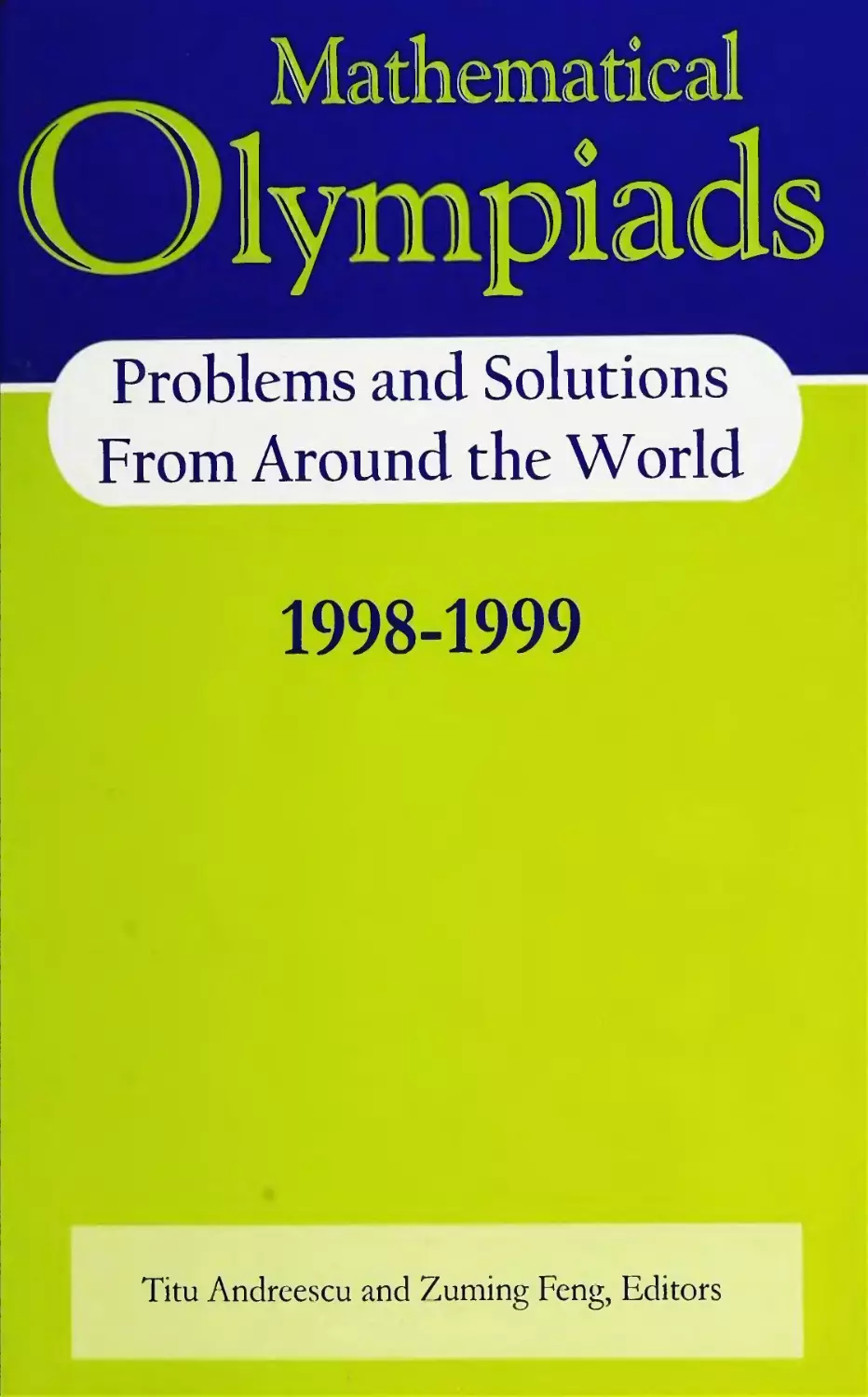
Mathematical
$
) )) la S
Problems and Solutions
From Around the World
1998-1999
Titu Andreescu and Zun1ing Fcng, Editors
Mathematical Olympiads
1998-1999
Problems and Solutions
From Around the World
@ 2000 by
The Mathematical Association of America (Incorporated)
Library of Congress Catalog Card Number 00-105112
ISBN 0-88385-803-7
Printed in the United States of America
Current Printing (last digit):
10 9 8 7 6 5 4 3 2
Mathematical Olympiads
1998-1999
Problems and Solutions
From Around the World
Edited by
Titu Andreescu
and
Zuming Feng
Published and distributed by
The Mathematical Association of America
MAA PROBLEM BOOKS SERIES
Problem Books is a series of the Mathematical Association of America
consisting of collections of problems and solutions from annual mathemat-
ical competitions; compilations of problems (including unsolved problems)
specific to particular branches of mathematics; books on the art and
practice of problem solving, etc.
Committee on Publications
William Watkins, Chair
Roger Nelsen Editor
Irl Bivens Clayton Dodge
Richard Gibbs George Gilbert
Art Grainger Loren Larson
Margaret Robinson
The Inquisitive Problem Solver, Paul Vaderlind, Richard K. Guy, and Loren
L.Larson
Mathematical Olympiads 1998-1999: Problems and Solutions From
Around the Worl edited by Titu Andreescu and Zllmin g Feng
Mathematical Olympiads 1999-2000: Problems and Solutions From
Around the World, edited by Titu Andreescu and Zllmin g Feng
The William Lowell Putnam Mathematical Competition 1985-2000: Prob-
lems, Solutions, and Commentary, Kiran S. Kedlaya, Bjorn Poonen,
Ravi Vakil
USA and International Mathematical Olympiads 2000, edited by Titu
Andreescu and Zllmin g Feng
USA and International Mathematical Olympiads 2001, edited by Titu
Andreescu and Zllmin g Feng
MAA Service Center
P. O. Box 91112
Washington, DC 20090-1112
1-800-331-1622 fax: 1-301-206-9789
Contents
Acknowledgments .........
Abbreviations and Notations
.
IX
.
. . . . . . . . . . . .. . . . . . . . . . . . . . . . .. .. .. .. .. .. .. .. .. .. .. .. Xl
1 1998 National Contests: Problems and Solutions ........ 1
1.1 Bulgaria
1.2 Canada
. . 1
.21
1.3 China
25
1.4 Czech and Slovak Republics
.36
1.5 Hungary .................................................................................................. 40
1.6 India
.49
1. 7 Iran
.60
1.8 Ireland
74
1.9 Japan
1.10 Korea
80
84
1.11 Poland
88
1.12 Romania
93
1.13
Russia
110
1.14 Taiwan
145
1.15 Turkey
1.16 United Kingdom ........
1.17 United States of America
149
154
159
1.18
Vietnam
.................................. ............................................. ...
166
v
vi
Mathematical Olympiads 1998-199 9
2 1998 Regional Contests: Problems and Solutions ...... 173
2.1 Asian Pacific Mathematics Olympiad ..................... 173
2.2 Austrian-Polish Mathematics Competition ................. 176
2.3 Balkan Mathematical Olympiad .......................... 184
2.4 Czech-Slovak Match .................................... 187
2.5 Iberoamerican Olympiad ................................. 191
2.6 Nordic Mathematics Contest ............................. 195
2.7 St. Petersburg City Mathematical Olympiad (Russia) ...... 199
3 1999 National Contests: Problems .................... 215
3.1 Belarus ................................................ 215
3.2 Brazil ..................................................220
3.3 Bulgaria ................................................221
3.4 Canada .................................................223
3.5 China .................................................. 224
3.6 Czech and Slovak Republics ............................. 225
3.7 France ................................................. 227
3.8 Hungary ............................................... 228
3.9 Iran .................................................... 230
3.10 Ireland .......................................................... 233
3.11 Italy ....................................................... 235
3 .12 Japan ............................................................. 237
3.13 Korea .................................................................... 238
3.14 Poland ............................................................. 239
3.15 Romania .............................................................. 240
3.16 Russia ............................................................................ 245
3.17 Taiwan ............................................................................ 252
3.18 Turkey ............................................................................. 253
3.19 Ukraine .......................................................................... 255
3.20 United Kingdom ........................................256
Contents
vii
3.21 United States of America ................................258
3.22 Vietnam ................................................259
4 1999 Regional Contests: Problems .................... 263
4.1 Asian Pacific Mathematical Olympiad .................... 263
4.2 Austrian-Polish Mathematics Competition .................264
4.3 Balkan Mathematical Olympiad .......................... 267
4.4 Czech and Slovak Match ................................ 268
4.5 Hong Kong (China) ..................................... 269
4.6 Iberoamerican Mathematical Olympiad ................... 270
4.7 Olimpiada de mayo ..................................... 271
4.8 S1. Petersburg City Mathematical Olympiad (Russia) ...... 272
Glossary ........................................................ 275
Classification of Problems ....................................... 285
Preface
This book is a continuation of Mathematical Contests 1997-1998: Olympiad
Problems and Solutions from around the World, published by the American
Mathematics Competitions. It contains solutions to the problems from 25
national and regional contests featured in the earlier book, together with
selected problems (without solutions) from national and regional contests
given during 1999. In many cases multiple solutions are provided in order
to encourage students to compare different problem-solving strategies.
This collection is intended as practice for the serious student who wishes
to improve his or her performance on the USAMO. Some of the problems
are comparable to the USAMO in that they came from national contests.
Others are harder, as some countries first have a national Olympiad, and
later one or more exams to select a team for the IMO. And some problems
come from regional international contests ("mini-IMOs").
Different nations have different mathematical cultures, so you will find
some of these problems extremely hard and some rather easy. We have
tried to present a wide variety of problems, especially from those countries
that have often done well at the IMO.
Each contest has its own time limit. We have not furnished this
information, because we have not always included complete exams. As a
rule of thumb, most contests allow time ranging between one-half to one
full hour per problem.
The problems themselves should provide much enjoyment for all those
fascinated by solving challenging mathematics questions.
ix
x
Mathematical Olympiads 1998-1999
Acknowledgments
Thanks to Kiran Kedlaya for the help he provided in ways too numerouS
to rnention and to the following students of the 1999 Mathematical
Olympiad Summer Program who helped in preparing and proofreading
solutions: George Lee Reid Barton Gabriel Carroll, Po-Shen Loh Po-Ru
Loh Yuran Lu Dani Kane Zhihao Liu. Without their efforts this work
would not have been possible. And finally thanks to Richard Parris
Andreas Orphanides. and Juan Felix for translating problems, and to
Eugene Mukhin for providing hints.
Titu Andreescu
Zurning Feng
Abbreviations and Notations
Abbreviations
AIME American Invitational Mathematics Examination
APMC Austrian-Polish Mathematics Competition
APMO Asian Pacific Mathematics Olympiad
IMO International Mathematical Olympiad
USAMO United States of America Mathematical Olympiad
MOSP Mathematical Olympiad Summer Program
LHS Left-hand side
RHS Right-hand side
AM-GM Arithmetic-Geometric Mean Inequality
RMS-AM Root Mean Square-Arithmetic Mean Inequality
WLOG Without loss of generality
Notations for Numerical Sets and Fields
Z the set of integers
Z+ the set of positive integers
Zn the set of integers modulo n
Q the set of rational numbers
Q+ the set of positive rational numbers
Qn the set of n-tuples of rational numbers
R the set of real numbers
R+ the set of positive real numbers
R n the set of n-tuples of real numbers
<C the set of complex numbers
[xn](p(x)) the coefficient of the term x n in the polynomial p(x)
deg p the degree of the polynomial p( x)
deg( K / k) the degree of the field extension K / k
xi
xii
1F[x]
Q(r)
Olympiad Problems and Solutions from around the World
the ring of all polynomials with coefficients in the field IF.
the field of complex numbers g( r) / h( r) where
g(x), hex) E Q[x] and her) :/: 0
Notations for Sets, Logic, and Geometry
<=>
:::::::}
AcB
A C B
A\B
AnB
AuB
aEA
AB
--
AB
[F]
if and only if
implies
A is a proper subset of B
A is a subset of B
A without B
the intersection of sets A and B
the union of sets A and B
the element a belongs to the set A
segment AB; also the length of the segment AB
vector AB
area of figure F
1998 National Contests:
Problems and Solutions
1.1 Bulgaria
Problem I
Find the least natural number n (n > 3) with the following property: for
any coloring in 2 colors of n distinct collinear points AI, A2, ..., An
there exist three points Ai, Aj, A 2j - i , 1 < i < 2j - i < n, which are
colored in the same color.
Solution. The answer is 9. We call three points as stated in the question
a triple. Let us denote the color of Ai by Ci, and let Ci = r if Ai is red and
Ci = b if Ai is blue. We first exhibit a coloring of 8 points that contains
no triple:
(C}, C2, Cg, C4, CS, C6, C7, cs) = (r, b, r, b, b, r, b, r).
We claim that if n > 9, then there is at least one triple, i.e., there exists an
arithmetic sequence ilJ i2, ig such that Ci 1 = Ci 2 = Ci 3 . Suppose, on the
contrary, that there are no such triples in AI,.. ., Ag. At least 5 of them
have the same color. For brevity, we abbreviate "the points numbered x,
y, and z, where x, y, Z form an arithmetic series, cannot all have the same
color" with the sYmbol (x, y, z). WLOG, let r = Ci 1 = Ci 2 = ... = Cis,
il < i2 < ... < is, be the first 5 red points. Since there is no triple,
i2 - i l 1= ig - i2 and ig - i l > 3. Similarly, is - ig > 3. Also,
ig - i l 1= is - ig, so is - il > 7 and (iI, is) = (1,8), (1,9), or (2,9). We
consider the following three cases.
1. (iI, is) = (1,8). Then ig = 4 or 5. By symmetry, WLOG, let ig = 4.
Since (1,4,7) and (4,6,8), i4 = 5. But then (2,5,8) and (1,3,5)
will leave i2 with no value to take, a contradiction.
2
Bulgaria
2. (iI, is) = (1,9). Then i3 = 4,5, or 6. Since (1,5,9), i3 = 4 or 6.
By symmetry, WLOG, let i3 = 4. Then i4 1= 7 and i2 = 2 or 3. Since
(2,4,6) and (3,6,9), i4 1= 6 and i4 = 8. Then Cs = C6 = C7 = b,
also a contradiction.
3. (iI, is) = (2,9). This is the same as (a). (To see this, replace every
number x in (a) by x + 1.)
From above, we see that our assumption is false and there exists a triple
in the fIrst 9 points.
Problem 2
A convex quadrilateral ABCD has AD = CD and LDAB = LABC <
90°. The line through D and the midpoint of BC intersects line AB in
point E. Prove that LBEC = LDAC. (Note: The problem is valid
without the assumption LABC < 90°.)
Solution. Let 11,11 be the midpoint of BC.. and let
LDAC = LDCA = x and LCAB = y.
We have
LCBA = x + y, LACB = 180° - x - 2y, LDCB = 180° - 2y.
Applying the law of sines to triangles BEll/I and ADE.. we have
AIB sinLAIEB sinLA/EB AD
- - =-
A/ E sin LEBAI sin LEAD ED'
Since J\IB = AIG and AD = CD, AIC/1\/E = CD/ED. Applying the
law of sines to triangles CE1\/ and CDE, we have
sin LCEAI 1\/C GD sinLCED
sinLBCE = AlE = ED = sinLDCE -
sinLGEAI
sin(180° - LDGE).
So
LBCE = 180° - LDCE = 180° - LDGB - LBGE = 2y - LBCE
,
which implies that LBG E = y. Hence
LCEB = LCBA - LBCE = x = LDAG,
as desired.
1998 National Contests: Problems and Solutions
3
Problem 3
Let IR+ be the set of positive real numbers. Prove that there does not exist
a function I : IR+ IR+ such that
(/(X»2 > I(x + y)(/(x) + y)
for every x, y E IR+.
First Solution. We proceed indirectly; suppose that I exists. Then,
I(x )2
I(x + y) < I(x) + y < I(x).
So, I is a strictly decreasing function. (In particular, this means that I is
one-to-one. )
But since I(x) is always positive, I must have some fixed point; suppose
that I(a) = a for some a. Now we can plug a in for x and obtain:
I(a + y) < a 2 /(a + y). This means that for some b, all x > b will have
I(x) < 1. Observe that if we plug I(x) in for y in the given equation,
then we have I(x) > 2/(x + I(x». But now if we plug b in for x here,
we find
1 > I(b) > 2/(b + I(b» > 2/(b + 1).
Hence I(b + 1) < 1/2. Plugging in b + 1 yields
1/2> I(b+ 1) > 2/(b + 1 + I(b + 1» > 2/(b + 1 + 1/2).
Hence I(b + 1 + 1/2) < 1/4.
Proceeding in this manner, we find that
f (b+ 1/2i) < 1/2n.
Therefore, for each quantity € E (0,1), we can find a 0 E (0,2) such that
I(b + x) < € for all x < 2 - o. This means that I(x) does not exist for
x > b + 2, and so we are done.
Second Solution. This is another way of presenting the idea in the first
solution.
Again, we proceed indirectly; suppose that I exists. As in the first
solution, we can prove that I is a strictly decreasing function. For
(x, y) = (x,/(x», we have
l(x)2 I(x)
I(x + I(x» < I(x) + I(x) = 2 .
4
Bulgaria
Let Xo E JR+ and f(xo) = a. For (x,y) = (xo, f(xo», we have
= 1(:0) > I(xo + I(xo» = I(xo + a).
Let Xl = Xo + a. Then f(XI) < a/2. For (x, y) = (Xl, f(Xl». we have
a f(Xl) ( a )
4 > 2 > f(Xl + f(Xl» > f Xl + 2 .
Let X2 = Xl + a/2. Then f(X2) < a/4. For (x, y) = (X2, f(X2». we
have
: > 1(:2) > I(X2 + I(X2» > 1 (X2 + : ) .
Proceeding in this manner, we find that. as n 00,
I(xo +3a) < 1 (xo + i 2: ) < 2 n : 1 - 0,
a contradiction. So our assumption is false and there is no such function.
Problem 4
Let f( x) = x3 - 3x + 1. Find the number of distinct real roots of the
equation f(f(x» = O.
First Solution. The answer is 7. We use calculus; the derivative of
f(x) is 3X2 - 3, and so the critical points are at (-1,3) and (1, -1).
But f( -2) = -1, f(O) = 1, f(2) = 3. So. the zeros of f lie in the
intervals (-2, -1), (0, 1), and (1,2). If we count the number of times f
passes completely through each interval, that will be our answer. In fact,
f passes through (-2, -1) once (when x < -2), it passes through (0,1)
three times (when -2 < x < -1,0 < x < 1, and 1 < x < 2), and it
passes through (1, 2) three times as well. Therefore there are a total of 7
roots for f(f(x» = O.
Second Solution. We begin with the calculus argument above to discover
that -2 < x < 2. Now, let x = 2sina. Then x 3 - 3x = 2sin3a. We
leave the details as an exercise.
Problem 5
The convex pentagon ABC D E is inscribed in a circle of radius R. The
radius of the incircle of triangle XYZ is denoted by rX1-Z. Prove that
TABC
1. cos LCAB + cos LABC + cos LBCA = 1 + R :
1998 National Contests: Problems and Solutions
5
2. ifTABc = TAED and TABD = TAEC, then triangles ABC and AED
are congruent.
Solution. (a) (For an alternate solution. please see APMC98 problem
9.) Let 0 and I be the circumcenter and incenter of triangle ABC; let
LCAB = a, LABC = {3, LBCA = 'Y. Let AI meet the circumcircle
again at F. WLOG, let 0 lie inside LAFC. Then
OF= R,FI= FC = 2Rsin ; ,
and LOFI = (3 + 0/2 - 90°. Applying the law of cosines to triangle
OF1, we have
01 2 = R 2 + 4R 2 sin 2 0/2 - 4R 2 sin(0/2) sin({3 + 0/2)
.
= R 2 (4sin 2 0/2 + 1- 4sin(0/2) sin({3 + 0/2»
= R 2 (2 - 2coso + 1 + 2[cos(a + (3) - cos({3)])
= R 2 (3 - 2coso - 2cos{3 - 2cos'Y).
But 01 2 = R 2 - 2RTABC (Euler's formula), so
TABC
coso + cos{3 + cOS'Y = 1 + R
and we are done.
(b) Let 2a, 2b, 2c, 2d, 2e be the measures of arcs AB, BC, CD, DE,
EA, respectively. From (a), we have
cosa - cos(a + b) + cosb = cosd + cose - cos(d + e),
cosa + cos(b + c) + cos(d + e) = cose + cos(c + d) + cos(a + b).
Subtracting the two equations, we obtain:
cosb + cos(c + d) = cosd + cos(b + c)
b+c+d b-c-d 2 b+c+d d-b-c
{:::::} 2 cos 2 cos 2 = cos 2 cos 2
b-c-d d-b-c
{:::::} cos 2 = cos 2
{:::::} b = d.
Plugging this result into the first equation, we obtain:
cosa - cos(a + b) + cosb = cosd + cose - cos(d + e)
{:::::} cos a - cos(a + b) + cosb = cosb + cose - cos(b + e)
6
Bulgaria
<=>
cosa + cos(b + e) = cose + cos(a + b)
a+b+e a-b-e a+b+e e-a- b
2cos cos = 2cos cos 2
2 2 2
a-b-e e-a-b
cos 2 = cos 2
<=>
<=>
<=> a = e.
Since a = e and b = d, triangles ABC and AED are congruent.
Problem 6
Prove that the equation
x 2 y2 = z2 (z2 _ x 2 _ y2)
has no solutions in positive integers.
Solution. We begin by proving the following lemma.
Lemma 1. The equation
S4 _ t 4 = u 2
(1)
has IlO solutiolls ill positive illtegers.
Proof. We proceed indirectly; suppose that there exists a nonempty set
S of integers such that if a E S then there exist natural numbers b and
c such that a-l - b 4 = c 2 . By the Well Ordering Principle, there exists a
minimum element of S; suppose that in our equation a 4 - b 4 = c 2 , a is
equal to the minimum. Thus
gcd(a, b, c) = gcd(a, b) = gcd(b, c) = gcd(c, a) = 1.
We consider the following cases.
(a) c is even. Then a and b are odd and a 2 + b 2 = 2 (mod 4). Since
gcd(a, b) = 1 41c 2 , and
( a 2 + b 2 )(a 2 _ b 2 ) = c 2 , gcd(a 2 + b 2 , a 2 - b 2 ) = 2.
Let x = v (a 2 + b 2 )/2 and y = v (a 2 - b 2 )/2. Then x and y are both
integers, and we have x 4 - y-l = (ab)2. Since a > b x < a; therefore this
violates our assumption that our choice of a yields a minimal solution.
(b) c is odd. Then c2 = 1 (mod 4). Since a4, b 4 = 0 or 1 (mod 4), a
is odd and b is even. We rewrite our equation: (a 2 )2 = (b 2 )2 + c 2 . We
use Pythagorean substitution. There exist positive integers rand s such
1998 National Contests: Problems and Solutions
7
that gcd(r, s) = 1
a 2 = r 2 + s2,
b 2 = 2rs,
c = r 2 - s2.
We are only going to use the first two identities. (Both are symmetric with
respect to rand s.) Since 21b, 41b 2 and exactly one of rand s is even. We
denote by r' the even one and by s' the odd one. Then there exist positive
integers x y for which r' /2 = X2 and s' = y2. Thus a 2 = 4x 4 + y4.
By Pythagorean substitution, there are positive integers m n such that
gcd(m, n) = 1 and
a = m 2 + n 2 ,
2x 2 = 2mn,
y2=m 2 _n 2 .
Since x 2 = mn and gcd(m,n) = 1, m = p2 and n = q2. So
y2 = m 2 - n 2 = p4 - q4. Thus (p, q, y) is a new solution of (1) with
p = Viii < x = vir' /2 < r' < a, and so again we violate our extremal
assumption.
Therefore, our assumption is false and there is no solution for (1) in
positive integers. 0
Now we apply the lemma to our problem. Solving the given equation
for z2 we find that the discriminant of the resulting quadratic is x 4 +
6x 2 y2 + y4. Proceed indirectly again; suppose that x 4 + 6x 2 y2 + y4 is
a perfect square. Let a = x 2 + y2 and b = 2xy. But now a 2 + b 2 and
a 2 - b 2 are both perfect squares and a 4 - b 4 must therefore be a perfect
square as well! By our lemma, this is impossible and we are finally done.
Problem 7
For n a given positive integer find the smallest positive integer k for
which there exist k 0-1 sequences of length 2n + 2, such that any other
0-1 sequence of length 2n + 2 matches one of the given ones in at least
n + 2 positions.
First Solution. The answer is k = 4. First we prove that k < 4 by
providing 4 sequences that will do the job. Let a = 00. . . O b = 11. . .1,
c = 011.. .1 d = 100...0 be four 2n + 2 sequences. For any 2n + 2
sequence s let Xs and Ys be the respective numbers of O s and 1 s in s.
If Xs > Ys then we can match s with a; if Xs < Ys we can match s
with b; if Xs = Ys = n + 1 and s starts with O we can match s with c; if
Xs = Ys = n + 1 and s starts with 1 we can match s with d. Therefore
four sequences a b c d can indeed do the job and k < 4.
8
Bulgaria
Now we prove k > 4. Suppose, on the contrary, there exist three
sequences of length 2n + 2 : A = ala2... a2n+2, B = b 1 b2... b2n+2'
C = Cl C2 . . . C2n+2 that will do the job. We claim that at least one of the
following statements is true:
Oi = b i or Ci
b i = Ci or ai
for at least n + 1 values of i;
for at least n + 1 values of i;
for at least n + 1 values of i;
Ci = ai or b i
In fact, if the first statement is not true, then there are n + 2 values of i
such that ai =F bi, Ci. So for those i's, b i = Ci and the third statement is
true.
WLOG, we suppose that the first statement is true. We are going to find
a counterexample s that cannot match A, or B, or C for at least n + 2
positions. Find exactly n + 1 i's such that ai = b i or Ci. For those i's,
let 51 = 1 - ai. Then 5 is different from A in at least n + 1 positions.
Moreover, 5 is different from B or C in these n + 1 positions and there are
still n + 1 positions of 5 left to be assigned. So we can make 5 different
from both Band C in at least n + 1 positions as well, a contradiction.
Thus our assumption is wrong and k > 4.
From the above we see that k = 4.
Second Solution. As in the first solution, we can find 4 sequences that
ensure the required condition is true. Hence k < 4. If k < 4, then
1 (m) (m) (m) k b k
et a l a 2 . .. a 2n +2' m = 1,..., , e sequences that ensure the
required condition is true. Let S = {(O, 0), (0, 1), (1,0), (1, I)}. For
i = 1,2,...,n + 1, (a ) l,a » E S. Since k < 4, there exists
(b2i-ltb2i) E S and ( i-l,b2i) =F (a \ ,a » for all m. Now for
- 1 k b b J.._ d (m) (m) (m) . ffi .
m - , . . ., ,sequences 1 2... V".ln+2 an a l a 2 . . . a 2n + 2 dl er In
at least n + 1 places, a contradiction. Hence k = 4.
Problem 8
The polynomials Pn(x,y) for n = 1,2,... are defined by Pl(X,y) = 1
and
P n + l (x, y) = (x + Y - l)(y + I)Pn(x, Y + 2) + (y - y2)Pn(X, y).
Prove that Pn(x, y) = Pn(Y, x) for all n and all x, y.
Solution. We induct on n. For n = 1, 2 the result is evident. as
Pl(X,y) = 1 and P 2 (x,y) = xy + x + Y - 1. So we take n > 1 and
1998 National Contests: Problems and Solutions
9
suppose that the result is true for P n - 1 (x, y) and Pn (x, y). We have
Pn+l(X,y) = (x + Y -l)(y + l)Pn(x,y + 2) + (y - y2)Pn(X,y)
= (x + Y - l)(y + l)Pn(Y + 2, x) + (y - y2)Pn(Y, x).
Note that
(x + Y - l)(y + l)Pn(Y + 2, x)
= 8n-l(X,y) + (x + y -l)(y + 1) (x - x2)Pn_l(Y + 2,x),
where 8n-l(X,y) = [(x+y)2-1](Y+1)(x+1)Pn_l(y+2,x+2). Since
Pn-l(X,y) = Pn-l(Y,X), 8n-l(X,y) = 8n-l(Y,X). We also notice that
(y - y2)Pn(Y, x)
= (y - y2)[(x + Y -1) (x + l)Pn-l(Y,X + 2) + (x - x2)Pn_l(Y,X)]
= (y - y2)(x + Y - 1) (x + l)Pn-l(Y, x + 2) + Tn-l (x, y),
where Tn-l(X,y) = (y - y2)(X - X2)Pn_l(Y'X), Since Pn-l(X,y)
= Pn-l(Y,X), Tn-l(X,y) = Tn-l(Y,X). Let
Un-1(x,y) = (x + Y -l)[(y + 1) (x - X2)Pn_l(Y + 2, x)
+(x + l)(Y - y2)Pn_l(Y, X + 2)].
Since Pn-l(X,y) = Pn-l(Y'X), Un-1(x,y) = Un-1(y,x). So
Pn+l(X,y) = 8n-l(X,y) + Tn-l(X,y) + Un-1(x,y) = Pn+l(Y,X),
This completes the induction. Therefore P n (x, y) = P n (y, x) for all n
and all x, y.
Problem 9
On the sides of a non-obtuse triangle ABC are constructed externally a
square, a regular n-gon and a regular m-gon (m, n > 5) whose centers
form an equilateral triangle. Prove that m = n = 6, and find the angles
of triangle ABC.
Solution. The angles are 90°,45°,45°. We prove the following lemma.
Lemma 2. Let 0 be a point inside equilateral triangle XY Z. If
LYOZ = x, LZOX = y, LXOY = z.
10
Bulgaria
then
ox OY OZ
sin(x - 60°) = sin(y - 60°) = sin(z - 60°).
Proof. Rotate triangle XY Z through an angle of 60° clockwise about Z.
Let X' and 0' be the images of X and 0 respectively. Then X is the
image of Y.. triangle Z 0' 0 is equilateral, and triangles Z 0' X and Z OY
are congruent. Note that x + y + z = 360°. We have
LO'OX = LZOX - 60° = y - 60°,
LXO'O = LXO'Z - 60° = LYOZ - 60° = x-60°,
LOXO' = 180° - LO'OX - LXO'O = z - 60°.
Note that 0' X = OY. Applying the law of sines to triangle X 00' yields
the desired result. 0
Now we prove our main result. WLOG, suppose that the square is
on AB, the m-gon is on BC, and the n-gon is on CA. Let 0 be the
circumcenter of triangle ABC. WLOG, let the circumradius of triangle
ABC be 1. Let X, Y, and Z be the respective centers of the square, the
m-gon, and the n-gon. Let LBAC = a, LCBA = b, and LACB = c.
Then OB = 1, LBOY = a, and LOY B = 180° 1m. Let a = 180° 1m.
Applying the law of sines to triangle 0 BY,
OY = sin (a + a) .
sin a
Similarly.. let LZOC = 180° In = (3. We have:
O X = sin(c + 45°) = '2. ( 450 ) O z = sin(b + (3)
. 45 0 v SIn c +, . (3 .
&n mn
We apply the lemma to triangle XY Z and the point 0; we have
OY
sin(b + c - 60°)
OZ
sin(c + a-60°)
OX
-
sin(a + b - 60°)'
OY OZ OX
sin(a + 60°) - sin(b + 60°) - sin(c + 60°)'
sin(a + a) csca _ sin(b + (3) csc{3 _ V2sin(c + 45°)
sin(a + 60°) - sin(b + 60°) - sin(c + 60°) .
Note that function
f(x) = sin(x + 45°)
sin(x + 60°)
1998 National Contests: Problems and Solutions
I I
is increasing for x E [0°,90°]. In fact,
f'ex) = cos(x + 45°) sin(x + 60°) - sin(x + 45°) cos(x + 60°)
sin 2 (x + 60°)
sin (15°) 0
- 2 > .
sin (x + 60°)
Thus
sin(a+o)csco _ sin(b+,B)csc,B _ V2sin(e+45°)
sin(a + 60°) - sin(b + 60°) sinCe + 60°)
= V2f(e) < V2sin(90° + 45°) = 2
- sin(90° + 60°) .
Since the triangle is non-obtuse, at least two of its angles are between 45°
and 90°. WLOG, let 45° < b « 90°). Then
sin(b + ,B) csc,B < 2 {::::::::} sin(b + ,B) csc,B < 2 sin(b + 60°)
sin(b+600) -
cosb + sinbcot,B < sinb + vl3cosb
<=> cot,B < 1 + (v13 -1)cotb
=> cot,B < 1 + (v13 -1) cot 45° = J3.
Therefore, ,B > 30°. But since n > 6, ,B = 180° In < 30°. So the
equalities hold, e = 90°, and b = a = 45°, as claimed.
Problem 10
Let al, . . . , an be rea l numbe rs, not all z ero. Pro ve that the equation
v I + alX + . . . + v I + anx = n
has at most one nonzero real root.
S olution. Notice th at fi(X) = v I + aix is concave. Hence f(x) =
v I + al x + . . . + v I + anx is concave. Since f' (x) exists, there can be
at most one point on the curve y = f(x) with derivative O. Suppose there
is more than one nonzero root. Since x = 0 is also a root, we have three
real roots Xl < X2 < Xs. Applying the Mean-Value theorem to f(x) on
intervals [Xl, X2] and [X2, xs], we can find two distinct points on the curve
with derivative 0, a contradiction. Therefore, our assumption is wrong and
there can be at most one nonzero real root for the equation f (x) = n.
12
Bulgaria
Problem II
Let m, n be natural numbers such that
A= (m+3)n+l
3m
is an integer. Prove that A is odd.
First Solution. Let p be a prime and a a positive integer. Let (alp)
be the Legendre symbol. i.e., (alp) will have value 1 if a is a quadratic
residue modulo p. -1 if a is a quadratic non-residue modulo p, and 0 if pia.
For odd primes p and q, we have LQR (Law of Quadratic Reciprocity):
(-lIp) = (_I)(P-l)/2,
(plq)(qlp) = (_I)(p-l)(Q-l)/4.
If m is odd, then (m + 3)n + 1 is odd and A is odd. Now we suppose
that m is even. Since A is an integer,
o = (m + 3)n + 1 = m n + 1 (mod 3),
so n = 2k + 1 is odd and m = -1 (mod 3). We consider the following
cases.
(a) m = 8m' for some positive integer m'. Then
(m+3)n + 1 = 3 2k + 1 + 1 = 4 (mod 8)
and 3m = 0 (mod 8). So A is not an integer.
(b) m = 2m' for some odd positive integer m', Le., m = 2 (mod 4).
Then
(m + 3)n + 1 = (2 + 3)n + 1 = 2 (mod 4)
and 3m = 2 (mod 4). So A is odd.
(c) m = 4m' for some odd positive integer m'.
-1 (mod 3), there exists an odd prime p such that p =
and plm. Since A is an integer,
o = (m + 3)n + 1 = 3 2k + 1 + 1 (mod m)
and 3 2k + 1 = -1 (mod p). Let a be a primitive root modulo p; let b be a
positive integer such that 3 = a b (mod p). Thus a(2k+l)b == -1 (mod p).
Note that (pI3) = (-1/3) = -1. We consider the following cases.
(i) p = 1 (mod 4). From LQR, (-lIp) = 1, so
Since m =
-1 (mod 3)
a 2c = -1 = a(2k+l)b (mod p)
1998 National Contests: Problems and Solutions
13
for some positive integer c. Therefore b is even and (3/p) = 1. Again,
from LQR, we have
-1 = (3/p)(p/3) = (_I)(3-l)(p-l)/4 = 1,
a contradiction.
(ii) P = 3 (mod 4). From LQR, (-l/p) = -1, so
a 2c + 1 = -1 = a(2k+l)b (mod p)
for some positive integer c. Therefore b is odd and (3/p) = -1.
Again, from LQR, we have
1 = (3/p)(p/3) = (_1)(3-l)(p-l)/4 = -1,
a contradiction.
Thus for m = 4m' and m' is odd, A is not an integer.
From the above, we see that if A is an integer, A is odd.
Second Solution. We prove by contradiction. Assume, on the contrary,
that A is even. Then m is even. Since A is an integer, 0 = (m+3)n+1 =
m n + 1 (mod 3) yields n = 2k + 1 and m = 3t + 2. Let m = 2lmh
where 1 > 1 and ml is odd. In fact 1 > 1, as otherwise m = 2 (mod 4),
(m + 3)n + 1 = (2 + 3)n + 1 = 2 (mod 4)
and
A= (m+3)n+1
2m'
is odd.
Since A is an integer, we have
o = (m + 3)n + 1 = 3 2k + l + 1 (mod m).
From (2), we have 2 l l(3 2k + l + 1). But
3 2k + l + 1 = gk X 3 + 1 = 4 (mod 8),
so I = 2, m = 4ml, and ml = m = 2 (mod 3).
From (2), we also have mll (3 2k + l + 1), which implies that mlla 2 + 3,
where a = 3 k + l . Since
(2)
gcd(ml, 2) = gcd(ml, 3) = 1
and ml = 2 (mod 3), ml = 68+5. Since gcd(ml,a) = gcd(ml,3) = 1,
Thue's lemma implies that there exist integers x and y such that 1 < x,
14
Bulgaria
Iyl < L ylmd and mllax + y. Since ml = 2 (mod 3), ml is not a perfect
square and 1 < x, Iyl < ylml . Now
mlla 2 + 3 <=> a 2 + 3 = 0 (mod ml),
mllax+y <=> ax = -y (mod ml)
imply that 3x 2 + y2 = 0 (mod ml), Le., 3x 2 + y2 - kml. But
3x 2 + y2 < 4ml gives k = 1,2,3.
(a) If k = 1, then 3x 2 + y2 = ml = 68 + 5 yields
y2 = 2 (mod 3),
which is impossible.
(b) If k = 2, then 3x 2 + y2 = 2ml = 128 + 10 yields
3x 2 + y2 = 2 (mod 4),
which is impossible.
(c) If k = 3, then 3x 2 + y2 = 3ml yields
y = 3YI and x 2 + 3y = mI.
We are back in the first case, which is impossible.
Thus our assumption is wrong and A is odd.
Problem 12
The sides and diagonals of a regular n-gon X are colored in k colors so
that
(a) for any color a and any two vertices A, B of X, either AB is colored
in a or AC and BC are colored in a for some other vertex C;
(b) the sides of any triangle with vertices among the vertices of X are
colored in at most two colors.
Prove that k < 2.
Solution. Observe that if we can reach a contradiction with k = 3. then
we will be done. We can reduce any k > 3 case into a k = 3 case
by selecting three of the k colors, say red. blue, and green. to keep and
recoloring in green every edge that is not already red. blue, or green. We
present a lemma.
1998 National Contests: Problems and Solutions
15
Lemma 3. Suppose we have four vertices W, X, Y, and Z such that
W X, X Z, and Y Z are all colored differently, and WY is the same color
as WX. Then WZ must be in the same c%r as WX and WY.
Proof. By rule (b), each of triangles W X Z and WY Z cannot contain
all three colors. Therefore, the only coloring that satisfies the rule is when
W Z is the same color as W X and WY. 0
We will demonstrate that this forces our n-gon to have infinitely many
sides, a contradiction. Let us proceed by construction. By assumption,
there must be at least one red edge; let that connect the vertices X and
RI' By rule (a), there must exist another vertex BI such that XB I and
RBI are both blue. Also by rule (a), there must exist a vertex G 1 such
that XG 1 and B1G I are both green. Our lemma tells us that GIRl must
be green.
Observe that we constructed our vertices in the order X, Rh Bh and
G 1 . We will continue to construct vertices in the order , Bi, G i , +h
Bi+h Gi+l'" such that whenever we construct a vertex, it must have
edges of that color to all already-existing vertices. Yet we will also show
that we will never be done (Le., rule (a) will never be completely satisfied).
An example:
Suppose that we have already constructed all of the vertices up to G n .
Now we add Rn+l' From our (inductive) assumption, for every vertex
Y #- G n , Bn already constructed, Y Bn must be blue. Also, for every
vertex Y #- G n already constructed, YG n must be green. Therefore, rule
(a) is not satisfied for the vertices {Bn, G n } and the color red. Thus, there
must exist some Rn+l such that Rn+IBn and Rn+IG n is red. But now
observe that for every vertex P (other than Rn+h Bn, and G n ) on our
graph, we can apply our lemma with
W = Rn+l,X = Bn,Y = Gn,Z = P,
and Rn+lP is also red. Similarly, we can observe that there must exist
some Bn+l such that Bn+IRn+1 and Bn+IG n is blue, and find that Bn+l
must be connected to every existing vertex with a blue edge. Finally, there
must also exist some G n + l such that Gn+1Rn+1 and Gn+IBn+1 is green;
we also find that G n + l must be connected to every existing vertex with a
green edge.
We can continue this indefinitely, because after every ucycl e ," our G n
and Bn fail rule (a). Thus our polygon must have infinitely many vertices,
and we are done.
16
Bulgaria
Problem I 3
Solve the following equation in natural numbers:
x 2 + y2 = 1997(x _ y).
Solution. The solutions are
(x, y) = (170,145) or (1827,145).
We have
x 2 + y2 = 1997(x - y)
2(x 2 + y2) = 2 x 1997(x - y)
x 2 + y2 + (x 2 + y2 - 2 x 1997(x - y» = 0
(x + y)2 + (x - y)2 - 2 x 1997(x - y» = 0
(x + y)2 + (1997 - x + y)2 = 1997 2 .
Since x and y are positive integers, 0 < x + y < 1997 and 0 <
1997 -x+y < 1997. Thus the problem reduces to solving a 2 +b 2 = 1997 2
in positive integers. Since 1997 is a prime, gcd( a, b) = 1. By Pythagorean
substitution, there are positive integers m > n such that gcd(m, n) = 1
and
1997 = m 2 +n 2 , a = 2mn, b = m 2 - n 2 .
Since m 2 , n 2 = 0,1, -1 (mod 5) and 1997 = 2 (mod 5), m, n =
:1:1 (mod 5). Since m 2 , n 2 = 0, 1 (mod 3) and 1997 = 2 (mod 3),
m, n = :1:1 (mod 3). Therefore m, n = 1,4,11,14 (mod 15). Since
m > n, 1997/2 < m 2 < 1997. Thus we only need to consider m =
34,41,44. The only solution is (m, n) = (34,29). Thus
(a, b) = (1972,315),
which leads to our final solutions.
Problem 14
Let Al and BI be two points on the base AB of an isosceles triangle ABC
(LC> 60°) such that LAICB I = LABC. A circle externally tangent
to the circumcircle of triangle AlBIC is tangent also to the rays CA and
CB at points A2 and B2, respectively. Prove that A 2 B 2 = 2AB.
Solution. Invert about C. Then A', B', A , and B will all be concyclic
with C. By inversive angles, LAICB I = LBAC. But LA' B'C =
LB' A' C = LB' A C; thus, the circumcenter of A' B' C is equidistant
1998 National Contests: Problems and Solutions
17
from A' C, B' C, and Al B . This means that the image of our externally
tangent circle is the circle through the midpoints of A' C, B' C, and Al B ;
thus A and B are the midpoints of CA 2 and CB 2 , respectively, and we
are done.
Problem I 5
A square table n x n (n > 2) is filled with 0' sand l' s so that any subset
of n cells, no two of which lie in the same row or column, contains at
least one 1. Prove that there exist i rows and j columns with i + j > n + 1
whose intersection contains only 1 'so
Solution. Consider the bipartite graph on the rows and columns (as
vertices of the graph) such that row i is adjacent to column j if the ij-th
entry in the matrix is zero. By assumption there is no matching of the
vertices of this graph, so by the Marriage Theorem there exists a set S of
i rows which are adjacent to a total of k < i columns. Thus if T denotes
the j = n - k remaining columns, all entries in the intersection of S and
T must be 1, and
i + j = i + (n - k) = n + (i - k) > n + 1.
Problem 16
Find all finite sets A of distinct nonnegative real numbers for which:
(a) the set A contains at least 4 numbers;
(b) for any 4 distinct numbers a, b, c, d E A the number ab + cd E A.
Solution. We claim that A = {x, 1, l/x, O} for some real number x > 1.
We fIrst prove the following lemma.
Lemma 4. Let A be a set of distinct nonnegative real numbers such that
(a) the set A contains at least 4 numbers;
(b) the value of each number in A is less than 1;
(c) for any 4 distinct numbers a, b, c, d E A the number ab + cd E A.
Then A is an infinite set.
Proof Suppose, on the contrary, that A is finite. Let A =
{at, a2,..., an}, where 1 > al > a2 > ... > an > 0 and n > 4.
We first prove that an =1= O. Assume for contradiction that an = O. Then
alan + a n -lan-2 E A. But alan = 0 and a n -Ian-2 < an-It and hence
18
Bulgaria
there is an element of A in between an-l and an, which is impossible.
Therefore if A is finite, an =1= O. Now, let
a = ala2 + a3a4, b = ala3 + a2a4, c = ala4 + a2 a 3.
Then a, b, c E A and a > b > c. If c > a4, then a = ab b = a2, c = a3.
From the first and the third equation, we have
al(1 - a2) = a3 a 4,
a3(1 - a2) = ala4'
Multiplying the equations gives
ala3(1 - a2)2 = a3ala .
Since aI, a3 =1= 0, we may now divide by al a3 and take square roots to
obtain 1- a2 = a.... But then al = a3, unless a4 = O. However, a4 cannot
equal zero, and we have reached a contradiction. So c = al a4 +a2a3 < a4,
and a4(1 - al) > a2a3. Thus a3 > a4 implies that
a3(1 - al) > a2a3 ==> 1 - al > a2 ==> 1 > al + a2.
So a2 < 1/2 and a = ala2 + a3a4 < al/2 + a3/2 < al. If c = a4, then
a = a2, b = a3, c = a4. From the second equation and the third equation,
we have
a3(1 - al) = a4 a 2,
a4(1 - al) = a2a3.
Using the same argument as before, we have 1 - al = a2 = 0, a
contradiction. Thus c < a4 and as exists. If we reapply the above
argument to (a2, a3, a4, as). we can prove the existence of a6 and so on.
Therefore A must be an infinite set. 0
Now we prove our main result. We use the same notation. From the
lemma, we know that in order for A to satisfy the given conditions, we
must have al > 1. Then c > a4 and a = al, b = a2, c = a3. From
the same argument used in the proof of the lemma. we have 1 - a2 =
a4 = 0 <=? a2 = 1 and a4 = O. Thus b = al a3 = a2 = 1. We have
A = {al, I, I/al, O}, as claimed.
Problem 17
Let ABC be an equilateral triangle and n > 1 be a positive integer. Denote
by S the set of n - 1 lines which are parallel to AB and divide triangle
1998 National Contests: Problems and Solutions
19
ABC into n parts of equal area, and by 5' the set of n - 1 lines which are
parallel to AB and divide triangle ABC into n parts of equal perimeter.
Prove that 5 and 5' do not share a common element.
Solution. Suppose that the lines in 5 meet the triangle at AI, Bit A2,
B2' .... An-I, Bn-l such that Ai are on AC, B i are on BC, AiB i II AB,
and CA i < CA j for i < j. Define A , B: for 5' analogously. WLOG,
let AB = 1.
Note that [CAIB I ], [CA 2 B 2] , ..., [CA n - 1 B n - l ], [CAB] form an
arithmetic sequence. Since all of these triangles are similar to each other,
(AIBI)2, (A 2 B 2 )2, ..., (An_IBn_I)2, (AnBn)2
form an arithmetic sequence. Since [CAIB I ] = [CAB]/n,
AIBI = In and A.;B; = /f .
On the other hand, A 2 B 2 + A A 2 + B B 2 = C A + C B . Let X be the
point on A 2 B 2 such that A A2XB is a parallelogram. Then
A B = A X +XB = A B +XB = CA +XB .
Hence XB 2 + A A2 + B B2 = CB . But
A A = B X = XB = B B ,
so 3B B 2 = CB . For any trapezoid A B:B:+2A +2' we can cut out
a parallelogram to form an equilateral triangle and reapply the above
argument to obtain B:B:+ I = 3B:+ I B:+ 2 . Let CB = x. Then
x x x x(3 n - 1)
CB = 1 = x + 3 + 3 2 +... + - .
3 n - 1 2 . 3 n - 1
So x = (2. 3 n - 1 )/(3 n -1) and
" , x X 3 i - 1
AiB i = CBi = x + 3 + . . . + 3i-1 = x. 2 . 3i-1 -
3 n - i (3 i - 1)
3 n -1
Since 5 and 5' contain parallel lines, proving 5 n 5' = 0 is equivalent to
proving that AiB i =1= AjBj for any i,j E {I, 2,. . . , n - I}. Suppose, on
the contrary, that AiB i = AjBj for some i,j E {I, 2,..., n - I}. Then
Ii = 3 n - j (3 j - 1) .
Vn 3 n -1
20
Bulgaria
Let
j' = n - j, 9 = gCd(3 j - 1, 3 n - 1), 3 n - 1 = mg, 3 j - 1 = 19.
Then 3 does not divide g, and m and l are relatively prime positive integers.
We have
= ( l r _ 3:; .
where the RHS is in simplest form. Note that
. .. .,
gl(3 n - 1) - (3.1 - 1) = 3 n - 3.1 = 3.1 (3.1 - 1).
So gl3 j ' - 1. Since j + j' = n, min{j, j'} < n/2 and 9 < 3 n / 2 - 1.
Therefore m = (3 n - 1)/ 9 > 3 n / 2 + 1. But then m 2 > 3 n > n, a
contradiction. Thus our assumption is false and 8 n 8' = 0.
Problem I 8
Find all natural numbers n for which the polynomial x n +64 can be written
as a product of two nonconstant polynomials with integer coefficients.
Solution. We claim that n = 3k or n = 4k for some positive integer k.
Suppose that x n +64 = f(x)g(x) for two nonconstant integer polynomials
f(x) and g(x). Let a = V'64 and ak = (2k + 1)7r/n for k = 1,2,... ,n.
Then
f(x)g(x) = x n + 64
= (x - acisaJ)(x - acisa2)... (x - a cis an).
Since there is at most one real root for x n + 64 (when n is odd), one of
f(x) or g(x) has only complex roots. WLOG, let f(x) be that polynomial.
Let c be the constant term of f(x) and d be the degree of f(x). Since
g( x ) is nonconstant, d < n. Since f (x) has integer coefficients, all
its roots can be p aired as conjugates. So 2m = d < n. Noticing
(a cis ak)(acisak) = 64 2 / n , we have c = 64 2m / n = (2 6 )2m/n an integer
less than 64. Thus 2m/n can be reduced to a fraction with its denominator
equal to 2, 3, or 6, so 31n or 41n. Since
x 3k + 64 = (x k + 4)(x 2k - 4x k + 16)
x 4k + 64 = (x 2k + 4x k + 8) (X 2k - 4x k + 8),
both n = 3k and n = 4k satisfy the condition of the problem. Therefore
n is a multiple of 3 or 4, as claimed.
1998 National Contests: Problems and Solutions
21
1.2 Canada
Problem I
Determine the number of real solutions a of the equation
l ; J + l J + l : J = a.
Solution. There are 30 solutions. Since la/2J, la/3J, and la/5J are
integers. so is a. Now write a = 30p + q for integers p and q, 0 < q < 30.
Then
l ; J + l J + l : J = a
<=> 31p + l J + l J + l ; J = 3(}p + q
<=> p = q -l J -l J -l : J .
Thus, for each value of q, there is exactly one value of p (and one value
of a) satisfying the equation. Since q can equal any of thirty values, there
are exactly 30 solutions, as claimed.
Problem 2
Find all real numbers x such that
x = (x _ Y/2 + (1 _ Y/2 .
First Solution. x = (1 + v5)/2 is the only solution. Isolating V I - l/x
and squaring, we obtain
x 2 - 2 v x 3 - x + x -1/x = 1-1/x.
Isolating 2 v x 3 - x and squaring again, we obtain
x 4 + 2x 3 - x 2 - 2x + 1 = 4x 3 - 4x
x 4 - 2x 3 - x 2 + 2x + 1 = 0
(x - 2)(x - l)x(x + 1) + 1 = O.
This equation is symmetric about x = 1/2, so we make the substitution
u = x - 1/2, x = u + 1/2 to get
4 5 2 25 ( 2 / ) 2
U - -u + - = u - 5 4 = O.
2 16
22
Canada
Therefore u = x.VS/2 and x = (1 X. VS)/2. Checking these in our
original equation only x = (1 + .J5)/2 is a valid solution.
Second Solution. From the original equ ation, w e have x > 0 and
1 > I/x, thus x > 1. Now isolating V I - I/x and squaring as in
the first solution, we obtain
(x 2 - 1) - 2 V x( x 2 - 1) + x = 0
( V x 2 - 1 - vIX)2 = o.
The last equation can be easily solved to obtain the solution.
Problem 3
Let n be a natural number such that n > 2. Show that
1 ( 1 + .! + . . . + 1 ) > .!. ( .! + .! + .. . + 2. ) .
n+ 1 3 2n-I n 2 4 2n
Solution. We prove that
n (1+ + . . . + 2n 1 ) > (n + 1) G + + . .. + 2 ) .
by induction. For n = 2, 8/3 > 9/4. Assume the claim is true for
n = k > 2 Le., we have
k (1 + + . . . + 2k 1 ) > (k + 1) G + +... + 2 ) .
Now let n = k + 1. Note that
( 1 1 1 ) k + 1
+ 3 + . . . + 2k - 1 + 2k + 1
( 1 1 1 ) 1 k + 1
= 2 + 3 + . . . + 2k - 1 + 2 + 2k + 1
( 1 1 1 ) 1 k + 1
> 2 + 4 +... + 2k + 2 + 2k + 1
( 1 1 1 ) It. + 1 1
> 2 + 4 + . . . + 2k + 2k + 2 + 21t + 1
( 1 1 1 ) k + 2
> 2 + 4 +... + 21t. + 2k + 2 .
1998 National Contests: Problems and Solutions
23
Induction is complete as
( 1 1 1 )
(k + 1) 1 + - +... + +
3 2k - 1 2k + 1
( 1 1 ) ( 1 1 ) k+l
=k 1+-+...+ + 1+-+...+ +
3 2k - 1 3 2k - 1 2k + 1
( 1 1 ) ( 1 1 1 ) k + 2
>k 1+-+...+ + -+-+...+- +
3 2k - 1 2 4 2k 2k + 2
( 1 1 1 )
> (k + 2) 2 + 4 + .. . + 2k + 2 .
Problem 4
Let ABC be a triangle with LBAC = 40° and LABC = 60°. Let D
and E be the points lying on the sides AC and AB, respectively, such that
LCBD = 40° and LBCE = 70°. Let BD and CE meet at F. Show
that the line AF is perpendicular to the line BC.
Solution. Note that LABD = 20°, LBCA = 80°, and LACE = 10°.
Let G be the foot of the altitude from A to BC. Then LBAG -
90° - LABC = 30° and LCAG = 90° - LBCA = 10°. Now,
sin LBAG sin LACE sin LCBD sin 30° sin 10° sin 40°
-
sin LCAG sin LBCE sin LABD sin 10° sin 70° sin 20°
(1/2)(sin 10°)(2 sin 20° cos 20°)
-
sin 10° cos 20° sin 20°
=1.
Then by the trigonometric form of Ceva's Theorem, AG, BD, and C E
are concurrent. Therefore, F lies on AG so AF is perpendicular to the
line BC, as desired.
Problem 5
Let m be a positive integer. Define the sequence {an}n > O by ao = 0,
al = m and an+l = m 2 a n - an-l for n > 1. Prove that an ordered pair
( a, b) of nonnegative integers, with a < b, is a solution of the equation
a 2 + b 2
=m 2
ab+l
if and only if (a, b) = (an, an+l) for some n > O.
24
Canada
Solution. The "if' direction of the claim is easily proven by induction
on n; we prove the "only if' direction by contradiction. Suppose, on
the contrary, that there exist pairs satisfYing the equation but not of the
described form; let (a, b) be such a pair with minimal sum a + b. We
claim that (e, a) = (m 2 a - b, a) is another such a pair but with smaller
sum e + a, which leads to a contradiction.
(a) a = O. Then (a, b) = (0, m) = (ao, al), a contradiction.
(b) a = m. Then (a, b) = (m, m 3 ) = (at, a2), a contradiction.
(c) a = 1. Then b > a = 1 and (b + 1)I(b 2 + 1); but (b + 1)I(b 2 -1),
thus (b + 1)I[(b 2 + 1) - (b 2 - 1)] = 2. We have b = 1, thus m = 1 and
(a, b) = (1,1) = (al, a2), a contradiction.
(d) 2 < a < m. Rewrite (a 2 + b 2 )/(ab + 1) = m 2 as
b 2 - m 2 ab + a 2 - m 2 = 0,
we know that t = b is a root of the quadratic equation
t 2 - m 2 at + a 2 - m 2 = O.
(1)
Thus m 4 a 2 + 4m 2 - 4a 2 the discriminant of the equation must be a perfect
square. But
(m 2 a + 1)2 = m 4 a 2 + 2m 2 a + 1
> m 4 a 2 + 4m 2 _ 4a 2 > (m 2 a)2
for 2 < a < m. So the discriminant cannot be a perfect square, a
contradiction.
(e) a > m. Again t = b is a root of (1). It is easy to check that
t = m 2 a - b = e also satisfies the equation. We have be = a 2 - m 2 > 0;
since b > 0, e > O. Since a > 0 and e > 0, ae + 1 > 0, we have
e 2 + a 2
=m 2 .
00+1
Since e > 0, b > a and be = a 2 - m 2 < a 2 , we have e < a. Thus (e,a)
is a valid pair. Also, it cannot be of the form (an, an+l) or else
(a, b) = (an+b m 2 a n +l - an) = (an+b a n +2).
But then, e + a < a + a < b + a, as desired.
From the above, we see that our assumption is false. Therefore every
pair satisfying the original equation must be of the described form.
1998 National Contests: Problems and Solutions
25
1.3 China
Problem I
Let ABC be a non-obtuse triangle such that AB > AC and LB = 45 0 .
Let 0 and 1 denote the circumcenter and incenter of ABC respectively.
Suppose that .;201 = AB - AC. Determine all the possible values of
sin LBAC.
First Solution. Let
a = BC, b=CA, c = AB,
a = LCAB, {3 = LABC, 'Y = LBCA,
and let R and r be the circumradius and inradius of ABC, respectively.
Applying law of sines to ABC, we have
a = 2Rsina, b = 2Rsin{3, c = 2Rsin'Y.
Since {3 = 45 0 , sin (3 = .;2/2, tan({3/2) = (.;2 - 1), and
. . (135 0 ) .;2(sin a + cos a)
SIn'Y = SIn - a = 2 .
(1)
Thus
r = (c + a - b) tan({3/2) = R(V2 - l)(sina + sin'Y - sin(3).
2
From Euler's fonnula 01 2 = R(R - 2r), we have
01 2 = R 2 (1- 2 (sin a + sin'Y - sin (3) (V2 - 1».
Since ..;201 = AB - AC,
01 2 = (c - b)2/2 = 2R2(sin'Y - sin(3)2.
From (1) and (2), we obtain
2(sin'Y - sin(3)2 = (1- 2 (sin a + sin'Y - sin(3)(V2 - 1»
<==> 1 - 2(sin'Y - sin(3)2 = 2(sina + sin'Y - sin (3) ( V2 - 1)
<==> 1- 2sin2'Y + 2V2sin'Y-1
= 2 (sin a + sin'Y)(v'2 - 1) - (2 - V2)
<==> -(sin a + cosa)2 + 2(sina + cosa)
= (2V2 - 2) sin a + (2 - V2)(sin a + cos a) - (2 - V2)
(2)
26
China
<=:> -1- 2 sin 0: cos 0:
= (V2 - 2) sino: - V2coso: - (2 - V2)
<=:> 2 sin o:cos 0: - (2 - V2)sino: - V2coso: + (J2 -1) = 0
<=:> (V2sino: -1)(V2coso: - V2 + 1) = O.
Thus sino: = V2/2 or coso: = 1- V2/2,
.J4 V2 - 2
sino: = .J l- cos 2 o: = .
2
Second Solution. Let Ie, la, Ib be the feet of perpendiculars from I to
AB, BC, CA, respectively. Let D be the foot of the perpendicular from
o to BC. Thus OD is the perpendicular bisector of BC and BD = CD.
From equal tangents, we have Ale = Alb, Bla = Ble, CIa = Clb. We
have
V20I=c-b
= (Ale + leB) - (Alb + IbC) = IeB - IbC
= Bla - laC.
Since c > b, D is on Bla. We have Bla = BD+Dla, laC = CD-Dl a .
So ..j201 = 2Dla i.e. 01 = V2Dla. Thus line 01 and line Dla fonn
a 45° angle which implies that either 01 ..1 AB or 01 II AB.
(a) 01..1 AB. Then 01 is the perpendicular bisector of AB. Thus
AC = BC, 0: = /3 = 45°, and sino: = V2/2.
(b) 0 I II AB. Let E be the foot of the perpendicular from 0 to AB.
So LAOE = LC = 'Y,
RcosLAOE = Rcos'Y = OE = lIe = T.
Since
4R . 0:. /3. 'Y
r = sIn - sIn - sIn -
2 2 2'
we have
4 . 0: . /3 . 'Y 2 . /3 ( . 0: 'Y )
cos'Y = sIn '2 sIn '2 sIn 2 = sln"2 2 sIn '2 sin 2
. /3 ( 0: + 'Y 0: - 'Y )
= 2 sIn '2 -cos 2 +COS 2
2 . /3 ( . /3 0: - 'Y )
= sln- -sln- +COS
2 2 2
1998 National Contests: Problems and Solutions
27
2 .2/3 2 . /3 0.-'1
= - sIn - + sln-cos
222
o.+{3-'Y {3+'Y- a
= cos {3 - 1 + sin 2 + sin 2
= cos{3 - 1 + sin(90° - '1) + sin(90° - a)
= cos{3 - 1 + cos'Y + coso.,
which implies that coso. = 1- cos{3 = 1- .;2/2 and
. vl 4.;2 - 2
sIn a = vi I - cos 2 a = 2 .
Problem 2
Let n, n > 1, be a positive integer. Determine if there exist 2n distinct
positive integers ab a2,. . . , an, bb b 2 ,. . . , b n such that
(a) al + a2 + . . . + an = b l + b 2 + . . . + b n ;
n
ai-bi 1
(b) n - 1 > L.J . b. > n - 1 - 1998 .
i=l a z + z
Solution. The answer is yes. First we prove the following lemma.
Lemma 5. If aI, a2, . . . , an, bb b2, . . . , b n are 2n distinct positive inte-
gers such that al + a2 + . . . + an = b l + b 2 + . . . + b n , thell
n
a.-b.
n-l>L.J t t .
i=l ai + b i
Proof. From the given conditions, we know that there exists iI, 1 <
i 1 < n, such that b il > ail. So 2bi}/(ai} + bil) > 1 and
n ai - b i n ( 2b i ) n 2bi (3)
- 1- -n- <n-l
a. + b. - a. + b. - a. + b. .
i=l t t i=l t t i=l t z
as claimed. 0
Let N be a positive integer. For i = 1,2,. . . , n -1, let ai = N(2i -1),
b i = 2i. From (a), we have
(n-I)n
L.J ai = -en - I)N + 2N . 2 + an
i=l
(n-I)n
= 2 . 2 + b n = L.J b i .
i=l
28
China
Thus b n = an + (n - 1)[N(n - 1) - n] with an still to be determined.
From the lemma, we only need to prove the second inequality in (b). But
(3) implies that
a.-b.
n-l> t t
i=l ai + b i
2a n + 2(n - IHN(n - 1) - n] 4i
= n - 2a n + (n - I)[N(n - 1) - n] - 2i + N(2i - 1)"
This quantity approaches n - 1 as
N --+ +00 and
an
- --+ +00
N '
(for example, let an = N 2 ). Thus for for any E > 0, (here E = 1/1998),
we can find large enough N and an, such that ai, b i are all distinct,
2: 1 ai = L 1 bi, and
n
a. - b.
n - 1 > L t t > n - 1 - E.
i=l ai + b i
Problem 3
For a set U, let I UI denote the number of elements in U. A set U is
called primitive if all of its elements are positive integers and there is an
element u E U such that gcd(u, u') = 1 for all u' E U, u' ¥= u. A set
U is called non-primitive if all of its elements are positive integers and
there is an element u E U such that gcd(u, u') > 1 for all u' E U. Let
set S = {I, 2,..., 98}. Determine the minimum value of positive integer
n such that, for any subset T C S with ITI = n, it always possible to
find a subset T 10 C T such that IT 10 I = 10 and for any partition A and
B of T 10 with IAI = IBI = 5, one of them is primitive and the other is
non-primitive.
Solution. The answer is n = 50. Let T C S. We say T is good if there
exists T 10 C T satisfYing conditions (a) and (b). Now let ITI = 50. We
claim that all such T are good.
Let E(T) be the number of even elements in T and OCT) be the number
of odd elements in T. We have E(T) + OCT) = ITI = 50. For an odd
number XES, let f (x) denote the number of even numbers y in S such
that gcd(x, y) > 1. We establish the following facts and lemma.
1998 National Contests: Problems and Solutions
29
(1) 1 E S and the first few odd primes in S are 3, 5, 7, 11, 13, 17, 19,
23, 29, 31, 37, 41, 43, 47, 53, 59.
(2) There are 16 odd numbers, 3, 9, 15, ..., 93, in S with smallest prime
divisor 3.
(3) There are 7 odd numbers, 5, 25, 35, 55, 65, 85, 95, in S with smallest
prime divisor 5.
(4) There are 4 odd numbers, 7, 49, 77, 91 in S with smallest prime
divisor 7.
(5) There is 1 odd number in S with smallest prime divisor p, for all
primes 11 < p < 97.
Lemma 6. If there is an odd number x E T such that
f(x) < E(T) - 9,
then T is good.
Proof. Since E(T) - 9 > f(x), there are 9 even numbers tl,..., tg E
T such that gcd(x, ti) = 1. We define T 10 = {x, tl,..., tg}. Therefore
T is good. 0
Since there are only 49 even elements in S and ITI = 50, there is always
an odd element x E T. Let p be the smallest prime factor of x. Now we
consider the following cases according to the values of E(T).
(a) E(T) > 31. Since x can have at most two distinct prime factors,
I(x) < 1(15) = l J + l J -l : J = 22.
Therefore E(T) - 9 > 22 > f(x). From the lemma, T is good.
(b) 30 > E(T) > 21. Then O(T) = 50 - E(T) > 20. Since
1 + 16 = 17 < 20,
from facts (1) and (2), we can further suppose that p > 5 and x i= 35,55.
Thus
I(x) < 1(65) = l : J + l ;: J = 12.
Therefore E(T) - 9 > 12 > f(x). From the lemma, T is good.
(c) 20 > E(T) > 12. Then O(T) = 50 - E(T) > 30. Since
1 + 16 + 7 + 4 = 28 = 30 - 2 < O(T) - 2,
30
China
from facts (1) to (5), we can further suppose that p > 13. Thus
f(x) < f(13) = l : J = 3 = 12 - 9 < E(T) - 9.
By the lemma, T is good.
(d) 11 > E(T} > 10. Then O(T} = 50 - E(T} > 39. Since
1 + 16 + 7 + 4 = 28 = 39 -11 < O(T) -11,
from facts (1) to (5), we can further suppose that x = p > 47. Thus
f(x) < f(47) = l : J = 1 = 10 - 9 < E(T) - 9.
By the lemma, T is good.
(e) E(T) = 9. Then O(T} = 41. Since
1 + 16 + 7 + 4 = 28 = 41 - 13 = O(T} - 13,
from facts (1) to (5). we can further suppose that x = p > 59. Thus
f(x) < f(59} = 0 = E(T} - 9.
By the lemma. T is good.
(f) E(T} < 8. Then O(T} = 50 - E(T} > 42. Since
1 + 16 + 7 + 4 = 28 = 42 - 14 = O(T) - 14,
from facts (1) to (5), we can further suppose that x = p > 61. Since
O(T} < 49. there are at most 7 odd numbers not in T. Among L98/6J +
1 = 16 odd numbers in S that are divisible by 3. there are at least 16-7 = 9
of them in T. Let tl, t2, . . . ,tg be 9 such numbers. Then we can let
T 10 = {x, tl,. .. ,tg} and thus T is good.
So all T with ITI = 50 are good. But the subset of 49 even numbers is
not good. Thus n = 50.
Problem 4
Determine all the positive integers n > 3, such that 2 2000 is divisible by
1+ ( ) + (;) + (;).
Solution. The solutions are n = 3, 7, 23. Since 2 is a prime, 1 +
( ) + ( ) + ( ) = 2 k for some positive integer k < 2000. We have
1 + ( ) + ( ) + (;) = (n + 1)(n 2 - n + 6}/6, Le.. (n + 1}(n 2 - n + 6) =
1998 National Contests: Problems and Solutions
31
3 X 2k+l. Let m = n+ 1 then m > 4 and m(m 2 - 3m+8) = 3 X 2k+l.
We consider the following two cases.
(a) m = 2 8 . Since m > 4 s > 2. We have 2 28 - 3 x 2 8 + 8 =
m 2 - 3m + 8 = 3 X 2 t for some positive integer t. If s > 4, then
8 = 3x2 t (mod 16) => 2 t = 8 => m2-3m+8 = 24 => m(m-3) =
16, which is impossible. Thus either s = 3, m = 8, t = 4, n = 7, or
s = 2, m = 4, t = 2, n = 3.
(b) m = 3 x 2 tL . Since m > 4, m > 4 and u > 1. We have
9 x 2 2u - 9 x 2 u + 8 = m 2 - 3m + 8 = 2 v for some positive integer
v. It is easy to check that there is no solution for v when u = 1,2. If
u > 4, we have 8 = 2 v (mod 16) => v = 3 and m(m - 3) = 0, which
is impossible. So u = 3, m = 3 x 2 3 = 24, v = 9, n = 23.
Problem 5
Let D be a point inside an acute triangle ABC such that
DA. DB. AB +DB. DC. BC + DC. DA. CA = AB. BC. CA.
Detennine the geometric position of D.
Lemma 7. Let D be a point inside an acute triangle ABC. We have
DA.DB.AB+DB.DC.BC+DC.DA.CA > AB.BC.CA; (4)
equality holds if and only if D is the ort/zocenter of ABC.
It is clear that the lemma contains our main resu]t. We are going to
prove the lemma in two ways.
First Solution. Let E and F be points such that BC DE and BCAF
are both parallelograms. Thus EDAF is also a parallelogram. We have
AF = ED = BC, EF = AD, EB = CD, BF = AC.
Applying Ptolemy's theorem to quadrilaterals ABEF and AEBD, we
have
AB . AD + BC . CD = AB . EF + AF . BE
> AE . BF = AE . AC;
BD. AE + AD . CD = BD . AE + AD . BE
> AB . ED = AB . BC.
32
China
Now we have
DA. DB. AB + DB . DC . BC + DC . DA . CA
= DB(AB. AD+BC. CD) +DC. DA. CA
> DB. AE. AC+DC. DA. CA
> AC(BD. AE+AD. CD)
> AC . AB . BC.
Equality holds if and only if both ABEF and AEBD are cyclic, which
implies that AFEBD and AFED are cyclic. Since AFED is a
parallelogram, AFED is a rectangle and AD J.. ED. Since BCDE
is a parallelogram, we have ED II BCand AD J.. BC. Since AEBD is
cyclic LABE = LADE, which implies that BE J.. AB. Since BCDE
is a parallelogram, we have CD II EB and CD J.. AB. Thus D is the
orthocenter of ABC.
Second Solution. Let D be the origin of the complex plane and let the
complex coordinates of A, B, C be u, v, w, respectively. We rewrite (4)
as
\uv(u-v)\+lvw(v-w)I+\wu(w-u)\ > I(u-v)(v-w)(w-u)\. (5)
But it is easy to check that
uv(u - v) + vw(v - w) + wu(w - u) = -(u - v)(v - w)(w - u), (6)
which implies (5) and thus (4). Now we only need to detennine when the
equality holds. Let
uv vw
Zl = Z2 =
(u-w)(v-w)' (v-u)(w-u)'
We can rewrite (5) and (6) as
wu
Z3 =
(w - v) (u - 1') .
IZll + \Z2\ + \Z3\ > 1
Zl + Z2 + Z3 = 1.
Equality holds if and only if Zl, Z2, Z3 are all positive real numbers.
Suppose that Zl, Z2, Z3 are all positive real numbers. Since
_ ZlZ2 = ( V ) 2,
Z3 w-u
_ Z2 Z 3 = ( W ) 2,
Zl U - V
_ Z Zl = ( U ) 2,
....2 v-w
1998 National Contests: Problems and Solutions
33
we know that uj(v - w) and vj(w - u) are pure imaginary numbers; thus
AD 1. BC and BD 1. AC and D is the orthocenter of ABC.
Suppose that D is the orthocenter of the triangle ABC. Since the
triangle is acute, D is inside the triangle. Therefore there are some positive
numbers r1, r2't r3 such that
u
= -r1 i,
v-w
v
= -r2 ,
w-u
w
= -r3 .
u-v
Thus =1. =2. Z3 are all positive real numbers.
From the above. we know that the equality in (4) holds if and only if
D is the orthocenter of ABC.
Problem 6
Let n, n > 2, be a positive integer. Let Xl, X2,..., X n be real numbers
such that
n n-1
LX; + LXiXi+l = 1.
i=l i=l
Given an integer k. 1 < k < n, determine the maximum value of IXkl.
First Solution. The answer is
IXklmax =
2k(n + 1 - k)
n+l
We have
xi + (Xl + X2)2 + (X2 + X3)2 +... + (Xn-l + Xn)2 + x = 2.
From the RMS-AM inequality, we have
Jxr + (Xl + X2)2 + .. + (Xk-l + Xk)2
> IXll + IX1 + x21 +... + I X k-1 +xkl
k
IX1 - (Xl + X2) +... + (-1)k-l(Xk_1 + xk)1
> k
IXkl
k
2
2 2 ( ) 2 Xk
==> Xl + (Xl + X2) +... + Xk-1 + Xk > k.
34
China
Similarly, we have
2
2 2 2 Xk
(Xk + Xk+l) +... + (Xn-l + X n ) + X n > n _ k + 1 .
Adding the above two inequalities, we have
2 = xi + (Xl + X2)2 + . . . + (Xn-l + Xn)2 + X
> G + n - + 1 ) x ,
i.e., IXk I < IXk Imax. Equality holds if and only if
Xl = -(Xl + X2) = X2 + X3 = ... = (_I)k-I(Xk_1 + Xk)
and
Xk + Xk+l = -(Xk+l + Xk+2) = ... = (_I)n-kXn.
Thus IXkl obtains its maximum value IXklmax if and only if
Xi =
.
(_I)k-i Xk
k
(_I)i-k xk(n+ 1- i)
n-k+l
if i = 1,2, . . . , k - 1,
if i = k + 1, . . . , n.
Second Solution. We consider the quadratic form
n n-l
LX + LXiXi+l.
i=l i=l
For a fixed positive k, 1 < k < n, we complete squares from both ends
towards Xk. We do this by finding real numbers ai, a2, . . . , an such that
n n-l
1 = LX; + LXiXi+1
i=l i=l
= (JalXI + v1- a2 x 2)2 + (J£i2X 2 + v I- a3x3)2
+ . . . + (Vak-Ix k-l + v I - akxk)2
+( V I - an +l-k Xk + v a n-k X k+l)2
+... + ( y l- a2Xn-1 + Jal x n)2
+[1 - (1 - ak) - (1 - an+l-k)]X .
Here al = 1.
2 V a i(I - ai+l) = 1,
1998 National Contests: Problems and Solutions
35
for i = 1,2,... ,max(k -I,n - k).
From induction we can prove that
i+I i-I
a.= andI-a.=
I 2i 2i
for all the i. Thus
[1 - (1 - ak) - (1 - an+l-k)]X < 1
and
J 1
IXkl = = IXklmax
1 - (1 - ak) - (1 - an+l-k)
if and only if
valxl + v' I- a2 x 2 = JCi2x2 + v' I- a 3 X 3 = ...
= v'ak-lxk-l + v I - akXk
= VI - an +l-kXk + v an-kXk+l = . . .
= v I- a2 X n-1 + valxn = o.
Solving the above equations for Xl, X2, . . . , Xk-l, Xk+l, . . . , X n yields the
values of the xi's which produce the desired maximum value IXklmax for
IXkl.
36 Czech and Slovak Republics
1.4 Czech and Slovak Republics
Problem I
Find all real numbers x such that
xLxLxLxJJJ = 88.
Solution. Let f(x) = xLxLxLxJJJ.
Lemma 8. Let a and b be real nUl1zbers. If a and b have the same sign
and lal > Ibl > 1, then If(a)1 > If (b) I.
Proof. We notice that I La J I > I L b J I > 1. Multiplying this by lal >
Ibl > 1. we have laLaJI > IbLbJI > 1. Notice that aLaJ and aLaLaJJ have
the same signs as bLbJ and bLbLbJJ respectively. In a similar manner,
laLalaJJ I > IbLbLbJJ I > 1, I LaLaLaJJJ I > I LbLbLbJJJ I > 1,
and If(a)1 > If(b)l, as claimed. 0
We have f(x) = 0 for Ixl < 1, f(l) = f( -1) = 1. Suppose that
f(x) = 88. So Ixl > 1, and we consider the following two cases.
(a) x > 1. It is easy to check that f(22/7) = 88. From the lemma,
we know that f(x) is increasing for x > 1. So x = 22/7 is the unique
solution on this interval.
(b) x < -1. From the lemma, f (x) is decreasing for x < 1. Since
If( -3)1 = 81 < f(x) = 88 < If( -112/37)1 = 112,
-3> x > -112/37 and LxLxLxJJJ = -37. But then x = -88/37> -3,
a contradiction. So there is no solution on this interval.
Therefore, x = 22/7 is the only solution.
Note. 22/7 and -112/37 are found by finding LxJ, LxLxJJ. and
LxlxLxJJJ in that order. For example, for x > 1, f(3) < 88 < f(4)
so 3 < x < 4. Then LxJ = 3 and xLxL3xJJ = 88. Then f(3) < 88 <
f(10/3) so lxLxJJ = 9, and so on.
Problem 2
Show that from any fourteen distinct natural numbers, there exists k E
{I, . . . , 7} for which one can find disjoint k-element subsets {al, . . . , ak}
1998 National Contests: Problems and Solutions
37
and {bl,"', bk} of the fourteen numbers such that the sums
1 1
A = - +... +-,
al ak
differ by less than 0.001.
1 1
B= -+...+-
b 1 b k
Solution. Consider the ei) = 3432 7-element subsets of the fourteen
numbers, and look at the sums of the reciprocals of the numbers in each
subset. Each sum is at most
1 + 1/2 + . . . + 1/7 = 363/140 < 2.60,
so each of the 3432 sums lies in one of the 2600 intervals
{0,1/1000], {1/1000, 2/1000], ..., {2599/1000, 2600/1000].
Then by the Pigeonhole Principle, some two sums lie in the same inter-
val. Taking the corresponding sets and discarding any possible common
elements, we obtain two satisfactory subsets A and B.
Problem 3
A sphere is inscribed in a given tetrahedron ABCD. The four planes
tangent to the sphere parallel to (but distinct from) the planes of the four
faces of ABC D cut off four smaller tetrahedra. Prove that the sum of the
lengths of the edges of the four smaller tetrahedra is twice the sum of the
lengths of the edges of ABCD.
Solution. Let V be the volume of ABCD; let 8 1 = [BCD], 8 2 =
[CDA], 83 = [DAB], 8 4 = [ABC]; let hIt h 2 , h3, h4 be the heights
from A, B, C, D; and let r be the inradius of the tetrahedron. Then
V = re8 1 + 82 + 83 + 8 4 ) ,
3
and for i = 1,2,3,4, V = 8ihi/3. So
r 8i
-=
hi 8 1 + 82 + 8 3 + 8 4
r r r r
-+-+-+-=1.
hI h 2 h3 h4
Now, let p be the perimeter of ABCD. Each smaller tetrahedron
is homothetic to ABCD and has height hi - 2r, so its perimeter is
38
Czech and Slovak Republics
p( hi - 2r) / hi. Then the sum of the four perimeters is
( r r r r )
4p - 2p - + - + - + - = 4p - 2p = 2p,
hI h 2 h3 h4
as desired.
Problem 4
A point A is given outside of a circle k in the plane. Show that
the diagonals of any trapezoid inscribed in k, the extensions of whose
nonparallel sides meet at A, meet at a point independent of the choice of
trapezoid.
First Solution. Let STUV be the trapezoid with ST > UV, ST II UV;
let Band C be the midpoints of ST and UV, respectively; let the diagonals
TV and SU meet at P; and let 0 be the center of k. Also, let .e be the
line through P parallel to ST and UV, meeting TU and SV at E and F,
respectively.
Now, TU and SV meet at A, and STUV must be isosceles. From
parallel lines,
UE CP
-=-
ET PB
and
UA CA UC
AT = AB = TB .
But from similar triangles CUP and BTP (again by parallel lines), these
fractions are equal. So, (UTEA) is a harmonic range. Similarly, (VSF A)
is a harmonic range. In other words, line EF is the pole of A under the
polar map with respect to k.
Therefore, P is the intersection of this pole and AC, independent of the
choice of trapezoid.
Second Solution. Define STUV and all other points as in the first
solution. Let A V = v, AS = s, AO = 0, and r be the radius of
k; let VC/SB = x; let LSAC = a. From parallel lines, v = xs,
VS=(I-x)s,
BP = BC = VScosa = (1- x)scosa
l+x l+x l+x
So
A (1- x)scosa 2x
AP = B - BP = scosa - = scosa.
l+x l+x
1998 National Contests: Problems and Solutions
39
From Power of a Point, sv = 0 2 - r 2 . Thus x = (0 2 - r 2 )js2. Applying
the law of cosines to triangle ADS, we have
S2 + 0 2 - r 2
cosa = 2 '
so
which impies that AP = (02-r 2 )jo, independent of the choice of STUV.
Problem 5
Let a, b, c be positive real numbers. Show that there exists a triangle with
sides a, b, c if and only if there exist real numbers x, y, z such that
y z a z x b x y c
- + - = -, - + - = -, - + - = -.
zyx xzy yxz
Solution. Rewrite the above as
a = xy + zx , b = yz + xy , c = .:= + yz .
z y x z y x
If x. y, z exist, then some two of them share the same sign: say, x and y.
Then z = cj(xjy+yjx) > O. Thus a+b-c = 2xyjz, b+c-a = 2yzjx,
and c + a - b = 2zx / y are all positive, so a, b, c form a triangle.
Conversely, if there is a triangle with sides a, b, c, then let u = b + c - a,
v = c + a - b, w = a + b - c; by the triangle inequality, these are all
positive. If there did exist satisfactory x, y, z, then from above u = 2yz/x,
v = 2zx/y, w = 2xy/z. Solving these equations gives x = Vvw/ 2,
y = vwu/ 2, z = VUV/2, and these values indeed satisfy the equations.
40 Hungary
1.5 Hungary
Problem I
We are given a 3 x 3 table with integer entries, not all of the same parity. We
repeat the following operation: simultaneously replace each entry by the
sum of its neighbors (those entries sharing an edge with the given entry).
Regardless of the starting position, will we always eventually obtain a table
with a11 entries even? With all entries odd?
Solution.
[ a b
d e
9 h
With operations all taken modulo 2, we have
b+! ]
c+e+i
h+!
c ] [ b+d a+e+c
! a+e+g b+d+h+!
i d+h g+e+i
[ c+g b+h a+i ]
d+! 0 d+!
a+i b+h c+g
[ b+d+h+! c+g+a+i
c+g+a+i 0
b+d+h+! a+c+g+i
[ ]
000
b+d+h+ ]
c+g+a+
b+d+h+!
Thus regardless of the starting position, we always obtain a table with all
entries even in at most 4 steps. On the other hand,
[ 0 1 0 ]
101
010
has all entries even after one operation; further operations keep all the
entries even.
Note that b + d, h + !, b + d + h + ! are the main diagonal elements
after the first operation. Of these three elements, at least one is even. So,
we never obtain a table with all entries odd.
Problem 2
The incircle of triangle ABC touches the corresponding sides at A', B',
C'. Let the midpoint of the arc AB of the circumcircle not containing C
1998 National Contests: Problems and Solutions
41
be C"9 and define A" and B" similarly. Show that the lines A' A"9 B' B"9
C' C" are concurrent.
Solution. From equal tangents 9 we have BA' = BC', thus
LBA'C'= 180-LB = LA+LC .
2 2
Let A"C" meets BC at D. We notice that AA", BB", CC" bisect angles
A, B, C respectivelY9 which implies that
- -
LBDC" = (BC/2 + AB/2)/2 = (LA + LC)/2 = LBA'C'
and A' C' II A" C". SimilarlY9 we have B' C' II B" C" and C' A' II C" A".
So the corresponding sides of the triangles A' B' C' and A" B" C" are
parallel, our results follows from a special case of Desargues' theorem.
Problem 3
Find all solutions in real numbers x, y, z to the syst em of equations
x + y + (z2 - 8z + 14) Vx + Y - 2 = 1
2x + 5y + V xy + z = 3.
Solution. The only answer is (x, y, z) = (4, -1,4). Let u = x + y - 2
and v = z2 - 8z + 14 = (z - 4)2 - 2 > -2. Rewriting the first equation,
we have u + 1 = -vVU < 2VU, which implies that (VU - 1)2 < O. So,
u = 1, v = - 29 Le., z = 4, x + y = 3. We substitute x = 3 - y into the
second equation, isolate the square root, and square both sides to obtain
9y2 + 18y + 9 = y(3 - y) + 4. Solving the quadratic equation, we have
y = -1/2, -1. Only y = -1 leads to a valid solution (4, -1,4) to the
original system.
Problem 4
Let ABC be a triangle and P, Q, R points on AB, BC, CA, respectively.
The points A', B', C' on RP, PQ, QR, respectively, have the property
that AB II A' B'9 BC II B'C', CA II C' A'. Show that AB/A' B' =
[PQR]/[A' B'C'].
Solution. Triangles ABC and A' B' C' are similar. Let k = AB / A' B' =
BC/B'C' = CA/C'A'. Thus [ABC) = k 2 [A'B'C'). Let d be the
distance between the parallel lines AB and A' B'. In trapezoid AA' B' B,
triangles AB' Band AA' B' have the same height d corresponding to the
42
Hungary
respective bases AB and A' B'; triangles P A' B' and AA' B' have the same
height d corresponding to the common base A' B'. We have
[AB' B] = k[AA' B'] = k[P A' B'], [AA' B' B] = (k + l)[P A' B'].
Similarly. we have
[BB'G'G] = (k + l)[QB'G'] and [GG' A' A] = (k + l)[RG' A'].
Thus
(k + l)(k -l)[A' B'G'] = (k 2 - l)[A' B'G']
= [ABC] - [A' B' G']
= [AA' B' B] + [BB' G' C] + [GG' A' A]
= (k + l)([P A' B'] + [QB'G'] + [RG' A'])
= (k + l)([PQR] - [A' B'G']).
So (k - 1) [A' B'G'] = [PQR] - [A' B'G'] and
[PQR] AB
[A'B'G'] = k = A'B"
as desired.
Problem 5
(a) For which positive integers n do there exist positive integers x, y such
that
lcm(x, y) = n!,
gcd(x, y) = 1998?
(b) For which n is the number of such pairs x, y with x < y less than
1998?
Solution. (a) Let x = 1998a, y = 1998b. So a, b are positive integers
such that a < b, gcd(a, b) = 1. We have 1cm(x, y) = 1998ab =
2.3 3 . 37ab = nl. Thus n > 37 and it is easy to see that this condition is
also sufficient.
(b) The answers are n = 37,38,39,40. We only need to consider
positive integers n > 37. For 37 < n < 41, let k = ab = n!/1998. Since
gcd( a, b) = 1, any prime factor of k that occurs in a cannot occur in b,
and vice-versa. There are 11 prime factors of k, namely 2. 3. 5, 7, 11, 13,
17. 19, 23. 29, 31. For each of those prime factors. one must decide only
whether it occurs in a or in b. These 11 decisions can be made in a total
1998 National Contests: Problems and Solutions
43
of 2 11 = 2048 ways. However, only half of these ways will satisfy the
condition a < b. Thus there will be a total of 1024 such pairs of (x, y) for
n = 37,38,39,40. Since 41 is a prime, we can see by a similar argument
that there will be at least 2048 such pairs of (x, y) for n > 41.
Problem 6
Let x, y, z be integers with z > 1. Show that
(x + 1)2 + (x + 2)2 + . . . + (x + 99)2 i: yZ.
Solution. We prove the statement by contradiction. Suppose, on the
contrary, that there are integers x, y, z such that z > 1, and
(x + 1)2 + (x + 2)2 + . . . + (x + 99)2 = yZ.
We notice that
yZ = (x + 1)2 + (x + 2)2 + . . . + (x + 99)2
= 99x 2 + 2(1 + 2 + . . . + 99)x + (1 2 + 2 2 + . . . + 99 2 )
2 2 . 99 . 100 99 . 100 . 199
=99x+ 2 x+ 6
= 33(3x 2 + 300x + 50 .199),
which implies that 31y. Since z > 2, 3 2 1yZ, but 3 2 does not divide
33(3x 2 + 300x + 50. 199), contradiction. So our assumption in fact must
be false and the original statement in the problem is correct.
Problem 7
Let ABC be an acute triangle and P a point on the side AB. Let
B' be a point on the ray AC and A' a point on the ray BC such that
LB'PA = LA'PB = LACB. Let the circumcircles of triangles APB'
and BP A' meet at P and M. Find the locus of M as P varies along the
segment AB.
Solution. Let 0 be the point on the perpendicular bisector of AB such
that LAOB = 2LC and 0 and C are on the different sides of AB. Let w
be the circle centered at 0 with radius 0 A. The locus of Iv! is the minor
arc AB on w.
We direct angles modulo 180 0 . Since AB' M P and PM BA' are cyclic,
we have
LB'MP = 180 0 - LBAC
44
Hungary
LPMA' = 180 0 - LCBA
LB'MA = LB'PA
LBMA' = LBPA'.
Add the first two equations and subtract the last equations, we have
LAMB = 360 0 - LBAC - LCBA - 2LACB
= 180 0 - LACB,
which implies that M is the minor arc AB on w, as claimed.
Problem 8
Let ABCDEF be a centrally symmetric hexagon and P, Q. R points on
sides AB, CD, EF. respectively. Show that the area of triangle PQR is
at most half the area of ABC DEF.
First Solution. We establish the following lemma.
Lemma 9. If ABCDEF is a centrally sYlnlnetric hexagon, then
(a) each of AD, BE, CF cuts the area of ABCDEF in half;
(b) [ACE] = [BDF] = [ABCDEF] .
2
Proof. Part (a) follows easily from the symmetric property. Now we
prove part (b). WLOG, we only prove that [ACE] = [ABCDEF]/2.
Let 0 be the symmetric center. Then AD, BE, CF are concurrent at
O. From the symmetry. BO = OE and [COE] = [COB]. Similarly.
we have [OEA] = [OBA], [AOC] = [AOF]. Add the above together,
we have [ACE] = [ABCF]. But from (a), we know that [ABCF] =
[ABCDEF]/2. Thus [ACE] = [ABCDEF]/2, as desired. 0
Now we prove our main result. Since Q is on CD,
[PQR] < max{[PCR] , [P DR]}.
Let Y E {C,D} such that [PYR] = max{[PCQ] , [PDQ]}. Then
moving PQ R to PY R increases the area. Repeating this for each vertex
gives a triangle XYZ with at least the same area and {X, Y, Z} c
{A,B,C,D,E,F}. We consider the following two cases.
(1) Some of X, Y. Z are next to each other in the original hexagon.
WLOG, say X = B, Y = C. Then XYZ must be on the same side of
1998 National Contests: Problems and Solutions
45
either BE or C F. Thus from part (a) of the lemma,
[PQR] < [XYZ] < [ABC EF] ,
as desired.
(2) If none of X, Y, Z are next to each other in the original hexagon,
then XYZ is either ACE or BDF. Thus from part (b) of the lemma,
[PQR] < [XYZ] < [ABC EF] ,
as desired.
Second Solution. Reflect PQ R with respect to 0, the center of the
hexagon, to form triangle STU. Then S, T, U are on sides DE, FA, BC.
So, PUQSRT is completely enclosed by ABCDEF and [PUQSRT) <
[ABCDEF). Then from part (b) of the lemma in the fJIst solution,
[ P Q R ] = [PUQSRT] < [ABCDEF]
2 - 2 '
as desired.
Problem 9
1\vo players take turns drawing a card at random from a deck of four cards
labeled 1, 2, 3, 4. The game stops as soon as the sum of the numbers
that have appeared since the start of the game is divisible by 3, and the
player who drew the last card is the winner. What is the probability that
the player who goes fJIst wins?
First Solution. The answer is 13/23. Let P be the desired probability.
For positive integers n, let b n be the probability that the n-th card has been
drawn and the sum of the numbers on the flISt n cards is 1 modulo 3; let
en be the probability that the n-th card has been drawn and the sum of the
numbers on the first n cards is 2 modulo 3; and let an be the probability
that the game ends immediately after the n-th card has been drawn. We
notice that al = 1/4, b l = 1/2, CI = 1/4, b 2 = 3/16, and we have the
following relations:
b n + l = 4 + 4' +l = 2 + 4' an+l = 4 + 2
Subtracting the first two equations from each other, we obtain that +l =
b n /4+b n + l . Substituting this back to the first equation, we have 16b n + 2 =
46
Hungary
8b n + 1 + b n . Solving the characteristic equation 16x 2 = 6x + 1 we have
b n = ( 3 - 2 ) ( Vi 4 + 1 r - ( 3 + 2 ) e -4 Vi r .
We have a n +2 = b n + 1 /4 + Cn+l/2 = b n + 1 /4 + (b n /4 + b n +l)/2 =
3b n /4 + b n /8. To solve our problem, we only need to calculate four
convergent infinite series. In fact,
P = al + a3 + . . . + a2n-l + . . .
1 3(b 2 + b 4 + . . .) b 1 + b 3 + . . .
= 4 + 4 + 4
1 21 2
= 4 + 92 + 23
13
= 23 .
Second Solution. Let ai, a2 be the probabilities that player one will win
given that when he starts a turn, the sum is 1 or 2 (mod 3). respectively
(in other words. as if the sum were 1 or 2 at the beginning of the game.).
Let b 1 and b 2 be the probabilities that player one will win given that when
his opponent starts a turn, the sum is 1 or 2 (mod 3). respectively. We
wish to find
1 1 1
P = 4 + 2 b 1 + 4 b 2 .
Now, we have the following relations:
1 + b 1 + 2b 2
4
al =
,
2+b 1 +b 2
a2 =
4
,
b - al + 2a2 b 2 _ al + a2
1- 4 ' - 4 .
We multiply the first two equations by 4 and the last two equations by 16.
then substitute the first two equations into the last two equations to get
two equations in b 1 and . These equations have solution b 1 = 11/23,
= 7/23, which implies that P = 13/23.
Problem 10
Let ABC be a triangle and P. Q points on the side AB such that the
inradii of triangles APC and Q BC are the same. Prove that the inradii
of triangles AQC and P BC are also the same.
1998 National Contests: Problems and Solutions
47
First Solution. We first establish the following lemma.
Lemma 10. Let XY Z be a triangle, let r be the inradius of XY Z, let
hx be the length of the altitude corresponding to base Y Z. Then
hx - 2r LY LZ
hx = tanTtanT.
Proof. Let w and I be the incircIe and the incenter of XY Z, respec-
tively. Let w and Y Z meet at S. Let Yi and Zl be points on XY and
XZ, respectively, such that Y1Z 1 is tangent to w at T and YiZl II YZ.
We have
LTYiI = 180 0 - LXYZ , LTZ1I = 180 0 - LXZY ,
2 2
hx - 2r YiZl cotLTYiI +cotLTZ1I
===> - -
hx YZ cot LX 2 YZ + cot LX 2 ZY
tan LXYZ + tan LXZY
_ 2 2
- cot LXYZ + cot LXZY
2 2
LXYZ LXZY
= tan 2 tan 2 '
as desired. 0
Now we prove our main result. Let he be the length of the altitude
corresponding to side AB. Let rl, r2, r3, r 4 be the inradii of triangles
CAP, CBQ, CAQ, CBP, respectively. Since rl = r2, from the lemma,
we have
he - 2rl
he
he - 2r2
-
he
LCAP LAPC LCBQ LBQC
tan 2 tan 2 = tan 2 tan 2
LCAP LBPC LCBQ LAQC
tan 2 cot 2 = tan 2 cot 2
LCAQ LAQC LCBP LBPC
tan 2 tan 2 = tan 2 tan 2
he - 2r3
he
he - 2r 4
-
he
r3 = r 4,
as desired.
48
Hungary
Second Solution. We provide an alternate proof to the lemma. Define
w., I, Y h Zl as before. Triangles XYlZ l and XYZ are similar, so the
ratio (h:c - 2r) / (h:c) is the ratio between the corresponding altitudes of
the triangles, and hence it is equal the ratio between the inradii of the
triangles.
Let rh Kh and Sl be the inradius, area, and semiperimeter of triangle
XYlZ h respectively. Also let Xl = YlZ l , Yl = ZlX, and Zl = YlX.
Since w is an excircle of triangle XY I Zl, we have
Kl = r(sl - Xl) = rlSl = V Sl (Sl - Xl)(Sl - Yl)(Sl - Zl).
Together, these equations imply that
rl Sl - Xl
-=
r Sl
as desired.
rl rl
-
Sl - Yl Sl - Zl
LY LZ
=tan-tan-
22'
1998 National Contests: Problems and Solutions
49
1.6 India
Problem II
(a) Show that the product of two numbers of the form a 2 + 3b 2 is again
of that form.
(b) If an integer n is such that 7n is of the form a 2 + 3b 2 , prove that n
is also of that form.
Solution. (a) (a 2 + 3b 2 )(c2 + 3cP) = (ac + 3bd)2 + 3(ad - bc)2.
(b) 7 = (:1:2)2 + 3(1)2, so reversing the above construction may Yield
the desired result. Indeed, if 7n = e 2 + 3f2, then solving for c and dafter
setting a = 2, b = 1 and a = - 2, b = 1 gives
Cl = 2e - 3 f , dl = e + 2f ; C2 = 2e + 3 f , d 2 = e - 2f .
7 7 7 7
With all congruences taken modulo 7, we have
e 2 + 3f2 = 0 <==> e 2 = 4f2 <==> e = :l:2f.
If e = -2f, then Cl and d 1 are integers; if e = 2f, then C2 and d 2 are
integers. Either way, n can be written in the desired form.
Problem 2
Let a, b, C be three real numbers and let
X = a+b+c+2 y a 2 +b 2 +c2 - ab - be- ca.
Show that X > max{ 3a, 3b, 3 e}, and that on e of the numbers
v X-3a, VX -3b, v X-3e
is the sum of the other two.
Solution. We have 3(b - C)2 > 0, which implies that 4b 2 + 4c2 - 4bc >
b 2 + c2 + 2bc. Thus
4(a 2 + b 2 + e 2 - ab - be - ca) > (2a - b - C)2
===> 2 y a 2 +b 2 +c2 - ab- be- ca
> 12a - b - cl > 2a - b - e
===> X > 3a,
Similar ly, X 3b an d X 3c, so X m ax{ 3a, 3b, 3c}. Now, let
u = v X - 3a, v = v X - 3b, W = v X - 3c. Then a = (X - u 2 )/3,
b = (X - v 2 )/3, and c = (X - w 2 )/3. We have
X = a+b+ c+ 2 va 2 + b 2 +c 2 - ab - bc- ca
_ / 1 1 1
X = a + b + c + 2y 2(a - b)2 + 2(b - C)2 + 2(c - a)2
_ / 1 1 1
u 2 + v 2 + w 2 = 2y 2(u 2 - V 2 )2 + 2(v 2 - w 2 )2 + 2(w 2 - u 2 )2
u 2 + v 2 + w 2 = 2 vu 4 + v 4 + w 4 - u 2 v 2 - v 2 w 2 - W 2 U 2
u 4 + v 4 + w 4 - 2u 2 v 2 - 2v 2 w 2 - 2w 2 u 2 = 0
u 4 + 2u 2 v 2 + v 4 - 2w 2 (u 2 + v 2 ) + w 4 - 4u 2 v 2 = 0
(u 2 + v 2 )2 _ 2w 2 (U 2 + v 2 ) + w 4 - 4u 2 v 2 = 0
(u 2 + v 2 - w 2 )2 - (2uv)2 = 0
(u 2 + v 2 + 2uv - w 2 ) (u 2 + v 2 - 2uv - w 2 ) = 0
«u + v)2 - w 2 )(u - v)2 - w 2 ) = 0
(u + v + w)(u + v - w)(u - v - w)(u - v - w) = o.
50
<=>
<=>
<=>
<=>
<=>
<=>
<=>
<=>
<=>
<=>
India
From definition, u, v, w > O. If uvw = 0, then X = 3a = 3b = 3c and
we are done. If uvw i= 0, then u + v + w > 0 and one is the sum of the
other two, as desired.
Problem 3
Let n be a positive integer, and let X be a set of n + 2 integers each
of absolute value at most n. Show that there exist three distinct numbers
a, b, c in X such that a + b = c.
Solution. We prove the claim by induction.
First, n = 1, our set must be {-I, 0, I} and -1 + 1 = O.
Now suppose that the claim is true for n = k - 1. For n = h . we prove
our claim by contradiction. Suppose, on the contrary, that there is a set X
disproving the claim for n = k. If h is in X, then at most one number
from each of the pairs {-k, OJ, {-k + 1, I},. . . ,{ -1, k - I} can be in
X. So there are at most k + 1 integers in X, a contradiction. Thus, k is
not in X; similarly, nor is -k.
1998 National Contests: Problems and Solutions
51
But then any k + 1 integers of X form a set Xl of integers satisfying
the conditions for n = k - 1. By the induction hypothesis, there are
three distinct numbers a, b, c in Xl (and thus X) such that a + b = c. a
contradiction.
Therefore, the claim is true for n = k; and by induction, the claim is
true for all positive integers n.
Problem 4
In triangle ABC, let AK, BL, C/vI be the altitudes and H the orthocenter.
Let P be the midpoint of AH. If BH and /vI K meet at S, and LP and
A1\f meet at T, show that TS is perpendicular to BC.
Solution. All angles are directed modulo 180 0 . Since LB 1\1 H = 90 0 =
LBK H, BlJf H K is cyclic and thus
LLHP = LBHK = LBAIK
Since LP is the median to the hypotenuse of right triangle ALH, we have
LP = HP and thus
LTLS = LPLH = LLHP.
Finally, we have
LB/vIK = LBlJfS = 180 0 - LSlJ1T.
Together, these equations imply that LT LS = 180 0 - LSlJfT so that
T LS 1\1 is cyclic. Then LT S L = LT 1\1 L = LA1\! L, which equals
LAHL since AMHL is cyclic as LA/vIH = 90 0 = LALH. Therefore,
TS is parallel to AH and is perpendicular to BC, as desired.
Problem 5
Find the number of integers x with Ixl < 1997 such that 1997 divides
x 2 + (x + 1)2.
Solution. There are 4 such integers. With congruences all taken modulo
1997, we have
x 2 + (x+ 1)2 = 2x2 +2x + 1 = 4x 2 +4x+2 = 0,
i.e., (2x + 1)2 = -1. Since 1997 is a prime of the form 4k + 1, there are
exactly two distinct solutions to u 2 = -1. Each corresponds to a different
solution to (2x + 1)2 = -1.
52
India
Also, the two solutions to (2x + 1)2 = -1 are nonzero since 0 does not
satisfy the equation. Therefore, there are exactly two satisfactory integers
x from -1997 to -1 and two more from 1 to 1997, for a total of four
integer solutions, as claimed.
Problem 6
Let ABCD be a parallelogram. A circle lying inside ABCD touches the
lines AB and AD, and intersects B D at E and F. Show that there exists
a circle passing through E and F and touching the lines C Band CD.
Solution. Let k l be the given circle, P be its center, and Tl and T 2 be
the feet of the perpendiculars from P to AB and AD respectively, i.e., Tl
and T 2 are the points of tangency. Let a = AB = CD, b = BC = DA.
By equal tangents, let x = ATl = AT2.
Now, let T3 be on ray C B so that BT3 = BTl but T3 is not on segment
C B. Draw the perpendicular to C B through T3 and let it intersect the the
internal angle bisector of BCD at Q. We claim that the circle k 2 centered
at Q with radius QT3 is a satisfactory circle.
Since Q is on the internal angle bisector of BCD and QT 3 is perpen-
dicular to C B, k 2 tangent to both C Band CD, so we need only show
it intersects BD at E and F. Let T4 be the point of tangency between
k 2 and CD. We have BT3 = BTl = AB - ATl = a-x. By equal
tangents, CT 4 = CT3 = CB + BT3 = b + a-x. Since a > x, we have
CT 4 > CD and D is in between C and T4. Then
DT4 = CT 4 - CD = (b+a -x) - a = b- x = DT 2 .
Thus, we have BTl = BT3 and DT 2 = DT4. Since BTl and BT3 are
tangents from B to k l and k 2 , B has equal power with respect to the two
circles. Similarly, so does D, so BD is the radical axis of k l and k2.
Therefore, since k 1 intersects BD at E and F, so does k 2 , as desired.
Problem 7
Find all triples (x, y, n) of positive integers such that
gcd(x,n+ 1) = 1 and x n + 1 = yn+l.
Solution. All solutions are of the form (a 2 - 1, a, 1) with a even. We
have x n = yn+l - 1 = (y - l)m with m = yn + yn-l + ... + y + 1.
1998 National Contests: Problems and Solutions
53
Thus mlxn and gcd(m, n + 1) = 1. Rewrite mas
m = (y - 1)(yn-l + 2yn-2 + 3yn-3 +... + (n - l)y + n) + (n + 1)
we have (n+l)1 gcd(m,y-l). Butgcd(m,n+l) = 1, sogcd(m,y-l) =
1. Since x n = (y - 1 )m, m must be a perfect nth power. But
(y + l)n = yn + ( )yn-l +... + (n n l)y + 1 > f > yn,
for n > 1. So m can be a perfect nth power only if n = 1 and x = y2 - 1.
Since x and n + 1 = 2 are relatively prime, y must be even, yielding the
presented solutions.
Problem 8
Let AI be a positive integer and consider the set
S = {n EN: M 2 < n < (M + 1)2}.
Prove that the products of the form ab with a, b E S are all distinct.
Solution. We prove the statement by contradiction. Suppose, on the
contrary, that {a, b} and {c, d} are distinct subsets of S such that ab = cd.
Assume without loss of generality that a < c, d.
Let p = gcd(a, c), q = alp, and r = c/p; then gcd(q, r) = 1. Since
ql(ab/p) = cd/p = rd, qld. Now let s = d/q so that b = cd/a = rs.
Therefore, a = pq, b = rs, c = pr, d = qs for some positive integers
p, q, r, s.
Since c > a, r > q and r > q + 1. Since d > a, s > p and s > p + 1.
Therefore,
b = rs > (p+ 1)(q+ 1)
> pq + 20iQ + 1 -
> M2+2M+l
- pq+p+q+l
a+2va+ 1
- (M + 1)2.
Then b is not in S, a contradiction. Therefore, the products of the described
fonn are distinct, which was to be proved.
Note. If S also contained (M + 1)2, the claim would not be true; if
a = IvI2, b = (!vI + 1)2, and c = d = M(M + 1), then ab = cd. Also,
this question is a special case of St. Petersburg 1998/22 with n = 2M.
54
India
Problem 9
Let N be a positive integer such that N + 1 is prime. Choose ai E {O, I}
for i = 0,. . . , N. Suppose that the ai are not all equal, and let f(x) be
a polynomial such that f (i) = ai for i = 0, . . . , N. Prove that the degree
of f(x) is at least N.
Solution. With all congruences taken modulo prime p = N + 1. We
notice that (p i 1) is an integer and
( p - 1 ) = (p - 1)(p - 2) .. . (p - i)
i 1.2...i
= (-1)(-2)... (-i) = (_1)i.
1.2...i
We prove the statement by contradiction. Suppose, on the contrary, that
f(x) has degree less than N. Any polynomial g(x) of degree d or less
satisfies the recursion
d+l . ( d + 1 )
2: (_1)1 . g(x + i) = O.
. 0
1.=
f(x) has degree N -1 or less; applying this recursion with g(x) = f(x),
x = 0, d + 1 = N = p - 1, we have
p-l ( ) p-l p-l
0= k (-l)i P i 1 I(i) = k (-l)i(-l)il(i) = k l(i).
But since the f(i) are all 0 or 1 but not all equal. this is impossible, a
contradiction. Therefore, the degree of f(x) is at least N. which was to
be proved.
Problem 10
Let n. p be positive integers with 3 < p < n/2. Consider a regular n-gon
with p vertices colored red and the rest colored blue. Show that there
are two congruent nondegenerate polygons each with at least LP/2J + 1
vertices, such that the vertices of one polygon are colored red and the
vertices of the other polygon are colored blue.
Solution. We prove the statement by contradiction. Suppose. on the
contrary, that there are no such two polygons. Consider the n polygons
formed by rotations of the red p-gon. In the original p-gon. there are
1998 National Contests: Problems and Solutions
55
p red vertices. In the other n - 1 polygons, there must be at least
p - LP/2J = fp/21 red vertices or else the blue vertices in this p-gon
would form a (LP/2J + 1)-gon congruent to a red polygon. Thus, we
count at least
(n - 1) fp/21 + p > nfp/21
red vertices. Each red vertex is counted p times (one for each position of
the p-gon), so we must have more than
nfp/21/p > n/2
red vertices, a contradiction. Therefore, there are two congruent polygons
- one blue, one red - which was to be proved.
Problem II
Let P be a point in the interior of the convex quadrilateral ABC D. Show
that at least one of the angles LP AB, LPBC, LPCD, LPDA is less
than or equal to 1r / 4.
First Solution. This is a generalization of a special property of the
Brocard points of a triangle. The following solution is similar to those
of llvtO 1991/5 and AIME 1999/14 in their respective pamphlets. Let
a = AB, b = BC, C = CD, d = DA; w = AP x = BP, y = CP,
z = DP; Q = LPAB, /3 = LPBC, 'Y = LPCD, 6 = LPDA.
Let XYZ be a triangle and XY = z, YZ = x, ZX = y. By
"smoothing" pairs of adjacent side lengths of XY Z to their average,
we keep the perimeter constant while not decreasing the triangle's area.
Actually we can fix X and Y and find a point Z' such that Z' is on
the perpedicular bisector of XY and 2Z' X = x + y. Applying Heron's
formula, we have
16[XYZ]2 = (y+ z - x)(z + x - y)(x +y - z)(x +y+ z)
16[XYZ']2 = z2(x + y - z)(x + y + z).
Note that
(y + z - x)(z + x - y) = z2 - (x - y)2 < z2
gives [XYZ] < [XYZ'].
So by smoothing AB and BC; CD and DA; BC and CD; and DA
and AB in that order, we form a rhombus then a square with the same
perimeter and at least as much as area as the original quadrilateral. The
56
India
area of this square is
( a+b+C+d ) 2 < a 2 +b 2 +c2+d 2
4 - 4
by the root-mean-square inequality. Thus
a 2 + b 2 + c 2 + d 2 > 4[ABCD]
= 4([PAB] + [PBG) + [PCD] + [PDA))
= 2(awsina + bxsin{3 + cysin-y + dz sin 8).
Also, applying the law of cosines on triangles P AB, PBG, PCD, PDA
on angles a, {3, -y, 8, we have
x 2 = a 2 + w 2 - 2awcosa
and three other similar expressions. Summing these gives
2(awcosa + bxcos{3 + cycos-y + dzcos8)
= a 2 + b 2 + c 2 + d 2
> 2(awsina + bxsin{3 + cysin-y + dzsin8).
Now when 45° < () < 180°, sinO> cosO. So if a, {3,-y, 8 were all greater
than 45° then the above inequality would be false. Therefore one must be
less than or equal to 45°, as desired.
Second Solution. We are going to use a more algebraic approach to
prove
4[ABCD] < a 2 + b 2 + c 2 + d 2
and the rest is the same. Under the same notations, we have
2[ABCD] = 2[ABC] + 2[ACD] = absinB + cdsinD
and
4 [A B CD] 2 = a 2 b 2 sin 2 B + c 2 d 2 sin 2 D + 2abcdsin B sinD
Applying law of cosines to triangles ABC and AC D, we have
a 2 + b 2 - 2abcosB = AC 2 = c 2 + d 2 - 2cdcosD,
which implies that
( a 2 + b 2 c 2 d 2 )2
- - = a 2 b 2 cos 2 B + c 2 d 2 cos 2 D - 2abcdcosBcosD.
4
1998 National Contests: Problems and Solutions
57
Thus
4[ABCD]2 + (a 2 + b 2 - c 2 - d 2 )2 = a 2 b 2 + c 2 d 2 _ 2abcdcos(B + D)
4
==> 4[ABCD]2 < a 2 b 2 + c?-d 2 + 2abcd = (ab + cd)2
a 2 + b 2 c 2 + d 2
==> 2[ABCD] < ab + cd < 2 + 2
==> 4[ABCD] < a 2 + b 2 + c 2 + d 2 .
Problem 12
Let 01, 02, . . . , On be complex numbers and put
n
fez) = II (z - Oi).
i=1
Show that there exists a complex Zo with Izol = 1 such that
I1 ( 1 + 1 0. 1)
I f( z )1 > 3=1 3 .
o - 2 n - 1
Solution. First suppose that the OJ lie on the unit circle; then we wish
to prove there exists a Zo with Izol = 1 such that If(zo)1 > 2. Write
fez) = zn + Cn_1Zn-1 + . . . + CIZ + Co, we have Co = 0102... On
and ICoI = 1. Let W be a complex number such that w n = Co. For
j = 0,..., n - 1, let Wj = e 2ij 'ICln, the nth root of unity and Xj = WWj.
We have IXjl = Iwwjl = 1 and
If(xo)1 + ... + If(x n -l)1
> If(xo) +... + f(X n -l)1
n-l
- L(xj + en - lxj-l + . . . + CI X j + Co)
j=O
n-l n-l n-l
n "'"'"' n n-l "'"'"' n-l + + "'"'"' 1 +
- W L.J Wj + C n -1 W L.J W j ... CI W L.J Wj nCo
j=O j=O j=O
= Inw n + 0 +... + 0 + nCoI = 12nCoI = 2n.
So, one of the If (X j ) I > 2, as desired.
58
India
Now suppose the 0.; do not all lie on the circle. Let {3; = 0.;/10.; I. We
claim that for any j and any complex number Z on the unit circle,
1= - 0.;1 Iz - {3;1
1 + 10.;1 > 1 + 1{3;I"
Let Z, A, B. B' be the points where z, 0.;, {3;, and -{3; are. If Z lies
on line AB. then it equals either B or B'. In the first case, the left side
is nonnegative and the right side is 0; in the second case. both sides equal
one.
Otherwise. look at the triangle formed by Z, A, and B'. Applying law
of sines to triangle Z AB' and right triangle Z B B', we have
Iz - 0.;1 ZA sin LZB' A
(1 + 10.;1 = AB' = sinLB'ZA
ZB I ::, - {3 ' 1
> . LZB ' B - - .1
- sIn - BB' - 1 + 1{3; I
as claimed. Now. from the beginning of the proof, there exists a Zo such
that
1 < 11.1=1 (zo - (3;) II =1 (zo - 0.;)
2 n - 1 - II ; 1 (1 + 1{3;1) < II ; 1(1 + 10.;1)"
Problem I 3
Let m. n be natural numbers with m > n > 2. Show that the number
of polynomials of degree 2n - 1 with distinct coefficients from the set
{I, 2,..., 2m} which are divisible by x n - 1 +... + x + 1 is
2"n! (4(:::) -3(:)).
Solution. For n > 2, let h(x) = x n - 1 + ... + x + 1 and let
f(x) = a2n_1 X2n - 1 +... + alx + ao
be a degree (2n - 1) polynomial. First we claim that f(x) is divisible by
h(x) if and only if
a2n-l + a n -l = a2n-2 + a n -2 = . . . = an + ao.
For 1 < i < n - 1, let Wi be distinct the nth roots of unity other than 1.
Since h(x)(x -1) = x n -1, the Wi are the roots to h(x). So. h(x) I f(x)
if and only if f(Wi) = 0 for all Wi. Let
g(x) = (a2n-l + an-I )xn-l + (a2n-2 + a n _2)X n - 2 + . . . + (an + ao).
1998 National Contests: Problems and Solutions
59
Since w = 1 , we have w n-l = w -l w n-2 = W -2 _ . . . , and
, ,
wi = wy. Then g{Wi) = f(Wi) for all i, so hex) divides I(x) if and only
if it divides g(x). But this occurs if and only if
a2n-l + an-l = a2n-2 + a n -2 = . . . = an + ao,
as claimed.
Suppose that there are N sets of n pairs of distinct integers from
1,2,... ,2m such that the n pairs have the same sum. In any set, the
pairs are disjoint since the numbers in each pair have the same sum. Then
there are N sets to choose from and n! ways to choose which pairs from
the set correspond to which pairs (ai, ai-n). Also, for each of the n pairs,
there are 2 ways to assign the values. Therefore, there are a total of 2 n n!N
satisfactory polynomials. Now we only need to prove that
N=4('::::) -3('::).
Let S = {I, 2,. . . ,2m}. For a positive integer k < 2m, there are
l(k - I)/2J pairs of distinct integers from S that add up to k: the k - 1
pairs {I, k-I}, {2, k-2},..., {k-I, I} count each pair twice as well as a
possible {k/2, k/2} pair. If 4m > k > 2m, then there are l(4m-k+l)/2J
pairs of distinct integers from [2m] that add up to k by a similar argument.
As k ranges from 3 = 1 + 2 to 4m - 1 = (2m -1) + 2m, the numbers
of pairs of distinct integers from [2m] adding up to k are
I,I,2,2,...,m- l,m- l,m,m- l,m- 1,...,2,2,1,1.
Now, a set of n pairs of distinct integers from 1,2,. . . ,2m that share the
same sum is simply a set of n pairs of the l (k - 1) /2 J or l (4m - k + 1) /2 J
pairs above. So the number of such sets is equal to
2( ) +2( ) +...+ (:) +...+2( ) +2( )
= 4 (( ) + ( ) +... + (m;: 1) + (:)) _ 3(:)
=4(:::) -3(:).
and this completes our proof.
60 Imn
I . 7 Ira n
Problem I
Let KL and KN be lines tangent to the circle C, with L, N E C. Choose
M on the extension of K N past N, and let P be the second intersection of
C with the circumcircle of K L1\1. Let Q be the foot of the perpendicular
from N to 1\1 L. Prove that L1\1 PQ = 2LK M L.
First Solution. Let S be the second intersection of C and LM; let line
P S meet 1\1 N at R. From the tangencies and cyclic quadrilaterals, we
have LKL1\f = LKLS = LLPS and
L1\fPR = LLP1\I- LLPS
= LLP1\1- LKLM
= LLP Al - LK P /vI
= LLPK = LL1\1K = LS1\1R.
Therefore triangles RS lvI and R1\1 P are similar; then
R1\1/ RP = RS / Rlvi and R1\1 2 = RS . RP.
We already have RN 2 = RS. RP since RN is tangent to C, so we
conclude that R is the midpoint of M N and the circumcenter of M N Q.
(Also, since Llvi P R = LS 1\1 R, the circumcircle of S M P is tangent to
N 1\1 at M. So /vI N is tangent to circumcircles N P Sand 1\1 P S. Then
line PSis the radical axis of the two circumcircles. Since R is on line
P S, R has equal power to the two circles and RN 2 = R1\1 2 .)
Now we have L1\1PR = LR/vIS = L1\IQR, so 1\I,R,P,Q are
concyclic and
LMPQ = L1\1PS + LSPQ = LKlvIL + LK1\IL = 2LK1\IL.
Second Solution. Invert about L. We will find that the diagram inverts
such that LK' is parallel to P' N' and P' N' is tangent to the circumcircle
of L, K', and N' at N'. Furthermore, AI' is the intersection of K' P'
and the circumcircle of L, K', and N'. Also, Q' lies on L1\I' such that
LLN' Q' is a right angle. Now let us construct point PI, the reflection
of P' across N'. Let P 2 be the intersection of LP I and Q' N' and 0 be
the center of the circumcircle. Let f/J = LK'LP I and e = LP 2 N' Pl.
Since LK' II P' PI, LLPIP' = f/J. By symmetry, LK' P' PI = <I> as well.
1998 National Contests: Problems and Solutions
61
Now LLP 2 N' = <jJ + (J. Since P' N' is tangent to the circumcircle at
N', ON' 1. P' N'. So, LON' L = 8 and by symmetry, LON' K' = 8.
Thus, LLAl' K' = 28. Let I be the intersection of LP 1 , K' P', and
ON'. Now LLI P' = 2<jJ. Since the sum of the angles in a triangle is
180 0 , LI LAl' = 180 0 - 28 - 2<jJ. Now we can find the angle measure of
LLQ' P 2 to be 8+<jJ, and triangle LP2Q' is isosceles. Since LN' 1. P 2 Q',
Q' N' = N' P 2 . By vertical angles, LP1N' P 2 = LP' N'Q'. Finally
N' P' = N' Ph so PI P 2 N' r-.J P' Q' N'. So, LN' P' Q' = <jJ, and
Llvl' P' Q' = 2<jJ = 2LK'LP I = 2LM' K' L. From inversive angles, we
discover that LM PQ = 2LK M L.
Problem 2
Suppose an n x n table is filled with the numbers 0, 1, -1 in such a way
that every row and column contains exactly one 1 and one -1. Prove that
the rows and columns can be reordered so that in the resulting table each
number has been replaced by its negative.
Solution. Construct a directed graph whose vertices are the rows of the
table, with one edge ei from the row in which column i has +1 to the row
in which it has -1. This graph has in-degree and out-degree 1 at every
vertex, so it is the disjoint union of cycles. A suitable permutation of rows
reverses all of the cycles; by permuting the columns to get nonzero entries
in the original nonzero positions, we get the desired arrangement.
Problem 3
Let Xl, X2, X3, X4 be positive real numbers such that
XIX2X3X4 = 1.
Prove that
4 { 4 4 I }
f1 X > max f1 X i ' f1 X i .
Solution. Let A = E x and Ai = A - x , so that A = 1 E Ai. We
claim that A > E ;i and A > E Xi. From AM-GM,
1 3 3 3 3 1
-AI > X2 x 3 x 4 = -.
3 Xl
Combining the analogous inequalities gives A > I: ;i ' as claimed.
62
Iran
Also, by the power mean inequality,
!A> ( E X i ) 3 > ( EXi ) ( L:Xi ) 2 > EXi
4 - 4 - 4 4 - 4'
since EXi > 4 by AM-GM. So A > EXi, as claimed.
Problem 4
Let ABC be an acute triangle and let D be the foot of the altitude from
A. Let the angle bisectors of Band C meet AD at E and F, respectively.
If BE = CF prove that ABC is an isosceles triangle.
First Solution. We claim that AB = AC. Suppose on the contrary that
AB < AC. Then BD < CD. Let B' be the reflection of B across D
which lies between C and D.
If E were between D and F we would have BE = B' E < CE < CF..
contradiction. Thus E is between A and F. In particular the segments
EB' and FC meet at a point X. Since X lies on the angle bisector of
LBC A X is equidistant to AC and BC. Also X lies on the angle
bisector of LAB'D, so it is equidistant to AB' and DC. But this is
impossible since the perpendicular dropped from X to AC meets AB'
before it meets AC. Contradiction. So our assumption is wrong and
AB = AC.
Second Solution. We claim that AB = AC. Suppose on the contrary
that AB < AC. Then LACB < LABC. Since ABC is acute
cos LACB > cos LABC. From angle bisector theorem
DF DC DB DE
FA = CA = cosLABC > cosLABC = BA = EA .
Thus E is on FD. In right triangle BDF, BE < BF. Since AB < AC,
line AD is closer to B than to C and BF < CF. Thus BE < BF < CF.
a contradiction. So our assumption is wrong and AB = AC.
Third Solution. Let 8 = LFCD and <I> = LEBD. Let C F = 1 = BE.
B y trigonometry CD = cos () and thus AD = tan 28 cos 8. Similarly
AD = tan 2<1>cos <1>. For 0 < x < 1r/2, f(x) = tan2xcosx is a
monotonic increasing function as
f'(x) = 2sec 2 2xcosx - tan2xsinx
2cosx(1- sin 2 xcos2x) 0
- >
- cos 2 2x .
1998 National Contests: Problems and Solutions
63
Since BE = CF, 8 = cP and AB = AC.
Problem 5
Suppose a, b are natural numbers such that
b J2a b
P= 4 2a+b
is a prime number. What is the maximum possible value of p?
Solution. The largest p is 5. Note that b is even, so we may write b = 2c.
Now
c ta='C 4p2 a - c
p= 2 Va+c or c 2 = a+c.
Write 2p/c = m/n in lowest terms. If k = gcd(a - c, a + c),
a - c = km 2 , a + c = kn 2 , so 2c = k( n 2 - m 2 ) and
4pn = km(n 2 - m 2 ).
then
In case m, n are both odd, then 81m 2 - n 2 and so p is even, that is, p = 2.
On the other hand, if m and n are not both odd, n 2 - m 2 is odd, so k
must be even. Write k = 2r, so that we have 2pn = rm(n 2 - m 2 ). Now
n is coprime to m and to n 2 - m 2 , so n divides r. Writing r = ns, we
have 2p = s(n - m)(n + m)m.
Suppose p > 2. Since m + nand n - m are odd, m + n = p and
n-m = 1. Thus s, m are each at most 2. This leaves only the possibilities
(m, n) = (1,2) or (2,3). In either case, p < 5, and fortunately this can
be achieved with m = 2, n = 3, s = 1, r = 3, k = 6, c = 15, b = 30,
and a = 39.
Problem 6
Let x, a, b be positive integers such that x a + b = abbe Prove that a = x
and b = xx.
Solution. If x = 1, then a = b = 1 and we are done. So we may assume
x > 1. Write x = Il : 1 pii, where the Pi are the distinct prime factors
of x. Since a and b divide x a + b , we have a = Ilpfi and b = IIp?i for
some nonnegative integers O'.i, {3i.
First suppose that some (3i is zero, that is, Pi does not divide b. Then
the given equation implies that ""Ii (a + b) = O'.ib, so that (O'.i - 'Yi)b = a'Yi.
Now pfi divides a but is coprime to b, so pfi divides O'.i - ""Ii also. But
pfi > O'.i for O'.i > 0, contradiction. We conclude that {3i > o.
64
Iran
Now from the fact that
'Yi(a + b) = {3i + bQi
and the fact that pf3i does not divide {3i (again for size reasons), we deduce
that pf3i also does not divide a, that is, Qi < {3i for all i and so a divides b.
Moreover, the equation above implies that a divides {3i, so we may write
b = c a with c > 2 a positive integer.
Write x/a = p/q in lowest terms (so gcd(p, q) = 1). Then the original
equation becomes xapb = bqb. Now pb must divide b, which can only
occur if p = 1. That is, x divides a.
If x :/= a, then there exists i with Qi > 'Yi + 1, so
'Yi(a + b) = {3i + Qib > ('Yi + l)b
and so 'Yia > b. On the other hand, a is divisible by pla, so in particular
a > 'Yi. Thus a 2 > b = c a , or ..;c < ai/a; however, alIa < V2 for a > 5,
so this can only hold for c = 2 and a = 3, in which case b = 8 is not
divisible by a, contrary to our earlier observation.
Thus x = a, and from the original equation we get b = xx, as desired.
Problem 7
Let ABC be an acute triangle and D, E, F the feet of its altitudes from
A, B, C, respectively. The line through D parallel to EF meets line AC
and line AB at Q and R, respectively. Let P be the intersection of line
BC and line EF. Prove that the circumcircle of PQR passes through the
midpoint of BC.
First Solution. Let M be the midpoint of BC. From the assumption
EF II RQ, we conclude that
LBRQ = LAFE = LACB = LQCB
and so quarilateral BRQC is cyclic. Therefore BD . DC = RD . DQ.
On the other hand, AD, BE, C F are concurrent cevians, so that D and P
are harmonic conjugates with respect to Band C. (In fact, from Ceva's
theorem, we have CE. AF. BD = EA. FB. DC; from Menelaus's
theorem, AF. BP . CE = FB . PC . EA. Dividing them leads to
DB/BP = DC/CP). Therefore
MB 2 = Mp. MD = MD(lYID + PD) = MD 2 + MD. PD
1998 National Contests: Problems and Solutions
65
and so :NID. PD = :NIB 2 - MD2, i.e.,
:NID. PD = (AIB - AfD)(:NIB + :NID) = BD. CD = RD. QD.
Thus P, Q, R, 1\1 are concyclic, as desired.
Second Solution. We use directed lengths. We know that E F:NI D is
cyclic (9 point circle). Since LCEB = 90 0 = LCF B, EF BC is cyclic.
So line EF is the radical axis of the circumcircles EFIvID and EFBC.
Since P is on EF, P has equal power to the two circles and
PC. PB=PD. PAl
,
PC(P:NI + AI B) = (PC + CD)PM,
PC. AIB = CD. Pl\l,
PC(CD + DM) = CD(PC + CM),
CD . CM = PC. D:NI,
CD. CM + CD. D:NI = PC. D:NI + CD. D:NI,
CD. :NIB +CD .DM = PD. DM,
CD. DB = PD. D:NI.
As in the first solution, we know that B RCQ is cyclic and DB. DC =
DR. DQ. Thus PD . DM = RD. DQ and P, Q, R, M are concyclic,
as desired.
Third Solution. Let a, b, c and A, B, C denote the sides and angle
measures of triangle ABC, respectively. WLOG, assume that LC > LB.
Observe that
c B _ C _ sinCcosB _ cosCsinB _ sin(C - B)
b cos cos - . B . B - . B .
Sin sin sin
And LBDR = LP= LAFE- LB = C - B. So,
sin(C - B) sinLBDR BR
sinB - sinB = RD .
But
1
DM = C:NI - CD = -CB - CAcosC
2
1
= -(bcosC + ccosB) - bcosC
2
1
= 2 (ccosB - bcosC).
66
Iran
And
Dl\lJ c BR CE
2 = -cosB-bcosC= - =-
CA b RD PC
=> PC. DlYI = CE. CA = CD. CB = CD .lYIB
2 2
==> CD . DlYI + PC. DlYI = CD . lYI B + CD . DlYI
==> PD. DM = CD. DB.
As in the first solution. we know that BRCQ is cyclic and DB. DC =
DR . DQ. Thus PD. Dl\I = RD . DQ and P. Q. R, lYI are concycIic,
as desired.
Problem S
Let S = {xo,Xl,... ,x n } C [0,1] be a finite set of real numbers with
Xo = 0. Xl = 1, such that every distance between pairs of elements occurs
at least twice. except for the distance 1. Prove that all of the Xi are rational.
Solution. The set S spans some finite-dimensional vector space over Q;
let 131, . . . ,13m be a basis of this vector space with 13m = 1. For each i,
we write
Xi = qil131 +... + qim13m
and define the vector Vi = (qil,' . . , qim).
Let us compare the Vi in lexicographic order: Vi > Vj if in the first
position where they differ, Vi has the larger component. Let V s and Vt be
the largest and smallest of the Vi, respectively, and suppose a and b are
such that Xs - Xt = Xa - Xb; since the 13k form a basis, this also implies
V s - Vt = Va - Vb. By our choice of V s and Vt, this can only happen if
a = sand b = t. Thus for ° < i < n,
V s = (0,0, . . . , 1) > Vi > Vt = (0,0, . . . ,0).
This is only possible if the Vi only have nonzero entries in the last
component, which is to say the Xi are all rational.
Problem 9
Let x,y,z > 1 and + + = 2. Prove that
VX + Y + z > V X - 1 + Vy - 1 + vi = - 1.
1998 National Contests: Problems and Solutions
67
Solution. By Cauchy-Schwarz Inequali ty,
J X - 1 y - 1 z - 1
v'x +y+z + + > v'x -l+ Vy -l+ v' z-l.
x y z
On the other hand, by hypothesis,
x-I y-l z-1
+ + = 1,
x y z
so the desired result follows.
Problem 10
Let P be the set of all points in ]Rn with rational coordinates. For
A, B E P, one can move from A to B if the distance AB is 1. Prove that
every point in P can be reached from every other point in P by a finite
sequence of moves if and only if n > 5.
Solution. Note that if any two points in P can be connected for a given
n, then the same is true for any larger n. Thus it suffices to show that this
is not the case for n = 4 and that it is the case for n = 5.
First suppose n = 4. We say that a rational number is a 2-integer if it
can be written as P / q with p, q integers and q odd. We will show that for
any point (Xl, X2, X3, X4) in P reachable from the origin. x +x +X +x
is a 2-integer. Thus. for example, (1/2,0,0,0) will not be reachable, and
the assertion of the problem for n = 4 will follow.
We proceed by induction on the minimum number of steps required to
reach the point. Obviously the claim holds for the origin. Now suppose
the claim holds for (Xl, X2, X3, X4) and (YI, Y2, Y3, Y4) is a unit vector with
rational components. Write Xi = Pi/ qi and Lxi = P / q in lowest terms;
then p/q is a 2-integer and q is odd. We also notice that the qi must all
be odd or must all be twice an odd number. If the least common multiple
d of the qi is not odd, then L(Pid/qi)2 = d 2 p/q is an integer. Since d is
even and q is odd, the right side is 0 mod 4, while the left side is the sum
of terms which are 0 or 1 mod 4, and not all of the former. Hence, they
are all of the latter form, so the qi are all divisible by exactly the same
power of 2. Moreover, the left side is now 4 mod 8, so d is not divisible
by 4.
Likewise, if we write Yi = Vi/Wi in lowest terms (Lyr = 1), the Wi
are either all odd or all twice an odd number. Let e be the least common
68
Iran
multiple of the Wi. Then
L)xi + Yi)2 = L x'f + L if + :e L(dxt)(eyi).
The first two sums on the right side are 2-integers by the induction
hypothesis. Moreover, the third sum is the sum of 4 odd integers, multiplied
by 2 and divided by an integer not divisible by 8. Therefore it is also
a 2-integer. Since the sum of 2-integers is a 2-integer, we have that
E(Xi + Yi)2 is a 2-integer, and the induction is complete.
Now suppose n > 5; in fact, it suffices to consider n = 5. The key fact
is that any positive integer can be written as the sum of four perfect squares
(Legendre's theorem). From this it follows that any rational number is the
sum of four rational perfect squares.
It suffices to show that one can get from the origin to the point
(a, 0, 0, 0, 0). To do so, find a solution to
(a/2)2 + xi + x + x + x = 1
in rational numbers Xl, X2, X3, X4, and then step from the origin to
(a/2, Xl, X2, X3, X4) to (a, 0, 0, 0, 0).
Problem II
Let fl, f2, f3 : IR -+ IR be functions such that
alfl + a2f2 + a3f3
is monotonic for all aI, a2, a3 E IR. Prove that there exist CI, C2, C3 E IR,
not all zero, such that
clfl(X) + c2f2(X) + c3f3(X) = 0
for all X E R.
First Solution. We establish the following lemma.
Lemma 11. Let f, 9 : IR -+ IR be functions such that f is nonconstant
and af + bg is monotonic for all a, b E IR. Then there exists C E IR such
that 9 - cf is a constant function.
Proof. Let 8, t be two real numbers such that f(8) =1= f(t). Let
u = (g(8) - g(t»/(f(8) - f(t». Let hI = 9 - alf for some al E R.
Then hI is monotonic. But
h l (8) - hl(t) = g(8) - g(t) - al(f(s) - f(t» = (f(8) - f(t»(u - al).
1998 National Contests: Problems and Solutions
69
Since 1(8) - I(t) 1= 0 is fixed, the monotonicity of hI depends only on
the sign of u - a 1.
Since I is nonconstant, there exist Xl, X2 E 1R such that I(Xl) 1= I(X2).
Let
g(Xl) - g(X2)
c=
I(Xl) - I(X2)
and h = 9 - cl. Then r = h(Xl) = h(x2) and the monotonicity of
hI = 9 - all, for each aI, depends only on the sign of c - al. We claim
that h = 9 - cl is a constant function.
We prove our claim by contradiction. Suppose, on the contrary, that
there exists X3 E IR such that h(x3) 1= r. Since I(Xl) #- I(X2), at least
one of I(Xl) 1= I(X3) and I(X2) 1= I(X3) is true. WLOG, suppose that
I(Xl) 1= I(X3). Let
, g(Xl) - g(X3)
c-
- I(Xl) - I(X3) .
Then the monotonicity of hI also depends only on the sign of c' - al.
Since h(x3) 1= r = h(X1),
c 1= g(X1) - g(X3) = c'
I(X1) - I(X3)
and hence c - a1 1= c' - a1. So there exists some a1 such that hI is
both strictly increasing and decreasing, which is impossible. Therefore
our assumption is false and h is a constant function. 0
Now we prove our main result. If 11, 12, 13 are all constant functions,
the result is trivial. WLOG, suppose that II is nonconstant. For a3 = 0,
we apply the lemma to II and 12, so 12 = C/1 + d; for a2 = 0, we apply
the lemma to II and 13, so 13 = C'/1 + d'. Here c, c', d, d' are constant.
We have
(c'd-cd')/l +d'/2 -d/3 = (c'd-cd')/1 +d'(c/1 +d) -d(d II +d') = O.
If (c' d - cd' , d' , -d) :/: (0,0,0), then let
(CbC2,C3) = (dd- cd',d',-d)
and we are done. Otherwise, d = d' = 0 and 12,13 are constant multiples
of II. Then the problem is again trivial.
Second Solution. Define the vector
veX) = (II (X), 12(X), 13 (X»
70
Iran
for x E IR. If the v( x) span a proper subspace of IR3, we can find a vector
(CI, C 2,C3) orthogonal to that subspace, and then clfl(x) + c2f2(X) +
c3f3(X) = 0 for all x E IR.
So suppose the v(x) span all of IR 3 . Then there exist XI < X2 < X3 E IR
such that VI = V(XI), V2 = V(X2), V3 = V(X3) are linearly independent,
and so the 3 x 3 matrix A with A ij = fj(Xi) has linearly independent
rows. But then A is invertible, and its columns also span IR3. This means
we can find c}, C2. C3 with CIVI +C2V2 +C3V3 = (0,1,0), and the function
clfl + c2f2 + c3f3 is then not monotonic, a contradiction.
Problem 12
Let X be a finite set with IXI = n and let AI, A 2 , . . . , Am be three-element
subsets of .\ such that IAi n Ajl < 1 for all i # j. Show that there exists
a subset A of ..."( with at least J21i elements containing none of the Ai.
Solution. Let A be a subset of X containing no Ai, and having the
maximum number of elements subject to this condition. Let k be the size
of A. By assumption, for each x E X - A, there exists i(x) E {I,..., m}
such that A;(.r) C A U {x}. Let Lx = An Ai(x), which by the previous
observation must have 2 elements. Since IAi n Ajl < 1 for i # j, the
L.:r must all be distinct. From this we conclude n - k < ( ), and so
2 + > 2n, and so k > L J21iJ.
Problem I 3
The edges of a regular 2 n -gon are colored red and blue in some fashion.
A step consists of recoloring each edge whose neighbors are both the same
color in red, and recoloring each edge whose neighbors are of opposite
colors in blue. Prove that after 2 n - 1 steps all of the edges will be red, and
show that this need not hold after fewer steps.
First Solution. Number the edges 1, . . . ,2 n around the polygon, and let
ap> be 1 if edge i is red after j steps and -1 if edge i is blue after j
ste p s Then a(j) - a (j-I) a (j-I) W he e a (j) - a (j) and a (j) - a (j) fior
. i - i-I i+I' · 2"+1 - I 0 - 2"
(271-1)
all j. We need to prove that all a i = 1 for all i. We prove our result
inductively. It is easy to check that the statement is true for n = 2.
Now, suppose n > 2 and the statement holds for all smaller values of
n. We observe the first two steps:
( (I) (I) (I» (
a l , a2 ,..., a2n = a}, a2, a3, a4, as, . . . , a2 n )
1998 National Contests: Problems and Solutions
71
( (2) (2) (2»
--+ a 1 , a2 ,..., a2 n
= (a2 a 2 n ) a1 a 3, a2 a 4, a3 a S,. . . ) a2 n -1 a 1)
( (3) (3) (3»
--+ a 1 , a2 ,..., a2 n
= (a3 a 2 n -h a4 a 2 n , alaS,. . . ,a2 a 2 n -2)
since a1 = 1. If we only consider all the odd numbered edges in the above,
we have
(al, a3,.. . ,a2 n -1) --+ (a3 a 2 n -b alaS,. .. ,a2 n -3 a 1)
in two steps, which is equivalent to a one step move for a 2 n - 1 -gon with
starting value (a1, a3, as, . . . ) a2 n -1). We have a similar result for all even
edges of the 2 n -gon. From the above we see that a two-step move in a
2 n -gon is equivalent to a one-step move in each of two (odd and even)
sub 2 n - 1 -gon's. Our result follows from the inductive hypothesis.
Second Solution. Number the edges 1,..., 2 n around the polygon, and
let x j) be 0 if edge i is red after j steps and 1 if edge i is blue after j
steps. Then there is a matrix A such that
x j+1) x j)
= A (mod 2).
X (j+1) X (j)
2 k 2 k
To be precise, A = P + p-1, where P is the matrix with j = 1 if
j - i = 1 (mod 2 n ) and 0 otherwise. Note that pr is the matrix with
(pr)ij = 1 if j - i = r (mod 2 n ) and 0 otherwise.
Now recall that for any matrices A and B, (A + B)2 = A 2 + B 2
(mod 2), and so by induction, (A + B)2 m = A2 m + B 2m (mod 2). In
particular,
A 2n - 1 = p2 n - 1 + p_2 n - 1 = 2p2 n - 1 = 0 (mod 2).
Thus after 2 n - 1 steps, all edges are red.
If we start with exactly one blue edge, it is easily seen that after m steps
(m < 2n-1), the edge m away from the initially blue edge is now blue,
and so no fewer than 2 n - 1 steps will make all of the edges red.
72
Iran
Problem 14
Let nl < n2 < . .. be a sequence of natural numbers such that for i < j,
the decimal representation of ni does not occur as the leftmost digits of
the decimal representation of nj. (For example, 137 and 13729 cannot
both occur in the sequence.) Prove that
00 1 1 1
L < 1+ 2 +."+ 9 .
i=l
Solution. Clearly it suffices to prove the claim for each finite sequence.
Suppose a finite sequence is given, and let M = ION + d be the largest
element of the sequence, with 0 < d < 9. Then N does not belong to
the sequence. Moreover, removing ION, ION + 1,..., ION + 9 from the
sequence if they occur and adding N gives another sequence whose sum
of reciprocals is
1 1 9 1 ,,1
'ni + N - h lON + i > "7' ni '
Thus we can repeatedly make such substitutions and never decrease the
sum of reciprocals. This process must terminate(since the sequence is
finite), and only does so when the sequence is {I,.. . ,9}, so this sequence
has the largest sum of reciprocals.
Problem I 5
Let K be a convex polygon in the plane. Prove that for any triangle
containing K of minimum area, the midpoints of its sides lie on K.
Solution. Suppose PQ R is a triangle containing K but the midpoint G
of Q R does not lie on K. We will show that PQ R is not a triangle of
minimal area containing K. Let i be a line separating K from G (which
exists because K is convex). Let 0 be the intersection of i with QR. Line
f, intersects either PQ or P R. WLOG, let i intersect PQ at N. Reflect
triangle ON Q about 0 to obtain a new triangle ON' Q', and extend P R
to meet one of ON' or Q' N'.
If P R meets side ON' flfst at M', then
[01\1' R] < [ON'Q'] = [ONQ]
and so PAl' N is a triangle containing K with smaller area than PQ R.
Otherwise, let P R meet side Q' N' at lvI', and let 1\1 be the reflection of
1998 National Contests: Problems and Solutions
73
M' across 0; then
[01\/' R] < [01\/'Q'] = [01\lQ]
and triangle P 1\/1\1' contains K and has smaller area than PQ R.
Problem 16
Let ABC be a triangle. Extend the side BC past C, and let D be the point
on the extension such that CD = AC. Let P be the second intersection
of the circumcircle of ACD with the circle with diameter BC. Let BP
and AC meet at E, and let CP and AB meet at F. Prove that D,E,F
are collinear.
Solution. Let AP meet BC at D'. By Ceva's theorem,
AF BD' CE
FBD'CEA =l
and so by Menelaus's theorem, it suffices to show that
DB BD'
--
DC D'C
(as signed ratios) to conclude that D, E, F are collinear. (In other words,
we must show that D and D' are harmonic conjugates with respect to B
and C.)
Since AC = AD, we have LDP A = 180 0 - 2LDPC, and so
LD PC = LC P D', which is to say PC is the internal angle bisector
of LD P D'. Since P B J.. PC, P B is the external angle bisector of
LD P D'. From the (internal and external) angle bisector theorem,
DB DP DC
-
D'B D'P D'C
as desired. (In fact, the circle with diameter BC is the circle of Apollonius
of D'D.)
74 Ireland
1.8 Ireland
Problem I
Show that if x is a nonzero real number, then
8 5 1 1
x - x - - + - > O.
X x 4 -
Solution. We have
x 8 _ x 5 _ !. + = x 5 (x 3 _ 1) _ x 3 - 1 = (x 9 - 1) (x 3 - 1) .
X x 4 x 4 x 4
Since x 4 > 0, and x 9 - 1 and x 3 - 1 have the same sign, the expression
is always positive or zero.
Problem 2
The point P lies inside an equilateral triangle and its distances to the three
vertices are 3.. 4, 5. Find the area of the triangle.
Solution. Label the vertices of the equilateral triangle A.. B.. C such that
P A = 3. P B = 4, PC = 5. Rotate triangle BP A 60 degrees around A
so that the edges AB and AC coincide. Let X be the image of point P.
Observe that PX = 3, CX = 4.. and CP = 5; thus, PX -L CX. Also,
AP X becomes an equilateral triangle of side 3. Now, applying the law of
cosines to triangle C.oX" A, we find
AC = -/ 3 2 + 4 2 - 2.3. 4cos 150 0 = V2 5 + 12V3,
and the area of the triangle is 25v'3/4 + 9.
Problem 3
Show that no integer of the form xyxy in base 10 can be the cube of an
integer. Also find the smallest base b > 1 in which there is a perfect cube
of the form xyxy.
Solution. If the 4-digit number xyxy = 101 x xy is a cube.. then 1011xy..
which is a contradiction.
Convert xyxy = 101 x xy from base b to base 10. We find xyxy =
(b 2 + 1) x (bx + y) with x,y < band b 2 + 1 > bx + y. Thus for xyxy
to be a cube, b 2 + 1 must be divisible by a perfect square. We can check
easily that b = 7 is the smallest such number. with b 2 + 1 = 50. The
smallest cube divisible by 50 is 1000 which is 2626 in base 7.
1998 National Contests: Problems and Solutions
75
Problem 4
Show that a disc of radius 2 can be covered by seven (possibly overlapping)
discs of radius 1.
Solution. We pack 7 congruent regular hexagons, with side length 1, in a
honeycomb shape-l hexagon in the middle with each of its sides attached
to another hexagon. It is easy to see that the resulting shape can cover a
circle of radius 2. Since we can cover each one of the hexagons with a
unit circle, we are done.
Problem 5
If x is a real number such that x 2 - x is an integer, and for some n > 3,
x n - x is also an integer, prove that x is an integer.
First Solution. Let integer z = x 2 - x; solve the quadratic equation
x 2 - x - z = 0 for x. We have
x = 1:1:..;0, with a = 1 + 4z
2
Since x n - x = x(x -1)(x n - 2 + x n - 3 + x n - 4 +... + 1), we know that
n-2 n
2 3 L . x-x
x n - + xn- + x n - 4 + . . . + 1 = x'" =
x 2 -x
i=O
is rational. We claim that x is rational. We prove our claim by
contradiction. Suppose that x is irrational. We consider the following
two cases:
(a) x = (1 + ..;0,)/2. Then all powers of x will be of the form
a + {3va, where a, {3 are positive rationals. So, :E Xi = a' + {3' va,
where a', {3' are also positive rationals and the sum is irrational.
(b) x = (1 - ..ja)/2. Then all powers of x will be of the form
a + {3 where a is a positive rational and {3 is a negative rational. This
is because the square root is preserved if and only if -..;0, is raised to an
odd power-this preserves the negative sign as well. Thus, the sum will
be a' - {3' va, where (3' is a positive rational and a' is a negative rational.
And again, the sum is irrational.
Both cases leads to a contradiction. Therefore, x must be rational; let
x = p/q with gcd(p, q) = 1. Thus
z = x 2 - X = pep - q)
q2
76
Ireland
However gcd(p, q) = 1 implies that
gcd(p(P - q), q) = gcd(p - q, q) = gcd(p, q) = 1.
Therefore z is an integer only if q = 1 which implies that x = p is an
integer.
Second Solution. Under the same notation we claim that x n - x =
kx+mz for some integers k and m which imples that x = (xn-x-ma)/k
is rational and the rest is the same. Let l be a positive integer. We notice
that
(a) x2l = (x 2 )l = (x + z)l;
(b) x2l+1 = x(x 2 )l = x(x + z)l.
It easy to see that the above operations reduce the power of x and
operate with integers only. Repeated application of the above operations
easily leads to our claim.
Problem 6
Find all positive integers n that have exactly 16 positive integral divisors
d l , €h, . . . , d l6 such that
1 = d l < d2 < . . . < d l6 = n,
d 6 = 18 and d g -ds = 17.
Solution. Let integer n = pt 1 p 2 . . . p m with PI,..., Pm distinct
primes. Then n has (al +1)(a2+1)... (a n +1) divisors. Since 18 = 2.3 2 .
it has 6 factors: I 2 3 6 9, 18. Since d has 16 divisors we know that
d = 2 . 3 3 . p or d = 2 . 3 7 . If b = 2 . 3 7 d s = 54 dg = 81 and
dg - d s ¥- 17. Thus d = 2.3 3 . p for some prime P > 18. If p < 27 then
d 7 = p, ds = 27, d g = 2p = 27 + 17 = 44 ==> P = 22 a contradiction.
Thus p > 27. Ifp < 54 d 7 = 27,d s = p,dg = 54 = d s +17 ==> p = 37.
If p > 54 then d 7 = 27,d s = 54,dg = d s + 17 = 71. We obtain two
solutions for the problem: 2.3 3 .37 = 1998 and 2.3 3 .71 = 3834.
Problem 7
Prove that if a b c are positive real numbers then
9 <2 ( 1 + 1 1 )
a+b+c - a+b b+c + c+a
1998 National Contests: Problems and Solutions
77
and
1 1 1 1 ( 1 1 1 )
+ + <- -+-+- .
a+b b+c c+a-2 a b c
Solution. The first inequality can be directly concluded from either AM-
HM or Cauchy-Schwarz Inequality, as it can be rewritten as
9 < 1 1 1
(a+b) + (b+c) + (c+a) - a+b + b+c + c+a.
We can also use Jensen's inequality to prove both inequalities. We know
that f(x) = ; is convex. Therefore, by Jensen's inequality,
f(a + b) + f(b + c) + f(a + c) > f ( a + b) + (b + c) + (a + c» )
3 - 3 '
which implies the first inequality. Also by Jensen's inequality, we have
f(a) ; f(b) > f ( a; b ).
Taking the cyclic sum of this inequality over a, b, and c, we get the second
inequality.
Problem 8
(a) Prove that N can be written as the union of three disjoint sets such
that any m, n E N with 1m - nl = 2, 5 lie in different sets.
(b) Prove that N can be written as the union of four disjoint sets such that
any m, n E N with 1m - nl = 2, 3, 5 lie in different sets. Also show
that this cannot be done with three sets.
Solution. (a) It is easy to check that the sets
{3k + l}kE h {3k + 2}kE h {3k}kEN
satisfy the condition.
(b) First we notice that the sets
{4k + l}kEN, {4k + 2}kEN, {4k + 3}kEN, {4k}kEN
satisfy the condition.
We prove the second statement by contradiction. Suppose that there
are sets A, B, C that satisfy the condition. We notice that the numbers
1, 3, 6 must be in the different sets. WLOG, we suppose that 1 E At
3 E B, 6 E C. Then 4 E B. We also notice that 2,5 fj. B and 2 and 5
are in different sets. This leads to two cases: {1,2} C A, {3,4} C B,
78
Ireland
{5,6} C C or {1,5} C A, {3,4} C B, {2,6} C C. But for both cases,
we can not put 7 in any of the three sets. This completes our proof.
Problem 9
A sequence of rea] numbers X n is defined recursively as follows:
are arbitrary positive real numbers, and
1 + Xn+l
Xn+2 =
XO,XI
n = 0,1,2, . . . .
X n
Find X1998.
Solution. We have
1 + Xl XO + Xl + 1 1 + XO
X2 = X3 = , X4 =
Xo XOXI Xl
Xs = XO, and X6 = Xl. Therefore. Xk periodically repeats every 5 terms
Xo + Xl + 1
and X1998 = X3 =
XOXI
Problem 10
A triangle ABC has positive integer sides, LA = 2LB and LC > 90 0 .
Find the minimum length of the perimeter of ABC.
First Solution. This is USAMO 1991/1. The answer is 77. Let BC = a,
CA = b, AB = c. We have A = 2B and C = 180 0 - 3B. By the law of
.
sines.
b a c
- -
sinB sin A sinC.
Since sin A = sin2B = 2sinBcosB and sinC = sin3B = 3sinB-
4 sin 3 B, we have
a = 2bcosB, c = b(3 - 4sin 2 B) = b(4cos 2 B-1)
and hence a 2 = b(b + c). Since we are looking for a triangle of smallest
perimeter, we may assume that gcd(a, b, c) = 1. In fact, gcd(b, c) = 1.
since any common factor of band c would be a factor of a as well. We
notice that since a perfect square a 2 is being expressed as the product of two
relatively prime integers band c. it must be the case that both band b+c are
perfect squares. Thus. for some integers m and m. with gcd(m, m) = 1,
we have b = m 2 , b + c = n 2 , a = mn, 2cosB = n/m = a/b. Since
C > 90 0 . we have 0 < B < 30 0 and
J3 < 2cosB = .!: < 2.
m
1998 National Contests: Problems and Solutions
79
It is easy to check that (m) n) = (4, 7) is the smallest pair that generates
a triangle (a) b) e) = (28,16) 33) that meets all the conditions.
Second Solution. We use the same notations as those in the first solution.
Let the angle bisector of LCAB meet BC at D. Since LBAD = LABD,
we let AD = BD = x. We have LACD = LB, LACB = LACD, so
triangles ABC and DAC are similar. We have
x b a-x
-=-=
e a b
which leads to ax = be, b 2 = a 2 - ax a 2 = b(b + e), and the rest is
the same.
80 Japan
1.9 Japan
Problem I
Let p > 3 be a prime, and let p points Ao, . . . , Ap-l lie on a circle in that
order. Above the point Al+...+k-l we write the number k for k = 1,... ,p
(so 1 is written above Ao). How many points have at least one number
written above them?
Solution. Let congruences all be taken modulo p. The k-th triangular
number is tk = k(k + 1)/2. Let 0 < Sk < P - 1 and Sk = tk. Therefore
k + 1 is written over the point ASk for k = 0, 1 . . . ,p - 1. Since
t n = tk <=> n(n+ 1) = k(k + 1)
<=> n 2 + n - k 2 - k = (n - k)(n + k + 1) = 0
<=>n = k
or n = p - 1 - k. Therefore
Aso = ASp_I' As! = ASp_2'...' AS(P_l)/2 = AS(P_l)/2
and the answer is
p-l I _ p +l
2 + - 2 .
Problem 2
A country has 1998 airports connected by some direct flights. For any
three airports, some two are not connected by a direct flight. What is the
maximum number of direct flights that can be offered?
Solution. The answer is 999 2 = 998001. It follows from the following
general result.
Lemma 12. A triangle-free graph G with 2n vertices has at most n 2
edges. If G has n 2 edges. then G is isomorphic to Kn.n the complete
bipartite graph with n vertices ill each class.
Proof. The proof is by induction. The result is evident for n = 1, so
we take n > 1 and assume that the result is true for a triangle-free graph
with 2( n - 1) vertices. Given that G is triangle free and has 2n vertices,
let VI and V2 be two adjacent vertices, and let d l and d 2 be their respective
degrees. Since G is triangle-free, d l + d2 < 2n. Deleting VI and V2 and
1998 National Contests: Problems and Solutions
81
their incident edges we have a triangle-free graph G' with 2n - 2 vertices.
Thus G has at most
(n - 1)2 + d l + d2 - 1 < n 2
edges. Moreover if G has n 2 edges then G' is isomorphic to Kn-l,n-l
and d l + d 2 = 2n. let U 1 and U 2 be the vertex classes of G'. Since there
is no triangle d l < nand d2 < n, so d=d 2 = n and we may assume that
Vi is completely joined to Ui for i = 1,2. Therefore G is isomorphic to
Kn,n.
Problem 3
Let PI'...' Pn be the sequence of vertices of a closed polygons whose
sides may properly intersect each other at points other than the vertices.
The external angle at Pi is defined as 180° minus the angle of rotation
about Pi required to bring the ray PiP i - 1 onto the ray PiPi+I taken in
the range (0°,360°). (Here Po = Pn and PI = P n + I ). Prove that if
the sum of the external angles is a multiple of 720° then the number of
self-intersections is odd.
Solution. For a polygon P let E(P) denote the sum of its external
angles. For three points A B C let (ABC) denote the external angle at
B - 180° minus the angle of rotation about B required to bring the ray
BA onto the ray BC taken in the range (0°,360°). We fust establish the
following lemma.
Lemma 13. If there are k self-intersections in polygon P, then E(P) =
(k + 1) x 360° (mod 720°).
Proof. The proof is by strong induction on k. For k = 0, the sum of
the external angles is :1:360°. Now take n = k > 1 and suppose that the
result is true for all n < k - 1. Suppose that there are k self-intersections
in P. At least a pair of segments must intersect. WLOG, for some
i < j, PiP i + I meets PjPj+I at P. Here Pi = P n + i . Let polygon PI be
PI,. .. PiP Pj+I . . . Pn and polygon P 2 = P P i + I . . . Pj. Thus the total
self-intersections in PI and P 2 is k -1. If PI has 1 self-intersections then
P 2 has k - 1 - 1 self-intersections. From induction hypothesis, modulo
720° ,
E(P I ) = (l + 1) x 360° and E(P2) = (k -l-l + 1) x 360°.
82
Japan
Noticing that (P i PPj+l) = -(Pi+lPPj), we have
E(P) = E(P 1 ) + E(P2) - (PiPP j + 1 ) - (Pi+1PPj)
= (k + 1) x 360° (mod 720°).
This completes the induction step and therefore the proof of the lemma. 0
So if the sum of the external angles is a multiple of 720°, then k the
number of self-intersections is odd.
Problem 4
Let cn,m be the number of permutations of {I,..., n} which can be
written as the product of m transpositions of the form (i, i + 1) for some
i = 1,. . . , n - 1 but not of m - 1 such transpositions. Prove that for all
nE N,
00 n
L cn,m tm = II(1 + t +... + t i - 1 ).
m=O i=l
Solution. We proceed inductively on n.
For n = 1, there is 1 permutation that can be reached by 0 transpositions
and both sides of the equation is equal to 1.
Assume that the equation is true for n = k. For n = k + 1. Let Pk+l,m
be a permutation of {I, . . . , k + I} which can be written as the product
of m transpositions but not of m - 1 transpositions and k + 1 is in the
k + 1 - h-th position. Then it takes at least h transpositions to get k + 1
to the k + 1 - h-th position. Therefore Pk+l,m - k + 1 is a permutation of
{I,. .., } which can be written as the product of m- h transpositions but
not of m - h - 1 transpositions. Clearly, this correspondence is a bijection.
So we have Ck+l,m = Ck,m + Ck,m-l +... + Ck,m-k. Therefore
k+l ( 00 )
}l (1 + t + . . . + t i - 1 ) = Ck,m tm (1 + t + . . . + t k )
00
= L (Ck,m + Ck,m-l +... + Ck,m_k)t m
m=O
00
= L Ck+l,mt m
m=O
and the induction is complete.
1998 National Contests: Problems and Solutions
83
Problem 5
On each of 12 points around a circle we place a disk with one white side
and one black side. We may perform the following move: select a black
disk, and reverse its two neighbors. Find all initial configurations from
which some sequence of such moves leads to the position where all disks
but one are white.
Solution. Label the discs as db d 2 . . . , d 1 2 in a clockwise order where
disc dk is the same as disc dk+12' Let b denote the number of black discs.
We consider the following cases.
(8) b is even. After each move, there will still be an even number of
black discs. Therefore, it is impossible to do if there are an even number
of black discs.
(b) n is odd and black discs and white discs are split in two groups.
WLOG, let db'." d2i+l be black and d2i+2,..., d 12 be white. Then
reversing the discs around i, d2i-2,.. . , d 2 in that order will lead the
position where ,..., d 2i are black and the others are white. We can
then renumber the discs so d 2 is the first disc and repeat the process if
necessary and we will end up with one black disc.
(c) n is odd and black discs and white discs are mixed. WLOG, let
dt3 be a black disc and d i ,. . . , d j be the block of black discs around dt3,
i.e., i < 6 < j and both d i - 1 and d j + 1 are white. Let dk be the black
disc closest to d j . Therefore, d j + 1 ,. . . , dk-l are all white. Flip the discs
around dk then dk-l now is black. Thus the distance between the block
and the next black is getting smaller. Repeat the process if necessary. We
will end up with case (b).
From the above, we see that it is possible to obtain the position where
all disks but one are white, as long as there are an odd number of black
discs to start with.
84 Korea
1.10 Korea
Problem I
Find all pairwise relatively prime positive integers I, m, n such that
(1 + m + n) ( 1 + .!. + .! )
1 m n
is an integer.
Solution. Answer: (1,1,1), (1,1,2), (1,2,3) and all permutations.
Bringing the second term to a common denominator, we get lmn I (l +
m+n)(lm+mn+nl) and, in particular, II (l+m+n)(lm+mn+nl) =>
1 I (m + n )mn => 1 I m + n; likewise m I n + land nil + m. Now
assume WLOG that 1 > m > n. Then (m+n)ll = 1 or 2; if the latter we
have 1 = m = n = 1. In the case m+n = l, we get m > ll2 => 11m < 2
and (n + l)lm < 3. Moreover 1 > m so this ratio cannot be 1; hence
n + 1 = 2m giving the (1, 2, 3) solution or n + 1 = 3m giving the (1, 1,2)
solution.
Problem 2
Let D, E, F be points on the sides BC, CA, AB, respectively, of
triangle ABC. Let P, Q, R be the second intersections of AD. BE,
CF, respectively, with the circumcircle of ABC. Show that
AD BE CF
PD + QE + RF > 9
and determine when equality occurs.
Solution. Fix ABC and note that = : : g , which has a constant
numerator and so is minimized when the denominator is maximized, which
occurs when P is the midpoint of the arc BC; and analogously for Q and
R. Hence it suffices to prove the result when rays AD. BE. C F are
angle bisectors. We have LPBD = LBAC/2 = LPAB and so triangles
P BD. P AB are similar and
PA = PA . PB = ( PA ) 2 = ( AB ) 2
PD PB PD PB BD.
But using the angle bisector theorem, AB I B D = (b + c) I a and likewise
BCICE = (c + a)lb, CAIAF = (a + b) Ie: now either expanding,
regrouping, and using AM-GM or, more elegantly, using RMS-AM and
1998 National Contests: Problems and Solutions
85
AM-OM, as shown below, gives
" PA = ,, ( AB ) 2 > !. ( " AB ) 2
PD BD - 3 BD
= (E b: C r > 12
and subtracting 3 from both sides gives our result. Equality requires that
AD, BE, CF be angle bisectors and (because of the AM-OM step) that
ABC be equilateral.
Problem 3
For a natural number n, let <1>( n) denote the number of natural numbers less
than or equal to n and relatively prime to n, and let .,p(n) be the number
of prime factors of n. Show that if <I>(n) divides n - 1 and .,p(n) < 3,
then n is prime.
Solution. Note that for prime p, if p2 I n then p I <I>(n) but p ,.r n - 1,
contradiction. So we need only show that n # pq, n # pqr for primes
p < q < r.
First assume n = pq, so (p-l)(q-l) I pq-l. Note that q > 3 implies
that the left side is even, so the right is too and p, q are odd. But if p = 3,
q = 5 then
(pq - 1)/(P - 1)(q - 1) < 2;
the left side is decreasing in each variable and always > 1 so it cannot be
an integer, contradiction.
Now let n = pqr. As before p, q, r are odd; if p = 3, q = 7, and r = 11
then
(pqr - 1)/(p - 1)(q - 1)(r - 1) < 2
and again the left side is decreasing and > 1; this eliminates all cases
except where p = 3, q = 5. Then for r = 7 we have
(pqr - 1)/(p - l)(q - 1)(r - 1) < 3
so the only integer value ever attainable is 2. Note that (15r-l)/8(r-l) =
2 gives r = 15 which is not a prime and we have eliminated all cases.
86
Korea
Problem 4
For positive real numbers a.. b.. c with a + b + c = abc, show that
1 1 1 < 3
VI + a 2 + VI + b 2 + VI + c 2 - 2 '
and determine when equality occurs.
Solution. Let 0 = tan- 1 a.. {3 = tan- 1 b.. 'Y = tan- 1 c and the given
conditions become 0, {3, 'Y > 0.. a + {3 + 'Y = 7r. What we want is now
coso + cos(3 + cOS'Y < 3/2.. which follows from Jensen's inequality.
Problem 5
Let I be the incenter of triangle ABC.. 0 1 a circle passing through B and
tangent to the line C I at I.. and 02 a circle passing through C and tangent
to the line BI at I. Show that 0 1 , O 2 and the circumcircle of ABC pass
through a single point.
Solution. We direct angles mod 7r. Let 0 1 and 02 intersect at I and J.
Tangency implies
LBJI = LIJC = LBIC = 7r - LCAB .
2
So LBJC = 7r - LCAB = LBAC and A.. B.. C.. J are concyclic.
Problem 6
Let Fn be the set of all bijective functions from {I,. . . . n} to {l.. .., n}
satisfying
(a) I(k) < k + 1 ( . = 1,. .. , n);
(b) I(k) i= k (k = 2, .. . , n).
Find the probability that 1(1) i= 1 for 1 randomly chosen from Fn.
Solution. Answer: Fn-l/Fn.. where Fn is the nth Fibonacci number (to
avoid confusion). By induction we show that Fn has Fn elements and
Fn-l of them satisfy 1(1) = 2. For n = 1 this is apparent; now let
n > 2. If 1 E Fn and 1(1} = 2 then we can define a function 9 E Fn-l
byg(k} = 1 if I(k+l) = 1 andg(k) = l(k+l}-1 otherwise; conversely,
each 9 E Fn-l corresponds to a unique 1 with 1(1) = 2. So the number
of such 1 is the cardinality of Fn-l which is Fn-l by induction. On the
other hand.. the set of 1 E Fn with 1(1} = 1 is in 1-1 correspondence with
1998 National Contests: Problems and Solutions
87
the 9 E Fn-l satisfying g(l) = 2, as is seen by letting g(k) = f(k+l)-l.
Thus the number of such f is Fn-2 using the induction hypothesis, and
the total number of elements of Fn is Fn-l + Fn-2 = Fn completing the
induction.
88 Poland
I . I I Po I and
Problem I
Find all integers (a, b, e, x, y, z) such that
a + b + e = xyz
x+y+z = abe
and a > b > e > 1, x > Y > z > 1.
First Solution. First we claim that at least one of be and yz has its value
less than 3. If be = 3, then b = 3, e = 1, a + b + e < 3a = abe; if be> 3,
then abe > 3a > a+b+e. Thus for be > 3, we have abe > a+b+e and
3x > x + y + z = abe > a + b + e = xyz => 3 > yz.
This proves our claim. WLOG, suppose that yz = 1 or 2.
If yz = 1, then y = z = 1. We have
abe = x + y + z = x + 2 = xyz + 2 = a + b + e + 2.
If c > 2, then be > 4 and 4a < abe = a + b + e + 2 < 4a; thus a =
b = e = 2. We obtain the solutions (2,2,2,6,1,1) and (6,1,1,2,2,2). If
e = 1, then ab = a+b+3. If b > 3, then 3a < ab = a+b+3 < 3a ==>
a = b = 3. We obtain the solutions (3,3,1, 7,1,1) and (7,1,1,3,3,1).
If b = 2, we have a = 5 and obtain the solutions (5,2,1,8,1,1) and
(8,1,1,5,2,1). If b = 1, we have a = a + 4, which is impossible.
If yz = 2, then y = 2,z = 1. We have
2abe= 2(x+y+z) = 2x+6 = xyz+6 = a+b+e+6 < 3a+6.
If e > 2, then 8a < 2abe < 3a + 6 => 5a < 6.. which contradicts
the fact that a > e. Thus e = 1, and 2ab = a + b + 7. If b > 3,
6a < 2ab = a + b + 7 => a < b/5 + 7/5, which contradicts the fact
that a > b. If b = 2, then 4a = 2ab = a + 9 and a = 3. We obtain the
solution (3,2,1,3,2,1). If b = 1, we have a = 8.. repeating the solution
(8,1,1,5,2,1).
Second Solution. Let
A = (ab-I)(e-l),B = (a-I)(b-l)
X = (xy - 1)(z - I),Y = (x - I)(y - 1).
1998 National Contests: Problems and Solutions
89
Thus A, B, X, Y are nonnegative integers such that
A+B+X+Y=4.
Clearly, neither of c and z can be greater than 2; that would force either A
or Y to be greater than 4, and contradict the fact that A + B + X + Y = 4.
If c = 2, we have a, b > 2 and A > 3, B > 1. Thus A = 3, B =
1, X = Y = O. This yields the solution (2,2,2,6,1,1). Similarly, if
z = 2, we have (6,1,1,2,2,2) as a solution.
Now we suppose that c = z = 1. We have A = X = 0 and B + Y = 4.
WLOG, suppose that Y < B, (i.e., Y = 0,1,2.)
If Y = 0, we have B = (a - 1)(b - 1) = 4. This leads to the
solutions (5,2,1,8,1,1) and (3,3,1, 7,1,1). By symmetry, we also have
the solutions (8,1,1,5,2,1) and (7,1,1,3,3,1).
IfY = 1, then X = y = 2 and B = (a-l)(b-l) = 3 a = 4,b = 2,
but a + b + c = 7 ¥= xyz.
If Y = 2, then (x - l)(y - 1) = (a - l)(b - 1) = 2 a = x = 3,
b = y = 2. We obtain (3,2,1,3,2,1) as our last solution.
Problem 2
The Fibonacci sequence F n is given by
Fo = FI = 1, Fn+2 = Fn+l + Fn (n = 0,1,. . .).
Determine all pairs (k, m) of integers with m > k > 0, for which the
sequence X n defined by Xo = Fk/F'Tn and
2x n -l
Xn+l = 1 if X n ¥= 1,
-X n
Xn+l = 1 if X n = 1
contains the number 1.
Solution. We claim that (k, m) = (2l, 2l+ 1) for all nonnegative integral
l. We have
2x n - 1 Xn+l + 1
Xn+l = 1 X n =
- X n Xn+l + 2
We proceed with backwards induction. We know that for some j, x j =
1 = Fo/FI' Suppose that Xp+l = F2i/F2i+l. Then,
F2i/F2i+1 + 1 F2i+2
x p = =.
F2i/F2i+1 + 2 F2i+3
90
Poland
which implies that Xo = F2l/ F2l+1 and (k, m) = (2l,2l + 1), for some
integer l > O. For any nonnegative integer l, it is easy to check that
Xo = F2l/F2l+1 generates a sequence that meets the condition.
Problem 3
The convex pentagon ABGDE is the base of the pyramid ABGDES. A
plane intersects the edges SA, SB, SG, SD, SE in points A', B', G',
D', E', respectively, which differ from the vertices of the pyramid. Prove
that the intersection points of the diagonals of the quadrilaterals ABB' A',
BGG'B', GDD'G', DEE'D', EAA'E' are coplanar.
Solution. Let Ab Bb G b Db EI be the intersection points of the
diagonals of the quadrilaterals ABB'A', BGG'B', GDD'G', DEE'D',
EAA' E', respectively. Let WI and W2 denote plane ABGDE and plane
A' B'G' D' E' respectively.
If WI is parallel to W2, then it is clear that Alt Bb G b DI, EI are in a
plane parallel to both WI and W2.
Now suppose that WI and W2 are not parallel. Let WI meet W2 at line i.
Let W denote the plane determined by Al and i. Line AG is on the planes
WI and SA' AGG', and line A'G' is on the planes W2 and SA' AGG'.
Thus, the lines AG, A' G', i are conculTent; let K be their intersection.
Notice that Al and BI are on the planes AB'G and A' BG'. So, the planes
meet at the line AIBI. But K is on both AG and A'G', so K is on both
planes AB' G and A' BG'. It is clear that plane AB' G is not parallel to
A' BG', and so they intersect in a line. Thus, Ab Bb K are collinear,
implying that BI E w. Similarly, we can show that G I lies on the plane
determined by BI and i, the same plane as w. Thus AI, Bb G b Db EI
are on w.
Problem 4
Prove that the sequence {an} defined by al = 1 and
an = an-l + atn/2J n = 2,3,4,...
contains infinitely many integers divisible by 7.
Solution. We prove the statement by contradition. Suppose that there are
only finitely many integer terms in the sequence that are divisible by 7 and
that ak is the last such element in the sequence. Then observe that
a2k-1 = a2k = a2k+1 = a 0 (mod 7)
1998 National Contests: Problems and Solutions
91
Then, the seven elements beginning with a4k-3 will all have different
residues modulo 7. Actually.. for n = 0, 1, . . . ,6, a4k-3+n = a4k-3 +
na (mod 7). This yields a contradiction. So there are infinitely many
terms divisible by 7.
Problem 5
Points D.. E lie on side AB of the triangle ABC and satisfy
AD . AE = ( AC ) 2
DB EB CB.
Prove that LAGD = LBGE.
First Solution. Applying the law of sines translates the problem into
AD . AE = ( SinB ) 2
DB EB sin A .
Let 0 = LACD, </J = LEGB,o: = LDCE. Again.. application of
the law of sines yields that CD/sin A = AD/sin 8 and DE/sin B =
BEl sin</J. Dividing these two equations,
CDsinB ADsin</J
-
CE sin A BEsin8
CDsinB BDsin 2 Bsin<jJ
<==> CEsinA - AEsin 2 Asin8
CD BDsinBsin<jJ
<=> CE - AEsinAsinO
CD. AE sin A sin</J
<=> CE. DBsinB - sin8
But
CD
-=
BD
sinB
sin(</J + 0:)
and
AE
--
CE
sin(8 + 0:)
sin A
Thus,
sin A sin B sin(O + 0:) sin</J
-
sin B sine </J + 0:) sin A sin 8
<==> sin( 8 + 0:) sin 8 = sin </J sin( </J + 0:)
<==> cos(28 + 0:) - COS 0: = cos(2</J + 0:) - COS 0:
<==> cos(28 + 0:) = cos(2</J + 0:)
92
Poland
Since (28 + a) + (2<jJ + a) = 2LG < 360°, 28 + a = 2<jJ + a and hence
LAGD = 8 = <jJ = LBGE.
Second Solution. Extend AG and let F and G be points on the ray AC
such that BF II GE and BG II GD. We have LGGB = LAGD and
LGBF = LBGE. We claim that LGBF = LGGB, which implies that
LACD = LBGE. We rewrite our condition as
AG 2 . BD . BE 2
AD . AE = BG .
We notice that
GF BE GG BD
AG = AE ' AG = AD '
=> AG 2 .BD.BE =GF.GG
AD.AE
=> B = CF. GG
BC GG
{:::::> CF = BC .
We also notice that LBG F = LGC B; thus triangle G F B is similar to
triangle CBG by SAS, implying that LGBF = LGGB as desired.
Problem 6
Consider unit squares in the plane whose vertices have integer coordinates.
Let S be the chessboard which contains all unit squares lying entirely inside
the circle x 2 + y2 < 1998 2 . In each square of S we write +1. A move
consists of reversing the signs of a row, column or diagonal of S. Can we
end up with exactly one square containing -I?
Solution. The answer is no. By symmetry, each row in S has an even
number of squares. Before a particular row move, suppose that the sum of
all the numbers on the row is 2n - 2k, Le., there are k squares numbered
-1 and 2n - k squares numbered 1 on the row. After the move, the
row sum is 2k - 2n and the sum of the all the numbers changes by a
multiple of 4. An analogous fact is true about the columns and diagonals.
Therefore, the sum of all the numbers remains constant modulo 4. To have
exactly one square contain -1 would require our total sum to change by
2 modulo 4; this violates our invariant.
1998 National Contests: Problems and Solutions
93
1.12 Romania
Problem I
Let An denote the set of words of length n formed from the letters a, b, C
which do not contain two consecutive letters both equal to a or both equal
to b. Let Bn denote the set of words of length n formed from the letters
a, b, c which do not contain three consecutive letters which are pairwise
distinct. Prove that IBn+11 = 31Anl for all n > 1.
First Solution. Let X n , Y n , Zn be subsets of An that contain words that
end up with letters a, b., c, respectively. For positive integer n, we have
the following relations.
IAn I = IXnl + IYnl + IZnl;
IXn+11 = IYnl + IZnl;
IYn+11 = IXnl + IZnl;
IZn+ll = IXnl + IYnl + IZnl;
IZn+ll = IAn I,
which implies that
I A n+21 = IX n +21 + IY n +21 + IZn+21
= 2lX n +ll + 2lY n +ll + 3lzn+11 = 21 A n+11 + IAn I,
with Al = 3,A2 = 7.
Let 8n be subsets of Bn that contain words that end up with letters aa,
bb, cc. Let Tn = Bn - 8 n , i.e., the Tn contains those words in 8n that
end up with ab, ac, ba, bc, ca, cb. For positive integer n, we have the
following relations.
IBnl = 1 8 nl + ITnl;
IBn+ll = 318nl + 21 T nl;
18n+11 = IBnl,
which implies that IBn+21 = 18n+21 + ITn+21 = 2l B n+ll + IBnl, with
IB21 = 3 2 = 9 = 31All, IB31 = 3 3 - 3! = 21 = 31A21. Thus
I B n+ll = 31 A nl.
94
Romania
Second Solution. Replace a, b, and c by 1, 2, and 0 respectively,
and words of length n by ordered n-tuples. Let Sn be the set of all
ordered n-tuples in which each term is 0, 1, or 2. Consider the function
6. : Sn+l --+ Sn defined as follows:
6.(Xb..., X n +l) = (Yb..., Yn)
where Yi = Xi+l - Xi (mod 3). Observe that Xi-It Xi, Xi+l are
pairwise distinct if and only if Xi - Xi-l = Xi+l - Xi E {1,2}, so
(Xl,.. ., X n +l) contains no three consecutive distinct elements if and only
if 6.(Xb..., X n +l) contains no two consecutive 1's or 2's. Therefore
6.(B n +d = An. Since 16.- I ({y})1 = 3 for all Y E Sn-l, we have
I B n+ll = 31 A nl.
Problem 2
The volume of a parallelepiped is 216 cubic centimeters and its surface
area is 216 square centimeters. Prove that the parallelepiped is a cube.
Solution. First, suppose the parallelepiped is rectangular with edge
lengths X, Y, z centimeters. Then
2(xy + y:; + :;x) > 6(xyz)2/3 = 6(216)2/3 = 216
by AM-GM. so the surface area is at least 216 cm 2 , with equality if and
only if X = Y = z. Le., the parallelepiped is a cube. Now consider
a non-rectangular parallelepiped ABC D A' B' C' D' in which the "top"
face A' B' C' D' is not directly above the "bottom" face ABC D. Then
moving A' B' C' D' above ABC D leaves the volume fixed and decreases
the surface area. Repeating this for each pair of faces gives a rectangular
parallelepiped with strictly smaller surface area and volume 216 cm 3 .
By the previous part, this rectangular parallelepiped has surface area at
least 216 cm 2 , so the original parallelepiped had surface area greater than
216 cm 2 . Thus if a parallelepiped has volume 216 cm 3 and surface area
216 cm 2 , it must be a cube.
Problem 3
Let m > 2 be an integer. Find the smallest integer n > m such that for
any partition of the set {m, m + 1, . . . , n} into two subsets, at least one
subset contains three numbers a, b, c (not necessarily different) such that
a b = c.
1998 National Contests: Problems and Solutions
95
Solution. The smallest such integer is m m m+2 . First, suppose A and
B are a partition of {m, m + 1,..., mmm+2} into two subsets such that
neither subset contains three numbers a, b, c such that a b = c. Assume
WLOG mEA; then mm E B, (mm)(mm) = mmm+l E A, and
( m+l ) m m+2 .
mm = mm E B. Now consIder the element mm+l. If it
is in set A, then we can take a = m, b = mm+l, and c = mmm+l, a
contradiction. If it is in set B, take a = mm, b = mm+l, and c = mmm+2,
again a contradiction. So n = mmm+2 satisfies the desired property.
Now we exhibit a partition of {m, m + 1,..., mmm+2 - I} into two
subsets such that neither subset contains three numbers a, b, c such that
a b = c. Take
A - { m } { mm+l mm+2 }
- m, m + 1, . . . , m - 1 U m , . . . , m - 1
and B = {mm,...,mmm+l - I}. Then for any a, b E B, a b >
(mm)(mm) = mmm+l so a b B. Also, there are no a, b E A such
that a b E A because of the inequalities
mm > mm _ 1, (mm _ 1)(mm- 1 ) < (mm)Cm m ) = mmnl+l ,
(mmm+l)m > mmm+2 _ 1.
Thus mmm+2 is the smallest such n.
Problem 4
Consider a finite set of segments in the plane whose lengths have sum less
than V2. Prove that there exists an infinite unit square grid whose lines
do not meet any of the segments.
Solution. For a given line l, let 7r( t) denote the length of the projection
of the given segments onto t. Let II and t 2 be two perpendicular lines,
and consider 7r(ll) + 7r(l2). A segment of length x contributes at most
xV2 to this sum, so 7r(t l ) + 7r(t 2 ) < 2 as the total length of the given
segments is less than V2.
Now we will show 7r(L 1 ) = 7r(L2) for some two perpendicular lines
L 1 and L2. Pick any two perpendicular lines 11 and l2; if 7r(t 1 ) = 7r(l2)
we are done, so assume WLOG 11"(£1) > 7r(t 2 ). Now rotate £1 and t2 by
90 0 continuously to l and l ; then l II l2 and l II ll, so 7r(.e ) < 7r(t ).
Thus by continuity there exist some perpendicular lines L 1 and L2 such
that 7r(L I ) = 7r(L 2 ). In particular, since 7r(L I ) + 1I"(L 2 ) < 2, we have
7r(L 1 ) < 1 and 7r(L2) < 1.
96
Romania
Finally, since the projection of the given segments onto L l has length
less than 1, we can find a set 8 of lines parallel to L 2 spaced 1 unit apart
which do not meet any of the given segments. To do so, we toss in the
plane a set of lines 8 1 parallel to L 2 spaced one unit apart. Since we
are given finitely many segments, we can find a subset 82 C 8 1 of n
the consecutive lines .e l ,. . ..e n (in that order from left to right) such that
all the given segments are in between .e l and In. Let L 1 meet .e b . . . ,.en
at P 1 ,. . . , P n , respectively. For i = 2,. . . , n - 1, we translate intervals
( , +1] to coincide with (PI, P2]. Thus we obtain a set T C [PI, P 2 ]
by translating the projections of all the segments onto L 1 to [PI, P 2 ]. Set
T is a union of segments. Since the total length of T is less than or equal
to 7I"(L l ) < 1 which is the length of [PI, P 2 ], we can find a point P such
that P E [PI, P 2 ] and P (j. T. We translate 8 1 by PIP to obtain desired
set 8.
Similarly, we can find a set of lines parallel to L l spaced 1 unit apart
which do not meet any of the given segments. The union of these lines
gives the desired grid.
Problem 5
We are given an isosceles triangle ABC with BC = a and AB = AC = b.
The points lYI, N vary along AC, AB. respectively, so as always to satisfy
the condition
a 2 . AM . AN = b 2 . BN . ClYI.
The lines B lYI and C N meet at P. Find the locus of P.
Solution. Let 'Y be the circle tangent to AB and AC at B and C;
then the locus of P is the arc of 'Y inside triangle ABC. Suppose
IvI E AC and N E AB are such that a 2 . AIvI. AN = b 2 . BN. ClYI.
Construct lYI' E AB. N' E AC such that IvIlYI' II NN' II BC; then
lYIlYI' = (alb)AM, NN' = (alb)AN. so lYIIvI'. NN' = BN. CM and
BN INN' = lYI lYI' IClYI. Also
LBNN' = 71" - LABC = 71" - LACB = LIvI'MC,
so triangles BNN' and lYI'lYIC are similar. Therefore
LPCB = LNCB = LNN'B = LMCIvI' = LMBlYI' = LABP
and P lies on the arc of 'Y inside triangle ABC. Now. let P be any
point on this arc. and let lYI = AC n BP and N = AB n CPo Then
1998 National Contests: Problems and Solutions
97
LABM = LBON and LAON = LOBM.. so
All!. AN AM AN bsinLABM bsinLAON
BN. CllI = lJIG . NB = asinLMBO. asinLNCB
and P is in the desired locus.
b 2
= a 2
Problem 6
The vertices of a convex pentagon are all lattice points. Prove that the
area of the pentagon is at least 5/2.
Note. This is Putnam 1990/A-3. We introduce three methods. The f11"st
two methods use very basic knowledge and the the third method uses Pick"s
theorem. Let ABCDE be a convex lattice pentagon with area K. We
have the following lemmas.
Lemma 14. At least olle of the midpoints of the sides and the diagonals
of ABCDE is a lattice point.
Proof. Some two of A, B, 0, D, E have both coordinates congruent
modulo 2, so their midpoint is a lattice point M inside or on pentagon
ABCDE. 0
Lemma 15. The area of a non-degenerate lattice triangle can be written
in the form of m/2. where m is an positive integer.
Proof. The triangle can be inscribed into a rectangle with all its sides
parallel to the coordinate axes. The area of the triangle is equal to the area
of the rectangle minus the total area of three (or two) right triangles. Our
results follows from the fact that lengths of the legs of each right triangle
and the sides of the rectangle are all integers. 0
First Solution. We consider the following two cases.
(a) M is inside ABODE, then ABODE can be cut into 5 lattice
triangles. By the second lemma, each triangle has area at least 1/2 and
K > 5/2.
(b) M is on ABODE, say M is on AB. Since ABODE is convex,
AB can not parallel to both 0 D and DE. WLOG, assume that AB U' 0 D.
Then [AOD], [MOD], [BCD] must fonn either a strictly increasing or a
strictly decreasing sequence. From the second lemma,
3
max{[AOD] , [MCD], [BOD]} > 2 .
98
Romania
Then ABC D E can be cut into that triangle with the largest area and two
other lattice triangles. From the second lemma, K > 3/2 + 1/2 + 1/2 =
5/2.
Second Solution. Our desired result fol1ows from (a) in the first proof
and the following lemma.
Lemma 16. There is at least 1 lattice point inside lattice pentagon
ABCDE.
Proof. From the first lemma, we know that there is a lattice point M
on or inside ABCDE. If AI is inside we are done. Suppose that M is
on ABCDE. WLOG, say AI is on AB. Let B' be the lattice point on
AB that is dosest to A. We clip triangle BB'C away. Then AB'CDE
is a convex lattice pentagon and AB' CD E is within the boundary of
ABCDE. Apply the first lemma to AB'CDE, if lattice point AI' is
inside AB'CDE then we are done. If AI' is on the sides of AB'CDE,
it win not be on AB' by the definition of B'. We can repeat the above
procedure to AB'CDE. With at most 5 steps, we can obtain a lattice
pentagon (within the boundary of ABC DE) that either has a lattice inside
it or has a lattice on its sides but not on the sides of ABCDE. For either
case, we find a lattice point that is inside ABC DE. 0
Third Solution. Let I the number of lattice points in its interior, and P
the number of lattice points on its perimeter. Then from Pick's theorem,
K = 1+ P/2 - 1. We have 1+ P > 6 and [( > 6/2 - 1 = 2 for
any convex lattice pentagon. If AI is inside the pentagon, then I > 1
and P > 5 so K > 1 + 5/2 - 1 = 5/2. Otherwise, AI lies on the
boundary of the pentagon; suppose WLOG AI is the midpoint of AB.
Then AAI C D E is a convex lattice pentagon, so its area is at least 2; thus
K = [AAICDE] + [AI BC] > 2 + 1/2 = 5/2.
Problem 7
Find all positive integers (x, n) such that x n + 2 n + 1 is a divisor of
X"+l + 2n+l + 1.
Solution. The solutions are (x, n) = (4,1) and (11,1). If n = 1, we
need x + 3 = x + 2 + 1 I x 2 + -1 + 1 = x 2 + 5 = (x + 3) (x - 3) + 14, so
x + 3 divides 14 and x = 4 or 11. Suppose n > 2. For x E {I, 2, 3} we
have
1 + 2 n + 1 < 1 + 2n+l + 1 < 2(1 + 2 n + 1),
1998 National Contests: Problems and Solutions
99
2 n + 2 n + 1 < 2n+l + 2n+l + 1 < 2(2 n + 2 n + 1),
2(3 n + 2 n + 1) < 3 n + 1 + 2n+l + 1 < 3(3 n + 2 n + 1),
so x n + 2 n + 1 does not divide xn+l + 2n+l + 1. For x > 4, x n =
xn/2 + xn/2 > 22n/2 + x 2 /2. so
(2 n + l)x < «2 n + 1)2 + x 2 )/2
= (2 2n + 2n+l + 1 + x 2 )/2 < 2n+l + x n + 2 n + 2.
Therefore
(x-l)(x n +2n + 1) = xn+l +2 n x+x-x n - 2 n -l
< xn+l + 2n+l + 1 < x(x n + 2 n + 1);
again x n + 2 n + 1 does not divide xn+l + 2n+l + 1. So the only solutions
are (4,1) and (11,1).
Problem 8
Let n > 2 be an integer. Show that there exists a subset A of {I, 2, . . . , n}
having at most 2l.JnJ + 1 elements such that
{Ix - yl : x, YEA. x =F y} = {I, 2,..., n - I}.
Solution. Let k = l.Jn J, and let m be the largest integer such that
m(k + 1) < n. Then m < k, since (k + 1)2 > n. It is easy to check that
{I, 2,.. . ,k + 1, 2(k + 1), 3(k + 1),... ,m(k + 1), n}
has the desired properties.
Problem 9
Show that for any positive integer n, the polynomial
f(x) = (x 2 + x)2" + 1
cannot be written as the product of two nonconstant polynomials with
integer coefficients.
Solution. Note that f(x) = g(h(x», where hex) = x 2 + x and g(y) =
y2" + 1. Since
( 2"-1 ( 2n ) )
g(y+l)=(y+lr+l=y2 n + H kif +2,
100
Romania
and (2;) is even for 1 < k < 2 n - 1, 9 is irreducible by Eisenstein's
criterion. Now let p be a nonconstant factor of f, and let r be a root
of p. Then g(h(r» = fer) = 0, so s := her) is a root of g. Since
s = r 2 + r E Q(r), we have Q(s) C Q(r), so
deg p > deg(Q(r)jQ) > deg(Q(s)jQ) = deg 9 = 2 n .
Thus every factor of f has degree at least 2 n . Therefore, if f is reducible,
we can write I(x) = g(x)h(x) where 9 and h have degree 2 n .
Next, observe
f(x) = (x 2 + x)2 n + 1
= X2n+l + X 2n + 1 = (X 2 + x + 1)2 n (mod 2);
since x 2 + x + 1 is irreducible in Z2[X], by unique factorization we must
have
g(x) = hex) = {x 2 + x + 1)2n-l = x 2n + X 2 "-1 + 1 (mod 2).
Thus, if we write
2 n
g(X) = a2"X +... + aO,
2"
h( X) = b 2 n X + . . . + bo,
then a2 n , n-l, ao, b 2 n, b 2 n-l, bo are odd and all the other coefficients
are even. Since f is monic, we may assume without loss of generality that
a2 n = b2 n = 1; also, aobo = f(O) = 1, but ao > 0, b o > 0 as f has no
real roots, so ao = bo = 1. Therefore,
([X2n+2n-l] + [x 2n - 1 ])(g(x)h(x»
( 2n ) ( 2n-l )
= E ai b 2 n +2 n - 1 -i + E ai b 2 n - 1 _i
i=2n-l i=O
= a2 nb 2 n - 1 + a2 n - 1b 2 n + a O b 2 n-l + a2"-lb o
= 2( a2n-1 + b 2 n-l)
= 0 (mod 4)
as a2n-1 + b 2 n-l is even. But
([X2n+2n-l] + [x 2n - 1 ])(f(x» = ( 2n ) = 2 ( 2n - 1 )
2 n - 1 2 n - 1 - 1 '
1998 National Contests: Problems and Solutions
10 I
and (2 ;:l l) is odd by Lucas's Theorem, so
([X2n+2n-l] + [x2n-l]) (f(x») = 2 (mod 4),
a contradiction. Hence f is irreducible.
Problem 10
Let n > 3 be a prime number and al < a2 < . .. < an be integers. Prove
that ah a2, ..., an is an arithmetic progression if and only if there exists
a partition of {O, 1, 2,. . .} into classes AI, A 2 , ..., An such that
al + Al = + A 2 = . . . = an + An.
(Note: x + S denotes the set {x + y : yES }.)
Solution. First, suppose ai, a2, ..., an is an arithmetic progression
Oi = k + ide Then the sets
Ai = {O, 1,..., d - I} + {O, nd, 2nd,...} + (n - i)d
partition {O, 1,2, . . .}, and
ai + Ai = {O, 1, . . . , d - I} + {O, nd, 2nd, . . .} + nd + k
for all i, so we are done.
Now we will prove the converse. Call a pair of sets of nonnegative
integers (A, B) an (a, b)-cover if IAI = a. IBI = b, and A + B =
{O, 1,. .. ,ab - I}. Observe that if (A, B) is an (a, b)-cover, then 0 E
An B, and as IA + BI = ab = IAI . IBI, every element of IA + BI =
{O, 1,..., ab-l} can be written as x+y with x E A and y E B in exactly
one way; in particular I A n BI = {O}.
Lemma 17. Let (A, B) be an (a, b)-cover and let
m = min(B \ {O}).
Then m divides a and there exists an (aIm, b)-cover (A', B') such that
A = mA' + {O, 1, . . . , m - I}, B = mB'.
Proof. We claim that for all k = im + j with i > 0 and 0 < j < m,
k E A <=> im E A and k E B => j = O.
The proof is by induction on k. Clearly {O, 1,..., m - I} C A and
{O, m} C B, so the statement holds for all 0 < k < m. Now let k > m
102
Romania
and suppose the claim holds for all smaller values of k. If j = 0, there is
nothing to show, so assume 0 < j < m.
First, suppose k E A but im fJ. A. By the inductive hypothesis,
k - 1 fJ. A, so k - 1 = x + y for x E A, y E B, y > O. Then
y > m, so x < k - 1 - m. If x + 1 E A, then (x + 1) + y = k = k + 0, a
contradiction, so x + 1 fJ. A. So by the inductive hypothesis x + 1 must be
a multiple ofm. But then y = k-1-x = k 0 (mod m), and y E B,
y < k - 1, contradicting the inductive hypothesis. So k E A=> im E A.
Next, suppose im E A but k fJ. A. Then k - 1 E A by the inductive
hypothesis, and k = x+y for some x E A, y E B, x < k. Then x-I fJ. A,
as otherwise (x - 1) + y = k - 1 = (k - 1) + 0, a contradiction. Thus
by the inductive hypothesis x is a multiple of m. So y = k - x is not a
multiple of m; as y E B, the only possibility is y = k, x = 0, so k E B.
But then m-j E A, k E B, im E A, m E B, and (m-j)+k =im+m,
a contradiction. So im E A => k E A.
Finally, suppose It" E B. We can write im = x + y for some x E A,
y E B. If Y = 0, then im = x E A, m E B, m - j E A, k E B, and
im + m = (m - j) + k, a contradiction; hence y > O. Then y > m and
y < im < k, so y is a multiple of m by the inductive hypothesis. Thus
x < (i - 1 )m, x is a multiple of m and x + j < im < k, so by the
inductive hypothesis x + j E A. Therefore (x + j) + y = k = 0 + k, a
contradiction. So k fJ. B if 0 < j < m.
Thus the claim holds for all k > O. It follows that
A = mA' + {O, 1, . . . , m - 1} and B = mB'
for some sets A', B' of positive integers. Clearly IA'I = IAl/m = aIm,
IB'I = IBI = b, and
A' + B' = {O, 1, . . . , ablm - I}
as
{O, 1,..., ab - 1} = A + B = meA' + B') + {O, 1,..., m - 1}.
Hence (A', B') is an (aIm, b)-cover.
Clearly this lemma also holds with the roles of A and B reversed. 0
Lemma 18. Let (A, B) be all (a, b)-cover sllch that a is prilne. Then the
elements of A form an arithl1letic sequence.
Proof. We prove this by induction on b. If b = 1, then B = {O} so
A = A + B = {O, 1, . . . , a - 1} and the statement is obvious. So suppose
1998 National Contests: Problems and Solutions
103
b > 1 and assume the lemma holds for all smaller b. Then ab > 2, so
1 E A + B; thus 1 E A or 1 E B.
(1) 1 E A. Then 1 ft B. so m := min(B \ {O}) > 1. Then, by the first
lenuna, m divides a and there exists an (aim, b)-cover (A', B') such
that
A = mA' + {O, 1,...,m -I} and B = mB'.
Since m > 1 divides a, a prime, m = a and lA' I = aim = 1 so
A' = {O}. Thus
A = m{O} + {O, 1,..., m - 1} = {O, 1,..., m - 1},
and the elements of A form an arithmetic sequence.
(2) 1 E B. Then 1 ft A, so m := min(A \ {O}) > 1. By the first lemma,
m divides b and there exists an (a, blm)-cover (A', B') such that
A = mA' and B = mB' + {O, 1,...,m -I}.
Then a is prime and blm < b, so by the inductive hypothesis the
elements of A' form an arithmetic sequence. Since A = mA', the
elements of A also form an arithmetic sequence. 0
Now suppose we have a partition {Ai} of {O, 1,2,...} such that al +
Al = ... = an + An. Let Ci = an - ai, C = {CI,..., C n - b cn} and
S = ai + Ai - an = Ai - Ci. Note that Cl > ... > C n = 0 and
S C {O, 1,2,. ..}. Define C(x) = LiEC Xi and S(x) = LiEs Xi. Also
define s; = [i E S]. Because the sets Ai = S + Ci partition {O, 1,2, . . .},
we have C(x)S(x) = 11 x and L j 1 Si-c" = 1 for all i > O. Therefore
Si = 1- Si-Cl -. . . - Si-C n _l so Si is determined by the previous Cl values
Si-cl' Si- C l +It ..., Si-l' Since there are only finitely many possible
sequences for Cl consecutive values, there must exist some m > 0, k > 0
such that
Sm = Sm+k, Sm+l = Sm+k+b ..., Sm+Cl-1 = sm+k+cl-1;
it follows that Sm+i = Sm+k+i for all i > 0, so the sequence {Si} is
eventually periodic with period k. Moreover,
Si+Cl -Cl + Si+Cl -C2 + . . . + Si+Cl -Cn = 1,
so
Si = Si+Cl -Cl = 1 - Si+Cl -C2 - . . . - Si+Cl -Cn
104
Romania
for all i > 0; hence Si can also be determined from the following Cl terms
Si+ I, ..., Si+Cl -Cn = Si+Cl. Thus the sequence {Si} is in fact periodic
with period k, so Si = Si+k for all i > O. Therefore S = D+{O, k, 2k,...}
for some set D C {O, 1,..., k - I}. Let D(x) = I:iED xi; then
Sex) = D(x)/(I- xk) and
1 = C(x)S(x) = C(x)D( )
1 - x 1 - xk
so C(x)D(x) = l+x+.. .+xk-l. Therefore (C, D) is an (n, k/n)-cover.
Since n is prime, it follows from the second lemma that the elements of C
form an arithmetic sequence. Hence (al,. . . , an) = (an -Cl,... , an -cn)
is an arithmetic progression.
Problem II
Let n be a positive integer and let Pn denote the set of integer polynomials
of the form ao + alX +... + anx n , where lail < 2 for i = 0,1,... ,n.
Find, for each positive integer k, the number of elements of the set
An(k) = {f(k) : f E Pn}.
Solution. For k = 1, An(k) contains 4n + 5 elements; for 2 < k < 4,
An(k) contains 4(kn+1 - 1)/(k - 1) + 1 elements; for k > 5, An(k)
contains 5 n + 1 elements.
First, suppose k > 5. Let f(x) = ao + alX + ... + anx n , g(x) =
bo + b1x + ... + b n be two distinct elements of Pn. Then there exists
o < m < n such that an = b n , an-l = b n _ 1 , ..., am+l = b m + lt
am =f:. b m . Therefore
l a km - b km l > k m
m m _ ,
but
I(ao - bo) + (al - bl)k +... + (am-l - bm_l)km-ll
k m -l
< 4 + 4k + . .. + 4k m - 1 = 4
k-l
< k m - l < k m
- ,
so ao + a1k +... + amk m =f:. b o + b1k +... + bmk m and
f(k) = ao + a1k + ... + ank n =f:. b o + b1k +... + bnk n = g(k).
Thus the numbers f(k), f E Pn are all distinct, so
IAn(k)1 = IPnl = 5 n + 1 for k > 5.
1998 National Contests: Problems and Solutions
105
Now, suppose k < 4. Let [a, b] denote {c E Z : a < c < b}. We will
prove that An(k) = [-laIn laIn] where
laIn = 2 + 2k + . .. + 2k n
by induction on n. For n = 0, An(k ) = {-2, -1,0,1, 2} and Ivin = 2.
Now let n > 1 and assume An-l(k) = [-IvIn-blvIn-l]' Then
An(k) = {ao + a1k + ... + ank n : lail < 2 for all i}
= An-l(k) + {ank n : Ian I < 2}
= (An-l(k) - 2k n ) U (An-l(k) - k n ) U An-l(k)
U (An-l(k) + k n ) U (An-l(k) + 2k n )
= [-IvIn-l - 2k n ,IvI n _ 1 - 2k n ]
U [-Mn-l - kn,IvI n _ 1 - k n ]
U... U [-IvIn-l + 2k n ,M n _ 1 + 2k n ];
since 2laI n - 1 > k n (obvious for k = 1, and for 1 < k < 4, 2.l\f n - 1 =
4(k n - 1)/(k - 1) > k n - 1), these intervals overlap and An(k) =
[- M n - 1 - 2k n , Mn-l + 2k n ] = [-lvIn, IvIn]. Thus by induction An (k) =
[-M n , WIn] for all n, so
{ 4n + 5, if k = 1;
IAn(k)1 = 2IvI n + 1 = 4 ll + 1, for 2 < k < 4.
Problem 12
Find all functions u : :JR. :JR. for which there exists a strictly monotonic
function 1 : IR :JR. such that
I(x + y) = I(x)u(y) + I(y) 'r/x, y E :JR..
Solution. The solutions are u( x) = ek:C, k E :JR.. To see that these work,
take I(x) = x for k = O. If k :F 0 take I(x) = ek:c - 1; then
f(x + y) = ek(:C+y) - 1 = (ek:C - l)e kY + e ky - 1 = I(x)u(y) + f(y)
for all x, y E IR.
Now suppose u : :JR. :JR., 1 : :JR. :JR. are functions for which 1 is
strictly monotonic and 1 (x + y) = 1 (x )u(y) + 1 (y) for all x, y E:JR.. We
must show that u is of the form u( x) = ek:c for some k E :JR.. First, letting
y = 0, we obtain I(x) = l(x)u(O) + 1(0) for all x E :JR.; thus u(O) :F 1
106
Romania
would imply f(x) = f(O)/(I-u(O» for all x, so we must have u(O) = 1
and f(O) = O. Then f(x) :f= 0 for all x :f= O. Next, we have
f(x)u(y) + fey) = f(x + y) = f(x) + f(y)u(x)
so
f(x)(u(y) - 1) = f(y)(u(x) - 1) for all x, y E JR.
Thus for any x :f= 0, y :f= 0, (u(x) - 1)/ f(x) = (u(y) - 1)/ fey), so
there exists C E JR such that (u(x) - 1)/ f(x) = C for all x :f= o. So
u(x) = 1 + Cf(x) for x :f= 0; since u(O) = 1, f(O) = 0, this equation
also holds for x = O. If C = O. then u( x) = 1 for all x and we are done.
Otherwise. observe
u(x+y) = I+Cf(x+y)
= 1 + Cf(x)u(y) + fey)
= u(y) + C f(x)u(y)
=u(x)u(y)
for all x. y E JR. Thus u(nx) = u(x)n for all nEZ, x E JR. Since
u(x) = I+Cf(x) for all x, u is strictly monotonic, and u(-x) = l/u(x)
for all x, so u(x) > 0 for all x as u(O) = 1. Let e k = u(I); then
u(n) = e kn for all n E N, and u(p/q) = (U(p»l/ Q = ek{p/q) for all
p E Z, q E N. so u(x) = ek:r for all x E Q. Since u is monotonic and
the rationals are dense in JR, we have u( x) = e kx for all x E JR. Thus all
solutions are of the form u( x) = e kx , k E JR.
Problem I 3
On an m x n sheet of paper is drawn a grid dividing the sheet into unit
squares. The two sides of length n are taped together to form a cylinder.
Prove that it is possible to write a real number in each square. not all zero,
so that each number is the sum of the numbers in the neighboring squares,
if and only if there exist integers k, l such that n + 1 does not divide k
and
2l1f' k1f' 1
cos- +COS = 2 '
m n+l
Solution. First, suppose there exist integers k, l such that the given
conditions hold, and let
2il1f'. j k1f'
x.. = cos - SID for all i. j E Z.
J m n+l
1998 National Contests: Problems and Solutions
107
Then
Xi-l,j + Xi+l,j + Xi,j-l + Xi,j+l
( 2(i - l)l7r 2(i + l)l7r ) . jk7r
= cos + cos sin
1n m n+l
2il7r ( . (j - l)k7r . (j + l)k7r )
+COS- sin + sin
m n+l n+l
2l7r 2il7r. jk7r
= 2cos-cos-sln
m m n+l
+ 2 cos j7r COS 2il7r sin j k7r
n+l m n+l
( 2l7r j7r ) 2il1r j k7r
=2 COS-+COS cos-sin
m n+l m n+l
=Xij
for all i, j E Z; moreover, XIO = sin k7r / (n + 1) =1= 0 since n + 1 does not
divide k, and Xij = Xi+m,j and XOj = Xn+l,j = 0 for all i and j. Thus
in the matrix
Xl,m-l XIO XII XI,m-1 XIO
X2,m-1 X20 X21 X2,m-1 X20
. .
. .
. .
xn,m-l XnO Xnl Xn,m-l XnO
each number is the sum of the numbers in the neighboring squares, and
not all of the numbers are 0, so we are done.
Now, suppose we have an assignment of numbers (not all zero) to the
squares of an m x n cylinder such that each number is the sum of the
numbers in the neighboring squares. Let the m columns be represented by
m vectors XO, . . . , Xm-I E Rn, numbered modulo m; then we have
Xi = Xi-I + Xi+l + AXi,
where A is the n x n matrix
o 1
101
A= 1 0
1
1 0
108
Romania
Since the Xi'S are not all zero, we may assume without loss of generality
that Xo =1= O. Now define Vb ..., V n E IRn by
( . k1r . 2k1r . nk1r )
Vk = SIn 1 ' SIn 1 ' . . . , SIn 1 ;
n+ n+ n+
observe that Vk =1= 0 (as n + 1 does not divide k) and
A ( . (j - l)k1r . (j + l)k1r ) n
Vk = SIn 1 + SIn 1
n+ n+ ;=1
( . .k ) n
= 2 COS 3 1r 1 sin 3 1r 1
n+ n+ ;=1
( k1r )
= 2cos n+ 1 Vk,
therefore Vk is an eigenvector of A with eigenvalue Tk = 2cos k1r/(n+ 1).
Since the eigenvalues Tk, k = 1, ..., n are distinct, and AT = A, for any
distinct k, k ' , we have
TkV'[ Vk' = (AVk)T Vk' = vl: AT Vk' = V'[ AVk' = Tk'V'[ Vk',
so Vk . Vk' = V'[ Vk' = 0 and the vectors Vk are orthogonal. In particular,
they are linearly independent, so they fonn a basis; thus as Xl =1= 0, there
exists k E {I,. .., n} such that Vk . Xo =1= O. Define Yi = Vk . Xi for each
i. Then Yo =1= 0 and
Yi = Vk . Xi = Vk . Xi-l + Vk . Xi+l + Vk . AXi = Yi-l + Yi+1 + TkYi,
so Yi-1 + (Tk - I)Yi + Yi+l = 0, or, writing s = 1 - Tk,
SYi = Yi-1 + Yi+ 1 for all i.
We claim s = 2 COS 2l1r /m for some integer l. First, note that this equation
implies Isl.IYil = IYi-1 +Yi+11 < IYi-11+IYi+11; summing this over i = 0,
..., m-l gives Isl8 < 28, where 8 = IYol+.. .+IYm-11 > O. Therefore
Isl < 2, so we can write s = 2coso for some 0 E IR.
If s = 2, we can take l = 0; if s = -2, it is easy to see that m must be
even, so we can take l = m/2. Otherwise, suppose Isl < 2, so cos 0 =1= :1:1
and sino =1= O. Then the function f : IR \ coS-l( {O}) -. IR defined by
f(6) = cos(6 + 0) = cos6coso - sin6sino
cos 6 cos 6
= coso - sino tan 6
1998 National Contests: Problems and Solutions
109
is surjective, so we can find 8 E IR such that cos8 f: 0 and f(8) = Yl/YO'
Let r = Yo/ cos6; then Yo = rcos6 and Yl = rcos(6 + 0). For i > 2, it
follows inductively that Yi = cos(6 + io), since
Yi+l = SYi - Yi-l
= 2 cos o(r cos(6 + io» - r cos(6 + (i - 1)0)
= r(cos(6 + (i + 1)0) + cos(6 + (i - 1)0) - cos(6 + (i - 1)0»
= rcos(6 + (i + 1)0).
However, r cos( 6 + tmo) = Ytm = Yo = r cos 6 for all integers t, so mo
must be a multiple of 211" and 0 = 2l1l" /m for some integer l. Thus we
have shown that S = 2 COS 2l1l" /m for some integer l.
Finally, since 2 cos 2l1l" /m = S = 1 - 2 COS k1l" /(n + 1), we have found
integers k and l such that n + 1 does not divide k and
2l1l" k1l" 1
cos- +cos 1 = 2 '
m n+
I I 0 Russia
1.13 Russia
Problem I
Do there exist n-digit numbers lvI and N such that all of the digits of
.AI are even all of the digits of N are odd each digit from 0 to 9 occurs
exactly once among lv/ and N and N divides Iv/?
Solution. The answer is no. We proceed by indirect proof. Suppose that
such AI and N exist and let a = lv/IN. Then lv/ = 0 + 2 + 4 + 6 + 8 =
2 (mod 9) and N = 1+3+5+7+9 = 7 (mod 9); they are both relatively
prime to 9. Now a = Iv//N = 8 (mod 9) and so a > 8. But N > 13579
so .AI = aN > 8(13579) > 99999 a contradiction.
Problem 2
In parallelogram ABCD the points AI and N are the midpoints of sides
BC and CD. resPectively. Can the lines AAf and AN divide the angle
BAD into three equal parts?
First Solution. The answer is no. We proceed by indirect proof. Let
AB = CD = 8 and BC = D A = t. and let G be the centroid of triangle
ABC. We first show that 8 = t. LADN = LABlvI since ABCD is
a parallelogram and LD AN = LB AAI by assumption. Then triangles
AD Nand ABAI are similar so
t/(8/2) = AD/DN = AB/BAI = 8/(t/2).
Thus. 8 2 = t 2 and 8 = t. as claimed.
Now perform the translation that takes N to C and A to P. the midpoint
of AB. Then All-I and CP are medians of triangle ABC and meet at
G. LAGP = LAIGC = LAIAN = LPAG. so GP = AP = 8/2.
Similarly. G AI = 8/2 so G A = 2G 1\1 = 8. But then the sides of triangle
APG are 8/2, 8 /2 and 8 violating the triangle inequality. a contradiction.
Therefore our original assumption was false and A1\I and AN cannot
trisect LB AD. as claimed.
Second Solution. Suppose that AAI and AN trisect LBAD. Let line
AIN meet lines AB and AD at E and F respectively. Then DN = NC.
LFND = LCNAI and LFDN = LAICN (AF II CB). which implies
that triangles FDN and AICN are congruent (by ASA) and FN = NAI.
Now in b.AF AI. AN is both the angle bisector and the median. Thus
1998 National Contests: Problems and Solutions
I I I
AF = AlvI and AN -L FlvI. Similarly, we have AlvI -L NE. In triangle
Al\I N, there are two right angles; contradiction.
Problem 3
A deck contains 52 cards of 4 different suits. Vanya is told the number
of cards in each suit. He picks a card from the deck, guesses its suit, and
sets it aside; he repeats until the deck is exhausted. Show that if Vanya
always guesses a suit having no fewer remaining cards than any other suit,
he will guess correctly at least 13 times.
Solution. For the cards of each suit, label the cards 1,2,... in the reverse
order from how they are picked from the deck (so that the I is the last
card of each suit to be picked). By the Pigeonhole Principle, some suit has
at least 13 cards. Then for each of i = 1,2,... ,13, there exists at least
one card labeled i. For each i, look at the last card labeled i to be picked
from the deck: say its suit is hearts. Then after the other cards numbered
i are picked from the deck, Vanya will guess hearts until the i of hearts is
picked, so he will guess its suit correctly.
Then for each i, Vanya guesses at least one suit correctly for at least 13
correct guesses in all.
Problem 4
In the plane are given n > 9 points. Given any 9 points, there exist two
circles such that each of the 9 points lies on one of the circles. Prove
there exist two circles such that each of the given points lies on one of the
circles.
Solution. Consider some 9 points-by the pigeonhole principle, some 5
lie on a circle k: call them A, B, C, D, E. Now consider the points among
our n points that are 1201 on k.
If there are 3 or fewer, draw a circle through them; then all the n points
lie on this circle or k, as desired.
If there are more than 3, choose any 3 (call them F, G, H) and draw
a circle m through them. For each point I different from A through H,
each of the nine points A through I lies on one of two circles. By the
pigeonhole principle, some three of A, B, C, D, E lie on a circle; so,
one circle must be k. And since F, G, H are not on k, the other must be
m. Thus, I lies on k or m. Therefore, all of the points lie on k or m, as
desired.
112
Russia
Problem 5
The side lengths of a triangle and the diameter of its incircle are 4
consecutive integers. Find all such triangles.
Solution. The only such triangle is a 3-4-5 triangle. Let r be the
inradius of the triangle; a, b, c its side lengths; and sits semiperimeter.
The smallest and largest of the four integers have the same sum as the
middle two integers, so WLOG, we suppose that 2r + a = b + c. Then
2r = b + c - a and r = s - a. Let I be the incenter of the triangle,
and E and F be the points of tangency of the incircle with CA and AB.
IE = EA = AF = Fl = s-a. Thus lEAF is a square and LA = 90°.
So a must be the largest integer, 2r the smallest, and a, b, c are consecutive
integers. The only such right triangle is a 3-4-5 triangle, in which case
2r = 2 indeed works.
Problem 6
Two circles meet at P and Q. A line intersects segment PQ and meets
the circles at the points A, B, C, D in that order. Prove that LAPB =
LCQD.
Solution. From the given information, C is between Band D. Also,
since the line passes through segment PQ, convex quadrilaterals APCQ
and BPDQ are cyclic. Then
LAPB = LAPQ - LBPQ = LACQ - LBDQ = LDQC.
Problem 7
A 10-digit number is said to be interesting if its digits are all distinct and
it is a multiple of 11111. How many interesting integers are there?
Solution. There are 3456 such integers.
Let n = abcdef ghij be a lO-digit interesting number. The digits of n
must be 0,1, . . . ,9, so modulo 9,
n = a + b + c + d + e + f + 9 + h + i + j = 0 + 1 + 2 + . . . + 9 = o.
Since gcd(9, 11111) = 1, 999991n. Let x = abcde and y = fghij be two
5-digit numbers. We have n = 10 5 x + y. Thus
o = n = 10 5 x + y = x + y (mod 99999).
1998 National Contests: Problems and Solutions
113
But 0 < x + y < 2(99999), so n is interesting if and only if x + y =
99999-that is, if a + f = . . . = e + j = 9.
There are 5! = 120 ways to distribute the pairs (0,9), (1,8), ...,
(4,5) among (a, f), (b, g),.. . , (e,j), and for each pair we can swap the
order of the digits: for example, (b,g) could equal (0,9) or (9,0). This
gives 2 5 = 32 more choices for a total of (32)(120) numbers. However,
one-tenth of these numbers have a = 0, which is not allowed. So, there
are (9/10)(32)(120) = 3456 interesting numbers, as claimed.
Problem 8
We have a 102 x 102 sheet of graph paper and a connected figure of
unknown shape consisting of 101 squares. What is the smallest number
of copies of the figure which can be cut out of the square?
Solution. The answer is 4. We must show that (i) there exists a shape
that we can get at most four copies of and (ii) we can get at least four
copies of any shape.
(i) Consider a perfect "cross": a row of 51 squares and a column of
51 squares intersecting at each other's centers. We show we can cut at
most four copies of it from the paper; suppose we can get five for sake
of contradiction. Each cross's center lies in the middle 52 x 52 region
of the graph paper, or else the cross would run off the paper. Then by
the Pigeonhole Principle, two of the centers of these five shapes lie in the
same 26 x 26 comer quadrant of this region, which is impossible.
(ii) One can prove by induction on n that any n-omino can be
contained in a k x (n + 1 - k) rectangle of squares for some k between
1 and n. Then any 101-square shape can be fitted into a k x (102 - k)
rectangle of squares for some k between 1 and 101. We can tile the border
of the 102 x 102 square with four such rectangles: two in the upper-left and
lower-right comers, and two (rotated 90°) in the upper-right and lower-left
corners. From there we can cut out four shapes, as desired.
Problem 9
Let f(x) = x 2 + ax + bcosx. Find all values of a, b for which the
equations I(x) = 0 and f(f(x» = 0 have the same (nonempty) set of
real roots.
Solution. The answer is
o < a < 4 and b = O.
114
Russia
Let r be a root of f(x). Then b = f(O) = f(f(r» = 0, and thus
f(x) = x(x + a) and r = 0, -a. So f(f(x» = f(x)(f(x) + a) =
x(x+a)(x 2 +ax+a). We seek a such that x 2 +ax+a has no real roots
besides 0 and -a. If either 0 or -a is a root of x 2 + ax + a, we must have
a = 0 and f(f(x» indeed has no other roots. Otherwise, the discriminant
a 2 - 4a must be negative so 0 < a < 4. Then 0 < a < 4, as claimed, in
which case the two equations have the same set of roots: x = 0 and -a.
Problem I 0
In acute triangle ABC, the circle S passes through the circumcenter 0
and vertices B, C. Let OK be a diameter of S, and let D, E be the second
intersections of S with lines AB, AC, respectively. Show that ADKE is
a parallelogram.
Solution. All angles are directed modulo 1f'. Note that OK is the
perpendicular bisector of BC. We have
LKEC = LBDK = LCOB = LBAC.
2
so DK II AC,EK II AB and ADKE is a parallelogram, as desired.
Problem II
Show that from any finite set of points in the plane, one can remove one
point so that the remaining set can be divided into two subsets, each with
smaller diameter than the original set. (The diameter of a finite set of
points is the maximum distance between two points in the set.)
Solution. Let q be the diameter of the set. Consider the points as vertices
on a graph and draw an edge between points distance q apart.
Lemma 19. There is no 4-cycle.
Proof. Suppose by way of contradiction that AB = BC = CD =
DA = q. Then ABCD is a rhombus and one of its angles-say, LABC-
is at least 90 0 . Then applying the law of cosines on triangle ABC, we
have AC > q..J2, a contradiction. 0
Lemma 20. If there is a cycle [.1\11]. thell every edge shares a ,'ertex with
it.
Proof. For any point X, define Ox as the circle centered at X with
radius q. Also, call a point a cycle-point if it is in [.A1].
1998 National Contests: Problems and Solutions
115
For each cycle-point P, draw Op; let R be the common inte-
riorlboundary region of these circles. R must contain all the points in
the given set since no two points are more than a distance q apart from
each other, and it is convex since it is the intersection of convex regions.
Also, its boundary is made of minor arcs of the 0 p and its vertices are
points in the cycle.
Now assume by way of contradiction that AB = q but that neither A
nor B is in [1\1]. We look at two cases: (i) one of A or B is on the
boundary of R. and (ii) neither is on the boundary of R.
(i) Assume without loss of generality that A is on the boundary of R.
Then it is on the minor arc of a circle centered at some cycle-point C.
bounded by some two cycle-points D and E. Let OA intersect Oc at S
and T. with S inside OD but not in OE, and T inside OE but not in OD.
Since AB = q, B lies on OA; since BC < q, B does not lie outside
Dc. Furthermore. since B is not a cycle-point. it cannot equal C.
Then B lies on either arc SC or CT of circle 0 A. In the first case.
it lies outside OE so that BE > q. a contradiction; in the latter. it lies
outside OD so that BD > q, a contradiction.
(ii) Now suppose that AB lies in R's interior. Extend ray AB to
meet R's boundary at P. If P is a vertex, then P A > q. a contradiction.
Otherwise, mark off point Q on ray P A so that PQ = q; since Q is on
segment P A and R is convex. Q is in R as well. Then PQ is a segment
of length q contained by R. and P is on the boundary of R. However, this
is impossible from above.
Then no matter where AB is, we have a contradiction. So, either A or
B is a vertex, as claimed. 0
Lemma 21. There is at most one cycle.
Proof. Assume otherwise by way of contradiction. and let [P] be a
cycle with minimal length. Any other cycle [Q] must have at least one
vertex V not in [P]. This vertex V is adjacent to some vertices Wand
X; from the second lemma, Wand X are in [P].
If two or more vertices separate Wand X in cycle [P], then replacing
them in [P] by V forms a smaller cycle, a contradiction.
If only one vertex Y separates Wand X in cycle [P], then WY XV is
a 4-cycle, which is impossible by the first lemma.
If no vertices separate them, then VW X is a 3-cycle. Since [P] is a
minimal cycle, it too must be a 3-cycle, with Wand X both adjacent to
some vertex Y. Then WY XV is a 4-cycle, again impossible by lemma 1.
116
Russia
So, our original assumption was false and there is at most one cycle, as
claimed. 0
Now we prove our main result. If there is a cycle, remove any point in
it. Otherwise, remove an arbitrary point. Since there is at most one cycle
originally, there are no more cycles.
Each separate connected subgraph of the new graph must be a tree since
there are no cycles left. In each subgraph, color an arbitrary point V red.
Then from V to any other vertex W in the subgraph, there is a unique
path. If the path has an odd number of edges, color W blue; otherwise,
color W red. Then no two adjacent vertices have the same color.
Separate the points by color; then since no two adjacent points have the
same color, no two points in the same set are at a distance q from each
other, as desired.
Problem 12
In 1999 memory locations of a computer are stored the numbers 1,2,...,
2 1998 . Two programmers take turns subtracting 1 from each of 5 different
memory locations. If any location ever acquires a negative number, the
computer breaks and the guilty programmer pays for the repairs. Which
programmer can ensure himself financial security, and how?
Solution. Name the first programmer Al and the second programmer
Bob. Al can bankrupt Bob by first subtracting 1 from the locations with
1, 2 1995 , 2 1996 , 2 1997 , and 2 1998 on his first turn; then on subsequent turns
subtracting 1 from the five locations that Bob just subtracted from.
On each turn, at least 1 is subtracted from 1,2,. . . ,2 1994 so their total
sum 2 1995 - 1 decreases by at least 1 on each turn. Then after at most
2 1995 turns this sum would be negative so the computer would break.
But after at most 2 1995 turns, the numbers that were originally 2 1995 ,
2 1996 , 2 1997 , and 2 1998 would remain nonnegative. So, AI can never
break the computer by subtracting 1 from these four locations; and if Bob
subtracts 1 from any of these locations, AI can subtract 1 from the same
locations on the next turn without breaking the computer.
As for the other locations, AI's first move leaves even numbers in
the other 1995 locations. Whenever Bob subtracts 1 from any of these
locations, he leaves odd numbers. If he leaves -1, he breaks the computer;
otherwise, he leaves positive odd numbers that Al can safely subtract 1
from on his next turn, again leaving even numbers.
1998 National Contests: Problems and Solutions
117
Therefore, Al never breaks the computer using this method; and he can
ensure his financial security, as claimed.
Problem I 3
Two matching decks have 36 cards each; one is shuffled and put on top of
the second. For each card of the top deck, we count the number of cards
between it and the corresponding card of the second deck. What is the
sum of these numbers?
Solution. The answer is 1296. Label the pairs of matching cards
1,2,... ,36. Let ai be the location (from the bottom of the deck) of
the top card labeled i, and b i be the location of the bottom card labeled i.
We wish to find E 6 1 (ai - b i ) which is equal to
36 36
L ai - L b i = (37 + . . . + 72) - (1 + . . . + 36) = 36 2 = 1296.
i=l i=l
Problem 14
A circle S centered at 0 meets another circle S' at A and B. Let C be a
point on the arc of S contained in S'. Let E, D be the second intersections
of S' with lines AC, BC, respectively. Show that DE ..1 OC.
Solution. Let line OC meet DE at F. Then from cyclic quadrilaterals,
we have
LF EC + LECF = LCBA + LACO
= .!LCOA + LACO = 90 0
2
and DE ..1 OC as desired.
Problem 1 5
We have an n x n table (n > 100) in which n - 1 entries are 1 and the
rest are O. We may choose an entry, subtract 1 from it, and add 1 to the
other entries in its row and column. By this process, can we make all of
the entries of the table equal?
Solution. The answer is no. We look at all the numbers modulo 3. Let
ai; be the number in row i, column j. We claim that C = ai; - akj +
akm - aim remains constant modulo 3. (If one of the 4 numbers is chosen,
118
Russia
then the value of C will increase or decrease by 3; otherwise, it will remain
the same.)
Now, since there are n - lones, one row w has all zeroes and another
row x has between 1 and n - 1 ones. So, there are four entries a wy = 0,
a xy = 0, a xz = 1, a wz = O. From above, a wy - a xy + a xz - a wz must
always be congruent to 1 modulo 3; then these four entries can never be
equal or else a wy - a xy +a xz - a wz would be divisible by 3, a contradiction.
Therefore, the entries of the table can never become equal, as claimed.
Problem 16
Find all ways to distribute the numbers from 1 to 9 in a 3 x 3 table so that
for each of the 6 squares formed by the entries of the table, the numbers
at the corners of the square have the same sum.
Solution. The only distribution (with respect to reflections and rotations)
.
IS
[ all al2
a21 a22
a31 a32
a 13 ] [ 1 6 7 ]
a23 = 8 5 2 .
a33, 3 4 9
Let It,,: be the common sum. Summing the entries in each of the four comer
2 x 2 squares, we have
4k = (au + al3 + a33 + a31) + 2(a12 + a23 + a32 + a21) + 4 2
= 3k + 4a22
Summing the entries from the other two of the six squares, we have
2k = (all + al3 + a33 + a31) + (a12 + a23 + a32 + a21)
= 45 - a22,
which leads to a22 = 5, k = 20.
Now, any square with both I and 5 must have two unused numbers
adding to 14; the only such numbers are 6 and 8. Then 1 can be in at
most one square with 5, so it must be in a comer and next to 6 and 8.
Similarly, 3 must be in a corner and next to 4 and 8. Thus. I, 8, and
3 are on one side of the 9 x 9 square in that order next to 6, 5, and 4,
and it follows that the final three numbers must be 7, 2, and 9, giving the
presented square.
1998 National Contests: Problems and Solutions
119
Problem I 7
A group of shepherds have 128 sheep among them. If one of them has
at least half of the sheep9 each other shepherd steals as many sheep as
he already has. If two shepherds each have 64 sheep, one of these two
shepherds steals all the sheep from the other. Suppose seven rounds of
theft occur. Prove that one shepherd ends up with aU of the sheep.
Solution. We prove by induction that after i rounds of theft, 0 < i < 7,
the number of sheep belonging to each shepherd is divisible by 2 i . For
the base case, after 0 rounds of theft 9 the number of sheep belonging
to each shepherd is divisible by 1. Now suppose the clainl is true for
i = k < 6-that iS 9 after k rounds of theft, the number of sheep belonging
to each shepherd is divisible by 2 k . After another round of theft 9 the thieves
double their sheep so the number of sheep each thief has is divisible by
2k+l. Since the total number of sheep. 128. is also divisible by 21.-+1. the
number of remaining sheep-belonging to the victim-is also divisible by
2k+l. This proves the claim for i = k + 1; by induction. it is true for all
i, 0 < i < 7.
Then after 7 rounds of theft 9 the number of sheep each shepherd has is
divisible by 128. Some shepherd must have at least one sheep, so he must
have all 128, as desired.
Problem I 8
Let 0 be the circumcenter of acute triangle ABC. Let S.4. SB9 Se be the
circles centered at 0 tangent to BC 9 CA, AB. respectively. Show that
the sum of the angles between the tangents to SA at A, the tangents to S B
at B, and the tangents to Se at C is 180 0 .
Solution. Let R = 0 A = 0 B = OC be the circumradius of triangle
ABC; let r A be the radius of SA; let 2a be the angle between the tangents
to SA from A; let LOCB = LOBC = a'. Then
2a = 2 sin- 1 = 2 sin- 1 = 2a' = 180 0 - 2LA.
Similarly, the other two angles are 180 0 - 2LB, 180 0 - 2LC 9 respectively.
The desired result follows easily.
Problem 19
In the City Council elections 9 each voter 9 if he chooses to participate, votes
for himself (if he is a candidate) and for each of his friends. A pollster
120
Russia
predicts the number of votes each candidate will receive. Prove that the
voters can conspire so that none of the pollster's numbers are correct.
Solution. We prove the claim by construction, showing we can change
our "roster" of who votes step by step until none of the pollster's numbers
are correct. Begin with an empty roster. At each step, find any candidate
who would receive the predicted number of votes if the current roster were
used; then add him to the roster.
Suppose the pollster predicted a candidate would get k votes. If the
candidate is added to the roster during a step, he gets at least k + 1 votes
in every roster from that step on; so, no future roster would make him
receive k votes and he cannot be added again.
Then in each step, at least 1 more prediction is foiled and will remain
incorrect; so if there are n candidates, this process terminates in at most n
steps. When the process does terminate, there are no duplicate names on
the roster (from above); and all the predictions are wrong by construction,
as desired.
Problem 20
The roots of two quadratic polYnomials are negative integers, and they
have one root in common. Can the values of the polynomials at some
positive integer be 19 and 98?
Solution. The answer is no. Since the polYnomials have one negative
root in common, they share a common factor x + a for some positive
integer a. Then their values on a positive integer n must share a common
factor n + a > 1 + 1 = 2. However. 19 and 98 do not share any such
common factor.
Problem 2 I
On a pool table that is in the shape of a regular 1998-gon AIA2 ... A 1998 ,
a ball is shot from the midpoint of AIA2. It bounces off sides
A2A3,.. . , A199SAl in succession (such that the angle of approach equals
the angle of departure) and ends up where it started. Prove that the
trajectory must be a regular 1 998-gon.
Solution. If the ball is shot at the midpoint of A 2 A 3 , the ball will hit the
midpoints of each side, ending up where it started and forming a regular
1998-gon. We show that this path is unique.
1998 National Contests: Problems and Solutions
121
Let N l be the original 1998-gon and let N i be the reflection of N i - l
across AiAi+l (where A l999 = AI). Then the path of the ball maps onto
a straight line through these I 998-gons. For the ball to end up where it
started, this line must pass through the midpoint of AIA2 in N 199 S. The
given path does exactly that; any other path maps to a different line and
cannot pass through this midpoint. So, the path is unique, as claimed.
Problem 22
Find all real x such that {(x + 1)3} = x 3 , where {x} = x - lxJ is the
fractional part of x.
Solution. Note that -1 < x < 1. If x < 0, then
x 3 = {(I +X)3} = (1 +x)3
which has no real solution.
If x > 0, then x 3 = {(x + 1)}3 = {x 3 + 3x(1 + x)}. So 3x(1 + x)
is an in teger; so lving 3x(1 + x) = k for h = 0,1,...,5, we obtain
x = ( v 9 + 12k - 3)/6 for k = 0,1,...,5 as all the solutions of the
problem.
Problem 23
In the pentagon AIA2A3A4AS are drawn the bisectors iI, i 2 , i 3 , i 4 , is
of the angles AI, A2' A3, A4, As, respectively. Bisectors i l and i 2 meet
at Bl, i 2 and i3 meet at B2, and so on. Can the pentagon BIB2B3B4BS
be convex?
Solution. The answer is no. Each B i is the center of a circle tangent
to Ai-lA iJ AiAi+l, and A i + l A i + 2 ; WLOG let Bl correspond to the
smallest of these circles, so that AIBI < AIBs and A2Bl < A 2 B 2 . If
the pentagon is convex, all B's lie inside angle BsBIB2, which is seen
to force A3B2 > A3B3 and AsBs > AsB4. Again by convexity, all B's
must lie inside angle BIB2B3 which forces A4B3 < A4B4. And all B's
must lie inside angle B4BSBl, giving A4B4 < A4B3. Contradiction.
Problem 24
A cube of side length n is divided into unit cubes by partitions (each
partition separates a pair of adjacent unit cubes). What is the smallest
number of partitions that can be removed so that from each cube, one can
reach the surface of the cube without passing through a partition?
122
Russia
Solution. The answer is (n - 2)3. Consider the inner (n - 2)3 unit
cubes as the vertices of a graph, where adjacent vertices represent two unit
cubes where a partition has been removed. Also include a ufree" vertex
representing surface unit cubes. We must connect all (n - 2)3 + 1 vertices;
to do this, we need at least (n - 2)3 edges. In other words, we must
remove at least (n - 2)3 partitions; and by removing the top partition from
each of the inner (n - 2)3 unit cubes, we achieve this minimum.
Problem 25
I choose a number from 1 to 144, inclusive. You may pick a subset of
{I, 2,..., 144} and ask me whether my number is in the subset. An answer
of u yes " will cost you 2 dollars, an answer of Uno" only 1 dollar. What is
the smallest amount of money you will need to be sure to find my number?
Solution. The answer is 11 dollars. Let Fn be the nth Fibonacci number
and let f (n) be the minimum amount of money needed to guarantee finding
a number using the above rules from a set of n > 1 numbers. Note that f
is clearly nondecreasing; also, if we first ask about a subset of m numbers,
we could spend up to
max(f(m) + 2, f(n - m) + 1)
dollars.
We first prove by induction on n that f(Fn+l) < n. The claim is
obvious for n = 0 and n = 1; now suppose it is true for all k < n,
n > 2. Then with a set of Fn+l numbers, we first name a subset with
Fn-l elements. Then we spend up to
max(f(Fn-l) + 2, f(Fn+l - F n - 1 ) + 1) < max(n, n) = n
dollars, as claimed.
Next we prove by induction on x that if Fn < x < Fn+b then f(x) > n.
For x = 1, f(l) > 0; and for x = 2, f(2) > 2. Now assume the claim is
true for all k < x, where x > 3 and Fn < x < Fn+l.
If we first give a subset with at most Fn-2 elements, then we could pay
at least
f(x - F n - 2 ) + 1 > f(Fn-l + 1) + 1 > n
dollars. If we first give a subset with at least F n-2 + 1 elements, then
again we could pay at least
f(Fn-2 + 1) + 2 > n
1998 National Contests: Problems and Solutions
123
dollars. Either way, we could be forced to spend at least n dollars, as
claimed.
Setting n = 11 in both results. we can definitely find the number with
11 dollars. but not necessarily with less.
Problem 26
A positive integer is written on a board. We repeatedly erase its unit digit
and add 5 times that digit to what remains. Starting with 7 1998 , can we
ever end up at 1998 7 ?
Solution. The answer is no. Let an be the n-th number written on the
board; let Un be the unit digit and an = 10t n + Un. We have
a n +l = t n + 5u n = 50t n + 5u n = 5{10t n + un) = 5a n (nlod 7).
Since al = 7 1998 = 0 1998 7 (nlod 7), we can never obtain 1998;
from 7 1998 .
Problem 27
On an infinite chessboard, we draw a polygon with sides along the grid
lines. A unit segment along the perimeter is colored black or white
according to whether it touches a black or white square inside the polygon.
Let A. B, a, b be the numbers of black segments, white segments.
black squares inside the polygon. and white squares inside the polygon,
respectively. Show that A - B = 4(a - b).
Solution. Number each square in the polygon 1,2,. . ... and let Ci be the
number of squares in the polygon bordering square i. The there are 4 - Ci
colored segments bordering square i, and they are the same color as the
square. Note that L:black Ci = L:white Ci since every time a black square
borders a white square, the white square borders the black square. Then
A-B= L(4-Ci)- L(4-Ci)=4(a-b),
black white
as desired.
Problem 28
A sequence {an} 1 of positive integers contains each positive integer
exactly once. Moreover, for every pair of distinct positive integers m and
124
Russia
n,
1 Ian - ami
1998 < In - ml < 1998.
Show that Ian - nl < 2000000 for all n.
Solution. Consider the positive integers as blocks in a sidewalk from left
to right, and consider aI, a2,. .. as the sequence of blocks we visit; we
must visit every block exactly once.
First let n = m + 1 in the given inequality. From the RHS inequality,
we have lam+l - ami < 1998, i.e., we can move at most 1997 blocks on
each move.
Then let an = am + 1 in the given inequality. From the LHS inequality,
we have In - ml < 1998. i.e., we can take at most 1997 moves from one
block to an adjacent block.
We claim that if we are on block ai, every unvisited number to our
left is greater than ai - 2000000. Assume the opposite for the sake of
contradiction, and say we have not visited m < ai - 2000000. Let aj
be the rightmost block with j > i that we visit before we visit block m.
From aj to m, we make at least 2000000/1997 > 1000 moves. By the
definition of j, after reaching m we still must visit aj + 1. This takes at
least another 1000 moves. So, it takes at least 2000 moves to go from aj
to aj + 1, a contradiction. Thus our assumption is wrong and our claim
is correct.
Now, suppose that an - n > 2000000. When we visit an, we've only
visited n blocks. So, there is a block between 1 and n that we still must
visit. But this is at least 2000000 blocks to the left of an, a contradiction.
On the other hand, suppose that n - an > 2000000. By the time we
visit an, there must be a block am > n we already visited. But then when
we visited am, we hadn't visited an more than 2000000 blocks to our left,
again a contradiction.
Thus, Ian - nl < 2000000, as desired.
Problem 29
There are two arcs of the parabola y = x 2 + px + q, each sandwiched
between the rays y = x and y = 2x (x > 0). These two arcs are projected
onto the x axis. Prove that the right projection has length 1 more than the
left projection.
1998 National Contests: Problems and Solutions
125
Solution. Let a, b with a < b be the roots of x = x 2 + px + q. Then
a + b = 1 - p. Let c, d with c < d be the roots of 2x = x 2 + px + q.
Then c+ d = 2 - p. So (d - b) = (a - c) + 1, as desired.
Problem 30
A convex polygon is partitioned into parallelograms. Prove that there are
at least three vertices contained in only one parallelogram.
Solution. It is simple to verify that the polygon must have an even
number of sides, that the polygon must be centrally symmetric, and that
any side of a parallelogram must be parallel to to a side of the polygon.
Let the polygon have 2n sides. We prove that among any n -1 consecu-
tive vertices, one of them is contained in only one parallelogram; from this
fact, the desired result follows. Suppose the opposite for the sake of contra-
diction; label the vertices of the polygon PI, P 2 , . . . , P 2n counterclockwise,
and suppose without loss of generality that none of PI, P 2 ,..., Pn-l is
contained in exactly one parallelogr am. L et £h, ()2,... , () 2n be t he co unter-
clockwise angles between vector P2nP and vectors PIP , P2P , ...,
)
P2n P I (where 0 < Oi < 21r).
Now, each of the angles at PI, P2,..., Pn-l is divided by a side
l'?Qi of some p arallelo gram . Le t 4>i equal the counter-clockwise angle
between vectors P2nP and 1'iQ (again, with 0 < 4>i < 21r). We prove
that 4>1, 4>2,. . . ,4>n-1 are non-increasing. Suppose otherwise, i.e., that
4>j < 4>j+l for some j, 1 < j < n - 2. Look at the parallelograms along
side PjPj+l; looking at t hem as they come from vert ex Pj, the angles
their sides (not parallel to PjPj+ ) make with P 2n P { are non-increasing,
so they are less than or equal to 4>j. On the other hand, looking at the
parallelogr ams as t hey come fro m verte x Pj+lt the angles their sides (not
parallel to PjPj+ ) make with P2nP are non-decreasing, so they are at
least 4>j+1 > 4>j, a contradiction. Thus, the 4>i are non-increasing.
But the sides of the parallelograms are parallel to the sides of the
polygon, so each 4>i must equal to some ()j; in particular, 4>1 < ()n-l and
4>n-l < 4>1 < On-I, which is impossible. Thus our original assumption
was false.
Problem 3 I
Let S( x) be the sum of the digits in the decimal representation of the
number x. Do there exist three natural numbers a, b, c such that S(a+b) <
5, S(b + c) < 5, S(c + a) < 5, but S(a + b + c) > 50?
126
Russia
Solution. The answer is yes. It is easier to find a+b, b+c, c+a instead.
Since a + b + c is an integer their sum 2( a + b + c) must be even; since a,
b c are positive, they must satisfy the triangle inequality. Finally, a+b+c
Inust have a digit sum of at least 51.
This leads to the solution a+b = 100001110000, b+c = 11110000000,
c + a = 100000001110. These four numbers have digit sum 4, and
a + b + c = 105555555555 has digit sum 51. And we verify that a,
b c are indeed integers:
a = 105555555555 - 11110000000 = 94445555555
b = 105555555555 - 100000001110 = 5555554445
c = 105555555555 - 100001110000 = 5554445555.
Problem 32
A maze is an 8 x 8 board with some adjacent squares separated by walls,
such that there is a path from any square to any other square not passing
through a wall. Given the command LEFf, RIGHT, UP or DOWN, a pawn
advances one square in the corresponding direction if this movement is not
blocked by a wall or an edge of the board and otherwise does nothing.
God writes a program (a finite sequence of such commands) and gives it
to the Devil who then constructs a maze and places the pawn on one of
the squares. Can God ensure that the pawn will land on every square of
the board no matter what the Devil does?
Solution. The answer is yes. The Devil creates a maze and chooses
the pawn s starting position; together call these the Devil's arrangemellt.
There are only finitely many arrangements the Devil can create: say N.
We can clearly create a program that works in one of them. Then while our
program still does not work for all N arrangements, choose an arrangement
.\ it does not work for.
In this arrangement X, the program moves the pawn to some location;
simply add more commands so that the pawn then travels to all the squares
in X. In this manner, we can create a program that works for all N
arrangements as claimed.
Problem 33
I set 5 watches then you move some of them forward so that they show the
same time, and add up the intervals through which you moved each watch.
1998 National Contests: Problems and Solutions
127
How large can I force this sum to be, no matter how you manipulate the
watches?
Solution. We assume the watches cover the 24 hours in a day. Then you
can force the sum to be 48 hours, but no greater. We claim that we can
always use at most 48 hours by setting the watches forward to one of the
original watch times. Order the original times and let a, b, c, d, e be the
periods between consecutive times. Then moving the watches forward
to an original watch time will move them forward through a total of
a + 2b + 3c + 4d.. 2a + 3b + 4c + e, ..., or b + 2c + 3d + 4e hours.
These five possibilities sum to 10(a + b + c + d + e) = 240, so one of
them is at most 240/5 = 48. And it is easy to see that the maximum is
attainable when a = b = c = d = e = 24/5.
Problem 34
In triangle ABO, with AB > BO, Blv1 is a median and BL an angle
bisector. The line through 11/1 parallel to AB meets BL at D.. and the line
through L parallel to BO meets BP.1 at E. Prove that ED J.. BL.
First Solution. Let 0' be the reflection of 0 with respect to B L. Let
ee' meet BL and B1vI at D' and E' respectively. Since E'D' J.. BL,
the desired result follows easily from the claim that D = D' and E = E'.
Since BO = BO', triangle BOO' is isosceles so that BD' bisects
LeBO'. Because BD' also bisects LOBA.. 0' must be on line AB.
Therefore 11/1 D' is the midline of triangle AOO', l\{ D' II AB.. and
D = D'.
Let AB = c, BO = a, 0 A = b. From the angle bisector theorem,
b a.b
AIfL 2" - a+c c- a
LO - -2a.
a+c
LO= ab ,
a+c
Since M D' II AB, triangles BO' E' and AJ D' E' are similar. We have
ME' NID' c-a ML
2 _ _
E' B - 0' B = a - 2a - LO .
Therefore LE' II BO and E' = E, as claimed.
Second Solution. Let EL and DAIf meet at X. We have LXDL =
LABL = LLBO = LDLX, so DX = LX.
Also, since M is the midpoint of AO, M D must intersect BO at
its midpoint N. But then triangles MEL and MBO are homothetic..
128
Russia
so X is homothetic to N and must be the midpoint of EL. Thus,
EX = LX = DX.
Then EL is a diameter of the circle centered at X with radius XD,
which implies that LED L = 90 0 , as desired.
Problem 35
A jeweler makes a chain from N > 3 numbered links for a mischievous
customer, who then asks the jeweler to change the order of the links, in
such a way as to maximize the number of links the jeweler must open.
How many links had to be opened?
Solution. The answer is L 3f J. To rearrange the links, it suffices to open
enough links so that no two closed links are adjacent either in the original
arrangement, or in the desired arrangement. To do so, open every other
link in the original arrangement for a total of at most L J links. Now,
there still might be sequences of adjacent, still-closed links in the desired
arrangement. In each of these sequences, open every other link. Then we
can rearrange the links by opening at most L J + L r 1 j2 J = L 3f J links.
On the other hand, the jeweler can be forced to open L 3f J links. Let
l = L J. If we number the links in the original chain 1,2,..., N, then
suppose we wish to obtain the chain
4l + 2,3,1,4,2, 7,5,8,6, . . . ,4l - 1,4l - 3, 4l, 4l - 2,4l + 1, 4l + 3
(of course, the links numbered 4l + 1, 4l + 2, 4l + 3 might not exist).
Then in each of the sets {I, 2, 3, 4}, {5, 6, 7, 8},. .., {4l - 3,4l - 2,4l -
1, 4l}, { 4l + 1, 4l + 2, 4l + 3}, at most one link can remain unopened. So,
at least N - r 1 = L 3f J links must be opened.
Problem 36
Two positive integers are written on the board. The following operation
is repeated: if a < b are the numbers on the board, then a is erased and
abj(b - a) is written in its place. At some point the numbers on the board
are equal. Prove that again they are positive integers.
First Solution. Call the original numbers x and y and let L = lcm(x, y).
For each number n on the board consider the quotient L j n; during each op-
eration, the quotients Ljb and Lja become Ljb and Lja-Ljb. This is the
Euclidean algorithm 9 so the two equal quotients would be gcd(Ljb, Lja)
and the two equal numbers on the board are Lj gcd(Ljx, Ljy). But
1998 National Contests: Problems and Solutions
129
gcd(L/x, L/y} = 1 because otherwise x and y would both divide
L/ gcd(L/x, L/y} and L would not be a least con1n10n n1ultiple. So
the two equal nun1bers equal L = lcm(x, y) an integer.
Second Solution. Again let x and y be the original nun1bers and suppose
both numbers eventually equal N. We prove by induction on the nun1ber
of steps k before we obtain (N, N), that all previous nun1bers divide N.
Specifically x I N.. so N n1ust be an integer.
The cIain1 is clear for k = O. Now assun1e that k steps before we obtain
(N,N), the nun1bers on the board are (c,d) = (N/p,N/q) for son1e
integers p < q. Then reversing the operation the number erased in the
(k+l)st step n1ust be cd/(c+d) = N/(p+q) or cd/(c-d} = N/(q-p),
completing the inductive step.
Problem 37
Two lines parallel to the x-axis n1eet the graph
y = ax 3 +bx 2 +cx+d
in the points A, D, E and B, C, F, respectively in that order from left to
right. Prove that the length of the projection of the segn1ent CD onto the
x-axis equals the sun1 of the lengths of the projections of AB and EF.
Solution. WLOG, let a > O and let the lines be y = YI and y = Y2, with
YI < Y2. Also define ai so that A = (aI, YI), B = (a2, Y2) C = (a3, Y2),
D = (a4, Yd, E = (as, Yl), F = (a6, Y2). Then since the function
is a cubic, ai < aj <====? i < j. Since ai, a4, as are the roots of
ax 3 +bx 2 +cx+d-YI and a2, a3, a6 are the roots ofax 3 +bx 2 +cx+d-Y2..
we have al + a4 + as = -b/a = a2 + a3 + a6, which in1plies the result.
Problem 38
Two polygons are given such that the distance between any two vertices
of one polygon is at n10st 1, but the distance between any two vertices of
different polygons is n10re than 1/../2. Prove that the polygons have no
common interior point.
Solution. Assun1e the contrary for a contradiction. Then son1e edge
AIA2 of polygon PI intersects an edge BIB2 of the other polygon P 2 . Al
and A 2 are not on BIB2 because then the distance between two vertices of
different polygons would be less than 1/2. A similar staten1ent holds about
130
Russia
Bl and B 2 . so quadrilateral AlBlA2B2 is convex. Applying the law of
cosines to triangle AIBlA2 and using the constraints of the problem, we
have cos LAIBlA2 > 0 => LAIBIA2 < 90 0 . The same is true about
the other three angles, so in order for the angles of the quadrilateral to
sum to 360 0 , all angles must be 90 0 . It follows from the Pythagorean
Theorem that (AIA2)2 = (AIBI)2 + (BlA2)2 > 1. But we also know
that AlA < 1, a contradiction.
Problem 39
Let D. E, F be the feet of the angle bisectors of angles A, B, C,
respectively, of triangle ABC, and let Ka, Kb, Kc be the points of contact
of the tangents to the incircle of ABC through D, E, F (that is, the tangent
lines not containing sides of the triangle). Prove that the lines joining Ka,
I(b, Kc to the midpoints of BC, CA. AB, respectively, pass through a
single point on the incircle of ABC.
Solution. Let AI. BI. C 1 be the midpoints of BC, CA, AB, respec-
tively. We claim that triangles AlBl C I and KaKbKc are homothetic.
Then note that the circumcircle of I\-aKbKc is incircle WI of triangle
ABC, and that the circumcircle of AIBI C l is the nine-point circle W2
of triangle ABC. From Feuerbach's theorem, WI and W2 are tangent; let
K be the point of tangency. Then K is the center of the homothety and
AII{a, BIKb, C1Kc are concurrent at 1<.
To prove that these two triangles are homothetic, it suffices to prove
that KaKb II AlB}, KbI\c II BlC h KcI<a II ClA I . We prove the first
relation; the others follow similarly.
Let WI touch BC, CA, AB at A2' B2' C 2 . respectively. Extend KaKb to
meet AC and BC at B' and A' respectively. WLOG, let LA > LB > LC.
Then points B2' Kb' Ka, A 2 are on W in that order, and:
LB2EKb - 2LB 2 EB - LB + 2LC,
LKaDA2 = 2LADA 2 = LA + 2LC,
and minor arcs
- -
B 2 A 2 - LA + LB, B"2,Kb - LA - LC,
...-" -
I\"a A 2 - LB - LC, KbKa - 2LC.
Also notice that B, A2' D, AI. C are on BC in that order. Since DKa
...-"
is tangent to WI and I\" b is not on I\" aA2. A' and A 2 are on different sides
1998 National Contests: Problems and Solutions
131
of AD. Therefore LCA' Ka is the exterior angle of triangle A' KaD and
-
LCA' Ka = LDKaA' + LCDK a = Kb:a + K;A2= LB.
So, KaKb II AIBI. as claimed.
Problem 40
Certain subsets of a given set are distinguished. Each distinguished subset
contains 2k elements, where k is a fixed positive integer. It is known
that given a subset with at most (k + 1)2 elements, either it contains no
distinguished subset, or all of its distinguished subsets have a common
element. Show that all of the distinguished subsets have a common
element.
Solution. We induct on the number of distinguished subsets. If there is
only one, the problem is trivial; if there are two, then their union has at
most 4k < (k + 1)2 elements, so they share a common element.
Now, suppose every n distinguished subsets have a common element.
Then given n + 1 distinguished subsets D I , . . . , Dn' every n of them have
a common element Ci. If any of these common elements equal each other,
we are done; otherwise, there are at least n + 1 distinct Ci, each in exactly
n of the D i .
Since there are 2k elements in each D i , there are at most 2k(n + 1)
elements in U = DI U D 2 U. . . U Dn+l' But each of the Ci is over-counted
n - 1 times, so there are at most
2k(n + 1) - (n + l)(n -1) = 2kn - n 2 + 2k + 1 < (k + 1)2
elements in U, which implies the inductive step.
Problem 41
The numbers 19 and 98 are written on a board. Each minute, each number
is either incremented by 1 or squared. Is it possible for the numbers to
become identical at some time?
Solution. The answer is no. We prove so by contradiction. Let
(ai, b i ) denote the numbers on the board after ith minute, so that
(ao, bo) = (19,98) or (98, 19). Suppose, on the contrary, that somehow
(an+l, b n + l ) = (x, x) can be obtained. We further suppose that (x, x)
is the pair one can obtain in the minimum amount of steps. WLOG,
132
Russia
(an, b n ) = (x - 1, vIX). It is clear that ai, b i are all positive integers
for all i (in fact, ai, b i > 19). So x = c 2 is a perfect square and
(an, b n ) = (c 2 - 1, c), c > 19. Since b o is positive, n < c < 2c - 2; but
then since the largest perfect square less than an is an - (2c - 2), the last
n steps on ai must +1.
Thus, ao is bigger than b o and an+l is the smallest square larger than
ao. So, ao = 98, an+l = 100, and n + 1 = 2. But on the other hand, it
is impossible to obtain 100 from 19 in only 2 steps, a contradiction. So it
is impossible for the numbers to become identical at some time.
Problem 42
A binary operation * on real numbers has the property that (a * b) * c =
a + b + c. Prove that a * b = a + b.
Solution. First we note that if a * b = a * d, then
a + b + c = (a * b) * c = (a * d) * c = a + d + c
so that b = d. Similarly, if a * b = d * b, then a = d. We also note
that a * b = b * a; to show this, let a * b = d l , b * a = d2. Then
d l * c = a + b + c = d2 * c and d l = d 2 .
Now, let a * 0 = x, so that x * 0 = (a * 0) * 0 = a. So
2x = (x * 0) * x = a * x = x * a = (a * 0) * a = 2a,
implying that x = a and a * 0 = a. Now a + b = (a * b) * 0 = a * b, as
desired.
Problem 43
A convex polygon with n > 3 vertices is given, no four vertices lying on
a circle. We call a circle circumscribed if it passes through three vertices
and contains all of the others. A circumscribed circle is called a boundary
circle if it passes through three consecutive vertices of the polygon, and it
is called an inner circle if it passes through three pairwise non-consecutive
vertices. Prove that the number of boundary circles is 2 more than the
number of inner circles.
First Solution. Let us number the vertices of the polygon counterclock-
wise aI, a2, ..., an. A segment of vertices is a sequence of consecutive
vertices [ak,ak+s] = {ak,ak+l,..., ak+s}. (Subscripts are modulo n.) A
segment of vertices is called empty if s = 1. For example, [an, al] is an
1998 National Contests: Problems and Solutions
133
empty segment (but [aI, an] is not). We will call a triangle circumscribed,
boundary, or inner if its circumcircle is circumscribed, boundary, or inner,
respectively. We will write the vertices of a triangle in the counterclockwise
direction, so triangle abc means c is in [b, a] and not in [a, b]. We will call
[a, b], [b, c], [c, a] the segments of triangle abc.
Lemma 22. If abc and Jdm are circumscribed triangles, then thei,. inte-
riors do not intersect. More precisely, the triangles can intersect only in
an edge or a vertex.
Proof. Suppose ab intersects kl in a point x. Consider the convex
quadrilateral akbl. There exists a circle passing through a and b such that
k and l are inside (namely, the circumcircle of abc), so Lakb+ Lalb > 1r >
Lkal + Lkbl. Similarly, there exists a circle through k and l containing a
and b, so Lkal + Lkbl > 1r > Lakb + Lalb, a contradiction. We cannot
have one of the triangles abc, klm inside the other because a, b, c, k, l, m
are the vertices of a convex polygon. Hence the interiors of abc and klm
do not intersect. 0
Lemma 23. Suppose either [a, b] is empty or there exists d such that adb
is circumscribed. Assume [b, a] is not el1lpty. Then there exists exactly one
vertex C E [b, a] such that abc is circulnscribed.
Proof. In fact, c is the vertex in [b, a] minimizing Lbca (there is only
one such vertex because no four vertices are concyclic). Then all other
vertices in [b, a] are inside circle abc. If c' is any other vertex in [b, a], then
c lies outside circle abc', so c is uniquely determined. It remains to show
that every vertex in [a, b] besides a and b lies inside circle abc. If [a, b]
is empty, there is nothing to prove, so assume there is a circumscribed
triangle adb. Since c lies inside circle adb, Lacb + Ladb > 1r. For
x E [a, b] distinct from a and b, x lies inside circle adb so Laxb > Ladb.
Hence Lacb + Laxb > Lacb + Ladb > 1r and x lies inside circle abc. So
abc is circumscribed. 0
Now we begin the proof of the main result. Let N be the number of
inner triangles; draw all of their edges. We first consider the case N > O.
By the first lemma the interiors of these triangles do not intersect, so the
vertices of these triangles divide aI, a2, ..., an into segments of two types:
(1) segments [a, b] of an inner triangle, which contain no other segments
of inner triangles;
(2) segments [d, e] which contain no segments of inner triangles, but [I, d)
and [e, g] are segments of inner triangles for some 1 and g.
134
Russia
We call these segments i-segments. There are N + 2 i-segments of the first
type. This is obvious when N = 1, and if we add inner triangles one at
a time, each new triangle replaces a segment of type 1 with two segments
of type I and possibly some segments of type 2. If abc is any boundary
triangle, then a, b, c are in the same i-segment by the first lemma. The
statement of the problem follows from the next lemma.
Lemma 24.
(1) Each i-segment of type 1 contains exactly one boundary triangle.
(2) i-segments of type 2 contain no boundary triangles.
Proof. (1) We prove a slightly stronger statement: If [a, b) is a
nonempty segment of a circumscribed triangle bda and [a, b) contains no
inner triangles, then there exists a unique boundary triangle in [a, b). We
induct on the number of vertices in [a, b). If [a, b) contains just three
vertices a, c, b, then acb is circumscribed by the second lemma and the
claim holds. If [a, b) contains k > 3 vertices, assume the claim holds for
k - 1. By the second lemma there exists a circumscribed triangle acb. It is
not inner by assumption, so either [a, c] or [c, b] is empty; assume WLOG
[c, b) is empty. Then [a, c] contains k - 1 > 3 vertices; by the inductive
hypothesis, [a, c] contains a unique boundary triangle xyz. Now if klm
is any boundary triangle with vertices in [a, b], then by the first lemma h.,
1, m are in segment [a, c]. Hence xyz is the unique boundary triangle in
segment [a, b).
(2) Suppose abc is a boundary triangle in a segment [d, e) of type 2.
(Here a and d, c and e are not necessarily distinct.) By the second lemma
there exists a circumscribed triangle aCXI.
If aCXl is inner circle, then [a, c) is an inner segment contained in [d, e),
contradiction.
If aCXI is not an inner circle, then one of [c, Xl] and [Xl, a] is empty.
WLOG, suppose [c, Xl] is empty. By the first lemma, Xl is in [c, d). We
apply the second lemma to obtain circumscribed triangle ax1X2. IfaxIX2
is inner, we have a contradiction. If not, we will apply the second lemma
again and so on to get bigger and bigger triangles; eventually we will get
a vertex X outside [d, e), which (by the first lemma) must be in [g, f). At
this point we have a triangle xy:; with y and z inside [d, e) but X outside.
But X cannot be adjacent to y or z because [f, d] and [e, g) are nonempty
(since they are segments of an inner triangle). So xyz is an inner triangle
and [y, z] is an inner segment contained in [d, e). a contradiction. 0
1998 National Contests: Problems and Solutions
135
It only remains to consider the case N = O. Pick an empty segment
[a, b]; by the second len1ma there is a circumscribed circle abe. First,
suppose abe is a boundary triangle, say [b, e] is empty. Since n > 3,
[e, a] is not empty, so by the previous lemma there is a unique boundary
triangle in [e, a], giving a total of 2 boundary triangles. IT abe is not a
boundary triangle, then [b, e] and [e, a] are both nonempty. By the first
lemma every boundary triangle lies in either [b, e] or [e, a]; by the previous
lemma each of these segments contains a unique boundary triangle, again
giving 2 boundary triangles, as desired.
Second Solution. We present another method based on the fIrst two
lemmas. We claim that the circumscribed triangles trianglulate the polygon:
specifically, they cover the polygon and intersect only in edges or vertices.
The latter part is given by the fust lemma; we will use the second lemma
to prove the former part.
Start by applying the lemma to an empty segment [a, b); this gives us a
circumscribed triangle abe. I claim that if xyz is a circumscribed triangle,
then we can cover the convex hull of segment [x, z] with circumscribed
triangles. If [x, z] is empty then xyz is sufficient. Otherwise by the
second lemma there is a vertex w in [z, x) such that xzw is circumscribed.
Since [w, z] and [z, x] are smaller segments we can cover them with
circumscribed triangles in the same way; these triangles together with xzw
cover xyz. Applying this to segments [a, e] and [e, b) gives a collection of
circumscribed triangles which together with abe cover the entire polygon.
Hence we have shown that the circumscribed triangles triangulate the
polygon.
Let p, q, r be the number of circumscribed triangles containing 0, 1, 2
edges of the polygon respectively; no triangle can contain 3 edges of the
polygon since n > 3. Note that p is the number of inner triangles and
r is the number of boundary triangles. Since the circumscribed triangles
triangulate the polygon, the sum of the angles of these triangles equals the
sum of the interior angles of the polygon, so p + q + r = n - 2. Also,
since each edge belongs to exactly one circumscribed triangle, q + 2r = n.
Subtracting these equations gives r = p + 2, as desired.
Problem 44
Each square of a (2 n - 1) x (2 n - 1) board contains either +1 or -l.
Such an arrangement is called successful if each number is the product of
136
Russia
its neighbors (squares sharing a common side with the given square). Find
the number of successful arrangements.
Solution. There are clearly two successful arrangements when n = 1,
but only one arrangement for larger n. Suppose for contradiction that for
some n > 1, there is a successful arrangement that contains a -1; consider
such an arrangement for the smallest such n.
If the arrangement is not horizontally symmetrical, then multiply each
element by the corresponding element opposite it horizontally; doing
so keeps the arrangement successful. At the same time, it makes the
arrangement horizontally symmetrical. and some element still equals -1
(if all the elements become 1, then the arrangement must have been
horizontally symmetrical to start with).
Similarly, we can make the arrangement vertically symmetrical as well.
Now, since the board is horizontally symmetrical, each element in the
middle column equals the product of its neighboring elements in the middle
column (its horizontal neighbors are equal and contribute 1 to the product).
Then the middle row must equal either all +1' s or else -1, -1, 1, -1,
-1, 1. .... -1. -1. The second case is impossible since 2 n - 1 cannot
equal 2 (mod 3); so, the middle row must be completely filled with 1 'So
Similarly, the middle column must be completely filled with 1 'so Then
these I' s border four smaller successful arrangements with side lengths
2 n - 1 - 1. By the definition of n. either they are also completely filled
with l' s. or else n = 2. But even if n = 2. it is simple to check that the
smaller arrangements must be filled with l' s. Thus, every entry is +1, a
contradiction; our original assumption was false. and for n > 1. there is
exactly one successful arrangement (namely, the one with all +l's).
Problem 45
A family S of equilateral triangles in the plane is given, all translates of
each other, and any two having nonempty intersection. Prove that there
exist three points such that every member of S contains one of the points.
Solution. Take the lengths of all sides to be 1. Orient the plane so
that all triangles have a horizontal side and the third vertex is above
the horizontal side; we will call this third vertex the upper vertex of the
triangle. Then the sides of the triangles are parallel to three directions: the
horizontal direction and two others, a and P. which form 60 0 angles with
the horizontal direction. Note that a point X belongs to triangles whose
upper vertices are in the "flipped" triangle with lowest vertex X; thus it
1998 National Contests: Problems and Solutions
137
suffices to show that we can cover all upper vertices with at most three
flipped triangles.
There exist two horizontal lines l, S with distance V3/2 such that the
upper vertex of every triangle lies in the strip between them; otherwise
some two triangles would have empty intersection. Similarly, there exist
two lines let and So: parallel to the direction a with distance V3/2 such
that every upper vertex lies in the strip between lo: and so:, and two lines
l{3 and s with distance V3/2 such that every upper vertex lies in the strip
between l{3 and s{3.
Thus all upper vertices lie in the intersection of these three strips, which
is a polygon P with sides parallel to the sides of the original triangles.
Lines lo- So;. l{3, S{3 form a rhombus ABCD with lowest vertex A, cut by
the lower horizontal line at E F and by the upper horizontal line at G H.
If EF is on or below A, then GH is on or below BD; thus P = AGH
and the flipped triangle with low vertex at A covers P. If E F is above
A, then let X, Y, Z be the midpoints of the sides of triangle AEF; it is
easy to check that the flipped triangles with low vertices at X. Y and Z
cover P. Thus all upper vertices can be covered with at most three flipped
triangles. as desired.
Problem 46
There are 1998 cities in Russia, each being connected (in both directions)
by flights to three other cities. Any city can be reached by any other city
by a sequence of flights. The KGB plans to close off 200 cities, no two
joined by a single flight. Show that this can be done so that any open
city can be reached from any other open city by a sequence of flights only
passing through open cities.
Solution. We begin with some terminology. Define a trigraph to be a
connected undirected graph in which every vertex has degree at most 3. A
trivalent vertex of such a graph is a vertex of degree 3. In this wording,
the problem becomes: We have a trigraph G with 1998 vertices, all of
which are trivalent. We want to remove 200 vertices, no two of which are
adjacent, such that the remaining vertices stay connected.
We remove the vertices one at a time. Suppose we have deleted k of
the 1998 vertices, no two of which are adjacent, such the trigraph G'
induced by the remaining vertices is connected. We will show that if
k < 200, we can always delete a trivalent vertex of G' such that the graph
remains connected. This vertex cannot be adjacent in G to any of the
138
Russia
other k deleted vertices, because then its degree in G' would be less than
3. Hence repeating this 200 times gives us the desired set of vertices.
Lemma 25. Let G be a trigraph such that the removal of any trivalent
vertex disconnects G. Then G is planar. Moreover. G can be drawn in
such a way that eve,)' vertex lies on the "outside" face,. in other words,
for allY point P outside sOl1ze bounded set, each vertex v of G can be
joined to P by a curve which does not intersect any edges of G (except
at V).
Proof. We induct on the number of trivalent vertices of G. If G does
not contain any trivalent vertices, then G must be a path or a cycle and
the claim is obvious. So suppose G contains n > 1 trivalent vertices and
that every trigraph with fewer trivalent vertices can be drawn as described.
If G is a tree the claim is obvious, so suppose G contains a cycle; let
VI, ..., Vk ( . > 3) be a minimal cycle. Let S = {v},..., Vk}, and let
T = {i I Vi is trivalent}. (T cannot be empty, because then no Vi would
be connected to a vertex of degree 3.) For each i E T, let Wi denote
the third vertex which is adjacent to Vi (other than Vi-l and Vi+t>, and
let Si be the set of vertices in G which can be reached from Wi without
passing through S. (For i fJ. T.. let Si = 0.) We claim that the sets S, S},
. . ., S k partition the vertices of G. First, note that if V is a vertex of G
not in S, then there is a shortest path joining V to a vertex Vi of S; the
penultimate vertex on this path must be Wi, so V E Si. Now suppose that
V E Si n Sj for some i =I j; then Vi and Vj are trivalent and there exist
paths Wi V, Wj "-'+ V which do not pass through S. We will show that
there exists a path from every vertex of G - {Vi} to V which does not pass
through Vi. For k =I i there is a path Vk Vj Wj "-'+ v; if W E Sk
for k =I i, then there is a path W Wk Vk V; if W E Si, there is a
path W Wi v. Since Su SI u... U Sk = G.. we have shown that the
graph obtained from G by deleting Vi is connected, a contradiction, as 'l'i
is trivalent. Therefore Si n Sj = 0 for i =I j. Obviously Si n S is empty
for all i; hence S, Sit ..., Sk partition the vertices of G. Let G', G},
..., Gk be the induced subgraphs of S, Sit ..., Sk in G, respectively.
By construction, the only edges in G which are not in one of the graphs
G', G 1 , ..., Gk are the edges ViWi for i E T. Now Gi is a trigraph with
fewer than n trivalent vertices, since at least one of the n trivalent vertices
in G is in S. Hence by the inductive hypothesis, we can draw each G; in
the plane in such a way that every vertex lies on the outside face. Since
VI, . . . , Vk was a minimal cycle, there are no "extra" edges between these
1998 National Contests: Problems and Solutions
139
vertices, so the graph G' is a k-cycle. Now place the vertices of S at the
vertices of a small regular k-gon far from all the graphs G i ; then we can
draw a curve joining each pair Vi, Wi. It is easy to check that this gives
us a drawing of G with the desired properties. 0
Now suppose we have removed k vertices from G, no two of which are
adjacent. such that the trigraph G' induced by the remaining vertices is
connected, and suppose that removing any trivalent vertex of G' discon-
nects the graph; we must show k > 200. By the lemma, G' is planar.
We will call a face other than the outside one a uproper face." Let F be
the number of proper faces of G'; since G' has 1998 - k vertices and
2997 - 3k edges,
F > 1- (1998 - k) + (2997 - 3k) = 1000 - 2k.
We now show that no two proper faces can share a vertex. Observe that
each vertex belongs to at most as many faces as its degree; thus vertices
of degree 1 lie only on the outside face. No two proper faces can intersect
in a vertex of degree 2, or that vertex would not lie on the outside face.
contradicting the lemma. If two proper faces intersected in a trivalent
vertex v, each face would give a path between two of v's neighbors, so
removing v would not disconnect the graph, by an argument similar to that
of the lemma.
Since each proper face contains at least 3 vertices and no two share
a vertex, we have 3F < 1998 - k. Combining this with the previous
inequality gives
3000 - 6k < 3F < 1998 - k
so 1002 < 5k and k > 200, as desired.
Problem 47
The sequence WI, W2, . .. of circles is inscribed in the parabola y = X2
so that W n and Wn+l are externally tangent for n > 1. Moreover, WI has
diameter 1 and touches the parabola at (0,0). Find the diameter of WI99S.
Solution. The answer is 3995.
Let Tn be the radius of W n ; let dn = 2Tn be the diameter of W n ; let
Sn = d 1 + d 2 + . . . + d n ; let (x n , x ) and (-x n , x ) be the points of
tangency of the parabola with W n . Finally, we assume that X n > O. Then
(0, Sn-l + Tn) is the center of W n . The slope of the line tangent to the
parabola at (xn, x ) is 2x n and the slope of the normal line is -lj(2x n ).
140
Russia
So
X - Sn-l - Tn 1
=--,
X n 2x n
x - Sn-l - Tn = -1/2. From distance formula, we have
(xn - 0)2 + (x - Sn-l - Tn)2 = T ,
so x = T -1/4 and T - Tn - Sn- l + 1/4 = O. Solving th e las t quadratic
equation yields Tn = (1 + 2 sn-d/2 and d n = 1 + 2 Sn-l. An easy
induction shows that dn = 2n - 1 and d 1998 = 3995, as claimed.
Problem 48
The tetrahedron ABCD has all edges of length less than 100, and contains
two non-intersecting spheres of diameter 1. Prove that it contains a sphere
of diameter 1.01.
Solution. Let T = ABCD, 81t 82 denote the tetrahedron and the two
spheres, respectively. We first apply some transformations to the spheres
and the tetrahedron. Since the spheres are non-intersecting, we can move
each sphere to a different comer of T so that each sphere is tangent to three
faces of T and the spheres are still non-intersecting. Next, we scale down
T to T l = A I B I C I D I (with Al the image of A and so on), leaving both
spheres at their respective comers and with diameter 1, until the spheres
are tangent. We claim that there is a sphere 8 with diameter at least 1.01
inside T' and thus inside T. WLOG, let 8 1 and 8 2 be in comers Al
and Bl' respectively. Apply a dilation centered at Al with magnitude m
such that T2, the image of Tl' circumscribes 8 1 . Let B 2 be the image of
B l un der the dilation. Then Al B2/ Al B l = m < 1. Apply translation
B2B to T 2 to obtain T3. Then T3 circumscribes 82. So the length of
B 2 B l is equal to the distance between 8 1 and 8 2 , which is 1. Thus
l/m = ABI/ AB2 > 100/99 > 1.01. Therefore we can dilate T 2 and 8 1
back to Tl with magnitude l/m, and 8, the image of 8 1 . with diameter
greater than 1.01, is the inscribed sphere of TI, as claimed.
Problem 49
A figure composed of 1 x 1 squares has the property that if the squares of
a (fixed) m x n rectangle are filled with numbers the sum of all of which
is positive, the figure can be placed on the rectangle (possibly after being
rotated) so that the numbers it covers also have positive sum. (The figure
may not be placed so that any of its squares fails to lie over the rectangle.)
1998 National Contests: Problems and Solutions
141
Prove that a number of such figures can be put on the m x n rectangle so
that each square is covered by the same number of figures.
Solution. We prove the foIlowing generalization:
Let W, WI, ..., Wk be vectors in }RN with rational entries. Suppose that
for every lJ E }RN such that W . v > 0, we have Wi . V > 0 for some i.
Then W = CIWI +... + CkWk for some nonnegative rational numbers c},
. . ., Ck.
To see that this solves the problem, let N = mn and number the squares
of the m x n rectangle 1, . . . , N in some order. Let k be the number of ways
of placing the figure on the rectangle, possibly after being rotated, so that
the figure lies entirely over the rectangle, and number these placements 1,
. . ., k. Let {ej } f I be the standard basis of }RN. Then let W = "L, f I ej
and define Wi = "L, f I aijej, where aij is 1 if the ith placement of
the figure covers square j and 0 otherwise; the entries of wand Wi are
obviously rational. Then the given condition says exactly that if v E }RN
and W . v > 0 then Wi . v > 0 for some i. Thus by the claim above there
exist nonnegative rationals {Ci} I such that W = "L, I CiWi. By putting
these rationals over a common denominator we can find an integer n > 0
and nonnegative integers {ni} I such that nw = "L, I Wi. Therefore
if we put ni copies of the figure in the ith placement, each square wiIl be
covered exactly n times. So it suffices to prove the claim above.
We will first show that it suffices to find nonnegative reals {Ci} I for
which the conclusion holds. Let us call a vector all of whose entries are
rational a rational vector.
Lemma 26. Let {VI, . . . , v m } be a collection of linearly independent ra-
tional vectors in }Rn. Then this set can be extended to a basis {VI, . . . , v n }
of rational vectors.
Proof. Induct on n - m. If n = m then {VI,..., v m } is already a
basis and we are done. Otherwise {VI,..., v m } spans a subspace V of
dimension smaller than n. Then}Rn \ V is a nonempty open set; since
the set of rational vectors is dense in }Rn, we can find a rational vector
Vm+1 E}Rn \ V. Then {VI,...,Vm+l} is a linearly independent set of
rational vectors and by the inductive hypothesis can be extended to a basis
of rational vectors. 0
Lemma 27. Suppose {VI,. . . , v m } is a linearly independent set of ratio-
nal vectors in }Rn and v is a rational vector with V = "L, r I TiVi for SOlne
reals Ti. Then Ti is rational for each i.
142
Russia
Proof. By the previous lemma we can extend {VI,. . . , V m } to a basis
{ VI, . . . , v n } of rational vectors. Then
n
V = Lrivi,
i=1
where we let ri = 0 for m < i < n. The ri are then solutions of a
nonsingular system of equations with rational coefficients; by Cramer s
Rule, each Ti can be written as a rational function of the coefficients and
is therefore rational. 0
Lemma 28. Suppose there exist nOllnegative real numbers Ti such that
W = I: I riWi, for rational vectors w, Wi. Then there exist nonnegative
rational numbers Ci such that W = L 1 CiWi.
Proof. We will "extend" w, Wh ... Wk to vectors W, Wh ..., Wk in
a larger space }Rn such that ill = L I CiWi for some reals {Ci} 1 and
Wh ..., Wk are linearly independent; the result will then follow from the
previous lemma. Write W = (WI,..., wN) Wi = (wI,..., wf); we will
choose
... ( I N )
W = W ,..., w ,x}, X2, . . . , Xk ,
WI = (wL... ,Wf'YbO,... ,0),
W2 = (w , . . . ,w , 0, Y2,. . . ,0),
Wk = (wl, . . . , w ,0,0, . . . , Yk)
where Xi is rational and Yi E {O, I} for each i so w WI, ... Wk will
be rational vectors. I claim that this can be done in such a way that the
system of equations
k .
C; > O. L...,i=1 CiWi = W and CiYi = Xi for 1 < < k
(1)
has a unique solution, and Yi = 1 if Ci = O. We proceed by induction.
Define
7j(ct,...,Cj) = {(dt,...,dk) E [O,.x)k I d i = c , for 1 < i < j.
diYi = Xi for 1 < i < j and L: 7 I diWi = W }.
Suppose we have chosen Xi and Yi for i < j such that there are unique
reals CI, ..., Cj_1 for which Tj_l(cI,.. .. Cj_l) is nonempty; call this set
T. (If j = 1 then T = ToO = {(dlt..., dk) E [O,oo)k I L _ I diWi =
W}. which is nonempty by assumption.) Then T is a nonempty convex
1998 National Contests: Problems and Solutions
143
subset of IRk, so S = 1rj (T), the projection of T onto the jth axis, is a
nonempty convex subset of [0,00). If S contains more than one point, or if
S = {O}, then S contains a nonnegative rational q; let Xj = q and Yj = 1
and take Cj = q. Otherwise S contains a single positive real number T;
let X r = Yr = 0 and take Cj = T. I claim that Tj (c , . . . , cj) is nonempty
iff ( ,... ,S) = (CI,... ,Cj). In either case Cj E S and d j = Cj implies
djYj = Xj, so
Tj(Cb. . . ,Cj) = Tj-l (CI,. . . ,Cj-l) n 1rj-1 ({ Cj}) 0.
Conversely, suppose Tj ( , . . . , cj) is nonempty. Then since Tj ( , . . . , cj )
is a subset of 1j-I( ,... ,cj-l)' ( ,... ,Cj_l) = (CI,... ,Cj-l) by the
inductive hypothesis. Let (db..., dk) E 1j(Cb.. . ,Cj-b cj) c T; then
in particular cj = d j E 1rj(T) = Sand djYj = Xj. If Yj = 0, then
by construction S = {Cj}, so cj = d j = Cj; otherwise Yj = 1 and
cj = d j = Xj/Yj = Xj = Cj. Hence in either case cj = Cj. Thus there are
unique reals (CI,. . . , Cj) such that 1j ( CI, . . . , Cj) is nonempty, as desired.
Moreover, if Cj = 0, then Yj = 1 by construction. The claim follows by
induction on j.
We now construct vectors W, Wh ..., Wkas described above. The
previous result says that the equation W = L I CiWi has a unique solution
(CI,...,Ck) in [O,oo)k. We now prove that Wh ..., Wk are linearly
independent. Suppose that L 18iWi = 0 for some reals Si, not all 0;
then 8iYi = 0, so 8i = 0 if Yi 0, in particular if Ci = O. Therefore we
can pick f > 0 so small that Ifsil < Ci for each i. But then
k k k
W = 2: CiWi + 2: €SiWi = 2:(Ci + €Si)Wi
i=l i=l i=l
and Ci + €Si > 0 for each i, which contradicts uniqueness. Hence the
vectors WI, ..., Wk are linearly independent. Since W, WI, ..., Wk are
rational vectors and W = '"' - l CiWi, by the previous lemma Ci is rational
LJ _ k
for each i. Then by construction Ci > 0 and W = Li=l CiWi, so we are
done.
We will now find nonnegative real numbers Th ..., Tk such that
W = L I TiWi. Given x = (Xl, X2,..., x n ) E IRn, we define the 1l0Ylll
of x by the equation
IIxll = V x + x + . . . + x .
144
Russia
Let S = {L 1 TiWi I Ti > O}, and let B = S n {v I IIvll < 211wll}.
Then B is a nonempty compact set, and the function I(v) = IIw - vII
is continuous, so there exists v E B such that IIw - v'll > IIw - vII for
all v' E B. In particular, IIw - vII < IIw - 011 = IIwll as 0 E B, so if
v' E S \ B, IIw - v'lI > IIv'lI - Ilwll > IIwll > IIw - vii; thus in fact
IIw - v'll > IIw - vII for all v' E S. If Ilw - vii = 0, then w E S and we
are done, so assume Ilw - vii > 0; we will derive a contradiction.
First, we show that w . (w - v) > O. Note that w . (w - v) =
(w - v). (w - v) +v. (w - v) = Ilw - vll 2 +v. (w - v) > v. (w - v), so
it suffices to show v . (w - v) = O. Suppose v . (w - v) 1:- 0; then v 1:- o.
Note that for t > 0, tv E Sand
IIw - tvll 2 = (w - tv) . (w - tv) = w. w - 2t(v. w) + t 2 (v. v);
since this quadratic function attains its minimum at t = 1 by the choice
of v, we must have 2(v . w) = 2(v. v), so v . (w - v) = O. Hence
w . (w - v) > 0 by the argument above.
We now show that Wi . (w - v) < 0 for each i by a similar argument.
Observe that v + tWi E S for t > 0 and
IIw - (v + tWi) 11 2 = (w - v) . (w - v) - 2t(Wi . (w - v» + t 2 (Wi . Wi);
by construction this function attains its minimum over [0, 00) at 0, so we
must have Wi . (w - v) < O. Hence we have arrived at a contradiction:
w . (w - v) > 0 but Wi . (w - v) < 0 for each i.
Thus IIw-vll = 0, so wE Sand w = L 1 TiWi for some nonnegative
reals Ti; by the third lemma, we can find nonnegative rationals Ci for
which w = L 1 CiWi. By the argument at the beginning of the proof,
this completes the problem.
1998 National Contests: Problems and Solutions
145
1.14 Taiwan
Problem I
Show that for positive integers m and n,
m- 1 l k J
gcd(nl, n) = 2 L ;;: + m + n - mn.
k=O
Solution. Let 9 = gcd(m,n),m = m'g, and n = n'g. Then m' and n'
are positive integers and gcd( m' ,n') = 1. As k takes on values from 1 to
m -1, kn/m = kn' /m' is an integer if and only if m'lk, which happens
l m 1 J = 19 - , J = 9 - 1
times. We notice that
l kn J l kn J
- + n-- =
m m
n,
. f kn . .
I - IS not an Integer,
m
. f kn . .
I - IS an Integer.
m
n-I
,
So
(l J + In- J) = (m-l)(n-l)+(g-l) = mn-m-n+g.
We have
m-l l kn J m-l l kn J
2" - =2L -
.l....J m m
k=O k=l
= l J + l (m k)n J
= (l J + In- J)
=mn-m-n+g
and
m-l l k J
gcd(m,n) = 9 = 2 L ;;: +m+n-mn
k=O
as desired.
146
Taiwan
Problem 2
Does there exist a solution to the equation
x2 + y2 + z2 + u 2 + v 2 = xyzuv - 65
in integers x, Y, z.. u, v greater than 1998?
Solution. We say that a solution (x, y, Z, U, v) to the equation is good if
x, y, Z, U, v are all positive integers and they are not all equal. We prove
the following lemma.
Lemma 29. If there is a good solution to the equation, then there are
infinitely 111any good solutiolls to the equation.
Proof. Let (Xl, Yb ZI, Ub VI) be a good solution. WLOG, let Xl <
Yl < Zl < Ul < VI. Since Xb Ylt Zb Ub VI are not all equal, Xl < VI.
The quadratic equation
x2 - (YIZIUlVI)X+ (y +Z +u +V +65) = 0
has one integer solution X = Xl. The other solution is X = X2 =
YlZlUIVI - Xb which is also an integer. We also notice that XlX2 =
y + zf + u + v + 65 > Vf. Since Xl < VI, X2 > VI. We obtain a new
good solution (Yb ZI, Ub VI, X2). We can keep applying the procedure
above to obtain infinitely many good solutions, as claimed. 0
It is easy to check that (1,2,3,4,5) and (1, 1,3,8,10) are good solu-
tions. From the lemma, we can generate new good solutions and eventually
make all of the terms greater than 1998.
Problem 3
Let m.. n be positive integers, and let F be a collection of m-element
subsets of {I,..., n} any two of which have nonempty intersection.
Determine the maximum number of elements of F.
Solution. For m > n/2, we may take F to contain all the m-element
subsets, so the maximum number of subsets is ( ). Thus we assume
hereafter that m < n/2, in which case the maximum is ( :. ), achieved
by taking all subsets containing a particular element. To establish the
bound.. note that for any arrangement of {I,..., n} around a circle, at
most m intervals (sets of m consecutive numbers around the circle) can be
in F. Indeed, suppose {al,..., am} is one such interval. Now each other
interval appearing in F contains either {ab..., aj} or {aj+b...' am}
1998 National Contests: Problems and Solutions
147
for some j E {I,..., rn - I}. Moreover for a given j both types cannot
occur. (Here we need m < qn/2 so the two sets don t u wrap around".)
Thus at most m intervals appear in F.
By averaging over cyclic orderings we see that at most m/n of the
m-element subsets of {I,.. ., n} lie in F proving the bound.
Problem 4
Let I be the incenter of triangle ABC let D E F be the intersections
of AI with BC BI with CA CI with AB respectively and let X. Y
Z be points on the lines EF. FD DE. Show that
d(X,AB) + d(Y,BC) +d(Z,CA) < XY + YZ + ZX,
where d(P, QR) denotes the distance from point P to line QR.
Solution. We begin with the equalities
d(X, BC) = d(X, CA) + d(X, AB)
d( CA) = d(Y, AB) + d(Y, BC)
d(Z,AB) = d(Z,BC) + d(Z,CA).
Each of these holds by linearity. For example the first equality holds
for X = E and X = F by inspection and X does not cross any of
AB, BC, CA while moving along the segment EF so the equality holds.
On the other hand
XY > d( CA) - d(X, CA)
YZ > d(Z, AB) - d(Y,AB)
ZX > d(X, BC) - d(Z, BC).
For example the right side of the first inequality is the length of the
component of XY perpendicular to C A which cannot be longer than JYY
itself.
Putting the above equations and inequalities together yields the desired
result.
Problem 5
For each positive integer n let wen) be the number of (distinct) positive
prime divisors of n. Find the smallest positive integer k such that for aU
148
Taiwan
n.
2 w (n) < k .
Solution. Let PI, P2, P3, . . . denote the primes in increasing order. Then
for n, PIP2." Pj-l < n < PIP2'" Pj for some positive integer j.
Therefore, w(n) < j - 1 and
2 w (n)
<
-
2 j - 1
P IP2' . . Pj-l
So
. - r max ( 0 .. . )1
. - · :S o {/2 :. 5 '
- r 26 1 - 5
- \1' 2 . 3 . 5 . 7 . 11 . 13 - .
It now suffices to prove that k = 4 does not work. This is easily shown
by setting n = 2 . 3 . 5 . 7 = 210.
1998 National Contests: Problems and Solutions
149
1.1 5 Turkey
Problem I
Squares BAXX' and CAYY' are erected externally on the sides of
isosceles triangle ABC with equal sides AB = AC. Let E and F be
the feet of the perpendiculars from an arbitrary point K on the segment
BG to BY and CX, respectively. Let D be the midpoint of BG.
(a) Prove that DE = DF.
(b) Find the locus of the midpoint of EF.
Solution. Let BY and C X meet at P. A rotation by 7r /2 around A
takes C onto Y and B onto X, so line C X is mapped to BY; thus
LBPC = 7r /2. By symmetry, BP = CP, so BPC is an isosceles right
triangle. It follows that BE = EK = PF, LEBD = 7r/4 = LDPF, and
BD = PD, so triangles BDE and PDF are congruent; thus DE = DF.
Finally, since KEPF is a rectangle, the midpoint of EF is the midpoint
of P K; as K varies along the segment BC, the locus of this point is the
segment Al N, where lYI is the midpoint of P Band N is the midpoint of
PC.
Problem 2
Let {an} be the sequence of real numbers defined by a1 = t and a n +1 =
4a n (1 - an) for n > 1. For how many distinct values of t do we have
a1998 = o?
First Solution. Let f(x) = 4x(1 - x). Observe that
f- 1 (0) = {O, I}, f-1(1) = {1/2}, f-1([0, 1]) = [0,1],
and I{y : fey) = x}1 = 2 for all x E [0,1).
Let An = {x E R I fn(x) = O}; then
An+1 = {x E R I fn+1(x) = O}
= {x E R I fn{f (x» = O} = {x E R I f(x) E An}.
We claim that for all n > 1, An C [0,1], 1 E An' and IAnl = 2 n - 1 + 1.
For n = 1, we have Al = {x E R I f{x) = O} = {O, I}, and the claims
hold.
Now suppose n > 1 and An C [0,1], 1 E An, and IAnl = 2 n - 1 + 1.
Then x E An+1 => f(x) E An C [0,1] => x E [0,1], so An+1 C [0,1].
150
Turkey
Since f(O) = f(l) = 0, we have fn+1(1) = 0 for all n > 1, so 1 E An+1.
Now we have
I A n+11 = I{x : f(x) E An}1 = L I{x: f(x) = a}l
aEA n
= I{x : f(x) = 1}1 + L I{x: f(x) = a}l
aEA n
aE[O,I)
= 1 + L 2 = 1 + 2(IAnl - 1)
aEA n
aE[O,1)
= 1 + 2(2"-1 + 1 - 1)
=2n+l
Thus the claim holds by induction.
Finally, a1998 = 0 iff f1997 (t) = 0 iff t E A 1997 , so there are 2 1996 + 1
such values of t.
Second Solution. As in the previous solution. observe that if f(x) E
[0,1] then x E [0,1]. so if a1998 = 0 we must have t E [0,1]. Now choose
o E [0, 7r /2] such that sin 0 = iff. Observe that for any </J E JR,
f(sin 2 </J) = 4sin 2 </J (1- sin 2 </J) = 4sin 2 </Jcos 2 </J = sin 2 2</J;
since a1 = sin 2 9, it follows that
a2 = sin 2 20, a3 = sin 2 49,. . . , a1998 = sin 2 2 1997 9.
Therefore
. 1997 k7r
a1998 = 0 <===? sin 2 0 = 0 <===? 0 = 2 1997
for some k E Z. so the values of t which give a1998 - 0 are
sin 2 (k7r /21997). k E Z. giving 2 1996 + 1 such values of t.
Problem 3
Let A = {I, 2, 3,4, 5}. Find the number of functions f from the set of
nonempty subsets of A to A for which f(B) E B for every B C A and
f(B U G) E {f(B), f(G)} for every B. G C A.
Solution. Consider the functions defined as follows: Choose some linear
ordering -< on A. and for each B C A. let f(B) be the smallest element of
B according to the ordering -<. These functions are all distinct. and clearly
1998 National Contests: Problems and Solutions
151
satisfy the given conditions. Thus it suffices to show that all functions
satisfying the given conditions are of this form. Suppose f is a function
satisfying these conditions. and suppose B C C C A with f(C) E B.
Then f(C) = f{B U (C \ B» E {f(B), f{C \ B)}, but f{C) (j. C \ B
so f{C \ B) # f(C); therefore f{B) = f{C). Now let al = f(A); then
for any B C A containing at. f(B) = al by the previous argument. Next
let a2 = f{A \ {al}); then for any B C A such that al (j. B but a2 E B,
we have f(B) = a2. Similarly. let a3 = f{A \ {aI, a2}); then if al (j. B,
a2 (j. B. but a3 E B, we have f(B) = a3. Define a4 and as similarly;
then it follows that for each B C A. f{B) is the smallest element of B
according to the ordering al -< a2 -< a3 -< a4 -< as. Thus there are a total
of 5! = 120 such functions.
Problem 4
To n people are to be assigned n different houses. Each person ranks the
houses in some order (with no ties). After the assignment is made. it is
observed that every other assignment assigns at least one person to a house
that person ranked lower than in the given assignment. Prove that at least
one person received hislher top choice in the given assignment.
Solution. Label the n people PI, P 2 , .... Pn. and label their assigned
houses HI, H 2 . .... Hn. Let Hf(i) be the top choice of person Pi.
Consider the sequence 1, f{I), f{f{I», ...; since we only have finitely
many houses, two of these must be equal, so we have a cycle ilt i2 = f{il).
..., in = f(i n - I ), il = f(i n ) for some n > 1. Now consider the
assignment moving person P i1 to house H i2 , person P i2 to house Hi3. ...,
person Pin to house Hi1; clearly this assignment assigns every person to a
house that person ranked at least as high as in the given assignment. Thus
by assumption this assignment must in fact be the original one. It follows
that P i1 , P i2 ,..., Pin received their top choices in the given assignment.
Problem 5
Let ABC be a triangle. Suppose that the circle through C tangent to AB
at A and the circle through B tangent to AC at A have different radii. and
let D be their second intersection. Let E be the point on the ray AB such
that AB = BE. Let F be the second intersection of the ray CA with the
circle through A, D, E. Prove that AF = AC.
152
Turkey
Solution. Invert around A. For point P let P' denote the image of P
under the inversion. Circles AB D and AC D go to lines B'D' and C'D'
parallel to AC' and AB' respectively so AB' D' C' is a parallelogram.
Since AB = BE E' is the midpoint of AB', so triangles AF' E' and
B' D' E' are congruent; in particular AF' = B'D' = AC' so AF = AG.
Problem 6
Let f(Xl,. . . ,x n ) be a polynomial with integer coefficients of total degree
less than n. Show that the number of ordered n-tuples (Xl,. .. ,x n ) with
o < Xi < 12 such that f(X1' . . . , x n ) = 0 (mod 13) is divisible by 13.
Solution. (All congruences in this problem are modulo 13.) We claim
that
12
2: xk = 0 for 0 < k < 12.
x=o
The case k = 0 is obvious, so suppose k > O. Let 9 be a primitive root
modulo 13; then the numbers g 2g, ... 12g are 1, 2, ... 12 in some
order so
12 12 12
2:xk = 2:(gx)k = gk 2:xk;
x=o x=o x=o
since gk t; 1, we must have 1: ;2 0 xk = O. This proves our claim.
Now let 8 = {(Xl,. . . ,x n ) 1 0 < Xi < 12}. It suffices to show that the
number of n-tuples (Xl,. . . , X n ) E 8 with f(X1' . . . ,X n ) t; 0 is divisible
by 13, since 181 = 13 n is divisible by 13. Consider the sum
2: (f(xl,. .., Xn»12.
(Xl....'Xn )ES
This sum counts the number of n-tuples (Xl,..., X n ) E 8 such that
l(x1,. . . ,X n ) t; 0, since by Fermafs Little Theorem
(f( ») 12 = { I, if f(xl,..., x n ) t; 0;
Xl, . . . ,X n - . f f( )
0, 1 Xl, . . . , X n = O.
On the other hand we can expand (f(xl,..., Xn»12 in the form
N n
(/(x1,...' Xn»)12 = 2: Cj II X?i
j=l i=l
for some integers N, Cj, eji. Since f is a polynomial of total degree less
than n, we have ej1 + ej2 + . . . + ejn < 12n for every j so for each j
1998 National Contests: Problems and Solutions
153
there exists an i such that eji < 12. Thus by our claim
n n 12
L Cj II X?i = Cj II L xeji = 0
(Xl1....xn)ES i=1 i=1 x=o
since one of the sums in the product is O. Therefore
N n
L (f(xt,...,X n »)12= L LCjIIx?i = O,
(Xl1....xn)ES (Xl,...,xn)ES j=1 i=1
so the number of (Xl,. .., x n ) such that f(xl,..., x n ) 0 (mod 13) is
divisible by 13 and we are done.
I 54 United Kingdom
1.16 United Kingdom
Problem I
A 5 x 5 square is divided into 25 unit squares. In each square is written
one of 1, 2, 3, 4, 5 so that each row, column and diagonal contains each
number once. The sum of the numbers in the squares immediately below
the diagonal from top left to bottom right is called the score. Show that
the score cannot equal 20, and find the maximum possible score.
Solution. Label the grid as a matrix with (1,1) being the top left comer.
Let ai,j be the number written in (i,j). A score is the SUfil a2,1 + a3,2 +
a4,3 +as,4. Let DI denote the diagonal from (0,0) to (5,5); let D2 denote
the other diagonal; let a and b be two distinct values from 1, 2, 3, 4, 5.
If a2.1 = a4,3 = a. then on Dh as,s = a, and on D2, ai,s = a. So there
are two a's on the 5th column, a contradiction. So a2,1 :F a4.3. Similarly,
a3,2 :F as,4. Thus there are at least 2 different values in each score. We
consider the following cases.
(1) (a2,1, a3,2, a.J.3, as,4) = (a, a, b, b). On D 2 , ai,s equals to both a and
b, which is impossible.
(2) (a2.1, a3,2, a4,3, as.4) = (a, b, b, a). Then a3,3 = a and one of al,1
and as.s takes value b. WLOG, let the al,l = b. On D 2 , a2.4 = b. On
the 5th column, as,s = b. Then there are two b's on D 1 , contradiction.
From the above, we see that there are at least 3 different values in each
score and the maximum of the score is less than or equal to 5+5+4+3 =
17. The following example shows that it is indeed 17.
1 5 4 3 2
5 3 2 4 1
2 4 5 1 3
4 1 3 2 5
3 2 1 5 4
Problem 2
Let al = 19, a2 = 98. For n > 1, define a n +2 to be the remainder of
an + an+l when it is divided by 100. What is the remainder when
a + a + . . . + a 998
is divided by 8?
1998 National Contests: Problems and Solutions
155
Solution. The answer is O. Consider an (mod 4) which is not changed by
taking the remainder divided by 100. there's the cycle 3,2,1,3,0,3 which
repeats 333 times. Then ai+a +.. .+ai998 = 333{1+4+1+1+0+1) =
o (mod 8). as claimed.
Problem 3
Let ABP be an isosceles triangle with AB = AP and LP AB acute. Let
PC be the line through P perpendicular to BP, with C a point on the
same side of BP as A (and not lying on AB). Let D be the fourth vertex
of parallelogram ABCD, and let PC meet DA at 1\1. Prove that AI is
the midpoint of D A.
Solution. Let E be the point on BC such that AE II CPo Then line
AE is the perpendicular bisector of B P and BE = EP. Therefore.
in right triangle CPB. PE is the median to the hypotenuse BC and
BE = EC. Since AECAI is a parallelogram. EC = AA'[. Since ABCD
is a parallelogram. AD = BC. Thus AJ\I = EC = BC /2 = AD /2. as
desired.
Problem 4
Show that there is a unique sequence of positive integers (an) with al = 1,
a2 = 2. a4 = 12. and an+lan-l = a :t: 1 for n = 2,3,4.....
Solution. First we claim that {an} is a increasing sequence. We prove
our claim by induction. For n = 1. We have al < a2 < a3 = 5 < a4.
Suppose that al < ... < ak for some k < 4, then ak+lak-l = a :t: 1 >
ak(ak-1) > akak-l and ak+l > ak. Therefore the induction is complete.
So {an} is increasing. For n > 3, an-l > 5 and at most one of a + 1
and a - 1 is divisible by an-I. Therefore there are at most one such
sequence.
Let b 1 = 1, b 2 = 2, b n + 2 = 2b n + 1 + b n for n > 1. Then b 3 = 5.
b 4 = 12. We claim that bn+1b n - 1 = b + (-I)n for n = 2,3,4,.... We
prove our claim by induction. For n = 1, 2, 3, it is evident. Suppose that
bk+lbk-l = b + (_I)k for some k > 3. We have
bk+2 b k = b%+l + (_I)k+1 bk+2bk + bk+lbk-l = b +l + b%
(bk+2 - bk)bk = (bk+l - bk-l)bk+l
<===} 2bk+lbk = 2bkbk+l.
156
United Kingdom
So the induction is complete.
From the above we see that sequence al = 1, a2 = 2,
a n +2 = 2a n +l + an,
n = 1,2, . . . ,
is the unique sequence of positive integers that satisfies the given condi-
tions.
Problem 5
In triangle ABC, D is the midpoint of AB and E is the point of trisection
of BC closer to C. Given that LADC = LBAE, find LBAC.
First Solution. Let AE and CD meet at G; let F be the other trisection
of BC. Then triangle ADG is isoceles and AG = GD. Since DF is
the midline of triangle ABE, DF II AE and DF II GE. So GE is the
midline of triangle CDF and DG = GC. In triangle ADC, median AG
is equal to half of the opposite side, so LBAC = 90°.
Second Solution. Extend AE to H such that C H II AD. Then triangles
CEH and BEA are similar and
AB
CH=-=AD.
2 .
Thus AD H C is a parallelogram. Since C H II AD,
LCHA = LEAD = LADC
and ADHC is cyclic. Therefore ADHC is a rectangle and LBAC = 90°.
Problem 6
The ticket office at a train station sells tickets to 200 destinations. One day,
3800 passengers buy tickets. Show that at least 6 destinations receive the
same number of passengers. and that there need not be 7 such destinations.
Solution. We prove the result by contradiction. Suppose, on the contrary,
it's possible for at most 5 destinations having the same number of tickets.
Then, at least 5(0 + 1 + 2 + ... + 39) = 3900. which is absurd. For
k = 1,2,... ,33, k tickets has been sold to exactly 6 destinations. Let the
remaining destinations each have 217 tickets, making 3800 tickets. Thus,
7 is not necessary.
1998 National Contests: Problems and Solutions
157
Problem 7
A triangle ABC has LBAC > LBCA. A line AP is drawn so that
LP AC = LBC A, where P is inside the triangle. A point Q outside the
triangle is constructed so that PQ is parallel to AB and BQ is parallel to
AG. Let R be the point on BC (on the side of AP away from Q) such
that LPRQ = LBCA. Prove that the circumcircles of ABC and PQR
are tangent.
Solution. Let rays AP and BQ meet at S. Let WI and W2 be the
circumcircles of SPQ and SAB respectively. Since triangles SPQ and
S AB are homothetic, WI and W2 are tangent at S. From parallel rays,
LPSQ = LPAC = LACB = LPRQ,
so WI and W2 are the circumcircles of PQSR and ABSC respectively.
Therefore circumcircles of ABC and PQR are tangent.
Problem 8
Let x, y, z be positive integers such that
1 1 1
- - - = -.
x y z
Let h be the greatest common divisor of x, y, z. Prove that hxyz and
hey - x) are perfect squares.
Solution. Let x = ha, y = hb, z = he. Then a, b, e are positive integers
such that gcd(a, b, e) = 1. Let gcd(a, b) = g. So a = ga', b = gb' and a'
and b' are positive integers such that
gcd(a', b') = gcd(a' - b', b') = gcd(a', a' - b') = 1.
We have
1 1 1 ( ) (b ' ' ) ' b '
- - - = - <==> e b - a = ab <==> e - a = a g.
a b e
So gle and gcd(a, b, e) = 9 = 1. Therefore gcd(a, b) = 1 and gcd(b-
a, ab) = 1. Thus b - a = 1 and e = ab. Now
hxyz = h 4 abe = (h 2 ab)2 and h(y - x) = h 2
are both perfect squares, as desired.
158
United Kingdom
Problem 9
Find all solutions of the system of equations
xy + yz + zx = 12
xyz = 2 + x + y + z
in positive real numbers x, y, z.
Solution. Let {lxyz = a > O. From AM-GM,
12 = xy + yz + zx > 3a 2
a 3 = 2 + x + y + z > 2 + 3a.
Therefore a 2 < 4 and a 3 - 3a - 2 = (a - 2)(a - 1)2 < O. So all the
equalities hold.. a = 2 and x = y = z. Therefore (x, y, z) = (2,2,2) is
the only solution.
1998 National Contests: Problems and Solutions
159
1.17 United States of America
Problem I
Suppose that the set {It 2t. . . t 199B} has been partitioned into disjoint
pairs {ai t b i } (1 < i < 999) so that for all -i. I ai - b i I equals 1 or 6. Prove
that the sum
lal - bll + la2 - b 2 1 +... + laggg - bgggi
ends in the digit 9.
Solution. Let k denote the number of pairs {ai, b i } with lai - bil = 6.
Then the sum in question is k . 6 + (999 - k) . 1 = 999 + 5k which ends
in 9 provided k is even. Hence it suffices to show that k is even.
Write k = kodd+keven where kodd (resp. k even ) is equal to the number
of pairs {ait b i } with ait b i both odd (resp. even). Since there are as many
even numbers as odd numbers between 1 and 199B and since each pair
{aitbi} with lai - bil = 1 contains one number of each type. we must
have kOdd = k even . Hence k = kodd + k even is even as claimed.
Problem 2
Let C l and C 2 be concentric circles with C 2 in the interior of Cl. From a
point A on Clone draws the tangent AB to C 2 (B E C 2 ). Let C be the
second point of intersection of AB and C l and let D be the midpoint of
AB. A line passing through A intersects C 2 at E and F in such a way
that the perpendicular bisectors of DE and C F intersect at a point III on
AB. Find with proof the ratio AM/MC.
Solution. Writing the power of A with respect to C 2 we get AE . AF =
AB2. On the other hand
AB 2
AD . AC = 2 . 2AB = AB .
Hence AE. AF = AD. AC. This shows that triangles ADE and AFC
(with the shared angle at A) are similar. Thus LAED = LACF so
DEFC is cyclic. Since M is the intersection of the perpendicular bisectors
of DE and CF it must be the circumcenter of DEFC. Consequently
M also lies on the perpendicular bisector of CD. Since III is on AC it
must be the midpoint of CD. Hence AM/MC = 5/3.
160
United States of America
Problem 3
Let ao, aI,. . . , an be numbers from the interval (0, 1r /2) such that
1r 1r 1r
tan(ao- 4 )+tan(a1- 4 )+...+tan(a n - 4 ) > n-l.
Prove that
tanao tana1 ... tan an > nn+l.
First Solution. Let bk = tan(ak - 1r/4), k = 0,1,... ,n. It follows
from the hypothesis that for each k, -1 < bk < 1, and
1 + bk > L (1 - b,).
O < I k < n
Applying AM-GM to the positive numbers 1 - b" l = 0,1, . . . , k - 1, k +
1, . . . , n, we obtain
(1)
( ) 1/n
L (1 - b , ) > n II (1 - b , ) .
O < l k < n O < l k < n
From (1) and (2) it follows that
n ( n ) 1/n
I1 (1 + bk) > nn+1 11 (1 - b,)n ,
(2)
and hence that
II n 1 + bk > n+1
I-b. _n .
k=O k
Because
1 + bk 1 + tan(ak - ) (( 1r ) 1r )
1 - bk = 1 - tan ( ak _ ) = tan ak - 4 + 4 = tan ak,
the conclusion follows.
Second Solution. We first prove a short lemma.
Lemma 30. Let w, x, y, z be real numbers with x + y = w + z and
Ix - yl < Iw - zl. Then wz < xy.
Proof. Let x + y = w + z = 2L. Then there are non-negative numbers
r, 8 with r < 8 and
wz= (L-8)(L+8) < (L-r)(L+r) =xy,
as desired.
o
1998 National Contests: Problems and Solutions
161
We use the lemma in solving the problem. For 0 < k < n, let
bk = tan(ak - 1r/4) and let
l+bk
tk = tan ak = .
I- b k
Then -1 < bk < 1 and
( 1 + b j ) ( 1 + b k )
tjtk = 1 _ bj 1 _ bk = 1 +
2
l+bjbk _ 1 .
bj +bk
(3)
First note that because -1 < b k < 1 and bo + b l + ... + b n > n - 1, it
follows that b j + bk > 0 for all 0 < j, k < n with j =F k. Next note that
if b j + bk > 0 and b j =F b k , then it follows from the lemma applied to (3)
that the value of tjtk can be made smaller by replacing b j and bk by two
numbers closer together and with the same sum. In particular, if b j < 0,
then replacing b j and b k by their average reduces the problem to the case
where b i > 0 for all i.
We may now successively replace the b i ' s by their arithmetic mean. As
long as the b i are not all equal, one is greater than the mean and another one
is less than the mean. We can replace one of this pair by the arithmetic
mean of all of the bi' s, and the other by a positive number chosen so
that the sum of the pair does not change. Each such change decreases
the product of the ti' s. It follows that for a given sum of the b i ' s, the
minimum product is attained when all of the bi's are equal. In this case
we have b i > + ' for each i, so
( 1 + n- l ) n+l ( 2 ) n+l
n+l n n+l
toft. . . t n > 1 _ !!=! = 2'" = n .
n+l
This completes the proof.
Third Solution. We present a solution based on calculus. Though all
olympiad problems can be solved without calculus, solutions based on
calculus are acceptable and may be instructive. We set
a = bo + b l + . . . + b n ,
where -1 < b i < 1, and assume that a > n - 1. We then show that the
product
n
IT 1 + bk
1- bk
k=O
162
United States of America
attains its minimum when all of the bk' s are equal, that is, their common
value is a/en + 1). The desired inequality will follow immediately.
We proceed by induction. The case n = 1 was established in the
discussion of (3) in the previous solution. For n > 2, set
n-l
L bk = a' = a - b n > n - 2.
k=O
The last inequality follows from a > n - 1 and b n < 1. Set b = b n and
c = a' In, so b + nc = a. By the induction hypothesis,
( n Il l 1 +bk ) 1 +b n > ( 1 +c ) n 1 +b .
1 - bk 1 - b n - 1 - c 1 - b
k=O
Thus we need to prove that
( 1 + c ) n ( 1 + b ) > ( n + 1 + a ) n+l ,
l-c I-b n+l-a
(4)
where the right hand side is obtained by substituting
a
bk =
n+l
for k = 0,1,. . . , n, in the product. Next, recall that a is fixed, and that
b + nc = a. Thus we can eliminate b from (4) to obtain the equivalent
inequality
( 1 + c ) n ( 1 + a - nc ) > ( n + 1 + a ) n+l . (5)
l-c l-a+nc n+l-a
Now bring all terms in (5) to the left side of the inequality. clear
denominators, and replace c by x. Let the expression on the left define
a function f with f(x) = (1 + x)n(1 + a - nx)(n + 1 - a)n+l - (1 -
x)n(1 - a + nx)(n + 1 + a)n+l. To establish (5) it is sufficient to show
that for 0 < x < 1, f(x) attains its minimum value at x = a/en + 1).
Towards this end we differentiate to obtain f'ex) = n(a - (n+ l)x)g(x),
where
g(x) = (1 + x)n-l(n + 1 - a)n+l - (1 - x)n-l(n + 1 + a)n+l.
It is clear that f' ( n: 1 ) = o. so we check the second derivative. We
find
I" ( n: 1 ) = -n(n+ 1)g ( n: 1 ) > 0,
1998 National Contests: Problems and Solutions
163
so f has a local minimum at x = a/(n+ 1). But f'(x) could have another
zero. t, obtained by solving the equation g(x) = O. Because
g'(x) = (n-l)(I+.r)n-2(n+l-a)n+I+(n-l)(I-.t"y -2(n+l+a)n+1
is obviously positive for all x E [0,1). there is at most one solution to the
equation g(.r) = 0 in this interval. It is easy to check that g(a/(n+l» < 0
and g(l) > O. Thus there is a real number t. a/en + 1) < t < 1, with
get) = O. For this t we have
f"(t) = n(a - (n + l)t)g'(t) < O.
Thus, t is a local maximum for f. and no other extrema exist on the
interval (0,1).
The only thing left is to check that f(l) > f(a/(n + 1». Note that the
case x = 1 is also an extreme case with bo = b l = ... = b n - l = 1. This
case does not arise in our problem. but we must check it to be sure that on
the interval 0 < x < 1. f(x) has a minimum at x = a/en + 1). We have
f(I) = 2 n (I + a - n)(n + 1- a)n+l > 0,
since n - 1 < a < n + 1, and f(a/(n + 1» = 0 (by design). Thus f(x)
indeed attains a unique minimum at
a
x=
n+I'
as claimed.
Problem 4
A computer screen shows a 98 x 98 chessboard. colored in the usual
way. One can select with a mouse any rectangle with sides on the lines
of the chessboard and click the mouse button: as a result. the colors in
the selected rectangle switch (black becomes white, white becomes black).
Find, with proof. the minimum number of mouse clicks needed to make
the chessboard all one color.
Solution. More generally. we show that the minimum number of selec-
tions required for an n x n chessboard is n - 1 if n is odd, and n if n is
even. Consider the 4( n - 1) squares along the perimeter of the chessboard.
and at each step, let us count the number of pairs of adjacent perimeter
squares which differ in color. This total begins at 4(n - 1). ends up at O.
and can decrease by no more than 4 each turn (If the rectangle touches two
adjacent edges of the board, then only two pairs can be affected. Otherwise.
164
United States of America
the rectangle either touches no edges, one edge, or two opposite edges, in
which case 0, 2 or 4 pairs change, respectively). Hence at least n - 1
selections are always necessary.
If n is odd, then indeed n - 1 selections suffice, by choosing every
second, fourth, sixth, etc. row and column. However, if n is even, then
n - 1 selections cannot suffice: at some point a corner square must be
included in a rectangle (since the corners do not all begin having the
same color), and such a rectangle can only decrease the above count by
2. Hence n selections are needed, and again by selecting every other row
and column, we see that n selections also suffice.
Problem 5
Prove that for each n > 2, there is a set S of n integers such that (a - b)2
divides ab for every distinct a, bE S.
Solution. We will prove by induction on n, that we can find such a set
Sn, all of whose elements are nonnegative. For n = 2, we may take
S2 = {O, I}.
Now suppose that for some n > 2, the desired set Sn of n nonnegative
integers exists. Let L be the least common multiple of those numbers
(a - b) 2 and ab that are nonzero, with (a, b) ranging over pairs of distinct
elements from Sn. Define
Sn+l = {L + a : a E Sn} U {O}.
Then Sn+l consists of n + 1 nonnegative integers, since L > O. If
0, {3 E Sn+l and either 0 of {3 is zero, then (0 - (3)2 divides 0{3. If
L + a, L + bE Sn+l, with a, b distinct elements of Sn, then
(L + a)(L + b) = ab = 0 (mod(a - b)2),
so [(L + a) - (L + b)]2 divides (L + a)(L + b), completing the inductive
step.
Problem 6
Let n > 5 be an integer. Find the largest integer k (as a function of
n) such that there exists a convex n-gon AIA2... An for which exactly
k of the quadrilaterals AiAi+lAi+2Ai+3 have an inscribed circle. (Here
An+j = A j .)
1998 National Contests: Problems and Solutions
165
Solution. The maximum is l n/2 J. We first establish the upper bound by
showing that if A, B, C, D, and E are consecutive vertices of the n-gon,
then the quadrilaterals ABCD and BCDE cannot both have inscribed
circles.
Assume the contrary. By equal tangents,
AB+CD=BC+AD
BC+DE=CD+BE
and so AB+DE = AD+BE. On the other hand, if D is the intersection
of AD and BE, then by the triangle inequality, AD + DB> AB and
OD+DE> DE, so
AD + BE = AD + DB + DD + DE > AB + DE,
a contradiction. Now we give a construction to show that In/2J circum-
scribing quadrilaterals are possible. First suppose that n is even. Draw
an isosceles trapezoid with base angles 21r /n and admitting an inscribed
circle. Let x be the length of the shorter base and y the length of either leg
in the trapezoid. Then an equiangular n-gon with side lengths x, y, x, y,. ..
clearly gives n/2 circumscribing quadrilaterals.
Now suppose that n is odd. Construct an (n + I)-gon AI... An+l
yielding (n + I) /2 circumscribing quadrilaterals as described in the pre-
vious paragraph. Now erase An+l and move An to a new position so
that the quadrilateral An-2An-IAnAI has an inscribed circle; this gives
(n - I) /2 circumscribing quadrilaterals, as desired.
166 Vietnam
1.18 Vietnam
Problem I
Let a > 1 be a real number, and define the sequence Xl, X2, . . . by Xl = a
and
( xn(X + 3) )
Xn+l = 1 + log 3x + 1 .
Prove that this sequence has a finite limit, and determine it.
Solution. We make the following observations for X > 1:
( X - 1 ) 3 > 0 ==> x3 + 3x > 3x 2 + 1 ==> X(X: + 3) > 1
- - 3x+l-
which implies that
I x( x2 + 3) > 1
1 + og 3x2 + 1 - ,
so inductively every term of the sequence is at least 1, and
2 X( X2 + 3)
l<x2==>x2+3<3x +1==> <X
- - 3x 2 +l-
which implies that
x(x 2 + 3)
1 + log 3x 2 + 1 < 1 + log X < x.
Thus the sequence is also monotonically decreasing; since it is bounded
below, it must have a limit. The limit x must satisfy
x(x 2 + 3)
x = 1 + log 3x 2 + 1
and therefore the second inequality above must become an equality, which
forces X = 1. So 1 is our limit.
Problem 2
Let P be a point on a given sphere. Three mutually perpendicular rays
from P meet the sphere at A, B, C.
(a) Prove that for all such triples of rays, the plane of the triangle ABC
passes through a fixed point.
(b) Find the maximum area of the triangle ABC.
1998 National Contests: Problems and Solutions
167
First Solution. (a) We show that the point 1/3 of the way from the
center 0 to P must be the centroid of ABC and so lie on its plane. Let
o be the center of a coordinate system and rotate it so that P A,PB,PC
are parallel to the axes; then P = (xo, Yo, zo) gives A = (-xo, Yo, zo),
B = (xo, -Yo, =0). C = (xo, Yo, -zo) and the centroid is
(xo/3, yo/3, ::0/ 3 ),
proving our claim.
(b) In the notation above, if R is the radius of the sphere. AB 2 =
(2xO)2 + (2YO)2 and similarly for BC 2 and CA2, so, adding gives
AB 2 + BC 2 + CA 2 = 8(x5 + Y5 + z5) = 8R 2 .
Now let F be the Fermat point of ABC; we have LAFB > 27r/3. For
fixed AB we find that the point F satisfying this constraint and farthest
from AB is the one for which LABF = LBAF = 7r/6, which gives
[ABF] = AB2.;3/12, and so over all possible F we have [ABF] <
AB2.;3/12. We have something similar for BCF and CAF; adding
.
gIves
[ ABC ] < (AB2 + BC 2 + CA2).;3 = 2V3R 2 .
- 12 3
Equality is achieved when ABC is equilateral.
Second Solution. (a) Same as that of the first solution.
(b) First the xoyozo ¥= 0 or otherwise we obtain the degenerate case.
Let ax + by + c= = 1 be an equation of the plane passing through A. B,
C. We have
-axo + byo + CZo = 1
axo - byo + cZo = 1
axo + byo - CZo = 1
We obtain that a = l/xo, b = l/yo, C = 1/:;0. and the plane passing
through A, B, C satisfying the equation x/xo + Y/Yo + z/zo - 1 =
o. Thus the distance from P to the plane ABC is dp-ABC =
2/ V I / x5 + 1/ Y5 + 1/ z5. Now we calculate the volume of the tetrahedron
P ABC in two ways and obtain
[ABC] . dp-ABC TT PA. PB. PC
3 = v PABC = 6 '
168
Vietnam
which implies that
[ABC] = 2 Vx y z (1/X5 + 1/y + 1/z )
- 2 V X 2 y 2 + Y 2z:2 + Z2 X 2
- 000000
2V3(x y + Y5 z 5 + z5 X 5)
V3
< 2V2(X5Y + Y5 z 5 + z5X ) + x + Y + z8
- V3
2(x5 + Y + z5)
V3
2V3R2
3
Equality holds when P A = P B = PC, which is equivalent to ABC is
equilateral.
Problem 3
Let a, b be integers. Define a sequence ao, aI, . . . of integers by
ao = a, al = b, a2 = 2b - a + 2, a n +3 = 3a n +2 - 3a n +l + an.
(a) Find the general term of the sequence.
(b) Determine all a, b for which an is a perfect square for all n > 1998.
Solution. (a) Answer: an = n 2 + (b - a - l)n + a. It is easy to check
that any quadratic polYnomial satisfies the given recurrence, so we need
only find a quadratic which takes on the given values for n = 0, 1,2, and
it will provide the general term by induction. By Lagrange interpolation
or otherwise we arrive at the answer.
(b) Answer: (b - a - 1)2 = 4a. We claim that a quadratic integer
polynomial takes on square values for all sufficiently large n iff it is the
square of a linear integer polynomial, which will prove our answer. One
direction of the claim is obvious, so we prove the other. Suppose n 2 +pn+q
is a square for sufficiently large n. where p and q are integers. If p is odd
then for sufficiently large n we have
(n + p; 1 )2 < n 2 + pn + q < (n + p; 1 )2.
1998 National Contests: Problems and Solutions
169
contradiction; so p is even. Then for sufficiently large n we have
(n+ ; _1)2 < n 2 +pn+q < (n+ + 1)2
which implies that
n 2 +pn+q = (n+ )2
and this is a polynomial identity which proves the claim.
Problem 4
Let XI,' .. , X n (n > 2) be positive numbers satisfying
1 1 1 1
+ +...+ =.
XI + 1998 X2 + 1998 X n + 1998 1998
Prove that
yt XI X 2 . . . X n
> 1998.
n-l -
Solution. Let
1998
Yi = Xi + 1998;
then Yi > 0 for each i and
YI +... + Yn = 1 1 - Yi = L Yj,
j=fii
and AM-GM gives
1- Yi > (n - 1) n -v ITYj o
j=fii
Multiplying over all i gives
n n
IT (1 - Yi) > (n - l)n IT Yi
i=1 i=1
which implies that
n
IT 1 - Yi > (n - l)n.
. I Yi
'l.=
But
1 - Yi _ Xi
- ,
Yi 1998
so we obtain
XI X 2'" X n > 1998 n (n - l)n
which is what we wanted.
170
Vietnam
Problem 5
Find the minimum of the expression
v (x + 1)2 + (y -1)2 + v (X -1)2 + (y + 1)2 + v (X + 2)2 + (y + 2)2
over real numbers x, y.
First Solution. The answer is
2V2 + V6.
We want to minimize the sum of the distances from the point P = (x, y) to
A = (-1,1). B = (1, -1). and C = (-2, -2); the minimum is achieved
when P is the Fermat point of triangle ABC. at which each side of the
triangle subtends the angle 2; . By symmetry. this point lies on the line
y = x. and so if D = (-1,-1) then LPDB = ,LDPB = 2; from
which LPBD = so that f+ = tan = 2 - V3 x = y = -
which does indeed lie inside the triangle; now computation gives the
desired answer.
Second Solution. To calculate the Fermat point P, we rotate A 60°
counterclockwise around C to obtain B' and P is the intersection of the
lines y = x and BB'. We have
[ cos(7r/3)
CB =
sin( 7r /3)
= [ cos(7r/3)
sin( 7r /3)
which implies that B' = (-(5 + 3V3)/2, (V3 - 1)/2).
tation leads to the desired result.
- sin(7r /3) ] . CA
cos( 7r /3)
-::: : : ] . [ ] = [ 1 12 ] ,
Routine compu-
Problem 6
Prove that for each positive odd integer n. there is a unique polynomial
P( x) of degree n with real coefficients such that
P ( X - .!. ) = x n -
X x n
for x i= O. Also determine whether this assertion holds for n even.
1998 National Contests: Problems and Solutions
171
Solution. Let P k designate the desired polynomial of degree 2k + 1; we
prove existence by strong induction. For k = 0 we have Pk (t) = t. If
k > 0 then expanding by the binomial theorem and rearranging terms gives
( X _ .!:. ) 2k+l = (_l)k-j ( 2k + ) ( x2j+l _ ) ,
x k-J X 2J + 1
j=O
and therefore we can take
Pk(t) = t 2k + 1 _ ( _1)k- j ( 2k + ) Pj(t).
k-J
j=O
Also, since the function x - takes on infinitely many values.. if two Pk
existed they would agree in infinitely many places and hence be identically
equal; this proves uniqueness. Finally, no such polynomials can exist for
n even: as
lim .r n - = 00 and
3:-+00 x n
I . n 1
1m x - - = -00;
x-+O+ x n
since a polynomial of even degree cannot take on both positive and negative
values of arbitrarily large magnitude.. our desired polynomial cannot exist.
1998 Regional Contests:
Problems and Solutions
2.1 Asian Pacific Mathematics Olympiad
Problem I
Let F be the set of all n-tuples (AI,' . . , An) such that each Ai is a subset
of {I, 2,. . . ,1998}. Let IAI denote the number of elements of the set A.
Find
n
L I UAil.
(Alt...,An}EF i=l
Solution. This sum counts the total number of elements in the sets
U I Ai, (AI"." An) E F, which equals the total number of times an
element of {I, 2,.. . , 1998} belongs to one of the sets U I Ai. For any
x E {I, 2, . . . ,1998}, there are 21998n - 21997n n-tuples (AI,"" An) E
F such that x E U I Ai, since x rt U I Ai if and only if Ai C
{I, 2, . . . , 1998} \ {x} for each i = 1, ..., n, which happens for 21997n
of the 21998n n-tuples .in F. Thus
n
L I U Ail = L 21998n - 21997n
{Altou,An}EF i=1 xE{I,2,ou,1998}
= 1998(21998n _ 21997n).
Problem 2
Show that for any positive integers a and b, (36a+ b)(a+ 36b) cannot be
a power of 2.
173
174
Asian Pacific Mathematics Olympiad
Solution. Write a = 2 c p, b = 2 d q, with p, q odd; assume without loss of
generality that c > d. Then 36a + b = 36. 2 c p + 2 d q = 2 d (36 . 2 c - d p + q),
so (36a + b)(36b + a) = 2 d (36. 2 c - d p + q)(36b + a) has the nontrivial
odd factor 36 . 2 c - d p + q, and thus is not a power of 2.
Problem 3
Let a, b. c be positive real numbers. Prove that
(1+ : )(1+ )(1+ ) > 2(1+ a c ).
Solution. We have
(1+ : )(1+ )(1+ )
a b cab c
=2+-+-+-+-+-+-
b c a cab
( a a a ) ( b b b ) ( c c C )
= -+-+- + -+-+- + -+-+- -1
b cae a b a b c
( a b C )
>3 + + -1
- abc ?/ abc {/ abc
=2 ( a+b+c ) + ( a+b+c ) _1
?/ abc abc
>2 ( a+b+c ) +3-1
- ?/ abc
=2 ( 1+ a+b+c )
?/ abc
by two applications of AM-OM.
Problem 4
Let ABC be a triangle and D the foot of the altitude from A. Let E and
F lie on a line passing through D such that AE is perpendicular to BE.
AF is perpendicular to C F. and E and F are different from D. Let 1\1
and N be the midpoints of the segments BC and EF, respectively. Prove
that AN is perpendicular to N AI.
Solution. Since LAEB = LADB = LADC = LAFC = 'lr/2, the
quadrilaterals ABDE and ACDF are cyclic; thus LEAB = LEDB =
1998 Regional Contests: Problems and Solutions
175
LFDC = LFAC. Also, LAEB = 1r/2 = LAFC, so triangles ABE
and AC F are similar. Thus there exists a spiral similarity around A taking
B to E and C to F. Since spiral similarities preserve midpoints. this
transformation maps AI to N, so triangles AB E and AAI N are similar;
thus LANAI = LAEB = 1r/2 and AN is perpendicular to NAif.
Problem 5
Find the largest integer n such that n is divisible by all positive integers
less than ifii.
Solution. The answer is 420, which satisfies the condition since 7 <
420 < 8 and 420 = Icm{l, 2, 3, 4,5,6, 7}. Suppose n > 420 is an
integer such that every positive integer less than divides n. Then >
7. so 420 = lcm{l, 2, 3, 4, 5, 6, 7} divides n; thus n > 840 and > 9.
Thus 2520 = lcm{l, 2,..., 9} divides n and > 13. Now let m be the
largest positive integer less than , Le.. m < < m + 1. We have
m > 13 and lcm{l. 2,..., m} divides n. But lcm{m-3, m-2, m-l, m}
is at least m(m - l)(m - 2)(m - 3)/6 as 2 and 3 are the only possible
common divisors of these four numbers. Thus
m(m-l)( - 2)(m - 3) < n < (m+ 1)3
=? m < 6 (1 + m 1 ) (1 + m 2 ) (1 + m 3 )'
The left-hand side of the inequality is an increasing function of m and the
right hand side is a decreasing function of m. But for m = 13, we have
13 . 12 . 11 . 10 = 17160 > 16464 = 6 . 14 3 ,
so this inequality is false for all m > 13. Thus no n > 420 satisfies the
given condition.
2.2 Austrian-Polish
Mathematics Competition
Problem I
Let Xb X2, Yh Y2 be real numbers such that x + x < 1. Prove the
inequality
(XIYI + X2Y2 - 1)2 > (x + x - 1)(y + Y - 1).
Solution. If yf + Y > 1, then the LHS > 0 > RHS and we are done.
We suppose that yf + Y < 1. Let a = 1 - x - x and b = 1 - yf - y .
Then 0 < a,b < 1. We have
(XIYI + X2Y2 - 1)2 > (x + x - 1)(y + y - 1)
<=> (2 - 2XIYI - 2X2Y2)2 > 4ab
<=> (Xl - YI)2 + (X2 - Y2)2 + a + b)2 > 4ab.
But a, b are positive, so
(Xl - YI)2 + (X2 - Y2)2 + a + b)2 > (a + b)2 > 4ab
as desired.
Problem 2
Consider n points PI, P 2 ,. . . , Pn lying in that order on a straight line.
We color each point in white, red, green, blue or violet. A coloring is
admissible if for each two consecutive points Pi, P i + l (i = 1,2,. .., n-l)
either both points are the same color, or at least one of them is white. How
many admissible colorings are there?
Solution. We proceed inductively. Let us define the following three
sequences: for each n, let an be the number of admissible colorings such
that Pn is white, let b n be the number of such colorings where Pn is not
white, and let C n be the total number of admissible colorings of n points.
For n > 2, we obtain the following recurrence relations:
an = Cn-l
b n = 4a n -1 + b n - l
cn=an+b n
176
1998 Regional Contests: Problems and Solutions
177
Thus, b n = b n - I +4C n -2 and Cn = Cn-I +b n . Adding the two equations,
we have Cn = b n - 1 + Cn-l + 4C n -2. Note that b n = Cn - Cn-I, so
b n -l = Cn-l - C n -2. Therefore
Cn = 2C n -I + 3C n -2.
Note that Cl = 5, C2 = 13; solving the characteristic equation x 2 = 2x + 3,
we have
3 1 3 n + 1 + (_I)n+l
Cn = 2 . 3 n - 2 . (-I)n = 2 .
Problem 3
Find all pairs of real numbers (x, y) satisfying the equations
2 - x 3 = y,
2 - y3 = X.
Solution. If x = y, then x 3 + x - 2 = (x - 1)(x 2 + x + 2) = 0, so
x = y = 1.
Now we suppose that x # y. We claim that there is no solution. We
prove our claim by contradiction. Suppose that there is a solution for the
system. WLOG, say x> y. Then
2 - x 3 = Y < x<==>O < x 3 + x - 2 = (x - 1)(x 2 + x + 2),
so x > 1 and x 3 > x. Similarly, y < 1. We consider the following cases.
(a) y < -1 or 0 < y < 1. Then y < y3 and
2 = x 3 + Y > x + y3 = 2,
a contradiction;
(b) -1 < y < O. Then x = 2 - y3 > 2 and x 3 > 8. But then
y = 2 - x 3 < -6, a contradiction.
Thus our assumption is false and there is no solution when x # y. So
x = y = 1 is the only solution.
Problem 4
Let m, n be positive integers. Prove that
n
LL k;;kmJ < n+m(2Tn/4 -1).
k=l
178
Austrian-Polish Mathematics Competition
Solution. First note that for all k > m, l kVk m J = 1. This is because
k < 2 k => k < 2 .k {=::? k m < 2 k2 {=::? k vkm < 2.
Thus, we will be done if we can show that
m m
L k km < m2m/4 = L 2 m / 4 .
k=l k=l
But for k = 1,2,3 it is easy to check that
2 k2 / 4 > k {=::? kVk m < 2 m / 4 .
For k > 4, 21.."2/4 > 2 k > k, so kVk m < 2 m / 4 . So each term of LHS is
greater than or equal to each term of RHS and we are done.
Problem 5
Find all pairs (a, b) of positive integers such that the equation
x 3 - 17x 2 + ax - b 2 = 0
has three integer roots (not necessarily distinct).
Solution. The solutions are
(a, b) = (80,8) or (80, 10) or (90,12) or (88,12).
Let
f(x) = x 3 -17x 2 + ax - b 2 ,
and let r, s, t be its roots. Then f(x) < 0 for x < O. Therefore. r, s, f > O.
Note that
17 = r + s + t, a = r s + st + tr, b 2 = r st.
It is not difficult to list the 24 possible sets {r, s, t} such that r+s+t = 17
and find the ones that yield r sf = b 2 . These are:
{r,s,t} = {1,8,8} or {2,S, 10} or {3,6,8} or {4,4.9}
and they yield the (a, b) stated above.
Problem 6
Distinct points A, B, G, D, E, F lie on a circle in that order. The
tangents to the circle at the points A and D, and the lines BF and GE,
are concurrent. Prove that the lines AD, BG, EF are either parallel or
concurrent.
1998 Regional Contests: Problems and Solutions
179
First Solution. Let}( be the point where the four lines meet and let 0
be the center of the circle.
We first consider the trivial case: BC II EF. By symmetry, both BC
and EF are perpendicular to 0...\.. Since AD is also perpendicular to OX,
we are done.
Now we consider the general case. We have the following lemma-a
well known fact for people who are familar with polar maps.
Lemma 31. Suppose 8, T, U, V lie on circle w. Then under the polar
map with respect to w. the polar ofTU n V 8 is the line through UV n 8T
alld 8U n TV.
Proof. The polar of TU n V 8 is the line through the intersections of
the polars of T, U and V, 8. That is, it will be the line through the
intersections of the tangents at T. U and the tangents at V. 8. We can
easily show by Pascal's Theorem that these two intersection points are
collinear with 8U n VT and UV n ST: simply consider the inscribed
hexagons TTVUU8 and 88UVVT. 0
Let (8, T, U, V) = (B, C, E, F). Then from the lemma, BC n EF is
on AD, the polar of X and we are done.
Second Solution. Let line BC and line EF meet at Y. Connect Y D
and let Y D meet w at a second point A'. We claim that A' = A and AD,
BG. EF are concurrent at Y. Let G be the foot of the perpendicular from
X to YD. Let P be a point on XY such that BC X P is cyclic. From
cyclic quadrilaterals EFBC and BCXP, we have
LBPX = LBCE = LBFY,
so Y F B P is cyclic. From equal tangents and cyclic quadrilaterals, we
have
X P . XY
}. P . XY
XA2
- YB.YC
XD2
- YA'.YD.
Adding the two equations yields
XY 2 = XD 2 + Y A'. YD {::::::::} Xy 2 - XD 2 = Y A'. YD.
Since XY 2 = YG 2 +XG 2 and XD 2 = GD2 +XG2,
Xy 2 _ XD 2 = YG 2 - GD 2
= (YG + GD)(YG - GD) = YD. (YG - GD).
180
Austrian-Polish Mathematics Competition
Thus
Y A' . Y D = YD. (YG - GD) => YG - GA' = Y A' = YG - GD
and GA' = G D. So A' and D are symmetric about X G and X A' is
tangent to w at A' 9 Le. 9 A' = A9 as claimed.
Problem 7
Consider all pairs ( a, b) of natural numbers such that the product aabb,
written in base 10 9 ends with exactly 98 zeroes. Find the pair (a, b) for
which the product ab is smallest.
Solution. Let a2 be the maximum integer such that 2 a2 1a. Define as, b 2 ,
and b s similarly. Our task translates into the following: find a, b such that
min{ asa + bsb, a2a + b 2 b} = 98 and ab is minimal. Since 51asa + bsb,
asa + bsb > 98 and min {asa + bsb, a2a + b2b} = a2a + b2b = 98.
Note that if 51 gcd(a, b), then a2a + b 2 b # 98, contradiction. WLOG,
suppose that as > 1 and b s = O. Let a = 2 a2 s as x and b = 2 b2 y.
(gcd(2, x) = gcd{S, x) = gcd{2, y) = 1.) Then asa = as{2 a2 s as x) > 98
and a2a = a2{2 a2 s as x) < 98. So as > a2. We consider the following
cases.
(a) a2 = O. Then b2(2 b2 y) = 98. So b2 = 1, Y = 49, b = 98. Since
as{sa s x ) > 98 and x is odd a = sas x > 12S for as > 3; x > 3 and
a > 7S for as = 2; x > 21 and a > 10S for as = 1. Hence for a2 = 0,
b = 98, a > 7S.
(b) a2 > 1. Then as > 2. We have 2 a2 sas x < 98 and sas x < 49.
Thus as = 2, x = 1, a2 = 1, a = SO. Then b2b = 48. Let b = 2 b2 y. Then
b2{2 b2 y) = 48, which is impossible.
From the above, we have (a, b) = (7S,98) or (98,7S).
Problem 8
Let n > 2 be a given natural number. In each unit square of an infinite
grid is written a natural number. A polygon is admissible if it has area
n and its sides lie on the grid lines. The sum of the numbers written in
the squares contained in an admissible polygon is called the value of the
polygon. Prove that if the values of any two congruent admissible polygons
are equal 9 then all of the numbers written in the squares of the grid are
equal.
1998 Regional Contests: Problems and Solutions
181
Solution. We superimpose the grid onto the coordinate plane such that
the axes lie on grid lines. We consider two cases:
(a) n is odd. Let 81 and 82 be two adjacent unit squares, and let e be
their common edge. Let T be an n -1 by 1 rectangle adjacent to both 81
and 82 and symmetric about e. Then 81 U T and 82 U T are two congruent
admissible polygons, so if they have the same value, then the values in
81 and 82 are the same. It follows that all of the numbers written in the
squares are equal.
(b) n is even. Let 81 and 82 be two squares separated by exactly one
square 8. Suppose that 81 and 8 share the common edge a; 82 and 8 share
the common edge b; and that a II b. Let T be an n - 1 by 1 rectangle
adjacent to both 81 and 82 and symmetric with respect to 8. Then 81 U T
and 82 U T are two congruent admissible polygons, so if they have the
same value, then the values in 81 and 82 are the same. Thus, if we color
the grid like a chess board, all the white squares share a common value x
and all the black squares share a common value y.
Now consider the following two admissible polygons. The first is
defined by a row of n - 2 unit squares with one unit square added to
each side, at one end. (This looks like aT-shape, with a very short top-
of- T and a very long bottom-of- T.) The second is obtained by translating
the first polygon by the vector [0,1]. One of the polygons has value
(n - 2)(x + y)j2 + 2x, and the other has value (n - 2)(x + y)/2 + 2y.
Thus x = y and we are done.
Problem 9
Let K, L, M be the midpoints of sides BC, CA, AB, respectively, of
triangle ABC. The points A, B, C divide the circumcircle of ABC to
three arcs AB, BC, CA. Let X be the midpoint of the arc BC not
containing A, let Y be the midpoint of the arc CA not containing B, and
let Z be the midpoint of the arc AB not containing C. Let R be the
circumradius and r the inradius of ABC. Prove that
r+KX +LY +MZ = 2R.
Solution. Let 0 be the center of the circumcircle. Notice that K X is the
perpendicular bisector of BC. So 0 is on KX and KX = OX - OK =
R- OX. Similarly, LY = R - OL, MZ = R - OM and we are left to
prove that OM + OK + OL = R + r. But
OM = RcosLC,OK = RcosLA,OL = RcosLB.
182
Austrian-Polish Mathematics Competition
So we need to prove that
r
cos LA + cos LB + cos LC = 1 + R .
This is actually a well known fact, but we shall show this here anyway.
We have
4R 2 sin LA sin LB sin LC = AB . AC sin LA
= 2[ABC]
=r(AB+BC+CA)
= 2rR(sinLA + sinLB + sin LC).
So
2RsinLAsinLBsinLC = r(sinLA + sinLB + sin LC).
But sin2x = 2sinxcosx gives
sin LA + sin LB + sin LC
. LA + LB LA - LB . LC LC
= 2 sin 2 cos 2 +2slnTcosT
LC ( LA - LB . LC )
=2cosT cos 2 + sln T
-2 LC ( LA-LB LA+LB )
- cosT cos 2 +cos 2
LA LB LC
=4cosTcosTcosT.
So
r 4 . LA . LB . LC
- = sln-Sln-sln-
R 2 2 2 .
We have
cosLA + cosLB + cosLC-1
LA+LB LA-LB
= 2 cos 2 cos 2 + cos LC - 1
. LC LA - LB . ? LC
=2sln-cos -2sln--
222
. LC ( LA - LB . LC )
=2sln- cos -sln-
2 2 2
1998 Regional Contests: Problems and Solutions
183
2 . LC ( LA-LB LA+LB )
= Sln- cos - cos
222
4 . LC . LA . LB
= Sln-Sln-Sln-.
222
Thus cos LA + cos LB + cos LC = 1 + r / R, as desired.
2.3 Balkan Mathematical Olympiad
Problem I
Find the number of different terms of the finite sequence l l::8 J, where
k = 1, 2, ..., 1997 and l x J denotes the integer part of x.
Solution. Note that
1 9982 J 1 9992 J
1998 = 498 < 499 = 1998 '
so we can compute the total number of distinct terms by considering k = 1,
. . ., 998 and k = 999, ..., 1997 independently. Observe that for k = 1,
. . ., 997,
(k + 1)2 k 2 = 2k + 1 < 1,
1998 1998 1998
so for k = 1, . . . , 998, each of the numbers
l l :8 J = 0,1,...,498 = l :: J
appears at least once in the sequence l k 2 / 1998 J for a total of 499 distinct
terms. For k = 999,...,1996, we have
(k + 1) 2 k 2 2k + 1 1
1998 1998 - 1998 > ,
so the numbers lk 2 /1998J (k = 999, ..., 1997) are all distinct, giving
1997 - 999 + 1 = 999 more terms. Thus the total number of distinct terms
is 1498.
Problem 2
If n > 2 is an integer and 0 < al < a2... < a2n+l are real numbers,
prove the inequality:
y'lil- y'li2 + yta3 -... - + V' a 2n+l
< \I al - a2 + a3 - . . . - a2n + a2n+l o
Solution. We will prove a slightly stronger statement by induction:
For any n > 1, m > 2, 0 < al < a2 < . . . < n+l, w e have
ytal- y'li2 + y'li3 -... - + V' a 2n+l
< \I a l - a2 + a3 - . . . - a2n + a2n+l.
184
1998 Regional Contests: Problems and Solutions
185
First, suppose n = 1. Define
f( t) = \y t - a2 + a3 - \It
for t > 0; then
1
I' (t) = - «t - a2 + a3)I/m-1 - t 1 / m - l ) < 0
m
for all t > 0, so I is strictly decreasing. Therefore
yta3 - vta2 = l(a2) < f(al) = \y al - a2 + a3 - yIal,
giving the desired result.
Now, suppose n > 2 and the statement holds for all smaller values of
n. Then
y'al- vta2 + yta3 -... - vt a 2n-2 + \ya2n-1
< \fa l - a2 + a3 - ... - a2n-2 + a2n-l,
and al < a2, a3 < a4, ..., so
(al - a2) + (a3 - a4) . . . (a2n-1 - a2n-2) + a2n-1
< a2n-1 < a2n < a2n+l;
thus
yIal - vta2 + yta3 - . . . - y'Ci2; + vt a2n+l
< \fal - a2 + a3 - ... - a2n-2 + a2n-1 - y'Ci2; + vt a2n+l
< \f al - a2 + a3 - ... - a2n-2 + a2n-1 - a2n + a2n+1
by the case n = 1, and the induction is complete. The case n = m > 2
gives the statement of the problem.
Problem 3
Let T be a point inside triangle ABC, and let S be the set of all points
except T that are inside or on the border of triangle ABC. Prove that S
can be represented as a union of closed segments no two of which have a
point in common. (A closed segment contains both of its ends.)
Solution. Suppose WXYZ is a trapezoid with WX II YZ. Let
[W XY Z] - [W X] denote the boundary and interior of W XY Z, minus
the closed segment W X. Then we can decompose [W XY Z] - [W X]
into a union of disjoint closed segments parallel to W X, one joining
186
Balkan Mathematical Olympiad
each point on the half-open segment (W Z] to the corresponding point on
(XY]. Now construct D E (BC), E E (CA), F E (AB) such that
TD II AB, TE II BC, and TF II CA. Decomposing each of the regions
[TDBF] - [TD], [TECD] - [TE], and [TF AE] - [TF] in this way gives
a representation of S as a disjoint union of closed segments.
Problem 4
Prove that the equation y2 = x 5 - 4 has no integer solutions.
Solution. We consider the equation mod 11. Since
(x 5 )2 = x 10 = ° or 1 (mod 11)
for all x, we have x 5 = -1, 0, or 1 (mod 11), so the right-hand side
is either 6, 7, or 8 modulo 11. However, all squares are 0, 1, 3, 4, 5, or
9 modulo 11, so the equation y2 = x 5 - 4 has no integer solutions.
2.4 Czech-Slovak Match
Problem I
A polynomial P( x) of degree n > 5 with integer coefficients and n distinct
integer roots is given. Find all integer roots of P(P(x» given that 0 is a
root of P(x).
Solution. The roots of P(x) are clearly integer roots of P(P(x»; we
claim there are no other integer roots. We prove our claim by contradiction.
Suppose 9 on the contrary that P(P(k» = 0 for some integer k such that
P(k) :F o. Let
P(x) = a(x - TI)(X - T2)(X - T3)... (x - Tn),
where a, TI , T2, . . . , Tn are integers
TI = 0 < IT21 < I T 31 < . . . < ITnl.
Since P(k) :F 0 9 we must have Ik - Til > 1 for all i. And since the Ti are
all distinct 9 at most two of Ik - T21, Ik - T31, Ik - T41 equal 19 thus
la(k - T2)... (k - Tn-I) I > lallk - T211k - T311k - T41 > 2.
S09 IP(k)1 > 2lk(k - Tn)l. Also note that P(k) = Tio for some io so
IP(k)1 < ITnl. Now we consider the following two cases:
(a) Ikl > ITnl. Then IP(k)1 > 2lk(k - Tn)1 > 21kl > ITnl9 a
contradiction.
(b) Ikl < ITnl, i.e. 9 1 < Ikl < ITnl- 1. Let a b, c be real numbers,
a < b. For x E [a, b] the funcion
f(x) = x(c - x)
reaches its minimum value at an endpoint x = a or x = b or at both
endpoints. Thus
Ik(k - Tn)1 = IkllTn - kl > Ikl(ITnl - Ikl) > ITnl - 1
=> ITnl > IP(k)1 > 2lk(k - Tn)1 > 2(I T nl - 1)
=> ITnl < 2.
Since n > 5 this is only possible if
P(x) = (x + 2)(x + 1)x(x - l)(x - 2).
But then it impossible to have k :F Ti and Ikl < ITnl a contradiction.
187
188
Czech-Slovak Match
Thus our assumption was incorrect, and the integer roots of P(P(x»
are exactly all the integer roots of P(x).
Problem 2
The lengths of the sides of a convex hexagon ABCDEF satisfy AB =
BC, CD = DE, EF = FA. Show that
BC DE FA 3
BE + DA + FC > 2 .
Solution. Let a = CE, C = EA, e = AC. Applying Ptolemy's
Inequality to quadrilateral ABCE, we have
BC(a+c) = BC(CE+AE)
= AB . CE + BC . AE > AC . BE = BE . e,
which implies that
BC > e
BE - a + c
Similarly,
DE > a FA > c
DA - c+e' FC - e+a
Now by AM-HM, we have
BC DE FA e a c
BE + DA + FC > a + c + c + e + e + a
=(a+c+e) ( 1 + 1 + 1 ) -3
a+c c+e e+a
> 9(a + c + e) _ 3 = 3 .
- (a + c) + (c + e) + (e + a) 2
Problem 2
Find all functions f : N N - {I} such that for all n E N,
f(n) + f(n + 1) = f(n + 2)f(n + 3) - 168.
Solution. We claim that, for n = 1,2,.. .,
(f(2n), f(2n + 1» = (a, b) = (14,14) or (2,170) or (170,2).
Since f(n) E N - {I}, f(n) > 2 and
(f( n + 2) - 2) (f( n + 3) - 2) > 0
1998 Regional Contests: Problems and Solutions
189
2(f(n + 2) + fen + 3» < fen + 2)f(n + 3) + 4
2(f(n + 2) + fen + 3» < fen) + fen + 1) + 172.
Thus, eventually fen) + fen + 1) < 172 for all n greater than some value
N so that f (n) < 172 for all n > N. There are only finitely many
triples of natural numbers less than 172, so eventually some 3-tuple of
consecutive terms repeats. But since any 3 consecutive terms determine
all other values of f(i), the sequence must be periodic. So we can find
x > 3 such that f(x) = M = max{f(n)}. Then
f(x - 2) + f(x - 1) = Mf(x + 1) -168
f(x - 1) + M = f(x + l)f(x + 2) - 168)
which implies that
o < M - f(x - 2) = f(x + 1)(f(x + 2) - M) < o.
So f(x - 2) = f(x + 2) = M. Thus every other term of the sequence
{f (n)} equals the maximum value M. Similarly, we can prove that every
other term of the sequence {fen)} equals the minimum value m. Thus
{fen)} equals a) b) a, b)... with a+b= ab-168 <===} (a-l)(b-l) =
169 and the presented solutions follow.
Problem 4
At a summer camp there are n girls Db D 2 ) D3) . . . ) Dn and 2n - 1 boys
C h C 2 ) C 3 )...) C 2n - 1 . Girl D i knows boys C!, ...) C2i-l and no others.
Prove that the number of ways to choose r boy-girl pairs so that each girl
in a pair knows the boy in the pair is
( n ) n!
r (n - r)!"
Solution. Let fen) r) be the number of ways to choose r satisfactory
boy-girl pairs when there are n girls and 2n - 1 boys. Let g( n) r) equal
the presented quantity; we need to show that fen) r) = g(n) r) for n > 1,
o < r < n. For n > 2 and r > 1, we consider the following cases.
(a) Girl n dances. We have r - 1 boy-girl pairs chosen from the fust
n - 1 girls and the first 2n - 3 boys, since those are the only boys the
fust n - 1 girls know. There are exactly fen - 1) r - 1) such pairings.
For each of these f (n - 1) r - 1) pairings, girl n can dance with any
190
Czech-Slovak Match
of the remaining 2n - r boys since she knows them all. Thus, there are
(2n - r)f(n - 1, r - 1) possible pairings where girl n dances.
(b) Girl n doesn't dance. We have r boy-girl pairs chosen from the
first n - 1 girls and the first 2n - 3 boys. There are exactly fen - 1, r)
such pairings.
Adding these two numbers, we have
fen, r) = fen - 1, r) + (2n - r)f(n - 1, r - 1).
It is easy to check that yen, r) satisfies the same recursion. Also, f(n,O) =
y(n,O) = 1, fen, n + 1) = yen, n + 1) = 0, and f(l, 1) = g(l, 1) = 1.
Thus, fen, r) = yen, r) for all n > 1, 0 < r < n.
2.5 Iberoamerican Olympiad
Problem I
Ninety eight points are given on a circle. Maria and Jos take turns drawing
a segment between two of the points which have not yet joined by a
segment. The game ends when each point has been used as the endpoint
of a segment at least once. The winner is the player who draws the last
segment. If Jos goes first, who has a winning strategy?
Solution. J os has the winning strategy. We label the points according
to the order they are used as an end of a segment for the fJIst time: Al is
the fJIst point been used and A98 is the last used.
We claim that the player PI who uses A96 first is the loser. If PI
connects A96Ah then i < 97. Hence the other player P 2 can connect
A97A98 and win the game.
Since there are (9;) = 4465 (an odd number of) segments connecting
AI,.. . , A95, Jos can force Maria to be the fITSt player to use A96.
Problem 2
The incircle of triangle ABC touches BC, CA, AB at D, E, F, respec-
tively. Let AD meet the incircle again at Q. Show that the line EQ passes
through the midpoint of AF if and only if AC = BC.
Solution. Let line EQ meet AF at M. From equal tangents and cyclic
quadrilateral EQFD, we have
LAQM = LEQD = LEDC = LCAB + LABC .
2
From power of a point, M Q . ME = M F 2 . Thus AM = M F {:::::::::>
MQ.ME = MF 2 = MA2 {:::::::::> .6AQM", .6EAM LAQM =
LEAM = LCAB {:::::::::> LCAB = LABC AC = BC, as
desired.
Problem 3
Find the smallest natural number n with the property that among any n
distinct numbers from the set {I, 2,... , 999}, one can find four distinct
numbers a, b, C, d with
a+2b+3c=d.
191
192
Iberoamerican Olympiad
Solution. Set {166, 167,.. . , 999} has 834 elements and does not satisfy
the required property, so n > 835. Let
S = {8 = 81 < 82 < . . . < 8835 = t}
be a 835-element subset of {I, 2,. .. ,999}. We claim that S satisfies the
required property and thus n = 835.
We prove our claim by contradiction. Suppose, on the contrary, that S
does not satisfy the property. Therefore, t - 38 can not be written in the
form of 8i + 28j for some 8i :f: 8j E S - {8, t}. Noticing that t > 8 + 834
and
999 > t > D = t - 38 > 834 x 3 - 2t > 2502 - 2 x 999 = 504,
we have at least 167 ordered pairs of disjoint numbers (a, b) such that
999> a> b > 1 and a+ 2b = D:
{(D - 2, I), (D - 4,2), . . . , (D - 2i, i),. . . , (D - 334, 167)}.
Since t - 38 is not of the form 8i + 28j, there are at least 166 numbers not
in S - one each from the 167 pairs except one possible pair that include the
number 8. Thus S has at most 999 - 166 = 833 elements, a contradiction.
So our assumption is false and our claim is true.
Problem 4
Around a table are seated representatives of n countries (n > 2), such
that if two representatives are from the same country, their neighbors on
the right are from two different countries. Determine, for each n, the
maximum number of representatives.
Solution. The answer is n 2 .
Let Xl, . . . , X n denote all the countries; let Xi denote a representative
from Xi. If there are n 2 + 1 representatives, then by Pigeonhole Principle,
at least one country, say Xl has n + 1 representatives and each has a
right hand neighbor. Since there are only n countries, again by Pigeonhole
Principle, two of those neighbors must come from the same country, a
contradiction.
Now we establish the bound inductively. For n = 2,
(Xl, Xl, X2, X2)
is a legitimate arrangement. For n = k, Suppose that
(al, a2, . . . , ak 2 )
1998 Regional Contests: Problems and Solutions
193
is a legitimate arrangement. Then neighbor pairs
(Xl, Xl), (X2, X2), ..., (Xk, Xk)
each appeared exactly once. For n = k + 1, we build a legiti-
mate arrangement based on (ab a2,... , ak 2 ) by replacing(xb Xl) by
(Xl, Xk+b Xk+b XI, Xl); replace (Xi, Xi) by (Xi, Xk+l, Xi, Xi) for each
i = 2,..., k. Therefore our induction is complete and the maximum
number of representatives is n 2 .
Problem 5
Find the largest integer n for which there exist distinct points PI, P2, . . . ,
Pn in the plane and real numbers Tb T2,..., Tn such that the distance
between Pi and Pj is Ti + Tj.
Solution. The answer is 4. We notice that circles centered at Pi with
radius r i must be pairwisely externally tangent to each other and this can
only happen to at most 4 circles.
Problem 6
Let A be the positive root of the equation t 2 - 1998t - 1 = O. Define the
sequence Xo, Xl, . .. by setting
Xo = 1, Xn+l = LAXnJ
(n > 0).
Find the remainder when Xl998 is divided by 1998.
Solution. We have
1998 < A = 1998 + \1'1998 2 + 4
2
= 999 + V 999 2 + 1
< 1999,
Xl = 1998, X2 = 1998 2 . Since A 2 - 1998A - 1 = 0,
1 X
A = 1998 + A and XA = 1998x + A
for all real number x. Since X n = LXn-IAJ and X n -l is an integer and A
is irrational, we have
X n < Xn-IA < X n + 1
X n xn+ l
or T < Xn-l < A
194
lberoamerican Olympiad
Since A > 1998, lXn/AJ = Xn-l - 1. Therefore,
Xn+l = lXnAJ
= l1998X n + X; J
= 1998x n + Xn-l -1,
i.e., Xn+l = Xn-l - 1 (mod 1998). Therefore by induction X1998 =
XO - 999 = 1000 (mod 1998).
2.6 Nordic Mathematics Contest
Problem I
Find all functions from the rational numbers to the rational numbers
satisfying f(x + y) + f(x - y) = 2f(x) + 2f(y) for all rational x and y.
Solution. The only such functions are f (x) = kx 2 for rational k. Any
such function works, since
f(x + y) + f(x - y) = k(x + y)2 + k(x _ y)2
= kx 2 + 2kxy + ky2 + kx 2 - 2kxy + ky2
= 2kx 2 + 2k y 2
= 2f(x) + 2f(y).
Now suppose f is any function satisfying
f(x + y) + f(x - y) = 2f(x) + 2f(y).
Then letting x = y = 0 gives 2f(0) = 4f(0), so f(O) = O. We will prove
by induction that f (nz) = n 2 f (z) for any positive integer n and rational
z. The claim holds for n = 0 and n = 1; let n > 2 and suppose the claim
holds for n - 1 and n - 2. Then letting x = (n - 1 )z, Y = z in the given
equation we obtain
f(nz) + f«n - 2)z) = f«n -1)z + z) + f«n -1)z - z)
= 2f«n - l)z) + 2f(z)
so
f(nz) = 2f«n - l)z) + 2f(z) - f«n - 2)z)
= 2(n - 1)2 f(z) + 2f(z) - (n - 2)2 f(z)
= (2n 2 - 4n + 2 + 2 - n 2 + 4n - 4)f(z)
= n 2 f(z)
and the claim holds by induction. Letting x = 0 in the given equation
gives
f(y) + f( -y) = 2f(0) + 2f(y) = 2f(y),
195
196
Nordic Mathematics Contest
so f( -y) = fey) for all rational y; thus f(nz) = n 2 fez) for all integers
n. Now let k = f(l); then for any rational number x = p/q,
q2 f(x) = f(qx) = f(P) = p2 f(l) = k p 2
so
f(x) = k p 2/ q 2 = kx 2 .
Thus the functions f(x) = kx 2 are the only solutions.
Problem 2
Let C 1 and C2 be two circles which intersect at A and B. Let M I be the
center of CI and M 2 the center of C2. Let P be a point on the segment
AB such that IAPI =1= IBPI. Let the line through P perpendicular to
1\11 1 P meet C I at C and D, and let the line through P perpendicular to
Iv1 2 P meet C 2 at E and F. Prove that C, D, E, F are the vertices of a
rectangle.
Solution. Since CD is perpendicular to MIP, P is the midpoint of CD.
Similarly, P is the midpoint of EF, so segments CD and EF bisect each
other and C E D F is a parallel gram. Since P lies on AB, the radical
axis of C I and C 2 , P has equal powers with respect to these circles, so
PC. PD = PE. PF and CD = EF; thus CEDF is in fact a rectangle.
Problem 3
(a) For which positive integers n does there exist a sequence Xb ..., X n
containing each of the integers 1,2,. .., n exactly once, and such that
k divides
XI + X2 + . . . + Xk
for k = 1, 2, ..., n?
(b) Does there exist an infinite sequence Xl, X2, ... contaIning every
positive integer exactly once, and such that for any positive integer
k, k divides
XI + X2 + . . . + Xk?
Solution. (a) The only such n are 1 and 3, for which we have the
sequences 1 and 1, 3, 2 respectively. Suppose n is a positive integer
for which there exists a permutation XI,. .. , X n of 1,2,... , n such that k
1998 Regional Contests: Problems and Solutions
197
divides Xl + X2 + . . . + Xk for each k. Then n divides
Xl + X2 + . . . + X n = 1 + 2 + .. . + n = n(n + 1)/2,
so (n+l)/2 must be an integer; thus n must be odd. Now suppose n > 5.
Let m = (n + 1)/2. From
(n -1)l x l + X2 +... + Xn-l = nm - Xn.
we have
X n = nm = m (mod n - 1)
which implies that X n = m since otherwise
X n > m + (n - 1) > n or X n < m - (n - 1) < 1
as n > 3. Similarly,
(n - 2)lxl + X2 + . . . + X n -2 = (n - l)m - Xn-l,
which implies that
Xn-l = (n - l)m = m (mod n - 2).
We obtain Xn-l = m as
m + (n - 2) > n and m - (n - 2) < 1
for n > 5. But then Xn-l = m = X n , so the sequence Xl, X2, ..., X n
cannot contain each of the integers 1, 2, ..., n exactly once. Thus the
only possible values of n are 1 and 3.
(b) We will construct such a sequence as follows. Given a partial
sequence Xl, X2, . . . , X N of distinct positive integers such that k divides
Xl +X2 +... +Xk for k < N, and a positive integer n, we show that this
sequence can be extended to another such sequence containing n. If n is
already contained in the sequence, there is nothing to show. Otherwise,
let 8 = Xl + X2 +... + XN; since N + 1 and N + 2 are relatively prime,
by the Chinese Remainder Theorem we can find an integer mo such that
mo = -8 (mod N + 1) and mo = -8 - n (mod N + 2). Specifically, we
can take
mo = n(N + 1) - 8.
Let m > Xl, X2,..., XN, n be an integer such that
m = mo (mod (N + l)(N + 2»;
198
Nordic Mathematics Contest
take XN+I = m and XN+2 = n. Then XI, X2,. .. , XN+2 are all distinct,
(N + 1)lxl + X2 + . . . + XN+I = S + XN+I,
and
(N + 2)lxl + X2 + . . . + XN+2 = S + XN+I + n,
so Xl, X2, . . . , X N +2 is a sequence of the type we want containing n.
Now starting with the sequence Xl = 1, we succesively add 2, 3, . .. in
this way. This gives us a sequence Xl, X2, . . . with the desired properties.
Problem 4
Let n be a positive integer. Prove that the number of k E {O, 1,. .., n}
for which ( ) is odd is a power of 2.
Solution. Let the base 2 expansion of n be 2ono + 2lnl + . . . + 2 a n a ,
where ni E {O, I} for each i. Then for any k = 2oko +21kl +... +2 a k a ,
we have
( ) = ( ) ( :) . . . ( :) (mod 2)
by Lucas' theorem. Thus ( ) is odd if and only if k i < ni for
each i. Let m be the number of ni's equal to 1; then the values of
k E {O, 1,..., 2 a + 1 - I} for which ( ) is odd are obtained by setting
k i = 0 or 1 for each of the m values of i such that ni = 1, and k i = 0 for
the other values of i. Thus there are 2 m values of kin {O, 1,.. . ,2 a + l -l}
for which ( ) is odd. Finally, note that for k > n, ( ) = 0 is never odd,
so the number of k E {O, 1, . . . , n} for which ( ) is odd is 2 m , a power
of 2.
2.7 St. Petersburg City
Mathematical Olympiad (Russia)
Problem I
In how many zeroes can the number In + 2 n + 3 n + 4 n end for n E N?
Solution. There can be no zeroes (i.e., n = 4), one zero (n = 1) or two
zeroes (n = 2). In fact, for n > 3, 2 n and 4 n are divisible by 8, while
In + 3 n is congruent to 2 or 4 mod 8. Thus the sum cannot end in 3 or
more zeroes.
Problem 2
The diagonals of parallelogram ABC D meet at O. The circumcircle of
triangle ABO meets AD at E, and the circumcircle of DOE meets BE
at F. Show that LBCA = LFCD.
Solution. We use directed angles. From cyclic quadrilaterals,
LEFD = LEOD = LDAB = LBCD
so BFDC is also cyclic. Thus
LBCF = LBDF = LOEF = LOAB = LACD,
whence LBCA = LFCD.
Problem 3
In a 10 x 10 table are written the numbers from 1 to 100. From each row
we select the third largest number. Show that the sum of these numbers is
not less than the sum of the numbers in some row.
Solution. Let ao > ... > ag be the numbers selected. Then at most
20 numbers exceed ao (the largest and second-largest in each row), so
ao > 80. Similarly, al > 72 (this time, the largest and second-largest
in each row, and the elements of the row containing ao may exceed al).
Hence
ao + .. . + ag > 80 + 72 + (ag + 7) + (ag + 6) + . . . + ag
= 8ag + 180.
199
200
St. Petersburg City Mathematical Olympiad (Russia)
Meanwhile, the row containing ag has sum at most
100 + 99 + ag +... + (ag -7) = Bag + 171,
which is less than the sum of the Ori,.
Problem 4
Show that the projections of the intersection of the diagonals of a cyclic
quadrilateral onto two opposite sides are symmetric across the line joining
the midpoints of the other two sides.
Solution. Let ABC D be the quadrilateral, 0 the intersection of its
diagonals, K and L the projections of 0 on BC and D A, and M and N
the midpoints of AB and CD. Also let P and Q be the midpoints of AD
and BO. Then MP = BO/2 by similarity, while KQ = BO/2 since
KQ is a median in the right triangle BKO. Thus MP = KQ; similarly,
AIQ = LP. Moreover, LAPL = LKQB from the cyclic quadrilateral
(since triangles ALO and BKO are similar), and LAPM = LADB =
LIvIQB by parallel lines. Hence LKQM = LLPM and triangles MQK
and LP M are congruent, whence lYI K = M L. Likewise N K = N L, so
K and L are symmetric across MN.
Problem 5
The set :AI consists of n points in the plane, no three lying on a line. For
each triangle with vertices in M, count the number of points of M lying
in its interior. Prove that the arithmetic mean of these numbers does not
exceed n/4.
Solution. It suffices to show that if PI, P2, P3, P 4 are four randomly
chosen points of the set, then the probability that P 4 lies in P1P2P3 is at
most 1/4. In fact, at most one of these four points lies inside the triangle
formed by the other three, from which the result follows.
Problem 6
Two piles of matches lie on a large table, one containing 2 100 matches, the
other containing 3 100 matches. Two players take turns removing matches
from the piles. On a turn, a player may take k matches from one pile and
m from the other, as long as Ik 2 - m 2 1 < 1000. The player taking the last
match loses. Which player wins with optimal play?
1998 Regional Contests: Problems and Solutions
201
Solution. We call a position (a, b) with a matches in one pile and b in
the other winning if the player who starts his turn on that position can win;
otherwise, call that position losing. We claim that the first player wins;
suppose by way of contradiction that (2 100 ,3100) is a losing position.
Then no matter how the first player first moves, he leaves a winning
position; specifica1ly (2 100 - 500i, 3 100 - 500i) is a winning position for
any i = 1, . . . ,2002. From each of these positions the second player can
remove some amount of matches (k i , mi) from the piles to leave another
losing position (Ci, d i ).
We claim that these 2002 subsequent losing positions are all distinct;
suppose on the contrary that (Ci, ) = (Cj, d j ) for some i < j, so that
(k j , mj) = (k i + 500(j - i), mi + 500(j - i». Note that Ik i - mil > 1,
or else the fust player could have left (Ci, d i ) for the second player. Then
k; - m 1 = Ik i - mil(k j + mj)
> Ik i - mil(k i + mi + 1000)
> Ik - m 1 + 1000 > 1000,
a contradiction.
Now for each of the 2002 positions, -1000 < k i - mi < 1000, so
by the Pigeonhole Principle two of the k i - mi are equal. Then two of
the Ci - d i are equal and one losing position admits a move to a different
losing position, which is impossible.
Problem 7
On a train are riding 175 passengers and 2 conductors. Each passenger
buys a ticket only after the third time she is asked to do so. The conductors
take turns asking a passenger who does not already have a ticket to buy
one, doing so until all passengers have bought tickets. How many tickets
can the conductor who goes first be sure to sell?
Solution. The first conductor can sell all of the tickets using the following
strategy: if some customer has been asked twice, ask that customer,
otherwise ask a customer who has not yet been asked. Note that on the
fust conductor' s tum the number of customers asked an odd number of
times is even, so the first conductor always has a move. Moreover, since
the fust conductor never asks a customer for the second time, the second
conductor will never have the opportunity to sell a ticket.
202
St. Petersburg City Mathematical Olympiad (Russia)
Problem 8
On each of 10 sheets of paper are written several powers of 2. The sum of
the numbers on each sheet is the same. Show that some number appears
at least 6 times among the 10 sheets.
Solution. Let N be the common sum, and n the largest integer such that
2 n < N. If each power of 2 occurs at most 5 times, the sum of all of the
powers of 2 written is at most
5(1 + 2 + . . . + 2 n ) = 5(2 n + 1 - 1) < ION,
contradiction. Thus some power occurs at least 6 times.
Problem 9
A country contains 1998 cities, any two joined by a direct flight. The
ticket prices on each of these flights are different. Is it possible that any
two trips visiting each city once and returning to the city of origin have
different total prices?
Solution. Yes. Choose the prices to be distinct powers of 2; then every
subset of flights has a different total price.
Problem 10
Show that for any natural number n, between n 2 and (n + 1)2 one can
find three distinct natural numbers a, b, c such that a 2 + b 2 is divisible by
c.
Solution. (We must assume n > 1.) Take
a = n 2 + 2, b = n 2 + n + 1, c = n 2 + 1;
then a 2 + b 2 = (2n 2 + 2n + 5)c.
Problem I I
On a circle are marked 999 points. How many ways are there to assign
to each point one of the letters A, B, or C, so that on the arc between any
two points marked with the same letter, there are an even number of letters
differing from these two?
1998 Regional Contests: Problems and Solutions
203
Solution. There are 2 999 + 1 such arrangements. First, any letter that
occurs must occur an odd nUlnber of times, so, aside from the 3 arrange-
ments consisting entirely of one letter, any such arrangement contains each
letter at least once.
Between each pair of letters, write down the triple (a, b, c), where a
denotes the number of letters one meets, counting to the left, before the
next A, and similarly for b and c. Let us show that exactly two of these
must be even. Since one number is 0, not all three can be odd. If just
one, say a, is even, then the next letter to the right is A, and the triple
beyond it has all three even. Conversely, if all three are even, the next
triple to the right has exactly one even. Thus if either all even or one even
occurs, these two types alternate, which is impossible because the number
of triples is odd. Thus all triples must have two even terms.
Now we may write X, Y: Z in place of a triple with a odd, b odd, c odd,
respectively. This gives a bijection between arrangements of the desired
type and XYZ-arrangements with no two consecutive letters equal. To
count these, we solve a slightly more general problem. Let an (resp. b n )
be the number of XYZ-sequences of length n with no two consecutive
letters equal, and with the letters on the ends equal (resp. not equal). Then
an+l = b n , b n + 1 = 2a n + bn(n > 2)
and by induction, a2n+l = 2 2n + 2, b 2n + 1 = 22n+l - 2. The desired count
is b999 = 2 999 - 2, as desired.
Problem 12
A circle passing through vertices A and C of triangle ABC meets side
AB at its midpoint D, and meets side BC at E. The circle through E
and tangent to AC at C meets DE at F. Let K be the intersection of AC
and DE. Show that the lines CF, AE, BK are concurrent.
Solution. Note that from cyclic quadrilaterals,
LEFC = LECA = LEDB.
Thus FC and AB are parallel. Let G be the intersection of C F and BK,
and G 1 the intersection of AE and CF. The median DK in triangle
ABK bisects GC, so FC = FG. On the other hand, A, D, B map
under a suitable homothety through E to G h F, C, respectively. Thus
FC = FG lt and G = G 1 . Hence BK, AE, CF concur at G, as desired.
204
St. Petersburg City Mathematical Olympiad (Russia)
Problem I 3
Can one choose 64 unit cubes from an 8 x 8 x 8 cube (consisting of 8 3 unit
cubes) so that any 1 x 8 x 8 layer of the cube parallel to a face contains 8
of the chosen cubes, and so that among any 8 chosen cubes, two must lie
in a common layer?
Solution. This is possible. Let the centers of the cubes lie at (i,j, k)
with i,j, k E {O,... ,7}, and choose those cubes with i + j + k divisible
by 8. Clearly any layer contains 8 of the cubes. On the other hand,
suppose (im,jm, k m ) for m = 1,...,8 are eight chosen cubes, no two in
a common layer (i.e., no two with a common coordinate). Then the sum
of all of the coordinates of all eight cubes is divisible by 8; on the other
hand, this sum is 3(0 +... + 7) = 84. Contradiction.
Problem 14
Find all polynomials P(x, y) in two variables such that for any x and y,
P(x +y,y - x) = P(x,y).
Solution. Clearly any constant P works. Note that
P(x, y) = P(x + y, y - x) = P(2y, -2x)
and repeating,
P(x, y) = P(2y, -2x) = P( -4x, -4y) = .. . = P(16x, 16y).
If P(x, y) = Li,j > O aijXiyj, then P(x, y) = P(16x, 16y) forces aij = 0
for i + j > O. Thus P must be constant.
Problem I 5
A 2n-gon AlA2'" A 2n is inscribed in a circle with center 0 and radius
1. Show that
) ) . 1
I A IA2 + . . . + A2n-lA2nl < 2 SIn 2 (LA l OA 2 + . . . + LA2n-lOA2n).
Solution. It suffices to prove the result when the angle on the right side
is < 11'/2, since otherwise we just shift the indices. Now we proceed by
induction. n = 1 is a trivial equality. For n > 2 we will find points
A n-3' A n-2 lying betwee n A 2n -3 and A 2n such that
, , ) A A) )
A2n-3A2n-2 = 2n-3 2n-2 + A2n-lA2n
1998 Regional Contests: Problems and Solutions
205
and
LA n-30A n_2 < LA 2n -3 0A 2n-2 + LA2n-10A2n;
applying the induction hypothesis to AIA2... A2n-3A2n-2 (and the fact
that sine function is increasing on [0, 7r /2]) gives our result. For this
claim, just draw parallelogram A2n-2A2n-l A2nB and also choose C on
the circl e so that A 2n - 2 C = A2n-lA2n; now imagine moving the vector
A2n-3 B around the circle until its tail reaches A 2n . At one end its head is
inside the circle and at the other it is outside, so somewhere it must hit the
circle and this gives the position of points A 2n - 3 , A 2n - 2 . Also the law
of cosines in triangles A2n-3A2n-2B and A2n-3A2n-2C quickly gives
A2n-3B < A2n-3C from which the desired angle inequality follows.
Problem 16
Let d( n) denote the number of divisors of the natural number n. Prove
that the sequence d(n 2 + 1) does not become monotonic from any given
point onwards.
Solution. We fust note that for n even, d(n 2 + 1) < n. Indeed, exactly
half of the divisors of n 2 + 1 are less than n, and all are odd, so there are
at most 2(n/2) in all.
Now if d(n 2 + 1) becomes monotonic for n > N, then
d«n + 1)2 + 1) > d(n 2 + 1) + 2
for n > N (since d(k) is even for k not a perfect square). Thus
d(n 2 + 1) > d(N 2 + 1) + 2(n - N)
which exceeds n for n large, contradiction.
Problem 17
A regiment consists of 169 men. Each day, four of them are on duty. Is
it possible that at some point, any two men have served together exactly
once?
Solution. Yes, this is possible. Divide the soldiers into brigades num-
bered 0, . . . , 12, and within brigade k label the soldiers (k, 0), . . . , (k, 12).
(All labels are modulo 13.) First within each brigade, we assign soldiers
m, m + 2, m + 3, m + 7 to serve together, for m = 0, . . . , 12, so that each
soldier has served with each other soldier in his brigade exactly once.
206
St. Petersburg City Mathematical Olympiad (Russia)
Now for each m - 0,..., 12, we make some assignments between
soldiers from brigades m, m + 2, m + 3, m + 7. (Note each pair of
brigades thus occurs for exactly one choice of m.) Namely, for each
n = 0,...,12, k = 0,...,12, we assign soldiers (m, n), (m + 2, n +
k), (m + 3, n + 2k), (m + 7, n + 3k) to serve. It is simple to verify that
every pair of soldiers from different brigades serves together.
By now every pair has served together at least once, after exactly
13 2 + 13 3 days with six pairs serving each day. But 6(13 2 + 133) = e 9),
which implies every pair has served together exactly once, as desired.
Problem I 8
Can we place one of the letters P, A, S in each square of an 11 x 11
array so that the first row reads PAP AS P ASPS A, the letter S appears
nowhere else along the perimeter, and no three-square figure shaped like
an L or its 180 0 rotation contains three different letters?
Solution. No. it is not possible. Suppose we had such an arrangement;
then the number of ways to find an A-S pair inside a single L (by which
we mean an L or its rotation) is even, since each L contains either 0 or 2
such pairs. On the other hand, we can count this quantity from the point
of view of each A-S pair: such a pair appearing in opposite corners of a
2 x 2 square is counted twice; and a pair appearing in adjacent squares
is counted once if these squares lie along an edge. and twice otherwise.
Thus the parity of this count is the same as the number of A-S pairs along
the perimeter. But the hypotheses guarantee that this number is 3 and that
the count is odd, a contradiction.
Problem 19
Around a circle are placed 20 ones and 30 twos so that no three consec-
utively placed numbers are equal. Find the sum of the products of every
three consecutively placed numbers.
Solution. Any three consecutively placed numbers must be two Is and
a 2, or two 2s and a 1. Thus if 8 is their sum and p their product, we
always have p = 28 - 6. So the sum of all 50 products p is the same as
the sum of all 50 quantities 28 - 6. Since each number appears in three
sums 8, this grand sum is
2 x 3(20 x 1 + 30 x 2) - 6(50) = 180.
1998 Regional Contests: Problems and Solutions
207
Problem 20
In triangle ABC.. point K lies on AB.. Non BC.. and IY! is the midpoint
of AC. It is given that LBI{1&I = LBNAI. Show that the perpendiculars
to BC, CA.. AB through N, 1&1.. K, respectively, are concurrent.
Solution. Let S be the intersection of the perpendiculars through lYI
and K, and T the intersection of the perpendiculars through 1&1 and
N. The quadrilateral A1&ISK is cyclic, so LSA1&1 = LSK1&1 =
LBK1&I - 1r/2 (or 1r/2 - LBK1&1 if LBK1&1 is acute). Analogously,
LTC/JII = LBNAI -1r/2 (or 1r/2 - LBN/JII if LBN1&1 is acute). Thus
LSA1&I = LTC1&1, and since /JII is the midpoint of AC, T and S must
be the same point. Thus the perpendiculars are concurrent.
Problem 21
The vertices of a connected graph are colored in 4 colors so that any edge
joins vertices of different colors, and any vertex is joined to the same
number of vertices of the other three colors (so if the colors were blue,
red, green, and yellow, then a blue vertex joined to 7 red vertices must
also be joined to 7 green vertices and 7 yellow vertices). Show that the
graph remains connected if any two edges sharing a vertex are removed.
Solution. Let v be a vertex, and suppose removing two edges from v
disconnects the graph. Let Ah A2, A3' A4 be the sets of vertices in the
connected component of v in each color, with v E AI. Note that the
numbers of edges between A 2 and any of the other groups AI, A3' A4
are the same. Likewise, there are the same number of edges between A3
and any of the other groups, and there are the same number between A4
and any of the other groups. Thus there are the same number of edges
between any two of the groups. In particular, there are the same number
of edges between Al and any of the other three groups. However, this is
impossible, because v shared two of its edges with vertices in the other
connected component(s), and so the numbers of edges it shares with A2'
A3, A4 are different (whereas the other vertices in Al do share the same
number of edges with each other group).
Problem 22
Show that any number greater than n 4 /16 (n E N) can be written in at
most one way as the product of two of its divisors having difference not
exceeding n.
208
St. Petersburg City Mathematical Olympiad (Russia)
First Solution. Suppose, on the contrary, that there exist a > c > d > b
with a-b < nand ab = cd > n 4 /16. Putp = a+b, q = a-b, r = c+d,
s = c - d. Now
p2 _ q2 = 4ab = 400 = r 2 - 8 2 > n 4 /4.
Thus p2 - r 2 = q2 - S2 < q2 < n 2 . But r 2 > n 4 /4 (so r > n 2 /2) and
p > r, so
p2 _ r 2 > (n 2 /2 + 1)2 - (n 2 /2)2 > n 2 + 1,
a contradiction.
Second Solution. Again, suppose ab = cd > n 4 /16, with a > c, d and
n > a-b. If we let p = gcd(a, c), we can find positive integers p, q, r, s
such that a = pq, b = rs, c = pr, d = qs. Then a > c ==> q > rand
a > d ===> p > s, so that
n > pq - rs > (s + l)(r + 1) - rs
=r+s+1
> 2Vb+ 1.
Thus b < ( n21 )2 < n 2 /4, and a < b+n < n 2 /4. Therefore ab < n 4 /16,
a contradiction.
Note. Compare this problem with India 1998/8.
Problem 23
A convex 2n-gon has its vertices at lattice points. Prove that its area is
not less than n 3 /100.
Solution. Assume without loss of generality that the polygon is centrally
symmetric. Otherwise, draw a main diagonal (connecting opposite vertices)
to split the polygon into two smaller polygons; one of them has at most
half the original area, and by joining it with its 180 0 rotation, we form
a centrally symmetric, convex 2n-gon whose area does not exceed the
original polygon.
Let uh,..., w n be the vectors along n consecutive sides A 1 A 2 , A 2 A3,
..., AnAn+l of the polygon in that order; the area K these sides enclose
is exactly half the polygon's area, and
K = [AIA2A3] + [AIA3 ] + . . . + [AIAnAn+l].
1998 Regional Contests: Problems and Solutions
209
Since two of the vectors along the sides of triangle AIAjAj+1 are Wj and
WI + W2 + ... + Wj-b we have the area of the polygon is
2K = 2L !Iwj x (WI +W2 +... +wj_I)1
. 2
J
= Llwj x wol + IWj x WI I + ... + IWj x Wj-II
j
= LIWj x wil.
i<j
Now, as with the Wi, let ih,..., V n , -VI,..., -v n be the vectors along
the sides of the polygon, except labeled so that IVII > ... > Ivnl. Then
the area S of the polygon equals
L IVi x vjl.
i<j
- -
Write Vi = aii+bij and let ki = gcd(ai, bi), with ai = Xi and bi = kiYi.
For a fixed m > 0 consider the planar vectors r from the origin to a lattice
point, such that IVi x T! = m and IT! < IVil. The set of endpoints of the
vectors r are on a pair of lines parallel iI, i2 to Vi, and they are not outside
the circle centered at the origin with radius IVil.
The diameter of this circle that includes Vi has exactly 2k i + 1 lattice
points: (nxi, nYi) for -k < n < k. Then i}, i 2 each contain at most 2k i
lattice points inside the circle IT! < IVil.
In short, for fixed i, no value of 9i (j) = IVi X Vj I occurs more than 4k i
times for IVjl < IVil. Furthermore, since k i divides all the components of
Vi, it must divide each value of 9i(j). Then if we write n - i = 4k i s + t,
with 0 < t < 4k i , we conclude that
n
L 9i(j) > 4 (ki + . . . + Ski) + t «s + l)ki)
j=i+I
= ki(2k i s + t)(s + 1).
Now
t n-i
2k i s + t > 2k i s + 2 = 2
n-
and s + 1 > 4ki .
Thus
n ( . ) 2
"'" n -
9i (j) > 8 .
j=i+1
210
St. Petersburg City Mathematical Olympiad (Russia)
Therefore
s > (n - i)2 = (n - 1){n)(2n - 1)
- 8 48'
1.=1
which is greater than for n > 2.
Problem 24
In the plane are given several vectors, the sum of whose lengths is 1. Show
that they may be divided into three groups (possibly empty) so that the sum
of the length of the sum of the vectors in each group is at least 3..;3/21r.
Solution. Let the vectors be ih, . . . , V n , where Vi has length Ii and makes
directed angle (h with the positive x-axis. For some angle 1/J, draw rays out
of the origin at angles 1/J.. 1/J + 21r /3, 1/J + 41r /3. For each vector, determine
with which ray it makes the smallest (undirected) angle, and group the
vectors accordingly. Now the lengths of the sum of the vectors in each
group is not less than the length of its projection onto the corresponding
ray. Thus, for instance, if -1r/3 < «(Ji -1/J) < 1r/3 (modulo 21r), then Vi
contributes at least Ii cos( (Ji - 1/J) to the sum of the lengths of the sums.
Hence.. letting (j> = (Ji -1/J, the average value of this length as 1/J varies is
at least
1 j 7r/3 3
_ 2 .3 Iicos(j>d(j> = _ 2 li[sin(1r/3) - sin(-1r/3)]
1r -7r 1r
= 3..;3 li.
21r
Therefore, the average sum of all n lengths is at least
3..;3 I . > 3..;3
2 L.J1.- 2 .
1r . 1 1r
1.=
Moreover, the integrals are not constant.. so some choice of 1/J gives a sum
of lengths of sums strictly greater than 3..;3/21r.
Problem 25
Does there exist a nonconstant polynomial P with integer coefficients and a
natural number k > 1 such that the numbers P(k n ) are pairwise relatively
prime?
1998 Regional Contests: Problems and Solutions
211
Solution. Such a pair does not exist. Since P is not constant and k > 1,
there exists s > 0 such that IP(kS)1 > 1. Let q be a prime divisor of
P(k S ). Then P(k qS ) is also divisible by q.
Problem 26
The point I is the incenter of triangle ABC. A circle centered at I meets
BC at Al and A 2 , CA at B 1 and B 2 . and AB at C 1 and C 2 , where the
points occur around the circle in the order AI, A2, Bb B 2 , C b C 2 . Let
A3, B3, C3 be the midpoints of the arcs A 1 A 2 , B 1 B2, C 1 C2, respectively.
The lines A2A3 and B 1 B3 meet at C4, B2B3 and C 1 C3 meet at A 4 , and
C 2 C 3 and AIA3 meet at B4. Prove that the lines A3A4, B3B4, C3C4 are
concurrent.
Solution. Because A3 is the midpoint of the arc A 1 A 2 . there is a
circle centered at I tangent to AIA3 and A2A3. Moreover, since the
arcs A 1 A 2 , B I B2, C 1 C 2 are equal, the same circle is also tangent to
B 1 B3, B2B3, C 1 C3, C 2 C3. Thus the hexagon A3C4B3A4C3B4 has an
inscribed circle. By Brianchon's Theorem, the lines A3A4, B3B4, C3C4
are concurrent.
Problem 27
Given a natural number n, prove that there exists € > 0 such that for any
n positive real numbers ab a2,. . ., an, there exists t > 0 such that
1
€ < {tal},{ta2},...,{tan} < 2 .
(Note: {x} = x - l x J denotes the fractional part of x.)
Solution. More generally, we prove by induction on n that for any real
number 0 < r < 1, there exists 0 < € < r such that for ai, . . . , an any
positive real numbers, there exists t > 0 with
{ ta 1 }, . . . , {tan} E (€, r).
The case n = 1 needs no further comment.
Assume without loss of generality that an is the largest of the ai. By
hypothesis, for any r' > 0 (which we will specify later) there exists €' > 0
such that for any al, . . . , a n -l > 0, there exists t' > 0 such that
{t'al},..., {t'a n -l} E (l,r').
212
St. Petersburg City Mathematical Olympiad (Russia)
Let N be an integer also to be specified later. A standard argument using
the Pigeonhole Principle shows that one of t' an, 2t' an, . . . , Nt' an has
fractional part in (-I/N, I/N). Let st'a n be one such term, and take
t = st' + c for c = (r -1/N)/an. Then
tan E (r - 2/N, r).
So we choose N such that 0 < r-2/N, thus making {tan} E (r-2/N, r).
Note that this choice of N makes c> 0 and t > 0, as well.
As for the other tai, for each i we have k i + E' < t' < k i + r' for
some integer k i , so Ski + SE' < st' ai < Ski + sr' and
Ski + E' < (st' + c)ai
a. ( r - I / N )
< Ski + sr' + t-
an
< Ski +Nr' +r-l/N.
So we choose r' such that N r' - 1/ N < 0, thus making {tai} E (E', r).
Therefore, letting E = min{r-2/N, E'}, we have 0 < E < {tal}, {ta2},
. .., {tan} < r for any choices of . This completes the inductive step,
and the claim is true for all natural numbers n.
Problem 28
In the plane are given several unit squares with parallel sides, such that
among any n of them, there exist four having a common point. Prove that
the squares can be divided into at most n - 3 groups, such that all of the
squares in a group have a common point.
Solution. First observe that in any set of squares with parallel sides, if
every two squares overlap, then every three squares overlap. This in turn
implies that all the squares have a common intersection: Helly's Theorem
states that if any three members of a collection of finite bounded convex
sets have nonempty intersection, then all the members of the collection
have a common intersection.
Second, observe that if a finite set of unit squares with parallel sides
contains no k + 1 pairwise disjoint squares, then it can be divided into
2k -1 groups, each with non empty intersection. The case k = 1 is covered
by the previous paragraph, and we proceed from there by induction. Pick
a square S whose left side is as far to the left as possible. The collection
of squares not meeting S contains no k pairwise disjoint squares, so by
the induction hypothesis it can be divided into 2k - 3 satisfactory groups.
1998 Regional Contests: Problems and Solutions
213
The remaining squares each contain either the top right or the bottom right
comer of 5, and so can be divided into 2 groups, each with nonempty
intersection - completing the inductive step and the proof of the claim.
Now back to the original problem. Let r be the graph whose vertices
are the squares, with an edge between two vertices if the squares have
nonempty intersection. By the first observation, it suffices to show that
the vertices of r can be divided into n - 3 or fewer complete subgraphs.
Let r 1 be the empty subgraph of r with the maximum number of vertices.
Let r2 be the empty subgraph of r - r 1 with the maximum number of
vertices; and similarly, let r 3 be the empty subgraph of r - r 1 - r 2 with the
maximum number of vertices. Say r i has ni vertices. If nl +n2 +n3 > n,
then by Pigeonhole among any 4 vertices, 2 would be in the same r i and
could not be adjacent, a contradiction. Thus we must have
nl + n2 + n3 < n - 1.
Now, r 1 Ur 2 is bipartite, so can be divided into nl complete subgraphs by
the marriage lemma. (Otherwise, for some k there would exist k vertices
in r 2 which form an empty subgraph with at least n 1 - k + 1 vertices of
r 1 , contrary to the choice of r 1 .) Meanwhile, r - r 1 - r 2 can be divided
into 2n3 - 1 complete subgraphs by the second observation. Thus we are
done unless
nl + 2n3 - 1 > n - 2.
Combining the two displayed inequalities gives n3 > n2; since clearly
nl > n2 > n3, we deduce n2 = n3.
Again by the second observation, r - r 1 can be divided into 2n2 - 1
complete subgraphs. Let n be one of those subgraphs. Note that r 1 U n
can be divided into nl complete subgraphs, by taking each vertex of r 1
together with those vertices of n adjacent to it. (If some vertex were left
out, it could be added to r 1 to obtain a larger empty subgraph.) This gives
a decomposition of r into 2n2 - 2 complete subgraphs forming r - r 1 - n,
and nl complete subgraphs forming r 1 un, for a total of
nl + 2 - 2 = nl + n2 + n3 - 2 < n - 3
complete subgraphs, as desired.
1999 National Contests: Problems
3.1 Belarus
National Olympiad, Fourth Round
Problem 10.1 Determine all real numbers a such that the function
f(x) = {ax + sin x}
is periodic. Here {y} is the fractional part of y.
Problem 10.2 Prove that for any integer n > 1 the sum S of all divisors
of n (including 1 and n) satisfies the inequalities
kvn < S < V2kn,
where k is the number of divisors of n.
Problem 10.3 There is a 7 x 7 square board divided into 49 unit cells,
and tiles of three types: 3 x 1 rectangles, 3-unit-square comers, and unit
squares. Jerry has infinitely many rectangles and one comer, while Tom
has only one square.
(a) Prove that Tom can put his square somewhere on the board (covering
exactly one unit cell) in such a way that Jerry cannot tile the rest of
the board with his tiles.
(b) Now Jerry is given another comer. Prove that no matter where Tom
puts his square (covering exactly one unit cell), Jerry can tile the rest
of the board with his tiles.
Problem 10.4 A circle is inscribed in the isosceles trapezoid ABOD.
Let the circle meet diagonal AO at K and L (with K between A and L).
215
216
Belarus
Find the value of
AL . KC
AK. LC.
Problem 10.5 Let P and Q be points on the side AB of the triangle
ABC (with P between A and Q) such that
LACP = LPCQ = LQCB,
and let AD be the angle bisector of LBAC. Line AD meets lines
CP and CQ at M and N respectively. Given that PN = CD and
3LBAC = 2LBCA, prove that triangles CQD and QNB have the same
area.
Problem 10.6 Show that the equation
{x 3 } + {y3} = {z3}
has infinitely many rational non-integer solutions. Here {a} is the frac-
tional part of a.
Problem 10.7 Find all integers n and real numbers m such that the
squares of an n x n board can be labelled 1,2,.. . , n 2 with each number
appearing exactly once in such a way that
(m-l)aij < (i+j)2 - (i+j) < maij
for all 1 < i, j < n, where aij is the number placed in the intersection of
the ith row and jth column.
Problem 11.1 Evalute the product
2 1999
g (4Sin 2 2 ::;O - 3) .
Problem 11.2 Let m and n be positive integers. Starting with the list
1, 2, 3, ..., we can form a new list of positive integers in two different
ways.
(i) We first erase every mth number in the list (always starting with the
fust); then, in the list obtained, we erase every nth number. We call
this the first derived list.
(ii) We fust erase every nth number in the list; then, in the list obtained,
we erase every mth number. We call this the second derived list.
1999 National Contests: Problems
217
Now, we call a pair (m, n) good if and only if the following statement
is true: if some positive integer k appears in both derived lists, then it
appears in the same position in each.
(a) Prove that (2, n) is good for any positive integer n.
(b) Determine if there exists any good pair (m, n) such that 2 < m < n.
Problem 11.3 Let ai, a2,..., alOO be an ordered set of numbers. At each
move it is allowed to choose any two numbers an, am and change them
to the numbers
a _.!: ( a _ am )
am m an
a 2 m ( a2 )
and .....!!!. - - --..!!. - an
an n am
respectively. Determine if it is possible, starting with the set with ai = 1/5
for i = 20, 40, 60, 80, 100 and ai = 1 otherwise, to obtain a set consisting
of integers only.
Problem 11.4 A circle is inscribed in the trapezoid ABCD. Let K, L,
M, N be the points of intersections of the circle with diagonals AC and
BD respectively (K is between A and L and M is between Band N).
Given that
AK . LC = 16
and
9
BM.ND= -
4'
find the radius of the circle.
Problem 11.5 Find the greatest real number k such that for any triple of
positive real numbers a, b, c such that
kabc > a 3 + b 3 + c 3 ,
there exists a triangle with side legths a, b, c.
Problem 11.6 Find all integers x and y such that
x 6 +x 3 y = y3 + 2 y 2.
Problem 11.7 Let 0 be the center of circle w. Two equal chords AB and
CD of w intersect at L such that AL > LB and DL > LC. Let M and
N be points on AL and DL respectively such that LALC = 2LMON.
Prove that the chord of w passing through M and N is equal to AB and
CD.
218
Belarus
IMO Selection Tests
Problem 1 Find all functions h : Z Z such that
hex + y) + h(xy) = h(x)h(y) + I
for all x, y E Z.
Problem 2 Let a, b, C E Q, ac # O. Given that the equation
ax 2 + bxy + cy2 = 0
has a non-zero solution of the form
(x, y) = (ao + at + a2 -et4, be + b l .eI2 + b 2 -et4)
with ai, b i E Q, i = 0, 1, 2, prove that it has also has a non-zero rational
solution.
Problem 3 Suppose a and b are positive integers such that the product of
all divisors of a (including 1 and a) is equal to the product of all divisors
of b (including 1 and b). Does it follow that a = b?
Problem 4 Let a, b, c be positive real numbers such that a 2 +b 2 +c2 = 3.
Prove that
1 1 1 > 3
+ + -.
l+ab l+bc 1+00-2
Problem 5 Suppose Tl is similar to T 2 , and the lengths of two sides and
the angle between them of triangle Tt are proportional to the lengths of
two sides and the angle between them of triangle T 2 (but not necessarily
the corresponding ones). Must Tt be congruent to T 2 ?
Problem 6 Two real sequences Xl, X2,. .., and Yl, Y2,..., are defined in
the following way: Xl = Y l = V3,
Xn+l = X n + V I + x and Yn+l = Yn
1 + V I + Y
for all n > 1. Prove that 2 < XnYn < 3 for all n > 1.
Problem 7 Let 0 be the center of the excircle of triangle ABC opposite
A. Let M be the midpoint of AC, and let P be the intersection of !vIO
and BC. Prove that if LBAC = 2LACB, then AB = BP.
Problem 8 Let 0, 0 1 be the centers of the incircle and the excircle
opposite A of triangle ABC. The perpendicular bisector of 00 1 meets
lines AB and AC at L and N respectively. Given that the circumcircle
of triangle ABC touches line LN, prove that triangle ABC is isosceles.
1999 National Contests: Problems
219
Problem 9 Does there exist a bijection f of
(a) a plane
(b) three-dimensional space
such that for any distinct points A, B line AB and line f(A)f(B) are
perpendicular?
Problem 10 A word is a finite sequence of two symbols a and b. The
number of the symbols in the word is said to be the length of the word.
A word is called 6-aperiodic if it does not contain a subword of the form
cccccc for any word c. Prove that fen) > (3/2)n, where fen) is the total
number of 6-aperiodic words of length n.
Problem 11 Determine all positive integers n, n > 2, such that (n k k) is
even for k = 1, 2, ..., In/2J.
Problem 12 A number of n players took part in a chess tournament.
After the tournament was over, it turned out that among any four players
there was one who scored differently against the other three (i.e., he got a
victory, a draw, and a loss). Prove that the largest possible n satisfies the
inequality 6 < n < 9.
3.2 Brazil
Problem 1 Let ABC DE be a regular pentagon such that the star region
ACEBD has area 1. Let AC and BE meet at p, and let BD and CE
meet at Q. Determine [APQD].
Problem 2 Given a 10 x 10 board, we want to remove n of the 100
squares so that no 4 of the remaining squares form the corners of a rectangle
with sides parallel to the sides of the board. Determine the minimum value
ofn.
Problem 3 The planet Zork is spherical and has several cities. Given
any city A on Zork, there exists an antipodal city A' (Le., symmetric with
respect to the center of the sphere). In Zork, there are roads joining pairs
of cities. If there is a road joining cities P and Q, then there is a road
joining P' and Q'. Roads don't cross each other, and any given pair of
cities is connected by some sequence of roads. Each city is assigned a
value, and the difference between the values of every pair of connected
cities is at most 100. Prove that there exist two antipodal cities with values
differing by at most 100.
Problem 4 In Tumbolia there are n soccer teams. We want to organize
a championship such that each team plays exactly once with each other
team. All games take place on Sundays, and a team can't play more than
one game in the same day. Determine the smallest positive integer m for
which it is possible to realize such a championship in m Sundays.
Problem 5 Given a triangle ABC, show how to construct, with straight-
edge and compass, a triangle A' B' C' with minimal area such that A',
B', C' lie on AB, BC, CA, respectively, LB' A'C' = LBAC, and
LA'C'B' = LACB.
220
1999 National Contests: Problems
221
3.3 Bulgaria
National Olympiad. Third Round
Problem 1 Find all triples (x, y, z) of natural numbers such that y is a
prime number, y and 3 do not divide z, and x 3 - y3 = z2.
Problem 2 A convex quadrilateral ABC D is inscribed in a circle whose
center 0 is inside the quadrilateral. Let Al N PQ be the quadrilateral whose
vertices are the projections of the intersection point of the diagonals AC
and BD onto the sides of ABCD. Prove that 2[MNPQ] < [ABCD].
Problem 3 In a competition 8 judges marked the contestants by pass
or fail. It is known that for any two contestants, two judges marked both
with pass; two judges marked the flfSt contestant with pass and the second
contestant with fail; two judges marked the flfSt contestant with fail and
the second contestant with pass; and finally, two judges marked both with
fail. What is the largest possible number of contestants?
Problem 4 Find all pairs (x, y) of integer numbers such that
x 3 = y3 + 2 y 2 + 1.
Problem 5 Let Bl and C I be points on the sides AC and AB of
triangle ABC. Lines BBI and CC I intersect at point D. Prove that
the quadrilateral ABIDC I is circumscribed if and only if the incircles of
the triangles ABD and ACD are tangent to each other.
Problem 6 Each interior point of an equilateral triangle of side 1 lies in
one of six congruent circles of radius r. Prove that
>yI3"
r - 10 .
National Olympiad. Fourth Round
Problem 1 A rectangular parallelepiped has integer dimensions. All of
its faces of are painted green. The parallelepiped is partitioned into unit
cubes by planes parallel to its faces. Find all possible measurements of
the parallelepiped if the number of cubes without a green face is one third
of the total number of cubes.
222
Bulgaria: National Olympiad, Third Round
Problem 2 Let {an} be a sequence of integers such that for n > 1
(n - l)a n +1 = (n + l)a n - 2(n - 1).
If 2000 divides a1999, find the smallest n > 2 such that 2000 divides an.
Problem 3 The vertices of a triangle have integer coordinates and one
of its sides is of length -/ii, where n is a square-free natural number.
Prove that the ratio of the circumradius to the inradius of the triangle is
an irrational number.
Problem 4 Find the number of all natural numbers n, 4 < n < 1023,
whose binary representations do not contain three consecutive equal digits.
Problem 5 The vertices A, Band C of an acute-angled triangle ABC
lie on the sides BI C I , CIAI and AIBI of triangle AIBI C I such that
LABC = LAIBIC}, LBCA = LBICIA I , and LCAB = LCIAIB I .
Prove that the orthocenters of the triangle ABC and the triangle AIBIC I
are equidistant from the circumcenter of the triangle ABC.
Problem 6 Prove that the equation
x 3 + y3 + z3 + t 3 = 1999
has infinitely many integral solutions.
1999 National Contests: Problems
223
3.4 Canada
Problem 1 Find all real solutions to the equation 4x 2 - 40[x] + 51 = 0,
where [x] denotes the greatest integer less than or equal to x.
Problem 2 Let ABC be an equilateral triangle of altitude 1. A circle,
with radius 1 and center on the same side of AB as C, rolls along the
segment AB. Prove that the length of the arc of the circle that is inside
the triangle remains constant.
Problem 3 Determine all positive integers n such that n = d( n)2, where
den) denotes the number of positive divisors of n (including 1 and n).
Problem 4 Suppose at, a2, . . . , as are eight distinct integers from the
set S = {1, 2,. . . ,17}. Show that there exists an integer k > 0 such that
the equation ai - aj = k has at least three different solutions. Also, find
a specific set of 7 distinct integers {b I , , . . . , b 7 } from S such that the
equation
b i - b j = k
does not have three distinct solutions for any k > O.
Problem 5 Let x, y, z be non-negative real numbers such that
x+y+z=1.
Prove that
4
x 2 y + y2z + z 2 x < 27 '
and determine when equality occurs.
224 China
3.5 China
Problem 1 Let ABC be an acute triangle with LC > LB. Let D be
a point on BC such that LADB is obtuse, and let H be the orthocenter
of triangle ABD. Suppose that F is a point inside triangle ABC and is
on the circumcircle of triangle AB D. Prove that F is the orthocenter of
triangle ABC if and only if H D II C F and H is on the circumcircle of
triangle ABC.
Problem 2 Let a be a real number. Let {fn(x)} be a sequence of
polynomials such that fo(x) = 1 and fn+l(X) = xfn(x) + fn(ax) for
n=0,1,2,....
(a) Prove that
in(x) = aNn G )
for n = 0,1,2, . . ..
(b) Find an explicit expression for fn(x).
Problem 3 There are 99 space stations. Each pair of space stations
is connected by a tunnel. There are 99 two-way main tunnels, and
all the other tunnels are strictly one way tunnels. A group of 4 space
stations is called connected if one can reach each station in the group
from every other station in the group without using any tunnels other than
the 6 tunnels which connect them. Determine the maximum number of
connected groups.
Problem 4 Let m be a positive integer. Prove that there are integers
a, b, k, such that both a and b are odd, k > 0 and
2m = a 19 + b 99 + k. 2 1999 .
Problem 5 Determine the maximum value of -X such that if f(x) -
x 3 + ax 2 + bx + c is a cubic polynomial with all its roots nonnegative,
then
f(x) > -X(x - a)3
for all x > O. Find the equality condition.
Problem 6 A 4 x 4 x 4 cube is composed of 64 unit cubes. The faces of
16 unit cubes are to be colored red. A coloring is called interesting if there
is exactly 1 red unit cube in every 1 x 1 x 4 rectangular box composed of
4 unit cubes. Determine the number of interesting colorings.
1999 National Contests: Problems
225
3.6 Czech and Slovak Republics
Problem 1 In the fraction
29 -:- 28 -:- 27 -:- eo . -:- 16
15 -:- 14 -:- 13 -:- . . . -:- 2
parentheses may be repeatedly placed anywhere in the numerator, granted
they are also placed on the identical locations in the denominator.
(a) Find the least possible integral value of the resulting expression.
(b) Find all possible integral values of the resulting expression.
Problem 2 In a tetrahedron ABC D we denote by E and F the midpoints
of the medians from the vertices A and D, respectively. (The median from
a vertex of a tetrahedron is the segment connecting the vertex and the
centroid of the opposite face.) Determine the ratio of the volumes of
tetrahedrons BCEF and ABCD.
Problem 3 Show that there exists a triangle ABC for which, with
the usual labelling of sides and medians, it is true that a ::/= b and
a + ma = b + mb. Show further that there exists a number k such
that for each such triangle a + ma = b + mb = k( a + b). Finally, find all
possible ratios a : b of the sides of these triangles.
Problem 4 In a certain language there are only two letters.. A and B.
The words of this language satisfy the following axioms:
(i) There are no words of length 1, and the only words of length 2 are
AB and BB.
(ii) A sequence of letters of length n > 2 is a word if and only if it can
be created from some word of length less than n by the following
construction: all letters A in the existing word are left unchanged,
while each letter B is replaced by some word. (While performing this
operation, the B's do not all have to be replaced by the same word.)
Show that for any n the number of words of length n equals
2 n + 2 . (-1 )n
3
Problem 5 In the plane an acute angle AP X is given. Show how to
construct a square ABC D such that P lies on side BC and P lies on the
bisector of angle B AQ where Q is the intersection of ray P X with CD.
226
Czech and Slovak Republics
Problem 6 Find all pairs of real numbers a and b such that the system
of equations
x+y
=a
x2 + y2 '
has a solution in real numbers (x, y).
x3 + y3
=b
x2 + y2
1999 National Contests: Problems
227
3.7 France
Problem 1
(a) What is the maximum volume of a cylinder that is inside a given cone
and has the same axis of revolution as the cone?
(b) What is the maximum volume of a ball that is inside a given cone?
(c) Compare the two maxima you found.
n+2
Problem 2 Find all integer solutions to (n + 3)n = L k n .
k=3
Problem 3 For which acute-angled triangle is the ratio of the shortest
side to the inradius maximal?
Problem 4 There are 1999 red candies and 6661 yellow candies on a
table, made indistinguishable by their wrappers. A gourmand applies the
following algorithm until the candies are gone:
(a) If there are candies left, he takes one at random, notes its color, eats
it, and goes to (b).
(b) If there are candies left, he takes one at random, notes its color, and
(i) if it matches the last one eaten, he eats it also and returns to (b).
(ii) if it does not match the last one eaten, he wraps it up again, puts
it back, and goes to (a).
Prove that all the candies will eventually be eaten. Find the probability
that the last candy eaten is red.
Problem 5 With a given triangle, form three new points by reflecting
each vertex about the opposite side. Show that these three new points are
collinear if and only if the the distance between the orthocenter and the
circumcenter of the triangle is equal to the diameter of the circumcircle of
the triangle.
:2:2 8 Hungary
3.8 Hungary
Problem 1 I have n > 5 real numbers with the following properties:
(i) They are nonzero, but at least one of them is 1999.
(ii) Any four of them can be rearranged to form a geometric progression.
What are my numbers?
Problem 2 Let ABC be a right triangle with LC = 90 0 . Two squares
8 1 and 82 are inscribed in triangle ABC such that 8 1 and ABC share
a common vertex C., and 82 has one of its sides on AB. Suppose that
[8 1 ] = 441 and [8 2 ] = 440. Calculate AC + BC.
Problem 3 Let 0 and K be the centers of the respective spheres tangent
to the sides, and the edges of a right pyramid., whose base is a 2 by 2
square. Determine the volume of the pyramid "if 0 and K are equidistant
from the base.
Problem 4 For any given positive integer n., determine (as a function of
n) the number of ordered pairs (x, y) of positive integers such that
x 2 _ y2 = 10 2 .302n.
Further prove that the number of such pairs is never a perfect square.
Problem 5 For 0 < x, y, z < I, find all solutions to the equation
x + y + z
l+y+zx l+z+xy l+x+yz
3
-
x+y+z
Problem 6 The midpoints of the edges of a tetrahedron lie on a sphere.
What is the maximum volume of the tetrahedron?
Problem 7 A positive integer is written in each square of an n 2 by n 2
chess board. The difference between the numbers in any two adjacent
squares (sharing an edge) is less than or equal to n. Prove that at least
In/2J + 1 squares contain the same number.
Problem 8 On some day in the 20-th century Alex noticed that adding
the four digits of the year of his birth gave his actual age. On the same
day, Bernath noticed also this. They are not the same age., and both are
under 99. By how many years do their ages differ?
1999 National Contests: Problems
229
Problem 9 Let ABC be a triangle and D a point on the side AB. The
incircles of the triangles ACD and CDB touch each other on CD. Prove
that the incircle of ABC touches AB at D.
Problem 10 Let R be the circumradius of a right pyramid with a square
base. Let r be the radius of the sphere touching the four faces. Suppose
that 2R = (1 + yI2)r. Determine the angle between adjacent faces of the
pyramid.
Problem 11 Is there a polynomial P( x) with integer coefficients such
that P(10) = 400 P(14) = 440, and P(18) = 520?
Problem 12 Let a, b, c be positive numbers and n > 2 be an integer
such that an + b n = en. For which positive integers k is it possible to
construct an obtuse triangle with sides a k b k , e k ?
Problem 13 Let n > 1 be an arbitrary real number and k be the number
of positive primes less than or equal to n. Select k + 1 positive integers
such that none of them divides the product of all the others. Prove that
there exists a number among the k + 1 chosen numbers which is bigger
than n.
Problem 14 The polynomial x 4 - 2x 2 + ax + b has four distinct real
roots. Show that the absolute value of each root is smaller than J3.
Problem 15 Each side of a convex polygon has integral length and the
perimeter is odd. Prove that the area of the polygon is at least J3/4.
Problem 16 Detennine if there exists an infinite sequence of positive
integers such that
(i) no term divides any other term.
(ii) every pair of terms has a common divisor greater than 1, but no integer
greater than 1 divides all of the terms.
Problem 17 Prove that, for every positive integer n, there exists a poly-
nomial with integer coefficients whose values at 1, 2, . . . ,n are different
powers of 2.
Problem 18 Find all integers N > 3 for which it is possible to choose
N points in the plane (no three collinear) such that each triangle formed
by three vertices on the convex hull of the points contains exactly one of
the points in its interior.
230 Iran
3.9 Iran
First Round
Problem 1 Suppose that al < a2 < ... < an are real numbers. Prove
that
4 4 4 > 4 4 4
aIa2 + a2 a 3 + . . . + anal _ a2 a I + a3 a 2 + . . . + alan.
Problem 2 Suppose that n is a positive integer. The n-tuple (aI, . . . , an)
of positive integers is said to be good if al + . . . + an = 2n if for every
k between 1 and n, no k of the n integers add up to n. Find all n-tuples
that are good.
Problem 3 Let I be the incenter of triangle ABC and let AI meet the
circumcircle of ABC at D. Denote the feet of the perpendiculars from I
to BD and CD by E and F, respectively. If IE+IF = AD/2, calculate
LBAC.
Problem 4 Let ABC be a triangle with BC > CA > AB. Choose
points D on BC and E on the extension of BA such that
BD=BE=AC.
The circumcircle of triangle BED intersects AC at P and the line BP
intersects the circumcircle of triangle ABC again at Q. Prove that AQ +
QC = BP.
Problem 5 Suppose that n is a positive integer and let
d l < d 2 < d 3 < d 4
be the four smallest positive integer divisors of n. Find all integers n such
that
n = d + 4 + d + d .
Problem 6 Suppose that A = (aI, a2,... , an) and B = (bl, ,... , b n )
are two 0-1 sequences. The difference between A and B is defined to
be the number of i's for which ai #= bi (1 < i < n), and denoted
by d(A, B). Suppose that A, B, C are three 0-1 sequences and that
d(A, B) = d(A, C) = d(B, C) = d.
(a) Prove that d is even.
1999 National Contests: Problems
231
(b) Prove that there exists an 0-1 sequence D such that
d
d(D,A) = d(D,B) = d(D,C) = 2 .
Second Round
Problem 1 Define the sequence {xn}n > O by Xo = 0 and
3 r + 1 - 1
Xn-l + 2
X n = 3 r + 1 + 1
2
where k and r are nonnegative integers. Prove that every integer appears
exactly once in this sequence.
,
if n = 3 r (3k + 1),
Xn-l -
,
if n = 3 r (3k + 2),
Problem 2 Suppose that n( r) denotes the number of points with integer
coordinates on a circle of radius r > 1. Prove that
n(r) < 6 .et1rr 2 .
Problem 3 Find all functions f : IR -+ IR satisfYing
f(f(x) + y) = f(x2 - y) + 4f(x)y
for all x, y E IR.
Problem 4 In triangle ABC, the angle bisector of LBAC meets BC at
D. Suppose that w is the circle which is tangent to BC at D and passes
through A. Let M be the second point of intersection of wand AC. Let
P be the second point of intersection of wand BM. Prove that P lies on
a median of triangle AB D.
Problem 5 Let ABC be a triangle. If we paint the points of the plane in
red and green, prove that either there exist two red points which are one
unit apart or three green points fonning a triangle congruent to ABC.
Third Round
Problem 1 Suppose that S = {I, 2,..., n} and that At, A2'...' Ak are
subsets of S such that for every 1 < ii, i2, i 3 , i4 < k, we have
IAil U A i2 U Ai3 U A i4 1 < n - 2.
Prove that k < 2n-2.
232
Iran
Problem 2 Let ABO be a triangle and let w be a circle passing through
A and O. Sides AB and BO meet w again at D and E., respectively.
Let 'Y be the incircle of the circular triangle EBD and let 8 be its center.
Suppose that 'Y touches the arc DE at M. Prove that the angle bisector
of LA/vIO passes through the incenter of triangle ABO.
Problem 3 Suppose that 0 1 ,02,..., On are circles of radius I in the
plane such that no two of them are tangent and the subset of the plane
formed by the union of these circles is connected (i.e.., for any partition of
{1, 2,..., n} into non empty subsets A and B., UaEA Oa and UbEB Ob are
not disjoint). Prove that 181 > n., where
8= U {OinOj}.
l < i<j < n
Problem 4 Suppose that -1 < Xl, X2, . . . , X n < 1 are real numbers such
that Xl + X2 + . . . + X n = O. Prove that there exists a permutation u such
that., for every 1 < P < q < n.,
1
Ixu(p) + . . . + xu(q) I < 2 - ;;:.
Prove that the expression on the right hand side cannot be replaced by
2 _.!
n"
Problem 5 Suppose that Tl, . . . , Tn are real numbers. Prove that there
exists 8 C {1, 2, . " . , n} such that
1 < 18 n {i, i + 1, i + 2} I < 2,
for 1 < i < n - 2., and
1 n
LTi > 6 LITil.
ieS i=l
1999 National Contests: Problems
233
3.10 Ireland
Problem 1 Find all the real values of x which satisfy
x 2 x 2 + 3x + 18
<
(x + 1 - vx + 1)2 (x + 1)2
Problem 2 Show that there is a positive number in the Fibonacci
sequence which is divisible by 1000.
Problem 3 Let D, E, F be points on the sides BC, CA, AB, respec-
tively, of triangle ABC such that AD.1. BC, AF = FB, and BE is the
angle bisector of LB. Prove that AD, BE, CF are concurrent if and only
if
a 2 (a - c) = (b 2 - c 2 )(a + c),
where a = BC, b = CA, c = AB.
Problem 4 A 100 by 100 square floor is to be tiled. The only available
tiles are rectangular 1 by 3 tiles, fitting exactly over three squares of the
floor.
(a) If a 2 by 2 square is removed from the center of the floor, prove that
the remaining part of the floor can be tiled with available tiles.
(b) If, instead, a 2 by 2 square is removed from the comer, prove that the
remaining part of the floor cannot be tiled with the available tiles.
Problem 5 Define a sequence 'Un, n = 0, 1,2, . .. as follows: Uo = 0,
Ul = 1, and for each n > 1, 'Un+l is the smallest positive integer such
that 'U n + 1 > 'Un and {uo, 'Ul, . . . , 'U n + I} contains no three elements which
are in arithmetic progression. Find UIOO.
Problem 6 Solve the system of equations
y2 _ (x + 8) (x 2 + 2) = 0
y2 _ (8 + 4x)y + (16 + 16x - 5x 2 ) = o.
Problem 7 A function 1 : N -+ N satisfies
(i) f(ab) = f(a)f(b) whenever the greatest common divisor of a and b
is 1;
(ii) f(P + q) = 1(P) + f(q) for all prime numbers p and q.
Prove that f(2) = 2, 1(3) = 3, and f(1999) = 1999.
234
Ireland
Problem 8 Let a, b, c, d be positive real numbers whose sum is 1. Prove
that
a 2 b 2 c 2 tP 1
+ + + >-
a+b b+c c+d d+a - 2
with equality if and only if a = b = c = d = 1/4.
Problem 9 Find all positive integers m such that the fourth power of the
number of positive divisors of m equals m.
Problem 10 Let ABCDEF be a convex hexagon such that AB = BO,
CD = DE, EF = FA, and
LABC + LCDE + LEF A = 360 0 .
Prove that the respective perpendiculars from A, C, E to F B, BD, D F
are concurrent.
1999 National Contests: Problems
235
3.11
Italy
Problem 1 Given a rectangular sheet with sides a and b, with a > b,
fold it along a diagonal. Determine the area of the triangle that passes over
the edge of the paper.
Problem 2 A positive integer is said to be balanced if the number of its
decimal digits equals the number of its distinct prime factors (for instance
15 is balanced, while 49 is not). Prove that there are only finitely many
balanced numbers.
Problem 3 Let W, WI, W2 be three circles with radii T, TI, T2, respectively,
with 0 < TI < T2 < T. The circles WI and W2 are internally tangent to W
at two distinct points A and B and meet in two distinct points. Prove that
AB contains an intersection point of WI and W2 if and only if Tl + T2 = T.
Problem 4 Albert and Barbara play the following game. On a table
there are 1999 sticks: each player in turn must remove from the table
some sticks, provided that the player removes at least one stick and at
most half of the sticks remaining on the table. The player who leaves just
one stick on the table loses the game. Barbara moves first. Determine for
which of the players there exists a winning strategy.
Problem 5 On a lake there is a village of pile-built dwellings, set on
the nodes of an m x n rectangular array. Each dwelling is an endpoint
of exactly p bridges which connect the dwelling with one or more of the
adjacent dwellings (here adjacent means with respect to the array, hence
diagonal connection is not allowed). Determine for which values of m, n,
p it is possible to place the bridges so that from any dwelling one can reach
any other dwelling. (Clearly, two adjacent dwellings can be connected by
more than one bridge).
Problem 6 Determine all triples (x, k, n) of positive integers such that
3 k - 1 = x n .
Problem 7 Prove that for each prime p the equation
2 P + 3 P = an
has no integer solutions (a, n) with a, n > 1.
236
Italy
Problem 8 Points D and E are given on the sides AB and AC of triangle
ABC such that DE II BC and DE is tangent to the incircle of ABC.
Prove that
DE< AB+BC+CA
- 8 .
Problem 9
(a) Find all the strictly monotonic functions f : IR -+ IR such that
f(x + f(y» = f(x) + y,
for all x, y E IR.
(b) Prove that for every integer n > 1 there do not exist strictly monotonic
functions f : IR -+ IR such that
f(x + f(y» = f(x) + yn,
for all x, y E IR.
Problem 10 Let X be a set with IXI = n. and let AI, A2' . . . ,Am be
subsets of X such that
(a) IAi I = 3 for i = 1, 2, . . . , m.
(b) IAi n Ajl < 1 for all i # j.
Prove that there exists a subset of X with at least L J27iJ elements. which
does not contain Ai for i = 1,2,.. . ,m.
1999 National Contests: Problems
237
3.12 Japan
Problem 1 You can place a stone at each of 1999 x 1999 squares on
a grid pattern. Find the minimum number of stones you must place such
that, when an arbitrary blank square is selected, the total number of stones
placed in the corresponding row and column is at least 1999.
Problem 2 Let f (x) = x 3 + 17. Prove that for each natural number n,
n > 2, there is a natural number x for which f (x) is divisible by 3 n but
not by 3 n + 1 .
Problem 3 From a set of 2n+ 1 weights (where n is a natural number), if
anyone weight is excluded, then the remaining 2n weights can be divided
into two sets of n weights that balance each other. Prove that all the
weights are equal.
Problem 4 Prove that
f(x) = (x 2 + 12)(x 2 + 22)(x 2 + 3 2 )... (x 2 + n 2 ) + 1
cannot be expressed as a product of two integral-coefficient polynomials
with degree greater than O.
Problem 5 For a convex hexagon ABCDEF whose side lengths are
alII, let M and m be the maximum and minimum values of the three
diagonals AD, BE, and CF. Find all possible values of m and M.
238 Korea
3.13 Korea
Problem 1 Let Rand r be the circumradius and inradius of triangle
ABC respectively, and let R' and r' be the circumradius and inradius of
triangle A' B'C' respectively. Prove that if LC = LC' and Rr' = R'r,
then the triangles are similar.
Problem 2 Suppose I(x) is a function satisfying
I/(m + n) - l(m)1 < ..!:
m
for all rational numbers nand m. Show that for all positive integers k
k
:E If(2 k ) - f(2')1 < k(k;- 1) .
i=l
Problem 3 Find all positive integers n such that 2 n - 1 is a multiple of
3 and (2 n - 1)/3 is a divisor of 4m 2 + 1 for some integer m.
Problem 4 Suppose that for any real x with Ixl 1= 1, a function I(x)
satisfies
1 ( x - 3 ) + 1 ( 3 + x ) = x.
x+l I-x
Find all possible I(x).
Problem 5 Consider a permutation al a2a3a4aSaS of 6 numbers
{1,2,3,4,S,6}
which can be transformed to 123456 by transposing two numbers exactly
4 times. Find the number of such permutations.
Problem 6 Let al, a2, . . . , a1999 be nonnegative real numbers satisfying
the following two conditions:
(a) al + a2 + . . . + al999 = 2;
(b) ala2 + a2a3 +... + al99S a l999 + a1999al = 1.
Let S = a +a +... +a 999. Find the maximum and minimum possible
values of S.
1999 National Contests: Problems
239
3.14 Poland
Problem 1 Let D be a point on side BC of triangle ABC such that
AD> BC. Point E on side AC is defined by the equation
AE BD
EC - AD-BC.
Show that AD > BE.
Problem 2 Given are nonnegative integers al < a2 < . . . < alOI smaller
than 5050. Show that one can choose four distinct integers ak, aZ, am, an
such that
50501(ak + al - am - an).
Problem 3 For a positive integer n, let S(n) denote the sum of its digits.
Prove that there exist distinct positive integers {ni}l < i < 50 such that
nl + S(nl) = n2 + S(n2) = ... = nSO + S(nso).
Problem 4 Find all integers n > 2 for which the system of equations
x + x + 50 = 16xI + 12x2
x + x + 50 = 16x2 + 12x3
X _l + x + 50 = 16x n -1 + 12x n
x + x + 50 = 16x n + 12xI
has a solution in integers (Xl, X2,. . . ,x n ).
Problem 5 Let aI, a2,.. ., an, b l , b2,..., b n be integers. Prove that
L (Iai - ajl + Ib i - bjD < L lai - bjl.
ISi<j < n I < i,j < n
Problem 6 In a convex hexagon ABCDEF, LA + LC + LE = 360 0
and
AB. CD. EF = BC. DE. FA.
Prove that AB. FD. EC = BF. DE. CA.
:2 40 Romania
3.15 Romania
National Olympiad
Problem 7.1 Determine the side lengths of a right triangle if they are
integers and the product of the leg lengths is equal to three times the
perimeter.
Problem 7.2 Let a, b, c be nonzero integers, a =1= c, such that
a a 2 + b 2
-=
C c 2 +d2.
Prove that a 2 + b 2 + c2 cannot be a prime number.
Problem 7.3 Let ABCD be a convex quadrilateral with LBAC =
LCAD and LABC = LACD. Rays AD and BC meet at E and rays
AB and DC meet at F. Prove that
(a) AB.DE=BC.CE;
(b) AC2 < (AD. AF + AB. AE)/2.
Problem 7.4 In triangle ABC, D and E lie on BC and AB, respectively,
F lies on AC such that EF II BC, G lies on BC such that EG II AD.
Let M and N be the midpoints of AD and BC, respectively. Prove that
EF EG
(a) BC + AD = 1;
(b) the midpoint of FG lies on line M N.
Problem 8.1 Let p( x) = 2x 3 - 3x 2 + 2, and let
S = {p(n) In E N,n < 1999},
T = {n 2 + 11 n EN},
U = {n 2 + 21 n EN}.
Prove that S n T and S n U have the same number of elements.
Problem 8.2
(a) Let n > 2 be a positive integer and
XI,Yb X 2,Y2,... ,xn,Yn
be positive real numbers such that
Xl + X2 +... + X n > XIYl + X2Y2 +... + xnYn,
1999 National Contests: Problems
241
prove that
Xl X2 X n
Xl + X2 +... + X n < - + - +... +-.
Yl Y2 Yn
(b) Let a, b, c be positive real numbers such that
ab + be + ca < 3abe.
Prove that
a 3 + b 3 + e 3 > a + b + e.
Problem 8.3 Let ABC D A' B' C' D' be a rectangular box, let E and F
be the feet of perpendiculars from A to lines A'D and A' C respectively,
and let P and Q be the feet of perpendiculars from B' to lines A' C' and
A' C respectively. Prove that
(a) planes AEF and B' PQ are parallel;
(b) triangles AEF and B' PQ are similar.
Problem 8.4 Let SABC be a right pYramid with equilateral base ABC,
let 0 be the center of ABC, and let M be the midpoint of BC. H
AM = 2S0 and N is a point on SA such that SA = 25SN, prove that
planes ABP and SBC are perpendicular, where P is the intersection of
SO and MN.
Problem 9.1 Let ABC be a triangle with angle bisector AD. One
considers the points M, N on rays AB and AC respectively, such that
LMDA = LABC and LNDA = LBCA. Lines AD and MN meet at
P. Prove that
AD 3 = AB . AC . AP.
Problem 9.2 For a, b > 0, denote by t( a, b) the positive root of the
equation
(a + b )x2 - 2{ ab - l)x - (a + b) = O.
Let M = {(a, b) I a #= b, t(a, b) < Jab}. Determine, for (a, b) E M, the
minimum value of t( a, b).
Problem 9.3 In the convex quadrilateral ABCD the bisectors of angles
A and C meet at I. Prove that ABCD is cyclic if and only if
[AlB] + [CID] = [AID] + [BIC].
242
Romania
Problem 9.4
(a) Let a, b E R, a < b. Prove that a < x < b if and only if there exists
o < A < 1 such that x = Aa + (1 - A)b.
(b) The function f : R -+ R has the property:
f(AX + (1 - A)Y) < Af(x) + (1 - A)f(y)
for all x, Y E R, x =1= y, and all 0 < A < 1. Prove that one cannot
find four points on the function's graph that are the vertices of a
parallelogram.
Problem 10.1 Find all real numbers x and y satisfying
1 1 5
4% + 27Y - 6
1
log27Y -log4 x > 6
27 Y - 4% < 1.
Problem 10.2 Points M, N, P, Q are on edges AB, BC, CD, DA of
the regular tetrahedron ABCD, respectively. Prove that
MN. Np. PQ. QM > AM. BN. CP.DQ.
Problem 10.3 Let a, b, c (c =1= 0) be complex numbers. Let Zl and Z2
be the roots of the equation az 2 + bz + c = 0, and let WI and W2 be the
roots of the equation
(a+c)z2 + (b+ b)z + ( a + c) = O.
Prove that if IZII, IZ21 < 1, then IWII = 1W21 = 1.
Problem 10.4
(a) Let x}, Yb X2, Y2,' .. , X n , Yn be positive real numbers such that
(i) XIYl < X2Y2 < ... < xnYn;
(ii) Xl + X2 + . . . + Xk > Yl + Y2 + . . . + Yk for all k = 1,2, . . . , n.
Prove that
1 1 1 1 1 1
-+-+...+- < -+-+'''+-.
Xl X2 X n YI Y2 Yn
1999 National Contests: Problems
243
(b) Let A = {ai, a2,. . . , an} c N be a set such that for all distinct
subsets B, C c A, LX #= L x. Prove that
xEB xEC
111
- + - + . . . + - < 2.
al a2 an
IMO Selection Tests
Problem 1
(a) Show that out of any 39 consecutive positive integers, it is possible to
choose one number with the sum of its digits divisible by 11.
(b) Find the first 38 consecutive positive integers, none with the sum of
its digits divisible by 11.
Problem 2 Let ABC be an acute triangle with angle bisectors BL and
eM. Prove that LA = 60 0 if and only if there exists a point K on BC
(K ¥: B, C) such that triangle K LM is equilateral.
Problem 3 Show that for any positive integer n, the number
S - ( 2n + 1 ) 2 2n ( 2n + 1 ) 2 2n-2 3 ( 2n + 1 ) 3 n
n- . + .. +...+ .
o 2 2n
is the sum of two consecutive perfect squares.
Problem 4 Show that for all positive real numbers Xl, X2,'. . , X n such
that
Xl X2 . . . X n = 1,
the following inequality holds:
1 1 1
+ +...+ <1.
n - 1 + Xl n - 1 + X2 n - 1 + X n -
Problem 5 Let Xl, X2,... ,X n be distinct positive integers. Prove that
2 2 2 (2n + l)(XI + X2 + . . . + X n )
Xl + X2 + . . . + X n > 3 .
Problem 6 Prove that for any integer n, n > 3, there exist n positive
integers ai, a2, . . . , an in arithmetic progression, and n positive integers
b l , b 2 , . . . , b n in geometric progression, such that
b 1 < al < b2 < a2 < . . . < b n < an.
Give an example of two such progressions each having at least 5 terms.
244
Romania
Problem 7 Let a be a positive real number and {xn} (n > 1) be a
sequence of real numbers such that Xl = a and
n-l
Xn+l > (n + 2)x n - L kXk,
k=l
for all n > 1. Show that there exists a positive integer n such that
X n > 1999!.
Problem 8 Let 0, A, B, C be variable points in the plane such that
OA = 4,OB = 2V3 and OC = v'22. Find the maximum possible
area of triangle ABC.
Problem 9 Let a n be integers and let p be a prime such that p > lal + 1.
Prove that the polynomial f(x) = x n + ax + p can not be represented as
a product of two nonconstant polynomials with integer coefficients.
Problem 10 Two circles meet at A and B. Line R. passes through A and
meets the circles again at C and D respectively. Let Al and N be the
....... -
midpoints of arcs BC and BD which do not contain A and let K be the
midpoint of CD. Prove that LM K N = 90°.
Problem 11 Let n > 3 and AI, A 2 , . . . , An be points on a circle. Find
the greatest number of acute triangles having vertices in these points.
Problem 12 The scientists at an international conference are either native
or foreign. Each native scientist sends exactly one message to a foreign
scientist and each foreign scientist sends exactly one message to a native
scientist although at least one native scientist does not receive a message.
Prove that there exists a set S of native scientists such that the native
scientists not in S are exactly those who received messages from those
foreign scientists who did not receive messages from scientists belonging
to S.
Problem 13 A polyhedron P is given in space. Detennine whether there
must exist three edges of P that can be the sides of a triangle.
1999 National Contests: Problems
245
3.16 Russia
Fourth round
Problem 8.1 A father wishes to take his two sons to visit their grand-
mother, who lives 33 kilometers away. He owns a motorcycle whose
maximum speed is 25 km/h. With one passenger, its maximum speed drops
to 20 kmlh. (He cannot carry two passengers.) Each brother walks at a
speed of 5 km/h. Show that all three of them can reach the grandmother"s
house in 3 hours.
Problem 8.2 The natural number A has the following property: the sum
of the integers from 1 to A, inclusive, has decimal expansion equal to that
of A followed by three digits. Find A.
Problem 8.3 On sides BC, CA, AB of triangle ABC lie points AI,
Bit C I such that the medians AIA2, BIB2' C I C 2 of triangle AIBI C I
are parallel to AB, BC, CA, respectively. Determine in what ratios the
points Ah BI, C I divide the sides of ABC.
Problem 8.4 We are given 40 balloons, the air pressure inside each of
which is unknown and may differ from balloon to balloon. It is permitted
to choose up to k of the balloons and equalize the pressure in them (to
the arithmetic mean of their respective original pressures). What is the
smallest k for which it is always possible to equalize the pressures in all
of the balloons?
Problem 8.5 Show that the numbers from 1 to 15 cannot be divided into
a group A of 2 numbers and a group B of 13 numbers in such a way that
the sum of the numbers in B is equal to the product of the numbers in A.
Problem 8.6 Given an acute triangle ABC, let Al be the reflection of A
across the line BC, and let C I be the reflection of C across the line AB.
Show that if AI, B, C I lie on a line and CIB = 2AIB, then LCAIB is
a right angle.
Problem 8.7 In a box lies a complete set of 1 x 2 dominoes. (That is,
for each pair of integers i, j with 0 < i < j < n, there is one domino with
i on one square and j on the other.) Two players take turns selecting one
domino from the box and adding it to one end of an open (straight) chain
1 Problems are numbered as they appeared in the contests. Repetition problems are skipped.
246
Russia
on the table, so that adjacent dominoes have the same numbers on their
adjacent squares. (The fIrst player's move may be any domino.) The first
player unable to move loses. Which player wins with correct play?
Problem 8.8 An open chain of 54 squares of side length 1 is made so
that each pair of consecutive squares is joined at a single vertex, and each
square is joined to its two neighbors at opposite vertices. Is it possible to
cover the surface of a 3 x 3 x 3 cube with this chain?
Problem 9.1 Around a circle are written all of the positive integers from
1 to N, N > 2, in such a way that any two adjacent integers have at least
one common digit in their decimal expansions. Find the smallest N for
which this is possible.
Problem 9.2 In triangle ABC, points D and E are chosen on side CA
such that AB = AD and BE = EC (E lyjng between A and D). Let F
be the midpoint of the arc BC of the circumcircle of ABC. Show that
B, E, D, F lie on a circle.
Problem 9.3 The product of the positive real numbers x, y, z is 1. Show
that if
l/x+ l/y+ l/z > x+y+z,
then
1 1 1 k k k
-+-+->x +y +z
xk yk zk-
for all positive integers k.
Problem 9.4 A maze consists of an 8 x 8 grid, in each 1 x 1 cell of
which is drawn an arrow pointing up, down, left or right. The top edge
of the top right square is the exit from the maze. A token is placed on
the bottom left square, and then is moved in a sequence of turns. On each
turn, the token is moved one square in the direction of the arrow. Then the
arrow in the square the token moved from is rotated 90 0 clockwise. If the
arrow points off of the board (and not through the exit), the token stays
put and the arrow is rotated 90 0 clockwise. Prove that sooner or later the
token will leave the maze.
Problem 9.5 Each square of an infinite grid is colored in one of 5 colors,
in such a way that every 5-square (Greek) cross contains one square of
each color. Show that every 1 x 5 rectangle also contains one square of
each color.
1999 National Contests: Problems
247
Problem 9.7 Show that each natural number can be written as the
difference of two natural numbers having the same number of prime factors.
Problem 9.8 In triangle ABC, with AB > BC, points K and M are
the midpoints of sides AB and C A, and I is the incenter. Let P be
the intersection of the lines KM and CI, and Q the point such that
QP 1. K]a.I and Q/vI II BI. Prove that QI 1. AC.
Problem 10.2 In the plane is given a circle w, a point A inside w, and a
point B not equal to A. Consider all possible triangles BXY such that X
and Y lie on wand A lies on the chord XY. Show that the circumcenters
of these triangles all lie on a line.
Problem 10.3 In space are given n points in general position (no three
points are collinear and no four are coplanar). Through any three of them
is drawn a plane. Show that for any n - 3 points in space, there exists
one of the drawn planes not passing through any of these points.
Problem 10.5 Do there exist 10 distinct integers, the sum of any 9 of
which is a perfect square?
Problem 10.6 The incircle of triangle ABC touches sides BC, C A, AB
at AI, BI' C b respectively. Let K be the point on the circle diametrically
opposite CI, and D the intersection of the lines B 1 C 1 and AIK. Prove
that CD = CBI.
Problem 10.7 Each voter in an election marks on a ballot the names of
n candidates. Each ballot is placed into one of n + 1 boxes. After the
election, it is observed that each box contains at least one ballot, and that
for any n + 1 ballots, one in each box, there exists a name which is marked
on all of these ballots. Show that for at least one box, there exists a name
which is marked on all ballots in the box.
Problem 10.8 A set of natural numbers is chosen so that among any
1999 consecutive natural numbers, there is a chosen number. Show that
there exist two chosen numbers, one of which divides the other.
Problem 11.1 The function f (x) is defined on all real numbers. It is
known that for all a > 1, the function f(x) + f(ax) is continuous. Show
that f (x) is continuous.
Problem 11.3 In a class, each boy is friends with at least one girl. Show
that there exists a group of at least half of the students, such that each boy
in the group is friends with an odd number of the girls in the group.
248
Russia
Problem 11.4 A polyhedron is circumscribed about a sphere. We call
a face big if the projection of the sphere onto the plane of the face lies
entirely within the face. Show that there are at most 6 big faces.
Problem 11.5 Do there exist real numbers a, b, c such that for all real
numbers x, y,
Ix + al + Ix + y + bl + Iy + cl > Ixl + Ix + yl + Iyl?
Problem 11.6 Each cell of a 50 x 50 square is colored in one of four
colors. Show that there exists a cell which has cells of the same color
directly above, directly below, directly to the left, and directly to the right
of it (though not necessarily adjacent to it).
Problem 11.8 A polynomial with integer coefficients has the property
that there exist infinitely many integers which are the value of the poly-
nomial evaluated at more than one integer. Prove that there exists at most
one integer which is the value of the polynomial at exactly one integer.
Fifth round
Problem 9.1 In the decimal expansion of A, the digits occur in increasing
order from left to right. What is the sum of the digits of 9A?
Problem 9.2 In a country are several cities, some pairs of which are
connected by a direct flight on one of N airlines, in such a way that each
airline has at least one flight to each city. It is known that any city can
be reached from any other city by a series of flights. A financial crisis
forces the cancellation of N - 1 flights, with no airline losing more than
one flight. Show that any city can still be reached from any other city.
Problem 9.3 Let 8 be the circumcircle of triangle ABC. Let Ao be the
midpoint of the arc BC of 8 not containing A, and Co the midpoint of
the arc AB of 8 not containing C. Let 8 1 be the circle with center Ao
tangent to BC, and let 82 be the circle with center Co tangent to AB.
Show that the incenter I of ABC lies on a common external tangent to
8 1 and 82.
Problem 9.4 The numbers from 1 to 1000000 can be colored black or
white. A permissible move consists of selecting a number from 1 to
1000000 and changing the color of that number and each number not
relatively prime to it. Initially all of the numbers are black. Is it possible
1999 National Contests: Problems
249
to make a sequence of moves after which all of the numbers are colored
white?
Problem 9.5 An equilateral triangle of side length n is drawn with sides
along a triangular grid of side length 1. What is the maximum number of
grid segments on or inside the triangle that can be marked so that no three
marked segments form a triangle?
Problem 9.6 Let {x} = x - Lx J denote the fractional part of x. Prove
that for every natural number n,
n 2 2
L) Vk} < n ;- 1 .
k=1
Problem 9.7 A circle passing through vertices A and B of triangle ABC
intersects side BC again at D. A circle passing through vertices B and
C intersects side AB again at E, and intersects the first circle again at F.
Suppose that the points A, E, D, C lie on a circle centered at O. Show
that LBFO is a right angle.
Problem 9.8 A circuit board has 2000 contacts, any two of which are
connected by a lead. The hooligans Vasya and Petya take turns cutting
leads: Vasya (who goes flfSt) always cuts one lead, while Petya cuts either
one or three leads. The Ilfst person to cut the last lead from some contact
loses. Who wins with COITect play?
Problem 10.1 Three empty bowls are placed on a table. Three players
A, B, C, whose order of play is determined randomly, take turns putting
one token into a bowl. A can place a token in the first or second bowl,
B in the second or third bowl, and C in the third or first bowl. The frrst
player to put the 1999th token into a bowl loses. Show that players A and
B can work together to ensure that C will lose.
Problem 10.2 Find all infinite bounded sequences ai, a2,. . . of positive
integers such that for all n > 2,
an-I + a n -2
an = .
gcd(an-b an-2)
Problem 10.3 The incircle of triangle ABC touches sides AB, BC, CA
at K, L, M, respectively. For each two of the incircles of AMK, BKL,
C LM is drawn the common external tangent not lying along a side of
ABC. Show that these three tangents pass through a single point.
250
Russia
Problem 10.4 An n x n square is drawn on an infinite checkerboard.
Each of the n 2 cells contained in the square initially contains a token. A
move consists of jumping a token over an adjacent token (horizontally or
vertically) into an empty square; the token jumped over is removed. A
sequence of moves is carried out in such a way that at the end, no further
moves are possible. Show that at least n 2 /3 moves have been made.
Problem 10.5 The sum of the decimal digits of the natural number n is
100, and that of 44n is 800. What is the sum of the digits of 3n?
Problem 10.7 The positive real numbers z and y satisfy
z2 +y3 > z3 +y4.
Show that z3 + y3 < 2.
Problem 10.8 In a group of 12 people, among every 9 people one can
find 5 people, any two of whom know each other. Show that there exist 6
people in the group, any two of whom know each other.
Problem 11.1 Do there exist 19 distinct natural numbers with the same
sum of digits, the sum of which is 1999?
Problem 11.2 At each rational point on the real line is written an integer.
Show that there exists a segment with rational endpoints, such that the sum
of the numbers at the endpoints does not exceed twice the number at the
midpoint.
Problem 11.3 A circle inscribed in quadrilateral ABC D touches sides
DA, AB, BC, CD at K, L, M, N, respectively. Let 8 1 , 8 2 , 8 3 , 8 4 be
the incircles of triangles AK L, BLM, CM N, D N K, respectively. The
common external tangents to 8 1 and 8 2 , to 8 2 and 8 3 , to 8 3 and 8 4 , and
to 8 4 and 8 1 , not lying on the sides of ABCD, are drawn. Show that the
quadrilateral formed by these tangents is a rhombus.
Problem 11.5 Four natural numbers have the property that the square of
the sum of any two of the numbers is divisible by the product of the other
two. Show that at least three of the four numbers are equal.
Problem 11.6 Show that three convex polygons in the plane cannot be
intersected by a single line if and only if for each of the polygons, there
exists a line intersecting none of the polygons, such that the given polygon
lies on the opposite side of the line from the other two.
1999 National Contests: Problems
251
Problem 11.7 Through vertex A of tetrahedron ABCD passes a plane
tangent to the circumscribed sphere of the tetrahedron. Show that the lines
of intersection of the plane with the planes ABC, ACD, ABD form six
equal angles if and only if
AB. CD = AC. BD = AD. BC.
252 Taiwan
3.17 Taiwan
Problem 1 Determine all solutions (x, y, z) of positive integers such that
(x + 1)y+1 + 1 = (x + 2)z+l.
Problem 2 There are 1999 people participating in an exhibition. Out of
any 50 people, at least 2 do not know each other. Prove that we can find
at least 41 people who each know at most 1958 other people.
Problem 3 Let P* denote all the odd primes less than 10000, and suppose
P E P*. For each subset S = {PI,P2,. .. ,Pk} of P*, with k > 2 and not
including p, there exists a q E P* \ S such that
q + 1 I (PI + 1) (p2 + 1) . .. (pk + 1).
Find all such possible values of p.
Problem 4 The altitudes through the vertices A, B, C of an acute-angled
triangle ABC meet the opposite sides at D, E, F, respectively, and
AB > AC. The line EF meets BC at P, and the line through D parallel
to EF meets the lines AC and AB at Q and R, respectively. Let N be
a point on the side BC such that LNQP + LNRP < 180°. Prove that
BN > CN.
Problem 5 There are 8 different symbols designed on n different T-shirts,
where n > 2. It is known that each shirt contains at least one symbol, and
for any two shirts, the symbols on them are not all the same. Also, for
any k symbols, 1 < k < 7, the number of shirts containing at least one of
the k symbols is even. Find the value of n.
1999 National Contests: Problems
253
3.1 S Turkey
Problem 1 Let ABC be an isosceles triangle with AB = AC. Let D
be a point on BC such that BD = 2DC, and let P be a point on AD
such that LBAC = LBP D. Prove that
LBAC = 2LDPC.
Problem 2 Prove that
(a + 3b)(b + 4c)(c + 2a) > 60abc
for all real numbers 0 < a < b < c.
Problem 3 The points on a circle are colored in three different colors.
Prove that there exist infinitely many isosceles triangles with vertices on
the circle and of the same color.
Problem 4 Let LX OY be a given angle, and let M and N be two
points on the rays OX and OY, respectively. Determine the locus of the
midpoint of M N as M and N varies along the rays OX and OY such
that OM + ON is constant.
Problem 5 Some of the vertices of the unit squares of an n x n chessboard
are colored such that any k x k square formed by these unit squares has
a colored point on at least one of its sides. If 1 (n) denotes the minimum
number of colored points required to ensure the above condition, prove
that
lim l(n) = 2 .
n-+oo n 2 7
Problem 6 Let ABCD be a cyclic quadrilateral, and let Land N be
the midpoints of diagonals AC and BD, respectively. Suppose that BD
bisects LANC. Prove that AC bisects LBLD.
Problem 7 Determine all functions I : IR -. R such that the set
f ) I XEJRandX#O}
is fmite and
I(x - 1 - I(x» = I(x) - x-I
for all x E R.
254
Turkey
Problem 8 Let the area and the perimeter of a cyclic quadrilateral C be
Ac and Pc. respectively. If the area and the perimeter of the quadrilateral
which is tangent to the circumcircle of C at the vertices of C are AT and
PT. respectively. prove that
Ac > ( PC ) 2.
AT - PT
Problem 9 Prove that the plane is not a union of the inner regions of
finitely many parabolas. (The outer region of a parabola is the union of
the lines on the plane not intersecting the parabola. The inner region of a
parabola is the set of points on the plane that do not belong to the outer
region of the parabola.)
1999 National Contests: Problems
255
3.19 Ukraine
Problem 1 Let P(x) be a polynomial with integer coefficients. The
sequence {Xn}n > l satisfies the conditions Xl = X2000 = 1999, and
Xn+l = P(xn) for n > 1. Calculate
Xl + X2 + . . . + X1999 .
X2 X3 X2000
Problem 2 For real numbers 0 < Xl, X2, . . . ,X6 < 1 prove the inequality
x3 x3
1 + 2
+ + + + +5 + + + + +5
x 3
+... + < -.
x +x +xg+x +x +5 - 5
Problem 3 Let AA I , BB 1 , CC 1 be the altitudes of an acute triangle
ABC, and let 0 be an arbitrary point inside the triangle AIBI C 1 . Let
}.II, N, P, Q, R, S be the orthogonal projections of 0 onto lines AAlt
BC, BBl, CA, CCl, AB, respectively. Prove that lines M N, PQ, RS
are concurrent.
256 United Kingdom
3.20 United Kingdom
Problem 1 I have four children. The age in years of each child is a
positive integer between 2 and 16 inclusive and all four ages are distinct.
A year ago the square of the age of the oldest child was equal to sum
of the squares of the ages of the other three. In one year s time the sum
of the squares of the ages of the oldest and the youngest children will be
equal to the sum of the squares of the other two children. Decide whether
this information is sufficient to determine their ages uniquely, and find all
possibilities for their ages.
Problem 2 A circle has diameter AB and X is a fixed point on the
segment AB. A point P, distinct from A and B, lies on the circle. Prove
that, for all possible positions of P,
tan LAP X
tan LP AX
is a constant.
Problem 3 Determine a positive constant c such that the equation
xy2_y2-x+y=C
has exactly three solutions (x, y) in positive integers.
Problem 4 Any positive integer m can be written uniquely in base 3
form as a string of O's, l's and 2's (not beginning with a zero). For
example,
98 = 81 +9+2 x 3+2 x 1 = (10122)3.
Let c( m) denote the sum of the cubes of the digits of the base 3 form of
m; thus, for instance
c(98) = 1 3 + 0 3 + 1 3 + 2 3 + 2 3 = 18.
Let n be any fixed positive integer. Define the sequence {u r } as
Ul = n, and U r = C(Ur-l) for r > 2.
Show that there is a positive integer r such that U r = 1,2, or 17.
Problem 5 Consider all functions f : N N such that
(i) for each positive integer m there is a unique positive integer n such
that f(n) = m;
1999 National Contests: Problems
257
(ii) for each positive integer n, 1 (n + 1) is either 41 (n) - 1 or 1 (n) - 1.
Find the set of positive integers p such that 1(1999) = p for some function
1 with properties (i) and (ii).
Problem 6 For each positive integer n, let Sn = {I, 2,..., n}.
(a) For which values of n is it possible to express Sn as the union of
two non-empty disjoint subsets so that the elements in the two subsets
have equal sum?
(b) For which values of n is it possible to express Sn as the union of three
non-empty disjoint subsets so that the elements in the three subsets
have equal sum?
Problem 7 Let ABCDEF be a hexagon which circumscribes a circle
w. The circle w touches AB, CD, EF at their respective midpoints
P, Q, R. Let w touch BC, DE, F A at X, Y, Z respectively. Prove that
PY, Q Z, RX are conCUlTent.
Problem 8 Some three non-negative real numbers p, q, r satisfy
p+q+r = 1.
Prove that
7(pq + qr + rp) < 2 + 9pqr.
Problem 9 Consider all numbers of the form 3n 2 + n + 1, where n is a
positive integer.
(a) How small can the sum of the digits (in base 10) of such a number
be?
(b) Can such a number have the sum of its digits (in base 10) equal to
1999?
258
United States of America
3.21
United States of America
Problem 1 Some checkers placed on an n x n checkerboard satisfy the
following conditions:
(i) every square that does not contain a checker shares a side with one
that does;
(ii) given any pair of squares that contain checkers, there is a sequence
of squares containing checkers, starting and ending with the given
squares, such that every two consecutive squares of the sequence share
a side.
Prove that at least (n 2 - 2)j3 checkers have been placed on the board.
Problem 2 Let ABCD be a cyclic quadrilateral. Prove that
lAB - CDI + lAD - BCI > 21AC - BDl.
Problem 3 Let p > 2 be a prime and let a, b, c, d be integers not divisible
by p, such that
{rajp} + {rbjp} + {rcjp} + {rdjp} = 2
for any integer r not divisible by p. Prove that at least two of the numbers
a + b, a + c, a + d, b + c, b + d, c + d are divisible by p. Here, for real
number x, {x} = x - l x J denotes the fractional part of x.
Problem 4 Let aI, a2,..., an (n> 3) be real numbers such that
al + a2 + . . . + an > n
and
2 2 2 > 2
al + a2 + . . . + an _ n .
Prove that max(al, a2,..., an) > 2.
Problem 5 The Y2K Game is played on a 1 x 2000 grid as follows. Two
players in turn write either an S or an 0 in an empty square. The rust
player who produces three consecutive boxes that spell SOS wins. If all
boxes are filled without producing SOS then the game is a draw. Prove
that the second player has a winning strategy.
Problem 6 Let ABCD be an isosceles trapezoid with AB II CD. The
inscribed circle w of triangle BCD meets CD at E. Let F be a point
on the (internal) angle bisector of LD AC such that E F 1. CD. Let the
circumscribed circle of triangle ACF meet line CD at C and G. Prove
that the triangle AFG is isosceles.
1999 National Contests: Problems
259
3.22 Vietnam
Problem 1 Solve the system of equations
(1 + 4 2x - y ) . SI-2x+y = 1 + 2 2x - y + 1
y3 + 4x + 1 + In(y2 + 2x) = o.
Problem 2 Let A'. B', 0' be the respective midpoints of the arcs BO,
CA. AB. not containing points A, B, C, respectively, of the circumcircle
of the triangle ABO. The sides BC, CA, AB meet the pairs of segments
{O' A', A' B'}, {A' B',B'O'}, {B'O', 0' A'}
at the pairs of points
{M, N}, {P, Q}, {R, S},
respectively. Prove that M N = PQ = RS if and only if the triangle
ABC is equilateral.
Problem 3 For n = 0,1,2,..... let {xn} and {Yn} be two sequences
defined recursively as follows:
Xo = 1, Xl = 4, Xn+2 = 3X n +1 - X n ;
Yo = 1, Yl = 2, Yn+2 = 3Yn+l - Yn.
(a) Prove that x - Sy + 4 = 0 for all non-negative integers n.
(b) Suppose that a, b are two positive integers such that a 2 - 5b 2 +4 = O.
Prove that there exists a non-negative integer k such that Xk = a and
Yk = b.
Problem 4 Let a, b, c be real numbers such that abc + a + c = b.
Determine the greatest possible value of the expression
223
P = a 2 + 1 - b 2 + 1 + c 2 + 1 .
Problem 5 In the three-dimensional space let Ox, Oy, Oz, Ot be four
nonplanar distinct rays such that the angles between any two of them have
the same measure.
(a) Determine this common measure.
(b) Let Or be another ray different from the above four rays. let 0, {3, 'Y, 6
be the angles formed by Or with Ox, Oy, Oz, Ot, respectively. Put
p = coso + cos{3 + cos'Y + cos6,
260
Vietnam
q = cos 2 a + cos 2 {3 + cos 2 'Y + cos 2 6.
Prove that p and q are invariables when Or rotates about the point O.
Problem 6 Let S = {O, 1,2, . . . , 1999} and T = {O, 1,2, . . .}. Find all
functions f : T -t S such that
(i) f(8) = 8 for all 8 E S.
(ii) f(m + n) = f(f(m) + f(n» for all m, nET.
Problem 7 For n = 1,2, . . ., let {un} be a sequence defined by
Ul = 1, U2 = 2, U n +2 = 3U n +l - Un.
Prove that
2
U n +l
U n +2 + Un > 2 +
Un
for all n.
Problem 8 Let ABC be a triangle inscribed in circle w. Locate the
position of the points P, not lying in w, in the plane (ABC) with the
property that the lines P A, P B, PC meet w again at points A', B' , C'
such that A' B' .1 A' C' and A' B' = A' C'.
Problem 9 Consider real numbers a, b such that all roots of the equation
ax 3 -x 2 +bx-l=0
are real and positive. Determine the smallest possible value of the
expression
P= 5a 2 -3ab+2 .
a 2 (b - a)
Problem 10 Let f(x) be a continuous function defined on [0,1] such
that
(i) f(O) = f(l) = 0;
(ii) 2f(x) + fey) = 3f ex; y ) for all x, y E [0,1].
Prove that f(x) = 0 for all x E [0,1].
Problem 11 The base side and the altitude of a regular hexagonal prism
ABCDEF - A'B'C'D'E'F' are equal to a and h respectively.
1999 National Contests: Problems
261
(a) Prove that six planes
(Ji13' ),«(;1J'13'),( '1J'),(1J' (;),( ')t ),(13'(;)t)
touch the same sphere.
(b) Determine the center and the radius of the sphere.
Problem 12 For n = 1,2,.... two sequences {xn} and {Yn} are defined
recursively by
Xl = 1, YI = 2, Xn+l = 22Yn -15x n , Yn+l = 17Yn -12x n .
(a) Prove that X n and Yn are not equal to zero for all n = 1,2,. . ..
(b) Prove that each sequence contains infinitely many positive terms and
infinitely many negative terms.
(c) For n = 1999 1945 , determine whether X n and Yn are divisible by 7 or
not.
1999 Regional Contests: Problems
4.1 Asian Pacific Mathematical Olympiad
Problem 1 Find the smaIlest positive integer n with the following
property: There does not exist an arithmetic progression of 1999 real
numbers containing exactly n integers.
Problem 2 Let aI, a2, ... be a sequence of real numbers satisfYing
ai+j < ai +aj
for all i, j = 1, 2, .... Prove that
a2 a3 an
a l + - + - + . . . + - > nu
2 3 n--.un
for all positive integers n.
Problem 3 Let WI and W2 be two circles intersecting at P and Q. The
common tangent, closer to P, of WI and W2, touches WI at A and W2 at
B. The tangent to WI at P meets W2 again at C, and the extension of AP
meets BC at R. Prove that the circumcircle of triangle PQR is tangent
to BP and BR.
Problem 4 Determine all pairs (a, b) of integers for which the numbers
a 2 + 4b and + 4a are both perfect squares.
Problem 5 Let S be a set of 2n + 1 points in the plane such that no
three are coIlinear and no four concyclic. A circle will be called good if
it has 3 points of S on its circumference, n - 1 points in its interior, and
n - 1 in its exterior. Prove that the number of good circles has the same
parity as n.
263
264 Austrian-Polish Mathematics Competition
4.2 Austrian-Polish
Mathematics Competition
Problem 1 Let n be a positive integer and M = {I, 2,..., n}. Find
the number of ordered 6-tuples (A b A2' A3, A4, As, A 6 ) which satisfy the
following two conditions:
(a) AI, A 2 . A3, A 4 , As, A6 (not necessarily distinct) are subsets of M;
(b) each element of M belongs to either 0, 3, or 6 of the sets AI, A 2 ,
A 3 , A4, As, A6.
Problem 2 Find the largest real number C l and the smallest real number
C 2 such that for all positive real numbers a, b, c, d, e the following
inequalities hold:
a b c d e
C l < b + b + d + d + < C 2 .
a+ +c c+ +e e+a
Problem 3 Let n > 2 be a given integer. Determine all systems of n
functions (lb..., In) where Ii : JR -+ JR, i = 1, 2, ..., n, such that for
all x, y E JR the following equalities hold:
11 (x) - 12(X)/2(Y) + 11 (y) = 0
12(X 2 ) - 13(x)/3(Y) + 12(y2) = 0
.
.
.
In-l (xn-l) - In(x)/n(Y) + In-l (yn-l) = 0
In(x n ) - 11 (x) 11 (y) + In(yn) = o.
Problem 4 Three straight lines k, l, and m are drawn through an arbitrary
point P inside a triangle ABC such that:
(a) k meets the lines AB and AC in Al and A 2 (AI :f= A 2 ) respectively
and PAl = PA 2 ;
(b) l meets the lines BC and BA in Bl and B 2 (B l :f= B 2 ) respectively
and PB l = PB 2 ;
(c) m meets the lines CA and CB in C l and C 2 (C l :f= C 2 ) respectively
and PCl = PC2.
Prove that the lines k, l, m are uniquely determined by the above
conditions. Find the point P (and prove that there exists exactly one
1999 Regional Contests: Problems
265
such point) for which the triangles AA I A 2 , BBIB2' and CC I 0 2 have the
same area.
Problem 5 A sequence of integers {an}n>l satisfies the following
recursive relation -
an+l = a + 1999 for n = 1, 2, ....
Prove that there exists at most one n for which an is a perfect square.
Problem 6 Solve the system of equations
x + XIXO + x = 1
x + X2Xl + x1 = 1
x + X3X2 + x = 1
2 4 1
x l 999 + Xl999 X 1998 + x 1 998 =
Xo = Xl999
in the set of nonnegative real numbers.
Problem 7 Find all pairs (x, y) of positive integers such that
Xx+y = yy-x.
Problem 8 Let i be a given straight line and let the points P and Q lie
on the same side of the line i. The points M, N lie on the line l and
satisfy PM -L i and Q N -L i. The point S lies between the lines PM and
QN such that PM = P Sand Q N = QS. The perpendicular bisectors
of S M and S N meet at R. Let T be the second intersection of the line
RS and the circumcircle of triangle PQR. Prove that RS = ST.
Problem 9 Consider the following one player game. On the plane, a
finite set of selected lattice points and segments is called a position in this
game if the following hold:
(i) the endpoints of each selected segment are lattice points;
(ii) each selected segment is parallel to a coordinate axis, or to the line
y = x, or to the line y = -x;
(iii) each selected segment contains exactly 5 lattice points and all of them
are selected;
266
Austrian-Polish Mathematics Competition
(iv) any two selected segments have at most one common point.
A move in this game consists of selecting a new lattice point and a new
segment such that the new set of selected lattice points and segments is a
position. Prove or disprove that there exists an initial position such that
the game has infinitely many moves.
1999 Regional Contests: Problems
267
4.3 Balkan Mathematical Olympiad
Problem 1 Given an acute-angled triangle ABC, let D be the midpoint
,....
of minor arc BC of circumcircle ABC. Let E and F be the respective
images of D under reflections about BC and the center of the circumcircle.
Finally, let K be the midpoint of AE. Prove that:
(a) the circle passing through the midpoints of the sides of the triangle
ABC also passes through K.
(b) the line passing through K and the midpoint of BC is perpendicular
to AF.
Problem 2 Let p > 2 be a prime number such that 31(p - 2). Let
S = {y2 - x3 - 1 I x and y are integers, 0 < x, y < p - I}.
Prove that at most p - 1 elements of S are divisible by p.
Problem 3 Let ABC be an acute triangle, and let M, N, and P be the
feet of the perpendiculars from the centroid to the three sides. Prove that
.! [MNP] < !
27 < [ABC] - 4.
Problem 4 Let {Xn}n > O be a nondecreasing sequence of nonnegative
integers such that for every k > 0 the number of terms of the sequence
which are less than or equal to k is finite; let this number be Yk. Prove
that for all positive integers m and n,
n n
:EXi+ :Ey; > (n+l)(m+l).
i=O ;=0
268 Czech and Slovak Match
4.4 Czech and Slovak Match
Problem 1 For arbitrary positive numbers a, b, c, prove the inequality
a b C >1
+ + .
b+2c c+2a a+2b-
Problem 2 Let ABC be an acute triangle with altitudes AD, BE, and
CF. Let l be the line through D parallel to EF. Let P = BC n EF,
Q = l n AC, and R = l nAB. Prove that the circumcircle of triangle
PQR passes through the midpoint of BC.
Problem 3 Find all positive integers k for which there exists a ten-
element set M of positive numbers such that there are exactly k different
triangles whose side lengths are three (not necessarily distinct) elements
of 1\1. (Triangles are considered different if they are not congruent.)
Problem 4 Find all positive integers k for which the following assertion
holds: If F(x) is a polynomial with integer coefficients which satisfies
F(c) < k for all c E {O, 1,. .. , k + I}, then
F(O) = F(I) = . . . = F(k + 1).
Problem 5 Find all functions f : (1,00) -t JR such that
f(x) - f(y) = (y - x)f(xy)
for all x, y > 1.
Problem 6 Show that for any positive integer n > 3, the least common
multiple of the numbers 1, 2, ..., n is greater than 2 n - 1 .
1999 Regional Contests: Problems
269
4.5 Hong Kong (China)
Problem 1 Let PQ RS be a cyclic quadrilateral with LP SR = 90 0 , and
let H and K be the respective feet of perpendiculars from Q to P R and
P S. Prove that H K bisects QS.
Problem 2 The base of a pyramid is a convex nonagon. Each base
diagonal and each lateral edge is colored either black or white. Both colors
are used at least once. (Note that the sides of the base are not colored.)
Prove that there are three segments colored the same color which form a
triangle.
Problem 3 Let 8 and t be nonzero integers, and let (x, y) be any ordered
pair of integers. A move changes (x, y) to (x - t, Y - 8). The pair (x, y)
is good if after some (possibly zero) number of moves it becomes a pair
of integers that are not relatively prime.
(a) Determine if (8, t) is a good pair;
(b) Prove that for any 8, t there exists a pair (x, y) which is not good.
Problem 4 Let I be a function defined on the positive reals with the
following properties:
(1) 1(1) = 1;
(2) I(x + 1) = x/ex);
(3) I(x) = 10 g (3:),
where g( x) is a function defined on the reals satisfying
g(ty + (1 - t)z) < tg(y) + (1 - t)g(z)
for all real y, z and some 0 < t < 1.
(a) Prove that
t(g(n) - g(n - 1)] < g(n + t) - g(n) < t(g(n + 1) - g(n)]
where n is an integer and 0 < t < 1.
(b) Prove that
4 < f ( 1 ) < 4V2 .
3- 2 - 3
270 lberoamerican Mathematical Olympiad
4.6 Iberoamerican Mathematical Olympiad
Problem 1 Find all positive integers n less than 1000 such that n 2 is
equal to the cube of the sum of its digits.
Problem 2 Given two circles Wl and W2, we say that WI bisects W2 if
their common chord is a diameter of W2. Consider two non-concentric
fixed circles WI and W2.
(a) Show that there are infinitely many circles W that bisect both Wl and
W2.
(b) Find the locus of the center of w.
Problem 3 Let PI, P 2 ,..., Pn (n > 2) be n distinct collinear points.
Circles with diameter Pt.Pj (1 < i < j < n) are drawn and each circle
is colored in one of k given colors. All points that belong to more than
one circle are not colored. Such a configuration is called a (n, k)-cover.
For any given k, find all n such that for any (n, k)-cover there exist two
lines externally tangent to two circles of the same color.
Problem 4 Let n be an integer greater than 10 such that each of its digits
belongs to the set S = {I, 3, 7, 9}. Prove that n has some prime divisor
greater than or equal to 11.
Problem 5 Let ABC be an acute triangle with circumcircle W centered
at O. Let AD, BE, and CF be the altitudes of ABC. Let EF meet w
at P and Q.
(a) Prove that AO ..1 PQ.
(b) If lY/ is the midpoint of BC, prove that
Ap 2 = 2AD . OM.
Problem 6 Let AB be a segment and C a point on its perpendicular
bisector. Construct C 1 , C 2 ,. . . , C n ,. .. as follows: C 1 = C, and for
n > 1, if C n is not on AB, then C n + l is the circumcenter of triangle
ABC n . Find all points C such that the sequence {Cn}n > l is well defined
for all n and such that the sequence eventually becomes periodic.
1999 Regional Contests: Problems
271
4.7 Olimpiada de mayo
Problem 1 Find the smallest positive integer n such that the 73 fractions
19 20 21 91
n + 21 ' n + 22' n + 23' , n + 93
are all irreducible.
Problem 2 Let ABC be a triangle with LA = 90°. Construct point P
on BC such that if Q is the foot of the perpendicular from P to AC then
PQ2=PB.PC.
Problem 3 There are 1999 balls in a row. Each ball is colored either
red or blue. Underneath each ball we write a number equal to the sum of
the number of red balls to its right and blue balls to its left. Exactly three
numbers each appear on an odd number of balls; determine these three
numbers.
Problem 4 Let A be a number with six digits, three of which are colored
and are equal to 1,2,4. Prove that it is always possible to obtain a multiple
of 7 by doing one of the following:
(1) eliminate the three colored numbers;
(2) write the digits of A in a different order.
Problem 5 Consider a square of side length 1. Let S be a set of finitely
many points on the sides of the square. Prove that there is a vertex of the
square such that the arithmetic mean of the squares of the distances from
the vertex to all the points in S is no less than 3/4.
Problem 6 An ant crosses a circular disc of radius r and it advances in a
straight line, but sometimes it stops. Whenever it stops, it turns 60°, each
time in the opposite direction. (If the last time it turned 60° clockwise, this
time it will turn 60° counterclockwise, and vice versa.) Find the maximum
length of ant's path.
272 St. Petersburg City Mathematical Olympiad (Russia)
4.8 St. Petersburg City
Mathematical Olympiad (Russia)
Problem 9.1 Let Xo > Xl > . . . > X n be real numbers. Prove that
111
XO+
Xo - Xl
+ +...+
Xl - X2 Xn-l - X n
> Xn+ 2n .
Problem 9.2 Let I(x) = x2 + ax + b be a quadratic trinomial with
integral coefficients and Ibl < 800. It is known also that 1(120) is prime.
Prove that 1 (x) = 0 has no integer roots.
Problem 9.3 The vertices of a regular n-gon are labeled with 1,2,..., n
with n > 3. For any three vertices A, B, C with AB = AC, the number
at A is either larger than the numbers at Band C, or less than both of
them. Find all possible values of n.
Problem 9.4 Points AI,BI,C I are chosen on the sides BC,CA,AB of
an isosceles triangle ABC (AB = BC). It is known that LBC I Al =
LCAIB I = LA. Let BBI and CC 1 meet at P. Prove that ABIPC I is
cyclic.
Problem 9.5 Find the set of possible values of the expression
f(x,y,z} = { xy +7:+ zx }'
for positive integers x, y, z. Here {x} = X - Lx J is the fractional part of
x.
Problem 9.6 Let AL be the angle bisector of triangle ABC. Parallel
lines £1 and £2 equidistant from A are drawn through Band C respectively.
Points M and N are chosen on i 1 and i 2 respectively such that AB and
AC meet LM and LN at the midpoints of LM and LN respectively.
Prove that LM = LN.
Problem 9.7 A corner is the figure resulted by removing 1 unit square
from a 2 x 2 square. Prove that the number of ways to cut a 998 x 999
rectangle into comers, where two comers can form a 2 x 3 rectangle, does
not exceed the number of ways to cut 1998 x 2000 rectangle into comers,
so that no two form a 2 x 3 rectangle.
1 Problems are numbered as they appeared in the contests. Repetition problems are skipped.
1999 Regional Contests: Problems
273
Problem 9.8 A convex n-gon (n > 3) is divided into triangles by
non-intersecting diagonals. Prove that one can mark n-l segments among
these diagonals and sides of the polygon so that no set of marked segments
forms a closed polygon and no vertex belongs to exactly two segments.
Problem 10.1 The sequence {xn} of positive integers is formed by the
following rule: Xl = 10 999 + 1, and for every n > 2, the number X n is
obtained from the number llx n -l by rubbing out its first digit. Is the
sequence bounded?
Problem 10.2 Prove that any positive integer less than n! can be repre-
sented as a sum of no more than n positive integer divisors of n!.
Problem 10.5 How many 10-digit numbers divisible by 66667 are there
whose decimal representation contains only the digits 3, 4, 5, and 6?
Problem 10.6 The numbers 1,2,...,100 are arranged in the squares of
a 10 x 10 table in the following way: the numbers 1,...,10 are in the
bottom row in increasing order, numbers 11,..., 20 are in the next row
in increasing order, and so on. One can choose any number and two of
its neighbors in two opposite directions (horizontal, vertical, or diagonal).
Then either the number is increased by 2 and its neighbors are decreased
by 1, or the number is decreased by 2 and its neighbors are increased by
1. After several such operations the table again contains all the numbers
1,2,. . . , 100. Prove that they are in the original order.
Problem 10.7 Quadrilateral ABCD is inscribed in circle w centered
at O. The bisector of LABD meets AD and w at points K and M
respectively. The bisector of LCBD meets CD and w at points Land
N respectively. Suppose that K L II M N. Prove that the circumcircle of
triangle MO N goes through the midpoint of BD.
Problem 11.1 There are 150 red, 150 blue, and 150 green balls flying
under the big top in the circus. There are exactly 13 green balls inside
every blue one, and exactly 5 blue balls and 19 green balls inside every
red one. Prove that some green ball is not contained in any of the other
449 balls.
Problem 11.3 Let {an} be an arithmetic sequence of positive integers.
For every n, let Pn be the largest prime divisor of an. Prove that the
sequence {an/Pn} is unbounded.
274
St. Petersburg City Mathematical Olympiad (Russia)
Problem 11.4 All positive integers not exceeding 100 are written on both
sides of 50 cards (each number is written exactly once). The cards are put
on a table so that only numbers on the top side may be seen. Vasya can
choose several cards, turn them upside down, and then find the sum of all
50 numbers now on top. What is the maximum sum Vasya can be sure to
obtain or beat?
Problem 11.5 Two players play the following game. They in turn write
on a blackboard different divisors of 10m (except 1). A player loses if
after his turn, the greatest common divisor of the all the numbers written
becomes 1. Which of the players has a winning strategy?
Problem 11.7 A connected graph G has 500 vertices, each with degree
1, 2, or 3. We call a black-and-white coloring of these vertices interesting
if more than half of the vertices are white but no two white vertices are
connected. Prove that it is possible to choose several vertices of G so that
in any interesting coloring, more than half of the chosen vertices are black.
Problem 11.8 Three conjurers show a trick. They give a spectator a
pack of cards with numbers 1,2,. . . ,2n + 1 (n > 6). The spectator takes
one card and arbitrarily distributes the rest evenly between the fust and the
second conjurers. Without communicating with each other, these conjurers
study their cards, each chooses an ordered pair of their cards, and gives
these pairs to the third conjurer. The third conjurer studies these four cards
and announces which card is taken by the spectator. Explain how such a
trick can be done.
Glossary
AM-GM inequality If aI, a2, . . . , an are n nonnegative numbers, then
1 n 1
- L Gi > (ala2 . .. an)"'
n . 1
=
with equality if and only if al = a2 = . . . = an.
Binomial coefficient
( ) - k!(nn k)! '
the coefficient of xk in the expansion of (x + l)n.
Binomial theorem
(x+yr = t ( n ) xn-kll.
k=O k
Cauchy-Schwarz inequality For any real numbers al,a2,... ,an, and
b), b2, . . . , b n
n n ( n ) 2
'k a . f? > 'k aobi ,
with equality if and only if ai and b i are proportional, i = 1, 2, . . . , n.
Centrally symmetric A geometric figure is centrally symmetric (cen-
trosynunetric) about a point 0 if, whenever P is in the figure and 0 is
the midpoint of a segment PQ, then Q is also in the figure.
Centroid of a triangle Point of intersection of the medians.
275
276
Mathematical Olympiads 1998-1999
Centroid of a tetrahedron Point of the intersection of the segments
connecting the midpoints of the opposite edges, which is the same as
the point of intersection of the segments connecting each vertex with the
centroid of the opposite face.
Ceva's theorem and its trigonometric form Let AD, BE, CF be three
cevians of triangle ABC. Then AD, BE, C F are concurrent if and only
if either
AF BD CE
-.-.-=1.
FB DC EA '
or
sinLABE . sinLBCF . sinLCAD = 1
sinLEBC sinLFCA sinLDAB .
Cevian A cevian of a triangle is any segment joining a vertex to a point
on the opposite side.
Circle of Apollonius Let A and B be two fixed points in the plane. The
locus of the points P such that P A : P B = k is constant is a circle, the
circle of Apollonius.
Circumcenter Center of the circumscribed circle or sphere.
Circumcircle Circumscribed circle.
Congruence a = b (mod p), a - b is divisible by p.
Concave up (down) function A function f(x) is concave up (down) on
[a, b) if f(x) lies under the line connecting (aI, f(ad) and (bb f(b l » for
all
a < al < x < b i < b.
Cyclic polygon Polygon that can be inscribed in a circle.
Desargue's theorem If two triangles have corresponding vertices joined
by lines which are either parallel or concurrent, then the intersections of
corresponding sides are collinear. The converse holds: if the intersections
of corresponding sides are collinear, then the lines joining corresponding
vertices are either parallel or concurrent.
Euler's formula Let 0 and 1 be the circumcenter and incenter, respec-
tively, of a triangle with circumradius Rand inradius r. Then
01 2 = R 2 - 2rR.
Glossary
277
Euler line The orthocenter, centroid and circumcenter of any triangle
are collinear. The centroid divides the distance from the orthocenter to the
circumcenter in the ratio of 2 : 1. The line on which these three points lie
is called the Euler line of the triangle.
Euler's theorem If m is relatively prime to a, then a<J>(m) = a
(mod m), where <J>(m) is the number of positive integers less than a
and relatively prime to a.
Excircles or escribed circles Given a triangle ABC, there are four
circles tangent to the lines AB, BC, CA. One is the inscribed circle,
which lies in the interior of the triangle. One lies on the opposite side of
line BC as A, and is called the excircle (escribed circle) opposite A, and
similarly for the other two sides. The excenter opposite A is the center of
the excircle opposite A; it lies on the internal angle bisector of A and the
external angle bisectors of Band C.
Excenters See excircles.
Exradii The radii of the three excircles of a triangle.
Fermat's little theorem If p is prime, then a P = a (mod p).
Feuerbach circle The feet of the three altitudes of any triangle, the
midpoints of the three sides, and the midpoints of segments from the three
vertices to the orthocenter, all line on the same circle, the Feuerbach cicle
or the nine-point circle of the triangle. Let R be the circumradius of
the triangle. The nine-point circle of the triangle has radius R/2 and is
centered at the midpoint of the segment joining the orthocenter and the
circumcenter of the triangle.
Feuerbach's theorem The nine point circle of a triangle is tangent to
the incircle and the to the three excircles of the triangle.
Fibonacci sequence Sequence defined recursively by
Fl = F2 = 1,
Fn+l = Fn + Fn-l.
Generating function If ao, aI, a2, . . . is a sequence of numbers, then the
generating function for the sequence is the infinite series
2
ao + al x + a2 X +....
278
Mathematical Olympiads 1998-1999
If f is a function such that
f(x) = ao + alX + a2 x2 +...,
then we also refer to f as the generating function for the sequence.
Harmonic conjugates Let A, C, B, D be four points on a line in that
order. If the points C and D divide AB internally and externally in the
same ratio, (i.e., AC : C B = AD : DB), then the points C and D are
said to be the harmonic conjugates of each other with respect to the points
A and B, and AB is said to be harmonically divided by the points C
and D. If C and D are harmonic with respect to A and B, then A and B
are harmonic with respective to C and D.
Harmonic range The four points A, B, C, D are referred to as a
harmonic range, denoted by (ABCD), if C and D are harmonic with
respect to A and B.
Helly's theorem If n > d and C 1 ,..., C n are convex subsets of Rd,
each d + 1 of which have nonempty intersection, then there is a point in
common to all the sets.
Hero's formula The are a of a triangle with sid es a, b, c is equal to
V s(s - a)(s - b)(s - c),
where s = (a + b + c)/2.
Homothety A homothety (central similarity) is a transformation that
fixes one point 0 (its center) and maps each point P to a point P' for
which 0, P, P' are collinear and the ratio 0 P : 0 P' = k is constant (k
can be either positive or negative), where k is called the magnitude of the
homothety.
Incenter Center of inscribed circle.
Incircle Inscribed circle.
Inversion of center 0 and ratio r Given a point 0 in the plane and
a real number r > 0, the inversion through 0 with radius r maps every
point P # 0 to the point P' on the ray oF such that 0 P . 0 P' = r 2 .
We also refer to this map as inversion through w, the circle with center 0
and radius r. Key properties of inversion are:
Glossary
279
1. Lines through 0 invert to themselves (though the invididual points on
the line are not all fixed).
2. Lines not through 0 invert to circles through 0 and vice versa.
3. Circles not through 0 invert to other circles not through O.
4. A circle other than w inverts to itself (as a whole, not point-by-point) if
and only if it is orthogonal to w, that is, it intersects w and the tangents
to the circle and to w at either intersection point are perpendicular.
Jensen's inequality If! is concave up on an interval [a, b] and AI, A2,
. . ., An are nonnegative numbers with sum equal to 1, then
Al!(Xl} = A2!(X2} +... + An!(Xn} > !(AIXI + A2X2 +... + AnXn)
for any Xl, X2, . . . , X n in the interval [a, b]. If the function is concave
down, the inequality is reversed.
Lattice point In the Cartesian plane, the lattice points are the points
(x, y) for which x and y are both integers.
Law of sines In a triangle ABC with circumradius equal to R one has
sin A = sinB = sinC = 2R
BC AC AB .
Lucas' theorem Let p be a prime; let a and b be two positive integers
such that
a = akpk +ak_lpk-l +... alP+ao, b = bkp k +bk_lpk-l +... blP+bo,
where 0 < lti, b i < p are integers for i = 0,1,.. . , k. Then
( a ) = ( ak ) ( ak-l ) ... ( a l ) ( ao ) (mod p).
b bk bk-l b 1 bo
Matrix A matrix is a rectangular array of objects. A matrix A with m
rows and n columns is an m x n matrix. The object in the i-th row and
j-th column of matrix A is denoted lti,;. If a matrix has the same number
of rows as it has columns, then the matrix is called a square matrix. In
a square n x n matrix A, the main diagonal consists of the elements
al,!, a2,2, . . . , an,n.
Menelaus' theorem Let a transversal cut the sides BC, CA, AB of
triangle ABC in F, G, H, respectively. Then
AH BF CG
HB . FC . GA = 1.
280
Mathematical Olympiads 1998-1999
De Moivre's formula For any angle 0 and for any integer n,
(coso + isino)n = cosno + isinno.
Nine point circle See Feuerbach circle.
Orthocenter of a triangle Point of intersection of altitudes.
Periodic function I (x) is periodic with period T > 0 if
I(x + T) = I(x)
for all x.
Permutation Let S be a set. A permutation of S is a one-to-one function
7r : S -+ S that maps S onto S. If S = {Xl, X2,..., x n } is a finite set,
then we may denote a permutation 7r of S by {Yl, Y2, . . . , Yn}, where
Yk = 7r(Xk).
Pigeonhole principle If n objects are distributed among k < n boxes,
some box contains at least two objects.
Pole-Polar transformation Let 0 be a circle with center 0 and radius
R. The pole-polar transformation with respect to 0 maps points different
from 0 to lines, and lines that do not pass through 0 to points. If P =1= °
is a point then the polar of P is the line p' that is perpendicular to ray
OP and satisfies
d(O, P)d(O,p') = R 2 ,
where d( A, B) denote the distance between the objects A and B. If q is a
line that does not pass through 0, then the pole of q is the point Q' that
has polar q. The pole-polar transformation with respect to the circle 0 is
also called reciprocation in the circle O.
Polynomial in x of degree n Function of the form I (x) = E 0 akxk.
Power of a point Given a fixed point P and a fixed circle w. Draw a
line through P which intersects the circle at X and Y. The power of the
point P with respect to w is defined to be P X . PT. The power of a
point theorem states that this quantity is a constant; i.e., does not depend
on which line was drawn. Note that it did not matter if P was in, on or
outside w.
Ptolemy's theorem In a cyclic quadrilateral ABOD,
AC. BD = AB. OD+AD .BO.
Glossary
281
Pythagorean triple A set (a, b, c) of three numbers is a Pythagorean
triple if there is a right-angled triangle with sides of lengths a, b, c. If c
is the length of the hypotenuse, this is equivalent to the assertion:
c 2 = a 2 + b 2 .
If a, b, c are integers, the triple is primitive if the greatest common
divisor of a. b, c is 1. All primitive Pythagorean triples (a, b, c) are given
parametrically by
a = 2uv,
b = u 2 - v 2 ,
c = u 2 + v 2 ,
where u > v are relatively prime integers.
Radical axis Let WI and W2 be two non-concentric circles. The locus of
all points of equal power with respect to these circles is called the radical
axis of WI and W2. Let WI, W2, W3 be three circles whose centers are not
collinear. There is exactly one point whose powers with respect to the three
circles are all equal. This point is called the radical center of WI, W2, W3.
Root of an equation Solution to the equation.
Root of unity Solution to the equation zn - 1 = O.
Root Mean Square-Arithmetic Mean Inequality For positive numbers
XI, X2, . . . , X n ,
xi + x +... + x XI + X2 +... + Xk
>
n n
More generally, let a}, a2,..., an be any positive numbers for which
al + a2 + . . . + an = 1. For positive numbers XI, X2, . . . , X n we define
M-oo = min{x}, X2,. .. , Xk},
Moo = max{xI, X2,..., Xk},
Mo = xt 1 X 2 . . . x n ,
M ( t t t ) I/t
t = alx l + a2 x 2 + . . . + akxk ,
where t is a non-zero real number. Then
M-oo < !vIs < Mt < Moo
for s < t.
282
Mathematical Olympiads 1998-1999
Triangular number A number of the form n( n + 1) /2, where n is some
positive integer.
Trigonometric identities
sin 2 x + cos 2 x = 1,
sin x
tan x = ,
cosx
1
cot x =
tan x
addition and subtraction formulas:
sin(a:l: b) = sinacosb:l: cosasinb,
cos(a:l: b) = cosacosb =1= sinasinb,
tan(a:l: b) = tan a :I: tanb ;
1 =1= tan a tan b
double-angle formulas:
sin2a = 2sinacosa,
cos2a = 2cos 2 a-I = 1- 2sin 2 a,
2 tan a
tan 2a = 2 '
1 - tan a
triple-angle formulas:
sin3a = 3sina - 4sin 3 a,
cos3a = 4cos 3 a - 3cosa,
t 3 3tana - tan 3 a
an a= .
1 - 3 tan 2 a '
half-angle formulas:
. 2 tan
sIn a = a'
1+tan 2
1 - tan 2 !!
_ 2
COS a - l a'
+ tan 2'
2 tan
tan a = 2 a ;
1 - tan -
2
Glossary
283
sum-to-product formulas:
. . b 2 . a+b a-b
SIn a + SIn = SIn COS ,
2 2
a+b a-b
cosa + cosb = 2cos cos ,
2 2
tan a + tanb = sin(a + b) .
cosacosb'
difference-to-product formulas:
. . b 2 . a-b a+b
SIn a - SIn = SIn 2 cos 2 '
b 2 . a-b . a+b
cos a - cos = - SIn 2 SIn 2 '
sin (a - b)
ana - tanb = b ;
cos a cos
product-to-sum formulas:
2sinacosb = sin(a + b) + sin (a - b),
2 cos a cos b = cos(a + b) + cos(a - b),
2sinasinb = - cos(a + b) + cos(a - b).
Classification of Problems
Algebra
Belarus
Bulgaria
Canada
China
Czech and Slovak Republics
Hungary
India
Iran
Ireland
Italy
Japan
Korea
Poland
Romania
Russia
Turkey
U.K.
Ukraine
Vietnam
1 1999 round 4 problem 10.1
2 1999 IMO Selection Test problem 1
3 1998 problem 2
99-R4-10.1 1 , ILl; 99-S-1 2 , 6
98-3, 4, 8, 10, 18
98-2 3
99-2
98-5; 99-6
98-3; 99-5, II, 14, 17
98-2, 9, 12, 13
98-11; 99-R2-1, 3
98-9; 99-5, 6
99-9
99-4
98-1; 99-2, 4
98-2; 99-4
98-9, II, 12; 99-8.1, 9.2, 9.4, 10.1, 10.3;
99-S-9
98-9, 20, 22, 29, 37, 42; 99-R4-8.1,
ILl, 11.8; 99-R5-10.2
98-2; 99-7
98-9; 99-3, 5
99-1
98-1, 6; 99-1, 3, 6, 10
285
286
Austrian-Polish
Balkan
Czech-Slovak Match
Hong Kong
Iberoamerican
Nordic
St. Petersburg
Combinatorics
Belarus
Brazil
Bulgaria
Canada
China
Czech and Slovak Republics
France
Hungary
India
Iran
Ireland
Italy
Japan
Korea
Poland
Romania
Russia
Taiwan
Turkey
U.K.
U.S.A.
Asian Pacific
Austrian-Polish
Mathematical Olympiads 1998-1999
98-3, S
98-1
98-1, 3; 99-4, S
99-4
98-1
98-1
98-14; 99-9.2, 9.S
99-R4-10.3, 10.7; 99-S-9, 10, 12
99-2, 3, 4
98-1, 7, 12, IS, 16;
99-R3-3, 6; 99-R4-1
99-4
98-3; 99-3, 6
98-2; 99-4
99-4
98-1, 9; 99-7, 13, 18
98-3, 8, 10
98-2, 8, 10, 12, 13;
99-Rl-2, 6; 99-R2-S; 99-R3-1, 3
98-4, 8; 99-4
99- 3, 4
98-2, 3, 4, S; 99-1, 3
99-S
98-6, 99-2
98-1, 3, 4, 8, 10; 99-S-11, 12, 13
98-3, 8, 12, 13, IS, 16, 17, 19, 21, 24,
2S, 27, 32, 33, 3S, 36, 38, 40, 41, 44,
46, 49; 99-R4-8.4, 8.7, 9.4, 9.S, 10.7.
11.3, 11.6; 99-RS-9.2, 9.4, 9.8, 10.1,
10.4, 10.8, 11.2
98-3, 99-2, 3, S
98-3, 4; 99-3, 5, 9
98-1, 6; 99-6
98-1, 4; 99-S
98-1
98-2, 8; 99-1, 9
Classification of Problems
Balkan
Czech-Slovak Match
Hong Kong
Iberoamerican
Olimpiada de mayo
St. Petersburg
Geometry
Belarus
Brazil
Bulgaria
Canada
China
Czech and Slovak Republics
France
Hungary
India
Iran
Ireland
Italy
Korea
Poland
Romania
Russia
Turkey
U.K.
U.S.A.
Ukraine
Vietnam
Asian Pacific
Austrian-Polish
287
98-3
98-4
99-2, 3
98-3, 4; 99-3
99-3
98-3, 5, 6, 7, 8, 9, 11, 13, 17, 18, 19,
21, 27, 28; 99-9.3, 9.7, 9.8, 10.6, 11.1,
11.4, 11.5, 11.6
99-R4-10.4, 10.5, 11.4, 11.7;
99-S-5, 7, 8
99-1
98-2, 5, 9, 14
99-R3-5; 99-R4-5
98-4; 99-2
98-1; 99-1
98-3, 4; 99-2, 3, 5
99-5
98-2, 4, 7, 10; 99-2, 3, 9, 10
98-4, 6
98-1, 4, 7, 16;
99-RI-3, 4, 5; 99-R2-4; 99-R3-2
98-2; 99-3, 10
99-1
98-5; 99-1
98-3, 5; 99-6
98-5; 99-7.1, 7.4, 8.3, 8.4, 9.1, 9.3, 99-
S-2, 10
98-2, 5, 6, 10, 14, 18, 34, 39, 47;
99-R4-8.3, 8.6, 9.2, 9.8, 10.2, 10.6;
99-RS-9.3,9.7, 10.3, 11.3, 11.6, 11.7
98-1, 5; 99-1, 4, 6
98-3, 5, 7; 99-2, 7
98-2; 99-6
99-3
99-2, 5, 8, 11
98-4; 99-3
98-6, 9; 99-4, 8
288
Balkan
Czech-Slovak Match
Hong Kong
Iberoamerican
Nordic
Olimpiada de mayo
St. Petersburg
Geometric Inequalities
Belarus
Brazil
Bulgaria
China
France
Hungary
India
Iran
Ireland
Italy
Japan
Korea
Poland
Romania
Russia
Taiwan
Turkey
U.S.A.
Vietnam
Asian Pacific
Balkan
Czech-Slovak Match
Olimpiada de mayo
St. Petersburg
Inequalities
Belarus
Canada
China
Mathematical Olympiads 1998-1999
99-1
99-2
99-1
98-2, 5; 99-2, 5
98-2
99-2
98-2, 4, 12, 20, 26; 99-9.4, 9.6, 10.7
99-R4-11.5
99-5
99-R3-2
98-5
99-1, 3
98-8; 99-6, 15
98-11
98-15; 99-R2-2
98-10
99-8
99-5
98-2
99-1
98-2, 6; 99-7.3, 10.2; 99-S-8
98-4, II, 23, 30, 43, 45, 48;
99-R4-8.8, 10.3, 11.4; 99-R5-9.5
98-4; 99-4
99-8
98-6; 99-2
98-2
99-5
99-3
98-2
99-5, 6
98-15, 23, 24
99-S-4
98-3; 99-5
98-2, 6; 99-5
Classification of Problems
Iran
Ireland
Korea
Poland
Romania
Russia
Taiwan
Turkey
U.K.
U.S.A.
Ukraine
Vietnam
Asian Pacific
Austrian-Polish
Balkan
Czech-Slovak Match
St. Petersburg
Number Theory
Belarus
Bulgaria
Canada
China
Czech and Slovak Republics
France
Hungary
India
Iran
Ireland
Italy
Japan
Korea
Poland
Romania
Russia
289
98-3, 9, 14; 99-RI-I; 99-R3-4. 5
98-1, 7; 99-1, 8
98-4; 99-6
99-5
99-8.2, 10.4; 99-S-4, 5. 7
98-28; 99-R4-9.3, 11.5;
99-R5-9.6. 10.7
98-5
99-2
99-8
98-3; 99-4
99-2
98-4, 5; 99-4, 7, 9
98-3; 99-2
98-1, 4; 99-2
98-2; 99-4
99-1, 6
99-9.1
99-R4-10.2, 10.6, 11.2, 11.3. 11.6;
99-S-2, 3, II.
98-6, II. 13
99-R3-1, 4; 99-R4-4, 6
98-1, 5; 99-1, 3
98-4; 99-4
98-1; 99-1
99-2
98-5, 6; 99-1, 4, 8, 16
98-1, 5, 7
98-5, 6; 99-R 1-5
98-3, 5, 6; 99-2, 7, 9
99-2, 5, 6, 7
98-1; 99-2
98-1, 3; 99-3
98-1, 4; 99-3
98-7; 99-7.2; 99-S-I, 3, 6
98-1, 7, 26, 31; 99-R4-8.2, 8.5, 9.1, 9.7,
10.5, 10.8; 99-R5-9.1, 10.5, ILl, 11.5
290
Mathematical Olympiads 1998-1999
Taiwan
Turkey
U.K.
U.S.A.
Vietnam
Asian Pacific
Austrian-Polish
Balkan
Iberoamerican
Nordic
Olimpiada de mayo
St. Petersburg
98-1, 2; 99-1
98-6
98-2, 4, 8; 99-1, 4, 9
98-5; 99-3
98-3, 12
98-2, 5; 99-1, 4
98-7; 99-5, 7
98-4; 99-2
98-6; 99-1, 4
98-3, 4
99-1, 4
98-1, 10, 16, 22, 25;
99-10.1, 10.2, 10.5, 11.3
Miscellaneous
Bulgaria
Hungary
Romania
Czech-Slovak Match
Iberoamerican
98-17; 99-R4-3
99-12
98-13
99-3
99-6
Problem Solving
This book is a continuation of Mathematical Contests 1997-1998: Olympiad Problems and
Solutions from Around the World. It contains solutions to challenging problems from algebra,
geometry, combinatorics, and number theory featured in the earlier book, together with
selected questions (without solutions) from 30 national and regional Olympiads given
during 1999.
This collection is intended as practice for serious students who wish to improve their
performance on the USA Mathematical Olympiad (USAMO). Some of the problems are
comparable to the USAMO in that they come from national contexts. Others are harder,
as some countries first have a national Olympiad, J.nd later one or more exams to select a
team for the International Mathematical Olympiad (11\10). And some problems are easier,
coming from regional international contests ("mini-IIvl0s").
Different nations have different mathematical cultures, so you will find some of these
questions extremely difficult and some rather easy. We have included a wide variety of
problems, especially from those countries that have often done well at the IMO. You will
have the chance to work on beautiful mathematical questions. Take them on!
Titu Andreescu, Director
ISBN O-XX3X5-X03-7
1111111
9 780883 858035