/



































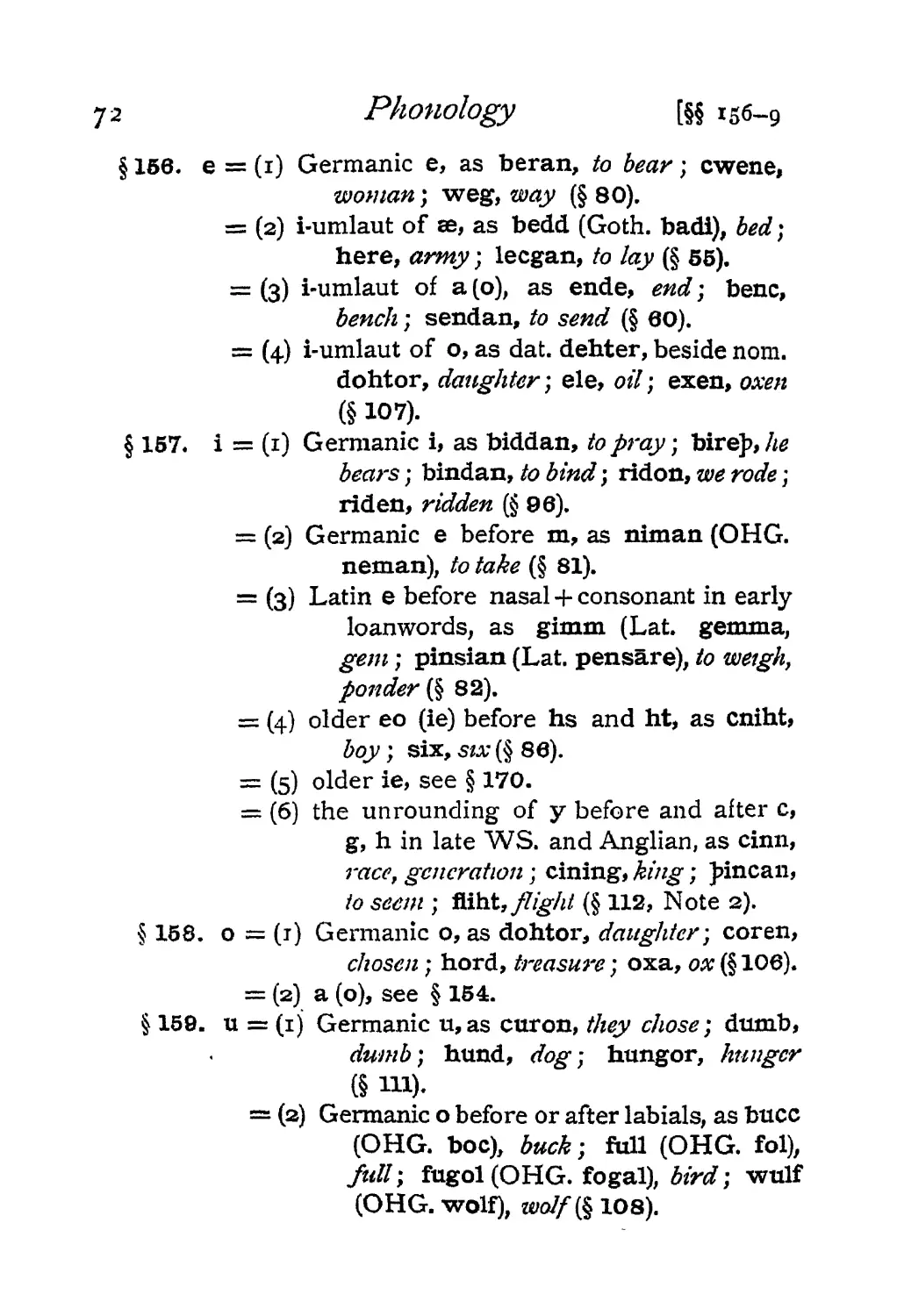
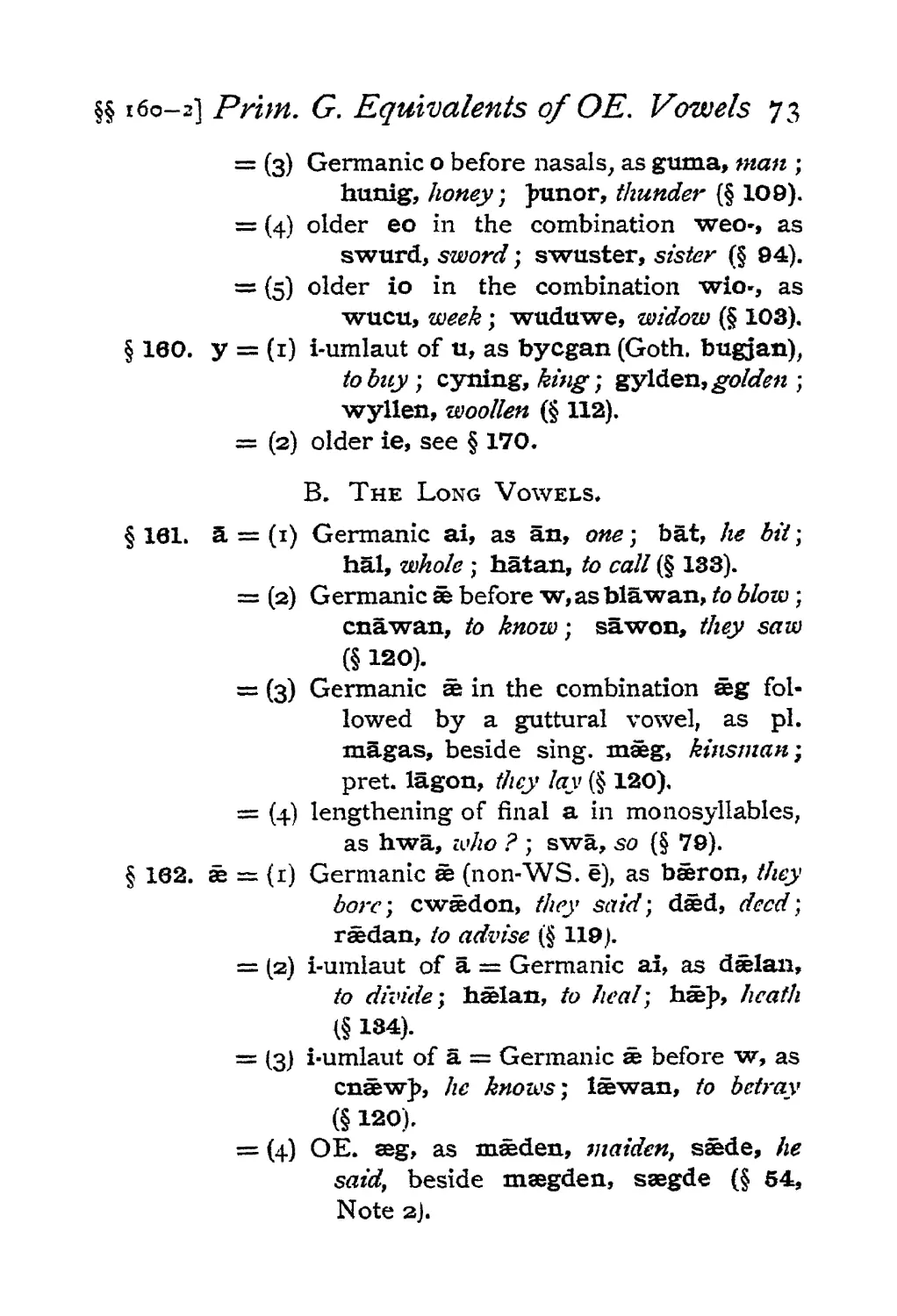
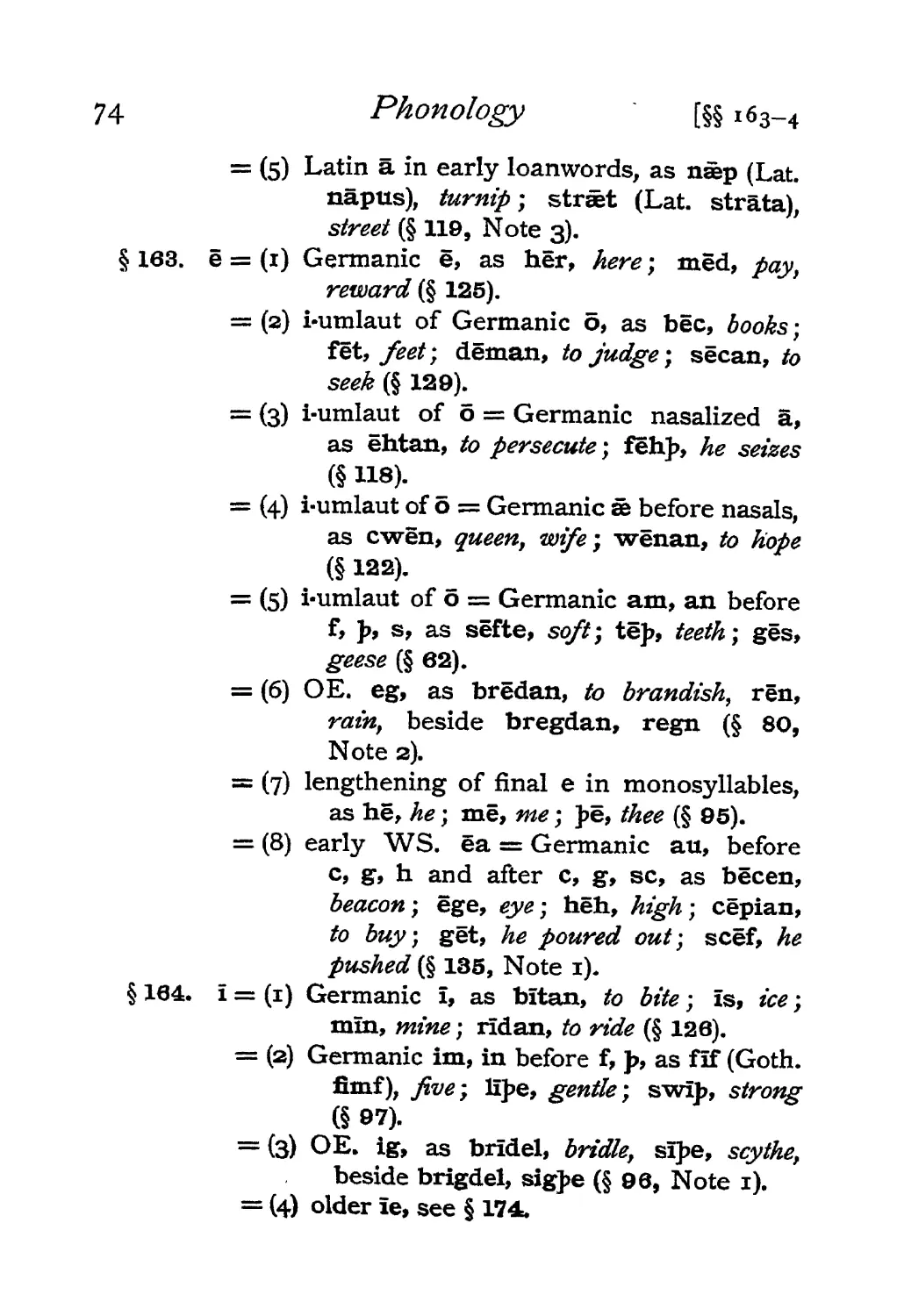
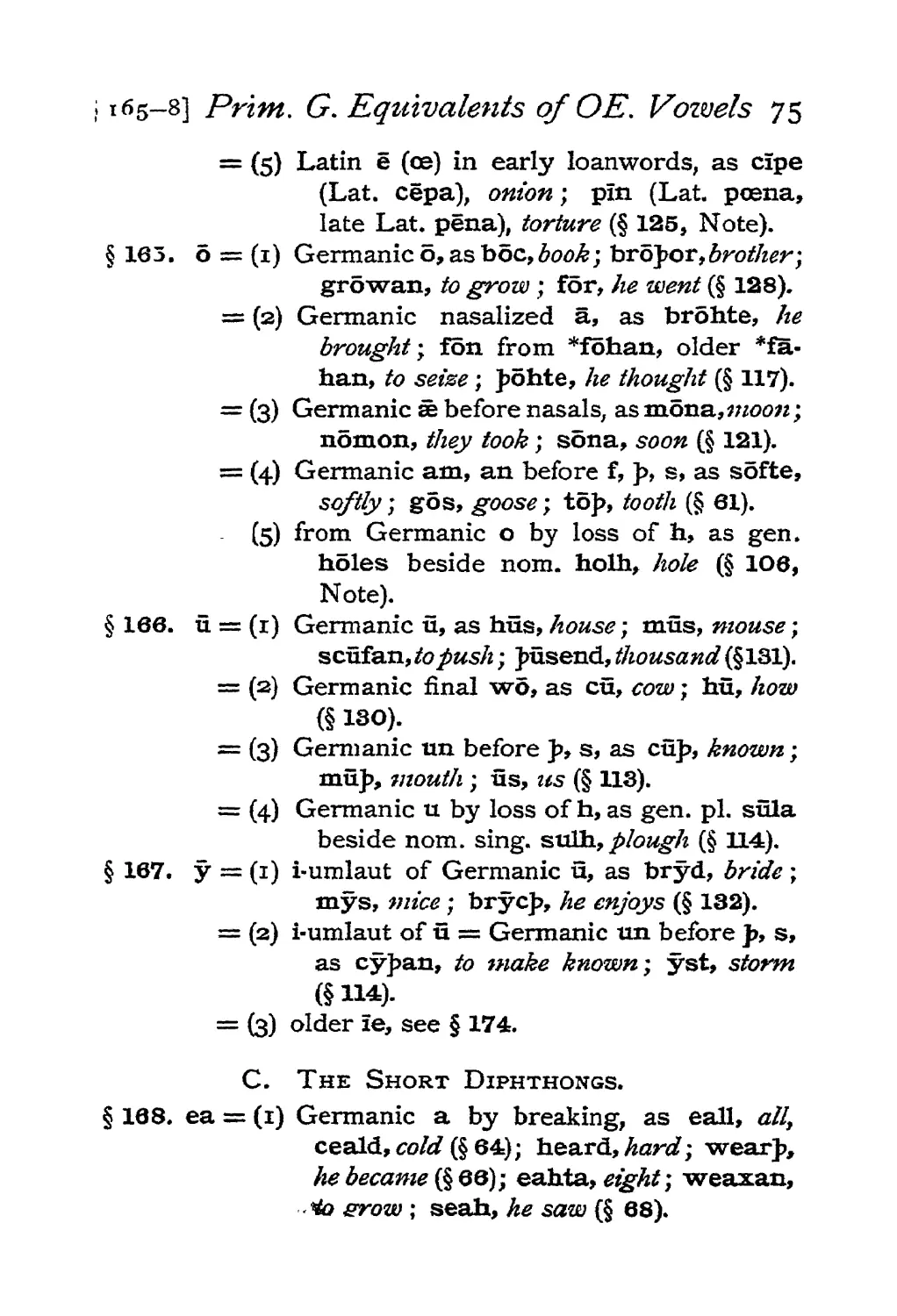


















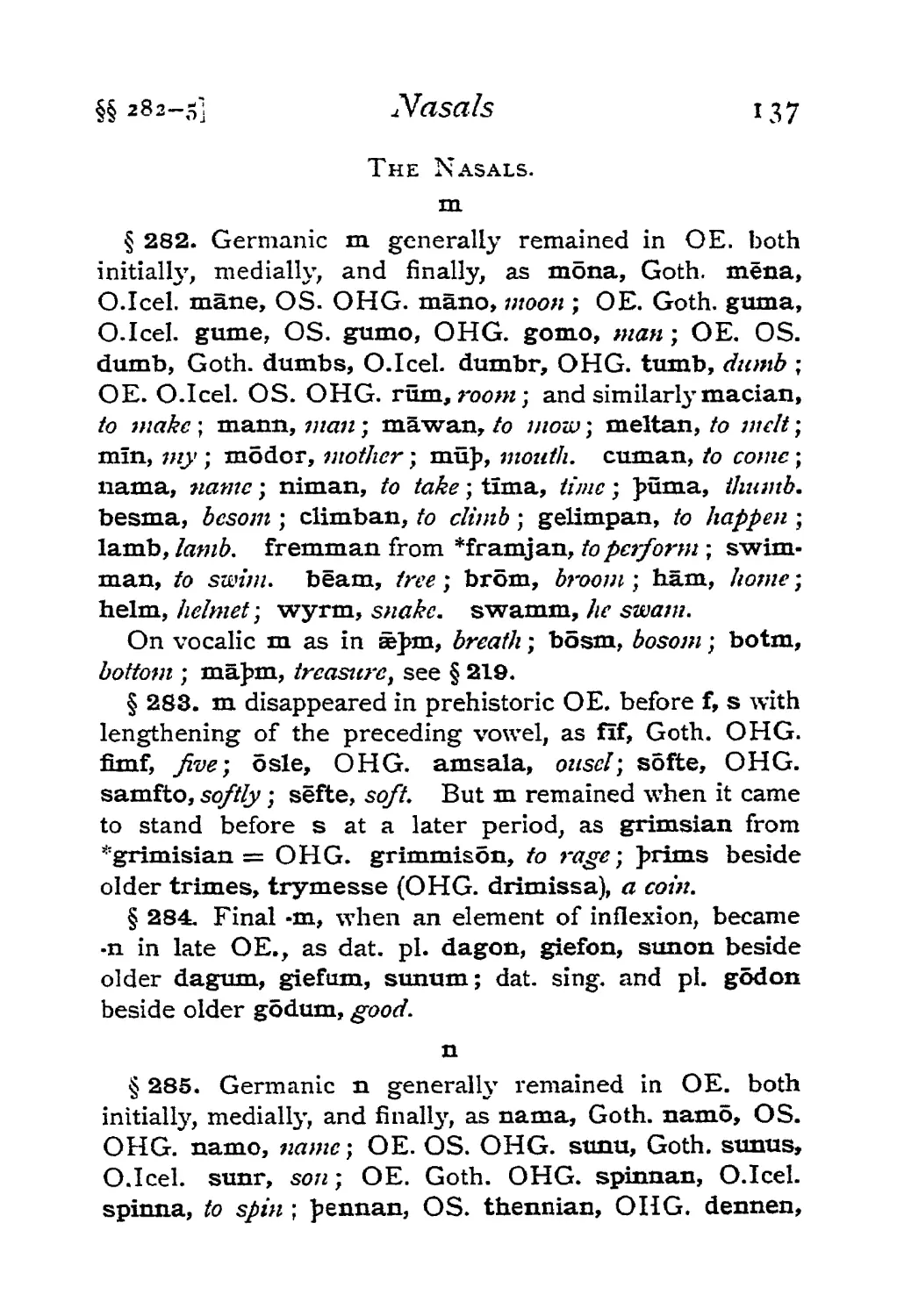
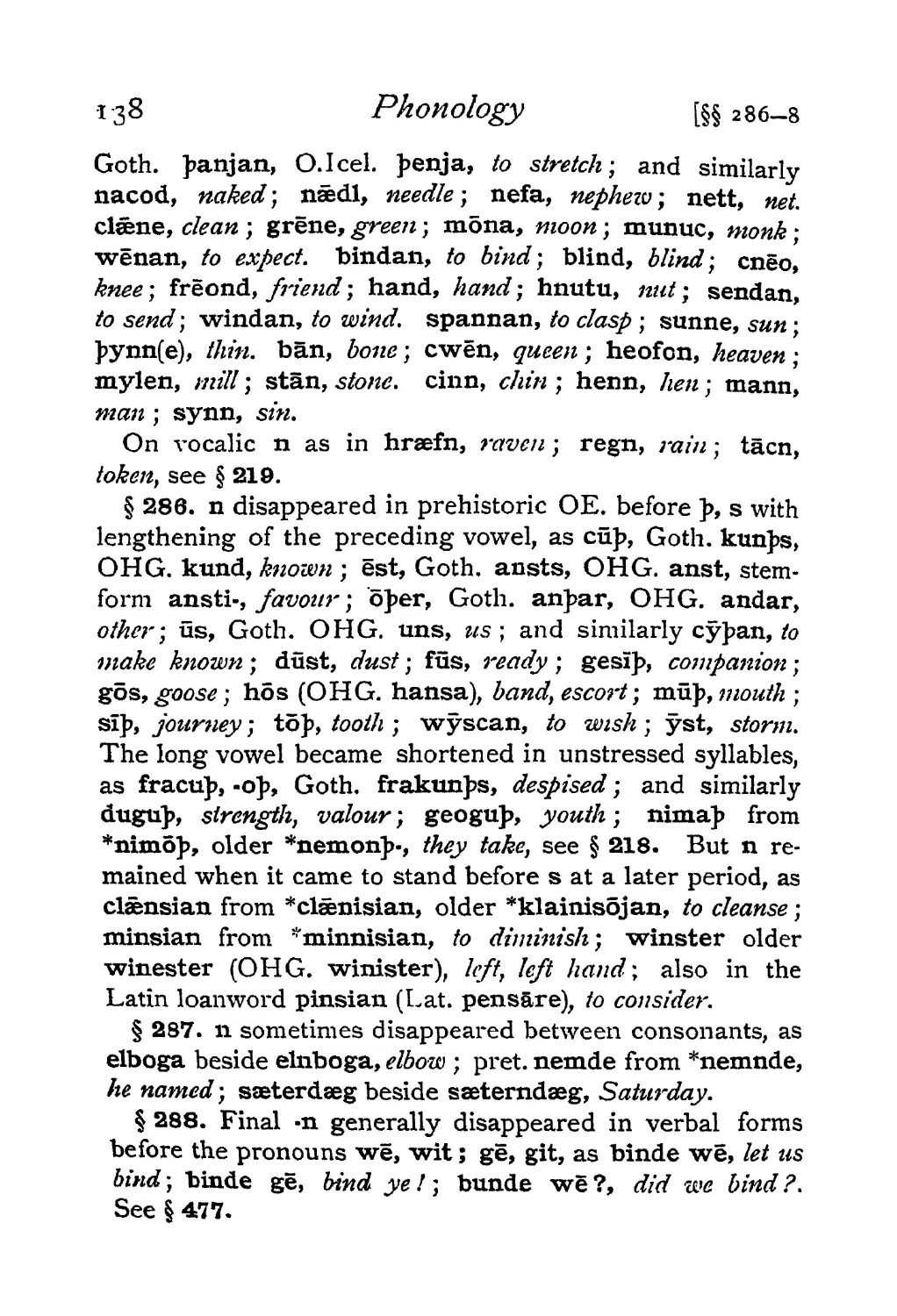

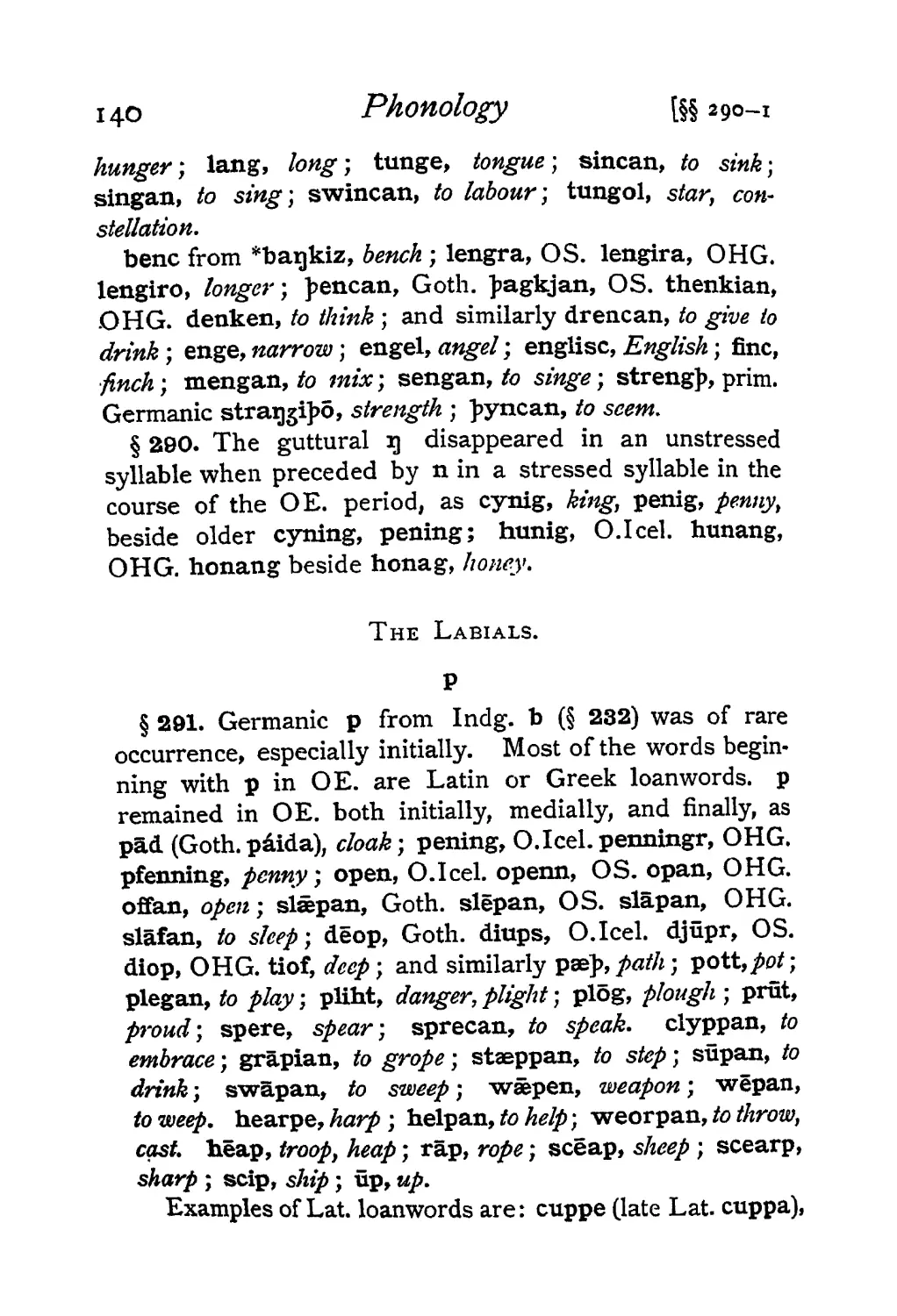

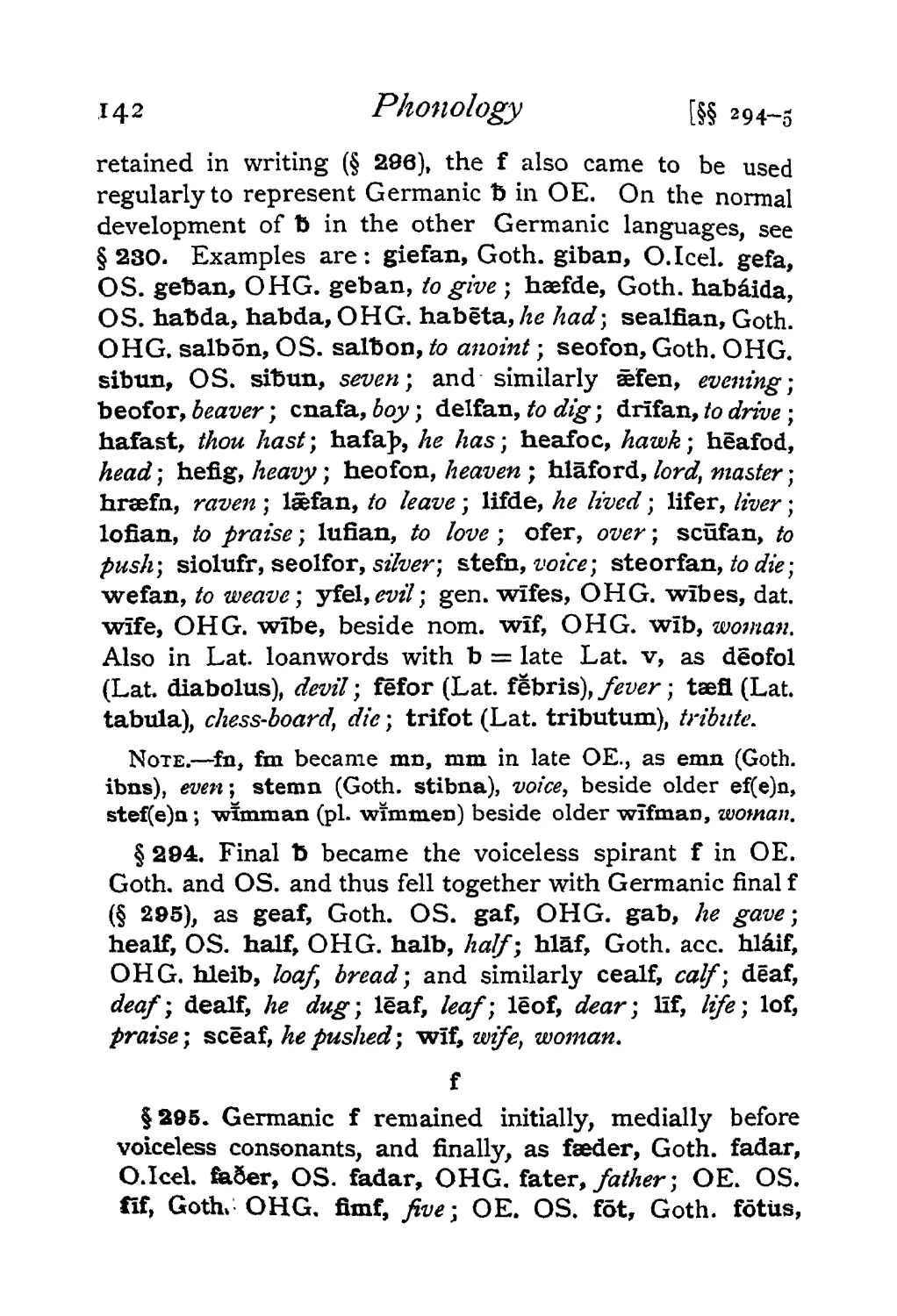

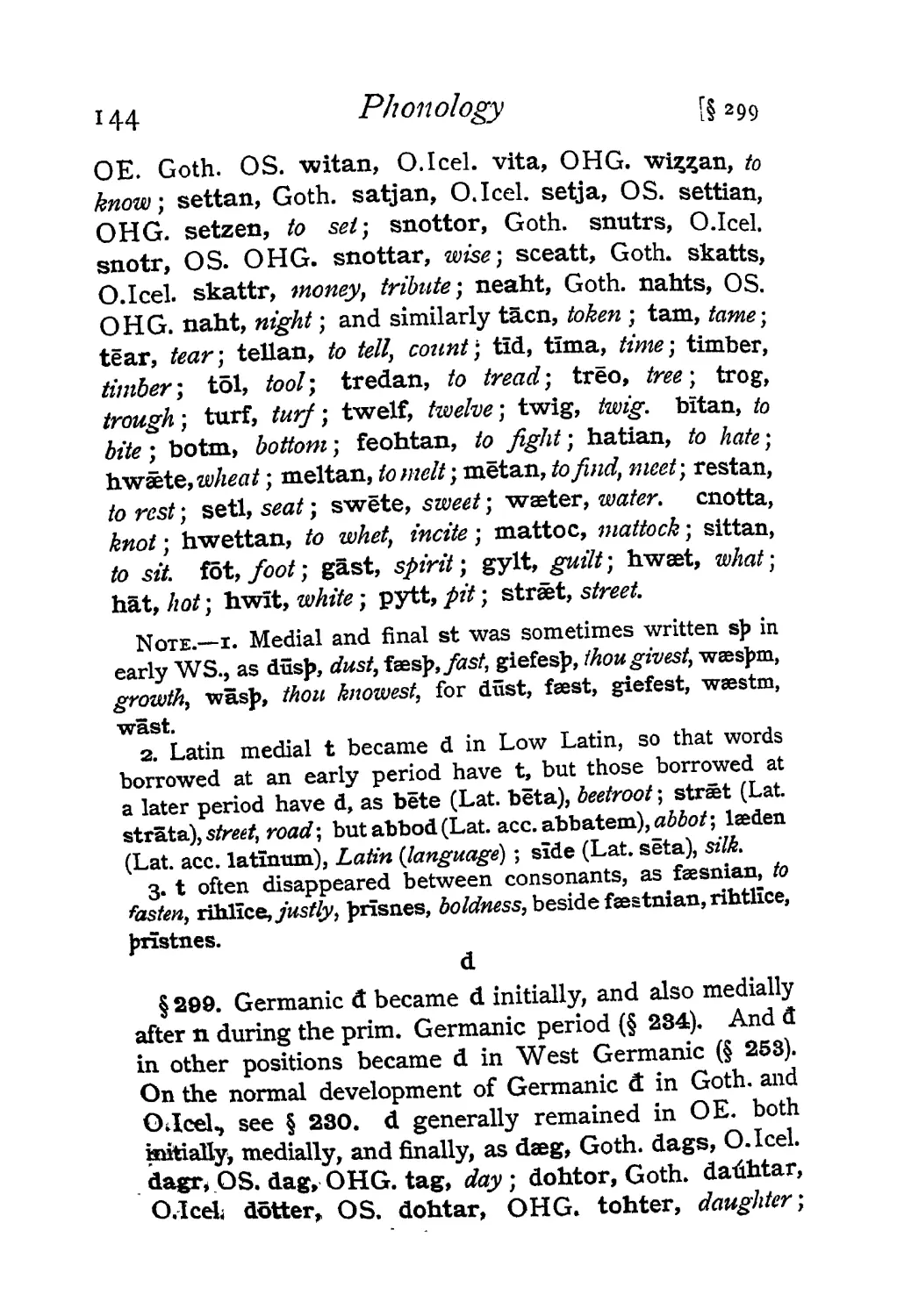


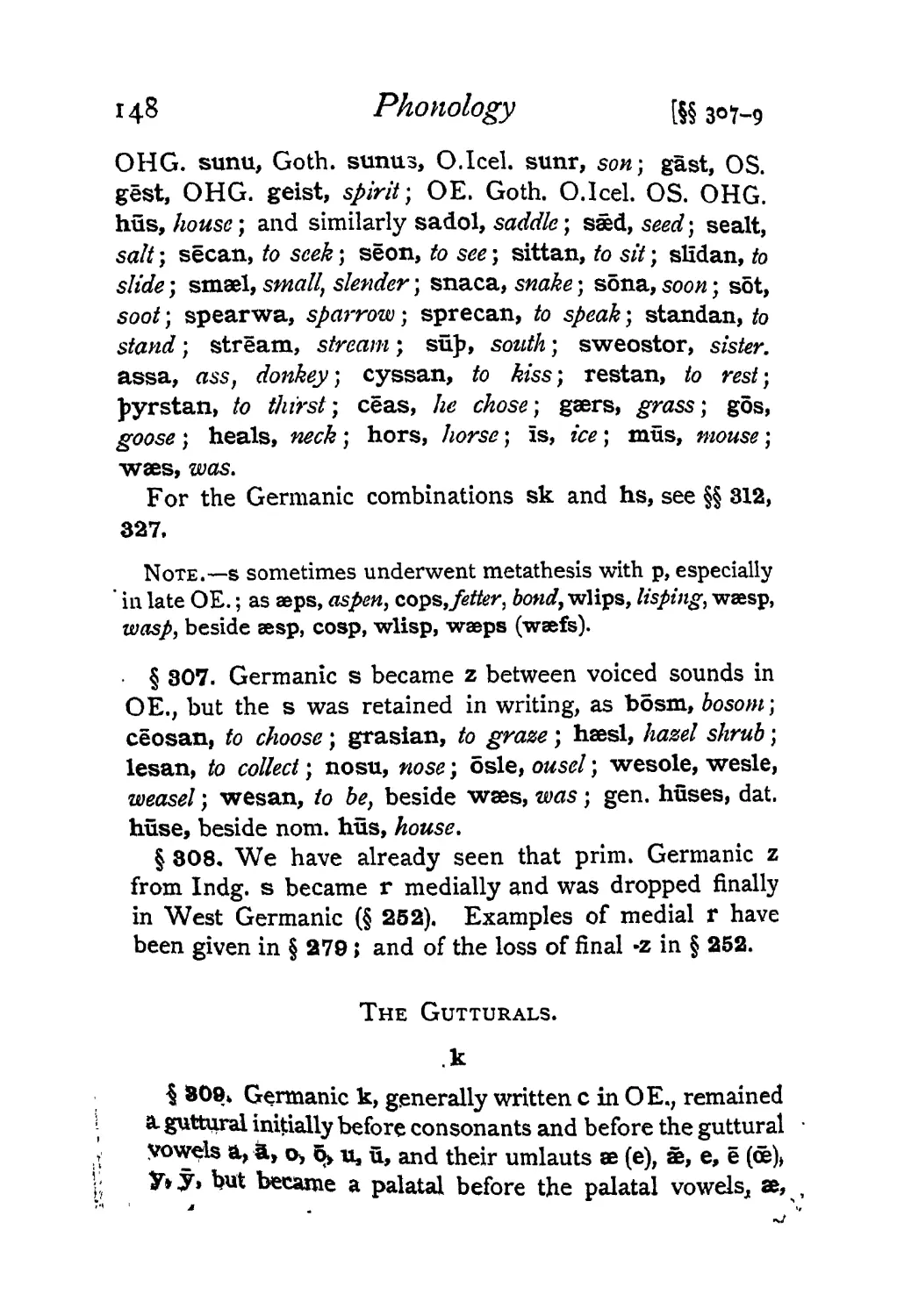
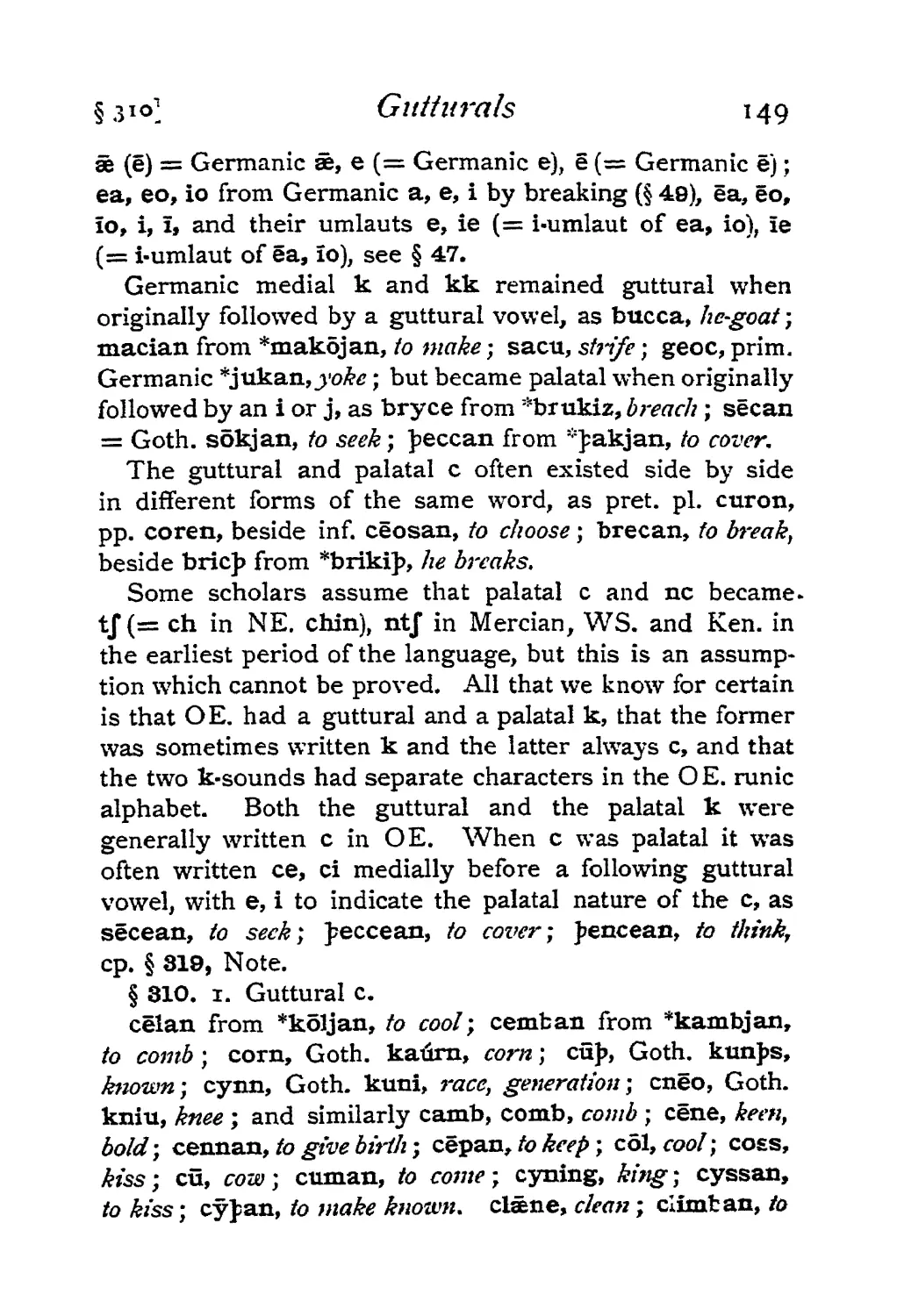
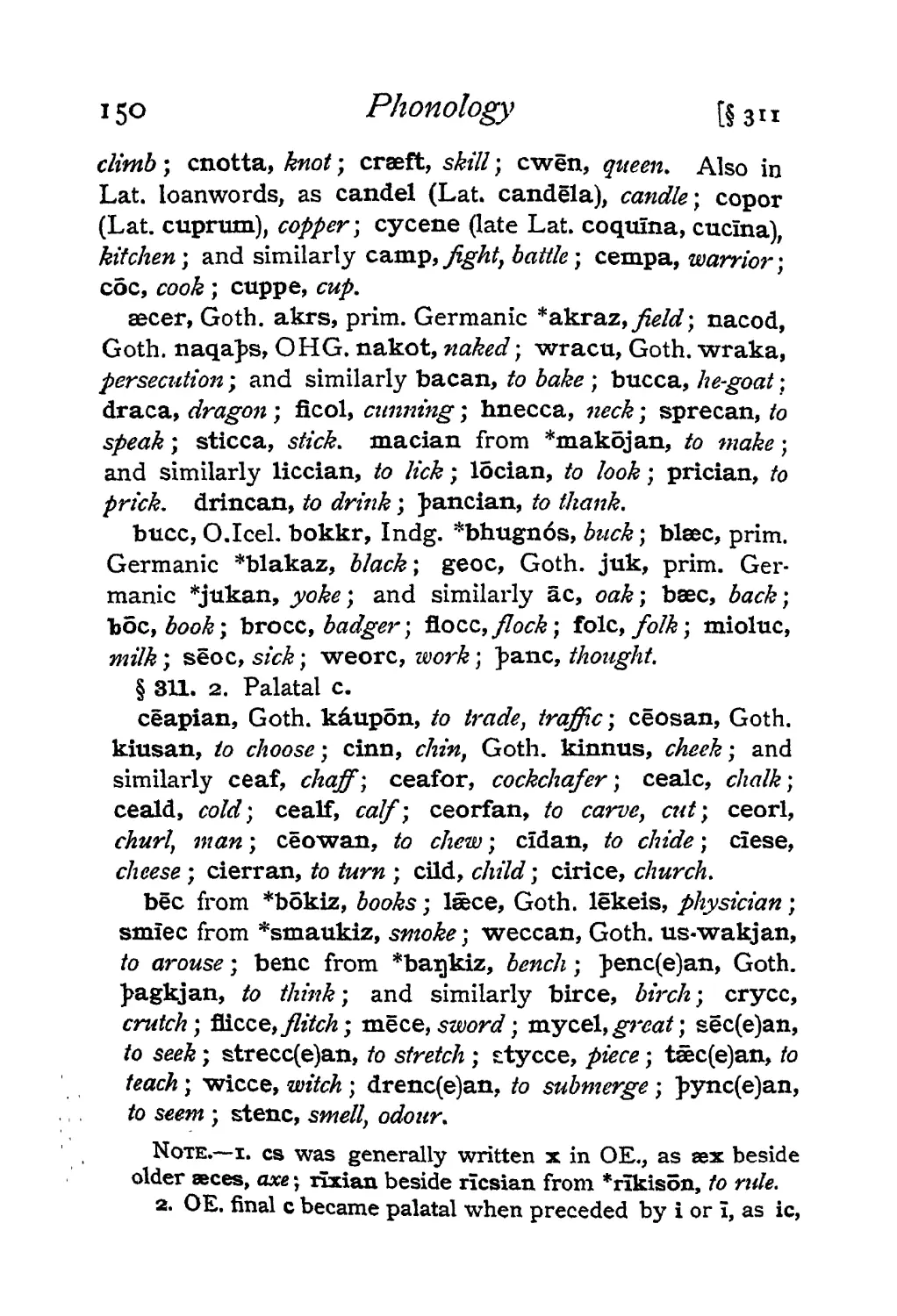
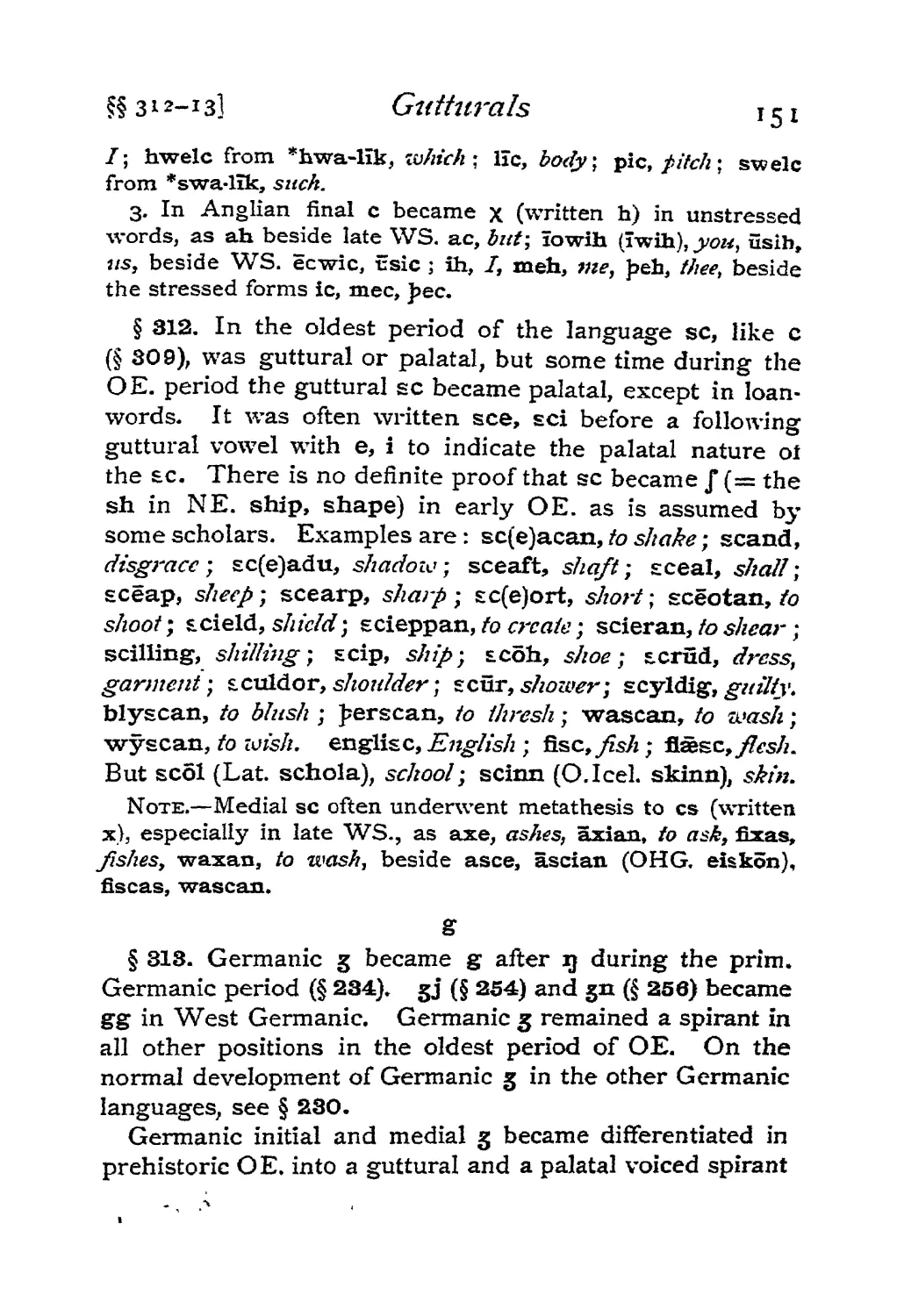
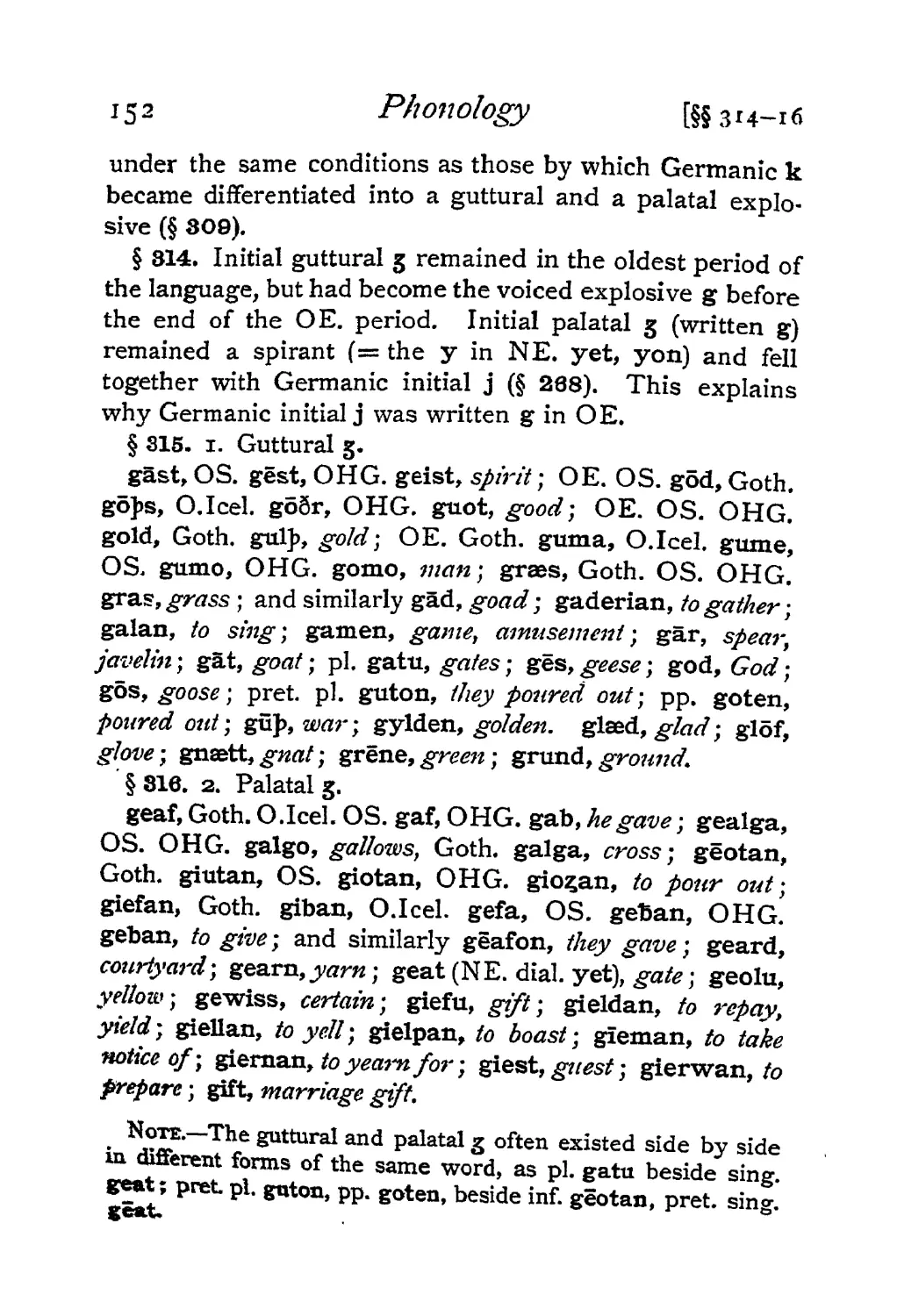


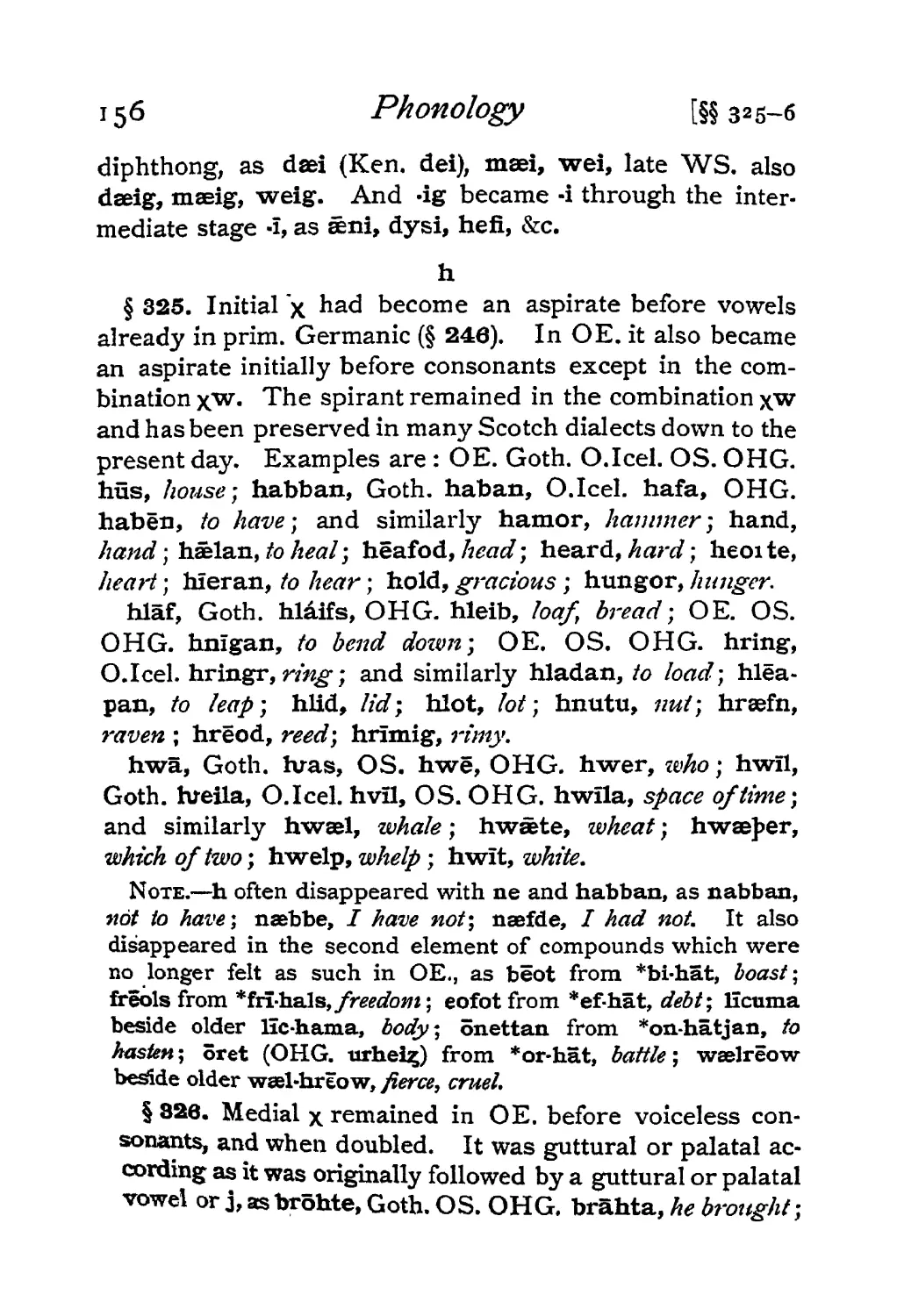
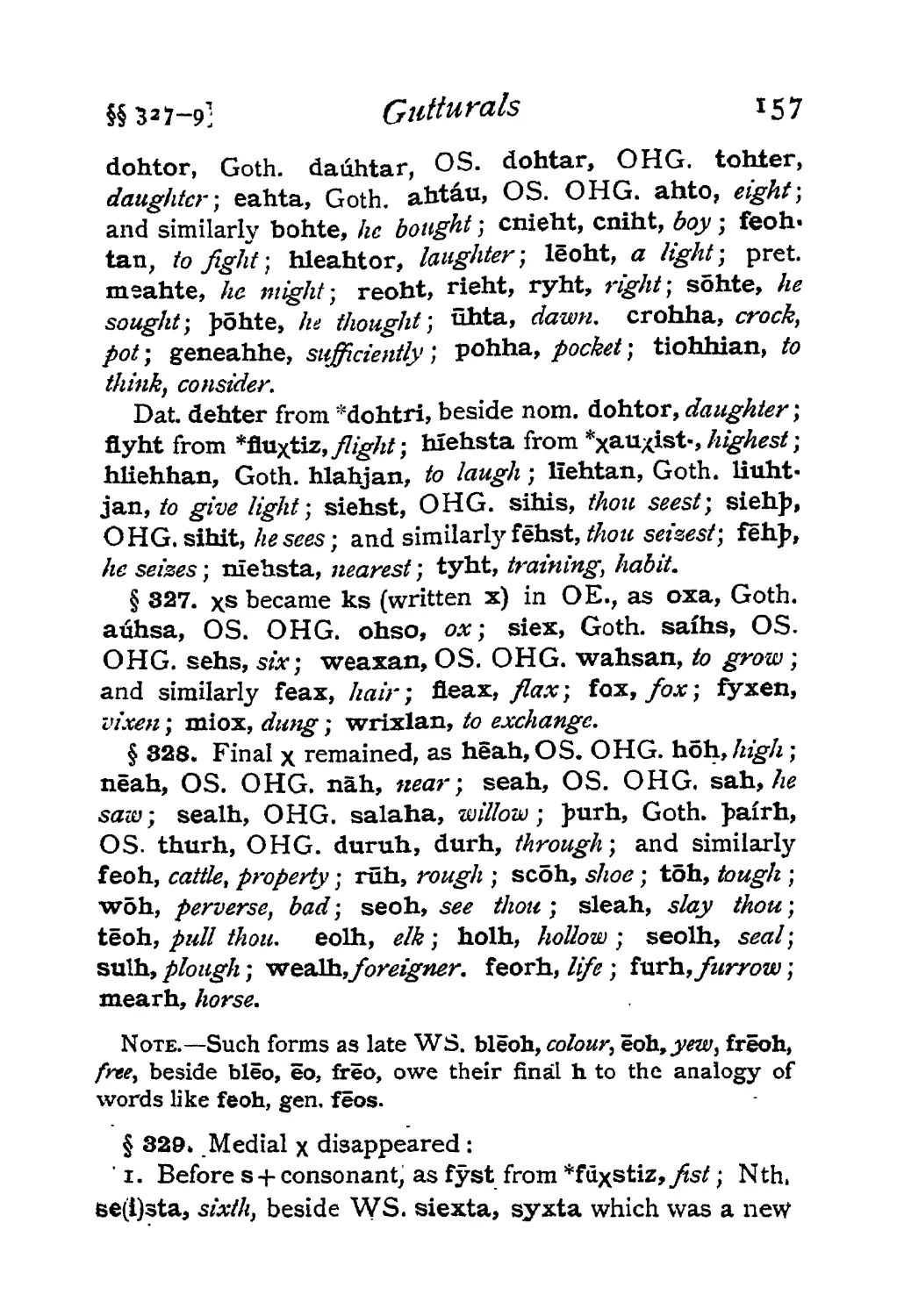




























































Text
THE STUDENTS, SERIES OF
HISTORICAL AND COMPARATIVE
GRAMMARS
EDITED BY
JOSEPH
WRIGHT
OLD
ENGLISH
GRAMMAR
HENRY FRO\VDE
OXFORD UNIVERSITY PRESS
LONDON, NEV YORK AND TORONTO
s9o8
OXFORD : HORACE HAIF
PR]NTER TO THE U,NI'ERSITY
PREFACE
I writing this Grammar we have kept steadily in view
the elass of students for whom the Series of Grammars
was originally planned. As it is not intended for
specialists, some details of more or less importance have
been intentionally omitted, but we venture to thînk that
the present volume contains ail that the ordinary student
will require to know about the subjeet. The student who
thoroughly masters the book will not only have gained
a eomprehênsive knowledge of Old English, but vîll also
have acquired the elements of Comparative Germanie
grammar. But from out long experienee as teaehers of
the subject, we should strongly reeommend the beginner
not to work through the phonology at the outset, but to
read Chapter I and sections 47-53, and then to learn
the paradigms, and at the saine rime to read some easy
texts sueh as are to be round in any of the Old English
Readers. This is undoubtedly the best plan in the end,
and wiI1 lead to the most satisfaetory results. In fact, it is
in out opinion a sheer waste of rime for a student to
attempt to study in detail the phonology of any language
before he bas acquired a good working knowledge of its
vocabulary and inflexions.
In selecting examples to illustrate the sound-laws we
have tried as far as possible to give words which bave
been preserved in M odern English. A eomparison of the
Index to the Grammar with an Old English Dictîonary
would show that we have thus ineluded nearly all the
simple words which have been preserved in the modern
language. Out objeet in doing this was to enable the
ri Preface
student to lay a solid foundation for his further study of
historical English grammar, and to provide a basîs for the
next volume of the Series, which will deal with Middle
English.
It was originally our intention to include in the present
volume some chapters on Syntax, but it was found that
the inclusion of these chapters would bave rendered the
book too large for the Series. This omission of the
syntax cannot however be regarded as a serious draw-
back, because the volume dealing with historical Englîsh
syntax is already in active preparation, and will, it is
hoped, be ready for press this year.
Although this Grammar makes no pretence of being an
exhaustive work, yet it is by far the most complete
Grammar that has hitherto been wrîtten in our own
language, and the first to deal with the subject in a strictly
scientific manner. We gratefully acknowledge the help
we have derived from the learned articles and books by
that splendid band of German Anglisten which bas donc
so much to throw light upon the history and philology or
out language in ail its stages. On pp. xiiî-xiv will be round
a select list of the books whîch we have round most useful,
but itis our pleasant duty to mention here our special
indebtedness to the works of BIîlbring, Cosijn, and
Sievers.
In conclusion, we wish to express our sincere thanks to
the Controller of the University Press for his great kînd-
ness in complying with out wishes in regard to special
type, and to the Press Reader for the excellent manner in
which he bas read the proofs.
JOSEPH WRIGHT.
OxFoD, EL%ZABETH M. WRIGHT.
January, 19o8.
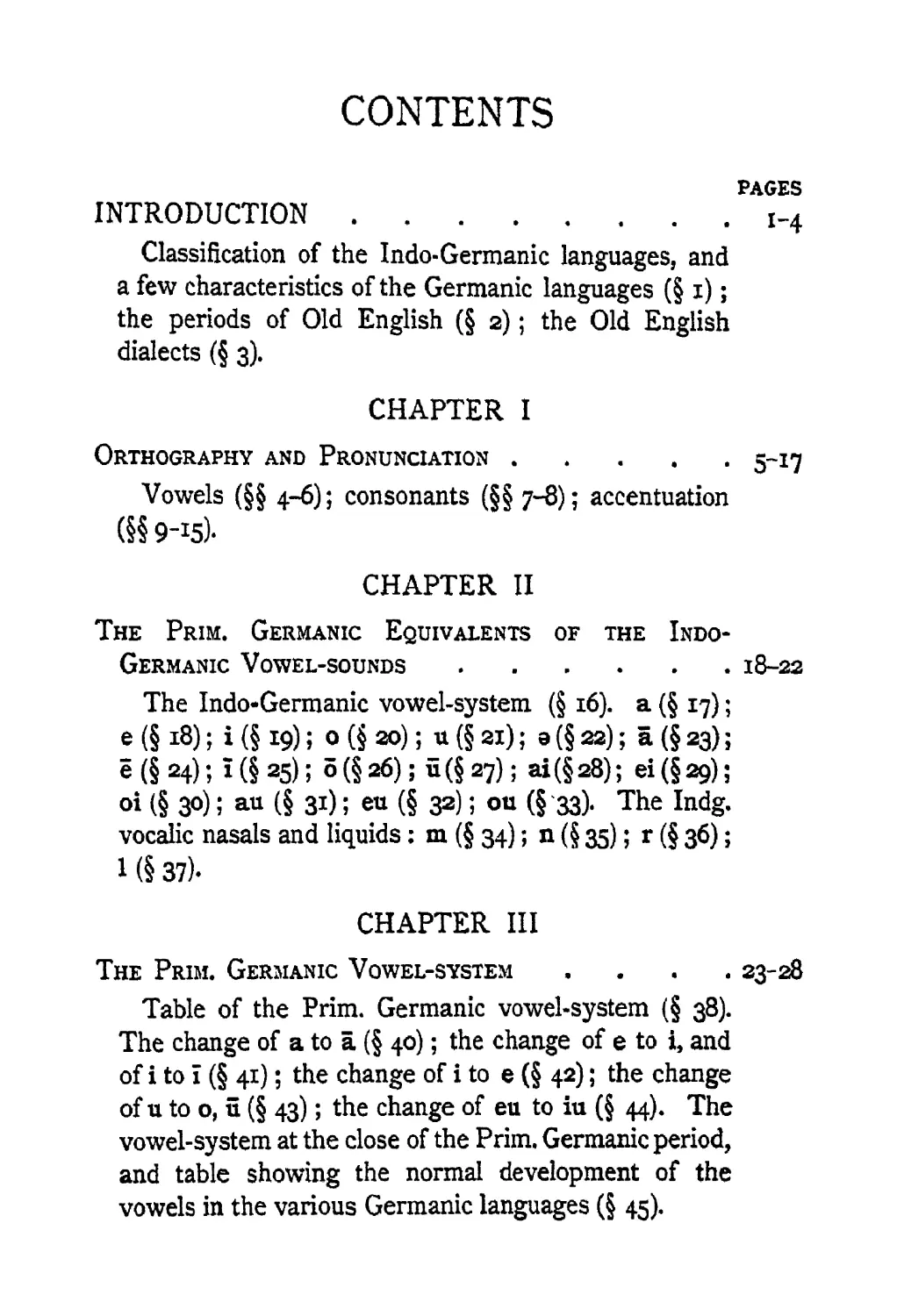
CONTENTS
INTRODUCTION ........
Classification of the Indo-Germanic languages, and
a few characteristics of the Germanic languages (§ );
the periods of Old English (§ ); the Old English
dialects (§ 3).
PAGES
CHAPTER i
ORTHOGAPHY AND PRONUNCIATION ..... 5-7
Vowels (§§ 4-6); consonants (§§ 7-8); accentuation
(§§ 9-s).
CHAPTER II
THE PRIM. GERMANIC EQUIVALENTS OF THE INDO-
CaERMANIC VOWEL-SOUNDS ...... ][8-22
The Indo-Germanîc vowel-system (§ 6). a (§
e (§ ); i (§ ç); o ( ) ; u ( ); ( =); ( 3);
ê ( =4) ; i ( 25) ; 5 ( ) ; ( aT) ; ( =8); ei ( ) ;
oi ( 3o); au ( 31); ¢= ( ); ou ('). The Indg.
vocMic nasals and liquids m ( 34); n ( ); r ( 36);
1 ( 37).
CHAPTER IIi
THE PRIç. GERtANIC VOWEL-SYSTEM .... 23-2.
Table of the PHm. Germanic vowel.system (§ 38).
The change of a to . (§ 4 o) ; the change of e to i, and
of i to i (§ 4I); the change of" i to e (§ 4); the change
of u to o, (§ 43); the change of eu to lu (§ 44). The
vowel-system at the close of" the Prim. Germanîc period,
and table showing the normal development of the
vowels in the varîous Germanic languages (§ 45).
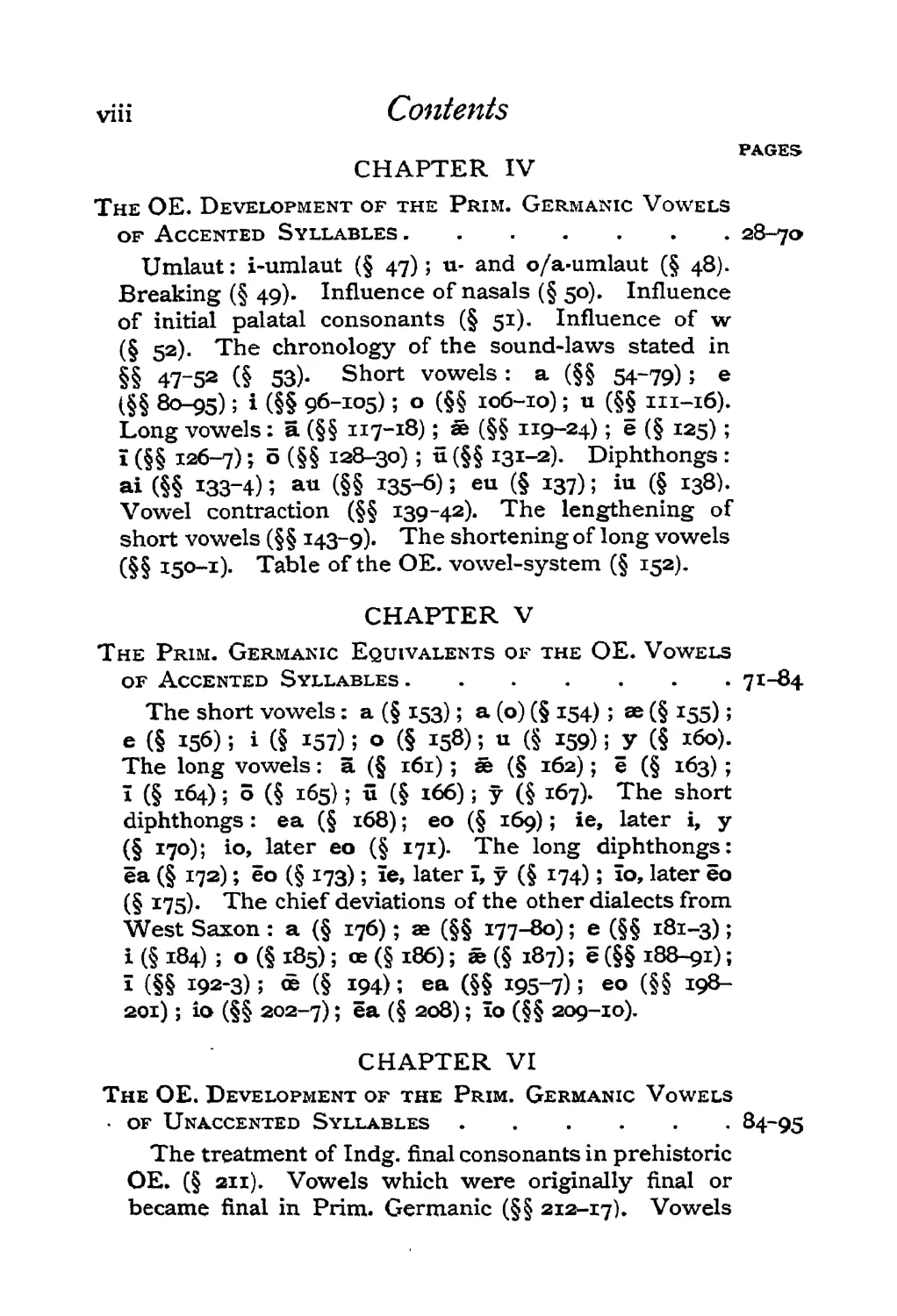
PAGE
CHAPTER l'v"
THE OE. DEVELOPMENT OF THE PRIIEZ. CrERMANIC VO%VELS
OF ACCENTED SYLLABLES ....... 8
Umlaut: i-umlaut ( 47); u. and o/a-umlaut ( 48).
Breaking ( 49)- Influence of nasals ( 50). Influence
of initial palatal consonants (} 5x). Influence of w
(ç 52). The chronolo of the sound-laws stated in
} 47-5 a (} 53)- Sho vowels: a (}} 54-79) ; e
} S); î (}} 96-1°8) ; o (} zo6-zo) ; u (}} zz-6).
Long vowels : (} 117-18) ; (} II9-a4) ; E ( IaS) ;
l (} ) ; (}} IO) ; (}} I3I-a). Diphthongs :
ai (} x83-4); au (}} I35); eu (} I37); iu (ç z38).
Vowel contraction (} I9-4a). The lenhening of
sho vowels (} 143-9). The shortening of long vowels
( i5z). Table of the OE. vowel-system ( 152 ).
CHAPTER V
THE Pllt. GEI.MAXlC EQUtVALENTS OF THE OE. Vow
OF ACCENTED SYLLABLES .......
The sho vowels : a ( z53) ; a (o) ( z54) ; oe ( 155) ;
« ( x56); i (} x57); o ( 158); u ( 59); Y ( I).
The long vowels" ( 6z); (ç I62); ê ( 163) ;
i (} x64); (} 165); (} I); (}I67). The short
diphthongs" ea ( x68); eo (} I); le, later i, y
( xTo); io, later eo ( i7I). The long diphthongs"
êa (} Ia) ; êo (} x73 ) ; ie, later , (} I4) ; o, later
(} z75). The chier deviations of the other dialects from
West 8on" a (} 176); oe (}} I77); e (}} I81-8);
i ( 184) ; o ( xss); oe ( ); (} x87); (ç} );
CHAPTER VI
THé. OE. I)EVELOPIENT OF TIIE PRIM. GERMANIC VOWELS
OF UNA.CCENTED SYLL&BLES ...... 84-9
The tr¢atment of Indg. final consonants în prehistoric
OE. (§ 2zx). Vowels which were originally final or
became final in Prim. Gcrmanic (§§ 2xa-z7). Vowels
which came to stand in final syllables in prehistorîc OE.
(§ 0.x8). Final vocalic nasals and liquids in prehistoric
OE. (§ 2x9). Svarabhakti vowels (§ 22o). Vowels in
medial syllables (§§ x-3).
PAGES
CHAPTER VII
ABLAUT (§§ 2.4M) ....... 9-I00
CHAPTER. VIII
THé- FIRST SOUh'D-SHIFTING, VERNER'S L«w, .'D OTHER
CONSONANT CHANGES VHICH TOOK PLACE IN THE PRII.
GERIIANIC LAh'6UAGE ...... IO0-I2I
'Table of the Indo-Germanîc consonaut-system
(§ 29). The normal equivalcnts of the Indg. explosîves
în Latin, Greek, and the Germanic languages (§ 23o ).
The first sound-shifting:--the tenues (§ 23I); the
mediae (§ 232); the tenues aspiratae (§ 233); the .
mediae aspiratae (§§ 234-5). The chronological order
ofthe first sound-shifting (§ 236 ). The twofold develop-
ment of the Indg. velars in the Germanic languages
(§ :dT)- Verner's law (§§ 238-9). Other consonant
changes (§§ 4o-5o). Table of Prim. Germanie conso-
nants (§ 0.5).
CHAPTER IX
SPECIAL WEST GERMANIC MODIFICATIONS OI" THE GENERAL
GEIIANIC CONSONANT-SYSTEM .... 122--10. 5
Prim. Germanic z (§ 252). Prim. Germanic et (§ 253 ).
The doubling of consonants (§§ 254-6).
CHAPTER X
THE OE. I)EVELOPET OF THE GENERAL GERIAIIC
CONSONANT-S¥STEM ....... 125-159
OE. double consonants (§ 0.58). The simplification of
double consonants (§ 59). The doubling of consonants
in OE. (§ 6o). The voicîng of f, ], (§ 26). The
unvoicing of I, (§ 0.60.). The semivowels : w (§§ 63-
7); J (§§ 68-75). The liquids: I (§§ 76-7); r (§§ 78-8r).
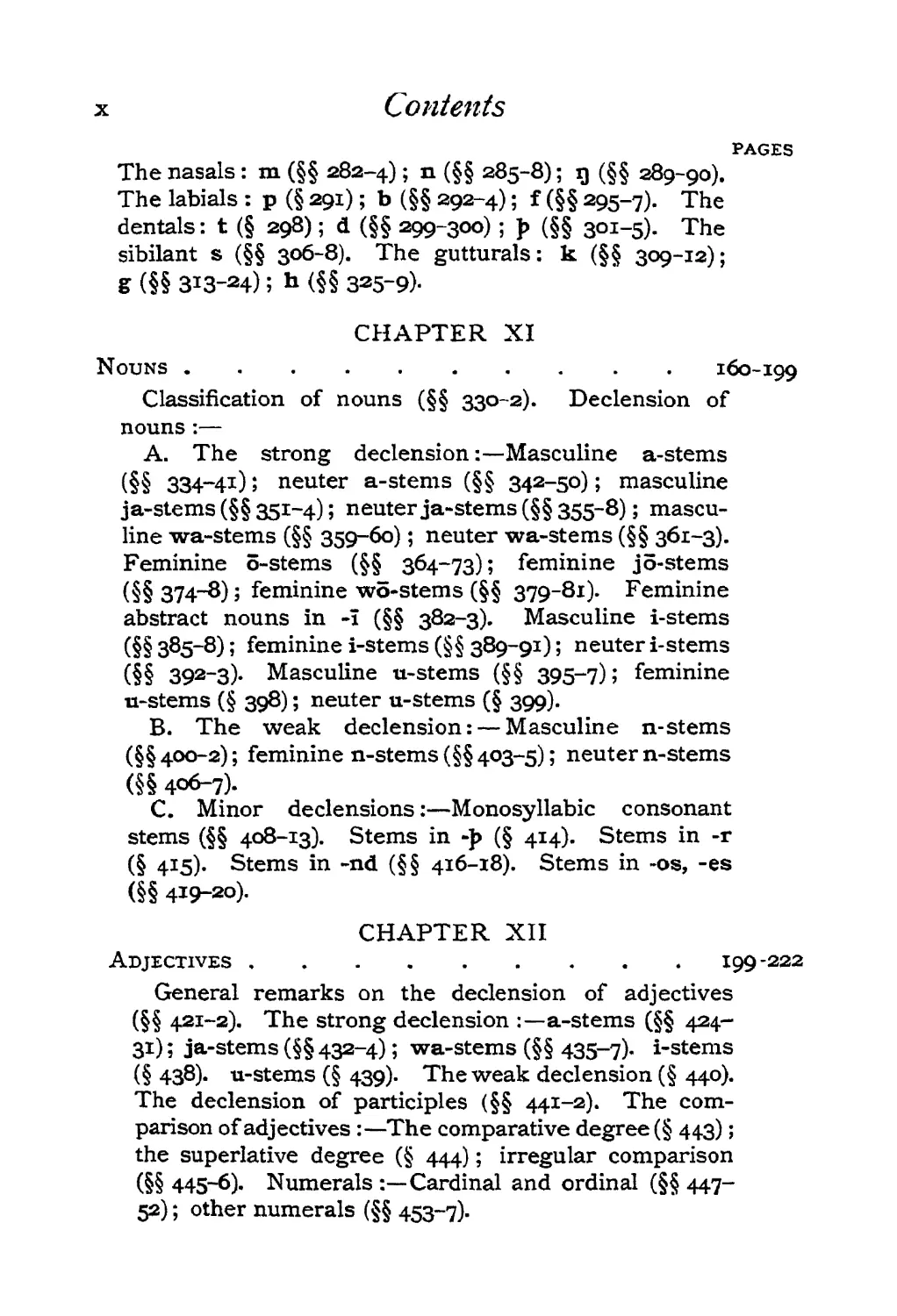
The nasals : m (§§ e8.-4) ; n (§§ 285-8); r 3 (§§ 9-9o).
The labials : p (§ .9I) ; b (§§ 292-4) ; f (§§ 295-7). The
dentals: t (§ .98) ; d (§§ )9-3oo) ; ] (§§ 3ox-5). The
sibilant s (§§ 3o6-8). The gutturals: k (§§ 3o9-i.);
g (§§ 33-4) ; h (§§ 3s-9).
PAGES
CHAPTER XI
NOUNS .......... I6o-i99
Classification of nouns (§§ 33o-s). Declension of
nouns :--
A. The strong declensîon :--Masculine a-stems
(§§ 334-41); neuter a-stems (§§ 342-50); masculine
ja-stems (§§ 3.51-4) ; neuter ja-stems (§§ 355-8) ; mascu-
line wa-stems (§§ 359-6o) ; neuter wa-stems (§§ 36r-3).
Feminine 5-stems (§§ 364-73); feminine jS-stems
(§§ 374-8) ; feminine wS-stems (§§ 379-8). Feminine
abstract nouns in -î (§§ 38.-3). Masculine i-items
(§§ 385-8) ; feminine i-stems (§§ 389-9); neuter î-stems
(§§ 39s-3). Masculine u-stems (§§ 395-7); feminine
u-stems (§ 398); neuter u-stems (§ 399).
B. The weak declension:--Masculine n-stems
(§§ 400-2) ; feminine n-stems (§§ 403-5) ; neuter n-stems
(§§ 406-7).
C. Minor deelensions :---Monosyllabie consonant
stems (§§ 4oe-3). Stems in -] (§ 4t4)- Stems in -r
(§ 415). Stems în-nd (§§ 46-8). Stems in-os,-es
(§§ 49-o).
CHAPTER XII
ADJCTVES ......... 99
General remarks on the declension of adjectives
(§§ 4-.). The strong declensîon :--a-stems (§§ 424 -
al); ]a-stems (§§ 4-4) ; wa-stems (§§ 435-7)- i-stems
(§ 438). u-stems (§ 439)- The weak declension (§ 440).
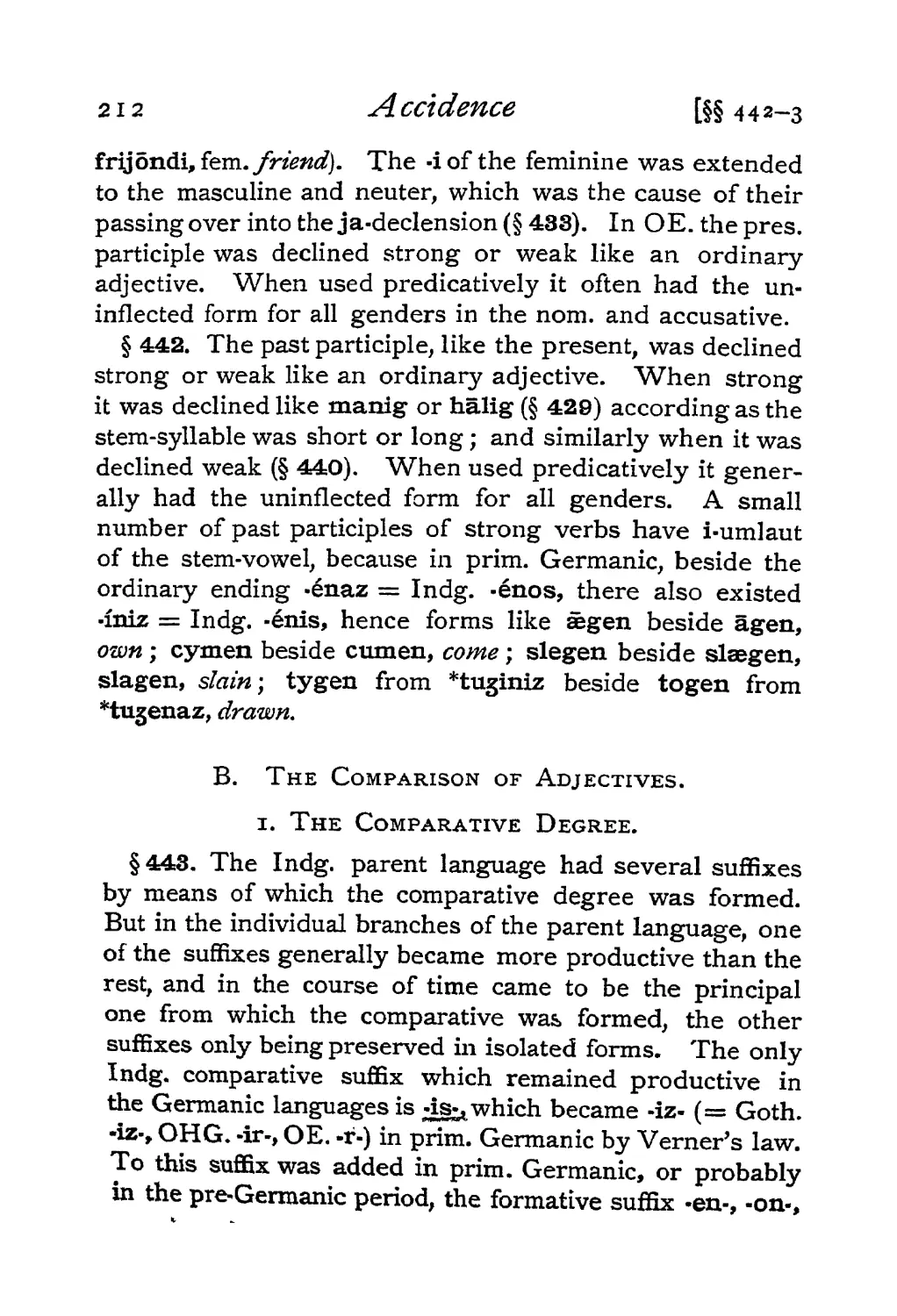
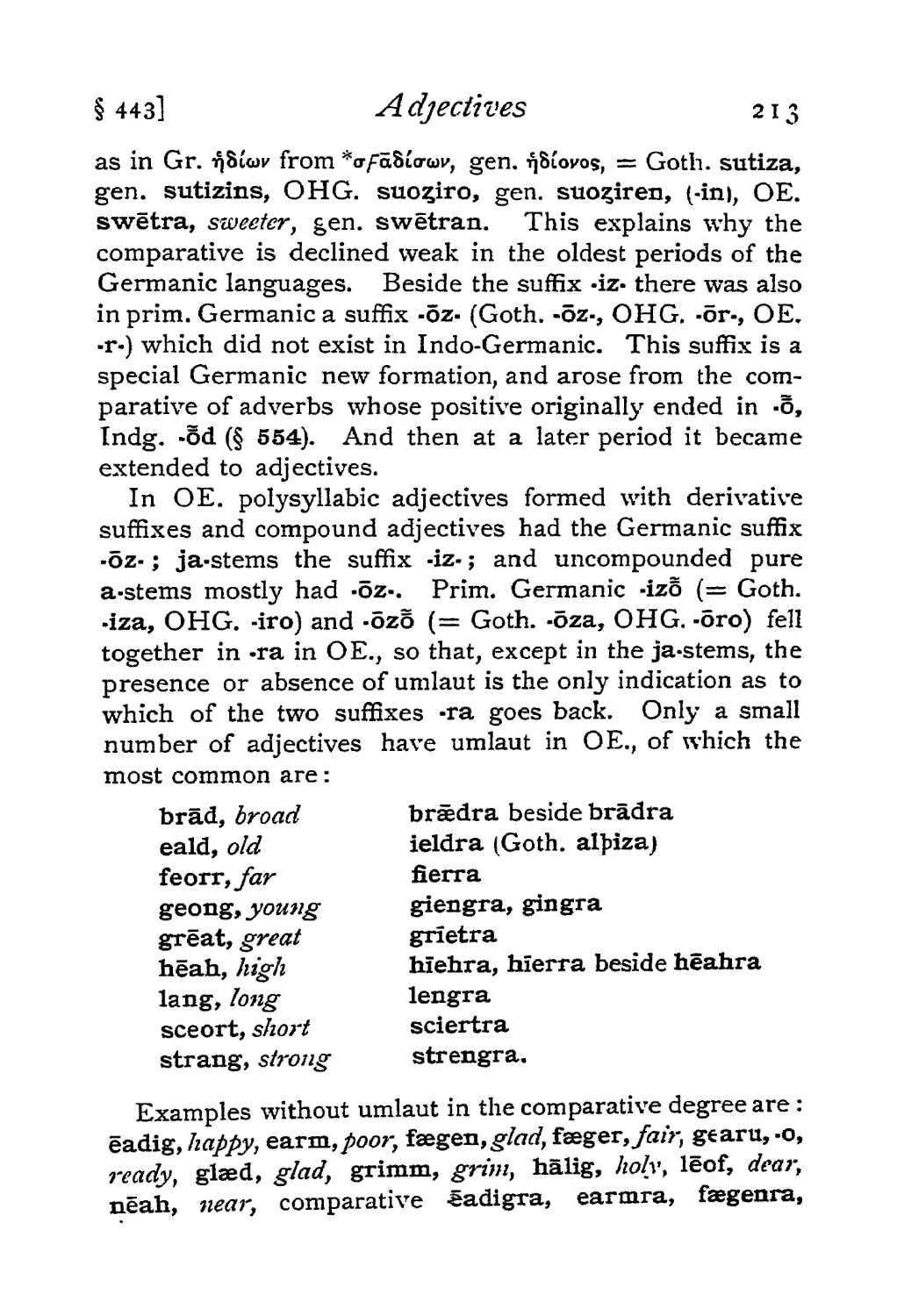
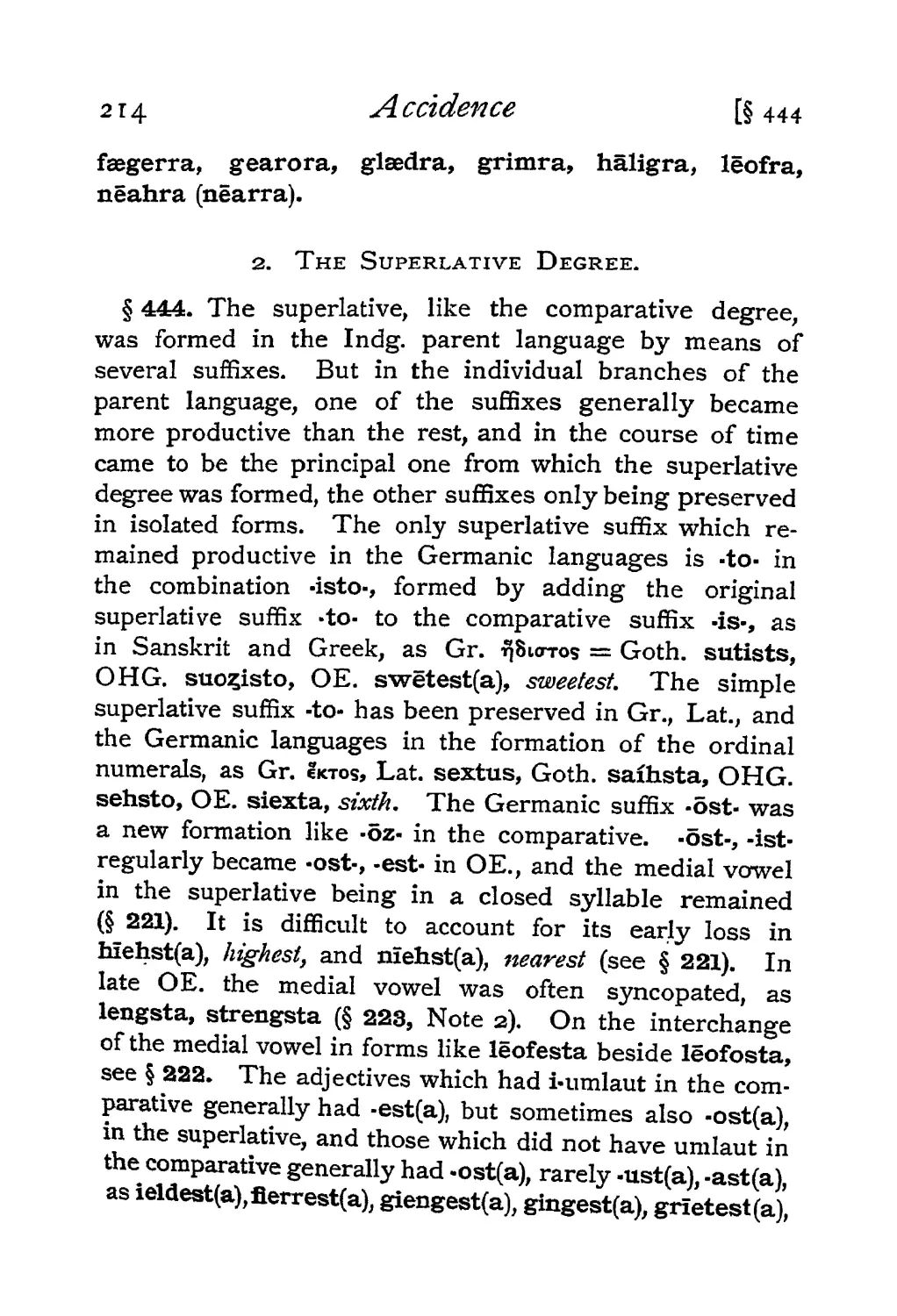
The declension of participles (§§ 44-o.). The eom-
parîson ofadjectives :--The comparative degree (§ 443);
the superlative degree (§ 444); irregular eomparison
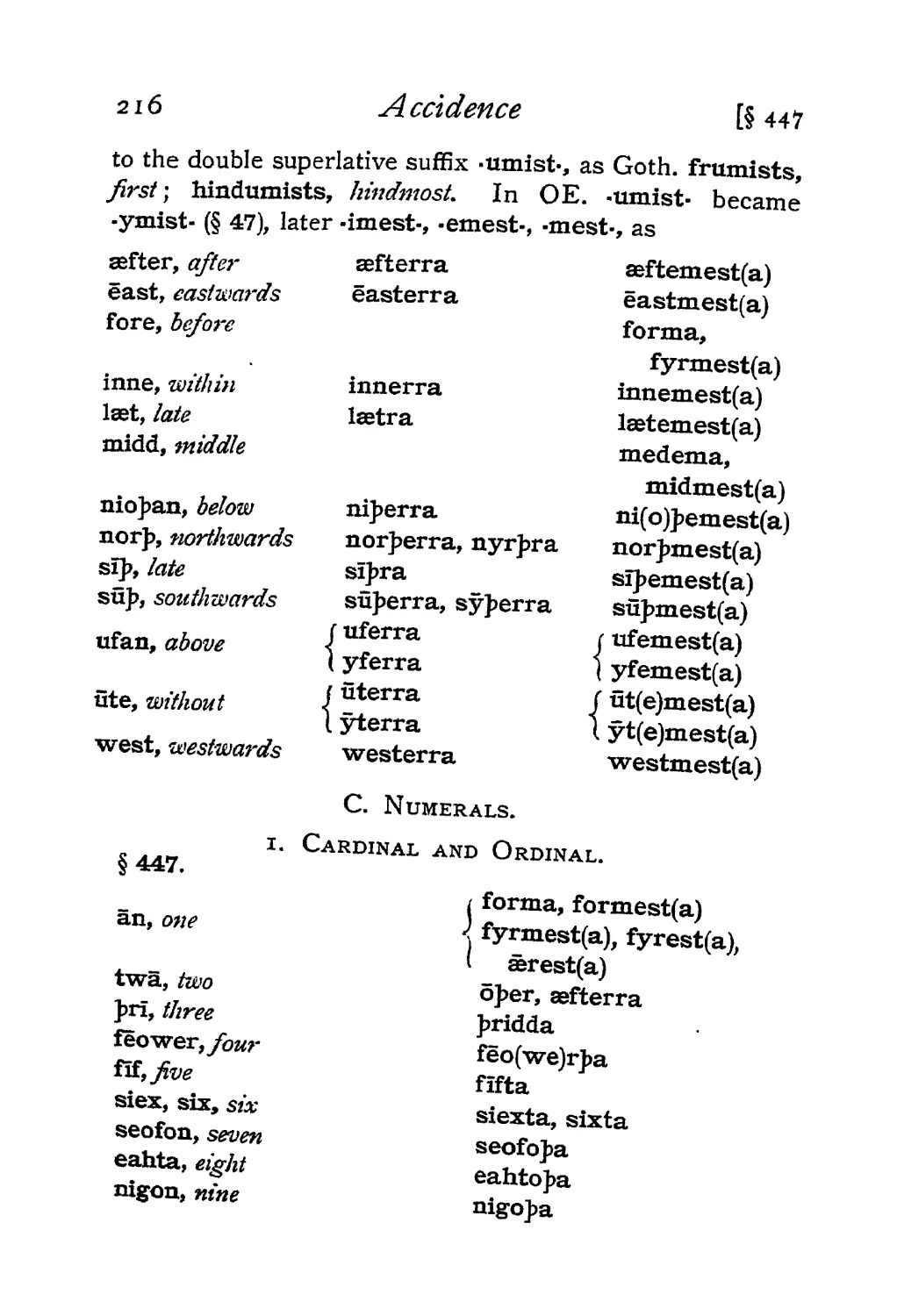
(§§ 445-6). Numerals :--Cardinal and ordinal (§§ 447-
52); other numerals (§§ 453-7)-
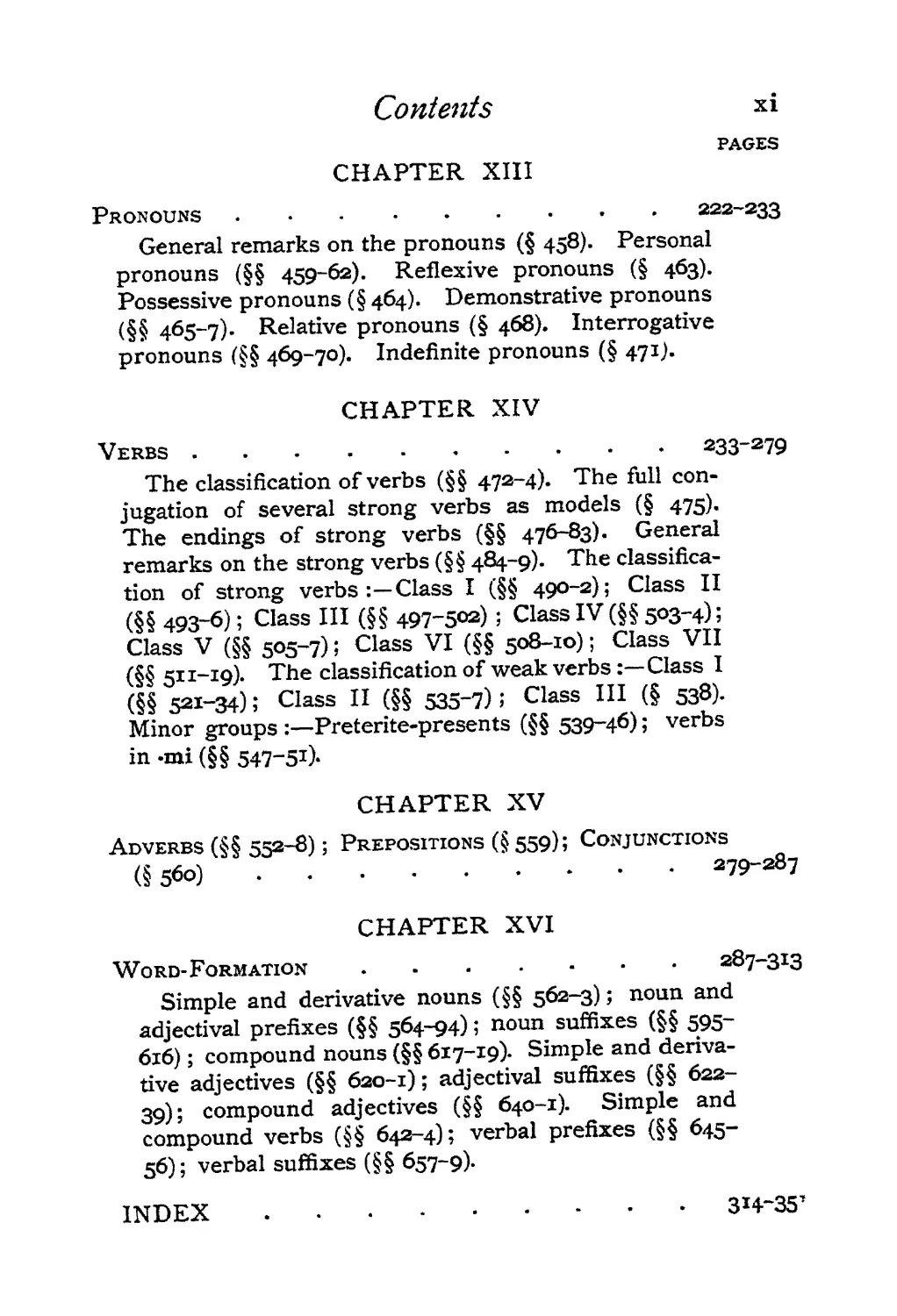
Contenais xi
PAGS
CHAPTER XIII
Proous .........
General remarks on the pronouns (§ 458). Personal
pronouns (§§ 459-6). Reflexive pronouns (§ 463).
Possessive pronouns (§ 464). Demonstrative pronouns
(§§ 465-7)- Relative pronouns (§ 468). Interrogative
pronouns (§§ 469-7o). Indefinite pronouns (§ 47)-
CHAPTER XIV
VERB$ .......... °33-279
The classification of verbs (§§ 47o.-4). The full con-
jugation of several strong verbs as models (§ 475).
The endings of strong verbs (§§ 476-83). General
remarks on the strong verbs (§§ 484-9). The classifica-
tion of strong verbs :--Class I (§§ 49o-°-); Class II
(§§ 493-6); Class III (§§ 497-5o') ; Class IV (§§ 503-4);
Class V (§§ 5o5-7); Class VI (§§ 5o8-xo); Class Vil
(§§ 5x-x9). The classification of weak verbs :--Class I
(§§ 5*-34); Class II ( -7); Class III (ç 538).
Minor oups :--Preterite-presents ( 5346); verbs
in .mi ( 547-5x).
CHAPTER XV
ADVERBS ( 5) ; PREPOSITIONS ( 559); CONJUNCTOS
( 560) ......... z79-7
CHAPTER XVI
WORD- FORIATION ....... 0-87-3:3
Simple and derivative nouns (§§ 56-3); noun and
adjectival prefixes (§§ 564--94); noun suffixes (§§ 595-
6x6) ; compound nouns (§§ 6XT-Xg). Simple and derîva-
tire adjeetives (§§ 60-o-); adjectival suffixes (§§ 6.-
39); eompound adjectives (§§ 64o-x). Simple and
compound verbs (§§ 64-4); verbal prefixes (§§ 645-
56); verbal suffixes (§§ 657-9).
INDEX ......... 3x4-35'
SELECT LIST OF BOOKS USED
Brugma, Karl. Kurze vergleichênde Grammatik der indo-
germanischen Sprachen. Strassburg, 9o4.
Biilbritg, Karl D. Altenglisches Elementarbuch (Lautlehre).
Heidelberg, :9oz
Cosijn, .P.J. Al-estsichsischê Grammatik. Haag, 883-6.
Die;er» Ferdi,atd. Laut- und Formenlehre der altgermanischen
Dialekte. Leipzig, 9oo.
Iqall, Jolm R. Clark. A concise Anglo-Saxon Dictionary
the use of studênts. London, 894.
Holtt, ause,, F«rdiu«nd. Altsichsisches Elementarbuch. Hêidel-
berg, 899.
Kaha, ?lax. Histofische Grammatik der englischen Sprache.
E-rster Teil. Berlin-Scl6neberg, 9o6.
Klug«, ]ri«drid. Geschichte der englische Sprache (Paurs
Grundriss der germanischen Philologie, vol. i, pp. 95 -
66, Strassburg, 9o4).
Nominale 5tammbildungslehre der altgermanischea Dia-
Iekte. Halle, 899.
Kod,, Fri«drid, C. Die Satzlehre der englischen Sprache.
Cassel, 878.
Mavt, ao, A.L. Synopsis of O]d English Phonolo. Oxtbrd,
Ik)Io
Noree, .4dolf. Altisl/indischê und altnorwegische Grammatik
unter Berficksichtigung des Urnordischen. Halle, 9o3.
Abriss der urgermanischen Lautlehre. Strassburg, 894.
tot,atsder, Alois. Zur Lauflêhre der griechischen, lateinischen
und romanischen Lehnw6rter ira Altenglischen. Strass.
burg. 888.
Select L ist of Books used
Sievers, Eduard. Angelsichsische Grammatik. Halle, I898.
St'eitberg', Wilhelm. UrgermanischeGrammatik. Heidelberg,
1896 .
Sweet, Hezry. The Student's Dictionary of Anglo-Saxon.
Oxford, 1897.
Toller, T. Norlhcote. An'Anglo-Saxon Dictionary, based on the
manuscript collections of the late Joseph Bosworth.
Oxford, I882-I898.
I/F'alde, Alois. Die germanischen Auslautgesetze. Halle, 19oo.
l/Vright, Joseph. An Old High German Primer. Oxford, I9o6.
A Primer of the Gothic Language. Oxford, I899.
The English Dialect Grammar. Oxford, 19o.5.
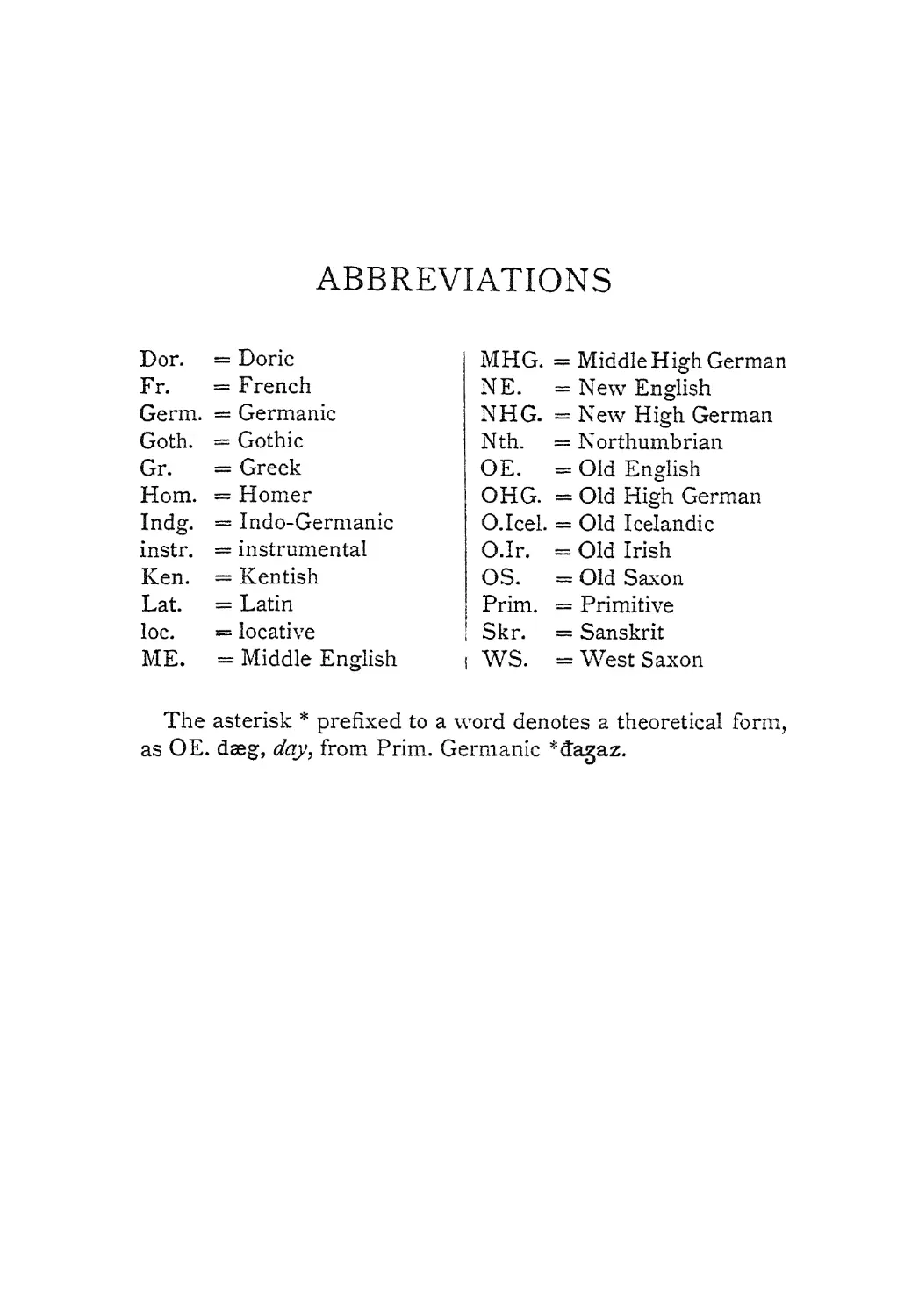
ABBREVIATIONS
Dor. = Doric
Fr. = French
Germ. = Gerrnanîc
Goth. = Gothic
Gr. = Greek
Hom. = Homer
Indg. = Indo-Germanic
instr. = instrumental
Ken. = Kentish
Lat. = Latin
loe. = locative
ME. = Middle English
MHG. = MiddleHigh German
NE. = New English
N H G. = New High German
Nth. = Northumbrian
OE. = Old English
OHG. = Old High German
O.Icel. = Old Icelandic
O.!t. = Old Irish
OS. = Old Saxon
Prim. = Primitive
Skr. = Sanskrit
WS. = "vVest Saxon
The asterisk * prefixed to a word denotes a theoretical form,
as O E. âoeg, dqy, from Prim. Germanic *oEaaz.
INTRODUCTION
§ 1. OLD English is a member of the West Germanic
division of the Germanic (Teutonic)branch of the Indo-
Germanic family of languages.. This great family of lan-
guages is usually divided into eight branches :--
I. Aryan, consisting of" () The Indian group, including
the language of the Vedas, classical Sanskrit, and the
Prâkrit dialects. (z) The Iranian group, including () West
Iranian (Old Persian, the language oîthe Persian cuneiform
inscriptions, dating from about 5o-35o . c.); (b) East
Iranian (Avesta---sometimes called Zend-Avesta, Zend,
and Old Bactrian--the language of the Avesta, the sacred
books of the Zoroastrians).
II. Armenian, the oldest monuments of which belong
to the fifth century ,.I.
III. Greek, with its numerous dialêcts.
IV. Albanian, the language of ancient Illyria. The
oldest monuments belong to the seventeenth century.
V. Italic, consisting of Latin and the Umbrian-Samnitîc
dialects. From the popular form of Latin are descended
the R omance languages Portuguese, Spanish, Catalanian,
Provençal, French, ItaIian, Raetoromanic, Roumanîan or
Wallachian. .
VI. Keltic, consisting of" (I) Gaulish (known to us
by Keltie names and words quoted by Latin and Greek
authors, and inscriptions on coins ; (2) Britannic, including
Cymric or Welsh, Cornish, and Bas Breton or Armorican
(thê oldest records of Cymric and Bas Breton date back
to the eighth or ninth century) ; (3) Gaelic, including Irish-
OE.«m B
Introduclion [§
Gaelic, Scotch-Gaelic, and Manx. The oldest monuments
are the old Gaelic ogam inscriptions which probably date
as far back as about: 5oo A. I>.
VI I. Baltic.Slavonic, consisting of: (I) The Baltic
division, embracing (a) Old Prussian, which became extinct
in the seventeenth century, (b) Lithuanian, (c) Lettic
(the oldest records of Lithuanian and Lettic belong to the
sixteenth century); (2) the Slavonic division, embracing:
(a) the South-Eastern group, including Russian (Great
lZussian, White Russian, and Little Russian), Bulgarian,
and Illyrian (Servian, Croatian, Slovenian) ; (b) the Western
group, includîng Czech (Bohemian), Sorabian (Wendish),
Polish and Polabian.
viii. Germanic, consisting of:--
(I) Gothic. Almost the only source of out knowledge
of the Gothic language is the fragments of the biblical
translation ruade in the fourth century by Ulfilas, the
Bishop of the West Goths.
(2) 01d Norse (Scandinavian), which is sub-divided into
two groups : (a) East N orse, including Swedish, Gutnish,
and Danish; (b) West Norse, including Norwegian, and
Icelandic.
The oldest records of this branch are the runic inscrip-
tions, some of which date as far back as the third or fourth
'century.
(3) Wes: Germanic, which is composed of :---
(a) High German, the oldest monuments ofwhich belong
to about the middle of the eighth cent:ury.
(b) Low Franconian, called Old Low Franconian or Old
. Dutch until about I2OO.
(c) Low German, with records dating back to the ninth
century. Up tO a.bolat I:2oo it is generally called Old
Saxon.
(F) Frîsian, the oldest records of which belong fo the
fourteenth century.
§§ -] Introduction 3
(e) English, the oldest records of which belong to about
the end of the seventh century.
NoT.--z. A few of the chier characteristîis of the Germanic
languages as compared with the other branches of the Indo.
iermanic languages are: the first sound-shifting or Grimm's
law (§§ .29-B4) ; Verner's law (§ 2B8); the development OE the
so-called weak declension of aijectives (§ zgl) ; the develop-
ment of the preterite of weak verbs (§ 59.0) ; the use of the old
perfect as a preterîte (§ z81).
. The most characteristic differences between Gothic and
Old Norse on the one hand, and of West Germanic on the
other, are: the West Germanic gemination of consonants
(§§ .5z-6) ; the loss of final z which arose from Indo-Germanic
s by Verner's Iaw (§ .5.) ; the West Germanic development
of prim. Germanic ww (§ 90), jj (§ 9.75) ; the form of the second
pers. sing. pret. indicative of strong verbs (§ 48î). Gothic and
Old N orse preserved the old perfect ending, as Goth. Old
Norse r, amt, thou oohest, but OE. nSme, OS. OHG. n.mi. In
the West Germanic languages the -t was only preserved in
the preterite-present verbs, as OE. w.st, OS. wêst, OHG.
weist, thou knowesg.
3. The most charaeteristic difference between High German
and the other Germanie languages is : the High German sound-
shifting (§ 2BO). -
§ 2. The division of a language-into fixed periods must
of necessity be more or less arbitrary. What are given
as the characteristics of one period have generally had
their beginnings in the previous period, and it is impossible
to say with perfect accuracy when one period begins and
another ends. For practical purposes Old English may
be conveniently divîded into two periods" early O E. from
about 7oo to 9oo ; and late O E. from 9oo-I ioo.
§ 3. The oldest records of O E. exhibit clearly defined
dialectal peculiarities which have been treated in some
detail in the phonology, so that the student can easily
collect together for himself the chiefcharacteristics of each
dialect. In this grammar early West Saxon is taken
4 Introduction [§
as the standard for O E., and is treated in greater detail
than the other dialects, in using O E. poetry for gram-
matical purposes the student should remember that it was
for the most part'originally written in thê Anglian dialect,
but that it bas corne down to us chiefly in late West Saxon
copies which contain many Anglian forms. OE. is usually
dividêd into four dialects" (a) Northumbrian, embracing
the district between the Firth of Forth and thê Humber.
(b) Mercian, between the Humber and the Thames.
(c) West Saxon, south of the Thames, except Kent and
Surrey. (d) Kentish, embracing Kent and Surrey.
Northumbrian and Mercian are often classed together
and called Anglian.
Nm:E.--A detaiIed eomparison of late OE. phonology with
that of the Modern dialects would doubtless show that the
dialects of Sussex and East Anglia were closely related to the
dialect of Kent in the OE. period. This is hot the place for such
a cornparison, so one example must suffice here. The change
of . to ê (§ 18, Note) in late OE. is always regarded as a speeial
Kentish peeuliarity, but the same sound change must also ha-ce
taken place in Sussex and East Anglia, where OE.. has
regularly become (through the older stage ê)in the Modern
dialects, as lls (OE. ls), lice; rffs (OE. m.s), ni«e; whereas
had simply been unrounded to in the late O E. period of
these dialeets, the 1Vfodern forms would have been *lois and
*mois.
PHONOLOGY
CHAPTER I
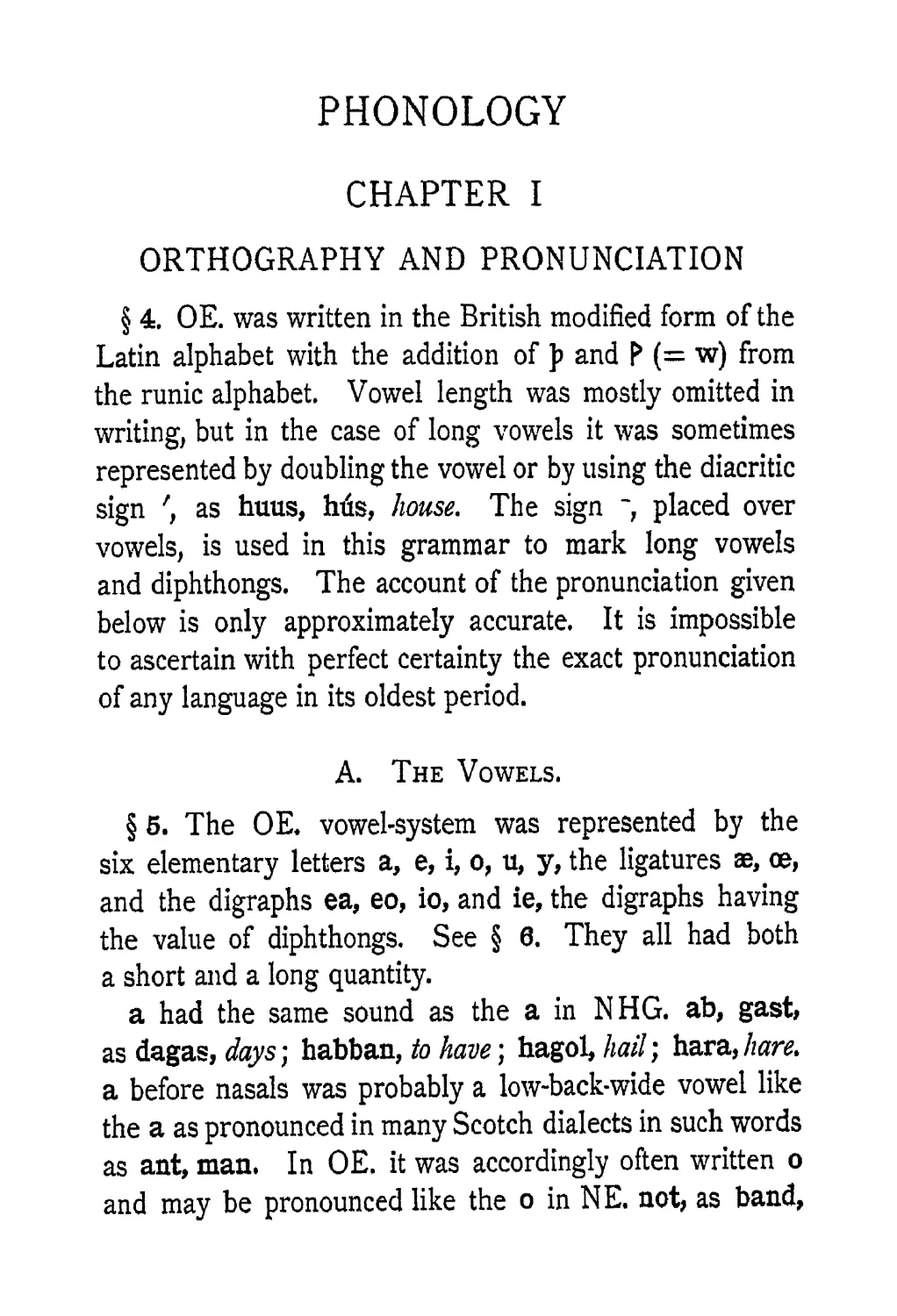
ORTHOGRAPHY AND PRONUNCIATION
§ 4. OE. was written in the British modified form of the
Latin alphabet with the addition of ] and ' (- w) from
the runic alphabet. Vowel length was mostly omitted in
writing, but in the case of long vowels it was sometimes
represented by doublin gE the vowel or by using the diacritîc
sign , as huus, his, louse. The sign -, placed over
vowels, is used in this grammar to mark long voweIs
and diphthongs. The account of the pronunciation given
below is only approximately accurate. It is impossible
to ascertain with perfect certainty the exact pronuncîation
of any languagê in its oldest period.
A. THE VOWEL$.
§ . The O E. vowcl-system was represented by the
six elementary lett.ers a, e, i, o, u, y, the ligatures oe, oe,
and the digraphs ea, eo, io, and ie, the digraphs having
the value of diphthongs. See § O. They ail had both
a short and a long quantity.
a had the same sound as the a in N HG. ab, gast,
as dagas, days ; habban, fo bave; hagol, hall; hara, hare.
a before nasals was probably a low-back-wide vowel like
the a as pronounced in many Scotch dialects in such words
as ant, man. In OE. ît was accordingly often written o
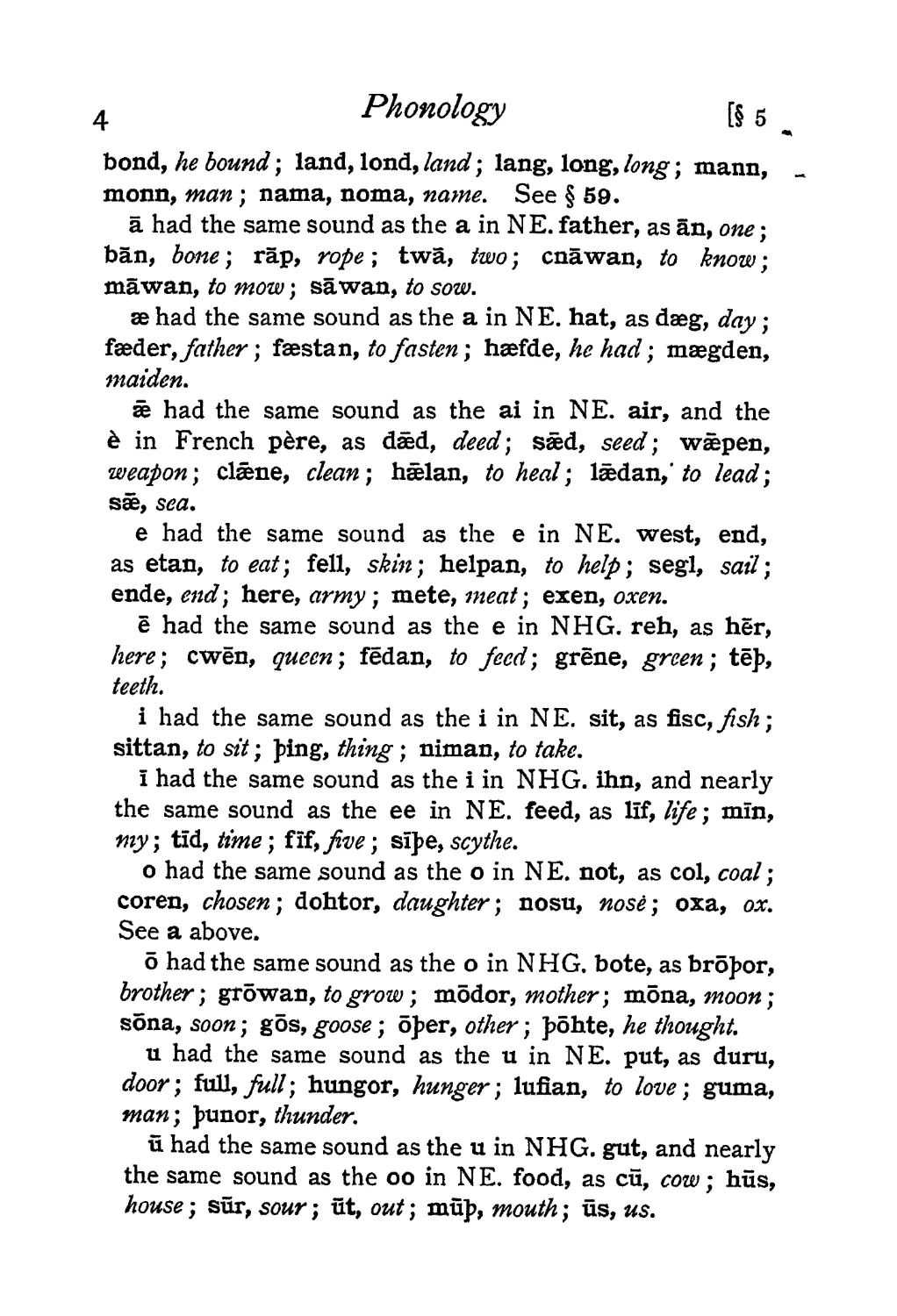
and may be pronounced like the o in NE. hot, as hand,
Phonology [§
bond, he bound; land, lond, land; lang, long, long; mann,
monn, man ; nama, noma, naine. See§ 59.
. had the saine sound as the a in NE. father, as n, one;
bn, bone ; rp, tope; tw, two; cnwan, to know;
mwan, to room; s.wan, fo sow.
oe had the same sound as the a in N E. hat, as doeg, day ;
foeder, faSer; festan, tofasten ; hefde, fie had; moegden,
e had the saine sound as the ai in lE. air, and the
è in French père, as ded, deed; oed, seed; woepen,
weaon ; clene, clean ; hoelan, to hem; ledan,' to lead ;
oe» sea.
e had the saine sound as the e in NE. wet, ead,
as etan, to eat ; fell, skin ; helpan, to heIp ; egl, sac7;
ende, end; here, army ; mete, meat; exen, oxen.
ê had the saine sound as the e in N HG. reh, as hêr,
here; cwên, queen ; fêdan, to feed; grêne, Kreen ; tê],
teeh.
i had the same sound as the i in NE. sit, as fisc, fish;
sittan, fo dt; ]îng, thinK ; niman, fo take.
i had the saine sound as the i in NHG. ihn, and nearly
the saine sound as the ee in i E. feed, as lif, life; rein,
my; tid, rime ; fil, rive ; si]e, scythe.
o had the saine ound as the o in N E. hot, as col, coal;
coren, çhosen ; dohtor, dauKhter ; nosu, nosë ; oxa, ox.
See a above.
5 had the saine sound as the o in N HG. bote, as brS]or,
brother ; grSwa, to Krow ; mSdor, mother ; mSna, moon ;
sSna, soon ; gSs, Koose ; 5]er, other ; ]Shte, he thought.
u had the saine sound as the u in NE. put, as duru,
door ; zll, full; hungor, bunker', lufian, fo love; guma,
man; ]unor, thunder.
had the same sound as the u in NHG. gut, and nearly
the saine sound as the oo in NE. food, as c, cow ; hûs,
bouse; ffr» $our ; t, out; mû], mouth ; 5s, us.
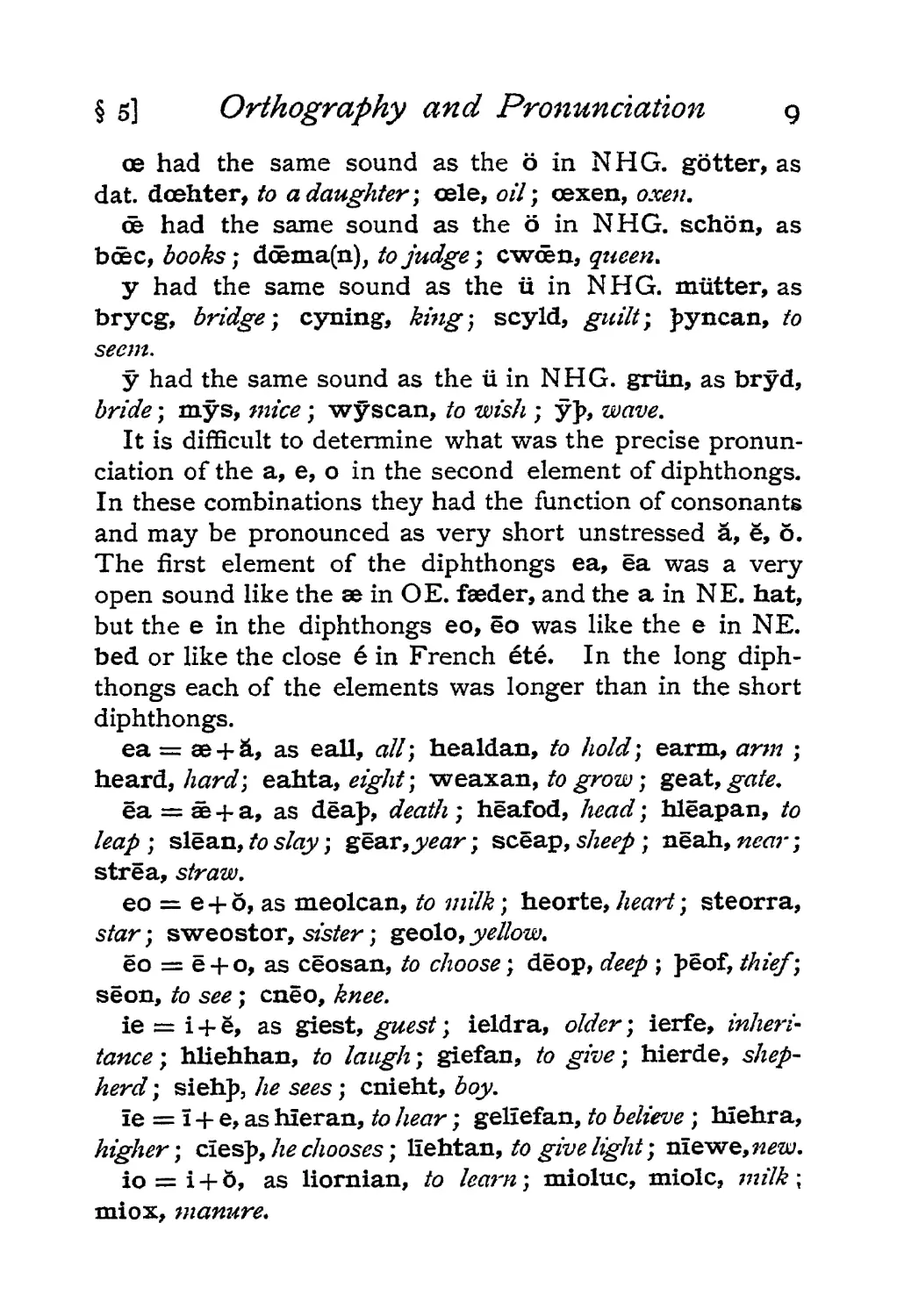
§ ] Ortkography and Pronunciatioz 9
oe had the saine sound as the i5 in N HG. giSter, as
dat. doelater, go a daughter; oele, oil; oexen, oxen.
had the se sound as the in NHG. sehn, as
bc, books ; dma(n), to judge; ¢wn, queen.
y had the saine sound as the in N HG. mtter, as
bryeg, bridge ; eing, king; seyld, guilt; ynean, go
had the saine sound as the in N HG. , as
bride; m@s, ,nice ; w9scan, fo mach ; , wave.
It is difficult to deteine what was the preeise pronun-
eiation of the a, e, o in the second element of diphthongs.
In these combinations they had the funetion of eonsonants
and may be pronouneed as very short unstressed â, ê, .
The first element of the diphthongs ca, êa was a very
open sound like the e in OE. foeder, and the a in NE. bat,
but the e in the diphthongs eo, êo was like the e in NE.
bed or like the dose 6 in French é£é. In the long diph-
thongs eaeh of the elements was longer than in the short
diphthongs.
ca = oe + ï, as eaU, ai1; healdan, to hoM; earm, arm ;
hearà, hard ; ea, eight ; weaxan, to grow ; geat, gale.
êa = + a, as flêa, death ; hêafofl, head; êapan, fo
leap ; slêan, to slay; gêar, year; seêap, sheep ; nê, near;
strêa, straw.
eo = e + , as meolean, to milk ; heorte, hem4; teorra,
star; weoor, skter ; geolo, yellow.
êo = ê + o, as eêosan, go choose ; àêoç, deep ; êof,
sêon, fo see ; enêo, knee.
ie = i+ê, as est, guest ; ieldra, older; iee, inhe7
tance ; hehhan, to lattgh ; efan, to give ; hierfle, shep-
herd ; sieh, he secs ; enieht, boy.
ie = î + e, as eran, fo hear; geefan, fo belie ; ehra,
higher ; ciesp, he chooses ; ehtan, to give hht ; ewe,ew.
io = i+, as liornian, fo learn; mioluc, miolc, milk;
Phonology [§§ 6-7
io = i + o, as liode, people; îostre, dark; sion, fo stram ;
]ion, fo thrive.
§ 0. From what bas been said above we arrive at the
following 0 E. vowel-system :--
Short vowels a, oe, e, i, o, u, oe, y
Long ,, ,, oe, e, , o, , ê, r
Short diphthongs en, eo, le,
Long ,, êa, êo, ie, io
Nor.--e was often written ne, and ç in the oldest records.
In the oldest period of the language there must have been tvîo
short e.sounds, riz. e ---- Germanic e (§ 80), and e = the i-umlaut
of e (§ ii), the latter probably being more open than the
former, but the two sounds seem to have fallen together at an
early date. Long i was sometimes written ig finally and occa-
sionally also medially, as big----bL by; big--h, they; big-
spell = bspell, parabte. The in word like g5s, ffoose (§ 61)
and m0n,t, moon (§ 19.1) muet orîginally bave been an open ô
like the a in NE. all, but it fell together with Germanic long
close (§ 19.8) at an early period, oe and
in OE. manuscripts, only occur in the Anglian dialect ; in WS.
and Ken. they were unrounded to ê already in the oldest period
of these dialects (§ 19.9). The diphthongs en, êa were some-
rimes written eo in the oldest records, le and ie occur chiefly
in early WS.
A diphthong may be defined as the combination of a sonantal
with a consonantal vowel. It is called a falling or a rising
diphthong according as the stress is upon the first or the
second element. The OE. diphthongs were generally falling
diphthongs, but the diphthongs, which arose from the influence
of initial palatal c, g, and se upon a following palatal vowel,
were originally rising diphthongs which at a later period be-
came falling diphthongs through the shifting of the stress from
the second to the first element of the diphthong. See §
B. TrIE CONSONANrS.
§ 7. The O E. consonant-system was represented by the
following letters :b, c, d, f, g, h, k, 1, m, n, p, r,
(.), ,w, .
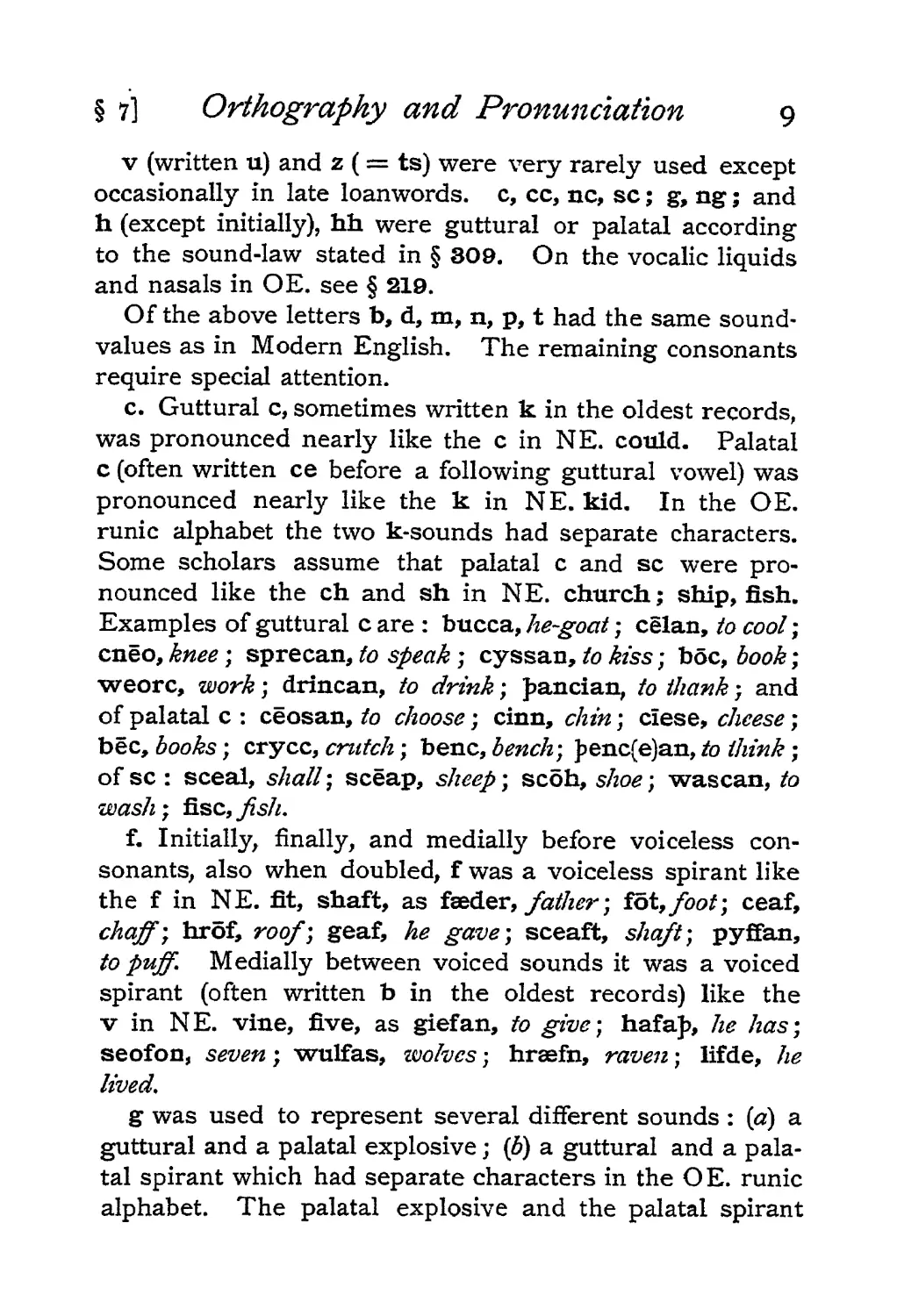
§ 7] Orthgraphy and Pronunciation 9
v (written u) and . ( -- fs) were very rarely used exeept
oeeasionally in late loanwords, e, ce, ne, se; g', ng; and
h (exeept initially), hh were guttural or palatal aeeording
to the sound-law stated in § 800. On the vocalic liquids
and nasals in O E. see § 9.19.
Of the above letters b, d, m, n, p, t had the saine sound-
values as in Modern English. The remaining eonsonants
require special attention.
c. Guttural e, sometimei written k in the oldest records,
was pronouneed nearly like the e in NE. eould. Palatal
e (often written ce belote a following guttural vowel)was
pronouneed nearly like the k in NE. kid. In the O E.
runie alphabet the two k-sounds had separate eharaeters.
Some seholars assume that palatal e and se were pro-
nounced like the ch and sh in NE. church ; ship, fish.
Examples of guttural c are - bucca, he-goal cêln, lo cool;
cnêo, knee ; sprecan, o speak cyssan, o kiss ; b6c, book ;
weorc, work drincan, to drink ; ]ncian, lo lhak and
of palatal c cêosan, o choose cinn, chin ; cese, cheese ;
bêc, books ; crycc, cruch ; benc, bench ; ]enc(e)an, to thiï2]e
of sc- sceal, shall; scêap, sheel ; sch, shoe', wascan, to
wash ; fisc, fish.
f. Initially, finally, and medially before voiceless con-
sonants, also when doubled, f was a voiceless spirant like
the f in NE. fit, haft, as foeder, father; rôt, foot; ceaf,
chaff ; hrSf, roof; geaf, he gave; sceaft, shaft; pyffan,
go puff. M edially between voiced sounds iç was a voiced
spirant (often written b in the oldest records) like the
v in NE. vine, rive, as giefan, to give; hafa], he bas;
seofon, seven ; wulfas, wo[ves ; hroefn, raven ; lifde, he
lived.
g was used to represent several different sounds" (a) a
guttural and a palatal explosive; (b) a guttural and a pala-
tal spirant which had separate characters in the 0 E. runic
alphabet. The palatal explosive and the palatal spirant
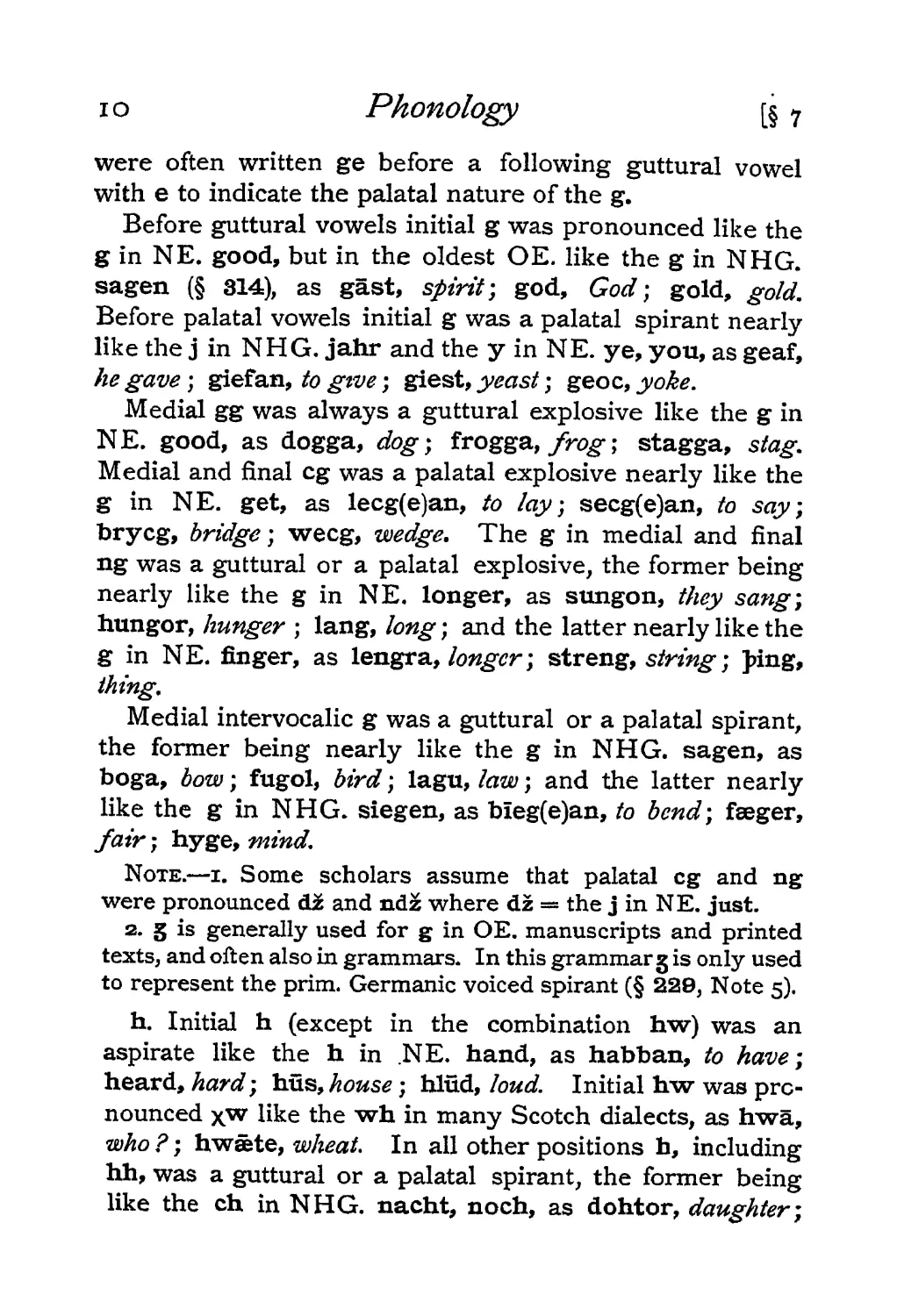
o Ihonology [
were often written ge belote a following guttural vowel
with e to indieate the palatal nature of the g.
Before guttural vowels initial g was pronouneed like the
g în NE. good, but in the oldest O E. like the g in NHG.
sagen (§ 14), as g.st, sirit; god, God; gold, gold.
Before palatal vowels initial g was a palatal spirant nearly
like the j in NHG. jahr and the y in NE. ye, you, as geaf,
he gave ; giefan, fo gve ; giest, yeast ; geoc, yoke.
Media1 gg was always a guttural explosive like the g in
NE. good, as dogga, dog; frogga, frog; stagga, slag.
Media1 and final cg was a palatal explosive nearly like the
g in NE. get, as lecg(e)an, go lay; seeg(e)an, to say;
bryeg, bridge; wecg, wedge. The g in medial and final
ng was a guttural or a palatal explosive, the former being
nearly like the g in NE. longer, as sungon, they sang;
hungor, hunger ; lang, long; and the latter nearly like the
g in NE. finger, as lengra, longer; streng, string; ]ing,
thing.
Medial întervoealie g was a guttural or a palatal spirant,
the former being nearly like the g in NHG. sagen, as
boga, bow; fugol, bird; lagu, law; and tahe latter nearly
like the g în N HG. sîegen, as beg(e)an, fo bend; foeger,
fair; hyge, «'nd.
lXlox.--i. Some seholars assume that palatal cg and ng
were pronouneed d and nd where d- = the j in NE. just.
z. is generally used for g in OE. manuseripts and printed
texts, and often also in grammars. In this grammar S is only used
to represent the prim. Germanic voiced spirant (§ 229, Note 5).
h. Initial h (exeept in the eombination hw)was an
aspirate like the h in .NE. hand, as habban, to bave ;
heard, hard; hfis, hotse ; hlVad, loud. Initial hw was prc-
nouneed Xw like the wh in many Seotch dialects, as hwA,
who ?; hwete, wheat. In all other positions h, including
hh, was a guttural or a palatal spirant, the former being
like the ch in N HG. nacht, noch, as dohtor, daughter;
§ ] Ortogra]y and Pronuncialîon
eahta, eiglt; tiohhian, fo ttink, consider; s
feorh, le; dh, doug]z ; troh, trougl ; and the latter like
the ch in NHG. nicht, ich, as flyht, fliglt ; sieh, he secs;
nêah, near; iehhan, to fautif. In the oldest records
final h was sometimes written ch, elch = eolh, elk;
salch = sealh, willow.
k was sometimes used to express the ttural (sec
above), kynn, race, generation ; kyng, king; knêo,
knee. See
1. In Horthumbrian and the greater portion of the
M ercian distct, 1 was pronounced like the 1 in N H G. and
in standard H E., but in West Sxon, Kentish, and parts of
the southern poion of Mercia, it was a reverted sound
formed by the under surface of the tip of the tongue being
turned to the hard palate which imparted to the sound
a kind of guttural quality. This explains why breaking
( O, ) took place in WS. d Ken. belote l+eon.
sonant, but hot in glian. The reveed 1 is still pre-
served in the dialects of the southern d south-western
counties. Examples are - loedan, fo lead; folc, folk ; fugol,
bird ; eaU, all ; healdan, to lwM ; meolcan, fo nilk.
r was trilled in all positions as in Modern Scotch, as
ridan, o ride ; du, door ; word, word; foeder, fal]er.
In West Son, Kentish, and parts of the southern poion
of Mereia, it was reverted like 1 (sec above), whieh accounts
for breaking taking place belote r + consonant more regu-
larly in WS. d Ken. than in Anglian, as eau, arm;
heard, lard ; eore, ea]z ; oian, fo learn.
s. Initially, finally, medially belote voiceless consonts,
and when doubled, s was a voîceless spirant like the s in
NE. si, as se, sait; sunu, son; sandan, go stand; sweos.
tor, sister ; hfis, lwuse; as, ice ; cyssan, fo ks. M edially
between voiced sounds, it was a voiced spirant like the s in
NE. rise, as bSsm, bosom ; cêosan, fo ¢]wose ; nosu, nose;
5sle, ousel.
Phonology [§
]. Initially, medially when doubled, and finally ] was
a voieeless spirant like the th in NE. rhin, as ]encan, to
think ; ]êoî, thieJ ; mo,]e, moth ; boe], bath ; m], mouth.
Medially between voiced sounds, it was a voieed spirant
like the th in N E. then, as ba]ian, fo barbe; brS]or, brother;
eor]e, earlh ; fem, fathom.
Initial ] was written th until about 9o0 in imitation of
Latin. Afterwards ît was written 5, and ] (borrowed from
the runic alphabet). And the voiced spirant was often written
d in imitation of the contemporary Latin pronunciafion.
w does hot occur in OF.. manuscripts, but was repre.
sented by uu, u until about the year 900, later by P borrowed
from the runic alphabet. It had the same sound-value
as the w in NE. wët, as woeter, water; sweltan, to die;
wlanc, proud ; s.wol, souL
x was pronounced lîke the x in NE. six, as rixian, to
rule; siex, six; weaxan, to grow; Rxian, fo ask.
§ 8. From what bas been said above we arrive at the
following OE. consonant-system :--
Im-x- Gui-
LABIAL. DENTAL.
DENTAL. TURAL.
sxb- Voiceless p, pp t, tf c, ce
sives Voiced b, bb d, dd g, gg
Spi- ,)' Voiceless f, ff ], ])p s, ss h, hh
rants Voiced f ] s g g
Nasals m, mm n, nn n n
Ziquids 1, 11 ; r, rr
Semi-vowel w
To these must be added the aspirate h, and x. The
double consonants were pronounced long as in Modern
Italian and Swedish, thus habban = hab.ban, to bave ;
wimman = wîm.man, fo swim, see §§ 8-0. From the
above table it will be seen that the O E. alphabet was very
defecfive, insomueh as each of the letters c, f, g, h, n, s,
and ] was used to represent two or more sounds.
PA LATAL
g, cg
h, hh
§ 9] M ccentuatîon 3
STRESS (ACCENT).
§ 0. AIl the Indo-Germanic languages have partly pitch
(musîcal) and partly stress accent, but one or other ofthe
two systems of accentuation always predominates in each
language, thus in Sanskrit and Old Greek the accent was
predominantly pitch, whereas in the oldest periods of
the Italîc dialects, and the Keltic and Germanic languages,
the accent vas predominantly stress. This difference in
the system of accentuation is clearly seen în Old Greek
and the old Germanic languages by the preservation of
the vowels of unaccented syllables in the former and the
weakening or loss of them in the latter, in the early
period of the parent Indg. language, the stress accent must
have been more predominant than the pitch accent,
because if is only upon this assumption that we are able fo
account for the origin of the vowels i% û, (§ I3, Note I),
the liquid and nasal sonants (§§ 34-7), and the loss of
vowel often accompanîed by a loss of syllable, as în Greek
gen. r«-p-6s beside acc. r=-p-«' ; r&'-o= beside ¢-=r-opl" ' ;
Gothic gen. pl. atîhs-nê beside acc. *afihsa.ns. If is now
a generally accepted theory that at a later period of the
parent language the system of accentuation became pre-
dominantly pitch, which was preserved in Sanskrit and
Old Greek, but which must bave become predominantly
stress again in prim. Germanic some rime prior to the
operation of Verner's law (§ .38).
The quality of the accent in the parent la*nguage was
partly ' broken' (acute) and partly ' slurred' (circumflex).
This distinction in the quality of the accent was preserved
in prim. Germanic in final syllables containing a long
vowel, as is seen by the difference in the development of
the final lo.ng vowels in historic rimes according as they
originally had the ' broken ' or ' slurred ' accent (§ 17).
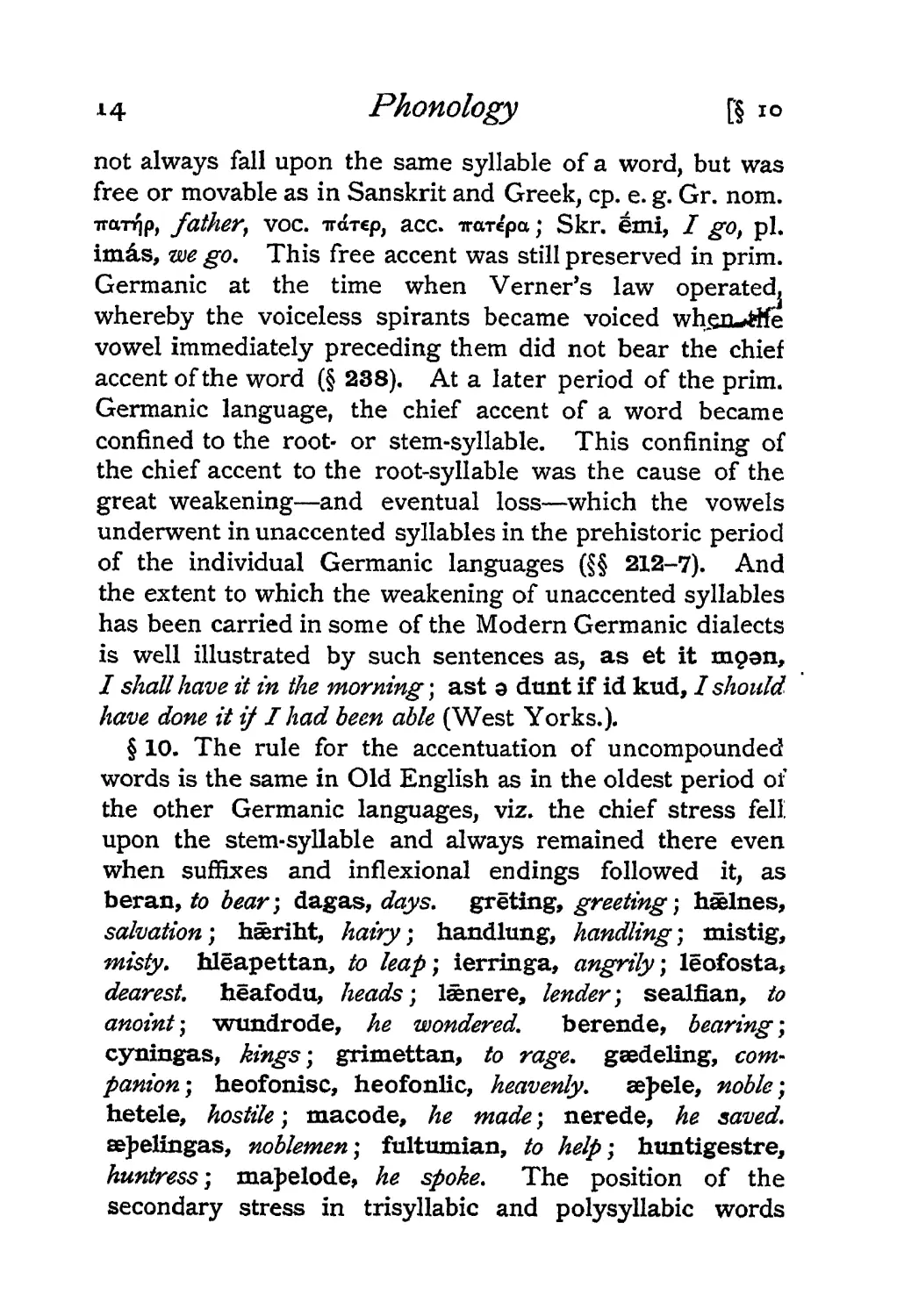
In the parent language the chier accent of a word did
4 Ph o n o logy [§ o
noe always fall upon the same syllable of a word, but was
free or movable as in Sanskrit and Greek, op. e. g. Gr. nom.
r«p, fat]ser, voc. r-rp, acc. r«Tp«; S kr. mi, I go, pl.
imAs, we go. This free accent was still preserved in prim.
Germanic at the rime when Verner's law operated|
whereby the voiceless spirants became voiced wh.ê
vowel immediately preceding them did hot bear the chier
accent of the word (§ .BS). At a later period of the prim.
Germanic language, the chief accent of a word became
confined to the root. or stem-syllable. This confining of
the chier accent to the rooVsyllable was the cause of the
great weakening--and eventual loss--which the vowels
underwent in unaccented syllables in the prehistoric period
of the individual Germanic langutges (§§ tll-7). And
the extent to which the weakening of unaccented syllables
has been carried in some of che Modern Germanic dialects
is well illustrated by such sentences as, as et if mgen,
I shall bave if in the morning; ast o durit if id kud, I shouM
bave donc it # I had been able (West Yorks.).
§ 10. The rule for the accentuation of uncompounded
words is the saine in Old English as in the oldest period of
the other Germanie languages, viz. the chier stress fell.
upon the stem-syllable and always remained there even
when suffixes and inflexional endings followed it» as
beran, fo bear; dagas, days. grêting, greeîing; hlnes,
salvation ; heriht, hairy ; handlung» handling; mistig,
misgy, hlêapettan, fo /ca/9; ierringa, angrily; lêofosta
dearest, hêafodu, heads; lenere, lender', sealfian, o
anoin ; wtmdrode, he wondered, berende, bearing ;
cynîngas, kings; grimet::an, o rage. gedeling, coin.
panion ; heofonisc, heofonlic, heavenly. e,ele, noble;
hetele, hosgile ; macode, he ruade; nerede, he ,aved.
oe]elingas, noblemen ; fultumian, ito he/# ; huntigestre,
huntres; ma]elode, he spoke. The position of thê
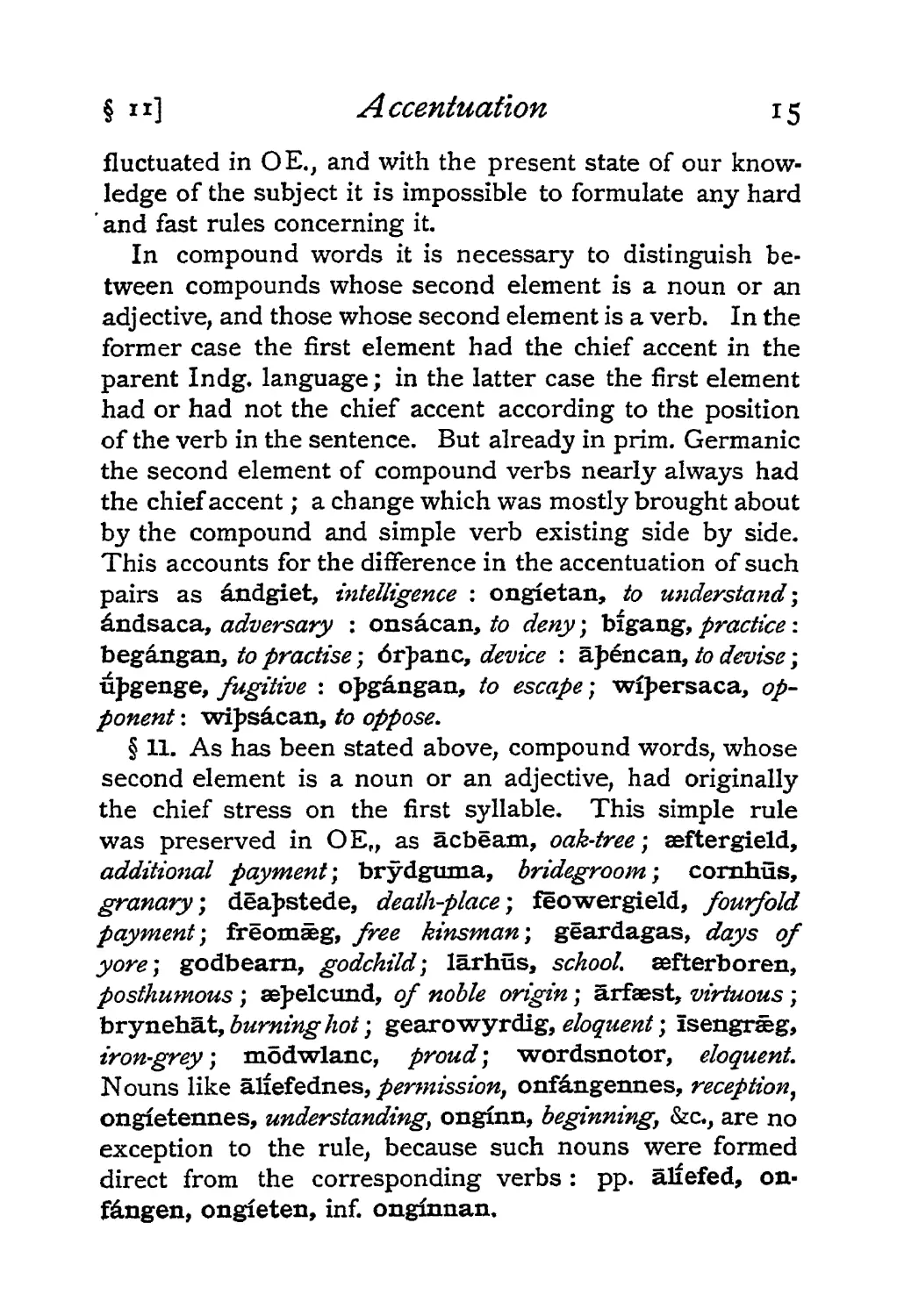
secondary stress in trisyllabic and polysyllabie words
fluctuated in O E., and with the present state of our know.
ledge of the subject it is împossible to formulate any hard
"and fast rules concerning it.
In compound words it is necessary to distinguish be-
tween compounds whose second element îs a noun or an
adjective» and those whose second element is a verb. In the
former case the first element had the chief accent in the
parent Indg. language ; in the latter case the flrst element
had or had not the chier accent according to the position
of the vrb in the sentence. But already in prim. Germanic
the second element of compound verbs nearly always had
the ch[efaccent ; a change which was mostly brought about
by the compound and simple verb existing side by side.
This accounts for the difference in the accentuation of such
pairs as dgîet, inlel/igen¢e'ongîetan, ¢o understand;
ndsaca, adversary onsAcan, lo deny ; bgang, pracl[ce"
begugan, lo practise ; 6ricane, device : ncan, lo devise;
û]genge, fugitive: o]gAngan, o escale ; w[]ersaca, o/-
lonent : wi]s.can, fo o1pose.
§ Il. As bas been stated above, compound words, whose
second element is a noun or an adjective, had originally
the chief stress on the first syllable. This simple rule
was preserved in O E,, as .cbêam, oak-tree; oeftergield,
addilional laymenl ; br.dguma, bridegroom ; cozxzh5s,
granary ; dêa]mtede, dealh-place ; fêowergield, foufold
paymen¢ ; frêomoeg, free kinsraan ; gêardagas, dczys of
yore ; godbearn, godchild ; l.rhBs, school, oefterboren,
posihumous ; e]pelcund, of noble or@in ; .rfest, virtuous ;
brynehgt, burning bol ; gearowyrdig', eloquent ; isengroeg,
iro.grey ; m6dwlanc, proud ; wordsnotor, etoquent.
N ouns like .lefednes, permission, onfgmgennes, receltion ,
ongletennes, understanding, ong(nn, beginnig, &c., are no
exception to the rule, because such nouns were formed
direct from the corresponding verbs: pp. .lîeÎed, on.
f.ngen, ongieten, înf.
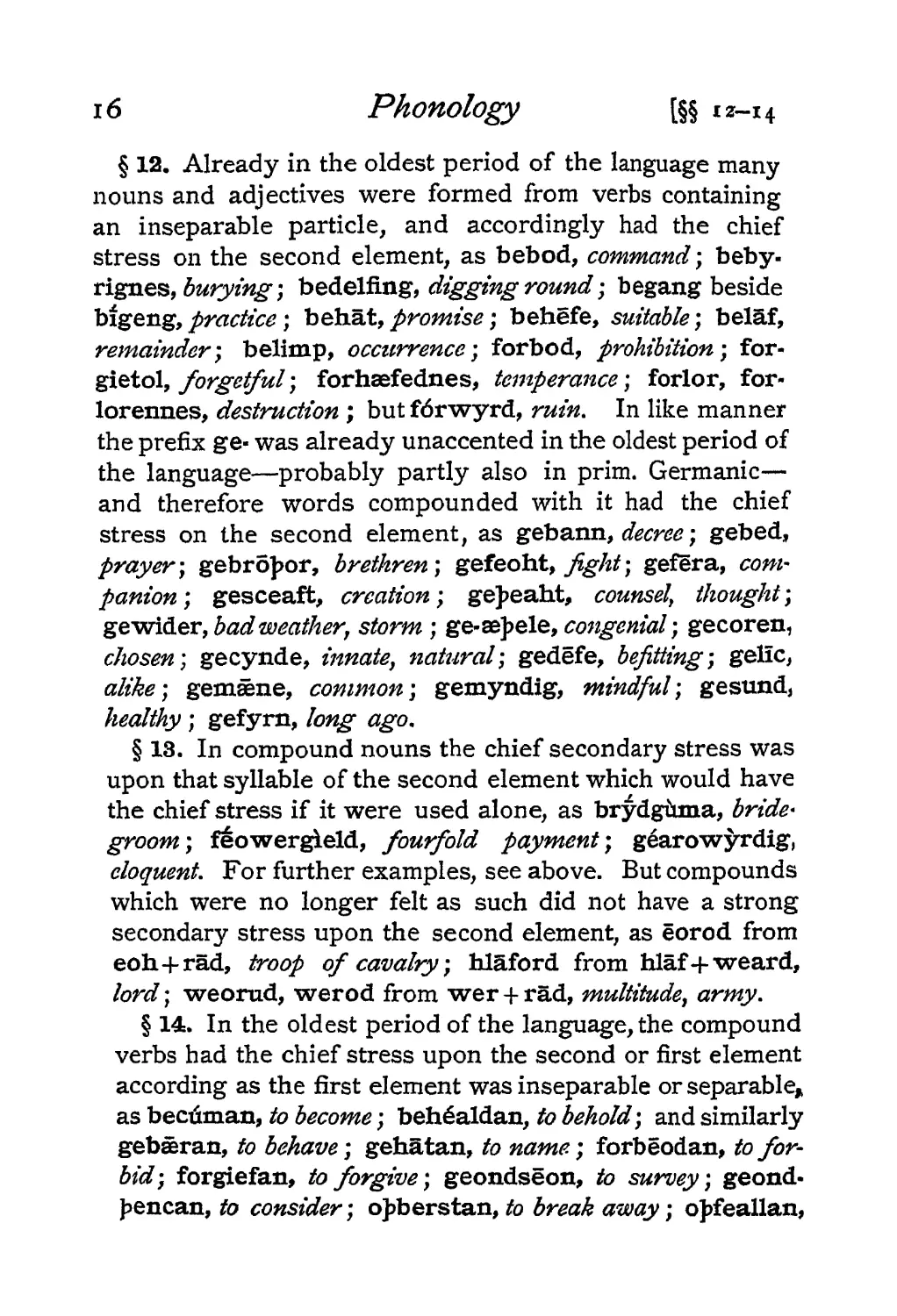
6 Phonology [§§ z- 4
§ 12. Already in the oldest period of the language many
nouns and adjectives were formed from verbs containing
an inseparable particle, and accordingly had the chier
stress on the second element, as bebod, command; beby.
rignes, burying; bedelfing, digging round; begang beside
bîgeng, braclice ; behRt, bromise ; behéfe, suilable; belRf,
remainder; belimp, oc¢z,rren¢e ; forbod, prohibition; for-
gietol, forgetful; forhefednes, temiberance ; forlor, for-
lorennes, destruction ; but f6rwyrd, ruin. In like manner
the prefix ge- was already unaccented in the oldest period of
the language--probably partly also in prim. Germanic--
and therefore words compounded with it had the chier
stress on the second element, as gebann, decree; gebed,
#rayer; gebrSpor, brethren ; gefeoht, fight; gefêra, com-
panion ; gesceafl:, creation ; ge]eaht, counsel, thought ;
gewicler, bad weather, storrn ; ge.e]ele, congenial ; gecoren,
chosen ; gecynde, innate, natural; gedêfe, befitting; gelic,
alike; gemoene, common; gemyndig, mindful; gesund.,
healthy ; gefyrn, long ago.
§ 15. In compound nouns the chier secondary stress was
upon that syllable of the second element which would bave
the chier stress if it were used alone, as brydghma, bride.
groom ; fëowergleld, fourfold »ayment ; géarowrrdig,
eloquent. For further examples, sec above. But eompounds
which were no longer felt as such did hot have a strong
secondary stress upon the second element, as êorod from
eoh+ rSd, troo# of cavalry; h.15.forcl from hlS.f+ weard,
lord; weortld, werod from wer + rRd, multitude, army.
§ 14. In the oldest period of the language, the compound
verbs had the chîef stress upon the second or first element
according as the first element was inseparable or separable,
as bec6man, to become; beh6aldan, to behold; and similarly
geboeran, to behave ; gehtan, to naine. ; forbêodan, fo for-
bid; forgiefan, to forgive ; geondsêon, go survey ; geond.
pencan, go consider ; o]berstan, go break away ; o]feallan,
o fall off; tbetan, fo burs asunder ; t6doelan, fo div£de.
oetîewan, fo exhibçtj etnan, to deprive; and simîlady
oïerswiaa, go overcome ; o£erweorpan, fo overIhrow ;
ereran, to 8upport ; unean, to comprehend ;
relian, fo çerce ghrough ; urhwan, lo abid« cozE-
ous ; wtfn, fo grasp ai; metan, lo compare;
ymbbindan, lo bind round; ymbhweorfan, fo revolve.
Verbs like hnflswadan, fo answe; ndwdan, lo azswer,
ftmtan, to support, ôrettan, io figlt, are no exception
to the rule, because such verbs were formed direct from the
nouns dswar, dwyrde, ft, 6ret. ExampIes of
separable verbs are- ftersçrecan, to claire; fteolan,
to flursue ; bîstdan, fo suflport; bbban, io lire by; and
similly eftciean, to turn bu¢k ; eftflSwan, toflow back ;
foreggan, lo recede ; forescêawian, toforesee ; fip,
to raise up; ûpiernan, to run u2 ; incuman, fo tome in ;
dan, to lire togeher; ongéaoEedan, go ]old
baçk ; tSdSn, to 2ut to ; fitdfan, fo drive out; fitflSwan,
fo fiow out.
1. In compound adverbs the first element had the
chier or seconda stress according as it w the more or
less important element of the compound, as é(l)mst,
alnmM; éaeg from ealne + weg, always ; Salsw, qu#e
so ; but onwég, away ; tSgdere, toKether; oenne,
therein.
oz. (} C
8 Phonology [§
CHAPTER II
THE PRIMITIVE GERMANIC EQUIVALENTS
OF THE INDO-GERMANIC VOWEL-SOUNDS
§1o. The parent Indo-Germanic language had the
following vowel-system :--
Shortvowcls a, e, i, o, u, o
Long ,, R, ê, i, 5, fi
Short diphthongs ai, eî, oi, au, eu, ou
Long ,, Ri, êi, 5i, Ru, êu, Su
Short vocalic 1, m, n, r
NOTE.--I. The short vowels i, u, e, the long vowels i, , and
vocalic 1, m, n, r occurred originally only in syllables which did
not bear the principal accent of the word.
The short vowels i, u, and vocalic 1, m, n, r arose from the
loss of e in the strong forms ei, eu, el, em, en, er, which was
caused by the principal accent having been shiffed to some
other syllable in the word.
e, the quality of which cannot be precisely defined, arose
from the weakening of an original ., ê, or , caused by the loss
of accent. It is generally pronounced like the final vowel in
German Gabe.
i and were contractions of weak diphthongs which arose
from the strong forms ei, , êi, i ; eu, u, êu, u through
the loss of accent. The e in ei, eu had disappeared before
the contraction took place. See § 9.
.. The long diphthongs .i, êi, &c., were of rare occurrence
in the parent language, and their history in the prehistoric
perîod of the various branches of the Indo-Germanic languages,
except when final, is still somewhat obscure. In stem-syllablês
they were generally either shortened to ai, ei, &c., or the second
element (i, u) disappeared. In final syllables thêy were gêner-
ally shortened to ai, ei, &c. In this book no further account
will be taken of the Indg. long diphthongs in stem-syllables.
§§ - ] ldo.Germanîc Vowd.System
19
For their treatment in final syllables in Primitive Germauie»
see § 17.
3- Upon theoretical grounds if is generally assumed that the
parent language contained long vocalic I, rn, a, r. But their
history in the various Indg. languages is still uncertain. In
any case they were of very rare occurrence, and are therefore
left out of consideration in this book.
§ 17. a (Lat. a, Gr. «) remained, as Lat. ager, Gr.
Goth. akrs, O.Icel. akr, OS. akkar, OHG. ackar, OE.
oecer, field, acre; Gr. Xç, Lat. gen. salis, ioth. O.icel.
OS. salt, OHG. ealz, OE. sealt (§ 64), sait ; Lat. aqua,
Goth. ahra, OS. OHG. aha, OE. êa from *eahu, older
*ahu (§ 70), water, river.
§ 18. e (Lat. e, Gr. «) remained, as Lat. retS, Gr.
I 3ear, O.Icel. bera, OS. OHG. OE. beran, o ear'; Lat.
edS, Gr. o«, f eag O.icel. eta, OHG. egan, OS. OE.
etan, g eat; Lat. pellîs, Gr. w&k«, OS. OHG. feJ, OE.
fell, skin, bide.
§ 19. î (Lat. i, Gr. )remained, as Gr. Hom. Fg,
Goth. witum, O.Icel. vitum, OS. witun, OFIG. wîz2um,
O E. witon, we now, cp. Lat. vidêre, fo see ; Lat. piscis»
G oth. fis, o. Icel. fiskr, OS. fisk, O H G. O E. fisc,
Lat. vidua (adj. rem.), bereftof, de#rived of, Goth. widuw5,
OS. wîdowa, OHG. wituwa, OE. widewe, eoidow.
§ 20. o (Lat. o, Gr. o) became a in stem-syllables, as Lat.
octS, Gr. 6z6, Goth. aht.u, OS. OHG. ahto, OE. eahta
(§ 68), eight; Lat. hostis, slranger, enemy, Goth. gasts,
OS. O HG. gast, OE. gîest (§ 78), guest; Lat. quod, Goth.
ha, O. I tel. hvat, O$. hwat, O H G. hwag, OE. hwoet, what.
§ 21. u (Lat. u, Gr. u) remained, as Gr. uv6 (gen. sing.),
Goh. hunds, O.Icel. hundr, OHG. hunt, OS. OE. hund,
dog, hound; Gr. @, OS. fluri, OHG. turi, OE. duru,
door; S kr. bu.budhîm, we wgtched, Gr. r-roo-r«t, he has
inquired, Goth. budum, O.Icel. buum, OS. budun, OHG.
butum, O E. budon, we announ¢ed, offered.
2
20 Phonology [§§
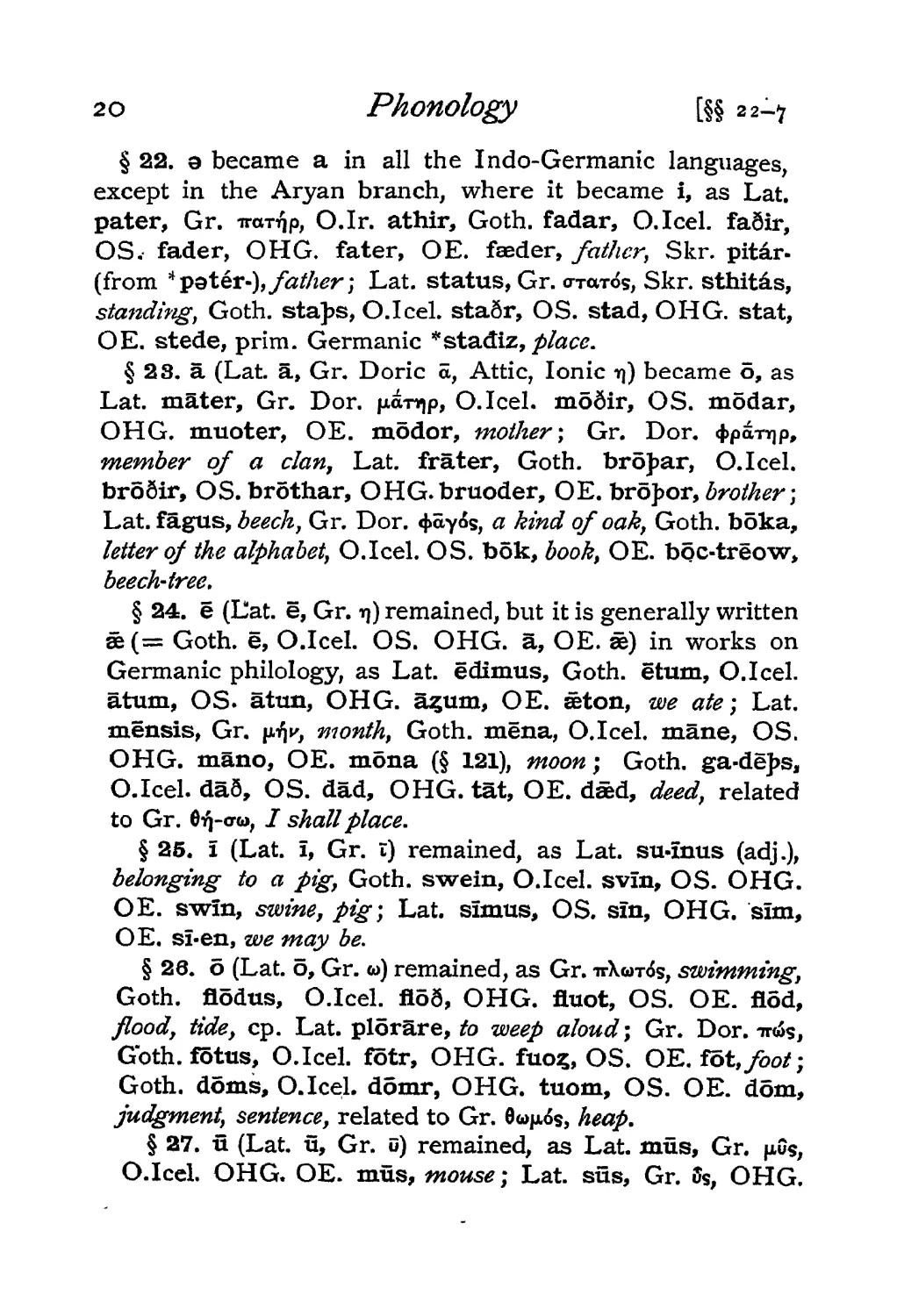
§ 9.. beeame a in all the Indo-Gerrnanic languages,
except in the Aryan branch, where it beeame i, as Lat.
pater, Gr. r«-O, O.Ir. a:hir, Goth. radar, O.Ieel. fakir,
OS, fader, OHG. rater, OE. fmder, fat]wr, Skr. pifer.
(from potér.),father; Lat. status, Gr. «T«T6S, Skr. sthitAs,
standig, Goth. sta]s, O.Icel. star, OS. stad, OHG. star,
O E. stede, prim. Germanic *stadiz, place.
§ 28. (Lat. ., Gr. Doric a, Attic, Ionic 1) became ô, as
Lat. mater, Gr. Dor. o, O.Icel. m56ir, OS. mSdar,
OHG. muoter, OE. m5dor, mother; Gr. Dot.
member of a clan, Lat. frAter, Goth. brS]ar, O.Icel.
br56ir, O S. brSthar, O FIG. bruoder, O E. brS]or, 3rolher
Lat. fâgus, beech, Gr. Dor. çay*, a kind of oak, Goth. bSka,
later oJ the al2habet, O.Icel. OS. bSk, book, OE. b.c-trêow,
beêch-ree.
§ 24. ê (12at. ê, Gr. ) remaîned, but it is generally written
oe (= Goth. ê, O.Icel. OS. OHG. A, OE. oe) in works on
Germanic philology, as Lat. êdimus, Goth. êtum, O.Icel.
Atam, OS. tun, OHG. Agum, OE. eton, we ae ; Lat.
mênsis, Gr. , month, Goth. mêna, O.Icel. mine, OS.
O HG. mAno, O E. m5na (§ 19.1), moon ; Goth. ga.dê]s,
O. Icel. dA8, OS. dAd, O HG. tir, OE. dffd, deed, related
to Gr. e-ato, I shall place.
§ . i (Lat. i, Gr. î) remained, as Lat. u.inus (adj.),
belonging o a 2Mg, Goth. wein, O.Icel. via, OS. OHG.
O E. wîn, swing pig; Lat. simtx, OS. in, O HG. sire,
O E. si.en, vve may be.
§ .6. (Lat. , Gr. o) remained, as Gr. rktoT6s, swimming,
Goth. fl5dtts, O.Icel. fl5, OHG. fluot, OS. OE. fld,
flood, tf'de, cp. Lat. plôrAre, go wee2 aloud; Gr. Dot.
G'oth. f6tus, O.Icel. tôtr, OHG. fuog, OS. OE. f'6t, foog;
Goth. d5ms, O.Icel. d6mr, OI-IG. tuom, OS. OE. dm,
judgment, sentence, related to Gr. Océ6,, hea#.
§ 27. fi (Lat. û, Gr. ) remained, as Lat.
O.Ieel. OHG. OE. mfi, mouse; Lat. sfis, Gr. s, OHG.
.
§ ,8-a'-] Indo.Germanic Vowel-Syslem
OE. sri, sow, pig ; Goth. ffils, O. Icel. grill, OHG. OE.
ffil, foul, related to La. pfiteô, I smelI bad, Gr.
I make go rot.
§ «8. ai (Lat. ae (ê), Gr. «, Goth. .î, O.Ieel. ei, OS;. ê,
OHG. ei (ê), OE. .)remained, as Lat. aedê, sanc,uary,
originallyfire-#lace, hearth, Gr. «0, I burn, OHG. «if, OE.
d, funeral pile, ignis, roEus ; Lat. a.es, Goth. .iz, O.Ieel.
eir, O HG. êr, O E. âr, brass, metal, money; Lat. caedb,
I hew, cut down, Goth. skidan, OS. skêdan, skêaan,
O HG. sceidan, O E. scdan, sce.dan (§ 18, Note .),
fo divide, sever.
§ 9. eî (Lat. i (older ei), Gr. «) beeame
f go, Goth. steîgan (ei = ), O.Icel. tiga, OS. OHG.
O E. stigan, fo ascend; Gr. )cidre0, _î leave, Goth. leih.ran,
OS. OHG. liban, OE. lêoxa from *liohaxa, older *lilaan
(§ 9.7), fo Iend; Lat. dîc5, I say, tell, Gr. 8&g/, 2" show,
Goth. ga.teihan, to tell, decIare, 05. af.tîhaxa, fo deny,
OHG. zihaxa, OE. têon, fo accuse (§
§ 80. oi (O.Lat. oi (later ri), Gr. o 0 beeame ai (op. § 9.0),
as Gr. o, Goth. wiit, O.IceI. veît, OS. wêt, OHG.
weig, O E. wt, he knows ; O.Lat. oinos, later fintts, Goth.
2ns, O.Ieel. eîxm, OS. ên, OHG. eîxa, OE. xa, one, ep. Gr.
otvfi, the one on dice ; Gr. rr-ro0«, he trusts, Goth. btip,
O.Ieel. bel6, OS. bêd, OHG. beit, OE. bd, he waitedfor.
§ 81. au (Lat. au, Gr. «, Goth. tt, O.Ieel. au, O
OHG. ou(O), OE. êa) remained, as Lat. auris, Goth.
OS. OHG. ra, OE. êare, ear; Lat. auge, Gr.
I increase, Goth. tukan, O.Ieel. auka, OS. kian, O HG.
ouhhn, O E êaeian, to add, hcrease.
§ 9.. eu (Lat. ou (later ri), Gr. eu, Goth. iu, O.Icel..]6
(jfi), OS. OHG. io, OE. êo) remained, as Gr. ,/«,, .r give a
faste of, Goth. kittsan, O. Ieel. kjsa, O$. OHG. kiosan,
OE. eêosan, fo test, choose ; Gr. r60o«, I inquire, Goth.
ana.biudaxa, fo order, command, O.Icel. bja, OS. bîodaxa,
OHG. biotaa, OE. bêodan, fo offer; Lat. doue (altier),
: Phonology [§§ -7
lead, Goth. tiuhan, OS. tiohan, OHG. ziohan, OE.
têon (§ 180), 0 lgad draw. See § 44.
§ SS. ou (Lat. ou (later 5), Gr. ou) became au (cp. § 20),
as prim. Indg. *roudhos, Goth. r.u]s, O.Icel. rauSr, OS.
rSd, OHG. rSt, OE. rêad, red cp. Lat. rSfus, red; prim.
Indg. *bhe.bhoudhe, bas waked Goth. bu], O.Icel. bauX,
OS. b5d, O HG. b5, O E. bêad, bas offered.
§ 84. m (Lat. em, Gr. « «) became um, as Gr. o- (in
àl60, from some place or other), Goth. sums, O.Icel.
umr, OS. OHG. OE. sure, some one; Gr. K«T6v, Lat.
EEentum (with n from m by assimilation, and similarly in
the Germanie languages), Goth. OE. OS. hund, OHG.
hunt, hundrêd, all from a prim. form *kmt6m.
§ 85. n (Lat. en, Gr. «, «v) became un, as Lat. coin.
mentus (pp.), invented, devisêd, Gr. «6a'6-1«o , acting ofone's
own oeill, Goth. ça.rounds, OHG. gi.munt, OE. ge.mynd
(§ 1190, remembran¢e, prim. form *mnt6s (pp.) from foot
men., think ; 0. wundar, O HG. wuntar, O E. wundor,
wonder, cp. Gr. à00t¢0 from *F0p% Igaze ai.
§ 86. r (Lat. or, Gr. «, toc) becamê ur, ru, as OHG.
gi.turrum, OE. durron, we date, cp. Gr. 0«pr6s (0p««6s),
bo[d O¢pE¢a, I ara of good courage; dat. pl. Gr. r«rp¢I«,
Goth. fadrum, O H G. faterum, O E. foed(e)rum, fo fathers;
Lat. porc,t, he ridge bet.ween gwo furrows, O HG. furuh,
O E. luth, fu'row.
§ 87. 1 (Lat. ol, C-t. eX, ),«) became ul, lu, as Goth. fulls,
O.Icel. ftdlr, OHG. vol, OS. OE. full, prim. form *pln6s,
full; Goth. wulfs, O.Icel. mi'r, OHG. wolf, OS. OE. wulf,
prim. form *wlqos, wolf.
Noa'E.Ifwe summarize the vowel-changes which have been
stated in this chapter, it will be seen tha: the following vowel-
sounds îell together :--a, o, and e ; original u and the u which
arose from Indg. vocalic 1, m, n, r ; î and ei; . and ô ; ai and
oi; au and ou.
§§ a8-4] Primîtive Germanic Vowel-Syslem 3
CHAPTER III
THE PRIMITIVE GERMANIC VOWEL-SYSTEM
§ 8. From what has been said in §§ 17-7, we arrive at
the folIowing vowel-system for the prim. Germanic lan-
guage :---
Short vowels a, e, i,
Long ,, , ê, i, 5, û
Diphthongs ai, au, eu
NoTs.--- was an open e-sound like OE. . ê was a close
sound like thi e in NHG. ieh. The origin of this vowel has
hot yet been satisfactorily explained. It is important to re-
member that ît is never the equîvalent of Indo-Germanic ê
(§ 24)which appears as e in prim. Germanic. See §§ 119,1.5.
§ 39. This system underwent several modifications
during the prim. Germanic period, i.e. before the parent
language became differentiated into the various separate
Germanic languages. The most important ofthese changes
w¢r :
§ 40. a+x became âX, as Goth. OS. O HG. fhan,
O.Icel. fâ, O E. tôn (§ 39), from *farxanan, fo catd,
seie, cp. Lat. pangS, I fasten; Goth. ]5.hta, OS. thS.hta,-
OHG. dS.hta, OE. ]Shte (inf. ]encan), from older *]axjxta,
*]arxtS-, I t]wught, cp. O.Lat. tongeS, I ]now. Every
prim. Germanic 5. în accented syllables was of this origin.
Cp. §
NOTE.--The in the above and similar examples was sdll
a nasalized vowel in prim. Germanic, as s seen by its develop-
ment to ô in OE. The (§ 4I) and (§ 48) were also nasalized
vowels in prim. Germanic.
§ 41. e became i under the following circumstances :--
x. Belote a nasal+consonant, as Goth. OS. OE.
4 Phnology [§ 4
bindan, O.Icel. bînda, OHG. bintan, o bind, op. Lat.
of.fendimen:um, chin-cloth, of.fendix, knot, hand, Gr.
r«0«O, father-in-lazo ; Lat. venttts, Goth. winds, O.Icel.
vindr, Ot-IG. win:, OS. OE. wind, zvind; Gr.
Goth. fimf, O.Icel. tire(m), OHG. flmf, finf, OE. fîf (§
rive. This explains why O E. bindan, o bind, and helpan,
fo help, belong to the same ablaut-serîes. See § .6.
This i became i under the same conditions as those
by which a became â (§ ,IO), as Goth. ]eihan, OS. t:hhan,
OHG. dihan, OE. ]êon (§ 1.7), from *]ix]xanan, older
*]ex]Xatlan, o lhrive; and similarly OHG. sihan, OE.
sêon, o strMn ; OHG. tîhala, OE. fêol, file; OHG.
dhsala, O E. ]ixl (isl), wggo-îboIe, shaft.
.. When followed by an i, , or j in the next syllable, as
Goth. OS. OHG. ist, OE. is, from *istî, older *esti = Gr.
o-r, is; OHG. irdin, earlhen, beside erda., earth; Goth.
midjis, O.Icel. mi6r, OS. middi, OHG. mitti, OE. midd,
Lat. medius, from an original form *medhjos, Mddle ; OS.
birid, OHG. birit, he bears, from an original form *bhéreti,
through the intermediate stages *térei, *bérii, *bri(ti,
beside inf. beran; O.Icel. sitja, OS. sitt.ian, OHG.
sîzzen, O E. sit:tan, from an original form *sedjonom,
fo sil; and similarly O.Icel. liggja, OS. liggian, OI-IG.
liggen, O E. licgan, to lie clown.
This sound-law aceounts for the difference in the stem-
vowels of such pairs as OE. feld (OHG. feld), )qeM"
gefilde (OHG. giflldi), a plain ; fe]er, feathcr" fi]ere,
wing; weder (OHG. wetar), wealher" gewider (OHG.
giwi:iri), sorm; heord (OHG. herta), herd" hierde
(OHG. hirîi), shepherd; helpan, o help" hilps:, hilpp
(OHG. hilfis, lailfit); beran, to bear" bir(e)st, bir(ê)]
(OHG. birîs, birit:), and similarly in the second and third
person singular of the present indicative of many other
strong verbs; pp. legen, eten : inf. 1leçon, o lie down,
iLan, o sit.
§§ -] Primitive Germanc VoweLSystem 5
3- In unaccented syllables, except in the combination
-er when not followed by an i in the next syllable, as OE.
têt, older î¢êt, from *f'6fiz, older *f6:es, feet, cp. Lat.
pedes, Gr. ar*Btç. Indg. e remained in unaccented sylla-
bles in the combinatîon .er when not followed by an i in
the next syllable, as acc. OS. fader, OHG. far:er, OE.
feder, Gr. raptt, father; O E. hwe]er, Gr. r6zpos, which
owo.
§ §=. i, followed originally by an â, , or ê in the next
syllable, beeame e when hOt proteeted by a nasal +con-
sonant or an intervening i or j, as O.Icel. vert, OS. OHG.
O E. wer, Lat. vr, from an original form *wiros, man;
O HG. O E. net, Lat. nidus, from an original form
*nizoEos. In historie rimes, however, this law has a great
number of exeeptioni owîng to the separate languages
having levelled out in various directions, as O E. spec
besîde spiê, bacon; O HG. lebara beside OE. 1fier, l{ver;
OHG. lece5n beside OE. liccian, fo lick ; OHG. lebên
beside OE. libban, o lire ; OHG. quec beside OE. cwic,
quick, alive.
§ 4. u, followed originally by an ., , or ê in the next
syllable, beeame o when hot proteeted by a nasal + con-
sonant or an intervening i or j, as OS. dohter, OHG.
tohter, OE. dohtor, Gr. 0-#, daughter; O.Icel. ok,
O HG. job, OE. geoc (§ 11o), Gr. gv,#v, yoke ; O HG. got,
OS. OE. god, from an original form *ghut6m, god; OHé.
OE. gold, gold, beside OHG. guldin, OE. gylden, golden;
pp. OS;. giholpan, OHG. giholfan, OE. geholpen, he[i3ed,
beside pp. OS. gibutxdan, OHG. gibuntn, OE. gebunden,
bound; pp. OS;. gibodan, OI-IG. gibotan, OE. geboden,
offered, beside pret. pl. OS. budun, OHG. butum, OE.
budon, oeê offered. Every prim. Gerrnanic o in accented
syllables was of this origin. Cp. § .0.
Thîs sound-law accounts for the difference in the stem-
vowels of such pairs as O E. cnotta, knot" cny[;tan from
6 Ponology [§§
*knuttjan, go gie; coss, a kiss" cyssan, to kiss ; corn,
corn cyrnel, kernel; fox : fyxen, she-fox ; god : gyden
(OHG. gutin), goddess; hold, gracious" hyldo (OHG.
huldi), grace, favour; pret. bohte, worhte: inf. bycgan,
o buy, wyrcan, to zoork.
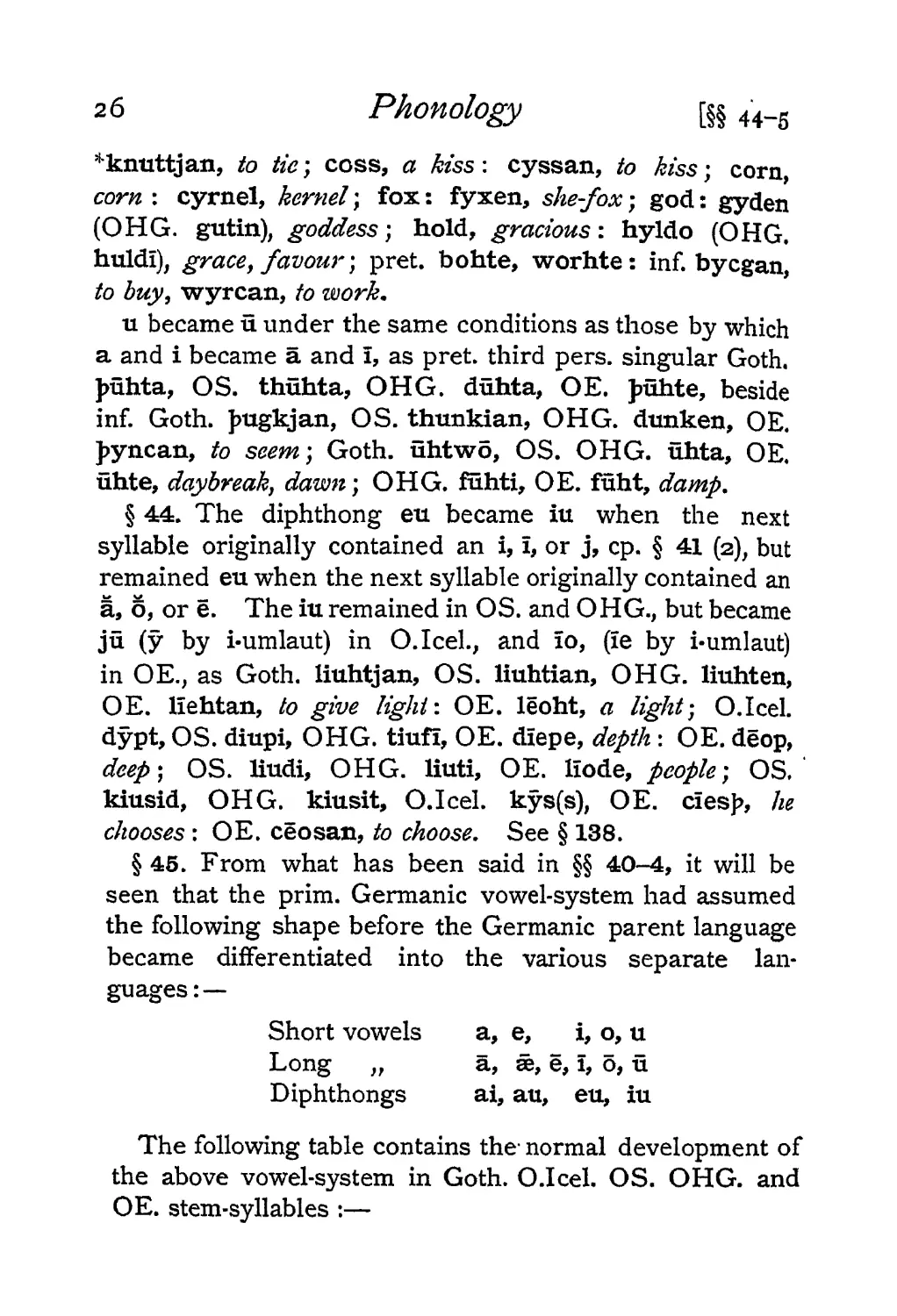
u became fi undêr thê saine conditions as those by whieh
a and i became A and i, as pret. third pers. singular Goth.
]fihta, OS. thfihta, OHG. d5hta, OE. ]ffhte, beside
inf. Goth. ]ugkjan, OS. thunldan, OHG. dunken, 0E.
]yncan, 'o seem ; Goth. 5htwS, OS. OHG. hta, 0E.
fihte, daybreak, dawn; OH G. ffihi, 0 E. fht, damp.
§ 44. The diphthong eu became iu when the next
syllable origînally contained an i, i, or j, cp. § 41 (2), but
remaîned eu when the next syllable originally contained an
, , or ê. The lu remained in OS. and 0 HG., bue became
jfi (r by i-umlaut) in O.Icel., and io, (ie by i-umlau 0
in (DE., as Goth. liuhtjan, OS. liuhtîan, OHG. liuhten,
O E. liehtan, to give light" OE. lêoht, a lighî; O.Icel.
dpt, OS. diupi, OHG. tiulï, OE. diepe, deth. OE. dêop,
dee# ; OS. lîudî, OHG. lîuti, OE. liode, #eople ; OS. '
kiusid, OH G. kiusit, O.Icel. krs(s), OE. ciesp, he
chooses" OE. cêosan, fo choose. See § 130.
§ 45. From what has been said in §§ 40-4, it will be
seen that the prim. Germanic vowel-systêm had assumed
the following shapê bêfore the Germanic parent language
became differentiated into the various separate lan-
guages --
Short vowels a, e, i, o, u
Long ,, A, oe, ê, i, 5, fi
Diphthongs ai, au, eu, lu
The following table contains the normal development of
the above vowel-system in Goth. O.Icel. OS. O HG. and
O E. stem-syllables :--
§ 4]
Primitive Germanic VoweLSystem
P. Germ.
Goth. I O.Icel.
ll
OS. OHG.
ei
la, (ie)
iii
iii
ill
ail
j5
jfi
eo, (io)
iii
t
eo,
0
NoTE.--'I'he table does nom include the sound-changes
vhich were caused by umlaut, the influence of neighbouring
consonants, &c. For details of this kind the student should
consult the grammars of the separate languages. But as we
shall have occasion to make use of many Gothic, OS. and 0 H G.
8 Phonology [§§ 4-
forms in this grammar, the following points should be noted
here :--
x. Goth. i and u were broken to ai (= short open e) and
ai (---- short open o) belote r, h, and Iv, as bdiran, O E. beran,
to bear; satl%ran, OHG. sehan, to sec; ba/ri], OHG. birit, e
beam; sath;i], OHG. sihit, te sees; pp. bafirans, OE. boren,
borne; dmihtar, OE. dohtor, daughter; wattrms, OHG. warm,
serfent , ,.l,orm; safihts, O HG. sttht, s{ckness. Gothie ei was
a monophthong and was pronounced like the i in the other
Germanic languages. Germanic ai and au remained in Gothic,
but they are generally written Ai and Au in order to distinguish
them from thc shor vowels af and cri.
2. a was the only vowel which underwent i-umlaut in OS.
and OH G., as sing. gast, pl. gesti = Goth. gasteis, gue, ts; OS.
sendian, O HG. senten = Goth. san¢tjan, fo senti. When it is
necessary for phonological reasons to distinguish between this
e and Germanic e, the latter is written ë in this book, as bëran,
o bear.
3. Prim. Germanic ai became ê in O HG. before r, w, and old
h, as er, before = Goth. Air, soon ; êht = Goth. Aîhts, 7ossession;
gen. snêwes, Goth. nom..n.îws, snoza.
4. Prim. Germanic au became in O HG. belote the con-
sonants d, , g, , n, r, 1, and old h, as tcl = Goth. dAu]ms, dealh ;
ks = Goth. kAus, he chose ; hh = Goth. hAuhs,/dgh.
CHAPTER IV .
THE OLD ENGLISH DEVELOPMENT OF TI-IE
PRIM. GERMANIC VOWELS OF ACCENTED
SYLLABLES
§ 40. Before entering upon the history of the separate
Germanie vowels in O E. i will be well fo state and illus-
trate here several phenomena whieh eineern the O E.
vowels in general.
§ '/. Umlaut is of two kinds : Palatal and Guttural.
Palatal umlaut, generally called i-umlaut, is the modification
§ 47] Umlaut 9
(palatalization) of an aecented vowel through the influence
of an î or j which origînally stood in the following syllable.
This process took place in prehistoric O E. and the î or j
had for the most part already disappeared in the oldest
O E. records. The i, which remained, mostly became e at
an early period (§ 1, Note), so that for the proper under-
standing of the forms which undeent i-umlau it is
necessary to compare l hem with the corresponding fores
of some other Geanie Iage, especially with the
Gothie. The simple vowels and diphthongs which under.
went i.umlaut in OE. are" a(o), e, o, u ; , , fi ; ca, io ; e
d io.
a(o) > e (but oe in e oldes period), as bene from
*bakiz, bench ; ende, Goth. andeis, end; lengra, OHG.
1en,fo, loer; leng(u) from *lapu, lenh; sendan,
GooE. sandjan, fo send ( 60).
oe > e, as bedd, Goth. ba, bed; bet(e)ra, Goth. batiza,
better; hebban, Goth. hoEj, fo raise ; here, GooE. harjis,
army ; lecgan, Goth. la, an, fo lay ( ).
o > e (older oe), dat. dehter from *doht, beside
nom. dohtor, daughter; ele, Lat. olem, oil; exen, oxe,
beside oxa, ox ( lo7).
u > y, as bycgan, Goth. buan, fo buy; cg, O HG.
kg, khg; cynn, Goth. ki, race, generatbn ; gylden,
OHG. din, golden ; yncan, Goth. ugkjan, fo seem
( ).
> , as delan, Goth. diljan, fo dçvçde ; oeg, any;
helan, Goth. hfljan, îo heal; he, Goth. hii, heaîh
( 134); lwan, Goth. lêwj, fo betray ( 120).
ô > ê (older ), as bêc om *bSMz, books; dêman,
Goth. dSmjan, to judge; t, O HG. fuoggî, fier; sêcan,
Goth. sôkjan, o seek ( 10). wênan, Goth. wênjan, rb
bote; cwên from *kwôni., older *kweniz, Goth. qêns,
queen, w ( 1). êhtan from *Shtjan, to »ersete ; h,
he seizes, beside inf. fSn ( llS). êst from *Ss-, older
3o Poology [§ «
*anstiz, Goth. ansts, favogr; tê], prim. Germanic *tan]iz,
geah (§
fi > r, a ms from *mûsiz, mite ; brrcst from *brûkis,
lhog enjoygsl, brrc] from *brfiki], he cnjoys, beside inf.
brficn (§ 1.). cr from *kfi.iz, cows (§ 10). cz]an frorn
*kfi]jan, older *kun]jan, go make known; drstig, dusty
x-).
ea > ie (later i, y), as fiellan from *fealljan, older
*falljan, fo fell; ieldra, Goth. al]îza, older (§ 65). ierfe,
Goth. arbî, idwritance ; ierm](u), O HG. armida, lboverty
(§ 67). scieppm, Goth. skapjan, to cr«ate (§ 73). hliehhan,
Goth. hlahjan, to laugh; wîëx], O HG. wahsit, if grows
(§
io > ie (later i, y), as hierde, O HG. hîrtî, shê2herd;
ierre, OHG. irri, angry ; siehst, O H G. sihis, thou seest ;
sieh], 0 HG. sihit, ]w sees ; wiersa, O H G. wirsiro, worse
(§
êa > ie (later L ), as gelefan, Goth. galgmbjan, to
believe; hiehsta, Goth. h,uhîsta, h]ghest; hieran, Goth.
htsjan, o hear(§ 136). ciese, Lat. cseus, c]eese; niehsta
from *nêahista, marest (§ 123). stiele, Germanic stem-
form taxlja-, sied (§ 71). wielisc, prim. Germanic walxi.
skaz,fordg (§ 64, Note
io > ie (later i, r), as cies] from *kiosi], older *kiusi],
he «hooses; fîeh] from *tiohi], he draws ; liehtan, Goth.
liahtjan, fo give light (§ 18s). liehtan from liohtjan, older
*lixtjan, o lighten, mae easier; lieh] from *liohi], O HG.
h-hit, he lends (§ 127). friend, prim. Germanîc *frijSndiz,
frçends (§ 104).
§ 48. Guttural umlaut îs the modification of an aceented
vowel (a, e, i) through the influence of a primitive O E.
guttural vowel (tt, ô, a) in the next syllable, whereby a
guttural glîde was developed after the vowels a, e, i, whieh
then combined with'them to form the diphthongs ea, eo, io.
A a rule umlaut only took place belote a single consonant.
§ 49] Umlau
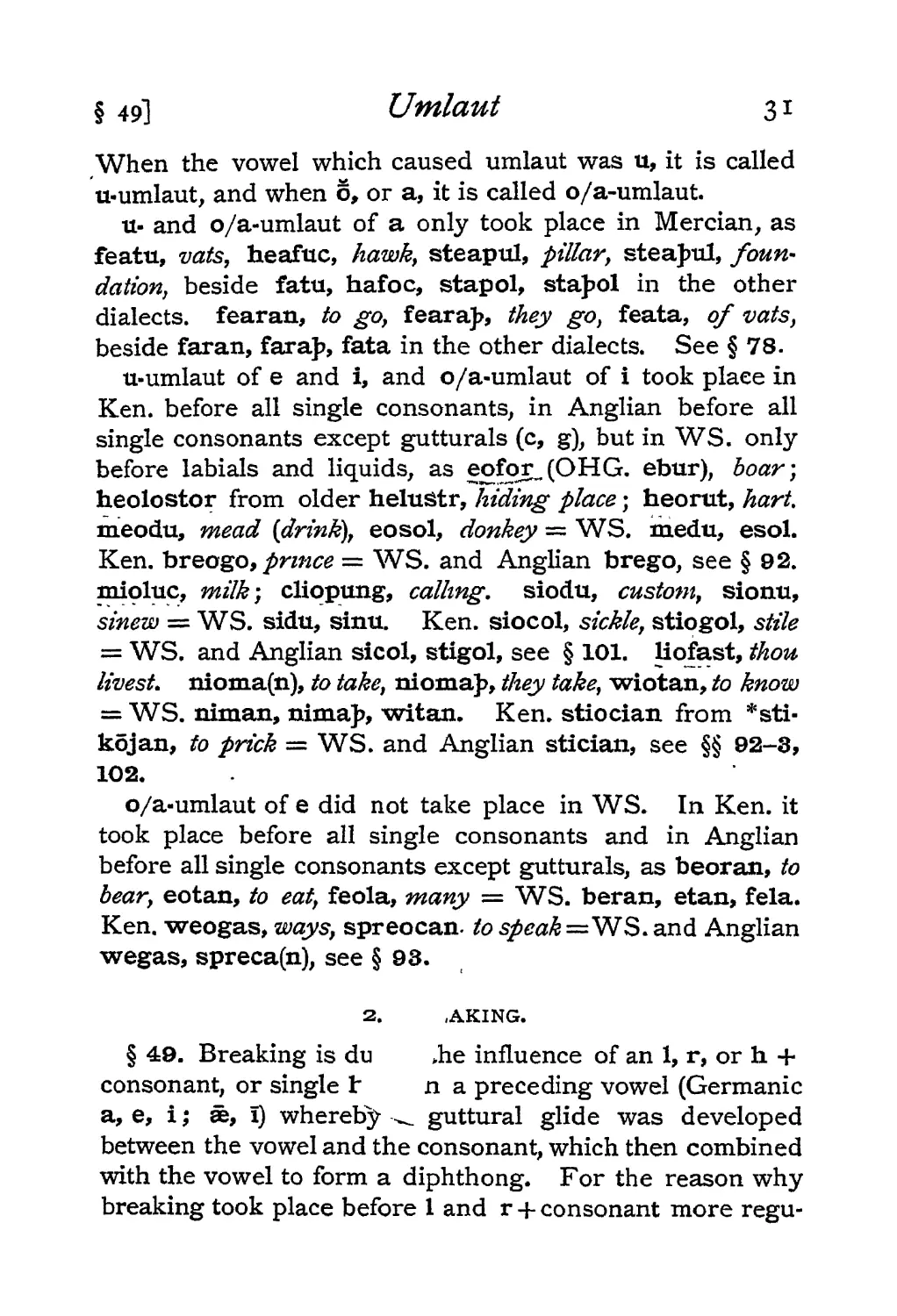
When the vowel whieh caused umlau was u, it ii called
u.umlaut, and when , or a, i is ealled o/a-umlaut.
u. and o/a-umlaut of a only took place in Mercian, as
featu, vais, hegue, hawk, £eaç, illar, seaç, foun.
dalion, besîde fau, hafoe, s£apol, saol in the other
dialects, fearan, to go, fCara, hey go, feaa, vals,
beside fan, fa, fa£a in the other dialees. See 78.
u-umlau of e and i, and o/a-umlau of i took place in
Ken. before ail single consonants, in Anglian before all
single consonants exeept gutturals (e, g), bu in WS. only
before labials and liquids, as ç(OHG. ebur), boar;
heolosor from older helur, hiding lace; hot,
eodu, mead (drinh), eosol, donkey WS. eflu, esol.
Ken. breogo, nnce = XçS. and gan brego, sec 0.
91ç, milk; eli0pg, calhng, sioflu, cusom, ionu,
sinew WS.
= WS. and glian sieol, gol, see
liest. oma(n), lo take, oma, the ae, wio£an, o know
= WS. m, nima, . Ken.
kSjan, o pnh WS. and glian s¢im, see 92-3,
102. .
o/a-umlaut of e did not take place in WS. In Ken. it
took place before all single consonants and in glian
belote ail single consonants except tturals, as beor,
bear, eot, fo car, feola, man9 WS. beran, cran, fela.
Ken. weogas, ways, spreocan. o speak=WS, and Anglian
wegas, spreca(n), sec 93.
§ 49. Breaking is du he influence of an 1, r, or h +
consonant, or single 1- n a preceding vowel (Germanie
a, e, i; g, i)whereby guttural glîde was developed
between the vowel and the consonant, whieh then combined
with the vowel to form a diphthong. For the reason why
breaking took place before 1 and r + consonant more reçu-
,.,_ -oo«ogy [§ o
larly in WS. and Ken. than in Anglian, sec § 7. In the
examples given below we shall confine ourselve chiefly to
WS.
a (oe) > en, as ceald, Goth. kalds, coM; healdan, Goth.
haldan, to hoM (§ {tzl); bearn, Goth. barn, child; heard,
Goth. hardus, hard (§ s6); eahta, Goth. ahtgtu, eight;
weaxan, Goth. wahsjan, to grow; seah, OHG. sah, he
sw (§ s).
e > eo, as meolcan, O HG. melkan, lo milk; sceolh,
OHG. scelh, wry, oblique (§ s) ; cotise, OHG. erda,
earlh ; heorte, OHG. herza, he«r (§ 8) ; cneoht, OHG.
kneht, boy ;' seox, O HG. sehs, six; seoh, sec tho (§ Se).
i > io (later eo), as liorrgan, leornian, from lirnSjan, fo
leam; miox, meox, from *mihst, mam4re (§ 98).
e > ê in W S. belote, h, as nêah, Goth. nèh, near;
nêar from *nêahur, older *noehur (§
i > io (later êo) in WS. before h and ht, as lêoht, Goth.
leihts, adj. light; wêoh, idol, Goth. weihs, holy (§ 1t7).
3" INFLUENCE OF N,s.,s.
§ .50. a became a low-back-wide vowel, written a, o,
before nasals, as camb, comb, comb; nama, noma, naine;
land, lond, land; lang, long, long (§ 59).
e > i before Germanic m (§ sl), and in early Latin loan-
words before nasal+consonant (§ 82), as niman, OHG.
neman, fo tak; gimm, Lat. gemma, gem ; pinsian, Lat.
pens.re, to eigh, ponder, consider.
o > tt before nasals, as guma, OH G. gomo, man; numen,
OHG. ginoman, laken ; htmig, OHG. honag, honey;
Imnor, O HG. donar, lhunder (§ 1oo).
e > ô before nasals (§ Ira), as mSna, Goth. mêna, noon;
nômon, Goth. nêmun, lhey took. "
N aal disaplSeared before the voiceless spirants f, ,,
and with lengthening of the preceding vowel, as f-ff,
§ il Influence of Initial Pal.. Cotsonants 3 3
O HG. fimf, rive ; ôsle, O H G. amsala, o«tsel (§ SsS) ; cri]v,
Goth. kun]s, kno.wu ; gs, O H G. gans, goose ; ]mr, Goth.
an]mr, other (§
4. INFLUENCE OF INITIAL PALATAL C'ONSONANTS.
§ 51. Between palatal
g (----- Germanic j, § 2o8), sc (§ 81.), and the following
pal.atal vowel, a glide was developed în prim. OE., which
combined wîth the vowel to form a rising diphthong, and
then at a later period the rising diphthong became a fall-
ing diphthong through the shifting of the stress from
the second to the first element of the diphthong. The
examples given below are chiefly WS. ; for the correspond-
îng forms in the other dialects, the student should consult
the paragraphs within brackets.
me > es (older eoe), as ceaster, Lat. castra, city, fortrcss;
ceaf, clzaff; geai', Goth. gai', ho gave ; sceaft, OHG. scaft,
shaft ; sceal, Goth. skal, shall (§ 72).
e > le (older ié), as cieres, Lat. cerasum, clwv'y-O'ce;
giefan, OHG. geban, fo give ; scieran, OH G. scerar,
shear (§ 91). ciele from *keli, older »kalig, ¢old; g'iest from
*$est, older *$astiz, gest; scieppan from *skeppan, Goth.
skapjan, fo create (§. 73).
> êa (oIder eoe), as cêace, prim. Germanic *kekSn.,
jaw ; gêafon, Goth. gêbun, they gave ; gêar, Goth. jêr,
vear; scêap, Goth. *skêp, sheep (§ 124).
NOTE.--In forms like gioc, geoc (OHG. job), yohe (§ 110);
giong, geong (OHG. jtmg), young (§ 116); ge5mor (OHG.
jm), sad ( 12, Note), the io, eo, e may have been sing
diphthongs, but it is difficult to deteine how far they were
diphthon st all, and how far the i, e were merely inseed
to indicate the palatal nare of the g
It is highly probable that in forms lik¢ «¢eacan, o shake.
scea4u, shadow, bede scacaa, scadu ( 57, Note), sceolfle,
OH G. scolta, should ( lI0), scedau beside scâdan, to divide
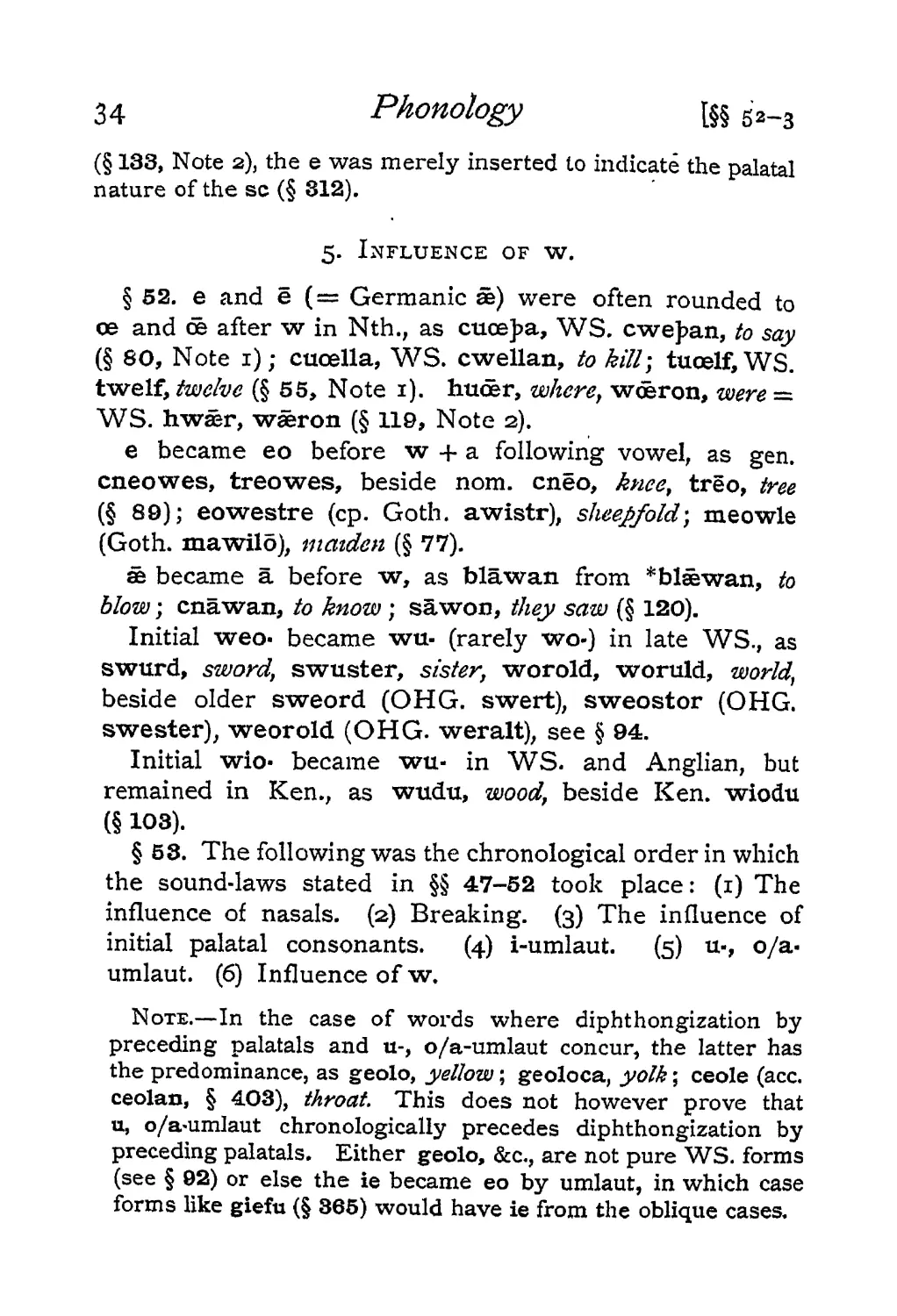
34 Phono/ogy [§§ _
(§ 133, Note ), the e was merely inserted fo indicatê the palatal
nature of the se (§ 812).
5- Iuc. o w.
§ t.. e and ê (= Germanic ) were often rounded to
oe and cê after w in Nth., as cuoe]a, WS. cwe]an, fo say
(§ 80, Note ); euoella, S. cwellan, fo kill; tuoelf, WS.
twelf, twelve (§ , Note x). hu6er, where, woron, were
WS. hwoer, wron (§ 119, Note 2).
e beeame eo before w + a followin'g vowel, as gen.
cneowes, treowes, beside nom. cnêo,
(§ 89); eowestre (cp. Goth. awistr), sheefoM; meowle
(Goth. mawilS), mazden (§ "/7).
became R before w, as blgtwan from *blewan, fo
blow ; cnwan, to kow ; sRwon, the.y saw (§ l.O).
Initial weo. became wu. (rarely wo.) in late WS., as
swurd, sworcl, swuster, sser, worold, woruld, world,
beside oIder sweord (OHG. swert), sweostor (OHG.
swester), weorold (OHG. weralt), sec §
Initial wio. became wu- in WS. and Anglian, but
remained in Ken., as wudu, wood, beside Ken. wiodu
(§ o8).
§ 18. The following was the chronological order in which
the sound-laws stated in §§ 47-15. took place: (z)The
influence of nasals. (2) Breaking. (3) The influence of
initiaI palatal consonants. (4) i-umlaut. (5) u., o/a.
umlaut. (6) Influence of w.
NoT.--In the case of words where diphthongization by
preceding palatals and u-, o/a-umlaut concur, the latter has
the predominance, as geolo, .yellow; geoloca, yolh; ceole (acc.
ceolan, § z108), throa. This does not however prove that
u, o/a.umlaut chronologically precedes diphthongization by
preceding palatals. Either geolo, &c., are hot pure WS. forms
(see § 09.) or else the ie becamc eo by umlaut, in which case
forms like giefu (§ 8{}5) would have ie from the oblique cases.
§ ;4] Short Vowds of Accented Syllables 35
A. THE SHORT VOWELS OF ACCENTED SYLLABLES.
a
§ 4=. Apart from the influence of neghbourîng sound_s
the normal development of German[c a (= Goth. O.Icel.
Og70'i4 G. a) is. oe in.. QE.
Examples in closed syllables are: cleg, Goth. dags,
O.Ieel. dagr, OS. dag, OHG. tag, day ;"t, Goth.
O.Icel. ]mt, OS. that, OHG. dag, lhe ", and similarly boee,
back ; boe], ath ; bloec, black ; broes, b,.ass ; croeft, skill;
doel, dale; oefter, after; et (unstressed or), al; foes, fast,
firm ; fet, var, vessel ; gloed, glad ; gloes, g[ass ; groes
(goers), grass ; h.oefde, he had ; hwel, whale ; h.w_.oe, t w/ml;
poe], iath ; oegde, he said; smoel, smalI ; toef, staff; in
the pret. sing. of strong verbs belonging fo classes IV
(§ 508) and V (§ 05), as ber (Goth. O.Icel. OS. OHG.
bar), bore; broec, broke; cwoe], said; eoet, sat; woes,
was. On forms like eppel, aibiMe, beside pl. appta, sec
Examples in open syllables when followed by a palatal
vowel, or a vocalic nasal or liquid in the nëxt syllable, are-
oecer (Goth. akrs), field, acre; ecern, acorn; foede_.___r,
falher; foeger (Goth. fagrs), fait» beauliful; hloedel, ladle
hroefen, hroefn, t'aven; hwe]er, whether ; moegen (Goth.
*magn), power; negel, noegl (Goth. *nagls), hall; woeter,
waer ; fe]m (Goth. *raisins), embrace, fathom
snegl, snail; toegl, rail; wegn, wagon ; sing. gen. doeges,
foetes, dat. doege, foete, beside nom. doeg, day
NoTE.I. e became ¢ in Ken. and partly also in Mercian, ai
deg, feder, fer, hefde, set, we, weter -- WS. doeg, feder, &c.
. oe became by loss of g, as brt, he brandisled;
maiden; sde, le said; wn, wagon, beside broegfl, moegflert
(§ 58), egde, woegn.
3- a often occurs where we should expect e. In such cases
the a is due to levelling and new formations, as sing. gen.
36 Poology [§"
dat. pape, beside pe}es, poe}e, due to the plural forms papas,
papa, papum (§ 880); fera. gen. dat. acc. singular sace, swa}e,
beside soece, swoe]e, due to nom. singular sacu, slrife, q«arrel;
swa]m, tracb ; and plural saca, swa]a, &c. (§ 800) ; masc. gen.
sing. glades, beside nom. gled, glad, due to forms like dat. sing.
and plural gladum (§ 4p, z,); imperative of strong verbs be-
longing to class VI (§ 1508), as far, sac, due to the influence of
the infinitive faran, 1o go, ravel; saean, to quarrel; and similarly
in the pp. faren; grafen, dz.g; hlaflen, toaded, beside grefen,
laloeden. On the analogy of such past participles was formed
slagen beside slegen, slain.
§ 55. e became e by i-umlaut, as bedd, Goth. badi,
O HG. beLH, bed; bet(e)ra, Goth. batiza, better; hebban,
Goth. hafjan, OS. heffîan, fo raçse; here, Goth. harjis,
OS. OHG. heri, a-my; leegan, Goth. lagjan, OS. leggian,
fo lay; and similarly hère, barley; ber from *atiz, bater;
ewellan (wv.), fo bill; ege, awe, fectr; elles, ds¢; hege,
hedge; hell (Goth. halja), hell; herian, fo praise; hete,
haie ; mere, lake ; mete, meat, food; nerian, fo serve; nett,
net; secgan, fo scLv; sellan, fo sdl; settan, Vo set; stede,
place; swerian, fo swear; tellan, o corroi twelf (Goth.
twalif), twêlve ; webb, web ; weccan, to awake. But sLape
beside stepe, step.
Nor..--z. In Nth. e was often rounded to oe after w, as
cuoella, 'o Mil; tuoelf, ¢wdve.
. The replat forms of the second and third pers. singular
of the pres. indicative of strong verbs belonging to class VI
( 08)wodd bave e, as in OH G. fera, thou goest; fet, h«
Koes, but in OE. the a of the other forms of the present was
extended to th e seeond and third ps. sinlar, and then
a bette oe by i-umlaut, as foerest, foerep.
. It is dicult to account for the absence of umlaut in
loecc, seize ; poe}an, o aerse; secc, se ; wmcce,
viol; d for gemoecca, mate ; hoecc, aîe afc ; moecg, man,
waor; spp to ste; wrecca (OS, wreio), ele» beside
the lauted fores gmocca, mecg, steppan, wrecca.
§§ -7] Short Vowels of A ccented Syllables 37
§ l. Umlaut generally did not take place belote Ger-
manie consonant eombinations, as dwesean, fo extinguish ;
oesc from *askiz, asl»tree ; espe, aspen ; festan, tofasten ;
heeftan, fo hold captive; mestan, to fatten ; noeglan, to
nail; reescan, fo coruscale. But umlaut oeeurs in
again ; esne, servant; rest, rest; restan, lo rest ; and in
efnan, go #efomn; stefnan, to regulae, beside efnan,
stefnan,
.. § 7. Germanic a remained in open syllabls when
o. rigin._a!!y - f011_o_).v_ed b.y._.a..g.ut._t.ç.ral vgwelA,._9,_)..!n..nth.e
.n._çxt. s3,11able, as pl. nom. acc. daga gen. daga, dat.
dagum, beside sîng. nom. doeg, day; gen. deges, dat.
dege; neut. nom. acc. plural ha]m, 3aths; bladtt, leaves
îatu, rats, beside singular boe, bled, foet; O E. Goth.
OS. OHG. faran, O.Icel. rata, fo o, travel; nacod,
Goth. naqa]s, O HG. nackot, naked; and similarly alan,
to nourish ; apa, albe ; bacan, fo bake
earu, care ; cradol, cradle; dragan, to draw ; pres. subi.
rare (Goth. farki), he may travd; gaderian from *adu.
rSjan, o gai]ter; galan, o s'ng; gnagan, îo gnaw ; grafan,
to dig; hafoc, hawk ; hafola, hafela, head; hagol, ha[l;
hagu, enclost«î'e ; hara, ]mre ; hladan, lo load ; hra]or,
more quickly ; lagu, law ; latost, latest, slowest; la]mi,, he
inviles ; la]ode, he inviîed; maca], he makes; macode,
he ruade; magu, boy ; nafula, nafela, naval; racu, narra-
tive ; sacan, to quam'd; acu, slrife; adol, saddle ; stapol,
iMllar; ata]mlian from *sta]mlSjan, fo establish ; talu,
statement ; wadan, to go, wade. macian from *makSjan,
lo mîke; and simîlarly in the inf. of other weak verbs
belonging to class I I (§ t;t), as baÆian, o bahe ; dagîan,
to dawn; gladian, o be glad; hatîan, o hate; la]ian, to
invite.
,.. I t also remained in closed syl!ables before.don_bJeeo_.n-
s.p..naoE3_...(ç_xç.çpt.._.l).. ct,.w.h.en. the next slle
oriinally contained a g.ttural vowel, as abbod (Lat. acc.
38 Phonology [§§
abbâtem), abbog; assa, donkey; carte (OHG. kazza),
cal; cassuc, sedge; gaffetung, scoffing; habban (§ t538),
fo heve ; hassuc, coarse grass
lock; sacc, "sack; ]mccian, to flai, #al; flasce (flaxe),
flask ; masc (max), net ; wascan (waxan), fo wash ; brast.
lian, lo crackle. But a few words have e besîde a, as
oesce, ash, dnders ; oeppel, alb#le ; hnoeppian, fo doze;
leppa, la2bpet , beside asce (axe), appla, a»ples, hnappian,
lappa.
NoTx.--sca- was offen wrîtten scea. wlth ¢ to denote the
palatal pronunciation of the sc, as sceacan, fo s]me; sceadu,
Mmdow ; ceafan, to s/rave ; scealu, scale (balance) ; seeamu
(seeomu, § BO), s/mme, beside scaean, scadu, scafan, scalu,
scamu (scomu). See § 51, Note.
§ 58. a became ..oe......w_.hç.n " fq!j..gWç..d...by..a.n ' umlauted_v.el
i..n .... fl:e_.sgllae, as ge__s (oex)from *a.kyei__, older
*a.ku.s!» axe ; and similarly oepele from *alcali (OS. aali),
noble; e]eling from *auling, nob[eman; oet-, tS-gedere
from *.aduri, together; foesten (OS. fastunnia, fasting),
fortress; goedeling (OS. gaduling), com1anion ; hoele] from
*xalu]i-, hero ; herfest from *xaruBist, hanest; megden
from *ma$adïn (OHG. magatin), maiden. The oe in the
above examples is a kind of umlaut.
Noe.--The a in the stem-syllable of the present partieiple
and gerund of strong verbs belongîng fo class VI (§ î08) il due
to the a of thi infinitive, as farende for *foerende from *fartxndi,
farenne for *ferenne from *farannjai.
§ 9. Germanic a was probably a mid-back-wide vowel
like the a in German Mann. In O E. il became a low-
back-wide vowel beiôre nasa'Ise the â in French pâte,
and the a as pronounced in many Scotch dialects in such
words as ant, man, pass, which English people often mis-
take for o especially when lengthened. In the oldest OE.
il wa nearly always written a, in the nînth century il was
mostly written o» and in late OE. mostly a again, but
§ o] Short Vowels of .4ccened S3,ZIabZes 39
in some parts of M ercia it seems to have become o which
has been preserved in many of the Midland dialects down
to the present day. Examples are" gaxtgan, gong:an,
Goth. gaggan, O.Icel. gang:a, OS. OHG. gangan, to go;
hana, hona, Goth. hana, O.Icel. hane, OS. OHG.
hano, co«k ; lang, long, Goth. laggs, O.Icel. langr, OS.
0 HG. lang,/ong ; nama, noma, Goth. namS, OS. 0 H G.
namo, ame; and similarly ancor (Lat. ancora),
bana, slayer ; brand, fireDrand ; camb, comb ; camp, batlle ;
candel (Lat. candêla), candle; cann, le can ; fana, 5anner;
gandra, gaMer; gesamnian, o col/ect; hamor,
hand, hazd; lama, lame ; lamb, lamb ; 1and, land; manig
(Goth. manags), nay ; mann, nan ; rature, rare ; span.
nan, fo clasp, fasten ; standan, to stand ; strang, st»ong ;
]anc, thotght; ]wang, t]og; in the pret. singular of
many strong verbs of class III (§ 498), as beganï, began ;
dranc, drank ; fanal,round; sang, sazg ; swamm,
vith metathesis of r in born from older bronn, brama
(Goth. brann), burned; orn from older ronn, rann (Goth.
rann), ra.
Now---The a became o in unstressed adverbial and pro-
nominal forms, as hwonne, wlez ; on, on ; potine, lhez ; masc.
acc. singular hwone, w]orn; lone,
§ 60 . a (O) l became__ .e...(but e in the oldest period) by
i.umlaut, as G0th anâeis, O.Icel. ende, OS. endi,
OHG. e"-'ti, stem andja., end; lengra, OS. lengira, OHG.
lengiro, longer; en..g, Goth. andjan, OS. sendian,
to send; and similarly be__n_c f.rom__ *lrki.'z, bench ; cemban,
to comb ; cempa, warrior ; drencan, fo give to drink ; ened,
dgck ; enge, .arrow ; englisc, ngIish ; fremman, to per-
form ; henn, hen ; 1engin, lezgth ; menn, ne ; mengan,
fo nix ; mennisc, h««maz ; nemnan, to zame ; pening,
lenny; strengra, sO'o»ger; ]encan, o think ; wendan, lo
tur, bernan (Goth. brannjan) to butez; eernan (Goth.
4o Phonology
rannjan), to run, g'«llop, with metathesis of r and preserva.
tion of the older stage of umlaut.
§ (I1. N asalsdiaaDeared belote the voiceless iran
f, _,(o) became ô througthëioer.
Goth. OHG. , hand, escort, mdtitude ;.
anar, second, other; sôe» OHG. samfto, Kent, soEtl ;
and sîmilarly g6s, goose ; 6s., god; 6sle (OHG. amsala),
blackbird ; zme, smootld3, ; s6, [Tte ; tb, ioot]z ; r6stle,
th.tsh, throst[e ; wbs, to[sh,re.
o. ô became ê (older ) by i-umlaut, as êst, Goth.
ansts, stem-form ansti.,favur; nêan, Goth. ana.nanjan,
æo vnture oz; tê fi'om *taniz, teeth; and similarly
walkhzg, moventent ; gés, ge«se ; gesêan, fo testy, dedare
sêfte, sort; sêe, smooth.
68. aLbçfore 1, r, and ..çgnsonant,
aO.b7h. Forms Eb"fi-ëing often occur
in the oldest period of the language. Breaking did hot
take place in Anglian belote 1 + consonant, and frequently
not belote r + consonant. Sec 1, r ( 7).
64. x. Before 1 + consonant.
, Goth. alls, O.Icel. allr, OS. OHG. al, ail; cead,
Goth. kalds, O.Icel. kald, OS. kald, OHG. kalt, coM;
h}d, Goth. OS. haldan, O.Icel. halda, OHG. htan,
fo hold; and similarly eeale, chalk ; ceK ca; de,f,
he dug ; eald, old ; ealh, temp& ; le,dan, fo foM; felan,
io fall ; gealga, gal[ows ; hea!K haï; heall, hall; hep,
he h@ed ; heals, neck ; mealt, malt ; Bealf, salve, ointment ;
sealfian, fo anohtt; zealh, willaw ; sealt, sait; rende, he
told; wealdan, fo w&M; weh, foreigner, dshman
weall, ¢all; weaaan, fo ho< Forms like bealu, hale,
eva ; feal, fallow ; sen, dark, &(sk, beside bu, falu,
Bal, bave the ca from the inflected stem-form, as gen.
bealwe, feweB, BealweB (Bec
Nor.--x. ca became êa by loss of h before a following
vowel as gen. singular êale, wêales, nom. pl. sêalas,
wéalas, beside nom. singular sealh, wealh.
by i-umlaut, as wîelisc, fordgn, Wdsh.
2. a remained unbroken in late Latin loanwords, as albe
(Lat. alba), aih; alter (Lat. altare), allar; fals (Lat. falsus),
flse; pMm (Lat. pma), palm-lree.
6. ea became le (later i, y) by i-umlaut, as fieHan
from *feaHjan, older *falljan, ofell; fielst from *fea(t),
hou fa/lest; fiel from feai, he falls; ieldra (Goth.
allia), older; ieldesta, old«st; ieldu, old age ; mieltan
6.), to mdt.
Now.--The corresponding vowel n Anglian is me (also e), as
eldra, eldra, elflu, foella(n), fella(n); and in Ken. e, as eldra,
elflu.
. . Before r + consonant.
bearn Goth. O.Icel. OS. O HG. ba, cçld; heard,
Goth. hardus, O.Icel. harr, OS. hd, OHG. ha,]mrd;
and similarly beard, 5egrd; bearg,
cea, he caed; dea, I date; earc (Lat. arca),
m an ; eam, 2oor; eaU, hou art; feh, oa 2ig;
geard, yard; gearn, yarn ; gearwian, to :re:are; ge-
meai, fo mark
mearc, bounda7; mearg, mamow; mearh, hse; peaoc,
park ; sceau, shar ; sweam, swarm ; weam, warm
wea, he threw; wear, he became. Forms like beau,
grove ; gel, ready
searu, plol, dice, bave ea from the inflected stem-fom,
as gen. bearwes, gearwes, meaes, &c. (see 26).
NozE.--i. In An#ian ea became oe (later e) belote r + tmral,
as berg, erc, ferh (ferh), merc (merc), &c.
2. a remained unbroken in late Latin loanwords, as carce,
#son ; martyr,
3- ea became êa by loss of h before a following vowel, as
gen. singular ares, mêares, nom. pl. aras, mêaras, besîde
nom. sinlar feh, mearh.
4 Phozology [§§
4. Fonns like oern (Goth. razn), ]olese ; pret. sing. arn (Goth.
rann), tan; barn (Goth. brann), burned; boerst (OHG. brast),
burst; goers (Goth. gras), grass; hern, wave, are due to a late
metathesis of the r.
67. ea became ie (later î, y)by i-umlaut, as diee,
OS. derni, OHG. tami, secret; ierfe, Goth. arbi, OS.
OHG. erbi, )herftance ; and similarly cierran, fo turn ;
gierd, rod» twfg; erwan from *gearwjan, fo prepare;
ierming, pauper; iermpu (OHG. amida), poverty; wier.
NOT.--Thc corresponding vowel in the non-WS, dialects
is e, as de,e, erre, ermu, &c.
OS. 3. Belote h + consonant (also x = hs) and simple h.
t Goth. ahtu, O S. O H G. ahto, eight ; seah, Goth.
sa, OS. OHG. sah, he sa.w ; weaxan, Goth. wahsjan,
O.Icel. vaxa, OS. OHG. wahsan, fo gvw; and similarly
eax, axle.#'ee ; eaxl, shoulder ; feaht, he fought ; feax, bain;
fleax, flax ; gefeah, ]e rejoiced ; geneahhe, enoug]z, oflen ;
hleahtor, laughter ; meaht (later miht), powe
meaht, lhou zayest; meahte, he mig]t, could; neaht
(later ht), nzht; seax, kn; sleah (imperative), sloEy
thou ; weax, wax.
Now.--. ca became oe in Anglian, as oehta, foex, hloehtor,
seh, wex, &c.
a. It became e in late WS., as ehta, exl, fex, seh, sex, sleh, "
wexan.
. ea became le (later i, y) by i.umlaut, as hliehhan
(Goth. hlahjan), fo &ugh ; eht (Goth. mahts, stem-form
mahti.), power, migt ; miehtig, n, çghty ; nieht, nig]t ;
sehst (Goth. slahis), t]ou slayest; slieh (Goth. slahit),
sla2s; sHeht, stem-form slah-, slaug],ter; wiex
(OHG. wahsit), itows.
NowE.--The coesponding vowel in Anglian îs e, as hleh.
ha(n), moeht, moehtig, &c.
§§ o- Shozq Vowels of Accenecl S3,1lables 43
§ /0. ea became êa by lo of intervoealic h, a êa, Goth.
ala, OS. OHG. aha, waler, rer; slêan from *sleahan,
Goth. OS. O HG. slahan, fo s[a,v, striée; and similarly
flêan, fo ]Tav; lêa from *leahu, f b[ame; lêan, to blae ;
slêa, /" slav; slêa] from *sleaha], thev sla3,; ]wéan, to
wash ; êar (Nth. oehher) from *eahur, older *ahur, OHG.
ahîr, ear of co' ; têar (Nth. toehher) from *té"ahur, older
*tahur, 0 H G. zahar, tear.
§ 71. êa became ie (later i, } by i-umIaut, as stiele from
*stiehle, Germanic stem-form *staxlja-, st«eL
§ 72. oe (older a) became ea (older eoe) aller initial
palatal c, g, and se, as ceaf, chaff; ceafor, cockchafer;
ceaster (Lat. castra), cil.y, fortress ; forgeat (OS. forgat),
]ze forgot; geaf (Go[h. gaf), hegave ; geat (0. I cel. 0 S. gat),
gale, openig, hole ; sceaft (OHG. scaft), shajq; sceul
(Goth. skal), I shall; sceatt (Goh. skatts), noey, prop.erty.
NowE.--/. Anglian has oe beside ea, and Ken. e (e), as AngIian
coester (ceaster), goet (geat), sceel (sceal)= Ken. cester, gel,
scel. e also occurs occasionally in Mercian.
2. Forms like ceald, cold; cealf, ca(f; geard, .grd; gearn,
.ygrn; scealt, ]hou sh«ll; scearp, s]m'l, are due to breaking
(§§ {4, 66), which look place earlier than the influence of
palatals upon a following oe. In both cases the ea became e in
late WS., as celf, gel, gel, &c.
§ 73. ea became îe (later i, y) by i.umlaut, as ciefes
from *kaisS, cocgbze; ciele from *kaliz, coM ; cietel
(Lat. catillus), kettle; giest (Goth. gasts, stem-form gasti-),
guest ; scieppan (Goth. skapjan), fo creae.
Nor..The corresponding vowel in the non-WS, dialects is
e, as cefes, cele, gest, sceppan, &c.
§ 74. Germanic a generally remained before the w which
was regularly preserved in 0 E., as gen. dal. singular clawe
besîde nom. cléa, c[aw ; awul, awel, awl; ]awian, o lhaw.
§ /5. a + u (which arose from wu or vocalized w (§ 25))
became êa (cp. § 135), as clêa from "kla(w)u, clgw ; nom.
acc. pi. neuter fê from fa(),/e; dat. m
*fa(w)um ; hrêa from *hraw., raw ; strêa from *straw.,
sraw ; rêa from *ra(wu,
76. Prim. Germanic aww (= Goth. aggw) became
auw in West Germanic, which regularly became êaw in
OE. (cp. 135), as déaw (Goth. *daggwa., OHG. tou,
gon. tçuwes), d«w; glêaw (Goth. glaggwu.ba, dçlgetly),
wîs« ; hêawan (Goth. "haggwan, O H G. houwan), to ];
scêawian (Goth. *skaggwSn, O H G. couwSn), o
7. a bccame e by i.umlaut, then at a later period the
e bccame eo beforc w, as ewe beside eowe, eowu (cp. Lat.
ovis), 'ze,e; eowde,flocç lwrd; eowestre (cp. Goth. awistr),
s]e«foM ; meowle (Goth. mawilô), gb-I; strewede beside
streowede (Goth. strawîda), ]te strez,ed.
78. In Mcrcian a bccame ea before single consonants
by u- aad o,/a-umlaut, as ealu, aie; beadu, barde; eafora,
sou ; featu, fats; heafuc, ]teu; heafola, lzead; hea}u,
war ; steapul, p]l/ar ; steaul, fozndatço, fearan, lo go,
traveI; feara}, ];«T /ravd; gen. pl. feata, rats; geata,
gares; gleadîan, lo ro(ce; hleadan, to &ad; leatian,
o be slow. For the corresponding non-Mercian forms, see
N o.z. The ea bccamc me beforc gutturals, as degas
(= WS. dagas), das; droeca, dragoz; moegun, f]ze2 ca;.
z. Umlaut rarely took place beFore double consonants» as
eaçpult (WS. oeppeltn), orch«rd; hneappian (WS. hnap-
pian), fo doze.
3- VS. ealu, and forms like eafora, heafoc, &c. which are
common în poet, are all originally from the Mercian dialect.
Vg. Final a waslenthened to An monosv]lables, as
â (Goth. as), wlo ; sw (Goth. swa), so.
e
O.Icel. OS. OHG.:- ) ffen remained in OE., as OE. OS.
§§ -1 Short gowels of.4 cceted Syllables 45
OH G.feld, fieM; fe]er, 0 S. fethara, O H G. fedara,feather;
weg, Goth. wigs, O.Ieel. vegr, OS. OHG. weg, way ; and
similarly bes(e)ma, besoin; cwene (Goth. qinS, OHG.
quena), woman ; denu, valley; ef(e)n, even ; fela, much ; fell,
skh ; fetor,feler; helm, hehnet; le]er, lealher; nefa, nelbhew ;
nest, mst; reg(e)n, tain; segl, sMl; seldan, sddom ;
senep, mustard ; setl, seat ; snegl, snail ; snell, quick;
]egn, atone ; wefler, weather ; wel (adv.), well; wer, man ;
west, wesl; in the present of strong verbs belonging to
classes III (§ 499), IV, and V, as helpan, Goth. hilpan,
OS. helpau.._..._, OHG. helfan, o help ; and similarly belgan,
fo swdlwith anger; bellan, fo bellow; delfan, go di; meltan,
fo mdt ; sveellan, go swell; swelt_.n, to die ; b7a_._n, to bear ;
breean, to break ; helan, o conceal; stelan, to steal; teran,
fo tear ; enedan,
fretan, to devoz¢r ; lesan, c "s9Zlecl _metan, to measure ;
sprecan, o speak ; tredan, fo lread; wefan, fo ,eeave
wesan, fo be.
Norr-.--I. In Nth. e was often rounded to oe after w, as
woel, woeg ---- WS. cwepan, wel, weg.
e. e beeame ê by loss of g, as brêdma, lo brandish ; rên, tain ;
strêdan, lo strew ; pên, lhane, beside bregflan, regn, stregcltm,
pegn.
"" § 81. e.._i _before.Gerl_ _.anic_m. 8 (o H G.
neman)» fo take; rima, ri'm. This sound-change dîd hOt
take place when the m arose from f by assimilation
with n, as emn, even; stemn, voice, beside older ef(e)n,
stefn.
§ 82. e became i before nasal +consonant in early Latin
loanwords, but remained in later loanwords, as gimm (Lat.
gemma), gem; mini; (Lat. mentha), mint; pinsian (Lat.
pensre), fo consider; but templ (Lat. templum), temple.
§ 88..e.was broken to eo belote !e,_.___. ber'ores_r., and
' lL.+..ço..n..0nat and-eforë sCp¿e .h: Breaking did not
take place ifi Anglian before le,
46 Phonology [§§
§ 84. x. Before le, lh.
seolcan, go become languid
meolcan (OHG. melkan), fo miAk; eolh (OHG. selah),
seal; sceolh (OHG. scelh, scelah), wry, oblique. But
Anglian elh, melca(n), selh, &c.
No-rE.-- z. eo became êo by loss of h before a following vowcl,
as fêolan from *feolhs.ll (= Goth. fi]hRn, O HG. bi-felhan), o
ltide; gen. êoles, sêoles, besidc nom. eolh, seolh.
s. It is difficult te account for the breaking in heolfor, blood,
gore; and seolf, sdf, beside the commoner form self.
§ 85. 2. Before r+consonant.
eor]e, Goth. ar]a, OS. erda, O HG. erda, earth;
heorte, Goth. hai5, OS. herta, OHG. herza, heart;
weor an, Goth. wafr]an, O.Icel. verê.a, OS. werdan,
werdan, te 3ecome; and similarly beorcan, te
bark; beorg, hdt; eorgan, te shdter; beorht, bright;
ceorfan, te czt, carre ; ceorl, chm-l; deorc, dark ; dweorg,
dzvaf ; êorl, noblema+z, earl; feorh, li/e ; feorr, far ; georn,
eager ; b.eord, herd, flock ; heor], hearlh ; steorfan, te die ;
steorra, star; weord, sword; weorc, work ; weorpan,
te throw ; weor], worth.
N oTE.--I. Breaking is older than the metathesis of r in forms
like berstart (OHG. brestan), te burst ; frsc, fresh ;
te thrasl,.
2. The eo became e in Anglian before r+guttural, as
berga(n), berht, dr¢, dwerg, ferh, wer¢ = WS. beorgn,
beorht, &c.
3. The eo beeame ca in Nth., and le in Ken. (cp. § 187), as
N th. earpe, hearte, stearra = Ken. ior]e, hiorte, stiorra
WS. and lIercian eor]e, heorte, steorra.
4. ce became êo by loss of" h before a following vowel, as gen.
fêores, ]wores, besîdc nom. feorh, hfe; ]weorh, 2erverôe,
Gcross.
§ 80. 3. Before h + consonant (also x=hs) and simple h.
t (OHG. kneht), boy; eoh, horse;feoçh, cattle;
§§ a r-o] Shor l]owels of A ccened Syllables 47
feohan (OHG. fehtan), go fighg; Peohtas, Picgs ; pleoh,
danger; reoht (Goth. raihts, OS. OHG. reht), righ¢;
seox (Goth. safhs, OS. O HG. sehs), s; imperative
s[ng. seoh, sec lho. But already ai: an early period the
eo became le (later i, rarely y)belote hs and ht h WS.
and i n Ken., as cnieht, cniht ; ryht, riht; siex, six.
Nors.--eo became e în Anglian, as cneht; feh, fehta(n), reht,
sex ---- early WS. cneoht, feoh, &c.
§ 87. eo became êo (o) by loss of intervocalic h, as sêon
(sion) from *seohan, older *sehan- Goth. sa[lan, OS.
OHG. sehan, o see; swêor from *sweohur, older
*swehur ----- OHG. swehur, falher-n-Ia ; and similarly
gefêon, o roz?e; gefêo from *gefeohu, Z re2bice ; plêon,
o rish ; sêo from *seohu, I see; gen. singular fêos, plêos,
beside nom. feoh,
§ 88. Final ew became eu, and then eu became. êo
at the same rime as Germanic eu became êo (see§ 13'0, as
sing. nom. cnêo, Germanic stem-form *knewa., knee ; trêo,
tree; lêo, slave, servant. See § .
§ 8. Antevocalic ew became eow, as sing. gen.
cneowes, treowes, ]eowes, dat. cneowe, treowe, ]eowe ;
]mowian (iowian)» o serve. Forms like nom. cnêow,
trêow, ]êow had the w from the inflected forms. And
conersely forms like gen. cnêowes, trêowes, ]êêowes
had êo from the uninflected forms.
§ 90. Prim. Germanic eww (= Goth. iggw) beame
euw in West Germanic, and then euw becarne êow in
OE., as trêow (OS. treuwa, OHG. triuwa), lrusl, fMth,
cp. Goth. triggwa,
Prîm. Germanc ewwj became iowj through the inter-
mediate stages iwwj, iuwj, and then iowj became ew(e) in
WS. and iow(e), êow(e) in non-W$. as W$. geriewe, non-
WS. getriowe, getrêowe (OHG. gitriuwî), prim. Ger-
manic *.trewwjaz, cp. Goth. trîggws, rue, faitld; VqS.
48 Ponology [§§ _
get.rewan, non-WS, getrowan, getrêowan, prîm. Ger.
manie *.trewwjan, to trts. And similarly West Germanic
îwwj (§ Sa) from prim. Germanic ewj, as WS. hiew,
hiw, non-WS, hiow, hêow, plîm. Germanic stem-form
*xewja-, Shale, colour; W S. niêwe, niwe, non-WS.
niowe, néowe, prim. Germanie stem-form *newja., new.
§ 91. e became ie (later i, y) after palatal c.g, .g.n..d c i__._n
WS., b-t reraïnel é in 'A-ng-lian and Ken., as cieres,
cires (Lat. acc. cerasum), cherry.tree; forgietan (OS.
forgetan), to forge/; (O.Icel. K.f, OS. gelan,
OHG. geban). /o give; giefu, g ; gieldan, to ield;
giellan, toydl; gielpan, to boas; giest (cp. OHG. jesan,
loferment), .ye«sg; scield, shieM; scieran (,OHG. sceran),
to .s/ze0r. But Anglîan and Ken. gefa(n), gelda(n), sceld, &c.
NoF..----The above sound-change took place later than breaking,
ep. ceorfn, ceorl, georn, § 8.
§ 8«. e became eo by u.umlaut in Ken:' bef'ore.all .s.in_gle
:nàhis, irï gliaribëf6re-aiisingiê C6fisoa'-n eïcept
utturals (c, g), and in WS. before single Iabials and
.iquids, as beofor, beaer; eofor (OHG. ebur), boat;
eoloca, yolk; geolo (OS. OHG. gelo, gen. glwes),
ellow ; heofon, heaven ; heolor, scales, balance ; heolstor
from older helutr, hiding place; heorttt, hart; meola
(OHG. tnelo, gen. mel(a)wes), raeal, flozw; seofon, seven ;
meoru, greas«, fat; teoru, tar ; weorod, trool. Non-
WS. eodor, enclosre; eosol, donkey; feotor,feger; meodu,
ead (dr[k) ; meotod, creator = W S. edor, esol, fetor,
medu, metod. Ken. breogo, prince ; reogol (Lat. regula),
rulê = VqS. and Anglian brêgo, regol.
Noz.--x. u.umlaut took place in WS. in the combination we,
a hweogol, ee ; weotol, plain, cl, ar; weotttma, dowry, and
probably also before two eonsonants in sweotor, sisler.
a. The regular forms due to u-umlaut wer¢ often obliterated
in WS. br levelling, as meltt, total, flour, with mel- from the
§§ 9 3-67 Sho'l [/'of.ve[s of A ccented S.ylIab{es 49
gen. melwe, dat. melwe; pl. nom. spertt, sieam ; dat.
due to the forms of the singular, as spere, gen. spere, gen. pl.
spera; and similarly for many other forms.
§ 9. e beeame eo by o/a-umlaut in Ken. before all
single eonsonants, and in Anglian (but Nth. generally
before all single eonsonants except gutturals (e, g'), as
beoran, fo bear; çot, to eaU; feola, many; meotan, fo
measure ; seofa, hear ; steolan, to steal ; treodan, to tread ;
weofan, to weave = WS. beran, earl, fela, metan, sera,
stelan, tredan, wefan. But Ken. weoga, voays; preo.
can, 'o s2eak = Vv'S. and Anglian wegas, sprecan. Nth.
beara, eaa, treada = VS. beran, cran, tredan.
§ 94. The combination weo. which arose from breaking
(§§ 84-6), or from u., o/a.umlaut (§§ 02-3), became wu.
(rarely wo.) in late WS., a . "n
in Mercian and Ken., as late WS. swurd (later swyrd),
sword; swuster (later swyster), sister; swutol, lafn,
clear; wurpan beside worpan, lo throw; wttrp, vorlh,
#rice ; wur]an, to become ; but worc, work ; woruld, worold,
world. Late Nth. sword ; wor], worth; wor]a, to become;
worold, world; wosa from older weosa = WS. wesan,
fo
§ 9. Final e was len.g.the ê in ..moaolla.bles,
as hê, he; me; ç..(masc. nom. sing.), the; wê, we;
}, rèI'd'ative particle (§ 8). -
i
§ O0. G_erma_nici= Goth. O.Icel. OS. OHG. i) generalj 2
.e. i._.., oes.g Goth. bîdjan, O.Icê.
0 S. biddian, 0 H G. bitten, topray, beg, entreat; fisc, Goth.
fisks, O.Icel. fiskr, OS. fisk, OHG. fisc, fish; wîtan,
Goth. OS. witan, O.Icel. rira, OHG. wiggan, lo now;
"and similarly bît(t)er, bitter; blind, Mind; bridd, young
bird ; brîngan, fo bring ; cild, child ; cinn, chin ; clîf, diff ;
cribb, crfb ; cwide, saying; clisc, dish ; ffttger, jqnger
o, «, E
5 o PIz o z o logy [ § § 9 - 8
gefilde (sb.), tla# ; gift, prioe of wife; bidet, tither; hild,
battle, war ; nd (sb.), hind ; hHd, lid ; hring, ring; cgan,
fo lie down ; libban, to hue ; lifer, huer; lira, limb ; list,
cunning'; midd, niddle ; ft, niece ; hiver, downwards ;
pic, pitch; ribb, rib; scilling, shilling; scip, shi; sibb,
relationshi# ; sire, sieve; sige, wtory ; sittan, to sit ; smip,
snigt» ; spinel, sh2dle ; twig, twt; icce, thtk ; ider, thither;
ing, thing; ridda, third; wilde, wM; wind, wind; wter,
whter; in the second and third pers. sing. pres. indicative of
strong verbs belonging to classes I I I, IV, d V, as hilpest,
hîlpe, birest, bire, itest, item, beside inf. helpan, fo helç ;
beran, to bear; etan, o eat; in the pret. plural and pp. of
strong verbs belonging to elass I, as biton, biten, don,
riden, stigon, sgen, beside inf. bitan, to bile; dan, go
"r«¢e;stigaF., o a«nd; in the inf. and present of strong
verbs belonging to class III, as bindan, fo b,)zd; dncan,
fo drink ; findan, fo find ; stncan, lo siuk ; singan, to
spinnan, to sph, ; swimman, fo
Nor.x. i beeame î by loss of g, as brîdel, bridle; frinan,
o ask; li, le lies down; rnan, fo rahz; sie, stylise; tê (Lat.
têga), lile, beside brigdel, frignan, ligep, sîgpe, tigele.
a. i appears as e in the Latin loanwords, pem (Lat. pitre),
pear; segn (Lat. signum), s[g.
97. ieça....b..Ioss of nasal before a voi9s
s..a.fifGoth. O HG. fimf, rive ; fifel, sea-nwnster;
gesip (OHG. sindo), companion; her (OHG. nd),
ox; h)e (OH G. Hn), gentle; si (Goth. sinus), wa9; swi
(Goth. swins), strong. But in remained when it came
to stand belote a voiceless spirant at a later period, as
pinsian from Lat. pensare, fo weigh, cosider; winster
beside nester (OHG. wister), loEt (hand).
98. i w broken to io before r and h + consonant, and
r%à" in earl W. theio becaë eo d
thus fell together with the eo from e ( 85-8), as oan,
from *H5]an, to lear,; m9ç, .... m¢x from
§ 99 Short Vowels of Accened @llables 5
*mihst, marne'e, ep. Goth. malhstus, dunghill; tiohhîn,
teohhian from *tihh5jan, fo arrange, think, consider;
twiogan, twêogan from *twixSjan (§ 139), fo doubt.
NooEE.--i. eo then became ie, later i, in WS. before h + con-
sonant, as stihtan, fo arrange, regulate ; wriexl, wrîxl, excange.
a. In .A.nglian io became i before gutturals, as get!hhAan, to
arrange, tldnk, «onsider.
. In the two verbs corresponding to Goth. brinnan, to burn ;
and rinnan, lo run, the metathesis of the r took place earlier
than breaking, whence Anglian biorna(n), beorna(n), iorna(n)
coma(n). In WS. we have biernan (later birnan, byrnan),
iernan (later irnan, yrnan) for *biornan, *beornan, *iornan,
*eornan, with ie from the third pers. singxlar biern(e)] (= Goth.
brinni]), iern(e)] (---- Goth. rinni]). The new formation in WS.
was doubtless due to the faet that the two verbs were mostly
used impersonally, ep. the similar new formations in NHG.
zîemen, 1o be$eem ; and wiegen, to weigh.
§ 99. io beeame le (later i, y) by i.umlaut in WS.,
as gfierran (OHG. arfirren), from *-firrjan, fo remo'oe ;
bierce, birch; fiehst (OHG. fihtis), thou fightest; fieht,
he )ghs ; gebierhan, to make brfg]t ; gesieh], ision ;
giernan (OS. girnîan), fo desire; hierde (OHG. hîrti),
shepherd; ierre (OS. O HG. irri), angry; rihtan, ryhtan
(OS. rîhfian), o se sraight; siehst (OHG. sitxis), amu
seest; sieh] (OHG. sihit), he secs ; smîerwan (OHG.
smirwen), to anoinl; wierreta, wiersta (OHG. wîr.
sisto), vorsl; wiersa (OHG. wirsiro), orse; wier]e
(0 H G. wirdi), worthy.
No.--I. The i-umlaut of io generally did hot tzke place in
thi non.WS, dialeets, henee we bave io in Nth. and Ken., and
io (eo) in Mercian, as Nth. Ken. giorna(n), hiorde, iorre-----
Mereian geornan, heorde, iorre, WS. gîernan, hîerfle, ierre.
Forms Hke afirra{n), to remeve ; smîrwan, to smear, are not
pure Anglian forms.
2. io became î in Anglîan before a followîng guttural or
r + guttural, .as bîrce, gcbîrhta(n), gesih]; mixen (mod. northern
5 Phonology [§§
dialects mixen), dttnghill; rihtan; wirean (OS. wirkian), fo
work. The i then became i by loss of inteocalic h and con-
traction in Nth., as sîs(t) from *sihis, WS. siehst, lhog seest;
sp from *sihip, WS. siehp, h secs.
3. io in the combination wio became u at an early period in
Anglian and then u became y by i-umlaut, as wyrresta, zvorst;
wyrsa, worse ; wyrsian, to worsen ; re, worthy.
100. i bçae....y.7./a-umlaut in Ken. befqçç all
single consqqa2ts, in Anglian belote ai1 single consonants
except gutturals (c, g), and in WS. belote single labials and
liquids. But already at an early period (ninth century)the
io became eo in WS. and M ercian.
lOl. i. u.umlaut.
Pret. eliopude, .ode, beside inf. elipian, o call; cliopung,
caIling'; mîoluc, miole (later milc), milk ; siolue, silk ;
siolufr, sîolfor, stTver; pret. tiolude, .ode, besîde inf.
tilian, fo ahn ai; tiolung, prodtcG labotr. Anglian and
Ken. liomu, leomu, litbs; nioor (WS. niçor), lower;
siodu (WS. sidu), cttstom; sinu (WS. sinu), sinew.
Ken. siocol, s2kle; stiogol, sttTe= WS. and Anglian
sieol, Fores like liomu, nioor, which are occa.
sionally round in WS. prose, are hot pure
NotE.--x. u-umlaut was mostly obliterated in WS. by levelling
and new formmions, as plural clift, cls ; scipu, ships (Anglian
eofu, seiopu), due to levelling out the stem.forms of those
cases whieh had no u in the ending. Pret. plural drifun, .o,
th drove; ipun, -on, they seied, due to preterîtes like biton,
they bît; «tigon, they ascended. Pret. tode beside olode, he
aimed al, formed direct from the inL £ilian. And conversely
forms like inf. eliopian (eleopian), tiolîan (teolian), were
formed from the pret. cliopode, tiolode.
a. io beeame i in Anglian before 1 +ttural, as mlle from
miole, older miolue, milk.
[ 10. z. o/a.umlaut.
ora, heora, their, them ; liofast, thou livest. Anglian
and Ken. beonan, on this side of; #ioda, kite, lture ;
54 PkonoIogy [§ o
daughter; folc, O. Icel. O S. OH G. folk, folk; bord, Goth.
huzd, OS. bord, OHG. hort, treasure; oxa, Goth. ahsa,
O. Icel. oxe, OHG. ohzo, ox ; and similarly boda, messen.
ger; bo¢îig, body; boga, bow; bohte, he bought; bolfl,
house ; bolt, boli ; bord, board ; botm, bottom ; broie, broth ;
enotta, knot; coco, cock ; col, coaI; colt, colt
coss, kiss; dogga, dog; dot (OS. dot, O HG. for), door,
gaie; dropa, drolb ; fola, foal; folgian, lo follow; forst,
frost ; fox,fox; frogga, frog ; god, God ; gold, goM ; hlot,
1ot; hof, enclosztre ; ho1, hole ; hold, loyal, gracious; hopian,
fo hoe ; horn, horn ; hors, horse ; loc, lock ; lof, 2kraise ;
molde, earth ; morgen, morning; motif, mor}or, murder;
noria, aorth ; nosu, nose ; ofen, oven ; ofer, over; open,
oen ; smocc, smock ; storm, slorm ; toll, toll; porn, thorn
}orp, village; word, word; worhte, he worked; in the pp.
of strong verbs belonging to classes II (§
and IV (§ 08), as boden, Goth. buclatts, O.Ieel. boetm,
OS. gîbodan, 0 HG. gibotan, offered, conmanded; and
similarly coren, chosen; froren, fro2en; soden, cooked,
sodden ; togen, drawn ; fohten, foght; holpen, helped;
worflen, become ; worpen, azrown ; boren, borne ; broeen,
broken ; stolen, stolen ; toren, torn.
N OTE.--O beeame 5 by loss of consonant, as gen. hôles
besîde nom. holh, hol«; brden beside brogoEen,
§ 10"/. O. e (older oe) by i.umlaut. AI1 native
words cc;aïning-''hî °û'firat'Xë "/-eal'l ne formations
due to levelling or analogy, because prim. Germanie u
(ep. § 4) did hot beeome o in O E. when followed by an
i or :i in the next syllable. Examples are- dat. sîng.
d.to a daugher, from *.d with o levelled out
from the other cases, the regular form would be *dyhter
from older *duhtri; efe» (O HG. obaa) beside yfes, caves,
op. Goth. ubizwa, porch; pl. nom. acc. _xen _, beide nom.
§§ o8- ] Shor Vo.wds of A ccened Sylables 5 5
sing. oxa, ox; mergen (Goth. mmîrgins), beside morgen,
morning; ele (Lat. ole),
108. In a...cermi.numbArÇo_0bec.,
especially efore and affer labials, as buec (OHG. bo),
Uck ; bcea, he-goag ;-ugol (HG. fogal), bir fowl; fl
(OHG. fol), fidl ; furor, fitller ; fur, even ; ufia fo
love; love; murcan, fo mtwnur, grumble ; maman,
fo mo«trn; spura beside spora, sttr; spurnan beside
pornan, to kick; an (OHG. obana, from above), above ;
afer(r)a, uper, higher; ufor, hher; wulf (OHG. woff),
wo; wle (OHG. woHa), wool; cnucian beside cnocian,
fo knock; scurf, scu; toE,
109. o became u in O E. before ns, as pp. cum
(OH G. qu0Gan), co)ztê Mff(o
(OHG. honag), honey ; and similarly numen, taken; sou.
nian, fo sllm ; sumor, smmner ; punor, l]l¢gder j wuan,
fo dweK AIso in early Latin loanwords, as munuc (Lat.
monachus), monk; ruant (Lat. acc. montera),
nuée (Lat. nota), men; pund (Lat. pondo), pomd.
This u became y by i.umlaut, as mynster (Lat. mona-
steum), minster, monastc; mynet Lat. monêta), coh,
Itl0l .
110. o may have become the rising diphthong i6 (e6)
after g = Germanic j ( 26), and also occasionally after ac,
as gioc (geoc), O HG. job, yoke; geon, yon, that; ceofl,
shovd ; sceolde, shouM ; sceop, oet, singer; sceo, short;
sceoten (pp.), shot, besîde cofl, scolde, scop, stoP, scoten.
But see 51, Note.
No.--The e in the combination seeo- probably merely
indieated the palatal pronunciation of the c-.
il
§ 111. Gn!.c u (§ 1)ge.ge..rall2 r_em.ained in ON. as
also in the other Germanic languages, as dltmb.. Goth.
dumbs, O.Icel. dumbr, OS. dumb, OHG. tumb, dmb;
hund, Goth. hunds, O.I cel. hundr, OS. hund, 0 H G.
dog, hogd; and smilarly burg, cig; du, door; nd,
ground ; hnuu, nz; hund, hundred ; hungor, l, unger ;
lus, desire; su, sow; sh, plough; sume, sun; su,
so ; tunge,
gnd«r; wd, wozd; wundor, od«r; in the pret.
plural oç srong verbs belongîng to classes I I ( 493)and
III ( 497), as budon, Goth. budum, O.Icel. buum,
budun» 0 H G. butum, we oere com«gded; and sîmilarly
curon, c]ose ; flugon, ê gruon» «; tugon» dre ;
bundon, Goth. O.Icel. bundum, 0. bundun, OHG.
buntum, we bon,d; and similarly druncon, drak; dugon,
dgg ; fundon, fognd ; fuhton, fozzgh ; hulpon, hel«d ;
spunnon, szz; scon, sa; sungon, sug; wurdon,
becÆe; wurpon, lhrew ; in the pp. of strong verbs be-
longing o class III, as bunden, booEd; flruncen,
drgk ; funden,
sungen, sgg.
Now.--u became o in the prefix or- ( Goth. us-, OHG. ur.,
oz«l, as orsorg, wfl]ogl gxie; oranc, skill; orwêne, desgiring.
And in the Latin loanwords box (Lat. buxus)» 5oxlre« ; copor
(Lat. cuprum), coer.
112. u became y by i.umlaut, as cyng, OS. O HG.
kung, î:", Gh
g««rglion; yncan, Goh. ugkjan, OS. thunkian, o
secm ; and similarly blyscan, o
brycg, bridge bycgan (Gofl. bugjan) lo bg; byrd,
big]z; clyppan, o embrac«; cntan, o bizd crycc,
«tch ; cyme, advet
cyssan» o kiss; cys,
di; ysig, foolçsh; flyht, fliglzl; fyHan, o ll; fyrhtan,
o ear fyxen, ix'en ; gemynd, rezeSrace; gesynto,
lz«lll gyden (OHG. tin), goddess gylden (OHG.
dn), goId« ; hrycg, bg«k, rMge hycgan (Goth. hug-
§§ - ] Shor Vowels of A ccented Sy'lhzb&s 5 7
jan), to thfnk; hyge, thottght; hyldo, grace, favotr; hyll,
bill; hynan, to hunger ; hype, hip ; hyrdel, hurdle ;
hymen, horn ; lyge, falsehood; mycel, mtwh ; mycg,
mge; myrran, lo nurder; nytt, use; scyld, guilt;
scyldig, guilty; scyrtra, shorter; stycce, p#ce ; synn,
sin ; trymman, to make s#-ong; ne, rhin; yrstan, to
thirst ; yfel, ev#; ymb(e), about; yppan, Vo oen ; wyRen
(OHG. wn), wooIten ; wynn, joy ; wyrcan, fo work ;
wyrhta (OS. wurhtio), workman; wyrm flore *wurmiz,
shake, dragon, worm ; wyrt, herb.
so in early Latin loanwords, as cycene (late Lat.
eoquna, cucina), kitchen ; eylen (Lat. culina), ki& ; mylen
(Lat. mona), mill; pyle (Lat. aec. pulvinum), pillow; pytt
(Lat. acc. puteum), pit.
No.--I. y became in Ken. in the ninth eentury, as beig,
efel, gelden, senn = WS. bysig, bus.),, yfel, g ylden, synn.
2. y was often unrounded to i in Iate WS. and Anglian,
especîally before and after c, g, h, as cinn, cining, fliht, hrîcg,
hîge, scildig, IMncan, &c.
§ 18. bes.a..n)...e...fi b_y. loss of n befo.r.e s and
(Goth. kun]s), known, familiar; cri]ge (Goth. kun]a), he
cottM; dfist (OHG. tunst, sorm), dttst; fris (OHG. funs),
ri'ad.y; eager for ; gû] (OHG. gundia), war, ha#le ; hrisl
(Goth. hunsl), Eucharist; m5] (Goth. mun]s), nouth ; ris
(Goth. OHG. uns), zts ; tûsc from tunsk, gztsk
(OH G. sund), south.
14. û became by i-umlaut, as can (Goth. gaswi.
kunjan), fo make known; dsg (OHG. tunstig, stormy),
dusO, ; fsan fi'om *funsjan, fo sendforth, hasten ; wscan
from *wunskjan, OHG. wunsken, to wth; st (OHG.
st), slorm, tempest; p (OHG. undea), prîm. Germanic
*unjr, wave.
115.. b aoE b_oE. 1.. 9 f aÇÇÇ J y, befoe
voyeL, as .gçn:.sing. ffie, pl. gen. frira, dat. rum, beside
5 8 Phonology [§§ - 9
nom. zing. luth, firrow ; pl. gen. sri.la, dat. zfilum, beside
nom. ing. ulh, plough.
§ 116. a may have become the rising diphthong ia, later
i6 (e6), after g = Germanic j (§ 9.68), and also occasîonally
after se, as gîung, giong, geong, older imag (gang) = Goth.
juggs, O HG. jung, yottng; gîogu], geogu], older iugu]
(gugu]), youth ; inf. sceolan, shall; pl. indicative seeolon,
beside sculan, settlon. The î.umlaut of which was ie
(later i, y), as giengra (OHG. jungiro), gîngra, gyngra,
3'ounger; giengesta (0 HG. jungisto), gingesta, gyngesta,
oungest. But see § 51, Note.
Nog.--The e in thc combination sceo. probably merely
indicated the palatal pronunciation of the sc-.
B. THE LON VOWELS OF ACCENTED SYLLABLES.
§ 117. Germanîc nasalized , which arose from a accord-
îng to 0, became in OE., as brhte, Goth. OS. OHG.
brhfa, f o«A/d; n from *fêhan, Goth. OS. OHG.
h, lo Ainsi, s«f; and sîmîlarly h5h, /wd; hên, to
hang; êht, ersectttion ; tSh, Æough ; 5 (Goth. hS), clay;
hte, I thought ; wSh, crooked, wry.
118. 5 beeame ê by i-umlaut, êhtan (OS. htian), to
persecute; fêh (OS. hid), he sei»es; hêla from older
*hSla, heeL
119. Geanic (Goth. ê, OS. QG. ) geneIly
WS. ded, non-WS, dêd, Goth. ga.dês, OS. dAd, OHG.
tât, S. soEd, no-WS, aêa, OS. sd, OHG.
seed; WS. rdan, non-WS, rêdan, OS. radan, OHG.
r, fo adve ; d silly boer, b{er ; bloedre, bladder ;
bloem, b&at; brrr, briar; oefen, ening ; el, eel; es,
§ o] Long: Iowels of Accented Syllables 59
camion; oe]m., breatl ; her, fiait; le¢e, ptsicn; letan,
fo leave ; mg, kinsman ; moel, meaLtime ; &nglian
(OS. mki, ord; moere, renowned; ne, needle ; =oedre,
shake; rd, advice; we, leasant; poer, lhere ; weg,
wa¢,e :, woepen, weabn ; in the pret. plural of strong verbs
bel#onging to classes IV ( 08) and V ( fio), as beron,
bore; ewoedon, saM ; oeton, are ; toelon, shle ; eton, sat.
No.--I. It is diffieult to aecount for the beside in a few
words, such as lcnian, fo re; slpaa, îo stee ; swr, heavy;
t, blame; wt, u,et, beide leni, slips, 8wr, tl,
In fos like w beside g, 'avG the is due to the stem-
fo of the plurM, see R0 (2).
a. The ê from older was offen rounded to oe affer w in Nth.,
hr, where ; woep, weaon ; woeron, IIey were = WS.
hwer, wpn, woeron.
3. The â in early Latin Ioanwords had the same development '
in OE. as Germic , as nç (Lat. nâpu), tuntip; trt
(Lat. trta), stmet.
10. Geanîc oe beeame R in OE. (I) before, as
.blAa (OHG. bblow ; cnAwan (0 HG-. knAen),
to know ; crRwan (OHG. krach), to c'ow; màwan (OHG.
mien), to mow; sAwan (OHG. en), to sow ; 8Rwon (OS.
sA), they saw ; tRwian, fo prepare ; rRwan, fo
wAw (OHG. wen), to blow.
This A became e by i-umlaut, as lewan.çrom *lAwjan,
older *loewan = Goth. lwj, to baray.
() In the combinafion ewed by attural vowel
dat. mAgm, besîde nom. sgular eg, kinsman ; pret.
plural lagon, lay; agon, recdved; .o «aied
NoT.--Forms like mg ; wgas, ,eaves, were new forma-
tions from the singular mg, wg. And lgon,
woegon were due fo the alo of such preterites as
stoelon which regularly havc .
60 Phoology , [§§ _
§ 121. oe became ô before nasals, as môna, Goth. mêna,
0 S. O H G. m.no, noon ; nSmon, Goth'-. 'ïf» 0 S. OHG.
nâmun, the9 took; and similarly brSm, broom; ¢(w)Smon,
the9 came; gedSn, done ; môna, month ; 5m, rus:t; aana,
soon ; spSn, chip ; wSma, tumu/t.
Noz.--The may bave become the rising diphthong
affer g = Germanic ] ( 68), as gemor (OS. OH G. ]Rm),
sad; ge5mrian, fo mourn. But see 1, Note.
1. became (older ) by î.umlaut, as wênan from
wônjan = Goth. wên]an, O$. wAnîan, O H G. wRnen, fo
hope ; and similarly brêmel, bramble ; cwêman, go #Iease ;
cwên, queen ; gecwême, agreeable ; wên, hope.
18. In WS. oe was broken to êa before h, as nêah,
Goth. nê, OS. OHG. nâh, near; nêar from *nêahur,
older *noehur, nearem By i-umlaut êa became ie (later i, ),
as niehsta from *nêahîsta, but glian
hista (O H G. nAhisto), nearest.
1. In WS. i became êa (older eâ) through the inter-
mediate stage e affer palatal c, g, and sc, as gêar, Goth.
]êr, OS. O HG. jAr, year; and similarly cêace, #zv ; for-
gêaton, they forgot; gêa, yes ; gêafon, they gave ; scêap,
sheep; scêaron, they sheared. êa became ie by i-umlaut,
as ciese from *cêasi (Lat. cAseus), cheese.
Noxx.--The E ( Il0), which arose from , remained un-
înfluenced by palatals in the non-WS, dialects, as gêr, gfon,
scêp = WS. gar, gêafon, scêap. This êa also becamc ê in
late
--
1. Germanic ê, which cannot be traced back phono-
logically to Indo-Germanic ê ( 88, Note), îs of obscure
origin, tn Gothîc the two sounds feu together in ê, but in
the other Germait languages they were kept quite apa,
thus Indg. ê = OE. ( lle), Goth. ê, O.Icel. OS. O H G.
but Germait ê = OE. Goth. O.Icel. OS.
Germait ê remMned in O E., as ¢ên (OHG. Man),
§§ 6-71 oz.g Vowels of Accened Syllables 6
lorch ; OE. oth. O.Icel. OS. hêr, OHG. hiar, here ; OE.
mêd, OS. da, OHG. miaia,ay, reward; in the preterite
of the oldreduplicated verbs ( 1-1), as OE. OS.
OHG. h, in£ OE. htan, fo call; and similarly preterite
fêng,êd, slêp, besîde in£ n, go seize ; rdan, fo advise ;
span, fo sleep.
Nox.--Latin è beeame i in early loanwords, as cîpe, Lat.
cêpa, onion; pî (OHG. #ha), Lat. poena, Iae Lat. pêna,
æoNum; de (OH G. da), Iate Lat. sêta, silk; but ê remaîned
in later loanwords, as hère, Lat. bêta, bee#oot; crêda, creed,
Lat. crêd, I believe.
16. Germanîc i generally remained in O E., as also in
the oldest periods of the other Genanic languages, as
OE. OS. OHG. sin, Goth. ses, his; OE. OS. OHG.
n, Goth. swein, O.Ice]. yippig, swine ; and similarly
be 2 blithe ; hw, space & thne ; hwit, while ; idel, empty ;
!fig, izy; ice; isen, iren, iron ; lift l ; rein, mhze ; rice,
khgdom ; m, mmber ; side, side; sHm, Mime; tid, Uma,
lime ; in, thhw ; wid, a»Me ; wif, we; wis, wise ; in the
present of strong verbs belonging to class I ( 490), as OE.
OS. bitan, Goth. beîtan, O.Icel. bita, O HG. bigan, t
bite; and similarly bidan, td rema[Iz ; drifan, to drive;
glidan, lo ghe ; pan, fo seie ; Han, to go; dan, fo ride ;
scinan, fo sh,e ; sHdan, fo sh'de ; smîtan, go smite ;
fo cul; sgan, to asçend ; stridan, o stride ; wtan, to
write.
lg7. i._WfiS.._beo, to io before h and ht in WS. But
already at an early -heîo ôoey ame êo
(= glian i), as betwêoh, between, cp. Goth. tweni,
mo each; Goth. leihts, O HG. 1, adj.
wêoh (Anglian wih), idol, Goth. weihs, HG. wîh, ho,
OS. , temple; imperatîve singular lêoh (Anglian lih),
Goth. leiN, OS. OHG. 1, lend tlzou ; and similarly têoh,
6 Phonology [§§ --9
accuse ; êoh, thrive ; wrêoh, cover. With lo of medial
h after breaking had taken place, as betwêonun, baween ;
ol (Anglian fil, OH G. ffhala), ri& ; infinîtîves Ion, lêon
(Goth.leian, O S. O HG.Hhan), go &nd; and similaxy sion,
sêon, fo strain; ion, êon, o thrive; won, wrêon, oover.
The i-umlaut of this io (êo) is ie, as ehtan from
jan, fo lhten, make easier, Anglian geHhn; Hehst from
*oMs (0 HG. his), thou lendest; lieh from *Hohi (OHG.
ht), he lends.
o
128. OEgîe (= Goth. O.Ieel. OS. 5, OHG. uo)
generally remained in O E., as brSor, Goth. brSar,
"0LIëel." 6ê, "S 'ëê 0H' bur, brother; OE.
OS. fSt, Goth. fStus, O.Icel. ftr, OHG. fog, foot; and
similary blSd, blood; bl8wan, to bloom ; bot, book ; b8sm,
bosom ; broc, brook ; br8d, brood ; c01, cool; d8m,
ment, doom ; d8n, fo do ; fld, flood ; flwan, fo flow ;
da, #od ; gen5g, ouKh ; gl5f, glove ; #5m, gloom
gl5wan, îo glow ; g5d, good; gr5wan, to ow ; h5c, hook
h5d, hood; hL ho; c, rook ; hrL roof; hrpan, lo
shout; m6d, moo6 mind ; môdor, molher; r5wan, to
row ; B5hte, he sough; z5t, soot ; Bt5l, stool; in the pre-
teHte of strong verbs belonging to class VI ( 08), as OE.
Goth. O.Icel. OS. r, O HG. for, he wenl, travelled; and
imilarly bot, baked ; bOL raised; sl5g, struck, sl
8wor» e.
No2The combination cB- was oRen itten eeô. th
to denote the palatM pronuneiatioa of the ne., pretete
, shook; ¢eBp, eated, bezide e5e, eôp ; e5h beside
0. ._becaç. ê (older , preseed in Nth.)..by-
t, OS. , OHG. fuogî, from *, older
anoE mly b, bks; bên, to im#e ;
g.§ 4-] ong owels of 4 cceed Syll«bles 63
. The eqer, dat. sing. of br]or, brolher; cêlan, fo cool;
denote thejudge ; drCart,
pret. sin ed ; glêd, lire coal
Note.
¢o heed; mêder, dat. sing. of mdor,
§ 1]/'; spêd, success ; swête, s,veet; wêpan, fo weep.
G 1BO. Final w became fi in monosyllables» as c, OS.
kS, OHç. kuo- cow, -fr6ïn n 0rigiïaal cc. f6;in--iB6m
(cp. Gr. Dot. Ç) = prim. Germanic *kwSn, older *kwSm ;
h_.OS, hwS), !o....; tri (heur.) from *twS,/,vo. The neuter
bfi for older *bS, both, is due to association wîth tri in the
combination bù tri, 3oth, Iiterally both
fi became r by i-umlaut, as c, from older *kfi.i, prim.
Germanic *kwS.iz, cows.
§ 11. Germanic fi generally remained in O E., as also
in the oldest periods of the other, Germanic languages, as
OE. O.I¢el. OS. OHG. bris, bouse, cp. Goth. gud.hfis,
îemple ; OE. O.Icel. OS. OHG. rftm, Goth. rftms, room;
]hte, Goth. ]f.thta, OS. thhta, OHG. dfihta, il seemed,
inf. O E. pyncan, fo seem; and similarly brît, eyebrow;
brûcan, to enfoy ; br5n, 3rown ; bûan, f dwell ; bfigan, to
bow down ; clûd, rock
hlûtor, dear, pure ; lfican, î'o close ; lûs, louse ; mûs, mouse;
n, now ; prSt, proud; rst, rus ; scrd, garrnen; scîffan,
1o #ush ; slpan, o glide ; scan, fo suck ; scr, shower ;
sûpan, fo st#, drink ; sftr, sour ; tûn, enclosure ; trtwian
(pret. trSde), fo trusl; 5der, udder ; f.thte, early davn ; ût,
ouî ; ]ma, lhumb ; ]send, thousand.
§ 182. became by i-umlaut, as brd, from prim.
Germanîc *rfidîz, bride; m.s, from prim. Germanic
*msiz, oice;rrman, Goth. *rfnjan, OS. rSmian, fo
nake roora ; and sîmilarly f.r, tire; frst, ,tïst; hl.dan,
fo mak a sound ; h.d, Mde; hdan, fo Mde, conceal ; hrf..
hive ; lrs, lice; 1.tel, lçtte ; ontrnan, lo open; scrrdan
64 Phonology [§§
fo dress ; ]rmel, thumbstall; in the second an. of medial
sing. pres. indicative of strong verbs which hax betzaeen ;
înfinitîve (§ 49e), as br.cst, br'c,, from older,n, lêon
*brfiki], inf. brï2can, fo enjoy, y sion,
NorE.-- became ê in Ken. in the ninth eentury, aov er"
hêf, mês, ontènan -- WS. hf, ms, ont:nan.
C. THE DIPI-ITFIONGS OF ACCENTED SYLLABLES.
ai
§ 188. Germanic ai (= Goth. &i, O.Icel. ei, OS. ê, O FtG.
ci (ê)) beeame â in OE., as an, Goth. .ins, O.Icel. einn,
OS. ên, OHG. ein, one; hil, Goth. h.ils, O.Icel. hei11,
OS. hêl, OHG. heil, whole, sound, haie ; h.tan, Goth.
h&itan, O.Ieel. heita, OS. hêtan, OHG. heigan, o naine,
call ; and similarly ic, oak ; d, heap, fi.meral ile ; .gan,
to possess ; igen, ow ; âr, oar; iscian, to ask ; itor,
ioiso ; ì], oath ; bâ, bolh ; ban, bone ; bar, boat; bt,
boat; brâd, broad; clà], clolh ; dî, doe; dag, dough ;
gàst, s#irit; gAt, goal; grpian, lo grole ; hAd, tank,
order ; hàm, home ; ht, ho ; hlf, loaf ; hiC.lord, lord
hlw, grave, mound ; hriw, corlse ; lit, lofe, learning ;
mA]pro, treasure; ri (OHG. rêho), roe; rAd, raid; r.p,
rolbe ; 1, tope ; sr, sore ; swol, soul ; li (O H G.
slêha), sloe; sn.w, snozv ; stAn, stone ; sw.part, fo szvee
t, {OH G. zêha), toe ; t.cen, token ; twâ, two ; ]As, those ;
w, zooe; wAt, he nows ; in the pret. singular of strong
verbs belonging to class I (§ 90), as bid, Goth.
O.Icel. hein, OS. bAd, O HG. beît, he aeoaited; and simi-
larly bat, bil ; li], zoent ; drâf, drove ; lih, lenl ; rid, rode
tg, ascended.
NOTE.---L it is dîfficult to account for 6 beside . (Goth.
iw), ,ver; and similarly in the compounds -wiht, -wttht, any-
tMng; nB.wih%, -uht beside -wiht, n-wiht.
§§ a4-] DipMhongs of .,4 ccented Syl/ables 6 5
. Tbe combination e. was often wrien ee. th e to
denote te
pret sinlar sceân, sho, beside scdan, sein. See 51,
Note.
184. became e Oate Ken. ê)by i-umlaut» as hoe,
Goth. ht, healh ; hoelan, Goth. hfljan, OS. hêan, lo
hem;
law d sîmilarly oeht, possesso ; enig, any; er,
/merly, bore ; bloecan, fo
cloene, clean ; doel, #a, #orlion ; delan, fo deal; dfan,
o de; sc, flesh ; goet, goals ; hoetan, o hegt ; Moeder,
/add ; ew, ave, mound ; hw, corse ; hwoete,
wheaî
loestan, fo follow; moenan, Io mean; roecan, o reach;
roeran, fo raise; soe, seg; spd, o s#mad; stoenen,
o/ stone.
185. manie au (= Goth. u, O.Ieel. a, OS. 5,
OHG. oua in OE., as dç, Goth. duus,
O.Icel. dauSe,
5, O.Ieel. , OS. 5ça, OHG. ouga, eye; rêa,
"-. O.Ieel. raur, OS. rSd, OHG. rSt, red; d
sfmilafly bêacen, beacon ; bêag, ring, 3racelel; bêan, 3ean;
brêad, bread; cêap, chea#; cêapian, buy; dêad, dead;
flê, deaf; drêam, jby ; êac, aIso ; êadig (Goth. udags),
bled ; êare, ear
êat, eat; hêafod, head; hêah, Mgh ; hêap, lroo ;
êap, to lea#; lêac, leek; lêaf, kaf; lêad, lead; lêan,
reward; scê, sheaf; stêap, stee
têt, roe; in the pret. singular of srong verbs belonging
to class II
OS. OHG. kSs, he chose, infi OE. cêos, fo choose; and
similly bêad, red; brêac, enjbyed; clêaf, cloEl; frêas,
[ro»e ; #at, oured ogt ; lêag, lied ; scêat, shol ; têah, drew.
Nor.--i. a beeame ê in late WS. before c, g, h, and affer
66 Phonology [§§
c, g, se, as bêcen, lêc, bêg, êge, hêh, te-h; cêpian, cês, gêt, scêf,
scêL.
2. In nglian it became e (later ê) before c, g, h, as oec,
fleh, heh, teg, lter êc» lêc, flêh, hêh, têg.
§ 130. êa bccame îe (= non-VS. ê) by i-um|aut in the
oldest period of WS. ie then became i, r already in early
WS., as geliefan, early WS. gelifan, gelrfan, non-WS.
gelêfan, Goth. galgmbjan, OS. gi151ian, to believe ; hieran,
early WS. hiran, h¢ran, non-WS, hêran, Goth. hgtttsjan,
OS. hôrian, to hear ; ed, early WS. nid, n¢d, non-WS.
nèd, Goth. n.u]s, prim. Germanic *naucliz, need; and
similarly bieenam, to beckn; biegan (Goth. *b6.ugjan),
fo bend ; eiepan, 'o buy ; drieman, to rejoice ; driepan, go
let drop ; iecan, 'o increase ; ie]e, easy ; gieman, 'o take
notice of; hiehra, higher; hiehsta (Goth. hgtuhista),
highes; b_ienan, fo humiliate ; edan, to compel; seîete,
sheet ; sliefe, sleeve ; stiepel, steeple.
eu
§ la7. G.ermanic eu__(= Goth. iu, O.Ieel.jô (jfi), OS. OHG.
eo (io))_becâ-më__o:_n_-..OE. The êo remained in WS. and
Mercian» but was often written io in early WS. and
M ercian. In N th. if mostly became êa which fell together
with the êa from Germanic au (§ 185). In Ken. if becarne
io (also wrîtten ia), and thus fell together with io from
Germanic iu (§ 188). Examples are: do,. Goth. _dius, ,f
O.Icel. djûpr, OS. dîop, OHG. tiof, ee; WS. and
Mercianlèof, Iiof, Nth. lêaf, Ken. Iiof, Goth. llufs, O.Icel.
l]fifr, OS. liof, OHG. liob, dear; WS. and Mercian dêor,
dior, N th. dêar, Ken. dîor, deer; and similarly bêod,
tab/e ; bêor, beer ; flêos, fleece ; lêoht, a light ; sêoc, sck ;
r, .rudder ; ]êod, nation, race ; ]êof, thief; ]êoh, thigh ;
in the present of strong verbs belonging to class II (§ 498),
as. bêodaa,. Goth. biudan, O.Icel. bjSa, OS. biodan,
§ Is] Diphthongs of A ccented Syllables 67
O HG. biotan, to offer; cêosan, Goth. kîusan (to test),
O.Icel. kjSsa, OS. OHG. kiosan, fo choose; and similarly
clêofan, to cteave; crêopan, lo creep ; drêosan, to fall ;
flêogan, o fly ; frêosan, fo freee ; géotn, to pour out;
lêogan, o lie ; rêocan, to smoke ; scêotma, to shoot ; sêo]att,
to boil, cook ; têon (Goth. tiuhan), to draw, lead.
NoTx.--z. The old diphthong eu was occasionally preserved
in the oldest monuments, as st;eupfaedaer, later topfeder,
stelfather.
. êo (êa) beeame ê in Anglian belote c, g, la, as rêea(n), c,
flêga(ta), lêga(n), lêht = WS. rêocan, sêoc, &c.
iu
§ 138. The normal development of Germanie_i..u., which
arose from ldêr e îv-C" tlae next sylible c0ïatàined an
i, i, or j (§ 44), is..i.o .in.._OE. (= Goth. lu, O.Ieel. j (), OS.
O HG. lu). In WS. îo generally beeame ie (later i, r) by
i-umlaut. But when no umlaut took place, early WS. had
io beside êo, and later generally êo only. It is diflïcult to
account fr"he non-umlauted forïaï's, înless we may suppose
that they are hot pure WS. Examples are cies], Goth.
kiusiJ, O.Ieel. ks(s), OS. kiusid, OHG. ldusit, he chooses,
tests, inf. OE....cê._o.soe; tieh], Goth. tiuhi], OS. tiuhid,
OHG. ziuhit, he draws, leads, inf. OE. têon; lîehtan, Goth,
liuhtjan, OS. liuhtian, OHG. liuhten, to give light, dicte
beside dêore, OS. diuri, OHG. tîuri, dear, beloved; dierling
beside dêorlîng, darling; ge]iedan beside ge]iodan, ge-
]êodan, to join, assodate; stieran (O.Icel. stra, OHG.
stiuren) beside stêoran, to steer; ]iei, iestre (OS.
thiustri), beside ]êof, theft; ]iostre, ]êostre, dark.
ge]iod.e» ge]êode, language; liode, lêode (OS. liudi, 0 HG.
liuti), people; and a few other words.
The i.umlaut of îo did not take place in the other
dialects, so that we have in Nth. and Ken. îo (also written
ia in the latter dialect), and in M ercian io beside êo (later
F2
oo 1-/lOlO]O,..y [§§ 139-41
mostly êo), as Nth. Ken. diore, liode» ]ioztre, stiora(a),
but in M creîan io beside êo.
Nor.In Anglian o became before e and h, as een, older
*oken from *in, chicken; lta(n), from *ti = WS.
Heht, teh.
VOWEL CONTRACTION.
§ 189. Vowel contraction took place in OE. when inter.
voealic h, w, or j had disappeared.
A long vowel or a long diphthong absorbed a following
short vowel, as r beside older rha, roc (§ 183) ; gen. soes
from *sees older *swis (§ 184) beside nom. soe, sea;
Anglian nêsta from *nêhista beside WS. niehsta, nearest
(§ 128) ; Anglian ti from *tihi], older *tiuxi], he draws
(§ 188, Note); tôn from *f'6han, fo seize, f5 from *tôhu, I
seize (§ 11'/'); pl. seSs from *seShas, beside sing. seSh, shoe
(§ 128, Note); sêon from *sêo(h)an, lo sec; sêo from
*sêo(h)u, I sec ; gen. fêos from *fêo(h)es, beside nom. feoh,
carie (§ 87); slêan from *slêa(h)an, æo slay, slêa from
*slêa(h)u,/" slay ; êar from *éa(h)ur, car of corn (§ "I0) ;
nêar from *nêa(h)ur, neamr (§ 123); lion, lêon from
*lio(h)an, older *lihan, to len lêo from *lio(h)u, Il end
(§ 127); tên from *têo(h)an, to draw, &ad; dat. pl. ]r5m
from *]ï'5(h)um beside nom. sing. ]r5h, trough.
§ 40. a+ u (from older wu or vocalîzed w) became êa,
as elêa from *cla(w)u, claw ; strêa from *straw.,
(§ ).
e + u (from w) beeame êo, a enêo from *cnewa., knee,
trêo from *trewa., iree (§ 88).
i or ij + gu...t_tural vowel beeame io (êo), as bîo, bêo from
*lî]5n., bêe; tîond, fêond, Goth. fijands, enemy; ffiond,
îrond, Goth. rijnd,friend; nom. aee. neut. ]rio, ]rêo,
from *]rrt(j)u =-Goth. ]rîja, three (§ 0).
§ a. î + beeame i, as Nth. sî(t) from *ihîs, thou seest
i from *b.j, he sees (§ 829, 4)-
§§ -] 7he Lengthenîng of Short Wowels 69
§ 1.. Long palatal vowels absorbed a following short
palatal vowel, as goest from *is older *Ris, thou Koêst ;
gffe]9 from *]oei]), he goes ; dêst from 15is, thou doest ; dêp
from *di], he does; gen. dr.s frorn *drre-, beside nom.
drr, magician. ,
Ta: LENGTHENING OF St-IORT VOWELS.
§ IAS. From our knovledge of M E. phonology it is clear
that short vowels must have been lengthened some rime
during the O E. period before certain consonant combina.
tions, especialIy belote a liquid or nasal + another voiced
consonant. But it is impossible to ascertain the date at
whîch these lengthenings took place, and whether they took
place in all the dîalects at the same rime.
§ 144. Final short vowels were Iengthened în mono-
syllables, as hwR, who ?, sw., so (§ 7t}) ; hê, he, mê, me,
wê, we (§ ).
§ IaAS. Therc was a tcndcncy fo lengthen short vowcls in
monosyllables ending în a singlc consonant, as wêl (mod.
northern dial. w from older wêl) bcside wel, wdl. 15f,
praisc, wêg, zocty, but in words of this kind the short vowcl
was restored again through thc influence of the inflectcd
forms, lofes, weg'es, &c.
§ 14,6. Short vowcls were lengthencd through thc loss of
g bcforc a folIowing consonant, as mden, maiden, soede,
he said» bcside oldcr moegden, seg'de (§ 5d:, Note )"
brêdan, fo brandish, strêdan, 'o sfrew, beside older breg.
dan, stregdaïa (§ 80, Note 2) ; brîdel, brid£; la'le, file, beside
older brîgdel, tigele (§ 06, Note x).
§ In.7. By the loss of a nasal before a foltowîng voiceless
spirant, as ô]er, Goth. un]ar, other, gSs, O HG. gans,
goose, sSfte, O HG. samfto, soflly (§ 01); sw, Goth.
swin])s, strong, f'if, Goth. fimf, rive (§ 97); cilié, Goth.
kun]s, known, ris, Goth. uns, us (§ 113).
o Phon61ogy [§§,
§ 148. Short diphthongs were lengthened by the loss of
tervocalic h, as slêatt from *sleahan, Goth. slahan,
strike, slay (§ 70}; sêon from *seohan, O HG. sehan,
see (§ s).
§ 140. By the loss of antevocalic h after 1 and r, as gen.
ales beside nom. sealh, sêal (§ 64, Note I) ; gen. mêares
.side nom. mearh, horse (§ , Note 3) ; gen. êoles beside
)m. eolh, elk (§ 84, Note i); gen. fêores beside nom.
,orh, 1 (§ 83, Note 4); gen. h5les beside nom. holh,
le (§ 100, Note).
TI-IE SiiORTENING OF LONG VOWELS.
§ lî0. Much uncêrtainty exists' about the shortening of
mg vowels. They were probably shortened before double
)nsonants some rime durîng the OE. period, as bliss,]'oy,
lammesse, Lammas, wimman, woman, beside older
h)s, lïl.fmese, wifman; blseddre, 31adder, deoppra,
e/er, besidê older bloedre, dêopra, see § {0.
§ lsl. In the first or second elements of compounds
'hich were no longer felt as such, as enlefan, prim. Ger-
anic *ainliSn., cp. Goth. dat. Ainlibim, elevên ;
lo]]an from si] + ]an, Mme. êorod from eoh + r.d, trooi
cavalry; werod from wer+r.d, multitude, arrny. Ad-
.ctives ending in .lit, as dêadlic, deadly, see §
§ lS.. From what bas been said in § s4--lSl it will be
een that thc Germanic vowel-system (§ 4) assumed the
»llowing shape in O E. :-
Short vowels a, oe, e, i, o, u, oe, y
Long ,, .-, oe, ê, i, 5, ri, ¢,
Short diphthongs ea, eo, ie, io
Long ,, êa, êo, ie, io
§§, aa-] Prim. G. Equivalents of OE. Vowels 7
CHAPTER V
THE PRIM. GERMANIC EQUIVALENTS OF THE
OE. VOWELS OF ACCENTED SYLLABLES
A. TXE SIORV VowEI.s.
§ 153. a = (I) Germanic a in open sylIables when origin-
ally followed by an
o, u in thê nëxt
syllable, as faran, fo go; nacod, naked;
pl. dagas, days, gen. daga, dat. dagum
(§ 57); gen. clawe, of a c/aw ; ]mwian
from *]aw5jan, fo thaw (§ 74).
=(2) Germanic a in closed syllables belote
double consonants (except hh), se, and
st, when the next syllable originally
contained a guttural vowel, as abbod,
abbot ; carte, car ; sacc, sack ; wascan,
go oeash ; brastlîan, go crackle (§ 57).
§ 154. a (o) = Germanic a before nasals, as lang, long,
long; lamb, lomb, lamb ; mann, monn,
man ; nama, noma, name (§ 59).
§ 155. oe = (z) Germanic a in closed syllables, as doeg,
day ; ber, he bore ; soet, he
= (m)Germanic a in open syllables when fol-
lowed by a palatal vowel or vocalic
nasal or liquid in the next syllable, as
oecer, field ; foeder, father ; gen. deges,
of a da:y, dat. dege; foe]m, embrace,
fathom ; hegl, tail (§
= (3)Germanic a by semi-umlaut, as oepelê
from *alcali, noble; e]elîng from *a]ul.
îng, nobleman; goedeling from *adul.
ing, comanion (§ 58).
7.2
Phonology [§§ -9
§ 15e. e = (i) Germanic e, as beran, to bear; cwene,
woman ; weg, way (§ 80).
= (2) i.umlaut of oe, as bedd (Goth. badt)» bed;
here, army ; leegan, to lcy (§ nO).
= (3)i.umlaut of a(o), as ende, end; bene,
bench ; sendan, fo send (§ 0).
= (4) i-umlaut of o, as dat. dehter, beside nom.
dohtor, daughter ; ele, oiI ; exen, oxen
(§ o).
§ 17. i = () Germanic i, as biddan, fo ibray; bire], h
bears ; bindan, æo bind ; ridon, we rode;
riden, ridden (§ 06).
= (2) Germanic e before m, as niman (OHG.
neman), to take (§ 81).
-" (3) Latin e belote nasal + consonant in early
loanwords, as gimm (Lat. gemma,
gem ; pinsian (Lat. pensRre), lo wefgh,
ionder (§ 89.).
= (¢) older eo (ie) before hs and ht, as eniht,
boy ; six, sfx (§ 80).
= (5) older le, see § 1'70.
= (6) the unrounding of y belote and airer c,
g, h in late W$. and Anglian, as cinn,
race, generahon ; eining, khtg ; ]inean,
to seem ; fliht, flight (§ 11, Note ).
§ 1i8. o = (r) Germanlc o, as dohtor, daughter; coren,
chosen ; hord, t.reasuï'e 7, oxa, ox (§ 1Ot3).
= (.) a (o), see §
§ :tlSl. u = (r) Germanic u, as curon, they chose; dumb,
. dumb ; hand, dog; hungor, ht.tnger
(§ m).
= (a) Germanic o belote or after labials, as buee
(OHG. boe), buck; fiall (OHG. fol),
fulI; fugol (OHG. fogal), bird; wulf
(OHG. wolf), wolf (§ 108).
Prim. G. Equivalents of OE. Vowets 73
(3) Germanie o before nasals, as guma, mat ;
hug, honey ; }unor, thunder ( o0).
(4) older eo in the eombination weo., as
swurfl, sword ; swster, sister ( ).
(5) older io în the eombînation wio., as
wucu, week ; wufluwe, widow ( o).
(z) i-umlaut of u, as bycgan (Goth.
fo buy ; cng, khg ; gylflen, golden ;
wyllen, woollen ( Ilg).
(e) older le, see 170.
B. Tnz Lo Vowzs.
(x) Geanie ai, as n, one; bt, he
hl, whole ; ht, fo ca# ( ).
() Gemie before w, as blwan, fo blow ;
enwan, fo know ; swon, they saw
( o).
(3) Geîe in e eombînation oeg fol-
lowed by a ttural vowel, as pl.
mgas, beside sing. moeg, kinsma»;
pret. lâgon, tho' la3, ( 0).
(4) lengthening of final a in monosylIables,
as hwR, a,ho ? ; sw, so ( 70).
() German[e (non-WS. ê), as beron, tho'
bov; ewoedon, tho' s«id; defl, decd ;
r&dan, lo avise (
(e) î-umlaut of = Germanic ai, doelan,
fo dt,Me; hIan, fo h«al; h,
(3) î.umlaut of â : Germanic before w, as
cnoEw, he knows; lwan, to betray
( o).
(4) OE. eg, as mden, naiden, sde, le
said, beside megden, segde (
Note ).
74
§
Phoology [§§ 63_ 4
= (5) Latin . in early loanwords, as nffep (Lat.
riS.pus), turnip ; strt (Lat. strta},
slreet (§ 119, Note 3)-
ê = (I)Germanic ê, as hêr, kere; mêd, pay,
reward (§ 12).
= (a) i-umlaut of Germanic , as bêe, books;
fêt, feet; dêman, fo judge; sêcan, fo
seek (§
--- (3) i-umlaut of -- Germanie nasalized .,
as êhtan, fo ibersecute ; fêh], he seizes
(§ ns).
= (4) i-umlaut of = Germanic before nasals,
as cwên, queen, wife ; wênan, fo hoie
(§
= (5) i-umlaut of = Germanîc ara, an before
f, ], s, as sêfte, sort; tê], îeeth; gê,
geese (§ «).
= (6)OE. eg, as brdan, o brandish,
fa{n, beside bregdan, regn (§ 80,
Note ).
(7) lengthening of final e in monosyllables,
as hê, he ; mê, me; ]e, thee (§ 05).
= (8) early WS. êa = Germanie au, before
e, g-, h and after e, g, se, as bêeen,
beacon ; êge, eye ; hêh, high ; cêpîan,
to buy ; gêt, he #oured out; scêf, he
lushed (§ 135, Note i).
. = (I)Germanic
rein, mine; rîdan, to ride (§ 126).
-- (2) Germanic ira, in before f, ], as fil (Goth.
fimf), rive; li]e, gentle ; swi], strong
(§ ).
= (3)OE. ig, as bridel, bridle, se, scythe,
. beside brigdel, sig]m (§ 96, Note ).
= (4) older ie, see § ld
i,6-] Prim. G. Equivalents of OE. Vozvels 75
(5) Latin ê (oe) in early loanwords, as cipe
(Lat. cêpa), onion; pin (Lat. poena,
late Lat. pêna), torture (§ 1, Note).
(x) Germanic , as b5c, book; brSor, brothez;
grSwan, fo ow ; fSr, ]ze went ( 128).
(2) Geanic nasalized â, as brShte,
broughg ; n from *han, older *-
han, lo seize ; Shte, he thougld ( 117).
(3) Geanie before nasals, as mSna, moon
nSmon, they look ; sSna, soo ( lSl).
(4) Gemanic ara, an belote f, p, s, sfe,
st ; gs, goose ; t, looth
(5) irom Germanic o by loss of h, as gen.
hle besîde nom. ho, hole
Note).
() Geanic ri, as hfis, hogse;
scûfan, lo#ush ; ûsend, t]îousand
(2) Germanic final wh, as cri, cow ; hfi, how
( o).
(3) Geanic un belote ,
m, mouh ; ris, us ( 11).
(4) Geanic u by loss of h, as gen. pl.
beside nom. sing. , lough ( ).
(I) î-umlaut of Germanic ri, as brd, bride;
ms, mice ; brick, he enjoys
(m) i-umlaut of fi = Geie
as can, 1o make knon ; t, slom
) older ie, see 17.
76
Phonology [§§ 6- ,
-î () older oe = Germanic a, after palatal c, g,
se, as ceaster, city, fortress; geaf, he
gave; sceal, s]all (§ 7.).
§ la0. eo = (1) Germanic e by breaking, as meolean,
fo milk ; sceolh, wry, obh'que (§
eor]e, earth ; heorte, heart (§
cneoht, boy; feohtan, 'ofight (§ 86).
= (2)i-umlaut of Germanic a before w, as
eowestre, sheepfoM ; meowle, maiden
(§ 7).
=(3) Germanic antevoealic ew, as gen.
eneowes, reowes, beside nom.
knee, trêo, tree (§ 80).
= (4) Germanic e by tx.umlaut, as eofor, boat;
meoltt, megl, flour ; seofon, seven (§
§ 170. le (later i, y) = (I) i-umlaut of ea = Germanic a
by breaking, as llan, lfell; ieldra,
elder, older (§ o) ; i¢rf¢, inheritance;
dierne, secret(§ 07) ; hliehhan, to
Iaugh ; slieh], he slîys (§
---- (2) i.umlau of io -=-- Germanie i by breaking,
as fiehst, thou ghtest; ierre,
sieh], he secs (§ ).
= (3) Germanic e after palataI c,g, sc, as cieres,
che'y-tr«e ; giefan, o g:ve ; scieran, to
shear (§
= (4) î-umlaut of ea, after palatal ¢, g, as eîele,
coM ; giet, guesl (§ 78).
§ 1-/1. io (later eo) = () Germanic î by breaking, as
lîornian, fo learn ; miox, manure
(§ s).
= (m) Germanie î by tt., o/a-umlaut, as ¢lio-
ltmg, calling; mioltï¢, milk (§ lOl);
liofast, thou livest (§ 10.).
§§ -a? Prim. G. Equivalenls of OE. Vowels 7 7
D. THE LoN DrPHTHONGS.
179.. êa = () Germanic au, as eêas, he chose; da],
deaN ; êage, eye ; hêafod, head j, rêtd,
ced (§ 185).
= (2) Germanie oe affer palatal c, g, se, as
cêaee, faw ; gêafon, they gave; gêar,
year ; scêap, shêep 124).
= (3) Geanic by breaking before h, as
nêah, near; nêar, older *nêahur,
nearer (
= (6)Germanie aw which became final in
prim. O E., as êa, raw; strêa,
straw ( 75).
= t5) from au affer the loss of întervocalic w,
as clêa from *ela(w)u, claw;
from *»ra(w)u, threat { 7).
= (61 Gemanic aw in the combination êaw
= Germanic aww, as dêaw Goth.
*daggwa-), dezv; hêawn, to hea,
= t7) O E. ea, Germanic a, by loss of te-
vocalic h affer 1 and r, as gen. sêales,
wêles, beside nom. sealh, «ofllow,
weh, #retn (ç ea, Note i); gen.
EEar, mêares, beside nom. fearh,
pi, mearh, horse ( , Note 3).
= (8) OE. ea, by loss of inte,ocalîc h, as ê,
river; slêan, fo Ma) ; têar, War ( 70).
178. êo = I) Germanic e, as eêos, to choose; dêop,
deep ; 1êof, dear ; of, thioE ( laT).
= (z)Geanic ew which became final in
prim. O E., as enêo, knee; tréo, tree
t 881.
78 Phonology [§§ 74--5
= (3) Germanic ew in the combînation êow
= Germanic eww, as trêow, trust,
fait (§ o).
= (4) OE. eo, Germanic e, by loss of ante.
vocalic h after 1 and r, as fêolan, fo
bide; gen. êoles, beside nom. eolh,
elk (§ sa,, Note i) ; gen. fêores, beside
nom. feorh, lire (§ 85, Note 4)-
= (5) O E. eo by loss of intervocalic h, as
sêon, fo see ; swêor, father-in.law ;
gen. fêos, beside nom. feoh, cattle
(§ s).
§ I'/. e (tarer , 9) = () i-umlaut of êa, Gcrmanic
as geliefan, fo believe ; laieran, fo
hear; hiehsta, highest (§ 136).
= (2) i.umlaut of io, Germanic îu, as cies], he
chooses ; dierling, darhng ; liehtan, to
give light ; tieh], he draws, leads (§ 138).
= (3) i-umlaut of îo, Germanic i before h, ht
by breaking, as liehst, thou lendest;
liehtan, to lighten, make easier (§ 127).
= (4) î-umlaut of io (êo), Germanic ij + guttural
vowel, as fiend from *fijandîz, fiends ;
friend from *frijSndîz, friends (§ 105).
= (5) Germanic ew in the combinadon iew(e)
= Germanic ewwj, as getriewe, true,
faithful (§ 90).
= (6) Germanic ew in the combination iew(e)
= Germanic ewj, as niewe, new (§ 90).
§ 175. io (êo)= (I) Germanic îu, as gel)iode, ge]êode,
language; liode, lêocle, people; ])iostre,
}êostre, dark (§
= (2)Germanic i or îj + guttural vowel, as
fîond, fêond, Goth. fijan6s, fiend,
enemy; friond, frêond, Goth. frijSnds,
§§ 76-8o] Prim. G. Equivalens o/ OE. Fowêls 79
friend; neut. pl. ]rio, ]rêo from *]riju,
Goth. ]rîja, three (§ lo).
= (3) Germanie i by breaking belote h and
as Non, ]on, OH G. dihan, fo thHve ; lioh,
lêoh, OHG. lih, lend thou ; betwêoh, be-
tween ; lé0ht, 0 H G. lihti, adj. liKht (§ 1).
THE CHIE¥ DEVIATION OF' T/rIE OTI-IER DIALECT$
FROM WEST SAXON.
§ 170. a (Anglian) = WS. ca before I+ consonant, as
cald, cold, fallan, to faAl, haldan, fo hold,
WS. ceald, feallan, healdan (§ 08).
§ 177. e (Anglian)= (i) WS. ca before h and h+con-
sonant, as soeh, he saw, fex, hair, ehta,
eght, WS. seah, feax, eahta (§ 68, Note i).
= (2) WS. ie, î-umlaut of ca before h+con-
sonant, as hlehha(n), to /augh, mehtig,
migMy, WS. hliehhan, miehtig {§ 89,
Note).
§ 178. oe (later e)= () WS. ca belote r+guttural, as
berg, pi K, etc, ark, ferh, ferh, boar,
merc, merc, boundary, WS. bearg, earc,
fearh, mearc (§ , Note ).
= (2) WS. îe, i-umlaut of ca belote 1+con-
sonant, as oeldra, eadra, older, foella(n),
feJla(n), to fell, WS. ieldra, fîellaa (§ 6,
Note).
§ 179. e besîde ca (Anglian)= WS. ca af'ter palatal
c, g, sc, as coester, dy, for¢ress, goet, gare,
scel, shall, beside ceaster, geat, sceal
(§ 72, Note
§ 180. oe (Mercian for older ca by o/a.umlaut) = WS. a
before gutturals, as droeca, dragon, doegas,
davs. WS. draca, dagas (§ 78, Note x).
8o
Phono/oy [§§ -«
§ XSX. e (Anglian and Ken.) = (i) WS. le after palatal
se, as gefa(n), fo give, gelda(n), fo ay, sceld,
shield, W S. glefan, gieldan» scield (§ 91).
.= (2) WS. ie, i.umlaut of ea before r+con-
sonant, as derne, secret erre, fnheHtance,
WS. dierne, ierfe (§ 67, Note).
= (3) WS. le, i.umlaut of ea, after palatal
c, g, sc, as cele, cold, gest, guest, sceppan,
o create, WS. ciele, gîest, scieppan
(§ ça, Note).
§ 182. e (Anglian) = (I) WS. eo before lc, lh, as elh, elk,
melca(n), to milk, W S. eolh, meolcan
(§ s4).
= (2) WS. eo be£ore h, hs, ht, as feh, cattle,
sex, sçx, cneht, boy, early WS. feoh, seox,
cneoht (§ 86, Note).
= (3) WS. eo before r + guttural, as derc, dark,
werc, vork, dwer$, dzvarf, ferh, IoEe, WS.
deorc, weorc, dweor$,feorh (§ 85,Note 2).
§ 188. e (Ken.) -- (i) WS. e, as deg, day, feder, [ather
hefde, he had, W S. deg, foeder, hefde
(§ sa, Note i).
= (2) W$. ea after palatal c, g, sc, as cester,
city, forîress, get, ae, scel, shall,
ceaster, geat, sceal (§ 72, Note z).
= (3) WS. y, î-umlaut o£ u, as besig, busy,
efel, evil» senn, sin, VVS. bysig, yfel, synn
(§ 112, Note I).
= (4) W S. le, i.umlaut of ea, as eldra, older,
eldu, old age, WS. îeldra, îeld (§ 6,
Note).
§ 184. i (Anglîan) = (x) WS. ie belote a guttural or r +
guttural as birce, 3irc, gebirhta(n), to
make bright, gesih], vision, WS. bîerce,
gebierhan, gesieh] (§ 99, Note 2).
§§ s5-9] Prim. G. :Zquivalents of OF.. l,'owe?s 8
= (2) WS. io (u.umlaut) before l+guttural, as
milc, nilk, WS. mioluc, miolc (§ 101,
Note ).
= (3) WS. io (eo) before gutturals, as getih.
hîa(n),WS, tîohhian, teohhian, fo arrange,
think, consider (§ 98, Note ).
= (4) WS. tt in the combination wtt. before
gutmrals, as betwih, belween, cwic(u),
quick, alive, wicu, week, WS. betwuh,
c(w)ucu, wucu (§ lOa).
§ 185. o (late Nth.)= Iate W'S. u in the combination
wu-, as sword, sword, wor]m, fo become,
late WS. swurd, wur]an (§ 94).
§ 186. oe (Nth.) = (z) WS. e, i.umlaut of o, as dat.
doehter, to a daugh[er, oele, oI, WS. dehter,
ele (§ 107).
= () WS. e after w, as cuoe]a, o say, woeg,
way, WS. cwe]an, weg (§ 80, Note );
cuoella, to kill, WS. cwellan (§ 55, Note z).
§ 187. e (Anglian) later ê = \¥S. êa, Germanic au
belote c, g, h, as oec, also, heh, high, toeg,
rofle, Iater êc, hêh, têg, W S. êac, héah,
têag (§ 15, Note ).
§ 188. ê (Anglian and Ken.)
as bêron, they bore, dêd, deed, sêton, they
sat, slêpan, to sleelb, WS. boeron, doed,
soeton, slepon (§ 119).
= () WS. êa after palatal c, g, c, as cêce,
jaw, gêr, year, gêfon, they gae, scêp,
shee2 , WS. cêace, gêar, gêafon, scêap
(§ 1.4, N ote).
= (3) WS. ie, i.umlaut of êa, as gelêfan,
believe, hêran, fo hear, nêd, need, W S.
geliefan, hierat, niecl (§ 1).
§ 80. ê (Anglîan).= (I) WS. êo, Germanic et, beforê
Phonology [§§ 9o'-4
c, g, h, as rêca(n), to smoke, sêc, sick,
flêga(n), to fly, lêht, lfght, WS. rêocan,
séoc, flêogan, lêoht (§ 187, Note 2).
= () WS. ie, i.umlaut of êa from older oe by
breaking, as *nêsta from nêhista, WS.
niehsta, nearest, next (§ 123).
= (3) older e, see § 187.
§ 190. é (Ken.) = Anglian and WS. r, i-umlaut of ri, as
hêf, hive, mês, rot'ce, ontênan, to open,
Anglian and WS. hrf, mrs, ontaaan
(§ 189., N ote).
§ 191. ê (late Ken.)= Anglian and WS. oe, i-umlaut
of ,, as clêne, dean, hêlan, fo heal, hêtan,
fo heat, Anglian and WS. eloene, helan,
hêetan (§ 184).
§ 192. î (Anglian) = (I) WS. io (êo), Germanic i before h
and ht, as wih, idoI, lih, lend lhou, liht,
adj. light, W S. wêoh, lêoh, lêoht (§ 19.7).
= (2) WS. ie, i-umlaut of io = Germanic iu,
belote c and ht, as cieen, chwken, lihtan,
fo gîve light, WS. eieeen, liehtan (§ 138,
Note).
= (3) W S. ie, i-umlaut of io, Gerrnanic i, before
ht, as lihtan, o h'ghtcn, make easz'er (§ 127).
§ 193. i (Nth.)= WS. ieh, as sis(t) from *sihis, thou
seest si] from *sihi], he secs, X¥S. siehst,
sieh] (§ 99, Note 2).
§ 1I}4. ff (Nth.) = (I) WS. ê, i-umlaut of 5 oi whatever
origin, as b&e, books, f&t, feet, gr&ne,
green, WS. bêe, fêt, grênc (§ 129) ;
WS. gês, geese (§ 02) ; fge], WS. fêh], he
sei»es (§ 118).
= ) V/S. e, Germanic oe, after w., as huffr,
where, wron, they were, WS. hwoer,
wïerot (§ llO, lqote
,-,oç] Prim. G. Eqivlents o/OE. Vowds 83
19S. e« (Anglian) beside oe, see 17s.
lSs. ea (Nth.) = (x) WS. eo before r + consonant, as
eare, earth, heae, heart, steaa, sta
WS. eore, heorte, steoa ( 8, Note 3).
= (2) WS. e, M ercian eo by o/a-umlaut, beara,
eata, to eat, treada, to lread, WS. beran,
etan, tredan ( 93).
107. ea (Mercîan) by u-, o/a-umlaut = WS. a, as
featu, rats, heafuc, hawk, fearan, o o,
WS. fatu, hafuc, faran ( 78).
198. eo [Mercian and Ken.) by u-umlaut WS. e
efore all single consonans except labîals
and liquids), as eodor, enclosure, eosol,
onkey, WS. edor, esol ( 92).
19. eo I(en.) by u.umlaut glian and WS. e
belote gutturals, as breogo, rwe, reogol,
rMe, Angli and WS. brego, regol
( ).
200. eo (Mercian and Ken.) by o/a-umlaut WS. e,
as beor, fo beaç eotan, o eaU, feola,
may, WS. beran, etan, fela ( 93).
01. eo (Mercian and Ken.) = late WS. u in the com-
bination , as sweord, swor weostor,
sisgr, late çVS. sward, swuster(
202. io (Anglian and Ken.) by u-umlaut WS. i
before ail single consonants except labia[s
and liquids), as liomu, lçm5s, oor, lowe»
siodu, çlom, onu, s]w, WS. limu,
por, sidu, sinu ( 101).
203. io (glîan and Ken.) by oa.umlaut WS.
i, as oman, o lakg, oma, lhe2
WS. nan, a 102).
204. io [Nth. d Ken.) WS. ie, i-umlaut of io, Ger-
manic i, as orde, s]w$]wr iode, gn,
VS. hierde, ierre ( 99, Note ).
84
Phonology [§§ o-
§ 05. io (Ken.) -- WS. eo by breakîng belote r+con.
sonant, as hiore, hear, ior]e, «arth, stiorra,
sar, W S. heorte, eor]e, steorra (§ 85,
N ote 3).
§ 206. io (Ken.) by o/a-umlaut = Anglian and WS. i
before gutturals, as stiocian, Anglian and
WS. stician, o prck (§ 102).
§ 20V. io (Mercian) beside eo ----- WS. le, i-umlaut of io,
as iorre, eorre, angry, hiorde, heorde,
shepherd WS. ierre, hierde (§ OO, Note ).
§ Z08. êa (Nth.)- Mercian and WS. êo, Germanic eu,
as flêap, deep, dêar, deer, lêaf, dear, Mer-
dan and W S. dêop, déor, lêof (§ 187).
§ s09. îo (Ken.) beside la = (x) Mercian and WS. êo,
Germanic eu, as fliop (diap), dior, liof =
Mercian and WS. dêop, dêor, lêof (§ 137).
= () WS. e, i-umlaut of o, Germanic iu, as
dore (d[are), dear, lohtan, o give lighg,
WS. cHere, liehtan (§ 138).
§ 20. o (Mercian) beside êo WS. e» i-urnlaut of îo,
as dîore (dêore), lohtan (lêohtan), WS.
dîere, lehtan (§ 138).
CHAPTER VI
THE OLD ENGLISH DEVELOPMENT OF THE
PRIMITIVE GERMANIC 31OWELS OF UN-
ACCENTED SYLLABLES
§ . Before formulating the laws which govern the
tretmenf of the vowels in final syllables, ît will be useful
to state here the isws relating to the tretment of final
consorts OEitori c O.l. :--
(x) Final.m beeame .n, and then it, as also Indg. final
.n, disappearefl already in primitive Germanic. When
§ ! l/'owels of Unaccented Syllables 8 5
the vowel whieh thus became final was short, it had the
saine further development as if it had been originally final,
as geoc, Goth. juk, Lat. jttgm, Gr. guvd, Indg. *juB6m,
yoke; acc. sing. O E. Goth. wu, Lat. lupin, Gr.
Indg. *wlqom, o; Oest, Goth. gast, from
g«esg op. Lat. tuim, lower; t, Goth. fô, from *t,
cp. Lat. perlera, Gr. w6g« ( ), foog; gen. pi. daga from
*aaggn, older-gin, of days, op. Gr. Ov, of gods ;
[eet; and similarly in the gen. plural of the other voealie
and eonsonantal stems; preL sing. nerede, Goth. nasida,
prîm. Germanic *nazin, older .Oto, I saved; nom. sing.
of feminine and neuter n.stems, as tge, Goth.
tone; êage, Goth. ugô, eye, original ending .n.
(2) The Indg. final explosives disappeared in prim. Ger-
manie, exeept after a short accented vowel, as pres. subi.
bere, Goth. haire, from an origM fo "bhert, he may
bear; ben, Goth. bên, lhey bore, original ending
with voealic n ( g) ; mna, Goth. mêna, from an original
form *mênt, moon ; but }et, thag the, Indg. *tod; hwoet
Lat. quod, what; met = Lat. ad,
(3) Final .z, which arose from Indg.-s by Verner's law
( 22), disappeared in the West Geanic lages, as
nom. sing. doeg, OS. dag, O HG. tag, beside Goth. dags,
O.Icel. da, day, all from a pm. Gemanîc fo
day ; and similarly in OEe nom. sing. of m¢. d femîne
i- and u-stems ; in te gen. sîngular of 5-, and consonantM
stems; in the nom. d act. plural of mase. and feminine
nouns; in the dat. plural of ai1 nouns, adjectives, and
pronouns ; &c.
Nox.--It is dicult to aecount for the -s in the nom. plurM
of a.stems in OE. d OS., as dag, OS. dago, days, see
(4) Indg. final-r remained, as fer, Goth. radar, Lat.
pater, Gr. «, fath; mor, Lat. màter, Gr. Dot.
«p, mother.
86 Phonology [§§ "- -- 4
§ «12. (I) a (= Indg. a and o), which was originally final
or became final in prim. Germanîc through the loss of a
following consonant, disappeared in dissyllabic and poly.
syllabic forms already in primitive OE., as x.t, Goth.
w.it, Gr. oV6o,, I know; wâst, Goth. w.ist, Gr. oîoEO«, thon
knowest; pret. first pers. singular of strong verbs, as hand,
I bound; boer, I bore, set, I sat, prim. Germanic *$anfla,
*ara, *sata, frorn older *bhendha, *bhora, *soda ; nom.
sing. wulf from *wulfaz = Gr. X6o«, wo/f; act. wttlf from
*wulfan = Gr. ),6ov; nom. act. heur. geoc i¥om *jukan
= Gr. ,u¥6v, Lat. ]ugum, yoke ; gen. sing. doeges .from
*aasesa, older .o, of a day; beran from *beranan =
Indg. *bheronom, fo boat; pp. boren from *urenaz,
borne ; pp. genered from *.nazidaz, saved; cyning from
*ktmir$as, king.
§ 213. (2) Original final e disappeared in primitive O E.
without leaving any trace, but when the e was originally
followed by a consonant it became i in prim. Germanie, and
then underwent the same further development in O E. as
original i (see below), as wât, Goth. w.it = G r. o, /te
knows ; pret. third pers. singular of strong verbs, as hand,
he bound ; ber, he bore ; sat, he sat, prim. Germanic *ancle,
*ttre, *sate, from older *bhortdhe, *blaore, *sode ; im-
perative ber from */ere = Gr. çll«, be«r thou ; nim from
*rxême, take thou = Gr. vll«, distribute filou ; voc. singular
wulf from *wulfe = Gr. ),6, Lat. lupê, wolf; fil Goth.
fimf = Gr. rvr, Indg. *per3qe, rive ; mec, Goth. mik, op.
Gr. lxt-/, me. But pl. nom. fcêt, têt from *fôtiz older
.ez, op. Gr. ar6i«, Lat. pedes,jêet; gttmata from *ttmaniz,
op. Lat. homittes, men ; hrtyte from *Xtmtiz, nuts.
§ .A4:. (3) Final long vowels, inherited from prim. Ger-
manie, beeame shortened already in prim. O E. :
-ô (= I.n.dg. and )became u, as bertt from *ter8 =
Gr. çOto, I bear; nom. singular gieftt from *el8, Indg.
*ghebh., .gift, op. Gr. X6p, land; nom. act. heur. plural
[,Zowels of Unaccezted Sylla.b[es 87
geoctt from *juk5, older *juk. = O.Lat. jug., Indg.
*jug, yokes.
. became -i, later -e, as pres. subj. third pers. singular
wile, ]te vo{ll--O.Lat, relit; imper, second pers. singu-
lar nere, Goth. nasei, OHG. neri, from *nazi, older
*nazij(i), Indg. *noséje, sgve
§ «1. (4) Short u and i, whieh were origînally final or
became final through the loss of a consonant, disappeared
in trisyllabie and polyiyllabie forms. They, as well as the
u and i, which arose from the shortening of and î, dii-
appeared also in dissyllabie forms when the first syllable
was long, but remained when the first syllable was short.
The regular operation of thîs law was often disturbed by
analogicaI formations.
Regnalar forms were" nom. sing. giest = Goth. gasts,
from *gastîz, guesl = Lat. hostis, slrauger, enemy ; acc.
giest = Goth. gast, from *astin = Lat. *hosttm ; dat.
sing. of consonantal stems, as ft, fêt (nom. fSt, fool) from
*fSti, cp. Gr. ro; dat. plural of nouns, as dagum (nom.
doeg, day) from *flaomiz; giefum (nom. giefu, girl) from
*elSmiz ; hier = Goth. h,4.usei, from *xau,zî, hear thî ;
sêe---- Goth. sSkei, seek lhou; bend ---Goth. bandi., from
*landî, batd; in the second and third pers. singular and
third pers. plural of the pres. indicative, as prim. Germanic
*nîmiz, thou takest ; *nimid, he takes ; *neman, tte.y takc,
from older *nemesi, *nemeti, *nemonti (on the O E. end-
ings of these forms, see § 476) ; sing. nom. hand = Goth,
handus, hand; act. hand = Goth. handtt; acc. singular of
eonsonantal stems, as fSt = Goth. fStu, foot; foeder from
*faderun, father; guman.from *sumanuxt, nan; nom. lir
from *IAru, older *laizS, lore, teachh2g ; heur. pl. word
from *wordu, older *wurctS, words ; nom. ace. pi. neuter
yfel from *ubilu, older *ulilô, evil; nom. acc. singular
wini, wine (OHG. wini), from *winiz, *winin, frfetd;
mere (OHG. meri), from *mari, take; nom. plural wine
8 8 Phono?ogy [§§ 6-
(OHG. wîni), from *winiz, older dj(l)z, -ejes, friends ;
imperative ete from *ati, Indg. *odeje, set thou pres.
subi. scyle.from older *skulL shallj sing. nom. suret =
Goth. sunus, son ; act. sunu = Goth. sunu ; feola (fêla)
-- Goth. filu, much ; neut. pl. fatu, from *fatô, rats; beru
(beoru) from *ler, _,r bear. Then after the analogy of
these and similar forms were made feoh for *feohu, money
= Goth. fahu, 0 H G. fihu, Lat. pecu, ca#le ; bindu, 1 bind,
helpu, 2 r helib , cêou, I choose, for *bind, *help, *cêo.
The final .u from older .w (§ a) also disappeared after
long stem-syllables, as g.d, Goth. gAidw, want, lack;
., Goth. iw, êver; hrî, Goth. hriw, cor2hse ; but remained
after short stem-syllables, as bealu, evil, calamity bearu,
grove, beside gen. bealwes, bearwes.
Nord.--Final i, which remained in the oldest period of the
language, regularly became e in the seventh century. And
final u became o at an early period, and then in late OF_. a,
whence forms like nom. acc. sunu, surto, suna, son; pl. fatu,
fato, rata, vais.
§ 9.le, In trisyllabic forms tir/al .u, which arose from
prim. Germanic ., disappeared affer a long mêdial
syllable. It also disappeared when the stem and medial
syllable were short, but remained when thê stem-syllable
was long and the medial syllable short, as leornmag from
*lirmmgna, learning; byden from *budinu, older 13udînb,
tub; pl. reced from *rakidu, older *rakidtS, halls, palaces ;
neut. pl. yfel from *utlu, older *ulîlS, evil; but fera. nom.
sîng. h,ligu, holy, hêafodu, heads, nietenu, animals.
§ 217. (5) The Indg. long diphthongs .Aî,-5i, .Su became
shortened to .ai,-au in prim. Germanic, and then under-
went the saine further changes as old .ai, -au, that is, they
became .e,-5 in West Germanic.
La_ter than the shortening mentioned in § 9.14 occurred
the shortening which was undergone in dissyllabic and
polysyllabic words by the long vowel, after which an
§ ,s] lZowels o./ Unaccenled Nyllables 89
-n or .z had disappeared, and by the-oe and -ô from older
.ai and .art, which were either already final in prim. Ger-
manie, or had become so after the loss of .z. In this case
a distinction must be made according as the long vowel
originally had the « slurred ' (circumflex) or «broken'
(acute) accent (§ 9). . with the circumflex accent became
.o (older oe) affer tte loss of .z, but -a affer the loss of-a:
with the acute accent became -e (older e) after the loss -
of.n. The .fie and from older .ai and .art beeame -e
(older me) and-a. A J1 these shortenings took place in pre-
historie Old English. Examples are :--gen. sing. and nom.
plural gefe (Anglian) from *$ez = Goth. gibs, nom.
sing. gïieft (WS.), gft; gen. plural daga from *aaggt, older
Oto, of days; fta from ff ton, of fee, cp. Gr. tgv, of
gods; and similarly in the gen. plural of oher vocalic and
consonantal stems ; nom. singular of masculine t-stems, as
guma from gumo(n), man ; ae¢. singular gicle from
gegtx, older -ôm, girl, op. Gr. Xla, lnd; nom. singular
of feminine and neuter tI-stems, as tirage from *tttr2gôtt =
Goth. ttgg, longue ; êage from
eye ; xxerede from *tlazigr, older-ta, I saved; fore,
before = Gr. roE0«, near ; dat. sing. doege from*tagai, older
.i, o a day, op. Gr. locative oo, ai ome, dat.
a zvolf; dat. sing. gicle
a girl, cp. Gr. dat. xe . for *X6O«,/o land; fera. dat. sing.
blindre from *litxaîzai, blind
Goth. blind.i, blind; bere
may bear; eahta = Goth. aht.tt, from an original form
oktu, eil ; e]]a = Goth. aî]],.u, or; gen. singular
suna ----- Goth. stm.us, of a son.
§ 18. Aî'ter the operation of the sound-laws described
in §§ 111-17, many vowels, which originally stood in medial
syllables, came to stand in final syllables in prehistoric
ON. These vowels underwent varîous changes.
x. Indg. o remained longer in unaccented syllables than
9o P,onology I§
in aceented syllables in prim. Germanie. I t became a
during the prîm. Germanie period exeept () when followed
by an m which remained in historie rimes, and (.) when
the following syllable or]ginally contained an u. In these
cases the o beeame u in O E., as dat. plural dagm besîde
Goth. daam, prim. Germanie *ta$omîz, fo days; ace.
sing. brô]r (later-or, .af), from *br]orun, brother=
Gr. çp.-ropo, (§ 84), member of a dan ; act. pl. brS]mr fi'om
*rS]orunz. Prim. Germanic a remained before % but
became e (older oe) in other cases, as inf. beran from
*beranan, Indg. *bheronom, fo 3ear', act. sing. of masc.
and femînine n.stems, as guman, man; tungan, tongzw,
from -ahuri, older .onm (with vocalîc m); nom. plural
guman, tungan, from .ardz, older -ones ; but huneg older
hunoeg (OHG. honag), honey.
2. Indg. e remained in OE. when origînally not followed
by a palatal vowel in the next syllable, as hwe]er = Gr.
r«poç, whether, wh'cl of two; gen. sing. doeges from
*flaesa, older .o, of a day; pp. bunden from *unaenaz,
Indg. *bhndhenos, bound; ô]er from *anperaz, other.
But when e was orîginally followed by a palatal vowel
ît became i already in prim. Germanic, see below.
3. Prim. Germanic i remained in OE. before palatal
consonants, as englisc, nglish ; hefig, heavy; fisic, us.
It also remained in other cases in the oldest period of the
language, but became e in the seventh century (see § 21,
Note), as pp. genered from *-naziflaz, saved; nimes(t),
OHG. ntmis, thou takest, Indg. *nemesi; nîme], OHG.
nîmit, he takes, Indg. *nemeti. The e in the second and
third pers. singular was mostly syncopated in WS. and
Ken., but generally remained în Anglian (see § 476).
4- Prim. Germanie u always remained before a following
m, but in other cases it beeame o already at an early
period, and in 1are O E. also a (see § .1, Note), as dat.
plural ttnttm, o sons; fStum, to Jeel, prim. Germanie
Vowels of Unaccened S),llables 9I
umiz ; pret. pl. indicative boerun, .on, they bore ; nereclun,
.on, they saved.
5-Ail long vowels underwent shortening already in
prehistoric Old English :--
>e, as feder, ep. Gr. r«-p, fatler; neredes (older
.does) from *nazifloes, ep. Goth. nasîdês, thou didst save.
i > i, later e, except before palatal consonants, as gylden
(OHG. guldin) from *gul]inaz ; megden = OHG. maga.
tin, maiden; subi. pret. plural beren = Goth. bêreina,
O HG. b.rin, they might bear; but mîhtig = Goth. mah.
teigs, OHG. mahtig, m«hîy; gSdlic, goodly, beside the
stressed form gelic,/ike.
5 > u, Iater o, a (op. § 215, Note), but u always remained
belote a following m, as hunto], .a], from *xuntS]uz,
hunting; heardosL hard«st, lêofost, dearest, prim. Germanie
superlative suffix .ôst-; sealfas(t) = Goth. salbSs,
anoinlest ; sealfa] = Goth. salbS], he anoints ; pret. sîng.
sealfude, .ode, .ade = Goth. salbSda, a r anoinlêd; pp. ge-
sealfud, .od, .ad = Goth. salbS]s ; but always u in the dat.
pl. gieîum = Goth.gibSm, togifts; tungum = Goth.tuggSm,
to long,es. The combînation .Si- was weakened to -i-
(through the întermedîate stages-êj-,-ej., .ij.), as in the inf.
of the second class of weak verbs ' lufian, fo/ove; macian,
lo make ; sealfian, to anoint. The prim. O E. ending-5]
from older .on] (sec § el), .anis, .an]i, Indg..onti, was
regularly weakened to .a], as bera] = Gr. Dor.
they bear.
>tx (later o, a). In this case the arose in prim. OE.
from the loss of
Examples are- fracu], .o], from *fr akun]az, wicked
Goth. frakun]s, desiMsed; dugu] from *dusun]- = OHG.
tugunt, valour, slrenglh;geogu] from *jusun]-= OHG.
jugunt, young.
§ III0. If a nasal or a liquid, preeeded by a mute con-
sonant, came to stand finally after the Ioss of a vowel
9 Phoology [§
(§ 12), it became vocalic, and then a new vowel was
generated before it in prehistoric OE. just as was the case
in prehistoric 053. and OHG. The vowel thus generated
was generally e when the preceding vowel was palatal,
but o (u), later al»o e, when the preceding vowel was
guttural, as nom. efen from *elnaz, cp. Goth. ibns, even;
nom. acc. oecer from *akr, older *akraz, *akran, cp. Goth.
akrs, akr, fidd; nom. acc. fugul, .ol, from *fugl, older
*folaz, *foslan, cp. Goth. fugls, fugl, 5rd, fowI;nom.
acc. m]mm from *mai]m, older *mai]maz, *mai]man,
cp. Goth. mi]ms, m£î]m, gt. In thê oldest period of
the language forms with and wîthout the new vowel often
exsted side by sîde. The new vowel occurred most fre.
quently before r. Vocalic 1 was common especially atîer
dentals, and vocalic m and n generally occurred after
a short syllable. The forms with vocalic 1, m, n, r in the
nom. acc. singular were due to levelling out the stem-form
of the inflected cases. Thus regular forms were: nom.
segel, sail; m]mm, gift ; bêacen, sign, beacon ; efen,
even; ecer, fleld; ]unor, thunder; gen. segles, mA]mes,
bêacnes, efnes, ecres, unres. Then from the latter
were formed new nominatives segl, mâpm, bêacn, efn;
and from the former new genitives eceres, ]mnores.
Examples are- eelpel, epl, apple; hfisul, brise1, bris1,
Eucharist, cp. Goth. hunsl, sacrifice; noedl (Goth. nê]la),
needle ; negl, nail; setl (Goth. sitls), seat; tempel, templ
(Lat. templum), îem#l¢ ; tungul, .ol, .el, star. b5sm,
bosom; botm, 3otlom; oe]m, breath; ]rosm, smoke;
woestum,-em, westm, growth, hrefn, raven; regn
(Goth. rign), tain ; stefn, voic¢; t.cen, tâcn (Goth. ts),
toke; ]mgen, ]mgn, retain«r; wegn, wagon. âtr, .tor,
poison ; feger (Goth. fagrs), fait, beauiful ; finger
(Goth. ttggrs), finger; hltor (Goth. hlfitrs), pure, dear;
notor, ,rose; winter (Goth. wintrus), winter; wundor,
§§ o-] Vowels of Unaccented Syllables 93
§ 220. In O E., especially in the later period, a svara-
bhakti vowel was often developed between r or l+c, g, or
h; and between r, 1, d, or t + w. In the former case the
quality of the vowel thus developed regulated itself after
the qualîty of the stem.vowel. In the latter case it fluc-
tuated between aa (o) and e, rarely a. The development of
a similar vowel in these consonant combinations also took
place in OS. and OHG. Examples are" nom. sing. bttrug,
buruh (OS. OHG. burug) beside burg, burh (0S. OHG.
burg), cty; but dat. sing. and nom. plural byrig beside
byrg; byriga beside byrga, bail, suret.y; fyligan besîde
fylgan, to follow; myrîg, beside myrg], rnirth;styric
beside styrc, calf, cp. modern northern dial. strk
beside stk; worahte, worohte (OHG. worahta) beside
worhte (OHG. worhta), he worked, beadu,-o, battle,
gen. dat. beaduwe, .owe besîde beadwe; bealu, evil,
gen. bealuwes, .owes beside bealwes; bearu, grove,
bearuwes, .owes beside bearwes; fretuwe, .ewe beside
fretwe, trappings ; gearu, readÆ, gen. gearuwes (OHG.
garawes), .owes, .ewes beside gearwes; gearuwe
(OHG. garawa), .ewe beside gearwe (OHG. garwa),
yarrow; geolu, yellow, gen. geoluwes, .owes beside
geolwes ; melu, meolu, rneal, flour, gen. meluwes (0 H G.
melawes), .owes, .ewes beside melwes (0 HG. melwes) ;
nearu, narrow, gen. nearuwes, .owes, .ewes beside
nearwes; and simîlarly with several other words.
§ 2Rl. Original short medial vowels in open syllables
regularly remained in trisyllabic forms when the stem-
syllable was short, as e]ele, noble; gen. sing. hêofones,
metodes, nacodes, rodores, stapoles, weteres, beside
nom. heofon, heaven; metod, creator', na¢od, naked;
rodor, sky ; stalol, ibillar; woeter, water ; gen. dat. sing.
idese beside nom. ides, woman ; pret. fremedest from
*framîdffes, thou didst perform ; neredest from *nazides,
thog didst save. On the syncope of i after prim. Germanic
9 4 Pkonology [§
short stem in the preterîte and past parfieiple of weak
verbs» see §
They also remained in elosed syllables irrespeetively as
to whether the stem-syllable was long or short, as gen.
sîng. cyninges, fêtelses, hengestes, wêstemaes, beside
nom. cynin, king; foetels, tub ; hengest, stallion ; wêsten,
desert ; fgettan, to change colour ; pres. participle nîmende,
taking ; sfiperlatives îeldesta, oldest ; lergesta, longesl. It
is difficult to account for the syncope in hiehsta, highest;
and niehsta, nearest.
They also remained aftêr consonant combinations, when
preceded by a closed stem-syllable, or a stem-syllable con-
taining a long diphthong or vowel, as pret. h3mgrede, tire.
brede, deglede, frêfrede, beside inf'. hyngran, to hungeG
timbran, fo build, dieglan, fo conceal, frêfran, to comfort ;
dat. pl. syndrigm besidWnom. sing. syndrig, seïbarate.
They regularly disappeared in open syllables when the
stem-syllable was long, as gen. sing. diegles, engles,
h[tlges, hêafdes, Dictes, beside nom. diegol, secret; etlgel,
angel; h[dig, holy; hêafod, head; ô]er, other; hAlgian, go
make hol2; streng]m from *strai]5 (OHG. strengida),
streoEh; ieldr,t (Goth. al]Lza), older; gen. dat. sing.
fr5fre, m5tx]e, sRwle, beside nom. frSfor, consolation;
m5nJ, month; gwol, sonl; doeldest (Goth. dAilidés),
thou didst divMe ; hierdet (Goth. htttsidês), thou heardest.
§ 2«. Short medial guttural vowels, followed by a
guttural vowel in the next syllable, often became palatal
by dissimilation, as hafela, head, beside hafola; nafela,
navel, beside nafola; gaderian from *adurôjan, to gather;
pl. nom. heofenas, gen. heofetm, dat. heofetmm, beside
sîng. gen. heofones, dal heofone, nom. heofon, heaven;
pl. nom. roderas, gen. rodera, dat. roderttm, beside sing.
gen. rodore.s dat. ro¢Iore, nom. rodor, firmament; pi. nom.
atapela, gen. stalela, dat. stapeltm, beside sing. gen.
ataçole» dal tlole, nom. talol» $illar. The inter-
Yowels of Unacce#ed Syllables 95
change between e and o in forms like sealfedon (OHG.
salbêtun), they anomted, beside sealfode (OHG. salba),
he anoitted, is probably due to the saine cause.
§ .8. In prim. OF-. polysyllabic forms the second
medial short vowel disappêared when it stood in an open
syllable, but remaîned when it stood in a closed syltable,
as acc. sing. masc. 5]erne from *an]eranS(n), other; and
similarly gloedne, glad; gSdne, Food; h.Iigne, holy; &c. ;
dat. fera. singular 5Nette from *an]erizai; and similarly
gledre, gSclre, h,ligre gen. plural 5]erra, prim. Ger-
manie *an]eraizg(n), older .gin; and similarly gSdra,
h,ligra. But having a secondary accent in a closed
syllable, the vowel regularly remained, as nom. plural .
gedelingas, companfons; dat. singular gaderunge, :o an
assembly ; innemesta, im;wst.
N OTV..--I. There are many exceptions to the above sound-
Iaws, which are due to analogical formations. Thus forms likc
masc. and neut. gen. singular micle$, dat. miclum,
yfls, yflum, beside yfeles, yfelum, ¢'il; gen. pl. gledra, glad,
were ruade on analogy with forms havîng a long stem-syllable.
And forms like gen. singular dêofoles (nom. ¢lêofol, devil),
êleles (nom. ê]ç.1, native land), hâliges, ho/y, beside older
dêofles, e-les, hgflges, were made on analog3r with forms having
a short stem-syllable.
. In late OE. syncope offen took place after short stems,
and somefimes in elosed syllables, as betra, e#er; cîrce,
c/no'ch; foegnian, Io reloice, gadrian, fo galber, beside older
beera, cirice, foegenian, gaderian; betst, best; winstre,
le./7 (hand), besîde older betesta, winestre.
3. Original medial long vowels which were shortened at an
early perîod, were syncopated in trisyllabic forms in OE., but
remained when the shortening took place at a later period as
dat. singular mSn]e besîde m5nai (Goth. mên]s),
but 15codest from *lSktoes, lho# didsî 1oo.
9 6 Phonology [§ 4
CHAPTER VII
ABLAUT (VOWEL GRADATION)
§ «4. By ablaut is meant the gradation of vowels both
in stem and suflïx, which was caused by the primitive
Indo-Germanîc system of accentuation. Sec § 9.
The vowels vary within certain series of related vowels,
called ablaut-series. In O E., to which this chapter will
be chiefly confined, there are six such series, which appear
most clearly in the stem-forms of strong verbs. Four
stem-forms are to be dîstinguîshed in an O:E. strong verb
which has vowel gradation as the characteristic mark of
its different stems :(x) The present stem, to which belong
all the forms of the present () the stem of the first or
third person sîngular of the preterîte indicative, (3) the
stem of the preteite plural, fo which belong the second
pers. pret. singular, and the whole of the pret. subjunctive,
(4) the stem of the past particîple.
By arranging the vowels according to these four stems
we arrive at the following system :---
i. ii. iii. iv.
I. i i
II. êo êa u o
III. i, e a u u, o
IV. e ce & o
V. e oe e
VI. a oe (a)
NOTE.-- ]:. The six series as givert above represent the simple
vowels and diphthongs when uninfluenced by neighbouring
sounds. For the changes caused by umlaut and the influence
of consonants, sec the phonology, especially §§ 7-52, and the
various classes of strong verbs, §§ 490-519.
. On the difference in Series III between î and e, see § 41 ;
and between u and o, § 48.
] Mblat (Uowe! Gradation) 97
3. Strong verbs belonging to Serîes II bave le from older
(ç 18) in the second and third pers. singular of the pres.
indicatîve; and strong verbs belonging to SeNes III-V th e
in the infinitive bave in the second and third pers. sgular
of the pres. indicative ( l).
. But although the series of vowels is seen most
elearly in the stem-forms of strong verbs, the learner must
hot assume that ablaut oeeurs in strong verbs only. Every
syllabIe of every word of whatever part of speeeh eontains
some form of ablaut. As for example the sonantal elements
in the folloMng stem-syllables stand in ablaut relation to
eaeh other :
a, fo go, end, sailor" ld, way, course" lda, sailor ;
lr, learning" ornung Oeorng), learni; sman, fo
cut" snd from *sndi., morse she" sde, incision;
wtega, prophet" wR, he knows- wian, fo know, wita,
wise man, gewiL intelligeme.
bêoflan, to command, order" gebofl, command, precept,
bydel from *budfl, messenger ; flêon, to flee" flêam, flight.
flyht from *fluhti-, flight; nêotan, go use" genêat, coin.
eanion" notu, use, nt (Germanic stem-form *nutja.),
us#d; têon, to draw, lead" têam, proKeny" here-toga,
arn leader, generaL
bindan, fo btd. bend from *bdî., hand; drincan, to
drink" drenc from *dran-, drink" drcen, dnnk;
sweltan, to die" swylt from *swti-, death ; weoran
from *weran, to become" wd from *wdi.,fate.
beran, fo bear" br, bier: ge.byrd îrom *si.bure-, bih,
byre from *bu., son; cwel, fo die" cwalu, killing;
stelan, fo steal" stu, thoEt" stor, stealtlo,.
#efan, lo givG giefa flore *sera, giver, #ff from *sef-,
#qce we" gafol, tribule ; cwe, Io say" cwide, pm.
Gemanic *kwefli., speech ; sprecan, to seak" sçroec,
speech.
calan, fo be coM" c51, cool; far, fo go, trave fierd
o.«u. H
98
Phonology
from *fardi., arrny" fSr, fourney, gefêra, prim. Germanic
.f5ro, companion ; stede from *stadi, place, st5d, herd of
horses. See § 562.
Examples of ablaut relation în other than stern-syllables
are :--
Goth. nom. pl. ansteî.s, favotrs, gen. sing. ansi.s-
ace. pl. ansti.ns ; Goth. nom. pl. sunju.s from an origînal
form *suneu.es, son- gen. sing. sunu.s - aec. pl. sunu.ns;
Gr. 4,g0o.W,, we bear" ç[O¢«, ye bear = Goth. baira.m,
bairi.].
§ 22. In this paragraph will be given the prim. Ger-
manic and Gothic equivalents of the above six ablaut-
series, wîth one or two illustrations from OE. For
further examples see the various classes of strong verbs,
§§ «o-nxo.
I.
Prim. Germ. ï ai î i
Gothic ei .i î i
O E. bîtan, to Mie bS.t biton biten
l@an, fo go 15] lîdon liden
No:s.--Cp. the parallel Greek series w«{}o rro0a"
iI.
Prim. Gem. eu au u o
Gothic iu u u u
OE. bêodan, fo offer bêad budon boden
cêosan, lo choose cêas curon coren
No.--Cp. the parallel Greek series k¢6(0)aoa (fut.)"
III.
Prîm. Germ. e, i a u
Gothic î a u
OE. helpan, fo el1 healp hulpon
weor]an, fo wear wurdon
become
bindan, to bind band bundon bunden
t, 0
u
holpen
worden
§-7] A bla, ut (Vowel Gradation) 99
NoxE.wx. To thîs series belong ail strong verbs having
a medial nasal or lîquid + consonante and a few others in whîeh
the vowel is followed by two consonants other than a nasal or
liquid + consonant.
. On the forms hep, wear sec 60, and on weorpan see
s.
3- Cp. the parallel Greck series Bdgo«t- 9«- paxo ;
Prim. Germ. e a o
Gothie i a ê u
OE. beran, o bear boer bron boren
stelan, o s&al stoel stolon stolen
Nox.x. To this series belong all strong verbs whose stems
end in a single liquid or nasal.
2. Cp. the pallel Greek sexes &" " - p"
V.
Prim. Germ. e a & e
Goth]c i a ê
OE. metan, o measure moet mton meten
cwean, la say cwe cwoedon cweden
Noxs.x. To this class belong all strong verbs whose stems
end in a sîngle consonant oeher than a liquid or a nasal.
2. Cp. the parael Greek series xoa - o- -- ;
VI.
Prim. Germ. a 5 5 a
Gothic a 5 5 a
OE. faran, fo go f'dr f6ron feren, faren
§ 227. Class V II of strong verbs embracîng the old
reduplicated verbs (§§ 511-19) has been omitted from the
ablaut-serîes, because the exact relation in which the vowel
of the present stands to that of the preterite has hot yet
H2
oo Phonology [§§ 8_ 9
been satisfactorily explained. The old phases of ablaut
have been preserved in the present and preterite of a few
Gothic verbs, as lêtan, fo let, lafl6t, laflStum, lêtans;
saian, go sow, sasS, sa/.sô.mn, saians.
§ 2«8. The ablaut-series as given in § 29.6 have for
practical reasons been limted to the phases of ablaut as
they appear in the various classes of strong verbs. From
an Indo-Germanic point of view, the series I-V belong to
one and the same series, generally called the e-series,
which underwent în primitive Germanic various modifica.
tions upon clearly defined lines. What s called the sixth
ablaut-series in the Germanc languages s really a mixture
of several original series, owing to several Indg. vowel-
sounds having fallen together in prim. Germanic ; thus the
a, which occurs in the present and past partîciple, corre-
sponds to three Indg. vowels, viz. a (§ 17), o (§ sO), and
(§ 22); and the 5 in the preterite corresponds to Indg. .
(§ 23), and Indg. 5 (§ 26). For the phases of ablaut which
do hot occur in the various parts of strong verbs ; and for
traces of ablaut-series other than those given above, the
student should consult Brugmann's Kurze vergle/chende
Grammatik der indogermanischen Sprachen, pp. 138-5 o.
CHAPTER VIII
THE FIRST SOUND-SHIFTING, VERNER'S
LAW, AND OTHER CONSONANT CHANGES
WHICH TOOK PLACE IN THE PRIMITIVE
GERMANIC LANGUAGE
§ ). The first sound-shîfting, popularly called Grimm's
Law, refers to the changes which the Indo-Germanic
explosives underwent in the period of the Germanic primi-
tive community, i. e. before the Germanîc parent language
became differentîated into the separate Germanic lan-
§ ] The First Sound-shifling o
guages :--Gothic, O. Norse, O. English, O. Frisian, O.
Saxon (-- O. Low German), O. Low Franconian (O. Dutch),
and O. High German.
The Indo-Girmanic parent language had the following
system of consonants :--
LABIAL. DENTAL. PALATAL. VELAR.
tenues p t k q
mediae b d g
tenues aspiratae ph th kh qh
mediae aspiratae bh dh gh c3h
./ voiceless s
voiced z j
Nasals m n fa
Liquids 1, r
Semivozoels w (u) j oe
NorE.--L Explosives are consonants which are formed with
compIete closure of the mouth passage, and may be pronouneed
with or without volte, i.e. with or vithout the vocal cords
being set in action; in the former case they are said to be
voiced (e. g. the mediae), and in the latter voiceless (e. g. the
tenues). The aspirates are pronounced like the simple tenues
and mediae folloved by an h, like the Anglo-Irish pronunciation
of t in telI.
The palatal explosives are formed by the front or middle or
the tongue and the roof of the mouth (hard palate), like g, k (e)
in English get, good, kid, cottld; whereas the velars are
formed by the foot of the tongue and the soit palate (velum).
The latter do hot oecur in English, but are eommon in H ebrew,
and are offen heard in the Swiss pronunciation of German.
In the parent Indo-Germanic language there were two kinds of
velars, viz. pure velars and velars with lip rounding. The pure
velars fell together with the Indg. palatals in Germanic , Latin,
Grçek, and Keltic, but were kept apart in the Aryan and
Balfic-Slavonic lang'uages. The velars with lip rounding appear
in the Germanic languages partly with and partly without
labialization, sec § 1187. The palatal and velar nasals only
o Phonology [§ o
occurred before their corresponding explosives, fik, flg; q,
r, &c.
.. Spirants are eonsonants formed by the rnouth passage
being narrowed af one spot in sueh a manner that the outgoîng
breath gives fise to a frietional sound af the narrowed part.
z only oceurred before voieed explosives, e. g. *xaizdos--Lat.
ndus, English xest ; *ozdos = Gr./3,os» Germ. ast, boztgh.
j was like the widely spread North German pronuneiation
j in ja, hot exaetly like the N' in English yes, whieh îs generally
pronouneed without distinct frîetior, j oeeurred very rarely
in the prim. Indo-Germanic language. In the Germanic, as in
most other Indo-Gerrnanie languages, the frietional element in
thîs sound beeame reduced» whieh eaused it to pass into the
so-ealled semivowel.
3- The nasals and lîquids had the funetions both of vowels
and eonsonants (§
4- The essential differenee between the so-ealled semivowels
and full vowels is that the latter always bear the stress (accent)
of the sNllable in whieh they occur, e.g. in English e6w,
the first element of the diphthong is a vowel, the second a con-
sonant; but in words like Freneh rw (written roi), bjr
(written bire), the first element of the diphthong is a con-
sonant, the second a vowel. In eonsequence of this twofold
funetion» a diphthong may be defined as the eombination of
a sonantal with a eonsonantal vowel. And it is ealled a falling
or rising diphthong aeeording as the stress is upon the first or
second element. In this book the second element of diphthongs
is written î, u when the first element is the bearer of the stress,
thus i, au, &e., but when the second element has the stress,
the first element is written .j, w, thus j, w, &e.
5. In the writing down of prim. Germanie forms the signs
1 (. th in Engl. rhin), & (--th in Engl. then), (= a bilabial
spirant, whîch man be pronounced like the v in Engl. vine),
(=g often heard in German sagen), X (---'- NHG. eh and the
eh in Scotch loch).
§ -aO. In the following tables of the normal equivalents
of the Indg. explosives in Latin, Greek, and the Germanic
languages» Table I contains the Indg. tenues p, » k, the
§ ,.o] The First çound-shîfling 03
mediae b, d, g and the pure velars q, o o. Table II contains
the Indg. mediae aspiratae and the velars q, c 6 with
labialization. The equivalents in the Germanie languages
do hot contain the changes caused by Verner's Law, &e.
The East Franeonîan dialeet is taken as the normal
for OHG.
The following points should be noticed :--
(i) The Indg. tenues p, t, k and the mediae b, d, g
generally remained unchanged in Latin and Greek.
(2) The pure velars (q, c3) fell together with the palatals
k, g in Latin and Greek. They beeame X, k in prim.
Germanie, and thus fell together with the x, k from
Indg. k, g.
(3) The pure velar c3h fell together wi:h the original
palatal gh in Latin and Greek.
(4) The Indg. mediae aspiratae became in prehistoric
Latin and Greek tenues aspiratae, and thus fell together
with the original tenues aspiratae.
(5) The Indg. tenues aspiratae became voiceless spirants
in prim. Germanic, and thus fell together with the voiceless
spirants from the Indg. tenues. See §
(6) in Latin Indg. q with labialization became qtt,
rarely ¢. 3 with labialization beeame v (but gaz after
and g when the labialized element had been Iost, a
gravis = Gr. f«fç, heavy).
Indg. ph, bh beeame f initially and b medially.
Indg. th, dh became f inifially, b medially belote and
ai'ter r, belote 1 and after tt (w), in other cases d.
Indg. kh, gh became h înitially belote and medially
between vowels; g before and after consonants, and f
before u (w).
Indg. qh, cdh with labialization became f initially, v
medially except that after n it became gu.
7) In Greek Indg. q, c d with labialization became r,
before non-palatal vowels (except u)and belote consonants
(except Indg. j) "r» before palatal "cowels i and , y belote
and after u.
Indg. ph, bh became , th, dh became 0 and kh, gh
became x.
Indg. qh, c3h with labialization became ç belote non.
palatal vowels (except u) and before consonants (except
Indg. j) ; 0 bef'ore palatal vowels and x belote and af'ter u.
(8) V¢hen tv¢o consecutive syllables would begi with
aspirates, the first waB de.aspirated in prehiætoric rimes in
Sanskrit and Greek, as Skr. b.ndhanam, a bind,'ng, Goth.
. bodhab, he
OE bindan, OHG. bintan, to bind; Skr. ' '
lears, s awake, Gr. r«0«, fie asks, inquirês, Goth. ana.
biudan, O E. bêodan, fo bid, O HG. biotan, fo offer, foot
bheudh. ; Gr. ,«v0k l, a swêlling, O E. gïmd, OH G. gunt,
nzatter, pus; Gr. 0pf(, l, air, gen. "rpxo ; X, I lave, fut. [i«.
(9) In OHG. the prim. Germanic explosives p, t became
the affricatae 1)ï, tz (generally written zz, z), initially, as
also medial]y aiter consonants, and when doublêd. But
prim. Germanic p, t, k bêeame the double spirants ff, çz;,
hh (also written ch) medially between vowels and finally
after vowels. The double spirants were simplified to
f, g, h when they became final or came to stand before
other consonants, and also generally medially when pre-
ceded by a long vowel or diphthong.
The Frst Sound-shoEt$ng
TABLE I.
I
Indg" t Latinp .... P
k, q
g,3
Greek
i
P. Ger-
manic Gothic
1
i OHG.
çf, ff
I z,
i k, hh
_._
Indg.
q
bh
dh
,,
gh
TABLE II.
Latin
qu, c
v, gu, g
f,b,d
,,
.,
h, g, f
'f, v, gU
Greek
,
x
ç, , x
d, d
OE.
CW, C
b,,(O,
d, d d
g, g,
5, w g, , w
OHG.
(h)w, h
qu; k, hh
g
o PhooZo,y [§
§ 281. The Indg. tenues p, t:, k, q became in prim. Ger-
manie the voiceless spirants f, ], X, X (Xw).
p > f. Lat. pês, Gr. ro, O E. OS. tôt, Goth. fStus,
O.Icel. fôtr, 0 HG. fuo,foot; Lat. piscis, O E. fisc, Goth.
fisks, O.Icel. fiskr, OS. OH(S. fisk, fis; Gr.
floating, szvmmin, Ot. OS. fld, Goth. flSdus, O.Icel.
flbS, OHG. fluot, flood, ride ; Lat. pecu, OE. feoh, Goth.
faihu, O.Icel. rê, OS. fehu, OHG. fihu, «attle ; Lat. nepos,
OE. nefa, O.Icel. nefe, OHG. nefo,
t > ]. Lat. tu, Gr: Doric -6, OE. O.Icel. OS. pi, Goth.
]u, OHG. dB, tl, ou; Lat. trê, Gr. Tpî, OE. OS.
O.Icel. ]rir, O HG. dri, tree; Lat. tenuis, O E. pynne,
O.I cel. ]unnr, O H G. dunni, tl, in ; O.Lat. tongêre, fo know,
OE. ]encan, Goth. ]agkjan, OS. ]enkia, O HG. den.
chen, fo tl, ink; Lat. fréter, O E. brS]or, Goth. brS]ar,
O.Icel. br56er, OS. brSoEar, OHG. bruoder, brottzer; Lat.
vertS, I turn, O E. weor]an Goth. wafr]an, O.Icel.
vera, OS. weran, O HG. werdan, to become.
k > X. Lat. canis, Gr. 6«, OE. OS. hund, Goth.
hunds, O.Icel. hundr, OHG. hunt, hound, do, ; Lat. cor
(gen. cordîs), Gr. «p, O E. heorte, Goth. hairtS, O.Icel.
hjarta, OS. herta, OHG. herza, le¢rrt; Lat. centum, Gr.
-,«v, OE. Goth. OS. hund, OHG. hunt, hundred; Lat.
pecu, OE. feoh, Goth. fahu, O.Icel. rê, OS. fehu, OHG.
fihu, cattl«; Lat. decem, Gr. «, OE. tîen from *:eohuni.,
older *texuni. (cp. §§ 8'/, 44), Goth. taihun, OS. tehan,
OHG. zehan, ten ; Lat. dcS, I Zead, OE. têon f'rom
*têohan, older *feu×an (§ 13'/), Goth. tiuhan, OS. tiohan,
O H G. ziohan, fo draw,
q > x (xw). Lat. capiS, 2 r tae, seie, O E. hebban, Goth.
hafjan, O.Icel. hefja, OS. hebbian, OHG. heffen, to 'aise ;
Lat. canS, _ sing, O E. hana, hona, Goth. hana, O.Icel.
hane, OS. OHG. hano, cock, lit. singer ; Lat. vinc5 (perf.
vici), I conçuer, Goth. weihan, OH G. wihan, to
Lat. quis, Gr. ç, OE. hwâ, Goth. bras, OS. hwê, OHG.
§ 31. The Fîrsl So»d.shifting o7
hwer, who ? ; Lat. linquS, Gr. ),«r% ]" leave, O E. lion, lêon
from "liohan, older *li×wan (see §§ 127, 246), OS. OHG.
liban, lo lenct.
NOTE.--I. The Indg. tenues remained unshifted in the com-
bination s + tenuis.
sp. Lat. spuere, OE. OS. OHG. spiwan, Goth. speiwan,
vomir, spit; Lat. con-spiciS, I look al, OI-IG. spehn, to spy.
st. Gr. o'rxo, I go, Lat. vestigium, jootstel#, O E. OS. OH G.
stîgan, Goth. steigan, O.Icel. stiga, fo ascend; Lat. hostis,
siranger, eeny, OE. giest, Goth. gasts, O.Icel. gestr, OS. OHG.
gast, g«est.
sk. Gr. OE, shadow, OE. OS. OHG. senan, Goth. skeinan,
O.Ieel. ska, fo shine ; Lat. piscis, OE. sc, Goth. fisks, O.cel.
fis, OS. OHG. fisk, fish.
sq. Gr. 0uo.6os, sacrcizg çriest, OE. scêawian, Goth.
*skaggwn, OS. scauwn, OHG. scouwn, fo look, vlew.
2. The t also remained unshifted in the Indg. combinations
pt, kt, qt.
p>ft. Lat. neptis, OE. OHG. nift, niece, grmtddaughter;
Lat. captus, a takhtg, seiMng, OE. hoeft, OHG. haf, one sei, ed
or taket a captive.
kt>Xt. Lat. octS, Gr. 6, O E. eahta, Goth. htAu, OS.
OHG. ahto, eight; Gr. 6-p¢6,, stretched out, Lat. rctus, OE.
rç Goth. faits, OS. O HG. reht, right, sh'aight.
qt>xt. Gen. sing. Lat noctis, Gr. vuT6S, nom. OE.
niht, Goth. nahts, OS. OHG. nt, night.
. The Indg. mediae b, d, g, B became e tenues
p, t, k, k (kw).
b > p. Lithuanian dubùs, O E. dêop, Goth. diups, O. I cel.
djfipr, OS. diop, OHG. tiof, d,,,p ; Lithuanian trobk,
bouse, OE. orp, OS. thon, OHG. do, village, Goth.
ap, fieM ; O. Bulgarian slabû, slack, weak, O E. sloepan,
Goth. slêpan, OS. slpan, OHG. an, fo sIeep, orîgin-
ally, fo 3e slack, b was a rare sound in the parent Ianage.
d > t. Lat. decem, Gr. ,«, O E. tien, Goth. taun, O.Icel.
o, OS. tehan, O H G. zehan, tez ; Lat. tiens (gen. dents),
OE. t, Goth. ts, OS. nd, OHG. zand, tooth ;
08 P/ooZozy [§
Lat. îdée, o ôe«, O. Gotb. OS. ît, O.Ice]. ]t,
OHG. -î, io o Lat. ed, Ce-.
OS. etan, Goth. itan, O.Icel. eta, OHG. ean, fo eat;
gen. Lat. pedis, Gr. woB6s, nom. O E. OS. fôt, Goth. fStus,
O.Icel. fStr, OHG. fuog,foot.
g>k. Lat. genu, Gr. ,$,u, O E. cnêo, Goth. kniu,
O.Icel. knê, OS. OHG. knîo, knee; Lat. gustS, I faste,
Gr. /«6, _T/et taste, O E. cêosan, Goth. kiusan, O.Icel.
kjôsa, OS. OHG. kiosan, to test, choose ; Lat. ager, Gr.
a,/p6s, O E. oecer, Goth. akrs, O.Icel. akr, fidd, acre; Lat.
egô, Gr. ¥6, O E. ic, Goth. O S. ik, O.Icel. ek, O H G. ih, I.
]>k(kw). Lat. gelu, fros, O E. ceald, Goth. kalds,
O.Icel. kaldr, OS. kald, OHG. kalt, cold; Lat. augêre,
Goth. ukan, O.Icel. auka, OS. ôkian, OHG. ouhhôn,
o add, ioewrease, O E. participial adj. êacen, great; Lat.
jugum, Gr. I,/6, OE. geoc, Goth. juk, OHG. joh, yoke.
Gr. Boeotian /]««, OE. cwene, Goth. qinS, OS. quena,
womaz, wife; Gr. lio from *wos, lire, Lat. vivos from
*gwiwos, OE. cwicu, Goth. qius, O.Icel. kvikr, OS.
quik, OHG. quec, quick, alive ; Lat. veni5 from *gwemj6,
I cone, Gr. [«0 from *]«j,0, older *«jo = Indg. *mjS,
Igo, OE. OS. cuman, Goth. qiman, O.Icel. koma, OHG.
queman, o corne.
§ 88. The Tndg. tenues aspiratae became voiceless
spirants in prim. Germanic, and thus fell together with
and underwent all furher changes in common with the
voiceless spirants which arose from the Indg. tenues
(§ .81), the latter having also passed through the inter-
mediate stage of tenues asplratae before they became
spirants. The tenues aspiratae were, however, of so rare
occurrence in the prim. Indg. language that two or three
examples must suffice for the purposes of this book ; for
further examples and details, the learner should consult
Brugmann's Grundriss der vergleichênden Grammatik der
indogermanischen Strachen , vol. I :Skr. root sphal., run
§§ z34--5 The First Sounct.shiflin, g 9
violenlv aganst, OE. feallan, O.Icel. fa.lla, OS. OHG.
fallan, 'o falt; Gr. à-«10«, unhz«rt, O E. see]]mn, Goth.
ska]jan, O H G. skaclSn, o hoEure ; Gr. ox£., _,r split, O E.
sc.daan, Goth. sk.idan, O H G. sceidan,
Gr. çdk,rl, OE. hweel, O.Icel. hval.v, OHG. (h)wal, whale.
§ 9.lz,. The Indg. mediae aspirataê probably became first
of al1 the voiced spirants 9, d:, 5, o(w). These sounds under-
went the followîng changes during the prîm. Germanic
period :--l, fl initially, and 1, d, 5 medially after their corre-
zponding nasals, became the voiced explosives b, d, g, as
b. OE. OS. OHG. beran, Goth. baîran, O.Icel. bera,
to bear, Skr. bh.rêtmi, Gr. çdp, Lat. retS, I bear ; O t:;.
O S. bitan, Goth. beitan, O. I cel. bita, O H G. bigan, fo bite,
Skr. bhêdami, Lat. findS, I cleave; O E. brS]or, Goth.
brS]ar, O.Icel. brSer, OS. brSctar, OHG. brttoder, Skr.
bhrîttar., Lat. fréter, brolher, Gr. çpp, member of a clan.
OE. ymbe, OS. OHG. tmbi, Gr. àç, around; OE.
camb, eomb, O.Icel. kambr, O HG. kamb, «omb, Skr.
jtmbhets, tooth, Gr. 6ços, bolt, nail, prim. form *gombhos.
d. OE. deg, Goth. dags, O. Icel. dagr, OS. dag, OHG.
tag, day, Skr. ni.dgh.s, older *ni.dhghts, hot season,
stmmer, Indg. form *dhotlo ; OE. ded, OS. 6ftd, OHG.
tt, deed, related to Gr. 0-,, I shall place, Skr. dhîtma,
law, dwelling-lblace , root dhê-, 2but, #lace ; 0 E. dohtor, Goth.
dafihtar, O S. dohter, O H G. tohter, Gr.
OE. duru, OS. duri, OHG. turî, Gr. 0a, door.
OE. Goth. OS. bindan, O.Icel. binda, OHG. bintan, o
bind, Skr. bîmdhanam, a bindin, cp.
Lat. of.fendimentum, chin-cloth, root bhendh-.
g. OE. enge, Goth. aggwus, OS. OHG. engi, narmw,
cp. Lat. angS, Gr. aAo, I press tight, root afagh-; O E.
lang, long, Goth. laggs, O.Icel. langr, OS. OHG. lang,
Lat. longus,
§ 285. t, il, S remaîned in other positions, and their
further development belongs to the history of the separate
r o Phonology [§ , ,
Germanie languages. In Goth. b, d (written b, d) re-
mained medially after vowels, but became explosives (b, d)
after consonants. They became f, ] finally after voweIs
and before final .s. $ remained medially between vowels,
and medially after vowels before voîced consonants, but
became X (written g) finally after vowels and before final-s.
It became g initially, and also medially after voiced con-
sonants. In O.Ieel. b (written f) remained medially between
and finally affer voiced sounds, but became f before voice-
less sounds, d: (written ) generally remained medially
and finally. remained medially after vowels and liquids,
but became X and then disappeared finally. It became
g initially, ri became d in all the West Germanie lan-
guages and then d became t in O HG. In OS. b (written
, b) generally remained between voiced sounds. It be-
came f medially before 1 and ri, and before voiceless
consonants, and also finally. $ (written g) remained
initially and medially, but became x finally, although it
was generally written g. In O HG. b, $ became b, g.
On the history of I, , in O E. see §§ 293-4, 313-24.
Geminated Bb, riel, , of whatever origîn, became bb,
dd, gg in the prehistoric period of all the Germanic lan-
guages. Examples are :Goth. *nibl, OS. nebal, OHG.
nebul, Lat. nebula, Gr. v,@,)wl, mist, doud, cp. Skr. nAbhas,
Gr. vtço, doud; OE. lêof, Goth. liufs, O.Icel. ljoEr, OS.
liof, OHG. 1Job, de«r, original form *leubhos, cp. Skr.
lbhymi, I feela strong desire, Lat. lubet (liber), itlbleases ;
OE. OS. rider, OHG. ûter, Skr. dhar, Gr. o0«, udder;
OE. rêad, Goth rfitt]s, O.Icel. raur, OS. rSd, OHG.
rSt, prim. form *roudhos, cp. S kr. rudhirfis, Gr.
prim. form *rudhros, red; OE. Goth. guma, O.Icel. gume,
OS. OHG. gumo, Lat. homS, prîm. stem.form *ghomon-,
ma; OE. gSs, O.Icel. g.s, OHG. gans, Gr. ×v, goose;
OE. OS. OHG. wegan, Goth. ga.wigan, O.Icel. vega, to
more, carry, Lat. vehS, prim. form *weghS, I carr; OE.
§§ .-7] T]e First qounct.s]zifing
giest, Goth. gasts, O. I cel. gestr, OS. O HG. gast, guest,
Lat. hostis, strango; enemy, prim. form *]hostis ; O E. OS.
OHG. stigan, Goth. steigan, O.Icel. stiga, o ascenîl, Gr.
OEe×0, prim. form *steihô, I go, cp. Lat. vestigîum,
footstejk.
§ 86. Various theories bave been propounded as to the
chronological order in which the Indg. tenues, tenues
aspiratae, mediae, and mediae aspiratae, were changed by
the first sound-shifting in prim. Germanic. But not one of
these theories is satisfactory. Only so much is certain
that at the rime when the Indg. mediae became tenues, the
Indg. tenues must have been on the way to becoming
voiceless spirants, otherwise the two sers of sounds would
have fallen together.
§ 8'/. We have already seen (§ 280) that the parent
Indg. language contained two series of velars" (z) pure
velars which never had labialization. These velars fell
together with the palatals in the Germanic, Latin, Greek,
and Keltic languages, but were kept apart in the Aryan
and Baltic-Slavonic languages. (2) Velars with labializa-
tion. These velars appear in the Germanie languages
partly with and partly without labialization ; in the latter
case they fell together with prim. Germanie X, k, $ which
arose from Indg. k, g, gh. The most commonly accepted
theory is that the Indg. labialîzed velars q, , Bh regularly
became X, .k, in prim. Germanîc before Indg. ,,
(= Germanic a, § «o), and XW, kw, w belote Indg. g, î,
, a, . (= Germanic 5, § gS); and that then the law beeame
greCy obscured during the prim. Germani¢ period rough
form-transference and levelling out in various directions, as
Goth. qam, O HG. quam, prîm. form *oma, I cae, for
Goth. O H G. *kam after the analogy of Goth. qima, O HG.
quimu, original fore *emS, I corne ; Goth. las, wtw .2,
Indg. *qos for *has after the analogy of the gen. ttrîs-----
Indg. *qeso, &c.
Phonology [§
NoT.--In several words the Indg. velars, when preeeded or
followed by a w or another labial in the saine word, appear in
the Germanic laages as labials by assimilation. The most
important êxamples are :--OE. OS. wf, Goth. wulfs, OHG.
wo= Gr. kdo, for *Xdo, pHm. form *wlqos, cp. Skr. vka$,
wo; OE. ower (but fyer-fête, four-foote, Goth. fidw6r,
OS. OHG. fior, prm. form qetwores, cp. Ltthuaman keti,
Lat. quattuor, Gr. roEoE«pç, Skr.
eatvaras, fottr; OE. OS. ff,
Goth. fimf, OH G. fimf, finf, prim. lorm *peqe, cp. Skr. pfica,
Gr. wgv, Lat. qnque (for *pînque),five; OE. weorpan, Goth.
wairpan, O.Icel. verpa, OS. werp, OHG. werfan, to lhrow,
cp. O. Bulgarian vrïg, I [hrow; OE. swRpan, OH G. sweifan,
fo swi, cp. LioEuani swkstù, ç beçome diz2.
V's Lw.
28. After the completion of the first sound-shifting,
and whîle the principal accent was hot yet confined to the
root-syllable, a uniform interchge took place between the
voiceless and voiced spirants, which may be thus stated :
The edial or final spirants f, , X, Xw, s regularly
became , d, , Sw, z when the voweI next preceding
them did not, according to the oginal Indg. system of
accentuation, bear the principal accent of the word.
The , d, S, w which thus arose from Indg. p, t, k, q
undeent in the Germanic lguages all further changes
in common with the b, d, g, Sw from Indg. bh, dh, gh, h.
Verner's law manifests itself most clearly in the various
paoes of strong verbs, where the infinitive, present partî-
ciple, present tense, and preterite (properly peffect) singular
had the principal accent on the root-syllabl% but the indi-
cative pret. plural, the pret. subjunctive (properly optative),
and past participle had the principal accent on the ending,
as pm. Geanic *wér5 > O E. weore, I become =
Skr. v.mi, I turn ; pret. indic. 3- sing. *wri > O E.
wear, he became= Skr. va.va, bas rned; pret.
x. pers. pl. *wurdumî > O E. *rd (rdn is the
3. pers. pl. used for all persons) = Skr. va.vrtim, we bave
§ ] hrerners Law 3
tumted; past participle *wurdan. > O E. worden = Skr.
va.vrtAna- ; OS. birid, OH G. birît = Skr. bhgtrai, he
bears ; Goth. 2. sing. indic, passive baIraza = Skr. bh&rasê;
Goth. batrand, O HG. berant = S kr. bhrantî, they bear;
present participle O E. berende, Goth. baframds, O.Icel.
berande, OS. berandi, O HG. beranti, Gr. gen. çloro.
Or to take examples from noun-forms, &c., we bave e.g.
Skr. pîtgtr-, Gr. r«Tp-= prim. Germanic *fa(tér., O E.
foeder, Goth. fadar, O.Icel. laser, OS. fader, O HG.
fater, father; Gr. =XoT6«, floaæing, swimming, OE. OS.
flSd, Goth. flSdus, O.Icel. fl55, OHG. fluot, flood,
ride; Skr. çatm, Gr. -«**, Lat. centum = prim.
Germanic *xunc6m, older *xumd6m, O E. Goth. OS.
hund, O HG. hunt, hundred; Indg. *swékuros, Goth.
swalhra, O H G. swehur, O E. swêor (§ 329), father.i»law,
beside Gr. Ot, O E. sweger, O HG. swîgar, mother-in-
law ; Gr. B«, Goth. taihtua, OS. tehan, O HG. zehan,
ten, beside Gr. B«s, OE. OS..tig, OHG..zug, Goth. pl.
tigjus, decade; Skr. saptgt, Gr. trr, OE. seofon, Goth.
sîbun, OS. siltm, OHG. sibun, seven ; Gr. vu6s from *«vo«6s,
OE. snoru, OHG. snura, daughtcr-in-law ; O HG. haso
beside OE. hara, hare .; Goth. &us5 beside OE. êare, car.
The combinations sp, st, sk, ss, ff, fs, hs, and ht were "'
not subject to this law.
BIoTE.The prim. Germanic system of accentuation was like
that of Sanskrit, Greek, &c., i. e. the principal accent could irall
on any syllable; it was hot until a ]ater period of the prim.
Germanic language that the principal accent was confined to
the root-syllable. Sec § 9.
§ 239. From what has been saîd above ît follows that
the înterchanging pairs of consonants due to Verner's law
were in prim. Germanic : f--J, ]--d, s--z, XS, XW w"
They underwent various changes partly in prim. Germanic,
partly in West Germanîc, and partly in O ld English.
Already in prim. Germanic w became g before u, but
OK,GR.
r 4 .Phonology [§ a9
w irt other cases (§ 9.4.l); and x]g became g. In West
Germanic d: became OE (§ 9.53); z became r medially and
was dropped finally (§ 9.59.) ; xw became X (§ 9.46). In OE.
the two sounds g-- fell together in b (written f) medially,
and in î finally» see §§ 9.08-, 9.06 ; x disappeared between
vowels (§ 89.9)» when preserved it was written h ; and ], s
became voiced between vowels, although the ]9, s were
preserved in writing. 530 that for O E. we have the
folIowing in.terchanging pairs of consonants :--
p--d s--r
h or loss of h (----- prim. Grm. X)--g (§ 320)
h or loss of h (-- prim. Germ. ×w)--, w (-- prim.
Germ. Sw)
h or Ioss of h (-- prim. Germ. rx, § 2¢5)--ng.
])--d. cwe]an, to say» l]an, io go, sn]mn, o cul; pret.
sing. cwe], 1], snR]); pret. pl. cwdon, lidon, snidon;
pp. cweflen, liden, sniden ; cwide, saying, proverb ; snide,
inczsion ; dêa], death, beside dêad, dead.
sr. cêosan, fo choose, drêosan, to lai1, forlêosan, to
Iose; pret. sîng. cêas, drêas, forlêas; pret. pl. curon,
flruron, forluron ; pp. coren, droren, forloren ; cyre,
¢hoi¢e ; dryre,fall ; lyre, loss.
h--g. flêon (O H G. fliohan), fo flee, slêan (Goth. sla.
ban), to strike, slay, têon (Goth. tiuhan), o draw, lead ;
pret. sing. flêah, têah preL pl. flugon, slSgon, tugon;
pp. flogen, slegen, togen; slaga, homicide ; slege, sIroke,
bIow ; here.oga, leader of an army, duke.
h--g, w. sêon (Goth. sailzan), fo see; pret. sing.
seah ; pre. pl. WS. sSwon, Anglian sêgon; pp. WS.
sewen, Anglian segen; sion, sêon (Goth. *seihzan,
O I-IG. sihan), to strain ; pret. sing. s,h; pp. siwen, sigen;
horh, dirt, gen. horwes. See Note x below.
h--ng, fSn (Goth. tàhan, prim. Germ. *faljxanan»
§ 245 to sei»e, hSn (Goth. hS, han, prim. Germ. *xarjxanan),
§ .4o] Other Consonant Changes 115
lo hang ; pret. pl. fêngon, hêngon ; pp fangen, hangen ;
feng, grasi , booly ; hangian, lo hang ; ]ion, pêon (Goth.
]eihan, prim. Germ. ]irxanan), lo du-ire ; pret. pl. ]xmgon ;
pp. ]ungen; the usual pret. pl. ]igon, pp. ]igen, were
new formations, sec § 402.
Norx.--i. The results of the operation of Verner's law were
often disturbed in OE. through the influence of analog3- and
levelling, e.g. the p, s of the present and pret. singular were
extended to the pret. plural and pp. in .brêopan, îo fail;
mkan, fo avoid; wrx-pan, to PwiM; _san, to arise ; genesan,
to recover; lesa.n, fo collect; pret. pl. brttlon, mi]on, wri]on,
.rison, genson, lson; pp. .brolen, milen, wri]en, trisen,
genesen, lesen. The g of the pret. plural was levelled out into
the singular in flSg, he flayed ; hl5g,/e laugled; 1, he blam«d;
s15g, he slew; lwSg, he washed, sec § 509. The nd of the pret.
plural and pp. was extended to the present and pret. singular
in findan, pret. sing. rand. The regaalar forms of this verb
would be *fx--pan (= Goth. finpan, OS. fan), to./id; pret. sing.
*tô] (sec § 61), pret. pl. fundon, pp. funden. The bATS. pret. pl.
s.won, they saw, had its w from the pp. sewen, and conversely
the Anglian pp. segen, seen, had its g from the pret. pluraI
sgon, sec § o.41.
.. Causative verbs had origînaily suffix accentuation, and
therefore also exhibit the change of eonsonants given above, as
weor]an, to be¢ome" E.wierdan, fo destroy, injure, ep. Skr.
v.rtâmi, I turn: vaxtAyNmi, I cause lo turn ; h-an, 'o go"
ldan, to lead ; ..ran, to crise" rgerm, lo raise ; genesan, 1o
recover" nerian, 1o save.
OTHER CONSONANT CHANGES.
§ «zO. M ost of the sound changes comprised under this
paragraph might have been disposed of in the paragraphs
dealing with the shifting of the Indg. mediae and mediae
aspiratae, but to prevent any possible misundersmnding or
confusion, it was thought advîsable to reserve them for
a'special paragraph.
The Indg. medîae and mediae aspiratae became tenues
before a
period -
PAonology
suffixal t or already in
[§ 24o
the pre-Germanic
bt }p t
bht bhs ps
dt ds
dht j tt dhs ts
gt gs
ght } kt }ks
ghs
t s
3ht} qt 3hs} qs
Examples are: Lat. nfiptum, nfipsi, beside nfibere, to
marry; Skr. loc. pl. patmî, besîde loc. sing. padi, on foot;
Lat. rêxi, rectum, beside regere, to rule; Lat. vêxi,
vectum, beside vehere, to carry, root wegh-; Lat. lectus,
Gr. k4xos , bed, OE. licgan, Goth. ligan, fo h'e down; Skr.
yukt-, Gr. guKr6s, Lat. jfinctus, yoked, root jeuc3., cp.
Skr. yugtm, Gr. ,u,/6v, Lat. jugum, O E. geoc, Goth. juk,
yoke ; &c.
Then pt, kt, qt ; ps, ks, qs were shifted fo ft, xt; fs, xs
at the saine time as the original Indg. tenues became voice-
less spirants (§ 281). And tt, ts became ss through the
intermediate stage of ]gt, ]s respectively, ss then became
simplified to s after long syllables and before r, and then
between the s and r there was developed a t.
This explains the frequent interchange between p, B (b),
and f; between k, S (g), and h (i. e. X}; and between t, ],
d (d), and ss, s in forms which are etymologically related.
p, (b)--f. O E. scieppan, Goth. skapjan, to create,
beside OE. ge-sceaft, OHG. gi.skaft, creature, Goth.
ga.skafts, creation ; Goth. giban, O HG. geban, to give,
beside Goth. fra.gifts, a giving, espousal, O E. O HG. gift,
g'ft; OHG. weban, to weave, beside English weft.
k, (g)--b. O E. wyrcan, Goth. watfrkjan, O HG.
wurken, fo work, beside pret. and pp. OE. worhte, worht,
§ 4o] Other Consonat Changes 7
Goth. wafirhta, wafirhts, OHG. worhta, giworht ; OE.
]yncan, Goth. ]ugkjan, O HG. dunken, bes[dc pret. and
pp. O E. ]fihte, ]fiht, Goth. ]fihta, *]fihts, OHG. dfihta,
gidfiht ; O E. maçon, Goth. *magun, OHG. magun,
nay, can, beside pret. OE. meahta, Goth. O HG. mahta,
pp. Goth. mahts, cp. also OE. meaht, Goth. mahts, O H G.
maht, mîght, power; O E. bycgan, Goth. bugjan, o
beside pret. and pp. O E. bohte, boht, Goth.
ba£thts ; OE. OH G. bringan, Goth. briggan, fo
pret. and pp. O E. brôhte, brSht, O HG. brâhta, gibrht,
Goth. brgthta, *brhts.
t, ], d (d)ss, s. OE. Goth. OS. witan, O.Icel. rira,
beside pret. OE. wisse, Goth. OS. OHG. wtssa, O.Icel.
vissa, participial adj. O E. gewiss, O.Icel. viss, OS.
O HG. giwis(s), sure, certain; O E. ittan, O.Icel. ¢itja,
OS. sittian, to sit, beside OE. O.Icel. OS. sess, seat; OE.
cwe]an, Goth. qi]0an, go sa.v, beside Goth. ga-qiss, consent;
Goth. ana.bittdan, fo command, beside ana.busns, com-
nandmeng, pre-Germanie-*bh[tsrti., root bheudh..
ss became s after long syllables and before r: OE.
h.tan, Goth. htan, lo cal[, beside O E. hes from *haîsi-,
command; O E. Goth. OS. witan, to know, beside OE. OS.
OHG. wis, wise, Goth. unweis, nknoz.fig; OE. etma,
Goth. itan, to eat, beside OE. ries, OHG. as, carafon. OE.
fôstor, food, sustenance, cp. O E. fêdan, Goth. f'ôdjan,
feed; Goth. gu].bl5streis, worsh'per of God, OH G. bluo.
Cter, sacrifice, cp. Goth. blStan, to worship.
Instead of ss (s) we often meet with st. In sueh cases
the st is due to the analogy of forms where t was quite
regular, e.g. regular forms were Goth. last, thou didsg
gather, inf. lisan ; Goth. slSht, thou didst strik,; inf.
slahan ; 0 E. meaht, 0 H G. maht, thou canst, inf. magan ;
then after the anal ogy of such forms were made OE.
for *wrts, Goth. wist for *wtis, O HG. wdst for *wete,
thou knowest ; OE. mSst for *reAs, :ho art atlowed ; regular
r 8 Phonology [§§ 2 41-3
forms were pret. sing. OE. worhte, Goth. wafirhta, OHG.
worh:a, beside inf. OE. wyrean, Goth. warkjan, OHG.
wttrken, to work; then after the analogy of sueh forms
were made OE. wiste beside wisse, OHG. wista beside
wissa, I knew ; OE. mste for *mse (= O H G. muoa),
I was allowed.
For purely practical purposes the above laws may be
thus formulated :--every labial + t became ff; every guttural
+ t became ht; and every dental + t beeame ss, s (st).
§ 4_l. Prim. Germanic w, whîch arose from Indg.
(§ 87)and from Indg. q (§ .88) by Verner's law, became
before tt, in other cases it became w, as Goth. magus,
boy, beside mawî from *ma(5)wî, girl; pret. pl. Anglian
sêgon from *soE(w)tm, they saw, beside pp. sewen from
*se()wen6s; OE. sien (sion, sêon, cp. § 138), Goth.
sitms, from *se(s)wn/s, a seHng, face; O E. sn.w (with
.w from the oblique cases), Goth. sntiws, from *snai()waz,
prîm. form *sn6iBhos, snozo; OE. OHG. sniwan for
*snigan, formed from the third pers. sîng. O E. sniwe],
O HG. sniwit, if snows. See § 239, Note i, § 24:9.
§ 249.. Assimilation :--.nw. > .nn., as O E. Goth. O HG.
rinnan from *rinwan, to run; O E. cînn, Goth. kinnus,
O FIG. kinni, from *genw-, Gr. yvu.s, chçn, cheek; Goth.
minniza, OS. minnîra, OHG. minnîro, from *mînwizS,
less, cp. Lat. mim5, Gr. pvOo, I lessen; O E. ]ynne,
O.Icel. ]tmnr, OHG. dunni, rhin, cp. Skr. fera. tanvl, rhin.
.md. > -nd-, as OE. Goth. OS. htmd, OHG. hant, prim.
form *k_mt6m, hundred; O E. scamian, Goth. skaman,
OHG. scamên, to be ashamed, beside OE. scand, Goth.
skanda, O HG. scaxtta, shame, disgrace.
-In. > .11., as O E. full, Goth. fulls, Lithuanian ptlnas,
prim. form *pln6s, fui1; OE. wulle, Goth. wtflla, OHG.
wolla, Lithuanian vtlna, woo[.
§ 48. Prim. Germanic n, tin, Sri
qn'- (by Verner's law), and bhn'-, dhn'-, ghn'-, oohn'-, became
§§-'44-5] O[lzer Cosonan[ Ctza,nges I9
BI), d:d, gg before the principal accent, then later bb, dd, gg; .: ..
and in like manner Indg. bn'-, dn'-, gn'-,
dd, gg. And these mediae were shîfted to pp, tf, kk at
the saine tîme as the original Indg. mediae became tenues
(§ il8g). These geminated consonants were simplified to
p, t, k after long syllables. Examples are- O E. hnoepp,
OHG. napf, from *xnal)n: or xnabn'-, bas,n, 3ozvl; OE.
hoppian, O.Icel. hoppa, MHG. hopfen, from *xon'-,
hop; OE. OS. topp, O.Ieel. toppr, from *foin'- or tobn'-,
top, smmil; OE. hêap, OS. hSp, OHG. houf, from
*XaUtm'-; O E. enotta, from knoctn', beside O HG.
chnodo, clmoto, knol; O E. OS. hwit, Goth. Ixreits, from
*xwifln'-, a.hile ; OE. bucc, O. Icel. bokkr, OHG. boc
gen. bockes), prim. form *bhugn6s, brick; O E. liccian,
OS. leccSn, OHG. lecchSn, from *le$n'-, to lick; OE. locc,
O.Ieel. lokkr, prim. form "lugn6s, lock; O E. smocc,
O.IceI. smokkr, from smogn'-, smock; OE. 15cian, OS.
15kSn, from 15gn'- or 15,n'-, o look.
§ 2¢oE Indg. z + media became s+ tenuis, as Goth. asts,
OHG. ast = Gr. g,o, from "":ozdos, branch, ta,ig; 0 E.
OHG. nest, Lat. nidus, from ni-zlos, est, relatêd to
foot sed-, si; OE. masc, OHG. masca, mesh, e, cp.
Lithuanian mezgh, i tic h knots.
Indg. +media aspirata became z +voîced spirant, as
O E. record, Goth. mizflS, pay, reward, cp. O. Bulgarian
mizda, G r. «, .oEv; O E. mearg, O HG. marg,
O. Bulgarian mozgû, narrow, foot mez¢3h-; O E. bord,
Goth. huzd, OHG. hort, hoard, treasre, foot kttzdh-.
§ 241. Guttural n () disappeared before x, as Goth. OS.
OHG. f-'ahan, OE. fSn, from 'farxanan, o sei«e; Goth.
OS. OHG. hhan, OE. h5n, from *Xal]xanan, fo
Goth. ]eîhan, OS. than, O H G. dïhan, O E. ]ion, ]êon,
from *]ixanan, to t]u'i'e; pret. O E. ]Shte, Goth. ]hta,
OS. thghta, OHG. dâhta, from *]ar3xtS-, I ttoughl, beside
inf. OE. ]encan. See §§ 40-1.
§§ =o-l. O/ber Consonant Changes
of forms which regularly had w, e.g. pret. pl. swummon,
swtmgon, swullon, pp. swummen, swungen (bêside
regular form stmgen), swollen, beside inf. swimman, to
swim, swingan, fo swhtg, swellan, to sa,dl. For Ieve]l[ng
out in the opposite direction, cp. OE. OS. OHG. singan,
beside Goth. siggwan (r%malar form), 1o sing; O E. sin.
can, OS. O HG. sinkan, beside Goth. sigqan, to
Cp.
§ «50. Initial and medial st became str, as O E. stréam,
O.Icel. stramr, OS. OHG. strSm, stremtt, cp. Skr.
srvati, it flows; pl. O E. êastron, O H G. 5starân, Easte;
cp. Skr. usr£, dawn ; O E. sweostor, Goth. swistar, O HG.
swester, sistc; with t from the weak stem-form, as in the
locative singular Goth. swistr = prim. Germanîc *swesri
= Skr. dat. svisrê.
§ 51. The remaining Indg. consonants suffered no
further material changes which need be mentioned here.
Summîng up the results of §§ l-tiO, we arrive at the
following system of consonants for the close of the prim.
Germanic period :---
INTER- PALATAL AND
LABIAL. DENTAL. DENTAL. GUTTURAL.
Explosives {voiceless p t k
voiced b d g
Sph'ants Jvoiceless f ] s X
(voiced b d z g
Nasals m n
L iu ids 1, r
Semivowels w
To these must be added the aspirate h.
j (palatal)
CHAPTER IX
SPECIAL WEST GERMANIC MODIFICATIONS
OF THE GENERAL GERMANIC CONSO-
NANT-SYSTEM
§ SaS. Prim. Germanic z, which arose from s (§ SAS),
became r medîally, and was dropped final/y, as OE. mra,
OHG. mêro = Goth. raiza, greater ; pp. OE. coren,
O H G. gikoran, beside inf. O E. cêosan, O H G. kiosan, lo
choose ; OE. herian, Goth. hazjan, to »rise ; and simiIarly
hîeran, to hear, leran, fo teaclz ; leornian from *liznSjan.,
fo learn; nerîan, to save; O E. bet(e)ra, OS. betera,
OHG. beggiro, Goth. batiza, better; OE. OS. bord,
OHG. hort, Goth. huzd, hoard, treasztre ; OE. dêor, OS.
dior, OHG. tior, Goth. dius (gen. diuzis), prim. Germanic
*d:euzan, from an origînal form *dheus6m, deer, wild
aninal; OE. deg, OS. dag, OHG. tag=Goth, dags,
from *da$az, day; OE. giest, OS. OHG. gast= Goth.
gasts, from *astiz, gest; OE. O S. OH G. suru = Goth.
sunus, from *sunuz, son; pl. O E. giefa, OS. gea, O HG.
geb, = Goth. gibSs, from *eSz, gifts ; O E. guman
= Goth. gumaus, from *omaniz, cp. Lat. homines, nen ;
O E. men(n)= Goth. mans, from *manîz, n2en; adv. O E.
OS. ber, O.Icel. betr, from *batiz, bet/.er; O E. OS. leng,
O.Icel. lengr, from *lalgiz, longer. The followîng O E.
pronouns are developed from original unstressed forms
where .s became .z and then disappeared, whereas in
OHG. the .z became .r in these words gê, OS. gÏ, Goth.
jts, ye ; hw,, OS. hwê, O HG. hwer, Goth. ttras, who ? ;
dat. mê, OS. m, OHG. mit, Goth. mis, ne ; dat. ]ê, OS.
tllî,,OHG, dit, Goth. ]us, thee ; wê, OS. wÎ, O HG. wir,
Goth. weis, we. It is diftîcult to account for the loss of
§§ *-4] The Doubling of Consozants
the final consonant in the O E. adv. m, Goth. m.is, from
*Elaiszæ more.
§ 5. Prim. Germanic d (§§ 84, 238) became d, whîch
xvas shifted to t in OHG., as OE. bêodan, OS. biodan,
OHG. bîotan, fo offer; OE. foeder, OS. radar, OHG.
rater, fater; OE. mSdor, OS. môdar, OHG. muoter,
mother ; O E. healdan, OS. haldan, O HG. haltan, fo hoM;
pp. OE. worden, OS. wordan, OHG. wortan, beside inf.
OE. weor]mn, to become ; OE. OS. goal, O H G. got, God;
O E. OS. word, O HG. wort, u, ord.
§ .54. All single consonants, except r, were doubled
after a short voweI before a following j. Thîs j was mostly
retained in Old Saxon, but was generally dropped in O E.
and OHG. j, d:j, si became bb, dal, gg (generally written
cg in OE.). Examples are: O E. hlîelan, OS. *hlahhian,
OHG. hlahhen = Goth. hlahjan, fo laugh; OE. lecgan,
OS. leggian, OHG. leggen = Goth. lagjan, fo lay; OE.
settmu, OS. ettian, OHG. setzen = Goth. satjan, o set;
OE. scîeppan, OS. skeppian, OHG. skephe = Goth.
skapjan, to crcate; and sîmilarly O E. bîddan, o pray;
fremman, fo perform ; licgan, fo lie down ; sce]]an, fo
Dffure ; ellan, fo sell, give ; sittan, to sit ; swebban, to lui!
o slec ; ]ennan, to stretch ; ]rîdda (Goth. ]ridja), third ;
heI1 (Goth. halja), heIl; sibb (Goth. sibja), relationsfiilh ;
gen. cynnes (Goth. kunjis), of a race, gemration; and
similarly brycg, bridge ; cribb, cri3, stall; crycc, crutch;
henn, hen. But OE. OS. nerian, OHG. nerien = Goth.
nasjan, fo saz,e; O E. herian = Goth. hazjan, fo ihraçse.
For examples of West Germanic ww from w], sec § oo.
NOTE.--z. The j in the combination ji had disappeared before
the West Germanic doubl]ng of consonants took place, e. g. in
the . and 3-pers. sing. of the pres. indicative, as OE. legest,
lege], OS. legis, legid, OHG. legis, legit= Goth. lagjîs, lagji],
beside in£ OE. lecgan, OS. leggian, OHG. leggen, Goth.
lagjan, to la.),.
Phonolog [§§ .-6
2. The sing. nom. and act. of neuter nouns like bedd (Goth.
nom. bad, gen. badjis), bed, cynn (Goth. knnî), race, 'eneration ;
nett (Goth. mati), net, had their double consonants from the
inflected forms, sec § .74.
§ .55. p, t, k, and h (= X) were also doubled in West
German[c before a followîng r or 1. The doubling regu-
larly took place in the inflected forms (as gen. O E. OS.
OHG. bittres, OE. oepples, OS. apples, OHG. aphles),
and was then generally transferred to the uninflected
forms by levelling, as OE. bitter (biter), 0 S. OH G.
bittar, cp. Goth. bitrs, biler; O E. hlttor (hlfitor), OS.
hluttar, O HG. hlfittar, cp. Goth. hlfirs, clear» pure;
O HG. kupfar, beside O E. copor, Lat. cuprttrn, COlper ;
OE. snottor (snotor), OS. 0 HG. snottar, cp. Goth.
snutrs, wise; O E. weccer (woecer, wacor), O HG.
wackar, watc]#d; OS. akkar, 0 HG. ackar, beside OE.
oecer, cp. Goth. akrs, fieId; 0 E. oeppel (oepl), OS. appul,
0 HG. aphul, op. O.Icel. epli, allMe ; OS. luttil, 0 H G.
lutzil, besîde O E. 1.rtel, little. In some words double
forms arose through levelling out in differem directions;
thus regular forms were nom. sing. têar (-- OHG. zahar)
from "teahur, older *taxur, ear, gen. *teahhres (Nth.
toehhres), nom. pl. *teahhras (Nth. toehhras). From
tehhres, toehhras, &c., was formed a new nom. sing.
toehher in Nth., whereas the other dîalîcts generalized
têar, whence gen. sîng. têares, nom. pl. têaras. In like
mmaner arose êar beside Nth. ehher, car of corn ; gêol
beside geohhol, Yule, C[2risimas. Sec §§ 219, 260.
. 250. Doubling of consonants also regularly took place
belote a following n in the weak declension of nouns, as
"sing. nom. *knotS, knot, acc. *knotan(un), beside pl. gen.
*knotnS(n) > *knottS(n), dat. *knotnum. > *knottum-.
This interchange between the sîngle and double consonants
gave fise to levelling in a twofold direction, so that one or
other of the forms was transferred to all cases ; thus in OE.
§§ 26 -'. Semîvowels
add«r, beside older etgedte}re, bledre, oedre, gegad(e).
rode, noedre ; comparative betra, b«lle5 deopçr, deeer,
geliccra, more likc, hwîttra, whiter, riccra, more
yttra, outc G beside older bet(e)ra, dêopra, geHcra, hwitra,
Ncra, ra. Gen. miccles beside older cles, nom.
micel, gmt. In words like attor, poison, foddor,
moddor, mother, tuddor, roge0 beside older tor, fdor,
mgdor, dor, the doubling of the consonant went out
from the inflected fos, as gen. Ares, nom. pl. mdru,
which regularly became atres, moddru and from which
a new nom. attor, moddor was foed. On a similar
doubling of consonants in West Germanic, sec .
01. The Germanic voiceless spirants, f, , s became
the voiced spirants , a, z mediMly between voiced sounds,
although the f, , s were retained in writing, as
ofen, oz.en ; wulfa$, ,olves 296 ; as, oaths ; brSor,
brolher ; eore, ea-th, 302 ; bSsm, bosom ; nosu, uose ;
5sle, ousd, 307.
NorE.--This voicing of f, , s only took place in simple words,
but hot in compounds, sueh as pwêan, to s]; gefeoht,
baale ; gesendan, o send ; wsm, #leasat.
262. The Germanic voiced spîrants , g became the
voiceless spirants f ( 294), x( 320, Note, 82g) before voice-
less sounds and finaIly, as geoE, 0 H G. b, he gave; healf,
OHG. halb, hall; , OHG. wib, won, w ; burh,
city, sorh, sorrow, dâh, dough, bê, ring, bracekl, beside
gen. bge, sorge, dAges, bêages ; sghst beside older
sgest, thou ascendcsl.
THE S EMIVO,VELS.
W
§ .61t. Germanic w = the w in NE. wet (generally
written uu, u, > in O E. manuscripts) remained initially
before vowels, and generally also initially before and al'ter
8 Phonology [§ 64
consonants, as woes, Goth. OS. O HG. was, was; O E.
OS. Goth. witan, OHG. wiggan, fo know ; and similarly
wadan, fo go, wade ; wascan, fo wash ; wpen, weapon ;
woeron, were ; woeter, water ; wearm, warm ; weder,
weather ; wefari, to weave ; weor]an, fo become ; wd,
wt'de; wilde, wtM; windan, fo wind; wînter, winter;
wolcen, cloud ; wundor, wonder ; wyrean, to work.
wlanc, proud; wlite, OS. wli:i, form, 3eagly, Goth.
wl.it;s, face cotgte2a¢ce ; wlitig, beauliful; wracu, Goth.
wraka, revenge, persecuttbn; wrg], angry; writan, go
write.
cwên, Goth. qêns, queen, wife ; cwe]mn, Goth. qi]an, go
say ; hwà, Goth. bras, who ?; hwte, Goth. hrgtiteis, wheat;
dwellan, 0 HG. twellen, to tarry ; dweorg, O H G. :werg,
dwaf; ]wêan, Goth. ]wah«n, fo wash ; ]weorh, Goth.
]wafrhs, angry, perverse ; sweltan, Goth. swil:an, to die ;
sweostor, Goth. swistar, sister; tw, Goth. tw.i, lwo ;
:welf, Goth. twalif, twelve.
§ 9.étzt. Medîal w generally remained before vowels, as
O E. OS. OH G. spiwan, Goth. speiwan, fo rotait, spit; and
similarly awel, awl; gesewen, seen; lg.werce, lark ; s.wol,
Goth. s.iwala, soul; sniwan, fo show ; ]awian from
wjan, go thaw, see § .. In verbs like bl_wan, O HG.
blâan beside bl.ian,/o blow; blwan, OHG. bluoan beside
bluoian, bluowen, lo bloom s.wan, Goth. saian, OHG.
s.an beside sian, s.wen, go sow; w.wan, Goth. waian,
O HG. w.en besîde wâ.ian, fo blow (of Æhe wind), it is diffî-
cuit to determine how far the w was etymological and how
far it was originally merely a consonantal glide developed
between the long and the short vowel ; and similarly in
cnwan, fo know ; crtwan, go crow ; flSwaxt, to flow ;
grwan, to grow ; hlwan, o low ; mAwan, to mozv ;
rwan, 1o row ; ]r.wn, fo twist.
eowe, ewe ; eowestre, Goth. awistr, sheepfoM; hweo.
wol, zvheel; meowle, Goth. mawil6, maiden ; streowede,
§ .! Semivozvels 129
Goth. strawida, I strewed ; ]eowian, to serve. See
§§ 77, 89.
Gen. sing. bearwes, bealwes, cneowes, gearwes,
snwes, strawes, treowes, ]eowes, beside nom. bearu,
grove, bealu, evil, calamily, cnêo, knee, gearu, ready, anA,
snou; strêa, straw, trêo, tree, ]êo, serinant; gen. dat. sing.
lgeswe, mgdwe, sceadwe, beside nom. loes, pasture, mged,
meadow, sceadu, shade, shadow. See §§ 215, 9.66.
froetwan, lo adorn ; gearwe, compIeleIy ; gearwîan, to
2breare; nearwe, naî'rozeIy; nierwan, fo narrow ; sier.
wan, fo devise; smierwan, fo anohtt, smear ; spearwa,
Goth. sparwa, stbarrow ; wealwîan, fo watlow ; wielwan,
lo roll.
brêowan, o brew, cp. O.Icel. pp. bruggenn, brewed;
cêowan, 0 H G. kiuwan, fo chew; getriewe, truc, faithful
getrîewan, o lrus!; hêawan, Goth. *haggwan, o hew
niewe, niwe, new ; scêawian, Goth. *stmggwSn, fo
exam) G view. See §§ 76, 90, 135.
§ 2{$5. When w came to stand at the end of a word or
sylIable, it became vocalized to u (later o). The u then
combined wîth a preceding short vowel to form a long
diphthong, but disappeared after long stems, long vov«els,
and diphthongs, as nom. bealu (later bealo), oe, il, calamity,
bearu, grove, gearu, read); mearu, tender, nearu, narrow,
searu, armour, beside gen. bealwes, bearwes, gearwes,
mearwes, nearwes, ¢earwes ; masc. acc. sing. gearone
from *gearwne, read.v. Nom. cnêo, kee, strêa, slraw,
trêo, lree, ]êo, servant, beside gen. cneowes, streawes,
treowes, ]eowes. g.d, Goth. gidw, want, iack, , ô,
Goth. &iw, ever; hr., Goth. hrfiîw, corpse ; hrêa, raw
sn., Goth. sniws, SHOW.
But the w was mostly reintroduced into the nom. sîng.
from the inflected forrns, especially after long vowels and
long diphthongs. Regular forms were" nom. cnêo,
strêa, gen. cneowes, sntwes, streawes, from the latter
o.«. K
3o Phonology [§
of whieh vas formed a new nom. cnow, snS.w, strêaw;
and similarly hrw, cotise ; hrêaw, raw ; trêow, tree;
]êow, servant; lw, lazy ; stw, place ; bêow, barley ;
dêaw, déw ; glêaw, wise ; hiew, lw, shape, colour;
hnêaw, stingy; hrêow, re2bengance ; trêow, faith. And
eonversely from the new nom. was sometimes formed a
new.-gen.» as cnêow, rêowes, beside older cneowes,
treowes.
§ 266. w disappeared before u, and e (--older i), as
nom. clêa from *cla(w)u, claw ; ls from *ls(w)u, «ture ;
moed from *moEd(w)u, meadow; sceadu from *scad(w)u,
shade, Mmdow; ]rêa from *]ra(w)u, threat» besidi gen.
loeswe, mdwe, sceadwe ; nom. aec. heUr. fêa from
*fa(w)u, f ew ; dat. fêam from *fa(w)um, see § 14o ; dat. pl.
cnêom from *cne(w)um, beside nom. sing. cnêo, knee. And
similarly at a later period" betuh, betmeen, cucu, qu(ck,
al(ve, cudu, c«t, uton, let us beside older betwuh, cwucu,
cwudu» wuton.
cû from *k(w)Q, older *kwS, cow; h from *h(w)5,
older *hwS, how; neut. ri from *t(w)5, older *twS, lwo.
See § 180.
from *.(w)i., older *aiwi. (Goth. .iws), law; hre
from *tlr.(w)i., older *hraîwi., cor#se ; s f'rom *s.(w)i.,
older *saiwt. (Goth. s.iws), sea ; giere], prim. Germanic
*$arwi], he #re.pares ; pret. gierede, prim. Germanic
*$arwitoe., he »repared, beside inf. gierwan; and simi-
larly pret. nierede, sierede, smierede, wielede, beside
înf. nierwan, to narrozo ; sierwan, to devise ; smierwan,
to anoîn ; wielwan, fo roll.
The w was often reintroduced after the analogy of forms
where w was regular, as nom. clawu, ]rawu (beside the
regùlar nom. clêa, ]rêa), new formations from the gen.
and dat. clawe, ]rawe; dat. pl. sewum beside sm,
with w from the gen. pl. swa, ofseas ; pret. pl. rêowun
bëside rêon, with w from rSwan, to row ; and similarly
o
§§ 267-9! Semiz,owels 3
grêowun, .on, dwy grew; sêowun, they sozeed ;. &c. On
forms lîke pret. pl. swulton, lhe died; swummon, they
swam, sec Z49. erwe, he prepares, pret. eede,
beside the regular foas ere, erede, with w from
erwan; cnw for *cn from *cna(w)i, he
with w from the inf. cnwan.
207. w often disappeared in the second element of
eompounds ealneg, -ig, for ene weg, al'ays; fuht
from *f wuht, baplism; aford from *âf weard,
lord; h. Çç9 *h W wende, lransiory; nRuht
beside older nA-wt, naught. And in certaîn verbal
forms with the negative prefix, as nes = ne woes, was hot;
neron = ne woeron, were hot; nAt = ne
nolde = ne wolde, wouM nol
nysse = ne wîzse, he kne hot; ncn = ne witcn,
they knoa, hot.
§ 268. Germmfic j (= consonantal i) generally remained
initially in Gothic, OS. and OHG., but disappeared in
O.Icel. In O E. it had become a palatal spirant like the y
in NE. yet, yon already in the oldest period of the lan-
guage. I t was usually written g, ge (also i, gi before
a following u). Examples are" gêax, Goth..iêr, OS.
O HG. ju', O.Icel. af, year; geoc, iuc, Goth. juk, OHG.
joch, O.Icel. ok, yohe; geong, giong, gitmg, îtmg, Goth.
juggs, OS. OHG. jung, O.IceI. ungr, ).oung; and simi-
larly gê, gie, ye ; gêo, gîo, ifi, formerl.)' of old; geogo],
giogo], iugo]), youth; geSmor, sad, mournful; geond,
through, beyond; #est, yeast; gingra, younger. See § 51.
§ s{lt}. Germartic medial .ij. bec.ame -î- which combined
with a following guttural vowel to form a diphthong,
as bio, bêo, Germanic stem-form *bijSn-, bee; fêond,
Goth. tî]ands, enemy; fréo from frija-, free; frêond,
.3 2 Ph, onology [§§
Goth. frij5nds, friend; nom. act. neut. ]wio, ]rêo, from
*priju = Goth. ]rija, three, see § 104.
§ «,/0. If is generally assumed that Germanic j remained
in O E. between vowels when the first element was a long
vowel or diphthong, but it is, however, more probable that
j regularly disappeared in this position and that at a later
period a consonantal glide (written g, ge)was developed
between the vowels, as was sometimes the case in OS. and
OHG., as cîegan from *kaujan, fo call; frigea older
friegea = Goth. fr.uja, lord, toaster; dat. hiege, Anglian
hêge = Goth. hfi.uja, îege= Goth. *.ujfi.i, beside nom.
hieg, hay, ieg, island; prêagean from *]rauSjan, to
threaten; and similarly fêog(e)an, fo hale; frêog(e)an,
to love. Cp. § 275.
Noxs.--Forms liki nom. hîig, Goth. hawi, hay; ieg, îg,
Goth. *awi, gen. *AujSs, had the final g from the inflected
forms, as gen. tffeges, dat. hiege, gen. and dat. ieg¢.
§ 271. Germanic medial j (written i, g; ig, eg, also ige
before a) remained after r in the combinationshort vowel
+ r, as herîan, hergan, herigan, heregan, herigean, Goth.
hazjan, to praise; and similarly nerian, Goth. nasjan,
o save ; werian, Goth. wasjan, lo clothe, wear ; gen. sing.
heries, herges, heriges, Goth. harjis, nom. ph hergas,
herigas, herigeas, Goth. harjSs, armies. The i, e in ig, eg
represent a vocalic glide which wæs developed between
the r and the j. And the e in ige merely indicates the
palatal nature of the preceding g.
§.272. Germanic medial j disappeared after original
long closed syllables or syllables which became long
the West Germanic gemination of consonants (§ 254),
as doelan, Goth. dîljan, to divide ; dêman, Goth. dSmjan,
fo judge; fyllan, Goth. fulljan, to fill; geliefan, Goth.
gal.ubjan, fo bdi«ve ; hieran Goth. h,usjan, to hear;
êcan, Goth. t, ôkjan, to seek. gierd from *eardju = Goth.
§§ -4] Semivowels 3 3
"gardja, rod, lwig; hild from hildju = Goth. hildja, war;
gen. rces from *rikjes, Goth. reikjis, of a leingdom.
biddan, Goth. bidjan, to pray; hebban, Goth. hafjan,
fo raise ; hliehhan, Goth. hlahjan, fo lattgh ; lecgan, Goth.
lagjan, lo lay; scieppan, Goth. skapjan, to creac ; settan,
Goth. satjan, go set. Gen. sing. eddes, Goth. badjis,
of a bed; cynnes, Goth. kunjis, of a race, generation ;
willa, Goth. wîlja, zcqlI; henri from *hennju, oldet
*×annj --- Goth. *hanja, hen ; and similarly crycc, Goth.
*krukja, cr«lch ; bel1, Goth. halja, hell" sibb, Goth. sibja,
rclaloshit ; gen. helle, sibbe -- Goth. haljs, sibjs.
No'r.--j disappeared medially before i already in \Ves
Germanic; henee x'erbs, which have double consonants in the
înf. by the ,Vest Germanic gemination of eonsonants, hax'e only
a single consonant in the second and third pers. sing. of the
present indicative, as legest, lege] ----- Goth. lagjis, lagji], beside
inf. leegan = Goth. lagjan, to
§ 9.78. Germanic final .jan became .Jan through the
intermediate stages .êjan, ejan, .ijan, .ian, as lcian from
*lkjan, to looh ; macian from *makjan, o #zahe. The
g in forms like lcig(e)an, macig(e)an is merely a conso-
nantal glide vhich was developed between the i and the a.
The Germanic ending-ij(i) from Indg..eje became
-i during the prim. Germanic period, then .i became
shortened .i (§ 9.14). This .i regularly disappeared in pre-
historie O E. ai'ter original long stems, but remained .i
(later e) after original short stems, as hîer, Goth. hausei,
from *xattzi, hear thou; sêc, Goth. sSkei, seek thou; but
nere, Goth. nasei, save thon ; and similarly bide, pray
thou ; freine, perform thot ; lege, lay t]tott ; sete, set lhott.
§ 9.7. \¥hen j came to stand finally after the Ioss of the
case endings .az, .an (= Indg.-os, .oto), it became vocal-
ized to .i which became .e af a later period, as hierde, OS.
hirdi, OHG. hirti, Goth. (acc.) ha[rdi, shcpherd; and
similarly encle, end; here, afin_v; loece, ph.t'sician ; riee,
4 Phono/o,y [§§ 7-
OS. riki, OH G. rihhi, Goth. reiki, kingdom',wite, OS.
witi, punishment. The regularly developed forms ofhrycg,
back, secg, man., bedd, bed, cynn, race, generation, nerf,
neg, and of similar masculine and neuter nouns with double
consonants in the nom. and acc. singular, would be *hryge,
Goth. (acc.) *hrugi; *sege, Goth. (acc.) *sagi; *bede,
Goth. badi ; *cyne, Goth. kuni; *nete, Goth. nati. The
nom. and acc. sing. are new formations with double con-
sonants from the inflected stem-forms.
§ .75. Germanîc jj became ddj in Goth. and gg(j) in
O.Icel. In OE.-ijj- became -i. through the intermediate
stage .ij.; and -ajj- became-- through the intermediate
stages .aîj., .âj-. And then between the .i., .e. and a
following vowel a consonantal glide (written g) was de-
veloped (cp. § «'/0), whîch was often levelled out into the
uninflected forms, as frigedeg, îri:loeg, Friday, beside
frêo from *frio, older *frij, OS. fri, oman; êode from
*iode, older *ij.de., Goth. iddja, he went; gen. oege,
coege, wege, beside nom. oeg (0. Icel. egg, O S. OH G. ei)i
eig. coeg, key, woeg (Goth. waddju, O.Icel. veggr), wall;
cloeg, Goth. (fera.) *kla.ddja, OS. klei, clay.
§ 71. Germanic 1 generally remained in O E. both
initiaIly, medially, and finally, as lecgatt, Goth. lagjan,
O.Icel. leggja, 053. leggian, O HG. leggen, fo la3,;
lgepan, Goth. slêpan, OS. slâpaxa, O HG. slAfan, fo sleep;
OE. OS. OHG. telan, Goth. stilan, O.Icel. tela, fo
steaI; OE..OS. helpart, Goth. hilpan, O.Icel. hjalpa,
.OHG. helfan, fo hdp ; ellan, Goth. saljan, O.Icel. elja,
OS. ellian, OHG. ellen, fo give, sell; feallan, O.Icel.
falla, OS. OFIG. fallan, fo fall; sceal, Goth. O.Icel. OS.
§§ -] Liquids 3 5
O H G. skal, shall ; and similarly lamb, lamb ; land, [and;
lang, long; laedan, go lead ; lêof, dear ; leornian, fo learn ;
lif, l; lufu, love; lrtel, h'/tle, ealu, a/e; meolu, meal"
miolue, mitk ; talu, numbo; laie. bl5d, blood; clgene,
c[ean ; ffCh, lo flce ; gled, glad ; hlgtford, lord; wlonc,
proud, feld,.fieM; foie, folk ; folgîan, tofollow; gold,goM;
helm, hehnel ; meltan, to mdt ; wealdan, to widd, gov.ern.
ztille, sttTl, silent ; tellan, to tdl ; veilla, wilL fyllan, to 3q[t
gealla, ga//; weallan,/o bot't; wulle, wooL col, coal;
cool; fûl, foul" fttgol, fowl, bt)'d ; zmoel, sletMcr ; sadol,
saddle ; stoeI, he stolc, hyll, bill eall, all; full, full.
On vocalic 1 as in oepl, apple ; ndl, ncedlc ; negl, hall;
segl, sail; sel;l, seat, see§
§ 277. sl undenvent metathesis in unstressed syllables,
as byrgels, OS. burgislî, [omb; roEdels, OS. r.dîslo:
3,IH G. retsel, riddle .; and similarly bridels, bridl«; fetels,
tt«b, ¢,essel; gyrdels older gyrdisl, gh'dle ; rîe¢els, Dtcense.
M etathesis of 1 rarely look place in stem-s3"llables , as
Anglian bold, da,elling, seld, seal, sp.ld, sah'z,a, beslde
botl, setl, spgttl.
§ 278. Germanîc r generally remained in O E. both
initially, medially, and finally, as rêad, Goth.
O.Icel. raut5r, OS. rd, OHG. rot, red; OE. OS. OHG.
bringan, Goth. briggaxa, fo brng; laere, Goth. harjis,
OS. 0 H G. heri, army ; OE. O $. word, Goth. waîwd,
O H G. wor, word; feorran, from afar, Goth. fMrra, far
off; foeder, Goth. OS. radar, O. Icel. fagîr, OHG. rater,
fatho'; and similarly roedan, o a&,ise ; râp, tope; regn,
tain ; rîce, hhtgdom ; rîdan, to ride; rîm, numb«r ; rodor,
sky ; rûm, room. erêopan, lo creep ; drêam, mirth ; frêo,
jî-ee ; grêne, green ; hrôf, roof; strêam, strcam ; trêo, tree ;
writan, o rx,rite, beran, to bear; cearu, care, sorrov«
duru, door; faran, lo go, lral,d, bierce, bh'ch ; burg, cil.v;
3 6 Phonology [§§
etrm, arm ; eor]e, earh ; feorh, life; heard, hard;
seearp, sharp ; spearwa, sparrow ; steorfan, fo die ; ]orn,
thorn ; ]mrh, tl¢rough ; weore, work. .fierran, to remove ;
steorra, star. frr, tire; hamor, hammer; mdor, mother;
têar, tear ; wer, nan.
Nox.--r disappeared in late OE. in speean, to speak, spoee,
"speech, beside older spreean, sproee.
§ 7. West Germanic medial r from older z (§ .fi2)
remained in O E., as betra, Goth. baiza, better; herian,
Goth. hazjan, fo praise ; hord, Goth. huzd, treasure ; and
smilarly coren, chosen; dêor (Goth. dius, gen. diuzis),
deer» wild animal; ê.re, ear; hîerau, fo hear; ieldra,
êlder ; leran, go teach ; lornian, fo learn; mra, larger ;
nerian, go save; woeron, they zoere. îerre, Goth. airzeis,
OS. OHG. îrri, angry; and similarly *durran, to dare;
mîerran, go hinder, mar ; ]yrre, dry, wighered.
§ Ils0. Antevoealie r often became postvocalie by meta-
thesis when a.short vowel was followed by n, tan,
+consonant, as oern, Goth. razn, O.Icel. rann, bouse;
forse, O.Ieel. froskr, OHG. frosk, frog; forst, O.Icel.
OS. OHG. frost, frost ; hors, O.IceI. OS. hross, OHG.
ro (gen. rose), horse; iernan, Goth. OS. 0 HG. rinnan,
O.Icel. rinna, go run ; and similarly bernan (wv.), biernan
(sv.), fo burn ; bmr, perch (a fish); berstan, 'o burs't;
cere, cress; fersc, fresh ; fierst, sace of rime; goers,
grass; hern, ave ; ]erean, fo thresh (corn); werna
beside wroetma, wren.
§ «81, or 1 + r became ss, 11 by assimilation, as
from *loes(i)ra, smallêr; rem. gen. dat. sing. ]isse (OHG.
desera, desero), from *]àsre, ofthis; gen. pl. ]àssa (O.HG.
desero), from *]isra; gen. sing. 5sses from * 5sres,
our; dat. fissure from *srum. sêlla beside sélra, beller.
§§ 82- Vasals 3 7
THE
m
§ 28. Germanic m gcnerally remained in O E. both
initially, medially, and finally, as mna, Goth. mêna,
O.Icel. mne, OS. OHG. mno, moon ; OE. Goth. gma,
O.Icel. gume, OS. mo, OHG. gomo, man ; OE. OS.
dumb, Goth. dumbs, O.Icel. dumbr, OHG. tumb, dumb;
OE. O.Icel. OS. OHG. r, om ; and similarlymacian,
to make ; mann, man ; mwan, fo mo ; meltan, fo mdt ;
rein, my; mSdor, mother ; m, mOZ«l]t, can, fo conte;
nama, tamc ; niman, to take ; m, tfmc ; fima, tht«mb.
besma, besoin; climban, fo climb ; gelimpan, fo happen ;
lamb, lamb. fremman from *framjan, topcform ; swim-
man, to swhn. bêam, [rte ; brSm, broom ; hm, home;
helm, hehnet ; wyrm, snabe, swamm, he swam.
On vocalic m as in oe>m, breath; bSsm, bosom; botm,
bottom ; mAm, treamre, see 219.
2S3. m disappeared in prehistoric O E. boefore f, s with
lenThening of the preceding vowel, as , Goth. OHG.
, ve; ôsle, OHG. amsala, ousd; Sfte, OHG.
samfto, soft sêfte, sofL But m remained when if came
to stand belote s ai a later per]od, as gmsian from
*misîan = OHG. grimmizô, o rae ; s beside
older trimes, tmesse (OHG. dmissa), a coçn.
zoE Final -m, when an element of inflexion, bame
.n in late OE., as dat. pl. dagon, eîo, son beside
older da, eî, sum; dat. sing. and pl. gon
beide older gàum, good.
§ 285. Germanic 11 generally remained in OE. both
initially, medially, and finally, as nama, Goth. 11am5, OS.
OHG. 11amo, naine; OE. OS. OHG. stmu, Goth. stmus,
O.Icel. sullr, sot,; OE. Goth. OHG. spinnan, O.Icel.
spinna, to spin;pennan, OS. thennian, OItG. dennen,
- 38 Phonology [§§ 86-8
Goth. ]anjan, O.Icel. ]enja, lo stretch; and similarly
nacod, naked; nffedl, needIe ; nefa, nephew ; nett, net.
clffene, clean ; grêne, een ; mna, moon ; muc, monk ;
wênan, [o expêct, bindan, fo bind; blind, bli; cnêo,
knee ; frêond, 'iend; hand, hand; hnutu, mol ; sendan,
go send ; windan, to wind. spannan, lo clasp ; sunne, sun ;
ynn(e), thin. ban, bone ; ewên, queen ; heofon, heaven ;
mylen, mi/l; stn, slone, cinn, chin; henn, hen; mann,
man ; synn, sin.
On vocalic n as in hrefn, raven; regn, rah2; tacn,
token, see
88. n disappeared in prehistoric OE. before , s with
lengthening of the preceding vowel, as cfip, Goth. kuns,
OHG. kund, known ; êst, Goth. ansts, OHG. anst, stem-
form ansti., favour; ôer, Goth. anar, OHG. andar,
other; ris, Goth. O HG. uns, us; and similarly can, o
make known ; dfist, dust ; fris, ready ; gesi, companion ;
g5s, goose ; h5s (0 H G. hansa), hand, escort; mfi, mouth ;
, journey ; t5, toogh ; wpscan, lo w2sh ; st, storm.
The long vowel became shortened in unstressed syllables,
as fracaS,-o, Goth. frs, deMised ; and similarly
du}, slrenh, valour; geogu, youth ; nima from
*nimB, older *nemon., they take, see 18. But n re-
mained when it came to stand before s at a later period,
eloenian from *elnisîan, older *klais5jan, lo cleanse;
nian from *minnisian, to dimhdsh; wînster older
winester (OHG. wister), hft, I hand ; also in the
Latin loanword 9insian (Lat. pensgre), to consideç
87. n sometimes disappeared between consonants, as
elbo beside elnboga, elbow; pret. nemde from *nemnde,
he named ; oeter6eg beside seterndeg, Saturday.
88. FinM -n generally disappeared in verbal forms
before the pronouns wê, wît ; gê, git, as bînde wê, let us
bind; b6e gê, Nd ye! ; bande wê?, did we bind?.
See .
§ 9. " VasaIs
Final .n disappeared in Nth. in words of more than onc
$yllable. This law was fairly well preserved in the infini-
tire, the pres. and pret. pl. subjunctive, the weak declension
of nouns and adjectives, numerals, and adverbs, but in
strong nouns and adjectives including the pp. of strong
verbs, the final .n was generally reintroduced into the nom.
singular from the înflected forms. It was also mostly
reintroduced into the indic, pret. plural through the in-
fluence of the (?)past participle which itself was a new
formation. Examples are" bera, fo beau; gehêra, fo hea;
lera, fo teach, senda, to send= WS. beran, gehieran,
teran, sendan; gihêre, they may beau; sprece, they moEv
sfleak = WS. gehieren, sprecen; bite, lhey might bile
= \VS. bîten; gen. dat. acc. sing. fola, foal, heorta,
heart = WS. folan, heortan ; nom. acc. pl. galga = WS.
gealgan, gallows; seofo beside nflected form seofona,
seven ; bêfora, belote, bînna, wilhh,, fearra, ri'oto afar,
rtor]a, jî-om the north, westa,fi-om the a,esl = \VS. beforan,
binnan, feorran, nor]:an, westan; but dryhten, lord,
heofon, heaven, hê]ven, healhen, .risen, arisen, genumen,
taken, with .n from the inflected forms ; bêrtm, lhey bore,
cwmun, they came, leddun, they led.
§ SO. The Germanic guttural nasal x] (written g in
Gothic, and n in the other Germanic languages) only
occurred medially before g and k (written c in O E.). It
disappeared in the combination lX already in prim. Ger-
manie (§ 4.5). In O E. it remained mattural or became
palatal according as the following g, c remained guttural or
became palatal, op. § 809. Examples are: OE. OHG.
bringan, Goth. briggan, to brhtg; drineaxa, Goth. drigkan,
OS;. drinkan, OHG. trinkan, fo drinb ; geong, Goth.
juggs, O.Icel. ungr, OS. OHG. jung, young ; and similarly
linger, finger ; gangan, 1o go ; hangian, to hang; hungor,
40 Phonoloy §§
hunger ; lang, long ; tunge, gongue ; sincan, fo sink ;
singan, fo sing ; swincan, fo labour; tungol, star, con.
sdlation.
bnc from *barjkiz, bench ; lengra, OS. lengira, 0 HG.
lengiro, longer; ]encan, Goth. ]mgkjan, OS. thenkian,
OHG. denken, to think ; and similarly drencan, o Kive o
drink ; enge, narrow ; engel, anKel; englisc, English ;
finch; mngn, fo mix; engari, 'o sinKe ; treng], prim.
Germanic tra$i]ô, slrenKth ; ]yn¢ar, go seem.
§ .OO. The guttural xj disappeared in an unstressed
syllable when preceded by n in a stressed syllable in the
course of the O E. period» as cyrtig, kinK, penig, lhenny,
beside older cyrdng, pening; htmig, O.Icel. hunang,
OHG. hona.rig beside honag', honey.
THE LABIAL$.
§ 91. Germanic p from indg. b (§ «82)was of rare
occurrence, especially initially. Most of the words begin-
nîng with p in O E. are Latin or Greek loanwords.
remained in O E. both initially, medially, and finally, as
pâl (Goth. pida), cloak ; pening, O. I cel. petmingr, O HG.
pfetming, penny ; open, O.I cel. operm, OS. opan, O HG.
offan, ope ; sloepan, Goth. slêpan, OS. sl.pan, OHG.
slfan, o sleep; ¢lêop, Goth. diups, O.Icel. djfipr, OS.
diop, O HG. tioî, deep; and similarly poe], path; port, pot;
plegari, o Iay ; pliht, danger, pIight ; plg, plough ; prût,
proud ; spere, spear ; sprecan, 'o speak, clyppan, to
embrace ; grpîau, to grope ; stoeppan, fo sgel ; sfipan, 'o
drînk; sw.pan, o sweep ; wepert, weapon ; wêpan,
to weep. hearpe, harp ; helpan, go help ; weorpan, go throw,
c.ast, lxêsp, lroop, heap ; râp, rope ; scêap, sheep ; scearp,
sharp ; scîp, ship ; fip,
Examples of Lat. loanwords are" cuppe (late Lat. cuppa),
-9-'-3] Labials 4
; p.wa, pêa (Lat. p.vo), peacock; peru (Lat. pirum,t,
'af; 9ic (Lat. act. picem), pilch; pixasian (Lat. pens.reL
weigh, consider; liSe fLat. pisum), pea; pund (Lat.
ndo), pottnd; Iyle (Lat. acc. pttlvixmm), pilloo; pytt
.at. act. pttteum), pit.
b
§ . We bave already seen that prim. Germanîc from
adg. bla became b initially, and also medially after m
uring the prim. Germanic period (§ 9.8); that prim.
ermanic N became bb in West Germanic i'§ 254) ; and that
le further development of prim. Germanic/ belonged to
ae history of the separate Germanic languages (§
ermanic b, and West Germanic bb from lj (§ 2i) and
ri in the weak declension of nouns (§ 56), remained in
)E., as OE. OS. O HG. beran, Goth. bafran, O.Icel.
.era, to bear; OE. OS. blind, Goth. blinds, O.Icel.
.linflr, OHG. blint, blind; brecan, Goth. brikan, OHG.
,relahan, to break; and similarly boec, back; boe], bath;
ta, bone; bêam, tree; bêodan, fo command; bindata, o
nd; bitan, to brie; blme, black; bl,wan, to blow; bl5d,
.lood; bSe, book; bodig, body; brtd, broad; bringata, fo
,ring ; brycg, bridge.
dumb, Goth. flttmbs, O.Icel. dttmbr, OHG. tumb,
tumb ; and similarly camb, comb ; elimban, Io climb ;
amb, lamb ; ymb(e), about, around ; wamb, stomach.
bedd (Goth. gen. badjis), bed; sibb, Goth. ibja, OS.
dbbia, O HG. sibba, rdationship, peace ; and similarly
:ribb, crib ; habb.n, to have ; libban, to lire; nebb, beak ;
dbb, rib ; webb, web. ebba (§ 2îi6), ebb.
§ 08. Germanic medial remained in O E. between
roiced sounds. In the oldest perîod of the language it
vas mostly written b, as giabata, to give; libr, &,er; ober,
over. But owîng to the tact that Germanic f became
b medially between voiced sounds, although the f was
142 Phonology [§§
retained in writing (§ .o). thê f also came to be used
regularlyto represent Germanic t in OE. On the normal
development of 1 in the other Germanie languages, see
§ .80. Examples are: giefan, Goth. giban, O.Icel. gefa,
OS. getan, 0 HG. geban, fo give ; hoefde, Goth. hab.ida,
0 S. barda, habda, 0 H G. habêta, he had; sealfian, Goth.
OHG. salbn, OS. slon, to anoing ; seofon, Goth. OHG.
ilmn, OS. sitmn, seven; and-similarly efen, evening;
beofor, be«ver ; cnafa, boy ; deIfan, o dfg ; flrifan, 1o drfve ;
haîs, thou hasg hafa], he bas; heafoe, hawk ; hêafod,
hêad ; hefig, heavy ; heofon, heaven ; hl.ford, lord, malter;
hroefrt, raven; lefan, o leave ; lifde, he h'ved; lifer, liver;
lofian, fo lraise ; lufian, fo love; ofer, over; scfifan, o
#ush; siolufr, seolfor, sillet; stefn, voice', steorfan, fo die;
wefan, to weave ; yfel, erg; gen. wifes, 0 H G. wibes, dat.
wife, OHG. wîbe, beside nom. wif, 0 HG. wib, woman.
Also in Lat. loanwords with b = late Lat. v, as dêofol
(Lat. diabolus), devil; fêfor (Lat. fbris), lever ; tefl (Lat.
tbula), chess.board, die; trifot (Lat. tributum),
Noz..---fn, fro became mn, mm in late OE., as emn (Goth.
îbns), even; stemn (Goth. stibn), voîce, beside older ef(e)n,
stof(e)n ; îmman (pl. wïmmen) beside older wfman, zooman.
§ g&. Final became the voiceless spirant f in O E.
Goth. and OS. and thus fell together with Germanic final f
(§ 9), as geaf, Goth. OS. gai', OHG. gab, he gave ;
healf, OS. hall, O HG. halb, hall; blé.f, Goth. acc. hlfiAf,
O HG. hleib, loaf, bread; and similarly cealf, calf; dêaf,
deaf ; dealf, he dug ; lêaf, leaf ; lêof, dear ; lif, lire; lof,
#raise ; scêaf, he #ushed ; wif, wif e, woman.
f
§ . Germanic f remained initially, medially before
voiceless consonants, and finally» as foeder, Goth. faflar,
O.Iceh fr, OS. faflar, OHG. rater, father; OE. OS.
tîf, Goth,'. OHG. final rive; OE. OS. f6t, Goth. f6tus,
O.Icel. f6tr, OHG. fuog, foot; 8;esceaft, Goth. gaskafts,
crealion, OS. giskaft, desiny, OHG. gicaft, creal«re ;
OE. O.Icel. OS. OHG. hot', court, dîvelh'nK; OE. OS.
wulf, Goth. acc. wulf, O HG. wolf, wo//'; and similarly
feger, fair, beat«tifd; foest, firm; foet, ¢,essel va;
/ëw ; feallan, ofall; feld, field; feohtan, 'o fih; fêower,
four; fe]er, feaawr; findan, o find', flsc, flesh; fleax,
flax', flêogan, 1o fly; f6da, food; folc, folk ; folgîs.n, to
follow ; fram, from ; frêo, free ; frêond, frçend ; frêosan,
o free, e ; fugol, bird; full, futl ; frr, tire. oefter, after;
croefl:, skill; girl-, marriage g[ft; offriaxa, 'o offer; pyffan,
o lUff ; roefsan, refsan, lo relhrove ; sceaft, shaft, pole.
ceaf, daff ; hBî, he raised ; hrf, roof.
§ .0. Germanic medial f became B (= the v in NE.
var) between voiced sounds and thus £ell together wîth
îermaniî in this position (§ flOB). In the oldest perîod
of the language the two Germanic sounds were mostly
kept apart, the former being xvritten f, and the latter b.
Examples are" cêafl, OS. k.fl, op. M HG. kivel, ja,v;
ofen, O.Icel. ofn, OHG. ofsm, oven ; ceafor, OHG. kefar,
cockchafe"; sceofl, Goth. *skufla, cp. O HG. scfifala, shoE, el;
sing. gen. wulfes, O H G. wolfes, dat. wulfe, O H G. wolfe,
beside nom. wulf, OHG. wolf, wo/f; and similarly in the
înflected forms of words like ceaf, chaff; hrBf, roof.
§ 07. F2 became bb through the intermediate stage j,
as hebbart, Goth. hafjan, o mise.
THE DENTALS.
§ «98. Germanic t remained in O E. both initially,
medially, and finally, as tôle, Goth. tun]ms, OS. rand,
OHG. zan(d), tooth; tunge, Goth. tuggô, O.Icel. OS.
tunga, O H G. zunga, tongue; tw., Goth. twi, two ; O E.
OS. etan, Goth. itan, O. Icel. eta, OHG. e2,gan, 'o ea ;
44 Pho«ology § 299
OE. Goth. O9. vaitan, O.Icel. rira, OHG. wian, to
know; settan, Goth. satjan, O.Icel. setja, OS. settian,
HG. setzen, go set; snottor, Goth. snutrs, O.Icel.
snotr, OS. O HG. snottar, wise; sceatt, Goth. skatts,
O.Icel. skattr, money, lribute; neaht, Goth. taahts, OS.
H G. naht, nigM ; and sîmilarly tâcn, token ; tare, rame;
têar, teur; tellata, fo tell, count tid, tima, rime; tituber,
tituber; tl, tool; tredan, fo tread; trêo, tree ; trog,
trough ; turf, tur.[ ; twelf, twelve ; twig, twig. bitan, to
bite ; botm, bottom ; feohtan, to fight ; hatian, to hate;
hwoete, wheat ; meltan, fo melt; mêtan, tofind, meet; restan,
to test; setl, seat ; swête, sweêt ; woeter, water, cnotta,
knot ; hwettan, fo whet, incite; mattoe, mattock ; sittan,
to sit. ft, foo ; gst, spirit ; gylt, guilt; hwoet, what;
htt, hot; hwit, white ; pytt, pif ; stroet, street.
Norx.--x. Medial and final st was sometimes written ] in
early WS., as flûsp, dust, îesp, fast, giefesp, thon givest, wespm,
growth, wRs, thon knowest, for ¢liist, îoest, giefest, westm,
. Latin medial t became fl in Low Latin, so that words
borrowed at an early period have t, but those borrowed at
a luter perîod bave d, as bête (Lat. bêta), beetroot; stroet (Lat.
strîta), street, road; but abbofl (Lat. act. abbatem), abbo; letlert
(Lat. act. latimtm), Lah'n (language) ; side (Lat. sêta), silk.
3. t often disappeared between consonants, as foesniata, fo
rasten, ritxliea, jus@, ]risnes, boldness, beside fmsttfiau, rihtlice,
itnes.
§ 09. Germanic I became d initially, and also medially
after rt during the prim. Germanic perîod (§ 84). And I
irt other positions became d in West Germanic (§ 9.8).
On the normal development of Germanic d in Goth. and
O,leel,see § 0. d generally remained in O E. both
imitialiy, medially, and finally, as deg, Goth. dags, O.Icel.
lagr, OS. da,. OHG. tag, day ; dohtor, Goth. dahtar,
O.-IeeL tl5tter, OS. dohtar, OHG. tohter, daughter;
§ oo] Detals 45
feder, Goth. radar, O.Icel. la,Sir, OS. radar, O HG. rater,
falher ; OE. Goth. OS. bdan, O. Icel.bda, OHG. bintan,
to bDd; biddan, Goth. bidjan, O.Icel. bija, OS. biddian,
OHG. bitten, to fl-aj, ON. OS. blSd, Goth. blô, O.Icel.
blS, OHG. bluot, blood; ceald, Goth. kalds, O.Icel.
kaldr, OS. kald, O HG. kalt, coM; and similarly dg,
dough ; dêad, dead; dêaf, d«af; dêa, de, atlz ; dêman,
o fidge; dêofol, devl ; dêop, deefl ; deorc, dark ; dSn, fo
do ; dragan, o drag ; dfan, fo drive ; dHncan, fo drink ;
dfifan, to dire ; dmb, &m ; duru, door; dwean, o
asray, bodig, body ; cwdon, t]ey said ; fSdor, foddeç
food; healdan, to ,oM; Merde, he heard; Mder, hither ;
ldan, [o lead; ldde, he led; mSdor, nother ; ne,
adder; sadol, saddIe ; sendan, to oend; sHdan, o slide;
çHdda, thh-d; weder, weather; pp. worden, e«ome ;
du, wood. brd, brMe ; ded, deed; frêond, friend; pp.
gemacod, ruade; god, God; gSd, good; hand, ]rond;
hêafod, head; heard, hard ; ûd, &ud; midd, middte ;
nacod, naked ; rêad, red ; word, word.
Nor.--d disappeared between consonants» as pret. gyrde
from *gdde beside in£ gdaa, to gird ; sende from *sendd«
(= Goth. sdida), beside infi sendan, o seud; se¢ beside
seldlic, strange, wonder#«L
00. d became t before d after voiceless consonts.
When two dentals thus came together, OEey became tt
which was simplified to t finMIy and after consonant.
d interconsonantal t generMly sappeared ore .
Examples e- blêian, older bloEdsian from *blSsSj,
fo bless ; bitst beside bidest, tho #rayest; bt from
*bind, older bde, ]w 5inds; bit, bi from *bide, old¢r
bidep, he #rays ; cyste from *cyse, tw kisoed; gynto
from *gesundiu, healh; êtte from *grêtde (= Gotb.
*5da), he gre«ted ; iecte, Goth. *ukida, he Dwreas«d;
lt beside ldest, hou &adesL bin(t)st, older bdest,
O,.
46 Phonology [§§
thou bindest', and similarly fitt(t)t, thou findest; giel(t)st,
thou yMdest ; sten(t)st, thou standest ; mils, mercy, mil.
sian, fo pt?y, beside milts, ltsian. The d was often
restored from forms where it was regular, as flst:
flan; milds, milflsian : milde, mercuL
301. Germanic generally remained in O E. initially,
medially when doubled, and finally, as encan, Goth.
an, OS. thenkian, OHG. denken, to thfnk; send,
Goth. 5zdi, OHG. dûs=t, thousand; seean, Goth.
skajan, go hure; oe, ea, Goth. apau, OS. edo,
odo, O HG. eddo, or; , Goth. acc. i, OS. êd, O HG.
eid, oath; pret. wear, Goth. watt, OS. ward, O HG.
ward, he became ; and sîmilarly ancian, go thank ; eccan,
go cover; êof, rhin; ing, thing; o, thorn; red,
thread ; ng, go press ; ûma, thumb ; unor, thun&r ;
wang, thong; yncan, go seem. moe, mogh ; sian,
since afleards ; mie, smithy, be, bath ; bera, the 2
bear ; bireç, he bears ; bro, 3roth ; clA, doth ; cul,
knn ; cwe, he said ; dêa, death ; hoele, hero, man;
hep, heath ; mSna, month ; mfi, mouth ; nord, north ;
tS, tooth.
Nox.--In late Nth. final -ç appears as -s in the per»onal
endings of verbs, as bindos, he binds, bindas, hey bhtd, besidc
808. Germanic medial became d between voiced
sounds in O E., although the was retaîned in writing.
In the oldest period of the lguage it was often written d.
Exples e- baan, to b.athe ; brSor, brother ; byren,
.r&n; eore, earth ; fem, embrace, fathom ; feer,
featr; heen, heathen ; moror, murder ; 5er, other ;
.we0r to become. Gen. çes, boees, beside nom. Ap,
,oath, boe, ba; inf. ewea to say, besîde pret. sing.
§§ so-6] The Sibilanl s 47
§ 808. Germanic medial 1] became lfl in O E. The
Id then became extended to the final position by levelling.
Examples are: fealdan, Goth. fal]an, to fold; wilde,
Goth. wîl]eis, wild; wu.ldor, Goth. wul]ms, glor.y. Gen.
goldes (= Goth. *gttl]is), dat. golde (---Goth. gttl]m),
from whîch a new nom. golE for *gol] (= Goth. gul]) was
formed ; and similarly beald, boM; eald, oM; feld, field;
hold, gracious; wealfl, foresl. But the 1], which arose
from vowel syncope, remained, as sffel], OHG. s.lifla,
hal#ess ; fiel] from oIder *fielae], he fal/s.
§ 804. Germanie ]1 generally remained in Anglian, but
became dl after long vowels in \¥S., as .dl (Anglîan
.dl, .lE), disease; ndl (Anglian nê]l, Goth. nê]la),
needle; wgedl (Anglian wê]l), lbové'v; wedla, paulber;
wid.lian, to defile.
§ 80. ] underwent assimilation with another dental
or , and then tf was simplified to t finally and ai'ter con-
sonants, as bit(t) from *bid], and bit], older bîde], he
awgits, bîte], he bites ; bit(t) from bidep, heprays ; if(t) from
îte], he eats; geyrtto from *gemmdî]m, health ; 15.ttow
from *lAd ]êow, leader; mittr from miel p, when,
while ; ofermêtto from *ofermSdî]u, lride ; ]ette from
poet ]e, that which ; crdde beside crpde, he ruade known ;
but cwi beside cwi]e], he says. ciest from cies], older
ciese], he chooses; cwist, older cwi]est, lhou sayesl ;
forliest, older forliese], he loses ; wiext, older wîexe],
it grows ; hRfastu ---- haras + ], hast lo. bliss, bliss,
blissian, fo rejoice, liss, favour, beside bli]s, bh-sian, lî]s.
THE SIBILANT
§ 306. Germanic s remained in O E. initially, medially
in combinatîon with voiceless consonants, and finally, as
se, Goth. siws, OS. OHG. sêo, sca; alepan, Goth.
lêpan, OS. lpan» OHG. slfan, o Meei; OE. OS.
L
t 48 Phonology (§§
OHG. sunu, Goth. suret», O.Icel. surir, so; gst,
gêst, OHG. geis, siril; OE. Goth. O.Icel. OS. OHG.
bris, house ; and similarly sadol, saddle ; soed, seed; sealt,
sait; sécan, to seek ; sêon, to see ; sittan, to sit; sdan, fo
sIide ; smoel, small, slender ; snaca, shake; sna, soon ;
soot ; spearwa, sarrow ; sprecan, fo speak ; stflan, fo
stand ; strêam, stream ; s, south ; sweostor, sister.
assa, ass, donkey; cyssan, go Mss; restan,
yrstan, fo tht'st; cêas, he chose ; gers, grass ; gôs,
goose ; heals, rock ; hors, horse; is, ice ; mfis, mouse ;
WeS S.
For the Germanic combînations sk and hs, see
Now.--s sometimes underwent metathesis with p, especially
"in late OE. ; as oeps, e, cops,fglter bond, wlips, listing,
w, beside oesp, cosp, wlisp, woeps (woefs).
80. Germanic s became z between voiced sounds in
O E., but the s was retained in writing, bsm, bosom;
cêosan to doose ; asian, fo grae ; hesl, hazel shrub ;
lesan, to collea ; nosu, nose; 5sle, ousel; wesole, wesle,
weasel ; wesan, lo be, beside wes, was ; gen. brises, dat.
brise, beside nom. bris, house.
] 08. We have already seen that prlm. Germanic z
from Indg. s became r medially and was dropped finally
in West Germanic ( ). Examples of medial r have
been given in ] 70 ; and of the loss of final .z in .
THE UTTURALS.
.k
Oa., Ge.rmanic k, generally written c in 0 E., remaîned
a_ gai ..ttm-al ini.tially before consonants and before the guttural
.vowela tt, , o, , u, , and their umlauts te (e), oe, e, ê
r, , but beeame a palatal belote the palatal vowels oe,
§ ao'. Gut/ttra[s 49
ge (ê) m Germanic , e (= Germanic e), ê (= Germanie ê) ;
ea, eo, io from Germanic a, e, i by breaking (§ 49), êa, êo,
îo, i, i, and theîr umlauts e, ie (= i-umlaut of ea, io), ie
(= i.umlaut of êa, îo), see §
Germanic medial k and kk remained guttural when
originally followed by a guttural vowel, as bucca, he-goat;
macian from *makSjan, to nake ; sacu, st4fe ; geoc, prim.
Germanie *jukan, yoke ; but became palatal when originally
followed by an i or j, as bryce from 'brukiz, breach ; sê¢an
-- Goth. sSkjan, to seek; ]eccan from :]akjan, to cover.
The guttural and palatal c often existed side by side
in different forms of the same word, as pret. pl. curon,
pp. coren, beside inf. cêosan, fo choose; brecan, to break,
beside bric] from *briki], he breaks.
Some scholars assume that palatal c and nc became.
tJ' (= ch in NE. chin), nt]" in Mercian, WS. and Ken. in
the earliest period of the language, but this îs an assump-
tion which cannot be proved. Ail that we know for certain
is that OE. had a guttural and a palatal k, that the former
was sometimes written k and the latter alwa)'s c, and that
the two k-sounds had separate characters in the O E. runie
alphabet. Both the guttural and the palatal k were
generally written c in O E. \¥hen c was palatal it was
often written ce, ci medially before a following guttural
vowel, with e, i to indieate the palatal nature of the c, as
sêcean, fo seek ; eccean, fo cover; ]encean, fo think,
cp. § 819, Note.
§ 810. x. Guttural c.
cêlan from *kljan, to cool; cemlan from *kambja.u,
to comb; corn, Goth. kafix'n, corn; cilié, Goth. kun],
bown; cynn, Goth. kuni, race, generafion ; cnêo, Goth.
kniu, knee ; and similarly camb, comb, comb ; cêne, ke«n,
boM; cennan, fo g(ve birth ; cêpan, 'o keep ; c1, cool; coss,
kiss ; cri, cow ; cuman, to conte; cyning, kig; cyssan,
o kiss ; c]mn, to make known, ci&ne, clean ; climtzan, 'o
50 Phonology [§
clirnb ; cnot;a, knot ; croeft, skill; cwên, queen. Also in
Lat. loanwords, as eanoEel (Lat. candêla), candle; eopor
(Lat. cuprum), copper; cyeene (late Lat. eoquina, eueina),
kitchen ; and similarly camp, fight, battle ; cempa, warrior;
eôe, cook ; euppe, cup.
oecer, Goth. akrs, prim. Germanic *akraz, fieM; nacod,
Goth. naqa]s, O HG. riako:, naked; wracu, Goth. vraka,
persecution; and similarIy bacan, to bake; bucca, he-goat.
draca, dragon ; ficol, cunm'ng ; hnecca, neck ; sprecan, o
speak ; sticca, sick, macian from *mak5jan, îo make ;
and sîmilarly liccian, o lick ; lBcia.n, fo look; prician, fo
prick, drincan, go drink ; ]ancian, to thank.
bucc, O.Icel. bokkr, Indg. *bhugn6s, buck ; blec, pHm.
Germanic *blaka.z, black; geoc, Goth. juk, prim. Ger-
manic *jukan, yoke ; and similarly âc, oak ; boec, back ;
c, book ; brocc, badger', flocc, flock ; folc, folk ; mioluc,
milk ; sêoc, sick ; weorc, work ; ]anc, lhought.
§ 811. .. Palatal c.
cêapian, Goth. kupSn, lo grade, trafj¢; cêosan, Goth.
kiusan, o choose; cinn, chin, Goth. kinnus, ¢heek; and
similarly ceaf, chaff; ceafor, cockchafer ; cealc, chalk ;
ceald, coM; cealf, cal.f; ceorfan, o car've, cul; ceorl,
churl, nan ; cêowan, to chew ; cidan, lo chide ; cîese,
cheese ; cierran, fo turn ; cild, child ; cirîce, church.
bêc ri-oto *bSkiz, books ; loece, Goth. lêkeis, lbhysician ;
smiec from *smaukiz, smoke; weccan, Goth. us.wakjan,
to arouse ; benc from *bax]kiz, bench; ]enc(e)an, Goth.
]agkjan, go think ; and similarly birce, birch; crycc,
cn«tch ; flicce, flitch ; mêce, sword ; mycel, g'eat ; sêc(e)an,
fo seek ; trecc(e)an, lo stret¢h ; tycce, lbie¢e ; tec(e)an, to
teach ; wicce, wîtch ; drenc(e)an, fo submêrge ; ]ync(e)an,
to seem ; stenc, smell, odour.
No.--x. e was generally written x in OE., as ex beside
older oeces, axe; riau beside rîcsian from *m-'kisSn, lo fuie.
. OE. final beeame palatal when preeeded by i or , as ic,
I; hwelc from *hws.-lik, ,oicl; l$c, bod.y; pic, îitch; swelc
from *swa-h-'k, such.
:. In nglîan final c beeame X (wrîtten h) în unstressed
words, as ah beside Iate XV. ac, b«tt; gowih (w),
us, beside WS. êcwÎc, sic ; , I, meh, e, peh, thee, besîde
the tressed forms ic, mec,
81g. In the oldest period of the language sc, like c
( Og), was guttural or palatal, but some tîme during the
O E. period the guttural sc became pMatal, except in loan-
words. It was often written ce, cci belote a following
guttural vowel with e, i to indîcate the palatal nature or
the c. There is no definite proof that sc became f (= the
sh in NE. ship, shape) in early O E. as is assumed by
some scholars. Examples are- sc(e)ac, fo shake; scanfl,
disgracc ; sc(e)adu, s]mdow ; scet, shaft ; ceal, shall ;
scêap, sheep ; sceau, shm ; sc(e)o, s]wq; scêotan, fo
shoot ; cield, shieM ; ecieppan, fo create
cilling,. shilh)2g; cip, s[p; ch, shoe; crfifl, dress,
garmet ; cdor, shotdder ; cfir, shower; eylg, gdlO'.
blyscan, fo bh«sh ; çerscan, go thresh ; wac, to a,ash ;
wscan, to zo,h, englisc, Enghl ; fisc, fisl, ; flsc, flcsl.
But sc8l (Lat. schola), school; sci (O.Icel. sMnn), skh,.
NoE.--Medial se often underwent metathesis to ¢ (written
x), especialIy in late WS., as «, ases
fis/es, waxan, fo ,t, beside sce, scian (OHG. eiskn),
fiscas, wsc.
g
lB. Germanic $ became g after during the prm.
Germanîc peçiod ( 284). j ( 5) and n ( 25) ecame
gE in est Germanic. eanic
all oher positions în the o]des per oç OE. On the
normal development o[ ermanc in the other Germanc
languages, see
eanic initial and media1 5 became differentiaed
prehistoric O E. into a guttural and a palatal voced
5 "-
under the same conditions as those by which Germanîe
became differentiated into a guttural and a palatal explo.
sive (§ 809).
§ 814. Initial guttural remained in the oldest period of
the language, but had become the voiced explosive g before
the end of the O E. period. Initial paIatal S (wrîtten g)
remained a spirant ('= the y in NE. ye:, yon) and fell
together wîth Germanic initial j (§ 9.88). This explains
why Germanic initial j was written g in OE.
§ 81. x. Guttural
gast, OS. gêst, OHG. geist, sph-it ; OE. OS. gSd, Goth.
g5]s, O. Ieel. gr, OHG. guot:, good ; 0 E. OS. 0 HG.
gold, Goth. gaxl], goM; OE. Goth. guma, O.Ice/. gume,
OS. gumo, OHG. gomo, man; graes, Goth. OS. OHG.
gras, grass ; and similarly g.d, goad; gaderian, to gather;
galan, /o shg; gamen, gante, ctmsemen ; g.r, sibear '
javelh ; gîtt, goat ; pl. gatu, ça/es ; gês, geese ; god, God ;
gôs, goose; pret. pl. guton, d2ev po2«red out; pp. gotên,
poured o1; gû]9, war ; gylden, golden, gloed, glad ; gl5f,
glove ; gtaett, gnal ; grêne, green ; grund, gromtd.
§ 8l(I. .. Palatal .
geaf, Goth. O.Ieel. OS. gaf, O HG. gab, he gave; gealga,
OS;. OHG. galgo, gallo,os, Goth. galga, cross ; gêotan,
Goth. giutan, OS. giotan, OHG. gîoz;an,
giêfan, Goth. giban, O.Icel. gefa, OS. gelan, OHG.
geban, to givë ; and similarly gêafon, they gave ; geard,
courtyard; gearn, yarn; geat (NE. dial. ye:), gale; geolu,
yellow; gewiss, certain; giefu, g.; gieldan, fo repay,
yield ; giellan, to yell ; gielpan, 1o boast ; gieman, 1o take
notice of; giernan, îo yeam for ; giest, gttest ; gierwan, fo
#repare ; gift, marriage gift.
No.--The guttural and palatal often existed side by side
in different form of the saine word, as pl. gatu beside sing.
Keat; preL pl. uton, pp. goten, beside inf. gêotan, pret. sîng.
§ SlY. The g in the combination x]g remained guttural
or became palatal according as it was originally followed
by a guttural or a palatal vowel or j. It also remained
guttural before consonants.
r. Guttural rjg: 0 E. OS. 0 H G. bringan, Goth. briggan,
fo brig; cyng from *kunirjgaz, [z'g; lang from *lax3gaz,
long; tunge, Goth. tuggS, OS. tunga, 0 H G. ztmga, tong««e
and similarly englisc,Ezglish; finger (Goth. figgrs), fizger;
hrîng, ring; hungor, hunger; singan,/o s/ng; springan,
to /eai ; stingan, fo slig ; ]ing, th[ng.
2. Palatal r.lg, often written ge medially before guttural
vowels with e to denote the palatal nature of the g:
seng(e)an from *salgjan, fo sige; streng from *strm 3.
giz, slrig ; and similarly feng, grastO; gemeng(e)an,
i.."; lengra (0 H G. lengîro), longer; steng, pole.
§ 818. rjg became x]c bêfore voiceless consonants, but
the g xvas generaIly restored through assocîation with forms
where g was regular, as brincst, /hot« br[nKest , brinc],
he bri»gs, beside bringst, bring], with g restored from the
other forms of the verb ; strenc] from *strangî]u, besîde
streng], streTzgth, with g restored from stra.ng,
and similarly ancsum, arrow, lencten, sirhg, sprinc],
]te ]eats , beside angsum, lengten, spring].
§ 810. West Germanic gg from prim. Germanic
remaîned guttural in OE. and was generally written gg, as
dogga, dog; êarwicga, eaT'wig ; frogga, jg-og; stagga,
stag ; sugga, water wagail.
West Germanic gg from prim. Germanic j (§ 254) beeame
palatal gg in OE. and was generally written cg, also cge,
cgî, before a medial guttural vowel, as brycg, Goth. *brug.
ja, bridge; bycg(e)an, Goth. bugjan, fo bt#.v; secg, Goth.
*sagjis, #nat ; lecg(e',an, Goth. lagjan, fo lay ; and simî-
larly eycgel, daq; hrycg, back, ridge; licg-(e)axa, fo lie
down ; mycg, nidge ; secgan, fo saj, ; wecg, wedge.
No'r-.--Some scholars assume that palatal t]g and gg became
r 54 Phonology [§§ 3_o-
ndj, d. (--the g in NE. gem) in Mercian, WS. and Ken. in
early OE., but there is no definite proof that this sound-change
took place in OE., ep. § 809.
§ 89.0. M edial remained a guttural spirant before
original guttural vowels, but became a palatal spirant when
originally followed by a palatal vowel or j. I t a]so became
palatal between OE. palatal vowels.
r. Guttural .
OE. Goth. OS. dragan, O.Icel. draga, OHG. traan,
to draw; êage, Goth. .ugS, O.Icel. auga, OS. 5ça, OHG.
ouga, eye ; OE. OS. OHG. stigan, Goth. steigan, O.Icel.
stiga, to ascend; and similarly .gan, lo possess; dagian
from *da$ôjan, o dawn ; dugu], slrengîh, ¢rtue ; belgan,
fo become angry ; beorgan, Vo protec, shelter; boga, bow ;
bfigan, fo bow down ; flêogan, tofly ; flêge, fly ; folgian,
o fol/ow ; fugol, 3{rd» fowl ; lagu, /aw ; lêogan, fo lfe ;
maga, stonach ; slSgon, they slew ; sugu, sow ; swelgan,
to su,al[ow ; pl. àagas, days ; wegas, ways.
2. Palatal 3, often written ge belote a following guttural
vowel.
biegan from *baujan, to bend; ege, Goth. agis,fear;
sige, Goth. sigis, victory; woeg from *wiz, wave; and
similarly byge, traffic ; eglan, to molest; hyge, mind; lyge,
falsehood ; myrg(i)], mirth, fegexa, glad ; feger, fait;
megen, slrenglh ; negel, nail; sloegen, slain ; teg(e)l,
rail; gen. sing. doeges, weges..
No'.-- beeame h (---- x) before voiceless consonants, but the
was often restored from forms where was regular, as sti'hst,
thou ascendest, stîh], he ascends, beside older stîgest, stge];
and simàlarly fliehst, fleh], beside inf. flêogtm, fo flA'.
§ 821. often disappeared after palatal vowels belote a
following dental or consonantal n with lengthening of the
preeeding vowel as brêdan, to'brandish, bridels, bridle,
fritmu, to ask, lêde, he laid» moeden, maiden, ongêan
(ongén), against, rinan, to rah,, soede, he said, strêdan, fo
sh-gw, tiian, fo grant, çênian, fo sem,e, beside bregdan,
bgdels, frian, legde, moegden, ¢ngea, rian,
segde, stregdan, gian, ean. Gen. rênes beside
rees, from whieh a new nom. rên beside re, tain, was
formed ; and sîmilarly ên, sem,ant, wen, a,agon, besîde
e, we.
8SS. M edial .igi.,-ige. were contracted to .. as in
M HG., as genre beside geligere, fornicalion; beside
igil, hedgehog; se from *sie, sçqhe le besde tigele,
îge; {MHG. t) besde ge (MHG. liget), he lies; st
besîde gest, lhou liest.
2. When Geanîc came to stand finally în O E.,
if is probable that it became a voîceless spirant (x)just as
in Goth. OS., and preistoric O.Icel., but that the g ( )
was mostly restored again owîng fo the influence of the
înflected fos. ARer liquids and guttural vowels the
restoratîon of the g was merely ohographîcal, but
the further histo of thc sound in O E. shows that aRer
palatal vowcls it was mostly rcstorcd in pronunciafion as
well, because -h rarcly occurs aRcr palatal vowcls, as in
sextih bcsidc stig, si.x».; weh besidc weg, wcigh aou.
Thc h ( X) seldom occurs in carly O E., but is common in
latc OE. cspccially after liquids and long vowcl as mearh,
marrow, blh, he became an) beside mearg, bealg;
and similafly beorh, bill; burh, d ; sorh, soe ;
swealh, he swallowed, dh, doug, plôh, plougl,, sh, lw
ascended, beside dg, p15g, stg; and simîlarly bêah,
ring, bracelet; bSh, bough ; flêah, he flew ; genSh, enough ;
stih, #aih ; troh besîde trog, trough.
8S4. Final became paIatal affer palatal vowels,
doeg, day ; meg, may; weg, wçv ; oenig, any; bodig, by ;
dysig, foolish; hg, h@ ; hefig, heazy; mag,
Then at a Iater period (earliest in K en.) g became i con-
sonant which combined with a preceding oe, e to fore a
5 6 Phonology [§§ a,s-6
diphthong, as dei (Ken. dei), moei, wei, late WS. also
deîg, moeig, weig. And .ig became-i through the inter.
mediate stage .i, as oeni, dysi, hefi, &c.
h
§ 32. Initial X had become an aspirate belote vowels
already in prim. Germanic (§ 9.4¢t). In O E. ît also became
an aspirate initially before consonants except in the com-
bination XW. The spirant remained in the combination XW
and has been preserved in many Scotch dîalects down to the
present day. Examples are : OE. Goth. O.Icel. OS. OHG.
hs, hotse ; habban, Goth. haban, O.Icel. hafa, OHG.
habên, lo hae; and similarly hamor, hammer; hand,
/rond ; helan, t.o hem; hêafod, head; heard, hard; hem te,
]teaq ; hieran, to hear ; hold, gracious ; hungor, hmger.
b_l.f, Goth. blé.ifs, OI-IG. hleib, loaf, bread; OE. OS.
OHG. hnigan, fo bend down ; OE. O53. OHG. hring,
O.Icel. hringr, ring ; and similarly hladan, to load; hlêa-
pari, to leap ; htid, lid; lxlot, ol ; hnutu, nul; hrmfn,
raven ; hrêod, reed; hrimig, rhny.
hw., Goth. lazas, OS. hwê, OHG. hwer, who; hwl-1,
Goth. eila, O.Icel. hvîl, OS. OHG. hwila, space oftime;
and similarly hwel, wale; hw:e, wheat; hwoe]er,
wMch of tevo ; hwelp, whell ; hwit, white.
NoTr-.--h often disappeared with ne and habban, as nabban,
6 o ave; noebbe, I hae hot; nefde, Z ]ad hot. It also
diappeared în the second element of cornpounds which were
no .longer felt as such in OE., as bêot from *bi.hN, boasl;
frêols from *fri.hals, freedom; eofot from *ef.ht, debl; licuma
besiàe older Hc-hama, body; 5nettan from *on.h,tjan, fo
]ms/en; Bref (OHG. urhetg) from *or-ht, battle; woelrêow
bes5de older woel-hreow, fieme, çruel.
§ 828. Medial x remained in O E. before voiceless con-
onanta, and when doubled. It was guttural or palatal ac-
eording: a ît wa originally followed by a guttural or palatal
vowel or ], a brhte , Goth. OS. OHG. br.hta, he broughl;
§§ -9! Gtlurals Æ 5 7
dohtor, Goth. cla6htar, OS. dohtar, O HG. oer,
daug/zlo-; eahta, Goth. ahu, OS. OHG. ahto eighl
and similarly bohte, lte botgght cni¢ht, cnîht, bo; f¢oh.
n, o figl ; eahtor, lgugler; lêoht, a /fglzt; pret.
mahte, tre mIzt; reoht, rieh, ryht, rigM; sShte,
souglzt; Shte, /te t/zouglzt; , dawn. crohha, OEock,
pot; geneahhe, mciently ; pohha, poçket; tioan, fo
ttink, co nsen
Dat. eher from *oht, beside nom. ohtor, daughler;
flyht from *fluxt, fligltt; ehsta from *xauxist-, hhest;
ehhan, Goth. hlahjan, o laugl; liehtan, Goth. t-
jan, o give ligfi; siehst, O HG. siMs, tho seesl; sieh,
O HG. siMt, lte sees ; and similarly f6hst, tlzou sef, est; h,
lin sefzes ; ehs, nearesl ; tyh, traz>zfng, tzabil.
327. xs became ks (written x) in OE., as oxa, Goth.
a6hsa, OS. O HG. ohso, ox; siex, Goth. safhs, OS.
O HG. sehs, six; weaxan, O S. OH G. wahsan, îo grow ;
and similarly feax, lmir; fleax, flax; fox, fox; fyxen,
vf.n; miox, dung; wlan, to e'c]ange.
328. Final X remained, hêah, OS. OHG. hôh, lt/g]z ;
nêah, OS. OHG. nâh, near ; seah, OS. O HG. sah,
saw; sealh, O HG. salaha, wfllow; urh, Goth. airh,
OS. thurh, O HG. duruh, durh, hrougl; and similly
feoh, catt. #roey ; h, rough ; scôh, slme ; tSh, touglt ;
w5h, #erverse, bad; seoh, see t/tou ; sleah, slgy /hou ;
têoh, pull ttou, eo, elk ; holh, lzollow ; seolh, segl;
sulh, louglz ; we, foreigr, feorh, le ; furh, fiwrow ;
mearh, lmrse.
Norz.--Such forms as 1are WS. blêoh, colour, êoh, y» froeh,
[me, beside blêo, êo, êo, owe their final h to the analo of
words like feoh, gen. fs.
829, Media1 X disappekred'
'. Belote s + consonant as fst. from *fdxstiz, fist ; N th.
se(t)sta, sfxtl, beside WS. sîexta, syxta which w a new
58 Poology I§ 9
formation from the cardinal; eter (Lat. extrius),
vessel, pilcler, jgr; ]sI beside older xl (OHG.
wago»ole; wema, westm, growlh, beside weaxan
(OHG. wahsan), fo grow. But the X remained in xs when
it ose from vowel syncope, siehst, thou seest; Mehsta
from *xauxist-, Mghest.
2. Beeen a vowel and a following liquid or nasal,
betwêonan, betwêonm, beween, cp. Goth. tweihni, g.wo
eaç] ; êorod from *eohrâd, troo; fiol, fêol (O H G. hala),
e; hêla from *hSa, heel; lene (OS. lê), lransitory ;
lêoma, ray Iight, cp. Goth. lia, light; sele from
.*staxlja -, sWel; pwêal (Goth. wahl), washing, bath ; mase.
ace. sing. wSne beside nom. wSh, pemerse, bad; mest
(Goth. uists), highest; and similarly in compounds,
hêaHc, 1, hêanes, leht, beside hêah, high;
nêalecan, to draw ig], nêalic, zear» nêawest, earness,
beside nêah, war.
3- Between a liquid and a following vowel, as olan
(Goth. han), o ¢erale, kide; rel from *urxil,
ing, aert«re; sing. gen. êoles, ares, fêores, h51es,
mêares, sêoles, wêales, beside nom. eolh, el, fearh, 2ig,
feorh, 1oEe, holh, hole mearh» horse, seolh, sea weh,
4. Between vowels, as êa (O H G. aha), water, river; êam
(OHG. 5he), uucle; êar (N. ehher, OHG. ahir), ear
OE «or ; flêan from *fleahan, older *flahan, tofla2 ; and
simflarly lêan, o blairée; slêan (Goth. slahan), lo sla2;
wêan (Goth. wahan), fo wtz; flêon (OHG. ohan),
fl«e ; n (Goth. n), o sdze; hSn (Goth. hhan),
to ha; Hon, lêon (OHG. ), go lend; nêar from
ê, ear; sêon from *seohan, older *sehan (OHG.
}, to e; on, sêon (OHG. han), fo strai ; slâ
ide older shoe (OHG. slêha), sloe ; .swêor. (OHG.
weh), fathewiu.law ; besde older the (O H G. zêha),
(Goth. leihan), o thrivc; sïng. gen. fêos, plêos, besidc
nom. feoh, catïle, proper@, pleoh, dagêr ; pl. nom. hêa from
*hêahe, beside sing. hêah, high. In Anglian loss of h and
contraction took place earlîer than the syncope of i(e), as
flî] from *flihi], he flees, foe, he sdzes, sïs(t) from *sihis,
t]o«t seest, sî] from *sihi], he secs, hêsta from *hêhista,
l@hest, nêsta from *nêhista, warest, beside WS. tïiehl,
fêh], siehst, siehe, h[ehsta, niehsta.
ACCIDENCE
CHAPTER XI
NOUNS
§ 880. Is OE. as in the oldest periods of the other
Germanic languages, nouns are divided into two great
classes, according as the stem originally ended in a vowel
or a consonant, cp. the similar division of nouns in Sanskrit,
Latin and Greek. N ouns whose stems originally endêd in
a vowel belong to the vocalic or so-called strong declension.
Those whose stems originally ended in .n belong to the
weak declensioa. All other consonantal stems will be put
together undêr the general heading, ' Minor Declênsions.'
§ 881. Owing to the loss of final short vowels, and con-
sonants, in prehistoric OE. (§§ 11-1), several different
kinds of stems regularly fell together in the nom. and acc.
sîngular, so that, from the point of view of O E., the nom.
and acc. singular end in consonants, and we are only able
to classify such stems either by starting ot from prim.
Germanic, or from the plural, or from a comparison with
the other old Germanic languages; thus the OE. nom. and
act. singular of dmg, day; word, word; dæl, part; hand,
hand; lamb, lam3, correspond to prim. Germanic *daaz,
*taan, older .os, -oto; *wurflan, older .oto; *flailiz,
*oEailin, older .is, .ira ; *xand:uz (Goth. handus), *xandun
(Goth. hanflu), older .us, .um; *lambaz, older -os (cp.
Lat. u, gen. generis). The original distinction between
the nom, and act. singular of masculine and feminine nouns
had dpeared in the oldest period of the English lan.
§ a.'-] Nottts 6
guage except in the 5- and the n-stems. And the original
distinction between the nom. and acc. plural of masculine
and feminine nouns had also disappeared, as nom. acc.
dagas, days, êste, favours, stma, sons, but Goth. nom.
dag5s, ansteis, sunjus ; acc. dagans, anstins, sununs ;
guman, men, prîm. Germanic nom. *$umaniz, acc. *suma.
nunz ; fêt, feet, prim. Germanic nom. *fStiz, acc. Gotb.
fotuns. In like manner the orîginal case endîngs of the
n.stems, with the exception of the nom. singular and the gen.
and dat. plural, had also disappeared in the oldest English, so
that the element which originally formed part of the stem
came tobe regarded as a case ending (§§ «11-15), cp. the simi.
lar process in the plural of the neuter .os.stems (§§ 41a-2o).
Before attemptîng the O E. declensions from a philologîcal
point of view, the student should master the chapter on the
vowels of unaccented syllables, because it is impossible to
restate in this chapter ail the detaîls dealt with there.
§ 882. O E. nouns have two numbers: sîngular and
plural; three genders- masculine, feminîne, and neuter,
as in the other old Germanic languages from which the
gender of nouns in O E. does not materîally differ ; rive
cases: Nominative, Accusative, Genitive, Dative, and In-
strumental. The dat. is generally used for the instr, in
OE., so that this case is omitted in the paradigms, sec §
Note. The vocative is like the nominative. The nom.
and acc. plural are always alike; in those declensions
which would regularly bave different forms for the nom.
and acc., the act. disappeared and he nom. was used in its
stead. -Traces of an old locative occur in what is called
the uninflected dat. singular of h,m, home. In North-
umbrian both the declension and gender of nouns fluctuated
considerably as compared with the other O E. dialects.
6 M ccidence [§§ 333--4
A. THE VOCALIC OR STRONG ])ECLEN$1ON.
I. THE -DECLEN$1ON.
§ SB. The a.declension comprises .,as.culine and .n.e.u.ter
nouns only, and corresponds to the Latin and Greek o.
declension (Lat. masc. -us, heur..um, Gr.-os, -or), for
whieh reason it is sometimes ealled the o.declension. The
a.deelension is divîded into Fure a.stems, ja-stems, and
wa.stems.
§
No. Ac¢.
Gn.
PLUR.
Nom. Acc.
Gen.
Dat.
PURE a-STEMS.
Masculine.
stn, stone deg, day mearh, horse
stnes doeges mêares
soEne dege mêare
st.nas dagas mêaras
st.na daga mêara
ste.hum dagum mêarum
NoT-.--The gen. sing. ended in -es in the oldest period of
the language, and in late OE. occasionally in -as, .ys. The
oldest endîng of thc dat. sing. îs .e. The dat. sing. is generally
useà for the instrumental, so that this case is omitted in the
paradigms. In the oldest period of the language the instru-
mental (originally a locative) endid in -i, later -y, and corre-
sponded to the Gr. loc. ending olx-« at home» not to olx-o which
would bave become -e în OE. as în the dat. (§ 217). In late OE.
the dat. pl. ended in .un, .on,-an (§ 284).
The prim. Germanîc t'oms of deg were- Sing. nom.
*daaz, acc. *daan, gen. *daesa or *daasa (with pro-
nominal ending, § 405), dat. *dasai, instr. *d;ai; Plural
nom. *daSz (cp. Goth. dagSs), acc. *daanz (cp. Goth.
dagans), gen. */taôn (cp. Gr. eô, ofgods), dat. *dagomiz.
§ 335] Arouns t 6,
From what has been said in chapter VI on the vowels c
unaccented syllables it will be seen that all the form
of the singular and plural, except the nom. acc. pl., ar
regularly developed from the corresponding prim. Ge
manie forms. The pl. ending -as, OS.-os, .a.s, besid
O HG.-a, has never been satisfactorily explained. Th
most probable explanatîon is that ît represents the endint
of nouns which originally had the accent on the ending tik,
Skr. gharm.s, heat = Gr. 0Epd, hot, and that this endin
then came tobe used also for nouns which originally ha«
the accent on the stem. That some nouns had the accen
on the ending in prim. Germanic is proved by such word:
as O E. cêosan, fo choose, beside cyre from *kuzis (§
choice, which at a later period shifted the accent and droppe(
the final .s (? .z) ai'ter the analogy of nouns whiih originall 2
had the accent on the stêm. Upon this supposition th
ending-as would regularly correspond to prim. Germanî
pl. nom. -os or acc. -fins. In like manner is to b(
explainêd the retention of the final-s in the seconc
pers. sing. of the' present tense of strong verbs in th¢
West Germanic languages, cp. OE. nimes(t), OS. OHG
taimis, beside Goth. nîmis, t/fou tahest (§ 476). The usua
explanation that -as corresponds to an early Aryan doubl¢
plural ending-.sas from older-5ses with-es from th
consonant stems, îs not in accordance with our presenl
knowledge of the history of short vowels in final syllable.,
in the oldest period of the various Germanic languages.
An original ending-Oses would have become .or in O E.
§ 885. Like st,tt aïi:e declîned by far the greater majorit)
of monosyllabic a-stems, as 1, eel; ad, funeral 2bile ;
oath ; boest, basl ; bar, boat; bat, boat; bêag, ring,
bracelet ; bêam, tree ; beard, beard; bearm, bosom ; bêod,
table; beorg, bill; beorn, warrior ; bSg, bouh ; bolt, bolt ;
borg, plede ; br, odour; brand,firebrand; brSm, broom
(the plant) ; bue, stomach ; camb, comb ; cêae, j'ug" ; cêap,
64 A cddence
price; cêol, shi; ceorl, churl; clm (NE. dial. cloam),
mtd; elA], doth; elfit, patch; cht, boy; creft, skill,
strengt] ; cwea, death ; dm, doom ; drêam, joy, relry;
dw¢org, dwa; earm, arm ;
fisc, fish; flêam, flight ; forse, frog ; forst, frost; fox,
fox ; gang,, going ; gt, sçirit ; gêae, cuckoo ; geard,
yard; ¢lp, boasling ; hef, caplbe ; haro, home ; h¢alm,
haulm ; heals, neck ; helm, helmet ;
loaf ; hL hoof ; hrêam, cry, sho2tt» uroar ; hm,
hg, ring'; hd, dog ; hwelp, whelp
moest, toast; m5r, moor ; mfi, motth ; rRp, tope; rfim,
,om ; sceft, shaft; sêam, seam ; st5l, stool; storm,
ston ; sêam, stream ; torn,
thioE; o, }top, #rnt, village ; weg, way ; wer, man
wu,
See fi0 on nouns whose stems ended in double eon-
sonants- baee, buck ; coco, cock ; eodd, cod, husk ; eoss,
Mss; cno, knoll ; cropç, sprout ; oepp, cu# ; hwamm,
corner; çott, çot ; seeaoe, #roperty, money ; smoee, smock ;
swm, funs ; wea, wall.
8. Like deg are deelined çe, #ath; stef, staff;
hwel, whale, see , 7. me, ktsman, pl.
( 10) beside moes with oe from the sinlar.
887. Like mearh are deelined eaU, temple; eo, elk;
fearh, #ig, boat; he, corner; ealh, willow ; seolh, seal
(animal); wealh,foreigner, see
dat. c, pl. e, see X8o ; and similarly slh (also rem.
and heur.), slotgh, mire; eoh (also heur.), horse, gen.
dat. o. horh (also heur.), di, gen. horwes, dat. horwe,
de hres, hre; pi. horw (heur.) beside hras, see
o.
om. Aee. eg, kmg engel, angel heofon, hea¢,en
n. cg engles heofones
Dat. ¢nge engle heofone
§§ 9- ] Nouns
PLUR.
Nom. Act. eyningas englas heofenas
Gen. cyninga engla heofena
Dat. cyrdngum englum heofenum
The vowel in the medial syllable generally disppeared
in the infleeted forms of dissyllabic words when tne first
syllable was long and the second short. It also generally
dîsappeared when the first syllabIe was short and the
second syllable ended in voealic 1, m, n in West Germanic
(§ 9.0). On the retention or the loss of the medial vowel
in the infleeted forms of dissyllabic words, see §
§ 88. Like eyrfing are deelined oeeer, field; eoeer,
quiver ; herfest, atttmn
foetels, vessel, tub ; for other examples of nouns ending in
.els, sec § 58. e]mling, prince ; enepling, .yottt]t ; goede-
ling, companion; lrtling, child; for other examples of
nouns ending in .ling, ee § 07.
§ 840. Like engel are declined led, tire ; angel, jïsh-
hook ; t]um, son-h.law ; bealdor, prince
bletm, blossom
bosom ; brême!, bramble ; dêofol, devil ; dryhten, lord;
ealdor, prince; finger,jïnger
treasure ; morgen, morning ; 5fer, shore ; ]-mel, thhbl G
l]mmbsta[1; woestm, growth.
botm, bottom ; ellen (also heur.), zectl, kottrage, strength ;
foe]m, embrace ; fugol, bird, fowl; hoeg(e)l, hagol, bail;
ofen, oven ; noegl, hall; reg(e)n, tain ; ]eg(e)n, thane.
But nouns like bullue, bttllock ; cassue, sedge ; lango],
longing (for other examples of nouns endîng in .o],,-a],
see § 5t95); mattuc, matlock; pearroc, park, generally
retain the medial vowel.
§ 34L Like heofon are declined bydel, beadle ; eradol,
cradle ; daro], dart, spear ; eodor, endosurê ; eofor, boat;
hafoc, heafoc, hawk; hamor, hammer
66 el ccidence [§§
metod, Crea¢or ; rodor, sy ; sadol, saddle ; staçol, pdlar ;
tmor, hunder. On the variation of the vowel in the
medial syllable» see§
Nom. Acc.
CI1 o
DaL
Neuter.
word, word hof, dwelling fet, vessel
wordes hofes fetes
worfle hofe foete
PLUR.
Nom. Acc. word hofu fatu
Gen. worda hofa rata
Dat. wordum hofum rature
The neuter a-stems had the saine endings as the mascu-
line exeept in the nom. and act. plural. The prîm. Ger.
manie ending of the nom. ace. plural was-5 which became
U and then regularly dîsappeared after long stem-syllables
(§ 15). In late OE. the long stems often had -u in the
plural after the analogy of the short stems.
§ I148. Like word are declined a large number of mono-
syllables wîth long stem, as .r, brass ; bgel, funeral pile ;
bn, bone; bea.rn, child; bêor, beer; blSd, blood; bold,
dwetling ; bord, board ; brêost, breasl ; corn, corn ; dêor,
zeild animal; dûst, dusl; fAm, foa2 ; fearn, fern ; feax,
hair ; fleax, flex ; fo1¢, folk ; gêar, year ; gearn, yarn ;
gield, paymenl; gold, goM ; bord (also toast.), lreasure,
hoard; horn, horn ; hors, horse ; hrêod, reed ; bris, lz, ig;
hûs, bouse; îs, ice ; lAm, day ; land, land ; lêaf, leaf ;
lêam, remard ; lêo], song, #oem ; 1i¢, body ; lin, flax, linen ;
m.n, crime ; mSfl, mind, courage ; mor, murder ; nêat,
ox ; n.t, nes ; tfi, enmity ; r, #gin; scêap, sheeï ;
ex, knife ; avord, sword ; tl, tool ; ]ring, lhing ;
§§ 344--7] Nouns 6 7
weorc, work; weor], worlh, price ; wf, woman. And
smilarly words with a prefix, as behA:, lhromise ; gebeorc,
barking. Sec § .9 on nouns whose stems ended in double
consonants : le11, skin ; lu11, cup ; to11, fax, tolL
§ 8. Like hof are declined broc, affliction; brop,
broth ; ceaf, chaff; col, coal; dor, door ; geoc, yoke ; god,
god (heathen) ; ho1, ]ole ; loc, lock; lo, deceit ; ol, n¢ud ;
spor, track. And similarly words with a prefix, as bebod,
gebod, command, geai (§ 7), gaie, pl. gatu beside gea:u
with ca from the singular.
Nouns which have e, i in the stem originally had
u-, o/a-umlaut in the plural, as gebeodu, pra.vers, gen.
gebeoda, dat. gebeodum; and similarly gese, seat dweI1-
ing; gesprec, speaking, see § z8. cliofu, cliffs, gen.
cliofa, dat. clîofum ; and similarly brim, sea ; hlid, h'd;
lira, limb ; scip, shi1 ; wig, twig ; gefli:, strife ; gewri,
writing, le#er, fri] (OHG. fridu), peace, and li] (Goth.
li]us), limb, were origînally masc. u-stems. Sec §§ 101-.
§ 84. Like foet are declined boec, back ; boe], bath;
blec, ink ; bloed, leaf; broes, brass ; croet, cart ; doel, dal« ;
fec, periocl of time, space ; foer,journe.y ; fnoed, fnoes, fr#ge ;
goers from older :::groes, grass; gloes, glass ; groef, grave,
cave ; hoef, sea ; soep, sap ; scroef, cave swoe], track ;
troef, tezt; ]ec, thatch, roof; woed, water, sea; woe.,
slaughter. Sec §§ , 7.
§ . ttgh, fratd, gen. fl.s, dat. fl.; ]êoh, thigh, gen.
]êos, dat. ]êo, pl. ]êo, gen. ]êo, dat. ]êom ; pleoh, danger,
gen. plêos, dat. plêo, pl. plêo ; holh, kolloev, hole, gen.
billes, dat. hle, pl. holh, sec § îz9. feoh, caille, origînally
belonged to the u-declensîon (§ 9).
§ 347.
Nom. Act. tungol, star weter, water
Gen. tungles weteres
Dat. tungle woetere
hêafod, head
hêafdes
hêafde
68 M ccidence [§§ a48-o
PLUR.
Nom. Acc. tungol woeter hêafodu
Gen. tungla woetera hêafda
Dat. tunglum weterum hêafdum
Dissyllabic words which in West Germanic ended in
vocalic 1, n, r (§ 219) syncopated the medial vowel in the
gen. and dat. sing. and plural and lost the final -u in the
nom. and acc. plural when the stem-syllable was long. So
that the nom. acc. sing. and plural became alike just as in the
monosyllabic long stems. Original trisyllabic words (§ 223),
and also dissyllabîc words which in West Germanic ended
in vocalic n, r, retained the medial vowel in the gen. and
dat. sing. and plural, but lost the final .u in the nom. and
acc. plural when the stem-syllable was short. Original
trîsyllabic words syncopated the medial vowel in the gen.
and dat. sing. and plural, but retained the medial vowel and
the final .u in the nom. and acc. plural when the stem-
syllable was long. See §§ 216, 223.
NoE.--In the later period of the language there was great
fluctuation in the formation of the plural and in the loss or
retentîon of the medial vowêl, as nom. acc. plural tunglu,
woet(e)ru, hêafdu bside older tungol, woeter, hafodu; gen.
sîng. woetres beside older woeteres.
§ 848. Like tungol are declined .tor, poison ; bêacen,
beacon ; cnSsl, race, flrogêny ; fcen, deceit ; fSdor, fodder ;
sptl, saliva; tcen, toke ; woepen, weaon; wolcen,
cloud ; wuldor, glory ; wundor, wonder.
§ 39. Like weter are declined broegen, brain ; gamen,
gaine, sport; leger, couch ; megen, strength ; ofet, frttit ;
reeed, bouse, hall; weder, weaawr; weorod, werod,
troogb, pl. wereàu (§ 222) besîde werod, setl, seat, pl. setlu
§ 150. Like hêfod are declined cliewen, cliwen, ball
of thread, clew ; moe6en, moegden, maiden ; nieten, anhnaL
§§ 3-) Nouns
169
. ja.STEMS.
§ 851. 21rasculine.
SXG.
Nom. Acc. secg, man emde, cttd
Gen. secges endes
Dat. secge de
Pu.
Nom. Act. seeg(e)as endos
Gen. seeg(e)a enda
Dat. seeg(i) end
It is necessary fo distinguish beveen those stems which
were originally long" and those which became long by
the West Germanic doubling of consonants (§ 9.54). The
j caused umlaut of the stem-vowel and then dîsappeared in
the inflected forms except after r (§§ 9.71-2). XVhen the j
came to stand finally after the loss of prim. Gerrnanic -az,
an it became vocalized fo i which remaîned in the oldest
perîod of the language, and then later became e (§§ 2115,
Note, ,74), cp. here, arm3; ende, cnd, beside Goth. acc.
hari, andi. The OE. forms with double consonants in the
nom. and accusative singular are ali new formations from
the inflected forms. The regular forms would be *sege,
man; *dyne, noise = Goth. acc. *sagi, *duni.
§ 352. Like secg are declined bridd, yo«tff bird; enyll,
knell; dyn(n), noise; hlyn(n), loud sound ; hrycg, back,
ridge; hyll, bill; mecg (§ i15, bi ote 3), natt ; myeg, midge;
wecg, wedge. See § 9.15s.
§ 3t53. The j (written i, g, ig ; also îge belote a guttural
vowel, § t8) remaJned medîally after r preceded by a
short vowel, as nom. act. here, army ; gen. heries, berger,
heriges ; dat. herîe, herge, herige; pl. nom. acc. herias,
hergas, herîgas, herigeas ; gen. heria, heriga, herîgea;
dat. herium, herigum. Forms without j also occur
occasionally as gen. heres, dat. here, pl. heraz.
70 I ccdence [§§
§ 54. Like ende are decIined esne, servanî; Merde,
shepherd ; hwoete, wleat ; loece, hysician ; mêce, sword ;
and the nomina agentis, as becere, baker; biddere,
#etilioner; bôcere, scribe; soedere, sower ; for further
examples see§ 809..
Nom. Acc. cyn(n) witu wêstennu
Gon. cynna wita wêstenna
Dat. cynnum wZtum wêstennum
As in the masc. ja-stems if is necessary to distinguish
between those stems which were originally long and those
which became long by the West Germanic doubling of
consonants (§ 254). The neuter ja-stems had the same
endings as the masculine except in the nom. acc. plural.
The nom. acc. plural ended in prim. Germanic in -jô which
became -ju in prim. O E. The j regularly disappeared
after causing umlaut of the preceding vowel. And then
the -u being preceded by a long syllable also disappeared
21). The nom. acc. pl. of the originally short stems is
regular.ly developed from the prim. Germanic form, as
cy'n(n) from *kunjS. But the-u in the originally long
stems and in words containing a suffix is hot the preserva-
tion of the prim. O E. -u. Such nouns owe their final
-u to the analogy of the nom. acc. pl. of short a-stems
(§ 842). That forms like wîtu, wêstennu are new forma-
fions îs proved by the simple fact that from a Germanîc
, point of view these nouns ought to bave the same ending
in OE. as the nom. acc. singular of the jS-stems (§ 374).
§§ 6-] Nouns 7
The O E. forms with double consonants in the nom. acc.
singular are all new formations from the inflected forms, as
cyn(n), bedd, nett for *cyne, *bede, *nete = Goth. kuni,
badi, nati, see § 24. On the final double consonants in
the nom. acc. sîngular, see § .. In late OE. the double
consonants in words containing a suflïx were generally
simplified in the inflected forms, and the medial vowel
was also occasionally syncopated, as gen. wêstenes, pl.
wéstenu, beside wêstnu.
§ at6. Like cyn(n) are declined be4d, b«d; bill, sword;
detm, den; flett, floor; giedd, song; nebb, beak; nerf,
net; ribb, rt'b ; webb, îoeb ; wedd, pledge; wîcg, home;
witt, ,mderslanding.
§ 8/7. Like wite are declined eretacle, errand; fêlée,
walking, power of motion ; ierfe, inheritance ; ierre, anger ;
rice, kingdom ; rne, mystery; stiele, steel; woege, cul;
nouns with the prefix ge-, as gefilde, plain ; gefylce, troolh;
getieme, yoke (of oxen), team ; getîmbre, building ; ge.
mierce, boundary; gewoede, dress» cloîhing; ge]iode,
ge]êode, language, flicce, prim. Germanic *flîkkja.,
ff#ch; stycce, prim. Germanic *stukkja-, piece. See
§ 9.70, Note, on nouns like hieg (Goth. hawi), hay,
hiew, hiw (Goth. hiwi), shape, appearancc, giig, gliw [Goth.
*glîwi), glee, gen. hieges, hiewes (hiowes), glige, gliwes.
§ 8i8. Like wêsten are declined festen(n),forlress, op.
§ 300 ; bernet(t), arson; nierwet(t),narrowness; soewet(t),
sowing; ]êowe(t), slavery; for further examples, see
§ t0. To this class probably also belong the diminutives
in .incel, which generally syncopate the e in the inflected
forms, as cofincel, little chamber, gen. cofixaclesl and
similarly heftîncel, slave ; hfisincel, little bouse; scipincel,
liglle shii ; sfflincel, small furrow ; for further examples,
see § 60t. fi]ere, wing.
M ccîdence [§§ 39-6o
Co Wt, oSTEMS,
§ 8. Masculine.
Sc..
Nom. Acc. bearu, .o, grove ]êo, servant
Gen. bearwes ]eowes
Dat. bearwe ]eowe
PLUR.
Nom. Acc. bearwas ]eowas
Gen. bearwa ]eowa
Dat. bearwum ]eowmn
In the inflected forms the masc. wa-stems have the
saine endings as the pure a-stems. After the loss of prîm.
Germanic .az, .an in the nom. and acc. singular» the w
being final became vocalized to -u which remained after
short vowels followed by a consonant, but with a precedîng
short vowel it combined to form a diphthong (§§ 264-5);
thus prîm. Germanic *arwaz, .an, *pewaz, .an regularly
became bearu (later bearo), ]êo. After a long vowel the
U regularly disappeared, as in sn., suow, from *snaiwaz,
an. At a later period the w in the infleeted forms was
levelled out into the nom. aee. singular, whenee ]êow,
sn.w beside older ]êo, sn.. And then from )êow there
was often formed a new gen. ]êowes beside the regalar
form ]eowes (§ 265). On forms like gen. bearuwes
bes[de bearwes, see § ..0.
§ Se0. Like ]êo, ]êow are deelined béaw, gadfly;
dêaw (also heur.), dew ; lrê0w from laà + ]êow, teacher;
l.ttêow from lgtd + ]êow, leader ; êaw, custom ; briw
(Goth. *breiws), po#age, porridge; giw, gêow, grtffin,
vulture ; îw, iow, êow, yew; stiw (Goth. *sleiws), tench
(a fisO.
361. Nettlêr.
Nom. Ace. bealu, .o, evil
Gen. bealwes
Dat. bealwe
cnêo, knee
cneowe
PLUR.
Nom. Acc. bealu, .o cnêo
Gen. bealwa cneowa
Dat. bealwum cneowum
The neuter wa-stems have the saine endings as the
masculine except in the nom. acc. plural. What has been
saîd in § 359 about the history of the w also applies to the
neuters. If should be noted that the nom. acc. plural
bealu, cnêo are from older *beal(w)u, *kne(w)u (§ 268),
whereas the nom. acc. sing. bealu, cnêo, are from
older *beaIw., *knew. (§ 26tq. On the svarabhakti vowel
in the inflected forms like gen. bealuwes beside bealwes,
see § 220. Besides the regular nom. acc. pl. cnêo, there
also occurs cnêow with w from the inflected forms ; and
also cnowu with .u from forms like bealu. In late OE.
the pl. also ended in .wa.
§ 869.. Like bealu are declined c(w)udu, cttd; teoru, ter;
meolu, melu, mea/, flonr ; searu, device ; smeoru,/aL
§ 888. Like cnêo, cnêow are also declined anelêow
(orig. masc.), ankle ; bêow, barley ; gehlw, towhg, bellow.
inK; gehrêow, lamentation; hlêo(w), #rolecltbn covering ;
sêaw (also masc.),jttice; strêa(w), straw; trêo(w), tree.
2. THE 5-DECLENSION.
§ 864. The 5-declension contaîns f.eminine nouns only,
and corresponds to the Latin and Greek .-declensîon, for
which reason it is sometimes called the .-declension. The
5.declensîon is divided into pure 5-stems, jS-stems, and
wS-stems.
74 . ccidence
[§ 35
PURE 5-STEMS.
§ 365. SIG.
Nom. giefu, .o, goEt àr, honour
Aee. gîefe Are
Gen. giefe Are
Dat. giefe re
PLUR.
Nom. Acc. gicle, -a re, .a
Gen. giefa, (.ena) ra, (.ha,-ena)
Dat. giefum Rrum
The prim. Germanic forms were" Sing. nom. *e5, acc.
*$e]Sn (cp. Gr. X,p«v), gen. *sez (Goth. gibSs), dat.
*$eai ; Plur. nom. acc. *5ez (Goth. gibSs}, gen. *$eSn
(Goth. gibS), dal:. *$eSmtz (Goth. gîbôm). The acc. gen.
and dat. sing. and the nom. acc. pl. regularly fell together
în -ee in prehistoric O E. (§ 217). The-oe remaîned in the
oldest period of the language and then later regularly
became .e. In the nom. sing. the-5 became -u and then
regularly disappeared after long stem-syllables (§ 215). In
latc O E. the gen. sing. often ended in -es after the analogy
of the masc. a-stems ; and sometimes the nom. of the short
stores was used for all cases of the slngular. The regular
ending of the gon. pl. is .a, but in late OE. the gen. pl.
often ended in .(e)na after the analogy of the n-stems
1§ 408). On the ending -um of the dat. plural, sec § 218, 5.
I t is diflïcult to aeeount for the -a in the nom. aee. pl. in
W$. and Ken., and for the -a in the oblique cases of the
f«m. nouns ending in .ung in these dialects. Seeing that
the gen. sing. and nom. pl. origînally had the saine ending
.z and that both cases ended in -e in the oldest O E., the
-a in the nom. pl. cannot be a regular development from
older-oe. It is sometimes assumed that-a is the regular
development of prim. Germanic -Bz in OE., and that what
îs called the gen. sîng. is morphologically the dat., but
against this assumption ît should be pointed out that in the
oldest period of the language the gen. and dat. sing. and
nom. plural had all the same ending. Short stems with
a often bave oe beoeide a in the act. gên. and dat. sing. and
nom. act. pl., as le]e, roeee, besîde la]e, race.
§ 366. Like giefu are declîned caru, tare ; co]u, dise«se
cwalu, violent death ; daru, inury ; denu, valtey ; faru,
journey; hogtt, soliciîude ; la]m, çnvitalion ; lufu (also weak),
love; nafu, nave (of wheel) ; notu, use; racu, accourir, nar-
rative ; rudu, redness; sacu, strife ; sagu, saw ; sc(e)amu,
shame ; scinu, shin ; scolu, troop ; snoru, daughter-in-law
stalu, theft; swa]u, track ; talu, tale, number; ]racu,
violence, combat; waru, people ; wracu, revenKe ; &c.
§ 367. Lîke Af are declined a large number of nouns, as
esp, aspen-tree; bâd, pIedge ; br, hier; beorc, birch-tree
bSt, advantage ; brSd, brood ; eax, axis ; eaxl, shoulder
fêol, file; gd, goad ; glSf, Klove ; heall, hall; heord, herd,
flock ; hwil, siba¢e of lime ; 1Ad, way, journey ; lAf, remnant
1Af, learning; lêod, nation ; lînd, linden, shieM; mearc,
boundary', mêd, meord, reward ; round, hand; rd, r{de,
ridin K ; reord, volte, languaKe ; rSd, cross; rSn, secret
scand, disgrace; scofl, shovel; seatf, ointment; sorg,
sorrow ; stund, period of time, hour ; tang, tongs ; ]earf..
need ; ]êod, nation; ]râg, rime, period ; wamb, stomach
weard, protection ; wund, wound ; &c. brrr, êyebrow, ha.,
nom. acc. pl. bra beside brwa, gen. brna, dat. brfiurt
beside brtwum.
§ 868. SIXG.
Nom. firen, crime sRwol, soul
ce. firene sRwle
Gen. firene sâwle
Dat. firene sAwle
A ccîdence [§§ a9-7 a
PLUR.
Nom. Ace. firene, .a sîwle, .a
Gen. firêna s.wla
Dat. firentma s.wlttm
In originally trisyllabic words the final -u regularly dis-
app,,arëd in thc nom. sing. when the stem and the medial
syllabl, wcre short, but remained when the stem-syllable
was long and the media1 syllable short (§ 21). Then after
tl«., analogy of words like firen, the final -u was also
dr«qped in words like sâwol. The medial vowel regularly
tisappearcd în the infleeted forms after long s.tems, but
n,mained after short (§ 221). The nouns of this class do
n»t tavc thc êndîng .(e)na in the gen. plural.
. 300. l.ikc firen are declined bisen, bisn, example;
byden, tmshd; ciefes, concubine ; feter, fetter; fe]er,
.fi.athcr ; netel, uett]e ; spinel, spindle ; stefn, voice ; but
egenu, chaff.
§ 370. I.ike s.wol are dêclined dl, disease; eastr,
'itv, fir#','ss ; frSfor (also masc.), consolation ; noedl, needle;
wScor, increa8«', u8ttry.
§ 371. Nom. streng]u, .o, strength
A«c. (;,,n. [)af. streng']e
leornung, learning
leornunge, .a
"I'h,: fl.u, abstract nouns ending in prim. Germanic .i]5
«.,,,,larty syncopatcd thc medial î ( 221) and in the oldest
t«:t.i«»l ¢,f thc language retaîned the final -u in the nom.
ïO). "I'lcn at a Iater perîod the- (.o)was often dropped
afi,r tht. analgy of words like r ( 37). At a stîll later
p,rol th« nm. with and without the final .o came to be
'd fir alI eams. The abstract nouns in-g regularly
yn«opated the tinal -u in the nom. ( 216).
372. Lîke strengu, -o, streng are declined cu,
c'L native counOy ; fh(u),feud ; gesel(u), prosperity ;
§§ 7 -] Nouns 7 7
hlîew}(u), shelter ; mg](u), family, khdred ; }ief (u), theft
wrge]](u), anger, wrath ; for furthër examples, see § 613.
§ 373. Like leornung are declîned oefnung, evening;
oering, dawn ; ge]mfung, consenl ; lêasung, falsehood
rîhtung, direction ; swinsung, melo@; wênung, ho/G
pectation; for further examples, see § 615.
b. jô-SEs.
§ 7. Stuc.
Nom. hen(n), hen gierd, rod
Acc. henne gierde
Gen. benne gierde
Dat. benne gierde
Pnu.
Nom. Acc. henne,.a gierde, .a
Gen. henna gierda
Dat. hennum gierdum
It is necessary to distinguish between those stems which
were orig[nally long and those which became long by the
West Germanic doubling of consonants (§ 54). The j
regularly disappeared after causing umlaut of the preceding
vowel, and then the .u in the nom. sing. being preceded by
a long stem also disappeared (§ 1), so chat the endings of
the j-stems are the same as the long 8-stems except that
the gen. pl. never has the ending .(e)na (§ 65). On the
final double consonants în the nom. sîngular, see § 9.
§ 3"/. Like hen(n) are declined henri, ound; brycg,
bridge ; bytt, flagon ; cribb, crib; crycc, crutch; ecg, edge;
hell, hell ; nytt, use, profit ; sciell, shell ; secg, sword ;
ibb, relalionshç# ; slecg, sIedge.hammer ; synn, sin ; syll,
sill, lhreshoM ; wynn, jby. On hoecc, gat G hatch ; seec,
slrife, see § 5, Note 3- '
§ 370. Like gierd are deelined ex, axe ; bend (also
mase. and heur.), hand; bh-]s, blis, bliss ; hild, eear ballle ;
hind, doe ; li]m, liss, favoz-, kindness ; milts, mercy, kind-
78 M ccidence [§§ a77-
mss; nfft, ut'ece; rest, test; sproEc, sleech , language ;
wroEc, vengeance; wylf, she.wolf ; r], wave. On the g in
coeg, key; ieg, tsland, see §§ 270, 272.
§ 877. SING. PLUR.
Nom. byr]mn(n), burden byr]enne, .a
Acc. byree byrenne, -a
Gen. byrenne byrea
Dat. byrenne byrennm
In originally trisyllabic words the final .u in the nom.
singular also regularly disappeared ai'ter the medial
syllable whieh became long by the West Germanîc
doubling of consonants (§§ «1, .4). The nouns ending
in .en(n) sometîmes took .u again in the nom. sing. after
the analogy of the short -stems. In late OE. the double
consonants were often simplified in the inflected forms.
§ 878. Like byr]mn(n) are dec!ined candel (Lat. can.
dêla), cadle ; cnêoris(s), ieneration ; hoegtes(s), witch ;
biren, she-bear ; fyxen, shefox ; gyden, goddcss ; ]yften,
female sewant ; wiergen, she-wo; byrgen, tomb ; for
further examples, see § 0. clnes(s), coolness; swîft.
nes(s), swiflness; ]rines(s), trini ; for further examples,
see § eO9. roeden(n), arrangement, rule; hfisrden(n),
househoM; for further examples, sec § 010.
Nowz.--A few words simplified the double consonants at an
carly period and then added -u in thc nom. singular after thc
analogj of the short ô-stems, as hyraetu bcsidc hyrnet hormt;
ielfet swa.n.
. WO-STEMS.
§ 37{}. SING.
Nom. beadu, .o, battle moed, meadow
Aee. Gen. Dat. bedwe moedw
Pewg.
Nom. Acc. beadwe,.a moedwe, -a
Gen. beadwa mwa
Dat. bdwm moedwum
§§ ]So-] Noues 79
In the nom. singular the prim. Germanie ending
regularly beeame .wu (§ 1), then the w disappeed
before the .u ( a). The-u remained after eonsonts
preeeded by an origin short vowel, but disappeared after
eonsonants preeeded by a long vowel ( 1). When the .u
was preeeded by a it combined with it to form a diphthong,
as clêa from *cla(w)u, claw, rêa from *ra(w)u, t/îreat
( 75), pl. nom. acc. cléa, dat. clêam from *cla(w)um;
beside the regular nom. sing. forms clêa, rêa new
nomînatîves clawu, rawu were made from the stem-
fo of the oblique cases. The final-u also relarly
disappeared after long vowels and diphthongs ( 1), but
vas restored again from the inflected fores already in the
oldest period of the Ianguage, as êow, reçentance ; stSw,
place; tréow ( O0),faith, truth.
In the inflected fos the wS.stems had the saine end.
ings as the -stems except that they never had the ending
-(e)na in the gen. plural. On the svarabhakti vowel in
fos like gen. beadwe beside beadwe, see 0.
B80. Like bead are declined sînu, ionu,
sceadu, shadow; and the plurals froetwe, ornamen;
geatwe, armaments, artottr.
381. Like m6 are declined blSd(ez)lz, blood-&tting',
b&eding ; ls, pasture.
i 3" FEtlNINE ABSTRACT N OUNS IN -i.
88. This declension comprises the fera. tract
nouns formed from adjecves. The st6' =ïily ende
in n, and the nom. in .i, op. Goth. miei, grea¢oe,
diù9eî, depth, formed from miks, great, uçs, dee, gen.
es, diupeins (weak declension). The-, were
shortened to-, .î in prehistoric O E. ( , 1), d
then the i caused umlaut of the stem-vowel. But already
in the oldest peMod of the language this class of nouns w
rcmodelled on analo with the .@0r 5.stems ( 8) so
180 .dl ccidence [§§ ss -
that the nom. came to end in .u, later-o, and the oblique
cases of the sîngular in .e. At a later period the new
nominative came to be used for ail forms of the sîngular
and for the nom. acc. plural.
this class have a plural.
Nom. strengu, .o, strength
Acc. strenge .u, .o
Gen. ,,
Dat. ,,
Few nouns belongîng fo
PLUR.
strenge, .a ; .u, -o
strenga
strengum
§388. Like strengu are declined bieldu, boldness;
bierhtu, brghtness ; engu, narrowness ; fyllu, fulIness ;
helu, health ; hetu, eat ; hyldu, f avour ;
menigu, mengu, multitude; oferfierru, great distance;
snytru, vaisdom; iestru, darness ; wlencu, wlenc(e)o,
pride. See §§ ,503, 014.
4. THE î-DECLENSION.
§ 384. The i-declension comprises mas._c..ul!ne , femî..nine
and neuter nouns, an corresponds to the Lat. and Gr.
i.declension (nom. mase. and fera. Lat.-îs, Gr.-Ls, acc. -ira,
.tf; neut. nom. acc. -e,
a. Masculine.
§ 8S. SINe.
Nom. Acc. wîne, friend glest, guest
Gen. wines giestes
Dat. wine gieste
PLUR.
Nom. Acc. wine, -as giestas
Gon. wini(ge)a, wina giesta
Dat. winum giestum
The prim. Germanic forms were : Sing. nom. *gastiz, acc.
*astin, gen. *$astaiz (cp. Goth. anstis), dat. *astai (cp.
§ 38] Nouns 8
Goth. anst/i), loc. *sasti from Indg. *hostêi ; Plur. nom.
*astiz older .ijîz (Goth. gasteis), acc. *astixtz (Goth.
gastitxs), gen. *asti(jn, dat. *astimiz (Goth. gastim}.
The endings .iz,-in of the nom. acc. sing. regularly
became -î in prehistorîc O E. The-i caused umlaut of the
stem-vowel and then dîsappeared after long stems ( 15),
but remained after short stems and later became -e (§
Note). The regular ending of the gen. sing. would be .e
(§ .17), the .es is from the a-stems. The dat. sing. ended
in -i (later .e) in the oldest O E. and corresponded to the
locative ending .i (§ 884, Note). The prim. Germanic nom.
pl. eading -iz regularly became .i, later .e, which remained
in the oldest period of the language. But already at an
early period the nom. pl. was re-formed after the anatogy
of the masc. a-stems and then later the old ending -e was
only preserved in a ew plurals, especialîy ia names of
peoples, as Dene, Danes; Engle, tte Englsh ; Mierce
(gen. Miercna), Mercians ; Nor]hymbre, tVorthumrians;
Seaxe (gen. Seaxna), Saavns; ielde, men ; îelfe, elves
lîode, lêode, lheople. The ending .i(j}ôn regularly became
.i(j)a which has only been preserved in a few words with
short stems, as Denî(ge)a, wini(ge)a. The endîng -a is
from the gen. pl. of the a-and consonantal stems. The
dat. pl. would regularly bave ended in -ira, but it had
from the other classes of nouns. Apart from the few
words mentioned above, the long i-stems have the saine
endîngs as the masc. a-stems and are only distinguishable
from them by the presence or absence of umlaut.
§ 386. Like wine are declined a large number of nouns,
as brie, beak ; bite, bie ; bryce, brea¢k ; bryne, burnig;
byge, çurve ; byre, son ; ciele coId; cyme, advent ; cyre,
choiçe ; cwide, saying, sleedz ; dene, rafle2 ; drepe, stroke,
blow ; dryre, fall ; dyne, din ; flyge, flight ; gripe, aslb
gryre, terror; gyte, poun'ng forth ; hmle (orig. a cons.
stem, see § 414), man, kero ; hefe, wei,ht; hege, hedKe
r q _ A ccidence [§ .-8
o
hrine, logch ; hryre, fall; hyge, mbd; hype, hfi ; hyse
pl. hy(s)as), youlh, son; ile (pl. il(1)as), sok l]w foo1;
lyge, jalsehood ; lyre, loss ; mre (or/g. net.), lae, çool
mee (pl. meas),food; myne, nemory; ryge, ye; ryne,
course ; scie, shove ; scie, shooting; sele, hgg ice,
sigh ; slege, sroke, blow; sde, sh; slie, sh?; sde,
ino?b ; stoepe, step ; stede, place ; stîce, stlc ; stige,
ascenl ; stride, slride ; swyle, swelling ; yle, omtor
wlite, brigMmss, beagty, bêorscipe, feasl; for firther
examples, see 11. bere (Goth. *baNs), barley; ege
(Goth. aOs),fegr; hete (Goth. hatis), hale ; tuerie, e¢lace
sîge (Goth. sis), viclory, originally belonged to the neuter
OS, .es.deelension ( 9). ele (Lat. oleum), oi was a]ao
orîginally neuter.
887. Like Oest are declined a large number of nouns,
as st (also fera.), rgsgrmclo; oec, ash-lree ; bld,
blast, breath ; blest, blgsl; bgd, brandzhing; byht,
beM ; byrst, loss ; cierm, clamons'; cierr, t¢r, chage
del, paq; drenc, drhk ; dyn, dt; ent, gial ; feng,
grgsp ; fief, feU; fierst, period t)m; flyht,fl/t; fyrs,
«me; glem, gleam ; 1t, ggill; ep, &ap ; hlyst (also
fera.), sexe lwgri, g ; hrf, tgrnbzg, cBweg ; hyht,
hope ; lst, track ; lêc, kighl, looi al; Heg,ame ; list,
skill, tnning; lut (also fera.), air ; moew, seageg pliht,
danger, peril ; sel (Mso rem.), lime ; scenc, , dragght
eht, ilaugMer; smiec, smoke; stenc, odogr; .steng, pole
sg, k«p ; streng, stng ; swêg, soi¢nd, noisg; swylt,
deatl ; tyht, training, instruction ; yrs, giant ; wg, wave
wi, sng; elm, boiling ; wrene, lck, slmlagem
888. e, pfim. Germanî6 *saiwiz, sea, gen. oes, dat.
, pi i nom. aee. soes, gen. *sewa, dat. sem beside swum
(a new f6ation) ; so fera. gen. dat. beside we;
d, man, gen. OEru, dat. drU, pl. nom. ace. dras,
dat. m. O the eontmoEed fos, see 18,
b. 2v«mhthw.
§ 389. SING. PLrdR.
Nom. Act. cwên, queen cwêne
Gen. cwêne créna
Dat. cwêne cvênum
The masc. and fera. i-stems were originally declined
alike in the sing. and plural. The nom. pl. and the whole
f the sing. are regularly developed from the eorrespond-
îng prim. Germanie forms, as sîng. *kweniz, *ïrwoenin,
*kwenaiz, *kwoenai, nom. pl. *kwoeniz. The gen. and
dat. pl. were new formations as in the mase. i-stems. In
early Nth. and then later also in WS. and Ken. the ace.
sing. often had .e after the analog3, of the -stems ; and
in like manner the nom. aee. pl. often had .a already in
early 0 E.
§ 890. Like cwên are deelined oeht, properîy; ansîen,
face ; bên, prayer ; benc, bench ; brrd, bride; ef, tt«b ;
eyst, choice ; ded, deed ; dryht, troop ; êst, fagonr ; fierd,
army ; î.st,, .fist ; glêd, lire coaI ; hs, command ; h.d,
hide skh ; hf, hive ; hymt, ornameng ; meah
mçght, power; ed, need ; scyld, guilt ; spêd, st«ccess ;
sl, pillar ; d, lime ; r, strength ; wed, gannent ;
wên, hope, e«pectation ; wist, stenance, food; wd,#te ;
wy, ,egetable, herb; st, sIorm, du, strength,
geo, yottth, ifles, a,oman, whieh originally belonged
to this declension, went over into the .deelension.
NowE.--, pm. Germanîc *aî, divine law, generally
remains uninfleeted in the sing. and in the nom. aee. plural,
but beside the gen. dat. sing. there also exists w¢ from
whieh a new nom. oew was formed.
91. A ceain number of nouns, whieh orînally
belonged to the fera. i.deelension, paly or entirely beeame
neuter and were then deelined like en ( 8) or hof
( 8) in the sinlar, d like hof in the plural. Sueh
nouns are" fulht, fulluht, ba#tisnt ; gn, snar G noese;
84 M ccidence I§§ 9-
oferhygd, prt'de ; wiht, wuht, lhing, crealure ; nouns with
the prefix ge., as gebyrd, birlh ; gecynd, nature, kind;
gehygd, mbd; gemynd, memory ; gesceaft, creation ; ge.
]eaht, thought ; ge]yld, patience ; gewyrht, merit, desert ;
pi. gedryhtu, elements ; giftu, gifts. In late O E. other
fera. i-stems also sometimes took the neut. plural ending
.u (.o).
c. Nez#ter.
SZNG. PLUR.
Nom. Acc. spere, spear speru, .o
Gen. speres, spera
Dat. spere sperum
The neuter i.stems had origînally the same endings
as the masculine except in the nom. ace. sing. and plural.
The nom. acc. sing. ended in -i whîch regu]arly disappeared
after long stems, but remaîned after short stems, and then
later beeame .e (§ 21, Note). The nom. acc. pl. ended in
- which would regularly have beeome .i (§ 214), later-e,
after short stems, and disappeared after long stems. The
nom. ace. pl. ending-u (-o) was due to the influence of the
short neuter a.stems. The endings of the other cases are
of the saine origîn as those of the mase. short i-stems.
The regular form of the nom. aee. singular would be
*slire (§ 41) if spere orlgina]ly beIonged to the neuter
i-declension. .
§ a98. Lîke spere are declined ofdoele, dowward sloie ,
d«sceng ; oferslege, litel ; orlege, rage; sire, sieve. All
these nouns probably belonged originally to the-os.,-es-
deelension (§ 4_lt).
A certain number of neuter nouns which origînally
belonged parti3, to the neut. ja-stems, and partly to the
.os., .e»-stems are declined ]ike spere, except that the
stem-syllable beng long the final .e disappeared in the nom.
ace. singular. Such nouns are- flsc, flesh ; fiies, fleece ;
het, health ; hilt (also mtsc.), bill; ln, loan ; sweng, blow.
§§ 394--5] NOt,S
gfg, joining, oint ggrynd, plot gî'ound ;
watchin, protection ; ged, noise ; gehnest,-st, col.
/ision ; genyht, sucien¢y; geresp, b/ame; gewêd,
madness ; geswin¢, labour, ai¢tion.
5" THE -DE£LENSION.
394. The u-declensîon comprises masculine, femînine
and neuter nouns, and corresponds to the Lat. and Gr.
u.declension (nom. masc. and fera. Lat..us, Gr. -uç, acc.
.um,.-ov ; heur. nom. acc. -» -).
«. Maslie.
395. SING.
Nom. Acc. sunu, .o, son fd, eld
Gen. suna felda
Dat. sa felda
Pnu.
Nom. Acc. suna felda
Gen. suna felda
Dat. sunm feldm
The pHm. Geanic fores were: Sing. nom. *s
(Goth. sus), acc. *s (Goth. sunu), gen. *suna
(Goth. sunAus), dat. *swai (*sunwai), loc. *sau
(Goth. sunu); Plur. nom. *swiz (Go. sjus), ace.
*s (Goth. ss), gen. *swn (*swn), dat.
*sm. The endîngs -, - relarly bece .u in
prehistoHc OE.» and then disappeared affer long stems
( 211, 215), but remMned affer sho stems and later
became-o. .a relarly becme-a ( 7). The OE.
dat. sîng. is originally the locative. It îs dicult to accot
for the ending .a of the nom. plural, whîch cnot be
a noal development oç prim. Germanic-iw = Indg.
.ewes. The gen. pl. ending -a is from e a-d the
consonantal stems. The dat. pl. ending -m is çrom older
.miz. At a later pefiod the .u (.o) of the nom. acc. sing.
186 l ccîdênce [§§ 96-
was often extended to the dat. sing. and nom. act. pl.
in the short stems; and likewîse the .a of the gen. and
dat. sing. to the nom. ace. In late OE. the short stems
also often formed their gen. sing. and nom. acc. pl. after
the analogy of the mase. a-stems. Already at an early
period the long sterns were often declined entirely like the
a.stems. Many nouns wh[ch originally belonged to this
class went over into the a-declension in prehistorie O E.
without leaving any trace of the t-declensîon, as ,r (Goth.
drus), messenger; dêa]9 (Goth.. dAueus), dea/h ; feorh
(also neut.), lire; flSd,flood ; grund, ground ; lust, pleasure,
desire ; scield, shie[d ; ]orn, lhorn ; beofor, beaz,er ; esol,
ass ; hungor, hzter
for further examples, see §
§ 89a. Like sunu are declîned bregu, prince, ru/er;
heoru, sword; lagu, sea, flood ; magu, son, man ; medu,
meodu, mead (gen. meda besîde medwes); idu, custom ;
spiu, spft ; wudu, zoood.
§ 397. Like feld are declined eard, native country ; lord,
tbrd; g.r (mostly in eompounds), spear; h.d, tank, con.
dition (for eompounds in -hîd, see § 605)
sêa], pit, spring ; weald, foresl', sumor, snmmer; eppel
(gen. ep(p)les, pl. ap(p)la beside oep(p)las, and neut.
ap(p)lu), «pple ; winter (pl. neut. wintru beside winter),
winter.
- b. Feminine.
Nom. Act. duru, .o, door hand, hand
,
Gen. dura handa
Dat. dura handa
PLUR.
lqom. Aee. dura handa
Gen. dura handa
Dat. flttrum handum
§§ ,99-4oo 1Vo§ris ,q 7
The masculine and feminine u-stems were orînally
declined alike. In the short stems the nom. acc. sing. was
also sometimes used for the dat. sing. and nom. acc. plural ;
and the gen. and dat. sing. often had .e after the analogy of
the short 5.stems. Beside the regular gen. and dat sing.
dura, there also occurs dyre, dyru with i-umlaut after the
analogy of the i-dêclension. In the "long stems the nom.
acc. sing. was sometîmes used for the gen. and datîve.
To the short stems also belongs nosu, nose ; and to the long
stems : cweorn (also 5-declension), Goth..qarnus, hand.
nill; flot (also masc.), floor; and originally also cîn(n)
(Goth. kirmus, Gr. ¥s), c/tin.
c. Neulcr.
§ 899. The neuter t-stems had originally the same
endings as the masculine except in the nom. acc. sing. and
plural, the former of wh[ch ended p ..u and the latter în, ,..ri.
Nth. feolu, .o, and the WS. isolated înflected fore fela,
feola, nuch, nauy, are the only remnants of this declen-
sion in O E. feoh (Goth. faihu), cattle, went over înto
the a-declension in prehistorîc O E.
B. THE WEAK DECLENSlON (N-STESI$).
a. Masculine.
§ 4oo. Sm.-"
" Nom. guma, mat frêa, lord
Acc. guman frêan
Gen. guman frêan
Dat. guman frêan
PLUR.
Nom. Acc. guman frêan
Gen. gumena frêana
Dat. gumum frêa(um
88 M ccidence [§ 40
The prim. Germanic forms were: Sing. nom. sumo,
acc. *sttmanun, gen. *$umenaz (Goth. gumins), dat.,
properly locative, *sumini (Goth. gumin); Plur. nom.
*umaniz (Goth. gumans), acc. *umanunz, gen. *gumnn
(cp. Goth. adhs-nê, O E. ox.nît, of oxen) bcsîdc West Ger-
manic *$umSn)n (OHG. gomSno, OS. gtmono) with
.Snn from the rem. nouns, dat. *umunmiz besîde West
Germanic *gumS(n)miz (OHG. gomSm) with -5. from
the genîtive. In O E. the nom. and acc. sing. and the
nom. pl. were regularly developed from the correspond-
îng prim. Germanic forms. The regular form of the gen.
and dat. sing. would be *gumen, *gymen, but OE. had
Ievelled out the .an of the acc. sîng. before the period
of î.umlaut. The gen. pl. can be either from *umanSn
wîth a from the sîng. and the nom. plural, or from West
Germanic *umSnn (§§ 217, 222). The dat. pl. was
formed direct from Sure +.um, the ending of the a-stems
and the other consonantal stems, or else it is from West
Germanic *5umS(n)miz. Bcside the regular gen. pl.
ending -ena, the forms .ana, -ona sometîmes occur. The
e in .ent was generally syncopated after long stems in
poetry and in the names of peoples. On the loss of final
-n in Nth., see § 288.
From a morphological point of view the n-stems should
be divided into .an, .jan, and .wan stems, but in O E.
as in the other Germanic languages all three classes were
declined alike. The -jan stems have i-umlaut in thc stem-
syllable and also gemination of consonants when the stem
was originally short, as dêma, ]udge, crta, hie, becca,
lbichaxe, brytta, dçstribulo; 2brime, from prim. Germanic
* - "= lakjo, *Srutjo.
Iomo, kfitj, * "=
§ 401. Lîke guma are declined a large number of nouns,
as cttmba, oakum ; era, str[gil; rendra, messenger;
Rgîoeca, monster; anda, envy ; andsaca, adversary ; anga,
goad; apa, a#e ; asaa, ass; bana, slayer; bêna, suppliant;
l, -2 .....
§ 4o] tVouns z89
beorma, b«rln, yesl ; bera, b¢ar ; bes(e)ma, besoin; bita,
big, morse/; blan¢a, horse ; blSstma, b/ossom ; boda, mes-
senger; boga, bozv ; bolla, bowl; brbga, terror ; bucca,
he-goat ; bylda, builder ; byrga, surely ; cleofa, cte.)q, cave ;
cnapa, boy; cnotta, knot ; cola, chamber ; crablm, crab ;
cruma, crumb ; euma, guest, stmnger ; ¢togga, dog; dora,
bumble.3ee ; dropa, droi ; clwolma, chaos; eafora, son;
fane., banner ; fê]a, hand of infanry; fliema, fugitive ;
flots, sailor; fola, foal; freca, eoarrior; frogga, frog;
ftaxma, beginning; gra, corner; gelg, gallows; gealla,
gall ; gefêra, com1anion ; gehola#rolector; gerêfa, reeve;
gerfftla, councillor; gesaca, adversary; ge]ofa, coin.
#anion; gewama, cuslom; haca, hook; hfela, hectd;
hana, cock ; hara, hare ; htmta, h,mter ; inca, grud=,«e ;
lêoma, ray of ligM ; lida, sailor ; loca, endosure ; maga,
slomach;mna, moon; naoe, boat; nama, naine; nefa,
nelheva ; ga, terror; bret£a, warrior; oxa (pl. oexen
exen, beside oxaxt, § 107), ox; plega, iblay; pohha, ibouch,
3ag; priea,#n'ck, #oint; rîma, n'm; ry]pa, masliff;
cord, snare; =scanca, shank ; sca]m,#e, enemy ; scrêawa,
shrew-mouse; s¢tte¢a, demon; sctt(w)a, stadow ; sefa,
mind, heart; slaga, slayer; snaca, shake; sopa, sup ;
sp.ca, s#oke of a wheêl ; spearwa, sarrow ; staea, sake ;
stela, stalk ; steorra, star; swêora, neck ; swica, deceiver ;
swima, giddiness ; telga, branch ; trega, grief, aiction ;
]marfa, #auier; ]fi.ma, Sumb; wela, irosperity; wita,
sage, wise nan ; wîtega, lro#het; wroecc(e) {§ , Note
exile; wyrhta; a, orker; and the pl. hiwatt (gen. hina
beside hiwna), members of a hogsetzold.
§ o9. Like frêa are declined flêa, flea; gefA, foe;
(ge)fêa, foy ; léo, lion; fA, roe ; twêo, doubt ; wêa, woe;
and the plural Swêoza, Swedes. See § 19.
z9 o Mccîdence [§§ 4o-4
b. 'eminim.
§ 408. SINGo
Nom. tunge, longue bêo, bec
Acc. tungan bêon
Gen. tungan bêon
Dat. tungan bêon
PLUR.
Nom. Acc. tttnan bêon
Gen. tungena bêona
Dat. tungum bêom
The femînine n-stems were originally declined like the
masculine, as in Latin, Greek and Sanskrit, but already in
the prehistoric period of the Germanic languages, they
became differentiated in some of the cases by partly
generalizîng one or other of the formsj thus the nom. sing.
originally ended in-ô or .Sri in both genders, the West
Germanic languages restricted - to the masculine and
to the feminine, but in Gothic the reverse took place. In
the fera. Goth. O.Icel. OS. and OHG. levelled out the
long vowei of the nom. into the oblique cases, whereas
OE. had the saine forms as the masculine except in the
nom. sing.-e from prim. Germanic .Sri (§ 9.17). The
general remarks made in § ,ioo concerning the masculine
n-stems also apply to the feminine.
The fera. nouns with short stems began to form their
nom. sing. after the analogy of the short -stems (§ 8tt5)
already in early O E., as cinu, chink, spadu, spade, besîde
clne, spade.
§404. Like tunge are declined oedre, arlery, rein;
oelmesse, alma ; oesce, inquiry ; ampre, sorrel ; ar(e)we,
rrow; asse, she.ass ; asce, ash, cinders ; gqexe, lizard ;
boecestre (also ma.sc.), baker (for other examples con-
taining the suffm .estre, see § tt08) ; bête, beed-Iree ; belle,
§§ 4o5-6] ]Ol(l'lS 19 I
bell; berige, berry ; beme, lru»lhet; bicce, bitcl ; binfle,
head-band ; bloeflre, blgdder ; blese, blase, fir¢ra, lorch ;
burne, slgm, bwok ; be, corstel; cae, tan, cul;
cêace, cheek, jw ; ceole, throgg ; cice, cgrch ; clugge,
beg; crwe, crow; cuppe, cu ; cfislpe, .sloppe, cowsli ;
cwene, wongl; docte, dock lgn); dûce, d«ck; eor,
eah ; foecele, torch ; lape,
ee, cream ; folfle, earth ; hacele, dogk ; heae, ha ;
heofone, heaven; heoe (orig. neut.), h«g; oEfdige,
lad ; hse, earth ; loppe, flea ; mege, mge, khzswoman
meowle, naden ; ere, nare ; mSdge, ngterngt aunt;
molde, earth ; more, parsnip
sle, ottsel; panne, pan; çere, pear; pe, pipe; piège,
peatree ; pie, pea ; raeente, chain ; seohhe, si,e ; de,
side; slpe, paste ; se, smitl ; zne, stn ; swealwe,
swallow ; wipe, scourge ; rote, throat ; yrne, thornbh ;
file, owl; weece ( n, Note 3), vigil; wse, nud; wieee,
witctz; se, way, »tanner; ce, wnce, week; wle,
wool ; wuàuwe, widow ;
aon. Like bêo are declined eêo, jackdaw, chough ;
arrow ; sêo, pupil the eye
clay. See
c. Neuter.
06. S. Pu.
Nom. Acc. êage, eye êag
Gen. êagan êagena
Dat. êagan êa
The fleurer n.stems hsd orinly e mme endings
the masculine and feminine except in the act. sing. d the
nom. act. plural. The nom. act. sing. had .5n which
regularly became .e in O E. ( 17). The nom. acc. pl. had
.n in the Indg. pent lgue. Th was changed in
prim. Germanic into .5n5 th .5 from the neuter s-stems.
.n regularly became .na in Goth., ug, eye» nom.
9 .,4 ccictence [§§ 4o7- o
act. pl. ugna. The O E. ending .an was due to the
analogy of the masc. and rem. n.stems.
§ 407. Like êage are only declined êare, ear; wange
(also wih strong forms), «heek.
C. in, oR DECLENSIONS.
I. MONOSYLLABIC CONSONANT STEMS.
a. Masculine.
§ 4=08. SING. PLUR.
Nom. Acc. fôt, fool fêt
Gen. tôtes fSta
Dat. fêt fôtum
The prim. Germanic forms were" Sing. nom. fSt for
older *iôs(s) (Gn Dor. =dç) with t from the inflected forms
(§ .40), and similarly tS] for older *tôs(s), acc. *fStun
(Goth. fStu), gen. *fStaz, dat., properly loc., *fSti ; Plut.
nom. *fôtiz, acc. *fStunz (Goth. fStuns), gen. *fStSn, dat.
*fStumiz. The OE. correspond to the prim. Germanic
forms except in the gen. sing. which fs a new formation
after the analogy of the a.stems. The regular form would
be *fSt.
§ 409. Like iôt are declined tS], tooth; man(n)(beside
manna, acc. mannan, n-declension), nan ; and wifman,
b..Feminine.
§ 0. SmG.
Nom. Acc. bSc, book
Gen. bêc; bSce
DaL bêc
Pg.
Nom. Acc. bêc
Gen. "bSca
Dat. bScum
_
hnutu, uut
hnute
hnyte
hnyte
huuta
hnutum
The O E. forms of bc are regularly developed from
prim. Germanic" Sing. nom. *ks, act. *kun, gen.
*kaz, dat. *5ki; Plut. nom. *kîz, acc. *tkunz,
gen. *5kBn, dat. *kumiz. The gen. sing. bôce was
a new formation after the analogy of the -stems, and bêc
is the dat. used for the gen. The regular nom. sing. of
hnutu would be *hnuss (§ 40), hnutu (prim. Germ.
*xnutun) is the act. used for the nominative. The gen.
sing. was formeét af'ter the analogy of the -stems ; the dat.
sing. and nom. pl. correspond to prim. Germanie *Xnut.i,
*xnutiz, the final-i (later .e)being retained after a short
stem (§ 1).
In nouns belonging to this class the stem-vowels â, ,
u, fi were regularly umlauted fo ge, ê (Nth. cê), y, r in the
dat. sing. and nom. acc. plural. In nearly all the nouns
belongîng to this elass, beside the gen. sing. with umlaut
there exists a form endîng in .e without umlaut which was
ruade after the analogy of the ô-stems. in late O E. the
dat. sing. was often like the nominative.
§ 48.1. Like bc are declined .c, oak broc, trousers;
burg, city (gen. dat. sing. and nom. acc. pl. byrig beside
byrg, § 0 ; also declined like cwên (§ 38), but without
i.umlaut); cri, cow (also gen. sing. crie, cris; nom. a¢¢. pl. ¢r,
c-e, gen. cfia, cfina, cna); dtmg, prison; g, goat;
gs, goose ; grftt, coarse neal, groats ; Ifm, Iouse ; meol(u)c,
milk; ms, mouse; neaht, niht, igll (also gen. dat. sing.
nîhte; adv. gen. nihtes, nes nihtes, af nigM, by m'ght,
formed after the analogy of doegs); ittrf, turf; luth,
furrow (gen. sing. frire beside fyrh, pl. gen. frira, dat.
friture, § 115); ulh, lough (gen. sing. sfilis on analogy
with the a-stems, pl. gen. sfila, dat. sûlum) ; lrrîh, trough
(dat. pi. ]rm, § 8); wlh, fringe.
§ ilS. Like hnutu are declined hnitu, nil ; studu, stu]m,
r 94 t ccidence [§§
c. Neuter.
§ 418. The only remnant of this elass is serfid, garment,
dat. serd; gen. ede and late O E. dat. ede were
foed after the analogy of the neuter a-stems, d
the nom. aee. pl. sed; gen. pl. crfida, dat. edm.
. Szs -p.
. Of the nouns which originally belonged to this
deelension only four have been preserved" mase. hoele
(OHG. hlid), hele, hero, man,
month ; fera. moeg(e) (Goth. magas), maen ; neut. al,
ale. hel, hele, mna, and moeg(e) originally had the
saine endings as the prim. Germanic forms of
and be ( o). The p was reintrodueed into the nom.
sing. from the inflected forms. The old nom. acc. sing.
bas been preserved in al. The gen. and dat. sing. of
hoel« and mna were formed on alo with the
a.deelension ; and beside the nom. aec. pl. hoele, mna,
'ërë also exist heleas, mSn(e)as. Those forms which
did hot originally have umlaut were generalized in OE.
They e declined as follows :--
.'SG.
Nom. Acc. helehele5na , moeg(e) êalu '.
Gen. elees) Cmôn(e)es) moeg(e) ealo
Dat. elee ,mSn(e)e) meg(e) eo
PLUR.
Nom. Acc. hoele> mSn moe(e)
Da. heïe>m môn(e)>m moeg(e)
ealea
3" STEMS IN .r,
§ 415. To this class belong the nouns of" relationship :
Isoler, fat/wr; brô]or, brother; môdor, .mother ; dohtor,
daughter; sweostor, sister; and the collective plurals,
§ 4 ] JVoz«ns
i95
gebr5]or, gebrS]ru, breEtren ; gesweostor, .tru, .tra,
sisters.
SING.
Nom. Acc. feeder
Gen. foeder,-eres
Dat. feder
PLUR.
Nom. Acc. federas
Gen. foedera
Dat. foederum
SING.
Nom. Acc.
Gen.
Dat.
PuR.
Nom. Acc.
Gen.
Dat.
brS]or mSdor
brS])or mSdor
brê]er mêder
brS]or, .]ru mSdor, -dru, .rira
brS]ra mSdra
brS]rum mSdrum
dohtor swestor
dohtor sweostor
dehter sweostor
dohtor, .tru, -tra sweostor
dohtra sweostra
dohtrum sweostrum
The prim. Germanic forms of foeder were: Sing. nom.
*fadêr (Gr. r«p), act. *faderun (Gr. -«-ro«), gen. *fadras
(Gr. =«'rpÇs, Lat. partis), dat. *fadri (Gr. rm-p¢) ; Plut. nom.
"faderiz (Gr. «T4p«), acc. *fad:runz (cp. Goth. brS])runs),
gen. *fadrn (Gr. r«vpv), dat. *fadrumiz (cp. Goth.
brS]rum). The O E. nom. acc. and gen. sîng. feder is
normally developed from the ::orresponding prîm. Ger-
manie forms. On the gen. foeder from *faflras, see § 219 ;
federes was formed on analogy with the a.stems. The
prim. Germanîc pl. forms (except the acc.) regularly became
*foeder, foedra, foedrum, the last two of which were common
in the oldèst period of the language ; then later .er was
levelled out into the gen. and dat., and the nom. pl. *feder
became foed(e)ras on analogy with the a-stems.
The prim. Germanic case endings of brS]or, mSdor,
dohtor, and sweostor were the saine as those of îoeder
02
r 96 A cciÆence [§ 4 6
except that br5]or and sweostor having originally the
chief aicent on the stem had .raz in the gen. singular.
The dat. forms *BrS]ri, *mSdri, *doxtri (older *d:uxtri )
with o £rom the nom. acc. and gen., *swestri (older
*swistri) wîth e from the nom. ace. and gen., regularly
became brê]er, mêder, dehter, sweostor (cp. § 219). In
late O E. the dat. mêder, dehter were often used for the
gen. and vice versa. The gen. sing. *Brô]raz, *m5dras,
*doxtras, *swestraz, regularly became brS]or, mSdor,
dohtor, sweostor (§ 219). The gen. and dat. pl. were
regularly developed from the corresponding prim. Germanic
forms. The nom. sing. and pl. were in prim. O E. *brS]er,
*mSder, *doxter, *swestor, then .er became .or (older .ur)
through the influence of the guttural vowel in the stem
(ep. § 222), but the ending-er (rarely .ar) often occurs both in
early and late O E. sweostor had .or in prim. Germanie,
as nom. sing. *swesor, Indg. *swesSr, pl. *swesoriz, Indg.
*swesores; the t was developed between the s and r in
the gen. sing. *swesraz, pl. *swestrn, and then became
generalized (§ 240).
gebrS]or and gesweostor were originally neuter collec-
tive nouns and were deelined like wRe (§ 355) whence the
plural endings gebrS]ru, gesweostru, .tra, which were
afterwards extended to the plural of mSdor and dohtor.
§ 416.
Nom. Acc. frêond,
Gen. frêondes
Dat. îrîend, îrêonde
PEUR.
Nom. A¢c. îriend, frêond, .as
Gen. frêonda
Dat. frêondum
wgend, warrior
wgendes
wgende
gend» oe,
rgendra
wgendum
§§ 4 x 7- ] Nouns 9 7
The nouns of this declension are old present partîciples,
lîke Lat. ferêns, bearin,, gen. retentis, and oHginally had
the saine case endings as the other consonantal stems.
But in O E. as in the other Germanic languages they
underwent vartous new formations. The O E. present
participles had passed over into the ja-declension of ad-
jectives (§§ 4aa-4.) in the oldest period of the language.
The nom. sing. was a new formation with d from the in-
flected forms, cp. Lat. ferêns from *ferenss older *ferents
(§ 240). The gen. sing. frêondes, wigenoEes, dat. frêonde,
wigende, nom. acc. pl. frêondas, vigenclas were formed
after the analogy ofthe masc. a-stems. The dat. friend with
umlaut is from *friondi older *frijSndi ; and the nom. pl.
friend is also from *friordî older*frijSndiz (Goth.frijSnds).
The nom. and gen. pl. endings .e, .fa are adjecfival (§ 4).
§ 417. Like frêond are declined tèond, enem.y; têond,
acuser; the compound noun gSddnd (pl..dnd, beside
-dênd), benefa¢tor; and the collective plurals getîend,
enendes; gefriend, friends, which werê originally neuter
collective nouns and declined like wite (§ 85ti).
§ 418. Like wigend are declined gend, owner; be.
swicend, deceiver; êhtend, persecutor ; helend, Saviour;
helpend, heIper ; hettend, enemy ; ner(i)gend, Saviour ;
sêmend, arbimor; wealdend, rMer; t'or further examples»
see § 6ol.
5- STE:MS IN -OS, .es.
§ 419. This class of nouns corresponds to the Gr.
neuters in .os, Lat..us, as Gr. ¥vçç, race, gen. ¥¢ older
*¥oE«t, Lat. genus, gen. generis, pl. genera. A. fairly
large number of nouns oHginally belonged to this class,
but owng to various levellings and new formations, of
which some took place în the prehistorîc perîod of all the
Germanîc languages, nearly all the nouns belongîng here
went over into other declensions in 0 E. The prim. Ger-
98 A ccidence [§
manic forms of a word like lamb were: Sing. nom. acc.
*lamtaz, gen. *lamezaz, *lamiziz, dat. *lamizi; Plur.
nom. acc. *lamSzô, gen. *lamez8n, dat. *lamezumiz.
After the loss of the singular endings -az, .iz, .i, the follow.
ing changes took place: from the gen. and dat. sing. a new
nom. *lambiz besîde lamb was formed. This accounts
for the preservatîon of the î in Gothic in such words
as hatis -- O E. hete, haie, sigis -- O E. sige, victory,
whieh would bave been *hats and *sigs in Gothic, had
these Words ended in .iz in prim. Germanie. The new
nom. ending .iz regularly beeame -i in OE., then it eaused
umlaut in the stem-syllable and disappeared after long
stems, but remained after short stems and later beeame
-e, whenee forms like nom. sing. lemb, gst, hlw, hete,
sige besîde lamb, g.st, hlw. After medial .z. in the
gen. and dat. sing. had beeome r (§ 9.52)it was levelled out
înto the nom. sing. in some nouns, as *dSgr, *hlr beside
*dSgi, *hâli, then later riS_go_r, h.l.9_o r, older .ur, beside
deêg (Nth.), hoel. All the nouns vhieh underwent these
new formations passed into other deelensions partly with
change of gender also. Thus, g.st, goest, spirit, breath,
igor, victory, went into the mase. a-deelension; hl&w,
hlâw, mound, bill, hroE(w), hrâ(w), also heur., cor2se ,
carrion, into the mase. wa-deelension ; dg (Nth.), day, ge.
ban(n), stmmons, gef6g, joining, joint, geheald, keeping,
custody, gehnRst, conflict, sîrife, gewealc, rolling, soel, hall,
dSgor, day, êagor, flood, ride, êar, ear of corn, h.lor,
satvation, health, briller, hrr]er, ox, salor, hall, stulor,
theft, pl. hoeteru, clothes, into the heur. a-declension ; bere,
barley, ege, fear, hete, hate, tuerie, necklace, sige, vclory
into the masc. i-declension ; oîerslege, linlel, orlege, rate,
vàfe, sieve, sIere, spear, flesc, flesh, flies, fleece, hl, health,
salvation, hilt, bill» len, loan, sweng, blow, into the neuter
i-declension.
§ 420. The few remaining nouns formed, their, gen. and
Gen. lambes cealfes ges
Dt. lambe cealfe ege
PLUR.
Nom. Act. lambru cealfru egru
Gen. lambra cealfra gra
Dat. lambrum cealfrum egrum
Beside lamb there also occurs lombor and sometimes
lemb; in late O E. the pl. was lamb, lamba, lambum
after the analogy of the neuter a.stems. Beside the
Anglian sing. calf there also occurs coelf, celf with i.
umlaut.
Like lamb are declined cild (pl. cild beside cildru},
child ; speld, spinter, gorch ; pl. brêadru, crg«nbs.
CHAPTER XII
ADJECTIVES
A. THE DECLENSlON OF ADJECTIVES.
§ 1. in the parent Indg. language nouns and adjectivês
were declined alike without any distinction in endings, as
in Latin, Greek, and Sanskrit. What is called the un-
inflected form of adjectives in the Germanîc languages
is a remnant of the time when nouns and adjectives were
declined alike. But already in Indo-Germanic the pro-
nominal adjectives had partlynominal and partly pronominal
endings as in Sanskrit. In prim. Germanîc the endings
ofthe pronominal adjectives were extended to all adjectives.
oo ccidence § «
These remarks apply fo what is called in the Germanic
languages the strong declension of adjeefives.
The so-ealled weak deelension of adjeefives is a speeial
Germanic formation by means of the suffixes .Ch-, -on.,
whîch were origînally used to form nomina agentis, and
attributive nouns, as Lat. dô (gen. ednis), glu#on, O E.
slaga, slayer, wyrhta, worker gen. slagan, wyrhtan ;
Lat. adjectives eatus, sO5 cunning, rfifus, red, red-haired,
sîlus, pug-nosed, beside the proper names Car5 (gen.
CatSnis), lit. lhe sly .one, 15f5, the red-hcdred man, SilS,
the #ug-nosed man ; and similarly in O E. bloec, black, frSd,
wîse, old, h.lig, hoIy, beside the proper names Blaca,
Fr5da, Hga. In like manner Goth. blinds, O E. blind,
blind, beside Goth. O E. blincla, which orîginally meant,
the blind man; Goth. ahma sa weîha, lit. ghost the holy
one. Stlch nouns came to be used attributively at an early
period, and then later as adjeetives. And alreadyin prim.
Germanic this weak declension became the rule when the
adjeetive followed the definite article, as Wulfmffer se
geonga, I4uIfmoer the Young, O H G. Ludowig ther snello,
Ludwi K he 23rave, cp. N HG. Karl der Grosse. At
a later period, but still in prim. Germanic, the two kinds
of adjeetives--strong and weak--became differenfiated in
use. When the one and when the other form was used in
OE. is a question of syntax. There were adjecfival n-
stems in the parent Indg. language, but they did hot have
voealie stems beside them as is the case in the Germanic
languages., eall, ail, genSg, enouKh , manig, many, and
5]er, se«oud, wer always deelined according to the strong
deelension. Nearly all other adjecfives tan be declîned
aceording to either declension.
The strongform is used predicatively in the positive and
SU.l...rlative degrees; and when the adjective îs used
at.tribut__ively without any other defining word, as woes sêo
fnme geoxg, the woman was yo«n ; ]t menn sindon
§§ 4 - -1 .4 djecgves o
gôd, he .men are good; us woeron ï lasa fyr.
meste, thus were ghe las6 firsl. In the rotative the weak
fore exists beside the strong, lêofa dhten, flou
dear Lord; fi riht cng, thou jusg king.
The weak form is used affer the definite article, and
affer demonstrative and possessive pronouns, as se ofer.
mSda cng, lhe #roud kig; oes êadigan weres, t/te
31essed man; es ealda ma, this oM an ; on îssum
andweardan dege, on lhis reseng day; n lêofa sunu,
my dear son; urh ine oeelan hand, lhrough [] noble
hand. In poetry the weak fore often occurs where in
prose the strong fo would be used.
N owE.--When the same adjeetive refers both to masc. and
fera. beings, itis put in the heur. plural» as it
maçon btfi eomne wen, e (Adam and Eve)
both together be liras ]ze naked; op. Goth. wêgarata ba
andwairja gus, O.Icel. au vro rêtlçt be fyr pe, OH G.
i wmn rehtiu beidu fora goe, t]«ey (Za¢hdas azd Eliaabeth)
we'e ol] rleots bEore God.
. In OE. the adjectives are declined as strong
or we. They have three genders, and the same cases
as nouns with the addition of an insmental in the masc.
and neuter singular.
6. The endings of the strong declension are partly
nominal and paIy pronominal, the latter are pHnted
in itMics for gled, gla6 and bHnd, bliud. The nominal
endings are those of the.oeç,_reelensions. The strong
declension is dided into pure a-, -stems, ja., jô-stems,
d wa., w-stems, like the corresponding nouns. The
origînaI i. and u.stems psed over almost entirelN into
thîs deelension in prehistoric OE. In OE. the
stems and the wa-, w-stems only differed from the pure
a., -stems in the masc. and fem. nom. singular and the
neut. nom. acc. sinlar.
M ccidence [§ 44
a. PURE a-» -STEMS.
§ «««.
S,',,'G. Masc. Neuf. Fera.
Nom. gled, glad gloed gladu, -o
Acc. gledne gloed glade
Gen. glades glades gledre
Dat. gladum gladum gledre
Instr. glade glade
PLUR.
Nom. Act. glade gladu, -o glade, .a
Gen. gledra gloedra gloedra
Dat. gladum gladum gladum
SING. .
Nom. blind, blind blind blînd
Acc. blindne blind blinde
Gen. blîndes blindes blindre
Dat. blindum blindum blindre
Instr. blinde" blinde
PLUR.
N oto. Acc. blinde blind blinde, .a
Gen. blindra blîndra blindra
Dat. blindu'm blindum blindum
The prim. Germanic forms of blînd were: Masc. sing.
nom. *blînaaz (Goth. blinds), act. *blincann (Goth.
blindatm), gen. *blîncesa,-asa, dat. *blinoEomm, .ê
(Goth. blindarnrna), instr. (loe.) *blin¢lai; plut', nom.
*blincai (Goth. blîndi), acc. *blincartz (Goth. blîndans),
gen. *blin¢taizn, dat. *blincomiz. Neut. nom. act. sing.
*btin¢an (Goth. blind), nom. act. pi. *blînc (Goth. blinda).
Fera. sing. nom. *llint (Goth. blinda), aee. *blintIbrt
(Goth. blinda), gen. *lîn¢tizôz (ep. Goth. ]iz, of the),
dal *blînzai (ep. Goth. ]izAi, fo the); pl. nom. act.
*'olinoEîz (Goth. blindô), gen. *blintlaizn, dat. *l.*încômîz.
§§ 4a 5--6] d.f8c[uss :203
On the syncope of the medial vowel in blindne, blindra,
blindre, see § 21; after the analogy of such forms it
was also dropped in adjectives vith short stem-syllables.
In late O E..era, .ere are common after both long and
short stem-syllables. The nom. acc. neut. pl. and nom.
sing. fera. go back fo prim. Germanic *Dlindô, the
of which became .tf (§ 9.14)and then disappeared after long
stems (§ 9.115), whence blind beside gladu. In laie WS.
the masc. nom. acc. pl. form was generally used for the
neuter; and occasionally the .u of the short stems was
extended fo the long. On the u în blindum, see § 9.18
the .um became .un, .on., .an in laie O E. (§ 9.84). bllndra
goes back to prim. O E. *blindoera, *blindera, vith e, e
from the masc. and neuf. gen. singular. This form then
came to be used for the feminine also. The remaining
forms require no comment, as they are regularly deve]oped
from the corresponding prim. Germanic forms.
§ 4.15. On the interchange between e and a in the
declension of gled, see § 54, Note 3. Like gled are
declined the monosyllabic adjectives with short stems, as
boer, bare ; blec, black ; hred, quick ; hwoet, brisk, ac&,e ;
le¢., slozv', smel, tender, small ; soed, salaled ; wer, wary,
cautious ; dol, foolish ; fram, active, bold; frec, boM ; frttm,
oriinat, jqrst ; grain, angry, tierce;bol, hollo'av ; tmot,
baM ; tri, good, useful ; trum, .firm, slron ; watt, a,anting,
de./îcient; Anlie, solilary (for other examples, see §
angsum, roublesome (for other examples, see § 686).
§ ¢. Like blind are declined the monosyllabic adjec-
rives with long stems, as beald, boM; beorht, brighl ; blâc,
pale ; brn, brozt, n ; brU.d, broad ; ceald, cold; cilié, knov.,n,
fa.miliar ; dêad, dead ; dêaf, deaf ; déol, deep ; deor¢,
dark ; dumb, dtmb ; eald, oM; earg, coa'ardly; earm,
#oor; forht, feauCul, timid; frSd, a,ise, oM; l,fod; fris,
ready; gefôg (gef'6h),jbint; genSg
yozîng ; georn, cages"; gnêa], niggardly ;
,.
204
M ccidence [§ 47
grey; grêat, large ; h1, whole, sound
hoarse ; hel, hall law ; hêan, lowly desptsed ; hold,
gracio ; hrr, actzbe, brave
1, hatoeul ; lêas, free from, faithless ; 1Cf, dear; ran¢,
pwud ; rêad, red ; riht, r,ht, straighg ; rf, brave, strong
rt, glad, clîeeul ; rûm, roomy
soir, bright, shining; sco, short
stêap, steep, I ; stearc, st; s, st rid ; strang,
strong ; swift, swoet ; swi, slrong ; torht, bnht ; trAg,
la,y, bad ; eafl, severe ; woeL wet ; wc, weak ; wealt,
unsteady; wea, warm ; wid, wide ;. wis, wise ; wlanc,
#roud ; wSd, mad ; wroesL firm, strong ; wrâ, wroth,
angry ; nd, wounded; fyrn (orig. i-stem), old, ancient ;
c51 (orig. u.stem), cool; heard (orig. u-stem), hard. The
double consonants were simplified in the inflected forms
belote other consonants
eaB, alt; feo, far; fl,
#mm, grim ; snell, ready, acttbe. For examples of adjec-
rives like oeelcd, of noble ogth; Anfeald, single ; Arfoest,
virtuous; Aflêas, impiots, sep Adjectival Suffixes,
683. .
§
SIlo.
lom.
Acc.
Dat.
Instr.
PEUR.
Nom. Acc.
erl.
Dat.
l]/Iasc. Nettt. Fera.
hêah, high hêah hêa
hêa(n)ne hêah hêa
hêas hêas hêa(r)re
hêa(u)m hêa(u)m hêa(r)re
hêa hêa
hêa hêa hêa
hêa(r)ra hêa(r)ra hêa(r)ra
hêa(u)m hêa(u)m hêa(u)m
hêanue, hêarra, hêarre were due to the assimilation of
ha and hr; and hêane, hêara, hêare arose from the reçu-
§§ 428-9] A djectives 205
lar loss ofhbeforen, r(§89,2). In hêaum the uwas
restored after the analogy of forms like gladum, blindum.
The instr., masc. and rem. nom. pl., and fera. act. singular
héa was from older *hêahe; and the neut. nom. aee. pl.
and rem. nom. singular from older *hêahu; mase. and neut.
gen. sing. from *hêahes. See § 9. Late OE. forms
like gen. hêages, dat. héage, nom. pl. hêage beside older
hêas, héa(u)m, hêa were formed after the analogy of such
words as gen. gef'6ges, genges beside nom. gef'6h, genh
(§ a.).
§ 48. Like héah are declined fâh, hostile ; flh, deceit-
j,d; hrêoh, rude, rough, wild; nêah, nigh, near; rfila,
rough ; seêoh, shy ; t5h, tough ; wSh, crooked, bad.
seeolh, awry, squinting ; weorh, cross, perverse, dropped
the h and lengthened the diphthong in thê înfleeted forms, as
gen. scêoles, ]wêores, dat. scêolum, ]wêorum, cp. § 149.
§ 420,
S L G. Masc. NeuL Fera.
Nom. manig, nany manig manig
Acc. manigne manîg manige
Gen. maniges maniges manigre
Dat. manigum manîgum manigre
Instr. manîge mauige
PLUR.
N om. Acc. manige manig manige, .a
Gen. manigra manigra manigra
Dat. manigum manîgum manigum
SING.
Nom. h.lig, holy halig gu,.o
Acc. hligne g h.lge
Gen. hlges hlges gre
Dat. hlgum hlgum hlîgre
Instr. hlge hfilge
M ccidence
[§§
PLUR.
Nom. Acc. hlge hligu, .o hlge, .a
Gen. haligra hligra hligra
Dat. hlgum hlgum hlgum
Original short medial vowels in open syllables regularly
remained in trisyllabie forms when the stem-syllable was
short. They also remained in closed syllables irrespec-
tively as to whether the stem-syllable was long or short.
But they disappeared when the stem-syllable was long.
See § 221. Final .u regularly dîsappeared after a long
medial syllable, and also when the stem and the medial
syllable were short, but remained when the stem-syllable
was long and themedial syllable short. See § 9.16. There
are many exceptions to the above rules due to analogical
formations, as yfles, h.liges, h.lgu beside older yfeles,
hlges, hligu» see § 9.9.3, Note x. In adjectives ending in
.en, .er, the combinatîons .enne (masc. act. sing.), .erra
(gen. pl.), and-erre (fera. gen. dat. sing.) were often sim-
plified to .ene, .era, .ere especially in late 0 E. (§ 9.59, 4).
§ 480. Like manîg are declined the dissyllabic adjectives
with short stems, as atol, terrible, dire ; bedol, suppliant ;
broesen, of brass (for examples of other adjectives ending in
.en, see § 82î) ; efen, even; etol, gluttonous; fegen, glad;
foeger, fait ; flacor; flickering; flugol, fleet, swift; forod,
deçayed ; fraco], vile, bad ; tmitol, given fo 3utting ; micel
(see § 223, Note i), large, great; nacod, naked; open, open ;
plegol, #Iayful; recen, ready, prompt ; icor, sure ;
sweotol, plain, eviden ; yfel, evil; wacor, vigilan; bysig,
busy (for other exarnples, see § 680); past partîcîples, as
boren, borne; coren, chosen ; legen, lain ; &c.
§ 1. Like h.lig are declined the dissyllabic adjectives
wîth long stems, as col, timid, frighened; fft(t)ren, oison-
ous (for examples of other adjectives endîng in .en, see
§ 2); Agen,'von ; bêogol, agreeing; bit(t)er, billet;
§§ 4s-] djectives o7
bregden, decei«l; eristen, christian; dêagol, diegol,
secret ; êaeen, great, increased ; earfo, dcttIt; freoEol,
eedy gemor, sad ; gylden, golden ; dor, bght ;
hen, heathen ; fit(t)or, dear ; idel, vain ; lel, litlle ;
er ( SSS), second; sno£(t)or, we ; sgel, steep ; blg,
bleeding; ereftig, skitl; êadig, rich, happy (for other
examples, see 0); eîldise, childish (for other examples
see SSS); past paiciples, as bunden, bottnd; holpen,
helpei see 6s.
b. ja-, j'STES.
8. In the ja-, jfi-stems it is necessary to distinish
between those stems whieh were originally long and those
whieh beeame long by the West Geanic doublng of
consonants ( 4). The latter class were deelined în O E.
like the pure a., ô-stems ending in double consonants
( 426), sueh e: gesibb, akt», related; fld, raidie;
n, gS(g/. The regul form of the nom. sing. mase.
and neut. of a word like midd wou]d be *initie, see 274.
§ 4=38.
SING. Masc. Neut.
Nom. wild, wild wilde wildu,-o
Act. wildne wilde wilde
Gen. wildes wildes wildre
Dat. wîldtttn wildum wildre
Instr. wilde wilde
PLUR.
Nom. Act. wilde wildu, .o wilde, .a
Gen. wildra wildra wildra
Dat. wildmn wildum wîldum
The onlydifference in declension between the original long
ja.,jS.stems and the long pure a-, 5-stems is in the masc.
nom. sing., heur. nom. acc. sing.and plural, and the fera.nom.
singular, wilde (masc. nom. sing.) is regularly developed
ao8 Accidence [§ 434
from prim. Germanic *wil]jaz, and the neut. nom. acc. sing.
from *wil]jan; wildu (rem. nom. sing. and heur. nom.
ace. plural) was formed on analogy with the short pure
a-stems (§ 4«4), the regular form would be *wild (sec
§ «15). Double consonants were simplified belote or after
other consonants (§ 259), as masc. acc. sing. ]ynne, rhin,
foecn«, deceig'tl, terne, angry, from *]ynnne, *foeenne,
*terme; fera. gen. dat. sing. gifre, greedy, terre from
*gifrre, *tertre. When n, r came to stand between two
consonants the first of whieh was hot a nasal or liquid,
they beeame voealie and then developed an e belote them,
as mase. aee. sing. giferne from *gifrne; fera. gen. dat.
sing. foecenre from *fecnre. Nearly all the old long i.
and u-stems went over into thîs deelension in prehistorie
OE.
§ 44. Like wilde are deeIined a large number of ad-
jeetives, as elwe, entire; oe]ele, oble; andfenge,
acceptable; andrysne, terrible ; .nl/epe, single ; bhe,
j'oyful; brême, famots; brute, useful; eêne, bold; clne,
clean; erme, comely, beautifgl; eynde, nattral; dere,
clêore, dear; dierne, hidden ; dr.ge, dry ; êce, eternal;
egle, troublesome; êste, gractbus; fene, deceigful; fffge,
faled ; fêowerfêe, four-footed ; tilde, level (of land) ; flêde,
in flood; for]genge, effective; frêcne, dangerous, wicked;
frem(e)de,foreign ; frêo (§ ].04), free ; geenewe, conscious
of; geewme, pleasant; gedfe, beco¢ing, fit; gefêre,
accessible; gehende, handy; gemene, common ; genme,
acceibtable ; gesiene, visible; getenge, near fo ; getriewe,
faithful ; gifle, greedy ; gréne, green ; hlene, lean ; hnoesee,
soft, tender; ierre, angry ; ie]e, easy ; loene, temporary ;
letroede, dehberate; h-pe, gentle ; mffre, [amous; man.
]woere, hunane; medeme, moderate; mêlée, tired; milde,
m//d; myrge, nerry; niewe, niwe (§ to), new; oferffte,
gluttonous ; oferspree, loqgacious ; ormte, immeasur.
able; rê]m, tierce ; riee, powerful ; riçe, ripe ; sne, slow ;
saturable, agreed; scierie, 3eautiful; sêfl:e, soli ; sli]e,
cruel savate ; smê]e, smooth ; smylte, mild, serene ; stille,
sîill; strenge, slrong; swête, sweet; swige, si[ent ; sfre,
pure; ]icce, thick ; ]iestre, dark, gloonîy ; ]rifingre, lhree
fingers lhick ; ]riste, rash, daring ; ]riwintre, three years
old ; ]ynne, ghin ; ]yrre, withered ; unhiere, horrible;
fipgenge, fugitive ; wêste, wasfe, barren ; wier]e, wortty ;
wr&ne, wangon. In like manner are declined the present
parficiples (§ 441). For examples of adjectives like oeppel-
bgre, a2bible-bearing ; coppede, opped, polled ; hâlwende,
lealtlfid, see Adjectival Suflïxes, §§ 624, 638.
'. wao» WOoSTEMS.
Sm. Masc. Neuf.
Nom. gearu, .o, reacly gear, .o
Acc. gearone gearu, .o
Gen. gearwes gearwes
Dat. gearwum gearwum
Instr. gearwe gearwe
Fera.
gearu, -o
gearwe
gearore
gearore
PLUR.
Nom. Acc. gearwe gearu, -o gearwe, .a
Gen. gearora gearora gearora
Dat. gearwum gearwum gearwum
w became vocalized to u (later o) when final and before
consonants in prehistorie OE. (§ 8) ; whence masc. nom.
sing., neut. nom. ace. sing. gearu from *arw.az, .au.
The u had become o before eonsonants in the oldest
period of the language, as gearone, gearora. The fera.
nom. sing. and heur. nom. acc. pl. are from older *Sarwu
with loss of w before the following u (§ «88). The dat.
gearwum for *gearum was a new formation made from
forms like gearwes, gearwe, where the w was regular.
On forms like gen. gearuwes, gearowes beside gearwes
see § .«0.
o.«. P
.,4 ccidence [§§ 4 sa-
§ 43. Like gearu are declined basu, beasu, purple;
calu, bMd; cylu, spo#ed; fealu, fallow ; geolu, yellow ;
hasu, heasu, grey, tawny ; mearu, tender ; nearu, narrow ;
salu, sealu, dusky, dark.
§ 487. The adjectives which had a long vowel or long
diphthong in the stem reintroduced the w in to the nomina-
tive from the inflected forms (§ 205) and then came to be
declined Iike pure long a., 5-stems (§ 424), such are:
fêawe,few ; gedêaw, dewy ; gehlêow, sheltered; gesèaw,
succulent; glêaw, wise ; hnêaw, sNngy ; hrêaw, raw ; rôw,
quiet, calm ; slw, stow ; }êow, servile.
d. î-STEMS.
§ 488. Of the adjectives which originally belonged fo
this class, the long stems took final .i (later .e) from analogy
with the short stems and then both classes went over into
the ja-declension in prehistoric O E. The old short i-stems
are still recognizable by the fact that they do hot bave
double consonants in the stem-syllable. Examples are-
bryce, bri#tle; gemyne, remembering ; swice, decettfM;
and of old long i-stems : bhe (Goth. blei]s), loyful; brute
(Goth. bniks), useful; clene, ctean ; gocwême, çIeasant;
gedêfe (Goth. gadSfs), be¢oming, fil; gemne (Goth.
m.ins), common; gesiene (cp. Goth. anasiuns), visible;
grêne, green ; scierie, beauli/ul ; wête, sweet ; &c.
e. tt-STEMS.
§ 488. Of the adjectives which originally belonged to
this class only two bave preserved traces of the old u-de-
clension, namely nom. sing. cwîcu, c(w)ucu, alive, masc.
acc. sing. cucone, and nom. wlacu, warm, teid. And
even these two adjecfives generally bave nom. cwc, wlec
and are de¢lined like short pure a-stems. All the other
djectîves passd over înto the a., ja., or wa-declension in
prehistoric O E., as heard (Goth. hardus), hard; egle
§§ 44o--r] A djectives
(Goth. aglus), troublesome; hnesce, hnoesce iGoth, hnas.
qus), sort, tender; twelfwintre (Goth. twalibwîntrus),
twelve years old; ]yrre (Goth. ]a6rsus), dry, withered;
glêaw (Goth. glaggwus), wise.
o.. THE WEAK DECLEN$ION.
§ 44o.
SINGo Masc. Areul.
Nom. blinda, blmd blinde
Acc. blindan blinde
Gen. blindan bdan
DaL bldan bHndan
PLUR.
Nom. Acc.
n,
DaL
blinde
blindan
blindan
blindan
blindan blindan blindan
blindra, .ena blindra, .ena bHndra, .ena
blindum blindum blîndum
The weak declension of adjectives has the same endings
as the weak deelension of nouns, except that the adjeetives
generally have the strong ending -fa (§ 42/,) instead of
-(e)na in the gen. plural. Beside the regular dat. pl. end-
ing .um there also occurs at an early period .an which was
taken over from the nom. aec. plural. In trisyllabie ad-
jectives the medial vowel remained after short stems, but
disappeared after long stems, as wacora, wacore, z, igilant,
beside hRlga, hlge, holy (§ 221). On adjectives like hêa,
high, gen. hêan, see § 427. In like manner are declined
the ja- and wa-stems, as wilda, wilde, wild; gearwa,
gearwe, ready.
3- THE DECLENSlON OF PARTIClPLES.
§ .l. In the parent language the stem of the present par-
tidiple ended in .rit, as in Lat. ferent-, Gr. çowr-, bearing.
The mase. and neut. were originally deelined like consonant
stems (§ 4a.6). The fera. nom. orîginally ended in -i which
was shortened to -i (§ .14 in prehistoric O E. (cp. Goth.
P2
cci dence [§§
frijSndi, fem. friend). The -i of the feminine was extended
to the masculine and neuter, which was the cause of their
passing over into the ja-declension (§ 488). In OE. the pres.
participle was declined strong or weak like an ordinary
adjective. When used predicatively it often had the un-
inflected form for ail genders in the nom. and accusative.
§ 442. The past participle, like the present, was declined
strong or weak like an ordinary adjective. When strong
it was declined like manig or h.lig (§ 420) according as the
stem-syllable was short or long; and similarly when if was
declined weak (§ 440). When used predicatively if gener-
ally had the uninflected form for ai1 genders. A small
number of past participles of strong verbs have i-umlaut
of the stem-vowel, because in prim. Germanic, beside the
ordinary ending .énaz = Indg. -énos, there also existed
.iniz = Indg..énis, hence forms like ggen beside gen,
own ; cymen beside cumen, corne ; slegen beside sloegen,
slagen, slain; tygen from *tu$iniz beside togen from
*tusenaz, drawn.
]. THE COIPARI$0N OF ADECTIVES.
I. THE COMPARATIVE DEGREE.
§ 443. The Indg. parent language had several suxes
by means of which the comparative degree was formed.
But n the îndvdual branches of the parent language, one
of the sufxes generally became more productive than the
test, and in the course of tme came fo be the princpa!
one from which the comparative wa formed, the other
suixes only beng preserved în isolated forms. The only
Indg. comparative suffîx which remained productîve n
the Germnc languages is -îs- .whîch became -iz. (= Goth.
-z., 0HG.-ir., OE..r.) in prm. Germanic by erner's law.
To ths sux was dded in prîm. Germanc, or probably
in the preGermanic period, the formatve sux -en., -on-,
§ 443] A djecives 2 3
as in Gr. fi;ov from* - '
rF«o'ov, gen. Movo, = Goth. sutiza,
gen. sutizins, OHG. suoziro, gen. suoziren, (-inb OE.
swêtra, sweeter, gen. swêtran. This explains why the
comparative is declined weak in the oldest periods of the
Germanîc languages. Beside the suflîx .iz. there was a]so
in prim. Germanic a suflîx .ôz. (Goth. -Oz., OHG..Or., OE.
.r-) which did not exist in Indo-Germanic. This suflîx is a
special Germanic new formation, and arose from the com-
parative of adverbs whose positive originally ended in .,
[ndg..d (§ 5540. And then at a later period it became
extended to adjectives.
In OE. polysyllabic adjectîves formed with derivative
suffixes and compound adjectives had the Germanic suflîx
.Sz-; ja-stems the suflîx .iz.; and uncompounded pure
a-stems mostly had .Sz.. Prîm. Germanic .iz5 (= Goth.
.iza, OHG. -iro) and .5z5 (= Goth..Sza, OHG..Sro) fell
together in .fa in O E., so that, except in the ja-stems, the
presence or absence of umlaut îs the only indication as to
which of the two suflîxes -fa goes back. Only a small
num ber of adjectives have umlaut in O E., of which the
most common are:
brU.d, broad
eald, oM
feorr, far
geong, young
grêat, greut
hêah, hh
lang, long
sceort, short
strang, strong
broedra beside br.dra
ieldra (Goth. alpiza)
fierra
giengra, gingra
grietra
hiehra, hierra besîde hêahra
lengra
sciertra
strengra.
Examples without umlaut in the comparative degree are"
êadig, happy, earm,oor, fegen, glad, foeger, fah', gearu, .o,
ready, gloed, glad, grimm, grim, hâlîg, holy, lêof, dea;
nêah, nea5 comparative êadigra, earmra, fegenra,
foegerra, gearora, gloedra, grimra, hâligra, lêofra,
nêahra (nêarra).
SUPERLATIVE
§ 444. The superlative, like the comparative degree,
was formed in the Indg. parent language by means of
several suffixes. But în the îndîvidual branches of the
parent language, one of the suoExes generally became
more productive than the rest, and in the course of rime
came to be the principal one from which the superlative
degree was formed, the other suffixes only being preserved
in isolated forms. The only superlative suflïx which re-
mained productive in the Germanîc languages is .to. in
the combinatîon .isto., formed by adding the original
superlative suflîx .to. to the comparative suflîx -îs-, as
in Sanskrit and Greek, as Gr. a'ros--Goth. sutists,
OHG. suoisto, OE. swêtest(a), sweetest. The simple
superlative sufiîx -to- has been preserved in Gr., Lat., and
the Germanic languages in the formation of the ordinal
numerals, as Gr. vos, Lat. sextus, Goth. safhsta, O HG.
sehsto, O E. siexta, sixh. The Germanic suflïx -Sst. was
a new formation like-Sz, in the comparative. .Sst.,-ist.
regularly became -ost.,-est. in OE., and the mediaI vowel
in the superlative being în a closed syllable remained
(§ 221). It is diflîcult to account for its ear.ly loss in
hiehst(a), highest, and niehst(a), nearest (sec § 221). In
late O E. the medîaI vowel was often syncopated, as
lengsta, strengsta (§ 223, Note 2). On the interchange
of the medial vowel in forms like lêofesta beside lêofosta,
sec § 222. The adjectives whîch had i-umlaut in the com-
parative generally had-est(a), but sometimes also -ost(a),
in the superlative, and those which did hot have umlaut in
the comparative generally had -ost(a), rarely-ust(a),-ast(a),
as ieldet(a),flerrest(a), giengest(a), gingest(a), grietest(a),
§§ 445-6] .,4 djeclives 1,5
lengest(a), sciertest(a), strengest(a), but earmost(a),
fegnost(a), gearwost(a), hligost(a), lêofost(a),
In Gothic the superlative had both the strong and the
xveak declension, but in OE. it generally had only the
latter except in the nom. acc. heur. which had both forms
.est, .ost, beside .este, .oste.
3" IRREGULAR COMPARI$ON'.
§ 445. The following adjectives form their comparatives
and superlatives from a different foot than the positive :--
gbd, Kood { bet(e)ra, bettra bet(e)st, betsta
sêlra, sêlla
lrtel, little lessa lst(a)
micel, great raira mst(a)
yfel, evil wiersa wierresta), wiersta)
NOTE.--I. On the tt in bettra (Goth. batiza), see § 260.
bet(e)st = Goth. batists, sêlla with assimilation of lr to I1
(§ 281). Issa from *ls(î)ra» prim. Germanic laisiz (§ 281"
lst(a) rom *lsist-. mRra Goth. miiza; mst(a) (Goth.
mddsts) wîth from analog3r with lst(a), Anglian
wiersa (Goth. wairsîza) from *wiers(i)ra; wierrest(a), wierst(a
rom *wîersist-.
2. In a few words comparative and superlative adjectives
were formed from adverbs" r, belote, erra, former, earlier,
rest(a), firsg; fyrest(a) from *furist-, first, related to fore,
befom ; ftr]ra, higher» greaIer, related to for], forh.
§ 446. In a number of words the comparative was
formed from an adverb or preposition, with a superlative
in .um-, .uma (prim. Germanic .um), cp. Lat. optimus,
best, summus, hghesg. The simple superlative suffix was
preserved in O E. foma (Goth. fruma), firs, beside fore,
belote ; hindema, last, hindmost, beside hindan, behind ;
and meduma, medema, midway in size, related to midd,
middle. But in prehistoric OE., as in Gothic, to .um- was
added the ordinary superlative suffix .ist- which gave rise
= 6 ccidence
[§ 447
to the double superlative sufiïx .umist., as Goth. frumists,
first; hindumists, hindmost. In O E.-umist. became
-ymist. (§ 47), later-imest., -emest., -mest., as
oefter, af[er oefterra oeftemest(a)
êast, easCwards êasterra êastmest(a)
fore, be_fore forma,
' fyrmest(a)
inne, wt'llt) innerra innemest(a)
let, lae loetra loetemest(a)
midd, middle medema,
midmest(a)
nio]an, beow ni]erra ni(o)]emest(a)
noria, northwards nor]erra, nyr]ra nor]mest(a)
s, late si]ra semest(a)
sfi, soulhwards sfi]erra, s']erra sù]mest(a)
ufan, above f uferra ufemest(a)
yferra I yfemest(a)
ùte, wffhout { fiterra fit(e)mest(a)
rterra { t(e)mest(a)
west, weswards westerra westmest(a)
C. NUMERALS.
CARDINAl, AND ORDINAL.
ai1,
twà, 'wo
]ri, lhree
fêower, four
f-tf, Are
siex, six, six
8eofoll,
eahta, etht
gon, nine
forma, formest(a)
erest(a)
fyrmest(a), fyrest(a),
5]er, oefterra
]ridda
fêo(we)r]m
fifta
siexta, sixta
seofoa
eahtoa
nigo]a
§ 447]
A djecgves
hundendleofantigo]a
hundtwelftigo]a
seox, later siex, six, syx (§ 81). seofon, nigon, tîen
(later trn) had their final .n from the inflected forms, as
*seDuni-, &c., or else they were formed, as in Goth. OS.
and O HG., from the ordînals in prim. O E. before the n
disappeared before ] (§ 286). nigon from older *nion
(= Goth. OHG. niun) ; *nion became dissyllabic and then
between the two vowels a consonantal glide was developed
(cp. § 20). tien, later tn, probably from an older inflected
form *têoni-, ep. têo]a, endleofan (endlefax, enlefan)
8 A cddece [§ 44
from older *enlefan, *ainina+ liban., with excrescent d
developed between the n and 1 and weak ending .an. twelf
-----Goth. twalif, endleofan and twelf originally meant
something like (ten and) one lefl over, (ten and) two left over,
cp. Lithuanian vënka, eleven, dvrlika, tvelve, &c., where
Goth..]if and Lith..lika are from *liq., the weak form of
the Indg. root leiq., fo leave, and are ultimately related to
O E. lîon (lêon), Goth. leilan, to lend, Gr. ,ro, Lat.
linqtta, I kave. The assimilation of *.lih to .lif first took
place in twalif because ofthe preeeding labial (§ «87, Note),
and then, at a later period, the .lif was extended to */dnlif
(ep. dat./zinlîlim) for older */dnlih. I 3 to 19 were formed
by the simple ordinals plus the infleeted form .tiene, later
The deeades 2o to 60 were formed in prim. Germanic
from the units 2 to 6 and the abstraet noun *tegtm¢'-=
Indg. *dekmt'-, decade, whenee the Goth. stem-form tigu-
whieh-cent over into the tt.deelension with a plural tiKjtts,
as nom. :wdd tiNtm, t, venty," dat. twfiim tigttm. Prim.
Germanic *tegtm'- is a derivative of prim. Germanie
*textm- (= Indg. *dékïn, Gr. «, Lat. decem, Goth.
taihun, O E. tien)with change of X to , by Verner's law
(§ 88)and ttle Ioss of the final eonsonants (§ ml). The
stem *tegtt. regularly became -tig in OE. and OS., whenee
O E. twêntig from twêgen+ tig, lit. two decades, ]ritig,
&c. with the following noun in the gen. case; An azd
twêtig, twenty-one, tw. and twêntig,
Many attempts bave been ruade to explain the decades
7 ° fo x2o, but no satisfactory explanation of their morpho-
logy bas ever yet been given. The decades could be used
both substantively and adjectively. When used as sub-
stantîves their gen. ended in .es when used as adjectives
they were eîther uninfleeted or formed their gen. in .fa, .a,
and dat. in .ttm. Instead of htmdseofontig', hundeahta.tig,
&e., the shorter forrns seofontig, eahtatig', were used when
§ 447] -alfecc.[Ve$ 2 19
immediately preceded by hund = zoo, as hund and seo.
fontig--I7o but hund and seofon and hundseofontig
: z77. At a later period the shorter forms became
generaIIy used in all positions. Besides the form hund.
têontig, there were in OE. the two neuter nouns hund
(= Gr. ««vv, Lat. centum, Indg. kmt6m), and hundred,
-re]) (- O.Icel. hundra]) ; the second element .red, .re]
is retated to Gothîc ra])jS, zzlnber. 20o to 9oo were
generally expressed by the simple units and hund (also
sometimes hundred, hundtêontig), as twR hund, fîf
hund, &c. hund was usually uninflected but occasionally
it had a dat. ending .e, .um. hundred had a pl. form
hundredu, when used absolutely. ]send was a neuter
noun and was often inflected as such.
The decades, and hund, hundred, and ]senà, being
nouns, governed a following noun in the genitive case.
The forrns for ' first' are old superlatives of adverbs
(§§ 4, Note % 48). 5]er (Goth. an]ar, cp. NE. «oe»2'
other da,) was always declined according fo the strong
declension of adjectives (§ 4S9). ]ridda (Goth. ]ridja,
Gr. vpvos) with weak stem-form from Indg. *tri. the weak
form of *treî-, tlree. Ail the other ordinals were formed
from the cardinals by means of the Indg. superlative
suflîx -fo- (§ 4A), the t of which reg-ulaxly remained
unshifted in fffta, siexta, enclleofta, twelfta (§ Itl, Notes).
In other positions the t became ] by the first sound-
shifting (§ Sa:t), then ] became & by Verner's law (§ SaS)
in those ordinals which did not orîginally have the chier
accent immediately belote the ], and later noE became nd
(§ .5), as Goth. *sibunda, nîtmda, talhunda, from Indg.
*septmtds, *neunt6s, *dekmt6s. The regular forms of
these would have been in OE. *seofonda, *nigonda,
*têonda, but OE. generalized those ordinal forrns which
in prim. Germanîc had the chief accent immediately betbre
the ], whence the OE. new formations seofolra, nigo])a,
o A ccidece [§§ 448-o
têo]a from older *seBun]5, *nijun]g, texun]. In the
decades the medial o may represent the older u in *telu.
(see above). In compound ordinals the cardinal units
were generally used, as fêower and fîftigo]a, fifty.fourt],
but sometimes the ordinal forms of the units were used
with the cardinal decades in the dative, as fêo(we)r]a êac
tîftigum, hund, hundred, and fisend had no correspond.
ing ordinals. Ail the ordinals, exeept 5]er, were declined
according to the weak declension of adjectives.
§ 448. In O E. the cardinaIs to 3 were deelinable
în all cases and genders as in the other Germanic lan-
guages, gin was declined aecording to the strong (§ 424)
or weak declension (§ 440) of adjeetives. The strong mase.
ace. sing. is generally enne (shortened later to oenne,
enne) from prim. Germanie *aininSn, beside the less
common form ,nne from *ainanSn. Strong pl. forms are
rare, but they oceur oecasionally, meaning each, all, every
one, .nra gehwilc, each one. When declined weak it
means alone, solus.
§ 449. Masc. Neuf. Fera.
Nom. Acc. twêgen tri, tw tw
Gen. twêg(e)a twêg(e)a twêg(e}a
twêgra twêgra twêgra
Dat. twem, twm twoem, twa twoem, twm
The formation of twêgen and of the genitîve are
diftîcult to explain, twêg(e)a cannot correspond to Goth.
twaddjê, prim. Germanic *twajjn, which would have
become *tweg(e)a in OE., cp. § 27éi. twem from prim.
Germanic *twaimiz; twàm was a new formation from
twâ. tri from prim. Germanic *tw5 (§ 180); twâ corre-
sponds to the Goth. masc. form twti.
§ 410. Like twêgen is also declined bêgen (shortened
Iater to beggen), bû (§ 180) ' bâ (Goth. masc. bi), both.
§§ 45x--4] A djectives
Also in the eombination masc. and fera. bâ tw., neut.
bfi tri, often written in one word bfit, both.
]ri (Goth. ]reis) from prim. Germanic *]rijiz ; ]râe had
its e from the adjectives (§ 424). ]riora was formed from
]rîo with the ending of the strong adjectives ; the regular
form would have been *]ria from prîm. Germanic *]rijn.
]rîm (Goth. ]rîm) from *]rimiz ; beside ]rîm there also
occurs ]rim (cp. § 145). N eut. ]rio [Goth. ]rija) from
*]riu older *]rij5. Fem. ]rio from *]riu older *]rijS.
§ 45.. The cardinal numbers 4 to x9 generally remained
uninflected when they stood before a noun, whereas, if
they stood after a noun or were used as nouns, they were
declined according to the i-declension: nom. acc. masc.
and fem..e, heur..u (-o); gen..a, dat..um, as of fîf
hlâfum, f:bm ff,Je loaves; raid fêawum brS]rum, ]et is,
seofonum oisive eahtum, with seven or eight brothers ; fifa
sure, one of five.
2. OTHER NUMERALS.
§ 458. In O E. the multiplicatîve numeral adjectives
were formed from the cardinals and the Germanie suffîx
for -fold, Goth..fal]s, OHG..falt, OE..feald (§ 6s8),
as 5.nfeald, singIe, twie., twifeald, twofold, ]rie., ]rifeald,
threefold, féowerfeald, fourfold, &c., manigfeald, nanifo]d,
which were declined as ordinary adjectives. The first
element of twifeald, ]rifeald was sometimes înflected,
as dat. twoEmfealdum, ]rimfealdum.
§ 454. Of the old adverbial multiplicatives only three
occur oene (rare in gen. form enes), once ; tuwa, twîwa,
2 2 2 24 ccidence [§§ 4 s-s
twywa, twt'ce; ]riwa, ]rywa, thrice. The remaining
multiplicatives, and offen also once, twëe, thrice, were
expressed by sî], going, way, and the eardinals, as ne
si]a or on enne sî], twem sum (Goth. twîdm sin]am),
fîf mum (Goth. fimf sîn]mm), &c.
§ 45. ri'or the first, second, third, #c. tirae, were ex-
pressed by si and the ordinals, as forman si]e, 5]re
st-e, ]riddan si]e, fiftan se, &c.
§ 456. The dîstributive numerals were An., nliepige,
one each', be twoem or twm and twm, be ]rim or
]rim and ]rim, féower and fêower, sendum and
]sendum, &c. A remnant of the old distributive numeral
corresponding to Gothîc tweihni, æwo each, has been
preserved in the compound prepositîon betwêonum,
beween.
§ 457. OE. also had numerals like NHG. anderthalb,
dritt(e)halb, lit. (one and) the secondhalf, (two and) the third
hall. This method of expressing numbers goes back
to the prim. Germanie period, and was originally eommon
in all the Gemanie languages. Originally both elements
of the compound were inflected, but at a later period the
compound, when used before nouns, beeame uninfleeted
like other cardinal numerals, as 5]er healf hund daga,
z5 ° days ; ]ridda healf, tzvo and a hall, feS(we)r]a healf,
three and a hall; cp. Gr. T.Tov T0X««-rov, t'WO talenLs and
a half, lit. third hall tdent.
CHAPTER ....
PRONOUNS
§ 458. The most difficult chapter in works on com-
parat¤ve grammar is the one dealing with the pronouns.
It is impossible to state with any degree of" certainty how
many pronouns the parent Indg. language had and what
§ 48] Pro«ous 3
forms they had assumed at the time it became differentiated
into the various branches which constitute the Indg. family
of languages. The difficulty is rendered still more com.
plicated by the fact that most of the pronouns, especially
the personal and demonstrative, must have had accented
and unaccented forms existing side by side in the parent
language itself; and that one or other of the forms became
generalized already in the prehistoric period of the in-
dividual branches of the parent language. And then at
a later period, but still in prehistorîc times, there arose
new accented and unaccented forms side by side in the
individual branches, as e.g. in prim. Germanic ek, mek
beside ik, mik. The separate Germanic languages gene-
ralized one or other of these forms before the beginning
of the oldest literary monuments and then new accentcd
beside unaccented forms came into existence again. And
similarly during the historic periods of the different
languages. Thus, e.g. the OE. for I is ic, this became in
ME. ich accented form beside i unaccented form, ich then
disappeared in standard ME. (but it is stilI preserved
in one of the modern dialects of Somersetshire)and i came
to be used as the accented and unaccented form. At
a later period it became i when accented and remained
î when unaccented. The former has become NE. I, and
the latter has disappeared from the literary language, but
it is still presêrved in many northern Engl. dialects, as i.
In these dialects i is regularly used în interrogative and
subordinate sentences; the ME. accented form i has
become ai and is only used in the dialects to express
special emphasis, and from it a new unaccented form a
has been developed which cau only be used in making
direct assertions. Thus in one and the saine dialect
{Windhill, Yorks.) we arrive at three forms ai, a, i, which
are never mixed up syntactically by genuiue native
dialect speakers. SDmething similar to what has happened
= 4 M ccidence [§§
and still is happening in the modern dialects must also
have taken place in the prehistoric and hîstoric periods of
all the Indg. ]anguages; hence in the prehistoric forms
of the pronouns given below, it must hOt be assumed that
they were the only ones existîng in prim. Germanic.
They are merely given as the nearest ascertainable forms
from which the OE. forms were descended.
§ 4,60. Second Person.
Nom. û, thou git g
Acc. ]ec, ]ë incit, inc êowic, êow, ïow
Gen. ]i incer êower, iower
Dat. ]ë inc êow, iow
§ 81. Third Person.
SING.
Masc. iVeut. Fera.
Nom. hë, he hit hio, hêo
Acc. bine, hiene kit laie
Gen. his hîs hiere, hire
Dat. him him htere, hire
PLUR. -ALL GENDERS.
Nom. Acc. hie,
Gen. hîera, hira, heora
Dat. him
§ 462. In the parent Ianguage the nom. was rarely used
except to express emphasis (cp. Skr., Lat., and Gr.#,
because it was suflïciently indicated by the" personal
endings of the verb. Beside the accented form of eaeh
case of the personaI pronouns, there also existed oîe
or more unaccented forms just as in many modern dîatects,
where we often find three or even four forms for the nom.
case of eaeh pronoun. M o»t of the O E. forms of the per-
sonal pronouns represent prim. Germanic unaccented forms.
In forms marked with both long and short vowêIs, as in
mè; ], g, &c., those with long vowels were the accented,
and those with short vowêls were the unaccented forms,
see § . In the pronouns of the first and second persons
th__e_._g.en.....case - .s_ing. and pl. were formed from the stem-
forms of the possessive pronouns. The c in the act. forms
mec, ]ec, fisic, êowic, goes back to a prm. Germanic
emphatic particle, *Re .= Indg. *ge, which is found in Gr.
pronominal forms like 17«. The acc. forms with ¢ only
occur in the oldest records and in poetr3., ic is the old
unaccented form, the accented form was preserved in O.Icel.
ek (cp. Lat. ego, Gr. ,). The e in me, ]e may represent
Indg. e, cp. Gr. (), v, but it is far more likely that me,
]e are old datives used for the accusative. ]u (OHG. du)
beside ]fi (OHG. dfi), NE. has preserved the old accented,
and N HG. the old unaccented form. Dat. me (Goth.mis,
OHG. mi_r), ]e (OHG. dit), prim. Germanic *mes, *]
beside unaccented *miz,*]iz, with :s»-z from the dât'. plural ;
O E. me, ]e can represent either form, probably the latter,
cp. we, ge.
wît (Goth. 05;. wit), and git (OS. git) were unaccented
plurals with the addition of-t which is of obscure orîgin.
There are grave phonological difficulties against assuming
that the -t is related to the numeral for tri,o. Acc. unctt,
incit were formed from troc, inc with .ît from the nomina-
tive. unc, inc are old accusatives also used for the dative;
OE,GR. Ç
6 M cdden ce [§ 6
une (Goth. ugk, OS. une) from un (which occurs in the
acc. pl. ûs = Goth. uns = Indg. ris with vocalic n)+the
particle *ke = prim. Germanic *ur]ki; inc (053. înk, cp.
Goth. igq.is), prim. Germanic *îl2q- which is of unknown
origin.
we, prim. Germanic *wis (Goth. weis) beside the unac-
cented form *wîz (OHG. wir); *wiz became *wi in prim.
O E. and then later we, from whîch a new accented form
wê was formed, g'ë for *g (= Goth. jus, prim. Germanic
*.iris beside *juz) with ë from wë. fisic from older *unsek
(with e from mec); ris (Goth. O HG. uns, Indg. ris with
vocalic t0. éowic from older *iuwek (with e from ]ec);
dat. êow (OHG. lu, eu) from older *iuw, prim. Germanic
*iwwiz êow, îow is the old dat. also used for the
acusative.
The pronoun of the third person is originally a demon.
strative pronoun formed from the Indg. stem * "
..,
whieh occurs in Lat. h.ee (later hîe), this, ci.s, ci-ter, on
this side. i t has been preserved in Goth. in only a few
isolated phrases, as und hina dag', go this day; hîmma
daga, on this day, to-day ; und hita nu, till now.
hë, prîm. Germanic *xis beside unaccented *xiz; *xiz
became *xi in prim. OE. and then later he from which
a new accented hê was formed ; bine (Goth. hina), prim.
Germanic *xinSn, beside hiene with ie from hiere, hiera ;
his from *xisa ; him from *xitnî (orig. instrumental), lait (cp.
Goth.hita, where the t = Lat. -d in id, that), hio later hêo,
formed from *bi + û with from sio, sêo (§ 465) ; Me later
hî, h,, from *hi + 5n; gen. hire from *xiz8z, dat. hire from
*xizai; hiere had îe from the gen. plural; cp. the prim.
Germanic endings of the rem. adjectives (§ 42¢1); the acc.
form was often used for the nom. and vice versa, hî later
h, from *xi, unaccented *Xî, beside Me with e from the
adjectives (§ 4,24) ; lai was often written big (see § il, Note)
in late OE. The masc. form was used for all enders. but
sometimes the old rem. sine. hêo was used instead of it;
hira, from *×izn, beside hiore, heora, hiera with o a.um-
laut (§ IOS). hîm from *×imîz, beside late %VS. heom with
eo from he genifive. All the forms wîth i ofen had y în
lire
2. REFLEXlVE.
§ 6. The reflexive pronoun originally referred to the
chier person of the sentence (generally the subject), irre-
spectively as to whether the subject was the first, second,
or third person singular or plural. This usage remaîned
in ;anskrit, but in the Germanic Ianguages, the pronouns
of the first and second person came to be used reflexively
already in prim. Germanic, and then the original reflexive
pronoun became restricted to the third person. But the
prim. Germanic reflexive pronoun of the third person *sek,
unaccented *sik (Goth. aik, OHG. ih disappeared in
OE., and the old genitive (Goth. seina, OHG. sin only
remained as a possessive pronoun. So that the personal
pronouns of the third person also came to be used reflex-
ively in O E. When the personal pronouns were used
reflexively self, sel/" (declined strong and weak)was often
added to emphasize them.
3. PossEssivE.
§ &. The possessive pronouns mi,,, my, ]in, /ç,,
(mostly used in poetry), his, ber, ifs, are originally old
locatives, Indg. *mei, *tel, *sel with the addition of the
nominal suffix .no., whence prim. Germanic masc. nom.
*mînaz, *]inaz, *sinaz; fem. nom. *tainS, *]in, *sînS,
which were declined in the sing. and plural, all genders,
like blincl (§ 4); but instead of sin, the gen. of the
personal pronoun was often used as in LaL eius, gen. pl.
eorum, earum. The remainîng possessive pronouns were
formed from the personal pronouns by means of the Indg.
_8 A ccîdertce [§ 4.
comparative suffîx .ero-, prim. Germanic .era-, as uncer,
încer, User, éower, all of which were declined like hlig
(§ 4.9). tire was declined like wîlde (§ 433) except that
the fera. nom. sing. was tire hot *firu. It is difficult to
account for the form tire. In the fera. gen. and dat. sing.
and gen. pl. fifre, firra, the rr was often simplified to r.
In those cases which had syncope of the medial vowel, the
st became ss (§ .81)in the declension ot fiser, aud then
the ss was sometimes extended by analogy to the other
cases, as nom. sîng. tisser, masc. acc. sing. tsserne beside
the regular forms tser, serne.
4" DEMONSTRATIVE.
§ 46. In the parent Indg. language the nom. sng. masc.
and £em. of" fhe smple demonstratîve was *so, *s -- Gr.
, , Goth. sa, s. Ail fhe other cases of" fhe sng. and pl.
were formed from the stems fe-, fo-, foi- f-, lai., as acc.
sng. Gr. ,, ',, Lat. is.fum, îs.fam, Goh. ]an.a, ]5
nom. pl. Gr. ef» «£ Laf. is.fi, îs.fae, Goth. ]Ai, ]s.
PLUR. ALL GENDER$.
Nom. Acc.
Gen.
Dat.
se was the unaccented form of prim. Germanic *sa (Goth.
sa) to which a new accented form sê was made (§ 144);
]one (Goth. ]ana) the unaccented form of prîm. Germanic
*]anSn, beside late O E. ]mne, ])ane; ])oes from prim.
Germanic *])v.sa (§ îi), beside *]esa (Anglian ])es, Goth.
§ 466] t9rOlîOlg]g$ ,2 2.0
lis, O HG. des); ]ffem from the prim. Germanic instru-
mental *]aimi, beside ].m with . from the pIural ]t, lra,
as in the dat. pl. ].m. ,oet (Gotl. lata, Lat. is.tud,
Indg. *tod) ; lr, ]on are difficult to explain satisfactorily ;
they were chiefly used belote the comparative ot" adverbs
and as a factor in adverbial and conjunctîonal phrases like
the Goth. instrumental ]:ê, as ]on m., ]e more, cp. Gothic
ni ]ê haldis, zone fhe more; for ]r, for ]on, l«cause, on
ghag account, sio, sêo does not correspond to Goth.
but like O HG. siu, sle, ît vas a new formation from the
prim. Germanic rem. pronoun *si (--- Gr. , Goth. si, OHG.
s), she + the Germanic fera. endîng .5; *s regularly
became so, sêo through the intermediate stage of
whieh ia found in the Anglian dialect. The reason why
the new formation took place was probably due to the fact
that the unaccented form of *s would have beeome së in
OE. and thus have fallen together with the masc. nom.
sing., cp. O E. w, h from the prim. Germanie unaecented
forms *wiz, *xiz (§ 9.) ; acc. ]- (prim. Germanie *]n,
Goth. ], Gr. Dor. rv, Indg. *t.m) is from the unaccented
form *]a from which a new accented form ], was formed ;
gen. poere from *paîzjz (cp. Skr. tgtsy.s, Indg. 'tésj.s)
with ai from the gen. plural; and similarly in the dat.
]&re from *]aizjai (cp. Skr. tgtsyâ.i, Indg. *tésj.i), beside
].re from *]aizai. Pl. nom. masc. ]. (--'-- Goth. ]gtî, G r.
-ro); the old nom. was also used for the nom. and acc. all
genders ; gen. ].ra from prim. Germanie -paîzBn, Indg.
oisBm (ep. the Goth. gen. pl. of adjectives, as blindaizê,
.5), beside ]era with from ]em; ]em (Goth.
from prim. Germanic *])aimîz, beside ]âm with . from the
genitive, which became ].n în late WS.
§ 4(}6. The compound demonstrative pronoun ]ës, pis,
]ios (]êos), this, was origînally formed from the simple
demonstrative + the deictic partîcle .se, .si which is probably
related to Goth. uti, O HG. ê, /o. , behoht! I ts carliest
3o ./l ccd«c [§ 6
usage was that of an emphatic demonstrative pronoun and
then later it came to be used also as a simple demonstrative
adjective in much the same way that this here, lhese here,
lhat there, them there (= those) are used in most Modern
English dialects. Qriginally only the first element was în-
..fi_.e.c.te.d .as in O HG. masc. nom. sing. de.se, gen. des.se,
pl. de.se. At a later..perîod the .se came to be inflected
also, as masc. gen. sing. OHG. des.ses = OE. ]is.ses. At
this stage the gçn. pis. (= Goth. ]is) became extended to
rnost ofthe other cases. And lastly the first element ceased to
be inflected and the second element took in most cases the
endings ofthe simple demonstrative. This cornpound de-
monstrative pronoun exists in all the Germanic languages
except Gothic. The nom. sing. ]gs, ]ios (]éos) were new
formations ruade from the oblique stem-form with
The old nom. forms were preserved in the oldest Norse
inscriptions, as masc. sa-si, rem. su-si, neut. ]at-si.
PLUR. ALL GENDERS.
Nom. Acc. lRs
Gen. ]issa
Dat. ]is(s)um
]es from older *]e.se (---- OHG. de-se) was the un-
accented form from which a new accented form ]ês was
ruade. ]îos from ]îus (preserved in the Anglian dîalect),
older *NU + se (cp. sio, § 465). The fem. acc. sing., instr.,
and nom. pl. represent the simple demonstrative forms
%-se which regularly became -s. The other cases
singular and plural generalized the ]ris., the i of which
§§ 467-8] Pronouns =3 :
later became y. ss was often simplified to s. In the dat.
sing. and pl. Anglian has ]ios(s)um, ]eos(s)um with
u-umlaut (§ 101) beside ]ds(s)um. Fera. gen. and dat. sing.
]isse from older *]dsre, gen. pl. ]issa from older
(§ 281); in 1are OE. there also oecur ]issere, ]fisserâ with
-re, .ra from the simple demonstrative, beside ]ire, ]isra
with syncope ofthe medial vowel and simplification of the ss.
§ 467. îlca, sa,ne, which only occurs in combination
with the def. art., as s îlca, ]oet ilee, sêo ilce, the saine, is
always declined weak.
self, seolf, sylf, ilf, self, was declined according to the
strong or weak declension of adjectives. In combination
with the def. art., as sg selfa, seolfa, it meant the s«lfsame.
See §
5" RELATIVE.
§ #=68. A relative pronoun proper did not exist în prim.
Germanic. The separate Germanîc languages expressed
if in various ways. In Goth. if was expressed by suffixing
the relative particle ei fo the personal pronouns for the
first and second persons, and to the simple demonstrative
for the thîrd person ; in O.Norse by the particles sera and
es (later ex') in combination with the simple demonstïative ;
in OS. and OHG. generally by the simple demonstrative ;
and in O E. by the relative particle ]gë alone or in com-
bination with the personal or the sîmple demonstrative
pronoun, as se mon-dryhten, sê êow ]â m]mas geaf,
the lord who gave you lhe rectsures ; ]onne tôdela] lai lais
feoh ]oet t5 l.fe bi], then they divide his propev wl,'cl is
lefl. ic hit êom, ]e wi] Æê sprece, il is I who sibeak with
lhee; idesa scênost ]e on woruld c6me, thefah'est one of
la&'es who came into the world ; gê pe yfle symt, 3'e who are
evil. sê ]e brrd heî], sê is brrdguma, he a,ho bath lhe
bride is the bridegroott ; gehrre, sê ]e êaran hebbe,/et
hhu hear who hath ears; ]oet ]ge .eenned is of flsce,
]et is floesc, that which is bomz of the flesh is fles£, wê
3 "- M ccidênce
prison speak these words ; saga hwet ic htte, e ic lond
rêafige, say what I ara called, I who lay waste the la
e se mon ne wR, e him on folflan foeost 1imper,
t/te man rG whom otc earlh lhe fat?est happens knows not that.
6. INTERROGATIVE.
8. The parent Indg. lanage had £wo sems from
whch the inteogadve pronoun was formed, vz. qo-and
i-with ]abiaHzed q ( s87). The former occurs n Gr.
=6-,eo, Ab OE io , Goh. as, GE. hw, ho , fçom
an orgînal form qos; Lat. quod, Goth. a, O.Icel.
uaf, OS. hwa£, OHG. hw, GE. hwoe£, wh ?, from
an original form qod. And the lamier occurs
Lat. qs, whe , from an original form *qîs ; Goth. Heiks,
GE. hwflc, wh sor o/?
The GE. smple nterroaffve pronoun had no [ndepem
dent form for the femnne, and was decHned n £he singular
MASC. NEUT.
Nom. hw. hwet
Acc. hwone hwoet
Gen. hwes hwes
Dat. hwoem, hwm hwem, lawm
Instr. hw, hw
only.
On the long vowel in hw., see § 79. hwone (Goth.
tgna) from prim. Germanic *xwanSn, is the old un-
aeeented form, besîde this there rarely occurs the aceented
form hwane, later hwoene, hwoes from plàm. Germanic
*xwasa beside Goth. luis from *xwesa. hwm from
prim. Germanic *xwaimi (instrumentaI) beside hw.m,
a new formation from hwâ. Beside the instr, hw¢, hwî
which are difficult to explain, there also occur hwon,
in such adverbial phrases as for hwon, fO hwon, wlA ?,
and hfi (§ 180), how ?
§§ 4o-.] êrbs 33
§ 470. hwoe]er (Goth. l'ga]ar), whAch of wo?, and
hwelc, hwilc (Goth. h.rileiks), u,hat soq o./?, were declined
according to the strong declensîon of adjectives.
7. INDEFINITE.
§ 71. O E. had the following indelïnke pronouns:--
OEghwS., each o;te, ever.v one, from , ever+ + ha ; and
similIy oeghweer, ea¢h oflwo, both ; oeghwelc, eghwilc,
eacl one, every one. oelc, cach, ever ; eg,. a0ç noenig,
tzot any one, no one; e£hw, each ; hw, gny o;te;
âhwoeer, 5hwoeer, wer, er, o,ze lwo, nhweer,
nôhoeer, nwer, nwer, te[lher Pmo; n, so,ng
one, a certai;z o;zG in plut. each, evesD,, ail, nAn, no one,
nAning, nothing; Awiht, wiht, Awt, wuht, ht,
ht, anything; nwiht, nwih%, nAwuht, nSwuht, nht,
nht, nothhg; gehwA, each one, evcy o2e; gehwoeçer,
ea¢h wo, bolh ; gehwilc, each, eve3' one ; hwelchwugu,
any, some, some one ; hwethwugu, somewltat, somethhzg;
15c, lca + pronoun hwA, hweer, as 15c hweer oe
gebrra, whichever the lwo brothers, bide me lce hwoes
fi wflle, a sk me for whatever thou wi[t ; mn, one ; nt +
hwA, hwelc, some one I know hot who, whid ; samhwilc,
sonate; sm, sonate one; swR . . . swA, as sw hwA
swA, whosom,e5 whoeveG swR hwe% swA, cvhatsom,e5
w]tate% swA hwoeer sw, whi¢hever fa,o, swA hwele
swA, whichever; swelc, swilc, stt¢h; yslic, uslic,
yllic, ullic, such.
CHAPTER XIV
VERBS
§ zlTS. In the parent Indg. language the verbs were
divided into two great classes: athematic and thematic.
In the athematic verbs the personaI endings were added
to the bare roo which had the strong grade form of
234 M ccidence [§ 4
ablaut in the singular, but the weak grade in the dual and
plural. Thus for example the singular and plural of the
verbs for 'fo be', and 'fo go were- es-m, *és, si,
*s-més or *s.m6s, *s-té, *s.énti; *éi.mi, *éi.si, *éi.ri,
*i-més or *i.m6s, *i-é, *j-énti. Verbs of this class are
often calIed mi.verbs because the first person singular
ends in .mi. The Germanic languages have only pre-
served a few traces of the mi-conjugation (§ 547). Nearly
all the verbal forms, which originally belonged to this
class, passed over into the 5.conjugation in the prim.
Germanie period.
In the thematie verbs the stem-vowel, which could be
either of the strong or weak grade of ablaut, remaîned
unchanged throughout the present; in the former case
they are ealled imperfect presents (as eêosan, to choose;
helpan, to help; cran, to eat; &c.), and in the latter case
aorist presents (as O E. lfican, to close ; murnan, fo mourn ;
&c.). The present was formed by means of the thematîc
vowels, e, o, which came between the root and the per-
sonal endings, thus the present singular and plural of
the verb for 'fo bear' was *bhér5 (from *bhér.o.a),
*bhér.e.sî, *bhér.e.ti, *bhér.o.mes, (.mos), *bhér.e.te,
*bh(r.o.nti. Verbs of this class are generally called
5-verbs because the first person singular ends in .5. The
old distinction between the mi. and the 5.conjugation was
fairly well preserved in Greek, as ,tl; f ara, «, I go,
o, I give ; vo, I remain, 0o, I persuade ;
I tub, ,û@o, I smoke.
§ 47a. In treating the history of the verbal forms in
O E. it is advisable to sar out partly from prim. Germanic
and partly from the oldest OE. The Indg. verbal system
underwent so many radical changes in prim. Germanie
that it would be necessaryto treat here in detail the verbal
system of the non-Germanic languages such as Sanskrit,
Greek, and Latin in order to account for all the changes.
In the Germanic languages the verbs are divided into
two great classes :--Strong and Weak. The strong verbs
form their preterite (originally perfect) and past participle
by means of ablaut (§ ».4). The weak verbs form their
preterîte by the addition of a syllable containing a dental
(Goth..da, (.ta), O E..de, .te), and their past participle by
means of a dental suffix (Goth. -], (-t), OE. -à, (.t)).
Besîdes these two great classes of strong and weak
verbs, there are a few others which will be treated under
the general heading of NIinor Groups.
The strong verbs were originally further sub-divided
into reduplicated and non-reduplicated verbs, as Goth.
haldan, to hold» lêtan, îo le6 preterite haihald, laflSt;
niman, to lake, hilpan, fo help, preterite nain» halp. In
O E. the reduplication almost entirely disappeared in the
prehistorie period ofthe language (§ 511). The non-redupli-
eated verbs are divided înto six classes aecording to
the six ablaut-series (§ 22). The origînally reduplieated
verbs are put together in this book and ealled class VII.
§ 474. The OE. verb has the following independent
forms :one volte (active), two numbers, three persons,
two tenses (present and preterite), two complete moods
(indicative, and subjunetive, the latter originally the
optative), besides an împerative whieh is only used in
the present tense; two verbal nouns (present infinitive
and present partîciple), and one verbal adjective (the past
partieiple).
The simple future was generally expressed by the pre-
sent tense as in the oldest periods of the other Germanie
languages, but already in O E. the present forms of bêon,
fo be, sculan, shall, willaxa, will, with the infinitive began to
be used to express the future. In the oldest OE. the
perfeet of transitive verbs was formed by means of the
forms of habban, to have, and the past partieiple, and that
of intransitive vêrbs by means of wesan, fo bi» and the past
3 6 .A ccidence [§ 4
participle. At a later period habban came to be used
to form the perfect of intransitive verbs also. The only
trace of the old passive voîce preserved in O E. is h.tte
(Goth. hAitada), is or was called, pl. h.tton. Otherwise
the passive was expressed by the forms of bêon, wesan,
'o be, occasionally also weor]mn, to become, and the past
participle.
A. STRONG VERBS.
§ 475. We are able to conjugate a strong verb in OE.
when we know the four stems, as seen (i) in the infinitive
or first pers. sing. pres. indicative, (2) first pers. sing. pret.
indicative, (3) first pers. pl. pret. indicative, (4) the past
participle. The pret. subjunctive and the second pers.
pret. indîcat[ve have the same stem-vowel as the pret.
pl. indicative. The conjugation of beran, fo bear, helpan,
fo help, bindan, to bind, ridan, lo ride, cêosan, fo choose,
weorpan, fo tlzrow, faran, lo go, biddan, fo ray, feallan,
to falI, têon, to draw, slêan, lo slay, fôn, fo seize, will serve
as models for all strong verbs, because in addition to verbal
endings, one or other of them illustrates such phenomena
as umlaut, the înterchange between i and e in the pres.
indic, of verbs belonging to classes III, IV, and V, break-
ing, vowel contraction, vowel syncope, the simplification
of double consonants, Verner's law, and the consonant
changes in the second and third pers. sing. of the pres.
indicative.
Present.
,
Indicative.
Sing. I. bere helpe binde ride
2. bir(e)st hîlpst bintst ritst
3-bir(e)] hilp] bint rit(t)
Plur. bera] helpa] binda] rida]
Verbs
Sing. bere
Plur. beren
Sing. .. ber
Plur. . bera
Subjunctive.
helpe binfle ride
helpen binden riden
Imperative.
help bind rîd
helpa] binda] rida]
Infinitive.
beran helpan bindan ridan
Participle.
berende helpênde bindende ridende
Sing. x. ber
2. bere
3. ber
Plur. beron
Sing. bere
Plur. beren
boren
Preterile.
Indicative.
healp band rS.d
hulpe bunde ride
healp band rS.d
hulpon bundon ridon
Subjunctive.
hulpe bunde ride
hulpen bunden rîden
Participle.
holpen bunden riden
Sing. l. cêose
2. cîest
3. c/est
Plur. cêosa]
Present.
Indicative.
weorpe rare bidde
wierpst fer(e)st bitst
wierp] îoer(e) bit(t)
weorpa] fara] bidda]
M cci dence
Sing. cêose
Plur. cêosen
Sub]unctive.
weorpe rare
weorpen faren
Sing. 2. cêos
Plur. . cêosap
Imperative.
weorp far
weorpa] fara]
ceosan
Infinitive.
weorpan faran
Participle.
cêosende weorpende farende
Sing. x. cêas
2. cure
3- ceas
Plur. curon
reterite.
indicative.
wearp
wurpe
wearp
wurpon
fôre
fSr
fSron
Sing. cure
Plur. curen
Subjunctive.
wurpe
wurpen
fre
fSren
coren
Participle.
worpen
faren
Sing. . fealle
2. fielst
3. fiel
Plut. fealla]
Sing. fealle
Plur. feallen
Present.
Indicative.
têo
tiehst
tieh]
têop
slêa
sliehst
slieh
slêap
Subjunctive. «
têo slêa
têon slêan
[§478
bidde
bidden
bide
bidda]
biddan
bîddende
boed
boede
boed
boedon
bede
boeden
beden
f5
fêhst
fêhp
Sing. 2. feall
Plur. 2. fealla]
feallan
feallende
l,erbs
Imperative.
têoh
têo
Infinitive.
têon
Participle.
têonde
sleah fSh
sma]
slêan fSn
slêande fSnde
Preterite.
Indicative.
Sing. I. fêoll têah
2. fêolle tuge
3. fêoll têah
Plur. fêollon tugon
Sing. fêolle
Plur. fêollen
slSh, slSg fêng
slSge fénge
slSh, slSg fêng
slSgon fêngon
Subjunctive.
tuge
tugen
slSge fênge
slSgen fêngen
Participle.
feallen togen slegen fangen
THE ENDINGS OF STROEG VERBS.
§ 476. Pres. indicative : The Indg. and prim. Germanic
ending of the first pers. sing. was -5 (cp. Lat. ferS, Gr.
çoep, Indg. *bhérS, I bear) which became -u (later .o) in
prim. O E. (§ 214). The .u (-0) regularly remained after
short stems and disappeared after long stems, as beru, .o
beside *help, *bind (§ 215), but already in prehistoric O E.
the verbs with long stems took .u again after the analogy
of those with short stems. The Anglian dialect mostly
preserved the .u (.o), but in early WS. and Ken. its place
was taken by .e from the pres. subjunctive.
ccic[et ce [§ 4 7 6
The prim. Germanic forrns ot the second pers. sing. of
beran and bindan were *irizî, *Bin¢Iizi -- Indg. *bhéresi,
*bhéndhesi, which would regularIy have become *bire
(older *biri), *bind in OE. (§§ .11, 215), but already in
prehîstoric OE. the second pers. sing. of" strong verbs was
remodelled on the analogy of the first class of weak verbs
_,
which did not have the chier accent on the stem in prim.
Germanie (§ «89, Note 2). The oldest OE. forms were
tiris, bindis which regularly became later bires, bindes
(§ .15, Note). The ending-st arose partly from analogy
with the preterite-present forms w.st, ]earft, scealt, &e.
and partly from a false etymological division of the
pronoun from the verb to which it was often attached
enelifically, thus biris]u became biristu, from which birist
was extracted as the verbal form, cp. the similar process
in OHG. The ending .st occurs earliest in the contraeted
verbs, tîehst, sliehst, &c.
The prim. Germanic forms of the third pers. sing. of
beran and bindan were *iritIi (--- OS. birid, OHG.
birit}, *tin¢tifll -- Indg. *bhéreti, *bhéndheti, which would
regularly have beeome *bired, older *birid, and *bind(d) in
OE., but already in prehistorie O E. the third pers. sing.
tîke the second was remodelled on analogy wlth the first
elass of weak verbs. The oldest O E. forms were biri],
bindî], later bir(e)], bint (§ 800). The-e] became .es in
late Nth.
In the second and third pers. sing. the .i. (-e.) was
regularly syncopated after long stems, as hilpst, hilp],
ritst, rit(t), tiehst, tieh], &c., and remained after short
stems, as birest, bire], ferest, fere], &c. (§ .1), but
there are many exceptions to this rule, especially in WS.
and Ken., owing to new formations in both directions, as
bindest, bînde], hîlpeat, hilpe], &c., and on the other
hand birst, bir], foerst, fer], &c. In Anglian the forms
without syncope were almost entirely generalized, but in
VVS. and Ken. syncope was almost quite general, especially
after voiceless consonants and after d, f (= 1), and g, but
as a rule not affer a single liquîd or a nasal.
The loss of .e. in the second and third pers. sing. gave
fise to various consonantal changes: Double consonants
were simplified belote the personal endings (§ 259), as
fielst, fiel], spinst, pin], beside inf. feallan, spinnan.
d became t before-st, as bintst, bitst, ritst, wieltst
beside wealdan, fo wield, d and t +-] became tt (comrnon
in the older period), later t, as bint, bit(t), rit(t}; birst,
it(t), beside int. berstan, to burst, etan, to eat, see § 300.
F orms like bindest, bidst, wieldst ; binde], bid(e)p, &c.
were new formations after the analogy of forms which
regularly had d.
After a long vowe], diphthong, or liquid, g became h
before -st, -p (§ 39.0, Note), as stîhst, stih,, în£ stigan, îo
ascnd, fliehst, flieh], inf. flêogan, to ff.r, swilhst, swilh],
inf. swelgan, to swal/ow, but the g was offen restored from
forms which regularly had g.
s, ss, st +.st, -] became-st (§§ 259,805), as ciest ; cyst
beside inf. wv. cyssan, to kiss, birst beside bîrstest, birste]
(new formations); x (= hs)+-st,-] became xt, as wiext
beside inf. weaxan, to row. In verbs of this type the
second and third pers. singular regularly fell together.
p disappeared before-st (§ 305), as cwist, wîerst, beside
inf. cwe]an, fo say, weor]an, o 3ecome. Forms like
cwi]st, wîer]st, sm-:pst (inf. sni]mn, to ct, t), were new
formations after the analogy of the other forms of the
present. ]+-] became ], as cwi], wier].
The forms of the first and second pers. plural had
disappeared already in the oldest period of the language,
their place having been taken by the form of the third
person. The prim. Germanic forms of the third pers.
pl. of beran, bindan were *berandi, *liadatdi = Indg.
*bhéronti, *bhéndhonti, which would regularly bave
o-.o. I
4 .,4 ccidece [§§ 4 -
become in O E. *beranl, *bîndancl = Goth. bMrand,
bindand, but, as in the second and third pers. singular, the
third pers. pl. was remodelled on analogy withç_.first
elass of weak verbs which relarly had -ni in prim.
Germanie. .}i became -a in OE. through the inter-
mediate stages .an), .on, . ( 18). .a) beeame -as in
Iate Nth. This.a plural has been preserved in the Modern
northern dialects when the subjee is no a simple personal
pronoun plaeed immediately before or after the verb.
47. Pres. subjunetive- This tense is properly an old
optative. The original forms of the singular and plural
of beran were *bhéroi-, *bhérois, *bhéroit, *bhéroim.,
*bhéroite, *bhéroint. The final -t was relarly dropped
in prim. Germanic ( 2) and the oi bece ai during the
saine period ( 30). Then ai became wh[ch was short-
ened to oe ( 217). The oe was preserved in the oldes
period of the langage and afterwards beeame e. In OE.
the original forms of the singular regularly fell together in
bere. The old forms of the first and second pers. plural
disappeared and their place was taken by the third pers.
bere Beside .en there also occurs in late WS..an, and
Nso ., .on taken over from the pret. pl. indicative. On
the loss of final .n in Nth., see 288. The final .m also
disappeared in WS. and Ken. when a personal pronoun of
the first or second person came immediately after the verb,
bere wë, wi, ge, or. Then bere wg, &c., came to be
used also for the indicative d imperative.
7s. Imperative- The original ending of the second
pers. sing. was-e, which regularly disappeared wîthout
leaMng any trace of its fomer existence (} 21), whence
O E. ber= Gr. ç,, Indg. *bhére. On the .e in bide
beside iN absence in ber, bind, &c., see 273. In O E. the
third pe. plural of the pres. indicative was used for the
second pers. plural. A form in .an, as beran, bindan, was
vcionNly used in the oldest period of-the language for
the first pers. plural. This form was originally identical
with the first pers. pl. pres. indic, which disappeared
in OE. The first pers. pi. iæ generally expressed by the
pres. subjunctive, as beren, binden, &c.
§ 7. Pres. participle" In the parent Ianguage the stem
of the pres. participIe ended in .rit, as in Lat. ferent., Gr.
çIpor-, Indg. *bhéront. = OE. berend.e, Goth. baIrand.s.
The masc. and neut. were originally declined like con-
sonant stems" (§ 426). The fera. nom. sing. originally
ended in -i which was shortened to -i (§ 9.1¢) in prehistorie
OE., cp. Goth. fera. frîjSndi,frielzd. The .i ofthe feminine
was extended to the masc. and heur. whieh was the cause
of their passing over into the ja.declension (§ 88). Sec
§ 441. The oldest O E. ending is .oendi, .endi, later .ende.
§zs0. Infinitive" The inf. was origînally a_.9omen
aetionis, formed by means of various suffixes in the dif-
"ferhnt Indg. languages. The suflîx-ono., to whieh was
added the nom. acc. neuter ending-m, became generalized
in prim. Germanic, thus the original form of beran was
*bhéronom, the .onom of which regularly became .an
in OE. Goth. OS. and OHG. On the loss of the final .n
in lXlth., sec § 9.88. In prim. West Germanie the inf. was
inflected in the g_e_n, and d_at. like an ordinary noun of the
ja.declension (§ 85), gen..ennes, dat..enne. The i»E
flected forms of the inf. are sometimes called the gerund.
The gen. disappeared in prehistoric OE. The dat. t5
berenne generally became .arme through the influence of
the inf. ending .an. Beside .enne, .arme there also occur
in late OE..ene, -ane, and .enoEe with d from the present
participle.
§ 4S. Pret. indicative" The pret. indie, is morpho-
logically an old perfect, which already in prim. Germanic
Was chiefly used to express the past tense. The original
endings of the perf. singular were -a, .tha, .e, cp. Gr.
oZoEO«, o« The .a and -e regularly disappeared in pre-
=44 .,4 ccictence [§ ,,.
historie O E. (§ 9.11-18), whence O E. first and third pers.
singular ber, banal, &c. The ending of the second pers.
singular wouId regularly have become . (§ fl88)in O E.
OS. O.IceI. and Goth., except after prîm. Germanic s, f, h
where it regularly became t (§ .81, Notes), as in Goth.
last, lhou didsl galhêr slSht, thou didst slay, parft (OE.
]earf), thou needest. This -t became generalized in prim.
Germanic, as Goth. O.Icel. namt, thou tookest. But in
the West Germanic Ianguages the old ending was only
preserved in the preterite.present verbs, as O E. îPearf,
thou ,eedest, seealt, thou shalt, meaht, thou mayest, &e.
See § 80 ff. The third pers. plural ended in the parent
language in .nf (with voealie n) which regularly beeame
.un in prim. Germanie (§§ 8, «11). -un remained în the
oldest O E. and then later beeame .on, and in late O E.-an
beside .on occurs, whence boeron, bundon, &c.
§ 8. Pret. subjunctive: The original endings were:
iîngular -J.m, .jês, ..iêt, plural .ira, .ire, .înt, consisting
of the optative elemênt -jê., (.î.) and the personal endings.
Already in prim. Germanic the .. of the plural was levelled
out into the singular. The new sîng. endings-ira,-îs, .if
would regularl 3, bave beeome .i (§§ 1,, 18) in the oldest
O E. The -i would bave caused umlaut in the stem-
syllable and then bave disappeared after long stems and
have remained (later .e) ai'ter short stems. Regular forms
would have been *bynd, *hylp, *fêr, &c., but *cyre, *tyge,
&c. The pl. ending-int would regularly have become-in
(later-en) with umlaut in the stem-syllable, as *bynden,
*cyren, &e. But real old pret. subjunetive forms have
only been preserved in O E. in a few isolated instances
as in the preterite-presents, dyge, seyle, ]yrfe. In O E.
the old endings of the pres.ïiïbjunc:ive came to be used
for the preterite some rime before the operation of i.
umlaut. This aeeounts for the absence of unflaut in the
pi:ét, subjunctîve in O E., as bunde, bunden, &c. Already
§§ « 8.-4] Verbs 4 5
in early OE. the pret. subjunctivi began to take the endlngs
of the pret. indicative. On the loss of the final .n in Nth.,
sec § 9.88. The final .n also disappeared in WS. and
Ken. when a personal pronoun of the first or second
person came immediately after the verb, as bere wë, wit,
g, g'it. Then later bre wë, &c., came to be used also
for the indicative.
§ 4:88. Past partîcîple" The past participli was formed
in various ways in the parent language. In prim. Ger-
manic the suffix -ér, o.,-6no, became restricted to strong
verbs, and the suffix .t6. to weak verbs. In the strong
verbs OE. and O.Icel. generalized the form .éno-, and
Goth. OS;. and OI-IG. the form .6no.. Beside the suffix
.Co.,-6no- there also existed in prim. Germanic-îni-=
Indg..éni. which was preserved in a few 0 E. past parti-
ciples with umlaut in the stem-syllable, sec § 44:. Prim.
Germanic-e.'naz, -,,i..n,.ioz = Indg..é...no,-._é.n.is. regularly fell
together in .en in O E., but they were still kept apart
in the oldest period of the language, the former being
.oen (.en) and the latter .in.
GENERAL REMARKS ON THE S TRONG VERBS.
§ 4:84. Present indicative : On the interchange between
î in the second and third pers. sing. and e in the other
forms of the present in verbs belonging to classes III, IV,
and V, as hilpst, hilp]9 : helpaa, fo help ; bir(e)st, bir(e)] :
beran, to bear; cwist, cwî] : cwe]an, to say, see § 41.
i.umlaut took place in the second and third pers. sing.
of all verbs containing a vowel or diphthong capable of
being umlauted. On the i.umlaut in verbs of class VI, as
foer(e)st, foer(e)], see § 5, Note 2. On the Anglian forms
of the second and third pers. sing. of verbs like cêosan,
têon, sec § 188. The regular forms of the second and
thîrd pers. sing. were often remodelled on analogy with
the other forms of the present, especially in the Anglian
dialect, as help(e)st, help(e)]; fealst, feal], feallest,
fealle]; weorpest, weorle], beside older hilpst, hilp];
fielst, fieI]; wîerpst, wierpp.
On t,. or o/a.umIaut of a, e în the first pers. sîng., and
the pi. in the non-WS, dîalects, see§ 48. On the breaking
of Germanic a to ea, as in feallan, healp, wearp, and of e
to eo, as in weorpan, see§ a,9. On the vowel contraction
in the present of the contracted verbs, see§ 181.
Strong verbs like bîddan, lo pra3,, hliehhan, lo laugl,
licgan, to lae do,a, sittan, lo sçt, had single medial con-
sonants in the second and thîrd pers. sing., because the j,
which caused the doubling of the consonants in the other
forms of the present, had disappeared belote the West
Germanic doubling of consonants took place, whence bitst,
bit(t) ; hliehst, hlieh] ; lig(e)st, lîg(e)]; sitst, sit(t).
§ 485. Infinitîve: On the o/a-umlaut in the non-WS.
dialects, see § 48.
§ 486. Pret. indicative: The West Germanic languages
only preserved the old pret. (originally perfect) of the
second pers. sing. in the preterite-present verbs (see §§ 481,
539). In all other strong verbs the O E. second pers. sing.
was formed direct from the pret. subjunctive, xvhich
accounts for the absence of i-umlaut in the stem-syllable
and the preservation of the final-e after both short and
long stems, as ride, cure, &c., and boere, hulpe, bunde,
&c. The regular forms would have been ride, *cyre, and
*bger, *hylp, *bynd.
On the question oz u-umlaut in the plural of verbs
belonging to class I, see § 101.
§ 48"/. Pret. subjunctive : If the OE. pret. subjunctive
had been normally developed from the corresponding
prim. Germanic forms, it would have had i-umlaut in the
stem-syllable as in O. I celandic. But this tense took the
endings of the pres. subjunctîve in the prehistoric period
§§ 488--9 o] //"g?'S 47
of the language belote the operation of i.umlaut. Sec
§
§ 188. Past Partîciple : The ending of the pat particîple
bas already been explained in § zld,9.. In prim. Germanic
the prefix *si- was added to the past participle to impart to
it a_ p.erfectîve meaning. Verbs which were already per-
fective in meaning, such as bringan, fo bring, cuman,
lo corne, findan, 1o find, niman, lo take, weor];an, lo become,
did hOt originally bave it. But in O E. the simple past
participle generally had ge-, îrrespectively as to whether
it was perfective or imperfective in meaning. On past
participles which have i.umlaut, see §
§ 89. On the parts of strong" verbs which exhibit
Verner's law in OE., see § 288.
THE CLASSIFICATION OF THE STRONG VERBS.
CLASS I.
§ 490. The verbs of thîs class belong to the first ablaut-
series (§ 226) and thereflore bave i in all forms of the
present, in the first and third pers. sing. of the preterite,
and i in the preterite plural and past participle, thus :
bidan, to awat b.d bidon biden
Goth. beidan bti] bidun bidans
And sîmilarly oetwitan, 1o b/ame, reproach; .cwinan,
lo dzvindle away ; behlidan, to cover ; belifan,
bescitan, fo befoul ; besmitan, fo pol/ttte
blican, 'o shine; cinan, 'o crack; clîfan, fo stick, adhere ;
cnidan, to beat; drifan, o drive ; dwinan,
flitan, lo strive, quarreI; gewitan, to depart
yawn ; glidan, lo g[ide ; gnidan, to mtb togêlher ; gripan,
fo seiz.e ; hnitan, to knock; hrinan, to louch ; hwînan,
whizz ; nîpan, lo grow dark ; ridan, to ride ; siean, t'o s(g-h ;
scinan (§ 133, Note 2), o shine ; serifan, to prescribe ; slidan,
fo slide ; slitan, 'o slit ; snîcan, to crawl; spiwan (§
to spew, sli! ; strican, t'o stroke ; stridan, fo sl'ide ; swîcan,
Acddence [§§
fo ceasefronl ; sveîfan, fo sweep ; tOslîfan, to s2ht; ]winan,
fo grow sofl ; ]witan, fo hew ; wican, lo yield, give way;
wlîtan, fo gaze; wridan, fo grow, floun'sh ; writan, fo
write, stgan, to ascend, pret. sing. st.g beside st.h
(§ $8); and similarly hnigan, fo incline ; mîgan, lo make
water ; sigan, 1o sink.
§ 491. sni]an, to eut sn] snidon sniden
And smilarly lî]mn, to go ; scri]mn, to go, proceed. Sec
§ 289. In .risan, to arise; gerisan, to befit; mi]an, to
void; wrtau, to tw'st» the s, ] of the present was ex-
tended to all forms of the verb.
§ 492. tion, têon, fo accuse th tigon tigen
tion, téon, from older *tiohan, *tihan (§ 127) ; on the g
in the pret. pl. and past participle, see § 239. in the pres.
the êo from older îo regularly fell together with the êo from
Germanic eu (§ 137) which was the cause of verbs of this
type often forming theîr preteritê and past participle after
the analogy of elas II (§ 495), as têah, tugon, togen ;
and sîmilarly lêon, ¢o lord; sêon, fo strain ; ]êon, fo thrive ;
wrêon, to cever. }êon from prim. Germanic *]izJxanan (§ 41)
originally belonged to class III ; the regular principal parts
in OE. would bave been ]on, *]ôh (§ 40), ]ungon, ]ungen,
all ofwhich occur except *]5h. The regular past participles
of lêon (Goth. leihïan)and sêon (prim. Germanic *sixwan -)
were *liwen, siwen with w from prim. Germanic gw
{§ 241) ; ligen, sigen were formed on analogy with the other
verbs of this type.
CL,SS II.
§ 498. The verbs of this class belong to the second
ablaut-series (§ 226) and therefore have êo in the present,
êa in the first and third pers. sing. of the preterite, u in the
pret. pluml, and o in the past partic[ple, thus-
bêodan, o command bêad budon boden
Goth. biudan b.u] budun budans
§§ 494-7] Vef'S 49
And similarly arëotan, to ll'e of; bréotan, /o break,
des¢ro ; clêogan, îo c/ea,e «suder ; crêopan, lo cree ;
drêopan, ¢o dri; flêoan, ¢oflow; gêopan, ¢o ¢e /o one.
se; gêo¢an, o our; grêotan, lo ee ; êoan, lo casl
lots; lêodan, ¢ grow; nêotan, o «se, enfoy; réocan, lo
smoke, reek ; rêodan, lo redden ; rêotan, fo weep ; scêotan,
to shoot ; smêocan, to smoke ; êotan, to howL drêogan,
to endttre, pret. sing. drêag beside drêah ( 88) ; and sîmi-
larly flêogan, tofly ; lêogan, to ell Ees. brêowan, to brew,
pret. sing. brêaw ( 26b) ; and similarly cêowan, lo chew ;
hrêowan, to repent rîe.
494. cêosan, fo choose cêas con coren
And similarly drêosan, o fall; forlêosan, o lose ;
frêosan, o free,e; hréosan, o fall; sêoçan (sudon,
soden)» o boil. See 230. Abrêoçan, o perish, ruin,
extended the to all parts of the verb.
495. têon, o draw têah tugon togen
têon (Goth. tiuhan) from *têohan ( 180) ; on the g in
the pret. plural and past paiciple, see 80 ; and similarly
fl¢on, to flee.
40. Here belong also the aorist presents with weak
grade vowel in all forms of the present ( 47).
brûcan, fo use brêac brucon brocen
And similaHy dan, o dive; htan, o snore ; lfican,
[o lock; ltan, fo incle» bow down ; sc5fan, topsh, shove ;
sl5pan, fo slip; sfican, fo suck; span, o oep ; str5dan,
o pillae; tan, fo howL b5gan, o ben pret. sîng.
bêag beside bêah ( a2a) ; and sîmilarly sm5gan, fo creep ;
sfigan, o suck.
CLASS I I I.
497. The verbs of this class belong fo the third ablaut-
series ( 226), and include the strong verbs having a medial
nasal or liquid + consonant, and a çew others în which the
25 °
A ccidence [§§ 4 9 8-9
vowel is followed by two consonants other than a nasal
or liquid + consonant.
§ 408. Verbs with nasal + consonant had i in all forms
ofthe prescrit, a, o (§ 15o) in the first and third pers. sing. of
the preterite, and tt in the preterite pl. and past participle,
thus:
bindan, to bind hand (bond) bundon bunden
Goth. bindan hand bundun bundans
And similarly Acwincan, o vansI ; climban, o ch>n3 ;
clingan, to shrmk; crimman, o insert; ¢rincan, cringan,
to faIl, succum3 ; drincan, o drink ; gelimpan, o h«en ;
grimman, o rae;, grindan, to [nd; hlimman, fo
resound; hrindan, to iush; linnan, o cease; onginnan,
o bein; rinnan, o run, flow; scrincan, scringan, o
shrt'nk; sinnan, fo medilae; slîncan, lo s[ink, cree;
spînnan, fo sphz ; springan, to leap ; stincan, to stink ;
sfingan, fo sting; ]:indan, fo swell ; ]ringan, fo throng,
press ; ]rintan, fo sweIl; windan, fo whd ; winnan, to
toil, fight; wringan, fo wring. On sincan (Goth. sîgqan),
fo sink ; singan (Goth. siggwan), fo sing ; swincan, to toil ;
swindan, go disappear ; swingan, fo swhgg ; swimman,
to swim, sec § 249. The regular principal parts of findan
(Goth. fin]mn) would bave been fi]an (§ 97), f6] (§ 64),
fundon, funden (§ 29); the present, and the pret. sing.
fanal wêre formêd on analogy with verbs like bindan;
beside fanal there occurs funde which is the second pers.
sing. also used for the first and third. On biernan (Goth.
brimaan), fo burn, barri (Goth. brann), born (later bearn),
burnon, burnen; and iernan (Goth. rinnan, see above),
to run, arn (Goth. ratm), orn (later earn), urnon, urnen,
see § 98, Note 3.
§ 499. Verbs with 1+ cons. except lc (§ 84) have e in the
present, ca (§ 64)in the first and third pers. sing. of the
preterite u in the pret. plural, and o in thê past participle
1§ 4,.), thus:
helpan, to ]l healp hulpon holpen
Goth. hilpan hall) httlpun hulpanB
And similarly belgan, fo swell evith ager; bellan, to
3ellow ; beteldan, go cover ; delfan, fo dig ; meltan, go nelt ;
swelgan, to swallow ; swellan, fo swell; sweltan (§ 249),
to die. gieldan (§ 91), to yield, geald, guldon, golden;
and similarly giellan, toyell; gielpan, lo boasl.
§ 500. Verbs with lc, r or h+ consonant have eo in the
presênt (§§ 8-), ea in the first and third pers. sing. of the
preteritê, u in the preterite plural, and o in the past parti-
cîple. On the verbs with the combination weo în the
present, see § 94.
weorpan, fo ttrow wearp wurpon worpen
And similarly ,seolcan, to langzish; beorcan, to bark;
beorgan, 1o proecg; ceorfan, o cul, car.ve ; deorfan, o
Iabor ; hweorfan, o lgr, go ; feohtan, to fight ; meol.
can, late W S. also melcan, to n.ilk ; sceorfan, îo gnaw ;
sceorpan, to scrape ; steorfan, to die; sweorfan, go tub ;
sweorcan, to ecome dark. weor]an, fo becone, wear],
wurdon, worden (§ 239).
§ 01. fêolan from *feolhan (§ 84, Note ), to enler,
pênelrale fealh (§ 64), fu.lgon (§ 239) beside the more
common form fl.on made after the analogy of verbs of
class IV, folgen; pret. pl. and pp. also ffilon from
*fulhon, f51en from *folhen with h from the pres. *feolhan.
§ 509..
bregdan, fo brandish bregd brugdon brogden
stregdan, fo strew stroegd strugdon strogden
berstan, lo 3urst berst burston borsten
erscan, to ]resh ]persc urscon ]porscen
frîgnan, fo ask froegn frugnon frugnen
murnan, to mourn mearn murnon
spurnan, fo sprn spearn spurnon spornên
5 .,4 cci den ce [§ s o
In bregdan and stregdan, beside the formswith g there
also oeeur forms with loss of 8: and lengthening of the pre-
eedîng vowel, as brêdan (§ 0, Note 2), recl (§ 4, Note ),
brfidon, brSden (§ 10{3, Note). berstan (OHG. brestan)
and ]erscan (OHG. dreskan) have metathesis of r (§ 280),
hence the absence of breaking in the present and pret.
sîngular. The i in frignan is due to the influence of the gn ;
beside frignan there also occurs frinan ,§ 96, Note i) to
which a new pret. sing. fr.n xvas formed after the ana-
logy of verbs of class I ; the n belonged origînally to the
present only, and the g to the preL plural and past parti-
ciple ; the n and g were extended to all forms of the verb,
cp. Goth. fraihnan, frah, frêhun for *frêgun, fraihans
for *frigans; the Goth. shows that the 0 E. verb orîgînally
belonged to class V and that the principal parts would
regularly have been *freohnan (*frêonan, § 29, 2), *freah,
*fr.gon (§ 19.0), *fregen ; besîde the pret. pl. frugnon there
also occur frungEn wîth metathesis of gn, and frfinon with
loss of g; and beside the pp. frugnen there also occur
frfinen with loss of g, and frognen, murnan and spurnan
(also spornan) are properly aorist presents (§ 42).
CLASS IV.
§ 508. The verbs of this class belong fo the fourth
ablaut-series (§ «28), which includes the strong verbs whose
stems end in a single lîquid or nasal. They have e in the
present, e in the first and third pers. sing. of thi preterite,
e în the pret. plural, and o in the past participle, thus:
beran, fo bear ber boeron boren
Goth. ba{ran bar bêrun bafirans
And similarly cwelan, fo die; helan, o conceal; stelan, o
steal; teran, to tear; ]weran, îo stir. scieran (§ 91), fo
shear, cear (§ "/2), scêaron (§ 124), scoren.
§§ 504--5] Vgl"iS 253
§ 504.
cuman, 'o corne c(w)Sm c(w)Smon cumen (cymen)
niman, lo take nôm nSmon numen
From the regular forms of the second and third pers.
sîng. pres. indic, cym(e)st, cym(e)], the y was often
extended to other forms of" the pres., especially o the pres.
subjunctive as cyme besde cume; cuman is an aorist
present (§ 47«) from older *kwoman with regular loss of
w belote u (§§ ].Oa, 2a), after the analogy of which it was
often dropped in the preterke ; c(w)m for *cwam, *cwom,
was a new formation from the plural where was regular
(§ 1«1); cumen from older *kwomen; on cymên, see
§ 44% niman from older *neman (§ 81) ; nôm was a new
formation from the plural which regularly had (§ 1.1);
beside nm, nmon there also occur the new formations
nain, n.mon ; numen from older *nomen (§ lOa).
CL.SS V.
§ 05. The verbs of this class belong to the fifth ablaut-
series (§ ..6), which includes the strong verbs whose stems
end in a single consonant other than a liquid or a nasal.
They have e in the present, e in the first and third pers.
sing. of the preterite, and e in the past particîple, thus"
metan, to measur met moeton meten
Goth. mitan mat mêtun mitans
And similarly brecan (pp. brocen after the analogy of
class IV), to 6r«a,; cnedan, to /nead; drepan (pp. also
dropen after the analogy of class IV); screpan, to s«ralhe ;
sprecan, late O E. specan, to sïhea/ ; swefan, to sl«ep ;
tredan, fo tread; wefan, to zveav¢; wegan (pret. pl. wegon
beside wRgon, see § 120), to carr,; wrecan, to aenge.
giefan (§ 91), fo iv¢, geaf (§ 72), gêafon (§ 124), gîefen;
and similarly forgietan, oforg«t. etan, to eat, and fretan
(Goth. fra-itan, pret. sing. frêt), to devoir, had oe in the
254 A ccidence [§§
pret, sing. already in prim. Germanic, cp. Goth. êt, O.Icel.
OS. .t, OHG. .z (§ 119). cwepan, to say, cwep, cwdon,
cweden ; wesan, go be, pret. pl. woeron (§ 289). genesan,
lo be sa,)ed, and lesan, to colect, gather, have extended the
s of the present and pret. sing. to al1 forms of the verb.
§ 50]. sêon (Goth. saîl-gan) from *seohan (§ 87), fo sec,
seah (§ 68), sâwon beside soegon (§ «4), sewen (§ .4t)
besîde sawen with a diffieult to account for, and Anglian
gesegert with g from the pret. plural ; and similarly gefêon,
fo rejoic, gefeah, pret. pl. gefgon; plêon, fo risk, pret.
sing. pleah.
§ 07. To this class also belong biddan, fo pray ; licgan,
to lie down;sîtan, to sit, which originally ha d j in the
present (§ 24): biddan (Goth. bidjan), bed (Goth. ba]),
bdon (Goth. bêdun), beden (Goth. bidans). The pret.
pl. of licgan is 1Agon beside loegon (§ 1.0). ]icgan, Io
receiv G is a weak verb in WS. ; in poetry it bas the strong
forms ]eah (])Ah), ])egon, ]egen. fricgan, o ask» inqtdre,
with strong pp. gefrigen, gefrugen (cp. § 09.).
C.,ss VI.
§ 508. The verbs of this elass belong to the sixth ablaut-
series (§ 2), and bave a in the present in the pret. sing.
and plural, and oe beside a in the past participle. There is
a good deal of fluctuation between e md a in the past
participle, as fmren, grefen, oecen, legen beside faren,
grafen, sacen, slagen. The regular development of Ger-
manie a when followed by a palatal vowel in the next
syllable is me (§ 54), so that forms with a like faren, &c., are
new formations with a from the present, see § 4, Note 3"
faran, to go fSr fSron foeren, faren
Goth. faran f'dr tôrun farans
And similarly alan, fo grow ; bacan, fo bake; calan, to
be coId; galan, to sing ; grafaaa, to dig ; hladan, to lade,
load ; sacan, fo strivc, quarrd ; wacan, go awake,., be bor ;
wadan, fo go ; wascan, lo wash. gnagan (pret. sing.
gnSg beside gnSh, § «), Vo gnaw ; and similarly dragan,
go draw. scacan, sceacan (§ 57, Note), fo shake, scSc,
sce5c (§ 19.8, Note), scacen, sceacen ; and similarly seafan,
sceafan, fo shavc, scrape, standan (Goth. standan) fo
stand, st6d, st5don, standen, wîth n from the present.
spanan, fo al[ttrg» pret. sp6n beside spêon which was
formed after the anatogy of verbs of class VII.
§ o.
slêan, fo strhe sl5g, slb_ slgon sloegen, slagen
slêan (Goth. slahan) from *sleahan i§ ï0); slSg with g
from the plural, beside sl5h (§ 89.8), slgon (§ 9.89) ; beside
slegen, slagen there also occurs slegen with i.umlaut
(§ 4dî') ; and similarly flêan, fo flay ; lêan, fo blame ;
]wêan, fo wash.
§ 1o. To this class also belong hebban (Goth. hafjan),
to rat'se; hliehhan (Goth. hlahjan), go laugh ; sce]]an
(Goth. ska])jan), fo )y'urc, cp. § 59.6; scieppan (Goth. ga-
skapjan), fo creatc ; stoeppan beside steppan (§ On, Note 3),
to step, fro; swerian, fo swear, which originally had j in the
present (§ 9.1).
hebban hSf hSfon hoefen, hafen
hliehhan hl5g, hlSh hlSgon
sce])]gan scSd scSdon
scieppan scôp scSpon sceapen
stoeplan stSp stSpon sepen, stapen
swerian swSr swSron sworen
hebban has also veak pret. and pp. in late WS. (hefde,
hefod); beside hoefen there also oceurs hefen (§ 449.).
hl6g with g from the plural beside hlh (§ 9.8). The
regular WS. form of sce,]an would be scie])]an (§ 5).
On secS- beside seS., sec § 128, Note. On sceapen, see
5 6 M ccidence [§§ -
§ ST, Note. sworen with o from analogy of verbs of
class IV as in O HG. gisworan.
C.ASS VII.
§ Sll. To this class belong thosc verbs which origînalIy
had reduplicated preterites like Goth. hathald, laflSt,
faiflSk, hachait, raIr], laIlddk, inf. haldan, 'o hold, lêtan,
fo let, flSkan, to complain, hdtan, to call, rêdan, lo advise,
lgdkan, fo Ieap. Traces of the old reduplicated preterites
have been preselwed in Anglian and in poetry, riz. hêht
(also WS.), leolc, leort, ondreord, reord, beside inf. h.tan,
1Acan, letan, ondrdan, redan, sec below. This class
ofverbs is divided into two sub-divisions according as the
preterite had ê or êo. Much has been written about the
stem-voweI in the preterite of these verbs, but little or
nothing is really known of how it came about. I t is
usually assumed to be due to the old reduplicated syllable
having undergone contraction with the stem-syllable, but
this assumption leavês many phonological difficulties unex-
plained. The preterite sing. and pl. have the saine stem-
vowel.
SUB'DIVISION I.
§ 512. htan, to call hêt h.ten
And sîmilarly l.can, fo play; sc,.dan, scetdan (§ 133,
Note 2), to separate, pret. scêd beside scêad.
§ 513. letan, to let, allow lêt loeten
And simiIarly ondroedan (WS. also weak pret. ondrdde),
fo dread, fear; redan (pret. and pp. mostly weak in WS. :
roedde, geroecld), to advise; slepan (WS. also weak pret.
sloepte), blandan, fo mix, pret. blênd, pp. blanden.
§ 514. fSn (§ 117), fo seize fêng (§ 9.39) fangen
And similarly hSn, fo bang.
§§ g-o] erbs 5 7
Sub-division
§ 1. barman, to summon bêon(n) barmen
And similarly gangan, pret. also gien, fo go ; pannan,
go join, dasl.
§ 516. fealdan (§ 6), toold fêold fealden
And similarly feallan, lof aC; healdan, to hoM; tealdan,
fo lOSSeSS ; wealcan, lo fo/l; wealdan, o ru[e; weallan,
go bod; weaxan (originally belonged fo class VI), fo grow.
§ 517. blwan, fo b/ow blêow (§ 265) blwen
.And similarly cn.wan, go know; crAwan, to
mwan, fo room', swan, fo sow ; sw.pan, to sweel ;
]0rwan, go turn, twist ; wwan, o 3tow.
§/îl$, bêatan, to beat bêot bêaten
And similarly hnêapan, fo pluck off; hêawan, to hew;
hlêapan, to lea l&
§/i19, blStan, fo sacrifice blêot blSten
And sîmilarly blSwan, fo 31oom, lossom; hrSpan, o
shoug; hwSpan, o ghreagen ; flSwan, fo flow ; grôwan,
go grow ; hlSwan, o low, bellow; rSwan (pret. pl. rêon
beside rêowon, § 22), to row
wêpan (Goth. wSpjan), to weeih. The pret. of flScan,
daih , slrike ; swSgan, to sound ; wrStan, to foot u, do not
occur.
B. WEAK VERBS.
§ 20. The weak verbs, which for the most part are
derivative or denominative, are divided in O E. into three
classes according as the infinitive ends in ;,an (Goth..jan),
pret.-ede,-de,-te (Goth.-iàa, .ta); dan (Goth..Sn) from
older -Sjan (§ 273), pret..ode (Goth..Sda) ; .an (Goth..an),
O.Gm S
53 Mccidegce [§
pret. ,.de (Goth..Nda). The »veak preterite is a speeial
German[e formation, and many points eonneeted with its
origin are still uncertain. Some scholars e inelined to
regard it as a periphrastic formation whieh was originally
confined to denominative verbs and then ai a later period
beee extended to prima W verbs as well. The O E.
endîngs .de,-des(t), .de, pl..don (older .6un), would thus
represent an old aorîst formed from the foot dhê., put,
place (Gr. 'On'0, which stands in ablaut relation to OE.
dn, o do. The old preter[te (perfect) of this verb has
been preseed în the preterite plural of Gothie weak
verbs, as husi.dêd (we heard), .dêdu, .dêdun. But i
is Mso probable that the dentM in the O E. preterite stands
în close relationship to the dental in the past participle,
where the .d = prim. Gemanic -As = Gr..r6.. Prim.
Germait .aSn, .oes, .aoe()), pl. third pers..a()) from
Indg. *.dhnt with vocalic n, regularly became .de, .des(t),
de, .don older .d in OE. Three stems are to be
dîstinished in the conjugation of a weak verb" the stem
of the preseng preterite, and past participle, which mostly
aees th that of the preterite.
Norx.--Many points concerning the inflexion of weak verbs
in the oldest peNods of the Germanic lanages bave never
been sadsfactoNly explned. For a summy d discussion
of the vious explanations which have been suggested by
scholars, the student should consult: Brugmann's Kurze
veçgleîchende Grammatik der indogermanischen Sprachen;
Streitberg's Urgermîse Grammatik; and Kluge's Vorge-
schichte der altgermanischen DiMekte in Paul's Grundriss der
geschen Philologie, vol. I.
CLAS$ I.
§ ll, In OE. the verbs of this class are divided into
two sub-divisions. (a)verbs which originally had a short
stem-syllable; (b) polysyllabic verbs and those which
orîginally had a long stem-syllable. Nearly all the verbs
belonging to this class are causative and denominative.
On the personal endings, see §§ -7, 476-88.
Sub-division (a).
§ . Formation of the present stem- The preseat
stem of verbs ending in a single consonant, except r,
became long (except in the second and third pers. sîng.
pres. indicative, and second pers. sing. imperative) by the
West Germanic law of the doubling of consonants (§
The j had already disappeared in these persons before the
operation of the law, for which reason they had single
consonants in O E. (§ «î4, Note).
§ 8. Formation of the pret. and past participle" The
j, which caused the doubling of the final consonants in
ihe present stems, never existed in the preterite or past
participle, so that these stems ended in single consonants.
The pret. generally had the ending -ede from prim. Ger-
manic :i.d.n, but verbs whose present stems ended in dal,
tt (-----West Germanic dj, tj) had -de, .te on analogy with
the verbs whch orlginally had long stems (§ 8). On
many verbs whose 'present stems ended în ce, 11 (= West
Germanic kj, lj), see §
The past participle generally ended in -.ed from older .id,
prim. Germanied:....s., as genered, gefremed. But in WS.
and Ken. the verbs whose stems ended in d, t had vowel
syncope and assimilation of consonants, as geset(t), masc.
acc. sing. gesetne, dat. gesettum, fem. gen. dat. sing.
gesetre, beside Anglîan geseted, gesetedne, gesettum,
gesetedre ; gehredd beside Anglian gehreded, resced.
See § 300.
§ 524. The full conjugation of nerian (Goth. nasjan), to
save; fremman (Goth. *framjan), to/erfor; settan (Goth.
satjan), set, will serve as model for this class.
6o A ccidece
PresenL
. o
,. Indicative.
Sing. I. nerie fremme
2. neres(t fremes(t)
3. nere freme]
Plur. neria] fremmap
Subjunctive.
Sing. nerie fremme
Plut. nerien fremmen
Imperative.
Sing. 2. nere freine
Plur. 2. neria] fremma]
Infinitive.
nerian fremman
Participle.
neriende fremmende
serte
setst
set(t)
setta]
serte
setten
sete
seta]
settan
settende
reevie.
Indicative.
Sing. x. nerede fremede
2. neredes(t) fremedes(t)
3. nerecle fremede
Plur. neredon fremedon ""
serte
sertes(t)
serte
setton
Subjunctive.
Sing. nerede fremede serte
Plur. nereden fremeden setten
Participle.
genered gefremed
"§ î2. On forms like nergan, nerigan, nerigean, see
§ 271. Like nerian are conjugated -merian, îo #uriy;
geseted, geset(t)
fo de, rive; byan, lo eain to, belong te; de,
inj«re; edm, lo lough ; fefi, to carry; gewean,
to clothe ; he, to rae j onhydm, lo emlale ; cie,
lo allot ; sny, fo hasten ; spy, to grsue
to stir ; we, to defend.
In late W S. many of the verbs of this te went over
into cls II owîng to the ending of the infinitive being
the same in both cIasses.
526. Like fremm are conjugated Aswebb, lo
clynn, go sottnd; cnyss, fo knock; dyan, fo make
a noise ; emman, to ange prozoke;nan, fo roar;
hfissan, o shake; scean (also sv. 510),
swean, to swalhe ; temman, fo rame ; trymm, fo
slrengthen ; enn, to stretc]t; iegan (in poetry also
strong pret. e, Ah), fo receive; wecgan, o atale;
wennan, fo accustom ; wrean, Io suppo.
In WS. and Ken. most of the verbs whose stems ended
in 1, m, n, s, were remodelled on ano with verbs like
nean with single consont, as cl, frean, he,
fo conceal, syfian, to sulO sweian, and then later often
went over into class II. On the pret. and past ptieiple
of verbs ending in , see B05.
527. Like settan are conjugated Atrd, go search
out; cnan, fo bind, knil ; dan, lo re$c«e, saî,e ;
hweoEan, lo whet, indte ; letm, fo tdnder; sp,
sprout; and lecgan, fo lay.
Sub-division
§ 528. The preterite generally ended in -de/rom older
ide, the î of whieh caused umlaut in the stem-s3"llable and
then disappeared (§ 221). The following points should be
noted in regard to the consonants: (z) Germanie double
consonants were sîmplified before .de, as fyllan (Goth.
fulljan), to ff/l, pret. fylde (§ 259), pp. gefylled; () ]+ d
6 ccdece [§ .
became dd in late WS., as c]mn, fo make known, pret.
er]xte, pp. geer]ged, later edde (§ 105), pp. gecrd(d) with
dd from the inflected forms ; (3) .de became-te after voice-
less consonants (§ 300), as cyssan, fo kiss, pret. eyste,
pp. geeyssed; grêtan, to greet, pret. grêtte, pp. gegrêt(ed) ;
(4) the d in .de disappeared after consonant +d or t ( 29.9,
Note), as sendan, to send, pret. sentie, pp. gesend(ed);
foestan, fo make fast, pret. foeste, pp. gefest(ed). Verbs
which would regularly bave vocalic 1, n, r in the pret.
generally have .ede, especially in the combination long
syllable+ 1, n, r, as hyngran, to ]ronger, dieglan, to bide,
pret. hyngrede, dieglede (§ 221); but in the combination
short syllable +1, n, r they generally had -de in the oldest
perîod of the language and then later .ede, as eglan, to
trouble, pret. eglde beside later eglede ; the verbs of this
type often went over into class I I (cp. § 222).
§ 529. The full conjugation of dêman (Goth. dSmjan),
to fitdge, drencan (Goth. dragkjan), io submerge, hyngran
(Goth. huggrjan), to hunger, and gierwan from *searwjan,
to prepare, will serve as models for this class.
. " .Prescrit.
, ..v t Indicative.
Sing. I. dême drence hyngre gierwe
2. dêm(e)st drene(e)st hyngrest gierest
3-dêm(e)] drenc(e)] hyngre] giere
Plur. dêma] drenea] hyngra] gierwa]
Subjunctive.
Sing. dême drence hyngre gierwe
Plur. dèmen drencen hyngren gierwen
Imperative.
Sing. . dêm drenc hyngre gîere
Plur. .. dêma] drenca] hyngra] gierwa]
§ 530] lzerbs 263
Infinitive.
dêman drencan hyngran gierwan
Participle.
dêmende drencende hyngrende gierwende
reterite.
Indicative.
drence hyngrede gierede
2. dêmdes(t) drenctes(t) hyngredes(t)gîeredes(t)
3. dêmde drencte hyngrede gierede
Plur. dêmdon drencton hyngredon gieredon
Subjunctive.
dêmde drencte hyngrede gierede
dêmden flrencten hyngreden gieredên
Partidple.
gedêmed gedrenced gehylgred gegiertw)ed
§ 530. Lîke dêman are conjugated a large number of
verbs, as lan, 'o set on .tire; oernan,
rttn ; flîegan, to put to flt'ght ; .liefan, fo allow ; âwyrgan,
to strangle, kilI ; bedan, to compel ; boernan, to bm'n
cause fo burn ; benoeman, fo deprive of; biegn, to bend
broedan, fo broaden ; byrgan, to lame; byrgan, to buO,;
cîan, to cool; cemban, to comb ; ciegan (§ flTO), fo calt ;
cwielman, fo kill ; doElan, to share ; ddan, fo kill ; drfan,
fo drive out; drêfan, to stir
to humble; fêdan, fo feed ; fgan, to join ; fran,
jburney ; Rieman, to put to flight ; fylgan, tojô//ow; fsan,
to hasten ; gefrêdan, to feel, lerceive ; geliefan, fo beh'«ve ;
ge])iedan, fo join logether ; gieman, fo heed; gîernan, fo
desire, yearn for; glengan, fo adorn ; helan,
hman, to marry ; hienan, fo humilia&; ill-us« ; hieran,
1o hear ; hlrdan, fo make a oise ; hringan, 1o rb2g, sound ;
hdan, to bide ; ldan,
Sing. . dêmde
Sing.
Plut.
[§
lend ; l&ran, to teach ; lengan, fo require ; liesan, lo set
free; menan, fo moan, conlaht ; mran, go 2broclahn;
mengan, fo mix; nemnan (pret. xaemde, pp. genem(n)ed),
lo naine; niedan, to compel; roeran, Io raise ; r:man, fo
make room ; segan, go lay low ; sffelan, go bind with a tope ;
scrdan, fo clothe ; sengan, to singe; sproedan, to spread ;
sprengan, fo bursl ; stieran, fo steer ; strienan, fo acquire ;
swêgan, go make a sound ; tlan, Lo blane ; tengan, to
hasten;tnan, o enclose ; wêdan, to rage ; wênan, go
expect; wiexaaan, to refuse ; wrêgan, lo accuse. The con-
tracted verbs hêan (pret. hêade, pp. hêad), to hezghten,
rmse; and similarly r¢n, to roar; tn, go teach;
to peurorm, do ; ])rn (also in form ]rwan), lopress, c.]an
(pret. c.]de, later edde), o make known ; and similarly
.h¢]an, 1o dêslroy, lay waste ; cwi]axa, o la'ment; lffe])an,
to hate, abuse; nê]mn, to venturê on ; oferswi]an, to over.
corne; sê]gan, to leslfy ; wrê]an, to be angry, gel angry.
fyllan (pret. fylde), fo filI; and similarly fierran, Lo re-
more ; cetmaxt, go bring ]orlh ; cierran, to gurn ; clyppan,
to embrace ; eyssan (pret. cyste), to kiss ; fiellan, go felI;
mierran, fo racer ; pyffan, fo #uff; spillan, to destroy;
stiLlan, go Mill; wemman, go defile, ieldan (pret. ielde),
1o delay, sendan (pret. sende), go send, gyrdan (pret. gyrde),
o gird; and similarly behyldan, lo flay ; gewteldan, to
overpower ; gyldan, o gt2'd; onhieldan, go inchne ; scildan,
to protect ; spildan, o deslroy ; wieldan, go conlroI, subdue ;
bendaxb to bind ; blendan, o 3lind ; lendan, Io land, arrive ;
ontendan, lo kindle ; pyndan, to shut up, confine ; scendan,
1o jbu to shame ; wendan, go lurn ; andwyrdan, o answer ;
-wierdan, go deslroy ; hierdan, îo hardên ; onbyrdan, to
inspire, ncite. festan (pret. foeste), go make fast ; and
similarly acreftan, to devise, #lan ; âf'htan, lo frighten ;
gyltan, to be guilty ; âwstan, 1o lay waste ; efstan, fo
hasten ; êhtata, to pursue, persecute ; fylstan, to help ;
gedmftan, to put in order ; gehlestaxa, lo load ; gehyrtan,
§§ 3-3] U«r&s
lo eqm'p ; grimettan, to roar, rage (for other examp]es
of verbs in .ettan, see § 657); heftan, fo hoM captif,e;
hierstaxa, o toast; hiertan, o hearIen, encot«rage ;
to listen ; hyhtan, o hope ; lestan, fo çeorm ; Hehtan, o
g[ve light ; lysn, fo please ; moestan, fo feed with toast ;
myntan, fo fnen6 think ; resn, [o test; tan, fo set
rthI; scn, o shoen; tyhtan, lo incite, allure;
yrstan, to thé?st.
ç 681. Like drencan are conjugated Acwencan, îo
quench ; dwesca, to quench ; âsepan, fo ber«ave ;
boEtan, to brtle; beepan, 1o des#oil; bêtan, to alonefor,
amend; cêpan, to kee ; ciepan, o uy ; cyspan, o bzd,
oeer ; depan, fo let dro, moisten ; gewlencan, to ma'e
proud ; geswencan, lo D#tre ; ên, fo greet ; hoen,
to heat ; hwierfan, to convert ; h, lo whiteu ; hysp,
to mock ; iecan (see 34, Note ), fo ineaæ; liex=, fo
shine ; mêt, to meet ; ntan, fo a$ict ; o=, to
stone ; ofyscan, to beat down ; san, lo rush ; rên,
fo cheer; scencan, fo pour out ; scîean, fo Marpcn;
screncan, fo cause to lumble; sencan, to cau lo shk;
çtan, to spit; swoen, to sweat; swenc, fo
affiict ; toesan, to pull, tear ; tSstene, to ,catter ;
yçpan, to open, manoEet; wen, to wet ; wie, to
recover ; wscan, fo wtsh.
532. Like h are conjugated biecn, lo make
a sig»; eglan, to cteal; forglendr, fo our; frê.
fr, to como; symbl, to fet; br, 1o bud;
wan, to çhange, exchange, efn ret. efnde, later
efnede, 28), fo kve eoEorm; d sîmilarly b,
to budd; eglan, to trouble, aict; roefnan, fo rfot ;
seglan, to sa#; rysm, fo suffocage.
8. #erest, ere, erMe from older
*e, *#ede with regul loss of w ).
a later peod the verbs of this te mostly generMiz the
forms with or without w, and offen went over into class I I
:66 A ccide«zce [§ 534
The verbs with a long diphthong or vowel in the stem
generally had w in ail forms of the verb. Like gierwan
are conjugated hiean, to despse, ill-treat; nierwan, fo
constrain ; sierwan, to contrive plot ; smierwan, fo anoint,
smear, lwan (pret. lwde), fo betray ; and similarly
forsloewan, to delay, be slow ; getriewan, fo trust; hlêo.
wan, hliewan, fo shelîer, warm ; iewan, fo show, dt'sclose.
siowan, sêowan (Goth. siujan, O HG. siuwen)from
older *siuwjan (op. § 138), fo sew, pret. siowede, seowede
from older *sîwide ; from the pret. was formed a new inf.
si(o)wian after the analogy of class II, with preterite
siowode, seowode, spiowan, spêswan from *spiuwjan
older *spiwwjan (§ .4), fo spit, pret. spiowede, speo.
wede from *spiwide, beside spiode, spêode, formed
direct from the present; from the pret. spiowede was
formed a new inf. spi(o)wian affer the analogy of class II.
streowan (Goth. straujan), to strew, pret. streowede
beside strewede (Goth. strawida), § 77, from which a new
inf. streowian, strewian was formed after the analog-y of
elass II, pret. streowode.
§ 34. & certain number of verbs belonging to elass I
formed their preterite and past participle already in prim.
Germanie without the medîal vowel .i., as bycgan (Goth.
bugjan), fo buy, pret. bohte (Goth. ba6hta), pp. geboht
(Goth. bathhts); ]encan (Goth. ]mgkjan), fo rhin& pret.
]hte (Goth. ].hta, § 0), pp. ge]ht (Goth. ]Ahts),
whence the absence of i-umlau in the pret. and pas
participle of verbs of this type. In addition to a few verbs
which had long stems originally, they embrace verbs
whose present stems end in ce, 11 from West Germanic kj
and lj (§ 9.). On the interchange between c and h, see
§ 10. At a later period the preterite and pp. of verbs
with .etc. in the present were re-formed with e from the
present, as cweccan, cwehte, gecweht; and similarly
roecan, tcan, prim. Germanic *raikjan, *taikjan, genet-
ally had pret. rhte, toehte with from the present,
beside the regular forms râhte, t.hte. The verbs with I1
in the present often formed the pret. and pp. on analogy
with the verbs of sub.division (a) espeeially in late 0 E., as
dwelede,-ode, beside older dwealde. Beside sellan
there also oecurs siellan (later syllan)from *sealljan
with ea borrowed from the pret. and pp. in prehistorîc
OE. bringan, fo bmng, is the strong form (ep. § 498), the
regular weak form brengan is rare in O E.
Nor-.--. The presents reccan for *rêcan (pret. rShte):
o carefor teck; and loeccan for *lcan (pret. lehte, pp. gelht).
to seize» are difficult to account for.
2. Especially iii late OE. verbs with medial c, ¢c often formed
their pret. and pp. in .hte, .ht after the analogsr of the above type
of verbs, but with the retention of i-umIaut, as bepcan, t
6 8 .4 cddence [§
deceive, bephte, bepht, beside older beçete, beçet; and
similly gewc, lo weaken ; ieen, fo inease ;
to a#oach (for rucher examples of verbs with -lea, see
658); 5lecc, go flaller; scan, go suckle; pryccan, go #mss,
cmtsh ; wleccan, fo warm.
CAss II.
B. This class of verbs is denominative and originally
belonged partly to the athematic and partly to the thematic
conjugation ( 47). The first pers. singular of the former
ended in .mi and of the latter in -AiC The
in the prim. Germanic period ( ). A lge number
of the vrbs which originally belonged to elass III went
over into this class in prehistoric O E. On the verbs of
cls I which went over into this class, see
The full conjugation of sealfian, fo anoin, will sexe as
a model for the verbs of this class.
Present.
Indie. Subj.
Sing. I. sealfie sealfie
. sealfas(t) ,,
3' sealfa] ,,
Plur. sealfia] sealfien
Infinitive.
sealfian
Partieiple.
sealfiende
Preterite.
Sing. I. sealfode sealfode
2, sealfodes(t) ,,
3- sealfode ,,
Plur. sealfodon sealfoden
Participle.
gesealfod
Imper.
sealfa
sealfiaJ
§ 536] Vgrbs 269
The correponding prim. Germanic 1brms of the pres.
indicative were" *salSjS, *saltôsî (Goth. salbSsb *sal.
t5]i (Goth. salb]), pl. *sallSjan]i. In O E.-Si-regularly
.bç.c.ame 4-(§ 278)which not being orîginal did hot cause
î-umlaut in the stem-syllable. The .i. was often written .ig.,
also -ige. before guttural vowels, as sealfige, sealfigan,
sealfigean, beside sealfie, sealfian, see § 78. On the
ending .e in the first pers. sing. of the present, see § ,t78.
The ending .a in the împerative second pers. sing. was
from sealfas(t); a form correspondîng to Goth. salb5
would have become in O E. *sealf from older sealtm
(§ 215). Inf. sealfian is from prim. Germanic *salt5.
j anan.
The corresponding prim. Germanic forms of the pret.
indicative were *sal5dSn (Goth. salbSda), *salt}Sdges
(Goth. slbSdês), *salSd;ge(])(Goth. salbSda), pl.
d;tm(]). The media] -5- was regularly shortened to .u. in
prehistoric OE. (§ 18) and then ]ater became .o-, .a., the
former of which is usual in WS. and the Iatter in Anglian
and Ken. On .e. beside -o-, .a., see § . And similarly
in the past participle WS.-od, Anglian and Ken..ail,
prim. Germanic :5az.
§ 536. Like sealfian are conjugated a large number of
verbs, as .cealdian, to become cold; .rian, to honour ;
.scian, fo ask ; .swefecian, lo eradicale ; bedecian, fo beg
behSfian, fo bave need of; bodian, to announce ; cêapian,
fo buy ; ceorian, go com2btain ; costîan, fo ICi; prave ; cun-
nian, fo try, test; dysigian, to be foolish ; dwoliau, to err ;
eahtian, to esteewt, comider; eardiau, to dmeIl, inlabit ;
earnîan, fo earn ; endîan, to end; foeg(e)niata, to rejoic« ;
foestniatx, to fasten ; fandiata, fo try, search out; fol#an, fo
follow ; fttlliau, to fnlfil ; fundian, fo strive afler ; gearcian,
lo lbreiare ; geaxwîan (§ 588), go irepare; gedafenian,
beseem ; gemidlîan, to bridte, restrah ; gemyndgian, fo re-
member; geSmrian, lo be sad, lainent; gestrangian, 1o
70 .,4 ccidence [§ 7
»cake strong ; grpian, go grope, feel; hafeniaxa, to hoM ;
hAlgian, to hallow ; hangian, to bang; hatian» to hage ; bel(i).
gian, to make heavy ; hergian (cp. fi), to harry ;
fo hasten ; hnappîan, fo doze ; hopian, go hope ; hwearfian,
fo wander ; ieldcian» to delay ; lâcan, go heal ; lanan, to
long for; laian, go vf?e ; lêanian, to reward ; lêasian,
fo telllies ; Hcian, toçlease ; lcian, go look ; lofian, to #raise ;
losian, o lose ; lufian, o love ; macian, fo make ; manian,
to exho ; meldian, go announce ; met(e)a=, go measure ;
offan, to offer; op(e)nian, to open ; rêafian, to phgnder ;
saman, to collect, gather ; sArgian, fo cat, se pag ;
o grie, be sad ; scamian, go be ashamed ; scêawian, to
look ; scyld(i)gian, fo sin ; siian, to travel ; soran, to
sorroç grve ; sparian, fo spare ; synan, go sin ; tioh.
hian, teoian, fo think, consider; çaccîan, go stroke ;
ancian, to thank ; olian, fo ster; rwian, to surfer;
wacian, fo be awake ; wandrian, to wander ; war(e)nian,
to beware, take heed ; warîan, fo beware ; wealwian, fo roi1,
walI ; welegian, to enrich ; weorian, fo honour ; wêr.
an, go grow weary ; wnian, go desire ; wcian, to wink ;
sian, go gttide ; witgian, to prophesy ; witnian, fo punish,
forment; dan, to glory ; ndian, fo wogtnd ; wun.
dan, fo wonder ; wuan, go dwell, bletian, fo bless ;
bian, blissian, lo roe ; cloenian, to cIeanse ; efeian,
to shear ; eg(e)sian, to frighten, tefy ; tsian, fo covet ;
gian, fo rage; hrêowsian, lo repent rue ; iersian,
to be angry ; mrsian, to nmke famous ; mtsîan, go bave
mcrcy ; ricsîan, xian, to fui G govern ; unrtsian, to be
sad ; untrêowsian, to draud, deceive, see
On e second d third pers. sing. pres. indic., impera-
rive sing., d pret. indicative of verbs like bifian, o
tremble ; cn, go adhere» deave ; cHpian, to call; an,
to yawn, gape ; , fo kan, redine ; s¢ian, to
stab ; n, slave af ter, labou see lOl-2.
ô7. twêon, #i= togan, from *twix5jan
(§§ O, 189), fo dmbt; pres. indic, twêoge, wêost, twêo;
pres. par. twêonoEe (poeical)beside togene; pret.
indic. wêooEe, Anglian twiooEe, from 'wîXn ; pp.
wêooE. And similarly in WS. he following verbs whic
originally belonged o cIs IIi fêog(e)an, fo hZe ; frêo.
g(e)an, go Ie, make ri'ce; smêag(e)an, to pon,r, con.
si&r; rêag(e)an, to reprove, rebuke.
Cass III.
88. M ost of the verbs belonng to thia class werc
ori#nally primy verbs like Lat. habê.re, O HG. habê.n,
fo bave, and probably embraced two types of verbs:
those whieh had -.ç]:, and (2) those which simply had -j. in
the present. In O E. in the other Geanic Ianguages
the two types became mîxed, which gave fise to many new
fomations. The .êj. like .Oj. ( 78) in cls II relarly
became-i- in O E., which is the tenon why nearly ail the
verbs of cls I II went over into cIs II in the prehistorîc
period of the lage, op. haan, Goth. hatan, OHG.
haggên, prim. Germanic *xatêjanan, fo haie. "Fhe prc-
terite d pt partieiple were formed witheut a medial
vowel. The chier verbs are: hbban, to haro;
to lire; 8eegan, lo say ; and hycgan, to thtik.
Sing. I. hebbe
2. { hafas(t)
hmfst
hafa]
3-
Plur. habba]
Sing. hebbe
Plur. hoebben
Present.
Indicative.
lîbbe secg_.e hyc .ge
sagas(t} hogas{t)
liofas(t)
soegst (hygest
aga ! hora
liofa]
lîbba] secg(e)a] hycg(e)a]
Subjunctîve.
bbe secge hycge
bben seen hycgen
.,,4 ccîdence [§ a8
Sing. . hafa
Plut. u. habba]9
Imperative.
liofa saga, sege hoga, hyge
libba secg(e)a] hycg(e)a]9
Infinitive.
habban lîbban seeg(e)an
Participle.
hoebbende libbende seegende
hyeg(e)an
hycgende
Prelerite.
Indicative.
Sing. i. hoefde lifde soegde hogde
. heefdes(t) lifdes(t) segdes(t) hogdes(t)
3. hoefde lifde segde hogde
Plut. hoefdon lifdon segdon hogdon
Subjunctive.
Sing. hefde lifde soegde hogde
Plur. hoefden lifden soegden hogden
Participle.
gehoefd gelifd gesoegd gehogod
The endings .a.s(t), .a] ofthe second and third pers. sing.
pres. indicative, and ...a of the împerative sing., were from
verbs of class I I; the endîngs corresponding to Goth.
tîs, .i]9, .,/tî »vould have become -es(t), -e], .e in O E.
The regular form of hebbe would be *hebbe (OS. hebbiu)
..... West Germanic *xabbjS, but the a of the second and
' d pers. sing. was extended fo the first and then a became
e by i-umlaut, cp. § 55, Note u. On the e beside a in the
second and third pers. singular, sec §§ 54, 57. haras(t),
hafa] are rare in pure WS., the usual forms are hefst,
hoefl; and similarly with soegst, seg]; hyg(e)st, hyg(e)].
habba], habban (Vest Germanic *xabbjan]i, *xabbja.
§ 8ag] P'erbs
nan, OS. hebbiad, hebbian)had the a in the stem-syllable
from hafas(t}, hafa]. On forms like neebbe from ne
hebbe, see § 32t, Note.
libbe (OS. libbîu), libban (OS. libbian}, from \Vest Ger-
manic *libbjS, *ïibbjanan. Beside libban there was also
lifian, common în Anglian and Ken., whîch was inflected
like sealfian (§ ,53) in the present. On the io in liofas(t}
and liofa], see § 10.
secge (OS. seggiu), secg(e)an (OS. seggian), from W es
Germanic *sagjS, saggjanan. In the present the e as
in secge, secg(e)an was often extended to forms which
regularly had e, and vîce versa. In late ,VS. the e was
extended to all forms of the present. On forms like pret.
sede beside soegde, see § tî4, Note .
On the y in hycg(e)an beside the o in hogde, see § 4&
In the pret. this verb was also înflected like class I I,
hogode, &c. ; cp. also the past participIe gehogod for
*gehogd.
NoTE.--Traces of the old inflexion of verbs xvhich originally
belonged to elass III are seen in such forms as ba (Nth.. Io
dwell, fylg(e)an, to follow, onscynian (Anglian), to s/m, woee-
cende, beig awake, beside ban, folgian, onscunian, waciede :
hettend, ewm.y, beside hatian, fo hale; pret. ploegde, tnîfle,
beside plagode, ]e lbla.yed, tnîwian, to trusl
C. MINOR GROUPS.
A. PIETERITE-PRESENTS,
§ 539. These verbs were originally unreduplicated per-
fects, which aequired a present meaning like Gr. ¢,t,
Latîn nSvi, Z ow. In prîm. Germanîe a new weak
preterite, an infinitive, a pres. partieiple, and în some
verbs a strong past parfieipte, were formed. They are
infleeted in the present like the preterîte of strong verbs,
exeept that the second pers. singular has the saine stem-
ooE T
- 74 .,4 ccide.ce [§§ «o-
vowel as the first and third persons, and has preserved
the old ending -t (§ 481). The following verbs many of
wh[eh are defective, belong to this elass :---
§ 0. I. Ablaue-SeHes.
wt, Z know, he kows, . sing. wst (§ 240), pl. witon
beside wiottm, wietun (§ OE01), wuton (§ 103) ; subj. wite
imperative sing. wite, pl. wita] with .a] from the pres.
indie, a. pers. pl. of other verbs (§ 476); inf. wîtan beside
wîotan, wietan (§ 10.) ; pres. part. witenfle ; pret. wîsse,
wiste (§ 240); pp. gewiten; partîcipial adj. gewiss,
cerg. On forma like
§ 54.1. II. Ablaut-SeHes.
dêag (Anglian dêg) beside later dêah (§ .), I avMl, he
avails, pl. dugon; subi. dyge beside the more eommon
form duge (§ 482) ; inf. dugan, pres. part. dugende.
§ ««. I II. Ablaut-Series.
an(n), on(n), I gra,t, pl. unnon; subj. unne ; imperative
unne; inf. unnan; pret. rive (§ 113); pp. geunnen.
can(n), con(n), I k**ow, cat,, . sing. canst, const wih
.st from forms like dearst, pl. cunnon; subi. cunne; inf.
cunnan; pret. cfi]e (Goth. kun]a) ; pp..cunnen; parti-
cipial adj. cfi] (Goth. ktm]s), known.
]earf, I eed, 2. sing. ]êarft, pl. ]urfon; subj. ]yrfe
beside the more common form ]urfe (§ 482); inf. ]urfan;
pres. part. ]earfende, eed2y; pret. ]orfte.
dear(r) (Goth. ga.dars), dgrg» with rr from the plural,
2. sîng. dearst, pl. durron (Goth. ga.dadrsum); subj.
dyrre beside the more common form durre (§ 482); pret.
dorure (Goth. ga-dafirata).
§§ 4-7] Ver3s
§ 543. IV. Ablaut-Series.
sceal, Z shall, owe, 2. sing. scealt, pl. sculon beside
sceolon (§ 113); subi. scyle, later seule, sceole; inf.
sculan, sceolan ; pret. sceolde (§ 110).
man, mon, Z tIdnk, 2. sing. manst, monst with -st from
forms like dearst, pl. mtmon; subi. myrte beside the more
common form mune (§ 482); imperatîve -mun besîde
.myme,-tourie; înf. munan; pres. part. munende; pret.
munde (Goth. munda); pp. gemunen.
§ 544. V. Ablaut-Series.
meg, , he tan, 2. sing. meaht later mht, pl. magon î
subj. moege, pl. moegen; inf. magam ; pres. part. magende ;
pret. meahte, mehte (§ 68, Note 2), later mihte.
be.neah (Goth. bi.mah), ge.neah (Goth. ga.mah), it sujïce;
pl..nugon; subj..nuge; pret. nohte.
§ 545. VI. Ablaut-Series.
mSt, Z, he may, .. sing. mSst t§ 0), pl. mSton; subi.
reste ; pret. mSste (§ 240).
§ 546. The following verb probably belonged orîginally
to the seventh class of strong verbs § 51v.) : g later h
§ ), bave, . sing. .hst with-st from forms like
dearst, pl. âgon; subi. ge ; imperatîve age; inf. gan ;
pret. âhte ; pp. .gen, gen § 4?,), own.
§ 547. The first pers. sing. pres. indicative of the Indo-
Germanic verb ended either in - or .mi (cp. Greek verbs
in - and -., like
To the verbs in -5 belong all the regular Germanîe verbs ;
of the verbs in .mi only scanty remaîns bave been pre-
served; they are dîstînguîshed by the fact that the first
276 zq ccîden ce [§
pers. sing. pres. indicative ended in .m.
following O E. verbs :---
Here belong the
§ 48. . The Substantive Verb.
The full conjugation of this verb is ruade up out of
several distinct roots, riz. es.. e..t. (perfect stem-form or.)
b.h.eu-. (weak grade form bhw.); and wes.. From es. and
or. were formed a pres. indicative and subjunctive; from
bhw. a pres. indicative (also with future meaning), pres.
subjunctîve, imperative, infinitive, and present participle;
and from wes. an infinitive, present participle, imperative,
and a pret. indicative and subjunctive.
2'resent.
Indicative.
WS. Anglîan. WS.
Sing. I. eom eam, am bio, bêo
2. eart ear], ar] bist
3-is is bi])
Plut. {sint Isint, sind bo,
sindon,.un j sindon, .un bêo]
earon, aron,
-un
Subjunctive.
Sing. sie, si sie bîo, bêo
Plur. sien, sin sien bion, bêon
Imperative.
Sing. bio, bêo wes
Plur. bio], bêo] wesa
Infinitive.
Mon, bêon wesan
Participle.
Monde, wesende
bêonde
Anglian.
biom
bis(t)
bi])
bio]
(bi(o)]on,
Pretcrite.
Indic.
Subi.
wes, wre, wes, pl. wron 505'
woere, pl. wren
Pres. indicative : eom was the unaccented fonn of
with êo from bêo {op. the opposite process in Anglian
bîom); the regular form would have been *ira = Goth.
ira; eart, ear], afin, and pl. earon, aron are old perct
from the root er., perfect stem-form or., prlm. Germanîc
af., of which nothing further is known ; on the - in earp,
ar, see 81; is with loss of -t from older *ist Goth.
ist, Lat. est; sind from prim. Gemanic *ni Indg.
*senti ( 472); sint was the unaccented form of sinfl;
sindon,., with the ending ofthe pret.pl, added on 481t;
besîde st, don there also occur in WS. sient, siendon.
bio later bêo (cp. 104}, flore *biju tcp. 138, Indg.
bhwljo, Lat. fi5; Anglian biom with m flore eom ; bist
from older bis, Indg. *bhwïsi, Lat. ris; bî tYom older
*bibi, Indg. 'bhti, Lat. fit ; Anglian biopon with u.umlaut
( 101) was a new formation ffom big; bîo ffom bijani.
Pres. subjunctive: sie, sien later
(OS. OHG. n), beside sio, sêo with
§ 549. -. The Verb dSn, to do.
PresenL
Indic. Subj.
Sing. . d5 d5
. dést ,,
3. dê] ,,
Plur. dS] dSn
Infinitive dSn
Imper.
d5
45],
Participle dSnde
A ccidence
[§
Indic.
Sing. z. dyde
o.. dydes(t)
3-dyde
Plur. dydott
treterite.
Subi.
dyde
dyden
Participle gedSn
Anglian has the older form dSm for the first pers. singu-
far; dêst, Nth. dcês(t) ; dê], Nth. d], dcês, from *dS.is,
*dS.i] (§ &/) ; dS] from *dS.an]i; Anglian often bas longer
forms in the present, as imper, dSa, dSa], inf. dSa(n).
The y from older t in the pret. indîc, and subi. îs of
obscure origîn ; în poetry there occurs the real old pret.
pl. indic, ddon, correspondîng to OS. didtan, OHG.
titun, Goth..dêdun whîch has only been preserved în the
pret. of weak verbs (§ 59.0). Pret. subi. dyde, dyden from
*dttdi., *dudin (§ 489.); beside dyde there also occurs in
poetry dede, corresponding to OS. dRdi, O HG. t.ti, and
Goth..dêdî. Besîde the pp..dSn there also occurs in
poetry .dên, Nth..dcn (§ ,in, s).
§ 550. 3- The Verb gin, o go.
Present.
Indîc. Subi. Imper.
Sing. I. gâ gR
. gffest ,, g.
Plur. gi] gin g.]
Infinitive n. Past padple gegRn.
goest, goe], from older *R.is, *R.i] (§ 47). The pret.
indic, and subjunctive were supplied by êode (§ 75) which
was inflected like the pret. of nerian (§ 24).
§§ . -3] A dverbs
§ 551. 4. The Verb wîllan, will.
The present tense of this verb was orîginally an optative
(subjunctive) form of a verb in -mi, whieh already in prim.
Germanic came to be used indicatîvelv. To this was
formed in O E. a new înfinitive, presen't participle, and
weak preterite.
Present.
Indic. Subi. Infin.
Sing. x. wille wille, wîle willan
3- wile, vrille ,,
Participle
villende
Plut. willa] wîllen
The pret. indic, and subjunctive wolde was inflected
like the pret. of nerian (§ 524). wîlt was a new forma-
tion with-t from the preterite-present verbs, op. OHG.
wilî, Goth. wileis, Lat. velis; wîle, indic, and subi.-----
Goth. OHG. wili, Lat. relit; willa] was a new formation
with the ordinary ending of the pres. indic. § 47ei, the
old form was preserved in Goth. wîlein.. = Lat. velint.
The various forms of this verb often underwent contrac-
tion with the negative particle ne, as niile, nylle, nelle
(especially in late WS.), pret. nolde.
CHAPTER XV
ADVERBS, PREPOSITIONS, AND CON.
JUNCTIONS
]'o ,ADVERBSo
§ 552. We shall here chiefly deal with the formation of
adverbs from adjeetives, and with the infleeted forms
of nouns and adjectives used adverbially.
§ 558. The -e, generally used t? form adverbs from
adjectîves, is originally a locative ending and is identîcal
2 8o A ccidence [§
with the .e (= prim. Germanic .ai, § .17) in the instru.
mental case of adjectives (§ 49.4). Examples are: dêop:
dêope, deeply; nearu, .o (ep. 8)" nearwe, narrow,
closdy; el: (e)le, wwkedly; and similarly bit(e)re,
bitIerly ; ¢fe, quick, boldly ; cfie, clear ; earge, badly
eae, wretched ; gearwe, completely ; geoe, eagerly;
ame, arf ; hte, hot@ ; hêane, ignomtiously ; hearde,
fierce@ ; de, loud@; holde, graciously, loyale; 1are,
slow ; cle, much ; hte, right ; sceae, sharply ;
ingale, alwgys, continual ; smicere, elegantly ; snfide,
quickly ; sSe, mly ; strge, violently ; sweotole, clearly,
idengy; swie, exceedingly, very ; sdge, separate ;
çearle, serely ; ungemete, excessive ; wîde, wide ;
wrâe, angr[ly.
When the adjective ends in .e ( 8) the adverb and
adjeetive are alîke in form, as be, joyful: be, joydly ;
and similarIy brême, famous, glorious ; cl&ne, ful,
entire ; êce, eternally; f&cne, deceiul ; frêcne, dan.
gerous, fierce ; gedêfe, filly ; gehende, al fian6 near ;
mgde, mercdv; myrge, merrtTy; swegle, ctear,
b4ghtIy; ieee, thickly. A few adverbs, the corresponding
adjectives of whieh did not originMly belong to the
or î-deelension, do not have umlaut in the stem-syllable, as
ange, aious, sm}e, smoolhly, sfte, gen@, slly,
swôte, sweaIy, beside the adjeetives enge, smêe, sêfte,
swête.
In averbs like crece, M; dollce, oohh;
ffêondlce, çg ; geHce, , Mmi/y ; loflîce,/omb ;
hetelïce, vo[ent[y, whîch were regularly formed flore
adjectives ening, in .Hc (see 634), the-ce came to
be regarde as an averbial "endîng, and was then used
în foing averbs flore adjecives whîch did hot
in dic, eomosce, Carmsff; holdlce,
hwece, çMcMy ; loece, Mow; sêdlïce, ro¢roM ;
stearcce, vgoroud,
§§ 4-6! «4 dverbs 8 r
§ t$4. The adverbial ending in the other Germanîc lan.
guages, as Goth. -, OS. OHG. -o, goes back to the Indg.
ablative ending-gd which regularly became .a in O E. This
.a was'preserve'dîrï a few adverbs ending in -ga (= Goth.
-iggS), -unga (= OS. go), .nga,-lunga (op. 07,
615), as deaga, .inga, sectv; eaga, .inga,
tz)-ely ; and similarly êawga, openv, pubh?3,; edwunga,
anew ; fga, quickly, sudtv ; geunga,
forwards ; h51unga, Dt ,aht, zoithott cause" sim{b)lunga,
alwas, conltttally ; wênunga t Goth. wênigg5 , ttn-
eectedty; wênun, perhaps, ' chaecc. îernga,
angrily ; nêadinga, edinga, v force, a&ahtst one's
orseeainga, gl'all¢i[otts ; stieinga, st«r(r, grd.
lunga, -Hnga, fo lhe gro«tnd, comp&t«v; and similarly
midlunga, moderaleO'; nêadlga, , force, against
wTl.
555. The comparative and superlative degrees of thc
adverbs in .e generally ended in -or (prim. Germanic .5z,
441, and -ost tprim. Geanic .Szt., 4441, as earme,
wrct«hcdv, earmor, earmost; hearde, fi«r««çv, heardor,
heardost; holdlÏee, graciousr, holdlicor, holdlieost;
ztrange, 'zb&nlv, strangor, ztrangozt; bu zeldan,
scldom, seld(n)or, seldost.
556..oE certain number of adverbs had originally
(Goth..is, .s) in the comparative and .ist (Goth.-ist,
rarely-Sst, in the superlative tcp. 3), as ,
«asile, ie from *auiz, êaost; feo, far fierr from
*ferez, fierrest; lange, log, leng from *lan, lengest
sSe, stl.5 sêft from *safiz; te, stronKv , 'rm
tylg from *t, tylgest; oer from *z tGoth. irisl,
earlier, fornerly; from *iz tGoth.
nore), later. The follong form their comparative and
superlative from a different word than the positive
1, le, litt[e» ls from *lai, lst; micle,
t Goth. ms, Angli me), mt; wel, .«I comp. ber
_8 Mccîdence [§ ss
from *Batiz, with loss of .e after the analogy of compara-
tives with long stems, beside sêl from *sSliz, superl, betst,
sêlest; yf(e)le, badly, ,zretchedly, wîers, wyrs, from
*wîrsiz (Goth. wafrs, OHG. wirs), wierrest, wyrrest,
wyrst.
§ 557. A large number of O E. adverbs consist of the
various cases of nouns and adjectîves used adverbially, as
acc. sîng. ealne weg, ealneg, always; wiht, Rwuht,
af ail, by any means ; becling, back, behind, eal mst,
aImost; eall tela, quite well; êast noria, north-east; êa],
easily; fela, feola, very much ; fall, peuéctly , very ; fyrn,
formerly ; geador, Dgether, jointly ; gefyrn, once, long ago,
formerly; genSg, enough, sufjîciently; hêah, high ; lthwôn,
litîle ; mest, mostly ; samen, together ; silo, late ; sundor,
asunder, alart ; tela, teola, well, befithngty ; ungefyrn, hot
long ago ; untela, amiss; west, westward; west lang,
extending weswards. Compounds of.weard, as forweard,
contDfually, alzays ; hindanweard, hindwards, a the end;
nor]weard, northward; sfi]weard, southward; fipweard,
tqOwards; tSweard, towards, see § 687.
Gen. sing., as nstreces, coninuously; doeges, daily, 3y
day ; gewealdes, willingly, intentionally ; bU gêares, at
what rime of year ; hfi gerdes, how ; ideges, on the san, e
day ; înnanbordes, at home; ises, af that lime ; orcêapes,
oithot #aymen ; or]ances, heedlessly ; samtinges, imrne-
diately, fort]îwith ; selfwilles, voluntarily ; sundorliepes,
selOaratêl2; sunganges, rnovfng with the ,'un; ]ances,
gladly, oIuntarily ; tmgemetes, excessively, immeasura31y ;
ungewealdes, involuntarily ; un]ances, unwillingly ;
willes, willingly; the .es was sometimes extended to fera.
nouns, as endebyrdes, in an orderly manner; niedes, of
necessity, needs; nitltes, af night, try niKht. ghwes,
altogether, in every way ; deglange.s, during a day ; elles,
otkerwise, else ; ealles, entirety, hlly; endemes, equally,
in like manner; gehwoe]eres, on ail sides ; nealles, hot af
§ ] .4 &,erbs .83
all, by no neans; nihtlanges, ail night long; simbles,
eve; a[ways ; singales, always, ever ; sSpes, îruty, veril.v ;
sumes, somewhat, to some exlent ; ]ees, aller; ]gwêores,
athwart, transversely; ungewisses, unconsciot«sly; hàm.
weardes, homewards ; norJgweardes, northz,ards; ni])er-
weardes, downwards; tSweardes, towards. A preposi-
tion was sometimes prefixed to the genitive, as in.stoepes,
instantly» al once; tS.êfenes, tilI evening ; tS.emnes, along-
side, beside ; tS.gêanes, towards, against ; tô.gettites,
emulalion; tS.gifes, freely, gralis; tS.mîddes, amidsl,
among.
Gen. pl.; as ffengê ])inga, anyhoa,, fit any r«oEv" géara,
of yore, formerly ; hfi meta, boa,, in what a,oE'; hfi
zvherefore ; noenge, nRnge ]ringa, hot at ail ; ungéara,
long ago, recently.
Dal. and instrumental sing., as bearhtme, bstant.v;
elne, strongly, vigorously ; f-acne, c.rccedhgl.v ; hlfidswêge,
lottdly ; niêde, of need, nccessarit_v ; nêode, zcahtsl.r, dili-
gent/y; niwan stefne, anczz,, agah ; recene,
al once; tome, griez.ousty ; vdhte, al a/l. ealle, a,,th'dy ;
hêo.doeg, to.day ; hwêne, somez,hat, deg.hwRm, daily;
fur]um, even, indeed; gegnum, forwards, sraight
lêofwendum, ardenlly ; wrR]mm,
Dal. pl., as doeg.tidum, by day; fir(e)num, ,'xccssix'dy,
very ; géardagum, formerly, in doEvs of oM; ge]yldum,
patiêntly ; hwil.tidum, al limes, somelim«s ; hwâlum, somc-
times ; of(e)stum, speedily, hastily ; searwum, ski«lt)' ;
snyttrum, cunningly, wisely ; spêdum, speedily ; stundum,
from lime to lime ; tidum, at limes, occasîonalty ; ]rinçure,
pozoerfully, violentl); purposety ; ]grymtnum, pozeerfully ;
ungemetum, excessfvely ; unsnyîtrum, foolishly ; tmsyn.
hum, guilllessly; unwearnum, irr, sistibl.v; unwîllum,
,tnwillçngly ; wundrum, wonderfzdly; wynnum, j'oyfid/.v,
lleasantIy; compounds with .melum, as byr]enmtlum,
by loads ; delmlum, tiec«mcal ; dropmîlum,
84 A ccîdence [§
drop ; flitmelum, contentiously ; floccmoelum, in troops ;
tmelum, ste by step ; hêapmoelum, in troops; hidmoelum,
by hMes ; limmlum, h)nb by h)nb ; nammoelum, naine by
naine; snoedmoelum, bit by bf; sundmoelum, gradually ;
tyeeemlum, piecemeal; undormoelum, singly ; rAg.
mlum,from lt)ne to l?ne ; rêatmoelum, iu crowds ; worn.
moelum, in troos.
By nouns, &c. in conjunction with prepositions, as
oetforan, boEorehand ; oetgedere, toether ; oetndan,
behhM ; oet-hwSn, almost ; oet.ehstan, af last ; oet-rihte,
nearly, almos ; oetsamne, togeher ; be ungewyrhtm,
undesevedly ; for hwon, wherore ; in.stepe, forthwzh ;
in.stede, af once ; ofdûne, down ; onbmc, 3ackards ; on.
becng, behh2d ; onbtan, ebou ; onefn, close 3y ; onforan,
bore, afore; on scipsan, tike a ship ; onsdrum,
sh, separate ; onweg, away ; tS.doeg(e), o-day; tS.
êacen, 3esides ; t5 hwon, herore ; tô-morgen, to-morrow ;
tSsamne, ogeher; tS.sSçan, Iruth, in sooh ; t5 wissum,
wih cea ; derbmc, 3ackwards ; underneo,
underneath ; wimftan, 3ehind; wîforan, bore ; wî.
innan, ithh ; wineoan, beneath ; witan, outside
wffhout.
558. The çollowing are the chieç adverbs oç place :
Rest. Motbn towards. Motbn from.
feorT(an), far, af af feorr feorran
foran, fore, before for]9 foran
hêr, here hider hîonan
hindan, behind hinder hîndan
hwr, where hwider hwanon
irme, innan, within in(n) innan
nêah, near nêar nêan
nio]gan, beneath rder nîo]an
]r, there ]ider anan, jonan
uppe, up, above up(p) uppan
ûte, tn, outside fit fitan
sVa], southa,ards, sfipan,./5-om the sottlh ; and simiiarlv
êast, êastan ; nord, nor; west, westan ;
behmd ; ufan, from above; titane, ri.oto a,fthout, widan,
from fa,ç ghwr, oeghwider, gehwr, cro:vwhcrr, h
all directbns ; oeghwanon, ri'oto all paris ; hwer, Rwer,
5wer, anywhere; hwanon, ri'oto aïo'whcr«; nhwr,
nwer, nSwer, owherc ; welhw&r, welgehwr, gewel.
hwr, ,warly evg»whgr« ; hider.geond, th#h«r; hidres
idres, hither and thither.
§ 59. 2. PREPOSITIOXS.
(I) Wîth the accusative: geond, lhronghout, dtrig,;
geondan, bovnd; undeeoan, undcr,2cati, bdow ;
geondan, beyond; ymb, around, abott4 at: ymbfitan,
around, about; o [more rarely dat.), fo, up fo, as far as.
until; urh (more rarely dat. or gen.), through, &o-ing.
(2) With the genitive: dlang, andlanges, ah»ngsid«.
(3) Vîth the dative : efter, behh a,, along,
through, a¢corditg fo, ht cotscqueno" tf: r, b(otr; oefforan,
bore, ht the pr«sence
Dt ; boeftan, behhd; beheonan, on tht side J ; beneoan,
bettealh, below
besicles; fram tfrom), also with instr., ri-oto, v; gehende,
ear; raid, also with instr., tog«thcr with, amo»; nêah
(also comp. nêar, superI. ehst), near;of, from, awv
ri'oto, out
within, btto, among ; on,fart, uon ; amod, loget]wr with,
at ( Eme) ; tri, to ; tS.emes, alongside, ou a i«1 wi ;
tforan, b(o%
wiean, belund; wifor, bore ; wit=, outsid¢,
without, excepL The following also sometimes gove the
act. : et, af, by, in, on, upon ; befon, boEore, ht lhe pres«no"
OE; bfitan, outMde, thout, free from ; fore, borc, in the
sht OE; fO (o occionally gen. and instr.), to, hto,
af, by ; wian, within.
(4) With the accusative and dative" .bfitan, onbfitan,
around, about (of Hme) ; begeondan, beyond ; behindan,
behind ; betwêonan, betwêonum, belween, amon K; be-
tweox, betweoh, bet(w)uh, betwîh, betwîx, between,
az, on ; bufan, above, away fron ; for (also instr.), belote,
in i]e sight of, durinff , for, on account of, instead of; gemang,
among, çnlo lhe mçdst of; in, in, into, on, among, during;
ofer, over, above, 3eyond, conlrary to ; on (also instr.), on, in,
mto, on to, to, among ; ongêan, ongeagn, ongegn, ongên,
olosile , in front o], against ; onuppan, on, uon ; t5gêanes,
t5gegnes, tSgênes, towards, against; under, under, benealh,
among ; uppan, on, abave.
(5) With the genitive and dative : tSweard, tSweardes,
towards.
(6) With the accusative, genitive, and dative: innan,
within, in, ingo ; wi], against, towards, fo, op#osie, near.
§ 560° 3- CONJUNCTIONS.
(I) Co-ordinate" ac, but; and, and; eg]er . . . and,
eg]er... ge, boh.., and; êac, also; êac swelc
(swylc), swelc êac, as also; for ]m (]êm), for ]on, for ],
]otme, awrefore; ge, and; ge . . . ge, l)od.. . and;
hwoe](e)re, ]êah, swa ]êah, swâ ]êah hwe](e)re, how.
ever; ne... ne, ne . . . ne éac, n.hwe]er ne . . . ne,
neil]wr.., nor; o]]0e, or î oisive.., o]]e, eilher.., or;
samod . . . and, both . . . and.
() Subordinate oefter ]m (].m) Ira, after; gr ]Am ]e,
before ; bfitan, unless, unless that', for ]em (]m) ]e, for ]on
]e, for ]r ]e, because ; gelic and, as if; gif, if, whether;
hwe]er, wheSer ; hwe]er ]e... ]e, whether.., or; mid
]r e, m2d ].m Ira, when, allhough ; nemne, nefne, nym]e,
unless, exce2t; n }e, now that; o}, o] }met, o] }e, ,ntil,
until that ; sw..., swâ, so . . . as; sw. sw....
ealsw, lust . . . as;
]mt, t5 on ]mt, so that; t0 ]on ]e, in order that ; ]es ]e,
§§ 6 - .] 'ord-Formalion 8 7
CHAPTER XVI
WORD-FORMATION
§ 561. By far the greater part of the word-forming ele-
ments, used in the parent language, were no longer felt as
such in the oldest period of the English language. In this
chapter we shall chiefly confine ourselves to those word-
forming elements which were felt as sueh in OE., such as
prefixes and suffixes.
Nov,s.
§ ri02. Nouns may be di-ided into simple, derivative,
and compound. Examples of simple nouns are- 5.e, oak"
bS.n, bone ; bSc, book ; burg, cil), ; coeg, key ; cild, «hild ;
doel, dale ; dêor, «&er ; ende, end; feld, field ; fole, fo/k ;
tBt,foot ; gold, goht; hS.m, home ; hand, hand ; hfis, bon..','
land, h, nd ; lira, limb ; lic, body ; lof, prase ; mana, man ;
molde, ntotdar ; mfis, mous¢ ; nama, naine ; nett, net ; oxa,
ox ; pytt, pit ; rm, room ; soe, sea ; seield, sht'dd; spere,
spear ; tima, rime ; trêo, tree ; ]êof, thief ; ng, adng ;
weg', way ; wên, hope ; weore, work ; word, word ; wya'm,
worm; r], wave. M any simple nouns are relateà to the
various classes of strong verbs (§§ 490-ti1}), as bite, cutt,)g,
bile ; ld, way, course; Itif, remnant ; lida, sailor ; rà,
riding; ridda, rider ; slîde, Mçp ; saoed, moroel, 5hh "
snide, incision; wita, wise man.
boga, bo ; bryee, use ; eyre, choice ; flêoge, fige ; ttota,
sador ; loe, lock ; lyre, loss ; nota, t«se " seêat, r«gion.
88 Worcl.For¢atioz ", [§
bend, band; ryne, brmg; rene, drtk ; feoht, bq#le,
fight ; el, payme.zt ; ne, rgnnhg, cogtrse ; stene, odottr;
sîeng, pole ; rd, ate.
boer, btr ; bryce, breakhg ; byre, son ; cuma, guest;
cwalu, killing ; cyme, advent ; stalu, tht.
sproec, speech ; woeg, wave.
fa,jburney ; r, journey ; slege, blow.
gang, gohg; heald, çroteclzbn ; iep, ju¢p ; roed,
coztnseL See
68. Derivative nouns are formed in a great variety of
ways :--
x. From adjectives, as bieldo, boldness; broedo, breadth;
cieldo, coM ; fyllo, fgllness ; hlo, kealth ; heto, heat;
hyldo, favour, grace ; îelflu, .o, old age; lengo, length ;
mego, crowd ; snyt, wdom ; strengo, strength. See
. By means of various suNxes whieh were no longer
felt as sueh in OE., as ydel, ,essenger; fugol,
gafol, tribztle; hagol, haff; noedl, needle; negl, hall; segl,
sail ; setl, seat ; sta}ol, foundation ; tungol, star. }m,
breath ; boom, bo#on ; mm, oeeare ; woestm, growth.
flryhten, lord; heofon, heaven; morgen, morning; }egen,
tkane ; woeçen, weaon, brûlot, brotlzer ; feoEer, ather ;
finger, finger; oEor, food; hamor, hammer; sweostor,
sis#r ; or, thunder ; ner, winNr.
3. From verbs by means of a dental suffix, as bled,
blowing ; cyst, viue, excellence ; doed, deed ; fierd, army ;
flyh,flight; gebyrfl, bih ; genyht, szciency ; geseeaft,
eation ; geeaht, plan ; gfft, przce a woEe ; glêd, hbe
coal; he, captivity; hyht, hope ; lst, track ; meaht,
ower ; me, mowing ; soed, seed; sHeht, slaughter ; spêd,
c«ess ; weft,
4. From verbs th inseparable paieles, as bebo6, com-
n; beNsing, cell; beNfing, dighg rnd; begang,
rg¢Oce ; beht, promise ; bNàf, remainder ; belp, occgr.
§§ n4-9] ord-Forrnation 2 8 9
rente; begiemen, care, attention. îorbod, prohibition
forhoefednes, tenerance ; forlor, desl«ctn ; forrd»
fate, destructiot, gebann, decree, proc/a«a[ton; geb,
prayer ; geblSt, sacrce ; gebree, cla»to noise; gefeoht,
fig/zt, baltle, ofcyff, culting off; ofslegees, desl«clion ;
o fspree, utlerance.
5. By means of various prefixes. Some of the forms
given as prefixes below are in reality independent words
forming the first elements of compounds. They bave been
included among the real prefixes for purely practical
puoses. It should be noted that the examples given
below include both nouns and adjectives :
PREFIXES.
e4. -, Goth. w, eve as brêmende, OEcr cele3rat-
htg ; bbende, lasting ; wgende,
55. e-, privative preux denotîng witttoul, like the A in
OHG. Amaht, without power, as fee, without skh ;
de, without conpensaion; emen(ne), depopulaled;
emSd, out heart, disnza3,ed ; oewéne, hopeless.
6. ef., stressed fore of of., o as efest,
eane(a), grtdge ; efweard, absent.
67. efter-, aer, as oeergenga, sttccesor; eereld,
after.paynent ; eeffolgere, follower; eeed, follow.
ing ; oefterlêan, recompense ; oefteeldo, old ae ; eere,
second.
68. an-, stressed form of the preposifion on, o»t, as
anfilte, anvil; an, benning ; anen, couttletattce
anweald, authoty, anbeol, ngged ; orht, alarmed
ansd, entire, sound.
569. and. (Goth. and-, OHG. ant. ; Gr. &, agains6
Lat. ante, boEore), e stressed form ofon. ( 5, Note,
as andewis(s), answer ; andfenga, eaker up, dnder ; and.
Met, intelligence ; andsaca, advsary ; andswam, ansa,er
andweald, power; andwlita, countenatce; andwyrde,
o.«. U
90 M'ord-Formation [§§ 570-4
answer, andfenge, acce2btable ; andgietol, intelligenl; and.
lang, continuous ; andweard, bresent ; andwrg], hostile.
§ 570. b. (OHG. bi), the stressed form of the preposition
and adverb bi, by of which the unstressed form is be. (§ 04,7),
as bicwide, roverb ; bifylce, neighbouring.heo.h/e ; bigeng,
practice ; bigyrdel, gfrdle, flurse ; bileofa, sustenance ; bî.
spell, examtle ; biwist, sustenance ; biword, ikroverb.
§ 571. ed. (Goth. id., OH G. ira., it.), back, again, re-, as
edcierr, rettrn ; edgield, reflayment ; edgîft, restitution ;
edgrwïmg, regrowing ; edlêan, revard ; edroc, rt¢mina.
tzon; eclwit (Goth. idweit), reflroach, edgeong, growing
young agafn ; edxaiwe, renewed.
§ 572. fore- (Goth. fafira, OHG. fora), the stressed
form of the prepositîon and adverb fore, belote, fore., as
forebêtcen, foretoken; foreduru, vestibule; foregisl, pre.
liminary hostage ; forespreca, advocate; fore]anc, fore.
thought, foreh.lig, very holy ; foremere, illuslrious.
§ 578. fram. (Goth. O HG. fram), the stressed form of
the preposition and adverb fram, from, as framcyme,
progeny; framlgd, relreat ; framsi], departure, fram.
wea.rd, turned from.
§ 57a. ge. (Goth. ça., OHG. ça., gà.), origînally a pre-
position meaning together, which already in prim. Ger-
manic was no longer used as an independent word. It was
especîally used in forming collective nouns, but at a later
period ît often had only an întensitive meaning or no special
meaning at all, as gebedda, consort; gebr]or, brethren ;
gefêra, com2banfon ; gefylce, army; g;egadertmg, galber.
ing ; geh.cla, brother minister; gemoecctt, mate ; gemt,
meeting; geseeaft, creaNon ; gei], comrade ; gewider,
bad weather, gebyrd, birth, descent', geweorc, work;
gewitt, witness ; gewuna, custom, ge.e]ele, congenial ;
gecyncle, innate, natural ; gedêfe, befitting ; gelic, similar ;
gem3mclig, mindful ; gemene, çommon ; gemmd, healthy,
§§ n7-8o] Word-Formation 9'
§ 7. in., the stressed form of the prepositîon in, t)t, as
in.dl, inmrnal disetse ; inb5end, inhab#ant ; incnîht, bouse-
servant; in¢ofa, inner chamber ; înfer, enlrance ; infaru,
invasion ; înhere, home army ; insegl, seal signet, in]icce,
very thick, coarse.
§ 70. raid. (Goth. miJ, OS. raid, OHE. mit), the
stressed form of the preposition raid, wilh, as midspreca,
advocate; midwîst, presence, sociel.v; midwunung,
in comibany ; mîdwyrhta, co-operator.
§ 577. mis. (Goth. mîssa., 0 H G. missa., missi.), origin-
ally a participial adjective meaning lost, the same word as
O HG. mîssi, differen6 as misfadung, miscod, ct; mislr,
bad leachin ; misrd, misgtddance, mîsboren, mis-shapen
al birth ; mîshworfen, perverted.
§ 578. ofer- (Goth. ufar, OHG. ubar, Gr. ¢rp, Skr.
uptri), the stressed form of the prepositîon ofer, over, as
oferet, ghtttony ; oferbrt, eyebroîv ; oferdrene, drTnken-
ness; oferhygd, pride ; ofermoegen, superior force ; ofer.
slop, suriblice ; oferspre, loquacit.y ; ofer]earf, exO'eme
need; oferweorc, tomb. oferhl5d, overloud ; ofermte,
excessive; ofermîcel, over-much ; ofermSdig, oî,erbcan'ng.
§ 579. on., in late formations with the preposîdon on,
ofwhich the real stressed form is an, see above. Examples
are" onbrîng, istigation; onbryce, inroad; onflescnes,
incarnation ; onstigend, rider ; onstîng, authoriO,, on-
oe]ele, natural fo.
§ 580. or-, originally a preposition meanîng out, pre-
served as an independent word in Goth. us, O HG. ur,
cp. also NHG. urteil beside erteilen. Examples are"
ord.l, ordecd ; orsorg, without anxiety ; or]anc, shill,
intelligence ; orweor],, ignomh«y, orcêas, free from com-
plaz'nt ; oren.we, easily recognized ; oreald, ,ery oM
orgiete, manifest; orgilde, unpaidfor ; orhleahtre, blame-
less ; ormaie, excessive ; ormSd, despctiring ; orsâwle,
lifeIess ; ortrdre, barren ; orwêne, des2airmg.
9 H/'ord-Formation [§§ 8 -
§ 581. sain., related to the adverb Goth. samana, OHG.
saman, O E. samen, together, Gr. prepositîon !«, togelher
with, as samhiwan, nembers of a family ; samwîst, living
together ; samwrednes, union, "combination ; samheort,
unanimous ; sammffele, agreed ; samwinnende, contending
together.
§ 589.. sain., a prim. O E. shortening of *smi., older
*smi-= O HG. s.mi., Lat. sêmi-, Gr. lxt., hall, the
unshortened form of which would have been sbmi. (§ lin),
as samboerned, haIf-burnt ; samcueu, half-dead; samhâl,
in bad health ; samgrêne, half-green ; samlred, half-
taught ; samsoden, half-cooked ; samwis, dull, foolish.
§ 588. sin-(Goth. O H G. sin.),ever, peribetual , as sindrêam,
everlastingjoy ; sinhere, immense army ; sin_hiwan, rnarried
couible ; sinniht, eternal night ; sinscipe, raarriage, wedlock
sinsorg, continual sorrow, sinceald, ever coM ; sinfulle,
singrêne, houseleek ; singrim, ever.tierce.
§ 584. t5-, the preposition t5, to, as tbcyme, a2ibroach ,
arrival; t5hlystend, listener; tbhyht, ho#e ; tô-iecnes,
increase ; tbnama, surname ; tbsprc, conversation ;
tbtyhting, inst'gaion, tbcumende, foreign, strange ;
tbheald, inclined, leaning; tb.iernende, approaching ; rb.
weard, facing, aîblbroaching.
§ 585. twi. (OHG. zwî., Lat. bi., Gr. B. from *BF-), wo, as
twibîll, wo-edged axe ; twigilde, double payment ; twiweg,
place where two roads nee; twibête, needing double corn.
#ensation ; twifeald, gwofold ; twîfêrê, accessible by
ways ; twîfête, twofooted ; twifingre, tzvo .fingers thick ;
twîhêafode, two.headed; twî.hwêole, two.wheeled; twi.
nihte, two days old ; twirSede, irresolute ; twisprffece,
doub[e-tongued, false in s2eech ; twiwintre, of
2ears.
§ ti86. ]rî. (OHG. dri., Lat. tri., Gr. et.), three, as
]ridoeglîc, lasting three days ; ]rîdled, trilbartie ; ]ri.
feald, threefold ; ]rifête, having three feet; ]griflêre, three.
§§ -9 ]
Word-Formation
storied ; ]rilêafe, trefoil ; ]rinihte, lhree days old ; }rîrê]re,
havt'ng lhree banks of oars ; ]riseiete, triangtdar.
§ 587. ]gurh., the preposition ]urh, through, as ]mrh.
beorht, very brigh; ]mrhbitter, OE'e3v bitler; ,urhfêre,
penetrable ; urhhAlig, very hoty ; urhscinendlic, splemht ;
urhscylg, vy guilty ; urhspêdig, very ,ealtl ; urh.
waeol, sleepless.
88. . (Goth. OHG. un., Lat. en., Gr. a-), a negative
paicle, « sometimes used intensîtively with the meanîng
ba i &c., as Rr, dishonour; beo, htnocence ;
uncyst, vice; ufffi, war; uoelo, sickness, uncrmft,
il practice ; unded, crime ; ungeanc, evzY thozgtzt ;
uneld, excessive lax ; ua, cvd law, )uste ; r,
false doctrine; unswefn, bad dream ; unwtere, care&ss
scffbe, unoeele, p&beian ; unaMefen, unpaid; und#et.
fu, unintelligent; unbed, lhnid; elene, undean;
undêaie, immorlal; dêop, shallow; undierne, mani.
st ; oeger, ugly ; ungeoe, reluctan@ ; uêof, huted ;
unmoere, inglortbz«s; riht, wrong; slAW, active;
uns5, untrue ; unswête, sour ; unsg, innocent;
ungewiss, unceafit.
580. under., same word as the preposition der,
under, derburg, sgbur3; dereyng, viceroy;
underdiaeon, sub-deacon ; underiing, «derhg.
500. fip-, the prepositîon fip, p, fipeyme, ristg,
orin ; fipende, upper end; fipflêng, z«pper floor ; fipgang,
rising, sunrise; fipheofon, @ ; fiplyft, upp air; fipstige,
ascent ; fipstigend, rider; fipweg, way Io heaven, fipcund,
celesti& ; ûphêah, uplled ; plense, rural, mstic ; ùpfiht,
upright, erect.
fiÇ1. fit., the prepositîon fit, ou, as fitcwem, utter
destrucion ; fitdroef, expulsion ; fiffoer, exit ; ûtgang, exit ;
fitgefeoht, forei war; fitgemre, extreme boundary;
fithere, forei army ; ûtla, oullaw, fiflendise, strange,
foreign ; atae, exrnal, foreign.
94 Word-Formalion [§§ _
§ 519.. wan., the saine word as the adjective Goth.
wans, O E. O HG. wan, wanting, lacking, deficient, as
wanhtêl], weakness ; wanhafa, floor flerson ; wanhoga,
thoughtless person ; wanhygd, carelessness ; wanspêd,
poverty, wansffelig, unhaibfly ; wanscrdd, poorly clad ;
wanspêdig, floor.
§ 93. wi]er., the preposîtîon Goth. wî]ra, O HG.
widar, O E. wi]er, against, as wi]ercwide, contradictzbn;
wi]erlêan, reçuieal; wî]mrsaca, adversary ; wi]ersec,
opposition ; wî]ertrod, retreat, wi]errde, adverse.
§ 5t}4. ymb., the preposition ymb (OHG. *umb, Gr.
&ç)» around» and related to the adverb ymbe, O HG.
unb both from an older umb+ bî, literally around by.
Examples are ymbfoer, circuit; ymbgang, circumference ;
ymbhoga, ¢onsideration.
SUFFIXES.
§ 5f}5. -@, .o (Goth. -5Ira., OHG. -Sd, Lat. -tu., Gr.
-lTd-), used in forming masc. abstract nouns from the
second class of weak verbs, as drohta], way of lijïe;
drtîgo], dryness, drought; isco], fishing ; fugelo], fowl.
ing ; hunto], hunting ; lango], longing, desire ; sweolo],
swolo], heat, burning. Often extended to -no] with n from
the verbalforms, as drohtnian, fo bass lire; hoeftnian, to tahe
captive ; whence fiscno], fugelno]); sgedno], sowing; &c.
§ 590. -bora, also used as an independent noun, one
who bears or sustazns the charge of anylhing, a ruler, related
to beran, fo bear, as eescbora, sibear.bearer; cegbora,
key-bearer ; mundbora, lbrotector ; rdbora, counsellor ;
rSdbora, cross-bearer; strelbora, ard2er; woepenbora,
warrior ; wS]bora, lboet ; wrShtbora, accuser.
§ tît7..dSm (OHG. -tuom), also used as an independent
word, Goth. dSms, OE. dSm, judgment, OHG. tuom,
state, condition, as abbttddSm, abbacy ; campdSm, contest,
§§ 598-6o ri I4Zord.For»talion 95
z,ar; cyned5m, khzgdo»t; ealdordSm, attflzorily ; frêo.
dSm, freedom ; heftedSm, capt'viO, ; hlaforddôm, lordsttip ;
lecedSm, nedtize ; larêowdSm, ce of teader ; reccend.
dSm, rle, goverance ; swicdSm, dece? ; êowdSm, sewte.
598..els from older -isl by metathesis ( 277), Çest
Germanic .islja. = O HG. -isli, used in foing masculine
nouns, as bredels, coven)g, carel; bHdels, bHdte;
byrgels, totb; cntels, siew; feels, lt«b; gyrdels,
girdle ; hdels, hidig-çlace, cave ; mrels, noor«ng-rope ;
miercels, tark ; roedels, riddle ; rêcels, çcense ; smierels,
ohzlmenl ; sicels, goad ; wgels, coverg.
599. -en (OHG..in, aee..ia), prim. Germanic .ini,
-jS. (West Germanic .innjS., 24), mostly used to fo
the feminine from nouns denoting maie beîngs; also used
to form rem. abstraet and concrete nouns, as xen, s]zefo.x" ;
gyden, goddess; menen, female slave ; mynecen(n), »tu ;
êowen(n). seat; ien, nen, haMmaid; wiergen(n),
ste-wo emen(n), care, respotsibili ; heen, atslody ;
hengen, hangi ; lygen,falselood ; scielden(n), proteclio ;
selen, seen, goEg; strêowen, bed ; tyhten(n), incilelnglll ;
woecen, vigi
600..en (Goth..ein, OHG..in), West Geanîc .in.
beside .ja., used in forming neuter nouns often with
diminutive meaning, as cHewen, clwen, clew; ccen,
'kken; embren, bucel; foesten, fo-tress; men, filn ;
gten, l«le goal, kd; moegden, men, »taide ; ticcen,
ki wêsten(n), dese.
601..end (.nd), orîginally the ending of the present
paieîple of verbs ( ), used in formîng nomina agentis,
as ond, enen ; ffêond, frtnd ; gend, ezchanl ;
hoelend, Saz,iot«r; hettend, enem ; ystend, lçs;
lstend, doer ; lend, sailor, traveller ; metend, easz«r" ;
reccend, rztl; dend, rider; scêotend, ,aror; sec-
gend, speaker; seend, gzer; lend, reprover; wealdend,
ler ; gend, warrior ; wrecend, avengeç
=9 6 Word.Formalion [§§
§OOS..ere (Goth..areis, OHG. -oEri, Lat.-.rius),
origînally used to form nomina agentis from other nouns,
and then later from verbs also, as boeeere, baker; crêopere,
cr'lple ; costere, tempter; drêamere, musician ; drincere,
drinker; etere, eater; fugelere, fowler; folgere, follower;
gitsere, miser; godspellere, evanglist ; hearpere, harper ;
hordere, steward, treasurer; hwîstlêre, piper; lnere,
lender ; lêasere, hypocrile ; lêogere, liar; leornere, dis.
ciple, learner ; meere, mower ; mangere, nerçhant, trader ;
rêafere, robber; receere, ru]er ; seclere, sower; sangere,
snger ; seipere, sailor ; seamere, tailor ; sfitere, shoe.
maker ; tollerê, ax-galherer ; writere, wrier.
§ 008..estre from older .istroe, prim. Germanîe .istrjn.
beside .astrjn., used in forming fera. nomina agentîs from
verbs, also occasionally from nouns, as becestre, baker;
cempestre,ëmak novice ; fylgestre, foIlower ; hlêapestre,
damer; huntigestre, huntress; loerestre, leacher; lop.
pestre, lobsger; lufestre, lever ; rdestre, reader;san.
gestre, songsîress ; sêamestre, semlslress ; toeppestre,
tavern-keeper ; webbestre, wea, er ; witegestre, pro-
#aess.
§ 604. -et(t) (Goth..iti, OHG..izzi), prim. Germanic
.itja. beside-atja., used in forming heur. verbal and
denominative abstract nouns, as boernet, arson ; bealcet(t),
belçhng; emnet, plain ; hiewet, «utting; nierwet(t),
narrovness ; rêwet, ro-wfn ; rmet, Slace , exen ; swet,
sowing; sweofot, skep ; pêowet, .or, slavery ; ic¢et(t),
thicket.
§ o0S..hâd (OHG. -heit), used to form masc. abstract
nouns from nouns and adjectives, also used as an in-
dependent word, Goth. h{idus, zoay, manner, OE. hAd,
O HG. heit, rede, tank. Examples are: abbudhAd,
tank of an a3bo ; camphâd, warfare ; cildhAd, ch{ldhood ;
cnit,thd, boyhood ; fulwîhth,d, ba19gisnal ow ; geogu].
hid, youth; hêalichRd, loflimss ; moegdenhAd, maiden-
§§ 6o6--9] Word.Formaton 9 7
hood ; moeg]h.d, relationship ; munttchid, monastic state ;
prêosth.d, priesthood; ]êowh.d, service ; werh.d, man-
hood, male sex; wifhïtd, womanhood.
§ OOt3..ineel (cp. OHG..inklin), a neuter diminutive
suflîx of uncertain origin, as eofincel, little chamber ; hoeft.
încel, slave; hfisitacel, little bouse ; li]incel, little fo'nt ;
r.pincel, cord, string ; scipincel, little ship ; stnincel,
little sgone ; tffuineel, small estate ; ]êowîneel, yo¢ng slave ;
weargîneel, butcher-bird.
§ 1307..ing (O.Icel..ingr, O HG..ing), used in forming
toast, concrete nouns, especially patronymîcs, as oe]eling,
son of a noble, prince ; cyning, king ; EaldulFmg, Scêfmg,
Scylding. biestîng, first milk of et cou: afler calving ;
cAsering, a coin ; scîlling, shillin ; hering, herring ;
hearding, hero, bold nan ; hemmîng, shoe of hide ; ierming,
poor wrelch ; silfrîng, silver coin ; swertlîng, titlark. From
nouns Iike e]eling beside the adj. e]ele, noble ; and
1.tlîng, child, beside 1.rtel, little, was extracted the suflàx
.ling whîch became common especîally in forming nouns
denotîng persons, as cnoeplîng, youth; dêorlixag, favourite,
darling ; fêorling,fourth part, farthing ; f6storîxag, foster-
child; geonglîng, youth ; gesîbling, kinsmctn ; hoeftling,
2brisoner ; hêafodling, equal, companion ; hrrling, hireIing ;
ier]ling, ploughman ; xaiedling, slave» bondman; rpling,
prisoner ; ]êowling, slave.
§ 608..lAc, uæed in forming neuter nouns. Also used
as an independênt word, Goth. 1/tils, dance, O.Icel. leîkr,
play, O HG. leita, play, song. The original meaning seems
to bave been ' motion in general', but in OE. lac means
baltle ; offering, sacrifice; girl, present. Examples are :
oefenl.c, evening sacrifice; brêowl.c, brewmg ; br.dlc,
marriage g'ft; feohtle, )qghting ; rêaflRc, robbery, booly ;
slAc, girl or offering from the sea ; seinlAc, magc; wed.
l.e, wedlock ; witel.e, punishment ; wrhf.lRc, accusalion.
§ 130t..nes(), .xais(s) (OHG..nesi, .nii), used in
.98 Word.Formation [§§
forming rem. abstract nouns from adjectives, as oe]elnes,
nobility; biternes, bitterness ; blindnes, blindness ; cêlnes,
coolness ; cloennes, îburity ; drêorignes, sadness ; êadignes,
prosîerity ; festnes, firmness ; glêawnes, sagacity ; grênnes,
greenness ; laoelnes, saIvation ; heardnes, hardness ; îdelnes,
idleness; lufsumnes, amiabih'ty; mildheortnes, rnercy;
oferetolnes, glgltony; sloecnes, slackness; strangnes,
slrength; woetersêocnes, dropsy; woernes, prudence;
w5dnes, madness.
§ O10..redexa(n), used in forming rem. abstract nouns
denoting a state or condition. Also used as an independent
word, reden(n), Mate, condition, related to the verb geredan,
fo arrange, pul in order. Examples are: gefêrroeden,
¢ompanionship ; g@éodrden, fe/lowship ; tliwroeden,
family, household ; holdrden, loyaRy ; hsrden, bouse.
hoM; hyldrden, fidelity ; medrden, grass mown on
a meadow; moegroeden, relationship ; man(n)rffeden, allegi.
ance, homage ; têonr-oeden, injury ; tréowreden, fidelity ;
]gingroeden, intercession ; wîteroeden, punishment.
§ ml. -scipe (related to Goth. skapjan, O E. seieppan.
fo create), used in forming masc. abstraet nouns, as bêor-
scipe, feast; burgscipe, township; cRfscipe, aclivity;
dryhtscîpe, sovemignty ; fracodscipe, vileness ; fêond.
scipe, hostility ; frêondscipe, friendship ; gêaps¢ipe, deceit ;
geférscipe, companionship ; gemoenscipe, fellowship, com-
munion; gSdscipe, goodness; he]enscipe, paganism;
hlFfordseipe, lordship ; holdscîpe, loyalty ; hwetscipe,
bravery ; manscîpe, humanity; prfitscipe, pride ; sînscipe,
wedlock ; tûnseipe, inhabitants of a wlage ; ]êodscîpe,
nation ; woerscipe, prudence.
§ 612.-stafas, the plural of stoef, staff, stick, used to
form masc. abstraet nouns, as Rrstafas, kindness; tàcen.
taîas, treachery ; hearmstafas, trouble, affliction; sorg-
stafas, sorrow, affliction ; wrôhtstafas, crime ; wyrd.
stafas, destiny.
§§ 6r3--$] Word-Formalion 99
§ 618. -]o, -], older -]u (Goth..i]a, OHG..ida, prim.
Germanic-i]5), used in forming fera. abstract nouns from
adjectîves, as frl], fil¢h; hieh](o), heigh; hien](o),
miliattbn ; hliew]9, covering, shelter ; hrief](o), scurfiness
ierm](o), lhoverl 3, ; ierg]9(o), cowardice ; loe]9]o, hatred
leng]9(o), kngth ; merp(o), faine, glory ; myr(i)g],
sel]9, happhwss; slw], sloth ; strengp(o), strength
trêow], triewp, fidelity; trymp, firmness; iefp, thef
wroe]](o), wrath. On the t in words lîke gescentu,
grace; gesyxltu, heaIth ; ofermêttu, pride, sec § 80. In
nouns formed from adjectives ending in .lêas, the .]9 became
.t after the s (§ 80), as 1Arléast, .liest, ignorance ; liflêast,
death ; andgietlêast, folly ; sloeplêast, sleeplessness ; gieme.
liest, carelessness, neigence ; hlflêast, wgnt of bread ;
hygelêast, thought[essness.
§ {t14..u, .o, embracing fera. abstract nouns formed from
adjectîves. In prim. Germanic the stem of this class
of nouns ended in .in, cp. Eoth. managei, multitude, gen.
manageins. The OE. nouns have .u, .o from the ô.
declension (§ 8{15), as menniscu,-o, humanily, human state ;
micelu, size; woestmbgro, fertili@; wlenco, pride. For
further examples, see § t68,1.
§ 61..ung, more rarely .îng (O.Icel..ung', .ing ; OHG.
ung, .tmga), used in forming rem. abstract nouns, especially
from the second class of weak verbs (§§ 8ti-6), as .bidung,
waiting; seung, interrogation ; biegung, curvature; bloc.
ung, pallor ; broeung, affliction ; cêapung, lra&'ng ; eost.
ung, tem2btation ; deoreung, lwilight; gemiltsung, pity ;
gl5mung, gloaming ; handlung, handling ; hrung, hoari-
ness ; hearpxmg, harphg ; langung, longing ; lêammg,
ly3g, least'g ; murenung, murmuring ; niperung, humilia.
tion ; scêawung, contemlblatzbn ; seotung, shooting ; strfid.
ung, wbbery ; swigung, silence ; t.enung, signification ;
têo]mng, ithing ; ]egnung, minisration; ]îngung, inter-
cession; warnung, warning ; wiccung, witchcraft; wun.
300 M/rord-Form ation [§§
ung, dwellin. ernîng, ridz'nK, racin K ; grêting, greetin
ielding, delay ; rding, reudinK ; wending, turninK.
§ 616..wist, used in forming fera. abstract nouns. Also
used as an independent word. Goth. wists, OHG. OE.
wist, bein, existence, subslancG the verbal abstract noun
of O E. wesan, fo be. Examples are. hswist, househoM
loswist, perdition, Ioss ; mîdwîst, presence ; nêawist,
nefKhbourhood ; onwist, dzveIlinK in place ; samwîst,
living toKether ; stedewist, steadiness, constancy.
COItPOUND NOUNS.
§ 81'A In compound nouns formed by composîdon,/he
second element îs always a noun, but £he firs£ e|emen£
may be a noun, adjec£ve, or a partie]e. The declension
and gender of compound nouns are determ[ned by
final element. Examples are-
Aclêaf, oak.leaf ; fenmete, supper
belf¢r, funeral tire ; bincofa, body ; b5ccroeft, literature
borggielda, debtor; brS]orsunu, neiheo; brdguma,
bridegroom ; campstede, battle-fleld; cornhs, Kranary;
chierde, cozv-herd; dSmdoeg, doomsday; earmbêag,
bracelet; foederslaga, parricide ; feldhs, tenî ; fierdlêo],
zvar-sonK ; folctoga, Keneral ; flffschama, body ; gArbêam,
spear-shafl ; godspell, Kos#d ; gtî]bana, banner ; himstede,
homeslead ; handgeweorc, hand{work
môth5s, çourt-house ; rimcreft, arithmetic ; sangbSc,
hymn-book ; sffcynîng, sea-king ; cShnoegl, shoe-nail
stoefcreft, Krarnmar; stAnbrycg, sone-bridge ; tungol.
creft, astronomy; weterdl, dropsy ; weorcdeg, vork-
day ; wifman, zooman $ woruldcaru, worldly tare.
ànhaga, recluse; beorhtrodor, heaven
brctbrim, ocean ; cwicoeht, h've-slock ; dimhs, prison
ealdormann, magistrale; ealdproec, tradition ; foeder(e)n.
moeg, »aternal kinsman ; fêowergield, fourfold ayment
robearn, freeborn child ; hêahsynn, deadly sin ; lêas-
§§ , - , ç] H/'orct-Fornafion 3o
gielp, vanglor.v; middelniht, midnight; nêahmeg, near
relation; rîhthand, right hand; sorglufu, sacl love; sS].
word, true evord; widsge, o2ben sea ; w5hgod, false god ;
wansceaft, misf ortu ne.
angbrêost, aslhma ; eftcyme, return ; ellorst-'p, deibarure ,
deatl ; gêosceaft, destin.y; hidercyme, arrival; ni]ergang,
descent ; samodsproec, colloquy.
§ elS. The firs elemen of a eompound noun regularly
retained its final vowel, when it was a short i-,
stem. The final vowel generally remaîned in ja-stems
whether the stem-syllable of the first element was long or
short. On the other hand it regularly diiappeared în ni,
and short 5-stems. Examples are: brelS.f, barle.y loa/;
cwidegiedd, so.g; elebêam, olive-ree; merewif, zvaler.
witct ; selegiest, hall-guest', winemeg, kinsman, duru.
weard, door-heelber; felawyrdnes, Ioquaciy; hagost:eald,
bachelor ; heoruword, )qerce word ; magorinc, warnbr ;
medudrêam, meacl-]o:y ; wudubearo, grove, beadocreft,
shilI in war ; bealo]anc, evd tlzouglzt.
endelS.f, last remnan; hierdebSc, bastoral book ; îerfe.
weard, heir ; witest5w, lblace of lorn.ent, cynerice, Mng-
do;n ; herefolc, armer.
bang5.r, deadly sear ; gumEynn, nanknd ; frumbearn,
jrsborn child ; nambSc, register', steorsc5.werê, astro-
nomer; swêorbân, neck bone. cirîcbSc, church-boo];
heortco]u, heart-clisease; moldgroef, grave; nunmynst:er,
convent, nunnerv ; stuabêam, sunbeam. êarwicga, earwig.
cargS.st, sad sibirit ; giefstS1, throne ; luftS.cen, love token.
§ 010. Sometimes the first element of cornpounds appears
in its infleeted form, as degesêage, dafs.y ; gêacessfire,
zvoodsorrel; ldesmann, nember of a articular order;
stêoresmann beside stêormann, steersrnan; Tiwesdeg,
Tuesday. hellebryne, hellre ; hellewite, hell-torrnent
hildestrengo, zzarlike sregth ; rSdehengen(n), crucijxion.
mSnanefen, Sunday evenfng; mSnandeg beside môndoeg,
3 o Ml'oral-Formation [§§ 6 o-s
Monday; nunnanmynster beside nunmynster, nunnery;
sannandeg, unday; sttnnannîht, Samrday evening.
gerfelma, film of an egg ; gergeoltt, yolk of egg, beside
oegsciell, egg-shell. ]nglaland, ê.ngland; witenagemt,
tarliament.
ADJECTIVES.
§ 0.0. Adjectives, like nouns, may be conveniently
divided into three classes- simple, derivative, and com-
pound. Examples of simple adjectives are- beald, boM;
bloee, black; ceald, cold ; dêop, deei ; eald, oM ; earm,
poor ; fttll, full; geoltt, yellow ; geong, young ; h.l, whole,
sound ; heard, hard; loet, slow ; lang, long ; lêof, dear;
mffre, famous ; niewe, new ; rêad, red; scearp, skarp ;
smoel, small; strang, strong ; trum, firm ; ]icce, thick ;
w.c, weak ; wis, wise.
§ 1. Derivative adjectives often bave the same in-
separable prefixes as nouns (§§ O4-Ozi), as andfenge,
acceplable ; ansund, enlire, sottnd ; edgeong, grow)g
young; geeynde, innate» nalural; saturable, agreed; un.
ymaig, innocent.
SUFFIXES.
§ 022..boere (OHG..b.ri, Lat..fer in lficifer, h'ght-
bearing; orîginally a verbal adj. from beran, to bear), as
oeppelboere, aPlle-bearing; .torboere, loisonous; cwealm.
boere, deadly; fe]erbere, winged; frrboere, .fiery; gram.
boere, passionate ; hAIbffre, wholesome; hornbre, horned;
léohtboere, brighl, siMendid; lustbre, desirabIe ; mann.
bffre, prodgcing men ; t:tmgolbere, starry ; woestmbre,
fruitful ; wigbre, warlike.
§ 0. -cund (Goth..kunds, OHG..kunt, denoting kind,
sort, origin ; originally a participial adj., related to cennan,
fo bring forth, begêt), as e]elcund, of noble origin ; dêofol.
¢und, diabolical; eorlctmd, noble; eor]etmd, earlhly.;
...... III l _
..
§§ 6 4-8] lord-Forma[iOn 3 03
feorrcund,foreign ; gstcund, spiritz«al ; godcund, divine
heof oncund,heavenly ; innancund, infernal, inward ; s.wol.
cund, spirilual ; weoroldcund, worldly ; yfelcund, evil.
§ 024..ede (0 H G..Sri), denoting p'ovided wilh, furnished
wilh, used in forming adjectives from nouns, as coppede,
topped #olled ; hêalede, rulured', hScede, shaled like a
hook ; hoferede, humîbbacked ; hringed(e), furnished with
rings ; mîcelhêafdede, big-headed ; sréagede, blear-eyed
]rihêafdede, lhree.headed.
§ {2tî..en (Goth..eîn, 0 H G..in, prîm. Germanic .inaz =
Lat..inus), uied in forming adjectîves denotingthe material
of which a thing is made, as oescen, ruade of ash-wood;
bresen, of brass ; fellen, ofskins ; ftescen, offlesh ; f'ren,
je:y ; geten, of goats ; gîelpen, boastful; gylden, golden
hren, of hair ; hwoEten, wheaten ; hwilen, transitory
hymen, ruade of horns ; lêaden, leaden ; picen, of pilch
rygen, of rye ; seolfren, of silver; siden, oe'Iken ; stnen,
stony, of stone ; sweIten, sulphurous ; trêowen, wooden ;
tunglen, of the stars.
No.--Forms like broesen, fellen, lêaden, trêowen, for
*bresen, *fillen, *leden, *trewen, are new formations ruade
direct from the correspondîng nouns, without umlaut.
§ 626..erne (prim. Germanic .rSîa.), used in forming
adjectîveî denoting direction, as êasterne, east, easlern ;
nor]erne, northern ; sfi]erne, southern ; westerne,
veslrn.
§ 627. -fest, saine word as the adj. fest, fast, jçed, firm,
as rendfest, bound on an errand ; rfoest, ,irttous ; bid.
foest, stationary ; bldfest, glor»Ms ; eor]foest, jqxed in the
earth ; gîeffest, fted ; Ixogfoest, prudent; hafest, having
home; hygefest, wise ; moegenfoest vioroz«s ; sîgefest,
victorious ; stedefest, steadfast ; trêowfest, faithfuL
§ 028..feald (Goth. -fal]s, 0 HG..falt, related to fealdan,
to fold), used in forming adjectives from 0ther adjectives,
304 Pord-Formatîon [§§ 9-
especially from numerals, as anfeald, sngle; felafeald,
manifoM ; hund£eald, hundredfoM ; manîgfeald, mani_foM ;
seofonfeald, sevenfo[d ; twntigfeald, îwentyf old.
§ 69. -full, sometimes weakened to -fol, saine word as
the adj. full, full, used in forming adjectives, espeeially
from abstract nouns, as andgietfull, intellient ; bealofull,
wt'cked ; bismerfttll, disgra¢eful ; forhtfull, timorous ;
gelêaffull, 3eh'eving ; geornfuLl, eaffer ; hyhtfull, joyful ;
mSdfull, arrogant, 29roud ; scyldfull, guily ; ]mncfull,
thoughfu! ; wordfull, wordy ; wundorfull, ,vonderful.
§ (130.-ig (Goth. -ag, .eig, O HG. -ag, .Ïg). The two
Germanic suflîxes .ag, .ig, can only be distinguished in O E.
by the presence or absence of umlaut in the stem-syllable
ofthe derîvatîve adjective. Examples are- andig, envious;
croeftig, sron; cystig, bountiful; dêawîg, dezvy ; fyrstîg,
frosy ; gesoeHg, ha2y , 2roserous ; ge]yldîg,
grêdig, reedy ; hungrig, hunry ; mSdig, brave, boM;
5mîg, rusîy ; scyldig, guilty ; stnîg beside stAnig, stony ;
]ornîg, thorny; ]mrstig beside ]yrstig, thirsty; wordîg,
wordy ; .stig, storny.
§ ebl. -iht (OHG..aht(i), .oht(i), NHG..icht) hasmuch
the saine meaning or force as -ig, as cambiht, crested;
cropçiht, bunchy ; finiht, jînny; hriht, hairy ; he]iht,
heatty ; hrêodîht, reedy ; ifiht, covered wilh ivy ; sandiht,
sandy ; steniht beside stAnîht, stony; ]ornîht beside
]yrniht, thorny ; wudiht, wooded, forest-h'ke.
§ e82..îsc (Goth. -isk, OHG..isc, -isk), generally con-
noting the quality of the object denoted by the simplex, as
centisc, Kentish ; cildisc, childish; denîsc, 29anish; eng.
lise, nglish ; entisc, of gtants ; eorlîse, noble; folcisc,
»opular; heofonisc,'.heavenly ; inlendîs¢, native ; mennisc,
human ; scyttisc, S«otch ; wielisc, [oreign, I4elsh.
Nor-.--I. Forms like eorlisc, foleise for *ieflisc, *fylcisc, are
new formations ruade direct from the corresponding nouns,
without umlaut.
§§ -] Word.Formation 305
. Adjectives of this kind are sometimes used as nouns, as
îedisc, properly, hîsc, [anily, ho«sehold ; mennise, mankind,
peop&
..las (Goth..ls, O HG..18s). Also used a an
independent word Goth.
doid of Examples are : rlas,
boneless ; beardlas, beardls ;
las, spee«hless ; feoErlas, fatherless ; mlas, heed-
less ; hmlas, homeless ; hrflas, roofless ;
powerless ; sacléas, innocent; sprclêas, speeddess ; t.
las, toothless ; weorlêas, worthless.
OB4..lic (Goth..leik, OHG..h, .ch). Also preserved
as an independent word în Goth. g-leîRs, O HG.
O E. ge.c, like; originally the saine word as Goth. leik,
OE. lic, body. Examples are" oenlîe, unique
cildlic, i#ntine ; cyneHc, royal; degli6, dai; dêadlic,
deadly ; ealdlic, venerable ; forhtlic, afraM ; gêarlic,yearly ;
gessciplie, coffugal ; heofoie, heavenly ; hetelic, hostile ;
loflic, praisewortl ; memselic, human; mflic, famous
nytc, usul; stwlic, local; dli, temporao; wic,
womanlff .
05..ol (Goth.-, O HG..al), mostly used in foing
adjecfives fvom verbal forms, as and#etol, intelligent;
bwicol, deceiful; etol, voracous ; hetol, hostile; agol,
apl o laugh ; meagol, earnes, vigorous ; numol, capaNous ;
ntol, usd ; rêafol, ra#a3us ; lApol, somnolent,
sleey ; çrecol, talkative ; çancol, tlougkful; wacol,
vigilant; witol, wise.
050..am (OHG..am; Goth..m only preseedin
l.sam, longed#r, much desire. so used as an
îndependent word Goth. ama, saine, OHG. a, in like
manne, O E. wA m, similarly. . smnds in ablaut-
relation to OHG. -sain. Examples are : an$sm, trouble-
some ; sm, whole ; ffism, #acc ; fremsum, ben
fi¢ial ; gelêafsum, OEedi31e,#ithful
306 H ord'Formari°n [§§ 67-4o
gesibbsum, lbeaceable, frienly ; langsum, lasting, tedious ;
lufsum, amiable ; wilsum, IMeasant; wynsum, winsome.
§ 637..weard (OHG..wert, Goth..wair]m, originally a
verbal adjective and related to weor]mn, fo become), used in
forming adectives denoting position or direction, as oefter.
weard,following ; andweard, lreseng ; for]weard, inclined
fomard ; heononweard, transitory, going hence ; bidet.
weard, hitheard ; innanweard, nward, internal ; nor(e)-
weard, northard; erwed, downward; ongêan.
weard, oing towards ; tweard, toward, about o corne.
68..wende, related to wendan, o turn, used in form-
ing adjectives from nouns and other adectives, as hA1.
wenoEe, healthful, wholeso; hAtwende, hot, buming;
hlwende, îransi[ory, [emorary ; 1Awende, hat
hostTe ; lofwende, loving, friendy ; lufwende, amiable.
39. SuoExes, whi¢h were no longer felt as s¢h in O E.,
e omitted, e. g. the .od, .ol (.el), .e, .er (.or) in adectives
like forod, broken, decayed ; nacod, naked. Acol, tMid ;
dêagol, egol, secret; idel, vain ; lel, liale ; sweotol,
#lain, evident ; yfel, il. efen, en ; foegen, lad ; open,
oen bitter, bier; feger, fait ; sîcor, re ; snooEor,
ise; wacor, wlan, watchfuL On the suoExes in the
present and past paiciples, see 0, OOL
COMPOUND 2DJECTIVES.
§ 84:0. In compound adjectives formed by composition,
the second eIement is always an adjective or used as an
adjective, but the first element may be a noun, adjective,
verb, or particle. On the loss or retention of the final
vowel in the first element of compounds see § 618. Ex-
amples are: htspêdîg, wealthy ; elfseiene, beautiful as a
fairy ; boecslitol, slandering ; beadocreftig, sldlful in war ;
blôdrêad, blood.red ; brimcettld, set.cold ; brtTmfâg, brown-
¢lour¢d; brNnehât , burning hot; cynegSd,, noble ; ded-
§ 6«] Word-Formagion 307
céne, bold in deeds; dêafge,fated fo d; dêop]ancol,
aoughd ; d5mgeo, ambiîious
dendisc, hilly ; eaHgSd, peecl good ; ecgheard, hard
of edge ; efeneald, conlempora7 ; ellenrbf, brave ; ellofis,
ready to deparl; foestrd, steadfasl; felsyg, very guilty;
feohstrang, opulent ; folcmoere, celebrated; fripgeo,
pacte ; goersgrêne, grass-green ; gearoancoI, ready-
w2cd ; healfcwic, ha dcad ; hetepancol, hostile ; HmhAl,
souzd h)nb ; lufeme, loz,hzg, benolent; mdceag,
anqous ; namcfi, celebraed; rdsnoor, wise ; eldcfi,
ufamiliar ; igorêadig, vicorious ; snAhwit, show.
white; ancsnotor, wise; wid¢fi, wide known. The
present and past participles offen form the second element
of compounds, as eawealdende, omniolent; glêawhyc.
gende, thoughgl; heaslpende, haastee; lêoht.
berende, luminous; htwiende, well.meanhzg; &d.
berende, see#beang; targêotende, lea,L oefterboren,
oslhumous ; ereme, foreign ; erboren, fi'sbborn ;
cyneboren,
healfsoden, ha-cooked ; htgefremed, orthodox.
e. In addition to the class of compound adjeetives
given above, the parent langage had a class, the second
element of which w originally a noun. Such compounds
are generally called buvhi or possessive eompounds,
Lat. lonps, having a longfoo longfooted; Gr.
having an il mind, hostile; Goth. j, having
a pure heart, pure-hearted. In O E. the most common ad-
jectives of this kind are those ending in .ho and .md,
as cloeeo, ure in ea
eo gentte ; tearcheo sou-l»eaed ; eo
savage ; drêod, sad ; fes5d, colang; gledm,
c]feul; gramm5d, tierce ; ierrem5d, any ; Ianôd,
#atieng ;
sgmd, d; anco5d, ghoughul; wm5d, wrath-
fuL Other examples are- becg, brown-edged;glêaw.
308 Word.Forrnatîon [§§ 64»_ 3
frh], prudent ; gyldenfeax, g'olden-haired ; stieleeg, steel.
edged ; yfolprffee, evil-speakçng.
VERBS.
§ 642. From a morphological point of vîew, all verbs
may be divided into two great classes- simple and com-
pound. Simple verbs are sub-divided into primary and
denominative verbs. To the former sub-division belong the
strong verbs and a certain number of weak verbs, and to
the latter the denominative verbs. The sîmple primary
verbs are here left out of further consideration, as theîr
formation belongs to the wider field of comparative gram-
mar. Compound verbs are of various kinds: (i) those
formed from simple verbs by means of separable or in-
separable particles, (2) those formed from nouns and
adjectives with verbal prefixes or suffixes. Separable
verbs call for no further comment, because they merely
consist of the juxtaposition of two independent words.
§ {8. Simple verbs are formed direct from nouns and
adjectives or from the corresponding strong verbs, as
ffrendian, fo go on an errand ; andswerian, to answer ;
andwyrdan, lo answer ; rian, fo honour ; ba]ian, 1o bathe ;
cwielman, fo torture, kill; cyssan, fo kiss ; dêman, fo
judge ; fêdan, fo feed ; flieman, fo put go flight ; geliefan,
o believe ; hiertan, fo hearten, encourage ; lfferan, to teach ;
lîehtan, fo give light ; mengan, fo rnix ; nemnan, fo naine;
rêafian, toîMunder ; rman, to make clear, enlarge ; slan,
fo bind; s¢endan, to put fo shame ; scrrdan, fo clothe;
s@îan, to travel; sorgîan, fo grieve ; swtan, fo sweat ;
tnan, to enclose.
bredan, fo broaden ; cêlan, fo cool; c]an, fo rnake
known ; fegnian, to refioice ; fullian, 'ofulfil; fyllan, fo fill;
hoelau, to heal ; hlrdan, to make a noise ; ieldan, fo delay ;
lêasian, to telI lies; moeran, to Jrroclaim ; nearwian, to
be¢ome narraw ; openian, to open; scierpan, to sharpen.
§§ 644--7] Word-Formation 309
oernan, fo cause to mtn ; boernan, to burn ; biegan, fo
3end; cwellan, fo kil]; drencan, to subme»'ge ; fiellan,
lo fell; geswencan, to injure; gewîeldan, fo oz,crpoîver;
ldan, to lead ; lecgan, to lay ; nerian, to save ; rran, fo
raise ; sgan, to lay low ; sencan, fo submerge ; sengan,
to singe; settan, fo set; swebban, to lull to slee.
§ 644. Compound verbs are formed £rom simple verbs,
nouns, and adjectives, by means of various prefixes. See
below.
PREFIXES.
§ 645. From the list of prefixes given below are excluded
sueh words as oet, ofer, purh, tmder, wi], wi]mr, and
ymb(e), which vere separable or inseparable accordîng
as they were stressed or unstressed.
§ tt4{1, gt. (OHG. af., if.), the unstressed form of or-
(§ 580), as beran, to remove; .bêodan, to announce;
Abidan, fo abide ; Abitan, to d«vour
ceorfan, fo cul q/; dSn, go send away ; drifan, fo
exlkel ; tfaran, to depart ; gtgiefan, to repay ; hêawan,
to hew off;
to shove off; stigan, to climb.
Ecwellan, Io destroy ; Edrencan, fo sttbme'ge ; xfeestnian,
to con.fifre
Algedaxa, fo lead away ; .liehtan, fo illuminate', Aîiesan, fo
redeem ; Alibban, fo survive ; Arran, fo rear, lift ttïb.
§ {47. be. (OHG. bi.), the unstressed form of bi-(§ fiT0),
as bebrecan, to break off; bebfigan, lo encomass ; becling.
ara, fo enclose ; becuman, lo becomG hapen ; becwe]mn,
o bequeath ; bedrincan, o drink in, a3sorb ; behealdan, to
beho/d; behêawan, fo cul off; belicgarb lo sttrrottnd;
belîmpan, fo
bewail; benêotan, fo deprive ; beshagan, to bewitch ; be.
slêan, go deprive of; beringasa, to surround ; bewindan,
to bind round.
3o Word-Formaîion [§§ 648-o
bebyegan, fo sell ; bebyrgan, fo bury ; befestn, fo rnake
f ast ; behêafdian, fo behead ; behelian, fo cover over ;
belewan, fo betray ; belendan, fo deprive of land ; be.
swelan, to scorch ; be]encan, fo ¢onsider ; bewêpan, fo
bewail.
§ 048. ed., re-, again (§ 571), as edgieldan, to repay.
edbyrdan, to regenerate; edhiertan, fo encourage; edloecan,
to repeat ; edlestan, fo repeat ; edstaelian, to re-establish ;
edwierpan, to re¢over.
§ 049. for. (Goth. fair., late OHG. and MHG. ver.).
The real unstressed form is fer-, corresponding to Goth.
fair. and Gerrnan ver., but already at an early period the
originally stressed form for. came to be used in place of
fer.. The old stressêd form has been preserved in
f6rwyrd, destruction, beside forwéor]mn, to perish. Ex-
amples are: forbêodan, fo forbzd; forbrecan, fo destroy;
forcwe]mn, to rebuke ; fordôn, fo destroy ; fordrifan, to
expel; forfaran, to perish ; forfSn, to seize, take away;
forgRn, to forgo ; forgieîan, to forgive ; forgieldan, to re-
iOay ; forlS.can, to lead astray ; forlêosan, lo lose ; formeltan,
go melt away ; foraximan, go take away ; fotrffedan, fo plot
againsg ; forserifan, go proscribe ; fo rsêon, to despise ",
forwerîan, fo swearfalsely ; forweor]mn, go lherish.
forbryttata, go break in pieces ; forcîrran, fo turn aside ;
fordelata, o deal out; fordêman, go condemn ; forealdian,
fo become oM; forgieman, to neglect; forhabbaïa, to restrain ;
forherigan, fo ravage; forhogiaxa, o desjbise ; forledan, o
mislead ; forserîdaxa, to banish ; forwyrcan, to do wrong.
§ 050. fttl(1). (OHG. folle.), originally the adj. full, full,
used adverbially, as fullberstan, to break com#letely ; full.
brecan, to violate ; fuldSn, to satisfy ; fulgn, fo accomMish ;
fullgrbwaïa, fo grow lo maturity ; full]tmgexa, fully grown.
fttlbêtan, fo make full amends ; fullendian, to complêle ;
fullfremmma, fo fulfil ; fullfyllaxt, lo fulfiI; fullstaXl, o
give aid ; fultrûwian, to confide in.
§§ 6 -] Word-Form«tîon 3
§ {1. ge- (OHG. gi-, unstressed form ofOHG. Goth. ça.),
originally a prep. meaning ogether (§
lravoke ; gebêodan, fo command ; gebeorgan, fo protecî ;
geberan, fo brng forth ; gebidan, to &nd ; geeêosan, to
choose ; gefaran, fo go; gefrignan, to Iearn by askhg ;
gehtan, to promise ; gelîmpan, fo ha2iben ; gerinnan, fo
congeal ; gestîgan, fo mourir; gewimaan, to win.
ge.ernan, fo gain by rum'ng; ge-_gnian, to daim as
one's own ; ge-.scian, to learn by asking; gebêedan, to
compel ; geboeran, to behave ; gebêtan, to improvê ; ge.
hefigian, fo make heavy ; gehycgan, to ddnk ; geliefan, to
believe ; gemêtan, to dis«over ; geroecan, fo obtain ; gesec.
gan, fo say, tell ; ge]êodan, fo foin together.
§ 652. mis. (Goth. missa., 0 H G. mîssa., missi., §
as misbêodan, lo ill-lreat ; misewe]an, fo speak incorrectly ;
misf'6n, to make a mistake ; misfaran, to go astray ; mîsdSn,
1o transgress.
misfadian, fo arrange wrongly ; misfêran, fo go astra:y
misgieman, 1o neglect ; misgrêtan, to htsult ; mîshieran,
to disregard; misloeran, o advise wrongly
revile ; mîswendan, fo fiervert.
§ {}. of-,the unstressed form of oef-(§ ), as ofbêatan,
fo 3ea fo death ; ofgn, to exact ; ofgiefan, o
ofmunma, o call fo mind ; ofsittan, 1o oibpress ; ofslingan,
to stab o death ; ofswingan, fo scourge to death ; oftêon,
o wthdraw ; of]rîngan, to #ress uion.
ofàscian, to jnd oui by ashing; ofclipian, Io oblain by
calling; ofearmiaxa, o have ity on
offiellan, to ill; ofsendan, o send jbr ; ofsteppan, fo
trampIe pon ; ofstician, fo stab to death ; ofwundrîaxl,
to be astonished.
§ 154. on. (OHG. int.), the unstressed form of and.
(§ 5lit}), as onbîndan, to un3ind; onbêodan, to bid; on.
beran, lo café. off; oncn.wan, o perceive; onfealdaxa,
fo unfoM ; onfmdan, o discover ; ongietan, o perceive ;
.3 Word-Formation [§§ 655-6
onlfican, fo unlock ; onsigan, fo shtk ; onspa, fo un.
fasten ; onwdan, to tt;twiétd ; onwron, l uncover ;
onan, to uncover, onselan, fo untie ; onserdan, to
undre ; ontan, to undose, open ; onwendan, to change.
655. @-, front, away (Goth. a- in unaHuh, to
escape), the unstressed form of fi-, preserved in figenge,
depaing; fimete, immense. Examples e : oewelan,
fo die; oberan, to carry away; oberstan, fo escape ;
@flêon, to flee away ; ogdan, fo glide away ; @hebban,
to eIt ; opie, fo run away ; oçswean, fo deny on
ogh.
@foesn, fo inflict upon; @hd, fo bide from ; @.
loedan, to lead away ; @sfian, fo stop; owendan, to
turn away.
[ 65. fS. (OHG. zar., zir., MHG. zer.). The real
unstressed form is te., ri-, corresponding to OHG. zar.,
zir., but Mready at an early period the orinally stressed
fo fS. came to be used in place of te.. The old stressed
fo is preseed in O HG. z. in compound nouns,
Goth. tus-, asunder, apart, d Gr. 8oç-, hard, ba6 il as in
8o«0ç, hard fo learn. Examples are" tSberstan, fo
burst ander; tSblwan, to blow to pieces; tSbreean,
to break to pieces ; tSceorfan, to t in ptces ; tSclêofan, fo
deave ander ; tSfean, to fall to pieces; tSflSwan, to
flow apart ; tSlfican, to pufi asunder ; tSniman, to separate ;
tSsefifan, to push apart ; tSsittan, fo be separated ; tô.
snan, to cut np ; tStdan, fo stand apar ; tSweorpan,
to starter.
tôbrsan, to crash in pieces ; tScnyssan, fo shatter;
tSdoelan, to sunder tSdroefan, to disperse; tôran, to
separate ; tSfieHan, to cause fo fafi ander; tShaccian,
fo hack fo pieces; tSrendan, fo tear asunder ; tStwoeman,
to divide.
§§ -9] Word-Formation 3 3
SUFFIXES.
§ 67..ettan (Goth. -atjan, OHG..azzen, latêr .ezen),
used in forming intensitive verbs, as grimettan, to roar,
rage; hlêapettan, lo leap up ; hoçpettan, go leap, throb ;
lêasettan, fo feign, lretend ; lyffettan, to flatter; licettan,
to flatter', s.rettan, lo lanenl ; scofettan, go drive hilëer
and thither ; scrallettan, o soundloudly ; sicettan, to sigh ;
spornettan, Vo/dck; stammettan, lo slammer; sworettan,
fo sigh, pant.
§ 018..loecan, also used as an independent verb, lecan,
tO more qg(ckly» srit¢g, ep. § 608. Examples are' îefen-
Ioeean, fo become evening ; dyrstloecan, fo dare, presume ;
efenloecan, fo imitate ; gêanloecan, fo unite, join; lofloecan,
o praise ; nêaloecan, go approc«h ; rihtloecan, to put right ;
sumorlecan, to draw on lowgrds summer ; ]rîstlecan, lo
embolden ; winterloecan, to grow wintry.
§ 619..(e)sian. From verbs like Goth. hatizSn, lo hale,
besidê hatis, hatred; O E. eg(ê)sian, O HG. egisSn, lo
terrify, beside Goth. agis, OHG. egiso, OE. egesa, fear,
was extracted the ending Goth. O HG..isSn, O E..(e)sian,
whieh then came to be used in forming verbs from nouns
and adjectives which did hOt originally contain .is., as
bletsian older blêtsian, go bless; bli]mian, blissian, to
rejoice; clensian, o deanse; gisian, lo covet; grimsîan,
fo rage; hrêowsian, to rue; îersian, Io rage, be angry ;
mersian, to celebrate ; miltsian, to pity, bave mercy on;
ricsian, rîxian, go fuie.
INDEX
Te numkers «(ler a ord refer Io ge 2karagras in f]e Granmar.
:[33, 65.
- 564, 646.
abbod 57, 153, 98.
abbudd6m 597.
abbudhgd 6o5.
gbêodan 646.
beran 646.
Ndan 646.
Ndung 6
bt 646. 5.
blinn 66.
brêmende 64.
brêoan 39» 494.
bfitan 559-
ac (ah) 3 , 56o.
c 33, 3o, 4, 56.
cbèam I .
cealdi 536.
ceoff 646.
clêaf 67.
col 43, 639.
eroefta 53 o.
cumba 4o.
cwellan 646.
cwencan 53I.
cwinan 4.
cwincan 498.
d 8, 33, 335.
dI 3o4, 37o.
dn 646.
drenc 646.
ifn 646.
dwoescan 53.
e (oew), 34, 266 39o.
oe- 565.
oecer I7, 54, 55, 9,
3, 55, 3o, 339.
oeces(oex), 58, 49, 3z.
edre a, 4o4.
oefelle 565.
oefen I xg, 393.
oefenl.c 6o8.
oefenloec 658.
oefenmete 6 xT.
.Sest 566.
oean 56.
oefnung 373.
oeftan 558.
fter 54, a95, 446, 559,
56o.
oefter- 567.
oefterboren I , 64o.
oefterfolgere 567.
oefterfolgian I4.
eftergenga 567.
afftergîeld I, 567.
oegterieldo 567.
oefterlêan 567.
oefterlic 567 .
oefterra 446, 447-
oeftersprecan 4.
oefterweard 567, 637.
ef])c 566.
oefweard 566.
eg 275, 420.
oegen (gen) 442, 546.
oegerfelma 6 I9.
oegergeolu 619.
oeghw 47 I.
oeghwoer 558.
rêghwoes 557.
oeghwoeer 47 .
eghwanon 558.
eghwelc (oeghwile),
47x.
oeghwider 558.
oegilde 565.
oegsciell 6 9.
oeg]er 56o.
oehher 7o» 55» 39.
oeht 34, 390.
oehtspêdig 640.
oel I 9, 335.
oelan 530.
oelc 47 I.
oeled 34o.
oelfremede 64o.
oelfsciene 64o.
oelmesse 4o4.
oeloEwe 434.
oemenne 565.
oernd 565.
oene 454.
enge ]finga 557.
oenig 47, I34, 34 47I.
oenlic 634.
oeppel (oepl), 54, 57,
29, 255, 276, 397.
oeppelboere 434, 6.
oeppeltfin 78.
oeppelwîn 67.
oer I34, 445, 556 559.
oera 4oI.
oerboren 640.
oerende 357.
oerendfoest 67.
oerendian 643.
oerendra 4oI.
oerest(a) 445, 447.
oering 373.
oerist 387.
em 66, 8o.
oernan 6o, 53 o, 643.
aming 6 5.
oes I19, 240.
oesc 56, 587.
oescbom 596.
oesce 57-
oesce 404.
oescen 65.
msp 3o6, 367.
Index
gdiesan 646.
alter 64.
-merîan 525.
ampre 404.
an 579.
an- 568.
etwitan 49o.
m]elcund I I, 426, 623. 471.
e]ele 1o, 58, I55, 221, anbrucol 568.
434, 6o7. anclêow 363.
oe]mling IO, 58, I55, ancor 59.
339, 607. and 560.
e]mlnes 609. and- 569, 654.
oe]m 119, 219, 282, 563. anda 4Ol.
ew r 34, -66, 390. andcwis(s) 569.
ewêne 565. nge 434, 569, 62I.
ex 311, 376- et IO, 569.
estnian 646. etfull 629.
.faran 646. andgîetlêas 613.
arien'an 99, 259, 278, andgîetol 569, 635.
530. andig 630.
.firran 99. andlang 559, 569.
fliegan 530-
aflieman 646.
afrêfran 646.
âfyrhtan 530.
âgan I33, 320, 546.
gen I233, 43 I.
agend 418.
agiefan 646.
gloeca 4oi.
agyltan 53o.
Ahêawan 646.
hnêapan 518.
.ht 471.
âhw. 47I.
.hwoer 558.
hwoe]mr 47I.
Rhwanon 558.
.hlaxi 530.
alan 57 5°8.
andlanges 559-
andrysne 434.
andsaca IO, 4oi, 569 .
andswarian I4.
andswaru I4, 569. «
andswerian 525, 64o.
andweald 569 .
andweard 569, 637.
andwlita 569.
andwr] 569 .
andwyrdan 14, 530,643.
andwyrde I4, 569.
Anfeald 426, 453, 628.
anfilte 568.
anforht 568.
anga4oI.
angbrêost 6 I7.
ange 553.
angel 340.
anginn 568.
angsum (ancsum) 318,
425, 636.
ânhaga 617.
nliepe 434. ..
àn-, enliepige, 456.
ànlic 425, 634.
ansien 390, 568.
astreees 557-
ansum 636.
ansund 568, 62r.
anweald 568.
apa 57, 4oi.
âr (brass) 28, 343-
àr (ogr) I33.
àr (messeng.er) 395.
Af (onour) 365, 367.
àroeran 646.
_ar(.e) we 404.
artoest If, 4.6, 627.
"ian 536, 643.
risan 239, 88, 49I,
646.
.Eflèas 426, 633.
rstafas 612.
asce (axe) 57, 3I, 404.
scian 133 , 312, 536.
_âscfifan 646.
ascung 6 5-
seolcan 84 5o0.
assa 57, 306, 4Ol.
asse 4o4.
tiepan 53 I.
àstgan 646..
Aswebban 5uo.
àswefecian 536.
atol 430.
atollic (atelic) 259.
.tor (,tr) x 33, 2 9, 20o,
348.
.torbere
treddaa 5:7.
-,a,I' 595.
'P 133, 261, 3or, 3o,
A]encan IO.
]exe 404.
1,1 («, tac)
'trê°tan 493-
.,um_34o..
awel (awul) 74, 264.
.wer 558.
wêstan 53o-
.wierdan 239, 53 °.
.wiht (-wuht) 133, 47x,
557.
w]er 47I.
.wunigende 564.
wyrgan 53o.
b. I33, 450.
bacan 57, I28, 3Io, 5o8.
bd 367.
bec 54,292, 31o, 345.
becere 354, 602.
becestre 4o4, 6o3.
boecling 557.
becslitol 64o.
boedan 530.
beftan 559.
bl 343.
belfr 6 7-
boer 4 5.
ber 9, z5,367» 56.
-boere
boe 6o, 78o, 53 o,
643.
boemet(t) 358, 604.
bers 8o.
best 335-
betn 53-
boe 7, 54, 57, 9,
3o, 3o, 345-
balu 64.
bn 5, 133, s85 292,
343, 56s.
bau 59, 4o.
bcofa 6 7-
bg 68.
bhulêas 633.
bannan 5 x 5.
br 33, 335.
basu (beasu) 436.
bt x33» 335-
bai 7 57» 3o 643.
559-
be- 57% 647.
Index
bêacer (bêacn) 135 ,
163, 219, 348.
beadocroeft 618.
beadocreftig 64o.
beadu 78, 220, 379,
380.
bêag r35 , 39.3, 335.
bêah 262.
bealcet(t) 604.
beald 303, 426, 620.
bealdor 340.
bealg 323.
bealofull 69. 9.
bealo anc 618
.
bealu 64, 2I 5,220, 264,
265,361, 362.
bêam 282, 292, 335.
bêan 135.
beard 66, 335.
beardlêas 633.
bearg 66, 178.
bearhtme 557.
bearm 66, 335.
bearn 49, 66, 343.
bearu 66, 215, 22%
264, 265, 359.
bêatan 518.
bêaw 360.
bebod I2» 344, 563.
bebrecan 647.
bebfigan 647.
bebycgan 647.
bebyrgan 647.
bebyrignes I2.
becca 4o0.
bêce 4o4.
beclingan 647.
beclsing 563.
becuman 14, 647.
becwe an
]9 647.
bedd 47, 55, I56, 254,
272, 274, 92, 355,
356 .
bedecian 536.
bedelfing 12, 563.
bedol 43o.
bedrincan 647.
befestan 647.
beforan 288, 559.
begang 12, 563.
begmgan I o.
bêgen 450.
begeondan 559.
begiemen 563.
beginnan 59.
beh.t 12, 343, 563.
behêafdian 647.
behealdan 14, 647.
behêawan 647.
behêfe 12.
behelian 647.
beheonan 559.
behindan 559-
behionan lO2.
behlidan 49o.
behSfian 536.
behyldan 53o.
belf 12, 563.
beloewan 647.
belendan 647.
belgan 8o, 320, 499-
belicgan 647.
belifan 49o.
belimp 12, 563.
belimpan 647.
bellan 8o, 499-
belIe 404.
beh]can 647.
bemunaan 647.
bên 39o.
bêna 4Ol.
benoeman 530.
benc 7, 47, 6o, 156,
289, 311, 39o.
bend 225, 376, 562.
bendan 530.
benêotan 647.
beneo]an 559.
benn 375.
bêo 403, 4o5.
bêod I37, 335.
bêodan, 21, 32, 33, 43,
I06, III, 135, I37,
292, 493.
beofor 92, 293, 395-
bêogol 431.
bêon 474, 548.
bêor I37, 343.
beorc 367.
beorcan 85, 500.
beorg 85, 323, 335-
beorgan 85, 320, 500.
beorht 85, 4«6.
beorhtrodor 617.
beorma 4oI.
beorn 335.
beornan (biornan) 59,
66 98.
bêorscipe 386, 6.
bêot 325.
bêow 265, 363.
bepecan 534-
bera 4o.
bemn IO, I8, 4 I, 45, 48,
54, 8o, 93, 96, Io6,
9, o, 55, 56,
x57, 6, 88, 96,
20% 2II 212
9, , 6»
38, 47, 78, 88,
9 , 3 °, 475, 476,
477, 478» 48o, 48I,
4, 484, 486, 5o3.
bere 55, 386, 49.
berelf 6 8.
berian 55.
beriepan 53 -
berige 4o4.
berstan 66, 85, 8o,
476,
bescierian 5 5-
bescitan 490.
bes(e)ma 8o, 8» 4oi.
besingan 647.
beslêan 647.
besmit 49 o.
beswelan 647.
beswicend 4 8.
beswicol 635.
bet 55, 5, 556.
bêtan 9, 53.
bête I5, 98.
beteldan 499.
bet(e)ra 47, 54,
5, 6o, 7%
Index
bet(e)st(a) 223, 445, bigyrdel 570.
5 56. bile 386.
bettra 445. bileofa 57 o.
betuh IO 3, 266. bflîbban 14.
betux lO3. bill 356.
betweoh 559. bindan 5,41,43, 96, II I,
betwêoh 127, I75. I57, 219-, 213, 215 ,
betweox lO3, 559- 218, 225, 226, 230 ,
betwih IO3, 559. :34, 285, 288, 292,
betwix lo3, 559. 299, 300, 3oi, 475,
betwuh lO3, I84, 266, 476, 478, 481, 482,
559. 498.
betwux lO 3. binde 4o4.
betwêonan 329 . binnan 288,559.
betwêonum I27» 329, bio (bêo)lO4, I4O, 269.
456, 559. bion (bêon) 548.
be]encan 647. birce 3I I.
be]ringan 647. biren 378.
be ungewyrhtum 557. bisen (bisn) 369.
bewêpan 647. bismerfull 629.
bewindan 647. bispell 6, 570.
bi 6, 559, 570. bistandan I4.
bi- 570, 647. bita 4Ol.
bicce 404. bitan 96, Ior, i26» I33 ,
bicwide 570. 16I, 164, 226, 234
bidan30, I26 I33 , 305, 288, 292 , 298 , 305,
490. 49 °
bîddan 96, 157, 254, bite 386, 562.
272, 273, 299, 3 oo, bit(e)re 553-
3o5, 475, 476, 478, biternes 609.
484, 507. bit(t)er 96, 255, 43r,
biddere 354. 639.
bidfoest 627. b[wist 5 70.
biecnan 136, 532. biword 570-
bieg(e)an 7, 136, 32% bloc 426.
53 o, 643. Blaca 42x.
biegung 615. blgcung 615.
bieldu,-o 2)83» 563. blec 54, 292, 31o, 345,
bieme 404. 421,425» 620.
bierce 99, 184, 278. blecau 134-
bierhtu 383. blecgimm 617.
biernan (biman» byr- bloed 57, 345-
nan) 98, 8o, 498. bled 387, 563.
biesting 6o7. bloeddre 15o.
bietel 340. bledfest 627.
bifian 536. bledre 119, I50, 20»
bifylce 570. 404
bigang o. blmse 4o4.
bigeng 1, 57 o. blet 387.
bltan 19.
blanoE 4Ol.
blandan 513.
blâwan 52, 12o, 161»
-64, =92, 5 r 7.
blêdan x =9-
blendn (wc/.) 530.
blêo (blêoh) 328.
blêtsian (bletsian) 3oo,
536, 659.
blican 490.
bliccettan. 259.
blind 96, 2 7, 285,292,
423, 424, 426, 440.
blîndnes 6o9.
bliss 150.
blissian 536, 65;9.
blie 126, 434, 438, 55;3.
bli]s (bliss) 1;o, 305,
376.
bli]sian (blissian) 305,
536, 659-
blSd 128, 9.76, 292, 299,
343-
bl5d(es)loes 38I.
blSdig 43I.
blSdrêad 54o.
blSstm 34o.
blôstma 4Ol.
bl6tan 5 I9.
blôwan I28, 9.64, 5r9.
blyscan I12, 319..
bc 5, 7, 47, I28, z29,
163, I65, 194, 9-92,
3IO, 3II, 4IO, 411,
bSccrmft 617.
bScere 354.
bôe-trêow 23.
boda IO6, 4oi.
bodiam 36.
bodig Io6, 292 , 29%
324.
bSg 323, 335.
boga 7, Io6, 256 , 320,
4ox, 562.
bod (j.) xo6.
bold (sb.)277, 43.
bolla 4oi.
Index
bolster 340. brigdels
bolt lO6, 335- brim 344.
.bora 596. brimceald 640.
bord Io6, 343. bringan 96, I 17,
boren 430. 240, 278, 289, 292
borg 335;. 317, 318, 39-6, 488
borggielda 617. 534.
bSsm 7, I28,219, 261, brive 360.
28, 3o7, 340. 344.
b6t 367. 128, 4II.
botl 277. 31o.
botm Io6, 219, 22, ung 615.
298, 340, 563. 128, 367 .
box 11I. -
4Ol.
brAd 133, 292, 426, brSm i21,282,335"
443- brol lO6, 3Ol, 344.
brZtdbrim 617. br6]or 5, 7, 23, I28,
bredan 134, 530,643. 129, 165, 218, 231 ,
broedels 598. 234, 261, 302, 415,
brêdo 563. 563.
bregden 43I. l orsunu 617.
broegen 349- l 13I, 367.
brer I I9. brUcan 47, I31, I32,
broes 54, 345- I35, 167, 496.
broesen 43 o, 625. brfin I3I, 46.
bre] 335- eg 641.
brand 59, 335. 640.
brasflian 57, I53- II2.
brêad 135.
brêadru 42o. ,_ 438, 562. 309' 386,
brecan 54, 80, lO6, 29: b ïryce 434, 438.
309,505. orycg 5, 7, x12, 54,
brêdan 80, I46, I63, 259, 92, 319,375.
320. brTd 5, I3, 167, 299 ,
bregdan 54, 8o, lO6, 390.
I46, I63, 311, 5o2. brydguma lt, 13, 617.
bregu,-o 48, 91, 199, brdlgc 6o8.
396. brygd 387.
brême 434, 555- bryne 386, 561.
brêmel 22, 34o. bryneh.t xI, 640.
brêost 343- brytta 40o.
brêotan 493. b IO, 450.
brêowan 264, 493. ban 3I, 538.
brêowlgc 608. bfic 335.
bridd 96, 352. bucc lo8, I59, 43,
brMel 96, 146, 164. 59, 3Io, 335.
bridels 77, 32I, 339, bucca 7, lO8, 156, 58,
598.
309, 3IO, 4Ol.
brigdel 96, I46, i64. bufan 559.
bfigan 13 I, 32o» 496.
buLluc 340.
bunden 431.
burg (burh) I x I, 220,
262, 278, 323 , 411,
562.
burgscipe 611.
burne 404.
bfitan 559-
bfit 450.
ba 538.
bycgan 43, 47, o6,
x 12, i6% 4o, 319,
326 , 534-
bydel 225, 34I, 563.
byden 2 I6, 369.
byge 320, 386.
byht 387.
bylcla 4Ol.
byrd 112.
byre 225, 386, 562.
byrga (byriga) 220, 4Ol.
byrgan 53 o.
byrgels 277, 598.
byrgen 378.
byrian 525.
byrne 404.
byrst 387.
byr]en(n) 302, 377,
378.
byrenmoehm 557.
byslg I83, 43 o.
bytlan 532.
bytt 375.
coeg 275, 376, 562.
coegbora 596.
cmrse 280.
cfe ,S3ee.
csclpe 6II.
calan 57, 225, 508.
calu 436.
ca.mb 50, 59, 234, 292,
3IO, 335.
cambiht 63r
camp 59, 31o.
campd6m 597.
camph.d 6o 5.
campstede 617.
Index
319
candel 59, 31o, 378.
cann 59.
canne 404.
carcera 66.
cargst 6I 8.
carlêas 633.
cana 57, 366.
ciisering 607.
cassuc 57, 340.
carte 57, 153.
cêac 335. ciecea
cêace 51, rz4, I88, ciefes 73, 369.
404" 270, 530.
ceaf 7, 51, 72, 295 '
296, 3I I, 344.
cêafl 26I, 296.
ceafor 72, 296, 31I.
ceale 64, 31I.
ceald, 49, 64, 72, 168,
I76, 232, 299 , 3II,
426, 620.
cealf 64, 72, 294 , 31I,
42o.
cê_ap. I35, 335.
ceapmn I35, 163, 31I,
536.
cêapung 615.
o 563.
51, 73, 17o, 18,
[epan I36, 531.
ieres (cires) 51, 9 I, 17 0.
[erm 387.
ierr 387.
,erran 67, 3 t r, 530.
7, 47, 124, 311.
el 73.
:*5,. 4-z o, 56.
cildisc 43I, 632.
cildlic 634.
cea 278. cinan 49o.
ceaster 5I, 72, 168, cinn 7, 96, 242, 259,
179, z83, 370. 285, 31I, 398, 403.
cê]an 7, 129, 3I% 530, cipe I25» I64.
643. ciricbSe 6 8.
cêlnes 609. cirice (circe) 223, 31I»
cemban 6o, 3I% 530.
cempa 60, 31o.
cempestre 603.
cên I25.
cêne 31 o, 434.
cennan 3Io, 53o.
centisc 632.
cêo 4o5.
cêol 335-
ceole 53, 404.
ceoffan 66, 85, 91, 3IX,
500.
4o4.
cIeg 275.
clene 5, 134, 19I, 276,
285, 3IO, 434, 438,
553.
clenheort 641.
cïnnes 6o 9.
cl,nsian 86, 536, 659.
clm 355.
c] 133 , 3Ol, 335.
clawu 266, 379.
elêa 74, 75, 14o, 153,
ceorian 536. 172, 66, 379.
ceorl 85, 91, 31r, 335. eleofa 4Ol.
cêosan 5, 7, 32, 44, 47, clêofan 135, x'. 493.
X06, Iii, I35 , 137 , cliewen 350,
3o [ndex
clif 96, Ioi, 344. i col 5, lO6, 9-76 , 344-
clifm 49o. c51 128, 225, 276, 31o,
clifian 536. 426.
climban 282, 292 , 310, cSlnes(s) 378.
498. COlt 106.
clingan 498. copor III, 255, 31o.
cliopian (cleopian) IOI. coppede 434, 624.
cliopung 48, 1Ol, I71. cops 3o6.
clipian IO1, 536. coren 5, 43 °.
cliwen 35o. coin 43, lO6, 3IO, 343.
clfid I31. cornhfis II, 617.
clugge 4o4. cosp 306.
clfit 13I , 335. coss 43, IO6, 259, 31o,
clynian 526. 335-
clynnan 526. costere 602.
clyppan 112, x9i, 530. costian 536.
clwen 6o0. costung 615.
cnepling 339, 607. colin 366.
cnafa 256, 293. crabba 4Ol.
oeapa 4Ol. cradol 57, 341.
cnRwan 5, 52, 19.o, 161, croeft 54, 9-95, 31o, 335.
162, 264, 266» 517. creftig 431, 63o.
cnedan 80, 505. croeftlîce 553.
cnêo (cnêow) 5, 7, 5 cret 345.
88, 89, 14o, 169, I7 crwan 12o, 264, 517.
232, -64, 265, 26 crwe 404.
285, 31o, 361, 363. crêda 125.
cneoht 49, 86, I69, I8: crêopan I37, 278, 493.
cnêoris(s) 378. crêopere 602.
cnïdan 49 o. crîbb 96, 254, 292, 375.
cnieht (cniht) 5, 86, crimman 498.
I57, 326, 335. crincan 498.
cniht.h.d 605. cringan 498.
caaocmn Io8. cristen 431.
cnoll 335. crohha 326.
cnSsl 348.
cropp 33 5.
cnotta 43, IO6, 243, croppiht 63I.
256, 98, 3IO, 4Ol. cruma 4oi.
cnucian Io8.
cnyll 352.
cnyssan 526.
enyttan 43, 1 I2, 527.
cnyttels 598.
côc 3IO.
coco lO6, 335.
cocer 339.
codd 335-
cola 4ox.
cofmcel 358, 606.
-cund, 623.
cunnan I I3, 542.
cunnian 536.
cuppe 291 , 31o, 4o4.
cfislyppe (cfisloppe)
4o4.
c] 5 o, I 13, 147, 166,
286, 3oi, 31 o, 426.
coite 553.
cwalu 225, 366, 562.
cwealm 335.
cwealmbere 622.
cweccan 534.
cwelan 225, 503.
cwellan "'52, 55, I86,
534, 643.
cwêman, 122.
cwên 5, 47, 122, I63,
263, 285, 31o, 389,
39o.
cwene 8o, I56, 232,
4o4.
cweorn 398.
cwe,an 52, 54, 8o, I 19,
162, I86, 225, 226,
239, 24o, 63, 99,
3Ol, 3o2, 3o5, 476,
484, 5o5.
cwicoeht 617.
cwician lO 3.
cwic(u) 42, Io3, 232 ,
439.
cwide 96, 225, 239,
386.
cwidegiedd 6I 8.
cwidelêas 633.
cwielman 53 o, 643.
cwi]a.n 530.
cwucmn Io3.
c(w)ucu Io3, I84, 266,
439.
c(w)udu lO3, 266, 362.
ccen 6oo.
cycene 31o.
cycgel 39.
c.f 39o.
cylen 112.
cylu 436.
cyme I I2, 386, 562.
cyme 434.
cymen 442.
cynde 434.
cyneboren 64o.
cyned6m 597-
cyneg6d 64o.
eynelic 634.
cynerrce 6 I8.
aaru 366. 434.
iêad I35, 239, 299, dimhfis617.
426. 'isc 96.
dope
dop]mncol
dêor I37, 2c
279, 343,
I deorc 85, I8
[ deorcung 6I 5.
[ dêore I38.
] deorfan, 5o0.
I dêorling I38, 6o7,
[ derian 525.
t diedan 530.
Y
oece 404.
419.
ogga 7, Io6, 3% 4or.
5gor 419.
ohtor 5, 7, 43, 45, 47,
IO6, Io7, I56 , 158 ,
I86, 234 , 299 , 326,
415.
.425.
553.
6, 8» 335, 597.
.oto 597-
617.
64o.
.6n I2I, I28, Id, 299 ,
549.
or Io6, 344.
ora 4Ol.
.raca 78, 180» 256 ,
31o.
'refan I34, 530.
57, 299, 320,
135, 9.78, 335.
534.
129, 53 ° .
renc 225, 387, 562.
.rencan 6o, 289, I I,
_529, 643.
.eogan 493.
493.
64I.
gnes 6O9ç
rêosan I37, 239, 494.
repart 5o5.
repe 386.
36.
i driepan *6, 53I.
drTfn IOI» I26» I33 ,
-93, 99, 49 °.
drincan 7, 59, 96, I I I,
25, 289, 299, 3to,
498.
drincere 6o2.
drohta 595.
drohtnian 595.
dropa Io6, 56, 4oi.
dropmoelum 5 57.
dgo 595.
dmncen
druncengeorn 64 o.
d t4z, 388.
dgan 530.
dge 434.
dht 39 o.
dwhten 88, 340, 563.
htscipe 6 t.
dwnc t t2.
dwre 39, 386.
dfice 404.
dfan 99, 496.
dugn 8,
dugu 28, 86»
dumb xzt, 59,
9» 99» 46.
dung 4t .
dnlendisc 64 o.
dunn 46.
*durran
duon 36.
78,299, 398.
dumwed 618.
dst z 13, 86» 98» 343.
dwoescn
dwell 63 299» 534-
dweorg 8» 8»
33.
dwin 4.
dwolian 536-
dwolma ot.
e 386.
n
dt 387.
dp x¢. :
dyrstlecan 658.
dysig Iii, 324.
dysigian 536.
d.stig 47, t4.
êa 7, 70, I72, 246,
329.
êac t35, I87, 559, 560.
êacen 3, 43t.
êacian 3 t.
êadig I35, 43 r, 443.
êadignes 609.
eafora 78, 4or.
êage t35, I63, 7,
2I I, 217, 3o, 4o6
4o7.
êagor 4t 9.
eahta 5, 7, 2o, 49, 68,
I68, t77, I7, 23I,
36, 447.
eahtatêoa 447.
eahtatene 447.
eahtian 536.
eahtopa 447.
ed 5, 47, 64 65, t7o,
x78 83, zt» 279,
303, 46» 443, 444,
6o.
ealdlic 634.
ealdor 340.
ealdord5m 597-
ealdormann 6 7.
ealdsproec 6 t7.
Ealdulfing 607.
ealh 64, 337-
eall , 7, 64, 68,
57.
eallgSd 640.
e(1)moest tS, 557-
eall tela 57-
eMlunga, -inga 4.
eallwealdende 64o.
ealneg (ealne weg) I ,
67»
ealsw tS» 56o.
ealu 78» 276, 414.
e 3 9.
eappulfin 78.
êar 7o, t39, 55, 39,
4t9.
earc 66, 78.
eard 397-
eardian 536.
êare 3I, I35, 38, 279,
4c7.
earfol, 43 r.
earg 46.
earge 553.
earm (sb.) 5, 7, 66, 78,
335.
earm (adfi) 66, 46,
443 444, 6zo.
earmbêag 6 7.
eanne 553, 555.
earn 335.
earnian 536.
e_art (.thou art) 66l
earwmga .56» 3r9,6x8.
êast x 35,446, 558.
êastan 558.
êasterne 66.
êastnor] 557.
êastron 0.5o.
êal 557.
êa]e 556.
êatmêdan 53o..
êawunga 554.
eax 68, 367.
eax168 367.
ebba 56, 9.
êee 434 553.
ecg 375.
ecgheard 64o.
ed- 57, 648.
edbyrdan 648.
edcierr 57.
-ede 64.
edgeong 57 r, 6.
edgield 57 I.
edgieldan 648.
edgift 57L
edgrSwung 57.
edhiertan 648.
edloecan 648.
edloestan 648.
edlêan 57L
edniwe 57 .
edniwunga 554.
edor 90., x98.
edroc 57 x.
edsta]elian 648.
edwierpan 648.
edwit 57. Englaland 619.
ef(e)n (emn)8o, Si,0.9 ' Engle 385.
293, 43% 639. englisc 6o, 0.8,
efeneald 64o.
efenloecan 68. 3 I2, 317, 632.
engu 383
efes t o7. enlefan I I.
ent 387.
efesian 536.
efnan 56, 532.
efstan 530.
eft 56.
eftcierran I4.
dtcyme 67.
eftfl6wan I4.
ege 55, 30.% 386, 419
egenu 369.
eg(e)sian 536, 659.
egIan 3-9% 50.8, 530..
egle 434, 439.
êhtan 47» xS, 63, 53o.
èhtend 4t8. eorlisc 63. 25 8,
-el 639. eornan Çoman) c_,8. '
7.8, =95, 99, 45,
elboga (elnboga) 87. eomostl[ce 553. 503.
ele 5, 47, io7, 56, 86, êorod 3, tSI, 39. foeder(e)nmoeg 67"
386. eor]cund 60. 3. foederlêas 633.
elebêam 68. eor]e 7, 49, 85, t69, federslaga 6x7.
ellen 340. 96, 205, 26r, 278, f_ege434.
ellenr6f 64o. 3o2, 4o4.
elles 55, 557. eor]ffoest 6u7. foegen 3o, 43% 443,
. 44.4, 639.
ellorffis 640. eosol 92. *eg(e)nian 23, 536,
ellorsr] 67. êow (io% w) 36o, 46o, 643.
elne 557. 46. feger 7» 54, 259, 295,
-els 598. eowde 77. 430, 443, 639.
embren 6oo. êower (ower) 46o, 464. 37z.
emn 8r, 293. eowestre 5, 77, 69, 345-
emnet 6o4. 264. 554.
-en 599, 600, 6u5, 639. êowic (iowih, wih) 3
-end 60 . 46o, 46-9.
ende 5 47» 60, 56, -er639.
°-74, 35x, 354, 560.. -ere 6o.
endebyrdes 557. erian 5z5.
endelgf 68. -erne 60.6.
endemes 557. -(e)sian 659.
endian 536. esne 56, 354.
en(d)leo)fan 447. esol 48, 92, t 98 395.
Y
24 Index
fret 48, 54, 78, I97,215,
295, 342, 345-
foetels 22I, 277, 339,
598.
fe]m 7, 54, I55, 302,
340.
fgettan 221.
fîda 428.
fals 64.
falu 64.
fana 343.
fana 59, 4Ol.
fandian 536.
faran 48, 54, 55, 57,
58, 78, I28, 153 , 165,
197, 225, 29-6, 278,
475, 476 , 482, 484,
508.
faru 366, 562.
f@e 404.
fêa 75, 266, 0-95.
-feald 628.
fealdan 64, 303, 5 I6,
628.
feallan 64.65, I76, 233,
158, 59, 276, 295,
303, 475, 476, 484,
516.
fealu 64, 436.
fearh 66, 172, I78, 329,
337-
fearn 343-
fêawe 437.
feax 68, 177, 327,343.
fêdan 5, 129, 240, 530,
643.
fèfor 293.
fêgan 530.
fela (teola) 48, 80, 93,
200, I 5, 399, 557.
fdafeald 628.
Fdan 129.
îelasyrmig 640.
felawyrdnes 6I 8.
ftd 4I, 80, 276, 295,
303, 395, 397, 562.
feldhs 617.
fell 5, 18, 8% 343-
fellen 625.
feng 39, 317, 387.
fêog(e)an 270, 537-
feoh 86, 87, 139, I73,
I82, 215, 231, 328,
329, 346, 399.
feohstrang 64o.
feoht 562.
feohtan 68, 86, 99, lO6,
111, 169, I7O, 295,
298, 326, 5oo.
feohtl.c 608.
fêol (fiol)4I, 127, 329,
367.
fêolan 84, 173, 329,
5Ol.
fêond (fiond) 104, IO5,
14o, I74, I75, 269,
417, 6Ol.
fêondscipe 61 I.
feorh 7, 85, 149, 173,
182, 278, 328, 329,
395-
feorr 85, 259, 426, 443,
444, 5 56, 558.
feorran 58, 278, 288,
558.
feorrcund 623.
fêorifling 607.
feotor 91.
fêower 37, 295, 447-
fêowerfeald 453.
fêowerfête 434-
fêowergield 11, 13, 617.
fêowertêo]m 447-
£êowertene 447-
fêowertig 447-
fêowertigo]m 447.
fê°(we)rla 447.
fer-- 649.
f.êr.an 53o.
en 525.
ferse 85, 280.
fetor (feter) 80, 92, 36 9.
fê]a 4Ol.
f@e 6, 357.
fe]er 4I, 80, 295, 302,
369 . -
fe]mrboere 6.
fi¢ol 3Io.
fiell 387.
fiellan 47, 65, 17% 178,
530, 643.
fierd 225, 39 o, 563.
tierdlê@ 617.
tierr 556.
fierst 280, 387.
fif 5, 41, 5o, 97, I47,
213, 237, 283, 295,
447-
ffel 97-
fîfta 447.
fiftê@a 447.
fîftiene 447-
fiftiff 447.
fîftigo]a 447.
tilde 434.
fihnen 600.
finc 289.
findan 59, 96, III, 239 ,
295, 3oo, 488,498.
tinger 96, .19, 289, 3 7,
340, 563.
finiht 63.
firen 368, 369.
fir(e)num 557.
fisc 5, 7, 19, 96, 231,
312, 335-
fiscnol' 595.
fisco] 395, 595.
ri]mle 4o4.
ri]rare 41.
fl 405.
flacor 43o.
floesc I34, 9-95,
393, 4I 9.
floescen 65.
floeschama 617.
fl-h 346» 428.
flasce (flaxe) 57.
flêa 402. "
flêa(h) I35.
flêam 225,335-
flêan 70. 239, 329, 509
fleax 68, 295, 327, 343-
flêde 434-
flêogan I I I, 137, I89,
295, 320» 323, 476,
493.
Index
flêoge 320, 404, 562.
flêon 225, 239, 276,
329, 495.
flêos I37.
flêotan 493.
flett 356.
flicce 311,357.
fliema 4o 3.
flieman 530, 643.
flies 393, 419.
fliete 4o4.
flrtan 49o.
flitmoelum 3; 57.
fl6can 519.
flocc 3 t o.
floccmoelum 557.
fl6d 26, I28, 231 , 238 ,
395.
flSr 398.
flota 4oi, 562.
fl6wan 128, 264 5I 9.
forbrecan 649.
forbryttan 649.
forcierran 649.
forcwelmn 649.
ford 397.
fordelan 649.
fordêman 649.
ford6n 649.
fordrifan 649.
fore 2I 7, 445, 446, 558,
559, 572.
fore- 572 .
forealdian 649.
forebêacen 572.
foreduru 572.
foregangan 14.
foregisl 572.
foreh.lig 572.
foremere 572.
forescêawian I4.
forespreca 572.
flugol 430. fore]anc 57..
flyge 386. I forfaran 649.
flyht (fliht) 72 112, 157, I forf6n 649.
225, 326, »87, 563. [ forg.n 649.
fnoed 345. forgiefan I4, 649.
fnes 345- forgiefennes 259.
fda I28, 295.
fôdor 260, 299, 3 8,
563.
fola lO6, 288, 4Ol.
folc 7, lO6, 276, 295 ,
31o, 343, 562.
folcisc 632.
folcmoere 64 o.
folctoga 617.
folde 404.
folgere 602.
folgian lO5, 276, 295,
320, 536, 538-
f6n 40, 47, 117, I8,
I5, 139, 163, 165,
I94, 239, 245, 326,
329, 475, 514
for 559.
for- 649.
forma 558.
forbêodan I4, 649.
forbod I2, 563 .
forgieldan 649.
forgieman 649.
foretan 72, 9, I24,
505.
forgietol I.
forglendran 532.
forhabban 649.
forhoefednes 12, 563.
forherîgma 649.
fo rhogîan 649.
forht 426.
forhffull 629.
forhtlic 634.
for hwon 557.
for;can 649.
forledan 649.
forlêosan 239, 3o5,494,
649.
foflor 12, 563.
forlorennes 12, 29.
forma 446, 447.
formeltan 649.
formest(a) 447.
fomiman 649.
forod 430, 639.
forr-êdan 649.
forsc 280, 335.
forscrifan 649.
forsendan 649.
îorsêon 649.
forsloe'an 533-
forst IO6, 28o, 335.
forswerian 649.
for[, 558 .
for ]ern (m) 56o.
for]genge 434-
for lon 560.
for]weard 637.
for l. 560.
forweard 557-
for,'¢orlan 649.
forwyrcan 649.
forwyrd , 563, 649.
f6stor 040.
! f6storling 607.
f6t 7, __.6, 41, 47,
29, 63, 194,
231, 232, 295, 298,
331, 408, 4o9, 562.
f6tmoelum 557-
fox 43, o6» 327, 335-
fracodscipe 6i .
tracul (-o]) 218 286,
43o.
fretwan 264.
frmtwe 2o, 380.
fram 295 , 425, 55% 573-
fram- 573.
framcyme 573-
frarnl.d 573-
framsi 573.
framweard 573.
frêa. 400, 4o.
frec 425.
freca 4oi.
frêcne 434, 553-
frêfran 221, 532.
frem(e)de 434.
fremman 6o, 2I, 254,
273, 282, 524. 526.
fremsum 636.
frêo (frio) Io4, 2269,
2278, 2295, 3°8, 434.
fréo (sb.) 27 5.
frêobearn 617.
frêod6m 597.
frêog(e)an 2270 , S37.
frêols 322 5.
frêomoeg I I.
frêond (friond) 47, IO4,
Io5, I4o, I74 175,
269, 9.85, 2295, 299,
416, 47, 6Ol.
frêondlee 553.
frêondscipe 61 .
frêosan Io6, 135 , 137 ,
29 5, 494.
fretan 8% 5o5.
frettol 43 t.
frîcgan 507.
frigea 27o.
frig(e)deg 275.
frignan 96, 322 I, 502.
frinan 9 6, 3221.
m 44.
fri]georn 640.
fri]sum 656.
frSà 422 I, 426.
Frôda 422 I.
frSfor 29. I, 370.
frogga 7, Io6, 256, 258,
3I 9, 4Ol.
from 559.
frum 422 5-
fruma 40 r.
frumbearn 618.
fugelere 602.
fugeln@ 595.
fugelo] 5 9 5.
fugol 7, xo8, 159, 2219
276, 295, 322o, 34o,
563.
ffiht, 43-
ffi127, I3I, 276 , 426.
fulbêtan 650.
fuld5n 650.
fulg.u 6 50.
fun (,.) s4s.
fual (adj.) , 37 o8,
Index
I59, 242, 2259, 2276,
295, 49-6, 557, 6220.
Cul(l)- 6 50.
-full 6229.
fulloestan 65o.
fullberstan 65o.
fullbrecan 6 50.
fullendian 650.
fullfremman 65o.
fullfyllan 6 50.
fullgrSwan 65o.
fullian 536, 643.
fulllungen 650.
fulluht 2267, 39t.
fultrSwian 650.
fultum I4.
fultumian IO, 14.
fulwiht 39I.
fulwihthtd 605.
fundian 536.
furh 36, I 15, 3228, 4I .
fur]or I o8.
fur]ra 44 5-
fur] um 108, 5 5 7.
fris I 13, 2286, 426.
fylgan 220, 53 °.
fylg(e)an 538.
fylgestre 603.
f-yllan xI2, 2259, 272,
76, 5228, 53o, 643.
fyllu,-o 383, 563.
fylstan 530.
fl, 63.
î,r I3, 27t5, 2295.
frboere
fren 622 5.
fyrest(a) 445,447.
fyrhtan I2.
fyrrnest(a) 446, 447.
fyrn 4226, 5 57.
fyrs 387.
fyrstig 63o.
fsan 14, 530-
fst 139., 329, 39 o.
y]mr-fête 2",37.
f-yxen 43, I 2, 3°.7, 378,
599.
gtd (g'oad) 315, 367.
g.d (wan, 0 215, 265.
gad(e)rian 57,9.2222,22223,
315.
gaderung 223.
goedeling 1o, 58, 55,
223, 339.
goers 66, 228o, 3o6, 3< 5.
goersgrêne 640.
goest 419.
goeten 6co, 622 5.
gaffetung 57.
gafol 2225, 563.
galan 57, 315, 508.
galend 6Ol.
gamen 315, 349.
gfi.n 142 , 5 5 °.
gaudra 59.
gang 33 5, 5622.
gangan 59, 289, 515.
gar 3r 5, 397.
gara 40 I.
grbêam 617.
gst 7, I33, 298, 306,
315,335, 419.
gAstcund 62 3.
g.t 133, 134, 315, 41 I.
ge 560.
ge- 19., 574, 65I.
gê (ge, gie) 22522, 2268,
460, 462.
gêa 19.4.
gêac 33 5-
gêacessfire 619.
geador 5 57.
ge-ernan 651.
ge-oe]ele I2, 74.
ge-ê.gnian 65 .
gealga 64, 9.88» 36,
4oi.
gealla 9. 7 6, 4o I.
gêanlecan 658.
gêapscipe 6I I.
gêar 5, 51, I24, I72,
I88, 9.68, 343.
gêara 5 57-
gearcian 536-
geard 66, 722, 316, 335.
gêardagas x I.
gêardagum 557.
gêarlic 634.
gearn 66, 72, 343-
gear@ancol 640.
gearowyrdig I , I3.
gearu 66, 2o-o,264,65,
316, 435, 436, 440,
443, 444.
gearw.e 22o, "-64, 553-
gearwlan 66, 264, 536.
ge-scian 651.
geat 5, 72, 78, I79, I83,
315, 316, 344.
geatwe 38o.
gebedan 6 51.
geberan 14, 6 5 I.
geban(n) Iz, 419, 563.
gebed 12, 563.
gebedda 574.
gebelgan 65x.
gebêodan 65 I.
gebeorc 343.
gebeorgan 65r.
geberan 65 I.
gebêtan 65 I.
gebierhtan 99, I84.
gebir, dan 65 I.
gebl6t 563.
gebod 225, 344.
gebrec 563.
gebr@or (gebr@ru)
4I 5, 574-
gebyrd 225, 39, 563,
574.
gecêosan 65 I.
gecnewe 434.
gecoren
gecwême 22,434, 438.
gecynd 39x.
gecynde I z, 574, 62 .
gedaeftan 53o.
gedafenian 536.
gedêav 437.
gedêfe Iz, 434, 438,
553, 574-
gedryhtu 39 I.
gefg 4oz.
gefaran 65I.
gefêa 4o-.
gefêg 393.
gefeoht I, 563.
gefêon 68, 87, 5o6.
gefêra Ie, 25, 4oi,
574-
gefêre 434.
gefêrroeden 6Io.
gefêrscipe 6 I.
getîend 417-
gefilde 4, 96, 357.
geflit 344.
gef6g (gef6h) 49,426,
47.
gefrêdan 53o-
gefrend 4I 7.
gefrignan 65 r.
gefylce 357, 574.
gefyrn 2, 557.
gegad(e)rian 6o.
gegaderung 574.
gegnum 5 57.
gegnunga 554.
gegrynd 393.
geh.da 574.
gehfttan I4, 65I.
geheald 419-
gehefigian 65 I.
gehende 434, 553, 559-
gehield 393.
gehlmstan 53o.
gehlêow 437-
gehl6w 363.
gehlyd 393.
gehnest 393.
gehnst 419.
gehola 4oi.
gehrêow 363.
gehwS. 47I.
gehwoer 558.
gehwoer 47I.
gehweNres 557.
gehwilc 47 I.
gehycgan 65.
gehygd 39I.
gehyrstan 53o.
gelêafa I35.
gelêaffull 629.
gelêafsum 636.
574, 634.
gelice 5 53.
gelefan 5,47, I36, I74,
I88, 27, 53% 643,
65I.
geligere (gelire) 322.
gelimpan 282,498, 6 5
gemaecca 55, 5ï4.
gemoene I2, 434, 438,
574-
gemoenscipe 6
gemang 559.
gemearcian 66.
gemec«t 55.
gemengan 3 I7.
gemêtan 65I.
gemdlian 536.
gemierce 357-
gemiltsung 6 5.
gemt 574.
gemynd 35, ,
gemyndgian 536.
gemyndig I, 574.
gemyne 438.
genoeme 434.
geneahhe 68 36.
genêat e5.
genesan 39 505.
gen6g (genh)
33, 4zI, 46, 427,
557-
genyht 393, 563.
genyhtsum 636.
gêo (gio., u) 268.
geoc gmc, iuc) 7, 43,
5i 1I% II» 213
214, 32, 24q 68,
309, 3Io, 334-
geog.u],,-@ (giogu],,
-@) I I6, 218, 268,
286, 39 ° .
geoguphAd 6o 5.
gèol 255.
geoloca 53, 92.
geolu, -o 5, 53, 92,
316, 436, 6.o.
ge5mor 5 ;, II, 68,
43t-
ge6mrian z I. 536.
geon xxo.
geond 268, 559. i g eswinc 393.
geondan 559- gesyntu, -o I12, 259 ,
geondsêon I4. 3o% 305, 613.
geondencan I4. getenge 434.
geong (giong, giung) getiene 357.
St, I6, 268, 289, getimbre 357.
426, 443, 444, 620. getriewan (getriowan,
geongling 607. getrêowan) 9o, 264,
gèopan 493.
georn 85, 9I, 49.6.
georne 553.
geomes 9.59.
geomfull 629.
gêosceaft 617.
gêotan 135, 137, I63,
315, 316» 493.
gêow 360.
gerêcan 65 .
geredan 6I o.
gerêfa 4Ol.
ger.esp 393.
germnan 651.
gerisan 49I.
genîna 4oi.
gesaca 40 r.
gesoelig 630.
gesoel](.u) 379..
533.
getrrewe (getriowe, ge-
trêowe) 9o, I74, 264»
434.
geafung 373.
gê]maht I, 39 r, 563.
ge]êodroeden 6 lO.
geliedan I38, 530.
geiodan (gel, êodan )
I38, 65 r.
ffe]iode (ge]êode) I38,
;» 357.
4oi.
39I.
ge]yldig 63o.
g@yldum 557.
gewoecan 534.
gewoed¢ 357.
gewealc 4 9.
gesamman 59- gewealdes 557.
gesceaft 12, 240 , 295 , gewêd 393-
39r, 563, 574. geweorc 574.
gescentu 613.
gesêaw 437.
gesecgan 65 I.
geset 344.
gesêlmn
gesibb 432.
gesîbbsum 636.
gesibling 6o 7.
gesieh] 99, I84.
gesiene 434, 438.
gesinsciplic 634.
gesî] 97, 86, 574.
gesprec 344-
gestrgan 65 I.
gestrangian 536.
gesund x2, 574.
geseencan 53I, 643.
gesweostor (gesweos-
tru, .a) 415.
gewerian 525.
gewider x2, 41, 547.
gewieldan 259, 530» 643.
gew!nnan 65I.
gewlss 4o, 3 t 6» 426.
gew!t -"5.
gewta 574-
gewitan 49o.
gewlencan 53 r.
gewrit 344.
gewuna 4o1» 574.
gewyrht 39 I.
edd 356.
giefa 225.
giefan 5, 7, 5I» 79., 9,
4» 68, I7o, r72»
I8I, 188, 25, 262,
293, 294, 9.98, 316,
505.
gieffmst 627.
giefstS1 618.
giefu 9I, 214,215, 9.17,
218, 9.59., 284, 316,
365» 366.
gield 343, 562.
gieldan 9I, I8I, 316,
499.
giellan 91,259, 316,499.
gielp 335.
gielpan 91, 316, 499,
625
giêltan 3oo.
gieman 136 , 316, 53o.
giemelêas 633.
giemeliest 613.
giemen(n) 599.
erd 67, 9.7z» 374, 376.
gernan 99, 316, 530.
gierwan 67, 266, 36,
59, 533.
giest (.guesl) 5, 7, 20,
51, 73, I70»I8I»2II
215, 231, 235 , 252 ,
316:385, 387.
#est (yest) 91, 9.68.
gifre 433. 434.
gift 96, 25, 240, 9.95,
36, 563.
ftu 391.
gmm 50, 82, 15 7.
g.n.an 490.
gaman 536.
giong a-iun
git 460(746z.g)116.
gitsere 602.
grtsian 53 6, 659.
giw 360.
gladiam 57, 78.
gloed 54, 223, 276, 315,
423, 424, 425, 443-
gloedmôd 64I.
gloem 387.
gloes 54, 345.
glêaw 76» 265, 437,
439.
glêawferh] 64I
glêawh y cgende "640.
glêawnes 609.
] :Z:ZZ, 4oi.
graine 553. hafuc, -oc (heafac,-oc)
gramheort 64I.
gramm6d 64. habban 5, 7, 8, 54, 57, 48, 57, 78, I97, 93,
34.
gr.pian I33, 9, 536. '83, :gz, "-93, 3o5, |hagol 5, 57, 4o, 563.
grasian 307. 3z5, 474, 538. |hagosteald 618.
ê, i, «, «, «o. l,.
444. ele 404. I6r, 426 6.o.
grêdîg 63o. I( 397, 6o5. / h.Iboere
gremman 5.6. H .Iga
grêne 5, 29, I94, 278, esmann 619. h.Ig'ian 2zI, 536.
285» 3t5, 434, 438. hgdor 43t. . h.lig
330 ]ndex
324, 42I, 429, 43 I,
440, 443, 444.
h.lor 419.
h.lwende 434, 638.
hm 133, 282, 335, 562.
hAmlêas 633.
hamor 59, 278, 325,
341,563.
hAmstede 617.
hAmweardes 557.
hana 59, 231, 4Ol.
hand 59, 215, 28,
299, 32, 331, 398,
562.
handgeweorc 617.
handlung I o, 615-
hangian 239, 289, 536.
h.r 426.
hara. 5, 57, 238, 4Ol.
h.rung 6I 5.
h.s 426.
hassuc 57-
ha.su (heasu) 436.
hAt I33, 298.
h.tan I25, 133, 16I,
24o, 474, 51I, 512.
hâte 553-
hatian 57, 0.98, 536,
538.
h.twende 638.
hê (he) 95, 144, 163,
46I, 460..
hêafod 5, IO, I35 , 172,
o-16, z2I, 293, 299,
325,347, 35o.
hêafodling 6o 7.
hêah 5, 47, I35, I36,
I63, I74» I87, z21,
3z8, 3-9, 4e7, 428,
44°r 443, 557.
hêahsynn 617.
heald 562.
healdan 5, 7, 49, I76,
253, 299, 516.
hêalede 60.4.
healf 64, 26% 294.
healfcwie 64o.
healfslîpende 64o.
healfsoden 640.
healh 337
hêalic 329.
hêalich.d 605.
heall 64, 367.
healm 33 5.
heals 64, 3o6, 335.
healt 426.
hêan 40.6, 53o.
hëane 553.
hêanes 30.9.
hêap I35, 243, 29I.
hê .pmoelum 5 57.
heard 5, 7, 49, 66, I68,
218, 0.78, 299, 325,
426, 439, 620.
hearde 553, 555.
hearding 6o7.
heardnes 6o 9.
hearg 66, 397.
hearm 66.
hearmstafas 612.
hea rpe -9 I, 4o 4.
hearpere 6o2.
hearpung 615.
he@u 78.
hêawan 76, I70., 264,
518.
hebban 47, 55, I0.8,
231, 258, 0.72, 295,
297, 5 IO.
hêdn 10.9.
hefe 386.
hefig 218, 293, 324.
hef(i)gian 536.
hege 55, 386.
hêla 118, 329.
helan 8o, 5o3.
helian 526.
hell 55, 254, 272, 375.
hellebryne 619-
hellewite 619.
helm 8o, 276, 282, 335-
helpan 5, 41, 43, 64,
80, 96, xo6, ,II, I5,
226, 276, 29I,
475, 476, 480., 484,
486, 499.
elpend 4 I8.
helustr 92.
hemming 6o 7.
hengen 599.
hengest 221,339.
henn 60, 254 , 272, 285»
374.
hêo (hio) lO4, 462.
hêo-doeg 557.
heofon 92, 20.I, 20.0.,
285, 0.88, 0.93, 338,
34I, 563.
heofoncund 623.
heofone 404.
heofonisc Io, 632.
heofonlic 1o, 634.
heolfor 84.
heolor 92.
heol(o)stor 48, 92.
heom 462.
heonan (hionan) Io2,
558.
heononweard 637.
heora (hiora) lO2.
heord 4, 85, 367.
-heort 641.
heortc@u 618.
heorte 5, 49, 85, I69,
196, 205, 0.3I, 288,
325, 4o4.
heor] 85.
heoru 396.
heorut,-or 48, 92, 341.
heoruword 618.
hêow (hiow) 9o.
hêr 5, 125, I63, 558.
here 5, 47, 55, I56,
274, 278, 35I, 353.
herefolc 618.
here-toga 225,239.
hergian 536.
herian 55, 250., 254,
27I, 525.
hete 55, 386, 419.
hetele Io.
hetelic 634.
hetelce 553-
hetelancol 64 o.
hetol 63 5.
hettend 418, 538, 6ol.
h[ (hi) 6, 461, 462.
hider 96» 299, 558.
hidercyme 617.
hidergeond 558.
hiderweard 637.
hidmoelum 557.
hidres 558.
hi'e 461.
_hieg -7o, 357.
hiehst(a) 326, 329, 444.
hi'eh](o) 6i 3-
henan I36, 53o.
hie@(o) 613.
hiera (hira, heora) 46r.
hieran 5, I36, 174, 188,
215, 2I 250. » 272»
273, 279, 88, 0-99 ,
325, 530.
hierdan 53o.
hierde 5, 41, 47, 99,
2O4, 207, 274, 354.
ierdebfie 618.
hiere (hire) 461.
Index
hladan 54, 57, 78, 325,
508.
hledel 54-
hleder I34.
hloefdige 4o4.
hlene 434.
hloest 335-
hlexv 134, 419.
hic.f_ 133,294, 325, 335.
. hlflêast 613.
hl.fmoesse 15o.
hlfford i3, 133, o-67
276, 293.
hl.forddôm 597-
hl-fordscipe 61 I.
hlagol 635-
hlammesse 15o.
hl.w 133,419.
hleahtor 68, 326, 340.
hlêapan 5, I35, 25,
518.
hnaeppian (hnappian)
. 57, 78, 536-
nnoesce I hnesce) 434,
439. '
hneappian 78.
hnèaw 0.65, 437.
hnecca 3 IO.
hhnigan 325, 49o.
nitan 49o.
hnitol 43o.
hnitu 412.
hnot 425.
hnutu IIX, 213, 285 ,
30.5» 4%
h6c 128.
h6cede 6u4.
h6d 28.
hof lO6, u95, 34, 344.
hSf I28, 335.
hoferede 64.
hogfoest 627.
hlêapestre 6o 3. i hogu 366.
hierstan 530. hlêapettan Io, 657. h6h 117.
hiertan 53% 643. hlêotan 490. 'hol Io6,
hierwan . - : 344, 425.
533. hleo(w) 363. t hold 43, IO6, 303, 325,
hiew (hiw) 90, 265, !hlêowan 533. I 426.
357. ]hlid 96, 325, 344.
hiewet 6o4. I hliehhan 5, 7, 47, 69, I holde 553.
holdroeden 6Io.
_ .. 7 , 3_/ [ 272, 326, 484, 51o. [holdscipe 611
hilaestrengo 619. [ hli'ep 387, 562. [holh o6, I49,'165,
hilt 393, 419. [hlewan 533- [ 38,
him 46. [ hlew](u) 372, 6 3. 39, 346.
hind 96, 376. [ hlimman 498. /holpen 43 r.
hôlunga 554.
hindan 446, 558. / hlinîan 536.
hindanweard 557- i hlot lO6, 325. h6n 117, 239, 245, 329,
hindema 446. I hlSwan 264, 519. / 514.
hopian lO6, 536.
hinder 58. [hlfid 7, 13I, 299. |hoppettan 657.
hîne (hiene) 461,460-. hlfide 553. i hoppian 43.
ho (hêo) 461. |lflfidswêge 557- [hordlo6, i58,244,22 '
hiora (heora, hîera) |hlfitor (hlttor) 3 I, t 279, 343-
_ 462
h" "" 219, 255, 43I. [ hordere 602.
ire (hmre) 462. thldan I32, 53o, 643. [horh 239, 337.
his 46I, 462. |hlyn(n) 32. hom lO6, 343.
hit 462. |hlynnan 526. hornbzêre 622.
hiwan 4Ol. |hlystan 530.
hîwisc 632. /hlystend 6Ol. ! 343-
| hSs 6I, 286.
hiwreden 6Io. hnmpp 243 33. hre --66.
hred 45.
href(e)n 7, 54, 219»
285, #93, 325
hroe(w) I34, 419.
hraor 57.
hr(w) I33, 2S» 419.
hrê 73» 72.
hrêam 335.
hrêa(w) 65, 437.
hreddan 523, 57.
hrêod 35,343.
hrêodiht 63 .
hrêoh 428.
hrêosan 494-
hrêow 65,379-
hrêowan 493.
hrêowsian 536, 659.
hfi(o) 613.
hm
hmig
hn 49o.
hrî dan 498.
hrîne 386.
hdngan 3 o.
hdnged(e) 64.
hs 343.
hssan sian) 6.
hr6c
hrôf 7, 8, =78, 9,
96.
hrôflêas 633.
hr6pan 8, 519.
hrôr 46.
hse 4o4.
hrtn 496.
hcg , 74, 9,
35-
he 386.
hfi x3o, 66, 66.
h gèes 557.
h gdes 557.
h meta 557-
hund (dog) x, x 59,
3x, 46, 335-
hund (ure 34,
xii, 3I 38 4 ,
46, 447-
hundeahtatig 447.
hundeahtatigo]m 447-
hundendleofantig 447.
h un de ndl eofant igo]&
447-
hundfeald 628.
hundnigontig 447.
hundnigontigo]a 447.
hundred 447.
hundseofontig 447.
hundseofontigoa 447.
hundtêontig 447-
hundtêontigo]a 447.
hundtwelffig 447.
hundtwelffigo]a 447-
hungor 5, 7, rII, 159,
89, 317, 39.5, 395-
hungrîg 630.
hunig,-eg 5o, Io9, 159,
I8, 29o.
hunta 4 ° I.
hunfigestre I% 603.
hunto] I8, 395, 595.
hfi nyta 557.
hfis 4, 5, 7, 13I, x66,
306, 3o7, 39-5, 343,
562.
hfisfmst 626.
hfisîneel 358, 6o6.
hfisul (hûsel, hfisl) x 13,
9-I9.
hfisroeden(n) 378, 6Io.
hfiswist 616.
hw 7, 79, x4.4, I6,
231, 9.52, 263, 325,
469.
hwoel 54, 33, 35,336.
hwer 52, I94, 558.
hwoet o, 54, 9.I , 9-98 ,
469.
hwet (oed;.) 425 .
hwoete 7, 134, 263, 298,
325, 354-
hweten 69- 5.
hwoethwugu 47 r.
hwetlïce 553.
hwetscipe 6I L
hwe]er 4I, 45, 218,
35, 470, 560.
hwm](e)re 56o.
hwamm 33 5-
hwanon 558.
hwearfian 536.
hwelc 3I I, 470.
hwelchwugu 47I.
hwelp 39-5, 335.
hwêne 557-
hweogol 92.
hweorfan 5o0.
hweowol 264.
hwettan 98, 527.
hwider 558.
hwierfan 53 r.
hwil x26, 325, 367.
hwîlî 469.
hwle 560.
hwilen 65.
hwlende 67.
hwil-tîdum 557.
hwrlum 557.
hwlwende 638.
hwinan 490.
hwistlere 602.
hwit x26, 9-43, 260, 9-98,
325, 46.
hwitan 53 I,
hwone 59-
hwonne 59.
hwpan 519.
hwyrft 387.
hycgan I I2, 538.
hd I32, 390.
hdan I32, 530.
hydels 598.
hyf 132, I9o , 390.
hyge 7, II9., 320, 386.
hygefoest 67.
hygelêast 613.
hyht 387, 563.
hyhtan 530.
hyhtfull 629.
hyldu, -o 43, I x , 383,
563.
hyldrêden 6 o.
hyll x I9., 259, 9.76, 352.
hyngra 119-, 221, 59-8,
529.
hype Ix:z, 386.
hyrdel x
hrling 607.
hymen 112, 625-
hyrnet(u) 378.
hyrst 39 o.
hyse 386.
hyspan 53I.
ic 3:, 3II, 458, 459,
462.
idoeges 557-
idel I26, 431,639.
idelnes 6o9.
ides 2 , 390.
ectn i36 , 300, 531 ,
534.
iedisc 632.
ieg 270, 376.
ieldan 530, 643.
ieldcîan 536.
ielde 385.
ielding 615-
ieldu 65, I83,383, 563.
ielfe 385.
ielfetu 378.
ierfe 5, 47, 67, I7o, 8I,
357.
ierfeweard 618.
!g}.(o) 6.
mrmmg 67, 607.
iema}u, -(o) 47, 67,
613.
iernan (irnan, yrnan)
59, 66, 98, 9.8o» 498.
ierre 47, 99, 17o, o4,
207, 279, 357 433,
434.
ierremd 64I.
îerringa o, 554.
iersinn 536, 659.
ier}ling 6o7.
iel 556.
ie]e I36, 434.
iewan 533-
ifig I6.
fiht 63t.
-ig 630.
igil 3.
-iht 63r.
Index
il
ile 386.
in 575-
in- 575.
inêdl 575.
inbfiend 57 5-
inc 460, 46e.
inca 4o.
-incel 606.
incer 460, 464.
incit 46e.
incniht 575-
incofa 575.
incuman I4.
infoer 57 5.
infam 575.
-ing 607, 6r 5-
inhere 575-
inlendisc 632.
in(n) 558.
innan 558, 559.
innancund 623.
innanweard 637.
inne 446, 458.
innemesta
insegl 7 5-
in-stoepe 557.
in-stede 5 57.
in}icce 575.
iren I6.
is 4I.
is 7» 126, 164. 3o6,
343-
-isc 632.
isen 126.
isengreg I r.
is}es 557.
iugu} II6.
iung 16.
-lAc 608.
15.can 51I, 512.
lAcnian I9, 536.
loedan 5, 7, I34, 239,
276, 288, 299, 30o,
530, 643.
leden 298.
lefan I34, 293, 53 o-
loe.n 393, 419.
loenan 53 o.
loene 329, 434.
lenere Io, 602.
leppa 57-
loeran I34, 252, z79,
288, 53% 643.
lerestre 6o 3.
loes (adv.) 5 56.
lesa 8o, 445.
loesta) 387, 445-
Iestan I34, o.5% 55 o.
loestend 6or.
Ioet 57, 4z5,446, 69.0.
loetlce 553-
loetroede 434-
loelan 530.
[ loe}lo 613.
hêwan 47, I2o, I6,
533.
15.f 367, 562.
t lagu 7, 57, 32% 396.
lira 343-
lama 59-
lamb 59, I54, 76, 28-%
292, 331 , 419, 420.
land 5, 50, 59, 276,
343, 562.
lang 5, 7, 47, 5 o, 59, 60,
54 z2I, 34, 276,
289, 317, 426, 443,
444, 620.
lange 556.
langian 536.
langm&t 64I.
lango} 340, 595.
lanffsum 636.
lfid a',-5, 367, 56*-. langung 615.
-loecan, 658. lappa (lmppa) 57,256
leccan 55. IlS" I33, 215, 225, 367.
lce t I9, 274, 3I,354. lrêow 3-
loeced5m 597. lArêowd5m 597.
leian 1 I9. i rhfis I , 6I 7.
334
l.rlêast, -liest 613.
l.st 335, 563.
late 553-
latian 98.
l.ttêow 305, 360.
1@ 426.
la]flan 57, 536.
la}u 365, 366.
l@wende 638.
l.werce 264.
lêac 135-
lêad 135.
lêaden 625.
lêaf 135, 294, 343.
Man (sb.) 135, 343-
lêan (v.) 70, 239, 329,
o9.
lêanian 536.
lêas 426.
-lêas 613,633.
lêasere 602.
lêasettan 557.
lêasgielp 617-
lêasian 536, 643.
lêasung 373, 615.
lêc 387.
leccan 534.
lecgan 7, 47, 55, 156,
9-54, 259, 279., 73,
76, 319, 39-1, 527,
643.
legen 430.
leger 349-
lemb 419.
lendan 530.
leng 252, 556-
lengan 530.
lengo 563.
lengten (lencten) 318.
leng}(u), (-o) 47, 63,
613.
lêo 4o.
1êod 367.
lêodan 493.
Iêof 137, 173, 2o8, 9-o9,
m18 235 , 76, 294,
426, 443, 444, 62o.
lêofosta 1o.
lèofwende 638.
Index
lêofwendum 557.
lêogan I35, I37, 320,
493.
Iêogere 602.
lêoht (s3.)44, 137, 189,
326.
lêoht («dj.) 49, 127,
175, 192.
lêohtbere 622.
lêohtberende 64o.
lêoma 329, 4oi.
leomere 609..
leornian (liornian) 5,
7, 49, 98, 17o, 25"-,
276, 79.
leornung (liornung)
216, 9.5, 371,373.
lêo] 343.
lesan 80, 239, 307, 505.
lettan 59.7.
le]er 80.
libban 7, 42, 48, 96,
fo2, I71, 292, 293 ,
538.
lic 31 I, 343, 569-.
-lic 634.
liccian 42, 9-43, 3Io.
licettan 259 , 657.
licgan 41, 96, Io, 161,
4o, 54, 319, 322,
1 484, 507.
ician 536.
licuma (lîchama) 325.
lida 25, 4oi, 569..
leg 387.
liehtan (la give IigM)
5, 44, 47, I38, 174,
192, 209, 2IO, 326,
530, 643.
lehtan (to mae easier)
47, 127, I74, 192
liesan 53o.
liexan 531.
lif 5, I6, 276, 294.
lifer 42, 96, 293.
lim 96, IoI 209-, 344,
562.
lirnhl 640.
lîmmelum 557. .
lin 343.
lind 367.
-ling 607.
linnan 498.
liode (lêode) 5, 44, I38,
175,385.
lion (lêon) 29, 127, 133,
139, 74, 75, I92,
3I, 246, 329, 492.
list 96, 387.
liJ 344-_
lipan 126,133, 9.9-5,
239, 491.
lle 97, 164, 434.
llend 225, 6Ol.
li,incel 606.
lilas (liss) 305, 376.
foc IO6, 344, 562.
lSc (15ca) 471.
loca 4Ol.
locc 243.
15cian 23, 9-43, 273 ,
31o, 536.
lof lO6, 45, 294, 562.
lofian 293, 536.
lofloeean 658.
loflic 634.
Iofl[ce 553.
loppe 404.
loppestre 6o3.
losian 536.
loswist 6 i 6.
lot 344.
lfican 131, 472, 496.
lufestre 6o3.
lufian 5, lO8, 218, 293,
536.
lufsum 636.
lufsumnes 609.
luftAcen 618.
luftieme 64o.
lufu lO8, 276 , 366.
lufwende 638.
Iris 3, 131, 132, 411.
lust 1Xl, 3 5..
lustbere
lgtan 496.
lyffettan 657.
yft 382.
Index 335
lyge x I2, 320, 386.
lygen 599-
lyre 239, 386, 562.
lystan 530.
lt 556.
ltel I32 , 255, 276,
43, 445, 6o7, 639.
1,TthwSn 557.
ltle 556.
ltling 339, 607.
m 252, 556.
macian IO, 57, 218»
273, 282, 299, 309,
31o, 536-
me 556.
mecg (mecg) 55, 352.
med 0.64, 266, 379,
38I.
meden 54, I46, I62,
39.1, 35 o, 6oo.
medroeden 6 IO.
meg (v.) 3z4
meg" I 19, I o_0, 16I,
336.
moegden 5, 54, 58, I46,
162-, 218, 32 I, 3 5 °,
6o0.
megdenh.d 605.
moege (mAge) 404.
mmgen 54, 32% 349.
moegerffoest 627.
megenlêas 633.
moeg(e) 414.
moegroelen 6 IO.
meglhtd 605.
meg](u) 372.
moel I I9.
menan 134, 530.
meran 530, 643.
mere 119, 434, 620.
merels 598.
merlic 634.
mersian 536, 659.
moer],(o) 613.
moest 335.
moest 556» 557-
moest(a) 445.
moestan 56, 53o.
mel 563.
me]ere 602.
moew 387.
maffa 57-
maga 320, 4Ol.
magan 78 24o 481,
544-
magorinc 6i 8.
magu 57, 396.
m.n 343-
mangere 6o.
manian 536-
manig 59, 324, 42I,
429, 430.
manigfld 453, 68.
man(n) 5, 59, 60, 54,
59, 82, 285,562.
nna 4-
mannboere 622.
man(n)den 61o.
manscipe 6I I.
ma@were 434.
ma 252, 279, 445.
martyr 66.
masc (max) 57, 243.
mattuc, -oc 57, 98,
340.
mapelian IO.
mAum (mm) 133,
219, 282» 34 ° , 563.
mwan 5, I2o» 264»
82, 517 .
mê (me) 95, M, x63,
25, 459, 4o2.
meago1635-
ment (sb.) 68,24o,3.
meaht (v.) 68, 563.
meta 326.
meahte (v.) 68.
mealt 64.
mearc 66, 178, 367
mrg 66,
meh 66, 49, I7,
328, 329, 334, 357.
me 66, 436.
mec 213, 3II, 459, 462.
mêce x x % 3 x, 54.
mecg 55.
mêd x5, i63, 367.
medeme 434.
medu (meodu) 48, 9,
396.
medudrêam 618.
meduma (medema)
446.
meldian 536.
meltan 8o, 276 ,
298, 499.
melu (meolu) 9, x69,
22% 276, 362.
mene 386, 419.
menen 599.
mengan 6o, 289, 53o,
643.
menigu,-o (mengu)
383, 563.
men(n) 252.
mennisc 60, 632.
mennisclie 634.
mennîscu 614.
meolcan (melean) 5,
7, 49, 84, ,69, I82,
500.
meol(u)c 4I I.
meord 244, 367.
meotod 9=.
meowle 5% 77, I69,
:64, 4o4.
meox (mîox) 5, 49, 98,
I7O, 327.
mere 55,215, 386.
merewif 618.
metan 80, 93, 226,
505.
mêtan rz9, 298, 531.
mete 5, 55, 386.
met(e)gian 536.
metend 6ox.
metod 9% 2I, 34I.
mê[,e 44.
micel 223, 26o, 43o,
445.
micelhêMdede 624.
miedmd 64I.
micelu 614.
micle 553.
raid 559, 56% 576.
raid- 576.
midd 41, 96, 299, 432,
446.
middelniht 617.
midlunga 554.
midspreea 576.
mîdwist 576, 616.
midwunian 14.
midwunung 576.
midwyrhta 576-
mieht (miht) (sb.) 68,
69, 39 °.
miehtig (mihtig) 69,
177,
mieltan 65.
Mierce 355-
miercels 598.
miere 4o4.
mierran ¢79, 53 °"
migan 49 o.
milde 3oo, 434, 553.
Index
misred 577.
mistig lO.
miswendan 652.
mitt 3o5.
milan 239, 49I.
m6d 128, 343.
-m6d 641.
mdcearig 64o.
m6dfull 629.
mycg II2, 259, 319,
352.
mylen II2, 285.
myne 386.
mynecen(n) 599.
mynet lO9.
mynster Io9.
myntan 53 o.
myrge 434, 553.
myr(i)gl go,
mildheort 64I. 4o4.
mildheortnes 6o9. _ m6n(an)doeg 619. noeg(e)l 54, u9, 276,
mîlts (mils) 3o0, 376. m6n@ 1I, I, "223, 3o, 34 o, 563.
mîltsian (milsian) 300, 3Ol, 414. noeglau 56.
536, 659. mot 335. noenge, n.nge linga
557.
rein 5, 126, I64, 8¢, more 404.
.45.9,__462 6 morgen lO6, Io7, 340, nenig 471.
mmsmn 563. _ nep 119, x62.
mor] Io6, 343. netan 53 I.
mint 82.
miol(u)¢ (milc) 5, 48, mor]or Io6, 3 o«.
IOI, I7 I, 184, 276, m8st, mOste (.) 24 °.
31o. mot 545-.
mis- 577, 652. mthfis 017.
misbêodan 65¢. molaire 7, 3Ol, 4o4.
misboren 577. munan 543.
miscwelan 652. round 367.
misdôn 65¢. mundbora 596.
misfadian 652. munt o9.
misfsdung 577. munuc Io9, 285.
misfaran 652. munuchd 6o5.
misiêran 652. murcnian io8.
misiôn 652.
misgieman 652.
misgrétan 652.
mishîerm 65.
mishworfen 577.
mîsloera
misl 77.
mi 65.
Index 3 3 7
ne 560. I nieht 69.
nêadinga 554. nierwan 264, 266, 533.
nêadlianga 554. t nierwet(t) 358, 6o4.
nêah 5» 7, 47, 49, I23, nieten 216, 35o.
I39, 172, I89, 22I, niewe (nwe) 5, 9 o, I74,
246, 328, 39-9, 428, . 64, 434, 620.
443, 558, 559. nift 96, 231,376.
nêahmoeg 6 7. nigon 447.
neaht 68, 23, 98, 4I . nigontê@a 447-
nêaloecart 3z9,534,658. nigontiene 447.
nêalic 39. nig@a 447.
nealles 557. niht 68, 4I.
nêan 558. nihtes 557.
nêar 23, 3z9, 558» n!htlanges 557.
55% nman , 5, 48,
nearu 66» 220, 436 o, o9, 2I 57,
553' 165' °3' r3' 215'
nearwe -64, 553. I8, 9.2, 28% 286,
nearwian 643. 288» 334, 488, 5o4.
nêat 343- nio]an 446, 558.
nêawist,-west 329, 6 6. niowe (nêowe) 9 o.
nebb 9 , 356. mpan 490.
nefa 8o, 23, 256, 85, -nis(s) 6o9.
40 x. » 343-
nefne 560. ;er 96, 55
nemnan 60, 87» 530» ergang 617.
643. mrang 6I 5.
nemne 56o. mrweard 637.
nêode 557- 557.
nêotan 225, 493. Ioi, 0..02.
nerian Io, 55, 211,212, nSht 471.
214, 217, 218, 221, nshwoelmr 47I.
239, 0-52, :z54,_27I, nor] Io6, 3oi, 446,
-73, 279, 527, 643. 558.
neri(g)end 418. norpan 288,558.
-ries(s) 609. nor]erne 626.
nest 42, 80, 243, 343. nor](¢)weard 557» 637.
netel 369. Nor]ymbre 385 .
nett 55, 254 274, 285, nosu 5, 7, I06, 6I,
355, 356, 562. 3°7, 398.
nêlan 62, 53 o. notu 22, 366, 56.
nê]l 304. -no 595.^
niêd 136, 188, 39 o. nSwer 55 .
nicdan 136, 53o. nSwiht (-wuht)
niedes 557. 47I.
niedinga 554. nSwr 47 r.
niedling 607. [ n 13 I.
ntehst(a) 123,326, 329' I numoI 635.
444 559. , nunmynster 61:8, 619.
O.GR. Z
nunnanmynster 6 i 9-
nunne 1o 9.
nym] 560.
nytlic 634.
nytt 2, 25,375, 432.
nyttol 635.
6 133.
-o 614.
-od 639.
of- 653.
ofâscian 653.
ofbêatan 653.
ofclipian 653.
ofcyrf 563.
ofdoele 393.
ofdne 557-
ofearmian 653.
ofen I o6» 6 » 9 z, 34o.
ofer Io6, 293, 559, 578,
645-
6fer 340.
ofer- 578.
oferoet 578.
oferête 434.
oferbr 578.
oferdrene 578.
oferetolnes 6o9.
oferfierru 383.
oferhlfid. 578.
oferhygd 39 x, 578.
ofermoegen 578.
ofermoete 578.
ofermêttu, -o 305, 613-
ofermicel 578-
oferm6dig 578.
oferslege 393» 49.
oferslop 578.
oferspree 578.
ofersprrêce 434.
oferswi
ofcr]578 ' 530.
oferweorc 578.
of.¢r?veorpaa 4.
of(e)stum 557.
ofet 349.
offêra 653.
ot:fiel 653.
offrian 95, 556.
338 Index
ofgm 653- ongietan xo, 654. orsorg xzI, 58o.
ofgiefan 6 53. onetennes I . ortdre 580.
ofmunan 653. ongmn Ix. or]anc xo, II, 580.
ofsendan 653. onginnan «59 , 498. or]ances 557.
ofsittan 653. onhieldan 530. orwêne ri,, 580.
ofslegennes 563. onhyrian 55. orweor] 580.
ofslingan 653. oninnan 559. 5s- 61.
ofsprec 563. onlfican 654. 6sle 7, 5 o, 6I» 6I,
ofsteppan 653. onsaean o. 307, 404.
ofstician 653. onselan 654. o] 559-
ofswinn 653. on scipwBan 557. ol-655.
oftêon 653. onscrd.an 654. 595.
oftyrf 53. onscunmn 538. beran 655.
orîngan 653- onscynian 538. 4, 655.
of[,ryscan 53. onsigan 654. ,cwelan 655.
ofwundrian 653. onspannan 654. 5]er 5, 5 °, 6I, I47» 8,
5ga4o. onstigend 579. x, 93, 59, 86,
5ht xI7 47I. onstîng 579- 3og» 4z, 43, 447.
5hwoeler 47x. onsundrum 557. o]ffoestan 655.
-ol 635, 639. ontendan 53o. offeallan 4.
leecan 534. onnan 3, xgo, 654. @flêon 655.
m xi. onufan 559. o.
6mig 63o. onuppan 559. 655.
on 59, 559, 568, 579. onweg 5, 557. 655.
on- 569, 579» 654. onwendan 654. 655.
onoelele 579. onwindan 654. 6 55.
onbsec 557. onwist 66. Ioedan 655.
onbecling 557. onwrêon 654. stillan 655.
onbêodan 654. ian 65 swerian 655-
onberan 654. Io6, 9ï; 43o» 639. ,]e 3o, 56o.
onbindan 654. }nian 536, 643. Iwendan 655.
onbring 579. or- 58o, 646. wer 558.
onbryce 579. -or 639. 5wiht (-wuht) 33, 47.
onbfitann557, 559. orcêapes 557. 6w]er 47.
onbyrda 530. orcêas 580. oxa 5, 47 o6, lO7, 56»
onen.wan 654. orcnwe 580. I58» 37, 4o, 56.
ondrdan 5 » 5 3. ordd 58o.
onefn 557. oreald 580. p.d 9-
6nettan 35. 5ret x4, 35. Pe] 54, 9, 336.
onfangennes . 5retta 4or. Poei] an 5 5.
onfealdan 654. 5rettan I4. palm 64.
onftudan 654. orgiete 580. panne 404.
onflescnes 579- orgilde 580. p.wa (pêa z91.
onforau 557. . orleahtre 580. pearroc 66» 4o.
ongêgn(ongêongegn) orlege 393, 49. pening (penig)60,
32I, 559. ormel:e 434, 580. 9I.
ongêanfealdan I4. ormd 580. Peohtas 86.
ongêauweaxià 637... orstwle 580. pere (peru) 96» 9,
on(ge)mang559: orsce.ttinga 554- t 404 .
I,dex 339
pic 96, 291,
picen 625.
pn I25, 164.
pinsian 50, 82, 97, 157,
286, 29I.
piosan (pisan)
pi.pe. 4o4.
p.mge 4o4.
plse ¢91, 4o4.
plega 4o 1.
plegan 9 I.
plegian (plgian, pla-
gîan) 538.
plegol 43o.
pleoh 87, 329, 346.
plêon 87, 5o6.
pliht 291,387.
plSg 291, 33.
pohha 326, 4Ol.
pott 29I, 335.
prçosth.d 605.
pr.m.a 4oI.
prlcmn 3Io.
prfit 131, 91.
prtscpe 61
pund o9, =9
pyffan , 295, 5 o.
pyle ,
pyndan 53o.
pytt 11, 25% 29I, 298,
562.
rt 133, 139, 402.
racente 4o4.
racu 57, 365,366.
rtd 133, 367, 562.
recan I34, 534.
red 119, 562.
redbora 596.
raêdels ¢77, 598.
roeden(n) 378.
-redn(n) 61o.
rêdestre 603.
reding 6 .
rêdsnotor 640.
3.
refaaza Irefsan)
roefsan 295
rpling 6o7. t rihtan (ryhtan) 99, 530.
reran I34, 239, 53o,rihte 553.
643. rihtgefremed 640.
resan 5 3 I. i rihthand 617-
rescan 56. t rîhfloecan 658.
ramm 59. rihfl[ce 298.
ranc 426. i' rihtung 373.
r.p 5, I33, 278, 29I, irihtwillende 64o.
335. rira I26, 78.
rtpincel 6o6. rîma 8I, 4Ol.
rêad 33, I35, 1.72, 235, rimcreft67.
278, 99, 426, 62o. rinan 96.
rêafere 6o. rinnan 42, 498.
rêafian 536, 643. ripe 434-
rêaflc 6o8. rixian (rîcsian) 7, 311,
rêafol 635. 536, 659.
reccan 534- rSd 367.
reccend 6Ol. rSdbora 596.
reccendd6m 597. rSdehengen(n) 6r 9.
reccere 602. rodor I, 222, 78,
reced 16, 349. 34 I.
rê¢els 598. rf 426.
recen 430. rSt 426.
recene .557. r5w 437.
reg(e)n (rên) 8o, 63, rôwan 128, 264, 266,
519.
219, 278, 285, 32, rudu 366.
34o.
regol (reogol)9, I99. rfih 328, 48.
rêocan 137, I89, 493. rUm 131, 78, 82, 335,
rêodan 493. 46, 56.
reoht (rieht, ryht)86, rfin 367.
326. rfist x31.
reord 367. ryge 386.
rêotan 493. rygen 6s5.
ryht 86.
re.st 56, 376.
restan 56, =59, 98, rman I3, 53o, 643.
306, 530. rmet 604.
rêtan 53 I. rn 5 3 °.
rê]e 434- ryne 386, 56--..
rêwet 604. r-ne 357.
ryl,a 4oi.
ribb 96, 92, 356.
rice (adf.) 434-_
ridan 7, 96» 126» 133, sacan 54, 57 5o8.
57, I64, 78, _475, sacc 57, 153-
476, 486, 49 o, 56. saclêas 633.
ridend 6oi. 'sacu 54, 57, 3o9, 366.
riecels 277. :, sda 4ox.
sadol 57,276, 299, 3 °6,
rignan 3:I.
riht 86, 3I, 426. 34I.
se 5, 34, 139» 66,
306, 388, 56.
soecc 55, 375-
secyning 6I ?.
sd 425.
soed 5, 9, 3, 563.
soedbernde 640.
soede 3 .
sedere 354 6o.
soedn@ 595.
soegan 53o» 643.
soe1419.
soeI 387.
soelc 8.
soel 5o, 643.
soel 303» 6 3.
sene 434-
soep 345.
seter(n)doeg
sewet(t) 59, 358, 6o4.
sa 366.
sfil 83.
salor .419.
salu (seah)4, 436.
sain- 8, 58.
samboemed 58.
samcucu 58.
samen 557.
samêne 58.
s 58.
smheo 8.
samMwn $8 .
samhwlc
samloered
sammele 434, 58I 6
nan 536.
smod 559, 6o.
modsprec 6 7.
samdnes 58.
ssode 58.
sfinges 557.
m-wîende
saints 58.
sdht 63L
sgb 6 7.
sgere 2.
s 33, 343 426.
Index
s.rettan 65_7.
sîrgin 536.
s.rian 536.
sârigm6d 64.
sâwau 5, zo, z64, 66,
517.
swol 7, 33, 22I, 264,
368, 370.
s:twolcund 623.
scacan 5t, 57, 128, 508.
scâdan 28» 5, I33,233»
5.
scadu 5 I, 57-
scafan 57, 5 °8.
scalu. 57.
scammn z4» 536.
scanca 4oi.
scand 24 3 367.
scaa 4o.
sc(e)acan 5I, 57,
508.
scedan 5 I, ,I 3,512.
sc(e)adu 51 264,
266, 3 I2, 380.
scêaf 35.
sceafan 57, 5o8.
sceaft 7» 5I, 72, 295,
3I, 335.
sceal 312.
scealu 57.
sc(e)amu (sceomu) 57,
366.
scêap 5, 7, 5r» I24»
188» 9I, 312, 343.
sceaxp 66, 7 z, 78, 9,
312, 426, 62o.
scearpe 553.
scêat 562.
sceatt 7» 59» 298,
_335:
sceawmn 76» z31»
536.
scêawung 6I 5.
Scêfing 507.
scenc 387.
scencan
scendan 530, 693.
sceofl I x o» :96.
scêoh 48.
sceolan 116.
sceolh 49, 84, t69, 428.
sceop Iio.
sceorfan 5o0.
seeorpan 5oo.
sc(e)ort Ixo, 312, 443.
scêotan 1I% I35, 137,
312, 493.
scêotend 6oi.
scelmn 233, 254, 258,
3o 5o 56.
scield 9, Sr, 312 395
56.
scielden(n) 599.
sciell 375-
sciene 434 438.
scieppan 47, 5I 73,
128, I81, 24o, 254,
.58, 7, 312, 5Io.
scmran 5I, 9I, Ia4,
.I7.o, 312, 503.
sclerlan 525.
scierpan 53, 643.
scîete 136.
scildan 530.
scilling 96, 312, 607.
scinan I26, 133, 23I,
490.
scnlc 608.
scinn 3I . '
scinu 366.
scip 96, loi, 29 , 312,
344.
-scipe 61 t.
scipere 6o2.
scipincel 358, 6o6.
soEr 46.
seofettan 657.
scofl I,.o, 367.
sch (sc6h) 7, I28»
x39, 32, 328, 337.
scôhnegl 617.
sc61 312.
scolu 366.
stop I io.
scort I o, 46.
scotung 65.
scroef 34-
scrallettan 657.
Index 4I
scrêawa 4oi.
screncan 531.
screpan 505.
scfifan 49o.
scrincan 498.
scringan 498.
scrl, an 491.
scrdd 13I, 312,413.
scrdan 132, 53 o, 643.
scucca 256, 4oi.
scfan 13 I, x63, 166,
293, 294, 496.
sculan 7, 51, 72, 1I%
168, 179, 183, 215,
276, 474, 476, 48I,
48:, 543.
sculdor 3 I2.
scunian lO9.
scr I3I, 312.
scurf IO8.
scu(w)a 4Ol.
scyfe 386.
scyld 5, I lZ, 39 o.
scyldfu11 629.
scyldig (scildig) I I2,
312, 630.
scyld(i)gîan 536.
Scylding 607.
scyrtan 53 o.
scyrtra 112.
scyte 386.
scyttis¢ 632.
sê 95.
se 465.
sealf 64, 367.
sealfian IO, 64, 2I 8,
222, 293, 535.
sealh 7, 64, I49, 172,
328, 337-
sealt 7, 17, 64, 3c'6.
sealu 64.
sêam 335.
sêamere 602.
sêamestre 603.
searu 66, 36z.
searwum 557.
sêa] 597-
sêaw 363.
seax 68» 343.
$caxe 385.
sêcan 47, 128, I29,
163, 215, 272, 273,
3o6, 3o9, 31I, 326,
534.
secg 259, 274, 319,
351 , 352, 375.
secg(e)an 7, 54, 55,
I46, 16:2, 319, 32I,
538-
secgend 6or.
sera 93, 4 ° I.
sêft 556.
sêfte 62, I63, 283, 436,
seofontêo]a 447.
seofontiene 447.
seofo]m 447.
seohhe 404.
seolfor (siolufr)
293.
seoI.'ren 62 5-
seolh 84, 3z8» 3z9, 337.
sêon (son) (te sec) 5, 7,
47, 49, 52 , 68, 86,
87, 12o, I39, I4I,
148, I6I, 168, 17o,
I73, 177, I93, 239,
."41, 246, 264, 306,
553" 36, 3z8, 3"-9, 506.
seg(e)l 5, 80, :219, 276, I sêo]an 106, 137, 494.
563. sêowan (siowan) 533.
seglan 532.
segn 96.
sêl 556.
seld 77.
seldan 8o.
seldcJ, 640.
seldlic 99.
sele 386.
selegiest 618.
selen 599-
self (seolf) 84, 463.
selfwilles 557-
sêlla (sêlra) 445.
selLan 55, 254, 76,
534-
sellend 6Ol.
sellic 99.
sêlra (sêlla) 28I.
sêmend 48.
sencan 531, 643.
sendan 47, 6o, 156,
85, 288, z99, 5-8,
530.
senep 8o.
sengan 289, 3I, 53 °,
643.
sêo (sio) Ie4, 4o5, 465.
sêoc I37, I89, 3I%
4s6.
; seofon 7, 92, 169, 238,
288, 93, 447.
' seofonfea/d 628.
seox 49, 86, I82.
sess 240.
sester 329 .
setl 80, 219, 276, 277,
298, 3 9, 563.
settan 55, 2 5, 54,
58, 272, 273, 298,
523, 524, 643-
s]an 530.
sextig 33.
sibb 96, 254, 27 -, 292,
375.
sfcan 4ço.
sice 386.
sicettan 657.
sicol 48, Ioi.
sicor 430, 639.
side (silk) 125, 298.
side (side) 6, 404.
s[den 6z5.
sidu 48, IO, 2o2, 396.
siellan (syllan) 534.
sien o-4I.
sierwan 264, 266, 533-
siex (six) 7, 86, 157,
327,.44.7,.,
siexta (six.a3 329, 444,
447.
siex-, sixtêo]a 447.
siex-, sîxtiene 447.
siextig 447.
siemîgo]m 447.
34 = Index
sire 96, 393, 419. 1 six 86.
sign 49 o. sl$ (sl.h) 133, 329,405 .
sige 96, 32o, 386, 419. 1 s]ecnes 6o 9.
sîgefoest 627. sloepan II9, I25, I88,
sigor 419.
sigorêadig 640.
sigle (si]e) 96.
silfring 6o7.
simbles 557.
sim(b)lunga 554.
sin 126, 464.
sin- 583.
sincan 96, 11 I, 249,
289, 498.
sinceald 583.
sindrêam 583.
sinfulle 583.
singale 553.
singales 5 57.
232, 276, 291, 306,
513.
sleplêast 613-
slewJ 613.
slaga '39, 4 °I, 421.
sltpan 119.
sl.pol 635.
Slfi.w 265, 437-
slêan 5, 54, 68» 69, 7o,
I28, I39, I48, I7o,
172, 239» 246, 32%
328 , 329, 475, 476,
509.
slecg 375-
slege 239, 386, 562.
singal(I)ice 259. slegen 442, 509.
singan 7, 59'I96'3 II, slrdan 26, 299, 3o6,
49, 289, 7. 498. 49 o.
singrêne 583. slide 386, 562.
sixagrim 583. slrefe 136.
sinhere 583. slieht 69, 387, 563.
sînhiwan 583 . slim I26.
sinnan 498. slincan 498.
sinrîiht 583. slitan 49o
sinscipe 583, 6II. slite 386.
sinsorg 583. sli]e 434.
sinu (sionu) 48, IOI, sliw 36o.
o% 38o. slh 337.
sioluc IOI. sIpan I31, 496.
siolufr (siolfor) IOI. slyppe 4o4.
son (sêon) 0'o s[min) smael 54, 276, 3o6,
5, 41, 39, 329, 492. 425, 62o.
siowan (sêowan) 533. smêag(e)an 537.
sittan 5, 41, 54, 96, smêocan 493-
119, 155, 188, 212, smeoru 92, 362.
213, 24o, 254, 298, sm.è]e 62, 434, 553.
3o6, 484, 5o7. smcere 553.
si] (sb.) 97, 286, 454, smiec 3I, 387.
455. smierels 598.
sil (ad,.) 446, 556, 557. smierwan 99, 264, 266,
si]e (sigle) 5, 96, 164, 533-
322. smitan 126.
sîlfian 536, 643. smi] 96.
si]]mrx (si@]an) I5I, smî]]m 3oi, 4o4 .
3Ol, 560. smoce lO6, 243, 335.
sm@e 6I, 553.
smfigan 496.
smylte 434-
snaca 306» 4oi.
snoed 225, 562.
snoedmoelum 557.
snoegl 54.
sn.(w) 133, 241, 264,
265, 359"
sn.hwt 64 o.
snegl 8o.
snell 8o, 426.
snican 49 o.
snide 25,239, 386, 562.
sni]an 126, 225, 239,
476 , 491
sniwan 24I» 9.64.
snoru 238, 366.
snot(t)or 2I 9, 25 5, 259,
298, 431, 639.
snde 553.
snyrian 5 5.
snytru 383, 563.
snyttrum 557.
sfte 61, I47, I65, 83,
553, 556.
sol 344.
smi- 582.
sna 5, lZX, 165, 306,
560.
sopa 4oi.
sorg 323, 367.
sorgian 536, 643.
sorglufu 617.
sorgstafas 6I .
sorh z62.
sot 128, 306.
sS 6i, 426.
ss]e 553.
s@es 5 57.
s@word 6I 7.
sp.ca 4oi.
spadu 3o3.
spoetan 531.
sp.ld 77.
spanan 5o8.
spannan 5 9, 85, 515.
sparian 536-
sp.tl 77» 348.
]ndex 343
spearwa 264, 278, 306, stagga 7, 256, 319.
4oi. stalu 225, 366, 562.
spec (spic) 42. stammettan 658.
specan 505. stn x33, 285, 334-
spêd Iu9, 39o, 563. stnbrycg 617.
spêdlce 5 53. standan 7, 59, 3 o6, 5 °8.
spêdum 557- stuig 63 o.
speld 420. stniht 63 I.
spere 92, 29I» 392, 393» stnincel 606.
4x9, 562. stapul, -oi 48, 57, 78»
spildan 530. 22I, 222, 341.
spillan 530. 57.
spinel 96» 369 -ol 48, 78, 563.
spinnan 96, Iii» =85, 5x6.
476» 498. stêap x35, 4s6.
spiowan (spêowan) 533. stearc 426.
spî(o)wian 533. stearcheort 641.
spitu 396. stearclÎce 554-
spiwan 23I » 264, 49 o. stede 2, 5 5, 29-5, 386.
spSn 12I. stedefest 67.
spot 344. stedewist 616.
spora xoS. stef(e)n 8I, 219, 93,
spornan 108. 369.
spornettan 657. stefnan 56.
sp6wan 5 I9. .. stela 4o.
sproee 29-5, 376, 562.. stelan 80» 93, xo6, 119,
sproeclêas 633. 2o, 25, 26, 76,
sproedan 134, 53 °. 503.
sprecan 7, 48, 80, 93, stellan 534
225, 278, 288, 291, stemn 8, 293.
306, 3o, 505 stenc 3I, 387, 56.
spreeol 635. steng 317, 387, 562.
sprengan 530. stêopfeder x37.
springan 317, 3 xS, 498. stêor 137.
spryttan 527.
spura o8.
spur, an Io8, 5o2.
spyrmn 55 .
staca 4ox.
stoef 54, 336, 6x2.
stmfcrmft 617.
stmfnan 56.
stoegel 431.
stoenen x34, 625.
stenig 63 o.
steniht 63x.
stmpe 386.
steppan 55» 291, 5 l°"
-staras 6IZ.
stêoran 138.
stêoresmann 619.
steorfan 85, 78, 293,
stiele 47, 7I, 329, 357.
stielecg 64L
stiell 387 .
stiepel 136.
stieran 13 8, 53 o.
stierning 554-
stig 323.
stigan 9, 96, Ioi, 126,
I33 , 231 , 23 , 262,
3o, 323,476, 49 o.
stige 386.
stigol 48, x oL
stihtan 98.
stillan 53o.
stille 276, 434-
stincan 498.
stingan 317, 498.
stl 46.
std 5- -
st61 I8, 335.
storm o6, 335.
stSw 265, 379.
stwlic 634.
streêlbora 596.
strt I 19, I62, 98.
strang 59, 60, 318, 426,
443, 444, 620.
strange 553,_555.
strangm6d 64t.
strangnes 6o9.
stréam x35, 25 °, 278,
3 °6 , 335. __ rao
strêa(w) 5, 75,
x7, 264, 265,363.
streccan 31 x, 534.
stregdan (strêdan), 8o,
146, 3, 5o2.
5oo. streng 7, 3 7, 387
stêormman 61.9 strenge 434-
steorra 5, 8, 6, 2o5, strengu -o 38:% 383,
78' 401" 563" "la)
steorscêawere 6x8. strengt , (o) 22X,
stepe (stpe) 55. 89, 3 I8, 37 I, 372,
steppan 55- 6x3.
sticca 31o. streowam 77, 533-
stice 386. strêowen 599-
stîcels 598- t strîcan 49°"
stician 48, I02, I06, stTidall 1:16, 49 o.
536. { strîde 386.
344 Index
strienan 3o.
striewan 264.
strfidan 496.
stn2dung 615.
studu 412.
stulor 5, 4 9.
stund 367.
stundmoelum 557.
stundum 557.
stu]u 41.
stycce 112, 3II» 357-
styccemoelum 557-
styrc (styric) 220.
styrian 525-
sU 27.
sùcan 131,496.
s gan 496.
sugga 256, 319.
sugtl I I I» 320.
sulh, 7, III, II5, 166,
328, 41 I.
sfilincel 358-
sum 34, 471.
-sum 636.
sumes 557.
sumor lO9,
397.
sumorlcan 658.
sunbêam 6I 8.
sund s49.
sundor 557.
sundorliepes 557.
sundonnelum 557.
sunganges 5 5 7.
sunnandoeg 619.
sunnanniht 619.
sunne I I I, 285, 404.
sunu "7, III, 215, -I7,
218, 252 , :284, :285,
306, 33x» 395, 396.
sfipan 131, 291, 496.
sfir 5, 131.
sfirêagede 624.
stere 6o2.
s i3, 306, 446, 558.
sJan 558.
sa]rne 626.
],weard 557.
sw. 79, 144, 16I, 47I',
560.
swer I19. swête 129, 298 , 434,
swoes 119. 438, 443, 444, 553-
swoetan 53I, 643. swel, ian 59-6.
SWe 345" sw.ean 526.
swR hwfi. sw. 471. sw, ca 4ol.
swà hwoet swà 471. sw[can 49 o.
sw. hwe]er sw 471. swicdSm 597-
swa hwelc sw. 471. swice 438.
swamm 335. swifan 49o.
sw.pan 133, 237, 29I, swift 426.
517. swiftnes(s) 378.
swar i 19- swige 434.
swa]m 54, 366. swigung 615.
swealwe 4o4. swima 4Ol.
swearm66, swimman 8, 59, 96,
swebban 254 , 643. 249, 258, 259 , 266,
swefan 505. 282, 498.
sweflen 625. sw.in 25, 126.
swêg 387. swmcan 289, 489.
swêgan 53o. swindan 498.
swegle 553. sv!ngan 249 , 498.
swelc (swilc, swylc) sw!nsung 373.
3II, 47I, 560. swpe 4o4.
swelgan 320, 323, 476, swiJ, 97, 147, I64, 46.
499. swile 553.
swellan-80, 9.49 , 499. sw6gan 519.
sweltan 7, 80, 225, 9.63, swolol, 595.
66, 499- sword 94-
swencan 53I. sworettan 657.
sweng 393, 419. sw6te 553.
sweofot 604. swurd 5, 94, 185, o.
sweolol' 595- swustor 5 2, 94, I59,
Swêon 402. 9.oi.
swêor 87, 173, 238 , swutol 94.
246, 329. swyle 386.
swêora 4oi. swylt 25, 387.
swêorban 6I 8. swyrd 94.
sweorcan 500. swyster 94.
sweord (swurd) 52, 85, s9can 534.
94, :t59, 343. s9fre 434.
sweorfan 5oo. sl 39 o.
sweostor 5, 7, 5", 9, sylian 59.6.
94, 250, 263, 3o6, syll 375.
415, 563. symblan 532.
sweotol 92, 94, 430, syndrig 221.
639. synd.rige 553.
sweo.tole 553. syngan 536.
swenan 55, I28, 5IO. synn 112, I83, 259, 285,
swertling 607. 375.
t5. 133, 329, 4o5.
t.c(e)n 133, 219, 285,
298,348.
t.cnung 6I 5.
tecan 3 ! I, 534.
toefl 9.93.
toeg(e)l 54, 32o.
tehher 7o, 255, 3:9.
toel I t 9.
te]an 53o.
toelend 6oI.
toeppestre 6o 3.
toesan 53 I.
ttl i 19.
talu 57, 276, 366.
tam 298.
tang 367.
t.wian I2o.
te- 656.
têag 35, I87.
têam 225.
têar 70, 172, 255, 278,
98, 39.
têargèotende 64o.
tela (teola) 557-
telga 4o.
tellan 55, 64, 76, 98,
534-
temman 526.
temp(e)l 8, I9.
tengan 53o.
teolian (tiolian) IOI.
têon 32,47, Io6, Ill,
135, I37, I38, I39,
x 74, 225, 239, 328,
475, 476, 482, 484,
495-
têond 4I 7.
têonroeden 61 o.
teo 92» 362.
têola 447.
tê@mag 615.
ter-an 80, Io6, 503.
ti- 656.
ticcen 6oo.
tîd 5, I6, 98, 39 o.
.. tidlic 634.
tdum 557.
tien 231,232, 447.
Index
345
-tig z38.
tigele 56, I46, 322.
tig]ian 32I.
til (agi.) 425.
til (2bretL) 559.
tile 96, I46, 3z.
tilian Ioi, 536.
tima I:z6» 282,
562.
tituber 98.
timbraa 22I, 532.
tiohhian (teohhian) 7,
98, 184, 326, 536-
tiolung Ioi.
tion (têon) 9, I27,
492.
ti]ian 32I.
Tiwesdoeg 6 t 9.
t5 559, 584.
t5- 584, 656.
tS-oefenes 557.
tôberstan 14, 656.
tblfi.wan 656.
tSbrecan 656.
tSbrysau 656.
t6ceorfan 656.
t6clêofan 656.
t6cayssan 656.
tcumende 584.
t6cyme 584.
t5-deg(e) 557.
t6doelan I4, 656.
tSdSn r4.
t 5drefan 656.
t-êacen 557.
t-emnes 557, 559.
t6feallan 656.
tSfêran 656.
t6fiellan 656.
t6flSwan 656.
tSforan 559-
tSgoedere I5 58.
tSgêanes (-gegnes,
-gênes) 557, 559-
tS-geflites 55 7-
t-gîfes 557.
t5h I 17, 328, 428.
t6haccia.n 656.
' t6heald 584.
i tShlystend 584.
't5 hwon 557.
t t6hyht 584.
t6-iecnes 584.
t6-iernende 584.
161 98, 343-
!to: 6, 4.
tollere 6o..
t5lfican 656.
t5-middes 55 7, 559.
t6-morgen
. _ 557.
tSrtama. 584.
tSniman 656.
topp 43.
tSrendan 656.
torht 426.
tom 335.
tome 557.
tôsamne 557.
tSsc5fan 656.
tSsittan 656.
t6slffan 490.
tSsnî]an 656.
tS-sS,an 557.
tôspree 584.
tSstandan 656.
t6stencan 53I.
t6twoeman 656.
t6tyhting 584.
t61 5, 47, 6r, 6z, 163,
x65, 232, 286, 98,
301, 408, 409.
tllêas 633.
t6weard (-weardes),
557, 559, 584, 637.
6weorpan 656.
t6 xvissum 557.
trf 345-
tg 4-6.
tredan 8% 93, I96,298,
505.
trega. 40I.
trêo(w) (/ree) 52,88,89,
I69, I73, 64,
278, 298, 363, 562.
trêow (fMth) 9 o, 73,
"-6 5, 379-
' trêowen 69. 5.
trêowfest 67.
346
trèowr'den 6 o.
trèow] (trew[) 6
trifot 93.
trimes (trymese)
trog (troh) 7, 98,
33-
trum 45, 6o.
trwîan 3 ,
trymman =, 5=6.
trym 6 3-
tri 3o, 66, 449.
tfidor 6o.
tulge 556.
tfin 3-
tunge xi, II ZIT,
2x8, 589, z98, 37,
4o3, 404.
tunglen 6z 5.
tungol x t ,,
347, 348, 563
tunolbre
tungolcr«:ft (,
t ûnincel 606.
tfinscipe 6 .
turf o8, z98.
t fisc,, 3-
tuwa 454.
twft 5, x33,
447, 449-
twC.gen 449, 4
twelf 5 z, 55.
447.
twelfta 447-
twelfwintre 43'9.
twntig 44 7-
tw6ntieald
twnt igolut 447,
two
537.
twi- 585.
twil»Ote 58 5.
twit»ill 585.
twl e feaht .15
twifêre 58 5.
twif6te 58 5.
twitingre 58 5-
twig 96» :98, 34.1-
twigilde 58 $.
Index
tihafode .85.
tvihwèole 505.
Uvirihte 585.
twirède 585,
twisroece 5o5.
twiwa
twiweg 585- .
twiwintre 585-
tt'Ywa 454.
Ygen 44e.
'ï 3z6, 387.
ataa 530.
tyhten(n) 599.
5Ig 556.
tyn 530.
tnan 53% 643.
"6 3.
560.
Paccian 57, 536.
anan 558.
anc 59, 3o 335.
ances 557.
ancfl 69.
ancian 7,3o»3xo,536"
ancol 635.
ancolm6d 64.
ancsnotor 64o.
awian 74, x 53, zo4.
ec 345.
r 9, 558.
pêrinne 5. .
ts ('.) HT, Ho.
tte oH, 5do.
(r/. .) 9,
(ç«r«. r.) , H,
460»
el 426.
earI 5 3.
earlic z$9.
aw
ec , 4o
»eccan o» o%
]eg(e)n (]ên) 8o, 2x9,
32'» 34o, 563.
legnian 32I.
]egnung 615-
encan 5, 7, 40, 6o,
II7, 65, 3, 45,
z89, 3o, 3, 3I,
36, 534-
enden 56o.
ênin 3z.
ennan 254, z58, 285,
56.
Fêo 88, 89, 264.
êod 137, 367.
êodscipe 6I .
:êof 5, 7, II37, 73,
3 °I, 335, 562.
êo 38.
)êoh I37, 346.
Non (wv.) 530.
êotan 493.
êo(w) 65, 359, 36o,
437.
}êowd6m 597.
êowen(n) 599-
êowet (t) 3 58, 604.
}êowhad 605.
eowi (iowian) 89,
64.
êowincel 6.
êowling 607.
ersoen 85, 8o, 3I,
5o._
ês 466.
pîcce 96» 434» 553» 6zo.
iccet(t) 604.
îcgan x o, 5o7 56.
ider 96, 558.
idres 558. _
ie(u) 38, 37, 63.
»iestre (iostre, êostre)
5, 138» 75, 454.
est 383.
ien 599.
in 6» 46% 464.
indan 498. "
inen $99.
ing 5, 96, 3o, 3x7,
543, 56.
Index ' 347
rîrê],re 586.
risciete 586.
lriste 434.
rfstloecan 658.
ristnes 298.
ritig 447-
ritigo]a 447-
]riwa 45 4.
prîwintre 434.
rop 335.
rosm 2I 9.
lrSstle
rote 4o4.
r6wian 536.
l, wêan 70, 39, 63,
329, 5o9
lwêores 557.
]weorh 85, 63, 428.
lweran 5o3.
winan 49o.
wi 4.
yften 378.
yle 386.
yllic 47z.
mel x3» 34o.
n 530.
ynoen 5, 4, 47,
3x» I57, 4% 289,
3ox, 3xx, 534.
ynne I, 3t, 4,
285,433, 434.
rel 329.
e 404.
yiht 63I.
rêotiene 447.
ri (]rie) 231,447, 45I. 645.
ri- 586. urh- 587.
lrideglic 586. »urhbeorht 587.
]rideled 586. 587-
]ridda 96, 54, 299, urhfêre 587.
447. mrhhglig 587.
]ri(e)feald 453, 586. 587.
lrifête 586. 587.
]rifinoTe 434. Ȑdig
]riflêre 586. I4.
]rihêafdede 624. ' 587.
}rilêafe 586. mrhwunîan 4.
ms 283. I x x.
nes(s) 378. ,urstig 63 o.
fisend I3I» I66, 3oi.
rmgan 3oi, 498.
rinihte 586. 47I.
lrintau 498. 496.
rio (]rêo) Io4. 4o, 59, 3ox.
I75, 69. wêal 329 .
ufan IO8, 446, 558.
ufer(r)a xoS.
ufor Io8.
hta 36.
fihte 43, x 3 I-
file 404.
un- 88.
une]ele 588.
unâgiefen 588.
' unaudgietfull 588.
untr 588.
unbeald 588.
unbealo 588.
l unc 459, 462.
uncer 459, 464.
uncit 459.
unclne 588.
uncrmft 588.
uncyst 588.
348
undoed 588.
undêadlic 588.
undêop 588.
under I II 559, 589,
645.
under- 589.
underboee 557.
underbemn 14.
underburg 589.
undercyning 589.
underdiacon 589 .
undcrlîng 589.
underne@an 557, 559.
unàerniman 4.
undierne 588.
unfeger 588.
nfri] 588.
-ung 6I 5.
ungêam 557.
ungefyrn 557-
ungemete 553.
ungemetes 557.
ungemetum 557.
ungeome 588.
ungel, anc 588.
ungew.ealdes 557.
ungew}ss 588.
ungewtsses 557.
ungield 588.
unhoelo 588.
unhïere 434.
unlagu 588.
unltr 588.
tmlêof 588.
unmoere 588.
unnan 542.
unriht 588.
unrtsian 536.
nsl.w 588.
unsnyttrum 557.
uns], 5.88.
nsynmg 588, 6I.
unsynnum 557.
unswefn 588.
unswête 588.
unte]a 557.
mtrêowsian 536.
un]ronces 557.
unweamum 557.
Index
unwênunga 554.
unwillum 557.
unwrîtere 588.
p 29t, 59 o.
fip- 590.
pcund 590.
fipcyme 59 o.
fipende 59 o.
fipflêring 59 o.
rpgang 59 o.
rphêah 59 o.
fipheofon 59 o.
rpieraxan 14.
fiplendise 59 o.
fiplyft 59 o.
up(p) 558.
uppan 558, 559.
uppe 558-
rproeran 14.
rpriht 59o.
pstige 59o.
fipstrgend 59 o.
fipweard 5 57.
fipweg 59o.
tire 459, 464.
ris 5, 113, 147, 166, 9-81,
286, 459, 462.
fiser 459, 464.
fisic 218, 311, 459,
462.
ùt 5, I31, 260, 558,
591.
t- 591.
tane 558.
tcwealm 59 I.
fitdrêf 59 I.
fitdrifan 14.
rte 446, 558.
ùtfoer 59 r .
fitfl5wan 14.
fitgang 59r.
fitgefeoht 591.
ùtgemere 59.
rthere 591.
fitlagu 59.
fitlendisc 59I.
fitlic 59.
uton lO3, 266.
I,- 655.
fi]genge Io, 434, 655.
fi]mete 655.
w. I33.
wtc 426, 620.
wacan 508.
wacian 536.
waciende 538.
wacol 635.
wacor 430, 639.
wadan 57, 263, 508.
wecce 55, 404.
wmcc(e)a 4Ol.
woeccende 538.
woec(c)er (waeor) 25.
woecen 599-
woed 345.
woed 39 o.
woedl 304.
woedla 3o4.
woeg (wall) 275"
woeg (wave) II9, 320,
387,562.
--
wege 357.
woegen (ven) 54, 9. r 9,
wel 2345.
welrêow (woelhrêow)
39-5 .
wepen 5, XI9, 263, 9 r,
348 563.
wepenbora 596.
weps (wefs) 3o6.
wer 425.
wrerna (wrenna) 280.
wernes 6o9.
werscipe 61 I.
wesma 32 9.
wmsp 3o6.
wmstmbere 614, 622.
wmstum,-em,-m I9,
298, 39-9, 340, 563
wet 119, 49-6.
wetan 53t.
weter 7, 54, x, 263,
9-98, 347, 349. "
wmterdl 617.
wmtersêocnes 6o 9.
wg 1I 9.
index
wamb 292, 367.
wan 425.
wan- 592.
wandrian 536.
wange 407.
wanhell 592.
wanhafa 592.
wanhoga 592.
wanhygd 59 s.
wanselig 592.
wansceaft 617.
wanscrdd 592.
wanspêd 592.
wanspêdig
war(e)nian 536.
warian 536.
wamung 6I 5-
wazu 366.
vascan (waxan) 7, 57,
I53,263, 32, 508.
wâse 4o4.
wât 119.
wgwan 12o, 64, 517.
wï95,I44, 252,459,462.
wêa 4o2.
wealcan 516.
weald 303, 397.
wealdan 64, «76, 476,
516.
wealdend 412, 6o I.
wealh 64, 172, 30.8,
329, 337.
weall 64,
wealt 426.
wealwian 264, 536.
weard 367.
-weard 637.
weargineel 606.
wearm 66, 263, 426.
weax 68.
weaxan 5, 7, 47, 49,'68,
69, I68, 3o5, 327,
329, 476, 516.
webb 55, 92, 356.
webbestre 6o3.
weccan 55, 31I, 534.
wecg 7, 319, 352.
wecgan 26.
wêdan 530.
wedd 356.
weder 41, 8o, 263, 299,
349-
wedlfi.c 6o8.
wefan 8o, 93, 263, 293,
505.
weft 563 .
weg 48, 8o, 93, I45,
156, 186, 320, 323,
3"--4, 335, 56"
wegan 12o, 235, 505-
wel (wêl) 8o, 145, 5 56.
wela 4Ol.
welegian 536.
wel(ge)hwer 558.
wemman 53 o.
wên I22, 39 o, 562.
wênaaa 47, I12, I63,
285, 530.
wendan 6o, 259, 53o,
638.
-wende 638.
wending 615.
wennan 526.
wênung 373.
wênunga 554-
wêoh 49, 127, I92.
weorc 7, 85, 94, 182,
78, 31o, 343, 56.
weorcdoeg 6 i 7.
weorold 52.
weoroldcund 6°-3.
weorpan 66, 85, 94,
I06, III, 3, 19 I,
475, 484, 5O °
weor] 85, 94, 343.
weor]?an 66, 85. 94,
226, 231, 238, 39,
253, 263, 299, 3oi,
302, 474, 476, 488,
5oo, 637..
weorlian 53o.
weor]flêas 633.
weorud (werod) 13, 9,
349.
weotmm 92.
wêpan 29, 29, 59"
349
wer 4oE, 8o» 278, 35.
xvêrgian 536.
wer.hgd 6o 5.
werlarl 27I , 525.
werod 15t, 349.
wesan 52, 54, 8o, 94,
194, 263, 267, 279,
3o6, 3o7, 474,
548, 616.
wesole (wesl¢) 3o7.
west 8o, 446, 557, 558.
westan 288, 5 58.
wêste 434.
wêsten(n) 2, 335,
358, 6Oo.
westerne 6e6.
westlang 557.
wêJl 3o4.
wican 490.
wicce 31 I, 4o4.
wiccung 615.
wice 4o4.
w!cg 356.
wmu lO 3.
wid 126, 263, 426.
widan 558.
widcS] 64o.
ide 553.
widewe 19.
wîdlian 3o4.
widsoe 6 7-
wieldan 53o.
wielisc 47, 64, 632.
wiell 38î.
wielm 387.
wielwan 64, 266.
wiergen(n) 378, 599.
wierman 67, 53 o.
wierpan 53I.
wierrest(a) 99, 445,
556.
wiers 556.
wiers 47, 99, ;9, 445-
wierst(a) 445-
wier 99, 434"
wif 16, 26, 193, °-94,
343"
wiâd 6o5.
vsflie 634.
350
wifman (wÏmman) 5 o,
-93, 409, 6t 7.
wgbere
w[gend 416» 418, 601.
wîht to3» 39I.
wihte 557.
wilde 96, 263, 303, 433,
434, 44o.
wilder, -dêor o.59.
,,villa 72, 276.
wilIan 214, 474, 55'.
willes 557.
wilnian 536.
wîlsum 636.
wimman, 50, 409.
wincian 536.
wind 4I, 96.
windan 263, -85, 498.
Mue 15, 385, 386.
winemoeg 6 t 8.
win(e)stre 97,
winnan 59, 498.
winster 97, 286.
winter 96 , sig, 263,
397, 563.
winterlcan 658.
wîodu 5.
wiota ,oz.
wiotan (wîetn)
540.
wis I26» .24°, 426,
6o.
wise 404.
w[sian 536.
wist 39o.
-wist 6,6.
wit 459, 46.
wîta o2, 5, 56,
6.
witan t, t 9, 3% 48, 96,
225, =32 , 240, 263,
267, 98, 476, 540.
wite 274, 355, 357.
witega s25, 40
witegestre 69. 3.
wRel 608.
wîtemsgemSt 69.
wIte 6to.. '. '
witest5w 6t 8.
wtgian 536.
vftnian 536.
witol 635.
witt 356.
w , 5 59, 645.
w: oeftan 557, 559.
w er 593, 645.
w: per- 593.
w ercwide 593.
w:, erlêan 593.
w ede 593.
w persaca o» 593.
w ersec 593.
erod 593.
v W5n 4.
wfor 557, 559.
w] geond 559.
w pinn 557, 559.
,v metan 4.
pneoan 557.
,ri sac o.
iûtan 557 559.
nlacu (wlec) 439-
wlc 7, u63»
wleccan 534.
wlencu»-o 383, 64.
wlips (wlisp) 306.
wlgt 4.
Mite 6» 386.
wlitig u63.
wl6h 4 .
wcor 370.
w6d
worpan 94-
woruldcaxu 6, 7.
wor] 94.
wSs 6.
wSbora 596.
wracu 63, 3 t o, 366.
wroec 376.
wroecca 5 5.
wroene 434.
wroenna 28o.
wroest 426.
wroe]](u), (-o) 372,
613
wr@ 63, 426.
wr@e 553.
wr.]m6d 64t.
wrpum 5 57.
wrecan 5o 5.
wrecca 55.
wrecend 6or.
wrêgan 530.
wrenc 387.
530.
]an 526.
[an 49o.
:xl (wrixl) 98.
:els 598.
wrmKan 498.
wrion wrêon I', .
( _ ) -7,492.
writan I26, 63, 78,
49o.
wrtere 6o2.
wri),an 239 , 49I.
wrixlan 327, 53.
wSdnes 609. wr6htbora. 596.
wh tt7, 38, 3"-9, wrShtlgc 608.
438. wrShtsta&s 6 t 2.
wShgod 6 7- wrStan 5 t 9.
wolcen e63, 348. wuce 4o4.
wSma ,. wucu (wiocu) fo3, 59,
worc 94. 84.
word 7, o6» ztS, 253, wudiht 63t.
278, 299, 33t, 342, 52, to3, -99,
56.
wordfu11 6: 9. 6 8.
wordig 630. wuduwe to3, t59, 404.
wordsnotor xt. wuht o3, 39-
wornmelum 557. wuldor 3o3, 348.
w°r°ld.(wgruld.) 5 z, 94- wuldrian 536.
wulf 7, 37, Io8, I59, ! Wynn 1 I2, 37!;.
2II, I2, 213, 37,' wynnum 557.
26i, 295 » 296 , 3»5. i wynsum 636.
wulfheort 64I. I wyrcan 43, io6, 1 I2,
Wulfmoer 42I.
wulle Io8, 24% 76,
404.
wund I II 367, 426.
wundian 536.
wundor 3, 1II, 9,
263, 348.
wundorfull 629.
wundrian Io, 536.
wundrum 57.
wunian Io9, 536.
wunung 6I 5.
wurpan 94.
wur] 94.
wur])an 94, I85.
wuton Io3 66.
wylf 376.
wyllen 112» 60.
=20, 240, 263, 534.
wyrd 25, 390, 562.
wyrdstafas 612.
wyrest (wyrst) 556.
wyrhta I., 4oI, 4 .
wyrm I12, 282, 387,
562.
wyrs 556.
wyrt 112, 39o.
wyrtrurna 259.
w)';scan 5 I I4 286, 312,
531
yce 404.
yfel 112, I83, 215,216,
223, 293, 430, 445,
553» 639.
yfelcund 623.
yf(e)le 553, 5 56.
yfeI(I)ïc 259.
yfelsprêce 64 I.
yferra 446.
y¢es Io7.
ym.b 55% 594.
ymt- 5:94.
ymbbindan 4.
ymb(e) I2, 234,
594, 645.
ymbfer 594.
ymbgang 594.
ymbhoga 594.
ymbhweoffan x4-
ymbûtan 559-
5;mest 329.
yppan xI2, 259, 53I-
};st xi4, I67, 286,
390.
5;stig 630.
5tera 446.
5, I4, 376, 562.
OXFORD" HORACE HART
PRINTER T0 THE UNIVERSITY