/



Text
                    Cambridge Books for Cambridge Exams
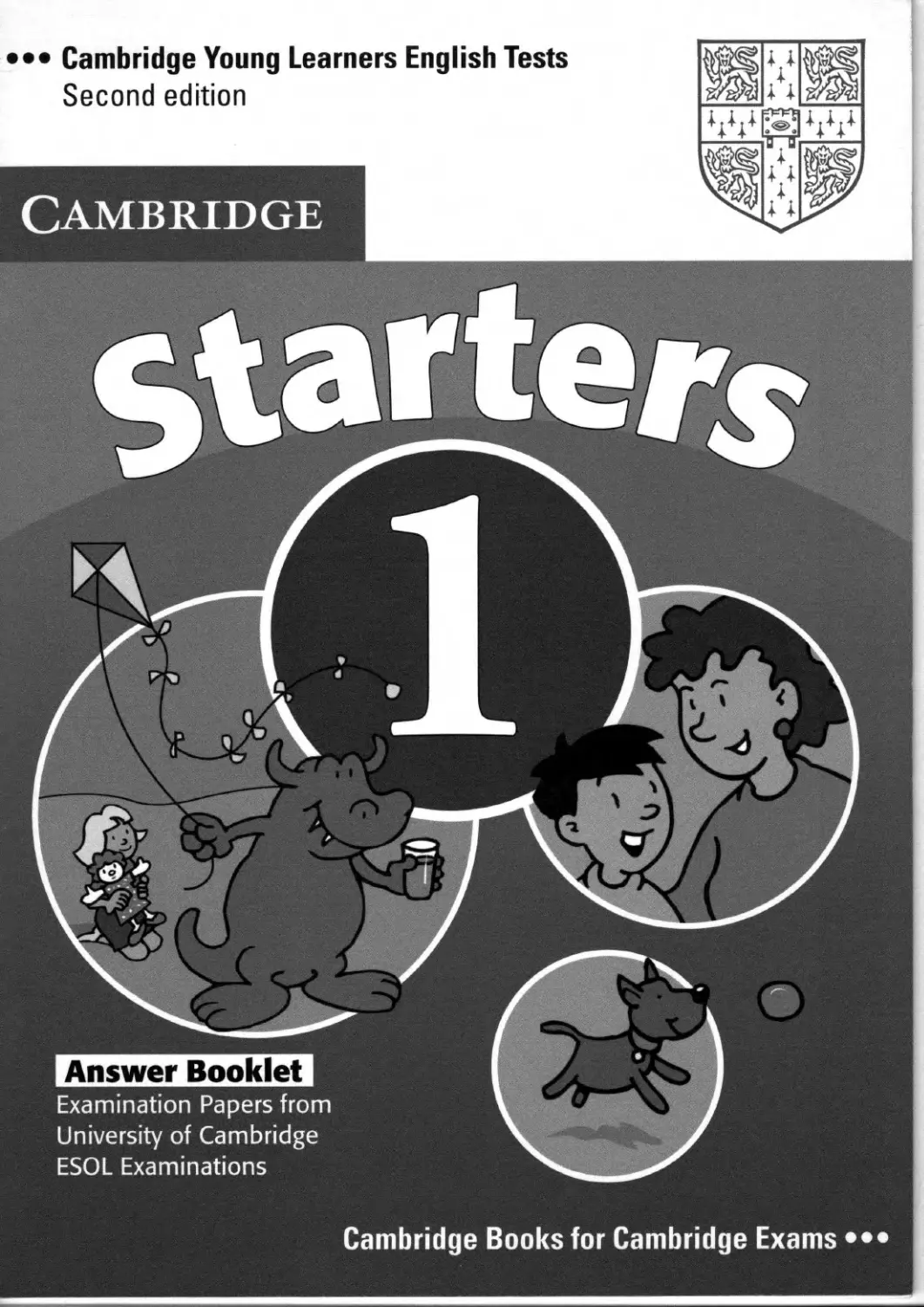
Cambridge Young Learners
English. Tests

Cambridge

Starters 1

Answer Booklet

Examination papers from

University of Cambridge
ESOL Examinations:

English for Speakers of Other Languages

« Cambridge

UNIVERSITY PRESS
Contents

Introduction	4

Test 1	Answers	6

Test 2	Answers	10

Test 3	Answers	14

Thematic Vocabulary List

18
Introduction

The Cambridge Young Learners English Tests offer an elementary-level resting system for learners of English
between the ages of 7 and 12. The tests include 3 key levels of assessment: Starters, Movers and Flyers.

Starters is the lowest level in the system. Test instructions are very simple and consist only of words and
structures specified in rhe syllabus.

The complete test lasts about 45 minutes and has rhe following components: Listening, Reading and
Writing, and Speaking.

	length	number of parts	number of items
Listening	approx. 20 minutes	4	20
Reading and Writing	20 minutes	5	25
Speaking	approx. 3-5 minutes	5	-

Candidates need a pen or pencil for the Reading and Writing paper, and coloured pens or pencils for the
Listening paper. All answers are written on the question papers.

Listening

In general, the aim is to focus on the ‘here and nowr’ and to use language in meaningful contexts. In
addition to multiple choice and short answ'er questions, candidates are asked to use coloured pencils to
mark their responses to one task. There arc 4 parts. Each part begins with a clear example.

	main skill focus	input	expected response	number of questions
1	listening for words and prepositions	picture and dialogue	carry out instructions and position things correctly on a picture	5
2	listening for numbers and spelling	illustrated comprehension questions and dialogue	write numbers and names	5
3	listening for specific information  (present tenses)	3-option multiple choice pictures and dialogues	tick correct box next to picture	5
4	listening for words, colours and prepositions	picture and dialogue	carry out instructions, locate objects, and colour correctly (range of colours is: black, blue, brown, green, grey, orange, pink, purple, red, yellow)	5
Reading and Writing

Again, the focus is on rhe ‘here and now’ and the use of language in meaningful contexts where possible.
To complete the test, candidates need a single pen or pencil of any colour. There are 5 parts, each starting
with a clear example.

	main skill focus	input	expected response	number of questions
1	reading short sentences and recognising lexis	lexical items, pictures, and sentences	tick or cross to show if sentence is true or false	5
2	reading sentences about a picture and writing one-word answers	1 picture and sentences	write ‘yes’/‘no’	5
3	spelling of single words	pictures and sets of jumbled letters	write words	5
4	reading a text writing missing words (nouns)	cloze text words and pictures	choose and copy missing words correctly	5
5	reading questions about  a picture story  writing one-word answers	story presented through 3 pictures and questions	write one-word answers to questions	5

Speaking

In the Speaking test, the candidate speaks with 1 examiner for about 4 minutes. The format of the test is
explained in advance to the child in their native language, by a teacher or person familiar to them. This
person then takes the child into the exam room and introduces them to the examiner.

Speaking ability is assessed according to various criteria, including comprehension, the ability to produce
an appropriate response and pronunciation.

	main skill focus	input	expected response
1	understanding and following spoken instructions	scene card	point to the correct part of the picture
2	understanding and following spoken instructions	scene card and 8 small object cards	place the object cards on the scene card as directed
3	understanding and answering spoken questions	scene card	answer questions with short answers
4	understanding and answering spoken questions	3 object cards	answer questions with short answers
5	understanding and responding to personal questions	no visual prompt	answer questions with short answers

Further information

The topics, structures, words and tasks upon which the Cambridge Young Learners English Tests are based
are comprehensively described in the Handbook, so teachers or parents can know exactly what to expect.

Further information about the Cambridge Young Learners English Tests can be obtained from the Local
Secretary for Cambridge ESOL examinations in your area, or from:

Cambridge ESOL (YLE Subject Officer)

Cambridge Assessment

1 Hills Road

Cambridge

CB1 2EU	<

United Kingdom

Telephone: +44 1223 553997

Fax: +44 1223 460278

e-mail: ESOLHelpdesk@CambridgeESOL.org

www.CambridgeESOL.org
Test 1 Answers

Listening

Part 1(5 marks)

Lines should be drawn between:

1	the elephant and the boat

2	the spider and the bicycle

3	the crocodile and the car

4	the duck and the helicopter

5	the frog and the train

Part 2	(5 marks)

1 5/five 2 Brown (correct spelling)

3 Lucy (correct spelling)

4 4/four 5 16/sixteen

Part 3	(5 marks)

1 A 2 В ЗА

4 A 5 C

Part 4	(5 marks)

1	Colour the flower in the tree - green

2	Colour the flower behind the tree - blue

3	Colour the flower between the ball and the black hen - red

4	Colour the flower under the big, white hen - black

5	There should be a blue flower on the dog’s head.

Transcript	Hello. This is the Cambridge Starters Practice Listening Test, Test 1.  [pause]	Man:  Girl:  Man:	2  Put the spider on the bicycle.  Sorry? What?  The spider is on the bicycle.
Part 1	Look at Part 1. Now look at the picture. Listen and look. There is		[pause]  3
Man:	one example.  [pause]  Put the cat in the bus.	Man:  Girl:  Man:	Put the crocodile in the car.  What’s in the car?  The crocodile. Put it in the car.
Girl:	Put what in the bus?		[pause]
Man:	The cat. Put the cat in the bus.		4
	[pause]	Man:  Girl:	The duck is flying the helicopter. Pardon?
	Can you see the line? This is an example. Now you listen and draw lines.  [pause]	Man:	The helicopter. Put the duck in the helicopter.  [pause]  5
	1	Man:	The frog. Put the frog in the train.
Man:	Put the elephant in the boat.	Girl:	Where did you say?
Girl:  Man:	What?  The elephant. Put the elephant in the boat.	Man:	In the train.  [pause]

Ipause]
Now listen to Part 1 again.

[The recording is repeated.]

[pause]

That is the end of Part 1.

[pause]

Part 2	Look at the picture. Listen and write
a name or a number. There are two
examples.

[pause]

Woman: Hello! What’s your name?

Boy: My name’s Sam.

Woman: How do you spell that?

Boy: S - A - M.

[pause]

Woman: And how old are you, Sam?

Boy: I’m ten years old.

Woman: Ten!

Boy: Yes! It’s my birthday today!

[pause]

Can you see the answers? Now you
listen and write a name or a number.

[pause]

1

Woman: Sam, which class are you in at school?
Boy: I’m in class five.

Woman: Five?

Boy: Yes. I’m happy in that class.

| pause |

2

Woman: What’s your teacher’s name?

Boy: He’s Mr Brown.

Woman: How do you spell that?

Boy: B-R-O-W-N.

Woman: And do you like him?

Boy: Yes, I do.

[pause]

3

Woman: Who sits next to you at school?

Boy: My friend, Lucy.

Woman: Do you spell that L - U - C - Y?
Boy: Yes. I like Lucy.

[pause]

4

Woman: And do you have a lot of books in your
bag?

Boy: Yes. I’ve got four books in my bag.

Woman: Sorry ... how many? Four?

Boy: Yes, that’s right.

5

Woman: And does your sister go to this school
too?

Boy: No. She’s too old for this school.

Woman: How old is she?

Boy: She’s sixteen.

Woman: Sixteen!

Boy: Yes, and she's great.

[pause]

Now listen to Part 2 again.

[The recording is repeated.]

[pause]

That is the end of Part 2.

[pause]

Part 3	Look at the pictures. Listen and look.
There is one example.

[pause]

What’s Bill doing?

[pause]

Boy: Is Bill writing a letter?

Girl: No, he isn’t. He’s drawing.

Boy: Is he drawing a picture of a train?

Girl: No, he isn’t. He’s drawing a picture of
a bus.

[pause]

Can you see the tick? Now you listen
and tick the box.

[pause]

1	What’s Tom playing?

Girl: Is Tom watching television?

Boy: No, he’s playing in the garden.

Girl: Is he playing football?

Boy: No he isn’t. He’s playing basketball.

[pause]

2	What’s Nick doing?

Girl: Do you know where Nick is? Is he playing
football with his father?

Boy: No, he isn’t. He’s in the kitchen, talking.

Girl: Is he talking to his mother?

Boy: No. He's phoning a friend.

[pause]

3	What’s Ben doing?

Girl: Is Ben playing in his bedroom?

Boy: No, he isn’t. He’s in bed.

Girl: Is he reading a book?

Boy: No. He’s sleeping.

[pause]
	4 What’s Kim doing?	3
Boy:	Is Kim playing the piano?	Woman: Find the flower between the ball and the
Girl:	No, she isn’t. She’s playing table tennis.	black hen.
Boy:	Is she playing with her brother?	Boy: What did you say?
Girl:	No. Her brother's watching television.	Woman: The flower between the ball and the black
	Kim’s playing table tennis with a friend.	hen.
	| pause]	Boy: OK.
		Woman: Colour it red. Colour the flower between
	5 What’s Ann painting?	the ball and the black hen red.
Boy:	Is Ann reading a book?	[pause]
Girl:	No. She’s painting.
Boy:	Is she painting a picture of flowers?	4	»
Girl:	No. Oh no! She’s painting a picture of	Woman: Find the flower under the big, white hen.
	a monster!	Boy: Under which white hen?
		Woman: The big, white hen.
	[pause]	Boy: OK.
	Now listen to Part 3 again.	Woman: Colour it black. Colour the flower under the big, white hen black.
	[The recording is repeated.]	Ipause]
	[pause]	5
	That is the end of Part 3. Ipause]	Woman: Can you see the dog?  Boy: Yes.  Woman: Draw a flower on the dog’s head.
		Boy: Draw one?! On the dog's head?!
Part 4	Look at the picture. Listen and look. There is one example.  [pause]	Woman: Yes! Draw a flower on the dog’s head and colour it blue.  Boy: Blue!  Woman: Yes. Colour the flower on the dog’s
		head blue!
Woman:	Find the flower in front of the tree.	[pause]
Boy:	Which flower?
Woman:	The flower in front of the tree.	Now listen to Part 4 again.
Boy:	Yes.
Woman:	Colour it black. Colour the flower in front of the tree black.  [pause]  Can you see the black flower? This is an example. Now you listen and colour.	[The recording is repeated.]  [pause]  That is the end of the Starters Practice  Listening Test 1.
	[pause]	Reading and Writing
Woman:	1  Find the flower in the tree.	Part 1 (5 marks)
Boy:	Where?	1/	2/	3 X	4 X	5 ✓
Woman:	In the tree.
Boy:	Yes.	Part 2 (5 marks)
Woman:	Colour it green. Colour the flower in the tree green.	1 yes	2 yes	3 no	4 yes	5 no
	[pause]	Part 3 (5 marks)
	2	1 face 2 hand 3 nose 4 feet	5 mouth
Woman:	Find the flower behind the tree.	Part 4 (5 marks)	«
Boy:	Sorry?
Woman:	The flower behind the tree.	1 children 2 fruit 3 shops 4 bag 5 kitchen
Boy:	Yes.
Woman:	Colour it blue. Colour the flower behind	Part 5 (5 marks)
	the tree blue.	1 ball 2 plane 3 4/four 4 swimming/playing
	[pause]	5 bird
Speaking

Part	Examiner does this:	Examiner says this:	Minimum response expected from child:	Back-up questions:
	Usher brings candidate in.	Usher to examiner: Hello.  This is (child’s name*).
		Examiner: Hello, *. My name's Jane/Ms Smith.	Hello
1	Points to Scene card.  Points to car.	Look at this.This is a living room. The children are playing.  Here’s the car.  *, where’s the boy? Where’s the lamp?	Points at items in the picture.
2	Points to Object cards.	Now look at these. Which is the dog? I’m putting the dog next to the girl.	Points to Object card.	Is this the dog? (pointing to the dog)
		Now you put the dog next to the boy.	Puts the Object card in place (next to the boy).	Where’s the boy?
		Which is the book?	Points to Object card.	Is this the book?  (pointing to the book)
		Put the book in front of the TV.	Puts Object card in place (in front of the TV).	Where’s the TV?
		Which is the sock?	Points to Object card.	Is this the sock?  (pointing to the sock)
		Put the sock on the mat.	Puts Object card in place (on the mat).	Where’s the mat?
3	Removes Object cards and points to green armchair on Scene card.	Now, *, what’s this? What colour is it? How many armchairs are there?	armchair green  four	Is it an armchair?  Is it green?  One? Two?
	Points to the boy.	What’s the boy doing?	drawing a picture	Is he drawing?
4	Puts Scene cards away and picks out three Object cards.
4.1	Shows banana card.	What’s this?  Do you like bananas?  What fruit do you like?	banana yes/no mangoes	Is it a banana?  Do you like mangoes'?
4.2	Shows pen/clock card,	What’s this?  What colour is It?  Have you got a pen/clock?	pen/clock blue/red yes/no	Is it a pen/clock?  Is it blue/red?
4.3	Shows mouse card.	What’s this?  Do you like mice?  What animals do you like?	mouse yes/no cats	Is it a mouse?  Do you like cats?
5	Puts away all cards.	Now, *, how old are you? What’s your favourite sport?  What’s your friend’s name?	seven tennis  Mary	Are you seven? Eight?  Do you like tennis?  Is your friend’s name  Mary?
		OK, thank you, *. Goodbye.	Goodbye  Leaves

Remember to use the child's name throughout the test.
Test 2 Answers

Transcript

Part 1

Listening

Part 1 (5 marks)

Lines should be drawn between:

1	the banana and a place in front of the window

2	the pineapple and a place next to the clock

3	the watermelon and the box

4	the lemon and a place between the radio and the book

5	the coconut and the chair

Man:

Girl:

Man:

Man:

Girl:

Man:

Part 2	(5 marks)

1 Pat (correct spelling)	2 3/three

3 Old (Street) (correct spelling)

4 Green (Park) (correct spelling) 5 12/twelve

Part 3	(5 marks)

IC 2B 3 C 4 C SC

Part 4	(5 marks)

1	Colour the fish in rhe bag - red

2	Colour the fish behind the boat - green

3	Colour the fish in front of the frog - yellow

4	Colour the fish between the bag and the baby -
brown

5	There should be a fish next to the crocodile.

Man:

Girl:
Man:

Man:

Girl:

Man:

Man:

Girl:

Man:

Man:

Girl:

Man:

Hello. This is the Cambridge Starters
Practice Listening Test, Test 2.

Look at Part 1. Now look at the
picture. Listen and look. There is one
example.

[pause]

The orange is on the table.

Pardon? Where?

On the table. The orange is on the table.

[pause]

Can you see the line? This is an
example. Now you listen and draw
lines.

[pause]

1

The banana is in front of the window.

Sorry?

The banana is in front of the window.

[pause]

2

The pineapple is next to the clock.

Where?

The pineapple is next to the clock.

[pause]

3

The watermelon is in the box.

Pardon? What's in the box?

The watermelon.

[pause]

4

The lemon is between the radio and
the book.

Where?

Between the radio and the book.

[pause]

5

The coconut is on the chair.

Where’s the coconut?

On the chair.

[pause]

Now listen to Part 1 again.

[The recording is repeated.]

[pause]

That is the end of Part 1.

[pause]
	Part 2	Look at the picture. Listen and write		5
		a name or a number. There are two	Woman:	How are you going there?
		examples.	Boy:  Woman:	We re going on the number twelve bus.  Which bus?
		[pause]	Boy:	The number twelve. Here it is!
			Woman:	Okay. Have a good day!
	Woman:	Hello! What’s your name?
	Boy:	My name's Nick.		[pause]
	Woman:	How do you spell that?		Now listen to Part 2 again.
•	Boy:	N-l-C-K.
	Woman:	Great! Thank you.		|The recording is repeated.]
4		[pause]		[pause]
	Woman:  Boy:	And how old are you? I’m nine years old.		That is the end of Part 2.
	Woman:	Nine!		[pause]
	Boy:	Yes! That’s right.	Part 3	Look at the pictures. Listen and look.
		[pause]		There is one example.
		Can you see the answers? Now you		[pause]
		listen and write a name or a number.		lx	J
		[pause]		What’s Sue playing with?
		lr	J  J		[pause]
	Woman:	Is this your dog, Nick?	Girl:	Where's Sue?
	Boy:	Yes, it is.	Boy:	She’s in the garden.
	Woman:	What’s her name?	Girl:	Is she playing football?
	Boy:	Her name’s Pat. You spell that P - A - T	Boy:	No, she’s playing with her new kite.
	Woman:	She’s a great dog.		[pause]
	Boy:	Yes, she is.
		I !l<iP 1		Can you see the tick? Now you
		I 1_/<1 U3v ]		listen and tick the box.
		2		[pause]
	Woman:	How old is she?
	Boy:	My dog?		/ What’s Tom doing?
	Woman:	Yes.
	Boy:	She's three. She’s very young.	Girl:	Where's Tom? Is he playing football?
	Woman:	She's three?	Boy:	No, he's in the living room, taking
	Boy:	Yes. That's right.	Girl:	a photo.  He isn't playing his new guitar?
		[pause]	Boy:	No, he doesn’t like it.
		3		[pause]
	Woman:  Boy:	And where do you live?  We live in a flat in Old Street.		2 Where’s Mummy?
	Woman:	Do you spell that 0 - L - D?	Boy:	Where’s Mummy now?
	Boy:	Yes. It's nice there.	Girl:	She's in the house.
			Boy:	Is she writing at her desk?
		[pause]	Girl:	No, she’s talking to a friend in the
		4		dining room.
•	Woman:	And where are you going now?		[pause]
T	Boy:	We’re going to Green Park.
	Woman:	Sorry ... is that G - R double E - N?		3 What’s Daddy doing?
L	Boy:	Yes, that’s right. We like playing there.	Boy:	Is Daddy in the garden?
		[pause]	Girl:	No, he’s in the living room playing the piano.
			Boy:	Oh, he listens to the radio or watches TV in the afternoon.
			Girl:	Not today.  Ipause]
4	What game are Sam and Pat
playing?

Girl: I can’t find Sam and Pat.

Boy: They’re playing in Sam’s bedroom.

Girl: Are they playing table tennis?

Boy: No, they’re playing a game on Sam’s
computer.

[pause]

5	What's Grandfather doing?

Boy: Is Grandfather sleeping in the house?

Girl: No, he’s in the garden.

Boy: He doesn’t sleep in the garden!

Girl: No, he's reading a book.

[pause]

Now listen to Part 3 again.

[The recording is repeated.]

[pause]

That is the end of Part 3.

[pause]

Part 4 Look at the picture. Listen and look.
There is one example.

[pause]

Woman: Find the fish in the sea.

Boy: Sorry?

Woman: The fish in the sea.

Boy: Yes.

Woman: Colour it blue. Colour the fish blue.

[pause]

Can you see the blue fish? This is an
example. Now you listen and colour.

[pause]

1

Woman: Find the fish in the bag.

Boy: Sorry?

Woman: Find the fish in the bag.

Boy: OK.

Woman: Colour it red. Colour the fish red.

| pause |

2

Woman: Can you see the fish behind the boat?

Boy: Where?

Woman: Behind the boat.

Boy: Yes.

Woman: Colour the fish green.

Boy: OK. Green.

[pause]

3

Woman: Find the fish in front of the frog.

Boy: Sorry, where’s the fish?

Woman: In front of the frog.

Boy: Oh yes.

Woman: Colour it yellow. Colour this fish yellow.

[pause]

4

Woman: Can you see the fish between the bag
and the baby?

Boy: Pardon? Which fish?

Woman: Between the bag and the baby.

Boy: Oh yes.

Woman: Colour it brown. Colour this fish brown.

[pause]

5

Woman: Can you see the crocodile?

Boy: Yes.

Woman: Draw a fish on the beach next to it.

Boy: Sorry?

Woman: Draw a fish next to the crocodile.

[pause]

Now listen to Part 4 again.

[The recording is repeated.]

|pause |

That is the end of the Starters Practice
Listening Test 2.

Reading and Writing
Part 1 (5 marks)  1 /	2 /	3	X	4	/	5	X
Part 2 (5 marks)  1 yes	2 no	3	yes	4	yes	5	no
Part 3(5 marks)  1 kite	2 hockey  5 baseball	3	tennis	4	fishing
Part 4 (5 marks)  1 house	2 sofa  5 night	3	football	4	monkeys
Part 5 (5 marks)  1 brown 2 2/two	3	sitting	4	tree 5	cake
Speaking

Part	Examiner does this:	Examiner says this:	Minimum response expected from child:	Back-up questions:
	Usher brings candidate in.	Usher to examiner: Hello.  This is (child's name*).
		Examiner: Hello *. My name's Jane/Ms Smith.	Hello
1	Points to Scene card.  Points to mother.	Look at this. It’s a beautiful day. The family are having lunch. Here's the mother. *, where’s the boy? Where’s the duck?	Points to items in picture.
2	Points to Object cards.	Now look at these. Which is the bag? I’m putting the bag next to the girl.	Points to Object card.	Is this the bag? (pointing to the bag)
		Now you put the bag under the tree.	Puts Object card in place, (under the tree)	Where’s the tree?
		Which is the radio?	Points to Object card.	Is this the radio?  (pointing to the radio)
		Put the radio next to the boy.	Puts Object card in place, (next to the boy)	Where’s the boy?
		Which is the boat?	Points to Object card.	Is this the boat?  (pointing to the boat)
		Put the boat in the water.	Puts Object card in place, (in the water)	Where's the water?
3	Removes Object cards and points to red ball on Scene card.	Now. *, what’s this? What colour is it? How many balls are there?	ball  red  three	Is it a ball? Is it red?  One? Two?
	Points to the father.	What’s the father doing?	kicking a ball	Is he kicking?
4	Puts Scene card away and picks out three Object cards.
4.1	Shows frog card.	What’s this?  Have you got a frog?  What animals do you like?	frog yes/no dogs	Is it a frog?  Do you like dogs?
4.2	Shows jacket/dress card.	What’s this?  What colour is it? What’s your favourite colour?	jacket/dress blue/pink  green	Is it a jacket/dress?  Is it blue/pink?  Is it green?
4.3	Shows pineapple/fish card.	What’s this?  Do you like pineapples/ fish?  What do you eat for lunch?	pineapple/fish yes/no  burgers	Is it a pineapple?  Do you like burgers?
5	Puts away all cards.	Now, *, where do you live?	Paris	Do you live in Paris?
		How many brothers and sisters have you got? What’s your father’s name?	three brothers  Jean	Have you got a brother? Is your father’s name Jean?
		OK. Thank you, *.  Goodbye.	Goodbye  Leaves
Test 3 Answers  Listening  Part 1 (5 marks)  Lines should be drawn between:  1	the T-shirt and the cupboard  2	the clock and the wall, between the two pictures  3	the shoe and under the bath  4	the radio and rhe mirror  5	the snake and a place next to the crocodile  Jjb ft  11 1Ц|жЖ=  /	II  О ® й  Part 2	(5 marks)  1 Sam (correct spelling) 2 11/eleven 3 3  4 Lucy (correct spelling)  5 Tiger (Street) (correct spelling)  Part 3	(5 marks)  IC	2 А	ЗА	4B	5B  Part 4	(5 marks)  1	Colour the ball in the box - blue  2	Colour the ball under the tree - red  3	Colour the ball behind the bag - green  4	Colour the ball next to the flowers - pink  5	There should be a purple ball next to the dog.  	 	  jT!	4  Ш	pink	TRANSCRIPT Hello. This is the Cambridge Starters Practice Listening Test, Test 3.  Part 1 Look at Part 1. Note look at the picture. Listen and look. There is one example.  [pause]  Man: The duck is in the bath. Girl: Pardon? Where?  Man: The duck is in the bath.  (pause |  Can you see the line? This is an example. Now you listen and draw lines.  (pause]  1  Man: The T-shirt is in the cupboard.  Girl: Sorry. Where?  Man: The T-shirt is in the cupboard.  (pause]  2  Man: The clock is on the wall.  Girl: Where’s the clock?  Man: On the wall, between the two pictures.  [pause]  3  Man: The shoe is under the bath.  Girl: Pardon?  Man: The shoe is under the bath.  [pause]  4  Man: The radio is in front of the mirror.  Girl: Sorry? Where’s the radio? Man: In front of the mirror.  [pause]  5  Man: The snake is next to the crocodile.  Girl: What’s next to the crocodile? Man: The snake.  [pause]  Now listen to Part 1 again.  (The recording is repeated.]  [pause]  That is the end of Part 1.  [pause]
Part 2 Look at the picture. Listen and u>rite
a name or a number. There are two
examples.

[pause]

Man: Hello! What’s your name?

Girl: My name’s May.

Man: And how do you spell your name?

Girl: It’sM-A-Y.

Man: Thank you.

[pause]

Man: And how old are you?

Girl: I’m eight years old.

Man: Pardon?

Girl: I’m eight years old.

[pause]

Can you see the answers? blow you
listen and write a name or a number.

[pause]

1

Man: Is that your brother, May?

Girl: Yes. He's playing football.

Man: What’s his name?

Girl: His name’s Sam. You spell that S - A - M.
Man: Oh!

[pause]

2

Man: How old is your brother?

Girl: He’s eleven.

Man: Eleven?

Girl: Yes, that’s right.

[pause]

3

Man: And do you go to school here?

Girl: Yes. I've got three teachers.

Man:	How many teachers?

Girl: I’ve got three. They’re very nice.

[pause]

4

Man: And who drives you to school?

Girl: My grandma. Her name’s Lucy.

Man: How do you spell that?

Girl: L-U-C-Y.

[pause]

5

Man: And where do you live?

Girl: We live in a house in Tiger Street.

Man: Can you spell that, please?

Girl: Yes. It’s T-l-G-E-R. It’s a funny
name.

Man: Yes, it is!

[pause]

Now listen to Part 2 again.

[The recording is repeated.]

[pause]

That is the end of Part 2.

[pause]

Part 3	Look at the pictures. Listen and look.

There is one example.

[pause]

What's Tom doing?

[pause]

Girl: Where’s Tom?

Boy: He’s playing with a ball in the garden.

Girl: What’s he doing?

Boy: He’s kicking it.

[pause]

Can you see the tick? Now you
listen and tick the box.

[pause]

/ What’s Sue doing?

Girl: Where’s Sue?

Boy: She’s in the classroom.

Girl: Is she reading?

Boy: No, she’s sleeping on her desk.

(pause]

2	Where are the children?

Boy: Where are the children now?

Girl: They’re at school.

Boy: Oh, they’re learning English today.

Girl: No they’re not, they’re singing.

[pause]

3	What’s the teacher doing?

Boy: Is the teacher here today?

Girl: Yes, he’s in the classroom.

Boy: What's he doing?

Girl: He’s writing letters on the board.

[pause]

4	What are the girls eating?

Girl: I can’t find Sue and Mary.

Boy: They're having lunch in the kitchen.

Girl: Are they eating cake?

Boy: No, they’re eating bananas.

Ipause]

5	What game are the boys playing?

Boy: Are the boys in the garden?

Girl: No, they’re playing in the living room with
their toys.
Boy: What game are they playing?
Girl: They’re playing with robots.

| pause]

Now listen to Part 3 again.

|The recording is repeated.]

[pause]

That is the end of Part 3.

[pause]

Part 4	Look at the picture. Listen and look.
There is one example.

| pa use |

Woman: Find the ball on the table.

Boy: Sorry?

Woman: The ball on the table.

Boy: Yes.

Woman: Colour it yellow. Colour this ball yellow.

[pause]

Can you see the yellow ball? This is
an example. Now you listen and
colour.

[pause]

1

Woman: Find the ball in the box.

Boy. Sorry?

Woman: Find the ball in the box.

Boy: OK.

Woman: Colour it blue. Colour it blue.

[pause]

2

Woman: Can you see the ball under the tree?
Boy: Where?

Woman: Under the tree.

Boy: Yes.

Woman: Colour this ball red.

[pause]

3

Woman: Find the ball behind the bag.

Boy: Sorry?

Woman: Find the ball behind the bag.

Boy: Oh yes.

Woman: Colour it green.

Boy: Green?

Woman: Yes.

[pause]

4

Woman: Can you see the ball next to the flowers?
Boy: Pardon?

Woman: The ball next to the flowers.

Boy: Oh yes.

Woman: Colour it pink. Colour this ball pink.

[pause]

5

Woman: Can you see the dog?

Boy: Yes.

Woman: Draw a ball next to the dog.

Boy: Sorry?

Woman: Draw a ball next to the dog and then
colour it purple.

[pause]

Now listen to Part 4 again.

[The recording is repeated.]

[pause]

That is the end of the Starters Practice
Listening Test 3.

Reading and Writing

Part 1 (5 marks)

IX	2 /	3 /	4 X	5 /
Part 2 (5 marks)
1 no	2 yes  Part 3 (5 marks)	3 yes	4 no	5 yes
1 meat 2 carrot  5 chicken  Part 4 (5 marks)	3 potato	4 tomato
1 legs 2 eyes  5 children  Part S (S marks)	3 carrots	4 water
1 flying 2 4/four  5 ice cream	3 ball	4 pointing/laughing
Speaking

Part	Examiner does this:	Examiner says this:	Minimum response expected from child:	Back-up questions:
	Usher brings candidate in.	Usher to examiner: Hello.  This is (child’s name*).
		Examiner: Hello, *. My name’s Jane/Ms Smith.	Hello
1	Points to Scene card.  Points to father.	Look at this. This is the beach. The family are having a day at the sea. Here's the father. *, where’s the boy? Where's the hat?	Points at items in the picture.
2	Points to Object cards.	Now look at these. Which Is the radio? I’m putting the radio next to the girl.	Points to Object card.	Is this the radio?  (pointing to the radio)
		Now you put the radio next to the book.	Puts Object card in place, (next to the book)	Where’s the book?
		Which is the monster?	Points to Object card.	Is this the monster?  (pointing to the monster)
		Put the monster in the sea.	Puts Object card in place, (in to the sea)	Where’s the sea?
		Which is the ball/fish?	Points to Object card.	Is this the ball/fish?  (pointing to the ball/fish)
		Put the ball/fish behind the mother.	Puts Object card in place, (behind the mother)	Where’s the mother?
3	Removes Object cards and points to dog in Scene card.	Now, *, what’s this?  What colour is it?  How many dogs are there?	dog  brown two	Is it a dog?  Is it brown? One? Two?
	Points to the mother.	What’s the mother doing?	eating a banana	Is she eating?
4	Puts Scene cards away and picks out three Object cards.
4.1	Shows camera card.	What’s this?  What colour is it?  Have you got a camera?	camera black yes/no	Is it a camera? black
4.2	Shows burger/ice cream card.	What’s this?  Do you like burgers/ice cream? What’s your favourite food?	burger/ice cream  yes/no  cake	Is it a burger/an ice cream?  Is it cake?
4.3	Shows hippo card.	What’s this?  What animals do you like?	hippo dogs	Is it a hippo?  Do you like dogs?
		Have you got an animal at home?	yes/no	Have you got a cat?
5	Puts away all cards.	Now, *, how old are you? How many brothers and sisters have you got? What’s your mother's name?	seven  two sisters  Maria	Are you seven? Eight?  Have you got a sister? Is your mother’s name Maria?
		OK. Thank you, *. Goodbye.	Goodbye  Leaves

Remember to use the child’s name throughout the test.

17
STARTERS THEMATIC

VOCABULARY LIST

For ease of reference, vocabulary is arranged in semantic groups or themes. Some words appear under more
than one heading.

In addition to the topics, notions and concepts listed for the syllabus, the following categories appear:

• adjectives

• determiners

• adverbs

• prepositions

• conjunctions

•	pronouns

•	verbs

•	modals

•	question words

ANIMALS	nose	child/children
animal bird cat chicken cow	smile	cousin
		dad(dy)
	CLOTH ES	  bag clothes		 family father friend girl
crocodile	dress
dog  duck elephant fish (s & pl)	glasses handbag hat jacket	grandfather grandma grandmother grandpa live
fro9	jeans	man/men
giraffe	shirt	Miss
goat	shoe	mother
hippo	skirt	Mr
horse	sock	Mrs
lizard	trousers
monkey	T-shirt	mum(my) old
mouse/mice sheep (s & pl)	watch wear	person/people sister
snake spider	COLOURS	their
tail	black	they
tiger	blue	us
zoo	brown	we
THE BODY & FACE	green	woman/women you

arm	orange	young
body	pink	your
ear	purple
eye	red	FOOD & DRINK
face foot/feet	white
	yellow	apple banana
hair hand	FAMILY & FRIENDS	bean
head	baby	breakfast
leg mouth	boy	burger
	brother	cake
carrot	kitchen	eraser
chicken	lamp	example
chips (US fries)	living room	find
coconut	mat	floor
dinner	mirror	know
drink (n & v)	painting	learn
eat	phone	lesson
egg	picture	letter (as in alphabet)
fish	radio	line
food	room	listen (to)
fries (UK chips)	sleep	look
grape	sofa	name
ice cream	table	number
juice	television/TV	open
lemon	tog	page
lemonade	tree	part
lime	wall	pen
lunch	watch	pencil
mango	window	picture
meat		plagground
milk	NUMBERS	question
onion	Cardinals: 1-20	read
orange		right (as in correct)
pea	PLACES & DIRECTIONS	rubber
pear	—	— ruler
pineapple	behind	school
potato	between	sentence
rice	here	spell
sausage	in	storg
supper	in front of	teacher
tomato	next to	tell
water	on	test (n & v)
watermelon	park	tick (n & v)
	shop (US store)	understand
THE HOME	store (UK shop)	wall
	street	window
apartment armchair	there	word
bath	under	write
bathroom bed	SCHOOL		SPORTS & LEISURE
bedroom	alphabet	badminton
bookcase	answer	ball
box	ask	baseball
camera	board	basketball
chair	book	beach
clock	bookcase	bike
computer	class	boat
cupboard	classroom	book
desk	close	bounce
dining room	colour	camera
doll	computer	catch
door	correct	doll
flat	cross	draw(ing)
floor	cupboard	drive
flower	desk	enjog
garden	door	favourite
hall	draw	fish(ing)
house	English	fiy


Thematic Vocabulary List

Jootball (US soccer)	plane	thank you
game	robot	thanks
guitar	toy	then
kit	train	well
kobby	truck (UK lorry)	well done
hockey		wow
jump	TRANSPORT	yes
kick
kite	bike boat	ADJECTIVES
listen (to)
paint(ing)	bus	angry
photo piano picture play (with)	car  Jly 9° helicopter	beautijul big clean closed
radio	lorry (US truck)	correct
read	motorbike	dirty
ride (n & v)	plane	double
run	ride	English
sing  soccer (UK Jootball) song	run swim train  truck (UK lorry)	Javourite Junny good great
story	walk	happy her
table tennis television/TV	WEATHER	his
	sun	its
tennis throw
		long
toy	WORK	my
TV/television	teacher
watch		nice
		old
TIME	THE WORLD AROUND US	our  right (correct)
	beach sand
afternoon		sad
birthday		short
clock	sea	small
	shell
day end	street	sorry their
evening	sun tree	ugly
morning	water	young
night		your
today watch	USEFUL WORDS & EXPRESSIONS	DETERMINERS

TOYS			 bye (-bye)	a/an  a lot oj
ball	goodbye	lots oj many
baseball	hello
basketball	I don’t know	my
bike	no	no
	oh
doll	oh dear	some
Jootball	OK	that
game	pardon	the
helicopter	please	these
kite	right	this
lorry (US truck)	so	those
monster	sorry
ADVERBS	us	jump
a lot	we	kick
	you	learn
again here	yours	like  listen (to)
lots not	VERBS	live
		look
now	Irregular:	look at
then	be	love
there	catch (a ball)	open paint
today	choose
too	come	phone
very  PREPOSITIONS	do draw drink	pick up play (with) point show
about	drive
at	eat	smile
behind	find	start
between	Jl9	stop
jor from in (prep of place) in front oj like	get  give  9°  have  have (got) hit	talk test tick try walk want
next to
	hold	watch
	know	wave
on	learn
under	make	MODALS
with	put read	can/cannot/can't
CONJUNCTIONS	ride	QUESTION WORDS
	run
and	say	how
but	see	how many
or	sing	how old
PRONOUNS	sit (down)	what
		 sleep	where
he	spell	which
her	stand (up)	who
hers	swim	whose
him	take (a photo)
his	tell throw	NAMES
T
1	understand	Alex
it	wear	Ann
its	write	Anna
me		Ben
mine	Regular:	Bill
one	add	Jill
ours	answer	Kim
she that theirs	ask bounce clean	Lucy May Nick
them	close	Pat
these	colour	Sam
they this	complete cross	Sue  Tom
those	enjoy	Tony
• •• Cambridge Young Learners English Tests

Second edition

Starters

CAMBRIDGE

Examination Papers from University of Cambridge ESOL Examinations

Cambridge University Press is the only official publisher of Young Learners past
papers from Cambridge ESOL - an essential part of any preparation course for
the Young Learners English Tests.

Cambridge Young Learners English Tests are designed to evaluate the English
level of primary learners aged 7 to 12 - and make testing fun. They consist of
three key levels of assessment: Starters, Movers and Flyers.

This second edition for the updated 2007 test, contains three Starters papers
from University of Cambridge ESOL Examinations. These colourful test papers
contain engaging activities and attractive illustrations to motivate young
learners at this level. They also provide an excellent opportunity for children,
parents and teachers alike to familiarise themselves with the format of the test.

The cassette and CD contains the recorded material for the Listening test. The
Answer Booklet includes tapescripts, answers and examples of the type of
interchange to expect in the Speaking test.

«Ль Cambridge

UNIVERSITY PRESS
www.cambridge.org

ISBN 978 0 521-69398 1

Available in this series:

ISBN 978 0 521 -69349-3

Starters

3^

ISBN 978-0-521 69361-5

Starters