/




















































Tags: magazine foreign affairs
Year: 2023

Text
                    SEPTEMBER/OCTOBER 2023
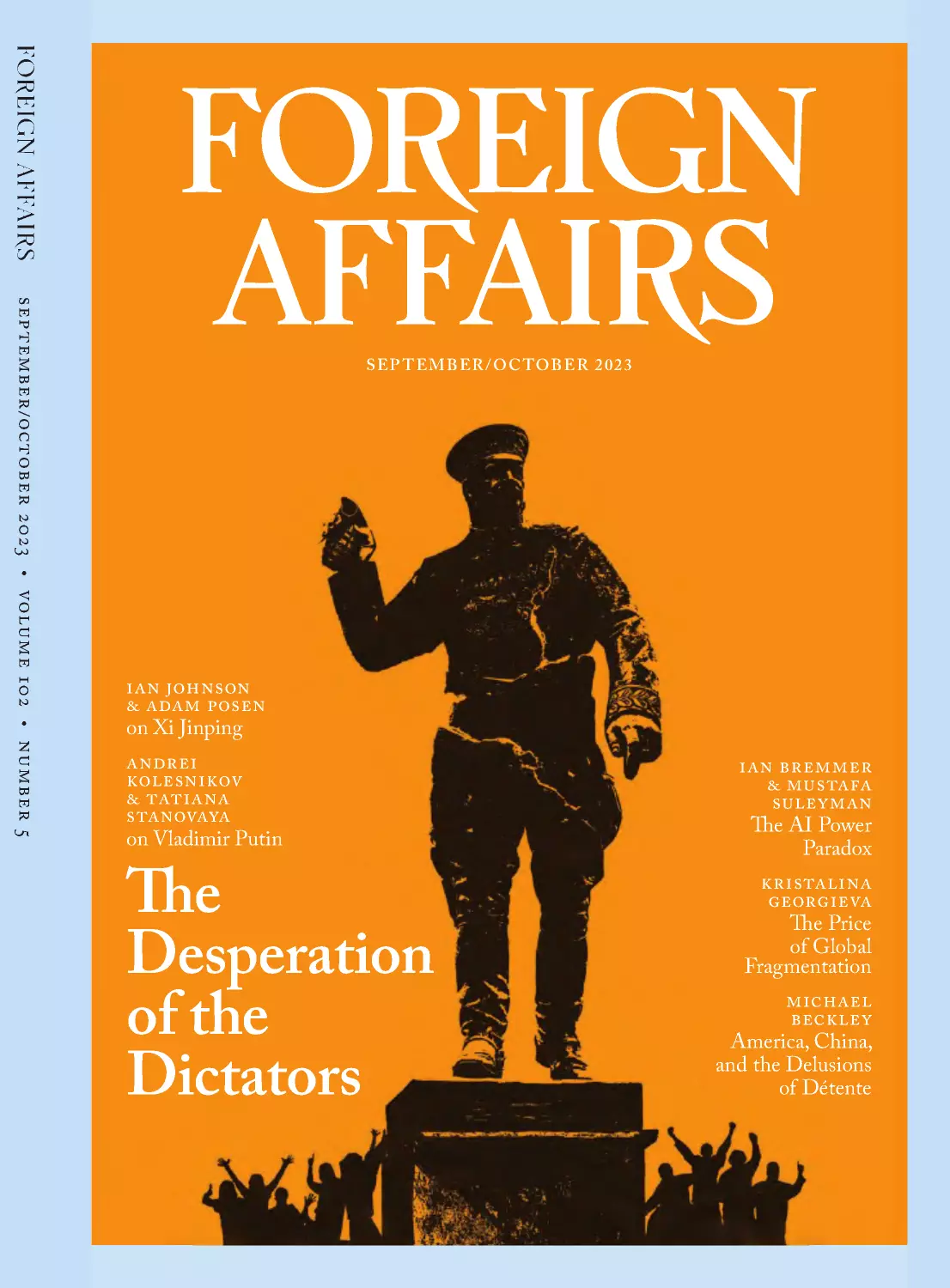
The
Desperation
of the
Dictators
IAn Johnson
& Adam Posen
on Xi Jinping
Andrei
Kolesnikov
& Tatiana
Stanovaya
on Vladimir Putin
Ian Bremmer
& Mustafa
Suleyman
The AI Power
Paradox
Kristalina
Georgieva
The Price
of Global
Fragmentation
Michael
Beckley
America, China,
and the Delusions
of Détente
s
e
p
t
e
m
b
e
r
/
o
c
t
o
b
e
r
2
0
2
3
•
v
o
l
u
m
e
1
0
2
•
n
u
m
b
e
r
5

807070100
10.2 7.4 7.4
100 100 100
10010060 100100 7070 3030 10010060 100100
100 100
7070 3030 10010060
707040
7070 3030 10040 10040 40100 104040 207070
3.1 2.2 2.2
704040
756666
504040
251919
B
0000
100
70
30
100
10
25
50
75
90
100
100 60 100
70
30 100 60
407040
70
30 10040 40100 40100 407040 704040
3
407040 704040
100 60
A
3%
ISO 12647-7 Digital Control Strip 2009
CONTACT
Oksana DiRicco (DMAX)
oksana@dmaximaging.com
415-225-2582 Dir
312.427.6413 Te l
TEAM
INITIAL
C E John Sheehan
______
PM Kayden Sparks
______
C D Tony Riazzi
______
DS Emily Gorski
______
C W Tony Riazzi
______
PP Jennifer Niccum ______
PR Maria Edermann ______
AB N/A
RT N/A
PD Cyn Felsburg
DD T. El-Mofty
CLIENT/BRAND
Google
PROJECT
SwG Cyber Campaign
FILE NAME
B25178_ForeignAffairs_7x10_3u_INF-R1.
indd
PAGE
1of1
LAST MODIFIED
7-5-2023 2:21 PM
VERSION/AD ID
Foreign Affairs National
JOB NUMBER
5033-272-11
DUE
7/17/2023
INKS
Cyan, Magenta, Yellow, Black
LINKS
logo_Google_FullColor_cmykC_118x38pt.ai, SwG_GShield_Lockup_Vertical_
cmykC_736x336px.ai
NOTES
DMAX Job: #B25178
GUTTER
None
FLAT (FINAL SCALE)
7"W x 10"H
BLEED (FINAL SCALE)
0.125"W x 0.125"H
LIVE (FINAL SCALE)
0"W x 0"H
TACTIC
FP4C
SCALE
1"=1"
BINDING
N/A
INTERNAL
Cynthia Felsburg
None
FOLDS OR PANELS
None: None
FINISHED SIZE
None
OVERPRINT
GREEN ON
YELLOW OFF
Foreign Affairs National (FP4C – Coated)
COATED:
Blue c88 m40 y0 k0
Red c0 m87 y89 k0
Yellow c0 m37 y100 k 0
Green c85 m0 y92 k0
logo_Google_FullColor_cmykC_118x38pt.ai
We’re joining forces with national defense agencies
to deploy advanced AI technology to ensure our nation’s
digital defenses remain secure.
We’re securing patient data for hospitals across the country
with industry-leading threat detection and response,
speeding up cyber threat response time to hours instead of weeks.
We’re protecting student and teacher data in school districts
nationwide with Chromebooks and Workspace for Education,
which are secure by default.
We’re working with local governments across the country to
protect public infrastructure and keep critical systems online 24/7.
Explore how Google is keeping more Americans safe online
than anyone else at safety.google/cybersecurity
critical infrastructure
with the world’s most
advanced security
protect
We
America’s
Our nation’s critical infrastructure has become
an increasingly common target for cyberattacks.
Google is working with organizations across the country
to help protect the infrastructure we all rely on.
T:7"
T
:
1
0
"
B:7.25"
B
:
1
0
.
2
5
"
B25178_19a_ForeignAffairs_7x10_3u_INF-R1.indd
07.05.2023
EPSON
RQD

Essays
Delusions of Détente
8
Why America and China Will Be Enduring Rivals
Michael Beckley
The AI Power Paradox
26
Can States Learn to Govern Artificial Intelligence—Before It’s To o Late?
Ian Bremmer and Mustafa Suleyman
Putin’s Age of Chaos
44
The Dangers of Russian Disorder
Tatiana S ta n o vaya
The End of the Russian Idea
60
What It Will Take to Break Putinism’s Grip
Andrei Kolesnikov
X i ’s Age of Stagnation
102
The Great Walling-Off of China
Ian Johnson
Volume 102, Number 5
1
Cover illustration by Fede Yankelevich
FA.indb 1
7/29/23 1:59 PM

From
From climate
climate change
change toto international
international
business,
business, Fletcher
Fletcher thinkers
thinkers work
work across
across
borders,
borders, boundaries,
boundaries, and
and disciplines,
disciplines, toto
find
find sustainable
sustainable solutions
solutions toto the
the world’s
world’s
most
most vexing
vexing challenges.
challenges. Learn
Learn more.
more.
MIGRATION CYBER GENDER DE
CLIMATE GENDER BUSINESS D
DEVELOPMENT WHERE
WHERE SECUR
SECURITY LAW LEADERS
LEADERS MIGR
CYBER CLIMATE LEARN
LEARN GENDE
BUSINESS AMONGMIGRATION
DIPLOMACYLEADERS LAW BU
MIGRATION CYBER GENDER DE
BUSINESS DEVELOPMENT SEC
C
M
Y
CM
MY
CY
CMY
K

3
september/october 2023
Essays
The End of China’s Economic Miracle
118
How Beijing’s Struggles Could Be an Opportunity for Washington
Adam S. Posen
The Price of Fragmentation
131
Why the Global Economy Isn’t Ready for the Shocks Ahead
Kristalina Georgieva
China’s Road to Ruin
143
The Real Toll of Beijing’s Belt and Road
Michael Bennon and Francis Fukuyama
Back in the Trenches
153
Why New Technology Hasn’t Revolutionized War fare in Ukraine
Stephen Biddle
Europe’s Geoeconomic Revolution
168
How the EU Learned to Wield Its Real Power
Matthias Matthijs and Sophie Meunier
Erdogan the Survivor
180
Washington Needs a New Approach to Turkey’s Improviser in Chief
Henri J. Barkey
FA.indb 3
7/29/23 1:59 PM

LEADERS
IN PUBLIC AFFAIRS
Florida International University’s Steven J. Green School
of International & Public Affairs is powering the next
generation of foreign affairs leaders.
FIU has completed an expansion of the Steven J. Green School of International & Public
Affairs. The new $40M state-of-the-art west wing will bring the school’s eight departments
and 17 centers under one roof with the 85,000-square-foot addition.
Learn more at
go.fiu.edu/GreenSchool
research institution
(less than 3% of universities
can say that!)
Carnegie R1
of the Association of
Professional Schools of
International Affairs
FULL MEMBER
of students annually intern
at Washington D.C. - based
government agencies, multinational
companies and NGOs
HUNDREDS
SCGEA_Foreign Affairs_Fullpage Print ad_SIPA_4846278029.indd 1
7/21/23 3:17 PM

5
september/october 2023
“Foreign Affairs . . . will tolerate wide differences of opinion. Its articles will not represent any
consensus of beliefs. What is demanded of them is that they shall be competent and w ell informed,
representing honest opinions seriously held and convincingly expressed. . . . It does not accept
responsibility for the vie ws expressed in any article, signed or unsigned, which appear in its pages.
What it does accept is the responsibility for giving them a chance to appear there.”
Archibald Cary Coolidge, Founding Editor
Volume 1, Number 1 • September 1922
Reviews and Responses
Innovation and Its Discontents
196
Societies Get the Technology They Deser ve
Diane Coyle
Born in the Bloodlands
202
Ukraine and the Future of the European P roject
Michael Kimmage
The Merchant ’s Leviathan
211
How the East India Company Made the Modern World
Caroline Elkins
Recent Books
219
The Archive
244
FA.indb 5
7/29/23 1:59 PM

september/october 2023 · volume 102, number 5
Published by the Council on Foreign Relations
daniel kurtz-phel an Editor, Peter G. Peterson Chair
stuart reid, justin vogt Executive Editors
kate brannen Deputy Editor
hugh eakin, Eve fairbanks, t y mccormick, kanishk tharoor, katherine zoepf Senior Editors
daniel block Associate Editor
Elise Burr, Jul ia Fl eming-Dresser Staff Editors
Ethan Lee, joel nelson Assistant Editors, David M. Rubenstein Editorial Fellows
Rachel Pow ell S ocial Media Editor
Elizabet h Howard Senior Copyeditor
ed johnson Art Director
michaela staton Assistant Art Director
Irina Hogan Editorial Operations Manager
Shannon nolan Editorial Assistant
Book Reviewers
l isa anderson, barry eicheng reen, Richard Feinberg, l awrence d. fr eedman,
g. john ikenberry, maria lipman, jessica t. mat hews, andrew moravcsik,
andrew j. nathan, nicolas van de wal le
stephanie solomon Chief Revenue Officer
jonathan chung Circulation Operations Director
Minnie McCartan Marketing Director
carlos a. morales Director, Digital Analytics and Audience Development
michael pasuit Advertising Director
nora rev enaugh Director of Product
elizabeth earles Assistant Manager, Advertising
grace finlayson, anastasia fischer Assistant Managers, Product Operations
Bell e Johnson Business and Production Associate
cait lin joseph Email Operations Coordinator
maria elena portes Advertising Operations Associate
Hilda Rodriguez Product Designer
Camille Wallace Manager, Business Development and Licensing
kar en mandel Q uality Assurance Manager
eric spector Deputy Director, Digital Development
angel trajkov Senior Manager of Web Development
tim wasson Lead Developer
iva zoric, Susan nelson Media Relations
Board of Advisers
jami miscik Chair
jesse h. ausubel, pet er e. bass, john b. bellinger, kenneth chenault,
susan chira, cesar conde, jessica p. einhorn, francis fukuyama,
thomas h. glocer, adi ignat ius, jeh charles johnson, wil liam h. mcrav en,
michael j. meese, neal s. wol in, daniel h. yerg in
subscrip tion services: ForeignAffairs.com/ser vices | support@ForeignAffairs.com
800-829-5539 U.S./Canada | 845-267-2017 All other countries | P.O. Box 324, Congers, NY 10920
advertising: Call Michael Pasuit at 212-434-9528 or visit ForeignAffairs.com/advertising
reproduction: The contents of Foreign Affairs are copyrighted. No part of the magazine may be reproduced,
hosted, or distributed in any form or by any means without prior written permission from For eign Affairs.
To obtain permission, visit ForeignAffairs.com/permissions
Foreign Affairs is a member of the Alliance for Audited Media and the Association of Magazine Media.
GST Number 127686483RT, Canada Post Customer #4015177 Publication #40035310
FA.indb 6
7/29/23 1:59 PM

Learn more at
meetings.IMF.org
Join us to hear about the key issues
affecting the global economy and
our future prosperity at world-class
seminars during the 2023 Annual
Meetings of the World Bank Group
and the IMF.
OCTOBER 9—15, 2023
MARRAKECH
SEMINARS
Follow us
#WBMeetings #IMFMeetings
JOIN THE CONVERSATION!
MEDIA PARTNER

8
foreign affairs
Delusions of
Détente
Why America and China
Will Be Enduring Rivals
MICHAEL BECKLEY
With U.S. -Chinese relations worse than they have been
in over 50 years, an old fairy tale has resurfaced: if only
the United States would talk more to China and accom-
modate its rise, the two countries could live in peace. The story goes
that with ample summitry, Washington could recognize Beijing’s
redlines and restore crisis hotlines and cultural exchanges. Over time
and through myriad points of face-to-face contact—in other words,
reengagement—the two countries could settle into peaceful, if still
competitive, coexistence. Talk enough, some analysts contend, and
the United States and China might even strike a grand bargain that
establishes stable spheres of influence and something akin to a G-2
to solve global problems such as climate change and pandemics.
MICHAEL BECKLEY is Associate Professor of Political Science at Tufts University, a
Nonresident Senior Fellow at the American Enterprise Institute, and Director of the Asia
Program at the Foreign Policy Research Institute. He is the author of Unrivaled: Why
America Will Remain the World ’s Sole Superpower.
FA.indb 8
7/29/23 1:59 PM
Return to Table Contents

9
Illustration by Matt Chase
FA.indb 9
7/29/23 1:59 PM

Michael Beckley
10
foreign affairs
From this perspective, the dismal state of U.S. - Chinese relations
is not an inevitable result of two ideologically opposed great powers
clashing over vital interests. Rather, it is a mix-up between partners,
blown out of proportion by the United States’ overreaction to counter
China’s overreach, as Susan Shirk, a Sinologist and former U.S. dep-
uty assistant secretary of state, has put it. For the past two decades,
the thinking goes, China has simply been doing what rising powers
usually do: flexing its muscles and demanding a greater say in global
affairs. Although many of China’s actions, such as its menacing of
Taiwan, worry advocates of reengagement, the main target of their
critique is the United States—specifically, its relentless pursuit of
primacy and the self-serving actors behind it.
In this dark imagining, grandstanding politicians, greedy defense
contractors, sensationalizing pundits, overzealous human rights activ-
ists, and belligerent bureaucrats fan the flames of rivalry for profit,
creating an echo chamber that crowds out different perspectives.
Some individuals are supposedly repeating hawkish narratives to
protect their careers. The result, the journalist and author Fareed
Zakaria has argued, is that “Washington has succumbed to danger-
ous groupthink on China.” The fact that most Americans also hold
hawkish views on China just provides more evidence of how irra-
tionally aggressive U.S. policy has become. “ The problem today isn’t
that Americans are insufficiently concerned about the rise of China,”
the historian Max Boot has insisted. “ The problem is that they are
prey to hysteria and alarmism that could lead the United States into
a needless nuclear war.”
For those advocating reengagement, the solution to this cycle of
hostility is straightforward. First, defuse tensions through vigorous
diplomacy, commerce, and people-to-people exchanges. Next, create
a new forum where officials from each country can meet regularly
to hash out agreements. According to the historian Adam Tooze,
regardless of the exact structure of negotiations, the basic objective is
the same: “accommodation of China’s historic rise.” For some advo-
cates of reengagement, accommodation would merely entail reducing
trade barriers to China, a move U.S. Treasury Secretary Janet Yellen
proposed earlier this year. Other obser vers, however, favor more dras-
tic concessions. The political scientist Graham Allison, for example,
has urged in these pages that the United States accept China’s tra-
ditional sphere of influence in Asia. Presumably, that would mean
FA.indb 10
FA.indb 10
7/29/23 1:59 PM
7/29/23 1:59 PM

Delusions of Détente
11
september/october 2023
giving Beijing greater freedom in the South China Sea, letting go of
Taiwan, and relinquishing American power in the region.
It is an enticing vision. The world would certainly be better off if
great powers could settle scores through diplomacy rather than by
squaring off in a security competition. Yet the history of great-power
rivalry, and of U.S.-Chinese relations in particular, suggests that
greater engagement is unlikely to mend ties between the countries
and, if performed hastily, could actually catalyze violent conflict. Of
the more than two dozen great-power rivalries over the past 200
years, none ended with the sides talking their way out of trouble.
Instead, rivalries have persisted until one side could no longer carry
on the fight or until both sides united against a common enemy.
For example, the United States and China paused their rivalry to
ally against the Soviet Union during the latter half of the Cold War,
a contest that ended only when the Soviet Union sputtered into
terminal decline. In every case, shifts in the balance of power were
preconditions for sustainable settlements. Before those shifts, periods
of détente were usually just chances to regroup and reload for the
next round of competition. In some cases, such as when the United
Kingdom sought to improve relations with Germany from 1911 to
1914 and again in 1938, pursuing détente paved the road to war.
The United States and China are unlikely to buck this pattern.
Their vital interests conflict and are rooted firmly in their respective
political systems, geographies, and national experiences. Many of the
connections binding the countries together, such as their extensive
trade, are also driving them apart by giving policymakers additional
reasons to fight and pressure points to exploit. Neither side can make
major concessions without exposing itself. And after decades of deal-
ing with each other, both governments have accumulated long lists
of grievances and view the other with deep mistrust. The United
States tried to work with China repeatedly from the 1970s to the
2010s, yet top Chinese leaders consistently viewed U.S. outreach,
especially the American attempt to integrate China into the U.S. -led
liberal order, as an insidious form of containment—a plot designed
to weaken the grip of the Chinese Communist Party and lock China
into economic dependence and political subservience to the West.
American outreach to China during this period was more extensive
than the proposals being seriously considered by U.S. policymakers
today. Nevertheless, these overtures failed to fundamentally change
FA.indb 11
FA.indb 11
7/29/23 1:59 PM
7/29/23 1:59 PM

Michael Beckley
12
foreign affairs
Chinese assessments of American intentions or dissuade efforts by
the C C P to dominate East Asia and beyond.
The fact is that the U.S. -Chinese rivalry is unlikely to wind down
without a significant shift in the balance of power. The United States
needs to make policy choices based on this reality and not get caught
up in a fantasy. This does not mean cutting off diplomacy or shutting
down talks completely, but being clear eyed about what that type of
engagement can realistically achieve. There are reasons to hope for a
medium-term mellowing of Chinese power that might open space
for a real diplomatic breakthrough. To get there, however, the United
States and its allies must deter Chinese aggression in the near term
and avoid concessions that disrupt favorable long-term trends.
BAD BLOOD
The United States and China have become what political scientists
call “enduring rivals,” meaning countries that have singled each other
out for intense security competition. Over the past few centuries,
such pairs have accounted for only one percent of the world’s inter-
national relationships but more than 80 percent of its wars. Think of
the repeated clashes between India and Pakistan, Greece and Turkey,
China and Japan, and France and the United Kingdom.
Rivals feud not because they misunderstand each other but because
they know each other all too well. They have genuine conflicts of vital
and indivisible interests, usually including territorial disputes, the main
cause of war. Their redlines and spheres of influence overlap. One
side’s attempts to protect itself, such as by modernizing its military,
inherently threaten the other. If their economies are intertwined, as is
often the case, rivals wield trade as a weapon, seeking to monopolize
the production of strategic goods and lord it over the other side. The
United Kingdom and Germany, for example, waged a fierce commer-
cial competition before coming to blows in World War I.
Rivals also usually espouse divergent ideologies and view the suc-
cess or spread of the other side’s system of beliefs as a subversive threat
to their own way of life. For instance, revolutionary France not only
tried to conquer its European rivals; it also threatened to topple their
monarchical regimes through the power of its example. In the lead-up
to World War II, fascist powers faced off against democracies, and
during the Cold War, the United States and the Soviet Union divided
much of the world into capitalist and communist blocs. What is more,
3_Beckley_BLUES.indd 12
3_Beckley_BLUES.indd 12
7/31/23 4:04 PM
7/31/23 4:04 PM

The training you need,
for the impact you want to make
The UC San Diego School of Global Policy and Strategy
provides training for the next generation of global leaders
by integrating analysis of public policy and markets, while
exploring global issues of conflict and cooperation.
gps.ucsd.edu

Michael Beckley
14
foreign affairs
rivals share a history of bad blood. Their mutual hostility is fueled
by past acts of aggression and the fear of more to come. Just ask the
Chinese today how they feel about Japan.
Once underway, rivalries are extremely difficult to end. According
to data collected by the political scientists Michael Colaresi, Karen
Rasler, and William Thompson, there have been 27 great-power rival-
ries since 1816. These struggles lasted for more than 50 years on average
and ended in one of three ways. By my count, 19 of them—the vast
majority—culminated in war, with one side beating the other into
submission. Another six rivalries ended with the two sides allying
against a common foe. In the early 1900s, for example, the United
Kingdom set aside its differences with France, Russia, and the United
States to gang up on Germany; the result was World War I. Finally,
there was the Cold War. When the Soviet Union collapsed, its rivalries
with the United States and China ended peacefully, although in prior
decades Moscow had waged a small border war against China and
multiple proxy wars with Washington in different parts of the globe.
Today, many people fear a new cold war between the United States
and China, but historically, that type of tense standoff has been the
best possible outcome because it avoids full-scale fighting.
Confronted by this record, those advocating for greater U.S.
engagement with China might respond that they do not seek the
immediate end of the U.S.- Chinese rivalry but merely détente, a
cooling-off period that allows the sides to put guardrails on their
relationship. Yet the history of great-power détente provides little
comfort. Such periods have rarely lasted long, even under favorable
circumstances. The most successful case, the Concert of Europe—an
alliance of monarchies founded in 1815 after the Napoleonic Wars
to crush liberal revolutions—had all the ingredients for a dura-
ble détente: a common ideology, a common foe, and partnerships
forged in war. But its top leaders stopped meeting after 1822, send-
ing lower-level emissaries instead. By the 1830s, the concert was
riven by a cold war between its liberal and conservative members.
The concert worked well when members’ core interests aligned, but
when the conser vative consensus cracked, so did the concert, which
erupted in a hot war over Crimea in 1853. That failure illustrates a
more general point: guardrails are more often the result of peace, not
effective methods to maintain it. They typically are erected in good
times or immediately after crises—when they are least needed—only
FA.indb 14
FA.indb 14
7/29/23 1:59 PM
7/29/23 1:59 PM

Delusions of Détente
15
september/october 2023
Once underway,
rivalries are
extremely difficult
to end.
to be destroyed in bad times. The most elaborate guardrails in history
were installed after World War I, including the Kellogg-Briand Pact
outlawing war and the League of Nations, a formal collective security
organization; they failed to prevent World War II.
Those calling for Washington to engage more deeply with Bei-
jing characterize the pursuit of détente as risk free: it might fail,
but it can’t hurt and is worth a try. But when conflicts of inter-
est between rivals are severe, overeager efforts to induce détente
can be destabilizing. The Anglo-German
détente of 1911 to 1914 contributed to the
outbreak of World War I by feeding Ger-
many false hopes that the United Kingdom
would remain neutral in a continental war.
Between 1921 and 1922, the world’s largest
naval powers gathered in the U.S. capital
to discuss disarmament at the Washington
Naval Conference. The effort eventually backfired, however, inching
Asia closer to World War II as the United States signaled it would
oppose Japanese expansion but would not build the naval power
necessar y to enforce that prohibition. The Munich Agreement of
1938, which gave Germany permission to annex part of Czechoslo-
vakia, enabled the Nazis to invade Poland the next year. In 1972, the
United States and the Soviet Union declared their commitment to
“peaceful coexistence” and signed arms control and trade agreements.
Détente began to unravel the next year, however, as the superpowers
squared off on opposite sides of the Yom Kippur War, followed by a
proxy conflict in Angola in 1975, the Soviet invasion of Afghanistan
in 1979, and several terrifying nuclear crises in the early 1980s. As
so often occurs, détente had meant different things to each side.
The Americans thought they had frozen the status quo; the Soviets
believed they had been recognized as a superpower with all the
attendant privileges, including the right to spread revolution. Once
events exposed those conflicting interpretations, the U.S.-Soviet
rivalry came roaring back.
The bottom line is that great-power rivalries cannot be papered over
with memorandums of understanding. Diplomacy is necessary but
insufficient to resolve disputes nonviolently. Sustainable settlements
also require stable balances of power, which usually emerge not through
happy talk but after one side realizes it can no longer compete.
FA.indb 15
7/29/23 1:59 PM

Michael Beckley
16
foreign affairs
HATERS GONNA HATE
Today, the U.S. -Chinese relationship has all the trappings of an endur-
ing rivalry. For starters, the main issues under dispute are essentially
win-lose affairs. Taiwan can be governed from Taipei or Beijing but
not both. The East China and South China Seas can be international
waters or a Chinese-controlled lake. Russia can be shunned or sup-
ported. Democracy can be promoted or squelched. The Internet can
be open or state censored. For the United States, its chain of alliances
in East Asia represents vital insurance and a force for stability; for
China, it looks like hostile encirclement. How should climate change
be handled? Where did COV ID -19 come from? Ask around Beijing and
Washington, and one is likely to hear irreconcilable answers.
More fundamentally, the two rivals hold divergent visions of inter-
national order. The C C P wants a world in which what it sees as ancient
autocratic civilizations are free to rule their traditional spheres of influ-
ence. The United States, by contrast, wants to consign those spheres to
the dustbin of history by protecting the sovereignty of weaker coun-
tries and integrating them into an open trade order. The U.S.-Chinese
rivalry is more than a set of diplomatic disputes—it is also a struggle
to promote different ways of life.
To make matters worse, neither side can credibly reassure the other
without losing some ability to hold it accountable. Advocates of reen-
gagement call for the United States and China to respect each other’s
redlines. But achieving a sustained thaw in relations would require at
least one side to abandon many of its redlines altogether. China wants
the United States to end arms sales to Taiwan, slash the overall U.S.
military presence in East Asia, share U.S. technology with Chinese
companies, reopen the U.S. market to a flood of Chinese exports, stop
promoting democracy in China’s neighborhood, and let Russia win its
war in Ukraine. The United States, for its part, wants China to dial back
its defense spending, refrain from aggression in the Taiwan Strait, cease
its militarization of the South China Sea, rein in industrial subsidies and
espionage, and withdraw its support for Russia and other autocracies.
Yet neither side could grant such concessions without empowering
the other to push for more. If China backed off Taiwan militarily, for
example, the island could drift toward independence; but if the United
States stopped arming Taiwan, the military balance would shift rad-
ically in Beijing’s favor. If China allowed Russia to lose in Ukraine,
the CCP would face a reeling nuclear power on its doorstep and a
FA.indb 16
FA.indb 16
7/29/23 1:59 PM
7/29/23 1:59 PM

Delusions of Détente
17
september/october 2023
triumphant United States freed to focus on Asia; but if the United
States let Russia win, a Chinese-Russian axis could be emboldened
to take even more territory, such as Taiwan or the Baltic states, from
a demoralized West. If China abandoned its industrial policies, it
would further cede technological primacy to the United States; but
Washington would not abide Chinese mercantilism without hollow-
ing out both the U.S. economy and what was left of the open global
trading order. If the CCP stopped propping up autocracies, it would risk
waves of popular revolutions, such as occurred in 1989 and the early
years of the twenty-first century, that could energize liberal activists at
home and bring to power regimes abroad that would be more inclined
to sanction China for its human rights record. If the United States
stopped aiding and protecting fledgling democracies, however, some
could disappear behind Beijing’s digital iron curtain.
These conflicting interests cannot be traded away by diplomats sit-
ting around a table because they are rooted not just in each country ’s
political system but also in their historical memories and geographies.
Contemporary Chinese political culture is ingrained by two cataclysms:
the “century of humiliation” (which took place from 1839 to 1949), when
the country was ripped apart by imperialist powers, and the revolutions
of 1989 that toppled the Soviet Union and other communist regimes
and nearly undid China’s. The C C P ’s prime directive is to never let China
be bullied or divided again—a goal, China’s leaders believe, that requires
relentlessly amassing wealth and power, expanding territorial control,
and ruling with an iron fist. As an economic late bloomer, China must
use mercantilist methods to climb up global value chains long monop-
olized by the West. With China surrounded by 19 countries, many of
them hostile or unstable, the country’s leaders believe they must car ve
out a broad security perimeter that includes Taiwan, chunks of India,
and most of the East China and South China Seas, where 90 percent
of China’s trade and most of its oil flow. Expansion is also a political
imperative. The C C P justifies its autocratic rule in part by promising to
recover territories lost during the century of humiliation. Demilitarizing
those areas now would mean surrendering the C C P ’s solemn mission to
make China whole again and, consequently, diminishing its ability to
use anti-foreign nationalism as a source of legitimacy.
American interests are perhaps less entrenched but remain too
fixed to give up without a struggle. As a rich democracy surrounded
by allies and oceans, the United States likes things the way they are.
FA.indb 17
FA.indb 17
7/29/23 1:59 PM
7/29/23 1:59 PM

Michael Beckley
18
foreign affairs
Its main foreign policy goal is to prevent overseas threats from spoiling
the wealth and freedom its citizens enjoy at home. Many Americans
would love to avoid foreign entanglements, but the world wars and
the Cold War showed that powerful tyrannies can and should be con-
tained—and that it is better to do so early, before an aggressive country
has overrun its region, by maintaining strong alliances in peacetime.
Americans may eventually forget that lesson as the generations that
won World War II and the Cold War pass on. But for now, it con-
tinues to shape U.S. foreign policy, especially
toward China. When American policymak-
ers observe China trying to redraw the map
of East Asia, supporting Russia’s invasion of
Ukraine, or locking ethnic minorities in con-
centration camps, they see not just a series
of policy disagreements but a multifaceted
assault on the order that has undergirded U.S. security and prosperity
for generations. With the stakes seemingly so high, compromise, even
on a single issue, is hard for leaders on both sides to stomach.
Champions of reengagement correctly point out that China and
the United States are bound together by various forms of mutual vul-
nerability. Neither country wants war, runaway climate change, pan-
demics, or a global depression. The U.S. and Chinese economies are
intertwined. Both governments possess nuclear arsenals and want to
prevent other countries from acquiring them. With the costs of conflict
so potentially devastating and the benefits of cooperation so manifest,
peace should be relatively easy to maintain, at least in theory.
In practice, however, mutual vulnerability may be exacerbating the
rivalry. For example, both countries are engaging in conventional mil-
itary provocations, perhaps under the assumption that the other side
would never risk a nuclear exchange by opening fire. Scholars call this
the “stability-instability paradox,” whereby excessive faith in nuclear
deterrence makes conventional war more likely. Some Chinese analysts
argue that the People’s Liberation Army could destroy U.S. bases in
East Asia while China’s nuclear forces deter U.S. retaliation against
Chinese mainland targets. Meanwhile, some American defense plan-
ners advocate decimating China’s navy and air bases early in a conflict,
believing that U.S. nuclear superiority would compel China to stand
down rather than escalate. Instead of dampening tensions, nuclear
weapons may be inflaming them.
Cold wars are
awful but better
than hot ones.
FA.indb 18
7/29/23 1:59 PM

Delusions of Détente
19
september/october 2023
The same goes for economic interdependence. As the international
relations scholar Dale Copeland has pointed out in Foreign Affairs,
when trade partners become geopolitical rivals, they start to fear being
cut off from vital goods, markets, and trade routes. To plug their vulner-
abilities, they embark on quests for self-reliance, using various instru-
ments of state power, such as aid, loans, bribes, arms sales, technology
transfers, and military force, to secure their economic lifelines. The
result is a “trade-security spiral” that Copeland has shown helped fuel
several of history ’s greatest wars. By contrast, the independence of the
U.S. and Soviet economies was a stabilizing force in the original Cold
War, as the historian John Lewis Gaddis has obser ved.
China’s economic situation today bears more resemblance to the
economies of Germany, Italy, and Japan in the first half of the twenti-
eth century : China imports most of its raw materials through choke-
points it cannot fully control, relies heavily on exports to the United
States and its allies for revenue, and has good reason to worry that
those countries would cut off its access to resources and markets in a
crisis. Having watched the West cripple Russia’s economy with sanc-
tions, China is reportedly redoubling its efforts to decouple from the
United States. Through its so-called dual circulation policy, China is
using subsidies and trade barriers to reorient its economy around its
domestic market and is carving out privileged zones abroad to secure
raw materials and markets lacking at home. Those moves, in turn, have
alarmed the United States, which is responding with its own campaign
for economic primacy. Rather than bringing the two countries together,
commerce is driving them farther apart.
ENGAGEMENT or CONTAINMENT?
Those pushing for more engagement with China argue that the United
States should “test the proposition” that diplomatic overtures could
kick-start a cycle of cooperation with China, as the scholar Jessica
Chen Weiss proposed in Foreign Affairs last year. But that proposition
has been tested many times in recent decades, and the results have
been far from reassuring. The United States made concessions during
that era of engagement that would be unthinkable today, including
fast-tracking China’s integration into Western supply chains, trans-
ferring weapons to China’s military and advanced technology to
CCP-owned firms, welcoming China’s entry into major international orga-
nizations, quietly encouraging Taiwan to consider peaceful unification,
FA.indb 19
FA.indb 19
7/29/23 1:59 PM
7/29/23 1:59 PM

Michael Beckley
20
foreign affairs
and downplaying CCP human rights abuses. Yet internal documents
reveal that top Chinese leaders repeatedly interpreted such U.S. overtures
as insincere or even threatening.
The examples are plentiful. Following the 1989 Tiananmen Square
massacre, U.S. President George H. W. Bush sent an apologetic letter
to the Chinese leader Deng Xiaoping expressing his determination
to “get the relationship back on track” after the United States had
imposed sanctions in response to the C C P ’s brutal crackdown. Bush
presumably meant resuming work as tacit allies, with the United States
dropping sanctions and furnishing technology, intelligence, and eco-
nomic access to China. But Deng wasn’t buying it. Instead, as the
scholar (and current National Security Council official) Rush Doshi
reported, Deng thought the United States had been “deeply involved”
in the “counterrevolutionar y rebellion” and was “waging a world war
without gunsmoke” to overthrow the C C P .
Nine years later, U.S. President Bill Clinton visited Beijing to cement
his engagement policy, which included granting China “most favored
nation” trading status without the human rights standards normally
required of a “nonmarket economy,” the designation the United States
assigns to former and current communist countries. In a gesture of
goodwill, Clinton became the first U.S. president to publicly articulate
the “three no’s” regarding Taiwan: no independence, no two Chinas, and
no membership for Taipei in intergovernmental organizations. A few
months later, however, the Chinese leader Jiang Zemin warned the C C P
foreign policy bureaucracy that Washington’s “so-called engagement
policy” had the same aim as a “containment policy”: “to try with ulterior
motives to change our country’s socialist system. ” Jiang further asserted
that “some in the United States and other Western countries will not
give up their political plot to westernize and divide our country” and
would “put pressure on us in an attempt to overwhelm us and put us
down. ” The bottom line was that “from now on and for a relatively long
period of time, the United States will be our main diplomatic adversary.”
During the following decade, the George W. Bush administration
encouraged China to become a “responsible stakeholder” in the interna-
tional order and launched a series of U.S.- Chinese “strategic economic
dialogues.” The Obama administration expanded those dialogues to
cover all major issues in the relationship and put out a joint statement
respecting China’s “core interests”—all in pursuit of “strategic reassur-
ance. ” But Chinese leaders were not reassured. As the scholars Andrew
3_Beckley_BLUES.indd 20
3_Beckley_BLUES.indd 20
7/31/23 4:04 PM
7/31/23 4:04 PM

Delusions of Détente
21
september/october 2023
Nathan and Andrew Scobell wrote in 2012, after reviewing Chinese
sources: “ The Chinese believe the United States is a revisionist power
that seeks to curtail China’s political influence and harm China’s inter-
ests.” Although Chinese leaders welcomed U.S. technology and market
access, they were more struck by the threats the United States posed to
their regime, including its massive military presence in their region, its
efforts to negotiate a trans-Pacific trade bloc that would have excluded
Beijing, the army of U.S. nongovernmental organizations meddling in
China’s internal affairs, and the numerous times that senior U.S. offi-
cials declared that the purpose of engagement was to liberalize China.
Bad memories, such as the 1999 U.S. bombing of China’s embassy in
Yugoslavia, were much more present in the minds of C C P leaders than
good ones—a common psychological phenomenon in a rivalry.
Supporters of reengagement would like to see Washington explain
that it wants to include China in a positive-sum international order.
But Chinese leaders understand U.S. offers of inclusion perfectly
well, perhaps better than many Americans do. They saw what hap-
pened when Soviet President Mikhail Gorbachev tried to integrate
the Soviet Union into the Western order. As Deng predicted, open-
ing the window to the “fresh air” of U.S. engagement also allowed in
“flies” in the form of subversive political forces. To prevent something
similar from happening in China, the CCP developed an authoritarian
capitalist system designed to extract the benefits of an open global
order while keeping liberal political pressures at bay. For Americans,
this turned out to be as good as it got: a partial Chinese integration
that helped the C CP strengthen itself for a future contest over inter-
national borders and rules.
That epic struggle now seems at hand. Determined not to suffer
Gorbachev’s fate, or worse, Chinese President Xi Jinping has spent
his time in power building a fortress around China and himself. His
national security strategy calls for the opposite of the reforms and
concessions that destroyed the Soviet Communist Party but also
brought the Cold War to a peaceful end. A massive military buildup,
the reassertion of party control over every institution, an epic campaign
to sanctions-proof the CCP: these are not the hallmarks of a regime
interested in reengaging with a liberal superpower. Rather, they are the
telltale signs of an aggrieved dictatorship gearing up for “worst-case
and extreme scenarios and . . . major tests of high winds, choppy waters,
and even dangerous storms,” as Xi now repeatedly warns his comrades.
3_Beckley_BLUES.indd 21
3_Beckley_BLUES.indd 21
7/31/23 4:04 PM
7/31/23 4:04 PM

Michael Beckley
22
foreign affairs
BATTEN DOWN THE HATCHES
The most likely scenario in the years to come is a cold war in which
the United States and China continue to decouple their strategic
economic sectors, maintain a military standoff in East Asia, promote
their rival visions of world order, and compete to produce solutions
to transnational problems. Cold wars are awful but better than hot
ones. Many ties that bind the United States and China—especially
their dense economic links—are exacerbating their insecurities and
becoming new arenas of conflict. For U.S. policymakers, it may be
better to find avenues to create buffers between the two sides than to
try to make them more interdependent.
A cold war does not rule out all forms of cooperation. After all,
the United States and the Soviet Union worked together to erad-
icate smallpox even as they competed for dominance. Historically,
great-power rivals, even those at war, have often maintained at least
some trade in nonstrategic sectors and societal links with each other.
Diplomatic talks can continue, provided they are not preceded by desta-
bilizing concessions, as they signal to allies and adversaries alike that
the United States is not hell-bent on a superpower throwdown. A cold
war does, however, entail U.S. containment of China, a strategy that
differs in three fundamental ways from reengagement.
First, containment prioritizes deterrence and denial over reassur-
ance. The United States should mollify China when it can, but not at
the expense of weakening U.S. capabilities or sending mixed signals
about U.S. resolve on vital issues. For example, the United States can
deny support for Taiwanese independence, but it must also accelerate
arms sales to Taipei, diversify and harden the U.S. base structure in East
Asia, and convey through a robust military presence nearby that a Chi-
nese assault on Taiwan would be met with a severe U.S. response. Sim-
ilarly, the United States can limit its economic restrictions on China to
a “small yard” of sectors, as the Biden administration currently aims to
do, but it must also stock up on ammunition, especially antiship mis-
siles, to avoid pairing economic pressure with military negligence—a
deadly combination that blazed imperial Japan’s path to Pearl Harbor.
Second, containment reverses the order of carrots and sticks in
diplomatic negotiations. Whereas engagement involves enticing one’s
opponent to the negotiating table, containment starts by building up
capabilities and then pursuing diplomacy from a position of strength.
For example, some members of the Trump and Biden administrations
FA.indb 22
FA.indb 22
7/29/23 1:59 PM
7/29/23 1:59 PM

Delusions of Détente
23
september/october 2023
reportedly considered unilaterally reducing U.S. tariffs or delaying
sanctions on Beijing as a sign of good faith. A better approach would
be to hold talks with allies, as occurred at the G-7 meeting in May,
to consolidate a free-world economic and security bloc to check
Chinese coercion and then collectively seek to settle the trade and
technology wars with Beijing.
Third, containment measures success by whether the United States
effectively defends its interests and values, not by whether U.S.- Chinese
relations are friendly. Those promoting reen-
gagement claim that competition with
China has consumed U.S. foreign policy and
that the United States lacks a vision for the
world beyond bludgeoning Beijing. But the
United States has espoused the same vision
for decades. It is called the liberal order, an
open commercial system in which participants
can trade and prosper in peace without fear of being gobbled up by
revanchist empires. It is the system that made China’s escape from
poverty possible by pacifying Japan and giving the Chinese people
unprecedented access to foreign capital, technology, and markets. It is
the system that American policymakers have repeatedly asked China
to help uphold. But the C C P has instead become a serious threat to
that system with its aggressive territorial claims, rampant mercantilism,
and support for Russia’s brutalization of Ukraine. Some advocates of
reengagement call for sacrificing aspects of the order—rules of inter-
national trade, and human rights laws—to improve ties with China.
Some even suggest offering concessions on international borders and
access to water ways in East Asia. A policy of containment would do
the opposite by insisting that China compromise its revisionist aims
and, if the C C P refuses, accepting that the liberal order will not revolve
around a tight U.S.-Chinese partnership any time soon.
Containment may seem counterproductive at first because Chinese
leaders will howl with the outrage typical of their “Wolf Warrior” diplo-
macy. But sometimes the policy that appears most fraught in the near
term offers the best chance for a lasting peace—and the policy that
seems safest in the moment could be disastrous in the long run. Re-
engagement, a seemingly prudent middle course between appeasement
and containment, may be the most dangerous of all because it nei-
ther satisfies Chinese demands nor deters Beijing from taking what it
Containment
does not have to
lead to violent
conflict.
FA.indb 23
7/29/23 1:59 PM

Michael Beckley
24
foreign affairs
wants by force. Since Chinese leaders repeatedly perceive U.S. offers of
engagement as stealth containment, the choice the United States faces
is not between engagement and containment but between a meek and
waffling, yet still provocative, form of containment and a clear and firm
version that at least has some hope of deterring Chinese aggression.
Then, of course, there is capitulation. The United States could avoid
conflict with China, at least in the short term, by recognizing China’s
territorial claims and withdrawing U.S. forces from East Asia. Few
advocate such extreme concessions. But part of what makes the case
for engagement compelling is the implicit assumption that if out-
reach fails, the United States can always hit the reset button, grant
China a sphere of influence, and emerge relatively unscathed. The
thinking goes that it is better to accommodate China and risk appease-
ment than to contain China and risk war.
The problem with capitulation, however, is that Chinese demands
cannot be satisfied by the United States alone. To make the CCP happy,
Taiwan would have to accept absorption by a brutal dictatorship, and
neighboring countries would have to beg Beijing for permission to ven-
ture beyond their coastlines. None of that is likely, which is why the most
probable result of U.S. retrenchment would be not an immaculate transi-
tion to peaceful Chinese hegemony but violent chaos. A fully militarized
Japan; a nuclear breakout by Seoul, Taipei, and Tokyo; and an emboldened
North Korea are only the most obvious risks. Less obvious are potential
knock-on effects, such as the collapse of Asian supply chains and U.S.
alliances in Europe, which might not sur vive the shock of seeing the
United States create a security vacuum for China to fill.
Perhaps Americans could ride out the resulting storm from the
safety of the Western Hemisphere, but the history of both world wars
suggests they would eventually be sucked into the Eurasian vortex. At
a minimum, the United States would need to arm itself to the teeth
to hedge against that possibility—as well as against the possibility of
a Chinese colossus that sets its sights on U.S. territories in the west-
ern Pacific after overrunning East Asia. Either way, the United States
would be back where it started—containing China—but without allies,
secure supply chains, for ward-deployed forces, or much credibility. To
compensate, the United States might have to become a garrison state,
with its wealth and civil liberties eroded by breakneck militarization.
Capitulation might be worth a try if the only alternatives were a
catastrophic hot war or an endless and financially crippling cold war.
3_Beckley_BLUES.indd 24
3_Beckley_BLUES.indd 24
7/31/23 4:05 PM
7/31/23 4:05 PM

Delusions of Détente
25
september/october 2023
But there are reasons to hope that U.S. containment of China can
be a temporary way station to a brighter future. During the original
Cold War, containment was designed to block Soviet advances until
the weaknesses of the communist system sapped Moscow ’s power and
forced the Soviets to radically scale back their ambitions. That should
be the same goal with China today, and it may not take four decades
to get there. The drivers of China’s rise are already stalling. Slowing
growth, soaring debt, autocratic incompetence, capital flight, youth
unemployment, and a shrinking population are taking a toll on Chi-
nese comprehensive national power. The C C P has also made enemies
near and far. Many of China’s neighbors are beefing up their militaries,
and major economies, led by the G-7, which controls more than half
the world’s stocks of wealth, are imposing hundreds of new trade and
investment barriers on Beijing every year. China garnered goodwill
across the global South by doling out more than $1 trillion in loans to
over 100 countries. But most of those loans will mature around 2030,
and many will not be paid back. It is hard to see how a country saddled
with so many liabilities and facing so many rivals can continue to com-
pete with a superpower and its wealthy allies. The United States does
not need to contain China forever, just long enough to allow current
trends to play out. Should that occur, Xi’s dream of Chinese dominance
will start to look unattainable, and his successors may feel compelled
to address, through diplomatic moderation and internal reform, the
country ’s economic stagnation and geopolitical encirclement.
In the meantime, containment does not have to lead to violent con-
flict. Competition could see the United States and China engage in a
technology race that pushes the frontiers of human knowledge to new
heights and creates innovative solutions to transnational problems. It
could also mean the two rivals cultivate internally peaceful blocs of
like-minded states, and in which they use nonviolent means, including
the provision of aid, to try to win hearts and minds and expand their
influence at the margins. This type of rivalry might not be so bad for
the world and certainly would be better than the great-power wars
that have characterized most of modern history. The “one world”
dream of a single, harmonious international system may be impos-
sible for now, but that does not rule out peaceful, if tense, relations
between two rival orders. Containing China in that competition will
entail severe risks and costs, but it is the best way to avoid an even
more destructive conflict.
FA.indb 25
FA.indb 25
7/29/23 1:59 PM
7/29/23 1:59 PM

26
foreign affairs
The AI Power
Paradox
Can States Learn to Govern Artificial
Intelligence—Before It’s Too Late?
IAN BREMMER and MUSTAFA SULEYMAN
It ’s 2035, and artificial intelligence is everywhere. AI systems run
hospitals, operate airlines, and battle each other in the courtroom.
Productivity has spiked to unprecedented levels, and countless previ-
ously unimaginable businesses have scaled at blistering speed, generating
immense advances in well-being. New products, cures, and innovations
hit the market daily, as science and technology kick into overdrive. And
yet the world is growing both more unpredictable and more fragile, as
terrorists find new ways to menace societies with intelligent, evolving
cyberweapons and white-collar workers lose their jobs en masse.
Just a year ago, that scenario would have seemed purely fictional; today,
it seems nearly inevitable. Generative AI systems can already write more
IAN BREMMER is President and Founder of Eurasia Group and GZERO Media. He is the
author of The Power of Crisis: How Three Threats—and Our Response—Will Change the World.
MUSTAFA SULEYMAN is CEO and Co-Founder of Inflection AI. A co-founder of
DeepMind, he is the author of The Coming Wave: Technology, Power, and the Twenty-f irst
Century’s Greatest Dilemma.
FA.indb 26
7/29/23 1:59 PM
Return to Table Contents

27
Illustration by Daniel Liévano
FA.indb 27
7/29/23 1:59 PM

Ian Bremmer and Mustafa Suleyman
28
foreign affairs
clearly and persuasively than most humans and can produce original
images, art, and even computer code based on simple language prompts.
And generative AI is only the tip of the iceberg. Its arrival marks a Big
Bang moment, the beginning of a world-changing technological revo-
lution that will remake politics, economies, and societies.
Like past technological waves, AI will pair extraordinar y growth and
opportunity with immense disruption and risk. But unlike previous waves,
it will also initiate a seismic shift in the structure and balance of global
power as it threatens the status of nation-states as the world’s primar y
geopolitical actors. W hether they admit it or not, AI’s creators are them-
selves geopolitical actors, and their sovereignty over AI further entrenches
the emerging “technopolar” order—one in which technology compa-
nies wield the kind of power in their domains once reser ved for nation-
states. For the past decade, big technology firms have effectively become
independent, sovereign actors in the digital realms they have created. AI
accelerates this trend and extends it far beyond the digital world. The
technology ’s complexity and the speed of its advancement will make it
almost impossible for governments to make relevant rules at a reasonable
pace. If governments do not catch up soon, it is possible they never will.
Thankfully, policymakers around the world have begun to wake up to
the challenges posed by AI and wrestle with how to govern it. In May
2023, the G-7 launched the “Hiroshima AI process,” a forum devoted to
harmonizing AI governance. In June, the European Parliament passed a
draft of the EU’s AI Act, the first comprehensive attempt by the Euro-
pean Union to erect safeguards around the AI industry. And in July, UN
Secretary-General Antonio Guterres called for the establishment of a
global AI regulatory watchdog. Meanwhile, in the United States, politi-
cians on both sides of the aisle are calling for regulatory action. But many
agree with Ted Cruz, the Republican senator from Texas, who concluded
in June that Congress “doesn’t know what the hell it’s doing.”
Unfortunately, too much of the debate about AI governance remains
trapped in a dangerous false dilemma: leverage artificial intelligence
to expand national power or stifle it to avoid its risks. Even those who
accurately diagnose the problem are trying to solve it by shoehorning
AI into existing or historical governance frameworks. Yet AI cannot
be governed like any previous technology, and it is already shifting
traditional notions of geopolitical power.
The challenge is clear: to design a new governance framework fit
for this unique technology. If global governance of AI is to become
FA.indb 28
FA.indb 28
7/29/23 1:59 PM
7/29/23 1:59 PM

The AI Power Paradox
29
September/october 2023
possible, the international system must move past traditional concep-
tions of sovereignty and welcome technology companies to the table.
These actors may not derive legitimacy from a social contract, democ-
racy, or the provision of public goods, but without them, effective AI
governance will not stand a chance. This is one example of how the
international community will need to rethink basic assumptions about
the geopolitical order. But it is not the only one.
A challenge as unusual and pressing as AI demands an original
solution. Before policymakers can begin to hash out an appropriate
regulatory structure, they will need to agree on basic principles for how
to govern AI. For starters, any governance framework will need to be
precautionary, agile, inclusive, impermeable, and targeted. Building on
these principles, policymakers should create at least three overlapping
governance regimes: one for establishing facts and advising govern-
ments on the risks posed by AI, one for preventing an all-out arms
race between them, and one for managing the disruptive forces of a
technology unlike anything the world has seen.
Like it or not, 2035 is coming. Whether it is defined by the positive
advances enabled by AI or the negative disruptions caused by it depends
on what policymakers do now.
FASTER, HIGHER, STRONGER
AI is different—different from other technologies and different in
its effect on power. It does not just pose policy challenges; its hyper-
evolutionary nature also makes solving those challenges progressively
harder. That is the AI power paradox.
The pace of progress is staggering. Take Moore’s Law, which has
successfully predicted the doubling of computing power every two
years. The new wave of AI makes that rate of progress seem quaint.
When OpenAI launched its first large language model, known as
GPT-1, in 2018, it had 117 million parameters—a measure of the
system’s scale and complexity. Five years later, the company ’s fourth-
generation model, GPT-4, is thought to have over a trillion. The
amount of computation used to train the most powerful AI models
has increased by a factor of ten every year for the last ten years. Put
another way, today ’s most advanced AI models—also known as “fron-
tier” models—use five billion times the computing power of cutting-
edge models from a decade ago. Processing that once took weeks
now happens in seconds. Models that can handle tens of trillions of
FA.indb 29
FA.indb 29
7/29/23 1:59 PM
7/29/23 1:59 PM

Ian Bremmer and Mustafa Suleyman
30
foreign affairs
parameters are coming in the next couple of years. “Brain scale” models
with more than 100 trillion parameters—roughly the number of synapses
in the human brain—will be viable within five years.
With each new order of magnitude, unexpected capabilities emerge.
Few predicted that training on raw text would enable large language
models to produce coherent, novel, and even creative sentences. Fewer
still expected language models to be able to compose music or solve sci-
entific problems, as some now can. Soon, AI developers will likely succeed
in creating systems with self-improving capabilities—a critical juncture
in the trajectory of this technology that should give everyone pause.
AI models are also doing more with less. Yesterday ’s cutting-edge
capabilities are running on smaller, cheaper, and more accessi-
ble systems today. Just three years after OpenAI released GPT-3,
open-source teams have created models capable of the same level of
performance that are less than one-sixtieth of its size—that is, 60
times cheaper to run in production, entirely free, and available to
everyone on the Internet. Future large language models will probably
follow this efficiency trajectory, becoming available in open-source
form just two or three years after leading AI labs spend hundreds of
millions of dollars developing them.
As with any software or code, AI algorithms are much easier and
cheaper to copy and share (or steal) than physical assets. Prolifer-
ation risks are obvious. Meta’s powerful Llama-1 large language
model, for instance, leaked to the Internet within days of debuting
in March. Although the most powerful models still require sophis-
ticated hardware to work, midrange versions can run on computers
that can be rented for a few dollars an hour. Soon, such models will
run on smartphones. No technology this powerful has become so
accessible, so widely, so quickly.
AI also differs from older technologies in that almost all of it can be
characterized as “dual use”—having both military and civilian appli-
cations. Many systems are inherently general, and indeed, generality is
the primary goal of many AI companies. They want their applications to
help as many people in as many ways as possible. But the same systems
that drive cars can drive tanks. An AI application built to diagnose
diseases might be able to create—and weaponize—a new one. The
boundaries between the safely civilian and the militarily destructive
are inherently blurred, which partly explains why the United States has
restricted the export of the most advanced semiconductors to China.
FA.indb 30
FA.indb 30
7/29/23 1:59 PM
7/29/23 1:59 PM

Don’t miss your chance
to be part of this conversation.
To request an invitation today,
visit apecceosummit2023.com
November 14-16, 2023
at Moscone Center West
in San Francisco
Topics for discussion:
Sustainability: Greening economies through circularity,
resource efficiency and the clean energy transition
Inclusion: Expanding opportunities for entrepreneurs, small
businesses, and underrepresented communities
Resilience: Strengthening regional connectivity and
preparing economies for future shocks
Innovation: Leveraging technology-driven transformations
to promote prosperity in the Asia-Pacific
Join us for the
APEC CEO Summit USA 2023,
the most influential meeting of business
and government leaders in the Asia-Pacific.
Summit co-chairs:
Mary T. Barra
CEO,
General Motors
Kevin Ali
CEO,
Organon
Alfred F. Kelly, Jr
Executive Chairman,
Visa
Media
Partners
Premier:
Platinum:
Gold:
Sponsors
Platinum:
Gold:
ForeignAffairs_fullpage_July19.indd 1
7/19/23 9:54 AM

Ian Bremmer and Mustafa Suleyman
32
foreign affairs
All this plays out on a global field: once released, AI models can
and will be everywhere. And it will take just one malign or “breakout ”
model to wreak havoc. For that reason, regulating AI cannot be done
in a patchwork manner. There is little use in regulating AI in some
countries if it remains unregulated in others. Because AI can proliferate
so easily, its governance can have no gaps.
What is more, the damage AI might do has no obvious cap, even
as the incentives to build it (and the benefits of doing so) continue to
grow. AI could be used to generate and spread
toxic misinformation, eroding social trust and
democracy; to surveil, manipulate, and subdue
citizens, undermining individual and collec-
tive freedom; or to create powerful digital or
physical weapons that threaten human lives.
AI could also destroy millions of jobs, wors-
ening existing inequalities and creating new
ones; entrench discriminatory patterns and distort decision-making by
amplifying bad information feedback loops; or spark unintended and
uncontrollable military escalations that lead to war.
Nor is the time frame clear for the biggest risks. Online misinforma-
tion is an obvious short-term threat, just as autonomous warfare seems
plausible in the medium term. Farther out on the horizon lurks the
promise of artificial general intelligence, the still uncertain point where
AI exceeds human performance at any given task, and the (admittedly
speculative) peril that AGI could become self-directed, self-replicating,
and self-improving beyond human control. All these dangers need to
be factored into governance architecture from the outset.
AI is not the first technology with some of these potent character-
istics, but it is the first to combine them all. AI systems are not like
cars or airplanes, which are built on hardware amenable to incremental
improvements and whose most costly failures come in the form of indi-
vidual accidents. They are not like chemical or nuclear weapons, which
are difficult and expensive to develop and store, let alone secretly share
or deploy. As their enormous benefits become self-evident, AI systems
will only grow bigger, better, cheaper, and more ubiquitous. They will
even become capable of quasi autonomy—able to achieve concrete goals
with minimal human oversight—and, potentially, of self-improvement.
Any one of these features would challenge traditional governance mod-
els; all of them together render these models hopelessly inadequate.
AI will initiate a
seismic shift in
the balance of
global power.
FA.indb 32
7/29/23 1:59 PM

The AI Power Paradox
33
September/october 2023
TOO POWERFUL TO PAUSE
As if that were not enough, by shifting the structure and balance of
global power, A I complicates the very political context in which it is
governed. AI is not just software development as usual; it is an entirely
new means of projecting power. In some cases, it will upend existing
authorities; in others, it will entrench them. Moreover, its advancement
is being propelled by irresistible incentives: every nation, corporation,
and individual will want some version of it.
Within countries, A I will empower those who wield it to surveil,
deceive, and even control populations—supercharging the collection
and commercial use of personal data in democracies and sharpening
the tools of repression authoritarian governments use to subdue their
societies. Across countries, A I will be the focus of intense geopolitical
competition. W hether for its repressive capabilities, economic poten-
tial, or military advantage, A I supremacy will be a strategic objective of
every government with the resources to compete. The least imaginative
strategies will pump money into homegrown A I champions or attempt
to build and control supercomputers and algorithms. More nuanced
strategies will foster specific competitive advantages, as France seeks to
do by directly supporting A I startups; the United Kingdom, by capital-
izing on its world-class universities and venture capital ecosystem; and
the E U , by shaping the global conversation on regulation and norms.
The vast majority of countries have neither the money nor the tech-
nological know-how to compete for A I leadership. Their access to fron-
tier A I will instead be determined by their relationships with a handful
of already rich and powerful corporations and states. This dependence
threatens to aggravate current geopolitical power imbalances. The most
powerful governments will vie to control the world’s most valuable
resource while, once again, countries in the global South will be left
behind. This is not to say that only the richest will benefit from the
AI revolution. Like the Internet and smartphones, AI will proliferate
without respect for borders, as will the productivity gains it unleashes.
And like energy and green technology, A I will benefit many countries
that do not control it, including those that contribute to producing A I
inputs such as semiconductors.
At the other end of the geopolitical spectrum, however, the com-
petition for A I supremacy will be fierce. At the end of the Cold War,
powerful countries might have cooperated to allay one another’s fears
and arrest a potentially destabilizing technological arms race. But
FA.indb 33
FA.indb 33
7/29/23 1:59 PM
7/29/23 1:59 PM

Ian Bremmer and Mustafa Suleyman
34
foreign affairs
today ’s tense geopolitical environment makes such cooperation much
harder. AI is not just another tool or weapon that can bring prestige,
power, or wealth. It has the potential to enable a significant military
and economic advantage over adversaries. Rightly or wrongly, the two
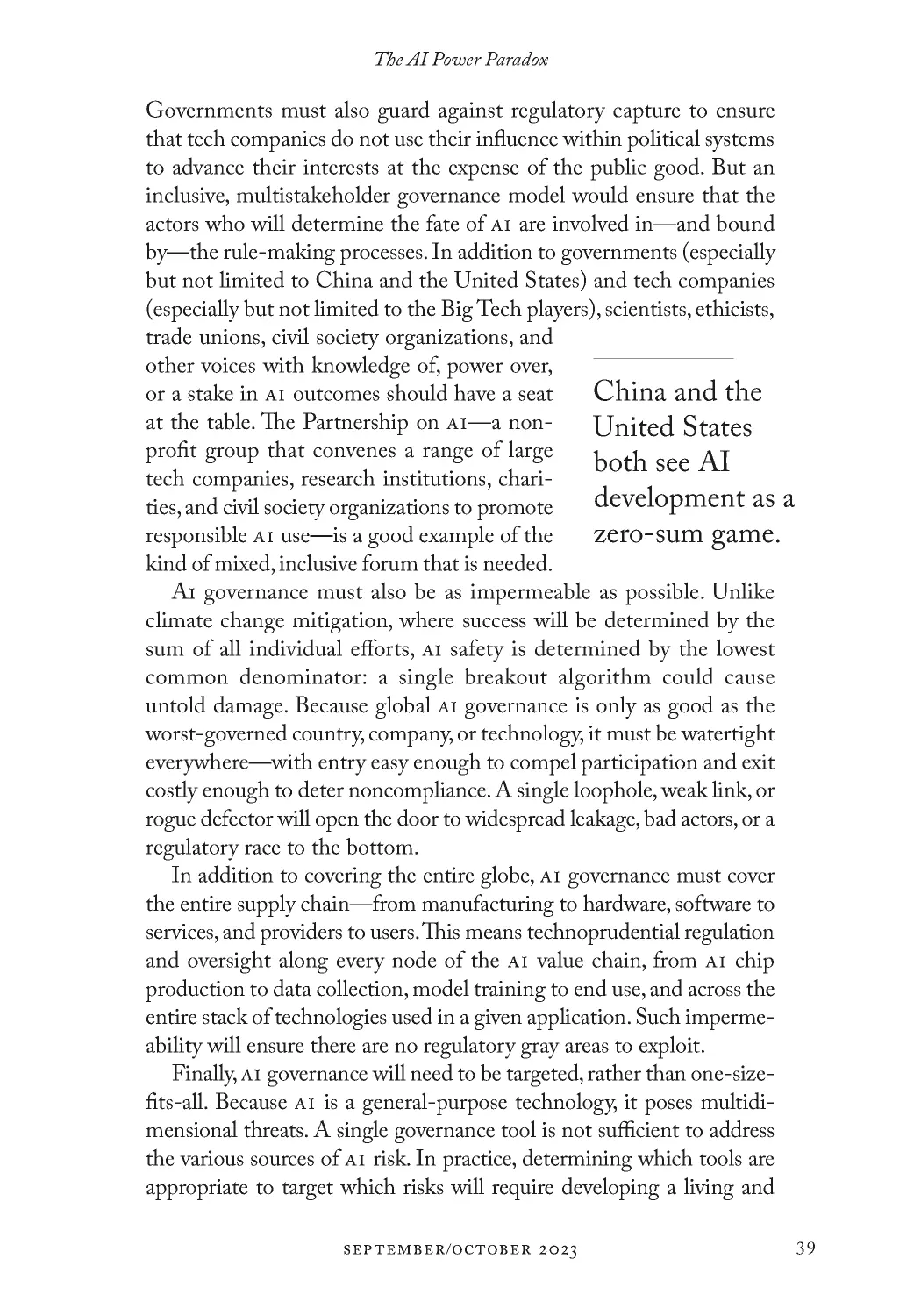
players that matter most—China and the United States—both see A I
development as a zero-sum game that will give the winner a decisive
strategic edge in the decades to come.
From the vantage point of Washington and Beijing, the risk that the
other side will gain an edge in A I is greater than any theoretical risk
the technology might pose to society or to their own domestic political
authority. For that reason, both the U.S. and Chinese governments
are pouring immense resources into developing AI capabilities while
working to deprive each other of the inputs needed for next-generation
breakthroughs. (So far, the United States has been far more successful
than China in doing the latter, especially with its export controls on
advanced semiconductors.) This zero-sum dynamic—and the lack of
trust on both sides—means that Beijing and Washington are focused
on accelerating A I development, rather than slowing it down. In their
view, a “pause” in development to assess risks, as some A I industry lead-
ers have called for, would amount to foolish unilateral disarmament.
But this perspective assumes that states can assert and maintain at
least some control over A I . This may be the case in China, which has
integrated its tech companies into the fabric of the state. Yet in the
West and elsewhere, AI is more likely to undermine state power than
to bolster it. O utside China, a handful of large, specialist A I companies
currently control every aspect of this new technological wave: what AI
models can do, who can access them, how they can be used, and where
they can be deployed. And because these companies jealously guard
their computing power and algorithms, they alone understand (most
of ) what they are creating and (most of ) what those creations can do.
These few firms may retain their advantage for the foreseeable future—
or they may be eclipsed by a raft of smaller players as low barriers to
entry, open-source development, and near-zero marginal costs lead to
uncontrolled proliferation of A I . Either way, the A I revolution will take
place outside government.
To a limited degree, some of these challenges resemble those of
earlier digital technologies. Internet platforms, social media, and even
devices such as smartphones all operate, to some extent, within sand-
boxes controlled by their creators. When governments have summoned
FA.indb 34
FA.indb 34
7/29/23 1:59 PM
7/29/23 1:59 PM

The AI Power Paradox
35
September/october 2023
the political will, they have been able to implement regulatory regimes
for these technologies, such as the E U’s General Data Protection Reg-
ulation, Digital Markets Act, and Digital Services Act. But such reg-
ulation took a decade or more to materialize in the E U , and it still has
not fully materialized in the United States. AI moves far too quickly
for policymakers to respond at their usual pace. Moreover, social media
and other older digital technologies do not help create themselves, and
the commercial and strategic interests driving them never dovetailed
in quite the same way: Twitter and TikTok are powerful, but few think
they could transform the global economy.
This all means that at least for the next few years, A I ’s trajectory
will be largely determined by the decisions of a handful of private
businesses, regardless of what policymakers in Brussels or Washington
do. In other words, technologists, not policymakers or bureaucrats,
will exercise authority over a force that could profoundly alter both
the power of nation-states and how they relate to each other. That
makes the challenge of governing AI unlike anything governments
have faced before, a regulatory balancing act more delicate—and more
high stakes—than any policymakers have attempted.
MOVING TARGET, EVOLVING WEAPON
Governments are already behind the curve. Most proposals for govern-
ing A I treat it as a conventional problem amenable to the state-centric
solutions of the twentieth century: compromises over rules hashed out
by political leaders sitting around a table. But that will not work for A I .
Regulatory efforts to date are in their infancy and still inadequate.
The EU’s AI Act is the most ambitious attempt to govern AI in any
jurisdiction, but it will apply in full only beginning in 2026, by which
time A I models will have advanced beyond recognition. The United
Kingdom has proposed an even looser, voluntary approach to regulating
AI, but it lacks the teeth to be effective. Neither initiative attempts to
govern A I development and deployment at the global level—something
that will be necessary for A I governance to succeed. And while volun-
tary pledges to respect A I safety guidelines, such as those made in July
by seven leading A I developers, including Inflection A I , led by one of
us (Suleyman), are welcome, they are no substitute for legally binding
national and international regulation.
Advocates for international-level agreements to tame A I tend to
reach for the model of nuclear arms control. But A I systems are not
FA.indb 35
FA.indb 35
7/29/23 1:59 PM
7/29/23 1:59 PM

Ian Bremmer and Mustafa Suleyman
36
foreign affairs
only infinitely easier to develop, steal, and copy than nuclear weapons;
they are controlled by private companies, not governments. As the new
generation of A I models diffuses faster than ever, the nuclear compar-
ison looks ever more out of date. Even if governments can successfully
control access to the materials needed to build the most advanced mod-
els—as the Biden administration is attempting to do by preventing
China from acquiring advanced chips—they can do little to stop the
proliferation of those models once they are trained and therefore require
far fewer chips to operate.
For global A I governance to work, it must be tailored to the specific
nature of the technology, the challenges it poses, and the structure and
balance of power in which it operates. But because the evolution, uses,
risks, and rewards of A I are unpredictable, A I governance cannot be
fully specified at the outset—or at any point in time, for that matter.
It must be as innovative and evolutionar y as the technology it seeks to
govern, sharing some of the characteristics that make A I such a powerful
force in the first place. That means starting from scratch, rethinking and
rebuilding a new regulatory framework from the ground up.
The overarching goal of any global A I regulatory architecture should
be to identify and mitigate risks to global stability without choking off
AI innovation and the opportunities that flow from it. Call this approach
“technoprudentialism, ” a mandate rather like the macroprudential role
played by global financial institutions such as the Financial Stability
Board, the Bank of International Settlements, and the International
Monetary Fund. Their objective is to identify and mitigate risks to global
financial stability without jeopardizing economic growth.
A technoprudential mandate would work similarly, necessitating the
creation of institutional mechanisms to address the various aspects of
AI that could threaten geopolitical stability.These mechanisms, in turn,
would be guided by common principles that are both tailored to A I ’s
unique features and reflect the new technological balance of power that
has put tech companies in the driver’s seat. These principles would help
policymakers draw up more granular regulatory frameworks to govern
AI as it evolves and becomes a more pervasive force.
The first and perhaps most vital principle for A I governance is pre-
caution. As the term implies, technoprudentialism is at its core guided
by the precautionary credo: first, do no harm. Maximally constraining A I
would mean forgoing its life-altering upsides, but maximally liberating
it would mean risking all its potentially catastrophic downsides. In other
FA.indb 36
FA.indb 36
7/29/23 1:59 PM
7/29/23 1:59 PM

New Resources for Fall 2023
Japan’s Quiet
Leadership
Reshaping the
Indo-Pacific
By Mireya Solis
“[Dr. Solis] masterfully
dissects the statecraft,
economic agility and
political evolution which
has allowed Japan to reshape the Indo-Pacific and
her role in it. As Japan had to deal with demographic
change, a different security atmosphere, and declining
relative capabilities not to mention pandemic, Dr. Solis’
effort can provide the template for other nations facing
similar challenges. This should be the textbook for a
new generation of foreign policy thinkers.” — Richard
Armitage, former Assistant Secretary of Defense and
former Deputy Secretary of State
America and the
Yemens
A Complex and
Tragic Encounter
By Bruce Riedel
“America and the Yemens
is a masterful account by
one of America’s foremost
intelligence and national
security analysts of a country cursed in its geography
and history. Bruce Riedel weaves this narrative from his
vast experience in the White House, CIA and Pentagon
under four Presidents as they tried to navigate the
perilous territory of the Middle East and the Persian
Gulf--both during the rise of al-Qaeda, and after
indigenous rivalries were further radicalized by the
American invasion of Iraq. Riedel is an omnipresent
narrator with unique first-person knowledge of
the roots of Yemen’s tragic civil war. This book is
must reading for anyone fascinated by the causes
of a tragedy and American relations that are now
catastrophic.” — Andrea Mitchell, NBC News
has allowed Japan to reshape the Indo-Pacific and
www.rowman.com
800-462-6420
Co-published by
Fo r innovative policy
thinking on artificial
intelligence, trust CIGI
research and analysis.
www.cigionline.org/AI
FA 37_ads.indd 1
7/27/23 3:55 PM

Ian Bremmer and Mustafa Suleyman
38
foreign affairs
words, the risk-reward profile for A I is asymmetric. Given the radical
uncertainty about the scale and irreversibility of some of A I ’s poten-
tial harms, A I governance must aim to prevent these risks before they
materialize rather than mitigate them after the fact. This is especially
important because A I could weaken democracy in some countries and
make it harder for them to enact regulations. Moreover, the burden of
proving an A I system is safe above some reasonable threshold should rest
on the developer and owner; it should not be solely up to governments
to deal with problems once they arise.
AI governance must also be agile so that it can adapt and correct
course as A I evolves and improves itself. Public institutions often calcify
to the point of being unable to adapt to change. And in the case of A I ,
the sheer velocity of technological progress will quickly overwhelm the
ability of existing governance structures to catch up and keep up. This
does not mean that A I governance should adopt the “move fast and
break things” ethos of Silicon Valley, but it should more closely mirror
the nature of the technology it seeks to contain.
In addition to being precautionary and agile, A I governance must be
inclusive, inviting the participation of all actors needed to regulate A I in
practice. That means A I governance cannot be exclusively state centered,
since governments neither understand nor control A I . Private technol-
ogy companies may lack sovereignty in the traditional sense, but they
wield real—even sovereign—power and agency in the digital spaces they
have created and effectively govern. These nonstate actors should not be
granted the same rights and privileges as states, which are internationally
recognized as acting on behalf of their citizens. But they should be parties
to international summits and signatories to any agreements on A I .
Such a broadening of governance is necessary because any regulatory
structure that excludes the real agents of A I power is doomed to fail.
In previous waves of tech regulation, companies were often afforded so
much leeway that they overstepped, leading policymakers and regulators
to react harshly to their excesses. But this dynamic benefited neither
tech companies nor the public. Inviting A I developers to participate in
the rule-making process from the outset would help establish a more
collaborative culture of A I governance, reducing the need to rein in these
companies after the fact with costly and adversarial regulation.
Tech companies should not always have a say; some aspects of AI
governance are best left to governments, and it goes without saying
that states should always retain final veto power over policy decisions.
FA.indb 38
FA.indb 38
7/29/23 1:59 PM
7/29/23 1:59 PM

The AI Power Paradox
39
September/october 2023
Governments must also guard against regulatory capture to ensure
that tech companies do not use their influence within political systems
to advance their interests at the expense of the public good. But an
inclusive, multistakeholder governance model would ensure that the
actors who will determine the fate of AI are involved in—and bound
by—the rule-making processes. In addition to governments (especially
but not limited to China and the United States) and tech companies
(especially but not limited to the Big Tech players), scientists, ethicists,
trade unions, civil society organizations, and
other voices with knowledge of, power over,
or a stake in AI outcomes should have a seat
at the table. The Partnership on A I —a non-
profit group that convenes a range of large
tech companies, research institutions, chari-
ties, and civil society organizations to promote
responsible A I use—is a good example of the
kind of mixed, inclusive forum that is needed.
AI governance must also be as impermeable as possible. Unlike
climate change mitigation, where success will be determined by the
sum of all individual efforts, AI safety is determined by the lowest
common denominator: a single breakout algorithm could cause
untold damage. Because global AI governance is only as good as the
worst-governed country, company, or technology, it must be watertight
ever ywhere—with entry easy enough to compel participation and exit
costly enough to deter noncompliance. A single loophole, weak link, or
rogue defector will open the door to widespread leakage, bad actors, or a
regulatory race to the bottom.
In addition to covering the entire globe, A I governance must cover
the entire supply chain—from manufacturing to hardware, software to
services, and providers to users. This means technoprudential regulation
and oversight along every node of the A I value chain, from A I chip
production to data collection, model training to end use, and across the
entire stack of technologies used in a given application. Such imperme-
ability will ensure there are no regulatory gray areas to exploit.
Finally, A I governance will need to be targeted, rather than one-size-
fits-all. Because A I is a general-purpose technology, it poses multidi-
mensional threats. A single governance tool is not sufficient to address
the various sources of A I risk. In practice, determining which tools are
appropriate to target which risks will require developing a living and
China and the
United States
both see AI
development as a
zero-sum game.
FA.indb 39
7/29/23 1:59 PM

Ian Bremmer and Mustafa Suleyman
40
foreign affairs
breathing taxonomy of all the possible effects A I could have—and how
each can best be governed. For example, A I will be evolutionary in some
applications, exacerbating current problems such as privacy violations,
and revolutionar y in others, creating entirely new harms. Sometimes, the
best place to inter vene will be where data is being collected. Other times,
it will be the point at which advanced chips are sold—ensuring they do
not fall into the wrong hands. Dealing with disinformation and misinfor-
mation will require different tools than dealing with the risks of A G I and
other uncertain technologies with potentially existential ramifications. A
light regulatory touch and voluntary guidance will work in some cases;
in others, governments will need to strictly enforce compliance.
All of this requires deep understanding and up-to-date knowledge
of the technologies in question. Regulators and other authorities will
need oversight of and access to key A I models. In effect, they will need
an audit system that can not only track capabilities at a distance but also
directly access core technologies, which in turn will require the right
talent. Only such measures can ensure that new A I applications are
proactively assessed, both for obvious risks and for potentially disruptive
second- and third-order consequences. Targeted governance, in other
words, must be well-informed governance.
THE TECHNOPRUDENTIAL IMPERATIVE
Built atop these principles should be a minimum of three A I gover-
nance regimes, each with different mandates, levers, and participants.
All will have to be novel in design, but each could look for inspiration to
existing arrangements for addressing other global challenges—namely,
climate change, arms proliferation, and financial stability.
The first regime would focus on fact-finding and would take the
form of a global scientific body to objectively advise governments
and international bodies on questions as basic as what A I is and what
kinds of policy challenges it poses. If no one can agree on the defini-
tion of AI or the possible scope of its harms, effective policymaking
will be impossible. Here, climate change is instructive. To create a
baseline of shared knowledge for climate negotiations, the United
Nations established the Intergovernmental Panel on Climate Change
and gave it a simple mandate: provide policymakers with “regular
assessments of the scientific basis of climate change, its impacts and
future risks, and options for adaptation and mitigation.” AI needs a
similar body to regularly evaluate the state of A I, impartially assess
FA.indb 40
FA.indb 40
7/29/23 1:59 PM
7/29/23 1:59 PM

The AI Power Paradox
41
September/october 2023
its risks and potential impacts, forecast scenarios, and consider tech-
nical policy solutions to protect the global public interest. Like the
IPCC, this body would have a global imprimatur and scientific (and
geopolitical) independence. And its reports could inform multilateral
and multistakeholder negotiations on AI , just as the IPC C’s reports
inform U N climate negotiations.
The world also needs a way to manage tensions between the major
AI powers and prevent the proliferation of dangerous advanced AI
systems. The most important international relationship in A I is the
one between the United States and China. Cooperation between the
two rivals is difficult to achieve under the best of circumstances. But
in the context of heightened geopolitical competition, an uncontrolled
AI race could doom all hope of forging an international consensus on
AI governance. One area where Washington and Beijing may find it
advantageous to work together is in slowing the proliferation of pow-
erful systems that could imperil the authority of nation-states. At the
extreme, the threat of uncontrolled, self-replicating A G I s—should they
be invented in the years to come—would provide strong incentives to
coordinate on safety and containment.
On all these fronts, Washington and Beijing should aim to create
areas of commonality and even guardrails proposed and policed by a
third party. Here, the monitoring and verification approaches often
found in arms control regimes might be applied to the most important
AI inputs, specifically those related to computing hardware, including
advanced semiconductors and data centers. Regulating key chokepoints
helped contain a dangerous arms race during the Cold War, and it could
help contain a potentially even more dangerous AI race now.
But since much of AI is already decentralized, it is a problem of
the global commons rather than the preser ve of two superpowers. The
devolved nature of A I development and core characteristics of the tech-
nology, such as open-source proliferation, increase the likelihood that it
will be weaponized by cybercriminals, state-sponsored actors, and lone
wolves. That is why the world needs a third A I governance regime that
can react when dangerous disruptions occur. For models, policymakers
might look to the approach financial authorities have used to maintain
global financial stability. The Financial Stability Board, composed of
central bankers, ministries of finance, and supervisory and regulatory
authorities from around the world, works to prevent global financial
instability by assessing systemic vulnerabilities and coordinating the
FA.indb 41
FA.indb 41
7/29/23 1:59 PM
7/29/23 1:59 PM

Ian Bremmer and Mustafa Suleyman
42
foreign affairs
necessar y actions to address them among national and international
authorities. A similarly technocratic body for AI risk—call it the Geo-
technology Stability Board—could work to maintain geopolitical sta-
bility amid rapid A I -driven change. Supported by national regulatory
authorities and international standard-setting bodies, it would pool
expertise and resources to preempt or respond to A I -related crises,
reducing the risk of contagion. But it would also engage directly with
the private sector, recognizing that key multinational technology actors
play a critical role in maintaining geopolitical
stability, just as systemically important banks
do in maintaining financial stability.
Such a body, with authority rooted in
government support, would be well posi-
tioned to prevent global tech players from
engaging in regulatory arbitrage or hiding
behind corporate domiciles. Recognizing
that some technology companies are sys-
temically important does not mean stifling start-ups or emerging
innovators. On the contrary, creating a single, direct line from a
global governance body to these tech behemoths would enhance the
effectiveness of regulatory enforcement and crisis management—
both of which benefit the whole ecosystem.
A regime designed to maintain geotechnological stability would also
fill a dangerous void in the current regulatory landscape: responsibility
for governing open-source A I . Some level of online censorship will
be necessar y. If someone uploads an extremely dangerous model, this
body must have the clear authority—and ability—to take it down or
direct national authorities to do so. This is another area for potential
bilateral cooperation. China and the United States should want to work
together to embed safety constraints in open-source software—for
example, by limiting the extent to which models can instruct users on
how to develop chemical or biological weapons or create pandemic
pathogens. In addition, there may be room for Beijing and Washington
to cooperate on global antiproliferation efforts, including through the
use of inter ventionist cybertools.
Each of these regimes would have to operate universally, enjoying
the buy-in of all major A I players. The regimes would need to be spe-
cialized enough to cope with real A I systems and dynamic enough to
keep updating their knowledge of A I as it evolves. Working together,
Few favor
containing AI—
and all incentives
point toward
inaction.
FA.indb 42
7/29/23 1:59 PM

The AI Power Paradox
43
September/october 2023
these institutions could take a decisive step toward technoprudential
management of the emerging AI world. But they are by no means the
only institutions that will be needed. Other regulatory mechanisms,
such as “know your customer” transparency standards, licensing require-
ments, safety testing protocols, and product registration and approval
processes, will need to be applied to AI in the next few years. The key
across all these ideas will be to create flexible, multifaceted governance
institutions that are not constrained by tradition or lack of imagina-
tion—after all, technologists will not be constrained by those things.
PROMOTE THE BEST, PREVENT THE WORST
None of these solutions will be easy to implement. Despite all the buzz
and chatter coming from world leaders about the need to regulate AI ,
there is still a lack of political will to do so. Right now, few powerful
constituencies favor containing A I —and all incentives point toward
continued inaction. But designed well, an A I governance regime of
the kind described here could suit all interested parties, enshrining
principles and structures that promote the best in A I while prevent-
ing the worst. The alternative—uncontained A I —would not just pose
unacceptable risks to global stability; it would also be bad for business
and run counter to every country’s national interest.
A strong AI governance regime would both mitigate the societal
risks posed by A I and ease tensions between China and the United
States by reducing the extent to which AI is an arena—and a tool—of
geopolitical competition. And such a regime would achieve something
even more profound and long-lasting: it would establish a model for
how to address other disruptive, emerging technologies. AI may be a
unique catalyst for change, but it is by no means the last disruptive
technology humanity will face. Quantum computing, biotechnology,
nanotechnology, and robotics also have the potential to fundamentally
reshape the world. Successfully governing A I will help the world suc-
cessfully govern those technologies as well.
The twenty-first century will throw up few challenges as daunting
or opportunities as promising as those presented by A I . In the last
century, policymakers began to build a global governance architecture
that, they hoped, would be equal to the tasks of the age. Now, they must
build a new governance architecture to contain and harness the most
formidable, and potentially defining, force of this era. The year 2035 is
just around the corner. There is no time to waste.
FA.indb 43
FA.indb 43
7/29/23 1:59 PM
7/29/23 1:59 PM

44
foreign affairs
Putin’s Age
of Chaos
The Dangers of Russian Disorder
Tatiana Stanovaya
After Russian President Vladimir Putin launched an invasion
of Ukraine in February 2022, Russian elites acted as if the
war had not really changed anything on the home front.
Even as the campaign foundered and the West tightened sanctions
on the Russian economy, those with power in Moscow seemed to
carry on as usual. Since last autumn, however, things have been get-
ting a little more complicated. A surprisingly successful Ukrainian
counterattack in the region of Kharkiv in September 2022 exposed
the vulnerability of Russian military positions. Irked, the Kremlin
launched a military mobilization that caused tremendous social anx-
iety, although only for a short period. Then in October, a Ukrainian
strike on the Kerch Strait bridge left the key link between Crimea
and mainland Russia engulfed in smoke and flames. It also revealed
how flexible the Kremlin’s supposed redlines actually were; an event
TATIANA STANOVAYA is a S enior Fellow at the Carnegie Russia Eurasia Center and
the Founder and CEO of the political analysis firm R.Politik.
FA.indb 44
7/29/23 1:59 PM
Return to Table Contents

45
Illustration by Matt Needle
FA.indb 45
7/29/23 1:59 PM

Tatiana Stanovaya
46
foreign affairs
that had seemed intolerable just months prior ultimately produced
no tangible response from the state and left elites with the growing
sense that Russia’s war could rebound onto its own territory.
The following months have only ratcheted up the pressure. The
Ukrainian front has provided little good news for the Kremlin, with
the exception of the seizure of the Ukrainian city of Bakhmut in May.
And in the meantime, a new front has opened up at home. Unknown
assailants—most likely connected to Ukrainian security services—have
attacked Moscow with drones. Paramilitaries
have raided across the border into the Rus-
sian region of Belgorod. And most shocking,
the forces of Yevgeny Prigozhin, the leader
of the Wagner private military company, car-
ried out an open rebellion in June, seizing
much of the city of Rostov-on-Don, sending
a column of troops racing toward Moscow,
and even shooting down a number of Russian
aircraft, killing over a dozen Russian pilots in the process.
Prigozhin’s uprising captured the world’s attention—and deeply dis-
turbed Moscow’s elite. Despite its swift resolution (in a deal brokered in
part by Belarusian President Alexander Lukashenko), many in Moscow
struggle to understand Putin’s handling of the crisis. On the one hand,
the Russian president has publicly and ruthlessly condemned Prigozhin
as a “traitor,” but on the other hand, he has allowed the mercenary leader
to move freely within the country and even hosted him in the Kremlin
for negotiations at the end of June.
These events were unprecedented in contemporary Russia. And yet
they do not seem to have ruffled the status quo; people continue their
lives as if nothing had happened. To be sure, generals are now daring
to complain more openly about the top brass. But the overall situation
in the army remains stable, and to date the Russian government and
military have not reshuffled or arrested any army personnel.
Don’t be fooled: this ostensible resilience to bad news and the seem-
ing indifference to ongoing events are deceptive. It is becoming increas-
ingly difficult for the Kremlin to sweep unwelcome developments under
the carpet. The war has begun to change Russia, and profound internal
shifts are likely under way—in Putin’s regime, in the elites’ perception
of Putin, and in the public’s attitude toward the war. Indeed, the mili-
tarization of Russian life is empowering ultranationalist hard-liners in
It is becoming
harder for the
Kremlin to sweep
bad news under
the carpet.
5_Stanovaya_BLUES.indd 46
7/31/23 4:06 PM

Putin’s Age of Chaos
47
september/october 2023
the elite, eclipsing an old guard of ideologues that the Russian public
has begun to view as increasingly out of touch with the realities of
the war. The perception of Putin’s weakening has further revealed
the regime’s deep flaws: the habitual inclination of the authorities
to underestimate domestic political risks, ignore long-term devel-
opments in favor of addressing immediate challenges, and refuse
responsibility for the growing number of incidents on Russian ter-
ritory linked to the war.
Prigozhin’s mutiny has pushed the situation to an extreme and may
pave the way for the emergence of a more radicalized, hawkish, and
ruthless state. Threats to the Kremlin, such as the Wagner rebellion,
and the revelations of the government ’s weakness, will not necessar-
ily lead the public to turn against Putin and bring down the regime.
Instead, these developments are transforming Russia into a far less
cohesive entity, one rife with internal contradictions and conflicts,
more volatile and lacking predictability. With so much pressure turn-
ing inward, the space for debate about the ongoing war in Ukraine
may open somewhat, even if not for outright dissent. But at home,
the order that Putin built will become more disorderly, and the world
will have to contend with a more dangerous and unpredictable Russia.
FRAGILE STATE
In the months leading up to Prigozhin’s rebellion, Russia found itself in
the unexpected position of watching the war come home. In early May,
just days before the annual Victory Day parade in Red Square, unknown
attackers used drones to try to hit targets in Moscow, including the
Kremlin. Then, at the end of May and into June, paramilitary groups
aligned with Ukraine crossed into the Russian region of Belgorod. They
caused mayhem and briefly seized various settlements. Other regions
neighboring Ukraine have also been enduring continual shelling. The
Kremlin’s response to these events has been startlingly passive; it has
simply sought to hit the mute button. Television news and talk shows
have focused instead on the supposed efficacy of Moscow’s air defenses
and advanced a narrative about the supposed ruthlessness of Ukrainians
and their Western “masters.” With rare exceptions, Putin has barely
commented on these attacks on Russian soil, preferring to delegate
that responsibility to the Defense Ministry.
The Kremlin’s propensity to downplay seemingly shocking events is
in line with how Putin saw the war. He maintained a deep-seated belief
5_Stanovaya_BLUES.indd 47
5_Stanovaya_BLUES.indd 47
7/31/23 4:06 PM
7/31/23 4:06 PM

Tatiana Stanovaya
48
foreign affairs
that ordinary Russians brim with patriotism, that the elites remain
controllable and loyal to the state, that a path to victory in Ukraine is
still open, and that Russia’s economy is resilient enough to endure until
he achieves his goals. Consequently, senior officials in the presidential
administration, taking cues from Putin’s cool demeanor and aversion
to panic, often convinced themselves that everything was fine and that
their anxiety would be more harmful than prudent. Kremlin insiders,
speaking privately about the war’s impact on political stability, bragged
about the authorities’ capacity to maintain political control, with one
insider offering the cautious caveat that all would be well “if the mili-
tary does not let us down.” They cited consistently high public support
for the “special military operation” in Ukraine and strong approval
ratings for both Putin and the government.
Prigozhin’s growing discontent preceding the mutiny failed to alarm
these insiders. Even as late as June 23, when Prigozhin had already initi-
ated his rebellion, many sources close to the Kremlin continued to believe
that nothing of major concern was happening and that Prigozhin was
still useful for achieving certain political objectives, such as channeling
the frustration of ultranationalists. In addition, many officials were con-
vinced that people close to Putin in the Kremlin were super vising Prigo-
zhin and that Wagner would not try to challenge the Russian state. Then,
reports made clear that Wagner forces had seized the military command
center for Russian operations in Ukraine in the city of Rostov-on-Don,
that a column of Wagner soldiers was advancing on Moscow, and that
Wagner forces had even shot down Russian helicopters.
These events ser ved as a sobering revelation: Putin had misjudged
Prigozhin and his outrage, underestimating the danger posed by the
voluble and volatile caterer turned mercenary commander. The rebellion
was, in large part, the product of Putin’s inaction. His detached and
aloof stance and his reluctance to intervene in the escalating conflict
between Prigozhin and the two most senior Russian military officials—
Sergey Shoigu, the defense minister, and Valery Gerasimov, the chief
of the general staff—helped spark the revolt. The rebellion exposed
not only Putin’s management failures, the negligence that embittered
and inflamed Prigozhin, but also how the state had shot itself in the
foot. After all, Wagner has grown into a fighting force with tens of
thousands of soldiers only thanks to billions of dollars in state funding,
access to the state’s resources, and its links to high-profile officials who
have endorsed the mercenar y outfit’s activities.
FA.indb 48
FA.indb 48
7/29/23 1:59 PM
7/29/23 1:59 PM

LEAD THE CHANGE
YOU WANT TO SEE.
Master of Global Affairs
Work directly with public and private sector leaders,
meet with policymakers through our Washington Office,
and partner with international organizations
tackling global challenges on the ground.
Emerge with the skills you need to be an agent of change.

Tatiana Stanovaya
50
foreign affairs
In the wake of the rebellion, it has become much harder for the
Kremlin to project an aura of unflappable control and political compe-
tence. Just a week after the mutiny, Putin made an unscheduled public
appearance in Dagestan. His staff was unprepared for this event and
his behavior, including hugging members of the crowd, surprised many
in the Kremlin and was seen as evidence that he was acting emotion-
ally and spontaneously, seeking affirmation. In front of the cameras, he
held babies, shook hands, and posed for selfies with an adoring public.
The scene was striking given that Putin has rarely allowed himself
such interactions in the years since the COVID-19 pandemic began.
Although Putin may have wanted to demonstrate his closeness with
ordinary Russians in the wake of Prigozhin’s mutiny, many observers
interpreted the spectacle as a sign of the president ’s acute need to
experience the adulation of Russian citizens—a measure perhaps of
his own sense of vulnerability.
The Kremlin’s mishandling of the war, compounded by Prigozhin’s
ensuing mutiny, has made the government appear irresponsible and the
state weak. Even the drone attacks inspired bewilderment as to why
Russian defense systems could not thwart them and stoked a percep-
tion among ordinary Russians, as well as those hawks who support the
war in Ukraine, of the state’s frailty, its inability to ensure the safety
of the capital city (never mind the country at large), and the failure
of authorities to stop enemies from infiltrating Russian territory. A
cursor y look at public discussions on social media reveals speculation
among Russians about the potential presence of Ukrainian sympathiz-
ers “among us,” ready to “stab us in the back.”
SOMETHING ROTTEN
Many observers are used to viewing Putin’s regime as the product of a
social contract in which the state guarantees stability in return for the
people granting the Kremlin significant freedom to manage political
life. Since Russia’s annexation of Crimea in 2014, however, the value
of domestic stability has been gradually eclipsed by a deeper need for
geopolitical security—that is, protection from the hostile West—that has
accompanied an upsurge in nationalist sentiment. Now, after the 2022
invasion of Ukraine, Russians hunger for geopolitical security. The people
have delegated to Putin the right to deal with the West—which many
Russians believe threatens their country ’s very existence—even if that
causes domestic turmoil owing to stringent sanctions and crackdowns
5_Stanovaya_BLUES.indd 50
5_Stanovaya_BLUES.indd 50
7/31/23 4:07 PM
7/31/23 4:07 PM

Putin’s Age of Chaos
51
september/october 2023
on liberals. Polls show that since the war began, the percentage of Rus-
sians who overtly admire Putin has grown from eight to 19 percent,
and 68 percent of Russians now say they want him to be reelected, a
significant jump from 48 percent of Russians before the war. The war has
also increased support for all official institutions: the cabinet, regional
governors, parliament, and even the ruling party, United Russia.
But Putin’s passivity in the face of internal military threats and his
aloof stance may become a major problem for the regime in the near
future. There are signs that Russians, despite their increased support for
state institutions, are becoming much more ambivalent about the coun-
try ’s authorities. They are beginning to doubt the ability of the political
class to fulfill its responsibilities. At the end of May, a drone attack tar-
geted Rublyovka, a famous upscale Moscow suburb where many wealthy
and influential Russians live. Some social media users were not altogether
sorry for the attack and suggested that the rich and powerful were get-
ting their just deserts. Rublyovka has long been a symbol of the affluent,
parasitic elite associated with both the Yeltsin era and the current regime.
Many pro-Kremlin bloggers and ordinar y Russians hoped that the attack
would serve as a wake-up call to this elite, compelling them to become
more involved in helping salvage the war with Ukraine and responding
more resolutely to attacks on Russian territory.
Anti-elite sentiment also propelled the rise of Prigozhin. He had
been gaining visibility and popularity in recent months as his forces
operated in Ukraine. According to the Levada Center, an independent
Russian polling firm, Russians saw the capture of Bakhmut by Wagner
fighters in May as the most important event of that month. A study by
another polling group, Romir, found that Wagner’s triumph in Bakhmut
had elevated Prigozhin for the first time into the ranks of the top five
most-trusted politicians in Russia, after Putin, Foreign Minister Sergey
Lavrov, Shoigu, and Prime Minister Mikhail Mishustin. His climb was
stratospheric: at the beginning of the year, Prigozhin had ranked 158th
among trusted Russian political figures.
Ordinar y Russians were struck by Prigozhin’s brazen confronta-
tion with the Defense Ministry and his complaints that his troops
were desperately short of ammunition. The public perceived him as a
crusader against corruption and someone who dared to challenge the
spoiled elites. A local eyewitness to Wagner’s seizure of Rostov-on-Don
described Prigozhin in a Facebook post as “a simple, ordinar y man going
to have it out with the fat cats of every stripe and color,” a sentiment that
FA.indb 51
FA.indb 51
7/29/23 1:59 PM
7/29/23 1:59 PM

Tatiana Stanovaya
52
foreign affairs
explains the warm welcome Rostov residents gave Wagner fighters. That
disgruntlement with the powers that be—“the fat cats”— to some extent
explains the ease with which Prigozhin took control of the city.The same
eyewitness reported with incredulity that the state was entirely missing
in action. “ The buildings of the provincial and city administration and
the provincial government were completely deserted,” she noted. “In
the blink of an eye, the military, with whom the frontline city had been
filled, disappeared. The F SB [the Federal Security Services] barricaded
itself inside its own building.”
Many Western observers have suggested
that these military troubles will push the elites
and broader society to crave peace. Unfortu-
nately, the reality is much bleaker: challeng-
ing situations tend to make Russia only more
determined and brutal in waging its war and in
quashing dissent at home. Prigozhin’s mutiny
was not a rejection of the war but can be
understood instead as the result of dissatisfaction with the inefficient
prosecution of the war. Reactions to the drone attacks and incursions
by paramilitaries into the Belgorod region in the spring are instruc-
tive. According to Levada polling, these events only fueled support for
the war among Russians, with people becoming more hostile toward
ordinary Ukrainians and anxious about the fate of the “special military
operation.” The attacks did not in any way increase public desire for
peace talks or a Russian withdrawal from Ukraine, a country that is
perceived now more than ever as a threat to Russia’s existence. Accord-
ing to polling by Levada, Russians have started to conclude in recent
months that the war will be long and drawn out. In May, 45 percent of
respondents said they believed the war would last more than another
year—the highest percentage since the conflict began (in May 2022, it
was 21 percent). They are adapting to that reality and steeling themselves
for tough times ahead; they are not seeking to halt the war, and antiwar
sentiment remains at best subdued, at worst entirely suppressed.
If anything, the country is becoming more committed to the fight—
not in pursuit of imperial ambitions but out of a more desperate concern
for its very sur vival. The faction advocating for a “resolute response” to
the enemy is gaining new supporters, according to an op-ed in Russian
Forbes by Denis Volkov, Levada’s director, interpreting the results of
recent polls. In the wake of Prigozhin’s uprising, many Russians want
The Wagner
rebellion was, in
large part, the
product of Putin’s
inaction.
5_Stanovaya_BLUES.indd 52
7/31/23 4:07 PM

Putin’s Age of Chaos
53
september/october 2023
to see the state be bolder, more decisive, consistent, and firm. This is
backed up by the latest Levada polls, conducted at the end of June,
which revealed a shift in people’s attitudes: the mutiny had led to a
slight decline in confidence in Shoigu and a significant decline in
confidence in Prigozhin. In other words, the mercenar y commander’s
revolt has not inspired Russians against a struggling state but rather
frightened them with the prospect of destabilization and disorder.
The mutiny and the events that preceded it suggest that the regime
may be much less resilient than it appears: a frazzled Kremlin; a detached
Putin who is failing to deal with internal conflicts; a frustrated society
that is perplexed by the state’s lethargic reaction to previously unimag-
inable events; trembling elites ready to fly away the second the regime
crumbles (the Kremlin is now trying to investigate who among officials
and the top managers of state corporations dared leave Moscow during
Prigozhin’s mutiny and why); and the shell-shocked military and secu-
rity services that, following the mutiny, will certainly try to patch up
their vulnerabilities and quash growing internal dissent in their ranks.
Putin, lulled into complacency by his conviction that people love
him and the elites are loyal to him, may do little to arrest this decay.
At the same time, the security services may seek more control and
clamp down on society. Together, these dynamics may lead to inco-
herence in government behavior, further complicating the situation.
Instead of dislodging the regime, Prigozhin’s jolt to the Kremlin will
make the government not only more repressive and more brutal but
also more chaotic and unpredictable.
THE HARDENING LINE
This situation plays squarely into the hands of Russia’s hard-liners, a
camp that consists of the security service, hawkish conser vatives, pro-war
military correspondents, and radically anti-Western T V pundits. They
advocate for tightening the screws, hunting for traitors, and placing the
country on a war footing to accumulate all the resources necessary to win.
The current political and social conditions leave virtually no alternative for
the regime other than to become less tolerant of even minor suspicious
activities, such as any suggestion of the need to reconcile with the Ukrai-
nians, never mind overt opposition to the war. A significant portion of
Russian society may end up supporting and even aiding a new crackdown.
The public mood has become less indulgent of those privileged Russians
who try to maintain a distance from the war, continue leading luxurious
FA.indb 53
FA.indb 53
7/29/23 1:59 PM
7/29/23 1:59 PM

Tatiana Stanovaya
54
foreign affairs
lifestyles, and conduct business as usual. It is becoming harder in Russia
to maintain a passive or distant position on the war; everywhere, Russians
feel pressured to perform their patriotism conspicuously.
Since the invasion, the Russian state has marginalized antiwar forces
and left no room for liberal-minded figures by cracking down on pro-
tests (which were not massive to begin with) and enacting a raft of bills
de facto outlawing antiwar and antiregime activities. That repression
and that stiffening of patriotic feeling has opened a larger space for
far more active, hardcore, and daring hawks to gain ground in politics
and the national conversation. A younger and bolder cohort of hawks
may supplant a more traditional older generation of conser vative ideo-
logues, including the likes of Alexander Bastrykin, the head of the
Investigative Committee, Sergei Naryshkin, the chief of the Foreign
Intelligence Service, and Nikolai Patrushev, the secretary of Russia’s
Security Council, as well as figures such as Dmitry Medvedev, the for-
mer Russian president and now deputy head of the Security Council,
and Vyacheslav Volodin, the chair of the State D uma. These ideologues
helped foster and promote “Putinism,” the president ’s brand of nation-
alist, anti-Western, antiliberal ideas with an emphasis on traditional
values such as the importance of family, children, spiritual bonds, and
the primacy of state interests over private rights. These men also con-
tributed to the climate that precipitated Putin’s invasion of Ukraine.
But the ongoing war has stripped them of their political uniqueness,
turning the entire political mainstream conser vative and hard-line.
Worse, the old guard now has little to say about wartime realities,
with great uncertainty about the course of the war, enormous Western
military aid to Kyiv, the absolute lack of any decent exit strategy, and a
dismal future looming for the country. Leaders such as Medvedev and
Patrushev, who have long promoted the confrontational, anti-Western
policy and rhetoric of Putin’s regime, now appear to many jingoistic
hawks to be removed from reality—both physically and intellectually
far from the nitty-gritty of the war—even as they remain high-profile
figures close to the president.
As their star wanes, a new generation of hawks is rising. Some of
these new hawks are yesterday’s young technocrats, such as Putin’s
chief domestic policy adviser, Sergei Kiriyenko, who is now in charge
of the four Ukrainian regions that Moscow announced it was annex-
ing last fall, or Marat Khusnullin, the deputy prime minister tasked
with overseeing the reconstruction of destroyed Ukrainian territories
5_Stanovaya_BLUES.indd 54
5_Stanovaya_BLUES.indd 54
7/31/23 4:07 PM
7/31/23 4:07 PM

www.launchpadrepublic.com
“A thought-provoking take on how US entrepreneurs
have thrived due to the country’s vibrant – if sometimes
‘messy and difficult’ – democracy” – Financial Times
Launchpad Republic
is the definitive yet
easy-to-read story of
how entrepreneurship
evolved in America.
”The work as a whole
is truly magisterial
in its detail; [yet] the
authors somehow manage to
combine a granular account of the
country’s entrepreneurial history with a general
synopsis of its philosophical foundations.”
– K irkus Review
Launch-Pad-Republic-ForeignAffairs-7x10-Ad.indd 1
5/19/23 1:04 PM

Tatiana Stanovaya
56
foreign affairs
now under Russian control. These officials spend a lot of time in the
occupied areas, regardless of the personal risks, thereby demonstrating
their courage and diligence in action to Putin and the elites in general.
The new hawks also include practitioners involved in military affairs,
who are closely obser ving the course of the war and have become for
many Russians key sources of information about its developments.
By contrast, officials such as Patrushev drone on endlessly about an
“Anglo-Saxon” conspiracy to seize Russian territory and spout far-
fetched theories (including the bizarre notion that U.S. officials want to
settle Americans in Russia and Ukraine in the event of the catastrophic
eruption of a volcano at Yellowstone National Park).
Some senior members of the establishment have benefited from
the hawkish turn, however—notably Shoigu, the defense minister,
and Viktor Zolotov, the head of the Rosgvardia domestic military
force. They may become the main beneficiaries of Prigozhin’s sup-
pressed insurgency: Zolotov can now more easily beef up the ranks
of Rosgvardia to deal with events like Prigozhin’s mutiny, and Shoigu
can use the rebellion as an occasion to settle scores with internal
opponents in the army. Unlike the desk-jockey ideologues, these lead-
ers can directly access administrative resources and forces to alter facts
on the ground and show true power. To put it simply, Medvedev can
write another rant on the social media app Telegram, and Patrushev
can give his one-hundredth interview raging about the evil Ameri-
cans, but Shoigu and Zolotov can deploy real physical force to deal
with challenges and demonstrate to Putin their indispensability (even
if Shoigu, as defense minister, remains responsible for so many of the
last year’s military setbacks).
The clash of hawks, old and new, will shape Russia’s response to its
struggles in Ukraine and at home. The more challenges the regime faces,
the more quickly it will evolve into something darker. The Russian pub-
lic is growing more desperate, anti-Western, and anti-Ukrainian, and
Russian elites are becoming increasingly anxious and fractious. Most
senior officials, businessmen, and politicians had hoped to simply wait
out the war, but now they find themselves hostage to Putin’s ambitions.
More overtly hawkish and powerful groups such as the military com-
mand or the so-called Chekists in the national security establishment
will try to secure order, especially after Prigozhin’s mutiny, to boost
the regime’s capacity to endure the war, avoid defeat, and avert even
the most tentative attempt to organize another mutiny in the future.
FA.indb 56
FA.indb 56
7/29/23 1:59 PM
7/29/23 1:59 PM

Putin’s Age of Chaos
57
september/october 2023
All these moves will occur against the backdrop of Putin’s weakening
leadership, a factor that will contribute to the regime becoming more
chaotic, indiscriminate, and internally rancorous and competitive.
In truth, Putin and those old ideologues close to him, such as Patru-
shev, are becoming in some senses obsolete, their ideas out of step
with elite sentiment regarding Ukraine and the West. Regardless of
how conservative and hawkish the elites become, they remain more
pragmatic than Putin. They are less obsessed with the notion of “sav-
ing” Ukrainians, and unlike Putin, they do not presume that Kyiv will
inevitably fail. They also have a more accurate understanding of Russia’s
capacity to wage war. And many find Putin’s tendency to ignore alarm
bells incomprehensible. That is why many pro-war activists are calling
for radical reforms to establish what would effectively be a military
dictatorship. That is why even Prigozhin managed to win significant
visibility and attention. He advocated alternative war strategies and
argued for the necessity of using all conceivable financial, economic,
and social resources to bolster military power. No one is seriously con-
sidering or discussing a diplomatic end to the war: a notion that looks
to many high-profile Russians like a personal threat, given all the war
crimes that their country has committed and the responsibility that
the entire elite now bears for the carnage in Ukraine.
GOING OFF SCRIPT
The system has started to learn to operate independently of Putin.
This development does not yet reflect the solidifying of anti-Putin sen-
timent or emerging political opposition. It reflects a realization of
the inadequacies of the president ’s detached managerial style that
allowed genuine threats to the regime to go neglected. By completely
underestimating Prigozhin’s radicalization and Wagner’s escalating
conflict with the military, Putin has come across as an aging leader
who is beginning to falter in ways he would never have before. Even
the miscalculations that led to the decision to move against Ukraine
were not perceived as harshly as the utter loss of control that enabled
Prigozhin’s uprising, the largest domestic conflict between state and
private armed forces. Putin appears less powerful after conspicuously
dropping charges against Prigozhin, not demanding justice for the
killings of pilots during the mutiny, and allowing enormous budget
expenditures to go to a private military company that eventually
dares to attack the state.
FA.indb 57
FA.indb 57
7/29/23 1:59 PM
7/29/23 1:59 PM

Tatiana Stanovaya
58
foreign affairs
Other factions are already moving into the space opened by Putin’s
weakness. Putin could become a tool in the hands of new, more dynamic
and pragmatic hawks, who are quickly learning how to use the president ’s
emotions and well-known beliefs to their advantage. The presidential
administration has become adept at not simply pandering to Putin but
actively limiting what he knows by feeding him flattering reports on the
patriotism of the populace, innumerable documents on the decline of
the West, and tales of Ukrainians longing for liberation. They depict a
world eagerly waiting for Russia to upend the
existing international order. A few years ago,
Putin’s staff mainly sought to avoid incurring
the president ’s irritation, typically when he
received unwelcome news. Now, they are hon-
ing their skills in shaping Putin’s moods, either
by directing his anger toward their opponents
or by encouraging his optimism when it bene-
fits them. Maintaining extreme anti-Western
and anti-Ukrainian views may help the new hawks achieve their polit-
ical goals, and the concurrent radicalization of the regime could lead
authorities to become much harsher toward their domestic foes. But
a government that lacks firm political leadership, strategic vision, and
coherence will be less capable of strategic thinking and agreeing on
long-term priorities. Factions in government will focus primarily on
outmaneuvering one another and advancing their narrow interests.
Contrary to what analysts might have anticipated would follow Pri-
gozhin’s uprising—attempts by the Kremlin to consolidate its power,
dismantle private militias, and integrate Russia’s panoply of armed
groups into something more coordinated and coherent—the exact
opposite may occur. Dmitry Mironov, Putin’s influential aide and for-
mer bodyguard, proposed in June formalizing units of soldiers from
the martial subculture known as the Cossacks, a move that may irritate
Shoigu and a Defense Ministry already wary of the proliferation of
autonomous militarized groups. The Kremlin has also discussed sepa-
rating the border forces from the F S B; the Rosgvardia seeks to acquire
heavy weaponr y and additional forces from the interior ministry; and
purges in the army coupled with possible military setbacks on the
Ukrainian front may ignite localized protests against the army ’s com-
mand. It was widely expected that Wagner would be dismantled after
its uprising; instead, it seems Putin will allow the mercenary outfit to
The war has left
Russia grasping
for certainties in
an exceedingly
uncertain world.
FA.indb 58
7/29/23 1:59 PM

Putin’s Age of Chaos
59
september/october 2023
carry on under Prigozhin’s successor, Aleksei Troshev. In other words,
rather than concentration, the security forces may see further frag-
mentation, with rival factions vying for new prerogatives and powers.
At the same time, however, the political class is shifting its attention
inward to address the country ’s own flaws and failures that Prigozhin’s
revolt exposed rather than focusing on Putin’s historic mission of lib-
erating Ukrainians. The more the war becomes a quagmire, the more
deputies, pundits, senators, and popular bloggers seek to highlight and
address domestic problems that they blame for making Russia less
effective in conducting the war. This inward turn could lead to a more
pragmatic approach to the war against Ukraine even as it could make
the state far more ruthless toward its own citizens.
Ordinary Russians still seem to support the war and back Putin, but
they are also becoming frustrated, gradually showing impatience with
elites, and feeling increasingly vulnerable because of the clumsy actions
(and inaction) of the authorities. Putin may enjoy high approval ratings,
but they will mask growing uncertainty, social anxiety, and (as yet)
unchanneled discontent about the course of the events. True sources
of political risk for the regime may appear in the form of figures who
back Putin and are generally loyal to the authorities (as Prigozhin was)
but who, over time, could come to pose significant problems.
For the foreseeable future, the Kremlin will be wrestling simulta-
neously with diverging internal forces: a deepening crisis of Putin’s
leadership, a growing lack of political accountability, increasingly
ineffective responses by the authorities to new challenges, an inten-
sifying fragmentation among elites, and a society that is growing
more antiestablishment.
If previously, domestic affairs were secondary to the dominant
military agenda, the reverse may come true. The war could become
a backdrop to more urgent domestic challenges. At home, Russia’s
future appears bleak, marked by ever-greater fractiousness among
elites, Putin’s shrinking influence, and a more ideological and stricter
regime in which security services play a more prominent role. These
changes will make Russia’s geopolitical actions less predictable, and
even contradictory, as the Kremlin reacts to shifting circumstances
instead of following its own strategic direction and priorities. Putin
saw the invasion of Ukraine as an act of destiny, the fulfillment of a
historical script. Instead, the war has left Russia grasping for certainties
in an exceedingly uncertain world.
FA.indb 59
FA.indb 59
7/29/23 1:59 PM
7/29/23 1:59 PM

60
foreign affairs
The End of the
Russian Idea
What It Will Take to
Break Putinism’s Grip
ANDREI KOLESNIKOV
On June 17, 2023, Russian President Vladimir Putin staged
a special ceremony on the St. Petersburg waterfront to
mark the anniversary of three flags: the flag of the Rus-
sian Federation, otherwise known as Peter the Great ’s tricolor, for-
mally unfurled in 1693; the imperial Russian flag, introduced by
Tsar Alexander II in 1858; and the Red Banner, the Soviet Union’s
hammer and sickle, adopted by the Soviet state 100 years ago and
later used by Joseph Stalin. Putin watched the event from a boat as
the National Philharmonic and the St. Petersburg State Choir per-
formed the national anthem, which, thanks to a law Putin enacted
in 2000, has the same melody as its Stalin-era counterpart. The
portentous rite unfolded in front of the Lakhta Center tower, the
country ’s tallest building, as well as the $1.7 billion headquarters
of Gazprom, the state-run gas company that has become another
crucial symbol of Putin’s Russia.
ANDREI KOLESNIKOV is a Senior Fellow at the Carnegie Russia Eurasia Center.
FA.indb 60
7/29/23 1:59 PM
Return to Table Contents

61
Illustration by Daniel Baxter
D
A
V
I
D
R
U
M
S
E
Y
M
A
P
C
O
L
L
E
C
T
I
O
N
FA.indb 61
7/29/23 1:59 PM

Andrei Kolesnikov
62
foreign affairs
In some respects, the choice of flags was not surprising. Since the
launch of Russia’s “special military operation” in Ukraine in February
2022, Stalinist nationalist imperialism has become the de facto ide-
ology of the Putin regime. Tsar Peter I, who styled himself the first
emperor of all Russia after his victory in the Great Northern War in
1721, and Alexander II, who was emperor of Russia, king of Poland,
and grand duke of Finland, are closely associated with Russia’s impe-
rial aspirations. And Putin has emphasized that the Soviet Union—
especially in its triumph over Nazi Germany in World War II, when
Stalin appealed to nationalism rather than Marxism to consolidate
support and rally the population—carried out Russia’s imperial destiny
under a different name. Of course, Putin has not openly referred to
Stalin or declared himself Stalin’s heir. But for more than a decade,
the Kremlin has presented the Stalinist period as an era of greatness
in which imperial traditions were respected and national values cher-
ished. And more recently, in his language of power and his intolerance
of dissent, Putin has come to resemble Stalin in his final phase in the
late 1940s and early 1950s.
Yet the two tsars and Stalin also viewed empire as a means to
what they understood to be a modern state. In the early eighteenth
century, Peter borrowed Western innovations, including advances in
shipbuilding and other technologies, and Western ideas about govern-
ment management and even styles of dress. A century later, Alexander
abolished serfdom and carried out progressive judicial reforms influ-
enced by European examples. As for Stalin, in the 1930s he pushed
for Western-style industrialization and catch-up development even
as he transformed Mar xism, a modern European ideology, into Soviet
Marxism-Leninism at the cost of countless human lives. By contrast,
Putin’s opening to the West was short-lived, more or less ending in
2003, less than four years after he came to office, when he took full con-
trol of parliament and the authorities arrested Mikhail Khodorkovsky,
the billionaire investor and one of the symbols of a free market and
independent thinking in Russia, on trumped-up charges.
Now, Putin seeks something different from any of these predeces-
sors: an empire without modernization. To fully apprehend Russia’s
continuing intervention in Ukraine and how it has been presented
to the Russian people, it is necessary to recognize this impulse. Putin
resurrected the Russian imperial idea with the annexation of Crimea
in 2014 and expanded it with the launch of the “special operation”
FA.indb 62
FA.indb 62
7/29/23 1:59 PM
7/29/23 1:59 PM

The End of the Russian Idea
63
september/october 2023
eight years later. Buttressed by the abstract and archaic teachings of
the Russian Orthodox Church, he has also embraced an older strain of
nationalist ideology in which the decadent West is the enemy and Rus-
sia has a messianic destiny to oppose its harmful influence. If Peter I,
as Pushkin once said, cut a window to Europe, 300 years later, the man
who sits in the Kremlin is boarding up that window.
Putin’s dramatic reorientation of the Russian state is not unprece-
dented. At least since the beginning of the nineteenth century, Rus-
sia has repeatedly swung toward and away from the West, as well as
between modern Western-style conceptions of state power and Russia’s
place in the world, and nationalist, reactionar y ones. Much the same
has happened with the state’s attitudes toward Stalinism. Three times
in the last 70 years—under Soviet Premier Nikita Khrushchev in the
1950s and 1960s, under Premier Mikhail Gorbachev in the 1980s, and
under Russian President Boris Yeltsin in the 1990s—Soviet and Rus-
sian leaders have sought to rid the country of Stalinist ideas and Stalin-
ist discourse, only to have those precepts return, even if just tacitly. For
much of the past century, Russia’s political ideas have been shaped by
the struggle between liberal and totalitarian tendencies, or what could
be called de-Stalinization and re-Stalinization.
What is particularly striking about Putin’s Russia, however, is the
extent to which it has combined re-Stalinization with antimodern impe-
rialism. In reviving some of the most extreme versions of what in the
nineteenth century was called “the Russian Idea”—a concept originally
meant to convey the country’s separateness and exalted moral stature
but that in practice came to stand for raw militarized expansionism—
Putin has drawn on a pernicious ideological tradition to shape both
the campaign in Ukraine and his long-term vision of power. Although
Putinism may be finite, its advanced state of development and its deep
roots in anti-Western thought suggest that it may take more than the
outcome of war for Putin’s hold over Russian society to break.
HOLY RUSSIAN EMPIRE
For much of Russian history, the twin pillars of the Russian state were
the Russian Orthodox Church and the military. In ancient times, the
daily life of Russians was organized and regimented by church bells.
Their sounds were later complemented by those of Russia’s cannons
on the battlefields of early modern Europe. If the bell embodied
the controlling order of the state, the cannon backed that order by
FA.indb 63
FA.indb 63
7/29/23 1:59 PM
7/29/23 1:59 PM

Andrei Kolesnikov
64
foreign affairs
physical force—and sometimes superseded it. In his 1966 study of
Russian culture, The Icon and the Axe, the American historian James H.
Billington points out that in the late seventeenth and late eighteenth
centuries, church bells in provincial Russian towns and monasteries
were melted down to make cannons for the Russian army. In reviving
and glorifying the archconservative values of the Russian Orthodox
Church and steadily remilitarizing the country, Putin has forged his
own bell and cannon doctrine.
As Russia emerged as a major empire in the eighteenth century,
these symbols of power were complemented by broader visions of the
Russian state. At first, the contradictions of Russia’s swing toward
Europe and the Enlightenment were ignored: Russian Empress
Catherine II could correspond with Voltaire even as she continued
to enslave the peasants. After its victory over Napoleon in 1812, Rus-
sia gained a new sense of patriotism and unity, as well as a place
in the European order, despite its retrograde autocracy. The failed
Decembrist revolt of 1825—led by aristocratic Russian officers who
refused allegiance to the new tsar, Nicholas I, and sought to abolish
autocratic rule—exposed the need for European-style modernization.
But during his reign, the conservative Nicholas (1825–55) opted for
reaction rather than reform. It was in this era that Russian thinkers
began to formulate a comprehensive state ideology.
In 1832, the education minister, Count Sergey Uvarov, introduced
a doctrine he called “Orthodoxy, Autocracy, and Nationality.” In some
respects, it bore the imprint of Europe. Like other Russian aristocrats,
Uvarov thought and wrote in French; he also spoke German and kept
up a correspondence with Goethe. But Uvarov believed that Western
ideas posed a threat to Russia, and he sought to keep in check any
modernizing impulses that could undermine the foundations of tsarist
power, or what he called autocracy. In his model, orthodoxy, or the
Russian Orthodox Church, ser ved as a means of safeguarding Russia’s
separate identity, whereas nationality provided the link between the
tsar and the people. Even before he had given the doctrine its final
formulation, he had made clear his expansionist aims. In a letter to
Nicholas in 1832, Uvarov wrote that “the energy of autocratic power is
a necessary condition for the existence of the Empire.”
In this same period, meanwhile, a second tendency in Russian think-
ing about the state emerged with the birth of the Slavophile move-
ment. Beginning in the 1840s, the debate between “ Westernizers” and
FA.indb 64
FA.indb 64
7/29/23 1:59 PM
7/29/23 1:59 PM

Find out more at
mga.rice.edu
A two-year, professional master's degree
sponsored by Rice University’s Baker Institute
for Public Policy and the School of Social
Sciences. Students complete rigorous course
work that compels high standards of
scholarship and offers practical training for
careers in government, the private sector and
international organizations, thus producing
graduates with a broad global perspective
requisite of leaders for the next century.
FALL 2024
APPLICATION
NOW OPEN
RICE ROOTS.
GLOBAL REACH.
RICE UNIVERSITY | MASTER OF GLOBAL AFFAIRS

Andrei Kolesnikov
66
foreign affairs
“Slavophiles” became a central theme in the political conceptualization
of Russia. The Westernizers viewed the tsarist state as backward and
argued that Russia could only compete with the great powers of the
West through European-style modernization and constitutionalism.
The Slavophiles were also dissatisfied with the tsar’s absolute power
but believed that Russia, founded on its own unique values, stood apart
from the West and was morally superior to it. But that romantic vision
gradually evolved into something else. Unlike the early Slavophiles,
who opposed despotism, their successors in
the second half of the nineteenth century
defended it, arguing that any attempts to
limit autocracy would weaken or undermine
Russia’s place in the world.
In the second half of the nineteenth cen-
tury, these ideas were pushed in a new direc-
tion with the work of the Russian philosopher
and ideologue Nikolai Danilevsky. In his influential Russia and Europe
(1869), Danilevsky argued that Russia and the Slavic countries belonged
to a special cultural-historical category or type, a widely debated theory
that marked the beginning of the pan-Slavic movement. Among other
things, he envisioned a union of all Slavic nations that would be ruled
from Constantinople, or what the Russians called Tsargrad—emperor
city. Danilevsky was also deeply suspicious of the West and its mod-
ernizing ideas. “ Europe is not only something alien to us, but even
hostile,” he wrote. These theories have long found echoes in Putin’s own
rhetoric about Russia as a “state-civilization” defined in opposition to
its European counterparts. In the October 2022 meeting of the Valdai
Club, the annual forum that Russia has hosted since 2004 that has
in the past included prominent foreign analysts and scholars, Putin
invoked Danilevsky directly to explain why the West must be resisted.
In 1856, the novelist Fyodor Dostoyevsky added his own vision of
Russia’s special destiny with his concept of the Russian Idea. Although
a great connoisseur of European culture, Dostoyevsky, like other Slavo-
philes, believed that the West was declining and that an ascendant
Russia would take its place. He described this conceit in a letter to
the poet Apollon Maykov in which he admired the poet ’s allusion to
Russia’s ability “to complete what the West began.” As Dostoyevsky
saw it, the state should serve as the guardian of the country ’s special
path and revive the system of universal Christian morality that had
Russian
imperialists saw
Moscow as the
successor to Rome.
FA.indb 66
7/29/23 1:59 PM

The End of the Russian Idea
67
september/october 2023
preceded the Enlightenment—values that reigned before Europe-
ans became obsessed with ideas of progress, freedom, and individual
rights. But this vision gradually took on more radical forms. During
the World War I era, a wave of patriotic philosophers, liberal and
conservative, embraced the idea of a purifying war through which the
nation could rejuvenate itself, unify its people, and push back against
the decadent modernity that had overrun Europe. Intertwined with
pan-Slavism and the dream of a Slavic empire, these notions fed a
new nationalist imperialism.
Yet another strand of nineteenth-century state ideology that would
come to cast a long shadow on the Russian state is the “Third Rome”
thesis. In the 1860s, Russian imperial thinkers began to promote the
old sixteenth-century idea that Moscow was the successor of Rome
and Constantinople as the center of world Christianity, the legitimate
heir to the Byzantine Empire, and the last Christian kingdom, and thus
bore a messianic destiny. Indeed, to many on Russia’s far right, the state
has always had a mission to defend and spread its traditional values
and spirituality in the world. In a speech in April, Patriarch Kirill, the
head of the Russian Orthodox Church and a crucial mouthpiece for
the Kremlin, traced this messianic vocation back to Russia’s defeat of
the Teutonic knights in 1242 and its victory over the Mongols in 1380:
“ Wasn’t this what the holy prince Alexander Nevsky fought for? Wasn’t
this why our great predecessors fought on the Kulikovo Field?”
PUTIN VS. SATAN
Paradoxically, little of this reactionar y tradition held much sway when
Putin first came to power 23 years ago. At the time, post-Soviet Mos-
cow was awash in Western ideas. Under Gorbachev in the 1980s, the
Soviet government had progressively abandoned social controls and
opened up to liberal thinking. Then, after the Soviet Union’s dissolu-
tion, the economist and acting Russian prime minister Yegor Gaidar,
with the backing of Russian President Boris Yeltsin, undertook dra-
matic reforms that transformed the shell of a 70-year-old Marxist
empire into a market economy with modern Western-style political
institutions. Although this wholesale restructuring was controversial,
it helped usher in a new concept of Russia: one of Gaidar’s principles
was that it was impossible to build a liberal economy on the scale of
an empire and that for the reforms to succeed, the country would have
to redefine itself as a nation-state.
FA.indb 67
FA.indb 67
7/29/23 1:59 PM
7/29/23 1:59 PM

Andrei Kolesnikov
68
foreign affairs
In his early years, Putin did not oppose continued modernization
based on market principles. But from the outset, he has publicly
regretted the collapse of the Soviet empire and sought new ways to
regain control of Russian society. He took advantage of the coun-
try ’s economic liberalization and its lucrative natural resources, which
allowed him to lavishly reward loyalists and strengthen the state’s grip
on the political and economic system. W hen he returned to the pres-
idency in 2012 after Dmitry Medvedev ’s one-term administration,
he began to dismantle the liberal reforms that he and Medvedev had
earlier supported. By that point, he was already openly embracing
authoritarianism and repression and had begun using conservative
ideology to justify the shift. He was also increasingly irritated by the
West—he claimed the United States and its allies did not treat Rus-
sia as an equal partner or consider its interests and were fomenting
internal opposition and turning civil society organizations against
the government—and he felt less need to maintain the appearance
of political pluralism and free speech. As the Kremlin now saw it,
Russia’s liberal economists served solely to maintain macroeconomic
stability and could be reduced to mere technocrats.
Rather than driving Putin’s changing conception of power or the
evolution of the Russian political system, the annexation of Crimea
in 2014 was the result of those developments. Even as Russia contin-
ued to supply much of Europe’s gas and oil and to draw on Western
investments and technologies, Putin gave voice to an older, more
spiritual idea of the state as empire. Already, in 2013 he had begun to
portray the Russian Orthodox Church as the bedrock of a Russia that
included the historic lands lost in 1991. “At the heart of the Russian
nation and the Russian centralized state,” he said, “are the common
spiritual values that unite the entire large European territory, on
which today Russia, Ukraine, and Belarus are located. This is our
common spiritual and moral space.”
By 2022, Putin and many around him were actively adopting the
most extreme forms of Russian nationalist-imperialist thought. A
common refrain in Putin’s circle is that the West is in moral and
spiritual decline and will be replaced by a rising Russia. Since the
“special operation” in Ukraine began, the Kremlin has used these
claims to justify the disruption of ties with Europe and the United
States and an ever more sweeping repression of Russian civil society,
including attacks on Western-oriented human rights organizations,
FA.indb 68
FA.indb 68
7/29/23 1:59 PM
7/29/23 1:59 PM

The End of the Russian Idea
69
september/october 2023
the promulgation of laws targeting gay and transgender people, and
broad new restrictions on organizations and individuals identified
as “foreign agents.” Putin’s ideologues now suggest that Russia can
only uphold its status as the defender of civilization by combining a
reinvigorated empire with the conser vative precepts of the church.
“ We are fighting a war to have peace,” Alexander D ugin, the ultra-
nationalist thinker and self-styled Kremlin philosopher, said in June.
Today, Kyiv has taken the place of Constantinople/Tsargrad in
right-wing discourse, with Putin effectively assigning the role of lost
Byzantium to Ukraine. According to Kremlin propaganda, Ukraine
is slipping into the grip of a dangerous and “satanic” West that has
been encroaching on the historical lands of Russia and the canonical
territory of the church. In a post on Telegram, a messaging service
popular among Russians, in November 2022, Medvedev cast Russia’s
fighting in Ukraine as a holy war against Satan, warning that Moscow
would “send all our enemies to fiery Gehenna.”
THE EMPEROR UNCLOTHED
Part of what makes the Putin regime so threatening is the way it has
simplified traditional ideas to the extreme. As the historian Andrei
Zorin has observed, in Count Uvarov ’s era in the early nineteenth
century, “the past was called upon to replace a dangerous and uncertain
future for the empire,” In Uvarov ’s view, Russian autocracy and the
Orthodox Church were “the last alternative to Europeanization.” By
the early twentieth century, however, nationalist ideologues were already
using the concept of Russian exceptionalism to defend an unvarnished
militarism. “Russia’s national idea . . . has become incredibly crude,” the
Russian philosopher Georgy Fedotov, who had left Soviet Russia for
France, wrote in 1929. “Epigones of Slavophilia . . . have been hypno-
tized by naked force, which made them miss the moral idea.”
At the time Fedotov wrote these words, the Soviet state was already
putting them into practice. Stalin called 1929 “the year of the great
turning point”—that is, the beginning of forced industrialization,
which required forced labor and forced collectivization and drained
the peasantry of all its resources. A year later, the Soviet authorities
established the gulag, and a period of mass repression soon followed.
But Fedotov’s insight may have even greater relevance today.
As the struggle in Ukraine continues, the Kremlin’s obsession with
naked force has become more and more apparent. In Putin’s version,
6_Kolesnikov_BLUES.indd 69
6_Kolesnikov_BLUES.indd 69
7/31/23 4:08 PM
7/31/23 4:08 PM

Andrei Kolesnikov
70
foreign affairs
the Russian Idea amounts to little more than territorial expansion
and the repression of domestic dissent in defense of a sacralized
state. The regime’s embrace of this concept in its most primitive
form has coincided with a shift from soft authoritarianism into
what is now closer to a hybrid totalitarianism modeled on Stalinist
precepts. In addition to the complete suppression of civil society and
independent media and the brutal repression of any form of dissent,
the state now makes new political demands of Russians themselves.
In many situations, it is no longer acceptable
for people to just passively acquiesce to the
regime, as they could in past years; they must
express their support loudly. Russian schools
now include mandatory “patriotism” lessons,
textbooks dictate the correct interpretation
of Putin’s actions, and citizens are sometimes
required to participate in pro-Putin rallies. By such means, Putin
is imposing a totalitarian regime that seeks to possess sole control
of how events are explained to the country—and what Russians are
supposed to think about them.
Perhaps most revealing is the effort to suppress knowledge of the
political persecutions of the Soviet era. In late 2021, just before the
invasion of Ukraine, the Russian government shut down Memorial,
an organization devoted to preser ving the memor y of Stalin-era
crimes; after all, the Putin regime no longer regards Stalin’s purges
as a negative event. But the closure of Memorial is only one example
of a much broader erasure. Already in 2020, authorities in the city
of Tver removed a memorial plaque from the site of a mass shooting
of Polish prisoners of war in World War II, part of the notorious
mass killings by agents of the N KVD, Stalin’s secret police and the
predecessor to the KGB , in the spring of 1940 known as the Katyn
massacre. Since then, the Russian media and parliament have sought
to rewrite the history of Katyn, rehashing false Soviet narratives that
blame the Nazis.
This campaign has accelerated over the past year. In April, residents
in Russia’s Perm region discovered that a monument commemorating
Poles and Lithuanians who had been deported there from Lithuania
in 1945 had been demolished. A few weeks later, a monument and a
cross marking the mass graves of Lithuanians shot by the N K VD near
the eastern city of Irkutsk in the 1930s were destroyed. And in July,
The Kremlin is
waging a war
against memory.
FA.indb 70
7/29/23 1:59 PM

The End of the Russian Idea
71
september/october 2023
a Polish memorial at Levashovo Memorial Cemetery in St. Peters-
burg—a cemetery that was established in 1990 to commemorate the
victims of Stalin’s political repressions—was removed. Local author-
ities are likely the instigators of these actions: amid the conflict in
Ukraine, they have sensed the change in Russia’s ideological climate.
Putin is waging a war against memory. As his Kremlin sees it, victims
of past political persecution were opponents of the Russian state, just
as their present-day counterparts—opponents of Putin—are now. To
affirm a just cause for Putin’s reprisals, the regime needs to repress
the record of Stalin’s.
Stalin’s dictatorship, based on nationalism, imperialism, naked force,
and what became a growing anti-Westernism, led to millions of deaths
in the gulag and set back the country’s development by decades while
causing multitudes to live in constant fear of arrest. Putin’s autocracy,
by adding a messianic, anti-Western worldview to these currents, has
now plunged into a senseless quagmire in Ukraine, resulting in vast
destruction, the reversal of Russia’s economic development, and the
imposition of an antimodern consciousness on the elite and the general
population. The return of the Russian Idea in today’s Kremlin is thus
the product of two centuries of ideological corruption—a process that
has been spurred by recurring fears of the West.
As George Kennan observed in his “Long Telegram” from Mos-
cow to the U.S. secretary of state in 1946, Russian rulers “have always
feared foreign penetration, feared direct contact between Western
world and their own, feared what would happen if Russians learned
truth about world without or if foreigners learned truth about world
within.” As a consequence, he wrote, “they have learned to seek secu-
rity only in patient but deadly struggle for total destruction of rival
power, never in compacts and compromises with it.” In Putin’s Russia,
this kind of thinking has led to the “special operation” in Ukraine—a
cynical perversion of the idea of “defending the fatherland” from the
West at a time when no one has attacked the fatherland. Citizens are
being asked to risk their lives for this idea, and Russian boys have
been turned into cannon fodder.
THE PLOT AGAINST RUSSIA
In entering a world of ideological necessity, the Kremlin has unleashed
forces it cannot always contain. One surprising example is Yevgeny
Prigozhin, a convicted thief and fraudster who reinvented himself as
FA.indb 71
FA.indb 71
7/29/23 1:59 PM
7/29/23 1:59 PM

Andrei Kolesnikov
72
foreign affairs
a serial entrepreneur, eventually running a Kremlin-favored catering
business and, later, the Kremlin-backed Wagner mercenary outfit.
His rebellion in June 2023 should not be misunderstood as a direct
challenge to Putin’s system. Prigozhin, as much as any of the other
characters around the president, is a product of that system and an
embodiment of the concept of naked force. If he had any disagree-
ments with Putin, they were—as the dissident and writer Andrei
Sinyavsky, parodying his own differences with the Soviet regime,
once put it—“stylistic.”
At the same time, however, Prigozhin is a product of Putin-style
state capitalism, in which the Kremlin distributes tax revenues to
various outsourcers. This is what Putin’s Russia has been reduced
to: a feudal system in which the supreme leader hands out pieces
of property to his vassals to manage or delegates functions to them
at his subjects’ expense. As one of these outsourcers, Prigozhin was
paid more than $1 billion in state—that is, taxpayer—money to
create a private army that was not fully controlled by the state. He
was allowed to briefly cause chaos and in the end was not punished
for his antics. Such an anomalous situation can be explained only
by the extreme personalist nature of Putin’s autocracy and the need
to defend the homeland from Western attacks and promote Rus-
sia’s military influence abroad, as for example in Africa. Prigozhin
was valuable because he was a supplier of expendable human mate-
rial. In this case, he felt he might be losing his government contract
and decided to show his capabilities. His goal was not to displace
Putin but to be recognized as an equal partner of the president.
But he made a false start and overplayed his hand. In his eruption,
Prigozhin malfunctioned, frightening Putin but not significantly
shaking his hold on power.
Paradoxically, the Kremlin has seemed less concerned about the
real possibility of more rebellions from within than about imagined
dangers from without. In fact, the regime’s main ideological precept is
simple, revolving around a single imaginary threat: the West is out to
destroy the Russian state. In the words of Sergey Kiriyenko, the first
deputy chief of the presidential administration and a chief Kremlin
spin doctor, “ The goal of those who are trying to fight against Russia
today is very clear. . . . They want Russia to cease its existence.” Rus-
sian officials bombastically refer to this as a “civilizational challenge”
or “existential threat.” The simplicity of this premise has made it a key
FA.indb 72
FA.indb 72
7/29/23 1:59 PM
7/29/23 1:59 PM

The End of the Russian Idea
73
september/october 2023
rationale for continuing the “special military operation” in Ukraine,
which officials, including Putin, are finally calling a war, even as they
punish ordinar y Russians for doing so.
Russians were certainly not seeking to sacrifice themselves for the
state before February 2022. The government ’s promotion of the idea
of a heroic death “for the fatherland” emerged only after the “special
military operation” began. Now, Putin argues that death on the bat-
tlefield means a life not lived in vain. As he told a group of mothers
whose sons had been killed in the fighting in November 2022, “ With
some people . . . it is unclear why they die—because of vodka or
something else. . . . Their lives passed without notice. But your son
did live—do you understand? He achieved his goal.” Already, this
idea has permeated Russian culture. Consider the Russian pop star
Shaman, who has been transformed by the Kremlin’s propaganda
machine into a mouthpiece of military expansionism. In his recent
hit “Let ’s Rise,” he not only claims that “God and truth are on our
side” but calls on Russians to praise the fallen—“those who found
themselves in heaven and are no longer with us.”
Helping advance a warrior cult, the Russian Orthodox Church
has become a crucial ideological and propaganda instrument of the
regime. But it has also lost its Christian message. Consider the case
of Father Ioann Burdin, a pacifist village priest in the Kostroma
region northeast of Moscow: after his parishioners informed on
him, he was fined for discrediting the army in his sermons and in
March 2023, was banned from leading services. Russia’s diocesan
court ruled that his pacifism was inconsistent with the teachings of
the Russian Orthodox Church. (Burdin has correctly pointed out
that the church is serving the state, rather than Christ.)
An even more powerful tool than church decrees, however, may
be the Kremlin’s rewriting of history. As the sociologist Lev Gudkov
has obser ved, long before the invasion of Ukraine, the government
began nurturing the idea in Russian textbooks that the country is “a
national unit that emerges as the empire expands.” In this framing,
the colonization of neighboring territories ser ves as a projection
of Russian national superiority while “conflating regime interests
with the interests of the people.” (As a joke making the rounds in
Moscow has it, “Russia borders on whatever country it wants.”) Just
like Stalin-era textbooks, many of which were compiled with Stalin’s
personal involvement, today ’s textbooks betray the extraordinary
FA.indb 73
FA.indb 73
7/29/23 1:59 PM
7/29/23 1:59 PM

Andrei Kolesnikov
74
foreign affairs
lengths that officials and educators loyal to the regime have gone to
adapt history to Putin’s nationalist-imperialist ideas.
The government ’s new “Concept of Teaching Russian History
to Non-History Higher Education Institutions,” introduced in the
winter of 2022–23, makes two key points. First, it stresses the impor-
tance of a strong centralized authority, which it says is “essential for
maintaining national statehood.” Second, in interpreting the events
that brought about Russia’s actions in Ukraine—including, according
to the document, the “attempt to create a ‘belt of instability’ around
Russia” and the “refusal” of the United States and N A TO to “discuss
threats to Russia’s security”—it asserts that they were all instigated
by the West. According to the document, Ukraine’s leadership “had
turned [Ukraine] into ‘anti-Russia’ and, with the help of N ATO , was
preparing for the ‘return of Crimea and Donbas’” to Kyiv. It was this
existential threat, the government says, that “led to the inevitability
of a special military operation by Russia in 2022.”
AFTER THE AUTOCRAT
Putin’s attempt to resurrect an empire by naked force is failing. The
imperial model is on its last legs and can no longer be revived. The
question is: For how much longer will ordinary Russians be receptive
to Putinism, Russian messianism, and the state’s increasingly flimsy
justifications for using military power? The evidence is contradictory:
according to the Levada Center, an independent research organi-
zation, Prigozhin’s mutiny has had little effect on Putin’s approval
ratings. In the eyes of ordinar y Russians, Putin won that battle,
and the country has remained relatively calm. Russian society may
be mobilized, but not all citizens are involved in the fighting, and
Putin has been able to show that for those who are not on the bat-
tlefield, the state can continue to provide relatively tolerable living
conditions. People may not trust the authorities, but that does not
prevent them from supporting the regime and its uncontested leader
and even showing their loyalty when necessar y.
Ordinary Russians, long conditioned to ignore their own opin-
ions, tend to follow the arguments that the state gives them. Consider
the law used to designate certain Russian individuals, including this
author, as “foreign agents.” According to the Levada Center, in an
October 2021 poll, shortly after the law was expanded, just 36 percent
of respondents supported the government ’s claim that it seeks to limit
FA.indb 74
FA.indb 74
7/29/23 1:59 PM
7/29/23 1:59 PM

The End of the Russian Idea
75
september/october 2023
the “negative influence of the West on our country.” But by September
2022—eight months into the “special operation”—57 percent of those
polled agreed that the government had good reasons for designating
prominent Russians as foreign agents. In short, ideology does work,
but only when reduced to simple points hammered into people’s heads.
Yet the mutiny, during which no one seemed to rally around Putin,
also exposed the extent of public ambivalence toward the regime.
Putin can count on the indifference of the population, which has
allowed him to take the country into, and
sustain, a disastrous military adventure, and,
in this case, to quickly end a failed rebellion.
But that same indifference could be fatal if
the regime truly comes under threat. Having
been conditioned for so long to be passive
observers of events, Russians are unprepared
to defend their president. Similarly, many condemn those who have
fled the country to avoid mobilization yet fear being conscripted
themselves. They also find the archaic conceits that the state feeds
them about the satanic West and the special destiny of Russia at odds
with their modern, urban Western lifestyles.
Despite the Putin regime’s glorification of arms and empire,
financial well-being remains far more important to most Russians.
Before 2022, sociologists found that a substantial majority felt that
the country ’s greatness lay in its economic rather than its military
might. To some extent, the government has been able to bridge this
ideological gap between the state and the people by offering better
pay to those who serve in the military. Moscow is now plastered with
posters conveying the message that fighting in Ukraine is a “real
job” for “real men,” unlike, say, driving a taxi or working as a security
guard. Another financial incentive is the benefits that families of
soldiers receive if they are killed or permanently disabled. In June,
Putin boasted about the growth of real incomes in Russia, but the
private sector is withering. Rising incomes are being driven instead
by ever-greater transfers from state coffers, whether through social
payments or higher salaries, especially for security forces, ser vice
members, and mercenaries. This is growth due to destruction and
death, not innovation or productivity.
One sign of how far Russia has traveled down the road to total-
itarianism is the imposed dominance of official thought. Earlier in
Putin will find
words to present
defeat as victory.
6_Kolesnikov_BLUES.indd 75
7/31/23 4:08 PM

Andrei Kolesnikov
76
foreign affairs
the Putin era, Russian society enjoyed a great diversity of political
currents and debates. Liberal thought in various forms, embraced by
a number of Russian politicians, was very influential; policy debates
and alternative points of view could be heard. But liberalism has
become Putin’s main enemy. Its public supporters are now in prison
or have been thrown out of the country, and its channels of infor-
mation have been destroyed. Now, questioning government policy
is not just forbidden; it is viewed as an anti-state act.
At the end of earlier totalitarian phases, Russia has traditionally
reversed course: Alexander II’s Great Reforms of 1861, Khrushchev ’s
de-Stalinization of 1956, Gorbachev ’s perestroika of 1985, Yeltsin’s
reforms of 1992. But an end to Russian actions in Ukraine is unlikely
to mean the end of Putinism as a political and ideological phenome-
non. Putin will find words to present defeat as victory. For citizens, in
any case, the Russian Idea will remain a sledgehammer that the state
can continue to wield against them. In a personalized dictatorship,
the pendulum will swing the other way only when the dictator him-
self steps aside or leaves the scene. Putinism has a chance to outlive
Putin, but Russian history, including the history of Stalinism, shows
that as soon as an autocrat disappears, a new era of liberalization can
begin. After Stalin, people had the opportunity to think and breathe,
although the regime remained communist. Similarly, the end of
Putin would inevitably start a cycle of de-Putinization, though the
underlying structure of the state would likely survive for some time.
Of course, change could come from within the system itself: at
least historically, all political transformation in Russia has come from
the top. It is possible that a new group of reformers could emerge
from among the moderate members of the existing elite—liberals
who are still serving in government or the civil service. This new
group would have to decide just how radically they want to change
the country. If they embarked on a new course of modernization
and opening to the West, it could provoke conflicts between former
Putinist circles and the counter-elite returning from abroad or being
released from prisons.
Still, a pragmatic or conciliatory path, resulting from compromise
between elite and counter-elite, could also be followed. If such an
outcome is hard to imagine now, it cannot be ruled out. But before
a more constructive, less messianic vocation for the Russian state
can be born, the Russian Idea must die.
FA.indb 76
FA.indb 76
7/29/23 1:59 PM
7/29/23 1:59 PM

Technology
and the Human Lens
Graduate School Forum Showcase:
ForeignAffairs.com/GraduateSchoolForum
The Changing Nature of Power and Leadership
We may not have the flying cars or teleportation the
movies promised, but technology shapes every aspect
of our lives today–including international affairs and policy.
We see its effects on military conflict, governance,
trade, culture, and the environment. It inundates us with
noise that needs to be filtered. It redistributes the power
of information and reshapes how we build relationships
and work with others. It transforms how we learn and how
we pass on what we know.
Yet technologies are defined by the people and the
contexts that created them. Without context , the forces
driving our era of rapid change may be misunderstood—and
our responses miscalculated.
Training in international affairs and policy develops
the ability to recognize the cultural, economic, social,
and political forces at work in the world. Schools’
interdisciplinary curricula and diverse communities
integrate differing perspectives. Programs distinguish
themselves by their flexibility and adaptability, as well
as the teamwork and leadership skills they build. They
help students develop a toolkit to evaluate and process
information on a global level.
As you search for the right degree, ask how the school
incorporates technology into their ways of teaching and
their course content. Ask what experiential opportunities
will expose you to technology-based and traditional
learning. Look at how they bring different voices into the
conversation. Examine how they cultivate leadership quali-
ties in students, as well as engage current policymakers,
to build the future of international relations.
Even as artificial intelligence and other paradigm-
shifting technologies rework the mechanisms of discourse,
conflict, economics, and geopolitics, they are still the
product of their human creators. Students of international
affairs and policy can ensure that a nuanced human lens
is applied amid rapid technological change.
By Carmen Iezzi Mezzera
Executive Director
Association of Professional Schools of International
Affairs (@apsiainfo)
1
SPONSORED SECTION

The Fletcher School at Tufts University ..... 4
Dynamic Frameworks to Address Complex
Geopolitics in Today’s Technological Landscape
Christopher Miller
Waseda University
Graduate School of Asia-Pacific Studies .... 5
The Role of Digital Technology in Geopolitics and
Sustainability in the Asia-Pacific Region
Hitoshi Mitomo
Diplomatische Akademie Wien
Vienna School of International Studies ..... 6
An Interdisciplinary Approach to Current Issues
Ginevra Fontana
UC San Diego
School of Global Policy and Strategy ....... 7
Facing Policy Challenges as Technology Evolves
Shaun Coughlin
The George Washington University
The Elliott School of
International Affairs.......................... 8
Intersections of Science, Technology, and
International Affairs: Navigating Challenges
and Seizing Opportunities
Nina Kelsey
Fordham University
The Graduate Program in International
Political Economy and Development ....... 9
Understanding Technology-Driven Changes
through an Interdisciplinary Lens
Henry Schwalbenberg
Stanford University
Ford Dorsey Master’s in
International Policy ..........................10
Studying International Affairs in Silicon Valley—
Balancing Policy, Leadership, and Technical Skills
Andrew Grotto
Sciences Po
Paris School of International
Affairs (PSIA) ..................................11
Preparing Future Leaders, Inspiring
Change in the Digital Era
Arancha González
University of Denver
Korbel School of International Studies ....12
Developing a Diverse, Critical, and Practical
Toolkit to Tackle a Fast-Changing Global
Environment
Debak Das
Georgetown University
School of Foreign Service ....................13
Georgetown’s School of Foreign Service:
Expanding and Innovating to Meet the Moment
Joel S. Hellman
Contents
2
SPONSORED SECTION

Seton Hall University
School of Diplomacy and
International Relations ......................14
Studying International Relations at the
Intersection of Technology and Geopolitics
Mohamad Mirghahari
IE School of Politics, Economics &
Global Affairs..................................15
Shaping the New Generation of Impactful
Global Leaders
Manuel Muñiz
Yale Jackson School of Global Affairs ......16
The Yale Jackson School Focuses on Artificial
Intelligence, Emerging Technologies, and
National Power
Ted Wittenstein
Syracuse University
Maxwell School of Citizenship and
Public Affairs ..................................17
Leveraging Technology Requires a
Human Touch
Lionel C. Johnson
Texas A&M University
The Bush School of Government &
Public Service .................................18
How the Persian Gulf is Reshaping the World:
Technology and Threats
Mohammad Ayatollahi Tabaar
Ritsumeikan University
Graduate School of International
Relations (GSIR) ..............................19
Technology’s Impact on International Relations
Ryoji Nakagawa
American University
School of International Service (SIS).......20
Meeting Tomorrow’s Security Challenges Today
Piper Campbell & Samantha Bradshaw
Middlebury Institute of International
Studies at Monterey ..........................21
How New Technologies are Changing
Global Security
Moyara (Mo) Ruehsen
Florida International University
Steven J. Green School of
International & Public Affairs ...............22
Educating Leaders to Address the
Global Cyber Landscape
Brian Fonseca
Thunderbird School of Global Management
Arizona State University .....................23
Shaping Higher Education for the Fourth
Industrial Revolution
Sanjeev Khagram
3
SPONSORED SECTION

fletcher.tufts.edu | fletcheradmissions@tufts.edu
Christopher Miller, PhD
Associate Professor of International History
The Fletcher School at Tufts University
Dynamic Frameworks to Address
Complex Geopolitics in Today’s
Technological Landscape
What role does technology play in geopolitics and
international affairs today?
The role of technology in geopolitics and international
affairs is as important as eve r, shaping global power
dynamics and countries’ strategies. A quarter of global
trade is either in semiconductors or in goods that wouldn’t
exist if it weren’t for semiconductors. This industry is
more concentrated than any other, and it creates not
only positions of economic influence but also geopolitical
power for those who control access to this technology.
The United States is trying to restrain the technological
chip-making progress of China, which is spending billions
of dollars to catch up, and China’s leadership is deeply
fearful this gives the United States leverage over China
that can be used both during peace and wartime.
In response, our curriculum emphasizes the study of
digital diplomacy, cybersecurity, and the study of emerging
technologies’ political and economic impact. Fletcher
students are keen on understanding the connections
between these issues, and the curriculum and degree
programs are designed to promote intersectional thinking
and problem-solving.
What skills do students need in order to
understand and manage contemporary crises?
A lot of discussion about technology fails to put it in proper
historical context . Everyone’s impulse is to say, “This is
fundamentally n e w ,” but usually it isn’t. I first became
interested in semiconductors and microchips because
of the role they played in the Cold War space race and
arms race; these issues have been relevant for decades.
Understanding how technology has impacted politics and
international relations historically is key to making sense
of its relevance today.
To understand and manage crises, students need a
combination of critical thinking, problem-solving, and
communication skills. My classes at Fletcher focus on
cultivating analytical abilities, decision-making under
pressure, and devising effective crisis communication
techniques. Many classes involve simulated crisis scenarios
and case studies to enable students to develop practical
crisis management skills.
How do you best prepare a student to be adaptable
in a fast-changing global environment?
With complicated problems, yo u need complex frameworks
to make sense of them. Fletcher’s approach to ev ery issue
is to bring multiple different analytics to bear on problems.
One of my main goals in the classroom is to get students
excited about seeing these new frameworks. Gaining
new analytical purchase on difficult issues is something
students finding enlightening.
My classes at Fletcher try to draw explicit connections
between academic thinking and real-world problems. The
study of history––which my classes focus on––provides
case studies that help students develop analytical toolkits
that can be deployed to future dilemmas. We ultimately
can’t predict the crises that we’ll have to address in the
future, especially when it comes to the interaction of new
technologies and politics. But understanding the impact of
technology and international affairs in the past provides
templates for making sense of the present and future.
4
SPONSORED SECTION

waseda.jp/fire/gsaps/en | gsaps-admission@list.waseda.jp
Hitoshi Mitomo
Professor
Graduate School of Asia-Pacific Studies
Waseda University
The Role of Digital Technology in Geopolitics
and Sustainability in the Asia-Pacific Region
The Asia-Pacific region has varying degrees of digital
development. While the digital divide remains wide
and digital technology profoundly impacts geopolitics
in the Asia-Pacific region, it is expected to play a crucial
role in realizing sustainability. Digital technology
has facilitated the spread of information, enhanced
connectivity, and reshaped the economic landscape.
Moreover, it has also intensified the competition for
regional dominance. Countries in the Asia-Pacific are
increasingly engaged in cybersecurity and information
warfare, seeking to protect their national interests
and influence the regional narrative. Digital platforms
have become battlegrounds for strategic messaging,
propaganda, and influence operations.
How does fake news impact countries?
Fake news, misinformation, and disinformation impact
both within and across countries, and they struggle to
counteract it. In countries where mass media information
is unreliable or heavily controlled, social networking
sites serve to communicate the truth. In many move-
ments for democratization, social networking played a
crucial role. As social media is gaining importance, fake
information negatively affects the country’s stability,
especially regarding political and human rights issues. In
addition, generative artificial intelligence (AI) can affect
the dissemination of fake news. Deepfakes, which can be
visual or auditory, and manipulated images, can be used
to spread false information and misrepresent individuals.
Generative AI makes it difficult for people to distinguish
between genuine and artificially generated content, which
amplifies the potential for fake news to spread rapidly
and deceive a broad audience. It can also be leveraged
to personalize and target fake news content to specific
individuals or groups.
How can societies balance regulating false
information and freedom of speech?
It has been argued that the spread of disinformation
should be subject to regulatory and legal restrictions since
spreading false information and misinformation can have
harmful consequences, such as undermining public trust,
inciting violence, or influencing essential decision-making
processes. However, regulatory measures raise concerns
about potential abuse of power, censorship, and stifling
of legitimate speech. While there are countries in the
Asia-Pacific where freedom of expression is not ensured,
there is a movement toward democratization in many
parts of the region. The balance between regulating false
information and upholding freedom of speech has been
debated in many societies.
What role is education expected to play?
Education plays a crucial role in combating the spread
of fake information. The Graduate School of Asia-Pacific
Studies (GSAPS)provides an education that equips indi-
viduals with the tools to navigate and evaluate the vast
information available by promoting critical thinking, media
literacy, and information source evaluation skills. GSAPS’
curriculum ensures that students develop these skills as
an integral part of their education. Of course, we must
remember the importance of building trust—especially
at the individual level—in the classic sense: by building
mutual understanding through increased mutual trust
across the Asia-Pacific.
5
SPONSORED SECTION

An Interdisciplinary Approach to
Current Issues
Graduate programs at the Diplomatische Akademie
Wien-Vienna School of International Studies (DA)
prepare students to excel in a range o f international careers.
Located in the heart of Vienna, the DA is near international
organizations, nongovernmental organizations, diplomatic
missions, and cultural institutions. With its vast alumni
network in over 120 countries and 14 active alumni chapters
worldwide, the DA offers an excellent balance between
theoretical and practical approaches.
How is the role of technology in geopolitics
and international affairs changing? How is this
reflected in your curriculum or ways of teaching?
Technology developments have always affected geopolitics
and international affairs: as history teaches, they play a
major role i n both armed conflicts and social changes. The
speed at which discoveries and products are nowadays
developed and made accessible to the public has increased
exponentially—effectively speeding up the process to a
previously unimaginable tempo. The curriculum at the
DA is designed to equip students with the necessary
knowledge and skills to comprehend and engage with
these transformations in a timely and effective manner,
by implementing a holistic interdisciplinary approach
through a wide and varied course offer.
What skills are needed to help students prepare to
understand and manage crises?
As the oldest professional school in the world, the DA has
prepared students throughout the centuries to under-
stand and manage crises, as attested by its numerous
distinguished alumni throughout history and all over the
globe. The current curriculum focuses on interdisciplinary
approaches to support the development of the skillset
needed to educate adaptable and capable professionals.
Particular attention is reserved for multilingualism and
intercultural dialogue, further fostered by the various
cultural and interest-based societies, which allow for
advocacy and independent student activities. The DA’s
students and alumni distinguish themselves fo r their sound
academic background, think-outside-the-box mentality,
and flexible approach to complex issues—all skills honed
with their training.
How do you best prepare a student to be adaptable
in a fast-changing global environment?
The DA focuses on state-of-the-art education, offering
three post-graduate courses that cater toward different
demographics: the Diploma Program, a one-year course
aimed at preparing professionals for the international
arena, with the Class of 2023 as its fifty-ninth graduating
class; the Master in Advanced International Studies, a
two-year master’s degree hosted in cooperation with
the University of Vienna; and the Master of Science in
Environmental Technology and International Affairs, hosted
in cooperation with the TU Wien. A Master of Science in
Digital International Affairs is currently being established.
The curriculum offered at the DA is diverse and well-
balanced, spanning from digital diplomacy to trade law,
international history to crisis management, environmental
economics to ethics of technology, cybersecurity, and
artificial intelligence. The choice between theoretical and
practical courses is well-balanced, allowing students to
seek out and tailor their education to their professional
objectives and personal academic interests. The DA prides
itself on expanding its curriculum every year, hosting
visiting academics and conferences to focus on current
issues and keeping in stride with all recent developments
and discoveries.
da-vienna.ac.at | info@da-vienna.ac .at | +43 1. 505. 72 .72 x120
Ginevra Fontana
Graduate of the Diploma Programme 2022–2023
Diplomatische Akademie Wien
Vienna School of International Studies
6
SPONSORED SECTION

gps.ucsd.edu | gps-apply@ucsd.edu | 858.534.5914
Shaun Coughlin
Trust and Safety, Google
2006 School of Global Policy and Strategy Graduate
UC San Diego
Facing Policy Challenges as
Technology Evolves
When you think about human rights and social
justice globally, what are the main risks and
rewards you see as technology evolves?
I worked on human rights and international justice at the
U.S . State Department when the Assad regime increased
its killing of civilians in the Syrian civil war and ISIS showed
its depravity to the world by beheading captives. These
conflicts present a great example of both the risks and
rewards of technology. We saw how a regime or terrorist
organization could use social media for propaganda and
disinformation operations, while human rights defenders
shared videos of atrocities to galvanize world action and
civil society organizations debunked misinformation,
such as the investigative journalism group Bellingcat,
who geolocated and validated alleged atrocities depicted
in social media posts.
What informs your thinking about these
challenges?
The School of Global Policy and Strategy (GPS) and UC
San Diego prepared me with t wo incredibly useful tools:
an analytic framework and cross-cultural understanding.
At GPS, w e looked at policy challenges through the lens of
incentive structures by identifying key stakeholders and
influencers, understanding their interests, and identifying
conflicts and commonalities in desired outcomes. Cultural
understanding came from a combination of the diverse
student body and array of outside learning opportunities
offered on campus. In the evolving technology space,
applying these tools can generate critical insights into
needs, such as stress-testing generative artificial intel-
ligence (AI) tools in ways they could be exploited by
violent extremists, or ensuring diversity and inclusion
are incorporated into product design, such as developing
phone cameras that capture outstanding photos of all
skin tones.
In addition to collaboration and teamwork, what
skills will prepare graduates of the future to
manage crises and analyze risk?
Two skills stand out for me: quantitative proficiency and
writing for brevity.
Senior officials and executives hope for a quantified
measure of a crisis or risk whenever possible. It allows for
prioritization relative to other crises and risks and creates
the opportunity for measuring when you have successfully
transitioned out. While i t may take a greater aptitude to b e
the person designing the quantification system, at minimum
it is important to be proficient enough to understand its
operation, application, and outputs. The GPS curriculum
ensures quantitative proficiency while offering opportunities
for those interested to gain advanced skills. Also, within
private and public sector institutions, decision processes are
driven mostly by short memos as opposed to long papers,
especially when informing or influencing senior executives
or government officials. If a paper is too long, it will not be
read—and G PS requires expertise in short-form writing for
impact, thereby positioning students for success.
How do you collaborate with current students?
I regularly connect with current students to help expand
their outlook on job opportunities. For example, someone
interested in online mis/disinformation and dreaming of a
job at Google may not be aware of positions of interest with
federal government agencies. Or someone interested in
foreign policy may not know that USAID and the Department
of Commerce have their own foreign services. Other alumni
and the GPS career and professional development center
exponentially expanded my awareness of professional
possibilities, and I enjoy paying it forward.
7
SPONSORED SECTION

elliott.gwu.edu | esiagrad@gwu.edu | 202.994.7050
Nina Kelsey
Associate Professor of Public Policy and International Affairs
The Elliott School of International Affairs
The George Washington University
Intersections of Science, Technology, and
International Affairs: Navigating Challenges
and Seizing Opportunities
Cybersecurity. Artificial intelligence (AI). Climate
change. Decarbonization. 5G—and 6G. Smart
cities. Adaptation to climate stress and disasters.
The rise of commercial space programs. Nuclear
security. Smart agriculture. Offshoring and
homeshoring of critical industrial technologies.
Technology transfer for innovations such as
critical drugs, genetically modified crops, or
cutting-edge energy technologies.
Today, the most interesting problems in international affairs
are all intertwined with science, technology, and innovation.
There are two ways to respond to this trend: specialize o r
generalize. Policy practitioners need to do both.
On the one hand, international affairs work will increas-
ingly require specialized knowledge. Deep science and
technology expertise helps practitioners d o things such as
translate the science of climate change for policymakers,
assess cybersecurity risks, handle biosecurity and disease
management cooperation problems, and understand the
ways AI could upend competitive advantage in industry or
even how humans see and understand the world.
On the other hand, to cope with the rapidity and
unpredictability of technological change, practitioners
also need to be able to quickly grasp new developments
and adapt to change. That requires fast, flexible, rigorous
thinking and communication, with broad science and policy
literacy and versatile problem-solving skills.
The Elliott School offers an unmatched playing field
to pursue both.
We’re a great place to specialize. You’ll dig deep into
specialized programs, institutes, and courses from cyberse-
curity to space policy to sustainable development—many
taught by active policy practitioners. Moreover, George
Washington University offers an unusual range of other
schools that can further your expertise, in engineering
and applied sciences, public health, law, public policy,
business, media and public affairs, and arts and design.
At the Institute for International Science and Technology
Policy, where I work, connecting students to the right
expertise is a core part of our mission.
But we’re also a great place to generalize and get
practical experience. What excites me about my teaching
and research in climate policy is that I’m often dealing
with policy problems that haven’t been solved. How do
we get to a zero-carbon energy grid? How do we protect
ecosystems from unprecedented pressures? It’s people such
as my students that will go on to create those solutions.
My teaching emphasizes rigorous, open-ended
approaches to break down the important aspects of
a problem—technologically, socially, politically—and
figure out how those building blocks could b e changed or
rearranged to allow a novel solution. I focus on tools to do
that: frameworks for organized, critical thinking, efficient
research skills, and practice in concise, clear policy writing.
There’s no better place to learn this than Elliott—not
just because of our own resources but because the
opportunities to turn theory into practice are so accessible.
Given our location i n the heart of Washington, many of my
students work next door in the executive branch, the World
Bank/IMF, K Street, or leading nonprofits. The unique fun
of being here is that what we discuss in class one day may
be what a student wrestles with at work the next.
8
SPONSORED SECTION

iped.fordham.edu | iped@fordham.edu | 718.817.4064
Professor Henry Schwalbenberg
Director
The Graduate Program in International
Political Economy and Development
Fordham University
Understanding Technology-Driven Changes
through an Interdisciplinary Lens
What sets Fordham IPED apart from other
international affairs programs?
Fordham’s Master’s program in International Political
Economy and Development, or Fordham IPED, offers a
unique, rigorous, and innovative approach to analyzing
contemporary global economic relations. Issues in
international economic relations and in international
development are understood from both a political and an
economic perspective. We provide a strong quantitative
methods foundation that allows our students to develop
robust analytical skills in data analysis, project assessment,
and computer programming. We also stress professional
experience outside of the classroom. And we only admit
a select group of about 20 students each year.
How does Fordham IPED prepare its students
in anticipating changes in the international
affairs landscape brought about by technological
innovations?
Our core curriculum, consisting of economic, political,
and quantitative courses, provides our students with an
advanced interdisciplinary knowledge of global economic
relations. Our electives allow students to specialize in the
fields of international development studies, international
and development economics, development and finance,
international banking and finance, or in global environ-
mental and resource economics. These give our students
the analytical expertise to anticipate and adapt to shifts
in the global economy brought about by technological
innovations. A pressing concern to many of our faculty
is understanding the technological changes needed to
develop a green economy that will promote poverty
reduction in the developing world.
What unique advantages are available for
students in Fordham IPED?
Our curriculum and our location in N ew York City are ideal
for anyone who wishes to be at the center of the world
economy. Our location affords our students a wealth of
internship opportunities, ranging from the United Nations
and international nonprofit organizations to international
think tanks and Wall Street. Through an endowed summer
intern fellowship program, we fund a number of field
placements for our students to gain practical experience
not only here in New York but also in Washington D.C., as
well as in Africa, Asia, Europe, and Latin America.
We complement our classes with a weekly lecture
series and various career trips that feature a broad range
of professionals, highlighting the practitioner perspective
on contemporary issues in international affairs.
We have a small class size of roughly 20 students,
providing the opportunity for close interactions with our
supportive and distinguished faculty. Our students, drawn
from around the world, come from diverse cultural and
professional backgrounds. We admit our students from
among the top 40% of all applicants to U.S. graduate
programs and offer generous scholarships to exceptional
students.
Lastly, we have a strong alumni network and close
association with various international organizations. Our
placement record is strong, with about 38% of alumni
in the private sector, 23% in the nonprofit sector, 30%
in government, and the remaining 9% in academia.
Our graduates have a strong record of winning various
prestigious awards, such as Fulbright fellowships, U.S .
Presidential Management fellowships, and international
development fellowships.
9
SPONSORED SECTION

fsi.stanford.edu/masters-degree | internationalpolicy@stanford.edu | 650.725.9075
Andrew Grotto
William J. Perry International Security Fellow
Director, Program on Geopolitics, Technology, and Governance
Freeman Spogli Institute for International Studies
Stanford University Ford Dorsey Master’s in International Policy
Studying International Affairs in Silicon Valley—
Balancing Policy, Leadership, and Technical Skills
What is it like studying international affairs in the
heart of Silicon Valley?
Technology is front and center in international affairs. Digital
technologies, such as artificial intelligence (AI) and machine
learning systems, cloud computing, semiconductors, and
quantum technologies, have both civilian and military
applications in a geopolitical context of interdependent
economies. Societies’ increasing reliance on them is
an opportunity for strengthening social, political, and
economic bonds but also a vulnerability that threat actors
can exploit.
Many of the innovations and companies behind these
technologies were created in Silicon Valley by Stanford
researchers and students. So, we feel a heightened sense
of responsibility to the world for maximizing the chances
that digital technologies are used ethically to advance
peace and prosperity.
How do you prepare students for leadership in
international affairs?
The curricular heart of our master’s in international
policy (MIP) program is the core, which emphasizes policy
problem-solving skills. Students also choose a specializa-
tion. We offer four, including the one I lead: Cyber Policy
and Security. The program concludes with participation
in capstone projects with world-class, external partner
organizations.
The MIP degree is also customizable: beyond the
core, capstone, and specialization requirements, students
“choose their own adventure.” Faculty and staff help
students map out their coursework, and students rely on
each other for advice as well.
Overall, the MIP experience helps students build the
intellectual infrastructure to take any problem, break
it down into smaller parts, identify stakeholders, build
coalitions, design implementable solutions, and com-
municate them effectively. Students graduate with the
tools and mindset necessary to be effective leaders and
problem-solvers.
What does leadership look like, especially when it
comes to the intersection of digital technologies
and geopolitics?
Technological advances happen so fast that it is essential
for students to develop and practice foundational skills:
how to lead people and organizations, and how to triage
problems and prioritize the most urgent ones. Being an
effective communicator is also critical. These are skills
woven through our curriculum and that students carry
through their careers, no matter what policy issues they
are working on.
Do MIP students have opportunities to enhance
their technical skills?
We want our students to become changemakers i n whatever
career path they choose. This means having foundational
analytical, quantitative, and interpersonal skills and the
confidence to use them. It also requires knowledge about
the technical dimensions of digital technologies—how they
work, how they fail. We encourage students to supplement
their policy coursework by taking advantage of the myriad
opportunities that Stanford offers for delving deeper into
the underlying technologies, whether through coursework
or broader engagement with the Stanford and Silicon Valley
innovation ecosystems.
We have no prior expectations about our students’
technical abilities or lack thereof. That is because different
career paths require vastly different degrees of technical
depth—some paths require a “conversational” level of
fluency in tech, while others require true fluency. We help
students map this out when they get here. They also help
each other out—the MIP community is small and tight-knit,
and our students often coordinate taking more technical
courses together.
10
SPONSORED SECTION

sciencespo.fr/psia | +33 (0) 1. 45 .49. 50 .50
Arancha González
Dean
Paris School of International Affairs
Sciences Po
Preparing Future Leaders, Inspiring
Change in the Digital Era
What makes Sciences Po and the Paris School of
International Affairs (PSIA) unique?
Founded 150 years ago, Sciences Po’s uniqueness is
remaining faithful to its original approach: multidisciplinary
collaboration in both research and teaching in social and
human sciences, permanent dialogue between sciences
and applied knowledge, and international openness and
social inclusion.
At PSIA, we continue this tradition by providing
students education and professional training in the most
salient fields of international affairs. Located in Paris, at
the heart of Europe, and with English as the language of
instruction, we attract students from over 100 countries
and diverse academic backgrounds. Our specialized
master’s programs and wide range of thematic and
regional concentrations allow students to personalize
their curriculum and chart their very own career paths.
Per QS World University Rankings, PSIA is a global
leader, as reflected in Sciences Po’s continuous top-three
ranking for politics and international studies since 2019.
How does PSIA prepare students to shape
global affairs?
We attract the brightest students from across the planet
and instill these future leaders with the knowledge, skills,
and experiences to understand, navigate, and shape the
complexities of our world. By the end of their two years
in PSIA, graduates are ready to be agents of change in the
public and private sectors.
World-renowned professors and leading practitioners
teach specialist courses that balance conceptual founda-
tions with the most up-to-date operational training and
best practices. Students at PSIA have regular opportunities
for hands-on practice and to engage with world leaders
and scholars through our extensive series of public events,
including our annual intergenerational flagship youth and
leaders summit.
You’re launching a dual degree Master’s in
Technology and Global Affairs this year. Why?
Technology is increasingly shaping international affairs. It
drives innovation and enhances connectivity at a global
scale, but it also presents fundamental ethical and security
challenges to our societies, our economies, and our forms of
governance. This groundbreaking degree, jointly delivered
by PSIA and IE University i n Madrid, will help students gain
knowledge in technologies such as artificial intelligence,
big data, augmented realities, or cybersecurity tools. They
will learn about the impact these technologies are having
on citizenship and rights, geopolitics and security, and
prosperity and sustainable growth, as well as the role that
technology can play to address global pressing challenges,
such as climate change. Students will explore what kind
of global architecture is needed to govern them.
Yo u joined PSIA, having held senior roles at the
United Nations and in the Spanish government.
What qualities do tomorrow’s leaders need
to be successful?
In my experience, leadership transcends titles and posi-
tions. It is about embodying values such as compassion,
fighting intolerance, and rejecting injustice; coherence, as
incoherent leaders are not only inefficient but also build
mistrust; commitment, not just holding on to power but
rather using it for a purpose, and, courage, daring to suc-
ceed but also to fail. These are values that PSIA cherishes
and cultivates in leaders. Ultimately, it is about a sense of
responsibility toward addressing global challenges that
makes us rise higher together.
11
SPONSORED SECTION

korbel.du.edu | korbeladm@du.edu | 303.871.2324
Debak Das
Assistant Professor
Korbel School of International Studies
University of Denver
Developing a Diverse, Critical, and Practical
Toolkit to Tackle a Fast-Changing Global
Environment
How is the role of technology in geopolitics
and international affairs changing? How is this
reflected in your curriculum or ways of teaching?
The role of technology has expanded manifold in geopolitics
and international affairs. From cyber security to artificial
intelligence (AI), autonomous systems, hypersonics,
and nuclear weapons to the use of cryptocurrencies as
tools of democratic activism—especially in the Global
South—emerging technologies now shape international
affairs more than ever.
At the Korbel School, we grapple with these issues
not only from the point of view of present challenges in
international affairs but also through theoretically informed
historical analysis. For example, in my emerging issues in
international security class, we focus on how each new
technological development in international relations
affects a broad range of issues, such as climate change,
energy security, biosecurity, the war in Ukraine, security
in the Indo-Pacific, and the role of the Global South in
international affairs.
What practical experience do you provide for
students with both technology-based and
traditional discourse?
We equip students with both hands-on experience and a
broad range of analytical skills. Beyond providing students
with the tools to critically analyze the intersection between
technology and international affairs, we also ensure that
students are exposed to policymakers and practitioners in
the government, private sector, and civil society through
guest lectures and short courses. Many master’s degrees at
Korbel also require students to have internships in either
international organizations, U.S . government agencies,
think tanks or other nongovernmental organizations. These
provide students with the practical experience required to
be successful after their degrees are complete.
What skills are needed to help students prepare to
understand and manage crises?
To manage a crisis, students first need a clear understand-
ing of the issue’s historical background. They also require
critical thinking and strategic analytical skills along with
the ability to produce thoughtful—yet realistic—solutions.
Managing crises also requires quick thinking and the ability
to make difficult decisions under pressure. In the classroom,
I get students to practice all these skills in wargames
and simulation exercises based on current international
crises. At a broader school level, my colleagues and I run
the Sié Simulations, hosted by the Sié Chéou-Kang Center
for International Security and Diplomacy, that apply
wargames to real-world crises. These dynamic exercises
teach students to think through different constraints faced
by decision-makers, alongside practicing policymaking
firsthand at a granular level.
How do you best prepare a student to be adaptable
in a fast-changing global environment?
The key to being adaptable in a fast-changing environment
is to have a diverse toolkit at your disposal. I aim to equip
students with the tools of critical thinking and analysis with
a focus on enhancing substantive knowledge, historical
understanding, and evidence-based argumentative skills.
Experiential learning is key to this process. It helps our
students have analytical frameworks and heuristics at hand
to be able to distil information in a sharp and coherent way
and adapt to any new challenges that they are faced with.
12
SPONSORED SECTION

Georgetown’s School of Foreign
Service: Expanding and Innovating to
Meet the Moment
How is the School of Foreign Service (SFS)
adapting its academic offerings to meet
the changing global landscape, including
technological advances?
The School of Foreign Service was the first school in the
United States dedicated to preparing leaders to understand
the world and to change the world in the face of newly
emerging global challenges. As we look to our next century,
those challenges a re deeply connected with h ow technology
is changing international affairs. And SFS is changing to
meet those challenges.
For example, with total grants of over $100 million, SFS
created the Center for Security and Emerging Technology
(CSET), which has now become the leading provider
of data-driven analysis on the security implications of
emerging technologies, such as artificial intelligence (AI),
advanced computing, and biohazards. With sixty-five
full-time staff and hundreds of student research assistants
since 2019, CSET has been transforming the policy dialogue
in Washington by bringing leading experts on technology
and security together with SFS’s world renowned faculty
in international affairs. Researchers at CSET have taught
more than twenty classes at SFS on the impact of emerging
technologies on global security and international relations,
and SFS students regularly serve as research assistants
and co-authors of policy briefs at CSET, launching them
on careers in these critical areas.
We’ve also created a whole new range of courses
across our master’s degree programs that look at the
impact of new technologies on all aspects of international
affairs. Students can focus on science, technology, and
international affairs through a concentration i n our Master
of Science in Foreign Service (MSFS) program that examines
how all aspects of science and technology are reshaping
security and diplomacy. Importantly, this ye ar, we are
launching a new master’s degree in environment and
international affairs that looks deeply into the science o f
climate change and environmental degradation and how
they are shaping international affairs and global public
policy. We are also launching a new master’s degree in
migration and refugees, which has been reshaped not
only by politics but by core issues, such as global warming
and environmental change, leading to record numbers
of forced migration around the world. With these new
programs, SFS is once again leading the way in shaping
a new generation of leaders to confront a new set of
global challenges.
What differentiates SFS from its competitors in
graduate education?
With o ur Washington, DC location, we have always been
dedicated to linking together the worlds o f analysis and
practice to develop sustainable solutions to pressing
global problems. Especially when it comes to fast-moving
emerging technologies, it i s critical to combine the experi-
ence of practitioners deeply engaged in problem-solving
with t he analytical rigor of the country’s best professors
of international affairs. Washington, DC is the hub for
decision-making that will ultimately determine how we
deal with the risks and opportunities presented by ne w
technologies in international affairs. With its century-old
history, SFS is the place where those decision makers
gather to grapple with these new issues. There has
never been a more exciting and consequential moment
to be at SFS.
sfs.georgetown.edu | sfsgrad@georgetown.edu
Dr. Joel S. Hellman
Dean and Distinguished Professor of the Practice
Georgetown University School of Foreign Service
13
SPONSORED SECTION

shu.edu/diplomacy | diplomat@shu.edu | 973.275.2515
Mohamad Mirghahari
Sharkey Distinguished Visiting Scholar
School of Diplomacy and International Relations
Seton Hall University
Studying International Relations at the
Intersection of Technology and Geopolitics
As the director of School of Diplomacy’s National
Security Fellowship (NSF) program, how is the
changing role of technology in international affairs
reflected in the research your students are doing?
Over the years, we have witnessed a rapid evolution in
the use of technology and its implications for national
security, geopolitics, and international relations. From
cybersecurity to strategic messaging and information
warfare, our graduate students’ research reflects a growing
recognition of the critical interplay between technology
and geopolitics. Their research explores the risks and
opportunities, ethical considerations, policy implications,
and international cooperation required to navigate the
evolving landscape of technology in international affairs
and national security. All these elements are incorporated
and presented to U.S. government agencies with real world
impacts and recommendations.
Specifically, how does artificial intelligence (AI),
social media, and other forms of new technology
factor into the classroom experience?
Artificial intelligence, social media, and other forms of tech-
nology play a crucial role in our fellowship when assessing
how the intersection of technology and geopolitics impacts
national security. As our national security fellows conduct
research and develop their policy recommendations, they
do real-time analysis of social media and open-source
intelligence. They develop case studies to support their
policy recommendations and implications. Overall, social
media, AI, and other technologies are integral to all our
research projects for U.S. government agencies.
What practical opportunities, both technology-
based and through traditional discourse, does the
NSF program provide for students?
During the yea r, our national security fellowship students
can wed their research skills with unique access to data
to develop policy recommendations. In partnership with
FNA—a deep technology, AI, and machine learning firm
specializing in advanced network analytics and simula-
tions—the NSF students can develop statistical analysis
models to enhance their recommendations along with an
assessment o f the potential impact their recommendations
could have to policy.
What skills do students need to prepare to
understand and manage crises in the global arena?
From critical thinking and analysis to collaboration and
teamwork, our students learn to work across their teams
in a manner that will acclimate them to the crises and
strategic surprises of the real world. By developing these
skills, students will better understand, navigate, and
manage crises in the global arena and thereby contribute
to effective crisis response, conflict resolution, and long-
term stability.
Any advice for young professionals considering a
career in international affairs?
Develop a strong academic foundation, cultivate critical
language skills, gain real world experience, network and
seek mentorship, keep abreast of local, national, and
international developments, be adaptive and never stop
learning. Pursuing a career i n international affairs requires
patience, perseverance, and continual learning. Begin by
being proactive and seizing opportunities; be open to
diverse paths and possibilities, and remember that your
passion, dedication, and commitment will guide you in
the right direction.
14
SPONSORED SECTION

ie.edu/school-politics-economics-global-affairs | lawir.recruitment@ie.edu | +34 91.568.96.00
Manuel Muñiz
Dean
IE School of Politics, Economics & Global Affairs
Shaping the New Generation of Impactful
Global Leaders
How is the role of technology in geopolitics
and international affairs changing? How is this
reflected in your curriculum or ways of teaching?
We live in an exponentially changing world, with break-
throughs in artificial intelligence, biotechnology, energy
storage, and quantum computing. It is therefore impera-
tive that we study the political, economic, and societal
implications of change and that we advance solutions to
the challenges it brings.
From a global order perspective, technology has
become a full domain for foreign policy—one where our
strategic interests and values are at stake. This is why
technology is present in all our programs. The twenty-
first century will be impossible to navigate without an
understanding of technology and its impact on societies.
Our economics students dive into the implications of
automation, e-platforms, and the circular economy.
Our international relations students learn about tech
diplomacy, the geopolitics of emerging technologies, or
the intersection of technology and democracy. We are also
currently designing a joint Master in Technology and Global
Affairs with Sciences Po to allow for a singular training path
for those with a clear interest in these matters.
What practical experience do you provide for
students with both technology-based and
traditional discourse?
IE University is among the most innovative academic
institutions in the world. We see the arrival of disruptive
technologies as an immense opportunity to enhance our
pedagogy and mold responsible leaders. At the same time,
we have always emphasized the ethical use of emerging
technologies.
An example of our work in this area is the
Tech4Democracy program, an initiative we lead in partner-
ship with the U.S . Department of State, which supports
startups in the field of democracy-affirming technologies,
such as data for policymaking, fact-checking, digital trust,
or GovTech.
What skills are needed to help students prepare to
understand and manage crises?
We firmly believe that learning outside the classroom is
just as important as learning inside of it. This is why we
adopt a practice-based approach, organizing a series of
simulations, role-play exercises, and competitions.
Our students, for example, built a mock refugee camp
and designed a humanitarian response. Through this, they
learned the advantages of proper team management in
uncertain contexts. In other exercises, students simulated
the negotiation of trade agreements.
This applied learning methodology produces very
effective graduates, and IE University has been consistently
ranked among the best in employability worldwide.
How do you best prepare a student to be adaptable
in a fast-changing global environment?
We give students the tools they need to be adaptable
and resilient. Our unique international environment and
outlook shapes global citizens, able to navigate complex
economic, political, and social dynamics that go beyond
borders and cultures.
On top of our applied learning methodology, students
also engage with global speakers through events and
outreach activities. We recently organized a transatlantic
conference, which fosters debates on the U.S.-Europe
relationship and broader Ibero-American issues, as well
as or the Concordia Europe Summit, with seventy-five
decisionmakers having high-level and interactive conversa-
tions centered on the theme of democracy, security, and
geopolitical risk.
15
SPONSORED SECTION

jackson.yale.edu | jackson.admissions@yale.edu | 203.432.6253
Ted Wittenstein
Executive Director, International Security Studies
Lecturer in Global Affairs
Yale Jackson School of Global Affairs
The Yale Jackson School Focuses on
Artificial Intelligence, Emerging
Technologies, and National Power
How is the role of technology in geopolitics
and international affairs changing? How is this
reflected in your curriculum or ways of teaching?
Technology is the backbone of our global commerce and
communication and defense systems and a key aspect of
the critical infrastructure that powers our modern civiliza-
tion. Technologies and information spread instantaneously,
while the world economy and supply chains are integrated
to a degree unprecedented in history.
Yet despite the immense benefits that have resulted
from this global connectivity, significant vulnerabilities
persists and threats are on the rise. Competition over
strategic technologies and contests for advantage are
growing but without standard international rules of the
road. Moreover, the future likely will prove even more
transformative due to advances in artificial intelligence (AI).
Machines capable of sophisticated information processing,
toward the frontier of autonomy, pose tremendous oppor-
tunities for economic growth and societal well-being. But
the potential threats also are extraordinary: autonomous
weaponry, AI-augmented cyberwarfare, sophisticated
disinformation campaigns, and geopolitical instability as
nations race to deploy these unpredictable technologies.
A signature new initiative of Yale’s Jackson School
of Global Affairs and International Security Studies (ISS),
the Schmidt Program on Artificial Intelligence, Emerging
Technologies, and National Power examines how AI has
the potential to alter the fundamental building blocks of
world order. The Schmidt Program offers a new yearlong
course, team-taught by faculty across the university, that
spans the disciplines of computer science, data science,
economics, engineering, history, international relations,
law, philosophy, physics, and political science. Through
this exposure to leading scholars across multiple fields,
this innovative course equips aspiring policy leaders with
the requisite technical fluency to identify and respond to
emerging threats and opportunities.
What practical experience do you provide for
students with both technology-based and
traditional discourse?
Students familiarize themselves with AI tools through
traditional classroom discussion combined with hands-on
demonstrations, simulations, and group project work.
For example, rather than merely discuss the challenge of
disinformation and its impact on global affairs, students
design their own disinformation bot and learn to utilize
AI to detect disinformation online. The result is that non-
STEM students appreciate the technical aspects of the
challenge, while STEM students gain great exposure to
the broader legal, policy, and ethical implications of the
basic scientific research.
How do you best prepare a student to be adaptable
in a fast-changing global environment?
In today’s hyper-connected and high-tech world, future
thinkers need to be flexible thinkers, creative problem-
solvers, and work well in interdisciplinary teams. In the
Schmidt Program, students engage in group project work
designed to simulate realistic scenarios and solve global
challenges. For example, students participate in the Yale-
Renmin Student Dialogue on AI, emerging technologies,
and U.S .- China relations, in which they engage in actual
diplomatic exchange with Chinese counterparts. Another
student group composed of global affairs and computer
science students developed a new startup company based
on a group project from class. From their interdisciplinary
expertise, they sought to utilize AI for commercial imagery
analysis to aid in humanitarian assistance and disaster relief.
16
SPONSORED SECTION

maxwell.syr.edu | maxenroll@syr.edu | 315.443.4000
Lionel C. Johnson
Professor of Practice, Public Administration and International Affairs
Maxwell School of Citizenship and Public Affairs
Syracuse University
Leveraging Technology Requires
a Human Touch
Over four decades, Lionel Johnson’s career has
encompassed the government, nonprofit, and
private sectors. He has been president of the Pacific
Pension and Investment Institute since July 2014 and
previously served as senior vice president of the Initiative
for Global Development. He was vice president and
director of international government affairs at Citigroup.
As a member of the U.S. Foreign Service, Johnson was
assigned to embassies in Haiti, the Philippines, and
Kenya and served as special assistant to Secretaries of
State George P. Shultz and James A. Baker III. In addition
to teaching, he directs Maxwell’s graduate international
relations internship program in Washington, D.C ., and
other sites.
How do you prepare students to adapt to a world
driven by technological advances?
First, the ability to hear and listen is just as important as
the ability to articulate in both written and verbal terms.
Second, we have instant telecommunications and artificial
intelligence in this era, but it’s essential to analyze and think
critically. Nothing is ever what it appears to be, and you
must be willing to invest the time and resources to get to
a position based on facts. Fact-based decision-making is
critical. It’s learning to discern, think, and formulate points
of view about complex issues that have been vetted by as
many people and institutions as possible.
How do you help students understand their place
in this changing environment?
I encourage them to think about their career as a
continuum of various opportunities and experiences,
not only in government and the nonprofit space but
also in the private sector. Government resources are
finite across the board. Institutional investors such
as pension funds, endowments and companies have
a responsibility and need to be at the table. It’s not
just about profits but also about using that capital
responsibly and sustainably to help address common
problems. We have so many impressive innovators
worldwide that, given a little bit of opportunity, capital
can bring new ideas to fruition. The fundamental issues
related to income and wealth disparity that we see
around the world and are driving so much unrest require
a response that brings in the talent and the insights of
a range of people and institutions.
What practical experience helps students engage
with these opportunities?
Students come into Maxwell internships with a commit-
ment to learning, and they finish with an appreciation
of how complex the world is and how difficult decision-
making can be. I am finding that they are shocked by how
much they are exposed to in their internships’ early days.
The U.S . Agency for International Development, the State
Department, and the Millennium Challenge Corporation
all have Maxwell students. There is a vibrant nonprofit
community in Washington where students are in places
such as the Council of the Americas and Oxfam America.
Those interested in the policy side get opportunities on
Capitol Hill; I would add how impressed I’ve been with
the number of students interested in the intelligence
community. Those deployed in places such as the National
Security Agency and the Defense Intelligence Agency are
also getting meaningful experiences.
17
SPONSORED SECTION

bush.tamu.edu | bushschooladmissions@tamu.edu | 979.862 .3476
Dr. Mohammad Ayatollahi Tabaar
Associate Professor
Department of International Affairs
Texas A&M University
How the Persian Gulf is Reshaping
the World: Technology and Threats
Region of instability
Nuclear technology and its geopolitical consequences
have regained center stage in recent years. Increasing
tensions among great powers and the spread of nuclear
weapons to other states, combined with new technologies
in weapons systems, cyberspace, and media, all threaten
to undermine global and regional order.
Long dominated by oil and religious politics as
well as armed conflicts, many Persian Gulf and broader
Middle East states are now competing for advanced
nuclear technology for strategic and domestic lever-
age. Iran has effectively established itself as a nuclear
threshold state, and in response, Arab states have taken
steps to develop civilian nuclear reactors. Some have
even sought alternative nuclear suppliers in China and
Russia, given U.S . refusal to provide an indigenous
enrichment program, a critical element for states
seeking the weapon option.
Arab states in the Persian Gulf have now established
strong energy and economic ties with U.S . rivals.
Multitrillion-dollar sovereign wealth funds are flowing
across the globe, including to Chinese businesses and
their high-tech sectors. This massive surge of wealth
and investments has led some experts to state that the
Persian Gulf is reshaping the world. The nexus of energy,
nuclear ambitions, and chronic instability makes the
region an evolving hotspot in international politics in the
coming years.
Why the Bush School?
The Bush School is equipped to train the next generation
of policymakers focused on proliferation and recent
technological advances. Having both academic and
practitioner backgrounds, our faculty have contributed to
scholarship and debates on critical foreign policy issues.
My own research o n Iran’s foreign and nuclear policy has
appeared in international relations journals as well as
policy outlets such as Foreign Affairs.
Armed with theoretical foundations and method-
ological tools, students learn to conduct research, analyze
contemporary issues, and be informed participants in
policy debates. They delve into primary sources and
examine declassified documents to understand how
policy is made and implemented, and then further
shaped by social media.
What practical experiences do you offer students?
Students complete a capstone project for a real-world client
in their final semester. We o ffer a wide range o f cutting-edge
topics covering diplomacy, cyber, defense, intelligence,
and more for government and nongovernmental entities
in and outside of the United States. In the past decade,
my capstone students have reported to the Department
of State and the National Security Council on topics such
as proxy warfare, Iran’s nuclear politics, U.S . strategic
options toward Iran, the role of Russia and China in the
Middle East, and hostage diplomacy.
This intense course pushes students to learn quickly
about a topic they may know little about and produce a
nuanced yet concise report for policymakers. They conduct
interviews and background conversations with national
security advisors, ambassadors, policy experts, academics,
and journalists. Thanks to the ever-advancing commu-
nication and media technologies, our students engage
with experts with diverse opinions and backgrounds,
which, in turn, further elevate their critical thinking and
communication skills.
18
SPONSORED SECTION

ritsumei.ac.jp/gsir/eng | ir-adm@st.ritsumei.ac .jp
Ryoji Nakagawa, PhD
Dean
Graduate School of International Relations (GSIR)
Ritsumeikan University, Kyoto Japan
Technology’s Impact on
International Relations
How is the role of technology in geopolitics and
international affairs changing?
Looking back in history, the steam engine developed by
James Watt in 1769 not only revolutionized the power
of machines but also revolutionized locomotion when
applied to steamships and steam locomotives. The
invention of textile machinery, such as the flying shuttle
invented by John Kay in 1940, revolutionized production.
These inventions brought about a dramatic change in the
international position of Britain. Technological innovations
in chemistry, electricity, petroleum, and iron and steel
since the 1870s have greatly contributed to the develop-
ment of the United States and Germany and subsequent
changes in international relations. Nuclear development
was crucial to relations between the two great powers
during the Cold War.
Even today, semiconductor technology has decisive
significance in the security and economic relations between
the United States and China and is the focus of the United
States’ decoupling /derisking policy.
At the Graduate School of International Relations
(GSIR), guidance is provided so that students can consider
the meaning of these technologies in international relations
while comprehensively clarifying international relations
from political, economic, and cultural perspectives. This
includes, for example, the implications of things such as
the development of dual-use technology for U.S . security
policy, agricultural technology development in sub-Saharan
Africa on food security, and nuclear development in North
Korea on relations with the United States.
How does GSIR best prepare a student to be
adaptable in a fast-changing global environment?
Our curriculum offers four clusters of programs in global
international relations. These clusters are global gover-
nance, sustainable development, culture, society, and
media, and global Japanese studies. They are aimed at
students with diverse backgrounds and interests from
over thirty-two countries, some of whom are working
policymakers from overseas, sponsored by their govern-
ments, or on scholarship programs from the Japanese
government. The courses are provided by scholars and
practitioners, including experienced external lecturers
such as diplomats, economists, journalists, managers of
nongovernmental organizations, and entrepreneurs from
the private sector.
Our curriculum gives students opportunities to
promote their understanding of what is happening in the
real world and encourages them to find clues to address
global issues. We also offer more practical courses, such as
professional training that provides hands-on experience
in international development in Asia and beyond, from
practitioners who have experience working for national,
regional, and international organizations. The global
Japanese studies cluster encourages students to learn
from the experiences of Japan and other Asian countries,
developing alternative and critical insights into global
affairs beyond Western paradigms. Furthermore, GSIR has
been strengthening the double master’s degree program,
which offers qualified students an opportunity to study
at overseas partner universities and research institutes
in the United Kingdom, the United States, and Asian and
European nations. Through this program, students can
earn two master’s degrees in as short as two years. This
program prepares them to work in a rapidly changing
world. We continue to update our program to maintain
relevance to the changing needs of professional schools
in international relations.
19
SPONSORED SECTION

american.edu/sis | sisgrad@american.edu | 202.885.1646
Samantha Bradshaw
Professor, School of International Service
American University
Ambassador Piper Campbell (retired)
Chair, SIS Department of
Foreign Policy & Global Security
Meeting Tomorrow’s Security
Challenges Today
How is international affairs changing due to rapid
advancements in technology?
Campbell: Technology is reshaping every aspect of
international affairs. Disinformation and foreign influence
operations undermine democratic processes. Drones,
robotics, and bioweapons change how defense officials
evaluate offensive and defensive capabilities. Innovations
in surveillance technology affect human rights, including
privacy, intellectual property, freedom of assembly, and
political advocacy. Due to cultural differences and the
intrinsically borderless nature of many technologies,
debates about international norms and the regulation of
technology are a new area of contention within interna-
tional and regional bodies. N ew innovations in generative
artificial intelligence (AI) and quantum computing will
reshape things further. We are reshaping what we teach
to prepare practitioners.
Bradshaw: Today’s complex challenges require a
multidisciplinary approach that provides students with
both a theoretical and analytical toolkit to understand,
evaluate, and act on the biggest questions of our time. New
technologies, such as drones, change the power balance
between state and non-state actors; we talk about how
this affects the nature of conflict and how policymakers
can limit harmful or unanticipated effects. Misinformation
spread on social media raises difficult questions about the
boundaries of speech; students explore how platforms bal -
ance competing social and cultural obligations with profit.
Advancements in AI provide new tools for public safety,
hiring and recruiting, education, banking, and healthcare,
but they also risk perpetuating bias and inequality: how
can technologists ensure that these systems are built in
ways that are both just and effective? We want to be part
of that conversation.
At American University, we offer classes that tackle
these questions, bridging academic theory and public policy
to give students a deep and nuanced understanding of the
problem and an analytical toolkit to develop and evaluate
new policies. Our globally oriented and multidisciplinary
faculty offer students a variety of perspectives on issues at
the nexus of new technology and international relations,
including those from history, political science, economics,
and international development.
How do you build in real-world experiences to
prepare students to adapt in a fast-changing
global environment?
Bradshaw: We incorporate opportunities for both a
practicum and an internship, usually with government,
industry, or nongovernmental organizations, which give
students real-world experiences in project management
and consulting. For the practicum, students spend
one semester working in teams with clients, including
U.S . and international government agencies, nonprofit
organizations, and businesses, to conduct policy and
program analyses. Students draw on their research and
their qualitative and quantitative skills to prepare final oral
and written analyses and recommendations.
Campbell: Internships and practica are great opportunities
to network and make connections. When I served in govern-
ment, managing crises was critical; this will be ev en more
important as technology increases connectivity, bringing
things occurring abroad closer to home and speeding up
decision cycles. Analytical and communication skills are
both critical in this regard. Our ability to bring practitioners
to campus as teachers and panelists means students hear
firsthand accounts of difficult decision-making. Many of
our courses also include simulations and scenarios during
which students practice crisis management skills.
20
SPONSORED SECTION

middlebury.edu/institute | miis@middlebury.edu | 831.647.4100
Professor Moyara (Mo) Ruehsen
Middlebury Institute of International Studies
How New Technologies are
Changing Global Security
How are new technologies changing the global
security field?
There’s a lot of excitement around artificial intelligence
(AI) and how it can enhance the work of governments
and private sector compliance professionals in detecting
criminal activity, such as financial sanctions evasion and
cross-border smuggling.
More criminal activity is migrating online and being
conducted with alternative communication methods and
payment methods. So, we need to keep up with “older”
technologies, such as blockchain forensics. Criminals
may not be using Bitcoin as often as they did, but we
have the technology to track what they’re doing on other
blockchains.
Beyond my field of financial crime, my colleagues have
been using open-source tools to monitor extremist group
hate speech and satellite imagery to monitor shipping
traffic and nuclear weapons facilities.
How is this shifting power dynamics? What do you
see as the peril and the promise of these
new technologies?
With the advent o f ChatGPT and digitally manipulated voice
and video, we’re starting to see what AI is capable of. Just
as AI can help the good guys, it can also be abused by the
bad guys. I worry about what awaits us once criminals and
rogue states master their own AI capabilities.
How is this reflected in what you teach and
how you teach it?
No one can singlehandedly keep up with all the new tech-
nologies—we rely on a team of professional practitioners
who teach these cutting-edge techniques. I am constantly
adapting my own courses. For example, I was teaching a
course called cyber-enabled financial crime, but most
financial crime today is already cyber-enabled. The cases
I used in that course are now part of my introductory
typologies course.
What skills are most critical for students to build
so they can understand and address emerging
threats in a fast-changing global environment?
Traditional communication skills, including written and
spoken communication, cross-cultural communication,
and foreign language skills, will always be important,
especially because many threats are transnational and
require close collaboration with foreign counterparts.
Language translation technology is no substitute for
building interpersonal cross-cultural relationships.
Blockchain forensics for tracing crypto assets is another
exciting development. We train our financial crime students
in advanced blockchain analytics techniques and how
to use public tools that highlight the flow of funds and
recognize patterns.
Other critical skills include data analytics, which
is getting more sophisticated. Coding classes, such as
Python and SQL, are becoming standard components of
data analytics curricula.
What do you see on the horizon? Where do you
see emerging needs and opportunities for people
entering this field in the coming years?
While it’s entertaining to watch movie characters such
as James Bond and Jack Ryan and their high-speed car
chases, most of the exciting work in the international
security space will be done with a computer. While there will
always be a need for digital skills within federal agencies,
law enforcement, and the military, there is also a need for
these skills in the private sector—it’s a growth industry.
21
SPONSORED SECTION

sipa.fiu.edu | 305.348.7266
Brian Fonseca
Director, Jack D. Gordon Institute for Public Policy
Founding Executive Director, Cybersecurity@FIU program
Steven J. Green School of International & Public Affairs
Florida International University
Educating Leaders to Address the Global
Cyber Landscape
How is the Green School of International & Public
Affairs preparing students for cybersecurity’s crucial
role in international relations and government policy?
Through programs such as the Cybersecurity and
Technology Policy track of the Master of Arts in Global
Affairs program, students gain knowledge and skills to
navigate an increasingly complex cybersecurity landscape.
Multidisciplinarity, experiential learning, and practical skills
prepare students for the global cyber policy workforce. The
multidisciplinary curricula includes faculty from the Green
School, College of Law, and College of Engineering as well
as practitioners from government and industry. Coursework
topics include cyber warfare and cybersecurity policy and
its legal and ethical dimensions. By emphasizing pathways
to internships, providing research opportunities, and
engaging students with the workforce, students acquire
practical knowledge and insights into the challenges and
best practices of cybersecurity.
What skills are needed so Green School students
will understand the impact of technology in global
affairs and how to effectively harness it?
We emphasize hard and soft skill development to ensure
graduates are prepared to enter global cyber and technology
policy workforces. This includes a sophisticated understand-
ing of the existing and emerging technological landscape—for
example, artificial intelligence (AI), blockchain, Internet of
Things, quantum computing—and how technologies impact
societies, governance, security, economics, and international
relations. Students must develop critical thinking and
analytical abilities to assess implications of technology
adoption, evaluate risks and benefits, and formulate strategic
policies—and have the communications skills necessary to
inform and influence policymakers.
How can tomorrow’s leaders combat crises and
threats posed by AI and social media—and utilize
them as positive forces?
Graduates must be prepared to tackle unprecedented
challenges due to the speed and breadth of technological
disruption. Artificial intelligence, Internet of Things,
mobile technologies, extended reality, and biotechnolo-
gies will have a profound impact on societies and their
interactions in the international system. Aspiring profes-
sionals should embrace a wide range of multistakeholder
approaches to innovating policy solutions for the greater
good, including collaborative governance, international
engagement, agile policy development, and running
policy innovations through testbeds such as regulatory
sandboxes and pilot programs.
What sets the Green School apart from other
graduate programs in international relations and
public policy?
Our programming emphasizes multidisciplinarity,
experiential learning, and practitioners in the classroom.
Faculty provide meaningful exposure to technical and
legal curricula to ensure students are equipped to think
holistically about persistent cyber policy issues. Experiential
learning engages students in policy-relevant research and
includes partnerships with government agencies and
industry leaders. For example, the Gordon Institute for
Public Policy leads a Cyber Threat Intelligence Fellowship
program that provides students with specialized cur-
riculum, professional development activities, near-peer
mentorship from alumni in the workforce, and internship
opportunities. The program has a placement rate of over
80% and was highlighted before the U.S. Congress by the
Honorable Avril Haines, Director of National Intelligence.
Such dimensions provide a comprehensive and forward-
thinking education, equipping students to address complex
challenges in international relations and public policy in
the twenty-first century.
22
SPONSORED SECTION

thunderbird.asu .edu | admissions.tbird@asu.edu
Dr. Sanjeev Khagram
Director General and Dean
Thunderbird School of Global Management
Arizona State University
Shaping Higher Education for the Fourth
Industrial Revolution
How is the role of technology in politics and
international affairs changing?
The first Industrial Revolution was powered by the steam
engine, the second by the automobile, and the third by
the Internet and personal computer. Today, in the Fourth
Industrial Revolution, we have at least twelve interacting
technologies. From artificial intelligence to augmented
reality and virtual reality, biotechnology, blockchain,
distributed ledger and geoengineering, this is the most
complex combination of transformative technologies ever
witnessed in our planetary and human history.
Technologies are reshaping individual lives, trans-
forming business processes, changing societal dynamics,
and influencing government policies. At Thunderbird, we
have one of the most technologically advanced global
headquarters of any leadership, management or business
school in the world. The F. Francis and Dionne Najafi
Thunderbird Global Headquarters brings the world’s
leading technology directly to the hands of our students
and faculty. The building spans five floors and features
state-of-the-art flexible classrooms and 1,600 square
feet of displays with more than twenty million pixels of
direct-view LED screens showcasing presentations and
events worldwide. The building features a green screen
studio, a full XR production and development studio,
and a volumetric capture studio that creates full three-
dimensional renderings for faculty and student initiatives.
This technology is used to incorporate immersive language
learning, allowing Thunderbird students access to learn
new languages and meet with students and faculty from
every corner of the globe.
We in higher education can help by developing lead-
ers who will put technology to work to solve our greatest
challenges. We can help empower students, our current
and future leaders, to positively impact our world by
encouraging the desire to overcome boundaries and cooper-
ate across disciplines and by fostering an entrepreneurial
mindset in all that we do.
How does Thunderbird help students prepare to
manage global challenges?
Businesses today compete in a global marketplace
characterized by some combination of volatility, uncer-
tainty, complexity and ambiguity. As we face political,
environmental and technological challenges on a global
scale, it is imperative that we have the right leaders to
help guide the way.
Our job at Thunderbird is to prepare the next genera-
tion of global leaders. That includes young people but also
people in the workforce looking to assume leadership
positions and senior executives who are already facing
crises and challenges of the current era. Thunderbird’s
degree programs are taught by world-renowned faculty
with extensive experience in global business. They are
action-oriented and thrive on developing solutions for the
most complicated global scenarios. These leaders teach
both career professionals and companies the specializa-
tions and tools necessary to obtain a true global mindset,
the cornerstone of Thunderbird’s degree offerings.
Our programs help train future leaders to resolve
global challenges by sharing insight, knowledge and
understanding of other cultures and languages, emphasiz-
ing the importance of the world beyond our borders, and
enabling students to discover the value of an intercon-
nected world. Our role at Thunderbird is to shape leaders
who can leverage the new tools of this era in ways that
will empower the most vulnerable workers, communities
and societies—leaders who will make sure that everyone
contributes and shares in the wealth of the future.
23
SPONSORED SECTION

Directory
American University
School of International Service
american.edu/sis
sisgrad@american.edu
202.885.1646
Arizona State University
Thunderbird School of Global Management
thunderbird.asu.edu
admissions.tbird@asu.edu
Diplomatische Akademie Wien
Vienna School of International Studies
da-vienna.ac .at
info@da-vienna.ac .at
+43 1.505 .72 .72 x120
The Fletcher School at Tufts University
fletcher.tufts.edu
fletcheradmissions@tufts.edu
Florida International University
Steven J. Green School of International &
Public Affairs
sipa.fiu.edu
305.348.7266
Fordham University
Graduate Program in International Political
Economy and Development
iped.fordham.edu
iped@fordham.edu
718.817.4064
The George Washington University
The Elliott School of International Affairs
elliott.gwu.edu
esiagrad@gwu.edu
202.994.7050
Georgetown University
School of Foreign Service
sfs.georgetown.edu
sfsgrad@georgetown.edu
IE University
School of Politics, Economics & Global Affairs
ie.edu/school-politics-economics-global-affairs
lawir.recruitment@ie.edu
+3 4 91.568 .96 .00
Middlebury Institute of International Studies
at Monterey
middlebury.edu/institute
miis@middlebury.edu
831.647.4100
Ritsumeikan University
Graduate School of International Relations (GSIR)
ristsumei.ac .jp/gsir/eng
ir-adm@st.ritsumei.ac .jp
Sciences Po
Paris School of International Affairs (PSIA)
sciencespo.fr/psia
+33 (0) 1.45 .49 .50 .50
Seton Hall University
School of Diplomacy and International Relations
shu.edu/diplomacy
diplomat@shu.edu
973.275.2515
Stanford University
Ford Dorsey Master’s in International Policy
fsi.stanford.edu/masters-degree
internationalpolicy@stanford.edu
650.725 .9075
24
SPONSORED SECTION

Syracuse University
Maxwell School of Citizenship and Public Affairs
maxwell.syr.edu
maxenroll@syr.edu
315.443.4000
Texas A&M University
The Bush School of Government & Public Service
bush.tamu.edu
bushschooladmissions@tamu.edu
979.862 .3476
UC San Diego
School of Global Policy and Strategy
gps.ucsd.edu
gps-apply@ucsd.edu
858.534.5914
University of Denver
Korbel School of International Studies
korbel.du.edu
korbeladm@du.edu
303.871 .2324
Waseda University
Graduate School of Asia-Pacific Studies (GSAPS)
waseda.jp/fire/gsaps/en
gsaps-admission@list.waseda.jp
Yale Jackson School of Global Affairs
jackson.yale.edu
jackson.admissions@yale.edu
203.432 .6253
The Association of Professional Schools of
International Affairs (APSIA) brings together the
leading graduate programs dedicated to profes-
sional education in international affairs. Members
have demonstrated excellence in multidisciplinary,
policy-oriented international studies.
Visit APSIA.org to discover what you can do with
an APSIA degree, learn about hiring APSIA students
and alumni, register for admissions events around
the world and online, and find fellowship and
scholarship information.
Association of Professional Schools of International Affairs (APSIA)
apsia.org | apsia@apsia.org | 202.559.5831
THIS SPONSORED SECTION IS ALSO AVAILABLE ONLINE AT
ForeignAffairs.com/GraduateSchoolForum
About APSIA
25
SPONSORED SECTION

102
foreign affairs
Xi’s Age of
Stagnation
The Great Walling-Off of China
Ian Johnson
In the early months of 2023, some Chinese thinkers were expect-
ing that Chinese President Xi Jinping would be forced to pause
or even abandon significant parts of his decadelong march toward
centralization. Over the previous year, they had watched the gov-
ernment lurch from crisis to crisis. First, the Chinese Communist
Party had stubbornly stuck to its “zero CO V ID ’’ strategy with vast
lockdowns of some of China’s biggest cities, even as most other
countries had long since ended ineffective hard controls in favor of
cutting-edge vaccines. The government ’s inflexibility eventually trig-
gered a backlash: in November 2022, antigovernment protests broke
out in Chengdu, Guangzhou, Shanghai, and Beijing, an astounding
IAN JOHNSON is Stephen A. S chwarzman Senior Fellow for China studies at the
Council on Foreign Relations and the author of the forthcoming book Sparks: China’s
Underground Historians and Their Battle for the Future. A Beijing-based correspondent for
The New York Times, The Wall Street Journal, and other publications for 20 years, he was
awarded a Pulitzer Prize for his reporting on China in 2001.
FA.indb 102
7/29/23 1:59 PM
Return to Table Contents

103
Illustration by Hokyoung Kim
FA.indb 103
7/29/23 1:59 PM

Ian Johnson
104
foreign affairs
development in Xi’s China. Then, in early December, the government
suddenly abandoned zero C OV ID without vaccinating more of the
elderly or stockpiling medicine. Within a few weeks, the virus had
run rampant through the population, and although the government
has not provided reliable data, many independent experts have con-
cluded that it caused more than one million deaths. Meanwhile, the
country had lost much of the dynamic growth that for decades has
sustained the party’s hold on power.
Given the multiplying pressures, many Chinese intellectuals
assumed that Xi would be forced to loosen his iron grip over the
economy and society. Even though he had recently won an unprece-
dented third term as party general secretary and president and seemed
set to rule for life, public mistrust was higher than at any previous
point in his decade in power. China’s dominant twentieth-century
leaders, Mao Zedong and Deng Xiaoping, had adjusted their
approach when they encountered setbacks; surely Xi and his closest
advisers would, too. “I was thinking that they would have to change
course,” the editor of one of China’s most influential business jour-
nals told me in Beijing in May. “Not just the COVID policy but a lot
of things, like the policy against private enterprise and [the] harsh
treatment of social groups. ”
But none of that happened. Although the zero-C OV ID measures
are gone, Beijing has clung to a strategy of accelerating government
intervention in Chinese life. Dozens of the young people who pro-
tested last fall have been detained and given lengthy prison sentences.
Speech is more restricted than ever. Community activities and social
groups are strictly regulated and monitored by the authorities. And
for foreigners, the arbitrary detention of businesspeople and raids on
foreign consulting firms have—for the first time in decades—added
a sense of risk to doing business in the country.
For more than a year, economists have argued that China is embark-
ing on a period of slowing economic growth. To account for this, they
have cited demographic changes, government debt, and lower gains in
productivity, as well as a lack of market-oriented reforms. Some have
talked of “peak China,” arguing that the country ’s economic trajectory
has already or will soon reach its apex and may never significantly
overtake that of the United States. The implication is often that if only
Beijing would tweak its economic management, it could mitigate the
worst outcomes and avoid a more dangerous decline.
FA.indb 104
FA.indb 104
7/29/23 1:59 PM
7/29/23 1:59 PM

Xi’s Age of Stagnation
105
september/october 2023
What this analysis overlooks is the extent to which these economic
problems are part of a broader process of political ossification and ideo-
logical hardening. For anyone who has obser ved the country closely
over the past few decades, it is difficult to miss the signs of a new
national stasis, or what Chinese people call neijuan. Often translated
as “involution,” it refers to life twisting inward without real progress.
The government has created its own universe of mobile phone apps
and software, an impressive feat but one that is aimed at insulating
Chinese people from the outside world rather
than connecting them to it. Religious groups
that once enjoyed relative autonomy—even
those favored by the state—must now contend
with onerous restrictions. Universities and
research centers, including many with global
ambitions, are increasingly cut off from their
international counterparts. And China’s small
but once flourishing communities of indepen-
dent writers, thinkers, artists, and critics have been driven completely
underground, much like their twentieth-century Soviet counterparts.
The deeper effects of this walling-off are unlikely to be felt over-
night. Chinese society is still filled with creative, well-educated, and
dynamic people, and the Chinese government is still run by a highly
competent bureaucracy. Since Xi came to power in 2012, it has pulled
off some impressive feats, among them completing a nationwide high-
speed rail network, developing a commanding lead in renewable energy
technologies, and building one of the world’s most advanced militaries.
Yet neijuan now permeates all aspects of life in Xi’s China, leaving the
country more isolated and stagnant than during any extended period
since Deng launched the reform era in the late 1970s.
In the months since Beijing ended its CO V I D restrictions, foreign
journalists, policy experts, and scholars have begun to return to the
country to assess the future of China’s government, economy, and
foreign relations. Many have tended to focus on elites in the capital
and have related China’s isolation and economic slowdown to frictions
between Washington and Beijing or to the effects of the pandemic.
Speaking to people from different regions and classes, however, offers
a different view. Over several weeks in China this spring, I spoke to
a few big-picture thinkers, such as the business journal editor. But I
decided to spend most of my time with a much broader cross section
Today in China,
even bus drivers
must listen to
lectures on “Xi
Jinping Thought.”
7_Johnson_BLUES.indd 105
7/31/23 4:09 PM

Ian Johnson
106
foreign affairs
of Chinese people—doctors, business owners, bus drivers, carpenters,
nuns, and students—whom I have known for years. Their experiences,
along with broader trends in civil society and government, suggest
that China’s leaders have begun to sacrifice technocratic progress and
even popular support in their pursuit of stability. Beijing’s bet seems
to be that in order to withstand the pressures of an uncertain world,
it must turn inward and succeed on its own. In doing so, however, it
may instead be repeating the mistakes of its Eastern bloc predecessors
in the middle decades of the Cold War.
MOVING MOUNTAINS, BUILDING FORTRESSES
The Xi administration’s obsession with control might seem to be
something that mainly hurts intellectuals or urban professionals.
And it is true that ever more per vasive restrictions on civil society
have shuttered magazines, driven artists out of the country, and
caused hundreds of thousands of middle-class people to emigrate.
Yet the tightening is having a deep impact on ordinary Chinese peo-
ple as well. Consider the experience of participants in an annual folk
religion pilgrimage to a holy mountain near Beijing. Mao’s zealots
destroyed many of the original temples in the 1960s, but in the late
1980s, the mountain’s mainly working-class visitors raised money
to rebuild them, and for more than 30 years, the annual 15-day
event was largely self-managed and self-financed. Over the past two
decades, authorities encouraged this traditional communal activity,
which drew on Han Chinese folk practices, as a useful counter-
weight to religions such as Christianity, which they view as foreign
and subject to outside influence. Officials showered the pilgrimage
with positive media coverage, allowing it to grow rapidly into one
of the country ’s largest religious festivals, attracting hundreds of
thousands of visitors.
But state sponsorship has now brought state supervision. O ver
the past decade, the government has imposed rules on religious sites
across China, closing down unauthorized places of worship, forbid-
ding minors from attending religious services, and even insisting that
religious sites fly the national flag. In the case of the holy mountain
near Beijing, the government transferred management of the site’s
temple complex to a state-owned company, which has deployed pri-
vate security guards and uniformed police to patrol the shrines and
has cluttered the mountain with party propaganda. Near the top, next
FA.indb 106
FA.indb 106
7/29/23 1:59 PM
7/29/23 1:59 PM

Explore the dynamics of
diplomacy in action with
250+ Case Studies
on Diplomatic Statecraft and
Foreign Policy
Instructors can sign-up for the faculty
lounge and access all cases for free at:
casestudies.isd.georgetown.edu
Bring the
REAL WORLD
to your Classroom
Check out our podcast on
diplomacy, history, and na-
tional security:
isd.georgetown.edu/news/
diplomatic-immunity/

Ian Johnson
108
foreign affairs
to a shrine to the Buddhist goddess of mercy, managers from the state
enterprise erected a giant billboard emblazoned with hammers and
sickles. One panel displays the oath of allegiance that new members
must take when they join the party. Another panel announces in huge
characters: “ The Party is in my heart. Eternally follow the Party line.”
As a result of this overt politicization, the number of visitors
is down, and on some days this spring, no pilgrims came at all.
Many people who attend the temple or work there are intensely
patriotic and support the party line on many
issues. Bring up the United States, the war
in Ukraine, or a possible invasion of Tai-
wan, and they will passionately argue that
the Americans seek to contain China, that
Washington is to blame for Russia’s assault
on Ukraine, and that Taiwan must reunite
with China or face invasion. But they are
also dismayed by the slowing economy, the
government ’s handling of the pandemic, and political “study ses-
sions” at work—even bus drivers must now listen to lectures on “Xi
Jinping Thought” and download mobile phone apps that instruct
users on party ideology. Observing a squad of police officers march
past, one manager who has worked on the mountain since the 1990s
expressed disappointment at how much the pilgrimage has changed.
“In China today,” he said, “you can’t do anything without taking care
of one thing first: national security.”
Still more consequential may be the state’s now ubiquitous pres-
ence in Chinese intellectual life. Chinese leaders have always viewed
universities somewhat suspiciously, installing party secretaries to
oversee them and surrounding them with walls. Still, for decades,
universities were also home to freethinking academics, and their gates
were rarely shut to visitors. Since Xi came to power, however, these
freedoms have gradually been eliminated. In 2012, the government
began to impose bans on teaching subjects such as media freedom,
judicial independence, promoting civil society, and independent his-
torical inquiry. Then, with the onset of the pandemic, the government
expanded sur veillance and added new security measures that have
since become permanent, transforming universities into fortresses.
One day in May, I arranged to meet a professor and four of his
graduate students at Minzu University of China, a leafy campus on
China’s leadership
shuns debate
and feels no
compulsion to
explain itself.
FA.indb 108
7/29/23 1:59 PM

Xi’s Age of Stagnation
109
september/october 2023
the western side of Beijing founded to train new leaders among the
country’s 55 recognized non-Han ethnic minorities, such as Tibet-
ans, Uighurs, and Mongolians. Before the pandemic, I usually met
him at a university canteen or café. Now, visitors entering the cam-
pus must present their faces to a camera at a turnstile so that the
authorities know precisely who is entering. The professor suggested
that we convene off campus at a Mongolian restaurant, and we used
a private room to avoid eavesdroppers. “Maybe it’s better that they
don’t know we’re meeting,” he said.
The professor was hardly a dissident. He strongly supports unifi-
cation with Taiwan and has researched the shared cultural roots of
mainland Chinese and Taiwanese society. With the help of local offi-
cials, he rebuilt a traditional meeting place for members of a clan in
his hometown in southeastern China. In earlier years, he also traveled
widely and held fellowships abroad, and he is now working on a book
about a religious movement that took hold in China in the 1920s.
Over the past decade, however, the government has incrementally
stymied much of his research. He now needs approval to attend
conferences abroad and must submit his writing for vetting before
publishing it. His new book cannot be published in China because
discussions of religious life, even that of a century ago, are considered
sensitive. And state authorities have so thoroughly obstructed the
anthropology journal he has been editing that he has resigned his
post. Over the past three years, the journal has prepared 12 issues,
but only one has made it past the censors.
Outside universities, the boundaries of what can be published
have similarly narrowed, even affecting analysis of initiatives and
ideas that Xi supports. In the first decade of this century, for exam-
ple, one public intellectual I know wrote several groundbreaking
books on old Beijing. Although Xi is widely seen as a champion
of the capital’s old city, the writer now avoids the issue, and pub-
lishers will not reprint his earlier works because they discuss the
endemic corruption that underlies the destruction of historic
areas. Instead, he has reverted to seemingly distant and apolitical
subjects in order to obliquely criticize the present situation. His new
focus: Beijing’s thirteenth-century history under Genghis Khan,
which he portrays as an open, multicultural time—in implicit con-
trast to today. “It’s easier to write about the Mongolians,” he said.
“ Most censors don’t see the parallels.”
7_Johnson_BLUES.indd 109
7_Johnson_BLUES.indd 109
7/31/23 4:09 PM
7/31/23 4:09 PM

Ian Johnson
110
foreign affairs
WHAT MISTAKES?
Ordinary Chinese workers have a different set of concerns, mostly
relating to the economy and the pandemic. D uring the first quarter
of 2023, China’s slowing economy barely reached the government
growth target of five percent, and it achieved that level only with heavy
state spending. The youth unemployment rate is over 20 percent, and
many people wonder how their children will be able to get married if
they cannot afford to buy an apartment. Figures for the second quarter
were slightly better, but only compared with the second quarter of last
year, when the economy was nearly brought to a standstill by COVID
lockdowns. A variety of indicators show growing vulnerabilities in
a range of sectors, and many Chinese feel they are in a recession.
A group of textile manufacturers from Wenzhou in coastal Zhe-
jiang Province told me that sales across China are down 20 percent
this year, forcing them to lay off staff. They believe the economy will
recover, but they also think that the go-go years are gone. “ We’re in
a cloudier era,” one of them said.
Many business owners point to the sharp decline in foreign visitors.
The plunge is partly due to COV I D travel restrictions, which have been
relaxed only recently, but it is also a reflection of how difficult it has
become to move around the country. To visit China today is to enter a
parallel universe of apps and websites that control access to daily life.
For outsiders, ordering a cab, buying a train ticket, and purchasing
almost any goods requires a Chinese mobile phone, Chinese apps, and
often a Chinese credit card. (Some apps now accommodate foreign
credit cards, but not all vendors accept them.) Even a simple visit to
a tourist site now requires scanning a QR code on a Chinese app and
filling out a Chinese-language form. On one level, these hindrances
are trivial, but they are also symptomatic of a government that seems
almost unaware of the extent to which its ever more expansive cen-
tralization is closing the country off from the outside world.
The whiplash course of the pandemic in China—from months-
long closures to the uncontrolled spread when the harsh measures
ended—has also left lasting scars. Although much of the international
coverage focused on the lockdowns in big cosmopolitan cities such
as Shanghai, rural areas were hit particularly hard by the subsequent
wave of infections. Outside urban centers, medical services are often
rudimentary, and when the authorities suddenly began ignoring the
disease, many people succumbed to it. One doctor who works in an
7_Johnson_BLUES.indd 110
7_Johnson_BLUES.indd 110
7/31/23 4:10 PM
7/31/23 4:10 PM

Xi’s Age of Stagnation
111
september/october 2023
emergency ward in a rural district near Beijing said he was stunned by
the number of elderly people who died in the weeks after the controls
were lifted. “ We were told that it was normal that old people died,”
he said. “But aren’t we supposed to be a civilization that is especially
respectful of the elderly? I was so angry. I guess I still am. ”
In elite circles closer to the government, it is common to hear
such concerns downplayed or brushed off. In May, the editors of the
Beijing Cultural Review, a mainstream media publication, told me
that the government ’s handling of the pandemic may have been a bit
heavy-handed and that officials underestimated the economic damage
caused by zero COVID. But now that they had reversed course, they
said, the economy would soon bounce back. “Maybe it ’ll take three
years,” an editor told me. “But it will recover, and people will move on. ”
That ’s not necessarily a Pollyannish view. O ver its nearly 75 years
in power, the government has withstood a series of major crises: the
Great Famine of 1958–61 and the Cultural Revolution of 1966–76,
which together led to tens of millions of deaths; the Tiananmen Square
massacre of 1989, in which the government unleashed the military on
peaceful student demonstrators with the world watching; the Falun
Gong crackdown of 1999–2001, in which the authorities killed more
than 100 protesters and sent thousands to labor camps; and the Sichuan
earthquake of 2008, in which more than 60,000 people died—in sig-
nificant measure because of faulty government construction, especially
of public schools. These incidents riveted the country and led some to
wonder whether China’s leaders could escape repercussions.
Especially over the past forty years, the party’s control of the media
and its ability to maintain fast-paced growth allowed it to quickly
tamp down grievances. After the Falun Gong protests, for example,
the government’s portrayal of the group as a cult became part of the
historical narrative; at the same time, the authorities loosened control
over folk religious groups as long as they avoided politics. In 2001,
China joined the World Trade Organization, and under a techno-
cratic leadership that encouraged international investment and private
enterprise, the country enjoyed double-digit economic growth.
It is possible that such techniques can still work. As the Chinese
astrophysicist and dissident Fang Lizhi obser ved in 1990, “About
once each decade, the true face of history is thoroughly erased from
the memory of Chinese society.” Likewise, if faster growth returns,
the current crises could quickly be forgotten, making the immediate
FA.indb 111
FA.indb 111
7/29/23 1:59 PM
7/29/23 1:59 PM

Ian Johnson
112
foreign affairs
post-C O V I D era just another blip in the party’s relatively stable control
of China over the past nearly half century. At least that may be the
government ’s assessment, helping explain why it has not changed
course despite the recent upheavals.
But such comforting assumptions ignore a key lesson of the past:
that the party also sur vived by adapting and experimenting. After Mao
died, for example, party elders around Deng realized that the party
confronted a crisis of legitimacy. They introduced market reforms and
relaxed the party’s grip on society. Likewise, after the 1989 Tiananmen
massacre and the collapse of the Soviet Union in 1991, Deng and his
immediate successors came to believe that a lack of economic progress
underpinned both events and pushed through wide-ranging reforms
that transformed China into an emerging economic superpower.
This adaptive authoritarianism can be attributed in part to a gener-
ation of leaders who saw the People’s Republic as a work in progress
that could be continually improved rather than as a fixed political
system that had to be preserved at all costs. Leaders such as Deng
had helped found the new country in 1949, but they knew that it was
prone to large-scale crises that needed correction. In the aftermath
of the Mao years, they also realized that their rule was precarious.
Relinquishing political control was off the table, but most other things
were open for discussion. Today it’s almost shocking to read govern-
ment policy documents from the Deng era. For example, the 1982
party directive Document 19 explicitly allowed religious practices
that are now increasingly banned, such as home-based preaching
and baptism. Underground religious movements were to be treated
gently because the state had “used violent measures against religion
that forced religious movements underground,” the document said.
There are few signs today of such self-critical reflection. Although
it is difficult for outside observers to know the inner workings of the
current leadership, the about-face by fiat on zero CO V I D is in keeping
with Xi’s overall approach. In decades past, if accidents or disasters
occurred that reflected poorly on the party, leaders such as former
president Hu Jintao and former prime minister Wen Jiabao visited
the locales in question to show they cared, drawing on much the
same playbook as their Western counterparts in such situations. Xi
also travels often around China, but rarely to express condolences, let
alone to take implicit government responsibility for failures. Instead,
he mostly visits local communities to exhort them to comply with
FA.indb 112
FA.indb 112
7/29/23 1:59 PM
7/29/23 1:59 PM

COLUMBIA UNIVERSITY PRESS
CUP.COLUMBIA .EDU
“ Through original and compelling accounts
of the political dynamics associated with major
foreign policy debates, Pillar provides an in-depth
historical account of ebbs
and flows in the importance of partisan
considerations as a shaper of foreign policy
in the United States.”
— Jordan Tama, author of Terrorism and National
Security Reform: How Commissions Can Drive
Change During Crises
“A unique historical account of Qatar’s energy
industry. Tusiani and Johnson detail the country’s
accomplishments as well as covering the
challenges faced along the way.
This book will be a must-read for
anyone interested in the history of Qatar, global
energy, and geopolitics.”
— Talal Abdulla Al-Emadi,
dean, Qatar University College of Law
“ This critical analysis offers fresh insight into the
ways that the very structures we rely on
to keep us safe from disasters are falling
short. In exploring disincentives for readiness
within and among sectors and
the vulnerabilities they enable, the authors also
provide a path forward.”
— Tom Daschle, commissioner,
Bipartisan Commission on Biodefense
and former Senate majority leader
“Patrick Charles sheds light on the historical
origins of the gun debate, drawing on painstaking
archival research and challenging received
wisdom about the historical role of the ‘gun lobby.’
. .. es s ential reading.”
— Joseph Blocher, coauthor
The Positive Second Amendment:
Rights, Regulation, and the Future of Heller
“ Szekely’s fine book combines keen analytical
insight with a wealth of empirical information
on the Syrian civil war. She brilliantly exposes
how a war of incompatible narratives—fight for
dignity, against terrorism, for an Islamic state—had
material consequences for the power balance on
the ground by affecting recruitment, financing,
and outside intervention.”
— Raymond Hinnebusch, codirector, Centre for Syrian
Studies, University of St. Andrews
“Leidig’s deep dive into the social media worlds
of far-right women reveals how they weaponize
mainstream influencer branding and marketing
strategies to soften and package far-right content
within relatable, everyday stories. Original, timely,
and indispensable for understanding
the modern far right.”
— Cynthia Miller-Idriss, author of Hate in the
Homeland: The New Global Far Right
NEW TITLES FROM
5_CUP_reduced.indd 1
7/25/23 12:49 PM

Ian Johnson
114
foreign affairs
party doctrine and government policy. This feeds into the impression
among many Chinese people of an increasingly remote leadership that
allows few dissenting viewpoints, shuns internal debate, and feels no
compulsion to explain itself to the public.
THE BERLIN TRAP
For many who live in this era of neijuan, the question is how long
it will last. Although the Chinese Communist Party of today differs
from its historical counterparts in other countries, some Chinese
thinkers see broad parallels between China’s inward turn and the
stifling atmosphere of Eastern bloc countries during the height of
the Cold War. One striking analogy that some mention is the Berlin
Wall. When it was first erected in 1961, this symbol of communist
oppression consisted of rolls of barbed wire strung down the middle
of the street; it only gradually acquired its final form as an all but
impermeable series of concrete barriers buttressed by a network of
watchtowers and searchlights. From the start, it seemed to demon-
strate the inherent failure of the East German state to build a desir-
able place to live, and many saw it as an anachronistic effort to lock
people in their own country. Yet it was also remarkably successful,
allowing the regime to stabilize itself and survive for another three
decades. The wall couldn’t save the German Democratic Republic,
but it bought the leadership time.
Now, China’s rulers seem to be building and perfecting their own
twenty-first-century version of the Berlin Wall. Although tens of
thousands of Chinese citizens languish in prisons or house arrest for
their views, the barrier is not primarily physical. Instead, state power
is exercised through an increasingly complete system of censorship
of speech and thought, whether on the Internet or television or in
textbooks, movies, exhibitions, or even video games, to create a widely
accepted historical narrative that makes the party seem essential for
China’s sur vival. It also now includes the idea that China should build
all key technologies on its own, rejecting the principles of compar-
ative advantage that have been the bedrock of globalization. These
efforts amount to a more subtle form of control, giving people the
illusion of freedom while guiding them away from anything that
would challenge the regime.
But like its East German counterpart, China’s wall is intended to
forestall an existential challenge. Just as East Germany faced collapse
FA.indb 114
FA.indb 114
7/29/23 1:59 PM
7/29/23 1:59 PM

Xi’s Age of Stagnation
115
september/october 2023
from uncontrolled emigration in the 1950s, China was facing its own
crisis in the two decades before Xi took the helm as new technologies
such as the Internet helped foster the first nationwide movement
against the party. The source of dissent was not an organization with
members and bylaws but a loose alliance of critical intellectuals, vic-
tims of party abuse, and ordinary citizens unhappy with local con-
ditions. Condemnation of one-party rule began appearing in the
media, online, and in underground magazines and documentary films.
Leaders such as Hu and Wen had to respond.
At first, they did so by allowing a public
discussion of national crises and sometimes
by undertaking reforms in response. In 2003,
for example, after the death of a student who
had been beaten by police caused a national
outcry, Wen announced an immediate mod-
ification of police custody laws. But fearful
that too much citizen oversight could chal-
lenge the party’s authority, leaders soon resorted to new social con-
trols. A turning point came in late 2008, after the Beijing Summer
Olympics had ended and the world’s spotlight was off China. The
government arrested the dissident writer and future Nobel Peace
Prize laureate Liu Xiaobo and soon implemented greater surveil-
lance of social media. Xi ramped up this trend and systematized it.
To cap it off, he oversaw the rewriting of the party’s official history
in 2021, downplaying past debacles such as the Cultural Revolution
and glorifying his own policies. Using the tools of the digital age,
Xi transformed China’s wall from an ad hoc assembly of rules and
regulations into a sleek, powerful apparatus.
As in East Germany, this tactic has been successful—at least up
to now. Many people have internalized the party’s version of history:
in that telling, its leaders saved China from foreign domination and
made China strong and powerful, and therefore only the party, even
if it has a few flaws, can lead the people into the future. This belief
system, however, relies on the party’s efficient management of China’s
many challenges. That was relatively easy over 45 years of remarkably
durable economic growth, which allowed people to set aside their
objections to the long arm of the party-state; as in most countries, it
is difficult to organize against a regime that is bringing rapid gains
in standards of living. In the communist states of Eastern Europe,
Chinese dissidents
are far more
nimble than
their Soviet-era
counterparts.
7_Johnson_BLUES.indd 115
7/31/23 4:10 PM

Ian Johnson
116
foreign affairs
the general prosperity of the immediate post–World War II era had
diminished by the 1970s, causing many to look to dissidents and
critics for explanations of their new reality. Could this happen in a
China entering a similar long-term stagnation?
THE WAITING GAME
The differences between Xi’s China today and the Eastern bloc of
the 1960s and 1970s are many. In those years, the countries in the
Soviet sphere experienced a shortage economy, with lines for bread
and years-long waits to buy automobiles. There are no signs of such
privation in China today. Nonetheless, the government ’s pursuit of
total control has set the country on a path of slower growth and
created multiplying pockets of dissatisfaction. Critics of the regime
point out that Beijing’s restrictions on information ver y likely cre-
ated the conditions that led to the CO VID -19 crisis: in late 2019,
local officials hushed up early warnings of the virus because they
feared that bad news would reflect poorly on them. That silence
allowed the virus to gain a foothold and spread around the world.
Although censorship keeps these and other government-induced
problems out of the public eye, it also cuts off some of the smartest
citizens from global trends and the latest research. Such knowledge
barriers, as they become self-reinforcing, can only hurt China. If
even the United States is dependent on other lands, such as the
Netherlands and Taiwan, for advanced chips and other technologies,
one wonders whether China can really go it alone, as its leaders
now seem to imagine.
The party can control and weaponize information, but dissent-
ers are also surprisingly well entrenched. Aided by digital technol-
ogy, they are also far more nimble than their Soviet-era counter-
parts. Among China’s educated elite, many persist in opposing the
regime’s version of reality. Even though they are banned, virtual
private networks, which allow users to bypass Internet controls, are
now widespread. Underground filmmakers are still working on new
documentaries, and samizdat magazine publishers are still produc-
ing works distributed by basic digital tools such as PDF s, email, and
thumb drives. These efforts are a far cry from the street protests and
other forms of public opposition that attract media attention, but
they are crucial in establishing and maintaining the person-to-person
networks that pose a long-term challenge to the regime.
7_Johnson_BLUES.indd 116
7_Johnson_BLUES.indd 116
7/31/23 4:10 PM
7/31/23 4:10 PM

Xi’s Age of Stagnation
117
september/october 2023
In May, I visited the editor of an underground magazine in a
relatively remote part of south Beijing. He publishes a fortnightly
journal featuring contributions by academics across China, who
often use pen names to protect their identities. Their articles
challenge the party’s account of key crises in its history, filling
in events that have been whitewashed. Some of the editing work
is now done by Chinese graduate students working abroad. This
model of underground digital publishing was adopted last year by
protesters, who used VPN s to upload videos to Twitter, YouTube,
and other banned sites. Such online platforms function as store-
houses, allowing Chinese people to download information that the
state is trying to suppress.
In this case, the editor commissions the articles, edits them, and
sends them abroad for safekeeping in case the authorities raid his
office. The journal’s layout is also created abroad, and volunteers
inside and outside China email each issue to thousands of pub-
lic intellectuals across China. The magazine is part of a growing
community that has been systematically documenting the party’s
misrule, from past famines to the C OVI D pandemic. Although his
journal and similar efforts may ordinarily reach only tens of thou-
sands of people in China, the articles can have a much larger impact
when the government errs. During the COVID crisis, for example, the
magazine’s editor and his colleagues noticed a spike in readership,
and others found that their essays were even going viral. In good
times, this pursuit of the truth might have seemed quixotic; now, for
many of the Chinese, it is beginning to seem vital. As they spread,
these anonymous informal networks have opened a new front in the
party’s battle against opposition, the control of which now requires
far more than simply throwing dissidents in jail.
I sat with the editor in his garden for a couple of hours, under
trellises of grapes he uses to make wine. The skies were deep blue, and
the sun was strong. The cicadas of a Beijing summer day drowned
out the background noise. For a while, it felt as if we could be any-
where, maybe even in France, a place that the editor has enjoyed
visiting. He has published the journal for more than a decade and
has now handed off most of the work to younger colleagues in China
and abroad. He was relaxed and confident.
“ You can’t do anything publicly in China,” he said. “But we still
work and wait. We have time. They do not.”
FA.indb 117
FA.indb 117
7/29/23 1:59 PM
7/29/23 1:59 PM

118
foreign affairs
The End of China’s
Economic Miracle
How Beijing’s Struggles Could Be an
Opportunity for Washington
Adam S. Posen
As 2022 came to an end, hopes were rising that China’s econ-
omy—and, consequently, the global economy—was poised
for a surge. After three years of stringent restrictions on
movement, mandatory mass testing, and interminable lockdowns,
the Chinese government had suddenly decided to abandon its “zero
C OV ID” policy, which had suppressed demand, hampered manufac-
turing, roiled supply lines, and produced the most significant slow-
down that the country ’s economy had seen since pro-market reforms
began in the late 1970s. In the weeks following the policy change,
global prices of oil, copper, and other commodities rose on expec-
tations that Chinese demand would surge. In March, then Chinese
Premier Li Keqiang announced a target for real GDP growth of
around five percent, and many external analysts predicted it would
go far higher.
ADAM S. POSEN is President of the Peterson Institute for International Economics.
FA.indb 118
7/29/23 1:59 PM
Return to Table Contents

119
Illustration by Deena So’Oteh
FA.indb 119
7/29/23 1:59 PM

Adam S. Posen
120
foreign affairs
Initially, some parts of China’s economy did indeed grow: pent-up
demand for domestic tourism, hospitality, and retail services all made
solid contributions to the recovery. Exports grew in the first few
months of 2023, and it appeared that even the beleaguered resi-
dential real estate market had bottomed out. But by the end of the
second quarter, the latest GDP data told a very different story: overall
growth was weak and seemingly set on a downward trend. Wary
foreign investors and cash-strapped local governments in China
chose not to pick up on the initial momentum.
This reversal was more significant than a typical overly optimistic
forecast missing the mark. The seriousness of the problem is indi-
cated by the decline of both China’s durable goods consumption
and private-sector investment rates to a fraction of their earlier
levels, and by the country ’s surging household savings rate. Those
trends reflect people’s long-term economic decisions in the aggre-
gate, and they strongly suggest that in China, people and companies
are increasingly fearful of losing access to their assets and are prior-
itizing short-term liquidity over investment. That these indicators
have not returned to pre-CO VID , normal levels—let alone boomed
after reopening as they did in the United States and elsewhere—is
a sign of deep problems.
What has become clear is that the first quarter of 2020, which saw
the onset of C O V I D , was a point of no return for Chinese economic
behavior, which began shifting in 2015, when the state extended its
control: since then, household savings as a share of G D P have risen by an
enormous 50 percent and are staying at that high level. Private-sector
consumption of durable goods is down by around a third versus early
2015, continuing to decline since reopening rather than reflecting
pent-up demand. Private investment is even weaker, down by a his-
toric two-thirds since the first quarter of 2015, including a decrease of
25 percent since the pandemic started. And both these key forms of
private-sector investment continue to trend still further downward.
Financial markets, and probably even the Chinese government itself,
have overlooked the severity of these weaknesses, which will likely
drag down growth for several years. Call it a case of “economic long
COVID.” Like a patient suffering from that chronic condition, China’s
body economic has not regained its vitality and remains sluggish even
now that the acute phase—three years of exceedingly strict and costly
zero-CO V I D lockdown measures—has ended. The condition is sy s-
FA.indb 120
FA.indb 120
7/29/23 1:59 PM
7/29/23 1:59 PM

The End of China’s Economic Miracle
121
september/october 2023
temic, and the on ly reliable cure—credibly assuring ordinary Chinese
people and companies that there are limits on the government ’s
intrusion into economic life—cannot be delivered.
China’s development of economic long COVID should be rec-
ognized for what it is: the result of President Xi Jinping’s extreme
response to the pandemic, which has spurred a dynamic that beset
other authoritarian countries but that China previously avoided in
the post–Mao Zedong era. Economic development in authoritarian
regimes tends t o follow a predictable pattern: a period of growth as
the regime allows politically compliant businesses to thrive, fed by
public largess. But once the regime has secured support, it begins
to inter vene in the economy in increasingly arbitrary ways. Even-
tually, in the face of uncertainty and fear, households and small
businesses start to prefer cash savings to illiquid investment; as a
result, growth persistently declines.
Since Deng Xiaoping began the “reform and opening” of China’s
economy in the late 1970s, the leadership of the Chinese Communist
Indicators of insecurity among Chinese citizens and companies
Distress Signals
Note: Chart displays savings, consumption, and investment as share of GDP, indexed with the first quarter
of 2015 equaling 100 percent. | *Indicates four-quarter moving average. Sources: National Bureau of Statistics
of China; People’s Bank of China.
Q1 2015
Q2 2023
Q1 2020
30
80
100
130
180
230%
Start of pandemic
to reopening
New household savings, in yuan*
Durable goods consumption
Private fixed asset investment*
FA.indb 121
7/29/23 1:59 PM

Adam S. Posen
122
foreign affairs
Party deliberately resisted the impulse to interfere in the private sector
for far longer than most authoritarian regimes have. But under Xi, and
especially since the pandemic began, the C CP has reverted toward the
authoritarian mean. In China’s case, the virus is not the main cause
of the country ’s economic long CO V I D : the chief culprit is the general
public’s immune response to extreme intervention, which has produced
a less dynamic economy. This downward cycle presents U.S. policy-
makers with an opportunity to reset the economic leg of Washington’s
China strategy and to adopt a more effective and less self-harming
approach than those pursued by the Trump administration and—so
far—the Biden administration.
NO POLITICS, NO PROBLEMS, NO MORE
Before the pandemic, the vast majority of Chinese households and
smaller private businesses relied on an implicit “no politics, no prob-
lem” bargain, in place since the early 1980s: the C CP ultimately con-
trolled property rights, but as long as people stayed out of politics,
the party would stay out of their economic life. This modus vivendi
is found in many autocratic regimes that wish to keep their citizens
satisfied and productive, and it worked beautifully for China over
the past four decades.
When Xi took office in 2013, he embarked on an aggressive anti-
corruption campaign, which along the way, just happened to take
out some of his main rivals, such as the former Politburo member
Bo Xilai. The measures were popular with most citizens; after all,
who would not approve of punishing corrupt officials? And they
did not violate the economic compact, because they targeted only
some of the party’s members, who in total make up less than seven
percent of the population. A few years later, Xi went a step further
by bringing the country ’s tech giants to heel. In November 2020,
party leaders made an example of Jack Ma, a tech tycoon who had
publicly criticized state regulators, by forcibly delaying the initial
public offering of one of his companies, the Ant Group, and driving
him out of public life. Western investors reacted with concern, but
this time, too, most Chinese were either pleased or indifferent. How
the state treated the property of a few oligarchs was of little relevance
to their everyday economic lives.
The government ’s response to the pandemic was another matter
entirely. It made visible and tangible the C C P ’s arbitrary power over
FA.indb 122
FA.indb 122
7/29/23 1:59 PM
7/29/23 1:59 PM

The End of China’s Economic Miracle
123
september/october 2023
everyone’s commercial activities, including those of the smallest players.
With a few hours’ warning, a neighborhood or entire city could be shut
down indefinitely, retail businesses closed with no recourse, residents
trapped in housing blocks, their lives and livelihoods put on hold.
All major economies went through some version of a lockdown
early in the pandemic, but none experienced anything nearly as
abrupt, severe, and unrelenting as China’s anti-pandemic measures.
Zero CO VID was as unsparing as it was arbitrary in its local appli-
cation, which appeared to follow only the
whims of party officials. The Chinese writer
Murong Xuecun likened the experience to
a mass imprisonment campaign. At times,
shortages of groceries, prescription medi-
cines, and critical medical care beset even
wealthy and connected communities in Bei-
jing and Shanghai. All the while, economic
activity fell precipitously. At Foxconn, one
of China’s most important manufacturers of tech exports, workers
and executives alike publicly complained that their company might
be cut out of global supply chains.
What remains today is widespread fear not seen since the days
of Mao—fear of losing one’s property or livelihood, whether tem-
porarily or forever, without warning and without appeal. This is the
story told by some expatriates, and it is in keeping with the economic
data. Zero COVI D was a response to extraordinary circumstances, and
many Chinese believe Xi’s assertion that it saved more lives than the
West ’s approach would have. Yet the memories of how relentlessly
local officials implemented the strategy remain fresh and undiluted.
Some say the CCP’s decision to abandon zero COVID in late 2022
following a wave of public protest indicated at least some basic, if
belated, regard for popular opinion. The about-face was a “victory”
for the protesters, in the words of The New York Times. Yet the same
could not be said for ordinary Chinese people, at least in their eco-
nomic lives. A month before the sudden end of zero C OV ID, senior
party officials told the domestic public to expect a gradual rollback
of pandemic restrictions; what followed a few weeks later was an
abrupt and total reversal. The sudden U-turn only reinforced the
sense among Chinese people that their jobs, businesses, and everyday
routines remain at the mercy of the party and its whims.
Economic long
COVID will
likely plague the
Chinese economy
for years.
FA.indb 123
7/29/23 1:59 PM

Adam S. Posen
124
foreign affairs
Of course, many other factors were at play in the immense, com-
plex Chinese economy throughout this period. Business failures and
delinquent loans resulted from a real estate bubble that burst in
August 2021, and remain a persistent drag on growth and continue
to limit local government funding. Fears of overregulation or worse
among owners of technology companies also persist. U.S. trade and
technology restrictions on China have done some damage, as have
China’s retaliatory responses. Well before the onset of C O VID , Xi
had started to boost the role of state-owned enterprises and had
increased party oversight of the economy. But the party had also
pursued some pro-growth policies, including bailouts, investment in
the high-tech sector, and easy credit availability. The COV ID response,
however, made clear that the C CP was the ultimate decision-maker
about people’s ability to earn a living or access their assets—and that
it would make decisions in a seemingly arbitrary way as the party
leadership’s priorities shifted.
SAME OLD STORY
After defying temptation for decades, China’s political economy
under Xi has finally succumbed to a familiar pattern among auto-
cratic regimes. They tend to start out on a “no politics, no problem”
compact that promises business as usual for those who keep their
heads down. But by their second or, more commonly, third term in
office, rulers increasingly disregard commercial concerns and pur-
sue interventionist policies whenever it suits their short-term goals.
They make examples of a few political rivals and large multinational
businesses. Over time, the threat of state control in day-to-day com-
merce extends across wider and wider swaths of the population. Over
varying periods, Hugo Chávez and Nicolás Maduro in Venezuela,
Recep Tayyip Erdogan in Turkey, Viktor Orban in Hungary, and
Vladimir Putin in Russia have all turned down this well-worn road.
When an entrenched autocratic regime violates the “no politics,
no problem” deal, the economic ramifications are per vasive. Faced
with uncertainty beyond their control, people try to self-insure. They
hold on to their cash; they invest and spend less than they used
to, especially on illiquid assets such as automobiles, small business
equipment and facilities, and real estate. Their heightened risk aver-
sion and greater precautionary savings act as a drag on growth, rather
like what happens in the aftermath of a financial crisis.
FA.indb 124
FA.indb 124
7/29/23 1:59 PM
7/29/23 1:59 PM

The End of China’s Economic Miracle
125
september/october 2023
Meanwhile, the government ’s ability to steer the economy and
protect it from macroeconomic shocks diminishes. Since people
know that a given policy could be enforced arbitrarily, that it might
be expanded one day and reversed the next, they become less respon-
sive to stimulus plans and the like. This, too, is a familiar pattern.
In Turkey, for instance, Erdogan has in recent years pressured the
central bank into cutting interest rates, which he hoped would fuel
an investment boom; what he fueled instead was soaring inflation.
In Hungary, a large fiscal and monetary stimulus package failed to
soften the pandemic’s economic impact, despite the success of similar
measures in neighboring countries.
The same trend is already visible in China because Xi drove up the
Chinese private sector’s immune response to government interven-
tion. Stimulus packages introduced since the end of the zero-CO VID
policy, meant to boost consumer spending on cars and other dura-
ble goods, have not gained much traction. And in the first half of
this year, the share of Chinese companies applying for bank loans
remained about as weak as it was back in 2021—that is, at half their
pre-CO VID average—despite efforts by the central bank and finance
ministry to encourage borrowing at low rates. Low appetite for illiq-
uid investment and low responsiveness to supportive macroeconomic
policies: that, in a nutshell, is economic long CO VID.
Once an autocratic regime has lost the confidence of the average
household and business, it is difficult to win back. A return to good
economic performance alone is not enough, as it does not obviate the
risk of future interruptions or expropriations. The autocrat ’s Achilles’
heel is an inherent lack of credible self-restraint. To seriously commit
to such restraint would be to admit to the potential for abuses of
power. Such commitment problems are precisely why more demo-
cratic countries enact constitutions and why their legislatures exert
oversight on budgets.
Deliberately or not, the CCP has gone farther in the opposite
direction. In March, China’s parliament, the National People’s
Congress, amended its legislative procedures to make it easier, not
harder, to pass emergency legislation. Such legislation now requires
the approval of only the Congress’s Standing Committee, which
is made up of a minority of senior party loyalists. Many outside
obser vers have overlooked the significance of this change. But its
practical effects on economic policy will not go unnoticed among
FA.indb 125
FA.indb 125
7/29/23 1:59 PM
7/29/23 1:59 PM

Adam S. Posen
126
foreign affairs
households and businesses, who will be left still more exposed to
the party’s edicts.
The upshot is that economic long C OVI D is more than a momen-
tary drag on growth. It will likely plague the Chinese economy for
years. More optimistic forecasts have not yet factored in this lasting
change. To the extent that Western forecasters and international
organizations have cast doubt on China’s growth prospects for this
year or the next, they have fixated on easily observable problems such
as chief executives’ fears about the private
high-tech sector and financial fragility in
the real estate market. These sector-specific
stories are important, but they matter far less
to medium-term growth than the economic
long CO VID afflicting consumers and small
businesses at large, even if that syndrome is
less visible to foreign investors and observ-
ers. (It may be apparent to some Chinese
analysts, but they cannot point it out in public). And although tar-
geted policies may reverse problems limited to a particular sector,
the broader syndrome will persist.
In recent months, Bank of America, the Economist Intelligence
Unit, and Goldman Sachs, for example, have each adjusted down-
ward their forecasts for Chinese GDP growth in 2023, shaving off at
least 0.4 percentage points. But because the persistence of economic
long C OVID has not yet sunk in, and because many forecasts assume,
erroneously, that Beijing’s stimulus programs will be effective, China
watchers still overestimate prospects for growth in the next year and
beyond. Forecasts of annual GD P growth in 2024 by the Organization
for Economic Cooperation and Development (5.1 percent) and the
International Monetary Fund (a more modest 4.5 percent) could be
off by 0.5 percent or more. The need to correct downward will only
grow over time.
China’s private sector will save more, invest less, and take fewer
risks than it did before economic long C O VID, let alone before Xi’s
second term. D urable goods consumption and private-sector invest-
ment will be less responsive to stimulus policies. The likely conse-
quences will be a more volatile economy (because macroeconomic
policy will be less effective in inducing households and smaller busi-
nesses to offset downturns) and more public debt (because it will
China today
is gripped by
widespread fear
not seen since the
days of Mao.
FA.indb 126
7/29/23 1:59 PM

The End of China’s Economic Miracle
127
september/october 2023
take more fiscal stimulus to achieve the desired impact). These,
in turn, will drive down average economic growth over time by
reducing productivity growth, in addition to reducing private
investment in the near term.
Yet Xi and other CC P leaders may simply take this as vindication
of their belief that the country’s economic future lies less with the
private sector than with state-owned enterprises. Even before the
pandemic, government pressure was leading banks and investment
funds to favor state-owned enterprises in their lending, while invest-
ment in the private sector was in retreat. Research by the economist
Nicholas Lardy has found that the share of annual investment going
to China’s private-sector firms peaked in 2015 and that the state-
owned share has risen markedly since then, year-over-year. Economic
long C OV ID will reinforce this trend, for two reasons. First, private
investors and small businesses will err on the side of caution and
remain liquid rather than make large loan-financed bets. Second, any
tax cuts or stimulus programs aimed at the private sector will deliver
less immediate bang for the buck than investment in the state sector.
Add to this Xi’s ongoing push for self-sufficiency in advanced tech-
nology, which is subjecting a growing share of investment decisions
to even more arbitrary party control, and the outlook for productivity
growth and returns on capital only dims.
OPEN-DOOR POLICY
U.S. and allied officials, some of whom see strong Chinese growth
as a threat, might take heart from the country’s current ailment. But
a slower-growing and less stable Chinese economy will also have
downsides for the rest of the world, including the United States.
If the Chinese keep saving rather than investing and continue to
spend more on domestically delivered ser vices than on tech and other
durable goods that require imports, their overall trade surplus with
the rest of the world will keep growing—any Trump-style efforts to
curtail it notwithstanding. And when another global recession hits,
China’s growth will not help revive demand abroad as it did last
time. Western officials should adjust their expectations downward,
but they should not celebrate too much.
Neither should they expect economic long CO VID to weaken Xi’s
hold on power in the near future. As Erdogan, Putin, and even Mad-
uro can attest, autocrats who break the “no politics, no problem”
FA.indb 127
FA.indb 127
7/29/23 1:59 PM
7/29/23 1:59 PM

Adam S. Posen
128
foreign affairs
compact tend to remain in office despite slowing, sometimes even
cratering, growth. The perverse reality is that local party bosses and
officials can often extract yet more loyalty from a suffering populace,
at least for a while. In an unstable economic environment, the rewards
of being on their good side—and the dangers of drawing their ire—go
up, and safe alternatives to seeking state patronage or employment
are fewer. Xi might take economic measures to paper over the cracks
for some time, as Orban and Putin have done successfully, using E U
funds and energ y revenues, respectively. With targeted government
spending and sector-specific measures, such as public-housing subsi-
dies and public assurances that the government ’s crackdown on tech
firms is over, Xi might still temporarily boost growth.
But those dynamics will not last forever. As many obser vers have
rightly pointed out, youth unemployment in China is troublingly
high, especially among higher-educated workers. If CCP policies con-
tinue to diminish people’s long-term economic opportunities and
stability, discontent with the party will grow. Among those of means,
some are already self-insuring. In the face of insecurity, they are mov-
ing savings abroad, offshoring business production and investment,
and even emigrating to less uncertain markets. Over time, such exits
will look more and more appealing to wider slices of Chinese society.
Even if outflows of Chinese financial assets remain limited for now,
the long-term incentives are clear: for average Chinese savers, who
hold most, perhaps even all, their life savings in yuan-denominated
assets, buying assets abroad made sense even before the pandemic.
It makes even more sense now that prospects for growth at home
are diminishing, and the risks from CC P caprices are rising.
The United States should welcome those savings, along with Chi-
nese businesses, investors, students, and workers who leave in search
of greener pastures. But current policies, enacted by both the Trump
and the Biden administrations, do the opposite. They seek to close off
American universities and companies to Chinese students and work-
ers. They restrict inward foreign investment and capital inflows, and
they discourage Chinese companies from moving into the U.S. and
allied economies, whether for production or for research and devel-
opment. They reduce downward pressure on the yuan and diminish,
in the eyes of ordinary Chinese people, the contrast between their
government ’s conduct and that of the United States. These policies
should be reversed.
FA.indb 128
FA.indb 128
7/29/23 1:59 PM
7/29/23 1:59 PM

The End of China’s Economic Miracle
129
september/october 2023
Easing these restrictions need not involve reducing trade barriers,
however much this might benefit U.S. economic and foreign policy
on its own terms. In fact, if the American economy did a better
job of attracting productive Chinese capital, labor, and innovation,
those inflows would partly make up for the substantial economic
costs incurred as a result of the U.S. trade conflict with China.
Neither would Washington need to water down national security
restrictions on critical technologies. To prevent illicit technology
transfers by Chinese investors, the United
States and its allies should, of course, restrict
access to some specific sectors, just as they
restrict certain sensitive exports. In truth,
however, most Chinese intellectual property
theft from U.S. companies takes the form
of cybercrime, reverse engineering, and
old-fashioned industrial espionage—that is,
for the most part, it needs to be addressed directly by means other
than restricting inward foreign investment.
Removing most barriers to Chinese talent and capital would not
undermine U.S. prosperity or national security. It would, however,
make it harder for Beijing to maintain a growing economy that is
simultaneously stable, self-reliant, and under tight party control.
Compared with the United States’ current economic strategy toward
China, which is more confrontational, restrictive, and punitive, the
new approach would lower the risk of a dangerous escalation between
Washington and Beijing, and it would prove less divisive among U.S.
allies and developing economies. This approach would require com-
municating that Chinese people, savings, technology, and brands are
welcome in the United States; the opposite of containment efforts
that overtly exclude them.
Several other economies, including Australia, Canada, Mexico,
Singapore, the United Kingdom, and Vietnam, are already benefit-
ing from inflows of Chinese students, businesses, and capital. In so
doing, they are improving their own economic strength and weak-
ening the CC P’s hold at home. That effect would be maximized if
the United States followed suit. If Washington goes its own way
instead—perhaps because the next U.S. administration opts for
continued confrontation or for greater economic isolationism—it
should at the very least allow other countries to provide off-ramps
Washington
should think in
terms of suction,
not sanctions.
FA.indb 129
7/29/23 1:59 PM

Adam S. Posen
130
foreign affairs
for Chinese people and commerce, rather than pressuring them to
adopt the containment barriers that the United States is installing.
When it comes to Chinese private commerce, the United States
should think in terms of suction, not sanctions, especially as the C CP
exercises firmer control of Chinese businesses.
The more Beijing tries to stave off outflows of useful factors of
economic production—for instance, by maintaining strict capital
controls and limiting listings of companies in the United States—the
more it will deepen the sense of insecurity driving those outflows in
the first place. Other autocrats have tried this self-defeating strat-
egy; many were forced to keep temporary capital controls in place
indefinitely, only to drive people and companies to make more efforts
to get around them. As seen repeatedly in Latin America and else-
where, including during the final decline of the Soviet Union, such
policies almost invariably spur more outflows of people and capital.
The Chinese economy ’s affliction with economic long COV ID pres-
ents an opportunity for U.S. policymakers to change strategy. Instead
of trying to contain China’s growth at great cost to their own econ-
omy, American leaders can let Xi do their work for them and position
their country as a better alternative—and as a welcoming destination
for Chinese economic assets of all kinds. Even knowledgeable offi-
cials tend to overlook how well this strategy served the United States
in facing down systemic rivals in the twentieth century. It is often
forgotten that it was far from evident during the Great Depression
that the U.S. economy could outperform fascist regimes in Europe,
and similar uncertainty about relative growth performance recurred
throughout much of the Cold War. Despite that uncertainty, the
United States emerged victorious in part because it maintained an
open door for people and capital, siphoning off talent and investment
and, ultimately, turning autocratic regimes’ own economic controls
against them. As the CC P struggles with its self-afflicted economic
long C OV ID, that strategy is worth reviving today.
FA.indb 130
FA.indb 130
7/29/23 1:59 PM
7/29/23 1:59 PM

131
september/october 2023
The Price of
Fragmentation
Why the Global Economy Isn’t
Ready for the Shocks Ahead
Kristalina Georgieva
Weare living through turbulent times, in a world that
has become richer but also more fragile. Russia’s war in
Ukraine has painfully demonstrated that we cannot take
peace for granted. A deadly pandemic and climate disasters remind
us how brittle life is against the force of nature. Major technological
transformations such as artificial intelligence hold promise for future
growth but also carry significant risks.
Collaboration among nations is critical in a more uncertain and
shock-prone world. Yet international cooperation is in retreat. In its
place, the world is witnessing the rise of fragmentation: a process
that begins with increasing barriers to trade and investment and, in
its extreme form, ends with countries’ breaking into rival economic
blocs—an outcome that risks reversing the transformative gains that
global economic integration has produced.
KRISTALINA GEORGIEVA is Managing Director of the International Monetary Fund.
FA.indb 131
7/29/23 1:59 PM
Return to Table Contents

Kristalina Georgieva
132
foreign affairs
A number of powerful forces are driving fragmentation. With
deepening geopolitical tensions, national security considerations
loom large for policymakers and companies, which tends to make
them wary of sharing technology or integrating supply chains.
Meanwhile, although the global economic integration that has
taken place in the past three decades has helped billions of people
become wealthier, healthier, and more productive, it has also led to
job losses in some sectors and contributed to rising inequality. That
in turn has fueled social tensions, creating
fertile ground for protectionism and adding
to pressures to shift production back home.
Fragmentation is costly even in normal
times and makes it nearly impossible to
manage the tremendous global challenges
that the world now faces: war, climate
change, pandemics. But policymakers everywhere are nevertheless
pursuing measures that lead to further fragmentation. Although
some of these policies can be justified by the need to ensure the
resilience of supply chains, other measures are driven more by
self-interest and protectionism, which in the long term will put
the world economy in a precarious position.
The costs of fragmentation could not be clearer: as trade falls and
barriers rise, global growth will take a severe hit. According to the
latest International Monetary Fund projections, annual global GDP
growth in 2028 will be only three percent—the IMF’s lowest five-
year-ahead forecast in the past three decades, which spells trouble
for poverty reduction and for creating jobs among burgeoning popu-
lations of young people in developing countries. Fragmentation risks
making this already weak economic picture even worse. As growth
falls, opportunities vanish, and tension builds, the world—already
divided by geopolitical rivalries—could splinter further into com-
peting economic blocs.
Policymakers everywhere recognize that protectionism and decou-
pling come at a cost. And high-level engagements between the world’s
two largest economies, the United States and China, aim to reduce the
risks of further disintegration. But broadly speaking, when it comes
to trying to turn back the tide of fragmentation, there is a troubling
lack of urgency. Another pandemic could once again push the world
into global economic crisis. Military conflict, whether in Ukraine or
Protectionism
and decoupling
come at a cost.
FA.indb 132
7/29/23 1:59 PM

The Price of Fragmentation
133
september/october 2023
elsewhere, could again exacerbate food insecurity, disrupt energy and
commodity markets, and rupture supply chains. Another severe drought
or flood could turn millions more people into climate refugees. None-
theless, despite widespread recognition of these risks, governments and
the private sector alike have been unable or unwilling to act.
A more shock-prone world means that economies will need to
become much more resilient—not just individually but also collectively.
Getting there will require a deliberate approach to cooperation. The
international community, supported by institutions such as the I M F ,
should work together in a systematic and pragmatic manner, pursuing
targeted progress where common ground exists and maintaining col-
laboration in areas where inaction would be devastating. Policymakers
need to focus on the issues that matter most not only to the wealth of
nations but also to the economic well-being of ordinar y people. They
must nurture the bonds of trust among countries wherever possible so
they can quickly step up cooperation when the next major shock comes.
That would benefit poorer and richer economies alike by supporting
global growth and reducing the risk that instability will spread across
borders. Even for the richest and most powerful countries, a fragmented
world will be difficult to navigate, and cooperation will become not
only a matter of solidarity but of self-interest, as well.
A FRAGILE WORLD
Two world wars in the twentieth century revealed that international
cooperation is critical for peace and prosperity and that it requires a
sound institutional foundation. Even as World War II was still raging,
the Allies came together to create a multilateral architecture that would
include the United Nations and the Bretton Woods institutions—the
IMF and the World Bank—together with the precursor to the World
Trade Organization. Each organization was entrusted with a special
mandate to address the problems of the day requiring collective action.
What ultimately followed was an explosion of trade and inte-
gration that transformed the world, culminating in what came to
be known as globalization. Integration had accelerated in previous
historical eras, especially in the wake of the Industrial Revolution.
But during the world wars and the inter war period, it had sharply
retreated, and in the immediate postwar era, the fragmentation of the
Cold War threatened to prevent it from recovering. The international
security and financial architecture the Allies built, however, allowed
FA.indb 133
FA.indb 133
7/29/23 1:59 PM
7/29/23 1:59 PM

Kristalina Georgieva
134
foreign affairs
integration to come roaring back. Since then, that architecture has
adapted to massive changes. Th e number of countries i n the world has
grown from 99 in 1944 to nearly 200 today. In the same period, the
earth’s population has more than tripled, from around 2.3 billion to
around 8.0 billion, and global GDP has increased more than tenfold.
All the while, the expansion of trade in an increasingly integrated
global economy has delivered substantial benefits in terms of growth
and poverty reduction.
These gains are now at risk. After the 2008 global financial crisis,
a period of “slowbalization” began, as growth became uneven and
countries began imposing barriers to trade. Convergence in living
standards within and across countries has stalled. And since the pan-
demic began, low-income countries have seen a collapse in their per
capita GDP growth rates, which have fallen by more than half, from
an average of 3.1 percent annually in the 15 years before the pandemic
to 1.4 percent since 2020. The decline has been much more modest
in r ich countries, where per capita GDP growth rates have fallen f rom
1.2 percent in the 15 pre-pandemic years to 1.0 percent since 2020.
Rising inequality is fostering political instability and undermining the
Sum of exports and imports as a percentage of GDP
The Phases of Global Integration
0
15
30
45%
1870
1914
1945
1980
2021
Note: Sample’s composition changes over time. Sources: Peterson Institute for International Economics;
Jordà-Schularick-Taylor Macrohistory Database; Penn World Table (10.0);World Bank; IMF staff calculations.
1870–1914
Industrialization
1945–1980
Fixed exchange rates
1980–2008
Liberalization
1914–1945
Wars, protectionism
2008–2021
“S lowbalization”
FA.indb 134
7/29/23 1:59 PM

The Price of Fragmentation
135
september/october 2023
prospects fo r future growth, especially for vulnerable economies and
poorer people. Th e existential threat of climate change is aggravating
existing vulnerabilities a nd introducing n e w shocks. Vulnerable coun-
tries are running out of buffers, and rising indebtedness is putting
economic sustainability at risk.
In a more fragile world, countries (or blocs of countries) may be
tempted to define their interests narrowly and retreat from cooper-
ation. But many countries lack the technology, financial resources,
and capacity to successfully contend with economic shocks on their
own—and their failure to do so will harm not only the well-being
of their own citizens but also that of people elsewhere. And in a less
secure world with weaker growth prospects, the risk of fragmentation
only grows, potentially creating a vicious downward spiral.
Should this happen, the costs will be prohibitively high. O ver the
long term, trade fragmentation—that is, increasing restrictions on the
trade i n goods and ser vices across countries—could reduce global GDP
by up to seven percent, or $7.4 trillion in today’s dollars, the equiv-
alent of the combined GDPs of France and Germany and more than
three times the size of the entire sub-Saharan African economy. That
Number of trade restrictions imposed annually worldwide
Walled Off
0
500
1,000
1,500
2,000
2,500
2010 2011
2012
2013 2014
2015 2016 2017 2018 2019 2020 2021 2022
Sources: Global Trade Alert; IMF staff calculations.
Investments
Services
Goods
FA.indb 135
7/29/23 1:59 PM

Kristalina Georgieva
136
foreign affairs
is why policymakers should reconsider their newfound embrace of
trade barriers, which have proliferated at a rapid clip in recent years:
in 2019, countries imposed fewer than 1,000 restrictions on trade; in
2022, that number skyrocketed to almost 3,000.
As protectionism spreads, the costs of technological decoupling—
that is, restrictions on the flow of high-tech goods, ser vices, and
knowledge across countries—would only add to the misery, reduc-
ing the GD Ps of some countries by up to 12 percent over the long
term. Fragmentation can also lead to severe disruption in commodity
markets and create food and energy insecurity: for example, Russia’s
blockade of Ukrainian wheat exports was a key driver behind the sud-
den 37 percent increase in global wheat prices in the spring of 2022.
This drove inflation in the prices of other food items and exacerbated
food insecurity, notably in low-income countries in North Africa, the
Middle East, and South Asia. Finally, the fragmentation of capital
flows, which would see investors and countries diverting investments
and financial transactions to like-minded countries, would constitute
another blow to global growth. The combined losses from all facets
of fragmentation may be hard to quantify, but it is clear that they
all point to lower growth in productivity and in turn to lower living
standards, more poverty, and less investment in health, education,
and infrastructure. Global economic resilience and prosperity will
depend on the survival of economic integration.
A GLOBAL SAFETY NET
In a world with more frequent and severe shocks, countries have to
find ways to cushion the adverse impacts on their economies and peo-
ple. That will require building economic buffers in good times that can
then be deployed in bad times. One such buffer is a country ’s inter-
national reserves—that is, the foreign currency holdings of its central
bank, which provide a readily available source of financing for coun-
tries when hit by shocks. In the aggregate, reserves have grown tre-
mendously over the past two decades, on par with the expansion of the
world economy and in response to financial crises. But those reserves
are heavily concentrated in a relatively small group of economically
stronger advanced and emerging market economies: just ten countries
hold two-thirds of global reserves. In contrast, reserve holdings in
most other countries remain modest, especially in sub-Saharan Africa,
parts of Latin America, oil-importing states in the Middle East, and
FA.indb 136
FA.indb 136
7/29/23 1:59 PM
7/29/23 1:59 PM

The Price of Fragmentation
137
september/october 2023
small island states—which, taken together, account for less than one
percent of global reserves. This uneven distribution of reserves means
that many countries remain highly vulnerable.
No country should rely on its reserves alone, of course. Consider
how a household, which cannot save enough money for every con-
ceivable shock, purchases insurance for a home, a car, and health care.
Similarly, countries are better off if they can complement their own
reserves with access to various international insurance mechanisms
that are collectively known as “the global
financial safety net.” At the center of the net
is the I M F , which pools the resources of its
membership and acts as a cooperative global
lender of last resort. The net is buttressed by
currency swap lines, through which central
banks provide one another with liquidity
backstops (typically to reduce financial stabil-
ity risks), and by financing arrangements that
allow countries within specific regions to pool
resources that can be deployed if a crisis hits.
Protecting countries and their people against shocks contributes to
stability beyond their borders: such protection is a global public good.
A global safety net that pools international resources to provide liquid-
ity to individual countries when they are struck by calamities is thus in
the interest of individual countries and the world. The C O V ID - 19 crisis
provides a good example. With the pooled resources of the IM F , mem-
ber countries received liquidity injections at an unprecedented speed
and scale, helping them finance essential imports such as medicines,
food, and energy. Since the pandemic, the I MF has approved over $300
billion in new financing for 96 countries, the broadest support ever
over such a short period. Of this, over $140 billion has been provided
since Russia’s invasion of Ukraine to help the fund’s members address
financing pressures, including those resulting from the war.
Although the global financial safety net helped manage the fallout
from C O V I D and the effects of Russia’s invasion, it is sure to be tested
again by the next big shock. With reserves unevenly distributed, there
is a pressing need to expand the world’s pooled resources to insure
vulnerable countries against severe shocks. The I M F ’s nearly $1 trillion
in lending capacity is now only a small part of the overall safety net.
Although self-insurance through international reserves has sharply
In a less secure
world with
weaker growth
prospects, the risk
of fragmentation
only grows.
FA.indb 137
7/29/23 1:59 PM

Kristalina Georgieva
138
foreign affairs
increased for some countries, pooled resources centered on the I M F have
increased far less than self-insurance and have shrunk markedly relative
to measures of global financial integration. That is why the international
community must strengthen the global financial safety net, including
by expanding the availability of pooled resources in the I M F .
DEALING WITH DEBT
Even if the global financial safety net is strengthened, some countries
might exhaust their buffers in the face of global economic shocks and
accumulate economic imbalances over time—notably, higher fiscal
deficits and rising debt levels. Although debt is up everywhere, the
problem is particularly acute for many vulnerable emerging-market
and low-income countries as a result of recent economic jolts, rising
interest rates, and, in some cases, policy errors on the part of govern-
ments. By the end of 2022, average debt levels in emerging-market
countries had reached 58 percent of G D P , a significant increase from a
decade earlier, when that figure stood at 42 percent. Average debt lev-
els in low-income countries had increased even more sharply over that
period, from 38 percent of GDP to 60 percent. About one-quarter of
emerging-market countries’ bonds are now trading at spreads indica-
tive of distress. And 25 years after the launch of a broad-based inter-
national debt relief initiative for poor countries, about 15 percent of
low-income countries are now considered to be in debt distress, with
another 40 percent at risk of ending up in that situation.
The costs of a full-blown debt crisis are most keenly felt by people
in debtor countries. According to one analysis by the World Bank, on
average, poverty levels spike by 30 percent after a country defaults on
its external obligations and remain elevated for a decade, during which
infant mortality rates rise on average by 13 percent and children face
shorter life expectancies. Other countries are affected as well. Savers
lose their wealth. Borrowers’ access to credit can become more limited.
To ensure debt sustainability in a world of more frequent climate
and health calamities, individual countries and international orga-
nizations must do everything they can to prevent the unsustainable
accumulation of debt in the first place—and failing that, to support the
orderly restructuring of debt if it becomes necessary. If debt crises mul-
tiply, the gains that low-income countries have made in recent decades
could quickly evaporate. To prevent that from happening, international
institutions can help countries focus on economic reforms that would
FA.indb 138
FA.indb 138
7/29/23 1:59 PM
7/29/23 1:59 PM

The Price of Fragmentation
139
september/october 2023
spur growth, improve the effectiveness o f budgetary spending, enhance
tax collection, and strengthen debt management.
Reducing the costs of debt crises means resolving them quickly.
Doing so is not easy. The creditor landscape has changed signifi-
cantly over the past several decades, with new official creditors
such as China, India, and Saudi Arabia entering the scene and
the variety of private creditors expanding dramatically. Quick and
coordinated action by creditors requires mutual trust and under-
standing, but the increase in the number and type of creditors has
made that more challenging, especially since some key creditors are
divided along geopolitical lines.
Consider the case of Zambia, Africa’s second-biggest copper pro-
ducer. O ve r the past decade, it ramped up spending on public invest-
ment financed by debt, but economic growth failed to follow, and the
country ra n out of resources t o meet its debt repayments, defaulting
in 2020. Its official creditors took almost a year to agree to a deal to
restructure billions of dollars of loans. This milestone required the
mostly high-income group of creditors known as the Paris Club to
cooperate with the new creditor countries. But the job will be fully
complete only when private creditors also come forward and agree
to a comparable deal with Zambia—work that is already underway.
Crate expectations: a container ship in Shanghai, July 2023
C
O
S
T
F
O
T
O
/
N
U
R
P
H
O
T
O
/
G
E
T
T
Y
I
M
A
G
E
S
FA.indb 139
7/29/23 1:59 PM

Kristalina Georgieva
140
foreign affairs
Reducing the
costs of debt crises
means resolving
them quickly.
Although reaching an agreement for Zambia took time, offi-
cial creditors have been learning how to work together, in this
case under a Common Framework established by the G-20. The
technical discussions taking place through the new Global Sov-
ereign Debt Roundtable—initiated in February 2023 by the IMF,
the World Bank, and the G-20 under India’s presidency—are also
helping build a deeper common understanding across a broader
set of stakeholders, including the private sector and debtor coun-
tries. This development holds promise for
highly indebted countries, such as Sri Lanka
and Ghana, that still need the international
community to decisively follow through on
commitments to provide critical debt relief.
But creditors and international financial
institutions must do more. Debtors should
receive a clearer road map of what they can
expect from creditors in the timing of key decisions. Creditors also
need to find ways to more quickly clear hurdles to reaching consen-
sus. For instance, earlier information sharing can help creditors and
debtors resolve debt crises in a more cooperative fashion, with help
from institutions such as the I MF. And if private creditors demon-
strate that they can do their part and provide debt relief on terms
comparable to those offered by official creditors, it will reassure the
official creditors and give them the confidence to move faster.
International financial institutions and lenders must also develop
mechanisms to insure countries against debt crises in the event of
major shocks. Such mechanisms play a crucial role in ensuring that a
liquidity crunch does not tip countries into more costly debt distress.
One promising idea would be to take a contractual approach to
commercial debt. This could involve including clauses in debt
contracts that would automatically trigger a deferral of debt
repayments if a country experienced a natural disaster such as a
flood, drought, or earthquake.
Debtors must do their part, too, starting by being more proactive
when it comes to risk mitigation, and better coordinating their debt
management strategy with fiscal policy. Governments must also show
a willingness to tackle the underlying policy mistakes at the heart
of more fundamental debt challenges. For instance, Zambia’s strong
commitment to undertaking necessary economic reforms, such as
FA.indb 140
7/29/23 1:59 PM

The Price of Fragmentation
141
september/october 2023
removing fuel subsidies that mostly benefited wealthier households,
meant that the I M F could move forward with its own financial support
and that official creditors were more willing to provide debt relief.
THE FIGHT AGAINST FRAGMENTATION
The I M F has long played a central role in the global economy. It is the
only institution empowered by its 190 members to carry out regular and
thorough “health checks” of their economies. It is a steward of macro-
economic and financial stability, a source of essential policy advice, and
a lender of last resort, poised to help protect countries against crises and
instability. In a world of more shocks and divisions, the fund’s universal
membership and oversight are a tremendous asset.
But the IM F is just one actor in the global economy and just one
among many important international financial institutions. And to
keep up with the pace of change in a fragmenting world, the fund’s
financial model and policies need a refresh. An important first step
would be completing the 16th General Review of Quotas. The IMF ’s
quota resources—the financial contributions paid by each member—
are the primar y building blocks of the fund’s financial structure,
which pools the resources of all its members. Each member of the
IMF is assigned a quota based broadly on its relative position in the
world economy, and the IMF regularly reviews its quota resources to
make sure they are adequate to help its members cope with shocks.
An increase in quotas would provide more permanent resources to
support emerging and developing economies and reduce the fund ’s
reliance on temporary credit lines. It is essential that the IMF’s mem-
bership come together to bolster the institution’s quota resources by
completing the review by the December 2023 deadline.
The I MF’s better-off members need to make a concerted effort
to urgently replenish the financial resources of the Poverty Reduc-
tion and Growth Trust. The trust, which is administered by the
IMF, has provided almost $30 billion in interest-free financing to 56
low-income countries since the onset of the pandemic, more than
quadruple its historical levels. This funding is critical to ensure that
the IMF can continue meeting the record demand for support from
its poorest member countries. And to address the economic risks
created by climate change and pandemics, the fund’s better-off mem-
bers should also scale up their channeling of Special Drawing Rights
(an IMF reserve asset, which it allocates to all its members) to more
FA.indb 141
FA.indb 141
7/29/23 1:59 PM
7/29/23 1:59 PM

Kristalina Georgieva
142
foreign affairs
vulnerable countries through the fund’s newly created Resilience
and Sustainability Trust.
The I M F must also continue working to enhance representation inside
the organization. It is important that the fund reflect the economic reali-
ties of today’s world, not that of the last century. Decision-making at the
fund requires a highly collaborative approach and inclusive governance.
This would support more agility and adaptability in the I M F ’s policies
and financing instruments to better serve the needs of its members.
Finally, the I MF cannot be truly effective in today’s fragmented
world unless it continues to deepen its ties with other international
organizations, including the World Bank, other multilateral develop-
ment banks such as the African Development Bank, and institutions
such as the Bank for International Settlements and the World Trade
Organization. All those international financial institutions must join
forces to foster international cooperation on the most pressing chal-
lenges facing the world.
In 1944, the 44 men (and zero women) who signed the Bretton
Woods agreement sat at one table in a modestly sized room. The small
number of players was an advantage, as was the fact that most of the
countries represented were allies fighting together in World War II.
Today, finding consensus among 190 members is much more difficult,
especially as trust among different groups of countries is eroding and
faith in the ability to pursue the common good is at an all-time low.
Yet the world’s people deserve a chance at pursuing peace, prosperity,
and life on a livable planet.
For nearly 80 years, the world has responded to major economic
challenges through a system of rules, shared principles, and institu-
tions, including those rooted in the Bretton Woods system. Now that
the world has entered a new era of increasing fragmentation, interna-
tional institutions are even more vital for bringing countries together
and solving the big global challenges of today. But without enhanced
support from higher-income countries and a renewed commitment to
collaboration, the I M F and other international institutions will struggle.
The period of rapid globalization and integration has come to an
end, and the forces of protectionism are on the rise. Perhaps the only
thing certain about this fragile, fragmented new global economy is that
it will face shocks. The I M F , other international institutions, creditors,
and borrowers must all adapt and prepare. It ’s going to be a bumpy
ride; the international financial system needs to buckle up.
FA.indb 142
FA.indb 142
7/29/23 1:59 PM
7/29/23 1:59 PM

143
september/october 2023
China’s Road
to Ruin
The Real Toll of Beijing’s
Belt and Road
Michael Bennon and Francis Fukuyama
This year marks the tenth anniversary of Chinese President
Xi Jinping’s Belt and Road Initiative, the largest and most
ambitious infrastructure development project in human his-
tory. China has lent more than $1 trillion to more than 100 countries
through the scheme, dwarfing Western spending in the developing
world and stoking anxieties about the spread of Beijing’s power and
influence. Many analysts have characterized Chinese lending through
the BRI as “debt trap diplomacy ” designed to give China leverage over
other countries and even seize their infrastructure and resources. After
Sri Lanka fell behind on payments for its troubled Hambantota port
MICHAEL BENNON is a Research Scholar and Manager of the Global Infrastructure
Policy Research Initiative at the Center on Democracy, Development, and the Rule of Law
at the Freeman Spogli Institute for International Studies at Stanford University.
FRANCIS FUKUYAMA is Olivier Nomellini Senior Fellow at the Freeman Spogli
Institute for International Studies and Director of the Ford Dorsey Master ’s in
International Policy at Stanford University.
FA.indb 143
7/29/23 1:59 PM
Return to Table Contents

Michael Bennon and Francis Fukuyama
144
foreign affairs
project in 2017, China obtained a 99-year lease on the property as part
of a deal to renegotiate the debt. The agreement sparked concerns in
Washington and other Western capitals that Beijing’s real aim was to
acquire access to strategic facilities throughout the Indian Ocean, the
Persian Gulf, and the Americas.
But over the last few years, a different picture of the B R I has emerged.
Many Chinese-financed infrastructure projects have failed to earn the
returns that analysts expected. And because the governments that nego-
tiated these projects often agreed to backstop the loans, they have found
themselves burdened with huge debt overhangs—unable to secure
financing for future projects or even to ser vice the debt they have already
accrued. This is true not just of Sri Lanka but also of Argentina, Kenya,
Malaysia, Montenegro, Pakistan, Tanzania, and many others. The prob-
lem for the West was less that China would acquire ports and other
strategic properties in developing countries and more that these countries
would become dangerously indebted—forced to turn to the International
Monetary Fund (IMF) and other Western-backed international financial
institutions for help repaying their Chinese loans.
In many parts of the developing world, China has come to be seen as
a rapacious and unbending creditor, not so different from the Western
multinational corporations and lenders that sought to collect on bad debts
in decades past. Far from breaking new ground as a predatory lender, in
other words, China seems to be following a path well worn by Western
investors. In so doing, however, Beijing risks alienating the very countries
it set out to woo with the B R I and squandering its economic influence in
the developing world. It also risks exacerbating an already painful debt
crisis in emerging markets that could lead to a “ lost decade” of the kind
many Latin American countries experienced in the 1980s.
To avoid that dire outcome—and to avoid spending Western tax-
payer dollars to service bad Chinese debts—the United States and
other countries should push for broad-based reforms that would make
it more difficult to take advantage of the IMF and other international
financial institutions, imposing tougher criteria on countries seeking
bailouts and demanding more transparency in lending from all their
members, including China.
HARD BARGAINS, SOFT MARKETS
In the 1970s, the Harvard economist Raymond Vernon obser ved that
Western investors had the upper hand when negotiating deals in the
FA.indb 144
FA.indb 144
7/29/23 1:59 PM
7/29/23 1:59 PM

China’s Road to Ruin
145
september/october 2023
developing world, since they had the capital and know-how to build
factories, roads, oil wells, and power plants that poorer countries des-
perately needed. As a result, they were able to strike bargains that
were highly favorable to themselves, transferring much of the risk to
developing countries. Once the projects had been completed, however,
the balance of power shifted. The new assets could not be taken away,
so developing countries had more leverage to renegotiate debt repay-
ment or ownership terms. In some cases, contentious negotiations led
to nationalizations or sovereign defaults.
Similar scenarios have played out in several B R I countries. Major
Chinese-funded projects have generated disappointing returns or failed
to stimulate the kind of broad-based economic growth that policymakers
had anticipated. Some projects have faced opposition from indigenous
communities whose lands and livelihoods have been threatened. Others
have damaged the environment or experienced setbacks because of the
poor quality of Chinese construction. These problems come on top of
long-standing disputes over China’s preference for using its own workers
and subcontractors to build infrastructure, edging out local counterparts.
The biggest problem by far, however, is debt. In Argentina, Ethiopia,
Montenegro, Pakistan, Sri Lanka, Zambia, and elsewhere, costly Chi-
nese projects have pushed debt-to-G D P ratios to unsustainable levels
and produced balance-of-payments crises. In some cases, governments
had agreed to cover any revenue shortfalls, making sovereign guaran-
tees that obligated taxpayers to foot the bill for failing projects. These
so-called contingent liabilities were often hidden from citizens and
other creditors, obscuring the true levels of debt for which governments
were liable. In Montenegro, Sri Lanka, and Zambia, China made such
deals with corrupt or authoritarian-leaning governments that then
bequeathed the debt to less corrupt and more democratic governments,
saddling them with responsibility for getting out of crises.
Contingent liabilities on debt to state-owned enterprises are not
unique to the BRI and can plague privately financed projects, as well.
What makes BRI debt crises different is that these contingent liabilities
are owed to Chinese policy banks rather than to private corporations,
and China is conducting its debt renegotiations bilaterally. Beijing is also
clearly negotiating hard, because BRI countries are increasingly opting for
bailouts from the IMF, even though they often come with tough condi-
tions, rather than trying to negotiate further relief from Beijing. Among
the countries that the IMF has intervened to support in recent years are
FA.indb 145
FA.indb 145
7/29/23 1:59 PM
7/29/23 1:59 PM

Michael Bennon and Francis Fukuyama
146
foreign affairs
Sri Lanka ($1.5 billion in 2016), Argentina ($57 billion in 2018), Ethiopia
($2.9 billion in 2019), Pakistan ($6 billion in 2019), Ecuador ($6.5 billion
in 2020), Kenya ($2.3 billion i n 2021), Suriname ($688 million in 2021),
Argentina again ($44 billion in 2022), Zambia ($1.3 billion in 2022), S ri
Lanka again ($2.9 billion i n 2023), and Bangladesh ($3.3 billion i n 2023).
Some of these countries resumed ser vicing their BRI debts soon
after the new IMF credit facilities were in place. In early 2021, for
instance, Kenya sought to negotiate a delay in interest payments for
a struggling Chinese-funded railway project linking Nairobi to Ken-
ya’s Indian Ocean port in Mombasa. After the IMF approved a $2.3
billion credit facility that April, however, Beijing began withholding
payments t o contractors on other Chinese-financed projects i n Kenya.
As a result, Kenyan subcontractors and suppliers stopped receiving
payments. Later that year, Kenya announced that it would no longer
seek an extension of debt relief from China and made a $761 million
debt service payment for the railway project.
The stakes for Kenya and the rest of the developing world are enor-
mous. This wave of debt crises could be far worse than previous ones,
inflicting lasting economic damage on already vulnerable economies and
miring their governments i n protracted and costly negotiations. Th e prob-
lem goes beyond the simple fact that ever y dollar spent servicing unsus-
tainable BRI debt is a dollar that is unavailable f o r economic development,
D
A
N
P
A
G
E
FA.indb 146
7/29/23 1:59 PM

China’s Road to Ruin
147
september/october 2023
social spending, or combating climate change. The recalcitrant creditor in
today ’s emerging market debt crises is not a hedge fund or other private
creditor but rather the world’s largest bilateral lender and, in many cases,
the largest trading partner of the debtor country. As private creditors
become more keenly aware of the risks of lending to B R I countries, these
countries will find themselves caught between squabbling creditors and
unable to access the capital they need to keep their economies afloat.
HIDDEN FIGURES
Beijing had multiple objectives for the B R I . First and foremost, it sought
to help Chinese companies—mostly state-owned companies but also
some private ones—make money abroad, to keep China’s huge construc-
tion sector afloat, and to preserve the jobs of millions of Chinese workers.
Beijing also undoubtedly had foreign policy and security goals, including
gaining political influence and in some cases securing access to strategic
facilities. The large number of marginal projects Beijing undertook hints
at these motivations: Why else fund projects in countries with huge polit-
ical risks, such as the Democratic Republic of the Congo or Venezuela?
But accusations of debt trap diplomacy are overblown. Rather than
deliberately miring borrowers in debt in order to extract geopolitical
concessions, Chinese lenders most likely just did poor due diligence.
BRI loans are made by Chinese state-owned banks through Chinese
state-owned enterprises to state-owned enterprises in borrowing coun-
tries. The contracts are negotiated directly, rather than opened to the
public for bidding, so they lack one of the benefits of private financing
and open procurement: a transparent market mechanism for ensuring
that projects are financially viable.
The results speak for themselves. In 2009, the government of Mon-
tenegro asked for bids on a contract to build a highway connecting
its Adriatic port of Bar with Serbia. Two private contractors partic-
ipated in two procurement processes, but neither was able to raise
the necessary financing. As a result, Montenegro turned to the China
Export-Import Bank, which did not share the market ’s concerns, and
now the highway is a major cause of Montenegro’s financial distress.
According to a 2019 IMF estimate, the country ’s debt-to-G D P ratio
would have been just 59 percent had it not pursued the project. Instead,
the ratio was forecast to rise to 89 percent that year.
Not all BRI projects have underperformed. Greece’s Piraeus port
project, which expanded the country’s largest harbor, has delivered
FA.indb 147
FA.indb 147
7/29/23 1:59 PM
7/29/23 1:59 PM

Michael Bennon and Francis Fukuyama
148
foreign affairs
the win-win outcomes Beijing promised, as have other B R I initiatives.
But many have left countries suffering under crushing debt and wary of
deeper engagement with China. In some cases, the leaders and elites who
negotiated the deals have benefited, but the broader populations have not.
China’s B R I does pose problems for Western countries, in other words,
but the primary threat is not strategic. Rather, the B R I creates pressures
that can destabilize developing countries, which in turn creates problems
for international institutions such as the I M F and the European Bank
for Reconstruction and Development, to which those countries turn for
assistance. O ver the last six decades, Western creditors have developed
institutions such as the Paris Club to deal with issues regarding sovereign
default, to ensure a degree of cooperation among creditors, and to man-
age payments crises equitably. But China has not yet agreed to join this
group, and its opaque lending processes make it hard for international
institutions to accurately assess how much trouble a given country is in.
caution AND pressure
Some analysts have argued that the B R I is not a cause of the current debt
crisis in emerging markets. Countries such as Egypt and Ghana, they
point out, owe more to bondholders or multilateral lenders such as the
IMF and World Bank than to China and are still struggling to manage
their debt burdens. But such arguments mischaracterize the problem,
which is not simply bad B R I debt in the aggregate but also hidden B R I
debt. According to a 2021 study in the Journal of International Economics,
approximately half of China’s loans to the developing world are “hidden,”
meaning that they are not included in official debt statistics. Another
study published in 2022 by the American Economic Association found
that such debts have resulted in a series of “hidden defaults.”
The first problem with hidden debt occurs during the buildup to a
crisis, when other lenders do not know that the obligations exist and
are therefore unable to accurately assess credit risk. The second problem
comes during the crisis itself, when other lenders learn of the undisclosed
debt and lose faith in the restructuring process. It does not take much
hidden bilateral debt to cause a credit crisis, and it takes even less to
shatter trust in efforts to resolve it.
China has taken some measures to ease the strain of these debts,
hidden and otherwise. It has provided its own bailouts to B R I countries,
often in the form of currency swaps and other bridge loans to borrower
central banks. These bailouts are accelerating, with one working paper
FA.indb 148
FA.indb 148
7/29/23 1:59 PM
7/29/23 1:59 PM

China’s Road to Ruin
149
september/october 2023
published in March 2023 by the World Bank Group estimating that
China extended more than $185 billion in such facilities between 2016
and 2021. But central bank swaps are far less transparent than traditional
sovereign loans, which further complicates restructurings.
China’s preference for not disclosing lending terms and renegotiating
bilaterally may help protect its economic interests in the short term, but
it can also derail restructuring efforts by undermining the two founda-
tional elements of any such process: transparency and comparability of
treatment—the idea that all creditors will share
the burden equitably and be treated the same.
The IMF’s policies for lending into murky
distressed debt situations have evolved over
decades, growing more flexible so that the fund
can lend into and “referee” debt restructurings.
But although the IMF was well suited to this
role when the creditors were Paris Club mem-
bers and even sovereign bond hedge funds, it is not well positioned to
deal with China. Moreover, the mechanisms that the I M F and Western
creditors have developed to alleviate the worsening sovereign debt crisis
among BRI countries are insufficient. In 2020, the G-20 established a
Common Framework intended to integrate China and other bilateral
lenders into the Paris Club’s restructuring process with IMF oversight
and support. But the Common Framework has not worked. Ethiopia,
Ghana, and Zambia have all applied for relief through the mecha-
nism, but negotiations have been extremely slow, and only Zambia has
reached a deal with creditors. The terms of that agreement, moreover,
were underwhelming for Zambia, Zambia’s non-Chinese official cred-
itors, and, most important, for the prospects of future restructurings.
Under the deal, reached in June 2023, Zambia’s official creditor
debt was revised down from $8 billion to $6.3 billion after a major
BRI loan was reclassified as commercial (even though it was covered
by Chinese state-backed export credit insurance). Furthermore, the
agreement may only temporarily reduce Zambia’s interest payments
on official debt. If the IMF concludes that Zambia’s economy has
improved at the end of its program in 2026, the country’s interest on
official credits will ratchet back up. That creates a terrible set of incen-
tives for the Zambian government, whose cost of capital will increase
if its creditworthiness improves and could cause friction between the
IMF and China down the road. These results are not surprising: the
It does not take
much hidden
bilateral debt to
cause a credit crisis.
FA.indb 149
7/29/23 1:59 PM

Michael Bennon and Francis Fukuyama
150
foreign affairs
Common Framework provides the carrot of IMF support but lacks a
stick to deal with a recalcitrant creditor, especially one with China’s
geopolitical leverage over borrowers.
Another initiative aimed at easing the brewing B R I debt crisis is the
IMF’s Lending Into Official Arrears program. In theory, the program
should allow the I MF to continue lending to a distressed borrower even
when a bilateral creditor refuses to provide relief, but it, too, has proven
ineffective. In Zambia, China holds more than half of official debt,
making it extremely risky for the I M F to extend additional financing.
Even in other cases in which China does not hold a majority of official
debt, China simply has too much economic leverage over borrowers
relative to the I M F , and the fund’s staff and leadership will always err
on the side of caution when attempting to resolve conflicts between
member states.
As long as the I MF continues to exercise such caution, Beijing
will continue to use its leverage to pressure the fund into supporting
borrowers even when it does not have complete visibility into their
indebtedness to China. To prevent future debt restructurings from
becoming as challenging as the ongoing ones in Ethiopia, Sri Lanka,
and Zambia, the I MF will need to undertake substantial reforms,
strengthening its enforcement of transparency requirements for mem-
ber states and taking a much more cautious approach to lending into
heavily indebted B R I borrowers. Such a course correction is unlikely
to originate from within the I MF ; it will have to come from the
United States and other important board members.
SLOW LEARNERS AND FAST LENDERS
Some analysts have argued that China is going through a “learning
process” as a debt collector, that Chinese lending institutions are frag-
mented, and that the process of building understanding, trust, and
organized responses to sovereign debt crises takes time and coop-
eration. The implication is that Western creditors should be flexible
while Beijing grows into its new role—and that the IMF should keep
cutting checks in the meantime.
But patience will not solve the problem because China’s incentives
(and those of any other holdout creditor) are not aligned with those of
the IMF or creditors who wish to expeditiously negotiate the restructur-
ing of debts. This is why the IMF must strictly enforce requirements that
oblige member states to be transparent about their debt obligations.
10_BennonFukuyama_BLUES.indd 150
10_BennonFukuyama_BLUES.indd 150
7/31/23 4:11 PM
7/31/23 4:11 PM

China’s Road to Ruin
151
september/october 2023
Even if the Chinese lending landscape is fragmented, moreover, the
IMF and the members of the Paris Club should treat the Chinese
government as capable of organizing its state-owned entities and
providing a state-level response in debt restructurings. Beijing appears
to be capable of doing so in bilateral debt renegotiations. In 2018,
for instance, Zambia announced plans to restructure its bilateral debt
with China and to delay ongoing B R I projects because of debt con-
cerns. But after meeting with China’s ambassador to Zambia, then
President Edgar Lungu reversed course and said there would be no
disruption of the Chinese-financed projects, suggesting that Beijing
had been able to coordinate with a number of Chinese state-owned
enterprises and state-owned banks to avert a blowup. If China could
do so bilaterally, it should be able to do so multilaterally, as well.
One drawback of adjusting the I M F ’s approach to the B R I debt crisis
is that it would slow the fund down, preventing it from responding
quickly to new crises. This is clearly a tradeoff. The I M F cannot act
as both an unequivocal lender of last resort and an enforcer of the
norms of transparency and comparability. It must be able and willing
to withhold credit assistance when its requirements are unmet. The
non-Chinese taxpayers who fund the I M F should not see their money
pay for bad Chinese lending decisions.
GOOD FOR THE IMF, GOOD FOR THE WORLD
Members of the G-7 and the Paris Club have several options for
addressing the B R I debt crises. First, the United States and other bilateral
creditors could assist B R I borrowers in coordinating with one another.
Doing so would improve transparency, enhance information sharing, and
enable borrowers to negotiate with Chinese creditors as a group instead
of bilaterally. China’s approach of conducting renegotiations secretly
and bilaterally disadvantages B R I borrowers, as well as other creditors,
including the I M F and the World Bank.
Second, the I M F should establish clear criteria that distressed B R I
borrowers must meet before they can receive new credit facilities from
the fund. These criteria should be agreed on by a number of IMF board
members in order to insulate the fund’s staff and leadership from con-
flict with China, which is also an important board member of the
IMF. Transparency related to BRI debts is not the only area that these
criteria should address. The IMF should also set much clearer criteria
regarding which BRI loans will be considered official credits, as opposed
FA.indb 151
FA.indb 151
7/29/23 1:59 PM
7/29/23 1:59 PM

Michael Bennon and Francis Fukuyama
152
foreign affairs
to commercial ones. China has claimed that some major B R I loans are
commercial rather than official loans because they are priced at market
rates, even though they come from state-owned lending institutions such
as the China Development Bank. The I M F has considered these classifi-
cation questions case by case. But this approach is proving unworkable,
since it enables scenarios such as the Zambian one in which a sizable
portion of official debt suddenly becomes commercial overnight, enabling
China to seek better terms. A continued ad hoc approach by the I M F will
likely lead to similar gamesmanship and conflict in future restructuring
negotiations. The I M F should simply clarify which B R I lending institu-
tions will be considered official creditors in any restructuring process.
Under some recent I M F programs, borrowers have continued to ser-
vice B R I debts through their state-owned enterprises while receiving
sovereign debt relief at the national level. The only way to prevent this
behavior is for the I M F to require borrowers to identify and commit to
including all state-owned enterprise debts with sovereign guarantees
in restructuring processes. Otherwise, B R I lenders will simply pick and
choose which state-owned enterprise loans they would like to include
in restructurings based on whether they think they can get a better deal
through restructuring or through a bilateral renegotiation on the side.
Requiring distressed countries to meet these criteria before they
get new credit facilities would make the I M F less agile and limit its
ability to respond quickly to balance-of-payments crises. But it would
give borrowers and the sovereign finance industry much-needed clarity
and certainty on the requirements for I M F inter vention. It would also
insulate I M F staff and leadership from recurring conflicts with China
during every debt restructuring.
Some will no doubt frame such reforms as “anti-China.” In truth,
however, they are simply the steps necessar y to protect the principles
of transparency and comparability in sovereign debt restructuring.
Western countries must be able to stand up for key elements of the
rules-based international order when they are imperiled while still
cooperating with China, which is an important member of that order.
Finally, these reforms are the only way to protect the IMF from
the fallout of the B R I debt crisis. Conflicts over B R I debt will con-
tinue to impede debt-relief efforts, undermining both the economic
health of indebted developing countries and the effectiveness of the
IMF. Only a reformed IMF can reverse the damage—to developing
countries and to itself.
FA.indb 152
FA.indb 152
7/29/23 1:59 PM
7/29/23 1:59 PM

153
september/october 2023
Back in the
Trenches
Why New Technology Hasn’t
Revolutionized Warfare in Ukraine
Stephen Biddle
The war in Ukraine is being waged with a host of advanced
technologies, from remotely operated drones to space-based
surveillance, precision weapons, hypersonic missiles, handheld
jammers, artificial intelligence, networked communications, and more.
Many argue that this array is transforming warfare, with omnipres-
ent surveillance combining with newly lethal weapons to make legacy
systems such as the tank obsolete and to make traditional methods
such as large-scale offensive action impractical. As the military ana-
lyst David Johnson has put it, “ W hat I believe we are witnessing is a
pivotal moment in military history: the reascendance of the defense
as the decisive form of war.” Drones, artificial intelligence, and rapid
adaptation of commercial technologies in Ukraine are creating “a
STEPHEN BIDDLE is Professor of International and Public Affairs at Columbia
University’s School of International and Public Affairs and Adjunct Senior Fellow for
Defense Policy at the Council on Foreign Relations. He is the author of Military Power:
Explaining Victory and Defeat in Modern Battle.
FA.indb 153
7/29/23 1:59 PM
Return to Table Contents

Stephen Biddle
154
foreign affairs
genuine military revolution, ” according to military strategist T. X .
Hammes. Former Google chief executive and Pentagon adviser Eric
Schmidt has argued that Ukraine is showing that “the future of war
will be dictated and waged by drones.”
But in many ways, this war seems quite familiar. It features foot
soldiers slogging through muddy trenches in scenes that look more
like World War I than Star Wars. Its battlegrounds are littered with
minefields that resemble those from World War II and feature moon-
scapes of shell holes that could be mistaken for Flanders in 1917. Con-
ventional artillery has fired millions of unguided shells, so many as to
strain the production capacity of the industrial bases in Russia and the
West. Images of code writers developing military software accompany
scenes of factory floors turning out mass conventional munitions that
lack only Rosie the Riveter to pass for images from 1943.
This raises the question of how different this war truly is. How can
such cutting-edge technology coexist with such echoes of the distant
past? The answer is that although the tools in Ukraine are sometimes
new, the results they produce are mostly not. Armies adapt to new threats,
and the countermeasures that both sides have adopted in Ukraine have
dramatically reduced the net effects of new weapons and equipment,
resulting in a war that in many ways looks more like a conflict from the
past than one from an imagined high-tech future. U.S. defense planners
should understand that the war in Ukraine does not portend a “revo-
lution in military affairs” of the kind that has often been predicted but
somehow never quite arrives. Policymakers and analysts should closely
study what is happening on the ground in Ukraine, but they should
not expect their findings to produce transformational change in U.S.
military strategy. Instead, as has often been the case in the past, the best
path forward will involve incremental adaptations, not tectonic shifts.
HEAVY LOSSES?
One way to assess the net results of the use of new weapons in
Ukraine is to look at the casualties they have inflicted. Those who
see a military revolution in Ukraine usually argue that new surveil-
lance techniques, such as coupling drones with precision weapons,
have made the modern battlefield radically more lethal. Yet the real-
ized lethality (as opposed to the potential lethality) of Russian and
Ukrainian weapons in this war is little different from that seen in
previous wars, and in some cases it is actually lower.
FA.indb 154
FA.indb 154
7/29/23 1:59 PM
7/29/23 1:59 PM

Back in the Trenches
155
september/october 2023
Consider, for example, tank losses. Many revolutionists see heavy
tank casualties in Ukraine as the key indicator for the tank’s looming
obsolescence in the face of newly lethal precision antitank weap-
ons. And tank losses in Ukraine have certainly been heavy: Russia
and Ukraine have each lost more than half the tanks with which
they entered the war. At the time of the invasion, Russia had about
3,400 tanks in active service. But in the first 350 days of the war, it
lost somewhere between 1,688 (the number verified photographically
by the open-source organization Oryx) and
3,253 (the number claimed by the Ukrainian
Defense Ministry), for a loss rate of some-
where between 50 percent and 96 percent.
Ukraine fielded about 900 tanks at the time
of the invasion and lost at least 459 (the Oryx
figure) in the first 350 days, for a loss rate
of at least 51 percent. Both countries have
either built or been given additional vehicles
as replacements. Russia, especially, has extensive reser ves of older vehi-
cles that have been pressed into ser vice. Damaged tanks can some-
times be repaired and returned to battle. So even though the armor
fleets in the field have thus not shrunk massively, it is clear that many
tanks have been lost in battle.
Yet these are not unusually heavy loss rates for major warfare.
In just four days during the Battle of Amiens in 1918, the United
Kingdom lost 98 percent of the tanks it had when the fighting began.
In 1943, the loss rate for German tanks was 113 percent: Germany
lost more tanks than it owned at the beginning of the year. In 1944,
Germany lost 122 percent of the tanks with which it started the year.
The Soviet Union’s loss rates for tanks in 1943 and 1944 were nearly
as high, at 109 percent and 80 percent, respectively. And in a single
battle in Normandy (Operation Goodwood, in July 1944), the United
Kingdom lost more than 30 percent of all its armor on the continent
in just three days of fighting. Few, however, argued that the tank was
obsolete in 1918 or 1944.
Or consider aircraft losses. Some have suggested that modern anti-
aircraft missiles are so lethal to traditional piloted aircraft that these,
too, are headed for the ash heap of history. And like tanks, aircraft
have suffered heavy losses in Ukraine: in almost a year and a half of
fighting, the Ukrainian air force has lost at least 68 aircraft, or more
In war, new
technology matters,
but adaptations
dramatically
dampen its effects.
FA.indb 155
7/29/23 1:59 PM

Stephen Biddle
156
foreign affairs
than a third of Ukraine’s prewar fleet; the Russian air force has lost
more than 80 of its preinvasion inventory of 2,204 military aircraft.
Yet this level of destruction is hardly unprecedented. In 1917, the life
expectancy of a new British pilot was just 11 days. In 1943, the German
Luftwaffe lost 251 percent of the aircraft it had at the beginning of
the year. Its loss rate for 1944 was even higher: in the first half of the
year alone, it lost 146 percent of its January strength. The Soviet loss
rate for aircraft was 7 7 percent in 1943 and 66 percent in 1944. Yet few
argued that the piloted airplane was obsolete in 1917 or 1943.
Or consider artillery. Since at least 1914, artillery has inflicted
more casualties in major wars than any other weapon. And today,
some observers believe that as many as 80 to 90 percent of Ukrainian
casualties have been caused by artillery fire. Many accounts of the
fighting in Ukraine feature scenes of the two armies using drones
to find enemy targets and then using networked communications to
quickly relay the information for precision engagement by guided
artillery. Of course, not all artillery in Ukraine is precision guided;
most rounds fired by either side are relatively old-fashioned. But the
teaming of these unguided rounds with new drone reconnaissance
and rapid-targeting systems is often described as a new and profound
development in Ukraine. If one assumes, however, that 85 percent
of Russian casualties are caused by Ukrainian artillery, that Russia
suffered as many as 146,820 casualties in the first year of the invasion
(the Ukrainian Defense Ministry ’s figure), and that Ukraine fired a
total of around 1.65 million rounds of artillery in the first year (as
the Brookings Institution has estimated), then drones and the mix
of guided and unguided artillery in the Ukrainian army inflicted, on
average, about eight Russian casualties per hundred rounds fired in
the first year of the invasion.
That rate exceeds the world war rates, but not by much. The histo-
rian Trevor Dupuy estimated that in World War II, around 50 percent
of casualties were caused by artillery, which means that on average,
it inflicted about three casualties per hundred rounds fired. In World
War I, the figure was about two soldiers wounded or killed per hun-
dred rounds fired. Casualties per hundred rounds has thus grown since
1914 but at a steady, almost linear annual rate of around an additional
0.05 casualties per hundred rounds. Artillery in Ukraine looks more
like an incremental extension of long-standing trends than a revolu-
tionary departure from the past.
FA.indb 156
FA.indb 156
7/29/23 1:59 PM
7/29/23 1:59 PM

Back in the Trenches
157
september/october 2023
STALEMATES AND BREAKTHROUGHS
Of course, casualty infliction is only one element of warfare—armies
also seek to take and hold ground. And many revolutionists think
that new equipment has changed the patterns of advance and retreat
in Ukraine relative to historical experience. In this view, today’s newly
lethal weapons have made offensive maneuver prohibitively costly, inau-
gurating a new era of defense dominance in which ground is much
harder for attackers to take than in previous eras of warfare.
Yet the Ukrainian war to date has been far from a uniform defen-
sive stalemate. Some attacks have indeed failed to gain ground or
have done so only at great cost. The Russian offensive at Bakhmut
eventually succeeded, but only after ten months of fighting and a
casualty toll of perhaps 60,000 to 100,000 Russian soldiers. Russian
offensives in the spring of 2022 gained little ground, and the Russian
attack on Mariupol in southern Ukraine in February lasted almost
three months before an outnumbered defense was overwhelmed
and the Russians captured the city. Ukraine’s counteroffensive in
Kherson began with weeks of slow, expensive attrition warfare in
August and September 2022.
But other attacks have moved much farther and faster. Russia’s
initial invasion in February 2022 was poorly executed in many ways,
yet it gained over 42,000 square miles of ground in less than a month.
Ukraine’s Kyiv counteroffensive then retook over 19,000 square miles in
March and early April. Ukraine’s Kherson counteroffensive in August
2022 eventually gained almost 470 square miles, and its Kharkiv coun-
teroffensive in September 2022 retook 2,300 square miles. The war
has thus presented a mix of successful offense and successful defense,
not a pattern of consistent offensive frustration. And all this—both
the breakthroughs and the stalemates—has occurred in the face of
new weapons and equipment. Conversely, older legacy systems such
as tanks played prominent roles in both the offensive successes and
failures. These variations are hard to square with any technologically
determined new epoch in war.
This, too, is an important echo of the past. The popular imagination
sees World War I as a technologically determined defensive stalemate
and World War II as a war of offensive maneuver unleashed by the
tank, the airplane, and the radio. This perception encourages obser vers
today to look for another such epochal shift in Ukraine. But in reality,
neither world war followed a uniform, technologically determined
11_Biddle_BLUES.indd 157
11_Biddle_BLUES.indd 157
7/31/23 4:11 PM
7/31/23 4:11 PM

Stephen Biddle
158
foreign affairs
pattern: the same technologies produced both offensive actions that
took ground quickly and defensive stalemates in which battle lines
barely moved. Both world wars displayed wide variations in offensive
success that correlate poorly with variations in equipment.
In World Wa r I, for example, the trench stalemate of 1915–17
dominates the popular image of the conflict. Ye t the initial German
invasion of Belgium and France in 1914 advanced more than 200
miles in four weeks in spite of modern machine guns and artillery.
The German spring offensives of 1918 broke through Allied lines on
the western front three times in succession and took nearly 4,000
square miles of ground using virtually no tanks; the subsequent
Allied Hundred Days Offensive then drove the Germans back over
open ground on a roughly 180-mile front, capturing more than 9,500
square miles of German-held territory in the process. In fact, 1918 as
a whole saw more than 12,500 square miles change hands in some
eight months of fighting. World Wa r I also saw many unsuccessful
offensives, but stalemate is not the whole story.
Conversely, the popular image of World Wa r II is dominated by
tanks and blitzkrieg offensives. And certainly, there were plenty of
tank-equipped offensive breakthroughs, whether during the German
invasions of France in 1940 or of the Soviet Union i n 1941, o r during
Don’t tread on me: a destroyed Russian tank in Zaporizhzhia, Ukraine, July 2023
R
E
U
T
E
R
S
/
S
T
R
I
N
G
E
R
11_Biddle_BLUES.indd 158
7/31/23 4:11 PM

Back in the Trenches
159
september/october 2023
the American offensive in Operation Cobra in Normandy in 1944.
But the war also saw some of the most costly offensive failures in
military history. The 1943 Battle of Kursk in Russia cost the German
attackers more than 160,000 casualties and destroyed more than
700 German armored vehicles but failed to break through Soviet
defenses. The failed British offensive at Goodwood in 1944 has been
described by the historian Alexander McKee as “the death ride of
the armored divisions.” Repeated Allied attacks on the Gothic Line
in Italy in 1944 and 1945 produced failure after failure at the cost
of more than 40,000 Allied casualties. Like World War I, World
War II involved a great deal of variance in outcomes: it was not a
simple, uniform story of offensive success. And in Ukraine, both the
war’s offensive successes and its defensive stalemates have occurred
in the face of drones, precision weapons, hypersonic missiles, and
space-based sur veillance. In none of these wars have the tools pre-
determined the results.
ADAPT OR PERISH
The reason technological advances are not more determinative in war
is that they are only a part of what shapes outcomes. How combatants
use their technology and adapt to their enemy’s equipment is at least
as important and often more so.
This has been true since the dawn of the modern era. For over
a century, weapons have been lethal enough that armies who mass
exposed forces in the open have suffered annihilating loss rates. As
early as 1914, as few as four 75-millimeter field guns could saturate an
area the size of a football field with lethal shell fragments in a single
volley. A French version of this—the 1897 Model Soixante-Quinze—
could do this 15 times in one minute with sufficient ammunition.
An army that simply charged defenses armed with such weapons
would be committing suicide. Even heavily armored tanks can be
destroyed en masse by modern antitank weapons if they operate
this way: the British tanks that charged German antitank guns at
Goodwood and the German tanks that charged Soviet antitank guns at
Kursk offer vivid examples.
As a result, most armies adapt in the face of modern firepower.
Sometimes this means deploying new tools to counter enemy tech-
nology: antitank guns encourage the development of tanks that use
heavier armor, which encourages the use of bigger antitank guns, then
11_Biddle_BLUES.indd 159
11_Biddle_BLUES.indd 159
7/31/23 4:12 PM
7/31/23 4:12 PM

Stephen Biddle
160
foreign affairs
still heavier armor, and so on. Multiple cycles of these technologi-
cal measure-countermeasure races have already occurred during the
war in Ukraine. For example, expensive, sophisticated drones were
countered by guided antiaircraft missiles, encouraging combatants
to deploy simpler, cheaper, and more numerous drones, which have
been countered by simpler, cheaper antiaircraft artillery and hand-
held jammers, and so on. The long-range guided HI MA R S missile
systems the United States provided to Ukraine in June 2022 use GP S
signals for guidance; the Russians now routinely jam the signals,
which has dramatically reduced the accuracy of the missiles. Tech-
nical countermeasures are ubiquitous in war, and they quickly limit
the performance of many new weapons.
But the most important adaptations are often not technological but
operational and tactical. They involve changes in the way armies use
the tools at their disposal. O ver a century ago, armies developed tactics
that reduced their exposure to enemy fire by exploiting dispersion,
cover, concealment, and suppressive fire. The complex topography of
the earth’s surface provides many opportunities for cover (impene-
trable obstacles such as hillsides) and concealment (opaque obstacles
such as foliage) but only if armies disperse by breaking large, massed
formations into smaller subunits that can fit into the patches of forest,
the interiors of buildings, and the irregular folds in the earth that offer
the greatest opportunities to escape hostile fire.
For centuries, armies have augmented such natural cover by digging
trenches, bunkers, and fieldworks. And by 1917, armies discovered that
by combining suppressive fire with sprints from cover to cover, they
could reduce casualties during brief periods of exposure to gunfire
and survive forward movement on the battlefield. Attackers learned
to combine infantry, tanks, artillery, engineers, aircraft, and more to
enable this “fire and movement ” style of fighting: infantry who could
see concealed enemies, tanks that could bring firepower forward to
destroy the enemies, artillery to provide suppressive fire to cover the
attackers’ movement, engineers who could clear mines, and aircraft to
strike from above and protect troops from enemy airplanes. Defend-
ers learned to distribute dug-in forces into depth to delay offensive
advances by such attackers while rearward reserves maneuvered to
reinforce defenses at the threatened point. These methods were what
broke the trench stalemate in 1918, and continued extensions of these
concepts have been in use ever since.
FA.indb 160
FA.indb 160
7/29/23 1:59 PM
7/29/23 1:59 PM

Back in the Trenches
161
september/october 2023
Air forces, unlike ground armies, cannot dig in for cover and
still fly combat missions. But air forces can avoid enemy fire in
other ways. They can restrict aircraft to altitudes and flight paths
designed to evade enemy air defenses. They can coordinate their
operations with ground forces or other aircraft in ways that suppress
the fire of enemy air defenses during brief periods of aerial exposure.
They can move between multiple runways to reduce vulnerability
to preemptive attack on the ground. And air forces, too, can reduce
their formation density when in flight; the
massed thousand-bomber raids of World
War II are now a thing of the past. As anti-
aircraft weapons have grown more lethal, air
forces, like ground forces, have increasingly
adapted to reduce their vulnerability.
These methods can be extremely effective
when used properly. Unhindered by suppres-
sive fire, a single BGM-71 guided antitank
missile crew can destroy seven tanks at ranges of over one and a half
miles in just five minutes. If forced by suppressive fire to take cover
and relocate between shots, its kill rate can be reduced to one tank or
fewer. A 100-soldier infantry company massed in the open on a 200-
yard front can be wiped out by a single battalion volley from hostile
artillery; dispersed over a 1,000-yard front with a depth of 200 yards,
the same unit might suffer less than ten percent losses. If the unit has
even partially concealed itself and the artillery misses the formation’s
center, losses might be reduced to as little as five percent.
Dispersion can also make targets unworthy of engagement. A
$100,000 guided 155-millimeter artillery shell is too expensive to fire
at a two-man target even if a drone locates the soldiers’ foxhole per-
fectly. When soldiers spread out on the battlefield, it makes more
economic sense to try to hit them with cheaper, unguided rounds. But
that has drawbacks, too: artillery risks detection every time it fires, so
to fire multiple unguided rounds at a single small target makes the
shooter vulnerable to counterfire in exchange for a limited payoff.
Aircraft that could be shot down quickly if they overfly enemy air
defenses are far less vulnerable if they fly below enemy radar while
firing from behind friendly lines.
Such methods can be challenging to implement correctly, however.
Most armies can manage dispersion, cover, and concealment at the
Casualty rates in
Ukraine have not
been unusually
high by historical
standards.
FA.indb 161
7/29/23 1:59 PM

Stephen Biddle
162
foreign affairs
small-unit level, if only by digging in. This reduces casualty rates, but
it also limits what an army can accomplish if this is all it can do. Air
forces can restrict themselves to low altitudes in safe rear areas, but
this limits their contribution to the fighting.
To take ground on a large scale and prevent the enemy from
doing so requires forces to coordinate deep defenses with mobile
reserves; to combine infantry, armor, artillery, engineers, air defense,
and more, on the offensive; and to integrate fire and movement on a
large scale—and these are much harder tasks.
Some militaries have mastered these skills;
others have not. When defenses are deep, pre-
pared, and backed by mobile reserves, they
have repeatedly proved very hard to break
through—regardless of whether the attack-
ers have tanks or precision-guided weapons.
But when defenses are shallow, poorly prepared, or inadequately
supported by reserves, attackers that can implement combined arms
and fire-and-movement methods on a large scale have been able to
break through and take ground quickly—even without tanks and even
against precision-guided weapons. Think, for example, of the German
infantry breakthroughs in 1918 or the Ukrainian gains in the face of
Russian drones and precision weapons at Kharkiv in 2022.
New technology does matter, but the adaptations that armies have
increasingly adopted since 1917 dramatically dampen its effects on out-
comes. Precision weapons that are devastating on the proving ground or
against exposed, massed targets yield much lower casualty rates against
dispersed, concealed forces. And as weapons have grown more lethal over
time, armies’ adaptations have kept pace accordingly. In the nineteenth
century, for example, armies typically massed their forces to battlefield
concentrations of approximately 2,500 to 25,000 troops per square mile.
By 1918, those figures had fallen by a factor of ten. By 1945, they had
fallen by another factor of ten. By the time of the 1991 Gulf War, a force
the size of Napoleon’s at Waterloo would be spread over an area about
3,000 times as large as the one the French army occupied in 1815.
This combination of ever more lethal technology but ever more
dispersed and concealed targets has produced far less net change in
realized outcomes over time than one would expect by looking only
at the weapons and not at their interaction with human behavior.
Better tools always help, and Western assistance to Ukraine has been
The Ukraine war is
more evolutionary
than revolutionar y.
FA.indb 162
7/29/23 1:59 PM

Back in the Trenches
163
september/october 2023
critical in enabling Ukraine to cope with a numerically superior Rus-
sian army. But the actual battlefield impact of technology is shaped
powerfully by its users’ behavior, and in Ukraine, as in the last cen-
tury of great-power warfare, that behavior has usually been a better
predictor of outcomes than the tools themselves.
PLUS ÇA CHANGE
Although the Ukraine war has seen plenty of new equipment, its use
has not yet brought transformational results. Casualty rates in Ukraine
have not been unusually high by historical standards. Attackers in
Ukraine have sometimes been able to advance and sometimes not; there
has been no pattern of uniform defensive stalemate. This is because
those fighting in Ukraine have responded to newly lethal weapons just
as their predecessors did: by adapting with a combination of technical
countermeasures and further extensions of centurylong trends toward
increased dispersion, cover, concealment, and suppressive fires that have
reduced both sides’ exposure to hostile firepower.
Losses are still heavy, as they have often been in major wars, but
loss rates in Ukraine have not prevented major ground gains in offen-
sives at Kyiv, Kharkiv, and Kherson. Success on the attack is hard, and
it normally requires a combination of offensive skill and defensive
error, as it has for generations. In Ukraine, as in the past, when skilled
attackers have struck shallow, ill-prepared defenses that have inade-
quate reserves or logistical support, they have broken through. But in
Ukraine, as in the past, when this combination has been absent, the
result has usually been stalemate. This is not the result of drones or
access to broadband Internet, and it is not anything transformational.
It is a marginal extension of long-standing trends and relationships
between technology and human adaptation.
If the Ukraine war is more evolutionary than revolutionary, what
does that mean for defense planning and policy? Should Western
countries abandon the pursuit of modern weapons and equipment
and freeze doctrine development? Of course not. Evolutionar y change
is still change, and the whole point of adaptation is that militaries
must adopt new methods and equipment. A 1916 tank would stand
little chance on the battlefield of 2023—the stable attrition rates of
warfare since World War I are products of continuous, two-sided
adaptation in which combatants have always worked to avoid allow-
ing rivals to gain much of an edge.
FA.indb 163
FA.indb 163
7/29/23 1:59 PM
7/29/23 1:59 PM

Stephen Biddle
164
foreign affairs
The crux of the revolution thesis, however, is an argument about
the pace and nature of needed change. If warfare is being revolu-
tionized, then the traditional, incremental updating of ideas and
equipment is insufficient, and something more radical is needed.
Tanks, for example, should be mothballed, not modernized. Robotic
systems should quickly replace humans. Preparation for large-scale
offensive action should be replaced with a heavy emphasis on defense
and injunctions against attack in all but exceptional conditions.
The war in Ukraine, to date, offers little support for such ideas. It
is still in progress, evidence is imperfect, and the future course of the
fighting could be different. But so far, few of the obser vable outcomes
are consistent with an expectation of revolutionary change in results
or a need for radical reequipment or doctrinal transmogrification.
This, too, is consistent with previous experience. It has been almost
110 years since the tank was introduced in 1916. Some have argued
that the tank is obsolete because of technological improvements in
antitank weapons. This argument has been commonplace for over 50
years, or almost half the entire history of the tank. Yet in 2023, both
sides in Ukraine continue to rely on tanks and are doing everything
they can to get their hands on more of them.
The U.S. Air Force redesigned itself in the 1950s around an
assumption that the nuclear revolution had replaced conventional
warfare and that future aircraft would be needed primarily for
nuclear weapons delivery. The subsequent nonnuclear war in Viet-
nam was waged with an air force that was designed for a transfor-
mational future that never arrived and that proved ill suited for the
war it actually fought. Or consider U.S. Army doctrine. This was
reshaped in 1976 to reflect a view that precision weapons had made
offensive action prohibitively costly under most conditions, yielding
a new emphasis on mostly static defense from prepared positions.
This “Active Defense” doctrine was highly original but ill conceived
and had to be abandoned in favor of the more orthodox “AirLand
Battle” concept that the U.S. military used for successful offensive
action in Kuwait in 1991.
Calls for revolution and transformation have been commonplace
in the defense debate in the generations after World War II. They
have mostly not fared well in light of obser ved experience in that
time. After a year and a half of war in Ukraine, there is no reason to
think that this time they will be proved right.
FA.indb 164
FA.indb 164
7/29/23 1:59 PM
7/29/23 1:59 PM

As the largest exporter of IT products and services in the
world, India accounts for 11% of global computer services
exports. The Electronics and Computer Software
Export Promotion Council plays a huge role in driving
the country’s tech industry forward and advancing digital
transformation on a global scale.
“ India is a fantastic country rich in history, culture,
and growing technological capabilities. I ’m sure India
will continue to play a very strong role in the growth of
other nations,” said ESC Chairman Sandeep Narula, who
pointed out that the country sold $230 billion worth of IT
products around the world between March 2022 and 2023.
ESC Vice Chairman Veer Sagar added, “ With Prime
Minister Narendra Modi at the helm, India has set strategic
laws and systems that ensure the technology coming out
of the country is secure, tested and created ethically.”
On what makes India the world’s fastest-growing tech
and IT hub, ESC Executive Director Gurmeet Singh said,
“ From India’s enormous consumer market to its expert
services and high-quality products that other countries
outsource, India provides high-value opportunities at
competitive prices.”
ESC is holding the 24th edition of the country’s top IT
event, INDIASOFT, in New Delhi from 17-19 January 2024.
The annual event will bring together more than 1,500
Indian electronics and IT
exhibitors and more than
700 foreign delegates from
80 nations.
https://www.indiasoft.org
INDIA
The world’s newest economic superpower
SPONSORED SECTION
Since gaining independence from the United Kingdom 76
years ago, India has become the world’s fifth-largest econ-
omy, boasting various industries that contribute to global
development.
According to the India Electronics and Computer Software
Export Promotion Council (ESC), India is the world’s largest
exporter of electronics and software.
Over the last 500 years, the emergence of
the Great Powers happened only when those
states had a population large enough to
produce a surplus of goods that the rest of
the world wanted.
“India continues to be the leader in the field of IT and I T-
enabled services. Driven by our world-class local talent, inno-
vation and advanced technology, India’s IT sector is helping
power the nation’s growth and attract foreign investments,”
said ESC Chairman Sandeep Narula.
And in education, India is becoming an increasingly popu-
lar option among international students.
“India is a powerhouse in the fields of research and in-
novation with a strong track record of attracting foreign
students. But beyond the country’s top-notch quality of
education, India’s vibrant and diverse culture allows for a
kind of personal development that no academic curriculum
in the world can provide,” said Shiv Nadar University Vice
Chancellor D r. Ananya Mukherjee.
Recognized as India’s first and largest vertically inte-
grated high-efficiency solar panel manufacturer, Adani
Solar is a major force in accelerating the clean energy
transition in and outside India.
Founded in 2017, Adani Solar is the solar photovoltaic
(PV) manufacturing arm of Adani Group, one of the larg-
est conglomerates in India with a world-class energy,
transport and utility infrastructure portfolio.
Living up to the group’s tagline of ‘Growth with
Goodness,’ Adani Solar has contributed to India’s nation-
building and sustainability projects, as well as to global
efforts to fight climate change by making solar energy af-
fordable and accessible through its high-quality products.
“ Today, we proudly support the renewable energy
demands in India and the USA.” s aid Adani Solar Chief
Marketing Officer Rahul Bhutiani.
“Adani Solar remains committed to creating the entire
solar PV value chain in India. This will help create the req-
uisite transparency and traceability that are increasingly
the need of the continuously evolving and extremely re-
sponsible and conscious clean
energy community in the U.S.
and the world at large. We aim
to be the PV module supplier
of choice: reliable, ethical, and
transparent,” said Bhutiani.
https://www.adanisolar.com
Adani Solar: Building the world’s first
ever fully integrated PV ecosystem
CONTINUED ON NEXT PAGE
Powering global electronics, software and IT
Global Media Post | www.gmipost.com | PA G E 1
FA-INDIA 2023.indd 1
7/28/23 18:48

In 2011, Shiv Nadar became the
country’s youngest university to re-
ceive the Ministry of Education’s rec-
ognition as an Institution of Eminence.
India’s banking and financial ser-
vices sectors also expanded quickly.
“ India’s financial sector has been
gathering steam thanks to the mas-
sive amount of policy and technology
reforms made by the country’s cur -
rent strong political leadership and its
competent regulators,” said IDFC FIRST
Bank Managing Director and CEO
Vembu Vaidyanathan.
Axis Bank Managing Director and CEO Amitabh
Chaudhry agreed: “India’s banking sector is strong and
capable of serving anyone who is looking to invest in the
country.”
In the energy sector, India’s commitment to climate ac-
tion remains strong.
Adani Solar is India’s first and largest vertically integrated
solar company, the government’s push for green energy
sources catapulted the growth of the solar manufacturing
PAG E 2 | Global Media Post | www.gmipost.com
S
P
O
N
S
O
R
E
D
S
E
C
T
I
O
N
A hotbed of innovations in
information technology and global
business solutions, India attracts
thousands of international students
eager to learn what its universities can
offer and how they helped build the
world’s fifth-largest economy.
According to the latest All India
Survey for Higher Education, around
50,000 international students go to
India every year.
Dr. Ananya Mukherjee, Vice-
Chancellor of Shiv Nadar University
identified three key reasons India has
become a top choice for international
students: affordable world-class
education, access to cutting-edge
technology, and a multicultural
approach to education.
Established in 2011, Shiv Nadar
became the youngest university to
be designated as an Institution of
Eminence by the Indian Ministry of
Education just last year. It was also
the first in the country to establish
a Center for Genomics and Spatial
Transcriptomics (STOMICS).
“In India, international students
get access to world-class education
and exceptional training at budget-
friendly fees,” said Mukherjee, who
added that they also benefit from the
low cost of living in the country.
“Our goal is to become a globally-
recognized research university
that removes as many barriers as
possible, financial hurdles included,
A young Indian university leads the way in research and innovation
to generating new knowledge.
We offer scholarships to deserving
students and provide research
grants for studies in various sectors,
like engineering, social science, and
natural sciences,” she said.
Because of continuous government
investment in infrastructure, India
has become a leader in science and
technology. Mukherjee expects more
universities and organizations from
both the public and private sectors
to increase spending on research and
development.
“ India has always been at the
forefront of scientific discovery,
but more so in recent years,” said
Mukherjee, who looks forward to
the technological innovations to be
presented during India’s presidency
of the Group of 20 leading economies
(G20) this year.
“ Shiv Nadar empowers its
students and researchers to create
pathbreaking studies and solutions
that address the most pressing
sector which is now the world’s second-largest.
“India has made significant progress in transitioning to
clean energy in recent years which has led to the creation
of significant investment opportunities. The country is well-
positioned to become a viable alternative to support the
green energy efforts of the world,” said Adani Solar Chief
Marketing Officer Rahul Bhutiani, .
Meanwhile, ReNew Chairman and CEO Sumant Sinha
said that the country has become one of the world’s “most
exciting investment destinations” for clean energy.
“ The Indian market is already the third-largest power
market in the world. And given the per capita consumption
of energy in India, India will have a power market the size of
the entire European Union in 20-30 years,” Sinha said.
Meanwhile, IndianOil, the country’s largest oil refiner and
fuel retailer, eyes more domestic and foreign partnerships in
developing green energy technology.
“ We recognize that collaborations create and accelerate
better solutions, especially when it comes to saving the
environment. From advanced biofuels research to green hy-
drogen supply and production, we look forward to working
with long-term partners to save the planet,” said IndianOil
Chairman Shrikant Madhav Vaidya.
problems of India and the global
community. To do that, the university
provides a dynamic, discovery-driven
environment that is equipped with
state-of-the-art infrastructure and
cutting-edge laboratory facilities,” she
said.
In just 12 years, Shiv Nadar has
created a vast and diverse community
of researchers, scientists, and industry
experts from all over the world to
show a multicultural educational
experience creates better solutions
to global challenges and bigger
opportunities for collaboration.
“ India is a dynamic country
and a melting pot of cultures.
International students get introduced
to new perspectives and diverse
environments that push their curiosity
and understanding of both the world
in general and their specialized areas
of study,” said Mukherjee.
“ Shiv Nadar has a faculty pool from
the world’s best universities. We offer
our students unparalleled education
that combines theoretical knowledge,
the experience of being in India, and
practical insights from our global
network of industry thought leaders,”
she added.
https://snu.edu.in/home
Adani Solar Chief
Marketing Officer
Rahul Bhutiani
Shiv Nadar University’s campus in New
Delhi
FA-INDIA 2023.indd 2
7/28/23 18:48

S
P
O
N
S
O
R
E
D
S
E
C
T
I
O
N
Global Media Post | www.gmipost.com | PA G E 3
Trust, the cornerstone of the
financial services sector, is
earned over time. No depositor
or business will entrust their hard-
earned wages or well-deserved
profits to a bank that fails to project
rock-solid stability, adequate
competence and completely
trustworthy.
In the wake of the 2023 banking
crisis in the United States that saw
the closure of Silicon Valley Bank,
Signature Bank, and First Republic
Bank, as well as the liquidation
of Silvergate Bank, many banks
around the world, including legacy
institutions, are strengthening their
reserves and reputation.
The first pillar: Strengthening
the books and reputation
In India, IDFC FIRST Bank has
continuously strengthened its
foundations, both financial and
reputational, determined to become
one of the country’s leading financial
institutions. Born out of the merger
of IDFC Bank and Capital First in
December 2018, IDFC FIRST Bank is
already a transformed institution.
From 2019 to 2023, the IDFC First
Bank increased lending to the much
safer retail segment, raised operating
profits from $136 million to $569
million, cleared troubled legacy
infrastructure loans, and went from
losses to profits of $100 million.
But the bigger progress was
reputational, the bank has been
able to raise current account and
savings account (CASA) deposits
from $651 million upon the merger
in 2019 to $8.8 billion, far outpacing
the industry. The bank claims CASA
deposits grew by 44% for the 2023
fiscal, even after reducing savings
account interest rates from 7% to 4%
in 2021.
“ We tell our employees income
earned unethically is not worth
earning. We are a new bank, and we
are embedding ethics as one of the
key DNA strands in the bank,” said
Managing Director and CEO V.
Vaidyanathan, referring to IDFC
FIRST Bank’s ‘Near and Dear’ test,
which involves asking employees if
they would recommend its proposed
A total transformation in four years
IDFC FIRST Bank’s three pillars of growth
products to their loved ones.
“ We take our ethical banking
theme very seriously. I t ’s not a
slogan, we must live it every day. For
example, we sat down one day and
studied our fee structure on savings
accounts. It was complicated, like all
other banks. We tried simplifying it
so our customers could understand
them. But product managers justified
every caveat and covenant, from
home branch, non-home branch,
in-city, out of city branches, on-
us, off-us, ad-valorem, everything,”
Vaidyanathyan explained.
“But it was a mess. Calculating
fees would require calculators and
customers to be mathematicians.
We said to hell with this, let’s make it
zero. Thus, our zero-fee banking was
born. Today, we are the only bank
that offers zero fees on 28 essential
services like cash deposits, cash
withdrawals, ATM, IMPS, RTGS, NEFT,
and so on. At our bank, customers
don’t need any calculators. They can
be in peace,” he also said.
The second pillar:
Going digital
The bank was able to reach more
customers thanks to the Indian
government’s efforts to advance the
nation’s digital ecosystem.
“India has put together Digital
Public Goods (DPGs) built on the
foundation of Aadhaar, mobile
phones, and bank accounts. India
Stack is truly transforming the way
we make payments, do our KYC
(know-your-client), do cash flow
analysis, do e-agreements, and set up
e-mandates. This has benefited small
entrepreneurs in India as they can
now get small ticket loans as low as
$100 or $200 because of the means
put together by the Government. Our
bank is at the forefront of using these
DPGs,” Vaidyanthan said.
The third pillar: Delivering
social good
“Can you believe that we financed
2.1 million water and sanitation loans,
like loans of $300 to $400 for toilets?
And our repayment rate is 99.5%.
We allow loans a 100% prepayment
fee waiver for our WASH (water,
sanitation, and hygiene) loans. We
want no prepayment fees from this
income profile,” the IDFC First Bank
chief said.
“ We believe the 30 million loans
provided by us have, along the line,
created employment opportunities.
We can’t count exactly how many,
but it has to be in the millions. Even
our paperless transactions and green
branches are ESG (environmental,
social, and governance) investments.
A good part of our business
is naturally ESG, but we didn’t
categorize them that way. Now that
we realize the power and urgency
of ESG, we will make more focused
efforts from now on,” Vaidyanathan
said.
“Our features cost us money.
Sometimes, it is not very clear what
the payback is. For instance, we can’t
know the value of our zero fees for
savings accounts or our giveaway
credit cards. But, we are building the
bank for the long run, and trust is key
for the long run,” he also said.
https://www.idfcfirstbank.com
IDFC FIRST Bank CEO and Managing
Director V. Vaidyanathan
FA-INDIA 2023.indd 3
7/28/23 18:48

168
foreign affairs
Europe’s Geoeconomic
Revolution
How the EU Learned to
Wield Its Real Power
Matthias Matthijs and Sophie Meunier
The European Union once preached a tripartite gospel:
monetary orthodoxy, fiscal austerity, and free-flowing trade
and investment, with multilateral institutions watching
and guiding from above. That was before its faith in the survival
of the liberal economic order was shaken by Chinese mercantilism
and, to a lesser extent, by the trade wars of U.S. President Donald
Trump. In recent years, and with increasing zeal over the course of
the pandemic and the war in Ukraine, the bloc has undergone noth-
ing short of a conversion. Like much of the rest of the world, EU
policymakers and politicians now pray at the altar of geoeconomics.
MATTHIAS MATTHIJS is Dean Acheson Associate Professor of International Political
Economy at Johns Hopkins University’s School of Advanced International Studies and
Senior Fellow for Europe at the Council on Foreign Relations. He is former Chair of the
European Union Studies Association.
SOPHIE MEUNIER is Senior Research Scholar in the S chool of Public and International
Affairs at Princeton University, Interim Director of the Liechtenstein Institute on S elf-
Determination, and Chair of the European Union Studies Association.
12_MatthisMeunier_BLUES.indd 168
7/31/23 4:13 PM
Return to Table Contents

Europe’s Geoeconomic Revolution
169
september/october 2023
They have rediscovered the economy as a battleground for geopo-
litical competition—and industrial policy as a weapon for states to
wield against one another. In the process, European leaders have
abandoned, in part or in whole, the economic and ideological prin-
ciples they once held sacred.
The EU’s executive body, the European Commission, has been
central to this reformation. W hen its president, Ursula von der
Leyen, took office in 2019 and announced that hers would be a “geo-
political” commission, reactions in Beijing, London, and Washington
ranged from polite skepticism to quiet snickering. National security
was by definition a national matter, and the EU simply was not in
the business of geopolitics, certainly not when it came to wielding
economic tools for political purposes.
Four years on, von der Leyen has transformed her Brussels shop
from a bureaucratic secretariat implementing the will of European
national leaders into a major macroeconomic and geoeconomic actor
in its own right. As a result, the bloc is today more cohesive and better
prepared to navigate growing geopolitical rivalries. Von der Leyen
is a frequent visitor at the White House, in contrast to many of her
predecessors. She is now widely seen as the answer to Henry Kissin-
ger’s famous question, “ W ho do I call when I want to call Europe?”
Several conditions and crises combined to make this transforma-
tion possible under the unlikely leadership of the historically archlib-
eral technocrats in Brussels. There was the impact of the pandemic,
which saw the European Commission emerge as the guardian of
European solidarity after E U leaders agreed to set up a large-scale
macroeconomic recovery and resilience instrument to accelerate
Europe’s long-overdue break with austerity. There was also a grow-
ing belief that the E U needed better answers to counter unfair com-
petition and aggressive pressure tactics from China and the United
States. These shifts coincided with rapid technological advances in
clean energy, big data, and artificial intelligence, which the E U now
seeks to harness through industrial policy—in concert with the rest
of the world or, if necessary, against it.
FREE AND FAIR?
Anyone who has taken a college course on European politics knows
that E U bureaucrats do not typically think of the economy as being
downstream from geopolitical competition. To do so would run counter
12_MatthisMeunier_BLUES.indd 169
12_MatthisMeunier_BLUES.indd 169
7/31/23 4:13 PM
7/31/23 4:13 PM

Matthias Matthijs and Sophie Meunier
170
foreign affairs
to the bloc’s history and unique institutional structure, which have
instilled in European leaders a lasting belief in the benefits of economic
interdependence and strict rules—including steadfast fiscal and mon-
etary orthodoxy—to prevent unfair competition. The same precepts
anchor the modern E U ’s crowning achievements: the single market
and the euro. One is based on the free trade of goods and services,
the unrestricted flows of capital and people, and fair competition; the
other is based on a joint commitment to price stability and a belief
in fiscal discipline. Both ensure that Europe
will thrive in an open world economy, a global
order in which the World Trade Organiza-
tion steadily removes barriers to trade and
the International Monetary Fund guarantees
relatively free and balanced flows of capital.
To be sure, the EU (or European Eco-
nomic Community, as it was formerly
known) started as a political peace project
intended to forever prevent another Franco-German war. But its
method of choice was invariably regional economic integration. Inter-
dependence, the thinking went, would yield prosperity and act as a
pacifying force. Giving up national sovereignty in economic and trade
affairs was therefore a winning game that would leave everyone better
off. The resulting changes were unprecedented. Nowhere else had
nation-states ever relinquished as much control over their economies
to a supranational institution as they had in Europe.
In the process, European leaders turned the continent into a bastion of
market liberalism and deregulation. With the passage of the 1987 Single
European Act—an imperfect compromise between the socialist French
President François Mitterrand, who wanted stronger E U institutions, and
the conservative British Prime Minister Margaret Thatcher, who touted
the virtues of freer markets—European policymakers radically eased
trade restrictions, prohibited state subsidies, and opened public procure-
ment tenders to competition from across the bloc. To build a genuine
single market, member states either adopted joint product standards or
agreed to recognize each other’s national regulations. To preclude grid-
lock, moreover, almost all guidelines and regulations relating to the single
market would be approved through qualified majority voting among
member states rather than the unanimity required for decisions in most
other domains, such as taxes or foreign and security policy.
EU policymakers
and politicians
now pray at
the altar of
geoeconomics.
FA.indb 170
7/29/23 1:59 PM

Europe’s Geoeconomic Revolution
171
september/october 2023
A road map to the euro was finalized in 1992. At Germany ’s insis-
tence, the new currency was orthodox and austere in design. It would
come with an independent central bank whose sole mandate would
be to keep inflation below but close to the two percent mark. There
would be a strict “no bailout ” rule. Eurozone members were expected
to maintain low public deficits and declining sovereign debt-to-G D P
ratios. These stipulations were often ignored in the early years of the
euro. But the rules were tightened, once again at Germany ’s urging,
after the Eurozone crisis in 2010–12, when European leaders were
forced to come up with emergency bailout packages to prevent several
member states from defaulting on their debts. It was now practically
illegal for member states to adopt activist fiscal policies that could
stimulate domestic demand.
Research by the Oregon State University political scientist Ali-
son Johnston and one of us (Matthijs) has shown that these rules
were an uneven bargain—ideal for the export economies of Ger-
many and several small northern countries but a disaster for almost
everybody else in the eurozone. The problem was that the euro had
taken away the traditional mechanisms with which states absorbed
economic shocks at the national level, including currency devalua-
tion and demand-side fiscal stimulus, without replacing them with
new mechanisms at the European level. The default response to any
crisis was therefore austerity (usually through tax increases and cuts
to public spending) or internal devaluation (through public- and
private-sector wage restraint). Yet Berlin remained firm, insisting
that fiscal discipline and the lack of commonly issued debt at the EU
level reduced moral hazard—that is, the risk that certain member
states would live beyond their budgetary means.
A FISCAL RUBICON CROSSED
The eurozone’s fiscal straitjacket was loosened somewhat under Jean-
Claude Juncker, who ser ved as president of the European Commission
from 2014 to 2019 and favored a more flexible interpretation of the
rules. He was joined in this effort by Mario Draghi, then the presi-
dent of the European Central Bank (E C B ), who in 2015 embarked on
a program of quantitative easing. But it took a devastating pandemic
for the E U to fully turn its back on austerity and monetary orthodoxy.
In a cruel twist of fate, the first member states to feel the full
force of C OV ID-19 were Italy and, soon thereafter, Spain—the two
FA.indb 171
FA.indb 171
7/29/23 1:59 PM
7/29/23 1:59 PM

Matthias Matthijs and Sophie Meunier
172
foreign affairs
economies, besides Greece, that had struggled the most during the
sovereign debt crisis. As casualties rose and a local quarantine in
the northern Italian region of Lombardy turned into a nationwide
lockdown, the E U initially struggled to come up with a reasonable
collective response. The first reaction of most member states in March
2020 was to close their borders, despite calls from the European
Commission not to do so. The E C B , too, fumbled its early reaction
to the pandemic. Christine Lagarde, the E CB president and a lawyer
by training, stated that it was not the bank’s role to close the spreads
in yield between German and Italian bonds. Her words predictably
sent financial markets into a tailspin.
By mid-April 2020, however, the contours of a more coordinated
strategy were emerging. European Union states still set their own
public health policies, but they agreed to cooperate closely in man-
aging international travel and supply chains. The commission, at the
same time, negotiated with vaccine manufacturers on member states’
behalf. The EC B recovered from its earlier misstep and began fight-
ing the pandemic’s economic fallout with overwhelming monetary
firepower. On the fiscal front, meanwhile, the idea of a more activist
EU-wide approach gained traction. In May, German Chancellor
Angela Merkel and French President Emmanuel Macron announced
a set of proposals for the EU’s long-term economic response to the
pandemic. Among them was a 500 billion euro (about $550 billion)
COVID recovery fund, which would be financed through bonds issued
jointly at the EU level. This was a first, since Germany had always
been strongly opposed to issuing EU-wide, rather than country-level,
bonds. (Merkel had vowed back in 2012 that Europe would not share
debt liability: “Eurobonds? Not as long as I live!”)
Some obser vers hailed the eurobonds proposal as a historic “Ham-
iltonian moment ” for the E U , in reference to Alexander Hamilton,
the eighteenth-century U.S. secretary of the treasury, under whose
tenure the federal government assumed the wartime debts of indi-
vidual U.S. states. In truth, however, the transformative power of
the Franco-German foray lay elsewhere: in the more proactive role
that Macron and Merkel envisioned the E U could take whenever
economics and geopolitics shaded into each other. The French and
German leaders called on the E U to conceive a joint health strategy,
speed up digitalization and the green energy transition, and adopt a
more deliberate industrial policy. This level of interventionism, much
12_MatthisMeunier_BLUES.indd 172
12_MatthisMeunier_BLUES.indd 172
7/31/23 4:13 PM
7/31/23 4:13 PM

@Georgetown_UP
“Sometimes sobering and sometimes shocking, this deeply
researched history is a page-turner for royal watchers,
national security practitioners, and fans of espionage
fiction alike. Truly splendid.”
— David Priess, former CIA officer, author of
The President’s Book of Secrets
“Jim Goldgeier and Tamara Cofman Wittes have
crafted a clear, insightful guide to what policy careers
can look like and how PhDs can get there. A must
read for every doctoral student contemplating a career
outside the ivory tower.”
— Alyssa Ayres, dean, Elliott School of International
Affairs, The George Washington University
“An invaluable contribution to the wargaming field
that drives home the importance of cyber wargaming
and offers clear recommendations for how to better
incorporate “cyber” into wargames.”
— Becca Wasser, senior fellow and lead of The Gaming
Lab, Center for a New American Security
HC | 978-1 -64712-371-0| $32.95
PB | 978-1-64712-383-3 | $24.95
PB | 978-1-64712-394-9| $164.95

Matthias Matthijs and Sophie Meunier
174
foreign affairs
like the eurobonds, was something Germany had long balked at. It
was less a Hamiltonian moment than a throwback to the dirigisme
of former French President Charles de Gaulle.
The European Commission took up Macron and Merkel’s ideas
by designing a massive stimulus plan, with 500 billion euros i n grants
and another 250 billion euros in loans. Roughly two-thirds of the
money would aid individual member states’ economic recovery from
the pandemic. Th e rest would flow into an E U fund for environmental
and digital policies and into a broad array of existing EU economic
and social programs. Fe w expected such an ambitious plan to pass
muster with EU national leaders, who would need to sign off on it.
But to everyone’s surprise, leaders in the European Council agreed
on a final package—christened “Next Generation E U”—totaling more
than 800 billion euros, roughly half of which would consist of grants
raised from jointly issued debt.
The stimulus package secured the commission’s position as the
EU’s central guarantor of economic solidarity and social cohesion, not
least because the li o n’s share of the grants would go to the poorest
member states in Europe’s south and east. It marked what appears to
be a lasting break with fiscal austerity. ( Just this April, the commis-
sion proposed more flexible fiscal rules, which would give national
governments more leeway to reduce budget deficits and sovereign
B
E
N
W
I
S
E
M
A
N
FA.indb 174
7/29/23 1:59 PM

Europe’s Geoeconomic Revolution
175
september/october 2023
debt at their own pace). And just as Next Generation E U has already
done, the commission’s newfound flexibility in fiscal policy could
allow Europe to put real money behind its ambition to remain a
heavyweight in a more competitive global economy.
FROM RULES TO TOOLS
The global COVID-19 pandemic overlapped with a second, separate
awakening that accelerated the EU’s geoeconomic turn: the sobering
realization by European leaders that they were living in a meaner
and harsher world than in prior decades. In the face of an assertive
China, a revanchist Russia, and, until early 2021, a confrontational
United States under Trump, the EU initially hoped to hold down
the fort of the liberal international economic order. That attitude
revealed a certain naiveté, and it started to cost the union, as both
China and the United States—no longer even pretending to play
by the rules—championed their domestic industries and ate away
at Europe’s market share.
Once the realization hit, however, the bloc swiftly changed tack.
Kantian idealism was out; Hobbesian realism was back in. The
European Commission declared a new doctrine of “open strategic
autonomy,” which has found expression in a series of new unilateral
measures meant to equip the bloc for a global economy headed not
for growing openness and cooperation but for closure and zero-sum
competition. Most of these new instruments are defensive in nature:
they seek, for instance, to secure the bloc’s supply of critical raw
materials and access to essential technology or to guarantee that the
carbon price of imports is equivalent to the one E U producers must
pay. Others are more offensive: they include retaliatory measures
against states that refuse to act reciprocally or counter efforts by other
countries to coerce E U members into adopting foreign policies that
conflict with E U values such as democracy or the rule of law.
As early as 2017, Juncker told the European Parliament that the
EU was not a bunch of “naive free traders” and that it “must always
defend its strategic interests. ” At the time, Juncker was laying the
groundwork for the European Commission’s new and innovative
mechanism for investment screening, which went live in 2020. This
tool now helps E U governments review foreign direct investment by
states outside the union. Its goal is to better identify and block invest-
ments that could undermine a member state’s national security, much
FA.indb 175
FA.indb 175
7/29/23 1:59 PM
7/29/23 1:59 PM

Matthias Matthijs and Sophie Meunier
176
foreign affairs
as the Committee on Foreign Investment in the United States seeks
to protect the country from the predations of outside investors on
security grounds—although in the E U , national governments retain
the ultimate say over which transactions to approve.
In the first two years after the investment screening framework
was introduced, EU officials reportedly examined more than 600
inbound investments, most of them, in order of importance, from
the United States, the United Kingdom, China, the Cayman Islands,
Canada, and the United Arab Emirates. The
E U ’s prioritization of this issue highlights a
broader shift—also evident in a dataset com-
piled by one of us (Meunier) and the Indiana
University political economist Sarah Bau-
erle Danzman—toward greater investment
scrutiny on national security grounds across
industrialized democracies in recent years. Lately, E U officials have
discussed the possibility of screening outbound investments, too, which
would give member governments a say in European firms’ investment
strategies abroad, especially in critical sectors such as advanced semi-
conductors, quantum computing, and artificial intelligence.
Some of the additional tools introduced since 2020 close
long-standing regulatory gaps between Europe and the rest of the
world. For instance, the E U has long enforced a level playing field in
its single market when it comes to government procurement but has
never had similar legislation for non-E U members. Last year’s Inter-
national Procurement Instrument, which had been stuck in devel-
opment hell for a full decade, finally closed this gap. Going forward,
the European Commission will determine if non-E U countries grant
E U -based companies fair access to compete for public works contracts.
If a given country fails this test, the E U will retaliate in kind: when a
company from the offending country makes a bid for the E U ’s own
public procurement tenders, it will suffer an automatic price penalty
or may be excluded from bidding altogether. Last year also saw the
adoption of the Foreign Subsidies Regulation, which enables the E U
to prevent market distortions caused by subsidies given to foreign
firms that then compete with E U firms on takeover bids (in the E U
or abroad) or for public procurement.
In addition to taking these long-delayed steps, the EU is also
reacting to newer challenges, such as the growing weaponization
Kantian idealism
was out; Hobbesian
realism was in.
FA.indb 176
7/29/23 1:59 PM

Europe’s Geoeconomic Revolution
177
september/october 2023
of economic interdependence. Among its more original measures
is a new anti-coercion instrument, which the commission expects
to enter into force in the fall. It allows the EU to retaliate against
countries that use economic pressure tactics to interfere in national
political matters, as the Trump administration did when it threatened
to impose import tariffs on French wine if France went ahead with
plans for a digital tax on U.S. technology giants or as China did when
it imposed a de facto import ban on Lithuania after it allowed Taiwan
to open a Taiwanese Representative Office in its capital, Vilnius. In
the future, the E U could punish such behavior by imposing tariffs and
quotas, withholding exports, excluding foreign companies from public
procurement, and restricting access to European capital.
Some of this new geopolitical equipment is simply a belated
response to the bullying tactics of the previous U.S. administration
(and preparation for a possible future U.S. administration with similar
policies). Yet most of it is meant to overcome economic challenges
from China and Russia. This, at least, seems to be the message behind
Brussels’s first-ever economic security strategy, unveiled in June. In
it, E U leaders make the usual references to multilateral cooperation
and the rules-based international order, but it is obvious from a close
reading of the text that in their search for partners, they will first
and foremost look to like-minded countries such as India, Japan, and
the United States. Accordingly, the strategy emphasizes bilateral and
“plurilateral” cooperation of varying formats and degrees of institu-
tionalization, from the G-7 to high-level economic talks, investment
partnerships, and raw materials clubs. There is no reference to China.
The E U has indeed come a long way from presenting itself as a guard-
ian of the multilateral liberal order.
A QUIET REVOLUTION
Russia’s unprovoked invasion of Ukraine has undoubtedly further
focused the minds of the leaders in Brussels. Over the course of
successive sanctions packages, the E U has banned or phased out Rus-
sian oil and gas imports; frozen Russian assets, including the reserve
holdings of Russia’s central bank; and imposed export controls on
dual-use goods and technologies. It has committed more than five
billion euros in military assistance to Ukraine, often in the form of
reimbursements for member states that ship weapons to Kyiv. In
2022, it provided or pledged nearly 12 billion euros in nonmilitary
FA.indb 177
FA.indb 177
7/29/23 1:59 PM
7/29/23 1:59 PM

Matthias Matthijs and Sophie Meunier
178
foreign affairs
aid; that number is closer to 18 billion euros for 2023, with another
50 billion euros pledged through 2027. Russian aggression has even
breathed new life into E U enlargement, with Ukraine and Moldova
now on the official list of E U membership applicants. Evidently, the
“pause” to E U enlargement that Juncker declared in 2014 is over.
But the path to strategic autonomy is not without pitfalls or dif-
ficulties. For one thing, serious disagreements and tensions remain,
both among and within member states. The only way Merkel felt she
could sell her German constituents on the E U’s 2020 stimulus package
and the jointly issued debt it entailed, for instance, was by emphasiz-
ing that it was a one-off gesture of solidarity occasioned by a once-
in-a -century pandemic—and that was the easy part. It will be much
more difficult for the E U to raise its own revenue through E U -wide
taxation to pay down its debt. Some member states, including Italy,
have not been able to spend all the money they were allocated in
a timely fashion, mostly for national bureaucratic reasons. Others,
such as Hungary and Poland, have not met the criteria for receiving
the funds in the first place. And even though Germany seems to be
losing the argument over the future of the bloc’s stringent one-size-
fits-all budgetary rules, the risk of a Euroskeptic popular backlash in
northern Europe is never far away.
Second, opinions diverge on industrial policy. Even inside the
European Commission, the officials in charge of the relevant port-
folios, Thierry Breton and Margrethe Vestager, do not see eye to
eye. Breton, the commissioner for the single market, fears that U.S.
and Chinese subsidies—such as those for their respective electric
car industries—will leave Europe far behind unless it adopts similar
strategies and will cause serious damage if the cold war between the
United States and China ever turns hot. Vestager, the commissioner
for competition, fears that too much largesse in public aid for high-
tech sectors will exacerbate cleavages between the bloc’s rich and poor
economies. (Her fears are not unfounded: since 2020, France and
Germany together have disbursed more than 75 percent of all state
aid spent across the E U .) And since industrial policy has traditionally
been the preserve of national governments, it is not clear whether the
EU can be as quick and nimble as the United States or as unflinching
and thorough as China.
Third, weaning the European economy off Russian fossil fuels is
one thing; “de-risking” its economic links to China (the European
FA.indb 178
FA.indb 178
7/29/23 1:59 PM
7/29/23 1:59 PM

Europe’s Geoeconomic Revolution
179
september/october 2023
Commission’s preferred term for “decoupling”) is quite another, even
if it is done only in small pieces. The clash between interests and
values is much more uncomfortable in the case of China; the market
integration involved is of a completely different order of magnitude.
Millions of good European jobs depend on access to the Chinese
market. France, Germany, and Italy rely heavily on China for their
growth. So does much of central and eastern Europe, which has
welcomed closer business and investment ties to China as part of
Beijing’s “17+1” initiative, even though many
of the participating countries have soured
on the forum, especially after all three Bal-
tic countries withdrew their membership,
resulting in the initiative being renamed
“14+1.” And Beijing has plenty of ammuni-
tion to fight back. Starting in August, it will
restrict exports of gallium and germanium,
two chemical elements that are essential for
semiconductor manufacturing, and there is every reason to believe
that this is just the beginning. If the E U deploys its full geoeconomic
arsenal against China, will European officials be ready for the eco-
nomic and financial consequences? Von der Leyen may be eager to
coordinate her China policy closely with the United States, but many
other European leaders are less than enthusiastic.
The last and most important unresolved question is whether the E U
can achieve anything akin to sovereignty or strategic autonomy with-
out being a credible military power. One of the ironies of the Russian
invasion of Ukraine is that it exposed Europe’s continued reliance
on the United States for its defense. And yet, with the occasional
exception of Macron, European leaders have shown little excitement
for a proper E U defense pillar within NAT O, let alone full E U strategic
autonomy in security affairs. This impasse is unlikely to be resolved
until the war in Ukraine ends in some sort of peaceful settlement—
unless Trump returns to the White House in January 2025, in which
case, all bets are off.
These uncertainties do not lessen the transformation under way. A
quiet revolution with major consequences for transatlantic relations
and international economic affairs has taken place in recent years.
Its success still hangs in the balance. But the E U has already proved
capable of innovating and reinventing itself in a volatile world.
Millions of good
European jobs
depend on access
to the Chinese
market.
FA.indb 179
7/29/23 1:59 PM

180
foreign affairs
Erdogan
the Survivor
Washington Needs a New Approach
to Turkey’s Improviser in Chief
Henri J. Barkey
HENRI J. BARKEY is Cohen Professor of International Relations at Lehigh University and
Adjunct Senior Fellow for Middle East Studies at the Council on Foreign Relations.
In July, during N A T O ’s annual summit in Vilnius, Turkish President
Recep Tayyip Erdogan unexpectedly greenlit Sweden’s bid to
join the alliance. This move provoked a degree of celebration and
praise that individual leaders rarely get at a summit. U.S. President
Joe Biden applauded Erdogan’s “courage, leadership, and diplomacy.”
“ This is a historic day,” N A TO Secretary-General Jens Stoltenberg said.
Vilnius was a momentary break in a pattern of disheartening fric-
tion between Turkey and the West, and especially between Turkey
and the United States. The U.S.-Turkish partnership now appears to
be the most contentious relationship within the N AT O alliance. Erdo-
gan’s bid to block Sweden’s accession was, in part, retaliation against
Washington after it punished Turkey for purchasing a Russian air
defense system. This five-year dispute has become one of the gravest
conflicts in the history of U.S.-Turkish relations, exacerbating mistrust
and provoking recriminations.
13_Barkey_BLUES.indd 180
7/31/23 4:14 PM
Return to Table Contents

181
181
Illustration by Clay Rodery
FA.indb 181
7/29/23 1:59 PM

Henri J. Barkey
182
foreign affairs
Turkey is buckling under domestic problems such as soaring infla-
tion, a refugee influx, and the aftereffects of a devastating earthquake.
But in the run-up to its presidential elections in May, Erdogan chose to
lay the country’s problems—especially its looming economic crisis—at
Washington’s doorstep. Erdogan told Turks that, by voting for him,
they would “teach the United States a lesson.”
Policymakers must not hope that Erdogan’s eventual support for
Sweden’s accession to N A T O represents a category shift. The chaos
leading up to Vilnius, and Erdogan’s anti-Western election rhet-
oric, merely represent the most recent twists in the long corkscrew
of mixed signals, miscommunication, and mistrust that has charac-
terized the U.S.-Turkish relationship over decades. George Harris,
a former senior State Department official, published Troubled Alli-
ance: Turkish-American P roblems in Historical Perspective back in 1972;
key dynamics it describes still exist. But in the face of a torrent of
reports and proposals to repair the relationship, even the once close ties
between U.S. and Turkish citizens have continued to degrade steadily.
Indeed, they have become so weakened that another major crisis, real
or imagined, could inflict the kind of damage to U.S. -Turkish relations
that neither country will be able to reverse.
The United States must take an entirely new approach. The reset
must start with an understanding of how vastly Turkey has changed
since Washington set its default mode of relating to Ankara. Wash-
ington holds a uniquely hard-to-dislodge perception that Ankara is a
“normal” ally. It has operated from this wish even in the face of con-
tradictory evidence, as if its behavior alone could make that dream a
reality. Mostly, Washington has sought to avoid public disputes, pre-
tending that disagreements are trivial; the recent U.S.-Turkish rapport
can best be termed transactional. But the security environment around
Turkey has transformed, and in Erdogan, the United States confronts
an unusual populist-authoritarian leader determined to reconstruct
Turkish identity and national interests to reflect his own vision.
Thanks to its geopolitical and military significance and its economic
potential, Turkey is an invaluable ally. Washington will have no choice
but to work closely with Ankara to accomplish its global strategic goals.
And for the foreseeable future, Washington will continue to have to
confront a demanding, swaggering, unpredictable leader in Erdogan,
one willing to selectively generate crises that risk damaging the essence
of the two countries’ relationship.
13_Barkey_BLUES.indd 182
13_Barkey_BLUES.indd 182
7/31/23 4:14 PM
7/31/23 4:14 PM

Erdogan the Survivor
183
september/october 2023
And yet there is a unique opportunity to change the relationship
dramatically. That opportunity first opened when the partnership came
under new strain after Turkey ’s purchase of the Russian air defense sys-
tem. O ver the course of this affair, U.S. leaders broke their entrenched
pattern of engagement by uncharacteristically punishing the Turkish
government for an act that would undermine N A T O .
Now is the moment for Washington to make this exception a rule.
When Erdogan goads the West, Washington has typically worried that
a strong response will legitimize his provocations. This is a serious mis-
judgment. The United States must, instead, meet Erdogan’s provocative
unpredictability with consistency and firmness.
Paradoxically, this approach—and not a hollow pretense of nor-
mality—is the path to an ordinar y, dependable relationship with an
indispensable ally. And Washington now finds itself in an especially
favorable position to shape the long-term future of the relationship to
its advantage, because Erdogan’s increasingly incoherent improvisations
and his mismanagement of Turkey’s economy seem to have finally
backed him into a corner.
SCENE CHANGE
Erdogan is no ordinary leader. D uring his 20 years in power, he
has transformed Turkey, transfiguring its political system to render
himself nearly the sole decision-maker, eviscerating the rule of law,
and seizing control of the judiciary, the security services, the central
bank, and the press. It is easy to conflate Turkey with Erdogan and
to reduce dealing with the country to assessing his motives; Erdogan
himself encourages this. But no successful strategy toward Turkey can
be developed without understanding the broader historical backdrop.
The United States’ difficulties with Ankara stem, first, from the
changing nature of Turkey ’s security environment. Since the end of
the Cold War, the rise of new powers and burgeoning instability in
the Middle East have coincided with a decline in state power glob-
ally and the emergence of complex quandaries such as steep increases
in migration and displacement, the growth of the global drug trade,
and changes in the technologies used in warfare.
The end of the Cold War also loosened the behavioral straitjackets
that constrained the conduct of many states, including Turkey. During
his 1989–93 tenure, President Turgut Ozal undertook economic reforms
that helped Turkey emerge as a powerful international actor. Ozal saw
FA.indb 183
FA.indb 183
7/29/23 1:59 PM
7/29/23 1:59 PM

Henri J. Barkey
184
foreign affairs
Turkey as a bridge between the East and the West. Representing a
Muslim-majority country but also a committed friend of the United
States, he strengthened Turkey ’s economic and political ties with a
range of allies across Europe, the Middle East, and Central Asia.
To the United States, Turkey was never just another N A T O ally.
Turkey also provided platforms to project U.S. power across the Middle
East, particularly in the aftermath of the first Gulf War; Turkey ser ved
as a bulwark of stability in an increasingly fragile region. But it was the
United States that first upset this equilibrium.
In the wake of the 9/11 attacks, U.S. President
George W. Bush’s Middle Eastern inter ven-
tions unleashed a chain of profoundly desta-
bilizing events in Turkey ’s neighborhood.
The United States did not mean to upend
its relationship with Turkey. But its adventures
in the Middle East had immense unintended
consequences. Iran, the region’s preeminent
revisionist state, was threatened by the U.S. military lodged on two of
its borders and sought to defend itself by upping the ante; Iraq became
a federal state that included an empowered Kurdistan Regional Govern-
ment. Turkish Kurds were emboldened and inspired by this development.
And as an indirect result of U.S. inter vention, in the following
decade the Arab Spring turned the region upside down. Initially,
Erdogan imagined that the Arab Spring would give him opportu-
nities to help Muslim Brotherhood–inspired leaders such as Egypt’s
Mohamed Morsi take power in lieu of pro-American ones. But in
2013, widespread protests erupted in Istanbul; Erdogan saw them as
a local Arab Spring designed to overthrow him.
The rise of the Islamic State, also known as I S I S , brought tensions
to a boil. After I S I S swiftly took over huge swaths of territory in Iraq
and Syria, U.S. President Barack Obama wanted Erdogan to allow
the United States to use Turkish air bases and for Turkey to better
defend its southern border so jihadis could not cross it to join I S I S.
But Erdogan assumed that Syrian President Bashar al-Assad would
be overthrown. He even hoped he would: Assad, he reckoned, could
be replaced by an Islamist leader whom Turkey could influence. So
Ankara failed to heed Obama’s requests.
In desperation—and in the absence of Turkish assistance—Wash-
ington partnered instead with the Syrian Democratic Forces, whose
Initially, Erdogan
sought to undo
the arbitrary rule
under which he
had suffered.
FA.indb 184
7/29/23 1:59 PM

Erdogan the Survivor
185
september/october 2023
dominant Kurdish units had close ties with the Kurdistan Workers’
Party, an organization both Ankara and Washington consider a ter-
rorist group. Washington went a step further, sending U.S. troops
to train and assist Syrian Kurds. The Kurdish question is Turkey’s
Achilles’ heel; any U.S. effort to help Kurds, as Washington first did
in Iraq, is perceived by Ankara as a grave strategic threat. Fearing a
demonstration effect would embolden Kurdish citizens in Turkey,
Ankara invaded northern Syria three times over U.S. objections, dis-
lodging the S DF from regions near the Turkish border and driving
out Kurds who lived there.
At a tremendous cost in lives, the SD F succeeded in subduing I SI S .
But both Turkey and the United States were left deeply disgruntled: in
Turkey’s view, the United States chose to ally with Kurdish nationalist
terrorists and even appeared to support Kurdish autonomy everywhere.
To Washington, it seemed as if Ankara tacitly backed jihadi terrorists.
Meanwhile, as the arc of instability spread, a perception set in that
the United States was moving on and moving out, preparing for a
pivot to Asia and leaving the Middle East behind. In this vacuum,
Erdogan made bold plays to change the very nature of Turkey ’s role
in the international order.
ROLE REVERSAL
From 2003 until roughly 2009, during his early years as prime minister,
it appeared as if Erdogan would emulate Ozal. Abroad, Erdogan sought
to enhance Ankara’s clout and open doors by liberalizing the Turkish
economy and its politics. He also focused on Turkey’s European Union
accession process, which had stalled.
These diplomatic overtures were well received by Turkey ’s people, its
neighbors, and its traditional allies. In 2004, Erdogan’s foreign policy
adviser described the organizing principle of Turkey ’s foreign policy
as “zero problems with the neighbors,” signaling that Turkey ’s new
government would seek to put an end to the conflicts that had marred
its foreign relations. It was an attempt at building soft power.
At its core, however, “z ero problems with the neighbors” had more
to do with consolidating Erdogan’s position at home. Erdogan rose
to power within an Islamist movement that always felt insecure and
persecuted. Even after he became prime minister, he had to defend his
legitimacy against a long-dominant military-bureaucratic coalition that
harbored deep suspicion of his Islamist roots.
FA.indb 185
FA.indb 185
7/29/23 1:59 PM
7/29/23 1:59 PM

Henri J. Barkey
186
foreign affairs
Erdogan experienced firsthand the vehemence of this establishment
antagonism when the Turkish military forced his political party, the
Welfare Party, from power with a public memorandum in 1997. At that
time, Erdogan was the mayor of Istanbul. The next year, the authorities
sentenced Erdogan to ten months in prison for publicly reading a poem
by one of Turkey ’s most revered authors.
Initially, Erdogan sought to undo the arbitrary rule under which he
had suffered. Seeking support from abroad was a way to shore up his
position against the military, which relied on immense behind-the-
scenes influence to rule Turkey. But the military-bureaucratic coalition
overplayed its hand in the 2007 presidential elections. Erdogan called
for snap parliamentary elections, and his subsequent victory spelled
the end of the military’s influence.
After that, he systematically took control of every major Turkish
institution: not just the parliament and the judiciary but the press
and public universities. In his view, Erdogan is Turkey and Turkey is
Erdogan. He alienated many of his domestic allies, including some who
had helped bring him to power. The rule of law has been eviscerated;
arbitrary “justice” has become its hallmark, and the art of politics in
Turkey has been reduced to Erdogan watching.
In addition to remaking the country’s institutions, Erdogan sought
to reshape Turkey ’s identity, overturning the vision of the Turkish
republic’s founder, Kemal Ataturk. Ataturk had sought to build a sec-
ular, nationalist, elitist, somewhat autarkic state allied with the industri-
alized world. Erdogan’s new conception of Turkey’s identity conjoined
Turkish nationalism with Islam. The two became inseparable, part of
a continuous historical tradition reaching back beyond the Ottoman
Empire to Islam’s founding. This conjunction enabled Erdogan to con-
struct religious rationales for controversial decisions. To justify com-
pelling Turkey ’s central bank to lower interest rates to fight inflation,
he pointed to his religion’s opposition to usury.
On the international stage, Erdogan’s vision is expansive and revi-
sionist; he has sought to position himself as both a kingmaker and a
disrupter. He began articulating this wish when, in 2013, he contended
that “the world is bigger than five,” referring to the five permanent
members of the U N Security Council. He has repeated this at nearly
ever y U N meeting since. It is not an unreasonable critique of the post–
World War II international order. Erdogan also judged, however, that
Turkey deserves a permanent seat on the Security Council.
FA.indb 186
FA.indb 186
7/29/23 1:59 PM
7/29/23 1:59 PM

Erdogan the Survivor
187
september/october 2023
At the same time, Erdogan presents Turkey, broadly defined as a
civilization, as a premier “anti–status quo” and anti-imperialist force. He
offers a vision in which Western dominance and Western dominance
alone represent the contemporary imperialist threat. His conception of
imperialism is, thus, limited: he does not discuss Chinese or Russian
imperialism or that of the Ottoman Empire. Despite his antipathy
toward Ataturk, Erdogan has recruited Ataturk’s memory to this cause.
The Turkey scholar Nicholas Danforth has cataloged how Erdogan
rebrands Ataturk as “an anti-imperialist hero for Muslims and the
entire Third World” and the Ataturk presidency as “the first great blow ”
in an anti-imperialist offensive that Erdogan intends to win.
HOME GAME
By the early 2010s, Erdogan had jettisoned his “zero problems with
the neighbors” policy to adopt a more overtly conflictual approach
to countries such as Egypt, Israel, and the United Arab Emirates.
He eventually espoused the “Blue Homeland” doctrine, previously a
fringe ultranationalist worldview claiming Turkish authority over a
significant part of the eastern Mediterranean. To put this doctrine
into practice, in 2019, Erdogan signed a maritime agreement with
Libya to assert primacy across a swath of the Mediterranean Sea, pre-
venting other countries from constructing oil pipelines and exploiting
seabed resources there.
Cyprus, Greece, the United States, the Arab League, and the Euro-
pean Union all condemned the Libya deal. This sort of provocative and
unpredictable behavior has appeared to isolate Erdogan, leaving him
with no friends in his region with the exception of Qatar. To mobilize
against Turkey, in 2021, Cyprus, Egypt, Greece, Israel, Jordan, and the
Palestinian Authority created the East Mediterranean Gas Forum to
exploit and market gas found in their waters.
Erdogan relishes toeing the edge of full-blown diplomatic crises. But
he can also be pragmatic; he sees keeping other countries off balance
as a strategy, part of how he projects power. A maximalist, he wants
to demonstrate a willingness to stick to his goals more steadfastly
than his adversaries do theirs and to push issues to the limit. In one
especially dramatic example that took place in April of this year, Tur-
key bombed an airport in Iraqi Kurdistan in what appeared to be an
attempt to assassinate Mazloum Abdi, the commander of the Syrian
Kurdish forces. The bombs missed the runway, probably deliberately.
FA.indb 187
FA.indb 187
7/29/23 1:59 PM
7/29/23 1:59 PM

Henri J. Barkey
188
foreign affairs
But had they hit their mark, they could have also killed several members
of the American military escorting the commander.
Not infrequently, Turkish shells still land uncomfortably close to
U.S. forces stationed in northern Syria. Brinkmanship feels empower-
ing, and Erdogan is partly motivated by a desire for payback. Western
democracies have often criticized his rule, especially his tendency to jail
his opponents. And his discomfort with U.S. power has long been evi-
dent. Erdogan has signaled that Turkey seeks “strategic autonomy” from
the United States. In 2016, Erdogan’s government imprisoned Andrew
Brunson, an American pastor living in Izmir, on spurious charges. Three
Turkish nationals working at U.S. consulates were detained a year later.
In both instances, Erdogan engaged in the style of hostage diplomacy
that Iran and Russia have perfected.
But Erdogan’s brinkmanship is designed for domestic consump-
tion as much as it is for an international audience. The political sci-
entist Marianne Kneuer has argued that “antagonizing ‘Western’
liberal democracies” is an increasingly successful domestic “legitima-
tion strategy ” for many authoritarian leaders. Any authoritarian ruler
who comes to power by demolishing an entrenched establishment will
always worry that someone else could do the same to him, and Erdogan
is no exception. No matter how much other countries oppose him,
he is most afraid of his own citizens. In 2013, Istanbul was rocked by
major demonstrations against his rule; Erdogan worried that an Arab
Spring–type movement would engulf Turkey, sweeping him away.
Then, in July 2016, Erdogan faced a coup attempt; he claimed it
was orchestrated by Fethullah Gulen, a former close ally and reli-
gious leader based in the United States. After the coup failed, Erdo-
gan dubbed it “a gift from God,” using it as a pretext to unleash an
unprecedented wave of purges in Turkey ’s military, universities, and
other institutions. Many of these perceived opponents did not even
support Gulen. Ever suspicious of the United States, Erdogan accused
Washington of coordinating the coup.
wild card
Erdogan has become accustomed to slinging insults at his domestic
adversaries without consequences, and he tends to assume the same
lack of repercussions will hold abroad. In 2017, he suggested that the
leaders of the Netherlands were all “Nazi remnants”; in 2020, he said
that French President Emmanuel Macron needed “mental treatment.”
FA.indb 188
FA.indb 188
7/29/23 1:59 PM
7/29/23 1:59 PM

Erdogan the Survivor
189
september/october 2023
Accusing Greek Prime Minister Kyriakos Mitsotakis of trying to block
a Turkish arms deal with the United States, Erdogan said Mitsotakis
“no longer exists for me” and that he would refuse to meet with him.
The United States, however, has its own unshakable and unreasonable
assumption: that Ankara is a genuine ally. American leaders are not used
to regarding Turkey as antagonistic, and given the other complexities in
the region, they do not want to imagine that it could be, even when they
should. As far back as 1993, a long-serving U.S. diplomat acknowledged
that the U.S. “tilt toward Turkey has become institutionalized over the
years” and “the Turks have exploited their advantages. ”
The U.S. approach to Turkey under Erdogan has had two competing
themes. In one, Turkey is an extremely important ally. In the other,
Turkey’s leader is a wild card and not worth taking too seriously. (A
case in point: although Erdogan vowed never to meet with the Greek
prime minister again, the two men held a friendly meeting at the Vil-
nius summit.) By and large, Washington looked the other way when
Erdogan meddled in Syria and undermined the fight against I S I S . Few
will admit it, but a degree of denigration lurks beneath the surface of
the U.S. strategy toward Turkey, a soft bigotry of low expectations.
Until recently, this somewhat paternalistic approach played into
Erdogan’s hands. Even as he derided U.S. power, Erdogan could take
U.S. and N A T O support for granted. N A T O membership provides Tur-
key with weapons, diplomatic support, and cachet that no other Middle
Eastern country can claim. In the late 2010s, however, U.S.-Turkish
relations moved rapidly toward a new crisis.
AN EXPENSIVE ERROR
Like many other U.S. allies, Turkey lined up to buy the F-35, the United
States’ fifth-generation stealth fighter. It hoped to purchase as many
as 100, and in a demonstration of faith in Turkey and its industries,
Washington fashioned a favorable deal: Turkish aviation industries
were slated to manufacture a bevy of F-35 parts, including fuselages,
with potential export revenues in the billions of dollars. The United
States would also allow Turkey to serve as a maintenance hub for other
F-35 customers. But the deal was thrown into disarray when, in 2017,
Erdogan brokered a $2.5 billion deal with Russian President Vladimir
Putin to buy Russia’s S-400 mobile surface-to-air missile system.
In every conceivable way, the United States warned Turkey that
if it went ahead with the purchase from Russia, it would be evicted
FA.indb 189
FA.indb 189
7/29/23 1:59 PM
7/29/23 1:59 PM

Henri J. Barkey
190
foreign affairs
completely from the F-35 program, because integrating the S-400
missile system into N A T O systems would compromise the F-35’s sen-
sitive technologies. The U.S. Congress passed a resolution calling for
sanctions against Turkey if it completed the arms deal with Russia.
Even given Erdogan’s past brinkmanship, his insistence on the S-400
deal dumbfounded observers. He justified his move as he typically has,
turning the tables to argue that the United States had unfairly declined
to sell Turkey its equivalent missile system, the Patriot. He did not
seem to believe that Washington would follow
through with its threats. But he was wrong.
In 2019, after the S-400s arrived, the United
States unceremoniously kicked Turkey out of
the F-35 program and imposed sanctions.
The S-400s remain in storage because the
Turkish government understands that deploy-
ing them would rupture relations with Wash-
ington. In addition to wasting $2.5 billion on the missile system, Turkey
lost its early outlays to buy the F-35s and future export revenues, and
its air force will be deprived of a state-of-the-art fighter plane available
to 17 other countries, including nearby Greece, Israel, and Romania.
Faced with the prospect of its air force losing its edge, Turkey asked
to buy new F-16s and upgrade kits for its existing fleet from the United
States. The Biden administration supports this step. But in a sign of
Turkey ’s diminished clout in Washington, this request also met with
bipartisan opposition in the U.S. Congress after Turkey stalled on Swe-
den’s N A T O membership and repeatedly conducted military overflights
of Greek islands in the Aegean Sea. Congress has emerged as a fulcrum
of opposition to Turkey; it is likely to attach further conditions on how
the F-16s can be used before it finalizes any sale.
For Washington, Erdogan’s S-400 purchase crossed a redline; it
affected Washington’s own security concerns. Erdogan’s threats to block
Sweden’s accession to N A T O were, in part, an effort at payback. At
the summit in Vilnius, Erdogan unexpectedly reversed himself at the
eleventh hour, consenting to Sweden’s accession.
Erdogan may have hoped his brinkmanship would enhance the
perception of him as an invaluable power broker. After Vilnius, he
spun a story that his clever maneuvering forced concessions from the
West. But these concessions were small, and in the end, the outcome
in Vilnius represented a defeat. Despite capturing so much attention,
Erdogan wants to
position himself as
both a kingmaker
and a disrupter.
FA.indb 190
7/29/23 1:59 PM

Erdogan the Survivor
191
september/october 2023
Erdogan’s grandstanding alienated his allies. Creating international
dustups over such a vital issue as Sweden’s N A TO membership and at
such a crucial juncture for N AT O has made him look smaller.
DON’T PLAY IT AGAIN, UNCLE SAM
The United States has feared standing up to Turkey in part because it
does not want to aggravate a rift. Erdogan has woven a rich conspirato-
rial narrative in Turkey that Washington is jealous of his foreign policy
accomplishments, determined to undermine Turkish morals by backing
LGBTQ groups, and even bent on overthrowing the Turkish government.
In a 2019 poll, more than 80 percent of Turkish respondents named the
United States as a leading threat to Turkey. This is unsurprising given
the drumbeat of anti-American rhetoric that emanates from Turkish
government circles and their allies in the media: earlier this year, then
Turkish Interior Minister Suleyman Soylu said that any would-be Turk-
ish leader who pursues pro-American policies is a “traitor.”
But Washington’s reticence has allowed a profound cognition gap and
a trust deficit to develop between Turkey and the United States. It may
be difficult for Americans to comprehend, but Ankara perceives them as
consistently hostile. No matter what steps the United States takes, these
moves tend to either be misread or deliberately misrepresented by Turkey.
Meanwhile, American confidence in Turkey is at an all-time low.
No U.S. official would risk readmitting Turkey into the F-35 program
based solely on a promise that the S-400s will never be removed from
storage. Indeed, the United States has begun to invest in new naval
and air infrastructure in Greece, including the soon-to-be-completed
Alexandroupoli port, to hedge against its dependence on Turkey.
More broadly, it is difficult to overstate how much Erdogan has
damaged the trustworthiness of Turkish institutions. Its statistics are
unreliable, its central bank is undependable, and its judicial system’s
decisions are inscrutable. The Turkish justice system’s lack of credibility
particularly affects its relations with its allies, who are inundated with
often far-fetched extradition requests for Erdogan’s opponents.
When Ankara complains that Sweden or the United States does not
repatriate “terrorists,” the problem becomes not only a political one but
also a legal one. Allies cannot trust the fairness or veracity of Turkish
indictments or that people extradited to Turkey will be fairly treated.
Western officials look with concern on cases such as that of Osman
Kavala, a philanthropist, and Selahattin Demirtas, formerly the head
FA.indb 191
FA.indb 191
7/29/23 1:59 PM
7/29/23 1:59 PM

Henri J. Barkey
192
foreign affairs
of the pro-Kurdish Peoples’ Democratic Party. They were subjected to
sham trials in Turkey, where they remain incarcerated despite binding
rulings by the European Court of Human Rights to release them.
Turkey ’s weak rule of law also affects economic relations. The U.S.
State Department ’s 2022 investment climate guidance points to “con-
cerns about the [Turkish] government ’s commitment to the rule of law”
as the cause of historically low foreign direct investment. Tens of thou-
sands of investigations have been launched against people who “insult”
the president, and those who are investigated may lose their jobs or be
jailed. (Ironically, these spurious prosecutions resemble what Erdogan
himself endured as mayor of Istanbul.) Such obvious abuses make
investors ner vous. Foreigners will not invest if they are not assured
that business disputes and regulatory matters will be fairly adjudicated.
To turn things around, Washington must take the initiative. U.S.
leaders must be frank about their concern that the U.S.-Turkish rela-
tionship is in danger of deteriorating beyond repair. The United States
must stress that, although NATO has shortcomings, the alliance has
persisted for a reason: its members share not only interests but also
values. This distinguishes the United States’ relationship with Turkey
from those it maintains with other troubled democracies. Washington
may forge strong partnerships with populist-authoritarian rulers such
as Indian Prime Minister Narendra Modi, for example, but India is
not a member of NATO, so the expectations are different.
Pretending Erdogan’s provocations are not serious only inflames
and encourages him. The United States must vigorously counter the
anti-American rhetoric that originates from Erdogan, his government,
and his allied press outlets. And it must clarify that it will not tolerate
certain behaviors from Turkey, especially actions that endanger Amer-
ican lives, such as the many close calls in Syria and Iraq.
American leaders cannot complain intermittently; they must meet
Erdogan’s unpredictability with consistency. When Erdogan crosses a
line, there must be a response. His inconsistency means that no hard
and fast rules of engagement can be applied to every situation. But
U.S. leaders can express their displeasure by canceling meetings and
visits with high-ranking officials. They can register more significant
anger by, for example, holding congressional hearings on Turkish
disinformation campaigns.
The United States would benefit from coordinating with other
allies on the receiving end of Erdogan’s affronts. Washington has
FA.indb 192
FA.indb 192
7/29/23 1:59 PM
7/29/23 1:59 PM

Erdogan the Survivor
193
september/october 2023
already commenced this process: the development of the port of
Alexandroupoli is just one example. U.S. leaders have also decidedly
changed their approach to Cyprus, lifting its long-standing arms
embargo and engaging with Nicosia more closely on a variety of
security-related issues.
Russia’s 2022 invasion of Ukraine created new dilemmas for the
U.S.-Turkish relationship but also new opportunities. Putin and Erdo-
gan, like-minded autocrats with a deep mistrust of the West, have
begun to turn more to each other for needs only the other can provide.
Erdogan opposed sanctions on Russia, arguing that Turkey was “not
bound by the West ’s sanctions.” The United States has shown some
flexibility and tolerance regarding Turkey ’s sanctions-busting activ-
ities; as oil and gas prices spiked, swelling Turkey ’s import bill and
overwhelming its current account, Turkish-Russian trade ballooned.
Putin stroked Erdogan’s ego by allowing him to play a role in a
wheat deal that let Ukraine export grain and fertilizers through the
Black Sea. These exports are critical for developing countries facing
severe food shortages. Turkey also sold Bayraktar drones to Ukraine.
Erdogan has basked in the plaudits he has received for serving as a
mediator. But these events also reveal just how desperate Turkey is
for any bit of foreign currency it can get.
TOUGH LOVE
Erdogan emerged from Vilnius with his wings clipped—and he
returned home to an economy that is in shambles. Thanks to the
reforms enacted by Ozal and, for a time, Erdogan, the Turkish econ-
omy performed exceedingly well during the early years of this century.
Foreign direct investment hit a record high, rising from $1 billion in
2000 to $22 billion in 2007.
But over the last decade, the government ’s low-interest-rate policy
encouraged a dangerous culture of consumption. Citizens are spending
more and more of a currency whose value is simultaneously cratering.
The consumption frenzy has pushed an explosion in importation, pres-
suring Turkey’s current account. Financing the deficit is getting more
expensive by the month thanks to Turkey ’s rising risk premium. The
Turkish manufacturing sector, which in 2021 accounted for 21 per-
cent of GDP, risks being badly weakened by increasing input costs. To
avert a catastrophe, Turkey will have to try to leverage its geopolitical
importance to solicit help from the United States.
13_Barkey_BLUES.indd 193
13_Barkey_BLUES.indd 193
7/31/23 4:15 PM
7/31/23 4:15 PM

Henri J. Barkey
194
foreign affairs
The Turkish population may not be pro-American; even Erdogan’s
opponents harbor suspicions about Washington. But much of the Turkish
population has suffered under Erdogan’s erratic authoritarianism and eco-
nomic mismanagement. Despite the repressive environment he has created
and the fear it engenders, this past May, almost 48 percent of voters chose
to remove him from office. The United States has a chance to empower
Turkish civil society and opposition politicians by showing that although it
may not support Erdogan, it supports Turkey.The key will be economic aid.
All indications are that when Turkey’s crisis finally peaks, it will
devastate the country ’s already beleaguered economy. Recently, Erdo-
gan grudgingly abandoned his longtime dedication to lowering inter-
est rates in response to economic stress. But it is still not clear that
he comprehends the magnitude of the effort awaiting Turkey.
Despite Erdogan’s attempts to attract investment from the Gulf
states and bolster trade with China, Turkey is, and will remain, wholly
embedded in the Western economic system. That deep integration
affords Western powers opportunities to influence Turkey for the
better. Germany, the Netherlands, Switzerland, the United King-
dom, and the United States have historically been Turkey’s prin-
cipal sources of foreign direct investment: in 2021, they accounted
for nearly two-thirds of it. And Western countries remain the main
buyer of Turkish goods and ser vices. In 2022, the United Kingdom
received 5.1 percent of Turkish exports, the United States 6.7 percent,
Germany 8.4 percent, and another ten EU countries 42.5 percent.
Further increasing exports to the West will be a linchpin of Tur-
key ’s economic recovery. The exports in question are predominantly
industrial goods, whose production drives the growth of well-paying
jobs. But Turkey must significantly restructure its state institutions
in order to expand market access for Turkish exports and win buy-in
from major financial markets. Any true economic rescue will have to
rely on Western economies; China, Russia, and the Middle East have
relatively little to contribute.
A stabilization plan will be painful but doable. Turkey enjoys sig-
nificant economic advantages: its proximity to European and Middle
Eastern markets, its educated and relatively young workforce, and its
seasoned business community that is integrated with the rest of the
world. Turkey is well positioned to benefit from “friend shoring,” a
growing practice of repositioning production and supply chains in
countries deemed politically reliable.
FA.indb 194
FA.indb 194
7/29/23 1:59 PM
7/29/23 1:59 PM

Erdogan the Survivor
195
september/october 2023
Turkey will almost certainly have to ask for assistance from the
International Monetary Fund. The United States will inevitably play
an essential role in helping shape the contours of an IMF plan and
its financing. But Washington must insist on making IMF support
conditional on improvements to the rule of law, such as restoring
the Turkish central bank’s autonomy and shoring up the credibility
of financial institutions that produce economic statistics.
Turkey may need to seek economic help from Russia, and the
United States should tolerate some of
these arrangements. But it must push back
against Turkey exporting electronic goods
that directly help Moscow prosecute its
war against Ukraine. The United States has
already sanctioned some Turkish companies,
and Turkish leaders have said they will cur-
tail such exports. The Ukraine war will likely continue, however,
increasing pressure on Putin and intensifying his need for com-
ponents. This July, Putin suspended the wheat deal Turkey helped
broker. For both Washington and Ankara, this is an opportunity
to launch a discussion on how to better coordinate dealings with
Russia in the future.
Like many maximalist leaders who have held on to power for
decades, Erdogan has surrounded himself with minions and created
a media echo chamber in which most people have little choice but
to praise him. At times, he must imagine that he is infallible. But
even though he is an ideologue, Erdogan is also a pragmatist. He will
agree to make changes, even ones he dislikes, if he fears his survival
is at stake. And his survival is now at stake.
During the S-400 crisis, in an unusual shift, Washington stuck to
its guns, following through on precisely what it promised it would
do. As a result, it delineated what could be a more resolute method
of engaging with Turkey more broadly. Ankara must know it cannot
grandstand on ever ything and negotiate indefinitely. Now, the United
States must hold the line. Going forward, Washington should not
just bandage surface wounds or seek to restore a golden age in U.S. -
Turkish relations that never existed. By acting firmly and consis-
tently, the United States can craft a new kind of relationship: a
normal one, much more akin to the relationship it enjoys with Italy
or Portugal. It must seize the chance.
Erdogan is most
afraid of his
own citizens.
FA.indb 195
7/29/23 1:59 PM

196
foreign affairs
REVIEW ESSAY
Innovation and
Its Discontents
Societies Get the Technology They Deser ve
DIANE COYLE
Power and Progress: Our Thousand-Year Struggle Over Technology and Prosperity
by Daron Acemoglu and Simon Johnson. PublicAffairs, 2023, 664 pp.
In the space of just a few months,
the specter o f artificial intelligence
has come t o haunt the world. The
release in late 2022 of ChatGPT, the
most prominent of a new wave of gen-
erative AI models, h as ignited concerns
about the potentially disastrous conse-
quences of the technology. Depending
on the telling, A I could lead t o the rapid
spread of misinformation, kill democ-
rac y, eliminate millions of jobs, or even
result i n the end of the human species.
These fears have overshadowed dis-
cussions of the technology’s promise.
Whereas the rapid advances of recent
decades—in telecommunications and
digital technology, fo r instance—were
often greeted with unwise euphoria,
the recent leaps forward in AI have
inspired much more circumspection
about the direction of technological
change. Many people are questioning
the hype, realizing that innovation
may not always be a good thing.
Power and Progress: O u r Thousand-Year
Struggle O ver Technology and P rosperity,
by the economists Daron Acemoglu
and Simon Johnson, was completed
before ChatGPT and other A I models
had been released. The current panic
about AI makes the book’s emphasis
on the ubiquity of techno-optimism
already seem like a relic of a bygone
age. But its authors nevertheless antic-
ipate the current concerns, warning
that AI is “the mother of all inap-
propriate technologies.” They blame
a small libertarian oligarchy for cre-
ating the harmful AI tools that have
already begun destroying good jobs
around the world, and they warn that
if national governments fail to curtail
the damage done by these tools, they
will exacerbate inequalities in their
DIANE COYLE is Bennett Professor of Public Policy at the University of Cambridge.
She is the author of Cogs and Monsters: What Economics Is and What It Should Be.
FA.indb 196
7/29/23 1:59 PM
Return to Table Contents

Innovation and Its Discontents
197
september/october 2023
own societies. The state, Acemoglu
and Johnson argue, must find a way
to share the benefits of these advances
more broadly. Countries should cre-
ate an “institutional framework and
incentives shaped by government
policies, bolstered by a constructive
narrative, to induce the private sector
to move away from excessive automa-
tion and surveillance, and toward more
worker-friendly technologies.”
In discussing today’s challenges, the
authors draw on a millennium’s worth
of examples of how societies have wres-
tled with technological change. Inno-
vation is not and has never been an
autonomous, natural force that people
have no choice but to adapt to. How
people understand technologies—the
narrative they construct about the role
of new inventions—helps determine
whether those technologies will have
positive or detrimental consequences.
Once new technologies have been
developed and deployed, they can
have ver y different effects on jobs and
incomes, depending on whether they
are used to assist human workers or
to replace them. And perhaps most
important for the present moment, the
new economic gains that come with
technological advances will be shared
widely only if the state and social insti-
tutions such as unions can provide a
counterweight to the market power
of the tech companies. People become
impotent in the face of new technol-
ogy only if society permits it.
Bad Narratives,
Terrible Outcomes
Technological innovations—better
plows in the Middle Ages, the cot-
ton gin and the mechanized loom
in the nineteenth century, compu-
tational technologies in the last 20
years—have transformed the world.
But progress has never been smooth.
Every wave of innovations carries its
own problems; many people lose out.
How societies imagine the role of
technology is almost as important as
the technology itself. For technological
change to proceed in a broadly benefi-
cial way, a shared vision must take hold
in society. Consider, for instance, the
widely accepted vision of a relatively
swift transition from fossil fuels to
renewable energy, which has motivated
the rapid invention and increasingly
affordable adoption of alternatives,
including photovoltaics and wind.
Bad narratives about technology can
lead to terrible outcomes. For instance,
the construction of the Panama Canal
from 1903 to 1914 grew out of a
spectacularly misguided vision. This
waterway connecting the Atlantic and
Pacific Oceans was the brainchild of
Ferdinand de Lesseps, a French dip-
lomat and the much-feted devel-
oper of the Suez Canal, which was
completed in 1869. Although the
Suez Canal had been long delayed,
over budget, and underperforming
in terms of traffic, it still fed a fever
for canals in the late nineteenth
century—the techno-optimism of
its day—and generated huge prof-
its for its investors. Riding high on
this success, Lesseps determined to
realize the long-standing dream of
a canal across Central America. As
with his plans for the construction
of the Suez Canal, he articulated a
compelling vision of the power of
technology to connect the world and
boost trade. But the project was an
14_Coyle_BLUES.indd 197
14_Coyle_BLUES.indd 197
7/31/23 4:15 PM
7/31/23 4:15 PM

Diane Coyle
198
foreign affairs
engineering disaster, badly planned
and executed, as well as a human
catastrophe that exposed workers
to an epidemic of yellow fever. The
Panama Canal Company went into
receivership, and Lesseps died with a
shattered reputation, the dethroned
cr yptocurrency king of his day. The
vision was a mirage, leading Lesseps
and his investors to ruin.
Acemoglu and Johnson argue that,
as with the canal-building craze in the
nineteenth century, the vision guiding
those developing and harnessing AI
today is anything but benign. These
creators measure technological prog-
ress in terms of machines achieving
parity with humans, thereby direct-
ing innovators to create products to
replace humans. Instead, the authors
suggest efforts and investment should
be driven by the idea of “machine use-
fulness” to create technologies to help
humans achieve their aims.
The book traces the origins of AI’s
bias toward human replacement to the
British mathematician Alan Turing,
who suggested that machines could
be said to “think” if their process of
step-by-step algorithmic calculation
produced results that were indistin-
guishable from human outputs. This
raises the intriguing prospect of imag-
ining an entirely different version of
“progress” in computing, the authors
argue, defined in terms of something
humans cannot do well, although the
book does not include an example.
In the absence of a positive, shared
vision of how to channel the powers
of AI, societies will struggle to address
abiding concerns about technology
and the inequalities of capitalist mar-
ket economies.
INNOVATION AND DESPAIR
The most glaring impact of any major
new technology is how it transforms
the economy, affecting jobs and live-
lihoods. Innovations including the
introduction of electricity in place
of steam, the telegraph, and faster
tractors all transformed the produc-
tivity and outputs of businesses. But
innovations can also lead employers
to change the size and composition
of their workforces, depending on
whether adding more workers will
deliver higher profits or boost their
marginal output (the extra output
gained from each increase in input).
If demand for the product grows, then
the productivity-enhancing technol-
ogy is good news; even if the technol-
ogy replaces some workers, the overall
number of jobs may grow. This was
seen with the introduction of ATMs
after 1969, which cut the number of
bank tellers but increased the total
number of jobs in banking. But if
the technology results in only cost
cutting and “de-skilling” (when jobs
that require skilled workers replace
jobs that do not), then most workers
will suffer. These outcomes followed
the automation of manufacturing that
began in the late 1970s, which coin-
cided with a recession and contrib-
uted to massive downsizing in U.S.
Rust Belt communities.
Every major era of innovation has
spawned concerns about how innova-
tions affect jobs. In 1960, the Demo-
cratic presidential candidate, John F.
Kennedy, observed that the “steady
replacement of men by machines—
the advance of automation—is already
threatening to destroy thousands
of jobs and wipe out entire plants.
FA.indb 198
FA.indb 198
7/29/23 1:59 PM
7/29/23 1:59 PM

Innovation and Its Discontents
199
september/october 2023
It is creating fear among workers, and
among the families of workers. It is
menacing the existence of entire com-
munities.” These concerns continued
to prey on the minds of politicians.
During the 1992 U.S. presidential
election, the Democratic candidate,
Bill Clinton, responded to anxiety
over automation by promising to
introduce retraining programs and
implement a strategy to create “the
world’s best-educated workforce.”
Otherwise, he warned, “downward
trends in wages and benefits, increas-
ing costs for health care, and more job
insecurity will be the order of the day.”
The current technological wave has
revived these concerns. Research-
ers at OpenAI, Open Research,
and the University of Pennsylva-
nia have estimated that nearly 50
percent of all U.S. jobs could have
half their functions performed by
AI. Historically, however, fears of
mass technology-induced redun-
dancies have generally proved to be
unfounded. Indeed, contrary to Ace-
moglu and Johnson’s assertion that
robotization has cut jobs and wages,
economists, on balance, believe that
firms that have used automation the
most have expanded jobs and pay
higher wages.
Experts are still debating these
questions; the most common ques-
tion, however, is, as the economist
David Autor put it in the title of an
essay, “ Why Are There Still So Many
Jobs?” The short answer is that tech-
nology does not simply destroy the
need for human labor; it changes the
nature of jobs in a society and there-
fore the kinds of workers a society
needs. Automation often reduces the
level of skill required to do existing
tasks, a phenomenon that shaped the
New Hampshire textile industry in
the nineteenth century. The intro-
duction of machines created new jobs
for highly skilled, well-paid engi-
neers who could repair and refine
the sometimes temperamental new
equipment while unskilled workers
carried out the regular operation
of the machines. As textile tech-
nology became more standardized,
the specific engineering need dis-
sipated because workers could now
fix their own machines. But demand
for textiles grew as the economy
expanded—and with it, the num-
ber of jobs available. The result was
that all workers in the sector enjoyed
higher wages, not just the specialists.
Such historical analogies, although
useful, can obscure the disruption that
technological change can bring. The
Industrial Revolution caused poverty,
disease, and squalor at the same time
that it created a large and prosper-
ing middle class. The impending
AI-enabled automation of the jobs of
lawyers, journalists, teachers, and oth-
ers may have similar unintended and
unforeseeable consequences. Acemo-
glu and Johnson do not offer opti-
mism on this score. They write that
“if everybody becomes convinced that
artificial intelligence technologies are
needed, then businesses will invest
in artificial intelligence even when
there are alternative ways of organiz-
ing production that could be more
beneficial.” Both the AI-hype narra-
tive and “the market ”—the decisions
made by individual businesses—are
likely to lead to job losses and more
middle-class immiseration.
FA.indb 199
FA.indb 199
7/29/23 1:59 PM
7/29/23 1:59 PM

Diane Coyle
200
foreign affairs
Taming The Giants
No outcome is inevitable. The social
outcomes of automation will be deter-
mined by policy and institutional
responses, and history offers some
useful examples of solutions. The expe-
rience of the Industrial Revolution is
particularly instructive. In response
to the spread of steam-driven textile
factories, mining, and railroads, which
unleashed new problems and created
great inequalities, the state expanded its
functions dramatically. It began to set
standards for communications, prod-
uct safety, and the provision of edu-
cation, while society responded with
the invention of unions, cooperatives,
mutual societies, educational associa-
tions, and public libraries funded by
philanthropy or subscriptions. It was
not simply technology that delivered
progress but also the creation of social
counterweights to private power that
tried to ensure that the benefits of
innovations were spread widely.
Acemoglu and Johnson highlight
how a similar dynamic played out in the
mid-twentieth centur y. After World
War II, demand increased, and econ-
omies in North America and Europe
were expanding. Well-organized
unions were effective guardians of
their members’ interests. Public edu-
cation became more widespread, and
governments saw stewardship of mar-
kets as one of their key responsibilities.
Accordingly, many Western countries
embraced economic planning, whereby
state agencies set a strategic direction
for private investors and businesses and
coordinated the necessar y infrastruc-
ture and public services.
The trick will be figuring out how to
achieve those kinds of outcomes in the
present centur y. Some of Acemoglu and
Johnson’s prescriptions, which include
breaking up Big Tech companies,
would require U.S. government actions
that are highly unlikely. The authors’
suggestions for better enforcement
of laws that protect competition and
block monopolies are more realistic. In
many countries, including the United
States, the prevention of enormous
mergers and acquisitions by Big Tech
firms has become a priority. The United
Kingdom’s Competition and Markets
Authority moved in April to stop Mic-
rosoft’s takeover of the video game
company Activision Blizzard, prompt-
ing Brad Smith, Microsoft’s vice chair
and president, to hyperbolically declare
that it was the company ’s “darkest day ”
in four decades in the country. It was
a telling overreaction from a tech giant
used to getting its way. Regulators are
likely to zero in on highly technical
issues such as the bundling of digital
products, the interoperability and inter-
connection of networks and systems,
and standards governing the operation
of the technologies. The results of law-
suits over such matters will determine
whether new entrants can break into
the market, and fights over such foun-
dational issues will reveal much about
how power is exercised in Silicon Val-
ley. Governments are unlikely to tr y
to break up the tech giants, but their
efforts to rein them in will nonetheless
be highly consequential.
Acemoglu and Johnson also dis-
cuss a number of familiar remedies
for the inequities produced by tech-
nological progress, including a uni-
versal basic income, which would
provide a guaranteed income for all
citizens, including those whose jobs
14_Coyle_BLUES.indd 200
14_Coyle_BLUES.indd 200
7/31/23 4:15 PM
7/31/23 4:15 PM

Innovation and Its Discontents
201
september/october 2023
are lost to automation. Acemoglu and
Johnson are opposed to such a pro-
gram, rightly noting that a modest
guaranteed income is inferior to the
ability to access broader social goods
such as a public transportation net-
work or a public school system. Gen-
erally, Acemoglu and Johnson favor
collective responses to protecting
social welfare, such as encouraging
the strengthening of unions at Ama-
zon and Starbucks, over campaigns for
better wages, working conditions, and
jobs. They also propose new training
programs, as well as participator y pro-
cesses for discussing and determining
how civil society organizations might
regulate technologies.
They also favor strong privacy regu-
lation to protect individuals from sur-
veillance technologies. How to govern
data is a subject of active debate in most
countries, but there are complicated
tradeoffs. For example, is the collection
of a person’s location data by a mapping
application an act of surveillance or
simply a technical necessity? People’s
use of an app seems to grant consent
to companies to harness users’ data, yet
securing individual consent app by app
arguably puts an excessive burden on
users and platform designers alike. The
authors frame questions about data
governance in terms of the “ownership”
of data, but that overlooks the fact that
useful data is largely relational—that is,
produced by the interaction between an
individual and various apps—and not
strictly individual.
As with many books about the prom-
ise and perils of digital technologies,
the list of proposals at the end of this
one is both overly detailed and under-
whelming. A tax on digital advertis-
ing, the rollout of training schemes, the
construction of a stronger social safety
net, and the imposition of wealth taxes
would improve the living standards
of working people and moderate the
behavior of technology firms. But the
authors’ list of policies—even if they
could be implemented in the polarized
political environments of most West-
ern democracies—does not add up to
a positive vision that can ensure digital
technologies deliver shared prosperity.
Fixing the problems caused by AI is
not the same as determining the best
form of society and how technology
can help build it. Power and Progress
concludes with the example of the
turnaround in the perception and
treatment of HIV/AIDS patients in the
1990s, when activists helped change
social norms and prompted massive
funding of medical research. It is an
encouraging example, but it is hard to
see a close parallel between the battle
against the well-defined problem of
treating HIV/AIDS and the broad, dif-
fuse panic about AI and digital tech-
nologies, which raises a wide variety
of policy questions.
It remains to be seen how any vision
or narrative could take hold and bring
about the changes the authors want to
see. Artificial intelligence and other
new technologies can provoke panic,
but they have not inspired much clarity
of thinking. The well-known obser-
vation of the Marxist thinker Anto-
nio Gramsci comes to mind: “The old
world is dying, the new is struggling
to be born. In this interregnum a great
variety of morbid symptoms appear.”
Those symptoms are readily apparent.
Less clear is whether we might miss
the old world once it is gone.
FA.indb 201
FA.indb 201
7/29/23 1:59 PM
7/29/23 1:59 PM

202
foreign affairs
REVIEW ESSAY
Born in the Bloodlands
Ukraine and the Future of the European Project
Michael Kimmage
The Russo-Ukrainian Wa r : The Return of History
By Serhii Plokhy. Norton, 2023, 400 pp.
In Europe in the 1990s, it looked
as if the nation-state were fad-
ing away. After World Wa r II,
Franco-German and Anglo-German
tensions had melted into the Euro-
pean Union and the NATO alliance, to
the lasting benefit of western Europe.
Something similar occurred in eastern
Europe after the fall of communism,
when the countries of the region traded
national assertion for European inte-
gration. After millennia of war among
empires and nations, Europe h ad opted
for openness, peace, and prosperity.
No country appreciated the decline
of the European nation-state more than
the United States: European national-
isms had been giving Washington head-
aches for almost a century. In 1914, a
fanatical Serbian nationalist assassinated
Austrian Archduke Franz Ferdinand,
starting a world war that eventually dre w
in the United States. Tw o decades later, a
crazed German nationalist helped push
the United States into World Wa r II.
Presidents George H. W . Bush, Bill
Clinton, George W. Bush, and Barack
Obama all cheered the creation of a
Europe where it seemed that national
enmities had dimmed and national bor-
ders had softened.
But this view underestimated the sa-
lience of the nation-state and the
endurance of nationalism. Fr om the
French Revolution in 1789 to Czech-
oslovakia’s Velvet Revolution in 1989,
nation-building movements were a
driving force on the continent. After
the fall of the Soviet Union, nation-
alist rage flared in the Balkans, and
MICHAEL KIMMAGE is Professor of History at the Catholic University of America
and a Senior Nonresident Fellow at the Center for Strategic and International Studies.
From 2014 to 2016, he served on the Policy Planning Staff at the U.S . Department of
State, where he held the Russia/Ukraine portfolio.
FA.indb 202
7/29/23 1:59 PM
Return to Table Contents

203
Illustration by John Lee
FA.indb 203
7/29/23 1:59 PM

Michael Kimmage
204
foreign affairs
far-right political parties chipped away
at European integration—in Hungary,
Poland, and even in Germany, where
the right-wing party Alternative for
Germany was founded in 2013 with
the aim of restoring German nation-
hood. The 2016 Brexit vote, too, dealt
a blow to the European project.
And now, Europe’s first major war
since 1945 has arisen between two
nation-states that were carved from the
Soviet Union. Russia and Ukraine have
demonstrated in different ways that
Europe never became a postnational
paradise. The continent is once again
being shaped by conflict among nations.
As the historian Serhii Plokhy writes in
The Russo-Ukrainian War, his master-
ful new book, war has “been the main
instrument used to create the European
system of nation-states.” The war raging
in Ukraine is merely the latest chapter in
a “long history of wars of national liber-
ation, which can be traced back to the
American Revolution” and runs through
the hot and cold wars fought against the
Russian and the Soviet empires.
Russia’s war against Ukraine will not
diminish the pull of national belong-
ing in Europe. A Ukrainian defeat
would result in lasting national (and
nationalist) grievances. A Ukrainian
victory would not cement the coun-
try ’s membership in the West on
the basis of cosmopolitan liberalism
or postnational pacifism. Ukraine’s
self-creation within the West will be
achieved through a war to preserve and
defend the Ukrainian nation. As much
as Europe has changed Ukraine since
1991, drawing it away from its Soviet
past, Ukraine will shape Europe. The
nature of its postwar nationhood will
change the idea of Europe.
A FORK IN THE ROAD
A war fought in the name of history
can be comprehended only through
the study of histor y. Plokhy, a distin-
guished and prolific historian of Russia,
the Soviet Union, and Ukraine, is thus
well positioned to explain the present
moment. In The Russo-Ukrainian War,
he expertly juxtaposes the histories of
Russia and Ukraine, especially the
paths they took during the Soviet era
and afterward. Through their diver-
gences, he traces Russian President
Vladimir Putin’s motivations for wag-
ing his terrible war and Ukraine’s fierce
resistance to Russia’s invasion.
Within the Soviet Union, the
Ukrainian Soviet Socialist Republic
was subordinate to Moscow and subject
to top-down Russification, although
together with the Belorussian Soviet
Socialist Republic and the Russian
Soviet Federative Socialist Republic, it
was one of the three privileged “East
Slavic” republics. After World War II,
the Ukrainian republic emerged as the
Russian republic’s junior partner, leading
in the 1970s to what Plokhy describes
as “a Russo-Ukrainian condominium
at the leadership level.” Had the Soviet
Union not begun to fragment in the
1980s, a distinctive sense of Ukrainian
nationhood might have subsided into
Sovietism, Plokhy argues. But as he
details in his book The Last Empire, i t
was the Ukrainians’ will to gain their
independence that put the final nail in
the Soviet coffin. In October 1991, the
vast majority of Ukrainians voted to
leave the Soviet Union. Two months
later, the Soviet Union was no more.
The Soviet Union died suddenly, but
the idea of the Russian Empire—or
at least Moscow’s imperial reflexes—
FA.indb 204
FA.indb 204
7/29/23 1:59 PM
7/29/23 1:59 PM

TEL: 303-444 -6684 • www.rienner.com
“H
istorically rich, detailed,
and practice focused. . . .
Provides an in-depth account of all
the important
issues that the
UN is engaged
in,aswellasa
discussion of how
these emerged
over time.
”
— Matthias Hofferberth,
University of Texas at
San Antonio • pb $35
Celebrating 40 Years of Independent Publishing
2023-Sept-Oct-FA-Krasno-Q23.qxp_Foreign Affairs 7/10/23 12:13 PM Page 1
@NASEMJefferson
NASEM.Jefferson.S cience.Fellowship
JEFFERSON SCIENCE FELLOWSHIPS
Call for Applications
Established by the Secretary of State in 2003, Jefferson
Science Fellowships engage the American academic
science, technology, engineering, and me dical communities
in U.S . foreign policy and international development.
Administered by the National Academies of Sciences,
Engineering, and Medicine, these fellowships are open
to tenured, or similarly ranked, faculty from U.S . institutions
of higher learning who are U.S . citizens. After successfully
obtaining a securit y clearance, selected Fellows spend
one year on assignment at the U.S . Department of
State or the U.S . Agency for International Development
serving as advisers on issues of foreign policy and
international development.
The application deadline is in O c tob er. To learn
mo re and to apply, visit www.nas.edu/jsf.
Essential Reading from
AEI PRESS
Available Oct. 24 , 2023
Available Sept. 19, 2023
Renowned Russia expert Leon Aron
examines what is behind Putin’s
creation of a militarized society that
will outlast his own rule.
How can the US and Taiwan
deter, and if necessary defeat,
the Chinese military?
PRESS
Publisher for the
AMERICAN ENTERPRISE INSTITUTE
FA 205_ads.indd 1
7/27/23 4:00 PM

Michael Kimmage
206
foreign affairs
lived on. One reason for this was the
30 million ethnic Russians and Rus-
sian speakers who found themselves
outside Russia in the 1990s. For the
Kremlin, it was unclear where Rus-
sia ended. Perhaps it had no mean-
ingful borders, some members of the
elite theorized. Another incitement
to empire was a widely held sense of
Russia as a great power with regional
entitlements, a sense rooted in centu-
ries of historical experience.
Russia’s first post-Soviet leader, Boris
Yeltsin, never fully embraced the impe-
rial pur view, but he never fully rejected
it, either. Plokhy details how Yeltsin,
starting with the first Chechen war
(1994–96), enabled “a highly militarized
Russian state.” Putin inherited this state
in 2000 and further centralized it. He
shared none of Yeltsin’s ambivalence
about Russia’s imperial aims, concentrat-
ing on the projection of Russian power
in Ukraine, Africa, Central Asia, the
Middle East, and the South Caucasus.
Relations between Russia and
Ukraine were relatively quiet until 2004,
when Putin’s preferred Ukrainian pres-
idential candidate, Viktor Yanukovych,
won a dirty election. Ukrainians pro-
tested in what became known as the
Orange Revolution, and the election
result was annulled. The hero of this
revolution, Viktor Yushchenko, who was
backed by the West, became Ukraine’s
president later that year, after winning
a fairer election. The events of 2004 “put
Ukraine and Russia and, subsequently,
Russia and the West on a collision
course that would eventually lead to
war,” P lokhy writes. The Russian elite
could only conceive of Ukraine through
zero-sum logic: it was either “ours” or
“theirs. ” In the words of Gleb Pavlovsky,
a Kremlin adviser, the Orange Revolu-
tion “was our 9/11.”
Putin’s reaction to the possible emer-
gence of a democratic and Western-
oriented Ukraine had three phases.
First, he tried to co-opt the country,
a project that began to show prom-
ise in 2010, when Yanukovych, the
Moscow-backed candidate who had
lost in 2004, became president. But
Yanukovych got tripped up in 2014,
when he abruptly rejected, at Putin’s
urging, an association agreement with
the EU, which would have strengthened
economic ties between Ukraine and the
bloc. When Ukrainian citizens pro-
tested his turn away from the EU, Yanu-
kovych deployed the special police to
brutalize and arrest the demonstrators.
His actions inadvertently sparked the
Maidan revolution, ensuring his polit-
ical demise and leaving Ukraine more
Western-oriented than ever before.
Unable to co-opt Kyiv, Putin waged a
limited war against Ukraine in 2014 and
2015. In this second phase, he occupied
and annexed Crimea, invaded eastern
Ukraine, and preserved his options
through an open-ended diplomatic
process between 2014 and 2022. By
not going all in, Putin could forestall
a radical break with the West, and by
not formally ending the war, he could
keep the pressure on Ukraine. Moscow
hoped that Ukraine might return to the
Russian fold or that more amenable
leadership might materialize in Kyiv.
None of that came to pass.
The third phase in Putin’s efforts
began on February 24, 2022, when
roughly 190,000 Russian troops began
crossing into Ukrainian territory. Over
the course of this massive invasion, Rus-
sia’s military has underperformed on
15_Kimmage_BLUES.indd 206
15_Kimmage_BLUES.indd 206
7/31/23 4:16 PM
7/31/23 4:16 PM

Born in the Bloodlands
207
september/october 2023
the battlefield and committed atrocious
war crimes. At the core of Russia’s failure,
however, has been “the Russian presi-
dent’s distorted view of history and com-
plete lack of understanding of Ukrainian
society and its democratic foundations,”
Plokhy writes.
BECOMING UKRAINE
Plokhy illuminates Ukraine’s long-
standing efforts to break free from for-
eign occupiers and forge its own identity.
Before 1991, the Ukrainian nation had
struggled to find a modern form. Outside
control had been a constant: by the Rus-
sian Empire and the Austro-Hungarian
Empire until World War I; by Poland,
Czechoslovakia, Romania, and the Soviet
Union in the interwar years; by Nazi
Germany and the Soviet Union during
World War II; and by the Soviet Union
between 1945 and 1991. An unfortu-
nate legacy of control by outside forces
was widespread corruption within the
independent Ukrainian state. An up-
side, however, was what Plokhy terms
Ukraine’s “strong regionalism,” which in-
hibited authoritarian tendencies in Kyiv.
The European landscape also pre-
sented Ukraine with significant chal-
lenges in the post-Soviet period. Europe
was “expanding” in the 1990s, as N A T O
and the EU started to spread east.
Speaking at a N A T O meeting in 2005,
Ukrainian President Viktor Yushchenko
said that the Orange Revolution protest-
ers “wanted to see Ukraine in Europe,
not as a neighbor of Europe, because
we are a country located in the cen-
ter of Europe.” Yushchenko was right:
Ukraine is in the center of Europe. (If
this point is valid, however, then Belarus
is also a countr y located in the center
of Europe—a notion that Russia finds
unacceptable.) Yet European institutions
shifted east without ever offering the
possibility of membership to Kyiv.
Meanwhile, Russia was not willing to
grant Ukraine any real autonomy. “Rus-
sia’s recognition of the territorial integ-
rity and sovereignty of the post-Soviet
states would be conditional on alliance
with Moscow, ” P lokhy writes. In Putin’s
eyes, the Orange Revolution had threat-
ened this alliance—and he was prepared
to use force to highlight the costs of
defying Moscow. Europe and the United
States would wish Ukraine well in con-
fronting this threat. But on the ground,
Ukraine was on its own.
Twenty-first-century Ukraine could
not solve its fundamental security
problem. It could not deter Russia from
invading in 2014; it could not subse-
quently expel Russia from Ukrainian
territor y; and it could not change Rus-
sia’s perception that Ukraine belonged
to its imperial dominion. After return-
ing to the presidency in 2012, after four
years as prime minister, Putin became
increasingly aggressive on the interna-
tional stage. At the same time, Ukraine
was still struggling with rule of law
and separation of powers, despite the
demands from the Maidan revolution.
Ukrainian President Petro Poroshenko,
who governed from 2014 to 2019,
“exemplified the failure of the system
to free itself from oligarchic influence,”
Plokhy notes.
Under Poroshenko, Ukraine did not
join NATO or thwart corruption. Yet it
was gaining economic strength and
drawing closer to the EU. Post-Maidan
Ukraine was suffused with civic spirit.
According to Plokhy, the 2014 war
produced a much more homogeneous
country, since objections to Russian
FA.indb 207
FA.indb 207
7/29/23 1:59 PM
7/29/23 1:59 PM

Michael Kimmage
208
foreign affairs
heavy-handedness were shared across
Ukraine, becoming one element of a
common national story. Ukraine was
no longer in a geopolitical no man’s
land: Washington had emerged as the
main partner for the reform and mod-
ernization of Ukraine’s security sector.
When Volodymr Zelensky was elected
president, in 2019, some denigrated
the elevation of a former comedian
to high office as a decadent turn. It
was in fact a generational change in
leadership and a sign of the country’s
democratic bona fides.
Zelensky’s emphasis on civic iden-
tity consolidated Ukraine’s turn toward
Europe. Poroshenko had emphasized
the militar y and religious faith as
essential aspects of what it means to be
Ukrainian. One of his 2019 campaign
slogans was “Army! Language! Faith!”
Zelensky, who is Jewish by background,
promoted a Ukraine that was bound
by a civic patriotism and relaxed about
questions of linguistic, ethnic, and reli-
gious diversity. The television comedy
that made him famous, Servant of
the People, was a meditation on civic
activism. Zelensky’s inclusive vision
was important before the war of 2022.
Once the war began, this civic patrio-
tism bound Ukrainians organically to
the state and the military, beginning a
new chapter in Ukrainian histor y.
ALL WARS ARE LOCAL
Plokhy devotes five superb chapters of
The Russo-Ukrainian War to the ongo-
ing war. They describe events that have
been etched into global consciousness:
the early morning attack on Ukrainian
cities to mark the beginning of the inva-
sion; the defense of Kyiv and Zelensky’s
transformation into a wartime leader;
the mass atrocities at Bucha and Irpin;
and the stunning Ukrainian counter-
offensive in September 2022. Most
important, the war narrated in these
chapters is explained by the history that
precedes it. In the war, Plokhy sees the
culmination of Ukrainian nationhood.
But he also anticipates that “Ukraine’s
successful resistance to Russian aggres-
sion is destined to promote Russia’s own
nation-building project.” Ukraine is
building a national identity that is har-
monious with the West, a process that
is likely to stoke an equal and opposite
reaction in Russia, which may have bro-
ken permanently with the West.
The final two chapters of Plokhy’s
book place the war in a global frame,
documenting the high degree of transat-
lantic unity behind Ukraine, the levying
of sanctions against Russia, the move-
ment of Ukraine toward membership
in the EU, and Finland’s and Sweden’s
applications for membership in NATO.
Plokhy gently critiques the West ’s tepid
approach to Ukraine before 2022, argu-
ing persuasively that it did too little to
help build Ukraine’s military capabilities.
He also suggests that China will emerge
as “a key beneficiary ” of the conflict,
poised to leverage the enmity between
Russia and the West to its advantage.
Unlike the rest of the book, these
chapters feel perfunctory. They also
downplay the contrast between the
unity the war has forged in the West
and the distinct lack of solidarity with
Ukraine—and even support for Rus-
sia—it has inspired elsewhere in the
world. Plokhy is too quick to conclude
that the “war buried Russia’s hopes of
becoming a new global center in the
multipolar world envisioned by Rus-
sian politicians and diplomats since the
FA.indb 208
FA.indb 208
7/29/23 1:59 PM
7/29/23 1:59 PM

Born in the Bloodlands
209
september/october 2023
1990s.” Russia has diminished its stat-
ure by mismanaging the war, but before
the war, it correctly assessed the reality
of a multipolar world, in which it has
proven surprisingly easy for Russia to
evade Western sanctions, pin blame
for the war on the West, gain access to
arms and ammunition, and find buyers
of Russian energy perfectly willing to
help fund Moscow ’s war machine.
Historians will strain to balance the
war’s intensely national colorations with
its many global implications. This war
did not begin as a proxy war between
Russia and the United States. Putin may
have gone to war because of his vision
of Russia’s place in the world. But his
more visceral motivations follow from
Russian history and from his warped
view of Ukrainian history. Ukrainians
may be defending their country for the
sake of abstractions such as democracy
or Europe. But their more visceral moti-
vations follow from Ukrainian history
and, in a sense, from Russian history.
The Russo-Ukrainian War is the best
possible guide to this regional history.
Other books will flesh out the war as
an event in global history.
A EUROPE WHOLE
AND FREE?
The Russo-Ukrainian War will not be
an easy book for U.S. policymakers to
digest, although it offers them some
affirmation. Nobody will have a prob-
FA.indb 209
7/29/23 1:59 PM
Apply for a 6 to 9 month paid fellowship
in Washington, DC.
Work with one of over two dozen think
tanks and advocacy groups focusing on
arms control, peacebuilding, and
international security issues.
The fellowship is available to recent
college and graduate school alumni.
Spring 2024 Fellowship
October 2, 2023
Fall 2024 Fellowship
January 8, 2024
www.scoville.org | info@scoville.org
@ScovillePF
@scovillefellowship
Application
Deadlines:
FA 209_rev.indd 1
7/31/23 8:53 AM

Michael Kimmage
210
foreign affairs
lem with Plokhy’s reading of the war as
one of national liberation for Ukraine.
This reading strikes some of the deep-
est chords in American foreign policy.
From the Greek Revolution of 1821 to
the struggles for freedom in Czecho-
slovakia, Hungary, and Poland, the
United States has thrilled to European
efforts at national liberation, which
Washington tends to equate with
Europe’s democratization (and not
with the outbreak of war). The central
train station in Prague is named after
President Woodrow Wilson to honor
the American aspiration for a Europe
of liberated and democratic countries.
The problem for Washington is
that, as Plokhy points out, the war will
spur nation building in a Russia that
will always remain just at the edge of
Europe. It remains unclear what kind
of Russia the war will create. It might
be a country bent on expanding in
perpetuity, driven by an appetite for
conquest or by a fear of collapse. A
powerful Ukraine grounded in West-
ern security structures would be impos-
sible for Putin to accept; it might be
impossible for any Russian leader to
accept. And although Russia’s defeat
could yield a countr y freed from its
imperial-authoritarian impulse and
eager to make peace with Europe, the
more likely outcome is that it would
produce a Russia animated by griev-
ance and resentment of the West.
The United States will do what it
can to give Ukraine victor y. It has a
good chance of succeeding in this
noble endeavor. If it does succeed,
however, it will still have lost the post-
national Europe that had previously
been the desired end state of Wash-
ington’s strategy—one that under-
girded the concept of a liberal interna-
tional order. This situation will force
the United States and its allies back
toward something akin to contain-
ing Moscow, as they did during the
Cold War—an approach that will play
out mostly in eastern Europe, where
the determination and protection of
borders have led to countless wars, of
which the Russian-Ukrainian war is
only the most recent. Plokhy’s extraor-
dinary book reminds readers of this
history. Although containing Russia
will be necessary in the twenty-first
century, it will not be easy.
The Russo-Ukrainian War offers
insights for Ukrainian policymakers as
well. As they shepherd their country
into European institutions, which is
clearly their goal, they will have to bal-
ance two competing realities. The war
will situate a Ukrainian nation in the
West, with borders that will be set on
the battlefield. This nation will derive
strength from the wartime heroism of
Ukrainians. The echoes of the Amer-
ican Revolution will make Ukraine’s
story intuitively comprehensible to
Americans, deepening Ukraine’s most
important strategic partnership. It will
take diplomatic finesse, however, to
reconcile Ukraine’s national strength
with the postnational spirit of the EU.
Created to tame European nation-
alism, the EU now finds itself on the
fault line of an epic conflict between
two nation-states, as does the United
States. As they make their way into
Europe, Ukrainians should avoid the
temptations of an ethnonationalism
forged in war and should instead hold
fast to the civic patriotism Zelensky
has championed.
FA.indb 210
FA.indb 210
7/29/23 1:59 PM
7/29/23 1:59 PM

211
september/october 2023
The Merchant ’s Leviathan
How the East India Company
Made the Modern World
Caroline Elkins
Empire, Incorporated: The Corporations That Built British Colonialism
by PHILIP J. STERN. Harvard University Press, 2023, 408 pp.
W hen the East India Com-
pany commissioned
Richard Greenbury to
paint the events that unfolded in
1623 on Amboyna, a clove-producing
island in what is now the Indonesian
archipelago, the artist’s rendering was
so disturbing that it had to be altered.
Titled The Atrocities at Amboyna, the
painting depicted the torture and
beheading of ten English merchants
by Dutch agents for allegedly trying
to usurp control of the region’s lucra-
tive spice trade. Even with Green-
bury ’s changes, the painting inflamed
public fury, directed at London’s
Dutch citizens, who appealed to King
Charles I’s Privy Council for protec-
tion. The painting was so incendiary
that after just two weeks on display at
the company ’s headquarters, the king
ordered it removed, and it was never
seen in public again.
But the memory of the events at
Amboyna endured. Between 1624 and
1781, the East India Company pub-
lished a dozen times a pamphlet titled
A True Relation of the Unjust, Cruel,
and Barbarous Proceedings Against the
English, complete with two powerful
woodcut frontispieces that depicted
Dutch interrogators torturing with
fire and water the English merchants,
now martyrs. The Amboyna Massacre,
as it was known, became part of the
company ’s and, by extension, the Brit-
ish Empire’s origin story in Asia. Defeat
at Amboyna and the cruel deaths of
its merchants steered the company
away from the East Indian spice trade
and competition with the powerful
Dutch monopoly trading company, the
CAROLINE ELKINS is Thomas Henry Carroll/Ford Foundation Professor at Harvard
Business S chool and Professor of History and of African and African American Studies at
Harvard University. She is the author of Legacy of Violence: A History of the British Empire.
FA.indb 211
7/29/23 1:59 PM
Return to Table Contents

Caroline Elkins
212
foreign affairs
Vereenigde Oost-Indische Compagnie,
or VOC. Instead, the East India Com-
pany turned to cotton and silk textile
trading with the Mughal Empire in
South Asia, eventually expanding its
lucrative trade to commodities such as
tea and the illegal trafficking of opium
while extending its reach across the
Indian subcontinent and into the Per-
sian Gulf, China, and elsewhere in Asia.
What began in the ignominy at
Amboyna would end in the creation
of a globe-spanning empire and the
modern world as we know it. The East
India Company, arguably the most
enduring public-private partnership
in history, helped make the British
Empire, fuel the industrialization of
Europe, and knit together the global
economy. It was chief among dozens
of other chartered companies granted
monopoly rights and sovereign claims
through politically issued charters.
These companies, the avatars of the
crown, merged the pursuit of profit
with the prerogatives of governance,
although, much like the V OC , they
often governed as they pleased, with-
out legally enforceable responsibilities.
Importing raw materials, they fed the
Industrial Revolution’s manufacturing
sector, stimulated demand for foreign
products, and dominated London’s
burgeoning capital markets while also
undertaking the state’s bidding in
establishing the British Empire. Char-
tered companies helped claim nearly
a third of the world’s territor y for the
United Kingdom, making its empire
the largest ever known.
Scholars have long debated the
significance and lingering impact of
these imperial-era firms. Some ana-
lysts, focusing on profit and scale, see
present-day corporate behemoths as
contemporary manifestations of char-
tered companies. Others see the largest
of them all, the East India Company, as
even more powerful: one B B C writer saw
it as “the CIA, the NSA, and the biggest,
baddest multinational corporation on
earth,” whose power, much like that of
a company such as Meta, went virtually
unchecked for years. Chartered com-
panies often existed beyond the reach
of state regulation and in many ways
functioned as states in their own right,
with their own forms of sovereignty.
Their legacy extends to contemporary
tensions between hefty multinational
technology corporations and the coun-
tries that struggle to restrain them.
Philip Stern’s landmark book, Empire,
Incorporated: The Corporations That Built
British Colonialism, resists facile com-
parisons between today ’s multinational
corporate giants and the chartered com-
panies of yesteryear. It traces the evolu-
tion over four centuries of the British
Empire’s joint-stock corporations, the
East India Company among them, and
their role in the state’s imperial designs,
what Stern calls “corporate colonial-
ism.” Urging his readers to reflect “on
the present quandaries of public and
private power more through geneal-
ogy than analogy,” Stern painstakingly
demonstrates how joint-stock “venture
colonialism” financed and shaped the
British Empire, forging legacies that
endure to the present day.
THE RISE OF
THE CHARTERS
Born from incessant warfare, the East
India Company and the V O C became
two of the most powerful corporations
the world has ever known. Both were
FA.indb 212
FA.indb 212
7/29/23 1:59 PM
7/29/23 1:59 PM

The Merchant’s Leviathan
213
september/october 2023
granted chartered monopolies—the
East India Company in 1600 from
Queen Elizabeth I and the V O C in 1602
from the States General of the recently
founded Dutch Republic—and pos-
sessed powers typically associated with
sovereign states, including the right to
build forts, raise armies, mint currency,
wage war, sign treaties, and engage in
diplomacy with non-European entities.
They were also unmistakably mer-
chant companies on the cutting edge
of financial innovation that, when
combined with unbridled ambition
and the license to wage war, gener-
ated incredible wealth, enough to fuel
the Dutch Golden Age of the seven-
teenth centur y and the British Indus-
trial Revolution in the eighteenth and
nineteenth centuries. In Amsterdam,
paintings by grandmasters such as
Rembrandt and Johannes Vermeer
adorned the era, and pathbreaking
ideas, including those of the philoso-
phers Baruch Spinoza and Hugo Gro-
tius, spread far and wide. In London,
imported commodities contributed to
the growth of domestic manufacturing
and the emergence of an urban mid-
dle class. Many at the time, including
the conservative politician and thinker
Edmund Burke, saw the fortunes of
the East India Company and those
of Great Britain as being inextricably
linked. The VOC emerged as the first
publicly listed company, paying aver-
age yearly dividends of 18 percent for
almost two centuries. At its height,
the VOC was worth the equivalent of
around $7.9 trillion in today’s dol-
lars—a figure greater than the com-
bined current valuations of Alibaba,
Alphabet, Amazon, Apple, AT&T,
Bank of America, Berkshire Hatha-
way, Chevron, ExxonMobil, Facebook,
Johnson & Johnson, McDonald’s, Net-
flix, Samsung, Tencent, Visa, Walmart,
and Wells Fargo.
The East India Company evolved
into a permanent joint-stock company
in 1657. Much like modern corpora-
tions, it had the legal status of a person
with rights but few obligations, trans-
ferable shares, limited liability, and a
separation between management (the
directors) and owners (the sharehold-
ers). As with the VOC, anyone could
invest in the enterprise of imperial
commerce, at once profiting financially
and staking a nationalist claim to over-
seas power. By the early nineteenth
century, the East India Company
had a private army of 200,000 (twice
the size of the United Kingdom’s),
accounted for nearly half the coun-
tr y’s trade, and ruled over the bulk of
the Indian subcontinent. Shareholders
annually elected merchant-statesmen
who crafted and implemented policy,
determining the fates of millions who
were beholden to the company.
The V O C and the East India Com-
pany blurred the lines between public
and private in pursuit of profit and
power. They were not alone. European
states chartered and assisted scores of
private companies that, in turn, pro-
vided the twin engines of imperial
and capitalist expansion around the
globe. In England ’s march to amass
its empire, the Muscovy Company was
granted its charter in 1555, followed by
the Levant Company in 1592, the East
India Company, the Virginia Company
in 1606, the Newfoundland Company
in 1610, the Hudson’s Bay Company in
1670, and the Royal African Company
in 1672. There were scores of other
FA.indb 213
FA.indb 213
7/29/23 1:59 PM
7/29/23 1:59 PM

Caroline Elkins
214
foreign affairs
chartered companies that were granted
monopoly rights and that financed and
drove the earliest attempts to found
English colonies and profit from trade
in all manner of raw materials as well
as enslaved peoples.
English merchants, laying the eco-
nomic and political foundations of
empire, nonetheless relied on state
inter vention to guarantee their access
to markets. Gunboats kept the doors
of trade open in, for instance, China
during the Opium Wars of the nine-
teenth century. The navy policed
colonial waters, protecting merchant
shipping, especially after the Battle of
Lagos, a devastating loss in 1693 of a
convoy of merchant ships in the Med-
iterranean at the hands of the French.
The disaster helped fuel subsequent
British defense spending, almost half
of it going to the navy.
Protective tariffs also supported
the trading companies’ commerce at
home while helping to finance their
militar y activities overseas. Imperial
companies contributed handsomely
to the state coffers through customs
duties, with just five chartered compa-
nies, principally the East India Com-
pany, accounting for about a third of
Great Britain’s customs duties in the
mid-eighteenth century. The char-
tered companies also helped generate
large-scale employment, whether in
London’s ports or on the high seas
and the battlefields of empire. The
Levant Company alone employed
some 5,000 sailors by the end of the
seventeenth century, and by the early
nineteenth century, the East India
Company would amass an enormous
private security force far greater than
that of most states.
Venture Colonialism
There is arguably no single scholar
more well versed, incisive, and thought
provoking than Stern in analyzing the
evolution of joint-stock corporations
in the British Empire. His first book,
The Company-State (2011), is among
the most important volumes dissect-
ing the business model of the East
India Company from its founding at
the start of the seventeenth centur y
to the Battle of Plassey in 1757, after
which the company cemented its
position as the ruler of much of Ben-
gal. Armed with a charter granting it
broad rights from the Cape of Good
Hope to the Strait of Magellan, the
company in its first 150 years was, in
Stern’s words, a “company-state,” or a
“commercial, political, and diplomatic
intermediary” between England and
its growing empire in the East. Fend-
ing off demands for “free trade” and an
end to state-sponsored monopolism
and mercantilist policy, the company
insisted its monopoly was in truth a
civic-oriented enterprise, the hand-
maiden for England ’s economic pros-
perity and global power.
With Empire, Incorporated, Stern
takes in the entirety of British
“company-states,” moving beyond sov-
ereigns and statesmen, understanding
that empire depended on investors,
creditors, convicts, entrepreneurs,
landowners, and embezzlers, among
others, as much as on politicians.
“ Their efforts produced,” according
to Stern, “what one might call ven-
ture colonialism, a particularly pro-
lific, if controversial, brand of overseas
expansion that was bound across four
centuries by the conviction that the
public business of empire was and
FA.indb 214
FA.indb 214
7/29/23 1:59 PM
7/29/23 1:59 PM

The Merchant’s Leviathan
215
september/october 2023
had always been best done by pri-
vate enterprise. ” The crucial medium
through which private enterprise did
its work in empire was the joint-stock
corporation, which, by Stern’s telling,
shaped “British colonialism from its
sixteenth-century origins through
the era of decolonization” and, with
it, “would endure to exert an inordi-
nate influence in and over the modern
world.” These companies signed trea-
ties, made territorial claims, subdued
and exploited local populations, and
lined the pockets of European inves-
tors while often operating like states
with transnational reach, as opposed to
subjects governed by laws and obliga-
tions. In so doing, they laid the foun-
dations for the future economic and
political imbalance between the West
and the rest of the world.
Empire, Incorporated is, at once, a
history of the modern joint-stock cor-
poration as well as an important and
bold reframing of the history of the
British Empire. Beginning with the
incorporation of the Muscovy Com-
pany, the British firm founded to trade
with Russia and the first ever English
joint-stock company, and ending with
the 1982 Falklands War, Stern ranges
broadly from the so-called discoveries
of New England by European explorers
in the sixteenth centur y and the nascent
plantation systems of the Caribbean to
the South Sea Bubble of 1720 and the
interior of East Africa in the nineteenth
century, clearly showing how joint-
stock corporations “pooled resources,
risk, management, self-regulation, and
rights” to reach incredible scales in their
overseas ventures. Throughout, Stern
never loses sight of how difficult it is to
locate any clear dividing line between
commercial and state activity. Corpora-
tions did not merely play a supporting
role in any kind of public-private part-
nership, but they often took the lead
in the expansion and administration of
empires. Stern suggests that govern-
ments may have to begin imagining
today’s multinational giants, such as
Google and Microsoft, in terms remi-
niscent of the East India Company; not
as subjects to be dictated to by states, but
as actors with rights and obligations not
unlike those of states.
Empire, Incorporated sketches a vivid
reimagining of the corporation, illumi-
nating individuals who played outsize
roles in the pursuit of profit and power.
Thomas Smythe, the chief architect of
British mercantilism in the sixteenth
and seventeenth centuries, was not only
a founder of the East India Company,
but he also served as a governor for the
Muscovy Company and the Levant
Company and served as the Virginia
Company ’s treasurer. As the joint-stock
corporations evolved overseas, Smythe
was among the founders of what would
become the British Empire, as import-
ant as any statesman, if not more so,
in creating templates—or, in entrepre-
neurial terms, proofs of concept—that
were reproduced over and over again
for four centuries. Smythe’s efforts in
the early modern era influenced later
business titans, such as Cecil Rhodes
and his British South African Company
in the nineteenth century. Much like
Smythe, Rhodes—as chairman of the
De Beers diamond company, joint man-
aging director of the Goldfields of South
Africa Company, prime minister of the
Cape Colony, and managing director
of the British South Africa Company,
which colonized through violent means
FA.indb 215
FA.indb 215
7/29/23 1:59 PM
7/29/23 1:59 PM

Caroline Elkins
216
foreign affairs
present-day Zimbabwe—was a busi-
nessman, politician, and empire builder
whose chartered company, in S t e r n’s
analysis, “secured its financial power
with political power and vice versa.”
Private Despots
Recasting the British Empire as a
story of “corporate colonialism,” as
Stern does, still leaves only a partial
picture. David Livingstone, the famed
nineteenth-century British missionary
and explorer, summed up the United
Kingdom’s imperial credo in three
words: Christianity, commerce, and
civilization. S t e r n’s work may be mas-
terful on the topic of commerce, but it
does not delve much into the realm of
ideas. The imperatives of power and
profit certainly drove company-states,
much as they do corporations today.
But company-states in the age of
empire did not operate in ideolog-
ical vacuums, nor do modern-day
corporations. The United Kingdom’s
nineteenth-centur y civilizing mission,
although rarely mentioned in S t e r n’s
work, was an article of faith at home
and in the empire. It compelled count-
less missionaries, such as Livingstone,
to spread the gospel and Western
norms around the globe, while baby-
faced colonial administrators set out to
refashion the empire’s subjects in the
United Kingdom’s liberal image. This
sense o f noblesse oblige, however mis-
placed, partly fueled condemnations o f
the company-state, reflecting tensions
that endure today. One just needs to
consider calls to reimagine capitalism,
like those expressed at the Obama
Foundation’s first Democracy Forum
in 2022, and the wrangling over issues
such as corporate social responsibility
that ca n pit the profit motive against a
sense of liberal purpose.
Conquered: the Mughal emperor of India surrendering Bengal to agents of the British
East India Company in 1765
H
U
L
T
O
N
A
R
C
H
I
V
E
/
G
E
T
T
Y
I
M
A
G
E
S
FA.indb 216
7/29/23 1:59 PM

The Merchant’s Leviathan
217
september/october 2023
Indeed, the East India Company was
not above reproach, nor was it eternal.
It drew plenty of ire in its day—a point
Stern scarcely explores—and eventu-
ally found itself subdued and snuffed
out by the British state. As early as the
seventeenth century, an English mem-
ber of parliament described chartered
companies as “bloodsuckers of the com-
monwealth.”Their destructive behavior
extended to local populations through
famine-inducing measures, exploit-
ative labor policies, and scorched-earth
tactics. The economist Adam Smith
derided state-sponsored joint-stock
companies for their “negligence and
profusion,” insisting they were hold-
overs from a bygone era of capitalist
organization that stymied economic
growth and gave rise to gross misman-
agement and abuse. Burke spearheaded
the impeachment trial of Warren
Hastings, the East India Company’s
governor-general of Bengal, in the
House of Lords, outraged not by Great
Britain’s imperial ambition but with
Hasting’s conduct and that of East
India Company officials, whom Burke
derided. “School boys without tutors,
minors without guardians,” he said at
the trial. “ The world is let loose upon
them, with all its temptations; and they
are let loose upon the world, with all
the powers that despotism involves.”
Parliament, particularly after the East
India Company’s fiscal crisis and mas-
sive government bailout in the 1770s,
insisted on diminishing the company’s
corporate sovereignty, replacing it with
increased oversight until, in the after-
math of the seismic rebellion in India
in 1857, it nationalized the company’s
administration under the aegis of the
British crown. Less than 20 years later,
the company was dissolved, although
its corrupt practices—“a form of laun-
dering racket mixed with what might
later be called a Ponzi or pyramid
scheme,” according to Stern—lived on
in the empire’s other company-states,
as well as in some of today’s multina-
tional corporations.
In 1896, The Spectator said the
“joint-stock system of exploitation
and government . . . [which had been]
glorified into a religion by prophets
who are carried beyond the bounds of
reason by their zeal in the cause of a
powerful group of financiers.” Later,
in the aftermath of the South African
War of 1899–1902, the imperial critic
John Hobson chafed at companies such
as Rhodes’s in southern Africa, saying
such an enterprise was “little else than
private despotism rendered more than
usually precarious in that it has been
established for the sake of dividends.”
But what was this despotism? Stern
largely avoids the question, leaving
Empire, Incorporated reading more, at
times, like an annual report than a
critique of the exploits of joint-stock
corporations in the British Empire.
Indeed, readers will not glean here what
underlies modern debates about the
symbols and legacies of empire, such
as the Rhodes Must Fall movement at
Oxford University (where students want
the institution to disown Rhodes and
his colonial baggage) or the protests in
Bristol in 2020 that toppled the statue
of Edward Colston, the director of the
Royal African Company who oversaw
the forcible transport of around 85,000
Africans to the Americas. That may
be an admirable quality of the book:
more facts, less polemics. Stern’s anal-
ysis, nevertheless, lacks the unflinching
FA.indb 217
FA.indb 217
7/29/23 1:59 PM
7/29/23 1:59 PM

Caroline Elkins
218
foreign affairs
examination of the East India Com-
pany’s cruelties and chaos that readers
can find, for instance, in William Dal-
rymple’s The Anarchy. By comparison,
Stern’s account sanitizes the record of
European company-states, which were
directly responsible for unspeakable
atrocities, including famine, torture,
rape, murder, and enslavement.
Gargantuan private companies today
occasionally liken their size and success
to yesteryear’s corporate behemoths.
Former Google executive Dan Doc-
toroff called Alphabet, Google’s parent
company, the “single most ambitious
company that has ever existed,” with
the possible exception of the “Dutch
East India Company, [which] had the
power to wage war.” But others con-
demn the postcolonial dimensions of
today’s capitalism, sometimes pair-
ing present-day market forces with
latter-day historical injustices to drum
up outrage. Anupam Mittal, People
Group’s founder and CEO, bristled at
Google’s new billing system, calling
the corporate giant the “Digital East
India Company ” and its policies “neo-
colonialism at its worst,” likening its
commissions to lagaan, a tribute that
Indian serfs in centuries past paid from
their harvests to feudal lords.
Governments and corporations
today can and must learn from the
global giants that funded and drove
Europe’s empires. These companies,
launched as capitalist enterprises,
rapidly became public-private part-
nerships, acquiring and maintaining
territory while transcending sovereign
boundaries and often remaining at
arm’s length from the laws of sover-
eign states. Much like some of today ’s
multinational corporations, they were
masterful at lobbying, bribing, and
creating new company structures and
forms to avoid state-driven legislation
that, more often than not, failed to rein
them in. The U.S. Congress’s recent
questioning of Mark Zuckerberg and
Facebook’s outsize influence on politi-
cal outcomes had certain parallels with
Burke’s eighteenth-century interroga-
tion of Hastings in Parliament.
Such necessary critiques can be
unsatisfying in the face of global exis-
tential crises that demand solutions
rather than handwringing and finger
wagging. Whether it be the East India
Company or Facebook, multinational
companies have often exploited state
weaknesses and outright failure. One
just needs to cast an eye at today ’s
global commons—from technological
infrastructure and mass digital com-
munication to basic needs such as food
and financial credit—to see the ways in
which states are failing and dependent
on public-private partnerships, often
fully outsourcing some responsibilities
to private actors. Multinational cor-
porations will play an essential role in
finding solutions for the crucial issues
of the age, including climate change,
inequality, and artificial intelligence.
Stern offers, in an earlier essay, a pos-
sible path for ward. The centuries-old
lesson from the East India Company
and others like it is to acknowledge the
limitations of domestic and municipal
laws in reining in multinational cor-
porations that operate with state-like
power and influence. Perhaps it ’s time
to reimagine, in Stern’s words, “global
governance . . . to include corporations
not as subjects but as actors” whose
“rights and obligations” are regulated
by international law.
FA.indb 218
FA.indb 218
7/29/23 1:59 PM
7/29/23 1:59 PM

219
september/october 2023
Recent Books
Political and Legal
G. John Ikenberry
The Civic Bargain: How
Democracy Survives
BY BROOK MANVILLE AND JOSH
O B ER . Princeton University Press,
2023, 312 pp.
Manville and Ober urge
defenders of liberal democ-
racy to take the long view.
The book provides fascinating portraits
of four great breakthroughs in citizen
self-rule: classical Athens, republican
Rome, parliamentary Great Britain,
and the United States. Each was a
world-historical experiment in build-
ing collective self-government; politics,
that is, without a boss. What allowed
these democratic experiments to endure
for centuries? Manville and Ober argue
that despite their manifold differences,
they shared a core set of features. They
built institutions that divided and dis-
persed political authority, creating pro-
cedures for collective decision-making.
They fostered trust and a spirit of com-
promise. They conceived of themselves
as organic, evolving entities rather than
as sets of static players. They under-
stood the importance of civic education,
which reinforced the norms of citizen-
ship rights and responsibilities. Most
important, Manville and Ober argue,
the great democracies survived because
they forged and maintained a “civic
bargain,” a political pact about who is a
citizen, how decisions are made, and the
distribution of responsibilities and enti-
tlements. As a result, these democracies
were able to persevere through recurring
crises and face down existential threats.
Authoritarian Century: Omens of a
Post-Liberal Future
BY AZEEM IBRAHIM. Hurst, 2022,
336 pp.
Ibrahim argues that the ongoing
authoritarian and populist backlash to
liberalism is rooted in the fragile core
of the liberal project itself. From its
Enlightenment beginnings onward,
liberalism’s guiding belief has been that
human beings have equal and inherent
moral worth; the grand task of liberal-
ism is to bring more fully into existence
a society in which people are treated
with dignity and are free to pursue
their own well-being. A liberal society
is ultimately a “work in progress, ” but its
FA.indb 219
7/29/23 1:59 PM
Return to Table Contents

Recent Books
220
foreign affairs
caught in inherently unresolvable clashes
of values and interests. The U N ’s 2005
initiative to create the Human Rights
Commission, for instance, revealed ten-
sions among countries from the global
North and South and required the
papering over of deep disagreements
about sovereignty, the role of experts,
the inclusion of N G O s, and the univer-
sality of rights. Global governance is a
story of politics and social conflict, in
which the costs and benefits of out-
comes are unequally distributed, and
values and worldviews stubbornly resist
calls for harmony and consensus. Poli-
cymakers cannot make the world better
if they do not understand how it works.
The United Nations as Leviathan:
Global Governance in the Post-
American World
BY ROLAND RICH. Rowman &
Littlefield, 2022, 296 pp.
For many years after the end of the Cold
War, the United States played the role of
a benign hegemon, stabilizing the global
system, providing public goods, and
fostering multilateral problem solving.
Rich, an Australian diplomat, contends
that this approach to world order has
now broken down, and in the emerg-
ing “post-American world, ” the United
Nations is the only body capable of gen-
erating a peaceful and cooperative order.
Taking a leaf from the English philoso-
pher Thomas Hobbes’s famous treatise,
the book makes the case for turning
the U N into a sort of benign Leviathan.
Governments around the world should
cede some authority to the global body
to craft solutions and build coalitions to
tackle pressing problems. Membership
legitimacy rests on its continuous move-
ment toward the ideals of openness and
pluralism. The problem, Ibrahim claims,
is that this model is always threatened
by reactionary forces that do not want
to live in an open, multicultural society
and by critics who doubt that liberalism
can guarantee sufficient progress. The
failings of liberal democracy—includ-
ing the corruption of elites, inequality,
and economic stagnation—have led to
a loss of faith in public institutions and
a dangerous creeping rejection of the
entire model of liberal society. Ibra-
him does not offer a silver bullet; he
acknowledges liberalism’s failings, looks
for ways to reform and strengthen laws
and democratic processes, and insists
that only liberal values have the capacity
to guide the world to a better future.
Global Policymaking: The Patchwork of
Global Governance
BY VINCENT POULIOT AND JEAN-
PHILIPPE THÉRIEN. Cambridge
University Press, 2023, 294 pp.
Focusing on the United Nations and
its ecosystem of summits, assemblies,
and commissions, Pouliot and Thérien
find, perhaps not surprisingly, that the
process of global governance tends to
be chaotic and haphazard. The term of
art they use to describe global policy-
making is bricolage—a French word for
tinkering that nicely captures the impro-
visational, patchwork character of such
governance. The book looks closely at
the operations of the United Nations in
sustainable development, human rights,
and the protection of civilians in war. In
each area, the authors find governments,
N G O s, and international bureaucrats
FA.indb 220
7/29/23 1:59 PM

Recent Books
221
september/october 2023
should be extended beyond nation-
states to the wider constituencies of
global business and civil society. The
secretary-general should not be selected
by the permanent five member states of
the Security Council but by the wider
General Assembly. Rich proposes that
the U N should become less reliant on
funding from its member states—a
dependence that limits and shapes its
operations. Instead, an international tax
on currency transactions or airline travel
could become a direct source of funding
for the U N and give it the independence
to step out of the shadows of the state
system. Rich recognizes the major obsta-
cles to reforming the U N but suggests
that growing crises and dangers make
failure to reform the institution even
more unthinkable.
Economic, Social,
and Environmental
BARRY EICHENGREEN
Europe’s Coming of Age
BY LOUKAS TSOUKALIS. Polity,
2022, 246 pp.
In this short, elegant book, Tsoukalis
draws on a lifetime of scholarship on
European integration to argue that
the European Union can exert a mod-
erating influence in a world of polarized
great powers. Europe can provide leader-
ship on several global issues, such as data
privacy and the green energy transition,
where China and the United States are
at odds. Yet the E U struggles to recon-
cile the imperatives of competing in the
global economy with the need to fulfill
its domestic social contracts. Its mem-
ber states are burdened by heavy debts
and unfavorable demographics. Internal
rifts—such as the battle over the United
Kingdom’s exit from the E U and disputes
between the European Commission
and the Polish and Hungarian govern-
ments—show that not everyone is happy
with the E U ’s direction. But to guarantee
Europe’s prosperity, liberty, and secu-
rity, the only way forward is deeper and
wider integration. The E U needs a for-
eign policy focused on its neighborhood
and characterized by a combination of
engagement and containment. Advanc-
ing this policy may require creating a
quasi-federal polity freed of the require-
ments of unanimity that govern—some
would say hinder—E U decision-making.
A subset of member states may have
to move in this direction on their own.
Doing so will not be easy, but as Tsou-
kalis argues, echoing former British
Prime Minister Margaret Thatcher,
there is no alternative.
The Corporation in the Twentieth
Century: The History of American
Business Enterprise
BY RICHARD N. LANGLOIS.
Princeton University Press, 2023, 816 pp.
Langlois follows the business histo-
rian Alfred Chandler in describing
the origins of the modern business
enterprise in terms of technological
developments. The rise to dominance
of the large, multidivisional corpora-
tion in the early twentieth century,
Langlois shows, reflected the advent
of steam power, electricity, and nation-
wide transportations system. But it
FA.indb 221
7/29/23 1:59 PM

Recent Books
222
foreign affairs
also stemmed from the collapse of
anonymous “arm’s-length markets” in
the Great Depression and the rise of
antitrust policies favoring integrated
companies over cartels. Unlike Chan-
dler, whose seminal book on the rise
of the modern corporation, The Visi-
ble Hand, was published in the 1970s,
when the large corporation was at its
apogee, Langlois questions whether
businesses will inevitably seek to orga-
nize production internally, within the
corporation, rather than externally,
via markets. Indeed, no sooner did
Chandler detail the advantages of
the large, vertically integrated firm
than this corporate form went into
decline. Trade liberalization, financial
deregulation, and new information
technologies facilitated outsourcing,
contract production, and just-in-time
inventory management, giving rise to
a very different kind of American cor-
poration, as epitomized by the likes of
the technology firms Apple and Dell,
which do much of their manufactur-
ing through contractors abroad. How
markets and corporations will inter-
act in the future, Langlois concludes,
will depend on technological develop-
ments but also on political decisions
by those responsible for macroeco-
nomic, financial, and trade policies.
We Need to Talk About Inflation: 14
Urgent Lessons From the Last 2,000 Years
BY STEPHEN D. KING. Yale
University Press, 2023, 240 pp.
An economist, an adviser to investment
banks, and a public intellectual, King
ruminates on the return of inflation. The
author was among those who warned
that inflation was on the horizon in
2021 and cautioned that it was unlikely
to be transitory. His focus here is on the
pressures facing central banks and the
misjudgments they make, specifically on
monetary policies. He attributes these
errors in some cases to flawed economic
models, and in others to political pres-
sures. A fuller account of the return
of inflation would have placed more
emphasis on the effects of C O V I D -19,
including both pandemic-related sup-
ply chain disruptions and the fiscal
measures adopted by governments in
response. King points to a combination
of monetary policy rules and central
bank independence as the best defense
against inflation but concedes, some-
what dispiritingly, that politics tend to
trump economics. Inevitably, central
banks find it difficult to counter political
pressure to turn on the monetary taps. In
reaching this conclusion, King channels
Arthur Burns, the U.S. Federal Reserve
chair who presided over the Great Infla-
tion of the 1970s and who despaired
over the inability of central bankers
to resist the coercion of politicians.
Seven Crashes: The Economic Crises
That Shaped Globalization
BY HAROLD JAMES. Yale University
Press, 2023, 376 pp.
Most histories of economic and financial
crises focus on episodes when spending
collapsed owing to deficient aggregate
demand, such as the Great Depression
of the 1930s, or the global financial crisis
of 2008–9 . Inspired by the economic cri-
sis that C O V I D -19 spawned, James looks
instead at crashes caused by supply-side
disruptions, including the Great Famine
FA.indb 222
7/29/23 1:59 PM

Recent Books
223
september/october 2023
affecting Ireland and much of Europe in
the 1840s, disruptions to international
trade and finance owing to World War I,
and the 1970s oil shocks. These crises
elicited a nationalist response, as gov-
ernments scrambled to secure essential
supplies, in the process deepening their
involvement in the economy. Yet these
supply-linked crashes also deepened
globalization, as banks, firms, and gov-
ernments sought to strengthen the weak
links in supply chains that prompted the
crisis in the first place. The crash of the
1840s encouraged the construction of
global railway and telegraph networks,
facilitating the growth of a global grain
trade. The crisis of the 1970s sped con-
tainerization and spurred regional and
multilateral trade liberalization. The
Great Lockdown during the CO V I D-19
pandemic accelerated the diffusion of
remote work and digitization. The author
concludes, optimistically, that “we learn
most when the present is most dismal.”
Military, Scientific,
and Technological
Lawrence D. Freedman
The Origins of Victory: How
Disruptive Military Innovation
Determines the Fates of Great Powers
BY ANDREW F. KREPINEVICH, JR.
Yale University Press, 2023, 568 pp.
Krepinevich, an influential figure
in U.S. military circles, offers an
update on the development of
his ideas since he first came to the fore
in the early 1990s, when he highlighted
“the revolution in military-technical
affairs” as militaries began marshaling
sensors, advanced communications sys-
tems, and accurate weapons to more
efficiently use their firepower. He now
argues that the United States no lon-
ger enjoys the competitive advantage
it gained from the innovations of the
1990s. Other countries have caught up
in adopting their own systems of pre-
cision warfare. To regain its edge, the
United States will need to find the next
form of disruptive innovation, whether
through artificial intelligence, quantum
computing, synthetic biology, or hyper-
sonics. He turns to past cases for guid-
ance: the Royal Navy ’s commitment to
Dreadnought-class ships in the early
twentieth centur y, for instance, fol-
lowed by the U.S. embrace of aircraft
carriers; the revival of the German army
after its defeat in World War I; and the
creation of the “precision system” by the
United States, starting with Vietnam
and ending with Desert Storm in 1991.
His analysis is full of absorbing detail
although his approach risks overstat-
ing technology as the driver of change.
Perhaps wisely, he has not yet sought to
incorporate lessons from the Russian
war in Ukraine, although these might
challenge some of his assumptions.
Holding Their Breath: How the Allies
Conf ronted the Threat of Chemical
Warfare in World War II
BY M. GIRARD DORSEY. Cornell
University Press, 2023, 306 pp.
The 1925 Geneva Protocol banning
the use of poison gas grew out of the
revulsion the weapon caused during
World War I. Countries agreed to
FA.indb 223
7/29/23 1:59 PM

Recent Books
224
foreign affairs
the ban despite claims that poison
gas was more humane than other
weapons—and despite the lack of
any means of enforcing the ban other
than retaliating in kind. Other inter-
national agreements, such as the 1936
Second London Naval Treaty that
granted merchant vessels some pro-
tection against submarines, collapsed,
but this protocol held during World
War II. The major powers continued
to develop chemical weapons, and the
British government took the precau-
tion of distributing gas masks to the
population. Still, no chemical weap-
ons were used in combat during the
war. Drawing on extensive research in
British, Canadian, and U.S. archives,
Dorsey demonstrates that these coun-
tries actively considered using poison
gas, with British Prime Minister Win-
ston Churchill most willing to deploy
it. Dorsey shows that although Allied
leaders were aware of the normative
and legal constraints preventing them
from turning to the weapon, they dis-
cussed its possible use in planning for a
German invasion of the United King-
dom in 1940, the liberation of occupied
Europe in 1944, responses to the V-1
and V-2 missile attacks on London,
and the invasion of Japan.
Original Sin: Power, Technology, and
War in Outer Space
BY BLEDDYN E. BOWEN. Oxford
University Press, 2023, 256 pp.
The “original sin” of the book’s title is
that space technologies were developed
not for the collective benefit of human-
kind but for their military applications.
Bowen sees the associated technologies
as tainted and worries that space has
become a competitive and dangerous
domain. But he acknowledges that as
sins go, this one may not be wholly
original. Terrestrial affairs have also
long been influenced by military con-
siderations. To stick with the biblical
metaphor, this book is a comprehensive
and thorough account of the particu-
lar “fall” of developing space-related
technologies with military uses.
Bowen accepts that there can be no
return to a lost Eden but hopes that
countries can avoid militarizing space
so much that they lose opportunities
for beneficial cooperation. He notes
that space-based military systems can
be used in earthly conflicts, and he
insists that space should not be imag-
ined as a military “high ground” where
battles will be fought far removed
from earth but rather as a “coastal
or littoral zone” close to terra firma.
Brave Men
BY ERNIE PYLE. Penguin Random
House, 2023, 544 pp.
The Soldier’s Truth: Ernie Pyle and the
Story of World War II
BY DAVID CHRISINGER. Penguin
Random House, 2023, 400 pp.
Two books revisit the life and vision
of Pyle, one of the great American war
correspondents of World War II. He
reported from across the globe, from
the battle of Britain in 1940 to his
death during the battle of Okinawa
in early 1945. His interest was less in
strategy and tactics than in the human
side of war. He opted for a “worm’s
eye view,” he said, fascinated by how
FA.indb 224
7/29/23 1:59 PM

Recent Books
225
september/october 2023
ordinary people, especially his beloved
infantrymen, coped with the demands
of long and grueling campaigns. The
welcome republication of Brave Men,
his 1944 book based on his dispatches
from the Allied landings in Sicily, Anzio
(near Rome), and Normandy, and their
aftermaths, demonstrate why he found
such a large and appreciative audience.
In sharp, simple prose, Pyle explained
to those back home the conditions of
life and death on the front. The writ-
ing remains fresh and perceptive, with
short descriptions of the personalities
and backgrounds of those he met but
also helpful details o n the work of engi-
neers constructing routes past damaged
bridges and the role of frontline medics.
Brave Men i s introduced b y Chrisinger,
whose own book investigates what it
was that drove Pyle to keep returning
to the front to endure all its associated
dangers, privations, and stresses when
he could otherwise have enjoyed his
house in New Mexico and made the
most of his professional and financial
success. Chrisinger points to Pyle’s nat-
ural affinity for frontline soldiers and
his desire to tell their stories but also to
his complicated personal life. His wife,
Jenny, had bipolar disorder and was,
on occasion, suicidal. Pyle had his own
struggles, with bouts of depression and
drinking. This book is not a full-scale
biography, but with liberal quotes from
Pyle’s columns and letters home to his
wife and friends, i t i s a nicely constructed
and well-written account of these critical
years o f the war. Chrisinger travels to the
sites of the landings and battles that the
war correspondent covered 80 years ag o
to see what remains and to provide more
context than Pyle could about why and
how those battles were fought.
FA.indb 225
7/29/23 1:59 PM
2024–25
International Affairs
Fellowships
Gain hands-on experience
in a policymaking setting or
conduct research in an academic
environment with CFR’s
International Affairs Fellowship
programs. The fellowships offer
opportunities for U.S . citizens
who are mid-career professionals
and have a demonstrated
commitment to a career in foreign
policy t o gain experience in a new
environment in the United States,
Canada, Europe, Indonesia,
or Japan, or at an international
organization.
Applications ope n August 15
through October 31, 2023.
Visit cfr.org/fellowships
for more information.
FA 225_rev2.indd 1
7/31/23 12:03 PM

Recent Books
226
foreign affairs
The United States
Jessica T. Mathews
Hand-Off: The Foreign Policy George W.
Bush Passed to Barack Obama
EDITED BY STEPHEN J. HADLEY,
PETER D. FEAVER, WILLIAM C.
INBODEN, AND MEGHAN L.
O’SULLIVAN. Rowman &
Littlefield, 2023, 774 pp.
Atthe end of a U.S. presiden-
tial administration, outgoing
National Security Council
staff prepare transition memos for the
incoming team. The memos are clas-
sified and usually not publicly avail-
able for decades. Never have they been
declassified (with surprisingly minor
redactions) and published for a general
audience as in this volume edited by
Stephen Hadley, President George W.
Bush’s last national security adviser.
Reflecting the Bush administration’s
preoccupations, a quarter of the orig-
inal 40 memos dealt with the “war on
terror.” The president’s so-called Free-
dom Agenda—his desire to aggressively
spread democracy around the world—is
also a central theme. Hadley and his pre-
decessor Condoleezza Rice, who later
served as Secretary of State, write that
Bush fully understood that “freedom
and democracy could not be imposed
by force” but then label the invasions
of Afghanistan and Iraq “special cases.”
The volume does not attempt to be a
balanced history of Bush’s foreign policy.
There is, for example, a single chapter
on China and three on various diseases.
The treatment of Iraq begins three years
after the president ’s fateful decision to
invade. Too often, the postscripts that
accompany the memos—mostly writ-
ten by the original authors reflecting
on their policy ’s subsequent ups and
downs—come across as an apologia.
Still, the book is a valuable window into
what senior officials were thinking at
the time and makes a notable contri-
bution to governmental transparency.
King: A Life
BY JONATHAN EIG. Farrar, Straus
and Giroux, 2023, 688 pp.
Eig brilliantly portrays the many dimen-
sions of the civil rights leader Martin
Luther King, Jr., in a book readers will
find hard to put down. King appears as
an extraordinarily courageous, deeply
troubled, terribly flawed, and incredi-
bly talented man who did nothing less
than change the country in a career that
spanned only 13 years. Eig has been able
to draw on sources unavailable to pre-
vious biographers, including memories
recorded by King’s wife and father,
thousands of newly released FBI docu-
ments, and extensive records belonging
to the official historian of the South-
ern Christian Leadership Conference of
which King was the founding president.
Using this material, Eig sheds new light
on King’s profoundly important first 25
years, his relationship with his difficult
father, and the FBI’s relentless campaign
against him. The FBI’s appalling, unceas-
ing sur veillance—including a blackmail
package that suggested he commit sui-
cide—was carried out with U.S. Presi-
dent Lyndon Johnson’s knowledge and
support. For years before his assassina-
tion in 1968, King endured constant
physical violence; he was imprisoned
FA.indb 226
7/29/23 1:59 PM

Recent Books
227
september/october 2023
29 times, shot at, stabbed, and punched
in the face. And yet he was more than
a martyr. As Eig notes, “ In hallowing
King, we have hollowed him.” Eig’s
balanced treatment of King’s manifest
greatness and his human flaws, includ-
ing his sexual infidelity, turns an icon
back into a man and produces a biogra-
phy that will be very difficult to surpass.
Six Stops on the National Security Tour:
Rethinking Wartime Economies
BY MIRIAM PEMBERTON.
Routledge, 2022, 234 pp.
Dying by the Sword: The Militarization
of U.S. Foreign Policy
BY MONICA DUFFY TOFT AND
SIDITA KUSHI. Oxford University
Press, 2023, 304 pp.
Two volumes address the conse-
quences of what President D wight
Eisenhower famously warned of in
1961, when he described the growing
“military-industrial complex,” the huge
military establishment that would have
“grave . . . economic, political, even spir-
itual . . . implications” that would be felt
“ in ever y city, every Statehouse, every
office of the Federal government.” Pem-
berton focuses on the military budget,
which is now nearing $1 trillion per year:
how it became so big, what it funds, its
impacts on communities around the
country, and how the linked forces of
members of Congress, the military, and
defense contractors work together to
push its constant growth. The military’s
workforce, which includes active-duty
soldiers, reserves, and civilians, exceeds
three million people. In addition to
thousands of bases within the United
States, the military maintains 750 bases
in at least 85 countries. No other coun-
try owns more than a handful of bases
abroad. The U.S. defense budget is
larger than the rest of the discretionary
federal budget combined, and private
contractors now account for more than
half of it. According to Pemberton, a
well-funded force of congressional lob-
byists and a revolving door that guides
retired generals and admirals into senior
roles at arms manufacturers keep the
money flowing into private hands even
in the absence of clear threats. At first
glance, communities should be expected
to benefit from military projects funded
with huge sums of federal money. Yet a
majority of the states that have received
the most military contracts over many
decades have poverty rates above the
national average.
Toft and Kushi work from an ambi-
tious data set they have created that
covers every U.S. military intervention
since 1776—a total of 392 operations by
their reckoning, more than double the
number covered in other such compi-
lations. They classify interventions by
type, region, causes, consequences, and
length and supplement the empirical
data with case histories. The authors
argue that the data reveal patterns of
U.S. militar y activity through six his-
torical eras they succinctly define in
terms of the country’s prime strategic
objective at the moment, from winning
independence from Great Britain in
the 1700s to fighting jihadist terrorism
in the first decade of the twenty-first
century. Since the end of the Cold War,
the data show a sharp uptick in the use
of force, more interventions in semi-
democratic countries, shifts in objec-
tives, and a widening gap in the level
FA.indb 227
7/29/23 1:59 PM

Recent Books
228
foreign affairs
of hostility between the United States
and the countries in which it chooses to
intervene. This amounts, they argue, to
Washington’s increasing propensity
to use “force-first diplomacy” in the face
of ill-defined threats. These inter ven-
tions frequently backfire and threaten
long-term national interests. The
authors’ conclusions go beyond what
their numbers prove, but the data they
have amassed provide powerful insights
into the trajectory of both recent and
long-term American foreign policy that
deserve close attention.
Merchants of the Right: Gun Sellers
and the Crisis of American Democracy
BY JENNIFER CARLSON. Princeton
University Press, 2023, 288 pp.
In the United States, there are 100 mil-
lion more guns than people, mass shoot-
ings occur nearly twice a day on average,
and the country has by far the weakest
gun laws of any peer country. In attempt-
ing to understand these facts, Carlson
largely eschews the familiar focus on the
National Rifle Association, the Repub-
lican Party, and the Supreme Court.
Instead, she takes a bottom-up approach
by delving into the political and cultural
views of gun sellers and gun buyers. She
finds that gun ownership has become
an increasingly accepted way of dealing
with feelings of insecurity in the United
States’ volatile democracy. Guns repre-
sent an “ethic of security (i.e ., guns as a
bulwark against victimization)” but also
an “understanding of freedom (i.e ., guns
as a vehicle of individual rights)” and “a
particular stance against the state (i.e.,
guns as a defense against government
control and liberal indoctrination).” In
Western Europe
Andrew Moravcsik
Homelands: A Personal History of Europe
BY TIMOTHY GARTON ASH. Yale
University Press, 2023, 384 pp.
F or nearly a half century, Garton
Ash has commented on central
and eastern Europe using an
approach that melds scholarship and
journalism. This book’s organization as
a chronology from World War II to the
present hints at the rigor of scholarship,
yet its division into short vignettes tilts
decisively toward journalism. The anal-
ysis is peppered with visceral images
and juicy personal anecdotes, which
convey the sense of being right where
history was happening. Ash’s narrative
peaks with the collapse of the Soviet
Union in 1989—a defining moment
for him, when intellectual engage-
ment, pragmatic politics, and moral
legitimacy seemed to converge in a just
cause. Yet the moment did not last. In
this subculture, steeped in conspiracy
theories, guns are not simply a means
of personal protection but a symbol of
political identity and empowerment. If
Carlson’s conclusion is correct, it leads to
the profoundly depressing notion that
reducing gun violence in the United
States will depend not merely on find-
ing acceptable legislative formulas for
gun control but on the vastly larger task
of somehow mending the deadly parti-
sanship and polarization that currently
grip the countr y.
FA.indb 228
7/29/23 1:59 PM

Recent Books
229
september/october 2023
many countries, communist systems
gave way to governments with ques-
tionable democratic credentials. The
European Union is strong and stable,
but it has forsaken its founding aspi-
ration to become a United States of
Europe. Migration makes European
societies more diverse culturally and
strong economically but now spawns
populist protest and rancor. The bor-
ders within Europe are more open than
ever before, yet proponents of liberal
internationalism are on the back foot.
Ash clearly remains convinced that
defending, improving, and extending
his youthful ideal of a Europe free,
whole, and diverse is necessary. He
admits, however, that a lifetime of
intellectual striving toward that goal
has not revealed how it can be achieved.
Protecting the Ballot: How First-
Wave Democracies Ended Electoral
Corruption
BY ISABELA MARES. Princeton
University Press, 2022, 264 pp.
In the late nineteenth century, many
liberal idealists believed that fair elec-
tions with universal suffrage could solve
social problems, if only elites did not
frustrate their outcomes through vote
buying, ballot stuffing, intimidation,
or selectively targeted public patron-
age. A few decades later, incumbent
politicians in many countries banned
such practices even though such a move
threatened their own political survival.
In this study of Belgium, France, Ger-
many, and the United Kingdom, Mares
argues that limits on electoral corrup-
tion were not produced by a popular
uprising from below but rather by splits
among elites themselves. Those elites
with fewer private resources or less
access to government largess rebelled,
objecting to the spiraling cost of elec-
tions and forming complex coalitions
to dampen the power of insiders. Today,
Western democracies face similar chal-
lenges: special interests and wealthy
elites use gerrymandering, enormous
campaign spending, control of the
press, manipulation of social media, and
foreign disinformation to block change,
leaving voters ever more dissatisfied. Yet
it is far from clear how societies can
ensure fairer elections. If this study is
correct, reform in more institutionally
inflexible, decentralized, and socially
unequal polities, such as the United
States, will prove especially challenging.
Untied Kingdom: A Global History of
the End of Britain
BY STUART WARD. Cambridge
University Press, 2023, 550 pp.
This book investigates a piece of
unspoken conventional wisdom: since
the loss of the empire, the British peo-
ple have become unsure what their
country represents, an uncertainty that
may well trigger the dissolution of the
United Kingdom itself. Oddly, given
that the author fixes on this hypothet-
ical future, the book itself is almost
entirely about the past. Indeed, it barely
touches on the current movement for
devolution within the United King-
dom. Rather, the author, an imperial
historian, details with telling anecdotes
how “British” many imperial and for-
merly imperial subjects felt themselves
to be over the past century, not least
those who immigrated to the United
FA.indb 229
7/29/23 1:59 PM

Recent Books
230
foreign affairs
Kingdom over the past half century.
Many of these individuals did not reject
the United Kingdom but were rejected
by the British, who refused to recog-
nize them as equal co-nationals of the
British Commonwealth.That rejection
encouraged the process of decoloniza-
tion that resulted in the independence
of dozens of countries across the world
in the twentieth centur y. Today we see
the melancholy result of this complex
process: a post-Brexit United Kingdom,
unsure of its own identity, beset with
challenges from within, and struggling
unsuccessfully to retain the sovereign
position in world politics it once held.
1923: The Crisis of German Democracy
in the Year of Hitler’s Putsch
BY MARK WILLIAM JONES. Basic
Books, 2023, 432 pp.
This book revisits German history in
1923, the year of Hitler’s failed Beer
Hall Putsch, when his Nazi Party
attempted to seize the city hall in
Munich. The putsch took place in
Bavaria, Germany’s most conser-
vative region, where even moderate
conservatives were anti-republican
opponents of the Weimar govern-
ment in Berlin. Hitler was jailed, but
he rightly expected that the support
he had enjoyed on the moderate right,
and the knowledge he had of their own
plotting against the Weimar Repub-
lic, would assure a swift release. Hitler
remained a marginal figure in German
politics for almost a decade, until the
Great Depression hit, in 1929, and
fanned public discontent that he and
his comrades exploited. The author, a
professor of history in Ireland, claims
that this experience shows that mod-
erates should have used the failed 1923
putsch to crush Hitler and the Nazi
Party forever. Yet one might conclude
instead that German elites should
have done just as they did after World
War II: tolerating peaceful extremists,
while quietly working with social dem-
ocrats to strengthen the German econ-
omy and build up economic links with
the rest of the world to shield against
future economic crisis.
Between Brussels and Beijing: The
Transatlantic Response to the Chinese
Presence in the Baltic Sea Region
EDITED BY OLEVS NIKERS AND
OTTO TABUNS. Lynne Rienner,
2023, 225 pp.
This book, published by the Jamestown
Foundation in cooperation with policy
analysts in Latvia, contains case studies
assembled to show why Scandinavian
and Baltic countries, Germany, and
Poland should be more vigilant with
regard to economic and political rela-
tions with China. Beijing systematically
uses investment and trade, research
cooperation, and, in particular, owner-
ship in foreign infrastructure to bolster
its defense industry, grow its economy,
and realize geopolitical ends. In recent
years, Europe has also begun debating
how to protect itself against such tactics
but remains undecided and divided over
exactly how to proceed. Accordingly,
it is somewhat surprising that, beyond
showing that China seeks to acquire
dual-use firms and presses small coun-
tries to support its views on Taiwan, the
authors present surprisingly little evi-
dence of outright Chinese malfeasance.
FA.indb 230
7/29/23 1:59 PM

Recent Books
231
september/october 2023
Western Hemisphere
Richard Feinberg
Learning Diplomacy: An Oral History.
BY LUIGI R. EINAUDI. Xlibris, 2023,
686 pp.
Einaudi, who ser ved for decades
in the U.S. State Department
and later worked at the Orga-
nization of American States, has
gifted us an erudite, detailed, and at
times dramatic personal account of
the major conflicts that transfixed
inter-American relations during his
distinguished tenure. Very much the
State Department professional, Ein-
audi relished the diplomatic life—
the business of crafting memos and
speeches, networking, coordinating
interagency decisions, resolving deeply
rooted interstate conflicts—even as he
recoiled at the disruptions that domes-
tic politics caused and sorely resented
White House meddling. Although
professing nonpartisanship, Einaudi
seems most comfortable with Repub-
licans who saw themselves as realists:
he disdains President Jimmy Carter’s
human rights advocacy and faults
President Bill Clinton’s Haiti inter-
vention but sympathizes with Presi-
dent Ronald Reagan’s support for the
Nicaraguan contra fighters. He dis-
counts the overwhelming evidence that
President Richard Nixon and Secretary
of State Henry Kissinger supported
the ouster of Chilean President Sal-
vador Allende in 1973. But Einaudi
played the long game, surviving the
rotations in U.S. presidential politics by
judiciously staying just below the radar
and by virtue of his intellectual gravitas,
bureaucratic savvy, and indefatigable
work ethic. A consummate diplomat,
Einaudi is not above settling scores; his
pointed, if understated, barbs add spice
to this most valuable historical record.
Dictators in Twenty-First-Century
Latin America: Venezuela, Bolivia,
Nicaragua, Ecuador, and El Salvador.
BY OSVALDO HURTADO. TRANSLATED
BY BARBARA SIPE. Rowman &
Littlefield, 2022, 308 pp.
Hurtado, who served as president of
Ecuador from 1981 to 1984, delivers a
thunderous, emotive denunciation of
his political nemesis, Rafael Correa,
who was president of the country from
2007 to 2017. Hurtado painstakingly
details the machinations through which
Correa undid the checks and balances
of liberal, representative democracy and
concentrated power in his own hands.
In addition, Hurtado locates Ecuador
in the broader context of democratic
backsliding elsewhere in Latin Amer-
ica with condensed but compelling
comparative studies of other autocrats,
including Hugo Chávez in Venezuela,
Evo Morales in Bolivia, Daniel Ortega
in Nicaragua, and Nayib Bukele in El
Salvador. Hurtado explicitly avoids
much discussion of socioeconomics;
in his country studies, the major causes
underlying democratic backsliding
appear to be the decline of traditional
political parties and the opportunis-
tic ambitions of emerging caudillos
who seize on a common “deficit of
cultural values and civic virtues.” Hur-
tado accepts that elections and public
referendums often facilitated these
FA.indb 231
7/29/23 1:59 PM

Recent Books
232
foreign affairs
authoritarian revivals, but he does not
consider whether liberal institutions
are always good fits for certain highly
fragmented societies enduring severe
demographic stress. Nevertheless, Hur-
tado’s book is quite timely, as Ecuador
is again facing political upheaval—
and Correa’s possible return to power.
Falling Long-Term Growth Prospects:
Trends, Expectations, and Policies
EDITED BY M. AYHAN KOSE AND
FRANZISKA OHNSORGE. World
Bank Group, 2023, 564 pp.
This important, disturbing study fore-
sees stagnation in many developing
economies during the remainder of
this decade. In Latin America and the
Caribbean, growth will likely stall at
around two percent per year. The factors
depressing growth include insufficient
and inefficient investment, disappoint-
ing labor productivity, the diminishing
growth of labor forces as populations
age, and the sluggish merchandise trade.
Global financial crises, climate change,
and the COVID-19 pandemic have added
to these woes. The World Bank experts
repeat their standard policy solutions
but seem to doubt that these measures
will be widely adopted: improving the
climate for private investment, widen-
ing the labor-market participation of
women and older workers, raising the
quality of K–12 education, and pro-
moting international trade in services
through enhanced language and digi-
tal skills. They offer one note of opti-
mism, however. Given Latin America’s
wealth in the natural resources nec-
essary for green technologies, such as
lithium and copper, investments in the
transition away from fossil fuels could
boost growth in the region. But if the
World Bank’s more pessimistic projec-
tions hold, political volatility will surely
follow. Incumbent governments will
likely be defeated at the ballot box—
or attempt to maintain power through
increasingly authoritarian methods.
Voyager: Constellations of Memory
BY NONA FERNÁNDEZ. TRANSLATED
BY NATASHA WIMMER. Graywolf
Press, 2023, 136 pp.
In this imaginative, poetic work—part
memoir, part novella—Fernández
braids the mysteries of the cosmos, the
neural map of the human brain, and the
traumas of contemporary Chilean his-
tory. Intertwining the personal and the
historic, Fernández recalls her mother’s
agitation at watching Jaime Guzmán, a
prominent supporter of the 17-year mil-
itary dictatorship of General Augusto
Pinochet, on television—and her quiet
glee when Guzmán was assassinated in
1991. Fernández recounts her own par-
ticipation in a poignant memorial cere-
mony for 26 victims of a military death
squad in Chile’s Atacama Desert, one of
the world’s best spots for astronomical
observations. Fernández is critical of
her son’s high school for preventing him
from suggesting publicly that Pinochet ’s
many political supporters should not
have the right to participate in a democ-
racy. But in her telling of Chile’s past,
Fernández omits the cataclysmic dis-
ruptions that rocked the country under
the ill-fated socialist coalition of Pino-
chet ’s predecessor, President Salvador
Allende. Chile’s current left-leaning
government often makes the same
FA.indb 232
7/29/23 1:59 PM

Recent Books
233
september/october 2023
cognitive error and thus has failed, so far,
to construct a historical narrative that
rings true to most Chileans, regardless
of their political inclinations.
Narcas: The Secret Rise of Women in
Latin America’s Cartels.
BY DEBORAH BONELLO. Beacon
Press, 2023, 176 pp.
As a journalist for Vice News, Bonello
spent over a decade traveling in Colom-
bia, Mexico, and Central America in
search of women entrepreneurs work-
ing the global supply chains of illegal
narcotics. Bonello attempts, with some
success, to subvert the stereotypes of
women as passive victims or as gang-
ster molls ser ving as mere accessories
for dominant males. Instead, she finds
strong females boldly seeking money,
power, and status for themselves and
their families. These uncompromising
executives routinely employ violence as
a business tactic and may even relish the
accompanying adrenaline rush. Travel-
ing the dusty back roads of Honduras
and Guatemala, where the formidable
cartels easily co-opt or displace local
authorities, the reader grasps the futility
of the endless “war on drugs.” Bonello
instructively distinguishes between the
rational business of the international
narcotics trade and the sadistic, misog-
ynist gangs in El Salvador, where an
old-school patriarchy prevails. Bonello’s
own point of view is ambiguous. She
is thrilled to witness female empower-
ment and admittedly sympathetic to her
subjects and their rags-to-riches sto-
ries, but she also finds herself naturally
repelled by the inescapable bloodletting
that fills the lives they’ve chosen.
Eastern Europe
and Former Soviet
Republics
Maria Lipman
German Blood, Slavic Soil: How Nazi
Königsberg Became Soviet Kaliningrad
BY NICOLE EATON. Cornell
University Press, 2023, 330 pp.
Eaton’s extremely rich histor-
ical account sheds light on
the Kremlin’s decision in late
1947 to expel the German population
of Königsberg, the region that would
become the Soviet territory (and now
Russian exclave) of Kaliningrad. At the
outset of World War II, as Nazi Ger-
many pushed into eastern European
countries, Königsberg’s German leader-
ship engaged in the brutal domination
and extermination of Jews and Slavs.
As the war turned against Germany,
the Red Army laid siege to Königs-
berg, forcing many Germans to flee.
Around the same time, reports emerged
of the Nazi killing of over 7,000 Jewish
prisoners from a nearby concentration
camp. In contrast to their entry into
Eastern European countries as libera-
tors, Soviet soldiers entered Königsberg
in 1945 as avengers, engaging in months
of pillage, rape, and murder. Despite
this brutality, Eaton emphasizes that
the eviction of the remaining Ger-
mans was not a foregone conclusion.
From around the middle of 1946, the
local Soviet authorities made a strong
effort to integrate and Sovietize local
Germans. But faced with the extreme
FA.indb 233
7/29/23 1:59 PM

Recent Books
234
foreign affairs
devastation and abominably high death
rate in the region, they eventually chose
to scapegoat Germans as irredeemable
fascists. Although as communists these
officials espoused internationalism and
rejected racism, they embraced a rac-
ist approach to Germans, whom they
treated as an inferior people. This has-
tened the Kremlin’s order to expel the
community in 1947.
After Violence: Russia’s Beslan School
Massacre and the Peace That Followed
BY DEBRA JAVELINE. Oxford
University Press, 2023, 600 pp.
In 2004, a school in Beslan, a small
town in the Russian republic of North
Ossetia, became the scene of a hor-
rendous terrorist attack by Chechen
militants in which over 1,100 people
were taken hostage. The attack was fol-
lowed by a bungled rescue operation
that saw over 330 people killed, most
of them children. Javeline, a political
scientist, explains how, despite credible
predictions that Ossetians might take
part in retaliator y anti-Chechen eth-
nic violence, Beslan’s survivors engaged
instead in tenacious, if mostly futile,
political activism. In her meticulous
research, based on an original survey of
over 1,000 survivors and their families,
as well as focus groups, media accounts,
activists’ reports, and much more, Jave-
line studied the emotions and actions
of people in the wake of the tragedy
in order to determine which emotions
made people receptive to the prospect
of retaliatory violence and which drove
people toward peaceful political activ-
ism. Unlike earlier research, her rigor-
ous analysis shows that feelings of anger
and hatred did not produce support for
violence. Instead, and perhaps para-
doxically, those emotions generated
political participation, as did a sense of al-
ienation from the Russian government.
State-Building as Lawfare: Custom,
Sharia, and State Law in Postwar
Chechnya
BY EGOR LAZAREV. Cambridge
University Press, 2023, 330 pp.
Contrary to many conventional
accounts that portray Chechnya as a
lawless realm, the political scientist
Lazarev ’s well-researched study draws
on extensive field work to describe
this region of Russia as a scene of legal
pluralism: Russian state law combines
with adat (customary law) and sha-
ria (Islamic law). Ramzan Kadyrov,
Chechnya’s tyrant and a staunch ally
of Russian President Vladimir Putin,
uses Russian state law while strongly
emphasizing his commitment to
Islam. By promoting sharia as well
as adat, he ensures the support of
various segments of Chechen soci-
ety and its elites. Most important,
he keeps all authorities—whether
legal, religious, or traditional—under
tight control. The consolidation of
the regime he has built grants Kady-
rov a high degree of autonomy from
the federal center (notwithstanding
Chechnya’s heavy economic depen-
dence on Moscow). Lazarev also
documents Chechen preferences for
alternative legal systems. For exam-
ple, women are much more likely
than men to prefer the application of
state law, apparently in the hope that
it might grant them some protection
FA.indb 234
7/29/23 1:59 PM

Recent Books
235
september/october 2023
in a patriarchal society. Despite the
intricacies of its subject, the book is
highly readable, its academic narrative
interspersed with curious legal cases
and episodes from the author’s own
experience navigating Chechnya.
Babi Yar: A Document in the
Form of a Novel; New, Complete,
Uncensored Version
BY ANATOLY KUZNETSOV.
Macmillan, 2023, 496 pp.
A blend of memoir and fiction,
Kuznetsov ’s book offers an eyewitness
account of the Nazi occupation of Kyiv
between 1941 and 1943. A teenager at
the time, he lived with his family right
next to Babi Yar, a ravine where, in
1941, the Nazis murdered over 33,000
Jews. All together, the Nazis killed
about 100,000 people in the same spot,
among them Kyiv residents and Soviet
prisoners of war. At 14, Kuznetsov
started recording what he saw. Those
records formed the basis of his book,
a story of barbarism, extreme priva-
tion, and continual mortal danger. The
book’s major episodes include a series
of explosions on Khreshchatyk, Kyiv’s
main street, organized by Soviet oper-
atives within days of the start of the
Nazi occupation, apparently aimed at
turning the Nazis’ rage toward the city’s
residents, who had often welcomed
their German occupiers as liberators.
This episode and many more were
absent from the 1967 Soviet edition
of Kuznetsov’s chronicle, which was
mutilated by Soviet censors. The full
version was published in the West after
the author’s defection in 1969 and has
just been republished, 50 years later.
To Kuznetsov, Babi Yar was a symbol
of wanton savager y committed by two
murderous regimes. His condemna-
tion—“I hate you, dictators!”—sounds
tragically timely as Russia now wages a
brutal war against his native Ukraine.
Red Closet: The Hidden History of Gay
Oppression in the USSR
BY RUSTAM ALEXANDER.
Manchester University Press, 2023,
228 pp.
Having published an academic study of
gay people in the Soviet Union, Alex-
ander now shares his findings with a
broader audience. His collection of true
stories of gay life in the Soviet Union
opens with a chapter about a young
Scottish man who came to Moscow
in 1932, attracted by both communist
ideas and the lack of legal constraints
on gay behavior. When gay sex among
consenting males was criminalized the
following year, he was so astonished
that he wrote a letter to the Soviet
leader Joseph Stalin asking for clarifica-
tion of this sudden change of policy. He
never got a response, but at least he was
able to safely leave the Soviet Union.
Other chapters recount the stories of
victims of anti-gay legislation, from
Vadim Kozin, one of the most popular
Soviet singers of the 1930s, who spent
years in the gulag, to unremarkable men
and even one KGB officer jailed for their
“sexual perversion.” During the looser
decades that followed Stalin’s death, in
1953, a few legal experts dared to argue
for the decriminalization of homosexu-
ality. But it remained a criminal offense
until 1993, two years after the collapse
of the Soviet Union.
FA.indb 235
7/29/23 1:59 PM

Recent Books
236
foreign affairs
Middle East
Lisa Anderson
Locked Out of Development: Insiders
and Outsiders in Arab Capitalism
BY STEFFEN HERTOG. Cambridge
University Press, 2023, 75 pp.
This brisk, clear, and devastating
portrayal of the consequences
of decades of misguided eco-
nomic policy in the Arab world is a
bracing, if deeply disheartening, read.
Arguing that the Middle East’s wel-
fare states of the 1950s and 1960s failed
to address the challenges of increasing
populations and declining resources,
Hertog traces the development of a
two-tiered economy in most of the
countries of the region, particularly
republics such as Algeria, Egypt, Syria,
and Tunisia. The insiders in the for-
mal economy—big business and offi-
cial labor unions—continue today to
benefit from their privileged access to
everything from regulatory exemptions
to generous pensions, while both entre-
preneurs and workers in the swelling
informal economy are deprived of the
legal status that provides such benefits.
This dynamic distorts the labor market
and inhibits investment in education,
promotes cronyism, and blocks genu-
ine reform. Hertog provides data from
several monarchies, including Morocco
and Jordan, that suggest a version of this
dynamic also obtains there. He doesn’t
extend his analysis to the Gulf states,
but he doesn’t need to: there, most of
the population—well-heeled expatriates
and migrant laborers alike—is officially
locked out of the world of the insiders.
The One State Reality: What Is
Israel/Palestine?
EDITED BY MICHAEL BARNETT,
NATHAN J. BROWN, MARC LYNCH,
AND SHIBLEY TELHAMI. Cornell
University Press, 2023, 372 pp.
An unusually matter-of-fact, sober, and
dispassionate exploration of the politi-
cal institutions and arrangements gov-
erning the territory once ruled by the
British in their Palestine Mandate, this
book is a model of scholarly engage-
ment with challenging political issues.
The editors argue that the continued
embrace of a two-state solution to the
Israeli-Palestinian impasse obscures
realities on the ground and promotes
increasingly irresponsible wishful
thinking on the part of policymak-
ers in the United States and Europe.
They present a powerful case for fresh
and frank analysis. The volume brings
together uniformly strong essays by
a variety of scholars and experts that
explore the religious arguments for
Jewish control of the entire territory,
the historical dynamics of settler colo-
nialism, the complex rationales for lim-
ited and partial citizenship regimes, the
Palestinian Authority as a mechanism
of indirect rule, and the changing per-
spectives of the American Jewish com-
munity, Arab governments, and U.S.
policymakers. Insisting that there is
nothing to be gained in continuing to
foster the illusion that a two-state solu-
tion is possible, the authors urge a can-
did and clear-eyed acknowledgment of
reality: the existence of one state, Israel,
governing the entire territory through
multiple, separate, and unequal legal
and administrative regimes.
FA.indb 236
7/29/23 1:59 PM

Recent Books
237
september/october 2023
The Economic Statecraft of the
Gulf Arab States: Deploying Aid,
Investment, and Development
Across the MENAP
BY KAREN E. YOUNG. I.B. Tauris,
2023, 192 pp.
Over the last 15 years, Gulf states
have begun to exercise their consid-
erable economic power more boldly
in the Middle East, North Africa,
and Pakistan—a region known as the
MENAP. The impact of their grants,
loans, and investments—both public
and private—looms increasingly large.
Not only has their engagement with
countries in Africa and South Asia
furthered growing South-South eco-
nomic links; it has also helped them
eclipse the United States, Europe,
and the allied international finan-
cial institutions such as the World
Bank and International Monetary
Fund as donors, investors, and even
as political models. Although the
Gulf sometimes competes in these
recipient regions with an equally
audacious Chinese economic state-
craft, both China and the Gulf are
exporting a model of state capitalism
and unapologetic authoritarianism
quite at variance with the free market
and liberal democracy promoted by
the West after the Cold War. Young’s
detailed and sharp description of the
economic paradigms and policies of
the Gulf states is an invaluable guide
to a complex challenge to the now
threadbare economic order promoted
by Washington.
Beyond the Lines: Social Networks and
Palestinian Militant Organizations in
Wartime Lebanon
BY SARAH E. PARKINSON. Cornell
University Press, 2023, 270 pp.
Many countries in the Middle East
have collapsed in recent decades
into multiparty civil wars fueled by
region-wide contests. Parkinson seeks
to examine how such prolonged strife
shapes and reshapes patterns of social
identity, affiliation, and agency. She
studies an early forerunner of such
conflict in the Lebanese Civil War
of 1975–90, with its varied and evolv-
ing cast of insurgents and occupiers,
proxies and patrons. Focusing partic-
ularly on several Palestinian militant
groups, she traces the relationships
forged and reinforced under duress,
as extended families regrouped when
they lost members and camps, and
villages mobilized to provide health
care not because they wanted it but
because they needed it. When the
soldiers are not uniformed officers of
the state and the battlefront is not a
distant prospect, war becomes part of
everyday life: sisters turn into com-
rades and villages produce battalions.
Perhaps not surprisingly, women took
on unaccustomed, and often unac-
knowledged, roles in militant opera-
tions, serving as couriers, informants,
and occasionally combatants. When
the guns fell silent, peacemaking
required the difficult unraveling of
multiple layers of pride, fear, loyalty,
and betrayal.
FA.indb 237
7/29/23 1:59 PM

Recent Books
238
foreign affairs
Asia and Pacific
Andrew J. Nathan
No Limits: The Inside Story of
China’s War With the West
BY ANDREW SMALL. Melville
House, 2022, 288 pp.
W hen and why did China’s
relations with the West
go off the rails? Wash-
ington and Tokyo began to feel uneasy
about Beijing around 2010, when Chi-
nese policymakers decided that the
global financial crisis had at long last
tipped the power balance in their favor
and started a push for global suprem-
acy. It took longer, about a decade, for
policy in western European capitals
to catch up. By then, China’s aggres-
siveness in promoting its own com-
ponents for Europe’s information
infrastructure and its belligerent con-
duct during the C OVID-19 pandemic
had crystallized the consensus that
Chinese behavior threatened Euro-
pean security. The last straw was when
the Chinese leader Xi Jinping pro-
moted China’s relations with Russia
from an alliance of convenience to a
real partnership just before the Febru-
ar y 2022 invasion of Ukraine. Small, a
one-time optimist about China’s inte-
gration with the West, observed the
historic reversal in process as he trav-
eled through Western and Asian capi-
tals in the past decade. He tells the story
with a combination of close detail and
clear analysis that will inform both
specialists and generalists. Xi did come
close to achieving a stranglehold over
European economies and information
Order Out of Chaos: Islam,
Information, and the Rise and Fall of
Social Orders in Iraq
BY DAVID SIDDHARTHA PATEL.
Cornell University Press, 2023, 240 pp.
The increasing number of states
whose governments have splintered,
dissolved, or simply disappeared in
the twenty-first-centur y Middle
East raises questions about how peo-
ple organize themselves when cen-
tralized authority vanishes. In this
examination of social and political
organization in Basra in the wake
of the 2003 U.S. invasion and the
subsequent collapse of the Iraqi gov-
ernment, Patel provides a subtle, per-
suasive answer in documenting the
rise of Shiite political leaders and
movements in the city. By assessing
the results of ethnographic fieldwork
conducted in 2003–4 and subsequent
visits in 2011, as well as geospatial
analysis and electoral data, he shows
that the introduction of Friday ser-
mons in Shiite mosques after the fall
of Saddam Hussein’s government
allowed congregants to cooperate in
addressing both local concerns such
as trash collection and national issues
such as elections. The novelty of
these sermons, the physical distance
of the mosques, and the hierarchical
structure of Shiite practice all helped
mobilize residents in a way that the
bonds of tribe, ideology, and Sunni
practice could not.
FA.indb 238
7/29/23 1:59 PM

Recent Books
239
september/october 2023
Sparks: China’s Underground Historians
and Their Battle for the Future
BY IAN JOHNSON. Oxford
University Press, 2023, 400 pp.
Johnson vividly describes the work of
independent documentary filmmakers,
independent journalists, amateur his-
torians, novelists, and memoirists who
obsessively pursue the forbidden truths
of totalitarian misrule in China. The
documentarian Hu Jie, for instance,
produced pioneering films about
Spark—a pamphlet of dissent—all of
whose amateur staff were arrested in
1960 and sent to labor camps after
producing just two issues; about the
half-mad imprisoned poet Lin Zhao,
who was tortured and executed during
the Cultural Revolution for criticiz-
ing Mao Zedong; and about a mid-
dle school deputy headmistress whose
students beat her to death during the
Cultural Revolution. Documentarian
Ai Xiaoming recorded the remote,
barren landscape where thousands of
political prisoners died by famine in a
labor camp in the late 1950s. The free-
lance journalist Jiang Xue wrote on
the Internet about the tragedies of the
COVID-19 lockdown in Wuhan. One
group of amateur historians produces
a free electronic newsletter, and another
distributes a free stapled magazine by
courier ser vice, both seeking to avoid
the official registration requirements
for periodicals. Such work is dangerous,
and censorship bars most Chinese from
seeing it. But these brave videos and
writings have found their way abroad
through translations into English and
platforms such as YouTube, so the facts
they document will not be lost.
systems and even to splitting the Atlan-
tic alliance, but he pushed too soon and
too hard—and now the West seeks to
keep China at arm’s length.
China’s Law of the Sea: The New
Rules of Maritime Order
BY ISAAC B. KARDON. Yale
University Press, 2023, 416 pp.
Kardon asks the right question: not
whether China complies with the
so-called rules-based international
order but how China—like other
countries—seeks to use or change
international law to serve its interests.
His technical but admirably clear study
concerns Beijing’s approach to inter-
national maritime law, but his analy-
sis can be extended further to other
domains such as human rights and
international trade law. Kardon turns
from the familiar focus on the con-
tested sovereignty of land formations
to the less studied issue of who controls
the water around such formations—in
China’s case, those in the South China
Sea, the East China Sea, and the Yel-
low Sea. China has built a large expert
bureaucracy to interpret existing rules
and articulate new ones, always in ways
that strengthen Beijing’s claims. It has
also built an impressive range of sea-
based armed units to impose these the-
ories in action. Chinese interpretations
of the law often contradict the letter
of the U N Convention on the Law of
the Sea and are seldom accepted by
other states. Yet China has often still
been able to impose its legal claims.
In so doing, Kardon notes, “China is
not so much changing the rules as it is
reducing their importance.”
FA.indb 239
7/29/23 1:59 PM

Recent Books
240
foreign affairs
The Return of the Taliban: Afghanistan
After the Americans Left
BY HASSAN ABBAS. Yale University
Press, 2023, 320 pp.
This chatty and deeply informed
account covers the negotiations that
led to the Taliban takeover of Afghan-
istan in 2021, the makeup of the new
regime, its religious ideology, its for-
eign relations, and the many prob-
lems it faces now that it governs. The
regime is split along numerous fault
lines—regional, ethnic, generational,
and factional—and is subject to inter-
ference from numerous regional pow-
ers, including China, India, Iran, Qatar,
Russia, and Turkey. The most influen-
tial outside power is Pakistan, but rela-
tions are strained because of Kabul’s
tacit support for a militant group that
has routinely struck targets within
Pakistan in recent years. Most lead-
ers in the new regime are politicians
with clerical titles, not serious religious
thinkers, and Abbas describes inter-
nal factional dynamics as “reminiscent
of the Italian mafia.” Political fissures
are exacerbated by the regime’s eco-
nomic and financial problems and by
the challenge from the Islamic State’s
franchise in the country. Abbas sees
fluidity beneath the regime’s hard car-
apace and optimistically suggests that
a Western policy of engagement could
push the Taliban toward pragmatism.
But he does not say whether it would
be possible for the regime to relax its
harsh policies on the crucial issue of
women’s rights.
Narratives of Civic Duty: How National
Stories Shape Democracy in Asia
BY ARAM HUR. Cornell University
Press, 2022, 204 pp.
Classic democratic theory sees civic
duty—an individual’s willingness to
vote, pay taxes, serve in the military, and
so on—as a defining feature of a healthy
democratic culture, but scholars have
not established what circumstances
produce this attitude. Analyzing the
South Korean experience, Hur suggests
that Koreans contribute willingly to the
state not because they are more Con-
fucian or more moral than other peo-
ple but because the twentieth-century
struggles against Japanese colonialism,
the North Korean invasion, and the
postwar military dictatorship forged
a belief that Koreans are a distinct
race with their own state, which they
had to fight for to create and protect.
Civic duty is weaker in an ethnically
divided society such as Taiwan, Hur’s
comparison case, because citizens of
the majority Taiwanese ethnicity still
associate the state with the rule of
the minority Chinese mainlanders.
She argues that civic duty is shaped
by the “national stories” that people
tell, which strengthen or weaken links
among people, their sense of nation-
ality, and the state. Although she does
not explore the subject in great detail,
she suggests that different national sto-
ries can also strengthen or weaken pop-
ular support for authoritarian regimes.
FA.indb 240
7/29/23 1:59 PM

Recent Books
241
september/october 2023
Outsourcing Repression: Everyday State
Power in Contemporary China
BY LYNETTE H. ONG. Oxford
University Press, 2022, 286 pp.
China’s rapid growth in the first decade
of the twenty-first centur y was produced
partly by municipal governments seizing
massive areas of suburban farmland and
older urban residential areas to sell to
developers. Ong’s penetrating fieldwork
over this period revealed how officials
were often able to evict residents from
their housing without triggering a mas-
sive backlash.They either used “thugs for
hire” to threaten holdouts or summoned
socially connected brokers to encourage
people to move voluntarily. With the
skillful use of these techniques, officials
often achieved “harmonious demolition”
at low political cost, transforming the
landscape of Chinese conurbations with-
out provoking social turmoil. Hidden
behind private actors, the local author-
ities could violate the rights of citizens
and still retain public support.
Victorious in Defeat: The Life and
Times of Chiang Kai-shek, China,
1887–1975
BY ALEXANDER V. PANTSOV.
TRANSLATED BY STEVEN I. LEVINE.
Yale University Press, 2023, 736 pp.
Pantsov draws on Chiang Kai-shek’s
diaries and Russian archives not used
by previous researchers to provide the
most intimate account yet of the Chi-
nese Nationalist Party leader’s person-
ality, relationships, and dramatic career,
which was second in its importance for
twentieth-century China only to that of
Africa
Nicolas van de Walle
History of South Af rica:
From 1902 to the Present
BY THULA SIMPSON. Oxford
University Press, 2022, 632 pp.
Starting with the end of the Boer
wars in 1902 and ending with the
COVID-19 emergency, Simpson
finely traces the political history of South
Africa since the beginning of the twenti-
eth century. He has little to say about the
evolution of the countr y’s economy or
that of its cultural and social institutions.
his communist rival, Mao Zedong. The
author charts a sure path through the
twisting byways of that history, main-
taining a focus on Chiang’s emotional
swings and his ruthless treatment of
family members, colleagues, soldiers,
and citizens. Chiang emerges as neither
the corrupt fascist of standard historiog-
raphy nor the tragic patriot of recent
more favorable reassessments but as an
authoritarian nationalist and revolution-
ary who suffered successive betrayals by
ally after ally, including warlords, Kuo-
mintang politicians, the Soviet leader
Joseph Stalin, Mao, and U.S. President
Franklin Roosevelt. It was not until
Chiang fled to Taiwan in 1949 that he
gained a secure grip on power, albeit
over a much smaller territory.There, his
dictatorial regime pushed through social
and economic reforms that ironically
laid the foundation for today’s flourish-
ing Taiwanese democracy.
FA.indb 241
7/29/23 1:59 PM

Recent Books
242
foreign affairs
Instead, armed with fascinating details
and anecdotes, he focuses on its con-
tentious politics, from labor strife in the
first half of the century to the harshly
repressed protests against the apartheid
government in the latter half of the twen-
tieth century. A mostly implicit theme
of the book is that the end of apartheid
and the emergence of majority rule has
not made South African politics any less
fractious. From the violence among com-
peting Black factions and groups in the
early 1990s to the massacre of 34 striking
miners in 2012 to the growing use of vio-
lence by elements of the ruling African
National Congress, it is hard to escape
the conclusion that the historical legacies
of brutality and cruelty continue to cast
a heavy shadow over the country today.
Ancient Africa: A Global History,
to 300 CE
BY CHRISTOPHER EHRET.
Princeton University Press, 2023, 224 pp.
Using an erudite mix of linguistic anal-
ysis, genetics, and archaeological evi-
dence, Ehret crafts a fascinating assess-
ment of the technological and religious
innovations of early African societies.
Countering the view that Africans have
always depended on the rest of the world
for progress, he masterfully synthesizes
a large literature to argue that Africans
independently made key early advances
in the development of ceramics, iron
smelting, crop and livestock breeding,
and weaving. For instance, he points to
two sites in present-day Cameroon and
the Central African Republic, where
people smelted iron as early as 2200 BC,
some 400 years before such technology
was developed in the Middle East. Sim-
ilarly, he argues that Africans probably
devised the first religious doctrine of
monotheism as early as 900 BC. In addi-
tion to telling a fascinating story of early
African invention, Ehret ’s book deserves
to be read because of its nimble approach
to history, using deduction and an accu-
mulation of evidence from very different
sources to build a convincing account
of early technological advancement.
Parties, Political Finance, and
Governance in Africa: Extracting
Money and Shaping States in Benin
and Ghana
BY RACHEL SIGMAN. Cambridge
University Press, 2023, 310 pp.
The overwhelming majority of govern-
ments in Africa exploit state resources
to remain in power, usually to help
win elections. Making excellent use of
surveys, interviews of officials, archival
research, and data on individual gov-
ernment ministers, Sigman’s new book
notes that this practice varies greatly
across states, depending on the nature
of the party system in place. When, as
in Ghana, the party system is well insti-
tutionalized, and parties are stable and
well organized, political leaders dele-
gate the extraction of resources from
the state to party networks. But when, as
in Benin, political parties are weak and
poorly institutionalized, leaders cannot
delegate this task to party officials and
need to extract the resources them-
selves from the state through the coer-
cion of midlevel bureaucrats. The book
argues that the latter approach is more
destructive to the state’s developmen-
tal capacity because it undermines the
autonomy and independence of officials.
FA.indb 242
7/29/23 1:59 PM

Recent Books
243
september/october 2023
Foreign Affairs (ISSN 00157120), September/October 2023, Volume 102, Number 5. Published six times annually
( Januar y, March, May, July, September, November) at 58 East 68th Street, New York, NY 10065. Print subscriptions:
U.S., $54.95; Canada, $66.95; other countries via air, $89.95 per year. Canadian Publication Mail–Mail # 1572121.
Periodicals postage paid in New York, NY, and at additional mailing offices. postmaster: Send address changes to
Foreign Affairs, P.O. Box 324, Congers, NY 10920. From time to time, we permit certain c arefully screened companies
to send our subscribers information about products or services that we believe will be of interest. If you prefer not to
receive such information, please contact us at the Congers, NY, address indicated above.
The Ideological Scramble for Africa:
How the Pursuit of Anticolonial
Modernity Shaped a Postcolonial Order,
1945–1966
BY FRANK GERITS. Cornell
University Press, 2023, 318 pp.
Historical accounts of the era of African
decolonization and independence often
frame the politics of the moment in
terms of the ideological conflict of the
Cold War. In his erudite account of this
period, Gerits argues that, for African
leaders, the independence struggle was
not about capitalism and communism
but rather the shaping of an African
development project that could offer
a riposte to European colonial visions
of modernity. Leaders often hoped to
harness either U.S. or Soviet support
for their pan-African project, Gerits
suggests, but their primar y concern
was undoing the psychological dam-
age of colonialism by constructing an
alternative path to modernity. This is a
useful corrective to accounts of the era
that examine the period solely through
the lens of great-power competition.
Just what this anticolonial modernity
consisted of is not always clear in Ger-
its’ account, but his book provides an
interesting analysis of the diplomatic
activity of the era, including the tension
in U.S. diplomacy between anticolonial
sentiment and respect for the preroga-
tives of the traditional colonial powers.
Weaponizing Water: Water Stress and
Islamic Extremist Violence in Africa
and the Middle East
BY MARCUS D. KING. Lynne
Rienner, 2023, 245 pp.
Conflict and environmental degra-
dation often go hand in hand. Many
recent civil wars have been exacerbated
by the decline of resources, such as land
and water, caused by both global warm-
ing and population pressures. King’s
book starts from this premise, and
the three cases of Islamist extremist
insurgencies he examines—the Islamic
State in Syria and Iraq, Boko Haram in
northeastern Nigeria, and al Shabab in
Somalia—take place in locations that
clearly suffer from desertification and
growing water shortages. King ably
describes these dynamics and argues
that all three insurgencies have wea-
ponized the need for water to cause
terror and advance their strategic goals.
They have sought to take over water
infrastructure, for instance, and have
tried to control irrigated lands. They
have also poisoned water wells of
communities they target and planted
land mines near water sources to limit
access. King discusses policy options
for governments inside and outside
Africa, but he concludes pessimisti-
cally that the weaponization of water
resources is likely to characterize a
growing number of conflicts.
FA.indb 243
7/29/23 1:59 PM

THE ARCHIVE
244
foreign affairs
Soviet life is constructed to strive
for goals. It makes little differ-
ence what the particular goals
may be—military or civil, the defeat
of the enemy within or without, or the
attainment of industrial objectives—
announced goals there must b e, if Soviet
society is to continue to be. . . .
The leaders of the Soviet
Union, for all we know, may
by n o w be secretly hankering
after the peaceful existence,
to abandon the exiguous
splendors and unending
cruelties and miseries of the
régime and subside into “nor-
mal” existence. If they harbor any such
desires, they know that i n the short run,
at least, this i s not practicable. Fo r Soviet
society is organized not for happiness,
comfort, liberty, justice, personal rela-
tionships, but f o r combat. Whether they
wish it o r not the drivers and controllers
of this immense train cannot now halt
it or leap from it in mid-course with-
out risk of destruction. If they are to
survive and above all remain in power,
they must go on. Whether they can
replace parts of it while it is moving,
and so transform it (themselves) into
something less savage, less dangerous t o
themselves and mankind, remains t o be
seen.At any rate that must be
the hope of those who do not
think war inevitable.
In the meanwhile this car-
icature of dirigisme has dis-
credited the tradition o f social
idealism and liquidated the
intelligentsia connected
with it, perhaps more decisively than
unaided persecution could have done.
Nothing destroys a minority move-
ment more effectively than the offi-
cial adoption and inevitable betrayal
and per version of its ends by the state
itself. There are cases where nothing
succeeds less well than success.
October 1957
“TheSilence in
Russian Culture”
Isaiah Berlin
In a 1957 essay, the British philosopher and intellectual
historian Isaiah Berlin, who had spent his childhood in
Russia, considered the nature of Soviet rule. He described
Soviet leaders as ensnared by a destructive inertia: their
country was struggling, but any attempt to change course
could imperil the Communist Party’s grip on power.
FA.indb 244
7/29/23 1:59 PM
Return to Table Contents