/




























Text
tt-I .
" 1('lun'
.h VI {D {DI I "
II II lD'L OTHI
SOLOMON W. GOLOMB
Polyominoes
PUZZLES,
PA TTERNS,
PROBLEMS,
AND
PACKINGS
SECOND EDITION
WITH MORE THAN 190 DIAGRAMS
BY WARREN LUSHBAUGH
PRINCETON UNIVERSITY PRESS
PRINCETON, NEW JERSEY
Copyright @ 1994 by Princeton University Press
Published by Princeton University Press, 41 William Street,
Princeton, New Jersey 08540
In the United Kingdom: Princeton University Press,
Chichester, West Sussex
Original edition @ 1965 Solomon W. Golomb, published by
Charles Scribner's Sons
All Rights Reserved
Library of Congress Cataloging-in-Publication Data
Golomb, Solomon (Solomon Wolf)
Polyominoes: Puzzles, Patterns, Problems, and Patterns/
Solomon W. Golomb: with more than 190 diagrams.
p. cm.
Includes bibliographical references and index.
ISBN 0-691-08573-0
1. Polyominoes.
QAI66.75.G65 1994
2d. ed.
511' .6-dc20 93-41756
This book has been composed in Times Roman and Helvetica
Princeton University Press books are printed on
acid-free paper and meet the guidelines for permanence
and durability of the Committee on Production
Guidelines for Book Longevity of the
Council on Library Resources
Printed in the United States of America
10 9 8 7 6 5 4 3 2 1
F or Astrid and Beatrice
Contents
Preface to the Revised Edition
Preface to the First Edition
.
IX
.
Xl
Chapter 1. Polyominoes and Checkerboards
Chapter 2. Patterns and Polyominoes
Chapter 3. Where Pentominoes Will Not Fit
Chapter 4. Backtracking and Impossible
Constructions
3
12
20
Chapter 5. Some Theorems about Counting
Chapter 6. Bigger Polyominoes and Higher
Dimensions
30
43
Chapter 7. Generalizations of Polyominoes
Chapter 8. Tiling Rectangles with Polyominoes
Chapter 9. Some Truly Remarkable Results
Appendix A. Answers to Exercises in Chapter 5
Appendix B. Problem Compendium
Appendix C. Golomb's Twelve Pentomino
Problems, by Andy Liu
Appendix D. Klamer's Konstant and the
Enumeration of N-Ominoes
70
85
97
111
127
133
146
152
Glossary
Bibliography for the First Edition
Comprehensive Bibliography
Name Index
155
160
162
183
Preface to the
Revised Edition
THE ORIGINAL edition of Polyominoes appeared in 1965, when
the subject was still fairly new, and I could include all the
material then available that I considered genuinely interesting.
Some three decades later the situation is certainly different. A
definitive treatment of all that is known, or even of everything
reasonably interesting that has been discovered, would fill many
volumes. My hardest task in producing this revised edition
was deciding what new material to include and what to omit.
I believe I have succeeded rather well. I hope you will agree.
Ever since the original edition went out of print, many peo-
ple have asked me how they could obtain a copy, or, at the
very least, when it would be reissued. With that in mind, I
have preserved the original text as much as possible, correct-
ing only a few minor errors, mostly typographical, from that
edition. However, I have added two new chapters (8 and 9),
which cover what I consider to be the most interesting and
important subsequent developments. The Problem Compen-
dium, which appears again in this edition, concluded with twelve
unsolved problems recommended for readers' research."
Professor Andy Liu of the University of Alberta, in Edmon-
ton, Canada, has kindly consented to have his recent article
on the current status of these problems included as Appendix
C in this edition. I have also added an update on the status of
the enumeration of both plane and solid n-ominoes (Appendix
D), entitled Klarner's Konstant and the Enumeration of N-
ominoes." Finally, there is a greatly expanded bibliography,
covering much of the vast literature on polyominoes that has
developed over the years.
It is impossible to acknowledge, or even to identify, all those
whose efforts have enriched this subject. Many people are
mentioned in the text when their specific contributions are de-
scribed, and others appear as authors of referenced works.
However, there are several who I feel deserve special ac-
knowledgment here.
Martin Gardner has been an inspiration to everyone writing
about recreational aspects of mathematics. His long-running
Scientific American column was what first brought polyomi-
noes to the attention of a wide audience. He has served as a
central clearinghouse for new ideas and results found by the
x
Preface to
Revised Edition
readers of his columns, and he provided me with a major source
of bibliographic information for this edition.
David A. Klamer has been a leading researcher and con-
tributor to the study of polyominoes for more than thirty years.
He has been extraordinarily helpful in the compilation of both
the original edition and this new edition of Polyominoes.
Joseph S. Madachy, editor of the Journal of Recreational
Mathematics and the earlier Recreational Mathematics Mag-
azine, has consistently provided a publishing outlet for articles
and problems on polyominoes by many contributors.
Basil Gordon and Bruce Rothschild, editors of the Journal
of Combinatorial Theory, have accepted and published a siz-
able fraction of the important articles that treat polyominoes
as an area of serious mathematical research.
Aviezri Fraenkel of Israel, Richard Guy of Canada, David
Singmaster of England, and John Selfridge of the United States
contributed information for the bibliography and have been
helpful in many other ways as well.
Others whose interest in polyominoes specifically, and in
mathematical recreations generally, deserves special mention
include Elwyn R. Berlekamp, John H. Conway, and Herbert
Taylor. Notably, I am indebted to Donald E. Knuth for sup-
plying a wealth of information and references.
Finally, I wish to thank Princeton University Press for their
interest in publishing this new edition, and the great army of
polyomino fans who have made this subject so popular.
Los Angeles, California
March 1994
Preface to the
First Edition
EVE R SIN eEl "invented" polyominoes in 1953 in a talk to
the Harvard Mathematics Club, I have found myself irrevoca-
bly committed to their care and feeding. A steady stream of
correspondents from around the world and from every stratum
of society-board chairmen of leading universities, residents
of obscure monasteries, inmates of prominent penitentiaries-
have asked for further information, posed new problems, or
furnished novel solutions.
With the passage of time, I learned of the true antiquity of
pentominoes, one kind of polyomino. Although the name was
coined in my lecture of 1953, the first pentomino problem was
published in 1907 in the Canterbury Puzzles, written by the
great English inventor of puzzles, Henry Ernest Dudeney; and
the observation that there are twelve distinctive patterns (the
pentominoes) that can be formed by five connected stones on
a Go board (the very old Japanese game is played with black
and white stone markers placed on a board) is attributed to an
ancient master of that game. Moreover, an extensive literature
on the subject (under the heading of "dissection problems"
rather than polyominoes") had appeared during the 1930s and
1940s in the Fairy Chess Review, a British puzzle journal.
A year after it had been delivered, my Harvard talk was
published in American Mathematical Monthly, where it at-
tracted the attention of a number of professional mathemati-
cians. However, it was the reprinting of some of this material
in the May 1957 issue of Scientific American that brought
polyominoes to the attention of a vast reading public.
Since 1957, many groups of high school and college stu-
dents and teachers have requested lectures on polyominoes,
and as well as delivering many talks about this mathematical
recreation, I have written numerous articles about it. Polyom-
inoes not only have wide appeal among mathematical-recre-
ations fans, they also serve as fascinating "enrichment" ma-
terial in school mathematics programs. The lectures, articles,
and voluminous correspondence have all helped to precipitate
the present book.
Grateful appreciation is expressed to the former publication,
Recreational Mathematics Magazine, and its editor, Joseph S.
Madachy, for permission to incorporate material that first ap-
XII
Preface to
First Edition
peared in that publication. The author is also grateful to Sci-
entific American for permission to use material previously
published in Martin Gardner's Mathematical Games" col-
umn.
The tolerance of the Jet Propulsion Laboratory and its di-
rector, Dr. W. H. Pickering, of my extracurricular interest in
polyominoes during a long association with that organization
is deeply appreciated. The meticulous typing and manuscript
preparation of Julie Jacobs deserves special commendation.
Invaluable assistance in editing, proofreading, figure prepa-
ration, and problem selection-including the Problem Com-
pendium at the end of this book-was supplied by Warren
Lushbaugh, whose active participation accelerated the com-
pletion of the manuscript by many months. Finally, the con-
tributions of a vast army of polyomino fans cannot go unnot-
iced; special mention must be made of David Klarner and
Spencer Earnshaw, who removed many of the most difficult
problems from the "unsol ved" category.
SOLOMON W. GOLOMB
University of Southern California,
Los Angeles, 1964
POL YOMINOES
CHAPTER
Polyominoes and
Checkerboards
TH IS BOOK explores polyominoes, shapes made by connect-
ing certain numbers of equal-sized squares, each joined to-
gether with at least one other square along an edge. (Chess
players might call this rookwise connection"; that is, a rook-
which can travel either horizontally or vertically in anyone
move, but never diagonally-placed on any square of the
polyomino must be able to travel to any other in a finite num-
ber of moves.)
Polyomino patterns are actually examples of combinatorial
geometry, that branch of mathematics dealing with the ways
in which geometrical shapes can be combined. It is a fre-
quently neglected aspect of mathematics because it seems to
have few general methods, and because in it systematic rules
have not replaced ingenuity as the key to discovery. Many of
the design problems in practical engineering are combinatorial
in nature, especially when standard components or shapes are
to be fitted together in some optimal fashion. The aim of this
chapter is twofold: first, to serve as an introduction to the
mathematical recreation of polyominoes; and second, to illus-
trate some of the thinking that can be used effectively when-
ever problems in combinatorial geometry arise.
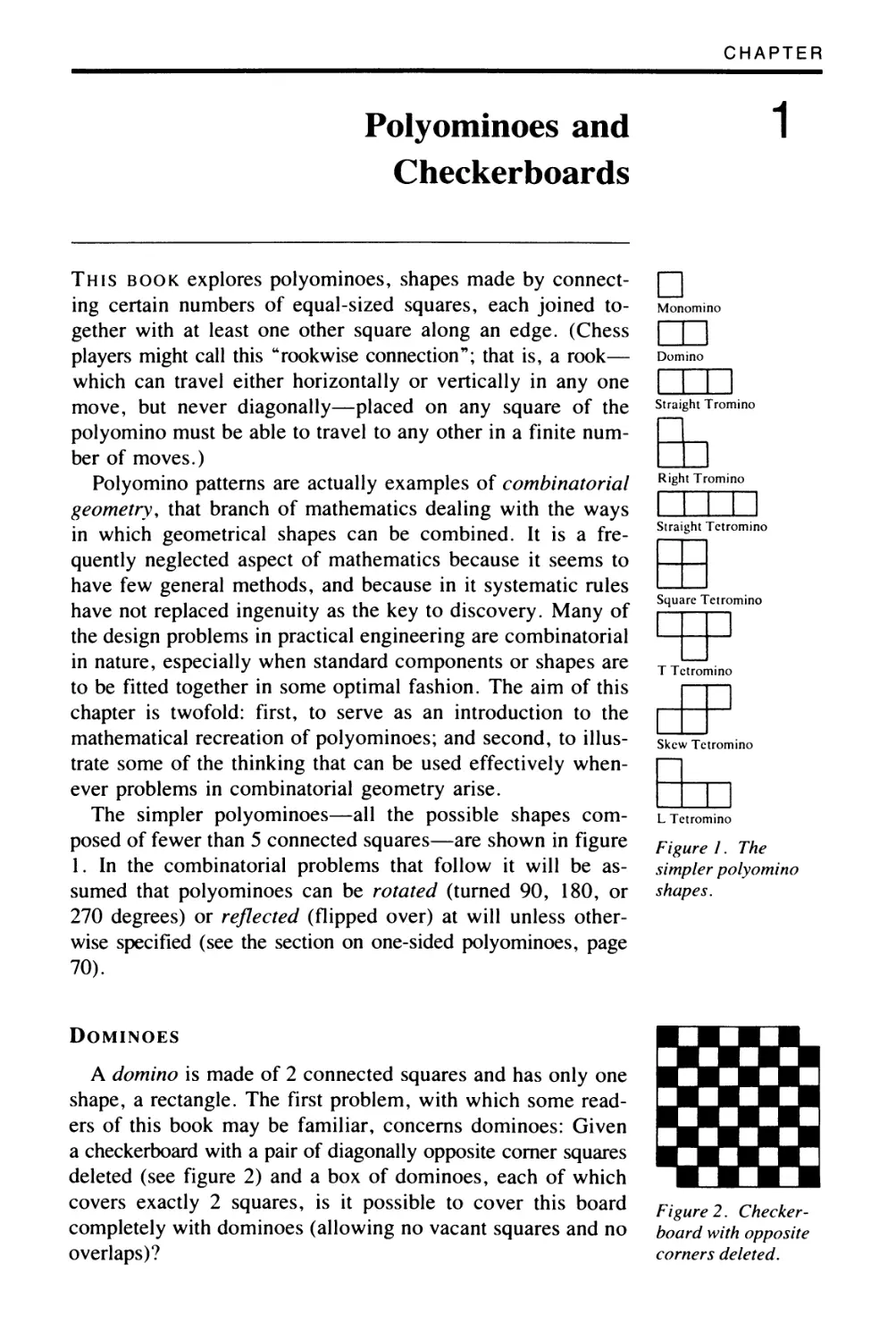
The simpler polyominoes-all the possible shapes com-
posed of fewer than 5 connected squares-are shown in figure
1. In the combinatorial problems that follow it will be as-
sumed that polyominoes can be rotated (turned 90, 180, or
270 degrees) or reflected (flipped over) at will unless other-
wise specified (see the section on one-sided polyominoes, page
70).
DOMINOES
A domino is made of 2 connected squares and has only one
shape, a rectangle. The first problem, with which some read-
ers of this book may be familiar, concerns dominoes: Given
a checkerboard with a pair of diagonally opposite comer squares
deleted (see figure 2) and a box of dominoes, each of which
covers exactly 2 squares, is it possible to cover this board
completely with dominoes (allowing no vacant squares and no
overlaps) ?
1
D
Monomino
CD
Domino
ITIJ
Straight Tromino
Eb
Right Tromino
ITIIJ
Straight Tetromino
EE
Square Tetromino
qp
T T ctromino
dP
Skcw Tctromino
EbJ
L Tetromino
Figure 1. The
simpler polyomino
shapes.
Figure 2. Checker-
board with opposite
corners deleted.
4
Chapter 1
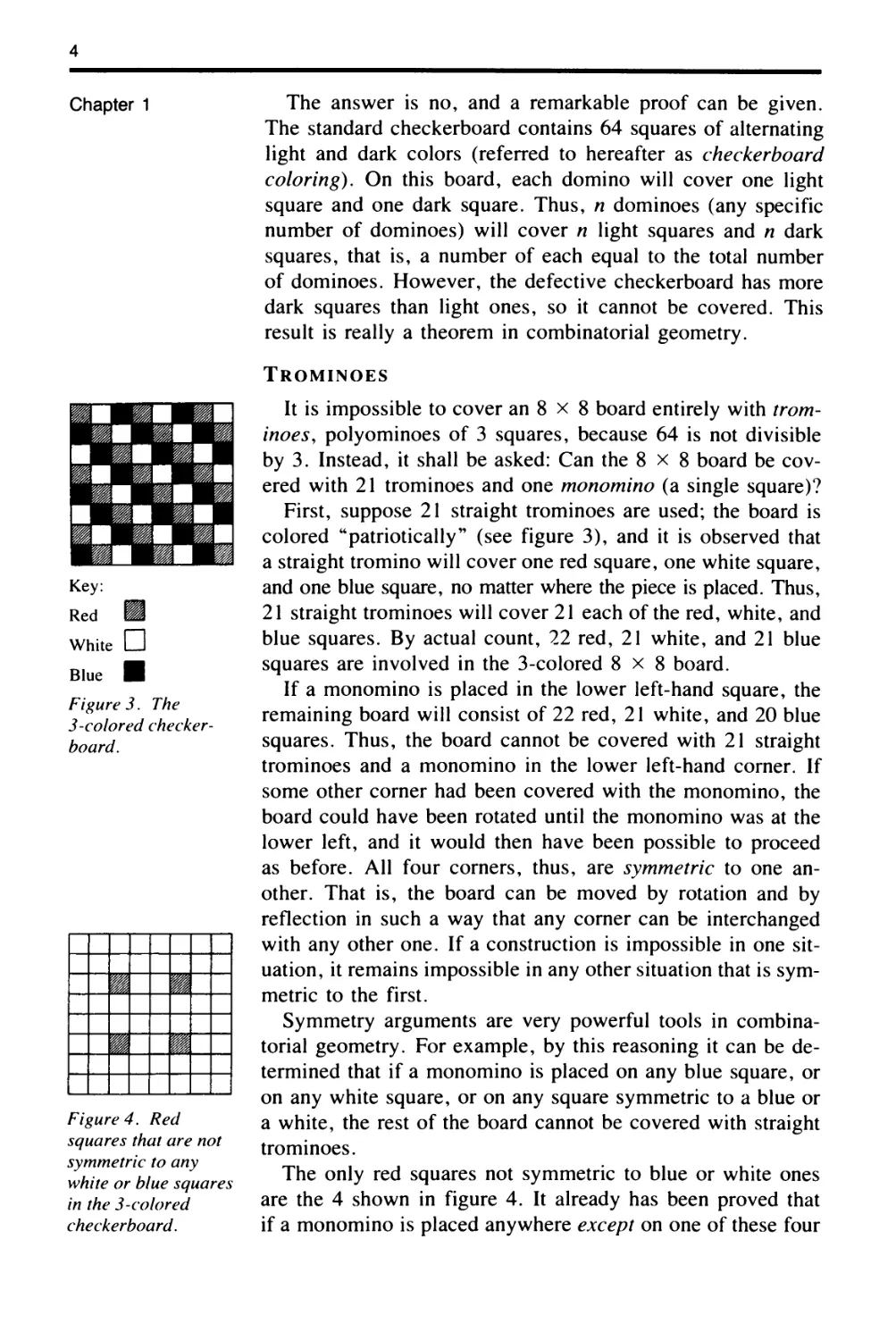
Key:
Red rIA
White 0
Blue .
Figure 3. The
3 -colored checker-
board.
Figure 4. Red
squares that are not
symmetric to any
white or blue squares
in the 3 -colored
checkerboard.
The answer is no, and a remarkable proof can be given.
The standard checkerboard contains 64 squares of alternating
light and dark colors (referred to hereafter as checkerboard
coloring). On this board, each domino will cover one light
square and one dark square. Thus, n dominoes (any specific
number of dominoes) will cover n light squares and n dark
squares, that is, a number of each equal to the total number
of dominoes. However, the defective checkerboard has more
dark squares than light ones, so it cannot be covered. This
result is really a theorem in combinatorial geometry.
TROMINOES
It is impossible to cover an 8 x 8 board entirely with trom-
inoes, polyominoes of 3 squares, because 64 is not divisible
by 3. Instead, it shall be asked: Can the 8 x 8 board be cov-
ered with 21 trominoes and one monomino (a single square)?
First, suppose 21 straight trominoes are used; the board is
colored "patriotically" (see figure 3), and it is observed that
a straight tromino will cover one red square, one white square,
and one blue square, no matter where the piece is placed. Thus,
21 straight trominoes will cover 21 each of the red, white, and
blue squares. By actual count, 22 red, 21 white, and 21 blue
squares are involved in the 3-colored 8 x 8 board.
If a monomino is placed in the lower left-hand square, the
remaining board will consist of 22 red, 21 white, and 20 blue
squares. Thus, the board cannot be covered with 21 straight
trominoes and a monomino in the lower left-hand corner. If
some other corner had been covered with the monomino, the
board could have been rotated until the monomino was at the
lower left, and it would then have been possible to proceed
as before. All four corners, thus, are symmetric to one an-
other. That is, the board can be moved by rotation and by
reflection in such a way that any corner can be interchanged
with any other one. If a construction is impossible in one sit-
uation, it remains impossible in any other situation that is sym-
metric to the first.
Symmetry arguments are very powerful tools in combina-
torial geometry. For example, by this reasoning it can be de-
termined that if a monomino is placed on any blue square, or
on any white square, or on any square symmetric to a blue or
a white, the rest of the board cannot be covered with straight
trominoes.
The only red squares not symmetric to blue or white ones
are the 4 shown in figure 4. It already has been proved that
if a monomino is placed anywhere except on one of these four
5
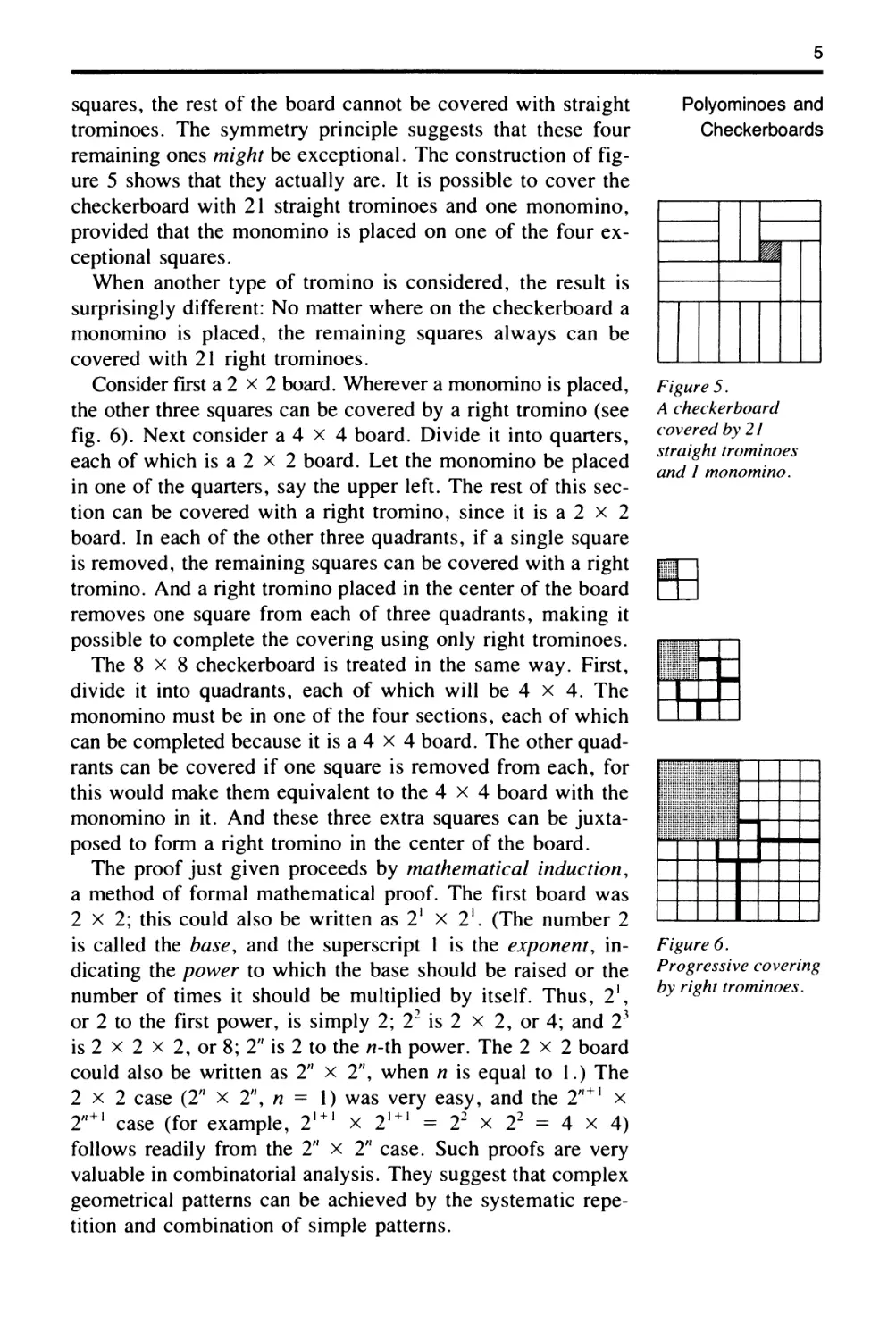
squares, the rest of the board cannot be covered with straight
trominoes. The symmetry principle suggests that these four
remaining ones might be exceptional. The construction of fig-
ure 5 shows that they actually are. It is possible to cover the
checkerboard with 21 straight trominoes and one monomino,
provided that the monomino is placed on one of the four ex-
ceptional squares.
When another type of tromino is considered, the result is
surprisingly different: No matter where on the checkerboard a
monomino is placed, the remaining squares always can be
covered with 21 right trominoes.
Consider fIrst a 2 x 2 board. Wherever a monomino is placed,
the other three squares can be covered by a right tromino (see
fig. 6). Next consider a 4 x 4 board. Divide it into quarters,
each of which is a 2 x 2 board. Let the monomino be placed
in one of the quarters, say the upper left. The rest of this sec-
tion can be covered with a right tromino, since it is a 2 x 2
board. In each of the other three quadrants, if a single square
is removed, the remaining squares can be covered with a right
tromino. And a right tromino placed in the center of the board
removes one square from each of three quadrants, making it
possible to complete the covering using only right trominoes.
The 8 x 8 checkerboard is treated in the same way. First,
divide it into quadrants, each of which will be 4 x 4. The
monomino must be in one of the four sections, each of which
can be completed because it is a 4 x 4 board. The other quad-
rants can be covered if one square is removed from each, for
this would make them equivalent to the 4 x 4 board with the
monomino in it. And these three extra squares can be juxta-
posed to fOnTI a right tromino in the center of the board.
The proof just given proceeds by mathematical induction,
a method of formal mathematical proof. The first board was
2 x 2; this could also be written as 2 1 x 2 1 . (The number 2
is called the base, and the superscript I is the exponent, in-
dicating the power to which the base should be raised or the
number of times it should be multiplied by itself. Thus, 2 1 ,
or 2 to the first power, is simply 2; 2 2 is 2 x 2, or 4; and 2 3
is 2 x 2 x 2, or 8; 2" is 2 to the n-th power. The 2 x 2 board
could also be written as 2" x 2", when n is equal to I.) The
2 x 2 case (2" x 2", n = 1) was very easy, and the 2"+ I x
2"+1 case (for example, 2 1 + 1 x 21+1 = 2 2 X 2 2 = 4 x 4)
follows readily from the 2" x 2" case. Such proofs are very
valuable in combinatorial analysis. They suggest that complex
geometrical patterns can be achieved by the systematic repe-
tition and combination of simple patterns.
Polyominoes and
Checkerboards
Figure 5.
A checkerboard
covered by 21
straight trominoes
and 1 monomino.
lID
CD
.............h.
.u.u..nn n.
................
.nn..... ..u.
........unn..
... .......n..r.
.uu...un....
'Un.e...un..
...........un..
.u.........nn
... ........u..
u...............
..........uun
n. .+...u ..n
u. .....n.....
.................Ur.............
. . u..... ... un. u n I.... U,
. n n u... u, + I U n I.' U u.... ..
.Ur....r..........n.. .........
...u...nu.....un...........+
... u..... u. ... u....... j.'. u.
........ . u. . .... . n n I..... .
. n... + I + I u, + I..... .... ... u...
.......... ...... .....'.'.'. n I
. . n'.... n n, ... n I....... n I.
.uo .n.+.u...... . .uu.......
... . n,.. . n,.. n I.... n I.... u,
,,,::,,::::,:::::::::::::::::::::
.... n I.' un'...... n...'...'..
,......,.'u..,....,......,.,..u
o....uo.o....o...........,....,.
,......,...........u,....,.,..,
..... no" do. n 0 h. 0.0 h 0.0.. o.
l.o..o.o.o.. ....U... ...,.,.,..
n'.........n'u..'+'.".,.,..,
,.. h 0.0 u n no.. o.u.. 0.0.0..0.
,....U.....u.uun'......'U..
,., U U. U" 0 U n U U 0 h 0 . . 0.00.
.... r. 0.... 0.. u.. 0 h.. o. o. . o.
..........................,.,..,
'UUU."Uh "Un."UoUUo.
.... ..... u .... ......... 0" o. n
........... ............ U. '''' U
hdhou....o....o.o..o oo.o.oo o.
..nn......uuU..oUU,+.U..,.
.... U U " rh" U r. 0" roo. 0 n r.'.
.0....0.0.... o. .. o. u 0 .. 0 .....
Figure 6.
Progressive covering
by right trominoes.
6
Chapter 1
Figure 7. Any
tetrominoes except
the skew tetrominoes
can be used to cover
the checkerboard.
.. ... ... ... ... ... ... ...
::.:. :.. :::::: :.:.:. :::::: :':::: :::::: ::.:::
1-_' . .. ... ... ... ... .. ...
... .......... ... ... ... ...
:.:.:. :.:.:. .:.:.:. .:.:.:. ...... t..:.: ".': .:.:.:
. .. ....... . .. ... . . ...
... ... ... ... . . ... ...
. .. ... .' ; ..... ... ... ..
:.:.:. :.:.:. . .:. :.:.:. :.:.:: ::..: .:.:.: ..::
. .' ...... .' t.. ... ... .. ......
. . . .. ... .. . . . . . .. .
...... ...... ...... ....... ...... . .
. . . .. ... ... .... . . .
. .... ...... ...... ...... ...... ..... ....... .......
Figure 8. The
coloring of the
8 X 8 board used
to study coverings
by L tetrominoes.
Figure 9. The
coloring used to
study coverings by
straight and skew
tetrominoes.
TETROMINOES
Some theorems about tetrominoes (polyominoes of four
squares) are worth mentioning, although detailed proofs will
be omitted. Accordingly, each of the following statements may
be regarded as a problem exercise.
1. It is easy to cover the checkerboard entirely with straight
tetrominoes, square tetrominoes, T tetrominoes, or L tet-
rominoes. (This is clear from figure 7.)
2. It is impossible to cover the board, or even a single edge
of it, with skew tetrominoes.
3. It is impossible to cover the checkerboard with 15 T tet-
rominoes and one square tetromino. (This can be proved
using the ordinary coloring of the board. One must keep
track of even, as opposed to odd, numbers of squares
covered. )
4. It is likewise impossible to cover the 8 x 8 board with
15 L tetrominoes and one square tetromino. (Now, how-
ever, the most convenient proof uses the dotted and blank
squares of figure 8.)
5. It is also impossible to cover the board with one square
tetromino and any combination of straight and skew tet-
rominoes. (The proof in this case makes use of the wavy-
lined and uncolored squares arranged as shown in figure
9. )
PENTOMINOES
The shapes that cover five connected squares are called pen-
tominoes. There are twelve of these and the letter "names" in
figure 10 are recommended for them. As a mnemonic device,
one has only to remember the end of the alphabet (TUVWXYZ)
and the word FILiPiNo. Since there are twelve distinct pen-
tomino shapes, each covering five squares, their total area is
sixty squares.
There are numerous ways to place all twelve distinct pen-
tominoes on an 8 x 8 board, with four squares always left
over. Many interesting patterns can be formed by artistically
specifying the positions of the four extra squares. Three of
these patterns are illustrated in figure 11.
Another obvious possibility is to require that the four sur-
plus squares fOnTI a 2 x 2 area (a square tetromino) in some
specified position on the board. (Two favorite locations are
the center and one of the corners.) This placement results in
a very remarkable theorem, which can be proved using only
7
tHj Polyominoes and
Checkerboards
T u v w x
z
y
qf Figure 10. The 12
F P pentominoes.
N
L
three constructions: Wherever on the checkerboard a square
tetromino is placed, the rest of the board can be covered with
the twelve pentominoes.
At first glance, there are forty-nine possible locations for
the square tetromino, and the heavy dots in figure 12 designate
these positions for the center of the 2 x 2 square. However,
when symmetry principles are applied, the problem reduces
to the ten non symmetric positions indicated by the dots in fig-
ure 13.
Figure 12. The
49 possible positions
for the center of a
square tetromino on
the checkerboard.
A clever stratagem is to combine the square tetromino with
the V pentomino to form a 3 x 3 square, as shown in figure
14.
fil3
Figure 14. The combination of a square tetromino
and a V pentomino into a 3 X 3 square.
Figure 11. Three
patterns with all
twelve distinct pent-
ominoes on a single
checkerboard.
Figure 13. The
10 nonsvmmetric
positions for a
square tetromino on
the checkerboard.
8
Chapter 1
Figure 16. Five
pentominoes span
the checkerboard.
Figure 17. The 12
pentominoesform a
3 x 20 rectangle.
Then, the three diagrams of figure 15 show the complete
proof, because any of the ten positions for the square tetrom-
ino can be realized by first selecting the correct diagram and
then utilizing the proper position for the 2 x 2 square within
the 3 x 3 square.
l\ : l li\ ; l li
: : : . \ \ ; ; .
:;l ; l l\ t: : tlr
:1) \l\} \\t\}
. \ \l t \\ :
: ; . :
Figure 15. Three constructions prove that anywhere a 2 x 2 square
is removed from the checkerboard, the remaining 60 squares can be
covered by the 12 distinct pentominoes.
It is also natural to inquire: What is the least number of
pentominoes that will span the checkerboard? That is, some
of the pentominoes are placed on the board in such a way that
none of the remaining ones can be added. The minimum num-
ber needed to span the board is five, and one such configu-
ration is shown in figure 16.
Many other patterns can be formed using the twelve pen-
tominoes, and the reader may wish to try some of them. Such
configurations include rectangles of 6 x 10, 5 x 12, 4 x 15,
and 3 x 20. The most difficult of these rectangles is the 3 x
20, and the solution given in figure 17 is known to be unique,
except for the possibility of rotating the shaded central portion
by 180 degrees.
I S ?
R. M. Robinson, professor of mathematics at the University
of California at Berkeley, has proposed another fascinating
construction with pentominoes, which he calls the "triplica-
tion problem": Given a pentomino, use nine of the other pen-
tominoes to construct a scale model, three times as wide and
three times as high as the given piece. Solutions are shown in
figure 18 for the V and X pentominoes. The reader is invited
to try to triplicate the other ten pentominoes; all of these con-
structions are known to be possible.
Besides its fascination as a puzzle, the placement of pen-
tominoes on the checkerboard can also make an exciting com-
petitive game. Two or more persons play with one set of the
9
Polyominoes and
Checkerboards
Figure 18. Triplication of the V pentomino and the X pentomino.
twelve pieces, each player placing a pentomino of his choice
on an initially empty checkerboard. The first person who is
unable to find room on the board for any of the unused pen-
tominoes is the loser. If all twelve pentominoes are success-
fully placed on the board, the player who placed the last piece
is the winner. The game will last at least five, and at most
twelve, moves, can never result in a draw, has more possible
openings than chess, and will intrigue players of all ages. It
is difficult to advise what strategy should be followed, but
there are two valuable strategic principles:
1. 1'ry to move in such a way that there will be room for
an even number of pieces. (This applies only when there
are two players.)
2. If a player cannot analyze the situation, he should do
something to complicate the placement so that the next
player will have even more difficulty analyzing it than
he did.
The following is a pentomino problem of a rather different
nature from those that have been discussed: A man wishes to
construct the twelve pentominoes out of plywood. His saw
will not cut around comers. What is the smallest plywood
rectangle from which he can cut all twelve pentominoes? (The
U pentomino, shaded in figure 19, will require special effort.
Assume that it must be cut as a 2 x 3 hexomino, a polyomino
of six squares, and finished later.) The best answer is not known,
but a 6 x 13 rectangle may be used. In the illustration (fig.
19), the heavier lines are to be cut first, starting from the sides
and working inward.
Figure 19. The 12 pentominoes to be cut
from a 6 x 13 rectangle.
10
Chapter 1
There is a lesson in plausible reasoning to be learned from
the pentominoes. Given certain basic data, one labors long and
hard to fit them into a pattern. Having succeeded, one then
believes the pattern to be the only one that "fits the facts,"
indeed, that the data are merely manifestations of the beau-
tiful, comprehensive whole constructed from them. The pen-
tominoes illustrate that many different patterns may be con-
structed from the same data, all equally valid, and that the
nature of the final pattern is determined more by the desired
shape than by the information at hand. It is also possible that,
for certain data, no pattern of the type the constructor is con-
ditioned to seek may exist. This will be illustrated by the hex-
.
omlnoes.
HEXOMINOES
There are thirty-five distinct hexominoes and 108 distinct
heptominoes (polyominoes of seven squares). No one has yet
succeeded in obtaining an expression or formula for the exact
number of n-ominoes as a function of n; that is, a formula that
will give the number of differently shaped polyominoes for
any specified number of connected squares. Combinatorial
problems of this sort are often tantalizingly difficult. Partial
results of calculations on this "polyomino enumeration prob-
lem" will be taken up in chapter 6.
The thirty-five hexominoes cover a total area of 210 squares.
It is natural to try to arrange them in rectangles, either 3 x
70, 5 x 42, 6 x 35, 7 x 30, lOx 21, or 14 x 15. All such
attempts, however, will fail. To prove this, in each of the
rectangles checkerboard coloring could be introduced, result-
ing in 105 light and 105 dark squares, an odd number of each.
There are twenty- four hexominoes that always will cover three
dark squares and three light squares (an odd number of each).
But the other eleven hexominoes always cover two squares of
one color and four of the other, an even number of each. The
thirty-five hexominoes are shown in figure 20 according to
their checkerboard-covering characteristics.
There are an even number of "odd" hexominoes and an odd
number of even" hexominoes. Since in all multiplication even
times odd equals even" and "odd times even equals even,"
the thirty-five hexominoes always will cover an even number
of light squares and an even number of dark squares. How-
ever, the number of light (or dark) squares is 105 for any of
the rectangles in question, and 105 is odd, so the construction
is impossible.
1 1
.au
It is noteworthy that the same checkerboard coloring-that
is, the alternation of light and dark squares-used to prove
the simplest fact about dominoes also serves to prove a far
more complex theorem about hexominoes. The underlying
theme of this coloring is parity check, or a check for evenness,
a simple, yet powerful, mathematical tool based on the ob-
vious fact that an even number is never equal to an odd num-
ber. The use of colors" is a valuable aid to the intuition-
objects colored differently will seldom be confused. And
sometimes, as in the straight-tromino problem, the colors viv-
idly proclaim a solution that might otherwise have been over-
looked.
Polyominoes and
Checkerboards
Figure 20. The 24
"odd" hexomil1oes.
Figure 20, continued.
The 11 "even"
hexominoes.
CHAPTER
2
Patterns and
Polyominoes
CHAPTER 1 introduced polyominoes and presented problems
that use these shapes in attempts to cover squares and rect-
angles of various sizes. The present chapter is devoted to a
variety of problems that involve fitting these polyominoes to-
gether into other specified shapes and patterns.
PENTOMINO PATTERNS
A new class of pentomino patterns to be discussed here are
the superposition problems, the construction of two or more
shapes all of whose parts coincide. Several examples will now
be considered.
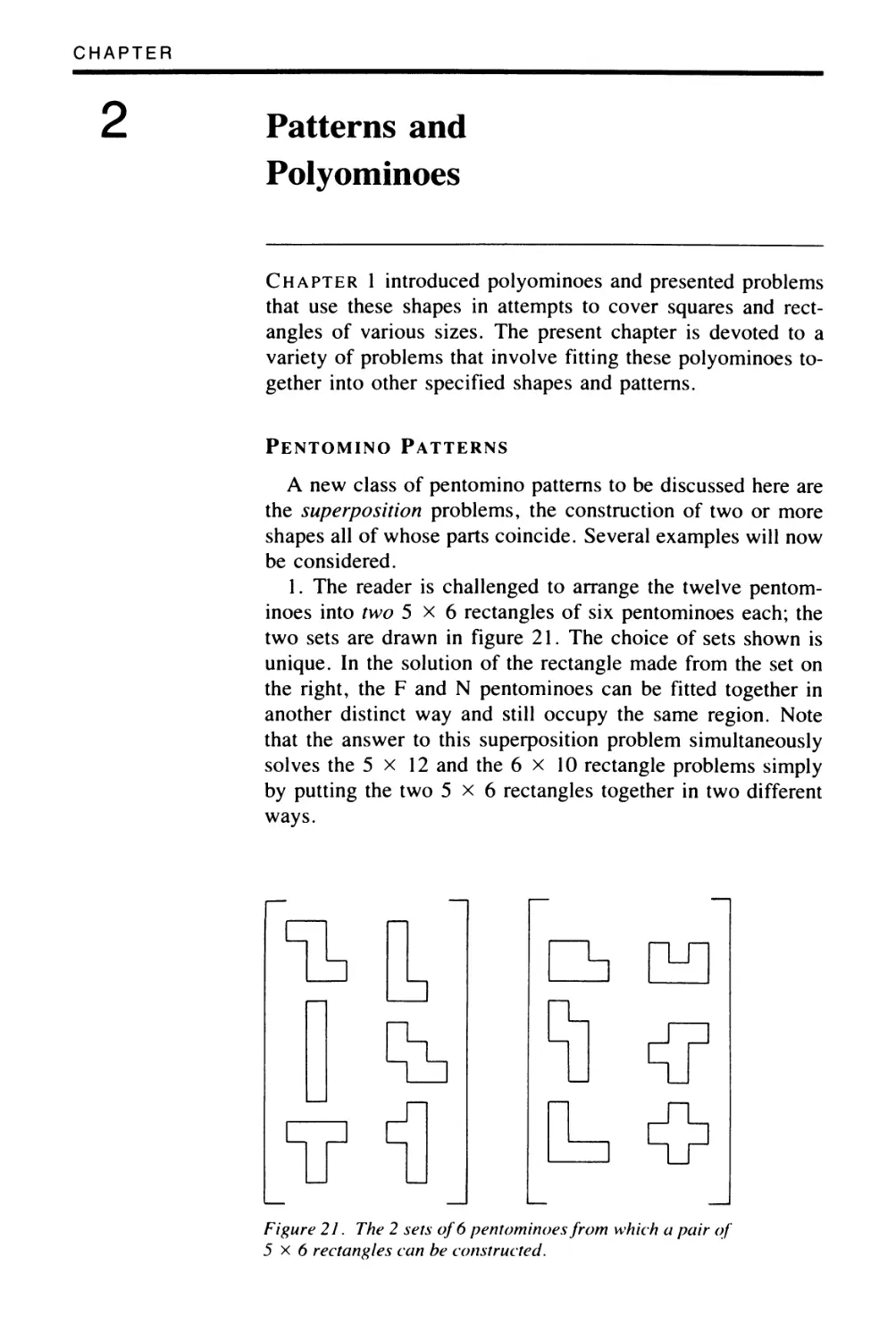
1. The reader is challenged to arrange the twelve pentom-
inoes into two 5 x 6 rectangles of six pentominoes each; the
two sets are drawn in figure 21. The choice of sets shown is
unique. In the solution of the rectangle made from the set on
the right, the F and N pentominoes can be fitted together in
another distinct way and still occupy the same region. Note
that the answer to this superposition problem simultaneously
solves the 5 x 12 and the 6 x 10 rectangle problems simply
by putting the two 5 x 6 rectangles together in two different
ways.
11
LJ
SJ
[bO
u
Figure 21. The 2 sets of 6 pentominoes from which a pair ( r
5 x 6 rectangles can be constructed.
13
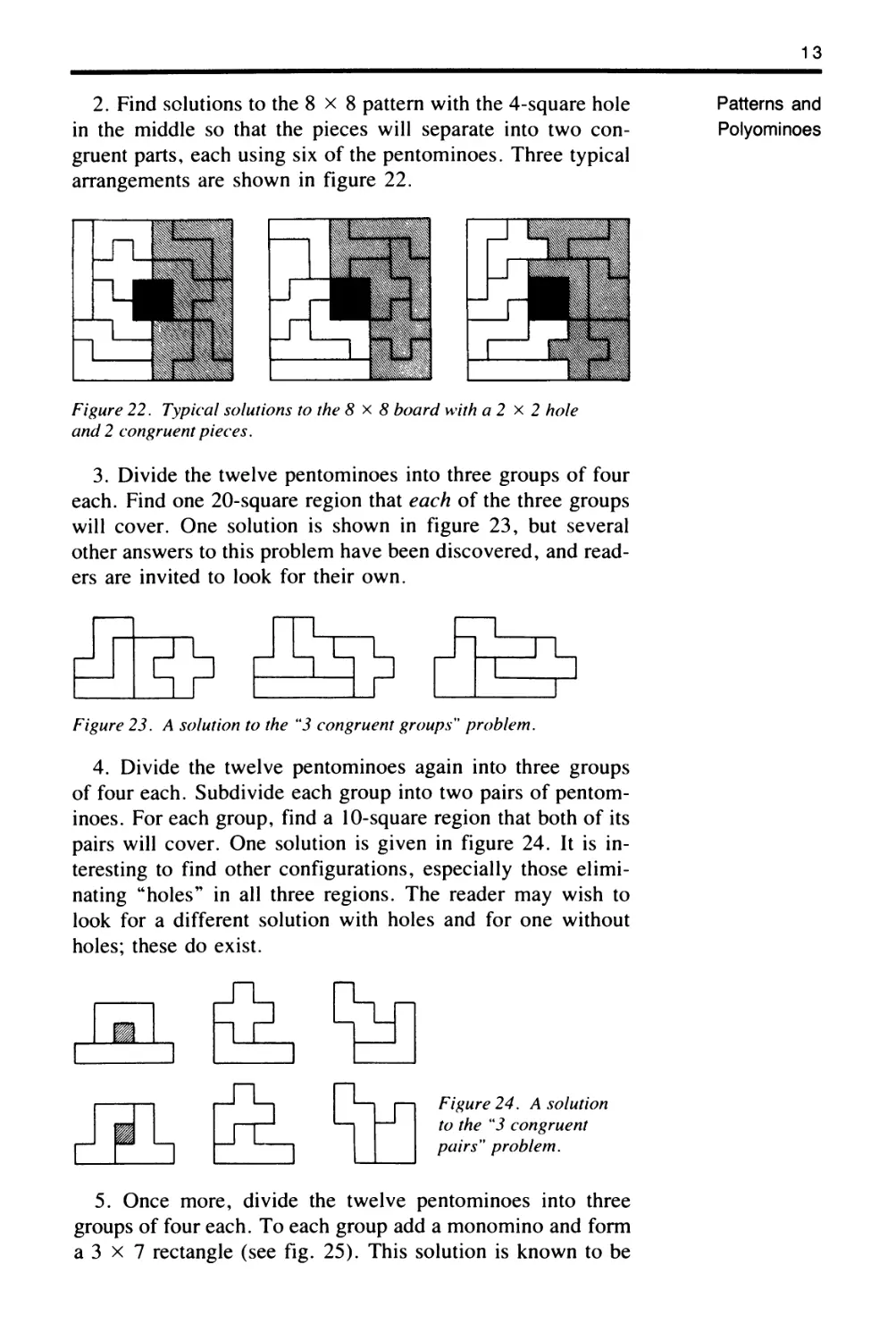
2. Find solutions to the 8 x 8 pattern with the 4-square hole
in the middle so that the pieces will separate into two con-
gruent parts, each using six of the pentominoes. Three typical
arrangements are shown in figure 22.
Patterns and
Polyominoes
Figure 22. Typical solutions to the 8 x 8 board with a 2 x 2 hole
and 2 congruent pieces.
3. Divide the twelve pentominoes into three groups of four
each. Find one 20-square region that each of the three groups
will cover. One solution is shown in figure 23, but several
other answers to this problem have been discovered, and read-
ers are invited to look for their own.
Figure 23. A solution to the "3 congruent groups" problem.
4. Divide the twelve pentominoes again into three groups
of four each. Subdivide each group into two pairs of pentom-
inoes. For each group, find a 10-square region that both of its
pairs will cover. One solution is given in figure 24. It is in-
teresting to find other configurations, especially those elimi-
nating "holes" in all three regions. The reader may wish to
look for a different solution with holes and for one without
holes; these do exist.
Figure 24. A solution
to the "3 congruent
pairs" problem.
5. Once more, divide the twelve pentominoes into three
groups of four each. To each group add a monomino and form
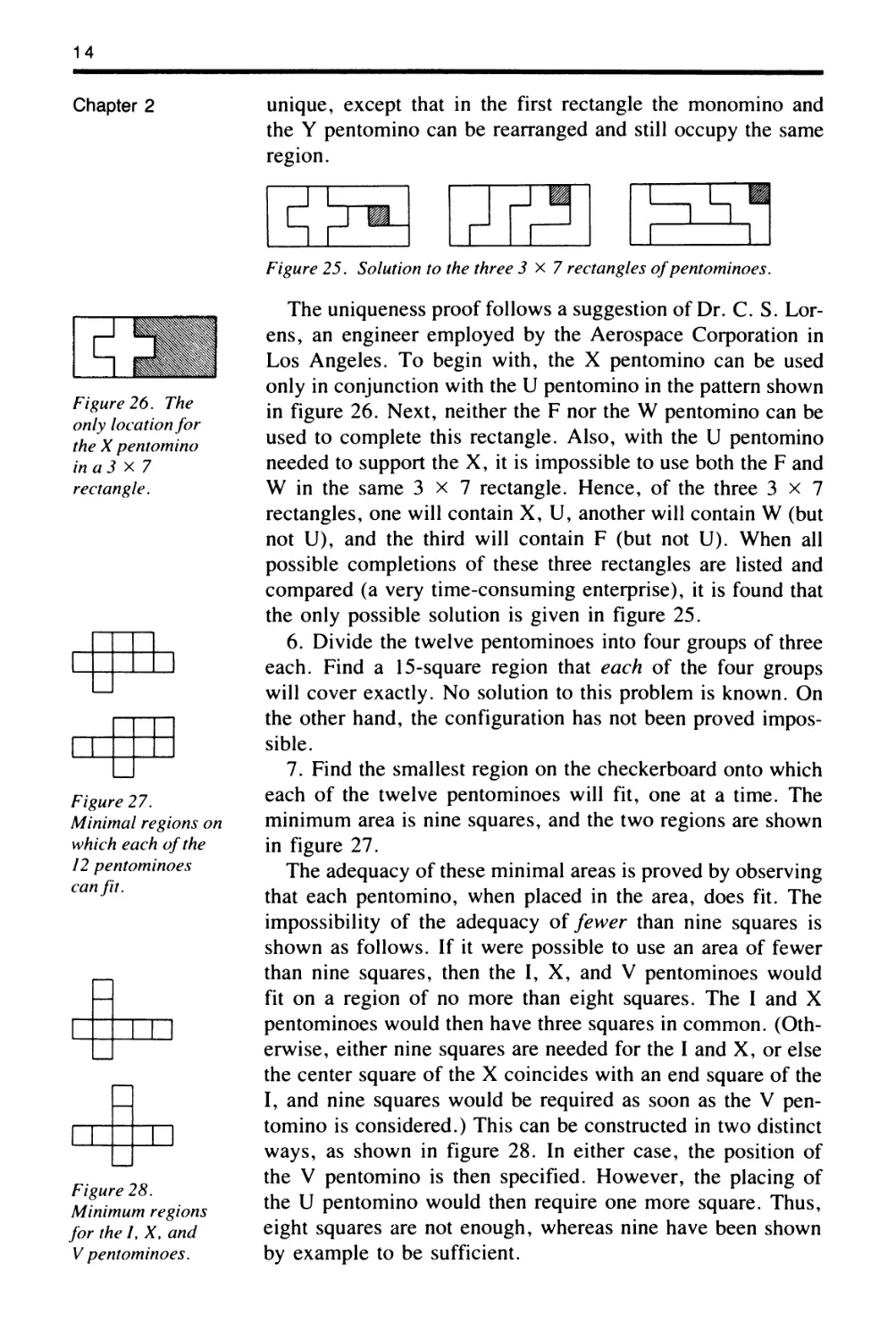
a 3 x 7 rectangle (see fig. 25). This solution is known to be
14
Chapter 2
l<:a
Figure 26. The
only location for
the X pentomino
in a 3 x 7
rectangle.
Figure 27.
Minimal regions on
which each of the
12 pentominoes
can fit.
Figure 28.
Minimum regions
for the J, X, and
V pentominoes.
unique, except that in the first rectangle the monomino and
the Y pentomino can be rearranged and still occupy the same
.
regIon.
I L C l\j
Figure 25. Solution to the three 3 X 7 rectangles of pentominoes.
The uniqueness proof follows a suggestion of Dr. C. S. Lor-
ens, an engineer employed by the Aerospace Corporation in
Los Angeles. To begin with, the X pentomino can be used
only in conjunction with the U pentomino in the pattern shown
in figure 26. Next, neither the F nor the W pentomino can be
used to complete this rectangle. Also, with the U pentomino
needed to support the X, it is impossible to use both the F and
W in the same 3 x 7 rectangle. Hence, of the three 3 x 7
rectangles, one will contain X, U, another will contain W (but
not U), and the third will contain F (but not U). When all
possible completions of these three rectangles are listed and
compared (a very time-consuming enterprise), it is found that
the only possible solution is given in figure 25.
6. Divide the twelve pentominoes into four groups of three
each. Find a 15-square region that each of the four groups
will cover exactly. No solution to this problem is known. On
the other hand, the configuration has not been proved impos-
sible.
7. Find the smallest region on the checkerboard onto which
each of the twelve pentominoes will fit, one at a time. The
minimum area is nine squares, and the two regions are shown
in figure 27.
The adequacy of these minimal areas is proved by observing
that each pentomino, when placed in the area, does fit. The
impossibility of the adequacy of fewer than nine squares is
shown as follows. If it were possible to use an area of fewer
than nine squares, then the I, X, and V pentominoes would
fit on a region of no more than eight squares. The I and X
pentominoes would then have three squares in common. (Oth-
erwise, either nine squares are needed for the I and X, or else
the center square of the X coincides with an end square of the
I, and nine squares would be required as soon as the V pen-
tomino is considered.) This can be constructed in two distinct
ways, as shown in figure 28. In either case, the position of
the V pentomino is then specified. However, the placing of
the U pentomino would then require one more square. Thus,
eight squares are not enough, whereas nine have been shown
by example to be sufficient.
1 5
Several years ago, the resources of modern electronic com-
puting were devoted to various pentomino problems. A tech-
nical report (for bibliographic information on all material cited
in the text, see the Bibliography) by the American logician
Dana S. Scott, professor of philosophy at Stanford University
in California, describes two constructions that were solved by
the MANIAC computer. The first problem was how to fit the
twelve pentominoes onto a 3 x 20 rectangle. It was verified
that the two solutions already known are indeed the only pos-
sible ones. The second problem was to find all the ways to fit
the twelve pentominoes onto the 8 x 8 board, leaving a 2 x
2 hole in the center. It was discovered that there are sixty-five
basically different solutions (in the sense that two solutions
differing only by rotation or reflection of the board are not
regarded as distinct). The program included the astute obser-
vation that there are only three basically different locations for
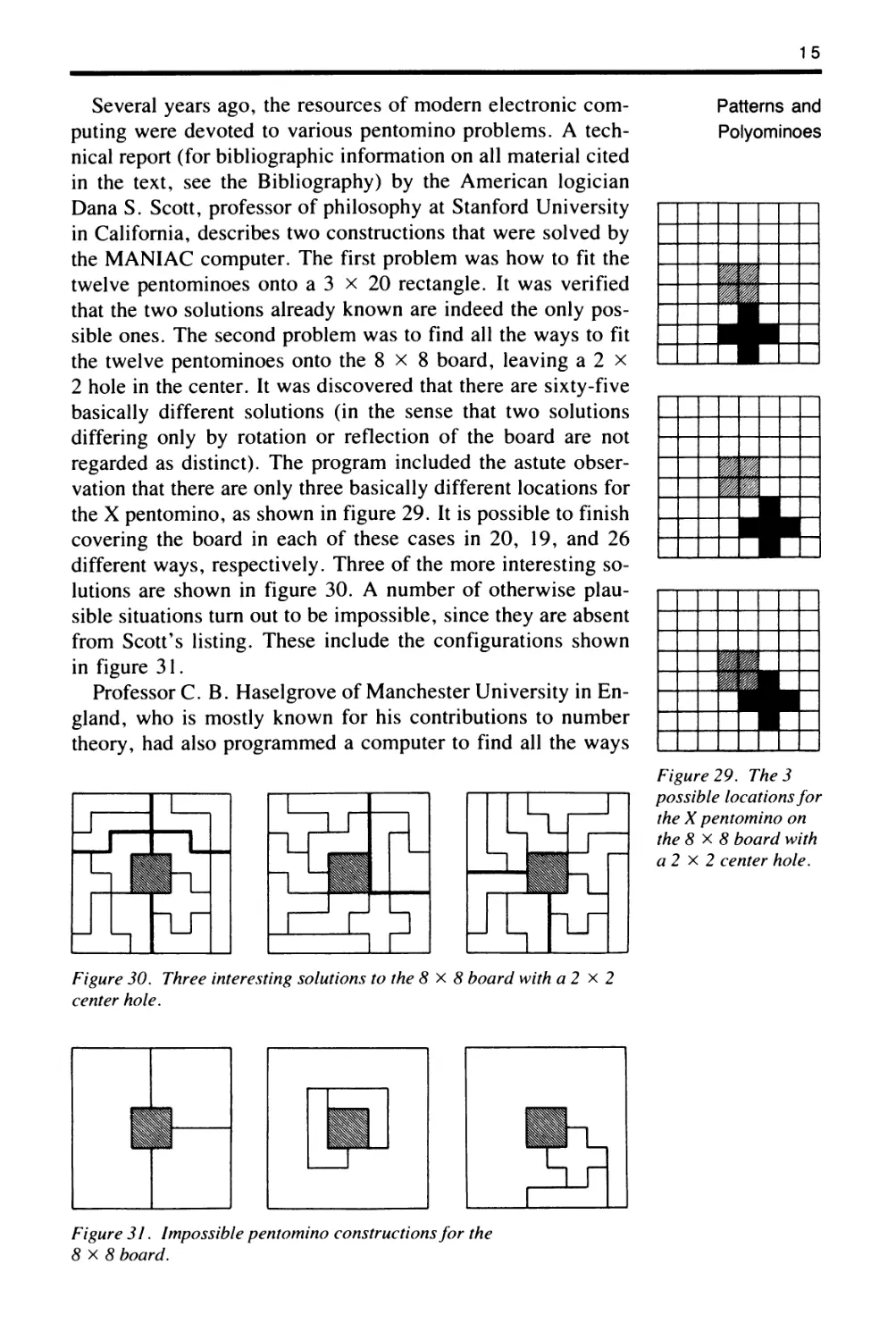
the X pentomino, as shown in figure 29. It is possible to finish
covering the board in each of these cases in 20, 19, and 26
different ways, respectively. Three of the more interesting so-
lutions are shown in figure 30. A number of otherwise plau-
sible situations turn out to be impossible, since they are absent
from Scott's listing. These include the configurations shown
in figure 31.
Professor C. B. Haselgrove of Manchester University in En-
gland, who is mostly known for his contributions to number
theory, had also programmed a computer to find all the ways
Figure 30. Three interesting solutions to the 8 x 8 board with a 2 x 2
center hole.
Figure 31. Impossible pentomino constructions for the
8 x 8 board.
Patterns and
Polyominoes
Figure 29. The 3
possible locations for
the X pentomino on
the 8 x 8 board with
a 2 x 2 center hole.
1 6
Chapter 2
of arranging the twelve pentominoes into a 6 x 10 rectangle.
Excluding rotations and reflections, he found 2,339 basically
distinct solutions! He also verified the results of Dana Scott's
two programs.
Before leaving the subject of pentomino patterns, several
special configuration problems seem worthy of mention:
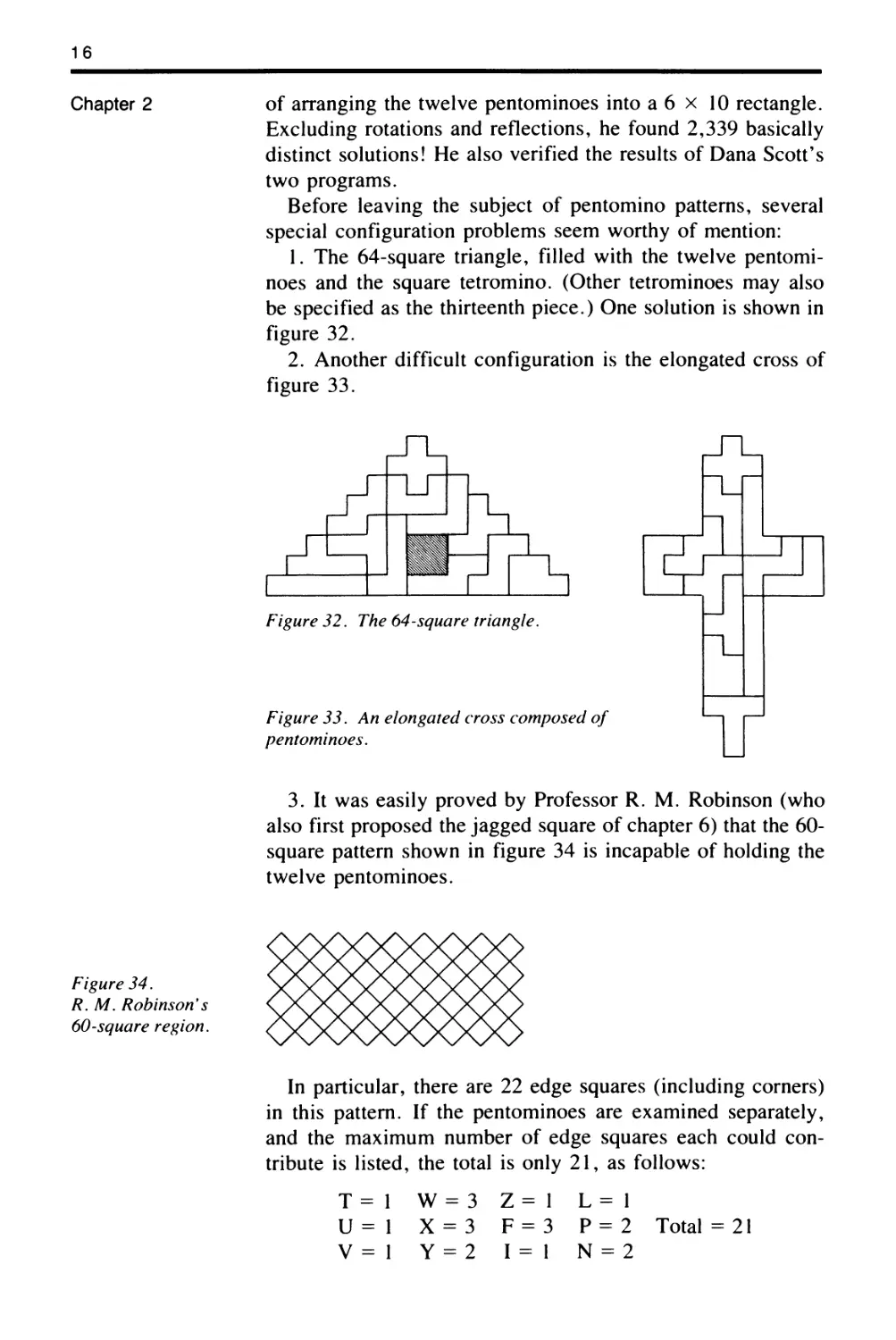
1. The 64-square triangle, filled with the twelve pentomi-
noes and the square tetromino. (Other tetrominoes may also
be specified as the thirteenth piece.) One solution is shown in
figure 32.
2. Another difficult configuration is the elongated cross of
figure 33.
Figure 32. The 64-square triangle.
Figure 33. An elongated cross composed of
pentominoes.
3. It was easily proved by Professor R. M. Robinson (who
also first proposed the jagged square of chapter 6) that the 60-
square pattern shown in figure 34 is incapable of holding the
twelve pentominoes.
Figure 34.
R. M. Robinson's
60-square region.
In particular, there are 22 edge squares (including corners)
in this pattern. If the pentominoes are examined separately,
and the maximum number of edge squares each could con-
tribute is listed, the total is only 21, as follows:
T=1
U = 1
V = I
w= 3
X = 3
Y=2
Z=l
F=3
I = I
L=1
P = 2 Total = 2 I
N=2
1 7
This type of reasoning is used in solving jigsaw puzzles, where
it is common practice to separate the edge pieces from the
interior ones.
Two other interesting pentomino patterns are dealt with in
chapter 4.
Patterns and
Polyominoes
TETROMINO PROBLEMS
Unlike the pentominoes, the five distinct tetrominoes will
not form a rectangle. To prove this, color rectangles twenty
squares in area in checkerboard fashion, as indicated in figure
35. Four of the five tetrominoes will always cover an equal
number of dark and light squares. However, the remaining
tetromino always covers three squares of one color and one
square of the other (see fig. 36). Hence, the five tetrominoes
will cover a total of an odd number of dark squares and an
odd number of light squares. However, the rectangles in figure
35 have ten squares of each color, and 10 is an even number.
Figure 35. Checkerboard colorings of
the 2 X 10 and 4 x 5 rectangles.
Figure 36. The 4 "balanced" tetrominoes and, at thefar right, the
"unbalanced" tetromino.
On the other hand, any of several different pentominoes can
be combined with the five tetrominoes to form a 5 x 5 square.
Two examples are given in figure 37. The reader is invited to
investigate how many different pentominoes can be used in
this manner.
Figure 37. The tetrominoes may combine with
a pentomino to form a 5 x 5 square.
MASONRY PROBLEMS
Robert I. Jewett, while a graduate student in mathematics
at the University of Oregon, proposed the following problem:
Is it possible to cover a rectangle with two or more dominoes
1 8
Chapter 2
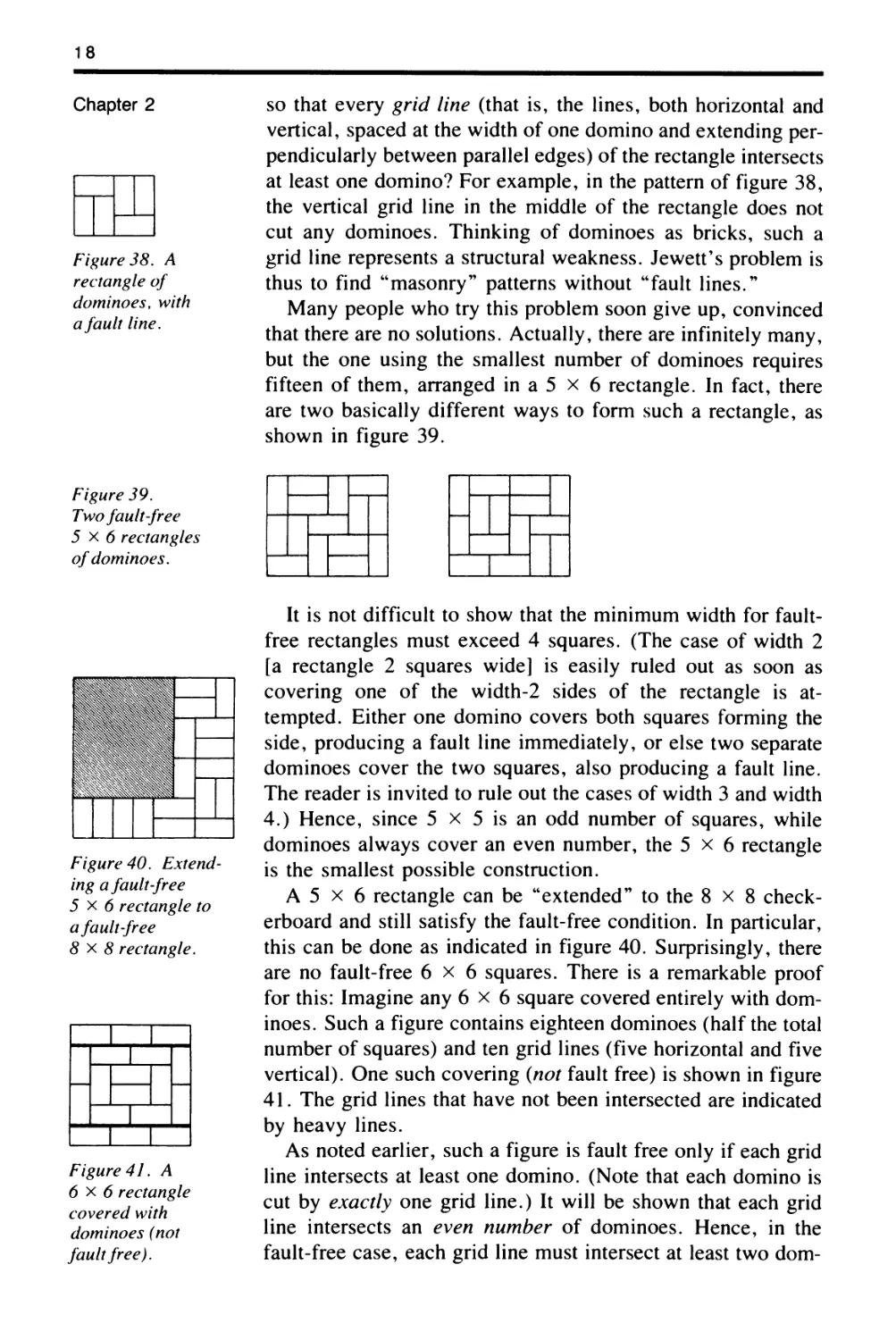
Figure 38. A
rectangle of
dominoes, with
afault line.
Figure 39.
Two faultJree
5 X 6 rectangles
of dominoes.
Figure 40. Extend-
ing a fault-free
5 x 6 rectangle to
a fault-free
8 x 8 rectangle.
Figure 41. A
6 x 6 rectangle
covered with
dominoes (not
fault free).
so that every grid line (that is, the lines, both horizontal and
vertical, spaced at the width of one domino and extending per-
pendicularly between parallel edges) of the rectangle intersects
at least one domino? For example, in the pattern of figure 38,
the vertical grid line in the middle of the rectangle does not
cut any dominoes. Thinking of dominoes as bricks, such a
grid line represents a structural weakness. Jewett's problem is
thus to find "masonry" patterns without "fault lines."
Many people who try this problem soon give up, convinced
that there are no solutions. Actually, there are infinitely many,
but the one using the smallest number of dominoes requires
fifteen of them, arranged in a 5 x 6 rectangle. In fact, there
are two basically different ways to form such a rectangle, as
shown in figure 39.
It is not difficult to show that the minimum width for fault-
free rectangles must exceed 4 squares. (The case of width 2
[a rectangle 2 squares wide] is easily ruled out as soon as
covering one of the width-2 sides of the rectangle is at-
tempted. Either one domino covers both squares forming the
side, producing a fault line immediately, or else two separate
dominoes cover the two squares, also producing a fault line.
The reader is invited to rule out the cases of width 3 and width
4.) Hence, since 5 x 5 is an odd number of squares, while
dominoes always cover an even number, the 5 x 6 rectangle
is the smallest possible construction.
A 5 x 6 rectangle can be "extended" to the 8 x 8 check-
erboard and still satisfy the fault-free condition. In particular,
this can be done as indicated in figure 40. Surprisingly, there
are no fault-free 6 x 6 squares. There is a remarkable proof
for this: Imagine any 6 x 6 square covered entirely with dom-
inoes. Such a figure contains eighteen dominoes (half the total
number of squares) and ten grid lines (five horizontal and five
vertical). One such covering (not fault free) is shown in figure
41. The grid lines that have not been intersected are indicated
by heavy lines.
As noted earlier, such a figure is fault free only if each grid
line intersects at least one domino. (Note that each domino is
cut by exactly one grid line.) It will be shown that each grid
line intersects an even number of dominoes. Hence, in the
fault-free case, each grid line must intersect at least two dom-
1 9
inoes. With ten grid lines, at least twenty dominoes would be
intersected; but there are only eighteen of them on the 6 x 6
board.
It remains only to prove the assertion that each grid line
cuts an even number of dominoes. Consider, for example, a
vertical grid line. The area to the left of it is an even number
of squares (6, 12, 18, and so on). The dominoes entirely to
the left (that is, not intersected by the grid line) cover an even
number of squares, since each domino covers two. The dom-
inoes cut by the grid line must also occupy an even area to
the left of it, because this area is the difference between two
even numbers (the total area to the left and the area of the
uncut dominoes to the left). Since each cut domino occupies
one square to the left of the grid line, there must be an even
number of dominoes cut by the grid line. Thus the proof is
complete.
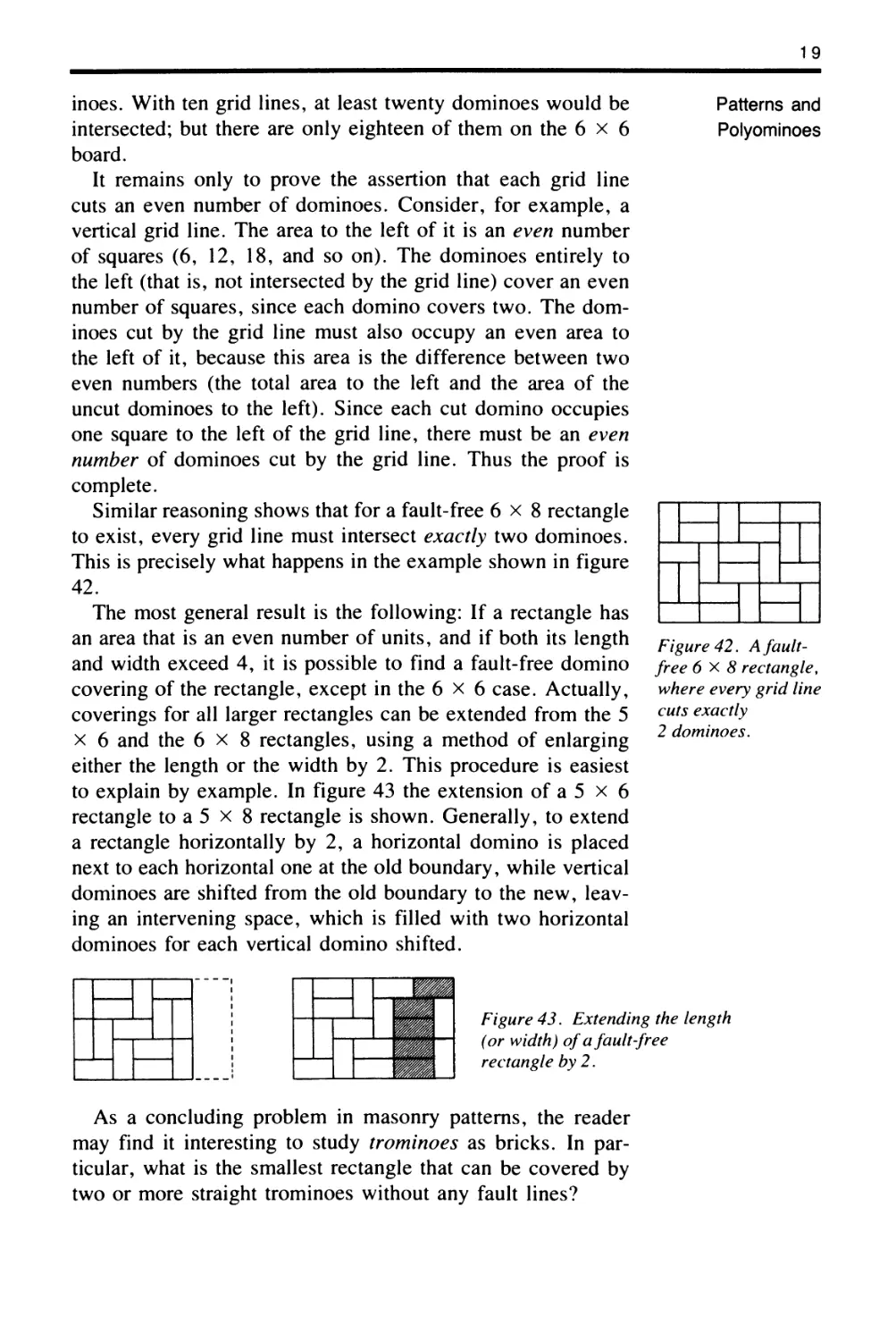
Similar reasoning shows that for a fault-free 6 x 8 rectangle
to exist, every grid line must intersect exactly two dominoes.
This is precisely what happens in the example shown in figure
42.
The most general result is the following: If a rectangle has
an area that is an even number of units, and if both its length
and width exceed 4, it is possible to find a fault-free domino
covering of the rectangle, except in the 6 x 6 case. Actually,
coverings for all larger rectangles can be extended from the 5
x 6 and the 6 x 8 rectangles, using a method of enlarging
either the length or the width by 2. This procedure is easiest
to explain by example. In figure 43 the extension of a 5 x 6
rectangle to a 5 x 8 rectangle is shown. Generally, to extend
a rectangle horizontally by 2, a horizontal domino is placed
next to each horizontal one at the old boundary, while vertical
dominoes are shifted from the old boundary to the new, leav-
ing an intervening space, which is filled with two horizontal
dominoes for each vertical domino shifted.
Patterns and
Polyominoes
Figure 42. Afault-
free 6 X 8 rectangle,
where every grid line
cuts exactly
2 dominoes.
Figure 43. Extending the length
(or width) of a fault-free
rectangle by 2.
As a concluding problem in masonry patterns, the reader
may find it interesting to study trominoes as bricks. In par-
ticular, what is the smallest rectangle that can be covered by
two or more straight trominoes without any fault lines?
CHAPTER
3
T, V, x, Z excluded
u, Y, I, L excluded
W, F, P, N excluded
Figure 44. Three
patterns proving
that 16 monominoes
are sufficient to
exclude any given
pentomino from the
checkerboard.
Where Pentominoes
Will Not Fit
PENTOMINO EXCLUSION BY MONOMINOES
The fitting of pentominoes and other polyominoes into pat-
terns of various shapes has been the theme of the problems
thus far. This section's problems will have an opposite objec-
tive: namely, what must be done to keep a pentomino off the
checkerboard? Specifically, for each of the twelve pentomi-
noes, what is the least number of monominoes that can be
placed on the 8 x 8 board so that a given pentomino can no
longer be fitted onto the board? There are thus twelve distinct
problems, one for each of the pentominoes. To solve these,
it is necessary first to exhibit a way of placing a certain num-
ber of monominoes on the checkerboard so as to exclude the
given pentomino and then to prove (by whatever combinato-
rial reasoning or tricks suggest themselves) that no fewer mon-
ominoes could have been used for the same purpose.
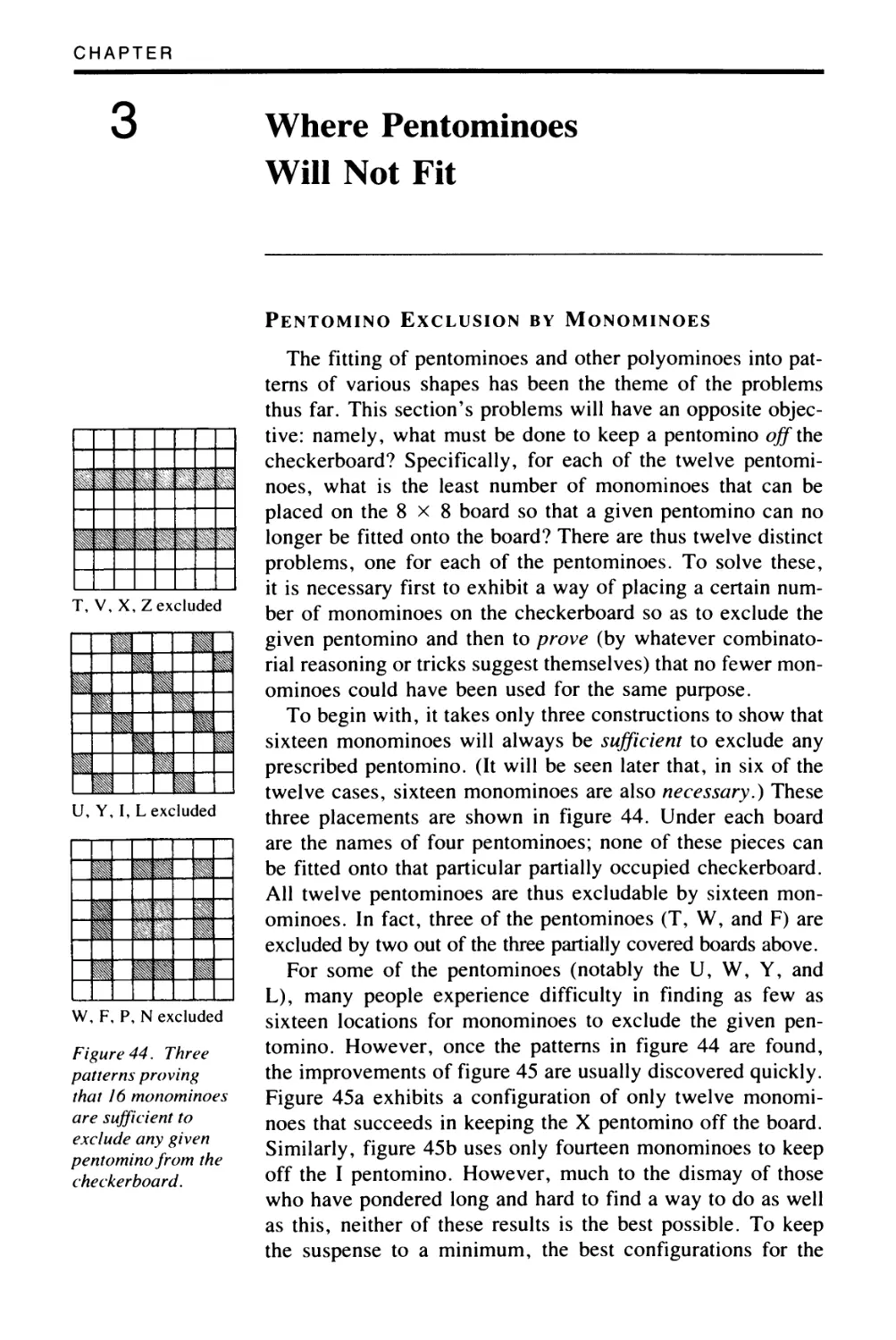
To begin with, it takes only three constructions to show that
sixteen monominoes will always be sufficient to exclude any
prescribed pentomino. (It will be seen later that, in six of the
twel ve cases, sixteen monominoes are also necessary.) These
three placements are shown in figure 44. Under each board
are the names of four pentominoes; none of these pieces can
be fitted onto that particular partially occupied checkerboard.
All twelve pentominoes are thus excludable by sixteen mon-
ominoes. In fact, three of the pentominoes (T, W, and F) are
excluded by two out of the three partially covered boards above.
For some of the pentominoes (notably the U, W, Y, and
L), many people experience difficulty in finding as few as
sixteen locations for monominoes to exclude the given pen-
tomino. However, once the patterns in figure 44 are found,
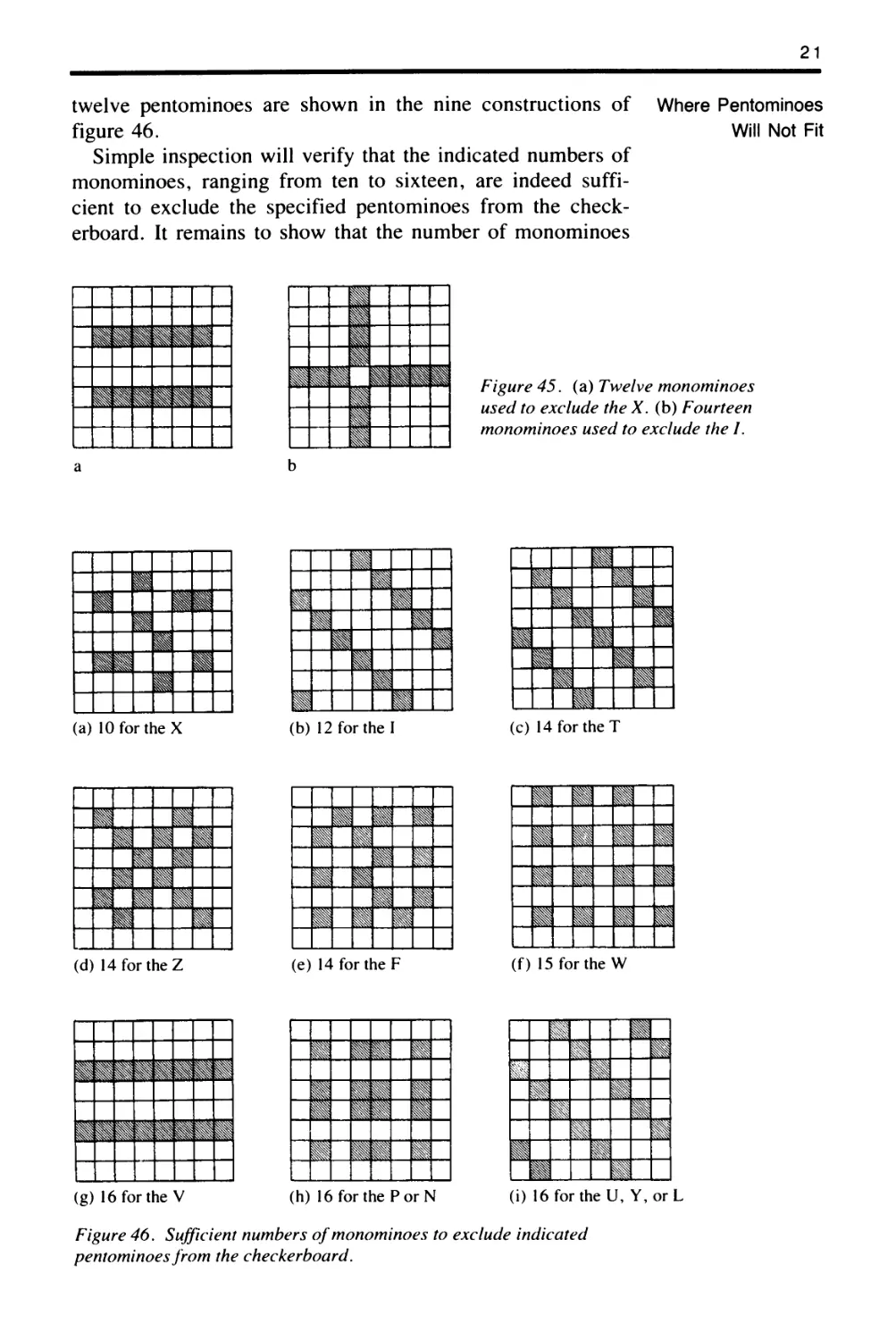
the improvements of figure 45 are usually discovered quickly.
Figure 45a exhibits a configuration of only twelve monomi-
noes that succeeds in keeping the X pentomino off the board.
Similarly, figure 45b uses only fourteen monominoes to keep
off the I pentomino. However, much to the dismay of those
who have pondered long and hard to find a way to do as well
as this, neither of these results is the best possible. To keep
the suspense to a minimum, the best configurations for the
21
twelve pentominoes are shown in the nine constructions of
figure 46.
Simple inspection will verify that the indicated numbers of
monominoes, ranging from ten to sixteen, are indeed suffi-
cient to exclude the specified pentominoes from the check-
erboard. It remains to show that the number of monominoes
Where Pentominoes
Will Not Fit
Figure 45. (a) Twelve monominoes
used to exclude the X. (b ) Fourteen
monominoes used to exclude the J.
a
b
(a) 10 for the X
(b) 12fortheI
(c) 14 for the T
(d) 14 for the Z
(e) 14 for the F
(f) 15 for the W
(g) 16 for the V
(h) 16 for the P or N
(i) 16 for the U, Y, or L
Figure 46. Sufficient numbers of monominoes to exclude indicated
pentominoes from the checkerboard.
22
Chapter 3
IThIi
Figure 47. Con-
struction used to
show that at least
12 monominoes
are necessary to
exclude the J
pentomino.
Figure 48. C on-
struction used in the
proof that at least
16 monominoes are
needed to exclude
the Y pentomino.
appearing in figure 46 are also necessary. All twelve necessity
proofs are elaborations of the same basic combinatorial theme
and will be discussed here in the order of increasing com-
plexity. (The four most difficult proofs will be left somewhat
incomplete. )
The simplest necessity proof is for the I pentomino. To show
that twelve monominoes are necessary to keep the I pentomino
off the 8 x 8 board consider the board decomposed as in fig-
ure 47, where there are twelve nonoverlapping 1 x 5 rect-
angles, each of which could independently hold an I pentom-
ino. To exclude this piece there must be at least one monomino
in each of the twelve 1 x 5 rectangles. Thus, a minimum of
twelve monominoes is necessary to exclude the I pentomino.
And, from figure 46b, twelve monominoes is also seen to be
sufficient.
Actually, with the sole exception of the I pentomino, it is
not possible to fit as many of a given pentomino onto the
checkerboard as there are monominoes needed to keep that
piece off the board. However, the proof just given is easily
modified to treat the six pentominoes that actually require six-
teen monominoes to keep them off the board.
Consider first the Y pentomino and decompose the check-
erboard as in figure 48. To keep the Y pentomino off the board,
it is certainly necessary to keep it out of each of the eight 2
x 4 rectangular regions. Moreover, a single monomino will
not exclude the Y pentomino, there being only two inequiv-
alent locations for the monomino: namely, a corner square or
an interior square (fig. 49). Neither location will keep the rect-
angle free of Y pentominoes. Hence, at least two monominoes
are needed in each of the eight rectangular regions, making a
total of sixteen monominoes necessary. Figure 46i showed this
number to be sufficient as well.
rnRJ Figure 49. One monomino is insufficient to
_ _ exclude the Y from a 2 x 4 rectangle.
The same decomposition of the board (fig. 48) works for
the U, L, P, and N pentominoes also, since none of them is
kept off a 2 x 4 rectangle by a single monomino (specifically,
see fig. 50).
Figure 50. One monomino is insufficient to exclude the U, L, P, or N
from a 2 x 4 rectangle.
23
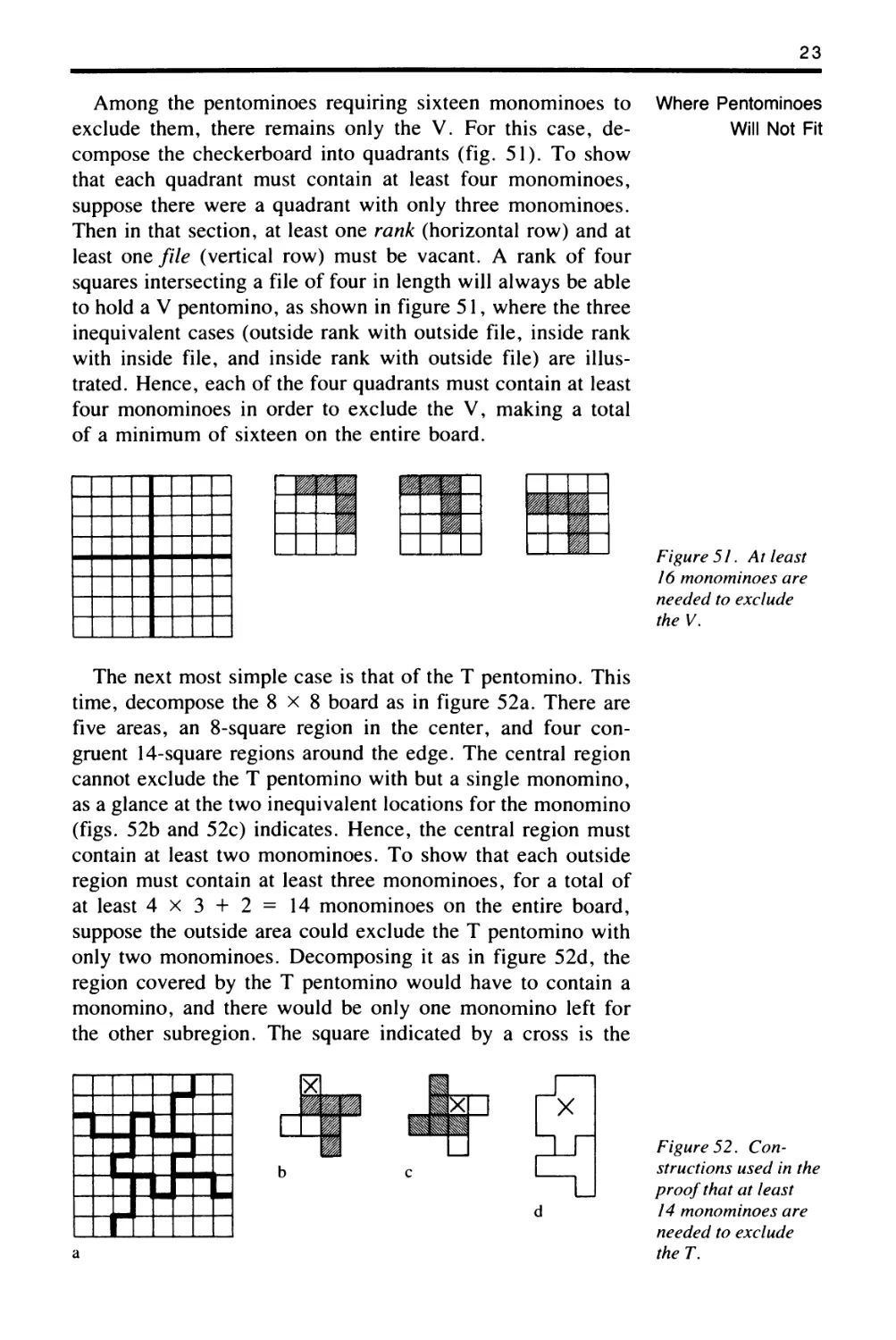
Among the pentominoes requiring sixteen monominoes to
exclude them, there remains only the V. For this case, de-
compose the checkerboard into quadrants (fig. 51). To show
that each quadrant must contain at least four monominoes,
suppose there were a quadrant with only three monominoes.
Then in that section, at least one rank (horizontal row) and at
least one file (vertical row) must be vacant. A rank of four
squares intersecting a file of four in length will always be able
to hold a V pentomino, as shown in figure 5 1, where the three
inequivalent cases (outside rank with outside file, inside rank
with inside file, and inside rank with outside file) are illus-
trated. Hence, each of the four quadrants must contain at least
four monominoes in order to exclude the V, making a total
of a minimum of sixteen on the entire board.
The next most simple case is that of the T pentomino. This
time, decompose the 8 x 8 board as in figure 52a. There are
five areas, an 8-square region in the center, and four con-
gruent 14-square regions around the edge. The central region
cannot exclude the T pentomino with but a single monomino,
as a glance at the two inequivalent locations for the monomino
(figs. 52b and 52c) indicates. Hence, the central region must
contain at least two monominoes. To show that each outside
region must contain at least three monominoes, for a total of
at least 4 x 3 + 2 = 14 monominoes on the entire board,
suppose the outside area could exclude the T pentomino with
only two monominoes. Decomposing it as in figure 52d, the
region covered by the T pentomino would have to contain a
monomino, and there would be only one monomino left for
the other subregion. The square indicated by a cross is the
--,
- ......
-
I
x
b
c
d
a
Where Pentominoes
Will Not Fit
Figure 51. At least
16 monominoes are
needed to exclude
the v.
Figure 52. Con-
structions used in the
proof that at least
14 monominoes are
needed to exclude
the T.
24
Chapter 3
Figure 53. Further
constructions in the
T-exclusion proof.
........
3 3
I
.... . 1 I t
- -
3 3
-I .....
Figure 54. Decom-
position used in the
W-pentomino
exclusion proof.
.. . . ..+....
3 I .3
uuu ..... ..
no"U nun . . u .. uu.+. hn."
- -
....+1 ....u. u.+.+. ...u. uu... . .
h. .
3 I 3
. . Uu.... ...nu' U...
Figure 55.
Superposition of
constraints imposed
by rotations and
reflections of
Figure 54.
Figure 56. Decom-
position showing
monominoes needed
to exclude (a) the X,
(b)theF, (c)theZ.
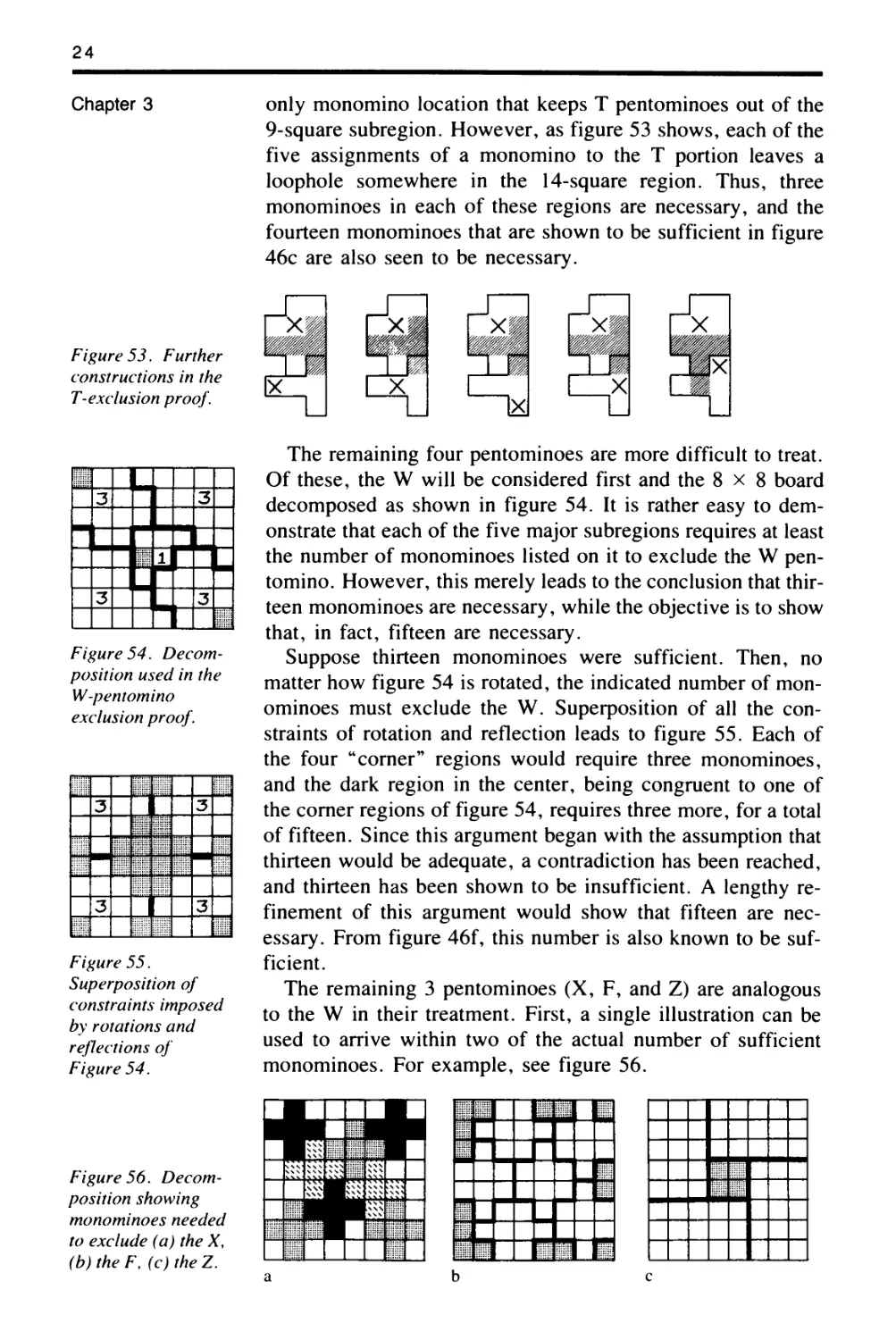
only monomino location that keeps T pentominoes out of the
9-square subregion. However, as figure 53 shows, each of the
five assignments of a monomino to the T portion leaves a
loophole somewhere in the 14-square region. Thus, three
monominoes in each of these regions are necessary, and the
fourteen monominoes that are shown to be sufficient in figure
46c are also seen to be necessary.
The remaining four pentominoes are more difficult to treat.
Of these, the W will be considered first and the 8 x 8 board
decomposed as shown in figure 54. It is rather easy to dem-
onstrate that each of the five major subregions requires at least
the number of monominoes listed on it to exclude the W pen-
tomino. However, this merely leads to the conclusion that thir-
teen monominoes are necessary, while the objective is to show
that, in fact, fifteen are necessary.
Suppose thirteen monominoes were sufficient. Then, no
matter how figure 54 is rotated, the indicated number of mon-
ominoes must exclude the W. Superposition of all the con-
straints of rotation and reflection leads to figure 55. Each of
the four "corner" regions would require three monominoes,
and the dark region in the center, being congruent to one of
the comer regions of figure 54, requires three more, for a total
of fifteen. Since this argument began with the assumption that
thirteen would be adequate, a contradiction has been reached,
and thirteen has been shown to be insufficient. A lengthy re-
finement of this argument would show that fifteen are nec-
essary. From figure 46f, this number is also known to be suf-
ficient.
The remaining 3 pentominoes (X, F, and Z) are analogous
to the W in their treatment. First, a single illustration can be
used to arrive within two of the actual number of sufficient
monominoes. For example, see figure 56.
. U r.U en_._ u.... ::;,:.;
un..
u ...
u....
u....
im
......
u+++u :::::J nuh +0..... ...
.. nH ....u. .ou"
. .... ...... u.+.+
.un.. +IOU" n....
+.uu. . .. .u . .+..
........ ....... .+.u.
....... ....... ... ..
nuu. . .. u
a
b
c
25
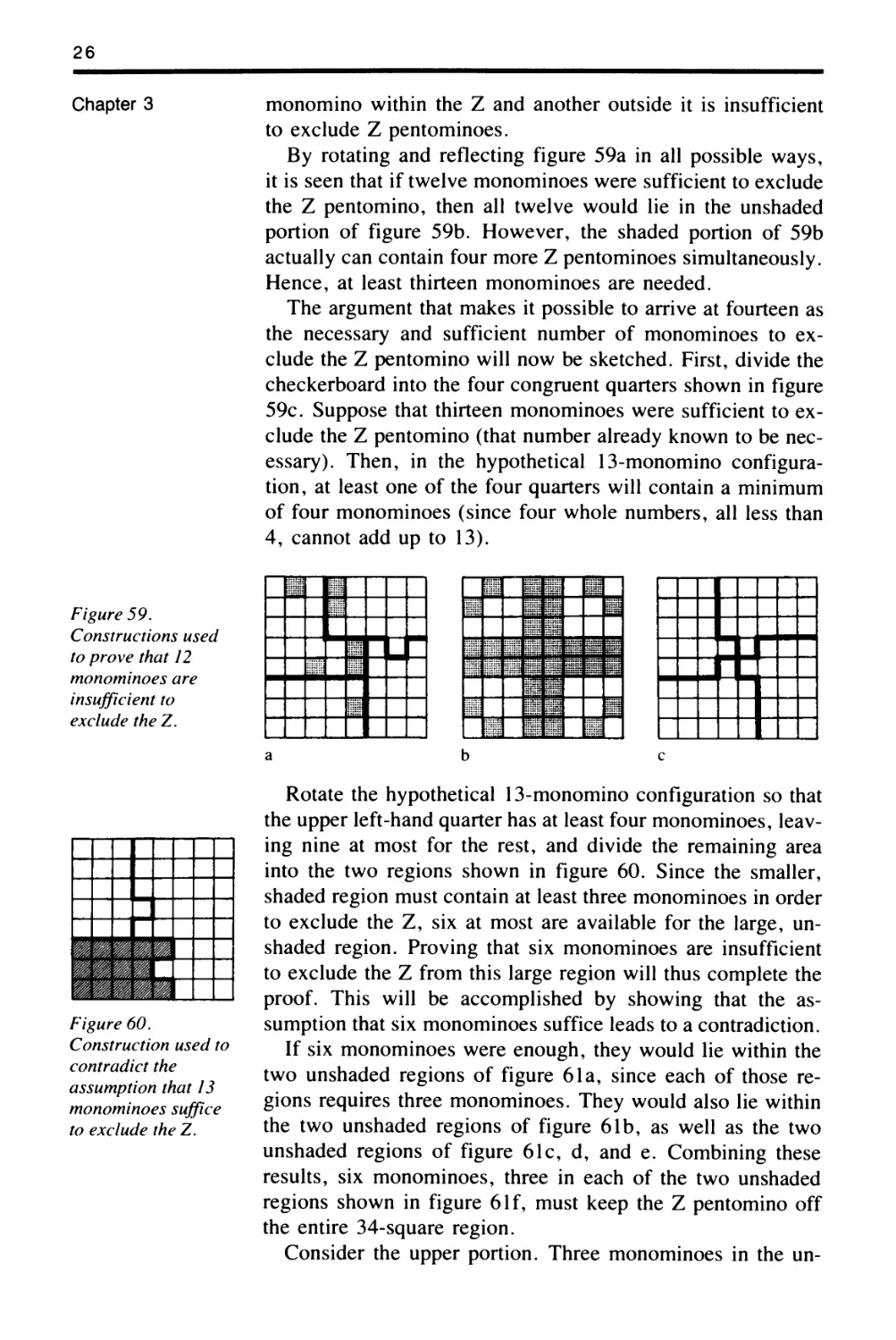
It is seen in 56a that at least eight monominoes are needed
to exclude the X; in 56b, that at least twelve are needed to
exclude the F; and in 56c, that at least twelve are needed to
exclude the Z.
To show that at least nine monominoes are needed against
the X, consider figure 57a. If eight monominoes were suffi-
cient, they would have to lie in the 8 X regions of 57a no
matter how that pattern were rotated and reflected on the
checkerboard. That is, all eight would have to be in the un-
shaded portion of figure 57b. However, the large central re-
gion of 57b actually requires at least two more monominoes
to keep out the X, contradicting the sufficiency of the eight
monominoes. Again, further refinement of this argument will
show that ten are necessary.
For the F, consider figure 58a. The regions require the in-
dicated number of monominoes to exclude the F. To show this
for the area with the number 3, consider its decomposition in
figure 58b. If two monominoes were sufficient, one would
have to be in the F subregion. The only location for a mon-
omino that would keep an F out of the other subregion is at
the square indicated by an x. However, any square in the F
subregion combined with the x square fails to exclude the fur-
ther occurrence of F's.
The region in figure 58a with the two check marks could
hold an F with either checked square excluded. When all the
rotations and reflections of 58a are considered, the conclusion
is reached that if twelve monominoes would suffice to exclude
F's, they would all have to be in the unshaded portion of fig-
ure 58c. However, at least two more monominoes would then
be needed in the central, shaded region, proving that twelve
monominoes are insufficient. Further refinement of this ar-
gument leads to the conclusion that fourteen monominoes are
both necessary and sufficient.
....... 0+0.01+ ...
10-
3 ....u
i ouu.
noun
-- 1- 1
hU .. ./
+n.... ./
...u. nn.. . . .h .n.
h..... .unn ....... ....... ... .... ...hU
....n. ....... +.uue .OU.
..UU. nu.". _..n.. . .+ u'UU _..rn.
nhU. ....... .....0+ . .+.. ....... e.....
un u , u.... eA...
r"" F:11111i mm
r..... ....... .......
a
b
c
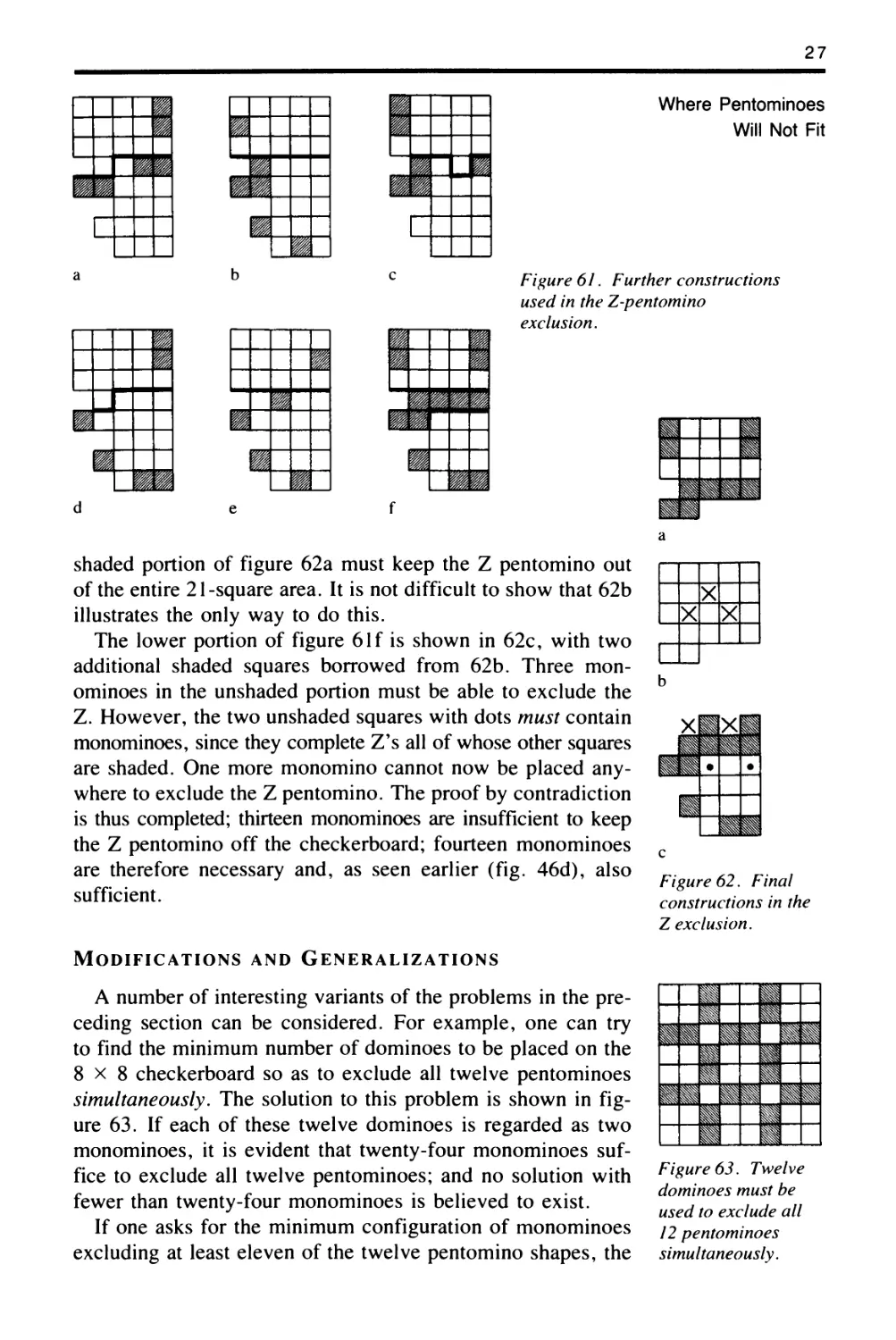
There remains only the case of the Z pentomino. In figure
59a each of the four "comers" is readily shown to require at
least three monominoes; this is accomplished by the usual ex-
pedient: a Z is drawn in the region and it is observed that one
Where Pentominoes
Will Not Fit
:iim
uuu ....... ..un ,+pu.
+hnr -
....u 2m
u.. ..
'U .. .. ..uu
..u ....+.
- - TIITm
u. .
.u_..
..... I ....]
Hun . . ...... ".. .. "+p+u
a
:: : =i
u...... UO+.,. .... .. +1+1. .., .. .n.... .. .....
....n.
o. m . .... .
.. ....... .... .. ,'uU
u..... .. .. ... .... .. ....... ...... nn,u
u.u... .uu u..u. .... .. ... ... r
... .. .. ....
"+.u.. ... -... +0+.' .. .. ..
uu.. :; :=:
uu.. ..un. ... .'". h.nn .+_+.u U.+_+. .+"+0+" .+....
b
Figure 57. COIl-
structions used to
prove that 8 mon-
01nlnoes are
insufficient to
exclude the X.
Figure 58. Con-
structions used to
prove that 12 mon-
om/noes are
insufficient to
exclude the F.
26
Chapter 3
Figure 59.
Constructions used
to prove that 12
monomlnoes are
insufficient to
exclude the Z.
Figure 60.
Construction used to
contradict the
assumption that 13
monominoes suffice
to exclude the Z.
monomino within the Z and another outside it is insufficient
to exclude Z pentominoes.
By rotating and reflecting figure 59a in all possible ways,
it is seen that if twelve monominoes were sufficient to exclude
the Z pentomino, then all twelve would lie in the un shaded
portion of figure 59b. However, the shaded portion of 59b
actually can contain four more Z pentominoes simultaneously.
Hence, at least thirteen monominoes are needed.
The argument that makes it possible to arrive at fourteen as
the necessary and sufficient number of monominoes to ex-
clude the Z pentomino will now be sketched. First, divide the
checkerboard into the four congruent quarters shown in figure
59c. Suppose that thirteen monominoes were sufficient to ex-
clude the Z pentomino (that number already known to be nec-
essary). Then, in the hypothetical 13-monomino configura-
tion, at least one of the four quarters will contain a minimum
of four monominoes (since four whole numbers, all less than
4, cannot add up to 13).
1tiill 1 .....
.. u
uuu
...... .un
mm
I
a
b
c
Rotate the hypothetical 13-monomino configuration so that
the upper left-hand quarter has at least four monominoes, leav-
ing nine at most for the rest, and divide the remaining area
into the two regions shown in figure 60. Since the smaller,
shaded region must contain at least three monominoes in order
to exclude the Z, six at most are available for the large, un-
shaded region. Proving that six monominoes are insufficient
to exclude the Z from this large region will thus complete the
proof. This will be accomplished by showing that the as-
sumption that six monominoes suffice leads to a contradiction.
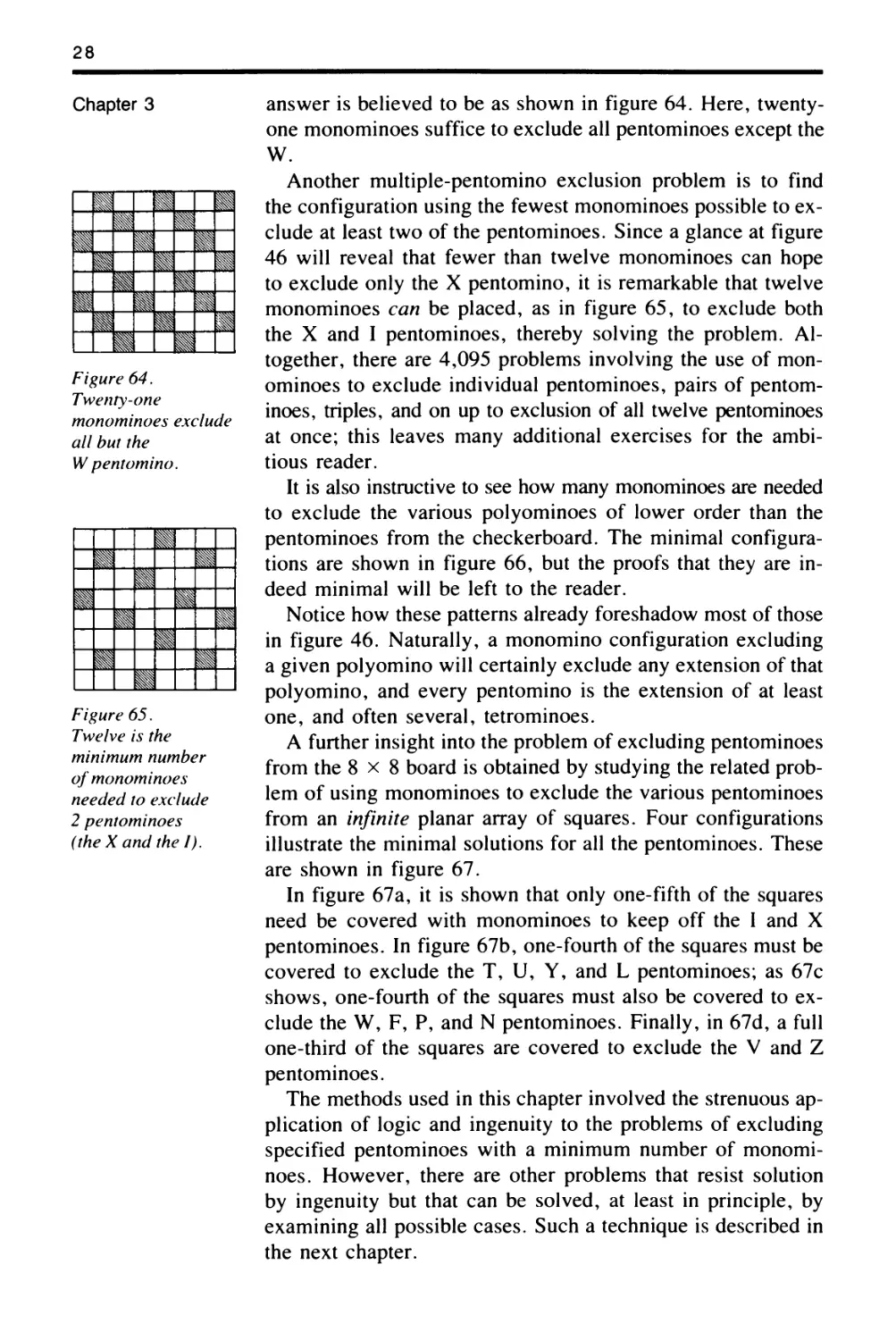
If six monominoes were enough, they would lie within the
two unshaded regions of figure 61 a, since each of those re-
gions requires three monominoes. They would also lie within
the two unshaded regions of figure 61 b, as well as the two
unshaded regions of figure 61 c, d, and e. Combining these
results, six monominoes, three in each of the two unshaded
regions shown in figure 61 f, must keep the Z pentomino off
the entire 34-square region.
Consider the upper portion. Three monominoes in the un-
27
Figure 61. Further constructions
used in the Z-pentomino
exclusion.
a
b
c
d
e
f
shaded portion of figure 62a must keep the Z pentomino out
of the entire 21-square area. It is not difficult to show that 62b
illustrates the only way to do this.
The lower portion of figure 61 f is shown in 62c, with two
additional shaded squares borrowed from 62b. Three mon-
ominoes in the unshaded portion must be able to exclude the
Z. However, the two unshaded squares with dots must contain
monominoes, since they complete Z's all of whose other squares
are shaded. One more monomino cannot now be placed any-
where to exclude the Z pentomino. The proof by contradiction
is thus completed; thirteen monominoes are insufficient to keep
the Z pentomino off the checkerboard; fourteen monominoes
are therefore necessary and, as seen earlier (fig. 46d), also
sufficient.
MODIFICATIONS AND GENERALIZATIONS
A number of interesting variants of the problems in the pre-
ceding section can be considered. For example, one can try
to find the minimum number of dominoes to be placed on the
8 x 8 checkerboard so as to exclude all twelve pentominoes
simultaneously. The solution to this problem is shown in fig-
ure 63. If each of these twel ve dominoes is regarded as two
monominoes, it is evident that twenty-four monominoes suf-
fice to exclude all twelve pentominoes; and no solution with
fewer than twenty-four monominoes is believed to exist.
If one asks for the minimum configuration of monominoes
excluding at least eleven of the twelve pentomino shapes, the
Where Pentominoes
Will Not Fit
a
x
X X
b
c
Figure 62. Final
constructions in the
Z exclusion.
Figure 63. Twelve
dominoes must be
used to exclude all
12 pentominoes
simultaneously.
28
Chapter 3
Figure 64.
Twenty-one
monominoes exclude
all but the
W pentomino.
Figure 65.
Twelve is the
minimum number
of monominoes
needed to exclude
2 pentominoes
(the X and the I).
answer is believed to be as shown in figure 64. Here, twenty-
one monominoes suffice to exclude all pentominoes except the
w.
Another muItiple-pentomino exclusion problem is to find
the configuration using the fewest monominoes possible to ex-
cude at least two of the pentominoes. Since a glance at figure
46 will reveal that fewer than twelve monominoes can hope
to exclude only the X pentomino, it is remarkable that twelve
monominoes can be placed, as in figure 65, to exclude both
the X and I pentominoes, thereby solving the problem. Al-
together, there are 4,095 problems involving the use of mon-
ominoes to exclude individual pentominoes, pairs of pentom-
inoes, triples, and on up to exclusion of all twelve pentominoes
at once; this leaves many additional exercises for the ambi-
tious reader.
It is also instructive to see how many monominoes are needed
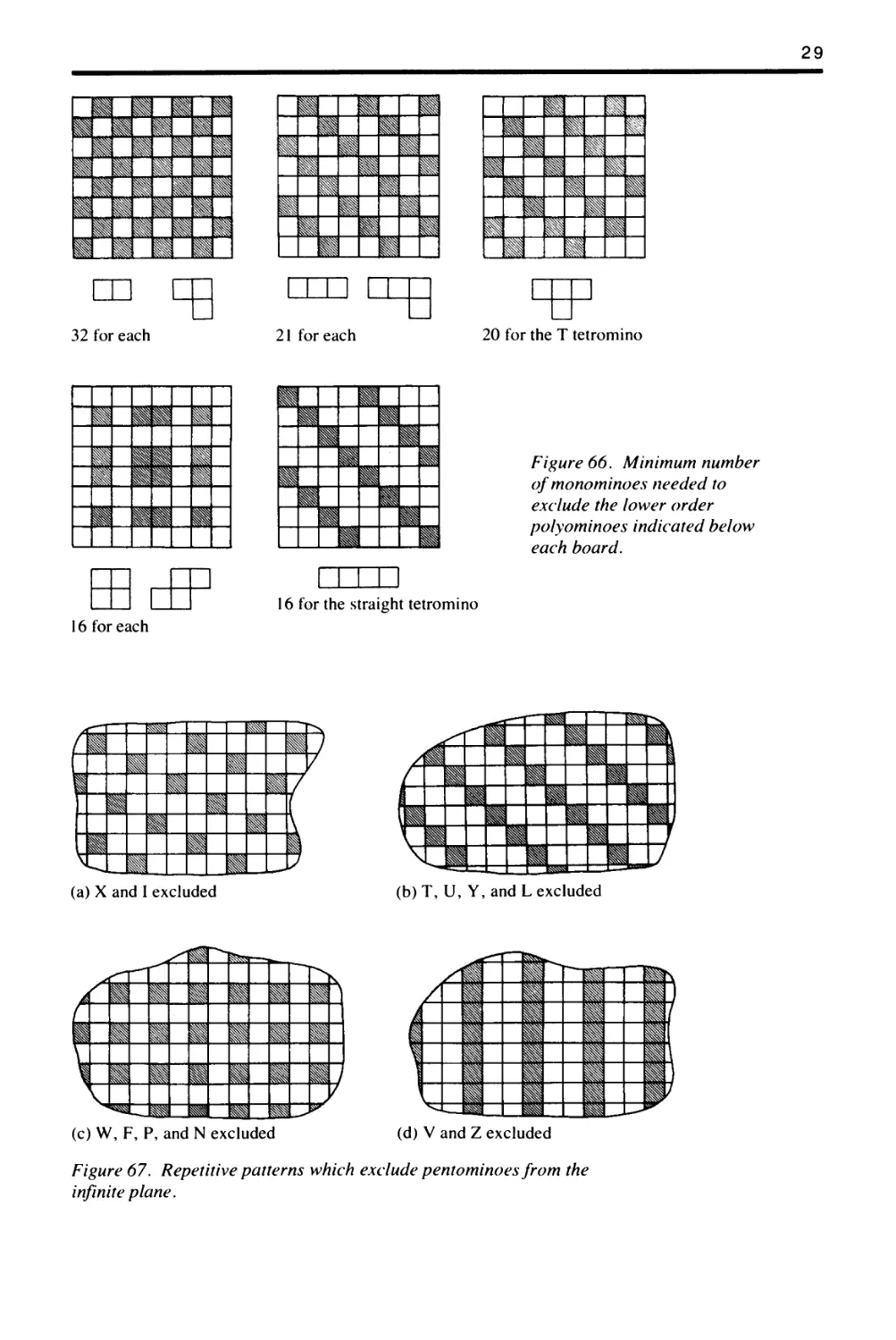
to exclude the various polyominoes of lower order than the
pentominoes from the checkerboard. The minimal configura-
tions are shown in figure 66, but the proofs that they are in-
deed minimal will be left to the reader.
Notice how these patterns already foreshadow most of those
in figure 46. Naturally, a monomino configuration excluding
a given polyomino will certainly exclude any extension of that
polyomino, and every pentomino is the extension of at least
one, and often several, tetrominoes.
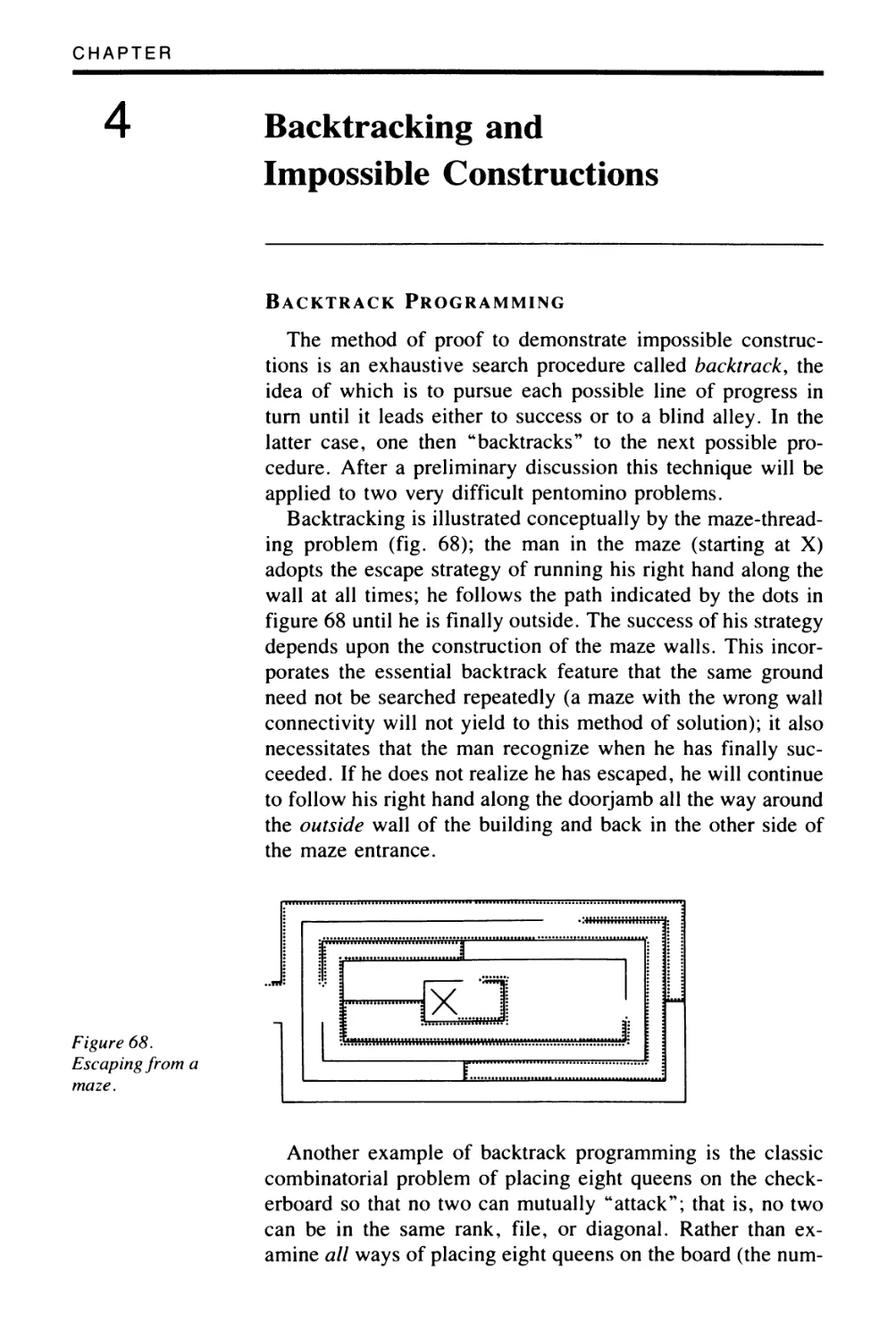
A further insight into the problem of excluding pentominoes
from the 8 x 8 board is obtained by studying the related prob-
lem of using monominoes to exclude the various pentominoes
from an infinite planar array of squares. Four configurations
illustrate the minimal solutions for all the pentominoes. These
are shown in figure 67.
In figure 67a, it is shown that only one-fifth of the squares
need be covered with monominoes to keep off the I and X
pentominoes. In figure 6 7b, one-fourth of the squares must be
covered to exclude the T, U, Y, and L pentominoes; as 67c
shows, one-fourth of the squares must also be covered to ex-
clude the W, F, P, and N pentominoes. Finally, in 67d, a full
one-third of the squares are covered to exclude the V and Z
pentominoes.
The methods used in this chapter involved the strenuous ap-
plication of logic and ingenuity to the problems of excluding
specified pentominoes with a minimum number of monomi-
noes. However, there are other problems that resist solution
by ingenuity but that can be solved, at least in principle, by
examining all possible cases. Such a technique is described in
the next chapter.
29
OJ
qj
32 for each
EEdT
16 for each
ITIJrrg
qp
21 for each
20 for the T tetromino
Figure 66. Minimum number
of monominoes needed to
exclude the lower order
polyominoes indicated below
each board.
[Ill]
16 for the straight tetromino
(a) X and I excluded
(b) T, U, Y, and L excluded
(c) W, F, P, and N excluded
(d) V and Z excluded
Figure 67. Repetitive patterns which exclude pentominoesfrom the
infinite plane.
CHAPTER
4
Backtracking and
Impossible Constructions
BACKTRACK PROGRAMMING
The method of proof to demonstrate impossible construc-
tions is an exhaustive search procedure called backtrack, the
idea of which is to pursue each possible line of progress in
turn until it leads either to success or to a blind alley. In the
latter case, one then backtracks" to the next possible pro-
cedure. After a preliminary discussion this technique will be
applied to two very difficult pentomino problems.
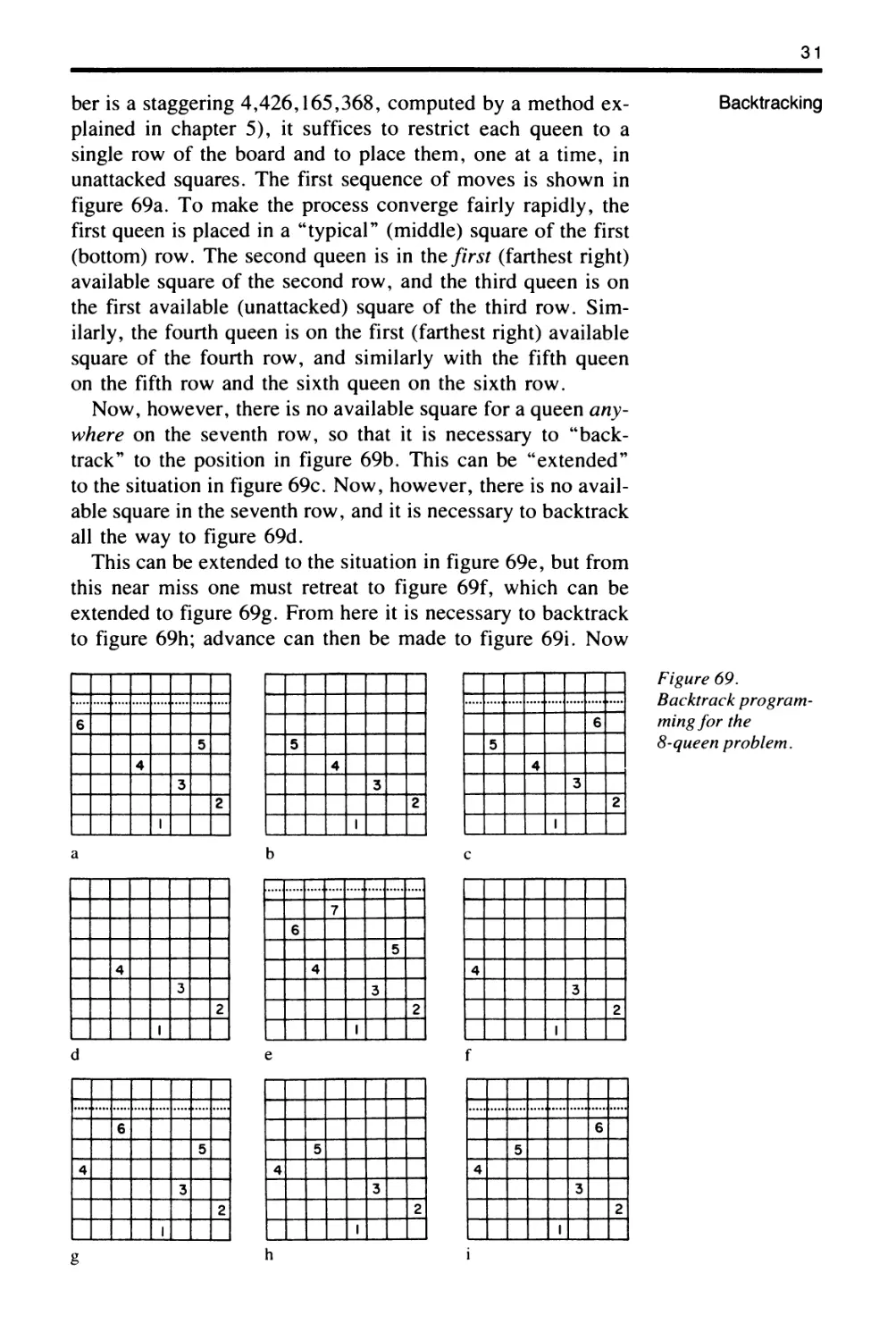
Backtracking is illustrated conceptually by the maze-thread-
ing problem (fig. 68); the man in the maze (starting at X)
adopts the escape strategy of running his right hand along the
wall at all times; he follows the path indicated by the dots in
figure 68 until he is finally outside. The success of his strategy
depends upon the construction of the maze walls. This incor-
porates the essential backtrack feature that the same ground
need not be searched repeatedly (a maze with the wrong wall
connectivity will not yield to this method of solution); it also
necessitates that the man recognize when he has finally suc-
ceeded. If he does not realize he has escaped, he will continue
to follow his right hand along the doorjamb all the way around
the outside wall of the building and back in the other side of
the maze entrance.
Figure 68.
Escaping from a
maze.
.. . . . .... .............
. ... ... ........ .......
.. . .
. .
.
... ...... ........ ............. ... .......... .......... ....... . . .
. .
. .
g . .
IJ . . .
. . .
. . . .
. . .
. . .
. . .
. . .
.:ftfti .: . : .
1'1' .
. .
X . : . .
.
. M.u.I
. .
; :
- ............. : i
........... . .
.....
......... ............... .................. .
I...... .... . .....................
... ... .
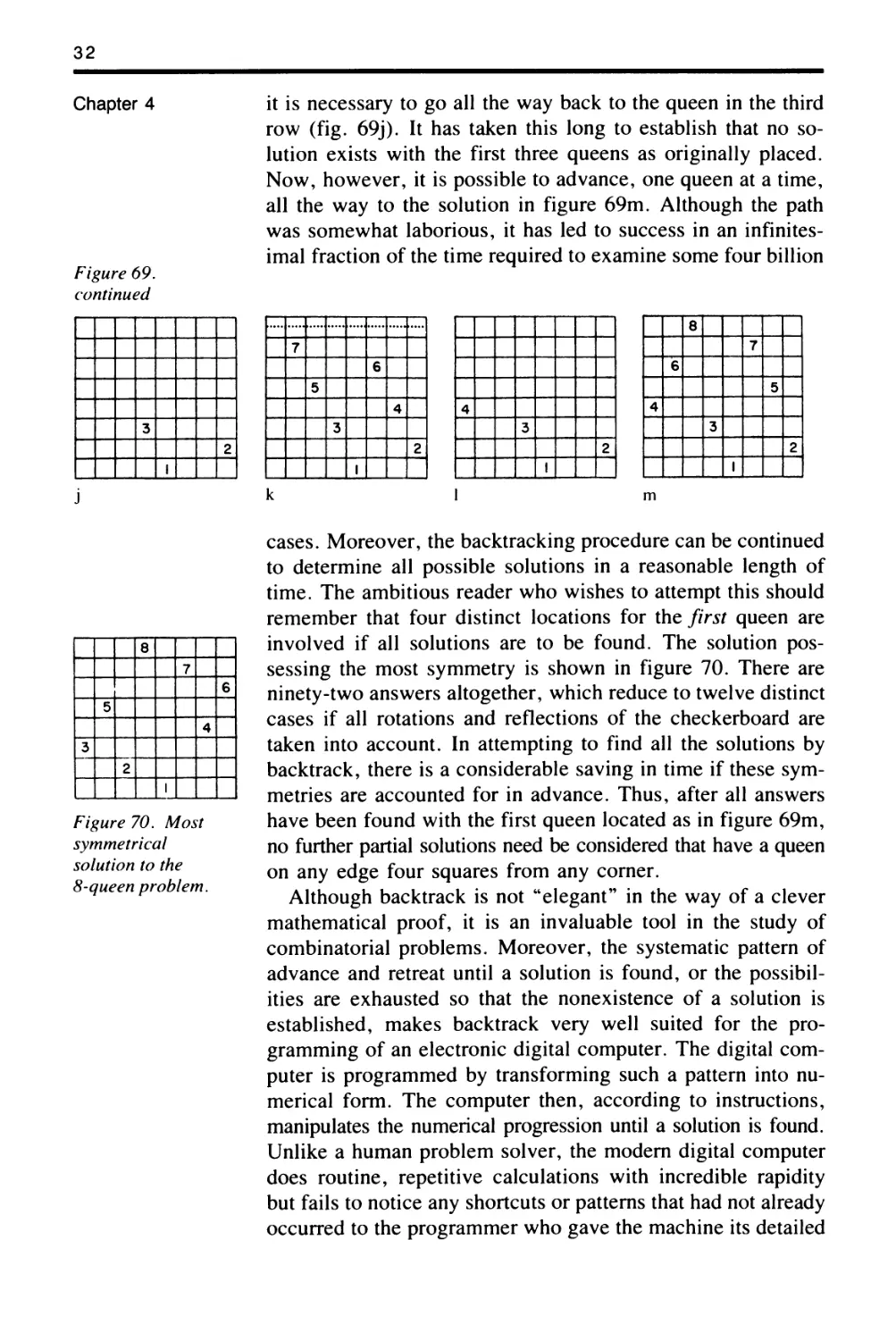
Another example of backtrack programming is the classic
combinatorial problem of placing eight queens on the check-
erboard so that no two can mutually attack"; that is, no two
can be in the same rank, file, or diagonal. Rather than ex-
amine all ways of placing eight queens on the board (the num-
31
ber is a staggering 4,426,165,368, computed by a method ex-
plained in chapter 5), it suffices to restrict each queen to a
single row of the board and to place them, one at a time, in
unattacked squares. The first sequence of moves is shown in
figure 69a. To make the process converge fairly rapidly, the
first queen is placed in a "typical " (middle) square of the first
(bottom) row. The second queen is in the first (farthest right)
available square of the second row, and the third queen is on
the first available (unattacked) square of the third row. Sim-
ilarly, the fourth queen is on the first (farthest right) available
square of the fourth row, and similarly with the fifth queen
on the fifth row and the sixth queen on the sixth row.
Now, however, there is no available square for a queen any-
where on the seventh row, so that it is necessary to "back-
track" to the position in figure 69b. This can be "extended"
to the situation in figure 69c. Now, however, there is no avail-
able square in the seventh row, and it is necessary to backtrack
all the way to figure 69d.
This can be extended to the situation in figure 6ge, but from
this near miss one must retreat to figure 69f, which can be
extended to figure 69g. From here it is necessary to backtrack
to figure 69h; advance can then be made to figure 69i. Now
.... .... .... ..... .... .... .... ....
6
5
4
3
2
I
a
4
3
2
I
d
.... .... ..... .... ..... .... .... ....
6
5
4
3
2
I
g
5
4
3
2
I
..... .... .... .... .... ..... .... ....
6
5
4
3
2
I
b
c
.... .. ... .... .... .... .... ..... ....
7
6
5
4
3
2
I
4
3
2
I
e
f
5
4
3
2
I
..... .... ..... .... .... .... .... .....
6
5
4
3
2
I
h
Backtracking
Figure 69.
Backtrack program-
ming for the
8-queen problem.
32
Chapter 4
Figure 69.
continued
3
2
I
J
8
7
6
5
4
3
2
I
Figure 70. Most
symmetrical
solution to the
8-queen problem.
it is necessary to go all the way back to the queen in the third
row (fig. 69j). It has taken this long to establish that no so-
lution exists with the first three queens as originally placed.
Now, however, it is possible to advance, one queen at a time,
all the way to the solution in figure 69m. Although the path
was somewhat laborious, it has led to success in an infinites-
imal fraction of the time required to examine some four billion
.... ..... .... ..... .... ..... .... ....
7
6
5
4
3
2
I
4
3
2
I
8
7
6
5
4
3
2
I
k
m
cases. Moreover, the backtracking procedure can be continued
to determine all possible solutions in a reasonable length of
time. The ambitious reader who wishes to attempt this should
remember that four distinct locations for the first queen are
involved if all solutions are to be found. The solution pos-
sessing the most symmetry is shown in figure 70. There are
ninety-two answers altogether, which reduce to twelve distinct
cases if all rotations and reflections of the checkerboard are
taken into account. In attempting to find all the solutions by
backtrack, there is a considerable saving in time if these sym-
metries are accounted for in advance. Thus, after all answers
have been found with the first queen located as in figure 69m,
no further partial solutions need be considered that have a queen
on any edge four squares from any corner.
Although backtrack is not "elegant" in the way of a clever
mathematical proof, it is an invaluable tool in the study of
combinatorial problems. Moreover, the systematic pattern of
advance and retreat until a solution is found, or the possibil-
ities are exhausted so that the nonexistence of a solution is
established, makes backtrack very well suited for the pro-
gramming of an electronic digital computer. The digital com-
puter is programmed by transforming such a pattern into nu-
merical form. The computer then, according to instructions,
manipulates the numerical progression until a solution is found.
Unlike a human problem solver, the modem digital computer
does routine, repetitive calculations with incredible rapidity
but fails to notice any shortcuts or patterns that had not already
occurred to the programmer who gave the machine its detailed
33
instructions. The challenge, then, is to formulate the question
efficiently as a backtrack problem, after which the computer
takes over the more tedious task of examining all the cases.
Backtracking
THE HERBERT TAYLOR CONFIGURATION
Impossibility proofs for figure 71, the configuration pro-
posed by the mathematician Herbert Taylor, now at the Center
for Communications Research in La Jolla, California, were
discovered independently by John G. Fletcher of the Univer-
sity of California at Berkeley, and Spencer Earnshaw, at the
time a student at Santa Monica City College in California. The
proof presented here is a simplification of these two previous
ones.
Figure 71. The Herbert Taylor
Configuration.
Suppose it would be possible to cover the configuration of
figure 71 with the twelve distinct pentominoes. Then, at no
stage along the way could a region of the "board" be isolated
unless it contained a multiple of five squares. This will lead
to a dead end.
First, consider the location of the X pentomino in the hy-
pothetical covering. There are only two possibilities (ignoring
positions symmetric to these as being equivalent), as shown
in figure 72.
In Case I, consider all possible locations for the I pentom-
ino. No matter where it is placed, a region is isolated with a
number of squares not a multiple of 5. Hence, Case I is a
blind alley.
In Case II, there are two inequivalent locations for the I
pentomino that leave the remaining regions with numbers of
squares divisible by 5, as shown in figure 73.
In Case IIA, consider the possible ways the pentomino cov-
ering the "dotted" square might enter the "east wing" of the
figure. There are three distinguishable situations (fig. 74).
34
Chapter 4
Figure 72. The
2 possible locations
for the X in the
Herbert Taylor
Configuration.
Figure 73. The 2
possible locations for
the I in Case II.
I
.
IIA
Figure 74. The 3 ways to cover the
"dotted" square of Case IIA.
HAl
.
IIA2
.
IIA3
II
lIB
.
In Case IIA 1, the south and east wings are congruent, and
either can be filled by the P and L pentominoes or by the W
and Y pentominoes, but in no other way. Thus P, L, W, and
Y must be used (for example, as in fig. 75), and the pentom-
ino covering the dot is either the N or the V. However, a
search for a place to put the T pentomino leads only to the
location shown in figure 75, which also necessitates that the
35
V cover the dot. Now, however, the P pentomino is needed
next to the T, but it has already been used. Thus Case IIA 1
is eliminated. (The numbers on the pentominoes in figure 75
refer to the order in which they were placed on the "board. ")
Backtracking
7
8
.
6
5
Figure 75. Exploring Case IIAI.
In Case IIA2, the south wing, as before, can contain either
the pair P and L or the pair Wand Y; while the east wing can
contain either Wand P or Land P. The only consistent choice
for both regions is W, Y in the south and L, P in the east (see
fig. 76). The pentomino covering the dot must be the F, in
either of two orientations. Next, the N pentomino can be con-
sistently fitted only as shown (fig. 76), and there remains no
consistent location for the T pentomino, thus eliminating Case
IIA2.
*
* .
Figure 76. Exploring Case IIA2.
In Case IIA3, the south wing again may contain either the
pair P, L or the pair W, Y, while the east wing may contain
either V, F or U, L. Next, there are four possibilities for the
T pentomino (avoiding obvious dead ends), as shown in figure
77. In IIA3a, the dotted square and the neighboring asterisked
ones cannot be extended to fOnTI a pentomino, because W al-
ready has been used, and N would isolate a block of two
squares. In IIA3b, the N must be used to cover the dot, and
there remains no consistent location for the Z. For IIA3c, the
L must cover the dot, and then the square to the left of the
dot cannot be covered. In IIA3d, whether V, F, or U, L are
36
Chapter 4
Figure 77. The 4
possible locations for
the T in Case IIA3.
Figure 78. The
4 locations for the
N in Case lIB.
chosen to cover the east wing, only Z can be used to cover
the dot, and the construction clearly cannot be completed. Thus
IIA3 is impossible, which completes the elimination of Case
IIA.
T. V
* .
.
I1A3a
IIA3b
V F
IIA3c
IIA3d
.
V F
V,F
r U, L
Case lIB remains. Here, there are exactly four possible lo-
cations for the N pentomino, as shown in figure 78. In lIB I ,
the only consistent location for the T pentomino is as shown
""
""
""
" ......"
........... ".....
" ......',
UBI
IIB2
,,,
"""
,
......' ..........'
...., ....."
""
""
""
,,'
""
'"
IIB3
IIB4
37
in figure 79. The north wing can then be completed only by
use of the P pentomino. Without the P, the south wing must
be filled in with W, Y and the west wing with V, Z. The
asterisked square of figure 79 cannot then be covered by any
remaining pentomino, which settles case lIB 1.
8
Figure 79. The only position for the
T in Case IIBI.
9
"
" ,
,
7
For IIB2, the north wing must be filled with U, L, and (since
L is no longer available) the east wing must contain W, Y.
The only consistent location for the T pentomino is then in
the west wing (see fig. 80), after which the Z pentomino will
not fit anywhere. Thus Case IIB2 is also eliminated.
9
Figure 80. The only consistent location
for the T in Case IIB2.
"
"
7
8
In IIB3, the east wing may be occupied either by U, L or
F, V; and the north wing by U, Y or P, T (see fig. 81). (If
P is used in the north wing with V, Y, Z, or L, then there is
no suitable location left for the T.)
6
7
V F
L
IIB3a
IlB3b
Backtracking
Figure 81. The U
and Y or the P and T
must be used to fill
the north wing in
Case IIB3.
38
Chapter 4
Figure 82.
Elimination of Case
IIB3a.
Figure 84.
Branches used in the
impossibility proof.
In Case IIB3a, the only consistent location for the T pen-
tomino is in the west wing (see fig. 82), which then leaves
no legitimate position for the Z. Considering IIB3b, there are
two possible locations for the Z pentomino, as shown in figure
83. In IIB3bi, there is no region left where the W pentomino
will fit. In Case IIB3bii, the location of the Z requires the V
in the west wing, leaving U, L to fill the east wing. There is
only one location left for the Y pentomino, as shown, after
which the F pentomino does not fit at all. This eliminates Case
IIB3b, which completes Case IIB3.
9
7
I1B3bi
IIB3bii
10
Figure 83. The two possibilities for locating
the Z in Case IIB3b.
Finally, Case IIB4 is eliminated by observing that the T
must be placed in the north wing, above the I, which forces
the P next to the T and the Y underneath; the east wing cannot
now be filled. This completes Case lIB, completing Case II,
and answering the original question of the existence of a pen-
tomino covering for figure 71 in the negative. A schematic
diagram of the cases and subcases just considered is given in
figure 84.
a bed
11
39
Backtracking
Figure 85. R. M. Robinson's
jagged square.
THE JAGGED-SQUARE CONFIGURATION
A backtrack "solution" to the "jagged square" proposed by
R. M. Robinson (fig. 85) was also discovered by Spencer
Earnshaw. It is even longer and more intricate than the pre-
ceding solution and will only be sketched briefly here, in eight
steps.
1. Only eight of the twelve pentominoes (W, X, Y, F, I,
L, P, N) can possibly occupy "corners" in figure 85.
2. There are seventy ways ( 8! = 70 ) to select four of
4!4!
these pentominoes to fill the four corners. (The formula
for the number of ways to select eight things, four at a
time, comes from Theorem 4 in chapter 5. The meaning
of the symbol "n!", called n factorial, is explained in
the statement of Theorem 2 in chapter 5). The following
table gives the maximum number of edge squares (not
including comer squares) each pentomino can occupy
when it is and when it is not a corner piece. For each
set of comer pieces, the corresponding maximum num-
ber of coverable edges is obtained readily from table 1.
3. In figure 86, the four kinds of squares of figure 85 are
depicted clearly. Topologically, the comer squares, edge
Key:
""
",
. . .
...
...
. . .
......
. . .
. . . ...
..
...
.. . . ..
...
.. .
. ..
.. .
...
..
""
",
""
. Corner Square
",
, ,
, "
(ill] Edge Square
",
'"
:t 1 Interior-Boundary Square
,,,
,,, ,
D Interior Square
Figure 86. Identification of
corner, edge, interior-boundary,
and interior squares.
40
Chapter 4 TABLE 1
Corner Max. No. of
Pentomino Squares Edge Squares
W I 2
0 3
X I 2
0 2
Y I I
0 2
F I 2
0 2
I I 0
0 I
L I 0
0 I
P I I
0 2
N I I
0 2
T 0 I
U 0 I
V 0 1
Z 0 1
squares, and interior-boundary squares, all taken to-
gether, form the "total boundary" of the configuration,
and the basic idea of Earnshaw's solution is to relate
coverings to this total boundary" of twenty-four squares.
Specifically, there are only four pentominoes (V, Z,
I, and L) that can occupy an interior-boundary square
and also cover their maximum number of edge or corner
squares simultaneously.
4. The V and I pentominoes cannot simultaneously occupy
both an edge or comer square and an interior-boundary
square without violating the multiple-of-S rule for the re-
maining regions; this rule requires that the number of
squares in an isolated region must be a multiple of 5 in
order for that region to be exactly coverable by pentom-
inoes. This is illustrated in figure 87; the I pentomino
41
has been placed in its two representative locations, and
the various inequivalent positions of the V pentomino
occupying both an edge and an interior-boundary point
are shown. In all sixteen cases, the multiple-of-5 rule is
violated.
Backtracki n9
Figure 87. The 16 waysjor the V and I simultaneously to occupy an
edge or corner square and an interior-boundary square all violate the
"multiple-oj 5" rule.
5. There are fifteen remaining ways of selecting two from
the V, Z, I, and L pentominoes to cover both an edge
or corner and an interior-boundary square to be studied.
(There are six ways to select two of these four pieces,
and, in general, several ways of placing the selected pair
on the board.") A preliminary count of boundary squares
shows that one of these situations would have to occur.
However, it is found that only the pair I, Z has any hope
of success.
6. The cases where I and Z each cover both an edge or
corner square and an interior-boundary square are stud-
ied. Numerous side results (for example, that F and X
are two of the four corner pieces) are obtained from this
study. Finally, it is shown that I and Z must cover ex-
actly one interior-boundary square and one edge or cor-
ner square, while another piece (either T, V, or L) cov-
ers the remaining two interior-boundary squares.
7. The assumption that the V covers the remaining two in-
terior-boundary squares (see fig. 88) leads in all cases
to a contradiction.
8. If V is not used as the piece covering the remaining two
interior-boundary points, contradictions are also reached.
This step concludes the impossibility proof associated
with figure 85.
The reader is invited to attempt to put the flesh on the very
meager skeleton of the proof that has just been given. Even
more significantly, he or she is encouraged to discover a shorter
procedure for arriving at the same conclusion.
42
Chapter 4
"..". .......
.".... .".."
.'d.__ _.....,
..___., ,'U,._
,- -,' -. ..,....
..--,.. ,......
...,.", .'n_..
Figure 88. The
V cannot cover
the remaining 2
interior-boundary
squares.
Even if the monomino is moved to another interior location,
no solution to placing the twelve pentominoes on the remain-
ing sixty squares has been found. The closest approximation
known to the original pattern is the one given in figure 89.
A near solution to the jagged-square construction has been
discovered by the recreational-mathematics fan J. A. Lindon
of Surrey, England. In it, the monomino has been moved from
the center to the edge (fig. 90).
Figure 89. A solution to a
close approximation of the
jagged-square problem.
Figure 90. The jagged square
can be filled with pentominoes if
the hole is moved to the edge.
CHAPTER
Some Theorems
about Counting
5
IT HAS OFTEN been said that the most basic of all mathe-
matical operations is counting, and the late great German
mathematician Hermann Weyl once wrote that underlying al-
most all mathematical identities is the principle that if an enu-
meration of the same objects is performed in two different
ways, the results must be equal.
Throughout earlier chapters, questions have arisen as to the
number of ways certain objects can be fitted into specified
containers," or patterns. There are also frequent questions in
this book, and in mathematics generally, involving how many
objects with certain specified characteristics exist, and in-
volving problems of determining the number of configurations
and patterns of a particular type. All of these are finite enu-
meration problems, and, like combinatorial geometry, with
which this book is primarily concerned, they belong to a branch
of mathematics called combinatorial analysis, which is the study
of combinations of numbers or quantities of things. The ever-
increasing importance of digital computers in modern tech-
nology has revived a widespread interest in combinatorial
analysis, a subject that also has had important applications in
such modern scientific fields as circuit design, coded com-
munications, traffic control, crystallography, and probability
theory.
The present chapter is intended to serve as an introduction
to combinatorial analysis and, particularly, that part of the field
concerned with enumeration (that is, counting). This material,
while it is more difficult and requires greater concentration
than that of earlier sections, will serve not only to enhance
the readers' understanding and appreciation of the remainder
of the book, but also to give them some facility in the for-
mulation and solution of such problems wherever they may
be encountered. However, for those who wish to concentrate
on the recreational aspect of polyominoes, this chapter can be
skipped and the rest of the book enjoyed without it.
COMBINATIONS
There are ten ways to pick a number from 0 through 9.
There are 10 2 = 100 ways to pick a pair of numbers, each
44
Chapter 5
digit one of the numerals from 0 through 9, since these pairs
may be regarded as the numbers 00, 01, 02, 03, ..., 97, 98,
99. Similarly, there are 10 3 = 1 ,000 ways to pick a triple of
numbers, each digit again one of the numerals from 0 through
9, since the triples may be regarded as all the numbers from
000 to 999. In general, there are 10" ways to pick an n-tuple
of numbers, each digit a number from 0 to 9. In fact, there
are 1011 ways to pick an n-tuple of symbols from some set of
ten distinct symbols, since it is only a matter of nomenclature
as to whether the symbols are called 0, 1, 2, ..., 9; A, B, C,
. . ., J; a), a2, a3, ..., alO; or anything else.
If the basic set, or group of symbols from which the n-tuple
is to be picked, consists of k symbols, and an ordered se-
quence of length n is fonned-where each symbol can be any
one of the k basic symbols-there are k" such n-tuples. If the
basic symbols are 0 and 1, and all possible sequences of length
4 are to be fonned, n = 4 and k = 2, so that there are k" =
2 4 = 16 such sequences. These combinations can be used to
represent the decimal-system numbers from 0 to 15 (to the left
of the equal signs in the table below) in the binary number
system, which is based on the two digits 0 and 1 and used in
computer mathematics, as follows:
o = 0000
1 = 0001
2 = 0010
3 = 0011
4 = 0100
5 = 0101
6 = 0110
7 = 0111
8 = 1000
9 = 1001
10 = 1010
11 = 1011
12 = 1100
13 = 1101
14 = 1110
15 = 1111
A still more general formulation about combinations is the
following theorem.
Theorem 1. Suppose there are n sets, where the first set
contains k) objects, the second set contains k 2 objects, and so
on, with the n-th set containing k n objects. The number of
different sequences of n objects, with the first object chosen
from the first set, the second object from the second set, and
so on, with the n-th object from the n-th set, is the product
k) k 2 . . . k n . (In particular, if all n sets of objects are the same,
then k) = k 2 ... = k n = k, and the number of combinations
is k n .)
Proof. An object may be picked from the first set in any of
k) ways. For each choice an object may be picked from the
second set in k 2 ways, giving k)k 2 ways to make a selection
from the first two sets. For each of these k)k 2 selections, an
object may be picked from the third set in any of k3 ways,
45
giving klk2kJ ways to make the selection from the first three
sets. Proceeding in this fashion, there are klk2kJ ... k n ways
to make a selection from each of the n sets.
Some Theorems
about Counting
As an illustration of Theorem 1, the automobile registration
plates in a hypothetical state consist of two letters (from the
standard 26-letter alphabet), followed by four numerals (from
the usual set of ten). Then the number of possible license plates
in that state is 26.26. 10. 10. 10. 10 = 6,760,000 (the dots
between the numerals are equivalent to multiplication signs).
A more difficult question is the number of unordered com-
binations of n symbols from a basic alphabet" of k symbols.
By an unordered combination, it is meant that the order in
which the n symbols are arranged is to be disregarded. For
example, if four symbols are taken from the binary number
system, which consists of only the two digits 0 and 1, but no
attention is paid to order, there are only five distinct cases:
namely, 0000, 000 I, 0011, 0111, and 1111. This contrasts
with the sixteen distinct ordered cases previously listed. When
two identical dice are thrown, the number of distinguishable
configurations is not thirty-six, but only twenty-one, since, for
example, (1, 4) and (4, 1) are not distinguishable. (Of course,
there are only eleven different possible dice totals, these being
the eleven numbers from 2 to 12 inclusive. However, the total
of 7, for example, is achieved in three distinguishable ways,
as 3 + 4, 2 + 5, and I + 6.) The solution to the problem of
counting the number of unordered combinations will be re-
served until the next section, since additional concepts must
first be introduced.
Exercises
I. In a typical 7 -digit telephone number, the first two digits
are chosen from 2 through 9 inclusive, while the re-
maining five digits can be any number from 1 to 0 in-
clusive. How many possible telephone numbers are there?
(NOTE: The answers to all Exercises in this chapter will
be found in Appendix A.)
2. There are six classes in a country school, with 12 stu-
dents in the first grade, 15 in the second, 9 in the third,
13 in the fourth, 11 in the fifth, and 12 in the sixth grades.
One student from each class is to be appointed to the
safety committee. In how many ways can this committee
be constituted?
46
Chapter 5
PERMUTATIONS, FACTORIALS, AND BINOMIAL
COEFFICIENTS
A set of k distinct objects is given, and a first object, a
second object, and finally a k-th object are to be picked from
it. In how many ways can this be done? For example, in how
many different orders can a deck of fifty-two cards be dealt
out; and in how many distinct ways can the letters A, B, C,
D, E be arranged? The answer is given by the following theo-
rem.
Theorem 2. The number of different ways in which k ob-
jects can be assigned an ordering (that is, first, second, third,
through k-th) is the product 1 . 2 . 3 . . . (k - 1). k. (This prod-
uct is denoted by k!, and, as mentioned earlier, is called k
factorial. )
Proof. The choice of the first object can be made in k ways.
This leaves k - 1 possibilities for the second object, k - 2
choices for the third, and so on. Hence, the complete ordering
can be done in exactly k(k - 1 )(k - 2) . . . 2. 1 = k! distinct
ways.
In table 2 are the values of k! for k = 1 through 20.
TABLE 2
k k! k k!
1 1 1 1 39,916,800
2 2 12 479,001,600
3 6 13 6,227,020,800
4 24 14 87,178,291,200
5 120 15 1,307,674,368,000
6 720 16 20,922,789,888,000
7 5,040 17 355,687,428,096,000
8 40,320 18 6,402,373,705,728,000
9 362,880 19 121 ,645,100,408,832,000
10 3,628,800 20 2,432,902,008,176,640,000
Since 3! = 6, there are six ways to arrange the letters A,
E, T; namely, AET, ATE, EAT, ETA, TAE, TEA. Similarly,
there are 5! = 120 ways to arrange the letters A, B, C, D,
and E to form "words." The reader may find it amusing to
look for sets of k letters whose permutations include as many
English words as possible, for k = 2, 3, 4, 5, and 6. For k
= 4, it is difficult to find sets where more than five of the
twenty- four possible permutations are English words; and for
47
k = 5, eight English words among the 120 permutations is an
excellent score.
In general, (k + 1 )k! = (k + I)!, since the product of all
the numbers from 1 through k, multiplied by k + 1, is the
product of all the numbers from 1 through k + 1. This gives
the relation
Some Theorems
about Cou nti nQ
(k + I)!
k' =
. k + 1 '
1 !
and if k = 0, O! = - = 1, which is generally adopted as the
1
definition of zero factorial. (The original definition did not
cover k = 0, so that this extends it.)
A famous approximate formula for k! called Stirling's for-
mula is
k! V2;k C ) k.
Here 7T (pi) = 3. 14159 . . . is the ratio of the circumference
to the diameter of a circle, and e = 2.71828 . . . is another
famous mathematical constant. (It is the base of "natural log-
arithms.") The sign V is read as "the square root of"; and
the sign rv, which is read is asymptotic to," means that the
ratio of the two sides gets closer and closer to 1 as k gets larger
and larger. For any specific choice of k, an approximate value
for k! is found, and the approximation becomes better and bet-
ter, on a percentage basis, as larger and larger values of k are
chosen. The derivation of Stirling's formula is completely out-
side the range of combinatorial analysis, and will not be given
here. However, to get an approximate answer to the number
of ways in which a deck of fifty-two cards can be dealt out,
in Stirling's formula (k = 52)
( 2 ) 52
52! = Y 1047T 5e = 18.076(19.130)52 = 8.053 X 10 67
is obtained, where = means "approximately equal to." For
numbers that are so huge, it is frequently unimportant to know
the exact digits, and an approximation is sufficient.
Suppose that a set of k distinct objects is given and that only
r of them are to be selected; these will be labeled first, second,
and so on, through rth. The number of distinct ways of se-
lecting such an ordered subset of r objects from a set of k
objects will be denoted by (k)r.
48
Chapter 5
Theorem 3.
k!
(k)r = = k(k - 1 )(k - 2) . . . (k - r + 1).
(k - r)!
Proof. The first object may be selected in k ways, the sec-
ond object in k - 1 ways, and in general the j-th object in k
- j + 1 ways. In particular, the rth and final object can be
selected in k - r + 1 ways; thus, there are k(k - 1) (k - 2)
. .. (k - r + 1) choices altogether. Since this is the product
of the numbers from 1 to k except for the numbers from 1 to
k!
k - r, it equals .
(k - r)!
Exercises
3. In a certain contest, three distinct letters of the alphabet
must be selected and written down in the right order.
There is only one way to win. How many ways are there
to lose?
4. Each of six players is dealt one card from a deck of fifty-
two distinct cards. How many different situations (com-
binations of people and cards) may result?
When five cards are dealt to a player from a deck of fifty-
two cards, he looks at his "hand" without regard to the order
in which the cards were dealt. That is, the number of possible
"poker hands" is the number of ways of selecting an unor-
dered subset of five cards from the fifty-two-card deck. Sim-
ilarly, the number of possible "bridge hands" is the number
of ways of selecting an unordered subset of thirteen cards from
the fifty-two-card deck. In general, if there is a set of k distinct
objects, and r of them are to be selected, the number of pos-
sible unordered subsets of r objects from the set of k objects
will be denoted by ( ).
Theorem 4.
( k ) = k( k - 1) (k - 2). . . (k - r + 1)
r r( r - 1) (r - 2). . . 2 . 1
(k)r k!
r! r!(k - r)!
Proof. The number of ordered subsets of r objects from a
set of k objects is (k)r. Given these r objects, they could be
arranged in any of r! distinct permuted orders and still con-
stitute the same unordered subset. Thus, the number of unor-
49
dered subsets is (k)r . From Theorem 3, this is also equal to
r!
Some Theorems
about Counting
k!
r!(k - r)!
and to
k( k - I) (k - 2). . . (k - r + 1)
r( r - I) (r - 2). . . 2. I
By Theorem 4, the number of possible poker hands is
( 52 ) _ 52 . 51 . 50 . 49 . 48 _ .
5 - - 2,598,960,
5.4.3.2.1
while the number of possible bridge hands is
( 52 ) = 52 . 51 . 50 . 49 . 48 . 47 . 46 . 45 . 44 . 43 . 42 . 41 . 40
13 13.12.11.10.9.8.7.6.5.4.3.2.1
= 635,013,559,600.
Exercises
5. In how many ways can four monominoes be placed on
an 8 x 8 chessboard?
6. In how many ways can eight queens be placed on an 8
x 8 chessboard?
7. In how many ways can six pentominoes be chosen from
the set of twelve distinct pentominoes?
8. A club wishes to hold meetings three evenings a week.
How many possible choices are there for the nights on
which meetings are to be held?
The binomial theorem of algebra is the formula
(x + yl = x* + ( )x*-Iy + ( )x -2l + (;)x -Y
( k ) A-I A
+ ... + k _ I xy + Y .
For this reason, the numbers (;) are known as the binomial
coefficients; a coefficient is a multiplier, or factor, in mathe-
matical operations. Often, (;) is read as "the binomial coef-
ficient k over r." The reader is encouraged to try to prove the
binomial theorem from what he has already learned about bi-
nomial coefficients.
While the number of subsets containing no objects from a
set of k objects has not been discussed, the convention that
50
there is one such empty subset, which agrees with ( ) =
k!
= 1 will be adopted. In the binomial theorem, the initial
O! k!
term x" may thus be regarded as having the coefficient ( ),
while the final term / has the coefficient ( ).
The seventeenth-century French mathematician Blaise Pas-
cal arranged the binomial coefficients into the following tri-
angle:
Chapter 5
( )
( ) C)
( ) (i) (;)
( ) ( ) (;) (;)
( ) ( ) ( ) ( ) (:)
and so on.
This array is known as Pascal's triangle, and the explicit
numerical values are shown below.
1
1 1
1 2 1
1 3 3 1
1 4 6 4 1
1 5 10 10 5 1
1 6 15 20 15 6 1
1 7 21 35 35 21 7 1
1 8 28 56 70 56 28 8 1
and so on.
Since the time of Pascal, literally hundreds of identities con-
cerning this numerical triangle have been proved. Here are
some for the reader to try.
51
1. The sums of the rows are the successive powers of 2.
That is,
Some Theorems
about Counting
( ) + ( ) + (;) + ... + ( ) = 2 k .
2. The alternating sums of the rows (that is, the first tenTI
minus the second tenTI plus the third tenTI minus the fourth
tenTI, and so on) are all zero except for the top row, thus,
( ) - (7) + (;) - (;) + ... + ( ) =0.
3. Every entry is the sum of the two entries approximately
above it (northeast and northwest of it, so to speak). That
.
IS,
(;) = (; = :) + (k I).
4. Each row is symmetric. That is, (;) = (k k r)'
5. The sum of the squares across any row equals the middle
entry in the row twice as far down, excluding the top
row. That is,
( r + ( r + (;r + (;r + ... + ( r = (2;).
It is now possible to answer a question raised earlier: namely,
what is the number of unordered combinations of n symbols
from a basic alphabet of k symbols?
Theorem 5. The number of possible unordered combina-
tions of n selections from a basic alphabet of k symbols is
(k+ -l)=(k; n l).
Proof. First, to illustrate the method of proof, a typical
unordered combination of n = 7 selections from an alphabet
of k = 4 symbols will be used, the symbols being a, b, c, d.
If the combination is cad b a a b, it is written in the "stan-
dardized fOnTI" a a alb blcld. Since unordered combinations
are being studied, the standardized form is the same unordered
combination as the original. In general, an unordered com-
52
Chapter 5
bination is put into standardized fOnTI by arranging all the oc-
currences of the first symbol together at the beginning, then
a vertical demarcation line, then all occurrences of the second
symbol, and so on. If one of the four alphabet symbols fails
to occur, the vertical demarcation line for it is nevertheless
indicated. In this way, there are always n alphabetic symbols
in the standardized form, and k - 1 vertical demarcation lines.
With both alphabetic symbols and demarcation lines classified
as marks, one gets a total of n + k - I marks. In the illus-
trati ve example, there are 7 + 4 - I = 10 marks. The spec-
ification of which k - I of a string of n + k - I marks are
to be demarcation lines is equivalent to writing down an unor-
dered combination of n selections from a k-symbol alphabet
in standardized form. For example, if in the sequence of ten
marks, - - - - - - - - - -, it is specified that the fourth, seventh, and
ninth are to be demarcation lines, the result is - - -1- -1-1-, which
is automatically filled in as a a alb blcld. Demarcation lines
specified at the first, fourth, and fifth places give 1- -11- - - - -,
which would correspond to Ib blld d d d d, and similarly, every
choice of locations for the demarcation lines is a different
unordered combination in standard form. By Theorem 4, there
( n + k - I )
are exactly k _ I ways to select k - I of the n + k
- 1 marks to be the demarcation lines, and this is therefore
the number of unordered combinations of n objects selected
from a k-symbol alphabet. Finally,
( n + k - 1 ) = (n+k-l)! = ( n + k - I ) .
k - 1 (k- I)! n! n
Examples
1. The number of unordered combinations of five selec-
. f h b . d ... ( 5 + 2 - I ) ( 6 )
tlons rom t e Inary IgitS IS 5 = 5 =
6. In standardized form, these are 0 0 0 0 01,0 0 0 011 ,
o 0 011 I, 0 011 I 1, 011 I 1 1, and II I I 1 I. Each of
these unordered combinations corresponds to one or more
ordered combinations, as shown below. Two ordered
combinations correspond to the same unordered com-
bination if they have the same number of I' s.
53
Unordered
Combination
Ordered Combinations
Some Theorems
about Counting
00000
00001
00011
00000
00001, 00010, 00 1 00, 0 1 000, 10000
000 11, 00 1 0 1, 0 1 00 1, 1 000 1, 00 11 0,
o 1 0 1 0, 1 00 1 0, 0 11 00, 1 0 1 00, 11 000
00 111, 0 1 0 11, 1 00 11, 0 11 0 1, 1 0 1 0 1 ,
11 00 1, 0 11 1 0, 1 0 11 0 , 11 0 1 0 , 111 00
01111,10111,11011,11101,11110
1 1 111
00111
01111
1 1 1 1 1
Note that the sizes of these six categories of ordered
combinations are the numbers 1, 5, 10, 10, 5, 1, which
form a row of Pascal's triangle.
2. The number of unordered combinations of three
selections from a 3-symbol alphabet is ( 3 + ; - I)
(;) = 10. Specifically, they are a a a, a a b, a a c,
a b b, abc, a c c, b b b, b b c, b c c, c c c.
Exercises
9. Determine the number of unordered combinations of
four selections from a 5-symbol alphabet, and list them.
10. A mixed assortment of fruit, consisting of apples, or-
anges, and pears, is on sale for a dollar per dozen. How
many distinct assortments might a customer get for his
dollar?
11. Given, k symbols of r distinct types. There are k) of
the first type, k 2 of the second type, k3 of the third type,
. . ., and k r of the r-th type. (Of course, k) + k 2 + k3
+ . . . + k r = k.) Show that the number of distin-
guishable permutations of these k symbols is
k!
k)! k 2 ! k3 . . . k r !
12. Use the result of the previous exercise to compute the
number of distinct permutations of PEPPER and of
MISSISSIPPI.
54
Chapter 5
INCLUSION AND EXCLUSION
There is an ancient "folk theorem" asserting that a horse
has at least twelve legs, because it has two legs in front, two
in back, two on each side, one at each comer, and that doesn't
even take into account the ones at the bottom!
A similar "paradox" is designed to prove that there are no
workdays in the business year. Of the 365 days, 104 are week-
ends, 7 are paid holidays, and 10 are paid vacation. Moreover,
one- third of the day, or 122 days a year, is spent sleeping,
and still another one-third of the day (another 122 days a year)
lies outside the 8-hour workday. This gives 104 + 7 + 10 +
122 + 122 = 365 days a year not devoted to work.
It is obvious that the resolution of these paradoxes involves
the fact that there are "overlaps" in the categories considered
for which proper accounting must be made. Thus, some of the
horse's front legs may be on the right side and some of the
comer legs may also be on the bottom. Similarly, some of the
eight hours a day spent sleeping occur on weekends and hol-
idays and should not be subtracted twice from the 365-day
year. What is remarkable is that there is a very simple for-
mula, known as the "principle of inclusion and exclusion" (and
also known as the "principle of cross-classification") that gives
the correct answers to problems of this type by taking into
precise account the amount of overlap.
Theorem 6. In a set of N objects, suppose N 1 of them have
a property PJ, N 2 of them have a property P 2 , and so on, and
N r of them have a property Pro Then the number of objects
having none of the properties PJ, P 2 , . . ., Pr is No, given by
No = N - (N 1 + N 2 + .. . + N r ) + (N1.2 + NI,3 + ... + N 2 ,3
+ ... + N r -I.r) - (N1.2,3 + N1.2.4 + ... + N r - 2 ,r-I,r)
+ - ... + (N I ,2,3...r),
where N;J,... ,m is the number of objects having all the prop-
erties Pi' Pj, . . . , Pm.
Illustration. Let N = 365 days, and let PI = weekends, P 2
= paid holidays, P 3 = paid vacation, P 4 = sleep time, and
P S = the time that is spent neither working nor sleeping. Then,
in days, N I = 104, N 2 = 7, N 3 = 10, N 4 = 122, and N s =
104 7 10 104
122. However, NI.4 = 3' N 2 .4 = 3' N 3 . 4 = 3' Nl.s = 3' N 2 ,s
7 10
= 3' and N 3 ,s = 3. All the other N;,j.. . ..m are zero. Hence, No,
the time actually worked, is
55
No = N - (N I + N 2 + N 3 + N 4 + N s ) + (N I .4 + N 2 .4
+ N 3 ,4 + Nlos + N 2 ,s + N 3 ,s)
242 2
= 365 - 365 + = 8 days
3
= 1,936 hours = 48.4 40-hour weeks.
Some Theorems
about Counting
Proof. From the set of N objects, we subtract the N I that
have property PI, the N 2 that have property P 2 , and so on.
However, the objects that have two such properties have been
subtracted twice, and must therefore be restored once, so that
all terms N;.j are added back in. The objects that have three
of the basic properties, say Pi' Pj, and P k , have now been
subtracted three times by -N; -N j -N b and added back three
times by + N;.j + N;.k + N j . b and must therefore be subtracted
out once more, so that all terms N;.j.k must be subtracted. In
general, an object with t of the r properties will be subtracted
out t times, added back ( ) times, subtracted again ( ) times,
added again ( ) times, and so on, for a net contribution of
- t + ( ) - ( ) + ( ) - + . . . + ( ), which is one less
tl1an 1 - ( ) + ( ) - ( ) + - . . . + C) = O. That is, an
object with one or more of the specified r properties will be
subtracted out exactly once.
Examples
1. A fishenTIan wishes to fish in the 1,000 x 1 ,500 mile
area shown in figure 91. However, he must stay out of
the three square test areas A, B, C, as shown, each of
which is 500 miles on a side, and the centers of any two
of which are 400 miles apart. How many square miles
remain in which he can fish?
Symbolically, the fishing area, F, is the total area, T,
less the areas of A, B, and C, plus the areas of AB, AC,
and BC (each of which includes ABC), minus the area
ABC. The numerical values are left as an exercise for
the reader.
56
Chapter 5
B
AB
A ABC HC
AC
C
Figure 9 J .
The fisherman's
dilemma.
2. Suppose that the number n has the distinct prime factors
Ph P2, . . ., Pn and the number of numbers from 1 to n
having no prime factor in common with n are sought.
This number is denoted 4>(n), and is called Euler's phi-
function of n. (For various reasons, the number 1 is not
regarded as a prime number. If it were, every number
up to n would have this factor in common with n, and
4>(n) would always be 0.) Thus 4>(1) = 1,4>(2) = 1,
4>(3) = 2, 4>(4) = 2, 4>(5) = 4, 4>(6) = 2, 4>(7) = 6,
4>(8) = 4, and so on. Let PI be the property of being
divisible by Ph let P 2 be the property of being divisible
by P2, and so forth. Then, applying Theorem 6.
4>( n) = n - (n I + n 2 + .. . + n r) + (n I .2 + n I .3 + ...)
- ( n I .., 3 + . . .) + . . . = n - ( + + . .. + )
.... PI P2 Pr
+ ( + +...+ )
P 2 P 3 Pr:IPr
- ( PI:2P3 + PI:2P4 + . . .) + - ... + PIP2 . .Pr
= n(1 - I )(I - 2 ) ... (I - ) .
Exercises
13. For each value of n from 1 to 15, list the numbers up
to n that have no prime factors in common with n. (The
prime numbers in this range are 2, 3, 5, 7, 11, 13).
Compare the sizes of these lists with the formula
<fJ(n) = n( 1 - ) (I - J ... (I - ) just derived.
57
14. Let Ph P2, . . ., Pm be all the prime numbers up to
vX. Show that the number of prime numbers up to x,
denoted 7T(X), is given by
Some Theorems
about Counting
1T(X) = m - I + [x] - ([ ;J + [ ;J + . .. + [ :J )
+ ([ p pJ + [ P Pl ] + .. . + [ Pm PJ )
- .. . + [ PIP2 ' .pJ ,
h [ x ] . h . f x h . x
were P IS t e Integer part 0 P ' t at IS, P rounded
downward if it is not an exact integer (an integer is any
whole number). (Hints: (a) If a number between 1 and
x is not prime, one of its prime factors must be less
than vX. Why? (b) The number of multiples of P up
to x is [ ; ]. Why? (c) It must be remembered to include
the first m primes in 7T(x); and to reject 1 as a non-prime.)
15. The prime numbers up to VTOO are 2, 3, 5, 7. Use the
fOnTIula of the previous problem to determine 7T( 100).
Does the answer agree with a list of the primes up to
100?
16. Among a population of 50 stray dogs, 12 had distem-
per, 18 had fleas, 11 had worms, 6 had rabies, 5 had
distemper and fleas, 3 had fleas and rabies, 4 had dis-
temper and worms, 5 had fleas and worms, and 2 had
distemper, fleas, and WOnTIS. Assuming there were no
other ailments or combinations thereof, how many of
the dogs were healthy?
COUNTING THE DISSIMILAR CASES
To count the number of cows in a field, it suffices to add
together the number of legs and divide by 4. To find the num-
ber of automobiles in a parking lot, one could count the num-
ber of wheels and divide by 4. However, if the parking lot
contains bicycles and wheelbarrows as well as automobiles,
then the number of vehicles is no longer one-fourth the total
number of wheels. In fact, the number of vehicles, V, is given
by the formula
V = (A + 2B + 4 W)
where A is the number of automobile wheels, B is the number
of bicycle wheels, and W is the number of wheelbarrow wheels.
58
Chapter 5
Of course, lA is the number of automobiles, B is the number
of bicycles, and W is the number of wheelbarrows, and the
formula for V is simply the sum of these three terms. This
expression, as will be seen, illustrates a very general counting
formula, in which the individual terms may not correspond so
simply to the objects being counted.
Suppose that gloves come in three colors: red (R), white
(W), and blue (B). A left glove and a right glove are chosen
at random. How many distinguishable cases are there? Since
there were three possibilities for the left glove, and three pos-
sibilities for the right glove, there are 3 2 = 9 distinguishable
pairs, namely RR, RW, RB, WR, WW, WB, BR, BW, BB.
Suppose that instead of gloves, socks are being selected from
the same three colors. Now there is no longer a distinction
between left and right. The first impulse is to divide the pre-
vious answer by 2. However, since is not a whole number,
it is clear that the approach was too naive. The dissimilar pairs
can be grouped two at a time:
RW with WR
RB with BR
BW with WB.
However, the matched pairs must still be counted individually:
RR
WW
BB.
Thus, there are six distinguishable pairs of socks possible. A
formula that gives the number, N, of distinguishable cases,
after allowing interchange of left and right, where the original
number of cases (not allowing for the symmetry) was T, is
N = (T + C)
where C is the number of symmetric cases. In the case just
considered, T = 9 and C = 3, so that N = (9 + 3) = 6.
More generally, if the socks came in a distinct colors, we
would have T = a 2 and C = a, so that the number of distin-
guishable pairs of socks would be N = (a 2 + a) = a(a +
1 ).
Interchanging left and right is an operation that, when re-
peated, returns the case to its original position. Any symmetry
operation which is one-half of a two-step operation that returns
to the starting point is called an involution. Some examples
of involutions are: rotating a plane figure 180 degrees; turning
something inside out; interchanging top and bottom; taking the
1
reciprocal, -, of a nonzero number, x; and taking the negative,
x
59
- x, of any number, x. The formula N = (T + C) gives the
number of distinguishable cases for any involution, where, as
before, T is the total number of cases before considering the
involution, and C is the number of cases whose appearance
remains unchanged, or unaffected, or, to use the terminology
of higher mathematics, invariant under the involution.
Some Theorems
about Counting
Exercises
17. Two three-digit numbers will be put in the same cate-
gory if one of them contains the same digits as the other
in reverse order. (Some numbers, like 131, will be in
a category by themselves.) Into how many categories
will the I ,000 numbers from 000 to 999 be placed?
18. All possible "words" consisting of any four English let-
ters are formed. If words read backward are considered
equivalent to words read forward, how many inequiv-
alent four-letter "words" are there?
19. A string of beads is formed by placing k beads on the
string, where each bead is anyone of n colors. If a
string is "turned around," it is not possible to tell that
it was not originally constructed in the reverse direc-
tion. How many distinguishable strings of beads are
there? (Hint: Treat the cases where k is even and the
cases where k is odd separately. ) Verify the results for
n = 2 and 3 with k = 4 and 5.
20. Each card in a deck of blank index cards is marked with
a number on both sides. First, a number from 1 to 5 is
stamped on one side. Then a number from 3 to 9 is
stamped on the reverse side. How many distinguishable
situations can result? There is no way to distinguish
top" from "bottom" on a blank card. (Hint: It is easy
to list all the distinct cases to check your result.)
21. A set of "double-6" dominoes contains every distinct
pair of numbers from 00 to 66 (using the digits 0 through
6) exactly once. How many dominoes are there in a
set? A set of double-9 dominoes contains every distinct
pair from 00 to 99. How large is the double-9 set?
Suppose there is a deck of 3 inch x 5 inch blank index
cards, and comers are to be cut out of some of the cards.
(Imagine a cut corner as the removal of an isosceles right tri-
angle whose leg is one-half inch long.) Any number of cor-
ners, from 0 to 4, may be clipped on a single card. How many
distinguishable cases of mutilated cards are there?
If the symmetries of the cards did not have to be considered,
the problem would be relatively easy. Specifically, if front
60
Chapter 5
Figure 92. Seven
distinguishable ways
to clip the corners of
a rectangular card.
could be distinguished from back, right from left, and top from
bottom on each card, the corners would be designated upper
right, upper left, lower right, and lower left. Each of these
four comers could be either notched or unnotched, so that by
Theorem 1, there are 2 4 = 16 possibilities. However, with the
four comers indistinguishable, another approach must be used.
The "brute force" approach is to enumerate cases:
1. No corners clipped.
2. One comer clipped.
3. Two adjacent comers on short side clipped.
4. Two adjacent comers on long side clipped.
5. Two diagonally opposite corners clipped.
6. Any three comers clipped.
7. All four comers clipped.
These seven conditions are shown in figure 92.
a
b
c
d
e
f
g
A more methodical approach to the problem is to observe
that symmetries of the index card correspond to three distinct
involutions:
1. Rotating 180 degrees around the center (in the plane).
2. Rotating 180 degrees around the horizontal midline (turns
card over).
3. Rotating 180 degrees around the vertical midline (turns
card over).
(Strictly speaking, there is also a fourth symmetry opera-
tion, the "identity operator," which does not move the figure
at all.)
Note that figures 92b and 92f are changed by all three of
the involutions, while 92a and 92g are not changed by any of
them. Also, 92c is left fixed by Point 2 above, 92d is left fixed
by Point 3, and 92e is left fixed by Point 1.
To count the distinguishable cases in figure 92, one begins
as before by dividing the original number of cases (2 4 = 16)
by the number of symmetry operators (4, including the iden-
tity), but one must be careful to add in the tenTIS for the num-
61
ber of cards that are symmetric under each of the involutions.
The expression now becomes
I
N = 4 (T + C a + C b + C(),
where N is the number of distinguishable cases, T is the total
number of cases before allowing symmetries, C a is the number
of original cases left fixed by the Symmetry Operator 1, C b
is the number of original cases left fixed by Operator 2, and
C( is the number of original cases left fixed by Operator 3.
In the problem under consideration, T = 16. The cases, C a ,
that are unaffected by 180-degree rotation around the center
are those where the upper-right comer is the same as the lower
left while the upper-left comer is the same as the lower right.
There are clearly four such cases-the upper right-lower left
pair may be either clipped or unclipped and the upper left-
lower right pair may be either clipped or unclipped. Similarly,
the number of cases for C b is four, since again there are two
pairs of comers: upper right-lower right, and upper left-lower
left. Finally, there are also four cases for C n where the pairing
now is upper corners together and lower ones together. The
formula therefore yields
N = (16 + 4 + 4 + 4) = 7,
Some Theorems
about Counting
as required.
Instead of clipping the comers of the index cards, they could
be dipped into different colors of paint. Suppose there are three
colors: red, white, and blue (where "white" could be the same
as "undipped"). The total number of situations before consid-
ering symmetries is now T = 3 4 = 81, while C a = C b = C(
= 3 2 = 9. Thus, in this case, N = (81 + 9 + 9 + 9) = 27.
Exercises
22. Draw the twenty-seven distinguishable cases involving
red, white, and blue comers.
23. What is the formula for the number of distinguishable
index cards when there are n possible colors for the
corners?
To return briefly to the case of the vehicles in the parking
lot, it will be agreed to call two wheels "equivalent" if they
are on the same vehicle. Thus, by definition, the number of
classes of equivalent wheels equals the number of vehicles.
The wheelbase of an automobile is a rectangle, like an index
card, and the symmetries of the index cards can be used not
only for the automobiles, but also for the bicycles and the
62
Chapter 5
A B
A
w
A
B
A
Figure 93. Wheels
of an automobile
(A), bicycle (B),
and
wheelbarrow (W).
Figure 94.
Distinguishable
ways to color a
2 x 2 checkerboard
with 2 colors.
wheelbarrows, as indicated in figure 93. In this context, T =
A + B + W, the total number of wheels. Next, C a = W, since
rotating an automobile or a bicycle 180 degrees leaves none
of the wheels in the same place, while the wheelbarrow wheel
does remain fixed under these circumstances. Similarly, C h =
W, since again front and back wheels are being interchanged
(though not in criss-cross fashion as before). Finally, C( = B
+ W, since the right-to-Ieft symmetry leaves bicycle wheels
as well as wheelbarrow wheels fixed. Thus, as before, the
number of vehicles is
N = {(A + B + W) + W + W + (8 + W)}
= (A + 2B + 4W).
Exercises
24. A 2 x 3 hexomino is to be made of six square tiles.
Each tile can be chosen from a set of five colors. How
many distinguishable colored hexominoes can be formed?
25. What capital letters in the English alphabet have the
same set of four symmetries as the index card (and other
rectangles)? How would you approximate these shapes
as polyominoes?
26. An a x b rectangle (where a and b are unequal) is to
be pasted together using black and white I x I squares.
How many distinguishable patchwork rectangles can
result? Colors are visible on both sides, and turning over
is permitted. (Hint: Distinguish the cases where a and
b are both odd, both even, and of unlike parity.)
The squares of a 2 x 2 checkerboard are to be colored in
one of two colors. How many distinguishable cases are there
if rotations of the checkerboard, but not reflections are al-
lowed as symmetries? The six distinguishable cases are shown
in figure 94. The number of cases would not be reduced fur-
tE .
ther by allowing reflections as symmetries, too. However, if
the same problem is considered for the 3 x 3 checkerboard,
there are examples of mirror twins that are distinct if only
rotations are allowed. Two such examples are shown in figure
95.
63
tIj tIj tB IWj
Figure 95. Distinct
.. .
mirror-Image pairs.
Some Theorems
about Counting
The symmetries of a square under rotations are O-degree ro-
tation (the identity), 90-degree rotation, 180-degree rotation,
and 270-degree rotation (or, equivalently, -90-degree rota-
tion). To count the number, N, of distinguishable cases under
these rotations, the same sort of formula as before is used:
I
N = 4 (T + C 90 + C I80 + C 270 ),
where Co is the number of cases left fixed by a rotation of
angle (J. Note that the total number, T, of cases before con-
sidering rotations is really Co; and in general, the T in these
fOnTIulas is the number of cases left fixed by the identity
operator." Also, it will always turn out that C 90 = C 270 , be-
cause if a figure looks the same after it is rotated forward by
90 degrees, it will certainly look the same if it is rotated back-
ward by 90 degrees. Thus, our formula can be rewritten as
I
N = 4 (T + 2C9() + C I80 ).
For the 2 x 2 checkerboard in 2 colors, T = 2 4 = 16, since
each of 4 squares can be colored either light or dark. Next,
C 90 = 2, since the 2 x 2 board will only look the same after
90-degree rotation if all squares are the same color-either all
light or all dark. Finally, C 180 = 2 2 = 4, since the requirement
for invariance under 180-degree rotation is that opposite cor-
ners must have the same color, with two possible colors for
each of two pairs of corners. The fOnTIula therefore gives
N = (16 + 2.2 + 4) = 6,
which is the number of cases shown in Figure 94.
Exercises
27. How many distinguishable 2 x 2 boards, under rota-
tion, are there if each square may be one of three colors?
Check your answer by drawing the distinguishable cases.
28. A square is cut into four triangular regions by its di-
agonals. If three colors are allowed for the triangular
regions, how many distinguishable colorings, allowing
rotation, are there? (Is this the same as the answer to
the previous problem?) Arrange a complete set of these
colored squares in a rectangle, so that adjacent trian-
gular regions of adjacent squares have the same color
and the outer border is colored in a single color.
64
Chapter 5
29. How many distinguishable 2 x 2 boards, allowing ro-
tation and not reflection, are there if four colors may
be used for the squares? What is the general answer if
n colors are allowed? Can you show directly (algebra-
ically) that this number is always an integer?
30. How many 3 x 3 boards, distinguishable under rota-
tion, are there if two colors may be used for the squares?
Can you draw all these cases?
31. How many distinguishable 3 x 3 boards are there, un-
der rotation, if n colors may be used for the squares?
32. Derive general formulas for the number of distinguish-
able k x k boards, under rotation, where n colors may
be used for the squares. (Hint: Treat odd k and even k
as separate cases.)
33. Find an octomino that is symmetric under 90-degree
rotation. In how many ways could eight square tiles,
each either black or white, be glued together to form
this figure?
34. Beads are available in n colors. Four beads are chosen
and placed on a string, and the ends of the string are
tied together. How many of the resulting necklaces are
distinguishable if two necklaces that differ only by ro-
tation of the beads around the string are regarded as
being the same?
It is now possible to consider the full set of symmetries of
the square, including rotations and reflections. Consider the
square in figure 96. In addition to the four rotations of 0, 90,
180, and 270 degrees around the center, C, there are reflec-
tions around the four axes: horizontal axis HH, vertical axis
VV, diagonal axis D ,D I' and diagonal axis D 2 D 2 . (These eight
symmetries comprise what is known as the dihedral group of
the square.)
D
2
v
D
I
H
· c
H
Fi8ure 96. The
8 symmetries of
the square.
D
I
v
D
2
As a typical problem, suppose one monomino (or one
checker) is to be placed on the 8 x 8 board. It is clear from
65
.
. .
. . .
. . . .
Some Theorems
about Counting
Figure 97. The 10 inequivalent locations
for a monomino on the checkerboard.
figure 97 that there are ten inequivalent locations under ro-
tation and reflection. However, the answer also can be com-
puted by a formula for the number N of inequivalent cases
under all the (dihedral) symmetries of the square. Analogous
to the previous cases, the formula is
I
N = 8 (T + C 90 + C I80 + C 270 + C v + C H + CD, + CD,)
I
= 8 (T + 2C 90 + C I80 + 2C H + 2C D ).
Here, T is the total number of cases before symmetry consid-
erations begin, and C 90 , C 180 , C 270 are as in the previous for-
mula. Also, C v , C H , CD" and CD? are the number of config-
urations left invariant by reflections in the vertical, horizontal,
first diagonal, and second diagonal axes, respectively. As be-
fore, C 90 = C 270 , and moreover C v = C H and CD, = CD?, which
leads to the second form of the formula.
For the I-monomino problem at hand, T = 64, since there
are initially 64 possible locations for a monomino on an 8 x
8 board. Next, C 90 = 0, since a 90-degree rotation will surely
move the monomino to a previously empty square. Likewise,
C I80 = 0, and C H = O. However, CD = 8, since the monomino
could be placed anywhere along a diagonal and not have its
position affected by reflection in that diagonal. Thus,
N = (T + 2C D ) = (64 + 16) = 10, as required.
As another example, suppose two monominoes are to be
placed on a 4 x 4 board. In this case, T = (1 2 6) = 120.
Again, C 90 = 0; but Cum = 8, since for any location of one
monomino in the bottom half, there is a corresponding loca-
tion, rotating 180 degrees around the center, in the top half.
Similarly, C H = 8. Finally, CD = 6 + ( ) = 12, since there
are six ways to place one monomino above the diagonal, using
the other as its reflection below the diagonal, and ( ) ways
66
Chapter 5
to place both monominoes on the diagonal. This leads to the
following number of inequivalent cases:
I
N = 8 (T + Cum + 2C H + 2C D )
= (120 + 8 + 16 + 24) = 21.
The 21 cases are shown in figure 98.
Figure 98. The 21 inequivalent ways to place 2 monominoes on a 4 x 4 board.
Exercises
35. In how many inequivalent ways can three monominoes
be placed on a 3 x 3 board? (Compare the formula with
a drawing of all cases.)
36. In how many inequivalent ways can four monominoes
be placed on the 4 x 4 board? On the 6 x 6 board?
On the 8 x 8 board?
37. In how many inequivalent ways (under the dihedral
symmetry group) can a 4 x 4 checkerboard be colored
in three colors?
38. In how many inequivalent ways can a 3 x 3 tic-tac-toe
board be covered with five X's and four O's?
39. In how many ways can six monominoes be placed on
an 8 x 8 checkerboard so that every rank and every
file contains an even number of monominoes? First de-
termine the number, T, of solutions without regard to
symmetries, and then determine the number N of so-
lutions inequivalent under the rotations and reflections
of the square.
40. In how many inequivalent ways can one monomino be
67
placed on an n X n board? How many inequivalent ways
are there for two monominoes? (Hint: It is often helpful
to separate the even from the odd values of n.)
41. Classify the twelve pentominoes according to the type
of symmetry groups they possess. Which one has the
same symmetries as the square? Which have an invo-
lution as a symmetry? Which have only the trivial iden-
tity symmetry?
42. In how many distinguishable ways can be the five squares
of the X pentomino be colored using three possible
colors? How many of these actually make use of all
three of the colors?
43. In how many ways can four rooks be placed on a 4 x
4 board so that no two can attack one another? Solve
the problem first without regard for symmetries and then
detenTIine the number of cases distinguishable under the
rotations and reflections of the square.
44. Solve the preceding problem for six rooks on a 6 x 6
board and for eight rooks on an 8 x 8 board.
Some Theorems
about Counting
THE POLYA-BURNSIDE FORMULA
The enumeration formulas of the previous section are all
special cases of a very general formula attributed to William
Burnside, although he was not the first one to discover it, and
applied with great success by the Hungarian-American math-
ematician G. P61ya in the 1940's to problems of mathematical
and scientific interest. The general formula may be stated as
follows:
Theorem 7. Let S be any finite collection of objects, and
let G be a finite group of symmetries for these objects, with
n symmetry operations gl, g2, . . ., gll comprising G. (One of
these symmetry operations must be the identity operator.) Let
C(g) denote the number of objects in the collection, S, left
fixed by the symmetry, g, of G. Then the number, N, of ob-
jects in S distinguishable relative to the symmetries of G is
given by
1
N = - [C(gl) + C(g2) + C(g3) + .. . + C(gn)].
n
(If g) is the identity operator of G, then C(g) = T, the total
number of objects in S.)
While this fOnTIula is simple in appearance and relatively
easy to apply, a rigorous proof of it would require an excur-
sion into advanced mathematical theory. The interested reader
68
Chapter 5
is referred instead to the author's article on discrete classifi-
cation and to John Riordan's volume, both cited in the Bib-
liography, for a complete proof and more extensive applica-
tions.
The reader should attempt to derive each of the four for-
muas of the previous section (for involution, rectangle group,
rotation group of the square, and dihedral group of the square)
from the general formula of Theorem 7.
For every regular polygon (a polygon is a closed plane fig-
ure bounded by straight lines), there is the group of rotations
(called the cyclic group of the polygon, because it consists of
all the rotations by multiples of 360/r degrees, which have
the effect of cycling the polygon about its center), and the
group of rotations and reflections (called the dihedral group
of the polygon). For a regular r-gon, the cyclic group consists
of r symmetries, and the dihedral group consists of 2r sym-
metries.
Solid figures also have interesting symmetry groups. For
example, the group of all spatial rotations of the regular tet-
rahedron (a solid of four faces) is one of twelve symmetries.
The rotation group of the cube, and also of the regular octa-
hedron (a solid of eight faces), is a group of twenty-four sym-
metries. Moreover, the rotation group of the regular dodeca-
hedron, a solid with twelve regular pentagons as faces, and
also of the regular icosahedron, which has twenty equilateral
triangles as faces, is a group of sixty symmetries.
For the ambitious reader, the adaptation and application of
the P6lya-Burnside formula of Theorem 7 to some of these
new situations is developed in the following final exercises of
the chapter.
Exercises
45. The six edges of a regular hexagon are each to be drawn
in either black or red. How many cyclically distinct
hexagons can result? (Hint: N = (Co + Coo + C I20 +
C 180 + C 240 + C )(x».) Draw all the cases.
46. In the previous problem, suppose it is also permitted to
turn the hexagons over. How many distinguishable cases
now exist?
47. Rework the preceding two problems allowing three colors
for the edges. Then allow four colors. Finally, examine
the problem when k colors are used.
48. The vertices of an equilateral triangle are to be colored
from a set of five colors. If rotations and reflections of
the triangle are permitted, how many distinct cases can
result?
69
49. Let p be any prime number except 2 (thus, p = 3, 5,
7, II, 13, 17, . . .). Beads are available in b colors,
and p beads are put on a string. How many distinct
strings can be formed? The ends of the string are tied
together to form a necklace. Under cyclic rotations, how
many distinct necklaces are there? If it is also allowed
to turn the necklaces over, how many distinguishable
cases are there? Verify your result for b = 2 colors,
and p = 5 beads on a string; also for b = 4, p = 3.
50. Identify the twenty-four rotational symmetries of a cube.
(Hint: There are three kinds of axe s going through the
center of a cube- face-to- face, edge-to-edge, and ver-
tex-to-vertex. Examine the kinds of rotations around each
such axis.)
51. Six distinct colors of paint are available, and the six
faces of a cube are to be painted, each with a different
color. Show that this can be done in thirty essentially
distinct ways.
52. How many distinct cubes are there with three black faces
and three white faces?
53. How many distinct cubes are there with two red, two
white, and two blue faces?
54. In how many essentially different ways can the eight
vertices of a cube each be either labeled or unlabeled?
How many of these cases involve four labeled vertices
and four unlabeled vertices? Draw all of these 4-and-4
cases.
Some Theorems
about Counting
CHAPTER
6
Bigger Polyominoes and
Higher Dimensions
THE MAT HEM A TIC A L theory of enumeration and certain no-
tions of symmetry, including rotations and reflections, were
developed in some detail in the last chapter. Some of these
ideas will now be applied to the further study of polyominoes
and to their extensions in more than two dimensions.
ONE-SIDED POLYOMINOES
Up to this point it has been assumed that polyominoes can
be both rotated and reflected, or flopped over, at will. How-
ever, if they are confined strictly to the plane, the figures can
still be rotated, but cannot be reflected. Polyominoes that can-
not be turned over may be termed one-sided, and, in general,
eliminating reflection increases the number of n-ominoes. Thus,
although there are still only one monomino, one domino, and
two trominoes, seven tetrominoes are now distinguished (in-
stead of five), eighteen pentominoes (instead of twelve), sixty
hexominoes (instead of thirty-five), and so on. As with the
five two-sided tetrominoes, the seven one-sided tetrominoes
cannot be arranged in any rectangle, but are shown in a con-
nected pattern in figure 99. The eighteen one-sided pentomi-
noes are arranged in a 9 x 10 rectangle in figure 100. (The
percentage of one-sided n-ominoes that are distinct from their
mirror images increases toward 100 percent as n increases.)
Now, although the possibility of considering one-sided poly-
ominoes has been pointed out, attention will again be focused
on the two-sided case; but it should be remembered that this
distinction can always be made.
Figure 99. An almost
symmetric pattern with the
one-sided tetrominoes.
Figure 100. The 18 one-
sided pentominoes arranged
in a rectangle.
71
HEXOMINOES AND HEPTOMINOES
There are thirty-five distinct hexominoes, which cover an
aggregate area of 210 squares. Rather surprisingly, however,
they will not fit together into any rectangle, whether 3 x 70,
or 5 x 42, or 6 x 35, or 7 x 30, or 10 x 21, or 14 x 15.
(This was proved at the end of chapter 1 by a simple argument
involving checkerboard coloring.) However, as shown some
years ago in the British publication, no longer issued, called
Fairy Chess Review, other interesting arrangements of the thirty-
five hexominoes are possible. Two of these are shown in fig-
ures 101 and 102. (W. Stead found many of these.)
Figure 101. A hexomino pattern.
,... _ "+"... P+,.... . ++
- - ......+,....,......
,.....................
.."...........H.....
_...,.. - - -, ...... .+<.
...............".....
+...... ,..." ,.........
........".....+..-...
u....'.....I.._.......
...,-..........,......
......,.....,......... .
......."............'
......... _, . .... I .....
.....--'1'.-.........,
............,...".....
...................,...
. . . . , , . . . . , , . . . . , I . . . . .
.,'........HI.........
.......................
.......................
.-.............""....
.......,..........., ,..
.....'....H....,......
.......,...............
................".....
. ,.........., ,....., .
...."....,............
. . .....................+..
.,....'....H._......."................,......'...>+.......,....",.,.
-.".,...,....................,......,..."",...,......,...........",
.,.,...,....,.....,........."..."...""...".....,.......,..."..--.
...,.....,....,......._.,....,"....,..__......,.,....H+....._.___..,.
"'_........,..._.,..,.........._,....."...........+.....H.._."......
...,.__.,........__ ..........,.....,...... ,._...._....,....u......, ,.
......,...."....,.......-.......,......,....,.--....,...........".....
.."..."'........"..H_.....'..._".....,.....,......u..___..___._..
,...."......._H....,....".....,._....,...."...,.......__._._+..____.
.., ..._,...._.._.......,....., .__........, ....., ........._H+....."..
,.. _.... _ _... _ _ H ' _........, _.."....".. _.... _.., ... n '......... _...
..,....,.....,...... _ _+.... H..... . ....".. _ _". _... ,.... _ ,.....,...
...., ,..." ,........'u.._ ....., ,....', ..." ,....'.....H..__....___._
."..."... - ... .. ....,....".... -.. -.. -+...,' ... .. ... - ..+ ........-
... _... _ _+_. _ _. _ _ _ _.......... _... _.. H' _ _ _..... U . _ _ _+ __... _ H ". _",
, __..,.._.......u__....__.,.__., ,....., ,...__..__ H_._..' ,......,...
._.......,...., ....n..._'.._.., ,....>+....,.............'....H .____.
.,..... +_...... _ . u..,.......... .+........ _ . ...... u.. _ _ . .......,...
......__..__...H....._..,.._........" ,.., ,_.._.++.... H.....'......,
_ _ _ _.u........ n... . . _.+, .....,........,.... _... H....'.,... _.". _.
...'...n.....' ,......_....................,.....u..., ........__.._.+
,.........H......_..,........_....._.>+.._."....H......+...._.......
...,..........'....H..U'...........,....+.._..._...__ .u...,.,...."
.....,....,...........u........ H...........+,... n...... H...... .. _.
...,.........., ,.............,......... _. ' ......'........... . +.... 1++
.u............,..._..
.....,....".....,....
......., '......,....,.
.....,'..-.....-..,....
.......,......,.....,..
.. -........,......,....
........"....,.....,.
..."......,..........
.......................
............,...."....
lu..... ,...., ,........
..........,'.....,.....
. .... .+..... 1 I........
...>++1...,............
'............+.........
...,'............,....1
............,+.....,...
....,.....,...........,
.............,...."...
.,.,.....,.....".....
......,.........-......
.+...-........"......
.-....,..,..,.........
.......".....".....,
...., ..... .+...... ,..
.u.....,.._.,.......+
..u,.._....,.....,...
Figure 102. A symmetrical
hexomino pattern.
There are 108 heptominoes, including one with a hole (shaded
in figure 103). However, since this figure cannot be made to
"fit" with other heptominoes except in patterns with "holes,"
one may sometimes prefer to exclude it from the approved list.
The remaining heptominoes cover a total area of 7 x 107 =
749 squares. The only rectangle they can possibly occupy is
Bigger
Polyominoes
72
Chapter 6
Figure 103.
Three congruent
rectangles made
with 108 heptomi-
noes.
a 7 x 10⁷ one. A particularly interesting solution to fitting
the 107 heptominoes together, consisting of one 7 x 7 square
and four 7 x 25 rectangles, was found by David A. Klarner,
while a student at Humboldt State College in California, and
is shown in figure 104. The reader is invited to look for other
solutions to this type of construction. Another problem, also
first solved by Klamer, is to arrange all 108 heptominoes into
three 11 x 23 rectangles, each with the center square re-
moved. Klarner's solution to this one appears in figure 103.
73
THE HIGHER n-OMINOES
Table 3 was the best available in 1965 for the number of
n-ominoes as a function of n. No reliable compilation of the
number of n-ominoes had been reported for values of n greater
than 10 by that time. See, however, Appendix D for the cur-
rent (1993) status.
Bigger
Polyominoes
Figure 104. Four rectangles and a square
with 107 heptominoes.
74
Chapter 6
A multiply connected n-omino is one that has one or more
holes in it. For example, an octomino that consists of the eight
squares surrounding an empty square is multiply connected.
TABLE 3
n
1 234
5
6
7
8
9
10
Number of simply
connected
n-omlnoes
Number of multiply
connected
n-omlnoes
1 1 2 5 12 35 107 363 1248 4460
o 0 0 0 0 0 1 6 37 195
The values for 9 and 10 come from an article in the Ca-
nadian Journal of Mathematics by R. C. Read, professor of
mathematics at the University of the West Indies, Kingston,
Jamaica. In the article, "Contributions to the Cell Growth
Problem," methods are developed for finding the number of
n-ominoes that fit inside rectangles of 1 x p, 2 x p, 3 x p,
where p is any positive integer. Thus the final enumeration of
1285 nonominoes (nine squares) and 4655 dekominoes (ten
squares) are the results of the tabulations shown below. Read's
TABLE 4
Nonominoes Dekominoes
Size of Size of
Rectangle Number Rectangle Number
1 X 9 1 1 X 10 1
2 X 8 7 2 X 9 9
2 X 7 28 2 X 8 40
2 X 6 22 2 X 7 52
2 X 5 3 2 X 6 15
3 X 7 49 2 X 5 1
3 X 6 188 3 X 8 63
3 X 5 210 3 X 7 332
3 X 4 42 3 X 6 550
3 X 3 1 3 X 5 255
4 X 6 97 3 X 4 21
4 X 5 383 4 X 7 155
4 X 4 181 4 X 6 822
5 X 5 73 4 X 5 1 ,304
TOTAL 1285 4 X 4 266
5 X 6 240
5 X 5 529
TOTAL 4,655
75
enumeration counts simply connected and multiply connected
n-ominoes together, so that 1285 = 1248 + 37 and 4655 =
4460 + 195, as noted in table 3.
An independent enumeration by the mathematician Thomas
R. Parkin at the Aerospace Corporation, EI Segundo, Cali-
fornia, agrees with Read's published values except for the
number of dekominoes in the 5 x 5 square, where Parkin cor-
rectly counts 529 instead of Read's originally published value
of 340. (See table 4.)
Quite unrelated to Read's enumerative techniques is a sys-
tematic method for obtaining all the (n + 1 )-ominoes from the
n-ominoes. As the method is described, it will be illustrated
by the case n = 4. First, all the n-ominoes are arranged ac-
cording to the length of the longest straight row of squares
they contain. For the tetrominoes, column I of figure 105 is
obtained.
Bigger
Polyominoes
I
II
III
IV
ITIIJ
x x
xITIIJ
x x x x
ITIIIJ
erg
erg
crrB
xergx
xqpx
IV
qp
x
x
crflJ
III
EB
x x
x%
Ea
x x
II
%
Figure 105. Generating the pentominoesfrom the tetromilloes.
If an n-omino possesses symmetries, its edges are closed
off with x's, with the exception of one "typical region," as in
column II. Beginning with the longest n-omino, an extra square
may be attached to any open edge to obtain an (n + 1 )-omino
as in column III, while the next-longest n-ominoes are pre-
vented from being made as long as the longest as in column
IV. The first of those in column IV may now have a square
added to any open edge as shown in figure 106. The n-omino
just extended must now be prevented from occurring in the
possible extensions of the other n-ominoes of the same length
(see fig. 107a).
76
Chapter 6
cmEf8 cfB ITfb
Figure 106. Pentominoes generatedfrom the first entry of
Column IV offigure 105.
x X qp X X X X crt
x x x xBjx
X X X X X X
X X X X
a b c d e
Figure 107. The last 2 pentominoes are found.
The next n-omino of the second-longest class is then ex-
tended in all remaining possible ways, as in figure 107b. After
all the second-longest n-ominoes have been extended, the third-
longest n-ominoes are prevented from being extended to the
length of the second-longest ones (see figs. 107c and 107d),
and the procedure is repeated, yielding figure 107e.
Proceeding in this fashion, all the (n + 1 )-ominoes are ob-
tained from the n-ominoes, each exactly once. (All twelve
pentominoes, in fact, have now been obtained.) This method,
while moderately lengthy, is another that is well suited to the
way in which a computer is programmed-it is both deter-
ministic and iterati ve. However, it is important to mention that
there is one more rule required, in general, to make the tran-
sition from n-ominoes to (n + I )-ominoes, for certain values
of n, in order to guarantee the uniqueness of the (n + 1)-
ominoes produced. For example, when n = 5, the P pentom-
ino does not have any symmetries, and, if taken first in the
class of length-3 pentominoes, would be restricted only as shown
at the left of figure 108. If this figure is then extended, the
Figure 108.
Hexominoes gen-
erated from the
P pentomino.
X
P Pentomino
X
crncffiJE
[ffi
a
b
c
d
e
f
g
seven hexominoes of figure 108 result. But c and f are the
same, and it would certainly be awkward to count the same
polyomino twice in the attempt at enumeration. The dupli-
77
cation is due to the symmetry of 90-degree rotation in the fol-
lowing way. First, consider the polyominoes that are sym-
metric under 90-degree rotation, as shown in figure 109. An
n-omino exceeding any of these figures either by one mon-
omino, or by two monominoes 90 degrees apart, is capable
of causing the same difficulty as encountered with the P pen-
tomino. However, if the figure obtained from the 90-degree
o EE cEP
symmetric figure is itself symmetric (necessarily a reflectional
symmetry) it does no actual harm. ('That is, it contributes no
duplicate to the enumeration.) From the symmetric polyomi-
noes just shown in figure 109, the shapes exceeding them by
one monomino and by two monominoes 90 degrees apart are
as illustrated in figure 110. Of these, only the totally nonsym-
metric ones (shaded in the figure) require special attention.
. ::--..:. . --..:.'.'
.".".-:.. -..--.......
....,"- ......
,... .,.....
. .....,
0..........- .........'.. ':::;:: .........____ ..-....;.-...
::::::>:: :::.:: :/::: :: :: :::::: :):: :::: :::::: ::: ::
..:........ ..'-'......... ::....:... '::,'."::
B 6J ":,,",,,: :'ii'" i2i: <'i
8F
cij3
+;.;.:-:.
.... .....
. . . . +
.... .....
. . . + . r
. . .. ....
..+. +++<
. . .. ....
.... ....
. .. .. . .
. . . . . . .
. .. .. ..
..++ ....
.... .....
.+.+ ....
. . . . . .
:::::::: ::::::::: ;::::::::
+..... ."r +.. ..... .. .- ...
.+.. ..r +......... . ._...r
. . .. +,... . . .
:1 ; : j l i j
r r . . . ...
.. .. ....
..,- . ..
. . . . r . . . . .
.... .... .+++
. r r .... . . . .
. . . . . .. + + < .
r r... . . . .
. . . . . . .. + + +
. . . .. .... . .. .....
.... .... ....r .+..
. . . .. . . . ...... . . .
. ... . . .. ... . . . .
. . . .. .... . . . ... .
. . .. . . .. .. .. ....
. . t .. ..... . .. .....
.... .... ..... ....
..... ... .........
r : ; : n}
. . . + . .. .....
. . . . . . . + ....
......... .. ..... ..+.. ...
. . . . .,.. . . . .
.+.. .... .+...
, . . .. .... . . . .
.... ..,. .+..+
i/\ »)/ }> }(:
.... ..... ....
.... ..... .....
. . .. ..... ...
... . . .. .....
::: ::: .::::: ::: :::::::::
j j 1 fI1 Hf
. . . . . .. .....
. .. .... . . . .
. . . . - . .. .. .
. . .... . . . .
. . . . . . .. .. . r
++++ .... ....
. . . . . . .. . + +
. . +. + . . . . . .
. . . . . . . .. . .
.+....,.,
.........
........
........
...t....
... ....
.:.:.:.:
.:.:.:.:.
..t...
. . . . . .
. . . . .
. . + . .
...rr ....
...+ ....
. . . r. ...
.... ....
..... ....
.t) ut ( l1Jt .lt j
::::: : : . . : . : . : . . : . . : .
.:.:.:.:.
.......
:;::::::
........
-
m
-
.
. . . .
.. .. ..
....
........ . ::: : : ....
:: :::::: ::::::::
...... .. .. ...t' .
'..t.'.j. := ::::: :::::: :
:........
:;:: ::: ........ :.:.:.;.:
:. .:...
........ ........ :'..:. :
........ I:t:. .:
........ ; ::::::t
:.:.:.:. :::}
. . ..-
.. -.' .....
; : :: : : ;: : : . + .: :::;;:::
I
. : .:.:.
. + .. + . . . . - . . ....
.. . .. :I
: : ; :; : . - - : .; .:. .
..,. ..-
, . ., :.:.: . . . - + '...'.'
Bigger
Polyominoes
Figure 109.
Po(vominoes sym-
metric under
90-degree rotation.
. . . . . .. .....
..... ..... ..++.
++.. .... .r...
. . . ..... ... + .
. . . . .. .. r r .
. . . . ..... .....
+... .... .....
. ..... .....
. . . . . . . . .
. . .. ..... ...
.... ..... ....
. . . .. .. .. ....
::: ::::: =:=;:;::=: ::;:::;
.........
.........
.. . . ...
.::::: :::
Figure 110.
Higher-order poly-
ominoes derived
from figure 109.
78
Chapter 6
Figure 111 .
Multiply connected
octominoes.
Compared to the literally thousands of polyominoes for n
< 13 (that is, n less than 13), these twelve special cases are
rare exceptions indeed. In a computer program or other ex-
haustive search, the extra (n + 1 )-ominoes resulting from these
cases could be left in the list of figures produced until the very
end and then removed from the final compilation by the pro-
grammer.
The official count of the octominoes lists 369, including the
six multiply connected cases of "doubtful" legitimacy shown
in figure 111 where the shaded region indicates a hole. These
are all extensions of the multiply connected heptomino shaded
in figure 103.
00
An exact expression for the number of n-ominoes, P(n), in
terms of n has not yet been found. As an empirical technique,
a sequence C n may be defined by
P( n + 1)
= Cn-
nP(n)
and the sequence of values: C 1 = 1, C 2 = 1, C 3 = .833, C 4
= .600, C s = .583, C 6 = .514, C 7 = .488, C s = .435, C 9 =
.386 may well converge to some limiting value. This would
suggest an approximate expression of the sort
P( n) = k . C n . n! ,
where C = lim Cn- (That is, C is the limiting value of C n as
n-+ x
n tends toward infinity, .)
In any case, it is easy to prove that
P( n + I) < (2n + 1 )P( n )
from the simple observation that there are at most 2n + 1
places where an extra square can be attached to an n-omino,
except for the straight n-omino. But, after allowing for sym-
. . . b n + 3 .
metry, the straight n-omlno can contn ute at most , WhICh
2
is certainly less than 2n + 1, to the list of (n + 1 )-ominoes.
(2n)! (2n)!
This leads to the inequality P(n) < , where grows
2 n n! 2 n n!
79
1
like 2 n n!, which gives an upper bound on the size of
\f;;z
P(n) that has a reasonably simple expression. This is certainly
not the tightest possible result, but suggests a promising line
of attack for the problem. (For an update, as of 1993, on the
rate of growth of P(n), and the exact value of P(n) for all n
up to 24, see Appendix D.)
SOLID POL YOMINOES
Numerous pentomino fans have suggested the possibility of
gluing the twelve pentominoes together using five cubes in-
stead of five squares each, and making solid patterns from
them. More generally, one can list and enumerate the solid
polyominoes of every number of sides. The solid polyomi-
noes, allowing the pieces to be reflected and rotated, up through
the tetrominoes, are shown in figure 112.
Note that the first nonplanar figures (that is, those in which
all the cubes do not lie in one plane) occur among the tetrom-
inoes, since any three points lie in a plane, whereas four points
(the centers of the four cubes) need not. Two of the three
nonplanar tetrominoes are mirror twins, differing from each
other as a right shoe differs from a left one.
A game invented by the contemporary Danish puzzle expert
and game innovator Piet Hein and available commercially as
the Soma Cube" puzzle involves the seven solid polyominoes
that are not simple rectangular solids (six tetrominoes and one
tromino) shaded in figure 112. The object is to assemble these
either into a 3 x 3 x 3 cube, or into any of many other in-
triguing shapes. (A lengthy account of these problems is con-
tained in the Mathematical Games" column of Scientific
American for September 1958.)
Bigger
Polyominoes
Figure 112. The
lower-order solid
polyominoes, with
the Soma Cubes
shaded.
80
Chapter 6
Figure 113.
Construction of a 3
x 4 x 5 solid
using the 12 solid
pentominoes.
Figure 114.
Mirror-twin solid
pentominoes.
If one uses the twelve planar pentominoes in their solid form,
a natural problem is to fit them into a 3 x 4 x 5 rectangular
solid. One of the many solutions to this problem is shown with
its step by step construction in figure 113.
.:
Step 1
Step 2
Step 3
In addition to the 3 x 4 x 5 rectangular solid, the 2 x 3
x 10 and the 2 x 5 x 6 rectangular solids can also be con-
structed. In fact, the first "superposition problem" in chapter
2, which asks for two 5 x 6 rectangles using all twelve pen-
tominoes, is a special case of the 2 x 5 x 6 rectangular-solid
problem.
David A. Klamer has gone even farther, producing all twenty-
nine solid pentominoes (or pentacubes," as Klamer calls them)
that are distinct under physical 3-dimensional rotations. (Thus,
such mirror twins as those shown in figure 114 count as two
separate pieces, since neither can be rotated into the other within
the confines of 3-dimensional space.) Unfortunately, since 29
is a prime, the number of simple solids using all of the solid
pentominoes is rather limited. However, Klarner found that if
the 1 x 1 x 5 piece is omitted, the remaining twenty-eight
pentacubes can be fitted together into two separate 2 x 5 x
7 rectangular solids. Klamer's solution is shown in figure 115
(a dot or cross represents whether a cube extends upward or
downward, respectively). Another solution, discovered by the
author, is shown in figure 116. It embodies the additional con-
straint that the eleven planar pieces (the 1 x 1 x 5 pentomino
81
having been discarded) all lie in the same 2 x 5 x 7 rect-
angular solid.
The reader is invited to look for additional simple solids into
which the solid pentominoes will fit and, what is even more
important, to discover other interesting shapes into which they
can be assembled.
Bigger
Polyominoes
. . .
. . .
. .
X Figure 115. Two
. .
2 x 5 x 7 sol ids
X X . built with solid
X . . pentominoes.
x . XX . .
X X X . .
X X . . Figure 116. The
X XX two 2 x 5 X 7 solids
. . .
XXX built with the planar
X X . solid pentominoes
. X X . in one half.
HIGHER DIMENSIONS AND RECTANGULAR TREES
It is not as difficult as one might imagine to list all the n-
ominoes that can be formed in an unlimited number of di-
mensions, at least for small values of n; n connected cells
never require more than n - I dimensions for their position-
ing, so that the pentominoes are the first case that go beyond
three dimensions. Moreover, the construction of all n-ominoes
requiring the full n - I dimensions is remarkably simple. When
no limitation is imposed on the number of dimensions avail-
able, it is no longer reasonable to consider mirror twins as
distinct; they can be rotated into coincidence in a space of
higher dimension just as some of the one-sided pentominoes
are distinct in the plane but can be flipped over into exact
superposition if use is made of the third dimension.
For purposes of representation, it is convenient to replace
each unit (a square, cube, or hypercube) by a single point,
namely the point at its center, and to join these center points
by lines if their corresponding cells are connected. Thus the
tetromino of figure 117 a is replaced by the "tree" of Figure
117b. In mathematical terminology, the tree is the projective
dual of the polyomino.
ffiJ
Figure 117. "Tree"
representation of a
tetromino.
82
Chapter 6
To represent a large number of dimensions, it is further con-
venient to introduce a scheme in which connections in each
dimension correspond to a different type of line (solid, dotted,
dashed, and so on). Figure 118 shows all the distinct mon-
ominoes, dominoes, trominoes, tetrominoes, and pentominoes
of unrestricted dimension, with the first dimension (horizon-
tal) represented by the solid line, the second dimension (ver-
tical) by a dashed line, the third dimension by a dotted line,
and the fourth dimension by a line of alternating dashes and
dots.
. - . .
-
I
. I ....
.
, . ..
I
I
.
f ---f r-- _.....?
I I I ,---'
:...-.......-.. I I ..
Jr.-
. . . .
.... I . ,. .
1 I
. I I
.
. .
. r
r
1
. 1.
I
I
.
, ,
I I
i J
1
1
.
. .
----6
Figure 118. Mon-
ominoes through
pentominoes
of unrestricted
dimension.
. . . r . ,
I I .- .- .' I
I 1 1 I
r . , . . . . , , . " r f . . J
1 I I 1 1 I I I
1 I I
1 I I I 1 I I -
I
. . . . . - . .
, , .. " .' , , .'
.. , ,
. . . r ,. . .. ' .::....... - r-- --:..
I I 1
I ,. 1 I 1 I ,. . 1 , 1 1 .
. I 1 I' " I 'I I. I
.' - - .. ... .. ,. .
There are only seven tetrominoes in figure 118, rather than
eight as in figure 112, because the last two tetrominoes of
figure 112 are mirror images. Similarly, there are only twenty-
three pentominoes of 1, 2, and 3 dimensions in figure 118
instead of the twenty-nine pieces identified by Klamer, be-
cause his pieces, used in figures 115 and 116, include six sets
of mirror twins. The last three pentominoes in figure 118 are
4-dimensional.
There is an extensive mathematical literature on the enu-
meration of dimensional trees, which is effectively summa-
rized in chapter 6 of John Riordan's book mentioned earlier.
It is quite likely that the enumeration of "rectangular trees"
of the type shown in figure 118 could be carried out by ex-
isting methods, where rectangular trees would be defined as
trees (a set of points simply connected by lines) with the con-
necting lines variously "colored." The ordinary, or uncolored,
trees are shown in figure 119, up through "order 6" (six points
and five connecting lines).
.- ....... ! .
. .
· · --r- 'A'
Figure 119.
Ordinary trees
through order 6.
..... '-'" -"!' . -t--+y-
83
In attempting to establish an equivalence between polyom-
inoes and rectangular, colored trees, the following set of rules
concerning the coloring must be observed:
1. At most, two lines of the same color may emanate from
any single point.
2. Trees that differ only by a permutation (relabeling) of
the colors are considered identical.
3. Every line segment must be assigned an orientation"
(that is, plus or minus), and trees of the same color but
with different line-segment orientations are only equi v-
alent if the orientations can be made to agree by revers-
ing the sign of all segments having certain colors. (The
orientations are conveniently represented by arrowheads
on the line segments.)
4. In any linear sequence of line segments in a tree, it is
not allowed to have the same number of plus-and-minus-
oriented segments of each of the colors in the sequence.
(The purpose of this rule is to prevent the tree from
closing back on itself" when interpreted as a polyom-
ino. )
With this set of rules, the basic trees of figure 119 become
the rectangular trees of figure 118, as shown for the mon-
ominoes, dominoes, trominoes, and tetrominoes in figure 120.
Bigger
Polyominoes
. . . - 6) --+-- ...-eo+- -.. -
- I
I
i--
--,
..-.- - - . ....... - - -..- - I .
I
. . . . . = . . 1 -
-
.
- - ......... - I .__ -
I .'
..,
+- - --, -
I r t . . .. . . . .
I I I
. ,. I
I
.
1 . . . . . J _ . . . . - Figure 120.
.. Conversion of trees
1 . . . . -Ji-" . . . ,. =- ............ ... - ----r..... - to polyominoes.
I I I
I Y I
I I
. .
Unfortunately, beyond this point the classification is no longer
identical for polyominoes and for rectangular trees. The dif-
ficulty already encountered with certain pentominoes is illus-
trated by the four inequivalent trees in figure 121. As indi-
cated, each of them folds up" into the P pentomino.
.. . J ..-
-- + - --+-- - .. - .
t ----- .d ... . , . - .... - ... Figure 121. Four
I
..
0 inequivalent trees
I
.
w f , . that fold up into the
.
. . I
, I I
. .
I-- . . same P pentomino.
. .
w J --. .
I , .
I I
I . I
I .
I . I
- r
84
A similar illustration, involving the two distinct tree rep-
resentations of the same solid pentomino, is shown in figure
122. Actually, these are the only cases of multiple-tree rep-
resentation for the pentominoes. However, the situation gets
progressively more complicated as the size of the n-ominoes
increases. It may still be possible, despite these difficulties,
to apply the enumeration techniques for trees to the problem
of the number of solid n-ominoes that can be derived. The
restriction to plane polyominoes merely restricts the trees to
the bichromatic (two-colored) case.
One important case in which the colored trees are a com-
pletely faithful representation of the corresponding polyomi-
noes is the study of the number of n-ominoes that require the
maximum number, namely n - 1, of dimensions. In this case,
each of the n - 1 edges of a tree with n points (or, as they
are also known, nodes) must be colored a different color. This
effectively eliminates all questions of symmetry and orienta-
tion. Thus, there is exactly one such n-omino for each ordi-
nary or unrestricted tree with n nodes; and there are no other
such n-ominoes. Hence, referring back to figure 119, there is
one I-dimensional domino, one 2-dimensional tromino, two
3-dimensional tetrominoes, three 4-dimensional pentominoes,
and six 5-dimensional hexominoes. These are summarized in
figure 123, where a heavy line has been introduced as the fifth
color.
Chapter 6
....,....______- ...:.- - . c
""
......---,
,
I
.
-----J
, -..--..-
t
;
".
.....
..,....-.-
Figure 122.
Two different tree
representations
of the same solid
pentomino.
-
.
.
.
.
.
.'
....
..,
,
.
.
.
..
,.'
f... ·
.
.
.
,
----.
:.
, ... -,
. .
,
2-
.
.
.
.
.
"'.L
.
.
.
,
Figure 123. The
n-ominoes that
require n - 1
dimensions.
/ 1 ,
. .
"
--/
1,/'.,
.
.
"" /
V
',.,- /
/
CHAPTER
Generalizations of
Polyominoes
7
A TTENTION will now be turned to generalizations of poly-
ominoes, obtained first by relaxing the connectivity require-
ments and then by changing the basic building blocks from
squares to such shapes as triangles and hexagons. Finally, an
enumeration of the number of different ways in which a 2 x
n rectangle can be filled with dominoes will be made.
PSEUDO. AND QUASI-POLYOMINOES
One way to generalize the notion of polyominoes is to relax
the requirements by which squares must be connected. As
mentioned in chapter 1, polyominoes may be regarded as being
"rookwise" connected. One can define pseudo-polyominoes
as kingwise connected sets of squares; that is, the king, which
can move diagonally as well as along rank and file, must be
able to reach any other square of the polyomino in a finite
number of moves. Even more general is the concept of quasi-
polyominoes, where a quasi-n-omino is any set of n squares
from a square planar array, irrespective of connectivity. These
concepts were first introduced by the author in "Checker-
boards and Pol yomi noes " in the American Mathematical
Monthly in 1954.
The pseudo-n-ominoes for n = 1, 2, 3, and 4 are shown in
figure 124. The fact that the five pseudo-trominoes can be
fitted together into a 3 x 5 rectangle is illustrated in figure
125a. The only rectangles capable of including all twenty-two
of the pseudo-tetrominoes illustrated in figure 124 are the 8
x 11 and 4 x 22 rectangles. A simultaneous solution to both
problems is obtained by constructing two 4 x 11 rectangles,
as shown in figure 125b.
Obviously, pseudo-polyominoes can be extended to more
than two dimensions. Note that in three dimensions, there are
three solid pseudo-dominoes and fourteen solid pseudo-trom-
inoes (not including mirror images) as shown in figure 126.
Unlike ordinary polyominoes, the number of pseudo-n-omi-
noes increases without limit as the dimension increases, even
for small values of n. The number of pseudo-dominoes in D
dimensions is exactly D (hence the two pseudo-dominoes in
figure 124 and the three in figure 126). The number of pseudo-
86
Chapter 7
IT] cP OTI d3 oT cfb #
o
Eb
83 qfEE
cfIb
Figure 124. The
pseudo-n-ominoes
for n = 1, 2, 3,
and4.
ciP
rrrP
cftPcH;
Figure 125. Fitting together
pseudo-n-ominoes to form rectangles:
(a) The 5 pseudo-trominoes can make
a 3 x 5 rectangle; (b) 2 congruent
rectangles constructed with the
22 pseudo-tetrominoes.
GJt8J
a
Figure 126.
Three dimensional
pseudo-polyominoes.
b
87
trominoes in D dimensions has not been studied, but the for-
mula for them grows at least proportionally to D 4 .
The method given earlier for obtaining all the ordinary
(n + 1 )-ominoes from the n-ominoes works equally well for
pseudo-dominoes and, with any reasonable constraints on the
dimensionality of the acceptable pieces, both for polyominoes
and pseudo-polyominoes. In fact, precisely this method was
used in arri ving at figure 124 and figure 126. The method also
applies to the trees of chapter 6, with and without colors and
constraints.
The subject of quasi-polyominoes introduces some essen-
tially new features. For one thing, it is no longer possible to
draw all simple" cases; for example, the number of quasi-
dominoes in one dimension is already infinite. As a result,
problems of existence and constructability are more typical
than the more straightforward construction and enumeration
problems encountered up to this point.
A construction problem involving quasi-trominoes was given
in the article "Checkerboards and Polyominoes," referred to
at the beginning of this chapter. It asked for a covering of the
8 x 8 checkerboard using twenty-one of the quasi-trominoes
of figure 127a and one monomino. A solution is shown in
figure 127c, making use of the hexomino indicated in figure
127b, which is assembled from two of the quasi-trominoes.
c
a [J=O
bVU
Generalizations of
Polyominoes
Figure 127. Covering a
checkerboard with quasi-trominoes
and a monomino.
Dr. Basil Gordon, professor of mathematics at the Univer-
sity of California, Los Angeles, investigated quasi-polyomi-
noes in the following context: What is the quasi-polyomino of
fewest cells, in D dimensions, that cannot be used to fill up
all of D-dimensional space?
Gordon has solved this problem for D = 1, where the "space"
is the infinite line with uniform segments represented in figure
128. The only quasi-monomino is the single segment (fig. 129a),
Figure 128.
Uniform segments on
the infinite line.
88
Chapter 7
Figure 129.
Covering the
infinite line with
quasi-dominoes.
H
Figure 130. The
infinite line cannot
be covered with this
building block,
without rotation.
Figure 131. A
quasi-tetromino that
cannot be used to
cover the infinite
line.
Figure 132. Quasi-
polyominoes that
cannot cover the
infinite space.
and clearly this can be used repeatedly to fill up the "space"
of figure 128. Every quasi-domino along the segmented line
can be thought of in the form shown in figure 129b, where
two unit segments are separated by an integral distance, t, for
an y t = 0, 1, 2, 3, 4, . . ..
It is clear that t + I of these quasi-dominoes can be jux-
taposed to cover a solid stretch of length 2t + 2, as indicated
in figure 129c, where the same number (from 0 to t) identifies
a component of the same quasi-domino. It is then a trivial
matter to cover the entire space" of figure 128 with an un-
limited number of these solid stretches of length 2t + 2.
H
H 1....................1 H
a
b
t
)
t 0 123 t 0 I 2 3 t
................rt-=-rt-=H................H
c
For the case of quasi-trominoes, if the piece cannot be ro-
tated, then the shape of figure 130 is an inadequate building
block, since the gap it contains can never be filled. In the more
interesting case where rotation is penTIitted, Gordon has proved
the remarkable theorem that every quasi-tromino can be used
to cover the I-dimensional space of figure 128. For example,
two quasi-trominoes of the type shown in figure 130 can be
interlocked "back-to-back" to form a solid segment of length
6, which can be repeated to cover the infinite line. However,
figure 131 shows a quasi-tetromino that clearly cannot succeed
in covering the line. Thus, Gordon's result in one dimension
is that every quasi-tromino, but not every quasi-tetromino, can
be used to cover the infinite line.
Considering two or more dimensions, Gordon has exhibited
a quasi-polyomino of 3D cells (where D is the dimension) that
cannot be used to cover, or tile," the space. The idea is il-
lustrated in figure 132, where the examples for D = 2 and D
= 3 are shown. (Actually, this family of examples turns out
Egj
/ :..:.
89
to be one of pseudo-polyominoes.) These examples are ob-
tained by taking all 2-dimensional rook neighbors (rookwise
adjacent) of an empty cell, plus D additional king neighbors
(kingwise adjacent), which are rook neighbors to the original
rook neighbors, two at a time. The empty central cell is thereby
isolated. (Note that this construction does not work in one di-
mension.) Although it is thus proved that there exist quasi-
polyominoes of 3D cells that will not tile D-dimensional space
(for D greater than 1), it is certainly not proved that every
quasi-polyomino of 3D - 1 or fewer cells will tile the space.
In fact, it is difficult to show more than that all quasi-poly-
ominoes of D + 1 cells will tile D-dimensional space.
The mathematical logician Dr. E. F. Moore of the Bell
Telephone Laboratories once considered a variety of problems
involving the covering or tiling of D-dimensional space using
an unlimited number of replicas of a finite set of "standard
parts." He has formulated a challenging and profound con-
jecture concerning all such problems, including the quasi-
polyomino covering problems just discussed. Moore's conjec-
ture was that whenever a finite set of standard parts has the
property that an unlimited number of replicas of these parts
can be used to cover D-dimensional space, there is some finite
pattern that they can cover, which can then be repeated pe-
riodically to finish covering D-dimensional space. A support-
ing instance of this conjecture was given in figure 129, where
the arbitrary quasi-domino was first used to fill up a solid seg-
ment, and this solid segment was then repeated periodically
to cover the infinite line. Moore's conjecture did not assert
that every infinite covering (one that covers the entire plane)
is in fact a periodic covering (a covering of the entire plane
by periodic repetition of a basic pattern). Such an assertion
would be quite false. The conjecture does assert that if an
infinite covering exists, then a periodic covering also exists.
This conjecture appears to be exceedingly difficult to prove or
disprove, and Moore even advanced the suggestion that it may
be logically undecidable. However, a counter-example was
found by Moore and Hao Wang, professor of logic, Harvard
University, demonstrating that certain sets of shapes can fill
the plane, although they cannot fill it periodically.
The reader is invited to test the twelve ordinary, familiar
pentominoes to see which of them can be used, repeating only
the one shape chosen, to tile the plane. A distinction can be
made between those that tile without allowing rotation, and
those that can tile the plane only if rotated positions are al-
lowed. An example of the latter case is shown in figure 133.
Generalizations of
Polyominoes
90
Chapter 7
Figure 133. Tiling
the plane with the
T pentomino.
Figure J 34.
Triangular animals
of size n up
through n = 5.
..
..
.'
..
..
..
.'
..
..
..
..
..
..
..
..
..
.'
..
..
..
..
..
..
..
..
..
..
..
..
,.
..
..
..
,.
..
..
..
..
..
..
,.
....
..
..
..
..
.'
..
.'
..
..
..
..
..
"
..
..
..
,.
..
..
..
..
..
..
...
..
..
..
..
..
,..
..
....
..
..
..
..
..
..
..
...
..
..
..
.'
..
..
.'
..
..
..
..
.'
.'
..
..
..
.'
.'
..
.'
..
..
..
..
..
..
,..
.'
..
..
..
..
..
..
..
..
..
..
..
..
..
..
..
"
,.
..
..
..
..
..
..
..
..
..
..
..
..
...
..
"
..
..
..
..
..
"
..
..
..
"
.'
..
...
..
..
..
...
..
..
..
...
..
..
TRIANGULAR AND HEXAGONAL ANIMALS
In his writings on polyominoes, Dr, Frank Harary, formerly
professor of mathematics at the University of Michigan, has
referred to n-ominoes as "n-celled animals." In his American
Mathematical Monthly article, Checkerboards and Polyomi-
noes," the author suggested that other regular tilings (either
triangular or hexagonal) could be used for the board and for
the objects covering it. Connected combinations of equilateral
triangles can be called triangular animals and, similarly, con-
nected hexagons called hexagonal animals. The triangular an-
imals of size n for n = 1, 2, 3, 4, and 5 are shown in figure
134.
6 ISl /\1\ /VV w£
/\/V\ k;; $ 00
In an article, "Maestro Puzzles" (a name under which the
pentomino puzzle is marketed commercially in England), in
the Mathematical Gazette, the English mathematicians J. E.
Reeve and J. A. Tyrrell considered patterns that can be formed
using all twelve triangular animals six triangles in size. They
91
report having discovered more than forty solutions to the cov-
ering of the rhombus shown in figure 135, which exhibits one
of these solutions.
Figure 135. A rhombus covered with the
12 triangular animals of size 6.
Reeve and Tyrrell also consider the problem of arranging
nine of these twelve triangular animals into the regular hex-
agon of figure 136. They point out that there are ( Ii) = 220
ways to decide which nine of the twelve to use, and that ninety
of these 220 possible solutions are clearly impossible because
they involve using one but not both of the two unbalanced"
animals of figure 137. Since the entire hexagon of figure 136
is balanced" in alternating colors, it is clear that it cannot be
covered if an odd number of the unbalanced animals are used.
Balanced Animals
Unbalanced
Animals
AAIA/ A9Y
d7
Reeve and Tyrrell assert in their article that twenty-two of the
remaining 130 problems are insoluble, "but [they] have been
unable to find a simple proof of this." The reader is encour-
aged to try his hand at these problems, and to investigate other
interesting patterns into which triangular animals mayor may
not fit. For example, can the seven animals of four and five
triangles be fitted into the rhombus shown in figure 138?
In his column "Puzzles and Paradoxes" in the British pe-
riodical New Scientist, T. H. O'Beime has devoted consid-
erable space to problems involving the triangular animals.
Calling two equilateral triangles joined to form a rhombus a
diamond, he generalizes this to triamonds, tetriamonds, pen-
tiamonds, hexiamonds, and so on. He has named the twelve
hexiamonds (six connected triangles) as shown in figure 139.
Generalizations of
Polyominoes
Figure 136. A
regular hexagon.
Figure 137.
The balanced and
unbalanced
hexagonal animals.
Figure 138. A
rhombus.
92
Chapter 7
Crook Signpost
Hook @2J vf}y Crown
Bar /VV\/ <J<t>1> Chevron
Snake 6f<IS1 Butterfly
Lobster @ Hexagon
Figure 139. The lfj
12 hexiamonds. Yacht Sphinx
Many of O'Beirne's constructions involve the use of nineteen
hexiamonds-the mirror images of the seven asymmetric hex-
iamonds are added to the twelve shapes already considered.
One problem is to fit these nineteen pieces into three hexa-
gons, one being the hexagonal piece itself, and each of the
other two being the hexagon shown in figure 136. Also dis-
cussed at length are problems of filling up the honeycomb shape
of figure 140.
There are twenty-four heptiamonds (seven connected tri-
angles), as shown in figure 141. The reader is encouraged to
look for interesting configurations that this set of shapes will
cover.
Figure 140. A
honeycomb to be
filled with the
19 one-sided
hexiamonds.
Figure /41. The
24 heptiamonds.
NYV\ bszsJ &dJf5ib £
dR
1S(!h lS(!bdll/il)
#JZ# ;#
If a dot is placed at the center of each cell in the square
tiling of the plane, the vertices of a similar square tiling ap-
pear. However, if this is done to triangular tiling, the vertices
of hexagonal tiling appear, and the dots in the center of hex-
93
agonal tiling indicate vertices of triangular tiling. The trian-
gular and hexagonal tilings are therefore dual configurations,
whereas the square tiling is self-dual. As shown in figure 136,
the triangular tiling admits a checkerboard coloring. This is
not possible with hexagonal coverage. However, there is a
three-color analog of the checkerboard coloring for hexagonal
tiling, as illustrated in figure 142.
The simplest hexagonal animals have been studied by chem-
ists-although not under that name-as models of the mo-
lecular structure of organic compounds. Hexagonal animals of
1, 2, 3, 4, and 5 hexagons are shown in figure 143. There
had been no previously published problem literature on this
subject in 1965, so the reader was invited to propose config-
urations for these animals. Now, however, see pp. 122-126
for polyhex problems.
o
8
cs
Q3
oXP
d3=ba5)
0&3
eg300D
qfb
833
Generalizations of
Polyominoes
Figure 142.
Three-color
hexagonal tiling.
Figure 143.
The hexagonal
animals up through
size 5.
94
Chapter 7
RECTANGLES OF DOMINOES
Another type of polyomino problem is to derive mathe-
matical expressions for the number of ways that a given set
of polyominoes can fill up a specified region. Obviously, this
is extremely difficult to do in general, but a special case in
which the answer is rather easy to obtain and is quite elegant
will now be presented.
In the Problem Section of the May 1961 issue of American
Mathematical Monthly, W. E. Patton proposed the following
problem: It is desired to form a 2 x n rectangle from 1 x 2
rectangles (dominoes), or we may say, to cover the rectangle
with dominoes. In how many distinct ways can this be done,
where two solutions are distinct when they cannot be brought
into coincidence by rotations and reflections?"
This author's solution to Patton's problem (published in the
magazine's January 1962 issue) goes as follows: First, all 2
x n rectangles of dominoes are enumerated without regard to
possible symmetries among them. For n = 1, the number of
possible rectangles is f, = 1, and for n = 2, the two dominoes
are either horizontal or vertical, so that f2 = 2. For n greater
than 2, starting at the left, the 2 x n rectangle begins with
either a vertical domino, which can be "extended" to fill out
the 2 x n rectangle in fn-I ways, or with a pair of horizontal
dominoes, which can be "extended" to fill out the rectangle
in fn-2 ways. Hence fn = fn-I + fn-2, as illustrated in figure
144.
Figure /44.
Filling a 2 x n
rectangle with
dominoes for
n=/,2,3,
and 4.
IEIE:j
The sequence beginning f, = 1, f2 = 2 and satisfying fn =
In-I + fn-2 for n greater than 2 is the famous Fibonacci se-
quence: 1,2,3,5,8, 13,21,34,55,89, . . .. The thirteenth-
century Italian mathematician Leonardo Fibonacci (also known
as Leonardo of Pisa) first introduced this sequence to the
mathematical world. He started with 0 and 1, then added these
two terms together to get 1 again, and continued to generate
each new term as the sum of its two immediate predecessors.
Thus, in its original form, the sequence began: 0, 1, I, 2, 3,
5,8, 13, . . ..
Let C m refer to the number of solutions to the 2 x m rect-
angle in which left-to-right mirror images are not regarded as
95
distinct. Then C m = (fm + sm), where Sm is the number of
solutions that are left-to-right symmetric. This result is a sim-
ple application of the formula N = (T + C) of chapter 5,
used to count the number of distinct cases under an involu-
tion." (As a direct derivation, the number that are not left-to-
right symmetric is clearly fm - Sm, and only half of these
asymmetric ones are distinct when left -to-right mirror images
are considered to be the same. However, all the symmetric
cases retain their individual identity, for a total of i{fm - sm)
I
+ Sm = 2(fm + sm).)
To evaluate Sm, consider odd and even m separately. For m
= 2n + 1, a left-to-right symmetric solution must have a ver-
tical domino in the center, leaving a 2 x n rectangle on each
side. One side can be completed infn ways, and then the other
side is completely specified as the mirror image. Thus S2n+1
= fn-
For m = 2n, a vertical line down the center of the rectangle
either cuts a horizontal pair of dominoes or cuts no dominoes.
In the former case there are fn-I ways to specify the 2 x (n
- 1) rectangle to the left of the horizontal pair; in the latter
case, fn ways to specify the 2 x n rectangle to the left of the
midline; and, having specified the left half, one can determine
the right half by mirror symmetry. Hence, S2n = fn-I + fn =
fn+ I.
Thus, C 2n + 1 = (f2n+1 + fn) and C 2n = i(f211 + fn+/)' which
is the answer to the above problem except for the case m =
2, since the 2 x 2 rectangle is a square and admits of a 90-
degree rotational symmetry, which reduces C 2 = 2 to C; =
1, without affecting any other cases.
Table 5 summarizes the result.
TABLE 5
n
Number of Covered 2 x n Rectangles
1
2
3
4
5
6
7
8
9
10
1 1
12
1
1
(f3 + fl) = (3 + 1) = 2
(f4 + f3) = (5 + 3) = 4
(f'i + f2) = (8 + 2) = 5
(f6 + f4) = (13 + 5) = 9
(f7 + f3) = (21 + 3) = 12
(f8 + fs) = (34 + 8) = 21
(f9 + f4) = (55 + 5) = 30
(flO + f6) = (89 + 13) = 51
(fll + fs) = (144 + 8) = 76
(fI2 + f7) = (233 + 21) = 127
Generalizations of
Polyominoes
96
Chapter 7
The number of coverings of the 3 x n rectangle with dom-
inoes is clearly a much more difficult problem, but the reader
is invited to try. A much easier problem is to enumerate the
number of ways to cover the 2 x n rectangle, or even the 3
x n rectangle, with right trominoes; the number of ways to
cover the 4 x n rectangle with right trominoes appears to be
a challenging problem with reasonable hope of an attainable
solution. The reader is encouraged to attempt it.
A solution to the number of coverings of the 3 x n rectangle
with dominoes is given in chapter 7 of the book Concrete
Mathematics by Graham, Knuth, and Patashnik, which also
contains references to the extensive mathematical physics lit-
erature on the dimer problem," an important application of
polyomino theory.
CHAPTER
Tiling Rectangles
with Polyominoes
IN 1968, David A. Klarner defined the order n of a polyomino
P as the minimum number of congruent copies of P that can
be assembled (allowing translation, rotation, and reflection) to
form a rectangle. For those polyominoes which will not tile
any rectangle, the order is undefined. A polyomino has order
1 if and only if it is itself a rectangle.
A polyomino has order 2 if and only if it is "half a rect-
angle," since two identical copies of it must form a rectangle.
In practice, this means that the two copies will be 180-degree
rotations of each other when forming a rectangle. Some ex-
amples are shown in figure 145.
[2] [2] U
'11 I u
'1
There are no polyominoes of order 3. (This result has been
proved by Ian Stewart of the University of Warwick, in En-
gland, in a 1992 paper with A. Wormstein.) In fact, the only
way any rectangle can be divided up into three identical copies
of a well-behaved" geometric figure is to partition it into three
rectangles (see fig. 146), and by definition a rectangle has
order 1.
Figure 146. How three identical
rectangles can form a rectangle.
There are various ways in which four identical polyominoes
can be combined to form a rectangle. One way, illustrated in
figure 147, is to have four 90-degree rotations of a single shape
forming a square.
8
Figure 145. Some
polyominoes of
order 2.
Figure 147.
Polyominoes of
order 4 under
90-degree rotation.
98
Chapter 8
Another way to combine four identical shapes to fOnTI a
rectangle has the four-fold symmetry of the rectangle itself:
left-right, up-down, and 180-degree-rotational symmetry. Some
examples of this appear in figure 148.
Figure 148.
Polyominoes of
order 4 under
rectangular
symmetry.
More complicated order-4 patterns were also found by Klar-
ner, some of which are illustrated in figure 149.
Figure 149.
Another order-4
constructi on
by Klarner.
Beyond order 4, there is a systematic construction (found
by Golomb in 1987) which gives examples of order 4s for
every positive integer s; and eight isolated examples of small
polyominoes with respective orders 10, 18, 24, 28, 50, 76,
92, and 312 are known.
Figure 150 shows the isolated examples of order 10 (Go-
lomb 1966), and orders 18, 24, and 28 (Klarner 1969).
Figure 150. Four "sporadic" polyominoes, of orders 10, /8,24, and
28, respectively.
n=10
-
'--
n -16
n = 24
n -26
99
Figure 151 shows the example of order 50, found by Wil-
liam Rex Marshall of Dunedin, New Zealand, in 1990. *
Tiling
Rectangles
I
......I
---
-
- I
-
--
I
Figure 151. An
II-omino of order
50.
Figure 152 shows the examples of orders 76 and 92, both
found by Karl A. Dahlke in 1988, but first discovered by
T. W. Marlow in 1985.
Figure 152. A heptomino of order 76 and
a hexomino of order 92 .
L
*William Rex Marshall, private communications dated 14 May 1990 and
25 November 1991.
100
Chapter 8
The heptomino of order 76 in figure 152 cannot tile its min-
imum rectangle symmetrically. This is also true of the dekom-
ino in figure 153 of order 96, whose minimum rectangle (the
30 x 32) was discovered by William Rex Marshall in 1991.
1
Figure 153. A
dekomino of order
96.
Finally, figure 154 shows the example of order 312 (Dahlke
1989), although in this case it is not absolutely certain that no
smaller number of copies of the octomino in question will form
a rectangle.
Figure 154. An
example of order
312.
No polyomino whose order is an odd number greater than
1 has ever been found, but the possibility that such polyom-
inoes exist (with orders greater than 3) has not been ruled out.
The known even orders of polyominoes are all the multiples
of 4, as well as the numbers 2, 10, 18, and 50. Curiously,
101
these even orders which are not multiples of 4 all exceed mul-
tiples of 8 by two. Whether there are other even orders, and
what they might be, is still unknown. The smallest even order
for which no example is known is order 6. Figure 155 shows
one way in which six copies of a polyomino can be fitted
together to fOnTI a rectangle, but the polyomino in question
(as shown) actually has order 2.
-
Tiling
Rectangles
Figure 155. A 12 -omino of order 2
which suggests an order-6 tiling.
The Golomb construction for polyominoes of order 4s gives
its first new example, order 8, when s = 2. The underlying
tiling concept of how to fit eight congruent shapes together to
fOnTI a rectangle is shown in figure 156.
Although the shape used in figure 156 is not a polyomino,
the same concept can be realized using the 12-omino shown
in figure 157.
Figure 157. A polyomino of order 8.
To show that there are infinitely many dissimilar polyom-
inoes having order 8, we can form the family of polyominoes
shown in figure 158. For each integer r > 1, this construction
produces a (3r 2 + 6r + 3)-omino of order 8, and clearly no
two of these are similar.
It is also easy to show that none of these polyominoes can
have order less than 8. The proof begins by observing that
only the "heel of the boot" can be in any corner of the rect-
angle to be tiled. Then the "toe" of the boot must be mated
with the notch at the top-back of another boot. The quickest
way to finish off the rectangle then requires eight copies of
the polyomino.
Figure 156. A
rectangle formed
from eight congruent
pieces.
102
Chapter 8
Figure 158. Dis-
similar polyominoes
of order 8, and how
to stack them.
r
1
1
r=1
r=2
C\I
+
'-
C?
r=3
1
1
r+2
General r 1
In figure 159, we see a construction for a polyomino of
order n = 4s for every s = 1, 2, 3, 4, . . . .
(Starting with a 2 by 4s - 2 rectangle, we remove a single
square from one comer and attach it as a "toe" at the opposite
corner, to obtain the polyomino of order 4s.)
The idea shown in figure 158 can be applied not only to
order n = 8, but to any order n = 4s, to obtain infinitely many
dissimilar polyominoes of order 4s. The general construction
involving both rand s begins with a rectangle which is (r +
1) x (2s - 1 )(r + 1), and moves a single 1 x 1 square from
the top-back of the "boot" to become a toe" at the opposite
103
Tiling
Rectangles
s..1
n=4
5=2
n=8
. . . .
1
1
5=3
n=12
1
. . . .
.
.
-
.&:.
E (I')
0 I
- en
-
0 v
m
-
. . . .
1
Figure 159. Polyominoes of
order n = 4s, for every
positive integer s.
1
-3-
General 5,
order n = 45
comer. (The proof that the resulting figure truly has order n
= 4s is analogous to the proof given for n = 8.)
Actually, there are many different shapes that can be re-
moved from the top-back of the "boot," and then affixed to
form the "toe," some of which are illustrated in figure 160
for the case s = 2, r = 3. The necessary and sufficient con-
dition for the "toe" tQ work is that it be symmetric in the
diagonal from upper left to lower right, and that its removal
from the top right of the rectangle does not disconnect the
figure.
104
Chapter 8
-
d
b
c
e
a
Figure 160. Variations
on a theme: nine different
48-ominoes, each of
order 8. (Example (b) is
similar to the 12 -omino
of order 8 in figure 157.)
h
g
Klarner called a polyomino P odd if it is possible to use an
odd number of copies of P to fOnTI a rectangle (not necessarily
the minimum rectangle for P). He showed that
8J
EEb
EtrrJ
and
ffiTI
are all odd, being able to fOnTI rectangles made of 15, 21, 27,
and 11 copies, respectively, as shown in figure 161.
Figure 161. Four
"odd" polyom i noe s .
-
.....-
-
- r--
- -
-
'---
I
He also showed that fifteen copies of any polyomino
which is three quadrants of a rectangle ( D ) can be
105
used to pack a rectangle, using the tiling in figure 161 for the
tromino C:J . All of these odd polyominoes have order 2.
Klamer asked whether the order-IO pentomino c8::rJ is
odd. This was answered in the affinTIative in 1974 by Dr.
Jennifer Haselgrove of Glasgow, Scotland, as shown in figure
162, where forty-five copies of the pentomino are used to fOnTI
a 15 x 15 square.
Tiling
Rectangles
Figure 162. A pentomino
of order 10 has
.. odd-order" 45.
In 1991, William Rex Marshall discovered that 141 copies
of his 11-omino of order 50, shown in figure 151, can be used
to tile a 33 x 47 rectangle. This is shown in figure 163.
I
I T j-
I -
...-
H
I
I
r-- J-
}-
r--
1 --t
I
I
"-- 1-
--r l..-
I 1- - .....-
T T
Figure 163. Marshall's II-omino of order 50, tiling a 33 x 47 rectangle.
106
Chapter 8
If we call the smallest odd number of copies of the odd
polyomino P that will form a rectangle the odd-order of P,
then the odd-orders that are known to occur are 1, 11, 15, 21,
27, 45, and 141. Does any nonrectangle odd polyomino have
odd-order less than II? Does any nonrectangle odd polyomino
have an odd-order equal to its order? Besides Klamer's con-
struction, another construction that yields infinitely many odd
polyominoes was recently found by Michael Reid, a graduate
student at the University of California, Berkeley. Reid's fam-
ily is illustrated in figure 164.
r-- - r
f
- - I
Figure 164.
Michael Reid's
infinite family
of "odd"
polyominoes.
- - I
I
- I
What odd numbers can occur as odd-orders of polyomi-
noes? (Because no polyomino has order 3, no odd polyomino
can have odd-order 3.) These are all open questions.
If a polyomino has no order (i.e., if it cannot tile any rect-
angle), it may still be able to tile the entire plane, or various
subregions of the plane, such as an infinite strip or a bent strip.
Such tilings are illustrated in figure 165, using the X pentom-
ino, the F pentomino, and the N pentomino, respectively.
In figure 166, we see a tiling hierarchy for polyominoes
(Golomb, 1966). A polyomino that can tile any of the regions
specified in the hierarchy can also tile all the regions lower in
the hierarchy. Thus, the "true category" of a polyomino is the
highest box in the hierarchy that it can occupy. Most of this
chapter has been concerned with polyominoes that occupy the
highest box-i.e., they can tile rectangles. The "true cate-
gories" known to have members are: Rectangle, Bent Strip,
107
Tiling
Rectangles
Figure 165. The X pent-
omino tiles the plane.. the
F pentomino tiles a strip;
the N pentomino tiles a
bent strip.
Rectangle
(R)
/"
//" Half Strip (HS)
/'
(I) Itself
Bent Strip (BS)
(Q)
Quadrant
Quadrant
and Strip
(Q & S)
Strip
(S)
Half Plane (HP)
Plane (P)
Nothing
Figure 166. The hierarchy
of tiling capabilities for
polyominoes.
(N)
Strip, Itself, Plane, and Nothing. Figure 167 shows examples
of the categories "Itself" and "Nothing." (The others have
already been illustrated.) For each of the other positions in the
Figure 167. A 5-omino which
tiles "itself," and a 9-omino
which cannot tile the plane.
108
Chapter 8
hierarchy, it is an open question whether any polyomino has
that position as its "true category. "
In 1962, I wrote several articles about figures that can be
carved into congruent copies of themselves, like the P pen-
tomino in figure 167. Since such figures can tile the plane and
are composed of replicas of themselves, I coined the term rep-
tiles for this class of geometric figures. All this was popular-
ized by Martin Gardner in a 1963 "Mathematical Games" col-
umn in Scientific American, and one of my articles ("Repli-
cating Figures in the Plane") appeared in 1964 in Mathematical
Gazette. However, since most polyominoes are not rep-tiles,
and most rep-tiles are not polyominoes, I will leave the de-
velopment of this fascinating subject for another book.
If we allow tilings using a finite set of polyomino shapes
as the tiles, we can provide examples for each of the remain-
ing positions in the hierarchy. Specifically, we can exhibit sets
of only two polyominoes such that the "true category" for that
set is either the Half-Plane, the Quadrant, the Quadrant and
Strip, or the Half-Strip. Examples of such sets of two poly-
ominoes, and the corresponding tilings, are shown in figures
168,169,170, and 171, respectively.
To determine whether a given arbitrary polyomino can tile
any rectangle or whether a given set of polyominoes can be
used to tile the plane (or similar problems of determining the
"true category" of one or a set of polyominoes) is known, in
general, to be computationally undecidable." This means that
there is no computer program that, given the arbitrary poly-
L
.
.
,
Figure 168. A
characteristic
example for the
Half-Plane.
109
.
.
,
Figure 169. A characteristic example for the Quadrant.
thf3 I
.
.
Figure 170. The dog-and-trough characteristic example for the
Quadrant-and-Strip.
Eb,%
.
.
Figure 171. A characteristic example for the Half-Strip.
110
Chapter 8
omino (or set of polyominoes) as input, can be guaranteed to
give a yes-or-no answer to "does it tile any rectangle?" (or,
does it have a specified position in the tiling hierarchy as its
true category?") in a specified length of time, where the spec-
ified length of time is allowed to depend, in any deterministic
way, on the given polyomino (or, set of polyominoes). One
of the consequences of this very deep result is that there is no
"computable function of n" which provides an upper bound
to the possible order of every n-omino. (This follows from the
fact that if we knew that every n-omino that can tile any rect-
angle has an order not exceeding nn", for example, it would
be a finite search, in a predictable-albeit enormous-amount
of time, to try all possible arrangements of no more than nn"
copies of the given polyomino to see if any rectangle is pos-
sible.) We have seen that there is a tetromino of order 4, a
pentomino of order 10, a hexomino of order 92, and an oc-
tomino believed to have order 312. However, there is no
expression involving n that one can write down (such as nn')
which will guarantee that every n-omino that tiles a rectangle
will have an order not exceeding the value of that expression,
evaluated at n, for all values of n.
CHAPTER
9
Some Truly Remarkable
Results
GOMORY'S THEOREM
We started this book by proving that if two opposite comer
squares are removed from an 8 x 8 checkerboard, what is left
cannot be covered with dominoes. The same proof shows that
if any two squares of the same color are removed from an 8
x 8 checkerboard, what remains cannot be covered with dom-
.
Inoes.
The converse of this theorem was proved by Ralph Gomory,
president of the Alfred P. Sloan Foundation and formerly vice
president for research at IBM: If any two squares of opposite
color are removed from an 8 x 8 checkerboard, what is left
can always be covered with dominoes. Here is his ingenious
proof: Impose the barriers shown in figure 172 between squares
of the checkerboard. No domino is allowed to cross a barrier.
...... .
Figure 172. Gomory's barriers
on the 8 x 8 checkerboard.
These barriers force any domino covering to follow a "sin-
gle file" circuit on the board. If two opposite-colored squares
are removed, the 64-square circuit is cut into two even-length
pieces (or only one even-length piece if the two deleted squares
are consecutive in the circuit); and any even-length path within
the circuit can be covered (in exactly one way!) with domi-
noes. Three examples are shown in figure 173.
,
.
1-. - .. . .. ..
.- .
.. )( .. .. .. ..
I-- .. ..
.. .- .- .- .- ..
I-- .- ....-
. .
. .
.. ..
. , .
.
. . .
. . .
. . .
.. ..
.. .. .. .. .. ..
..
- .- .- . - .- .- .- ..
..
- .. .. .. .. .. .. ..
..
. . . 1)<
. . .
Figure 173.
Examples of domino
coverings following
Gomory's barriers
when two opposite-
colored squares are
removedfrom the
checkerboard.
.. .. .. .. .. .. .. ..
.. .. .. .. .. . . ..
.. .. .. .. .. .. .. ..
. . .
. . .
.. ..
. . .
. . .
11 2
Chapter 9
Figure 174. A
few of the other
barrier patterns
that can be used
. .
In proving
Gomory's theorem.
Gomory's barrier pattern in figure 172 is not the only one
that can be used in this proof. There are literally hundreds of
others, four of which are shown in figure 174.
PATTERNS OF OCTOMINOES AND BEYOND
There are 369 octominoes, six of which have holes. In the
period of 1965 to 1967, David Bird of North Shields, En-
gland, discovered a number of incredible patterns, each using
all 369 octominoes once each, with the holes aligned sym-
metrically! Without extra holes, these patterns each have an
area of 369 x 8 + 6 = 2958, which factors as 2 x 3 x 17
x 29. Accordingly, Bird formed rectangles of sizes 51 x 58
(fig. 175), 34 x 87 (fig. 176), 29 x 102 (not shown here),
17 x 174 (not shown here), and three 29 x 34 rectangles (fig.
177). He also formed a jagged square with thirteen holes ar-
ranged symmetrically (fig. 178), and a 55 x 55 highly sym-
metric square pattern (fig. 179). To keep these constructions
from being too easy, he usually required his patterns to have
no "crossroads," that is, no instance of four octominoes hav-
ing a common vertex. (Of the five octomino patterns repro-
duced here, only figure 178 allows crossroads. ")
In 1972-1973, David Bird composed several patterns using
all 1285 enneominoes (another word for nonominoes") of
which 36 have a single hole, and one has a double (domino-
shaped) hole. Two of his patterns embedded these shapes in
a 109 x 109 square, with all the holes arranged symmetri-
cally! One of these, which he dated 6 March 1973, is shown
113
Figure 175. The 369 octominoes in a 51 X 58 rectangle.
Figure 176. The 369 octominoes in a 34 X 87 rectangle.
114
Chapter 9
Figure J 77. The
369 octominoes in
three congruent
rectangles,
each 29 x 34.
Figure J 79. The
369 octominoes in a
pattern of maximum
symmetry. Solid
internal corners.
No crossroads.
No segment
longer than the
straight piece.
11 5
Some Truly
Remarkable
Results
Figure 178. Two
symmetrical patterns
made with the 369
octominoes.
11 6
Chapter 9
in figure 180. In his cover letter of 10 March 1973, he wrote:
"I am, so far as I know, the only person to have composed
patterns with the 369 octominoes, the 1285 enneominoes, the
66 octiamonds and the 160 enneiamonds. "*
Figure 180. The 1285 enneominoes in a truncated 109 x 109 square.
DE BRUIJN'S THEOREM
In a 1969 article, Professor Nicolas G. de Bruijn of the
Eindhoven Technical University in the Netherlands proved a
remarkable result: an a x b rectangle cannot be tiled using 1
x n tiles unless n divides one of the sides of the rectangle.
Thus, an 8 x 9 floor cannot be tiled with 1 x 6 tiles, even
though the area of the tile (6) divides the area of the floor to
*David Bird, private communications dated from 28 October 1966 to 10
March 1973.
11 7
be tiled (72), since 6 divides neither 8 nor 9. He also proved
the corresponding result in three dimensions (a rectangular box
of sides a, b, and c cannot be completely filled with 1 x 1
x n blocks unless n divides one of the sides of the box), and
in all higher dimensions as well. His ingenious proof makes
use of a property of the complex numbers, which led others
to look for more "elementary" proofs. In 1987, Professor Stan
Wagon, then at Smith College, published an article with four-
teen different proofs of de Bruijn's theorem, but did not in-
clude my proof by a coloring argument, which goes as fol-
lows.
We have an a X b board, and would like to cover it with
I x n tiles. Color the board in n colors, applying the colors
consecutively and periodically on the diagonals of the board.
(This is illustrated in figure 181 for the case a = 8, b = 9, n
= 6.) Since a I x n tile will cover each of the n colors exactly
once, wherever it is placed, the entire board cannot be covered
exactly with I x n tiles unless all n colors occur equally often
on the a x b board.
r
b=9
A
""\
a=8
1 2 3 4 5 6 1 2 3
2 3 4 5 6 1 2 3 4
3 4 5 6 1 2 3 4 5
4 5 6 1 2 3 4 5 6
5 6 1 2 3 4 5 6 1
6 1 2 3 4 5 6 1 2
1 2 3 4 5 6 1 2 3
2 3 4 5 6 1 2 3 4
1 {
n=6
A
"'
r
If neither a nor b is divisible by n, then divide a by n to
get a remainder a', with 0 < a' < n, and divide b by n to get
a remainder b' with 0 < b' < n. Except for an a' x b' rect-
angle in the comer of the original a x b board, the rest of the
big board can easily be covered with I x n tiles (as illustrated
in figure 182, again with a = 8, b = 9, n = 6).
r
b=9
A
"'
a=8
1 2 3 4 5 6 1 2 3
2 3 4 5 6 1 2 3 4
3 4 5 6 1 2 3 4 5
4 5 6 1 2 3 4 5 6
5 6 1 2 3 4 5 6 1
6 1 2 3 4 5 6 1 2
1 2 3 4 5 6 1 2 3
2 3 4 5 6 1 2 3 4
a'=2
{ rT23l
n=6
b'=3
A
...
r
Some Truly
Remarkable
Results
Figure 181. The
diagonal coloring,
illustratedfor a = 8,
b = 9, n = 6.
Figure 182. The
diagonal coloring,
and the reduced
rectangle, illustra-
ting the proof of
de Bruijn's theorem
for the case a = 8,
b = 9, n = 6.
118
Chapter 9
Since the n colors appear equally often under each of the
tiles, they must also occur equally often in the reduced a' X
b' rectangular board, in order for the original board to have
each of the n colors equally often. Suppose a' is less than or
equal to b'. Then in the reduced board there will be at least
one solid-color diagonal of length a'. Since there is at least
one color occurring at least a' times, and we require all n
colors to occur equally often on the reduced (a' X b') board,
the reduced board must have at least a' X n squares; but this
is larger than the area (a' X b') of the reduced board, since
b' is less than n. (The identical reasoning also works if b' is
less than or equal to a' .) Hence the covering with 1 x n tiles
is impossible if neither a nor b is a multiple of n.
Besides the reduced 2 x 3 board in figure 182, the example
of a reduced 8 x 5 board (for a = 28, b = 35, n = 10) is
shown in figure 183, to help the reader verify the reasoning
in the proof just given.
r
b'=5
A
"
a'=8
1 2 3 4 5
2 3 4 5 6
3 4 5 6 7
4 5 6 7 8
5 6 7 8 9
6 7 8 9 10
7 8 9 10 1
8 9 10 1 2
(n= 1 0)
Figure 183. The reduced rectangle for the case a = 28, b = 35,
n = 10. Here a' = 8 and b' = 5, with b' being the smaller side.
There are colors (colors 5,6, 7, and 8) that occur b' times; but
all ten colors cannot occur this often, because 50 = 10 x 5 = n
x b' exceeds 40 = 8 x 5 = a' x b', the area of the reduced
rectangle.
Note that if n does divide a or b, it is trivial to cover the a
x b rectangle with 1 x n tiles, since all the tiles can be placed
in the same orientation, with their sides of length n parallel
to the side of the a x b rectangle which is divisible by n.
EXTENSION TO THE TORUS
If we have a rectangular board made of paper, we can make
the left edge adjacent to the right edge by rolling it into a
cylinder. If the original board were a sheet of rubber, we could
not only turn it into a cylinder by bringing the left and right
11 9
edges together, but we could then roll the cylinder into a torus
(the mathematical name for a doughnut shape) by bringing the
top and bottom edges together. We can think of a rectangular
board as a torus without actually rolling it up at all if we de-
cide that what disappears over the top reappears at the bottom,
and that what goes over the right edge enters immediately at
the left edge.
Early in 1986, I received a letter from Stan Wagon, telling
me that he and Professor David Gale (University of California,
Berkeley) were wondering whether de Bruijn's theorem would
still be true if one regarded the a x b board as a torus. As a
special case, they were considering the lOx 1 0 board," and
1 x 4 tiles. They thought the covering might be possible on
the torus, and were considering writing a computer program
to look for a solution. I quickly found the proof, embodied in
figure 184, that in the special case of the 1 x 4 tile, de Bruijn' s
theorem is still true on the torus.
Some Truly
Remarkable
Results
1 2 1 2 1 2 1 2 1 2
3 4 3 4 3 4 3 4 3 4
1 2 1 2 1 2 1 2 1 2
3 4 3 4 3 4 3 4 3 4
1 2 (1 2 1 2) 1 2 1 2
3 4 3 4 3 4 3 4 3 4
1 2 1 2 1 2 1 2 1 2 Figure 184. The
3 4 3 4 3 4 3 4 3 4 10 x 10 board,
1 2 1 2 1 2 1 2 1 2 regarded as a torus,
3 4 3 4 3 4 3 4 3 4 with 1 x 4 tiles.
We see that wherever the 1 x 4 tile is placed on the lOx
10 toroidal board, it covers an even number of each of the
four colors in figure 184. (Remember that zero is an even
number!) Since the sum of even numbers is even, a set of 1
x 4 tiles must cover even numbers of each of the four colors.
However, the 10 x 10 board has each color twenty-five times,
and 25 is an odd number. Hence the entire board cannot be
covered with 1 x 4 tiles, even when the board is regarded as
a torus.
This proof immediately generalizes, for the 1 x 4 tile, to
a x b toroidal boards, where a and b are both even but neither
is a multiple of 4. The tiling is still impossible. More gen-
erally, if the tile is 1 x k 2 , and the toroidal board is a x b
where k divides both a and b, but k 2 divides neither a nor b,
the tiling is impossible. (For this case, we use k 2 colors, ar-
ranged in k x k squares, following the same pattern as in fig-
ure 184, which illustrates the case k = 2.)
120
Chapter 9
It is easy to verify that these impossibility proofs still work
if we are allowed to place the 1 x n tiles (where n = k 2 ) not
only horizontally and vertically, but also "diagonally," on the
a x b board! (When we place a 1 x n tile "diagonally" at a
45-degree angle, we mean that it now covers n consecutive
diagonal squares on the board. Thus it still has the same area,
n, but no longer looks like a conventional rectangle.) For ex-
ample, the lOx 10 torus cannot be covered with I x 4 tiles,
even if the tiles can be placed diagonally, as well as horizon-
tally and vertically, on the torus. (This is still true if the di-
agonal has a slope different from 45 degrees, which has the
effect of separating the squares of the tile in a uniform way.)
Uniformly spaced out" 1 x n tiles can also be used hori-
zontally or vertically without invalidating the impossibility
proof. For example, using 1 x 4 tiles on the coloring in figure
184, all of these modified tiles still meet the essential require-
ment of covering an even number of each of the four colors.
I was then asked if I could prove that de Bruijn' s theorem
remains true on the torus with I x n tiles on a X b "boards"
for all values of n. I replied that I could not prove what was
not true, and I produced the counterexample shown in figure
185. Specifically, the lOx 15 torus can be tiled with I x 6
tiles, even though neither 10 nor 15 is a multiple of 6.
Figure 185. The
10 x 15 torus,
covered with
1 x 6 tiles.
I also proved that this is the sma/lest example of an a x b
torus that can be tiled with I x n tiles, where n divides neither
a nor b.
A tiling of the torus can also be regarded as a "doubly pe-
riodic tiling" of the infinite plane. For example, the pattern in
figure 185 can be repeated periodically, to the right and left,
and also above and below, to fill the entire plane with 1 x 6
tiles, but in such a way that the basic repeating unit is a 10
x 15 rectangle, even though the sides of any such rectangle
will cut some of the 1 x 6 tiles. Such a floor-tiling pattern
would be at least as interesting and esthetically satisfying as
many that are currently in use.
1 21
Results similar to mine in figures 184 and 185 were ob-
tained independently and at almost the same time by Professor
Raphael M. Robinson (who was mentioned on page 8 in con-
nection with the "triplication problem" for pentominoes).
Some Truly
Remarkable
Results
ANOTHER FORMULATION OF DE BRUIJN'S THEOREM
The following is a slightly more general version of de Bruijn' s
theorem: "Suppose that an X x Y rectangle (where X and Y
are real numbers) is exactly filled with rectangular tiles, where
the tiles may have different sizes, but each tile has at least
one side whose length is a whole number. Then either X or Y
(or both) is a whole number. " (We assume that the sides of
the little rectangles are parallel to the sides of the big rect-
angle. Otherwise, they couldn't pack properly.)
Since this statement contemplates filling a large rectangle
with a whole assortment of different-sized small rectangles, it
obviously covers cases beyond the scope of de Bruijn' s orig-
inal statement. The first thing we will show is that de Bruijn' s
theorem really is included in this new statement.
Previously, we formulated de Bruijn' s theorem in terms of
an a x b rectangle to be filled with 1 x n tiles, where a, b,
and n are whole numbers. Let us adopt a new unit of mea-
surement, n times larger than the old unit. (In the case of n
= 12, this would correspond to measuring everything in feet
rather than inches.) In terms of our new, larger units, the rect-
angle to be filled has dimensions aln x bin, and the tiles are
1 In x 1. In particular, each tile has one side that is a whole
number. The new form of de Bruijn's theorem then guarantees
that at least one of the sides of the big rectangle (a In or bin)
must be a whole number; that is, either a or b (or both) must
be a multiple of n. That gives us our previous form of de
Bruijn's theorem! (De Bruijn also treated m x n bricks in
a x b rectangles.)
One of the first proofs given for this more general formu-
lation of de Bruijn' s theorem used a double integral of a com-
plex exponential function: elegant, but certainly not elemen-
tary. In the spirit of this book, I will give a proof based on a
checkerboard coloring. (The idea of this proof is due to Pro-
fessors Richard H. Rochberg of Washington University and
Sherman K. Stein of the University of California at Davis.)
Suppose we have the big X x Y rectangle completely filled
with smaller rectangles, where each of the little rectangles has
at least one side that is a whole number (that is, a multiple of
one unit). We impose a checkerboard coloring, using black
and white as the "colors" with the side of the basic check-
122
Chapter 9
erboard square equal to one-half unit, with the left and bottom
sides of the big rectangle lined up with edge lines of the check-
erboard pattern.
Since each of the little rectangles has at least one side that
is a multiple of one unit, as we go along that direction we see
that each little rectangle must cover an equal amount of white
and black area! (Remember that the checkerboard pattern
changes color every half of one unit.) Since this is true of each
little rectangle, and the big rectangle is composed entirely of
little rectangles, the big rectangle must also cover equal amounts
of white and black area. It remains only to show that this im-
plies that at least one side of the big rectangle must have a
whole number as its length . We prove this by contradiction.
Suppose neither side of the big rectangle is a whole number.
Let X' = X - [X] and Y' = Y - [Y], where [X] denotes the
largest whole number not exceeding X. (Thus X' and Y' are
the fractional parts of X and Y, respectively.) As shown in
figure 186, it is clear that except for the small corner rectangle
of size X' x Y', the rest of the X x Y rectangle covers equal
amounts of black and white area. We have assumed that X'
-# 0 and Y' -# O. We will show that in this case, the X' x Y'
rectangle cannot cover equal amounts of black and white area.
x:
x
} < Y'
Figure 186. The
half-unit checker-
board coloring
applied to the
X x Y rectangle.
y
We distinguish 4 cases, as illustrated in figure 187, de-
pending on whether X' is less than or greater than *, and whether
Y' is less than or greater than 1. It is immediately obvious that
the X' x Y' rectangle covers more black than white area, with
the possible exception of the case X' > 1, Y' > 1. Even in
Figure 187. The
four cases of
the "residual
rectangle. "
X' 1/2. V' 1/2
X' > 1/2 , V' 1/2
X' 1/2. V' > 1/2
X' > 1/2. V' > 1/2
Y'
X'{ ",
Y'
",
",
",
",
",
",
X'{ ,
........
Y'
-
Y'
123
this case, there is more black than white, as we see by folding
the figure first in one color midline and then in the other, and
allowing opposite colors to cancel each other out. The net black
area that remains in this case is exactly (1 - X')(1 - Y'),
which is a positive area, since both factors are positive lengths.
(This is illustrated in figure 188.) The proof by contradiction
is now complete.
X'{ ", "
",
",
------,
: Y' ·
f-"-, :
,
1 - X I { I '-
t
2nd FOLD
1-Y'
1-X'{ 1
FIRST FOLD
Y'
-
Figure 188. Folding the "residual rectangle" in case 4 to reveal
a net excess of black over white area.
The similarity between this proof and the coloring proof given
for the original form of de Bruijn' s theorem (both proofs in-
volve reduction to a "residual rectangle ") is not coincidental.
RESULTS ABOUT POL YHEXES
The hexagonal animals (polyhexes, for short) are shown in
figure 143 with up to five cells, and a 3-color periodic hex-
agonal tiling of the plane is shown in figure 142. The reader
was invited to propose interesting configurations for the poly-
hexes. Here are several of my own.
The hexagonal triangle of side 7, shown in figure 189, con-
sists of twenty-eight hexagons. Here are your tasks. (Solutions
are given at the end of the chapter.)
I. Tile the triangle in figure 189 with seven copies of a
single tetrahex (4-celled hexagonal animal) shape. (Ro-
tating the shape and turning it over are permitted.)
2. Can this triangle in figure 189 be tiled with any com-
bination of the shapes
CXX::O, COO, and cxg?
3. Can the triangle be tiled with any combination of the
shapes
cxg, 0
?
.
, and
4. Is it possible to tile the triangle using exactly one of each
of the seven tetrahex shapes?
Some Truly
Remarkable
Results
POSITIVE AREA = (1-X')(1- V')
Figure 189. The
hexagonal triangle
of side 7.
124
Chapter 9
5. Using exactly one of each of the 7 tetrahex shapes, is it
possible to tile either (or both) of the 4 x 7 hexagonal
"rectangles" shown in figure 190?
Figure /90.
The two 4 x 7
hexagonal
"rectangles. "
6. Figure 191 shows the hexagonal triangles of sides 2
through 6. (The triangle of side 7 was shown in figure
189.) Is it possible to tile any larger hexagonal triangle
entirely with copies of the triangle of side 2'1
Figure /9/.
The hexagonal
triangles of sides
2 through 6.
C6cffi
7. The hexagonal triangle of side 8 consists of thirty-six
hexagons. Can it be tiled with twelve trihexes, if exactly
one of them is QP , and the other eleven are any
combination of CCX) and 00 ?
8. The hexagonal triangle of side 11 consists of sixty-six
hexagons. Can it be tiled with twenty-two copies of the
"straight trihex" CCX) ?
Figure /92. The
unique tetra hex
shape that tiles the
hexagonal triangle
of side 7.
SOLUTIONS TO POLY HEX PROBLEMS
1. Only one of the seven tetrahex shapes can be used to tile
the hexagonal triangle of side 7. The solution is shown
in figure 192.
2. There are two solutions, as shown in figure 193. One
has central symmetry; the other does not.
Figure /93. The two solutions to problem 2.
3. No such tiling is possible. To prove this, color the tri-
angle in four colors, as illustrated in figure 194. Each
125
of the three tetrahex shapes in this problem will cover
one cell of each color, no matter where it is placed on
the triangle. (Convince yourself of this!) Hence, a tiling
with these shapes must cover equally many cells of each
of the four colors. However, by actual count, the triangle
contains ten "a" cells, but only 6 cells of each of the
other three colors.
Some Truly
Remarkable
Results
Figure 194. A periodic coloring of the
hexagonal tiling in four colors.
4. No such tiling exists. One way to show this is to start
with the three inequivalent locations of the "propeller,"
shown in figure 195. Each of these starts can be searched
exhaustively (tediously by hand, or more quickly by
computer) to show that no successful completion of the
tiling, using one of each of the seven tetrahexes, is pos-
sible. (Did anyone find a simpler proof of impossibil-
ity?)
Figure 195. The
three inequivalent
locations for the
"propeller" on the
hexagonal triangle
of side 7.
5. Solutions to both "rectangles" are shown in figure 196.
Figure 196. Tiling each of
the 4 x 7 "rectangles" with
a set of seven tetrahexes.
6. Yes. The first two examples are the hexagonal triangles
of side 9 and side 11, as shown in figure 197.
Figure 197. Successful tilings
of large hexagonal triangles
with copies of the hexagonal
triangle of side 2.
126
Chapter 9
7. No such tiling is possible. To see this, color the side-8
triangle in three colors, as shown in figure 198. In this
coloring, each of the three colors occurs twelve times.
Figure 198.
A 3 -coloring for
hexagonal triangles
Wherever it is placed, the straight trihex" (XX)
will cover one cell of each color. The triangle of side 2,
00 , will also cover one cell of each color, no matter
where it is placed. However, the "chevron" C(})
will cover two cells of one color, one cell of a second
color, and no cells of the third color. Thus, a single
"chevron" will destroy the balance in the occurrence of
the three colors.
8. This is another impossible tiling. Our proof uses the
numbering pattern shown in figure 199. A straight trihex"
placed anywhere covers three cells whose numbers sum
to either 0 or 3 or 6. Thus, any set of straight trihexes
covers a set of cells whose numbers sum to a multiple
of 3. However, the total over all sixty-six cells of the
triangle is 62, which is not a multiple of 3, so the tiling
is impossible. (Note: This proof idea can be used to show
the impossibility of tiling a hexagonal triangle of side n
with straight trihexes except when n is a multiple of 9,
or one less than a multiple of 9. An impossibility proof
for all values of n was given in 1990 by J. H. Conway
and J. C. Lagarias, using principles from finite group
theory. )
Figure 199.
Another 3 -coloring
for hexagonal
triangles.
APPENDIX
Answers to Exercises
in Chapter 5
A
1. 8 2 X 10 5 = 6,400,000.
2. 12 x 15 x 9 x 13 x II x 12 = 2,779,920.
3. 26. 25 . 24 - I = 15,599.
4. 52.51.50.49.48.47 = 14,658,134,400.
( 64 ) _ 64. 63 . 62 . 61 _
5. 4 - - 635,376.
4.3.2.1
( 64 ) _ 64.63.62.61.60.59.58.57 _
6. 8 - - 4,426,165,368.
8.7.6.5.4.3.2.1
7. ( 12 ) = 12. II . 10. 9 . 8 . 7 = 924.
6 6.5.4.3.2.1
8. ( 7 ) = 7.6.5 =35.
3 3.2.1
9. (4; 5 1)=( ) =70.
I I I I 1112 4445 2235 1355
2222 1113 1555 2245 1455
3333 1114 2555 1233 2355
4444 1115 3555 1334 2455
5555 1222 4555 1335 3455
1122 2223 1123 2334 1234
1133 2224 1124 2335 1235
1144 2225 1125 3345 1245
1155 1333 1134 1244 1345
2233 2333 1135 1344 2345
2244 3334 1145 2344
2255 3335 1223 1445
3344 1444 1224 2445
3355 2444 1225 3445
4455 3444 2234 1255
10. (3 I) = e2 4 ) = 91.
128
Appendix A
II. If there were extra marks on the symbols to make them all dis-
tinguishable, there would be k! permutations. However, the k)
symbols of the first type can be permuted among themselves in
k)! ways, and the k 2 symbols of the second type can be inde-
pendently permuted among themselves in k 2 ! ways, and so on,
k!
leaving only distinguishable permutations.
k I! k 2 ! . . . k r !
6!
12. For PEPPER, = 60 permutations. For MISSISSIPPI,
3! 2! I!
II !
= 34,650 permutations.
4! 4! 2! I!
13. n No Factors in Common with n
I I
2 I
3 1,2
4 I, 3
5 1,2,3,4
6 I, 5
7 I, 2, 3, 4, 5, 6
8 I, 3, 5, 7
91,2,4,5,7,8
101,3,7,9
II 1,2,3,4,5,6,7,8,9, 10
12 1,5,7, II
13 1,2,3,4,5,6,7,8,9,10, II, 12
14 1,3,5,9, II, 13
15 1,2,4,7,8, II, 13, 14
4J(n)
I
I
2
2
4
2
6
4
6
4
10
4
12
6
8
14. The derivation of the formula is indicated in the Hints." The
rest is left to the reader.
15. The primes to 100 are: 2, 3, 5, 7, II, 13, 17, 19,23,29,31,
37,41,43,47,53,59,61,67,71, 73, 79,83,89,97. By the
formula,
([ 100 ] [ 100 ] [ 100 ]
7T( 100) = 4 - 1 + 100 - 2 + 3 + 5
+ [ I O ]) + ([ I O ] + [ I ; ] + [ 1 40 ]
+ [ \°5° ] + [ 1 2 °1° ] + [ 13°5° ]) - ([ 13°; ]
129
+ [ 100 ] + [ 100 ] + [ 100 ]) + [ 100 ]
42 70 105 210
= 103 - (50 + 33 + 20 + 14) + (16 + 10 + 7
+ 6 + 4 + 2) - (3 + 2 + 1 + 0) + 0 = 103
- 117 + 45 - 6 = 25.
16. Eighteen were healthy.
17. (T + C) = (1000 + 100) = 550.
18. (T + C) = (264 + 26 2 ) = 228,826.
19. When k is an even number, N = (nk + n/.../ 2 ).
When k is an odd number, N = (n/... + n(/...+ )/2).
20. Thirty-two.
21. Twenty-eight double-6 and fifty-five double-9 dominoes.
22. The twenty-seven drawings will not be presented here.
) 4 ., ]
23. N = ;dn + 3n- .
24. N == (T + C a + C b + Cc> = (56 + 51 + 53 + 54) = 4125.
25 . H, I, 0, X.
26. With a and b both odd: N = (T + C el + C b + Cc> = (2ab +
2 a (b+) )/2 + 2«a+) )/2)b + 2(ab+ I )/2); a and b both even: N = (T +
C a + C b + C() = (2ab + 2 ab / 2 + 2 elb / 2 + 2 ab / 2 ) = (2ab +
3 . 2 ab / 2 ); a odd, b even: N = (T + C(l + C b + C() = (2ab +
2 ab / 2 + 2«a+ I )/2)b + 2 ab / 2 ).
27. N = (34 + 2. 3 + 3 2 ) = 24.
28. Twenty-four, as before. One rectangular pattern is
Answers
to Chapter 5
Exercises
29.
I 4 ., I 4 2 I
N 4 = 4(4 + 2.4 + 4-) = 70. Nil = 4(n + 2n + n ) = 4n(n +
I )(n 2 - n + 2). If n or n + I is a multiple of 4, this is clearly
an integer. However, in any case, one of nand n + I is even,
and n 2 - n + 2 is always even, so that the product n(n + I )(n 2
- n + 2) is always a multiple of 4.
N 2 = (29 + 2.2 3 + 25) = 140.
30.
130
Appendix A
I 9 2 35
3 I. Nil = 4( n + . n + n ).
3 k - I ( J.. !. 2 k!. /4 J.. 2 /2 F k
2. For even , N n - 4 n + . n + n ). or odd , Nil -
(nk2 + 2. n Ck2 + 3 )/4 + n Ck2 + 1 )/2).
33. An octomino symmetric under 90-degree rotation:
N 2 = (2x + 2. 2 2 + 24) = 70.
34. N = (n4 + 2. n + n 2 ).
35. N = (T + C l80 + 2C H + 2C D )
2. 10] = 16.
Three monominoes can be placed on a 3 x 3 board in the sixteen
following ways (each monomino is indicated by a dot):
-{( )+4+2'1O+
# _. # # # - *F - # # # -
... . . . .. ...
-
**#=#=####
36. For the 4 x 4 board:
N 4 = (T + C 1XO + 2C<)() + 2C H + 2CI) = {C:) + ( ) +
2 .4 + 2. ( ) + 2. (1 + 6, 6 + IS)} = 252.
For the 6 x 6 board:
N 6 = {(346) + (2 8 ) + 2.9 + 2'(2 8 ) + 2[( ) +
( ) ( ?) + Ci) ]} = 7,509.
For the 8 x 8 board:
N x = {( 4) + (322) + 2.16 + 2.ei) + 2[(:) +
( )en + e2 8 )]} = 79,920.
37. N = (316 + 3 8 + 2.3 4 + 2.3 8 + 2.3 1 °) = 5,398,083.
1 31
38. N = [ ( ) + ( ) + 2 . 2 + 2 . 12 + 2 . 12] = 23.
2
39. T = 3! ( ) = 18,816.
N = [ 18,816 + 0 + 2 · 0 + 2 . 0 + 2. 4 · ( )] = 2,408.
n 2 + 2n
Answers
to Chapter 5
Exercises
40. For one monomino: N) ==
8
for even n;
n 2 + 4n + 3
N, == for odd n.
8
For two monominoes: N 2 == t'6 (n 4 + 6n 2 - 4n) for even n; N 2
== t'6 (n 4 + 8n 2 - 8n - I) for odd n.
41. The X pentomino has the symmetry group of the square. The I
pentomino has that of the rectangle. The T, U, V, W, and Z
pentominoes have involutional symmetry. The F, L, N, P, and
Y pentominoes have only identity symmetries.
42. N 3 = (35 + 3 3 + 2.3 2 + 2. 3 4 + 2.3 3 ) = 63 altogether.
N ab ( = Nl, - 3N 2 + 3N, == 63 - 36 + 9 == 36 ways that actually
use all three colors.
43. Without regard for symmetries: T4 = 4. 3 . 2 . 1 == 24. For dis-
tinguishable cases under rotation and reflection:
N 4 == (24 + 8 + 2.2 + 0 + 2. 10) == 7.
44. For six rooks: T6 == 6! == 720.
N 6 = {720 + 6.4,2 + 0 + 0 + 2[1 + ( ) + ( )'3 +
IS]} = 115.
For eight rooks: T g == 8! == 40,320.
N s = { 8! + (8' 6 . 4' 2) + 2. 12 + 0 + 2 [1 + ( ) . ]
+ (:) .3,1 + ( ) .5.3.1 + ( ) '7'5'3'1]} = 5,282.
45. N == (26 + 2 + 2 2 + 2 3 + 2 2 + 2) == 14.
46. N == 1)2 ( 2 6 + 2 + 2 2 + 2 3 + 2 2 + 2 + 3. 2 4 + 3. 23) == 13.
47. With rotations only, and k colors, N == k6 + k 3 + 2k 2 + 2k).
With rotations and reflections, and k colors, N = t'2 (k 6 + k 1, +
2k 2 + 2k + 3k 4 + 3k 3 ) == /i k 6 + 3k 4 + 4k 3 + 2k 2 + 2k). In
particular, with rotations only, N 3 == 130 and N 4 = 700, while
with rotations and reflections, N 3 == 92 and N 4 == 430.
48. N = (5J + 2.5 + 3.5 2 ) == 35.
132
Appendix A
49. The number of distinct strings is b P . For the necklaces with the
I
cyclic group of symmetries, N = p [b P + (p - I )b]; with the
dihedral group of symmetries, N = fb P + (p - I)b +
2p
pb(P+ 1 )/2] .
For b = 2 and p = 5, both enumerations yield an answer of 8.
For b = 4 and p = 3, these numbers are 24 and 20, respectively.
50. The twenty-four symmetries are: one identity; six rotations by
+ 90 degrees about a face-to-face diagonal; three rotations by
180 degrees about a face-to-face diagonal; six rotations by 180
degrees about an edge-to-edge diagonal; eight rotations by + 120
degrees about a vertex-to-vertex diagonal.
51. N = 2 1 4 (6! + 0 + 0 + 0 + 0) = 30.
52. N = 2.
53. N = 6.
54. When the number of labeled vertices is unrestricted.
N = 2 1 4 (2 8 + 6. 2 2 + 3. 2 4 + 6. 2 4 + 8. 24) = 23.
When there are four labeled and four unlabeled vertices.
N = 2 [ (:) + 6. 2 + 3 . 6 + 6. 6 + 8 . 2 2 ] = 7.
APPENDIX
Problem Compendium
B
THIS compendium contains all the problems dealing with the
fitting together of pentominoes and related polyominoes that
are included in the book as well as a number of additional
constructions.
PENTOMINO PROBLEMS
The patterns in problems I through 32 can be covered exactly,
using the twelve pentominoes. When an interesting special case is
known (for example, construction from two identical pieces), it is
indicated by a heavy line dividing the pattern.
l. Fit the twelve pentominoes into one 3 x 20 rectangle.
2. Again, using the twelve pentominoes, fit them into one 4 x 15
rectangle.
3. All twelve pentominoes can be fitted into one 5 x 12 rectangle.
4. Fit the pentominoes into one 6 x 10 rectangle.
5.
I
I
6.
I
_J
I
7.
I
r--
I r--
8.
I
J
......
I
134
Appendix B
11.
13.
15.
16.
18.
9.
-..
-
-
--
10.
12.
14.
17.
I
-
J
--
135
19.
r--
-
-
Problem
Compendium
20. Each of the three rectangles has one hole.
21. This 61-square pattern has a hole that, as was shown in chapter
4, cannot be located in the center.
---I -L
---I
--.I 10..-
.-...I L
I I
.......,
1
-
22. If the 8 x 8 square is constructed from the two congruent pieces
as shown in the diagram on the left, the unshaded half may be
shifted bodily to form the 9 x 7 rectangle shown on the right.
: : :;
..... ..... ....
:: ::::;:: :::::::=: :::::::
...: :.:.: .:.:.:.:. :.:.:.:-:
H : tn nt : t
...+. ..... ....
. . . .. . .' .....
. . . .. . . .. ....
. . .. .... .....
. . . . . + . .. ....
::: ::::: :::::::: :.:;: :::
n j nj
... .'.'.. .. '..... .......... ..... .. . ... .. ......... ....
: : : : : : : :;: : : : : : : :; : : : = : : ; : : ; : :
f. tj r{i fff j}@j fJ
. ....... '. -," .. ... . ....... ... ..... ......... ....
.... ..... ....4 t.. ......... ......... ......... .........
.........+ .. .. ... ......... ......... ... ..... .........
. . . .. ..... .,.. . . ., ..", , , ,
+ , , .. ,. . .... I . t . .. .,... ....
... ...,. .,... .... ..." ...,.
t j Mit rI :tf tt i
tJ n j ) { \j f:)} t? ?):
136
Appendix B
23. An unidentified reader of the
Fairy Chess Review designed and
solved this unusual problem. The
twelve pentominoes will cover the
irregular shape shown below,
which can then be folded on the
dashed lines to cover the surface
of a cube as indicated.
24.
-
\
\ \
\ \
\ --'--
\ \ -
\ \ -
\ \
\ - \
\ \
-
L \
\ \
-
\ \ \
\ \ \ - - l
\ \ -
[ . - -
\ - -
-
- \
- \
- \ \
- \ \
. \
\ .
\
\ -
-
- \
.
\
\
....-
\ \
\
T
\ -
With 2,339 solutions to the basic 6 x 10 rectangular pattern,
additional constraints may be imposed to make the problem more
challenging. Some of the more interesting special cases of this
pattern are given in problems 25 through 32.
25. Construct two 6 x 5 rectangles.
26. The 6 x 10 rectangle contains a 3 x 5 subrectangle within it.
27. The 6 x 10 rectangle is constructed with a 4 x 5 subrectangle
within it.
28. The 6 x 10 rectangle is constructed from the two pieces shown
at the left. The unshaded half may be shifted as a unit to form
the 9 x 7 rectangle shown at the right.
: : .... '. : : ::::::::
: : : : : .:.;.:.:
: : .. .....
: : : : : : : :
; : :: : :
; ; : : : .' ....
: ; : : : : : : :
: ; ; : :
: : : .' '.
: : ; : ; :
; :
; : : :
:
. . ...r . .+.+.+ .... .. . .-.+.+.+. . .. .. . .. .r . + + +. . . . . .
-:.:.:.: : :+: :. .:.: :.:. -<.:.> . :.:. .: : .:.:-: :-: .:.:+: :. : : ;.: :-: :.:.
+ .. + . ..... r.... r.. .. - - .... ..
rr ... .... .... .. .. .. . . r._ .-.-
. ... .. . .. . ....... .: r+: :_: ">;-:.r. : : :.:.:. :r:r:< : .... .r. _:_:.:_"
++ ...+ r.. ... .._ ..ro. r.'.
. .+.+.+ .._. r.. . ...r. .+.r ....' .._... . . . .. . . .+.+... .
"0"+"+"+ '-0-0".- . . ...r . .+.. ... . .. +.. .r ... .+. ....r
._.+. . +....... .+. .r .+ . .+. .. - .._. .... .r.. . . .+.+ ...r
.... ...r r... .. .r. .... . .
... .... . . .. . ..... +.
. . . . . . r .. .. . . . . ,. .....
. . . .. ++ ...++ ...r. +
.... ++r ..... ... .. r...
.... . .. +- .. - ..... .+
+ . , . . + + .... .. r .. .. .....
. .. .... .. . .. ++ .
+... + + .. . rr... +.. .r.
. r... .. ._.. .. .. ..+
. . . . . . . r .... .....
.. . r... ... .
. . . , + . + .. .. . r r .
. r .... . . . . . .
. . . .. + + ..... r r . .
.. .... . ,
. . . _. + + + ... . r . .
. . . .... . . . . . .
+..- . + -... + .
. . .. . r . . . .
. . . . r r . . . .
. . . .. .....
. . r r.'. . . .
. . .. ... ....
. + r ... r r r
. . - . .. . . .
. + . .. r ... .. r r
. . ... ... .
29. In a way similar to Problem 28, the unshaded portion of the 6
x 10 rectangle is shifted to form the 9 x 7 rectangle.
: : : : : : :
+ + + ..... .. .
: : :
; : : .. :
: : : : : : :
... : :
: : : : : : : : : : :
: : : : :
..r, ; : : ...
: .. .. .. : : : :
: .. ... ; :
: ; : ; :
... : : ..... ..... : : : : :
: : : : : : : : : : : .. :
: .. : : ....
; ; .'+' ...,. ; : : ....
..... ,... ....-
. . . .. ... _. + . r
, .. , .... .....
..... ..... ....
, . ' ., .... .....
..... .",. ...-
,.,., -... .....
- - - - - .." .,..
, , , ,. .... .....
. . - -. .., , ....
. . . .. .,., ... - .
..". ..--- -...
..--- ..., ,....
."" ,..-- -...
..--- ..,. .....
. . " ..." ....
. . . .. ... - .....
. , . " ..... ....
. . . -. .... .,.. +
".,. ",.. -...
-..-- .... ,.",
..." ,.,.. .-..
. - . -. -... ."..
. , , " ..... ....
- - - -. .... "".
".,. ..... -...
...-. .... +,...
/:)[ :y\: :tf: )!( :}} :/): )}
::)/ ::)) !/( /? jt/: )}: ?Ht
){( \?: }}j :ma: :Jj! }} j(J
137
30. Build the 6 x 10 rectangle so that each of the twelve pentom-
inoes touches an edge.
31. Build the 6 x 10 rectangle so that the I pentomino does not
touch an edge.
32. Throw the twelve pentominoes randomly on the table. Now con-
struct the 6 x 10 rectangle without turning over any of the pieces.
(All thirty-two cases are possible.)
33. The 10 Problem. (a) Build a 10-square pattern with two of the
pentominoes. Find two other pentominoes that will fill the same
shape. (b) Use four of the remaining pieces to repeat the pro-
cess. (c) Finally, use the last four pentominoes to repeat the
process a third time. (The 10-square pattern of b need not be
the same as the first, and the ] O-square pattern of c may be
different from both the first and second.)
34. The 20 Problem. Use four of the pentominoes to build a 20-
square pattern. Use four others to build the same pattern again.
The same pattern must now be constructed a third time with the
last four pieces.
35. The Double-Duplication Problem. Use two pentominoes to build
a ] O-square pattern. Use two more pieces to repeat the shape.
Use the remaining eight pieces to build a model of the shape,
but with each of the linear dimensions multiplied by 2. The fig-
ure below gives an example of one of the several shapes that
can be constructed in this manner.
Problem
Compendium
-
36. Figure ] 9 shows how the twelve pentominoes may be cut from
a 6 x ] 3 rectangular piece of wood with a saw that does not
cut around comers. Alison Doig, of London, England, has shown
how this problem may be solved using either a 4 x ] 9 or a 5
x ]5 piece of wood. The reader is invited to match Doig's effort
and to dissect the 5 x ] 5 rectangle below. (The U pentomino
again requires special attention. Assume that it must be cut as
a 2 x 3 rectangle and finished subsequently, by other means.)
138
Appendix B
37. The Triplication Problem. Given a pentomino, use nine of the
other pentominoes to construct a scale model three times as wide
and three times as high as the given piece. Construct all twelve
pentomino triplications.
38. An even number of P pentominoes can easily cover a rectangle
with an even area. Find the smallest rectangle that can be cov-
ered with an odd number of P pentominoes.
39. Make a 9 x 10 rectangle with the eighteen one-sided pentom-
inoes shown below. These pieces may not be turned over.
Pu bl1
Q? u CL?3
V I 1 [b O
SOLID PENTOMINO PROBLEMS
Problems 40 through 46 can be constructed using a set of solid
pentominoes, that is, the twelve pentominoes, each constructed from
five "unit cubes. "
40. Construct a 3 x 4 x 5 solid.
41. Build a 2 x 5 x 6 solid. (This can be constructed from two 1
x 5 x 6 planar subunits.)
42. Build a 2 x 3 x 10 solid. (This cannot be constructed from two
1 x 3 x 10 subunits. However, a "minimum" solution, with
only the Land Y pieces not wholly contained in one of the 1
x 3 x 10 planes, does exist.)
43. The Cinder Block (the shaded area
is empty).
44. The Steps.
139
45. The Pyramid. Only eleven of the
pieces are used for this shape, but
it still ranks with the more difficult
problems.
Problem
Compendium
46. Model Problems. A solid model of a solid pentomino can be
made with a volume of sixty cubes. The scale model is twice
the length and twice the width of the solid pentomino, and is
built three units deep. The figures below show the models of
the T and U pentominoes constructed in such a fashion. The
model of the U is particularly interesting since it can be inverted,
as shown, and called a tunnel or arch. Of the twelve pentomi-
noes, the I, L, P, N, T, U, V, Y, and Z are known to have
solutions, the Wand X are impossible, and whether or not the
F has a solution is still undecided.
PENTACUBE PROBLEMS
Pentacubes, as noted earlier, use all solid pentominoes that are
distinct under 3-dimensional rotation. A complete set consists of all
possible combinations of five cubes connected on their faces. Prob-
lems 47 through 57 were all designed and solved by David A. Klar-
nero All the problems using twenty-eight pieces can be solved with
the straight" pentacube omitted.
47. Construct a set of the twenty-nine pentacubes and identify the
. .. .
SiX mirror-image pairs.
48. Use twenty-eight of the pieces to construct a 2 x 5 x 14 solid.
49. Use twenty-eight of the pieces to construct a 2 x 7 x 10 solid.
50. Use twenty-eight of the pieces to construct a 4 x 5 x 7 solid.
51. Find a simultaneous solution to the last three problems by con-
structing two solids, each 2 x 5 x 7.
140
Appendix B
52. Construct the 2 x 5 x 14 solid from five smaller rectangular
solids.
53. Use twenty-five pieces to build a 5-unit cube. The four pieces
omitted may be the four that have a linear dimension of four
units or more.
54. Build a 7-layer pyramid. It is constructed like problem 45 but
with two more layers added to the bottom (a 6 x 6 and a 7 x
7 layer).
55. Use twenty-seven of the pentacubes to build a model of a given
pentacube. Build such models of all twenty-nine pentacubes.
56. Use twenty-eight of the pentacubes to build a cylinder seven
units high with its cross section a model of one of the solid
pentominoes. All twelve problems are possible.
57. The Checkerboard. Use eighteen of the pentacubes to make a 3
x 6 x 6 solid with alternate cubes missing from one of the 6
x 6 faces.
OTHER POLYOMINO PROBLEMS
Problems 58 through 61 use a combined set of the twelve pentom-
inoes and the 5 tetrominoes.
58. Construct an 8 x 10 rectangle.
59. Using all the above pieces, build a 4 x 20 rectangle.
60. Obtain a simultaneous solution to the previous two problems by
constructing two 4 x 10 rectangles.
61. Construct a 5 x 16 rectangle.
Problems 62-67. Use a set of the thirty-five hexominoes to build
the patterns that follow. (These constructions first appeared in
Fairy Chess Review.)
62. I
I
1 41
63.
I
I
I
66.
-
]I
r--
r J
64.
65.
Problem
Compendium
,
142
Appendix B
67.
68. Use the thirty-five hexominoes and the twelve pentominoes to
build an 18 x 15 rectangle. The special case indicated below
has the pentominoes forming a "rook" in the center of the rect-
angle. (This problem also appeared in Fairy Chess Review.)
.. : : ..
: : : : : : . ..
: : : : : : : : :
:
: : : : : : : : :
: :
: : : : : ; :
: : : : : : : : : :
:
: :
:
: : : : :
: : :
: :
: : : : : : :
: : : : : : : : :
: : : : : .. : : : : : :
: : ; : : : : : : :
:
: : : : : : : : : : : :
: : : : :
:
: : :
: : : .. : : : :
: : : : : :
: : : : : ; : : : : :
: : : : ; : : : : ; :
69. Use the 108 heptominoes to build three II x 23 rectangles each
with a hole in the center (see fig. 103).
70. Discard the heptomino with the hole, and build a 107 x 7 rect-
angle with the remaining 107 heptominoes. This may be done
by building four 7 x 25 rectangles and one 7 x 7 square (see
fig. 104).
143
IMPOSSIBLE CONFIGURATIONS
Problem
Compendium
The following problems all involve regions that the twelve pen-
tominoes will not cover. For the asterisked problems, no simple im-
possibility proof has yet been discovered.
71.*
72.*
73.
74. I
75.*
I I
I I
I
76. *
77. *Impossible with the twelve solid pentominoes.
144
Appendix B
78. Impossible with the twelve
solid pentominoes.
79. *The 3 x 20 rectangle constructed with the twel ve pentominoes
cannot be made from two smaller rectangles.
80. Place four monominoes on the 8 x 8 checkerboard without com-
pletely isolating any region of only a few squares, but in such
a way that the twelve pentominoes will not cover the remainder
of the board.
READERS' RESEARCH
The following pentomino problems were not known to have so-
lutions, nor had they been proved impossible, in 1965. (For their
current status, see Appendix C.)
81.
82.
r--
83. I I I
1 I I
Problems 24 and 25 are the only known solutions involving si-
multaneous rectangles (that is, two rectangles made out of the
twelve pentominoes with no pentomino used more than once)
and pentominoes. The only other results known on this topic are
that simultaneous 3 x 10 and 6 x 5 rectangles cannot be con-
structed (problem 76); the 3 x 20 rectangle cannot be con-
structed from two smaller rectangles (problem 79); and a 2 x
10 and 4 x 10 rectangle cannot be constructed simultaneously.
Problems 84 through 87 give other rectangular factorizations that
might be possible.
145
84. Construct 4 x 5 and 5 x 8 simultaneous rectangles.
85. Build simultaneous 3 x 5 and 5 x 9 rectangles.
86. Simultaneous 4 x 5 and 4 x 10 rectangles are to be constructed.
87. Construct 2 x 10 and 5 x 8 simultaneous rectangles.
88. The 15 Problem. Can a pattern of fifteen squares be found that
can be constructed four times simultaneously from a set of the
pentominoes? (Cf. problems 33 and 34.)
Problem
Compendium
89. Many variations on the 3 x
20 rectangle involve config-
urations with a 3-unit width.
The cross is typical of these
possibilities.
90. Another variation of a 3 x 20 rectangle,
with a hole in the center:
I
91. It is known that nine of the pentominoes can be used to triplicate
any given pentomino (see problem 37). Can nine sets be used
to triplicate the complete set of twelve pentominoes?
92. Use the solid pentominoes to build
the model of the F.
Undoubtedly readers can invent many new polyomino and poly-
cube problems for themselves. There is also a great deal of unex-
plored problem territory based on the material in chapter 7.
APPENDIX
c
Golomb's Twelve
Pentomino Problems
by Andy Liu
1. A BRIEF SURVEY
The polyominoes are geometric shapes formed of unit squares joined
edge-to-edge. There are one monomino, one domino (from which
the "family name" is derived), two trominoes, and five tetrominoes.
The most attractive are the 12 pentominoes, shown in figure C.I with
their "letter names."
qf @ CW
F P
I L N T
Figure J .
Golomb's names 88 Th
for the twelve till <00>
pentominoes.
U v W x y z
Their number is small enough to be manageable and large enough
to offer diversity. They were first featured in a classic problem of
Dudeney [3], then discussed by Dawson and Lester [2], and pop-
ularized by Golomb [10] and especially Martin Gardner [7, 8, 9].
In his masterpiece, Polyominoes, Golomb [II] discussed many
fascinating aspects of these combinatorial pieces. To whet the ap-
petite of enthusiasts, he posed twelve "readers' research problems. "
More than twenty years after the publication of this classic, one of
these problems is still unsolved.
In each of problems 84 to 87, the readers are asked to construct
a pair of rectangles using a complete set of pentominoes, or prove
that no such constructions are possible. The rectangles are 4 x 5 and
5 x 8 in problem 84, 3 x 5 and 5 x 9 in problem 85, 4 x 5 and
4 x lOin problem 86, and 2 x 10 and 5 x 8 in problem 87. In
each of problems 81, 82, 83, 89, and 90, a specific shape is to be
constructed. These are shown in figure C. 2.
Reprinted from The Lighter Side of Mathematics, edited by Richard K.
Guy and Robert E. Woodrow (1994), with permission of the Mathematical
Association of America and Professor Andrew C.F. Liu of the University of
Alberta, Canada.
147
81.
89.
82.
I
" .
"
. r-'
'-,
I
,,,
-"
90.
83.
Problems 82 and 83 were solved by Walsh [17], problems 89 and
90 by Garcia [5], and problem 85 by Fairbairn [4]. These solutions
are all in the affirmative, and unpublished [6].
Fairbairn's solution shows up in an exhaustive list he had compiled
of I 0 I 0 ways of constructing a 5 x 12 rectangle. Haselgrove and
Haselgrove [12] had an earlier computer program that generated an
exhaustive list of 2339 ways of constructing a 6 x 10 rectangle.
Miller [15] pointed out that it could have been run for a 5 x 12
rectangle as well, but this was not done.
Fairbairn's list contains no construction that would solve problem
84. It may be desirable to obtain a proof of impossibility without
reference to such lists.
Solutions to problems 82, 83, 85, 89 and 90, found independently,
were published by Liu [14], whose article also contained a proof that
the simultaneous rectangles in problem 87 cannot be constructed. An
affirmative solution to problem 86 was found by Bouwkamp [1].
Here I shall prove that the construction required in problem 81 is not
possible.
These nine "standard" pentomino problems share the following
characteristics:
I. The construction of a specific shape is sought.
2. Only one complete set of pentominoes is used.
3. The pentominoes are considered planar figures.
Twelve Pentomino
Problems
Figure 2.
Golomb's problems
8 J, 82, 83, 89,
and 90.
148
Appendix C
Figure 3. The
pentominoes formed
with nine sets of
pentominoes.
In each of the remaining three problems exactly one of the above is
suppressed.
A problem in which (1) is suppressed simply asks the readers to
use a complete planar set of pentominoes to construct an unspecified
shape. Clearly a modification is in order. In problem 88, the only
one of the twelve unsolved, readers are asked to choose a shape
consisting of fifteen unit squares and construct four copies of it.
In problem 91, the readers are asked to use nine complete sets of
pentominoes to construct a set of models of the pentominoes three
times as long and as wide. Implicit are the requirements that the nine
pieces used to construct each model must not contain duplicates, and
must not contain the piece corresponding to the model.
Figure C. 3 shows one such construction, independent of prior un-
published solutions obtained by Wade Philpott [13] and by several
people in Japan [18], some by hand and some with the assistance of
computers. Figure C. 3 was obtained by hand.
I
F
p
L
u
T
z
x
y
149
In problem 92, the pentominoes are considered solid figures with
unit thickness, and the construction of a model of the F-pentomino
is sought, where the model is twice as long and as wide but three
times as thick. A solution was published by Verbakel [16].
2. SOLUTION TO PROBLEM 81
We shall prove that the desired shape, featured in figures C.4 and
C.5, cannot be constructed with a complete set of pentominoes.
"
"
"
", " w
", "
1 "
"
"
" 7 ",
" ",
" ",
" ", ",
" " ",
" " ",
6
2 3
5 4
Figure 4.
",
",
",
", ",
", ",
", ",
8 ",
",
,..,
;
",
",
",
",
", 9
",
", ",
", ",
",
",
",
Figure 5.
There are twenty cells on the boundary of the shape. The maxi-
mum number of these cells that can be covered by a particular pen-
tomino is as follows:
F
3
I
I
L N
2 2
V
I
y Z
2 1
P T U
3 I 2
W
3
X
2
The total is 23, so there is no immediate contradiction. However,
these boundary cells will play an important role in our argument. If
the X pentomino is to occupy its maximum quota of boundary cells,
or in fact any boundary cells, it must be placed, up to rotation and
reflexion, as shown in the upper part of figure C.4. Note that the
top part of the shape must now be occupied by the P pentomino.
Consider cell number I. It cannot be occupied by the I pentomino.
If it is occupied by any of the T, U, V, or Y pentominoes, regions
in which no pentomino can fit will be isolated. If it is occupied by
any of the F, L, N, or Z pentominoes without isolating impossible
regions, then the left-most part of the shape must be occupied by the
P pentomino, which, however, had been committed.
It now follows that cell number 1 must be occupied by the W
pentomino. The orientation shown is the only possible one since al-
Twelve Pentomino
Problems
150
Appendix C
temative placements of the W pentomino either isolate an impossible
region or necessitate the use of another copy of the P pentomino.
Consider the cells numbered 2 and 3. We claim that they cannot
be occupied by the same pentomino. Suppose the contrary is true.
Then such a pentomino cannot also occupy cell number 4. Other-
wise, it must occupy cell number 5 as well, but the P pentomino is
the only one that can cover a 2 x 2 square. Now the bottom part of
the shape must be occupied by the P pentomino, which is no longer
available.
It follows that the pentomino occupying cell number 2 cannot oc-
cupy cell number 3, nor can it, by symmetry, occupy cell number
6. Hence it must be one of the L, N, U, W, and Z pentominoes.
However, all except the W pentomino will isolate impossible re-
gions, and the W pentomino has been committed. Hence the X pen-
tomino cannot occupy any boundary cell.
This means that exactly one other pentomino may occupy one less
than its maximum quota of boundary cells while the others must
occupy their maximum quota. A pentomino other than the X pen-
tomino is said to be deficient if it occupies less than its maximum
quota.
Suppose the U pentomino is not deficient. Then it must be placed,
again up to rotation and reflexion, as shown in the right-most part
of figure C.4. Now cell number 7 can be occupied only by one of
the F, L, and W pentominoes, which will then be deficient. It fol-
lows that either the U pentomino is deficient or one of the F, L, and
W pentominoes is deficient, and in the manner described.
In any case, the N pentomino is not deficient. It has two none-
qui valent nondeficient placements, as shown in the upper and the
lower parts of figure C. 5. In the former case, cell number 8 cannot
be occupied without creating multiple deficiency when the U pen-
tomino is taken into consideration.
Finally, in the latter case, cell number 9 can be occupied nonde-
ficiently only by the X pentomino as shown, but then two copies of
the P pentomino would be required to complete the construction.
This completes the proof that the construction required in problem
81 is not possible.
POSTSCRIPT: As of October 1993, three solutions to problem 88
have been announced, all concluding that the required construction
is impossible. Andrew Vancil, a graduate student of Professor Ben-
net Manvel of Colorado State University at Fort Collins, wrote a
master's thesis titled "The Pentomino Fifteen Problem." Lorne Lug-
ger of Alabama has an independent solution, and Charles Ashbacher
of Cedar Rapids has run an exhaustive computer search. The latter
two have joined forces and submitted a paper to the Journal of Rec-
reational Mathematics about their results.
ACKNOWLEDGMENT: The author thanks Richard Guy for references
[2, 12, 15], Kathy Jones [13] and Nob Yoshigahara [18] for their
oral communications, and Martin Gardner [6] for his infonnati ve letter.
1 51
REFERENCES
[1] C. J. Bouwkamp. Simultaneous 4 by 5 and 4 by 10 pentomino
rectangles. J . Recreational Math. 3 (1970): 125.
[2] T. R. Dawson and W. E. Lester. A notation for dissection prob-
lems (111). Fairy Chess Review 5 (1937): 46-47.
[3] H. E. Dudeney. The Canterbury Puzzles, 119-21. Dover, New
York, 1958.
[4] R. A. Fairbairn, letter to Martin Gardner, 4 August 1967.
[5] A. A. Garcia, letter to Martin Gardner, 9 July 1971.
[6] Martin Gardner, letter to Andy Liu, 8 May 1982.
[7] Martin Gardner. The Scientific American Book of Mathematical
Puzzles and Diversions, 124-40. Fireside Books, New York,
1959.
[8] Martin Gardner. New Mathematical Diversions from Scientific
American, 150-61. Fireside Books, New York, 1966.
[9] Martin Gardner. Mathematical Magic Show, 172-87. Mathe-
matical Association of America, Washington, D.C., 1990.
[10] S. W. Golomb. Checkerboards and polyominoes. Amer. Math.
Monthly 61 (1954): 675-682.
[11] S. W. Golomb. Polyominoes, 165-67. Charles Scribners' Sons,
New York, 1965.
[12] C. B. Haselgrove and J. Haselgrove. A computer program for
pentominoes. Eureka 23 (1960): 16-18.
[13] Kathy Jones, oral communication, 30 July 1986.
[14] Andy Liu. Pentomino problems. J. Recreational Math. 15 (1982):
8-13.
[15] J.C.P. Miller. Pentominoes. Eureka 23 (1960): 13-16.
[16] J.M.M. Verbakel. The F-pentacube problem. J. Recreational
Math. 5 (1972): 20-21.
[17] M. R. Walsh, letter to Martin Gardner, 13 March 1975.
[18] Nob Yoshigahara, oral communication, 30 July 1986.
Twelve Pentomino
Problems
APPENDIX
D
Klarner's Konstant
and the Enumeration of
N-Ominoes
IN HIS] 966 doctoral thesis, David A. Klamer proved the existence
of a constant K such that the total number of n-ominoes, P(n), grows
like K n as n goes to infinity. (Specifically, he showed that the nth
root of P(n) has a limit as n goes to infinity, and we call this limit
"Klamer's Konstant" K.) Klamer was able to show that K is at least
3.72, and Murray Eden of M.LT. had already shown that K is at
most 6.75. Both of these results have undergone successive improve-
ments. The current lower bound (Klamer and Wade Satterfield) is
3.9+, and the current upper bound (Klarner and Ronald Rivest) is
4.64955]. The truth lies somewhere in between, perhaps near 4.2.
The exact value of P(n) has now been determined up to n == 24.
After the work of R. C. Read and Tom Parkin (up to n == ]0) men-
tioned in chapter 6, major advances were made by W. F. Lunnon
(up to n == ]5 for P(n) and P*(n» and by D. H. Redelmeier (up to
n == 24 for P(n», as summarized in the table D.]. Here P(n) is the
total number of n-ominoes, and P *(n) is the number of n-ominoes
without holes.
TABLE D.]
n P(n) P*(n) n P(n) P*(n) n P(n)
1 1 ] 9 ] ,285 ] ,248 ]7 50, ]07,909
2 ] 1 10 4,655 4,460 ]8 ] 92,622,052
3 2 2 ] ] ] 7,073 ] 6,094 ]9 742,624,232
4 5 5 ]2 63,600 58,937 20 2,870,67] ,950
5 ]2 12 ]3 238,591 2]7,]17 2] ] ] , ] 23,060,678
6 35 35 ]4 90] ,97 ] 805,475 22 43, 191 ,857,688
7 ]08 ]07 ]5 3,426,576 3,00] ,2]] 23 ] 68,04 7,007,728
8 369 363 ]6 ] 3,079,255 24 654,999,700,403
It is an unproved conjecture that the ratio P(n + 1)/P(n) steadily
increases as n increases, approaching Klamer's Konstant K from
below.
Starting in late 1992, Matthew Tibbits, a high school student in
Asheville, North Carolina, undertook the computer enumeration of
polycubes," the solid polyominoes introduced in chapter 6. Table
D.2 shows his results up to n == 8, where So(n) is the number of
different shapes made of n unit cubes when we do not count mirror
images as distinct, and S(n) is the larger number of shapes when
mirror images that cannot be brought into coincidence by rigid mo-
153
tions in 3-dimensional space are counted separately. The values of
S(n) up to n = 12 are previously unpublished results of W. F. Lun-
non.
There is a very general combinatorial principle that as n increases,
the percentage of objects with any type of symmetry decreases. It is
a type of symmetry for a 3-dimensional object to be the same as its
mirror image. Accordingly, the ratio of S(n) to So(n) can be expected
to approach closer and closer to 2 as n continues to increase, al-
though the difference 2S o (n) - S(n) is also likely to continue to in-
crease. (This difference is the number of solid n-ominoes that are
the same as their mirror images, within the limitations of rigid mo-
tions in 3-dimensional space.)
An asymptotic bound for the number of convex" polyominoes
was published by Klamer and Rivest in 1974.
Klarner's
Konstant
TABLE D.2
n 1 2 3 4 5 6
So( n) I 1 2 7 23 114
S(n) 1 1 2 8 29 166
7
8
9
10
11
12
625 3974
1023 6922 48311 346543 2522572 18598427
REFERENCES
M. Eden. A two-dimensional growth process. Proc. Fourth Berkeley
Sympos. on Math. Statistics and Probability 4 (1961): 223-39.
D. A. Klamer. Cell growth problems. Canad. J. Math. 19 (1967):
851-63.
D. A. Klamer and R. Rivest. A procedure for improving the upper
bound for the number of n-ominoes. Canad. J. Math. 25 (1973):
585-602.
. Asymptotic bounds for the number of convex n-ominoes.
Discrete Math. 8 (1974): 31-40.
W. F. Lunnon. Counting polyominoes. In A. O. L. Atkin and B. J.
Birch, eds., Computers in Number Theory, 347-72. Academic
Press, London, 1971.
D. H. Redelmeier. Counting polyominoes: Yet another attack. Dis-
crete Math. 36, no. 2 (1981): 191-203.
Glossary
A
Animal. A geometric figure composed of identical elements or 64 cells. "
B
Backtrack. A systematic search procedure for favorable configura-
tions that uses trial and error to bui ld up a configuration one ele-
ment at a time.
Base. A number that is to be raised to a certain power, which is
indicated by the superscript exponent.
Binomial Coefficients. The numbers ( ) that appear as coefficients
in the binomial theorem and that also equal the number of ways
to select a subset of k objects from a set of n objects.
Binomial Theorem. The algebraic formula:
(x + y)" = x" + (7) x"-Iy + (;) x"-2y2 +... + C n I) xy,,-I +
( :) y".
Board. A rectangular array composed of equal-sized squares on which
polyominoes may be fitted.
c
Checkerboard Coloring. The assignment of two colors to a board in
such a way that adjacent squares are always of different colors.
Coefficient. A multiplier, or factor, in a mathematical term.
Combinatorial Analysis. The branch of mathematics dealing with
geometric or numerical patterns, arrangements, permutations,
combinations, and enumerations.
Combinatorial Geometry. The branch of combinatorial analysis con-
cerned with geometric patterns.
Combination. An assortment of objects; for example, a social se-
curity number is a combination of decimal digits. An ordered com-
bination is one in which the order of the objects is significant; a
social security number is an ordered combination of nine digits.
In an unordered combination, the order in which the objects are
arranged is not significant.
Cyclic Group. The symmetry group of a regular n-sided polygon
consisting of the symmetry operators that rotate the figure through
156
Glossary
I 2 3 n - I
angles of 0 degrees, -.360, -. 360, -.360, ... and . 360
n n n n
degrees around its center (for a symmetry group of n symmetry
operators) .
D
Dekomino. A polyomino composed of ten squares; there are 4655
different dekominoes.
Diamond. A triangular animal composed of two equilateral triangles.
Digit. A basic symbol used in the representation of numbers. In the
decimal system, there are ten different digit symbols: 0, I, 2, 3,
4, 5, 6, 7, 8, and 9.
Dihedral Group. The symmetry group of a regular n-sided polygon
containing all n rotation symmetries of the cyclic group in addition
to the n reflection symmetries corresponding to reflecting the fig-
ure in anyone of its n diagonals (the lines through the center of
the figure terminating either in its vertices or in the midpoints of
its sides).
Domino. A polyomino composed of two squares; it has only one
shape.
E
Enneomino. A nonomino.
Enumeration. Counting; the determination of the number of distinct
cases, patterns, or arrangements in a set.
Exponent. A numerical superscript of a number indicating its power
or the number of times the number should be multiplied by itself.
F
Factorial. With a whole number n, the product of all the integers
from I to n inclusive. It equals the number of permutations on n
distinct objects and is denoted by n!.
G
Grid Line. A horizontal or vertical line across a board that does not
intersect any square but runs between the edges of two adjoining
squares.
Group. A set G of mathematical objects (such as numbers or sym-
metry operators), with a multiplication rule satisfying the follow-
ing four requirements: (I) C /osure: I f a and b are objects in G,
then a x b is a uniquely defined object in G. (2) Associativity: if
a, b, and c are objects in G, then a x (b x c) == (a x b) x c.
(3) Identity element: There is an object e in G such that e x a ==
a x e == a for every a in G. This object e is called the identity
element of G. (4) Inverse element: If a is an object in G, then
157
there is an object a' in G such that a X a' = a' X a = e, where
e is the identity element of G; a' is called the inverse of a.
Note: In general, group elements need not satisfy the commu-
tative law, a X b = b x a. If this law is obeyed by all objects a
and b of G, G is called a commutative group.
Glossary
H
Heptiamond. A triangular animal composed of seven equilateral tri-
angles; there are twenty-four different heptiamonds.
Heptomino. A polyomino composed of seven squares; there are 108
different heptominoes.
Hexagonal Animal. A pattern formed by a specific number of equal-
sized regular hexagons connected by common edges. (These are
also called polyhexes.)
Hexiamond. A triangular animal composed of six equilateral trian-
gles; there are twelve different hexiamonds.
Hexomino. A polyomino composed of 6 squares; there are thirty-five
different hexominoes.
I
Integer. A whole number. The positive integers are the numbers I,
2,3,4, ...; the negative integers are -I, -2, -3, -4, ...; and
the remaining integer is o.
M
Mathematical Induction. The name given to the deductive principle
that: If P(n) is a statement about the positive integers n, if it can
be shown that P ( I) is true, and if it can be shown that the truth
of P (n + I) follows from the truth of P (n) for all positive integers
n, then P(n) is true in all cases.
Monomino. A single square; a polyomino of one square.
N
Nonomino. A polyomino composed of nine squares; there are 1285
different nonominoes (also called an enneomino).
Number. A mathematical designator of quantity.
o
Octomino. A polyomino composed of eight squares; there are 369
different octominoes.
Order of a polyomino. The smallest number of identical copies of
the polyomino which can be assembled to form a rectangle.
Ordered Combination. See Combination.
Odd-order of a polyomino. The smallest odd number of identical
copies of the polyomino which can be assembled to form a rect-
angle.
158
Glossary
p
Parity. The property of a number being either even or odd.
Parity Check. A test for the consistency of a mathematical statement
based solely on the parity of the numbers involved.
Pentacube. A pattern composed of five equal-sized cubes connected
by common faces; there are twenty-nine different pentacubes.
Pentiamond. A triangular animal composed of five equilateral tri-
angles. There are four different pentiamonds.
Pentomino. A polyomino composed of five squares; there are twelve
possible pentominoes.
Permutation. A rearrangement or renumbering of the objects in a
set.
Polygon. A closed plane figure bounded by straight lines.
Polyhex. A hexagonal animal.
Polyiamond. A plane figure composed of equilateral triangles shar-
ing common edges.
Polyomino. A pattern fonned by the connection of a specified num-
ber of equal-sized squares along common edges.
Pseudo-Polyomino. A pattern formed by several equal-sized squares
connected either by common edges or joined at right angles by
common vertices.
Q
Quasi-Polyomino. A pattern formed by several squares that need not
even be connected but that can arise as a subset of the squares in
a polyomino.
R
Reflection. Flipping over a geometric figure relative to a line or plane
within it.
Rep-tile. A geometric figure such that a finite number of identical
copies of it can be assembled to form an enlarged scale model of
it.
Rotation. Angular motion of a geometric figure relative to a point
or line within it.
s
Set. Any collection of objects. Frequently, the objects in a set have
some common characteristic; for example, all the dogs in China
could be considered to be a set.
Solid Polyomino. A pattern formed by several equal-sized cubes con-
nected by common faces; specifically, the figure resulting when
the squares of a polyomino are replaced by cubes.
Subset. Part of a set, usually with some particular characteristic com-
mon to all its member objects. For example, the even numbers
form a subset of the set of whole numbers.
159
Symmetry. A property of figures or configurations whereby the ob-
ject looks the same after certain of its parts are interchanged.
Symmetry Group. A group composed of the symmetry operators of
a particular geometric figure or mathematical configuration, where
the "product" of two symmetry operators is that operator achiev-
ing in one step the same effect as that obtained by performing the
two original symmetry operations one after the other. For exam-
ple, the product" of a 90-degree rotation and a ] 80-degree ro-
tation is a 270-degree rotation.
Symmetry Operator. A systematic interchanging of parts of a figure
in such a way that its appearance remains unchanged; for example,
rotating a square 90 degrees around its center.
Glossary
T
Tetromino. A polyomino composed of four squares; there are five
different tetrominoes.
Tile. A geometric figure such that identical copies of it can be used
to cover a specified region of the plane without gaps or overlaps.
Triangular Animal. A pattern formed by several equal-sized equi-
lateral triangles connected by common edges.
Tromino. A polyomino composed of three squares; there are two
different trominoes.
u
Unordered Combination. See Combination.
w
Whole Number. See Integer.
Bibliography for the
First Edition
(Note: In this original bibliography, entries within sections were arranged
chronologically, by month and year of publication.)
ARTICLES ON POLYOMINOES
Scientific American, "Mathematical Games" column by Martin
Gardner
About the Remarkable Similarity between the Icosian Game and
the Tower of Hanoi." CXCVI (May, 1957), 5, 154-56.
64More about Complex Dominoes, Plus the Answers to Last Month's
Puzzles." CXCVII (December, 1957),6, 126-29.
"A Game in Which Standard Pieces Composed of Cubes Are As-
sembled into Larger Forms" (Soma Cubes). CXCIX (Septem-
ber, 1958), 3, 182-88.
"More about the Shapes That Can Be Made with Complex Dom-
inoes." CCIII (November, 1960), 5, 186-94.
64 A New Collection of Brain Teasers." CCIV (June, 1961),6, 168.
"Some Puzzles Based on Checkerboards and Answers to Last
Month's Problems." CCVII (November, 1962),5, 151-59.
Recreational Mathematics Magazine
Golomb, Solomon W. "The General Theory of Polyominoes, Part
I, Dominoes, Pentominoes, and Checkerboards." No.4 (Au-
gust, 1961), 3-12.
-. "The General Theory of Polyominoes, Part 2, Patterns and
Polyominoes." No.5 (October, 1961), 3-12 (see also Notes,
13-14).
-. "The General Theory of Polyominoes, Part 3, Pentomino Ex-
clusion by Monominoes." No.6 (December, 1961), 3-20.
-. "The General Theory of Polyominoes, Part 4, Extensions of
Polyominoes." No.8 (April, 1962),7-16.
Anderson, Jean H. "Polyominoes- The 'Twenty Problem.'" No.
9 (June, 1962), 25-30.
64Polyominoes- The 'Twenty Problem' and Others." No. 10 (Au-
gust, 1962), 25-28.
New Scientist, "Puzzles and Paradoxes" column by T. H.
O'Beime
64Pell's Equation in Two Popular Problems." No. 258 (October 26,
1961), 260-61.
"Pentominoes and Hexiamonds." No. 259 (November 2, 1961),
3 16- I 7 .
1 61
Some Hexiamond Solutions and an Introduction to a Set of 25
Remarkable Points." No. 260 (November 9, 1961), 379-80.
For Boys, Men and Heroes." No. 266 (December 21, 1961),
751-52.
'4S ome Tetrabolical Difficulties." No. 270 (January 18, 1962), 158-
59.
Fairy Chess Review
Dawson, T. R., and W. E. Lester. "A Notation for Dissection
Problems." III (April, 1937), 5, 46-47.
Stead, W. "Dissection." IX (December, 1954), 1,2-4.
Various Mathematics Journals
Golomb, Solomon W. Checkerboards and Polyominoes." Amer-
ican Mathematical Monthly LXI (December, 1954), 10, 672-
82.
Reeve, J. E., and J. A. Tyrrell. Maestro Puzzles." Mathematical
Gazette XLV (1961), 97-99.
Read, R. C. "Contributions to the Cell Growth Problem." Ca-
nadian Journal of Mathematics XIV (1962), I, 1-20.
Hajtman, Bela. "On Coverings of Generalized Checkerboards I."
Magyar Tud. Akad. Mat. Kutato Int. Koze. VII (1962), 53-
71.
BOOKS CONTAINING POLYOMINO MATERIAL
Dudeney, H. E. The Canterbury Puzzles. Problem 74, 119-20.
New York: Dover Publications, Inc., 1958.
Gardner, Martin. The Scientific American Book of Mathematical
Puzzles and Diversions, 124-40. New York: Simon and
Schuster, 1959.
-. The Second Scientific American Book of Mathematical Puz-
zles and Diversions, 65-77. New York: Simon and Schuster,
1 96 1 .
Hunter, J. A., and Joseph S. Madachy. Mathematical Diversions,
77 -89. New York: D. Van Nostrand Company, Inc., 1963.
MORE TECHNICAL COMBINATORIAL MATERIAL IN
ARTICLES AND BOOKS
Scott, Dana S. "Programming a Combinatorial Puzzle." Unpub-
lished study, Department of Electrical Engineering. Princeton
University, Princeton, N.J., June 1 0, 1958.
Riordan, John. An Introduction to Combinatorial Analysis. New
York: John Wiley, Inc., 1958.
Golomb, Solomon W. "A Mathematical Theory of Discrete Clas-
sification," 404-25. Fourth London Symposium on Informa-
tion Theory. London: Butterworth, 1961.
Bibliography
for the First Edition
Comprehensive
Bibliography
PROCEEDINGS
Acharya, B. Devadas [Devadas Acharya, B.]. Are All Polyominoes
Arbitrarily Graceful?" In Graph Theory, 205-11. Proceedings of
the First Southeast Asian Colloq. [Singapore, 1983]. Lecture Notes
in Mathematics Series, no. 1073. Berlin-New York: Springer-
Verlag, 1984.
Akiyama, Jin, and MOOo Kano. "Path Factors of a Graph." In Graphs
and Applications, 1-21. [Boulder, Colo., 1982]. New York:
Wiley, 1985.
Akiyama, Jin, Mikio Kano, and Mari-Jo Ruiz. "Tiling Finite Figures
Consisting of Regular Polygons." In Graph Theory with Appli-
cations to Algorithms and Computer Science, 1-13. Proceedings
of the 5th International Conference [Kalamazoo, Mich., 1984].
New York: Wiley, 1985.
Boros, E. "On the Number of Subdivisions of the Unit Square." In
Finite and Infinite Sets. Proceedings of the 6th Hungarian Com-
bin. Colloq. [Eger, Hungary, 1981]. Colloq. Math. Soc. Janos
Bolyai 2, no. 37 (1984): 893-98.
Chinn, Phyllis, and Dan Munton. "On the Edge-connectivity and
Separation Sequences of Rectangular Grid Graphs." Nineteenth
Southeastern Conference on Combinatorics, Graph Theory, and
Computing [Baton Rouge, La., 1988]. Congressus Numerantium
65 (1988).
Delest, Marie-Pierre. Enumeration of Polyominoes Using Mac-
syma." Algebraic and Computing Treatment of Noncommutative
Power Series [Lille, 1988]. Theoretical Computer Science 79,
no. 1, Part A (1991): 209-26.
Delest, Marie-Pierre. Polyominoes and Animals: Some Recent Re-
sults." Paper presented at Mathematical Chemistry and Com-
putation [Dubrovnik, 1990]. Journal of Mathematical Chemistry
8, nos. 1-3 (1991): 3-18.
Delest, Marie-Pierre, and J. M. Fedou. Counting Polyominoes Us-
ing Attribute Grammars." Workshop: Attribute Grammars and
their Applications [Paris, 1990]. Lecture Notes in Computer Sci-
ence Series, no. 461. Berlin-New York: Springer-Verlag, 1990.
Delest, Marie-Pierre, and Gerard V iennot. "Algebraic Languages and
Polyominoes Enumeration." In Automata, Languages and Pro-
gramming. 173-81. Proceedings of the 10th Colloq. [Barcelona,
1983]. Lecture Notes in Computer Science Series, no. 154. Ber-
lin-New York: Springer-Verlag, 1983.
Eden, M. A Two-Dimensional Growth Process," 223-39. Pro-
163
ceedings of the Fourth Berkeley Symposium on Mathematical
Statistics and Probability, vol. 4 [Berkeley, Calif., 1961].
Goebel, F. Geometrical Packing and Covering Problems." In Pack-
ing and Covering in Combinatorics, Study Week [Amsterdam,
1978]. Math. Cent. Tracts 106 (1979): 179-99.
Golomb, Solomon W. A Mathematical Theory of Discrete Clas-
sification." In Fourth London Symposium on Information The-
ory, 404-25. London: Butterworth, 1961.
Gutman, Ivan, and Jerry R. Dias. "The Excised Internal Structure
of Hexagonal Systems." In Contemporary Methods in Graph
Theory. In honor of Prof. K. Wagner. Conference article (1990):
249-59.
Harary, Frank. "An Achievement Game on a Toroidal Board." In
Graph Theory, 55-59. [Lagow, Poland, 1981]. Lecture Notes in
Mathematics Series, no. 1018. Berlin-New York: Springer-Ver-
lag, 1983.
Harborth, Heiko, and Sabine Lohmann. Mosaic Numbers of Fi-
bonacci Trees." In Applications of Fibonacci Numbers 3: 133-
38. Proceedings of the 3d International Conference [Pisa, 1988].
Dordrecht: Kluwer Academic Publishers, 1990.
Harborth, Heiko, and Hartmut Weiss. Minimum Sets of Partial
Polyominoes." Sixteenth Australasian Conference [Palmerston
North, 1990]. Australasian Journal of Combinatorics 4 (1991).
Holladay, Kenneth. "On 3-irreducible Animals." In Combinatorics,
Graph Theory and Computing, vol. 2. Proceedings of the 10th
Southeast Conference [Boca Raton, Fla., 1979]. Congressus Nu-
merantium 24 (1979): 511-21.
Huber-Stockar, Emil. "L'echiquier du diable." In Comptes-Rendus
du Deuxieme Congres International de Recreation Mathematique,
64-68. [Paris, 1937]. Brussels: Librairie du Sphinx, 1937.
. Patience de I'echiquier." In Comptes-Rendus du Premier
Congres International de Recreation Mathematique, 93-94.
[Brussels, 1935]. Brussels: Librairie du Sphinx, 1935.
John, Peter Eugen, Horst Sachs, and H. Zernitz. Counting Perfect
Matchings in Polyominoes with an Application to the Dimer
Problem." International Conference on Combinatorial Analysis
and Its Applications [Pokrzywna, 1985]. Polska Akademia Nauk.
Instytut Matematyczny. Zastosowania Matematyki 19, nos. 3-4
(1987): 465-77.
Klamer, David A. Methods for the General Cell Growth Problem. "
In Combinatorial Theory and Its Applications. Colloq. Math. Soc.
Janos Bolyai. Balatonfiired. (1969): 705-20.
Kriz, Igor. N-tilability of Acyclic Polyominoes." Proceedings of
the 12th Winter School on Abstract Analysis [Srni, 1984]. Ren-
diconti del Circolo Matematico di Palermo. Series 2, suppl. no.
6 (1984): 189-200.
Kuperberg, W. On Packing the Plane with Congruent Copies of a
Convex Body." In Intuitive Geometry. Proceedings of Pap. Int.
Conf. [Siofok, Hungary, 1985]. Colloq. Math. Soc. Janos Bolyai
48 (1987): 317-29.
Proceedings
164
Comprehensive
Bibliography
Mazumder, P., and J. Tartar. "Planar Topologies for Quadtree Rep-
resentation." Fourteenth Manitoba Conference on Numerical
Mathematics and Computing [Winnipeg, 1984]. Congressus Nu-
merantium 46 (1985).
Reid, K. B. A Polyominoe Labeling Problem." Proceedings of the
Louisiana Conference on Combinatorics, Graph Theory and
Computing. Louisiana State University, Baton Rouge (1970): 227-
48.
Robinson, Peter J. "Fault-free Rectangles Tiled with Rectangular
Polyominoes." In Combinatorial Mathematics, Proceedings of
the Ninth Australian Conference [Brisbane, ] 981]. Lecture Notes
in Mathematics Series, no. 952. Berlin-New York: Springer-
Verlag, 1982.
Tilley, R. C., R. G. Stanton, and D. D. Cowan. "The Cell Growth
Problem for Filaments." Proceedings of the Louisiana Confer-
ence on Combinatorics, Graph Theory and Computing. Louisi-
ana State University, Baton Rouge (1970): 3] 0-39.
Tosic, Ratko, Rade Doroslovacki, and Ivan Stojmenovic. "Gener-
ating and Counting Square Systems." In Graph Theory, 127-36.
Proceedings of the 8th Yugosl. Semin. [Novi Sad, Yugoslavia,
1987]. Novi Sad: Univ. Novi Sad, 1989.
Viennot, Gerard. "Enumerative Combinatorics and Algebraic Lan-
guages." In Fundamentals of Computation Theory, 450-64. Pro-
ceedings of the 5th International Conference [Cottbus, Germany,
1985]. Lecture Notes in Computer Science Series, no. 199. Ber-
lin-New York: Springer- Verlag, ] 985.
BOOKS
Association of Teachers of Mathematics. Mathematical Reflections:
Contributions to Mathematical Thought and Teaching, written in
memory of A. G. Sillitto. Cambridge: Cambridge University Press,
1970.
Bent, S. W. Stable Transversals and Stochastic Functions in Poly-
ominoes. Stanford Technical Reports, Report 520, ] 983.
Berlekamp, E. R., J. H. Conway, and R. K. Guy. Winning Ways
for Your Mathematical Plays, 786-88. New York: Academic Press,
1982.
Black, Max. Critical Thinking. An Introduction to Logic and Sci-
entific Method. New York: Prentice-Hall, ]946, pp. ]42, 394;
2d ed. 1952, pp. 157, 433.
Boltyanski, Vladimir, and Alexander Soifer. Geometric Etudes in
Combinatorial Mathematics. Colorado Springs: Center for Ex-
cellence in Mathematical Education, ] 991.
Bouwkamp, C. J. Catalogue of Solutions of the Rectangular 3 X 4
x 5 Solid Pentomino Problem. Eindhoven, The Netherlands: De-
partment of Mathematics, Technological University, Eindhoven,
July 1967. Reprinted 1981.
. Packing the Steps with Solid Pentominoes. Technische Ho-
geschool Report 79. WSK-01. Eindhoven, The Netherlands: De-
165
partment of Mathematics, Technological University, Eindhoven,
I 979.
Clarke, Arthur C. Ascent to Orbit. New York: Wiley, 1984.
. Imperial Earth. New York: Harcourt Brace Jovanovich, 1976.
Collins, A. Frederick. The Book of Puzzles, 131-34. New York:
D. Appleton & Co., 1927.
Croft, Hallard T., Kenneth J. Falconer, and Richard K. Guy. Un-
solved Problems in Geometry. New York: Springer-Verlag, 1991.
Croft, Hallard T., Kenneth J. Falconer, and Richard K. Guy. U n-
solved Problems in Intuitive Mathematics. New York: Springer-
Verlag, 1981.
Bruijn, N. G. de, and D. A. Klamer. A Finite Basis Theorem for
Packing Boxes with Bricks." In Philips Research Reports 30,
Papers Dedicated to C. J. Bouwkamp (1975): 337-43.
Dudeney, Henry Ernest. "The Broken Chessboard." Problem 74 in
The Canterbury Puzzles and Other Curious Problems, 119-21,
220-21. New York: Dover Publications, 1958.
. The Chinese Chessboard." Problem 293 in Amusements in
Mathematics, 87, 213-14. New York: Dover Publications, 1970.
Farhi, Sivy. Pentacubes. New Zealand: Booklet published by the
author, 1981.
. Pentominoes. New Zealand: Booklet published by the au-
thor, 1981.
. Soma Cubes. New Zealand: Booklet published by the au-
thor, 1979.
. Soma World: The Complete Soma Cube. New Zealand:
Booklet published by the author, 1982.
Gardner, Martin. "Animal TIT." "Sex Among the Polyomans." In
Riddles of the Sphinx and Other Mathematical Puzzle Tales.
Washington, D.C.: Mathematical Association of America, 1987.
. "Cutting Shapes into Congruent Parts." In Penrose Tiles to
Trapdoor Ciphers. New York: W. H. Freeman, 1989.
. Dominoes." In Mathematical Circus. New York: Knopf,
1979.
. "The Eight Queens and Other Chessboard Diversions." "Rep-
Tiles: Replicating Figures in the Plane." In The Unexpected
Hanging, and Other Mathematical Diversions. New York: Si-
mon and Schuster, 1969.
. "Hypercubes." In Mathematical Carnival. New York: Knopf,
1975.
. Polycubes." The Tour of the Arrows and Other Prob-
lems." "Reverse the Fish and Other Problems." "Cram, Bynum
and Quadraphage." In Knotted Doughnuts and Other Mathe-
matical Entertainments. New York: W. H. Freeman, 1986.
. Polyhexes and Polyaboloes." Polyominoes and Rectifi-
cation." "Polyomino Four-color Problem." In Mathematical Magic
Show. New York: Knopf, 1977.
. Polyiamonds." "Op Art." In Sixth Book of Mathematical
Games from Scientific American. New York: W. H. Freeman,
1971. Rev. ed., Chicago: University of Chicago Press, 1983.
Books
166
Comprehensive
Bibliography
. "Polyominoes." In Mathematical Puzzles and Diversions.
New York: Simon and Schuster, 1959.
. Polyominoes and Fault-free Rectangles." "Problem: Two
Pentomino Posers." In New Mathematical Diversions from Sci-
entific American. New York: Simon and Schuster, 1966.
. The Scientific American Book of Mathematical Puzzles and
Diversions, 124-40. New York: Simon and Schuster, 1959.
. "The Soma Cube." In The Second Scientific American Book
of Mathematical Puzzles and Diversions. New York: Simon and
Schuster, 1961.
. Tiling with Polyominoes, Polyiamonds, and Polyhexes."
"Block Packing." In Time Travel and Other Mathematical Be-
wilderments. New York: W. H. Freeman, 1988.
Gardner, Martin, ed. The Mathematical Puzzles of Sam Loyd. New
York: Dover Publications, 1959.
. More Mathematical Puzzles of Sam Loyd. New York: Dover
Publications, 1960.
Golomb, Solomon W. Polyominoes. New York: Scribners, 1965.
Graham, Ronald L., Donald E. Knuth, and Oren Patashnik. Con-
crete Mathematics. Reading, MA: Addison-Wesley, 1989. Sec-
ond edition, 1994.
Griinbaum, Branko, and G. C. Shephard. Some Problems on Plane
Tilings," in The Mathematical Gardner, edited by David A.
Klamer, 167-96. Boston: Prindle , Weber and Schmidt, 1981.
Griinbaum, Branko, and G. C. Shephard. Tilings and Patterns. New
York: W. H. Freeman, 1987.
Haemers, W. H. Eigenvalue Techniques in Design and Graph The-
ory. Amsterdam: Mathematisch Centrum. V, Mathematical Centre
Tracts, 1980.
Hall, A. Neely. The Square Puzzle." In Carpentry and Mechanics
for Boys, 20-21. Boston: Lothrop, Lee and Shepard, n.d. [1918].
Harary, Frank. How Many Animals Are There?" In Graph Theory
and Theoretical Physics. New York: Academic Press, 1967.
Honsberger, Ross. Box-packing Problems." In Mathematical Gems
II, 58-89. Washington, D.C.: Mathematical Association of
America, 1976.
Hunter, J. A., and Joseph S. Madachy. Fun with Shapes." In Math-
ematical Diversions, 77-89. New York: D. Van Nostrand Com-
pany, Inc., 1963.
Klamer, David A. My Life Among the Polyominoes." In The
Mathematical Gardner, edited by David A. Klamer. Boston:
Prindle, Weber and Schmidt, 1981.
Larsen, Mogens Esrom. There Is No Gap in a Diamond. Pamphlet
19, K0benhavn Universitets Matematisk Institut, October 1986.
Lines, Malcolm E. Think of a Number: Ideas, Concepts and Prob-
lems Which Challenge the Mind and Baffle the Experts. New
York: Adam Hilger, Ltd., 1990.
Loyd, Sam. A Battle Royal." A Tailor's Problem. " In Cyclopedia
of 5,000 Puzzles, Tricks and Conundrums. New York: Lamb
Publishing Co., 1914.
167
Loyd, Sam, Jr. Wrangling Heirs." In Sam Loyd and His Puzzles,
35,96. New York: Barse & Co., 1928.
Lunnon, W. F. Counting Hexagonal and Triangular Polyominoes."
In Graph Theory and Computing, edited by R. C. Read, 87-100.
New York: Academic Press, 1972.
Lunnon, W. F. "Counting Polyominoes." In Computers in Number
Theory, edited by A.O.L. Atkin and B. J. Birch, 347-72. Lon-
don: Academic Press, 1971.
Lunnon, W. F. Symmetry of Cubical and General Polyominoes."
In Graph Theory and Computing, edited by R. C. Read, 101-
8. New York: Academic Press, 1972.
Martin, George E. Polyominoes. A Guide to Puzzles and Problems
in Tiling. Washington, D. C.: Mathematical Association of Amer-
ica, 1991.
Meeus, Jean, and Pieter J. Torbijn. Polycubes. France: CEDIC, 1977.
Page, Donald D. Problem Solving with Ominoes. For Grades 9-12.
Booklet. Menlo Park, Calif.: Dale Seymour Publications, 1987.
Percus, Jerome Kenneth. Combinatorial Methods. New York:
Springer-Verlag, 1971.
Raven, Robert S. (proposer); Walter P. Targoff (solver). Problem
85-Deleted Checkerboard. " In L. A. Graham, Ingenious Math-
ematical Problems and Methods, 52, 227. New York: Dover
Publications, 1959.
Riordan, John. An Introduction to Combinatorial Analysis. New York:
Wiley, 1958.
Scott, Dana S. Programming a Combinatorial Puzzle. Technical Re-
port No.1. Unpublished Study, June 10, 1958. Princeton, N.J.:
Department of Electrical Engineering, Princeton University.
Slocum, Jerry. Compendium of Checkerboard Puzzles. Booklet pub-
lished by the author, 1983. Revised (with J. Haubrich), 1993.
. Puzzles Old and New. Seattle: Washington University Press,
1986.
Slothouber, Jan, and William Graatsma. Cubics. Deventer, Holland:
Octopus Press, 1970.
Steinhaus, H. "Mikusinski's Cube." In Mathematical Snapshots, 179-
81. New York: Oxford University Press, 1960.
Wilson, Marguerite. Soma Puzzle Solutions. Mountain View, Calif.:
Creati ve Publications, 1973.
Yoshigahara, Nob. Puzzlology Polyominoes." In Puzzlart, 70-83,
94-95. Tokyo: Published by the author, 1992.
Journal Articles
JOURNAL ARTICLES
Ahrens, J. H. Paving the Chessboard." Journal of Combinatorial
Theory. Series A, 31, no. 3 (November 1981): 277-78.
Anderson, Jean H. Spirals, Checkerboards, Polyominoes, and the
Fibonacci Sequence." Fibonacci Quarterly 8 (1970): 90-95.
. Polyominoes- The 'Twenty Problem.'" Recreational
Mathematics Magazine, no. 9 (June 1962): 25-30.
168
Comprehensive
Bibliography
. Polyominoes- The 'Twenty Problem' and Others." Rec-
reational Mathematics Magazine, no. 10 (August 1962): 25-28.
Arisawa, M. Pentomino Doublets. Problem 470." Journal of Rec-
reational Mathematics 9, no. 1 (1975-76): 26-27. Solution by
R. I. Hess, JRM 10(2): 143-45.
Barnes, Frank W. Every Hexomino Tiles the Plane." Journal of
Combinatorics, Information & System Sciences 8, no. 2 (1983):
113-15.
. How Many 1 x 2 x 4 Bricks Can You Get into an Odd
Box?" Discrete Mathematics. To appear (ca. 1995).
Barnes, Frank W., and James B. Shearer. Baning Rectangles from
the Plane." Journal of Combinatorial Theory. Series A, 33, no.
1 (1982): 9-29.
Barwell, Brian R. Polysticks." Journal of Recreational Mathemat-
ics 22, no. 3 (1990): 165-75.
Beauquier, Daniele [Girault-Beauquier, Daniele]. "An Undecidable
Problem about Rational Sets and Contour Words of Polyomi-
noes." Information Processing Letters 37, no. 5 (1991): 257-63.
Beauquier, Daniele, and M. Nivat. On Translating One Polyomino
to Tile the Plane." Discrete & Computational Geometry 6, no.
6 (1991): 575-92.
Bender, Edward A. Convex n-Ominoes." Discrete Mathematics 8,
no. 3 (1974): 219-26.
Bender, Edward A., L. Bruce Richmond, and S. G. Williamson.
Central and Local Limit Theorems Applied to Asymptotic Enu-
meration. III. Matrix Recursions." Journal of Combinatorial
Theory. Series A, 35 (1983): 263-78.
Benjamin, H. D. Untitled. Problemist Fairy Chess Supplement (De-
cember 1934). (Later known as Fairy Chess Review).
Bent, Samuel W. Stable Transversals and Stochastic Functions in
Polyominoes. " Consilium Instituti Mathematici Academiae
Scientiarum Hungaricae. Studia Scientiarum Mathematicarum 23,
nos. 1-2 (1988): 105-14.
Berge, Claude, C. C. Chen, Vashek Chvatal, and C. S. Seow.
Combinatorial Properties of Polyominoes." Combinatorica 1,
no. 3 (1981): 217-24.
Berger, Robert. "The Undecidability of the Domino Problem."
Memoirs of the American Mathematical Society, no. 66 (1966):
1-72.
Bestelmeier, G. H. Das Zakken und Hakkenspiel" (Item 61) and
Das Mathematisch Kreuz" (Item 274). Magazin von Verschie-
denen Kunst-und andern nutzlichen Sachen. Niimberg. (1801).
Reprinted by Edition Olms, Zurich, 1979.
Bird, David. The Known World of Octiamonds." Journal of Rec-
reational Mathematics 8 (1975-76): 300-301.
Bitner, James. Tiling 5 x 12 Rectangles with Y -Pentominoes. "
Journal of Recreational Mathematics 7, no. 4 (1974): 276-78.
Bono, Edward de. De Bono's L-Game." Games and Puzzles Jour-
nal (November 1974, February 1975): 4-6, 36 (British monthly).
Bousquet-Melou, Mireille. "Une Bijection Entre les Polyominos
169
Convexes Diriges et les Mots de Dyck Bilateres" (A Bijection
Between Convex Directed Polyominoes and Bilateral Dyck
Words). RAIRO Informatique Theorique et Applications 26, no.
3 (1992): 205-19.
. Convex Polyominoes and Algebraic Languages." Journal
of Physics. Series A. Mathematical and General 25, no. 7 (1992):
1935-44.
. "Convex Polyominoes and Heaps of Segments." Journal of
Physics. Series A, Mathematical and General 25, no. 7 (1992):
1925-34.
Bousquet-Melou, Mireille, and Xavier Gerard Viennot. "Empile-
ments de Segments et q-enumeration de Polyominos Convexes
Diriges" (Stacks of Segments and q-enumeration of Directed
Convex Polyominoes). Journal of Combinatorial Theory. Series
A, 60, no. 2 (1992): 196-224.
Bouwkamp, C. J. Catalogue of Solutions of the Rectangular 2 x
5 x 6 Solid Pentomino Problem. " Koninklijke Nederlandse Aka-
demie van Wetenschappen. Indagationes Mathematicae 40, no.
2 (1978): 177-86.
. Packing a Rectangular Box with the Twelve Solid Pen-
tominoes." Journal of Combinatorial Theory 7 (1969): 278-80.
. Simultaneous 4 x 5 and 4 x 10 Pentomino Rectangles."
Journal of Recreational Mathematics 3, no. 2 (April 1970): 125.
Bouwkamp, C. J., and David A. Klamer. Packing a Box with Y-
Pentacubes." Journal of Recreational Mathematics 3, no. 1 (Jan-
uary 1970): 10-26.
Brak, R., and A. J. Guttmann. "Exact Solution of the Staircase and
Row-Convex Polygon Perimeter and Area Generating Function. "
Journal of Physics. Series A, Mathematical and General 23, no.
20 (1990): 4581-88.
Brualdi, Richard A., and Thomas H. Foregger. Packing Boxes with
Harmonic Bricks." Journal of Combinatorial Theory. Series B,
17, no. 2 (1974): 81-114.
Bruijn, Nicholas G. de. Filling Boxes with Bricks." American
Mathematical Monthly 76 (1969): 37-40.
. Programmeren van de Pentomino Puzzle." Euclides 47,
no. 3 (1971-72): 90-104.
Chu, I-Ping, and Richard Johnsonbaugh. Tiling Boards with Trom-
inoes." Journal of Recreational Mathematics 18, no. 3 (1985-
86): 188-93.
. Tiling Deficient Boards with Trominoes." Mathematics
Magazine 59, no. 1 (1986): 34-40.
Clarke, Andrew L. "Isoperimetrical Polyominoes." Journal of Rec-
reational Mathematics 13, no. 1 (1980-81): 18-25.
. A Pentomino Conjecture. Problem 600." Journal of Rec-
reational Mathematics 10, no. 1 (1977-78): 54. Solution by M.
Beeler, JRM 12(1): 63-64.
ColI, Pablo E. A Pentomino Problem. Problem 1277." Journal of
Recreational Mathematics 16, no. 1 (1983-84): 62-63. Solution
by Friend H. Kierstead, Jr., JRM 17( 1): 75-77; solution by Jean
Journal Articles
170
Comprehensive
Bibliography
Meeus, JRM 18(1): 48-49; solution by Stan Vejmola, JRM 18(1):
49.
. "Pentomino Problem III. Problem 1347." Journal of Rec-
reational Mathematics 16, no. 4 (1983-84): 302. Solutions, JRM
1 7 (4): 3 10-11 .
Coll, Pablo E., and George P. Jelliss. A Pentomino Problem."
Journal of Recreational Mathematics 22, no. 1 (Spring 1990):
69.
Coli, Pablo E., and Jean Meeus. A Pentomino Problem." Journal
of Recreational Mathematics 21, no. 1 (Spring 1989): 69.
Conway, J. H., and J. C. Lagarias. Tiling with Polyominoes and
Combinatorial Group Theory. " Journal of Combinatorial The-
ory. Series A, 53, no. 2 (1990): 183-208.
Dahlke, Karl A. Erratum: 'A Heptomino of Order 76.'" Journal
of Combinatorial Theory. Series A, 52, no. 2 (1989): 321.
. A Heptomino of Order 76. " Journal of Combinatorial
Theory. Series A, 51, no. 1 (1989): 127-28.
. The Y -hexomino Has Order 92." Journal of Combinato-
rial Theory. Series A, 51, no. 1 (1989): 125-26.
Davis, Roy O. Note 3151: Replicating Boots." Mathematical Ga-
zette 50, no. 372 (May 1966): 175.
Dawson, T. R., and W. E. Lester. A Notation for Dissection Prob-
lems." Fairy Chess Review 3, no. 5 (April 1937): 46-47.
Dekkers, A. J., and A.J. W. Duijvestijn. Solving a Chessboard Puz-
zle with the Pascal." Philips Technical Review 24 (] 962-63):
157-63.
Delest, Marie-Pierre. Generating Functions for Column-Convex
Polyominoes." Journal of Combinatorial Theory. Series A, 48,
no. 1 (1988): 12-31.
Delest, Marie-Pierre, D. Gouyou-Beauchamps, and B. Vauquelin.
Enumeration of Parallelogram Polyominoes with Given Bond
and Site Perimeter." Graphs and Combinatorics 3, no. 4 (1987):
325-39 (Asian journal).
Delest, Marie-Pierre, and Xavier Gerard Viennot. Algebraic Lan-
guages and Polyominoes Enumeration." Theoretical Computer
Science 34, nos. 1-2 (1984): 169-206.
Denniss, J. A Replication Problem." Mathematics Teaching, no.
88 (September 1979): 8-10.
Doroslovacki, Rade, Ivan Stojmenovic, and Ratko Tosic. "Gener-
ating and Counting Triangular Systems." Nordisk Tidskrift for
Informationsbehandling [BIT] 27, no. 1 (1987): 18-24.
Dudeney, Henry Ernest. "Make a Chessboard. Problem 517." Weekly
Dispatch 4 & 18 (October 1903): 10, 10.
Elliott, C. S. Squaragons." Journal of Recreational Mathematics
13, no. 2 (1980-81): 102-7.
Ferrell, P. C. A Pentomino Unit." Mathematics Teacher 70, no. 6
(September 1977): 523-27.
Feser, Fr. Victor. Pentomino Farms." Journal of Recreational
Mathematics 1, no. 1 (January 1968): 55-61.
1 71
Fischer, Michael E. Statistical Mechanics of Dimers on a Plane
Lattice." Physical Review. Series 2, 124 (1961): 1664-72.
Fletcher, John G. A Program to Solve the Pentomino Problem by
the Recursive Use of Macros." Communications of the Associ-
ationfor Computing Machinery 8, no. 10 (October 1965): 621-
23.
Fontaine, Anne, and George E. Martin. "An Enneamorphic Proto-
tile. " Journal of Combinatorial Theory. Series A, 37, no. 2 (1984):
195-96.
. Polymorphic Polyominoes." Mathematics Magazine 57,
no. 5 (November 1984): 275-83.
. Polymorphic Prototiles." Journal of Combinatorial The-
ory. Series A, 34 (1983): 119-21.
. Tetramorphic & Pentamorphic Prototiles." Journal of
Combinatorial Theory. Series A, 34, (1983): 115-18.
Franzblau, D. S. "Perfonnance Guarantees on a Sweep-line Heuris-
tic for Covering Rectilinear Polygons with Rectangles." SIAM
Journal on Discrete Mathematics 2, no. 3 (1989): 307-21.
Freeburn, R. "A New Polygon Puzzle." Mathematics Teaching, no.
80 (September 1977): 57-59.
. A New Polypolyhedron Puzzle: Some Solutions." Math-
ematics Teaching, no. 81 (December 1977): 30-31.
. Polypolygons." Mathematics Teaching, no. 74 (March
1976): 36.
French, R. J. Untitled. Fairy Chess Review 4, no. 3 (December 1939):
43; 4, no. 6 (June 1940): 91.
Gardner, Martin. About the Remarkable Similarity Between the
Icosian Game and the Tower of Hanoi. " Scientific American 196,
no. 5 (May 1957): Mathematical Games Column, 154-56.
. Dr. Matrix Returns, Now in the Guise of a Neo-Freudian
Psychonumeranalyst." Scientific American 214, no. 1 (January
1966): Mathematical Games Column, 115.
. The Fantastic Combinations of John Conway's New Soli-
taire Game 'Life.'" Scientific American 223, no. 4 (October 1970):
Mathematical Games Column, 120-23.
. A Game in Which Standard Pieces Composed of Cubes
are Assembled into Larger Forms (Soma Cubes)." Scientific
American 199, no. 3 (September 1958): Mathematical Games
Column, 182-92.
. 'Look-see' Diagrams That Offer Visual Proof of Complex
Algebraic Fonnulas." Scientific American 229, no. 4 (October
1973): Mathematical Games Column, 114-18.
. Magic Show." Scientific American (June 1967): 146-59.
. Magic Stars, Graphs and Polyhedrons, Etc." Scientific
American 213, no. 6 (December 1965): Mathematical Games
Column, 100-105.
. More About Complex Dominoes, Plus the Answers to Last
Month's Puzzles." Scientific American 197, no. 6 (December
1957): Mathematical Games Column, 126-29.
Journal Articles
172
Comprehensive
Bibliography
. More about the Shapes That Can Be Made with Complex
Dominoes." Scientific American 203, no. 5 (November 1960):
Mathematical Games Column, 186-94.
. More About Tiling the Plane: The Possibilities of Polyom-
inoes, Polyiamonds and Polyhexes." Scientific American 233, no.
2 (August 1975): Mathematical Games Column, 112-15.
. The Multiple Charms of Pascal's Triangle." Scientific
American 215, no. 6 (December 1966): Mathematical Games
Column, 128-32.
. The Mutilated Chessboard." Scientific American 196, no.
2 (February 1957), Mathematical Games Column, 152-56.
. A New Collection of Brain Teasers." Scientific American
204, no. 6 (June 1961): Mathematical Games Column, 168.
. A New Miscellany of Problems, and Encores for Race
Track, Sim, Chomp and Elevators. " Scientific American 228, no.
5 (May 1973): Mathematical Games Column, 102-7.
. Pentominoes and Polyominoes: Five Games and a Sam-
pling of Problems. " Scientific American 213, no. 4 (October 1965):
Mathematical Games Column, 96-104.
. Pleasurable Problems with Polycubes, and the Winning
Strategy for 'Slither.'" Scientific American 227, no. 3 (Septem-
ber 1972): Mathematical Games Column, 176-82.
. The Polyhex and the Polyabolo, Polygonal Jigsaw Puzzle
Pieces." Scientific American 216, no. 6 (June 1967): Mathe-
matical Games Column, 124-32.
. On Polyiamonds: Shapes That Are Made out of Equilateral
Triangles." Scientific American 211, no. 6 (December 1964):
Mathematical Games Column, 124-30.
. On the Relation Between Mathematics and the Ordered
Patterns of Op Art. " Scientific American 213, no. 1 (July 1965):
Mathematical Games Column, 100-104.
. On 'Rep-tiles,' Polygons That Can Make Larger and Smaller
Copies of Themselves." Scientific American 208 (1963): Math-
ematical Games Column, 154-64.
. Some Puzzles Based on Checkerboards and Answers to
Last Month's Problems." Scientific American 207, no. 5 (No-
vember 1962): Mathematical Games Column, 151-59.
. Tiling the Bent Tromino with n Congruent Shapes." Jour-
nal of Recreational Mathematics 22, no. 3 (1990): 185-91.
Goebel, F. The L-shape Dissection Problem. Problem 1771." J our-
nal of Recreational Mathematics 22, no. 1 (1990): 64-65. Edi-
torial comment, JRM 23, no. 1 (1991): 69-70; comments and
partial solution by M. Beeler, JRM 24(1): 64-69.
Goebel, F., and A. A. Jagers. Generalized Coverings with Poly-
ominoes." Journal of Recreational Mathematics 9, no. 4 (1977):
252-57.
Golomb, Solomon W. "Checkerboards and Polyominoes." Ameri-
can Mathematical Monthly 61, no. 10 (December 1954): 675-
82.
. The General Theory of Polyominoes, Part 1, Dominoes,
173
Pentominoes, and Checkerboards." Recreational Mathematics
Magazine, no. 4 (August 1961): 3-12.
. The General Theory of Polyominoes, Part 2, Patterns and
Polyominoes." Recreational Mathematics Magazine, no. 5 (Oc-
tober 1961): 3-12.
. The General Theory of Polyominoes, Part 3, Pentomino
Exclusion by Monominoes." Recreational Mathematics Maga-
zine, no. 6 (December 1961): 3-20.
. The General Theory of Polyominoes, Part 4, Extensions
of Polyominoes." Recreational Mathematics Magazine, no. 8
(April 1962): 7-16.
. Hexed!" Discover 12, no. 12 (March 1991): Brain Bog-
glers, 84, 88.
. Polyominoes Which Tile Rectangles." Journal of Com-
binatorial Theory. Series A 51, no. 1 (1989): 117-24.
. Problem E1543." American Mathematical Monthly 69, no.
9 (November 1962): 920. Solution by D. A. Klamer, AMM 70,
no. 7 (September 1963): 760-61.
. Problem 252." Pi Mu Epsilon Journal 5, no. 4 (Spring
1971): 203. Solutions by proposer and by Catherine Yee, PMEJ
5, no. 6 (Spring 1972): 300-301.
. Replicating Figures in the Plane." Mathematical Gazette
48, no. 366 (December 1964): 403-12.
. Tiling with Hexagons." Johns Hopkins Magazine 42 (Oc-
tober 1990): Golomb's Gambits, 11, 58.
. Tiling with Polyominoes." Journal of Combinatorial The-
ory 1 (1966): 280-96.
. Tiling with Sets of Polyominoes." Journal of Combina-
torial Theory 9 (1970): 60- 71 .
Golomb, Solomon W., and Herbert Taylor. Regions Surrounded
by Polyominoes." Journal of Recreational Mathematics 18, no.
3 (1985-86): 214-17.
Golomb, Solomon W., and Lloyd R. Welch. "Perfect Codes in the
Lee Metric and the Packing of Pofyominoes." SIAM Journal on
Applied Mathematics 18 (1970): 302-17.
Gordon, Leonard J. "Broken Chessboards with Unique Solu-
tions." Games and Puzzles Journal 10 (1989): 152-53 (British
monthly).
Gorenflo, H. Figures from Cube-Quadruples." Praxis der Mathe-
matik (February 1977): 33-39.
Gossett, C. R. A Tromino Search Problem. Problem 386." Journal
of Recreational Mathematics 8, no. 2 (1975-76): 137-38. So-
lution, JRM 10(2): 133-34.
Graedel, Erich. Dominoes and the Complexity of Subclasses of
Logical Theories." Annals of Pure and Applied Logic 43, no. 1
(1989): 1-30.
Grossman, H. D. Fun with Lattice Points: 14-A Chessboard Puz-
zle." Scripta Mathematica 14 (1948): 160.
Griinbaum, Branko, and G. C. Shephard. Idiot-proof Tiles." Math-
ematical Gazette 75, no. 472 (June 1991): 143-47.
Journal Articles
174
Comprehensive
Bibliography
. Patch-determined Tilings." Mathematical Gazette 61 (1977):
31-38.
. Tilings by Regular Polygons." Mathematics Magazine 50
(1977): 227-47; 51 (1978): 205-6.
Guttmann, A. J. On the Number of Lattice Animals Embeddable
in the Square Lattice. " Journal of Physics. Series A, no. 15 (1982):
1987-90.
Guy, Richard K. Problem 1122." Crux Mathematicorum 12-13
(1987): 50, 197-98.
Gyarfas, A., and J. Lehel. "Hypergraph Families with Bounded Edge
Cover or Transversal Number." Combinatorica 3 (1983): 351-
58.
Gyarfas, A., J. Lehel, and Zs. Tuza. Clumsy Packing of Domi-
noes." Discrete Mathematics 71, no. 1 (1988): 33-46.
Gyoeri, Ervin. "Covering Simply Connected Regions by Rect-
angles." Combinatorica 5 (1985): 53-55.
. A Short Proof of the Rectilinear Art Gallery Theorem."
SIAM Journal on Algebraic and Discrete Methods 7 (1986): 452-
54.
Hajtman, Bela. On Coverings of Generalized Checkerboards I."
Magyar Tud. Akad. Mat. Kutato Int. K6ze 7 (1962): 53-71.
Hanegraaf, Anton. Covering a Cube by Two Hexominoes." Cubism
for Fun (Holland; in English), no. 30 (December 1992): 27-29.
Hansson, F. Untitled. Problemist Fairy Chess Supplement (June-Au-
gust 1935). (Later known as Fairy Chess Review).
Harary, Frank. Cubical Graphs and Cubical Dimensions." Com-
puters and Mathematics with Applications 15, no. 4 (1988): 271-
75.
Harborth, Heiko. Prescribed Numbers of Tiles & Tilings." Math-
ematical Gazette 61 (1977): 296-99.
Haselgrove, C. B., and Jennifer Haselgrove. "A Computer Program
for Pentominoes." Eureka 23 (October 1960): 16-18.
Haselgrove, Jennifer. Packing a Square with Y -pentominoes."
Journal of Recreational Mathematics 7, no. 3 (Summer 1974):
229.
Havennan, Hans. N-Omino Packing. Problem 929." Journal of
Recreational Mathematics 13, no. 1 (1980-81): 57-58. Solution
by B. Rosenheck, JRM 14(1): 69-70.
Hayes, John P. Testing Memories for Single-Cell Pattern-Sensitive
Faults." IEEE Transactions on Computers 29, no. 3 (1980): 249-
54.
Hering, F., Ronald C. Read, and G. C. Shephard. "The Enumera-
tion of Stack Polytopes and Simplicial Clusters." Discrete Math-
ematics 40, nos. 2-3 (1982): 203-17.
Holladay, Kenneth. Estimating the Size of Context-free Tiling Lan-
guages." Canadian Journal of Mathematics 39, no. 6 (1987):
1413-33.
. A Partition Theory of Planar Animals." Studies in Applied
Mathematics 63 (1980): 169-83.
175
Hollingsworth, Caroline. Perplexed by 'Hexed.'" Mathematics
Teacher 77 (October 1984): 560-62.
Jelliss, G. P. Special Issue on Chessboard Dissections." Chessics
28 (Winter 1986): 137-52.
Jones, Kate. Rhobiominoes. Problem 1961." Journal of Recre-
ational Mathematics 24, no. 2 (1992): 144-46.
Josephson, B. D. EDSAC to the Rescue." Eureka 24 (1961): 10-12,
32.
Judd, R. L., and M. E. Zosel. Pentomino Alphanumerics." Journal
of Recreational Mathematics 11, no. 3 (1978-79): 182-85.
Kadner, F. Untitled. Problemist Fairy Chess Supplement (February
1935). (Later known as Fairy Chess Review).
Kahn, Jeffry, and Michael Saks. A Polyomino with No Stochastic
Function." Combinatorica 4, nos. 2-3 (1984): 181-82.
Kahr, A. S., E. F. Moore, and H. Wang. Entscheidungsproblem
Reduced to the V3V Case." Proceedings, National Academy of
Sciences USA 48 (1962): 365-77.
Katona, G., and D. Szasz. Matching Problems." Journal of Com-
binatorial Theory. Series B, 10, no. 1 (1971): 60-92.
Keith, M. "A Pentomino Conjecture. Problem 391." Journal of Rec-
reational Mathematics 8, no. 2 (1975-76): 140. Solutions, JRM
10(2): 136-39.
. A Pentomino Query. Problem 426." Journal of Recre-
ational Mathematics 8, no. 3 (1975-76): 231. Solution by P. J.
Torbijn, JRM 10(3): 219.
Kelly, J. B. Polynomials and Polyominoes." American Mathemat-
ical Monthly 73 (1966): 464-71.
Kim, Dongsu. The Number of Convex Polyominoes with Given
Perimeter." Discrete Mathematics 70, no. 1 (1988): 47-51.
Klamkin, M. S., and Andy C. F. Liu. Polyominoes on the Infinite
Checkerboard." Journal of Combinatorial Theory. Series A, 28,
no. 1 (1980): 7-16.
Klamer, David A. Brick-packing Puzzles." Journal of Recreational
Mathematics 6, no. 2 (1973): 112-17.
. "Cell Growth Problems." Canadian Journal of Mathemat-
ics 19 (1967): 851-63.
. Letter to the Editor." Journal of Recreational Mathematics
3, no. 4 (October 1970): 258.
. Packing a Rectangle with Congruent N-ominoes." Journal
of Combinatorial Theory 7 (1969): 107-15.
. A Packing Theory. " Journal of Combinatorial Theory. Se-
ries A, 8 (1970): 273-78.
. A Search for N-pentacube Prime Boxes." Journal of Rec-
reational Mathematics 12, no. 4 (1979-80): 252-57.
. "Some Results Concerning Polyominoes." Fibonacci Quar-
terly 3 (1965): 9-20.
Klamer, David A., and F. Goebel. "Packing Boxes with Congruent
Figures." Indagationes Mathematicae (Amsterdam) 31 (1969):
465-72. MR 80a#05067.
Journal Articles
176
Klamer, D. A., and M. L. J. Hautus. "Uniformly Coloured Stained
Glass Windows." London Mathematical Society Proceedings.
Series 3, part 4 (1971): 613-28.
Klamer, David A., and R. Rivest. "A Procedure for Improving the
Upper Bound for the Number of N-ominoes." Canadian Journal
of Mathematics 25 (1973): 585-602.
. Asymptotic Bounds on the Number of Convex n-Omi-
noes," Discrete Mathematics 8, no. 1 (1974): 31-40.
Klamer, David A., and D. Szasz. Matching Problems." Journal of
Combinatorial Theory. Series B, 10 (1971): 60-92.
Knop, J. V., K. Szymanski, Z. Jericevic, and N. Trinajstic. On
the Total Number of Polyhexes." Match 16 (1984): 119-34.
Kotlyar, B. D. "Packings of Parallelotopes and Certain Other
Sets." Akademiya Nauk SSSR. Sibirskoe Otdelenie. Sibir-
skU Matematicheskii Zhurnal 25, no. 2 (1984): 222-25.
MR 85j#52021.
Kramer, Earl S. "Tiling Rectangles with T and C Pentominoes."
Journal of Recreational Mathematics 16 (1983): 102-13.
Kramer, Earl S., and Frits Goebel. Tiling Rectangles with Pairs of
Pentominoes." Journal of Recreational Mathematics 16, no. 3
(1983-84): 198-206.
Laatsch, Richard G. Rectangles from Mixed Polyomino Sets."
Journal of Recreational Mathematics 13, no. 3 (1980-81): 183-
87.
Langford, C. Dudley. "Note 1464: Uses of a Geometric Puzzle."
Mathematical Gazette 24, no. 260 (July 1940): 209-11.
. Note 2793: A Conundrum for Form VI." Mathematical
Gazette 42, no. 342 (December 1958): 287.
. Note 2864: A Chess-board Puzzle." Mathematical Gazette
43, no. 345 (October 1959): 200.
Lee, Sin-Min, and Rudy Tanoto. Three Classes of Diameter Edge-
invariant Graphs." Commentationes Mathematicae, Univ. Ka-
rolova 28 (1987): 227-32.
Levine, Jack. Note on the Number of Pairs of Non-Intersecting
Routes." Scripta Mathematica 24, no. 4 (1959): 335-38.
Lin, K'e Ying, and S. J. Chang. "Rigorous Results for the Number
of Convex Polygons on the Square and Honeycomb Lattices."
Journal of Physics. Series A, Mathematical and General 21, no.
11 (1988): 2635-42.
Liu, Andy C. F. Pentomino Problems." Journal of Recreational
Mathematics 15, no. 1 (1982-83): 8-13.
Loyd, S. An Ancient Puzzle (No. 18)" Tit-Bits 31 (February 13,
March 6, 1897): Origin of a Famous Puzzle, 363,419.
. "The Mitre Puzzle (No. 19)" Tit-Bits 31 (February 13, March
6, 1897): Origin of a Famous Puzzle, 363,419.
Lunnon, W. F. "Counting Multidimensional Polyominoes." Com-
puter Journal 18 (1975): 366-67.
Macdonald, D., and Y. Giirsel. "Solving Soma Cube and Polyomino
Puzzles Using a Microcomputer." BYTE 4, no. 11 (November
1979): 26-50.
Comprehensive
Bibliography
177
Mackinnon, Nick. "Some Thoughts on Polyomino Tiles." Mathe-
matical Gazette 74, no. 467 (March 1990): 3] -33.
Madachy, Joseph S. Pentominoes-Some Solved and Unsolved
Problems." Journal of Recreational Mathematics 2, no. 3 (July
1969): ]8]-88.
. "Recreational Mathematics." Fibonacci Quarterly 6, no. 2
(1968): 162-66.
Madras, N., C. E. Soteros, and S. G. Whittington. Statistics of
Lattice Animals." Journal of Physics. Series A, 21, no. 24 (1988):
46 ] 7 - 3 5 .
Maloney, John P. "A Non-Graph Theory Approach to Ulam' s Con-
jecture." Portugaliae Mathematica 36 (] 977): 1-6.
Marlow, T. W. Grid Dissections." Chessics 23 (Autumn 1985):
78- 79.
Martin, George E. "Polytaxic Polygons." Structural Topology. To-
pologie Structurale, no. 12 (1986): 5-]0.
Masalski, W. J. "Polycubes." Mathematics Teacher 70, no. 1 (Jan-
uary ] 977): 46-50.
Mayer, Jean. "A Pentomino Problem." Journal of Recreational
Mathematics 6, no. 2 (Spring 1973): 105-8.
Meeus, Jean. "The Smallest U-N Square." Journal of Recreational
Mathematics 18, no. 1 (1985-86): 8.
. "Some Polyomino and Polyiamond Problems." Journal of
Recreational Mathematics 6, no. 3 (Summer 1973): 215-20.
. Tetracubes." Journal of Recreational Mathematics 6, no.
4 (]973): 257-65.
. "Tiling Rectangles with Pairs of Pentominoes. " Journal of
Recreational Mathematics 18, no. ] (] 985-86): 49-51.
Meeus, Jean, and Pieter J. Torbijn. The 30- and 36-Problems with
Pentominoes and Hexiamonds." Journal of Recreational Math-
ematics ]0, no. 4 (1977-78): 260-66.
Mertens, S. "Lattice Animals: A Fast Enumeration Algorithm and
New Perimeter Polynomials." Journal of Statistical Physics 58,
nos. 5-6 (1990): ] 095-11 08.
Miller, J.C.P. Pentominoes." Eureka 23 (October 1960): 13-18.
Motoyama, Akiko, and Haruo Hosoya. "Tables of the King and
Domino Polynomials for Polyominoes." Natural Science Reports
Ochanomizu Univ. 27, no. 2 (1976): ]07-23.
Myers, Basil R. Enumeration of Tours in Hamiltonian Rectangular
Lattice Graphs." Mathematics Magazine 54 (1981): 19-23.
Nelson, H. L. "Hexomino Packing. Problem 1064." Journal of Rec-
reational Mathematics 14, no. 2 (1981-82): ]38. Solution by R.
I. Hess, JRM 15(2): 145.
Niemann, J. Untitled. Fairy Chess Review (June 1938, December
] 939).
. Untitled. Fairy Chess Review 7 (1948): 8.
O'Beime, T. H. "For Boys, Men and Heroes." New Scientist, no.
266 (December 21, 1961): Puzzles and Paradoxes, 751-52.
. Pell's Equation in Two Popular Problems." New Scientist,
no. 258 (October 26, ] 96]): Puzzles and Paradoxes, 260-61.
Journal Articles
178
Comprehensive
Bibliography
. "Pentominoes and Hexiamonds." New Scientist, no. 259
(November 2, 1961): Puzzles and Paradoxes, 316-17.
. Some Hexiamond Solutions and an Introduction to a Set
of 25 Remarkable Points." New Scientist, no. 260 (November 9,
1961): Puzzles and Paradoxes, 379-80.
. Some Tetrabolical Difficulties." New Scientist, no. 270
(January 18, 1962): Puzzles and Paradoxes, 158-59.
Ohno, Y oshio. Pentomino Packing II." Journal of Recreational
Mathematics 15, no. 2 (1982-83): 143. Solution by Wade E.
Philpott, JRM 16(2): 149-50.
Olivastro, Dominic. Fat Dominoes." The Sciences (July-August
1992): 53-55.
Patton, Robert L. Pentomino Farms." Journal of Recreational
Mathematics 1, no. 4 (October 1968): Letter to the Editor, 234-
35.
Penaud, J .-G. Arbres et Animaux. " Ph.D. diss., Universite de Bor-
deau I, May 1990.
Penner, Sidney. Tiling a Checkerboard with Dominoes. Problem
E2508." American Mathematical Monthly 83 (March 1976): 199-
200.
Peterson, Ivars. Pieces of a Polyomino Puzzle." Science News 132,
no. 20 (November 14, 1987): 310.
Philpott, Wade E. Polyomino and Polyiamond Problems." Journal
of Recreational Mathematics 10, nos. 1,2 (1977-78): 2-14, 98-
104.
. Polyominoes of Orders One Through Seven." Journal of
Recreational Mathematics 13, no. 1 (1980-81): 58.
Piazza, Barry L., and Richard D. Ringeisen. "A Combinatorial
Analysis of Preston's Dodecamino Table." Journal of Combi-
natorics, Information & System Sciences 12, nos. 1-2 (1987):
66- 74.
Povah, Maurice J. "Letter." Mathematical Gazette 45, no. 354 (De-
cember 1961): 342.
Prentice, Allan, Pieter J. Torbijn, and Dario Uri. "Solid Pentomino
Helix. Parts 1, 2." Journal of Recreational Mathematics 21, no.
2 (Summer 1989): 150-52.
Rands, B.M.I. and D.J.A. Welsh. Animals, Trees and Renewal
Sequences." IMA. Journal of Applied Mathematics 27, no. 1
(1981): 1-17.
Rawsthome, Daniel A. "Tiling Complexity of Small N-ominoes [N
< 10]." Discrete Mathematics 70, no. 1 (1988): 71-75.
Read, Ronald C. Contributions to the Cell Growth Problem." Ca-
nadian Journal of Mathematics 14, no. 1 (1962): 1-20.
. The Dimer Problem for Narrow Rectangular Arrays: A
Unified Method of Solution, and Some Extensions." Aequationes
Mathematicae 24 (1982): 47-65.
. On General Dissections of a Polygon." Aequationes Math-
ematicae 18 (1978): 370-88.
Redelmeier, D. Hugh. Counting Polyominoes: Yet Another At-
tack." Discrete Mathematics 36, no. 2 (1981): 191-203.
179
Reeve, J. E., and J. A. Tyrrell. Maestro Puzzles." Mathematical
Gazette 45 (October 1961): 97-99.
Rensburg, E. J. Janse van. The Topology of Interfaces." Journal
of Physics. Series A, Mathematical and General 23, no. 24 (1990):
5879-95.
Rensburg, E. J. Janse van, and S. G. Whittington. Self-avoiding
Surfaces. " Journal of Physics. Series A, Mathematical and Gen-
eral 22, no. 22 (1989): 4939-58.
Riele, Hennan, J. J. te, and D. T. Winter. The Tetrahexes Puzzle."
CWI Newsletter (Amsterdam) 10 (March 1986): 33-39.
Roothart, Chris. Square-Free Poly tans. " Cubism for Fun (Holland;
in English), no. 30 (December 1992): 16-17.
Sachs, Horst. Perfect Matchings in Hexagonal Systems." Combi-
natorica 4 (1984): 89-99.
Sampson, J. R., and S. C. Trofanenko. Aspects of Shape." IN-
FOR. Canadian Journal of Operational Research and Informa-
tion Processing 17, no. 2 (1979): 138-50.
Sands, B. "The Gunport Problem. " Mathematics Magazine 44 (1932):
193-96.
Schattschneider, Doris. Will It Tile? Try the Conway Criterion!"
Mathematics Magazine 53, no. 4 (1980): 224-33.
Scherer, Karl. Heptomino Tessellations. Problem 1045." Journal
of Recreational Mathematics 14, no. 1 (1981-82): 64. Solution
by Scherer, JRM 21(3): 221-23; Solution by Dahlke, JRM 22(1):
68-69.
. Minimal Fault-free Rectangles Packed with In-Polyomi-
noes." Journal of Recreational Mathematics 13, no. 1 (1980-
8 1 ): 4-6.
. "Some New Results on Y -pentominoes." Journal of Rec-
reational Mathematics 12, no. 3 (1979-80): 201-4.
. "Tessellation II. Problem 982." Journal of Recreational
Mathematics 13, no. 3 (1980-81): 218. Solution by J. Meeus,
JRM 14(3): 224-25.
. Tessellation II, Again. Problem 1665." Journal of Rec-
reational Mathematics 20, no. 3 (1990): 228. Solution by pro-
poser; other solutions by S. Higgins, J. Verbakel, J. Spain, JRM
22(3): 229-32.
Shao, Jiayu. Matrices Pennutation Equivalent to Primitive Matri-
ces." Linear Algebra and Its Applications 65 (1985): 225-47.
Shearer, James B. Barring Hexominoes from the Infinite Check-
erboard. " Studies in Applied Mathematics 67, no. 3 (1982): 243-
55.
. Barring the Z Pentomino from the Infinite Checkerboard. "
Studies in Applied Mathematics 67, no. 1 (1982): 73-77.
. A Class of Perfect Graphs." SIAM Journal on Algebraic
and Discrete Methods 3, no. 3 (1982): 281-84.
Sibson, R. "Note 1485: Comments on Note 1464." Mathematical
Gazette 24, no. 262 (December 1940): 343.
Singmaster, David. Covering Deleted Chessboards with Domi-
noes." Mathematics Magazine 48 (1975): 59-66.
Journal Articles
180
Spearman, John. "Close Packing." Mathematical Gazette 70 (June
1986): 89-91.
Spira, Robert. "Problem EI983." American Mathematical Monthly
74, no. 4 (April 1967): 439. Solution by Dennis Gannon, AMM
75(7): 785-86.
Stanley, Richard P. "On Dimer Coverings of Rectangles of Fixed
Width." Discrete Applied Mathematics 12, no. 1 (1985): 81-87.
Stead, W. "Dissection." Fairy Chess Review 9, no. 1 (December
1954): 2-4.
Stewart, Ian, and A. Wormstein. "Polyominoes of Order 3 Do Not
Exist." Journal of Combinatorial Theory. Series A, 61, no. 1
(1992): 130-36.
Siigei Pazuru" (Mathematical Art of Puzzles). Published by Siigei
Pazuru Aikokai (Mathematical Art of Puzzles Club), Nagoya,
Japan, no. 153 (November-December 1986): 64-81.
Szabo, S. "A Bound of k for Tiling by (k,n) Crosses and Semi-
crosses." Acta Mathematica Hungarica 44, nos. 1-2 (1984): 97-
99.
Takefuji, Yoshiyasu, and Kuo-Chun Lee. "A Parallel Algorithm for
Tiling Problems." IEEE Transactions on Neural Networks 1, no.
1 (March 1990): 143-45.
"31: Polyominoes." QARCH 1, no. 8 (June 1984): 11-13. (An oc-
casional publication of The Archimedeans, Cambridge).
Torbijn, Pieter J. Black Holes." Cubism for Fun (Holland; in En-
glish), no. 29 (September 1992): 14-15.
. Covering a Cube with 36 Hexominoes." Cubism for Fun
(Holland; in English), no. 30 (December 1992): 33.
. "Cubic Hexomino Cubes." Cubism for Fun (Holland; in
English), no. 30 (December 1992): 18-19.
. "General Hexomino Cubes." Cubism for Fun (Holland; in
English), no. 30 (December 1992): 21-26.
. "The Jagged Square. Problem 1791." Journal of Recre-
ational Mathematics 22, no. 2 (1990): 141-42. Solutions by pro-
poser and by D. Wilms, C. Ashbacher, R. Hess, B. Barwell, M.
Keller, M. E. Larsen, JRM 23(2): 145-47, 199.
. "Polyiamonds." Journal of Recreational Mathematics 2, no.
4 (October 1969): 216-27.
. A Solid Pentomino Allen Rocket." Journal of Recre-
ational Mathematics 22, no. 3 (Fall 1990): 234-35.
Torbijn, Pieter J., and Jean Meeus. "Hexominoes in Rectangles."
Journal of Recreational Mathematics 19, no. 4 (1987): 254-60.
. Hexomino Cubes." Cubism for Fun (Holland; in English),
no. 28 (April 1992): 9.
Treep, Anneke. "The Narrow Passage Problem. Problem 1739."
Journal of Recreational Mathematics 21, no. 3 (1989): 220. So-
lution by proposer, Friend H. Kierstead, Jr., and P. J. Torbijn,
JRM 22(3): 237-38.
Turner, John Christopher. "On Folyominoes and Feudominoes." Fi-
bonacci Quarterly 26, no. 3 (1988): 205-18.
"Two Dissection Problems: 2." Eureka 13 (1950): 6; 14 (1951): 23.
Comprehensive
Bibliography
1 81
Underwood, Val. Polyominoes." Mathematics Teacher 41 (1967):
54- 57.
"Unequally Modified Checkerboard. Problem 170." Second-Year
College Mathematics Journal 17 (November 1981): 345-47.
Vejmola, Stan. "A Pentomino Area Problem. Problem 1660." Jour-
nal of Recreational Mathematics 20, no. 3 (1988): 226-27. So-
lution by Brian Barwell, JRM 21(3): 233; solution by P. J. Tor-
bijn and Jan Verbakel, JRM 22(3): 229.
. Variations on Pentomino Farms. Problem 1661." Journal
of Recreational Mathematics 20, no. 3 (1988): 227. Solutions by
proposer and by P. J. Torbijn, JRM 21(3): 233-34.
Vejmola, Stan, Brian Barwell, and Pieter J. Torbijn. A Pentomino
Area Problem." Journal of Recreational Mathematics 21, no. 3
(Fall 1989): 233.
Vejmola, Stan, Pieter J. Torbijn, and Jan Verbakel. "A Pentomino
Area Problem." Journal of Recreational Mathematics 22, no. 3
(Fall 1990): 229.
Verbakel, Jan. The F-Pentacube Problem." Journal of Recreational
Mathematics 5, no. 1 (January 1972): 20-21.
Wagner, N. R. "Constructions with Pentacubes. Parts 1, 2. " Journal
of Recreational Mathematics 5-6, nos. 4, 3 (1972, 1973): 266-
68, 211-14.
,"'agon, Stan. "Fourteen Proofs of a Result about Tiling a Rect-
angle." American Mathematical Monthly 94 (1987): 601-17.
Walkup, D. W. Covering a Rectangle with T-tetrominoes." Amer-
ican Mathematical Monthly 72, no. 9 (November 1965): 986-
88.
Wells, David. "Dissecting N-ominoes to Squares." Games and Puz-
zles Journal (October-November 1974): 38 (British monthly).
Wijshoff, H.A.G., and Jan van Leeuwen. "Arbitrary Versus Peri-
odic Storage Schemes and Tessellations of the Plane Using One
Type of Polyomino." Information and Control 62, no. 1 (1984):
1- 25 .
Journal Articles
Name Index
Ashbacher, Charles, 150
Berlekamp, Elwyn R., ix
Bird, David, 112
Bouwkamp, C. J., 147
Burnside, William, 67
Conway, John H., ix, 126
Dahlke, Karl A., 99, 100
Dawson, T. R., 146
de Bruijn, Nicolas G., 116, 119,
120, 12 1, 1 23
Doig, Alison, 137
Dudeney, Henry Ernest, x, 146
Earnshaw, Spencer, xi, 33, 39,40
Eden, Murray, 152
Fairbairn, R. A., 147
Fibonacci, Leonardo, 94
Fletcher, John G., 33
Fraenkel, A viezri, ix
Gale, David, 119
Garcia, A. A., 147
Gardner, Martin, viii, xi, 108,
146, 150
Gomory, Ralph, 111-12
Gordon, Basil, ix, 87-88
Graham, Ronald L., 96
Guy, Richard K., ix, 146, 150
Harary, Frank, 90
Haselgrove, C. B., 15, 147
Haselgrove, Jennifer, 105, 147
Hein, Piet, 79
Jewett, Robert I., 17
Jones, Kathy, 150
Klamer, David A., ix, xi, 72, 80,
82,97,98, 104-5, 106, 139,
152, 153
Knuth, Donald E., ix, 96
Lagarias, J. C., 126
Lester, W. E., 146
Lindon, J. A., 42
Liu, Andrew C. F., viii, 146, 147
Lorens, C. S., 14
Lugger, Lorne, 150
Lunnon, W. F., 152, 153
Madachy, Joseph S., ix, x
Manvel, Bennet, 150
Marlow, T. W., 99
Marshall, William Rex, 99, 100,
105
Miller, J .C.P., 147
Moore, E. F., 89
O'Beime, T. H., 91-92
Parkin, Thomas R., 75, 152
Pascal, Blaise, 50
Patashnik, Oren, 96
Patton, W. E., 94
Philpott, Wade, 148
P6lya, G., 67
Read, Ronald C., 74-75, 152
Redelmeier, D. Hugh, 152
Reeve, J. E., 90-91
Reid, Michael, 106
Riordan, John, 68, 82
Rivest, Ronald, 152, 153
Robinson, Raphael M., 8, 16, 39,
121
Rochberg, Richard H., 121
Rothschild, Bruce, ix
Satterfield, Wade, 152
Scott, Dana S., 15, 16
Selfridge, John, ix
Singmaster, David, ix
Stead, W., 71
Stein, Sherman K., 121
Stewart, Ian, 97
Taylor, Herbert, ix, 33
Tibbits, Matthew, 152-53
Tyrrell, J. A., 90-91
184
Name Index
Vancil, Andrew, 150
Verbakel, Jan, 149
Weyl, Hermann, 43
Woodrow, Robert E., 146
Wormstein, A., 97
Wagon, Stan, 117, 119
Walsh, M. R., 147
Wang, Hao, 89
Y oshigahara, Nob, 150