/























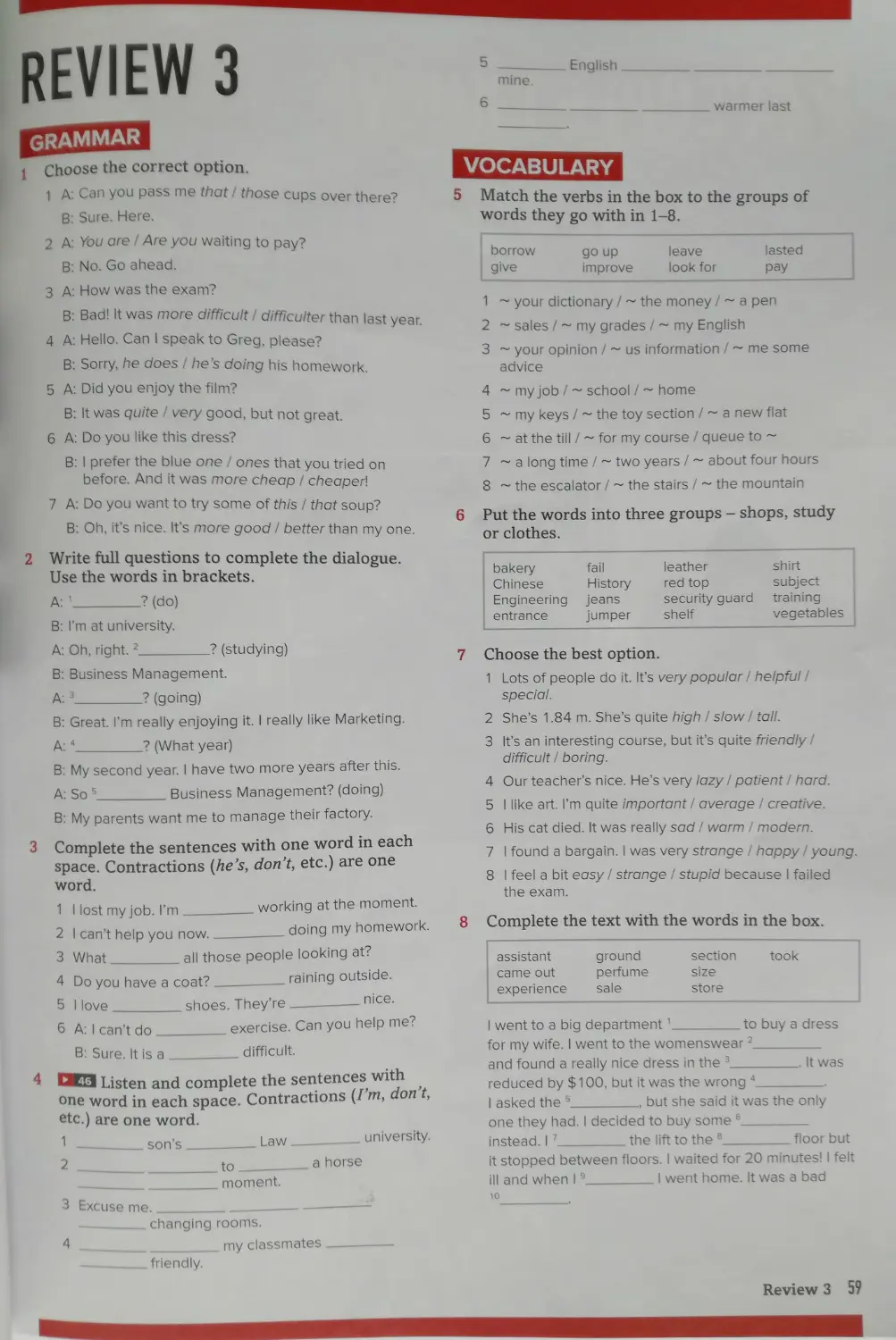


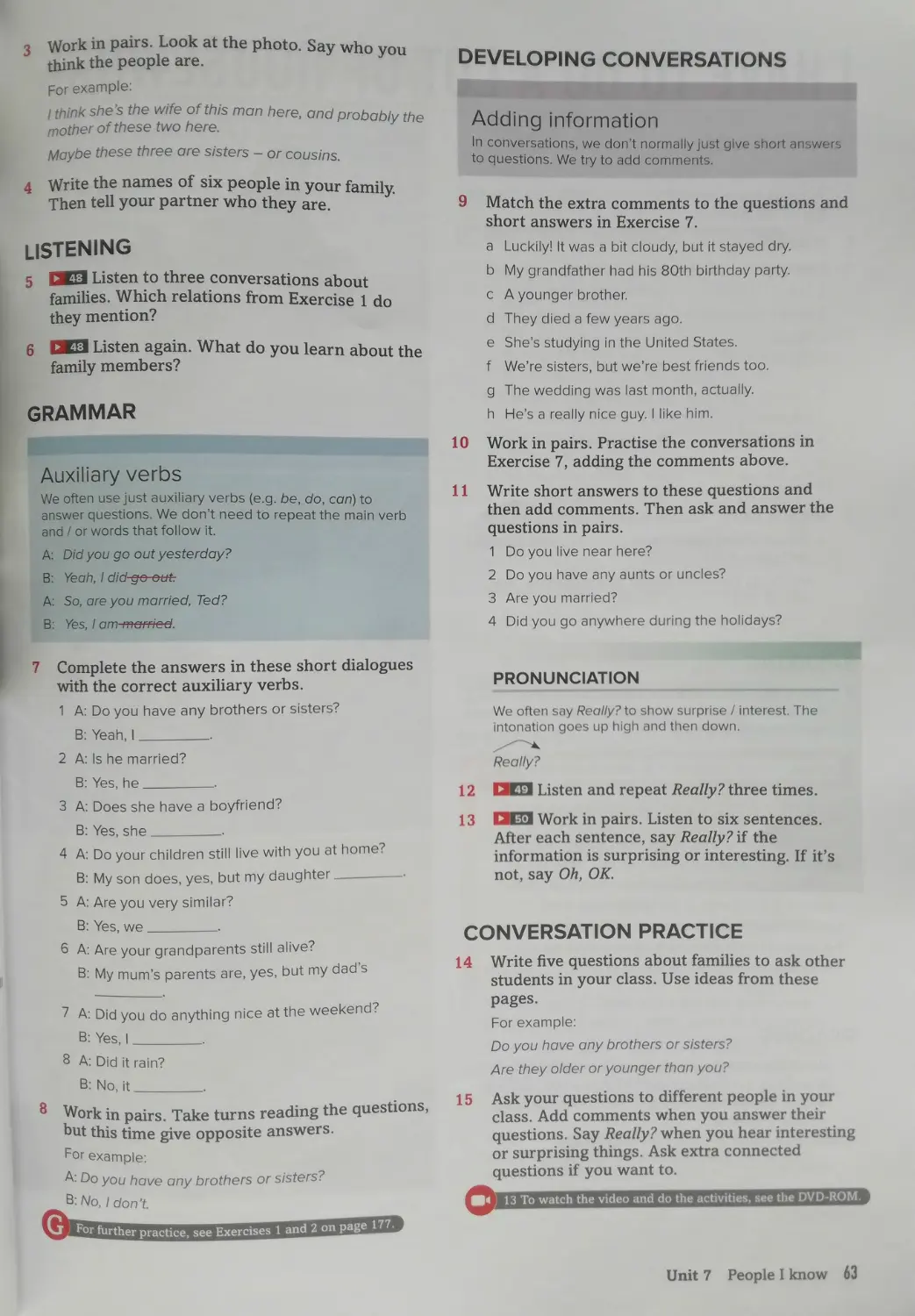


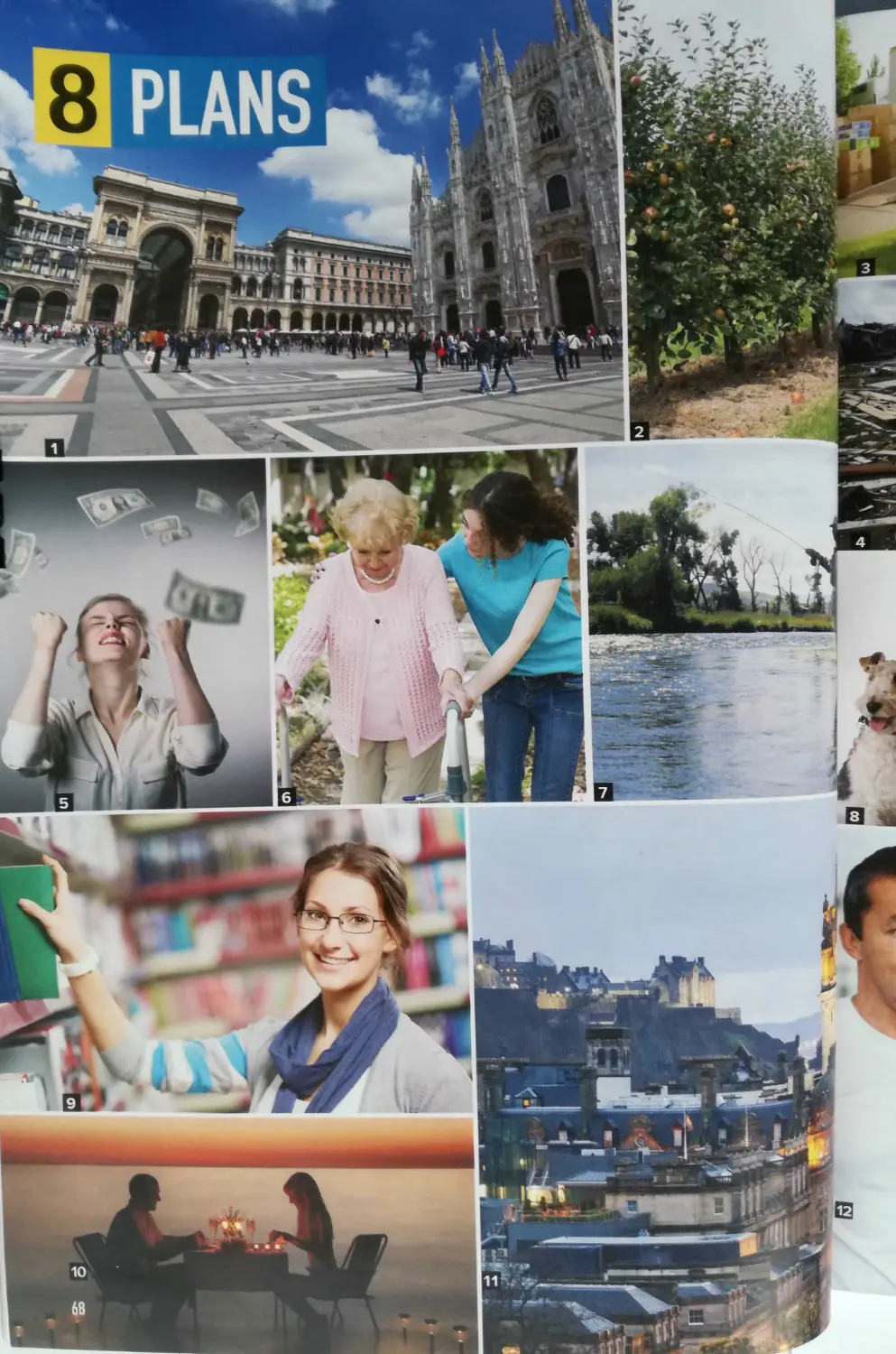

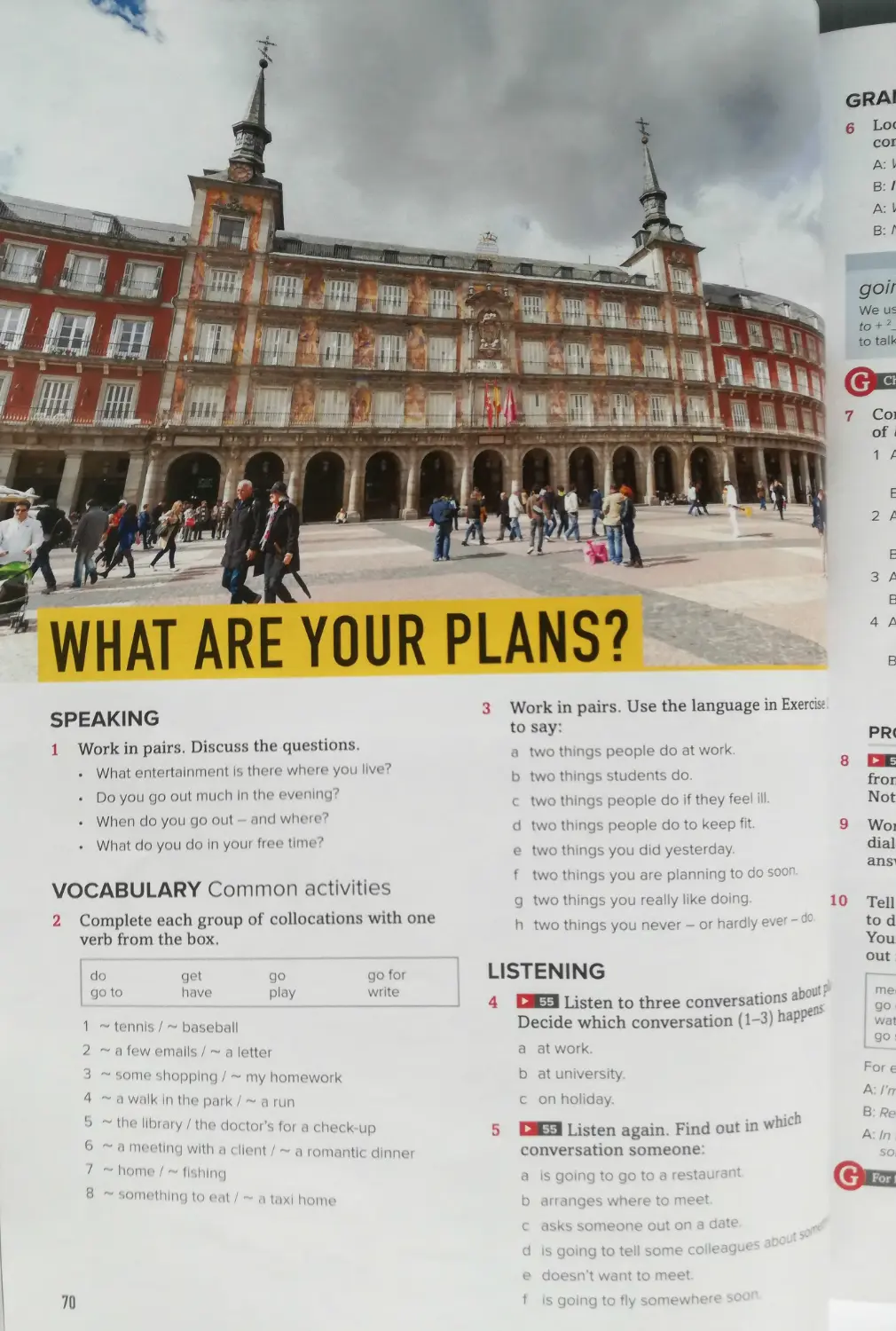




























































Text
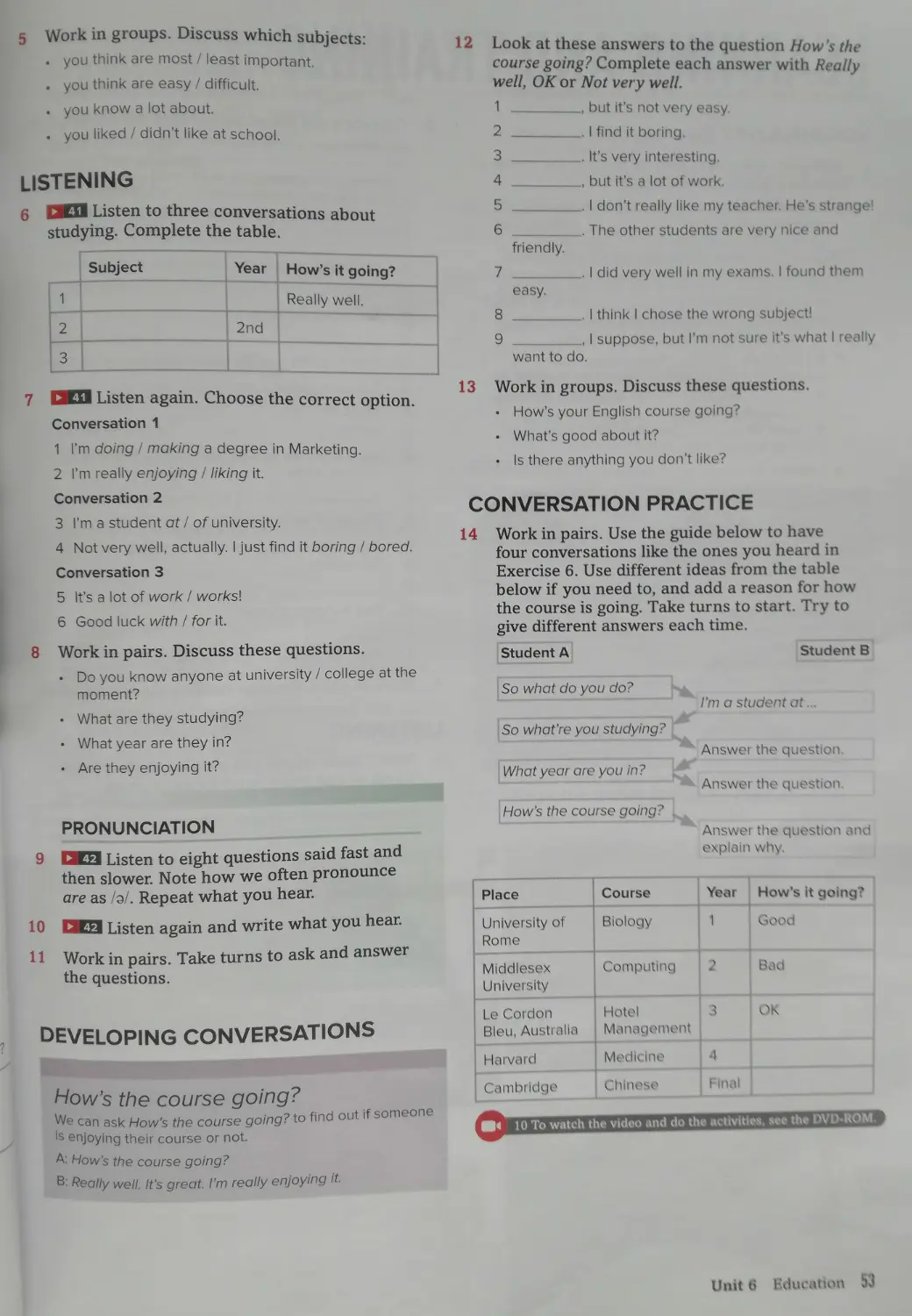
IN THIS UNIT YOU LEARN HOW TO:
PEOPLE AND
PLACES
•	describe people and places
•	introduce yourself
•	explain where you are from
•	talk about jobs and where you work
•	ask and answer common questions
•	say more about your town / city
Gl
. b
. F
. ti
page 6
•	talk about free-time activities
•	discuss what you like - and don’t like ,
•	arrange to meet
•	describe your daily life
•	talk about how often - and when - you do things
•	use more English in class
page 14
Il |* HOME
HOLIDAYS
SHOPS
EDUCATION
VIDEO 1: A famous city page 22 REVIEW 1 page 23 WRITING 1: Forms page 150
page 24
page 32
page 50
page 60
PLANS
•	talk about the area you live in
•	name things you often buy and do
•	explain where things are
•	explain what you need to do
•	describe your house/flat
•	ask people to do things
•	talk about what you did in the past
•	comment on what people tell you
•	talk about dates and months
•	ask and answer questions about holidays
VIDEO 2: Alex the parrot page 40 REVIEW 2: page 41 WRITING 2: Pen friends page 152
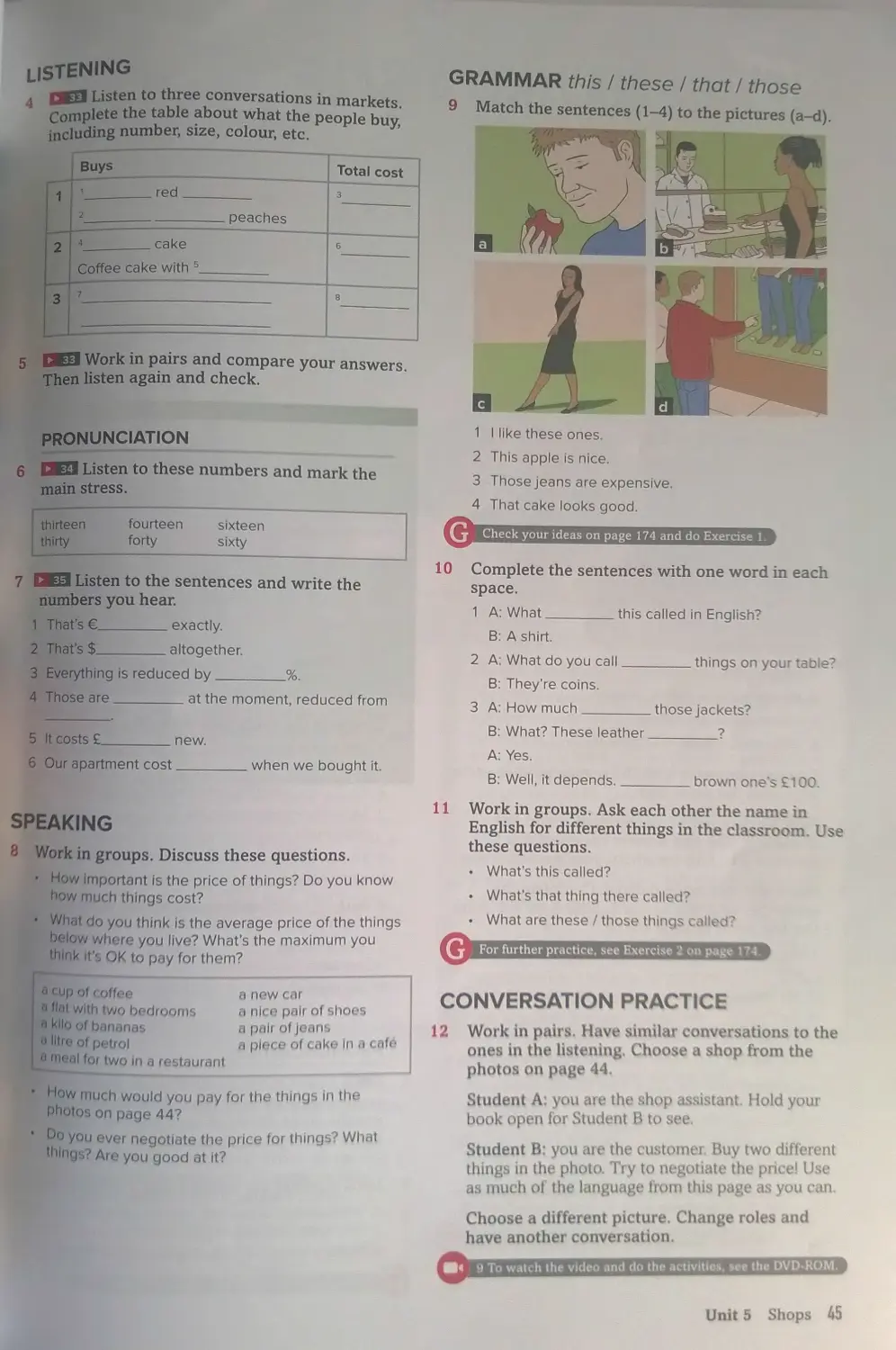
•	describe what you want
•	talk to a shop assistant
•	understand prices
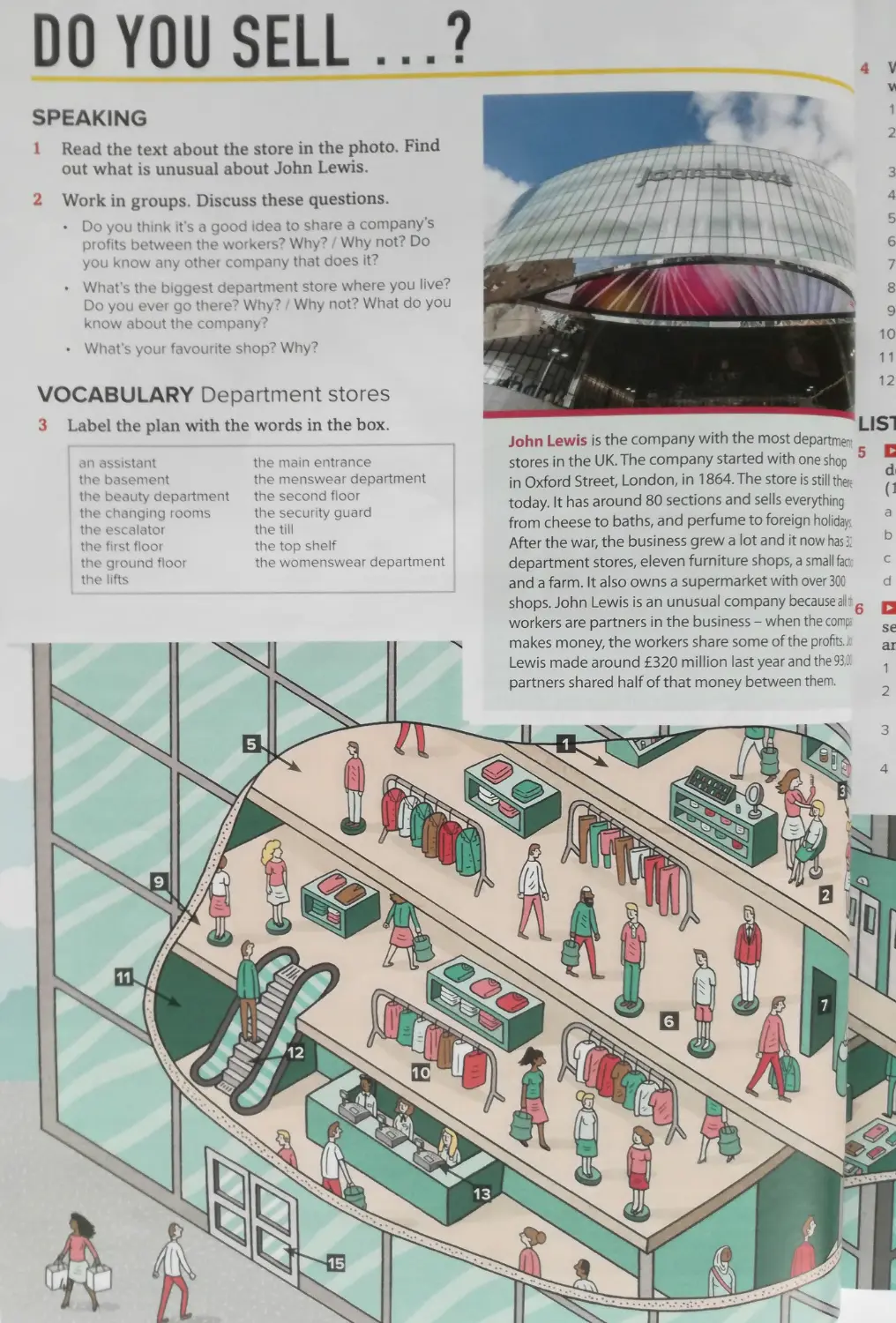
•	talk about department stores
•	talk about things happening now
	give excuses
„„ л->	• follow directions in a store
page 42
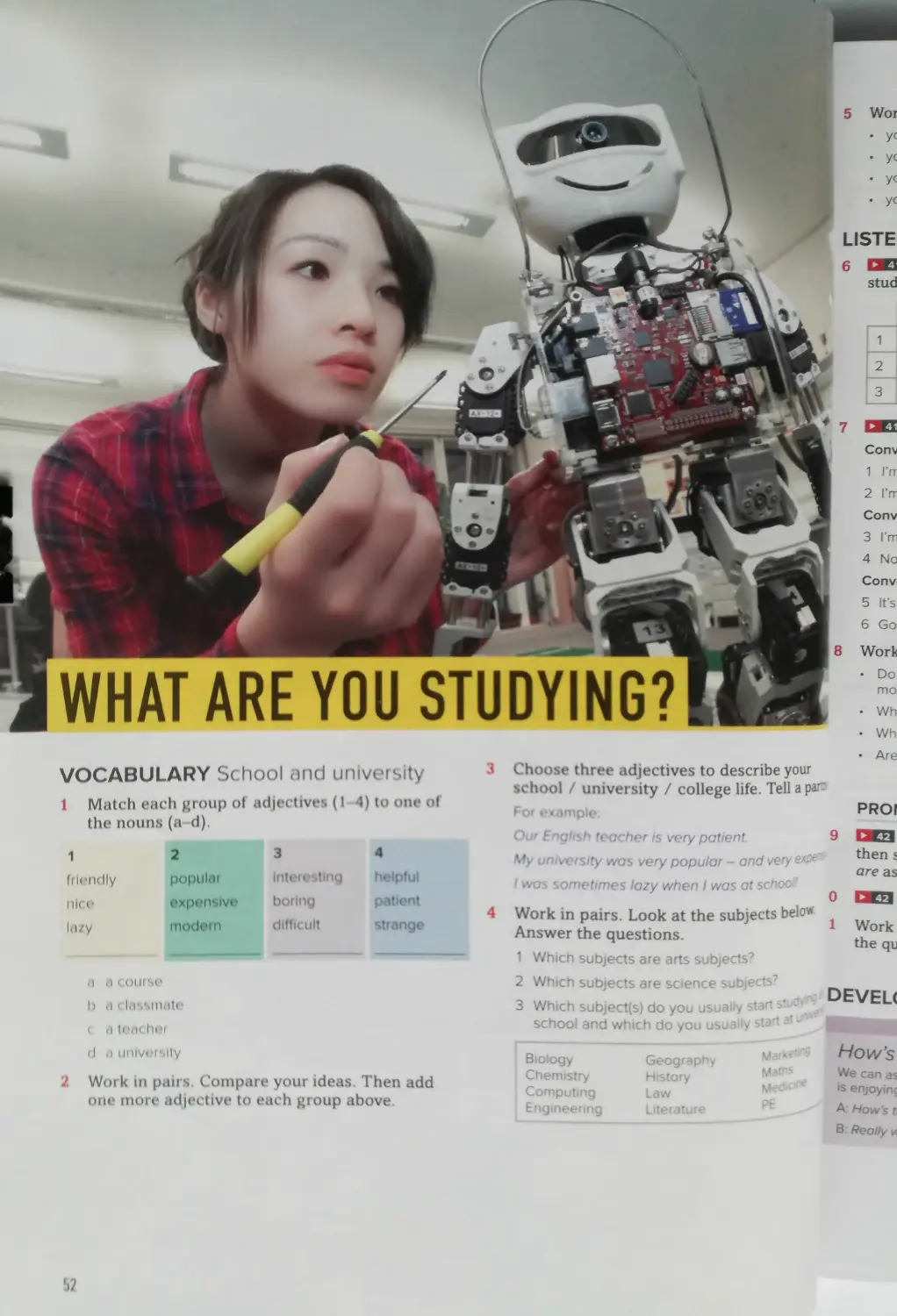
•	describe classmates and teachers
•	name school and university subjects
•	talk about courses you’re doing
•	talk about languages and education
•	give opinions about what’s better
VIDEO 3: Photo camp page 58 REVIEW 3: page 59 WRITING 3: Cards page 154
•	talk about your family
•	express surprise
•	give opinions about family life
•	talk about things that are necessary or not
necessary
•	talk about people you know
•	talk about people’s plans
•	make simple suggestions
•	talk about things you’d like to do
•	discuss government plans
•	give basic opinions and reasons
page 68
VIDEO 4: Two Kenyan guys in Texas page 76 REVIEW 4: page 77 WRITING 4: Making arrangements page 156
2
gs
GRAMMAR
be
I present simple
’ .ere is / there are
VOCABULARY
• Countries
• Jobs and workplaces
• Describing places
READING
• My home town
LISTENING
• Language school
interview
• What do you do?
DEVELOPING CONVERSATIONS
• Which part? Saying where
you’re from
Verb patterns	• Free-time activities	• Do you have any	• Do you like ...?	• Arrangements
Adverbs of frequency . Countable and Г uncountable nouns	• Daily life • In an English class	free time?	• In an English class
		H	.	^positions of place И	.	-ouns, possessive В	iCjectives and's UM 1 . con can't	• Local facilities • In the house • Understanding vocabulary: Collocations	• Me and my family	• Asking about shops and other places • Problems at home	. Asking for information
		В I	.	st	simple 1	.	- mple negatives 1	.		s mple questions	• Holiday and weekend activities • Months, seasons and dates • Going on holiday	• A holiday in Ireland	• Talking about the weekend • Talking about a public holiday	• That sounds...
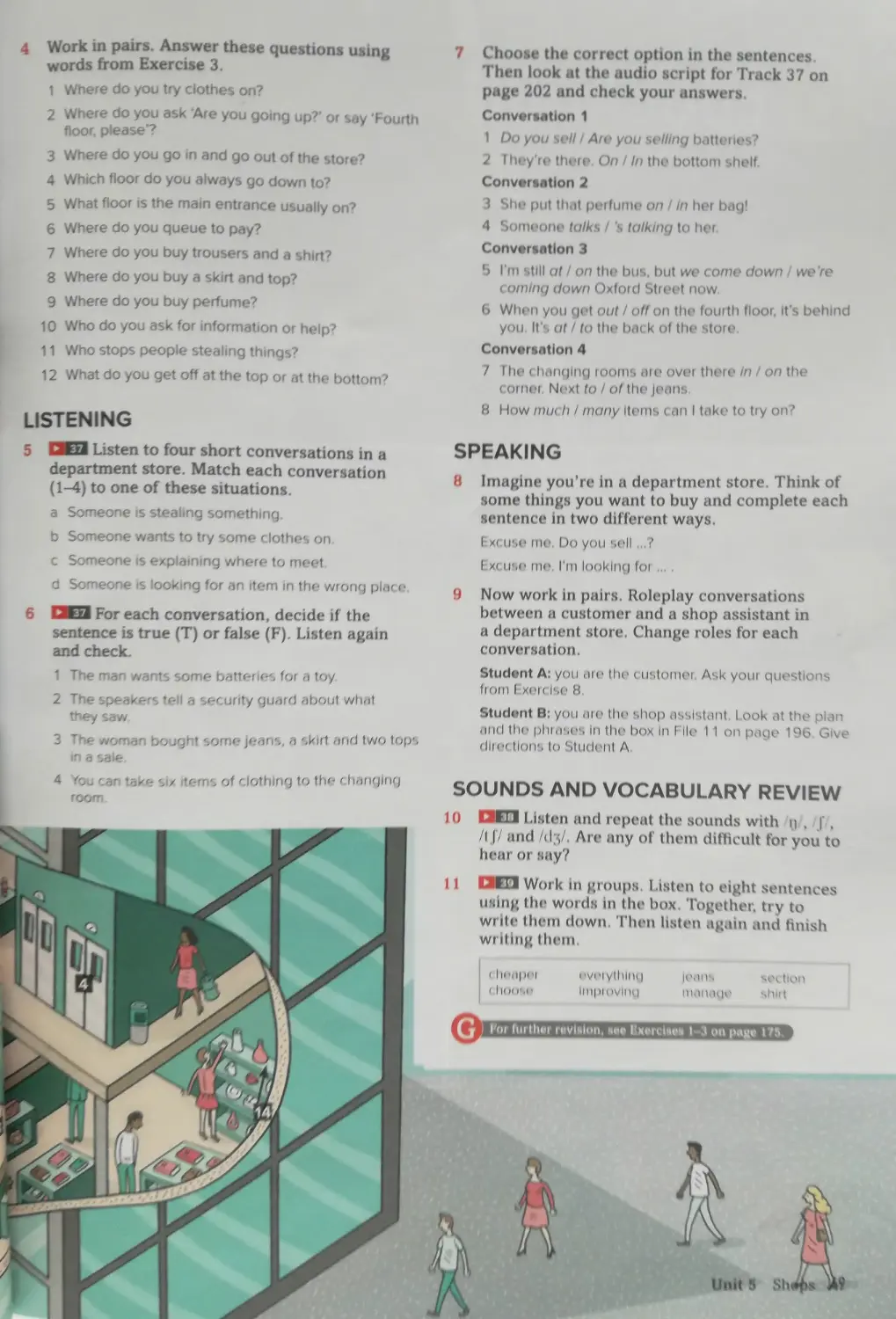
		И 1 •	rnese / that / se M 1	- "t continuous	Describing what you want • Department stores	• A big sale  John Lewis	• At the market • In a department store	• Questions in shops
		Bg 1  c tiers И !	natives	• School and university • Courses • Languages	• The world in a school	• What are you studying? • Talking about different courses	• How’s the course going?
-ary verbs to/ don’t i	to	Relationships • Jobs and activities in the home  Describing people	 Debate of the week: Working parents • A little help from your friends	• My family • Talking about different kinds of friends	• Adding information
'-'ng to 1	'id like to + verb	• Common activities • Life events and plans • For and against	• Your opinion matters!	• Making plans • I'd really like to ...	• Making suggestions
Contents 3
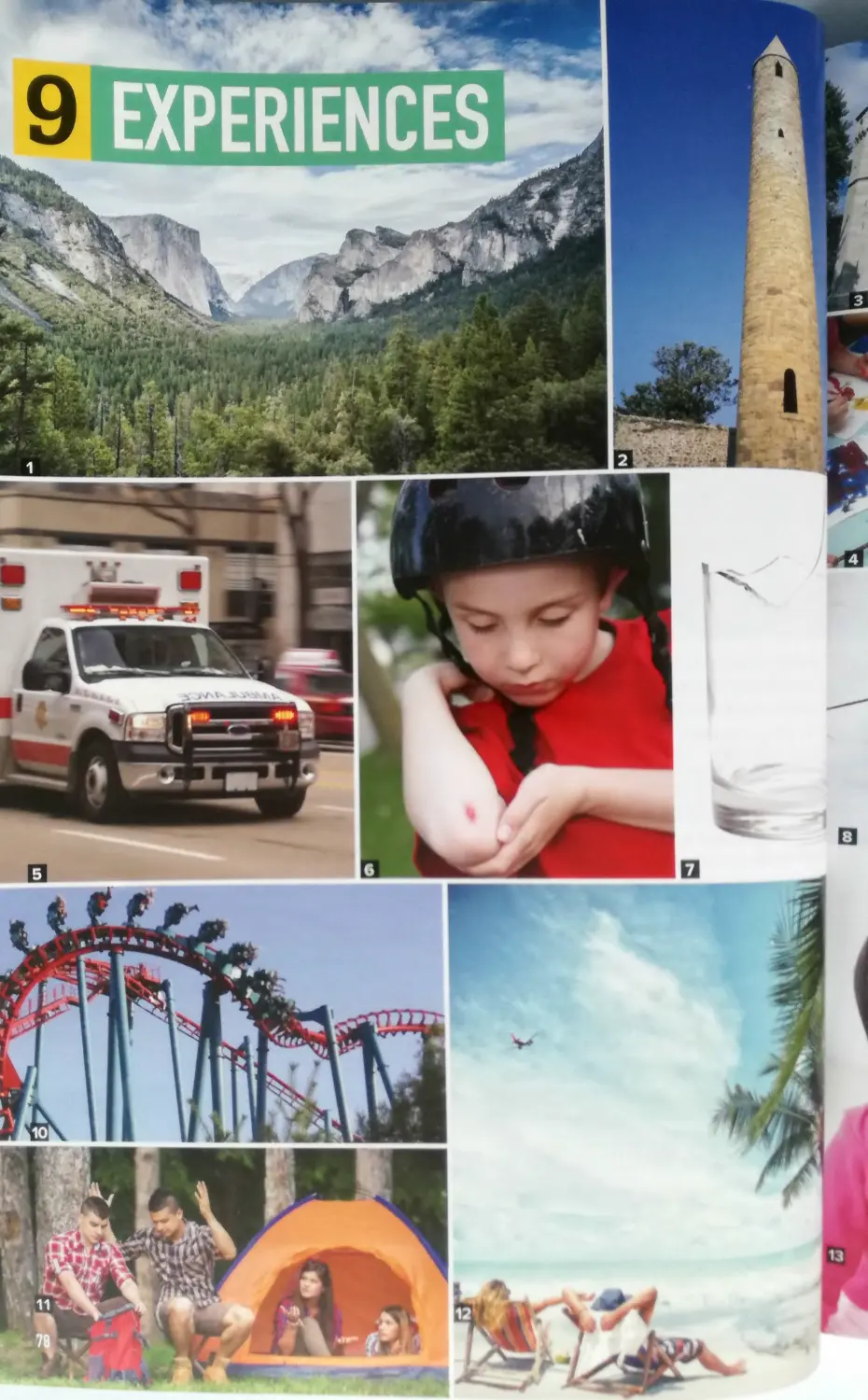
EXPERIENCES
page 78
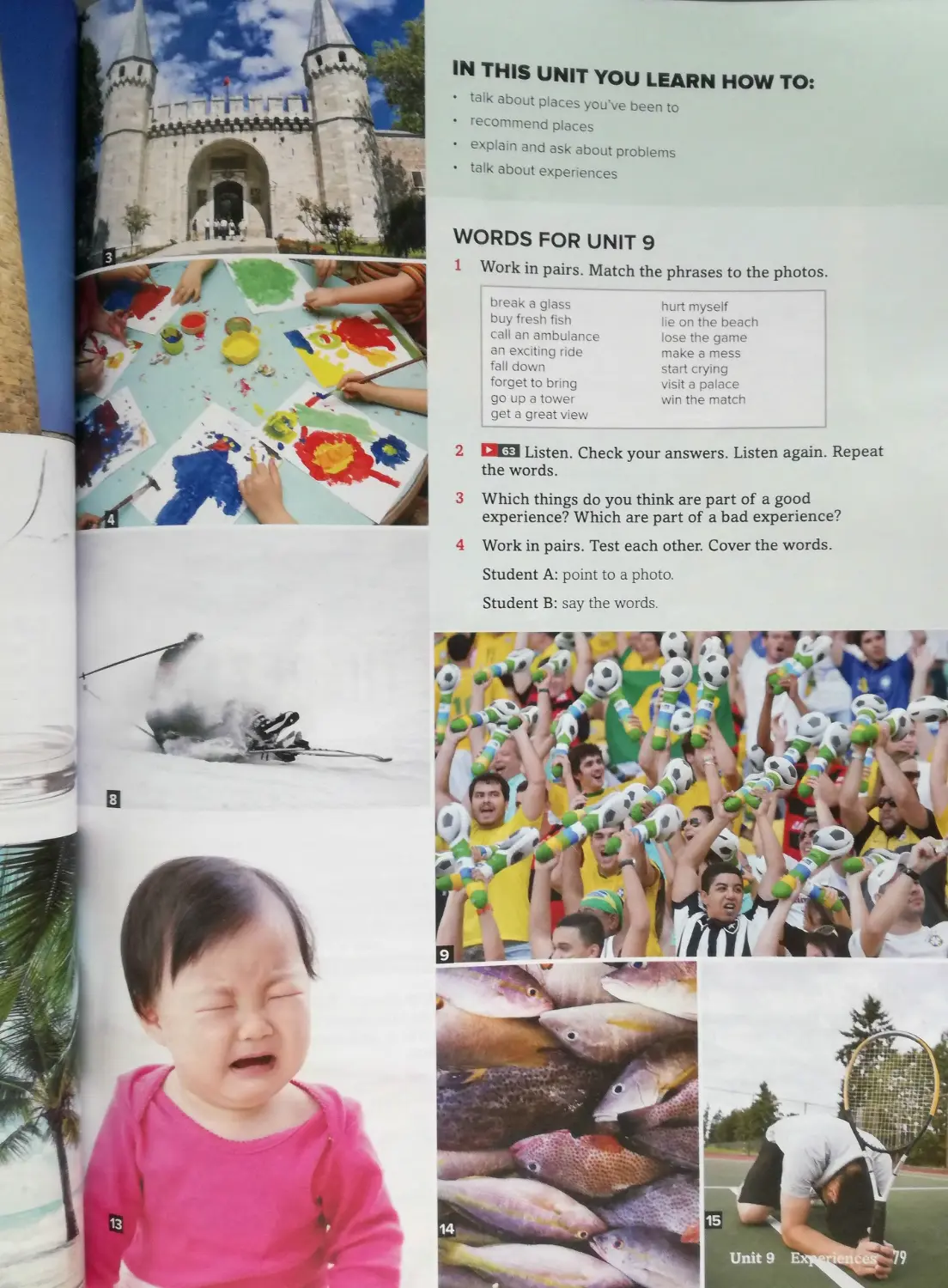
IN THIS UNIT YOU LEARN Hqw Tq
. talk about places you’ve been to
• recommend places
. explain and ask about problems
. talk about experiences
. Pr
. Pc
TRAVEL
•	talk about train travel
•	buy tickets
•	talk about the time
•	talk about transport where you live
. recommend places
page 86
VIDEO 5: Barcelona’s street life page 94 REVIEW 5: page 95
WRITING 5: Visiting friends page 158
•	order and pay in restaurants
•	understand menus
•	describe different kinds of food
•	agree and disagree with statements
•	talk about what you eat
page 96
•	talk about health problems
•	give advice
•	say no to offers and advice
	talk about how you feel and why
•	understand some news stories
page 104
VIDEO 6: Wearing a glove of venomous ants page 112 REVIEW 6: page 113 WRITING 6: Describing food page 160
NATURE
•	talk about the weather
•	talk about possibilities in the future
•	ask for more details
•	talk about the countryside and the city
•	talk about animals
•	talk about duration
page 114
OPINIONS
page 122
•	give your opinion about films, plays and musicals
•	ask for descriptions and opinions
•	discuss news and newspapers
•	make predictions about the future
 talk about society and social issues
VIDEO 7: National symbols page 130 REVIEW 7: page 131 WRITING 7: Describing photos page 162
page 132
page 140
•	talk about useful machines
•	find out how much people know
•	talk about computers and the internet
•	spell and give addresses
•	explain what’s good about apps and websites
•	describe different events in relationships
•	give news about relationships
•	explain when and where you met people
•	make promises
VIDEO 8: Snow magic! page 148 REVIEW 8: page 149 WRITING 8: Messages page 164
4
GRAMMAR
VOCABULARY
READING
LISTENING
DEVELOPING CONVERSATIONS
present perfect
past participles
• Problems
• Describing
experiences
• Unforgettable!
• On holiday in Turkey • Recommending
• What have you done?
too much, too many
and not enough
Superlatives
Trains and stations
Transport
• Taxi!
Buying a train ticket • Telling the time
Asking for	• Where’s the best place?
recommendations
. me too, me neither and auxiliaries . Explaining quantity	• Restaurants	. My eating habits	• In a restaurant	• Ordering food and drink ’ Food	. Talking about food • Understanding vocabulary: Forming negatives by adding un-
• should / shouldn't
• because, so and after
Health problems
Feelings
In the news
• Happiness around
the world
• In the news today
• Are you OK?
• A mixed day
• Saying no
• might and be going to	• Weather • The countryside and	• Six reasons not to ...	• What’s the forecast? • Talking about animals	• Short questions
• Present perfect to	the city
say how long	• Animals

• will won’t for predictions  Adjective + verb	• Describing films, plays and musicals • Life and society	• Comments on the news • A new life	• Talking about films and musicals A news report	• What’s it like?
• be thinking of+ -ing • Adverbs	• Machines and technology • Computers and the internet • What technology does	• Technology - love it or hate it? . Technology can save us	• Talking about technology . A questionnaire about computers and technology.	• Do you know much about...?
Past continuous W'll 1 won’t for Promises	• Love and marriage	• Poems about promises	. News about relationships . Love at first sight	• Did 1 tell you ...?
...	1Q2-196 Audio scripts pages 197 213
dammar reference pages 166-191 Information files pg
Contents 5
PEOPLE AND PLACES
I
IN THIS UNIT YOU LEARN HOW TO:
•	describe people and places
•	introduce yourself
•	explain where you are from
•	talk about jobs and where you work
•	ask and answer common questions
•	say more about your town / city
SPEAKING
1 Talk to other students. Tell each other your names.
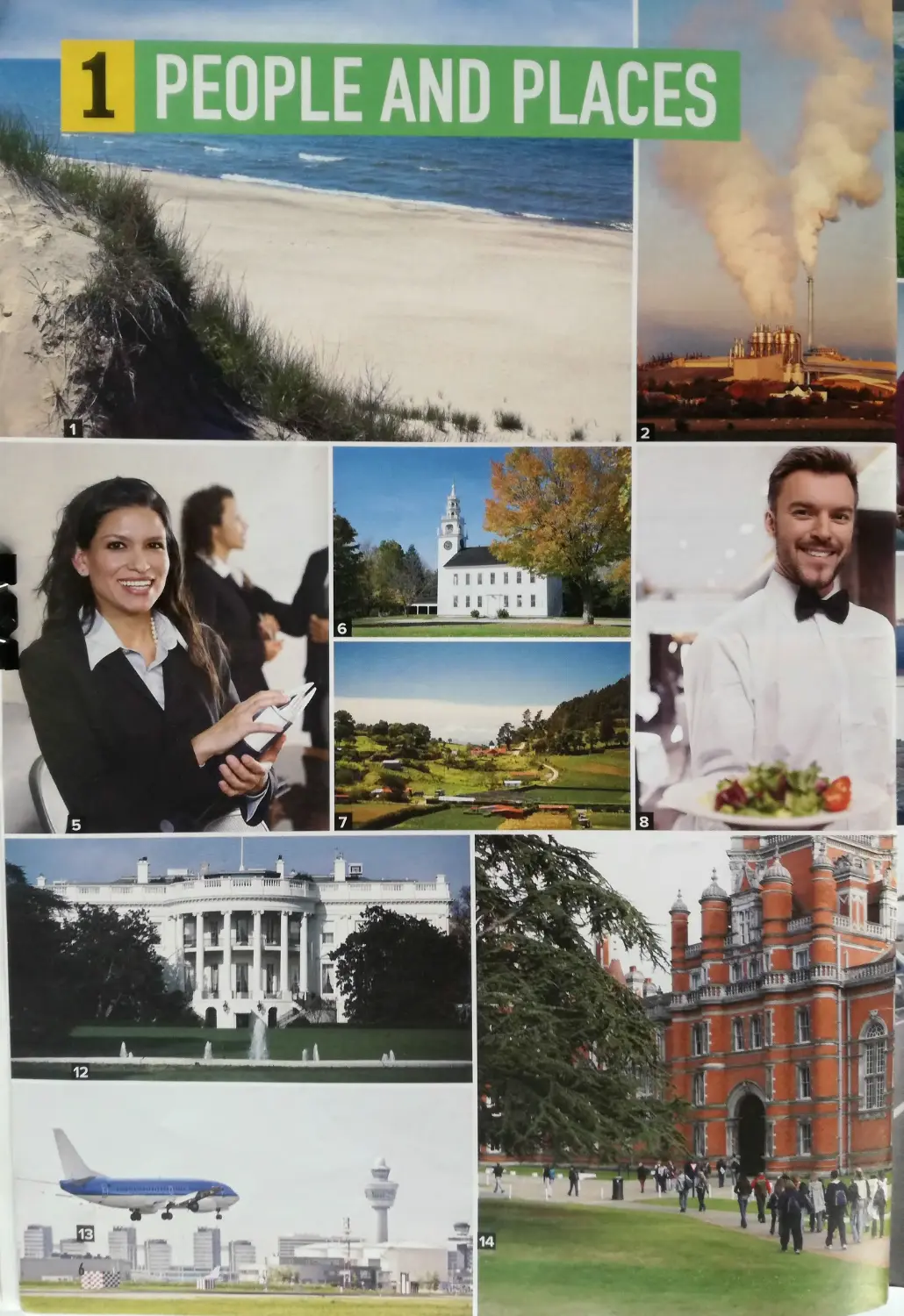
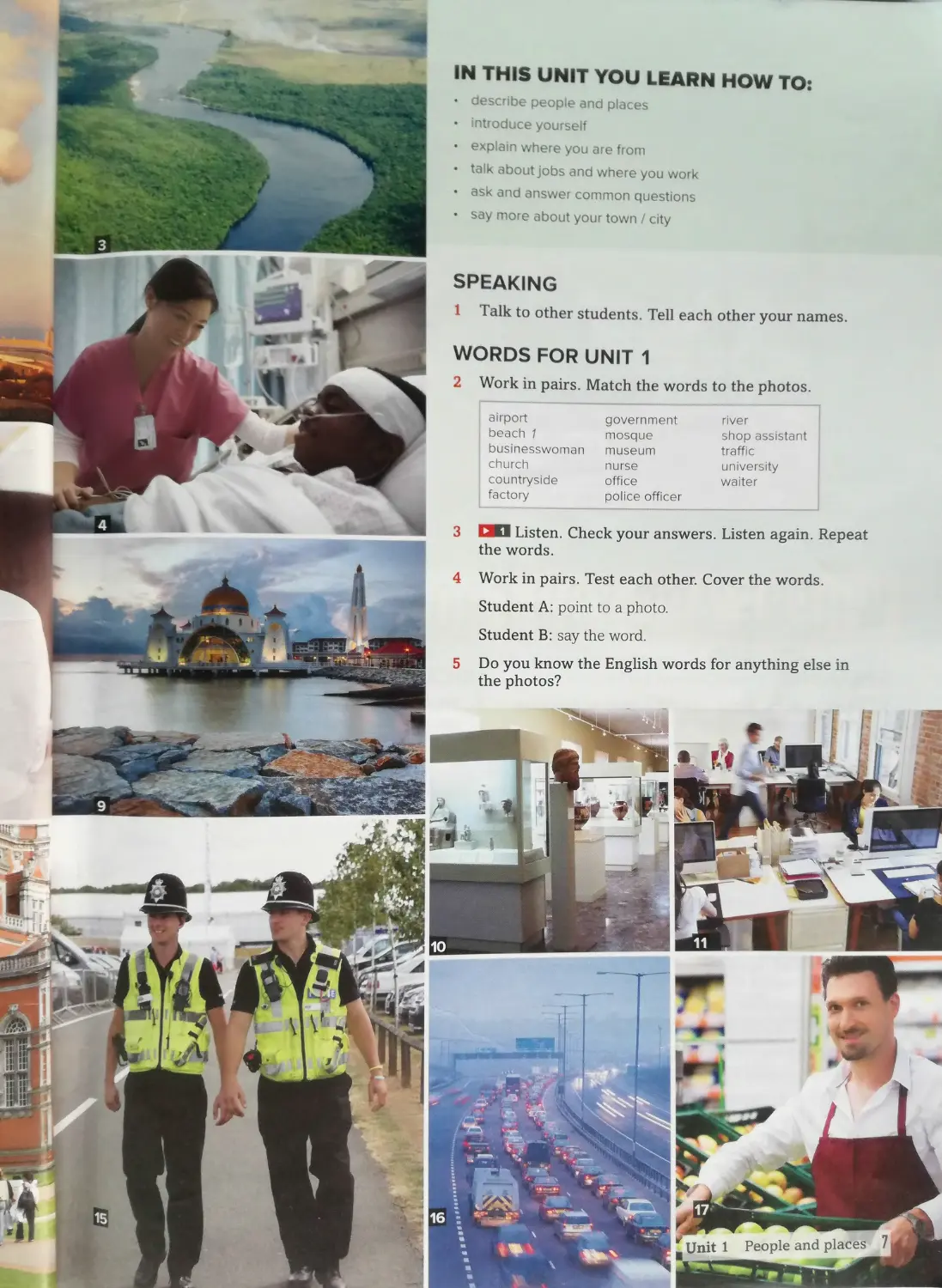
WORDS FOR UNIT 1
Work in pairs. Match the words to the photos.
airport	government	river
beach 1	mosque	shop assistant
businesswoman	museum	traffic
church	nurse	university
countryside	office	waiter
factory	police officer
2
3	DU Listen. Check your answers. Listen again. Repeat
the words.
4	Work in pairs. Test each other. Cover the words.
Student A: point to a photo.
Student B: say the word.
5	Do you know the English words for anything else in
the photos?
L
I
f
I
I
8
WHERE ARE YOU FROM?
SPEAKING
VOCABULARY Countries
1 Work in pairs. Try to say the names of everyone
in your class.
That’s Yuki.
That’s Carla.
What’s his name?
Marco.
What’s her name?
I don’t know.
LISTENING
Listen to a teacher and a student at an
English-language school. Tick (/) the sentences
that are true.
1 The student’s surname is Miguel.
2 He’s from Spain.
3	He works in a city called Chihuahua.
4	The city is in the east.
5	It’s hot in the city now.
6	He’s a businessman.
3 DEI Listen again. Correct the sentences in
Exercise 2 that aren’t true.
5 Work in pairs. Match the countries in A to the
parts of the world in B.
A	В
Costa Rica	Africa
Brazil	North America
Italy	Central America
Canada	South America
China	the Middle East
Saudi Arabia	Europe
Kenya	Asia
6 Write one more country in each part of the
world. Use a dictionary if you need to. Then
work in pairs.
Student A: say the country.
Student B: say the part of the world.
7	Look at the photos on pages 6 and 7. Say what
country or part of the world you think they
are in.
For example:
I think the beach in the photo is in Europe.
This photo is in Turkey. It’s Istanbul.
4 Work in pairs. Look at the audio script on
page 197. Practise reading out the conversation.
8
DEVELOPING conversations
GRAMMAR
Which part?
Look at the questions we ask to find out where someone
is from.
Where are you from ?
I’m from Mexico.
I- Oh, OK. Which part?
M: Chihuahua. It's in the north.
8 Look at the map below. Complete these
sentences with places on the map.
1	I’m from-the capital.
2	I’m from- in the north.
3	They’re from- in the south.
4	I’m from- in the east.
5	My mum’s from- in the west.
6	My dad’s from- in the middle.
be
Be has three forms in the present tense: ’m (am), ’s (is),
’re (are).
We add not for negatives.
10 Complete the tables with the correct form of be.
Statement
1		(not)	30. late. a teacher. OK. a good student, at the airport. from Moscow.
He She It
You We They
Question
	1	OK?
	you they
	it
• PARRAL
• LAPAZ
• TAMPICO
• LEON
• MEXICO CITY
• ACAPULCO
11 Complete the sentences with the words in
brackets and the correct form of be.
1	How? (you)
2	Where from? (your granddad)
3	from Spain, (my parents)
4	a receptionist in a hotel. (I)
5	It a good job. (not)
6	a very big city. (Tokyo)
7	How old? (Miguel)
8	late? (we)
9	cold? (you)
10	a boring place, (it)
12
► з
Listen
sentences.
and check your answers. Repeat the
Use countries from Exercises 5 and 6 - or
use cities / areas in your country - to have
conversations like this:
A:	Where are you from?
B:	Brazil.
A: Which part?
Recife.
C- Where are you from?
D: /’m from Rome.
C Which part?
D- Moreno - in the south.
13 Work in groups. Ask students where their
parents / grandparents are from.

e 2 on p

CONVERSATION PRACTICE
14 Look at the questions. Write one more question
to ask. Then use all the questions and have
conversations with other students.
• Hi. How are you?	• And where are you from?
• What’s your name?	• Oh, OK. Which part?
К 1 To watch the video and do the activities, see the DVD-ROM.
Unit 1 People and places 9
VOCABULARY Jobs and workplaces
1 How many jobs can you write in English in one
minute?
2 Find out what jobs people in your class do. Ask:
What do you do?
3
Match the jobs (1-8) to
(a-h).
1	a receptionist
2	a teacher
3	a shop assistant
4	a nurse
the places people work
5 a police officer
6 a waiter
7 a designer
8 a civil servant
4 Work in pairs. Use the ideas in Exercise 3. Have
three different conversations. Use this model:
A:	What do you do?
B:	I’m a waiter.
A:	Oh, yes? Where do you work?
B:	In a cafe in town. What do you do?
A: I’m a designer.
B:	Where do you work?
A: In a studio in Berlin.
LISTENING
a in a clothes shop / in Harrods
b in a clinic / in a hospital
c in a tax office / in a local government office
d at home / in a studio
e in a big hotel / in a small company
f in a school / in a university
g at a local police station / in the traffic department
h in a cafe / in a restaurant
Listen to four conversations. Circle the
words you hear.
1 Jan is a doctor I a nurse in a clinic / a hospital in
Warsaw.
We use a I an with jobs.
I m a teacher. My sister’s a designer. My dad’s an artist.
2	Lara is a designer/ a teacher in a school an office
in Bristol. She enjoys / doesn't enjoy it.
3	Marta is a civil servant / a receptionist. She works
an office / a company in the north of Brazil. Her i<4
great / OK.
4	Filippo is a waiter / a shop assistant in a depart c ,
store / a cafe in the centre of town. He doesn t 1
He wants to become a police officer / a nurse
6	Work in pairs. Look at the audio script on
page 197. Choose one of the conversations
practise reading it out.
5
► 4
(j

10
7 Read these sentences,
job? Write / or X.
1 । want a different job.
2 It’s great.
3 The people are
really nice.
4 The money’s bad.
Do the people like their
5 It’s interesting.
6 I do very long hours.
7 It’s boring.
8 I work at night. It’s not
good.
8 Ask different students these questions.
. What do you do?
. Where do you work?
. Do you enjoy it?
grammar
Present simple
Look at these examples of the present simple.
I live in Rio Branco. She works in an office.
I don’t speak French.	He doesn’t like it.
Where do you work?
Do you enjoy it?
9 Complete the table with -s, do, does, don’t and
doesn’t.
11 You / We / They live there.
He / She / It live1__________there.
Negatives
I / you / we / they + 2__________+ infinitive
he I she / it + 3__________+ infinitive
Questions
4___________+ I / you / we / they + infinitive?
5___________+ he / she / it + infinitive?

n page 161
10 Complete the text with the correct form of the
verbs in brackets.
11 Write about three people you know. Then tell a
partner.
For example:
My friend Juan is a teacher. He works in a school.
He likes his job because the people are nice. /
He doesn’t like his job because the pay is bad.
12 Put the words in the correct order to complete
the questions. The first one is done for you.
1 What do / you / in / free time / do / your / ?
What do you do in your free time?
2	Where	live / do / you / ?
3	Who	with / you / do / live / ?
4	How	go / do / there / you / ?
5	What time	you / do / get / up / ?
6	When	to bed / you / go / do / ?
7	How many	languages 1 you / speak / do / ?
8	Do	you / to go / out / want / ?
13 Match the answers (a-h) to questions 1-8 in
Exercise 12.
a I live on my own.
b At about twelve o’clock most nights.
с I go swimming, I play football, I read.
d In Belvaros, near the river.
e I take the bus.
f Two - French and Spanish.
g Sure. Where do you want to go?
h At half past seven.
PRONUNCIATION
14 □□ Listen to ‘do you’ - first fast, then slow.
Then listen to five questions from Exercise
12 - first fast and then slow. Repeat them.
15 Work in pairs.
Student A: ask the questions in Exercise 12.
Student B: say the answers in Exercise 13.
My wife’s a journalist. She 1_____________(work) for a local
newspaper. 12______(not see) her a lot because she
3—	(do) very long hours. She4 5---(get
up) early and she sometimes works all night. When she
5-------(have) free time, we6(not go out),
because she only wants to sleep! But she7--(not
want) a different job because her job 8-(be) very
interesting and she 9___(like) it a lot.
People and places 11

s 2 and 3 on page 167. ;
SPEAKING
16
Choose five questions from these pages.
Write one more question.
Then work in pairs.
Ask and answer
your questions.
A NICE PLACE TO LIVE
VOCABULARY Describing places
1	Work in pairs. The first page of this unit has ten
words for places. How many do you remember?
2	Look at page 7 and check. Say the plural of the
words. Which word has an irregular plural?
Which two words have no plural?
3	Choose the correct words.
1	It’s a small I big city. Ten million people live there.
2	I don’t go swimming there because the beaches are
very quiet / dirty.
3	It’s very hot / cold in the summer: 35 or 40.
4	It’s a very expensive I famous town. Everyone
knows it.
5	It doesn’t have any shops. It’s busy I boring'.
6	It’s very cheap / safe. My house is only 400 euros
a month.
7	A lot of people visit in the summer. It’s very busy I
quiet.
8	I really like it. It’s a great / boring place to live.
9	The countryside is very nice. It’s a dirty / beautiful
area.
10	It’s very famous / safe. I walk everywhere - day and
night.
4 Work in pairs. Say places you know using the
ideas below. Do you agree?
•	is a very big city.
•	is very quiet.
•	is very cold in the winter.
• is very expensive.
. is a beautiful area.
. is a very famous town.
READING
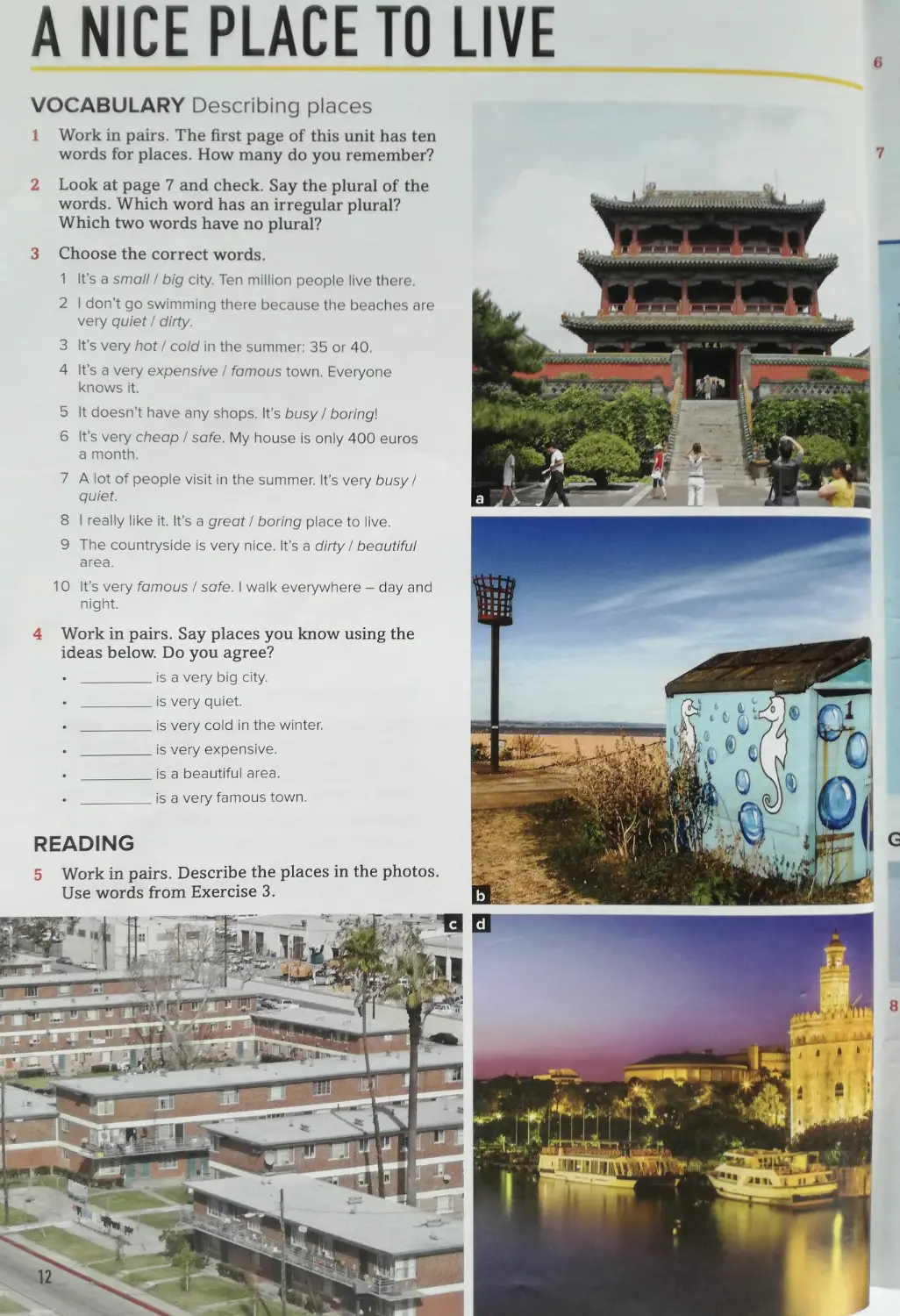
5 Work in pairs. Describe the places in the photos.
Use words from Exercise 3.
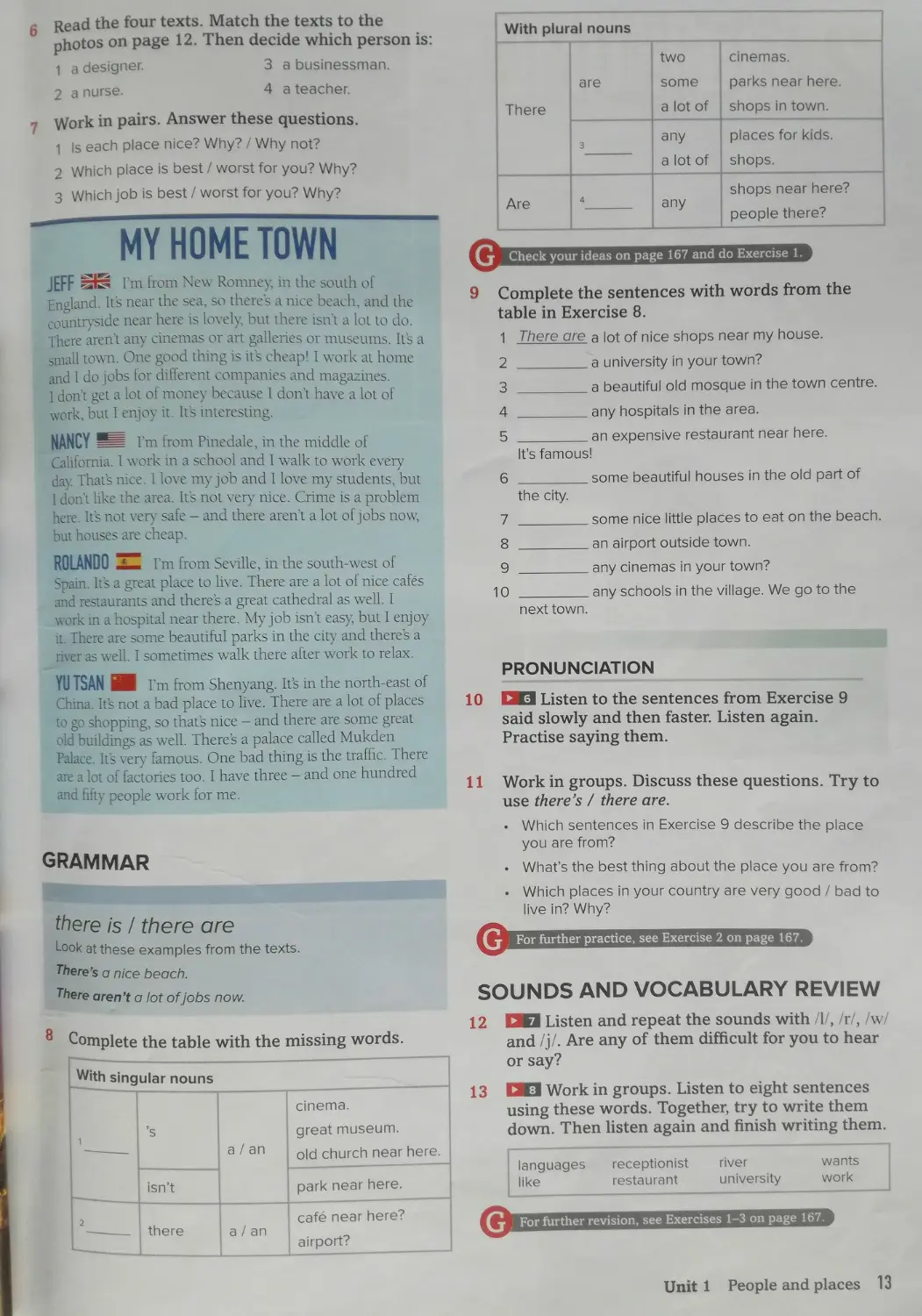
6 Read the four texts. Match the texts to the
photos on page 12. Then decide which person is:
1 a designer.	3 a businessman.
2 a nurse.	4 a teacher.
7 Work in pairs. Answer these questions.
1	Is each place nice? Why? I Why not?
2	Which place is best I worst for you? Why?
3	Which job is best / worst for you? Why?
MY HOME TOWN
JEFF Oe; I’m from New Romney, in the south of
England. Its near the sea, so there's a nice beach, and the
countryside near here is lovely, but there isn't a lot to do.
There aren’t any cinemas or art galleries or museums. It’s a
small town. One good thing is it's cheap! I work at home
and 1 do jobs for different companies and magazines.
1 don't get a lot of money because 1 don't have a lot of
work, but I enjoy it. It's interesting.
NANCY  I'm from Pinedale, in the middle of
California. I work in a school and I walk to work ever}'
day. Thai’s nice. 1 love my job and I love my students, but
I don’t like the area. Its not very nice. Crime is a problem
here. It's not very safe - and there aren't a lot of jobs now,
but houses are cheap.
ROLANDO ZZ I’m from Seville, in the south-west of
Spain. It’s a great place to live. There are a lot of nice cafes
and restaurants and there’s a great cathedral as well. I
work in a hospital near there. My job isn’t easy, but I enjoy
it. There are some beautiful parks in the city and there’s a
over as well. I sometimes walk there after work to relax.
YUTSAN a I’m from Shenyang. Its in the north-east of
China. It’s not a bad place to live. There are a lot of places
to go shopping, so that's nice - and there are some great
old buildings as well. There’s a palace called Mukden
Palace. It’s very famous. One bad thing is the traffic. There
are a lot of factories too. I have three - and one hundred
and fifty people work for me.
With plural nouns
There	are	two some a lot of	cinemas. parks near here, shops in town.
	3	any a lot of	places for kids, shops.
Are	4	any	shops near here? people there?
9 Complete the sentences with words from the
table in Exercise 8.
1	There are a lot of nice shops near my house.
2	a university in your town?
3	a beautiful old mosque in the town centre.
4	any hospitals in the area.
5	an expensive restaurant near here.
It’s famous!
6	some beautiful houses in the old part of
the city.
7	some nice little places to eat on the beach.
8	an airport outside town.
9	any cinemas in your town?
10	any schools in the village. We go to the
next town.
PRONUNCIATION
► 6
10
Listen to the sentences from Exercise 9
said slowly and then faster. Listen again.
Practise saying them.
11	Work in groups. Discuss these questions. Try to
use there’s / there are.
grammar
•	Which sentences in Exercise 9 describe the place
you are from?
•	What’s the best thing about the place you are from?
there is / there are
Look at these examples from the texts.
There’s a nice beach.
There aren’t a lot of jobs now.
• Which places in your country are very good / bad to
live in? Why?
SOUNDS AND VOCABULARY REVIEW
8 Complete the table with the missing words.
With singular nouns
1 			’s	a / an	cinema. great museum. old church near here.
	isn’t		park near here.
2	there	a / an	cafe near here?
I	...			airport?
12 DEI Listen and repeat the sounds with /1/, /г/, /w/
and /j/. Are any of them difficult for you to hear
or say?
13 DEI Work in groups. Listen to eight sentences
using these words. Together, try to write them
down. Then listen again and finish writing them.
languages	receptionist	river
, like	restaurant	university
wants
work

Unit 1 People and places 13

IN THIS UNIT YOU LEARN HOW TO:
•	talk about free-time activities
•	discuss what you like - and don’t like
•	arrange to meet
•	describe your daily life
•	talk about how often - and when - you do things
•	use more English in class
WORDS FOR UNIT 2
1 Work in pairs. Match the activities to the photos.
cooking	meeting new people
dancing	playing computer games
doing sport	playing the guitar
drawing	reading
going out for dinner	singing
going to a concert	swimming
going to the cinema	walking
listening to music	watching TV
► 9
Listen. Check your answers. Listen again. Repeat
the words.
2
3 Work in pairs. Test each other. Cover the words.
Student A: point to a photo.
Student B: say the activity.
4 Do you know the English words for anything else in
the photos?
DO YOU WANT TO COME?
SPEAKING
1 Complete the sentences with activities from
page 15.
1 is boring. 4 is great.
2 is interesting. 5 I’m bad at-----------------•
3 is expensive. 6 I’m good at.
2 Work in pairs. Tell your partner your ideas. Does
your partner agree?
SPEAKING
6 Work in groups. Ask Do you like ...? questions.
Reply with I love it, It’s OK or No, not really.
A: Do you like cooking?
B: Yes, I do. I love it. What about you?
A: It’s OK, but I’m not very good at it.
GRAMMAR
LISTENING
3 Look at the people in the pictures. What
activities do you think they like / don’t like?
► 10
Verb patterns
a After some verbs, we often use -ing.
I love playing tennis.
b After some verbs, we often use to + infinitive.
Do you want to see Love Train?
7 Which sentences are the same as pattern a
above, and which are the same as pattern b?
He really likes swimming.
I need to go now.
I enjoy working on my own.
I want to learn to drive.
Try to use the words you learn.
I hate living in the city.
SSSSSSESSES
1
2
3
4
5
6
8
68 and do Exei
Write full sentences from the notes.
My daughter I want I get I a new phone.
My sister / love / play / tennis.
you I like I dance?
I / try / study English I every day.
11 not / enjoy I shop.
We / need / buy I some things later.
11 really hate / cook.
I / really want / learn / draw.
1
2
3
4
5
6
7
8
4
Listen to the two people talking. Complete
the table with doesn’t like, thinks it’s OK and loves.
PRONUNCIATION
9 am Listen and repeat six sentences with to
+ infinitive. Notice how we often say to as to/.
	Woman	Man
doing sport
walking		doesn’t like
I playing computer games
 going to the cinema	loves
10 Complete the sentences so they are true fory°u
1 I love __________
2 I don’t really like
3 This week I need
4 I want to learn
5 I don’t really enjoy
5 Work in pairs. Look at the audio script on
page 198. Practise reading out the conversation.
11 Work in pairs. Tell your partner your ideas.
;e 2 o:
16
► 12
DEVELOPING CONVERSATIONS
13
Listen to two conversations where people
make arrangements. Choose the correct words
in the notes.
Arrangements
We can make future arrangements using the present simple.
A:	Do you want to go shopping on Saturday?
B:	OK. Where do you want to meet?
A:	Outside Harrods - the big department store.
B:	OK. What time?
A:	Is ten OK?
B:	Yeah. Fine.
12
Match the questions in the box to the pairs of
possible answers in 1-5.
Do you like going to the cinema?
Do you want to see Monsters 6 on Sunday?
What time do you want to meet?
Where?
What time does the film end?
Lunch with Tina
'French I Italian restaurant
Meet 5one / two o’clock outside the ^cathedral I
restaurant
Il 3G ..Il 4G
9:47 AM
Watch 'match I film with Jack
Meet outside 2cafe I Green Street station at
3four / five
1 A:______________________________.________________________
8: Is four good? / Is seven OK? The film starts at eight.
2 A: _______________________________________________
8:	I’m not sure. About seven, I think. / About 11.30.
It’s a long film.
3	A: ___________________
OK. That sounds nice. I Sorry. I’m busy then.
4	A:	_
Yes, it’s OK. I No, not really.
5	A:_________ _______ ___________________ _
8: Outside the train station. / Outside the cinema.
14 Work in pairs. Which day in the conversations
do you think sounds best - Saturday or Sunday?
Why?
CONVERSATION PRACTICE
15 Decide two things you want to do at the
weekend (on Friday night, Saturday or Sunday).
Decide where you want to meet and what time.
16 Work in pairs. Have conversations like the ones
in the box in Developing Conversations.
•* ! 2 T°
Unit 2 Free time 17
7 W
in
P*
RE/5
b 8 R
IB
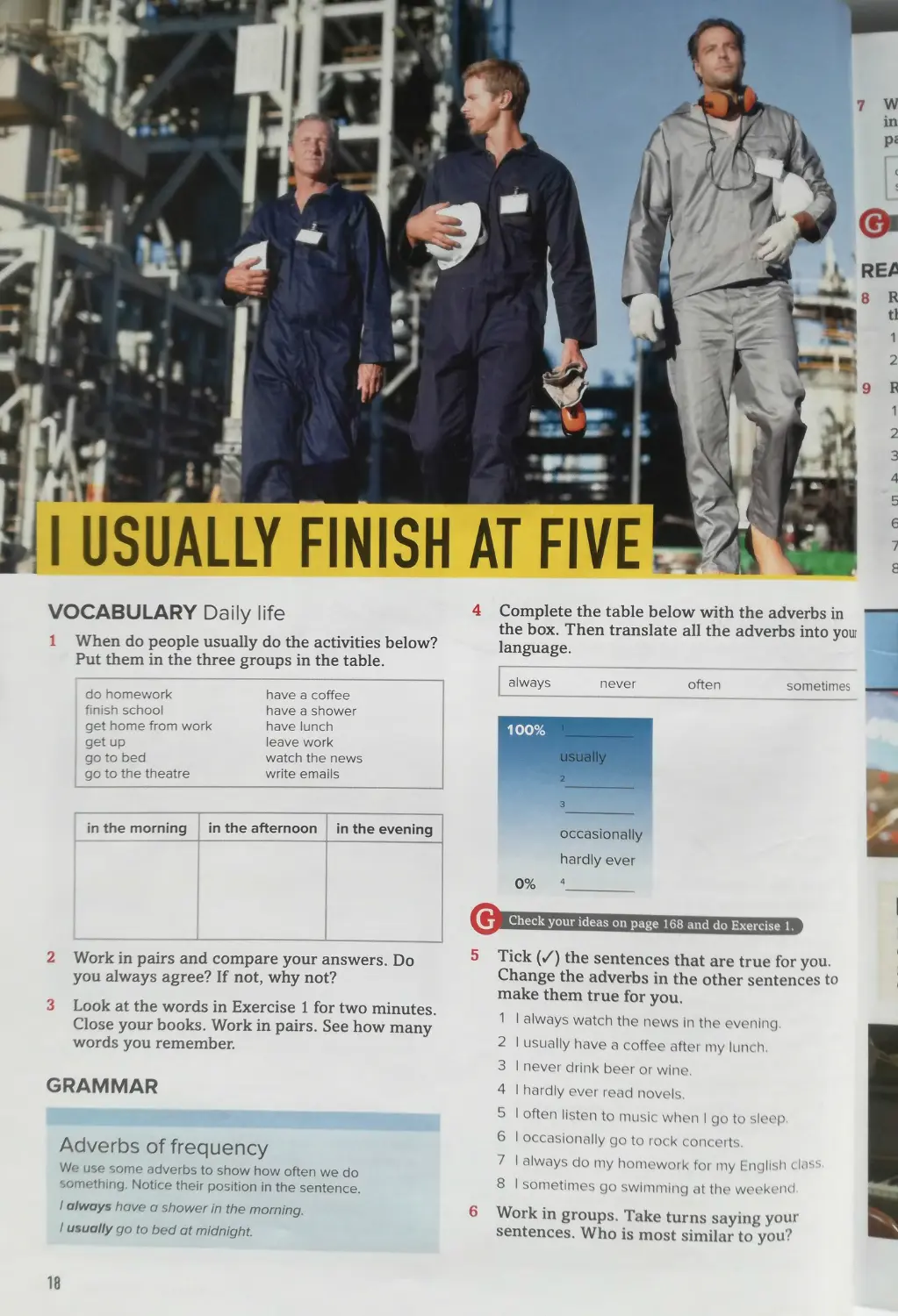
I USUALLY FINISH AT FIVE
1
2
R
1
2
3
4
5
6
7
8
► 9
VOCABULARY Daily life
1 When do people usually do the activities below?
Put them in the three groups in the table.
do homework
finish school
get home from work
get up
go to bed
go to the theatre
have a coffee
have a shower
have lunch
leave work
watch the news
write emails
4 Complete the table below with the adverbs in
the box. Then translate all the adverbs into you:
language.
always never often	sometimes
100%
usually
2
3
in the morning	in the afternoon	in the evening

occasionally
hardly ever
on page 168 and do Exercise 1. J
2 Work in pairs and compare your answers. Do
you always agree? If not, why not?
3 Look at the words in Exercise 1 for two minutes.
Close your books. Work in pairs. See how many
words you remember.
GRAMMAR
Adverbs of frequency
We use some adverbs to show how often we do
something. Notice their position in the sentence.
I always have a shower in the morning.
I usually go to bed at midnight.
5 Tick (/) the sentences that are true for you.
Change the adverbs in the other sentences to
make them true for you.
1	I always watch the news in the evening.
2	I usually have a coffee after my lunch.
3	I never drink beer or wine.
4	I hardly ever read novels.
5	I often listen to music when I go to sleep.
6	I occasionally go to rock concerts.
7	I always do my homework for my English class.
8	I sometimes go swimming at the weekend
6 Work in groups. Take turns saying your
sentences. Who is most similar to you?
18
Write four true sentences using the phrases
7 in the box and an adverb. Then say them to a
partner.
cook dinner for friends use English outside class
sleep in the afternoon work at the weekend
For further practice, see Exercise 2 on page 168.
READING
8	Read an article about how three people spend
their free time. Answer these questions.
1	Who is most similar to you? Why?
2	Who do you think is the happiest person? Why?
9	Read the article again. Decide which person:
1	does sport or exercise.
2	spends a lot of money.
3	is tired at the weekend.
4	likes TV.
5	seems quiet.
6	has a busy social life.
7	goes to bed quite early.
8	works long hours.
10	Complete the sentences with the prepositions in
bold in the article.
1	I’m always very busy Mondays.
2	I always go running Sunday mornings.
3	I don’t usually work Fridays. It’s great. I get
up nine or ten.
4	Our school day finishes four.
5	The film starts eight and ends---------------
10.30.
6	We don’t usually do very much--------the
weekend -just relax.
7	I sometimes have a short sleep-------the
afternoon.
8	I’m usually very tired the morning. I need to
have a coffee!
SPEAKING
11 Work in groups. Ask each other these questions.
•	What do you normally do on Friday nights?
•	What do you normally do on Saturdays?
•	What do you normally do on Sundays?
•	Do you go out in the evening during the week? When?
What do you do?
Which person in the group has the best social life?

DO YOU HAVE ANY
FREE TIME

BIRGIT FROM GERMANY
I do something most nights. On Mondays and Wednesdays, I go to my
English class, and on Tuesdays, I usually go to the cinema with friends,
because the tickets are cheap then. On Thursdays, 1 always go to the
gym. 1 usually go out dancing on Saturday nights. I often get home at
four or five in the morning, so on Sundays, I sleep! I sometimes get up
at three in the afternoon.
FRANKIE FROM THE UK
Free time? I don’t have any free time because I have my own business. I
occasionally go to a rock concert — about once or twice a year — and I sometimes
go shopping at the weekend. 1 like buying expensive things with the money 1
earn. I have a very nice car and a very big TV I like watching sport.
SVETLANA FROM RUSSIA
I don’t go out much during the
week. I usually study lor two hours
in the evening. I never watch TV,
really. 1 usually play the piano every
day. It helps me to relax. Then I
go to bed at nine or ten and read.
Al the weekend, I go out with my
family to a park or the countryside,
and we go lor a walk. 1 sometimes
go to a shopping centre with friends,
but I hardly ever buy anything!
Unit 2 Freetime 19
A LOT OF HOMEWORK!
witl
SPEAKING
1 Work in pairs. Discuss these questions.
•	Do you like doing courses in your free time?
•	Is this your first English course?
•	Do you like learning English?
•	Do you like ...
... doing homework?
... watching films or TV shows in English?
... listening to songs in English?
... reading in English?
... finding new words in a dictionary?
... practising your pronunciation?
3 Work in pairs.
1 It
Student A: close your book.	2 c
Student B: say a verb. write	3 E
Student A: say a phrase. write the answers
4 Do you need these things for your English class') c
Explain why / why not.	5 i
				6 '
a dictionary	paper	scissors
a mobile phone	a pen	tissues	8	W(
money	a rubber	water		•	j
For example:
/ always need a pen because I need to take notes.
I don’t need scissors because I don’t cut things in class
VOCABULARY In an English class
2 Match 1-5 with a-e and 6-10 with f-j.
LISTENING
1	listen	a	a break / notes
2	take	b	the text / the questions
3	turn off	c	in pencil / the words in your notebook
4	write	d	to the conversation / and write what you hear
5	read	e	your mobile phones / the light
6	do	f	the words / what you think
7	check	g	a film / the video and take notes on what you see
8	close	h	Exercise 1 / a lot of homework
9	say	i	your book / the window
10	watch	j	the answers / the meaning in your dictionary
5
Listen to three conversations in an English
class. Decide which conversation (1-3) happens
a at the beginning of the class.
b in the middle of the class.
c at the end of the class.
► 13
► 13
Listen again. Decide if the sentences are
true (T) or false (F).
1 Camilla has money for two coffees.
2 The break is 25 minutes long.
3 They need to do two exercises for homework and
learn some words.
4 Simon wants a lot of homework.
5 Simon sits next to Camilla.
so
Her
COL
9 C
c
1
GRA
Co
We i
of wi
Noui
calle
Son
The
We
z
c
E
^13
Listen again. Complete the sentences
with one word. Contractions (it’s, isn’t, etc.) are
one word.
1 it’s a break. He says a cafe next door.
2 OK, thanks. How is the break?
3 B: This is a lot of homework.
A: Do you so?
4 Simon -to do it. Do some every day. Five
or ten minutes.
5 Hi I’m late.
6 Teacher! What does ‘turn off’?
10 Look at each pair of sentences in the box
and circle the differences. In pairs, discuss
what things are different when you use an
uncountable noun instead of a countable noun.
8 Work in pairs. Discuss the questions.
. Are Camilla and Simon good or bad students?
. Do you like the way Matty teaches? Why? / Why not?
. How often are you late / do you forget things / do
you do homework?
Countable
1 / don’t need a dictionary.
2 There aren’t any cars.
3 There aren’t many cars.
4 Do you have a rubber?
5 Do you have any tissues?
6 Do you want some chips?

grammar
Countable and uncountable nouns
We usually use a / an with singular nouns and some I a lot
of with plural nouns.
Nouns with both singular and plural forms like this are
called countable nouns.
a pencil
Some nouns have no plural form.
These nouns are called uncountable nouns.
We use some or a lot of with them.
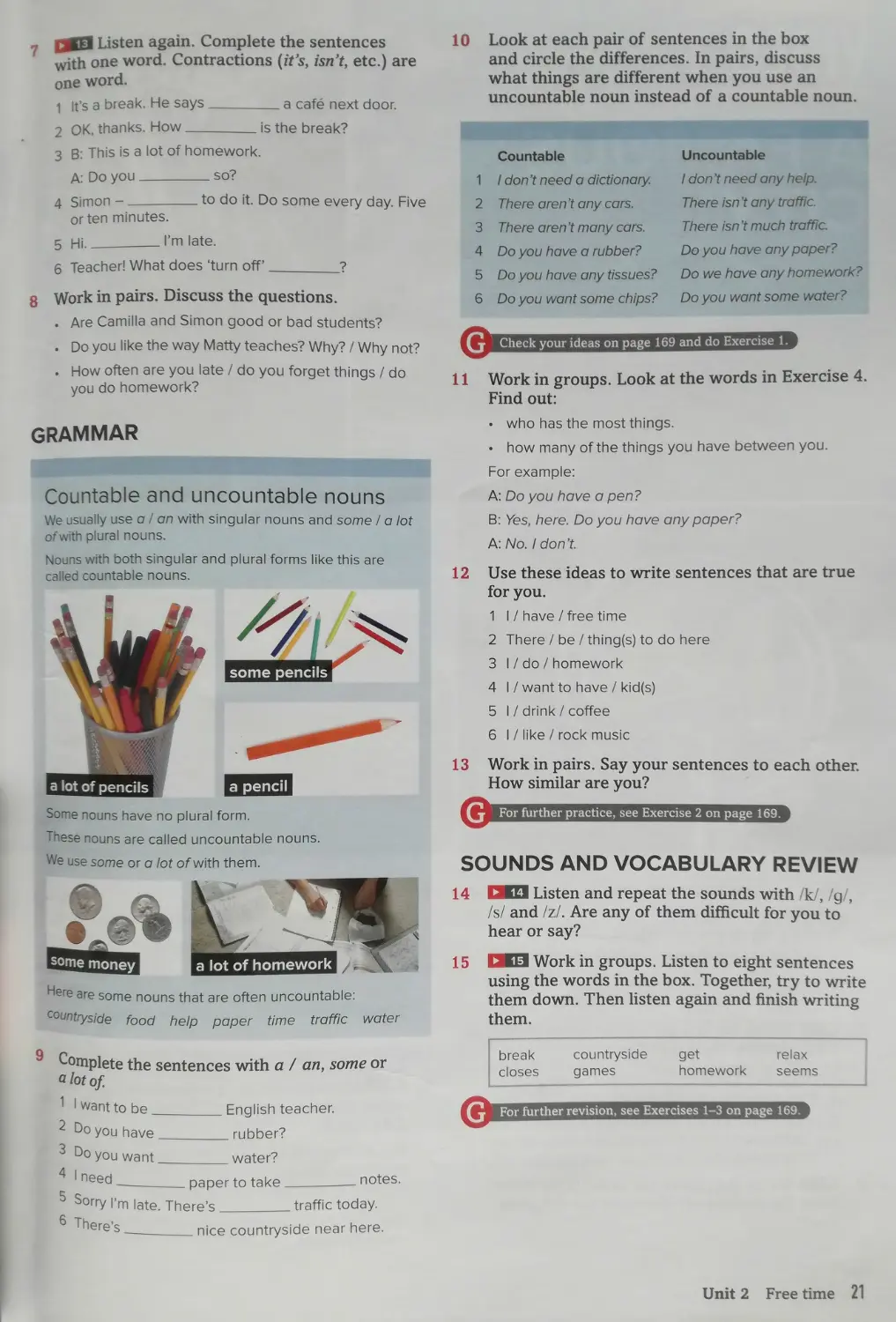
^ere are some nouns that are often uncountable:
COur,tryside food help paper time traffic water
9 Compiete the sentences with a / an, some or
a lot of.
" 1 want to be English teacher.
Do you have rubber?
3	Do you want__________water?
4	1 need---------paper to take notes.
J Sorry |’m late. There’s_______traffic today.
6	There’s njce countryside near here.
Uncountable
I don’t need any help.
There isn’t any traffic.
There isn’t much traffic.
Do you have any paper?
Do we have any homework?
Do you want some water?
;9 and do Exei
11 Work in groups. Look at the words in Exercise 4.
Find out:
•	who has the most things.
•	how many of the things you have between you.
For example:
A: Do you have a pen?
B: Ybs, here. Do you have any paper?
A: No. I don’t.
12 Use these ideas to write sentences that are true
for you.
1	I / have / free time
2	There / be / thing(s) to do here
3	I / do / homework
4	I / want to have / kid(s)
5	11 drink / coffee
6	I / like / rock music
Work in pairs. Say your sentences to each other.
How similar are you?
0i.	i.i...» ii......
13
ise 2 on p
SOUNDS AND VOCABULARY REVIEW
14
► 14
Listen and repeat the sounds with /к/, /д/,
/s/ and /z/. Are any of them difficult for you to
hear or say?
15 DKH Work in groups. Listen to eight sentences
using the words in the box. Together, try to write
them down. Then listen again and finish writing
them.
break	countryside	get	relax
closes	games	homework	seems

Unit 2 Free time 21
1
VIDEO 1
1
2
3
2
1
2
3
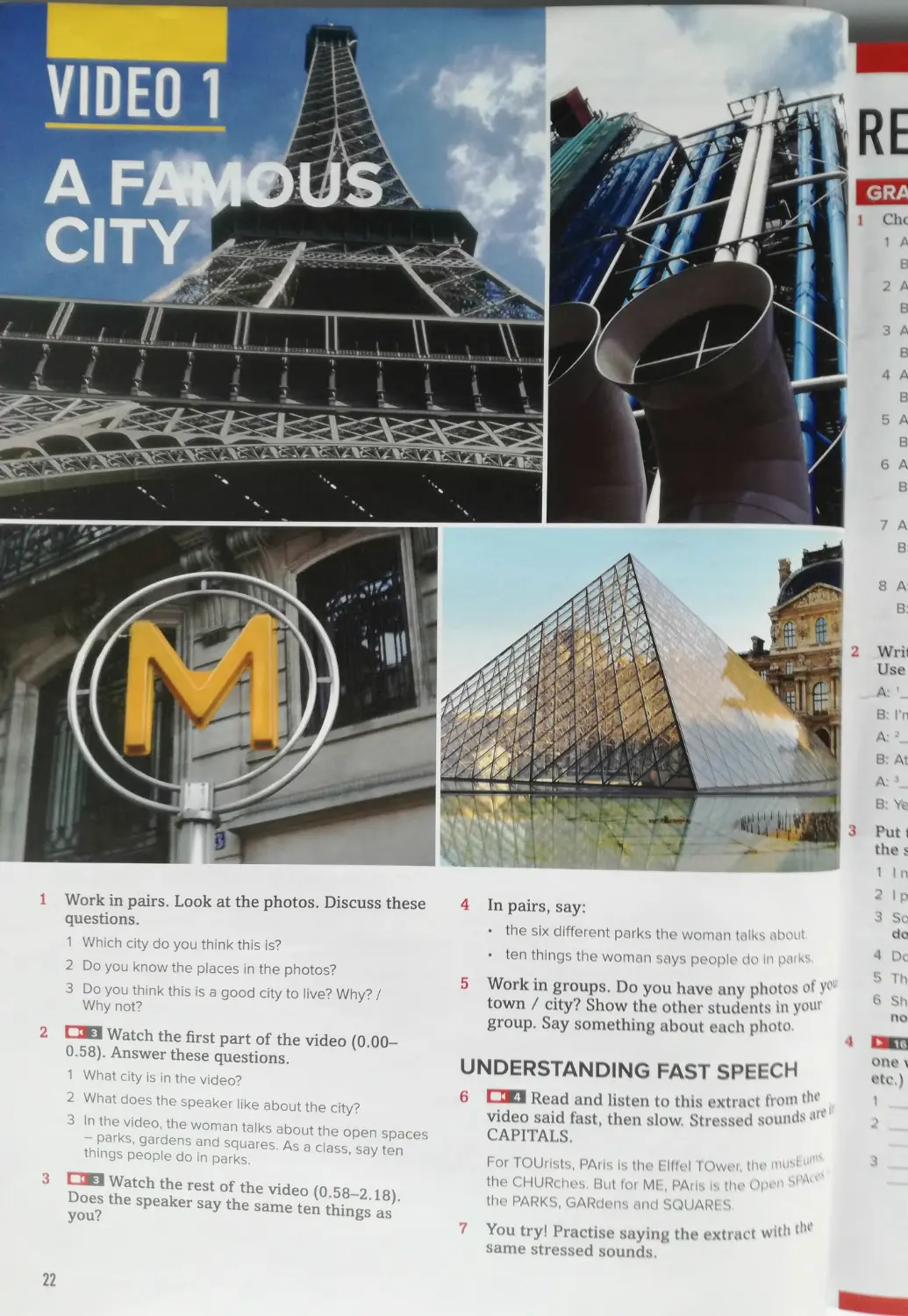
Work in pairs. Look at the photos. Discuss these
questions.
Which city do you think this is?
Do you know the places in the photos?
Do you think this is a good city to live? Why? I
Why not?
Lil Watch the first part of the video (0.Go-
О.58). Answer these questions.
What city is in the video?
What does the speaker like about the city?
In the video, the woman talks about the open spaces
- parks, gardens and squares. As a class, say ten
things people do in parks.
3
Watch the rest of the video (0.58-2 181
you? S₽eaker Say the same ten thin«s as
7
In pairs, say:
• the six different parks the woman talks about.
• ten things the woman says people do In parks
Work in groups. Do you have any photos ot Уе'
town / city? Show the other students in your
group. Say something about each photo.
UNDERSTANDING FAST SPEECH
6
< 4
—----Read and listen to this extract from the
video said fast, then slow. Stressed sounds «|Г
CAPITALS.
For TOUrlsts, PArls Is the Eiffel TOwei. the must l""'
the CHURches. But for ME, PArls Is the Open SFAo"
the PARKS, GARdens and SQUARES
You try! Practise saying the extract with I*’1'
same stressed sounds.
22
REVIEW 1
GRAMMAR
1 Choose the correct option.
1 A: Where are / is he from?
B: France.
2 A: Do you want to go I going to the cinema later?
B: OK. What time?
3 A: Do you have a / any tissues?
B: Yes. There are one I some in my bag.
4 A: Are Is you OK?
B: Yes, I'm am OK, thanks.
5	A: Do you ike play I playing tennis?
B:	Yes. it's he's great.
6	A: Does Is your town big?
В Not ree y. There Is / are only about 10,000
people.
7	A. What you do do you bo at the weekend?
В usually stay at home. I don’t / I’m not earn much
money.
3	A: Do Does your son like football?
В He love loves watching, but he doesn’t play very
often sometimes.
2 Write full questions to complete the dialogue.
Use the words in brackets.
A: '? (do)
В ~ a doctor.
A: 2_________________________________________? (work)
2 At a hospital in the north of Rome.
A: 3_________________________________________? (enjoy)
В zes. It's a great job.
3 Put the word(s) in bold in the correct place in
the sentence.
need do some shopping, to
2 o ay computer games, hardly ever
3 Sorry, understand. What does ‘journalist’ mean?
don’t
" Do you have pencil and paper? a
5 here’s a palace near the river. It’s great, beautiful
' S"e speaks English very well, but she’s from the UK.
not
Listen and complete the sentences with
°ne word in each space. Contractions {I’m, don’t,
®tc.) are one word.
1-----------you money?
-------------------need help,
3	——-	time want-------------------------------
_________7
4	There_____________________________________
places to visit
5	I need____________________________________
homework
6	gets up six and
work seven.
5
► 16
Work in pairs. Compare your ideas. Listen
again and check.
VOCABULARY
6 Match the verbs in the box to the groups of
words they go with in 1-8.
check	help	Play	turn off
close	live	say	watch
1	~ the news / ~ a football game / ~ a film
2	~ in the countryside / ~ in the capital I ~ on my own
3	~ in the park / ~ the piano / ~ a game
4	~ what you think / ~ no / ~ a lot
5	~ the TV / ~ your phone / ~ the light
6	~ my grandparents / ~ me / ~ to do my homework
7	~ the answers / ~ the word in a dictionary / ~ it’s OK
8	~ your book / the shop ~s at nine / ~ the window
7 Put the words into three groups - places, jobs or
free time.
assistant	countryside	factory	officer
church	dancing	guitar	receptionist
clinic	department	the Middle East	swimming
concert	draw	nurse	waiter
8 Match each adjective in italics in 1-8 with its
opposite in a-h. 1 It’s a boring job.		a	cheap
2	I have a busy social life.	b	best
3	He has a big car.	c	quiet
4	It’s an expensive restaurant.	d	interesting
5	It’s the worst place to live in the UK.	e	west
6	It’s in east Paris	f	old
7	It’s a long film.	g	small
8	I have a new mobile phone.	h	short
9 Complete the text with the verbs in the box.
finish	go	like	spend
get	have	listen	work
I 1 in a department store in town. I usually
start at eight o’clock and 2 at four. I leave the
house at seven and 3 home at five or six. I
4 doing sport. I often 5 to the gym
after work. I usually 6 about an hour there.
Then, in the evening I just7 dinner with my
wife and watch TV. We sometimes sit and 8-------
to music.
Review 1 23

IN THIS UNIT YOU LEARN HOW TO:
•	talk about the area you live in
•	name things you often buy and do
•	explain where things are
•	explain what you need to do
•	describe your house / flat
•	ask people to do things
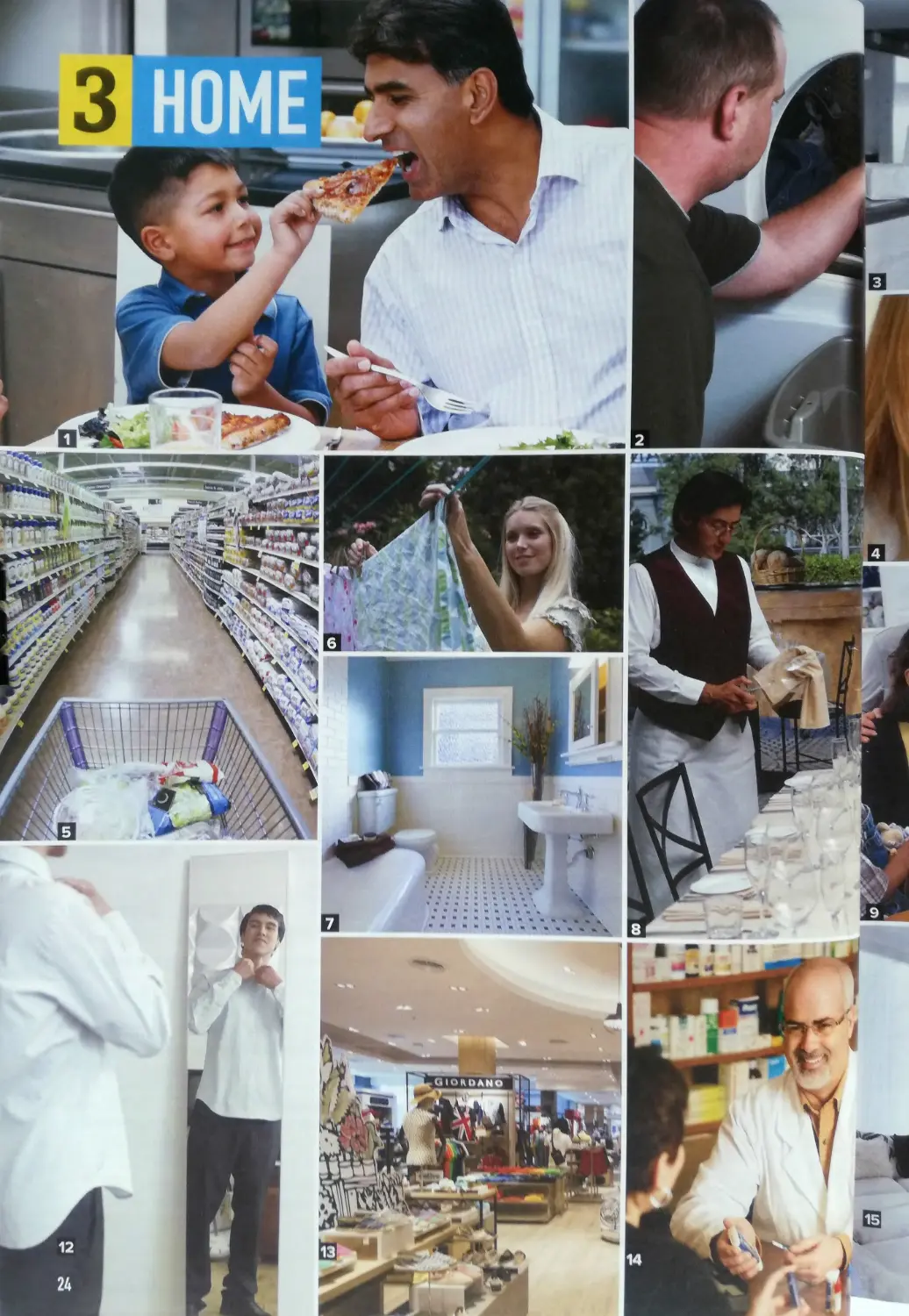
WORDS FOR UNIT 3
1 Work in pairs. Match the words and phrases to the
photos.
the bathroom
clean the house
a department store
dry my hair
get dressed
go to a chemist
hang up the washing
the living room
a post office
put on make-up
set the table
share food
sit in the kitchen
a sports centre
a supermarket
wash some clothes
2
Listen. Check your answers. Listen again. Repeat
the words.
3 Work in pairs. Test each other. Cover the words.
Student A: point to a photo.
Student B: say the words.
4 Which photos do you like / not like?
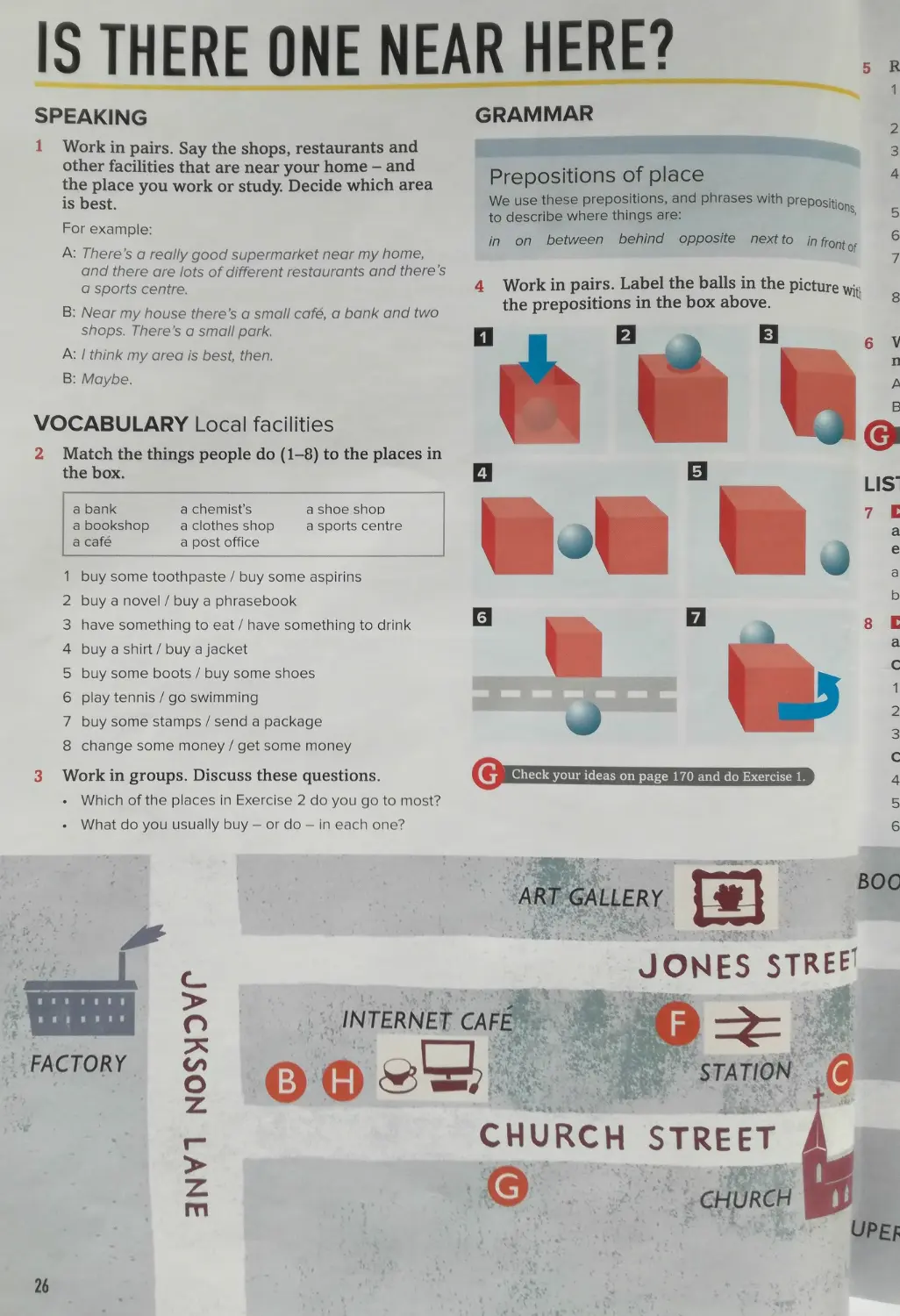
IS THERE ONE NEAR HERE?
'	""	"	—1
SPEAKING
1 Work in pairs. Say the shops, restaurants and
other facilities that are near your home - and
the place you work or study. Decide which area
is best.
For example:
A:	There’s a really good supermarket near my home,
and there are lots of different restaurants and there’s
a sports centre.
B:	Near my house there’s a small cafe, a bank and two
shops. There's a small park.
A:	/ think my area is best, then.
B:	Maybe.
VOCABULARY Local facilities
2 Match the things people do (1-8) to the places in
the box.
a bank	a chemist’s	a shoe shoo
a bookshop	a clothes shop	a sports centre
a cafe	a post office
1	buy some toothpaste I buy some aspirins
2	buy a novel / buy a phrasebook
3	have something to eat / have something to drink
4	buy a shirt/buy a jacket
5	buy some boots I buy some shoes
6	play tennis / go swimming
7	buy some stamps / send a package
8	change some money / get some money
3 Work in groups. Discuss these questions.
•	Which of the places in Exercise 2 do you go to most?
•	What do you usually buy - or do - in each one?
GRAMMAR
з
Prepositions of place	4
We use these prepositions, and phrases with preposition
to describe where things are:	s 5
in on between behind opposite next to in front Qf 6
7
INTERNET CAFE
ART GALLERY
BOO
JONES STREE1
STATION 0
CHURCH STREET
CHURCH
UPEF
26
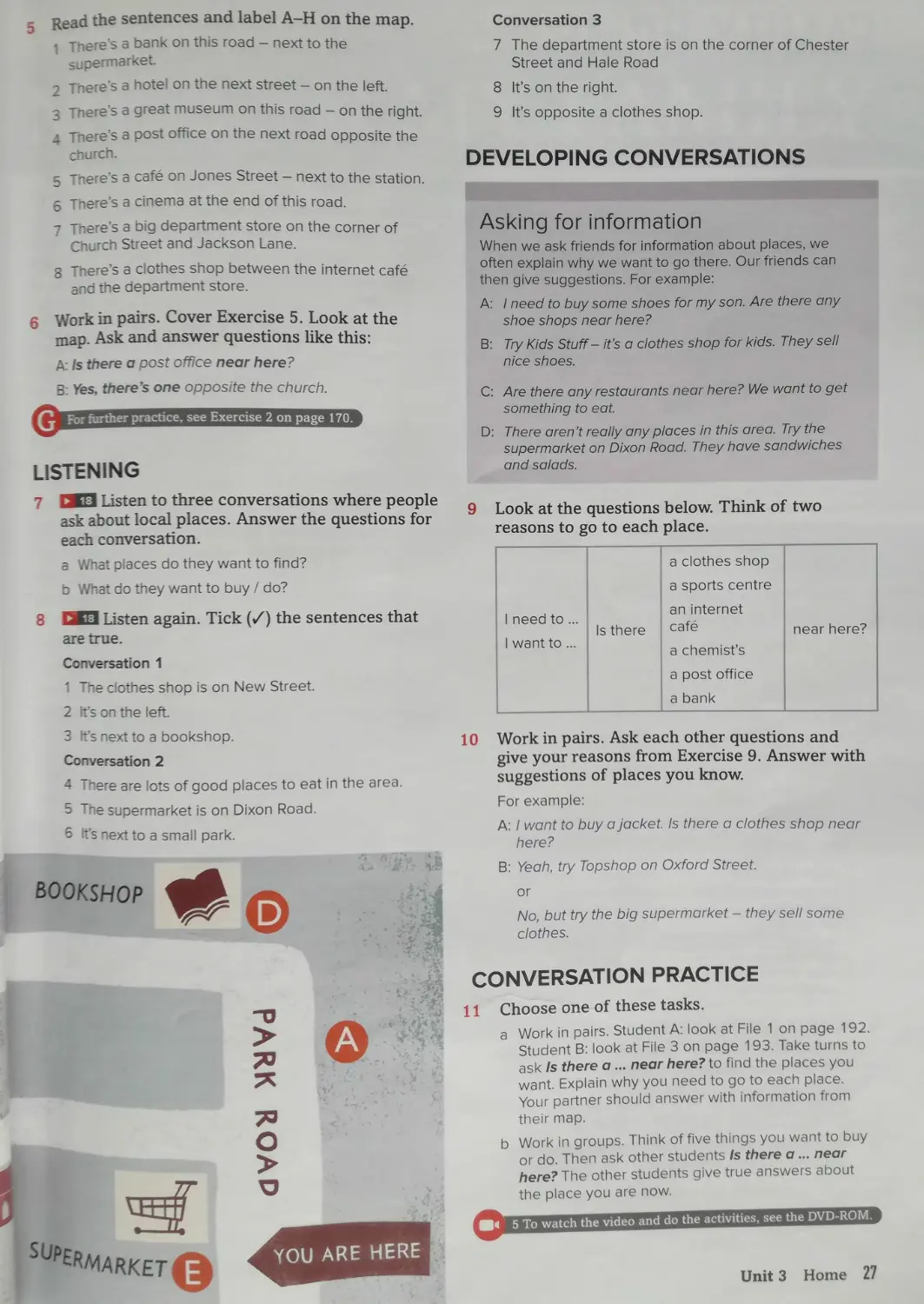
Read the sentences and label A-H on the map.
1 There’s a bank on this road - next to the
supermarket.
2	There’s a hotel on the next street - on the left.
3	There’s a great museum on this road — on the right.
4	Tnere s a post office on the next road opposite the
church.
5	There’s a cafe on Jones Street - next to the station.
6	There’s a cinema at the end of this road.
7	There’s a big department store on the corner of
Church Street and Jackson Lane.
8	There’s a clothes shop between the internet cafe
and the department store.
Conversation 3
7 The department store is on the corner of Chester
Street and Hale Road
8 It’s on the right.
9	It’s opposite a clothes shop.
DEVELOPING CONVERSATIONS
6 Work in pairs. Cover Exercise 5. Look at the
map. Ask and answer questions like this:
A: Is there a post office near here?
B: Yes, there’s one opposite the church.
e 2 on p;
LISTENING
Asking for information
When we ask friends for information about places, we
often explain why we want to go there. Our friends can
then give suggestions. For example:
A:	I need to buy some shoes for my son. Are there any
shoe shops near here?
B:	Try Kids Stuff- it's a clothes shop for kids. They sell
nice shoes.
C:	Are there any restaurants near here? We want to get
something to eat.
D:	There aren't really any places in this area. Try the
supermarket on Dixon Road. They have sandwiches
and salads.

Listen to three conversations where people
ask about local places. Answer the questions for
each conversation.
a What places do they want to find?
b What do they want to buy / do?
► 18
Listen again. Tick (/) the sentences that
are true.
Conversation 1
1	The clothes shop is on New Street.
2	It’s on the left.
3	It’s next to a bookshop.
Conversation 2
4	There are lots of good places to eat in the area.
5	The supermarket is on Dixon Road.
6	It’s next to a small park.
9 Look at the questions below. Think of two
reasons to go to each place.
I need to ... I want to ...	Is there	a clothes shop a sports centre an internet cafe a chemist’s a post office a bank	near here?
10 Work in pairs. Ask each other questions and
give your reasons from Exercise 9. Answer with
suggestions of places you know.
For example:
A: I want to buy a jacket. Is there a clothes shop near
here?
B: Yeah, try Topshop on Oxford Street.
or
No, but try the big supermarket - they sell some
clothes.
CONVERSATION PRACTICE
11 Choose one of these tasks.
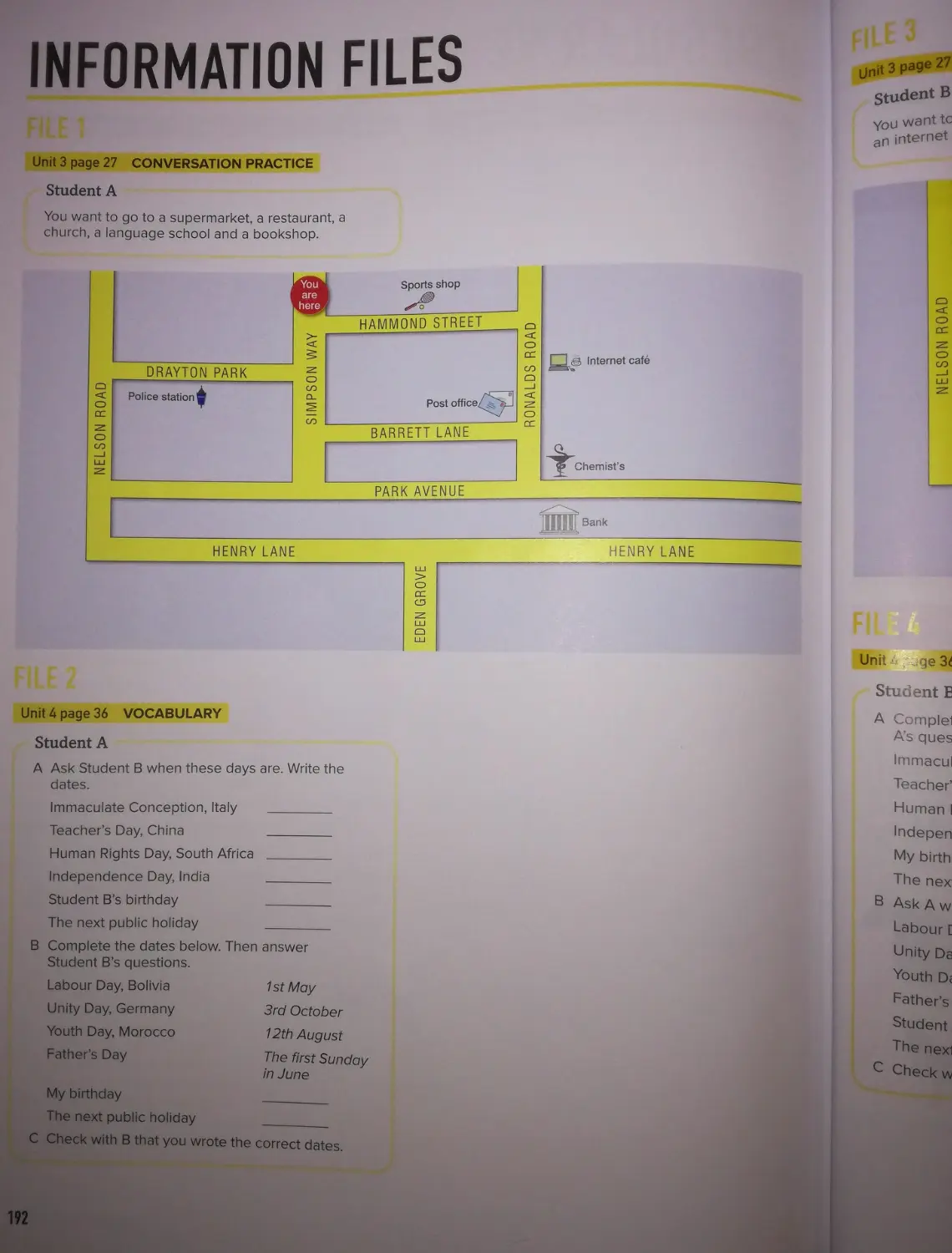
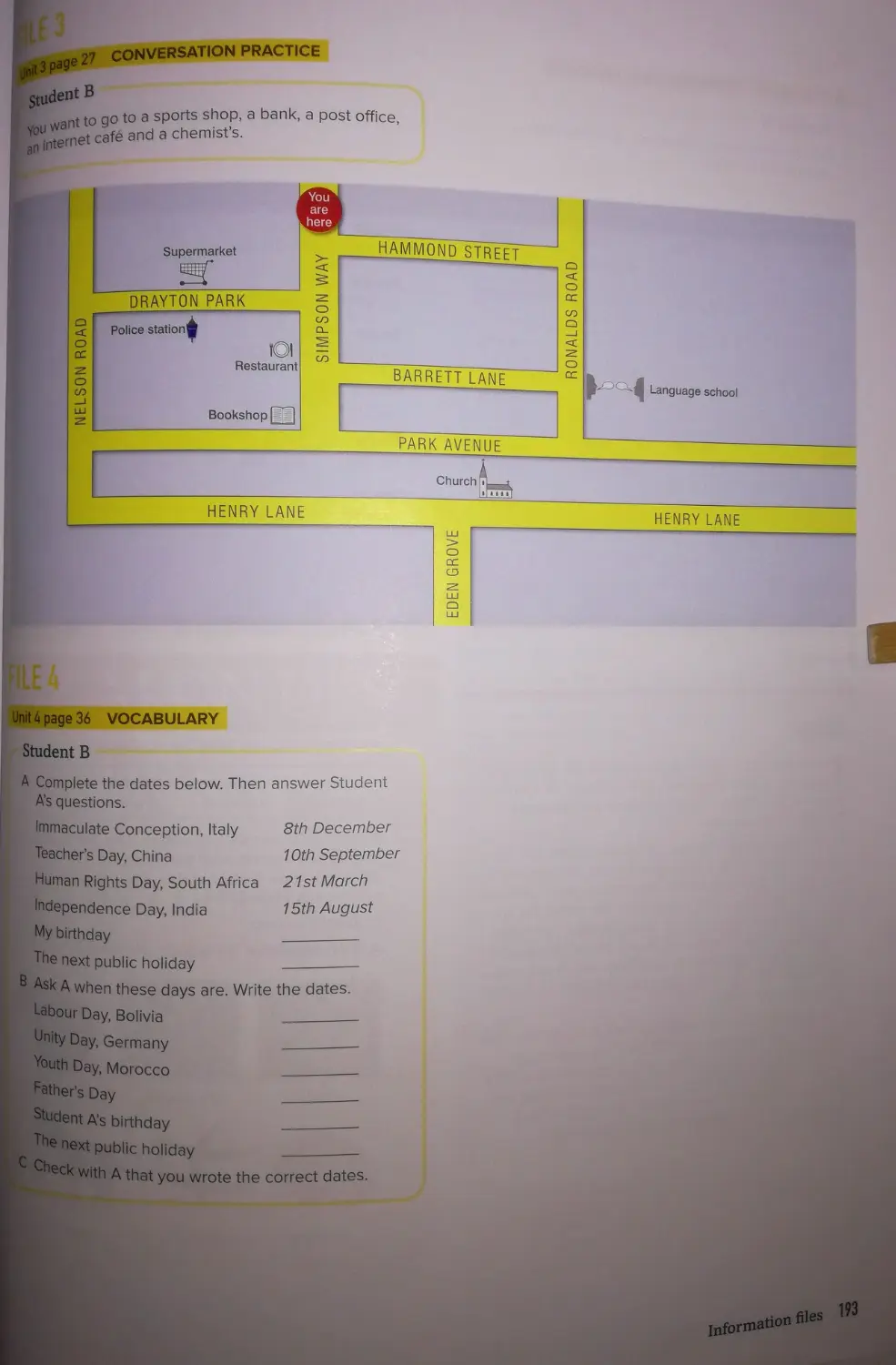
a Work in pairs. Student A: look at File 1 on page 192.
Student B: look at File 3 on page 193. Take turns to
ask Is there a... near here? to find the places you
want. Explain why you need to go to each place.
Your partner should answer with information from
their map.
b Work in groups. Think of five things you want to buy
or do. Then ask other students Is there a ... near
here? The other students give true answers about
the place you are now.
5 To watch the video and do the activities, see the DVD-ROM.
Unit 3 Home 27
FAMILY HOME
VOCABULARY In the house
1 Complete the descriptions of two places with the
words in the box.
apartment	bed	kitchen	sofa
balcony	bedrooms	sink	table
bathrooms	cupboards
Description 1
We have a house. It’s really nice. We have four
1 and two 2. We have a lovely
living room and a big 3. We also have a small
garden, and I have a study because I work from home.
Description 2
I live in an 4. It has one bedroom, and a very
small bathroom with only a shower,5 and
toilet. I have a small kitchen with a 6 where
I eat. I also have a 7 where I hang my
washing. The place is OK for me, but I don’t have any
space for friends to stay. I only have two chairs and I
don’t have many 8 to keep things in. I usually
watch TV lying in 9, because I don’t have a
living room or a 10 to sit on!
2 Work in pairs. Describe where you live. Use
some of the language in Exercise 1.
READING
6 Quickly read the blog on page 29, by a y01
Greek woman, Maria. What places do the
photos show?
7 Read again. Answer these questions.
1 What is good / bad about each place?
2 Who does she live with?
My name
city. There
Dimitra, a
3 What problems does she have with each person? and 1 stuc
We usuall
8 Match the verbs with the words they go with in sometime
the blog. Then look at the blog and check y0Ur house in 1
answers.				there. The there. It's
1	live	a	an hour to drive there
2	study	b	a room with my sister	quiet and
3	take	c	hours putting on her make-up	In our fan
4	share	d	with my sister and brother	because I
5 6	annoy spend	e f	me Business Management	listen to r lovely vie own bath
9 Work in pairs. Say what you remember about the best.
Maria and her family, using the	language in	0(jr flat jr
Exercise 8.	w|th Dim
For example:	anc| । kee|
Maria lives with her sister, Dimitra, and her brother,	mess! The
Costa.	floor and
You need to spend time learning words. Here are three
ways to help you remember them:
- learn short phrases or pairs of words
- connect words to rooms in your house
- connect words to people
GRAMMAR
3 On a big piece of paper, draw a plan of your
house. Write these phrases in different rooms.
Then work in pairs and compare your ideas.
brush his teeth	put things in the fridge
cut vegetables	send an email
get dressed	set the alarm clock
get a towel	take an aspirin
lie down	talk on the phone
look in the mirror	wash the dishes
make dinner	watch a film
put on make-up	work on the computer
Pronouns, possessive adjectives
and’s
Look at these sentences from the blog.
She spends hours putting on her make-up.
Sometimes my sister and brother annoy me.
My sister’s bedroom has its own bathroom.
We use pronouns like she and me to replace nouns and
names.
We use person + ’s or possessive adjectives like her, my
and its before a noun.
10 Complete the table.
We take t
kitchen. I
my sister
sometimi
my sister
make-up
one bath
4 Work in pairs. Make a list of the people in your
class. Write sentences like the examples below.
Use an -ing form for the activity.
Kenji’s in the kitchen making dinner.
Sara’s on the balcony talking on the phone.
5 Now close your books. How many words and
phrases can you remember?
Subject	Object	Adjective
I	1	my
you	you	2		—
he	him	3
she	4	her
[~it	11	its
we	US
they	6 	z	.	their
as on p;
11 Corr
pror
brae
1 _
ЛТ
2 Hi
3
4
5 M\
6 M\
7 W<
8 lh
(hf
9 । g
(I/
28
mariainthessaloniki.blogspot.com
Ф SEARCH BLOG FLAG BLOG NEXT BLOG ООО
ME AND MY FAMILY
My name's Maria and I live in Thessaloniki. It's a great
city.There are lots of things to do. I live with my sister,
Dimitra, and my brother, Costa. They both work here,
and I study - English and Business Management.
We usually stay in the city during the week and then
sometimes at the weekend we go back to our family
house in the mountains near Askos. My parents live
there.They're retired. It takes about an hour to drive
there. It's a beautiful place, but the village is very
quiet and small and there's not much to do.
In our family home, I think I have the best room
because I have a balcony. Sometimes I sit there and
listen to music or read or just relax and look at the
lovely view. My sister's bedroom is big and has its
own bathroom, which is why she thinks her room is
the best. But I don't need my own bathroom.
Our flat in Thessaloniki isvery small. I sharea room
with Dimitra, but Costa has his own room. Dimitra
and I keep our room nice and tidy, but Costa's is a
mess!There are clothes, books and paper on the
floor and table. Men!
We take turns to cook, wash the dishes and clean the
kitchen. I love living with my family, but sometimes
my sister and brother annoy me. My brother
sometimes'forgets'to do his jobs in the house and
my sister sometimes spends hours putting on her
make-up and washing her hair - and we only have
one bathroom there!
*1 Complete the sentences. Use the correct object
pronoun or possessive based on the words in
brackets. The first one is done for you.
1	—--------room is very untidy. (I / sister)
My sister’s room is very untidy.
2	1 live on own. (I)
3	My room has own bathroom, (it)
My mum sometimes annoys______________.. (I).
5	My friends keep a cat in apartment, (they)
J Му dad usually makes dinner for• (we)
7 УУе pay someone to clean home, (we)
8	। have a friend who works for________company,
'he / father)
g ।
go to-------------house most weeks.
11' grandparents).
12 Work in pairs. Discuss if the sentences in
Exercise 11 are true for you or not.

e Exercise 2 on p;
SPEAKING
13 Think about your answers to these questions.
Use a dictionary if you need help.
. What’s good I bad about living with your parents
when you’re an adult?
•	What’s good / bad about sharing a room?
•	What’s good I bad about living on your own?
•	Do you ever have any problems with the person /
people you live with? What?
14 Work in groups. Discuss your answers.
Unit 3 Home 29
CAN YOU HELP ME?
LISTENING
1 Match the sentences (a-h) with the pictures (1-8).
a I can’t concentrate.
e I’m cold.
b I can't get it.
с I can't hear it.
d I can’t find my keys.
f I’m hot.
g It’s a mess.
h It’s very dirty.
Conversation 2
3 What temperature is the air-conditioning------
4 Can you it up? I’m cold.
5 It’s cold.
Conversation 3
2 Work in groups. Discuss these questions.
•	Which of the problems in Exercise 1 do you
sometimes have- in your home?
•	Imagin'- you ar<- the people with problems in
I /'-re ls<- 1. What’s good thing to say or ask in each
situation?
6 What did he___________?
7 Can you turn it__________?
8 Is that for you?
UNDERSTANDING VOCABULARY
GRi
► m
Listen to three conversations (I 3). Match
each orn- to a situation in Exercise I.
4
► V-i
Listen again Complete the
on<- word in each space.
sentences with
Conversation 1
1 l	walk ar toss II without breaking
something!
/ ' an /он	II, plnasc?
Collocations
We call words that often go together collocations.
The most important kinds of collocations are:
verb + noun: watch TV, dry my hair, clean the house
adjective + noun: a busy week, a famous town, an
expensive area
preposition + noun: on the comer at the weekend.
morning
When you learn a noun, try to learn verbs and adjediv
that go with it.
For new verbs, learn some nouns that go with thc^1
Learn new preposition + noun collocations when У°и
meet them.
cc
To-
I ca
He
To <
infir
Cai
Cai
3(1
5 Match the verbs in the box to the groups of
nouns (1-6) that they go with.
8 What different ways can you answer the
questions in the box above?
brush
cut
put on	turn up
share	wash
as on p<

1	~ my jacket / ~ your shoes I ~ some make-up
2	~ myself / ~ some vegetables / ~ my hair
3	~ the TV ~ the air-conditioning / ~ the music
4	~ my hair / ~ my teeth / ~ the dog
5	~ your hands / ~ some dirty clothes / ~ the plates
6	~ a flat / ~ a room with my sister / ~ a pizza
6 Match the nouns in the box to the groups of
verbs and adjectives (1-6) that they go with.
9 Put the words in the correct order.
1	sleep /1 / can’t /.
2	you / can / me / help / ?
3	use / I / can I bathroom / your I ?
4	up/you/turn/can / music/the/?
5	book / find /1 / can’t / my /.
6	can I clothes / wash / some /1 / ?
7	week / can’t / we / next / come /.
8	moment / can’t / he / drive / at / the /.
air-conditioning
alarm clock
cupboard
sink
table
towel
1	I need a ~ to dry myself / have a clean ~ I the ~’s wet
2	turn the ~ on turn up the ~ I turn down the ~ / turn
off the ~
3	set the ~ for dinner / clear the ~ / it’s on the ~
4	wasH your hands in the ~ I leave the dirty plates in the
~ ' fill the kitchen ~
5	set the ~ for seven / hear the ~ I the ~ goes off
6	nang it up in the ~ / put it back in the ~ / the ~ under
the sink
Listen to the sentences in Exercise 9.
Notice how we usually say can as /кэп/ and can’t
as /ka:nt/. Practise saying the sentences.
► 20
11 Use the words in 1-7 to write a question with
can and an explanation with can’t. The question
sometimes comes before and sometimes after
the explanation. The first one is done for you.
1 I/hear you	you / speak louder
I can’t hear you. Can you speak louder?
7 Say things about you and people you live with
using the collocations below and always, usually,
hardly ever or never.
For example:
My mum always washes my clothes.
My brother hardly ever washes his hands before dinner.
2	you / move	1 / see the board
3	11 do this exercise	you / help me
4	you / turn it up	1 / hear the CD
5	1 / come to the class	you / tell me the homework
6	1 / read the board	1 / sit nearer
7	1 / go to the toilet	1 / wait
•	wash my clothes
•	wash hands before dinner
•	put m Ik back in the fridge
•	leave dirty plates in the sink
•	set the table for dinner
•	hang up towels after using them
•	set the alarm clock
•	turn on the air-conditioning
grammar
12 Work in pairs. Have short conversations using
your sentences from Exercise 11.
For example:
A: I can’t hear you. Can you speak louder?
B: Yes, of course. Sorry.

se 2 on p:
SPEAKING
13 Work in pairs. Write four short conversations
based on the pictures in Exercise 1.
14 Remember your conversations. Act the
conversations for another pair.
con I can’t
'j -’'j something is impossible, use can’t + infinitive.
' c°n’t get it.
can’t hear it.
' z eonej to do something, use Can 11 you, etc. +
^ninrtive.
*n 1 turn th' TV down, please? I can’t concentrate
i use this towel? I want to have a shower.
SOUNDS AND VOCABULARY REVIEW
15
16
► 21
Listen and repeat the sounds with /f/, /v/,
/р/ and /Ь/. Are any of them difficult for you to
hear or say?
► 22
Work in groups. Listen to eight sentences
using these words. Together, try to write them
down. Then listen again and finish writing them.
bank	living room plates	sofas
bathroom	package	post office	vegetables

Unit 3 Home 31

4
► 23
Unit 4 Holidays 33
IN THIS UNIT YOU LEARN HOW TO:
•	talk about what you did in the past
•	comment on what people tell you
•	talk about dates and months
•	ask and answer questions about holidays
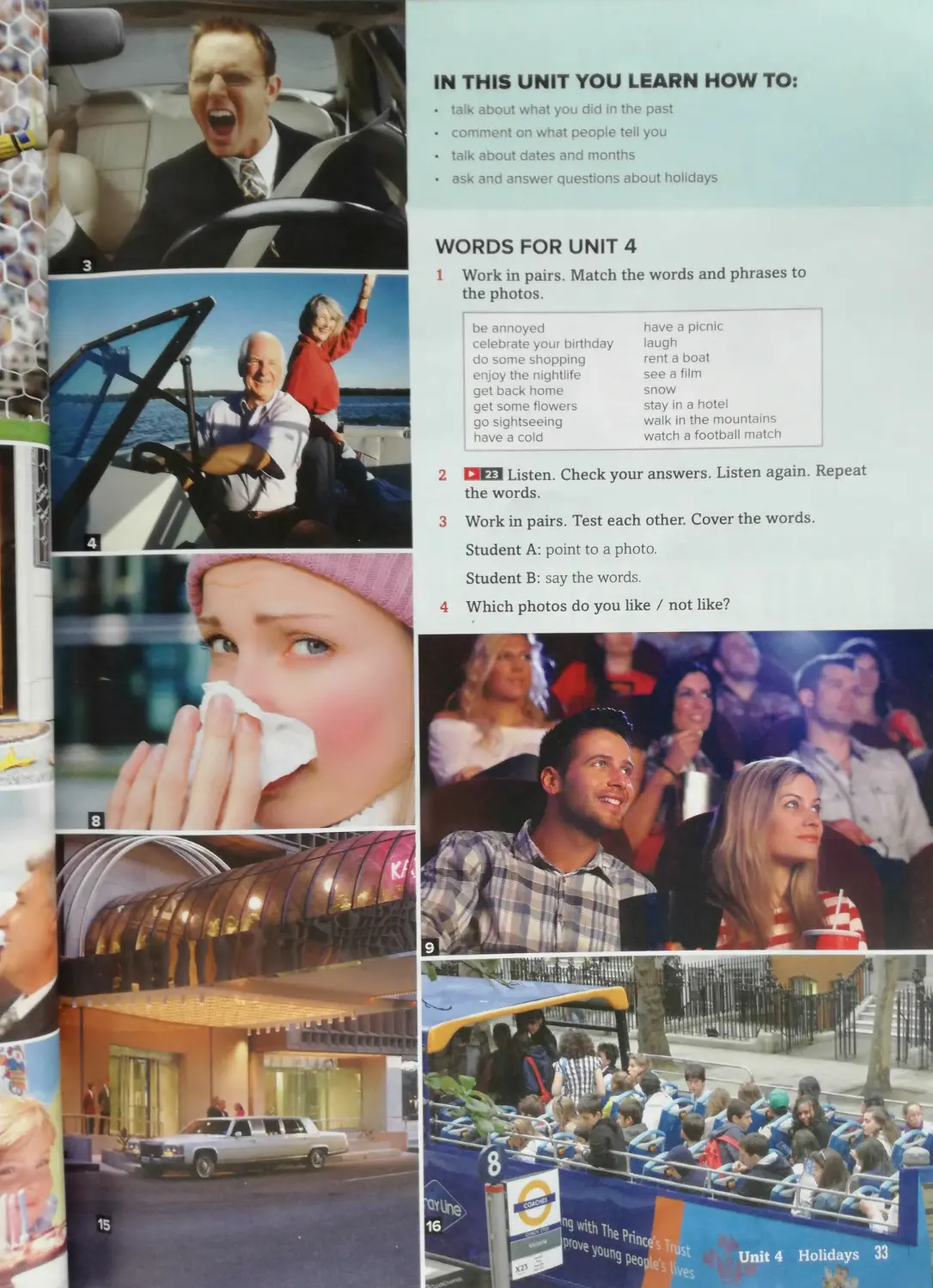
WORDS FOR UNIT 4
1 Work in pairs. Match the words and phrases to
the photos.
be annoyed	have a picnic
celebrate your birthday	laugh
do some shopping	rent a boat
enjoy the nightlife	see a film
get back home	snow
get some flowers	stay in a hotel
go sightseeing	walk in the mountains
have a cold	watch a football match
2
3
—__J Listen. Check your answers. Listen again. Repeat
the words.
Work in pairs. Test each other. Cover the words.
Student A: point to a photo.
Student B: say the words.
Which photos do you like / not like?
5
1
6
Look a
from tl
1 shov
2 coot
3 stay*
4 play
5 wat<
Work
Stude
Stude
forms.
Then
Comp
last хл
verbs
be
come
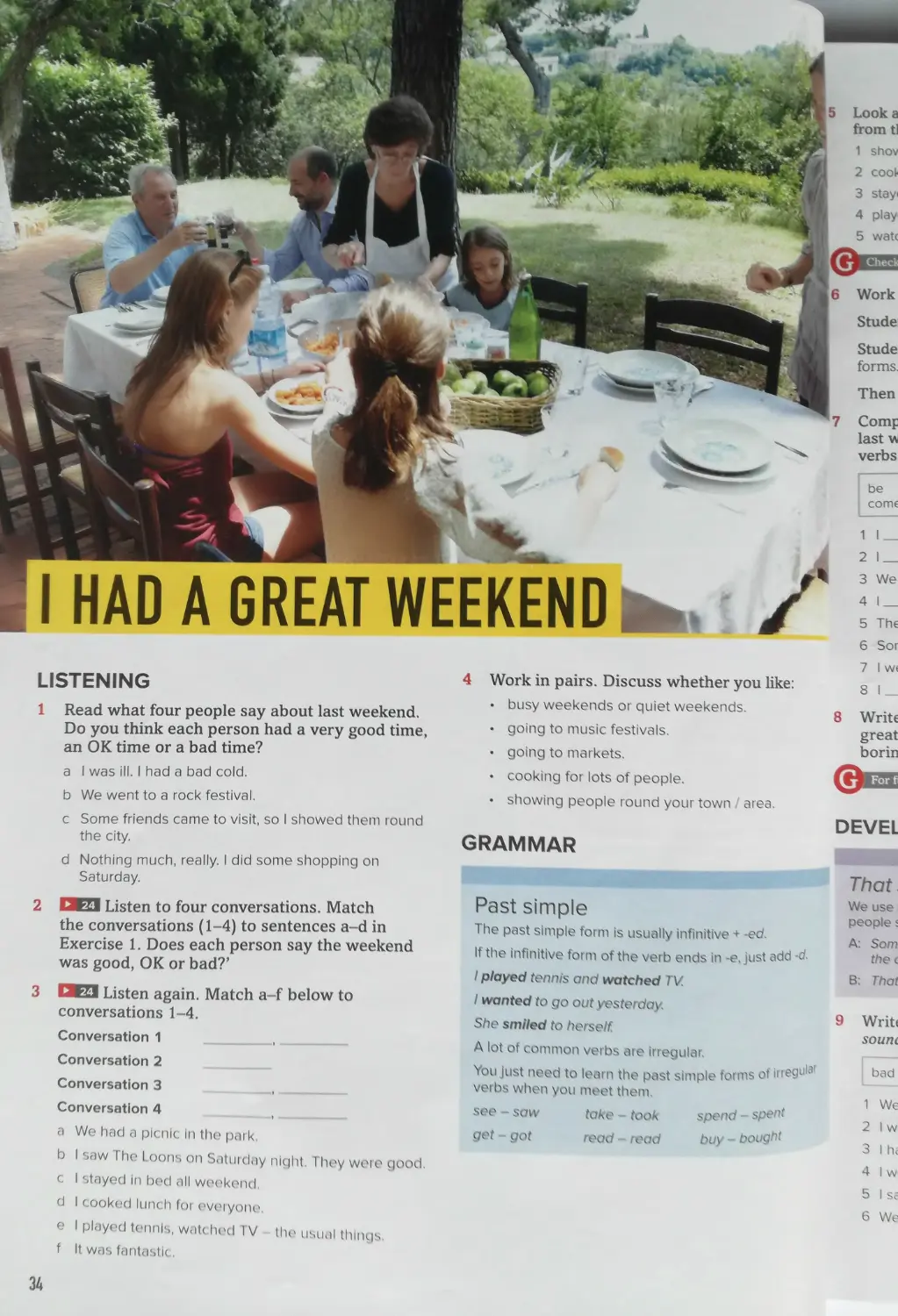
71 HAD A
GREAT WEEKEND^
2
3
4
5
l_
We
l_
The
6 Sor
7 I w(
LISTENING
1 Read what four people say about last weekend.
Do you think each person had a very good time,
an OK time or a bad time?
a I was ill. I had a bad cold.
b We went to a rock festival.
c Some friends came to visit, so I showed them round
the city.
d Nothing much, really. I did some shopping on
Saturday.
4 Work in pairs. Discuss whether you like:
•	busy weekends or quiet weekends.
•	going to music festivals.
•	going to markets.
•	cooking for lots of people.
•	showing people round your town / area.
GRAMMAR
8 l_
8 Write
great
borin
2
► 24
Listen to four conversations. Match
the conversations (1-4) to sentences а-d in
Exercise 1. Does each person say the weekend
was good, OK or bad?’
► 24
Listen again. Match a-f below to
conversations 1-4.
Conversation 1	_
Conversation 2
Conversation 3
Conversation 4
	-I — 	 I
a We had a picnic In the park.
b I saw I he Loons on Saturday night. They were good.
с I stayed in bed all weekend.
d I cooked lunch for everyone.
e I played tennis, watched TV the usual things.
f It was fantastic.
Past simple
The past simple form is usually infinitive + -ed.
If the infinitive form of the verb ends in -e, just add -d.
I played tennis and watched TV.
I wanted to go out yesterday.
She smiled to herself.
A lot of common veibs aie irregular.
You just need to learn the past simple forms of irregulal
verbs when you meet them.
see - saw	take - took	spend - spent
get - got	read - read	buy - bought
DEVEL
That
We use
people •
A: Som
the <
B: Thai
9 Writ<
sounc
bad
1	We
2	I w
3	I h<
4	lw
5	I sc
6	We
34
5 Look at the past simple forms of some verbs
tfvm the astern: s Write the infinitive form.
’	sttowed - sftow	6	went -
2	cocxea-_______________ 7	aid-
3	st3»ed -______________ 8	had —
4	^ased -______________ 9	was were -
5	watches -___________ 10	came -
10 Practise the conversations.
For example:
A: What did you do?
B: We rented a boat and went on the lake.
A: That sounds great.
PRONUNCIATION
о Л or к ш parrs Test each other
Student A su. the iru.ruuve forms in Exercise 5.
Student Б cover the exercise Say the past simple
11
► 25
Listen. Circle the form
hear in the sentences.
of the verbs you
Then charge roles and repeat.
" Complete the sentences about things people did
last weekend with the past simple forms of the
verbs m the box
1 visit / visited
2 visit / visited
3 play I played
4 try / tried; play / played
5 want / wanted; rain / rained
6 chat/chatted
7 walk / walked; chat / chatted
8 walk/walked
te	get	^ave	stay
come	go	spend	watch
’ I_ncfr wttfr my grandparents.
2 to tme beach with some friends.
3 •=at ~c~e агчз 'eiaxec.
- a foooa match o" Saturday.
5 -'e e a ~~ concert n town.
6 So-e — encs tc o_' no^se for dinner.
.e~: stoop ~c =nc some new shoes.
= = леехеос study ng for ar exam,.
A rete three : rungs you did in the past that were
great and three things you did that were bad or
bormg Work in groups Share your ideas.
We usually say past -ed endings as /d/ or /t/.
rained played walked
/reind/ /pleid/ /woikt/
When the infinitive ends in /t/ or /d/, the pronunciation
of past -ed endings is /id/.
wanted	chatted	visited	decided
/‘wontid/ /'tjaetid/	/'vizitid/	/di'saidid/
12 Work in pairs. Look at the audio script for Track
24 on page 200 and practise reading out the
conversations.
CONVERSATION PRACTICE
DEVELOPING CONVERSATIONS
"ersoonas.
at
:c~e *c . :* ^wed 'rerr round
9 Write a comment about each sentence using that
- an adjective in the box.
13 Think about last weekend. Did you have a nice
weekend? Choose an answer from the list below.
Write down two or three things you did.
a Yeah, it was great.
b It was OK.
c Not really.
14 Have conversations with different people in your
class. Use these two questions.
•	Did you have a nice weekend?
•	What did you do?
Comment on people’s answers about their
activities with that sounds ...
r re
15 Work in pairs. Decide which person in the class
had the best weekend - and why.
6 To watch the video and do the activities, see the DVD-ROM.
I ?re -e—ec a oca*. and went or the ere
2	' *'-& countryside
* "eacacne so I stayed v. rorre
>”<xx>'g /<*' my "
Unit 4 Holidays 35
LISTI
6
ь
c
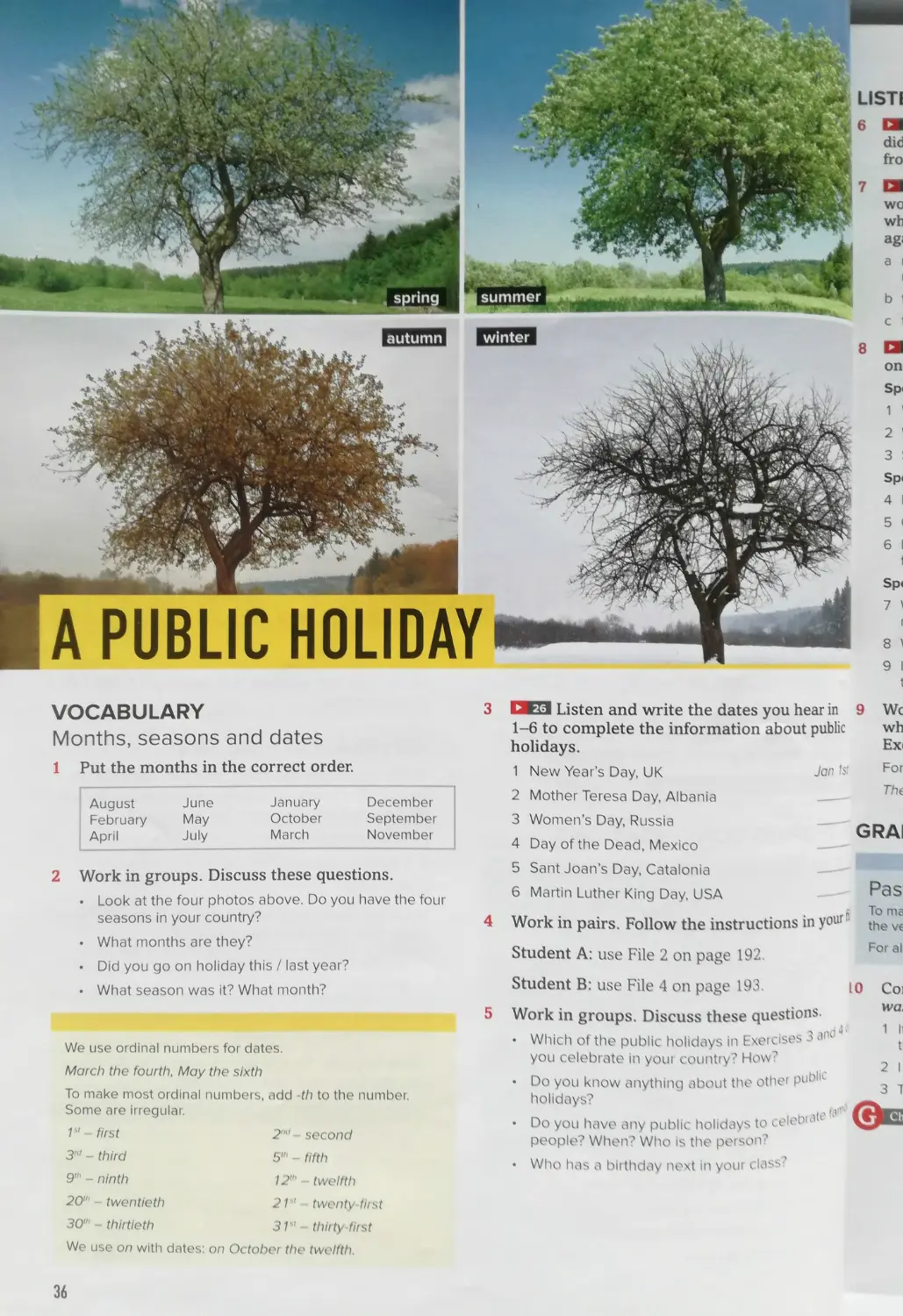
A PUBLIC HOLIDAY
3
autumn
S
► 26
8
9
Sp<
ft-
*8
winter


did
fro
wc
wb
agi
a i
on
Spi
1 ’
2 ’
3 :
Sp<
4 I
5 <
6 I
VOCABULARY
Months, seasons and dates
1 Put the months in the correct order.
August
February
April
June
May
July
January
October
March
December
September
November
2
Work in groups. Discuss these questions.
•	Look at the four photos above. Do you have the
seasons in your country?
•	What months are they?
•	Did you go on holiday this / last year?
•	What season was it? What month?
four
4
5
We use ordinal numbers for dates.
March the fourth, May the sixth
To make most ordinal numbers, add -th to the number.
Some are irregular.
1" - first
3rd - third
9"' - ninth
20"' - twentieth
30"' - thirtieth
\Ne use on with dates: on October the twelfth.
2nd - second
5"' - fifth
12"'
21"
31" thirty-first
twelfth
twenty-first
Listen and write the dates you hear in
1-6 to complete the information about public
holidays.
New Year’s Day, UK
Mother Teresa Day, Albania
Women’s Day, Russia
Day of the Dead, Mexico
Sant Joan’s Day, Catalonia
Martin Luther King Day, USA
Work in pairs. Follow the instructions in your
1
2
3
4
5
6
Jan 1st
Wc
wb
Ex
For
The
GRAI
Student A: use File 2 on page 192.
Student B: use File 4 on page 193.
Work in groups. Discuss these questions.
•	Which of the public holidays in Exercises a s
you celebrate in your country? How?
•	Do you know anything about the other pubb
holidays?
r' b|,K
•	Do you have any public holidays to celebn’1
people? When? Who is the person?
•	Who has a birthday next in your class
Pas
To me
the v«
For al
10
Coi
wa
1 li
t
1
2
3
36
LISTENING
. гуЯ Listen to three stories about what people
6 did on public holidays. Which public holiday
from Exercise 3 does each speaker talk about?
гуЯ Work in pairs. Check you understand the
' words below from the three stories. Then decide
which speaker used each group of words. Listen
again to check your ideas.
a missed - work - nice - presents - flowers - say -
room
b three - drove - clear - cloud - views - traffic - two
c fire - beach - night - songs - swam - warm - slept
8 Listen again. Complete the sentences with
one word in each space.
Speaker 1
1	we a Are on the beach.
2	We songs and laughed.
3	Some of my friends swam in the
Speaker 2
4	I was in London for work, so I missed the
5	On Women’s Day, men usually us very well
6	I didn't go out for dinner. I didn't get
flowers.
Speaker 3
7	We on Saturday the 16th at three in the
morning.
8	We drove to the
9	It was very clear and sunny. There wasn't a cloud in
the___________
9	Work in pairs. Say as much as you can about
what each speaker did, using the words in
Exercise 7.
For example:
They made a fire on the beach with some friends.
grammar
Past simple negatives
To make past simple negatives, we use wasn't I weren't for
the verb be.
r°r till other verbs, we use didn’t + infinitive.
10	Complete the sentences from the listening using
wasn’t, weren’t or didn’t.
’ It was good, because there______many cars on
the road.
11	Write the negative form of the past simple verbs
in brackets.
I --------much on Sunday, (did)
2	I--------until eleven, (got up)
3	I wanted to have breakfast, but there______any
coffee or bread in the house, (was)
4	I went to the shop, but I my keys, (took)
5	The shops open. It was a holiday! (were)
6	I tried to call my neighbour, but he_______
(answered)
7	I went to a cafe and I had a coffee, but then I saw
that I any money! (had)
8	I went back to my flat. I broke a window to get in. I
	again after that, (went out)
In negative sentences, we often use any + noun after the
verb. We can also use anyone, anything, anywhere.
I didn't get any flowers.
I didn’t have anyone to say nice things to me.
12	Complete the sentences by adding any, anyone,
anything and anywhere.
1	I wanted to buy it, but I didn't have money.
2	The film was in English. I didn’t understand
___________i
3	The beach was very quiet. We didn't see
there for maybe three days.
4	We went shopping in the morning, but I didn't buy
5	I had a very quiet weekend. I didn’t go
6	We stayed in a very small town. There weren't
shops or banks!
7	I didn’t enjoy the party. There wasn’t I
knew there.
8	There wasn’t to park the car, so I drove
home.
©EZ	ЖЕЕЕЕЕЕЗЭ
SPEAKING
13	Write answers to these questions. Then work in
groups and say what you've written.
• What's your favourite public holiday? What do you
normally do?
. When was the last public holiday? What did you do?
।---------go out for dinner.
3 The sea very warm.
lOut ideas on page 172 and do Exercise 1.
Unit 4 Holidays 37
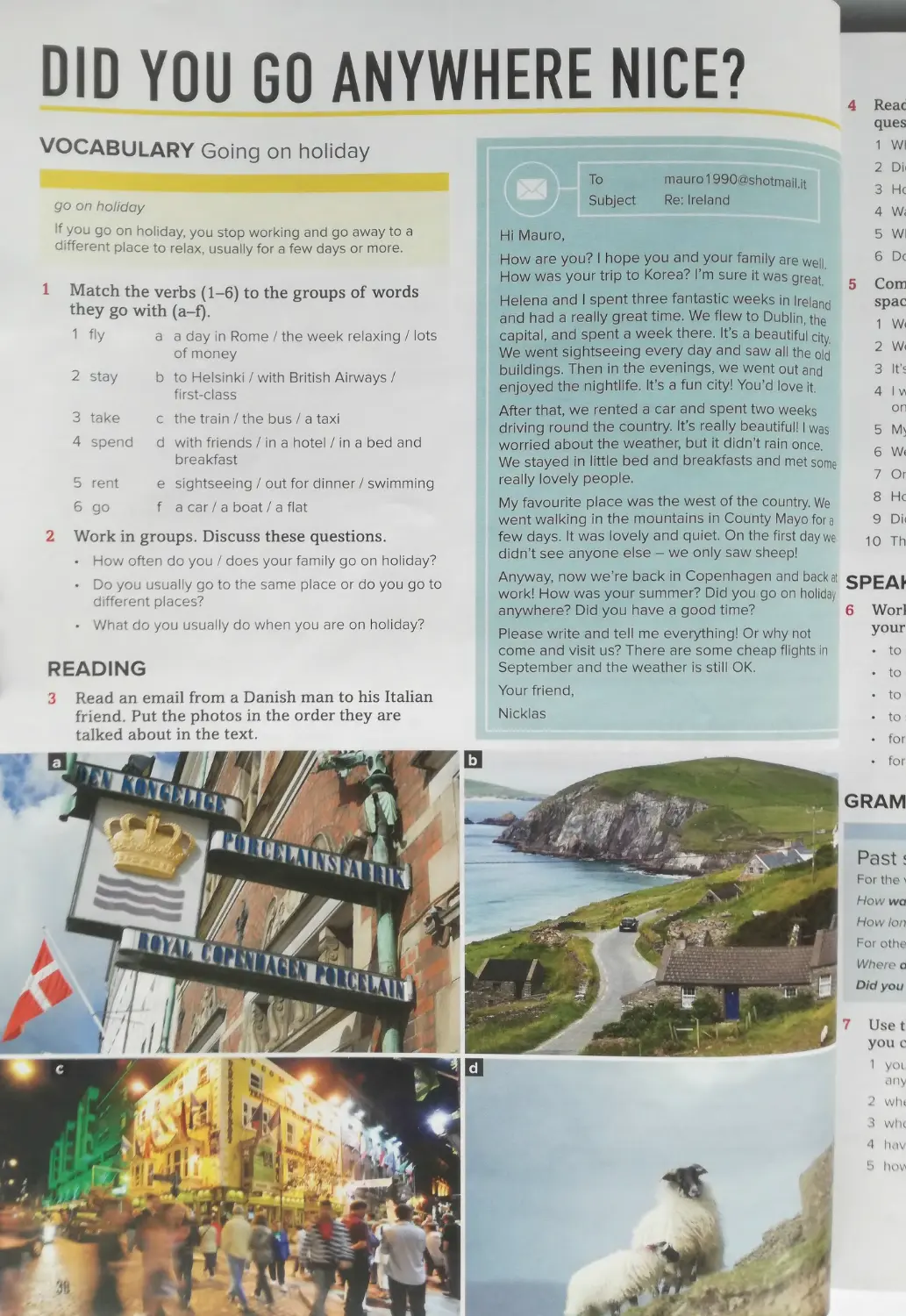
DID YOU GO ANYWHERE NICE?
ques
VOCABULARY Going on holiday
go on holiday
If you go on holiday, you stop working and go away to a
different place to relax, usually for a few days or more.
1 Match the verbs (1-6) to the groups of words
they go with (a-f).
1	fiy	a	a day in Rome / the week relaxing / lots of money
2	stay	b	to Helsinki 1 with British Airways / first-class
3	take	c	the train / the bus 1 a taxi
4	spend	d	with friends / in a hotel / in a bed and breakfast
5	rent	e	sightseeing / out for dinner / swimming
6	go	f	a car / a boat / a flat
2	Work in groups. Discuss these questions.
•	How often do you / does your family go on holiday?
•	Do you usually go to the same place or do you go to
different places?
•	What do you usually do when you are on holiday?
READING
3	Read an email from a Danish man to his Italian
friend. Put the photos in the order they are
talked about in the text.
1 Wl
2 Dii
To	mauro1990@shotmail.it	3 H(
Subject	Re: Ireland
4 W.
Hi Mauro,	5 Wl
How are you? I hope you and your family are well 6 Dc
How was your trip to Korea? I’m sure it was great. 5 Com
Helena and I spent three fantastic weeks in Ireland sPac
and had a really great time. We flew to Dublin, the 1 w<
capital, and spent a week there. It’s a beautiful city
We went sightseeing everyday and saw all the old	2	W‘
buildings. Then in the evenings, we went out and	3
enjoyed the nightlife. It’s a fun city! You’d love it.	4	। w
After that, we rented a car and spent two weeks	on
driving round the country. It’s really beautiful! I was 5 My
worried about the weather, but it didn’t rain once. < ...
We stayed in little bed and breakfasts and met some
really lovely people.	7 Or
My favourite place was the west of the country. We 8
went walking in the mountains in County Mayo fora 9 Di<
few days. It was lovely and quiet. On the first day we	ю Th
didn’t see anyone else - we only saw sheep!
Anyway, now we’re back in Copenhagen and back at SPEAF
work! How was your summer? Did you go on holiday
anywhere? Did you have a good time?	6 Worl
Please write and tell me everything! Or why not your
come and visit us? There are some	cheap flights in	•	to
September and the weather is	still	OK.	.	to
Your friend,	.	to
Nicklas	.	to
• for
• for
GRAM
Past j
For the i
How wa
How Ion
For othe
Where a
Did you
7 Use t
you c
1	yoi
any
2	wlu
3 whc
4 hav
5 hov
4 Read the email again and answer these
questions.
1	Where did Nicklas go?
2	Did he go on his own?
3	How long was he there for?
4	Was the weather good?
5	What did he do there?
6	Do you think it was a good holiday? Why? / Why not7
5 Complete the sentences with one word in each
space. Look at the email if you need help.
1	We to Dublin.
2	We a week there.
3	It's a-------city.
4	| was.--------about the weather, but it didn't rain
once!
5	My place was the west of the country.
6	We went in the mountains.
7	On the first day we didn't see ____else!
8	How your summer?
9	Did you go on holiday?
10	There are some cheap in September.
SPEAKING
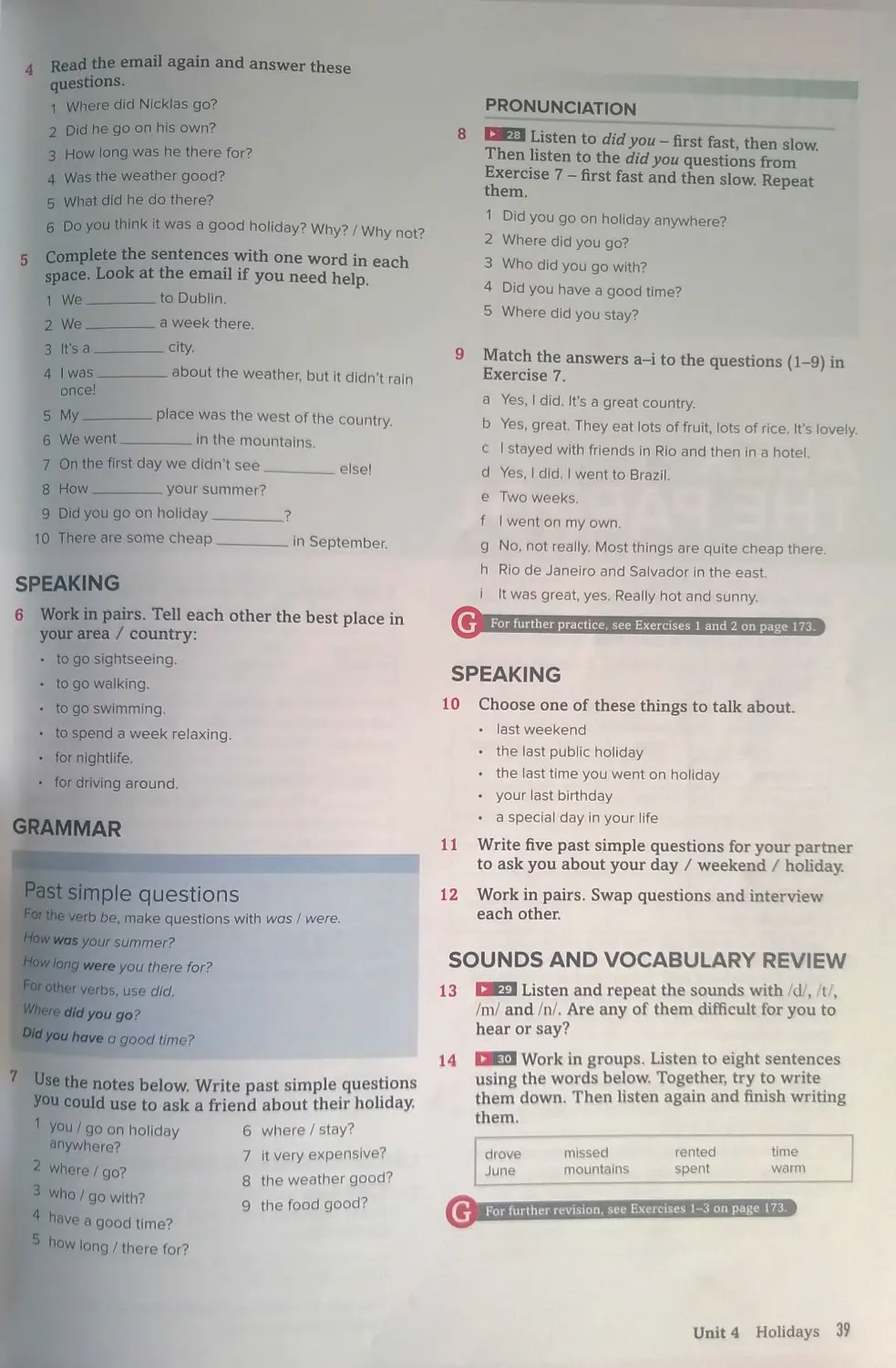
6 Work in pairs. Tell each other the best place in
your area / country:
•	to go sightseeing.
•	to go walking.
•	to go swimming.
•	to spend a week relaxing.
•	for nightlife.
•	for driving around.
GRAMMAR
Past simple questions
For the verb be, make questions with was / were.
How was your summer?
How long were you there for?
For other verbs, use did.
Where did you go?
Did you have a good time?
PRONUNCIATION
8 Ufcj Listen to did you - first fast, then slow.
Then listen to the did you questions from
Exercise 7 — first fast and then slow. Repeat
them.
1	Did you go on holiday anywhere?
2	Where did you go?
3	Who did you go with?
4	Did you have a good time?
5	Where did you stay?
9 Match the answers a-i to the questions (1-9) in
Exercise 7.
a Yes, I did. It’s a great country.
b Yes, great. They eat lots of fruit, lots of rice. It’s lovely,
с I stayed with friends in Rio and then in a hotel.
d Yes, I did. I went to Brazil.
e Two weeks.
f I went on my own.
g No, not really. Most things are quite cheap there.
h Rio de Janeiro and Salvador in the east.
I It was great, yes. Really hot and sunny.
&
SPEAKING
10	Choose one of these things to talk about.
•	last weekend
•	the last public holiday
•	the last time you went on holiday
•	your last birthday
•	a special day in your life
11	Write five past simple questions for your partner
to ask you about your day / weekend / holiday.
12	Work in pairs. Swap questions and interview
each other.
SOUNDS AND VOCABULARY REVIEW
13 DEI Listen and repeat the sounds with /d/, t/,
/m/ and In/. Are any of them difficult for you to
hear or say?
Use the notes below. Write past simple questions
you could use to ask a friend about their holiday.
1	you I go on holiday
anywhere?
2	Where / go?
3	who /go with?
4	have a good time?
5	h°w long / there for?
6 where/stay?
7 it very expensive?
8 the weather good?
9 the food good?
14 CE3 Work in groups. Listen to eight sentences
using the words below. Together, try to write
them down. Then listen again and finish writing
them.
drove
June
missed
mountains
rented
spent
time
warm

Unit 4 Holidays 39
We
Complete
the verbs
days there
After that,
we 6______
Choose tl
1 There’s
2 Our hoi
3 Simon’s
4 Can yoi
5 I’m sorr
6 Did you
7 They w>
8 My hou
betwee
GRAMM
1 Look at the photo. Work in pairs. Discuss these
questions.
•	Which is the dog, the cat and the parrot?
•	For each animal, give a mark 0-5 in each row of the
table below.
•	Which do you think is the best pet / animal?
	Dog	Cat	Parrot
intelligent
clean
friendly
boring
beautiful
easy to keep
< 7
2
Watch the video about cognitive biologist
Irene Pepperberg and the project and tests she
does with a parrot called Alex. Which one of
the sentences below best explains what the
project shows?
1 Parrots are the best pets for children.
2 Parrots are more intelligent than cats.
3 Parrots can repeat sounds but they don’t understand
the meaning of words.
4 Parrots can show they understand size and colour.
5 Parrots can do the same maths as a five-year-old
human.
3	OKI Complete the summary of the video wit 3 Rewrite t these words. Then watch the video and check questions — —	—	—	. —	1 I can co
	abilities	died	love	smaller	2 There’s African	different	many	words 3 The hot
4	rene Pepperberg worked with an 1	grey	4 He had parrot called Alex. Alex amazed scientists because hi 5 I unders understood words. He could answer questions likef	6 I can he 2	? What colour? What’s the same? What's 	? What colours bigger? What colours	ц5е 4	?This showed cognitive 5	simile to four- or five-year-old humans and so the scientists □elieved adult parrots can think and communicate.A' B- Yes-w 6	in 2007. He learned around 1507——-• A: 2	 n his life and his last ones to Irene were ‘18	- В: I went tc Уои’-	A: That’s ni Work in groups. Tell the people in your group B; Leeds. V about someone you know who has / had apc	A:4	 The others ask these questions to find out nK	в: othelio. A: 5	 Do you like it?	Did you like it?	, 3	В: 1 liked it, What’s its name?	What was its name? и u-  -X-,	xo	5 Lafcd List» How big is it?	How big was it?	word in ег Where does (s)he keep it? Where did they keepetc.) are 0 How old is it?	How old was it when ltd	1
UNDERSTANDING FAST SPEECH
5
Read and listen to this extract
video said fast, then slow. Stressed soun
< 8
2 ________
own.
3 ________
CAPITALS.
ALex was ABIe to idENtify an OBject MANy
COIour, SIZE, and SO on.
’th th®
You try! Practise saying the extract wi
same stressed sounds.
6
40
REVIEW 2
grammar
4 long you'
5 There knew
6 I’m sorry hear
1 Choose the correct option.
1	There’s a cafe on I in the corner of this road.
2	Our house is in front / next to a school.
3	Simon’s / Simon parents live on this road.
4	Can you give he / him the keys?
5	I’m sorry, I can’t I can see the board.
6	Did you went I go out last night?
7	They were I was both ill at the weekend.
8	My house is at I in the end of this road, opposite I
between the church.
2 Complete the text with the past simple form of
the verbs in brackets.
6
► 31
Work in pairs. Compare your ideas. Listen
again to check.
VOCABULARY
7 Replace the adjectives in italics in 1-6 with their
opposites in a-f.
1	Do you have any dirty clothes?	a	bad
2	It’s very hot in here.	b	cold
3	That sounds great.	c	nice
4	It was clear and sunny.	d	wet
5	Is that towel dry?	e	clean
6	People were very unfriendly.	f	cloudy
We	_ (have) a great holiday in Greece. We
2	(fly) to Athens and 3(spend) three
days there and 4	. (see) all the famous sights.
After tr at, //e .	(take) a boat to Mykonos and
не  (stay) in a small hotel near the beach.
3	Rewrite the sentences as negatives (-) or
questions (?).
1	can corrie to the next class. (-)
2	There’s a supermarket near here. (?)
3	r' e hotel //as very good. (-)
4	He had a nice time. (?)
5	understood everything. (-)
6	can help you later. (?)
4 Write full questions to complete the dialogue.
Use the words in brackets.
A	? (nice weekend)
8 Л-, * //as great
A '	? (do)
В //< -' to st/> / with rny brother.
A That's nice	? (live)
В i < c-ds Wo went to the theatre on Saturday night.
A 4	? (see)
В Othfrllo
A	? (good)
x< d t t,nt m/ brother didn’t
' QFH 1 .ish-n and complete the sentences with one
word in <;>( h нрясе Contractions (I'm, don’t,
‘dr ) are one word.
1	bonk'*	road
right,
y	think	live*'.
Own,
turn	up? -----------
hear It
8 Put the words into three groups - local facilities,
home or time of year.
apartment	chemist’s	March	sofa
autumn	cupboard	October	spring
balcony	fridge	post office	sports centre
bookshop	kitchen	sink	winter
9 Match the verbs in the box to the groups of
words they go with in 1-8.
cut	send	share
get	set	show
turn down
wash
1	~ a flat with a friend I ~ a pizza / ~ your ideas
2	~ an email / ~ a package / ~ a message
3	~ some money / ~ dressed I ~ back home
4	~ the table / ~ your alarm clock / ~ a rule
5	~ the vegetables I ~ yourself I ~ it with scissors
6	~ your hair I ~ your hands I ~ the plates
7	~ the air-conditioning I ~ the TV / ~ the temperature
8	~ me on the map I ~ us round town I ~ him what to
do
10 Complete the text with the words in the box.
annoys	mess	rents	songs	visited
lay	nightlife	sightseeing	view	watched
My brother now lives in Rome and I 1 him in
the summer. He 2 a small flat in the centre
of town, so it was great to go 3 and enjoy
the great4__________And his flat is on the top floor
of the building, so there was a nice 5 from
his balcony. That was all good, but sometimes my
brother really6_________me. The flat was a 7
when I arrived. I tidied it, but he didn’t say thanks. I
made dinner and he just8 on the sofa and
a film. He also sings 10 in the
shower In the morning - very badly! So at the end of
the holiday I was happy to leave!
Review 2 41

IN THIS UNIT YOU LEARN HOW TO:
•	describe what you want
•	talk to a shop assistant
•	understand prices
•	talk about department stores
•	talk about things happening now
•	give excuses
•	follow directions in a store
WORDS FOR UNIT 5
1
Work in pairs. Match the words and phrases to the
photos.
a bar on the top floor
business is growing
the cheese section
choose a cake
fruit and vegetables
go up the escalator
have a sale
look round the market
a man with a brown jumper
the menswear department
queue to pay
steal some jeans
take the lift
a young woman with a blue top
a woman with a green dress
a woman with a leather jacket
work in a bakery
► 32
the words.
Listen. Check your answers. Listen again. Repeat
3 Work in pairs. Test each other. Cover the words.
Student A: point to a photo
Student B: say the words.
4 What other colours can you see in the photos? What
other clothes can you see?
2
HOW MUCH IS THAT RED ONE?
LISTENI
DEVELOPING CONVERSATIONS
Questions in shops
Learning common questions for particular situations will
help you understand and have conversations.
1 Who usually asks each question 1-8: shop
assistants (A) or customers (С)?
1	Who’s next?
2	What are those made of?
3	How much are the apples?
4	Can I have some ...?
5	Which one(s)?
6	How much would you like?
7	How many would you like?
8	Anything else?
2 Match the questions (1-8) in Exercise 1 to the
pairs of possible answers (a-h).
a A:_____________________________________________
B: Sure. How much?
Of course. How many do you want?
b A:_____________________________________________
B: 50p each.
One forty-nine a kilo.
c A: ____________________________________________
B: Me.
This lady, I think.
d A:_____________________________________________
B: That much.
Half a kilo.
e A:_____________________________________________
B: Those ones have fish in them and the others
have meat.
Leather.
f A:_____________________________________________
B: No, thanks, that’s all.
Yeah, can I have some of that, please?
g A:---------------------------------------------
B: Five or six.
Just one.
h A:____________________________________________
B: The blue one.
The ones next to the apples.
3 Spend two minutes remembering one answer for
each question in Exercise 1. Then work in pairs.
Student A: ask questions.
Student B: close your book and give answers.
► 33
Comp]
includ
Then 1
PRON
► 34 |
main s
thirteen
thirty
► 35
numbe
1 That’s
2	That’s
3	Everyt
4	Those
5	It cost:
6	Our ap
SPEAKII
8 Work i:
• How
how i
• What
belov
think
a cup c
a flat w
a kilo о
a litre c
a meal
•	How i
photo
•	Do yo
things
44
LISTENING
4 rwn Listen to three conversations in markets.
Complete the table about what the people buy,
including number, size, colour, etc.
5 QE3 Work in pairs and compare your answers.
Then listen again and check.
GRAMMAR this I these I that / those
9 Match the sentences (1-4) to the pictures (a-d).
PRONUNCIATION
6 ПЕП Listen to these numbers and mark the
main stress.
thirteen	fourteen	sixteen
thirty	forty	sixty
7 ПЕЗ Listen to the sentences and write the
numbers you hear.
1 That’s €exactly.
2 That’s $altogether.
3 Everything is reduced by%.
4 Those are at the moment, reduced from
5 It costs £new.
6 Our apartment cost when we bought it.
SPEAKING
8 Work in groups. Discuss these questions.
•	How important is the price of things? Do you know
how much things cost?
•	What do you think is the average price of the things
below where you live? What's the maximum you
think it’s OK to pay for them?
a cup of coffee	a new car
a flat with two bedrooms a nice pair of shoes
a kilo of bananas	a pail of Jeans
a litre of petrol	a piece of cake in a cafe
a meal for two in a restaurant
How much would you pay for the things in the
photos on page 44?
Do you ever negotiate the price for things? What
things? Are you good at it?
1	I like these ones.
2	This apple is nice.
3	Those Jeans are expensive.
4	That cake looks good.
10 Complete the sentences with one word in each
space.
1	A: What this called in English?
B: A shirt.
2	A: What do you call things on your table?
B: They're coins.
3	A: How much those jackets?
B: What? These leather__________?
A:	Yes.
B:	Well, it depends brown one’s £100.
11	Work in groups. Ask each other the name in
English for different things in the classroom. Use
these questions.
•	What’s this called?
•	What’s that thing there called?
•	What are these I those things called?
CONVERSATION PRACTICE
12	Work in pairs. Have similar conversations to the
ones in the listening. Choose a shop from the
photos on page 44.
Student A: you are the shop assistant. Hold your
book open for Student В to see.
Student B: you are the customer. Buy two different
things in the photo. Try to negotiate the price! Use
as much of the language from this page as you can.
Choose a different picture. Change roles and
have another conversation.
Гв< 9 To watch the video and do the activities, see the DVD-ROM
Unit 5 Shops 45
THEY’RE HAVING A SALE
READING
1	Work in groups. Discuss these questions.
•	How often do you go shopping? How often do you
buy things online? Which do you prefer?
•	Do you usually wait for shops to have a sale before
you buy things? Why? I Why not?
•	Where was the last sale you went to? Did you buy
anything?
•	Tell a partner about a time you got a bargain. Use
sentences like these.
I bought a coat for the winter. It was €60, reduced
from 100.
I bought a mountain bike. It was reduced by 50%.
I bought my car for €2,000! I bought it from a friend.
•	Who in your group got the best bargain?
2	Work in groups of four: two As and two Bs. Read
about two shops that are having sales.
Student As: read about Emily.
Student Bs: read about Dalena.
Answer these questions for your text.
1	Where is she from?
2	What does she do?
3	Where does she work?
4	Why is the shop having a sale?
5	How’s she feeling? Why?
6	What does she want to do in the future?
3 Compare answers with the person in your group
who read the same text.
4 Now work in pairs: one Student A and one
Student B. Ask and answer the questions in
Exercise 2 to find out about your partner’s text.
5 Work with the same partner. Complete the
sentences with the words in bold from the texts.
Put one word in each space.
1	My granddad had his own business, but he sold it
when he.
2	My dad works very. He has three jobs!
3	It’s that small shops are closing in our
town.
4	We want to find a new office because the business is
fast and we need more space.
5	In the future, I want to start my own business and
lots of money!
6	There are lots of to find a good job here.
7	How can I my German?
8	I--------the toy section in a department store in
town. It’s a good job.
SPEAKING
6	Work in pairs. Discuss these questions.
. Do you know any shops that are closing? q0
know why?
. Are any shops opening where you live? Wha*
shops? Are you happy about it?
. Do you know anyone who works very hard? Wh
they do?
• Do you want to be a manager in a company or
in the future? Why? / Why not?
. Do you want to make lots of money? If yes, how’
If no, why not?
. Are there a lot of opportunities for young peop,6.
your country? Why? / Why not?
GRAMMAR
Present continuous
Look at these sentences from the texts.
I’m looking for a job at the moment.
We’re having a sale because we’re closing the shop.
The store opened last year and it’s doing very we
The present continuous uses a form of be + -/ng. We use
the present continuous to talk about present actions or
situations that are temporary and not finished.
7	Complete the sentences with am / are I is.
1	The shops in town having sales at the
moment.
2	I working very hard at the moment.
3	My mother’s not here. She doing the
shopping.
4	The economy growing fast at the n'C
5	My football team doing really we nc
6	You really improving. You didn’t kne-
much English when we first met.
7	Some friends staying with me at the
moment.
8	My brother studying at university.
PRONUNCIATION
8
► 36
------Listen to the present continuous
sentences from Exercise 7. Notice how tn -
use the short forms of am / are / is. List
again and repeat the sentences.
9
Look again at sentences 1 and 2 in Ex
1	What phrase shows the present actions c
are temporary and not finished?
2	Make a question and a negative from ead
46
EMILY, GERMANY
Were having a sale because were closing the shop. Its sad,
because my grandfather opened it 60 years ago. When 1
was small, I came here on Saturday mornings and sal and
read the children’s books.
When my granddad retired, 1 started to manage the
shop. Now there’s a sale, so there arc lots of people and
they’re buying lots of books, but we don’t normally have
so many customers. There are lots of very big bookshops
now, which sell every book their customers want. I hey
often have cafes and famous writers come and give talks
for them, but we can’t do that. And then other people
look online to get books cheaper, so we don l really make
much money.
I’m looking for a job at the moment, but I dont really
know what I want to do in the future. I don t really want to
work in another bookshop after 1 leave here.
GALENA, SLOVAKIA
I’m a sales assistant in a big clothes store. The store
opened last year and it’s doing very well. We’re
having our summer sale at the moment, so I’m
working really hard The shop is staying open later
than normal. We usually close at seven, but during
the sale we're open until nine. I’m tired, but 1 like
my job. 1 like helping people to find nice clothes
and, ol course, everyone is happy when they find
a bargain.
1 want to continue working with the company
and maybe become a floor manager and then a
store manager. I think it’s a good place to work,
and the business is growing at the moment and
opening new stores, so 1 think there are lots of
opportunities. Maybe I can get a job in one of then-
shops in the UK and improve my English!
10 Work in pairs. Which sentences in Exercise 7 are
true for you? Change the other sentences so they
are true.
You are at a party or meeting. Write an excuse
using the present continuous to explain why
each of the people in the box can’t come.
Now have conversations using your sentences.
For example:
A:	Hi. How are you?
B:	Fine.
A: Are your mum and dad coming?
B: No. Some friends of theirs are visiting.
your mum and dad
your wife or husband
Mr Smith (your boss)
Susie (your sister)
David (a friend / flatmate)
the President!
ise 2 on pi

Unit 5 Shops 47
00 YOU SELL ...?
SPEAKING
1	Read the text about the store in the photo. Find
out what is unusual about John Lewis.
2	Work in groups. Discuss these questions.
•	Do you think it’s a good idea to share a company’s
profits between the workers? Why? I Why not? Do
you know any other company that does it?
•	What’s the biggest department store where you live?
Do you ever go there? Why? Why not? What do you
know about the company?
•	What’s your favourite shop? Why?
VOCABULARY Department stores
3 Label the plan with the words in the box.
an assistant
the basement
the beauty department
the changing rooms
the escalator
the first floor
the ground floor
the lifts
the main entrance
the menswear department
the second floor
the security guard
the till
the top shelf
the womenswear department
John Lewis is the company with the most departmer
stores in the UK. The company started with one shop
in Oxford Street, London, in 1864. The store is still there
today. It has around 80 sections and sells everything
from cheese to baths, and perfume to foreign holidays
After the war, the business grew a lot and it now has 32
department stores, eleven furniture shops, a small fac*
and a farm. It also owns a supermarket with over 300
LISI
5 C
d
(1
a
b
c
d
shops. John Lewis is an unusual company because allt g
workers are partners in the business - when the comp
makes money, the workers share some of the profits..:
Lewis made around £320 million last year and the93.'
partners shared half of that money between them.
4 Work in pairs. Answer these questions using
words from Exercise 3.
1	Where do you try clothes on?
2	Where do you ask Are you going up?' or say Fourth
floor, please’?
3	Where do you go in and go out of the store?
4	Which floor do you always go down to?
5	What floor is the main entrance usually on’
6	Where do you queue to pay?
7	Where do you buy trousers and a shirt7
8	Where do you buy a skirt and top?
9	Where do you buy perfume?
10	Who do you ask for information or help7
11	Who stops people stealing things?
12	What do you get off at the top or at the bottom7
LISTENING
7 Choose the correct option in the sentences.
Then look at the audio script for Track 37 on
page 202 and check your answers.
Conversation 1
1	Do you sell I Ate you selling batteries?
2	They’re there. On I In the bottom shelf
Conversation 2
3	She put that perfume on I in her bag!
4	Someone* talks I s talking to her.
Conversation 3
5	I'm still at I on the bus. but we come down / we're
coming down Oxford Street now
6	When you get out I off on the fourth floor, it's behind
you It's at I to the back of the store
Conversation 4
7	The changing looms are over there in I on the
corner. Next to I of the jeans
8	How muc h / many Items can I take to try on?
► 37
Listen to four short conversations in a
SPEAKING
department store. Match each conversation
(1-4) to one of these situations.
a Someone is stealing something
b Someone wants to try some clothes on
8 Imagine you're in a department store. Think of
some things you want to buy and complete each
sentence in two different ways.
Excuse mo. Do you sell ..?
c Someone is explaining where to meet
Excuse me. I'm looking for ... .
d Someone is looking for an item in the wrong place
For each conversation, decide if the
sentence is true (T) or false (F). Listen again
and check.
9 Now work in pairs. Roleplay conversations
between a customer and a shop assistant in
a department store. Change roles for each
conversation.
1 The man wants some batteries for a toy
2 The speakers tell a security guard about what
they saw
3 The woman bought some jeans, a skirt and two tops
Student A: you aie the customer Ask youi questions
from I xerclse 8.
Student B: you aie the shop assistant I ook at the plan
<ind the phnr.es In the box In F lie 1 1 on page 196 Give
directions to Student A.
SOUNDS AND VOCABULARY REVIEW
10
к 1H
in a sale
4 <s- car ’ake s / items of clothing to the < hanging
room
Listen and repeat the sounds with g ,
/I |7 and /d;V. Are any of them difficult for you to
hear or say?
11
к 19
Work in groups. Listen to
eight sentences
using the words in the box. Together, try to
write them down Then listen again and finish
writing them
i henpoi	everything	Ivans	section
(I loose	Imploving	manage	shirt

IN THIS UNIT YOU LEARN HOW TO:
•	describe classmates and teachers
•	name school and university subjects
•	talk about courses you’re doing
•	talk about languages and education
•	give opinions about what’s better
WORDS FOR UNIT 6
1 Work in pairs. Match the phrases to the photos.
an angry boss
a boring class
borrow some money
cause a problem
a creative person
help each other
a Law student
a lazy student
learn Arabic
learn to ride a bike
make clothes
a modern university
pass the exam
police training
solve the problem
a strange teacher
study Engineering
teach PE
► 40
Listen. Check your answers.
Listen again. Repeat
the words.
3 Work in pairs. Test each other. Cover the words.
Student A: point to a photo.
Student B: say the words.
WHAT ARE YOU STUDYING?
Wor
 У<
• yc
• УС
• y<
LISTE
6 DE
stud
ГП
2
3
Conv
1 I’m
2 I’m
Conv
3 I’m
4 No
Conv
5 It’s
6 Go
Work
• Do
mo
• Wh
• Wh
VOCABULARY School and university
1 Match each group of adjectives (1 4) to one of
the nouns (a d).
1	2	3	4
friendly	popular	Interesting	helpful
nice	expensive	boring	patient
l<i/y	modern	difficult	strange
3 Choose three adjectives to describe your
school / university / college life. Tell a part
For example.
Our English teacher is very patient.	9
My university was very popular - and very exp*
I was sometimes lazy when I was at school'
Work in pairs. Look at the subjects below
Answer the questions.
1 Which subjects are arts subjects7
• Are
PROf
► 42
then s
are as
► 42
Work
the qu
<i a course
l> a classmate
c a teacher
(I <i university
2 Work in pairs. Compare your ideas. Then add
one more adjective to each group above.
2 Which subjects are science subjects7
3 Which subject(s) do you usually start study -	L(
school and which do you usually start at u01
Biology	Geography	MarkelW	How’s
Chemistry	History	Maths	We can as
Computing	Law	Меск^	is enjoyinc
Engineering	Literature	PE	A: How's t.
8 Really и
57
5 Work in groups. Discuss which subjects:
. you think are most / least important.
. you think are easy / difficult.
. you know a lot about.
. you liked / didn’t like at school.
listening
► 41
Listen to three conversations about
studying. Complete the table.
	Subject	Year	How’s it going?
1						 Really well.
2		2nd
3
► 41
Listen again.
Choose the correct option.
Conversation 1
1	I’m doing I making a degree in Marketing.
2	I’m really enjoying I liking it.
Conversation 2
3	I’m a student at / of university.
4	Not very well, actually. I just find it boring / bored.
Conversation 3
5	It’s a lot of work I works'.
6	Good luck with I for it.
8 Work in pairs. Discuss these questions.
•	Do you know anyone at university / college at the
moment?
•	What are they studying?
•	What year are they in?
•	Are they enjoying it?
PRONUNCIATION
9
► 42
10
11
Listen to eight questions said fast and
then slower. Note how we often pronounce
are as /о/. Repeat what you hear.
Listen again and write what you hear.
Work in pairs. Take turns to ask and answer
the questions.
► 42
developing conversations
How’s the course going?
We can ask How’s the course going? to find out if some one
is enjoying their course or not.
A: How’s the course going?
B: Really well. It’s great. I’m really enjoying it.
12 Look at these answers to the question How's the
course going? Complete each answer with Really
well, OK or Not very well.
1	 but it’s not very easy.
2	I find it boring.
3	It’s very interesting.
4	__ but it’s a lot of work.
5	I don’t really like my teacher. He's strange!
6	The other students are very nice and
friendly.
7	I did very well in my exams. I found them
easy.
8	I think I chose the wrong subject!
9	, I suppose, but I’m not sure it's what I really
want to do.
13 Work in groups. Discuss these questions.
•	How’s your English course going?
•	What’s good about it?
•	Is there anything you don’t like?
CONVERSATION PRACTICE
14 Work in pairs. Use the guide below to have
four conversations like the ones you heard in
Exercise 6. Use different ideas from the table
below if you need to, and add a reason for how
the course is going. Take turns to start. Try to
give different answers each time.
Student A	Student В
So what do you do?
I'm a student at...
So what’re you studying?
Answer the question.
What year are you in?
Answer the question.
How’s the course going?
Answer the question and
explain wh\
Place	Course		Year	How’s it going?
University of Rome	Biology	1	Good
Middlesex University	Computing	2	Bad
Le Cordon Bleu, Australia	Hotel Management	3	OK
Harvard	Medicine	4
Cambridge	Chinese	Final
и 10 To watch the video and do the activities, see the DVD-ROM.
Unit 6 Education 53
LEARNING AND TRAINING
-------------------—————6 I
vocabulary courses
J“oniplete the texts (1-5) by putting the words in
1 ackets in the correct space.
' 1 do an art class every Tuesday. The class______
at eight in the evening and________at ten. We
paint anything we want and the teacher__________
us help and advice, (finishes, gives, starts)
1 nt---------a course at the moment. It’s for my
work, so the company is for it. It’s about
ways to improve sales. It's very useful and I'm
----------a lot. (learning, paying, doing)
3	My brother's to become a pilot. The
course three years and it’s very difficult.
It about £100.000 altogether. My family’s
the money from the bank to pay for
it. I hope he all his exams! (borrowing,
training, passes, lasts, costs)
4	I started learning Russian last year. I to
a class on Wednesday evenings. The teacher was
very good and patient and I the class, but
I was quite lazy and I didn’t very much.
We an exam at the end of the course and
I so I can’t do the next level, (study, had.
went, failed, enjoyed)
5	We a training session at work every
month. The sessions usually for about
three hours. We do different things. Sometimes
a trainer from outside the company,
sometimes our manager us information
about changes in the company, sometimes we all
our ideas about how to improve things.
They’re often very useful, but occasionally they’re
very boring, (comes, gives, have, share, last)
ls it good"?
wl!a,'si,ab0«’
When are the a
How much я.. *
7
c
3 Complete the conversation with the m tl
the box.	4Ues4 e
c
How long does the course last?
What time does the class start?
Do you have any homework?
Why are you doing it?
I------------------------------- —1
A:	I’m doing an evening course at the monies- 2
ti
c
A: Speaking in public.
A: I want to improve my opportunities at work C
B:	3----------- 5
A:	Every Monday.	6
B:	4___________
A:	Yeah. I usually watch some videos online arc C<
prepare a talk.	7
B:	5___________
A:	Six, and it ends at eight.	8
В	8 C<
ati	th
A: Ten weeks.
A: Two hundred pounds.
B:	8	3
4
A: Yeah. It’s very useful. I’m enjoying it.
5
4 Work in pairs. Practise reading the convert
6
LISTENING
2 Work in pairs. Use verbs from Exercise 1 to say 5 Match these words and phrases to the phc.
things about your English class. How many of	Think of one m°re word for each photo,
the verbs can you use?	. n и
an online course a horse a training session
__ Listen to four people talking about the
courses in the photos. Match the speakers to
the photos а-d and decide if all the learning
experiences you heard about were good. Then
compare your ideas with a partner.
► 43
► 43
Listen again. Decide if the
true (T) or false (F).
sentences are
Conversation 1
1 The course is 6.30 to ten, twice a week.
2 She works in fashion now.
Conversation 2
3 His manager told him to go to the training session.
4 He learned how to make good decisions.
Conversation 3
5 She always rides twice a week.
6 She rode horses when she was younger, but then
stopped.
Conversation 4
7 His wife didn’t like the course because there were
too many people.
8 He wants to become a journalist.
9 Work in groups. Discuss these questions.
•	Which of the four courses sounds best to you? Why?
•	Do you know anyone who changed jobs? If yes, why
did they change?
•	Did you have any classes after school when you
were a child? If yes, what?
•	What’s good I bad about doing open online courses?
10 Work in pairs. Have conversations like the ones
in Exercise 3.
Student A: choose one of the courses from this
lesson or think about a course you are doing. Tell
your partner.
Student B: choose questions from Exercise 3 to ask.
For example:
A: I’m doing a training course at the moment.
B: What’s it about?
A: Making decisions.
GRAMMAR
8 Complete the sentences from the listening with
the correct form of the verbs in brackets.
1 I to make clothes, (learn)
2 It for ten weeks, (last)
3 It only about an hour, (last)
4 We any choice, (not / have)
5 I in the countryside and I always wanted
(grow up I ride)
6 My teacher very patient and I
quite good now. (be / get)
7 My wife it with me, but she•
(start / stop)
8 I taking exams. I always---------------------•
(hate / fail)
Modifiers
Very, really and quite are modifiers. They go before
adjectives.
Very and really mean ‘a lot’.
It’s really good.
The teachers are very helpful.
We often make adjectives negative by adding not very.
It wasn’t very long - only about an hour.
Quite means ‘a little’.
I was quite angry by the end.
It's quite expensive.
11 Choose the correct option.
1	Some of my classmates aren’t very / quite friendly.
2	The course is quite I really difficult! I don’t
understand anything!
3	It’s a great university. It’s very I not very popular.
4	She’s nice, but she’s quite I not very lazy.
5	Most of the students are really friendly, but one or
two aren’t really / very nice.
6	It’s a good course. It’s quite I not very interesting.
7	He's a good teacher, but he’s not very I quite patient.
8	It’s a great university, but it’s quite I really expensive!
I can’t study there.
12 Work in groups. Tell each other about things - or
people - that you think are:
a really expensive.
b very popular at the moment.
c quite strange.
d not very modern.
e quite boring.
ф.. г I... I. и.. I.
e, see Exei
id 2 on page Г
Unit 6 Education 55
GROWING UP BILINGUAL
VOCABULARY Languages
j wr„_i,Cav я country or area in the wor
Work in pairs. Say a country or
where each of these are official language .
Arabic
Chinese
English
French
German
Japanese
Romanian Turkish
Russian
Spanish ____________
2 Work in pairs. Discuss these questions.
• How important is each of these languages in the
world:
-	very important?
-	quite important?
-	not very important?
• Which of the languages sound nice to you?
• Do you know any bilingual people? What languages
do they speak?
READING
3 Before you read, complete the sentences with
the words in the box.
caused	explaining	solving
creative	positive
1 I'm quite a person. I'm good at arts
subjects.
2 I’m good at problems. People often ask
me for help.
3 I’m a very person. I always try and think
about good things.
4 I’m good at ideas. I’d be a good teacher.
5 I sometimes problems at school and my
teacher got angry with me.
4 Work in pairs. Discuss which sentences in
Exercise 3 are true for you.
5 Read the first two paragraphs of the article on
page 57. Answer these questions.
1 How many languages do the students at Newburv
Park speak altogether?
2 What are some of the languages children learn
about?
3 Who teaches the words In these different languages?
4 How many students In England are bilingual?
5 Why do some teachers think it’s a problem?
6
7
What do you think of Newbury Park Schnnt
the way they teach language? Do ycш™
the views in the second paragraph? "
Read the rest of the article. What's the writer-,
opinion about the questions in Exercised? Work
in pairs and compare your ideas. Say the гея.»
the writer gives for their opinion. У " reasons
8 Work in pairs. Discuss these questions.
Did you find any of the ideas surprising? Which i*
Do you agree with everything the writer says? if r
why not?
Do I Did you have people from different country
’ your school? Where are / were they from?
am there any bilingual schools in your city I reqil
Do you think they are good? Why? / Why not?
grammar
Comparatives
You can compare how good two things are using
better than.
Growing up bilingual is better than only knowing one
language.
We often then use other comparatives to explain why.
Bilingual children get higher grades at school.
They are more creative.
9 Choose the best comparative to complete the
explanations.
1	Her English is better than mine. She gets higher!
lower grades.
2	This computer is better than mine. My one’s slower
faster.
3	Mr Platt is a better teacher than Mrs Jones. He’s
funnier I more boring.
4	I think Biology is better than English. It’s more
interesting I more difficult.
5	They’re better students than me. I’m more helpful
lazier.
10
Work in pairs. Discuss what the basic adjective
is for each option in Exercise 9. When do we ad
-er, -ier and more to make comparatives?
your ideas on page 176 and do Exercise 1 ]
11 Write sentences using comparatives and the
ideas below.
1	Im/ good at / swimming / you.
2	My house Is / near to I the school / your place.
3	I'm / tall / you.
You re / interested / in history / me.
5	My school was / small / your school.
। wu. warm / last week / this week.
'° Pa*rs- Ask each other questions about
bettA nt.ences in Exercise 11. Find out who is
etter at swimming, etc.
por example:
4feyou9oodotsw/mm/ng?
^^conyousw/m?
Ехегсие 2 on page
56
THE WORLD IN A SCHOOL
Janet Scott finds the benefits of knowing two languages
The students at Newbury Park Primary School in I onilon
speak over 40 languages! Each month, a tear hci him a
student and asks the child to say simple I lungs like hello a
thank you in their language. I hey show I he him Iо I he oil
children in the school to leach them the foreign wonk. In
January and February, the students learned some luikr.li
Japanese. This month, they're learning Rom.mi.in
In England, one in seven children now speaks a loicign
language at home, and some teachers think its causing
problems. They think teaching is more difficult with bilingual
children in the class and that bilinguals can I do well in out
subject if they don’t speak English at home
It is true that starting м hool is difficult lot some
bilingual childien Sometime . the < hildrcn had bad
expi iiciki beloic ihc\ ino\cd to the I К Maybe lhc\
cxpciieiKcd a wai 01 a paient died, 01 they lost then
hoiuc s( hools can help these < Inldicn I 01 example,
the indent' led mole positive about st hool and then
new hie il the\ o< t a aonally do something al school m
then In i language hk< they do at Newbury Park
Bui mo .1 bilingual t hildrcn don I have any problems
ai i hool In I.u i giowing up bilingual ь usually
hellci than only knowing one language Reseaich
.how that bilingual < hildrcn air bcllvi at solving
pioblt in and (hey usually hiir.li st hool w it 11 highei
giadr I hat  het an I they aie more 11callve and
they к often bellei al explaining, ideas I hal  good
news beiaiisc 70% ol llie W’oilds population speak
two 01 more languages1
SPEAKING
SOUNDS AND VOCABULARY REVIEW
13
Choose five things from the box Decide i u
are better or worse now than before Sp< nc w
minutes thinking of one or two reasons w iy.
15 lAlJ Listen and icpeat the sounds with c, a,
/.»:/ and />:/. Are any of them difficult tor you to
hear or say?
a dictionary if you need to.
16
the economy
exams
hospitals
old people
parents
schools
spoil
teachers
ti.nr.poil
universities
the wo.illici
younc) people
Work in groups Listen to eight sentences
using these words Together, try to write them
down Then listen again and finish wilting them
< ntr.i'S	14I11<<1II<111	leriiued	«pant
1 ioui,.«’	tumidly	populni	work
Work in groups. Say your ideas. What do the
other people in your group think?
0^ИПШДШаШШВШ11!1П!П!ШИ»
Unit <1 Hduerttiou Ь7
1	Look at the photo of a refugee camp. Discuss
these questions.
•	Why do you think the different people in the photo
are there?
•	What things can help refugees in this situation?
•	Are there any refugees in your country? Where are
they from?
2	LJUI Watch the first part of the video
(0.00-2.15) about a special course. Answer
these questions.
1	Who are the teachers? Who do they work for?
2	Who are the students? Where are they from? Where
do they live now?
3	What Is the course for?
3 Read the sentences (1-4) from the second part
of the video. Match them to the follow-up
sentences (a-d).
1	Life Is difficult In the refugee camp.
2	Photo camp Is an Inspiration for many of the camp's
residents.
3	Near the end of the programme, the students have
an exhibition.
4 These students received more than a certificate and
a new skill at photo camp
a They are excited to show their work.
b Agonzi Grace, for example, wants to become a
professional photographer.
58
c They also learnt how to document their world.
d But Reza and the other photographers are showing
these young adults how to see their temporary hcr-e
in a new way.
4	Ljw Watch the second part of the video
(2.16-3.50). Put the pairs of sentences in
Exercise 3 in the order you hear them.
5	Work in pairs. Discuss these questions.
• Do you think the course is a good idea?
Why? I Why not?
Do you like taking photos? Are you good at it?
Do you have any photos on your phone that
you like?
6	Work in groups. Show some photos you like to
each other. Ask each other questions like these
• Where was that?	• what are they doing’
• When did you take It? . Who's that?
UNDERSTANDING FAST SPEECH
’ 5^“ Read and listen to this extract from the
in	^ast' then slow. Stressed sounds are
ln CAPITALS.
Те1*иьв%т^ЕАСН'П9 51Х,У YOUNG REfuGEES HOW'0
STOrles of their LIVES in PHOtographs.
sam tr\' Rract*4 se saying the extract with the
same stressed sounds.
REVIEW 3
5 —---------English______________________________
mine.
6-----------—-------------------warmer last
grammar
1 Choose the correct option.
1 A: Can you pass me that I those cups over there?
B: Sure. Here.
2 A: You are I Are you waiting to pay?
B: No. Go ahead.
3 A: How was the exam?
B: Bad! It was more difficult / difficulter than last year.
4	A: Hello. Can I speak to Greg, please?
B: Sorry, he does / he’s doing his homework.
5	A: Did you enjoy the film?
B: It was quite I very good, but not great.
6	A: Do you like this dress?
В: I prefer the blue one / ones that you tried on
before. And it was more cheap I cheaper'.
7	A: Do you want to try some of this I that soup?
B: Oh, it’s nice. It’s more good / better than my one.
2 Write full questions to complete the dialogue.
Use the words in brackets.
A: ’? (do)
B: I’m at university.
A:	Oh, right.1 2? (studying)
B:	Business Management.
A:	3? (going)
B:	Great. I’m really enjoying it. I really like Marketing.
A:4? (What year)
B: My second year. I have two more years after this.
A:	So 5 Business Management? (doing)
B:	My parents want me to manage their factory.
3 Complete the sentences with one word in each
space. Contractions (he’s, don’t, etc.) are one
word.
1 I lost my job. I’m working at the moment.
2 I can’t help you now.doing my homework.
3 What all those people looking at?
4 Do you have a coat?raining outside.
5 I love shoes. They’re----------nice.
6 A: I can’t do exercise. Can you help me?
B: Sure. It is a difficult.
► 46
Listen and complete the sentences with
one word in each space. Contractions (Im, don t,
etc.) are one word.
1____________son’s Law university.
2 to a horse
__________________moment.
3 Excuse me
------------changing rooms.
4 rny classmates--------------------------------
-_________friendly.
VOCABULARY
5 Match the verbs in the box to the groups of
words they go with in 1-8.
borrow	go up	leave	lasted
give	improve	look for	pay
1 ~ your dictionary / ~ the money / ~ a pen
2 ~ sales / ~ my grades / ~ my English
3 ~ your opinion / ~ us information / ~ me some
advice
4 ~ my job / ~ school / ~ home
5 ~ my keys / ~ the toy section / ~ a new flat
6 ~ at the till I ~ for my course / queue to ~
7 ~ a long time / ~ two years / ~ about four hours
8 ~ the escalator / ~ the stairs / ~ the mountain
6 Put the words into three groups - shops, study
or clothes.
bakery	fail	leather	shirt
Chinese	History	red top	subject
Engineering	jeans	security guard	training
entrance	jumper	shelf	vegetables
7 Choose the best option.
1 Lots of people do it. It’s very popular I helpful I
special.
2 She’s 1.84 m. She’s quite high I slow I tall.
3 It’s an interesting course, but it’s quite friendly /
difficult / boring.
4	Our teacher’s nice. He’s very lazy / patient I hard.
5	I like art. I’m quite important I average I creative.
6	His cat died. It was really sad I warm I modern.
7	I found a bargain. I was very strange I happy I young.
8	I feel a bit easy I strange / stupid because I failed
the exam.
8 Complete the text with the words in the box.
: assistant	ground	section	took
came out	perfume	size
experience	sale	store
I went to a big department1 to buy a dress
for my wife. I went to the womenswear2
and found a really nice dress in the 3 It was
reduced by $100, but it was the wrong 4.
I asked the 5, but she said it was the only
one they had. I decided to buy some 6
instead. 17 the lift to the 8 floor but
it stopped between floors. I waited for 20 minutes! I felt
ill and when 19 I went home. It was a bad
10
Review 3 59

IN THIS UNIT YOU LEARN HOW TO:
•	talk about your family
•	express surprise
•	give opinions about family life
•	talk about things that are necessary or not necessary
•	talk about people you know
WORDS FOR UNIT 7
1 Work in pairs. Match the words and phrases to
the photos.
2
; clever	husband	repair a car
dead	look after children	strict
do some housework	male and female	surprised
do the washing	nursery school	very fit
feed the dog	old friends	a wedding
funny
► 47
the words.
Listen. Check your answers. Listen again. Repeat
3 Work in pairs. Test each other. Cover the words.
Student A: point to a photo.
^COUSINS, AUNTS AND UNCLES
VOCABULARY Relationships
1 Complete the table with the words in the box.
daughter	grandmother	mum	uncle
girlfriend	husband	sister
Male	Female
grandfather
	wife
dad
son
	aunt
boyfriend
brother
cousin
2 Complete the sentences with words from
Exercise 1.
1 Pat is my uncle. He’s my mum’s
2 Clare is my She’s my aunt Ste as
daughter.
3 Larry is my cousin. He’s my uncle Matthews
4 Tina’s my younger
than her.
I’m two years
5 Mel is my brother’s. They met a fe*
months ago.
6 My mum’s and are
now, and so is my dad’s dad, but my-
alive. She’s 88!
62
3 Work in pairs. Look at the photo. Say who you
think the people are.
For example:
I think she s the wife of this man here, and probably the
mother of these two here.
Maybe these three are s/sters - or cousins.
4 Write the names of six people in your family.
Then tell your partner who they are.
DEVELOPING CONVERSATIONS
Adding information
In conversations, we don’t normally just give short answers
to questions. We try to add comments.
listening
► 48
Listen to three conversations about
families. Which relations from Exercise 1 do
they mention?
► 48
Listen again. What do
family members?
you learn about the
GRAMMAR
Auxiliary verbs
We often use just auxiliary verbs (e.g. be, do, can) to
answer questions. We don’t need to repeat the main verb
and / or words that follow it.
A: Did you go out yesterday?
B: Yeah, I did go out.
A: So, are you married, Ted?
B: Yes, I am married.
9 Match the extra comments to the questions and
short answers in Exercise 7.
a Luckily! It was a bit cloudy, but it stayed dry.
b My grandfather had his 80th birthday party.
c A younger brother.
d They died a few years ago.
e She’s studying in the United States.
f We’re sisters, but we’re best friends too.
g The wedding was last month, actually.
h He’s a really nice guy. I like him.
10 Work in pairs. Practise the conversations in
Exercise 7, adding the comments above.
11 Write short answers to these questions and
then add comments. Then ask and answer the
questions in pairs.
1	Do you live near here?
2	Do you have any aunts or uncles?
3	Are you married?
4	Did you go anywhere during the holidays?
5
6
7 Complete the answers in these short dialogues
with the correct auxiliary verbs.
1 A: Do you have any brothers or sisters?
B: Yeah, I.
2 A: Is he married?
B: Yes, he.
3 A: Does she have a boyfriend?
B: Yes, she
4 A: Do your children still live with you at home?
B: My son does, yes, but my daughter-----------•
5	A: Are you very similar?
B: Yes, we__________..
6	A: Are your grandparents still alive?
B: My mum’s parents are, yes, but my dad s
7	A: Did you do anything nice at the weekend?
B: Yes, I.
8	A: Did it rain?
B: No, it.
8 Work in pairs. Take turns reading the questions,
but this time give opposite answers.
For example:
A: Do you have any brothers or sisters?
8: No, l don’t.
PRONUNCIATION
We often say Really? to show surprise / interest. The
intonation goes up high and then down.
Really?
12
► 49
13
► 50
Listen and repeat Really? three times.
Work in pairs. Listen to six sentences.
After each sentence, say Really? if the
information is surprising or interesting. If it’s
not, say Oh, OK.
CONVERSATION PRACTICE
14 Write five questions about families to ask other
students in your class. Use ideas from these
pages.
For example:
Do you have any brothers or sisters?
Are they older or younger than you?
15 Ask your questions to different people in your
class. Add comments when you answer their
questions. Say Really? when you hear interesting
or surprising things. Ask extra connected
questions if you want to.
'13 To watch the video and do the activities, see the DVD-ROM
r practice, see Exercises
1 and 2 on page 177
Unit 7 People I know 63
I HAVE TO DO A LOT OF HOUSEWOR>
VOCABULARY
Jobs and activities in the home
1	Work in pairs. Which jobs and activities can you
see in the photos?
2	Match 1-5 to a-e, and 6-10 to f-j.
1	look after	a	the washing
2	tell	b	songs together
3	sing	c	my baby brother
4	repair	d	jokes to each other
5	do	e	the roof
6	feed	f	my daughter from school
7	pick up	g	a story at bedtime
8	Play	h	the dishwasher
9	empty	i	the dog
10	read	j	games together
3 Work in pairs. Discuss these questions.
•	Which of the jobs and activities in Exercise 2 do you
do? How often?
•	Which do you enjoy doing? Which don’t you like
doing? Why?
•	Which do you think are essential?
SPEAKING
4 Work in pairs. Read the introduction to a
discussion board on a website. Discuss the three
questions at the end.
DEBATE OF THE WEEK: WORKING PARENTS
Family life is changing. In the past, women stayed
at home and looked after the children. They did all
the housework, and men earned money and maybe
repaired a few things in the house. Now, both
parents often have full-time jobs. Who does all the
housework? How does both parents working affect
the kids and family life? Is it a good thing?
READING
5 Read the comments on the message board. Who
is writing each comment? Match each name to
one of the people below. There is one person
you do not need.
a grandmother 				a mother
a father		 a daughter
a nanny					an uncle
a son
64
MESSAGE BOARD
। Bertha, Canada My son Travis brings the kids
to my house three days a week - when he has to
I work. They're a bit difficult sometimes, but I love
being with them. We sing songs and play games.
I also think my son’s wife Clara is really great. I’m
happy that she has a job and doesn’t have to
stay at home all the time. She has a very full life.
6 hours ago Like
njose, Chile I’m happy both my parents work
because they can buy me nice things.
5 hours ago Like
r Sophie, Germany We have a dishwasher and
I have to fill it and empty it. Mum and Dad say
they don’t have time. It’s not fair! My friends don’t
have to do jobs in the home. Their parents do
them or they have a cleaner!
5 hours ago Like
Hannah, Australia I recently started work
again after I had my baby, Lianna. My husband
takes her to nursery school at nine and I pick her
up at five. I then have to do housework and feed
Lianna. I also have to get up at night if she wakes
up. It’s difficult, but I still want to work. I love my
job and 1 feel like I’m doing something important
for society.
3 hours ago Like ___________________
П Roberto, Italy I think it’s better to have one
parent at home, but it doesn’t have to be the
woman. My wife had a better job than me, so I
left my job to stay with our kids.
2 hours ago Like
П David, England Of course both parents want
to work. Send your kids to live in a private
school. My brother does that and everyone's
happy. The kids always have friends and get a
good education. The family spends the holidays
together.
1 hours ago Like
6	Read the comments again. Decide if each person
thinks both parents working is a good thing, a
bad thing, or both good and bad.
7	Work in pairs. Say if you like what each person
wrote or not.
GRAMMAR have to I don’t have to
8	Look at the comments again. Complete the
sentences with the missing words.
. i	fill it and
1	We have a dishwasher and I-------
empty it.
2	My son Travis brings the kids to my house thr
a week - when he-----------work.
3	My friends do jobs in the home.
.	stay at
4	I’m happy that she has a job ana-- ———
home all the time.
9 Complete the explanation in the box by choosing
the correct option.
Have to and has to + infinitive show it’s 'necessary I
not necessary to do something.
Don’t have to and doesn’t have to + infinitive show it’s
2necessary / not necessary to do something.
10 Complete the sentences with the correct form of
have to or don’t have to.
1	We really do some shopping. We don’t
have any food.
2	The exam’s easy. You study very hard
to pass it.
3	I work today, so we can go out
somewhere, if you want.
4	She can’t play today. She finish her
homework.
5	We have lots of time. We leave now.
6	He can’t come today. He look after his
sister.
7	I go to bed now?
8	What time he be there?
11 Work in groups. Say things you have to do:
. at home.
• at work / school.
• this week.

ise 2 on p.
SPEAKING
12 On your own, decide if it is good, bad or doesn’t
matter:
•	if both parents have to work.
•	if kids have to do lots of homework.
•	if kids don’t have to do jobs in the home.
•	if kids watch TV.
•	if families eat together.
•	if parents set lots of rules for children.
•	if parents send their kids to bed at eight o’clock.
•	if parents don’t go out on their own.
13 Work in pairs. Take turns saying your ideas.
Reply using / agree, I don’t agree or it depends.
For example:
A:	It doesn't matter if both parents have to work.
B:	It depends. Sometimes it’s OK, but sometimes it's
a problem.
14 Write two more opinions you have about family
life. Work in groups and tell each other your
ideas. Do you all agree?
Unit 7 People I know 65
MY CIRCLE OF FRIENDS
Complete the sentences with the adject^ *
Exercise 6.
She’s a very-------worr’il' She -iways
me laugh
He’s realty______9°^ funning ev^,
and plays basketball twice a week as we4. “
He’s quite• *"*e dcesn t say ver,
She’s very __---- She’s engineer. sre
five languages and she’s very gocc with con^
He’s very	I When he’s talking, it s
for anyone else to say anything!
My dad’s quite-------- tf1 come home late or
don’t do well at school, he gets angry.
She’s very She always does what 34
says. You can trust her.
She's very I mean, she’s good at wha
does - and she knows it
Work in groups. Discuss these questions.
. Which adjectives describe people in your famiy'
Explain why.
• Which adjectives do you think describe you?
SPEAKING
1 Read the text on page 67. Then discuss these
questions in groups.
. Which kind of friend is most / least important? Why
•	What do you talk about with each kind of friend
	Which kind of friend do you meet / talk to the most.
•	What other different kinds of friends can you think of?
LISTENING
2
3
Cd Listen to four people talking about friends.
Match the descriptions (1-4) to the different
kinds of friends in the text.
i Listen again. Correct two mistakes in each
summary.
1
7
1
2
3
4
5
6
7
8
4
He met Johan at university. Johan lives in New York
now. He’s a doctor.
Her husband studies with Miguel. She doesn't get on
well with Miguel Miguel is 21.
He’s a student. He met Claire when he was on
holiday. Claire wants to come to England.
Liu is her grandmother. Liu is stupid. She lives in
Shanghai.
Match the verbs (1-6) with the words they went
with in the listening (a—f).
2
3
4
1	share	a	stupid things
2	9°	b	face-to-face
3	say	c	college
4	meet	d	me feel good
5	leave	e	a house
6	make	f	to parties
5
Work in pairs. Discuss these questions.
•	Do you know people who share a house? Do they
like It?
•	What’s a good age to stop going to parties all night?
•	Do you know anyone who says stupid things? What
kinds of things do they say?
•	Who / What usually makes you feel good?
VOCABULARY Describing people
6
Work in pairs. Which of the adjectives in the box
do you think are positive? Which do you think
are negative? Why?
clever	fit
confident	funny
loud
quiet
reliable
strict
8
SPEAKING
9
10
Think of four people you know - not family
members. Write their names and think about
how to answer the questions for each person.
There is an example for each question.
How did you meet each other?
We were in the same class at secondary school
What kind of person is he / she?
He's great. He's very funny and very clever.
How often do you talk?
Two or three times a week. We talk on the phone
a lot.
How often do you go out together?
Maybe once or twice a month. We go out for dinn
or for a drink.
Work in groups. Ask and answer questions atK
the people you know. Start like this:
I have a friend called...
2
3
4
SQUNDS AND VOCABULARY REVIEW
*	* listen and repeat the sounds with /i: ani
1 Are any of them difficult to hear or say?
*	Work in groups. Listen to eight sentence
sing these words. Together, try to write them
c own. Then listen again and finish writing the1
agreed
confident
feed
female
fit
leave
similar
strict
 st‘<? Exercises 13 он page I7?
66
n
es
’У
I.
,eaks
tersi
-ult
>r
ie
iat she
У
5Ut
on.
Tone
ns M
THE ONLINE FRIEND
Many people make friends' through the internet
Sometimes these friendships move into the leal
world, but usually they don t
THE OLD FRIEND
vie^l
l\:i
xf-
e
ingtn
A LITTLE HELP FROM YOUR FRIENDS
Some friends last a lifetime, but often we make friends for particular reasons at particular
times. Here, we oo a a ew of the different kinds of friends we make during our lives.
THE FRIEND OF THE FAMILY
These friends are always happy to help - and
they can be very useful. People that our parents
or brothers or sisters know can often teach us
things or help us to find a job.

THE FRIEND OF SOMEONE
YOU KNOW
Perhaps this is a friend of a friend or of your husband
Qirlfriend.The big problem is you don t get on with
em.You see them quite a lot and have to be nice
° them, but sometimes it's really hard to do.
Old friends are friends you met a long time ago
and that you are still close to. You have a shared
history. You enjoy talking about the past and
always stay in touch.
nit 7 People I know

IN THIS UNIT YOU LEARN HOW TO:
talk about people’s plans
•	make simple suggestions
•	talk about things you’d like to do
•	discuss government plans
•	give basic opinions and reasons
WORDS FOR UNIT 8
1 Work in pairs. Match the phrases to the photos. Which
two phrases do not match a photo?
a big clock
build a house
destroy a building
do some exercise
drive someone round
get married
get a taxi
go fishing
go to the library
grow fruit
have a check-up
lose your job
the main square
move house
provide help
a romantic dinner
save money
win the lottery
► 54
Listen. Check your answers.
Listen again. Repeat
the words.
3 Work in pairs. Match phrases that have a connection.
How many different connections can you make? Use
your own language to explain if you need to.
For example:
get a taxi / the main square: You can get a taxi in the
main square.
get a taxi I drive someone round: Taxi drivers drive people
round.

WHAT ARE YOUR PLANS?
SPEAKING
1 Work in pairs. Discuss the questions.
• What entertainment Is there where you live?
• Do you go out much In the evening?
• When do you go out and where?
• What do you do In your free time?
VOCABULARY Common activities
2 Complete each group of collocations with one
verb from the box.
3 Work in pairs. Use the language in Exercise
to say:
a two things people do at work.
b two things students do.
c two things people do if they feel ill.
d two things people do to keep fit.	9
e two things you did yesterday.
f two things you are planning to do soon.
g two things you really like doing.	1q
h two things you never - or hardly ever - do
PR(
fror
Not
Woi
dial
ansi
do	get	go	go for
go to	have	Play	write
1 ~ tennis / ~ baseball
LISTENING
4
Tell
to d
You
out
Listen to three conversations aboui?
Decide which conversation (1-3) happ^'
► 55
2 ~ a few emails / ~ a letter
3 ~ some shopping / ~ my homework
4 ~ a walk in the park / ~ a run
5 - the llbraiy / the doctor’s for a check up
6 ~ a meeting with a client / ~ a romantic dinner
7 ~ homo / - fishing
8 ~ something to eat / ~ a taxi home
a at work.
b at university.
c on holiday.
Listen again. Find out in which
conversation someone:
► 55
me
go
wat
go!
For e
А. Гп
В: Re
A: In
so,
a is going to go to a restaurant
b arranges where to meet.
©El
c asks someone out on a date
d is going to tell some colleagues atx
e doesn't want to meet.
70
f is going to fly somewhere soo”
GRAMMAR
Look at these sentences from the listening Then
complete the rules in the Grammar box.
A:	what’re your plans?
B:	I’m going to go running by the river later.
A:	What about tonight? Are you going to be busy then?
B:	No. Why?
going to
We use the present form of the verb
t0 + 2 to talk about 3________
to talk about plans we have.
-------+ going
- and especially
;as on page
7 Complete each sentence with the correct form
of be + going to + the verb in brackets.
1 A: My boyfriend--------- me for a romantic dinner
tonight, (take)
B: That’s nice. Where you? (go)
2 A: I tomorrow. My flight is at six in the
morning! (leave)
B: Really? That’s early. What time? (get up)
3 A: Some friends next week, (visit)
B: That’s nice. How long? (stay)
4 A: I spoke to Sergei. He. He’s got another
bad headache, (not come)
B: Really?to the doctor’s for a check-up? I
hope it isn’t anything serious, (go)
developing conversations
Making suggestions
We often make suggestions using How about .?
A: Do you want to meet somewhere?
B: Yes, OK. Where?
A How about in the main square at eight?
11 Put the sentences in the correct order to make a
conversation.
1____2_____3 4_________5_____6_____7_____8_____9_____
a How about in the main square, under the big clock?
b Is six OK?
c Oh, sorry. Well, how about seven thirty?
d What’re your plans for later?
e Perfect! See you later. Bye.
f Yes. Great. Where?
g I don’t have any. Why? Do you want to meet
somewhere?
h It’s quite early.
i Yes, fine. What time?
12
► 57
Listen and check your ideas.
13 Write a suggestion with How about... ? to
respond to each question.
1	What do you want to see at the cinema?
2	What are we going to get her for her birthday?
3	What do you want to eat tonight?
4	Do you know a good place to have a party?
PRONUNCIATION
CONVERSATION PRACTICE
► 56
Listen to going to and six sentences
from Exercise 7 — first slow and then fast.
Notice how we often say going to as /длпо/.
14 Work in pairs. Have conversations about your
plans. Take turns being Student A and Student B.
Use the guide below to help you.
9 Work in pairs. Practise reading out the
dialogues in Exercise 7. In each dialogue,
answer the final question.
Student A
Student В
What’re your plans for
today? ______________
Tell a partner which things below you are going
to do today / tomorrow / this week. Say when.
Your partner is going to ask a question to find
out more.
I’m going to....
meet a friend cook dinner / lunch
go on holiday write an email I on my blog
watch TV	do some studying / homework
go shopping	get up early / late
For example:
A: I’m going to meet some friends tonight.
B: Really? Nice. Where are you going to meet?
A: In the centre of town. We’re going to have dinner
somewhere.
Yes, great. Where?
OK. Fine. What time?
Perfect. See you later.
Bye.
I’m going to .... What
about you?
What about tonight?
Do you want to go out
somewhere?
How about...?
How about... ?
< 14 To watch the video and do the activities, see the DVD-ROM
Unit 8 Plans 71
HOPES AND DREAMS
LISTENING
1 You are going to hear four people talking
things they want to do. The pictures show J?
each person is thinking. Work in pairs. Wjj
you think they say?
2
3
_____Listen and match each speaker to oRe
the pictures. Then work in pairs and comp^
your ideas.
Speaker 1: Picture--------
► 58
Speaker 2: Picture-------
Speaker 3: Picture-------
Speaker 4: Picture-------
► 58
Listen again. Tick (/) the sentences th<
are true.
Conversation 1
1	He’s from Manchester.
2	He already does kung fu.
Conversation 2
3	She’s planning to leave her job this year
4	She wants to have children before start nc a
business.
Conversation 3
5 He thinks that retiring is going to be good
6 He wants to grow flowers.
Conversation 4
7 She wants to be rich.
8 She wants to learn how to drive
4 Read the audio script on page 205 to check
answers. Underline the words that helped y:
decide.
5 Work in groups. Would you like to do any C
things the people talk about? Why? " '
ГОШ
>u
' the
ot?
oCABULARY Life events and plans
mnlete each pair of sentences with one verb
6 the box. One sentence is about a past event
nd one is about a future plan. Use the correct
form in each sentence.
become	have	move	stop
t	leave	start	win
1 а МУ wtfe's 9°'п9 to--------a baby in January.
b My friend --------a serious accident a few
years ago and he can’t work now.
2 a We______-___to St Petersburg when I was ten.
My dad got a job here.
b We’re going to----------house next year. We
need a bigger place!
3 a My mum------------working when she had me!
b My dad says he’s going to___________ smoking.
I hope so!
4 a My grandparents a restaurant 50 years
ago and now I run it.
b I’d like to my own business when I’m
older.
5 a I a writing competition when I was 30,
and after that I left my job and became a writer.
b We’re going to the lottery and then we
can stop work and travel round the world.
6 a We’re going to married next year.
b My parents divorced when I was
younger.
7 a I home when I was 27. I went abroad to
work.
b I want to  my job. I d like to do
something different.
8 a I trained to a nurse after I left school.
b My brother’s an actor. He’d like to —----
famous, but he’s still waiting for his big
opportunity.
7 Work in pairs. Use verbs from Exercise 6 to talk
about your life up to now and your plans or
the future.
grammar
would like to + verb
We use would like to + infinitive to talk about things we
want to do - or hope to do - sometime in the future.
I’d really like to learn Spanish.
I’d like to go to Iran one day. I’m sure it’s interesting.
Negatives
/ wouldn’t like to do his job! It’s hard!
I wouldn’t like to live there. It’s not very nice.
Questions
Would you like to go out with me?
Would you like to try some of this food?
8 Use the notes to make sentences with the
correct form of would / wouldn’t like (to).
1	I / really / spend a year in South America.
2	11 really I meet him sometime. I love his music!
3	My brother / learn how to cook.
4	She / change jobs sometime soon.
5	I / not / be famous!
6	It’s a nice apartment, but I / not / live in that area.
7	you / get something to eat after class?
8	you / come shopping with me tomorrow?
PRONUNCIATION
Listen and check the answers to Exercise 8.
Notice when we use the contraction’d.
10 Work in groups. Discuss which of the things
below you’d like to do sometime in the future.
There is an example for the first sentence.
1	buy my own house
A:	I'd really like to buy my own house one day.
B:	I’m OK just renting. I think it’s easier.
2	get married
3	have kids
4	travel round the world
5	move to a different country
6	speak really good English
7	write a book
8	get fitter
9	learn to play a musical instrument
10	learn another foreign language
11	Now tell other people in your group about:
•	a place you’d really like to visit.
•	a person you’d really like to meet.
•	something you’d really like to do.
•	something you’d like to learn.
•	something you’d like to stop doing.
, see Exercises 1 and 2 on page 178.
Unit 8 Plans 73
FOR AND AGAINST
err
SPEAKING
1 Work in groups. Discuss these questions.
• How important are the changes below for your
town / city?
better water	a new airport
better wi-fi	a new hospital
a bigger library	a new metro line
improved roads	a new museum
more schools	a new shopping mall
more street lights	a new stadium
•	Say if they are very important, quite important or not
very important. Explain why.
•	Look at the photo. Are they building or destroying
anything in your city, area or country? What? Where?
Is it a good idea?
•	Are they planning to build anything? What? Where? Is
it a good idea?
VOCABULARY For and against
If you are for a plan, you think it’s good. If you are against a
plan, you think it’s bad.
When we explain why we think a plan is good or bad, we
sometimes use be going to to say the results we predict
for the future.
I’m for building more schools. There are going
students in each class. That's good for kids.
to be fewer
2
Read the comments (1-9) about plans,
speakers for or against the plans?
1 It’s going to save time.
Are the
2 It’s going to provide a useful service
3	It’s going to improve education.
4	It’s going to help businesses.
5	It’s going to cause a lot of noise and pollution.
6	It’s going to be bad for the economy.
7	It’s going to create jobs.
8	It’s going to cut the number of cars on the roac.
9	People are going to lose their jobs.
3 Work in pairs. Which comments in Exercise;
could you make about the changes in Exercise
For example:
A new airport is going to cause a lot of noise arc
pollution. A new shopping mall is going to pro№
useful service.
4 Spend two minutes trying to remember the v-
in Exercise 2. Then cover Exercise 2 and a
the sentences below with the verbs. The fib 10 I
is given.	;
1 I don’t want the government to cut taxes. ' -
b.________bad for public services.	11 |
2	The government needs to use technology -	1
s a lot of money.	c
3	I’m for having the Olympic games here. It^.
c__________ lots of opportunities for peope
4	The government wants to _________the.
policemen, but I’m against it. It’s going tov
problems. There’s going to be more crim
5	It’s a good idea to stop cars in the city
to i__________the city and p----u any
people. Shopping is nicer when there ..
6	A big car company is going to close
it’s I________money. I want the g°vel' i0$e:
h_________the people who are going L
74
READING
Look at the extract from a website. Read the
5 comments about three plans the local or national
government has. What do you think the plans
gj-g? Complete headings 1—3 on the website
Then compare your ideas in pairs.
6 Which person:
1	would like more tourists?
2	would like to improve education?
3	wants to save time?
4	wants to save money?
5	likes sport?
6	is worried about the environment?
7	Work in pairs. Say which people have similar
opinions to you and why.
YOUR OPINION
FERS!
Jamila
I think it s a good idea. It's going to
help business and more people are
going to come here. At the moment
people have to fly to the capital and
then get the tram. It takes hours.
AGAINST
SPEAKING
8 Read the plans below and decide which you are
for and which you are against. Write one reason
why.
1	The government is going to build new train lines for
high-speed trains.
2	The government wants to make a law to stop people
building in the countryside or next to the sea.
3	The government is going to increase the age when
people retire from 65 to 68.
4	The local government is going to close all the
libraries and provide some books online for free.
5	The local government would like to build a shopping
mall in your area with 100 shops and a car park.
9 Work in groups. Discuss your opinions about the
plans in Exercise 8.
For example:
A:	I’m for the high-speed trains. It's going to create jobs.
B:	/ agree. It’s going to save time and provide a usefu
service for us.
C:	I'm against it. It's going to be bad for the
environment.
Cass
I don't think it's a good idea. It’s not
going to be near my house, but I still
don't want all those planes to come
here. There's going to be a lot of noise
and pollution. And they want to build it in
some nice countryside outside the city.
The government is planning to

Ga\ n
AGAINST
A
Selma
It's going to improve the situation. The
government is spending too much
money at the moment. They need to do
something about it and I don’t want to
pay more taxes.
It’s going to cause a lot of problems
because there are going to be fewer
doctors, fewer policemen, fewer
teachers. Maybe some peopie can pay
to see a private doctor, or pay for extra
classes for their children, but for a lot
of people it's going to be bad for their
beaith and their ch; dren's education.
Our government wants to
SOUNDS AND VOCABULARY REVIEW
Listen and repeat the sounds with ci , ai
and /u:/. Are any of them difficult for you to hear
or say?
1' Ulll Work in groups. Listen to eight sentences
using these words. Together, try to write them
down. Then listen again and finish writing them.
create	exercise	move	saving
drive	library	provides	situation
ft
Gloria
Its going to be good for our country
and our economy. Lots of people are
going to come here and spend money
n the hotels and restaurants And
they're going to meet loca people ano
learn about our country toe I th nk it's
a great opportunity And for me. it's
gomg to be good because I'd really
like to go and see the matches I
hope the tickets aren't go ng to be
very expensive
r revision, see Exercises 1-3 on page 17^
AGAINST
E jah
it s going to cost a lot of money and I
th nk we could spend the money on
better things There are пюге important
th ngs than sport How about prov idmg
a computer to’ every student or
provid ng *ree English lessons' Those
ate better ways to spend a that money
Unit 8 Plans 75
1 Look at the photos. Answer the questions.
•	Where are the two places?
•	What can you see in each photo?
•	What do you think is similar and what’s different
about their houses and lifestyles?
2 LaKU Read the summary of the first part
of the video and check any words you don’t
know. Then watch the first part of the video
(0.00-2.07) and complete the summary with
one word in each space.
Two Maasai men are travelling around '_________
They decide to visit a ranch in 2______to see all the
cows, because the Maasai believe all the cows in the
_ belong to them! They meet a man called
--------• He s famous because he owns a ranch in
as well as his ranch at home. He's qoina
to Show the Maasai men around and introduce them
to his family. When they are In the car, they try to learn
some ways to say ’hello’ and ’how are you’ The Maasni
men find t6	to understand uL т e Maasal
accent. ------------- understand the Texan man’s
3
!???4WA\ChAthe SeC°nd part of the video
(2.08-4.44). Answer these questions.
Which members of the family do you see
8DOUt?
and hear
4 LBU Choose the correct option. Watch the
second part of the video again to check.
1	The ranch was owned by his grandmother's
grandfather’s family.
2	A prime minister / A famous Hollywood actor visite:
them and stayed in the bedroom.
3	The gun is not real I was used in a war.
4	The Maasai move every year / every three years'- I
look for fresh grass.
5	A fire I The rain destroys the Maasai’s old house
6	The Maasai are going to learn how to become
cowboys / cook.
5 Work in groups and discuss the questions.
Would you like to visit the two homes? Why?
Why not?
Do you ever have visitors to your home?
Do you have any paintings or photos of your fam|[> I
°n the wall in your home? Who of?
У have any sPecial objects people can see'1’ I
У ur home? What are they? Why are they spec13
What s your favourite part of your house? Why?
76
2 Which rooms do you see?
3 How different Is the Maasai’s house? щ what ways?
UNDERSTANDING fast speech
Read and listen to this extract froi» th*
in capitals*’ then slow’Stressed sounds
7 ^XpsTedti:sng the extract with the
REVIEW 4
again to check^1™ Согпраге Уоиг ideas. Listen
grammar
( Complete 1-7 with one word in each space
1 A Are you-----------to be here for lunch today?
B: YeT ' Г-------1 2’П' 9 10°in9 t0 leave a> «bout four
o clock.	uur
2 A: Do you have to work at the weekends?
B: No, I_________
3 A: Who s going------------ make the dinner?
B: We____________
4 A: Your grandmother’s 98! Wow! Can she still walk
OK?
B. Yes, she---------, but she’s very slow.
5	A: Do you enjoy studying?
B: No, I_________
6	I can’t talk now. I have speak to my boss.
7	I don’t speak much English, but my wife
8	I---------like to visit Chile next year, but tickets are
very expensive.
2
е
2 Rewrite the sentences as negatives (-) or
questions (?).
1	I’m going to see him today. (-)
2	She has to come to the meeting. (-)
3	You’d like to be famous some day. (?)
4	I’d like to work for that company. (-)
5	He’s going to stay here. (?)
6	I have to wait. (?)
7	We have to go to the meeting. (-)
8	She’d like a cup of coffee. (?)
3 Put the word in bold in the correct place in
the sentence.
1	She have to drive me to the station. I can take a taxi,
doesn’t
2	My parents speak Chinese and my older brother too.
does
3	My grandfather’s tall and my dad is. too
4	It’s OK. You don’t to do it. You decide, have
5	Would you like get something to eat? to
My husband is going to, but I’m not. go
4 Gid Listen and complete the sentences with
one word in each space. Contractions (	,
etc.) are one word.
1	She’s---------------------------------
the idea.
2	work
tomorrow,my wife —------------------*
3	____________________________you----------
-tomorrow?
4	really
working and travel more.
5	 to eat?
8	My daughter still----------------
-	my sons------------
VOCABULARY
Complete the texts with the verbs in the boxes.
LCUt provide SaVe stop _________________________
he government wants to _________the speed limit
m cities to 40 km/h. It says the change is going to
accidents and 3 4________________money in the
health service. The government would also like to
--------more bus services.
build create help improve
The government says it’s going to 5 more
jobs and opportunities for young people. It wants
t°6----------education and 7 a lot more
schools, roads and houses. It’s a big job, but it’s going
to 8 businesses.
7 Complete the adjectives with the missing letters.
1	My dad’s very f_____He ran a marathon last year.
2	My sister’s very c_ver. She always gets A grades.
3	She’s doesn’t say much. She’s very qu_______
4	You can trust her. She’s very re________le.
5	On my birthday, he took me out for a ro_____tic
dinner.
6	My granddad is very f______y. We laugh a lot
together.
7	She’s very s_______ct with her kids. They can’t do
anything!
8	It’s very I__d! Can you turn it down?
9	He’s very quiet. He’s not very c__fi________t.
10	She’s 53? I’m su____________ed. I thought she was
younger.
8 Match the verbs in the box to the groups of
words they go with in 1-8.
do	go	lose	pick up	repair
get	have	move	play	start
1 ~ to Germany / ~ house / ~ to a nicer area
2 ~ a meeting with a client / don’t ~ time I ~ a check-up
3 ~ my child from school I ~ a friend from the airport I
4 ~ games / ~ an instrument / ~ tennis
5 ~ running / ~ to a party I ~ home
6 ~ my car / ~ a broken chair I ~ the roof
7 ~ something to eat / ~ divorced / ~ a taxi home
8 ~ my homework I ~ the washing I ~ some exercise
9 ~ your job / ~ money I ~ some weight
10 ~ my own business / ~ a family / ~ smoking
Review 4 Plans 77
experiences
2
IN THIS UNIT YOU LEARN HOW TO:
talk about places you’ve been to
recommend places
explain and ask about problems
talk about experiences
WORDS FOR UNIT 9
Work in pairs. Match the phrases to the photos.
break a glass
buy fresh fish
call an ambulance
an exciting ride
fall down
forget to bring
go up a tower
get a great view
hurt myself
lie on the beach
lose the game
make a mess
start crying
visit a palace
win the match
► 63
the words.
Listen. Check your answers. Listen again. Repeat
3 Which things do you think are part of a good
experience? Which are part of a bad experience?
4 Work in pairs. Test each other. Cover the words.
Student A: point to a photo.
Student B: say the words.
HAVE YOU EVER BEEN THERE?
SPEAKING
1	Work in pairs. Discuss the questions.
. Do you know the building in the photo? If yes, what
do you know about it?
. What do you know about the city of Istanbul?
2	Make a list of eight very famous buildings or
places around the world - and four very famous
ones in your country.
3	Work in groups and compare your lists. Did you
think of the same places?
GRAMMAR Present perfect
4	Look at the dialogues below, then complete the
rules in the Grammar box.
1 A: Have you visited the Hagia Sophia?
B: No, never. Have you?
A: No, I haven’t.
2 A: Have you tried Turkish food?
B: Yes, lots of times. I love it.
3 A: Have you been to Istanbul?
B: Yes, I have. Have you?
\Ne use the present perfect to ask about an action befo
now when we feel it is connected to the present situate
- to ask, for example, if someone has experience of
something.
To make the present perfect, we use a form of the vert
1-----------+ a past participle.
7 Ch.
the
wh
Regular past participles end in 2
Some past participles are irregular.
For example, be - 3
is on page 179 and di
5 Work in groups. Ask each other about the
famous buildings / places you thought о
Exercise 2, and answer using the phrases1
the box.
For example:
A: Have you (ever) been to ... ? I Have you ( V/(
visited...?
B: Yes, / have. Have you?
Yes, I have. Have you?
No, I haven’t. Have you?
No, never, but I’d like to.
LIST!
8 1Ж
tou
the
the
1 J
a F
b F
с V
d C
e F
f F
g v
h у
9 1Ж
spe
Lisi

80
ere
ЗСГ
Г, ,ve - or ask about - details of the past action (e q
when) we use the past simple.
you been to Moscow?
? ... went there last year
". !^ave vou ever tried En9lish food?
g I have ' had it in Manchester two years ago
gid like
5 jmd. not really.
. choose the correct option.
. fc Have you ever been to Africa?
B: Yes. I went I have been to Nigeria and Ghana a
few years ago.
2 A Have you tried the restaurant here in the hotel?
B: No. Have / Did you?
A Yes. We went / have been there last night. It was I
has been really good.
3 A Have you ever been to Turkey?
B: Yes. We have been / went there last year on
holiday.
A Oh, really? Did you visit / Have you visited the
Magia Sophia in Istanbul?
B’ No. We wanted / have wanted to, but we were
only I have only been in the city for a day.
4 A Have you ever tried Thai food?
B: No, never.
A Really? Wow! Well, have you tried I did you try any
other Asian food?
B: Yes. Once. I've been / / went to an Indonesian
restaurant when I was in Holland, but I haven't
really liked I didn't really like it.
Change partners. Have similar conversations to
the ones in Exercise 6, but this time, add details
wnen you answer.
further practice, see Exercise 2 on page 180
10 Work in groups. Discuss the questions.
•	Which countries / cities would you really like to visit.
Why?
•	Do you know anyone who’s been to any of those
places already? Did they like them?
•	Which tourist places in your country have you never
been to? Why not?
DEVELOPING CONVERSATIONS
Recommending
If someone hasn’t been to a place that we think is good,
we often say You should!
If someone hasn’t been to a place that we think is bad, we
often say Don't!
\Ne can then explain why we are recommending (or not
recommending) the place.
A:	Have you tried the fish here?
B:	No, we haven’t.
A: Oh, you should. It’s very good - very fresh.
C:	Have you visited the palace?
D: No, I haven’t.
C: Don’t! It’s really boring.
11 Think of four places you think are good to visit
- and four places that you think are bad. Think
about why.
12 Work in pairs. Have conversations about your
places. Follow these patterns.
A:	Have you been to the zoo here?
B:	No, I haven't.
A: Oh, you should! It’s great. They have lions!
C:	Have you been to Harrods?
D:	No, never.
C: Don't! It's very expensive?
listening
* u
Listen to a conversation between two
tourists in Istanbul and someone ?S ar
there. Put the questions in the order у
them. The first one is done for you.
1-£_2___3____4____5_ _6
7____8
% Hpw long did you spend there
i> Mav<; you been to Topkapi Palae
' What are your plans tor this ovenir )
d bid you go up the Galata Tower.
' M>j/<. you been to Istanbul b‘‘for<
‘ yOu tried the fish h<*r<"'
< Wht-fc. you beenf
Wh<-n did you arrive?	.
i »r how tne
Work in pair». Do you r< ercjsc 8?
4>*акег» answer the questions и •
biuen again and note the answr .
CONVERSATION PRACTICE
13 You are going to roleplay a conversation like the
one you heard in the listening.
Student A: you’re a local person. Ask the questions
below.
Student B: you’re a tourist. Answer Student As
questions. Use language from these pages.
Then change roles and have another
conversation.
. Have you been here before?
. When did you ailive?
. Where have you been?
. Did you like It?
. Have you been to ...?
. Wh.rt aie youi plans for this evening?

Unit 9 Experiences 81
WHAT’S HAPPENED?
5
the
eacl
Con'
1 H
2 l\
Con’
3 _
4 D'
or
Con’
5 _
6 It’
Con>
7 I’v
8 Dr
Com
9 Ol
10 Yc
6 Wor
peof
• I OS
• for
• bn
For e
А: Гт
oft
VOCABULARY Problems
1 Match the verbs in each group with the correct
sentence endings.
3 Work in pairs. Take turns saying a differen:
sentence ending for each verb in Exercise:
How long can you continue?
Bilth
thir
thir
it! h
1	I forgot	the wrong train.
2	I made	a mess.
3	I took	to turn off the gas.
4	I broke	on the floor.
5	It fell	my glasses.
6	I missed	my flight.
7	I lost	myself.
8	I hurt	a bit ill.
9	I felt	my passport.
For example:
gram
A: I forgot to tell you.
В: I forgot his name.
A:	I forgot to turn off the light.
B:	/ forgot the word.
A: I don't know another. 1 point to you! OK
You start next.
В: I made...
LISTENING
2 How serious are the problems in Exercise 1,
in your opinion? Work in pairs and write the
sentences in the table below.
4 DE3 Listen to five short conversations
where there is a problem. Decide in w
conversation (1-5):
► 65
Past f
Regular ’
simple te
verbs art
Very serious
Quite serious
Not very serious
a someone has made a mess.
b someone has lost something.
c someone has hurt themself.
d someone has taken the wrong road.
„mpthir1^
e someone has forgotten to bring sor
? Work
have ;
have i
arrive
be
break
check
come
cut
do
, fall
82
_<rj Work in pairs. Look at the sentences from
' the listening. What aie the two missing words in
ach sentence? Listen again and check.
Conversation 1
, nave you checked in your-------
2 I've found them! They were by i
Conversation 2
‘s thrown the plate on the floor.
4 Do you have a cloth or some tissues? There’s sauce
on —-----------•
Conversation 3
5	a bottle this morning.
6	it’s not In.
Conversation 4
7	fve cut	.
8	Do you have -or something?
Conversation 5
Complete the sentences with the correct present
pc ect form of the verbs in brackets.
1---------my keys? I’m sure I put them down here
somewhere, (you / see)
2	I m really sorry.-your name! (I / forget)
3	I don t believe it.my bag! (someone / take)
4	What was that noise? What? (you I do)
5	I m really sorry.a glass. (I / break)
6	Can you help us?(our bags / not arrive)
7	Hi. This is Andrew. I’m really sorry, but_our
flight, (we / miss)
8	Where? Is he going to come back?
(Martin / go)
9---------the police? (anyone / call)
PRONUNCIATION
9 Oh! You’ve come the------------- Do you have a map?
10 You need to go back and then here.
9
► 66
Listen to the present perfect forms in
Exercise 8 - first fast, then slow. Notice how
6 Work in groups. Discuss how often you and
people you know:
. lose things.
•	forget things.
•	break things.
For example:
have can sound like /hasv/, /hov/, /ov/ or /v/
and how sometimes you don’t hear it at all in
fast speech.
•	hurt yourself.
•	take the wrong direction.
•	make a mess.
10
► 67
Listen to the slower version and repeat
the sentences.
A:	I'm quite good. I hardly ever lose things, but my dad
often loses things - especially his keys.
B:	/ think I'm average. I sometimes forget things but I
think it's normal. My friend. Kenji - he never forgets
things. He hears something once and he remembers
It! He's amazing.
11 Work in pairs. Write a response to each
sentence in Exercise 8.
For example:
1	Have you seen my keys? I’m sure I put them down
here somewhere.
Yes. They’re in your hand!
2	I’m really sorry. I’ve forgotten your name!
That's OK. I’ve forgotten yours too!
GRAMMAR
Past participles
i,i‘ilnl.it verbs have the same -ed ending for both the past
'niiplc tense and ц1е past participle, but many common
verbs are irregular.
? Work in pairs. Decide if the verbs in the box
have a regular or irregular past participle. You
have seen all the verbs in this unit!
arrive	feel	plan
be	find	see
break	forget	stop
check	happen	study
Conie	hurt	take
cut	lose	throw
do	make	try
fall	miss	visit

	ideas on page 180 and do Exercise 1. J
12
Work with another pair. Read out your
dialogues.
;es 2 and 3 on p.
SPEAKING
13 Work in pairs. Discuss these questions. Give
some details.
. Have you lost anything recently?
•	Have you broken anything recently?
•	Have you taken any exams recently?
. Have you hurt yourself recently?
. |-|ave you missed anything recently?
. Have you seen anything good recently? (TV or films)
Unit 9 Experiences 83
memorable experiences
VOCABULARY Describing experiences
1 Match the sentences (1-8) to the pictures (a h).
1	It was really relaxing.
2	It was really annoying.
3	It was really boring.
4	It was really sad.
5	It was really embarrassing.
6	It was really exciting.
7	It was really scary!
8	It was really stressful.
2 Work in pairs. Discuss which adjectives *
Exercise 1 describe good experiences a
describe bad experiences.
3 Work in pairs. Read the sentences about h
experiences and check you understand th °"'
words in bold. Then discuss what adjects
Exercise 1 best describes each experience^
1	We went to a big theme park with some ar--
rides.
2	The plane was delayed and we had to waitf-
3	Someone with a gun stopped us and stole о •
money.
4	We did nothing for a week. We just lay on the-
and swam in the sea.
5	The airline lost our bags on the way there
6	My boyfriend asked me to marry him.
7	There was an accident on the motorway and
several people died.
8	I got up in the night to get some water from the
cooler and I forgot to take my room key!
9	We went over the city in a helicopter
10	My wife’s parents stayed with us for a coupler
months last summer.
READING
4 Work in groups. Discuss the questions.
•	Has this been a good year for you or not?
•	What are you going to remember from this yes’
5 Read about the memorable experiences pec
had in one year. Which person talks about:
1	a celebration?
2	a theme park?
3	a concert?
4	a football match?
5	a holiday?
6	a baby?
6 Read again. What do you think of the
experiences in the text? Rank them from
1 (= the best) to 6 (= the worst).
«Й The best 1
2__________
3__________
4__________
5__________
•• The worst 6___________ ,
• from^'
7 Work in pairs. Compare your lists m
6 and explain your ideas.
UNFORGETTABLE!
nt to our national dance and	1)
1 festival in Tallinn. 18,000 of us sang ’&
Aether and more than 100,000 people watched
JWhen you sing with so many people, you create
m amazing sound. I actually started crying!
JUANA. MEXICO ±
This vear was very stressful at work,
but m November I went to a meditation
centre for ten days. In the centre, you don’t speak
to anyone, you can't use your mobile phone or a
computer, or watch TV7. You try not to think. You
relax completely. It was exactly what I needed.
^Omplete par>k
from the text РШГ °f collocati°ns with a verb
1
2	~~	90 amazing sound / more jobs
2	y°Ur m°bile phone I your computer
a speech I him a present
~ an ambulance/the police
— for two hours I for a bus
3-2 / our last match
9	Work in pairs. Discuss the questions.
Have you ever been to a festival? Where?
Was it good?
Have you ever been to a theme park? Where?
Was it good?
•	Have you ever given a speech? When? In front of
how many people?
Have you ever queued for a long time? How long
for? What for?
•	Have you ever called an ambulance or the police?
Why? Was everything OK?
SPEAKING
LAURA. SCOTLAND
I had a party for my 21st birthday. All
my family were there. It was really nice
- apart from when my dad gave a speech
about me. It was a bit embarrassing.
| ) MANUELA. ITALY
Having my daughter was obviously
-morgettable, but it was extra special
because I had her at home. The day it happened,
I started feeling her move at six in the evening,
•'•e thought we had lots of time, but by seven
- clock I was in a lot of pain! My husband called an
ambulance, but my daughter arrived first! Il hurt
a lot and it was a bit scary without a doctor, but it
was very quick, and she’s beautiful and healthy!
We went to Ferrari World in Abu Dhabi. I love cars
~ especially Ferraris. It was really good, but there
Aere some long queues. We waited for two hours
J>°on the fastest roller coaster in the world!
en lhe ride only lasted a minute, but it was really
exc*ting and I loved it!
10	Choose an experience that one of the adjectives
from Exercise 1 describes. Plan what you want
to say about the experience. Use a dictionary or
ask your teacher for help, if you need to. Write:
• what the experience was.
•	when it happened.
•	where you were.
•	who you were with.
•	what happened first, second, etc.
For example:
One time I lost all my bags. Five years ago I went on
holiday to America with my family. We went to New
York. Wo arrived late and wo missed our next flight.
When wo got to San Francisco, our bags didn't arrive. It
took six days to get them!
11 Work in groups. Tell the group your story, but
don’t say the adjective. Can the other students
guess which adjective you chose?
For example:
A: It sounds very stressful. B: Yes, it was!
SOUNDS AND VOCABULARY REVIEW
Listen and repeat the sounds with /а/, /п/,
► GH
12
ао/ and /эо/. Are any of them difficult for you to
hear or say?
13
► 09
Work in groups.
Listen to eight sentences
n by the 30th, I went to see my team
и Play in the Cup Final. We lost i 2
m ^ame’ someone stole my wallet I went
tra e but they couldn’t help I missed my
like1 50 tO°k a l°nS l,me to get home. I would
et0 l°rget that day, but 1 can t1
using these words. Together, try to write them
down. Then listen again and finish writing them.
broken
forgot
found
lost
planned
lound
sad
‘.toll'
Unit 9 Experiences 85
TRAVEL
rlservata cllentl
► 70
Unit 10 Travel 87
IN THIS UNIT YOU LEARN HOW TO:
•	talk about train travel
•	buy tickets
•	talk about the time
•	talk about transport where you live
•	recommend places
WORDS FOR UNIT 10
1 Work in pairs. Match the phrases to the phot
an animal on the line
| change money
’ charge for the motorway
cycle in a bike lane
get a haircut
get in the car
get off the train
go to the gym
a lot of crime
a lovely pool
park the car
pay in cash
taste delicious
travel first class
vote for it
wait on the platform
watch a live band
WHEN'S THE NEXT TRAIN?
VOCABULARY Trains and stations
1 Work in pairs. Check you understand the words
in bold in the questions below. Then decide who
usually asks the question - a passenger (P) or
someone who works for the train company (Т)?
1	Would you like a single or return?
2	I’m a student. Do I get a discount?
3	Which platform is it?
4	Is it a direct train?
5	What’s causing the delay?
6	Which stop do we get off at?
7	How would you like to pay?
8	How much is a first-class ticket?
2	Match the questions in Exercise 1 to the answers
below (a-h).
a In cash.
b No, you have to change in Munich.
c 67 pounds - and second class is 39.
d A return, please, coming back tomorrow.
e Not the next one, but the one after that.
f Platform three.
g There’s an animal on the line.
h Yes, you get 15% off.
3	Work in pairs. Practise saying the questions and
answers in Exercises 1 and 2.
LISTENING
► 71
Listen to a conversation in a train stab'
in Amsterdam, Holland. Answer the question
1 What kind of tickets do the passengers buy7
2 How much are the tickets?
3 How do they pay?
4	What time is their train?
5	Which platform do they need?
► 71
7 Me
1 I
2 <
3 f
4 I
□
Listen again. Complete the sentences w
one word in each space.
1	can I help?
2	The train is at 12.25.
3	It’s probably_to buy two singles
4	Please_your PIN, Great.
5	You have to___at Hllversum,
6	How long does the journey	7
7	You	-around three o'clock
8	Thanks for your
H
6 Work in groups. Discuss the questions.
•	Are trains good or bad in your country'1 W7
•	Do you have a favourite train journey?
•	Are there any train journeys you'd Ilk1,
Fl
DEVELOPING CONVERSATIONS
Telling the time
We can say times In two different way*
12.25: twenty five past twelve	or	twelw //z‘' f
11 45: quarter to twelve	or	ttlevr'11^1
Both ways are very common
’* Wor
Stiy
‘Iffh.
88
7 Match the times (1-8) to the pictures (a-h)
10
11
9 Work in groups. Discuss the questions.
What time is it now?
* What time did your class start?
What time does it finish?
What time do you usually get up?
What time did you go to bed last night?
What time do you usually catch the bus I train in
the morning?
What time do you usually get home?
What time do you usually have dinner?
PRONUNCIATION
► 72
Listen to eight phrases and sentences
that use to between other words. Notice that
we often pronounce to as to/. Listen again
and write what you hear.
► 72
Listen again. Repeat what you hear.
1 half past three
2 quarter to four
3 four fifteen
4 five to nine
5 five past nine
6 six twenty-five
7 nine o’clock
8 two thirty
CONVERSATION PRACTICE
12 Work in pairs. You are going to roleplay a
conversation at a station.
Student A: you sell tickets. Look at File 8 on
page 195.
Student B: it’s nine in the morning. You'd like to buy
a ticket to Hull. Ask Student A for information.
13 Now roleplay the conversation. Use the guide
below to help you.
Student A	Student В
Ask: How can
I help you?
Ask about the kind of
ticket:
Single or return?
First or second class?
Fast or slow train?
Direct or with a change?
Say the final price.
Confirm the platform
and time the train leaves
and arrives.
Say where you’d like to
go to.
Say what ticket(s) you
want.
Thank Student A.
14 Change roles and have another conversation.
Student A* it’s four in the afternoon. You'd like to
buy a ticket to Hope. Ask Student В for information.
Student B: you sell tickets. Look at File 5 on
page 194.
video and do the actiyitie^seeJheD^RO^
8аун?П ?а*Г8- Cover the times in Exercise 7.
differ- e times in the pictures (a-h) in two
«rent ways.
Unit 10 Travel 89
GETTING AROUND
VOCABULARY Transport
1 Complete each group of collocations with one
word from the box.
bike bus car flight taxi train
1 get the ~ / the 73 ~ / get off the ~ I wait at the ~
stop I the ~es run all night
2 go in the ~ I get in the ~ I park the — / my ~ broke
down I rent a ~
3 catch a ~ / get the 8.20 ~ / a direct ~ I miss my ~ /
pick me up from the ~ station
4 ride a ~ / lock my ~ I fell off my ~ I have a mountain
~ I someone stole my ~
5 get a ~ / stop a ~ / the ~ driver took a long route /
the ~ driver charged too much
6 book my ~ I miss my ~ / the ~’s delayed I ~ FR09
to Rome
2 Tick the collocations you knew before and cross
the collocations that are new for you. Then work
in pairs. Compare what you knew. Check any
words you don’t know in a dictionary.
3 Work in groups. Discuss these questions.
•	What bus routes go near your house? Where do they
go? Do you take any of them? If yes, what stops do
you usually get off at?
•	Do you have a bike? What kind? Is it safe to ride a
bike where you live? Do people often steal bikes
there? Have you ever fallen off a bike?
. Do you have a car? What kind? Is it easy to p r
where you live? Has your car ever broken do?
Have you ever rented a car?
. How often do you fly? When you book a flight h
you choose the airline? Have you ever missed??
. Do you ever take taxis? Why? I Why not? |s ther "
much competition between taxi companies in
city? Have you ever been charged too much Оц
a strange route?
READING
4 Read the article about taxis round the world
Decide which of the ten paragraphs (1-10) js
not true.
5 Work in groups. Discuss your ideas about whic
part of the article is not true. Then checkin
File 10 on page 195 to see if you were right.
6 Work in pairs. Look at the things, places and
numbers below. Can you remember what the
article says about these things?
1 320 and 25%
2 the hippocampus
3 Uzbekistan
4 South Africa and 2,000
5 a company in Puebla
6 7,000 and 300
7 Olden and 550
8 Seoul and 17
9 Britain, Europe and
7 Read again and check your ideas.
TAXI
KNOWLEDGE: London taxi drivers have to
take a course to learn 320 routes and all the
names of the roads on each route. Only 25%
of people finish the course and pass the exam.
BIGGER BRAINS: On average, taxi drivers
have a bigger hippocampus than other people.
The hippocampus is a part of the brain
connected to memory and learning.
I XPENSIV1 : In Muscat, Oman, you can gel
a one-million-dollar Ferrari Enzo taxi. The
driver charges clients $30 per kilometre.
I HAVE A CAR. I AM A TAXI DRIVER:
In Tashkent, Uzbekistan, anyone with a car
can be a taxi driver. If they see someone
wailing at the side of the road, they can stop
and negotiate a price.
DANGI ROUS In South Africa in the 1990s,
competition between different taxi companies
caused ‘taxi wars' in which more than
2,000 people died.
S VI ER: Many women don’t feel safe in taxis if a man is driving $
there arent enough women taxi drivers because they don't leels)l1
picking up men! A company in Puebla, Mexico, has found a solut-
pink taxis. Women drive them and they only pick up women
THE LONGEST JOURNEY: In 1930 two old ladies in Australia^
a taxi on a 7,000-mile trip across the desert, with taxi driver i h*11,1'
Heard. The trip cost around £300.
LOS I IN I RANSLAI ION: A Spanish couple had to pay $
they got a taxi in Norway. They wanted to go to Olden but thd11'
understood Halden - more than 550 kilometres further away1
THAT'S BL ITLR: lhe city ol Seoul, South Korea found loufk
tourists had difficulty using taxis because they don't know en<’11^
Korean. So now it provides a tree translating service in seven111 ,
languages. Customers can phone a number and ask a trandan 1
to the driver.
I HI Y'Rl I HF Bl S I: Britain has some of lhe worst transpnit P11^
m Europe. There’s loo much traffic, there are loo many di 'la'1’ ‘.
transport and it costs too much. 1 lowever, the IJK is niiii*'111 1 , j
taxis. International tourists voted on a website. I hey said k"1,
drivers are friendly and reliable in lad, the best in tin'
10
90
grammar
10
much. too many and not enough
а аыаьол is bad because it's more than we want
s"0*5 a situation ls bad because it’s less than
.... too many delays on public transport
3 enough women taxi drivers.
. 'n't \v.v enough Korean.
Look at the sentences above. Complete these
rules with too much, too many or not enough.
•	- only goes with uncountable nouns.
'only goes with plural nouns.
3 can go with uncountable noun or plurals
on page 181 and do Exercise 1.
Sentences about th three ™nutes, see how many
<°° / no.™™	«" soy "Sing
see Exercise 2 on page 181. J
9 Choose the correct option.
 ^~ee aren't enough are too many trains. They
-eec to more often.
2 gc\e-—ent says there are too much too many
acodents nere. so t wants to reduce the speed limit.
3 = wa\strave by car. There is ore too much crime
c~ з-Г c transport.
ve sr: cent enough buses at night. You have
m get a tax after eleven in t"e evening.
го ~_o~ monv peop e are flying these days.
- gms are too c-'eap.
SPEAKING
11 Work in groups. Talk about where you live using
too much, too many and not enough. Think about
the things in the box. Say what your town or city
needs to make things better.
For example:
The trains in my city are OK, but there aren’t enough
trains at night. They stop at midnight.
accidents	cyclists	places to park	taxis
airport	drivers	pollution	traffic
buses	flights	roads and motorways	trains
5 ~e"e are too man\ cars on the road. Travelling to
taKes too much time hours.
WHERE’S THE BEST PLACE TO GO?
DEVELOPING CONVERSATIONS
Wnere’s the best place?
When ле want to kno w good places to do things, we often
ask Where’s the best place to...?
suggest peaces, we often say Try ~ the name of a place.
1 Match the questions (1-8) to the suggestions
(a-h).
1	Where’s the best place to eat?
2	Where’s the best place to stay?
3	Where’s the best place to change money?
4	Where’s the best place to go shopping?
5	Where’s the best place to go dancing?
6	Where’s the best place to go cycling?
7	Where's the best place to get some exercise?
8	Where’s the best place to get a haircut?
a Try the park. There are bike lanes there, so it’s
very safe.
b Try Melati’s. ft’s small and friendly, and it has a really
nice atmosphere. The food is great as well.
c Try Embassy. It’s always really busy and the music’s
great They have live bands every Friday as well.
d Try the post office. They usually give you a good
rate, especially for dollars.
e Try the Natural Fitness Centre. They have a good
gym and a nice swimming pool
f Try the big department store in town. They sell a
good selection of different things.
g It depends what style /ou want.
h Try the Imperial. The rooms are nice and it’s not very
expensive. It’s good value for money
2 Work in pairs. Discuss what you think the words
in bold in Exercise 1 mean.
3 Now practise having conversations.
Student A: you are a tourist. Ask questions 1-8
from Exercise 1.
Student B: suggest good places you know in your
town or city.
Then change roles.
► 73
Choose the correct option. Then listen
again and check your answers
LISTENING
4
► 73
Listen to a conversation in a hotel between
two guests and a receptionist. Answer these
questions.
• Wh ch tuo questions from Exercise 1 do the
quests ask?
1	How can I/1 can help you?
2	И/e like / We’d like to go out for dinner.
3	It s not the cheapest I cheaper place in town
4	Need we / Do we need to book?
5	Which / What time would you like your table
6	What s the easy / easiest way to get there"
7	It takes I spends about half an hour to walk f’t
8	Do I Would you like me to book one for y°u
9	There’s a nice market in / at the main squa’e
• Which places does the receptionist recommend?
10 No problem. It's my I It was pleasure
pairs. Discuss these questions.
i ,ou WPPyt0 9°to a more expensive restaurant
. О there is very good?	Urant
•	5eaf°0d? D° VOU haw
‘1* kind of places do you eat in when you are in a
•	you don't know?
you prefer walking or taking a taxi? Why?
’ пл ou like shopping in markets or do you prefer
•	S^nds Of Places? Why?
30 you usually buy presents when you go on
’ -oiday? yes’what kind Of thin9s do you buy?
й Complete thp
form of the adjecaveSrlS.superlative
2
3
4
GRAMMAR
Superlatives
frfrrjjmpnr** more than two things, use the + a superlative
- c e superlative adjectives:
-add-esfto snort, one-syllable adjectives.
-fcriiort adjectives ending in a consonant, double the
secant
ь-fcr adjectives ending in -y, change to -iest.
-xr anger adjectives (two or more syllables), use the
тог-adjective.
дгг number of superlative adjectives are irregular.
5
6
Д.	- JS in brackets.
A- What’s
(quick)	way to 9е* back to our hotel?
he underground. It’s only two stops away.
A. How was Vienna?
B:	Amazing. Its one of_____
been to. (beautiful)
A.	Is it an expensive hotel?
B- Well, it s not---------p|ace t0 stay> but jt>s not
either, (cheap, expensive)
A: Is the crime bad there?
B.	Yes. It s one of.--------cities in the world!
(dangerous)
A.	How was your journey?
B.	It was awful — one of_____
(bad)
A:	How’s your course going?
B:	It’s impossible! It’s thing I’ve done!
(difficult)
cities I’ve ever
flights I’ve had.
practice, see Exercise 2 on page 182. л
7 Read the information in the Grammar box
and complete the table with the correct
superlative forms.
-'.active	Comparative	Superlative
ZCAC	better
cad	worse
	faster
scan	smaller
	bigger
	stranger
	hotter
	earlier
rf^ting	more boring
	more interesting	.. —	—
on page 181 and do Exercis^L
SPEAKING
9 Work in groups. Make questions by changing the
words in italics into superlatives.
1	Where’s good place to live in your town I city?
2	And where’s bad place to live?
3	Where’s old part of your town I city?
4	What’s easy way to get around your town / city?
5	Where’s cheap place to eat?
6	What’s big city in your country?
7	What’s beautiful part of your country?
8	What are popular places for tourists?
9	Who’s famous person from your country?
10	What’s delicious food from your country?
10 Now discuss your answers to the questions. Do
you agree with the other people in the group?
SOUNDS AND VOCABULARY REVIEW
11
12
______Listen and repeat the sounds with о/, u: ,
/31/ and /ai/. Are any of them difficult for you to
hear or say?
______Work in groups. Listen to eight sentences
using the words in the box. Together, try to
write them down. Then listen again and finish
writing them.
► 74
► 75
booked	half	route
car	journey	value
world
would
Exercises 1-3 on page 182.
Unit 10 Travel 93
1	Look at the photo. Discuss the questions.
•	What do you think of this kind of street performer?
•	Do you sometimes see similar people where you
live?
•	What other kinds of street performers have you
seen? Where?
•	Do you ever give money to people performing on the
street?
2	U*U Watch the video. Decide if these
sentences are true (T) or false (F).
1	You see all of the following:
-	a jazz band
-	people dancing
-	a clown
	a woman performing magic
-	a man selling art
-	a shop selling flowers
2	All the speakers like the Ramblas.
3	All the speakers are from Barcelona.
3	Work in groups. Discuss the questions.
. Have you been to Barcelona? If yes, what did vou
think of It?
• If no, would you like to go there?
. Did you like any of the performers in the video?
94
4	UILJ Read the sentences below. Then watch ths
video again and put the sentences in the order
you hear them.
1____2_____3______4_____5_____6_____
a in the Ramblas you can find ... music from Argentina,
from Spain, from Africa, from all the world.
b You’ll always find a friend on the streets.
c There’s never nobody in the Ramblas. Every hour of
the day there's life.
d You have traffic, you have people, you have tourists,
you have thieves, you have performers.
e It s worth coming to Barcelona.
f If you walk past, by the flower shops, I mean, the way
they build it up is beautiful.
5	Work in groups. Make a list of:
the three best streets where you live.
the three best places you have ever visited.
Discuss your reasons. Then share your ideas
with the class.
UNDERSTANDING fast speech
Wd^Ts^H f and !isten t0 this extract fr0"’ ‘ in
Capitals aSt’ t,len slow' Stressed sounds a
alw^som^ 90 OUT of your HOUSE'
у bOMEthmg going ON.
same^'frac‘ise saVing the extract with the
stressed sounds.
REVIEW 5
Complete the text with one word in each space.
Haveyou '.---------had Moroccan food? I think it’s
__________best food in the world! I cooked some a
f^vdays'-_and jt was one of the 4_______________
delicious things I’ve 5-----eaten in my life. The
on|y problem was my wife didn’t like it. She said it was
hot. She also said I spend too 7
time cooking - and not8---------time talking to her.
put the verbs in the questions in the present
perfect and the answers in the past simple.
1 A; you /ever /be to Brazil?
B: Yes. I / go there last year on holiday.
A:	your son / see the new Disney film?
B:	Yes. he / see it at the weekend, actually.
A:	they / visit the USA before?
B:	Yeah, they / come to see us here two years ago.
A:	she / meet your parents yet?
B:	Yes. we / have lunch with them on Sunday.
A:	you / try Indian food?
B:	Once, in London, but / / not like it.
2
3
4
5
7
8
3 Correct the mistake in each sentence.
1	That's her goodest book.
2	He have done this hundreds of times before.
3	The most easy way to get there is by taxi.
4	I’ve never readed anything by Giinter Grass.
5	There not enough time to do it now.
6	There are too much guns in our society.
7	The Alhambra is most beautiful building in Spain.
3	I’ve played a really good computer game yesterday.
9	There isn’t enough places to park in the city centre.
His books are too much long.
4 4^1 Listen and complete the sentences with
one word in each space. Contractions (I m> on >
etc.) are one word.
1 She’s____________funniest
People.
I’ve _there, but------------------
"-------------- go.
3_	_____________________pollution and there
_______ cars on the road.
4	1 —------------ in	Madrid-----
--------ago.
b There chairs here —----------------
6	Г"	_	.	_______
—------------help--------- —
5	~-----happened.
Work in pairs. Compare your ideas. Listen
8ain to check.
9
a
b
c
d
e
f
g
h
opposite froma^CtiVe ln sentences 1-10 with its
1
2
3
4
5
6
7
8
9
10
- a-j.
The mountains are quite far.
We had a very relaxing week.
It s a very exciting film,
it’s very cheap there.
We re on the wrong platform.
I was very sad to leave.
We arrived late.
It’s easy to park the car there.
We took the slow train.
It’s a very safe place to live.
Put the words into two groups - problems, or
trains and stations.
stressful
expensive
right
fast
early
impossible
boring
dangerous
happy
near
j
buy a single	get a discount	pay in cash
enter your PIN	hurt myself	steal money
feel ill	lose my bags
first class	make a mess
Match the verbs in the box to the groups of
words they go with in 1-8.
arrive	break	get off	miss
book	charge	lose	take
1	~ the bus / ~ at the next stop / ~ the train
2	~ a long route / ~ the wrong train / ~ two and a half
hours
3	~ in London at eight / ~ late / the train ~s at nine
4	~ a flight / ~ a table / ~ a taxi for you
5	~ my flight / ~ my train / ~ my bus
6	~ a glass / ~ a window/ ~ my glasses
7	~ a lot / ~ for the motorway / ~ £60 an hour
8	~ my keys / ~ the match / ~ money
Complete the text with one word in each space.
The first letters are given.
My grandfather was born in 1900 and’d-------------in
2000, one day after his 100th birthday. He had an
2ac_2_____ and fell down the stairs. He had several
jobs in his life - he was a taxi 3dr_ a teacher
and, for 20 years, he was a politician. He had quite a
lot of success. He wanted better 4p.	transport
and he wanted more people to 5cy_	when
other people just wanted more cars and to build more
6 ot __________Because of his work, they created the
bikZZZZ__________in the country. Lots of people
don’t like politicians, but my grandfather was very
Bpo____ .I really miss him.
Review 5 95

WORDS FOR UNIT 11
Work in pairs. Match the phrases to the photos.
► 77
steak and chips
tomato soup
a vegetable dish
want to lose weight
««
w’
v
' u
look at the menu
a lot of garlic
a lot of spices
order food online
a pregnant mum
sell soft drinks
ask for the bill
buy some sweets
a cookery book
cut some onion
fried chicken
a fruit dessert
•»
»i
ti
7I
'll
tl
IN THIS UNIT YOU LEARN HOW TO:
•	order and pay in restaurants
•	understand menus
•	describe different kinds of food
•	agree and disagree with statements
•	talk about what you eat
Listen. Check your answers. Listen again. Repeat
the words.
Work in pairs. Test each other. Cover the words.
Student A: point to a photo.
Student B: say the words.
SPEAKING
1 Work in groups. Discuss these questions.
•	How often do you eat in restaurants?
•	Do you have a favourite restaurant?
•	What do you usually eat when you go out for a meal?
•	Who usually pays?
VOCABULARY Restaurants
2 Complete the dialogues with the pairs of words
in the box.
the bill + service	order + the soup
course + like	ready + decide
d^-wert + the ice cream a table + booked
1	A Hello. Do you have for two?
В Have you ___________?
A: No, I’m afraid not.
2	A: Are you ___________to order?
В Not yet We’re still trying to what we
want.
i A OK, so can I take your____________next please, sir?
В Yes. Thanks. For starters, I’ll have__________
please.
4 A And for your main______________?
*’ '	the chicken, please.
5 A: Would you like any?	6
B: Yes, please. Can I have?
6 A: Can we have, please?
B: Yes, of course. Here you are.
A:	Thank you. Oh! It’s quite expensive. Does this
include?
B:	Yes, we add 10%.
3 Work in pairs. For each dialogue (1-6) in
Exercise 2, decide whether A is the waiter
waitress or the customer.
LISTENING
4
► 78
Listen to two English people in a
restaurant in France. Answer these quest'1
a What three problems do they have?
b What do they order?
c Do they enjoy the meal?
d Do you think they are going to leave any eX
money for the waiter? Why? I Why not?
► 78
Work in pairs. Who / What do t^6^
adjectives describe? Discuss your ideas-
listen again to check.
Ol
c
v\
al
/’<
C
c,
busy delicious finished full
welK^z
78
7
8
10
6 Work in groups. Which of these sen^eIJ^^| for
you agree with? Why? There is an example
the first sentence.
• French food is the best in the world.
A:	I haven’t tried French food, so I don t к
Maybe it’s true.
B:	I’ve tried it, but I prefer Japanese food.
•	It’s always better to book a table before you g
for dinner.	,
‘ Waiters and waitresses usually just recom
expensive things.	, better not
If you have a starter and a main cours
to have a dessert.	bjH
'ts better if restaurants include service in
^ELOPING conversations
n

^ering food and drink drink They
ЭД ^аП Use different phrases to order f°°
the same thing.
p ^Qrters> *’ll have the soup, p/ease.
*	* the chicken, please.
19et a steak, please?
*'ave the ice cream?
slow therTfae? d16 sentences hi the box - first
’then fast- ^Peat what you hear.
~iti™vorrect order ta the
Conversation 1 1______2____3 __ 4 _ 5______6____
Yes. Thanks. III have the salad for starters, please.
b Can I get the chicken, please?
c Are you ready to order?
d Really? Oh. OK. Well, can I have the fish then, please?
e Certainly. And for your main course?
f I m afraid the chicken’s finished.
Conversation 2	1____2____3____4_____5____6____
a Yes, please. Can I get the ice cream?
b Without, please, so just black.
c Would you like any dessert?
d I’m really full. I’ll just have a coffee, please.
e Of course. And for you, madam?
f With milk - or without?
► 80
Listen and check your answers. Then work
in pairs. Practise reading out the conversations.
CONVERSATION PRACTICE
Work in pairs. You are going to roleplay a
conversation like the one you heard in the
listening.
Student A: you are a customer. Look at File 9 on
page 195. Decide what you’d like to have.
Student B: you are a waiter / waitress. Choose
questions from these pages to ask. Remember them.
Now roleplay the conversation. Use the guide
below to help you. Then change roles and have
another conversation.
Student A	Student В
Ask for a table. _1Ж
Ask if Student A has
booked.
_________________________
Answer.	, ...
Show Student A to a
table. Give them a menu.
Ask if Student A is ready
to order.
^Order. ---- Jw EXp|ajn that one thing
Student A wants is
finished.
_________
Change your or	Ask if Student A would
like dessert.
Decide if you want a
dessert. Ask for the bill-
and do
the activities,j>eethe_DVmR^^
Unit 11 Food 99
WHAT’S THIS ON THE MENU?
VOCABULARY Food
Match the kinds of food in the box to the
photos.	__
beans	fish	nutS
S”““	м	Х'”ы.5
2
2
3
4
5
6
7
Work in pairs. Decide which word does
not go in each group (1-7). Use the
correct sentence from a-g to explain why.
The first one is done for you.
salt / sugar / pepper I spices / water
They’re all things that we add for flavour
except water.
potatoes I pasta / cream / rice / bread
wine / milk / cheese I butter / cream
apples / oranges / eggs I kiwis / bananas
juice / coffee I carrots I tea / beer
lemons / onions / garlic / potatoes I spinach
tomatoes / beef / lamb / pork / steak
a
b
c
d
e
f
g
They’re all basic foods except...
They're all vegetables except...
They're all things that we add for flavour
except ...
They're all drinks except...
They're all kinds of meat except...
They’re all dairy products except...
They're all kinds of fruit except...
Which of the foods from Exercise 2 can
you see in the photos?
Work in pairs. Practise asking about and
explaining the names of different foods.
Student A: look at File 7 on page 194.
Student B: look at File 12 on page 196,
3
4
LISTENING
5 ЕЖИ Listen to three conversations
connected to food What is happening tn
each conversation?	b
a
b
c
d
e
They're discussing a place to go and eai
They're discussing a place to go on holiday
They're discussing a food programme on TV
They're discussing things on a menu
They're discussing what they are gorng to
Conversation 1:
Conversation 2:	_
Conversation 3:
J
8
Kristen a8al" and. comP‘et® *e sentences
00 words in each space. Contractions
etc)are one word'
^Lrsatlon 1
 u but if the restaurant has some fish or
C:^ean’ , that’s OK.
.мГ^г Wh^’s-------------------?
|t>s pice. It’s Italian - more or less.
, ok. That’s fine---------•
№ too.
iversation 2
3
В
A
В
C
Con’
4A:No?Why not?
B.	and I don’t like planes.
5 C Hmm. I’m not sure. What’s----------I ike? Is it all
' meat and barbecues?
8: No, not at all! There’s lots of great Asian food and
all kinds of different things.
6	B: Yeah. In fact, I had some of the best food I’ve
____________there.
A: It sounds great.
Conversation 3
7	B: Me too. Don’t you like any seafood?
A: Not really prawns before, but I prefer
meat.
8	B: Hmm. Good choice. I saw Jamie Oliver on TV last
night and he made a prawn curry.
C: Oh yeah. I saw that too. Maybe I
thought of it!
9	A: OK, I think I’ll have the steak.
B: Oh right -OK. I’m going to have the
lamb.
Workingroups. Discuss these questions.
What different restaurants are there near your home7
What are they like?
What countries have you been to? What was Hie
food like?
What cookery programmes do you know7 Do you
Watch them? How often?
9
2
3
from the G 6 fU es wfrh words and h
rfte Grammar box ™ d Phrases in bold
1 We use
or never.to a9ree with a statement with not
We use
To disag^e^h . , W’th 9 P°Sitive statement-
sometimes use I S a*errierit 'n the present simple we
w	-------or/don’t,
^jornetoes^se other auxiliary verbs like havf, can
4
Page 182 and doExSsM
&ercisn4rrPH nf =hree- Discuss the f0°ds in
xercises 1 and 2. Find things that you all:
1	love.
2	don’t really like.
3	eat or drink too much.
4	don’t eat or drink enough.
Take turns to start. Your partners should agree or
disagree.
For example:
A:	I love cheese, I eat it every day.
B:	Me too.
C: Oh, I don’t. I don't really like cheese.
10 Complete these sentences so that they are true
for you.
1	I love.
2	I’ve never had food.
3	I can’t very well.
4	I’ve seen several times.
5	I’d really like to---•
6	I	last weekend.
1 1 Work in pairs. Read out your sentences to each
other. Your partner should agree or disagree. Try
and find out more by asking a question.
For example:
A:	I’ve never had Russian food.
В Me neither. Are there any Russian restaurants near
here?
or
A; /ye never had Russian food.
В Me neither
В Me too.
ijf/00- me neither and auxiliaries
disa9reprt° Ways sPeakers in the listening agreed and
A3re7 itheachother-
4ree°'Sf'"e"""’me
'’w2"keseofood
Ге°Чу цке gQ f^ere
В: Really?1 do!
, В: Oh. I wouldn’t
B:	Oh, I have.
A:	Really? ^as jt nice?
B: Yes. Delicious.
Trther practice, seelxer^se
SPEAKING
12
work on your own ^r^Hn°your country
dishes including Starters, mam
courses and desse	tQ expiain what
Work in Pairs;^Sjr menuPare in English. Then
the thinghatnvot would eat and who has the
decide what you w
best menu.	Unit n Food 101
13
iA HEALTHY
GRAMMAR
Explaining quantity
Some words that we use to show quantity go with both
countable and uncountable nouns.
Other words only go with one of these kinds of nouns.
1 Look at the pictures and the sentences (1-5)
that show quantity with an uncountable noun
(meat). Match them to the sentences (a-e) that
show the same quantities with a countable noun
(vegetables).
2
3
4
з
I eat quite a lot of vegetables.
I don’t eat many vegetables.
I eat a lot of vegetables.
I don’t eat any vegetables.
I eat some vegetables.
Work in pairs. Answer these questions.
Which words in Exercise 1 go with both countable
and uncountable nouns?
Which word only goes with countable nouns?
Which word only goes with uncountable nouns?
Which words do we often use in negative sentences?
Complete the sentences with one word in each
space.
1
2
1
I eat a lot of meat.
4 I don't eat much meat.
3
I'm a vegetarian. I don't eat meat or fish.
I don’t eat chocolate bars - maybe just
one or two a month.
1 had----------biscuits half an hour ago. so I'm not
very hungry.
2 I eat quite a lot of 5 I don't eat any meat
meat.
4 Most days, I don't have___ ______time to cook, sol
just do something quick and easy.
5 A: Did you add___________salt to this? I can't taste 4
B:	Oh nol I forgot.
6 A: Do you eat a of pasta?
B. Yeah,----------a |Oj but I sometimes have
potatoes instead.
Work in groups. Tell each other how much / ho
many of these things you eat or drink. Follow
the example below. Who has the best diet?
? out a lot of fruit - maybe three or four pieces а
3 I eat some meat.
chicken
coffee
fish
fruit
red meat	'
soft drinks veg —J
practice, see Exercises 2 and 3
102
diet atthe moment, so I'm eating a lot oflnki
".’’p’ ln> quite bored of it but I already weigh (jve kl^
' 1 did last month In the past, I was quite unhealthу a e
^ofsweets and cake and th.ngs hke that, but Ik, stopped
‘.liniplctel>-1 lecl 8ieal-
ROBIN
Products soY °r flSh’ 1 also avoicl animal
butter don 1 ,eal аПу Checse or milk
vegetlb P °- Wu’r ‘eather either 1 ™ a of
a lot of reSh and raw usually - and quite
eatiL я I"5 and beans’ Re-mtly. I've staned
fruit Th °’° papayas 100  They’re a kind of
virnmmsey *	8°°d f°r y°U’ Theyre ful1 of
AGUSTIN
rm from Argentina and we eat a lot of meat, especially beef
In be1' 1 read somewhere recently that Argentinians eat more
„eat per person than anyone else in the world! Maybe this ts
because we have the best steaks! Some people think we don’t
a10t of vegetables, but that’s not true. We usually add them
to the mam dishes, though, instead of cooking them separately.
SOPHIA
I m pregnant at the moment and my eating
habits have completely changed. I’m trying to
a ea thy food - a lot of salads and fruit and
vegetables - but sometimes 1 just really want a
burger Or two! 1 also want unusual combinations
oi lood For example, yesterday morning 1 had
chocolate cake and cheese - for breakfast!
READING
Read the article about eating habits. Which of
the four people do you think eats the healthiest
food? Why?
6 Decide if the sentences are true (T) or false (F).
1	Hanna is trying to lose weight.
2	She doesn’t eat a lot of sweets or cake.
3	Agustin thinks some excellent food comes from his
country.
4	Argentinians don’t eat many vegetables.
5	Robin eats some dairy products.
6	He doesn't usually cook his vegetables.
1 Sophia has recently had a baby.
8 She sometimes wants to eat some strange things.
Work in pairs. Discuss the questions.
 Which person is most similar to you? Why?
•	Do you think it’s good to go on a diet sometimes?
Why? / Why not?
 Do you like raw food? If yes, what kind?
•	Are your eating habits the same as they were in the
Past - or have they changed?
UNDERSTANDING vocabulary
1	I don't eat any burgers or chocolate. I try to just eat
	food like salads and fruit.
2	I spent two years working in a restaurant and hated
it! It was a very time in my life.
3	Luigi's is the most restaurant in town. You
have to book if you want to eat there.
4	I’m---------at the moment, but I'm looking for a
job.
5	I work part-time in a cafe. The people I work with are
lovely. They’re all very
6	He’s very He always makes a terrible
mess when he uses the kitchen.
7	The girls at my school learn to cook, but the boys
don't. It’s really
8	My dad took me to an amazing restaurant for my
birthday. It was an experience.
9	Can you think of two more adjectives that you
can add un- to?
10	Work in groups. Tell each other about:
1 two unusual things you've eaten / drunk.
2 an unforgettable meal you've had.
3 something that you know is unhealthy, but that you
still love eating.
4 something that makes you unhappy.
5 something that you think Is unfair
Arming negatives by adding d/?-
' " О,,С‘П form negatives of adjectives by adding the
w<2llx Ur)'.
^-unhealthy
USual-unusual
SOUNDS AND VOCABULARY REVIEW
< i ГП Listen and repeat the sounds with /т/ /сэ/
and /л/. Are any of them difficult for you to hear
or say?
12
)n’Plete the sentences with either the
Jectlves in the box or their negative form.
l*a Work in groups. Listen to eight sentences
thAce words Together, try to write them
Sown Then listen again and finish writing them.
! i7°yed friendly happy р°ри1аГ
forgettable healthy tic y
anywhere
beer
blood
dairy
here
nuts
unusual
vegetarian
, tee Exercise» 1-3 onp»ge_184
Unit 11 Food 103

2
give advice
•	sa*no to Offers andadvice
•	taik about how you fee,
’ understand some news stories
WORDS FOR UNIT 12
^rasedop'J8' Match the phrases to the photos. Which
pnrase does not match a photo?
a big storm
complain to the staff
fans celebrating
get some fresh air
have a big smile
I burnt my hand
it’s badly damaged
my stomach hurts
not interested in politics
protest against it
put ice on it
put on sun cream
read the news
she’s a bit upset
she’s fallen asleep
stop infection
stop shouting!
► 84
Listen. Check your answers. Listen again. Repeat
the words.
3 Work in pairs. Test each other. Cover the words.
Student A: point to a photo.
Student B: say the words.
4 Match each of the phrases above to a person you know.
Then work in pairs and explain your choices.
For example:
get some fresh air - my friend Karen. She lives in the
countryside.
read the news - my dad. He reads the news a lot.
ARE YOU OK?
LISTENING
1 Find each of these parts of the body in the
pictures. What problems do you think each
person has? Why?
arm	foot	head	stomach
back	hand	leg
2 lAu Listen to five conversations and match
them to the pictures. There is one picture you
don’t need.
3 Work in pairs. Decide which pair of words goes
with which conversation. Try to explain what
they said.
a sick I fresh air
b doctor / a bad cough
c hurts / lie down
d play/warm up
e broken / cancel
4 iMLi Listen again and read the audio script on
page 208 to check your ideas.
106
cough	headache	hurts	sj .
cut hungry	infection stiff
2
3
4
5
6
7
cABULARY Health problems
™»P<ete the sentences with these words.
DUrOt
cold
po you have any aspirin? I have a .	_______
Do you have a plaster? I’ve------------ f
pjece Of broken glass.
you shouldn’t carry that if your back________
That.----:----sounds terrible. Maybe you should
stop smoking.
I’m really-------•1 haven’t eaten all day.
I needed antibiotics to stop the
I’m going to take the day off. I have a ______।
don’t want anyone else to get it.
8 Can we go a bit slower? My legs are a bit
after my run yesterday.
9 | feel terrible. I think I’m going to be _
Ю Д: What’s up? Why did you shout?
В: I just--------------my hand on the hot frying pan.
It’s OK. I just need to put some ice on it.
: Work in groups. Discuss these questions.
. Have you hurt / cut / burnt yourself recently? How?
. Have you ever broken a bone? Which one? How?
•	When was the last time you had a cold / a cough I a
headache - or were sick?
•	Did you go to the doctor? If yes, what did they do?
GRAMMAR
should I shouldn’t
Ле use should(n’t) + infinitive to give advice.
Siiou/d shows we think it’s a good idea to do the action.
Shouldn’t shows we think it’s a bad idea.
Complete the sentences with should or shouldn t.
A:	That cough sounds terrible. Maybe you------------
stop smoking.
В:	I know, but that’s easy for you to say!
2 A: You carry that if you have a bad back.
Let me take it.
B: Oh, thanks.
3 A: You Sit m the sun. You can burn easily.
B- It’s fine. I’ve put on some sun cream.
A.	That’s a bad cough.
B:	1 know. I go to the doctor’s.
A- He looks really tired.
B-1 know. He____________work so hard.
~ A: Yeah. He take a holiday.
Уоиг ideas on page 184 and do Exercis^
9
10
PRONUNCIATION '*"1
faXstSXe"T with should
Уои sometimes domTar’ Z'	,haI
end of the words. th d or 1 at Ле
Listen again and repeat what you hear.
86
developing conversations
Saying no
°"еге end adVKe'Ote" *• •
A: Maybe you should lie down.
B- No, it's OK. I think I'm Just hungry.
A: Are you sure?
B. Honestly, I’ll be fine after I have someth ng to eat
11 Write four similar conversations starting with
sentences 1-4. Say no to the advice or offers. Give
reasons. Use your own ideas, or phrases from the
box below.
1	Maybe you should go to hospital.
2	Would you like any more to eat?
3	Maybe you should take the day off.
4	You shouldn’t stay here on your own.
No, thanks.	I’m fine.
No, it’s OK,	it’s not serious.
Honestly,	it’s just a small cut.
Really,	it’sjustacold.
I just need to sit down.
I just need to put some ice on it.
I’ll be OK in a few days.
I’ll be fine in a moment.
12 Read out your conversations in pairs.
CONVERSATION PRACTICE
q Have conversations with different students.
Use the guide below to help you. For each new
conversation, change partner and choose a
different problem.
Student Б
Student A
Are you OK ?
How are you?
Maybe you should
shouldn t —
Are you sure:
Say yout problem
Reject the adv »ce
yes * reason
fbr *П pa*rs- Give two or three pieces of ad
/Tv, ach Person in the pictures on page

Ler practice, see Exercise 2 on pag^^^^
the nvn ком
Unit 12 Feelings 10?
FEELING GOOD?
SPEAKING
1 Read the short text on page 109. Then work in
groups and discuss the questions.
•	Why do you think Switzerland was at the top of the
list?
•	Why do you think Syria was near the bottom?
•	Why do you think the Texan women were happiei
with friends than with their children?
•	What things make you happy?
•	Do you think governments can improve people's
happiness?
listening
6 ГИП Listen to a woman talking about
did yesterday Lor each of the nine things sh<
talks about, choose how she felt
1	tired/happy annoyed
2	angry/upset excited
3	stressed tiled relaxed
4	happy angry boied
5	positive annoyed stressed
6	bored/angry surprised
7	worried happy annoyed
VOCABULARY Feelings
2 Decide if the words in the box describe positive
or negative feelings.
angry	excited	relaxed	tired
annoyed happy	stressed	upset
3 Complete the sentences with words from
Exercise 2.
1	Some friends are getting divorced. I’m very
about it. I cried when I heard the news.
2	On my way to work yesterday, someone almost hit
my car. We had an argument and I shouted at him. I
was very I
3	I’m really. I passed my driving test.
4	I worked from six until seven today, so I was very
when I got home. I fell asleep watching
TV.
5	I have to do a lot of work this week, and my boss
isn’t very patient, so I’m feeling very	at the
moment.
6	I was a bit because I had to wait for 20
minutes to pay the bill. I actually complained to the
manager about it.
7	He’s much more now he’s on holiday. I le's
actually started smiling and joking again! Hit' last
few months have been terrible for him.
8	I’m going to go to France with my school. I'm i eally
because it’s my first time away without my
parents. I’m really looking forward to It.
4 Work in pairs. Answer these questions about the
words in bold from Exercise 3. Use a dictionary
if you need to.
•	Why might you cry?
•	Why might you shout at someone?
•	What other tests do people do?
•	In what places do people often fall asleep?
•	Why else might you complain In a restaurant?
•	When might you smile?
•	What other things might you look toiwaul Io?
5 Tell a partner about the last time you did toiu ol
the things in Exercise 4.
8 excited relaxed tired
9 bored tued stressed
7 Work in pairs Why did she have each fee
8
► «7
Listen again and check
GRAMMAR
because. so and atte
Weusetxwuse, seandoTe to c'twc.vsc!
She Was upset because e s \\	.
I fit' bus |hls so I ‘ : S ; U V tw
After tf’t' "ее: ‘e  	s.- u
evt'li thnb! '\'J to ее
After dmntv. Ue:\ ч-е »e ‘ease1 ’V
9 Complete the i tiles with eccc .e ус c a
1	shows when a siti. at e * о a. a ‘
shows wh\ a s ,c: e 1 e .......
!	shows the ivso ts'* aa • a :
4 1 he phiases following	a v s' a '' '
a veil', but	i a ' sta to *' .!>v
a noun and no veil'
youv uhMMOil рлхе IS ' rttiv Ue I I
to (. omplete the sentences with com exx ' ' '
•	I'm reall\ stressed 1нча. so
•	I was stressed so
•	I was molly tued arhs
•	Alter walk
•	Ue Hied
•	She shouted at mo
WM twsv'xv i on ISAjk'f
Work tn groups Think et a dax md d** "
to the group Sax what you did w '
«nd who you met Describe хе-. v
108
:h feeling?
jf a sentence
her.
ut what she
nmgs she
14*1-6.98)
| *76498)
1520-5.75)
490-520)
; 68—4.90)
43M.68)
1390-4.33)
12.94-3.90)
No data
jbout
or after.
Jetion happens
.lion happens
on or action,
so always have
se that only has
>wn ideas.
a descr;bA'ni
ere y°u
clings
T n 2015. the World Happiness Report
I found that Switzerland was the
I 1. happiest country7 in the world an
та was one of the unhappiest. The
import shows that money is not the on у
1 -ng (or a happy life. For example,
mgapore was the third richest country
' the world but only 24th on the list,
lrd Costa Rica is twelfth in the list, an
Ч' the 68th nchest country. Research У
*n'el Kahneman found that this was a
| for individual people. He asked som
* 'Hien in Texas to write down how they
. a’ different times in their day Most
them were happy most of the time
J n and poori The thing that made them
Pptest was spending lime with fricnc s
Manves. They enjoyed this more than
I iK(.ln^a^er lheir children! They didn t
i * lravelling to and from work
I '' </
I )ТТ1е economists think that
I p^^^nts should do more to imp11’4
I CS haPP‘ness and noi only wt)l T
I 1 lhe economy and money
The higher figures (green colours on the map) show higher levels of happiness
GOOD AND BAD NEWS
SPEAKING
' Work m groups. Discuss the questions.
How often do you read watch listen to the news?
Where do you get your news from? Why?
• How do you feel about these different kinds of news?
What kind do you read most?
।------------------------------------------------1
business	entertainment	politics	sport
crime	foreign	science	weather
5 Work in groups. Use the phrases in Exer
say true things about where you live Qse 2 к
For example:
The government building is sometimes open t
public.	°"* I
There was a terrible accident last week. A bus kn
three people.
VOCABULARY In the news
2 Work in pairs. Decide if you think each headline
describes good news or bad news.
n PLANS TO BUILD 800 NEW HOMES
“ New supermarket opens in
town centre
Fl ,
Teachers protest against pay cuts
П PRIME MINISTER S CAR HIT
WITH EGGS
0 Bad weather causes delay at airport
0 Country celebrates Independence Day
° FIRE DAMAGES FACTORY
0 EIGHT KILLED IN .MOTORWAY
ACCIDENT
READING
6 Read the four short newspaper articles on
page 111. Decide in which article people felt
a happy.
b excited.
c angry.
d upset.
7	Work in pairs. Compare your answers and
explain your ideas.
8	Work in pairs. Say what you remember about
these numbers from the article.
1 2,500
2 a small number
3 77
4 2-1
5 eleven
6 over 100
7 hundreds
8 six months
9	Read again and check your ideas.
3 Match 1-4 with а-d. then match 5-8 with e-h.
1	build	a a new restaurant to the pub c
2	open	b the car in front your head
3	protest c aga nst job cuts against changes to
working hours
4	hit da new stadium / more hospitals
5	cause e the environment / your health
6	celebrate f animals for sport / ten people
7	damage g serious damage / a lot of problems
8	kill h a win I your birthday
4 Work in pairs.
Student A: close your book.
Student B: say a verb. butld
Student A: say a phrase. bu d a new stadium
SPEAKING
10 Think of a news story that made you feel happ
upset or angry. Spend two minutes planning' '
to explain the story. Use a dictionary if you'"'
to. Then work in groups and share your stof"
Do you all feel the same way about the stori'’’
SOUNDS AND VOCABULARY REVIE*
11
12
► 88
Listen and repeat the sounds with
and (У. Are any of them difficult lor you
or say?
toH
K3LU Work in groups. Listen to eight (1[ц
using these words. Together, fry to wrl,<' (()fr
down. Then listen again and finish writ»” •
headache
he a It h
hospital
hunqry

birthday
hand
on. »*•«'
110
IN THE NEWS TODAY:
< ce •a/e stopped a protest by workers at the
~s - rat ona a r ne of4 ce. After yesterday s news
~stthe company are plann ng to cut 2.500 jobs,
'.cheers met m s more ng to express their feelings.
pc ce tooz act or //ren a small number of
seope started 'hrow ng bottles.
аррУ
2 ho*
i need
>ries
-ies?
IgW
he^
nce5
iet&
th^
"5's o* me В ack Bears are today st i celebrating
i~z' ' tew-. ,4QV\ tne К ng's Cup for the first
"e '77 yearn n toe most exciting final in a
'-rz ’ me 'he Bears won 2—1 The //inning goal
n the ast m r ute of the game and caused
'-a mzrn ons across tne //hole c ty.
= : sm,'" s r me Pae1 c г~г /е к ed eleven
ьезре ard caused seriojs damage to many
'J /er uat u r 'r ^ Port / a -re bad
 oestroyeo o/e" 100 ro>ses Families
'T ' с?, < eep r с о de and hoping that he
j )t:z" "	гу-j г г- 'rj	rj help
. for a con cert by toe pop group One
J s or went or oa e todaу at the national
-'as ir ryvyj QJeued through the
' to get 'r c. rjV^ <z.ats ti- s s going to be the
'	'/ jr'r ' Jhb' j 'C' “ Г^С'
/ P&yr<. ooir' ^-ar ed m the autumn
< 23
Complete the sentences from the video
WEARING A GLOVE OF
VENOMOUS ANTS
1 Look at the photo and read the text to find out
what initiation is.
4
with the nouns in the box. Watch again teehee
Initiation is when someone does something to
become part of a group. For example, it could be
when:
•	a child becomes an adult.
•	a person joins a religion.
•	a person joins an army or a gang.
•	a person ends their education and begins work.
During the initiation, the person often has to do
something difficult or show a skill. For example,
they have to do something painful or kill
something or concentrate for a long time. They
also often change the way they look in some way.
For example, someone cuts off all their hair or
they have to wear special clothes or make-up.
Initiation is often a celebration. People can dance
and sing, eat nice food or drink something special
and some people give presents or money.
boat
dance
gloves	pain
mind	trust
turn
241'
1	The boy struggles not to show his
2	After five minutes, the	come off
3	All too soon, It’s my
4	The pain keeps building and It’ll last foi
5	The	ends and I’m alone with my pom
6	I had hoped that this ordeal would simply earn"
some
7	Here in a forest In Biazll, I’m losing my
8	How did we get on the
5 Work in groups. Discuss these questions
•	What do you think of the piesentei and U’<’
programme?
•	Would you like to do anything like this
•	Are you good with pain?
•	What has been youi host leeling
2 Work in pairs. What examples of initiation can
you think of? What happens?
UNDERSTANDING FAST SPEECH
_____ .
< 24
< 23
Watch part of a programme called The
Beast Hunter. The presenter of the programme
takes part in an initiation ceremony in a village.
Which of the things in the text in Exercise 1 do
you see? What feelings does he have?
video said Inst, then slow Stressed m’1"’
CAPITALS.	,,
ip, it"
when I 14 JI my I IANI in the К I WAtri.
fueling on I AR 111 It fouls SO (.OOH
„ Wil'111’
7 You try! Practise saying the rxtim
same stressed sounds
3
112
|EVIEW 6
5 They didn't
we _
-----------tables,
------------there.
think
-----pay
pounds for it.
6

*\mplete the sentences with one word in each
1	space‘
д I nave a headache.
g Maybe you-----------lie down.
2	A: | hate carrots.
B Me	•1 never eat them-
A: Me  -------•
3	Д: I’ve never tried spinach.
g. ।________. I like it. It’s good for you.
4	A. I thought the food was delicious.
g: | _______I thought it was awful.
5	। feel a bit sick. I need to get fresh air.
6	There are too _	_ cookery programmes on TV.
7	Do your homework-----------you finish dinner.
8	I can't buy it. I didn’t bring money with me.
2 Choose the correct option.
1 | need to send a few I a bit of emails.
2 There’s not many I much risk of rain today.
3 You're pregnant. I think you shouldn't /1 don't think
you should eat that.
4 We don’t use a lot of/ much spices in our cooking.
5 I don’t eat any / much pork because it’s against my
religion.
6 I had a headache because / so I drank too much
coffee.
I You're always late! You should get up early / earlier /
the earliest.
'• There was an accident on the motorway, so /
because / after there were big delays.
Correct the mistakes underlined in 1-6.
A I don’t drink wine or beer. B: Me too.
A I don't like cheese.
Really? | |j|<(> It’s one of my favourite things,
should leave some money because they know
liked the service.
1 hie factories there cause many pollution,
don't have no bread. Can you buy some?
1 f|on t eat many pasta. I prefer potatoes.
l isten and complete the sentences with
word in each space. Contractions (I’m, don t,
) are one word.
__________________________________
rifl’ -'nrl fl-,I,
J ’wasиск_______________________________------------—
*Mood.
'	___eat
''' here
4
tell him---—------
5
6
7
VOCABULARY

the bill
build a new stadium
cause delays
dairy products
include service
an infection
kill twelve people
protest against cuts
put a plaster on
take antibiotics
a terrible cough
a well-cooked steak
Complete the sentences with these adjectives.
annoyed	busy	excited	full	tired
bored	delicious	fried	healthy	unfair
1 The film was really slow and I got quite
2 I can’t eat anything else. I’m really
3 For my main course, I’d like the chicken.
4 I’m really about the trip. It’s going to be
great!
5 How did you make this soup? It’s!
6 I have quite a diet.
7 I complained because I was about the
terrible service.
8 I was very when I got home last night. I fell
asleep on the sofa!
9 You should book a table before you go. They’re
usually very.
10 Male workers get more money than female workers.
It’s so!
Match the verbs in the box to the groups of
words they go with in 1-8.
burn	celebrate	damage	open
cancel	cut	hit	order
1 ~ my foot on a piece of glass / ~ jobs / ~ some garlic
2 ~ my hand / ~ the dinner / ~ easily in the sun
3 ~ my head / ~ the car in front / ~ me in the face
4 ~ your health / ~ a building / ~ the environment
5 ~ to the public / ~ at nine o’clock / ~ a new store
6 ~ a starter / ~ online / Are you ready to ~?
7 ~ your birthday / ~ the win / ~ Independence Day
8 ~ the meeting / ~ my flight / ~ my credit card
Complete the text with one word m each space.
The first letters are given.
.	„ m.. iwe________under control. It’s
I’m trying to keep my *	cgke
hard, because ove	(	Qf frujt gnd
and ICe C'---andTdon’t eat red meat, because it has
4ve- -—7-	| avoid 4_________drinks and
tO°m '^Tbicause they have too much
7sw___——	’
„ ..	in them.
Str 1
Review 6 113

IN THIS UNIT YOU LEARN HOW TO:
•	talk about the weather
•	talk about possibilities in the future
•	ask for more details
talk about the countryside and the city
•	talk about animals
•	talk about duration
WORDS FOR UNIT 13
1
Work in pairs. Match the phrases to the photos.
a bit windy
chase each other
check the forecast
climb a hill
a cloudy day
a crowded street
don’t let it bite
an empty road
a farmer using chemicals
an icy road
it smells bad
jump off a mountain
pick up rubbish
scared of spiders
the top of a wall
surrounded by fields
want attention
a warm summer’s day
2
► 91
the words.
Listen. Check your answers. Listen again. Repeat
3 Work in pairs. Test each other. Cover the words.
Student A: point to a photo.
Student B: say the words.
4 Put the phrases into two groups: My life and Not my life.
Then work in pairs and explain your choices.
VOCABULARY Weather
1 Which words in the box can you use with each
sentence starter (1-4)?
1 It’s going to ...
2 It's going to be ...
3 There’s going to be a lot of...
4 There’s going to be a ...
cloudy	dry	ice	snow	sunny	wet
cold	hot	rain	storm	warm	windy
2 Work in pairs. What’s the weather forecast for
today? For tomorrow? For the rest of the week?
3 Work in groups. Discuss these questions for
your country. There is an example for the first
question.
•	What’s the weather like in the spring? In the summer?
In the spring, it’s usually quite warm. Sometimes it’s
very sunny, but sometimes there are storms and it
rains. Occasionally it snows and it’s very cold.
•	What’s the weather like in the autumn? In the winter?
•	Which season do you like most? Why?
•	Which places have the best / worst weather? Why?
LISTENING
4
► 92
Listen to three conversations in which
people decide what to do. Complete the table.
GRAMMAR might and be going to
5 Look at these extracts from the listening.
Complete the rules in the Grammar box below.
1 It’s going to be quite hot. They said it might react';:
degrees.
1 It might rain this morning, but it’s going to be dryr:
afternoon.
3 I think it’s going to be cold. They said it might snc.
We use might + infinitive and be going to + infinitive total*
about the future.
----------shows certainty.
2----------shows possibility.
as on page

6 Complete the sentences with might or the con-
form of be going to.
1	A: Do you have any plans for later?
В: I go shopping, but I’m not sure.
2	A: What are they doing to that church?
B: They’re pulling it down. They_________btJl
some new flats there.
3 A: What are you going to do when you lea^o-
B: I’d like to continue studying, but I ———-
to get a job. My family needs the money-
4 A: What’s the forecast for tomorrow7
B: It__________definitely----------he cold
they said it__________possibly snow!
5 It said on the news it__________continue^5sibh I
for the next two days. There_______— P
some flooding.
116
11
Choo
conversation681 Sh°rt question to complete each
1
PRONUNCIATION
12
7 0Б1 Listen to six sentences with might.
Notice that you don’t always hear the final t.
Now listen again and write the sentences
you hear.
8 DEI Listen again. Repeat what you hear.
13
King Cnen^ 9° and See lnsanW? H's on at
Yeah, maybe. Where?I What film?/What time?
A Theres a showing at 8.40.
A:	I might go for a walk later.
Oh, OK. Who with?/When exactly? / Where?
Just round town. Would you like to come?
Do you want to go into town later?
Maybe. How? I What for? / What time?
don t know. To maybe have a drink or something.
A. Look we’re both stressed. Why don’t we take
a holiday?
B:	We could do. How long for? / When? I Where?
A:	Just a few days.
A. Why don t you invite some friends for dinner?
B:	Who?/ Why? / When?
A:	Do you need a reason? It's just a nice thing to do!
A: It’s nice and sunny. Why don’t we go to the beach?
B:	Yeah. We could do. Which one? I What time?/
How? Is there a bus?
A: No, but I can borrow my friend’s car.
Work in pairs. Practise reading out the
conversations in Exercise 11.
Change partners.
Student A: say the first line of each conversation in
Exercise 11.
Student B: ask a different short question.
Student A: give an answer.
2
3
4
5
6
B:
A:
A:
B:
Write four things you might do in the next week,
month or year. Think about why they are just
possibilities. Is it because of the weather, money,
other people or some other reason?
Work in groups. Explain your ideas.
For example:
'™9ht go to Germany this summer. I'm not sure yet I
n^ed to save some money first.
B "rot sounds good. I might start learning Chinese this
Уе^г. First, I want to learn more English, but maybe
ofler that...
CONVERSATION PRACTICE
practice, see Exercise 2 on page 186,
^LOPING conversations
1 questions
д	rsati°n, we often use short questions without veibs
8 uz/d°n (we 3o to the swimming pool?
f JCOt"d Which one?
^oirone.
14 You are going to have similar conversations to
the ones you heard in Exercise 4. Work in pairs.
Look at the guide below and spend two minutes
thinking about what you are going to say.
|studentA]	[*“dent B
Ask Student В what
he / she wants to do
1011,01'ow	~~*’Ask what the forecast is.
Answer.	Make a suggestion: Why
________________________^don't we...?
| Ask a short question.
_______________ .Answer.
I Agree to the suggestion.)»
15
iar.hu the conversation. Then change
the activities, see the JWDROM.,
Unit 13 Nature 117
COUNTRY GIRL?
do you think the six reasons might ь»"1
VOCABULARY
The countryside and the city
Work in pairs. For each
things for the city and two for the c
1
1 the most common animate
2 the main entertainment activities outside
3 things people are often scared
4 things peoo'e often complain about
2 Compare your ideas with another pair. Did they
have the same ideas as you?
3 Work in groups. Check you understand the
words in bold. Decide if the descriptions are oy
people living in the countryside or the city.
1	We’re surrounded by big blocks of flats.
2	I live on a farm, so we’re surrounded by fields
3	They grow a lot of rice in the area. It's hot and wet
4	It’s very flat and the wind is always blowing.
5	It’s very quiet We live on the edge of a big forest.
6	We live on top of a hill, so we have a nice view.
7	It’s completely empty. There’s just a few sheep.
8	The smell is from the big chemical factory near here.
9	There are a lot of empty houses and the roads are in
7 Read the article and
to the paragraphs (1
doesn't like about ea
a Thejobs
b Thesmeii
c The shops
d The animals
e The scenery
f The clothes
8 Read the article again and decide if these
sentences are true (T) or false (F), according tc
the article.
1	Everything in the country is natural.
2	A cow once hurt the writer.
3	All the shops close early.
4	It’s difficult to keep your clothes dean.
5	Most of the countryside looks the same.
6	There’s a good internet connection everywhere
9 Work in pairs. Discuss what you think of each
of the six reasons not to live in the country. Do
you agree or disagree with them? You might use
some of these adjectives.
match the headings - <•
-6). Decide what the wr-
ich thing.
bad condition.
10 The streets are crowded and there’s a lot of
pollution.
funny
sad
strange
stupid
true
wrong
11	The water in the river has a lot of chemicals in it.
12	It's convenient for shops and transport.
13	It’s very clean. You don't see any rubbish on the streets.
14	It's dangerous. There are a lot of violent gangs
4 Work in pairs. For each sentence in Exercise 3,
say:
•	if you think it's a good environment to live in.
•	a place you know the sentence could describe.
READING
5 You are going to read a post on a funny
blog called Six reasons not to.... Read the
introduction and complete the title of the post
SIX REASONS NOT TO
I saw a programme on TV yesterday about a couple
building their perfect house. It cost almost a million
dollars and they built it in the countryside. They
said they wanted to escape the city and the crime
and pollution. They wanted fresh air and 'a good
environment for their children'. I shouted at the TV
Are you crazy? Don't waste all that money - don't
move to the countryside^
SPEAKING
10 Work in pairs. Choose one of these tasks (a orb).
a Think of six reasons not to live in the city.
b Discuss these questions based on the vocabularyл
Exercise 3.
•	Do you think being a farmer is a good job in your
country? What are the main things they grow or
produce?
•	Are there any factories near you? What do they
produce?
•	Are there any forests near where you live? Doy°u i
ever go there?
•	What hills or mountains are there near where У°и I
live? Have you been to the top of any of them- J
Do you know any empty buildings in your town-
are they empty?
Is your home in a convenient place?
•	How good Is the water and air where you live-
lie
er
People say the country has fresh air, but the countrv
|S lull of animals: pigs, cows, horses. They're all dirtv
. they smell bad. And farmers put chemicals on the
1 \ Ihe countryside doesn't smell fresh it’s horrible'
to
iVIy parents took me on a walk once. In one field a
group of cows started following us. I didn't like the
)WSfollowing me and looking at me with their big eyes
1 parents said I shouldn't worry, but I didn't believe them
, )П and | climbed on a wall at the edge of the field and
Ihecows came and looked at me with their big scary eyes
| cried. I hate cows now.
Ihe country might be full of cows, but can you buy
milk at eight o'clot к in the evening? No chance! And
it you want to buy anything during the day, you have to
travel halt an hour by car to get it!
h
Do
use
You have to spend a lot of time outside in the wind
or ram and your clothes and shoes get dirty from all
the earth and grass. That's why people in the countryside
war big boots and old coats or jeans. I like fashion. You
..mt wear nue fashionable clothes in the country.

r b).
iry In
jr
/О1*
'Oil
W’V
I like hills and mountains. I don't like climbing them,
but I like looking at them. I he problem is, there aren't
"inuqh hills and mountains. When you travel through the
luntryside by train, you look out of the window and what
do you see? A field, another field and another field, a small
’ ’rest, .1 field, a farmer in a field, field, field, cows (No!!!!),
held, field. It's very flat and very boring!

And how do you earn money in the countiy? I <1 s
be honest, the choice of work is very limited be
| 1 'armor, work in a forest, work with cows (no thank
I know you can work on the internet these days,
bit where do you get (ales with nice
L ' '’Ppucclno and wi fi in the country?

w
|K)| t ii
boyfriend.
Wl1’<li ..„«„г

Unit 13 Nature
THEY’RE LOVELY ANIMALS!
VOCABULARY Animals
1 Label the photos with the words in the box.
cat
cow
horse
pig
2
3
rat
sheep
Work in groups. Look at the photos. Discuss
the questions. There is an example for the first
question.
• Which animals do you like? Are there any you don’t
like?
I like horses. They’re beautiful animals.
I don’t like pigs. I think they’re really dirty.
. Can you say one good or bad thing about each
animal?
• Does anyone you know own any of these animals?
Choose the two words that fit in each sentence
(1-8). Cross out the word that doesn’t fit. The
first one is done for you.
They’re very friendly. They sometimes sit /Jump I fide
on you.
They need a lot of exercise I noise / attention.
I try to avoid them. They often sit / smell / bite.
They’re very useful. They provide us with disease I
milk I leather.
They’re fun to play with I ride / smell.
They sometimes make a terrible exercise I mess /
noise.
They sometimes chase I jump I kill other animals.
They can cause attention / damage / disease.
1
2
3
4
5
6
7
8
GRAFS
4 Work in pairs. Use the ideas in Exercise 3 to t«
about the animals in the photos.
For example:
Cats are very friendly. They sometimes st c' <
cat sits on me when I'm watching T\
8
LISTENING
3 I Listen to three conversations about
animals. Answer the questions.
a
I <X>!
peo]
ChCH
in tl
b
c
6
a
b
c
d
e
f
7
' Wr v
convprTt he animals in Exercise 1 is each
conversation about?
У are they talking about these animals'
anirX^c?0 ,ldd 9°oc* or bad experiences \v ’
nhrL«Jn Pa*rs‘ decide what conversation-4
s came from. Explain your decisions
oeed to pay someone to come in and к '
Scary!
How annoying!
1 found it outside the next day.
He’s huge!
1 see foem quite a lot.
I think they’re a bit seated of het
We have more space now
I worty they || bite the kids one day
*П ^OUPS- Have you ever had a”'
. .exPeriences with any animals'	"
stones.	I
g
h
120
dk
3RAMMAR
: esent perfect to say how long
jodk. at the extracts from the listening where
people talk about duration (how long). Then
choose the correct option to complete the rules
- the Grammar box below.
- How iong have they been there?
к For о *-.¥ months, I guess.
2 D How ong have you had him?
C: Rye years.
- We ve been here a year now.
3 How long married? (they / be)
4 How long each other? (they I know)
5 How long in this house? (you / live)
6 How long there? (she / work)
10
► 95
Listen and check your ideas. Write the
answers you hear to the questions.
11 Practise saying the questions and answers.
12 Work in groups. Find out:
•	who has had a pet the longest.
•	who has known their best friend the longest.
•	who has lived in their house / apartment the longest.
'	car use the present perfect to tai* about th
elation of something from —
3 one vre m the past to another time
°3' ~e m the past to now.
c now to the future.
г say the duration, we ...
a*4ays
b 'oneSmes
• never
at the start of the time phrase
к
• if anyone knows a couple who have been together
for fifty years or more.
see Exercise 2 on page 186.
SOUNDS AND VOCABULARY REVIEW
► 96
_______Listen and repeat the sounds with /kr , /dr,
tr and /str/. Are any of them difficult to hear
or say?
14
► 97
using
Work in groups. Listen to eight sentences
these words. Together, try to write them
. Then listen again and finish writing them.
22У ideas on pay 186 and do Exercise 1.
countryside	crowded	dry	streets
crime	drive	strange	transport
ЬгпЛТ*е*Ье questions using the present perfect
г и*6 verbs in brackets.
2 H =---------— your cat7 (you nave/
t>r'9-------together? tyou he)
1-3 on page 186.
Unit 13 Nature 121
HUH
IN THIS UNIT YOU LEARN HOW TO:
give your opinion about films, plays and musicals
•	ask for descriptions and opinions
•	discuss news and newspapers
•	make predictions about the future
•	talk about society and social issues
WORDS FOR UNIT 14
1 Work in pairs. Match the phrases to the photos. Which
phrase does not match a photo?
the acting was bad
advert for a musical
arrive at the border
don’t get on well
extra wages
get treatment
go and see a play
have insurance
injure herself
leader of a team
lost the election
more efficient
a scary film
start peace talks
a strong economy
support each other
there's been a murder
use violence
2
► 98
the words.
Listen. Check your answers.
Listen again. Repeat
3 Work in pairs. Test each other. Cover the words.
Student A: point to a photo.
Student B: say the words.
WHAT WAS THE FILM LIKE?

V
p
2
SPEAKING
I Work in pairs. Discuss these questions.
•	Wlieti was the last time you saw
a film?
fl (OIK (’ll?
fi play?
a musk al?
•	Wh.il did you see? Wli.il did you think of It?
•	11.ivo you '.o<4i any of the films in the posters?
Wlinl did you think of them?

'A NEAR-PERFECT MOVIE."
Jf «MV RENNER SLOWLY REVEALS THE STMNOTH CONFIDENCE AHO UHMEWCTABILITY Of А TWINS WSSEUCX*
мсилнп conus । |
'A FULL-TILT ACTION PICTURE,"
M«n»oiwN Eos Anaclcs (Times
'FEROCIOUSLY SUSPENSEFUL;
KATHRYN BIGELOW TURNS THE DISCIPLINE OF ACTION FILMMAKING INTO A KINO Of VISCERAL USUAL
*” ran ®|r Jfrt„ jjork
Л WINNER - BEST FILM f «“"ft."?.»» T T ШЙЙйЙМ I
VFNICE FILM FESTIVAL GIGNIS GRAND PRIZE Д J F R E M t ' Д Д Дам
JSM«°
You don t have to be a hero to do th» iob
gibing films, plays and musicals
’’.^plete the sentences with these adjectives.
fnedUbte SSge Xtem
1
2
3
5
- & realty made me laugh.
-------I cried a lot at the ending.
-------There was a lot of killing and a
-------I spent half the time hiding
_. After ten minutes, you know how
ft л as——------
R was really---
ft was very----
ot of olood in it
It was really--
ce- nd the sofa.
it is very-----
fs going to end.
§ It was-------------
seen in my life.
7 ttwas_----------
in a long time.
- one of the best things I’ve ever
- one of the worst things I’ve seen
8 It was very---------- very unusual.
9 It was very--------I felt sad for days afterwards.
*0 “was really I really enjoyed it.
Work in pairs. Which of the descriptions in
Exercise 2 do you think are positive and which
are negative? Why?
.STENING
ULI Listen to two conversations, one about a
elm and the other about a musical. Answer these
questions about each conversation.
-fsve both peopie seen the film / musical?
2 What did they think of it?
- 3o you think the person who didn’t see it would like
it?Why?/Why not?
* 99
Complete each of the sentences below
with one word. Then work in pairs and compare
your ideas. Then listen again and check.
Conversation 1
Have you ever seen a film 28 Days Later?
I ve heard it, but I’ve never seen it.
i Whatsit?
4	**— -----terrible!
5	No, its great!______!
Conversation 2
6	^hat did you think_______it?
? ’ Was Quite entertaining in ----- ' suppose.
---------and the music were great.
But what about the_________?
IO I
"— -----it really sad.
in pairs. Discuss these questions.
^uld you like to see 28 Days Later or Dogs7
. Why not?
you think of something you found, really sc ry.
'•Glent? very predictable?
DEVELOPING conversations
What's it like?
we often ask ^ь°Пе *° describe something or someone.
onen ask VVhot /s / wos... like?
A I’ve never seen it. What's it like?
B; **	It's really, really scary.
Match the questions (1-8) to the answers (a-h).
1	What was the film like?
2	What was the acting like?
3	What was the band like?
4	What was the ending like?
5	What’s the food like there?
6	What’s your boss like?
7	What’re your parents like?
8	What was your holiday like?
a Very sad. I couldn’t stop crying.
b She’s great. She's very easy to talk to.
c Quite good. They played their roles very well.
d It started well, but I didn’t like the ending.
e Oh, it was wonderful. It was very relaxing and we
were very lucky with the weather.
f They were great. They played for two hours and did
all their most famous songs.
g My mum’s great, but I don’t get on with my dad.
h Amazing! They do a delicious garlic chicken!
8	Work in pairs.
Student A: ask the questions in Exercise 7.
Student B: say the correct answer from a-h.
9	Change roles.
Student B: ask the questions in Exercise 7.
Student A: invent your own answers.
10	Write three What is / was ... like? questions. Then
ask other students in the class your questions.
CONVERSATION PRACTICE
11	Make a list of six films, plays, concerts or
musicals you have seen in the last few months.
12	Work in pairs. Take turns asking about the things
on your list. Follow this model and continue the
conversations for as long as you can.
A:	Have you seen ...
B:	No. I haven't. What was it like?
or
Yes / ioved it! What did you think of it?
Unit 14 Opinions 125
LISTENING
1 Work in groups. What are the big news stories
at the moment connected to each of the areas
below? What do you think about each story?
Explain your opinions.
sports news
entertainment news
business news
international news
national news
the weather forecast
2
3
4
Work in pairs. What order do the different kinds
of news usually appear on news reports?
1ЖЕЯ Listen to a news report. Match each story
(1-5) to an area of news in Exercise 1.
ЖЕН Listen again. Tick (✓) the sentences that
are true. Correct the sentences that aren’t true.
1 Most people think that tii« ------
xpx;k ,he p°w" f'°™
2
3
4
The final result is going to be sometime on Monday
NBE lost nearly four hundred million dollars last year
They're planning to close two factories and cut
500 jobs.
5 Adjiklstan and Kamistan have started peace talks.
6 The problem Is about where the two countries begin
and end.
7
8
Shaneez has been with her boyfriend for
Her boyfriend Is also a singer.
a long time.
126
9 Florian Mendy hurt himself during the recent match
against Brazil.
10 Mendy is definitely going to miss the rest of the
World Cup.
5 Choose one of the following to talk about
Decide if you think the story was a good thing
or a bad thing - and why. Spend a few minutes
preparing what you want to say.
•	an important election result
•	a company with big problems
•	a war
•	a couple getting married
•	a player who got Injured
6 Work in groups. Share your stories and expl*** 1'1
your thoughts and feelings.
GRAMMAR
will I won't for predictions
In Units 8 and 13. you saw that we use be (not) У1’ ® tt,e
infinitive to say what we think Is certain or probs
future.
We can also use will I won't ♦ Infinitive to do thl»- .	.
Tomorrow's goner о/ election will piobobty be ""
in many years.
There's a chance he won't play in the test of the
competition
We often use the contraction of will - 'll.
8
optimistiV^thj1^0161118 in.Exercise 7 are
which are pessimiqK°°rd ^ngs wiU happen) and
happen)? Pessimistlc (= think bad things will
9
Complete the sentences with will or won’t.
1	1 probably
to f.n^X°r^e °Ut Wlth *°u anight. 1
2	You can try and talk to her if you want, but it
—————— make any difference.
I think he-------be a very good leader.
4	IheLd°n' have a very S°°d team. They_____
win the game.
5	The new law might help a bit, but it_
completely solve the problem.
6	I don t expect I----pass the exam. I haven’t
done enough work for it.
7	We —.------probably arrive sometime in the
evening. It depends on the traffic.
8	The company lost a lot of money this year. I hope we
	lose our jobs.
PRONUNCIATION ___________________
10 Ifcl'll Listen and write the sentences you
hear. Notice that ’ll is pronounced /э! - and
won’t is pronounced /waont/.
11 СКП1 Listen again. Repeat what you hear.
7 Below are five comments from the chat room on
the radio station’s website. Match each comment
to one of the five stories you heard in Exercise 3.
This will be terrible for the whole area. It'll
have a really bad effect on local communities
because people will have to move to
find work.
It won't last. They'll probably be divorced by
the end of the year.
This loss won’t make any difference. They II
still have a very strong team tonight.
I don’t think the situation will get any worse
They both have too much to lose. Their big
neighbours will push for more talks, and
they'll all find a solution to the problem
Q
It H be better if there's no clear winner. It II
tnean they all have to work together!
12 Work in pairs. Ask and answer the questions.
Use the answers in the box below.
1	Do you think you’ll ever speak perfect English?
2	Do you think you’ll live to be 80?
3	Do you think your country will ever win the
World Cup?
4	Do you think you’ll ever live or work abroad?
5	Do you think you’ll ever be really rich or famous?
6	Do you think we’ll find life on other planets?
7	Do you think there’ll ever be world peace?
8	Do you think we'll ever learn how to look after the
environment?
• Yes, definitely.
. Yes, probably.
. Maybe.
. No.
1 з Write two predictions of your own about what
will / won’t happen in the future. You might want
to think about these areas:_______________________________
["holidays politics relationships sport work |
14 Work in groups. Explain your ideas. Do your
partners agree with you?
Exercises 1 and 2 on page 187.
Unit 14 Opinions 127
A BETTER LIFE
VOCABULARY Life and society
Choose the sentence (a or b) that best matches
each sentence 1-5.
1	The economy is quite weak.
a There’s a lot of unemployment.
b Wages are high and it’s easy to find work.
2	Crime is a huge problem.
a I have insurance, but I’ve never needed to use it.
b You see a lot of violence and murder on the news.
3	The people are very nice and friendly.
a I get on with my neighbours and we really support
each other.
b People are polite but they don’t talk to you much.
4	The climate's good.
a It’s dry and warm all year round.
b It’s really cold in winter and too hot in summer.
5	I'm unhappy with the health system.
a Treatment is expensive, so you need health
Insurance.
b Treatment is free and the service is quite efficient.
Spend two minutes remembering the sentence?
in Exercise 1. Then work in pairs and test eacr
other.
Student A: keep your book open. Say the a or b
sentence in 1-5.
Student B: close your book. Say the correct
sentence (1-5) or the opposite.
For example:
A:	И/ages are h/'gh and /t’s easy to find work.
B:	The economy is strong.
3	Work in pairs. Write one more sentence about
each of the things in bold in Exercise 1.
4	Work in groups. Read your sentences. Can th
rest of the group guess what each sentence
about?
For example:
A:	Everything is very expensive.
B:	The economy.
A: Right.
128
reading
5
Work in pairs- Discuss these questions.
Are there many people from your country living
' abroad? Why? In which countries?
Do you know anyone who has moved to another
country or city? Why did they move?
What other reasons are there to move to another
country?
- Work in groups of four: two As and two Bs. Read
° about two people who have moved to live in a
different country.
Student As: read the text below.
Student Bs: read the text in File 6 on page 194.
Decide how the writer of your text would
answer these questions.
1	How long have you lived here?
2	Why did you move here?
3	Do you like it here?
4	What do you think of the people?
5	What do you think of the climate?
6	What do you think of the health system?
7	How’s the economy doing?
8	Is there much crime?
9	Do you think you’ll ever go back home?
A NEW LIFE Maja
I came here to work. It’s really easy to get a job
in computing because there are so many tech
companies here and wages are high. I’ve lived here for
five years now. I love it.
I don’t miss anything about my country. People here arc
very relaxed and open and 1 get on very well with my
neighbours. We don't have long, dark, cold winters here -
ns warm all year round. But if 1 want snow, I can go to the
"louniains and I can still watch ice hockey here. The only
problem is, it's difficult to find time to do those things
Ixi ause J work long hours.
h loic । canie here, I heard crime was bad and that the
"''I'li system was expensive, but I haven’t had any
Pioblems In big cities, it can be dangerous lo walk al
"tJu and there’s gun violence, but ill my small town I vc
"rvci seen anything like that I don’t always lock my Iron!
............ has ever stolen anything A-> lor the
"lll|i system, the service is expensive, bin my company
l)ll>vides health insurance, so I’ve had no problems when
'r needed treatment
Compare answers with the person in your group
*ho read the same text. Which country do you
>nk the writer is from and where do you think
,hey are living?
Now work in pairs: one Student A and one
Student B. Without looking at your texts, ask
and answer the questions in Exercise 6 to find
out about your partner’s text.
9 With the same partner, discuss which of the two
writers has a better quality of life.
grammar
Adjective + verb
We can use an adjective and a verb together.
It s really easy to get a Job in computing.
10	Work in pairs. Look back at the texts and answer
these questions.
Text A
1	What is difficult for the writer?
2	What is dangerous sometimes?
Text В
3	What was dangerous?
4	What is difficult?
Can you see the same pattern in the five
different sentences?
©ЕЕЕЗШЗЯЕЕЗЕЕВ
11 Make true sentences about the place you five or
work, using the pattern from Exercise 10.
1	It’s easy
2	It’s important
3	It’s nice
4	It’s cheap
5	It can be difficult__.
QiAl'lllll.l41.IJ44IIJ«JJJ!UJ4UM.l,|.lJ.ar»
SPEAKING
12 Work in groups. Discuss what you think of the
things in the box in your country or city. Do you
think they are better or worse than other places?
efime	the health system	politics
the climate	the quality of life	work
SOUNDS AND VOCABULARY REVIEW
13 ГИТТ1 Listen and repeat these common word
endings: mis , mmit and fan Are any of
them difficult for you to hear or say?
1 а ГТП Work in groups. Listen to eight sentences
using these words. Together, try to write them
down Then listen again and finish writing them.
situation tieatment
solution violence
differences environment
election insurance
rtlptu.l-4-1 ;ТП»
Unit 14 Opinions 129
1
NATIONAL x	w
SYMBOLS
A
8
A
8
A
8
2
3
4
« 27
5
« 27
6
7
Work in groups. Look at the photos of different
national symbols. Discuss these questions.
Do you know which countries these things are
national symbols of?
Do you know what connects the four countries?
Why do you think these things became national
symbols?
Read the short text to find the answers to the
questions in Exercise 1.
Work in groups. Discuss these questions.
Does your country have a national animal I bird I
tree / flower?
How much do you know about each one?
Are there any other things that you think are national
symbols of your country?
You are going to do a quiz. Work in teams.
Watch the video and answer the ten questions.
Watch the second part of the video
(4.34-8.37) to find the answers. Write one new
piece of information you hear about each answer.
The winner is the team with the most correct
answers and /or the most extra information.
Choose one of the things below to talk about.
Spend two minutes planning what to say.
•	a time you went to one of the countries mentioned in
the quiz
•	the country that you would most like to visit
•	three symbols of your town I city - and how you feel
about them
•	a good symbol for your family
a good symbol for the class you’re studying in
Work in pairs. Share your ideas.
he photos show national symbols of
the four countries that make the United
Kingdom. The thistle is the national flower
of Scotland. For example, there’s a thistle on the
national rugby team shirt. An old story says that one
night, Vikings tried to quietly enter Scotland from
the sea, but one of them stepped on a thistle and
screamed loudly. Scottish soldiers then woke up and
won the fight.
The leek is a national symbol of Wales. An old
story says Welsh soldiers once wore leeks when
lighting to show who they were. Other stories say
that hundreds of years ago, Welsh doctors used
leeks to make all kinds of medicine.
1 he blue flax flower is a symbol of Northern
Ireland. The country is famous for making cloth
from flax. Northern Ireland is home to people of
different religions - Protestants and Catholics - and
there have been problems in the past, but both
groups like the flower.
The only lions in England live in zoos, but the ho'1
is still England’s national animal - maybe because
famous English king, Richard I, was called
the Lionheart. The national football team weart
lions on their shirt, and there are also big statue
lions in Trafalgar Square, in London.
2 P
tl
1
2
3
4
5
6
7
8
3 R
n
1
2
3
4
5
6
4 C
0]
et
1
2
3
4
5
4
130
>EVIEW 7
A:
0. к said it s
, Slete the sentences with one word in each
tne forecast for tomorrow?
------------to continue raining.
Qn n0! When do you think it2 stop?
• 5 difficult3-----say. It can sometimes rain for
' ays. When are you going 4---------go home?
don't know now. 15---------go back early. It’s
norrible to 6------sightseeing in the rain.
: No. stay. You haven’t been here very 7	_
and there s a s-------the weather will get better
aver the weekend.
• put the word(s) in bold in the correct place in
the sentence.
Thev -a - t might be very cold next weekend, not
Tney ~ о it’s going to very cold and it snow tonight,
may
x worked here? have
_ . - - somewhere. It’s hot to stay in all day. too
jgh a few days now. for
 ngs will get worse, any
/n him long, very
2?	ou2 move? ever
Rewri	itences as positive statements (+),
tegatr r questions (?).
e Friday. (-)
nd work there? (+)
the party. (-)
ney’ll miss her. (+)
эе scared at times like that. (-)
~ fhmk they’ll win. (?)
Listen and complete the sentences with
s word in each space. Contractions {I’m, don t,
-tc ) are one word.
-— ___lived-	- — ^e‘
ho known
——— this?
s difficult ___________worry.________
"hat __
~~~-----------------try, but I
— change things,
economy-------------------------------------
stronger next year.
>sa,a ______________________________________________
ano .	a storm.
VOCABULARY
6 Choose the best adjective.
1	He s a very famous / icy / convenient writer.
2	The film was really dangerous / violent I relaxing.
3	Crime’s a big problem there. It’s an efficient I a free /
о scary place to live.
4	The countryside there is very warm I flat I brilliant
and boring.
5	The economy’s very weak / sad / high at the
moment.
6	Hospital treatment here is quite polite I expensive /
strange.
7	It’s a predictable I a huge I an empty country.
8	We’ve had some really sunny / crowded /
entertaining weather.
7 Match the verbs in the box to the group of words
they go with in 1-8.
check	find	have	need
fail	grow	make	vote
1	~ the forecast I ~ with my wife / ~ the meaning
2	~ for the Peace Party / — in a general election / ~
against the idea
3	~ insurance / ~ long, cold winters / ~ problems
4	~ rice I the economy ~s / ~ in the field
5	~ a solution to the problem / ~ work / ~ time to do it
6	peace talks ~ / ~ an exam / ~ to win
7	~ a big difference / ~ friends / ~ a terrible noise
8	~ a lot of attention / ~ some help / ~ a lot of exercise
8 Put the words into three groups - weather,
animals or society.
cause disease
cloudy
friendly neighbours
a good climate
a lot of unemployment
low wages
provide leather
reach 40 degrees
ride across the fields
smell terrible
wet and windy
win the election
9 Complete the text with one word in each space.
The first letters are given.
I moved here from the city a few years ago. I prefer
it. There were so many people in the city. The streets
were always ’cr___________and there was always
2n ।	______everywhere as well. Once there was a
3mu near my house. It was awful. It’s safer
here - and cleaner. There isn’t any 4po----------
because there aren’t any factories. I live on the
5P	of a big forest and I’m 6su---------by
fields. My house was in a bad co------------when I
bought it, but I’ve repaired it. I keep cows, and they
s	me with milk and meat.
Work in pairs. Compare your ideas. Listen
and check.
Review 7 131
E.LOG
TECHNOLOGY


IN THIS UNIT YOU LEARN HOW TO:
talk about useful machines
find out how much people know
•	talk about computers and the internet
•	spell and give addresses
explain what’s good about apps and websites
WORDS FOR UNIT 15
1 Work in pairs. Match the phrases to the photos.
change the battery
design a website
do a search
I dropped it
install solar power
keep files
plug it in
press the button
produce electricity
read the instructions
save energy
shelves of food
try to repair it
various apps
very heavy
2
► 105
the words.
Listen. Check your answers.
Listen again. Repeat
3 Work in pairs. Test each other. Cover the words.
Student A: point to a photo.
CAN YOU RECOMMEND ANYTHING?!
VOCABULARY
Machines and technology
Label the pictures with the words in the box.
digital camera
dishwasher
hairdryer
laptop
mobile phone
tablet
vacuum cleaner
washing machine
2 Work in groups. Discuss these questions.
•	Which of the things in the photos do you have?
•	Which brands do you have?
. Which is most useful? Why?
. What other machines or technology do you own?
. Are there any you don’t have, but would like to get?
3 Check you understand the words in bold. Then
work in pairs. Look at the photos again and
point to:
1	a screen.
2	a plug.
3	a keyboard.
4	where you turn them on and turn them off.
5	where the battery goes.
6	buttons you can press.
LISTENING
4
► 106
GF
Listen to three conversations about
technology. What kind of machine do they til
about in each one - and why?
5
► 106
Listen again. Complete the table
	Brand	What’s good about it'
1	1	• Quito a lot of
		• Not too hoaw
		• The’	lasts* kvvrv
2	Kotika	• They 4	gioat
		• Niueand4
		• Hugo c	о ‘ь
		playing	a v '
		videos
3	Bonny	• Quite stiong, so hard to
		• lakes groat piv tu*^ ’л’'' when it's"
		• Not \ eiу
6 Work in pairs Discuss these quesi'»"1'
I Do you think the things the\ ie> e
good oi not' Why’
. 4 »t№
2 Is then'anything else they stun e ’ '	’
out h plotо of t<s hnology '
3 I low min h dor's h thing < e-.t ' V •

3RAMMAR
DEVELOPING CONVERSATIONS
ж thin- of+-ing
‘ 7 - =:	.hat we are not 100% sure about,
~kingof+-ing.
" thinkin:	ng a laptop.
-ting her own internet company.
re thin> etting a new washing machine.
Do you know much about...?
To find out how much people know about general topics,
we often say Do you know much about... ? To answer, say
No, not really. / A bit. I Yeah, quite a lot.
A:	Do you know much about computers?
B:	A bit. Why?
Comple entences with the correct form of
md the verbs in brackets.
iy dad some new clothes, but I don’t
ood shops, (buy)
_________an English course, (do)
- _____to the cinema later, (go)
. the mobile phone company I use.
change)
parents a new car. (buy)
__to Japan for their holiday, (go)
a pet for my younger sister, (get)
' '' er-------Engineering at university, (study)
’«Vork in
Kln pairs.
a$k q A' saY each sentence in Exercise 7. Then
yon recommend anything / anywhere?
Student ft- ,
°- make recommendations.
cha„
dnge roles and repeat.
^Гее Sentences about things you -or
Уоцг i УОи know - are thinking of doing. Explain
kjdeas Ю a partner.
10 You are going to find out how much people in
your class know about the topics in the box.
First, add two extra topics. These could be things
you know a lot about - or things you want to
learn about.
history	the moon	cows
Australia	cars	tennis
geography	computers
11 Now find out how much other people in your
class know about each of the topics.
CONVERSATION PRACTICE
12 Decide on two pieces of technology you’re
thinking of buying. Decide how much you want
to spend on them.
13 Talk to some other students. Explain what you’re
thinking of buying - and why. Ask for and make
recommendations.
14
Tell a partner who gave you the best advice.
|< 28 To ’
J®rpractic₽ «oo	1 япН 2 on cage 188.
rep
2
3
4
5
6
7
В:;
.fWfciL
EMAIL ME THE LINKI
2
1
ad
3
2
1
Wc
of
For
software + download
video + search
website + link
computer + memory stick
files + email
photo + email address
W1
saj
VOCABULARY
Computers and the internet
1 Complete the dialogues with these pairs of nouns.

for.
We
A: That’s a lovely_________of us.
В: I know. I’ll send it to you if you want. What’s your
?
2
3
? I’d like
4
5
6
A:	Do you always save everything like that?
В:	I do, yeah. My old	died last year and I
lost a lot of files, so now I keep copies of everything
online and on this-------_.
A:	I read a great article about Lisbon on the Graddy
last night.
B:	Oh really? Can you send me the
to read that.
A:	I don’t know why it’s working so slowly.
B:	You need the latest version of their	. You
don’t need to pay for It Just	It from their
website.
A: Did you get those	I sent you?
В I’m not sure, actually. I haven't < hocked my
today,
A: Have you seen that	of the singing dog
the one that everyone’s talking about?
В No. What’s that?
A Oh, just do >i
lot It. If'. I(•<illy tllllliyl
3
3
4
5
Complete each group of collocations (1-5) w."
one noun from the box in Exercise 1.
send an ~
check my ~
get an ~
delete an ~ by accident
buy a new ~
check on the ~
restart the ~
my ~ died
design a ~
build a ~
visit our new ~
have a look on their ~
create new ~
open ~
copy ~
save all my ~ on a memory stick
write ~
download ~
use ~
install ~
8
9
Wi
at
adi
wr
Yo
qu
Hr
the
qui
Work in pairs. Discuss these questions.
•	Which websites do you visit most?
•	Do you have a memory stick? If yes, what do
keep on it?
•	How many email addresses do you have?
did7
•	Can you remember the last search you u
find what you wanted?
•	How often do you install new software?
lo
the
ide
%
Уое
Ch.
t^Q
Of]
136
pronunciation
Listen to each group of letters and
4 repeat them.
1	fvJ	b, c, d, e, g, p, t, v
2	/е/	f, 1, m, n, s, x, z
3	/ei/	a, h, j, к
4	/ju:/	q, u, w
5	/ai/	i.y
6	/эи/	0
7	/о:/	r
5 Work in pairs. Take turns saying the letters
of the alphabet in the correct order.
For example:
TECHNOLOGY - LOVE IT OR HATE IT?
O—-----------------------------
a none b one C	two or more
O—-----------------------------
Maybe an hour or two - if I turn it on.
Ь Four or five hours. Most of the evening.
C _ I never turn it off.
o-------------------------------
a	Maybe once a day, maybe less.
Ь [ Two or three times a day.
С I check it all the time on my phone.
О---------------------------------
a o-io b io-3o c зо-ioo
A: о
В: b
k:c
Which letters are the most difficult for you to
say?
 When we say website and email addresses, we say 'dot'
for. and 'at' for @.
We usually say 'co', ‘com’, 'net', 'org'. etc. as one word.
6 ПЕРЛ Listen and write the three different
addresses.
1 Her website address:--------------
2 Her email address:----------------
3 Her home address:	---------
7 Write a website address, an email address and
a home address. Then work in pairs. Say your
addresses and spell them for your partner to
write down.
LISTENING
8 You are going to listen to - and answer - a
questionnaire about computers and tec ino g
First, work in pairs and read the options in
the questionnaire. Discuss what you thin <
questions are.
1 1 Фа Listen and check your ideas. Try to w ‘
the questions you hear. Then compare youi
ideas with your partner.
Now listen to the whole questionnai
tick (✓) the answers that are best toi you
^°rk in pairs. Compare your answers. W1
Y°u think likes technology more?
Change partners. Tell your new Part”®rlnves
tech!! liW0 Pe°ple yOU kn°W " °nteGive examples
^hnology and one who hates it. Give e
row they love / hate it.
0----------------------------------------------------
a The most basic pay-as-you-go phone.
Ь An OK phone with quite a good camera. It does
everything I need it to do.
C The very best, latest model.
o----------------------------------------------
a i_J What do you mean? Phoning people, of course!
Ь I use the camera, I listen to music, and I sometimes
play games.
C Apart from the camera, I use the diary, Facebook,
maps - all kinds of things. I can't list them all.
О-------------------------------------------------
3 [ Yes, I've deleted files on my computer by accident.
Ь Yes. I sent an email to the wrong person once.
C No, of course not.
a I ask someone to show me the very basic things.
Ь I read the instructions and learn to do a few things.
I'm not interested in the complicated things.
C i ] I just start playing about with it and teach myself.
To find out more detailed things, I watch videos or
look at the instructions or their website.
3 [_ Get angry, shout and jump up and down-until
someone tells me I need to plug it in.
Ь Check it's plugged in and, if it is, call someone to
repair it.
C [ Check everything is plugged in. Turn it off and on
again - and if it still doesn't work, I repair it myself.
Hardly ever. Why do I need it when my old
things work?
Sometimes. Some things are better, and I change
when my old things break.
All the time. I like to have all the latest things.
Unit 15 Technology 137
IT’LL SOLVE ALL OUR PROBLEMS
VOCABULARY What technology does
Match 1-4 with а-d and 5-8 with e-h.
1	It allows you to keep
2	It allows you to develop
3	It allows you to check
4	It allows you to produce
a electricity at home.
b your own apps quickly and easily.
c all your files in one safe place.
d your heart rate easily.
5	It allows you to create
6	It allows you to solve
7	It allows you to control
8	It allows you to save
e a lot of energy because it’s so efficient.
f tests for the vocabulary you’ve learned.
g problems with the computer quickly.
h everything in your house from your phone.
2 Work in pairs. Discuss what you think each
sentence in Exercise 1 might refer to.
a a mobile app or computer software
b a machine or some other piece of technology
READING
3 Work in pairs. You are going to read an article
about technology. First, discuss these questions.
1 What do you think are the biggest problems in the
world now?
2 Look at the title of the article on page 139. Do you
think the writer is optimistic about the future, or not?
3 Look at the photos in the article. What do you think
the technology is? What problems do you think it will
solve?
4 Now read the article and find out what the
writer thinks.
5 Work in pairs. Discuss why the writer mentions
these things. Then read the article again to
check your ideas.
1	the economy
2	Morocco
3	paint
4	offices
5	LED lights
6	a cupboard
7	chemicals
6
Work in pairs. Discuss if you agree or diSa
with these statements.
gree
. I’m also excited about the future and the possibi»
of technology.
. I feel better about the future after reading about th-
technology.
This technology might work well, but it won’t so|Ve
the problem of unemployment.
. We should help more people install solar power jn
our country.
I wouldn’t want to eat food from a pink farm.
I don’t think these are the most important
developments in technology now.
GRAMMAR
Adverbs
Adverbs can describe verbs - how we do things. The most
common one is well (= good).
This technology works really well.
A:	How well do you speak English?
B:	Not very well.
Work in pairs. Ask each other these questions.
Use the answers below.
1 How well do you speak English?
2 How well do you know your country?
3 How well can you draw?
4 How well can you use presentation software?
5 How well did you do in your last test I exam?
6 How well are your local football team doing?
Really well. Not very well.
Quite well. Not very well but better than before'
8 Work in pairs. Read the sentences and underlu
the adverbs and the verbs they describe. Then
complete the rules in the box below.
The economy’s doing quite badly, but our compOT
is growing.
2 I had a problem, but the company solved it verv
quickly.
3 I have an app that allows me to check my heart f
easily.
4 Things in the digital world are changing very
To make most descriptive adverbs, we add----------STwive-
an adjective. A few have the same form as the adje
for example2
We can modify descriptive adverbs with quite and
3 the same way as adjectives.
138
ine
i
ну
ltr>
SAVE US
2
11
Pink
farms could feed the world
► 112
4
5
e
^sjonTseTExercises 1-3 on
, allows	change	installed	various
app	hard	language	washing
1 'herei
Unit 15
Technology 139
problems in the world: in many places the	,y oadly;
l«?ls ° * people and the world doesn't produce enough jobs, food, or
j,vtoe	it’s easy to get depressed with all the bad news we hear, but I
’°' °* \t I m excited about the future, because I think technology will solve
•r*e"V И ' e are just two amazing things that are already happening.
tprvu
C|TY.PRODUCING HOMES
,A	Id’s electricity comes from solar power at
„oftw«°1 15 changing fast. Many countries, such as
***nt huge solar farms, and some companies
,, .«.to.very small solar cells for homes and
". #*₽«’«’' created some 'nano-cells' successfully.
,«.*»	'	efficient and don't produce enough
,г II»	' ve, when they work more efficiently, the
..entity Vе1 X used m Windows and in paint to put on
Then, millions and millions of homes
^’^eXtria<y producers and we'll have enough
гЛду1ога11!
VERTICAL PINK FARMS
vts need light to grow, but it’s actually
** «nd blue light that they need most.
farms'use red and blue LED lights
«allow the plants to grow very quickly,
lights are bright, last longer than
। lights and don’t get too hot, so the
amis can work all year. The farms save
 e too. because the plants don't
1 earth and so they can be grown
’’' Ives And because conditions
* always perfect, the farmer doesn't
, to use chemicals to kill insects
‘'diseases Maybe one day, homes
*'* have pink gardens: we won’t just
”*P’ood in a cupboard, we'll grow
niece of software for
• ">пк of a website, app or piec upS and
p8ch category below. Then wor
'''are your ideas.
' use it all the time.
’’v₽ recently found / started using it
tjood fun
l 'fled it, but I don’t like it.
’ it a lot in the past, but now don t.
''' good for learning English
These solar cells are huge
SOUNDS AND VOCABULARY REVIEW
10
ЕЖШ Listen and repeat the sounds for the letter
‘a’;/a./, a?, i, ei, eo , n , o , ?: . Are any of
them difficult for you to hear or say?
_______Work in groups. Listen to eight sentences
using these words. Together, try to write them
down. Then listen again and finish writing them.
LOVE
,N TH'S UNIT You LEARN How ТО:
(3 erent events in relationships
* grvenewsatxxitrelattonshtps
explain when and where vn..
e you met people
• make prom ses
WORDS FOR UNIT 16
1
Work m pairs. Match the phrases to the photos Which
two phrases do not match a photo?
be in love
Don’t slip'
go to a nightclub
। Pon t approve
’ prom.se । will
таке an appointment
"egot>ate the price
remove the pa mt
celebrate tne>r anniversar
encourage each other
hold the baby
I'm jealous’
knock at the door
musical instruments
plant some floAers
protect your bead
2
► 113
Listen. Check your answers. Listen again Repeat
the words.
3 Work in pairs. Test each other. Cover the words.
Student A: point to a photo.
Student B: say the words
4 Choose five of the photos. Write one more word or
phrase to go with each photo. Then work in pairs and
sav your words or phrases. Can your partner guess
the photo?
DID I TELL YOU MY NEWS?
3
VOCABULARY Love and marriage
1 Work in pairs. Discuss these questions.
1 What’s the difference between a girlfriend, a wife
and a partner?
2 What’s the equivalent for men?
We often say partner instead of girlfriend I boyfriend when
the couple are older or have been together a long time.
We can also use it when we don’t know if a couple are
married or not.
2 Work in pairs. Discuss which pairs of words in
the box only refer to married couples, which
refer to unmarried couples and which can refer
to both.
married + wedding
a date + asked me out
saved + move
anniversary + together
broken up + getting on
divorced +jealous
in-laws + approve
pregnant + baby
Complete the sentences with the pairs of words
in Exercise 2.
1	We re going to have a party for my parents’ wedding
~-----------on Saturday. They’ve been_________*c
25 years.
2	My daughter is six months________. She’s due»
have her----------on Christmas Day!
3	We’re getting_____ next summer. Would you
like to come to the ________?
4 Sorry | can’t go with you. I have____— on Fr'^
This boy at school__________and I’ve liked him'°
5
6
7
8
ages.
,	I peWi
I’m pleased they’re going to get —---------Tnlied
liked him. He was very and contr
what she did.
enou9
We lived with my in-laws while we —-----------
money to into our own place.
Sorry, but I’m a bit upset. I’ve-------
To be honest, we weren’t_____________ver^eone e,se'
argued quite a lot and now he’s met som »
h they
I get on with my now, althoug
----------of our marriage at first.
142
rhoose three or four sentences from Exercise 3
* d imagine you are talking to the people
Ji said them. Write what you would say in
response-
F0r example:
Mere going to have a party for my parents’
A' wedding anniversary on Saturday. They've been
together for 25 years.
к о- That's nice. Where are you going to have it?
Work in pairs- Read out your conversations
5 from Exercise 4 together. Try to continue each
conversation.
LISTENING
g 0CO Listen to four short conversations where
someone gives news about a relationship.
Correct the wrong piece of information in each
sentence below.
1	Owen has broken up with his girlfriend after around
three months.
2	Her brother Gerrard Is going to get married to one of
her friends.
3	Fiona and Kieran are getting divorced because
Kieran met someone else.
4	She's going on a date with a guy from work. They’re
going to do karaoke.
7 Hill! Choose the correct option. Then listen
again and check your answers.
Conversation 1
1 How long are they / have they been together?
I 2 She's very well-looking / good-looking.
Conversation 2
3 A: When's the wedding?
B: Next May sometimes / sometime.
4	What's/ What does his partner like?
Conversation 3
5	Did I tell / say you Fiona and Kieran are going to get
divorced?
6	What a shame / mistake. They’re both such nice
people,
Conversation 4
f He sees I seems very nice. He's quite quiet, but he s
funny,
8	s quite high I tall and he has lovely eyes.
Work in groups. Discuss these questions.
^Oyou know anyone who moved in with a partner
9°t married after only being together a short time:
hkv? ,lnyone you know have a partner you don t
What divorces have you heard of in the news
cently? What was the cause?
Whvx\'kara°ke Is a good thing for a first d.m
v ' Why not? What might be better?
DEVELOPING conversations
Did I tell you ...?
lntroduce news we want to give by asking
nr n K y°U -?The news might be about the future, past
or present, so we use different tenses.
(fufuref" y°U brOther Gerrard is going to get married?
Did I tell you Fiona and Kieran have got divorced7
(present perfect)
Did I tell you I saw Maria and Colin last weekend7
(past simple)
Did I tell you my sister’s pregnant? (present)
9	Complete the Did I tell you ...? questions using
the correct tense and the verb in brackets.
1	A: Did I tell you Mena and me travelling
next year? (go)
B:	Really? That's exciting. How long are you going to
go for?
2	A: Did I tell you Rebecca a new boyfriend?
(have)
B:	No. Have you met him yet?
3	A: Did I tell you I Martin's parents last
week? (meet)
B: No. How did it go?
4	A: Did I tell you Lucia and Marc? (break up)
B: No. but it doesn’t surprise me. When did that
happen?
5	A: Did I tell you we finally a flat'
(find)
B: No. That’s great! Where is it?
6	A: Did I tell you we______a party for our
anniversary? (have)
B: No! Is that an invitation?
10	Work in pairs. Practise reading out the dialogues
in Exercise 9. In each dialogue, answer the
second question.
CONVERSATION PRACTICE
11	Write a piece of news about a relationship
starting Did 1 tell you... ? Your news can be true
or invented. Look at the audio script for Track
114 on page 213 if you need to. and underline
the questions the people use to continue the
conversations.
12	Have conversations with other students in the
class Tell them your piece of news, starting
Did I tell you ...?They should ask questions to
continue the conversation.
Tidet^ntTdo 'hr activit»-». the Wp gOM.
Unit 16 Love 143
a
b
c
2
a
b
SPEAKING
1 Work in groups. Discuss these questions.
• What do you think love at first sight means?
• Have you ever heard any stories about love at first
sight? Do you believe them?
• Do you think it’s possible to fall in love with things or
places - as well as people - at first sight?
• Can you give any examples?
-л
a

LOVE AT FIRST SIGHT
are true.
1
They neeoec to mov
planned to stat a fam >
They didn't nave an apo о ~
house they bought
They tried to negot ate
His first guitar was a tress
His uncie was a ven moo’
LISTENING
2 Work in pairs. Look at the photos. Discuss how
each photo might be connected to the idea of
love at first sight.
c He now plays music for a vix
3 a Second Life is an on ne oaf n^ co-.cr '
b The speaker met neT future nusbanc ' -=
nightclub.
For example:
c The speaker isn't actua n —.a~>ec
Maybe two people met in this house and when they
met it was love at first sight.
► 115
Listen to three people talking about their
experiences of love at first sight. Match each
person to a photo and check your ideas from
Exercise 2.
5 Work in pairs. Discuss these queso	r
— - ~ л'пзс	И \
•	Where would your dream house
be like?	»
•	Can you play any musical instruments
•	Which people have had a h»g influence °
•	Have you heard of Second Ute befc> e
•	What do you think is gooc Ьва atoJt
Ш
GRAMMAR Past continuous
_ock at these sentences from the
Underline one example of the pas c
and one example of the past simp e i
sentence. Then complete the rules in
Grammar box below.
I was working in a Second life nightclub when one
" ght I met my future husband.
< We were driving home from another^n‘md^amsl
when we suddenly sow it - the house of our or
1 We weren’t getting on very well, so I start
'-pending a lot of time online.
together we often use the words
continuous, we use was I ----------T
m of the verb.
past cont.nuous and the past simple in
- “----«* 2_________to show
at the time that a
~l Complete the sentences with the correct past
continuous form of the verbs in the box.
do	have	stay
fly	listen	take
walk
watch
1 We----------dinner in a restaurant when she came
in and sat at the next table.
1----------in a hotel in Singapore when one day he
got in the same lift as me.
3	I---------the underground across town when she
got on and sat opposite me.
4	We to Vienna to visit some friends when
we saw him at the airport.
5	I through a street market one day when I
saw it on a table.
6	I_________some shopping in town when I saw it in
one of the shops. It was love at first sight!
7	I_________TV one night when an advert for it came
on and I just thought it looked amazing.
8	I_________to the radio one day when this song
came on and I just fell in love with it.
PRONUNCIATION
8 Work in pairs. Practise reading out the
sentences below. The stressed sounds are in
bold. Note that in positive past continuous
sentences, was and were aren’t usually
stressed. Instead, we use the weak forms
/waz/ and /wa/. In negative past continuous
sentences, was and were are stressed.
1	I was doing some shopping when I met an old friend.
2	She was running for the bus when she fell.
3	They were working in Greece when it happened.
4	I wasn’t enjoying it, so I left.
5	She wasn’t feeling very well, so she went home.
6	We weren’t getting on, so we broke up.
► 116
Listen and check. Repeat the sentences.
SPEAKING
10 Choose one of these topics to talk about. Spend
two minutes planning what to say. Describe
what happened and say where the people were
and what they were doing. Try to use the past
continuous.
. something you saw or heard - and fell in love with
. any famous people you have met / seen
. how and when you first met your best friends
. how and when some couples you know first met
11 Work in groups. Share your ideas.

Unit 16 Love 145
I PROMISE
SPEAKING
these questions
Match the words in the box with the mfcan
(1-8). Use a dictionary to help yOU
double	fade	remain
encourage	let go	trouble
For example
GRAMMAR
will won’t for promises
To makft promises we usually use w///1 won't. We
слг'есг'ес add I promise.
& Daa w //< go to the cinema today?
'sx-/ - roo ft x.y I’ll take you next week, I promise.
/гхх. гл.г. Make promises using will / won’t
and these ideas
2 -",r' >- ' of to fe\< anyone
3	to 'ey harder.
4 ionise not to be late
S '-"'X' '.e -xx 'oлке a mess.
1	stop holding something
2	two times
3	help someone do well by saying positive this,.
4	become less strong (of a colour, sound or
5	plants / flowers that you don’t want in your gdrCc.
6	stay
I believe someone is honest
8	problems or difficulties
6	Read the poems and match them to these tit^
Then work in groups and check your ideas
In memory	Breaking up
New born	A threat kept
7	Decide who is making the promises in each
poem - and who to.
8	Work in groups. Discuss these questions
•	Which poem did you like most?
•	Were there any lines you didn’t understand7 О/
your partners explain them?
SPEAKING
'Лег prcrrnce something by using will I won’t as a
vrr response
д Call (т.<- ater A: Don’t be late.
(will	В: I won’t.
h','x ,.c pairs. Take turns to say and respond to
the sentences. Respond using I will. / I won’t.
' Dex starr rx.-fcrc- get back.
2 e,.' <' c ‘o pay e <• back tomorrow.
-. >.......,r' to go to tftr-bank
4 Dor ' *org*-t to <7)ii /our grandmother to thank her.
S fix- careful
'о 'Ух - /ex t /ou to mi'/, the tram.
ice. see Ъхегчьеъ ) and 2 on page loo.
READING
4 Гоъ are going to read some poems based on
promises First, discuss these questions.
. H- -xe tr e " C.rnous poets in your country?
. fxd //J/ them at school? Did you like them?
. oo /о. rearj poems now? by which poets?
, rt/r/e /О< > ever written a poem? When? What aboiit?
9 Work in pairs. Think of promises (or threats
that these people might make.
1	a couple who are in love
2	a child to a parent
3	a student to a teacher
4	a teacher
5	a boss
6	a politician
10 Now choose one of the people in Exercise 9 -
use your own ideas — and write a short poefr
I । Read out your poems and vote for the best
SOUNDS AND VOCABULARY REviEV*
l ? UBQ Listen and repeat the sounds for
‘o’: /ао/, /л/, /о:/, /п/, /о/, /и:/, /эо/, /э/. Are any
them difficult for you to hear or say?
1 1 iMlLl Work in groups. Listen to eight se^[r
using these words. Together, try to write n
down. Then listen again and finish writing
b°rn	flowers	knock
c°ntrol	hold	looking
rther revision, see Exercises 1-3 on Pa^L
Ш
HOME
POEMS
CONTACT
LOG IN
This I promise.
HI try to be a person you want to love.
I'll try to encourage and not to complain -
Try to ask, not to tell.
|'|| protect you and be there to hold you,
But I promise I'll let go -

Let you grow.
I'll be here; I won't slip and fall.
How can I trust you?
Because I'll love you.
And you didn't before?
I'm sorry.
How could you?
I'll be better; I'll be stronger.
How can I know?
iook after your garden.
remove the weeds that may cover it.
I ll plant new flowers when others die.
I won't let it fade.
И keep it alive.
And you'll remain -
In my heart.
I'll pay you back.
I've asked before.
I'll pay you double.
I've given you chances,
said there'd be trouble.
I'll do what you want.
I've waited,
but I'll wait no more.
Unit 16 Love 147
< 30
1 Work in groups. Discuss the questions.
•	Can you think of three kinds of business that do well
when the weather is hot and sunny?
•	Can you think of three kinds of business that do well
when it’s cold and it snows?
•	What do you think the photo above shows?
•	Why do you think people use machines like this?
Watch the first part of the video
< 30
(0.00-1.25). Answer these questions.
1	Where does Dan Raedeke live?
2	What business does he run?
3	How can weather be a problem for him?
4	What did he study?
Watch the next part of the video
< 30
(1.26-2.30). Complete the summary below.
The person making the snow has to watch the
i, the air temperature and the direction of the
2_________. Snow guns are always quite tall to allow the
water to 3_________before it hits the ground. Real snow
is drier, softer and is 4______for skiing, but man-
made snow5 longer.
Dan Raedeke’s newest machines are called water
6_________. They can produce a lot of snow 7_____
The snow is very 8________. It’s almost as good as
snow from the sky. These machines can cover a trail in
one 9_________and they use them on10_________of
the trails on Wild Mountain.
4
1
2
3
4
5
Watch the final part of the video
(2.31-4.10). Choose the correct option.
S/x / Sixteen I Sixty pumps control the water that go
through all the pipes.
If a pipe freezes, it’s useless for the next day I for a
week or two / for the rest of the winter.
The reservoir on top of the mountain provides 3.00C
gallons of water a minute I an hour I a day
Dan Raedeke sometimes / often / always spends a
day and most of the night checking the system
If there s not enough I the right amount of/ too mw-
water, the snow gets soft.
Work in pairs. Discuss the questions.
•	Have you ever been skiing? If yes, when? Where
Did you enjoy it?
•	If no, would you like to? Why? / Why not?
What other things do you like to do when '
Would you like to have a business like Dan
Raedeke’s? Why? / Why not?
What are your five most important machine^
UNDERSTANDING fast speech
6
5
2 II
и
о
•- A
a

4
5
5
H
H
l(
w
V.
wdeo said fatt^k Sten to extract from the
CAPITAls * en sl°w- Stressed sounds are in
th©y make VFrv сглст
GOOD as SNow t T Sflovv. and it’s Almost. Aimo^
can cover this the SKY- and in ONE NIGHTS
enT|RE Trail Th GREAT
You try! Prarti
same stress^r/^ Sa^n8 the extract with the
CbSed sounds.
7
148
grammar
Work in pairs Compare your ideas Listen
''gain and check
VOCABULARY
Complete the conversation with one word in
each space. Conti actions (won t, weren't, etc. are
one word).
A:	What	you doing last night? I called you
but you didn’t answer
B:	Yeah, sorry. My phone was turned oft and I saw your
message too ’	to call.
A:	Don’t worry. I	doing anything special I
just thought you might like to go out
B:	Actually, I was with Simon He asked me to marry
him!
A:	Really! 4_
B:	Of course!
A: That’s great news. When are
having the wedding?
B: ° thinking of August next year, but I
let you know! Obviously, you’re invited!
A: Great. I promise I’ll8 there.
Complete the description with the words in the
box.
you say yes?
thinking of
Complete the sentences with the correct form of
the verb be.
: of the videc
irrect option
control the wate
s for the next:
fthe winter.
mountain Pr0V
an hour I
often
peeking J
-inhtamo^0’ '
que^
1 I thinking of going to the cinema later.
2 I broke my leg when I playing football.
3 We met when we _ working for a local
company.
4 They thinking of moving house. They want
somewhere smaller.
5 What you thinking of doing this evening?
6 I saw Mariah Carey once when she-------------
coming out of a hotel.
3 Add the adverb form of the adjective in brackets
in the correct place in the sentence.
1 I can’t run very because I have a bad leg. (quick)
2 He works too. (hard)
3 How can you swim? (good)
4 I didn’t do in my exam, (bad)
5 We arrived so that we could get a seat, (early)
6 It only worked for a while, (successful)
4 OKS Listen and complete the sentences with
°ne word in each space. Contractions (/ rn, on ,
etc.) are one word.
We met________________________________- —--------
studying Germany.
asking —---------
—------marry me.
do__________ _ without talking
___________first.
4 I saw. |----------------------------------------
New York.
5 He crashed_________________________________
______________fast.
—-	tell when-----------------------------’
—.— news.
allows	cieates	fast	help	rate
ДРР	energy	tit	improve saves
I like keeping ’	and I recently got a new
foi my phone to	me. It tells me
how tar I’ve run and how 4_	I’ve done it. I also
have a special watch that	me to check my
heart"	and how much '	I’m using
when I’m doing exercise Then the app s
all these details on the phone and *	a
programme of activities to show me how I can
10__________.. It’s amazing.
Put the words into three groups computers, the
internet or love.
anniversary	download	laptop	1	1 screen
battery	jealous	link	search
button	in-laws	Plug	tablet
date	keyboard	pregnant	website
8 Match the verbs in the box to the groups of
words they go with in 1-8.
produce
knock
delete
hold
de\ elop
keep
join
send
1 ~ an email / ~ a package ~ me the link
2 ~ the file / ~ my old emails ~ it by mistake
3 ~ electricity / ~ apple juice ~ energy
4 ~ an app / ~ your ideas ~ it successfully
5 ~ on the door / ~ hard ~ loudly
6 - my hand / ~ the door open ~ the baby
7 ~ a gym / ~ a chat group ~ the army
8 ~ it safely / ~ him alive ~ it in a cupboard
9 Choose the correct option.
1 The guy promised У threatened to shoot us if we
didn’t give him the money. but we persuaded him to
let go fall of the gun.
2 I don’t trust honest him He’s broker? cc '\\?eo his
promises too many times
3 We often argued цenped about who should do the
washing up. so we bought a о shwvshe nos-'
machine.
4 I tried to turn make on the computer, but nothing
happened. Then I saw someone had pulled the
plug keyboard out.
5 I didn't read the nstructions; . es. solp.it p es.seo
the wrong button and it stopped working.
Review 8 l ove 149
1 WRITING Forms
VOCABULARY Common questions
1 Complete the conversation below with the
questions in the box.
•	What’s your surname?
•	Do you have a middle name?
•	Where do you live?
•	What’s your email address?
♦	What’s your first name?
•	What’s your telephone number?
•	Where are you from?
•	When were you born?
A:	I need to ask you some questions so we can
complete this form.
B:	OK.
A:	Right,1_____
B:	David.
A:	And 2_______
B:	Abbott - that’s a-double b-o-double t.
A:	OK. I’ve got it. And 3
B:	Yes, it’s Sebastian.
A:	OK and 4______
B:	Canada. I’m Canadian.
A:	Oh, OK. Right. And 5
B:	In Dublin. 25 Cook Street.
A:	And 6_______
B:	It’s 07791-773-119.
A:	And 7_______
B:	It’s david abbott at shotmail dot com.
A:	OK - nearly finished. One more question:8
B:	1987. October the fourth.
A: OK. Great. That’s everything. Thanks.
2 Work in pairs. Take turns to ask and answer the
eight questions in the conversation above.
WRITING Completing forms
VOCABULARY Nationalities
4 Complete the table.
Country			Nationality
	Canadian
the United States
Ireland
India
	Scottish
England
	Australian
China
	Thai
	Japanese
France
Germany
	Italian
	Polish
Russia
	Spanish
Brazil
	Mexican
Turkey
	Egyptian
3 Complete the form for the person in the conversation in ЕхегпЧр 1 тк о n *	•  an
ш exercise 1. The first answer is given
SURNAME	Abbott	 DATE OF BIRTH		—
FIRST NAME	ADDRESS
MIDDLE NAME
GENDER Male Female
NATIONALITY
TELEPHONE NUMBER ———
EMAIL ADDRESS '
150
х л	4  ' ''' — • ' =•  Ле <.-
W*_>?>.. oe ‘•>od- peope. etc
t. уекол ooc
- ,,. A_sf~o<«n .«v-Y ' o 'o a Po/ish r>cn
7^ j p of ttoHan Ъогос
л щ pairs. Discuss what you can see in the
exempt
6	-~e See "S' 'do roc rec m ?
- 4,- They ,ve<r red.
: v-
tfork in groups. Discuss these questions.
jz- ,л *" ”k of famous peop e from each of the
es n Exercise 4?
. De .oc have any fr ends from any c* these count' es?
- „es w*k>7
. л-э: эо you know about the different kinds of food
-z~ each country?
. De •<>- know any other famous things from each
asuntry?
PRACTICE
7 Complete the form with your own information.
SURNAME
FIRST NAME
MIDDLE NAME
GENDER Male Female
NATIONALITY
DATE OF BIRTH
ADDRESS
TELEPHONE NUMBER
EMAIL ADDRESS
2 WRITING Pen friends
vVR
SPEAKING	г <
1 Work in groups. Discuss these questions.
• Which people in the photos like doing the same things as you.
• How often do you do these things?
• Are you good at them?
• Are there any activities in the photos you really don’t like doing? Why not?

the internet proflie with the words in
(м

hist
foieign
full
meeting
patents
playing
student
usually
I *» namesTiiu (pronounced Tee you^me is Tiiu
?	name. My	J| me T! Im
upping, but people —---нч next to
| Estonia, in the north of F in opt te t0
and above Latvia - and I wan
I umeone.na	country. Its a good way
I 10 Practise my English.
I ^*inthecapital oty 1 allinn.Inna
I ^inn University. I'm studying Medicine
I 16be a doctor in the future. I also wot in ...
I	a week. I enjoy it because I hke
----people and the money s OK
I ^'wtmm.ng, •__________ tennis and reading.
I । w*th my mum and dad and my thrt <
ISS------It's OK. I really want to have my c
I JJjMmy	jvlmh-oyoung
I	you wan*to write to someone
1ж	try me‘TeW me about y°urse,f‘
3 Work in pairs. Discuss how you are similar to
Tiiu and how you are different.
For example:
She likes swimming, and I like it too
She lives with her parents, but I live on my own
KEY WORDS FOR WRITING
and
And is a linking word. We use and to join wore1 arc
phrases together
I live with my mum and dad. I live with my three nrcr^r <s.
I live with my mum and dad and *--<e-w "• m, th ее
brothers.
Note that here we don't nee : t . ч  •/..
When more than two words	j a«
only use and between the last two
I like swimming. I like playing ter
- / like swimming. I kke playing ten. $ ana
Note that here we don’t neec’c re
4 Connect these sentences us ;i_,	repeat
any words that you don’t need -
1 I play volleyball. I piay golf
2 Bangkok is really crowdee 't s .
3 I like reading. I like learning lang.г>
computers.
4 My brother lives in Dubai My siste' ves ~
5 I live with my mum and dad I : ve with mv Si>’t ve
with my aunt. I live with my grandfather
PRACTICE
5 Write a reply to Tiiu. Use some of phrases in the
box and tell her:
•	where you are from and where you live
•	what you do.
•	what you like doing.
•	who you live with.
. My full name is
. I’m from
. | live with
. | like —,—
but people usually cal me
and I live m
11 live on my own
_____and_________
3 WRITING Cards
SPEAKING
1 Match the cards in the box to the pictures.
a birthday card	я Valentine card
a get well soon card	a Mother's Day card
a Christmas card
a wedding card
tfork in groups. Discuss these qUesti
, you e,er send ceres ore	°os
Why?	ho to? When?
, Can you remember the last card yOu s
, can you remember the last card you
. What kind of thing is good to write in
Kinds of cards in the box?	In th© different
^CABULARY
beginning and ending cards
ToSflow who a card is for, we usually write Dear + p
^e. For example:	eor + first
грог Yoichi,
[par Tom and Susanna,
№ usually finish with one of these exore^m
our first name.	onsand then
Agards,
Best wishes,
AH the best,
Lots of love,
Love,
(for people we don’t know very well)
(for friends)
(for family members and old friends)
3 Cover the information box above. Complete the
cards with one word in each space.
KEY“'ORKFo»»».T«
4
1
2
3
4
5
6
hope
a verb?'““
'™mh№Sen"nCei ‘Ье MOW-UP
Sorry to hear you were ill.
Sorry to hear about your computer.
Good luck with your exams next week.
Good luck with your interview.
Happy birthday.
Happy Christmas and New Year.
I hope you have a fantastic day.
I hope you get the job.
I hope it isn’t too expensive to replace.
I hope you’re feeling better now.
I hope you enjoy your holiday.
I hope you pass them all.
Work in pairs. Discuss why people hope the
things in the sentences below. There is an
example for the first sentence.
1 I hope it doesn’t rain.
A:	Maybe the person wants to go to the beach.
B:	Yes, or maybe they want to play football in the park.
I hope it’s open tonight.
I hope she got home OK.
I hope you like it.
I hope they lose!
| hope it doesn’t take too long.
a
b
c
d
e
f
Trini
Aaron,
kood luck with your new job.
Ib|ope everything goes well.
Dear Maria3
Miguel,
Congratulations on your new baby boy.
Ihope you are all well.
Lots of 4______
——---------------------•»
Rebecca
1_________________Sally,
Happy birthday!
I hope you have a great day.
I«—_______________wishes,
2
3
4
5
6
Think of two things you hope are true - or that
you hope happen in the future. Then tell your
partner your ideas.
PRACTICE
7 Write three cards to different people. They can
be birthday cards, cards wishing someone good
luck, wedding cards, etc. Use some language
from these pages.
Writing

4 WRITING Making
SPEAKING
1 Work in groups. Discuss these questions.
•	Where are the most popular meeting places in your
town / city?
•	Where do you usually meet your friends?
•	Do you usually arrive before, at or after the time you
agree to meet? Why?
•	What are good meeting places for these different
kinds of people:
-	parents with children?
-	teenagers?
-	older people?
-	people going on a date?
arrangements
Complete Mel’s reply with the word •
s,"'4
4
3
easv from on
can
To emma2001jenkins@shoemai|gb
Subject Re: Tomorrow
WRITING
2 <
Complete the email with the words in the box.
four
me that what
Hi Emma,
i don’t finish work until about five tomorrow. Maybe
n meet somewhere 1---------my office.
There’s a cafe near there called Cafe Blue. It’s quite
nice They do good food there if you want to have
something to eat.
2	Clarendon Street, which is off Bedford
Rond When you come out of the station, turn right
and walk down Bedford Road. Clarendon Street is
the first on the left. The cafe is two minutes’ walk
з	there. It’s '_____to find. It’s a big
ol^witiTchairs and tables outside. You5---
always phone me on your mobile if you can’t find it.
See you,
Mel
To	melkent@shoemail.gb
Subject	Tomorrow
grammar
Hi Mel,
Let me know ’_________time you want to meet
tomorrow - and 2_________My class finishes at
3_________, so any time after4______is fine with
All the best,
Emma
Presen imple
future
We use the present sir
future - trains, planes,
My class finishes at fc
I don't finish work unit
5 Complete the sei
form of the verb
1	What time------
(finish)
2	What time------
3	I________wor
meet in the mor
4	I don’t want to r
11.30. (leave)
5	The shop_______
half past nine. (’
6	My train_______
(arrive)
7	The cafe_______
before then, (cl
8	I think the film _
6 Work in pairs, I
•	What time doe;
•	When is your n
start and finish'
•	What time do у
names of the places from Mel's email
b0)c
ar
KEY WORDS FOR WRITING
when
«жa
down Bedford Road. St°t,On’turn r'9ht and walk
walk downXdfordf Road)9*'0"' Second'turn	and
Call me when you’re ready
( First, be ready. Second, call me.)
X'JhXre* **	“"** а"е' “*• to *
“	rm 9O/"9 to
GRAMMAR
Present simple to talk about th
future
№ use the present simple to talk about timetrn к
future - trains, planes, buses, classes, work, films. • s
Wy class finishes at four.
-on t finish work until about five tomorrow.
Complete the sentences with the present simple
form of the verbs in brackets.
What time you
work tomorrow?
What time your flight on Sunday? (be)
;---work until twelve tomorrow, so we can
e®t in the morning, (not / start)
1 don t want to miss the last bus. It
at
hair Stl°P-------until ten, so let’s meet at around
Past nine, (not / open)
---------at eight. We can meet after that.
before^----------at eight, so we need to get there
ore then, (close)
the film ---------gt about ten (enc|)
Work in •
’ Wh Pairs’ discuss these questions.
' When 14 d°eS your c'ass fiHish today?
start апнУг°иГ.Пех1 Engiish class? What time does it
I . ana finish?
e do you start work / school tomorrow?
7 Decide which action happens first in each pair
(1-5). Then write a sentence and connect the
ideas with when.
1	you can see the hotel I you come out of the station
2	you get to the end of Main Street / turn right
3	take a bus to the centre of town / you come out of
the airport
4	call me/you get to the station
5	I'm going to go out and celebrate 11 finish my exams
8 Work in pairs. Give directions from where you
are now to where you live - or another place you
know well.
For example:
When you leave this building, take the 29 bus. Stay
on the bus for about half an hour. When you get to St
Ann’s Road, get off the bus. Walk down Green Lanes.
When you get to Seymour Road, turn left. I live there.
9 Work in groups. Take turns to complete each
sentence in different ways. Use going to. How
many different sentences can you make?
1	When I have my next holiday,------------•
2	When my English is really good,------------
3	When I become President,
PRACTICE
10 Write your own reply to Emma’s email in
Exercise 2. Arrange what time to meet
where. Use Mel’s email to help you.
Writing 157
5 WRITING Visiting friends
SPEAKING
1	Work in groups. Discuss these questions.
. do you have any friends or relatives in other towns,
cities or countries?
. Where do they live? What do they do there?
. Have you ever visited them? If yes, when? How long
for? Did you have a good time?
. Have they ever visited you? If yes, when? How long
for? Did you take them anywhere special?
VOCABULARY Places to visit
2	Match the words in the box to the photos.
beach	church	island	mosque	waterfall
castle	gallery	lake	tower
3 Work in pairs. Discuss these questions.
• Which of the places in the box do you have near
where you live?
• Do you ever visit these places? How often?
• Which places do you recommend the most? Why?
WRITING 1
4	Complete the email with the words in the
ПГТ- like planning when
LffL—----------------------------------
To	jackcracker@shoemail.gb
Subject	Visiting the UK!
rm 1_________to come to the UK in the summer. |’ь
2	to visit you in Nottingham, if possible.
__ you send me an email to tell me if and
I can visit? Also,5------else do yOu
think I should go when I m in England? I’m going to
stay for about three weeks.
Best,
Giorgio
1,0°
, this email. Underline everything that is
И las in Giorgio’s email.
saine£l
теу'-“»№гой„ИТ|мс
To
Subject
f.cremers@shoemail.gb
Visiting Germany!
if
Fran^
rin planning
I’d like to vis
end me an
fm l- .
three weeks-
to come to Germany on holiday in April,
visit you in Frankfurt, if possible. Can you
-n email to let me know if and when I can
f where else do you think I should go when
Germany? I’m only going to stay for about
ecountrVslde.youshoM
’ you should...
9o to the Allgdu.
Best,
Tanya
Match the two parts of the
1 lf you like tennis,
2 lf Уои like the countryside,
3 you like the sea,
sentences.
4 lf you like shopping,
5 иУои’ге interested in history,
^ite an email to a friend in another country.
Use language from the two emails above.
WRITING 2
Below is a reply to one of the emails from
Writing 1. Complete it with the words in the box.
a you should go to the Komensky Museum.
Ь hiL5!0"1? 9° t0 Wan9fuJin9 Street. That’s where the
big department stores are.
c you should go to Albufeira. It has some great
beaches.
d you should watch some games at Wimbledon.
e you should go to Brittany. It’s really beautiful.
your plans	your email	a spare room
cities	the weather	the cou: : 	u
To	t.tucker@shoema, .
Subject	Re: Visiting Germ :
10 Write three similar sentences about your own
country.
If you, you should
If you, you should
If you, you should.
Hi Tanya,
Thanks for It was really nice to r . from
you again. I’m really pleased to hear you’re planning
to come to Germany in April. If you like, you can stay
at my flat. I have 2______I’m afraid it’s not very
3ig, but you can sleep there, if that’s OK with you.
11
^ou asked about places to visit. Well, it depends
what you want to do. If you like 3_____, you
s ould go to Berlin. It’s great, and there are lots of
jngs to do there. It’s also good if you’re interested
4 *	, you should go to
>
,’s nice. There are lots of rivers and
„  ! amazing old castles.
yway, write to me again when 6_________are
|<Гуои P^fer _______________, yuu
dn f in south- lt’s a really lovely place to
'akes. and some
cjea y- wr|te to me again when 6____________are
a9ainГ m Геа11у l00kin9 f°rward to seeing you
Best,
Frank
We use lots of other expressions with if.
I’m afraid the room’s not very big, but you can sleep there,
if that’s OK with you.
Complete the //-expressions with the words in
the box.
1
2
3
4
like necessary OK possible weather
You can stay at our house, if you -------
I’d like to come and visit you when I’m in London, if
|^7ed some help. I can pay someone, if
j^^oat down the river's great If the
’s nice.
eatyour-seataroundsiX
o’clock, if that s----	. rfrnrn
with if from
12
5
Exercise 11 iniu y
^lfian9?^Ce sounds better to you - Berlin or the
бчц.' why?
PRACTICE	planning to visit
Г	fnreien fnend •? nnderlineany
13 Write to a f ^fore you writ6» t0 use.
your c°untrLank’s email that you
language in FranK
159
Writing
6 WRITING Describing food
SPEAKING
1 Work in groups. Discuss the questions. Use some
of the expressions in bold in the box below.
• What do you know about each of the different kinds
of food in the photos?
Which have you tried? Where did you have it? Did
you like it?
• What other different kinds of food have you tried?
When? Where? What did you have?
I think it’s a Japanese dish.
It’s called tagine.
It’s made from beetroot.
It’s quite spicy.
It looks really nice.
I cook it sometimes.
I had it when I was in England.
SITING
. cornplete
4
the email with the words in the box
heard pork	share
Pasta_________red	typical
To	pshawAshoemail.gb
Subject	Food!
” . ou? । hope you’re well. You asked me about
цо^геуо дгдеП||Пеап food. Well, let me tell you
Tin Argentina, we eat a lot of2------------
Ei Some people say we eat too much meat and
• very3_______________but 1 love '*1 think we have
E^st beefkrthe world. Our cows are free to run
Eund in the countryside! We usually 4-------- the
r -in a barbecue, and we cook lots of other meat
Cth^too - lamb, 5_-----------and chicken. We
dually eat the meat with salad or chips
We also eat a lot of pizza and 6--------because
Jere are lots of Italians living here. We hav
Icecream, too!
Oh I nearly forgot, we have a special d-
which is very important here toe
 of it? It's a kind of tea and w
Лwith friends. It's very nice.
Anyway, write and tell me about the fo
country.
All the best,
Hector
1
2
3
Read the explanation box and decide if too
as meaning a or meaning b in each of these
sentences.
I mainly eat vegetarian food, but I eat some seafood
too.
I think people use too much salt in their food here.
Baklava is a typical dessert in Turkey but I find it a bit
too sweet.
I love cooking. I make a lot of nice pasta dishes and I
do good pizzas too.
There are a lot of Chinese restaurants in the city and
there are quite a few other Asian places too - Thai,
Indian, Korean.
4
5
1
2
Put too in the correct place in these sentences.
I tasted the soup but it was hot and I burnt my mouth!
We have the best beef in the world and the lamb we
produce is really good.
3 I make dinner at home most days, but my husband
and son cook.
4 I don’t eat out round here because the restaurants
are expensive.
5 He drinks a lot of cola and he eats many sweets. It’s
not healthy.
PRACTICE
6 Choose the words that are true for you and your
country.
1	We eat a lot of / don’t eat much red meat.
2	We usually grill I fry I roast meat.
3	We eat a lot of/ don't eat much fish and seafood.
I Work in pairs. Discuss these questions.
•	Have you ever tried Argentinean beet - c > other
Argentinean food?
•	From Hector’s email, do you think Argent ean food
I sounds good? Why? / Why not?
i-t* What sounds best to you?
 • Have you ever heard of mate?
[ ’ What kinds of food I drinks do you usually share
U with friends?
(ey words for writing
4 We eat a lot of/ don’t eat much fresh fruit and
vegetables.
5 We eat quite a lot of potatoes / pasta / rice.
6 The food here is quite / isn’t very spicy.
7 / think /1 don't think we eat very healthily.
8 I think /1 don’t think our food is the best food in
the world!
Now write an email to Hector in Argentina.
Tell him about the food in your country. Use
language from Exercise 6 and from Hector’s
email. Start like this:
Dear Hector,
Hi, how’re you? Thanks for your last email, it was really
interesting. So let me tell you about the food in....
.'"'K two main uses:	to sho"
1 Stfore adjectives, adverbs or much ma ^ant
 something is bad because it’s more
1 Some people soy we eot too much
1 °°n't tike Indian food. It's too spicy
к At the end of a sentence or clause to me
hove greot ice cream too.'	/amb P°rk’
cook lots of other meat like this too
161
Writing
7 WRITING Describing photos
SPEAKING
1 Work in groups. Discuss these questions.
•	Do you like taking photos? Are you good at it?
•	What do you take photos of?
•	Do you share photos on the internet? On which
websites?
•	Do you often look at other people’s photos?
Do you like seeing photos of yourself? Why? / Why
not?
Have you got any photos on your mobile phone?
What of?
WRITING
2 You are going to read two descriptions of the
photos on this page. First, look at the photos.
Which words in the box do you think go with
each photo?
her tail	protected	forest
cheer up	wolves	cute
3 Now read the texts and see if you were right.
□
This is a photo of me with my new cat,
Twinky. I’ve been ill, so my parents bought
her to cheer me up. And it worked! She
looks so cute and she’s really funny -
. especially when she chases her tail! She
1 makes me laugh. She’s seven months old
£ now and she runs around and plays all the
time. I love her. I’m feeling a lot better now,
so I might go back to school next week or
the week after.
This is a photo of me and my friends walking
in Great Bear Forest. It's near where I live in
Vancouver, so we often go there - sometimes just
for the day and sometimes longer. As you can see,
the scenery is amazing with the mountains and
rivers and trees. The area is protected because
some of the trees are 1,000 years old and there are
animals like bears and wolves - oh, and there are
salmon too. It's sunny sometimes, but the day we
took this photo, it rained all day. We decided to
walk across the river because we were already so
wet! Luckily, it was also a warm day, so we didn't
get cold. I know I don't look happy, but we really
had a good time!
’ Which fh31rS D1SCUSS these questions.
• Do th Ot° d° y°U like best? Why?
e Photos and text:
- m y°U Want tO haVe a cat? Why? / Why not?
Why nop U Want to go to Great Bear Forest?^
Уои up? u/n ЛУаг bought you something to	,
. Hg P’What? Why were you sad in the first
WhyXvoVer been for a wa|k the rain?
y U|O you go?
,oRDs FOR writing
fr л co to link a reason to an action.
use
action
I ’eaS°l„ ill. SO my parents bought her to cheer rnejj^
I Jfe also use so --
She looks so cute.
( find an example of each use of so in text 2
t, the correct place in the sentences
I < । look strange in this photo.
| 2 It was his birthday I made him a cake.
| 3 H rained a lot we spent most of the holiday indoors
I was happy when I opened the present.
i 5 You can’t see her very well in the photo becauso it
 was dark.	![
I 6 We missed our plane we had to wait in the airnort
I six hours.	F ror
I- Rewrite these sentences with so.
1 1 You look very young there!
2 We didn’t go because it snowed.
3 I took a photo because I wanted to show y,
Л °9
El 4 You look very bored. Were you?
10
PRACTICE
9
You are going to write about a photo. Work in
pairs. Choose one of the photos on this page or
one of your own. Talk about:
• where the photo was taken.
•	who the people are.
•	what they are doing.
•	the weather.
•	how they look, feel, etc.
•	anything that happened before or after the photo
was taken.
Write a short description of between 40 and
100 words.
iRAMMAR
Linking verbs
Unking verbs like be and look can be followed l
adjective.
She looks so cute.
'know I don’t look happy, but we hod a good
Xher linking verbs are: get, feel, seem, sound and
Complete the sentences with the correct for
the verb and the adjective in brackets.
1 । hate this photo. I__— m it- (look I stupid)
P This is a photo of me when I was trying the Io
~it---------(taste / horrible)
।	(get/
1 didn’t have a jersey with me, so I--'
really cold)
I didn’t speak to her very much, but she
(seem / nice).
$ this is a photo of the band I went to see. It s a'	/
can’t hear their music - they —------
9reat)
can see my brother at the back of the photo
man who(look / bored)


ffltfclfBilfi
il i; ii ii
h-

163
Writing
8 WRITING Messages

SPEAKING
1 Work in pairs. Discuss how you share news
about yourself and give messages.
• Which of these are most common / least common
for
you?
- post a public update on social media (Facebook,
Twitter, etc.)
- send a private message through social media
- send a text
- send an email
- write a note / a letter / a card
- phone and speak to someone
- wait to speak face-to-face
•	Does the way you share news depend on the kind of
news / message?
•	Have you shared any news or written any messages
recently? What about?
WRITING
2 Read the different messages. Complete the texts
with one word in each space.
Thanks
Lovely
Very sadly
Great news
Back
Sorry
In fact
Listen
О
for helping us move into the flat last
-—^really needed the support! We’re stlll
Wee iX everything, but when we finish, Conie
___________- can’t come for the meal. Not
feeling well. Will call you next week. Hope yOu
all have a nice time, xxx
0i can’t come to the cinema with you tonight. I
have too much work to do. ----------------------- I don't
think we should continue seeing each other,
t-s not you - it’s me. I’m not ready for a serious
relationship. I have too many other things to
think about.
__________about your new job.
Congratulations. Want to meet for a drink
sometime soon to celebrate?
---------to see you at the weekend. Really
enjoyed it. Send us the photos you took when
you get the chance. Thanks. N.
0
Hi Andrew ' • sorry I haven’t been in contact
for a long tin '.	, my father died three
months ago. " .' и can imagine, it was a big
shock and . . n very difficult for me. I am
very slowly r .	г о get back to my normal life.
Pr°nOUa'
'Pefernng
,auxi|iary’
.article5 (c
So^y " C°
(s= rm 5orr
^tom
p po y°u
We al5° °
? jf we ki
Send us tl
- could У
4 Look a
use no
you th
5 Write
forms
6 Write
1 Can
pack
2 I hac
back
3 I’m c
hope
3 Work in pairs. How would you give each
message? Use the ideas in Exercise 1.
It would be r- . *y great to hear from you
Love J xx
Gone to town.___________about 8.
Text me if you want anything from the shops.
B'"’----------> I’m going to be in Boston next
uesday. Could I come and stay with you? I
have some work there. I’ll be with you for three
days. I really hope I can!
^m|V,aR
,lOftening messages
’	messages In note form by leavl
words.	9 °ut some
Cnouns (Z H you. etc.) if it is obvious who we aro
iefenifi9,0	'
f jv(„)ry verbs (am. have, etc.), if the time is obvio
^&s(a/the)
art-can't come to the meal.
I'm sorry-1 can’t come to the meal.)
to meet for a drink sometime soon?
Do you want to meet for a drink sometime soon?)
№ a|So often use imperatives instead of con / °
?if we know the person well.	COuld yOu
Send us the photos you took.
r-Could you send us the photos you took?)
Look at the messages in Exercise 2. Which ones
use note form and which ones don’t? Why do
you think that is?
Write the full grammatical messages where note
forms are used.
Write these messages in note form.
1	Can you go to the shops? We need some milk and a
packet of pasta.
2	I had to go out. Your dinner is in the fridg  Ci! be
back at eleven.
3	I’m going to be late. There’s a lot of tr
hopefully be there at 9.30.
key WorDs Рпв
0R Wing
7
Choose the
1
2
prepositions
Thanks for helping us.
You must come for lunch.
Great news about your job.
Lovely to see you at the weekend.
I’m sorry I haven’t been in contact for a long time.
correct preposition.
That’s awful news about I with your dad. I’m so sorry.
Thanks to everyone about I for all your messages of
support. They were really helpful.
Sorry I haven’t been for I in contact recently. I ve
been very busy
Do you want to meet about I for a drink later tonight?
। was thinking about I on you yesterday. I hope the
exam went well.
3
4
5
6	We’re all ready for I of your visit and really looking
forward of / to seeing you.
7	Would you like to come at/for dinner at/on the
weekend?
8	Gone to / for the gym. Will be back at / on 6.
8 Complete each sentence in two ways.
1	Thanks.
2	Great news.
3	Would you like to come-.?
4	Gone• Will be back--,
PRACTICE
9
Work in pairs. Write two messages to your
partner. Choose from the ideas below. Use
language from these pages.
•	Share some good news.
•	Share some bad news.
•	Thank them for something.
• Say sorry for something.
. Invite them to do something.
. Offer to do something.
. Ask them to do something.
Exchange your messages. Write a reply.
Vi/riting
GRAMMAR REFERENCE
1 PEOPLE AND PLACES
BE
Hello. I’m Bruce. (= I am)
You’re late! (= You are)
He’s a doctor. (= He is)
She’s 21. (= She is)
It’s cold today. (= It is)
We’re from Venezuela. (= We are)
They’re our friends. (= They are)
In normal spoken English, we usually use the short forms.
Negatives
I’m not hungry. (= I am not)
You’re not in the right class. (= You are not)
He’s not French. (= He is not)
She’s not very interesting. (= She is not)
It’s not cheap. (= It is not)
We’re not happy about it. (= We are not)
They’re not married. (= They are not)
DID YOU KNOW?
We also use the negative short forms isn't and aren’t. Choose
the one you like!
My dad isn’t from here. They aren’t married.
Questions
Am I next?
Are you OK?
Is he happy here?
Is she ill today?
Is it cold outside?
Are we late?
Are they good?
Where am I on the map?
How are you?
Where is he from?
Who is she?
What time is it?
Why are we here?
What are their names?
Exercise 1
Complete the conversation with the correct form of be.
I: Hi. Come in. Sit down. How 1 you?
M: Fine.
I: I’m Ivy. What2________your name?
M: Miguel Hernandez.
I And where 3____________you from, Miguel? Spain?
M: No. 14_________from Mexico.
I: Which part?
M: Chihuahua. It5 a city in the north.
I: 6 it nice?
M: Yeah. Some things 7 nice.
I: 8 it hot?
M: Now? No, it9 not. In June, it’s very hot. 30, 35
I: OK. And what do you do?
M: Oh, I’m police.
I: Really? You 10________a police officer?
M: Yes.
DID YOU KNOW?
When we answer Are you I Is it... ? questions, we usually
say yes or no. Sometimes we add I am I it is, etc У
A: Are you from here?
B: Yes, I am. / No, I’m not.
A:	Is it cold outside?
B:	Yes, it is. / No, it isn’t.
There is more practice on this in Unit 7.
Exercise 2
Put the words in the correct order.
1	teacher/a/French/I’m/.
2	where/from/you/are/?
3	it / time / is / what / ?
4	not/sure/I’m/.
5	the/they/airport/are/at/.
6	big / it / is / a / not / place /.
7	are / grandparents I old / how / your I ?
8	winter / it / is / cold / in / ?
PRESENT SIMPLE
I / you / we / they
The present simple form is the same as the infinitive.
I go swimming every day.
You drink a lot of coffee!
We live in the north of the country.
They work at the University of Salamanca.
it I he / she
Add -s to the infinitive form.
It rains a lot in the winter. He likes swimming.
She wants to be a doctor.
Look at these spelling changes for he I she I it forms.
have - has	do - does	try - tries
i о - goes	cry - cries
Negatives
11 you / we / they uon’t + infinitive
/ don’t like the - rv much. (- do not)
You don’t know й.’г own I'm sure.
We don’t go there •.? CT.
They don’t visit us very often.
he / she / it + doesn't + infinitive
He doesn’t have any brothers or sisters. (= does not)
She doesn’t feel safe.
It doesn’t snow here.
Questions
Do +1 / you I we I they + infinitive
Where do I go now?
Where do you live?
How do we go there?
Do they have any children?
Does + she / it I he I they + infinitive
Where does she work?
When does it start? What does he do?
Exercise 1
Choose the correct option.
1	She work I works for a big company.
2	Does he like / likes his job?
3	We get up / gets up at five every morning.
4	What time do you / he finish work?
5	Where do / does your grandparents live?
6	He s 40 and he live / lives with his mum.
7	I doesn’t/ don’t like football.
8	My brother have / has three children.
9	it don’t/ doesn't rain a lot there.
10	How many cars do he / they have?
166
auestions.
''1Pietetb your parents live?
.^te^^'she finish work?
your mum work every day"?
&nyh0UrS' yotTlike?
’1dSiC youTfather do?
bat^^Tthey like him? He’s awful!
.yOUKNOW?
'^es we add Ido I you don't/she doesn’t r
\you enjoy your Job?	’ etc-
'/ jdo. /No, I don’t.
. goes he work with you?
' S he does. / No, he doesn’t.
e,eismore practice on this in Unit 7
usually
rtrcise 3the questions and answers with do, does, don’t
'oinplet6
 dofisn	o
♦	you do?
A.What--------y
I |’m a cleaner.
jWhat--------hed0?
I’gj_______know.
Lwhere—__________Уоиг mother work?
L_____________have a job at the moment
|, A:where ___	- your parents live?
' B: Halifax.
_______you enjoy working there7
i B:No,l_______•
: A We live near my office, so I tak
I work.
8:Sowhattime you leave home"
A:they have any kids?
! B:Yes, they. Two, I think.
/HERE IS... / THERE ARE ...
Exercise 1
Choose the
There’s /
1
2
3
4
5
6
7
8
correct option.
There are a cinema in the town,
it’s nice. There’s I There are a lot of trees and parks.
There’s I There are a lot of hotels near the station.
There s I There are a beautiful river near here. 1 sometimes
go swimming there.
It’s not a bad place to live. There’s I There are a nice feel
to the area.
It’s a nice city, but there’s I there are a lot of cars!
There’s I There are some nice shops and restaurants near
here.
It’s OK. There’s I There are a nice beach and there’s /
there are a few cafes.
Exercise 2
Correct the mi
1
2
3
4
5
6
—mistake in each sentence.
Not there are any jobs here.
Have a lovely river in the town.
There are a lot expensive houses in this area.
There aren’t good shops here.
Is a nice place to eat near here?
There is not cheap hotels in the centre.
REVISION
Exercise 1
Rewrite the sentences as negatives.
1	I like French food._______________________________
2	Г m h u n g ry.___________________________________
3	She works here____________________________________
4	They’re from this country---------------------------
5	I work at the weekends------------------------------
6	He’s in the office today----------------------------
7	They live together----------------------------------
8	It’s cold today--------------------------------------
9	There are some shops in the village-----------------П
10	There’s a hotel near the airport-------------------’
singular nouns
		cinema.
Tiere	a / an	great museum. old church near here.
isn’t		park near here.
there	a / an	cafe near here?
Plural nouns		airport?
ore ^re	two	cinemas.
	some	parks near here.
	a lot of	shops in town.
Aren’t	any	places for kids.
	о lot of	shops.
there	any	shops near here?
b.	people there? Qty in qu tiOns ar,d negatives, but some in positive
Ч^агп more L	about there	is / there are in Unit 2, Unit 3
Exercise 2
Complete the sentences with the present simple form of
the verbs. Use short forms where possible.
1 She sport, (not I like)
2 There any nice shops near there, (not / be)
3	What time you usually your house in
the morning? (leave)
4	There____________a bank in the village, (not / be)
5	we English. We Scottish, (not / be,
be)
6		there a post office near here? (be)
7	My father____________a new job. (have)
8	they open today? (be)
9	I’m sorry. I----------.(not/understand)
10	Where--------------sf)e--------
Exercise 3
Complete the sentences
Where _
Where _
My sister
1
2
3
4
5
6
7
"3 with one word in each space.
_____you from?
_____you work?
_______two children.
'________ 26 and my sister____________33.
It’s a nice house, but it_______have a garden.
I___________like shopping, but my wife loves it!
My boyfriend____________a teacher. He---------in a
school in Graz.
___________your mother work?
Grammar reference 167
8
2 FREE TIME
VERB PATTERNS
A Some verbs are often followed by -ing.
I love playing tennis.
He really likes swimming.
I enjoy working on my own.
I hate living in the city.
Notice the spelling changes.
dance - dancing
have - having
live - living
chat - chatting
run - running
swim - swimming
В Some verbs are often followed by to + verb.
I don’t want to live in an old building.
I want to learn to drive.
I need to go now.
Try to use the words you learn.
DID YOU KNOW?
These verbs can also be followed by nouns.
I love Mexico.
I don’t like the traffic in my city.
Do you want a drink?
Try the food. It’s great.
Exercise 1
Complete the sentences with the correct form of the
verbs in brackets.
1	I don’t like swimming much, (swim)
2	Do you want later? (go out)
3	I try running every day. (go)
4	I hate and I’m very bad at it. (dance)
5	How do you learn a teacher? (be)
6	They really enjoy music together, (play)
7	My dad loves tennis, (play)
8	We need where to have lunch, (decide)
DID YOU KNOW?
We also use -ing forms after prepositions such as of.
He’s really good at learning languages.
I’m really bad at remembering names.
ADVERBS of FREQUENCY
always
usually I normally have a coffee
often
sometimes
occasionally
hardly ever has a c°ffee after
100%
/
We
They
He
She
Negatives
We use usually and often in negative sentences.
I don’t usually drink coffee after six in the evening.
I don’t often go out. / / don’t go out very often.
Questions
Look at the adverbs we use to ask questions about
frequency.
A' Where do you usually go out at night?
В: I normally go into town, but I sometimes go to the beach
A' What do you normally do at the weekend?
В: I usually go to the countryside with my family.
We use ever to ask about habits. It means at any time.
A:	Do you ever go to the theatre?
B:	No, never.
A:	Do you ever go swimming?
B:	Occasionally, but not very often.
Exercise 1
Choose the best advm'b.
1	I usually read no < but I sometimes / normally read
history books.
2	I don’t earn mu. mey, so I hardly ever / sometimesgo
out for dinner.
3	I really like footbu out I never I often go and watch
matches at the stadium.
4	My mum usually always finishes work at six, but she
sometimes works late - until eight or nine.
5	I never / occasionally drink coffee. I hate the taste and I
think it’s bad for your health.
6	I love cooking. I always / occasionally make dinner for my
family.
Exercise 2
Correct the mistake in each sentence.
1	My brother really likes read.
2	I hate sing. I’m really bad at it.
3	My parents want have more free time.
4	I don’t really enjoy to work in an office.
5	I always try go to bed before eleven.
6	I need finishing my homework before I go out.
7	I’m not very good at play the guitar.
8	She’s bad at draw, but she enjoys doing it
Exercise 2
Put the adverb in the correct place in each sentence.
1	I sleep until twelve on Sunday mornings, (often)
2	My parents do sport, (hardly ever)
3	1 don’t go shopping, (very often)
4	I decide what to do in my family, (never)
A:	Do you go out dancing? (ever)
B:	Yes, sometimes. With friends.
A. What time do you get up? (usually)
 At seven o’clock during the week.
168
tAble aND	UNCOUNTABLE nouns
le n0lJf1s	a	pencil.
	an	office.
lS*'7’	some	new pens.
	a lot of	cafes near here.

	a	dictionary.
	an	airport near here.
There/s' rnefe'’*"' дегеогеп'	any many a lot of	kids. places to sit. shops.
po/oJ	a	sister?
	any	places to eat near here?
Д/р IDeit Do you want	some	chips?
stable nouns
, There’s
There's
I don't have
I It's not
There isn’t
! Do you have
Do you want
some a lot of	nice countryside near here, traffic today.
any	money.
much	homework.
a lot of	traffic.
any	paper?
some	water?
omeother words which are often uncountable:
Si, food, fruit, help, news, time, paper, water
ercise 1
Jose the correct option.
Do you have some I a dictionary?
л)you need о / some help?
A Is it a good place to live?
з Its great. There are a lot of / any parks and trees, - i id
here's not much / many traffic.
д Do you want to take any / a break?
S'No. We don’t have much / some time.
Do you have any / a paper?
't’es. How much / many do you want?
। ° you want a / any fruit?
S’please- Do you have an / any oranges?
KNOW’
°"e and some
a9ain. Instead n°Uns- we do -
lr='! uncountah7e Гер1асе sinqular" USUallV
° b^k near here?* With * * * * S *<W n°Uns With
°ne on the nov>
next road.
апУ tissues?
When we answer
say the noun 7
°™ ~ and PiuraT;
A: is there c L.
B: /es - there’s
A: you have
s there are Some on the table there
Exercise 2	e
Complete the
1
A:
B:
A:
B:
A:
B:
A:
B:
A:
B:
2
~ --------How much do you need’
want a cup of coffee?
already.
3
4
5
answers with
Do^ have a pen? °Ле°Г^
I think there’s
Do vou havo ----------on the table.
Yeah, I have. "y mone* you?
Does Jessica
No, she has
r. ,	—---------already.
Do you have any water?
No. sorry. I think Gary has________
Do you have any tissues?
No. but you can get ---------from the bathmom
REVISION
Exercise 1
Complete the sentences with these pairs of words. You
might need to change the order.
want + very often
love + usually
hate + never
often + like
hate + always
hardly ever + need
1	I	doing sport. I	do something -
	swimming or running or tennis - every day.
2	I’m not very fit because I	do any exercise. I
		to join a gym or something.
3	I	to have more free time. I don’t go out
4	।	cook dinner for my parents. I	doing
5	।		 getting up early. I	9et UP before
	eleven at the weekends.
6	!	being late. I.	9^ to school early.
Pu'the words in the correct order to make sentences.
1
2
3
4
5
6
7
8
Exercise 3
Write questions
1
2
3
4
5
6
new/like/1 /meeting /people/.
I / to / game / buy / a / want / computer .
to / do / you / music / listening / Ike/.
Ш cinema/to/the/hardly/ever/,
go /1 / cinema	/1/internet/the/,
chat / sometimes / о /	/ usua||y,
I / Wednesdays /play/	home, d0 / ?
^t/usu^y/«hXm/om/ever/?
you/dancing/go/00
____ with а/ап/ any.
Ц1/have/white paper?
Ге / hXe / job / at the moment
УОи/"аПн/Хе?с1о^
/need/alarm
/have/scissors.
/ need / help?
you
you
you
Grammar reference
169
3 HOME
PREPOSITIONS OF PLACE
in front of
Exercise 2
Write sentences beginning I II meet you using the pi
and your own ideas.
next to
opposite
behind
PRONOUNS, POSSESSIVE ADJECTIVES
AND‘S
Many languages do not have different words for in and on or
to and at. A good way to learn these is by learning phrases.
on
It’s on the left. It’s on the right.
There’s a cafe on the comer of Fairfax Road.
I live on this street I on Broad Road.
in
He’s in his bedroom playing computer games.
Let’s sit in the kitchen.
I work in a department store.
There’s a bus stop in front of the hotel.
at
It’s at the end of the road.
He’s not here. He’s at work.
Wait at the bus stop.
to
There’s a bookshop next to the school.
Exercise 1
Complete the sentences with one word in each space.
1	There’s a big car park the end of this road.
2	He spends a lot of time his room.
3	My house is number 53. It’s the left.
4	There’s a new supermarket the corner of
Station Road and Queens Road.
5	My sister lives the next street.
6	My office is to the big bank in town.
7	There’s a good cafe this road.
8	There are lots of places to eat_______the area
9	It’s small. It’s-----two restaurants - a fast food place
on one side and a French place on the other
10	There’s a bank with a cash machine
Road -the right.	blackstock
DID YOU KNOW?
We often say I’ll meet you when arranging where to meet
A: I’ll meet you in the restaurant at nine.
Subject	Object	Possessive
/	me	my book
you	you	your book
he	him	his book
she	b&r	her book
its food
it
we
they
our book
their book
Possessive adjt .: - + noun
her family his car their problem
Do you like my jacket? It’s new.
Our house is very near here.
Name or noun + ’s + noun
Maria’s family	NOT	the family oFM&rH
my dad’s car	NOT	the car of my-ded
the school’s problem	NOT	the problcm-eHhe-sd^d
Plural noun + ’+ noun
my friends’ house his parents’ wedding
Exercise 1
Choose the correct option.
1	You I Your house is really nice.
2	Their I Them house is next to the sea.
3	She / Her shares a flat with a friend.
4	Come and visit и/е / us soon.
5	My parents’ car I My car’s parents is very old.
6	I really like Andrew’s flat. Its I It’s really big. , ,
7	The woman in the photo is my aunt. She's my mum
mums’ sister.
8	They/them are late. Can you drive they I them t°the
station?
n YOU KNOW?
-^^“~s-«hout8noun
iw. ts Kenji’s. (= KenJ'”s bo°k)
.rfatyour car?
^Ys my parents’. (= тУ Parents’ car)
jjjrcise 2
yrect the mistakes in the underlined phras
^ere do yours parents live?	es’
M.Hads’ part of the family are from Malta
’ ^gjigter of my boyfriend lives with us.
- it’s not my money; it’s of Andrew.
।don’t like the government ideas
I CAN’T
-onand can’t have the same form for all persons,
and can’t are followed by the infinitive.
If something is possible, use can.
can drive you to the station.
You can sit where you want.
He I she can start tomorrow.
, if something is not possible, use can't.
can't do the exercise.
He I She can’t hear it.
№ / They can’t come to the class.
. Toask (someone) to do something, use can g
Con /stay here?
Can you open the window?
.ook at these common answers to questions v
feah, of course.	No. Sorry.
I’m afraid not.
Go ahead.	Sorry, you /1 can’t.
-xercise 1
"ritequestions with Can I...? or Can you ...
•ords in brackets.
A:	I can’t see the TV. (move)
B:	Yeah, of course. There. Is that better?
p A- I need to do some shopping, (take me in the ca
! B: I’m afraid not. I’m busy.
Al can’t speak now. (phone you later)
® ^s, of course. Call me after six.
A. Dinner’s ready, (set the table)
. B; Sure.
* AI m hot. (open the window)
 Yes, of course. Go ahead.
•1 need to eat something, (make a sandwich)
N°. I’m afraid not. I don’t have any bread. Sorry.
the Pictures
USing^orcan7
Exercise 2
v-cs about
и
1
2
3
4
5
6
OSES
You---watch it. You’re only sixteen.
You___smoke in here.
; Sorry, but you_use your mobile phone in here.
You pay here. You need to go over there.
, We__eat over there. They have a picnic area.
, You_use this telephone if you want to.
REVISION
Exercise 1
Complete the sentences with one word in each space.
1	A: Is a post office near here?
B: Yes, there’s at the end of the road,
the church.
2	A: Is there a restaurant the village?
B: No, but there’s a pub this road,-------------------to
the shop.
3	A: Where’s the bus stop to go to town?
B:’s just there - in--------------------of the cafe
___________the right.
Exercise 2
Complete the second sentence using’s, s’or a possessive
adjective. The first two are done for you.
The car belongs to me. It's my car.
My parents own it. It’s my parents'.
That jacket belongs to him. It’s_
The shoes belong to Steve. They’re
The chairs belong to them. They’re.
The computer belongs to the school. Its the
computer.
My brothers own the flat. It’s my-
Does that book belong to you? Is that
We own the house. It s--------J
The sofa belongs to her. Its
Exercise 3
Choose
1
1
2
3
4
5
6
___jacket.
shoes,
chairs.
7
8
9
10
flat.
book?
house.
sofa.
2
the correct option.
A:	I can I can't find my notebook.
B:	It’s on / in the table, between / opposite the dictionary
and the black book. I put it there.
A:	Oh right. Can / Do you pass it to me?
B:	Sure.
A:	Who are the two boys in the photo?
B:	The one on / in the left is my / me son, and the other
boy is one of her / his / he friends.
A:	Is that your son Is / sons’ guitar?
B:	Yes, but he can / can’t play it.
Grammar reference 171
4 HOLIDAYS
PAST SIMPLE
be
11 He I She I It	was	late.
You / We / They	were	here.
There	was	a cinema here before, a lot of traffic.
There were
lots of people.
ten students here yesterday.
Regular verbs
Add -ed to the infinitive form of the verb.
Add -d when the infinitive form ends in -e.
/ played tennis and really loved it.
I cooked dinner and then watched TV.
I stayed with a friend. She showed me the town.
Exercise 2
Complete the story with the past simple form of the
in brackets.	Verbs
This summer, I 1---------(9°)t0 the beach with sorn»
friends and we ?---------(make) a fire. We 3__£
(sit) round the fire all night and 4-----(eat) lots of
s	(talk),6_________(tell)jokes and 7
(ZZjhj^t. At six in the morning we
the sun coming up. It __-----— (be) beautiful. We rea||v
10	(love) it. Then we ----------(swim) jn the
We V	(be) very cold afterwards! I
homeZtZZT^clock in the morning. I 14-------ZZfhlve)1
breakfast and then I 15--------(sleep) until five in the
afternoon!
PAST SIMPLE NEGATIVES
be
I /He /She /It	wasn’t
You / We / They	weren’t
very warm.
in Moscow at that time,
happy about it.
Notice these spellings.
try	try + -ied
like	like + d
chat	chat + t + -ed
stop	stop + p +	-ed
Irregular verbs
> tried
> liked
> chatted
> stopped
There	wasn’t
There	weren’t
Infinitive form	Past simple form
be	и/os / were
buy	bought
come	came
do	did
get	got
go	went
have	had
read	read
see	saw
spend	spent
take	took
Other verbs
/
You
He / She didn’t
We
They
time to do it.
many cars on the road.
go out for dinner.
try very hard.
come yesterday.
go shopping.
want to talk about it.
To learn more irregular past simple forms, see page 191.
Time phrases often used with the past simple
yesterday
two days ago
last year
yesterday morning
last week
five years ago
last night
a few weeks ago
when I was 16
Exercise 1
Underline the irregular past forms and write the infinitive
form of the verbs at the end of the sentence. The first one
is done for you.
1 I felt ill, so I went home.
feel, go
1 I went shopping and got some new boots.
3 I was lucky. I found €20 on the pavement.
4 I slept badly because I drank too much coffee.
5 We met at school. I sat next to her in class.
6 I spent three years in Japan. I taught English there.
7 I saw her yesterday and she said hello to you.
8 My son made dinner for us yesterday. It wasn’t great, but
I ate it.
9 She told me she swam five miles last Saturday.
Complete the  tezxes with didn’t, wasn’t or weren’t.
1 Sorry, i......... _ hear you. Can you say it again?
2	Sorry 1_________ciear. It was my mistake.
3	Sorry I buy you a present.
4	Sorry there more people at the party.
5	Sorry I there. I was at work that night.
6	Sorry I see you on Friday. I left early.
7	Sorry I do my homework. I was busy.
8	Sorry there anyone at the airport to meet you.
9	Sorry to hear you well last week. Are you
OK now?
10	Sorry I-----------сац y0U yesterday. I forgot.
any
\Ne use any + noun in negative sentences (and questions).
There wasn’t any traffic.
They didn’t have any oranges. Sorry.
Did the teacher give us any homework?
We also use anyone, anywhere and anything in negative
sentences and questions.
anyone = any people
anywhere = any places
anything = any things
ything or anywhere in the correct place
апУопе' U?I
^chsentenC hotels in the old town, so we stayed
l^ie Фе clty for two days. I didn’t have time to see.
И5 оп1Уin СаИ hone for two weeks! It was good to relax.
1 <ternail °d so I didn’t do last night.
‘\cverytired’	। mst stayed at home and relaxed,
mountains. We didn’t see for almost a
К’*' ,en Afferent shops, but I coutdn’t find wine.
I ” weal food. He just ate burgers all week.
He*1"1'1*'7
^C^erytadjeetlve/adverb.
r’^verywof"1'
pnW“^faC
wordS in italics using not + very + the words
eplacetne w
C was a long	from the sea.
wasn't veV near the sea.
Th nt to bed early. Gate)
j«s expensive, (cheap)
1 H A ouiet weekend, (busy)
‘.’X wereunfriend/y.lfrlendiy)
=s=-
MT SIMPLE QUESTIONS
Exercise 1
Put the words in the corrects
did / what I |ast / do , ®r to make questions.
^/you/what/didHi^?ht/?
it / good I was I ?
d^/go/who/with/you/?
where 'yo„/yout/buy/shoK/d.dp
^еУ / very / were / expensive/?
get/did/you/else/anything/?
there/you/do/usually/go/shopping/?
Exercise 2
Match the answers a-h to the questions in Exercise 1
а Г
b
c
d
e
f
g
h
1
2
3
4
5
Was
: How
iVnere	was
//hat time	Were
When	were
Who
'ther verbs
it I he I she
the holiday?
the hotel?
the flight?
you / they
you
they?
OK?
there?
Four Seasons. It’s a love story.
No, not really. They were €50.
No, I didn’t have any more money.
Yes, it was really good.
No, 1 don’t. That was the first time.
I went to the cinema.
I went on my own, actually.
i In Jenson’s, the department store in town.
When we answer Were you ...? Did you...? questions, we
usually only say yes or no.
Sometimes we add I was I wasn’t or I did I didn t.
/X; Were you late?
B: Yes, / was. I No, I wasn’t.
There is more practice on this in Unit 7.
REVISION
Exercise 1
Write the past
work
meet
make
move
want
Exercise 2
Со”₽1еЛе verbs I"theb№
form ot tne
1
2
3
4
5
forms of the verbs.
6
7
8
9
10
stay
put
sit
stop
try
11 see
12 walk
13 play
14 study
15 can

Did
past and a present
of sentences with a
1
be
go
know
get
sleep
feel
have
leave
Vhat time
‘’Ow long
Who
did
you
he
it
she
we
they
tell you?
ask him?
get home?
rain for?
a о with?	_
meet/°^e,Or£
get back?
2
3
4
_often use any + noun, anything, anyon
bere any nice beaches there? ?
go anywhere nice for your holi oy
,u go with anyone?
J buy anything nice?
anywhere ,n
t the weekend-
to the c'inei^nasyesterday.
They u5ua”7 ' wa|king id the Xe a moment a9°'
We	__ my keV фе tab|e.
'^Lvo^r andwert^e.
Canl9°?l'miHfr/heda”JonBstnew'
She^—^ apartyfor	onholiday
^e^^iCedwyet^erlWere
геаПУ^et	r today’
Heusu*^05
was ।
a
b
a
b
a
b
a
b
a
b
a
b
a
b ।
, a
b she
5
6
7
8
173
ofere°C
^aTre
Gr»^
Exercise 3
Write the full conversation using the notes.
1 A: Where / you / go / on holiday?
2 B: We / go / to the Czech Republic.
3 A: you / stay / in Prague?
4 B: No / we / not. We / rent / an apartment / in the mountains.
5 A: it / nice?
6 B: Yes, it / be. We / have / a great time.
7 A: What / you / do?
8 B: We / not do / much. We / read, / we / swim I
in the lake / - just relax.
9 A: you / like / the food?
10 B: Yes / we / love / it! We / eat out I a lot.
1 1 A: How long / you / be / there?
12 B: Two weeks. We / arrive / back yesterday.
5 SHOPS
THAT I THIS I THESE I THOSE
1 This apple is nice.
3 I like these ones.
2 That cake looks good.
4 Those jeans are expensive.
Exercise 1
Choose the correct option.
1 That I Those jacket’s nice. Is it leather?
2 Do you like this / these dress?
3 How much is I are those jeans? The black ones at the h
4 These one I ones are fine for me. Thanks.	a<T
5 These is / are very big.
6 Can you pass me this I that pen on the table?
7 Did you know all these I those people at the party?
8 Here, listen to this I that song. I love it.
one / ones
\Ne use one / ones instead of a noun. We often describe the
noun using an adjectives before one I ones.
I don’t like the red T-shirt. I prefer the blue one.
A:	Which cakes do you want? These ones?
B:	No, those small ones there.
Exercise 2
Replace the nouns in 1-6 with one / ones, where possible.
1 A: Which cake do you want?
B: The cake with pink stuff on top.
2 A: Those jeans look OK, but I prefer the other jeans you
tried on before.
B: What about these black jeans?
д: yeah - they’re nice as well. Which jeans are cheaper?
3 A: How much are the apples?
B: The red apples are five euros a kilo and the green
apples are 4.50.
4 A: Excuse me Yoi > see these jumpers - do you have this
jumper in a medium?
B: No. S-:	. ire only extra large jumpers or the
small.’’. . hy they’re in the sale!
PRESENT CC HJOUS
The present c< . r  . uses a form of be +-/ng.
/	am		working very hard.
She / He / It	is	not	trying.
You / И/е / They	are		improving.
Singular and uncountable nouns
is OK.
orange is very sweet.
This	. .	.
music is good.
one is nice
’s my book!
T-shirt looks good on you.
That „
coffee was nice.
one, please.
Plural nouns
are fine.
These Jeans feel good.
ones are quite cheap.
are my shoes!
Those people didn't do anything,
ones look OK.
DID YOU KNOW?
After this I these, etc. we often replace the noun with one
or ones.
Am I
Are	you I they
.	she I he
Is
it
improving at all?
working hard?
getting tired?
snowing?
We often use contractions - I’m / she’s I they’re I who’s, etc-
You can also use the negatives aren’t and isn’t.
I m working.	What’s he doing?
She isn’t staying. и/е aren’t doing anything.
The shops in town aren’t having any sales at the moment
Notice these spelling changes.
have - having improve - improving
give - giving	leave - leaving
Some verbs double the final letter.
get - getting	stop - stopping
set - setting	run _ running
at the moment	g[lCj
At the moment shows actions or situations are temp°r^s
not finished, so it usually goes with the present contin
We often also use now.
174
.jse 1
^ reSent continuous sentences using the notes.
P'eP ,, rome back later? 11 make / dinner
go/now?
I look for /something?
К?/talk/to her mother on the phone.
I1 mv 'build/some apartments opposite my house
The baby/sleep.
.s not ready He / get / dressed.
pnotgo/outside now- lt/rain-
,e5ENT SIMPLE I PRESENT CONTINUOUS
.,e$ent simple
for habits
usually /often / sometimes I hardly ever I never do it.
fOrthings in your life you see as permanent
Man English teacher. I work in a secondary school in
: Prague.
, ivithsome verbs; know, think, want, like, hate etr u
our opinions	’ eic't0 sh°w
like helping people to find nice clothes.
don’t really know what I want to do in the future
I, и/ith have for possessions
don't have a car.
Present continuous
' fan action or situation is temporary and not finished
I 'm looking for a job at the moment.
I Can you be quiet? I’m working!
tease 2
joose the present simple or the present cor
IS
What do you do I are you doing* * * 7 * * * * *
। B: I’m a manager of a shop.	?
. A: Do your parents live I Are your parents
B: Yes-their house is on the next street!
1 A: Can you help me?
3: Yeah, just a minute. / write I I’m writing an <
* A; I can’t see you.
; B: Look to your left. / sit I I’m sitting by the window.
A:	What do you look I are you looking for?
B:	My mobile phone. / think I I’m thinking I left it here.
I A. Where’s Tommy?
He just brushes / He’s just brushing his teeth. Do you
wont I Are you wanting a drink before we go?
Ai OK. Maybe some water. I am quite thirsty.
Lismore practice on present continuous and differenc
Present simple in Unit 6, Unit 8 and Unit 15.
Vision
i?rcise 1
‘ P'ete the dialogues with one word in each space.
re are you?
j «Т —waiting for you! I’m in the cafe------------
.^second floor.
i*Ailh 'm-------------now!
§ tyoua coffee.
A.ye , ls thls —______with milk?
/ And do you want one of______________biscuits?
к$ли.П°’ thanl<s. I’m fine.
. c 'where	о
Ж ------------------we going now?
- you want to go and look at the coats?
One * m wearing is so old!	9
,0K Did you see____________ones in the window-
Exercise 2
Add the co
ls done for
1
2
3
4
5
6
7
8
correct form of be in the sentences. The first one
or you.
What you trying to do?
What are you trying to do?
Who Tamara talking to?
I looking for a job at the moment.
I not feeling very well.
you waiting for someone?
You making a mess. Clean the table when you finish.
He went into town. He doing some shopping.
Henry and Terry not coming, so we can start the meeting
now.
Exercise 3
Correct the mistaVo ’
1
2
3
4
5
6
— mistake in each sentence.
We’re stay in the Grand Hotel.
I not am working at the moment.
Who are that people over there?
What she’s doing in Australia?
They’re haveing a meeting.
Can I have that one red?
6 STUDYING
MODIFIERS
Modifiers go before adjectives.
	very 1 really good.	ti (= great)
It’s	good.
They’re	quite good.
	not very good.	fl (= bad)
Exercise 1
Add the modifier in brackets in the correct place.
1 It’s cold in here. Can we turn on the heating? (quite)
2 Thanks for inviting us. We had a great time, (really)
3 It isn’t interesting. We always do the same things, (very)
4 He’s OK, I guess, but he’s strange! (quite)
5 He’s good at sciences. He gets A grades, (really)
6 My teachers were helpful, so that made the course easier,
(very)
DID YOU KNOW?
With adjectives that have а
a bit instead of quite.
It’s a bit I quite expensive.
It’s e-bit quite good.
negative meaning, we can use
Exercise 2
Decide where you can use a bit instead of quite.
1
2
3
4
5
6
7
8
Xluc
1/	‘ b*»--
I found the course quite interesting. We did a lot of
different things.
The exam was quite long - and quite difficult. I don’t think
I passed.
The college building is quite modem.
I know some people enjoyed it, but I found it quite boring.
He’s quite nice, but he’s quite lazy too!
It’s quite important for me to pass the exam.
It’s a good course. It’s quite popular.
She’s a good teacher, but quite strange sometimes.
175
„.ar reference
Graininar
COMPARATIVES
To compare two things, use a comparative adjective + than.
He's taller than his brother.
English is easier than Russian.
Bilinguals are more creative than other people.
I think History is better than Geography.
-er
Add -er to short adjectives (one syllable).
cheap - cheaper	hard - harder
tall - taller
Notice these spellings.
nice - nicer	strange - stranger
Some adjectives double the final letter.
hot - hotter	big - bigger
-ier
For adjectives ending in -y, change -y to -ier.
easy - easier	lazy - lazier
friendly - friendlier
more
For longer adjectives (two or more syllables) use more,
interesting	more	interesting
expensive	more	expensive
popular	more	popular
boring	more	boring
Irregular comparatives
good - better bad - worse far - further
Exercise 1
Complete the sentences with the comparative form of the
adjectives in brackets.
1	I think English is to learn than German, (easy)
2	My brother’s a bit than me. (short)
3	Basketball is than football in my country,
(popular)
4	I think the people in the south are than the
people in the north, (friendly)
5	The weather is in my country than here. It’s
. (bad, cold)
6	The TV is here. The programmes are much
. (good, interesting)
7	It’s to pass exams now. (difficult)
DID YOU KNOW?
We use much (= a lot) or a bit (= a little) with comparatives.
It’s much better.	It’s a bit easier.
Exercise 2
Complete the sentences with the comparative form of the
adjective in brackets.
1	My English is getting much(good)
2	The climate is becoming(warm)
3	The situation is getting much(bad)
4	Apartments are becoming a bit(expensive)
5 The population is getting(big)
revision
RewrTefte sentences with an adjective in the box
+ not very.
interesting wa.m big___________________good
1	The film’s quite bad.
2	The class was a bit boring.
3	The school’s quite small.
4	I’m quite cold.
Rewrite the sentences 5-8 with an adjective in the box
5	The exam wasn’t very easy.
6	The rent for my flat isn’t very expensive.
7	The school I work for isn’t very far from here.
8	He didn’t get very high grades.
Exercise 2
Make comparisons using the verb be and a comparative
form. The first one is done for you.
1	He/messy/me
He’s messier than me.
2	Your class / a high level / mine
3	You I good at sciences / me
4	Chinese / useful / French
5	My daughter / tall / my son
6	My dad / tidy / my mum
7	This year I difficult / last year
8	My exam results : a / yours
Exercise 3
Complete the c rr. ; -mion with one word in each space.
A; How’s your course going? You said you found it
1 hard last year.
B:	It2 getting easier. It’s still a 3 difficult,
but my teachers are much better4_____________last year. Last
year, the teachers weren’t5___________patient, but this year
they are 6 helpful.
. oy VERBS
auxiliary verbs in short answers. They he|D Ilc
K»s information.	ynelP us
18?
with you?
r^nearllete?
jet the tickets?
‘^seethe boord?
I ,n« use auxiliary verbs when comparing thincs ,,e
so/too.	y Ul|ngs using;
^her went to the party, but / didn’t.
;, yive, but my husband can’t.
I	tall, and my sister is too.
Kb and sc does my son. hot my  . .. . I
;rcise 1
^°ver
Yes, I am. I No, I’m not.
Yes, he is. I No, he isn’t.
Yes, I do. I No, I don’t.
Yes, I did. I No, I didn’t.
Yes, I can. / No, I can’t.
,osethe correct option.
,Canyou take me to the airport later?
g Cm sorry, but I can / can’t. I’m busy.
;Did you see the film on Channel Six last night?
3 Yes, I saw the film 11 did. It was really good
> Do you two like football?
31 did /do, yes, but Jack don’t / doesn’t.
; Are you feeling OK?
\ Mo, I aren’t/I’m not, actually. I’ve got a baa
i Do your children still live at home with you:
3 My son lives /does / do, yes, but my daughi	me
last year.
stayed till the end of the party, but Tom don’t >
Tnanks for the present. I love it and the kids do . too.
»iecan become president, then so can / do I
’tanalso use auxiliaries to correct information when we
^tosomething we think is wrong.
”sure they have children.
^don’t-heve children!
just doesn’t like me very much.
* does-like you He’s Just not very good at showing his
HAVE TO/DON’T
Have to / has to showL”^ T°
We have о dishwasher and , nT SOmelw"9-
My son Travis brings rhe kids to m„ h “	«•
- when he has to mrk	to "У house three days a week
Don’t have to / dn₽cn’t к
something. It means you can'choo”VI"0.'	do
My friends don't have to doJobsTrhVh^-
/ m happy that she has * '
home all the time.
Make questions like this:
Do you /11 we have to do it?
Exercise 1
Choose the correct option.
I can’t come to the cinema with you. I hove to / don’t hove
to pick up my little brother from school.
It’s your dog, so you have to / don’t hove to feed it and
take it for walks.
My dad sometimes has to I doesn’t hove to work really
long hours.
I set the table this morning. You hove to / don’t have to do
it now. It’s your turn.
Tell Simon he has to / doesn’t have to pick me up. I already
got a taxi.
I’m afraid I can’t repair it. You have to I don’t hove to take it
to a shop.	,
We have to / don’t have to play computer games if you
И ’4	to hospital.
I love spending time with	Ш
and We d mat' XZethei as a family. We	and ,•
"^7ot^^e»J°'<«^eacbother.n-snlce.	'
_.,u e
to my house three
_ /e to shows it’s not necess.
can choose to do it.
in the home.
a job and doesn’t have to stay at
D0ess'’e"-eh(,wt090?
1
2
3
4
5
6
7
8
9
10
Exercise 2
Complete the sentences with the correct form of have to
or don’t have to and the verbs in the box.
leave wait work
1
2
3
4
5
It’s late. I--------now. I don’t want to miss my bus.
Start eating. You__________for me.
My son_____________a lot of homework. He says it’s hard.
Tomorrow is a public holiday, but our boss said we all
_____It’s not fair.
to school tomorrow. It’s a public holiday.
She
^plete the replies with the correct form of b
sure Russ isn’t from New Zealand.
______He was born there. He told me.
She doesn't know what she’s doing.
____________J YOU just need to give her more t*
J?1 Sure we saw that film together before.
_________________.don't remember anything about
s,uecan’t sit here.
---------I mean, there’s nothing to say w
I
 s a really bad idea!
 T a'dn’t put the milk back in the fridge last nigM.
Maybe someone else took it out
revision
>it
4
fes, |
a%e.
eruiac 1
Match the questions (1-6) to the answers (a-f).
Is your cousin working here?
Were you angry about it?
Are they very similar?
Can you speak French?
Does she have a boyfriend at the moment?
Did she have a good time?
No, she doesn’t.
No, I can't.
Yes, she is.
Yes, she did.
No, they aren’t really-
Yes, I was.
Now write opposite answers or
Grammar
Exercise 1
A
1
2
3
4
5
6
a
b
c
d
e
f
В
question81'6’
Exercise 2
Replace the words in italics with do, does or did. The first
one is done for you.
1 I studied marketing at university and my brother did
studied marketing too.
2 My father doesn’t like sweet things, but I like sweet things.
3 We don’t usually eat together during the week, but we
always eat together on Sunday.
4 I didn’t write any notes, but Juan wrote some notes.
5 I don’t have any money, but my sister has some money.
6 You went to Hill School! I went to Hill School too!
Exercise 3
Write the second sentence using the words in brackets
and the correct form of have to or don’t have to.
1 Sorry, I can’t talk now. (I / go.)
2 Johan says sorry he can’t come. (He / work late.)
3 Is it an important exam? (you / pass it?)
4 She’s lucky. (She / travel far to get to work.)
5 I’m bored, (we / stay?)
6 We can stay quite late. (We / get up early tomorrow.)
8 PLANS
GOING TO
We use the present form of the verb be + going to + infinitive
to talk about the future - especially the plans we have.
/ You	am	start work this week. work with me.
We	are	stay in a hotel.
They		(not) going to arrive tomorrc'. night.
He		finish school this year.
She	is	study Fashion.
It		take a very long time.
Look at these future time words and phrases we use with
going to.
in a minute	soon	tonight	next week
in an hour	later	tomorrow	next year
Exercise 2
Complete the sentences with the correct form of gOi-^fo
1 We____________ (go) for a run in the park later.
2 My grandparents----------(celebrate) 50 years togeth&r
next month.
3 I think I_______0et) a taxi home-
4 He__________(not / like) your decision.
5 Whorp	(your cousins / stay)?
6 How long-----------(it / take)?
7 Where ______ (Уои / meet) Abdul?
g ।(miss ) you. I —---------------(not / see) you for a
long time.
Exercise 3
Correct each sentence by adding one word.
1 I’m not to do anything special tonight.
2 How are you going get home?
3 Where they going to go on holiday this year?
4 What your sister going to study?
5 How much it going to cost?
6 I going to have dinner with my parents tonight.
WOULD LIKE TO + INFINITIVE
We use wo.'	-ve) to + infinitive to talk about things
we want - or her - - To do in the future.
He’d like in	end less time working.
I wouldn’t Ufa. ic .'
With >/c-с : •	• n use time phrases like one day.
sometime '	metime in the next few years.
We’d like to m-	. ger house sometime in the next
few years.
Would you like to have dinner with me tomorrow night?
We usually use contractions - I’m, you’re, she’s, it’s, we’re,
they’re, etc. You can also use the negatives aren’t / isn’t.
Questions
Exercise 1
Complete the sentences with the pairs of words in
the box.
Am I
Are you
Are we
Are they
going to
see you later?
stay here?
eat later?
meet us?
Is he	come with us?
Is she	get a taxi there?
Is it	be expensive?
Exercise 1
Match the questions (1-6) to the answers (a-f).
1 What are you going to do later?
2 What time are you going to leave?
3 Where are you going to stay?
4 How are you going to get there?
5 How long are you going to stay?
6 Why aren’t you going to come?
a I think we’re going to get a taxi.
b Nothing. I’m going to go to bed early. I’m very tired.
c Three weeks. I’m going to come back on the 30th.
d We’re going to be at a friend’s for a week, then in Rome.
e I’m not going to be here. I’m going to go to Zurich that day.
f The flight is at seven so the taxi’s going to collect us at four
178
get + lose
learn + go
leave + get
retire + relax
save + buy
start + become
1 I d like to ---------fitter and maybe____________some
weight.
2 I d like to----------sometime in the next ten years and
then I’d just like to________mOre.
3 I d like to----------Arabic and_______________ to Egypt-
4 I d like to —--------my own business and-------------
a successful businessperson.
5 I d like to----------home and_______________my own
apartment.
6 I d really like to---------some money and------------—"
a car.
DID YOU KNOW?
We can offer people things using would you like + a noun-
It means the same as do you want..., but it is more polite
ise2
the questions using would like.
. a cup °'tea?--------------------------——-
&*an,aseatfcs;-----------------------------------—-——
'.^wanta cigarette?-----------------------------____
W’"1 a drink?-----------------------—__________.
11 D°you want some more cake?-------------------- ___
; ,nu want milk in your coffee? -------------_----____
V. the answers a-f to the questions in A.
rfant I don’t smoke.
Refer coffee if you have any.
^thanks. I can’t. I have to drive later.
''^thanks. I cant I'm full.
No'thanks. I like It black.
Qh, thank you. That’s very kind of you. Now I can rest
my le9s!
^VISION
Exercise 1
omplete the sentences with one word in each space.
. where._______your brother going to study?
j rc| really like ---learn Spanish.
] It's an OK city, but I wouldn’t to live there.
। We going to have a party on Friday.
what you like to eat tonight?
5 I'm just going go home and sleep
 when your parents going to arrive
j I'm going to tell you again!
Exercise 2
ihoose the correct option.
I /wouldn’t like to I I’m not going to come tc ting
tomorrow. I have to be somewhere else.
2 I'd like to / I’m going to learn to drive, but I . ve
enough money.
 Id like to / I'm going to go to the concert tomi ow. A
'fend bought me a ticket.
’ iwouldn’t like to I I’m not going to be her!
- Would you like to I Are you going to see my holiday
Photos?
I$°rry. | can’t come to the class tomorrow. I'd like to /1 m
S°mg to go to the dentist.
^rcise 3
x
e underlined words in the correct order to make
?
-?
?
?
?
?
,aie Phrases.
Qoing to see my grandparents weekend this_.
oing to have a meeting about it afternoon JaterJdiis.-
rtc. 6 to study abroad the sometime in future.
• ^Ortunately, |’m not going to have a holiday su_m_rner_thi_s_.
9oing to d0 ft neXf	jn sometime fewjdie-
The^Q 'Пдt0 be busy	later evening.
^yste^Vernrnent wou|d like to change the education
^^-the_next in few.
re going to move the three months_in_somaiiftl^-
yfJQUr.	-------------
••^usethAr» I
when We feeHh Perfect to tali,
We can use th hey’re connected ab°ut actions bef
Have У°и been toT^9' 9Sklf someone has
A friend of mine is before?
there? eiS9°ingtomovetoist, k
We’d Hke to maybe got т	" У°и be<”
you ever been there? °	°” holiday this year
TThere’s о new Turkish m	*
Turkish food?	P °ce ne°r here. Have you tried
Past participle^3601 PerfeCt> use a form of the verb have + a
forms: we addled to wViXXe 95 re9Ular past simP|e
Remember these spellings.
arrive - arrived
pion- planned	ch°Winged
try-„led	«op-stopped
study -studied
Some past participles are irregular, for example be - been.
You learn more about irregular past participles on page 180.
DID YOU KNOW?
In questions, we sometimes add ever to mean ‘at any time in
your life’.
Have
Has
she I he
и/е I you I they	visited Paris?
(ever) tried sushi?
been to India?
1
2
Answer with Yes, I have. / No, never. / No, I haven’t. I No, but
I’d like to.
Complete the dialogues with one word in each space.
Д.your friend been--------------Mexic0 before?
B: N°’neVe\vpr	to Cairo in Egypt?
A:	Have you ever|——	to one day.
r- No never, but I d really-
N0, n	tried German food?
A: Have you--------?
o _ i	. Have-------•
B:	Yes, I-----
A:	No. Is it good?
B:	It’s not bad.	Russian food?
A:Havey°uev«-^u?
B: No, I---—' p0|and before?
A:	HaVey°U7^iT^y firsttime.
B:	No, never. This is my
StatementS
ll^l^lThey haslnotlnever)
HelShe	express
simple- Did У°и se *arket a fe*
и^-уо1-5^’ . the sdPern
3
4
5
been there.
tried it-
nee 179
r refe^11
Gran11”3
Exercise 2
Complete the sentences using the correct form of the
verb in brackets (present perfect or past simple).
1 A: I’m going to go to Tokyo for work next week.
B: Wow!(you / go) there before?
A: Yes, I have, actually. I(go) there last year on
holiday.
2 A: Is this your first time in Moscow?
B: No, I(be) here before, actually. I
(come) here a few years ago.
A:	Oh really? Where(you / stay)?
B:	With friends.
3 A: So when(you / arrive) here?
B: Last Friday.
A:	And(you / go) to the cathedral?
B:	Yes,(we / go) yesterday. We
(love) it!
4 A: It’s a lovely city. I’m really enjoying it.
B:(you / try) the local food?
A: No, I haven’t.
B: Oh, you should try it! A friend(take) me to his
favourite restaurant last night and it(be) great.
5 A: I’m planning to go to Krakow for a few days next month.
B: Nice!(you I visit) the city before?
A: No, never. Have you?
B: Yes. I(be) there a few times, actually. The last
time I(go) was maybe three or four years ago.
A:	OK. And(you I like) it?
B:	Yeah. Very much.
PAST PARTICIPLES
The present perfect is have I has + past participle. Past
participles usually have the same form as the past simple, but
some are different.
Regular		Irregular
present	past simple /	present	past	past
	past participle		simple	participle
arrive	arrived	be	was/were	been
change	changed	break	broke	broken
check	checked	come	came	come
happen	happened	cut	cut	cut
miss	missed	do	did	done
plan	planned	fall	fell	fallen
stop	stopped	feel	felt	felt
study	studied	find	found	forgotten
try	tried	forget	forgot	found
visit	visited	go	went	gone
		have	had	had
		hurt	hurt	hurt
		leave	left	left
		lose	lost	lost
		make	made	made
		see	saw	seen
		take	took	taken
		throw	threw	thrown
For a full list of verbs forms, see page 191.
Exercise 1
Put the irregular verbs in the box above into groups that
you think follow the same pattern.
cut / hurt They don't change (cut-cut-cut and hurt-hurt-hurt)
Decide if the past participles mjhe sentences are correct
or
1
2
3
4
5
6
7
8
Exercise 2
not. Change the ones that are wrong.
Have you saw my wallet?
I need to go home. I’ve forget to bring my travel card.
Where have you been? We were worried.
I’m sorry I can't drive you there. My wife s took the car
today.
I’m sorry. We’ve done everything we can. We can’t do any
more.
I’m sorry. We’ve make a mistake. We’ve charged you too
much.
The government’s done a lot to help poor people.
Things here are quite difficult because the government’s
cutted a lot of services.
Remember that we use the present perfect to talk about an
action before now - because it’s connected to the present
situation. We don’t use the present perfect with past time
expressions.
We use the past simple to give details.
A:	Have you seen Karina?
B:	Yes - I have seen saw her ten minutes ago. She was in her
office.
Exercise -
fitatch the questii
/ Have you	--1
7 Have you
Have you
Have you
Have you
Have you
Have you
1
ever I
ever i
ever i
ever'
ever
ever
done
3
4
5
6
7 Ha*- .
8 Have you playe
Ho, but I've pla
Yes, I have. I w<
No, I've never r
d Yes. I had somt
e No,
f No
g I stu
h Yes.
a
D
c
but I once
’ never, but I
jdied Medic
I took my'
Exercise 3
Choose the correct option.
1 A: Have you seen any good films recently?
B: Yeah. I saw I have seen ‘Big Storm’ last week. Have you
seen I Did you see it?
A: No, but I’d like to.
B: You should. It’s great.
2 A: Did you iose / v /ou /ost something?
B: Yeah. I think i - : v /e left my book in the classroom
last night.
A: Oh no! Hey, maybe someone else took / has taken it
with them after the lesson.
3 A: You look tired.
B: Yes, I am - and i’m hungry. I got up I have got up late
this morning and I missed / have missed breakfast.
A:	Oh no.
B:	And I didn’t stop I haven’t stopped all day. I didn't eatl
haven’t eaten anything.
A: Well, sit down. Dinner’s almost ready.
Exercise 3
Complete the 4U
simple-
' A:'——-------Lo1
B: No, this is our 1
A: When 2---
B; Two days ago.
A:	Where 3___
B:	Well, on Sun
Park, and ye: h
A:4 '
B: Yeah, it was ;j
A:	Yes. 5 *
B:	No, but we’ri <
As
10 TRAVE
REVISION
Exercise 1
Complete the set of forms for each verb (present, pas
simple, past participle).
1	buy - bought -
2	- chose - chosen
3	come - came -
4	cut -- cut
5	do - did -
6	drive -- driven
7	- felt - felt
8	get - got -
9	know - knew -
10	- left - left
11	put - put -
12	- sold - sold
13	steal -- stolen
14	take--taken
TOO MUCH,
too much
Too much only g(
There is too muc
You can’t ride a t
too many
Too many only gc
You can’t sit on tl
There are too m<
, not enough
| Not enough can ।
There isn’t enou;
There aren’t eno
^member to ust
th|ere are with pit
Co-
1
2
3
4
6
uie se
There_______
There_______
There_______
Sorry, there —
bags in my car
There_______
The governme
to repair the rc
180
hthe questions (1-8) with the answers (a-h)
.e you ever been to the King Hotel restaurant?
*	^V ou ever read War and Peace?
F*y0U ever met anyone famous?
you ever eaten oysters?
*	* you ever lived abroad?
you ever seen a dead body?
*	you done kung fu before?
Jteve you played this game before?
but Ive played something similar.
’ । h(ive. I worked in Dubai for two years.
I*, ive never read anything by Tolstoy.
| had some once, but I didn't really like them.
No, but I once saw Al Pacino in a pizza place in New York
No, never, but I did karate when I was little.
I studied Medicine, so we saw them as part of our degree
Yes. I took my wife there once. It was very romantic
Exercise 3
Complete the questions using the present perfect or past
simple.
________London before? (visit)
В No, this is our first time.
A When I__________? (arrive)
В Two days ago. We're really enjoymq ’
A Where1__________? (be)
^Уопе ir
bXerciSe 2
r
too many
1
2
3
adverb
U,ite	"0,ha»l>y
-lnmym^slQW
W"s'oosmo„
se"<snceswith
4
5
2“raPlete the
There'are	m
Pe°Plea-«mp^--"ey USSe™'«
——------tax.	theysaY Wre oavinn
^'drivers find it difficult to make
--------taxis, so there’s ' money'There are
10 government savs thoro 1-cornPetition.
-------*
M> YOU KNOW?	----------
Х;РРУ'0K abM »e «. use ,00. Use
' a°M	'no «W lots or trains.
' ham rs too very fast It only takes ten minutes.
6
SUPERLATIVES
To compare more than two things, use the + a superlative
adjective.
B: Well, on Sunday we went to Buck и м
Park, and yesterday we went on th,
A *._______it? (enjoy)
0. Yeah, It was great. You get a great w
A Yes •________round any of the n\
В No, but we’re going to the British N'
v and Hyde
Eve
• top.
look)
1 arrow.
est
Add -est to short adjectives (one syllable).
cheap - the cheapest fast - the fastest
small - the smallest
Notice these spellings.
strange - the strangest nice - the nicest
Some adjectives double the final letter.
hot - the hottest	big - the biggest
TOO MUCH, TOO MANY AND NOT ENOUGH
to much
loo much only goes with uncountable nouns
r”ere is too much crime The government n> • ds to do more.
™ can't ride a bike here. There's too much traffic
Romany
'to many on|y gOes vvjt|1 p|ura| nouns.
ton t sit on the bus. There are too many people
e 1 ore too many cars. I can't park.
Enough
P^nough can go with uncountable nouns or plurals.
» *sn f enough help for old people on public transport.
Z* aren't enough places to park
F^ber to use there is with uncountable nouns - and
Ore w’tb plural nouns.
J^fcise 1
lOfhnl
1ete sentences with is or are.
KL®------------too much traffic on my street.
i ------------too many accidents on our roads.
* Snrr.e	n t enough cheap seats on the trams.
Ktos’,there--------not enough space for all those
i^Wcar.
fou „ — ----too many people in our city.
[ b,says there ___________________not enough money
^«r the roads.
-lest
For adjectives ending in -y, change to -iest.
early - the earliest lazy - the laziest
adjective.	,
.	the most boring
interesting	the most Interesting
irregular sup^^r far - the furthest
good - the best bad -
Exercise 1
Choose
1
2
3
4
5
6
7
8
-з the correct option.	of the year.
They were the	iest / busiest №
। |ive in one о f dgy of my life. foot
хт^ереаор,е
"'S ° use We Pa,,e'" Zleverl 'W‘‘
It was on moSt cr	Gramn1^
He's one
Exercise 2
Complete the sentences with either a comparative or
superlative form of the adjectives in brackets.
1 She’s one of teachers I’ve had. She’s--------------------
than my last teacher, that’s for sure, (good)
2 October is the time of year in Zambia, so it was
much than it is here, (hot)
3 Moussa is He’s six years than my
daughter, Mariam. She’s seven - and Salif is
He’s only four, (old, old, young)
4 He’s changed! For a long time, he was one of__________.
people I know - and now he’s than me! (quiet,
loud)
5 Berlin is actually than my city. I’m from Jakarta,
one of the cities in the world! (small, big)
6 That was one of things I’ve ever seen! Her last
film was much! (boring, good)
REVISION
Exercise 1
Correct the underlined mistake in each sentence.
1	There are too cars parked on my road.
2	There were too much people on the train.
3	Getting the bus is easyest way to get here.
4	There is too many rubbish on public transport.
5	It’s bad because there are too many buses at night and
taxis are expensive.
6	The most fast train you can get only takes three hours.
Exercise 2
Complete the sentences with the superlative form of the
adjective in brackets.
1 It’s the restaurant in the area, (cheap)
2 The way to get here is on the motorway, (quick)
3 What’s the film you’ve ever seen? (funny)
4 The chapter in the book was the one about the
war. (interesting)
5 Where’s the metro station? (near)
6 That was the day of my life! (exciting)
7 The time of the year is July, (hot)
8 The way to travel is by bicycle, (nice)
Exercise 3
Complete the text with one word in each space.
I love New York. I think it’s 1 greatest city in the
world. It has every kind of shop and museum and restaurant.
There’s almost too 2 choice because I can’t decide
what to do!
The transport system is really good. I don’t drive because
there aren’t3__________cheap places to park, but I really
don’t need a car anyway. The subway is quite cheap and
reliable and there are 4_________of buses and taxis, but
5__________best way get around is on foot. That way, you can
see all the fantastic buildings and feel the great atmosphere.
It’s 6________nice.
There aren’t many things I don’t like here, but the 7______
thing for me is the weather in the summer. It’s terrible. It’s
often over 35°C in August. It’s 8 hot for me and I
find it difficult to work.
11 FOOD
ME TOO, ME NEITHER AND AUXILIARIES
wZ use me neither to agree with a statement with not«
never.
A' / can’t decide.
B; Me neither. It all looks so delicious.
A:	/ don’t like lamb.
B:	Me neither.
A:	I’ve never had Mexican food before.
B:	Me neither, but this is really good, isn’t it?
A: Yeah, great.
me too
\Ne use me too to agree with a positive statement.
A:	I hate tomatoes.
B:	Me too.
A:	I’m going to go to the cinema later.
B:	Oh, me too! What are you going to see?
A:	I’ve been there several times.
B:	Yeah, me too. It’s great.
I do / don’t
To disagree with a statement in the present simple, we often
use I do or I don't.
Statement
A: I don’t eat much meat.
A: I don’t like readin •
A: I love seafood
A: I work near my
We use did i didn't to
simple.
Reply - disagree
B. Oh, I do. I have it every day.
3 Really? I do.
FT Really? I don’t.
' Oh, I don’t. You’re lucky!
 with a statement in the past
Other auxiliary verbs
We sometimes use other auxiliary verbs like have, would,
can, be, etc. to disagree. We use the same auxiliary verb as
the one in the statement we disagree with.
Statement
have
Reply - disagree
A: / haven’t had Mexican food.	В: I have. It‘s nice.
A: I’ve been there before.	B: / haven’t. What’s it like?
would
A: I wouldn’t like to try it. B: Oh, I would!
A: I’d like to go there.	B: Reaiiy? / wouldn’t,
can
A: I can’t see him.	B;/ can He>s over there.
A: I can cook quite well.	B: That’s good, because
I can’t!
be
A. I m not going to go.	B; Why not? / am.
A: / m hungry.	B; />m nQt Can yoU
For other uses of auxiliaries see Unit 7.
182
Seethe words in brackets with a phrase for
freeing, using me too, me neither or an auxiliary
\I love cheese.
/I love cheese.) What’s your favourite?
*1don’t like seafood.
'а/I don't like seafood.) It makes me feel ill.
л'I drink too much coffee.
s. Really? (I don’t drink too much coffee). | ham «
, i don't drink enough water.	coffee!
‘ (| drink enough water.) I aIways have a brmtm
.. дi’d like to learn to drive.	wittn me.
3'Really? (I wouldn’t like to learn to drive ) im t
expensive and I prefer to cycle.	* * * * s t0°
A;(Iprefer not to cycle.) It’s too dangerous	,
: on the roads!	W th al1 the cars
: A; I’ve never been abroad.
' 3:/i’ve never been abroad.) |’m scared Qf
I a: (I’m not scared of flying.) | just h y'n9-
mnad the chance
xercise 2
jmplete the dialogues with one word in each space,
fractions (don’t, can’t, etc.) are one word.
। Ann: Are you going to go to Jean’s birthday dinner next
week?
Ben: No, I can’t.
Ann: No, me, but I want to get him sore.. ю
Ben: Me_________, Let’s put our money together
. Ann: The writing’s too small. I can’t read the insti
Ben: I. Let me have a look.
Ann: I need to get my eyes tested.
Ben: Me, actually! I was wrong. I car :
them either!
i Ann: What are you going to have?
Ben: i haven’t decided.
I Ann:.-----------------There’s too much cho.u
Cal: Well, I think I’m going to have the cheese Ьак-..
Ann: Really? I hate cheese.
ph.-------------------------I love it.
Cal' I
Г’----------------------How can anyone not like
cheese?
, Ann. | pon {|<now । jUS| don't.
PLAINING QUANTITY	ble
(Quite) a lot of, some and any go with both un
Angular) nouns and countable (plural) nouns.
use many with countable (plural) nouns.
use much with uncountable (singular) nouns.
Soften use much, many and any in negative sen e
! and questions.
Decide if both
1 '
2
3
4
5
6
7
8
-options are possible, or only one
t™ Г miJCh ' ° "* °' onlons '"b*" ' «ok'
environment* mOn!" °"y №at	better for the
I drink a lot of / quite a /ot Of COffeei
I eat quite a lot of / some moat hut i u
pork. It’s against my religion. ’ eatmony/ony
We don't really drink muclr / some wine -Jost a glass once
or twice a month.	y ce
I don’t drink any / many soft drinks like Cola. They have a
lot of / much sugar in.
A:	Do you eat many / any dairy products?
B:	No, not many I Yes, quite a lot.
A:	Did you use much / many cream in the sauce?
B:	Yeah, some I quite a lot.
DID YOU KNOW?
We often say not a lot of instead of not much / not many.
I don’t eat much / a lot of rice.
I don’t eat many I a lot of cakes.
Instead of some, we can use a bit of with uncountable nouns
and a few with countable nouns.
I eat some / a bit of fish. I hove it maybe two or three times a
Usually add some I a few beans to the soup, but today /
forgot.
Exercise 2
Replace the words in italics with much, many, a bit of or
a few.
1	I don’t eat a lot of sweet things.
2	I eat some foreign food, but I mainly eat things from my
country.
3	I like some of their songs.
4	He doesn’t eat a lot of meat.
5	Do you eat a lot of fruit?
6	We had some drinks.
7	I’m about 90% vegetarian, but I eat some fish sometimes.
8	Do you use a lot of spices when you’re cooking?
Exercise 3
Both options in each sentence (1-6) are correct. Decide if
the words in italics show the same quantity or a different
quantity. If the quantities are different, which quantity is
less?
I use a lot of/ a bit of salt in my cooking.
I don’t put much / any sugar in my coffee.
Do you eat any / many sweets?
I have some / a bit of fat in my diet, but not much.
I don’t drink a lot of/ many cups of coffee a day.
I eat quite a lot of/ some eggs.
1
2
3
4
5
6
eot
Uncountable nouns
much meat?
апУ fruit?
° lot of ice cream.
riuite a lot of sugar
some fish.
much rice.
°пУ cheese.
Plural nouns
many chips?
any vegetables?
a lot of biscuits.
quite a lot of sweets.
some beans.
many cakes.
any eggs.
REVISION
Exercise 1
Choose the correct option.
1	I ate a lot of / a few chocolate and I feel a bit sick now.
2	I only have tea in the house, I’m afraid. I don’t have any /
much coffee.
3	I used quite a lot of/ quite much chilli, so it’s spicy.
4	Have you seen much / any good films recently?
5	I watch a lot of / any comedies, but not many / some
dramas.
6	A: What vegetables would you like?
B: Just some / any potatoes and a bit of / a few carrots,
please.
Exercise 2
Decide if the words in italics are correct or not. Correct
the wrong ones.
A:	I’d like 'any coffee, please.
B:	2/too.
C:	Do you take sugar?
A:	No, thanks.
В:	13take. One for me, please.
A:	I think we eat too 4much sugar.
B:	It’s fine. I only have it in coffee and a Hew sugar every day
is fine. Or do you think it’s bad to have 6any sugar?
A:	No, but I’d like to be thinner.
В:	I 7don’t. I’m happy as I am. And you look fine too.
A:	I don’t think so.
B:	Well, l8too!
Exercise 3
Complete the text with one word in each space.
I love cooking. I started when I was eight or nine. I made
1 chocolate biscuits with my mum. I really enjoyed
it. After that, we made a 2 of cakes together. My
poor dad had to eat them all and he put on 3 lot of
weight!
Now I cook other kinds of food. I make the dinner a 4
times a week. Tonight I’m going to do steak with 5________
bit of sauce and some chips. I actually don’t cook6
meat. I prefer doing fish, but my dad bought the steak.
12 FEELINGS
SHOULD ' /’	to suggest actions.
We UXows we think it's a good Idea to do the action.
should ;°hoWS we think It’s a bad Idea to do the action.
4Z	should
You
He / She
i/i/e
_	shouldn’t
They
stop smoking.
go to the doctor.
have a holiday.
sit in the sun so long,
work so hard.
did you know?
We often add maybe. It makes the advice sound less strong.
Maybe you should lose some weight.
Exercise 1
Complete the sentences with a pronoun + should I
shouldn’t.
1 A- I feel a bit sick.
B: Maybe- --------------------lie down-
2 A: My stomach hurts and I think I’m going to be sick.
B' Maybe have апУ more to eat
today.
3 A: He says he’s really stressed and has no energy.
B- Maybe take some time off work.
4	A: Hurry up! We’re late.
B:	Perhaps . . ._	.----------take a taxi.
5	A: The kids a-.? ' mvs tired in the morning.
B:	Perhaps _. ..stay up so late.
6	A: She often s ?•; back’s stiff and it hurts a lot.
B:	Maybe	go and see someone
about it.
We often use a comparative with should.
You should go to bed earlier.
She's so thin! She should eat more.
I think the government should spend more money on health.
I think they should spend less money on the army.
Exercise 2
Complete the sentences with the word in brackets and
a comparative, or a comparative form of the word in
brackets. The first one is done for you.
1	I shouldn’t spend so much money eating out. I should
	(cook)	k
I shouldn’t spend so much money eating out. I should coo
more.
2	I think people should work________before they retire,
(long)
3	I think the government should________-1° impr°ve
health service, (do)
4	I should do_________I’m getting fat. (exercise)
3	Maybe you should eat____________(sugar)	d
4	My son is getting bad grades at school. He should stu
-------------- (hard)	d
5	He shouldn’t try to do everything so quickly. He sho
take his time and____________(concentrate)
6	Maybe he should spend_____________ complaining аП
----------working, (time, time)
’g.
ith.
oak
zuiKNOW7
ip say I don’t think we should - not I thinly
peopIe
*^пк the government should spend so much money
^inkvve should go there.
I aUSE SO and after
because, so and after to join two parts of a Sentence
^use
ffghows when a situation or action happens Tk
after can have a verb.	ppens- 'he phrase
i the meeting finished, I sat and thought about
^hing I had to do.	uo“t
ifterldidsome shopping, I went home.
M dad sold his business after he retired.
yterls often used as a preposition. It can oo with
^thas a noun and no verb.	9 w tha Phrase
^erdinner, I watched the news on TV.
for work, I often meet friends for a drink
je started his business after the war.
\newas off work for six weeks after the acciden
because
because shows why a situation or action happens. The
ohrasefollowing because always has a verb.
he was upset because her boss shouted at her.
ms upset because he didn’t call.
stayed at home last night because I was tired.
»
(Soshows the result of a situation or action т 1 '
□flowing so always has a verb.
the bus was full, so I couldn’t sit and read.
ms tired, so I stayed at home last night
'Dossed my driving test, so I went out and c ’J.
Exercise 1
".omplete the sentences with because, so or
11 had a headache,I went home e.
2 I had lunch, I felt a bit sick.
: She can’t come with us____she’s broken her leg.
<_______the war, my parents decided to stay here.
- Our flight was delayed for hours---the weather
was so bad.
p They told him he’s going to lose his job,--he s
quite upset.
I My back was quite stiff____the match yesterday.
8 'was quite annoyed	my brother took my house
I kpue	’
^rcise 2	in brackets.
°'n the pairs of sentences using the w°r	jS jone
pumay need to change the order. The
‘or you
really happy. I passed all my exams, (s )
. , p°ssed oil my exams, so I’m really happy- /beCause)
'’’"very stressed. I have my final exams s0° he didn’t
quite upset. He really wanted the job,
t. (so)	. u fOr an
lost the final. He sat on the sofa and crie
flatter)	aoingt°
i ,еа1'У '°ve opera. I’m really looking forward
к, 6 Lo Traviota. (so)	.
j '"oved to London. Then I met my wife. (after) (because)
1119°ing to go on holiday next week. I m hap
DID YOU KNOW?
We also use so to talk about the result we want to get from
an action.
I’m going to go with him so he doesn’t get lost.
I think the government should build more houses
become cheaper.
RE\AS\ON
So rents
Жverbs Sent““	Sh°M « А™И"'' “»
be carrV drive eat see ~take \
_ cough.
I know. I’ve had it for a week. Maybe I_
doctor about it.
I feel really strange.
Well, you________
taxi instead?
1 cut my finger playing with
That was stupid! You------
I’ve got a really bad headache.
Really? Maybe you--------
The doctor said 1 need to lose
Well, maybe you------
Д’ Mv back hurts.
M y	.,	those boxes.
B: Really? Уои------
1
2
3
4
5
6
A: That’s a bad
B:
A:
B:
A:
B:
A:
B:
A:
B:
a
home. Would you like me to call a
a knife.
more careful in future.
a couple of aspirin,
weight.
_ so many sweets!
Exercise 2
Rewrite the sentences using the words in bold. The first
one is done for you.
1 I finished work and then I went to the cinema, after
I went to the cinema after work.
2 Why don’t we take the bus? should
3 I didn’t sleep well last night, so I’ve been tired all day.
because
4 I think he drives too fast, shouldn’t
5 He had an accident, but he didn’t need to go to the
hospital, after
6 He’s gone to bed because he’s not feeling very well, so
Exercise 3
Complete the text with one word in each space.
Contractions (shouldn’t, doesn’t, etc.) are one word.
Research has shown that if people want to be happier
they 1_________work so hard and they should spend
2__________time with their family and friends. Children
shouldn’t3__________so much TV, especially if there are a
lot of adverts,4________the adverts make children want
things that they can’t have. The main thing children need for
happiness is love from their parents.
The economist Richard Leyard thinks that the government
should do ’__________to help. He thinks the go«
be a good parent, but he — ( t ofchange makes
should change lots of things because
people unhappy!
orrefere°ce
Grad11113
13 NATURE
MIGHT AND BE GOING TO
We use might + infinitive and be going to + infinitive to talk
about the future.
We use be (not) going to to show certainty - especially about
plans we have.
We use might (not) to show possibility.
A: I need to give this book back to Dan.
В: I can give it to him, if you like. I’m going to see him later.
I might not go to the party. I might stay at home instead.
DID YOU KNOW?
We can use may instead of might.
I may be a bit late. It depends what time my meeting ends.
We often use these expressions with might.
possibly I’m not sure I haven’t decided
it depends I don’t know
Exercise 1
Choose the correct option.
1 We might / We’re going to have a barbecue on Sunday.
Would you like to come?
2 We might / We’re going to be free at the weekend, but I
need to speak to my wife first and check.
3 Oh no! It’s raining! We might I We're going to get really
wet!
4 Look at those black clouds up there! It might / It’s going to
rain soon.
5 I might possibly I definitely get a new car soon, it depe”
6 She may / She’s going to come with us. It depends • -
can get time off work.
Exercise 2
Match the two parts of the sentences.
1	I might come tomorrow. It depends if
2	I might buy one. It depends how much
3	I might phone you later. It depends what time
4	I might do it this weekend. It depends how
5	I may get the job. It depends how many
6	They may have something you like. It depends what
a I get home.
b busy I am.
c people apply for it, I guess.
d they cost.
e style you want.
f my girlfriend wants to.
PRESENT PERFECT TO SAY HOW LONG
We can use the present perfect to talk about the duration
of something (how long) from the past to now. When we say
the duration, we sometimes use for at the start of the time
phrase, but it’s also OK not to use it.
A:	How long have they been there?
B:	For about six years now.
A:	How long have you had him?
B:	Ten years.
We’ve been here a year now.
Exercise 1
Correct the mistake in each sentence.
1 How long you been here?
2 How long you have lived here?
3 How long have you did that?
4 She has that dog for five years.
5 I live here for three months now.
6 I don’t have had it very long.
Exercise 2
Complete the responses by putting the words in brackets
in the correct order.
1 A: How long have you had your cat?
B: (about / ten / for / years)
2	A: How long have you been together?
B:	(time / now / a / long I quite / - / ten / nine / or / years /
maybe)
3	A: How long have you been married?
B:	We met in 2004 - (now / is / twelve / so / it / years).
4	A: How long have they known each other?
B:	(long / not / very / - / a / months / only / few)
5	A: How long has she worked there?
B:	Ages. She started in 1997 - (twenty / now / so I years /
is / almost / it).
REVISION
Exercise >
Rewrr- . ' . ° ser '' ces using might to show possibility.
' They gomg to rain later.
' going to be in the office tomorrow,
'cu this afternoon.
. 	- jsing be going to to show certainty
a storm tonight.
.garia for our holiday this year.
'	ve us to the station.
Extfcis'e 2
Complete the present perfect sentences using the past
participles of these verbs.
be feel know have live see want
1 How long have you two___________each other?
2 How long has he unemployed?
3 How long have you here in Liverpool?
4 How long have you to be a doctor?
5	I ve---------this cold for two weeks now.
6	That s the best film I’ve______for a long time.
7	I haven t-------this good for a long time.
Exercise 3
Correct the mistake in each sentence.
1	I don t might see you tomorrow.
2	We is going to finish the work by Tuesday.
3	She is been there for twelve years now.
4	I don t going to do it. I’m too busy.
5	They might probably move to the country next year.
6	How long they are lived there?
186
, , WON’T FOR PREDICTIONS
Ц#1' e will/won’t (= Will not) + infinitive to make
vVecan USS about the future in the same way as we use be
„<„ + infinitive. They both show certainty.
:.ot)g°ingel
'^on’t^e a problem. I’m sure of It.
".„ь + и</7/
F1* n use will (but not won t) with / think / don’t think
.upone'' u=>c '
think I’ll go. (NOT
L usually ask questions using do you think + will + infinitive
Lou think you’ll see her tonight?
L do you think will win?
Ooyou think you’ll ever (= at any time in your life) have kids?
jill probably
Ve can add probably to show we’re not 100% sure. Note the
Afferent position with will / won’t.
уц probably go somewhere in Greece.
probably won’t make any difference.
is
was
It
eon be
t sometimes is-.
Adjective
really
very
quite
easy
difficult
dangerous
Acti°n/situation
to «-и итог,»
'о find the 3
(° too», know «ад
fo walk at night.
to live there.
not to do
knew the baby „as 0^°P'e. buttdidn;say Q
l,was^Pldnd,tQaskforhelp
Exercise 1
Complete the sentences with th
infinitive or not to + inftiS	Use'° +
read
find
park
walk
Exercise 1
Choose the correct option.
< I think they’ll / they’ll to finish it next year.
2	They said there’ll be / there be will snow tonight.
3	When will the meeting start / will start the meeting?
4	She won’t/won’t not be happy about it.
5	I’m sure they don’t will / won’t be late.
6	I don’t think you’ll /you won’t pass the exam
7	I probably won’t / won’t probably see you b- 	- .
8	What will / will be your parents do about it'
vote
offer
see
worry
1
2
3
4
5
It was quite difficult----------somewhere to live,
s perfectly safe------------round there at njght
It’s almost impossible ___________the car in town.
I think it is very rude----------a drink to a visitor.
I think it can be helpful-----------children’s books when
you study a new language.
It’s interesting-----------the differences between the two
countries.
I think it’s important about making mistakes.
I think it’s stupid in the elections.
More patterns with adjective + to + infinitive
Look at these other examples of adjective + to + infinitive.
It was crazy to spend so much money on a car.
It’s too late to phone them now.
It’s too cloudy to go to the beach. Let's do something else.
6
7
8
DID YOU KNOW?
We often use (don’t) expect and doubt with wii:
Expect means you think something will happe ,
Doubt means you think something is unlikely to ua^oen.
don’t expect I’ll pass my exam. I haven’t done ent ugh work,
de can complain if you want, but I doubt it'll make any
difference. (= I don’t think it will)
Exercise 2
A Put the words in the correct order to make predictions.
1	take / you / a / need /1 / expect / will / to / test
2	be I don’t / will / necessary / it / expect / I
2	quite / year /1 / will / expect / difficult / next / be
5 offer / doubt / will / they / the / me /1 / job
। expensive / it / be /1 / will / very / doubt
irn can I doubt / but / listen / ask /1 / he /1 / will
Rewrite sentences 4-6 above using think instead
of doubt.
DID YOU KNOW?
We can show we’re talking from personal experience by
starting sentences I find it 11 found it instead of it is I it was.
I find it difficult to make friends.
I found it easy to find work when I lived there.
a
b
c
d
e
f
Exercise 2	QPntences Translate the
Match the two parts of the sentences.
sentences into your language.
It’s too far away
It was too warm
I think it’s wrong
It’s too early
It can be fun
I found it difficult
to make friends when I was there,
to go skiing when we were there,
to travel there every day.
to spend the day shopping-
to ever use violence.
to know what will happen.
1
2
3
4
5
6

Grammar refere"«
REVISION
Exercise 1
Change the sentences into negatives (-) or questions (?)•
1	They’ll win. (-)
2	He'll get the job. (?)
3	It was difficult to laugh in that situation. (-)
4	I’ll probably see you before Christmas. (-)
5	I think the economy will improve this year. (-)
6	It’s easy to find work. (?)
Exercise 2
Complete the sentences with the correct form of the
verb in brackets (to / not to + infinitive or will / won’t +
infinitive).
1 It’s important the contract carefully, (read)
2 Do you think the Social Democrats the election
next year? (lose)
3 It can be very expensive here, (eat out)
4 I think it’s good and meet new people, (travel)
5 Do you think it’s easy abroad? (move)
6 It definitely soon. You’ll have to wait, (not
happen)
7	It’s bad someone when they need it. (help)
8	I don’t think it any difference to the result,
(make)
Exercise 3
Correct the mistake in each sentence.
1	It was lovely see you again.
2	It don’t will cost too much.
3	What you will do with the money you won?
4	Was difficult to learn Russian?
5	It’s difficult don’t think about it.
6	It’s no rude to talk about money in my country.
15 TECHNOLOGY
BE THINKING OF + -ING
We use be thinking of+ -ing to talk about plans we are not
100% sure of, but have already thought about.
I’m thinking of doing a Web design course next year.
We’re not thinking of buying a new one yet.
Where are you thinking of going?
Exercise 1
Write full sentences using be thinking of and the ideas
below.
1	I / think/join a gym.
2	What brand / you / think / buy?
3	They / think / move sometime next year.
4	I hope he / not / think I leave the company.
5	Who / you / think / ask?
6	They said on TV that they / not / think / change the price.
7	Which university she / think / apply to?
8	I/think / try to make my own computer.
9	Why / he / think / retire? He’s only 48.
10	Please tell me you / not / think / marry him!
DID YOU KNOW?
When we use be thinking of* -mg, we often then ask for
Trm thinking of buying my dad some new clothes, but
i ^on’t know any good shops. Can you recommend
B- W^there’s a good place for older men in the centre of
' town. It’S called Carter's.
Match the questions 1-6 with the recommendations a-f.
1	Mv brother is thinking of doing an English course next
year. Can you recommend anywhere?
2	We’re thinking of going to the cinema later. Can you
recommend anything?
3	I’m thinking of changing the mobile phone company I use.
Can you recommend anything?
4	My sister’s thinking of buying a new car. Can you
recommend anything?
5	We’re thinking of going somewhere warm over Christmas.
Can you recommend anywhere?
6	I’m thinking of getting a pet for my younger brother. Can
you recommend anything?
a Well, you could try Dubai. It’s always hot at that time of
year - and not too expensive.
b I'm not really sure, to be honest. I haven’t seen any films
for ages!
c Well, I use Blue and they’ve always been great - very
reliable and good value for money.
d That's a nice idea Cats are always good - and they need
less attention than dogs!
e Well, I spent two y> at Cambridge House and really
enjoyed it. I had g’eut teachers.
f You’re asking tor w :r g person, I’m afraid. I can’t drive, so
I don’t know mu-. h about it.
ADVERBS
-ly
We form descriptive ,dve- os by adding -ly to an adjective.
Adjective
a bad man
a quick run
an easy exercise
a successful sportsman
an efficient service
a slow computer
a quiet room
a happy child
a nice day
a safe place
Adverb
do badly
solve it quickly
check it easily
develop it successfully
work efficiently
drive slowly
leave quietly
work happily
play nicely
keep it safely
Irregular adverbs
The most common irregular adverb to describe a verb is wsll-
A few adverbs have the same form as the adjective, such as
fast and long.
Adjective	Adverb
a good time	do it well
a fast train	change fast
a long time	not /ast jong
a hard job	work hard
alaten^t	go out late
early morning	get up eady
a loud noise	talk loud , /oudiy
188
M<w>—
can modify descriptive adverbs with quite
^rjtoo.	’ £гИгео//у
rt,e economy’s doing quite badly.
^ad о problem, but the company solved it ve
^ings are changing really fast.	У quick!y
for more information on modifiers, see Unit 6
«jergrcise i
** nlete the sentences using adverbs formed from the
pvesi„thebox.
fj easy good late nice
hard happy long slow
A' Can you speak more---------? I can’t follow.
’ g. Qf-j yes, sorry. So ... what... I ... said ... was ...
д-The bank has an app I use. It allows you to manage your
I ' money really--------
B. yeah _ my bank has something similar.
3	Д: You look tired.
B-1 am. I went to bed-------and had to get up
4	д: How did his exam go?
B; Oh! It went really. He’s a bit upset about it
because he worked quite-----------
Д: What a shame. Still, l‘m sure he’ll do better next time.
5	A: I don’t like their website. The search doesn't work very
, so It’s difficult to find what you want
B: Yeah, I know, but the main page is dt-.i r
6 A: My son can spend all day quite	'mg video
games.
B:That’s like my son. We sometimes have to , mm a
time limit so he doesn’t play too
Comparatives
We can make comparatives in the same v.-.y    и
adjectives.
I'm sure he'll do better next time.
LED lights last longer than other lights.
Can you speak more slowly? I can’t follow.
They hope the cells will work more efficiently in the future.
Formore information on comparatives, see Unit 6.
Exercise 2	.	,
Complete the second sentence in each pair. wi
correct adverb, so the two sentences have
meaning. In 6-8 you need a comparative.
1 a It’s not a very efficient system.
b They don’t organise things very----
a I didn’t sleep very well.
| b I slept quite________last night.	CXA/nrds
3 a The app is a safe place to keep all your password .
. b It allows you to keep all your passwords
one place.
г 9 The app provides a quick and easy	___.
b The app solves the problem-----------a
। a We didn’t leave early enough.
b We left too__________.
a Don’t speak so quietly.
I b Can you speak a bit-----------?	+est.
a	not improving - I got a better mark m
think I’m doing_________than I was before.
1 a 1 need to do more work for my next test.
( b 1 need to study  tor my next tes .
2
3
4
5
6
Exercise 2
Choose the
1
2
3
4
5
6
7
revision
Exercise 1
Rewrite each sentence as a positive statement («
negative statement (-) or a question (?). using the
pronoun in brackets.	g
1 I’m thinking of changing jobs. (? I she)
Is he thinking of making his own website? (-1 we)
They’re not thinking of having children yet. (+ /1)
Are you thinking of buying a new one? (+1 he)
She’s thinking of applying for a Master’s. (-11)
We’re not thinking of selling the company. (? / they)
correct option.
He’s a very confident I confidently speaker.
It’s a really old car. It’s really slow I slowly.
I got home really tote I lately last night.
My gran drives really slow I slowly.
I’m not very well I good at maths.
You speak Italian very good I well.
He'S quire bad I badly al tennis, but he Ines really Wdiy
['understand Chinese quite good / well, but my
pronunciation is awful I awfully.
8
Exercise 3
Correct the mistake in each sentence.
1	He really quickly speaks!
2	Where you thinking of moving to?
3	I’m thinking to complain to the company about it.
4	You look really nicely in that suit.
5	He’s studying hardly for his exams at the moment.
6	The camera works perfect now.
7	We’re thinking get married next year.
8	You drive too fastly.
16 LOVE
PAST CONTINUOUS
To make the past continuous, we use was I were + (not) + the
-mg form of the verb.
/ was working in a Second Life nightclub when one night I
met my future husband.
И/е were driving home from another appointment when we
suddenly saw it - the house of our dreams!
We often use the past continuous and the past simple in the
same sentence. We use the past continuous to show one
action started and was already in progress at the time that a
past simple action happened.
We were both doing a Spanish course when we met
To link the two actions together, we often use the word when.
I was shopping in town when I saw one on sale.
We were both working in the same office when we met.
We can also start with the past simple.
/ saw one on sale when I was shopping in town.
Grammar reference 189
DID YOU KNOW?
We often use a negative past continuous clause + a clause
with so and the past simple.
I/Ve weren’t getting on very well, so I started spending a lot
of time online.
/ wasn’t feeling very well, so I just went home and went
to bed.
She wasn’t enjoying it, so she decided to stop and do
something else.
Exercise 1
Complete the sentences with the past continuous form of
the verbs in brackets.
1 Sorry I didn’t answer your call. I(talk) to
someone on another line when you called.
2 What-----------(you / do) when you heard the news?
3 It----------(not / work) very well, so I took it back to
the shop.
4 We-------------(have) dinner when my sister suddenly told
us she was pregnant!
5 They-----------(not / get on) very well, so they decided
to break up.
6 We-------------(sit) in the cinema when he suddenly tried
to kiss me. It was horrible!
Exercise 2
Match the two parts of the sentences.
1 We were studying at the same university when
2 I first met him when
3 They were living in Syria when
4 She broke her leg when
5 It was a lovely surprise. They were all waiting for me when
6 Sorry I didn’t answer, but you phoned when
a he was working in a cafe near my office.
b she was skiing in Scotland.
c the war started, so they decided to leave.
d I arrived at the airport.
e I was sleeping.
f we first met.
WILL I WON’T FOR PROMISES
To make promises, we usually use will / won’t.
We sometimes add I promise.
A: Dad, can we go to the cinema today?
B: Sorry, I’m too busy. I’ll take you next week, I promise.
We can also use will / won’t in short answers.
A: You need to be careful.
В: I will.
A: Don’t forget.
В: I won’t.
Exercise 1
Choose the correct option.
1 I promise I’ll / / won’t tell anyone.
2 I’ll come with you. You’ll / You won’t have to go on your
own.
3 Don't worry. ГН 11 won’t be there on time.
4 ГН 11 won't bring you back a nice present, I promise.
5	A: Have you spoken to the bank yet?
B:	I’ll 11 won’t do it as soon as possible.
6	A: I hope you’re not going to do that again.
B:	Don’t worry. I will 11 won’t.
7	A: Take care.
В: I will 11 won’t.
Exercise 2
Write a promise to follow each request. Use the words in
brackets. The first one is done for you.
1	Can she go on her own? (be careful)
Can she go on her own? She’ll be careful.
2	Could I borrow some money? (pay back)
3	Can I borrow your umbrella? (lose)
4	Is it OK if some friends come over tonight? (make noise)
5	Can I borrow your jacket? (look after)
6	Could we have a break? (be back)
7	Could I stay with you? (stay)
REVISION
Exercise 1
Rewrite the sentences as statements (+), negatives (—) or
questions (?), using the pronouns in brackets.
1	I was working yesterday, so I couldn’t answer your email.
(- / he)
2	I was living there when they met. (? / you)
3	I will tell him. (-/1)
4	I was paying attention during the meeting. (- / they)
5	Will you do it for me? (+ /1)
6	We were cycling when the big storm started. (? I you)
7	She wasn’t listening when you made that promise. (+1 we)
8	Was he driving too fast when the accident happened? (+ /1)
Exercise 2
Complete the sentences with the correct form of the
verbs. Use the past simple for one verb and the past
continuous for the other.
1		n the park when I my leg. (play,
hurt)
2	*	...... 2 -. pros when I home, (find, walk)
5 V? ....	',en we for a train, (meet, wait)
4	. ..	... to o.ie of her concerts when she in
з (go. play)
5	We___________a few times when I. (move, grow
up)
6	He down a quiet road when a car
him and his horse, (ride, hit)
7	She the course, so she to stop, (not/
enjoy, decide)
8	They-------------friends in Peru when the earthquake
_____________(visit, hit)
Exercise 3
Correct the mistake in each sentence or dialogue.
1	I call you tonight, I promise.
2	What you were doing when this happened?
3	I will always to love you.
4	I was runing down the street when I fell and hurt my arm.
5	The children was all studying quietly when I went into the
classroom.
6	Someone was stealing my bike when I was buying some
things in the shop.
7	A: Don’t be late.
В: I don’t.
8	A: What did he say?
В: I don’t know. I wasn’t listen. Sorry.
IRREGULAR VERBS
besent^^	past simple	Past participle
oe	was/were	been	lend	_Past sirnp|P
	became	become		1-	.	------		 past partirirj
become Degin			light lose	lent	ucipie
	began	begun		lit	lent lit
break	broke	broken	make	lost	lost
oring	brought	brought	mean	made	made
build	built	built	Pay	meant	meant
burn	burnt / burned	burnt / burned	put	paid	paid
buy	bought	bought	read	put	put
catch	caught	caught	ride	read	read
choose	chose	chosen	run	rode	ridden
				ran	run said seen sold
come cost cut	came cost cut	come cost cut	say see sell	said saw sold
do	did	done	send	sent	sent
draw	drew	drawn	sing	sang	sung
drink	drank	drunk	sit	sat	sat
drive	drove	driven	sleep	slept	slept
eat	ate		speak	spoke	spoken
fall	fell		spell	spelt	spelt
feel	felt		spend	spent	spent
fight	fought	< J(>t	stand	stood	stood
find	found	found	steal	stole	stolen
fly	flew	flown	stick	stuck	stuck
forget	forgot	forgotten	swim	swam	swum
get	got	got	take teach	took taught	taken taught
give	gave	given	tell	told	told
go have hear hurt	went had heard hurt	gone had heard hurt	think throw understand	thought threw understood woke	thought thrown understood woken
keep	kept	kept	wake	wore	worn
know	known	known	wear	won	won
learn	learnt	learnt / learned	win	wrote	written
leave	left	left	write
AS 1”
Irregu|arve
INFORMATION FILES
Unit 3 page 27 CONVERSATION PRACTICE
Student A
You want to go to a supermarket, a restaurant, a
church, a language school and a bookshop.
co
г
@ Internet cafe
Chemist’s
II llllll
Bank
HENRY LANE
HENRY LANE
CD
Ш
Unit 4 page 36 VOCABULARY
Student A
A Ask Student В when these days are. Write the
dates.
Immaculate Conception, Italy
Teacher’s Day, China
Human Rights Day, South Africa
Independence Day, India
Student B’s birthday
The next public holiday
В Complete the dates below. Then	answer
Student B’s questions.
Labour Day, Bolivia	1st May
Unity Day, Germany	3rd October
Youth Day, Morocco	12th August
Father’s Day	The first Sunday in June
My birthday
The next public holiday
C Check with В that you wrote the correct dates
192
л ,пр27 CONVERSATION PRACTICE
ynit3Pag
Student В
Vnu want to go to a sports shop, a bank, a post office
I 7 internet cafe and a chemist’s.
Unit 4 page 36 VOCABULARY
Student В
A Complete the dates below. Then answer Student
A’s questions.
Immaculate Conception, Italy	8th December
Teacher’s Day, China	7 Ot/7 September
Human Rights Day, South Africa 21st March
Independence Day, India	15th August
My birthday	-----------
The next public holiday	-----------
В Ask A when these days are. Write the dates.
Labour Day, Bolivia	-----------
Unity Day, Germany	-----------
Youth Day, Morocco	-------——
Father’s Day	----------—
Student A’s birthday	-----------
The next public holiday	-----------
C Check with A that you wrote the correct dates.
Unit 10 page 89 CONVERSATION PRACTICE
Student В
U
Use the table below to help you give information
about trains to Hope.
TRAINS TO HOPE	LEAVE	ARRIVE	CHANGES	COST	-PLATFORM
slow	4:15	7:28	direct	Single 1st: £180 Return 1st: £210	2nd: £135 2nd:£165	13	s
fast	4:45	7:15	direct	Single 1st: £288	2nd:£250	9	s
				Return 1st: £314	2nd:£265
slow	5:45	8:45	change at Sheffield	Single 1st: £35	2nd:£42	11 .	f;
				Return 1st: £35	2nd:£55
Unit 14 page 129 READING
Student В
Unit 11 p .•
VOCABULARY
Student A
Adnan
I came here two years ago because of the war in my
country. It was dangerous to live there. Of course,
there is crime here - someone stole my bike once -
but it’s not dangerous.
People here complain about the health service, but for
me it has been great. I was injured in the war and when
I came here, 1 had treatment. The doctors were kind and
efficient, and it was free. People here are polite, but it’s
difficult to really know them. In my country, our home
was always open. There were always lots of friends and
family sharing food, talking, laughing. I really miss that.
My friends here are other foreigners. We play football in
the park every Sunday.
I’ve found cleaning and building work here. It’s not what
I want to do, but wages are OK, so I can support my
family. One day, I hope I’ll go back home and do a more
important job. When I go, I would also like to take the
climate with me! I know it rains a lot here, but back
home, it’s too hot and there’s not enough water.
A: : cartner what these foods are. Listen to
ye ... t le ’s explanation. Write the word in your
 ч ' r.guage. Then, look at your partner’s photos
and check Did you have the right word?
almonds coriander mussels
cabbage mackerel strawberry
• Answer your partner’s questions. Use the photos
to help you explain what the foods are. Use
actions or draw if you need to. Don’t let your
partner see your photos.
B: What’s a carrot?
A: It’s a vegetable. It’s orange and long.
noodles chickpeas plurn
prawns chilli	9oat
194
nt 10 page 89
Student A
CONVERSATION PRACTICE
jse the table below to help you give information
about trains to Hull.
	LEAVE	ARRIVE	CHANGES	COST
slow	9:15	12:35	change at Leeds	Single 1st: £175 Return 1st: £245 Single 1st: £160	2nd:£125 2nd:£185 2nd:£110	3
slow	9:45	12:45	direct			7
fast	10:05	12:30	direct	Return 1st: £200 Single 1st: £325	2nd:£150 2nd:£155	7
				Return 1st: £380	2nd:£225
Unit 10 page 90 READING
Unit 11 page 99 CONVERSATION PRA
Paragraph 3 is not true.
A photo of the ‘Ferrari taxi’ was shown on the internet, but
the taxi wasn’t real. Someone used image-editing software
to create the photo and then they invented the story about
how much the taxi cost.
© STARTERS
Soup • Salad
© MAIN COURSES
Pizza • Steak • Fish • Chicken
© DESSERTS
j Ice cream • Chocolate cake • Cheese
Y DRINKS
[ I Red wine • White wine • Beer
^Vater • Orange juice
information files
Unit 11 page 100 VOCABULARY
Unit 5 page 49 SPEAKING
Student В
Answer your partner’s questions. Use the photos
to help you explain what the foods are. Use
actions or draw if you need to. Don’t let your
partner see your photos.
A: What's a carrot?
B: It’s a vegetable. It’s orange and long.
almonds
strawberry
BEAUTY
DEPARTMENT
mussels	cabbage
mackerel coriander
. Ask your partner what these foods are. Listen to
your partner’s explanation. Write the word in your
own language. Then, look at your partner’s photos
and check. Did you have the right word?
chickpeas
chilli
goat
noodles
plum
prawns
KITCHENWARE
	JEWELLERY
Lifts
BASEMENT
ELECTRONICS
MUSIC
COMPUTERS
BOOKS
•	It’s over there.
•	It’s on the bottom / top shelf I by the till I on this floor I
on the fourth floor.
•	Try the sports section / the third floor.
•	Take the lift I escalator.
•	When you come out of the lift,... I When you get off
the escalator,...
•	... turn right / turn left.
•	... it’s in front of you I behind you I at the back I in the
corner.
•	It’s next to the jeans / the beauty department.
196
audio scripts
UNIT 1	_________
0TRACK 1
1	beach
2	factory
3	river
4	nurse
5	businesswoman
6	church
7	countryside
8	waiter
9	mosque
Ю museum
11	office
12	government
13	airport
14	university
15	police officer
16	traffic
17	shop assistant
□ TRACK 2
I = Ivy; M = Miguel
I: Hi. Come in. Sit down. How are you?
M: Fine.
I: I’m Ivy. I’m a teacher here. What’s your nan .
M: Miguel.
I: Right. Hi. Nice to meet you. And what's you ne.
Miguel?
M: Sorry?
I: Your surname. Your family name.
M: Oh, sorry. Hernandez.
OK. Her-nan-dez. Is that right?
M: Yes.
! And where are you from, Miguel? Spain?
No, I’m not. I’m from Mexico.
'• Oh, OK. Which part?
Chihuahua. It’s a city in the north.
I: Is it nice?
Its OK. It’s a city. Factories. Business. Some things are nice.
I: Is it hot?
^ow? No, it’s not hot now. In June, it’s very hot. 30. 35.
OK. And what do you do?
Again?
I  What do you do? What’s your job?
•Oh, |’m police.
I Really? You’re a police officer?
M: Ypc
|. . ~ s°rry. I m a police officer.
11,eresting. Is it a good job?
M:ltWit'SaJOb.
®TRACK 3
( are you?
3 Y°ur granddad from?
4 |Л Parents are from Spain.
i 5 m a receptionist in a hotel.
L yS not a 9ood job.
I ol<yo’s a very big city.
7	How old is Miguel?
8	Are we late?
9	Are you cold?
10	It’s a boring place.
□ TRACK 4
1
A:	Hello.
B:	Hi. It’s Jan, isn’t it?
A:	Yes.
B:	What do you do, Jan?
A:	I’m a doctor.
B:	Really? Where do you work?
A: In a hospital in Warsaw.
2
C:	So, Lara, what do you do?
D:	I'm a teacher.
C: Oh, really? Where do you work?
D: In a secondary school in Bristol.
C: Do you enjoy it?
D: Yes, it’s great.
C: What do you teach?
D: French.
C: That’s good. Sorry, I don’t speak French!
Where are you from, Marta?
Brazil.
Oh, OK. Which part?
I live in Rio Branco - in the north.
I don’t know it.
Ah. It’s a small city.
What do you do there?
I’m a civil servant.
OK. Where do you work?
In a local government office.
Do you enjoy it?
Yes, it’s OK.
What do you do, Filippo?
3
E:
F;
E:
F:
E:
F:
E:
F:
E:
F:
E:
F:
4
G:
H: I’m a waiter.
G: Where do you work?
H: In a cafe in the centre of town - near the cathedral.
G: OK. Do you enjoy it?
H: Not really. I want a different job.
G: Oh? What do you want to do?
H: I don’t know - maybe become a police officer.
□ TRACK 5
/djg/
/dojo/
/du: ju’J
Where do you live?
Who do you live with?
How do you go there?
What time do you get up?
When do you go to bed?
1
2
3
4
5
197
Audio scripts
a TRACK 6
1	There are a lot of nice shops near my house.
2	Is there a university in your town?
3	There’s a beautiful old mosque in the town centre.
4	There aren’t any hospitals in the area.
5	There’s an expensive restaurant near here. It’s famous!
6	There are some beautiful houses in the old part of the city.
7	There are some nice little places to eat on the beach.
8	There’s an airport outside town.
9	Are there any cinemas in your town?
10	There aren’t any schools in the village. We go to the next
town.
□ TRACK 7
wit_f, laerjgwidg, jo:, laik, waif, n, tel, wei, laukal, res, wont,
west, liis
□ TRACK 8
1	Which languages do you speak?
2	I don’t like English food.
3	His wife’s a receptionist in a hotel.
4	He’s a waiter in a local restaurant.
5	Do you want to go swimming in the river?
6	She’s at university in west London.
7	He wants to be a police officer.
8	Where does your brother work?
UNIT 2
a TRACK 9
1	doing sport
2	dancing
3	singing
4	meeting new people
5	playing computer games
6	walking
7	cooking
8	reading
9	going to a concert
10	watching TV
11	listening to music
12	swimming
13	playing the guitar
14	going out for dinner
15	going to the cinema
16	drawing
□ TRACK 10
A:	Do you like doing sport?
B:	No, I’m really bad at it. What about you?
A:	Yeah, I think it’s great. I love playing tennis and basketball.
Do you like walking?
B:	No - it’s boring. What about you?
A:	Yeah, it’s OK. I like going to the park. I sometimes walk
there.
B:	Do you like playing computer games?
A:	No, not really. What about you?
B:	Oh, I love it. It’s really good fun. I play every day - a lot! Do
you like going to the cinema?
A: Yes, I do. It’s great.
В: I love it too. Do you want to see Love Train?
A:	No. I don’t like love films. I like horror films.
B:	Oh.
0 TRACK 11
1	I need to go.
2	I want to learn to drive.
3	Try to use the words you learn.
4	My daughter wants to get a new phone.
5	I try to study English every day.
6	We need to buy some things later.
□ TRACK 12
1
A:	Do you like watching football?
B:	Yeah. It’s OK. Why?
A’ Well, do you want to watch the match on Saturday?
B: Where?
A:	In a cafe in town. It’s on TV.
B:	OK. What time does it start?
A:	Five.
B:	So what time do you want to meet?
A:	Is four OK? We want to get a place to sit.
B:	OK. Where do you want to meet?
A:	Outside Green Street train station?
B:	That sounds good. So four o’clock outside Green Street
station.
A:	Yes. See you there.
2
B:	Do you like Italian food?
C:	Yeah, I do. I love it.
B: Do you want to meet, for lunch on Sunday? There’s a really
nice Italian restaurant near here.
C: Yeah. That s.’> । к good. What time do you want to meet?
B: Is one OK?
C: Yes, sure Wh	’
B: Outside the	-jdral?
C: OK. Great
□ TRACK 13
M = Matty, S = Simon, C = Camilla
1
M: OK. Let’s take a break! There’s a cafe next door if you want a
coffee.
S: Eh? What?
C: It’s a break. He says there’s a cafe next door.
S: Oh. OK, thanks.
C. Do you want to have a coffee?
S: Oh ... yeah, but I don’t have any money.
C. That’s OK. I have some money.
S: Are you sure?
C. Sure. You buy another day.
S. OK, thanks. How long is the break?
C. Oh, I don’t know. Teacher! Teacher!
M: Yes, Camilla.
C: How much time do we have?
M: Twenty minutes.
C: Twenty. OK. Thanks.
M. Oh, and Camilla - call me Matty, not ‘teacher!
C: Oh. OK! Sorry ... Matty.
2
C: Er... um teacher, er Matty?
M: Yes. Camilla.
C: Do we have any homework?
M. Oh yes. Everyone! Look on page 157. on‘9°'^'°
The Grammar reference. OK? So do Exercise 2
and then in Revision do all three exercises.
198
5 АН?
У Yeab And then try to learn some vocabulary from today’s
I cids^*-
- This 1$ a lot of homework.
Do you think so?
q no. it's not much homework. I think Simon is lazy!
j МаУЬе
M no. I don't think so! Simon, try to do it. Do some every day -
I five or ten minutes.
s OK. Maybe
д. ok. everyone Thanks. See you next week.
3
1OK everyone, nice to see you again. My name's Matty.
Before we start, everyone tell each other your names.
1M OK Stop there! Oh, hello Simon.
• 5 Hi er, sorry,... I’m late.
M That's OK. Sit down. There’s a place next to Camilla.
S: Er. OK.
м OK So everyone. Look at page 57 now See Exercise 1
What's the answer to number 1 ? Anyone? Camilla?
C Close the window.
M Yes. That's right. OK. everyone - you find the other answers
S Teacher! I don't have a pen.
M Oh, right. Does anyone have a pen? Thanks. Camilla! Oh,
and Simon, call me Matty, not 'teacher'.
S OK. OK. Er.. Teacher - what does 'turn off mean’
M Um ... er... Do you have a dictionary?
S No.... Oh, Camilla, thanks. Camilla, do you hav  ,чн'
□ TRACK 14
kbu/./кл/,/ge/,/gau/,/gei/,/eik/,/з:к . xks . м
ciz?
□ TRACK 15
1	Do you want to take a break?
2	That shop never closes.
3	We sometimes go to the countryside.
4	My son plays a lot of computer games.
5	I get home from work at six.
6	We don’t get much homework.
7	I want to relax on Saturday.
8	He seems very nice.
QTRACK 16
1	Do you have any money?
2	I don’t need any help, thanks.
3	What time do you want to meet?
4	There are a lot of places to visit here.
5	I don’t need to do much homework tonight.
6	He usually gets up at six and starts work at seven.
11 c,ee>n the house
12 get dressed
J3 a department store
4 go to a chemist
15 the living room
16 a sports centre
П TRACK 18
1
A:	“X?™ * *» * »" A- there any shoe
B:	How old is he?
A: Six.
B shoes'^S StUff 'ltS 8 Cl°theS Shop for kids- They sell nice
A: OK. Where’s that’
&	X«e 1 There'S =	°"«*• Wand
A: OK. Thank you.
2
C Are there any restaurants near here? We want to qet
something to eat.
D There aren’t really any places in this area. Try the
supermarket on Dixon Road. They have sandwiches and
salads.
C:	Dixon Road?
D:	Yeah. Do you know it?
C:	Yes, I think so.
D:	Well, the supermarket's on the left there - opposite the
small park.
C:	Great. Thanks for that.
3
E. Is there a bookshop near here? I want to buy a phrasebook.
F No, sorry. Maybe try Jeffer’s. It’s a department store on
Chester Street. I think they sell books and things for tourists.
E: Sorry. Where?
F: It’s on the corner of Chester Street and Hale Road.
E: OK. Sorry. Can you show me on the map?
F: Yes, sure. Look. We’re here - on Simpson Lane and there’s
Hale Road and that’s Chester Street there. The department
store's on the left - next to a big clothes shop. It’s called
Jeffer’s.
E:	OK. Great. Thank you.
ПTRACK 19
1
A: Simon!
B: What?
A: Look at this room!
B: What?
A: It’s a mess!
UNIT 3
B: What?
A: | can’t walk across
it Without breaking something!
° TRACK 17
।1 share food
I wash some clothes
P a post office
j 4 put on make-up
P a supermarket
* up the washing
the bathroom
1 set the table
J s<t in the kitchen
p dry my hair
B- It's not bad.
A: Can you tidy it, please.
B: Later.
A: Now, please!
B: But. mum!
A: Now!
B: OK, OK.
Audio scripts 1"
2 C: Wh ... what te ... temperature is the air-conditioning on? D: 17. C: Ca ... can you turn it up? I’m co ... cold. D: It’s not cold. С: P ... please. D: OK. C: Thanks.	□ TRACK 24 1 A:	Hi, Helga. How are you? B:	OK, but very tired! A:	Oh. What did you do at the weekend? B:	We went to a rock festival. A: Yeah? B: Yeah. It was fantastic.
3 E: What did he say? F: ‘It’s not you, it’s me.’ E: Oh ... and what was that? F: ‘I don’t love you anymore.’ E: OK ... What? Can you turn it up? I can’t hear it. F: It’s old age, Dad. Is that OK for you? E: Yes, thanks. G: Can you turn the TV down? I need to study and I can’t concentrate.	A' Really? Who did you see? B: Oh, lots of bands! The Hives, The Strypes. Who else now? Oh yes. 1 saw The Loons on Saturday night. They were good. A: Sounds great. B- Yeah, it was great, but 1 didn t sleep much. 2 C: Hello. D. Hi) how are you? Did you have a nice weekend? C: Yes, it was OK. D: What did you do?
□ TRACK 20 1	I can’t sleep. 2	Can you help me? 3	Can I use your bathroom? 4	Can you turn up the music? 5	I can’t find my book. 6	Can I wash some clothes? 7	We can’t come next week. 8	He can’t drive at the moment.	C:	Nothing much, really. 1 did some shopping on Saturday morning. 1 played tennis, watched TV - the usual things. D:	It sounds OK. C: Yeah, 1 needed to relax. 3 E:	Did you have a good weekend? F:	Not really. E: Oh! That sounds bad. What did you do? F: Nothing! 1 was ill. 1 had a bad cold. 1 stayed in bed all weekend.
□ TRACK 21 /fai/, /Ьае/, /ba:/, /ри/, /лр/, /1л v/, /liv/, /рее/, /рои/, /plei/, /pli:/, /Пае/, /fi/, /fox/, /ve/, /fri/	E: Oh, no! Are you OK now? F: Yes, but 1 need to v/ork now! 4
□ TRACK 22 1	I need to find a bank. 2	She’s in the bathroom, putting on make-up. 3	They have a lovely living room. 4	I want to send this package to Poland. 5	Put the plates in the sink, please. 6	My flat’s on the left - opposite the post office. 7	A friend has four sofas in her flat! 8	There’s a plate of vegetables in the fridge.	G: Detlev! Hi! How are you? H: Good. G: Did you have a n^e weekend? H: Yes, it was great. G: What did you do? H: Well, some friends came to visit, so 1 showed them round the city. G: That sounds nice. Where did you go? H: Well, on Saturday, we went to the cathedral and then had a picnic in the park, and in the evening we went into the
UNIT 4	old town. Then on Sunday, we went to the market in the morning, and then 1 cooked lunch for everyone. G: That sounds great.
a TRACK 23 1	enjoy the nightlife 2	watch a football match 3	be annoyed 4	rent a boat 5	get some flowers 6	have a picnic 7	get back home 8	have a cold 9	see a film 10	walk in the mountains 11	do some shopping 12	laugh 13	snow 14	celebrate your birthday 15	stay in a hotel 16	go sightseeing	H: It was. It was lovely. a TRACK 25 1	My friends visit me a lot. 2	We visited the cathedral. 3	I played a game of tennis with a friend. 4	I tried to phone you yesterday to arrange to play tennis. 5	I wanted to go out last night, but it rained. 6	I met a friend and we chatted all night. 7	We often walk together and chat. 8	We walked along the river and had a picnic. П TRACK 26 1	January the first 2	October the nineteenth 3	March the eighth 4	November the second 5	June the twenty-fourth 6	the third Monday in January
200
U TRACK 27
! night before the holiday, we made a fire on the beach with
' friends. We sat round the fire all night and we drank and
5° and sang songs and laughed. We had a great time. Some
f my friends swam in the sea, but I didn’t. The sea wasn’t very
°arm. It usually isn’t in June. Then on the 24th, I slept until four
inthe afternoon.
2	.......
I wasn’t in Russia in March, I was in London for work, so I
pissed the holiday. They don’t have this holiday in the UK.
it was sad. On Women s Day, men usually treat us very well
They do nice things and give us presents. But I didn’t go out
for dinner. I didn’t get any flowers. I didn’t have anyone to say
nice things to me. I just sat in my hotel room and watched TV! It
wasn’t very nice.
UNIT 5
° TRACK 32
3
For the holiday, we went to Snowshoe Mountain in West
Virginia. The snow’s good in January. We left on Saturday the
16th at three in the morning and we drove to the mountains
It was good because there weren’t many cars on the road. We
got there at eight and spent the whole weekend skiing. It was
very clear and sunny. There wasn’t a cloud in the sky. We had
great views. We came home on the afternoon of the holiday
Monday, but the traffic was bad. We didn’t get back home to
Washington until two in the morning.
1
2
3
4
5
6
7
8
9
10
1 1
12
13
14
15
16
17
a bar on the top floor
he menswear department
t ""и W,th a brown jUmper
take the lift
a young woman with
have a sale
a blue top
work in a bakery
go up the escalator
choose a cake
look round the market
fruit and vegetables
gueue to pay
business is growing
a woman with a green dress
the cheese section
steal some jeans
a woman with a leather jacket
□ TRACK 33
□ TRACK 28
dja/
di dja/
did jo:/
1 Did you go on holiday anywhere?
2 Where did you go?
3 Who did you go with?
4 Did you have a good time?
5 Where did you stay?
П TRACK 29
u:n . /aond/, /ent/, /man/, /maunt/, /aem/, /dei/, /drau/, /t id/.
Aik/, tin/, /tol/, /1st/, /ait/
° TRACK 30
1
A: Who’s next?
B: Me.
A: What would you like?
B: Can I have some apples?
A: These ones?
B: No, those red ones.
A: How many would you like?
B: Six.
A: OK. Anything else, my love?
B: Yes. Those things there. What do you call them in English’
A. These?
B: Yes.
A: Peaches. Do you want the yellow or the orange ones?
B: Three yellow ones.
A: There you go. That’s three pounds ten altogether. Thank
you. Next?
1
2
3
4
5
6
7
8
We drove round the country.
We went to Germany in June.
We missed our flight when we came home.
We went walking in the mountains.
We rented a boat and swam in the river.
We spent a day in the capital city.
We had a fantastic time.
The weather was warm and sunny.
2
C: Those look nice.
D: Mmm. That yellow one especially.
C: Hello. Do you speak English?
E: A little.
C: You see the yellow cake7 Is it lemon7
E: Yeah.
C: Mmm. Can we have some of that?
E: How much? Like this?
° TRACK 31
1
2
3
4
5
6
The bank’s on this road on the right,
tb’nk she lives on her own.
Cari you turn И up? I can’t hear it.
°w long were you there for?
। here wasn’t anyone I knew there,
sorry. | didn’t hear what you said.
D: A bit more. That’s fine.
C: And the brown one above it - wit
What’s that?
E: That’s coffee cake with orange-
C: OK. i’ll have a piece of that
E: Like this?
C: That’s great.
E: Five euros forty-six.
F:
G:
F:
G:
F:
Yes. How much are those?
яс seven dollars fifty.ten
Depends, seven «
you like?	7
How much IS tba. red one
This one?
orange stuff on top7
fifteen doiia's
Audio scripts 201
G: No, the other one, there at the top. With ‘Egypt’ on it.
F:	This one?
G: Yes,
F: Fifteen.
G: Really?
F: For you, two for twenty five.
G:	You have another one like that?
F: Of course.
G: What size?
F: Any size.
G: OK. What about two for twenty dollars?
F: OK. What size do you want?
G: Can I have one in medium and a small one? Thanks.
F: Here you are.
□ TRACK 34
thirteen	fourteen	sixteen
thirty	forty	sixty
□ TRACK 35
1 That’s eighteen euros exactly.
2 That’s seventy dollars and sixteen cents altogether.
3 Everything is reduced by fifteen percent.
4 Those are thirteen ninety-nine at the moment - reduced
from seventeen.
5 It costs fourteen thousand pounds new.
6 Our apartment cost two hundred and forty thousand when
we bought it.
□ TRACK 36
1	The shops in town are having sales at the moment.
2	I’m working very hard at the moment.
3	My mother’s not here. She’s doing the shopping.
4	The economy’s growing fast at the moment.
5	My football team’s doing really well now.
6	You’re really improving.
7	Some friends are staying with me at the moment.
8	My brother’s studying at university.
□ TRACK 37
1
A:	Excuse me. Do you sell batteries?
B:	Yes, madam. They’re over there, by the till.
A: Really?
B: No? Let’s see. Yes, look. They’re there. On the bottom shelf.
A: Oh, yes. Thanks. Oh, wait! They don’t have this kind. It’s for a
camera.
B: Oh, right. Try the basement. Take the lift over there and the
camera section is in front of you when you get out. Ask an
assistant.
A: OK. Thanks.
B: You’re welcome.
2
C:	Did you see that?
D:	What? That woman with the blue coat?
C:	Yeah. She putthat perfume in her bag!
D:	I know. Tell the security guard.
C: No, you tell him.
D: Why me? You saw her first!
C: No - I didn’t.
D: Oh, wait! Someone’s talking to her.
C: Oh dear...
3
E:	Hi there.
F:	Where are you?
E: I’m still on the bus, but we’re coming down Oxford Street
now.
F- Oh, OK. Well, I’m just queuing to pay for these things.
E' Did you get what you wanted?
F- Yeah, I got a pair of jeans and a really nice skirt and
two tops.
E: That sounds a lot!
F: They were all in the sale.
E: Right. Anyway. Where do you want to meet?
F: There’s a cafe on the fourth floor.
E:	Is there?
F:	Yeah. Go in the main entrance and up the escalator and
when you get off on the fourth floor, it s behind you. It’s at
the back of the store in the left corner.
E: OK - I’m sure I can find it. See you in a moment.
4
G:	Excuse me. Are these all the sizes you have?
H: Yes.
G: OK. Can I see if these fit?
H:	Of course. The changing rooms are over there in the corner.
Next to the jeans.
G: Oh, OK. Thanks. How many items can I take to try on?
H: Six.
G: Great. Thanks.
D TRACK 38
/irj/, /virj/, /Gig/, /fa: /, /fan/, /if/, /itJ/, /Из/, /tfu:/, /tfii/, /dgii/,
Нзл/
□ TRACK 39
1	Which one is ch- '
2	Choose what yc .  • s
3	They’re selling ev wthing they can.
4	My English is reaiiy improving.
5	She’s wearing jeans and an orange jumper.
6	Can you manage with all those bags?
7	There’s a big fish section in the market.
8	He’s just changing his shirt.
UNIT 6
C TRACK 40
1	solve the problem
2	a boring class
3	police training
4	cause a problem
5	study Engineering
6	help each other
7	a Law student
8	pass the exam
9	a lazy student
10	learn to ride a bike
11	teach PE
12	an angry boss
13	a creative person
14	a modern university
15	a strange teacher
16	make clothes
17	borrow some money
18	learn Arabic
202
4 Neil
I m doing an online Creative Writing course at the moment.
My wife started it with me, but she stopped. She didn’t like it
because it’s an open course and she said it was strange doing
it with thousands of other students. On the course, we watch
lots of videos and people comment. Then we do our own
writing. I’m trying to write a novel. I’m spending about ten hours
a week on it. Another thing I like about the course is there’s no
exam at the end. I hate taking exams. I always fail.
a TRACK 44
/е/, /э/, /зг/, /о:/, /1э/, Лог/, /1з’./, /еп/, /зш/, /Jon/, /mont/, /sis/,
/эгл/
TRACK 45
It causes a lot of problems.
The last course was more interesting.
The government’s made education worse.
My classmates are quite friendly.
We learned a lot about the law.
The sports teacher's very popular. „
I The training at work was very boring.
TRACK 46
My son’s studying Law at university.
Some of my classmates aren’t very fnen	y.
Your English is better than mine.
It was much warmer last summer.
С: So
1
2
3
4
5
6
college.
,. $0 what do you do, Imke?
„. pm a student.
' ohi OK. What’re you studying?
0. |’m doing a degree in Marketing.
д' Right. And what year are you in?
0. My first. I only started this year.
A. How’s the course going?
0. Really well. It’s great. I’m really enjoying it. It’s very
interesting and the other students are very nice and friendly
too, so that’s good.
what do you do, Tom? Are you working?
D: No, I’m a student at university.
C: Oh, right. What’re you studying?
D: Geography.
C: Really? What year are you in?
D: My second.
C:	And how’s it going?
D:	Not very well, actually. I just find it boring.
3
E:	What do you do? Are you working?
F:	No, I’m not, actually. I’m at the local technical
E: Oh, right. What’re you studying?
F: Engineering.
E: Wow! OK. What year are you in?
F: My third. I finish next year.
E: And how’s it going?
F: OK, but it’s quite difficult. It’s a lot of work!
E: I'm sure. Well, good luck with it.
П TRACK 42
. 1 How are you?
2	Where are you from?
3	What are you studying?
4	What year are you in?
5	Are you enjoying it?
6	Are you good at English?
7	Are you doing anything now?
8
° TRACK 43
1 Astrid
clothe ° H’9 9reat course at the moment. I’m learning to make
to 9 and н eVery Monday and Wednesday evening from 6.30
good Th' aStS f°r ten weeks-,ts 4uite expensive, but it’s really
iove see 6 teachers are verY helpful and I’m learning a lot. I
chanoe What the other students make as well. I want to
9°od star/ J°b and W°rk 'П fasl'|i°n, so doing this course is a
2 Peter
- ** °nly las/d °9 Session at work last week. It wasn’t very long
everyone to' about an hour ~ but it was awful. My boss told
to make goad'd S° We didn t have апУ choice. It was about how
angry by the end of'ft05 ' d'dnt learn anYthing new. I was quite
' Г ^ate
a°d I ride oncVo ' started takin9 classes about six months ago
UP in the counttv' Э Week- и depends how busy I am. I grew
’’de and have a	e and when 1 was young I always wanted to
s°1 didn't have th^h bUt my parents didn’t have much money
is verv n ♦ C 1ance-1 m really enjoying the lessons. My
M"en' a"d I’m Setting quite good now.
1
2
3
4
5
6 ______
7 I spent four hours preparing the talk.
8 ’______ _
UNIT 7
TRACK 47
dead
clever
old friends
funny
look after children
repair a car
a wedding
I strict
feed the dog
do some housework
do the washing
nursery school
very fit
husband
male and female
;1 <
2
3
4
5
6
7
8
9
10
1 1
12
13
14
15
16
a TRACK 48
1
A: Do you have any brothers or sisters,
> B: Yes, I do. I have two brothers.
A:	Oh, right. How old are they?
B:	Well, I’m the middle child. My older
younger one is nineteen.
A:	What do they do?
B:	Neil - my older brother - is a teacher, and my younger
i,er, Tim, is in his second year at university.
OK. What’s he studying?
Are you hungry?
„ Zoe?
B: Ves
A'.
B:
youngel
A:
" brother,
А; ОЬЛ
B. chemis
. 28 and ШУ
brother s
nts 203
Audio scnP
2
C: Did you go out yesterday?
D: Yeah, I did. I met my cousin and his girlfriend for a drink.
C: Oh, OK. Is he visiting?
D: No, he lives here. He’s English.
C: Really?
D: Yes. My uncle Giorgio met my aunt Ruth in London and they
stayed in England.
C: So, how old is your cousin?
D: Nineteen. He’s a year younger than me.
C: Do you have any other cousins here?
D: No, I don’t, but I have twelve back in Italy.
C:	Really? How many aunts and uncles do you have?
D:	Nine. My dad has eight brothers and sisters!
3
E:	So, are you married, Ted?
F:	Yes, I am - 30 years next year.
E: Wow! Really?
F: Yep.
E: So, what does your wife do?
F: She’s a nurse.
E: And do you have any children?
F: Yeah, just one son - Ted junior. He’s finishing college
this year.
E: Really? OK. What’s he studying?
F: Medicine. He wants to be a doctor.
a TRACK 49
Really? Really? Really?
a TRACK 50
1 My dad has ten brothers and sisters.
2 My brother’s fifteen years older than me.
3 My wife is a nurse.
4 It’s my birthday today.
5 My grandma’s 98.
6 My sister’s in her last year at school.
П TRACK 51
1 Johan and I grew up together. We first met at school and
later we shared a house together in Malmo. He’s very
creative. He’s a photographer and he lives in New York now,
but we’re still very close. We talk all the time. We’re friends
for life, I’m sure.
2 I only know Miguel because my husband works with him.
I don’t really get on with him very well, but what can I do?
They were already friends when we met and I respect that.
He likes going out a lot. He goes to parties all night. I think
he’s a bit stupid. He’s 38, but he thinks he’s still 21! He also
sometimes says stupid things about women.
3 In some ways, Claire and I don’t know each other at all. She
lives in Wisconsin and I live in Leeds. We never meet face-
to-face. We only meet in chat rooms and we talk through
Messenger. She’s very sensitive and she really understands
me. My friends think I’m crazy, but when I leave college, I
want to go to the US and meet her in person!
4 Liu Bing - or Auntie Liu as I call her - isn’t really my aunt.
She’s an old friend of my mum’s. They went to school
together and she came to our house a lot when I was a kid
She’s a strong and confident woman, and she made me feel
good about myself. When I moved to Shanghai, she helped
me find a place to live and a job, so now she’s not only my
mother’s friend, she’s mine as well!
□ TRACK 52
/grii/, /mil/, /ki/, /fi/, /fix/, W, /swi/, /si/, /stn/
a TRACK 53
1	We agreed to meet tonight.
2	I’m not very confident about my English.
3	I need to feed my kids.
4	She’s my best female friend.
5	She swims a lot, so she’s very fit.
6	I need to leave at six.
7	We’re sisters, but we’re not very similar.
8	Why is your dad so strict with your sister?
UNIT 8
□ TRACK 54
1	the main square
2	grow fruit
3	move house
4	destroy a building
5	win the lottery
6	provide help
7	go fishing
8	have a check-up
9	go to the library
10	a romantic dinner
11	a big clock
12	do some exercise
13	build a house
14	save money
15	get a taxi
16	get married
□I TRACK 55
1
time fn^	listen, do you want... urn ... do you have
time tor a coffee?
5оте°грУ'н d° t ' m 9°'n9 to study in the library and do
some reading for my Literature course.
• Oh, OK. Well, maybe later?
homJ htally 1 m nOt 9°in9 to have time. I’m just going to go
week caLJSe 1 really need to study. I have my exams next
week, you know, so ...
A exham!?htnWel1’ 9°°d luck With them. What about after your
dinner ° y°U want to 9° out somewhere then? Maybe
amner one night?
A- Rut i я ^У S°rry’ dlJt । can’t. I... | have to work that night. Bye-
A' Butl d'dn’t say which night'
2
0;I°h7ha,'reyOUr₽lan=for today?
with WLRd tO write a few emails, so I’m going to find a cafe
my flinht f and d° that ~ and 1 have t° check the details of
you? Wh ?Г neXt Week as wel1- so> Уои know. What about
c. y0U- What re Уоиг plans?
exercise? 9° rUnnin9 ЬУ the river later. I need to do sofee
then? 'dea! What about tonight? Are you going to be busy
C* |\j	]
D: Ye°s, OK LfoereT	Somewhere?
D: OK.	тЭ'П Square at ei9ht?
too many^ounsfo^0 П'Се plaCeS Wher6 ****
204
3 ,pV0U going to go to the meeting?
E A nt I’m going to meet some clients and have lunch
c- r*jo, I tn n°l- J
nh right. Where are you going to eat?
E: Д new French place in Harajuku.
p Oh. that sounds good.
e' vpah What about you? What’re your plans?
Г Y e to give a presentation at the meeting, but after that
1 aoing to go out somewhere. Do you want to come?
p Maybe. Veah‘Cal1 me later. OK?
E: OK.
Great. See you.
д TRACK 56
going to	.
Where are you going to go.
I’m going to leave tomorrow.
What time are you going to get up?
Some friends are going to visit.
How long are they going to stay?
He's not going to come.
2
3
4
5
6
□ TRACK 57
A; What’re your plans for later?
В: I don’t have any. Why? Do you want to meet somewhere7
A:	Yes. Great. Where?
B:	How about in the main square, under the big clock?
A:	Yes, fine. What time?
B:	Is six OK?
A:	It’s quite early.
B:	Oh, sorry. Well, how about seven thirty?
A: Perfect! See you later. Bye.
a TRACK 58
1
I’m from the Czech Republic, but at the moment, I’m living in
Manchester. I’m doing a degree here. I also work part-time and
I'm saving money because, after university, I’d really like to go
to China to study kung fu. I practise three times a week here,
and I’d like to take it to the next level.
2
I work for a big design company in Sao Paulo, but I’d like to
leave and start my own business sometime in the next two
or three years. I don’t like having a boss. I’d like to work for
myself. I'd also like to start a family, have children, but maybe
that has to wait!
3
। 1 m going to retire next year, after working for 38 years. It’s
I 9oing to be strange, but I’m looking forward to it. I’d like to
; spend more time gardening. I have a small piece of land and I d
1 e to grow my own fruit and vegetables. I’d also like to spend
ГПоге t'me with my wife and children.
4
! and p610 be Геа||У farnous- I’d like to have my own TV show
к to a *° ^ave '°*s and i°ts of money. I’d like someone
res/176 me round ’n a big car and I’d like to eat in expensive
I Патман*5 ~ ЭПС'' every°ne in the world to know my
° TRACK 59
2 |d like tO spend a year in South America.
j геа||У like to meet him sometime. I love his music!
У brother would like to learn how to cook.
4
5
6
7
8
She’d like to change jobs sometime soon.
I wouldn’t like to be famous!
It’s a nice apartment, but I wouldn’t like to live in that area.
Would you like to get something to eat after class?
Would you like to come shopping with me tomorrow?
ПTRACK 60
/ei/, /ai/, /ui/, /eiv/, /aiv/, /uiv/, /eit/, /fei /, /dei/, /bai/, /lai/, /dui/,
/jui/
П TRACK 61
1
2
3
4
5
6
7
8
They’re going to create 800 new jobs.
I’m going to drive there, so I can take you.
I do exercise every day to keep fit.
The university has a famous library.
I’d like to move to a nicer place.
The school provides all the books.
I’m saving money to buy a motorbike.
It’s going to improve the situation.
□ TRACK 62
1
2
3
4
5
6
She’s not going to like the idea.
I don’t have to work tomorrow, but my wife does.
What time are you going to arrive tomorrow?
I’d really like to stop working and travel more.
Would you like something to eat?
My daughter still lives at home, but my sons don’t.
UNIT 9
13 TRACK 63
get a great view
go up a tower
visit a palace
make a mess
call an ambulance
hurt myself
break a glass
fall down
win the match
an exciting ride
forget to bring
lie on the beach
start crying
buy fresh fish
lose the game
i
2
3
4
5
6
7
8
9
10
1 1
12
13
14
15
a TRACK 64
A:	Have you been to Istanbul before?
B:	Well, it’s my first time, but Harry's been here before.
C:	Yeah, once - but it was for work. I didn’t see much then.
A:	When did you arrive?
B:	Friday. We’re really enjoying it.
A:	So where have you been?
B:	Well, this morning we went round the Bazaar. That was
great. Then we went over to Galata and walked round there.
A: Did you go up the Galata Tower?
C:	No. There was a long queue and we didn t want to wait.
A:	Really? You get a great view from the top.
C: Yeah, I heard. Another time, maybe.
A: Have you been to Topkapi Palace?
B:	Yes. we went there at the weekend. Its antazrng.
so big!
Audio scripts 205
A:	I know. How long did you spend there?
B:	All day! We were tired at the end.
C: Yeah, really tired!
A: I’m sure.
B: We also went to the Hagia Sophia.
A: Did you? I’ve never been in there.
B: But you live here!
A:	I know, but sometimes you don’t think about visiting places
when they’re near.
B:	That’s true. We live in London and I’ve never been to
Buckingham Palace.
A: So, what are your plans for this evening?
C: We’d like to go out for dinner somewhere, but we’re not
sure where.
A: Well, have you tried the fish here?
B: No, we haven’t.
A: Oh, you should! It’s very good - very fresh. There’s a great
place quite near here. I can take you there, if you want.
C:	Oh, that sounds great. Thank you.
□ TRACK 65
1
A:	Have you seen my glasses?
B:	No. Have you checked in your jacket pocket?
A:	Yeah. They’re not there. They were on the table before.
B:	Maybe they’ve fallen on the floor.
A:	I can’t see them. Can you?
B:	No. You went to the toilet. Did you look there?
A: No.... I’ve found them!! They were by the sink!
2
D: Sammy! No!
C:	Can I help?
D:	Yes, sorry. My son’s thrown the plate on the floor.
C: Don’t worry. These things happen. Let me clean everything.
D: Do you have a cloth or some tissues? There’s sauce on my
trousers.
C: Oh, yes, of course. And do you want more spaghetti for
your son?
D: Er... no, that’s OK.
3
E:	Do you have any water?
F:	Yeah - there’s some in the bag.
E: I can’t see any.
F: Really? I filled a bottle this morning.
E: No. There’s no bottle.
F: It’s not in the pocket?
E:	No.
F:	I guess I left it at home, then.
E: Don’t worry. I can buy some.
4
G:	Ow!
H:	What have you done?
G: I've cut my hand.
H: Ffffff.
G:	Do you have a plaster or something?
H:	Yeah, but go to the sink and wash it under the cold
water first.
5
I:	I think we’ve come the wrong way
J:	It’s just two or three more streets.
I:	Please. Can we ask someone?
J:	Oh ... OK. Excuse me. Do you speak English?
K:	Sure.	,	д: <
l We-re looking for Stockmann s.	;
K: Oh! You’ve come the wrong way. Do you have a map?
j- Yes but it’s not very good.
K. Let me look. OK. You’re here ... and Stockman’s is her. „	□ •
you need to go back and then turn right here.
J: OK. Thanks.	Д:
I: I told you it was that way.	g:
□ TRACKS 66 & 67	A
1	Have you seen my keys?	g-
2	I’ve forgotten your name.
3	Someone’s taken my bag.	д-
4	What have you done?	B:
5	|’ve broken a glass.	A:
6	Our bags haven’t arrived.	B:
7	We’ve missed our flight.	A:
8	Where’s Martin gone?	B:
9	Has anyone called the police?	Д.
B:
□ TRACK 68
/ге/, /о/, /ао/, /эи/, /аеп/, /аоп/, /гаи/, /гэо/, /1ае/, /1о/, /эи1/, /дг),	А:
/эик/	В:
a TRACK 69
1	Sorry. I’ve broken your window.	д
2	I forgot to tell you.
3	I found it on the floor.	C
4	We lost the match.
5	Have you planned your holiday?
6	I can show you round the town.
7	He sounded sad when we spoke.
8	He stopped -'d stole my phone.
UNIT:; _______________________________________J ’
DTRACK 70
1	a lovely pool
2	a lot of crime
3	get off the train	| /
4	go to the gym	E
5	get in the car
6	an animal on the line
7	vote for it
3	charge for the motorway
9	wait on the platform	C
10	pay in cash
11	get a haircut	f
12	cycle in a bike lane
13	watch a live band
14	travel first class	;
15	taste delicious
16	park the car
17	change money
ПTRACK 71
A Hello. I m sorry. Do you speak English?
B. Of course. How can I help?
A.	Hi. We d like two tickets to Groningen, please.
B.	Groningen. Certainly. Travelling today?
A:	If possible, please, yes.	?
B:	No problem. The next train is at 12.25, so you have l°ts
of time.
206
*. Good.
в. a single or return?
A:
В:
А:
В'
Return, I think, but we’re not sure when we’re going to come
back.
Ah, so it’s probably best to buy two singles. Return tickets
only last one day.
Oh. OK. How much are the single tickets?
First class is fifty-two euros fifty and second class is twenty-
seven euros ten.
*. Two second class is fine, thank you.
B: That’s fifty-four euros and twenty cents, please. How would
you like to pay?
A:	|s Visa OK?
B:	Yes, of course. Please enter your PIN. Great. Thank you.
A:	Thank you. What platform does the train leave from?
B:	You need platform six, and you have to change at Hilversum
A:	Oh, really? It’s not direct?
B:	No, there are no direct trains to Groningen from here.
A:	I see. How long does the journey take?
B:	It’s about two and a half hours in total. You have to wait thirtv
minutes in Hilversum. You arrive around three o’clock.
A:	OK. And it’s platform six, yes?
B:	Yes, platform six at 12.25.
A: OK. Thanks for your help.
C:	Did you get the tickets OK?
A: Yes, it’s at twenty-five past twelve. What time is it now? Do
we have time for a coffee?
C: Yeah - plenty of time. It’s quarter to twelve.
□ TRACK 72
1	Quarter to seven.
2	Five to twelve.
3	Twenty-five to three.
4	Ten to ten.
5	Talk to me.
6	I’d love to go to Thailand.
7	We have to change here.
8	I don’t have to go to work today.
□ TRACK 73
A:	Good evening, sir, madam. How can I help you?
B:	Hi. We'd like to go out for dinner. Where’s the best place to
eat?
A: Try Captain Nemo’s. It’s a lovely little restaurant by the sea.
It’s not the cheapest place in town, but the fish there is really
excellent.
C:	Oh, that sounds great. Do we need to book?
A: I can do that for you, if you like. What time would you like
your table?
В About half past eight?
C- Yes, that sounds fine. What’s the easiest way to get there?
Can we walk?
A- Not really. It takes about half an hour to walk there. It s
Probably best to take a taxi. Would you like me to book one
for you?
C- Yes, please. That’s great.
I 8- Oh, there’s one other thing, before I forget. We’d like to buy
, s°me presents. Where’s the best place to go shopping?
There’s a nice market in the main square tomorrow. They
have some nice things. Try there. It starts at around eight
and goes on until about two.
• sounds perfect. Thanks for your help.
No problem. It’s my pleasure.
a TRACK 74
/wo/, /w3i/, /ha:/, /ок/, /а:к/, /до/, /6331/, /f эх/, /du:/, /pa:/, /nr./
□ TRACK 75
1
2
3
4
5
6
7
8
I booked a return ticket.
You can’t park the car near here.
Their flight’s at half past two.
The train journey took too long.
Which route do you prefer?
First-class seats aren’t good value.
It’s the worst place in the world.
Would you like me to ask?
□ TRACK 76
1	She’s one of the funniest people I know.
2	I’ve never been there, but I’d love to go.
3	There’s too much pollution and there are too many cars on
the road.
4	I visited them in Madrid a few weeks ago.
5	There aren’t enough chairs here for everyone.
6	I need your help. Something terrible has happened.
UNIT 11
a TRACK 77
1	a lot of spices
2	order food online
3	a cookery book
4	ask for the bill
5	fried chicken
6	buy some sweets
7	steak and chips
8	look at the menu
9	a lot of garlic
10	want to lose weight
11	a pregnant mum
12	cut some onion
1.	3 tomato soup
14	sell soft drinks
15	a vegetable dish
16	a fruit dessert
A:
B:
A:
B:
A:
B:
A:
C:
B:
C:
B:
D TRACK 78
Hello. I’m sorry. Do you speak English?
A little, yes.
Great. Can we have a table for two, please?
Have you booked?
No, I’m afraid we haven’t.
Ah. We are very busy tonight. Can you wait ten minutes?
Yes.
Can we see the menu, please?
Of course.
Ah. You don’t have English menus?
We don’t. I’m sorry, but I can help you. This is chicken, this is
fish - but I don’t know the name of the fish in English - this
is steak, this is soup and this is a bird - I don’t know the
name — it’s similar to a chicken, but smaller. It’s very, very
good. I recommend this.
C: Oh. I’d like to try that, please.
B: Certainly, madam. And for you, sir?
A:	The fish, please.
B:	I’m sorry, sir, but the fish is finished. We don’t have any more.
207
Audio scripts
A:	Oh, right. Well, can I get a steak, please? Well-cooked.
No blood.
B:	As you prefer.
B: Can I take your plates?
C:	Thank you. That was delicious.
B: Would you like any dessert?
A: No, I’m fine. I’m really full. Can we have the bill, please?
B: Of course. One moment.
B: Here you are.
A: Thanks. Does this include service?
B: Yes, we add 15 per cent.
C: OK. Thank you.
□ TRACK 79
1 For starters, I’ll have the soup, please.
2 I’d like the chicken, please.
3 Can I get a steak, please?
4 Can I have the ice cream?
□ TRACK 80
1
A: Are you ready to order?
B: Yes. Thanks. I’ll have the salad for starters, please.
A:	Certainly. And for your main course?
B:	Can I get the chicken, please?
A: I’m afraid the chicken’s finished.
B: Really? Oh. OK. Well, can I have the fish then, please?
2
C:	Would you like any dessert?
D:	Yes, please. Can I get the ice cream?
C: Of course. And for you, madam?
E: I’m really full. I’ll just have a coffee, please.
C: With milk - or without?
E:	Without, please, so just black.
a TRACK 81
1
A: So where do you want to eat?
В: I don’t mind. I eat anything.
A: Yes, me too.
C: Actually. I don’t eat meat.
A: Oh, really?
C: Yeah, but if the restaurant has some fish or vegetable dishes,
that’s OK.
A: Have you been to the place on the corner?
C: No.
B: Me neither. What’s it like?
A: It’s nice. It’s Italian - more or less.
B: OK. That’s fine with me.
C: Me too.
2
A; Did you go away anywhere in the summer?
B: Yeah, we went to Australia.
A:	Really? I’d really like to go there.
C: Oh, I wouldn’t.
A: No? Why not?
C: It’s too far and I don’t like planes.
B:	It IS a long way, but it’s amazing. You should go.
C:	Hmm. I’m not sure. What’s the food like? Is it all meat and
barbecues?
B: No, not at all! There’s lots of great Asian food
different things.
and all kinds of
A: Yeah. I saw a programme about it on TV.
C: Really?
B- Yeah In fact, I had some of the best food I’ve ever had th
A:	It sounds great I'd LOVE to go there. When I have m„re "6
money — or time.
A: What are you going to have?
В:	I can’t decide.
A: Me neither.
C- Hmm. it all looks delicious. What about the mussels?
A: Oh, I don’t like seafood.
C:	Really? I do! I love it.
B: Me too. Don’t you like any seafood?
Д- Not really. I’ve eaten prawns before, but I prefer meat.
B: OK.
C OK. I’ve decided. Talking of prawns, I m going to have the
prawn curry.
B: Hmm. Good choice. I saw Jamie Oliver on TV last night and
he made a prawn curry.
C: Oh yeah. I saw that too. Maybe that’s why I thought of it!
B: Yeah.
A: OK, I think I’ll have the steak.
B: Oh, right - decisions, decisions. OK. I’m going to have
the lamb.
ЕЯ TRACK 82
/weo/, Лэ/, /пгэ/, /hio/, /Ьгэ/, /Ыл/, /еэп/, /nAts/, /лп/
□ TRACK 83
1	Do you know anywhere good to eat near here?
2	I hate the taste of beer.
3	I’d like my steak well-cooked - no blood.
4	She can’t eat any dairy products.
5	Here are your drinks.
6	I can’t eat nuts because they make me ill.
7	It has a very unusual taste.
8	There’s a grea'- , egetarian restaurant near here.
UNIT 12
Q TRACK 84
1	it’s badly damaged
2	she’s a bit upset
3	I burnt my hand
4	she’s fallen asleep
5	my stomach hurts
6	protest against it
7	have a big smile
8	complain to the staff
9 put on sun cream
10	read the news
11	fans celebrating
12	get some fresh air
13	stop infection
14	a big storm
15	put ice on it
16	stop shouting!
D TRACK 85
1
A: Are you OK?
B. Yeah, I m OK. My stomach hurts a bit.
A: Maybe you should lie down.
B. No, its OK. I think I’m just hungry.
208
дге you sure?
Honestly, I'll be fine after I have something to eat.
Hi, it's Johnny.
johnny! How are you?
Basically, I'm OK, but I fell off my bike and I've broken my arm-
Oh dear. Maybe we should cancel the meeting for tomorrow
No. it’s OK. It’s my left arm, so I can write.
Are you sure?
Yeah, honestly, it's fine. It doesn’t really hurt.
'A
8:
2
С
D-
С
D'-
С.
О'
С:
3
E:	Are you OK?
F:	No. I feel a bit sick.
E: Maybe you should go out and get some fresh air.
F Yes, I think I will. I’ll be back in a moment.
E: OK. Take your time. There’s no rush.
4
G:	Are you OK?
H:	Yeah, yeah.
G:	Have you been to the doctor?
H:	No. It’s just a cold.
G: Are you sure? You have a very bad cough. I really think you
should see someone. Maybe it’s an infection.
H: Honestly, it’ll be fine in a couple of days.
5
I:	Are you OK?
J:	Yeah, I’m fine. My back hurts a bit, that’s all.
I: Maybe you shouldn’t play tennis, then.
J: It’s OK. I told Kevin I’m going to.
I: Yeah, but are you sure you can play?
J: Yeah, I’ll be fine after I warm up.
aTRACK 86
1	You should try it.
2	We should go.
3	I should stop.
4	You should call him.
5	They shouldn’t be here.
6	He shouldn’t do that.
П TRACK 87
1 I got the bus to work. I was lucky because there was a seat. I
sat and read my book. It was quite a nice journey.
2 When I got to work, we had a meeting. The boss was quite
angry. He shouted a bit and told us we need to work harder. It
3
4
5
6
7
8
was really horrible, but I tried not to cry.	лк>!пп
After the meeting finished, I sat and thought about eve
I had to do. I got a headache. I sent a few emai s an
concentrate.
I had lunch with my aunt. She lives near work. She always
makes me smile. I felt better after seeing her.
In the afternoon, I went to see some clients. It was a
successful afternoon. I sold a few things, and its a ways
meeting people.
Back in the office, I had to answer about 30 emails. It was
slow and not very interesting.
After work, I had to wait for the bus for half an hour and t
was full, so I couldn’t sit and read.
When I got home, I went for a run with my friend, Viv. We re
going to go on holiday together, so we talked about t a •
was a lovely warm evening.
After dinner, I watched the news on TV. I wanted to watch a
film as well, but I fell asleep on the sofa.
И TRACK 88
/hau/, /з;гО/, /Ьз’.г/, /he/, /hed/, /Ьэи/, /ЬеЮ/, /haef/, /hos/, /Ьлг)/.
/до/, /wedor/, /wid/, /widaut
П TRACK 89
1
2
3
4
5
6
7
8
How are you going to celebrate your birthday?
How did you hurt your hand?
I had a headache, so I stayed at home.
It’s really bad for your health.
I have to go to hospital.
I’m really hungry because I haven't eaten all day.
I’m happy the weather is warm.
Do you want your coffee with milk - or without?
□ TRACK 90
1	We eat quite a lot of rice and fish.
2	I was sick after I ate some seafood.
3	There aren’t many places to eat near here.
4	Maybe you should tell him you’re feeling stressed.
5	They didn't have any tables, so we didn’t eat there.
6	I don’t think we should pay more than thirty pounds for it.
UNIT 13
a TRACK 91
1	an icy road
2	a bit windy
3	a cloudy day
4	a farmer using chemicals
5	an empty road
6	climb a hill
7	pick up rubbish
8	the top of a wall
9	scared of spiders
10	check the forecast
11	a warm summer’s day
12	a crowded street
13	surrounded by fields
14	chase each other
15	want attention
16	jump off a mountain
17	don’t let it bite
18	it smells bad
□ TRACK 92
1
A:	What do you want to do tomorrow?
В:	I don’t know. What’s the forecast?
A:	It’s going to be quite hot. They said it might reach 35 degrees.
B:	Really? Why don’t we go to the swimming pool?
A; Oh, we could do. Which one?
B:	The open-air one - and we can have lunch at the cafe.
A: OK. Let’s do that.
2
C:	What do you want to do today?
D:	I don’t know. What’s the forecast? It looks a bit cloudy.
C: It said it might rain this morning, but it’s going to be dry this
afternoon.
D: OK. Well, why don’t we relax this morning and then go
walk this afternoon?
C:	Could do. Where?	?
D:	How about taking the car and going о
C: OK. Let’s do that. We haven’t been to the hills recent у
Audio scripts 209
3
E:	Do you want to go away at the weekend?
F: I’m not sure. What’s the forecast?
E: I think it’s going to be cold. They said it might snow.
F:	Really? Why don’t we just stay here? I don’t want to drive if
there’s snow or ice on the roads.
E: That’s true. Maybe we should do some shopping for
Christmas.
F: We could do. When exactly?
E; Early on Saturday morning. We can take the train.
F: Can we be back before the football starts?
E: Maybe. What time?
F: It starts at three.
E: I guess - if we go early.
F: OK. Let’s do that. We have to do it sometime.
□ TRACK 93
1	There might be a storm later.
2	They said it might snow tonight.
3	I might go for a run after class.
4	We might go to Spain in the summer.
5	I might not come to class tomorrow.
6	I might have to work this weekend.
□ TRACK 94
1
A:	Hey, did I tell you? I have foxes in my garden.
B:	Really? Living there?
A:	I think so, yes. I see them quite a lot, anyway.
B:	Wow! So how long have they been there?
A: For a few months, I guess.
B: And are they OK? I mean, do they cause problems?
A:	Not really, no. Well, sometimes they use the garden as a
toilet... but I love having them there and watching them play.
B:	Have they ever tried to come inside?
A:	Once, yes. They stole one of my shoes, actually! I found it
outside the next day - half-eaten.
B:	Oh!
A: I haven’t had any problems recently, though, because I have
a cat now and I think they’re a bit scared of her!
2
C:	Look. This one’s a picture of my dog. Here.
D:	He’s huge!
С: I know. He weighs fifty-one kilos.
D: Really? That’s amazing. What’s his name?
C: He’s called Sheriff.
D: And how long have you had him?
C: Five years. I got him when we moved out of the city. We
have more space now, so ...
D: Mmm.
C: He’s very friendly. He always jumps on you when you come
home.
D: Woah! Scary!
C: No, it’s fine. And he’s very funny too. I mean, he plays very
well with our cat, Kira. He chases her around - and they’ve
never had any fights or anything.
3
E:	What’s that noise?
F:	That? Oh, we have rats in the house. Didn’t I tell you?
E: No. How annoying! How long have you had them?
F: Well, we’ve been here a year now and they’ve been here
the whole time.
E: Ugh!
F: | know. They eat our food and I worry they’ll bite the kids
one day.
E: So what’re you going to do?
F- Well we’ve tried all kinds of things already, but nothinq к
' worked, so I think we need to pay someone to come in
kill them.
a TRACK 95
-] д- How long have you had your cat?
B: Two years.
2 A: How long have you been together?
B: A few months now.
3 A' How long have you been married?
B: For 15 years now.
4 A: How long have they known each other?
B: Not very long.
5 A: How long have you lived in this house?
B: All my life!
6 A: How long has she worked there?
B: Ages.
□ TRACK 96
/кг/, /krai/, /кгао/, /dr/, /drai/, /tr/, /tri/, /traen/, /str/, /strir/, /strei/
□ TRACK 97
1	I love living in the countryside.
2	I don’t take public transport because of the crime.
3	The streets in the centre are always crowded.
4	I need to drive a friend to the station.
5	It’s always dry in April.
6	I agree it was a very strange article.
7	He lives three streets from me.
8	There ar. r ... oblems with transport.

□ TRACK 98
1	a strong economy
2	extra wages
3	arrive at the border
4	there’s been a murder
5	get treatment
6	use violence
7	don’t get on well
8	leader of a team
9	advert for a musical
10	injure herself
11	lost the election
12	start peace talks
13	more efficient
14	a scary film
15	have insurance
16	support each other
17	go and see a play
П TRACK 99
A:	Have you ever seen a film called 28 Days Later?
6-	No, I haven’t. I’ve heard of it, but I’ve never seen it-
it like?
A. Its brilliant. It’s really, really scary. It’s about a terrible ^a(1t
disease that makes people hungry for blood, and th У
to kill.
B:	Really? it sounds very violent!
210
. yeah it is. but it’s great! It’s a very clever film. It's not a
A' norm’a| horror movie. It’s also about the environment and
politics and everything.
B. it sounds terrible - definitely not my kind of film!
д: No, it’s great! Honestly!
12
C Have you seen that new musical Dogs yet?
Yes, I have. I saw it last week, actually.
C Oh really? We went to see it last night. What did you think of
it?
g- it was OK. Nothing special. It was quite entertaining in
I ' places, I suppose, but the story was stupid.
C Really? Do you think so? I thought it was brilliant - one of
the best things I’ve seen in a long time.
D: Yeah? OK.
C:	The dancing and the music were great and it was very
funny. I couldn’t stop laughing!
D:	But what about the ending? It was so predictable!
C: Not for me! I found it really sad. I started crying!
D: Really? Oh well. I suppose we just don’t share the same
tastes.
□ TRACK 100
1 Tomorrow’s general election will probably be the closest in
many years. Both the People’s Party and the Popular Front
say they expect to win, but most people think that they will
probably have to share power. Voting starts at seven in the
morning and closes at ten, and they’re expecting the final
result early on Monday morning.
2 The country’s largest chemical company, NBE, has
that It is going to cut five thousand jobs. The comp у
385 million dollars last year and now plans to clo;
biggest factories in the north of the country.
3 Abroad, peace talks between Adjikistan and Kam, ।
failed and there are worries that war will now follow
countries disagree about where the border betwm   -
should be.
4 Next, pop music. Last year’s TV Idol winner, Shaneez, has
got engaged. The singer is planning to marry her boyfriend
of two months, actor and model Kevin Smith.
5 And finally, France go into their important World Cup match
against Brazil tonight without their captain and star player,
Florian Mendy. Mendy injured himself in training yesterday
and there’s now a chance he won’t play in the rest of the
competition.
П TRACK 101
1	It’ll be fine.
2	I probably won’t vote this year.
3	it won’t be easy.
4	it won’t cost much.
5	I think he’ll have a few problems.
6	We II probably be a bit late.
7	We won’t win.
8	11 won’t kill you. You’ll live.
° TRACK 102
3ns- violence, difference, insurance
ftitint. treatment, environment, government
ЭП: e|oction, situation, solution
П TRACK 103
1
2
3
4
5
6
7
8
I’ve noticed a few differences
They stole my phone. bu,, had
The president didn't comment on the situation
There s no easy solution to unemployment.
My insurance paid for my treatment.
I really hate all violence.
П TRACK 104
1	She’s lived there all her life.
2	How long have you known about this?
3	It s difficult not to worry about what will happen.
4	You can try, but I don’t expect it’ll change things.
5	I doubt the economy will be stronger next year.
6	They said it’s going to be hot and there might be a storm.
UNIT 15
□ TRACK 105
1	produce electricity
2	very heavy
3	plug it in
4	shelves of food
5	various apps
6	read the instructions
7	do a search
8	install solar power
9	save energy
10	press the button
11	I dropped it
12	design a website
13	try to repair it
14	keep files
15	change the battery
П TRACK 106
1
A:	Do you know much about computers?
B:	A bit. Why?
A:	I’m thinking of buying a laptop. Can you recommend
anything?
B:	Well, it depends. How much do you want to spend.
A- I’m not sure - about five or six hundred pounds
long time.
A: That sounds perfect. Thanks.
C:	What happened to your phone? gcreen
D:	Oh, I dropped it last night an ro
C: Oh, how annoying!	actua|ly thinking of
D: | know. I’ll need to replaceta|king
getting one of those new
about.
C: The Kotika ones?
D: Yeah.	rich. then!
C; Ooh! I see. Someone s fee 9
D.	why? What? Are they really exp
211
Audio scripts
C:	Well, they’re not cheap ... but they are amazing phones. I
mean, they look great, they’re nice and light and they’ve
got a huge screen, so they’re great for playing games and
watching videos on.
D:	Wow. OK. Well, I guess I should have a look at one this
weekend, then.
3
E:	Hi. How’re you?
F:	Oh hi. What’re you doing here?
E: I’m trying to find a birthday present for my brother. It’s taking
me ages.
F: What kind of thing are you looking for?
E: Well, I’m thinking of buying him a digital camera, but I don’t
know much about them!
F: Well, Bonny does a really good one. It’s quite strong, so it
won’t break if you drop it..., it takes really good pictures -
even in the dark — and it’s not very expensive either.
E: OK. Well, that sounds good.
□ TRACK 107
1	bcdegptv
2	f I m n s x z
3	a h j к
4	q u w
5	i у
6	о
7	г
□ TRACK 108
1 A: www.peiterzx.co.gu. That’s p-e-i-t-e-r-z-x dot co dot
g-u.
B: OK, p-e-i-t-e-r-z-x dot co dot g-u.
A:	Yes.
2 A: My email’s nomashy@jmal.com. That’s n-o-m-a-s-h-y
at j-m-a-l dot com.
B:	OK, n-o-m-a-s-h-y, that’s all one word, right?
A:	Yes. At jmal dot com.
3 A: Flat four, 65 Farquhar Drive. That’s f-a-r-q-u-h-a-r
and d-r-i-v-e.
B:	OK. Flat four, 65 Farquhar Drive - f-a-r-q-u-h-a-r.
A: That’s right.
□ TRACK 109
1	How many computers do you have in your home?
2	How long is your computer on every day?
3	How often do you check your email?
4	How many emails do you get every day?
5	What kind of mobile phone do you have?
6	What do you use your phone for?
7	Have you ever done anything stupid on your computer?
8	If you buy a piece of technology, how do you learn to use it?
9	What do you do if you have a problem with a piece of
technology?
10	How often do you buy a new piece of technology?
□ TRACK 110
1	How many computers do you have in your home?
a None.
b One.
c Two or more.
2	How long is your computer on every day?
a Maybe an hour or two - if I turn it on.
b Four or five hours. Most of the evening,
с I never turn it off.
3	How often do you check your email?
a Maybe once a day, maybe less.
b Two or three times a day.
с I check it all the time on my phone.
4	How many emails do you get every day?
a Nought to ten.
b Ten to thirty.
c Thirty to a hundred.
5	What kind of mobile phone do you have?
a The most basic pay-as-you-go phone.
b An OK phone with quite a good camera. It does
everything I need it to do.
c The very best, latest model.
6	What do you use your phone for?
a What do you mean? Phoning people, of course!
b I use the camera, I listen to music, and I sometimes play
games.
c Apart from the camera, I use the diary, Facebook, maps-
all kinds of things. I can’t list them all.
7	Have you ever done anything stupid on your computer?
a Yes. I’ve deleted files on my computer by accident.
b Yes. I sent an email to the wrong person once.
c No, of course not.
8	If you buy a piece of technology, how do you learn to use it?
a I ask someone to show me the very basic things.
b I read the instructions and learn to do a few things. I’m
not interested in the complicated things.
с I just start playing about with it and teach myself. To find
out more detailed things, I watch videos or look at the
instructions or the website.
9	What do you do if you have a problem with a piece of
technology?
a Get angry, -o.it and jump up and down - until someone
telis me i need to plug it in.
b Cnx.- i-.oged in and, if it is, call someone to repair it
c C  c . g is plugged in. Turn it off and on again -
and i; i. to.resn’t work, I repair it myself.
10	How often de buy a new piece of technology?
a Hardly ever. Why do I need it when my old things work?
b Sometimes Some new things are better, and I change
them when my old things break.
c All the time. I like to have all the latest things.
□ TRACK 111
/а:/, /ае/, Л/, /ei/, /еэ/, /о/, /э/, /о:/
□ TRACK 112
1	The software allows you to manage your money.
2	It’s a really amazing app.
3	I need to change the battery on my camera.
4	Its not hard to create a nice website.
5	They damaged the wall when they installed the machine.
6	It allows you to translate any language.
7	I save all my files in various places.
8	I have to repair my washing machine.
212
UNIT 16
д TRACK 113
1	hold the baby
2	Don’t slip!
3	make an appointment
4	|'m jealous!
5	protect your head
6	knock at the door
7	encourage each other
8	celebrate their anniversary
g musical instruments
10	negotiate the price
11	be in love
12	goto a nightclub
13	remove the paint
14	plant some flowers
ПTRACK 114
1
A:	Did I tell you Owen's going to move in with his girlfriend?
В:	I didn’t know he had a girlfriend! How long have they been
together?
A:	Two or three months, I think.
B:	That’s not long! What’s she like?
A:	She’s nice, and she’s very good-looking!
B:	That’s great. I’m pleased for him. So, where are they going
to live?
A: Pickwick somewhere.
2
C:	Did I tell you my brother Gerrard is going to get married ’
D:	No. When’s the wedding?
C: Next May sometime.
D: That’ll be nice. So what’s his partner like?
C:	She’s quite annoying, actually. We don’t really get on.
D:	Oh dear.
3
E:	Did I tell you Fiona and Kieran are going to get divorced?
F:	No! Why’s that?
E:	I think she wanted kids, but he didn’t.
F:	Oh, that’s sad! How long have they been married?
E: Not very long. Four years, I think.
E: What a shame. They’re both such nice people.
E: I know. I hope we can stay friends with both of them.
G:	Did I tell you I have a date on Friday?
H:	No. Who with?
G A guy in my French class.
H: So what's he like?
G. He seems very nice. He’s quite quiet, but he’s funny.
H: Is he good-looking?
G- Yeah, not bad. He’s quite tall and he has lovely eyes.
OK. So what are you going to do?
G- We re going to have a drink together and then we’re going
to meet some of his friends for karaoke.
□ TRACK 115
1
=========
======
о ou, dreams! And, incredibly, it „as J sale. We knocked
imXlaW °"еге<1	’
2 When I was a kid, I always loved music and musical
instruments. For my twelfth birthday, my uncle gave me a
guitar - and it was love at first sight. My uncle was a really
important person for me at that time. He was playing in a
band at the time, and I went to see them one night. That
had a big influence on me. After that, the guitar became the
centre of my world. I played it 24 hours a day, seven days
a week. Later, I studied music at university and now I make
guitars for a living. All because of that special day!
3 I love Second Life, an online world where you create virtual
characters - you design them, choose their names and
then create lives for them. Last year, I was in a relationship,
but we weren’t getting on very well, so I started spending a
lot of time online. I was working in a Second Life nightclub
when one night I met my future husband. He came in and
it was love at first sight. His ‘character’ soon asked my
‘character’ to marry him and I said yes. We were married
online in July. He then asked me in the real world and I
accepted. We haven’t actually met yet, but he’s the one for
me.
=1 TRACK 116
' I was doing some shopping when I met an old friend.
2 She was running for the bus when she fell.
They were working in Greece when it happened.
4 I wasn’t enjoying it, so I left.
5 She wasn’t feeling very well, so she went home.
6 We weren’t getting on, so we broke up.
STRACK 117
/ао/, /л/, /о:/, /о/, /и/, /ш/, /эи/, /э/
ПTRACK 118
1	Her baby was born on Monday.
2	I control how long my son spends on the computer.
3	Those flowers look lovely.
4	It’s polite to hold the door open for people.
5	Knock on the door before you go in.
6	Her boyfriend’s not very good-looking.
7	I’d love a house of my own.
8	You don’t have to remove your shoes.
a TRACK 119
We met when we were both studying in Ger
I’m thinking of asking her to marry
I „on't do anything without ta king to you -
| saw it when I was staying in ew
He crashed because he was driving too <ast.
|’|| tell you when I hear more news.
1
2
3
4
5
6
213
Audio scripts