/











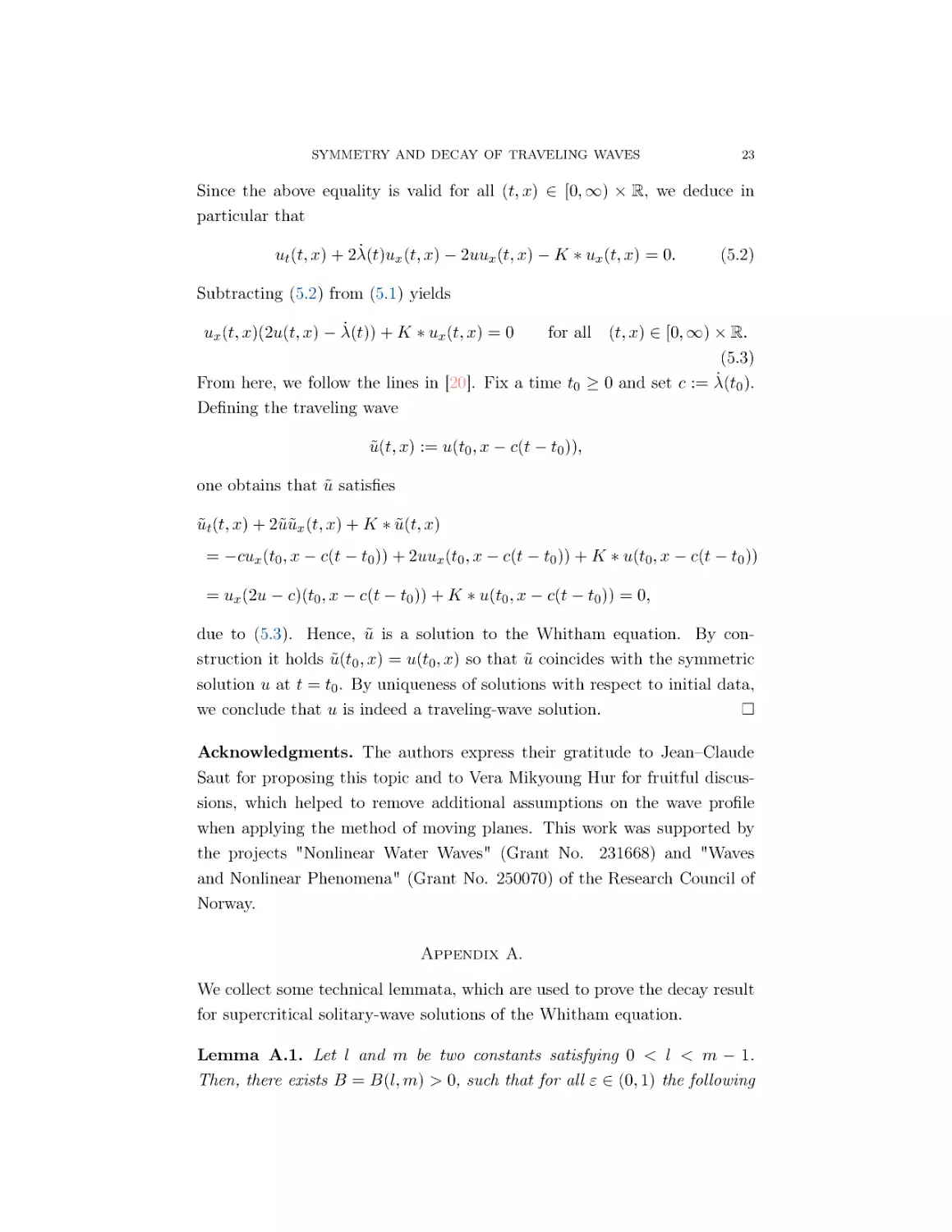






Text
                    See discussions, stats, and author profiles for this publication at: https://www.researchgate.net/publication/307303060
Symmetry and decay of traveling wave solutions to the Whitham equation
Article in Journal of Differential Equations · August 2016
DOI: 10.1016/j.jde.2017.01.011
CITATIONS
29
READS
147
3 authors:
Some of the authors of this publication are also working on these related projects:
steady water waves View project
Fourth order evolution equations arising in physics View project
Gabriele Bruell
Lund University
21 PUBLICATIONS 106 CITATIONS
SEE PROFILE
Mats Ehrnström
Norwegian University of Science and Technology
51 PUBLICATIONS 1,172 CITATIONS
SEE PROFILE
Long Pei
KTH Royal Institute of Technology
14 PUBLICATIONS 128 CITATIONS
SEE PROFILE
All content following this page was uploaded by Gabriele Bruell on 07 November 2018.
The user has requested enhancement of the downloaded file.

a
r
X
i
v
:
1
6
0
8
.
0
7
9
4
4
v
2
[
m
a
t
h
.
A
P
]
2
7
J
a
n
2
0
1
7
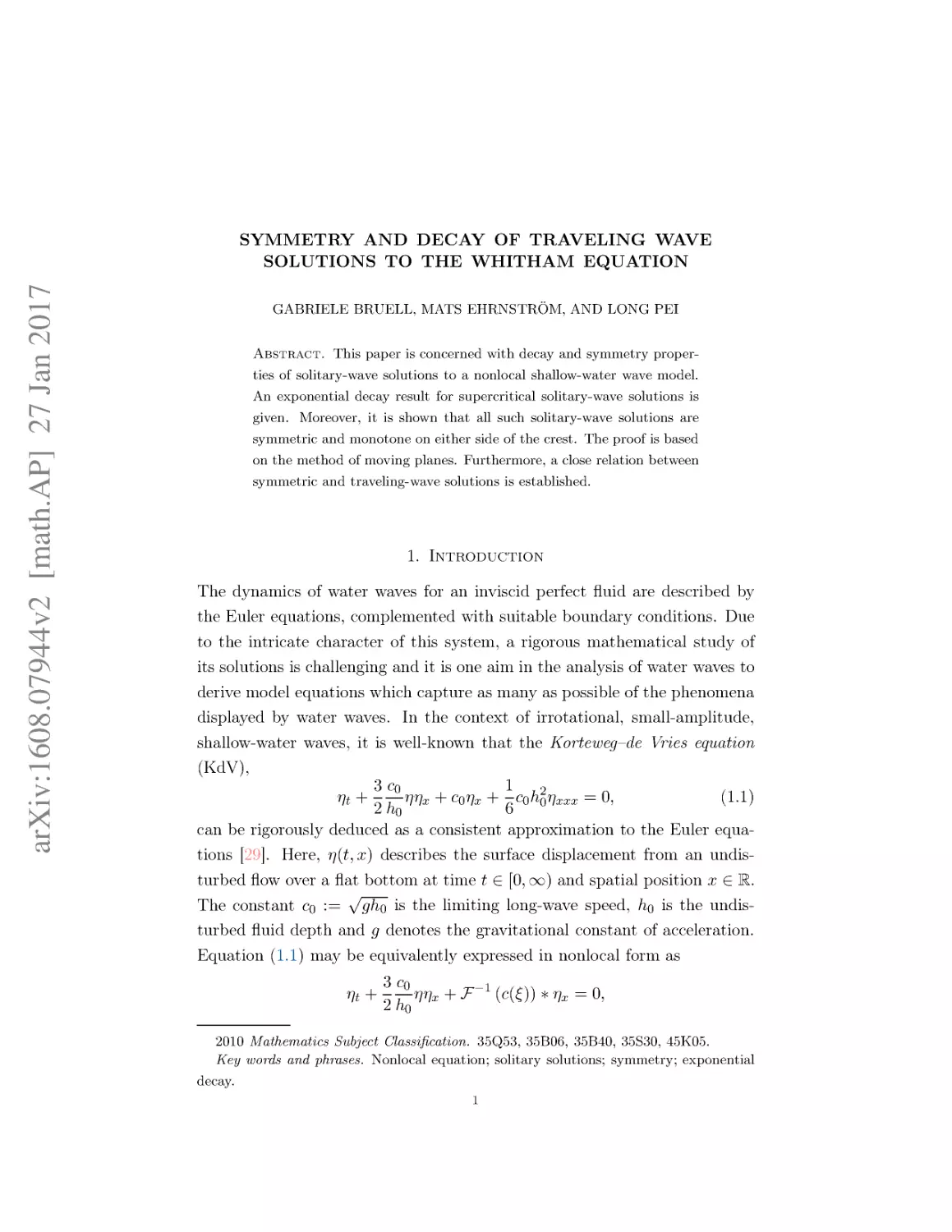
SYMMETRY AND DECAY OF TRAVELING WAVE
SOLUTIONS TO THE WHITHAM EQUATION
GABRIELE BRUELL, MATS EHRNSTRÖM, AND LONG PEI
Abstract. This pap er is concerned with decay and symmetry prop er-
ties of solitary-wave solutions to a nonlocal shallow-water wave model.
An exp onential decay result for supercritical solitary-wave solutions is
given. Moreover, it is shown that all such solitary-wave solutions are
symmetric and monotone on either side of the crest. The proof is based
on the method of moving planes. Furthermore, a close relation b etween
symmetric and traveling- wave solutions is established.
1. Introduction
The dynamics of water waves for an inviscid perfect fluid are described by
the Euler equations, complemented with suitable boundary conditions. Due
to the intricate character of this system, a rigorous mathematical study of
its solutions is challenging and it is one aim in the analysis of water waves to
derive model equations which capture as many as possible of the phenomena
displayed by water waves. In the context of irrotational, small-amplitude,
shallow-water waves, it is well-known that the Korteweg–de Vries equation
(KdV),
ηt+
3
2
c0
h0
ηηx+c0ηx+
1
6
c0 h2
0ηxxx = 0,
(1.1)
can be rigorously deduced as a consistent approximation to the Euler equa-
tions [29]. Here, η(t, x) describes the surface displacement from an undis-
turbed flow over a flat bottom at time t ∈ [0, ∞) and spatial position x ∈ R.
The constant c0 :=
√gh0 is the limiting long-wave speed, h0 is the undis-
turbed fluid depth and g denotes the gravitational constant of acceleration.
Equation (1.1) may be equivalently expressed in nonlocal form as
ηt+
3
2
c0
h0
ηηx + F−1
(c(ξ))∗ηx = 0,
2010 Mathematics Subject Classification. 35Q53, 35B06, 35B40, 35S30, 45K05.
Key words and phrases. Nonlocal equation; solitary solutions; symmetry; exponential
decay.
1

2
GABRIELE BRUELL, MATS EHRNSTRÖM, AND LONG PEI
where F
−1 denotes the inverse (spatial) Fourier transform, and
c(ξ):=c0−
1
6
c0h
2
0ξ
2
is the dispersion relation of the KdV equation. Noticing that c is a second-
order approximation of the exact dispersion relation of the linearized Euler
equations,
mh0 (ξ) :=
g tanh(ξh0)
ξ
12
=c0−
1
6
c0 h2
0ξ2 + O(ξ4),
G. B. Whitham [36] suggested what is today termed the Whitham equation,
ηt+
3
2
c0
h0
ηηx + F−1
(mh0)∗ηx = 0,
(1.2)
as an alternative to the KdV equation. Here, Kh0 := F
−1 (mh0) is the
integral kernel corresponding to a (genuinely) nonlocal Fourier multiplier
operator with symbol mh0 . This approach of dispersion improving is often
applied to improve the modeling aspects of fluid dynamics equations [29],
as it weakens the role of dispersion towards that of the full Euler equations.
Equation (1.2) can also be obtained directly from the Euler equations via
an exponential scaling [31]. From a consistency point of view, the equation
(1.2) is neither a better nor a worse model than the KdV equation: their
solutions both approximate shallow-water, small-amplitude gravity water-
wave solutions of the Euler equations to the same order on appropriate time
scales [29]. As described below, the Whitham equation (1.2) however has
the property of capturing several of the mathematical features of the Euler
equations, that the KdV equation does not (including nonlocality, break-
down of solutions, modulational instability and highest waves).
The purpose of the present paper is to analyze geometric properties of
solitary-wave solutions to the Whitham equation. We will show that the
Whitham equation captures various characteristics of solitary solutions to
the Euler equations. In the same physical setting as ours, it was shown
in [16] that any irrotational solitary gravity wave with supercritical1 wave
speed is positive (a wave of elevation) and symmetric with one wave crest
from which the surface decreases monotonically. We confirm these properties
for the Whitham equation
2
.
Furthermore, we address the relation between
1A wave speed exceeding
√gh0.
2
The positivity of sup ercritical solutions was established in [22].

SYMMETRY AND DECAY OF TRAVELING WAVES
3
a priori symmetry and steadiness of solutions of (1.2). As first established
in [20], for the Euler equations as well as for a range of dispersive model
equations, a priori symmetry of (time-dependent) solutions implies their be-
ing steady solutions. It turns out that this property is preserved by the
Whitham equation, despite the principle in [20] being a local one (and the
Whitham equation being inherently nonlocal).
A few words on the Whitham equation. It is straightforward [18] to prove
that (1.2) is locally well-posed in classical energy spaces H
3
2+
, for both lo-
calized and periodic initial data, although the data-to-solution map is not
uniformly continuous [3]. Small KdV-like solitary waves exist as constrained
minimizers of a natural Hamiltonian [19]. Small and large periodic traveling
waves connect to a global analytic curve [21], which contains at its end a high-
est, cusped, wave [22] (such shapes appear also in the water wave problem,
see [13, 24]). The periodic waves exhibit modulation instability, as confirmed
both numerically [33] and analytically [27]. The Whitham equation also al-
lows for finite-time wave breaking in the sense of bounded surface profiles
with unbounded slopes [32, 15, 26]. Finally, both numerical data and wave-
channel experiments indicate modeling advantages of the Whitham equation
when compared to the KdV [5, 35], the Saint-Venant and the Serre equations
[9], when either short or large waves are considered.
Our paper is outlined as follows. While Section 2 only contains some short
preliminaries, Section 3 is devoted to the decay of supercritical solitary-wave
solutions of the Whitham equation. Inspired by the classical paper [4] on
decay of solitary waves by Bona and Li, we prove that any such solution
decays exponentially fast. In contrast, Sections 4 and 5 are concerned with
the relation between traveling and symmetric wave solutions to the Whitham
equation. The main result in Section 4 states that any supercritical solitary
wave tending to zero at infinity is symmetric with exactly one crest from
which the surface is decreasing. This result is proved by applying (a very
weak form of ) the method of moving planes, which goes back to Aleksandrov
[1] and Serrin [34] in 1962 and 1971, respectively. While our method is
most closely related to the work by Chen, Li and Ou [12], and our setting
to that of Craig [16] on irrotational solitary gravity water waves, we draw
some inspiration also from [25] and [14]. Since the method of moving planes
relies upon the maximum principle, we formulate a touching lemma for the

4
GABRIELE BRUELL, MATS EHRNSTRÖM, AND LONG PEI
nonlocal form of our equation, comparable to the strong maximum principle
for elliptic equations. In Section 5 we turn to the time-dependent Whitham
equation and establish that any classical, symmetric solution, which is unique
with respect to initial data is a traveling-wave solution. Although the proof
has been modified to fit the nonlocal character of the Whitham equation,
the result is inspired by a principle first developed in [20], and later used for
example in [28, 23] (a more general approach towards such principles is in
preparation [6]).
2. Preliminaries
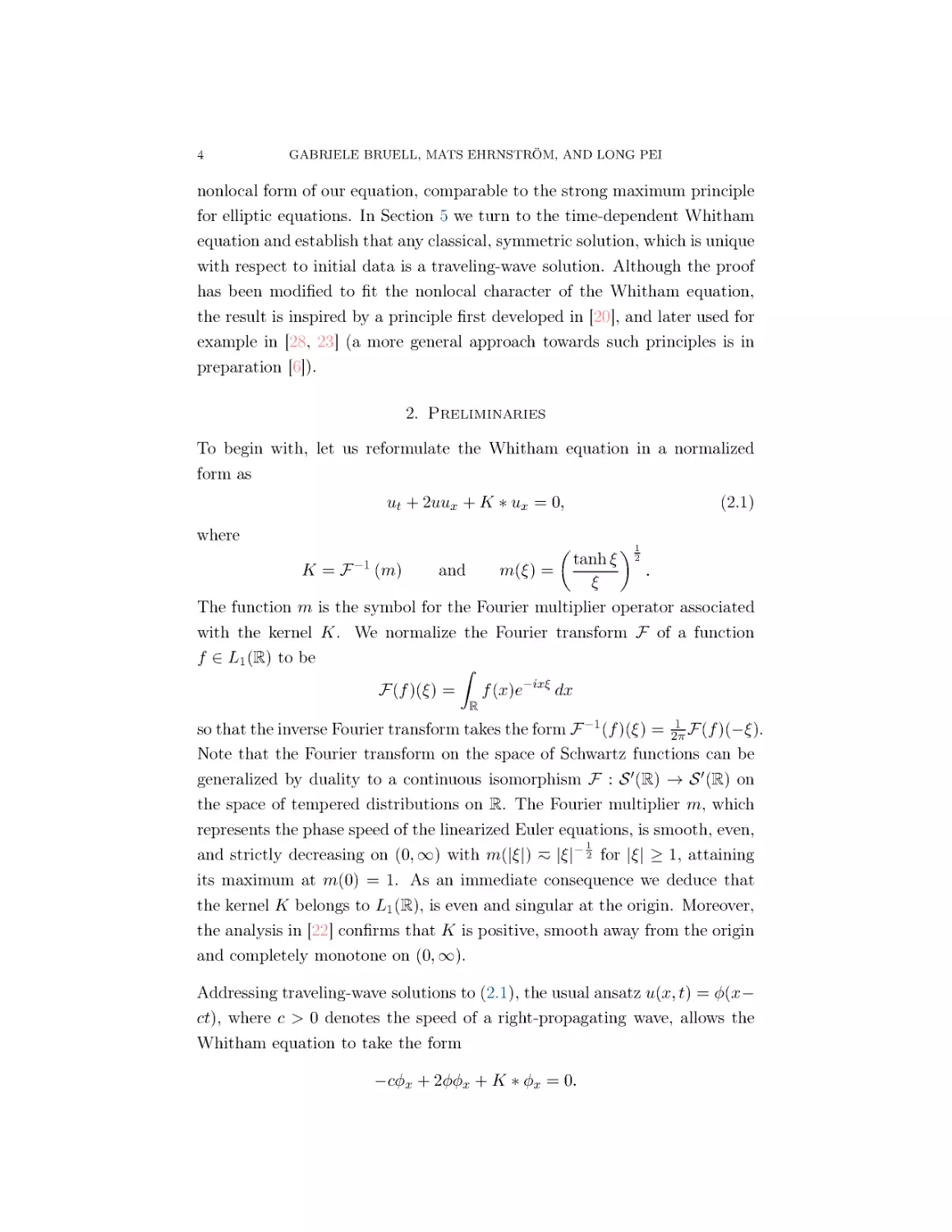
To begin with, let us reformulate the Whitham equation in a normalized
form as
ut+2uux+K∗ux=0,
(2.1)
where
K=F
−1 (m)
and
m(ξ) =
tanh ξ
ξ
12
.
The function m is the symbol for the Fourier multiplier operator associated
with the kernel K . We normalize the Fourier transform F of a function
f∈L1(R)tobe
F(f)(ξ) =
Z
R
f (x)e
−ixξ dx
so that the inverse Fourier transform takes the form F
−1(f)(ξ) = 1
2π F (f)(−ξ).
Note that the Fourier transform on the space of Schwartz functions can be
generalized by duality to a continuous isomorphism F : S ′(R) → S ′(R) on
the space of tempered distributions on R. The Fourier multiplier m, which
represents the phase speed of the linearized Euler equations, is smooth, even,
and strictly decreasing on (0, ∞) with m(|ξ|) h |ξ|− 1
2 for |ξ| ≥ 1, attaining
its maximum at m(0) = 1. As an immediate consequence we deduce that
the kernel K belongs to L1(R), is even and singular at the origin. Moreover,
the analysis in [22] confirms that K is positive, smooth away from the origin
and completely monotone on (0, ∞).
Addressing traveling-wave solutions to (2.1), the usual ansatz u(x, t) = φ(x −
ct), where c > 0 denotes the speed of a right-propagating wave, allows the
Whitham equation to take the form
−cφx+2φφx+K ∗φx = 0.

SYMMETRY AND DECAY OF TRAVELING WAVES
5
Integrating the above equation yields
−
cφ+φ2+K∗φ=B,
(2.2)
where B ∈ R is an integration constant. By the Galilean change of variables
φ
7
→φ+γ,
c
7
→c+2γ,
B
7
→B+γ(1−c
−
γ),
we may without loss of generality consider B = 0 in (2.2). This choice
corresponds to a solution with possibly different speed and elevation, but
the form of solutions remains intact. Thus, we are left with investigating
−
cφ+φ2+K∗φ=0.
(2.3)
Throughout this paper we mean by a solution to the steady Whitham equation
a real-valued, continuous, and bounded function that satisfies (2.3) pointwise.
Also, . and & denote that the inequality holds true up to multiplication by
a positive constant. If in addition the constant depends on a parameter p,
we write .p and &p, respectively. Similarly, the shorthand notation h is
used if both . and & hold, and hp is defined accordingly. Sometimes the
notation C = C (·, ·, · · · ) is used to emphasize the dependence of a positive
constant C on particular parameters.
3. Decay of solitary solutions
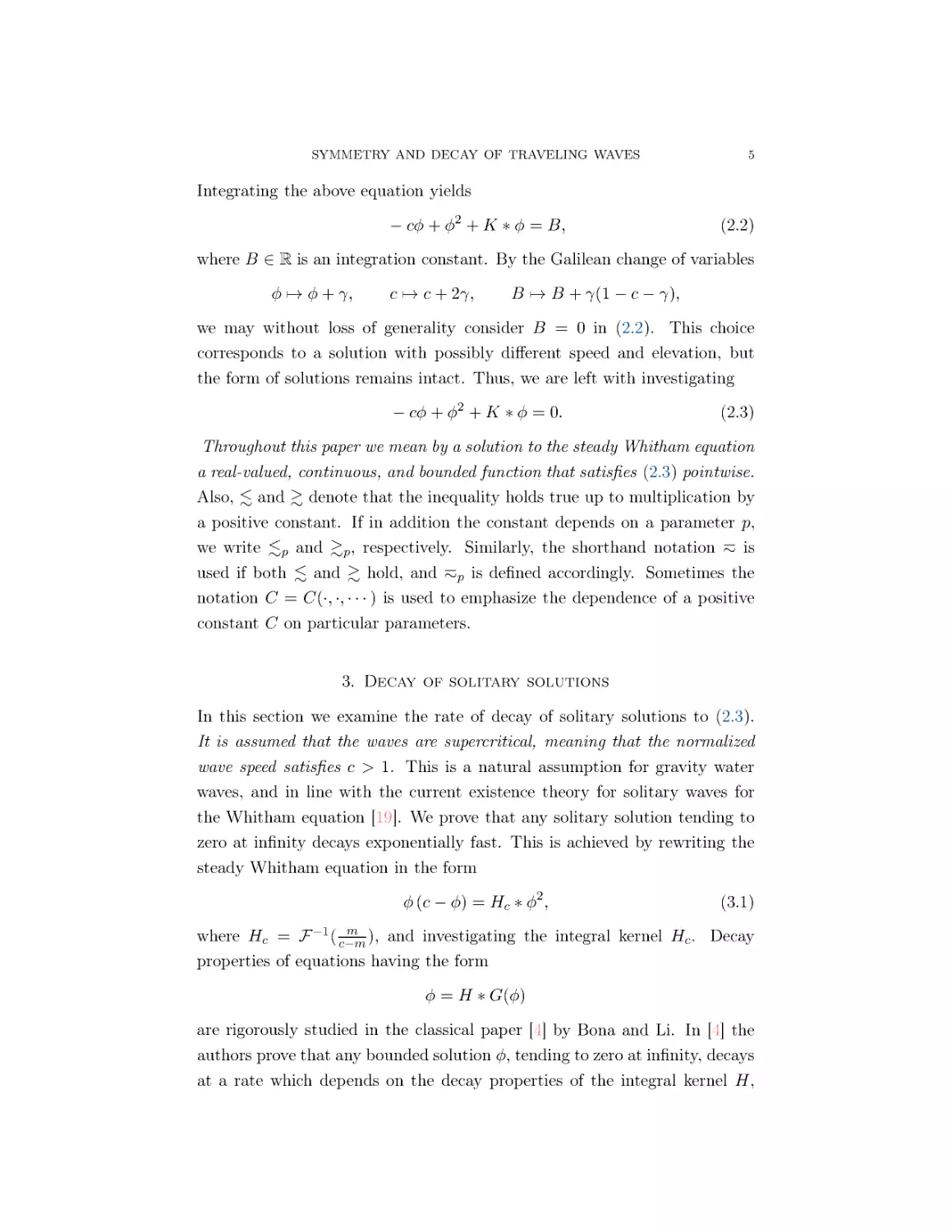
In this section we examine the rate of decay of solitary solutions to (2.3).
It is assumed that the waves are supercritical, meaning that the normalized
wave speed satisfies c > 1. This is a natural assumption for gravity water
waves, and in line with the current existence theory for solitary waves for
the Whitham equation [19]. We prove that any solitary solution tending to
zero at infinity decays exponentially fast. This is achieved by rewriting the
steady Whitham equation in the form
φ(c−φ)=Hc∗φ
2
,
(3.1)
whereHc = F
−1( m
c−m
), and investigating the integral kernel Hc . Decay
properties of equations having the form
φ=H ∗G(φ)
are rigorously studied in the classical paper [4] by Bona and Li. In [4] the
authors prove that any bounded solution φ, tending to zero at infinity, decays
at a rate which depends on the decay properties of the integral kernel H ,

6
GABRIELE BRUELL, MATS EHRNSTRÖM, AND LONG PEI
provided G satisfies a certain growth condition. More precisely, it is shown
that if there exists σ > 0 such that e
σ| ·|H ∈ L2(R), then φ decays exponen-
tially. Let us denote the symbol of the integral kernel by h := F (H). In view
of Paley–Wiener theory, the condition on H guaranteeing exponential decay
of φ requires h to be analytic in a horizontal complex strip enclosing the real
axis. It is then reasonable to expect that in general the lack of smoothness
of the symbol h yields a loss of the exponential decay property. As for the
Benjamin–Ono equation, having symbol h(ξ) = 1
1+|ξ| , it is known that the
only solutions on R which tend to zero at infinity have quadratic decay, see
[2]. A generalized Benjamin–Ono equation is studied in [30] and an algebraic
decay result for solitary solutions is presented employing the regularity and
(algebraic) decay of the associated kernel. In [17] a qualitatively similar re-
sult is shown for steady solutions of the generalized Kadometsev–Petviashvili
equation, whose symbol exhibits finite smoothness, too. Moreover, in [17]
the authors confirm the optimality of decay. Further contributions relating
finite smoothness of the symbol to algebraic decay can be found for instance
in [7, 8]. The steady Whitham equation (3.1) satisfies the growth condi-
tion claimed in [4]. However, it can be easily seen that the kernel Hc does
not belong to L2(R)3. Hence, there is no chance that eσ|·|Hc ∈ L2(R) for
any σ > 0. Though (3.1) does not fall into the frame of [4], we prove that
the kernel Hc decays exponentially fast. Using then similar arguments, it
is shown that any supercritical solitary solution tending to zero at infinity
decays with at least the same rate as the kernel Hc .
3.1 . The kernel Hc . It is clear that the kernel Hc is even and singular at
the origin. In the following we shall prove that Hc(x) h |x|
−
1
2 for|x|≤1
and that it decays exponentially fast, the rate of decay being (increasingly)
dependent on c. Consequently, | · |
α
Hc(·)∈Lp(R)forp∈[1,∞]ifα>
1
2−
1
p . Furthermore, the kernel Hc is shown to be positive and monotonically
decreasing on the positive half-line.
Lemma3.1.Letδ∈(0,π
2). Then m is analytic in the strip |Imz|≤δ.
There, one has |m(z)| ≤
qtan δ
δ and sup|y|≤δ km
′
(· + iy)kL2(R) . 1.
Proof. The function m2 is holomorphic outside of iπ( 1
2 + Z). In addition one
has that m2(z) = 0 only when z ∈ iπZ, so we may take the square root and
3its Fourier transform, given by m
c−m
, is not bounded in L2(R).

SYMMETRY AND DECAY OF TRAVELING WAVES
7
obtain that m is holomorphic in the strip | Im z| < π
2. Fixδ∈(0,π
2). For
z=x+iy,wehavethat
|m(z)|
4
=
| tanh(z)|2
|z|2
=
|e
z
−
e
−z
|2
|ez + e−z |2|z|2
=
e
2x+e
−2x
−
2 cos(2y)
(e2x + e−2x + 2 cos(2y)) (x2 + y2)
.
This expression is uniformly bounded for |y| ≤ δ, where it takes its maximum
at z = iδ. Thus, |m(z)| ≤ |m(iδ)| =
qtan δ
δ for |Imz|≤δ. Note that the
derivative of m is odd, whence m
′
(0)=0,andonehas
m
′
(x) =
x sech
2
x−tanhx
2x
3
2
√
tanh x
,
x>0.
Sincetanh(x)→1asx→ ∞andsech(x).e
−|x|
, it follows that m
′
∈ L2(R).
With z = x + iy, one furthermore calculates
|m
′
(z)|
2
=
|4z − (e2z
−
e
− 2z)|2
|z|3|e2z
−
e−2z ||ez + e−z
|2
=
cosh4x−cos4y+8 x2+y2+xsinh2xcos2y+ysin2ycosh2x

2(x2 + y2)
3
2 cosh2x+ cos2y
cosh4x−cos4y
12
.
For (x, y) ∈ [−M , M] × [−δ, δ] we know that this expression is uniformly
bounded. Fix M ≫ 1 such that cosh(x) ≥ sinh(x) ≫ 1. Then for x > M
one has
|m
′
(x+iy)|2.x
−3
,
(3.2)
uniformly for |y| ≤ δ. Thus {m′ (· + iy)}|y|≤δ is bounded in L2(R).

Now, let
g(x) =
 m(x)
c−m(x)
′
,
(3.3)
so that xHc(x) = −iF −1 (g)(x). Instead of working directly with the kernel
Hc, we show that x
7
→ eδc |x| xHc(x) belongs to L2(R) for some constant
δc > 0 depending on c. Here, we apply Paley–Wiener theory to the function
g. In the following lemma, the constant δc can be chosen to be increasing in
c. As c → 1 from above, one necessarily has δc → 0.
Lemma 3.2. For any given c > 1 there exists δc ∈ (0, π
2 ) such that
x
7
→ eδc|x|
xHc(x) belongs to L2(R).
Proof. Fix c > 1, and let g be as in (3.3). We first find a constant δc such
that g is analytic in | Im z| ≤ δc with sup|y|≤δc kg(· + iy)kL2(R) . 1. In view
of Lemma 3.1 , and since limδ→0
qtan δ
δ =1,thereexistsδc∈(0,π
2) such

8
GABRIELE BRUELL, MATS EHRNSTRÖM, AND LONG PEI
that sup| Im z|≤δc |m(z)| < c. Hence, (c − m)
−2 is holomorphic and bounded
in the same strip. We already know that m
′
isanalyticin|Imz|≤δc <
π
2
and uniformly L2(R)-bounded for all |y| ≤ δc . Consequently, g is analytic
there, too, with
sup
|y|≤δc
kg(· + iy)kL2 (R) .c sup
|y|≤δc
km
′
(· + iy)kL2(R) .c 1.
The result is now a direct consequence of Paley–Wiener theory. One then
has
e
δ|·|F(g) ∈ L2(R).
Recalling that F −1 (g)(x) = ixHc(x), we deduce the asserted decay for Hc .

Lemma 3.3. For |x| ≤ 1, one has Hc(x) h |x|
−
1
2.
Proof. Note first that g is odd. Thus, for x > 0,
xHc(x) = −iF −1 (g)(x)
=−
Z
R
g(ξ) sin xξ dξ
=−
Z
R
g
sx
sin s
x
ds
=−
√x
Z∞
0
sin(s)
s
3
2
1
(c−m
s
x
)2 f
sx
 ds,
where
f(ξ) = ξ sech
2
ξ−tanhξ
√tanh ξ
.
Since c > 1 ≥ m, the function
1
(c−m)2 f is bounded on R and tends to −
1
c2 at
infinity. By dominated convergence, we obtain that
lim
xց0
c
√xHc(x) =
1
c2
Z∞
0
sin(s)
s
3
2
ds=
√2π
c2
.
The statement now follows from Hc being even and continuous outside of
the origin.

A more detailed analysis of the function g in (3.3) yields that Hc decays
not only exponentially in L2(R) but also pointwise, although the former
is enough to guarantee the exponential decay of solitary solutions to the
Whitham equation.

SYMMETRY AND DECAY OF TRAVELING WAVES
9
Proposition3.4.Letδc>0beasinLemma3.2 and0<δ<δc. Then
Hc(x) . e
−δ|x| for |x| ≥ 1.
Proof. It is immediate from Lemma 3.2 that x
7
→ eδ|x| x2 Hc(x) belongs to
L2(R) for any δ ∈ [0, δc). In view of the product rule its weak derivative
is also bounded in L2(R) provided that eδ|·|(·)2H ′(·) ∈ L2(R). Similar as
before we achieve the latter regularity by applying Paley–Wiener theory to
k(x) := F
−1
(·)
2
H′
c(·)
(x)=i
x m(x)
c−m(x)
′′
= 2g(x)+xg
′
(x),
where g is defined in (3.3). As in the proof of Lemma 3.2 it is a consequence
of Lemma 3.1 and c > 1, that k is analytic in the strip |Imz|≤δ. In con-
sideration of g being uniformly L2(R)-bounded in the same strip, it remains
to show that
sup
|y|≤δ
k(· + iy)g′(· + iy)kL2(R) .c 1.
(3.4)
Consider
m
′′
(x) =
3
4 tanh
2
(x) − sech
2
(x) tanh
2
(x)x2
−
1
2 x tanh(x) sech
2
(x)−1
4x2
sech
4
(x)
x
5
2 tanh
3
2 (x)
.
Since|tanh(x+iy)|.1,|sech(x+iy)|.e
− |x|
when|y|<π
2, we havethat
|(x + iy)m
′′
(x+iy)|.c|x|
−
3
2
uniformly for |y| ≤ δ and |x| > M if M is chosen large enough. Hence,
{(· + iy)m
′′
(· + iy)}|y|≤δ is bounded in L2(R). In view of (3.2) not only g,
but also (·)g2(·) is uniformly L2(R)-bounded within the strip | Im z| ≤ δ.
Due to c − m being bounded from below and above and
xg
′
(x)=x
m
′′
(x)
(c − m(x))2 + 2xg
2
(x)(c − m(x))
we conclude that (3.4) holds true. Eventually, Paley–Wiener theory implies
that
x
7
→ eδ|x|
x
2H′(x) ∈ L2(R)
and thus eδ|·|(·)2H (·) ∈ H 1(R). The Sobolev embedding H 1(R) ⊂ L∞(R)
ensures that Hc(x) . e−δ|x| for |x| ≥ 1.

As a direct consequence of Lemmata 3.2 , 3.3 and Proposition 3.4 we obtain
the following weighted Lp(R) integrability of Hc .

10
GABRIELE BRUELL, MATS EHRNSTRÖM, AND LONG PEI
Corollary 3.5 . One has | · |
α
Hc(·)∈Lp(R)forp∈[1,∞]ifand onlyif
α>1
2−1
p . In particular, Hc ∈ Lp(R) exactly for p ∈ [1, 2).
It remains to show that Hc is monotonically decreasing on (0, ∞). To that
aim, we shall need the concept of complete monotonicity: a smooth function
f : (0, ∞) → R is said to be completely monotone if
(−1)nf(n)(x) ≥ 0,
for all x > 0 and all n ∈ N0 . From [22], we have the following result:
Prop osition 3.6 ([22], Proposition 2.18). Let f and h be two functions sat-
isfying f (ξ) = h(ξ2). Then f is the Fourier transform of an even, integrable
function such that F −1 (f )(√·) is completely monotone if and only if h is
completely monotone with limλց0 h(λ) < ∞ and limλ→∞ h(λ) = 0. In this
case, F
−1 (f) is smooth and monotone outside of the origin.
Corollary 3.7 . The integral kernel Hc is positive, smooth, and monotoni-
cal ly decreasing on the positive half-line (0, ∞).
Proof. Let h(x) :=
m(√x)
c−m(√x)
.
Then limx→0 h(x) = 1
c−1 and limx→∞ h(x) = 0.
Thus, in view of Proposition 3.6, it is sufficient to prove that the function h
is completely monotone. Let n(x) = m(√x) and consider h =
n
c−n
.
In [22] it
is proved that n is completely monotone. By combining this with Leibniz’s
rule we obtain for x ∈ (0, ∞) that
(−1)mh(m) (x)
=
m
X
k=0
m
k
(−1)m
n
(m−k)
1
c−n
(k)
(x)
= (−1)m
n
(m)
1
c−n
(x)
+
m
X
k=1
m
k
(−1)m−k
n
(m−k)(x)
Xk!
Qk
j=1(bj!)
̃
k!
(c − n(x))
̃
k+1
k
Y
j=1
(−1)j n(j) (x)
j!
bj
,
where the second sum is over all k-tuples of nonnegative integers (b1 , ..., bk )
satisfying the constraint
P
1≤j≤kjbj=k and ̃k =b1+···+bk. Itfollows
immediately that h is completely monotone, whence Proposition 3.6 implies
that Hc is positive, integrable, smooth, and monotone outside of the origin.


SYMMETRY AND DECAY OF TRAVELING WAVES
11
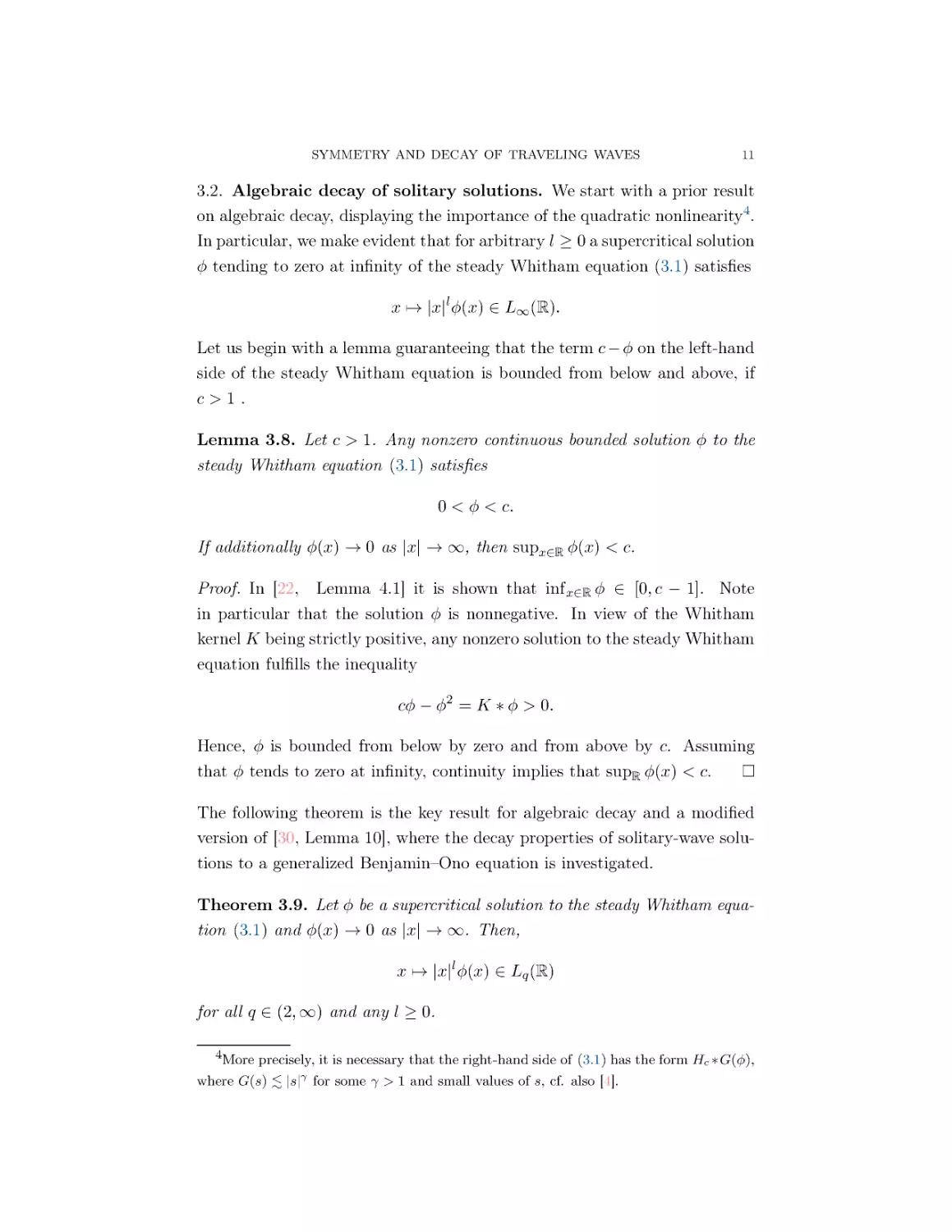
3.2 . Algebraic decay of solitary solutions. We start with a prior result
on algebraic decay, displaying the importance of the quadratic nonlinearity4.
In particular, we make evident that for arbitrary l ≥ 0 a supercritical solution
φ tending to zero at infinity of the steady Whitham equation (3.1) satisfies
x
7
→ |x|
l
φ(x) ∈ L∞(R).
Let us begin with a lemma guaranteeing that the term c − φ on the left-hand
side of the steady Whitham equation is bounded from below and above, if
c>1.
Lemma 3.8 . Let c > 1. Any nonzero continuous bounded solution φ to the
steady Whitham equation (3.1) satisfies
0<φ<c.
If additionally φ(x) → 0 as |x| → ∞, then supx∈R φ(x) < c.
Proof. In [22, Lemma 4.1] it is shown that inf x∈R φ ∈ [0, c − 1]. Note
in particular that the solution φ is nonnegative. In view of the Whitham
kernel K being strictly positive, any nonzero solution to the steady Whitham
equation fulfills the inequality
cφ −φ
2
= K∗φ>0.
Hence, φ is bounded from below by zero and from above by c. Assuming
that φ tends to zero at infinity, continuity implies that supR φ(x) < c.

The following theorem is the key result for algebraic decay and a modified
version of [30, Lemma 10], where the decay properties of solitary-wave solu-
tions to a generalized Benjamin–Ono equation is investigated.
Theorem 3.9 . Let φ be a supercritical solution to the steady Whitham equa-
tion (3.1) and φ(x) → 0 as |x| → ∞. Then,
x
7
→ |x|lφ(x) ∈ Lq(R)
forallq∈(2,∞) andanyl≥0.
4More precisely, it is necessary that the right-hand side of (3.1) has the form Hc ∗ G(φ),
where G(s) . |s|
γ
for some γ > 1 and small values of s, cf. also [4].

12
GABRIELE BRUELL, MATS EHRNSTRÖM, AND LONG PEI
Proof. In view of Lemma 3.8, there exists a constant M ∈ (0, c) such that
supφ = M. Choose p ∈ (1,2) and let α = α(p) be a positive constant
satisfying
α>1−
1
p
.
Corollary 3.5 guarantees that the function (1 + | · |)
α
Hc(·) is bounded in
Lp(R). We set
Kα,p := (c − M)−1
k(1+|·|)
α
Hc(·)kLp (R) .
Let q be the conjugate of p, i.e.
1
p+1
q =1.Asφisasolutionto(3.1),we
can write
φ(c − φ)(x) = (Hc ∗ φ2)(x)
=
Z
R
Hc(x−y)(1+|x−y|)α
·
φ2(y)
(1+|x−y|)αdy
and obtain by Hölder’s inequality that
|φ(x)| ≤ Kα,p
Z
R
|φ2(y)|q
(1+|x−y|)αq
dy
1
q
.
(3.5)
Letl∈[0,α−
1
q).Thenα>l+1
q and we define
hε(x) :=
|x|l
(1 + ε|x|)α φ(x)
for 0 < ε < 1. For each ε ∈ (0, 1) fixed, the function hε is bounded in Lq(R),
by the choice of l and φ being bounded. The aim is to prove that {hε | ε ∈
(0, 1)} is uniformly bounded in Lq (R), which implies that limε→0 hε = | · |lφ
belongs to Lq (R), by dominated convergence. Since φ tends to zero as |x| →
∞, the quadratic nonlinearity provides that for every δ > 0 there exists a
constant Rδ > 1 such that
|φ2(x)| ≤ δ|φ(x)| for |x| ≥ Rδ .
Estimating
khεk
q
Lq(R) =
Z
R
|hε(x)|
q
dx≤C+
Z
|x|≥Rδ
|hε(x)|
q
dx,
(3.6)
where C = C(Rδ ) > 0 is a constant independent of ε, we are left to study
the last integral on the right-hand side of (3.6). Let r ∈ (0, q). Thanks to

SYMMETRY AND DECAY OF TRAVELING WAVES
13
(3.5) and Hölder’s inequality we have that
Z
|x|≥Rδ
|hε(x)|
q
dx≤
Z
|x|≥Rδ
|hε (x)|
q−r
 |x|l
(1 + ε|x|)α
r
|φ(x)|
r
dx
≤
Z
|x|≥Rδ
|hε(x)|
q−r
 |x|l
(1 + ε|x|)α
r
Kr
α,p
Z
R
|φ2(y)|q
(1+|x−y|)αq
dy
r
q
dx
≤Kr
α,p
Z
|x|≥Rδ
|hε(x)|
q
dx
q−r
q
·
Z
|x|≥Rδ
 |x|l
(1 + ε|x|)α
qZ
R
|φ2(y)|q
(1+|x−y|)αq
dy
dx
r
q
.
Dividing both sides of the inequality by
R
|x|≥Rδ
|hε(x)|q dx
q−r
q
we find that5
Z
|x|≥Rδ
|hε(x)|
q
dx≤Kq
α,p
Z
|x|≥Rδ
 |x|l
(1 + ε|x|)α
qZ
R
|φ2(y)|q
(1+|x−y|)αq
dy
dx.
(3.7)
One can then invoke Fubini’s Theorem and Lemma A.1 to obtain that
Z
|x|≥Rδ
 |x|l
(1 + ε|x|)α
qZ
R
|φ2(y)|q
(1+|x−y|)αq
dy
dx
=
Z
R
|φ2(y)|q
Z
|x|≥Rδ
|x|lq
(1+ε|x|)αq(1+|x − y|)αq
dx
dy
≤
Z
|x|≥Rδ
|φ2(y)|q B|y|lq
(1 + ε|y|)αq
dy
+
Z
|y|<Rδ
|φ2(y)|q
Z
|x|≥Rδ
|x|lq
(1+ε|x|)αq(1+|x − y|)αq
dxdy,
(3.8)
whereB=B(l,q,α)>0doesnotdependonε. Sinceαq>1andlq<
αq − 1, by the choice of l, the last integral in (3.8) is bounded by a constant
C1 = C1(kφk∞, Rδ) > 0 depending on the norm of φ and Rδ (but not on ε).
Combining (3.7), (3.8) and recalling that |φ2(y)| < δ|φ(y)| for all |y| ≥ Rδ ,
we deduce that
Z
|x|≥Rδ
|hε(x)|
q
dx≤Kp
α,p
"δq B
Z
|x|≥Rδ
|hε(x)|
q
dx+C1
#.
(3.9)
5Note that the term we are dividing by vanishes if and only if φ = 0 everywhere in
{|x| ≥ Rδ}, in which case the lemma is obviously true.

14
GABRIELE BRUELL, MATS EHRNSTRÖM, AND LONG PEI
Choosing δ small enough so that K p
α,pδqB < 1
2 , (3.9) implies that
Z
|x|≥Rδ
|hε(x)|
q
dx≤C2,
where C2 = C2(α, p, kφk∞ , Rδ) > 0 is a constant which does not rely on ε.
Hence, we have shown that
Z
R
|hε(x)|
q
dx.1.
Letting ε → 0, dominated convergence ensures that
Z
R
|x|lq |φ(x)|
q
dx.1,
which implies in particular x
7
→ |x|lf(x) ∈ Lq(R) for q =
p
p−1 andl∈[0,α−
1
p ). Having at hand that α can be chosen arbitrarily large and p ∈ (1, 2), the
statement is proved.

Remark 3.10 . Note that the proof uses only the algebraic decay properties
ofHc,thatis|·|
α
Hc∈Lp(R)forp∈[1,2)andα>0.Itisapparentfrom
the proof that the decay rate l depends increasingly on α.
The following algebraic decay result is an immediate consequence of the
previous theorem.
Corollary 3.11 (Algebraic decay). Let φ be a supercritical solution to the
steady Whitham equation (3.1) and φ → 0 as |x| → ∞. Then
x
7
→ |x|lf(x) ∈ L∞(R),
foranyl≥0.
Proof. Let l ≥ 0 be arbitrary. Then, Lemma 3.8 implies that
|x|l|φ(x)| .
|·|lHc ∗ φ
2
(x) +
Hc ∗ | ·|lφ2
(x).
In consideration of Theorems 3.5 and 3.9 the assertion follows by Young’s
inequality.

3.3 . Exponential decay of solitary solutions. Relying on the arguments
in [4, Corollary 3.1.4], we apply the exponential decay of Hc to prove that for
the steady Whitham equation any supercritical solution φ actually decays
exponentially.

SYMMETRY AND DECAY OF TRAVELING WAVES
15
Theorem 3.12 (Exponential decay). Let δc > 0 denote the decay rate of
Hc . If φ is a supercritical solution to the steady Whitham equation (3.1)
satisfyingφ→0as|x|→∞,thenthereexists0<ν<δc suchthat
x
7
→e
ν |x|φ(x) belongs to L1(R) ∩ L∞(R).
Proof. Corollary 3.2 warrants that for every c > 1 there exists δc ∈ (0, π
2)
such that
x
7
→ eδc|x|
xHc(x) belongs to L2(R).
Together with Corollary 3.5 we conclude that for all 0 < σ < δc
e
σ|·|Hc(·) ∈ Lp(R) for p ∈ [1, 2).
(3.10)
Choosep∈[1,2),letq∈Rbesuchthat 1
p+1
q=1,andset
D:=max
(1,
σ
2
kφkL1(R), (c − M)−1
σ
1
p
2
q
1
q
ke
σ|·|Hc(·)kLp (R)k(·)φ(·)k∞
),
whereM :=supφ<c. NotethatD≥1isfinite,owingtoφbeinga
bounded solution, Corollary 3.11 and (3.10). The main ingredient for proving
exponential decay of φ is the following estimate
k(·)
l
φ(·)kL1 (R) ≤
(l + 2)!Dl+1
σ l+1
forl∈N0 and 0<σ<δc.
(3.11)
Claim (3.11) is proved by induction. Clearly, the statement holds true for
l = 0. Assuming that the inequality (3.11) is satisfied for all natural numbers
less or equal some l ∈ N0 one observes that
k(·)l+1 φ(·)kL1 (R) ≤ (c − M )−1
k(·)l+1 (Hc ∗ φ
2
)(·)kL1 (R)
≤(c−M)−1
l+1
X
j=0
l+1
j
k(·)l+1−j Hc(·)kL1 (R)k(·)j φ2(·)kL1 (R) ,
(3.12)
on account of Lemma A.3 and Young’s inequality. Applying Hölder’s in-
equality to k(·)l+1−j Hc(·)kL1 (R) yields
k(·)l+1−j HckL1 (R) =
Z
R
|xl+1−j Hc(x)|dx ≤
Z
R
|xl+1−j
e
− σ|x|||e
σ|x|Hc(x)|dx
≤ke
σ|·|Hc(·)kLp(R)
Z
R
|x|
q(l+1−j)e
− qσ|x|dx
1
q
=ke
σ|·|Hc(·)kLp(R)2
1
q
Z∞
0
x
q(l+1−j)e
−q σx
dx
1
q
.

16
GABRIELE BRUELL, MATS EHRNSTRÖM, AND LONG PEI
Due to Lemma A.2 one arrives at
k(·)l+1−j HckL1(R) ≤ ke
σ|·|Hc(·)kLp (R)2
1
q
[q(l+1−j)]!
(qσ)q(l+1−j)+1
1
q
≤ke
σ|·|Hc(·)kLp (R)
2
q
1
q (l+1−j)!
σ
l+1−j + 1
q
.
The assumption that (3.11) holds for all natural numbers less of equal l ∈ N0
allows to control the second factor of the last inequality in (3.12) by
k(·)j φ2(·)kL1(R) ≤ k(·)φ(·)k∞k(·)j−1 φ(·)kL1 (R) ≤ k(·)φ(·)k∞
(j + 1)!Dj
σj
(3.13)
for 1 ≤ j ≤ l + 1. The combination of (3.12)–(3.13) together with the
definition of D yields
k(·)l+1 φ(·)kL1 (R) ≤
1
c−M
l+1
X
j=0
l+1
j
k(·)l+1−j Hc(·)kL1 (R) k(·)jφ2(·)kL1(R)
= (c−M)−1
l+1
X
j=0
ke
σ|·|Hc(·)kLp(R)
2
q
1
q
k(·)φ(·)k∞
(l + 1)!(j + 1)Dj
σ
l+1+ 1
q
≤
l+1
X
j=0
(l + 1)!(j + 1)Dj+1
σ
l+1+ 1
q+1
p
≤
(l + 3)!Dl+2
σ l+2
,
which completes the inductive step. Eventually, (3.11) implies that
ke
ν |·|φkL1(R) =
Z
R


∞
X
l=0
ν
lxl
l!
φ(x)


dx≤
∞
X
l=0
ν
l
l!
k(·)lφ(·)kL1 (R)
≤
D
σ
∞
X
l=0
(l+1)(l+2)
νD
σ
l
,
which converges if and only if |ν| < σ
D . The boundedness of ke
ν|·|φkL∞(R) can
be proved similarly by replacing k(·)lφ(·)kL1 (R) by k(·)lφ(·)kL∞ (R) in (3.11)
and modifying D accordingly. Summarizing, we have that
e
ν|·|φ∈L1(R)∩L∞(R) forany 0<ν<
σ
D
.
By definition of σ and D, one observes that ν < δc


SYMMETRY AND DECAY OF TRAVELING WAVES
17
The result above can be improved. As a matter of fact, following the lines
in [4, Corrollary 3.1 .4], one can show that any supercritical solution of the
steady Whitham equation, tending to zero at infinity, decays at least at the
same rate as the associated kernel Hc does. In interest of keeping the present
paper self contained, we include the proof.
Prop osition 3.13 . Let δc > 0 be the decay rate of Hc . If φ is a supercritical
solution to the steady Whitham equation (3.1) satisfying φ → 0 as |x| → ∞,
then
e
η|·|φ∈ L1(R)∩L∞(R) for some η ≥ δc.
Proof. Theorem 3.13 ensures that there exists 0 < ν < δc such that
e
ν|·|φ ∈ L1(R) ∩ L∞(R).
Moreover, recall from (3.10) that
e
ν|·|Hc∈L1(R) forany 0<ν<δc.
(3.14)
Thanks to the quadratic nonlinearity we can estimate
φ(x)e
ν|x|≤(c−M)−1
Z
R
Hc(x − y)e
ν|x−y||φ2(y)|e
ν|y|dy
= (c−M)−1
Z
R
Hc(x − y)e
ν|x−y|
φ(y)|e
ν
2 |y|
2
dy
= (c−M)−1
Hce
ν |·|
∗
φe
ν
2 |·|
2
(x),
(3.15)
whereM:=supφ<c. Letη:=sup{ν>0|e
ν|·|φ ∈ L1(R) ∩ L∞(R)}.
The aim is to show that η ≥ δc. Assuming on the contrary that η < δc, one
can choose ν > 0 such that
η
2<ν<min{η,δc
2 }. Considering (3.15) for 2ν
instead of ν , Young’s inequality, (3.15) and φ being bounded imply that
kφe
2ν|·|kL1(R) ≤ (c − M)−1
kHce
2ν |·|
∗φ
2
e
ν |·|kL1(R) < ∞
(3.16)
and
kφe
2ν|·|kL∞(R) ≤ (c − M)−1
kHce
2ν|·|
∗φ
2
e
ν|·|kL∞(R) < ∞,
(3.17)
by the choice of ν and (3.14). In view of 2ν > η, (3.16) and (3.17) lead to a
contradiction to the definition of η. Hence, η ≥ δc .


18
GABRIELE BRUELL, MATS EHRNSTRÖM, AND LONG PEI
4. Symmetry of solitary waves
The method of moving planes is employed to prove that any supercritical
solution to the steady Whitham equation tending to zero at infinity is sym-
metric and has exactly one crest. Let us start by formulating a lemma, which
is comparable to the strong maximum principle for elliptic equations. It is
a modified version of the so called touching lemma in [22, Lemma 4.3] and
stated in a form appropriate to our purpose. A solution φ to the steady
Whitham equation (3.1) is called a supersolution if
φ(c−φ)≥Hc∗φ
2
and a subsolution if the inequality above is replaced by ≤.
Lemma 4.1 (Touching lemma on a half-space). Let φ1 and φ2 be a super–
and a subsolution of the steady Whitham equation (3.1) on a subset [λ, ∞) ⊂
R, respectively, satisfying φ1 ≥ φ2 on [λ, ∞) and φ2
1−φ2
2 being odd with
respect to λ, that is (φ21 − φ2
2)(x) = −(φ21 − φ2
2 )(2λ − x). Then either
• φ1=φ2in[λ,∞),or
• φ1>φ2withφ1+φ2<cin(λ,∞).
Proof. The symmetry and monotonicity of Hc allow to deduce that Hc acts
as a positive convolution operator on odd functions with respect to λ on the
halfline[λ,∞).Letf≥0on[λ,∞),f(x)= −f(2λ−x)andx≥λ.Then
Hc∗f(x)=
Z∞
λ
Hc(y)f (x − y)dy +
Zλ
−∞
Hc(x − y)f(y)dy
=
Z∞
λ
Hc(x − y)f (y)dy +
Z∞
λ
Hc(x + y − 2λ)f(2λ − y)dy
=
Z∞
λ
(Hc(x − y) − Hc(x + y − 2λ))f(y)dy,
where the last equality holds thanks to f being odd with respect to λ. In
view of Hc being symmetric and monotonically decreasing on (0, ∞), we
obtain that
Hc∗f(x)≥0 forall x≥λ.
Inparticular,Hc∗f>0orf =0on(λ,∞).Assumethatφ1andφ2
are super– and subsolutions to the steady Whitham equation, respectively,
φ1≥φ2forallx≥λandφ2
1−φ2
2 is odd with respect to λ, that is φ2
1−φ2
2

SYMMETRY AND DECAY OF TRAVELING WAVES
19
plays the role of f above. Then,
(c−(φ1+φ2))(φ1−φ2)≥Hc∗(φ21−φ
2
2)>0
forallx>λunlessφ1=φ2on[λ,∞).

Corollary 4.2 . Let φ be a solution to the steady Whitham equation (3.1)
andφλ(·) := φ(2λ− ·)beitsrefectionabout someλ∈R. Ifφ≥φλ on [λ,∞)
and there exists a point x > λ where φ and φλ touch, that is φ(x) = φλ(x),
thenφ =φλ.
Proof. Let φ be a solution of the steady Whitham equation, then so is φλ
due to the symmetry of Hc . Noticing that φ2 − φ2
λ is odd with respect to λ,
the assertion is an immediate consequence of Lemma 4.1 .

The method of moving planes is applied to confirm that any supercritical
solution tending to zero at infinity of the steady Whitham equation (3.1) has
exactly one crest about which it is symmetric. The proof is inspired by [12],
where the authors establish the symmetry of positive solutions belonging to
L n+α
n−α
,loc(Rn) of
u=L∗u
n+α
n−α ,
(4.1)
where n is the space dimension, α ∈ (0, n) and L(x) := |x|
α−n
.
Ifα=
1
3 and
the space dimension n = 1, equation (4.1) reads
u=L∗u
2
with L(x) = |x|
−
2
3 , which displays a structural similarity to (3.1). Assuming
that φ tends to zero at infinity, our proof is less intricate than in [12], where
the authors do not assume any asymptotic behavior of the solution but apply
the method of moving planes to a Kelvin-type transform instead. Since the
nonlocal operator Hc of the steady Whitham equation corresponds to an
inhomogeneous kernel function a Kelvin-type transform is not appropriate
in our case. It is worth mentioning that in [10, 11] the authors generalize
the result in [12] and establish maximum principles for a class of nonlocal
equations which originate from the fractional Laplace operators.
In accordance to [12], we define the open sets
Σλ:={x∈R|x>λ} and Σ−
λ := {x∈Σλ|φ(x)<φλ(x)},
where φλ(·) := φ(2λ − ·) is the reflection of φ about the axis x = λ.

20
GABRIELE BRUELL, MATS EHRNSTRÖM, AND LONG PEI
x
λ
Figure 1. Sketch of an arbitrary supercritical solution to
(3.1) tending to zero at infinity. The dashed curve is the
reflection of the wave around λ and the bold line on the x-
axis represents the set Σ−
λ.
The aim is to prove that there exists λ0 ∈ R such that φ is symmetric about
x=λ0,thatisφ(x)=φλ(x)forall x∈R, andmoreoverthatφhasonly
one crest, which is then located at x = λ0 . As a first step, it is shown that
there exists λ ∈ R far enough to the left, so that the open set Σ−
λ is empty.
An easy calculation analog to the one in the proof of Lemma 4.1 shows that
c(φ(x) − φλ(x)) =
Z
Σλ
Hc(x−y)−Hc(2λ−x
−
y)(φ2(y) − φ2
λ(y))dy
+φ2(x) −φ
2
λ (y).
Letx∈Σ−
λ. Then
0 < c(φλ(x) − φ(x))
≤
Z
Σλ−
Hc(x−y)−Hc(2λ−x
−
y)(φ2
λ(y) − φ2(y))dy + φ2
λ(x) − φ2(x)
≤2
Z
Σλ−
Hc(x − y)φλ(y)(φλ(y) − φ(y))dy + φ2
λ(x)−φ
2
(x)
= 2Hc∗φλ(φλ−φ)
(x) + φ2
λ(x) −φ
2
(x).
By Young’s inequality we arrive at
kφλ − φkL∞ (Σ−
λ)≤
2
c
kφkL∞((Σ−
λ)
∗
) kHckL1(R) + 1
kφλ − φkL∞(Σ−
λ)
, (4.2)
where Σ
−
λ
∗
is the reflection of Σ−
λ about the plane x = λ. Note that the
right-hand side of (4.2) is bounded in view of Corollary 3.5 . Since φ tends to
zero at infinity, there exists N ∈ N such that kφkL∞ ((Σ−
λ)
∗
)<
c
2(kHc kL1(R) +1)
for all λ ≤ −N . Then, (4.2) implies that kφ − φλkL∞(Σ−
λ)
= 0forλ≤−N.

SYMMETRY AND DECAY OF TRAVELING WAVES
21
As a consequence Σ
−
λ must be of measure zero. Since Σ
−
λ is open, we deduce
that Σ−
λ isemptyforλ≤−N .
Remark 4.3 . Relation (4.2) turns out to be crucial when applying the
method of moving planes. Note that it states in particular that if kφkL∞ ((Σ−
λ)
∗
)
is sufficiently small (which depends either on the norm of φ on the fixed set
Σ−
λ
∗
oronthesizeof Σ−
λ
∗), then kφ − φλkL∞(Σ−
λ)
=0.
The following theorem is the main result, which proves the symmetry of
solitary waves solutions to the Whitham equation.
Theorem 4.4 (Symmetry of solitary-wave solutions). Let φ be a supercritical
solution to the steady Whitham equation tending to zero at infinity. Starting
atapointλ= −N,whereN>0,suchthatΣ−
λ isemptyforallλ≤−N,
and moving the plane x = λ to the right as long as
φ(x)≥φλ(x) forall x∈Σλ,
this process stops only and finally at some point x = λ0, where φ = φλ0 on
Σλ0 . In particular, φ is symmetric about λ0 and (exponentially) decreasing
on the half line [λ0 , ∞).
Proof. Clearly, there can not be any crest at a point x ≤ −N , since Σ
−
λis
empty for all λ < −N . The process of moving the plane x = λ to the right
will stop at or before it reaches a crest. Assume that the moving plane stops
at a point x = λ0, where φ(x) ≥ φλ0(x), but φ(x)
6
= φλ0(x) for all x ∈ Σλ0,
that is, φ is not symmetric about x = λ0. The touching lemma (Lemma 4.1)
ensures that φ(x) > φλ0 (x) for all x ∈ Σλ0 so that Σ−
λ0
has measure zero.
By continuity of φ, we have that for any ε > 0 there exists δ > 0 such that
|Σ−
λ|<εforallλ∈[λ0,λ0+δ).Itfollowsthatthereexistsδ>0suchthat
1
c
kφkL∞ ((Σ−
λ)
∗
)(kHckL1(R) + 1) <
1
4
for all λ ∈ [λ0, λ0 + δ). From (4.2) we deduce that kφ − φλkL∞(Σ−
λ)
=0.
Therefore, Σ
−
λ mustbeemptyforallλ∈[λ0,λ0+δ)andtheplanex=λ0
can be moved further to the right, which is a contradiction. The assertion
about exponential decay follows from Proposition 3.13.

Remark 4.5 . In order to complete the picture of supercritical solitary solu-
tions, we refer to a result in [22], where the authors prove that any noncon-
stant even solution φ ∈ BU C1(R) of the steady Whitham equation which is

22
GABRIELE BRUELL, MATS EHRNSTRÖM, AND LONG PEI
nonincreasing on a half-line (λ0 , ∞) satisfies
φ′(x) < 0
and φ(x) <
c
2
forall x∈(λ0,∞).
5. Steadiness of symmetric waves
We say a solution u is symmetric, if there exists a function λ ∈ C 1(R+) such
thatforeveryt≥0andx∈R
u(t, x) = u(t, 2λ(t) − x).
Then, λ is called the axis of symmetry. In [20] a local principle is established
relating the property of a priori symmetry to steadiness. In particular it
is proved that for a large class of local partial differential equations any
classical, symmetric, unique solution constitutes a traveling wave. We follow
the idea of the local principle and validate the analog result for classical,
symmetric solutions to the nonlocal Whitham equation
ut+2uux+K∗ux=0.
(5.1)
Recall that the kernel K is given by
K(ξ)=F
−1
tanh(ξ)
ξ
12
.
Theorem 5.1 (Symmetric solutions are traveling). Any classical, symmetric
solution on R of the Whitham equation (5.1), which is unique with respect
to initial data, is a traveling-wave solution.
Proof. Let u be a classical, symmetric solution to the Whitham equation,
that is u(t,x) = u(t,2λ(t)− x)for all(t,x) ∈[0,∞) ×R. The symmetry
property implies that
ut(t, x) = ut(t, 2λ(t) − x) + 2̇λ(t)ux(t, 2λ(t) − x),
ux(t, x) = −ux(t, 2λ(t) − x).
Thanks to the symmetry of K , an easy computation shows that
K∗ux(t,x)= −K∗ux(t,2λ(t)−x).
Hence, the solution u satisfies
ut (t, 2λ(t)−x)+2 ̇λ(t)ux (t, 2λ(t)−x)−2uux (t, 2λ(t)−x)−K ∗u(t, 2λ(t)−x) = 0.

SYMMETRY AND DECAY OF TRAVELING WAVES
23
Since the above equality is valid for all (t, x) ∈ [0, ∞) × R, we deduce in
particular that
ut(t,x)+2̇λ(t)ux(t,x) −2uux(t,x) −K ∗ ux(t,x) =0.
(5.2)
Subtracting (5.2) from (5.1) yields
ux (t, x)(2u(t, x) −
̇
λ(t))+K∗ux(t,x)=0 forall (t,x)∈[0,∞)×R.
(5.3)
From here, we follow the lines in [20]. Fix a time t0 ≥ 0 and set c :=
̇
λ(t0).
Defining the traveling wave
̃
u(t,x):=u(t0,x −c(t−t0)),
one obtains that ̃u satisfies
̃
ut(t,x)+2̃ũux(t,x)+K∗ ̃u(t,x)
= −cux(t0,x −c(t−t0))+2uux(t0,x −c(t−t0))+K∗u(t0,x −c(t−t0))
= ux(2u−c)(t0,x −c(t−t0))+K∗u(t0,x−c(t−t0))=0,
due to (5.3). Hence, ̃
u is a solution to the Whitham equation. By con-
struction it holds ̃u(t0 , x) = u(t0, x) so that ̃u coincides with the symmetric
solution u at t = t0 . By uniqueness of solutions with respect to initial data,
we conclude that u is indeed a traveling-wave solution.

Acknowledgments. The authors express their gratitude to Jean–Claude
Saut for proposing this topic and to Vera Mikyoung Hur for fruitful discus-
sions, which helped to remove additional assumptions on the wave profile
when applying the method of moving planes. This work was supported by
the projects "Nonlinear Water Waves" (Grant No. 231668) and "Waves
and Nonlinear Phenomena" (Grant No. 250070) of the Research Council of
Norway.
Appendix A.
We collect some technical lemmata, which are used to prove the decay result
for supercritical solitary-wave solutions of the Whitham equation.
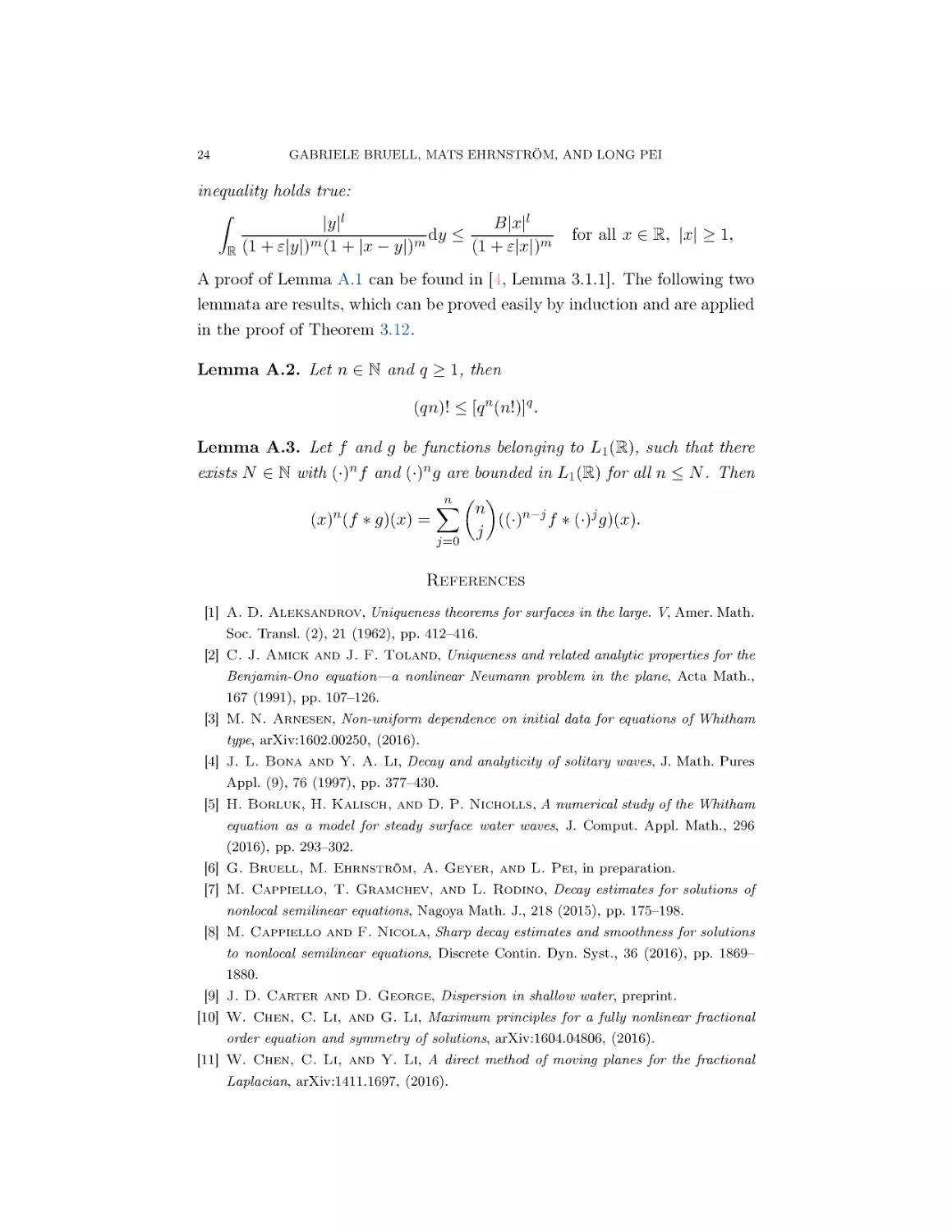
Lemma A.1. Let l and m be two constants satisfying 0 < l < m − 1.
Then, there exists B = B(l, m) > 0, such that for all ε ∈ (0, 1) the following

24
GABRIELE BRUELL, MATS EHRNSTRÖM, AND LONG PEI
inequality holds true:
Z
R
|y|l
(1+ε|y|)m(1+|x − y|)mdy≤
B|x|l
(1+ε|x|)m for all x∈R, |x|≥1,
A proof of Lemma A.1 can be found in [4, Lemma 3.1.1]. The following two
lemmata are results, which can be proved easily by induction and are applied
in the proof of Theorem 3.12 .
LemmaA.2.Letn∈Nandq≥1,then
(qn)! ≤ [qn(n!)]q
.
Lemma A.3 . Let f and g be functions belonging to L1(R), such that there
exists N ∈ N with (·)
n
f and (·)
n
g are bounded in L1(R)forall n ≤ N. Then
(x)
n
(f∗g)(x)=
n
X
j=0
n
j
((·)
n−j f ∗ (·)j g)(x).
References
[1] A. D. Aleksandrov, Uniqueness theorems for surfaces in the large. V, Amer. Math.
Soc. Transl. (2), 21 (1962), pp. 412–416.
[2] C. J . Amick and J. F . Toland, Uniqueness and related analytic properties for the
Benjamin-Ono equation—a nonlinear Neumann problem in the plane, Acta Math.,
167 (1991), pp. 107–126.
[3] M. N. Arnesen, Non-uniform dependence on initial data for equations of Whitham
type, arXiv:1602.00250, (2016).
[4] J. L. Bona and Y. A. Li, Decay and analyticity of solitary waves, J. Math. Pures
Appl. (9), 76 (1997), pp. 377–430.
[5] H. Borluk, H. Kalisch, and D. P. Nicholls, A numerical study of the Whitham
equation as a model for steady surface water waves, J. Comput. Appl. Math., 296
(2016), pp. 293–302.
[6] G. Bruell, M. Ehrnström, A. Geyer, and L. Pei, in preparation.
[7] M. Cappiello, T. Gramchev, and L. Rodino, Decay estimates for solutions of
nonlocal semilinear equations, Nagoya Math. J., 218 (2015), pp. 175–198.
[8] M. Cappiello and F. Nicola, Sharp decay estimates and smoothness for solutions
to nonlocal semilinear equations, Discrete Contin. Dyn. Syst., 36 (2016), pp. 1869–
1880.
[9] J. D. Carter and D. George, Dispersion in shal low water, preprint .
[10] W. Chen, C. Li, and G. Li, Maximum principles for a ful ly nonlinear fractional
order equation and symmetry of solutions, arXiv:1604.04806, (2016).
[11] W. Chen, C. Li, and Y. Li, A direct method of moving planes for the fractional
Laplacian, arXiv:1411.1697, (2016).

SYMMETRY AND DECAY OF TRAVELING WAVES
25
[12] W. Chen, C. Li, and B. Ou, Classification of solutions for an integral equation,
Comm. Pure Appl. Math., 59 (2006), pp. 330–343.
[13] A. Constantin, Edge waves along a sloping beach, J. Phys. A, 34 (2001), pp. 9723–
9731.
[14] A. Constantin, M. Ehrnström, and E. Wahlén, Symmetry of steady periodic
gravity water waves with vorticity, Duke Math. J., 140 (2007), pp. 591–603.
[15] A. Constantin and J. Escher, Wave breaking for nonlinear nonlocal shal low water
equations, Acta Math., 181 (1998), pp. 229–243.
[16] W. Craig and P. Sternberg, Symmetry of solitary waves, Comm. Partial Differ-
ential Equations, 13 (1988), pp. 603–633.
[17] A. de Bouard and J.- C. Saut, Symmetries and decay of the generalized
Kadomtsev-Petviashvili solitary waves, SIAM J. Math. Anal., 28 (1997), pp. 1064–
1085.
[18] M. Ehrnström, J. Escher, and L. Pei, A note on the local wel l-posedness for the
Whitham equation, in Elliptic and Parabolic Equations, vol. 119 of Springer Proc.
Math. Stat., Springer, 2015, pp. 63–75.
[19] M. Ehrnström, M. D. Groves, and E. Wahlén, On the existence and stability
of solitary-wave solutions to a class of evolution equations of Whitham type, Nonlin-
earity, 25 (2012), pp. 2903–2936.
[20] M. Ehrnström, H. Holden, and X. Raynaud, Symmetric waves are traveling
waves, Int. Math. Res. Not., (2009), pp. 4578–4596.
[21] M. Ehrnström and H. Kalisch, Traveling waves for the Whitham equation, Dif-
ferential I ntegral Equations, 22 (2009), pp. 1193–1210.
[22] M. Ehrnström and E. Wahlén, On Whitham’s conjecture of a highest cusped wave
for a nonlocal dispersive equation, arXiv:1602.05384, (2016).
[23] A. Geyer, Symmetric waves are traveling waves for a shal low water equation mod-
eling surface waves of moderate amplitude, J. Nonlinear Math. Phys., 22 (2015),
pp. 545–551.
[24] D. Henry, On Gerstner’s water wave, J. Nonlinear Math. Phys., 15 (2008), pp. 87–
95.
[25] V. M. Hur, Symmetry of solitary water waves with vorticity, Math. Res. Lett., 15
(2008), pp. 491–509.
[26]
, Breaking in the Whitham equation for shal low water waves, arXiv:1506.04075,
(2015).
[27] V. M. Hur and M. A . Johnson, Modulational instability in the Whitham equation
for water waves, Stud. Appl. Math., 134 (2015), pp. 120–143.
[28] F. Kogelbauer, Symmetric irrotational water waves are traveling waves, J. Differ-
ential Equations, 259 (2015), pp. 5271–5275.
[29] D. Lannes, The Water Waves Problem, American Mathematical Society, Providence,
2013.
[30] M. Mariş, On the existence, regularity and decay of solitary waves to a generalized
Benjamin-Ono equation, Nonlinear Anal., 51 (2002), pp. 1073–1085.

26
GABRIELE BRUELL, MATS EHRNSTRÖM, AND LONG PEI
[31] D. Moldabayev, H. Kalisch, and D. Dutykh, The Whitham equation as a model
for surface water waves, Phys. D, 309 (2015), pp. 99–107.
[32] P. I. Naumkin and I. A. Shishmarëv, Nonlinear Nonlocal Equations in the Theory
of Waves, American Mathematical Society, Providence, 1994.
[33] N. Sanford, K. Kodama, J. D. Carter, and H. Kalisch, Stability of traveling
wave solutions to the Whitham equation, Phys. Lett. A, 378 (2014), pp. 2100–2107.
[34] J. Serrin, A symmetry problem in potential theory, Arch. Rational Mech. Anal., 43
(1971), pp. 304–318.
[35] S. Trillo, M. Klein, G. F . Clauss, and M. Onorato, Observation of dispersive
shock waves developing from initial depressions in shal low water, Phys. D, 333 (2016),
pp. 276–284.
[36] G. B . Whitham, Variational methods and applications to water waves, Proc. R. Soc.
Lond., Ser. A, 299 (1967), pp. 6–25.
Department of Mathematical Sciences, Norwegian University of Science and
Technology, 7491 Trondheim, Norway.
E-mail address : gabriele.bruell@math.ntnu.no
Department of Mathematical Sciences, Norwegian University of Science and
Technology, 7491 Trondheim, Norway.
E-mail address : mats.ehrnstrom@math.ntnu.no
Department of Mathematical Sciences, Norwegian University of Science and
Technology, 7491 Trondheim, Norway.
E-mail address : long.pei@math.ntnu.no
View publication stats