/





Text
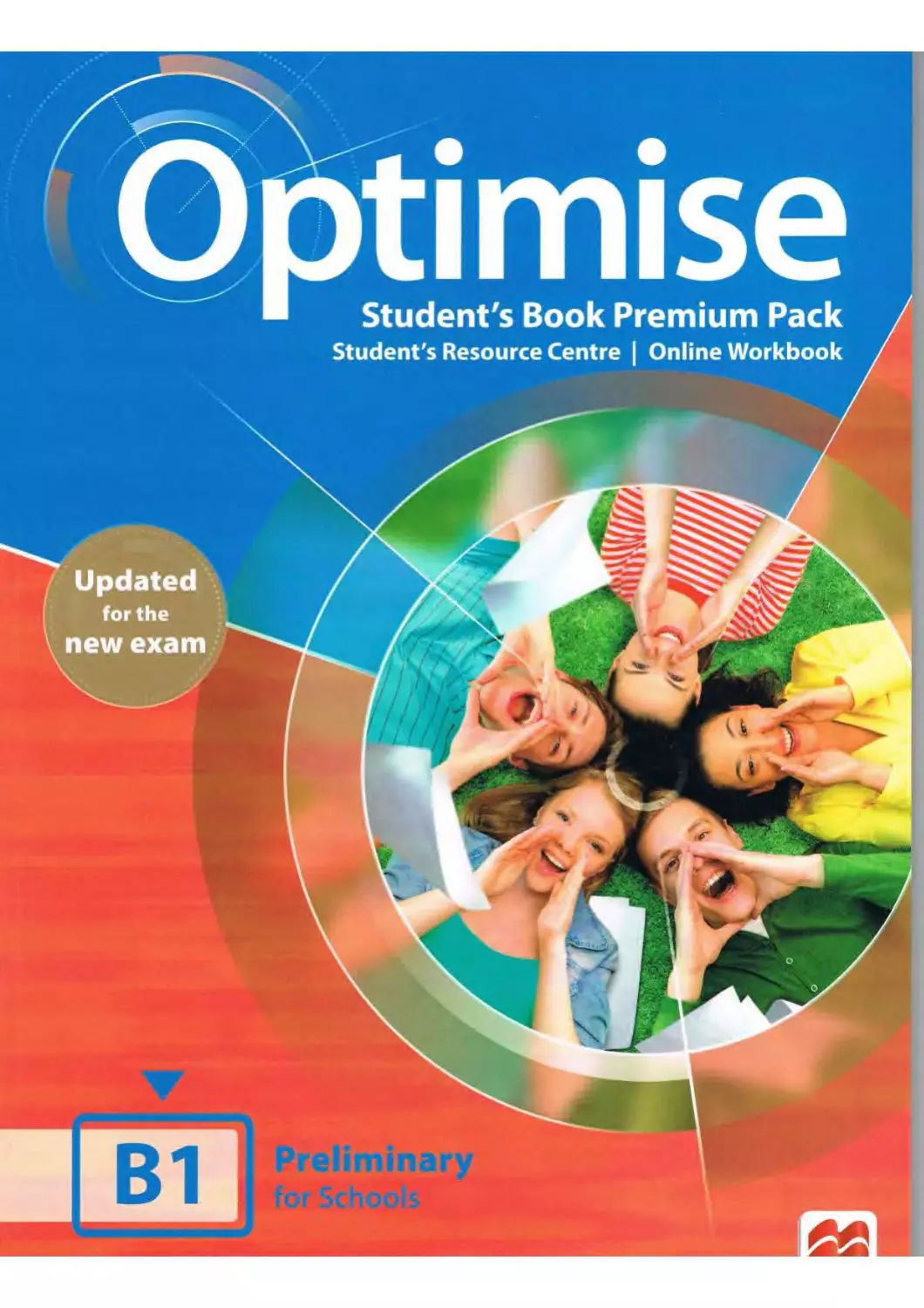
                    Updated
for the
new exam
rcimise
Student's Book Premium Pack
Student's Resource Centre | Online Workbook

UNIT	READING	GRAMMAR	VOCABULARY	*
1 This is me (PERSONAL IDENTITY)	What do they do all day? Skimming	Present simple, present continuous, stative verbs	Words connected with personality Nouns with -ity / -ness
p4-13	4-option multiple choice	Quantifiers	Collocations with adjectives
2 Home sweet home (HOUSE AND HOME) p14-23	Accommodation available Understanding text type 3-option multiple choice	Past simple and past continuous used to and would	Words connected with the house and home Phrasal verbs Word patterns
Progress check Units 1 and 2: Grammar and vocabulary / c	p 24-25
2 On the road (TRAVEL AND TRANSPORT)	The Hyperloop Understanding tenses	Present perfect simple and continuous	Words connected with holidays Adjectives with un-/im-/il-/ir-/dis-
p 26-35	Gapped text	Countable and uncountable nouns	Word patterns
Д Give it a go (NEW EXPERIENCES) p 36-45	Maximum fun! Scanning Matching	will and be going to Present simple and present continuous for future	Words connected with outdoor activitie Phrasal verbs Collocations connected with free tim
Progress check Units 3 and 4: Grammar and vocabulary / Ел.	p46-47
C In good health (HEALTH) p48-57	Teenlife: animal lives Paraphrasing Matching	Modals (1): ability, obligation, advice, permission Modals (2): possibility, probability, certainty	Words connected with health andillne Phrasal verbs Collocations with have, take, make and do	1
A A piece of cake! (FOOD AND DRINK) p 58-67	A young star of the kitchen Identifying synonyms 4-option multiple choice	Relative clauses Articles	Words connected with food Phrasal verbs Adjectives/nouns/verbs	«1
Progress check Units 5 and 6: Grammar and vocabulary / E 	p 68-69
7 Shop till you drop! (SHOPPING AND SERVICES) p 70-79	Teenagers take over the market Understanding time words and phrases Gapped text	Past perfect simple and continuous Comparatives and superlatives	Words connected with shopping Phrasal verbs Idioms for shopping and spending	и
Q A sense of style ** (FASHION) p 80-89	Project fashion! Understanding attitude and opinion Matching	The passive Question tags	Words connected with clothes and accessories Phrasal verbs Adjectives/nouns/verbs
Progress check Units 7 and 8: Grammar and vocabulary / E	p 90-91
Q Playing to win! (SPORT) p92-101	Want to play Quidditch? Understanding implication 4-option multiple choice	Conditionals (1): zero, first and second conditionals Time clauses	Words connected with people in spa Phrasal verbs Collocations with do, play and go	If
IQ All in good fun! (ENTERTAINMENT) p102-111	We love Hollywood Understanding linking words and phrases Gapped text	Conditionals (2): third conditional The causative	Words connected with people in the media Phrasal verbs Word patterns
Progress check Units 9 and 10: Grammar and vocabulary/ m		p112-113
*11 Curious minds (EDUCATION) p114-123	Summer camp Understanding specific information Matching	Reported speech Reported questions	Words connected with studying Phrasal verbs Idioms for education and learning	I
*|2 Our wonderful world (THE NATURAL WORLD) p124-133	River clean-up! Understanding instructions 3-option multiple choice	Future perfect Modal perfect	Words connected with natural habitats Phrasal verbs Adjectives and nouns	15
Progress check Units 11 and 12: Grammar and vocabulary / E w	p134-135
OPTIMISE YOUR EXAMS	► READING p 136-139	► WRITING p 140-141	► LISTENING p 142-143
		LISTENING		LANGUAGE IN USE	WRITING
		Understanding the situation	Talking about yourself	Identifying phrasal verbs	Starting and ending an email An email
		3-option multiple choice | (pictures) Д	Questions	|4-option multiple choice cloze j
		Predicting	Saying where things are	Result clauses 3-option multiple choice	Extended turn (photos)	Open cloze ®1и0аэ			Using the right style An article

S-		Listening for attitude and opinion	Making suggestions Discussion (pictures)	Using particles to create phrasal verbs	Choosing positive and negative points
		1 3-option multiple choice  [(dialogues) Д			A review
Expressing opinions
General conversation
Giving your opinion
An article
Connectors of contrast
Key word transformation
tes Listening for the main idea
Multiple matching
Tie
	Recognising synonyms	Talking about habits Questions	Words formed from verbs Word formation	Using narrative tenses A story
	I 5-option multiple choice H | interview) Д
		О Talk2 Me’ 1

Recognising similar meaning	Describing situations and actions	Collocations Gap fill	Extended turn (photos)	4-option multiple-choice cloze				Making suggestions An email

	Understanding relevant । "formation	Asking questions General conversation	Nouns connected with people	Using direct speech
			Word formation > [	A story

	1
snowing what type of "formation to listen for Gap fill		Discussing alternatives	-ing and infinitives	Writing descriptions Discussion (pictures)	Key word transformation	A story Ф'гпОаэ

	>entifying why answers are «"correct	Talking about other people Questions	Verbs with similar meaning |4-option multiple-choice cloze	Expressing preferences An email

		О idik2

Selecting relevant information	Listening and responding j Gap fill	General conversation			wish and if only Open cloze	Describing how to do something An article

	_ Terstanding implication	Expressing uncertainty Extended turn (photos)	Nouns with similar meaning [4-option multiple-choice cloze |	Understanding the notes
	1 lotion multiple choice P [ p-ctures) Д			'^Aru^ail	•
	Th --mglogically v - hple choice (single extract)	Negotiating agreement	Auxiliary verbs Discussion (pictures)	Open cloze (i TUI Il li Illi				Giving reasons An essay
• Talk2Me videos
► SPEAKING / О SPEAKING TEST VIDEOp 144-147
nr
1
In pairs or as a group, add more words
and phrases to the categories for
describing people.
Hair and facial hair	tong, dark-haired, moustache
Face and complexion	blue eyes, pale skin, freckles
Height and build	tall, thin, muscular
Appearance and personality	friendly, serious, fashionable
2
Which words and phrases in Exercise 1 can
you use to describe yourself?
3
Read the text quickly and decide if the
statements are T (True) or F (False).
1	Forensic artists usually draw pictures
of people they know very well.	T / F
2	Their pictures often help the police
do their job.	T / F
3	They sometimes draw people from
a long time ago.	T / F
4	Computer programs can help them
get the picture right.	T / F
5	To a forensic artist, 'curly hair' and
'wavy hair' are exactly the same thing. T / F
6	Forensic artists rarely draw faces.	T / F
__________________________ EXAM [skill
Skimming
Skimming is reading quickly to get the general
meaning of a text.
>* nen you skim, move your eyes quickly over the
:e > ’ л ithout going back. Focus on the general idea
i - ~ don't worry about words you don't understand.
OPTIMISE YOUR EXAM
4-option multiple choice
•	When you are not sure of an answer, cross out the
answers that are definitely wrong.
•	When you are left with two possible answers, read
them again carefully and check the relevant part of
the text.Then make vour final choice.
What do they do all day? ' S
This week: forensic artists
Karen Jacobs works as a
forensic artist.
READING D
1
Karen, what is a 'forensic artist'?
What do you do all day?
In simple words, I draw people! For
example, the police contact me when a
witness sees someone commit a crime.
I listen to the description of the criminal
and turn the description into a picture.
So, forensic artists help catch
criminals?
In a way, yes! Do you know who Lois
Gibson is? She’s in the Guinness Book
of World Records as the world's most
successful forensic artist. Her pictures
help catch lots ofcriminals-over 1,300
of them so far!
Do you use a pencil and paper?
Yes, but we also use computers. These days,
technology is developing very quickly. It's really I
useful, and there are some great computer
programs we can use. When a witness says that |
a person wears glasses, for example, we can
bring up on screen different styles of glasses for the
witness to choose from.
What skills do you need for your job?
Forensic artists do need good drawing skills, of
course, but they also need good people skills.
We often work with people who are upset, so we
help them remember clearly and give us enough
detail. Perhaps the witness says the criminal has
curly hair. We try to find out exactly what they
mean by'curly'. For example, is wavy 'a better
word? A forensic artist also needs to be an
expert in different hairstyles!
Do you only draw criminals?
No, I also draw historical figures. I do
lots of work for TV programmes and
museums. At the moment, I’m working
on a TV documentary about ancient
Egypt. We're making drawings and 3D
models of the pharaohs. It's fascinating!
What do you know about faces?
Faces obviously change as we get older. But
this is interesting: the face of a shy person
changes differently to the face of a lively,
sociable person! And do you know which part
of your face continues to grow all through
your life? Your nose!
1.01 Read the text again. For each question,
choose the correct answer.
Complete the sentences with
highlighted words or phrases from
the text.
i
В
C
D
What does Karen Jacobs do regularly?
She helps Lois Gibson solve crimes.
She meets criminals and draws them.
She listens to police officers describing criminals.
She draws pictures of criminals and people from
the past.
Karen says she sometimes uses modem technology to
find pictures that match someone's description,
find pictures of real people online,
design different types of glasses,
have video calls with witnesses.
Good people skills help a forensic artist to
draw more artistic pictures,
learn about different hairstyles,
communicate better with witnesses,
not get upset while they're working.
What advice might a forensic artist give to someone
interested in the job?
2
3
В
C
D
4
A
В
c
D
2
3
. they're very
4
5
8
When you something
on a computer screen, you make it appear.
A is someone who sees
something happening, such as an accident
or a crime.
If someone is
good at something.
An is a person who knows
a lot about a subject.
When you something
something else, you make the first thing
become something different.
6 'To' is an informal way of
saying 'to become older'.
If something is, it's
extremely interesting.
Someone who is
or annoyed.
7
is sad, angry
Find out what criminals
often look like, then
make all your drawings
look like that.
Try to be lively and
sociable so that
criminals are happy to
tell you what they know
Make sure you visit
a library to read
about the history of
hairdressing.
Learn about how
faces change and find
out how technology
can help you.
THINK RESEARCH | CULTURE | LEARN | ME
Choose a person you know and think about
how their appearance might change in the
future. Describe them as they might be in ten
years’time.
GRAMMAR 1 | Present simple, present continuous, stative verbs
Grammar in context
Find these verbs in the text on page 5 and match each
one with a description.
1 I draw people!____
2	Tit the moment. I'm working on a TV documentary about
ancient Egypt._____
3	Forensic artists do need good drawing skills, of course..._
4	Perhaps the witness says the criminal has curly hair._
5	These days, technology is developing very quickly._
a)	a situation or action happening at the moment
b)	a changing situation
c)	a stative verb
d)	a habit, routine and permanent situation
e)	the emphatic present simple
1
REMEMBER
•	We use the present simple for gene': ’ . •‘ав
facts, habits, routines and permanen- :	I
•	We use the present continuous for des or zr
of pictures, actions happening now and
temporary or changing situations.
•	Stative verbs are not usually used in the present
continuous. Common stative verbs include:
believe, hate, like, need, etc.
•	Some verbs can be stative or action verbs,
depending on the meaning: Sam has red
hair, (state)
Sarnia is having a haircut at the moment, (action)
► See Grammar reference. Unit 1, page 148
Look at the picture and choose the correct word or phrase.
This is a pict-uve илу -fvienX Еилила. ^he (I) lives / is living neAv
иле апД (2) we've / we've teeing in Нле $Аиле cIass Ah school. She
(3) IaaS / is having short-, Длик h«iv апД (4) wsuAlly we*vs / is wsiwnlly
weaving glasses. ($) Еилила smiles / ЕилилаЧ sailing in t-he pict-uve апД
hhAh's not- unustAAl. She (6) aIways seevAS / is AlwAys seeming hAppy
апД in а дооД илооД. She's very -Pvien<Aly апД sociAtele, teuh she
(7) Xoesn'h spe лк / isn’t- speAking much in cIass. Ah f-he moment-,
I hhink (?) Еилила shops / ЕилилаЧ shopping wihh hev mum.
2
Look at the picture and put the verbs into the
correct form. Use short forms where possible.
This is a picture of my friend Paulina.
She (1)(not / look)
much like Emma — their hair
(z)(n ot / be) the
same colour or length and Paulina
(s)(not / wear)
glasses. Also, Paulina (ч)(not /smile) as
much as Emma. She (s)(often /seem) very
serious, but in fact she (б)(have [emphatic])
a great sense of humour and (?)(often /tell)
really funny jokes! In the picture, she (s)
(wear) a green top. Paulina (i)(love) ryc/ing,
so she (io)(almost always /arrive) at school
wearing her cycling helmet. Paulina’s in the same class as
Emma and me, but she (11)(not / live) near
me. Right now, /imagine Paulina (iz)(watch)
something on YouTube.
Look at the two pictures again and
write questions using the words and
phrases given.
Example: Which girl / wear / pink top
Which girl is wearing a pink top?__
1 Who / have / long hair
2 Emma / smile / in the photo
3 either of them / seem / shy
4 Paulina / usually / ride / a bike to school
5 Your own question:
4
In pairs, ask and answer the questions
in Exercise 3. Use your imagination
where necessary.
VOCABULARY Topic vocabulary | Word formation | Collocations
1
Words connected with personality
1
L^'))l.O2 Write a word from the box in each
gap to complete the definitions. Listen
and check.
creative | curious | dependable | friendly
generous | negative | polite | popular
serious | shy | unreliable
Someone who is ...
1	is not enthusiastic about something.
2	is imaginative, artistic and talented.
3	wants to find out and learn about
things.
4	doesn't do what they say they will.
5	is someone you can trust and rely on.
6	is pleasant and helps other people.
7	is liked by lots of people.
8	gives a lot of their time to people.
9	behaves in a very nice way.
10	is very careful and doesn’t laugh
a lot.
11	is nervous and embarrassed
around people.
2
In pairs or as a group, discuss the
difference in meaning between each pair
of words in bold.
1 a friendly / popular person
2 a generous / polite person
3 a serious / shy person
Nouns with -ity I -ness
3
1.03 Find four adjectives in the box
which do not make nouns ending in -ity.
Write their nouns in each gap. Listen
and check.
creative	curious |	dependable
friendly	generous	| negative
personal	| polite |	popular
reliable |	serious |	shy
1 ______________
2 ______________
3 ______________
4 ______________
Complete the words in the sentences.
1	I was surprised by my best friend's
negativ when I told him I wanted to
live abroad when I'm older.
2	I don't find it easy to talk to new people because
of my shy.
3	They're twins, but Susie's personal is
totally different from Annabel's.
4	My friend with Corey is one of the
most important relationships in my life.
5	Thanks to the genero of your
parents, we've bought some new equipment for
the school's art room.
6	Just out of curio why did you
choose to get that hairstyle?
Collocations with adjectives
C^O) 1.04 Match 1-6 to a-f to make
collocations. Listen and check.
1	big	a) awake
2	fast	b) voice
3	feel	c) time
4	wide	d) asleep
5	long	e) trouble
6	deep	f) small
6
Fill the gaps in the text with collocations
from Exercise 5.
My best friend Leah's in (1)again I
The problem is she's so unreliable She promised to
babysit her neighbours' kids, but turned up half an
hour late. Then, when Mr and Mrs Ghadie got home,
the kids were (2)and playing, and
Leah was (3)on the sofa! Mr
Ghadie shouted at her in his (4)
and called her irresponsible. Leah said it made her
(5). I hope she's learnt her lesson,
but I don't think they’ll ask her to babysit again for a
very (6)
SAY IT RIGHT
Resource centre: Unit 1
/э/
Look at the adjectives in Exercise 1 again. Think
about which three are the most important qualities
in a friend for you.
LISTENING	3-option multiple choice (pictures)
In pairs or as a group, think of different
situations where people introduce
themselves or other people.
C^o) 1.06 Listen to longer extracts of the
conversations. For each question, choose
the correct answer.
Example: Meeting а new teacher for the first time
|~EXAM |skill~
Understanding the situation
) When you're doing a listening task, it's important to
understand the general situation. This helps you to
understand the gist of what you're listening to.
) As you listen, ask yourself these key questions:
Who's talking? Who are they talking to? Where are
they? What's the general topic/situation?
0) 1.05 Listen to people speaking in four
different situations. Make notes to answer
the questions for each situation.
Situation 1:
1	Who's talking?_______________________________
2	Where are they?______________________________
3	What are they talking about?
Situation 2:
4	Where are the boy and the girl?
Situation 3:
5	Where would you hear someone say this?
Situation 4:
6 Where would you hear someone say this?
4 What is Josephine studying?
3 What does Robert have at the moment?
В
0'))
1 06 Listen again and check your answers.
OPTIMISE YOUR EXAM
3-option multiple choice (pictures)
•	Look at each picture before you listen and think of
words and ideas you might hear. For example, in
Exercise 3, picture 1A, you might hear computer or
internet, etc.
•	Remember that you will probably hear about the
ideas in all three pictures. For example, in question
1, you'll hear something about computers,
something about dancing and something about
think RESEARCH culture | learn | me
Do a class survey. Find out:
•	what job each person wants to do when they're older.
•	what job their parents/guardians do.
•	what pets they have.
•	if they like going to parties.
•	if they like watching videos online.
GRAMMAR 2 Quantifiers
1
Grammar in context
Look at these sentences from the audio in the
listening lesson on page 8. Decide if the word
or phrase in capitals can replace the word or
phrase in bold. Write 'yes' or 'no'.
1	Both my parents work.
(BOTH OF)__________
2	I don't know most people here.
(MOST OF)__________
3	You can win a lot of money on every question -
if you're clever!
(EACH OF THE)
4	Not all of you will know who Josephine is.
(NOT ALL)__________
2
Write sentences about the cartoon using
the words and phrases.
Example: all of I man / look / very serious
All of the men look very serious.__________
1 both / police officer / wear / uniform
ER
2 all / man / stand up
•	We use quantifiers to talk about numbers
and amounts.
•	Common quantifiers include: all, both, each, enough,
every, little, lots of, many, most, much, some, etc.
•	After each and every (but NOT each of the),
we can use a singular countable noun: Every
student in my class is 14 years old.
•	After some quantifiers, including all (of the),
both (of the), each of the, lots of (the), many
of the), and most (of the), we can use a plural
countable noun: Many teenagers are shy.
•	After some quantifiers, including little and much,
we can use an uncountable noun: / haven't got
much money on me.
•	Quantifiers with of the take a plural verb: Most of
'he boys have short hair. The exception is each of
the, which takes a singular verb: Each of the girls
has long hair.
•	With some quantifiers, you need to use a
different grammatical structure depending
on the meaning. For example, all = generally
All people breathe air.), all (of) + the = specific
All of the people in my class have a mobile phone.).
► See Grammar reference, Unit 1, page 148
Choose the correct word or phrase to
complete the sentences.
1	Every girl / girls in our class have / has a sister
or brother.
2	Each of the student I students in our class
have I has a social media profile.
3	Sue's got an earring in each / every ear.
~ Most / Most of artists are very creative people.
5	My cousins are visiting us at the moment! We're
taking both / both of them to the zoo tomorrow.
3 most / man / tall
4 woman / look carefully at / every / man
5 woman / look carefully at / each of / man
6 woman / talk to / both of / police officer
Write a word or phrase from the box in
each gap.
all	all of	both |	enough	every
of I	others	some
When you see someone’s face,
do you know who that person is?
(1)face is different. And (2)
us can recognise someone from their face. Well, no - not if
you’ve got ‘prosopagnosia’, which is also called ‘face blindness’.
Most (3)the people with face blindness have
a problem in a particular part of their brain. (4)
of them have it from birth, and (5)develop
it after an accident or illness. But they (6)
have the same disability: they can’t tell who someone is
by looking at their face. For example, a woman goes to
meet her friend. There are two people waiting - and they
(7)look exactly the same to her!
There’s no medical treatment for the condition, but there
are things people with face blindness can do. These include
trying to memorise everyone’s voice, body language and
body shape. That usually gives them (8)
information to work out who someone is.
v
SPEAKING Questions
Flipped classroom
® Watch the Talk2Me video and
answer the questions.
What is Jamie's favourite drink?
How long have Angus and Jamie been friends?
Is Maddy's drink bigger than Jamie's?
@ Watch the video again. Underline the
phrases in the Phrase expert box that you
hear on the video.
PHRASE EXPERT
Yes, I've (studied English) for... | My favourite
(subject/sport) is definitely/probably ... |
Well, (s)he's/it's ... | I don't have a lot of free
time, but... I'd say I'm (friendly/quite tall)
1.07 Listen to two students answering
these questions. Tick the answers which
give enough detail.
3
In pairs or as a group, answer the questions.
5
	Nisha	Alfie
1 What's your name?
2 How old are you?
3 Where do you live?
4 Do you study English at school?
5 Do you like it?
6 What’s your favourite school subject?
7 What do you enjoy doing in your free time?
8 Tell me about your best friend.
Look at the questions in Exercise 4 and
think about your answers. Make notes if
necessary.
1	How much personal information do you put on
social media, such as Facebook?
2	How do you feel about answering personal
questions about yourself?
| EXAM [skill ~
Talking about yourself
3	Speaking exams often include personal questions,
so you need to be able to talk about yourself and
your life, family, friends, studies, etc.
О At the start of the speaking exam, the examiner
will ask you about facts such as What’s your name?,
How old are you? and Where do you live? You can
give short answers to these questions: My name is
Sam Lopez. I I’m 14.11 live in Moscow.
□ For other questions, you need to say more and
give full answers. For example, if the question is
How would you describe your personality?, don’t just
say I'm friendly. You have to give longer answers to
show you can speak English well.
OPTIMISE YOUR EXAM
Questions
• Don't memorise long answers because you might
not answer the examiner's questions correctly.
However, it's fine to learn one or two sentences to
talk about typical subjects.
In pairs or groups, use your notes in
Exercise 5 to ask and answer the questions.
LANGUAGE IN USE | 4-option multiple-choice cloze
In pairs or as a group, ask and answer
the questions.
1 What jobs do robots help us do?
2 Do you think machines or robots can be cleverer
than a human? Do they have feelings?
REMEMBER
•	Phrasal verbs consist of a main verb followed by
a particle - an adverb (look up), or a preposition
look into), or both (look up to).
•	The meaning of a phrasal verb is often different
from the meaning of the individual words, e.g. you
look up into the sky, but when you look up a word in
a dictionary, the phrasal verb 'look up' means 'find'
or 'try to find', not 'put your eyes up'.
•	Think of each phrasal verb as one piece of
vocabulary, e.g. you might write in your notebook:
ook up = (fry fo) find.
•	Phrasal verbs with turn are often connected to a
changing situation.
•	Phrasal verbs with look are often connected to
seeing something - literally or metaphorically.
5
2
Write the correct form of turn or look in
each gap. Use the words in italics to help
you. If you aren't sure, ask yourself if the
action is connected to a changing situation
or seeing something.
1	You can up curious facts about body
language/human personalities online.
2	off the TV and do something creative!
3	If you over, there's a brilliant short
story on the next page.
4	.As a babysitter, you're responsible for
after someone else's kids.
5	How do caterpillars into butterflies?
6	on the TV! CSI: New York is starting.
~ I m really forward to going to
Nadine’s party next week.
8	Scientists are into what causes face
blindness in the brain.
Quickly read the text in Exercise 5,
ignoring the gaps and answer choices.
Which question best summarises the main
points of the text?
a> Are machines and robots cleverer than humans?
b> What do most people think about modem
technology?
c) Is it possible for machines and robots to think
and feel?
Read the text again. Which gaps test your
knowledee of nhrasal verbs?
OPTIMISE YOUR EXAM
4-option multiple-choice cloze
•	Before you look at the possible answers, quickly
read the whole text to get a general idea of what
it's about.
•	Fill the gaps you're sure about first.Then go back to
the gaps where you're not so sure.
•	If you're not 100% sure, make a guess. Don't leave
any gaps blank.
Choose the correct word to fill each
gap.
Do computers have personalities?
Think about your computer, or your mobile phone.
It is definitely 'clever' in some ways, but it doesn't
feel sad when you (1)___it off. It doesn't (2)_
forward to you using it. It can’t feel any emotions
when you start using it. In other words, it doesn’t
have a (3)____.
Humans have consciousness'. This (4)______that
we can think and feel, but what about computers?
Scientists are looking into this, and (5)_think
that technology can become 'conscious'. They say:
’Maybe the internet can already think. How would
we know?' Others believe that only things that are
alive can have consciousness.
In the future, if our computers (6)_into
conscious machines, will they end up being more
creative than humans? No one knows. But it makes
you think, doesn't it?
1	A make	В turn	C close	D change
2	A look	В see	C watch	D notice
3	A reliability	В negativity	C popularity D personality
4	A believes	В recognises	C means	D seems
5	A all	В each	C both	D some
6	A come	В turn	C become	D improve
WRITING An email
In pairs or groups, answer the questions.
1 What's your family like?
2 How are some families different from others?
Choose the best option to complete Claire's
reply. You can use your answers from
Exercise 2 to help you.
__________________________ EXAM Jskill~
Starting and ending an email
Э It's important to start and end your email in the
right way.This depends on who you are writing to.
For example we can use Hi... and Can't wait to see
you/(informal) or Dear... and All the best, (formal) at
the beginning and end of an email.
Э In your first paragraph, remember to thank the
person for their email.
2
Read part of an email from Claire's English
teacher and the notes Claire has made.
Answer the questions.
—I aL-Lj i-----------
From: | Mr [ones
Subject: Class project
Interesting!
Suggest...
Dear Class,
_ Td like each person in our class to
doa'project on their family.
What’s your family like? Who do----
you live with?
Do you think it's better to have a
large or small family?
Hpw should we present our projects
to the rest of the school? Don't
forget to include some photos!
Explain
Say which
you prefer
From: | Claire
Subject: [_RE: Class project
(1)	Hi/Dear Mr Jones,
(2)	Thank you for your email. A school project on
families sounds really interesting. I Thanks for your
email. Interesting!
I live with my parents, two brothers and a sister.
(3)	My brothers are really messy and noisy, but my
sister is very cute! /1 really like them.
(4)	Personally / Definitely, I think having a large family is
great. It's often crazy, but it's never boring! We sometimes
argue and fight, but we also have lots of fun together.
I wouldn't want to have a small family.
I think we should organise an exhibition in the school hall.
The other students could see it during break time and learn
more about us and our families.
(5)	It's great to hear from you! /1 look forward to
starting this project.
(6)	Speak soon! I All the best,
Claire
1	Which of these is a good first paragraph for
Claire's email?
a)	Thank you for your email. A school project
on families sounds really interesting!
b)	Thanks for your email. Interesting!
2	What information should Claire give in
paragraph 2?
a)	the people she lives with and what
personalities they have
b)	whether she likes her family or not
3	In paragraph 3, what does Claire need to decide?
4	In paragraph 4, should Claire give a fact or an
opinion?
Answer the questions.
1 Do you think Claire has a traditional family?
Explain why / why not?
2 Why does Claire prefer to have a large family?
3 Why does Claire think an exhibition is a good
idea?
OPTIMISE YOUR EXAM
An email
•	Read the exam question carefully and take time to
understand the notes.
•	Use the notes when planning and writing your
first draft. Add a few sentences to each note to
develop the idea. Make sure you answer all four
notes.
•	Check your draft carefully thinking about grammar,
punctuation, spelling and the information included
in each paragraph.
•	Correct any mistakes and write your final email.
Look at this writing task and answer the questions.
Read this email from your English teacher Mrs Fairfax and the notes you have made.
		', * >			 Д From:	Mrs Fairfax	1 What is interesting in the first
	Subject: | End-of-year project	paragraph? 2 What do you have to explain to Mrs Fairfax?
"teresting!-	Dear Class,
Tell Mrs —	For our end-of-year project I’d like you to write about the important people in your • lives and how you spend time with them.
Ea>rfax	What different groups of people do you often spend time with? Think about your family, close friends and members of a sports team or a club.				 Which group do you like being with the most? Why? It would be great to present your projects to the school. Would you prefer to prepare a poster or write an article on the school blog?	"	—. Reply soon! Emma Fairfax		Explain Say which you prefer
Vnte your email to Mrs Fairfax using all the notes
ИЗ Plan Make a paragraph plan.
	Purpose	Useful phrases	My notes
' Lme	greet the person you are writing to	Dear...
“iri^raph 1	thank the other person for their email and write about the first note on the email	Thanks for... The project sounds...
Wa<raph2	write about the second note on the email	I belong to many groups.... but.... 1 think the group I feel most part of is ...
^k£raph 3	write about the third note on the email	I love ... most because .... I love being part of all of them, but...
feu£.aph 4	write about the fourth note on the email	I think... is a good idea because ... I would prefer to... because ...
i wnur name	say goodbye first name	All the best. Best wishes.
^И Write Write your email to Mrs Fairfax in an appropriate style. Use all the notes.
•V rite about 100 words.
И1 Check Before you hand in your email, complete this checklist.
Checklist &
Ле started and ended my email the right way.	I’ve written about too words.
Г\ e - tten about all four notes in the exam task and	I've checked my spelling, grammar and
re.e oped them further.	punctuation.
In pairs or groups, answer the questions.
Use the words in the box to help you.
apartment/flat (on the ground/first/second/
etc. floor) | block of flats | cottage
terraced/semi-detached/detached house
1 What kind of place do you live in? What's your
neighbourhood like?
2 What do you like and dislike most about where
you live?
["exam ]skill~—
Understanding text type
Э If you understand what type of text you are
reading (a notice, an advertisement, etc.), it helps
you understand what the text says.
3 Look at the design of the text to help you choose
the correct type. Does it look like something on a
noticeboard or something on a phone screen, etc.?
2
Look at the texts in Exercise 4 and match
them to the text types. There are two text
types you don't need.
Text 1
Text 2
Text 3
Text 4
Text 5
a)	an email
b)	an invitation
c)	a magazine advert
d)a note
e)	a reminder
f)	a notice
g)	a text message
3
Read the texts in Exercise 4 quickly and
answer these questions.
1 How did Natasha and Adriana hear about
the rooms?
2 Do they decide to rent the rooms?
OPTIMISE YOUR EXAM
3-option multiple choice
•	With multiple-choice questions, you often need to
recognise different ways of saying the same thing.
•	Read through the answers A-C first and underline
the key words. Think of ways they could be written
cJ'l)l.O8 Read the texts. For each question,
choose the correct answer.
READING
T^°	bedrooms in local family
flat available. All meals and cleaning У
but not laundry, included
ЦлРлхкл,
I wrAS waking p^sV Vke чоНсеЪолМ
wkeh I s<aw Иле ре*£ес+
лДуеИ-l uJken you
free Fo see Vke voowvs?
A People who rent these rooms must wash their own clothes.
В People who rent these rooms have to cook their own food.
C People who rent these rooms have to buy their own furniture.
A Natasha must make an appointment to see the rooms.
В Natasha should tell Adriana when she can see the rooms.
C Natasha needs to go and read the advertisement for the rooms.
A Natasha wants to tell Adriana which bedroom lamps to buy
for the rooms.
В Natasha wants to check if she needs to buy bedroom lamps
for the rooms.
C Natasha wants to ask Adriana to see if there are any
bedroom lamps in the rooms.
OOM( >ll
16:12
Flatmates
Hi Adriana. When we saw
the rooms, did you notice any
bedroom lamps? I'm in the
supermarket and can buy some
if not.
Natasha
A Adriana wants her mum to send something to her.
В Adriana wants her mum to buy something for her.
C Adriana wants her mum to keep something for her.
From: | Adriana
To: Mum
A Guests have to bring food to the party.
В Guests should say if they are coming to the party.
C Guests can invite other friends too.
I don't need the cooking things you
were planning to send as all meals are
included. Please look after them for me
for the future!
1
Follow the instructions and find the secret word.
Secret word:____________
12345678
Find a word that means places to live or stay:
. ake the fourth and fifth letters and write them
. bove 3 and 4.
Find a word that means with all furniture provided:
7:30 pm Thursday!
Refreshments provided but numbers are
limited because of space, so please let us
know if you can make it.
Natasha & Adriana
3
5
. ike the third and the eighth letters and write them
. b иге 1 and 8.
F—d a word that means dirty clothes that need washing:
7 _ • e the second letter and write it above 6.
F_-.:a word that means someone you live with in the same flat:
Tike the seventh letter and write it above 7.
Find a word that means things to eat and drink:
Tike the eighth letter and write it above 5.
Find a word that means a kind of party you have when
. u move into a new place to live:
the second letter and write it above 2.
THINK
RESEARCH | CULTURE | LEARN | ME
What do you think makes some people easy to live
with and some people difficult to live with?
2
GRAMMAR 1 Past simple and past continuous
Grammar in context
Choose the correct words to complete
this sentence. Then find the sentence
in the note on page 15 to check your
answer. Explain your choice.
1 past the noticeboard when I
the perfect accommodation advert!
a)	walked, saw
b)	was walking, was seeing
c)	walked, was seeing
d)	was walking, saw
REMEMBER
•	We use the past simple to talk about single actions, permanent
situations, habits and facts in the past.
•	We use the past continuous to talk about actions in progress and
temporary and changing situations in the past.
•	When an action in progress is interrupted by another action, we
use the past continuous for the first and the past simple for the
second: / was watching TV when my friend phoned me.
•	In stories, we use the past continuous for background information:
The sun was shining. The birds were singing. We use the past
simple for the main events: I opened the door and left the house.
► See Grammar reference, Unit 2, page 149
1
Choose the correct word or phrase.
1	We moved I were moving house last year and
I really like our new neighbourhood.
2	I looked through the window. It rained / was
raining hard and I didn't have an umbrella!
3	In the 19th century, most houses didn't have /
weren't having bathrooms.
4	My parents invited / were inviting all the
neighbours to a house-warming party.
5	While we were in London, we visited / were
visiting Buckingham Palace.
6	Dad decorated / was decorating when he
accidentally kicked the paint can over.
2
Write sentences about what each person was
doing when something else happened using
the words and phrases given.
she / putting up a poster / the
phone / ring
they / play a video game I the
lights / suddenly / go off
he / do homework / the party
upstairs / begin
we / walk home / it / start to rain
3
Complete the text using the verbs in
brackets in the correct form.
A SEE-THROUGH HOU!
When one Japanese couple (1)(plan) their
new home, they (2)(have) an incredible
idea. Why not have glass walls and make a completely
transparent building? It sounds crazy, but that's what Sou
Fujimoto Architects (3)(build) for them in
Tokyo. The architects say that their inspiration (4)
(come) from trees. They (5)(create) a building
on many floors, connected by stairs, ladders and wooden
steps. While they (6)(design) the building,
they soon (7)(realise) that the people in the
building would need some privacy, so there are thick white
curtains that can be pulled across the glass walls. Most of
the time, though, anyone walking by can see exactly what
the people inside are doing. No doubt the neighbours
(8)(find) it a little strange at first, but
everyone seems used to it now.
VOCABULARY I Topic vocabulary | Phrasal verbs | Word patterns
ords connected with the house and home
1.09 Complete the picture with the words and phrases in the box. Listen and check.
Phrasal verbs
: 1.10 Complete the sentences
with the correct form of the phrasal
verbs in the box. Listen and check.
do up | move in | move out
pull down | put up | rent out
settle in | tidy up
1	I didn't like this house when we first
but now I love it!
2	Alien we moved house, it took me a long
time to make friends and.
i I____________my bedroom when I found
s me old comics I didn't know I had!
4	I me and stay for a few days! We can
you____________________________in the
spare room.
5	You could your flat
while you're on holiday
and make some money.
4 'ake couldn't afford the rent so he
had to.
: an’t believe they're going to
the house I was bom in!
It П be gone forever!
• My parents bought an old house so they
can it___________________________and
Write the correct form of a phrasal verb from
Exercise 2 in each gap to complete the diary entry.
5th October
So, we 're in our new house! H's fantastic! I was really sad to
(1)_____________of the old house, of course, hut I really like
where we are now. We (1)_____________here two days ago
and we met the neighbours yesterday / feel at home already
and I (З)very quickly. We still have to unpack
and then (4)the mess, but / love it here!
Word patterns
4
1.11 Choose the correct word or phrase. Use the
words in italics to help you. Listen and check.
1	It's worth visiting I to visit a new neighbourhood before you
buy a house there.
2	I'm not keen for I on living on the 20th floor of a block of flats!
3	I think that your happiness depends from I on where you live.
4	I told you tidying / to tidy your room up and it's still a mess!
5	We had to stop the neighbours from / with playing loud music!
6	When we moved house, my parents made me have / to have
the smallest bedroom!
SAY IT RIGHT
ztake it attractive again.
Resource centre: Unit 2
LISTENING	3-option multiple choice (interview)
1
Match the homes to the countries in the
box. Say why you think houses in these
countries might be like this.
Mongolia | the Philippines | Tunisia
an expert on houses around the world. Read
the questions in Exercise 4 and decide if
these predictions are T (True) or F (False).
1	The interviewer is going to tell us the
expert s name is Leyla.	T / F
2	The expert is going to talk about the time
she stayed in a yurt.	T / F
3	The interview will mention stilt houses
before houses in Tunisia.	T / F
4	She is going to talk about weather or
safety in Tunisia.	T / F
5	The interviewer is going to ask her what
her future plans are.	T / F
3
Cj >j) 1 12 Listen to the interview and check
your answers.
1 _______________________________________
OPTIMISE YOUR EXAM
3-option multiple choice (interview)
•	Remember that the questions are in the same
order as the answers that you will hear.
•	If you miss an answer, don't get stuck on that
question. Move quickly onto the next one, or you'll
miss the answer to that one too. You'll hear the
listening task again, so don't worry if you miss an
answer the first time.
3 ______________________________
[EXAM [skilT
Predicting
О Predicting means asking yourself before you listen
what you might hear.
Э With multiple-choice questions, you should read
the questions and options before you listen, and
ask yourself what you might hear for each option
to be correct.
choose the correct answers.
1	Why did Leyla first become interested in houses?
A She moved to another country.
В She trained as an architect.
C She saw a programme on TV.
2	How did she feel when she stayed in a yurt?
A surprisingly comfortable
В a little afraid
C excited
3	People sometimes build houses underground in
Tunisia to keep
A safe at night.
В cool during the day.
C warm during the winter.
4	Stilt houses are popular in areas where there is
A a problem with animals.
В a lack of space.
C heavy rain.
5	In the future. Leyla would like to
A visit houses in more countries.
В build her own unusual home.
C study other types of buildings.
GRAMMAR 2 used to and would
Grammar in context
•- ad these sentences from the audio in the
->:ening lesson on page 18 and then decide if
•_e sentences are T (True) or F (False).
’ used to want to be an architect.
1	This refers to a feeling in the past.
2	She still wants to be an architect.
- ould often watch programmes about unusual
dings on television.
1 This refers to a habit in the past.
4 >~e still often watches programmes like that. ’
T/F
T/F
T/F
T/F
About me Links
REMEMBER
•	We can use used to and would to talk about past
habits: When I was young, I used to / would tidy
my room up every day.
•	We can use used to (but not would) to talk about
oast states: I used to like living here, but now I don't.
• For negative statements with used to, we can
jse never used to or didn't use to: There never used
to /didn't use to be so many houses around here.
• For questions with used to, we use did...
use to ... ?: Did they use to live next door to you?
► See Grammar reference, Unit 2, page 149
2
3
6
Choose the correct word or phrase to
complete each sentence. In some sentences,
both answers are correct.
I remember that my father would / used to read
to me every night.
Gemma would often I often used to cycle to
school from her flat before she moved.
Where would you / did you use to live before
you moved here?
would / used to love playing in the park near
our house.
There wouldn't / didn't use to be so many flats
in this area when I was very young.
How would you / did you use to get to school
when you were little?
2
Complete these sentences for yourself. Then
compare with a partner and expand your
answers. Use your imagination if necessary.
When I was younger ...
my family and I used to___________________
my grandparents would
2
3
4
I never used to.
but I do now!
I used to______
but now I don't!
+ ( CM low
Q search
3
Write the correct form of would or used to
in each gap to complete the text. If there
is more than one correct answer, write
both answers.
Posted at 8:34 pm by Alice
’Ey
CULTURE
THINK | RESEARCH
LEARN | ME
What did houses and flats use to be like in your
country? How were they different from houses and
flats today?
I was chatting to Mum earlier about when she
was a teenager. She (1)__________________share
a bedroom with her sister and it sounds
very different from my own room. They
(2)________________have so much technology.
They (3)__________________listen to music in
their room, but they (4)_________________have
a computer or TV. And they definitely
(5)________________have a computer in their
room! (6)_________________get bored? Mum
says'no'. She (7)________________invite her
friends round, and they (8)_________________
chat and have fun. That's just the same today!
Q Comment
 IV’-VI

SPEAKING Extended turn (photos)
i In the background...
1
Flipped classroom
2
@ Watch the Talk2Me video and answer
the questions.
What is happening in the kitchen at the
beginning of the video?
How old was Angus when he used to bake with
his dad?
4
1.13 Listen to a student describing a
photo. As you listen, draw what you think
the photo looks like. Don't worry if your
drawing is very rough!
3 Describe the kitchen at the beginning, middle
and end of the video.
2
(►) Watch the video again. Underline the
phrases in the Phrase expert box that you
hear on the video.
PHRASE EXPERT
on the left | on the right | at the top |
at the bottom | in the foreground |
in the background | to the left/right of the... |
above/belowthe... | near the... |
behind/in front of the ...
the same things in the same places? Write
where these things are in your pictures.
1 red lamps
2 plant	________________
3 green cushions
In pairs or as a group, answer the questions.
4 rug
OPTIMISE YOUR EXAM
Extended turn (photos)
•	Start by describing the most important details.
What is it a photo of? Start by saying This is a photo
of (a girl in her bedroom/a boy playing tennis).
•	Say as much as you can about the main subject
of the photo. Then describe other objects, such as
what is in the foreground or background.
1 Describe what you can see in the photo.
2 What do you like or dislike about this bedroom?
Look at the photo. It shows someone at
home after school. Take turns to describe
the photo.
|~EXAM [skill
Saying where things are
D We often need to talk about where different
objects are in a photo.
D Use expressions such as on the left/right and at
the top/bottom of the photo. Be careful to use the
correct prepositions.
О Objects near the camera are in the foreground.
Objects far away from the camera are in the
background.
LANGUAGE IN USE | Open cloze
2
In pairs, ask and answer the questions.
Describe what you can see in the picture.
What do you think life is like on a houseboat?
Can you think of any positive or negative poin
REMEMBER
We can use so, such, such a, too and enough to
show the results of a situation or action.
So, such and such a are often followed by a that
clause which explains the result.
The weather is so bad that they closed the motorway. I
t's such bad weather that we can't go out in the boat
today. / Tom's got such a loud voice that I can hear
him from across the street!
•	We use too when there is more than is necessary,
t's too dark to go in the attic. Take a torch!
•	We use not + adjective + enough to mean 'less
adjective) than is necessary'.
. о isn't old enough to drive.
•	”oo and enough are often followed by a full
nfinitive or for + person/noun.
Sunbathing on the balcony is too hot for me in
‘he summer.
•	~oo always refers to a negative result. To talk about
a positive result, use a positive word such as very,
eally, extremely, etc.
rs really interesting to read about extraordinary
~ouses around the world.
J Choose the correct word.
I It's so / such a lovely day. Let's go for a picnic.
2	There are so I such many of us in my family that
re need a large house.
3	Our house is so / such small that I have to share
a room with my brother.
4	it's so / such an expensive house that I don't
_hink we can afford it.
5	Our houseboat goes so / such slowly that you
tan chat to people walking on the path!
a There's so I such a lot of rubbish in the canal
these days that it's really unattractive.
Choose the correct phrase to fill each gap.
For each one, decide if you agree and give
reasons using so, such, too or enough where
you can.
1	I think life on a houseboat would be for me.
a) too boring	b) boring enough
c) so boring
2	It wouldn't be for me because I prefer
to have more space.
a) so comfortable b) comfortable enough
c) too comfortable
3	You'd be in the winter to enjoy it.
a) cold enough b) so cold
c) too cold
4	You wouldn't have for all your things,
a) enough space b) such space
c) so space
5	You'd move around to make friends.
a) such a lot	b) so much
c) too much
OPTIMISE YOUR EXAM
Open cloze
•	For each question, look at the words before and
after the gap and think about the grammar used.
•	For example, if there's the verb be before a gap, and
an adjective + that after the gap, the answer might
be so, e.g. It's so great that you're here. If there's a/an
+ adjective + noun + that, the gapped word might
be such, e.g. It's such a great surprise that you're here.
4
Write one word in each gap to complete
the text.
Life on a houseboat
Lucas is 13 and lives on a houseboat in
Amsterdam with his mum and dad. He loves
living there, although the boat is (1)_small
that they don’t have much space. In the summer,
they sometimes take the boat for short trips along
the canals. Lucas is still (2)_young to drive
the houseboat on his own. so he is not allowed to
do it. However, he is old (3)__to help with the
steering. In the winter, they sometimes have
(4)____bad weather that they can't leave home!
Then, they stay on the boat and keep warm by the
fire. Lucas has to make sure there is enough wood
(5)____heat the boat.
Lucas and his parents have such (6)____great life
on the houseboat that they would never want to
live anywhere else!
WRITING | An article
In pairs or as a group, answer the questions.
1 Which of these kinds of article do you read?
•	magazine articles
•	online articles
•	newspaper articles
2 What was the last article you read about?
[~EXAM [skill"
Using the right style
О In an article, use a style that's suitable for the
reader and for the topic. Decide whether you
need to be formal or informal. For informal
articles, for example, you can use contractions,
exclamation marks, personal examples and a more
'conversational' style.
Э An article may have an interesting title that
encourages a person to read it.
) Another way to get the reader's attention is to start
with a question. For example, What do you think
makes a house a home?
_________? Is it the people, the buildings, or
something else? My neighbourhood is very
friendly, and I think I know why.
First of all, you need to have good relationships
with your neighbours. You can't do that if
people move house a lot. Some families in my
area have been there for 70 years!
I also think you need somewhere people can
meet. This might be a square, a cafe or a local
shop. In our local square, everyone shares
their news. It's a great place to be on summer
evenings.
So, if you want a friendly neighbourhood,
make friends with your neighbours!
Read the exam task and the article. Suggest
a good title for the article.
Articles wanted!
WHAT MAKES YOUR NEIGHBOURHOOD
A GREAT PLACE TO LIVE?
Write an article telling us where you live
and why you like living there.
Do you have a good relationship with your neighbours?
Why / Why not?
Do you have a special place where you can meet?
The best articles will be published next month.
Which of the questions below could you
use at the start of the article to interest
the readers?
1	What makes a friendly neighbourhood?
2	Is your neighbourhood a friendly place?
3	Have you ever wondered what makes a friendly
neighbourhood?
4	Do you make friends easily?
5	What's your favourite neighbourhood?
Find and underline places in the article
where the writer does these things.
1	speaks directly to the reader
2	uses contractions
3	refers to his/her own experience
4	uses exclamation marks

OPTIMISE YOUR EXAM
An article
•	An article task may ask you to write about
something that you like or find interesting. Choose
ideas that will give you enough material to write
about on that subject.
•	For each idea, make a note of the main reason for
your choice. For example, one of the things you
like best about your home might be your bedroom
The main reason might be that you enjoy listening
to music there with your friends.
2
Look at this writing task and answer the questions.
You see this announcement in your school's English-language magazine.
Articles wanted!
WHAT DO YOU LIKE ABOUT YOUR HOME?
Write an article telling us what you like best about your home.
What do you think makes a house a home?
The best articles will be published next month.
Write your article.
Tick two things you like best about your home or add your own ideas.
•	our neighbourhood	О
•	our garden	О
•	my bedroom	О
•	the things we have in the house Q
•	the people I live with	О
•	what I do at home	□
2 For each idea you have ticked or added in question 1, write the main reason why you like it.
6
Plan Make a paragraph plan.
Part	Purpose	Useful phrases	My notes
Paragraph 1	introduce the subject in an interesting way	What do you think ... ? Have you ever thought about/wondered /asked yourself...?
Paragraph 2	make your first main point and give a reason	The first thing that I like best about my home is...
Paragraph 3	make your second main point and give a reason	Another thing... As well as that.... You also need ...
Paragraph 4	briefly conclude the article	I believe that what makes a house a home is...
Write Write your article in an appropriate style. Write about 100 words.
Check Before you hand in your article, complete this checklist.
Checklist О
I’ve started my article in an interesting way.	I’ve answered all parts of the exam question.
I’ve used the appropriate style for the topic and	I’ve given reasons to explain my main ideas,
the reader.
--------------------------------------------------------- Qj I’ve checked my spelling, grammar and punctuation.
I’ve written about too words.
PROGRESS CHECK
UNITS 1-2
GRAMMAR AND VOCABULARY
Choose the correct word or phrase.
1	Every Saturday, my friends and I meet I are meeting at a pizzeria in the town centre.
2	Why do you cry / are you crying, Maria? What's wrong?
3	My sister don't / doesn't like onions, but I do.
4	How often do you play I are you playing video games?
5	I'm not knowing /1 don't know where my red T-shirt is.
2
I -;5 I
Put the verbs into the correct tense, past simple or past continuous.
1	I(look) for my sunglasses when I(find) the book
I lost last year.
2	Alfie(not / go) to the party because he(feel) ill.
3	What(we / talk) about when Jim______(come) in and
interrupted us?
Match to make sentences.
1	Every___
2	Both of the___
3	Each of the___
4	All of__
5	Lots of people__
a)	magazines was too expensive.
b)	the boys in my class have short hair.
c)	girl in my class has long hair.
d)	are shy at first.
e)	bikes were old.
I '•
If a word or phrase in bold is correct, put a tick. If it's incorrect, rewrite it
correctly on the line.
1	I use to read comics, but I don't anymore.
2	When I was young, we would played in the park for hours after school
3	Did you use to live in Germany?
4	Would you have long hair when you were a teenager?
5	I never used to like mushrooms but I do now.
Write so, such, too or enough in each gap.
1	It was hot that I couldn’t sleep!
2	Are you old to drive a car?
3	This is a good book. You should read it!
4	I'm____________tired to watch this film. I'm going to bed!
5	I haven't got__________money to buy a new bike.
6

Choose the correct word.
1	I'm looking forward I ahead to your party on Friday.
2	Our new neighbours moved in / up next door yesterday.
3	Can you put me up / in for the night after the concert?
4	I didn't know that word so I looked it over / up in a dictionary.
6 Mum, please stop Dylan to make / from making so much noise!
~ What I usually do at the weekend depends from / on the weather.
8 It's not worth to see I seeing that film - it's not very good!
9 My dad's really keen on trying / try new dishes. He's a great cook!
10 Mum makes us tidy / to tidy our bedrooms every evening.
Write a form of the word in capitals in each gap.
1	Linda's got a warm and kind.
2	My with Adam is very important to me.
3	You need a lot of to design T-shirts.
4	I find it hard to meet people because of my.
5	Thank you so much for your amazing!
6	Dana's totally- you can't trust her to be there at the right time.
7	Saying please and thank you is an example of.
[ _/10
PERSONAL
FRIEND
CREATIVE
SHY
GENEROUS
RELY
POLITE
/7
8
Write a word from the box in each gap.
attic | balcony | big | deep | fast | hedge | wide
1	Maddie's asleep on the sofa. Don't wake her up!
2	Mr Baxter, our English teacher, has got a really voice.
3	I woke up tired, but had a shower and then felt awake.
4	The outside the front window has grown too high. You can't
see out of the window now!
5	I'm in trouble because I forgot to do my homework.
6	My brother's room is in the at the top of the house.
7	Having a in our flat means we can sit outside in the summer.
' -/7 J
Total score { /50
EXAM [skills
Tick the statements that are true for you. Review the skills in the unit if you need more help.
I can ...
I | skim an interview to get the general meaning
I । understand the general situation in a conversation
I | talk about myself
I I understand some phrasal verbs and use them in multiple-choice cloze activities
О use the correct style to start and end an email
i I identify different text types
I I predict content in an interview
[_ j say where things are in a photo
I_| understand result clauses and use them in open cloze activities
I I write an interesting article with a style that is suitable for the reader and topic
Unit/page
Unit 1 p4
Unit 1 p8
Unit 1 plO
Unit 1 pll
Unit 1 pl2
Unit 2 pl4
Unit 2 pl8
Unit 2 p20
Unit 2 p21
Unit 2 p22
READING I Gapped text | A project
1
2
In pairs or as a group, make a list of as many
different means of transport as you can.
On the road

Take turns to describe a means of transport
without saying what it's called. The class
have to guess what you're describing.
Example: It '$ like a bus but wore comfortable. It's
often used for long journeys. (coach)
3
i
2
3
Read the text quickly, ignoring the gaps. In
pairs or as a group, answer the questions.
What is the Hyperloop?
Have they started/finished building it yet?
Why will it be better than taking a train?
Read the sentences before and after gaps 1
and 2 in the text. Decide which sentences
(a-c) could fill the gaps. Think about the
tense and the information before and after
the gap.
gap 1
a)	They travelled much faster than we did.
b)	That's much faster than we can currently travel,
c) We'll be able to travel that fast very soon.
gap 2
a) His team opened the first Hyperloop last year,
b) His team has already finished the first Hyperloop,
c) His team is working on the first Hyperloop.
|~EXAM |skill~
Understanding tenses
D When you read a text, it's important to look at the
verb tenses because they give information about
time and the sequence of events. Look out for
contractions with auxiliary verbs.
J With gapped text tasks, the verb tense in the
removed sentence doesn't need to be in the same
tense as the sentences before and after, but it does
need to make logical sense. It might help you to draw
Look at extracts 1-3 from the text and
match each one to descriptions a-c.
1	Although humans have flown in supersonic
planes that go faster than the speed of sound,
today most planes can't travel that fast...____
2	There's still lots of work to do, but they have
already started to build it.____
3	Travelling by Hyperloop, it will only take about
30 minutes to go, for example, from Los Angeles
to San Francisco in the USA._______
a) This is talking about the past and the future.
ht Thi<; i<; onlv talkinp about the the future.
people who travel on transport
4
OPTIMISE YOUR EXAM
C^O) 1.14 Read the text again. Five sentences
have been removed from the text. For each
1
2
3
KJ Write a highlighted word or phrase from
the text to match each definition.
not expensive_______________
a thousand million_______________
a shorter way of saying 'science fiction’
Turning sci-fi travel into reality!
by Ben Hudson, aged 13
Have you ever dreamt of travelling really fast, like people do in
5iience-fiction films? In sci-fi, spaceships fly across the universe at the
:eed of light. (1)__Although humans have flown in supersonic
: anes that go faster than the speed of sound, today most planes can't
ravel that fast, and trains and cars are even slower.
-s part of our class project on travel and transport. I've found out
soout a really exciting new means of transport called the Hyperloop.
• > solar powered, environmentally friendly, safe, affordable - and
*3st! The inventor of the Hyperloop is Elon Musk. He thinks it will
-volutionise travel for all of us. (2)_There’s still lots of work
do, but they have already started to build it. The first Hyperloop
 a / cost around €5 billion. That sounds like a lot, but Musk has been
. оived in other successful projects and he's already experienced in
= sing millions of dollars.
So how will the Hyperloop work? Imagine a long tube connecting two
cities. The passengers will sit in a specially designed capsule, and
there will be three capsules per train. Magnets will push the train
down the tube at a speed of up to 1,200 kilometres per hour. That's
almost the speed of sound! (3)____
Gapped text
Read the text quickly to get a general idea of what
it's about. Ignore the gaps.
Then carefully re-read the sentences in the text
before and after each gap. Pay particular attention
to the vocabulary, tenses and pronouns used.
Look at the removed sentences and, for each one,
ask if it logically fits in each gap.
Decide whether the verb tenses and the pronouns
in the sentences make sense in the context.
Travelling by Hyperloop, it will only take about 30 minutes to go, for
example, from Los Angeles to San Francisco in the USA. That's half the
time it currently takes by plane. (4)___It's only designed for journeys
of 1,600 kilometres maximum. For longer journeys, taking a plane will
still take less time.
I'm looking forward to hearing more about the Hyperloop. (5)_____
Who knows? Maybe we'll all travel by Hyperloop when we’re older!
question, choose the correct answer. There
are three extra sentences which you do not
need to use.
A Today, the fastest trains in the world only travel
at about half that speed.
В I really hope it's a success!
C In real life, however, flying so quickly is
impossible.
D He tried to persuade other people that it was safe.
E This is the fastest way to travel here on Earth at
the moment
F However, the Hyperloop won't take us to the other
side of the world.
G Flying will still be more comfortable, however.
H Scientists have been working on the Hyperloop
idea for several years.
5	not bad for the environment
6	at the moment
7	faster than the speed of sound
8	completely change
Q _______________________________________
THINK RESEARCH | CULTURE | LEARN | ME
What do you think of the Hyperloop?
Which cities in your country would you connect with
the Hyperloop?
3
GRAMMAR 1 Present perfect simple and continuous
Grammar in context
Read the sentences below. Write a
word or short phrase in each gap
to complete the sentences and then
find them in the project on page 27
to check your answers.
1 you ever dreamt
of travelling really fast?
2 As part of our class project on travel
and transport,________________
found out about a really exciting new
means of transport.
3 Scientists have on
the Hyperloop idea for several years.
4 Musk been
involved in other successful projects.
REMEMBER
•	We use the present perfect simple for a situation that connects
the past and the present - when the specific time it started in
the past isn't mentioned. Compare: / booked the tickets yesterday.
(specific time in the past - past simple), I've already booked the tickets,
(already = before now - present perfect).
•	Sometimes the situation began in the past and is still true (She's been
a tour guide for three years.) and sometimes it's already finished (She
hasn't been to Spain before.).
•	We use the present perfect continuous to emphasise the continuing
nature of situations (Have you been thinking about your next holiday?).
•	We often use the words for, since, already, yet, ever, never and still with
the present perfect simple, and for and since with the present perfect
continuous.
► See Grammar reference, Unit 3, pages 150-151
2
Choose the correct word or phrase.
1 They've booked / been booking a lovely resort
by the sea.
2 I haven't heard I been hearing of the Hyperloop.
3 Have you stayed I been staying at that
campsite before?
4 I've written / been writing this article about
unusual holidays for hours and I still haven’t
finished / been finishing!
Write a word from the box in each gap.
already | ever | for | since | still | yet
1 I've had my bike three years.
2 Ellie has loved skateboarding she
was little.
3 I don’t need a new bike helmet - I've
got one.
4 We haven't decided where we're
going on holiday.
5 Has your Dad got his new car?
6 Have you been to the USA before?
similar meaning to the first, using the word
given in the correct form. Use the present
perfect simple or continuous.
1 Dan got his motorbike four years ago. (have)
Dan________________________________________
2 Is this your first visit to Madrid? (be)
Have_______________________________________
3 This will be my first time staying in a hostel.
(not I stay)
I__________________________________________
4 We started waiting for you at 1 o'clock! (wait)
We_________________________________________
4
Put the verbs into the correct tense, past
simple, present perfect simple or present
perfect continuous.
you have, (2)(you I probably / travel)
on the London Underground, the third longest metro
system in the world. Even if (3)
(you / not / be) to London, (4)
(you / probably / hear) of it. Read on for some fun facts!
• Did you know that the Underground, also known as
the Tube, is the oldest metro in the world! It
includes the tunnels of the Metropolitan Railway,
which (5)(open) back in 1863.
In other words, passengers (6)
(travel) under London on the Tube for more than
150 years.
•	The Tube (7)(change) a lot over
the years. Lots of stations (8)
(open) since 1863, and lots (9)
(close), including the Tower of London (closed in 1884).
•	In the past 24 hours, more than 3 million people
(10)(get on) and off an
Underground train.
• A final fun fact. No-one (11)
(actually / count) them, but scientists
(12) (calculate) that about half
a million mice live in the tunnels of the Underground!
VOCABULARY Topic vocabulary | Word formation | Word patterns
Adjectives with un-1 im-1 il- / ir- / dis-
4	C^’l) 1.17 Write un-,	im-, il-, ir- or dis- in
1	each gap to make the words negative. Listen and check. 	certain	8 	patient
2		able	9		popular
3		comfortable	10		possible
4		helpful	11		abled
5		honest	12		fair
6		legal	13		responsible
7		happy	14		tidy
3
Words connected with holidays
1-15 Choose the correct word to
complete each definition. Listen and check.
1 full / package holiday: a holiday where flights
and accommodation are included in the price
2 cruise I voyage: a holiday on board a big ship
3 camp I camping trip: a holiday where you sleep
in a tent
4 guided tour I view: when an expert shows you
round a tourist attraction
5 job I business trip: when someone travels as part
of their job
6 school trip I journey: when students visit a place
away from school
Write a word or phrase from Exercise 1 in
each gap.
1 My mum went on a to Ireland
for work.
2 Have you ever been on a? It's
exciting to wake up in a different port each day.
3 If you visit the Acropolis, take a to
learn about its incredible history.
4 My grandparents have just booked a two-week
_____________to Portugal.
5 Our class is going on a to the
National Museum next week.
6 We went on a last year but it rained
every day and all my clothes in the tent got wet.
C^]1)) 1.16 Complete the table with the words
and phrases in the box. Listen and check.
backpacker | campsite | currency | guest
guidebook | hostel | luggage | passport
resort | sightseer | tour guide | tourist
Write a negative adjective from Exercise 4
in each gap.
1 It's to drive a car on a public road if
you don't have a driving licence.
2 The bed in the hotel was so that I
didn't sleep at all.
3 Wheelchairs and mobility scooters make life
much easier for some people.
4 It's to describe how fantastic the
cruise ship was!
5 The staff in the airport shop were really
so I didn't buy anything in the end.
6
Word patterns
4j’)) 1.18 Choose the correct word or phrase.
Listen and check.
1 Will you have time to look / looking round the
Colosseum while you're in Rome?
2 We spent a lot of time to lie / lying on the beach.
It was so relaxing!
3 Are you interested to come / in coming on a
camping trip in the summer?
4 I'm really looking forward to go / going on the
sightseeing tour next week!
5 I'm not keen on I in having a job that involves
lots of business trips.
6 I don't know why they prevented us to go / from
going in that room in the castle.
7 Are you ready for I with your holiday next week?
Have you packed yet?
8 Please don't make us go I to go on another
guided tour tomorrow!
SAY IT RIGHT
places to stay	people	things to take on holiday

Resource centre: Unit 3
/dy, /д/ and /g/
LISTENING 3-option multiple choice (dialogues)
In pairs or as a group, answer the questions.
1
1 What problems can people experience when
they travel or are on holiday?
2 Have you ever been on a journey or holiday
where something has gone wrong? What
happened? How did you feel?
|"EXAM Jskill"
Listening for attitude and opinion
) The listening question may ask you how someone
feels or what their opinion of something is.
Э Remember that you're listening for ideas, not
specific words. For example, someone who is
'disappointed' might say I thought it would be a lot
better than it was.
2
Read the statements and choose the correct
word or phrase to complete each sentence.
I really enjoyed our holiday together! It was really
quiet so there was plenty of space in the pool.
1 This person liked I didn't like the fact that
there weren't many other people.
Г Yes, I was surprised there weren't many people
there. It’s a shame we didn't have the chance to
i make many new friends.
2 This person liked / didn't like the fact that
there weren't many other people.
optimise your EXAM
3-option multiple choice (dialogues)
• You will hear the context sentence and then there
will be a pause of eight seconds.
• During the pause, read the question and the
answer options. Think about what words you
might hear for each answer option.
C^]')) 1.19 For each question, choose the
correct answer.
1 You will hear two friends talking about a holiday
they went on.
What did the girl think about it?
A The tour guide knew a lot.
В She met lots of other young people.
C People at the resort were very friendly.
2 You will hear two friends talking about a hotel
they stayed at.
The man felt that the hotel
A was too big.
В was too far from the beach.
C was very expensive.
3 You will hear two friends talking about a TV
programme they saw.
The girl says she would like to
A watch the next programme in the series
В visit the place in the programme.
C learn more about the place in the programme.
4 You will hear two friends talking about going on a
school trip.
The boy is looking forward to
A having a day away from school.
В finding out more about a topic.
C travelling there with his schoolmates.
5 You will hear a girl telling her friend about a
camping trip.
What problem did she have on the trip?
A She took too many things with her.
В She couldn't find the campsite.
C She lost all her money.
6 You will hear two friends talking about their
summer holidays.
The boy's family is planning to go
A to a place they have been to before.
В to a place that might be dangerous.
C somewhere close to home.
J I got a lot out of the tours. It was worth visiting
the local area and finding out about it.
3 This person enjoyed / didn't enjoy the tours.
C There wasn't much the guide didn't know,
i was there? 4 *
4 This person thinks the guide knew a lot /
very little
Cj,:) 1.19 Listen again and check your answers.
___ 8
THINK | RESEARCH | CULTURE | LEARN ME
Do you prefer to go on holiday where there are lots
of other people or somewhere quiet?
Have you ever been on a guided tour? What did you
GRAMMAR 2 Countable and uncountable nouns
3
Grammar in context
lead these sentences from the audio in the
ening lesson on page 30 and then decide if each
- tin in bold is countable (C) or uncountable (U).
1	s a shame we didn't have the chance to make many
yew friends._____
2	so it was good to find out some
 nformation.__
3 I love visiting places and seeing how they really
work.______
i had lots of luggage___
•	4 :d when I needed clothes, I couldn't find
anything._____
•	m glad I took plenty of money_
REMEMBER
•	Countable nouns can be counted and have a
singular and plural form: one suitcase,
two suitcases.
•	Uncountable nouns only have a singular form.
They are often abstract ideas (truth, information,
etc.), materials (iron, glass, water, wood, etc.) and
collections (furniture, luggage, baggage, money, etc.).
•	To talk about one object in a collection, we can use
piece of, sheet of, item of, etc., e.g. a sheet of paper,
two pieces of furniture.
•	Some nouns are both countable and uncountable.
Often, this is because the word refers to a
substance/material or a thing that's made of that
substance: That's made of glass, (uncountable) and
There are three glasses on the table, (countable).
•	With countable nouns, we can use: (a) few, fewer,
many, a number of.
•	With uncountable nouns, we can use: (a) little, less,
much, an amount of.
•	We can use a /of of and lots of with both countable
and uncountable nouns.
► See Grammar reference, Unit 3, page 151
Write was or were in each gap to complete
the sentences. Use the words in bold to
help you.
1	There a lot of luggage in the car.
2	There a lot of guidebooks in the
library.
3	Some of the ideas about the Hyperloop
	exciting!
4	Some of the information about the London
Underground very interesting.
5	Jan's advice to read the online
hotel reviews.
6	The news about the delav	annovine
2
Write a word from the box in each gap.
Use six words. There are three extra words
which you do not need to use.
amount | few | fewer | less | little
lots | many | much | number
1	How times did you change currency
on your trip round Eastern Europe?
2	The guide didn't give us information
about how they built the castle.
3	You need a huge of time to travel
round the world!
4	We bought of souvenirs and
presents at the airport.
5	I've brought luggage for the trip
than I thought.
6	people have ever stayed in an
underwater hotel.
3
If a word in bold is correct, put a tick. Add
an -S onto each word which needs it.
Every hotel provides (i) accommodation______for its guests.
But some hotels are much stranger than others. Here are
some of the weirdest (2) place_____to stay in the world!
At the Palacio de Sal in Bolivia, the whole hotel is made of
(3) salt____- even all the (4) furniture____!
If you like art, then Benesse House in Japan might be the
perfect hotel for you. Guests sleep in a museum and gallery,
surrounded by expensive (5) work______of (6) art____and
sculptures.
If you’re more interested in (7) transport__.then you
would enjoy staying at Hotel Costa Verde in Costa Rica, where
a full-size Boeing 727 aeroplane is part of the hotel.
Interestingly, there are several underwater hotels in the
world. At Poseidon Undersea Resort in Fiji, the hotel is
12 (8) metre____below the surface of the (9) water_____.
It’s like sleeping in an aquarium. Guests also have access
to a small submarine - but of course you need lots of
(10) money______to stay there!
SPEAKING Discussion (pictures)
Flipped classroom
® Watch the Talk2Me video and
answer the questions.
What has Safi done in her first week in Portugal?
Who wants to go to: the zoo, the shopping centre,
the museum?
Why can't Safi go to the museum?
® Watch the video again. Underline the
phrases in the Phrase expert box that you
hear on the video.
PHRASE EXPERT
I think they should ... | Maybe/Perhaps they
should/could ... | ... might be a good idea |
... would be (useful) | How about...? |
What do you think about...?
In pairs or as a group, look at these photos
and answer the questions.
%

1 What are the people in the pictures doing?
2 What equipment do you need to do these things?
] EXAM [skill
Making suggestions
) We often use modal verbs and conditional forms
to make suggestions, e.g. They could choose X. /
X might be a good idea. /X would be useful. We can
add perhaps or maybe too, e.g. Perhaps they could
choose...
Э We can also make suggestions by asking questions,
e.g. What do you think about... ?/How about...?
4
i
1.20 Read the task in Exercise 7. Then
listen to students doing the task. Make
notes to answer the questions.
Which things do they say might be a good idea?
2
Which things do they say aren’t a good idea?
5
6
OPTIMISE YOUR EXAM
What do you
think about...?
'1 2C Listen again. Write down the phrases
that the students use to make suggestions.
Look at the pictures in Exercise 7. In pairs
or as a group, discuss what each object is
called and used for.
Discussion (pictures)
•	If you don't understand what your partner says,
don't panic! Ask Do you mean... ? or ask them to
repeat what they said.
•	If you don't know the word for something in the
pictures, use other words to describe it, e.g. It
protects your head when you're cycling.
•	You can also ask the examiner to repeat a question
or instruction if you don't understand it.
In pairs, do the task.
A boy is leaving his school because his family is
moving to another town. The students in his class
want to buy him a present. They know he likes
skateboarding, cycling and football. Talk together
about the different presents they could give him
and then decide which one is best.
LANGUAGE IN USE | Open cloze
3
J In pairs or as a group, answer the questions.
1 How do you prefer to travel around where you
live? What are your favourite and least favourite
ways of travelling?
2 Which means of transport have you never been
in/on?
REMEMBER
•	If you aren't sure which particle to use in phrasal
verbs, remember that particles aren't random.They
contain meaning - usually a metaphorical meaning.
•	For example, up sometimes means'more'or
increase' (e.g. speed up, turn up the volume) and
sometimes means 'collect' (e.g. pick up, pack up).
•	Up and in sometimes mean'arrive'or'appear'(e.g.
turn up, show up, check in, drop in).
•	Off is sometimes connected to the idea of
departing'or'leaving'(e.g. setoff, takeoff, dropoff).
•	Down is sometimes connected to the idea of
'failing'and 'stopping' (e.g. close down, break down).
•	Out is sometimes connected to the idea of
something 'removed from where it was'or'with
nothing left' (e.g. take out, go out).
Choose the correct word. Use the words in
italics to help you.
1	We were all late for school because the bus broke
down / out I up.
2	Mr Jones asked the taxi driver to speed off /
down / up because he was late for work.
3	If we set up / off I away at 7 am, we'll get there
around lunchtime.
4	I love the feeling of a plane taking up / off /
down / out.
5	My neighbours have just turned in / up / off in
their new car.
6	When we get to the airport, we'll check in / up /
down and then have lunch.
7	In the morning. Mum drops me off / away / out
outside my school.
8	Dad usually picks me out / up / off from school
Quickly read the text in Exercise 4 and
answer these questions.
1	What kind of transport is the Transition?
2	How far can it fly?____________________________
3	At the moment, how many people can travel in
the Transition?___________________________________
optimise your EXAM ;
Open cloze
•	If there's a verb immediately before the gap, ask
yourself if you need to write a particle to make a
phrasal verb.
•	If there's a particle (off, up, etc.) immediately after
the gap, ask yourself if you need to write a verb to
make a phrasal verb.
К ] Write one word in each gap to complete
the text.
The Transition
For years, people have dreamt of cars that can fly.
With a flying car, you set off from home in your
car, speed (1)and then take
(2)_____________into the sky.
Now. a company from the USA (3)
created the Transition, a two-seater plane that
can also drive down a road.
With the Transition, you won't need to spend
hours checking (4)at a busy airport.
Imagine leaving home and turning (5)
in a completely different city a couple of
hours later.
The Transition will be able to fly a distance of
about 800 kilometres. If you're interested
(6)finding out more about the
Transition, have a look at their website.
In pairs or groups, answer these questions.
1
1	Look at the photo. Why would people visit this
place? What can you do there?
2	What's the strangest or most interesting tourist
attraction you've ever visited?
2
Read this review. In pairs or as a group.
answer the questions.
Do something different
at Athens Clue!
Are you on holiday in Athens? Are you keen on solving
puzzles? If so, Athens Clue is the experience for you.
There are different 'scenarios’, where you find and solve
clues to escape from inside a mysterious room. Its a
race against time and it’s great fun!
The entry cost is €15 per player, which is expensive -
but it’s worth it. It’s not easy, though. Some of the clues
we had were hard. You need to speak English well, and
you should go in a group of at least two people.
Athens Clue is perfect for teenagers and adults, but
younger children might find it too difficult! If you like
challenges, I'd recommend it.
[exam skill
Choosing positive and negative points
Э In a review, you should describe the things you
liked (positive points) and the things you didn't like
(negative points).
) Before you start writing, make a list of the most
important positive and negative points. It's fine to
have more positive points than negative points, or
more negatives than positives, or a balance. It's up
to you!
In pairs or as a group, discuss whether
these people would enjoy visiting Athens
Clue. Give reasons for your opinions.
m on my own in Athens todayj
2 I've got four teenage kids who
are very competitive.
cousins are four and eight years old. J
4 There are five of us. We don't want
to spend more than about €40 today
1 What’s the tourist attraction called? Where is it?
2 What can you choose from?
5 My friends from Russia are visiting.
They don't all speak English very well.
3 What do visitors do there?
OPTIMISE YOUR EXAM
4 How much does it cost?
A review
5 Is the review generally positive or negative?
6 What positive points are mentioned?
• Reviews should be interesting to read, so use an
appropriate style. Usually, this is the same style as
an article in a magazine. It shouldn't be as serious
as an essay, but it shouldn't be as informal as a
letter to a friend.
I Look at this writing task and answer the questions.
You have seen this notice on a website for teenagers.
REVIEWS WANTED
We’re looking for reviews of tourist attractions all round the world.
Could you write us a review of a tourist attraction where you live?
Include information about what and where it is, what you can do there,
and how much it costs. Explain why you would or wouldn't recommend it.
Write your review.
What is it?
Where is it?
What can you do there?
How much does it cost?
Positive points:
’•egative points:
Plan
Make a paragraph plan.
Part	Purpose	Useful phrases	My notes
Title	make the readers want to read your review by giving it an interesting title
Paragraph 1	give basic information about the attraction (what/where it is)	Are you on holiday in ...? ... you might want to ...
Paragraph 2	give more detailed information about the attraction, include relevant positive and negative features	There, you can... Visitors can also... One problem, however, is that ... One excellent feature is ...
Paragraph 3
Paragraph 4	say who, if anyone, you’d recommend it to	It's (not) perfect/ideal for ... I'd (definitely) recommend it to ...
6
Write Write your review in an appropriate style. Write about 100 words.
Check Before you hand in your review, complete this checklist.
Checklist Q
0 I’ve given my review an interesting title.
I’ve tried to interest the readers and used the
right style.
0 I’ve included all the information from Exercise 4.
0 I've followed my paragraph plan.
I’ve checked my spelling, grammar and punctuation.
questions.	(A-H) which mentions these ideas.
1 Look at the photo. What is the person doing?
1 watching films
2 Have you ever done something similar? If yes,
what? If no, would you like to try it?
2
3
4
Match 1-5 to a-e to make collocations.
virtual____
games______
free____
sports_____
a) time
b) gadgets
c) event
d) reality
2	playing video games
3	watching a sport
4	spending little money
5	listening to music
6	looking at paintings
7	travelling to space
8	downloading apps
5 high-tech
e) console
[ЧхАМ [skill ~
Scanning
J Scanning is a way of reading to find specific
information.
3 Don't read every word. Move your eyes quickly over
the text and look for the information you need.
Э Don't just look for a particular word or phrase.
Look out for other ways that an idea might
be expressed.
OPTIMISEYOUR EXAM
Matching
• When you have to match questions to paragraphs,
words from the questions may appear in the text.
•	Don't choose a paragraph just because it contains
words from the questions as you may choose the
wrong answer.
•	When you find words from the questions, read that
part of the text carefully. Check that it really does
answer the question.
READING В
Vlaximum
fun
The web’s best guide to fun, high-tech
things to try in your free time!
П Galactica. a virtual reality _
ercoaster in the UK, takes
rouon an amazing, some Л F^|
ay frightening', journey! NILz^T
Feders actually travel on a real
i: -ercoaster wearing a virtual
reality headset. A computer
ca. relates the exact position of your head and shows
г. л stunning images. You will think you are flying
beyond the stars, around black holes and through
Astant galaxies!
Q Go along to the Science Museum’s
Power UP event and you'll be able
to do much more than just look at the
exhibits. Gamers of all ages can take on
the challenge of classic games on games consoles
the last 40 years. While you are playing, you'll
earn about the way gaming has	•————
<3 - eioped into the multi-billion f
;< ind industry it is today.	О________"""
В Judging by HoloLens homes
of the future are gomg to look very
different. Go home, put the headset
on and your video games seem to
Sc a*, m front of your eyes! As well as video games, you
cm watch movies on a giant virtual screen and surf the
ernet on a virtual computer
K) * 1 2 3 4 5 6 21 Decide which activity would be the
most suitable for the teenagers below?
2
3
4
5
Grace enjoys finding out about the
past and is interested in learning
about how things work. She is also
interested in business.______
Joe loves going to the cinema and
watches lots of films with friends.
The next time he goes, he wants an
unusual experience that makes the
film even more exciting._____
Ethan likes to visit exciting places
with his friends. He likes to be active
and doesn't spend much time online.
He is also interested in astronomy.____
Eva loves technology and she's
looking for some exciting new
experiences. She wants something
cheap she can use at home to play
video games.______
Lily is a fan of a famous band, but she
can't afford to go to their shows. She
has friends in many countries and
enjoys sharing music with them.______
0 SubPac is a high-tech gadget you wear like a
backpack. As you listen to your favourite music on
your headphones. SubPac turns the low notes into
powerful vibrations you can feel in your body. You'll
really feel as if you're next to the speakers
at a concert!
When you entei Virtually Live
J through your headset, you can enjoy
sports events and concerts from
anywhere in the world. The system
records a live event and then creates a virtual
version online It's just like really being there and taking
part in the event with your friends from around the globe!
Q Art lovers from all over the world can
finally walk around the same gallery
together with Woofbert VR With special I j
exhibitions and guided tours, it means that 1
anyone from India to Indiana can enjoy and
learn from the greatest art ever made. You'll
even be able to virtually enter your favourite paintings!
10 Download the Google Cardboard
app on your phone, put your phone in the
cardboard holder and suddenly you've got
a genuine virtual reality system for your
favourite games! Google Cardboard allows
people to experience virtual reality for very little cost. Apart
from games, other apps allow you to experience activities
such as hang-gliding and deep-sea diving.
О Watching a film in a D-BOX seat will blow your mind'
The film contains instructions that make the
seat move to match what you can see on the
screen. Both in the cinema with your friends
or at home with your family, it puts you in the
middle of the action with your favourite hero.
Find words in the text which match these
definitions.
1 stay in the air without any support (v):
2 accurate (adj):
3 Something that blows your(n) is
amazing.
4 a program that runs on your smartphone
(n):______________
5 people who love to play video games (n):
6 very scary (adj):
&
THINK | RESEARCH | CULTURE | LEARN| ME
Which of the activities interests you most? What do
you think you would enjoy about it?
GRAMMAR 1 | will and be going to
Grammar in context
Look at these sentences from the online article on
page 37 and match each sentence to a description.
1	You will think you are flying beyond the stars ..._
2	Judging by Hololens, homes of the future are going
to look very different.__
a) This is a prediction based on evidence we can see.
b) This is a general prediction.
REMEMBER
•	For a general prediction, we often use will:
You will love Australia!
•	For a prediction based on evidence we can see,
we often use be going to: Look out! You're going
to fall!
•	Sometimes, will and be going to are both
correct. Be going to is more informal.
•	For intentions (things you want to do but have
not yet arranged), we use be going to: What are
you going to do this weekend?
•	For decisions made at the moment of speaking,
we use will: Of course! I'll ask Mum to help me.
•	For suggestions in the form of questions
involving / and we, we use shall: Shall we go
bowling on Saturday?
► See Grammar reference, Unit 4, page 151
1
If the underlined word or phrase is correct,
put a tick. If it's incorrect, rewrite it
correctly on the line.
1	'Have you ever tried hang-gliding?'
'No, but I'm going to have a go this weekend.'
2	'I've never been bowling, but I'd love to try it.'
'Me too. Will we give it a go this Saturday?'
3	'Look at those dark clouds.'
'Do you think it's going to rain?'
4	'I'm going to go paintballing at the end of
the month.'
'Oh, youll love it! It's a lot of fun.'
5	'Do you have any interesting hobbies?'
'I'm bored with my hobbies. I will see if I can
find some exciting free-time activities to do.'
6 'Have you decided what you're having from
the menu?'
'I think Ill try the zebra burger. I've never had
that before!'
Choose the correct words or phrases to
complete the advertisement. If both are
correct, choose both.
Have you ever been paintbalhng? No? You (1 ] will /
are going to love it! Here at Alpha One Paintballing,
we believe paintballing is for everyone. Book your
party here and you (2) will / are going to have the
time of your life! On the day, you (3) will / are going
to receive all the safety training you need and we
(4) will / are going to provide all the equipment.
And if it looks like it (5) will / is going to rain ...
who cares? Paintballing is even more fun in the mu
So what (6) will you / are you going to do - spend
another boring Saturday in front of the TV or try
out ALPHA ONE PAINTBALLING? Call now to book
your place.
write will, shall or an appropriate form of
be going to to complete the messages. If
more than one option is correct, write them
both. Add any other words you need.
Hey! I (1)__________
go paintballing this
weekend. Do you
want to come?
OK. I (4)_________
save a place for you.
Let me know before
Friday. It (5)____
be awesome!
Of course! In fact,
I’ve already invited
him. Oscar (7)______
be there, and so is
Matt.
I would love to, but I
think I (2)_______
be busy. (3)______
I call you when I
know more?
Sounds great!
(6)________________
(you) invite Oscar?
OK - I (8)__________________
let you know if I can
make it. I hope I can!
Speak to you later.
VOCABULARY Topic vocabulary | Phrasal verbs | Collocations
4
Words connected with outdoor activities
\|'))l.22 Look at these pictures and complete the name of the activity.
Work in pairs if necessary. Listen and check.
6 s ing
2 h ing
Choose two activities from Exercise 1 you
have never done. Then talk about why you
would like to try them with a partner.
Say what you think they might be like.
Phrasal verbs
4
Choose four phrasal verbs from Exercise 3
and write four sentences about yourself.
1 ___________________________________________________
2 ___________________________________________________
3 ___________________________________________________
4 ___________________________________________________
C^'))1.23 Read the sentences and choose the
correct definition (a-h) for each phrasal
verb in italics. Listen and check.
1	I've got some free time so I’m going to take up
sailing._____
2	I've recently started to work out at the gym three
times a week._______
3	The bad weather means they are going to call off
the tennis competition._____
4	Are you going to go out this evening or help me
clean the house?_______
5	At the weekend, my brother and I stay up and
watch TV_______
6	Let’s get together on Sunday and I'll tell you all
about my hiking trip._____
7	My family and I try to eat out together at least
once a month._______
8	I'm really tired, so I'll probably sleep in tomorrow
morning._______
a)	cancel
b)	start doing (a new hobby)
c)	don't go to bed until later than usual
d)	go to a restaurant
e)	stay in bed in the morning longer than usual
f)	exercise
g)	meet, spend time together
Collocations connected with
free time
C^'))1.24 Choose the correct words to
complete the collocations. Listen and check.
1	I'd love to have / make a go at snowboarding
because it looks like a lot of fun.
2	Do you like doing I spending time with friends at
the weekend?
3	It's important to do I make time for your interests.
4	You should do / take a break from work and try
to relax.
5	We had I passed a good time on the camping trip.
6	The next time we have / go the day off school,
let's go ice skating.
THiNiq RESEARCH jculture | learn | me
Find out where in your area or in your country you
could do each of the activities in Exercise 1. Tell the
class what you learn.
LISTENING | Multiple matching
1
In pairs or as a group, answer the questions.
1 How much time do you spend watching films.
TV shows, online videos, etc. every week?
2 Do you prefer watching films at the cinema,
on TV or online? Why?
OPTIMISE YOUR EXAM
Multiple matching
• The first time you listen, you might not be sure of
an answer. Put a question mark with the question
number next to the possible answer so you know
to pay particular attention to this detail when you
listen for the second time.
• Remember that you should consider all the options
for each speaker, even if you've already used that
answer. Your first choice may not be correct.
<j’)) 1.26 You will hear five short extracts in
which teenagers are talking about things
they like to watch.
] EXAM fsKiLL
Listening for the main idea
) Each speaker will probably mention more than one
idea. However, there is usually a main idea and one or
two secondary ideas or supporting details.
I Concentrate on the gist of what the speaker is
saying. Try to identify the most important idea by
listening to what they talk about most.
2
C^]o) 1.25 Read sentences 1-5 below then
listen to the speaker. Tick the ideas she
mentions. Then decide which idea is the
main idea.
1	She goes to the theatre regularly.
2	Members of her family enjoy the theatre.
3	The theatre can be expensive.
4	She doesn't mind watching films
with friends.
5	At the theatre, you feel part of
an audience.
Main idea:
For questions 1-5, choose from the list
(A-H) what each speaker likes most about
it. Use the letters only once.
There are three extra letters which you do
not need to use.
Speaker 1:____
Speaker 2:____
Speaker 3:____
Speaker 4:____
Speaker 5:____
A showing friends new things
В seeing what different lives are like
C how it makes them feel
D being part of an audience
E how beautiful it is
F finding out about other places
G the chance to learn new skills
H meeting new people
4
C,/) 1.26 Listen again and check your answers.
THINK RESEARCH | CULTURE | LEARN | ME
Have you or anyone you know ever learnt a skill
from watching an online video?
What skill did you learn?
Do you think watching an online video is a good
way to learn something? Why / Why not?
What other ways can you learn new skills?
Make a list.
GRAMMAR 2 | Present simple and present continuous for the future
Grammar in context
. ok at these sentences from the audio in the
_-:ening lesson on page 40 and match each
sentence to the explanation.
. Vext Friday a new play opens at the theatre in
town._____
1 m meeting a friend this evening._
t This describes an arrangement, something we
have agreed to do, often with other people.
to This describes something that is scheduled
to happen.
2
Write a verb from the box in the correct
form to complete the blog post.
catch	1 go |	have |	leave |	meet
Play 1	record	| start	| take	| write
Home
\hoiii me
My English blog
where I practise what I learn!
Рим»
My weekend! posted at 8 54 pm
REMEMBER
• We use the present simple to talk about future
scheduled events, timetables, etc.: The next train
leaves in half an hour.
• We use the present continuous to talk about
future arrangements: I'm meeting Jamie at the
bowling alley at 6 o'clock.
► See Grammar reference, Unit 4, page 152
Put the verbs into the correct tense to
complete the sentences.
1 The play(start) at 8 pm, so we
should leave to go to the theatre at 7 pm.
2 What time the film
(start)?
3 you(see) Olivia this
weekend?
4 My dad(drive) me to the party,
so we can pick you up on the way.
5 The new album by my favourite band
(come) out this week!
6 We've got plenty of time. The plane
(not / leave) for another hour.
7 Ben(not / meet) us tonight.
He's too busy.
8 I(go) horse-riding for the first
time next month for my birthday!
Hi, readers! What a weekend I've got planned! First of all, I
(1)the train to visit my cousins! The train
(2)at 6 am, so I've got to be up early. My
mum (3)me to the station and my cousins
(4)me at the other end.
My cousins live in a big city, so we have lots of plans! We
(5)to a music festival on Saturday J ®
and my favourite band (6). I can't wait!
The festival (7)at 7 pm, so before that we
(8)a Chinese meal. I love Chinese food!
Then, on Sunday, we (9)a podcast! ^’))
My cousins make their own podcast about music, where they
talk about what they like and what they’ve been listening to.
I (10)a review of the music festival! Can
you imagine - me, a music critic? When we've recorded it,
I'll put a link here so you can download it. Wish me luck! (►)
Post Reply
Page 1 of 4 ►
In pairs, ask and answer these questions.
1 What are you doing this evening? Are you
looking forward to it?
2 What are the different members of your family
doing this weekend?
3 What are you doing next summer? Have you
made any arrangements yet?
4 Are you doing anything for the first time soon?
If not, use your imagination to talk about
something exciting!
THINK I RESEARCH | CULTURE
LEARN me
Find blogs written by people learning English. Tell
the class what you find. Why not start your own?
SPEAKING General conversation
✓—4.
answer the questions.
1 What does Jamie complain about?
2 What does Maddy suggest they do?
3 What happens to their plans at the end of
the episode?
(>) Watch the video again. Write the names
of the person who says the phrases in the
Phrase expert box and what they like/dislike.
PHRASE EXPERT
I'm (not) keen on ... | I (don't) really like... |
I'm (not) a big fan of... | I prefer (... to...) |
I don't mind | I (don't) feel strongly about... |
I don't have a strong preference... |
because/as/since/for the reason that... |
That’s because ... | The reason is that...
__________________________________________>
In pairs or as a group, answer the questions.
1 What's happening in the photos?
[~EXAM [skill ~
Expressing opinions
D Try to express your opinion in a variety of ways,
such as Personally,.... My opinion is that... is the
best..., I (don't) really like.... I'm (not) a big fan of...,
I really love it, etc.
Э Give reasons for your opinions. You can use linking
words (because, as, since) or phrases such as The
reason is that...
Cj ) 1 2' Listen to two students talking about
what they like doing in their free time. Did
they do well? Choose 1 (not good enough),
2 (good) or 3 (very good).
A They express their likes
and dislikes clearly.
В They give good reasons
for their likes and dislikes.
Layla Rory
®@® ®@®
®@® ®@®
Т27 Listen again and tick the
expressions you hear.
1	I don't really like ...
2	Personally, I like ...
3	I’m not a big fan of...
4	I'm not very keen on ...
5	I feel strongly about ...
6	That's because ...
OPTIMISE YOUR EXAM
General conversation
• To keep the conversation going, ask your partner
about the reasons for their opinions, e.g. Why do
you think that? or Why do you feel that way?
• You can also suggest a reason by asking a
question. For example, if your partner says / like
playing football, you might say Is that because you
can spend time with your friends?
2 Do you prefer doing indoor or outdoor activities
in your free time? Why?
Work in pairs. Take turns to do the
task below.
S SAY IT RIGHT
Resource centre: Unit 4
IvJ, /\xJ, /з-J. Ы and /ad
Talk about how you like spending your free time.
Talk about what you like doing now and what you
would like to do in the future.
LANGUAGE IN USE Key word transformation
In pairs, ask and answer the questions.
1 Look at the photo. What is happening?
2 Have you ever done an extreme sport?
Would you like to do one?
REMEMBER
• .‘.'e use although, even though, despite and in
spite of to contrast two ideas. They come at
•he start of a sentence or the start of a clause.
•	Although and even though are followed by
a subject plus a verb: I enjoy snowboarding,
although/even though I'm not very good at it.
Although/Even though Гт not very good at
snowboarding, I enjoy it.
•	Despite and in spite of are more formal than
although and even though. They are followed
by -ing or a noun, or the phrase the fact that:
Despite/ln spite of not being very good at
snowboarding, I enjoy it. I enjoy snowboarding,
despite/in spite of the fact that I'm not very
good at it.
Choose the sentence (a or b) that has a similar
meaning to the first sentence.
1 I love skating, although I'm not very good at it.
a)	Despite not being good at it, I love skating.
b)	In spite of being good at it, I love skating.
2 Despite the fact that it's raining, I still want to go
swimming in the sea.
a)	It's raining, even though I still want to go
swimming in the sea.
b)	I still want to go swimming in the sea, even though
it's raining.
3 In spite of not being very fit, my brother enjoys running,
a) My brother enjoys running even though he's not
very fit.
b) Although he's very fit, my brother enjoys running.
4 We enjoyed the 4D cinema, although it was quite
expensive.
a)	Despite enjoying the 4D cinema, it was quite
expensive.
b)	Despite the fact that it was quite expensive, we
enjoyed the 4D cinema.
OPTIMISE YOUR EXAM
Key word transformation
•	Be careful when the word you are given is despite or spite.
•	With spite, you need to add in and of. With despite, it's a
common mistake to add of. You don't need it.
Complete the second sentence so it has a
similar meaning to the first sentence, using the
word given. Do not change the word given. Use
two to five words, including the word given.
Write a word or phrase from the box
in each gap to complete the sentences.
There is more than one correct answer.
although | despite | even though
in spite of
1 She loved sailing,she wasn't a
very good swimmer.
2 Lizzy's good at basketball being
quite short.
3 the fact that I live near a lake,
I've never been sailing.
4 we go skiing every winter, I'm not
very keen on it.
5 I would love to go sky-diving,I'm
sure I'd be quite scared!
6 trying his best, my dad just can't
stay upright on a skateboard!
1	Despite being scared of heights, my sister wanted to go
sky-diving! EVEN
My sister wanted to go sky-diving
scared of heights.
2	Although bungee jumping looks dangerous. I'm keen to
have a go. DESPITE
I'm keen to have a go at bungee jumping
that it looks dangerous.
3	Alysha fell over in the snow but she still had a great
time SPITE
Alysha had a great time over in the
snow.
4	I climbed to the top diving board despite feeling really
nervous ALTHOUGH
I climbed to the top diving board really
nervous.
5	We knew the water was freezing but we still went in.
DESPITE
We still went in	the water was freezing.
6	Although it was windy, they landed the hang-glider
safely. OF
They landed the hang-glider safely
In pairs or groups, answer the questions.
1 Hive you ever tried any of the activities in
the photos?
2 Which activity would you like to try?
[exam [skill
Giving your opinion
) When giving your opinion, use a variety of
phrases, such as I think ..., / believe..., In my
opinion ...,Myviewisthat..., etc.
) In addition to Ilike/don't like.... you can use I'm
(not) a big fan of..., I absolutely love..., I can't
stand..., I hate ....etc.
Write one word in each gap to complete the
sentences.
1 Do you enjoy sailing? I I
1
2
Read the exam task and article. Underline
ways the writer gives his/her opinion.
Articles wanted!
WHAT NEW FREE TIME ACTIVITY WOULD YOU
LIKE TO TRY?
Write an article telling us about an interesting
new activity and why you would enjoy it.
Do you think it's good for people to try new things?
Why / Why not?
The best articles will be published next month.
4
2	I’m a big of spending time in a boat
on a lake.
3	If you___________me, everyone should try
sailing.
4	I absolutely being out on the lake in
the sunshine - it's so nice!
5	I believe sailing teaches you how to
work with other people.
6	In my, sailing is the best hobby!
Choose one of the following questions and
write two or three sentences giving your
opinion. Share your opinion with a partner
or with the class.
1	Do you like camping? Why / Why not?
A COOL NEW ACTIVITY
Do you enjoy learning new skills? I do! I’m a big fan of
trying new things and there's one activity I think I would
really enjoy: in-line skating.
In my opinion, it would be a lot of fun. I’m sure I'd
absolutely love skating along the street with all my
friends watching.
I believe that we should all try new things because
it keeps life interesting and you can learn a lot about
yourself. It’s also a good way to meet new people.
If you ask me, everyone should try a new activity once a
year. You're never too old to learn something new!
2	Do you like picnics in the park? Why / Why not?
3	What sport do you like playing or doing? Why do
you like it?
OPTIMISE YOUR EXAM
An article
• When you are deciding what to write about, don't
just choose your first idea. Think of a few ideas and
then make notes about what you can say about
each one.
Choose the topic that you have most ideas about.
For example, you might love football, but if you
have more to say about camping, you should write
Look at this writing task and answer the questions.
You see this announcement in a magazine for teenagers.
Articles wanted!
WHAT OUTDOOR ACTIVITY DO YOU ENJOY MOST?
Write an article telling us about your favourite outdoor activity and why you enjoy doing it.
Do you think it’s good for people to get outdoors? Why?
The best articles will be published next month.
Write your article.
1 Tick three of these outdoor activities that you know something about. You can add your
own idea if you prefer.
camping	| |	hiking
cycling	| |	playing football/tennis/etc. [
having a picnic Q	sailing	| |
horse-riding Q	skateboarding
in-line skating | |
2 For each activity you have chosen in question 1. quickly write down a few ideas you could
write about. Decide which activity you have most ideas about.
1:_______________________________________________________________________
2:_______________________________________________________________________
3:_______________________________________________________________________
3 Make a note of three reasons why people enjoy doing outdoor activities.
	Plan Make a paragraph plan.
Part		Purpose	Useful phrases	My notes
Paragraph 1		introduce the subject in an interesting way	Do you ...? Have you ever...?
Paragraph 2 Paragraph 3		describe your favourite outdoor activity and say why you like it 			 say if you think it’s good for people to get outdoors	I absolutely love ... I'm a big fan of... The reason for that is ... My view is... In myopinion....	—
Paragraph 4		briefly conclude the article	We should all... Why don't you ...?
	Write Write your article in an appropriate style. Write about 100 words. Check Before you hand in your article, complete this checklist. -. -...... 	—	 	 •
I’ve started my article in an interesting way.	I've written about too words. I j I’ve used an appropriate style.	I’ve included all the necessary information. I’ve given my opinion in different ways.	I’ve checked my spelling, grammar and punctuation.
1
If a word or phrase in bold is correct, put a tick. If it's incorrect, rewrite it
correctly in each gap.
1 Will I help you mend your bike?
2 When I grow up, I will be an astronaut!
3 I will have a party on Friday. Would you like to come?
4 Hurry up! We will miss the train!
5 I know! I'm getting Dad a tie for his birthday!
I -/5
2
Put the verbs into the correct tense, present perfect simple or present
perfect continuous.
1 Mum sandwiches for the picnic all afternoon. They’re in the fridge, (make)
2 I in a helicopter before. It's exciting! (never I be)
3 Dan the tickets yet. (not I buy)
4 the new Matt Damon film yet? (you I see)
5 I for Susie since 1 o'clock. Where is she? (wait)
3	Match 1-6 to a-f to make collocations.
1	package		a) tour
2	virtual		b) console
3	guided		c) trip
4	games		d) holiday
5	school		e) off
6	have a day		f) reality
If a word or phrase in bold is correct, put a tick. If it's incorrect, rewrite it
correctly in each gap.
1 I spend a lot of time playing my guitar.
2 Are you interested on coming to the cinema with us tomorrow?
3 Is that your new skateboard? Can I make a go?
4 Are you looking forward to go to Spain?
5 Let's take a break for five minutes.
6 What prevented her to take part in the competition?
7 I'm sure you'll all enjoy you on the cruise!
5
Write one word in each gap.
1 I love staying___________late at the weekend and watching TV
2 Could you drop me outside the park, please?
3 Do you want to go this evening, or shall we stay in?
4 Our car broke so we had to wait by the side of the road for an hour.
5 I'm thinking of taking___________a sport like judo or taekwondo.
6 We'll have to set early if we're going to be at the airport for 11 am.
7 Mum can't pick me from school today, so I'll get the bus home.
/5
/6
/7
/7
Choose the correct word or phrase.
1 Although / Despite she wasn't feeling well, Karen still took part in the race.
2 We ordered a big pizza even though I in spite of we weren't very hungry.
3 I passed the test in spite / despite of the fact that it was really hard.
4 Although / Despite looking everywhere, Paul didn't find his watch.
Write a form of the word in capitals in each gap.
1 It's to drive at 200 km per hour!
2 It's to lie to your parents.
3 This chair's really. I think I'll move!
4 Jim, your bedroom's really. Can you go and tidy it, please?
5 Don't be so! The bus will be here soon.
6 My best friend's allowed to go to the concert but I'm not. It's so!
LEGAL
HONEST
COMFORTABLE
TIDY
PATIENT
FAIR	(-----
/6
Write a word from the box in each gap.
few | little | many | much | piece
1 I haven't got cousins - just two, in fact.
2 How______________money have you got on you?
3 A people have bought tickets for the show, but not many so far.
4 There wasn't one of furniture in the room! It was totally empty!
We те got a time until the train leaves - about ten minutes.
Choose the correct word.
1 : u need to show your resort / passport when you enter a different country.
2 The word luggage / backpacking means suitcases and bags.
3 S meone who travels on trains, planes, etc. but is not the driver is a passenger / tourist.
Tick the statements that are true for you. Review the skills in the unit if you need more help.
I can ...
I I understand tenses and the information they give about time and the sequence of events
I listen for attitude and opinion in a conversation
I make suggestions in a discussion
I I use particles to make phrasal verbs in open cloze activities
J choose the positive and negative points in a review
__। scan an online guide to find specific information
I I identify the main idea of what a speaker is saying
I | express my opinion in a general conversation
I I recognise connectors of contrast and use them in key word transformations
21 give my opinion in an article
Unit/page
Unit 3 p26
Unit 3 p30
Unit 3 p32
Unit 3 p33
Unit 3 p34
Unit 4 p36
Unit 4 p40
Unit 4 p42
Unit 4 p43
Unit 4 p44
READING | Matching
| An online article
1
Look at the photo above. Discuss in pairs if
you think this person has a healthy lifestyle.
Look at each paragraph А-D and find ideas
with the same meaning as sentences 1-4.
There is one idea in each paragraph.
In good health
2
1
2
3
4
5
Read the article quickly and decide if the
statements are T (True) or F (False).
All four people help animals in their
spare time.
All four places help the same kind
of animals.
Dom usually helps pets.
Jen pays money to stay at the rescue centre. T/F
Fiona says she often takes animals to
her house.
Alex is 16 years old.
1 Injured animals are treated
at one of our centres.
6
T/F
T/F
T/F
2 They don't have to pay for
living expenses separately.
was keen to begin"
T/F
T/F
( 4 They get in touch and we go quickly to assist?)
EXAM [skill
Paraphrasing
D Paraphrasing is taking an idea that's expressed one
way and expressing it a different way.
О Sometimes you have to find information in a text
that matches a question. Often, the question
uses paraphrasing. Don't only look for words and
phrases that mean the same thing, e.g. too young I
notold enough. Also look for ideas expressed in
a verv different wav. e.q. I'm not old enough. I You
OPTIMISE YOUR EXAM
Matching
•	Read the texts quickly to get a general idea of what
they're about.
•	For each question, underline the key idea(s).Then
scan the texts again looking for a similar idea.
•	When you think you've found a corresponding
idea, read that part of the text very carefully to
check vou're riaht.
Teen Life > Animal lives
READING
Dom - Wildlife A&E
Fiona - Wellington SPCA Animal Rescue Unit
-elping sick and injured animals!
*neir free time, four volunteers take care of animals in need.
Jen - Costa Rica
Animal Rescue Centre
We look after ill or hurt wild animals and birds such as
monkeys, tortoises, and parrots. We treat them, then
release them when they're healthy again. Volunteers
must be at least 14 years old, and have to pay for the
organised programme (from 1 to 12 weeks). When
they get here, though, they don't have to find somewhere to stay,
as food and accommodation are pan of the package. If you can afford it,
and your parents say you can go, it's an amazing experience!
! live in the south-east of England
nd help with the rescue,
treatment and release of injured
wild animals - mainly deer,
fc'\es, badgers and squirrels.
Often, someone walking or riding
sees an animal in trouble. They
titact us and we hurry to help.
If you're in the area and see
an animal that needs help, you
should call our emergency phone
number immediately. And if you
see people carrying a deer on a
 . etcher, they're probably from
wildlife A&E* - so you'll know
me deer is in good hands!
0'1)2.01 For questions 1-10,
choose from the teenagers A-D.
The teenagers may be chosen more than once.
Here in New Zealand, our Animal Rescue Unit
rescues trapped animals, often pets. If you join
the team, you'll be able to help with an animal
that needs rescuing from a cliff, tree or hole in
the ground. Rescued animals sometimes return
to their owners, if we know who they are. If the
animals are badly hurt, they receive medical care
at an SPCA** Centre, but many go to volunteer
foster parents. These people take an animal into
their home for a while until it's well enough to
find a permanent home.
Alex - Sea Turtle
Rescue Centre. Greece
You have to be over 18 to be a
volunteer here. I've always loved
turtles, so 1 applied as soon as I was
old enough. I couldn't wait to start!
Since then. I've needed to have lots
Which teenager
1	says they were very excited to become a volunteer?__
2	talks about getting permission from an adult to be a volunteer? _
3	describes an animal staying in someone's house for a short time?
4	mentions members of the public finding injured animals?______
5	is most likely to help a cat or dog in trouble?_
6	mentions different types of transport hurting animals?__
7	advises people to ring the organisation?__
8	says that anyone can visit the animals?___
9	definitely doesn't work as a volunteer there all year round._
10	talks about their organisation giving them meals?__
of training so I know what to do. Each
year, around 50 injured turtles from all
over the country arrive at our centre.
Many of them have had accidents with
fishing boats or speedboats. Members of
the public can come and see the turtles,
and learn about them and how to help
protect them.
* Acciden tend Emergency
** Society for the Prevention of Cruelty to Animals
Write a word or phrase from the text in each
gap to complete the sentences.
1	If you an animal or bird, you let it go.
2	'Temporary' means for a short time and
'' means forever.
3	If paramedics need to carry someone, they use
a.
4	If you of an animal by helping and
THINK I RESEARCH CULTURE LEARN | ME
What animal rescue organisations are there in your
area or country? What do they do? Would you like to
help them in the future?
-----------------------------------------------------------------------* 1 * * * *
GRAMMAR 1 I Modals (1): ability, obligation, advice, permission
2
3
4
5
6
7
Grammar in context
Read these extracts from the article on page 49
and then decide if each word or phrase in bold
describes A (Ability), О (Obligation), L (lack of
obligation), AD (advice) or P (permission).
If you can afford it..._
... and your parents say you can go ..._
Volunteers must be at least 14 years old ..._
... and have to pay for the organised
programme..._____
... they don’t have to find somewhere to stay ..._
... you should call our emergency phone
number..._____
... you'll be able to help with an animal that needs
rescuing ...__
Write a modal or semi-modal in each gap
to complete the text. Sometimes more than
one answer is correct.
REMEMBER
•	Modals include can, could, may, might, must and
should. Semi-modals include have to, ought to
and need to.
•	To express ability, we can use can, could (past
ability) and be able to.
•	To express permission, we can use can and may,
and the verbs let and allow.
•	To express advice and criticism, we can use
should and ought to.
•	To express obligation, we can use must and have
to. Be careful with mustn't and don't have to:
mustn't expresses obligation, but don't/doesn't
have to expresses lack of obligation.
•	Modals are followed by the bare infinitive.
► See Grammar reference. Unit 5, pages 152-153
1
2
3
4
Choose the correct word or phrase.
Veronica couldn't / mustn't go to school
yesterday because she was ill.
I'm allergic to milk so I mustn't / don't have to
eat any cheese or yoghurt.
My grandma's eyesight isn't great, so she has to /
will be able to wear glasses when she reads.
After I injured my shoulder, my doctor said
I shouldn't / ought to play football until
I recovered.
When Tim is better, he could / will be able to
do a first-aid course.
5
24th April
Hey everyone! I've been working as a student paramedic
for a month now, so here's a typical day in my new life.
I have to get up early because 1(1)be at
the ambulance station at 6:15 am. Luckily, I (2)
think about what to wear - it's the same uniform every
day! I know I (3)have breakfast before I
leave, but I usually have something on the way. I work until
7 pm. so it's a really long day, but I (4)
usually take a 30-minute lunch break around 2 o’clock.
Every day is different, so if you don't like surprises, you
(5)become a paramedic! Sometimes we
pick up a patient from home and take them to hospital.
We provide basic medical care when they're with us. but
obviously we (6)do anything major like an
operation.
Other times we take patients home.This is satisfying,
because you know they'll (7)be with their
families there and be more comfortable. A difficult part of
the job is when someone's had an accident and needs
urgent medical attention.You (8)panic -
you (9)stay calm and help them the best
way you can.
The ambulance (10)get untidy during the
day. and it (11)be clean and neat before
we (12)go home. When I get home at
about 7:30 pm, I’m usually exhausted - but glad I have a
job where I help people in need.
Look at Exercise 1 again. What other
words and phrases could replace the
words in bold?
THINK RESEARCH | CULTURE | LEARN | ME
What are the best/worst parts of a paramedic's job?
VOCABULARY | Topic vocabulary | Phrasal verbs | Collocations
1
Words connected with health and illness
<]')) 2.02 Complete the table with the words in the
box. Listen and check.
ache | ankle
cold | cough
injure | knee
prescription |
| bandage | blood | bone | chin
| cut | flu | hurt | infection
| medicine | operation | pain
shoulder | skin
the body	problems and illness	treatments and help

Write the correct form of a word from Exercise 1
in each gap to complete the text.
I fell over playing football yesterday and (1)
my knee. I didn't cut it - I just banged the (2).
It still (3)quite badly, but the doctor says it's
not broken. She wrapped a (4)round it. She
told me to take paracetamol and said she might need to give
me a (5)for some medicine if the
(6)gets worse.
Phrasal verbs
2.03 Look at the phrasal verbs in italics.
Match each sentence to a definition below.
Listen and check.
1		: It took me a week to get over my cold.
2	___: Janie's come down with flu, so she won't be coming
to school this week.
3	___: My dad's on a diet because he put on weight over
the summer.
4	___: I know you've got a bad stomach ache, but do you
feel up to having some lunch?
5	___: Our 22-year-old cat's very ill, so the vet might have
to put her down. It's very sad.
6	___: I felt really lightheaded at school this morning and
nearly passed out.
7	___: Cheer up'. Don't look so sad.
8	___: It really gets me down when people don’t look
after animals properly.
a)	become happier	e) gain, add extra
b)	become ill with	f) kill (a very sick animal)
c)	faint, become unconscious g) make sad or miserable
d) feel well enough for h) recover from
Collocations with have, take,
make and do
4	| ц]'))2.04 Write have, take, make or do
1 2 3 4 5	in each gap to complete the phrase. Listen and check. 	or	a bath or shower 	or	a decision 	a headache 	a mistake an effort
6 7 8 9 10 11 12 13 14 15		care of someone 	flu, a cold or a cough 	fun of someone 	or	medicine 	or	some exercise 	surgery or an operation 	up your mind 	your bed 	homework or housework 	your teeth or hair
5	Rewrite the sentences using phrases
from Exercise 4.
Example: Tim laughed when his sister
fell over.
Tim made fan of her.
1 Karen's decided to foster a sick animal.
2 Aidan's doing the washing-up, then he's
going to vacuum the living room.
3 Toby wasn't thinking and gave cat food to
the rabbit, and rabbit food to the cat!
4 Helen's in hospital. The doctors are going
to try to treat her knee tomorrow.
5 My sister runs round the park every
morning before work.
6 Greg’s really tried hard to lose weight.
5
I
LISTENING | 3-option multiple choice (interview)
1
3-option multiple choice (interview)
• Sometimes, you may be uncertain of the correct
answer but feel more confident that one of the
answers is definitely incorrect.
• Cross off the incorrect choice so you only have two
possible answers to choose from instead of three.
Then when you listen again, make your final choice.
In pairs or as a group, answer the questions.
Use the words in the box and a dictionary
to help you.
1 What skills do you learn on a first-aid course?
2 How much first aid do you know?

2 06 For each question, choose the
correct answer.
allergic reaction | bleeding | broken arm/leg |
CPR | first-aid kit | head injury | nose bleed |
recovery position | unconscious
[exam |skill~
Recognising synonyms
3 The questions in this type of exam task often
paraphrase ideas from the recording using different
words and phrases.
3 When listening, you need to check for synonyms
of the words you hear in the question and answer
options. For example, you may hear the words
scared or frightened and the question may include
the word afraid.
Cj1)) 2.05 You will hear a woman, Kate, talking
about a first-aid course she attended.
Answer the questions.
1 What was the first thing the course covered?
1 What does Kate say about the other people on the
course?
A They knew more than her.
В She made friends with some of them.
C She already knew some of them.
2 Kate felt that the course
A should have been longer.
В was too long.
C was the right length.
3 What was the most useful thing that was covered?
A helping people who are bleeding
В the equipment you need
C removing small things from eyes and ears
4 Kate says people are sometimes afraid to help
because they
A don't like the sight of blood.
В don't know what to do.
C are afraid of getting hurt themselves.
5 Kate thinks knowing CPR is useful because
A it helps you understand medical shows on TV
В emergencies can happen anywhere.
C you only need a short time to do it.
6 Why does Kate recommend the course to
the interviewer?
A It would help with his future career.
В He often gets injured.
C He might find it useful if someone is hurt.
2.06 Listen again and check your answers.
2 Look at question 3 in Exercise 3. Which word is a
synonym for your answer to question 1?
THINK I RESEARCH CULTURE LEARN | ME
How common is it for people in your country to qo
GRAMMAR 2 | Modals (2): possibility, probability, certainty
rammar in context
a d these extracts from the audio
the listening lesson on page 52 and
feen decide if the speaker is expressing
~ possibility), PR (probability) or
: ertainty). Use the words in bold
- teip you decide.
: must be scary with all that blood._
T'.at can't be very easy ..._
: . never know when you might need
to use it...__
« I may do it too.___
5 1 should get it in a couple oj weeks._
Choose the correct word or phrase.
EMBER
•	We can use may, might and could to express possibility,
e.g. Dad might be at the doctor's now. = It's possible he's there.
•	We can use should and ought to to express probability, e.g. Gabi
should be at the rescue centre now. = She's probably there.
•	We can use must and can't to express certainty, e.g. Ruth must be
at the first-aid course now. = I'm sure she's there. Mum can’t be at
the dentist's surgery now. = I'm sure she's not there.
•	We can also use a continuous infinitive to show that a situation
is in progress, e.g. John must be ringing the emergency services
right now.
► See Grammar reference, Unit 5, page 153
1
2
Look at the photos. Complete the sentences using
the words in brackets to describe possibility,
probability and certainty.
ЧАУ FEVER, hyJason Morgan
Scientific research shows that in some countries,
>O% ofstudents taking exams are suffering
~rom hay fever, ft (l) must/can't he awful!
Л hat’s more, the research indicates that they
2 * 1 might/have to perform worse in their
-cons because of it tt also shows that students
•ho take medicine as a treatment for their hay
er do even worse. This (i) may / must he
recause the medicine makes you tired, or it
- ‘ can't / could be because their hay fever is
•try had. Either way, it (s) mustn't/can't he
cosy forthem.
.«• the day of an exam, they should wear
aeon clothes because clothes they've worn
re~re (&) could /are allowed to contain
'en, which causes hay fever. Wearing
a lasses to protect eyes and drinking lots of
uaier (7) should /can't help too.
1	The injured girl-(must)
2	The operator-----(may)
3	The boy on the phone(might)
4	The friends(ought to)
5	The injured girl(might not)
6	The injury------- (could)
THINk| RESEARCH j CULTURE 1 LEARN I ME
Think of some family members and friends who are not in the
room with you now. Write sentences about where they must!
can't/should be, and what they must/can't/might be doing.
1
2
3
SPEAKING Questions
Flipped classroom
® Watch the TalkZMe video and
answer the questions.
How does Angus feel in this video?
When does Angus' throat hurt?
Who is Louise and what treatment does
she suggest?
® Watch the video again. Underline the
phrases in the Phrase expert box that you
hear on the video.
PHRASE EXPERT
On (schooldays) / At (the weekend), I... |
In the (morning/afternoon/evening), I... |
I always/usually/often/sometimes/rarely/
never... | I... all the time | I... quite/fairly
often | IVThat depends (on ...) | I don't...
very often because... | I'd like to ... more
often, but...
______________________________________________>
In pairs or groups, answer the questions.
1 What's your morning routine before going
to school?
2 What's your afternoon/evening routine
after school?
____________________________ EXAM [skilT~
Talking about habits
3 Make sure you can say how often you do
something. You can use words and phrases such as
all the time, usually, quite/fairly often, not very often,
rarely and never.
3 If you want to be more exact, you can use phrases
such as once a week, twice a month, three times a
year, etc.
3 Remember to explain why you do (or don't do) an
activity frequently.
) 2 07 Listen to four students answering
personal questions. Match them with the
questions they are asked.
Student 1:	____
Student 2:	____
Student 3: _____
Student 4:	____
a)	How often do you see a dentist?
b)	Are you good at getting out of bed early?
c)	Which do you have more often, a shower or a bath?
d)	What kind of exercise do you do? How often do
you do it?
207 Listen again and write the frequency
expressions (often, three times a week, etc.)
that the students use in their answers.
Student 1: __________________
Student 2: __________________
Student 3: __________________
Student 4: __________________
OPTIMISE YOUR EXAM
Questions
•	Use the present simple to talk about general
situations and things that you do regularly,
for example, We usually have PE on Thursdays.
•	Use the present continuous for temporary situations
happening now or around now, for example, This
week we're not having PE because Mrs Thomas is away.
In pairs, ask and answer the questions
in Exercise 4.
LANGUAGE IN USE Word formation
5
Щ In pairs or as a group, answer the questions.
1 What are common treatments for illnesses like
colds, stomach aches, etc.?
2 What are less common treatments?
REMEMBER
•	Some nouns end in -ity (e.g. popularity), some
end in -ness (e.g. illness). Others end in -menf,
ation or -ion.
•	Sometimes the final -e stays (e.g. improve -
improvement), and sometimes it doesn’t
(e.g. organise - organisation).
•	Sometimes you have to change other letters too
(e.g. decide - decision).
Complete the table with the words in
the box.
accommodate | agree | amaze | communicate
decide | enjoy | entertain | equip | excite
improve | infect | operate | organise
prescribe | protect | treat
-ment	-ion
a^mment	accommodation
Quickly read the text in Exercise 4 and
answer the questions.
1 What examples of music therapy does the text
mention?
2 In what ways can music therapy help?
3 Which of the words in capitals on the right is not
a verb?
4 Which gap needs a plural noun?
OPTIMISE YOUR EXAM
Word formation
•	Always read the text all the way through before
filling the gaps.
•	Then, for each gap, ask yourself what kind of word
you need (noun, adjective, etc.).
•	If you need a noun, is it singular or plural? Is it
positive or negative?
Write a form of the word in capitals in each
gap to complete the text.
Music therapy: music as medicine!
If you’re sick, the doctor might give you
a (1)for some medicine. PRESCRIBE
If you're very ill, you might need an
(2)to get better. But these OPERATE
aren't the only (3). Sometimes, TREAT
music can help us to recover. Doctors now
know that music isn't just about
(4).	ENTERTAIN
Millie. 15. is recovering from a very serious
(5). She's receiving music	ILL
therapy, which involves writing lyrics, making
recordings and watching music videos. Her music
therapist says it helps reduce stress, which helps
her body heal faster.
Some children and teenagers have
problems with (6). COMMUNICATE
They find it difficult to express themselves.
Music can really help them too. Even if
they don't want to speak, they often get
great (7)from singing.	ENJOY
Because of music, there's often an
(8)in other parts of their	IMPROVE
lives too.
SAY IT RIGHT
Resource centre: Unit 5
Changing stress
WRITING 1 Astor
In pairs or as a group, answer the questions.
What types of injuries can happen if you fall off
a bike or skateboard?
Have you ever hurt yourself while doing sport
or playing?
Read this story and answer the questions.
____________________________ EXAM [skilT"
Using narrative tenses
Э The main narrative tense in a story is the past simple.
D You can also use the past continuous for
background information, or an action taking place
when another action happened.
) Be very careful with tenses in direct and
reported speech.
1
2
TheJump
£>яииу knew it was dangerous. But he was good
at skateboarding and liked taking risks. Alex was
standing at the bottom of the steps. Mel wasfining
on her phone.
'It’s seven steps, 'Danny thought. 7can do this. 'He
set off. Suddenly he was flying through the air.
Danny shouted, I've done it! when he hit the ground.
But then things went wrong. The skateboard went
left, and he fell to the right
Danny wasn't moving and his eyes were shut. Alex
was very worried. 'Danny, areyou OK? he asked.
'Callan ambulance!' shouted Mel.
'No, 'said Danny, opening his eyes. I m fne.just tell
me you fl med it!
This is the start of a story. Put each verb
into the correct tense.
Toby (!)/
wai4V) Vo
Ao iV, bid- be (2)_____________(k«ve) no
choice. Four o-P his claisswaiVes (3)__
бкчее!) 04 VUe grounA. Three others
--------------------- (be) оч Fop o-P Vhew.
Two wore Vke4 (9)_______________(cliwib)
04 Fhew. Toby (6) _____________(haive)
Vo be <aV Fhe Fop o-P Fhe huwai4 руглийД.
‘I reailly (7)____________(40V / Ute)
Vhis/ he (?)(Vhi4k).
W	 (4oV / W014V) Vo
Ьгелк his airw. He (10)
Vo cliwb.
(sV.?iv-i
OPTIMISE YOUR EXAM
1	Underline all the verbs in the past simple.
2	How many verbs are in the past continuous? For
each one, discuss why it's past continuous and
not past simple.
3	Find examples of the present simple. How many
of them are in direct speech?
4	Find an example of the present perfect. Is it in
direct speech?
5	Find two examples of the imperative. Are they in
direct speech?
A story
•	Always plan your ideas before you start writing.
•	Remember to use the first sentence to start
your story.
•	You should also use the first sentence to help you
plan your story. For example, if the first sentence is
Danny knew it was dangerous, ask yourself: Who is
Danny? Where is he? What's he about to do? Why
is it dangerous? Does he do it? Does he have an
arrirlpnt? What hannonc at tha onr!7
5
3 Look at this writing task and answer the questions.
Your English teacher has asked you to write a story.
Your story must begin with this sentence:
Rebecca knew it was difficult, but she wanted to try.
| \......................................................
L Write your story.
П-—-	-

Fao is Rebecca? (a teenage girl? an adult?)
Ж~зеге is she?
What does she want to try? Why is it difficult?
**no is with her? What are they doing?
Does she try to do it? What happens?
Plan Make a paragraph plan.
Pan	Possible plan	My plan	My notes
Paragraph 1	start with the exact sentence they've given you, set the scene: who else is there? what are they doing?
Paragraph 2	describe the beginning of the attempt: how is Rebecca feeling?
?aragraph 3	describe the end of the attempt: was it successful?
Paragraph 4	describe what happened at the end: what was the final outcome? who was there?
Write Write your story in an appropriate style. Write about 100 words.
Check Before you hand in your story, complete this checklist.
Checklist О
I’ve started with the sentence I was given.
I’ve written at least four paragraphs.
I’ve included some direct speech.
I’ve checked my spelling, grammar and punctuation.
I’ve used a variety of tenses.
READING | 4-option multiple choice | An article
Look at the healthy-eating plate. In pairs, make a
list of different types of food you know in English
in each category.
Food and drinks
high in fat and/or sugar
[ EXAM [skilT"
Identifying synonyms
) The text might use different words and phrases to express
the idea in the question.
Э Underline key words and phrases in the question and look
for synonyms (words and phrases that mean the same) in the
text. For example, Exercise 3, question 5, option D says Once
fi	TVtn ♦zivt ™Iril"»4-	mz-infPi/i/лг oizan//Anr K/oal'c
1
2
3
4
5
6
Read these words and phrases from
Exercise 3. Write a word or phrase
from the text that means the same in
each gap.
famous	_______________
getting things ready
instructions for dishes
family dinners	_______________
filmed	_______________
cook for themselves
OPTIMISE YOUR EXAM

4-option multiple choice
•	Remember that the order of the
questions follows the order of the
information in the text.
•	This means that if you find the answer to
question 1 and the answer to question 3,
you know that the answer to question 2
comes somewhere in between.
•	Underline the answers to the questions
in the text and number them to help you
find any you aren't sure about.
UJc и 0-91 * *	tfe? M&flggk'
READING
imber the anchovy and tomato pizza that you
red? For most of us, it takes a long time to learn how
 i-e something tasty, but not for Remmi Smith. Still a
Bie she's already creating fantastic dishes. She's also
в— g well known for her Italian salad dressing, which
: js. And with her knowledge of social media, she's
• c sure that everyone knows she's here!
r- ho lives in the USA, is just 16. She has already
b: - two cookery shows and has published a book of
'ecipes. From the age of four, Remmi helped in
bt~en by preparing vegetables. By the age of seven,
— >as a real foodie who could cook complete meals
•e- family.
hi. -.ho was born in China, began making videos for
-г mother took videos of her while she was cooking
С- mem online. A local cable channel broadcast them.
If e - asked Remmi to create another show for them.
That show focused on Remmi's main
interest, which is getting teenagers to
take healthy eating seriously. She believes that
when young people make their own food, they care
more about what they eat. Remmi works with a
in the USA which shows her videos in school cafeterias.
About 3.5 million students watch her every day!
Remmi believes that young people can create a
healthy meal for their family which isn't expensive.
Her delicious recipes include vegetable paella and
strawberry kebabs. In fact, strawberries, which are
Remmi's favourite food, appear in other recipes,
including strawberry sandwich!
Her latest idea is a healthy-snack service. For a monthly4!
subscription you receive snacks, which include fruit
bars and popcorn, and fun cooking
activities that help you develop
a healthy lifestyle.
- 2.01 Read the text again. For each
question, choose the correct answer.
A
В
c
D
thr*&
В
c
D
3
A
В
Why is Remmi different from most of us?
She likes unusual pizza toppings.
She is famous in Italy.
She has learnt an important skill at a young age.
She knows about social media.
How did Remmi start cooking?
by getting things ready for cooking
by writing down instructions for dishes
by making family dinners
by starring in shows about food
What happened that introduced Remmi to a wider
audience?
Her videos appeared on local TV.
Her mum filmed Remmi and showed the videos
to family members.
She was asked to appear on a TV show’.
She moved from China to America.
What does Remmi think about other young people?
A
В
c
D
c
D
5
They aren't interested in healthy eating.
They already love cooking and eat well.
They eat healthily when they cook for themselves.
They eat in cafeterias too often.
What might Remmi write on her blog about her
new service?
Snacks aren't a part
of healthy eating so I
show people how to
stop eating so many
of them and eat
more fruit instead.
I regularly put new
videos online that
show you how to
make your own fruit
bars and have fun
at the same time.
People who eat
too much popcorn
can find out how to
eat better from my
cookery shows and
my book.
Once a month, I
send tasty food and
interesting healthy-
eating ideas to the
people who pay for
the service.
Complete the sentences with highlighted
words or phrases from the text.
1	I’m a real. I love food and I'll try
anything!
2	This cake is absolutely! Could
I have another slice?
3	I’m going to change my and start
exercising regularly
4	I pay a every month to get healthy
snacks in the post.
5	I got the recipe from a book that
I got from the library.
6	The has some really good
programmes on this week.
THINK I RESEARCH | CULTURE | LEARN ME
What are some of your favourite dishes? What dishes
do you like cooking?
б
GRAMMAR 1 | Relative clauses
Grammar in context
Read these sentences from the
article on page 59 and match each
sentence to a description. Then
underline other examples of
relative clauses in the article.
1	Remember the anchovy and
tomato pizza that you created?
2	Remmi. who lives in the USA.
is just 16._
a)	This relative clause identifies
exactly which thing or person we
are talking about.
b)	This relative clause just gives us
extra information about the thing
or person we are talking about.
REMEMBER
•	A relative clause tells us more about something. It starts with which
(for things), who (for people), that (for people and things), whose (for
possession), where (for places) or when (for time).
•	A defining relative clause identifies which thing or person we are
talking about. Without the relative clause, we don't know who we are
referring to and the sentence may not make complete sense: The pizza
that I made was delicious!
•	In a defining relative clause, we don't use a comma and we can use that
instead of who or which. We can also leave out the relative pronoun
when it is the object of the clause: The pizza I made was delicious!
•	In a non-defining relative clause, we already know which thing
or person we are talking about and the relative clause just gives us
extra information: Pizza, which is originally from Italy, is one of my
favourite dishes.
•	In a non-defining relative clause, we use a comma and we can't use
that instead of who or which. We can’t leave out the relative pronoun.
► See Grammar reference, Unit 6, page 153
1
Choose the correct relative clause.
1 a) My dad who does most of the cooking makes
great curries.
b) My dad. who does most of the cooking,
makes great curries.
2 a) The French dish that I absolutely love is
creme bridge.
b) The French dish, that I absolutely love, is
сгёте Ьгй1ёе.
3 a) I've been finding out about Remmi Smith,
who is a young Chinese-American chef.
b) I've been finding out about Remmi Smith who
is a young Chinese-American chef.
4 a) This is the restaurant where we ate last week,
b) This is the restaurant, where we ate last week.
Write a word from the box in each gap to
complete the sentences. There may be more
than one correct answer.
that | when | where | which | who | whose
1	The meal you made for us last night
was delicious!
2	Do you remember the time you put
sugar in the soup instead of salt?
3	Remmi Smith show is called Cook
Time with Remmi. loves cooking.
4	This is the restaurant we celebrated
my mum's birthday.
5	Anchovies,I love, go really well
on pizza.
6	Are there any celebrity chefs you
admire?
Rewrite the sentences using the information
given. Use a relative clause in each sentence.
] Jamie Oliver was born in Essex. Essex is a county
in England.
2 He first worked in the kitchens of a restaurant.
His parents owned the restaurant.
3 His many cookery shows have appeared on TV
around the world.They include Jamie's School
Dinners and Jamie at Home.
4	Jamie's School Dinners tried to improve the
quality of food.The food is served in schools.
5	It was hard to get pupils to eat well. The pupils
didn't like eating vegetables.
6	In the end. he was successful and the
government agreed to spend more on school
meals.The government pays for school meals.
VOCABULARY I Topic vocabulary | Phrasal verbs | Word formation
'ords connected with food
C^]>)) 2.09 Write a word from the box in each
gap. Listen and check.
cake |	chillies | coffee	| crisps
curry |	dark chocolate |	lemon
lime |	milk chocolate |	orange
popcorn	| strawberries
1 bitter: 4	sour
2 juicy: 5	spicy:
3 salty:	6	sweet:
Match the pictures to the verbs. Then use
the words to describe how to make your
favourite food.
bake | barbecue | boil | fry | grill
microwave | roast
2
3
4
5
6
7
8
Phrasal verbs
C^'))2.10 Match 1-8 to a-h to make sentences.
Use the phrasal verbs in italics to help you.
Listen and check.
Next, you need to chop the tomatoes ______
Wait for your soup to cool	______
Recently I've cut	______
Make sure you eat	______
I think I should probably give	______
Fruit juice starts to go	______
If it was up to him, my brother would live _
There's no time to cook, so I'll warm ______
a)	up sweets and crisps, at least for a while.
b)	up all your vegetables, or there's no dessert!
c)	down or you'll burn your mouth!
d)	up the leftovers from last night's dinner.
e)	up into very small pieces.
f)	down on the amount of sugar I eat.
g)	on takeaways and junk food!
Adjectives/nouns/verbs
1
2
3
4
5
6
7
8
С/ ) 2. Г Work out the anagrams and write
forms of the word given. Listen and check,
fry:	a (gfhyir)pan,
a (iedfr)egg
mix. a cake (remtuix),
(idxme)flavours,
a (gimnxi)bowl
spice: a (ysicp)curry
cream: a (ceyamr)sauce,
(aedmcre)corn
blend: a food (erbndel)
boil: (ibilgno)hot,
(dobeil)potatoes
satisfy: feel completely (sfiiesatd)
a (tynissifag)meal
taste: a (aytst)dish,
(ssteleats) vegetables
Write a form of the word in
capitals in each gap.
You might think the national dish of
Great Britain is fish and chips, the
famous combination of battered fish and
(1)potatoes. Some people, FRY
though, say that chicken tikka masala is the
true national dish! It's a combination of
Indian food and British preferences. It's a
popular, (2)dish, consisting SPICE
of pieces of chicken that are served in a
(3)tomato sauce.	CREAM
It contains a (4)of spices MIX
such as ginger, coriander and cumin,
which are cooked and then mixed with
tomatoes, yoghurt and cream, often in a
(5). The chicken is grilled BLEND
and added to the sauce. The dish is then
usually served with (6)rice. BOIL
Nobody knows who first created this
(7)curry, but some people SATISFY
think it first appeared in Scotland, in
the 1970s. Others say that it has its
origins in the (8)Indian TASTE
dish, butter chicken.
SAY IT RIGHT
Resource centre: Unit 6
/аиэ/, /эиэ/
LISTENING I Gap fill
In pairs or as a group, answer the questions.
1
1	Describe what is happening in the photo.
2	Would you like to take part in a competition
like this?
EXAM [
SKILL
Recognising similar meaning
) With sentence completion listening tasks, you
might not hear many of the words in the questions.
What you’ll hear is the same idea expressed
in a different way.
2) For example, in Exercise 3, number 1, it says
contained over... in the question, but you won't
hear this phrase in the recording. Instead, you'll
hear had more than ...in it.
2
1
2
3
4
5
Find words or phrases in Exercise 3 which
match these definitions.
had more than	________________
a type of bread	________________
less difficult to get down
grilling or frying
preparation	________________
FOOD WORLD RECORDS
makes it
is 110 g.
OPTIMISE YOUR EXAM
,2.12 You are going to listen to someone
talking about food world records. For each
question, write the correct answer in the
gap. Write one or two words or a number or
a date or a time.
4J1’) Listen again and check your answers.
4
Find out about some more amazing food world
records. Tell the class what you discover.
think RESEARCH culture | learn | me
Gap fill
•	You will hear the exact words you need to fill
the gaps.
•	Don't change the form of the words you hear
into a different form. Use the word or phrase
exactly as you hear it.
The largest cheeseburger weighed 913.54 kg and
contained over 18 kg of (1)_________________.
The burger took four hours to cook and the bun
took (2)________________.
The record for burger eating is 12 burgers in
(3)_______________.
Making the burger (4)___
easier to eat.
Before grilling, (5)____
Training for a competition
involves eating and
(6)
GRAMMAR 2 | Articles
Grammar in context
Leok at this sentence from the audio in the
ksiening lesson on page 62. Explain why each
lz declined phrase uses a, the or no article.
of us love to eat a hamburger once in a while,
 :he world's biggest cheeseburger was enough to
£ - hundreds of people!
REMEMBER
•	We use a with singular countable nouns (when
we are not being specific or when we mention
something for the first time): Do you have
a good cookery book?
•	Before a vowel sound, we use an: Do you have
an Indian cookery book?
•	When we want to be specific, we use the with
singular countable nouns (Where's the cookery
book I gave you?), with plural countable nouns
Where are the cookery books I gave you?) and
with uncountable nouns (Didyou follow the
advice in the cookery book?).
•	We can also use the with singular uncountable
nouns when we are talking generally: The
information in the recipe was wrong.
» We usually use the when there is only one of
something: the world, the Earth, the Queen of
England, etc.
•	When we are talking generally, we use no article
with plural countable nouns (I love peaches!) or
with uncountable nouns (Rice is an important
part of many people's diet.).
► See Grammar reference, Unit 6, page 154
Choose the correct article. If no article is
necessary, choose the dash (-).
There's (1) an / the unusual fruit from
(2) the / - south-east Asia called (3) a / the
durian fruit. It has such (4) a / the bad smell
that it is banned from (5) the / - public
transport in many places. Some people say
it smells like (6) the / - rotten onions, but
(7) a / the taste is completely different.
When they try it, (8) the / - people often say
Find and underline the mistake in each
sentence. Explain why they are incorrect.
1	When we went to the Thailand, my brother tried
durian fruit, but I thought the smell was awful!
2	Did you know carrot was originally purple or white
and people first grew them in the area around
Afghanistan?
3	Some people eat insects, such as grasshoppers,
but the only time I've eaten the insect is when I
accidentally swallowed a fly!
4	Honey is almost the only food that will never go bad,
and the jar of it with the lid on can last forever.
3
Write the correct article in each gap. If no
article is necessary, put a dash (-).
mazing
Apples, onions and potatoes all taste
(1)same! It’s (2)__________
smell that makes them different. Try biting into
(3)apple, (4)_________________
onion and (5)potato while £3
holding your nose. You won’t be able to
tell (6)difference!
Sweets are often covered in (7)___
same material that people use to wax their
cars! Carnauba wax comes from (8)_
leaves of (9)carnauba palm tree
from (10)Brazil. You can
find it in (11)floor
polish and in (12)
chewy, fruit-flavoured sweets!
A lot of (13)fruit juice,
(14)yoghurt and (15).
ice cream has (16)red food
colouring added to give it (17)
bright red colour. One common red food
colouring is carmine, which is made from
(18)bodies of (19)
insects from (20)
South America!

THINK RESEARCH I CULTURE | LEARN | ME
Why do you think honey never goes off? Have a
guess, then check with your teacher.
GRAMMAR 2 | Articles
Grammar in context
Leok at this sentence from the audio in the
ksiening lesson on page 62. Explain why each
lz declined phrase uses a, the or no article.
of us love to eat a hamburger once in a while,
 :he world's biggest cheeseburger was enough to
£ - hundreds of people!
REMEMBER
•	We use a with singular countable nouns (when
we are not being specific or when we mention
something for the first time): Do you have
a good cookery book?
•	Before a vowel sound, we use an: Do you have
an Indian cookery book?
•	When we want to be specific, we use the with
singular countable nouns (Where's the cookery
book I gave you?), with plural countable nouns
Where are the cookery books I gave you?) and
with uncountable nouns (Didyou follow the
advice in the cookery book?).
•	We can also use the with singular uncountable
nouns when we are talking generally: The
information in the recipe was wrong.
» We usually use the when there is only one of
something: the world, the Earth, the Queen of
England, etc.
•	When we are talking generally, we use no article
with plural countable nouns (I love peaches!) or
with uncountable nouns (Rice is an important
part of many people's diet.).
► See Grammar reference, Unit 6, page 154
Choose the correct article. If no article is
necessary, choose the dash (-).
There's (1) an / the unusual fruit from
(2) the / - south-east Asia called (3) a / the
durian fruit. It has such (4) a / the bad smell
that it is banned from (5) the / - public
transport in many places. Some people say
it smells like (6) the / - rotten onions, but
(7) a / the taste is completely different.
When they try it, (8) the / - people often say
Find and underline the mistake in each
sentence. Explain why they are incorrect.
1	When we went to the Thailand, my brother tried
durian fruit, but I thought the smell was awful!
2	Did you know carrot was originally purple or white
and people first grew them in the area around
Afghanistan?
3	Some people eat insects, such as grasshoppers,
but the only time I've eaten the insect is when I
accidentally swallowed a fly!
4	Honey is almost the only food that will never go bad,
and the jar of it with the lid on can last forever.
3
Write the correct article in each gap. If no
article is necessary, put a dash (-).
mazing
Apples, onions and potatoes all taste
(1)same! It’s (2)__________
smell that makes them different. Try biting into
(3)apple, (4)_________________
onion and (5)potato while £3
holding your nose. You won’t be able to
tell (6)difference!
Sweets are often covered in (7)___
same material that people use to wax their
cars! Carnauba wax comes from (8)_
leaves of (9)carnauba palm tree
from (10)Brazil. You can
find it in (11)floor
polish and in (12)
chewy, fruit-flavoured sweets!
A lot of (13)fruit juice,
(14)yoghurt and (15).
ice cream has (16)red food
colouring added to give it (17)
bright red colour. One common red food
colouring is carmine, which is made from
(18)bodies of (19)
insects from (20)
South America!

THINK RESEARCH I CULTURE | LEARN | ME
Why do you think honey never goes off? Have a
guess, then check with your teacher.
(have) dinner
2
(look)
3
(open)
4
(have
5
SPEAKING Extended turn (photos)
Flipped classroom
® Watch the video again. Number the
phrases in the Phrase expert box in the
order that you hear them on the video.
The cake
delicious.
I think the girl__
a present.
Everyone seems to
a good time.
Э Try to use one or two adverbs to describe how
people are doing things, e.g. The waiter is serving
the food carefully.
@ Watch the Talk2Me video and
answer the questions.
Does Jamie's dad plan to cook a meal or buy
a takeaway?
Why is Maddy taking photos of her school lunch?
Why is pizza good 'movie food'?
PHRASE EXPERT
The photo shows (a ...) | It looks like (a ... /
it's...) | I think (they're in a ...) | The photo
was (probably/possibly) taken in (a ...) The
people are/seem to be (+ -ing) | It looks like
they're (+ -ing) | They're probably (+ -ing)
In pairs or as a group, brainstorm as many
words and phrases as possible related to
the photo.
___________________________EXAM [skill
Describing situations and actions
□ Be careful with tenses. Use the present simple
to describe the general situation and the people
and places that you can see in the photo, e.g. The
restaurant has a lot of tables.
□ Use the present continuous to say what's
happening in the photo, e.g. They're eating in a
restaurant. Everyone is laughing and talking.
The photo shows а...
4
CJ’))2.13 Complete the sentences to describe
the photo in Exercise 3 using the present
continuous or simple. Then listen and check
your answers.
The family______
at home together.
It looks like it__________________(be)
somebody's birthday. There are balloons and
a cake.
OPTIMISE YOUR EXAM
Extended turn (photos)
Ask yourself questions to help you focus on the
photo, for example, Who/What is it a photo of?
Where was it taken? What's happening in the photo?
Answer these questions when you describe
the photo.
Describe this photo. Talk on your own for
about a minute.
LANGUAGE IN USE 4-option multiple-choice cloze
6
1
In pairs, ask and answer the questions.
OPTIMISE YOUR EXAM
1	Have you eaten food from other countries?
Which countries?
2	What cuisine is your favourite? What do you like
about it?
▼
~EXAM |skill~
Collocations
» Some words often appear together to make
phrases.These are called collocations.
) A collocation might be noun + noun (e.g. cookery
book), verb + noun (e.g. make a meal), adjective +
noun (e.g. fried egg), or other combinations of words.
> Try to learn some common collocations.
2
Read the underlined phrases in each
sentence (1-6). For each one, choose the
word or phrase (a-f) that means the same.
1	We tried a wide variety of amazing food when we
were on holiday._______
2	My brother fell ill after eating some fish that
wasn't fresh.______
3	I'm really looking forward to trying the food
when we're in Brazil!_______
4	How can I make a meal when we don't have any
food in the house?_______
5	Isn't the Chinese restaurant in the opposite
direction?_______
6	What do you think Greek food and Turkish food
have in common?__________
a)	the other way
b)	share
c)	a lot of different types
d) became sick
e)cook
f) excited to think about
4-option multiple-choice cloze
•	Sometimes the missing word is part of a
collocation. Look at the words on both sides of the
gap to work out what phrase is missing.
•	Say the phrase using each of the four possible
answers. Perhaps you have heard the collocation
before. Which word sounds the best? Choose that
word as your answer.
Choose the correct word to fill each gap.
THE COLUMBIAN EXCHANGE
Italian food is famous and the (1)_world
enjoys pasta with tomato sauce. Many people who
visit the UK (2)__forward to trying fish and
chips. And Belgium makes great chocolate. But
what do tomatoes, potatoes and chocolate (3)_
in common? None of them existed in Europe until
Christopher Columbus went to the Americas!
In 1492. Columbus arrived in the Americas. Over
the years, a (4)__variety of food and animals
were exchanged between the New World (the
Americas) and the Old World (Europe, Africa and
Asia). Europeans learnt how to (5)_meals with
com. beans, turkey and chilli peppers. In return,
they sent coffee, onions, bananas and other fruit in
the (6)___direction. They also introduced horses,
cattle and sheep to the Americas.
Unfortunately. Europeans also brought diseases
with them to the Americas, and many Americans
fell ill. After the Columbian Exchange, the world
would never be the same again.
3
Quickly read the text in Exercise 4 and
answer the questions.
1 Why did Europeans not eat potatoes before 1492?
2 What food and animals went from the New
World to the Old World?
3 What food and animals went from the Old World
to the New World?
4 Apart from food and animals, what else did
Europeans bring to the New World?
1	A whole	В complete	C total	D final
2	A come	В go	C look	D run
3	A do	В get	C have	D take
4	A big	В long	C high	D wide
5	A build	В make	C join	D put
6	A opposite	В back	C behind	D backward
think RESEARCH culture | learn I me
Find out if there are any types of food, plants or
animals you have in your country as a result of the
Columbian Exchange. Tell the class what you learnt.

б
WRITING An email
In pairs or groups, answer the questions.
1 Describe the photos. What occasion do you think
it might be?
2 What was the last family party you went to?
Describe it.
Read Nick's reply. Find four places where
_________________________ EXAM IskilT"
Making suggestions
) When you write an email, you sometimes need
to make suggestions to the person you're writing to
if they have asked for your ideas or advice.
) Use words and phrases such as Maybe/Perhaps
youshould/could..., How/Whatabout-ing...?,
If I were you, I'dOne thing you could do is...,
Don’t forget to...
he makes suggestions and write the
phrases he uses.
, PftTT	--'а1Й
From:	Nick	__
To:	Grace
Subject: RE: Family dinner
Read Grace's email and Nick's notes.
Decide if the statements are T (True)
or F (False).
_____J
From:	| Grace
To:	i Nick
Subject: [ Family dinner|
Hi Nick!
We're having a family dinner for my •
mum's birthday next week	Fun!
My brothers and I are each going to cook
a course. Do you think I should make the
starter, the main course or the dessert?	Suggest...
Tell Where can I find some good recipes?
Grace Have you ever made anything for your
family? What did you make? Was it a
Describe-^^7"
Love,
Grace
Hi Grace,
II
Thanks for your email. The family dinner for your mum's
birthday sounds like a lot of fun!
If I were you. I'd make a dessert. Desserts are easier than
main courses, and tastier than starters! What about making
a cheesecake?
It's easy to find recipes on the internet. Why not go online
and type the name of the dish you want to make and see
what comes up?
I don't cook much, but I once made a pizza. I used tomato
sauce, cheese and olives, and it was a great success! You
could make that for your family another time.
Good luck!
Love,
Nick
--------------------------------------------—II
1 ______________________________________________________
2 _______________________________________________
3 _______________________________________________
4 _______________________________________________
OPTIMISE YOUR EXAM
In his reply, Nick should ...
1 say that the dinner sounds like fun. T / F
2 say what course Grace should make. T / F
3 tell Grace how to cook a dish.	T / F
An email
•	If you have to make suggestions in your email,
make notes about the things you are going to
suggest before you start writing.
•	Then think of reasons for each suggestion. For
example, if you are going to suggest someone
makes a dish from vour countrv. the reasons mioht
1
2
Look at this writing task and complete the sentences with your own ideas.
Read this email from your friend Freya and the notes you have made.
Great!
Tell Freya

Give opinion
Suggest...
Write your email to Freya using all the notes
1 Freya should make something simple / more adventurous because
2 People would prefer something sweet / healthy because
3 I suggest Freya makes because and
Plan Make a paragraph plan.
Part	Purpose	Useful phrases		My notes
First line	greet the person you are writing to	Dear.... Hi...
Paragraph 1	write about the first note on the email	... sounds great! ... sounds like a lot of fun!
Paragraph 2 Paragraph 3	write about the second note on the email	I think you should ... I suggest you ...
	write about the third note on the email	I think that... You should...
Paragraph 4	write about the fourth note on the email	What about -ing...? Why don't you ...?
Closing expressions 1	wish them luck, ask them to reply, say goodbye	Good luck! Write soon! Bye for now!
Closing expressions 2	express friendship	Love, Lots of love. Best wishes.
Your name	first name
Write Write your email to Freya in an appropriate style. Use all the notes. Write about 100 words.
Check Before you hand in your email, complete this checklist.
Checklist Q
(_) I’ve written an informal email.
Q I’ve followed my paragraph plan.
О I’ve started andended my email the right way.
I’ve written about all four notes in the exam task and
developed them further.
I’ve checked my spelling, grammar and punctuation.
PROGRESS CHECK
UNITS 5-6
GRAMMAR AND VOCABULARY
Choose the correct word or phrase.
1	I can / could read when I was three years old.
2	I don't think you should I might watch this film. It’s scary!
3	You don't have to / mustn't come shopping with me, but you can if you want to.
4	I hope we'll can / be able to visit you again soon.
5	I can / could get a new phone for my birthday - if I'm lucky!
6	My mum's gone shopping, but she should / can be back soon.
7	Fran mustn't / can't be away on holiday. I saw her this morning!
I
1	That's the restaurant they make great salads.
2	Do you remember the time Liam fell in the lake?
3	My best friend mum is a food journalist, is excellent at cooking.
4	I can't find the recipe you gave me.
5	My best friend is a top chef, is going to be on a cookery show.
6	Pasta is my favourite food, is easy to prepare.
/6
Match to make collocations.
1	set_____
2	fall____
3	look_____
4	a wide_____
5	the whole____
6	the opposite
a)	world
b)	variety
c)	foot in
d) direction
e) forward to
f) Ш
/6
If a word or phrase in bold is correct, put a tick. If it's incorrect, rewrite it
correctly in each gap.
1	It took me about two weeks to completely make over that cold.
2	It was so hot in the school assembly I nearly passed out.
3	I've got a terrible headache. I hope I'm not arriving down with flu.
4	You can't live on junk food! You have to eat fruit and vegetables regularly.
5	The cakes are still hot Wait for them to cold down first.
6	Happy up! It's not the end of the world. It's just an English test.
7	Don't go to school if you don't feel up to it.
8	We should all reduce down on how much sugar we consume.
2 b
3 tex
Write do, have, make or take in each gap.
1 			 care of	5 			flu
2	an effort	6	up your mind
3 			fun of	7 			your teeth/hair
4	homework/housework	8	a mistake
/8
6
1
2
3
4
5
6
7
8
Write a form of the v Have you made a		zord in capitals in each gap.
		yet?	DECIDE
This soup is		_ hot. I can't eat it yet!	BOIL
That cake was really			! Can I have some more, please?	TASTE
The doctor gave me a	for antibiotics.	PRESCRIBE
Pour the oil into a			pan.	FRY
I'm not very keen on			food.	SPICE
The	at the event was fantastic!		ENTERTAIN
What	do we need to go camping?		EQUIP
I 8
Write the correct article in each gap. If no article is necessary, put a dash (-).
1	The hotel provides accommodation for up to 300 people.
2	Do you need orange to make that dessert?
3	bandages are what you use to wrap around an injury.
4	We went to best Japanese restaurant in town last night.
5	honey is 80% sugars and 20% water.
6	I can't find blender. I used it last night!
7	Do you have food delivery subscription? You receive food and recipes
every week.
I -n J
Total score [ /50 ]
EXAM [skills
Tick the statements that are true for you. Review the skills in the unit if you need more help.
I can ...
I I find information that is paraphrased in an online article
recognise synonyms in a formal conversation
__| talk about habits in an interview
I I understand how nouns are formed and use them in word formation exercises
I । use narrative tenses in a story
|_1 identify synonyms in an article
|__| recognise similar meaning in a short talk
| describe situations and actions in a photo
| I form collocations and use them in a multiple-choice cloze activity
I__ make suggestions in an email
Unit/page
Unit 5 p48
Unit 5 p52
Unit 5 p54
Unit 5 p55
Unit 5 p56
Unit 6 p58
Unit 6 p62
Unit 6 p64
Unit 6 p65
Unit 6 p66
Shop till you drop!
READING | Gapped text | A magazine article
1
2
In pairs or as a group, answer the questions.
How many different types of shop can you think
of? Make a list.
What are your favourite types of shop? What can
you buy there?
Decide which four sentences could fill the
gap. Use the words in bold to help you.
At first, she only sold jewellery._Today, she
sells a wide variety of clothing, jewellery and
other accessories.
Read the article quickly, ignoring the gaps
and the removed sentences. Make notes to
answer the questions.
a)	Since then, she's started selling other
things too.
b)	She'll probably start selling other things
in the future
1 Who sells things at these markets?
2 What does Adam Enan sell?
3 Who is Aidan McCallum?
_________________________ EXAM JskTll"—
Understanding time words and phrases
) Time words and phrases help us understand when
things happen. For example, the sentence before
gap 5 in the article starts with Before. This sentence
tells us that something happened in the past that
doesn't happen today.
D With gapped text tasks, look for time words and
phrases in the sentences before or after the gap or in
the removed sentences. These words/phrases can help
you choose the right sentence to complete the gap.
c)	Then, she started selling other things as well.
d)	She soon started selling other things too.
e)	But she immediately realised she could sell
other things too.
f)	Before, she had also started selling
other things.
OPTIMISE YOUR EXAM
Gapped text
•	When you've chosen a removed sentence to fill a
gap, put a tick next to it. This will help you make
sure you don't use it again by mistake.
•	Do the easiest gaps first. If you're not sure which
sentence fills a gap, go on to the next one. Come
k\orlz tka mrict	lit лпас of thza анЯ
eenagersTake
)VER THE1VIARKET
к a gers today are lazy and just play video games.' 'People only shop online
ke days.’ Teenage Markets show us that neither of these statements is true.
I______There, they browse and buy from market stalls - all run by teenagers.
к Enan, 16, runs Yummy Candles, a stall which sells luxury soaps and candles.
i; • Howard, 13, sells accessories for the house and garden. (2)___From
r mg to comics, there's a wide variety of products on offer. Several teenage artists
it • and sell at the markets, including Aidan McCallum, who's 13. (3)____'I've
 part in many exhibitions and craft fairs, and I also sell my work in a shop,’he
£. E / doing this, even more people will see my pictures.’
"eenage Market was the idea of two teenage brothers, Joe and Tom Barratt.
'.ad heard about a successful event called the Vintage Village, where people sell
Hge items. They wondered if a similar event run by teenagers could work. They
«red a video on social media, asking for interested teenagers to apply. 'For our first
we had 70 applications!’said Joe. (4)______'
Be Erst market was a success, leading to more appearing around Britain. They
кe ’eenagers experience running businesses and also help local areas. Before,
 e town centres had been empty on Sundays. (5)_And having more people
к ting money there helps the local economy too.
[•:. re a teenage
Г-eoreneur. the Teenage
к • er can help you find
k:: mers, promote your
kr _.cts and make sales.
Re get involved, just create
fcrohle on the Teenage
kf*et website and then
 :  to take part in
Ccxning events.
HQ CEjo) 2.14 Read the text again. Five sentences
have been removed from the text. For each
question, choose the correct answer. There
are three extra sentences which you do not
need to use.
A We immediately realised there were young people
out there with the right skills and creative talent.
В Since then, they've learnt what shoppers want
to buy.
C Of course, these teenagers will be adult shoppers
in the future.
D They’re just two of many teenagers who sell their
products at a Teenage Market.
E Not many people were interested at first.
F Now, they're fun and lively places to visit.
G At weekends in the UK, shoppers are visiting their
local Teenage Market.
H He had been selling his work for several years
before he joined the Teenage Market.
Write a highlighted word from the text to
match each definition.
1	something from the past which is old but
interesting and attractive
2	future ____________
3	tables used for selling things
4	look at things which are on sale
5	advertise_____________
6	businessperson
THINK RESEARCH | CULTURE | LEARN | ME
Imagine you are going to have a stall at a Teenage
Market. Create your own profile. What would you sell?
5
GRAMMAR 1 Past perfect simple and continuous
Grammar in context
Read these extracts from the article on
page 71 and then put the verbs into the
correct tense.
1
REMEMBER
• We use the past perfect simple for actions and situations that
started or happened before another moment in the past: I had
visited three shops before I found a watch I liked.
visited 1 st shop visited 2nd shop visited 3rd shop found a watch
•	We use the past perfect continuous to emphasise the
continuing progress of actions and situations that started or
happened before another moment in the past: I had been
looking for hours before I found a present for Mum.
The Teenage Market was the idea of two
teenage brothers, Joe and Tom Barratt.
They(hear) about a successful
event called the Vintage Village ...
Before, some town centres
(be) empty on Sundays.
He(sell) his work for several
years before he joined the Teenage Market.
Look at the sentences. In pairs, ask and
answer these questions.
Sentence 1: heard isn't wrong here, but had
heard makes something clearer. What?
Sentence 2: Could we say were instead of had
been here?
Sentence 3: Could we say had sold instead of
had been selling here? What about sold?
started looking	still looking	found a present
•	Sometimes we can choose whether to use past perfect or past
simple: / (had) visited four stalls before I found a bag I liked.
► See Grammar reference, Unit 7, page 154
2
3
Read the sentences and decide
which action happened first.
Choose the correct option.
1 I'd bought the shoes before I went on
holiday.
a)	I bought the shoes.
b)	I went on holiday.
2 When I went on holiday, I bought
the shoes.
a)	I bought the shoes.
b)	I went on holiday.
3 When I went to Tunisia, I'd already
bought a great T-shirt.
a)	I bought the T-shirt.
b)	I went to Tunisia.
4	I bought a great T-shirt after I came
back from Tunisia.
a)	I bought it.
b)	I came back.
5	I broke my glasses just after I'd
cleaned them.
a)	I broke them.
b)	I cleaned them.
6	She'd been thinking about buying a bike
before she saw Jenny’s.
a)	She saw Jenny's bike.
b)	She was thinking about buying a bike.
Put the verbs into the correct tense, past simple,
past perfect simple or past perfect continuous.
Sometimes more than one answer is correct.
by Ben Tyler, Year 9
Last summer, my family and I (I)(go) to Istanbul
for a week. I (2)(never I visit) Turkey before, so
I was very excited. It was a fantastic trip!
We stayed in a hotel in Sultanhamet. The first evening, we went
to a restaurant nearby. The food was even more delicious than I
(3)(expect)! The next morning, we went to
Topkapi Palace and the Blue Mosque. They were both amazing!
We (4)(walk) for several hours by the time we
got to the Grand Bazaar, so we were a little tired, but it was definitely
worth visiting. It s an incredible place, with over 5.000 shops. My
mum (5)(say) for months that she wanted to find
some jewellery there. I (6)(hope) to find a vintage
watch. We (7)(look) around for about half an hour
when we (8)(find) a jewellery shop. My mum
(9)(buy) a lovely necklace, and I got a watch that's
more than 100 years old. Luckily, I had enough money because I
(10)(save up) my pocket money for several months.
VOCABULARY | Topic vocabulary | Phrasal verbs | Idioms
ds connected with shopping
-. 2.15 Write a word or phrase from the
box in each gap. Listen and check.
cash card | change | voucher
: coins, or the money you get back
 E — n you buy something
: an official piece of paper that you
xz. instead of money
I__________: people use this to take money out
r a b ank machine
 argain | brand-new | half price
'•cond-hand | special offer
If its it's usually 50% cheaper
if it s a it's very cheap.
If it's on, it's cheaper than usual.
if it's someone has owned it before.
If it's it hasn't been used before.
cost | exchange | order | rent | return
* The bike isn't in stock, but we can it
for you.
6 This jumper's too small. Can I it for
a bigger one. please?
11	I got two of these for my birthday, so can I
one of them?
12	Are you going to buy the film or just
___________it?
13	How much does this phone?
rasal verbs
J Zj’l) 2.16 Each of the words in bold is in the
wrong sentence. Write the correct word in
each gap and then listen and check.
1 I'm going to get up my pocket
money and buy a new comic.
2 If you pay around, I'm sure you'll
find a bargain somewhere else.
3	These shoes are really uncomfortable so I'm
going to run_______________them back.
4	If you lend me the money for the ticket. I'll
add you back tomorrow.
5	My uncle doesn't earn much money, and he finds
it difficult to give by on his salary.
6	We don't want to shop out of snacks
during the picnic, so let's get some more now.
7	With all the desserts, the bill will save
up to at least €50.
8	I've got too many clothes so I'm going to
take some away to charity.
Idioms for shopping and spending
Cj 2.17 For each idiom, choose the best
meaning. Listen and check.
1 We're going to shop till we drop tomorrow!
a) try not to drop bags
b) go shopping for a long time
2	The cheapest kind of shopping is window
shopping'.
a)	looking but not buying
b)	buying windows
3	Dana won the lottery so she went on a
spending spree.
a)	bought lots of things
b)	stopped buying things
4	Their youngest kid was rushing around like a
bull in a china shop!
a)	likely to cause damage
b)	very carefully
5	I'm celebrating, so the pizza is on me tonight!
a) I'm paying
b) I'm holding it
S SAY IT RIGHT
Resource centre: Unit 7
Short vowels
LISTENING 3-option multiple choice (pictures)
1
2
In pairs or as a group, answer the questions.
When you go shopping, what kind of shops do
you spend most time in?
Do you like window shopping, or do you prefer
buying things?
cj’)) 2.18 You will hear four short extracts.
Match each speaker to a situation.
___ a) shopping at a Teenage Market
___ b) shopping in the sales
___ c) window shopping
___ d) online shopping
| EXAM [skill
Understanding relevant information
) Pay attention to who's speaking, who they're
talking to, and what their relationship is.
) It's also important to understand when the
speakers are talking about other people rather
than themselves.
1
2
3
4
5
6
7
<1»)2.19 Listen to the complete extracts and
make notes to answer the questions.
Situation 1:
Who is the woman?
Who is Tim?_______________
Who's older. Dan or Tim?
Situation 2:
Who is going to order something online?
Situation 3:
Who is 13?________________
Situation 4:
Who is Jack with?
Who do they look for at the end?
optimise your EXAM
3-option multiple choice (pictures)
•	You'll hear information about all three pictures.
•	Only one picture is the correct answer, so ask
yourself why that picture is right and why the
other two are wrong.
Can you remember what the speakers said
For each question, choose the correct
answer. Make a guess if you aren't sure.
1 What do they decide to get Tim?
2
ABC
What does Aisha decide to try on?
3 What did Karen like the most?
4
How does Jack’s mum pay for his shoes?
)2.19 Listen again and check your answers.
GRAMMAR 2 | Comparatives and superlatives

ammar in context
d these extracts from the audio in the listening
on on page 74 and then complete the words in
sentences. The first letter is there to help you.
He's two years у than you.
1 ’<new you'd be better at this t me!
was one of the b paintings I've
ever seen.
They're m comfortable than the shoes
' m wearing now.
REMEMBER
•	We use comparative adjectives and adverbs
to show that things or people are different or
separate from each other: This phone's better than
that one./This guitar's more expensive than that
one. / Those trainers are less expensive than these.
» We use superlative adjectives and adverbs to
show that one member of a group is at the top or
bottom of the group: This is the best camera in the
shop. / This is the most attractive painting in the
gallery. / This is the least colourful lamp on the stall.
•	We can also use (not) as ... as to make
comparisons: This MP3 player isn't as heavy as
that one. / This watch is as cheap as that one.
► See Grammar reference, Unit 7, page 155
Choose the correct word.
1	These trainers are much nicer from I than those.
2	This is the / a best restaurant I've ever been to.
3	In fact, the tickets cost less / little than I'd
expected.
4	Staying in a hotel will be a lot much I more
comfortable than sleeping in a tent!
5	I'm not as good is / as my sister at saving money.
6	That was the worst / worse pizza I've ever eaten!
Complete each sentence using the word in
brackets so that it has a similar meaning to
the first sentence.
The supermarket is far away but our local shop is close
1	Our local shop is the
supermarket, (than)
2	Our local shop is the
supermarket, (not)
3	The supermarket is our local
shop, (than)
4	The supermarket is our local
shop, (not)
5	Our local shop is to home, (the)
6	Of the two, the supermarket is
Write the comparative or superlative form
of the word given. Add any words you need,
such as the and than.
is (1)(large) shopping centre in
North America and one of (2)(big)
in the whole world. Only ten or so other shopping
centres are (3)(large).
•	With more than 800 shops, it would take even
(4)(dedicate) shopper more
than three full days to visit each one.
•	If you think amusement parks are a lot
(5)(enjoyable) shopping, there’s
still plenty for you to do at West Edmonton Mall. It’s got
Galaxyland, the world's (6)(large)
indoor amusement park. There you can ride on the
Mindbender, one of (7)(long) and
(8)(high) indoor rollercoasters in
the world. The Mindbender is (9)
(long) 48 blue whales lying end to end!
• If you're (10)(interested) in
waterparks than rollercoasters you can visit World
Waterpark. There are 17 water slides and one of
(11)(good) and (12)
(powerful) wave pools in the world!
THINK | RESEARCH | CULTURE | LEARN ME
Have you ever been to a very large shopping centre?
If yes, tell the class what you did and saw there. If no,
would you like to? What do you think it would be like?
SPEAKING General conversation
Flipped classroom
1
Do you agree
that...?
) Watch the Talk2Me video and
answer the questions.
1 Why doesn't Jamie like shopping?
2 What do the friends want to buy from the
shopping centre?
3 What does Jamie like best about his old trainers?
4 What do Angus and Maddy do when they finish
shopping?
© Watch the video again. Who uses which
of the phrases in the Phrase expert box?
PHRASE EXPERT
What do you think? | Why do you think that? |
What's your opinion? | How about you? |
Do you think/agree that...? Personally,
I... | I'm not sure... | That’s a good
question! | I agree with you.
In pairs or groups, answer the questions.
1 Do you get pocket money each week/month?
2 If you do, what do you spend it on? If you don't,
when do you get money?
3 Do you prefer to spend or save the money you
are given? Why?
[~EXAM |skill~
Asking questions
Dina discussion, listen carefully to your partner and
ask them questions about what they say.
О Wh- questions (who, what, where, why, when or
how) keep the conversation going better than
questions where the answer is just yes or no.
4
C) 2.20 Complete the questions. Then listen
to two students having a discussion and
check your answers.
1 did you get her?
2 you saved up for anything?
3 much did it cost?
4 you saving up for anything at the
moment?
5 do you think will give it to you?
Which of the questions can you answer
with yes or no? Can you think of wh-
questions that you could ask instead?
6
In pairs or groups, do this task.
I’d like you to talk
together about
things that you
have saved up to
buy in the past,
and things you’re
saving up to buy
at the moment.
OPTIMISE YOUR EXAM
General conversation
• Try giving your opinion in the form of a question.
For example, instead of I think ...,say Do you
think/agree that...?
In pairs, ask and answer these questions.
1 Do you get enough pocket money each week?
What’s the right amount of money for someone
your age?
2 Do you prefer going to shops or buying things
online? Why?
3 What would you like to buy right now if you could
afford it?
4 Do you like going shopping with your family?
What about with your friends?
5 Do you like buying presents for other people?
Do you find it easy to decide what to get them?
6 Have you ever bought something and then
LANGUAGE IN USE | Word formation
In pairs, ask and answer the questions.
1 What types of part-time jobs do teenagers do in your country?
2 How common is it for teenagers to have part-time jobs in your country?
REMEMBER
• Many job nouns are the same for men and women, e.g. writer,
doctor, teacher.
Some job nouns are only for men, e.g. policeman, fireman, waiter and
some are only for women, e.g. policewoman, actress, waitress.
However, we use actor for both men and women, and we often use
police officer instead of policeman or policewoman, and firefighter
instead of fireman, because it includes women.
Complete the people nouns.
1 assist_
2	buy_____
3	cash____
4	custom.
6 hairdress
7 law
8 librar____
9 manag___
11 mechan_
12 optic____
13 own_____
14 reception
16 sell_____
17 shop______
18 supervis.
19 visit___
5 electric.
10 managing direct____	15 salesman/sales_____/
OPTIMISE YOUR EXAM
Word formation
•	Remember that people nouns often end in -er, -or and -/st,
but there are other endings too.
•	These include -ier, -yer, -ian and -ic.
Write a form of the word in capitals in each gap
to complete the text.
Part-time jobs for teenagers
In some countries, it’s very common for teenagers to have
a part-time job, often at the weekend.
20 wait__________/wait.
salesperson
Many teenagers work as shop (1)on Saturdays - usually the busiest	ASSIST
shopping day. Whether it's in a shoe shop, bookshop or pet shop, they help the regular
staff, and (2)too.	CUSTOM
In the UK, teens often work in cafes and restaurants as waiters and (3) WAIT
Others sometimes get a job at a hairdresser's, where they help keep the place clean
and tidy, or help the (4)deal with appointments.	RECEPTION
In tourist areas, it's possible to find a job at a tourist attraction. This might involve
showing (5)round, or selling tickets. Of course, if you want to work as a VISIT
(6)you have to be good at maths, and very responsible with money.	CASH
Many of these jobs involve dealing with the public, so good social skills are important.
You have to be friendly and polite. You also have to be hardworking, and must be able
to follow the instructions your (7)or manager gives you.	SUPERVISE
Working part-time gives teenagers experience in the world of work, and they earn
money too. Even if you want to be a doctor, teacher or (8)when you're	LAW
older, working in a caf£ or shop as a teenager can teach you a lot.
7
WRITING | A story
In pairs or as a group, answer the questions.
1 What are the advantages/benefits of online
shopping?
2 What are the disadvantages?
[exam [skill
Using direct speech
Э In a story, we sometimes want to write the exact
words someone says. This is called 'direct speech'.
Э You need to know some rules for direct speech.
The main ones appear in Exercise 4.
Put the paragraphs of this story in the
correct order.
Paragraph 1: ____
Paragraph 2: ____
Paragraph 3: ____
Paragraph 4: ____
t>on't worry. We can buy the watch online, 'saidAidan.
'No, we can 'if It's vintage and we have to buy if here!' she said.
7 think well be too late, 'said Tom.
~ -------- r—
0 Jo looked at her brothers.
'What shall we do now?'she asked.
Can you think of a good title for the story
in Exercise 2?
Look at these examples and choose the
correct word to complete the rules.
1 ✓ ‘Hurry up!'shouted Jo at her brothers ...
S ‘Hurry up!'Jo shouted at her brothers ...
When it's someone’s name, or there's a noun
(e.g. her mum), we can I can't choose which way
round to write it: asked Aidan or Aidan asked,
said her mum or her mum said.
2 ✓ '... we have to buy it here!' she said.
X '... we have to buy it here!'said she.
When it’s a pronoun (e.g. she), we can / can't
choose which way round to write it.
3 ✓ '... we have to buy it here!' she said.
'I think well be too late,' said Tom.
When a new person speaks, we start / don't
start their speech on a new line.
4 ✓ '... we can buy the watch online,' said Aidan.
When there's no exclamation mark or question
mark at the end of the direct speech, we put a
comma / full stop.
5 ✓ "What shall we do now?" she asked.
✓ 'What shall we do now?' she asked.
X 'What shall we do now?" she asked.
We can use double inverted commas or single
inverted commas for speech. We don't have to /
must use the same ones all the way through
the story.
6 ✓ The sign in the window said'Closed'.
X The sign in the window said "Closed".
For quotes that aren't direct speech, we can /
can't use double inverted commas.
OPTIMISE YOUR EXAM
И was a race against time for Jo, Aidan and Tom. They had
missed the bus and the shop was going to dose in five minutes.
'Hurry up!'shouted Jo at her brothers as they ran along
the street.
__________________________
Q	Then Mum’s birthday will be ruined and it will be our
fault! said Jo. And she started running faster. They
got to the shop but it wasn'tgood news. The sign in the
window said 'dosed'.
A story
•	You can give your story a title that will interest
the reader and make them want to read it.
•	Try to have four main paragraphs.The
first paragraph sets the scene.The middle
paragraphs are the main events, and the final
paragraph tells us what happened at the end.
5
Look at this writing task and answer the questions.
Your English teacher has asked you to write a story.
Your story must begin with this sentence:
.As soon as Paul saw it, he knew he wanted to buy it.
=_====__——__==__=___________________ F
Write your story.
Who is Paul? (a teenage boy? an adult?)
What does he see?________________________________________________
Why does he want it?_____________________________________________
Who is with him? What are they doing?
What happens next?_______________________________________________
3 Plan Make a paragraph plan.
	Possible plan	My plan	My notes
Tule	give your story an interesting title
Paragraph 1	start with the exact sentence you are given, and set the scene: what does he see? why does he want it?
Paragraph 2	describe the main events
Paragraph 3	describe the main events
? aragraph 4	describe what happened at the end	l—				-
Write Write your story in an appropriate style. Write about 100 words.
3 Check Before you hand in your story, complete this checklist.
r Checklist О
I’ve given my story an interesting title.
I’ve started with the sentence I was given.
I’ve written at least four paragraphs.
I’ve included some direct speech.
I’ve followed the rules for direct speech.
I’ve checked my spelling, grammar and punctuation.
READING | Matching | A project report
A sense of style
In pairs or as a group, answer
the questions.
Do you have any clothes made out of the
materials in the box? When do you wear them?
Look at the text again. Find these phrases
in the text and then answer the questions.
cotton | denim | fur | leather | silk | wool
1 Tn my opinion,...'
What is important?
Read the text quickly and match each
person (1-4) to an idea (a-d).
1 Robert____ a) be careful which companies you
2 'In my view.
buy from
Why is it great?
2 Jen______ b) use clothes in a different way
3 Lewis_____ c) how they make jeans
4 Grace_____ d) let someone else have your
old clothes
3 'If you ask me.
| EXAM [skill
Understanding attitude and opinion
3 Writers and speakers often use phrases such as in
my opinion, if you ask me, personally, to my mind, in
my view to introduce their own thoughts.
Э In multiple-matching tasks, look out for opinion/
attitude words and phrases as they can help you
choose the correct answer.
What should we do?
OPTIMISE YOUR EXAM
Matching
• When you find the answer to a question in the text,
underline the relevant section and write the questior
number next to it. This will help you check your
answers at the end.
• Do the easiest questions first. If you have one or two
l/afr st tha and trw tn find thp	in
PROJECT FASHION I CBVilhiipHij -
Our class has been doing a project on
the fashion industry. Read on to fin
out what some of us discovered.
Q Robert
Does your typical outfit
have an effect on the
environment? I wear jeans
almost every day. Jeans are
made of denim, which is a
form of cotton. It takes a lot
of water and chemicals to
produce the cotton, which
is then dyed (usually blue)
and the dye often ends
up in rivers. When making
stonewashed' or faded jeans, volcanic stones are used
to'hit'the denim. Those stones are shipped around the
world, using a lot of fossil fuel. Even a simple pair of
jeans causes environmental problems!
О Lewis
My friends and I often organise a clothes-
swapping party. It’s great fun! You get together
and take along all the clothes you’re bored with
or that don’t fit you anymore and then swap
»hem. I swapped two old tops I never wear for
wo T-shirts that really suit me! In my view, it's
great because you avoid buying new clothes
and that helps the environment. It’s easy to
organise. You don’t even have to be the same
size because you can alter the clothes to fit you'
rd
в Jen
The fashion industry causes some environmental
problems. The idea that we can do something about the
problems the fashion industry causes is called ‘ethical
fashion'. In my opinion, supporting ethical fashion is
extremely important! We can do this by checking how
the clothes we want were made. Some companies try to
protect the environment and only use green chemicals.
We can support ethical fashion by only buying from these
companies, and we can put pressure on other companies
by writing to them or organising a social media campaign.
I’ve already started a Facebook page on ethical fashion!
0 Grace
Д Often, clothes are thrown away after being
L worn only a few times. If you ask me, we
should make our clothes last longer by taking
better care of them. And when we've finished
with an item of clothing, why not recycle it ?
That might mean taking it to a recycling point,
or even finding a way to reuse it yourself!
With a bit of imagination, that old T-shirt with
a hole in it could become a trendy scarf or a
headband! I rarely throw clothes away now!

3 C^')) 2.21 For questions 1-10, choose from
the teenagers А-D. The teenagers may be
chosen more than once.
Which teenager
1	believes we can do things online to help?_
2	regularly takes part in an event?_
3	talks about moving a product long distances?_
4	says people should choose carefully before they
buy?_________
5	says that arranging something is not difficult? _
6	encourages being creative to think of different
uses?________
7	describes what they often wear?___
8	recommends that people look after their clothes
more?________
9	says they really enjoy doing something?___
10	says that some businesses do less harm than
others to the environment? _
5
Answer the questions with a highlighted
word or phrase from the report.
1	What is a word for a set of clothes which are
worn together?__________________
2	Clothes is a plural noun. What phrase
do we use to talk about one thing we wear?
3	What do we call the chemical we add to clothes
to give them colour?
4	What words mean use again?
and________________
5	What is another word for fashionable?
6	What word do we use when clothes are exactly
the right size for your body?
7	What word do we use when clothes look good
on you?_____________________
8	What word do we use when we cut or sew
clothes so that they are the right size for us?
8
GRAMMAR 1 I The passive
Grammar in context
Read these sentences from the report on page
81 and underline the verbs in the passive form.
Then underline all the other verbs in the passive
in the report.
Jeans are made of denim, which is a form of cotton.
It takes a lot of water and chemicals to produce the
cotton, which is then dyed ...
2
Write sentences in the passive using the
words given.
1 many years ago/jeans/wear/factory workers
2 many items of clothing / sell / cheaply these days
3 where / your new trainers / make
REMEMBER
4 these shoes / buy / my birthday money
•	We form the passive with be (in different tenses/
forms) + past participle.
•	We use the passive when we don't know who
does an action or when it's unimportant or
obvious: These jeans were made in China.
•	\Ne also use the passive for emphasis, to focus
on a particular subject or to be more formal:
This dress was designed by Stella McCartney.
(The topic is the dress, not Stella McCartney.)
•	To put the verb be in the right tense in the
passive form, it helps to think of an active
sentence with the same meaning: Someone
stole my jacket! {stole = past simple) = My jacket
was stolen! {was = past simple).
•	We normally use by if we want to say who or
what does the action of the main verb, but
sometimes we use other prepositions with
the passive form, such as with, for, of and as,
depending on the meaning: Many clothes are
designed with the help of computers. / This coat
was made for me personally./Is this made of silk?
/She is known as a very creative designer.
► See Grammar reference, Unit 8, page 155
Find and underline one mistake in each
sentence. Write the correct form in each gap.
1	I was gave a great new outfit for my birthday!
5 jeans material I know / 'denim', from the name of
the French town Nimes
6 a special dye / use / to make the clothes
bright pink
Read the text and write words in each gap
to complete the sentences. Use the passive.
lSABtUAROSETAnOR
I Isabella Rose Taylor designs some
F of the most exciting clothes for
teenagers. And that’s amazing
because she is still a teenager
herself! Many teens around the world wear her cool
designs. They include T-shirts, jumpers and caps from
her seasonal collections. She bases her style on her
love of painting and creating new things.
She set up her company in 2010 and a major retailer
gave her the chance to sell her clothes in 2014. The
fashion media has given her latest collection grea
reviews! Isabella continues to design trendy clothes
for young people, which include examples of her own
art. Recently, a magazine named her one of the Mos.
Creative People in Business’. She is definitely a nam?
to look out for in the fashion industry!
2	My mum has some shoes that were design by a
famous designer!
3	Did you know that lots of chemicals used in
making a pair of jeans?
4	My white shirt was been dyed pink when I
washed it with a red jumper!
5	My purse was stole, but it was returned later
when the police found it.
6	Your new coat is so soft -1 wonder what it's
made with.___________________
7	Have you got any clothes that were designed
with a famous designer?
8	When my clothes no longer fit me. they have
given to my younger sister.
1	Some of the most exciting clothes for teenagers
Isabella Rose Taylor.
2	Her cool designs________________many teens
around the world.
3	Her style her love of painting
and creating new things.
4	Her company in 2010 and she
the chance to sell her clothes
by a major retailer in 2014.
5	Her latest collection great
reviews.
6	Recently, she one of the 'Most
C'motive Pannlo in Pncinocc'
VOCABULARY I Topic vocabulary | Phrasal verbs | Word formation
8
Words connected with clothes
and accessories
i-’]')) 2.22 Write each word from the box in
the correct category. Listen and check.
belt | bracelet | button | cap | collar
earring | glove | handbag | jewellery
jumper | necklace | pocket | sandals
shorts | sleeve | socks | suit
sweatshirt | trainers | wristband
parts of clothes	accessories	other items of clothing
Adjectives/nouns/verbs
C^] , 2.24 Work out the anagrams and write
the words. Listen and check.
1 cloth: new (tloehcs)the (glotnhic)
_______industry
2 design: celebrity (eregsidn), badly
(gniedesd)_____
3 trend: a (enrdty)outfit, a real
(nserrtttede)
4 amaze: to my (mmtazaeen)feel
(mzedaa), an (azgmina)
_______experience
5 create: express your (raticviyet), feel
(irevcate)the (erratoc)
_________of a design
6 fashion: a (safaileonbh)pair of jeans,
an (dlo-hedisnfao)shirt
7 appear: improve your (peaancarpe),
become(tprapaen)
8 beauty: a (tiubuleaf)face
5
Write a form of the word in capitals in each
gap to complete the text.
Phrasal verbs
Щ <]')) 2.23 Look at the phrasal verb in italics
in each sentence. If it is correct, put a tick.
If it is incorrect, rewrite it correctly in each
gap. Listen and check.
1 I went to a fashion show and all the models had
really strange clothes on.
2 Why don't you hang your clothes off instead of
leaving them on the floor?
3 I was in a hurry, but I couldn't do the zip up on
my coat!__________________
4 Do we need to dress up for the party or is it just
an informal event?
5 I was glad to get home and be able to take my
shoes on after a long day!
6 If you're going out, make sure you put a coat off
because it's going to rain.
7 Kieran tried about a dozen tops in but he didn't
like any of them.
8 My trainers are starting to wear out so I'll need
some new ones soon.
Choose four phrasal verbs from Exercise 2
and write example sentences of your own.
Compare sentences with a partner.
1 _______________________________________________
2 _______________________________________________
3 _______________________________________________
4 _______________________________________________
What are they wearing?
You often see some strange items of (1) CLOTH
at fashion shows! For fashion (2), DESIGN
the fashion show allows people to see their ideas.
However, many of those ideas can seem a little
crazy. Even (3)people find some TREND
of the outfits crazy! So, why do they have these
shows? First of all, it's a bit like art. The
(4)designs show how	AMAZE
(5)the fashion company is. The CREATE
clothes aren't meant to be sold. Secondly, the
fashion company may sell (6) FASHION
clothes that include ideas from the fashion show.
If they have a model dressed as a giant button.
they might produce clothes with large
buttons on them. The (7)
of clothes in the shops is
influenced by the clothes
on the catwalk. So, next
time you see models in
(8)but
strange clothes, look out for
the colours and shapes in your
local clothes shops!
APPEAR
BEAUTY
LISTENING | Gap fill
1
2
In pairs or as a group, answer
the questions.
Do you wear trainers? When do you wear them?
How many pairs do you have?
When do you think trainers became popular with
young people?
I EXAM |skill~
Knowing what type of information to
listen for
3 When you listen for different kinds of information,
such as numbers, dates, short phrases, etc., it helps
to know what details you are listening for.
3 Read the whole sentence that includes the gap.
Try to predict what type of information the answer
could be before you listen.
3
2.25 You are going to listen to someone
talking about trainers. For each question,
write the correct answer in the gap. Write
one or two words or a number or a date
or a time.
THE HISTORY OF TRAINERS
Shoes with rubber soles were first made in
2
Look at Exercise 3 and then answer the
questions below.
1	Which of these could fill gap 1?
a place / a year / a person
2	Which of these could not fill gap 2?
a place / a year / a person
3	Gap 3 could be a sport. Name a sport where
players wear trainers.
4	Which of these could not fill gap 4?
players / actors / sports
5	Guess a word that could fill gap 5.
6	What kind of word could fill gap 6?
a noun / an adjective / a verb
(1)•
Simple trainers called Keds appeared in
(2)in 1916.
In the 1920s, 'Converse All-Stars' were used in
(3)_______
In the 1950s, trainers were worn by
(4)including James Dean.
In the 1980s, the 'Air Jordan'became
(5)-
Today, trainers are designed using
(6)•
4
OPTIMISE YOUR EXAM
<]))
2 25 Listen again and check your answers.
Gap fill
•	Before you listen, you have 20 seconds to look at
the sentences. Read them carefully.
•	Try to predict words and phrases that might fill
each gap. Think about what details you might hear.
THINK RESEARCH | CULTURE | LEARN | ME
Why do some people spend a lot of money on trainers?
GRAMMAR 2 I Question tags
Grammar in context
L ok at this sentence from the audio in the listening
esson on page 84 and answer the questions.
7-	.:ners are everywhere, aren't they?
I Is the speaker asking for information or asking us
to agree?
What’s the difference between this question and
the question: Are trainers everywhere?
3 REMEMBER
•	We form question tags using auxiliary verb +
pronoun + ?
•	If the main part of the sentence has an auxiliary
verb, the question tag uses the same auxiliary.
If there is no auxiliary verb, the question tag
uses do (or be if the main verb is be): You haven't
seen my new trainers, have you? / You left them
upstairs, didn't you?/You aren't tired, are you?
•	If the verb or auxiliary verb in the rest of the
sentence is positive, the question tag is negative
and vice versa.
•	We use question tags to get people to agree with
us and to check information: It’s cold today, isn't
it?/You're from Russia, aren't you?
 For imperatives, we use will you? and for phrases
that begin with Let’s, we use the question tag
shall we?: Make dinner, will you?/Let's go to the
park, shall we?
•	When the main part of the sentence expresses a
negative idea using a word such as never, nobody,
very few, etc., the question tag is positive: Nobody
wears those shoes anymore, do they?
► See Grammar reference, Unit 8, page 156
Choose the correct word to complete
each sentence.
1 Jasmine always dresses really well___she?
a) doesn't b) isn't c) won t
2 This is the best clothes shop in town,__it?
a) wasn't b) doesn't c) isn't
3 You haven't got a shirt this colour already_
you?
a) haven't b) are c) have
4 I should buy this top for the party._I?
a) shall b) shouldn't c) won't
5 You've never worn a pirate costume before,
_______you?
a) have b) aren't c) haven't
6 Let's see if these trainers are available,
_______we?
a) do b) will c) shall
2
Write a question tag in each gap to
complete the dialogue.
Sam: Those hats look great - they're new
designs, (1)? Pass me that
one, (2)?
Luke: Here you go.
Sam: Yeah. It's cool, (3)? Nobody at
school has one like it, (4)?
Luke: That's right, you'd be the first. (5)?
Try it on.
Sam: It fits perfectly! It's quite brightly coloured,
(6)?
Luke: Yeah. It will match lots of your clothes,
though, (7)?
Sam: Let's see if we can find different colours
online, (8)? Prices are often
lower online too, (9)?
Luke: Good idea. They'll have them on hatshop.com,
(10)? Let's check on my phone.
Write questions with the words given.
Include a question tag in each one.
1	you / from / Germany
Yes, I am. Actually, I'm from a small town
near Berlin.
2	you I not I bring / a coat
No, I haven't. And it looks like it's going to rain!
3	let's / try on I those expensive trainers
Good idea!
4	Mo I not I be going to / wear / his cowboy hat /
tonight_________________
You never know with Mo! He might do!
SAY IT RIGHT
Resource centre: Unit 8
Intonation in question tags
8
SPEAKING Discussion (pictures)
Flipped classroom
1
@ Watch the Talk2Me video and
answer the questions.
1 How does Jamie feel about Angus' birthday?
2 What does Angus’ granny send him?
3 How many presents does Angus open before tea?
4
Look at the items of clothing in Exercise 7.
Write down one advantage and one
disadvantage of having each of these
items as part of a school uniform.
@ Watch the video again. Underline the
phrases in the Phrase expert box that you
hear on the video.
f-------------------------------------------
PHRASE EXPERT
... would be too (formal), wouldn't it? | ...is
very (warm in winter), isn't it? A and В are
both/equally ... | A is ... However, В is also ...
| A is (more ...) than В | A isn't as ... as В
A is.... whereas В is ... | on the one hand,... /
on the other hand,...
C ' 2.26 Listen to two students doing
the task in Exercise 7. Tick the points
from your answers in Exercise 4 that the
students also mention.
’)) 2 26 Listen again. What words or phrases
do the students use to compare and contrast
the items of clothing?
OPTIMISE YOUR EXAM
Discussion (pictures)
• Sometimes, the conversation might stop. Don't
panic! You can start the conversation again by
asking your partner a question, e.g. What do you
thinkof...?/Doyou think...?
In pairs, do the task.
Your school is going to have a new school uniform
and the headteacher is thinking about including
some of the items of clothing in the pictures below.
In pairs, talk together for two minutes about which
items the new uniform should include.
1 What are the people in the photos wearing?
2 Does your school have a uniform? If it does,
describe it. If it doesn't, say what you are/aren't
allowed to wear at school.
__________________________ EXAM [skill
Discussing alternatives
Э It's important to talk about all the pictures in the
task, saying what's good and bad about them,
e.g. A tie is very smart, isn't it?
D A way to make sure you mention all the options
is to compare and contrast them. You can do this
using comparatives (e.g. better than) or words
and phrases like both, whereas, however, on the
one hand/on the other hand, e.g. On the one hand,
trainers are more comfortable than formal shoes.
On the other hand, they're not as smart.
LANGUAGE IN USE ) Key word transformation
В
Write the correct form of the word in bold
to complete each sentence.
In pairs, ask and answer the questions.
1 Describe the photo. When might people wear
these things?
2 Are there any special occasions in your country
when people wear fancy-dress costumes? What
costumes are popular?
wear
1 Do you remember that superhero
outfit at Amelia's party?
2 Did you remember something warm
when you went camping?
buy
3 On our way to the fashion show, we stopped
new wristbands!
4 I've stopped new clothes and I've
started swapping with friends instead.
ask
5 If you want to organise a fashion event, try
your friends to help you.
6 I tried the assistant for help, but he
was busy with other customers.
OPTIMISE YOUR EXAM
REMEMBER
•	Some verbs (or phrases) are usually followed
by either the -ing form or the full infinitive.
Learning this type of verb pattern in English is
very important.
•	Some verbs can be followed by either. This often
doesn't change the meaning, but with some
verbs (stop, try, etc.) it does.
Key word transformation
•	Look at each sentence and the key word given and
ask yourself: what is being tested?
•	Is it a grammatical structure, a phrasal verb, a
passive, a collocation, etc.? When you know what
is being tested, you can think about the answer
more clearly.
Choose the correct word or phrase.
1	I really enjoy to shop I shopping for new clothes!
2	Did you manage to find I finding a pair of
sandals that fit you?
3	Have you ever considered to get I getting really
fashionable trainers?
4	My parents have promised to buy / buying me a
new necklace this weekend.
5	Which jacket have you decided to get / getting?
6	My sister denied to take I taking my favourite
bracelet but I knew she had!
7	Many clothing designers refuse to use I using
animal fur.
8	Can you imagine to wear / wearing a woollen
jumper on the beach in summer?
Complete the second sentence so it has a
similar meaning to the first sentence, using
the word given. Do not change the word
given. Use two to five words, including the
word given.
1	Arma was surprised when she got an invitation to
the fancy-dress party. EXPECTED
Anna an invitation to a fancy-
dress party.
2	They did a lot of sewing to make the clothes for
the fashion show. INVOLVED
Making the clothes for the fashion show
_______________a lot of sewing.
3	'ГП go clothes shopping with you. Tonya,' said Sam.
OFFERED
Sam________________clothes shopping with Tonya.
4	Buying a suit for the wedding is too expensive for
Dan AFFORD
Dan buy a suit for the wedding.
5	I finally managed to find some shoes I liked!
SUCCEEDED
I finally some shoes I liked!
6	Tim was happy that he went to the concert.
ENJOYED
Tim to the concert.
3

WRITING | A story
In pairs or groups, answer the questions.
1 What do you think the life of a model is like?
2 Would you like to be a model?
___________________________ EXAM [skill~
Writing descriptions
Dina story, you may have to describe people, actions
or feelings. A good description helps the reader
imagine the situation.
Э Adjectives and adverbs help bring a description
to life. Compare these two sentences: Dan ran into
the room./Dan ran quickly into the dark room. The
adverb and adjective make the description much
more interesting.
2
Read the story and answer the questions.
Models fora day!
I ivas realty looking forward to the school fashion show. Alt the students were
excited about the show and we were waiting for it to start Suddenly,
/ heard my teacher s voice.
'Come with me, 'she whispered. I nervously followed her into a classroom.
'One of the models isdll I need you to be in the show!'she announced.
/ was shocked! I was given some amazing clothes to put on. !got changed
quickly and joined the other students who were models.
We walked out onto the catwalk in our fantastic outfits. All the students
dapped and cheered and we felt so pleased!
1 What does the writer expect to happen that day?
OPTIMISE YOUR EXAM
2 What actually happens?
3 What adjectives does the writer use?
4 What descriptive adverbs does the writer use?
5 What descriptive verbs does the writer use to report
direct speech?
A story
• You can make your story more interesting
by thinking carefully about your choice of
vocabulary.
•	Instead of always using simple words like
say or tell, try to use other words that are
more descriptive, for example, whisper,
shout, cry, etc.
•	Think about how people felt in the
situation and make notes of adjectives
that could describe their feelings, for
example, ashamed, cheerful, frightened,
8
Look at this writing task and make
notes to answer the questions. Use your
imagination!
1 Who was the invitation from?
2 How did you feel when you got the invitation?
3 What costume did you decide to wear to the party?
Your English teacher has asked you
to write a story.
Your story must begin with this
sentence:
4 Why did you choose that one?
5 Did you make it yourself or hire it?
Inside the envelope, there was an
invitation to a fancy-dress party!
Write your story
6 How did you feel when you got to the party?
7	What happened at the party? (e.g. someone else
was wearing the same costume, etc.)
8	What happened in the end?
9	How did you feel in the end?
4
Plan Make a paragraph plan.
Part	Purpose	Useful phrases	My notes
Title	make the reader want to read your story
Paragraph 1	use the exact sentence you are given, and describe the situation and your first thoughts/ feelings	I felt excited/nervous/worried... 1 was/wasn't looking forward to ...
Paragraph 2	Describe what happened	I decided to ... I thought it would be a good idea to ... Suddenly,... ... she shouted/whispered/suggested. etc.
Paragraph 3	Explain how you felt	I was happy because ... I felt...
Paragraph 4	describe what happened and how you felt in the end	In the end.... It had been an amazing party. I'll never forget that party.
Write Write your story in an appropriate style. Write about 100 words.
Check Before you hand in your story, complete this checklist.
Checklist &
I’ve given my story a title.
I’ve started with the sentence I was given.
I’ve written at least four paragraphs.
I’ve used some good adjectives and adverbs.
I’ve included some direct speech.
I’ve checked my spelling, grammar and punctuation.
PROGRESS CHECK
UNITS 7-8

GRAMMAR AND VOCABULARY
Write one word in each gap to complete the text.
You might think that before the internet (1)created, people always
went to a shop to buy clothes. However, there was another option: mail order.
With mail order, you choose clothes from a catalogue. The prices are often lower
(2)the prices in the shops, so you can find something that costs
much less than normal and get a real (3)! Like shopping online,
you can't try the clothes (4)before you buy them, but anything that
doesn't fit can (5)returned. With mail order, you can often pay for
things over time, so you don't have to save (6)before buying. These
days, more clothes (7)bought online than from catalogues, but some
people still prefer (8)buy their clothes by mail order.
2
1
2
3
4
5
6
7
8
Choose the correct word.
My ice skates are beginning to wear out I over I up and I'll soon have to get new ones.
For the lowest prices, you need to shop around I back / through before you buy.
The wind was very cold so I did down / on / up my jacket to keep warm.
I think you should take that ridiculous hat away / off / over your head!
When do you think you'll be able to pay away I back / over the money I lent you?
These days, many families find it hard to get by / in / off on the money they have.
I was too tired to hang my clothes in / on / up so I just threw them on a chair.
The cost of the meal added out / up / through to much more than we expected.
3
2
3
4
5
6
Write the comparative or superlative form of the words in brackets.
Add any other words you need.
Your shoes are much mine! (big)
Mum says I spend a lot because I always choose clothes! (expensive)
I don't like clothes shops and find going to them___________buying things online, (enjoyable)
Buying this dress was decision I've ever made! (bad)
Don't you think this hat is the other one? (pretty)
Dad’s person I know! He never buys new clothes, (fashionable)
4
2
3
4
5
6
Write a question tag in each gap.
You don't like going to football practice
It's really hot today,?
You had a different top on earlier,
Your dad won't let you go the party,
Let's go shopping in town later this afternoon.
No-one at school has these trainers,
7
7
7
7
_/8
_/6
_/6
2
3
4
5
6
2
3
4
5
6
7
8
2
3
4
5
6
7
8
Write a form of the word in capitals in each gap.
When I arrived at school in a helicopter, everyone looked at me in
I'd like to be a___________in a large business when I'm older.
Jenny's so that I'm sure she'll be an artist one day.
Followers of fashion will love this outfit!
When my phone rang, the told me to be quiet.
The flowers you got me are really!
I refuse to say anything else until I speak to my.
The shop asked me if I needed any help.
AMAZE
DIRECT
CREATE
TREND
LIBRARY
BEAUTY
LAW
ASSIST
/8
Choose the correct word or phrase.
George denied to take / taking my notebook, but I didn't believe him.
The night before the exam, I decided to do I doing some last-minute revision.
When Sasha looked in her bag. she realised she had lost I had been losing her phone!
Did you remember to buy / buying milk from the supermarket?
This dress is made for / of silk, it's so soft!
All my new designs sold / are sold online.
Oh, no! My bag has stolen I been stolen!
The participants for the school fashion show haven't been chosen / chosen yet.
e____
d____
v____
b_
Read the definitions and write the correct words. The first letters have been given,
swap, give something and get something else back
a chemical used to change the colour of clothes
an official piece of paper that can be used instead of money
look at things for sale in a shop
the part of a shirt that covers your arms
the money you get back when you buy something
S.
C.
/6
Total score [ /50
] EXAM |~SKILLS
Tick the statements that are true for you. Review the skills in the unit if you need more help.
I can...
I I understand time words and phrases in a magazine article
__I understand relevant information in short extracts of speech
_ J ask questions to keep a conversation going
□ understand how nouns are formed and use them in word formation exercises
__I use direct speech in a story
I I understand attitude and opinion in a project report
О think about what type of information to listen for to complete gaps in sentences
I discuss alternatives in a discussion
__I understand the form and function of different verbs and use them in key word transformations Unit 8 p87
I__use the correct language to describe people, actions and feelings in a story	Unit 8 p88
Unit/page
Unit 7 p70
Unit 7 p74
Unit 7 p76
Unit 7 p77
Unit 7 p78
Unit 8 p80
Unit 8 p84
Unit 8 p86
1
In pairs or as a group, answer the questions.
1 Which sports do you do at school and in your free time?
2 What was the last new sport you tried?
3
Find these sentences in the
article. Then choose the option
that explains the implication.
2
Read the article and find words 1-7. Then match
each word to its definition.
1 chaser
2 quaffle
3 beater
4 bludger
5 keeper
6 seeker
a)	a ball which the beaters throw
b)	tries to catch the snitch
c)	the main goal-scorer
d)	a volleyball they use to score goals
e) a person, but not a team member
f) throws balls at the chasers
1 I wouldn't want to be a chaser - we
throw quite hard!
a)	It's difficult to hit a chaser.
b)	If the ball hits you, it might hurt.
2 Catching the snitch gets you 30 points
- but the snitch is usually a very
fast runner!
a)	It's difficult to get 30 points.
b)	It's not difficult to get 30 points.
7 snitch
g) guards their team's hoops
OPTIMISE YOUR EXAM
_________________________________ EXAM |sKiiT~
Understanding implication
Э Writers and speakers don't always tell you everything explicitly
(in a direct way). Sometimes you have to work out what the
person is saying.
) For example, if someone says We have to throw or kick the ball
into one of the opposing team's three hoops, you can understand
the implication that both teams have three hoops.
4-option multiple choice
• Some multiple-choice questions test
your understanding of implication. In
other words, you have to think about
what else you can learn/understand
from what the text says.
• For example, in Exercise 4, question 3,
you won't find the answer stated
explicitly in the text. Find the part
connected to the question and think
READING
Г

If you're a fan of Harry Potter, you'll know
.vhat quidditch is. It's the game where they
riy around on broomsticks. But did you
«now that we Muggles (or non-wizards)
@ Like this
Share
can also play quidditch
’eal-life quidditch isn't exactly the same
as the sport in the novels and movies. If
fiying broomsticks existed, perhaps it would
be. But sadly, they don't exist, so real-life
quidditch is played on the ground. But it's
similar in other ways. I asked a team from
:otand to tell me about it.
Jarek 'It's fun! Each team consists
?f a seeker, three chasers, two beaters and
a keeper. There are boys and girls in each
ream - a maximum of four boys or four
girts. All the players play with broomsticks
between their legs. I'm the team captain
and the position I play is chaser.'
Marta Tm also a chaser. We try to
•core goals using a volleyball, called a
waffle. We have to throw or kick the ball
•nto one of the opposing team's three
•’oops. If we score a goal, we get 10 points.'
Wojtek Tm a beater. There are
three other balls on the pitch during a
match, called bludgers. Beaters throw
these at the other team's players. If a
bludger hits a chaser, the chaser has to
drop the quaffle (if they're holding it), go
back to their side of the pitch and touch
one of the goalposts. I wouldn't want to
be a chaser - we throw quite hard!'
Ewa 'I'm the keeper. I defend our
team's hoops, but I can also try to
score goals'
Tomek Tm our team's seeker. At the
17th minute of the game, the snitch comes
onto the pitch. This is a person wearing a
yellow sports kit with a 'tail' attached to
their shorts. The seekers come on a minute
later. If a seeker catches the snitch and
pulls the tail, the game stops. Catching the
snitch gets you 30 points - but the snitch is
usually a very fast runner!'
Would you like to play real-life
quidditch? If so, which position
would you choose?
C^1)) 3.01 Read the text again. For each question, choose the correct answer.
The writer believes that
A it is a good thing flying broomsticks don’t exist.
В it is a shame flying broomsticks don't exist.
C flying broomsticks will exist one day.
D real-life quidditch is completely different from the sport
in the books and films.
What does Wojtek suggest about chasers?
A They are very difficult to hit.
В They sometimes drop the quaffle by mistake.
C What happens to them might be painful.
D When they touch a goalpost, they score a point.
What does Tomek say about the snitch?
A He or she joins the game before the seekers.
В He or she wears the same sports kit as one of the teams.
C He or she never stops running when on the pitch.
D He or she is trying to get 30 points.
4 Which comment best answers Amy's second
question at the end of the article?
r--------------------------------------------->
A LucyP-11:32 am:
Jarek is a great team captain. I hope your team
wins its next match, Jarek!
t---------------------------------------------1
В МаПЗООО -11:33 am:
I had no idea real-life quidditch existed! I’d love to
try it one day!
r--------------------------------------------->
C JohnClark -11:34 am:
Being a beater sounds like a lot of fun. I can’t think
of many games where you can throw balls at the
other players!
D HelenTime - 11:35 am:
Hi, Amy! Are the hoops like basketball hoops, or
are they different?
Find these words and phrases in the article.
In pairs or as a group, discuss what they mean.
defend | fan | goalposts | match
opposing team | pitch | position | sports kit
TH’NK RESEARCH I CULTURE | LEARN | ME
Can you think of other sports from books or films?
Which would you like to play in real life?
9
Grammar in context
Read these sentences from the article on page 93.
Match each sentence to a description a-d.
1 If you're a fan of Harry Potter, you'll know what
quidditch is.____
2 If flying broomsticks existed, perhaps it would be._
3 If a seeker catches the snitch and pulls the tail, the
game stops.______
4 If you had the chance to play real-life quidditch,
which position would you choose?_____
a)	This is a rule of the game.
b)	This is a real, likely situation for some people.
c)	This is an unlikely situation, but it is possible.
d)	This is an impossible, hypothetical situation.
GRAMMAR 1 Conditionals (1): zero, first and second conditionals
• The zero conditional is if + present simple,
present simple. We use it for general truths,
including game rules, and scientific facts: In rugby,
if you score a try, you get five points.
• The first conditional is If + present simple, will.
We use it for real, likely and possible situations
now, generally or in the future: If we lose the
match, I'll be really upset.
• The second conditional is if + past simple, would.
We use it for unlikely or impossible situations now,
generally or in the future. Unlikely (but possible):
If I won the whole competition, I'd be so happy!
Impossible (hypothetical): If people were five metres
tall, basketball hoops would be much higher!
• Unless = if not, or except if: We’ll go swimming in
the sea tomorrow unless the weather's really bad.
► See Grammar reference, Unit 9, page 157
Choose the correct word or phrase.
From: Max
To: Ian
Hi Jan,
Great to hear from you! I'm sorry you’re still feeling a
bit unfit after your accident.
Here's a suggestion from my cousin Vicky in the UK:
parkrun. Have you heard of it? If you (1) want / will
want to get fit and have some fun, you (2) 'II love /
love it! I’ve checked and there are regular events near
you in Copenhagen. If I lived in a country with parkrun,
I (3) will / would definitely do it.
One of the great things about it is that
it's totally free. If I (4) have / had to pay
to do a run each week, I probably
wouldn't try it, and I expect you
wouldn't either! If a runner (5) does /
will do well, the results (6) go / will
go up on the parkrun website. But
it’s not really about racing - it's about
getting and staying fit and having fun.
If you (7) go I went online, you'll find
loads of information about it. If I
(8) am / were you, I (9) 'd I 'II think
about volunteering as an organiser too
(10) if / unless you're too busy with
your schoolwork, of course.
Let me know what you think!
Bye for now.
Love.
Max
Complete the rules using the zero conditional.
1 Pool: If a player(hit)
the black ball into one of the pockets
by mistake, he or she
(lose) the game.
2 Darts: If a dart(go)
into the central circle, the player
______(get) 50 points.
3 Table tennis: If a player
(not return) the ball, the other player
________________(win) a point.
4 Bowling: If you
(not knock down) any of the pins, you
(not get) any points.
1
2
3
4
5
Complete these sentences for you.
If I have some free time after school today,
If the weather's good on Saturday,
If I wanted to take up a new sport,
If I had the chance to go to a parkrun event.
I wouldn't
unless
THINK | RESEARCH | CULTURE | LEARN
ME
What would you prefer to play right now if you
could: pool, darts or table tennis?
VOCABULARY | Topic vocabulary | Phrasal verbs | Collocations
9
/fords connected with people in sport
C^ )) 3.02 Write a word from the box in each
gap. Listen and check.
acrobat | athlete | captain | climber
cyclist | gamer | gymnast | player
referee | rider
Someone ...
1	... in a football/basketball team:
2	... who plays computer games:
3	... who leads a sports team:
4	... who judges a football/basketball match:
5	... on a horse or sometimes a bike:
6	... on a bike but not a horse:
7	... who does athletics, or who is good at
sport:________________
8	... who does gymnastics:
9	... who can balance and jump well, often in
a circus:__________
10	... who goes up mountains, walls or rocks:
hrasal verbs
3
Match each phrasal verb from Exercise 2 to
its definition.
1	leave a game/competition because of a problem
or accident______________
2	prepare the equipment
3	take part______________
4	become popular
5	store something in its usual place
6	make someone leave a game because they break
the rules________________
7	delay, postpone
8	eliminate from a competition because they
lose______________
Collocations with do, play and go
‘ З.СИ Write the correct form of do, play
or go in each gap. Listen and check.
1	How often do you tennis/football/
basketball?
2	Have you ever golf?
3	Do you athletics at school in
the summer?
4	How often do you swimming in
the winter?
5	Have you ever ice-skating?
6	Do you gymnastics sometimes
in PE?
7	Have you ever windsurfing?
8	Do you know anyone who horse-
riding regularly?
9	When was the last time you for a
bike ride?
10	Have you ever water-skiing?
11	Do you know anyone who surfing
regularly?
12	Do you know anyone who yoga?
C^]’)) 3.03 Choose the correct word. Use the
words in italics to help you. Listen and check.
1	Mum, they won’t let me join up / in with the game!
2	The team with the lowest points at the end of the
round is knocked down / out.
3	The referee held up a red card and sent Garcia
off I away.
4	She’s had to pull out / off of the competition
because of a knee injury.
5	The weather's so bad, I think we'll have to put
the match over / off until next week.
6	Can you help me set up / in the table tennis net?
7	Put away I down all the equipment when you've
finished using it. please.
8	I'm surprised that real-life quidditch caught on /
REMEMBER
• The verb go has two past participles, gone and been:
She's gone sky-diving. = she's sky-diving now, or is
on her way
She's been sky-diving. = sometime in the past, and
she's returned
___SAY IT RIGHT
Resource centre: Unit 9
Silent letters
к________________________>
LISTENING 3-option multiple choice (dialogues)
In pairs or as a group, answer the questions.
1 Do you like doing watersports? Which ones have
you tried?
2 Do you prefer individual sports or team sports?
] EXAM [skill
Identifying why answers are incorrect
) Sometimes the speaker says something linked to
one of the possible answers. However, an answer is
incorrect unless it has exactly the same meaning as
what you hear.
3 An answer may sound correct but it may not
contain all the relevant information, or it may be
a different person speaking.
) Listen to the grammar used.There may be negative
words or different tenses that mean what you hear
is different from what is in the questions.
3.05 Listen to the dialogue and explain
why none of the answers is correct.
The girl is happy because
a) the lesson went well,
b) she was very good at standing up.
c) she learnt how to ride a wave.
(^ ) 3.06 For each question, choose the
correct answer.
1 You will hear two friends talking about a
competition they entered.
What was the result of the competition?
A The boy won the competition.
В The girl was last in the competition.
C The winner was a beginner.
2 You will hear two friends talking about a football
match they saw.
The boy thinks that
A the match wasn’t very exciting.
В their school's team is improving.
C the match produced the wrong result.
3 You will hear a boy telling a friend about an
athletic event.
The boy was surprised at
A how long the event took.
В how much he enjoyed the event.
C the number of people at the event.
4 You will hear two friends talking about
rock-climbing.
They agree that
A they need to find out more about it.
В they're going to try it.
C it's probably too dangerous for them.
5 You will hear two friends talking about how they
organise their time.
The boy advises the girl to
A give up another activity.
В get up earlier to practise.
C plan her time better.
6 You will hear a girl telling her friend about a
surfing lesson.
How did she feel about it?
A surprised it was so difficult
В happy that she managed to ride a wave
C worried that the lesson wasn't successful
optimise your EXAM
3-option multiple choice (dialogues)
•	Before you listen, underline key words in the
question to help you focus on the relevant
information.
•	Key words are the most important nouns, verbs and
adjectives. For example, in Exercise 3, question 6,
you might underline surfing, lesson, feel, surprised,
difficult, happy, managed, ride, worried and successful.
О) 3.06 Listen again and check your answ<
THINK
RESEARCH | CULTURE | LEARN | ME
GRAMMAR 2 | Time clauses
9
Grammar in context
Read these extracts from the
audio in the listening lesson on
; age 96 and choose the correct
- ord or phrase.
I When you get / will get there,
you'll soon relax and enjoy it.
2 Until /As soon as you do that,
you'll find that you've got a lot
more time.
REMEMBER
•	Some time words and phrases are immediately followed by a present
tense (present simple, present continuous, present perfect) when they
refer to the future and NOT by will. These include: when, as soon as,
before, after, until/till, while: After you arrive, we'll have a welcome party.
•	However, in the other clause, we use will. In other words, the sentence
structure is very similar to the first conditional: As soon as they get
here, we ll have lunch.
•	As with the first conditional, we can change the order of the clauses.
We don't use commas when the time clause comes second: We'll have
a welcome party after you arrive.
► See Grammar reference, Unit 9, page 157
Write a word from the box in each gap.
Sometimes more than one answer is correct.
after	before	| soon
until	when |	while
1	A few minutes we set off, we'll
check all the bikes’ brakes and tyres.
2	Straight we come back, we'll clean
the bikes and lock them up.
3	As as I pass this cycling course. I'll
be able to ride my bike to school.
4	I won't listen to music I'm cycling,
as it's dangerous.
5	I won't be able to ride on the road
I take a cycling safety course.
6	I'll get a new bike I've saved up
enough money.
REMEMBER
• We can use once to mean when, after, or as soon as:
Once I figure out the rules, we'll start!
The words in bold in each sentence are
incorrect. Rewrite them correctly in each gap.
1	We won't start until you will get here.
2	I call you as soon as we leave the sports centre.
3	Once we found the golf ball, we'll be able to
continue!___________________
4	While I will be taking part in the bike race, my
friends will be on holiday.
Complete the second sentence so that it has
a similar meaning to the first sentence. Use
no more than three words in each gap.
1	I have to finish my homework before I'm free to
play football.
I won't be free to play football until
my homework.
2	I'll practise a bit more and then I'll try that jump.
I'll try that jump after a bit more.
3	We'll set up the net and then we ll start
immediately.
We'll start as soon as up the net.
4	I'm going to do gymnastics tonight, and my parents
are going to the theatre.
While gymnastics tonight, my
parents will be at the theatre.
5	Emma will come back from athletics training and
then we'll have dinner.
We'll have dinner once Emma
from athletics training.
6	Once you show you're good enough. I'll put you in
the swimming team!
I won't put you in the swimming team
you're good enough!
9
SPEAKING Questions
Flipped classroom
(►) Watch the Talk2Me video and
answer the questions.
Why does Jamie laugh?
How many push ups did Jamie do at school
last week?
What is Maddy's cousin good at / not good at?
О 3.C Listen to a student answering
personal questions. Number the que>
in the order that you hear them being
answered.
4
2
3
Watch the video again. Underline the
phrases in the Phrase expert box that you
hear on the video.
PHRASE EXPERT
I never..., but (my best friend) does. I don't
think I've ever..., but (my best friend) has.
Take my (brother/sister), for example
l/(S)he...allthetime | I/(S)heabsolutely
loves / quite likes / can't stand ... I
I'm / (S)he's a keen (athlete / gymnast).
5
Question
Question
Question
Question
Do any members of your family
like doing or watching a sport
that you don't like?
Do any members of your family
like doing unusual or dangerous
sports?
How often do you play games
with your friends just for fun?
Are any of your friends more
competitive than you?
How would you answer these questions
about yourself and the people you know?
1 How competitive are you?
2 Do you prefer team games or individual sports?
_____________________________[ EXAM JSKILL
Talking about other people
О If you can't answer a question with a lot of
information about yourself, talk about someone
you know, e.g. I'm not very competitive, but my
brother's a keen cyclist and he gets really upset if he
doesn't win a race.
Э In an exam you may need to talk about your friends
and family, so think about any vocabulary you may
need. For example, if a friend does an interesting
sport which you don't know the name of, ask your
teacher what it's called in English or find out online.
6
Look at the questions in Exercise 7 and
make notes. Remember to talk about
someone you know if the question isn't
really relevant to you.
OPTIMISE YOUR EXAM
Questions
• Don't memorise answers, but think about your
answers to typical questions in advance; for
example, in many exams they ask you about your
interests and what you do in your free time. Think
about those ideas and make sure you know the
vocabulary you will need to answer them.
In pairs or as a group, ask and answer these
questions. Use your notes from Exercise 6.
1 What's your favourite sport to play or do?
How often do you play games with your friends
just for fun?
2 What's your favourite sport to watch? Do any
members of your family like doing or watching
sports that you don't?
3 What's the most extreme or unusual sport you've
tried? Do any members of your family like doing
unusual or extreme sports?
4 Do you like playing team games? Are any of
your friends more competitive than you?
LANGUAGE IN USE 4-option multiple-choice cloze
9
In pairs or as a group, ask and answer the
questions.
1 Do you know how to juggle? If you do, who
taught you? If you don't, would you like to try?
Quickly read the text in Exercise 5 and
complete the chart below.
Name of sport
Number of teams in
a game
Number of players in
each team
Other sports it has
similarities with
Object placed between
the teams
Each player has in
their hands
What a player has to do
when they get the ball
OPTIMISE YOUR EXAM
REMEMBER
•	The verbs include, contain, consist and involve have
similar meanings, but they're not exactly the same.
•	Contain means'have something physical inside’:
Many sports drinks contain sugar.
•	Include means 'be a part of a group/idea/thing':
The entrance fee includes use of the sauna and
gym. For something that means‘physically in, and
part of, something else', you can sometimes use
contain or include-. The booklet contains/includes full
instructions.
•	Involve means'need to include as part of an event/
activity/situation': Sky-diving involves jumping out
of a plane.
•	Consist is followed by of, and means 'be made of
particular parts or things': A football team consists
of 11 players.
If a word in bold is correct, put a tick. If it's
incorrect, write the correct word.
1	The game contains both luck and skill.
2	The box includes everything you need to get
started.__________________
3	The box involves everything you need to get
started.__________________
4	Famous tennis players consist of Andy Murray
and Serena Williams.
5	Each team consists of two or three players.
In pairs or as a group, discuss the differences
in meaning between the words in bold.
4-option multiple-choice cloze
•	Sometimes the correct answer depends on small
differences in meaning between the possible choices.
•	Read the words around the gap carefully to
understand which particular meaning is correct.
Choose the correct word to fill each gap.
Introducing jollyball!
Have you ever heard of the (1)____of jollyball?
It's not very surprising if you haven't, because not
many people (2)_____it. but if you like juggling, it's
lots of fun!
Jollyball is a cross between juggling and volleyball.
In a jollyball (3)__, two teams battle against
each other. Each team (4)____of two or three
people. It's sometimes played on a badminton
court, or players sometimes play in an empty
room. They might use chairs to hold the net up!
So, (5)___a table tennis or badminton net between
the two teams. The game is a bit like tennis, but
instead of a racket, each player holds two juggling
balls in their hands. They only use their hands in the
game, not a racket or their feet. When the ball comes
over the net, they have to juggle with it and the other
two balls before (6)__it back over the net.
1	A play	В event	C game	D competition
2	A compete	В have	C go	D play
3	A match	В activity	C hobby	D sport
4	A includes	В contains	C consists	D involves
5	A see	В imagine	C dream	D view
6	A catching	В kicking	C hitting	D throwing
1 activity/hobby/sport
2 see/imagine/dream of/view something
WRITING An email
In pairs or groups, answer the questions.
1 Which of these activities have you tried before:
table tennis, bowling, volleyball, ice-skating,
skateboarding?
2 Which of these activities do you think are
suitable for a charity event? Why?
▼
("exam |skill~
Expressing preferences
) In emails, you sometimes express a preference. To
do this you can use I'd prefer... to.... or I'd rather...
О Always try to give a reason for your preference.
For example, I'd rather play volleyball than go
ice-skating because I prefer to do team sports.
Read Adam's reply ignoring the gap and
answer the questions.
- I □ KB I
From:	Adam
Subject: Charity fitness day
Dear Mrs Bates,
Thank you for your email. You suggested participating in •
the charity fitness day. Personally, I think that's a great idea
and I'm sure the class will love it!
I'd rather take part in the basketball competition, because
I prefer it to table tennis. Also, I can't dance and I've ne ;
tried bowling before. I think team sports are more excit : ~
because we always have to 4
do a lot of homework on Wednesday evening.
I think we should call our team the Best of Bates! The fitness
day is going to be so much fun and it's great to do it for
charity!
All the best,
Adam
1
2
What day does Adam prefer?
What reason does he give?
Write a word from the box to complete the
phrases that fill the gap in Exercise 3.
prefer | rather | than | to
Read the email. What three things does
the class need to choose?
Great!
Choose
------1 I I----------------------------'-'If-? B.l
From:	Mrs Bates
Subject: Charity fitness day
Dear Class,
I'd like our class to participate in the charity •
fitness day organised by the local youth
centrenext Satu rday.	_________
There are many events to choose from:
bowling, table tennis, volleyball, basketball
and a dance marathon. Which event would
you prefer to take part in?
We should all practise our chosen activity
before Saturday. Which day after school
would be better, Wednesday or Friday?
Our class's team will need a name. Any
suggestions?
Let me know!
Fiona Bates
2
3
I’d prefer Friday (Wednesday)
I’d to go on Friday (rather
___________on Wednesday)
go on Friday (than
I'd________
Wednesday)
optimise your EXAM
Say which
you prefer
An email
• When writing an email in an exam, use your
imagination to think of preferences and reasons.
• Remember, you can invent your preferences and
reasons. They don't have to be true.
• Use a variety of words and phrases to express
preference, for example/prefer..., I'd rather...,
My preference is..., and to give reasons such as
because..., as....
Suggest...
6
8
2
з
Look at this writing task and make notes to answer the questions.
Read this email from your English teacher Mr Miller and the notes you have made.
J 4- 1 4 j	__	— [_b
From: | Mr Miller
Subject: |_ Sports afternoon
Say which
you prefer —
Ask Mr Miller
Dear Class,
I'd like our class to spend an afternoon together next month to learn about a sport”
that comes from the United Kingdom.
We can choose between rugby and cricket. Which do you prefer?______________
On the day, after lunch we will learn about the sport and its rules and then you can
try playing it, or if you prefer you can just watch. You don't have to play if you don’t
want to!_____________________-_________
Let me know if you have any questions about the afternoon's activities.
Reply soon!
Brian Miller
—Explain
Write your email to Mr Miller using all the notes.
Do you prefer to learn about rugby or cricket?
Would you prefer to try the sport or just watch?
What three questions can you ask Mr Miller?__
Why? _
Why?
Plan Make a paragraph plan.
Part	Purpose	Useful phrases	My notes
First line	greet the person you are writing to	Dear....
Paragraph 1	thank the other person for their email and write about the first note on the email	Thank you for.... That's ...!
Paragraph 2	write about the second note on the email	You asked .... I think ... is more interesting because...
Paragraph 3	write about the third note on the email	Personally. I prefer.... I'd rather... because...
Paragraph 4	write about the fourth note on the email	What...? Do we have to...? Will we...?
Closing expression	say goodbye	Best wishes. Many thanks. All the best.
Your name	first name
(kJ Write Write your email to Mr Miller in an appropriate style. Use all the notes.
Write about 100 words.
Check Before you hand in your email, complete this checklist.
Checklist О
I’ve started and ended my email the right way.
I’ve expressed a preference.
I’ve given a reason for my preference.
I’ve asked Mr Miller some questions.
I’ve written about too words.
I’ve checked my spelling, grammar and punctuation.
All in good fun!
READING I Gapped text | A blog post
In pairs or as a group, answer the question.
Describe what you do with films and music
videos on social media. Use the words in the box.
comment | download | like | post | upload
Read the text quickly, ignoring the gaps
and the removed sentences. Decide if the
statements areT (True) or F (False).
1	Motion capture is used in different
types of films.	T/F
2	Motion capture is a way of filming
actors.	T/F
Find these words and phrases in the senteno
in Exercise 4. Decide what we use them for.
In other words
Take
3 Instead
4 However
1
2
a)	explains the same point
again
b)	introduces a new point
a)	makes a suggestion
b)	introduces an example
a)	introduces a different way
of doing something
b)	gives more information
a)	introduces a contrast
b)	asks a question
3 With motion capture, an actor playing
a monster must dress as a monster. T/F
4 Motion capture is only used in films. T/F
5 Of course
a)	introduces an idea that is
strange or unexpected
b)	introduces an idea that is
obvious or expected
("exam Jskill-
Understanding linking words and phrases
Э Linking words and phrases such as for example,
because, in other words, also, so, of course, etc help us
understand the logic of a text more easily.
Э It's important that you know what they mean or refer
to. For example, because introduces a reason and so
introduces a result. If a sentence starts with Instead, you
OPTIMISE YOUR EXAM
Gapped text
•	When you've completed the text with the removed
sentences, read the full text again, including the
missing information.
•	Ask yourself if the text makes logical sense.
•	Ac я final check Innk at the three sentences vou
Ж WLYW00D.
FREDDIE WOOD’S FILM BLOG
7th JULY
Motion capture - making movie magic!
HOME
WHAT’S NEW
READING
Hulk in The Avengers. The Na'vi in Avatar. King Kong
in Skull island. What do these have in common?
All of these characters were animated using
'motion capture'.
With motion capture, an actor wears sensors on their
body. A special camera records the movement of
each sensor and a 3D moving 'skeleton' is then
made. After filming, animators can 'hang' any 'skin'
they like on it. (1)____
.осот Motion-Capture Studio, Japan
2
3
4
5
C
THINK
RESEARCH | CULTURE | LEARN | ME
SUBSCRIBE
4
F
G
H
D
E
What’s your favourite motion capture movie, video
game or pop video? Who's your favourite
character?
3.01 Read the text again. Five sentences
have been removed from the text. For each
question, choose the correct answer. There
are three extra sentences which you do not
need to use.
In pairs or as a group, discuss the questions at the
end of the blog post. Then write a comment to post
on the blog.
what actors sometimes wear to make themselves
look different:_________________________________
the fictional people in a story:
completely different from anything else, very
special:______________________________
people who make movies:
Write a word or phrase from the text in
each gap.
a film or TV show which is drawn:
A Take the latest Star Wars movie.
В
Back in 1937, the Disney cartoon Snow White used a
low-tech form of motion capture. Today, film-makers
use more advanced technology. (2)_____Take Gollum
in The Lord of the Rings films, if they'd drawn him as
a cartoon, he wouldn’t have seemed as real. And if
the actor, Andy Serkis, had worn special make-up, he
wouldn't have looked so unusual. However, with
motion capture, the film-makers captured Andy's
expressions and movements, and then added the
animation of Gollum's appearance.
Instead, she acted wearing a special suit, with tiny
white dots on her face.
In other words, they can make the actor look like
a penguin or a chimp, or even a monster.
So she decided to do it differently.
Of course, if they had worn costumes, we wouldn't
have seen their expressions.
However, they didn't do that
They will also save money doing it this way.
This makes modem characters look incredibly
realistic.
Motion capture can make life easier for actors.
Think about the alien Maz Kanata in Star Wars: The
Force Awakens, if Lupita Nyong’o, who played Maz,
had had to put on make-up every day to get ready
for filming, it would have taken her hours.
(3)____They captured her expressions via a
computer program, and special effects experts
added the character's unique face afterwards,
it would also have been difficult for animators
to draw the penguins dancing in Happy Feet. (4)_
instead, they filmed real dancers first to create
the penguins' dances.
CONNECT
FOLLOW
LIKE
Motion capture is also used in both video games
and pop videos The Coldplay video for Adventure
of a Lifetime took six months to make because it
used motion capture. The band members appear
as chimps having fun in the jungle. (5)_
10
GRAMMAR 1 Conditionals (2): third conditional
Grammar in context
Look at these sentences from the blog post on
page 103 and answer the questions.
If they'd drawn him as a cartoon, he wouldn't have
seemed as real.
1	Did they decide to draw him as a cartoon?
2	Did he seem real?
If Lupita Nyong'o, who played Maz. had had to put on
make-up every day to get ready for filming, it would have
taken her hours.
3	Did Lupita Nyong'o put on make-up?
4	Did it take her hours each day to get ready?
REMEMBER
* The third conditional is lf+ past perfect, would
have + past participle (done, seen, gone, etc.).
•	We use it to describe a hypothetical situation in the
past and its hypothetical result, in other words, a
past situation and a result that didn't happen.
•	For example, in the sentence If I'd known about the
show, I'd have bought tickets., the speaker didn't
know about the show, and didn't buy tickets.
► See Grammar reference, Unit 10, pages 157-158
Rewrite the sentences as factual statements.
3
Read the text and complete the sentences.
Example: If Lupita Nyong'o had worn make-up,
it would have taken hours to get ready.
Lupita Nyoua ‘o didn ‘t wear make-up so it didn't take
her hours to get ready.
1 If Andy Serkis had worn a rubber suit, he
wouldn't have looked so unusual.
2 If they hadn't filmed real dancers for Happy
Feet, illustrators would have drawn the dancing
penguins.
3 If they hadn’t used motion capture, we wouldn't
have been able to see their expressions.
2
2
3
4
5
6
Choose the correct word or phrase to make
sentences using the third conditional.
If our teacher hadn't explained / doesn't
explain the third conditional to us. I'd have
been confused!
Would you have looked at the Grammar
reference at the back of the book if you haven't /
hadn't understood the third conditional?
If they hadn't / had learnt English, their holiday
in the UK would have been very challenging!
If you were / had been in school yesterday,
you’d find / have found the lesson about motion
capture really interesting.
If I hadn't / haven't read the blog post about
motion capture, I won't / wouldn't have learnt
about it.
I will think / would have thought Gollum was
wearing make-up if I didn't hear / hadn't heard
about motion capture.
VACT
Jade Hameister
Millions of people post selfies on Instagram every
day. and Jade Hameister is no exception. She's also
a celebrity - but not because of fashion or music. In
her photos, she's usually in extreme conditions. Jade
is the youngest person ever to reach the North Pole,
which she succeeded in doing at the age of 14.
She's also skied across Greenland and to the South
Pole. Jade decided to go on this adventure after
meeting Vilborg Arna Gissurardottir.
the first Icelandic
person to ski across
Antarctica to the
South Pole. Jade's
dad Paul is a famous
climber, which is
perhaps how she
managed to climb
Mount Kosciuszko at
the age of six, and
reach Everest Base
Camp at the age of 12.
1	We wouldn't have been able to see Jade's selfies
if she (post)them online.
2	If Jade had been in fashion or music, she (take)
photos in extreme conditions.
3	If Jade hadn't succeeded in getting to the North
Pole, she might not (decide)to
ski to the South Pole.
4	If Jade (meet)Vilborg Arna
Gissurardottir, she wouldn't have decided to go
on this adventure.
5	Jade might not have managed to climb Mount
Kosciuszko at the age of six if her father
(be)a famous climber.
6	If I (go)with Jade to the North
VOCABULARY I Topic vocabulary | Phrasal verbs | Word patterns
Words connected with people in
the media
C^]i))3,0' Write a word from the box in each
gap. Listen and check.
actor | author | celebrity | DJ | journalist
musician | performer | presenter
1	I play the violin and piano, and I really want to
be a professional when I’m older.
2	The editor of the magazine sent a to
interview David Guetta, the famous French
and record producer.
3	What’s the name of the of the quiz
show The Chase!
4	Eddie Redmayne is a great- he was
amazing in Fantastic Beasts'.
5	Who is the of the Divergent books?
6	She’s a really talented- she can act.
sing and dance.
7	When you're a photographers
follow you everywhere.
cinema | festival | gallery | museum
stage | studio | theatre | venue
8	Two of my aunt's paintings are in our local
art.
9	They hold an outdoor music near
here every summer.
10	As I walked out onto the, all my
nerves disappeared!
11	The band are making their next album in a
recording_______________in New York.
12	The film starts at eight, so let's meet inside
the at quarter to.
13	We're going to the tonight to see
a play.
14	When we visit the science next
week, you'll see a dinosaur skeleton!
15	The Grafton Centre is a great for
concerts, shows and parties.
Phrasal verbs
-v Replace the word in bold in each
sentence with a phrasal verb from the
box. Write the correct answer in each gap.
Listen and check.
come out | log onto/into | log out of | put on
shut up | turn down | turn up | write back
1 Enter your username and password to enter the
site._________________
2 We're going to hold a school play at the end of
term!_________________
3 When I wrote a fan letter to J.K. Rowling, I didn't
expect her to reply, but she did!
4 If you don't finish using Facebook on a public
computer, someone might post a joke comment
or status update pretending to be you!
5 Can you decrease the volume? It's too loud!
6 Can you increase the volume? I can't hear it!
7 I hate it when people talk in the cinema. Why
can't they just stop talking and watch the film?
8 The two comics I buy every week are first sold
on a Friday.______________________
Word patterns
3
3 Choose the correct word or phrase.
Listen and check.
1 How did you manage getting / to get tickets to
the opening night of the show?
2 Are you able to come / coming with us to the
cinema on Friday?
3 Ella's definitely capable of winning / to win the
talent show.
4 The school play is a great chance to show off / of
showing off your acting skills
5 What are my chances to get / of getting a main
part in the play?
6 I don't think my parents will let me go / to go to
the music festival next weekend.
7 I don't think my parents will allow me go / to go
to the music festival next weekend.
8 I don't think I'll be allowed / let to go to the
music festival next weekend.
SAY IT RIGHT
Resource centre: Unit 10
/j/ before vowels
10
LISTENING | Gap fill
i
In pairs or as a group, answer the questions.
Use the words in the box to help you.
backstage | cast | costumes | director
hold auditions | lighting | programme
rehearsals | set design | tickets
1 If a school is putting on a school play or concert,
what do they need to arrange?
2 Would you like to be in a school musical?
[ЁХАМ |skill~
Selecting relevant information
D When you listen and take notes, you have to
decide what to write down and what not to
write down.
Э Only write down the information you need. Don't
write extra, unnecessary information.
Cj'))3.12 Listen to Amy talking about a school
play. Choose the best word or phrase to
complete the notes.
Amy's feelings: excited and (1) nervous I
nervous too, of course
The (2) director was lovely I director:
Mrs Nowak
Place where Amy learnt her lines: her
(3) bedroom / bedroom for hours and hours
Costumes not provided by: the (4) school /
school didn't have any
Person who made the costume: Amy's
(5) neighbour / my neighbour: Mrs Davis
3
In pairs, discuss your answers to Exercise 2.
OPTIMISE YOUR EXAM
Gap fill
•	Before you listen, read through the notes and
try to predict the words and phrases that might
fill each gap.
•	Ask yourself what kind of information you might
hear, for example, a day, a number, a name, etc.
4
ft В ’ Г
<1’1)3.13 You are going to listen to someone
talking about a school production. For each
question, write the correct answer in the
gap. Write one or two words or a number or
a date or a time.
SCHOOL PRODUCTION
Type of production: (1)
Title:
Mr Taylor:	director
Mrs Patel:	musical	director
Mr Farah:	(81
Auditions:	in the
3 ____________
next Weds and Thurs
Number of nights:	(4)
Rehearsals:	Thursday evenings
Visit of professional
photographer:	4th of (5)
Price per ticket:	(6) £
5
. ; Listen again and check your answers.
THINK RESEARCH | CULTURE | LEARN | ME
Which would you rather do: have a small/main part
in a school play, help backstage, direct, be involved
with set design, help with costumes or design the
programme?
GRAMMAR 2 The causative
Grammar in context
• ead these extracts from the audio in the
-stening lesson on page 106 and choose the
irrect word or phrase.
I was I had my dress made by my neighbour,
Mrs Davis.
2 We're going to get programmes printing I
printed ...
2 Actors will have their photo taken I
taken their photo for the programme by a
professional photographer...
1 REMEMBER
The causative form is have/get + object + past participle
(done, made, cleaned, etc.). Have is more formal than get.
• We use it to talk about getting, asking or paying
someone else to do something for us.
• We can also use it to describe things that happen to us,
for example: I had my phone stolen last week. We don't
usually use get with this meaning.
As with the passive, we can use by to show who does it:
She got the book signed by the author.
► See Grammar reference. Unit 10, page 158
i
2
3
4
5
6
Match sentence beginnings (1-6) to endings (a-f) to make sentences.
I got all of
When did you have your
Are you going to get
I'm never going
My dad had one of his teeth
All the celebrities had their photographs
a) your hair cut before the party?
b) the posters printed yesterday.
c)	bedroom redecorated?
d)	taken on the red carpet.
e)	taken out last week.
f)	to get my ears pierced!
2
1
2
Put the words and phrases in the correct
order to complete these causative
sentences about Ralph Fiennes in the
Harry Potter films.
completely changed / by / his appearance
He had________________
make-up artists.
have / shaved I his eyebrows
He didn't.
3
covered I had I his eyebrows and forehead
Instead, he________________________________
with gelatine.
3
Complete the second sentence so that it
has a similar meaning to the first sentence,
using the causative form.
When you see him in the films, it's clear they've
changed the shape of his nose.
When you see him in the films, it's clear he's
2
3
Did they put in false teeth? Yes, they did!
Did he?
Yes, he did!
'Now we're going to lighten his skin,'said one of
the make-up artists.
'Now he's going to________________________________
said one of the make-up artists.
I'm not sure if they put false fingernails on his
fingers.
I'm not sure if he________________________________
on his fingers.
THINK | RESEARCH | CULTURE
LEARN me
How easy or difficult do you find it to understand
and use the causative?
Do you have any grammatical structures similar to
the causative in your first language? How similar/
different are they?
10||
7
SPEAKING General conversation
Flipped classroom
@ Watch the Talk2Me video and
answer the questions.
1 What made Jamie's granny angry?
2 What do Angus and Maddy both promise?
3 Who does Angus describe?
4 Why do they decide to play Snap!?
Watch the video again. Underline the
phrases in the Phrase expert box that you
hear on the video.
(---------------------------------------------\
PHRASE EXPERT
Really? | I never thought of that. That's
interesting! | That sounds like fun. Same
here. | I think you're right. | I completely
agree. | I see what you mean, but... | I'm
not sure I agree. That isn't quite how I see it.
_____________________________________________
___________________________ EXAM IskilT"
Listening and responding
3 In a discussion, listen carefully when someone
else speaks.
3 Then respond to what they say to show that you've
understood. Good phrases for responding include
Really?, That's interesting! and That sounds like fun.
3 You can then go on to give your own ideas.
4} 3.14 Listen to two students having a
discussion. For each extract, choose the
question they are discussing.
1 a) What kind of books do you like reading?
b) What's your favourite book? Why?
1 Do you like reading?
2 What kind of things do you and your friends
often read?
2 a) What kind of things do you read online?
b) Do you prefer to read paper books or e-books?
3 a) How important is it for teenagers to read
regularly?
b) What are the best kinds of books for teenagers?
> 3.14 Listen again and note down the
words and phrases from the Phrase Expert
box, they use to respond to each other.
OPTIMISE YOUR EXAM
General conversation
• Make sure that you and your partner speak equally
during the discussion. Remember to ask questions
and let your partner speak. How you interact with
your partner is as important as what you say.
6
In pairs, discuss these questions.
1	What kind of books do you like reading?
2	What's your favourite book? Why?
3	How often do you buy magazines?
4	What kind of things do you read online?
5	Do you like comics?
6	Do you prefer to read paper books or e-books?
7	Do you ever decide to stop reading a book before
you've finished it?
8	What are the best kinds of books for teenagers?
9	How important is it for teenagers to read regularly?
BER
LANGUAGE IN USE | Open cloze
In pairs or as a group, ask and answer
the questions.
People sometimes make mistakes and have
accidents. What kind of things do people regret
doing, for example, dropping a phone and
breaking it?
What kind of things do people regret NOT doing
(e.g. not telling someone the truth)?
•	We can use wish and ifonly to describe
hypothetical situations in the past, now and in the
future. The verb tenses we use are the same as in
conditionals.
•	To talk about a hypothetical past, we can use the
third conditional: If I had entered the competition,
I would have won.
•	We can emphasise this by using only: If only I had
entered the competition, I would have won. We can
also leave out the result clause when it’s clear what
the context is: Ifonly I had entered the competition.
•	We can also use wish: I wish I had entered the
competition.
•	To talk about a hypothetical present or future, we
can use the second conditional: If I had enough
money, Id buy tickets to the concert.
•	We can emphasise this by using ifonly: Ifonly I
had enough money, I'd buy tickets to the concert.
We can also leave out the result clause: Ifonly
I had enough money.
•	We can also use wish: I wish I had enough money.
that programme
Complete the second sentence so that it has
a similar meaning to the first sentence.
I don't have a new smartphone.
I wish I________________a new smartphone.
What a shame I didn't see that programme
last night.
I wish I__
last night.
Ed lied to Julie and now he regrets it.
Ed wishes he to Julie.
My mum didn't let me go to the music festival,
so I missed my favourite band.
If only my mum__________________me to go to the
music festival.
Sue's upset because she can't go to the concert.
Sue wishes she go to the concert.
OPTIMISE YOUR
Write one word in each gap to complete
the text.
Last week I won a ticket to the premiere of the
new Star Wars film! All the stars were going to be
there! Unfortunately, on (1)____________day of
the event, several things went wrong.
Open cloze
• Remember that this task usually tests grammar.
• Think very carefully about verb tenses, verb
patterns, prepositions, articles and quantifiers.
I ended up leaving home late because I couldn't
find my ticket. I wish I'd been more organised!
I ran to the bus stop, but just missed the bus. If
(2)_____________it had waited for me! When I
finally arrived at the cinema, all the stars were
already inside.
Anyway, the film was brilliant. Afterwards,
I waited outside, hoping I'd manage (3)_____________
take a selfie with Daisy Ridley (my favourite
actress!). She was there, but people
(4)______________in front of me and I couldn't see
her. If only I was taller!
I wish I (5)________
the chance to do it all
again and I wish I had
(6)___________able to
say hi to Daisy. Maybe
another time!
THINK I RESEARCH | CULTURE | LEARN
Think of three things you wish you had done in the
past year, and three things you wish you hadn't
done. Write sentences with Ifonly...
WRITING | An article
1
2
In pairs or groups, answer the questions.
Do you ever make short videos or audio files to
share with your friends?
Do you know what a 'podcast'is? Have you ever
downloaded one and listened to it?
____________________________ EXAM [SKILL
Describing how to do something
Э In an article, you sometimes have to give
instructions to the reader on how to do something.
Э Use a variety of phrases and structures. For
example, you can use the imperative: Think of an
interesting topic. / You have/need to (e.g. You need
to speak clearly.) / You should / Remember to / Don't
forget to / It's important to, etc.
Read this article. In pairs or groups, answer
the questions.
Podcast fan!
bo you listen to podcasts? They're audio blogs you can
download. They’re easy and fun to маке. You. just need a
smartphone or computer that can record audio.
You can make a podcast byyourself but I think its more
fun to make one with friends. Before you start, think of an
interesting topic to discuss.
Whenyou record, remember to speak clearly. Its
important to make it interesting and entertaining, so be
enthusiastic!
1
2
3
4
Each word or phrase in bold is incorrect.
Rewrite it correctly in each gap.
Make you sure you choose a subject people will
be interested in._____________
Not to talk for too long. Ten minutes is perfect!
You should to check that the microphone is the
right distance from you.
Remember that to listen to it before you share
it.______________
Afterwards, don't forget to give it an interesting title. Then
you can share it using social media or a podcast app. It's
great to make one regularly -perhaps once a month. Your
friends will love them! Good luck!
5 If you don't like what you recorded, just you
delete it and start again!
6 It's important of asking your friends if they
enjoyed it.__________________
OPTIMISE YOUR EXAM
1	What equipment do you need to make a podcast?
2	Does the writer prefer to make podcasts alone or
with others?
3	What should you decide on before you start
recording?
4	What advice does the writer give about recording
a podcast?
5	What advice does the writer give about after
you've recorded it?
An article
•	When you write an article, it's important to interest
the readers.
•	A good way to do that is to start by asking a direct
question, such as Do you listen to podcasts? or Have
you ever thought of making a podcast?
’ Another way to get your readers interested is to
start with a sentence that makes them want to
read more.
10
Look at this writing task. Match each event (1-5) to a piece of advice (a-e).
You have seen this notice on a website for teenagers.
As part of our How to... series, we're looking for short articles giving advice
about how to put on a play, concert or talent show with your friends, how to
perform a magic show for your friends or family, or how to organise a surprise
party for someone. Choose one of them and give us your ideas1
Write your article
1
play_____	2 concert_____	3 talent show______	4 magic show______	5 surprise party_____
a)	Look on YouTube for some great card tricks to learn.
b)	Don't forget to think about costumes for the actors.
c)	Remind everyone to keep it a secret!
d)	Try to include some singing, some dancing, maybe even some comedy and magic.
e)	Ask your friends what musical instruments they can play, and who can sing.
Choose one event from Exercise 4 and write the four most important pieces of advice.
Type of event:
Advice 1:
Advice 2:
Advice 3:
Advice 4:
Plan Make a paragraph plan.
Part	Purpose	Useful phrases	My notes
Title	explain what the article is about, and interest the reader
Paragraph 1	introduce the subject	Do you ...? Have you ever... ? I've always wanted to be a magician, so...
Paragraph 2 Paragraph 3 Paragraph 4	give your advice in the order in which they should do the things	Don't forget to .... It's important to ... You can .... Then you should ... It's great if you can .... Remember to...
Write Write your article in an appropriate style. Write about 100 words.
Check Before you hand in your article, complete this checklist.
Checklist &
I’ve given my article a title.
I've started my article in an interesting way.
I’ve explained clearly what to do and think about.
I’ve used friendly, conversational language.
I’ve used different phrases to introduce advice.
, I’ve checked my spelling, grammar and punctuation.
PROGRESS CHECK
GRAMMAR AND VOCABULARY
1
UNITS 9-10
1
2
3
4
5
6
If a word or phrase in bold is correct, put a tick. If it's incorrect, rewrite it
correctly in each gap.
If a player gets the ball in the net. they would score three points.
If you practise more, you would be a much better player.
If you had more money, do you go to concerts more often?
I wouldn't want to be a chaser if I played quidditch.
What do you do if you have free time at the weekend?
If tonight's match isn't on TV we would listen to it on the radio.
2
Write a word from the box in each gap.
catch | come | knock | log | put (x2) | send | turn
1
2
3
4
5
6
7
8
I don't think your idea for 'tennis on ice'will ever on!
I tried to onto the ticket website for over an hour.
Why did the referee you off during the match?
We're going to a show on for other pupils in the school gym.
Could you the TV up? I can't hear a thing.
Because of the rain, the match has been off until next week.
Just one more point and he will his opponent out of the competition!
When does Taylor Swift's new album out?
3
2
3
4
5
6
Complete the sentences using the correct form of the verbs in brackets.
I wish I(have) more money. Then I could buy myself a new tablet.
If only you(be) taller! Then you could be in the basketball team.
When it started to rain, I wished I(bring) my umbrella.
I wish I(go) to see the new film last night.
If only Sam and Harry(be) in our team last Saturday!
The film was terrible! I wish I(not agree) to take my little sister to see it.
4
1
2
3
4
5
6
Choose the correct word.
I would love to go / play windsurfing and see what it's like.
How did you manage / succeed to get tickets for tonight's show?
How long have you been doing I going gymnastics?
Will your mum and dad allow I let you to go to the concert on your own?
I'm sorry, but I won't be able / capable to go to the cinema this evening.
I don't know whether to do / play athletics or yoga this year.
5
2
3
4
5
6
___________your ears
my photo___
_ flowers___________
Complete the sentences with the correct causative form using the verb in capitals.
When did you your hair? It suits you.
Our neighbours their car bright pink last week!
Did it hurt when you your ears?
I need to____my photo for my new passport.
I think I'll flowers to Mum for her birthday.
Have you ever your eyes?
_/6
_/8
/6
CUT
PAINT
PIERCE
TAKE
DELIVER
TEST
your eyes
_/ь
Tick the statements that are true for you. Review the skills in the unit if you need more help.
8
4
5
6
2
3
(stop) raining.
________(shop).
Total score [ ___/50 ~
(continue) with the match once it__________
__________(look after) your bike while you
__________(not/start) celebrating before the match
Complete the sentences using the correct form of the verbs in brackets.
When we_________________(get) to the beach, we_______________(call) you.
I________________(keep) trying until I____________(learn) how to skateboard perfectly
As soon as we_______________(arrive) at the cinema, I______________(buy) you
some popcorn.
They_____________
Don't worry -1___
I'm sure the players
(be) over.
1
2
3
4
5
6
1
2
3
4
5
6
Match each person to a word connected to what they do.
gamer______
presenter____
acrobat____
author_____
cyclist____
captain____
a) circus
b)book
c) bike
d) computer
e) team
f) quiz show
Choose the correct word or phrase.
If we didn't score / hadn't scored in the last second, we would have lost the match!
I would help / would have helped you if I had known you had a problem.
It would have been a good film if the acting had been I has been better.
What would you do / have done if you had been me in that situation?
My parents wouldn't have let me go to the show if I was I had been on my own.
She wouldn't become / have become champion if she hadn't practised for years.
I can...
О understand implication in an online article
identify why some answers are incorrect in multiple-choice listening tasks
talk about other people and their habits in an interview
О understand different forms of verbs and use them in multiple-choice cloze activities
I use the correct language to express preferences in an email
□ understand linking words and phrases in a blog post
I I select relevant information in a short talk
I I listen to my partner and respond appropriately in a conversation
I I understand and form conditionals and use them in open cloze activities
□ give instructions in an article
Unit/page
Unit 9 p92
Unit 9 p96
Unit 9 p98
Unit 9 p99
Unit 9 plOO
Unit 10 pl02
Unit 10 pl06
Unit 10 pl08
Unit 10 pl09
Unit 10 pl 10
In pairs or as a group, answer the questions.
1
1	Have you ever got a certificate or an award for
doing something? Explain what it was for.
2	Explain the difference between these words.
Use a dictionary if necessary.
certificate | degree | diploma | qualification
2
For each pair, decide which word or phrase
(a or b) is more specific.
1 		a)	social media	b)	Facebook
2 		a)	performing	b)	acting
3 		a)	a trip to a castle	b)	tourism
4 		a)	canoeing	b)	water sports
5 		a)	online media	b)	videos
6 		a)	culinary school	b)	pastry school
7 		a)	technology	b)	software
8 		a)	audience	b) public
[exam [skill-
Understanding specific information
) When reading for specific information, think about
finding synonyms in the text. For example, if the
text talks about pupils, another way of saying this
is students.
Э You should also think about how information can
be more specific. For example, if the text talks
about learning a musical instrument, a more specific
OPTIMISE YOUR EXAM
Matching
•	Part of the information about someone may
match with more than one of the paragraphs. For
example, if someone in Exercise 3 likes performing,
they might match with either D, E or H.
•	Read all the other information carefully to choose
between the possible answers.

ur guide to unusual ways
} spend your summer!
О Robotics Camp
Robotics Camp is fun and educational, all at the same time!
Students choose to work alone or in pairs to build and
program a robot. With sessions for different levels of
ability, you’ll learn how to use the right software and how
to construct your robot. Please note that students are not
allowed to keep any of the materials used at the camp.
QCamp BizSmart
At Camp BizSmart, we'll give you all kinds of tips about
starting and running your own business. You’ll get 5ТНИЯ
in working with successful people and working in teams. You’ll ।
~? from camp with your own business plan ready to
go! One recent visitor said she had learnt more in a week here
than in a year at her school!
3 Kids'Culinary Academy	A
Kids' Culinary Academy is perfect for young
tople who either want to learn the basics or develop^
READING
0 Camp Kids *N Comedy
If you want to put up a tent, climb trees and learn how to survive
in the wild, then Camp Kids 'N Comedy isn't for you! But if you're
full of opinions, we'll take you and turn you into a confident
will help you write material and practise
your show. You'll soon have the audience laughing!

QCamp Jam
From songwriting to playing as a band, Camp Jam will guide
you every step of the way. You'll perform live and make
recordings that are yours to keep. Not only that, but we'll also
teach you all you need to know about getting more fans and
surviving in the music industry.
vve dii neeu
Wr w Farm Camp
m—
Q Plantation Farm Camp
We all need a break from our smartphones, and Plantation
> offers exactly that. With no electricity, the
camp allows young people to get away from the pressures I11
of their online lives and make friendships that last a
lifetime. By growing and preparing your own food, you'll
connect with nature and with each other.
0 Camp Can-Aqua
Camp Can-Aqua is the perfect place to learn water sports. Students
select different activities each day to develop their own individual
skills. You'll also get the chance to go on a three-day canoe trip,
where you’ll learn to rely on those around you. Older
students can attend leadership camps, where they may
get a certificate in important skills!
-eir skills. Each day is a new adventure in learning i
oout a different type of cuisine. It is easy to enrol
and our excursions in the local area include trips to well-known
•:odie destinations, as well as other tourist attractions.
C^]')) 3.15 Decide which camp would be the
most suitable for the people below.
Q Hollywood Stunt Camp
You need to be fit for Hollywood Stunt Camp! You'll
need all your energy as you learn how to fall, fight and
jump off a building!	will take you all the
way from the basics to appearing in a short movie.
The camp ends with a stunt show, where you can
show off what you've learnt!
Ricardo enjoys performing and likes
writing too. He loves telling jokes!
However, he's not very keen on music
and doesn't want to go camping.__
Natasha really likes cooking and
loves being outdoors. She’s not
interested in sightseeing, and wants
a camp where she can forget about
social media while she's there._____
Marcus likes adventure and going on
trips. He loves trying new things, but
likes to choose what he does. He'd
like to get a qualification at the end of
the camp.______
1
3
2
1
2
3
4
5
6
4
5
Maria doesn't want to do anything
that looks dangerous. She loves music
and is keen on performing. She'd like
a camp where she can learn about
a future career and take something
home at the end.____
Dylan loves cooking and eating,
and wants to learn more about food
preparation and places that particular
foods come from. He needs to stay
in touch with his family using social
7
8
Find words and phrases in the text
which match these definitions.
people who are good at something and do it
as a job:__________
people who know a lot about a subject:
teaching you something:
the most important things you need to learn
first:___________
knowledge and skill from doing
something:_____________
join a course or become a student at a
place:_____________
help someone learn something:
complete a course often at college or
university:____________
THINK | RESEARCH | CULTURE | LEARN
ME
Which camp from the text would you like to go
to and why?
11
GRAMMAR 1 | Reported speech
Grammar in context
Read this sentence from the
online guide on page 115.
Match the sentence to the
correct form of direct speech.
One recent visitor said she had
learnt more in a week here than
in a year at her school!_
a)	'I have learnt more in a week
here than in a year at my
school!'
b)	'She learns more in a week
here than in a year at her
school!'
REMEMBER
•	We use reported speech to describe what someone said, without giving
their exact words.
•	Compared to direct speech, reported speech generally uses different tenses.
For example: 7 am going to Camp Jam,' Layla said. -» Layla said she was
going to Camp Jam.
•	Modal verbs are also used differently in reported speech. For example: ‘It'll
be fun'.’ Oliver said. -> Oliver said it would be fun.
•	Some other words which refer to time, place and people are used differently
in reported speech. For example: My brother loved summer camp last year,'
Joe said. -» Joe said his brother had loved summer camp the year before.
► See Grammar reference, Unit 11, page 159
1
2
Choose the correct word or phrase.
Rewrite each sentence using reported
speech.
1 'It's the best summer camp ever!' Priya said.
2 'We're having a great time here!' Zoe said.
3 'Jack gave me a few camping tips,' Nadia said.
4 We've been here for over a week,' Sam said.
5 'I can cook really well after a few lessons,'
Joshua said.
1	'Everyone is enjoying Robotics Camp,’ Lucy said.
Lucy said everyone enjoyed / was enjoying
Robotics Camp.
2	'It's important to learn the basics,' the tutor said.
The tutor said it was I will be important to learn
the basics.
3	'Lilly stayed at Hollywood Stunt Camp,'Ravi said.
Ravi said Lilly was staying I had stayed at
Hollywood Stunt Camp.
4	'I've been thinking about going to summer camp.'
Alex said.
Alex said he had been thinking / was thinking
about going to summer camp.
5	'You'll have a great time at Camp Kids'N Comedy!'
Harry said to me.
Harry said I could I would have a great time at
Camp Kids'N Comedy.
6	'Summer camp was very educational last year.'
Joel said.
Joel said summer camp has been / had been
very educational the year before I ago.
7	'They taught me a lot at Camp Jam.' Oli said.
Oli said they have taught him / had taught him
a lot at Camp Jam.
8	'We had fun at camp last summer,'Mia said.
Mia said they have had I they had had fun at
romn tha cnmmar knfnra / loci
6 'You'll love it here,' Fatima said to me.
3
Read the sentences in reported speech and
write what they said.
1 Ryan said he'd never been to a summer camp
before.
'' Ryan said.
2 Luke said he was feeling better now he had
made a few friends.
',' Luke said.
3 Alina said she had gone to the same camp that
year as the year before.
','Alina said.
4 Leah said she had been having canoe lessons
since the summer before.
'’ Leah said.
THINK
RESEARCH
CULTURE | LEARN | ME
Think of a person you admire (a celebrity, someone
in the media, etc.). Find a quote that they said and
turn it into reported speech. Read both to your class.
VOCABULARY I Topic vocabulary | Phrasal verbs | Idioms
Words connected with studying
1
C^'))3.16 Write a word from the boxes
in each gap. Listen and check.
lesson | subject
1 A school is a period of time
when you are in the classroom.
2 A school is an area of study,
like maths. English or history.
read | study
3	When you you try to learn
something.
4	When you, you look at letters on a
page to see what they mean.
primary | secondary
5	In the UK, you go to school between
the ages of 5 and 11.
6	In the UK, you go to school between
the ages of 11 and 18.
pass | take
7	You or sit an exam when you try to
answer the questions on an exam paper.
8	You an exam when your mark is
high enough.
pupil | student
9	A is someone at primary or
secondary school, but not university.
10	A is someone at school, at college
or at university.
Idioms for education and learning
1 3.18 Choose the correct definition for
each idiom. Listen and check.
1	'You always have your nose in a book'. You should
go outside for some fresh air.'
a)	read
b)	play
2	'We have to learn these words by heart. And
we've only got two days to do it!'
a) study and remember
b) read and write
3 'Congratulations. You've passed the test with
flying colours!'
a)	with a low mark
b)	with a high mark
4 'How are we going to solve the problem? We'll
have to put our thinking caps on.'
a) ask someone for help
b) consider something carefully
5 'When I started my new job, it didn't take long to
learn the ropes.'
a)	know what to do
b)	get bored
6 'Ben's always playing tricks on me. I'm going to
teach him a lesson!'
Phrasal verbs
a)	take someone to school
b)	punish someone so they behave better
С^]'))з.17 Match to make sentences. Use
the words in italics to help you. Listen
and check.
1	Our teacher asked us to copy___
2	Our school breaks____
3	We have to hand our homework_______
4	We asked the teacher to go_____
5	My brother was at college but he dropped _
6 Make sure you study or you'll/a//___
a)	up for the holidays on Friday!
b)	out because he didn't like it.
c)	in on Monday morning.
d)	out the vocabulary from the textbook.
e)	behind the other students.
f)	over the explanation one more time.
4
Choose four idioms from Exercise 3.
In pairs, write a short dialogue that
includes those idioms. Perform your
dialogue for the class.
'Hi, Dan. Do you want to come and play football?'
'No. I have to learn these pages by heart. Were
having a test on Monday.'
'Oh. you've always got your nose in a book. Why
don't you...'
T—
1
THINK | RESEARCH | CULTURE LEARN
ME
Writing your own dialogues is a great way to learn
new vocabulary.Try writing a short dialogue using
some of the phrasal verbs from Exercise 2. Vote to
choose the best dialogue!
LISTENING 3-option multiple choice (pictures)
1	What do you think the best and worst things
about working as a teacher are?
2	Would you like to work as a teacher? Why /
Why not?
▼
[~EXAM [skill
Understanding implication
) You don't always hear everything explicitly. You
have to use logic to work out the answer.
) For example, in Exercise 3, question 1, the three
pictures show a maths lesson, a science lesson
and a geography lesson. When you listen to the
recording, you won't hear those exact words.
Э Think about the words you do hear and use logic
to decide what the school subject is.
Read what these teachers say and decide
what subject each one is teaching. Explain
how you know.
1 OK, class. Now, last time we were
thinking about safety and using the
equipment properly. Now it's time to
get into teams and start practising.
2 Right, everyone. I hope you've all studied
the text I asked you to look at. What did you
learn from the soldier's diary? What did he
think about what was happening in 1940?
OPTIMISE YOUR EXAM
3-option multiple choice (pictures)
•	You might be able to decide that one picture is
definitely wrong, even if you're not sure which
picture is the right answer.
•	Cross that picture out and choose between the
other two. If you're really not sure, make a guess.
Don't leave any questions blank.
What subject is the teacher teaching?
Listen to the extracts and choose
the correct answers.
Where is Callum now?
a
?1 c Listen again and check your answers.
What does the girl want to learn?
How did Mike get to school today?
3 Now, let's go over this again. The climate
in this part of the world is very wet, so
they grow rice instead of wheat. Daisy,
what do the farmers do to help it grow?
THINK | RESEARCH | CULTURE | LEARN ME
What is your favourite school subject? What do you
like about it? Are there any subjects you don't like?
GRAMMAR 2 I Reported questions
Grammar in context
Look at these sentences in reported speech
from the audio in the listening lesson on
page 118. Match the sentences to what
the girl's mum said.
1 My mum asked how much the course was.______
a)	'How much the course is?'
b)	'How much is the course?'
2 And she asked if I needed to buy anything._
a) 'Do you need to buy anything?'
b) 'If you need to buy anything?'
REMEMBER
•	With reported wh- questions (what, who, how, etc.), we
repeat the question word and change the tense and the
word order: 'What are you reading?' -» She asked me what I
was reading.
•	With reported yes/по questions, we use if or whether and
change the tense and the word order; 'Do you wear a school
uniform?' -> She asked me if we wore a school uniform.
•	We also change time and place words like we do in
reported statements.
► See Grammar reference, Unit 11, page 159
1
Read these sentences. If the second
sentence is correct, put a tick. If it is
incorrect, underline the mistake and
rewrite it correctly on the line.
1 'Do you go to your local secondary school?'
She asked me if I had gone to my local secondary
school.__________________________________
2 'Who was your teacher last year?'
He asked me who my teacher had been the year
before.________________________________
3 'Have you forgotten your homework?'
She asked me whether I have forgotten your
homework._________________________________
4 'Where did you put your pencil case?'
He asked me where I did put my pencil case.
5 'How much did you spend on your uniform?'
She asked me how much did I spend on my
uniform._______________________________
6 ‘When will your sister graduate from college?'
He asked me when my sister would graduate
from college._______________________________
Write a word or phrase in each gap.
1 'What's your favourite subject at school?'
He asked me my favourite
school subject.
2 'Where have you been?'
She where.
3 ‘Have you ever passed a test with flying colours?'
He I a test
with flying colours.
4 'Can you help me study for the test?'
She I study for
the test.
5 'How did you pass the test without doing any
revision?’
He me how I
passed the test without doing any revision.
Complete what Bethany says about
Li's questions.
To: Bethany
ТГГ	_________
Subject: Your school
Hi Bethany!
I’m doing a project on education and I have a few questions.
What school do you go to? When did you start there?
Does your school have a uniform? What’s it like?
Does everyone have to wear it? Can students wear their
own clothes? Do you think a school uniform is a good idea?
Write soon!
SAY IT RIGHT
Resource centre: Unit 11
/s/ and /J7
SPEAKING Extended turn (photos)
I'm not sure, but...
Flipped classroom
® Watch the Talk2Me video and
answer the questions.
1 What school subjects does each friend have
homework for?
2 True or false? Shakespeare said 'Now I shall
go to sleep. Goodnight.'
3 Apart from nuts, what was in the cake Maddy's
mum made?
4
Watch the video again. Underline the
phrases in the Phrase expert box that you
hear on the video.
PHRASE EXPERT
I'm not sure, but... | I guess/imagine/
suppose... | It looks like/as if... | They
seem to be... | Maybe/Perhaps they're...
Theycould/might/may be ... | It's possible
that... | It could bethat... | It isn't clear
whether they're ... or...
5
-?( Listen to a student describing this
photo. In your own words, explain the
points that the student made.
С^'))320 Listen again and write a word in
each gap to complete the phrases you hear.
1 It looks if...
2 I she wants ...
3 It to me that...
In pairs or as a group, answer the questions.
4 I they could be ...
5 I they're all...
OPTIMISE YOUR EXAM
Extended turn (photos)
• If you run out of ideas, but you still have time left,
don't just stop talking.
• Go back to something you have already
mentioned and talk about it in more detail. Keep
speaking until the examiner tells you to stop.
1 Describe what's happening in the photo.
2 Have you ever been on a school trip? What was it
like and what did you learn?
Describe this photo. Try to speak for at
least one minute.
____________________________ EXAM [skill
Expressing uncertainty
3 If you're not sure what's happening in a photo,
don't worry! You don't need to be certain. Guessing
information about the people and the situation
will give you a lot more to say about the photo.
3 To show that you're not certain, use words and
phrases like perhaps, I think... or if looks like....
e.g. It looks like they're on a school trip. Perhaps
they're learning about history.
3 You can also use modal verbs to express
uncertainty, e.g. might, may or could.
LANGUAGE IN USE | 4-option multiple-choice cloze
11
1
In pairs or as a group, answer the questions.
1 Describe what you can see in the photo.
2 What’s the average time it takes for you and
your classmates to get to school? Who has the
longest journey?
REMEMBER
OPTIMISE YOUR EXAM
4-option multiple-choice cloze
•	When you've chosen all your answers, read the text
again with the missing words inserted.
•	For each word, check that the meaning makes
sense. Ask yourself if it sounds natural, if it fits
grammatically and if it is part of a phrase or
collocation which you know.
Choose the correct word to fill each gap.
•	Some nouns have similar meanings. For example,
we can say The problem with... or The trouble
with history is all the dates to remember.
•	Which one we use sometimes depends on
grammar. We can say a problem but we can't say a
trouble because trouble is uncountable.
•	Sometimes it depends on collocation: you get into
trouble but you don't get into problem.
•	Sometimes it depends on meaning: you have
problems to solve in maths, but not troubles.
Choose the correct word.
1	I've had some problem / trouble with my phone
recently.
2	There's a variety / collection of different
activities to choose from.
3	Who's your favourite pop champion / star?
4	It took / became a long time for me to do all
my homework.
5	The film was a box office bestseller / success.
6	It doesn’t matter / mind if you write in pen or
pencil in the test.
3
Quickly read the text in Exercise 4 and
answer the questions.
1 Why is the School of the Air necessary?
2 What did pupils do until the 1950s?
3	What's the problem with doing lessons by post?
4	How does the School of the Air work?
School of the Air
Australia is a huge country, and many children
live in remote areas, which can create a (1)___
because those young people still need to be
taught. The solution is the School of the Air.
Until the 1950s, the (2)___for pupils living far
from a school was either to live away from home
or (3)____their lessons by post. This made
learning difficult because of the length of time it
(4)_____to get an answer to questions.
The first School of the Air started in the 1950s
and quickly became a (5)______. Using two-way
radios, young people could finally have daily
contact with their teacher and other students.
Today, there are around 16 Schools of the Air,
offering both primary and secondary education.
The School of the Air is proof that it doesn't
(6)_____where children live in Australia - they
can all go to school.
1	A trouble	В mistake	C problem	D fault
2	A variety	В election	C collection	D choice
3	A do	В make	C gain	D read
4	A became	В took	C had	D was
5	A star	В winner	C champion	D success
6	A matter	В mind	C bother	D worry

1
2
WRITING An email
In pairs or as a group, answer the questions.
Imagine you are not at school because you're ill.
How can you make sure you don't miss anything
important in the lessons?
What can you do to pass the time at home?
] EXAM |skill
Understanding the notes
) Notes on emails may ask you to respond to
information, make a suggestion, express a
preference, give information, ask questions, give a
reason, etc.
Э For each note, look at the word in the note and
the word(s) it is connected to. Pay attention to any
question words used. Then ask yourself: What does
the note want me to do? What words and phrases
can I use to do that?
2
Read the email and notes and answer
the questions.
Ellie
To:
Subject: Notes from school
Hi Ellie,
Tell Maria
Say what
you------
prefer
How are you? As you know, I didn't
come to school today because I'm
ill. I've got a really bad cold. I hope it
goes away soon!
What work did I miss? Was it
important?
Can I borrow any notes you took
to see what I've missed? You could
email them to me or bring them
round to my house, whatever you
prefer.
I'm so bored at home. Any ideas
what I should do to pass the time?
2
3
4
Me too!
Suggest...
Write soon!
Maria
Does the first note mean 'I'm also ill.' or ‘I also
hope you get well soon.'?
For the second note, what do you have to
tell Maria?
For the third note, what options do you have?
For the fourth note, what things could you
suggest?
Maria
Hi Maria,
2
3
4
OPTIMISE YOUR EXAM
Thanks for your email. Sorry to hear you're ill. (1)_
(2)_____We also had PE but we didn't do anything
important.
Yes, of course you can have my notes. (3)____It'll be nice to
see you!
I’m sorry you're bored. (4)___
See you later!
Ellie
To:
Subject: | RE: Notes from school
Read Ellie s reply to Mana and choose the
best response to each note. Give reasons
for your answers.
a)	I hope it goes away soon!
b)	I hope you get better soon too!
a)	You missed a maths test, and we did an
interesting experiment in physics which you
need to know about.
b)	Don't worry! I'll tell Maria that you've missed
some work.
a)	I'm not free this evening so I’ll email them to
you now.
b)	1 don't have plans for this evening so I'll bring
them round at about six.
a) How about starting a big jigsaw? Have you got о
b) Why don't you go for a long walk outside?
An email
• With some notes, you can use the same words in
the note. For example, if the note says Great!, you
could write That's great news! You can also express
the same idea with a synonym, for example: That's
fantastic news!
* With other notes, you can't use the same words
horai kp thpv'rp instructions Fnrpxamnlp Tell
I
I
11
Look at this writing task and decide if the statements are T (True) or F (False).
Read this email from your friend Pete and the notes you have made.
Amazing!
Suggest...
Write your email to Pete using all the notes.
1 You think the
camp and
activities
sound fun. T/F
2 You're able to
go to the camp
with Pete. T/F
3 For the third
note, you have
to think of your
own ideas. T/F
4 For the fourth
note, you're going
to suggest some
videos for Pete
to watch. T/F
Look at the notes in the email in Exercise 4 again and answer the questions to expand on the
notes. Use your imagination!
1	Why can’t you go to the camp with Pete?
2	What are your plans for August?
3	When's a good day and time to have a video call with Pete?
Plan Make a paragraph plan.
Part	Purpose	Useful phrases	My notes
First line	greet the person you are writing to	Hi.... Hi...I Dear....
Paragraph 1 1	thank the other person for their email and write about the first note on the email	Thanks for... The camp sounds...
Paragraph 2	write about the second note on the email	I'd love to come too but... Unfortunately, I'm ...
Paragraph 3	write about the third note on the email	I'm not sure yet... We've already planned to ...
Paragraph 4	write about the fourth note on the email	How about...? What about...? Are you free on ... at...?
Closing expressions	say goodbye/express friendship	Bye for now! Talk soon! Love. Lots of love. All the best.
Your name I	First name
Checklist О
Write Write your email to Pete in an appropriate style. Use all the notes. Write about 100 words.
Check Before you hand in your email, complete this checklist.
I’ve given a reason why I can’t go to the camp.	I’ve suggested a day and time for a video call.
I’ve told Pete what my plans are for August.	I’ve checked my spelling, grammar and punctuation.
2
2
3
1
4
READING	3-option multiple choice | Short messages
2
1
clean the beach | not use plastic bags
recycle paper/glass/tins | use water carefully
walk or ride a bike to school
a) Please drive us.
b) Please call Mum.
Our wonderful world
In pairs or as a group, discuss the questions.
What can you see in the photos?
Which of the following do you do to help the
world around you? Make notes and say why.
Read the instructions and choose the
correct answers.
Contact tim@riverways.org.
a)	You should send an email.
b)	You should send a text.
Ring or text me before 6 tonight.
a)	You have to make a phone call.
b)	You can choose how to communicate.
You should call before 5.
a)	Phone before 5 o'clock.
b)	Text before 5 o'clock.
Mum asks if you'll take us there tomorrow
morning.
_________________________ EXAm|skill~
Understanding instructions
О Short messages often ask or tell people to do things.
) Look for verbs in the imperative and for phrases
such as please, could you..., will you..you
5 Get in touch with holly@postbox.com.
a)	Send an email.
b)	Write a letter.
Read the short messages quickly and
answer these questions.
1 What project does Holly take part in?
2 What does she decide to do after this project?
RIVER CLEAN-UP!
Help the environment - collect litter!
Saturday 9 am. Stonebridge.
Equipment provided but bring refreshments.
For transport, contact tim@nveW
OPTIMISE YOUR EXAM
READING
3-option multiple choice
•	For a possible answer to be correct, all parts of it must
be correct.
•	Look for words like and, both or all in the possible
answers.They might mean there is more than one part
to the answer. For example, in Exercise 4, question 1 A
says'You have to take your own lunch and your own
equipment.' Both parts must be correct to make A the
correct answer.
2 Read the text again. For each question,
choose the correct answer.
Hollf,
The- local radio rang! The'f want to interview 40U
about helping with pollution problems. Th^ said 40U
should phone them to arrange a time.
Mum
A You have to take your own lunch and equipment.
В You have to travel to Stonebridge by yourself.
C You have to send an email if you need help getting there.
A Katie should tell Holly if she wants to travel with her.
В Katie needs to go to Holly's house before 6 o'clock.
C Katie has to find someone to go with Holly and her mum.
A Holly wants her dad to join them the following day.
В Holly needs her dad to help them take the rubbish away
when they finish.
C Holly asks her dad if he can drive them there the next day.
A Holly should ring her mother to discuss a radio
interview
В Holly needs to visit the local radio station to be
interviewed.
C Holly must call the local radio station about doing an
interview.
A New club members should decide where to have the
first meeting.
В People interested in the club should contact Holly to
find out more.
C People who want to join the club should send
suggestions to Holly by email.
Write words from the texts that match the
definitions.
1	Find a word that means pieces of paper, etc., that
people drop on the floor in public places:
2	Find a word that means the natural world around us:
3	Find a word that means things you throw away
because they’re no longer useful:
4	Find a word that means things that have a
harmful effect on the natural world, such as
chemicals:________________
5	Find a word that means animals, birds and plants
that live in the natural world:
GRAMMAR 1 | Future perfect
Grammar in context
Read this sentence from the text message on
page 125 and choose the correct meaning.
We'll have collected 50 bags of rubbish by the time
we finish!
a)	We will finish and then we will collect 50 bags
of rubbish.
b)	Before we finish, we will collect 50 bags of rubbish.
REMEMBER
Read this extract from a newspaper and
explain what a 'bioblitz' is. Choose the
correct words to complete the text.
TEENS
COUNT
LOCAL
WILDLIFE
•	The future perfect is will + have + past
participle: will have done, will have made, etc.
•	We use the future perfect to talk about actions
completed at some time between now and a
point in the future:
we can use might in the future perfect to
mean will possibly: We might have discovered
life on other planets by 2050.
we can use should in the future perfect
to mean will probably. He should have
recovered from his injury by the next game,
we often use by and by the time with the
future perfect: / won't have cooked dinner by
6 o'clock. 11 will have cooked dinner by the
time Mum gets home from work.
► See Grammar reference, Unit 12, page 159
If a sentence is correct, put a tick. If it's
incorrect, underline the mistake and
rewrite it correctly in each gap.
1	I will have finish reading this book by dinner
time.___________________________________________
2	At the end of the month. I will had my new
smartphone for a year.__________________________
3	How many text messages will you have sent by
the end of today?_______________________________
4	Hurry up or the concert might has started by the
time we get there!______________________________
5	I've got so much homework I won’t have finished
it all by bedtime!______________________________
6	Stop or you'll have eat all the snacks before the
guests arrive!__________________________________
7	If we don't leave now they will have clean up the
river without us!_______________________________
8	This article is really interesting. I'll have learnt a
lot about local wildlife by the time I've finished.
By the end of Saturday, teenagers will (1) has / have
collected dozens of plants and insects from the local park.
That's because they are doing a 'bioblitz'. By the time they
finish, they will have (2) record I recorded all the plants
and creatures in a small area to help scientists. And they
only have one day to do it! By the end of the day, they
(3) will I shall have found lots of common creatures, but
they might (4) had / have discovered some rare ones too!
By the end of the year, hundreds of teens across the country
will have (5) take I taken part in bioblitzes. When scientists
finish studying all the information, they should have
(6) learn I learnt a lot.
Write a verb from the box in the correct
tense in each gap.
do | find | happen | help | learn | take
P
By the time you read this, 1(1)______________________
part in my second bioblitz! They're awesome! And
I (2)__________________so much by the end of the day
about nature where I live. Over a dozen bioblitzes
(3)____________________in my area by the end of the
year. That'll be a lot of help to scientists, even though
they (4)____________________every different type of
creature that lives around here - there are so many!
I'm really proud that by the end of the week,
I (5)__________________this and I (6)_____________________
to clean up the river! I guess that officially makes
me a nature lover!
SAY IT RIGHT
--------\
Resource centre: Unit 12
Pronunciation of have in the future perfect
RESEARCH jcuuwE \ learn \ we #
Choose a garden, a field or a park near where you
live. See how many different types of plants, insects
and animals you can find there. Tell your class.
VOCABULARY I Topic vocabulary | Phrasal verbs | Word formation
12
Words connected with natural habitats
1
’0 3.22 Complete the table with the words
in the box. Some animals may belong in
more than one habitat. Add two more
animals to each category. Use a dictionary
if necessary. Listen and check.
camel | dolphin | elephant | giraffe
gorilla | lion | lizard | monkey | shark
snake | tiger | whale | zebra
Write the correct form of a phrasal verb
from Exercise 2 in each gap to complete
the text.
Snow monkeys are from Japan and live in groups
in forests. As babies they are (1)on
milk, but when they are older they use their
teeth to (2)seeds, trees and small
insects as food. They take four years to
(3)into adults. They are very
intelligent animals and can live for over 30 years.
However, they usually (4)living for
around seven years in the wild.
Adjectives and nouns
Phrasal verbs
C^'))323 Complete the sentences with the
correct form of the phrasal verbs in the
box. Listen and check.
bring up | cut up | end up | fill up
grow up | keep up | split up | wake up
1 Nocturnal animals at night and
sleep during the day.
2 Camels can live without water for up to eight
days before they need to again.
3 Male penguins can a baby penguin
until the mother returns.
4 Salmon are born in rivers, then swim
downstream and in the ocean.
5 Beavers and wolves mate for life but other
animals after mating.
6 We should support the WWF so they
can their good work with animals.
7 This bear has in a zoo and so can't
live in the wild.
8 Rabbits have sharp teeth and can___________
most plants and trees.
4
C^]1 2 3 4 5 6 7 8 3-24 Complete the sentences with the
correct form of the word in brackets. Listen
and check.
1	I find bugs and worms absolutely!
(disgust)
2	What's the(explain) for the
peacock's amazing tail feathers?
3	The(nature) world is amazing and
I love learning about animals.
4	Some of the frogs in the rainforest are
(poison).
5	The(scene) and the views on safari
in Africa are incredible.
6	A bioblitz is much simpler than a proper
(science) study.
7	Almost all plants need(sun) to grow.
8	Many(tropic) birds and fish are
very colourful.
THINK RESEARCH | CULTURE | LEARN | ME
If you could be any animal, what would you be
and why?
12
LISTENING Multiple choice (single extract)
1
In pairs or as a group, answer the questions.
1 Describe what is happening in the photo.
2 What do you think are the best and worst things
about working as a vet?
____________________________ EXAM [skill
Thinking logically
) When you listen, you often have to think about the
logic of what you hear. This might mean taking a
fact you hear and thinking about the logical result
of that fact.
) For example, if you hear / lived on a farm when I was
growing up., then it's logical to conclude that the
person saw and learnt about animals as a child.
2
Read this extract from a conversation. Tick
the statements which must be logically true.
Erin: Hi, Reece. Did you find out what the
problem was with Harry?
Reece: Oh, hi, Erin He was fine. I thought he
might have a problem with his legs,
but the vet said he needs to get more
exercise. I should have realised hamsters
need more exercise when he started
putting on weight.
1 Reece recently took her pet to the vet's.
2 Harry is the name of Reece's vet.
3 Reece has a pet hamster called Harry.
4 The vet thinks Harry needs to lose weight.
5 Reece's vet has put on weight recently.
OPTIMISE YOUR EXAM
Multiple choice (single extract)
• If you are not sure of an answer, it's better to guess
than to leave it blank.
• Think about what answer might be logical, based
on what you've heard in the rest of the audio.
Cj ) 3.25 For each question, choose the
correct answer.
1 What problem did Reece's hamster. Harry, have?
A It had a broken leg.
В It wasn't exercising enough.
C It was starting to lose weight.
2 The Supervet is about a vet who
A deals with very difficult cases.
В works with many other vets.
C likes to treat unusual animals.
3 Noel Fitzpatrick is well known for helping
animals that
A have been involved in different kinds of
accidents.
В are bom without any feet.
C are special to their owners.
4 Erin thinks that because Noel grew up on a farm,
A he was bullied.
В he had problems reading and writing.
C he became a vet.
5 Where does Noel work now?
A in America
В in Ireland
C in England
6 How does Erin feel about Noel Fitzpatrick?
A She thinks he works too hard.
В She thinks his ideas about treating animals
are correct.
C She would like to be as famous as him.
C,;) 3.25 Listen again and check your answers.
ft
GRAMMAR 2 Modal perfect
Grammar in context
Read these sentences from the audio in the listening
lesson on page 128 and answer the questions.
Oscar's owners must have been really pleased.
1	Does the speaker think Oscar's owners were pleased?
2	How certain is the speaker? very / not very /
not at all
I should have realised hamsters needed more exercise
when he started putting on weight.
3	Is the speaker talking about the past or the present?
4	What mistake does the speaker think he made in
looking after his pet?
REMEMBER
•	The modal perfect is modal + have + past participle:
must have done, should have done, etc.
•	When we make deductions about the past, we use
different modals to show we think our deduction is:
certain (must, can't, couldn't): You must have felt
happy when you passed all your exams!
probably correct because that’s what usually
happens (should, ought to): It's 4 o'clock, so Jack
should have left school by now.
possibly correct (may, might, could): All's late.
He might have forgotten about our meeting.
•	We use should (not) and ought (not) to to criticise
someone's past actions: You shouldn't have told
Lucy my secret!
•	We use could, might and would to describe a
hypothetical past (which didn't happen): / would
have gone on the trip but I didn't have enough money.
► See Grammar reference, Unit 12, page 160
1
Choose the correct word or phrase to
complete each sentence.
1 Oh, no, I can't find my phone!
I____my bag on the bus!
a) must leave b) must have left
2 I'll help you look for your dog.
He_____far.
a) can't have gone b) shouldn't go
3 You______your homework by now. It's almost
midnight!
a) could be finished b) should have finished
4 You really_____have spoken to Julie like that!
She's very upset.
a) ought not	b) ought not to
5 Thanks for the tips. I___have passed my
French test without your help.
a) must	b) couldn't
6 I _____ have bought you a present but I forgot to
take any money!
Read the situations and then complete the
sentences using the modal perfect.
1	Your mum asks where your dad is. You see that the
car isn't there, so you are certain he has gone out.
He.'
2	You think it's possible that your friend forgot to
call you.
'She__________
3	You think your cousins have probably arrived
home now after visiting you.
"They.'
4	Your friend fails a test because she didn't study
and you want to tell her what she did wrong.
'You.'
5	You think your friend was wrong to invite Tom to
the party.
‘You.’
Complete the dialogue using the verbs in
brackets in the correct form. Use the modal
perfect.
Paige: Hey, Ryan! How was your trip to Iceland?
You (1)(be) back for long.
I saw your post online from the National
Museum in Reykjavik only yesterday.
Ryan: We got back last night. It was fantastic!
We travelled around a lot and saw the
Northern Lights!
Paige: That (2)(be) amazing!
Ryan: It was! The sky was full of green and
purple.
Paige: How long did each light show last?
Ryan: They (3)(last) for at least
an hour. I (4)(video) it,
but I forgot my phone.
Paige: Oh. no! I wish I (5)(be)
there.
Ryan: Yes, you (6)(come) with
us! Maybe next time.
Paige: I hope so!
SPEAKING Discussion (pictures)
Flipped classroom
@ Watch the Talk2Me video and
answer the questions.
Where would Maddy go on her dream holiday?
Which friend is good at: sports, pop music and
fashion, history?
Does Angus' Mum want to take him on a skiing
holiday, a shopping trip or a walking holiday?
@ Watch the video again. Underline the
phrases in the Phrase expert box that you
hear on the video.
PHRASE EXPERT
So which one do you think we should
choose? | Shall we make a final decision? |
I'd choose... | My first choice would be ... |
Ofall the options, I think... is the best. | I'd
also choose ... | We agree, then. | That
sounds like a good decision. I think we
agree with each other.
Shall we make
a final decision?
Look at the pictures in Exercise 7. Would
they be good places to visit? Write any good
or bad points you can think of for each place.
0-3.26 Listen to two students doing the
task in Exercise 7. Tick the points from
your answers in Exercise 4 that the
students also mention.
Cj'))3.26 Listen again and write one word
in each gap.
1	What do you enjoy?
2	So how the zoo?
3	So do you think we should choose?
4	I think we with each other...
5	My first would be ...
6	I was to say that too.
In pairs or as a group, look at these photos
and answer the questions.
OPTIMISE YOUR EXAM
1	What are the people in the photos doing?
2	Which of these activities would you enjoy
more? Why?
__________________________ EXAM [skill
Negotiating agreement
D When you have discussed each option, you need
to try to reach a decision with your partner.
Э You can do this by asking a question such as So
which one do you think we should choose? Then say
whether you agree or not. Remember to explain
your choice.
O Remember that there are no right and wrong
answers - it doesn't matter which option you
choose. The important thing is to show how good
your English is!
Discussion (pictures)
•	When your partner asks you a question, you might
need a second or two to think about your answer.
•	You can give yourself a little time to think by
saying That's a good question. Let me see..Well,
I think... You can then give your opinion.
In pairs, do the task.
You both love nature. You are thinking of going
on a weekend trip together. Look at the pictures
below and talk together about the different places
you could visit and then decide which two would
be best.
LANGUAGE IN USE | Open cloze
OPTIMISE YOUR
Open cloze
• Auxiliary verbs are often tested in this type of task.
When you look at each gap, think about tenses,
questions, negatives and the passive voice to see if
you need an auxiliary.
Write one word in each gap to complete
the text.
1
In pairs or as a group, answer the questions.
1	What causes problems like this?
2	What effect does pollution like this have on wildlife?
REMEMBER
•	Auxiliary verbs are used in different tenses, in
questions, in negatives and in the passive voice.
•	be is used in continuous tenses and in the passive
voice: Where are you going?/Some animals don't
like being kept in zoos.
•	do is used in questions and negatives: What do you
think the solution is?/People don't care enough.
•	have is used in perfect tenses: I had never seen so
much pollution!
2
Find and underline where a word is
missing from each sentence. Write the
missing word in each gap.
1	We had swimming for a while before we saw all
the rubbish in the lake.
2	The beach is a mess because people been leaving
litter all along it.
3	When they going to start cleaning up the rivers
around here?
4	What you think the biggest challenge for the
environment is?
5	Too many plastic bottles being used every day
around the world.
6	The council done a good job of cleaning up our
town.______________
Write an auxiliary verb in each gap and
then ask and answer the questions in pairs.
The Great Pacific Garbage Patch
Where (1)all the plastic things we
throw away end up? The answer is the middle
of the Pacific Ocean. In 1997, Charles Moore
(2)crossing the Pacific Ocean
when he noticed something strange. Miles from
land, there was lots of rubbish floating on the
water. This collection of plastic (3)
now known as the Great Pacific Garbage Patch.
Plastic enters our seas and gets broken down
into smaller pieces as (4)travels
around the world. This can take some time.
Rubbish from North America, for example, does
not become part of the Patch until around six
years after entering the sea. Most of the plastic
is too small to (5)seen without
special equipment. It's a kind of plastic 'soup',
which is harmful to sea creatures. There is no
obvious solution, although the problem is
(6)studied by scientists at
the moment.
1	you ever been somewhere and been
surprised by the amount of pollution?
2	How you feel when you see people
drop litter in the street?
3	Why some people seem to care very
much about their environment?
4	What you think we can do to reduce
the amount of rubbish we produce?
THINK
RESEARCH | CULTURE | LEARN | ME
What do you think we should do about the Great
Pacific Garbage Patch?
12
WRITING An essay
In pairs or as a group, answer
the questions.
2
Read the essay and answer the questions.
/ believe that dolphin shows should not be allowed. The main reason
for this is that it is cruel to train dolphins to perform. They should
be allowed to lire in the wild.
Dolphins are wild animals and they do not enjoy being kepi in pools.
This is because they are not able to hunt fish and live a normal life.
Another reason dolphin shows are wrong is that dolphins in shows
die at a young age. So, they dieyounger than wild dolphins just to
provide entertainment for people.
tn conclusion, I would like to see all dolphin shows dosed down
because dolphins should live free in the ocean.
1	Which of these questions is the writer answering?
a)	‘Dolphins are beautiful, intelligent creatures.' Do you agree?
b)	"Everyone should go on a trip to see dolphins.' Do you agree?
c)	'It's acceptable to use dolphins in shows for entertainment.'
Do you agree?
2	Does the writer agree or disagree with the statement?
1	What is happening in the photos?
2	How do you think the animals in
these photos feel?
3	What other jobs can animals do?
4	Have you ever been to a zoo or
safari park? Did you enjoy it?
Why I Why not?
5	Have you ever been to a circus?
Did you enjoy it? Why / Why not?
3	Which of these reasons does the writer give for their opinion?
a) Training dolphins is cruel.
b)	Dolphins don't like living in pools. Q
c)	People don't like these shows.
d)	Dolphins in shows don’t live as long as they should Q
Look at the essay in Exercise 2 again and complete
these phrases for giving reasons.
1	The main for this is that...
2	This is ...
3	reason ... are wrong is ...
| EXAM [skill
Giving reasons
) It is very important to give reasons
for your opinions.
О You already know how to use
because to give a reason. However,
try not to use because all the time.
Learn different phrases such as the
ones in Exercises 3 and 4.
Underline the words and phrases in these sentences
that you can use to give reasons.
1	Because of this, I do not think dolphin shows should be
allowed.
2	For this reason, I am completely against dolphin shows.
3	People should not visit dolphin shows as they are cruel.
OPTIMISE YOUR EXAM
An essay
•	Remember that an essay is a formal piece of writing, so you
should use a formal style.
•	This means you should avoid contractions (use should not
instead of shouldn't, etc.). You should also try to use more formal
vocabulary. For example, try to use words like acceptable instead
of good, or harmful instead of bad, etc.
12
Look at this writing task and read the post and the two opinions. Say which person
you agree with and explain why.
In your English class you have been talking about animals and tourism. Now your
English teacher has asked you to write an essay for homework.
‘It’s acceptable to use animals to entertain tourists.’ Do you agree?
Notes
Write about:
1.	animals in the wild and animals in parks/zoos/circuses
2.	benefits for people and animals
3	(your	own idea)
Write your essay using all the notes and giving reasons for your point of view.
I think it's cruel to use animals in the tourist trade because they are often badly looked
after. It should stop now!
Abby Johnson | Like | Reply
I think it is perfectly acceptable to use animals in the tourist trade. It is usually harmless
fun. Tourists pay to see the animals so they are looked after properly.
Jamie Wright-Brown Like | Reply
Plan Make a paragraph plan.
Part	Purpose	Useful phrases	My notes
Paragraph 1	introduce the subject and state your opinion in general	I believe that... My opinion is that... From my point of view....
Paragraph 2	give one key point and explain the reason	The first reason for that is... ... because... ... as...
Paragraph 3	give another key point and explain the reason	Another reason for that is... Because of this,... For this reason....
Paragraph 4	conclude with a summary and what you believe should happen	In conclusion.... To conclude.... I believe we should (not) ...
Write Write your essay in an appropriate style. Write about 100 words.
Check Before you hand in your essay, complete this checklist.
Checklist О
I’ve given my opinion dearly.	I’ve followed my paragraph plan.
I’ve given reasons for my opinion.	I’ve written about 100 words.
I’ve used a formal style.	Q I’ve checked my spelling, grammar and punctuation.
PROGRESS CHECK
UNITS 11-12
GRAMMAR AND VOCABULARY
1
Write one word in each gap.
1 We have to learn 100 words by before Monday!
2 Lena's a very good student and she often passes tests with flying
3	I'm sure we can find a solution if we put our thinking_________on.
4	Tim loves reading and he's always got his in a book.
5	Once you the ropes, this job isn't very difficult.
6	Ben's so mean! It's time someone taught him a.
Choose the correct word.
1	Animals that wake in / on / up when night falls are called nocturnal.
2	Please don't forget to hand your homework on / off / in on Monday morning.
3	Did he split off / out I up with her or was she the one who left him?
4	Every year, many orangutans end around / up / off losing their habitat due to deforestation.
5	I spent the night before the test copying in / out I over some of my notes.
6	You're doing really well. Keep up I back / over the good work!
7	Did your sister drop down I off I out halfway through her medical degree?
8	Will you please go in / on / over the plan just one more time?
9	Her parents brought her away / up / out to be a global citizen.
10	Sanjay missed a week of school and he fell back / behind / off the others.
!
/6
3
Choose the correct answer.
1 'You have half an hour to do the test,'our teacher said.
Our teacher said we half an hour to do the test,
a) will have	b) had	c) have had
2 'You'll see lots of animals on safari,' the guide said.
The guide said we lots of animals on safari,
a) would see	b) will see	c) will have seen
3 'I've been learning the guitar for over a year,' Luca said.
Luca said he the guitar for over a year,
a) was learning b) has been learning c) had been learning
4 'What are you doing this evening?' my best friend asked me.
My best friend asked me doing that evening,
a) what am I	b) whether I was	c) what I was
5 'Have you ever been to the zoo before?' the zookeeper asked us.
The zookeeper asked us___________________been to the zoo before,
a) if we had ever b) if have we ever c) whether we are
6 ’Where were you going when I saw you?' the police officer asked.
The police officer asked where I when she saw me.
a) would be going b) had been going c) had gone
Write a form of the word in capitals in each gap.
1 I didn't understand the teacher's so I asked her to repeat it.
2 Olivia has a lot of in herself and always thinks she'll do well.
3 I saw a great TV show about a study of the everyday lives of cats.
EXPLAIN
BELIEVE
SCIENCE
/6
______J
5 It's important that we look after the world.
6 What are your on protecting the environment?
7 What’s in this soup? It tastes absolutely!
8 The party was a great! Everyone had a wonderful time.
NATURE
THINK
DISGUST
SUCCEED
If a word or phrase in bold is correct, put a tick. If it's incorrect, rewrite it
correctly in each gap.
1 Many animals will have disappeared by the middle of the century.
2 I love the present, but you really shouldn't bought me anything.
3 It must has been amazing to see lions in the wild.
4 It's half past eleven, so Alysia's piano lesson should finish by now.
5 By the end of the month, I will have sit ten exams!
6 I would have called you last night but I didn't know your number.
Read the definitions and write the correct words. The first letters have been given.
1 the kind of school you go to aged 11-18
2	a very large animal that lives in the ocean
3	pieces of paper, etc., people drop on the floor in public places
4	someone at school but not someone at university
5	an African animal with a very long neck
6	someone who is good at something and does it as a job
7	an area of study, like maths, English or history
8	complete a course, often at college or university
I' -'6
I -'8
Write an auxiliary verb in each gap.
1	I been to a zoo since we shown around London Zoo last year.
2	What you think of the way animals treated in most safari parks?
3	People care enough about the way we damaging the environment.
4	Rory taken part in a few bioblitzes that have organised in his area.
5	What you doing before this photograph taken?
6	I had a great time on holiday, although we seen much wildlife.
/6
Total score /50
~ EXAM [skills
Tick the statements that are true for you. Review the skills in the unit if you need more help.
I can ...
□ understand specific information in an online guide
understand implication in short extracts
I I use phrases to express uncertainty when talking about photos
□ differentiate words with similar meanings in multiple-choice cloze activities
, understand the notes in an annotated email
I understand instructions in short messages
__] think logically about a listening text to find out other information
I I negotiate an agreement in a discussion
j_j use auxiliary verbs in open cloze exercises
I pivA rpasnrK for nnininnc in an accaxr
Unit/page
Unit 11 pU4
Unit 11 pU8
Unit 11 pl20
Unit 11 pl21
Unit 11 pl22
Unit 12 pl24
Unit 12 pl28
Unit 12 pl30
Unit 12 pl31
OPTIMISE
YOUR EXAMS I Reading
The reading exam has six parts. You get one mark for each correct answer.
You have 45 minutes to complete all the parts.
OPTIMISE
In Part 1, there are five short texts. These are usually signs, short messages or notes. There are
five questions. You need to choose one option (A, В or C).
In Part 2, there are eight short texts and five descriptions of people. You need to match these
descriptions to five of the texts. There are three texts you do not need to use.
In Part 3, there is one long text in which the writer expresses an opinion. There are five
questions. You need to choose one option (А, В, C or D).
In Part 4, there is one long text with five sentences removed. You need to choose the correct
option from eight sentences to complete each gap.There are three sentences you don't need
to use.
In Part 5, there is one text with six gaps. You need to choose the correct word (А, В, C or D)
to complete each gap.
In Part 6, there is one text with six gaps. You need to decide what the correct word is to
complete each gap, but you are not given any options.
1
Look back at the Reading and Language in Use pages in Units 1-12. Find one
activity that practises each part of the exam (1-6).
In Part 1, read each short text carefully and decide what kind of text it is.
Look for important words, for example noticeboard, party.
OPTIMISE
Read the questions and options. Be careful - don't just look for similar words. You need to
understand the meaning of the whole sentence.
Read the two texts carefully. Then answer the questions about each text.
Natasha
| rvallci^ patf +h* no+i^board
I W fa pe-rftsc-f ac^mmoda-hon
advert!	Q
When are Г	rD0^'
Adriana
7:30 pm Thursday
Refreshments provided but numbers are
limited because of space, so please let us
know if you can make it.
Natasha & Adriana
1 What kind of text is it?
2 Who is it from and to?
3 What is the main function?
Read the two Part 1 questions. Look at the underlined words and find similar
words and phrases in the texts.
A Natasha and Adriana are looking for a place to put up a notice.
В Natasha and Adriana are looking for a place to live.
C Natasha and Adriana are looking for a new hobby.
A According to the invitation, guests must bring food and drink.
В The invitation asks guests to arrive at 7:30 pm.
C The invitation says that there won't be room for a lot of people.
OPTIMISE
In Part 2, read the descriptions of the people first and think about the main
OPTIMISE
ideas. Then read the eight short texts and look for ideas in the texts that match the ideas in
the descriptions.
Be careful! You may find the same word in a text and a description, but it doesn't always mean
that they contain the same idea. Always read the whole sentence.
5
Read about three students who want to go to a summer camp. Then answer
the questions below with the names of the students.
1 Maya is interested in robots and software, and likes working
in groups. In the future, she'd like to set up a company and
be her own boss. When she leaves the camp, she hopes to
have some ideas for her company.
2 Carlos is already good at performing in front of a live audience
and wrote his band's first album. He wants to learn how
to become popular with bigger audiences and manage a
competitive business.
3 Rebecca has played in a band and made her own recordings.
She knows exactly what she wants: her dream is to perform on
stage, entertaining people and telling jokes. She gets nervous
before she performs and wants to feel more relaxed.
Which teenager
1 knows how to write songs?
2 wants to make people laugh?
3 likes technology?
4 wants to feel less shy on stage?
5 wants to have a lot of fans?
6 wants to start a business?
6
Now read the texts about the summer camps on page 115. Decide which summer camp (A-H)
would be the most suitable for each student (1-3).
1 ____ 2 __________ 3 _________
Find words or phrases in the texts that have similar meanings to phrases in the descriptions.
Maya 'Maya [...J likes working in groups ’ “You ’llget experience in [...] working in teams ’
OPTIMISE
In Part 3, the text expresses opinions or attitudes - either those of the author
or of another person.
The first four questions usually ask you about specific information. The last question will ask you
about the whole text.
8
Quickly read two paragraphs from a Part 3 text. What type of text is it and what is it about?
Remmi, who lives in the USA, is just 16. She
has already starred in two cookery shows and
has published a book of healthy recipes.
From the age of four, Remmi helped in the
kitchen by preparing vegetables. By the age
of seven, Remmi was a real foodie who could
---1.------1„*-----.l„ C—	Urv.:!.,
That show focused on Remmi's main interest,
which is getting teenagers to take healthy eating
seriously. She believes that when young people
make their own food, they care more about what
they eat. Remmi works with a company in the
USA which shows her videos in school cafeterias.
Akni if- millir>r» c+i irlon+c	hor o\/onz rJa\/l
OPTIMISE
9
2
3
Look at questions 2 and 3 and options А-D quickly. Which question asks about
an opinion? Choose the correct answer (А-D) for each question.
What does the writer say about Remmi as a child?
A She enjoyed cooking at home more than cooking on TV.
В Her book of healthy recipes was very popular.
C She loved food and was able to cook whole menus.
D She could prepare vegetables with some help.
What does Remmi think about teenagers?
A They prefer watching videos to cooking.
Cooking for themselves encourages them to eat well.
They don't want to spend a lot of money on food.
Most of them want to learn to cook healthy food.
в
c
D
10
Read question 5, which asks you about the whole text. Choose the answer
(А-D) which you think fits best according to the text. Then read the whole text
on page 59 to check your answer.
What might Remmi write in a blog about her attitude to cooking?
5
the correct answer. There are two extra sentences which you do not need to use.
Motion capture has, in the past, been an expensive way for Hollywood to
make animated characters look realistic using special sensors and cameras.
(1)____Rokoko, a Danish company, has designed a suit called the Smartsuit
Pro. It is different from traditional methods, as it can capture an actor's
movements wherever they are and without cameras. (2)_______This is an
advantage for projects without a lot of money.
The Smartsuit Pro is a full-body suit containing 19 sensors that follow your
movements. The sensors send the data to a computer in real time. Rokoko's
suit is almost as precise as traditional and more expensive methods of motion
capture. (3)_____Film-makers can use it to quickly test out an early version of
a character and make changes without having to leave their desks.
A In addition to this, the suit is much cheaper.
В It is also easy to set up and use.
C However, the suit they produce is still very accurate.
D On the other hand, it costs a lot more money.
E But a new small business is looking to change this.
OPTIMISE
In Part 5, look at each gap carefully and think about what tense or form of the	* 1
word you might need. Do you know any collocations or phrasal verbs that use the words before
or after the gaps?
13
Read the text quickly and then think about what word or type of word might fit each gap.
14
For each question, choose the correct answer.
Drinking tea around the world
For many people around the world, tea isn’t (1)__a drink, it’s a way of
life. However, there are many different types of tea and many different
ways of drinking it.
Tea (2)____from China where it was first used as a medicinal drink. It
wasn’t until the 17,h century that it became (3)_in Britain and today
it is considered the national drink. Over 165 million cups of tea are
drunk in Britain each year!
People still drink a lot of tea in China, with Oolong, Jasmine and
Gunpowder being some of the most well-known. In India, chai tea is considered
to be the national drink, with the black tea infused with spices being (4)_____to most guests.
How do you drink			tea in your country?
1	A	just	В	always	C	now	D	still
2	A	became	В	came	C	discovered	D	brought
3	A	general	В	popular	c	full	D	liked
4	A	used	В	produced	c	drunk	D	offered
In Part 6, make sure you read the text after you have completed it to ensure it
makes logical and grammatical sense. Check that your spelling is correct.
OPTIMISE
15
Think about what prepositions can join with get and look to make phrasal verbs. What
does each phrasal verb mean?
16
For each question, write the correct answer. Write one word for each gap.
School holidays
by Ada Morris
What do you do in your school holidays? Some people work and some people go away.
I have (1)most tiring holidays because I have to look (2)my younger sister.
She’s only six, so she likes going to the park. Even though she's a lot younger than I am, we get
(3)really well because we both have a lot of energy and the same sense of humour.
I’d (4)to go away in the school holidays rather than stay at home, though.
Ideally, I’d like to travel around Europe for a few weeks with my friends.
OPTIMISE"! Y°UR REAP!NG EXAM
Remember to...
] read all the instructions carefully.
J check you understand the general meaning of the text.
J read and understand the whole question or text - don’t just match similar words
П use your time well. If you can’t answer a question, leave it and return to it later.
•-------------------------------------------------------------------------
The writing exam has two parts. You have 45 minutes to complete two tasks.
OPTIMISE
In Part 1, you read an email with notes. Then you write a response to it in about 100 words.
Make sure you answer all the notes.
In Part 2, you have a choice of two tasks. You can write either an article or a story in about
100 words.
Each task carries equal marks. Marks are given for...
Content: Does your answer include a response to all the notes? Is the information relevant?
Communication: Is your answer clear? Is the style appropriate? Does it begin and end in
an appropriate way?
Organisation: Are your ideas in a logical order? Are they connected with linking words,
for example and, but and because?
Language: Are the vocabulary, grammar, spelling and punctuation generally correct?
Is there a good variety of words, phrases and structures?
In Part 1, read the question and the four notes carefully. You must respond to
OPTIMISE
all the notes in your email. Spend about five minutes planning your answer and 15 minutes
writing and checking it.
Read Part 1 of the exam below and answer
the questions.
1 What type of message do you have to write?
2 Who are you writing to?
3 Which notes do you need to respond to?
4 How many words should you write?
_____I	ЗШЗД1
From:	Darrell
Subject: | Race next Friday |
Hey Alex,
Read this email from your English friend Darrell and
the notes you have made.
Write your email to Darrell using all the notes.
Write about 100 words.
Remember the charity race I told you
about? I can't do it because I’ve hurt my
leg! I fell off my bike yesterday. I don't think
my leg's broken, but it's difficult for me to
walk. I'm not sure what to do about it.
Could you run in the race for me please?
I know you're a good runner and it's only
200 metres. It starts next Friday at 3 pm.
Thanks so much,
В
Darrell
D
2
1
Look at notes 1-4 and then match them to А-D in the email in Exercise 1.
Reply	2 Terrible!	3 Suggest...	4 Where?
3
Read two answers to Part 1 of the exam. Which is better? Why? Think about content,
communication, organisation and language.
A
Hey Darrell,
I’m sorry to hear that. That’s terrible about your
leg and it’s a shame you can’t run in the charity
race. I hope it doesn’t hurt too much.
Yes, I’m quite a good runner, so I can run in the
race for you on Friday. Where is it?
I think you should rest your leg when you can. If
you walk too much, then it won’t get better! You
could put some ice on it if it’s really painful. If it
still hurts next week, you should go to the doctor.
В
Dear Darrell,
Sorry you hurts your leg. That’s terrible. You can
go to the doctor for your leg, if it hurts a lot.
I like running and I can run 200m. I’ll run in the
race on Friday, OK?
Get better soon!
Bye bye
Alex

OPTIMISE
OPTIMISE
In Part 2, you need to choose only
ONE of the tasks.
When you write your article, make sure you include
all the necessary information in the prompts.
When you write your story, you must include the
sentence you are given.
Remember to use a range of structures and tenses
and an appropriate style.
Try to include a relevant title for your article or story
that is interesting for the reader. Sometimes, starting
an article with an opening question is also a good
way to engage the reader.
Spend about five minutes planning your answer and
15 minutes writing and checking it.
4
Read the first question for Part 2 of the
exam and then complete the sentences.
|Q Look at the second question for Part 2 of
the exam. Does the sentence need to go at
the start or end of the story?
example of each of the following tenses:
past simple, past continuous, present
continuous, past perfect simple and
past perfect continuous.
You see this announcement on a website for
young people learning English.
Articles wanted!
HOW DO YOU RELAX?
Write an article telling us what you like to do to relax.
Do you think it’s important to spend a lot of time
relaxing? Why?
The best articles will be published next month.
Write your article.
1 I'm writing an
3
S
I'm writing about.
The three questions I need to answer
are:_________________________________________
Read the sentences about relaxing and
choose the best linking word.
The surprise phone call
И was midnight, so why was the phone ringing?
I had been working hard all day and I was trying
to steep, so I was annoyed too. Who is catling me so
late?/ thought, /hadleft myphone in the living room
so / needed to get out of bed to answer it
'Hello?'I answered. At first, / couldn't hear
anything. Then / hearda noise. 'Hello?' I said again,
a bit angrily.
'Hello! Happy birthday!' the person shouted, happily.
It was my sister calling from another country — it
was already the morning where she was.
Id completely forgotten it was my birthday!
9
Now write your story. Write about 100
words. Use as many tenses as you can.
1 I think relaxing is important but / because
studying can be very stressful.
2 I'm. always really busy studying because / so
I like relaxing with my friends when I can.
3 It's important to relax so / but it’s also important
to work hard.
4 To relax, I like to play sport, however / because
I don't often find the time!
6
Now write your article in about 100 words.
OPTIMISE I YOUR WRITING EXAM
Remember to ...
__ read all the instructions carefully.
plan your ideas before you start writing your
answer.
include all the points in the question.
organise your writing clearly.
write your answers on the answer sheet.
leave five minutes to check your writing at the
end of the exam.
OPTIMISE
YOUR EXAMS I Listening
OPTIMISE
The listening exam has four parts.
The exam is 30 minutes long. There is one mark for each
correct answer. You need to write your answers on the
question paper first. You will have six minutes at the end
of the exam to write them on your answer sheet.
The audio for each part of the exam is played twice.
In Part 1, you listen to seven short extracts. You need to
choose one picture for each extract (A, В or C).
In Part 2, you listen to six short separate extracts. There are
six questions. You need to choose one option (A, В or C).
In Part 3, you listen to one long extract, such as a radio
advertisement or recorded message. You need to
complete six gaps in a page of sentences or notes.
In Part 4, you listen to an interview. There are six
questions. You need to choose one option (A, В or C).
1
Read the sentences about the listening
exam. Choose the correct option.
1	The exam is about 6/30 minutes long.
2	You get one mark I two marks for each
correct answer.
3	You should / shouldn't write your answers on
the question paper before you write them on the
answer sheet.
4	You hear each part once / twice.
3
Ч, ) 3.27 Listen to the extracts. Answer
the questions.
1 Who is speaking?
2 What about?
3 Where are they?
4 Do they talk about all three pictures?
C^Jp) 3.27 Where is the girl's tennis racket?
Listen again and choose the correct picture
A, В or C.
In Part 2, read the questions and
options carefully.
OPTIMISE
Underline any important words, including words like
always, all, main, very and only. These may be very
important.
Remember that the speakers won't always use the
words in the questions.
5
CQ»)) 3.28 Look at two Part 2 questions. Then
listen. Can you hear words or phrases with
a similar meaning to the underlined words
and phrases in the questions?
OPTIMISE
In Part 1, first listen to get a general
idea. Who is talking? Where? What about? Then listen
for more specific information. Be careful! The speakers
often mention all three pictures.
Look at the pictures from a Part 1 question.
What can you see in each picture?
icfare A, there's a tennis racket on the back seat
car.
A	В
For each question, choose the correct answer.
1 You will hear two friends talking about a show
at the theatre.
Why didn't the boy go?
A He doesn’t like musicals.
В He was tired.
C He didn't get a ticket in time.
2 You will hear two friends talking about being
in a band.
The girl suggests the boy should
A listen to more types of music.
В go on a TV programme.
C practise alone more.
6
ч]) 3.28 Listen again and choose one answer
for each question. Why are the other
options incorrect?
OPTIMISE
In Part 3, write the exact words or number(s) that you hear (one or two words
or numbers).
OPTIMISE
Before you listen, think about what word(s) could complete the sentences, or if you might need
to write a number, date or time instead.
Be careful! You may hear information that you do not need.
Remember to check your spelling. It doesn't matter if you make a spelling mistake with most
words, as long as the reader can understand the word. If the spelling of the word is dictated in
the audio, then you need to spell it correctly to get the mark.
Look at some sentences from a Part 3 task. What kind of information do you
need to complete each gap (a number, a name, etc.)?
The types of celebration offered are parties and (1).
The cost of hiring the Stanlow Room on a Saturday is (2) £
The website address is (3) www..co.uk.
The phone number is (4).
3.29 Listen and complete the notes. Then listen again and check your answers.
In Part 4, you will hear speakers express opinions and attitudes. Read through
options A-C before you listen the first time.
OPTIMISE
Then, try to understand the main ideas. What are the speakers talking about? Do they agree with
each other? The second time, listen for more detailed information.
L____________________________________________________________________________________________________
3	330 Read options A-C and underline the important words. Listen to the
extract and decide what the speakers are talking about. Then listen again.
For each question, choose the correct answer.
You will hear an interview with a student called Jenny.
1	What does Jenny think about the quantity of maths homework?
A Students have the right amount to prepare them for exams.
В Students have too much to prepare them for exams.
C Students don’t have enough to prepare them for exams.
2	Jenny feels that group work is
A an efficient way of learning.
В not suitable for students who prefer to work on their own.
C only useful when you do a project.
OPTIMISE YOUR LISTENING EXAM______________________________________________________
Remember to ...
] read all the instructions and questions carefully before you listen.
] make notes on the exam paper the first time you listen.
j keep calm if you can't answer a question the first time you listen. Try again the second time,
report your answers carefully onto the answer sheet at the end of the exam. You will
OPTIMISE
YOUR EXAMS I Speaking
OPTIMISE
The speaking exam has four parts. You take the exam with another
student or sometimes with two other students.
In Part 1, the examiner asks you personal questions.
In Part 2, you each describe a photograph on your own.
In Part 3, you talk with your partner about some pictures related to a situation and try
to reach a decision together.
In Part 4, you answer some questions about topics related to the discussion in Part 3.
You may be asked to answer on your own, or to discuss with your partner.
OPTIMISE
In Part 1, the examiner asks you for some personal information.
You also answer questions on personal topics, for example, your likes and dislikes;
your hobbies and interests; studying English; holidays; your family and friends; etc.
1
Watch Part 1 of the video. Tick (✓) the questions you hear.
A Tell us about your school.__
Where did you go on your last holiday?___
Do you like your teacher?___
Tell us something about someone in your family.__
Who do you live with?____
What did you do on your last birthday?___
В
C
D
E
F
2
1
2
Match answers 1-5 to one of the questions (A-F) in Exercise 1.
Anfisa: Umm ... I tell about my mum. Her name is Lana. She's 50 years old ... err ... and she does her
business.____
Teresa: I was in Germany ... err ... in a boarding school and I was new so yeah I was like I didn't have many
friends but like the girls there like made an effort and they baked me something so it was nice but..._
Anfisa: On my last holiday, I went to Greece. Err ... we went with my parents ... to the sea at hotel ... and we
spent a really great time.__
Teresa: I go to a German school so I study German, and it's not a really big school, like we don't have any
sports centre or anything ...__
Teresa: I live with my family. I have two brothers. We live together. One is 27 and the other one is 15._
3
4
5
3
2
3
© Look at the answers in Exercise 2 again and answer the questions.
Can you correct any mistakes in Anfisa's answer in 3?
What other type of information could Anfisa give in 1 and Teresa give in 4?
Watch the video again to check your ideas in question 2.
In the exam, you get a mark for pronunciation.This includes:
individual sounds (for example /зе/ in cat)
word and sentence stress (for example table, nice to meet you)
OPTIMISE
intonation (for example How are you?)
4
® Watch the video again, paying attention to Anfisa and Teresa's pronunciation.
Is it easy to understand what they say? Give each student a mark from 1 to 4
(1 = not at all; 2 = not always; 3 = most of the time; 4 = always).
OPTIMISE
OPTIMISE
In Part 2, you talk about a
photograph for one minute. The examiner will tell
you when to stop.
Describe the photograph in detail. Imagine you're
describing the photograph to someone who can't
see it. Say what you can see, where things are, what
people are doing, etc.
Look at the blue words and phrases in the
students' answers. Can you find and correct
the grammar and vocabulary mistakes?
Work in pairs.
Student A: look at photograph A.
Student B: look at photograph B.
Spend one minute making notes about your
photograph.
Now show your notes to your partner. Look
at your partner's photograph and see if you
can add any more ideas to their notes.
OPTIMISE
In the exam, you get a mark for
grammar and vocabulary.
Use verbs in the correct tense and form (for example
she's writing; I can see a kitchen).
Use a variety of adjectives (for example she has light
brown curly hair).
Use prepositions to say where people and things are
(for example on the table; in the background).
© Read Anfisa and Teresa's descriptions
of their photographs. Think of one word to
complete each gap. Then watch the video.
Did you use the same words?
Anfisa:
Um, I can see a girl doing her (1).
I think she's (2)____________in the kitchen, and,
um, I think she tries to write something. So, I
think she uses the (3)_____________because I can
see an iPad near her. I think it's an (4)________
because the kitchen's quite white, so it's the
(5)_____________there. So, I think she's in home,
'cause she (6)_____________her home clothes, a
red T-shirt. Er. maybe she's (7)___________doing
it for long 'cause she has like water here, so she
drinks sometimes. Maybe her mum does
something behind her because I can see
someone's (8)______________and some vegetables
and things.
Teresa:
In the photograph I can see a group of people.
They are ... I think they are like 15 or 16 years
old and they are eating pizza. And I also can see
some juice, I think it's (1)________juice. It's
really ... you can see a lot (2)_______light so
I think they are having (3)_________. And
they are in a really (4)_________house
(5)____________I can see some (6)____________
behind so I guess it's like a two-floor house. And
they are like, erm .... they are sitting (7)__
a (8)___________and I can see a television so
maybe it's the, the salon ... and, um .... maybe
because, err .... they are like, maybe they are in
the school break and they've decided to have
some good time, go to house, like relax and eat
some pizza or maybe they're in the weekend and
they’re gonna do something and first they are
having lunch together.
OPTIMISE
OPTIMISE
In Part 3, the examiner describes a
situation to you, and gives you some pictures with
ideas to help you.
Look at the pictures and talk about them with your
partner for 2-3 minutes.
Don't just give your own ideas - ask for and respond
to your partner's ideas too.
Try to reach an agreement but not too early.
Remember to talk about all the pictures first.
Read the instructions for Part 3. Complete
them with the words from the box.
camp | could | interesting
students | there
I’m going to describe a situation to you.
Some (1)are going on
a school summer (2).
Here are some activities they could do
(3). Talk together about
the different activities they
(4)do together at the
summer camp and decide which would
be the most (5).
Alright? Now, talk together.
2
3
4
2
Work in pairs. Look at the pictures. Make
notes about the different activities you can
see. Which do you think would be the most
interesting? Why?
3
4
5
Watch the video and note down words
and phrases that Anfisa and Teresa use to
talk about the activities. Did you have any
of the same ideas?
OPTIMISE
In the exam, you get a mark for I
interaction.
Listen carefully to your partner. Make sure you both
speak.
Ask your partner about their ideas.
Give your opinion on your partner's ideas. You can
agree or disagree.
! >) Watch the video again. Answer the
questions about Anfisa and Teresa.
Who starts the discussion and how does she
start it?
Which student interrupts the other more often?
Do they agree or disagree on the following
activities: a) swimming, b) drawing, c) looking at
animals?
Do they come to a final decision at the end? If
so, what is their decision? If not, how could they
reach an agreement?
Look at some of the things that Anfisa
and Teresa said in the Part 3 task. Match
sentences 1-5 to functions A-E.
OK, but I think we are like two hours from the
lake so I think that's a little bit difficult._
Maybe they can also do fishing if there is
lake.____
I think that's a great idea actually._
I think that's exciting because they get some
knowledge and get to know the nature.__________
... but at the same time it's quite dangerous._
A Giving a reason
В Making a suggestion
C Agreeing
D Disagreeing
E Contradicting
OPTIMISE
In Part 4, you and your partner answer some questions related to the topic from
OPTIMISE
the collaborative task in Part 3. The examiner may ask a question to you or your partner
individually, or you may be asked to talk together.
Answer the questions with more than one sentence; share your opinions and give examples.
Use a variety of words and phrases to express likes, dislikes and opinions.
14
© Read the questions below. Then watch the video and make notes of the
students' answers.
1	Does your school organise trips or summer camps?
2	What do you need to take with you when you go on a summer camp or school trip?
3	Is it better to go on trips with friends or family?
4	What kind of activities would you like to do on a summer camp?
5	Which is more fun: going on a summer camp in the countryside or doing a school trip
in a city?
In the exam, you get a mark for what you say, how fluently you speak and how
you organise your ideas.
OPTIMISE
Answer all the questions logically and give examples.
Try not to pause too often. If you need time to think, use filler words and phrases, for example,
well,..., let me think.
Connect your ideas with linking words, for example, because, and, but, so.
You may need to answer a question individually, or the examiner may ask you to discuss your
answer with your partner. When you answer the question together, remember to ask your partner
questions and keep the conversation going.
15
Look at the table and decide if Anfisa and Teresa did these things well. Watch
the video again and make notes on how they could improve. Then compare your
notes with a partner.
	Anfisa	Teresa
Speak clearly
Use linking words
Give examples
Use filler words and phrases
Ask their partner questions
▼
OPTIMISE YOUR SPEAKING EXAM
Remember to ...
listen to all the examiner's instructions carefully.
speak clearly.
J speak in complete sentences and use linking words.
listen to and interact with your partner.
j give reasons and examples to support your ideas.
J ask the examiner or your partner to repeat anything you don't understand (Sorry, can
GRAMMAR REFERENCE
------- ——-----------------------------------------------------------------’
GRAMMAR REFERENCE | Unit 1 | Present simple, present continuous, stative verbs
___________________________________________________________________________j
Present simple
FORM: I/You/We/They laugh / don't laugh ...
He/She/It laughs / doesn't laugh ...
Do I/you/we/they laugh ...? Does he/she/it laugh ...?
! We add -s to the verb to form the third person
singular. Irregular verbs change spelling.
Isa usually goes to the pool on Sundays.
I have ten points and Mark has eight.
! We form the emphatic present simple with do/does.
I can't believe it! Karen does speak Chinese!
USE: to talk about: 1 general truths and facts. 2 current
habits, 3 how often things happen. 4 permanent
situations, and 5 states:
1	The Sun rises in the east.
2	I play the violin in the school orchestra.
3	Phil goes swimming every Thursday evening.
4	My dad works as a car mechanic.
5	Susie has long hair.
Present continuous
FORM: I am/'m not laughing ... You/We/They are/
aren't laughing ... He/She/It is/isn’t laughing ...
Am I laughing ...? Are you/we/they laughing ...?
Is he/she/it laughing ...?
USE: to talk about: 1 actions happening now,
2 temporary’ situations, 3 changing and developing
situations. 4 temporary series of actions, and
5 annoying habits (+ always):
1	I'm doing my homework.
2	What are you doing in chemistry this week?
3	Mobile phones are becoming cheaper.
4	We're doing lots of tests at school this week.
5	Jack's always laughing at us!
Stative verbs
USE: to refer to states rather than actions. Stative verbs
include verbs about thinking (believe, know, think, etc.),
existence (be. exist, etc.), emotions (love, like, hate, etc ),
human senses (hear. see. smell, etc.), appearance (appear,
look, seem, etc.) and possession or relationships between
things (belong to, have, include, etc.).
! Some verbs can refer to either states or actions,
but their meaning changes, (for example/ее/, have,
imagine, look, see, smell, think and taste).
Does Anne have dark hair? (state)
Are we having pizza for dinner? (action)
GRAMMAR REFERENCE | Unit 1 | Quantifiers
USE: to talk about numbers and amounts
•	with a singular countable noun (each, every, a little,
the, a. an, one)
•	with a plural countable noun (all, both, little, a lot of,
lots of, enough, many, most, some, the, two/three/etc.,
a number of, a few. few. how many)
•	with an uncountable noun (enough, little, a little, a lot
of, lots of, most, much, how much, some, a piece of. an
amount of)
Common quantifiers include: all, both, each, every,
enough, little, a little, a lot of. lots of, many. most, much,
how much. some. the. a. an. one/two, etc, a number of, a
few. few. how many, a piece of. an amount of
! See Grammar reference. Unit 3 for more information
on countable and uncountable nouns.
! Quantifiers with of the take a plural verb: Most of the
books are old. The exception is each of the, which takes
a singular verb: Each of the boxes is empty.
! all = generally (All people eat food.), all of = specific
(All of the kids in my class like pizza.)
GRAMMAR REFERENCE | Unit 2 | Past simple and past continuous
Past simple
Past continuous
FORM: Regular verbs in the past simple end in -ed
(played, closed, lived, etc.); irregular verbs don't follow
a pattern (got. had, said, taught, went, etc.). You need to
learn the past simple of irregular verbs.
FORM: I was/wasn't reading ...You were/weren't
reading ... He/She/It was/wasn't reading ...
Was I reading ...? Were you reading ...?
Was he/she/it reading ... ?
USE: to talk about: 1 single completed actions in the
past, 2 main events in a story, 3 habits and repeated
actions in the past, 4 permanent situations in the past,
and 5 general truths and facts about the past:
1	Jay and / played a game of volleyball.
2	The woman closed the door, sat down and opened the letter.
3	We always went on holiday to Spain when 1 was very young.
4	My grandparents lived in a house on top of a hill.
5	The Ancient Egyptians built the pyramids.
! We form the emphatic past simple with did:
I did tidy my room!
! When we repeat a verb in the past simple, we usually
just use the auxiliary verb. We don’t repeat the main
verb:
✓ Ella spent a lot of money but I didn't
X Ella spent a lot of money but I didn't spend
USE: to talk about: 1 an action in progress at a
specific time in the past, 2 background information or
description in a story, 3 an action in progress in the past
when another thing happened (possibly interrupting it
or stopping it), 4 two situations in progress at the same
time, and 5 temporary situations in the past:
1	At five o'clock this morning, I was sleeping!
2	It was raining. I put on a coat and left the house.
3	When you called, 1 was having a shower.
4	Mum was watching TV while Dad was reading a book.
5	Before he found a flat, Josh was staying with a friend.
! The past continuous is not used to talk about
repeated actions in the past:
l/ My team played three football matches this week.
X My team was playing three football matches this week.
! When we repeat a verb in the past continuous, we
usually just use the auxiliary verb. We don't repeat the
main verb:
»Z famie was reading but I wasn't
X Jamie was reading but I wasn't reading
GRAMMAR REFERENCE | Unit 2 | used to and would
used to
FORM: used to + bare infinitive
Grandad used to play with us in the garden.
I used to be frightened of cats.
USE: to talk about past habits and past states
(particularly the distant past)
! For negative statements with used to. we can use
never used to or didn't use to:
I never used to like olives but I do now.
I didn't use to like olives but I do now.
! For questions with used to, we use did ... use to ... ?:
Did you use to have long hair?
would
FORM: would + bare infinitive
Grandad would play with us in the garden.
USE: to talk about past habits (particularly the
distant past).
! We can't use would to talk about past states:
✓ I used to have a pet hamster.
XI would have a pet hamster.
GRAMMAR REFERENCE Unit 2 Result clauses
so and such
USE: to talk about amounts, and their results
and effects:
so + adjective/adverb + (that] clause	It's so hot 1 can't work! He worked so hard that he got the top mark.
so + many/much + noun + (that) clause	I've got so many books 1 can't carry my bag. He's got so much money that he can buy anything.
such + a(n) + adjective + singular noun + (that) clause	It was such a hot day that we had a picnic
such + adjective + plural noun + (that) clause	We have such good teachers that 1 love my school.
such + a lot of + noun + (that) clause (= so many/ much)	1 have such a lot of homework that 1 can't do it all!
enough
too
USE: to criticise, to say that something is negative or
bad, or to show that something prevents us from doing
something:
! too is not followed by a that clause.
! When the meaning is positive, we don't use too. We
use other words and phrases, such as really or extremely
(with adjectives or adverbs) or lots о/(with nouns).
USE: enough: the right amount/number of;
not enough: less than the right amount/number of:
(not) enough + noun (+ full infinitive)	1 don't have enough money (to buy a game).
(not) enough + noun + for	Are there enough people for a game of football?
(not) + adjective/adverb + enough (+ for) (+ full infinitive)	Is the water warm enough for you (to swim)?
(not) + a(n) + adjective + enough + singular noun	It's not a nice enough day to go to the beach.
! The word enough is not followed by a that clause.
too + adjective/adverb + for (+ full infinitive)	It's too wet for a picnic. It's raining too hard fora picnic. It's too wet for us to have a picnic.
too many + plural countable noun	We invited too many people to the party.
too much + uncountable noun	I've got too much work to do this weekend.
GRAMMAR REFERENCE | Unit3 | Present perfect simple and continuous
Present perfect simple
FORM: have/has + past participle
I/You/We/They've seen / haven't seen ...
He/She/It's seen / hasn't seen ...
Have I/you/we/they seen ...? Has he/she/it seen ...?
USE: to talk about the following situations: 1 situations
that started in the past and are still true, 2 completed
actions at a time in the past which is not mentioned,
3 completed actions where the important thing is the
present result, and 4 a series of actions continuing up
to now:
We can also use the present perfect simple: 5 with
words/phrases like already, ever, for, just, never, since,
so far, up to now, yet, 6 with superlatives, and 7 with
ordinal numbers:
5
6
7
I've already decided what to get Dad for his birthday.
That's the best pizza I've ever eaten!
This is the first time I've fallen asleep at the cinema!
! We use/or + a period of time, and since + the moment
when it started:
I've had my bike for four months / since last summer
t	I've lived here all my life.
2	I've played this game before.
3	She's just finished her final exam.
4	So far this term in geography, we’ve learnt about Asia and Antarctica.
Present perfect continuous
FORM: have/has + been + -ing
I/You/We/They’ve been / haven't been waiting ...
He/She/It's been / hasn't been waiting ...
Have I/you/we/they been waiting ...?
Has he/she/it been waitina ...?
USE: to talk about: 1 actions and situations (often
temporary ones) continuing up to now, and
2 actions and situations (often temporary ones)
that ended recently:
1	You've been playing that game for hours.
2 She's been working all morning and she's only just finished.
! Phrases used with the present perfect continuous
include: all day/week/morning, etc., for, just and since.
GRAMMAR REFERENCE | Unit 3 | Countable and uncountable nouns
Countable nouns can be counted and have a singular
and plural form (one book, two books; one sheep, three
sheep: a child, five children).
Uncountable nouns are often abstract ideas (truth,
information, etc.), materials (iron, glass, water, wood,
etc.) and collections (furniture, luggage, baggage,
money, etc.).
Nouns like these are followed by a verb in the singular,
even if they're describing more than one object:
The luggage is heavy.
All the furniture is made of wood.
! See Grammar reference. Unit 1 for information
on which quantifiers (much, many, etc.) we use with
countable and uncountable nouns.
! To talk about one object in a collection, we can use
piece of, sheet of, item of, etc. and we can use plural
verbs where appropriate:
The answers are printed on a sheet of paper.
Two pieces of cake are enough.
! Some nouns are both countable and uncountable.
Often, this is because the word refers to a substance/
material or a thing that's made of that substance:
•	material/substance - uncountable: glass, chocolate,
coffee, paper, etc.
•	a thing containing that material/substance -
countable: a glass (to drink from), a chocolate
(one from a box), a coffee (a drink), a paper
(a newspaper), etc.
GRAMMAR REFERENCE | Unit 4 | will and be going to
FORM: will/be going to + bare infinitive
Predictions
For a prediction saying what we think or guess will
happen, we often use will.
I think you will love your holiday in Turkey!
For a prediction based on evidence seen at the time of
speaking, we often use be going to.
Watch out! You're going to hurt yourself!
For a prediction when we are not certain what will
happen, we can also use may/might (possibility) or
should (probability).
Will the weather be fine this weekend? It might be. After
all, it's the summer!
or
It should be. The forecast was for good weather.
Intentions
To talk about intentions (something planned but not yet
arranged), we often use be going to.
I'm going to start swimming lessons but Гт not
sure when.
Instant decisions
For decisions made at the moment of speaking, we
often use will.
Гт not sure what to have. Oh, I know! I'll have spaghetti
Bolognese.
Offers, requests, promises, suggestions
To make offers or requests, we use will or shall. Shall is
quite rare except in questions.
I'll help you. Will you help me, please? Shall I help you?
! We don't use will in questions to make offers.
X Will I help you?
To make promises, we use will.
I won't be late.
To make suggestions (for! and we only), we use shall.
Shall we go to the cinema tonight?
! Sometimes will and be going to are both correct. In
general, be going to is more informal and is common in
speech.
Ellie will drive you to the station. / Ellie is going to drive
you to the station.
GRAMMAR REFERENCE | Unit 4 | Present simple and present continuous for the future
Timetabled future events
To talk about things that happen according to a
schedule, we often use the present simple.
The train arrives in half an hour.
! Words/phrases used with the present simple for the
future include: as soon as. before, once, the moment that,
unless, until, when.
Arrangements
To talk about arrangements (something agreed and
arranged), we often use the present continuous.
We're having a vocabulary test on Monday morning.
GRAMMAR REFERENCE | Unit 4 | although. even though, despite, in spite of
USE: to contrast one idea with another:
although / even though + clause, clause	Although / Even though Alex is young, he's very tall.
in spite oft despite + -ing, clause	In spite of! Despite being young, Alex is very tall.
in spite of I despite + the fact that + clause, clause	In spite of! Despite the fact that he's young, Alex is very tall.
in spite of I despite + noun, clause	In spite of/ Despite his age, Alex is very tall.
However, clause	Alex is young. However, he's very tall.
GRAMMAR REFERENCE |	| Unit5 |	| Modals (1): ability, obligation, advice, permission
FORM: Modals have only one form in the present and
are followed by the bare infinitive:
I/You/He/She/It/We/They can ride a bike.
l/You/He/She/It/We/They must be careful.
USE: some modals (can. could, may, might, must, should)
and semi-modals (have to, ought to) can express: ability,
possibility, probability, advice or criticism, obligation
and permission.
We can use the modals shall, will and would to talk
about the future, to make offers and to talk about
hypothetical situations.
Ability - can/could
To talk about ability now or generally: I can play
the piano.
To make a decision now about future ability: We can
come to your house tomorrow.
To talk about ability in the past: I could ride a bike when
I was three.
! To talk about ability in the future, use will be able to.
You will be able to swim two lengths of the pool in a few
months.
! We don't use can as an infinitive. We use be able to.
I’d love to be able to visit the USA.
X I'd love to can visit the USA.
Obligation - must/have/has to
To talk about personal obligation now, in the future, or
generally: I must remember to call Meera this evening.
To talk about external obligation now, in the future,
generally or in the past: I have to get up at 7 am on
school days. Carl had to do lots of homework last night.
! In formal and official language, must is sometimes
used for external obligation.
All students must attend the school assembly.
! Mustn't and don't have to mean different things.
You mustn't eat that! = Don't eat that!
You don't have to eat that. = You can eat that if you want
to but it's not necessary.
! Must cannot be used as an infinitive. Use to have to.
I’d hate to have to go to school on Sundays.
X I’d hate to must go to school on Sundays.
Advice or criticism - ought to/should
To ask for or give advice, or to criticise someone, now, in
the future, or generally:
You ought to tell your mum.
You shouldn't watch that film - it's too scary!
! Should is much more common in spoken and written
English than ought to.
! Both clauses in the third conditional are hypothetical
(i.e. they didn’t really happen).
! Instead of would, we can also use might and could:
If you'd entered the race, you might/could have won.
! Be careful with verbs in the negative in third
conditional sentences.
She wouldn't have passed the test if she hadn't studied.
= She did pass the test. She studied.
She would have passed the test if she hadn't made a
mistake. = She didn't pass the test. She made a mistake.
She wouldn't have passed the test if she had made a
mistake. =She passed the test. She didn't make a mistake.
GRAMMAR REFERENCE | Unit 10 | The causative
USE: to talk about asking or paying someone else to
do something for us. We can use it when the person
who does the action is unimportant or obvious, in the
same way as we can with the passive. We can also use
the causative to put the topic (the thing we are talking
about) first in a sentence and the new information later.
FORM: have (in the right form) + object + past participle
I'm having my eyes tested next week.
We can also use get instead of have. Get is less formal.
Where did you get your family photo taken?
! The causative can also be used to talk about (usually
bad) things that happen to us, such as things being
stolen, broken, etc. We don't usually use get with this
meaning.
Ellie had her bike stolen yesterday.
The causative and the passive
The causative has a number of things in common with
the passive.
•	We use by to show who or what 'does' the action:
I had my bike repaired by a mechanic.
•	We can use with to describe tools and equipment:
They had their house painted with a special
weatherproof paint.
•	We often don't use by if we don't know who 'does' it:
Simon had his phone stolen by someone.
•	We often don't use by if it's obvious or not important
who does' it:
Were having our house painted this week by a painter
GRAMMAR REFERENCE | Unit 10 | wish and if only
USE: to talk about hypothetical situations generally, or in the past, present and future.
! Wish and if only mean the same thing, but if only is more emphatic than wish.
FORM: As with conditionals, you have to learn which tenses we use with wish and if only,
because they're different to normal English:
	wish/ifonly +
hypothetical situations now, in the future, or generally	past simple past continuous	/ wish 1 had a smartphone. If only 1 had a smartphone. (= 1 don't have a smartphone but 1 want one.) / wish you were coming with us. If only you were coming with us. (= You're not coming with us but I'd like you to.)
hypothetical ability or permission now, in the future, or generally	could	/ wish you could come with us. If only you could come with us. (= You can't come with us but I'd like you to.)
criticising or complaining about a situation now or generally	would	/ wish/lf only you would be nice to your sister. (= You aren't nice to your sister but I'd like you to be.) ! We only use this when talking about other people. We can't say / wish 1 would...
hypothetical situations in the past (regrets)	past perfect	/ wish/lf only 1 had bought that T-shirt. (= 1 didn't buy that T-shirt and now 1 regret it.)
! We use wish and if only for hypothetical situations only. If the situation isn't hypothetical,
we often use hope:
I wish Jan could come to the party. (= hypothetical - she can't come)
I hope Jan can come to the party. (= real - maybe she can come)
GRAMMAR REFERENCE | Unit 11 | Reported speech
FORM: In reported speech, we don't use all the words
and tenses of direct speech. Be careful with tenses and
time/place words.
! Time and place words are often different, because of
the different perspective:
Direct speech	Reported speech
present simple 7 learn Japanese.'	past simple Emily said (that) she learnt Japanese.
present continuous 'lam learning Japanese.'	past continuous Emily said (that) she was learning Japanese.
past simple/present perfect simple/past perfect simple 7 learnt/have learnt/had learnt Japanese.'	past perfect simple Emily said (that) she had learnt Japanese.
past continuous/present perfect continuous/past perfect continuous 7 was/have been/had been learning Japanese.'	past perfect continuous Emily said (that) she had been learning Japanese.
willlcan 7 will/сап learn Japanese.'	would/could Emily said (that) she would/ could learn Japanese.
must 7 must learn Japanese.'	had to Emily said (that) she had to learn Japanese.
Direct speech	Reported speech
here	there
today	that day
now	then/at that moment
tomorrow	the fol/owing/next day
next week/month/year	the following week/month/ year
yesterday	the day before / the previous day
last week/month/year	the previous week/month/year
ago	before
this/that + noun	the/that
this/that (subject/object)	It
these/those + noun	the/those
these/those (as a subject)	they
these/those (as an object)	them
GRAMMAR REFERENCE Unit 11 Reported questions
FORM: In reported questions the subject comes
before the verb, we do not use auxiliary verbs or
question marks.
With questions with who, why, how, etc., we repeat
the question word and change the tense and the
word order:
Direct question	Reported question
'What are you wearing to the wedding?' Dad asked me.	reporting verb + wh- word + subject + verb Dad asked me what 1 was wearing to the wedding.
With reported yes/по questions, we use if or whether
and change the tense and word order:
Direct question	Reported question
'Do you have any money?' Kerry asked me.	reporting verb + if/whether + subject + verb Kerry asked me if/whether 1 had any money.
! We also change time, pronouns and place words like
we do in reported speech:
Are you doing your homework tonight?'
Mum asked me if I was doing my homework that night.
GRAMMAR REFERENCE | Unit 12 | Future perfect
FORM: will/won't + have + past participle (will have
drunk, won't have eaten, etc.)
USE: to talk about actions completed at a time between
now and a point in the future. This use is similar to
how we use the present perfect to talk about actions
completed between some point in the past and now
and how we use the past perfect to talk about actions
completed before a point in the past. (See Grammar
Reference, Unit 3 and Grammar Reference, Unit 7).
I don't have a lot of homework, so I will have finished it
by six o'clock.
! We can also use other modals in the future perfect,
including might (possible actions) and should
(probable actions).
I might not have finished my homework by six o'clock.
I'll text you and let you know.
I'm not sure, but I should have finished my homework by
six o'clock. That's what I hope!
! We often use by and by the time with the
future perfect.
I'll have cooked dinner by the time Mum gets home from
GRAMMAR REFERENCE | Unit 12 | Modal perfect
FORM: modal + have + past participle (would have gone,
should have seen, etc.)
USE: The modal perfect is used for a number of
different purposes:
Deductions about the real past
Past situations which are almost certainly correct: must,
can't, couldn't
Courtney must have lost her phone. = I'm almost certain
she's lost her phone.
Courtney can't/couldn't have lost her phone. = Гт
almost certain she hasn't lost her phone.
Past situations which are probably correct: should,
ought to
Let's go in. The lesson should / ought to have finished
by now. = The lesson has probably finished.
Past situations which are possibly correct: may,
might, could
Tim may/might/could have hurt his arm. = It's possible
he's hurt his arm.
Describing a hypothetical past
We use the modal perfect in this way in third
conditional result clauses.
You would/could/might have won if you had
tried harder.
! We use could + have + past participle to describe
hypothetical past ability. For real past ability, we use
could + bare infinitive:
I could talk when I was just nine months old.
Criticising past behaviour
We can use the modal perfect with should or ought to
to criticise past action and behaviour. You should /
ought to have trusted me! = You didn't trust me and that
was wrong.
! Be careful with should + have + past participle
because it can be used for situations which happened
and didn't happen:
Dad should have left work so he'll probably be home in
a minute. = He's probably left work.
Dad should have left work but he hasn't. Maybe there’s
a problem. = He hasn t left work.
GRAMMAR REFERENCE | Unit 12 | Auxiliary verbs
FORM: be, do and have in different forms. They are followed by another verb.	do do is used in questions and negatives:
USE: to create tenses, form questions, in negatives and in the passive voice	Where do you live? You don’t care about me!
be	have
be is used in continuous tenses and in the passive voice:	have is used in perfect tenses:
What is Oliver doing here? Photography was invented in the 19th century.	I have been waiting for you for an hour. ! We don't use do/does with be or have got.
VOCABULARY REFERENCE
Introduction
This Vocabulary reference contains all the target vocabulary from Optimise Bl Student's Book.
The words and phrases are arranged unit by unit, so you can refer to them as you work on
vocabulary lessons throughout the book. You can also use the pages as a revision tool when
you're preparing for a test or an exam.
The target vocabulary has been subdivided into six groups:
Topic vocabulary
These are the main types of phrasal verbs:
The Topic vocabulary sections focus on language
connected to the unit topic. Learning these words and
being able to use them correctly will help you in your
exams. Having a wide vocabulary is particularly relevant
for Use of English, Speaking and Writing exams.
Word formation
The Word formation sections present you with all
the different parts of speech - verbs, adjectives, nouns
and adverbs - that come from root words that appear
in Optimise Bl Student’s Book. Most exams will test
your knowledge of word formation, so learning all the
forms of a word is a good way to make sure you are well
prepared for your exam.
Collocations
Collocations are phrases with combinations of words
which naturally go together in English. Learning
collocations will help you in exam tasks, such as open
cloze, multiple-choice cloze and sentence transformations.
It will also improve your productive English and therefore
help you with speaking and writing.
Idioms
Idioms are common phrases in a language, whose
meaning is often not literal, so can be difficult or
impossible to guess. You will find a good knowledge
of idioms is particularly helpful in sentence
transformation tasks.
Word patterns
Word patterns are phrases which use specific
grammatical structures. For example, phrases with
dependent prepositions (regardless of}, or phrases that
require a certain verb form or sentence structure (find
(sth) strange (+ that)).
Phrasal verbs
Phrasal verbs consist of a verb (take, come, look, etc.)
plus a particle. The particle can be an adverb (away,
down, etc.) or a preposition (in, on, etc.). Remember
that some phrasal verbs have more than one meaning;
in the tables, the meaning given for the phrasal verb
always matches the one used in the unit.
Type 1: the verb is transitive (has an object).
When the object is a noun, we can put the particle
before or after the noun:
I'll sort the CDs out. / I'll sort out the CDs.
And when the object is a pronoun, the pronoun must
separate the two parts of the phrasal verb:
✓ I'll sort them out.
X I'll sort out them.
Type 2: the verb is intransitive (does not have an
object) and you cannot separate the two parts of
the verb:
✓ It's hard to get by without a job.
X It's hard to get without a job by.
! Some phrasal verbs may have different meanings
when they are used transitively or intransitively:
I started to drop off during the lesson. (= fall asleep)
I'll drop the money off at your house tomorrow.
(- deliver)
Type 3: the verb is transitive (has an object) but
you cannot separate the two parts of the verb:
✓ I came across some old photos in the cupboard.
XI came some old photos across in the cupboard.
S In the end Harley went for the black jeans.
X In the end Harley went the black jeans for.
Type 4: the phrasal verb is three words - verb +
adverb particle + preposition:
Why do you put up with his behaviour?
! These phrasal verbs are always transitive and you can
never separate the words with an object or pronoun:
✓ He got away with the robbery.
X He got the robbery away with.
Throughout the Vocabulary reference, you will see various
abbreviations. This key explains what they all mean.
KEY: adj = adjective; adv = adverb; n = noun; ex = exclamation;
p = preposition; phr = phrase; pl = plural; sb = somebody;
sth = something; swh = somewhere; US = American English;
v = verb
UNIT 1
TOPIC VOCABULARY | Words connected with personality
Word	Example
creative (adj)	Tina's quite creative - she loves making things out of plastic bottles.
curious (adj)	Dan’s very curious - he always asks questions starting with ’why’!
dependable (adj)	Amira’s totally dependable - if she says she’ll be there, then she will.
friendly (adj)	Our new teacher is very friendly, she always tries to help everyone.
generous (adj)	My uncle and aunt are quite generous - they always give me great birthday presents.
negative (adj)	Don't be so negative - we can still win the game!
polite (adj)	Jill’s so polite - she always says 'please' and ’thank you' and never says rude words.
popular (adj)	Leila's very popular - she has lots of friends.
serious (adj)	Mr Black Is very serious - he never smiles.
shy (adj)	Dana is quite shy and doesn't like talking to people at parties.
unreliable (adj)	Gareth's a bit unreliable, so he'll probably be late tomorrow.
PHRASAL VERBS
Phrasal verb	Meaning	Example sentence
look after (Type 3)	take care of	A babysitter usually looks after us on Friday evenings.
look forward to (Type 4)	be excited about something in the future	I’m really looking forward to my birthday!
look into (Type 3)	Investigate	The police are looking into the cause of the accident.
look up (Type 1)	(try to) find Information in a book, dictionary, etc.	If you don’t know the meaning of the word, look it up in a dictionary.
turn into (ТуреЗ)	change from one thing into another	It takes many years for a tiny acorn to turn into a big oak tree.
turn off (Type 1)	make a machine (e.g. a TV or computer) stop working temporarily	Turn off the computer when you've finished with it.
turn on (Type 1)	make a machine (e.g. a TV or computer) start working	Turn on the laptop, then enter your password.
turn over (Typel)	proceed to the next page of a book or magazine	If you turn over the page, you'll see a map of Egypt.
COLLOCATIONS | Collocations with adjectives
Collocation	Example sentence
a long time	Have you lived in that house for a long time?
deep voice	My dad’s got a really deep voice.
fast asleep	The cat was fast asleep in its basket when we got home.
feel small	1 felt really small when my best friend told me 1 was selfish.
in big trouble	You’ll be in big trouble if you don’t tidy your bedroom soon!
wide awake	When 1 heard a noise downstairs, 1 went from being fast asleep to being wide awake in about one second!
WORD FORMATION | Nouns with ity/ness
Core word	Derivatives
create (v)	creative (adj), creation (n), creator (n), creativity (n), creatively (adv)
curious (adj)	curiosity (n), curiously (adv)
depend (v)	dependable (adj), (in)dependent (adj), dependability (n), (in)dependently (adv)
friend (n)	(un)friendly (adj), friendship (n), friendliness (n)
generous (adj)	generosity (n), generously (adv)
negative (adj)	negativity (n), negatively (adv)
person (n)	personalise (v), (im)personal (adj), personality (n), personally (adv)
polite (adj)	impolite (adj), politeness (n), (im)politely (adv)
popular (adj)	unpopular (adj), popularity (n), popularise (n), (un)popularly (adv)
rely (v)	(un)reliable (adj), (un)reliability (n), (un)reliably (adv)
serious (adj)	seriousness (n), seriously (adv)
shy (adj)	shyness (n), shyly (adv)
UNIT 2
TOPIC VOCABULARY | Words connected with the house and home
Word	Example sentence
attic (n)	Dad got a ladder and climbed up into the attic to find some old boxes.
balcony (n)	Juliet stood on the balcony and waved to Romeo.
basement (n)	1 felt nervous as 1 went down Into the basement because it was so dark and damp.
ceiling (n)	1 looked up at the celling and noticed a big crack from one side of the room to the other.
chimney (n)	It was cold so Mum lit a fire and the smoke started to go up the chimney.
dining room (n)	When dinner was ready, we all went into the dining room and sat down.
fence (n)	We couldn't find the gate into the garden so we had to climb over the fence!
garage (n)	Mum was in the garage all day, trying to mend her car.
hedge (n)	1 kicked the ball and it went over the hedge into next door's garden!
living room (n)	After doing her homework, Jessie went into the living room and turned the TV on.
roof (n)	There was a storm during the night and it almost blew the roof off the house!
study (n)	1 like to go into the study when 1 want to read quietly by myself.
PHRASAL VERBS
Phrasal verb	Meaning	Example sentence
do up (Typel)	repair, improve the appearance of	It took us a long time to do the house up but now it looks great!
move in (Type 2)	start living in a house	When we moved in, our new neighbours welcomed us.
move out (Type 2)	stop living in a house	When we moved out, it was very sad to leave the house we had loved so much.
pull down (Type 1)	demolish, knock to the ground	1 can't believe they've pulled my primary school down!
put up (Typel)	provide accommodation for	Could you put me up for a few days?
rent out (Typel)	make available for others to live in for money	Mum is thinking of renting out the spare room to make a bit of money.
settle in (Type 2)	become comfortable in a new place	Has Alfie settled in at university yet?
.. •		1. _ _ _ _ _	1 _>		। ।	. _ . _ *:u..	_
WORD PATTERNS
WORD PATTERNS
Core words	Example sentence
be worth (doing sth)	It’s not worth travelling all the way to New York just for the weekend.
be keen on (doing sth)	My mum's not very keen on flying so she usually takes the train.
depend on	Your success in the test depends on how much work you do.
tell (sb) to (do sth)	Our teacher told us to write a letter to a friend.
stop (sb) from (doing sth)	The rain stopped us from going to the park.
make (sb) do	Dad made me do the washing up)
UNIT3
TOPIC VOCABULARY | Words connected with holidays
Word	Example sentence
backpacker (n)	Lots of backpackers travel to Thailand each year.
business trip (n)	My dad’s away on a business trip at the moment
camping trip (n)	Let's go on a camping trip in the summer!
campsite (n)	We stayed at a lovely campsite by the beach.
cruise (n)	We’re going on a two-week cruise around the Greek islands.
currency (n)	What currency do we need to take to the UK - British pounds or euros?
guest (n)	This hotel has rooms for 40 guests.
guidebook (n)	It says in the guidebook that this castle is SOO years old.
guided tour (n)	We went on a guided tour of the Acropolis - we learnt a lot about its history.
hostel (n)	Backpackers often stay in hostels rather than hotels as they're cheaper.
luggage (n)	How much luggage are you taking on this trip?
package holiday (n)	Package holidays are great because you don't need to book flights and accommodation separately.
passport (n)	You'll have to show your passport when you enter the country.
resort (n)	We stayed in a lovely holiday resort by the coast.
school trip (n)	We're going on a school trip next Thursday to see a play at a theatre.
sightseer (n)	Here's a list of the 10 most important things for sightseers to see in the city.
tour guide (n)	The tour guide told us everything about the history of the building.
tourist (n)	Nobody lives here in the winter, but lots of tourists come in the summer.
PHRASALVERBS
Phrasal verb	Meaning	Example sentence
break down (Type 2)	stop working properly (a machine, vehicle, etc.)	Mum was late to work because her car broke down.
check in (Type 2)	register at an airport, hotel, etc.	Let's find the desk where we need to check in.
drop off (Type!)	to take someone to a place (usually by car)	Could you drop me off outside the supermarket?
pickup (Type 1)	collect (In a vehicle)	Could you pick me up outside the post office in half an hour?
set off (Type 2)	start a journey	We’ll have to set off at 530 in the morning.
speed up (Type 2)	increase speed	If we don’t speed up, we’ll be late for the show.
take off (Type 2)	leave the ground	1 love watching planes take off and start flying.
turn up ГГипа -n	arrive, appear	Jack just turned up at the door vuith turn tirlratc fr-»r trwiinht'c
Core words	Example sentence
be interested in	Are you interested in going to the science museum?
be keen on	I'm not very keen on playing team games.
be ready for	Are you ready for the geography test?
have time to (do sth)	1 didn't have enough time to revise last night.
look forward to (doing sth)	I'm really looking forward to seeing you next week!
make (sb) do	Never let someone make you do something you don't want to do.
prevent (sb) from (doing sth)	The security guards prevented everyone from entering the building.
spend time (doing sth)	Do you spend a lot of time playing video games?
WORD FORMATION | Adjectives with un/im-/Н-/ ir-/dis-
Core word	Derivatives
able (adj)	(in)capable (adj), unable (adj), disabled (adj), (in)ability (n), capability (n)
certain (adj)	uncertain (adj), (un)certainty (n), certainly (adv)
comfortable (adj)	uncomfortable (adj), (dis)comfort (n), (un)comfortably (adv)
fair (adj)	unfair (adj), (un)fairness (n), (un)fairly (adv)
happy (adj)	unhappy (adj), (un)happiness (n), (un)happily (adv)
helpful (adj)	unhelpful (adj), helpless (adj), help (v/n), helper (n), (un)helpfully (adv), helplessly (adv)
honest (adj)	dishonest (adj), (dis)honesty (n), (dls)honestly (adv)
legal (adj)	illegal (adj), (il)legality (n), (il(legally (adv)
patient (adj)	impatient (adj), (im)patience (n), (im)patiently (adv)
popular (adj)	unpopular (adj), popularity (n), popularise (v), (un)popularly (adv)
possible (adj)	impossible (adj), (im)possibility (n), (im)possibly (adv)
responsible (adj)	Irresponsible (adj), (ir)responsibility (n), (ir)responsibly (adv)
tidy (v/adj)	untidy (adj), (un)tidiness (n), (un)tidily (adv)
UNIT 4
TOPIC VOCABULARY | Words connected with outdoor activities
Word	Example sentence
hiking (n)	We went hiking in the mountains and got lost!
horse-riding in)	Ryan went horse-riding and he fell off the horse five times!
ice-skating (n)	1 would love to try ice-skating but there isn't an ice rink where 1 live.
rock-climbing (n)	The hardest thing about rock-climbing is building up the strength in your fingers.
sailing (n)	My family goes sailing around the Mediterranean every summer.
skiing (n)	The last time we went skiing, 1 broke my ankle!
snowboarding (n)	To be good at snowboarding, you need to have good balance.
sky-diving (n)	1 don't think sky-diving is dangerous if you have training.
PHRASALVERBS
PHRASAL VERBS
Phrasal verb	Meaning	Example sentence
call off (Typel)	cancel	The school sports day has been called off because of bad weather.
eat out (Type 2)	eat in a restaurant	Whenever we eat out, my little brother has pasta.
get together (Type 2)	meet	Why don’t we get together on Saturday and go to the cinema?
go out (Type 2)	leave home to meet friends, etc.	Mum and Dad go out every Friday night with their friends.
sleep in (Type 2)	stay in bed in the morning	1 had a late night, so 1 slept in the next day.
stay up (Type 2)	not go to bed	At the weekend, 1 stay up later than 1 do during the week.
take up (Typel)	start doing something new regularly	I'm thinking of taking up ice hockey.
work out (Type 2)	exercise	Dan works out at the gym three times a week.
COLLOCATIONS | Collocations connected with free time
Collocation	Example sentence
have a go at doing (sth)	Why not have a go at a sport you've never tried before?
spend time with (sb)	It's important to spend time with your friends.
make time for (sb/sth)	Jasmine's very busy at school, but she always makes time for playing video games!
take a break from	Why not take a break from your busy life and come to sunny Jamaica?
have a good time	Did you have a good time at summer camp?
have the day off	Mum had the day off so she took us out for the day.
UNIT 5
TOPIC VOCABULARY | Words connected with health and illness
Word	Example sentence
ache (v/n)	1 banged my finger a couple of days ago and it still aches.
ankle (n)	1 fell over yesterday and twisted my ankle.
bandage (v/n)	The nurse wrapped a bandage around Jill's arm.
blood (n)	1 cut my finger and got blood on my bedroom carpet.
bone (n)	There are more than 200 bones in the human body.
chin (n)	My dad's got a small beard on his chin.
cold (n)	1 can't go swimming after school today because I've got a cold.
cough (v/n)	I’ve had a cough for three days so I’m going to start taking some medicine.
cut(v/n)	Put your finger over the cut until it stops bleeding.
flu (n)	My sister has flu so she's not going to school this week.
hurt (v)	Did you hurt yourself when you fell off your bike?
infection (n)	Take antibiotics for a week to stop the infection.
injure (v)	Lots of people injure themselves while doing sport.
knee (n)	1 banged my knee on the desk and now it hurts when I walk.
medicine (n)	Buy some medicine for your cough from the pharmacy.
operation (n)	My grandma's just gone into hospital to have an operation.
pain (n)	If you feel any pain in your teeth, see a dentist immediately.
prescription (n)	The doctor gave me a prescription for antibiotics.
shoulder (n)	She was carrying a red bag over her left shoulder.
skin (n)	Skin burns easily in the sun, so put sun cream on before
Phrasal verb	Meaning	Example sentence
cheer up (ТуреЗ)	become happier	Cheer up! It's Friday!
cheer up (Typel)	make sb happier	Arjun looks sad - let’s cheer him up!
come down with (Type 4)	become ill with a disease	1 feel a bit strange -1 hope I’m not coming down with a cold.
feel up to (Type 4)	feel well enough, have enough energy	Tony's a bit better, but he still doesn't feel up to having visitors.
get down (Typel - usually with a pronoun)	make sad or miserable	It really got me down when my dog got lost.
get down (Type 3)	become sad/ miserable	1 get down occasionally, but usually I'm a happy person.
get over (Type 2)	recover from	It took me about two weeks to completely get over my cold.
pass out (Type 3)	faint, become unconscious	It was so hot in the room, 1 nearly passed out.
put down (Typel)	kill (a very old or sick animal)	Vets sometimes have to put animals down.
put on (Typel)	gain, add extra	I've put on some weight recently, so I'm going to cut down on sugar.
COLLOCATIONS | Collocations with have, take, make and do
Collocation	Example sentence
do homework/ housework	Don't forget to do your homework this evening.
do your teeth/ hair	1 always do my teeth after breakfast and before bed.
do/take some exercise	How much physical exercise do you do each week?
have flu or a cold/cough/ headache	Sam has a headache so I'm going to get some aspirin for her.
have surgery or an operation	My cousin's just gone into hospital to have surgery on her knee.
have/take а bath/shower	I'm going to take a quick shower before dinner.
have/take medicine	Take this medicine twice a day for a week.
make a mistake	If you make a mistake, cross it out and write it again correctly.
make an effort	When Lucas broke his leg, everyone made an effort to help him.
make fun of somebody	My older brother always makes fun of me - it’s so annoying!
make up your mind	1 can't make up my mind whether to buy the green T-shirt or the blue one.
make your bed	Don’t forget to make your bed before you go to school.
make/take a decision	I've made a decision - I'm going to buy the green T-shirt.
take care of somebody	A nurse visits twice a day to take care of my granddad.
WORD FORMATION | Words formed from verbs	WORD FORMATION | Adjectives/nouns/verbs
Core word	Derivatives
accommodate (v)	accommodation (n)
agree (v)	disagree (v), (dis) agreeable (adj), (dis)agreement (n), (dis)agreeably (adv)
amaze (v)	amazing (adj), amazement (n), amazingly (adv)
communicate (v)	(un)communicative (adj), communicator (n), communication (n), (un)communicatively (adv)
decide (v)	(in)decisive (adj), decision (n), (in)decisively (adv)
enjoy (v)	(un)enjoyable (adj), enjoyment (n)
entertain (v)	entertaining (adj), entertainer (n), entertainment (n)
equip (v)	equipment (n)
excite (v)	(un)exdtlng (adj), (un)excited (adj), excitement (n), (un)excitlngly (adv), (un)exdtedly (adv)
improve (v)	improving (adj), (un)improved (adj), improvement (n)
infect(v)	infected (adj), infection (n)
operate (v)	operating (adj), operator (n), operation (n)
organise (v)	(un/dis)organised (adj), organiser (n), organisation (n)
prescribe (v)	prescribed (adj), prescription (n)
protect (v)	(un)protected (adj), (un)protective (adj), protector (n), protection (n), protectively (adv)
treat (v)	(un)treatable (adj), treatment (n)
Core word	Derivatives
fry(v)	fried (adj), frying (adj)
mix (v)	mixed (adj), mixture (n), mixing (adj)
spice (n)	spicy (adj)
cream (n)	creamy (adj), creamed (adj)
blend (v)	blender (n)
boil (v)	boiling (adj), boiled (adj)
satisfy (v)	(dis)satisfied (adj), (un)satisfying (adj)
taste (n)	tasty (adj), tasteless (adj)
UNIT 6
TOPIC VOCABULARY | Words connected with food
Word	Example sentence
bake (v)	Why don't we bake a cake this afternoon?
barbecue (v)	When you barbecue the fish, make sure it doesn't burn.
bitter (adj)	1 don't like the taste of dark chocolate - it's too bitter.
boil (v)	Let the water boll for a minute before you put the eggs in the pan.
fry(v)	Fry the potatoes in a little oil and then add salt and pepper.
grill (v)	Chop the tomatoes while 1 grill the chicken.
juicy (adj)	These oranges are nice and juicy.
microwave Iv)	1 microwaved my bowl of soup and it got too hot!
roast (v)	I'm going to roast some beef for Sunday lunch.
salty (adj)	1 love salty food, such as anchovies and olives.
sour (adj)	Add a bit of sugar to the tomato sauce if it's too sour.
spicy (adj)	1 need a glass of water - this curry is too spicy!
sweet (adj)	My mum says 1 shouldn't eat too much sweet food.
PHRASAL VERBS
Phrasal verb	Meaning	Example sentence
chop up (Type!)	cut into small pieces	Chop the onion up into very small pieces.
cool down (Type 2)	become colder	Let your soup cool down before you eat it
cut down on (Type 4)	eat less of something	I've cut down on bread and potatoes and 1 feel much better.
eat up (Type 1)	eat all of something	1 didn’t like the curry, but my brother ate up all of his.
give up (Type 1)	stop eating	My mum has given up fish, but 1 still eat it
go off (Type 2)	begin to decompose	An orange has gone off in the fruit bowl and it smells terrible!
live off (Type 2)	survive by eating only something	My sister lives off peanut butter sandwiches!
warm up (Type 1)	make hotter	Why don’t you warm up the pasta in the fridge for lunch?
COLLOCATIONS
Collocation	Example sentence
a wide variety	This shop has a wide variety of things for sale - everything from food to bicycles!
fall ill	When our teacher fell III, the headteacher taught us for the day.
have in common	My cousin and 1 have a lot in common, since we're both blond, tall and athletic.
in the opposite direction	Mum turned the car around and headed in the opposite direction.
look forward to	I’m looking forward to Katrina's party this weekend.
make a meal	Have you ever made a meal for your whole family?
set foot in	This is the last time 1 ever set foot in this restaurant!
the whole world	Apparently, this Is the biggest cave in the whole world!
UNIT
TOPIC VOCABULARY | Words connected with shopping
Word	Example sentence
bargain (n)	Those shoes were a bargain -1 should have bought two pairs!
brand-new (adj)	It's a brand-new video game - it only came out yesterday.
cash card (n)	1 need to go to the cash machine but 1 can't find my cash card anywhere.
change (n)	Here's your receipt, and here’s your change.
cost(v/n)	How much did your coat cost?
exchange (v)	1 got a shirt for my birthday but it's too small so I'm going to exchange it for a bigger one.
half price (phr)	These jeans are normally €40 but 1 got them half price in the sales.
special offer (phr)	We’ve got this cheese on special offer this week - three packs for the price of two.
order Iv)	We haven’t got that book in stock, but we can order it for you.
rent (v/n)	My grandparents don’t own their flat - they rent it.
return (v)	1 got a shirt for my birthday but it's got a black mark on it so I'm going to return it.
second-hand (adj)	They have lots of nice second-hand furniture in that shop.
voucher (n)	My uncle usually sends me a gift voucher so 1 can choose my own birthday present.
PHRASALVERBS
Phrasal verb	Meaning	Example sentence
add upto (Type 2)	form a total	If you get all these clothes, it’ll add up to over €100.
get by (Type 2)	survive (with enough money)	It's difficult to get by if you can't find a job.
give away (Type 1)	to provide sb with something that you no longer want or need	These clothes are too small for Tomek now, so I'll give them away.
pay back (Type 1)	return money you have borrowed	I’ll pay you back on Friday, 1 promise.
run out of (Type 4)	not have any left	We've run out of milk, so I’ll go and get some.
save up (Type 1/2)	keep money until you have enough to buy something	I’m saving up for a new bike.
shop around (Type 2)	look in different shops	If you shop around, you might find the same phone cheaper.
take back (Typel)	return	1 bought a new shirt yesterday but it's got a black mark on it so I'm going to take it back.
IDIOMS | Idioms for shopping and spending
Idiom	Example sentence
be on sb	The meal's on me because I'm celebrating!
go on a spending spree	She won the lottery and went on a spending spree.
like a bull in a china shop	Calm down, George - stop rushing around like a bull in a china shop!
shop till (sb) drop(s)	We've got all day tomorrow, so we can shop till we drop!
window shopping	1 haven't got any money, but I'm happy to go window shopping.
UNIT8
TOPIC VOCABULARY | Words connected with clothes and accessories
Word	Example sentence
belt (n)	I'm going to need a new belt for my trousers now that I've lost weight!
bracelet(n)	Molly bought herself a lovely silver bracelet.
button (n)	I've lost a button on my coat and now 1 can’t fasten it.
cap (n)	Mohammed was wearing a cool baseball cap.
collar (n)	The wind started to get stronger so 1 put my collar up around my neck.
earring (n)	Your new gold earrings really suit you!
glove (n)	It's cold today so don't forget your hat and gloves.
handbag (n)	Amelia thought she'd lost her phone but it was in her handbag.
jewellery (n)	Mum doesn't wear much jewellery, but she does have one or two gold rings.
jumper (n)	1 got hot during the lesson so 1 took my jumper off.
necklace (n)	In the shop window, there was a gold necklace with a large letter S on it
pocket (n)	1 like this jacket because it s got a pocket for my phone.
sandals (n)	Sandals are much more comfortable than shoes on the beach.
shorts (n)	When I'm on holiday, 1 usually wear a pair of shorts and a T-shirt.
sleeve (n)	Don't reach across the table or you'll get ketchup on your sleeve!
socks(n)	Change your socks every day or your feet will smell.
suit (n)	At his wedding, my cousin was wearing a nice blue suit.
sweatshirt (n)	1 need a new sweatshirt to wear at the gym.
trainers (n)	You can run faster in trainers than in ordinary shoes.
wristband (n)	My best friend gave me a wristband that said 'Friends forever'.
WORD FORMATION | Nouns connected with people
Core word	Derivatives
assistant (n)	assist (v), assistance (n)
buyer (n)	buy (v)
cashier(n)	cash (n)
customer (n)	custom (n)
electrician (n)	electric (adj), electrical (adj), electrify (v)
hairdresser (n)	hairy (adj), hair (n), haircut (n)
lawyer (n)	law (n)
librarian (n)	library (n)
manager (n)	manage (v), managing (adj)
mechanic (n)	machine (n). machinery (n), mechanism (n)
optician (n)	optic (adj), optical (adj)
owner (n)	own (v), ownership (n)
receptionist (n)	reception (n)
salesperson (n)	sale(s) (n), salesman (n), saleswoman (n)
seller (n)	sell (v), (un)sold (adj), sold (adj)
shopper (n)	shop (v/n), shopping (n), shopkeeper (n)
supervisor (n)	supervise (v), (un)supervised (adj), supervision (n)
visitor (n)	visit (v/n)
waitress (n)	wait (v), waiter (n)
PHRASALVERBS
Phrasal verb	Meaning	Example sentence
have on (Type 1)	be wearing	When 1 got to the wedding, everyone had a hat on!
hang up (Type 1)	put (clothes) on a hook or hanger	Why don't you hang your clothes up instead of leaving them on the floor?
do up (Type 1)	fasten	Can you help me do the zip up on my coat, please?
dress up (Type 2)	wear formal or smart clothes	The party on Friday will be a great chance to dress up!
takeoff (Typel)	remove, stop wearing	Take that ridiculous hat off!
put on (Typel)	start wearing	It was raining so 1 put my coat on before leaving the house.
try on (Type 1)	wear to see if it fits or suits you	In the clothes shop, 1 tried on six pairs of jeans but didn't like any of them.
wear out (Type 2)	be used a lot and become old and useless	When your shoes start to wear out, it's time to get a new pair.
WORD FORMATION | Adjectives/nouns/verbs
Core word	Derivatives
amaze (v)	amazing (adj), amazed (adj), amazement (n), amazingly (adv)
appear (v)	appearance (n), disappear (v). disappearance (n), apparent (adj), apparently (adv)
beauty (n)	beautiful (adj), beautifully (adv)
cloth (n)	clothes (n), clothing (n)
create (v)	creator (n), creative (adj), creatively (adj)
design (v/n)	designer (n), designed (adj)
UNIT 9
UNIT 10
TOPIC VOCABULARY | Words connected with people in sport
Word	Example sentence
acrobat (n)	It takes years of training to become a circus acrobat
athlete (n)	The world's best athletes compete in the Olympic Games.
captain (n)	Greg is the captain of our football team this season.
climber (n)	Two climbers were rescued from the mountain by helicopter.
cyclist (n)	You need strong legs to be a professional cyclist.
gamer (n)	1 play video games online with gamers from all around the world.
gymnast (n)	You need very good balance to be a gymnast.
player (n)	How many players are there in a football team?
referee (n)	The referee blew the whistle and the match began.
rider (n)	Two riders fell off their bikes during the race.
PHRASALVERBS
Phrasal verb	Meaning	Example sentence
be knocked out (of) (Typel)	have to leave a competition because you lose	In the first round, the loser of each match is knocked out of the competition.
catch on (Type 2)	become popular	Pokemon Go caught on extremely quickly.
join in (with) (Type 2/4)	take part	We're going to play a board game - do you want to join in?
pull out (of) (Type 2/4)	leave a game/ competition because of a problem or accident	My sister had to pull out of the swimming competition when she broke her leg.
put away (Typel)	store something in its usual place	Please put the equipment away after you’ve finished using it
put off (Typel)	delay, postpone	The match has been put off until next week because of the bad weather.
send off (Type 1)	make sb leave a game because they broke the rules	The referee sent Jake off because he shouted at another player.
set up (Type 1)	prepare equipment	You set up the board and I'll get the money ready.
COLLOCATIONS | Collocations with do, play and go
Collocation	Example sentence
do athletics/gymnastics/yoga	We do athletics at school in the summer term.
go for a bike ride	Let’s go for a bike ride tomorrow.
go swimming /windsurfing/ water-skiing/skiing/ice-skating/ surfing/horse-riding	My mum used to go horse-riding when she was younger.
play tennis/football/basketball/ golf	Have you ever played golf?
TOPIC VOCABULARY | Words connected with people in the media
Word	Example sentence
actor(n)	Ana's an excellent actor -1 hope she gets the main part in the play.
author (n)	The author of The Hobbit is J. R. R. Tolkien.
celebrity (n)	Most of the people they interview on chat shows are celebrities.
cinema (n)	Let’s go to the cinema on Saturday to see the new Tom Cruise film.
DJ(n)	My cousin's a DJ on a local radio station.
festival (n)	There’s a three-day music festival near here every summer.
gallery (n)	All the paintings in the gallery are for sale.
journalist (n)	My aunt works as a journalist for a local newspaper.
museum (n)	It's a fantastic museum - some of the exhibits are thousands of years old.
musician (n)	A big orchestra has between 70 and 100 musicians.
performer (n)	All the performers have to do an audition in front of the judges.
presenter(n)	Who’s the presenter of the quiz show on Channel 5?
stage (n)	All the actors came back onto the stage at the end of the show.
studio (n)	They record the show in a studio in London.
theatre (n)	We’re going to the theatre to see a play on Friday evening.
venue (n)	The Merton Centre is the perfect venue for weddings, parties and business meetings.
r
PHRASAL VERBS
Phrasal verb	Meaning	Example sentence
come out (Type 2)	become available (books, magazines. films, etc.)	The magazine 1 get comes out every Friday.
log onto/into (ТуреЗ)	enter (a website, app. etc.)	You need your email address and password to log into Facebook.
log out of (Type 2/4)	leave (a website, app. etc.)	Log out of Gmail when you finish or someone else will be able to see your emails.
put on (Type 1)	hold (a show, event, etc.)	We re going to put on a school play at the end of term.
shut up (Type 2)	stop talking (often considered rude or very informal)	Shut up. Leo - I’m trying to watch a film!
turn down (Typel)	decrease volume	Turn down the TV please - I'm on the phone.
turn up (Typel)	increase volume	Turn up this song - it's my favourite!
write back (Type 2)	reply	1 got an email from my cousin In Australia so I’m going to write back this evening.
WORD PATTERNS
Core words	Example sentence
allow sb to (do sth)	Many parents don’t allow their children to use computers in bed.
be able to (do sth)	I'll be able to join you after six o’clock.
be allowed to (do sth)	Many children aren’t allowed to use computers in bed.
be capable of (doing sth)	I'm not capable of swimming two lengths underwater.
chance to (do sth)	I’d love to have the chance to visit Antarctica.
chances of (doing sth)	What are my chances of passing the exam?
let sb (do sth)	Many parents don't let their children use computers in bed.

UNIT11	 UNIT 12
TOPIC VOCABULARY | Words connected with studying
Word	Example sentence
lesson (n)	It was such an interesting lesson that the time seemed to fly by!
pass (v)	Joe was so pleased when he passed the English test.
primary (adj)	I've still got lots of friends from primary school.
pupil (n)	There are 30 pupils in my class.
read (v)	I've been reading an interesting book about music
secondary (adj)	When I was 11,1 started at my local secondary school.
student (n)	I'd love to be a student at a large university.
study (v)	We've been studying the Ancient Romans in history at school.
subject (n)	My favourite subject at school is history.
take (v)	If you fail the exam, you can take It again next year.
PHRASAL VERBS
Phrasal verb	Meaning	Example sentence
copy out (Typel)	write something again exactly as It's been written	Please copy out the first sentence on page 57.
break up (Type 2)	stop going to school for the holidays	We break up on Friday and then we can relax!
hand in (Type 1)	give to someone in authority	When you have finished your exam, hand your paper in to the examiner.
go over (Type 3)	repeat to make something clear	Let's go over the definition one more time.
drop out (Type 2)	leave (a course) before the end	Max hated college and he dropped out after only a few weeks.
fall behind (Type 2)	not be at the same level as	You need to work hard or you'll fall behind the others.
IDIOMS | Idioms for education and learning
Idiom	Example sentence
have your nose in a book	Tyler loves reading, he always has his nose in a book.
learn sth by heart	When 1 find a poem 1 really like, 1 try to learn it by heart.
learn the ropes	Once you've learnt the ropes, this job is quite easy.
pass with flying colours	You're good at maths so I'm sure you’ll pass the test with flying colours.
put your thinking cap on	Put your thinking cap on and you’ll find a solution to the problem.
teach sb a lesson	It's time somebody taught that bully a lesson!
TOPIC VOCABULARY | Words connected with natural habitats
Word	Example sentence
camel (n)	Camels can live for a long time without water.
desert (n)	Take lots of water if you’re going out into the desert.
dolphin (n)	Dolphins don't enjoy performing or doing tricks.
elephant (n)	They say that elephants never forget!
giraffe (n)	Giraffes have long necks to reach the tops of trees.
gorilla (n)	Did you know gorillas make a new nest every night?
grassland (n)	Many animals live in the grasslands in Africa.
lion (n)	When we were on safari, we could hear the lions roaring.
lizard (n)	A small lizard ran across the hot rock.
monkey (n)	Monkeys can use their tails to hold onto branches.
ocean (n)	Does anything live at the bottom of the ocean?
rainforest(n)	Sadly, the rainforests are disappearing.
shark (n)	There aren’t any sharks in the sea here, are there?
snake (n)	Watch you don’t stand on that snake!
tiger (n)	Most tigers are orange and black, but I’ve seen white tigers.
whale (n)	We were all scared when a whale appeared beside our boat.
zebra (n)	Is it possible to ride a zebra like you can ride a horse?
PHRASALVERBS		]
Phrasal verb	Meaning	Example sentence
bring up (Typel)	raise a child	I was brought up by my grandparents.
cut up (Typel)	break something down into pieces	He cut the vegetables up and started making the soup.
end up (ТуреЗ)	the result of a past action or event	We re travelling across the USA and planning to end up in San Francisco.
fill up (Type 1/3)	make something full	Before a long drive, I always fill up the car with petrol.
grow up (ТуреЗ)	grow older / become an adult	My best friend grew up in Spain, so she's fluent in Spanish.
keep up (typel)	continue to do something	Our basketball team won the league last year, so hopefully we can keep up the winning ways this year!
split up (type3)	to end a relationship	Apparently, 5% of animals are together for life and don't split up.
wake up (Type 1/3)	stop sleeping or feel energetic	The noisy traffic outside the hotel woke him up really early.
WORD FORMATION | Irregular forms
Core word	Derivatives
believer (n)	believe (v), (un)believable (adj), (dis)belief (n), unbelievably (adv)
choice (n)	choose (v). chosen (adj), choosy (adj)
day (n)	daily (adj/adv), everyday (adj)
depth (n)	deepen (v), deep (adj), deeply (adv)
length (n)	lengthen (v), long (adj)
loss (n)	lose (v), loser (n), losing (adj)
proof (n)	prove (v), disprove (v), (un)proven (adj)
solution (n)	solve (v), (un)solvable (adj)
speech (n)	speak (v), speaker (n), spoken (adj)
success(n)	succeed (v), successful (adj), successfully (adv)
thought (n)	think (v), (un)thinkable (adj), thoughtful (adj), thoughtfully (adv)
width (n)	widen (v), wide (adj), widely (adv)
WORD FORMATION | Adjectives and nouns
Core word	Derivatives
explain (v)	explanation (n), unexplained (adj)
nature (n)	(un)natural (adj), (un)naturally (adv)
poison (n)	poisonous (adj)
scene (n)	scenery (n), scenic (adj)
science (n)	scientist (n), (un)scientific (adj), scientifically (adv)
sun (n)	sunshine (n), sunny (adj)
tropic (n)	tropical (adj)
WRITING REFERENCE
A SHORT MESSAGE I Example tasks
Your friend Ali recently moved to another
school. Write a short email to him. In your
email you should:
| • tell Ali what school is like without him.
$ • ask him about his new school.
• tell him when you can visit him.
I
Write your short message.
You are going to go on holiday but your camera is
broken. Write a note to your friend Lauren. In your
note you should:
•	explain how your camera broke.
•	ask to borrow Lauren's camera.
•	say when you will need it.
Write your short message.

Use an informal
greeting with your
friend's first name.
Cover the second
point from the
task in one or two
sentences.
Whatsyour new school tike? I hope you 're enjoying it and you 're
made new friends, t could come and visit you next weekend.
What do you think?
Cover the first point
from the task in one
or two sentences.
8y<? for now!
Sam
Cover the third
point from the
task in one or two
sentences.
Use your
Imagination for
the details.
bear Lauren,
Use exclamation
marks to create
an informal style.
Ask your friend
any questions
mentioned in the
instructions.
I’m going on holiday and I've broken my camera! I dropped it
onthe floor when / t2as packing. Could I please borrow your
camera forayweek? I'll look after it! / need it tomorrow morning.
Let me know!
Love,
Amy
USEFUL PHRASES
Opening	Describing	Asking questions	Closing
Hi Charlie!, Dear Grace,	It is/was interesting/boring/fun/ enjoyable/wonderfu! etc. It happened when..., 1 feel/felt happy/sad/excited/etc.	What's (your new school) like?, Could 1 please...? Do you think 1 could ...?ls it OKifl...?Canl... ?	Bye for now!, Love. Lots of love, All my love, Let me know! Call me!
AN ARTICLE Example task
You have seen this announcement in a travel magazine:
^zzzz^^^
| Win a free holiday!
We want articles on how to plan the perfect holiday. What advice do
ay.wnat aaviceoo
you have? Send us an article and you could win a week's holiday for
you and your family!
Write your article.
(
c
USEFUL PHRASES
Rhetorical questions	Introducing points in order	Giving your opinion	Giving advice	Giving examples
Have you ever...? Do you ever...? What do you think about...?	First, Firstly, First of all, To begin with, Second, Secondly, Third, Thirdly, What's more, Apart from that, Finally	/ believe (that) ...,l think (that).... In myopinion, In my view, To my mind, Personally, It seems to me (that)...	You should..., Think about.... One thing to remember is..., Why don't you...?, Why not...? How about...?	for example, such as, for instance
К REVIEW Example task
You have seen this advert on a website for teenagers:
। Reviews wanted!
We want your reviews of restaurants. Write a review of a restaurant in your
area and we might publish it on the website! Tell us about the place, the
food and the service. Explain why you would or wouldn't recommend it
L„___________

Write your review.
Always give your review a title.
The Olive Tree
Use good vocabulary to describe what you are reviewing.
In a quiet corner of my neighbourhood, there’s a small
restaurant called The Olive Tree. It’s very popular
with local people because of the tasty food and the
relaxing atmosphere.
The restaurant serves Italian dishes, such as spaghetti
Bolognese and pizza. The food is always very well
cooked and delicious. What’s morg. the prices are not
too high, so anyone can afford to eat here.
Give examples
where
appropriate.
Introduce
additional points
with connecting
phrases.
Give your
recommendations
where
appropriate.
The staff are friendly and helpful. If you are not sure
about anything on the menu, they will explain the
dishes to you.
I would definitely recommend The Olive Tree to
anyone who likes simple, classic food at a low price.
Explain the reasons for your
recommendation.
Provide further
details to explain.
USEFUL PHRASES
Listing points	Giving examples	Making recommendations
First, Firstly, First of all, To begin with, Second, Secondly, Third, Thirdly, What's more, Apart from that, Finally	for example, such as, for instance	/ would (definitely) recommend this to..., 1 wouldn't recommend this because...
A STORY I Example task
Your English teacher has asked you to write a story.
I
Your story must begin with this sentence:
Greg knew he was late so he started running.
Write your story.
If you are given the
first sentence, you can't
change it in any way.
The Audition
Don't start writing until you've
worked out the plot. Here,
the writer noted this down
before starting on the second
sentence: late for important
audition - main part in school
play - just gets there in time -
does audition - gets the part -
very happy.
Greg knew he was late so he started running.
This was an important audition, and he didn’t
want to miss it. He wanted to get the main
part in the school play.
When he arrived at the school hall, he was hot
and tired. 'You’re late, Greg,' said Mr Serhan i
angrily. Tve been waiting.' ____________
Use verbs such as tell and
ask for indirect speech.
Use adverbs such as carefully,
angrily, etc. to give more detail.
Mr Serhan told Greg about the part, and asked
him to act in a scene. Greg, who was a bit
nervous, listened carefully. Then he started
acting.
Where appropriate/
necessary, show who
said something.
Try to include some direct
speech in your story if
you can. Use speech
marks. Remember that
direct speech is usually
informal.
If you have a
conversation in direct
speech, start each
speaker on a new line.
Even though it's a new
line, it's still part of the
same paragraph.
'You're a very good actor, Greg,' said Mr
Serhan. 'If you can promise not to be late
again, you’ve got the part.'
'I promise! I won’t let you down!' said Greg.
He was the happiest boy in the world.
Use appropriate
tenses such as past
simple, past
continuous and past
perfect, and a range of
grammatical
structures, such as
relative clauses.
USEFUL PHRASES
Time phrases	Creating drama	Verbs with direct/indirect speech	Concluding
Soon afterwards, Some time later, Eventually, Finally, In the end	Suddenly, At that moment, Without warning	ask, cry, lie. promise, say, scream, shout, tell, think, whisper, wonder	In the end, When it was all over, Afterwards, Later
AN INFORMAL EMAIL I Example task
Read part of an email you received from an English friend and the notes you have made.

Say which one
Decide
Interesting!
Explain
For my project at school I have to write about transport in a city in
a different country. You live in a big city! Can you tell me about the
different means of transport? How do people usually travel around
the city? Which means of transport do you prefer using?
Write your email.
USEFUL PHRASES
Starting the email	Thanking	Asking about health	Referring to someone's news	Introducing points	Final paragraph	Ending the email
Hi Laura!, Dear Carl,	Thanks (a lot) for...	How are you? 1 hope you're well. How are things?	I'm so glad to hear you..., Congratulations on..., Well done on.... Great news about your.... 1 loved the photo ofyour...	You asked about .... Your... sounds interesting.. Id say that.... I'll tell you about....First of all, Firstly, Also, Oh, and another thing!, By the way, Guess what!	1 hope that helps! Let me know.... Wish me luck because..., 1 have to go now because...	Bye for now!, Take care! Write soon! Love, Lots of love, All my love, Best wishes, All the best, Yours,
AN ESSAY Example task
In your English class you have been talking about animals. Now your English teacher
has asked you to write an essay for homework.
-Every family should have a dog.' Do you agree?
L^z/zz/z^zzzzz^^^^^
Write your essay.
USEFUL PHRASES
Listing points	Giving examples	Expressing contrast	Expressing results, giving reasons, drawing conclusions	Expressing your opinion	Concluding and summarising
First, Firstly, First of all, To begin with, Second, Secondly, Third, Thirdly, What's more, Additionally, In addition (to this), Apart from that, Moreover, Furthermore	such as, like, for example, for instance	However, In contrast, Having said that, but, although, even though, in spite of, despite, On the one hand ...,Onthe other hand...	There are many reasons why Because of this, Consequently, For this reason, As a result, so, Therefore, This is the main reason why...	In my opinion, In my view, To my mind, Personally, It seems to me (that).... It is my view (that).... 1 personally believe (that)...	To conclude, In conclusion, To summarise, To sum up, In summary