/
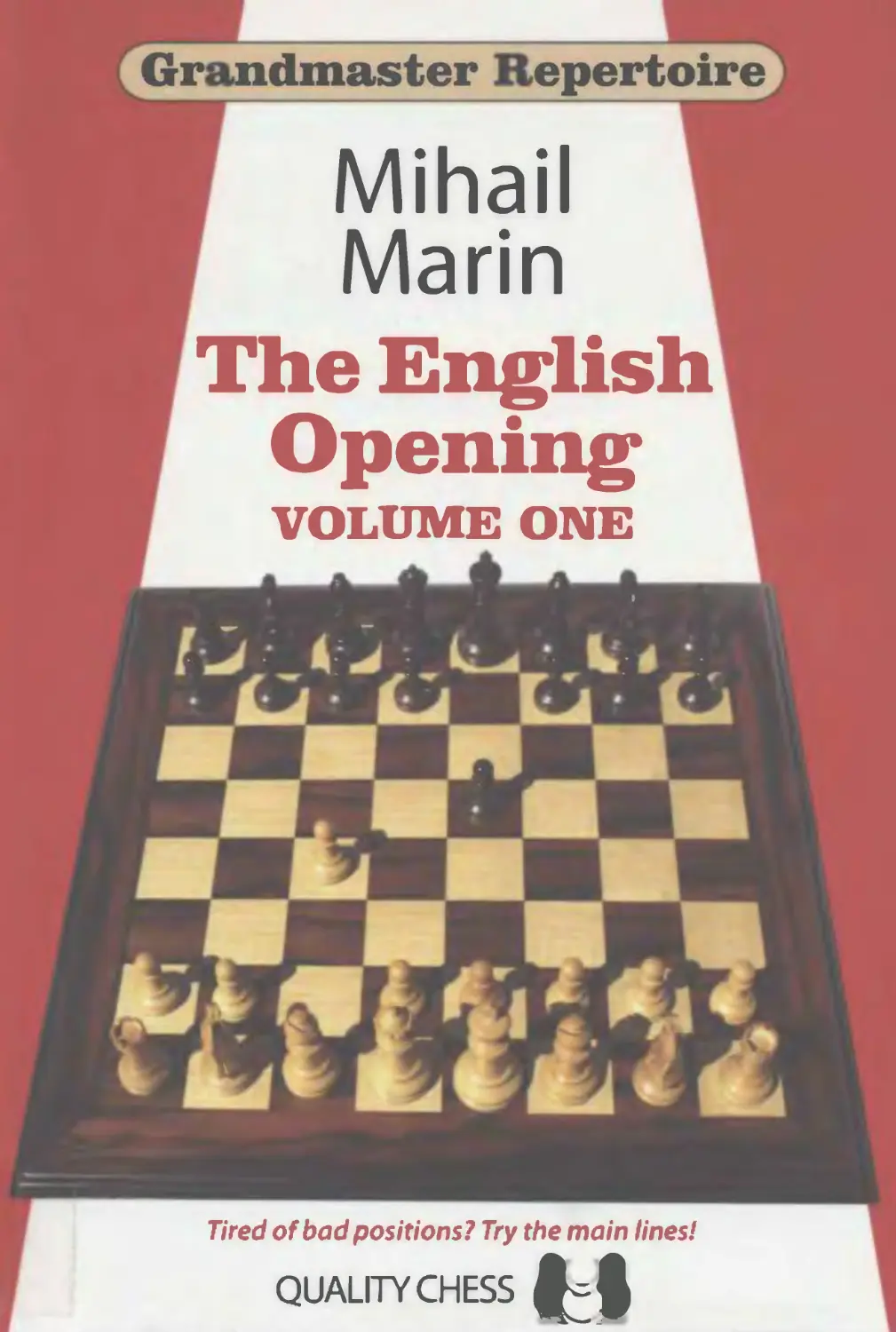




Text
                    Grandmaster Repertoire
 Mihail Я
 Marin
 The English!
I Opening 1
I VOLUME ONE 1
Tired of bad positions? Try the main lines!
QUALITY CHESS II
Grandmaster Repertoire 3
The English Opening
Volume One
By
Mihail Marin
with invaluable help from
Valentin Stoica
Quality Chess
www. qualitychess. co. uk
First English edition 2009 by Quality Chess UK LLP
Copyright © 2009 Mihail Marin
Grandmaster Repertoire 3 - The English Opening Volume One
All rights reserved. No part of this publication may be reproduced, stored
in a retrieval system or transmitted in any form or by any means, electronic,
electrostatic, magnetic tape, photocopying, recording or otherwise, without prior
permission of the publisher.
ISBN 978-1-906552-04-6
All sales or enquiries should be directed to Quality Chess UK LLP,
Central Chambers, 93 Hope Street, Glasgow G2 6LD, United Kingdom
+44 141 277 6771
e-mail: info@qualitychess.co.uk
website: www.qualitychess.co.uk
Distributed in US and Canada by SCB Distributors, Gardena, California, US
www.scbdistributors.com
Distributed in Rest of the World by Quality Chess UK LLP through
Sunrise Handicrafts, Smyczkowa 4/98, 20-844 Lublin, Poland
Typeset: Jacob Aagaard
Proofreading: Colin McNab, Jacob Aagaard and John Shaw
Editing: Jacob Aagaard and John Shaw
Cover design: Adamson Design
Printed in Estonia by Tallinna Raamatutriikikoja LLC
Publisher's Foreword
Creating the Grandmaster Repertoire series seemed a natural idea. There is a glut of opening
books at the Starting Out level. These books have certainly been refreshing, but they have
almost completely replaced high-level opening books.
As chess fans, we felt we were missing out, and because we can, we decided to do
something about it.
The books in the Grandmaster Repertoire series are written by grandmasters, edited by
grandmasters, and will certainly be read by grandmasters. This does not mean that players
who are not grandmasters cannot read them. We have worked hard to make our books
clear in their presentation and to make it possible for the readers to decide the depth to
which they want to study them.
When we were young and trying to be up-and-coming, we understood that you do not
have to remember everything in an opening book in order to use it. It is our hope that those
readers who find this repertoire too extensive and detailed, will ignore many of the details.
Even now that we are grandmasters, we see the bolded moves as what we want to memorize,
and the notes as explanations and illustrations.
It is our conviction that you will eventually be more successful by playing the main lines,
simply because they are based on better moves. Instinctively most players know this, but
they fear losing to a prepared line and thus turn to unambitious systems, or unhealthy
surprises. The opponent will not be able to use his preparation but, sadly, will not need it.
These sidelines generally end in uninspiring positions almost automatically.
Possibly the main reason why high-level opening books have disappeared is the rise of
databases. It has been assumed that there is no point in having traditional opening books
anymore, as you can look it all up in the database. Some rather lazy authors have a system:
collect a few hundred games from the database, give Fritz a few moments, then hit Print.
Such books add nothing to chess literature. We have seen enough of them and have never
wanted to add to that pile.
In these days of multi-million game databases, we all have access to information, what
is lacking is understanding. In the Grandmaster Repertoire series, very strong players will
share their understanding and suggest strong new moves that are in no one else’s database.
We are excited about this new series and hope that the reader will share some of that
excitement.
John Shaw & Jacob Aagaard
Contents
1
2
3
4
5
6
7
8
9
10
И
12
13
14
15
16
17
18
Key to symbols used	6
Bibliography	7
Foreword by the Author	8
How to Use this Book	10
The English — A Repertoire	11
Karpov Variation l.c4 e5 2.g3 ^сб З.^сЗ 4.JLg2 Jlc5 5.^f3
Introduction	15
7...h6 8.a3 a6	23
7...h6 8.a3 a5	47
7...a6	57
5th Move alternatives: 5.a3?I and 5.e3	71
Reversed Rossolimo l.c4 e5 2.g3 ^сб З.^сЗ 4.JLg2 JLb4 5.^d5
Introduction	85
5...^xd5?!	89
5...tc5	99
5...0—0 Minor Lines	111
5...0-0 6.^f3! tc5	123
5...0-0 6.2T3! e4	141
Botvinnik System l.c4 e5 2.g3 &c6 З.^сЗ g6 4.JLg2 Jlg7 5.e4 d6 6.&ge2
Introduction	155
6...£f6	165
6...te6	173
6...h5	189
6...^ge7	199
6..T5	211
2...^с6 З.&сЗ
19
20
21
22
23
24
25
26
27
28
29
30
31
32
33
3rd move alternatives	235
Reversed Dragon l.c4 e5 2.g3	3.<&g2 d5 4.cxd5 &xd5 5.^c3
Introduction and minor lines	259
8...a5	273
8...,Ie6	281
8...0—0 Minor Lines	289
ll...a5	309
ll..Ad4	327
Keres Variation l.c4 e5 2.g3	3.<&g2 c6 4.d4
Introduction and Sidelines	345
4...tb4t	353
4...exd4 5.^xd4 £Ъ6	369
4...exd4 5.&cd4 d5	385
2...d6
Minor Lines	405
5...F5	425
Accelerated Keres l.c4 e5 2.g3
2...c6	437
Odd and Trends
Minor Lines	451
Index of Variations	469
Key to symbols used
White is slightly better
Black is slightly better
White is better
Black is better
White has a decisive advantage
Black has a decisive advantage
with equality
with compensation
with counterplay
unclear
a weak move
a blunder
a good move
an excellent move
a move worth considering
a move of doubtful value
mate
Bibliography
Bagirov, Vladimir Konstantinovich. Angliiskoe Nachalo. Fizkultura i Sport, Moscow 1989.
Botvinnik, Mikhail. Analiticheskie i kriticheskie rabotii 1-4. Fizkultura i Sport, Moscow 1984-87.
Garrett and Marin. Reggio Emilia 2007/8: Il tomeo delgiubileo. Caissa Italia Editore 2008.
Hansen, Carsten. The Gambit Guide to the English Opening: l...e5. Gambit 1999.
Karpov, Anatoly. How to play the English Opening in Chess. Batsford 2007.
Kosten,Tony. The Dynamic English. Gambit 1999.
Kotronias, Vassilios. Beating the Flank Openings. Batsford 1996.
Palliser, Kosten and Vigus. Dangerous Weapons: Flank Openings. Everyman Chess 2008.
Pritchett, Craig. Play the English. Everyman Chess 2007.
Raetsky and Chetverik. English ...e5. Everyman Chess 2003.
Watson, John. Mastering the Chess Openings: Volume 3. Gambit 2008.
Periodicals
Chess Extrapress. Bucharest 1998-2001.
Chess Informant. Belgrade 1965-2006.
New in Chess Yearbooks. Alkmaar, 1987-2006.
Schaknytt. Gothenburg 1999-2006.
64 Shakhmatnoe obozrenie. Moscow 1976-81.
Electronic Resources
ChessPublishing. com
Mega Database 2009
By the author
I have always regarded building up a perfect opening repertoire, suitable for one’s style and skills,
as no easier a task than the Argonauts’ search for the Golden Fleece.
There is a whole series of aspects to be clarified before even starting thinking about picking
specific openings. Should we approach the opening in the same way irrespective of colour, or
would it be wiser to display our main ambitions with White, while playing in a more restrained
style with the black pieces? At all levels, we will find adherents of both these methods.
There are also several ways to give the repertoire a coherent character. We may be guided by the
same general principles in all our opening variations (such as fighting for space and the initiative,
or, on the contrary, aiming for solid but somewhat passive positions). This is the widest approach,
which can lead to the coexistence of systems that bear absolutely no optical similarity to each
other. It has frequently been the choice of the greatest players in history, but it is not easy to
handle for mere mortals.
Many prefer to develop and exchange their pawns and pieces according to the same general
patterns, irrespective of the opponent’s play. In order to achieve this with Black, they utilize
tandems of related openings such as the Slav and the Caro-Kann, or the King’s Indian and the
Breyer Ruy Lopez. This is likely to lead to a high degree of specialization in the respective systems,
but risks limiting one’s chess horizon.
When building up my repertoire with White, I treasure space and the initiative, but also the
possibility of keeping play within a relatively limited range of structures, which I tend to study
in depth. I also make major changes in my repertoire every five, ten or fifteen years, to avoid the
risk mentioned in the previous paragraph.
As a child and teenager I only played l.e4, but at the age of 18 I switched to l.d4. For several
years I employed aggressive set-ups, but in the early ’90s I started to be attracted to the schemes
involving a kingside fianchetto. Without me being aware of it, this was the moment when the
book you are holding in your hands started its unusually long period of gestation.
The Catalan and the Fianchetto variations against the King’s Indian and Griinfeld yielded me
many wins, but I failed to find adequate related schemes against the Slav. Experience taught me
that l.d4 d5 2.£}f3 £lf6 3.g3 c6 followed by ...jlc8-f5 or ...Jlc8-g4 offers White nothing but
trouble. I was amused to find out that, a long time ago, a certain Valentin Marin (!) managed to
Foreword by the Author
9
hold his own by employing this set-up with Black against the great Saviely Tartakower. It is also
ironical that, together with other games played by Tartakower at Barcelona in 1929, that game
convinced theoreticians to baptize the system based on l.d4 and 2.g3 “The Catalan Opening”.
In order to avoid the aforementioned problems, I started employing 1 .£ff3 followed by 2.g3
and 3.1g2 as my main move order, delaying the direct fight for the centre. After a few years
I understood that this works well if Black develops in the spirit of the Indian Defences, but
does not offer chances for an advantage if Black occupies the centre with 1 ...d5 (or 1 ...£}f6 and
2...d5).
After having had enough of l.£ff3, I decided that the d5-square should immediately be taken
under observation with 1 .c4. Thus was initiated the most consistent period of success with White
in my whole career. Against most of Black’s answers I would generally develop according to my
own taste, with g2-g3, JLfl-g2, etc. If allowed, I did not hesitate to transpose to the Catalan or
the Fianchetto King’s Indian and Griinfeld, by playing d2-d4 at the right moment. The Slav
Opening remained somewhat aside from this point of view, but I usually answered l...c6 with
2.e4, transposing to the aggressive Panov Attack.
When I first considered writing a book dedicated to a pure English Opening repertoire, I was
afraid that I would face insurmountable problems proving an advantage for White in every line
while avoiding recommending a transposition to l.d4 at various points. This over-ambitious
quest, which I had secretly been dreaming of, was against the long-established views of official
theory and looked nearly impossible to accomplish.
After more than one year of deep analysis with Valentin Stoica, I managed to make a step I
had never dared to try before, by building a viable repertoire based on l.c4 followed by 2.g3
irrespective of Black’s answer!
That White refrains from an early d2-d4 in all these lines does not mean that he gives up the
fight for the centre. Once White has eliminated the danger of Black’s counterplay, or achieved
some other sort of advantage, White will strive to occupy the centre. You will find the spirit of
this general strategy throughout this book and its companion volume.
I completed the initial analytical work shortly before participating in the 51st edition of the
Reggio Emilia tournament, as 2008 turned into 2009, and felt ready to give the brand new
repertoire a thorough practical testing. The result was more than encouraging: with White I
scored 4 out of 5, the equivalent of a rating performance of over 2800. Moreover, I had the better
position in the only game I lost.
I cannot anticipate how my understanding of chess will change in, say, ten years, but for the
moment I feel confident that, after almost 20 years of research, I have finally found my Golden
Fleece.
By writing this book, I wish to share my conquest with you, dear reader.
Mihail Marin
Bucharest, July 2009
How to Use this Book
I have noticed that many chess players seem to read books by dipping in and out of various
chapters, as the mood strikes them. I have a request - the first time you read this book, please read
it in order. I ask this because I often introduce strategic ideas in one chapter that will be relied
upon in later chapters. My plan is to build the reader’s understanding of the English gradually,
as the story unfolds.
This book supplies a complete repertoire for White after l.c4 e5, so no significant variations are
ignored. I may point out possible transpositions to other openings, but I will not rely on them
for our repertoire.
In the English Opening, where direct contact between the pieces is often delayed, both sides often
have a wide range of moves. I mention every significant variation, but covering every possible
move would be neither practical nor especially helpful to the reader. What is important is to cover
all of the key ideas. Thus, even though you may encounter unfamiliar moves from time to time,
you will not be “all at sea” - your new understanding of the English will be a reliable compass. I
have decades of experience in playing and analysing the English and yet I am often surprised in
the opening - it is the nature of the beast.
I have marked some moves with N for Novelty. This means the move is new to me and I cannot
find it in my database or books. However, there is always a possibility that the move could have
been played in some obscure game, unbeknown to me. Should the reader encounter any such
examples, I would ask him to remember that it is almost impossible to acquaint oneself with
every possible source of chess games. In any case, this book contains a great deal of original
analysis, which I hope will prove useful to the reader.
I have delayed you long enough - I hope you enjoy the book.
abcdefgh
A Repertoire
Chapters 2-6
abcdefgh
Karpov Variation
Chapters 7-12
abcdefgh
Reversed Rossolimo
Chapters 13-18
abcdefgh
Botvinnik System
Chapter 19
abcdefgh
3rd move alternatives
Chapters 20-25
abcdefgh
Reversed Dragon
Chapters 26-29
abcdefgh
Keres Variation
Chapters 30-31
abcdef g h
2...d6
Chapter 32
abcdefgh
Chapter 33
abcdefgh
Odds and Trends
Accelerated Keres
12
The English
l.c4 e5
abcdefgh
From the point of view of the fight for
space, this is the most logical move, since the
e5-pawn is more central than the c4-pawn.
Black hopes to prove that White’s extra tempo
in this reversed Sicilian is not so relevant and
that Black will be able to consolidate his space
advantage in the long run.
Many players prefer to sidestep this position
by playing 1 .£T3 followed by 2.c4. Experience
has taught me that delaying the development of
the bishop to g2 can have a negative influence
on White’s chances to gain the initiative. I will
dedicate a special chapter to the move order
based on lAf3 in the second volume.
During my chats with fellow grandmasters
about opening preparation, I frequently came
across the opinion that White has no advantage
in the diagrammed position. Some went even
further and claimed that the position is a
draw. One does not need to be an expert to
understand that it is too early for such radical
evaluations, but psychologically it is difficult to
withstand such strong pressure. I must confess
that there were times when I felt like a mere
amateur because I started the vast majority
of my games with l.c4. Fortunately, I found
consolation in my favourable results.
Some of my opponents prepared l...e5
especially for their games against me, without
having previous experience with it. They
probably thought that my narrow repertoire
deserved punishment, but failed to understand
that the English Opening cannot be learned
in just a few hours of computer-assisted
preparation. In any case, my results in these
games are close to perfect.
A brief look at the diagram allows us to make a
wild guess about the draft plans of both sides.
Black will be attacking on the kingside, while
White will exert pressure on the opposite wing.
But obviously it is too early to generalize with
any certainty, because the structure may suffer
radical changes.
In the English Opening developing the bishop
to g2 is White’s most popular option, because
it serves the purpose of building up pressure
against the enemy queenside. However, 2.g3
is only the second most popular continuation.
The main move is 2.^c3, which looks the
most logical from an abstract point of view
- one is supposed to develop knights and
only then bishops. Besides, the knight move
immediately increases White’s control over
the centre, while 2.g3 followed by 3.Jlg2 is
one tempo slower. I have tried both moves in
practice and I believe that they have similar
merits, but there are several reasons why 2.g3
is essential from the point of view of our
repertoire. I will explain them at a later stage,
after making a comparative study of the main
alternative.
After 2.^c3, Black is best advised to continue
developing, as 2...c6 3.d4 would lead to a
reversed Alapin Sicilian, where White’s extra
tempo would be very significant because the
position is open, while 2...g6 3.d4 or 2...f5
3.d4 lead to similar consequences.
One of the most popular modern tabiyas arises
after 2...$Sf63&J3 $Sc64.g3:
Chapter 1 — A Repertoire
13
abcdefgh
Many wonderful games have been played
from this position and I personally have a
lot of pleasant memories with White. Players
choosing 2.g3 usually aim to sidestep this
tabiya by developing their king’s knight to
e2 after a previous e2-e3. In my preliminary
work for this volume I feared that I would
also have to avoid this important part of the
English Opening. Fortunately, careful analysis
revealed that ^gl-f3 remains White’s best
option in most cases, despite the opinion of
many theoreticians.
Therefore, most of Black’s continuations in the
diagrammed position would transpose to lines
analysed in this book.
king’s bishop White can win space in the centre.
That is, 4...g6 5.&g2 &g7 can be strongly met
by 6.d4l. White cannot achieve this from the
2.g3 move order, after which the set-up with
...g7-g6 and .. Jlf8-g7 leads to positions from
Chapters 13-18 or 30-31. From the point of
view of the coherence of our repertoire this
is not a major drawback. In order to keep
the game within English Opening territory
after l...g6 we have to refrain from d2-d4,
which would transpose to the King’s Indian.
Therefore, 2.g3 transposes more or less by force
to one of the aforementioned chapters.
The time has come to mention other move
orders that make 2.g3 an essential answer to
l...e5. After l.c4 ^f6 2.g3, Black can play
2...e5. A similar situation arises after l.c4 c6
2.g3 e5, which transposes to the important
lines from Chapter 32.
One slight drawback of 2.^c3 is that it allows
2...jLb4, which leads to interesting counterplay
for Black after the fashionable continuation
3.^d5 Ле7 4.d4 d6 5.e4 ^f6. This is not a
real reason to refrain from 2.^c3, but since a
thorough study of 2.g3 is essential, it makes
sense to spare some analytical effort as well
as editorial space by sidestepping the 2...jLb4
line.
4...$Lc5 5.$Lg2 is Chapters 2-6.
4...$Lb4 5&d5 transposes to Chapters
7-12.
4...d5 5.cxd5 QhxdS 6.$Lg2 $Sb6is a
Reversed Dragon, which is examined in
Chapters 20-25.
4...Ы4 is a line with a marked drawish
tendency, but it is impossible to employ
against the 2.g3 move order. Indeed, after
2...£k6 З.^сЗ £T6 4.jlg2 it makes little
sense to play 4...^d4 because of 5.e3.
Finally, I will mention one interesting aspect.
Many strong players, including World
Champions, answer l.c4 with l...^f6 and
only after 2.^c3 do they resort to 2...e5. This
is a clear sign that they wish to avoid the line
l...e5 2.g3, which indirectly speaks about its
merits.
The worth of the 2.g3 move order is clear, so
the time has come to draw a map of the present
volume.
One important advantage of the Four Knights
move order is that if Black tries to fianchetto his
Black’s main continuations are the developing
2...£}ft> and 2...^c6. As mentioned before,
14
The English
2...g6 transposes to Chapters 13 to 18 or 30 to
31, as might 2...d6. Of the other pawn moves,
2...c6 is important, see Chapter 32.
The main variation after 2...^ft) continues:
3.&g2 d5 (3...c6 is an important alternative,
which will be examined in detail in Chapters
26 to 29, while 3...^c6 transposes below)
4.cxd5 ^xd5
abcdefgh
This position is examined in Chapters 20 to
25 and basically transposes to an important
branch of the Four Knights tabiya mentioned
above.
2...£^c6 demands an accurate reply from
White: З.&сЗ!
There is a strong temptation to play 3.Jlg2,
in order to avoid the systems based on
b4. The main problem with this move order
is that after 3...f5 4.^c3 £T6 White lacks a
useful move. I have failed to find a favourable
way to continue developing. 5.d3 JLb4 leads to
active play for Black, while 5.e3 allows Black
to open the centre with 5...d5! 6.cxd5 ^b4.
The position remains interesting, but White
cannot claim an advantage.
Returning to З.^сЗ, Black has a few options:
3...g6 is an important branch leading to the
so-called reversed Closed Sicilian: see Chapters
13 to 18.
3...&b4 and З...Лс5 usually do not have much
independent value, but they do in Chapter
19.
3...£tf6 4JLg2
abcdefgh
Together with the Reversed Dragon
mentioned above, this tabiya forms the
equivalent of the Four Knights variation. Black
now has a choice between systems based on
4...&c5 and 4...&Б4.
We are ready to start our journey through the
incredible world of the English Opening.
abcdefgh
Karpov Variation
Introduction
Chapter 3 - page 23
abcdef g h
8...a6
Chapter 4 - page 47
abcdefgh
8...a5
Chapter 5 - page 57
abcdefgh
7...a6
Chapter 6 - page 71
abcdef gh
Fifth move alternatives
16
Karpov Variation
l.c4 e5 2.g3 ^сб З.^сЗ 4.jLg2 &c5
It is not by chance that I have picked this
variation to be examined first in the analytical
chapters. Black’s natural way of developing his
pieces, without losing time on unnecessary
pawn moves, makes this system quite popular
and I estimate that I have faced it in about one
quarter of my games where l...e5 (or 2...e5)
was played. This aspect reveals the practical
importance of mastering the secrets of this
variation with White, but also suggests that
it may be the kind of position I understand
best, on the basis of enormous experience
accumulated over the years. My intention is to
make this chapter instructive in a wider sense,
by explaining strategic ideas that may also be
useful when facing other variations.
In the diagrammed position, White has to
make an important choice. It is a common
thought that, having refrained from ^gl-f3
at an early stage of the game, White can
deviate favourably from the Four Knights
system (5.£T3) by playing e2-e3 and ^gl-e2.
This is supposed to restrict the enemy dark-
squared bishop and consolidate White’s centre.
On the other hand, this slows down White’s
development by spending a valuable tempo on
a pawn move, while refraining from putting
pressure on the e 5-pawn. Moreover, there is a
small tactical problem with initiating this plan
immediately.
5.e3 d5!?
It appears that Black can take advantage of
the temporary weakness of the d3-square by
immediately opening the centre.
6.cxd5 &b4
Black will retrieve the pawn and simplify the
position if White fights for space in the centre
with d2-d4. This does not necessarily lead
to absolute equality, but it will considerably
reduce White’s winning chances. The final
evaluation of this variation may well be a
matter of taste, so I have examined it briefly in
line Bl of Chapter 6.
While allowing this forced line is optional,
in view of the possibility of returning to the
normal path with 5.£T3, the position arising
after the more restrained 5.e3 d6 is of crucial
importance, because it can arise by force from
a different move order, characteristic of line A
from Chapter 19.
Prior to writing this book, my experience
against this structure was limited to just a
few games, but thorough analysis convinced
me that White’s chances to retain a strategic
initiative are similar to after 5.£T3. You
will find this line classified under B2 in
Chapter 6.
In his book The Dynamic English, Tony Kosten
recommends the half-waiting move:
5.a3
Later, having prevented ...^c6-b4, White
can play e2-e3 and ^gl-e2.
Instinctively, I do not like this approach,
although objectively it may be sound. First
of all, I have the feeling that White is wasting
too much time on pawn moves at an early
stage of the game. Moreover, a2-a3 induces
Chapter 2 — Introduction
17
a slight weakening of the light squares on
the queenside. With the king’s knight on e2,
White’s structure after b2-b4 and d2-d3 will
have a vulnerable spot on c4. We will see
that after 5.^f3 White will eventually adopt
the same structure, but with two important
differences. First of all, he will play e2-e3 only
after completing his development. Secondly,
the king’s knight will be ready to cover the c4-
square with a later ^f3-d2.
The reader will notice that in line B2 from
Chapter 6, where 5.e3 is met by 5...d6,
White keeps his queenside pawns on a2 and
b2, focusing on the early occupation of the
centre, which is the main idea of developing
the knight to e2.
I do not pretend to have exhausted the
subject, or to refute 5.a3, but in Chapter 6,
line A I have expressed some of my specific
doubts about this set-up.
The main body of Chapters 2 to 6 is 5.^f3,
leading to very complex positions where
tactics and strategy frequently walk hand in
hand. Based on my tournament experience,
I recommend examining both 5.e3 and
5.^8. In one Romanian Championship
almost all my games with White transposed
to the 4...Дс5 5.£T3 system. I won the first
game, then a second one, but after obtaining
a crushing advantage in the third one, I
somehow gpt fed up with using autopilot
all the way, lost the thread and eventually
the game. For psychological reasons, it is
sometimes useful to change patterns during a
tournament and varying between 5.^f3 and
5.e3 is worthwhile.
I will explain the basic ideas for both sides in
the introduction to 5.£T3 below. Later, when
dealing with the other lines, I will highlight
the concrete differences.
5.^8
abcdefgh
This move transposes to the solid Four
Knights system with 4...Лс5, which Karpov
has occasionally used with Black, yielding
him excellent results. However, it should be
mentioned that against heavyweight opponents
like Korchnoi and Kasparov he preferred to
develop the bishop to b4.
5...d6 6.(13
6.0-0 0-0 7.d3 is another possible move
order.
6...0-0 7.0-0
abcdefgh
In abstract terms, the c5-bishop’s coop-
eration with its central pawn chain (c7, d6, e5
and, sometimes, f4) is similar to that between
18
Karpov Variation
the English bishop and the e2-, d3- and c4-
pawns (White also often desires a pawn on
b5). Each player’s pawns prevent the enemy
pawns from obstructing the crucial hl-a8 and
a7-gl diagonals, respectively.
The targets of the bishops are of a different
nature: Black hopes to launch a kingside
attack after thorough preparation, while
White is planning to carry out his customary
pawn attack on the queenside. Both sides will
increase (or at least maintain) the wide-ranging
action of their bishops while restricting the
enemy bishop.
White’s main pawn play consists of a3 and
b4 (if allowed!) followed by e3. In certain
cases he can press with d4 and c5, aiming to
leave the enemy bishop passive on a7. In this
latter case, the bishop’s power should not be
underestimated: its pressure against the d4-
pawn is similar to that exerted by the Griinfeld
bishop from g7. If Black starts a bayonet attack
based on ...f5, White can neutralize it with f4,
after a previous knight retreat (usually to el).
abcdefgh
Black’s pawn play is slightly more difficult
to carry out. The equivalent of White’s
aforementioned plan would imply the moves
...f7-6 and ...c7-c6, but both pawns are
temporarily blocked by Black’s own knights.
Prematurely removing the knights from their
active squares would leave either the d5- or
e5-square insufficiently defended, allowing
White to install his queen’s knight to tht
wonderful d5-square or open the queensidt
with b4 and c5.
abcdefgh
Black has a choice about how to secure
the c5-bishop against the advance of White’s
queenside pawns. The most popular method
is ...a7-a6 followed by ...Лс5-а7. Black refrains
from fighting for space, aiming to minimize the
damage on the queenside by avoiding any kind
of weaknesses. In doing so, he should not forget
that the bishop enjoys only temporary safety.
In the long run, the massive advance ofWhite’s
queenside pawns could leave it completely out
of play. Here is a typical example, taken from
Chapter 3, line B, page 38.
Marin - Boudre
Cannes 2002
abcdefgh
Chapter 2 — Introduction
19
Black has achieved a favourable regrouping,
with the exception of his dark-squared bishop.
27.® f3 the bishop has no favourable retreat
squares.
22...cxd5
It was advisable to refrain from this move by
playing 22...h4 immediately.
23.exd5!?
This looks risky, because it leaves Black with
a threatening kingside majority, but 23.cxd5
allows Black to stabilize the queenside with
23...Jld7 24.^ b6 Jlb5. By giving the position
an asymmetrical character, White aims to keep
his queenside attack going.
23..1В 24.&d2 h4
Apparently, everything is fine for Black,
whose kingside attack develops without effort.
26.b6&b8 27.^c3
abcdefgh
abcdefgh
25.b5!
Suddenly, the threat of b5-b6, cutting the
bishop out of the action for the rest of the
game, cannot be parried.
25...ic7
This just loses two tempos, but it is hard to
suggest anything better.
For instance, 25..JLd7, pinning the b5-pawn,
can be answered with 26.£Ъ6, threatening
^xd7 followed by b6, when after 26...jlf5
Having achieved the main goal on the
queenside, the knight returns to the centre in
order to increase control over the e4-square.
The rest was easy: White is practically playing
with an extra piece, which yields him a decisive
advantage.
27...e4
This looks like a logical continuation of the
attack, but Black has insufficient forces to
support this pawn.
28.Scel hxg3t 29.feg3 еЗ ЗО.&ЬЗ &d7
31.&dl
The pawn will be lost without having
improved the situation of the b8-bishop.
31...^e5 32.Sf4 Sc8 ЗЗ.&хеЗ ^g6 34.Sffl
^e4
With the dark-squared bishop on any
reasonable square, the attack against the g3-
pawn would be more dangerous. The way it
is, White has no problems keeping everything
defended.
35.^d4 ®g5
20
Karpov Variation
abcdefgh
36.Лхе4!
The start of a massive exchanging operation,
which will increase the significance of White’s
material superiority on the kingside.
36...Sxe4 37>B Se7 38.&df5 ЛхВ
39>xf5 WxB 4O.^xf5
After the forced 40...Sxel 41.Sxel f6, White
can play 42.Se7!, with decisive threats along
the seventh rank. The rook is taboo, because of
the fork on e7. Therefore, Black resigned.
1-0
In view of this type of catastrophe, playing
...a7-a5 is an important alternative, preventing
White’s expansion. This move has the drawback
of weakening the b5-square: a detail that could
be important at a later stage. It also makes it
almost compulsory to play ...a5xb4 when White
finally plays b2(3)-b4, thus leaving the bishop
exposed (and sometimes pinned) on a7.
Black would like to transfer the сб-knight to
g6, without allowing c4-c5 anyway, and then
strengthen his centre with ...c7-c6. This would
not only create the threat of increasing his spatial
advantage with ...d6-d5, but also enable the
recycling of the dark-squared bishop via b8-c7.
With reversed colours, this is similar to White’s
regrouping achieved after ^bl-d2-fl-g3 and
Jlfl-b5-a4-b3-c2 in the Ruy Lopez (!).
White can react accordingly, with a well timed
e2(3)-e4 when, compared to the Ruy Lopez,
he would be several tempos up. Indeed, he
has avoided moving the queen’s knight back
and forth in order to allow the advance of
the c-pawn, while the king’s bishop has been
developed to the active g2-square without
loss of time (compare to ...Jlf8-e7 followed
by ...Sf8-e8, ...Jle7-f8, etc.). Moreover, the
plan involving ...^b8-c6-e7-g6 is rather time-
consuming and White should be able to find
a way to counter it by favourably opening the
centre at an early stage.
The situation is different if we refer to piece
development. This time it is White who finds
it more difficult to choose between moves with
apparently equal merits.
abcdefgh
Black’s plan in the next phase of the game is
quite clear: ...Лс8-еб (or to f5, g4), ...Wd8-d7,
...Sf8-e8 and eventually ...Леб (or f5, g4)-h3.
White’s play is usually subtler and includes
such prophylactic moves such as Sal-cl and
Sfl-el, which will be explained at a later stage.
His most acute problem is the development of
the queen’s bishop. The thematic move Jlcl-g5
followed by an exchange on f6 would increase
White’s control over the central light squares,
but, if carried out prematurely, this operation
Chapter 2 - Introduction
21
would fail to achieve anything concrete, while
also helping Black to clear the path for the
f-pawn.
If Black refrains from an early ...h7-h6, White
should make the “obligatory” moves (a2-a3 and
Ь2-Ь4 in the first place), waiting for an eventual
commitment from Black, such as choosing the
square to which the light-squared bishop will
be developed. Only then should he play Jlcl-
g5. If Black decides to play ...h7-h6 at a slightly
later stage, perhaps after b2-b4, play would
simply transpose to the main line, in which
White develops his bishop to b2, with the
small satisfaction that the potentially dangerous
bishop has caused Black to lose time.
The bishop is quite effective on b2. It keeps
several important squares under (direct or
indirect) pressure, preventing black expansion
based on ...d6-d5 or ...e5-e4. These pawn
breaks would not only increase the white
bishops scope, but will completely fail to solve
the problem of Black’s own bishop. At the same
time, the queen bishop’s placement increases
the force of such typical breaks as c4-c5, d3-d4
or £2-f4.
Finally, I will mention some essential aspects
related to the thematic move ^c3-d5. When
carried out under favourable circumstances
it will yield White an advantage. The knight
cannot be tolerated on such an active square,
while after ...£T6xd5, c4xd5 Black is left with
a backward pawn on c7. White’s strategic
success will be complete only if he finds a way
to prevent ...c7-c6 or if he manages to trade his
d3-pawn for the e5-pawn (most likely with d3-
d4, in a moment when ...e5-e4 is impossible or
just bad). After this exchange, ...c7-c6 would
leave the d6-pawn weak in view of d5xc6.
In order to simplify the process of explaining,
we will start with Black’s most common
continuation, 7...h6, which will be covered in
the next two chapters. In Chapter 5, we will
examine 7...a6, highlighting the differences
induced by Black’s refraining from the move
...h6.
Let’s start with 7...И6.
abcdefgh
Most of my opponents have played ...h7-
h6 immediately after d2-d3, probably afraid
of the pin that would be created by Jlcl-g5.
However, the English Opening offers practically
unlimited possibilities for transposition, which
makes the choice of the main move order
slightly arbitrary.
8.a3
This is the natural start of the queenside
expansion.
abcdefgh
22
Karpov Variation
We have a further subdivision. Black has
a choice between 8...a6 and 8...a5. In order
to ensure the fluidity of the lecture, we will
examine them separately. The former in
Chapter 3 and the latter in Chapter 4.
abcdefgh
Karpov Variation
7...h6 8.a3 a6
Variation Index
l.c4 e5 2.g3 ®c6 3.®c3	4.&g2 i.c5 5.®f3 d6 6.d3 0-0 7.0-0 h6 8.a3
8...a6 9.Ь4Jla7 10. &b2
A)	10...i.e6 1 l.Scl ®d7 12.e3	p	24
Al) 12...£h3	p	24
A2) 12...Sac8	p	30
A3) 12...£>e7	p	31
A4) 12...Sfe8	p	33
B)	10...^g4	p	38
C)	10..JU5	p	41
D)	10...&17	p	44
Al 1) after 17...£>e4
abcdef g h
18.Scel!N
A122) Self-improvement
abcdefgh
15.&ch3!N
C) after 16...c6
abcdef gh
17.e3!N
24
Karpov Variation
l.c4 e5 2.g3 &сб З.^сЗ 4.Jlg2 Jlc5
5.&B d6 6.d3 0-0 7.0-0 h6 8.a3 аб
This is both the most flexible and the popular
move. Black prepares a safe retreat for the
bishop without weakening his queenside.
9.b4 £a7 10. М2
The time has come for Black to choose a
square for the queens bishop, as the half-
waiting move 10...Se8 does not cross White,
who still has useful moves at his disposal. He
would continue with 1 l.Scl, leaving Black
with the same problematic choice.
abcdef gh
We have the natural A) 10...Мб, the
ambitious B) 10...Jlg4, the rather neutral C)
10...Jlf5 and the slightly exotic D) 10...M17.
would release the pressure against the e5
pawn, allowing ...d6-d5 with an entirely viabk
position for Black. However, ...d6-d5 is na
a threat while the knight is on f3, because ol
double exchange on d5 followed by e2-e4 and
£T3xe5, winning a pawn.
ll.Scl
This is one of those subtle rook moves I
mentioned in the introduction to this chaptet
The rooks indirect pressure along the c-filt
can be very useful when “concrete play” starts.
After a later £}c3-d5 followed by ...£bcd5,
c4xd5, the c7-pawn will come under pressure.
In certain cases the rook supports the advance
of the c-pawn, leaving the a7-bishop in s
joyless situation.
11...Ш7 12.e3
Although White is not threatening to play
d3-d4 yet, this move is quite useful as it restricts
the a7-bishop and the сб-knight. At the same
time, he gets ready to meet Black’s main threat,
...Jle6-h3, with d3-d4.
In practice Black has tried Al) 12...M13, A2)
12...Sac8, A3) 12...&e7 andA4) 12...Bfe8.
(I.c4 e5 2.g3 £}c6 З.^сЗ 4.&g2 M5
5.^fd3 d6 6.d3 0-0 7.0-0 h6 8.аЗ аб 9.Ы
M7 10.M2 Мб ll.Scl ®d7 12.e3)
(I.c4 e5 2.g3 £}c6 З.^сЗ 4.Jlg2 Jlc5
5.&B d6 6.d3 0-0 7.0-0 h6 8.аЗ аб 9.b4
M7 10.М2)
A) 10...Мб
This is the most natural developing move.
Apart from preparing ...Wd8-d7 followed by
...Jle6-h3, it keeps the important d5-square
under control, preventing £>c3-d5.
White needs to handle the position with
subtlety. Preparing £}c3-d5 with £T3-d2
Al) 12...M3
abcdef gh
Chapter 3 — 7...h6 8.a3 a6
25
This is considered to be the main move, but
its drawback is that it releases the pressure
against the c4-pawn.
13.d4!
abcdefgh
The immediate consequence of the previous
move is that White is allowed to occupy the
centre.
As the subsequent analysis will prove, it is not
easy for Black to choose the best moment for
capturing on g2 and d4. Each move order has
drawbacks.
We will examine All) 13...&xg2 and A12)
13...exd4,
(l.c4 e5 2.g3 &c6 З.^сЗ 4.Jlg2 Jlc5
5d6 6.d3 0-0 7.0-0 h6 8.аЗ аб 9.b4
ia7 10.ib2 £e6 ll.Scl Ш7 12.e3 М3
13.d4)
All) 13...&xg2
This move order leaves the a7-bishop passive.
After the early exchange of the light-squared
bishop, Black is no longer threatening to
undermine the d4-pawn with ...Jlh3-g4.
14.&xg2 exd4 15.exd4
White should exploit this circumstance with
energetic play. In the only game where I had
this position, I failed to accomplish that and
the bishop returned to the action, leaving
me with a slightly unfavourable queenside
structure.
15...Sae8 16>d3 d5 17.c5
17...&e4
This looks active, but it is not entirely logical
from an abstract point of view: Black establishes
direct piece contact while his bishop is several
tempos away from being activated.
17...^e7
This prepares ...c7-c6 and ...Ла7-Ь8, and
requires slightly more imagination from
White than in the main line, although the
objective merits of the two alternatives are
similar.
Only after failing to prove an advantage by
normal moves did I eventually hit on the
right path with:
18.b5!
White has no time to waste on such
preparatory moves as 18.a4. For the sake of
keeping the enemy bishop out of play, he
does not mind spoiling the integrity of his
queenside structure.
18...axb5 19.&e5 Bc8 20.^xb5 tb8
26
Karpov Variation
abcdefgh
This is the type of position White was
aiming for when he spoiled the flexibility
of his queenside structure. The b8-bishop is
not easy to activate, because ...c7-c6 is not a
real threat for the time being, in view of the
possible £ib5-d6. In order to maintain his
advantage, White has to anticipate Blacks
plan to increase his control over the d6-
square.
21.a4! ^e4 22JLa3
White is threatening c5-c6, burying the
b8-bishop alive, so Black has to react
quickly.
22...f6 23.&d6!
The cl-rook also proves very useful for the
changed circumstances, by enabling this
spectacular tactical operation.
23...We6 24.^xe8 fxe5 25.^xg7 ^xg7 26.f3
£}g5 27.dxe5±
abcdefgh
White is not worse from a material point
of view, and retains a significant positional
advantage. The enemy bishop remains passivt
and White’s kingside pawns will not be easy to
blockade.
abcdef gh
18.Scel!N
After this move it appears that Black has
insufficient stability in the centre.
In my game I avoided the piece contact, which
simplified my opponent’s task after 18.£3e2
tb8 19.Scdl ^g5 2O.£Tgl ^e7 21.h4
22.Лс1 сб. Black had regrouped well and had
no problems at all in Marin - Jerez Perez,
Andorra 2001.
18...&xc3
More or less forced, since 18...f5 allows
19.^e5.
19.^xc3
This move creates the unpleasant threat
£}f3-e5. After an exchange on this square
(...£}c6xe5, d4xe5) followed by £2-f4, White
would be a piece up for the practical purpose
of his kingside attack. An exchange on the сб-
square with £ie5xc6, ...b7xc6 would be even
worse, because it would leave the a7-bishop
buried for the rest of the game.
Black can prevent the threat only at the cost of
accepting chronic kingside weaknesses.
Chapter 3 — 7...И6 8.аЗ аб
27
19...Й
abcdef gh
2O.^h4!
White obtains a strong kingside initiative
free of charge.
2O...^d8 21.Bg6 Bf7 22.Bf5±
Black is under strong pressure on the
kingside, while his bishop is many tempos
away from reaching a reasonable square. Please
note that ...c7-c6 followed by ...Ла7-Ь8-с7
would not solve the problem completely, as the
bishop would still be ineffective.
(I.c4 e5 2.g3 ^сб З.&сЗ 4.jlg2 Jlc5
5.^8 d6 6.d3 0-0 7.0-0 h6 8.аЗ аб 9.b4 £a7
101Б2 ie6 ll.Scl Bd7 12.e3 М3 13.d4)
A12) 13...exd4
By delaying the exchange on g2, Black hopes
for 14.exd4 JLg4! with pressure against the d4-
pawn.
14.&d5!
After this intermediate move it will not
be easy for Black to find a good moment for
swapping bishops. Since 14...dxe3 drops a
piece to 15.^xf6, Black’s choice is restricted to
A121) 14...&e4 and A122) 14...5Ы5.
14...iLxg2 leads to a chronic weakening of
Black’s kingside, which will not be compensated
by the small material gain.
abcdef gh
15.^xf6f! This is the only move that promises
White an advantage. (The neutral 15.<&xg2
is adequately met by 15...^xd5, transposing
to the comment to White’s 15th move from
the line A122 below.) 15...gxf6 16.<&xg2 dxe3
17.c5±
abcdefgh
abcdefgh
28
Karpov Variation
White has a clear advantage in view of his
attacking chances, based on such moves as
£ff3-h4, Wdl-h5, Scl-c4, with £2xe3 inserted
somewhere. The passive placement of the
enemy bishop also helps White. Engines tend
to be sceptical in the beginning, because they
count the a7-bishop as a “normal piece”. Only
after advancing along the lines they suggest
do they suddenly realise that Black is in deep
trouble.
(I.c4 e5 2.g3 ^сб З.^сЗ 4.Jlg2 Jlc5
5.&B d6 6.d3 0-0 7.0-0 h6 8.аЗ аб 9.b4
£a7 10. Jib 2 &e6 ll.Scl ®d7 12.e3 £h3
13.d4! exd4 14.5^d5)
A121) 14...&e4
abcdefgh
This is the most active way of releasing the
unfavourable piece tension, but the knight is
unstable in the centre.
15.exd4
After having cleared the b2-d4 diagonal, the
pawn is well defended on d4.
15...£xg2
15..Jlg4 fails to bother White, who can
keep developing with 16.Wd3±. White has the
more active pieces and a considerable space
advantage.
16.&xg2 Sae8 17.Sel &d8
After having completed his development
Black starts the standard plan of rerouting hii
bishop with ... c7-c6 and ...Ла7-Ь8.
18.ШЗ £5
abcdefgh
19.ftc3!
After provoking the weakening move ...17-
f5, White hurries to exchange the active black
knight.
19...$kc3 2O.Jtxc3!
This is the correct way to capture. The
tempting 2O.Wxc3, aiming to set up deadly
pressure along the long diagonal with d4-
d5, would leave the e4-square insufficiently
defended, allowing Black to activate his play
with 20...§e4.
20...f4
This is ineffective as an attacking move, but
Black needs to get rid of his weakness.
21.d5
White increases his space advantage and
opens the long diagonal for his bishop.
Removing the blockade on the a7-bishop is not
dangerous, because the black knight, which is
passively placed on the back rank, does not
support the pressure against the £2-square.
Chapter 3 — 7...h6 8.аЗ аб
29
21...fxg3 22.§xe8I?
White gives up control of the e-file,
intending to activate the remaining rook in
an original way, but there was nothing wrong
with 22.hxg3±.
22...Sxe8 23.hxg3 fcf7 24.5Ы Se7
25.Sh4!t
abode f gh
After this rook lift the g7-pawn is in
permanent danger. White has more space and
very active pieces, Jensen - Postl, e-mail 2001.
(I.c4 e5 2.g3 &сб З.^сЗ 4.&g2 Jlc5
5.^13 d6 6.d3 0-0 7.0-0 h6 8.аЗ аб 9.b4
ia7 10.ib2 ie6 ll.Scl ®d7 12.e3 £h3
13.d4lexd4 14.^d5)
A122) 14...&xd5
As mentioned in the introduction, the
structural modifications induced by this move
tend to favour White, but accuracy is needed
in order to prevent Black from obtaining
counterplay.
15.&xh3!N
This is an important intermediate move,
driving the enemy queen far from the
centre.
In a recent game I considered such radical
means to be unnecessary. I5.cxd5?l Jlxg2
16.^xg2 £}e7! I7.Jlxd4 Jlxd4 18.Wxd4
abcdefgh
Initially I thought that White was better,
but after 18...a5!= I understood that I had no
advantage at all. Black’s activity on the a-file
and the relative weakness of the b4-pawn offers
Black good counterplay, Marin - Navara,
Reggio Emilia 2007.
15...@xh3 16.cxd5 ^e7
This passive retreat is more or less forced.
16...£te5
This loses material.
17.£>xe5 dxe5 18.exd4 e4!?
This was the move I was worried about,
but it turns that it is not sufficient. Had I
foreseen Navara’s 18th move, I might have
dug deeper here.
18...exd4 leaves Black poorly coordinated
abcde f gh
30
Karpov Variation
after 19.Exc7 Ead8 2O.Exb7 Exd5 21.®f3
Sd7 22.Sei d3 23.Se7± White dominates.
19.Sxc7 Sae8 2O.£xb7 tb8 21.®e2±
Black’s attacking hopes are unrealistic and
White’s material advantage leaves him on top.
17.^xd4
From a practical point of view, this move has
the advantage of preventing any form of black
counterplay.
17.Sxc7 £ixd5 18.Sxb7± also looks playable,
but the position is more difficult to control.
17...Jtxd4 18>xd4±
abcdefgh
The black queen has been driven away from
the defence of the c7-pawn and is unable to
create any concrete threats on the kingside.
Compared to the game Marin - Navara
from the comment to White’s 15th move,
the situation clearly favours White, because
...a6-a5 can always be met by b4-b5, while
otherwise the pressure along the c-file yields
White a stable advantage.
Black’s attempt to generate the same
counterplay as in the aforementioned game
with 18...Wd7 is easily parried with 19.Wd3,
renewing the possibility of b4-b5 in reply to
...a5.
(I.c4 e5 2.g3 &c6 З.^сЗ 4.Jlg2 &c5
5.&B d6 6.d3 0-0 7.0-0 h6 8.аЗ аб 9.Ы
&a7 10.M2 Jle6 ll.Scl ®d7 12.e3)
A2) 12...Sac8
abcdefgh
At a superficial glance, this move may seem
at least as mysterious as 1 l.Scl. Black defends
the c7-pawn in advance, anticipating a later
£}c3-d5 followed by the opening of the c-file.
13.5el!
The same policy: over-defending the e3-
pawn, anticipating ...Jle6-h3 and preparing an
eventual d3-d4 without fearing ...Ле6хс4.
13...Sfe8
13...£W 14.d4! reveals a hidden point of
White’s previous move.
14.&d2! d5
This is Black’s standard reaction against ^d2,
but White is well prepared to meet it.
Black cannot strengthen his position any
further, but it is interesting to follow how
White increases his pressure in the case of
neutral black moves. Although the following
sequence of moves is quite amusing for its
total lack of a plan, it was played in an official
game. 14...§b8 15.^d5 £ffi7 16.Wa4 Sec8
Chapter 3 — 7...h6 8.аЗ аб
31
(16...£jg5 can be answered with 17.£}e4 when
17...£ih3t? 18.jlxh3 JLxh3 loses the queen to
19.£ff6f, while 17...£}xe4 18.dxe4± followed
by Sed 1 leads to strong white pressure in the
centre) 17.£le4Sa8 18.^hl ФЬ8 19.f4 f6
abede f gh
At this point, White lost the thread in Marin
- Swapnil, Benasque 2008, and the game
eventually ended in a draw. This would have
been a good time to regroup with 2O.Wc2N,
for instance 2O...£kl8 21.fxe5 dxe5 (21...fxe5
offers White attacking chances along the f-file)
22.£lc5! Jlxc5 23.bxc5± followed by d4, with
an overwhelming space advantage.
15.cxd5 5W5 16.&a4
White has a comfortable reversed Dragon,
where the a7-bishop and the аб-pawn are not
doing much to help Blacks position.
I6.£lce4 intending £}d2-b3 looks more
natural, although it may eventually transpose
if White installs a knight on c5.
16...ih3 17.&e4
17.&hl!?N, preserving the bishop from
exchange, deserves serious attention.
17...1xg2 18.&xg2=
lhe (almost inevitable) threat £}c5 (either of
them) is very unpleasant. We can see another
hidden point behind the move Sei: the threat
of ,..^,a7xe3 is safely removed.
One of the things that attracts me to the
English Opening is this kind of hidden logic
of White’s play. Finding multi-purpose moves
such as Sei requires deep strategic insight and
provokes strong artistic emotion.
18...Б6
If this is necessary, Black is in real trouble.
Personally, I would prefer any neutral move,
with just an unpleasant position for Black.
abcdefgh
19.Bb3±
The a7-bishop is out of play and the сб-
square is weak, Bologan - Volkov, Moscow
2005.
(I.c4 e5 2.g3 £ic6 З.^сЗ 4.jLg2 Jlc5
5.&B d6 6.d3 0-0 7.0-0 Б6 8.аЗ аб 9.b4
£a7 10.&Б2&e6 ll.Scl ®d7 12.e3)
A3) 12...fce7
This is an ambitious move. If allowed to
carry out the regrouping mentioned in the
introduction, Black would have little to
complain about.
13.Sel!
The main idea of this move is to remove
the rook from the range of the enemy light-
squared bishop in order to enable d3-d4.
32
Karpov Variation
i3...£^g6
The other possible move order would be
13...c6, hoping to play ...£}g6 in time to
consolidate. This move does not allow the
tactics involving d3-d4 from the main line,
but it weakens the d6-square prematurely,
allowing 14.c5, which disrupts the enemy
structure. White has a strategically promising
position. For instance, 14...gad8 15.£>a4 £}g6
16.cxd6 Wxd6 17.d4 e4 18.£}d2± followed
soon by £>c5, with strong pressure against the
e4- and b7-pawns. An eventual exchange on
c5 would revive White’s dark-squared bishop
while otherwise the minority attack with a4
and b5 is quite unpleasant.
abcdefgh
14.d4!
The only way to maintain the initiative.
In the English Opening if White misses the
right moment to play such thematic moves,
the position will most likely become equal
and uninteresting, and even more difficult
than carrying out the concrete operations is
preparing them properly, with moves such as
gel.
14...jLxc4
14..	.exd4 I5.£lxd4 allows White to
consolidate his space advantage while
maintaining material equality. The exchange
of the c4- and b7-pawns would only weaken
Blacks position. 15...Jlg4 16.f3! Jlh3 I7.£>d5±
with a stable space advantage.
15	.dxe5 dxe5
Black has temporarily won a pawn, but his
c4-bishop is vulnerable while the a7-bishop is
hopelessly passive. The position would be less
clear if Black had time to play ...ga8-d8, but
his slight underdevelopment was caused by the
time-consuming knight manoeuvre.
16	.^e4!
I like this move, which leaves Blacks pieces
hanging, but the trivial 16.Wxd7 £>xd7 17.^d2
Jld3 18.Jbcb7± is not bad either.
16...	@xdl
16...	Jld3 is met by I7.£>xf6f gxf6 18.^d4!
when 18...e4 consolidates the bishop but leaves
the kingside exposed to I9.Wh5± followed by
£id4-f5 with huge threats.
17.Sexdl!
abcdefgh
It makes no sense to exchange on f6, because
this would just strengthen the e5-pawn.
17...M3 18.gd3 &xe4 19.Sxb3±
White will soon retrieve the pawn, with an
obvious advantage.
Chapter 3 — 7...h6 8.a3 a6
33
(l.c4 e5 2.g3 &c6 З.^сЗ 4.Jlg2 Jlc5
5.^8 d6 6.d3 0-0 7.0-0 h6 8.аЗ аб 9.b4
ia7 10.ib2 &e6 ll.Scl ®d7 12.e3)
After 14.^d2 £te7 followed by ...£}g6, Black
could be happy with the outcome of the
opening.
A4) 12...5fe8
14...^e7
This planned move allows White to open the
centre, but it is hard to suggest any alternative.
Black has already completed her development
and moving any other of her pieces may just
worsen her position.
15.c5
White has to break in the centre immediately,
because after ...£}g6 the e5-pawn would be
well protected. Before playing 14.Wc2, I had
to foresee most of the complications examined
in the next note.
abcdef g h
This is the least committal move, allowing
Black to maintain the possibility of later
choosing any of the plans examined above. Play
can eventually transpose to line A2 but, shortly
after the moment I thought I had finished
my work on this book, I faced a new idea
introduced by a strong woman grandmaster.
13.Sel Sab8!?
The concrete purpose of this mysterious
move is to over-defend the b7-pawn, allowing
Black to play ...£}e7 in the event of the
standard retreat ^d2. Although this looks very
logical, the decision to develop the rook to a
file that is not likely to be opened (unlike the
c- or d-files) is, in principle, questionable. Still,
finding the right path with White requires
deep calculation, which makes the position
very interesting.
13...Sac8 would transpose to A2).
14.Wc2!
White completes his development, keeping
the e5-pawn under pressure.
abcdefgh
15...&c6!?
This move caught me by surprise. After
White’s highly committal move, the knight
returns to c6 to block the c-file and to keep an
eye on the d4-square.
One critical move is 15...dxc5. Since 16.bxc5
£ic6 leaves White with weaknesses on c5 and
d3, he has to switch to dynamic play. The
following variation is the fruit of my calculation
during the game. It has been entirely validated
by the engines and, although they prefer some
other moves at certain points, I have kept
34
Karpov Variation
it as the main line in order to preserve its
“humanity” and instructive character. 16.^xe5
Wd6 Black has to try to grab the b4-pawn,
as otherwise she will be left in a strategically
inferior position after the elimination of her
central pawns. 17.^c4 Jbcc4 18.dxc4 cxb4
19.§cdl! (White continues winning time by
attacking the enemy queen, but choosing the
right rook is important. 19.§edl? is a gross
blunder, losing material to 19...bxc3! 20.§xd6
cxb2-+.) 19...Wb6 20. £ia4 Wa5 21.axb4 Wxb4
22.§bl Bd6 23.§edl Веб 24.txf6 Bxf6
25.JLxb7± After six consecutive moves of the
black queen, White retrieves the pawn while
keeping the better structure, and the enemy
bishop has remained passive.
I considered 15...^g6 to be Black’s most
natural move and intended to play 16.d4,
developing the initiative in the centre.
16...exd4 (With her dark-squared bishop
passive, Black should avoid the simplifications
arising after 16...Jlh3 17.^e4 £>xe4 18.Jbdi3
Bxh3 19.Bxe4 exd4 2O.Bxd4±. The attempt
to perpetually harass the queen with 16...e4
17.£}xe4 £}xe4 18.Bxe4 Jlf5 fails to 19.c6!
Bc8 2O.cxb7± allowing White retain his extra
pawn.) 17.£>xd4 (I considered this to be the
most challenging continuation, although I
could not foresee the right way to continue
after the pawn has been sacrificed. The more
solid 17.exd4 is less effective than in the main
game, because of 17...c6 followed by ...Sbd8
and ...Jlb8.) 17...dxc5 18.bxc5 (I considered
18.£}xe6 Вхеб 19.b5 to be an important
alternative. White has two active bishops,
while the black bishop is restricted by the c5-
pawn. Opening its diagonal with ...c4 would
most probably lose the c-pawn, while leaving
the bishop hitting the rock solid e3-pawn.)
18...Jbcc5 White is better mobilized and the
enemy queenside is under pressure. Moreover,
the exposed position of the black queen is
likely to cause a considerable loss of time.
abcdefgh
19.^ce2 White clears the c-file and the long
dark diagonal, thus increasing his piece activity.
19...Jld6 (Immediately giving up the bishop
allows White to put his kingside pawns into
motion: 19...Jbcd4 2O.^xd4 c6 21.§cdl Be7
22.£>xe6 Вхеб 23.f4 Be7 24.e4± The black
kingside is in danger in view of the threat e5
followed by f5.) 20.£}xe6 Вхеб 21.^d4 Bd7
22.&f5 te5 23.Eedl Веб 24.^d4 Be7 25.F4
JLxd4 26.Jbcd4± The black queen is in danger
in view of the threat Лс5, while the c7-pawn
is attacked.
abcdefgh
16.d4
Just as in the previous line, White has to
continue his pawn storm. Giving up the
tension with 16.cxd6 would leave Black with
a comfortable position.
16...exd4 17.exd4
Chapter 3 — 7...h6 8.аЗ аб
35
abcdefgh
17...ig4
This is one of the main ideas of returning the
knight to c6. By indirectly attacking the d4-
pawn, Black questions White’s stability in the
centre, hoping to activate her a7-bishop.
The tempting occupation of the d5-square
with 17...£}d5 leads to simplifications that
favour White, who is practically playing with
an extra piece. 18.^xd5 Jbcd5 19.^g5 hxg5
20.&xd5 dxc5 21.Jbcc6 Wxc6 22.dxc5± The
black kingside is under pressure, while the a7-
bishop needs several tempos to get back into
play.
18.^e4!
It took me a long time to understand that
White has nothing better than allowing mass
simplifications with this move. Any other
knight jump, to defend the d4-pawn, would
place the knight on an unfavourable square.
18...Sxe4
Black has to embark on the following forced
line in order to stabilize the position in the
centre and prepare the reactivation of the a7-
bishop.
18...£ld5 would be strongly answered by
19.^fd2 followed by ^c4. The pressure
against the d6-pawn may force Black to release
the tension with ...dxc5, when after dxc5 the
b2-bishop will eye Black’s kingside.
19.Sxe4	20.^h4 Jtxe4 21.Jtxe4 ^xe4
22>xe4 d5 23>B!
This is another difficult move, which
I had planned while pondering 18.^e4.
By exchanging queens, White increases
the significance of his temporary material
advantage (which is how the desperate passivity
of the a7-bishop can be defined).
23..>xf5
Black would not achieve anything by
refraining from this exchange. White has a
clear plan based on ЛсЗ, a4 and b5, putting
the black queenside in danger.
23...Sd8 24.ЛсЗ is likely to transpose below,
while after 23...We6 24.ЛсЗ Black may simply
lose a tempo after a further Sei followed by
...®xf5, £W5.
24.&xf5
abcdefgh
This type of position is essential for the
evaluation of the whole variation based on
...Лс5. From a structural point of view, Black
seems to be doing fine, because White’s central
pawns are blocked on dark squares. This does
not mean that Black has a good bishop against
36
Karpov Variation
a bad one, though. Black’s bishop has been
buried alive and it will take several tempos to
get it into play. We can see a major defect of
the move 15...^c6: the knight prevents the
essential move ...c6, which increases Black’s
problems.
White has no clear plan of attack on the
kingside, where he is practically a piece up, but
can increase his queenside space advantage with
ЛсЗ, a4 and b5. In some cases this may lead to
the permanent burial of the enemy bishop, as
will be seen in some comments below.
24...Se8
Black decides to take control of the e-file
in order to avoid any possible problems on
the kingside. Knowing the further course of
the game, it is easy to recommend: 24...§d8,
keeping the d5-pawn well defended. This
was the main line I had been expecting and I
planned to continue with 25.ЛсЗ ЛЬ8 26.§el
<&f8 27.a4 £ia7. Black has managed to prevent
b5 and is ready to free her bishop with ...c6.
With the black knight so far from the kingside,
White can switch the direction of his attack.
28.Jld2! Sd7 (Black has to defend the seventh
rank. The point behind White’s previous move
can be seen after 28...c6 29.Se7, when 29...g6
is impossible because of 3O.JLxh6f.) 29.^xh6!
gxh6 3O.JLxh6f <&g8 31.Se8f I ended my
calculations here and further analysis proves
that I correctly assessed the position as clearly
better for White. 31...^h7 32.Jlg5 £ic633.Jlf6
^g6 34.b5 axb5 35.axb5 ^a5 (35...^xf6 leads
to a lost rook ending after Зб.Ьхсб) Зб.Ле5 f6
37.Jlf4 Ла7 38.§a8 Jbcc5 39.dxc5± White has
an extra pawn and active pieces.
25.&сЗ Ш
A tricky and, for me, unexpected move. After
having defended the e-file Black threatens to
consolidate her queenside with ...^a7 and
...c6, when White would find it impossible to
increase the pressure on either wing.
I expected 25.26.^еЗ сб 27.a4 Jlb8
28.b5 axb5 29.axb5±, which poses Black big
problems. According to circumstances, White
can either cut the enemy bishop out of play
with b6, or continue his attack with Sbl
followed by Ьхсб and Sb7.
abcdefgh
26.&e3!
By attacking the d5-pawn, White provokes a
loss of coordination in the enemy camp.
26...5e4
After this seemingly active move Black will
not be able to stop the queenside attack.
26...§d8 would have required more
inventiveness from White. 27.a4 ^a7 28.§el
сб 29.£T5 Once again, White switches back
to the kingside attack, although he is a whole
tempo down compared with a previous line.
29...ФГ8
abcdef gh
Chapter 3 — 7...h6 8.a3 a6
37
3O.^,d2! (A familiar move, putting the h6-
pawn under pressure. During some friendly
analysis with Artur Yusupov later that evening,
I also suggested 30.§e7 g6 31.Sxb7 gxf5
32.&d2 with complete domination, despite
Black’s considerable material advantage! I
quickly indicated 3O.Jld2! as an even better
move, but Artur laughed and said he preferred
the positional piece sacrifice in the ending for
just one pawn!) 30...h5 (Black prepares to
drive the enemy knight away. 30...^c8 would
mean giving up the initial plan by allowing
the continuation of the queenside attack with
31.b5±. 30...§d7 would allow another piece
sacrifice with decisive effects. 31.£}xh6! gxh6
32.ixh6t &g8 33.Se8f <±>h7 34.§xb8 &xh6
35.Sa8+-) 31.Se7 g6 32.th6f! White has
ensured his control over the seventh rank, with
a decisive advantage.
abcdef gh
27.&g2!
White improves the king’s placement,
bringing it closer to the centre and avoiding
possible checks on e2 or f3. The threat against
the d4-pawn is now illusory, for instance
27...£xd4 28.§dl £>b5 29.Sxd5 £)xc3
3O.Sd8f ФИ7 31.Sxb8 with decisive material
gains.
27...^e7 28.a4 сб 29.Б5
White’s attack has finally broken through.
The black rook is misplaced on e4, because it
fails to defend the back rank.
29...cxb5
29...axb5 30.axb5 would create the threat of
b6 or just Sal-a8, forcing Black to transpose
to the game with 30...cxb5.
3O.axb5 axb5 31.5bl &c6 32.йхЬ5
abcdefgh
Black’s position will inevitably collapse.
Although officially alive, the b8-bishop does
not contribute in any way to the defence, and
is just a source of worry for Black.
32...Se7
After 32...£}xd4 33.Jlxd4 Sxd4 34.§xb7
Ле5 35.сб Black would have to give up the
bishop for the c-pawn.
33.SW5 Sd7 34.&Б6 Sd8 35.d5
White soon won in Marin - Zozulia, Porto
Mannu 2009.
This was one of the last games to be included
in the book, and is one of my best creative
achievements. The tight connection between
tactics and strategy, which is characteristic of
the English Opening in general, can be seen
from the number of variations needed to
justify the choice of concrete plans.
38
Karpov Variation
(l.c4 e5 2.g3 £}c6 З.^сЗ 4.jLg2 Лс5
5.&B d6 6.d3 0-0 7.0-0 h6 8.аЗ аб 9.b4
Ла7 10.ЛБ2)
B) 10...&g4
abcdefgh
Black plans to answer the "obvious" 11.h3
with 11...Леб. Next, he will win a tempo
with 12...Wd7 (provoking 13.^h2), which
will enable him to carry out the plan based
on the knights transfer to g6 followed by
centralizing the rooks under more favourable
circumstances than in the main line. In view of
the possibility of occupying the h2-b8 diagonal
with the bishop and advancing the h-pawn
to h4, the white king’s position would be
vulnerable.
Despite having obtained good results with
11.h3, I came to the conclusion that White
should ignore the bishop and play as in line
A.
ll.Scl!
The bishop looks active on g4, but on the
other hand it leaves the d5-square insufficiently
defended.
The following is a typical example of the
complicated fight to which 11 .h3 tends to
lead:
1 l...ie6 12.Scl ®d7 13.<±>h2 Sfe8 14.e3 £)e7
15.a4 сб 16.a5
White takes the weak b6-square under
control. The standard attack 16.b5 fails to
achieve anything concrete, because it is
hard to increase the pressure against the сб-
pawn.
16. ..&g6
Helped by White’s loss of a tempo, Black
has managed to transfer the knight to g6
without allowing the centre to be opened.
17.^a4 Sad8 18.®c2 ib8 19.e4 ®e7
abcdefgh
Black has achieved a favourable regrouping,
with one exception: his dark-squared bishop
is passive.
2O.d4 h5 21.d5 Ic8
When playing this move, Black may have
failed to foresee White’s plan. 21...Jld7
would have been better, keeping an eye on
the b5-square. In this case, the position
would have remained fairly balanced.
22.We2 cxd5
It would have been advisable to refrain from
this move by playing 22...h4 immediately.
23.exd5!
This looks risky, because it leaves Black with
a threatening kingside majority, but 23.cxd5
allows Black to stabilize the queenside with
23...id7 24.£Ъ6 ЛЬ5.
23...Л6 24.Ы2 h4 25.b5!
The rest of the game Marin - Boudre, Cannes
2002, is known from Chapter 2, page 18.
Chapter 3 - 7...h6 8.аЗ аб
39
11...Ш7 12.еЗ
abcdefgh
12...fce7
12...^.h3 would again transpose to A).
The attempt to keep White pinned with
12...Ш5 fails to 13.^d5. By capturing on d5
Blackwould lose a pawn, while after 13...Wh51?
14.£bcf6f gxf6 White has a strategically
promising pawn sacrifice at his disposal:
15.H3!? ixh3 16.txh3 ®xh3 17.c5±
abcdefgh
White has more than sufficient compensation
for the pawn. The a7-bishop is out of play and
Black’s structure is weak. White will soon play
£tf3-h4 and Wdl-f3, eventually supported by a
rook lift to c4.
Also, the immediate 15.c5! maybe even better,
keeping h2-h3 in reserve.
13>c2
Freeing the knight from the pin and taking
the c7-pawn under observation.
abcdefgh
13...&g6N
This is the most flexible continuation.
13...c6 allows White to break Black’s compact
structure into two pieces with 14.c5. Black’s
attempt to win a pawn with 14...JLxf3 15.JLxf3
dxc5 16.bxc5 Jbcc5 fails to 17.^a4, when he
cannot defend e5 because of the fork on b6.
Instead after 14...^g6 15.cxd6 Wxd6 16.h3
tf5 17.e4 Леб 18.^a4 Sad8 19.Efdl ic8
2O.d4± White obtained a considerable space
advantage in Marin - Valeanu, Romania (ch)
2005.
14.&d5 &h7
To avoid weakening his kingside, Black has
to give up the tension. This retreat is the most
active, because it allows a further activation of
the knight with ...^h7-g5.
If 14...^xd5 15.cxd5 Sac8, White can play the
thematic 16.d4 under favourable circumstances.
After 16...JLxf3 17.Лх£3 exd4 18.exd4± Black
is left with two passive minor pieces, an acute
lack of space and a chronic weakness on c7.
White’s bishop pair is dangerous in the long
40
Karpov Variation
term, especially after the eventual transfer of
the b2-bishop to e3.
The double pawns are very useful, as they
keep several important squares under control.
The d5-pawn ensures White a space advantage,
while, if well protected, the d4-pawn keeps the
a7-bishop out of play. The main plan would
be to slowly increase the space advantage with
<&g2, h4 and eventually trade one pair of rooks
to avoid any form of counterplay.
the light-squared bishop. The main threat is c5
followed quickly by d4, while after 16...JLxe3
17.fxe3± White would have an impressive
centre, which he would put in motion with
d4 and c5, increasing the activity of his dark-
squared bishop.
15...B
Logical but risky.
16.c5!
14...^e8 keeps the c7-square well defended,
but generally speaking this is a more passive
way to avoid the exchange of knights. After
15.e4!? 6 White can deviate from the variation
initiated by 14...^h7 with 16.d4!.
abcdefgh
15.e4!
I spent quite some time looking for a
dynamic way to meet the threatened 15...c6,
but it turns out that neither 15.b5 nor 15.d4
offers White an advantage (Black would play
15...c6 in both cases). Finally, I understood
that if the knight has to abandon d5, it should
at least avoid losing two tempos retreating to
its previous location. This is how the idea of
15.e4 was born.
White’s main idea is revealed after 15...c6
16.^e3, when the knight keeps the important
f5-square under control, while also attacking
abcdefgh
It appears that with the knight on h7, the
c7- and d6-squares are vulnerable.
16...ixe4
16...c6 would weaken Black’s central
structure even more. After 17.^e3 fxe4 the
retreat 18.^el might be an entirely adequate
move, when the inevitable pawn exchanges in
the centre will leave White comfortable.
However, I like 18.^d2! even more. White is
mainly concerned about essential squares and
the trajectory of pieces, ignoring small material
losses. I8...Jke2 I9.Jbce4 JLxfl 20.§xfl ^e7
21.^dc4 White has wonderful compensation
for the sacrificed exchange. He will soon take
control of the centre, while the enemy kingside
is weak. Besides, the a7-bishop will have a hard
job finding an active diagonal.
Chapter 3 — 7...h6 8.a3 a6
41
17>c4!
This strong intermediate move ensures
White’s stability in the centre.
17...WF7
If 17...&h8 18.®xe4 txf3 19.1xf3 £g5
White avoids material losses, while maintaining
a positional advantage, with 20.JLg4!.
18.^d2ie6 19>xe4
abcdef gh
White has strong pressure against the enemy
centre and the a7-bishop is out of play. The
vulnerability of his pieces in the centre is
illusory because of the constant threat of
simplifications with We4xg6!.
allowing White to win a tempo under certain
circumstances by attacking it. The pressure
against the d3- and e4-squares is not so
relevant.
11.2di4!?
A creative way of developing the initiative.
White clears the path for his f-pawn with gain
of time, hoping to provoke a weakening of the
enemy kingside with ...g7-g5.
White can also continue as in line A with
ll.SclN Wd7 12.e3. The best Black can do
now is transpose to the main line with 12...Jkh3.
In the case of a series of waiting moves such as
12...Sfe8 13.Sei Sad8, White can strengthen
his central control with 14.^d5! (everything
is prepared for this thematic move) 14...^xd5
15.cxd5 £)e7 16.e4 JLg4 17.d4±. The tactical
trick 17...^xd5, hoping for 18.exd5 e4, is
ineffective because of 18.dxe5, opening the
position in White’s favour.
Il...^d7
This retreat looks rather passive, but I doubt
that ll...JLe6 12.Scl Wd7 13.^d5± would
have changed the character of the position.
12.Scl &e8 13.^d5
19...£)g5 2O.Wxg6 Wxg6 21.^e7t &h7
22.£htg6 &xg6 23.f4 exf4 24.gxf4 ^h3t
25.&Ы fcxft 26.JLxb7±
Black’s pieces lack coordination while his
king is vulnerable.
(I.c4 e5 2.g3 ^c6 3.^c3	4.jLg2 JLc5
5.^8 d6 6.d3 0-0 7.0-0 h6 8.аЗ аб 9.b4
ia7 10.1.b2)
C) 10...&B
This move is a rare guest in tournament
practice. On f5 the bishop is slightly exposed,
abcdefgh
White threatens c4-c5 followed by f2-f4.
42
Karpov Variation
13...g5!?
Black decides to start a kingside attack, but
with his pieces passively placed he will only
weaken his kingside.
14.&B 6 15.^d2 2>d4
Black could neutralize the b2-bishop with
15...1d4, but after 16.1xd4 ^xd4 17.e3 £le6
18.c5± the weakness of the b6-square will
ensure the d5-knight permanent stability in
the centre or on the queenside, for instance
18...c6 19.^b6±.
16.c5
White has tempted his opponent to weaken
his kingside and now sacrifices a pawn to gain
unchallenged control of the dark squares.
16...c6
By refraining from the bishop exchange,
Black intended to keep the b6-square well
defended, in order to drive the enemy knight
away from the centre.
abcdefgh
17.e3!N
This is the simplest way to obtain an
advantage at no risk.
It is worth looking at the following neo-
romantic game, though.
17.^b6!?
White sacrifices a pawn to make use of the
weakened dark squares in Black’s camp.
17...1xb6 18.cxb6 Wxb6 19.^c4 Wa7 2O.e3
£k6 21.d4 exd4 22.exd4 d5
abcdefgh
The long diagonal must be kept closed at any
cost, but Black’s knights are badly placed to
fight against the e5-knight. The rest of the
game is interesting to follow, although it
may not be entirely typical of the English
Opening.
23.&e5 2Т6 24.§el ^g7 25.a4 ®b6 26.1a3
Sfe8 27.ШЗ ®d8 28.§e2 ^g4 29.b5
Finally, Black has managed to challenge the
intruder, but meanwhile White has activated
his dark-squared bishop. His compensation
is entirely satisfactory.
29...axb5 3O.axb5 £lxe5 3I.dxe5 f4
This does not looklike an attacking operation,
because Black does not have enough forces
in this area of the board.
Instead of weakening his kingside, he should
have activated his pieces on the other wing
with 31...Sa5 32.bxc6 bxc6 33.1d6 Wa8.
32.bxc6 bxc6 33.1d6 Sa4 34.§b2 Wa8
35.1/1
One of Black’s main problems of coor-
dination is that he has no favourable way of
occupying the excellent blocking e6-square
with his minor pieces: ...^g7-e6 would leave
the king exposed, while after ...Id7-e6 the
сб-pawn would be insufficiently defended.
35...Sa2 36.§xa2 ®xa2 37.®c3!
Chapter 3 — 7...h6 8.аЗ аб
43
With the threat of trapping the queen with
Scl-al.
37...fxg3 38.hxg3 Wa7 39.1x13
abcdefgh
39...£le6?
The magnetism of the еб-square proves fatal
in Black’s time trouble.
A neutral move such as 39...Sa8 would have
been answered with 40.1g6± followed by
Wf3, with a powerful attack.
Black should have tried 39...ФТ5, when
the exchange on f5 followed by Wxc6
offers him chances to defend. White would
probably have played 40.1c5 Wc7 41.Sei,
maintaining the pressure.
40.lg6Sa8 41.Wf3
The attack is irresistible.
41...1e8 42.Wf6 JLxg6 43.Wxg6f £>g7 44.e6
Ш4 45.Wf7t &h7 46.1f8
In view of the threat of e6-e7, Black resigned
in Tai - Kavalek, Montreal 1979.
1-0
17...fce6
17...cxd5 would leave Black’s structure in
ruins after 18.exd4 e4 19.Wb3±.
18.^c3 dxc5
Black has to pick up the gauntlet.
Blocking the centre with 18...d5 would leave
the e5-pawn desperately weak after 19.£la4.
For instance 19...1b8 20.^b6 Sa7 21.£}f3±.
Black will have to open the centre with ...e5-
e4, when the passivity of his a7-rook will prove
decisive.
19.^c4 cxb4 2O.axb4 JLb8
abcdef gh
Black has managed to defend his e5-pawn,
but his material advantage is hardly relevant
due to his obvious lack of coordination. White
only needs to find a good square for his c3-
knight to increase the pressure against e5.
21.&a4!
Possibly not the only good move, but
certainly the most ambitious. The knight
moves closer to the c5- and b6-squares.
21...Б5
Once again Black has to accept the challenge,
because otherwise he would lose the e5-pawn
and simply be much worse.
22.^ab6 bxc4 23.^xa8
It appears that Black cannot easily trap the
a8-knight.
23...Да7
After 23...1x16 24.dxc4± the bishops would
be hanging along the d-file.
Preventing the opening of the d-file with
44
Karpov Variation
23...c3 24.§xc3 JLd6 can be met by 25.Sxc6±
and the knight will soon be safe.
24.dxc4	25.Jtxe5±
abcdefgh
White is better coordinated and the knight is
still taboo in view of JLxfiS followed by Wxd7.
The immediate threat is c4-c5, cutting the
a7-bishop out of play and preparing a knight
retreat to b6.
(I.c4 e5 2.g3 ^сб З.^сЗ 4.jLg2 JLc5
5.^B d6 6.d3 0-0 7.0-0 h6 8.аЗ аб 9.b4
&a7 10.M2)
D) 10...&17
abcdefgh
This slightly exotic and definitely rare move
is inspired by Spassky’s Jkcl-d2 in certain lines
of the Closed Sicilian. The main idea is to over-
defend the c6- and b5-squares in anticipation
of White’s queenside attack with b4-b5. The
main drawback of this move is that it is just as
passive as it looks, leaving the centre at White’s
mercy.
For a couple of moves White can play as in
the line A.
ll.Scl Sb8 12.e3
Even though Black is not threatening to
play ...d6-d5, White should refrain from
12.^d2 because this would deprive him of the
possibility of opening the centre with d3-d4.
A recent game of mine continued: 12...^e7!
(This is a good moment to initiate this standard
regrouping. The point behind White’s previous
move is that 12...b5 would be impossible in
view of 13.cxb5 axb5 14.^xb5!, winning a
pawn, but Black does not have to stick to his
initial plan.) 1З.^ЬЗ Деб 14.a4 Wd7 15.b5 c6
16.1,a3 Sbd8 17.Sbl М3
abcdefgh
The loss of time caused by Black’s repeated
moves with the queen’s rook and bishop
are compensated by the time invested in
transferring the f3-knight to the relatively
passive ЬЗ-square. Black was very much okay
in Marin - Rowson, Porto Mannu 2008.
White tried to justify his previous play with
Chapter 3 — 7...h6 8.аЗ аб
45
18.bxc6 Ьхсб 19.^e4 ^xe4 2O.dxe4 Jbcg2
21.^xg2, setting up pressure against the d6-
pawn and hoping to initiate active operations
along the b-file after a further ^a5. In doing
so, he overlooked Black’s paradoxical but
brilliant reply.
abcdefgh
21...c5!! At first sight, Black buries his
own bishop alive, which in the event of
simplifications would leave him with a bad
ending. The hidden consequences of this move
are that both White’s minor pieces remain
very passive, while the weakness of the a4-
and c4-pawns forces White to take defensive
measures. Later I had to retreat the b3-knight,
allowing the black bishop to activate via b6-a5.
I needed to defend very accurately to hold a
draw.
12...Б5
With the knight on £3, 12...^e7 can be met
by 13.d4 with a slight edge, winning space in
the centre.
13.^d2
This is a flexible move, consolidating the
c4-square and putting the сб-knight under
pressure while maintaining the tension on the
queenside.
The immediate 13.^d5!?N also deserves
attention. After 13...^xd5 14.cxd5 £>e7
15.Wb3, the structure favours White.
abcdefgh
Instead of queenside counterplay, Black
has a backward c7-pawn. White intends
to consolidate his space advantage with e4
and d4, while the generally desirable break
15...c6?! could be answered with an elegant
tactical operation: 16.^xe5! dxe5 17.dxc6
JLe6 18.Wc3± In view of the threats c6-c7
and Wc3xe5, White will soon have three
mobile pawns for the sacrificed knight, while
the a7-bishop has not improved its situation
at all. Black is not forced to capture on d5,
but installing a knight on this central square
without any effort is usually a success for
White.
13...^e7 14.&БЗ
abcdefgh
We have been following an interesting knight
migration from both sides. Black’s knight
evacuates the vulnerable сб-square while its
46
Karpov Variation
white colleague approaches the weakened
area.
14„.&g4
Black is not prepared to react on the
queenside with 14...c5 because after 15.cxb5
axb5 16.bxc5 dxc5 17.^e4 ^xe4 18.Jbce4 he
would face problems defending the e5- and
c5-pawns.
advantage with 18.e4±. If Black prepares the
thematic ...f7-f5 with 18...^h7, the central
reaction 19.d4 would be strong, neutralizing
the a7-bishop.
18.f4±
This is a typical move, activating the fl-rook
and b2-bishop at the same time.
The seemingly solid 14...c6 can be answered
with 15.^e2 £lg6 16.c5! when in order to
avoid additional weaknesses Black would have
to play 16...d5. However, this leaves the ay-
bishop terribly misplaced and White can create
a kingside initiative with 17.f4±, opening the
f-file and the long dark diagonal, while making
the d4-square available for his minor pieces.
Finally, 14...£lg6 15.^d5 сб leaves the black
centre shaky after 16.^xf6f Wxft> 17.c5 d5
18.f4±.
abcdefgh
15.Ш2Ш7
Black’s kingside counterplay is annihilated
even before it has started. His lack of space
does not allow him to take advantage of the
relative weakness of the еЗ-pawn. White plans
to increase his space advantage with ФЬ1 and
e3-e4, as in Marin - Silvino Garcia, Benasque
2000.
Conclusion:
After having examined virtually all Black’s
possible ways to develop, we can conclude that
White retains positional pressure after 8...a6.
abcdefgh
16.^d5
With White’s other knight close to the сб-
square, this is well timed.
16...^exd5 17.cxd5 ^h7
After 17...М3 White consolidates his space
abcdef gh
Karpov Variation
7...h6 8.a3 a5
Variation Index
1x4 e5 2.g3 Феб 3.4k3 -53R5 4.&g2 &c5 5.£f3 <16 6.<13 0-0 7.0-0 h6 8.a3
8...a5 9.e3!
A) 9...Jiff
В) 9...1Б6
C) 9...Se8
p48
p49
p51
B) after 14...e4?!
abcdef gh
15.^d5!
C) better than Marin - Karpov
abcdefgh
19.b4!
C) after 2O...dxe5
abcdefgh
21.Sxf6!
48
Karpov Variation
l.c4 e5 2.g3 £1с6 З.^сЗ 4.jLg2 JLc5
5.^B d6 6.d3 0-0 7.0-0 h6 8.a3 a5
abcdefgh
This move prevents White’s queenside
expansion, but weakens the b5-square. The
bishop will not be stable on a7 because of the
permanent danger of £lc3-b5 nor will it enjoy
safety on b6 because of ^c3-d5.
At the same time, the fact that White will be
constrained to play b2-b3 instead of b4 is not
without positive sides for White. By keeping
the c4-pawn safely defended, he will be able to
advance his d-pawn even with a black bishop
on e6. In conjunction with the instability of
the dark-squared bishop, this usually offers
White an advantage. After 8...a6, playing
b2-b3 followed by d3-d4 would make less
sense because the bishop would feel relatively
comfortably on a7.
It is remarkable how much this apparently
minor difference (...a7-a5 instead of ...a7-a6,
the c4-pawn over-defended) can influence
White’s strategy. One paradoxical aspect refers
to the move h2-h3, which had to be avoided
after ...a7-a6 followed by ...Jkc8-g4, while after
8...a5 White will play it even without winning
a tempo (after ...Jkc8-f5, for example). The
explanation is that ...^c6-e7, which initiates
the only regrouping aimed to take advantage
of the relative weakness of the g3-square, can
always be met by d3-d4. Otherwise, h2-h3
simply increases White’s influence over the
squares along the fourth rank, as in a reversed
hedgehog.
9.e3!
abcdefgh
This is a good moment to advance this pawn,
as it prevents Black’s natural development. For
the time being, 9...JLe6 is impossible became of
10.d4 followed by d4-d5, winning a piece. For
the same reason, 9...Jkg4 is not recommended
because of 10.h3, when the bishop retreat to
e6 is impossible.
We will examine A) 9...Af5, B) 9...&Б6 and
C) 9...Se8,
(l.c4 e5 2.g3 ^сб З.^сЗ 4.jLg2 JLc5
5.^B d6 6.d3 0-0 7.0-0 h6 8.a3 a5 9.e3)
A) 9..^B
This is a fairly safe square, but the bishop is
relatively ineffective. We can call this a typical
example of mechanical development.
Ю.ЬЗ Wd7
I do not trust this straightforward plan.
Black does not take any preventive measures
against White’s central expansion.
9...§e8 transposes to line C, page 51.
Chapter 4 — 7...h6 8.аЗ a5
49
11.M2 Мз
Right after the game, my opponent suggested
1l...Jka7!?.
abcdef gh
14...Да7
14...JLb6 is not without drawbacks either.
White answers 15.^a4!± threatening ^xb6 or
d5 followed by JLxf6, spoiling Black’s structure
in either case.
15.^b5
With a stable advantage for White, Marin -
Vasallo, Burjassot (rapid) 2003. The a7-bishop
is vulnerable and passive, while d4-d5 will offer
White strong pressure on both wings.
(I.c4 e5 2.g3 ^сб З.^сЗ 4.&g2 &c5
5.^6 d6 6.d3 0-0 7.0-0 h6 8.a3 a5 9.e3)
It is in such a position that it becomes
clear how strong the move ...Sf8-e8 would
have been instead of ...Wd8-d7. Here is an
illustrative line: 12.d4!? e4 (the only way to
fight for space in the centre) 13.£ld2 Sae8
14.Wc2 We7 (Black has to lose a tempo in
order to defend his central pawn) 15.Sael
(over-defending the еЗ-pawn and planning f2-
£3) 15...JLh7 16.£ib5 (winning another tempo
and soon after a pawn) 16...JLb6 17.d5 £lb8
18.Jkxf6 ®xf6 19.^xe4 We7 2O.^bc3 White
seems to be able to keep Blacks counterplay
under control after 20...f5 21.^d2 f4 22.Jke4
JLxe4 23.^cxe4 fxe3 24.fxe3 Sxflf 25.^xfl±
with a solid extra pawn.
В) 9...M6
abcdefgh
12.d4 exd4 13.exd4 Jtxg2 14.&xg2
The course of events in line A induces the
thought that Black should retreat his dark-
squared bishop at some point, in order to
reduce the effects of the pawn advance d3-d4.
However, playing this move at such an early
stage also implies an undesirable commitment,
because it far from clear yet what the best
square for the bishop will be.
10.БЗ!
This move anticipates the bishop’s
development to e6 by defending the c4-pawn.
10...&B
abcdefgh
50
Karpov Variation
It appears that, under the given circum-
stances, this is the safest square - a very
different case from the variation with
8...a6.
Gurevich gives 12...e4 13.^h4 exd3 14.£bcf5
Wxf5 15.e4± when White has a space advantage
and the bishop pair.
10...JLe6 is met by 11.d4 exd4 12.^xd4!
(Avoiding the pin with JLe6-g4. Black faces
problems stabilizing the position.) 12...Jkxd4
13.exd4 d5 14.JLf4±, followed by Jke5 with
pressure in the centre.
10...JLg4 11 .h3 JLe6 is even worse, because after
12.d4! exd4 White can avoid piece exchanges
by playing 13.exd4±, which increases the
significance of his space advantage, Marin -
Hector, Gothenburg 2004.
abcdefgh
abcdefgh
ll.h3!?
An interesting plan designed by Mikhail
Gurevich. White aims to restrict Blacks
counterplay to the minimum.
П...Ш712.ФЬ2 M7
Black retreats his bishop to a safe but
relatively passive square. It may seem that he
is preparing ...e5-e4, but I do not consider
this advance to be desirable for Black, because
it would increase the significance of Whites
space advantage and his excellent outpost on
d5.
13.M2!
As will become clear from the comment to
Black’s next move, there is no need to prevent
...e5-e4 yet, regardless of whether the advance
is good or bad from a general point of view.
Mikhail Gurevich preferred the overcautious
13.^gl intending a long regrouping: £>gl-
e2, Wdl-d2, Jkcl-b2, Sal-el, £2-f4. The
further course of the game was similar to
line C, 9...Se8. In that line I will give further
explanations of the main ideas. 13...ФЬ8 (the
idea behind this move remains a mystery to me,
but I guess Black had run out of constructive
ideas) 14.^ge2 Sfe8 15.JLb2 £M8 16.Wd2 об
17.e4 £}g8 18.£a4 &c7 19.d4 exd4 20.1xd4±
Black is poorly coordinated and lacks space,
M. Gurevich - I. Sokolov, Belgrade 1991.
13...Sfe8
It appears that Black needs this move
anyway.
After the immediate 13...e4 14.dxe4 £>xe4
15.^xe4 Jbce4 White has 16.^e5!, winning
the bishop pair or spoiling Black’s queenside
structure.
Chapter 4 — 7...h6 8.a3 a5
51
14.2igl e4?I
Finally, Black loses his temper.
2O.g4!
It would have been better to keep regrouping
with 14...£}d8 reaching an almost identical
position to that from line C. The only
difference is that the bishop is on b6, rather
than on a7. From b6, the bishop prevents the
pawn break ...b7-b5 as played in line C, which
justifies my doubts about the decision to define
the bishop’s position so early.
15.^d5!
This thematic move consolidates White’s
space advantage. The f6-knight is trapped,
which forces the exchange on d5.
abcdefgh
Black’s poor coordination prevents him from
exploiting the weaknesses induced by this
strategically desirable move.
20..&£7
It would be too dangerous to allow the
opening of the g-file with 20...g6.
21.gxB ^g5 22>g2 Sae8 23.f6±
With a huge advantage for White in Marin -
J. Fluvia Poyatos, Barcelona 2005.
(I.c4 e5 2.g3 З.^сЗ 4.jLg2 JLc5
5.^6 d6 6.d3 0-0 7.0-0 h6 8.a3 a5 9.e3)
15...^xd5 16.cxd5 £)d8
Black had a choice between several
unfavourable squares. Under different
circumstances, the retreat to b8 followed by
...£lb8-d7 would be more flexible, but here the
d7-square is unavailable.
17.dxe4 Jtxe4 18.Jtxe4 Sxe4 19.Wf3 В
Black has to fight for space while clearing a
square for the knight at the same time.
After 19...§e7 20.^e2 the threat £T4-h5 is
very dangerous.
C) 9...Se8
abcdefgh
52
Karpov Variation
This move is the least committal, and has the
seal of approval from a World Champion.
10.b3&Bll.M2
I considered Whites best chance for a
slight advantage to be 16.Wf3!± (the queen
safely defends the central pawn and is out of
immediate danger) as 16...JLg4 does not cause
any trouble because of 17.We4±.
11...&Л7 12.h3 f d7 13.&h2
This is not a waste of time, because the king
steps out of the range of the a7-bishop.
13...M7
Both sides have completed the first phase
of mobilization. In the near future both sides
have to improve the positions of their f3- and
сб-knights to prepare pawn actions with,
respectively, e3-e4 and £2-f4, and ...c7-c6 and
...d6-d5.
abcdefgh
With the enemy bishop still on c5, White
should not care about the threat of ...Wd8-
d7 followed by ...JLf5-h3. Continuing
development is a higher priority.
I planned to answer the ambitious 1 l...Wd7
with 12.^d5 taking advantage of the black
queen no longer defending the f6-knight.
12...^xd5 13.cxd5 £)e7 14.d4 (the bishop
is under attack, which prevents Black from
playing the generally desirable ...e5-e4)
14...exd4 15.^>xd4 JLh3
abcdefgh
I have seen too many of Karpov’s games to
fall into the following trap: 16.Wh5?? JLg4
17.Wh4 £lg6 and the queen is lost.
14.^gl!
The same regrouping as in line В above.
14...^d8 15.^ge2
abcdefgh
Looking at this position, the reader may ask,
"Would it not have been simpler to develop
the knight to e2 in the first place? Why did we
lose two tempos to achieve this? And what is
really wrong with the move 5.a3, since we later
played a2-a3 anyway?"
The English Opening and chess in general
are not as simple as that. White has initiated his
Chapter 4 — 7...h6 8.a3 a5
53
regrouping at a moment when his development
is complete and he has prevented the early
opening of the centre. Moreover, Black has
made some important commitments, such as
retreating his light-squared bishop to a safe but
passive square, and weakening his queenside
with ...a7-a5. To gain a better understanding
of the difference, please compare with line A
in Chapter 6, on page 72.
15. ..сб 16.e4
White cannot keep both black bishops
blocked, but 16.e4 is logical, because it prevents
...d5 while the a7-bishop does not have much
play on its newly opened diagonal anyway.
abcdef gh
16...4^e6
Right after the game, my opponent was
unhappy about this move and suggested the
immediate 16...b5. I do not think this move
would have solved all Black’s problems either.
17.cxb5 cxb5 18.f4 b4 19.axb4 axb4 20.^a4
£k6 21.Sell (The idea behind this move is
that 21...d5 is dangerous in view of 22.§xc6!
Wxc6 23.fxe5± followed by e4xd5.) 21...JLe3
22.Sc4± White plans to exchange Black’s most
active piece with Jkb2-cl, which will allow him
to remain in control of the position. The black
centre is under pressure, the b4-pawn is rather
weak and the f6-knight is vulnerable to the
threat f4xe5 followed by Sflxf6.
17.f4
abcdefgh
17...Б5
Quite logical, but involving a considerable
amount of risk. Black cannot simply sit
and wait for his opponent to increase
the kingside pressure. At the same time,
weakening the d5-square gives White tactical
possibilities.
After 17...exf4 18.^xf4!? White would still
have obtained pressure along the f-file.
18.cxb5 cxb5
This is a crucial moment of the game.
In principle, White has two main threats.
The first of them (f4-f5) is strategic, aiming
to cut the h7-bishop out of play. Hurrying
with this move would allow Black to choose a
simple plan of reviving this piece with ...<&g8-
h8, ...Jkh7-g8, and at some point ...f7-f6.
This would be time-consuming, but White’s
light-squared bishop is not so active either.
Besides, Black controls the d4-square rather
well.
In Marin - Karpov, Lanzarote 2003, White
was seduced by the second idea, involving an
exchange sacrifice with 19.fxe5 dxe5 20.§xf6
gxf6 21.^d5.
54
Karpov Variation
abcdefgh
2O.ixe5! dxe5 21.Sxf6! ^xe2
Black is more or less forced to exchange
the knights on e2, thus helping White to
bring his rook into play, since after 21...gxft)
22.^d5 Wd6 23.Jkxd4 JLxd4 24.^xd4 exd4
the weakness of the d4-pawn would only make
things worse. White would play 25.Wg4f
followed by Sal-fl.
22.&e2 gxf6 23.^d5
This led to interesting play with chances for
both sides after the forced 21...Wd8. Logically,
the better player won (0-1 after 80 moves).
In fact, it is best to keep both threats in
reserve.
19.b4!N
White takes the c5-square under control
and thus prepares to complete development
with 2O.Wd2. In one or two moves the
pressure against the f6-knight will become
very dangerous and Black’s big problem is that
he cannot easily remove the knight from its
vulnerable position.
19. ..&d4
abcdefgh
This logical move allows a more dangerous
form of the attack I had in my game against
Karpov.
abcdefgh
23...Ш8
Or 23...Se6 24.Sfl Bd6 25.®h5 with
threats such as ^d5xf6 followed by Jkb2xe5.
24.Sfl Se6
abcdef gh
Chapter 4 — 7...h6 8.a3 a5
55
25>g4f
The subtle 25.h4!?, threatening We2-g4f,
without allowing the most convenient answer
...&h7-g6, is also possible. There is not much
Black can do against the forthcoming attack.
25...axb4 26.axb4 JLd4 This neutralizes the
pressure along the long diagonal, but loses an
important pawn. 27.Jkxd4 exd4 28.WE2 ^g7
29.Wxd4± White is in complete control of the
position.
abcdefgh
25...ig6
This is forced.
25...ФАЗ? can be met by 26.Jkxe5! when
26...fxe5 is impossible in view of 27.Wxe6,
while 26...Sxe5 27.^xf6 leaves Black helpless
against the threats £T6xh7t and £T6-d7t.
25...&h8? is equally bad because of 26.Sxf6!.
26.М4 ±g7 27.&cl h5 28.g4 hxg4 29. JLh6t
&g8 3O.hxg4±
abcdefgh
White has a strong attack.
Conclusion:
My view is that the weaknesses created by
8...a5 are more significant than the space it
gains for Black.
Finally, we shall investigate the situations
when Black ignores the threat of Jkcl-g5. He
can do that by combining the development
of his light-squared bishop with ...a7-a6 and
...&c5-a7.

abcdefgh
Karpov Variation
Variation Index
l.c4 e5 2.g3 5)c6 3.£>c3 4.JLg2 &c5 5.&В <16 6.<13 0-0 7.0-0
7...a6 8.a3
A)	8.. J.a7 9.Б4
Al) 9..J,f5
A2) 9...&g4
В)	8...Ы4 9.&el!
Bl) 9...c6
B2) 9...Б6
p58
p59
p 60
p 62
p 62
p 67
Al) after 1 l...£)d4
abcdefgh
12.e31!
A2) after 12...g5
abcdefgh
13.&ficg51!
B2) after 17...d5
abcdefgh
18.c5!±
58
Karpov Variation
l.c4 e5 2.g3 З.^сЗ 4.jLg2 JLc5
5.^B d6 6.d3 0-0 7.0-0 аб
abcdefgh
By refraining from ...h7-h6, Black intends
to save a tempo compared to the variations
examined in Chapter 3.
8.a3
8.JLg5 h6 9.iLxf6 Wxf6 does not achieve
much for White. His control over the light
squares has been increased, but the c5-bishop
can become a very dangerous attacking piece.
Black only needs to move his queen out of the
way and then push the f-pawn. 10.^e4 We7
ll.^xc5 dxc5 does not look troubling for
Black. He has good central control and I do
not see an active plan for White.
We now have A) 8..^a7 and B) 8...^d4,
(l.c4 e5 2.g3 З.^сЗ 4.&g2 Jlc5
5.^B d6 6.d3 0-0 7.0-0 аб 8.a3)
А) 8...Да7 9.b4
White uses his last “neutral” move, inviting
Black to define his plans.
9...h6 would transpose to the normal lines
examined above, but now we will examine the
independent lines.
abcdefgh
We have Al) 9..JU5 and A2) 9...&g4.
9...^d4
This leads to a considerable loss of time.
10.^xd4
This is the correct move.
If lO.^el?! h6 П.еЗ Black can play the
intermediate 1 l...JLg4! as in a sub-note of
line B2.
10...JLxd4
10...exd4 11.^d5 ^xd5 12.cxd5i leaves
White with the better structure and pressure
along the c-file.
1l.Jkb2 c6 12.e3 Jka7
This bishop has moved quite a lot already.
13.d4
Threatening to win space with d4-d5,
abcdefgh
Chapter 5 - 7...a6
59
which would put the сб-pawn under serious
pressure.
13...exd4 14.exd4
Renewing the threat.
14...d5 15x5 lf5 16.a4±
White has a promising queenside attack,
while the a7-bishop is obviously misplaced.
9...1e6 exposes the bishop to the knight jump
£)f3-g5. There has only been one game with
this move between reasonably strong players.
10.1Б2 &e7 ll.£g5 lc8 12.e3 h6 13.^f3
We are back into the normal paths, since Black
has played ...h6, Spiridonov - Therkildsen,
Nice 2000.
(I.c4 e5 2.g3 ^сб З.^сЗ 4.1,g2 1x5
5.^8 d6 6.d3 0-0 7.0-0 аб 8.аЗ Aa7 9.b4)
Al) 9...&B
abcdef gh
The development of the bishop to this
square is hardly more constructive now than
after ...h7-h6. The bishop is both passive and
exposed at the same time.
10.1g5 h6 11.M4!
As we shall see, this is a recurring theme. The
immediate exchange on f6 is inoffensive, but
now the threat of ^d5 is very unpleasant.
Il...^d4
Black intends to exchange the f3-knight to
make ...g7-g5 a real threat. Of course, 1 l...g5?
12.^xg5! hxg5 13.JLxg5 is bad for Black, who
has no favourable way of freeing himself from
the pin.
abcdef gh
13...^b8 (anticipating the threat £lc3-d5)
14.Jbcb7 £lbd7 15.£ld5 White threatens to win
material by capturing on a8 and f6. 15...^g7
is strongly met by 16.Wd2, threatening
Ig5xf6f followed by Wd2-g5t, while 15...Sb8
16.1x6 leaves him helpless against the threat
of Ic6xd7. 16...1e6 17.Jbcd7 JLxd5 18.cxd5
White has a decisive material advantage.
abcdefgh
12.e3!!N
This move, ignoring the threat of ...g7-g5,
takes full advantage of the exposed position of
the f5-bishop.
60
Karpov Variation
White did not get any advantage after 12.Jbcf6
®xf6 13.^h4 jkc8 14.e3 £le6 15.^e4 Wd8
16.®h5 f5= in Marin - Tomescu, Sovata
2003.
abcdefgh
12...&e6
After 12...^xf3t 13.Wxf3 the f5-bishop is
hanging. 13...JLxd3 This does not bring any
relief. 14.^d5 JLxfl 15.Sxfl With a decisive
attack.
12...g5 13.JLxg5 hxg5 14.exd4± leaves Black
with many weaknesses.
13.&xf6 Wxf6 14.^h4 сб 15.5Ы5 ®xf5
16.a4=
Black’s pieces are poorly coordinated, partly
because the queen is awkwardly placed, while
White’s attack on the light squares develops
naturally.
(I.c4 e5 2.g3 ^сб З.^сЗ 4.&g2 JLc5
5.&B d6 6.d3 0-0 7.0-0 аб 8.аЗ Да7 9.b4)
A2) 9...&g4
abcdefgh
For a long time I feared that after this rarely
played move White would have to play h2-h3,
which is generally undesirable, as we already
know. I discovered the tactics presented below
only when preparing the material for this book.
10.£g5!N
The reasons this standard manoeuvre is
possible with the black bishop on g4 are less
obvious than in the variation with 9...JLf5.
abcdefgh
10...h6 11.M4 &d4
The other way to create the threat of ...g7-
g5 is:
ll...lxf3 12.1xf6!
After this intermediate move White’s
control over the light squares is likely to be
unchallenged.
12...Wxf6
12...Jbce2?! does not work because after
13.Jbcd8 JLxdl 14.Jbcc7 JLc2 White has
Chapter 5 — 7...a6
61
15.b5± putting the enemy queenside in
danger.
13.ixB±
abcdefgh
This certainly looks like a dream position for
White, but does he have a real advantage? To
reveal White’s potential, we should continue
the variation a few more moves.
13...Sab8 14ЛЫ ^d4 15.JLg2 сб 16.e3 ^e6
I7.a4 We7 18.b5 ®c7
Black proves that he is prepared to stand the
queenside pressure.
I9.Bf3!±
White declares his intention to play on both
wings. Apart from increasing the pressure
against the сб-pawn, he plans to take control of
the kingside light squares with g3-g4 followed
by h2-h4, Wf3-g3, Jkg2-e4, etc.
abcdefgh
We shall understand later why this move
should be preferred to the apparently more
active 12.^d5.
12...g5
This is the only way to question Whites
previous play, but it will put Black on the verge
of disaster. Play now takes a fascinating course,
requiring White to make a queen sacrifice.
The safer 12...jLxf3 fails to equalize after
13.^xf6f ®xf6 (It is generally desirable for
Black to exchange queens to avoid major
kingside dangers. 13...gxf6 14.JLxf3 £>xf3t
15.exf3 ld4 16.£a2 &g7 17.f4 ®d7 18.®f3±
leaves White with very pleasant play.) 14.jLxf6
^xe2f 15.&h1 ^xg3t 16.fxg3Jkxdl 17.Saxdl.
Black now has the witty 17...Sab8, preserving
the b7-pawn and leaving White’s extra bishop
trapped, but after: 18.c5 gxf6 19.cxd6 cxd6
20.§xf6± White retains strong pressure against
both enemy wings. The presence of opposite-
coloured bishops does not offer Black any
relief, because his bishop is firing along on an
empty diagonal.
abcdefgh
13.^£sg5!!
Although we have seen the sacrifice £T3xg5
before, the situation here is entirely different.
Instead of a stable situation with an unpleasant
pin, it leads to original play.
12,^e4!
62
Karpov Variation
13...^xe2f
The operation initiated by this move is
enabled by the bishop’s presence on g4.
Had White played 12.^d5, Black could
have played 13...^xd5, when 14.^e4 would
have been relatively best but not entirely
satisfactory.
The way it is, capturing the knight with
13...^xe4 can be met by 14.^xe4. The
positions from the two cases are almost
identical, but in the latter situation Black’s d5-
knight is missing!
14.ФЫ &xg3t 15.fxg3!
The correct way of capturing, which opens
the f-file for an attack.
15...&xdl 16.&xf6t &h8 17.Saxdl hxg5
18.1xg5±
abcdefgh
The position has temporarily calmed down.
Despite his material disadvantage, White has
an irresistible attack. His next moves will be
Sfl-f5, §dl-fl, Jkg5-h4, Jkg2-e4 (perhaps after
capturing on b7). The move order depends on
Black’s reactions. As a general rule, ...Sf8-g8
should be answered by Jkg5-h4 and ...Wd8-c8
by jkg2-e4, preparing Sfl-f5.
(I.c4 e5 2.g3 ^сб З.^сЗ 4.&g2 JLc5
5.&B d6 6.d3 0-0 7.0-0 a6 8.a3)
B) 8...&d4
abcdefgh
Black clears a path for his c-pawn and invites
White to simplify the position.
9.&el!
White avoids the exchange because the
enemy knight is unstable in the centre.
Black has a choice between Bl) 9...c6 and
B2) 9...h6.
(I.c4 e5 2.g3 ^сб З.^сЗ 4.jLg2 &c5
5.&B d6 6.d3 0-0 7.0-0 a6 8.a3 &d4
9.&el)
Bl) 9...c6
abcdefgh
Chapter 5 — 7...a6
63
Black takes the d5-square under control and
hopes for a further expansion with ...d6-d5.
Ю.еЗ
11.Б4М6 12.&B &c7
This is the only way to make ...d6-d5
possible. The cost is that the bishop is passive
on c7.
abcdef gh
Black can choose between Bll) 10...£e6
and B12) 10...&B.
13.&Б2
abcdefgh
(I.c4 e5 2.g3 ^сб З.^сЗ 4.&g2 &c5
5.^8 d6 6.d3 0-0 7.0-0 аб 8.a3 &d4
9.&el сб 10.e3)
Bll) 10...£e6
abcdefgh
This move leaves the c8-bishop passive,
while it will not be possible to over-defend the
e5-pawn with ...Sf8-e8, which makes a further
...d6-d5 more difficult to carry out.
13...d5
As the further course of events will prove, this
early occupation of the centre fails to equalize,
but Black has no natural way to continue his
development.
14	.cxd5 cxd5
14...	^xd5 would lose a pawn to 15.^xd5
followed by £T3xe5, irrespective of how Black
re-captures on d5.
15	.^e2!
A flexible knight retreat, keeping the d4- and
f4-squares under control and putting pressure
against the e5-pawn.
15...	e4
Black is forced to advance his pawns earlier
than he might have wished, because 15...^d7?l
would have led to trouble after 16.Wb31. Black
cannot defend his central pawns properly
because of his delay in developing.
16.&xf6
64
Karpov Variation
White embarks on a forced variation that
will allow him to keep his lead in development
until deep in the endgame.
A simpler solution would have been 16.dxe4
dxe4 17.Wxd8 Sxd8 18.^fd4±. White is better
developed and enjoys stability in the centre,
while the e4-pawn is vulnerable and the c7-
bishop quite passive.
I have included the following long sequence
from the game as the main line because it
is instructive about the lasting character of
White’s initiative even after simplifications.
If any of the endings mentioned in the
comments are eventually proven to be drawn,
White still has the simple line given above in
reserve.
16...Wxfi6 17.dxe4 dxe4 18.^d2 5d8
Black’s initiative would be rapidly
extinguished after 18...^g5 19.^xe4 ^f3t?l
20.ФЫ Wf5 21.^d4!± with a sound extra
pawn for White.
19.^xe4 Wb2
abcdefgh
Black has obtained some initiative for the
pawn.
White returns the pawn to provoke further
simplifications. The passive 20.Wei would
have been answered by 2O...Jke5! winning the
a3-pa wn.
2O...^xd4 21.exd4 Sxd4
21...Wxd4 would have transposed to the
main line after 22.Wxd4 Sxd4 23.Sac 1.
abcdefgh
22.Wcl!
Forcing the exchange о f Black’s most active
piece.
22...Wxcl 23.Saxcl
The mass simplifications have only
increased the significance of White’s lead in
development. Black has to look for a favourable
way of sacrificing a pawn to complete his
development and fight for a draw in an inferior
ending.
23...Ш
Transferring the bishop to f6 would have
been too time-consuming after 23...^d8
24.£lc5 Sb8 25.Sfd 1!. The same policy again:
White exchanges the most active black piece.
25...§xdlt 26.Sxdl lf6 27.^d7 lxd7
28.Sxd7 b5 29.JLd5± Black faces a difficult
defence in an ending a pawn down.
20.&d4!
24.&c5
Chapter 5 — 7...a6
65
24...3Б8
The collective post-mortem analysis revealed
that Blacks best chance would have been
24...a5!? 25.^xb7 Jbcb7 (25...axb4 is met by
the intermediate 26.^d6!, winning material)
261xb7 Sb8 27.bxa5 txa5 28.§bl±. The
presence of opposite-coloured bishops offers
Black drawing chances.
25.Sfdl!
This is already a familiar pattern.
25...Sxdlf 26.5xdl
abcdefgh
26...a5
It seems that after the exchange of rooks it is
too late for this move.
White would also have maintained his initiative
after a developing move such as 26...jkg4
27.Sd4±, or 26...txc5 27.bxc5 lg4 28.§bl±,
winning the b7-pawn.
26...&f8
This centralizing move would have been
better, although White retains an initiative
with:
27.bb7! Ixc5!
Any of the captures on b7 would lead to a
material advantage for White. For instance,
27...Sxb7? 28.^xb7 txb7 29.§d6! and
the bishops are vulnerable, or 27...Jbcb7?
28.^d7t winning the rook.
28.§d8f &e7 29.§xc8 £xf2f
The text is still the best chance.
The opposite-coloured bishop ending arising
after 29...Sxc8 3O.Jbcc8 jkd4 31.JLxa6 jkb2
32.a4 lc3 33.b5 Да5 34.*&g2 is probably
winning.
abcdefgh
The fact that the black bishop has to guard
two enemy pawns allows White to create
zugzwang positions, resulting in the white
king infiltrating on either wing. Take for
instance the position with White *&c4,
lg2 and Black *&d6, jka5. Then ...jka5-b6
would be met by *&b4, threatening a5 and
if ...jkc5t, then *&а5. Or ...jka5-d2 would
allow b5-b6, while a king retreat from d6
would be answered by *&с5.
ЗО.ФхЕг §xb7 31.§c6! a5
31...Sa7 looks too passive after 32.^e3 ^d7
33.Ec5±.
32.bxa5 ЕЬЗ ЗЗ.аб §xa3 34.§c7t Феб 35.a7
This rook ending is extremely dangerous
for Black, although only further analysis will
reveal the final evaluation.
27.^d7!
White consolidates his advantage by
occupying the seventh rank.
27...JLxd7 28.Sxd7 axb4 29.axb4 5d8
3O.Sxb7 Sdlt &d8 32.&g2±
66
Karpov Variation
abcdefgh
White has two clear ideas: keeping the
f7-pawn under pressure and advancing his
b-pawn. At some point, after reducing Black
to complete passivity, centralizing the white
king will decide the game.
In Marin - Svetushkin, Ploiesti 2005, Black
blundered and lost a couple of moves later.
(I.c4 e5 2.g3 ^сб З.^сЗ 4jLg2 &c5
5.&B d6 6.d3 0-0 7.0-0 аб 8.a3 &d4
9.&el! сб Ю.еЗ)
B12) 10...&B
abcdefgh
The knight is more active here than on e6,
but it is exposed to a later e3-e4.
ll.&B Да7 12.Б4 Se8 13.&b2
White has developed harmoniously and it is
hard to say whether Black has really improved
the placement of his queens knight. The knight
is still two tempos away from the g6-square,
from where it over-protects e5, preparing
...d6-d5.
13...d5I?
This move was recommended by Gulko as
an improvement over 13...Sb8 14.§cl± when
White is better developed and his structure
is more flexible. 14...b5 After this premature
display of activity White’s superior flexibility
will prove significant. 15.c5! dxc5 16.^e4!±
The ensuing complications favoured White in
Gulko - Sadler, Lucerne 1997.
8
7
6
5
4
3
2
1
abcdefgh
14.cxd5!N
Before reacting with e3-e4, White opens the
c-file and weakens the d5-square.
It is notable that when confronted with his
own recommendation, Gulko did not react
optimally: 14.e4 dxe4 15.^xe4 ^d4 16.^xd4
JLxd4 17.Jbcd4 Wxd4 18.^xf6f gxf6 19.Sei
&g4 2O.jlf3 £5 The game Gulko - P. Cramling,
Malmo 2001, soon ended in a draw.
14...cxd5 15.e4!
Taking advantage of the knight’s vulner-
ability on f5.
Chapter 5 — 7...a6
67
15...dxe4 16.^xe4
abcdefgh
White is better developed and exerts strong
pressure on both long diagonals.
16...^xe4
16...^d4 leaves White with an active
position after 17.^xf6f Wxf6 18.Jbcd4 JLxd4
19.^xd4 exd4 20.§cl±. This is the kind
of position every devotee of flank openings
dreams of. White is better developed and will
soon invade the seventh rank. The weakness of
the b7-pawn prevents Black from catching up
in development.
17.dxe4 £)d4 18.jLxd4 JLxd4 19.^xd4 exd4
2O.Bd3 Шб 21.Sfdl Sd8 22.Sacl±
abcdefgh
White is better developed, has the more
flexible structure, and controls the only
open file. The passed d4-pawn is more of
a weakness than a strength, and it prevents
Black from fighting for the c-file on equal
terms.
(I.c4 e5 2.g3 £1с6 З.^сЗ 4.&g2 &c5
5.&B d6 6.d3 0-0 7.0-0 аб 8.a3 &d4
9.&el)
B2) 9...h6
abcdefgh
In the heat of battle this move does not seem
to make much sense, but is not wrong either.
There is no need to prevent Jkcl-g5, since
White will soon play e2-e3, but controlling the
g5-square may prove useful later by allowing
the activation of the queen’s knight with
...^e6-g5.
I twice faced this move in 2008.
10.e3!
During his home preparation, my second
opponent might have overlooked this
improvement over my recent game against
Korneev where I played:
10.Ь4?!
This move prematurely leaves the c3-knight
undefended.
1О...1а7 П.еЗ
68
Karpov Variation
1 l...lg4!
In the main line Black will be deprived of
this strong intermediate move.
12.f3
A sad necessity, as the queen has no squares.
12...1d7 13.a4
The rushed advance of the b-pawn has
made 13.exd4? impossible because of
13...txd4t+.
13...c6 14.a5 Se8 15.&H 2T5 I6.£k2 d5
17.e4^d4 18.c5 £b3=
A draw was agreed in Marin - Korneev,
Porto Mannu 2008. Black has won the bishop
pair, but White’s position remains solid and
his queenside space advantage may tell in the
endgame.
10...£e6 11.Ь4 &a7 12.&Ь2 c6
abcdefgh
Play follows the same pattern as in line
B12.
13.5cl
White anticipates Black’s main positional
threat, ...d6-d5, by occupying the c-file in
advance.
The usefulness of the move ...h7-h6 starts
making itself felt. For instance, I refrained
from 13.£lf3, as played by Gulko, because of
13...£lg5, opening the diagonal for the c8-
bishop and reducing White’s pressure against
the e5-pawn.
13..>e7
My opponent does not repeat Svetushkin’s
mistake from line B12 - namely prematurely
occupying the centre. Since he had also
been playing in Ploiesti, Dmitri may have
complained to him about the hurried ...d6-
d5.
Anyway, 13...d5 could be met by 14.cxd5 cxd5
15.£T3 (White can also start with 15.^a4!?,
with a possible transposition) 15...Wd6
(15...d4 would create a weakness on d4 and
leave the a7-bishop passive after 16.exd4 exd4
17.^a4±) 16.^a4± With a flexible position
and better development for White. In order to
parry the threat of 17.^xe5, Black would have
to either weaken his centre by advancing one of
his pawns, or play the passive 16...^d7. In this
latter case, White would increase his pressure
along the c-file, followed by a well timed £h4-
c5 or a central break with d3-d4 or e3-e4.
14.Ш2 &d7
By defending the сб-pawn, Black threatens
...b7-b5.
15.a4!
White parries the threat and wins more
space on the queenside. He also prepares b4-
b5, putting pressure on c6, or a4-a5, blocking
the b7-pawn and taking the relative weakness
of the b6-square under control.
Chapter 5 — 7...a6
69
abcdefgh
15...Sfd8?!
This is the start of an unfortunate regrouping.
Instead Black should have tried to create some
kingside activity. I planned to answer 15...^g5
16.£k2 Sfe8 17.Seel Sad8 with 18.f4 exf4
19.gxf4 £ih3t 2О.ФЫ±. Black’s activity
is temporary, while the white centre could
become very threatening.
16.a5
We are familiar with this way of advancing
the pawns from the game Marin - Boudre,
Line B) of chapter 3, page 38 (also mentioned
in Ch.2, page 18). Instead of attacking the
well-defended сб-pawn with b4-b5, White
takes control of the weak b6-square.
Both sides have completed their regroupings,
but White’s position remains more harmo-
nious. The main plan is §cl-el, &gl-hl and,
finally, £2-f4.
17...d5
Finally, Black decides to occupy the centre,
but he may have underestimated the force of
my next move.
abcdefgh
18.c5!±
Since the English is a flank opening, we may
be excused for reversing a famous saying by
answering an action in the centre with a move
on the wing. Black’s bishops are now poorly
placed and White’s £2-f4 is hard to meet.
16...ie8 17.^c2
8
7
6
5
4
3
2
1
abcdefgh
18...&Б8 19.f4 d4?I
Black is ill prepared for this kind of active
move. The slightly better 19...e4 would have
opened the al-h8 diagonal and left the d4-
square at White’s mercy after 20.^e2!.
20.&a4!
Threatening to isolate the rook on a7 with
^a4-b6.
2O...dxe3 21.&xe3 &d4 22.^xd4!
This leads to a very strong initiative, but
White could also have maintained the tension
with 22.§cel!?±.
70
Karpov Variation
22...exd4 23.^6
White is much better after 23.^c4± followed
by Seel, but I rightly considered that the
position was ripe for more resolute action.
23...We6 24.M3
Threatening to win the queen with ^xh6f.
I was afraid that I would lose part of my
advantage after 24.£Ъ6 Wxf5 25.^xa8 £kl5.
Black has got rid of his passive rook and his
knight weighs a ton.
24...&d5 25.^b6 ^xb6 26.axb6 ^d7
abcdefgh
Black is forced to play without his dark-
squared bishop and queens rook. Although
it is likely that Black may free his pieces at
some later point, White can use his temporary
material superiority to launch a devastating
attack against the black king.
28...&h7 29.Scel Wd5
The queen has only a few squares available.
In reply to the immediate 29...Wb3 I planned
30.§e7 axb4 31.g6f! fxg6 32.Wg2! with a
decisive attack.
30.&e7 ®ЬЗ 31Jkxd7 Sxd7
abcdefgh
32.6!
With all his pieces well coordinated, White
simply pushes his pawns towards the enemy
king.
32...axb4 33.g6t &h8 34.f6!
The black king is helpless against the
concentrated attacking of all Whites pieces.
Black resigned in Marin - Sanduleac, Romania
2008, depriving me of the satisfaction of
sacrificing my queen after 34...§a2 with
35.®xh6t!.
Conclusion:
27.g4! a5
A desperate attempt to generate counterplay.
I am not sure how Black would have continued
after the simple capture on a5, but I preferred
not to let myself be distracted from my main
plan.
Delaying, or even completely avoiding, ...h6
does not free Black from problems. At best,
he can transpose to variations examined in the
previous chapters.
28.g5
Renewing the threat of ^f5xh6f.
abcdefgh
Karpov Variation
5th move alternatives
Variation Index
l.c4 e5 2.g3 ®c6 З.^сЗ 4.JLg2 Дс5
A)	5.a3?!
В)	5.еЗ
Bl)	5...d5
B2)	5...d6
p72
p73
p73
p77
B221) after 22...£c5
B222) after 9...a5
abcdefgh	abcdefgh
23.^xc5N!
10.b3!N
B223) after 19...&J7
abcdefgh
2O.c5!N
72
Karpov Variation
l.c4 e5 2.g3 ^сб З.^сЗ 4.&g2 &c5
In this chapter we will examine possible
deviations from 5.^f3. We have A) 5.a3?I and
B) 5.e3.
(I.c4 e5 2.g3 ^сб З.^сЗ 4.&g2 &c5)
A) 5.a3?!
abcdefgh
There is no refutation of this move, but
Black gets a valuable tempo to complete his
development. Logically, White cannot hope
for an opening advantage.
5...a6 6.e3 d6 7.&ge2 0-0 8.Ь4 &a7 9.0-0
9...&B
I have taken this move as the main line,
because it bears similarity with the positions
examined under B2).
The simple 9...^e7 seems even more
disappointing for White after:
10.jkb2 сб 11.d4 Деб 12.dxe5 dxe5 13.c5
abcdefgh
There are a couple of elements that prevent
White from counting on an advantage, despite
having cut the a7-bishop out of play: the c4-
square is weak and the e2-knight is passive.
These are two essential defects of the set-up
based on 5.a3.
13..>xdl 14.Sfxdl Ead8 15.&fl ib8
16.Exd8 Exd8 17.Sdl Sxdlt 18.^xdl
The position is approximately equal and a
draw was agreed after a long fight in Aronian -
Bruzon, Yerevan 1997.
abcdefgh
abcdefgh
Chapter 6 — 5th Move alternatives: 5.a3?! and 5.e3
73
10.d4
This is the best way to meet the threat of
..If5-d3.
10,d3
This is too passive and allows Black to take
over the initiative.
10...Ш7 1 l.ftd5 £xd5 12.cxd5 £e7 13.d4
ih3
White’s delay in developing prevents him
from consolidating his space advantage.
14.e4
14.dxe5 dxe5 15.Jbdi3 Wxh3 16.jkb2 leaves
the d5-pawn vulnerable after 16...§ad8.
14...&xg2 15.&xg2c6 16.dxe5 dxe5 17.d6?!
This loses a pawn, but White’s position is not
appealing after 17.dxc6 Wxc6 either.
17...^c8 18.a4 £xd6 19.b5 axb5 20.1a3 b4
21.1xb4 c5 22.1a3 Wc6 23.f3 f5+
Black has an extra pawn and the initiative,
Pogorelov - Epishin, Coria del Rio 2007.
10...Se8 11. h3
11.d5	12.e4 would be premature
because of 12...jkg4! followed by a later
exchange on e2, which will most likely solve
any problems Black might have had due to his
lack of space.
Il...exd4 12.exd4^Td7 13.&h2
Compared to some positions from the line
B21, Black has utilized the available tempo to
avoid the possible pin with JLg5. Therefore,
13.g4 is not dangerous because of 13...JLg6.
For instance: 14.jLe3 (14.jkg5 £le4 is similar)
14...И5 15.1.g5 Black is not forced to
accept this familiar sacrifice. 15...^e4!? The
vulnerability of the kingside prevents White
from taking advantage of the temporary
passivity of the a7-bishop.
13...K6 14jLe3 &d8 15.Ш2 c6
Black has managed to regroup properly. In
the next phase he will play ...Sac8 followed by
either ...b7-b5 or ...d6-d5 and ...jka7-b8. The
white king may soon feel insecure.
(I.c4 e5 2.g3 З.^сЗ 4.&g2 &c5)
B) 5.e3
White increases his control over the centre,
restricts the enemy bishop and plans a quick
expansion with ^ge2 and d4.
abcdefgh
Black can choose between the forcing Bl)
5...d5 and the neutral B2) 5...d6. Other moves
tend to transpose to B2) anyway.
(I.c4 e5 2.g3 З.^сЗ 4..&g2 &c5
5.e3)
Bl) 5...d5 6.cxd5 &b4 7.d4
White defends the weak d3-square with gain
of time.
7...exd4 8.exd4 ^e7
Black has temporarily sacrificed a pawn,
disrupting the white centre. White’s only
chance for an advantage is to increase his
pressure on the d5-square once Black retrieves
the pawn.
8...Jbcd4?, hoping for 9.®xd4? £>c2f, drops a
piece to 9.®a4f!.
74
Karpov Variation
abcdefgh
Apart from the natural Bl 1) 9.^ge2, White
also has the interesting В12) 9.d6.
(I.c4 e5 2.g3 З.^сЗ 4.&g2 &c5
5.e3 d5 6.cxd5 7.d4 exd4 8.exd4 &e7)
Bll)9.^ge2
White continues his development, bringing
his knight one step closer to the d5-square.
9...0-0
This is the safest continuation. The over-
ambitious 9...Jkf5 10.0-0 ^c2 led to trouble
for Black after 11.g4 JLg6 12.f4! ^xal 13.f5
^xg4 14.^g3± in Rogozenko - Parligras,
Romania (ch) 1999. White will most likely win
two minor pieces (the al-knight and the g6-
bishop) for the sacrificed rook, while retaining
a space advantage in the centre.
10.0-0 &bxd5 П.ТЙЪЗ сб
Black consolidates his knight in the centre,
but by maintaining the tension he risks
ending up worse in a symmetrical position.
Compared to the game Bacrot - Gelfand
from line B12 below, White has the right to
move, but his dark-squared bishop is on cl
instead of e5. Numerically, this means White
is a whole tempo down, but the bishop is not
necessarily passive on its initial square, because
it supports ^e2-f4 fighting for a key central
square.
The retreat 11 ...^b6 leaves White with a space
advantage in the centre after 12.d5	13.§dl
£Td7 14.^a4^xa4 15.Wxa4§e8 16.^,e3^,d6
17.^d4 lg4.
abcdefgh
In Marin - Kogan, Internet 2005, I played
18.§d2?! - a move dictated by general
considerations. I did not wish to lose a tempo
and considered that only 18.§d2?! could be
considered as activating the rook. I failed
to understand that my bishop will remain
exposed on e3.
It would have been better to play 18.§el!N.
For instance, 18...Wf6 19.h3 £lb6 20.WB3
Jkd7 21.a4 a5 22.^b5± with strong pressure.
12.&xd5
abcdefgh
Chapter 6 - 5th Move alternatives: 5.a3?! and 5.e3
75
12...^xd5
This is best. 12...cxd5 would allow the
centre to be opened, making White’s lead
in development quite significant: 13.^c3
Bb6 14.£W5 ^xd5 15-JLxd5 ®xd4 16.jke3
$ff6 17.§fel± In order to complete his
development Black would most likely have to
give up one of his queenside pawns.
13.&c3
Black cannot maintain the tension any
longer, which means he has failed to equalize.
It is not easy to choose from the equally
unpleasant alternatives.
13...^xc3
John Witson recommends 13...£ffi4 14.d5
lf5, but I do not find this entirely satisfactory
for Black.
abcdefgh
White can retain the initiative with:
15.1g5!N
I like this move very much. It is refreshing
that the solution to this complicated position
is a developing move, even when it puts a
piece en prise.
15...a5
Simplifying the position with 15...JLc2
16.Bxb4 ДхЬ4 17.Jbcd8 Saxd8 would lead
to the loss of the сб-pawn after 18.§acl±,
over-defending c3 with gain of time,
followed by dxc6.
16.1xe7Wxe7 17.§acl
This move, preventing ...jkf5-c2 and ...£Ъ4-
c2, is better than 17.dxc6 bxc6 18.§fel ®c5
19.£le4 when Black seems to be fine after
19...'Bc2=.
17...cxd5 18.^xd5 ^xd5 I9/Bxd5 Деб
2O.We5±
abcdef gh
With his a5- and b7-pawns attacked,
Black cannot prevent Scl-c7. White’s
lead in development persists despite the
simplifications.
14.bxc3 &d6 15.c4 5b8 16.&b2
17.d5=
abcdef gh
White’s two active bishops and strong passed
pawn yield a stable advantage. In the game
Sarakauskas - Kiik, Jyvaskyla 2006, Black
could not cope with his difficult defensive task
and eventually lost.
76
Karpov Variation
(l.c4 e5 2.g3 £1с6 З.^сЗ 4.&g2 &c5
5.e3 d5 6.cxd5 ^b4 7.d4 exd4 8.exd4 JLe7)
B12) 9.d6!?
White immediately returns the pawn in the
hope of creating a lack of harmony in Black’s
camp. This has been tried in a high-level rapid
game.
9...^Txd6
9...cxd6? is simply bad because of 10.Wa4f
^сб 1 l.d5 winning the knight.
9...JLxd6 loses control of the d5-square,
allowing 10.аЗ £>c6 ll.^ge2. Black has to
live with the constant threat of d4-d5, which
makes his position unstable. Maybe this is
playable for him, but further practice is needed
to prove this. Until 9...Jbcd6 passes such tests,
I feel that the text move offers Black better
chances to stabilize the position.
10.&ge2 c611JLf4
As a result of d5-d6 White has won a tempo
for his development.
11...Ш8 12.0-0 0-0 13.&e5
From here the bishop keeps both wings
under observation. It prevents Black from
defending the b7-pawn with ...Sa8-b8 and it
maintains the threat of undermining Blacks
control of the d5-square with a well-timed
capture on f6.
13...^bd5 14.Bb3 &b6
Black has to abandon the d5-square to
protect b7 and thus allow the development of
the c8-bishop.
15.ЭД4
Increasing the pressure on d5 and preventing
...jkc8-e6.
15...^g4
Black decides to get rid of the enemy
bishop, even if this means improving White’s
structure.
After 15...Jkf5 16.Sadl the perennial threat of
d4-d5 is annoying, while the bishop is unstable
on f5.
16.Sadi ^xe5 17.dxe5 №c7
abcdefgh
18.Sfel!N
White completes his development and
prepares to open the position with e5-e6.
This is stronger than 18.e6jkg5 19.^ce2, when
White managed to weaken the enemy kingside
and retain some initiative, but Black’s position
Chapter 6 - 5th Move alternatives: 5.a3?! and 5.e3
77
proved defendable in Bacrot - Gelfand, Odessa
(rapid) 2007.
18...ig4
When pushing his e-pawn, Bacrot probably
wanted to prevent Black from developing his
bishop with gain of tempo.
19.Scl!£
abcdefgh
This move is similar to the recommended
18.§el! from the notes to the game Marin -
Kogan, line Bll, page 74. White is not really
losing time, because the g4-bishop is exposed
and threats such as ^c3-b5 or ^c3-d5 are
irritating.
(I.c4 e5 2.g3 ^сб З.^сЗ &c5 4.&g2
5,e3)
B2) 5...d6
This normal developing move is of crucial
importance if Black chooses the move order
that is characteristic of Chapter 19.
6.&ge2
White creates the positional threat of d2-d4.
Black can choose between opening a retreat for
the bishop with B21) 6...a6 and ignoring the
threat with B22) 6...0-0.
(I.c4 e5 2.g3 З.^сЗ 4.&g2 &c5
5.e3 d6 6.5^ge2)
B21) 6...a6
abcdefgh
7.0-0 0-0
7...Jlg4 is premature because there is no
pawn tension in the centre yet, and after 8.h3
the exchange on e2 simply gifts White the
bishop pair. The bishop cannot retreat to e6
because of d4 followed by d5, winning a piece.
After other retreats the extra move h2-h3 is
useful for White, as will be seen at a later stage
of the main line.
8.d4 &a7
White has occupied the centre with pawns,
but has to be careful to avoid losing stability
after an exchange on d4 followed by ...jkc8-g4.
9.h3
This generally useful move, preventing the
aforementioned threat, prepares a later kingside
expansion based on g3-g4.
9...exd4
Black releases the tension, hoping to obtain
counterplay by building up piece pressure.
9...1.6 10.d5 more or less transposes to B22.
10.exd4
78
Karpov Variation
abcdefgh
10...Se8
Preparing ...jkc8-f5 followed by occupying
the e4-square.
The immediate 10...JLf5 can be strongly met
by 11.g4 lg6 12.f4 h6 13.f5 Jkh7, as in the
classic game Koltanowski - Colle, Belgium
1925. Both black bishops are out of play
and White should have simply continued his
development with 14.jLf4±.
10...h6 can also be met by 1 l.g4 followed by
JLcl-еЗ and ^e2-g3, or JLf4-g3 followed by
f4-6.
11.g4!?
White increases his space advantage and
prevents Black’s natural development.
11...И5
The logical reaction, aiming to make the f5-
square available for his bishop by provoking
the further advance of the g4-pawn.
The restrained ll...jkd7 would allow White
to consolidate his domination with 12.jLg5
h6 13.1h4±. In order to get rid of the pin,
Black would have to weaken his position with
...g7-g5, leaving his king much more exposed
than White’s, mainly because of the isolation
of the dark-squared bishop on the other wing.
Il...h6?! would be simply bad because of
12.g5 hxg5 13.JLxg5± when Black cannot
escape the pin without allowing his structure
to be spoiled.
abcdefgh
12.^g5!
The start of a spectacular but entirely logical
sacrificial attack.
12...hxg4 13.&d5 gxh3 14.&rf6 gxfiS
15.&3
In view of the threat of &g 1 -h2 followed by
Sfl-gl, Black faces a difficult defensive task.
The engines are quite sceptical about White’s
attacking chances and consider that Black is
much better due to his extra pawns.
The course of the following e-mail game (in
which, supposedly, the part played by engines
was significant) illustrates the machines’
weakness in this type of position.
15...4g716.&h2 5h8 17.Sglt 18>d3
Sh4 19.Sg3
Only now did Black (and/or his engine)
understand the danger, and retreat his rook.
19...Sh8 2O.Sagl &e7 21.£xf6
White has a devastating attack, N. Oliver -
M. Lane, e-mail 2000.
Chapter 6 — 5th Move alternatives: 5.a3?! and 5.e3
79
(l.c4 e5 2.g3 З.^сЗ 4.&g2 &c5
5.e3 d6 6.^ge2)
B22) 6...0-0
abcdefgh
By ignoring the threat of d2-d4, Black aims
to win time for his development.
7.d4ib6 8.0-0 Se8
This rook move is the extra tempo Black
gains by refraining from 6...a6. In line B21 he
lacked just one tempo to play ...JLf5 followed
by ...£ie4.
8,..exd4 9.exd4 JLg4 would not be effective
because of 10.h3. Retreating the bishop
would practically lose a tempo over the line
B223 below, since the move h2-h3 is useful
anyway. Or 10...Jbce2 ll.^xe2 gives up the
pair of bishops without putting the d4-pawn
in danger.
9.h3
A familiar move. Black can now choose
whether to maintain the tension, B221)
9„.iB and B222) 9...a5, or open the e-file,
B223) 9...exd4,
(l.c4 e5 2.g3 З.^сЗ 4.&g2 &c5
5,e3 d6 6.&ge2 0-0 7.d4 &Ь6 8.0-0 Se8
9.h3)
B221) 9...JU5
abcdefgh
By placing the bishop on this seemingly
active square, Black allows his opponent to
win space with gain of time.
10	.d5! &b8
10...	^e7 looks more natural. In this case the
knight would be closer to the h4-square, but
White would not be forced to play g3-g4 as
in the main line. He may deviate with 11.e4,
followed by &gl-h2 and £2-f4.
11	. g4l?
One of the positive aspects of having a
space advantage is flexibility. White can adapt
his plan in accordance with his opponents
reactions.
When playing his previous move, Black
probably wanted to meet 11 .e4 with 11 ...jkg6,
followed by ...^bd7-c5.
Il...	^d7 12.&g3
White has a space advantage everywhere
on the board, and yet he is not at risk from
over-extending because of Black’s incomplete
development.
12...И6 13.ФИ2 a5 14.f4 exf4 15.exf4 &h7
80
Karpov Variation
abcdefgh
16.g5!
The attack takes concrete form while two of
Black’s queenside pieces are still on their initial
squares.
16...£)a6
Accepting the sacrifice with 16...hxg5 17.fxg5
£lxg5 would lead to a devastating attack
after 18.®h5! f6 19.1xg5 fkg5 20>f7t &h8
21.1e4’.
17.gxh6 Wh4 18.hxg7
White has won two pawns, but he has to
continue to play energetically to prevent Black
from obtaining counterplay.
19.6!
Preventing
2O.gf4 Bh7
(Korchnoi).
...£ift>-g4
and
threatening
21.^e4! with a crushing attack
19.. JLe3
Black tries to exchange at least one of the
attacking pieces.
After the greedy 19...Wxc4 Korchnoi gives the
following lines: 2O.Sf4 Wc5 21.Sh4 (threatening
22.jlg5) 21...^h7 (This attempt to save the
king fails painfully, but 21...<&xg7 would also
leave the king exposed to a deadly attack after
22.1h6t &g8 23.^h5 &xh5 24.®xh5.)
abcdef gh
22.Sxh7! The king’s only defender is
eliminated. 22...<&xh7 23.Wh5t <&xg7 24.f6f
With mate to follow.
abcdefgh
2O.£ice4!
White uses the same strategy as his opponent
- aiming to exchange the well-placed enemy
pieces. Since he has a material advantage and
some attacking chances, he does not mind
returning part of the material.
2O...^xe4 21.^xe4 jLxcl
Or 21...Sxe4 22.Лхе4 Wxe4 23.Wh5 with
decisive threats.
22.gxcl &c5
22...Sxe4 would be impossible because of
23.Лхе4 Wxe4 24.Wh5! with a decisive attack
(Korchnoi).
Chapter 6 - 5th Move alternatives: 5.a3?! and 5.e3
81
abcdefgh
So far we have followed the game Korchnoi
- S. Szabo, Bucharest 1954. White’s simplest
continuation would have been:
23.&xc5!N dxc5 24.Sc3+-
White has two extra pawns and a continuing
attack.
(I.c4 e5 2.g3 З.^сЗ 4.&g2 M5
5.e3 d6 6.^ge2 0-0 7.d4 Мб 8.0-0 Se8
9.h3)
B222) 9...a5
abcdef gh
After this restrained move White should
continue playing useful moves, waiting for
...l.f5 to come.
10.B3IN
This is the best way to carry out the above
plan: White prepares the development of his
dark-squared bishop.
10	.d5 seems premature and offers Black the
possibility of regrouping properly: 10...£}e7
11.e4 сб 12.Ф112 cxd5 13.cxd5 £}g6 14.b3
Лс5 15.£>a4 b6 16.£}xc5 bxc5 Black had a
good position in Korchnoi - Reshko, Moscow
1966.
10...	М5 ll.d5 fcb4 12.e4 &d7 13.a3 &a6
14.Sbl±
White gets ready for his queenside attack,
but during the next phase of the game he
should improve his position on the other wing
as well, with <&gl-h2, f2-f4, etc.
(I.c4 e5 2.g3 З.^сЗ 4.&g2 M5
5.e3 d6 6.&ge2 0-0 7.d4 Мб 8.0-0 Se8
9.h3)
B223) 9...exd4
abcdefgh
By releasing the tension in the centre, Black
clears the e5-square, getting ready to answer
d4-d5 (which was so annoying in the previous
lines) with ...£}c6-e5.
10.exd4 M5
82
Karpov Variation
abcdefgh
Black has achieved a position he could only
dream of in line B21, but with one significant
difference: his dark-squared bishop is not
entirely safe.
Il	.a3!
Once the bishop has committed to b6, this
move becomes promising. The threat of b2-b4
followed by c4-c5 is very strong.
Il...	a5
It is best to prevent White’s expansion on the
queenside at once.
The normal developing move ll...Wd7
leaves Black suffocated after 12.g4 jlg6
13.b4 аб 14.c5 Ла7 I5.JLg5 £>e4 16.jLxe4
Jlxe4 17.d5 ^d8 18.^xe4 Sxe4 19.^g3 Йе8
2O.Scl±.
The programmed 1 l...^e4 is not yet effective
because of 12.^xe4 (another possibility would
be 12.^d5!?, ensuring White of the advantage
of the bishop pair) 12...jLxe4 13.b4 Wf6
14.jle3 Jbcg2 15.<&xg2 a5 16.c5±. The black
bishop met a horrible fate.
12	.БЗ
A useful move, consolidating the c4-pawn.
12...Б6
After 12...^e4 the advance of Black’s a-pawn
makes 13.^d5 even more effective than in the
previous comment.
13.&e3
White over-defends the d4-pawn in order
to allow ^e2-f4, followed by the comfortable
occupation of the d5-square.
13..ЛЫ
Black cannot delay this move forever.
After 13...Wd7 14.£T4 followed by ^cd5,
White’s space advantage would become
overwhelming.
14.^d5 1а7 15.Б4
“If one piece stands badly, the whole position
is bad” - Tarrasch. This statement applies
perfectly here: with his bishop desperately
passive on a7, Black is in trouble.
15...axb4
This exchange only makes things worse, by
opening the а-file. Black probably wanted to
get rid of the potentially weak a5-pawn, fearing
that after 15...^e7 16.^dc3 ^xc3 17.^xc3c6
White would play 18.b5.
16.axb4 ^e7
abcdefgh
17.^dc3!
Chapter 6 - 5th Move alternatives: 5.a3?l and 5.e3
83
White prefers to exchange the active black
knight, rather than the passive one.
17...^xc3
Black could not maintain the tension with
17...^g6 because of 18.Sa5!±.
18.&xc3 c6 19.g4 &d7
abcdefgh
This position was reached in Razuvaev -
Grigorian, Vilnius 1969. White has a space
advantage and active pieces. The simplest way
to consolidate his advantage would have been:
2O.c5!N
The centre is under tension and Black is far
from solving the problem of his a7-bishop.
21>d2!±
abcdefgh
White plans to double rooks on the a-file.
starting with Sal-a3. There is no obvious way
for Black to escape the pin.
Conclusion:
If Black refrains from ...d5 (or has committed
himself to an early ...d6, by using a different
move order), the variations arising after 5.e3
offer White similar chances for an advantage
as 5.£ff3. The only open question remains
whether Black can reach a draw from an inferior
position after 5.e3 d5, but the evaluation
may be a matter of style. Players with good
technical skills would not shy away from this
type of position.
2O...d5
This attempt to calm the play by blocking
the centre fails because of the unfortunate
positioi\)f the a7-bishop.
84
Karpov Variation
Conclusion to Chapters 2 to 6:
Many players have the notion that the 4...Лс5 variation is quite boring but absolutely safe. This
would indeed apply if White plays without a clear plan in mind.
I hope that the analysis and explanations provided above (take, for instance, line A2 in Chapter
5) have convinced the reader that tactics and strategy are tightly related in this line. When each
side’s strategic plans are carried out logically, the position is likely to explode tactically, much to
the delight of the spectators and the better-prepared player.
This trait applies to many other English set-ups. When choosing this variation as the very first
chapters of this book, I wanted to show the reader what I consider to be a typical English Opening
“climate”. Once we have assimilated the subtleties of this variation, we are ready to move on.
abcdef gh
Reversed Rossolimo
Introduction
Chapter 8 - page 89
abcdefgh
5...SW5?!
Chapter 9 - page 99
abcdefgh
5...&S
8
7
6
5
4
3
2
I
Chapter 10 - page 111
5...0-0 Minor Lines
abcdefgh
Chapter 11 - page 123
abcdef gh
5...0-0 6.£f3! &c5
Chapter 12 - page 141
abcdef gh
5...0-0 6.£f3! e4
86
Reversed Rossolimo
l.c4 e5 2.g3 ^сб З.^сЗ 4.&g2 &b4
abcdefgh
This will be our repertoire variation.
abcdef gh
This is a strategically ambitious move. Black
puts pressure on the сЗ-knight and is ready to
exchange it, thus eliminating a key defender of
the e4- and d5-squares. Since these squares are
aligned along the hl-a8 diagonal, the activity
of the “English” bishop is endangered. After a
well-timed ...ЛхсЗ, Black could play ...e5-e4
and/or ...d7-d5, thus leaving the enemy bishop
(at least temporarily) passive.
The consequences of the exchange on c3 are
far from one-sided. White gains the bishop
pair, but the mobility of his structure is
somewhat reduced. He gets control over the
d4- and b4-squares, but it will take a long time
before the remaining knight reaches the key
d5-square.
I have occasionally played the position arising
after 5.£>f3 0-0 6.0-0, when Black can choose
between 6...jLxc3 and 6...e4 followed by
7...ЛхсЗ.
Despite my favourable results, I have the
feeling that Black’s counter-chances are too
strong and often unpredictable. Therefore, I
prefer to radically cross Black’s main plan by
playing:
It is difficult to generalize, but 5.£ld5 (with
the current move order, or in the Four Knights
line) seems to appeal to intuitive players,
such as Karpov, Tai and Gheorghiu. It may
have formed part of Karpov and Tai’s joint
preparation before the Baguio 1978 match,
since both started using it with success shortly
after that.
The structure and piece placement of both
sides are similar to those from Chapters 2 to
6. Since an early exchange on d5 would cause
Black coordination problems after c4xd5, it is
likely that the b4-bishop will have to retreat to
c5 in the near future. In this case, White would
be a whole tempo up (£lc3-d5), compared to
the previous chapters, but the consequences of
this element are far from one-sided.
The reader already knows that in the 4...Лс5
system White should handle the occupation of
the d5-square with care. In our case, playing
^c3-d5 when White has not completed
development is likely to cause problems
maintaining stability in the centre. In the
next phase of the game White always has to
be ready for the threat of ...£T6xd5. In the
following example I failed to deal with this
problem properly.
5.®d5
Chapter 7 — Introduction
87
Marin - Olausson
Gothenburg 2001
abcdefgh
This position is taken from a comment to
line B3, Chapter 11, page 138.
11.&12?!
This mechanical development allows Black to
carry out an exchange on d5 under favourable
circumstances.
Il...^xd5! 12.cxd5 &е7 13.B4 Мб 14.a4
аб 15.®b3
I hoped to gain a queenside initiative, but
soon ran into a dead end.
15..Ж7 16.Sacl f5 17.a5 Aa7 18.Wc4
Sac8 19.^h4 Af7 2O.e4 c6
Black has an advantage on both wings.
White’s mistake in this game was depriving
himself of the possibility of an early pawn
break with d3-d4, by obstructing the d-file
with his bishop.
The following is another typical example, in
which White was able to react optimally to the
exchange on d5.
Huebner - Karpov
Bad Kissingen 1980
abcdefgh
10...&xd5?!
This move is premature and it allows White
to obtain a space advantage in the centre.
Il.cxd5 &e7 12.d4!
This move is effective only because the bishop
is exposed on c5. Otherwise, Black could react
with ...e5-e4 followed by ...f7-f5, cutting the
g2-bishop out of play and leaving the d5-pawn
weak.
12...exd4 13.^xd4
White dominates the centre and the c7-
pawn is likely to become weak.
At some point Black’s preparation will make
the threat to exchange on d5 quite real.
abcdefgh
88
Reversed Rossolimo
At that point White will have to choose
between releasing the tension with ^Jd5xf6t,
which may help Black become active after
...®xf6, and £}d5-c3, which basically leads
to the loss of a tempo compared to the main
lines of Chapters 3 or 4. I have explained the
subtleties of such situations in the comments
to line В from Chapter 11 and its sub-lines.
Given the strong similarity between these
two variations, I will not mention the basic
elements of the position again. The reader will
note that the discussion regarding the choice
between the plans based on £}gl-f3 or e2-e3
followed by £}gl-e2 are also similar.
Sometimes the plans have equal merit (see
the introduction to Chapter 9), but in other
cases £}gl-f3 should be preferred because it
saves time for developing and puts pressure on
the e5-pawn (see Chapter 10).
After 5.^d5 Black has a choice between
5...^xd5?! (Chapter 8), 5...&c5 (Chapter 9),
and 5...0-0 (Chapters 10 to 12).
5...a5 is rarely played: 6.e3 (6.£}f3 is likely to
transpose to line Bl from Chapter 10) 6...0-0
7.£)e2 Se8 8.0-0 lf8
developed and dominates the centre, Elsness -
Fyllingen, Molde 2004) 9...d6 10.d3±
8
7
6
5
4
3
2
1
abcdef gh
Black is under strong pressure. In the
game Partos - Vulevic, Switzerland 1997, he
blundered with 10...£}d7?? when after II.£}b5
White won a pawn and the game.
After this general introduction to 5.£>d5 we
shall move on to a detailed examination of
Black’s most important replies.
abcdef gh
This is a typical regrouping, but the usefulness
of ...a7-a5 is questionable. Moreover, the b5-
square is vulnerable. 9.£>ec3 (or 9.d3 £}b4
I0.£jxf6f ®xf6 II.f4± and White is better
abcdefgh
Reversed Rossolimo
5...Ы5?!
Variation Index
l.c4 e5 2.g3 4)c6 3.2)c3 4)16 4.JLg2 JLb4 5.2d5
5...SW5 6.cxd5 2e7 7.2В!
A)	7...21g6	p	90
B)	7...&16	p	92
C)	7...e4	p	94
Cl) 8.2g5	p	94
C2) 8.2d4	p	96
A) subline c) after 8...0-0
abcdefgh
10.£xe5!N!
Cl) after 10...^.e7
abcdefgh
ll.b4!N
C2) after 1 l...cxd5
abcdefgh
12.We3t!N
90
Reversed Rossolimo
l.c4 e5 2.g3 ^сб З.^сЗ 4.&g2 &b4
5.&d5 &xd5?!
abcdefgh
This move is rightly considered premature.
Although theory tends to exaggerate Black’s
problems in this line, White frequently has a
choice between pleasant alternatives that lead
to a small but lasting advantage.
6.cxd5 ^e7
This is the only good retreat for the knight.
6...£}b8 is too passive, while 6...^d4? drops a
piece to 7.e3, then 7...£}f5 8.Wg4 or 7...£>b5
8.®a4.
7.^B!
White should develop as quickly as possible
to prevent Black’s counterplay based on the
slight weakness of the d5-pawn.
7.e3 is less energetic, and leads to similar play to
6.e3?!, which is examined in the introduction
to Chapter 10.
Black can defend his e5-pawn with A) 7...^g6
or B) 7...&16, or else strive for counterplay
with C) 7...e4,
The generally desirable 7...d6?? is impossible
because of 8.Wa4t. winning the bishop.
(I.c4 e5 2.g3 ^сб З.^сЗ 4.&g2 &b4
5.^d5 ^xd5 6.cxd5 £}e7 7.^f3!)
A) 7...^g6
abcdef gh
The knight is poorly placed on this square,
since the g3-pawn takes away the f4- and h4-
squares from it.
8.0-0!
White should not care about driving the
enemy bishop away from its exposed position.
With his last move, he unpins the d-pawn,
preparing to open the centre.
8...0-0
Chapter 8 - 5...£ixd5?!
91
Black aims to consolidate with ...d7-d6, then
start active operations with ...f7-f5-f4.
The typical counterplay in the centre based on
8...c6 is less effective once the knight has been
removed from d5: 9.Wb3! White activates his
queen with gain of time. We will examine three
continuations.
а)	9...Де7? is not advisable due to 10.d4 e4
1 l.£te5± when White wins a pawn, because
11 ...f5? loses a piece to 12.d6!+-.
b)	9...We7This is the most natural way to defend
the bishop. 10.d4 e4 1 l.£}g5 f5 Apparently
Black has consolidated, but White’s superior
development enables him to open the centre
with a strong initiative. 12.f3! h6 13.fxe4 hxg5
14.§xf5± White has two pawns for a knight,
an overwhelming centre and a considerable
lead in development.
c)	9...Wa5 was played in Kononenko - Aseeva,
St Petersburg 1999.
abcdef gh
White missed the chance to open the centre
with 10.^xe5!N £ixe5 ll.We3 d6 12.dxc6
&e6 13.cxb7 Sb8 14.d4±. White has three
pawns and a strong initiative for the knight.
The b7-pawn paralyses Black, while next move
she will lose the right to castle after jLc6f.
abcdefgh
9...exd4
Giving up the tension like this is the lesser
evil.
9...d6? loses material to 10.Wa4 c5 ll.dxc6+-
as in Karlsson - Winge, Stockholm 2007.
9...e4?l 10.£ig5 f5 weakens the a2-g8
diagonal, allowing 11.d6 Jtxd6 12.Wb3t
ФЬ8 13.£if7t Sxf7 14.Wxf7± when Black
had no compensation for the lost exchange in
Markowski - Alvarado, Warsaw 2006.
10.^xd4
White has obtained a considerable space
advantage and is better developed.
10...c6
This position was reached in Hoelzl -
Weinzettl, Austria 1987.
llJLe3!N ±
White’s best way of consolidating his
advantage is to continue developing with
maximum speed. I prefer the text move to
11 .a3 followed by b4 and jlb2 because it does
not create any weaknesses and it leaves the
black bishop on an exposed square, which may
offer White additional tactical possibilities
later in the game. Also, the c-file is cleared for
the rook at once.
9,d4
92
Reversed Rossolimo
(l.c4 e5 2.g3 ^сб З.^сЗ 4.&g2 &b4
5.^d5 5^xd5 6.cxd5 ^e7 7.^3!)
B) 7...&16
abcdefgh
Black removes the bishop from its exposed
square and intends to undermine White’s
superiority in the centre with ...c7-c6.
8	.e4 сб
8...	c5
This prevents d2-d4, but fails to challenge
White’s superiority in the centre and leaves
Black’s minor pieces badly placed.
9	.d3
The sacrificial 9.b4!? was tried in Cu.
Hansen - Drabke, Hofheim 2005. Black
answered with the cautious 9...b6 and after
a later Ь4хс5 ...b6xc5, White gained the c4-
square for his knight. The critical line was
9...cxb4N 10.d4 with an initiative in
the centre that compensates for the
sacrificed pawn. However, as the main line
shows, there is no need for such radical
measures.
9...	0-0 10.^d2
White intends to consolidate his knight
on c4. This will put the enemy pawn chain
under serious pressure, allowing breaks with
either b2-b4 or £2-f4.
10...1c7 11.0-0 Eb8 12.a4 a6 13.a5!
Despite initial appearances, this is not a pawn
sacrifice.
13...d6
After 13...Лха5 14.^c4 Black loses the
important e5-pawn.
14.£k4
abcdef gh
In this structure, Black’s dark-squared bishop
is passive on c7, which casts doubt on Black’s
opening play.
14...6
Black cannot do without this counter-
attacking move. 14...jld7 was played in
Vijayalakshmi - Ikonnikov, Vlissingen
2003, and White should have reacted with
15.b4’N cxb4 16.jld2 followed by ^»xb4,
and then d3-d4 or £2-f4.
15.id2
White prepares the same pawn break as in
the previous line.
15...f4
Again, this is the only consistent
continuation, aiming for a kingside attack,
but Black’s centre will become unstable.
16.b4 cxb4 17.ЛхЬ4 Sf6 18.d4 exd4 19.Sa3!
After preventing ...f4-f3, White is ready
to capture on d4 and prepare the central
break e4-e5. He may even consider gxf4
followed by Sg3 and ЛсЗ, with pressure
against the g7-square and excellent attacking
chances.
9.d4!
Chapter 8 - 5...^xd5?l
93
This immediate reaction in the centre is the
only way to obtain a clear advantage.
It used to be thought that 9.0-0 cxd5 10.d4,
which prevents the check on b4, was even
better.
I had the opportunity to convince myself
that White’s chances are only marginally better
after 10...dxe4 ll.^xe5.
abcdef gh
Two classical games continued:
a)	ll...Wc7 12.1f4 f6 13.Scl ®b8 14.1xe4
fxe5 15.dxe5 Лс7 16.Wh5t g6 17.Wh6 Лхе5
18.Sxc8f!! The start of a brilliant sacrificial
attack. 18...^xc8 19.Jlxg6t!± White eventually
won in Adorjan - Glatt, Budapest 1982.
b)	H...£}g6 12.^xg6 hxg6 13.Jlxe4± White
had a huge lead in development in Petrosian -
Vaganian, Yerevan 1975.
This intermediate check prevents Black
from being crushed in the centre, but the
considerable loss of time caused by this bishop
will be a telling factor.
Il.&d2 &xd2t 12.^xd2 d6 13.exd6 Wxd6
14.0-0
Black has simplified the position, but is far
behind in development.
14...&e6
Black tries to consolidate in the centre.
14...0-0 loses a pawn to 15.exd5±, because
15...^xd5? drops the knight to 16.^c4+-.
Giving up the tension with 14...dxe4 leads
to an unpleasant ending after 15.^xe4 Wxdl
16.Sfxdl 0-0 17.^d6 Sb8 (This is the only
way to prepare the bishops development
without losing the b7-pawn. 17..Jlg4 can
be answered with 18.Sd4±.) 18.^xc8 White
gives up his active knight to invade the
seventh rank. 18...Sfxc8 19.Sd7 ^c6 2O.Scl
<&f8 21.1d5 <£id8 22.Scc7 Exc7 23.Exc7±
Despite the symmetrical character of the
position, Black is doomed to a passive defence.
Compare this with line Bll from Chapter 5,
page 63.
15.exd5
c) Black has a better try, though. 11..Лс7! It
is curious that this simple move escaped the
attention of theoreticians for so long. Black
clears the path for the d-pawn, in order to
complete his development. 12.Лхе4 d5
13.1d3 0-0 14.®c2 £}g6 15.f4 lb6 16.1e3
§e8 White’s position looks more active, but
Black has no weaknesses and can count on a
successful defence, Marin - Finkel, Internet
(rapid) 2002.
9...cxd5 10.dxe5 ^b4f
abcdefgh
94
Reversed Rossolimo
15...^xd5
Black makes a wise choice: after 15...JLxd5?!
16.£k4 ®c5 17.1xd5 &xd5 (17...®xd5
18.^d6f is equally bad) 18.Self, his king
would feel very unsafe.
16.5Ы Wb4
Black has avoided immediate disaster, but
White can convert his lead in development
into a stable strategic advantage.
17.^g5 (MM) 18.^xe6fice6 19.We2±
abcdefgh
Black’s e-pawn is weak and his king is
vulnerable, Geller - Debarnot, Las Palmas
1976.
(I.c4 e5 2.g3 £)c6 З.^сЗ 4.jLg2 JLb4
5.^d5 ^xd5 6.cxd5 ^e7 7.^f3!)
C) 7...e4
This is the only move that offers Black a decent,
though somewhat worse, position. We will
examine Cl) 8.&g5 and C2) 8.Ш
(l.c4 e5 2.g3 £)c6 З.^сЗ 4.&g2 &b4
5.^d5 ^xd5 6.cxd5 £)e7 7.^f3! e4)
Cl) 8.&g5
abcdefgh
This was recommended by Kosten in The
Dynamic English. This seemingly active knight
jump has a significant drawback: if Black
ignores the threat against the e4-pawn, for
which he will be rewarded with the d5-pawn,
White’s knight will spend two tempos getting to
a vulnerable square in front of its own pawns.
8...&xd5!
Kosten analysed only: 8...£5?! 9.0-0 h6 (or
9...£)xd5 10.d3± when White retrieves the
pawn, leaving Black with a weakened position
- Kosten) 10.Wa4!
abcdefgh
White threatens the deadly £)e6. If we
follow a few more moves of Kosten’s analysis,
we can confirm the validity of his evaluation
of this position. 10...hxg5 (10...£)xd5 is
answered with ll.£)xe4! fxe4 12.Лхе4,
winning the piece back with an overwhelming
Chapter 8 - 5...^xd5?l
95
advantage) ll.Wxb4 ^xd5 12.Wd4 ^f6
13.d3 exd3 14.^jcg5± White is far ahead in
development.
9.&xe4
For both sides it is essential to free the path
of their d-pawn in order to occupy the centre.
White starts the race from a better position,
because the b4-bishop is vulnerable to
№a4f.
This is not the most active square for the
knight, but Black wins time by preventing
^fa4f after the predictable ...d7-d5.
Other moves would leave White with a space
advantage in the centre.
9...c6 (as we will see, this is not an entirely
adequate defence of the a4-e8 diagonal)
10.0-0 £}f6 ll.^xf6f ®xf6 12.d4 (reversing
the move order with 12.e41? is also possible)
12...0-0 (the point is that 12...d5?l loses a
pawn to 13.^»xd5!±) 13.e4±
Or 9...0-0 10.®b3!? сб ИЛкЗ £xc3
12.Wxb4 ^d5 13.^»xd5 cxd5 14.d3 d6
15.0-0±. Despite the presence of opposite-
coloured bishops, Black’s weaknesses leave him
struggling.
10.a3
Since the bishop’s vulnerability is no longer a
source of tactical threats, White drives it away
to win space on the queenside.
10...&e7
abcdefgh
ll.b4!N
In order to justify the long knight manoeuvre,
White needs to enable another jump to c5. It
is desirable to maintain the possibility of a
minority attack, which requires keeping the
c4-square defended.
For this reason, 11 .d4?l is worse. After
1 l...d5 12.£k5 0-0 13.0-0 Ee8 14.1f4 сб
Black was absolutely fine in Bogdanov - Nanu,
St Quentin 2002, since b2-b4 would leave the
c4-square at Black’s mercy.
П...а5 12.M2 d5 13.$k5 0-0 14.d3
From a structural point of view, White has
the advantage, but his slight lag in development
causes him some trouble in retaining control of
the а-file. Although subjectively I prefer White’s
position, Black may be able to maintain the
balance with dynamic play.
(I.c4 e5 2.g3 ^сб З.^сЗ 4.&g2 &b4
5.^d5 ^xd5 6.cxd5 ^e7 7.^f3! e4)
96
Reversed Rossolimo
C2) 8.Ы4!
White keeps his knight on a favourable path,
while still attacking the e4-pawn.
8...^xd5
8...c6 9.Лхе4 £lxd5 leads to a transposition.
Black cannot hang on to the e4-pawn with:
8...f5
Because this fails tactically after:
9	.®a4
White is attacking the bishop and also
threatening ^e6.
9...	id6N
This is the critical line.
9...	c5 has been tried a couple of times, but
White achieves excellent play with 10.dxc6
Wb6 11.^e6! as in Weiss - Blehm, Werfen
1994. The knight is taboo because of cxb7t
and the pawn promotes.
9...	^xd5 10.^xf5 leaves the black pieces
hanging and the central pawn doomed.
10	.^e6 b5!
Hoping for H.Wxb5 c6! but White can do
better.
Il	.£xg7t &f7 12.Ш4 h5
Cutting off the knight’s retreat.
13.1h3 &g6 14.b3 ®f8 15.ib2 Eg8
The knight is trapped, but White can trade it
for the enemy’s central pawns.
16.^x6 ^xf5 17.Wxe4+-
White has three pawns for the knight and a
strong attack.
9.1STb3 c6 10.Лхе4
As a result of the hanging position of his
minor pieces, Black cannot avoid structural
damage.
10...Wb6
After 10...®a5 H.lxd5 ®xd5 12.®xd5
cxd5 13.b3±, the absence of queens eliminates
the danger of an attack on the light squares,
and White retains the better chances in view
of his superior structure.
llJbtd5 cxd5
abcdefgh
12.We3t!N
White should ignore the d5-pawn and play
on the dark squares, while also causing Black
some problems with his development.
The greedy 12.Wxd5 led to unclear conse-
quences after 12...0-0 13.0-0 d6 14.£k2
Леб 15.®e4 a5 16.b3 §fe8 17.Wh4 Sac8 in
Polugaevsky- Fuchs, Sochi 1966. Black is fully
developed and has an active pair of bishops.
An exchange on b4 would offer Black chances
for an attack with opposite-coloured bishops.
12...Ле7 13.B3
This developing move is more ambitious
than 13.0-0 0-0 14.®xe7 ®xd4 15.d3±
which offers Black chances to reach a drawn
opposite-coloured bishops ending.
13...0-0 14.ЛБ2 £F6
The queenless middlegame arising after
14...Ee8 15.^6 ®xe3 16.fke3 if8 17.Scl±
leaves White better developed and with firm
control of the dark squares.
15.g4!?
Chapter 8 — 5...^xd5?!
97
Since he is better developed, White can
afford to launch a slow positional attack. The
massive advance of the kingside pawns aims
to weaken the dark squares around the black
king. White will most likely keep his own king
in the centre for a while. If necessary, the white
rooks can be connected by £2-f3 and Ф£2.
15...Ы4
Black is trying to ease his defensive task by
simplifying the position.
16JLxd4 We6 17.®c3!
White would retain some advantage even
after an exchange of queens, but his attacking
chances would disappear.
17...Se8 18.e3 b6 19.B±
White’s pressure will be long-lasting because
of his more compact structure and the presence
of opposite-coloured bishops.
The previous move should be preferred over
19.h3 for several reasons: White increases his
control of the centre and retains the possibility
of launching a strategic attack based on h4-
h5-h6, weakening Black’s dark squares. With
queens still on the board, this could develop
into a mating attack. At the same time, the
£2-square, which cannot be attacked by the
enemy bishop, is cleared for the king.
Conclusion:
The early exchange on d5 offers White a very
pleasant position at no cost.
abcdefgh

abcdef gh
Reversed Rossolimo
5..1c5
Variation Index
l.c4 e5 2.g3 ®c6 З.^сЗ	4.Jlg2 ДЬ4 5.®<15
5...Дс5 6.e3
A)	6...®xd5
В)	6...0-0 7.®e2
Bl) 7...5Ы5
B2) 7...d6
p 100
p 101
p 101
p 105
Bl 1) notes to 9...c6
abcdef gh
13.d6!N
Bl 1) after 1 l...Jlb6
abcdef gh
12.d6!
B21) after 21...&17
abcdefgh
22.SxfSf!N
100
Reversed Rossolimo
l.c4 e5 2.g3 ^сб З.^сЗ 4.jLg2 JLb4
5.&d5 lc5
abcdef gh
This is one of the most frequent answers.
Black retreats the attacked bishop, ignoring
the central tension. He hopes that in the long
run the white knight will be vulnerable.
In the Four Knights variation this is Black’s
main continuation, but with the move order
that is characteristic of our repertoire it offers
White a pleasant choice. He can play 6.£)f3,
which would transpose to Chapter 11 after
6...0-0, but developing the king’s knight to
e2 also remains a viable plan. In this concrete
case, I consider White’s choice to be purely a
matter of taste.
Many of the positions arising after this
move are relevant for the move order used in
Chapter 19. This makes studying this variation
absolutely essential.
Black can play A) 6...^xd5 or B) 6...0-0.
(I.c4 e5 2.g3 ^сб З.^сЗ 4.jLg2 JLb4
5.&d5 lc5 6.e3)
A) 6...&xd5?!
abcdef gh
After the bishop retreat this capture is less
favourable than one move earlier, because it
allows White to win space with gain of time,
by hitting the bishop with d2-d4.
6.e3
7.cxd5 £Ъ4
The knight is exposed here and the tactical
tricks Black may have been relying on will not
work out well.
According to Timman, the more natural
7...£)e7 can be met by 8.b4!? JLb6 (8...jkxb4
loses the g7-pawn after 9.Wg4±) 9.Jkb2±
followed by f4.
8.d4 exd4 9.exd4 JLd6
9...Jkxd4?! loses a piece to 10.a3 Wf6 11.£)f3,
as indicated by Timman. Ribli continues the
line with ll...jkxb2 12.jkxb2 Wxb2 13.axb4
abcdefgh
Chapter 9 — 5..dLc5
101
&xb4t 14>d2 Bxd2t 15.&xd2±. Black’s
poor development means that the three pawns
are feeble compensation for the knight.
Ю.аЗ ^аб
The knight has been forced to retreat to
a passive square and Black remains badly
underdeveloped.
Il.^e2 c6 12.^c3 cxd5 13.1Sfe2t №e7
14.fxe7t &xe7 15.^xd5t &£8 16.(M)±
Black’s position is hopelessly passive, Balashov
-Pribyl, Schwaebisch Gmuend 1998.
(I.c4 e5 2.g3 £)c6 З.^сЗ 4.jLg2 JLb4
5.fcd5 ic5 6.e3)
В) 6...0-0 7.&е2
abcdef gh
For the last time, Black has a choice between
exchanging the intruder with Bl) 7...$\xd5
and continuing development with B2) 7...d6.
7...Se8 is likely to transpose to B21 after
8.0-0 d6. Black can deviate with 8...jkf8,
but this looks too passive. The most energetic
continuation is 9.f4, gaining an advantage in
the centre after: 9...d6 10.fxe5 £)xd5 (10...dxe5
1 l.^xfbf gxf6 12.£)c3, followed by Wh5 and
^d5, puts Black’s kingside in danger) 1 l.cxd5
£xe5 12.d4 ^g4 13.ШЗ ld7 14.1d2± White
is better developed and has a space advantage.
(I.c4 e5 2.g3 З.^сЗ 4.jLg2 JLb4
5.&d5 &c5 6.e3 0-0 7.&e2)
Bl) 7...&xd5 8.cxd5 &e7
Grandmaster practice has proved that it is still
too early for this standard operation. With
his light-squared bishop undeveloped and the
dark-squared one exposed, Black is not ready
to organize his counterplay in the centre.
White has two continuations of equal merit:
Bll) 9.0-0 andB12) 9.d4.
(I.c4 e5 2.g3 £)c6 З.^сЗ 4.jLg2 JLb4
5.&d5 &c5 6.e3 0-0 7.&e2 &xd5 8.cxd5
&e7)
Bll) 9.0-0
White intends to piay d2-d4 without allowing
the exchange of bishops with ...jkb4t. We
are familiar with this idea from line B,
Chapter 8.
9...c6
Black attacks the enemy pawn while his
own d-pawn is on its initial square, hoping
to complete his development after dxc6 by
answering ...dxc6.
9...d6
This allows White to obtain a space advantage
in the centre:
10.d4 lb6
Or 10...exd4 1 l.£)xd4± followed by b3 and
lb2.
1 l.dxe5 dxe5 12.£)c3 c6
Black aims to neutralize White’s extra space,
and no doubt he also feared that in the long
run his c7-pawn would be weak.
13.dxc6 £)xc6 14.£)d5 ^.еб 15.b3
Despite the almost complete symmetry,
102
Reversed Rossolimo
the weakness of the d5-square makes
Black’s position unpleasant. The following
simplifying operation fails to completely
equalize.
15...Jkd416.exd4^xd5 17.dxe5^xg218.Wxd8
Ш8 19.&xg2 £ixe5 20.1e3 f6 21.Sfdl±
White has the better chances in the
endgame because of his strong bishop. In
Dorfman - Nedev, Cannes 1996, White
managed to convert this minimal advantage
into a win.
In this line 13.d6!N would be a more ambitious
abcdefgh
White increases his space advantage, without
fearing that he might lose the d-pawn. 13...£)f5
14.^e4 Jke6 15.b3 Jkd5 16.jka3 The d6-pawn
is not easy to attack. White plans to strengthen
the pressure with We2 and Sadi. The tactical
try 16...^xe3?! fails to 17.Wf3!, leaving Black’s
pieces hanging.
The attempt to prevent d2-d4 with
9...&6
places the knight on an unfavourable square,
with no possibilities of further activation.
10.b3 d6 1 l.lb2 lb6 12.a4 ld7?
A careless move that leads to disaster. Ribli
gives 12...a5 13.f4± and 12...a6 13.a5 Да7
14.f4±, with a space advantage for White in
both cases.
13.d4’±
White threatens to trap the bishop with a4-
a5. In Balashov - Najer, Elista 2000, Black
had to give up the e5-pawn, because
13...exd4
would lose a piece after
14.e4 £)e7 15.a5 &c5 16.b4 ^xb4 17.Wxd4
with a double attack on g7 and b4.
10.d4 exd4 1 l.exd4
abcdef gh
11...M6
In leaving the d6-square undefended, Black
probably underestimated White’s next move,
but after H...jLd6 12.jkf4± White retains a
considerable lead in development anyway.
abcdefgh
12.d6!
Chapter 9 - 5.. JLc5
103
By blocking the d7-pawn, White causes Black
huge problems with his development. The
fact that the courageous pawn will eventually
perish is of less importance.
12.dxc6?! would lead to a dream position for
Black after 12...dxc6!.
12...&B
12...£kl5 allows White to stabilize the
position in his favour with 13.Md5 cxd5
14.£c3 Wf6 15.1f4 Bxd4 16.Scl± (Ribli).
Black is several moves away from completing
his development.
13.1f4 Wfb
13...g5 leads nowhere because of 14.Wd31.
14.^e5 Wh6
abcdefgh
A. superficial glance at the position might
make one think that Black has no weaknesses
and that he will soon win the d6-pawn.
However, these aspects do not compensate for
Black’s lack of development.
15.$lc3 £)xd6 16.d5!
The second d-pawn is ready to replace its
colleague.
16...&B 17.d6 Se8 18.Sel Se6 19.ШЗ±
abcdefgh
Black has no obvious way to complete his
development and eventually succumbed to the
pressure in Timman - Kuzubov, Gothenburg
2005.
(I.c4 e5 2.g3 £ic6 З.^сЗ 4.jLg2 JLb4
5.&d5 Ac5 6.e3 0-0 7&e2 &xd5 8.cxd5
&e7)
B12) 9.d4
White starts fighting for space in the centre
without delay.
9...exd4 10.exd4!
The only correct move. The tempting
10.£)xd4, trying to keep White’s structure
compact, leaves White underdeveloped
after 10...сб, when the passivity of the cl-
bishop makes itself felt. With the d6-square
defended by his bishop, Black does not
need to fear the thematic d5-d6. He would
answer with ...Md6 followed by ...Дс7 and
...d5, continuing his development without
losing much time.
10. ..Мб
As in the game from line Bll, Black may
have overlooked (or at least underestimated)
the further advance of White’s d-pawn when
retreating his bishop to b6.
104
Reversed Rossolimo
In any case, 10...jLb4t 1I.^,d2^xd2f 12.Wxd2
would also leave White on top. To avoid having
a weak pawn on c7, Black should play 12...сб,
but after 13.£c3 £)xd5 14.^xd5 cxd5 15.0-0
d6 16.^xd5 Wb6 17.Sfel±, threatening Sel-
e7, White’s lead in development is not easy to
neutralize.
Il.d6!
Once again this pawn sacrifice is the only
way to hinder Black’s normal development
with ...d7-d6. This method of play is not new.
See for instance the game Morphy - Shulten,
New York 1857, where, from a completely
different opening, a similar structure had
arisen and White played d5-d6 with the same
purpose as in our game.
abcdefgh
ll...cxd6
If Black had refused the pawn by playing
ll...£T5 White would have kept a slightly
better position with 12.dxc7 Wxc7 13.0-0 d6
14.jLf4 Jke6 15.Scl We7 16.Sel±. Blackfaces
problems finding a safe square for the queen.
12.0-0 d5 13.^g5 h6
This seems like a concession, because it
loses a tempo and weakens the light squares
on the kingside, but Black had good reasons
to avoid weakening his position with
...f7-f6. For instance, 13...d6 14.£)c3 f6
15.1f4 g5 (or 15...1e6 16.Sel lf7 17.&b5
with strong pressure) 16.jke3 Деб 17.f4, with
an initiative.
13..T6 is even worse, because it allows White
to regroup optimally with 14.jLe3 d6 15.£)f4±.
The d5-pawn cannot be defended, while the
weakness of the e6-square is permanent.
14.jLxe7 lofxe7 15.^f4
abcdefgh
White would have obtained a very powerful
attack if the queen had left the kingside with:
15...Wb4 16.^xd5 d6
16...Wxb2 would leave the f7-pawn
desperately weak after 17.£)g6 Se8
18.Wf3±.
Exchanging queens would not offer Black
his desired relief after 16...Wxd4 17.£lg6
Se8 18.Wxd4 JLxd4 19.Sael and Black’s
development problems remain the same.
17.Wh5!
White activates his pieces without counting
the pawns.
17...Wxd4 18.Sael Wf6 19.£g6 Sd8 2O.£ie7t
&f8 21.£)xc8 Йахс8
Apparently, Black’s troubles are over, but
after the unexpected 22.Se31, threatening
Sf3, White has a strong attack. 22...^xe3?
is impossible because of 23.fxe3 when Black
Chapter 9 — 5..JLc5
105
would have to part with his queen to avoid
mate.
16.£)xd5 ^fxd4 17.1аГЬЗ
The position has calmed down, but White’s
lead in development is worth more than Black’s
bishop pair and extra pawn.
17...d618.Sadl ^Tc5 19.Scl Bd4
Black could not avoid this repetition of
moves, since moving the queen away from the
centre would have led to serious consequences:
19...1a5 2O.£)e7t &h8 21.Sxc8 Saxc8
22.£)xc8 Йхс8 23.Wxf7± The exposed black
king guarantees White a lasting advantage.
2O.Scdl №<5 21.Scl Bd4 22.Sc4!
With his queen still in the centre, Black
could have reduced the damage to acceptable
proportions if White had played as in the
previous line: 22.£)e7t ^?h8 23.Sxc8 Йахс8
24.£)xc8 Йхс8 25.Wxf7 Wxb2 26.Jkxb7 Sd8
27.JLd5 Wf6± The endgame will be unpleasant
for Black, but not necessarily lost.
22.Jofd2 23.^xb6 axb6
abcdefgh
Apparently, White has not achieved a great
deal: he is still a pawn down, he needs to parry
the threat of ...jkc8-e6, and the a8-rook is
already developed and attacking the a2-pawn.
24.a3!!±
With this simple move White keeps all the
plusses of his position, while parrying Black’s
apparently dangerous threats.
24.. Jl.e6 25.^b4 ©g5
25...Wxb4 leads to an unpleasant ending
after 26.Sxb4±.
abcdefgh
26.Sc7!N
This is an improvement over 26.Sd4±, as
in Marin - Nevednichy, Sovata 2000, when
White managed to win only as a result of
Black’s inaccurate defence in a rook ending.
26...d5 27.^fxb6±
White has active pieces and a dangerous
queenside majority.
(I.c4 e5 2.g3 5^c6 З.^сЗ 4.jLg2 JLb4
5.&d5 &c5 б.еЗ 0-0 7.&e2)
B2) 7...d6
This is Black’s most solid continuation: he
continues developing and keeps the exchange
on d5 in reserve.
8.0-0
Starting from this moment, it is interesting
to compare the positions with those arising in
106
Reversed Rossolimo
line B2 from Chapter 6. Basically, White is a
tempo up (£)c3-d5), but he has to play actively
to consolidate this outpost.
Black has a similar choice to the aforementioned
line. He can ignore the threat of d2-d4 with
B21) 8...Se8 or open an escape square for the
bishop with B22) 8...a6,
8...jkb6 is rather passive and should not inhibit
White from playing 9.d4, with a possible
transposition to line B21. In addition, 9.b3
followed by Jkb2 is also possible.
Karpov once experimented with 8...h6, but
after 9.b3!N I consider the move ...h7-h6 to
be less useful than ...a7-a6 from line B22.
(I.c4 e5 2.g3 ^сб З.^сЗ 4.jLg2 JLb4
5.&d5 &c5 6.e3 0-0 7&e2 d6 8.0-0)
B21) 8...§e8
9...exd4 10.exd4 ДЬ6 because of ll.JLg5±,
ruining Black’s kingside structure.
Ю.^хЬб!
This is the best way to release the tension.
White gains the bishop pair and clears the
path for his d-pawn. Otherwise, he would
have problems finding a coherent plan of
development because of the continuing threat
of ...exd4, followed by either ...jkc8-g4 or
...£T6xd5.
10...	axb6 ll.d5 &e7 12.e4±
This position has occurred in several games
between strong players, and the results suggest
that White has a clear advantage. White can
open the position on either wing, because this
would increase the activity of his strong dark-
squared bishop. Besides, Black’s structural
defect on the queenside prevents him from
organizing an adequate defence on that wing.
abcdefgh
abcdefgh
Black does not spend time on pawn moves
and aims for rapid piece development, hoping
that this will compensate for White’s strong
centre.
9.d4 lb6
The first consequence of the presence of the
knight on d5 is that Black cannot afford to play
12...1d7
Black has also tried other moves, without
changing the character of the position.
a)	12...h6 13.£c3 Sf8 14.f4 exf4 15.gxf4 £ig6
16.f5!?
An interesting move. White gives up the e5-
square, but stabilizes the kingside and cuts
the enemy bishop out of play. In addition,
Chapter 9 — 5..dLc5
107
the attack along the g-file is likely to be very
dangerous.
I6...^e5
One important element that justifies White’s
previous move is that the knight cannot
create dangerous threats from this central
square.
I7.b3 le7 18.h3 ld7 19.a4 сб 20.1a3 Sfd8
21.Sa2
A nice way to activate the rook.
21..	.c5 22.1cl &h7 23.Ei£2±
Black was doomed to a passive defence in
Zaichik - Garcia Gonzales, Camaguey 1987.
b)	12...£)g6
The knight takes the e5-, f4- and h4- squares
under control, aiming to inhibit White’s
kingside pawn break. In the event of £2-f4,
he could answer with ...exf4, when after
gxf4 he could either attack the centre with
...f5 (after retreating the f6-knight), without
fearing e4-e5, or harass the g2-bishop with
...Ш.
13. to &h8 14.b4 SfB 15.a4 &g8 16.1e3
In this game White ignores the kingside and
focuses on his queenside attack.
16...f5 17.exf5 £xf5 18.c5 bxc5 19.bxc5 £)f6
2O.h3 Id7 21.&h2 e4
abcdef gh
In the game Wirthensohn - Wittmann,
Aosta 1988, White could have consolidated
his advantage with:
22.ЕЫ !N Eab8 23.Exb7 Exb7 24.c6±
Black’s attack has come to a dead end, while
the a-pawn is very dangerous.
13.&c3 &g6 14.В h6 15.^e3 &h7 16.Б4 f5
17.exB 18.a4
White plays in a similar way to line b above,
but also maintains firm control of the e4-
square.
18...&& 19.^e4	20Ж>3 &xe4 21.fice4
&17
abcdef gh
This position was reached in the game
Nogueiras - Hernandez Carmenates, Santa
Clara 2008.
22.SxfBt!N
White needs his queen’s rook on the a-file
to support his queenside attack. In the game
22.a5 was played, but after 22...Sxflf! White
had no favourable way of recapturing. The text
move causes Black similar problems.
22...5ЫВ 23.c5±
Black has little to show against White’s
systematic queenside attack.
(I.c4 e5 2.g3 ^сб З.^сЗ 4.jLg2 JLb4
5.&d5 &c5 6.e3 0-0 7.&e2 d6 8.0-0)
B22) 8...a6
108
Reversed Rossolimo
1 l.£)xf6t
White fails to consolidate after 1 l.b3 £)xd5
12.cxd5 Wf6 13.£)d4 Йе8 14.h3 Jbcd4
15.exd4 £)g6 16.jLe3 JLf5= and Black has
a comfortable position in Uhlmann -
Shestoperov, Gmunden 2007.
1 l...Wxf6
His slight lag in development and the
weakness of the еЗ-pawn prevent White
from enjoying his space advantage, Vaulin -
Zavoronkov, St Petersburg 1997.
abcdefgh
Line B21 gave us sufficient reasons to
consider this move to be necessary.
9.b3!
With the black bishop on c5, ...^xd5 is not
yet a serious threat, and White should use the
available tempo before ...jkc5-a7 to complete
his development.
Prematurely occupying the centre with 9.d4
leaves White with problems maintaining his
domination after 9...Да7:
abcdef gh
10.dxe5
10.b3 would be strongly met by 10...jkg4!,
putting the d4-pawn under pressure.
10...^xe5!
Black should strive for active piece play.
10...dxe5 1 l.b3± followed by ДаЗ is pleasant
for White.
abcdefgh
9..-&a7
The most logical continuation.
9...^xd5 10.cxd5 £)e7 is met by the standard
11 .d4 exd4 12.£)xd4±.
If Black commits his light-squared bishop
with 9...iff5, threatening ... JLf5-d3, White can
start playing in the centre. 10.d4 Да7 11 .£b2
Йе8 (ll...exd4 12.£)xd4 £)xd4 13^xd4±
offers White a comfortable space advantage,
while ll...e4 12.£)ec3 Se8 13.f3± causes
trouble along the f-file.) 12.dxe5 dxe5 13.Scl
White anticipates an eventual exchange on
d5, indirectly targeting the c7-pawn. 13...h5
14.h3= White will play ^gl-h2, followed by
activating the king’s knight with either £tec3
or £)gl -f3. Black can only sit and wait, while
his a7-bishop is completely out of play.
Chapter 9 — 5..dLc5
109
Without any tension in the centre, 9...Jkg4
leads nowhere after 10.h3±.
10.ib2
abcdef gh
White has completed his development and is
ready to start advancing his pawns. Black now
has to define his plans.
10...^xd5
This is the only move that has been tried in
practice.
10...16?!
In reply to this careless move White does not
need to transpose to a line from the previous
comment with 11.b4 (see 9...Jkf5 10.d4),
but can play the stronger:
11. f4!
This is in the best hypermodern style: the
d-pawn remains on its initial square to keep
the a7-bishop out of play. Now Black loses
stability in the centre.
Il...£)xd5
After ll...JLd3 12.£)xf6f± Black has an
unpleasant choice between 12...Wxf6
13.fxe5, winning a pawn, and the ugly
12...gxf6.
12.cxd5 ^e7
Black needs to defend the f5-bishop, as
12...£)b4 simply loses a pawn to 13.fxe5±.
13.fxe5 dxe5 14.^xe5 Jkd3
abcdefgh
Apparently, Black will retrieve the d5-pawn
with a good game.
15.2T4!
This well-timed exchange sacrifice allows
White to keep his space advantage and create
excellent attacking chances.
15...JLxfl 16.Wxfl £T5
Black has to defend the g7-square. After a
neutral move such as 16...Se8 White can
start a sacrificial attack with 17.^xg7! &xg7
18.^h5t &f8 19.Wf6 £xd5 2O.Wg7t &e7
21.Sfl±.
17.ШЗ £)d6 18.h4I?
Preventing the black queen from activating
with ...Wd8-g5.
18...Se8 19.tb2±
abcdefgh
White threatens £lf4-h5 or Wd3-c3, perhaps
after a previous Sal-fl. Black’s kingside is
vulnerable and his bishop is rather passive.
по
Reversed Rossolimo
Against 10...jLe6 White also has a choice
between 11 .d4 and the more interesting
ll.f4!?±
ll	.cxd5 &e7
abcdefgh
12.d4
We can see that in some cases the knight is
well placed on e2. If it had been on f3, Black
could have answered with 12...e4.
12	.f4!? deserves attention as well, when Black
should consolidate as in the main line with
12...f6±.
12...	Б5
Black has managed to maintain the tension
in the centre, thanks to the prophylactic retreat
of the bishop to a7, but White retains the better
play because of his space advantage.
13...JLg4?! only helps White win space on
the kingside with 14.h3 Jkh5 15.Wd2 £g6.
In Wirthensohn - Klauser, Switzerland 1996,
White should have continued with 16.g4!N.
For instance, 16...Wd7 17.dxe5 fxe5 18.f4 exf4
19.^xf4± and Black cannot defend the e6-
square with 19...JLf7? because of 2O.Wc3!+-
14.Ш2 £g6 15.Sc2±
abcdef gh
Black is restricted to a passive defence, Ruck
- Dautov, Vienna 1996.
Conclusion:
I.c4 e5 2.g3 £1с6 З.^сЗ 4.jkg2 £b4
5 .£ld5 &c5 6.e3 offers White excellent chances
of retaining an advantage. Therefore, Black is
best advised to resort to 5...0-0, which will be
examined in the next three chapters.
13.Scl &d7
8
7
6
5
4
3
2
1
abcdefgh
Reversed Rossolimo
5...0-0 Minor Lines
Variation Index
l.c4 e5 2.g3 £c6 3.£c3 £16 4.^g2 jLb4 5.£<15
5...0-0
А)6.аЗ?!	pll3
Al) 6...&c5	p	114
A2) 6...£d6	p	116
B) 6.£13!	p	118
Bl)6...a5	p	118
B2) 6...Se8	p	120
Kosten’s 6.£>xb4?l — after 1 l...Se8	Al) after 8...d6
abcdefgh
12.b3!N
9.&f3!N
A2) after 9...£>e7
abcdef gh
10.£f3!N
112
Reversed Rossolimo
l.c4 e5 2.g3 ^сб З.^сЗ 4.jLg2 JLb4
5.&d5 0-0
abcdefgh
This is Black’s most consistent continuation.
He ignores the threat of £)xb4 and continues
developing without losing a single tempo.
We now have A) 6.a3!? and B) 6.^£3!.
б.еЗ?!
This is too slow, allowing Black to carry out
his central counterplay in optimal form:
6...£)xd5 7.cxd5 £)e7 8.£)e2 сб
We can see that the bishop is well placed on
b4: it pins the d-pawn, making the standard
d2-d4 impossible, and prevents White from
supporting his central pawn with 9.£)c3, in
view of 9...^xc3 10.dxc3 cxd5. With almost
all his pawns on dark squares, White would
not want to give up his light-squared bishop
to get the pawn back.
abcdef gh
9.a3
White has to spend valuable time driving the
bishop away, as he is compelled to maintain
the tension at any cost.
9.dxc6 dxc6 would leave White
underdeveloped and with a weak d3-square.
9...1d6!?
By retreating to this stable square, the bishop
blocks the d7-pawn, but Black had in mind
an alternate way to develop the light-squared
bishop.
Ю.&сЗ b6!
This is the fastest way to develop the
queenside.
11.0-0 ta6 12.d3!N
This is the only way to maintain equality.
After 12.Sel?! Id3! White had
serious problems with development in
Chiburdanidze - Skembris, Karditsa 1995.
12...Sc8=
Black would have little to complain about,
but at least White is in the game.
6.£)xb4?!
This was recommended by Kosten in The
Dynamic English. Eliminating Black’s
dark-squared bishop without spoiling his
own structure (as would be the case after
...jkb4xc3, in the lines without 5.£)d5) is
indeed tempting. On the other hand, giving
up his most active minor piece, the d5-
knight, by moving it for the third time at
such an early stage, means losing control of
the centre.
6...£)xb4 7.d3
Kosten gives this position as slightly better
for White, without further analysis.
7...d5
Black opens the centre for the sake of rapid
piece development.
8.a3 £)c6 9.cxd5 £)xd5
Compared to the positions from Chapters
20 to 25, Black can keep his knight in the
centre, which offers him active play.
Chapter 10 — 5...0—0 Minor Lines
113
10.^8 a5 11.0-0 Se8
abcdefgh
In the game Ma. Pavlov - Shkuro, Alushta
2008, White played the extravagant 12.£)g5
and reached a worse position. Instead, he
should have continued developing:
12.b3!N ^d4 13.1b21g4=
Black is well developed and has no reason to
fear White’s pair of bishops. The weakness of
the сЗ-square and Blacks pressure against the
e2-pawn prevent White from winning a pawn
by capturing twice on d4.
Kosten also recommends 7.d4 exd4 8.a3 £)c6
9.£d3 (± Kosten), but after the active 9...d5!
White’s lack of development and the weakness
of the b3-square start making themselves felt.
Black is certainly not worse. I often faced a
similar situation a long time ago, when I used
to play 4.Wc2 against the Nimzo-Indian.
(I.c4 e5 2.g3 З.^сЗ 4.jLg2 JLb4
5.&d5 O-O)
A) 6.a3!?
This is a more consistent move than 6.e3 or
6.£)xb4. Black has problems maintaining the
stability of his bishop. The main continuations
are Al) 6...&c5 and A2) 6...jLd6.
6...1e7
This is too passive and takes away the e7-
square from the сб-knight, which makes the
standard operation based on...£)xd5 more
difficult to carry out. Therefore, White can
take his time consolidating.
7.e3 a5 8.£)e2 d6 9.d3 £)xd5
Finally giving in, but now the сб-knight will
have to retreat to a passive square.
10.cxd5 &b8 11.0-0 &d7 12.1d2 £ic5
Black hopes to occupy the b3-square after
...a5-a4, but he will be denied this rosy
picture.
13.d4! exd4 14.exd4 £)d7 15.Scl
abcdef gh
White is better developed and can set up
pressure against the backward c7-pawn.
It is interesting to follow how his lead in
development will be maintained despite
simplifications.
15...£)f6 16.Wc2 ^ie8 17.Sfel ld7 18.h3
lg5 19.bcg5 Wxg5 2O.£if4 Sa7 21.We2 b6
22.h4 Bffi
abcdef gh
23.We7!
114
Reversed Rossolimo
Swapping queens is frequently the best way
to take advantage of a lead in development.
Deprived of his strongest piece, Black will
have problems displaying any activity.
23...Wxe7 24.Sxe7	25.^h5±
White had overwhelming activity, and
eventually won in Suba - Garcia Ilundain,
Castellar 1995.
(I.c4 e5 2.g3 ^сб З.^сЗ 4.jLg2 JLb4
5.&d5 0-0 6.a3!?)
Al) 6...&S
abcdefgh
The bishop is active on this square, but very
unstable.
7.b4 Jld4 8.§bl
White has improved his queenside position
with gain of time, and threatens to trap the
bishop with ^d5xf6, e2-e3 and c4-c5.
8...d6
With the bishop on d4,8...^xd5 9.cxd5 £)e7
is ineffective. After 10.£ff3 d6 H.£)xd4 exd4
12.1b2 £6 13.0-0 h5 14.e4 dxe3 15.dxe3±
White has a space advantage and an active pair
of bishops, Petran - Grund, Balatonbereny
1995.
8...a6
This prophylactic move offers White time to
complete his development with:
9.^8 d6 10.d3
White threatens jkcl-g5.
10...^xd5
10...h6 is too slow and offers White the
initiative after ll.£)xd4 £)xd4 12.£W6f
Wxf6 13.e3±.
11 .cxd5 JLc3t
Otherwise, White would capture the bishop,
with similar play to Petran - Grund.
12.£id2 &e7 13.0-0 ld4
White threatened to more or less trap the
bishop with ^b3.
The exchange 13...^xd2 14.^xd2 would
give White the advantage, since the kingside
attack based on 14...8 can be stopped with
15.f4! and the absence of Blacks dark-
squared bishop starts making itself felt.
14.e3 la7
Black has achieved a favourable regrouping,
but with a considerable waste of time.
15.^c4
White threatens a3-a4 followed by b4-
b5-b6. Black has to open the queenside
without delay.
15...c6 16.dxc6 £)xc6
16...bxc6 leaves White with a clear target on
сб after, for instance, 17.Jkb2 Деб 18.Wa4
Ш7 19.£ia5 Sac8 2O.Sbcl±.
abcdef gh
17.b5!
The fastest way to obtain active play.
Otherwise, Black may play ...d6-d5.
Chapter 10 — 5...0—0 Minor Lines
115
17...axb5 18.Sxb5 Wc7 19.Wc2 le6 20.1d2±
White intends to build up the pressure with
Sfbl and a3-a4-a5. With his bishop passive
on a7, Black has little chance of creating
counterplay.
abcdefgh
9.&BIN
Despite having gained some time by
pursuing the enemy bishop, White should not
delay his development.
After 9.e3 JLb6 10.^e2, as in Miles - Rossiter,
England 1999, Black would have obtained a
reasonable position with 10...^xd5 H.cxd5
^e7 followed by ...c7-c6.
9...Ш Ю.^хЬб!
Facing the threat of ...^f6xd5, White decides
to eliminate the bishop that has cost Black four
tempos.
10...axb6 1 l.d3
If we compare this variation with the line
starting with 6.^xb4?! from page 112, where
the exchange of White’s queen’s knight for
Black’s dark-squared bishop was also carried
out, we can see that White has far better
development. Because of the constant threat
of Ь4-Ь5, Black cannot open the centre with
...d5, while the doubled b-pawns prevent him
from getting any queenside counterplay.
11...И6 12.b5 &e7 13.0-0 &e6
abcdefgh
14.M2
I was tempted to give 14.e4 as the main
line, but analysis convinced me that White is
not well enough developed to fight for space
all over the board. The main plan would be
to transfer the knight to e3 and play £2-f4,
but Black seems to be faster in preparing the
counter-blow ...f7-f5.
abcdefgh
14...^d7!
The knight transfers to c5, while clearing a
path for the f7-pawn.
White’s play would be justified after the
pseudo-attacking sequence:
14...£}g6 15.^el Wd7 16.&c21h3 17.^e3
h5 18.We2 h4 19.f4! hxg3 2O.hxg3 exf4
21.gxf4 ^h4 22.f5 £)xg2 23.£)xg2 Sfe8
24.1b2±
116
Reversed Rossolimo
Black’s initiative will soon be extinguished
and White’s enormous space advantage will
be the telling factor.
15	.£)el £)c5=
By safely defending the b7-pawn, Black is
ready to play ...f7-f5.
14...1ofd7 15.d4 exd4
15...	^xc4 16.dxe5 opens the position for the
white bishops.
16	.^xd4±
White has two active bishops and a space
advantage, but the slight weakness of his
queenside slightly restricts his possibilities.
(I.c4 e5 2.g3 ^сб З.^сЗ 4.jLg2 JLb4
5.&d5 0-0 6.a3!?)
A2) 6..JU6!?
This slightly extravagant move is probably
best. It is born out of a concrete approach to
the position: Black places the bishop on the
safest square and creates the threat of carrying
out the standard operation ...£)f6xd5, followed
by ...£)c6-e7 and ...c7-c6. Since White is
not very well developed, Black can afford to
leave his c8-bishop out of play for a short
while.
We sometimes see the f8-bishop developed in
front of the d7-pawn in open games. The first
example I can remember is 1 .e4 e5 2.^£3 £)c6
3.Jkb5 аб 4.jLa4 £)f6 5.£)c3 Jkd6!?. Black plans
to castle and regroup with ...Sfe8 and ...jkd6-
f8. Later he may win a tempo by playing ...d7-
d5, having bypassed the need to defend the e5-
pawn with ...d7-d6 at an earlier stage.
7.&c3!
This is the best way to cross Black’s plans.
7.£)xf6f activates Black’s play after 7...Wxf6.
White’s hope was that after 8.d3 his opponent
would have to lose several tempos preparing
the development of the light-squared bishop
with ...d7-d6, but Black can continue with
non-standard play. 8...b6!? 9.£)f3 Jkb7 Black is
better developed and can think about starting
a kingside attack with ...Wf6-e7 and ...f7-f5,
Plachetka - Kholmov, Trencianske Teplice
1979.
abcdefgh
7...Se8
Black starts the regrouping that is typical in
open games.
7...b6 is less advisable than in the previous
note. After 8.e3 Jkb7 9.£)ge2 Black will have
to remove his knight from f6 to prepare ...f7-
6. In this case White’s сЗ-knight (which was
prematurely exchanged in the Plakhetka -
Chapter 10 — 5...0-0 Minor Lines
117
Kholmov game) could return to d5, leaving
the b7-bishop passive.
8.(13 £flB9.e3
White needs to keep the g2-bishop’s
diagonal open.
If 9.&f3 then Black could reach a favourable
form of the reversed Dragon with 9...d5
10.cxd5 £)xd5. If we compare this with the
straightforward move order that is characteristic
of Chapter 23, Black is a tempo up and has not
been forced to retreat his d5-knight.
9...&e7
Black also has to be careful with his time.
With the text move he prepares to open the
centre with ...d7-d5.
If he had continued regrouping with 9...g6
10.£ige2 JLg7 11.0-0 d6, then White would
play 12.b4, gaining a tempo over the following
line of the reversed Closed Sicilian: l.c4 e5
2.^c3 £)c6 3.g3 g6 4.jLg2 Jkg7 5.d3 d6 6.e3
£T6 7.£)ge2 0-0 8.0-0. Besides, in this specific
line Black would not spend a tempo on ...Sf8-
e8, but instead play 8...jke6 9.£)d5 Wd7.
abcdefgh
10.&BIN
This move is consistent with the policy of
rapid development and also puts the e5-pawn
under pressure.
Readjusting the pawn structure with 10.e4 loses
too much time. 10...c6 11 JLg5 £)g6 12.£)ge2
h6 13.Jkd2 £)e7 14.f4 exf4 15.gxf4 d5 White’s
control of the centre did not yield him any
advantage because of his lack of development,
Spraggett - Adams, Hastings 1989.
10...&g6
The pawn sacrifice 10...d5?! 1 l.£)xe5 d4 does
not work because of 12.exd4 Wxd4 13.£)f3
£)f5t 14.£)e2± and nothing can prevent White
from castling.
11.0-0 сб 12.e4
Once his king is away from the centre, White
can afford to lose a tempo with the e-pawn to
prevent Black’s central expansion.
12...И6
The hurried 12...d5 can be met by 13.cxd5
cxd5 14.1,g5± when White will gain control
of the d5-square, while the g6-knight has no
active prospects.
13.§el d6
Black has to refrain from central activity,
since 13...d5?l loses a pawn to 14.exd5 cxd5
15.cxd5 £)xd5 16.£)xd5 Wxd5 17.£)xe5±.
14.b4
This queenside attack is typical for the
English Opening, but I would be tempted
to transpose to an Old Indian position with
14.d4±. Strictly speaking, this would mean
playing a whole tempo down compared with
the normal lines, but after having transferred
the knight to g6, Black has fewer forces
available on the queenside to prepare his most
active plan, which is based on ...a7-a6 and
...b7-b5.
14...^e6 15.Б5 Bd7
Black should not weaken the d5-square
merely for the sake of keeping the queenside
118
Reversed Rossolimo
closed. After 15...c5 Black’s knights do not
have easy access to d4, and White can slowly
regroup with 16.£)d2± followed by £)fl-e3
and £)cd5. Capturing on d5 would clear the
c4-square for the еЗ-knight after cxd5, while
otherwise White would slowly prepare to open
the kingside with f2-f4.
16.ЕЫ
abcdefgh
White has some initiative on the queenside,
although it is difficult to say whether this ensures
him an advantage. Although I am prepared to
play this line with White occasionally, I do
not entirely trust that it offers an objective
advantage.
(I.c4 e5 2.g3 ^c6 З.^сЗ 4.jLg2 JLb4
5.&d5 0-0)
В) 6.&B!
Switching back to the main lines of the l...e5
English is the best chance to retain a strategic
initiative.
Black’s main continuations are 6...&c5
(Chapter 11) and 6...e4 (Chapter 12), but Bl)
6...a5 and B2) 6...Se8 need to be examined
as well.
(I.c4 e5 2.g3 ^сб З.^сЗ 4.jLg2 JLb4
5.&d5 0-0 6.&В)
Bl) 6...a5
abcdefgh
This move does not have much independent
value: play is likely to transpose to lines
examined above. Moreover, since White was
not planning to capture on b4 anyway, Black’s
last move may be merely a loss of time.
7.0-0 Se8
By keeping his queen’s pawn on d7, Blade
retains the possibility of ...£)xd5 followed
quickly by ...c7-c6.
7...d6 8.d3 h6 9.e3 Jkc5 would transpose
to the main lines, while 8...£)xd5 9.cxd5
£)d4 10.£)xd4 exd4 ll.e4± is very similar to
Yusupov - Petrosian, Chapter 11, line Al.
8.d3 &xd5
Black cannot play 8...d6 because of 9.Jkg5.
If 8...h6 White should play 9.b3 followed by
jkb2, when play is likely to transpose to the
main lines, since the bishop is not doing much
on b4.
9.cxd5 ^d4 lO.&el
Quite an unusual picture: after just ten
moves, two of Black’s pieces have already
Chapter 10 - 5...0-0 Minor Lines
119
crossed the middle of the board, while White’s
pieces are mostly arranged on the first rank.
However, this does not mean that Black has an
active position. Due to their lack of stability,
the b4-bishop and the d4-knight will cost
Black a few tempos, while White’s only far-
advanced pawn will disrupt Black’s natural
development.
10...c6
Black leaves the a3-f8 diagonal open
so his bishop can retreat later. The more
natural 10...d6 would illustrate the previous
comment quite convincingly after 11 .e3
12.£)c2 jkc5 13.d4 exd4 14.e4 £)e7
15.£)xd4± with the usual space advantage for
White.
With all his other pieces well placed, White
can give up his “English” bishop without a
trace of regret.
16...cxd5 17.Ж5 №e7 18.Safl
White bets on a kingside attack, but the
safer 18.£)d4!?N would have ensured a stable
advantage after 18...d6 19.Wxd5 JLe6 (this is
the only way to neutralize the pressure against
the f7-pawn) 2O.£)xe6 Wxe6 21.Wxe6 fxe6
22.Sc4±. White has the more active bishop,
controls the important c-file, and Black’s
queenside has been weakened.
18...Б6 19.JLc3	2O.№ Sa6 21.&d4
JLc5
21...d6 would have taken the f5-square
under control, but left the аб-rook isolated
from the kingside. White could continue with
22.g4, when Black’s extra pawn would not be
important for the moment. Still, this would
have been an improvement for Black. By trying
to “activate” his dark-squared bishop first, Black
only succeeds in isolating it from the kingside.
22.&B d6?
Black overlooks a simple combination.
Instead 22...^hS would have given some
chances of resisting.
abcdefgh
11.еЗ	12.&c2	13.f4
With his еЗ-pawn safely defended, White
can quietly play this thematic move, fighting
for space on the kingside.
13...exf4 14.Sxf4 &e7 15.^d2
We already know that White should
ignore the tension in the centre because dxc6
would help Black develop his queenside after
...d7xc6. After the text move White is
threatening Wh5 and Safi.
abcdefgh
23.^h6f! gxh6 24.Sxf6
15...^xd5 16.&xd5
120
Reversed Rossolimo
The impossibility of continuing to defend
the d5-pawn costs Black dearly.
24...^Fe7 25.Wxd5t JLe6 26.We4!
Threatening Sg6f.
26...Jtxe3t 27.Wxe3
Black resigned in Stein - Lepeshkin, Soviet
Championship 1965.
(I.c4 e5 2.g3 З.^сЗ 4.jLg2 JLb4
5.^d5 0-0 6.^B)
B2) 6...йе8
This variation is currently out of fashion, but
the general character of the position is already
familiar to us.
7.0-0 &xd5
The exchange on d5 would be more difficult
to carry out under favourable circumstances
after:
7...if8
The bishop will be passive on f8.
8.d3 h6 9.id2 a5
Or 9...d6 10.1c3 ^xd5 ll.cxd5 ^e7 12.e4
сб 13.dxc6 ^xc6 14.d4± when White had a
space advantage and active pieces in Stein -
Barcza, Zagreb 1972.
10.1c3 d6 11.^d2 ^xd5 12.cxd5 ^e7
13.d4!
In the lines where Black’s dark-squared
bishop is active, White cannot play this
move after retreating his knight from f3 to
d2.
13...exd4 14.jkxd4 c5
In Polugaevsky - Podgaets, Moscow 1973,
White should have played
15.dxc6!N ^xc6
Or 15...bxc6 16.^c4± with pressure against
the weakened queenside.
16.^f3±
With comfortable control of the d4-square.
7...e4 8.£ffi4 transposes to line A of Chapter
12.
7...ic5
This has occasionally been played. The
position with ...d6 instead of ...Se8 is
familiar to us. By placing the rook on the
e-file, Black hopes to reach a favourable form
of the structure arising after ...^xd5.
8.d3 ^xd5
This is the critical continuation.
If 8...h6 9.e3 then the usefulness of ...Se8
would be questionable.
9.cxd5 ^d4 10.^d2
The main point is that after 10.^xd4 exd4,
the pawn break e2-e4 is more difficult to
carry out than usual.
10...d6
10..	.c6 is premature in view of П.еЗ £T5
12.Wc2 lf8 13.d4±. White has taken
advantage of Black’s hanging minor pieces
to seize the initiative.
Il	.e3^f5
The knight stands badly on f5. It lacks active
squares and is, for the time being, making
...f5-f4 impossible.
abcdefgh
12	.£c4 ld7
12...	a5 fails to prevent White’s queenside
activity and only creates unnecessary
weaknesses. 13.iLd2 a4 14.b4± Serper -
Korchnoi, New York 1996.
12...	^e7 13.iLd2 сб is premature, because
Chapter 10 - 5...0-0 Minor Lines
121
of Black’s lack of development. 14.b4 jkb6
15.dxc6 bxc6 16.b5± White has easy play
on the queenside, Gheorghiu - Benko, Las
Palmas 1972.
13.1d2 аб 14.b4 ia7 15.£a5 ic8 16.Scl
^h6
Black prepares a kingside attack, but the
knight still needs to find a better square.
Meanwhile, the pressure along the c-file
becomes ever stronger.
17.Ec3 f5 18.Wc2 Ee7 19.Scl lb6
This position was reached in Botvinnik -
Ree, Wijk aan Zee 1969. White could have
gained an overwhelming advantage with:
2O.^c4’N la7 21.£ib2 lb6 22.£ia4±
8.cxd5 ^d4 9.^xd4 exd4 10.e3 dxe3
This is an obvious concession, leaving White
with his customary space advantage in the
centre.
Attempting to maintain symmetry in the
centre with 10...c5 leads to problems with
development after: 11.a3 ita5 12.exd4 cxd4
13.d6! A familiar pawn sacrifice, slowing
down Black’s development. 13...Wf6 (Timman
analysed 13...Se6 14.b4 jkb6 15.d3 §xd6
16.1f4 Se6 17.Jkd5= with a strong initiative.)
14.d3 Bxd6 15.if4 Ba6 16.b4 ld8 17.Eel
gf8 18.W15 d6 19.id5 id7 2O.a4± White
was better all over the board in Timman -
Huebner, Sarajevo 1991.
Il.dxe3 d6 12.&12 &c5
Black preserves the bishop from exchange so
that the c7-pawn will be well defended. After
12...Jbcd2 13.Wxd2, followed by Sacl-c3 and
Sfcl, White would have strong pressure.
13.Б4 lb6 14.Wc2±
abcdefgh
White has a stable advantage, although
Black’s position proved difficult to crack in
Ribli - Andersson, Reggio Emilia 1991.
Conclusion:
The lines examined above after 6.£T3 are
rightly considered to be inferior for Black. Black
does nothing to challenge White’s superiority
in the centre and is doomed to long-term
passivity.

abcdef gh
Reversed Rossolimo
5...0-0 6.^6! ic5
Variation Index
l.c4 e5 2.g3 &c6 3.£>c3 fife 4,£g2 M4 5.&d5 0-0 6.£>f3!
6..J.c5 7.0-0 d6 8.d3
A)	8...®xd5 9.cxd5 £ld4 10 Axd4	p	124
Al) 10...exd4	p	124
A2) 10..Jbcd4	p	127
B)	8...h6 9.e3	p	130
Bl)	9...a6	p	132
B2)	9...a5	p	134
B3)	9...ig4	p	137
Al) a late novelty
abcdef gh
28.Sxftt!N
A2) after 1 l...JLb6
12.a4!
Bl) after I4...^fe7
abcdef gh
15.^fc2!N
124
Reversed Rossolimo
l.c4 e5 2.g3 £)c6 З.^сЗ 4.jLg2 JLb4
5.&d5 0-0 6.&B! Ic5
Black retreats his bishop from the exposed
b4-square and gets ready to start a discussion
about the effectiveness of the move ^c3-d5.
7.0-0 d6 8.d3
abcdefgh
Both sides have completed their first phase
of development and we can note a strong
resemblance with the main tabiya of Chapters
3 and 4.
Black faces the strong threat ofДс1 -g5, which
restricts his choice to A) 8...^xd5 and B)
8...h6,
(l.c4 e5 2.g3 З.^сЗ 4.jLg2 JLb4
5.^d5 0-0 6.&B &c5 7.0-0 d6 8.d3)
A) 8...^xd5
Black is unwilling to spend a valuable tempo
on a pawn move and releases the tension at
once. Although this will most likely lead to
simplifications, White’s space advantage in the
centre offers him a lasting superiority.
9.cxd5 ^d4
The knight has to jump forward, since after
9...^e7 White can win space in the centre
with 10.d4 exd4 1 l.^xd4±.
10.^xd4
White cannot avoid the exchange of knights,
because lO.^el or 10.^d2 would be strongly
met by 10...1g4.
It is better to clarify matters in the centre
immediately rather than play a neutral
developing move such as 10.iLd2, when Black
would win time for his development with
10...^xf3t Il.lxf3ih3.
abcdefgh
We will examine Al) 10...exd4 and A2)
10...^xd4.
(I.c4 e5 2.g3 З.^сЗ 4.jLg2 JLb4
5.^d5 0-0 6.&B Jlc5 7.0-0 d6 8.d3 ^xd5
9.cxd5 5^d4 10.^xd4)
Al) 10...exd4
Black opens the e-file for his rook(s) and gains
some space in the centre, but practice has
proved that this structure allows White to cut
Black’s dark-squared bishop out of play.
11.&12
White threatens to win space on the queen-
side with 12.b4iLb6 13.a4. If Black reacts with
13...a5, then the bishop exchange after 14.bxa5
will leave the c7-pawn chronically weak.
13...a6 14.a5 would have a similar effect.
Chapter 11 - 5...0-0 6.£}f3! Лс5
125
П...а5
This move transposes to the main game from
this variation, in which a slightly different
move order was played: 10.Jk.d2?! а5?! 1 l.^xd4
exd4 Black should have preferred 10...^xf3t
ll.lxf3 Jffi3, with rapid development.
Black has an alternative that is worth
analysing:
ll...lg4
John Shaw suggested this move with the aim
of preventing e2-e4 and establishing strong
pressure against the e2-pawn.
12.b41b6 13.h3
It is important to force the bishop to define
its intentions.
13...ih5
This is the only way to keep the e2-pawn
pinned. White should not hurry with g3-g4,
which would weaken his kingside, but keep
it in reserve for the cases when removing
the pressure against the e2-pawn is likely to
allow him to obtain an advantage elsewhere
on the board.
14.a4 a5
This is the most ambitious move, fighting
for space on the queenside.
Instead 14...аб 15.a5 iLa7 leaves the bishop
passive and the c7-pawn vulnerable. 16.Scl
Ee8 17.Eel Bd7 18.Wc2 Ee7 Black has to
defend his seventh rank. Trading the c7-
pawn for the e2-pawn would leave Black’s
queenside in danger.
abcdefgh
19.e4! The same pawn break, leading to the
same structural modification as in the main
game. 19...dxe3 2O.fxe3 Йае8 21.d4 Jlg6
22.Wc4±
White plans to strengthen his position with
Ф112, Sfl-f4, preparing to put his centre into
motion. Compared to the main variation,
Black’s dark-squared bishop is more
passive.
15.bxa5 Jbca5 16.jkxa5 Йха5 17.Wb3!
Black has prevented being pushed back on
the queenside, but after the exchange of the
dark-squared bishops his d4- and c7-pawns
are weak.
abcdefgh
17...b6
The series of pawn captures initiated by
17...Jbce2 ends up badly for Black: 18.Sfel
Se8 19.Wxb7 lxd3 2O.Exe8f Wxe8 21 .Wxc7
Sa6 22.Sdl± Followed by Sxd4.
18.g4 lg6 19.Wc4±
Black will lose a pawn and his counterplay
based on ...f5 is unlikely to offer sufficient
compensation.
12. e4!
White starts fighting for space in the centre
with this push.
12...dxe3
Black cannot tolerate White’s mobile
kingside majority, but after this exchange his
bishop will remain out of play.
126
Reversed Rossolimo
13.ixe3 Wg5 14.d4
21...Wd8 22.&c3 <6 23.e4 Ah7 24.Wh5!±
abcdef gh
abcdef gh
This unusual structure is a lot better for
White than it may seem at first sight. The
compact mass of central pawns splits the
position in two and White’s space advantage
ensures him better possibilities of transferring
his forces from one wing to the other.
Black’s worst piece is the dark-squared bishop,
which has consumed three valuable tempos so
far.
14...М6
After 14...jLb4? 15.iLcl!± Black would have
to give up his a-pawn with 15...a4 16.a3 iLa5
in order to save the bishop.
15.Sf4 &Л7 16.Wb3 &f5 17.Safl &g6
18.Wc4
White has activated his pieces and will start
preparing the advance of his central pawns.
Black’s position has no chronic weaknesses,
but remains quite passive.
18...We7 19.h4 h6 20.&И2 Sae8 21.We2
According to Yusupov, 21 .e4?! would have
been premature because of 21...c51, with
counterplay. Before playing e3-e4 White
needs to place all his pieces on optimal
squares.
According to Yusupov, White has a clear
advantage. Indeed, the central break e4-e5 is
hard to stop and the b6-bishop cannot help its
king in any way.
24...We7
24...g5? loses a pawn to 25.&cf6! taking
advantage of the hanging e8-rook.
25.M3 &h8
Yusupov gives this elegant variation: 25...c5?
26.dxc5 iLxc5 27.iLe6f Ф118
abcdefgh
28.&cf6!! This spectacular sacrifice is justified
because White is attacking with all his pieces,
while the c5-bishop is completely out of
play: 28...gxf6 29.Sxf6 Sxf6 3O.Wxe8f Wxe8
31 .ixf6 mate
Chapter 11 - 5...0-0 6.£}f3! iLc5
127
26.e5!
Everything was prepared for this move.
26...dxe5
Or 26...fxe5 27.Sf7 g6 28.Sxe7 gxh5
29.dxe5+- as given by Yusupov.
27.dxe5 fxe5
So far, we have been following the game
Yusupov - Petrosian, Vrbas 1980.
abcdefgh
28.SxfBt!N Sxffc 29.^xe5!
White wins an important tempo because of
the hanging position of Black’s pieces.
29...M5 3O.Wxe7 £xe7 31.SxfBt Mf8
32.Дха5+-
White should have no problem winning this
ending: he will soon create a passed pawn on
the а-file that will be hard to stop.
(I.c4 e5 2.g3 З.^сЗ 4.jLg2 JLb4
5.^d5 0-0 6.&В Ac5 7.0-0 d6 8.d3 ^xd5
9.cxd5 5^d4 10.^xd4)
A2) 10...Jlxd4
Black keeps his central structure intact, as
well as the possibility of a later kingside attack
based on ...f5-f4.
П.еЗ Мб
This is the safest square. After H...jLc5
12.Jk.d2 a5 13.iLc3± the threat of d3-d4 is
annoying.
abcdefgh
This is the first time in this chapter that an
important tabiya has nothing to do with the
structures from Chapter 2 to 6, so we need an
abstract examination of the position.
The situation may seem completely
uninteresting, because of the absence of knights
and of obvious pawn breaks.In reality, White
has good chances to impose his will if he finds a
way to combine his ideas on both wings. On the
queenside he will try to win space and challenge
the stability of the b6-bishop, thus transforming
the c7-pawn into a potential weakness.
abcdefgh
128
Reversed Rossolimo
Specifically, he will push his a- and b-pawns as
far as allowed.On the kingside it seems to be
Black who has attacking chances, but a well-
timed f2-f4 would not only keep things under
control, but also allow White to develop a
strong initiative on this wing.
In view of all this, White will have to keep
the dark-squared bishop on d2 to defend
the еЗ-pawn and put some pressure on
the queenside. It is remarkable that several
strong grandmasters including Bent Larsen,
a great expert on the flank openings, have
hurried to place the bishop on c3, thus
removing any argument against Black’s natural
...f5-f4.
Another aspect to consider is the placement
of the major pieces. The half-open c-file is key
in this position, but the details about which
rook to place on cl will have to be worked out
concretely in each specific position.
Black’s possible pawn breaks are ...c7-c6 and
...f5-f4, but neither is easy to carry out because
of the action of the enemy bishops. Therefore,
the exchange of the g2-bishop with ...jkc8-f5,
...Wd8-d7 and ...jkf5-h3 looks like a reasonable
plan.
12.a4!
This is the right way to start operations on
the queenside.
12.b4?! was successful in a game between two
World Champions of different generations, as
after the unambitious 12...iLd7?! White gained
space on the queenside with 13.a4 a5 14.b5
and went on to win a good game in Karpov -
Anand, Frankfurt (rapid) 1997.
Unfortunately, Black can take advantage of
the premature advance of the b-pawn with a
counterpunch:
12...a5!
abcdefgh
White has no good way to keep his queenside
attack going.
13. id2
This is the most consistent answer.
13.b5 allows Black to isolate the b-pawn
from the rest of the army with 13...a4!. After
14.jkd2 jkd7 15.ЙЫ We8 White can no
longer defend his pawn.
My only game with this line ended in a draw
after 13.bxa5 Jbca5 14.jkb2 We7 15.e4,
Marin - Komarov, Cairo 2001.
13...axb4 14.txb4 ld7 15.a4 f5!
Well timed counterplay: the threat of ...f5-f4
soon forces White to retreat his bishop.
Instead 15...iLa5 16.Wd2 b6 17.Sfcl would
offer White long-term pressure along the
c-file.
16.a5 ia7 17.id2 lb5!
Black transfers this bishop to аб to
consolidate his queenside and also keep the
d3-pawn under pressure.
18.Wb3 Ш7 19.Efbl ia6=
Black has a comfortable position.
Soon after my game with Komarov, I
discovered that 12.a4 was much better than
12.b4. Although White will not obtain such a
big space advantage as in the Karpov - Anand
game, the general plan remains very much the
same.
White can also start with the developing move
12.Jk.d2, leaving a2-a4 for later, but he should
Chapter 11 - 5...0-0 6.£}f3! Дс5
129
not refrain from it forever. 12...jkd7 13.йс1
a5
abcdef gh
This is a good moment to play 14.a4!N,
securing the c4-square for the rook and
transposing to the line from the comment to
Black’s 13th move below.
12...a5 13.Jld2
abcdef gh
13...&5
Black avoids any pawn moves and tries to
keep his position as solid as possible.
It is interesting to check what would happen if
Black chose an aggressive plan:
13...f5 14.Scl ld7 15.Sc4 Wg5 16.Wc2
The kingside attack based on ...f5-f4 is
impossible to launch and Black always has
to be ready for f2-f4. It is remarkable that
the presence of the pawn on b2 (rather
than b5 as in the Karpov - Anand game
above) offers White additional ideas if Black
removes the queen’s rook from its initial
position.
16...Sac8
abcdefgh
17.b4!
After this well-timed break Black’s dark-
squared bishop loses its stability and thus so
does Black’s whole queenside.
17...axb4 18.txb4 Ea8
The return of the rook fails to prevent
a4-a5, but there is nothing better, since
18...f4 simply loses a pawn to 19.exf4 exf4
20.1d2.
19.a5 Jbca5 20.txa5 Exa5 21.Sxc7 Wd8
22.Exb7±
White has won a pawn, while the seventh
rank has been weakened.
After 13..Jkd7 14.Jk.c3?! f5 Black had
kingside counterplay in Cu. Hansen - Anand,
Middelfart (rapid) 2003.
Instead 14.Scl!N is likely to transpose to the
previous line.
14.Wb3 &d7 15>c4
Under the new circumstances this is a good
square for the queen. It would be too early to
play Sacl or Sfcl, because it is not entirely
clear yet which rook belongs on the c-file: this
mainly depends on Black’s next move.
130
Reversed Rossolimo
After the careless 15.f4?!, which is generally
part of White’s main plan, Black would react
with 15...Sae8 16.Sael e4!, taking control of
the important e4-square.
15...&13
Black has several alternatives to this natural
move, but they all have drawbacks.
Preparing ...c7-c6 with 15...Sac8 would leave
the a-file unattended, allowing 16.b4! Sa8
17.b5± when White has improved his position
with gain of time.
15...Sfc8 would reduce the danger of a
kingside attack, allowing White to continue
with 16.Sfcl±, keeping Black passive.
In the event of a half-waiting move such as
15...Sfe8, White would have time to initiate
kingside operations with 16.Sael Sac8
17.f4±, since 17...c6?! 18.Wb3! undermines
Black’s stability due to his hanging
bishops.
17...Sfe8 would allow 18.f5± when White
has more space on many parts of the board.
18.Sxf4 Sae8 19.d4±
abcdefgh
This structure is familiar to us from the
game Yusupov - Petrosian, as examined in line
Al. Whenever I see such a position, I cannot
help thinking about the great originality of
the English Opening. It may seem that the
last move only prepares an inferior endgame,
with a bad bishop against a good one because
the d4- and e3- pawns are placed on dark
squares. In fact, the endgame is far away and
in the middlegame White’s central pawn chain
restricts the enemy bishop. In the absence
of knights, the apparent weakness of the
e4-square is not relevant and in the future
White can consider placing his bishop on c3
and advancing his e-pawn to gain space.
Playing ...f5 would just weaken Black’s
kingside. He should not forget that he will
practically be a bishop down on that side of
the board.
abcdef gh
16.JLxh3!
Since there is no danger of an attack it is
useful to force the black queen far from the
centre.
16...^xh3 17.f4 exf4
(I.c4 e5 2.g3 ^сб З.^сЗ 4.,&g2 JLb4
5.^d5 0-0	&c5 7.0-0 d6 8.d3)
B) 8...h6
Black parries the threat of jkcl-g5 and keeps
the tension in the centre. For the time being,
Chapter 11 - 5...0-0 6.£}f3! Дс5
131
the similarity with the main variations from
Chapters 3 and 4 is preserved, but both
players’ efforts should focus on the possibility
of ...£T6xd5.
9.e3
After having induced Black to spend a tempo
on ...h7-h6, White strengthens his control
over the centre, without regretting closing the
d-h6 diagonal. In principle, White should
complete the development of his queenside as
soon as possible, but his last move is a necessary
preliminary step to achieving that.
For instance, 9.itd2 prematurely obstructs the
queen’s view, allowing Black to play 9...^xd5
10.cxd5 ^e71, without fearing 11 .d4 because
the d4-square is not well enough controlled by
White.
9.b3 is also inaccurate because of 9...^xd5
10.cxd5 ^d4 1 l.^xd4 JLxd4 and Black wins
some time compared to line A2.
abcdefgh
White intends to develop slowly with 10.b3
and 11 .jkb2, which would create the strong
positional threat of d3-d4. This gives Black
some time to organize his counterplay.
First of all, it should be mentioned that the
careless 9...ite6??, aiming to increase the
pressure against the d5-knight, loses a piece to
10.d4 followed by £>xf6f and d4-d5.
Black should look for the optimal way to make
the exchange on d5 playable. He can do that
by retreating the bishop to a7, after either
...a7-a6 or ...a7-a5. Alternatively, he can pin
the f3-knight with ...jkg4, hoping to prevent
d3-d4 after £T6xd5, c4xd5, ^c6-e7.
When ...£T6xd5 becomes a real threat,
White will face a difficult choice. Should he
exchange on f6, winning time but activating
the enemy queen, or retreat the knight to c3,
which may look like a loss of time? We shall
see that the answer depends on the concrete
circumstances.
We will examine Bl) 9...a6, B2) 9...a5 and
B3) 9...^g4.
9...&Б6
This allows White to eliminate this important
bishop with:
10.£xb6!N
1O.^xf6f?! unfavourably releases the tension,
allowing Black to obtain active play after
10..W6 1 l.ld2 lg4 12.h3 ih5 13.b4
a5 14.b5 £ffi4, Marin - Lobron, Internet
2001.
10...axb6 1 l.b3
abcdef gh
1 l...d5
132
Reversed Rossolimo
Opening the centre is a better plan than
launching a kingside attack. After 1 l...^h7
12.1b2 f5 13.Ш2 g5 14.b4 f4 15.b5 £e7
16.exf4 gxf4 17.We2 followed by d3-d4±,
the weakness of the long dark diagonal will
tell.
12.cxd5 £xd5 13.ib2 Ee8 14.a3±
10..^a7
This is the critical moment of the opening
White can no longer ignore the threat of
...£ff6xd5, and has to release the tension.
1 l.^xfbf 12.M2
abcdef gh
White will play Wdl-c2 and b3-b4, with
a pleasant strategic initiative. In view of the
increasing pressure against the e5-pawn, Black
will have to weaken his position with either
...f6 or ...b5 (which prevents b4-b5). White
would place his rooks on cl and dl and look
for a favourable moment to open the centre
by means of e4 followed d4, when his pair of
bishops would offer him a strong initiative.
(I.c4 e5 2.g3 ^сб З.^сЗ 4.jLg2 JLb4
5.^d5 0-0 6.&В &c5 7.0-0 d6 8.d3 h6
9.e3)
Bl) 9...a6
This is the least committal way of preparing
the bishop’s retreat to a7, in the spirit of Black’s
play from Chapter 3. On the other hand, this
move does not in any way fight for space on
the queenside.
10.БЗ!
We are familiar with this move: White
aims for rapid development without creating
unnecessary weaknesses.
abcdef gh
In principle, the exchange on f6 has
improved the position of the black queen, but
after White’s last move it becomes clear that
Her Majesty will not feel too comfortable on
the same diagonal as White’s dark-squared
bishop.
White plans to start his queenside attack with
jkb2-c3, b3-b4 and a2-a4, keeping the e5-
pawn under pressure at the same time.
12..J.g4
Black must create this pin, which somewhat
restricts White’s mobility.
13.h3 M5 14.1c3
White is in no hurry to play g3-g4, since this
would give Black an excellent target to attack.
White will unpin his knight only when this
yields some concrete advantage.
14...We7
Black willingly releases the pressure against
the f3-knight. With his queen in front of the
Chapter 11 - 5...0-0 6.£}f3! Дс5
133
f-pawn, he cannot start a kingside attack, while
White can make slow but consistent progress
on the opposite wing.
lhe following is a possible course of events if
Black keeps his queen on f6:
14...a5 15.a3 ib6
Black clears the а-file, which makes b3-b4
temporarily impossible because of ...a5xb4
followed by ...Sa8xal, when White would
not be able to keep the b4-pawn and the
fB-knight defended at the same time.
Therefore, he finally has to weaken his king’s
position.
16.g4 JLg6 17.Wd2 We7
Black prepares to open the kingside with
...f7-f5.
18.b4 f519.c5!
An important move in White’s queenside
attack. Finally, the pressure against the e5-
pawn bears fruit.
19...fxg4 2O.hxg4 axb4 21.axb4 Sxal 22.Sxal
dxc5 23.b5±
White will play ^f3xe5 next, with complete
domination.
abcdefgh
15>c2!N
The most flexible and the best continuation.
White can play b3-b4 anytime, but the highest
priority is to take pre-emptive measures against
Black’s threatened attack with ...f7-f5-f4.
15.b4
This offers Black good counterplay:
15...f5 16.Wb3 &h8 17.Wb2
abcdef gh
White has spent a considerable amount of
time creating a rather useless battery along
the long diagonal.
17...e4!N
This is an improvement over the slow
regrouping move 17...^d8?l, when the game
would re-enter a favourable path for White:
18.Sael £e6 19.^d2 сб 20.&h2 Ead8
21.f4
abcdef gh
White has managed to stabilize the position
and has comfortable play, Rogozenko -
Wells, Germany 1999.
18.dxe4 fxe4 19.^h4
19.^d2 is strongly met by 19...iLf31.
19...Sae8
Black has completed the first phase of piece
mobilization and can hope to successfully
134
Reversed Rossolimo
continue his attack. The weakness of the g6-
square allows certain tactical tricks, but they
all involve the move g3-g4, which weakens the
white king’s position and makes the situation
unclear.
15...6 16.Sael Sae8 17.^d2 g5
abcdefgh
18.&h2
White plans to consolidate with £2-f4,
followed by the standard queenside attack,
which practically forces Black to continue
advancing his f-pawn.
18..Т4 19.exf4 gxf4 2O.g4!
This is the first step to stabilizing the position:
White prepares an excellent blockading square
on f3 for his knight.
20...&g6
The attack initiated by 2O...Jbcg4?! 21.hxg4
Wh4f can be parried with a series of accurate
moves: 22.&gl Se7 (22...Wxg4 allows White
to include his queen in the defence with
23.ВД11+-) 23.2T3 Bxg4 24.^h2 Wh4
25.^d5t &h8 26.&hl±
21.Ad5f &h8 22.&В Wh7 23.Sdl±
White has blunted Black’s kingside attack,
and safely defended his only weakness (the d3-
pawn). The e5-pawn is under serious pressure,
allowing White to cut the a7-bishop out of
play with b3-b4 followed by c4-c5, when
...dxc5 would weaken the long diagonal with
near decisive results. If Black does not capture
on c5 then White will find a favourable way of
opening the centre with d3-d4.
abcdefgh
23...Wg7
Black increases his control over the d4-
square, in order to prepare ...jkd4.
23...^d4 loses a pawn to 24.jkxd4 Jlxd4
25.itxb7, and Black also fails to get adequate
compensation after 23...itd4 24.Jbcc6 bxc6
25.^xd4 exd4 26.jbcd4f. The presence of
opposite-coloured bishops favours White, who
has the safer king and the more active bishop.
24.Б4 £d4
This is the last moment when the bishop can
be saved from joyless captivity.
25.Jtxc6 bxc6 26.Jtxd4 exd4 27.Wa4±
Black will soon lose some pawns, while his
bishop is on an unfavourable diagonal where it
cannot create dangerous threats.
(I.c4 e5 2.g3 ^сб З.^сЗ 5МБ 4.,&g2 JLb4
5.^d5 0-0 6.&В &c5 7.0-0 d6 8.d3 h6
9.e3)
B2) 9...a5
Chapter 11 - 5...0-0 6.^f3! Дс5
135
abcdefgh
Since a queenside attack is an important part
of White’s plan in line Bl, it makes sense to
slow it down.
10.БЗ
The premature 10...^xd5 ll.cxd5 ^e7
leaves Black with a slightly inferior position
after 12.d4 exd4 13.^xd4 Wd7 14.jkb2 сб!?.
The last move is the only way to prevent White
from consolidating his space advantage, but
Black’s central pawns will now be vulnerable.
15.dxc6 bxc6 16.Wc2 jkb7 17.Sfdl Sfd8
18.Sacl± White exerts strong pressure on
the black pawns, Huebner - Karpov, Bad
Kissingen 1980. We saw a little of this game
earlier on page 87.
abcdefgh
П.^сЗ!
Since Black is well prepared for the queenside
attack, but has weakened the b5-square, this
knight retreat is the best reaction to the threat
of ...£T6xd5. The reader may have noticed that
this position is almost identical to the position
after the 9th move of the game Gurevich -
Sokolov, from Chapter 4, line B, page 49.
Let’s compare the positions.
abcdef gh
Current line with 4...jLb4
abcdef gh
The line with 4...jkc5
There are two minor differences between the
positions. First of all, in the present line the
bishop is on a7 instead of b6. Both squares
have downsides, because the bishop will be
exposed to intermediate moves (^c3-b5 and
^c3-a4, respectively). Secondly, White has
not yet played a2-a3. In the aforementioned
game b3-b4 was not part of White’s plan for a
136
Reversed Rossolimo
long time, so it may be useful to have the b3-
pawn well defended. The only problem is that
sometimes ...^c6-b4 may be disruptive, but
we will see that White can live with that.
The knight retreat with 11 .£}c3 has rarely been
seen in practice. I first saw the idea in Game 5
of the Korchnoi - Petrosian Candidates match
in II Ciocco 1977, but White had played the
weaker 10.a3.
The same plan as in line В1 may still be playable,
but it is irritating that after ll.£}xf6t Wxf6
12.jkb2 jkg4 13.iLc3 Black would be a tempo
up, having played ...a7-a5 in one move.
Il...d5?l
Black wrongly evaluates that he can punish
his opponent for losing time with his knight.
In the only other game where this position was
reached, Black played 11 ...jke6?!, Cu. Hansen
- Gabriel, Germany 1999. White should have
continued in the same way as in the similar
position from Chapter 4, with 12.d4!N exd4
13.£>xd4 jkxd4 14.exd4 d5 15.iU4±. With
a black bishop on e6, the pawn is definitely
better placed on a2 than on a3, because it
strengthens White’s pawn chain.
The best move is 1 l...jkf5!N, but it has never
been tried in practice.
Play may continue more or less as in line В
from Chapter 4:
12.h3 Wd7 13.&h2
Black seems to be unable to draw any
advantage from the possibility of playing:
13...£b4
Because of:
14	.e4 Деб
14...	jkh7 misplaces the bishop and can be
met by 15.Jk.e31? Jbce3 16.fxe3±. With an
open f-file, the positional threat of £}h4,
followed by doubling rooks on the f-file, is
quite unpleasant for Black.
15	.a3 £}a6
15...	^c6 leaves the d5-square in White’s
hands after 16.£}d5±.
16	.d4±
White has normal development and a space
advantage in the centre.
12.&a3
There is nothing wrong with 12.£}xd5 £}xd5
13.cxd5 Wxd5 14.^d4 Wd6 15.£}xc6 bxc6
16.iLb2±, but I feared that the weakness of the
d3-pawn would offer Black reasonable drawing
chances, despite his awful structure.
12...&Б4
If 12...Se8 then the operation mentioned
in the previous comment is much stronger:
13.£}xd5 £}xd5 14.cxd5 Wxd5 15.£>d4 Wd7
16.£}xc6 Ьхсб 17.йс1±
abcdef gh
Chapter 11 - 5...0-0 6.^f3! Дс5
137
13.^xe5 d4
Black continues making active moves, but
his initiative will soon be extinguished.
14.^b5 dxe3 15.^xa7 ex£2f 16.Sxf2 Sxa7
17.ib2±
abcdef gh
White’s bishop pair, central majority and
better development eventually delivered a win
in Marin - Moskalenko, Barcelona 2008.
(I.c4 e5 2.g3 ^сб З.^сЗ 4.jLg2 JLb4
5.&d5 0-0 6.&В &c5 7.0-0 d6 8.d3 h6
9.e3)
B3) 9...&g4
abcdefgh
This is a fairly new move. When I first faced
it in 2000 I did not know that this was the
start of a fashion trend, and that I would play
three more games against it in the next few
years.
Objectively, the move is inferior to 9...a5 and
9...a6. Black develops a piece to an active
square, but does not make any progress with
his main plan, which gives White time to
complete his development.
10.h3 M5
Giving up the bishop with 10...jLxf3 offers
White easy play: ll.jkxf3 a5 12.jkd2 Sa7
13.iLc3± Uhlmann - Davydov, Bad Wildbad
1997.
Il.b3!
Despite having analysed the lines starting
with 9...a6 and 9...a5, and having concluded
that 10.b3 was the best move in both cases,
it took me a couple of years to realize that the
same also applies after 9...itg4.
At first, I came up with the sophisticated
11.jkd2?!. White’s idea is revealed after the
neutral Il...a6?l 12.b4! Jla7 13.^xf6f Wxf6
14.jkc3±. White is a tempo up compared
to line Bl, Marin - Brynell, Gothenburg
2000.
138
Reversed Rossolimo
Stronger is 1 l...^xd51. There is no reason for
Black to refrain from this exchange. 12.cxd5
^e7 13.b4 ДЬ6 14.a4 аб 15.Wb3 I had
evaluated this position as promising for White,
but it appears that Black’s attack on both wings
is more effective. 15...Wd7 16.Sacl f5 17.a5
la7 18.Wc4 Eac8 19.^h4 lf7 2O.e4 c6 White
has serious problems, which he managed to
solve only with a well-timed draw offer in
Marin - Olausson, Gothenburg 2001.
П.аЗ!?
This is somewhat better, because it leaves the
d-file open for the queen. Still, the reader
may remember my opinion about spending
an additional tempo and weakening the
queenside light squares with unnecessary
pawn moves.
Il...^xd5 12.cxd5 ^e7 13.g4 jkg6 14.d4
exd4 15.^xd4
White has obtained the customary space
advantage, but is slightly underdeveloped
and his kingside has been weakened.
15...Jbcd4
Before playing ...f7-f5, Black has to eliminate
this knight, which could have jumped to
e6.
16.Wxd4 f5 17.b4 Bd7 18.1b2 Ef7
Black has some counterplay, because of the
slightly weakened white kingside, which
keeps White’s advantage within reasonable
limits.
19.&h2
In Marin - Barkhagen, Gothenburg 2002,
Black played 19...Saf8?! when White should
have answered 2O.gxf5!N ^xf5 21.Wg4,
with pressure on the centre and on the
kingside.
Instead of 19...Saf8, Black could have
challenged White’s stability in the centre and
opened new horizons for his knight with
19...c6!N. The weakness of White’s light
squares on the queenside would soon have
become noticeable.
abcdefgh
ll...^xd5
In practice, this exchange has become an
almost invariable complement to 9...iLg4. If
Black switches back to clearing the a7-square
for the c5-bishop (with 1 l...a5 or 1 l...a6) then
White will react in the standard way.
1 l...a5!? 12.1b2 la7 13.£c3±
abcdef gh
ll...a6 12.1b2 Se8
12...jka7 13.^xf6f Wxf6 14.jLc3 would
transpose to В1.
13.g4 lg6 14.d4!
White takes advantage of the bishop’s
presence on c5.
14...exd4
14...Да7 leaves the a7-bishop passive after
15.dxe5±.
15.^xd4
Chapter 11 - 5...0-0 6.£ff3! iLc5
139
15.exd4 Да7 followed by ...jke4 would leave
the white centre under pressure.
15...^xd4 16.JLxd4 JLxd4 17.Wxd4
White has more space and the g6-bishop
risks remaining out of play.
17...ie4’?
Black exchanges his passive bishop at the
cost of spoiling his kingside structure.
18.£ixf6t Wxf6 19.Wxf6 gxf6 2O.Sadl±
abcdefgh
In the forthcoming double rook ending,
White enjoys more space and the better
structure. A difficult defence awaits Black,
Marin - Finkel, Internet (rapid) 2002.
12.cxd5
Black could consider taking advantage of the
omission of a2-a3 with:
12...£ib4 13.g4Jk.g6 14.e4!
A necessary change of plan. 14.d4? exd4
15.£ixd4 JLxd4 16.Wxd4 loses the exchange
for little compensation after 16...^c2.
14...c6
If Black delays this pawn break then White
gains time to prepare d3-d4 at his own
convenience, for instance 14...jLb6 15.Sei
Se8 16.Jk.b2 сб 17.аЗ ^аб 18.dxc6 Ьхсб
19.d4±.
15.a3 ^a6 16.d4 exd4 17.dxc6 Ьхсб
18.£ixd4±
White has obtained the usual space
advantage, while the g6-bishop and the a6-
knight are passive.
13.g4 ^g6
abcdef gh
14.d4
With the black knight stable on e7, 14.e4
would be less effective because of 14...Jk.b6!
(Black prevents the immediate d3-d4 due to
the hanging e4-pawn) 15 JLb2 сб 16.dxc6
^xc6. Black has stabilized his centre, while the
weaknesses of White’s kingside may eventually
tell.
14...exd4 15.^xd4 сб
This pawn sacrifice is not entirely sound,
but Black has to fight for space one way or
another.
It is interesting to follow what could happen if
Black plays as in the Marin - Barkhagen game
above: 15...Jbcd4 16.Wxd4 f5 17.Jk.b2 Sf7
18.Sadi Wd7 19.^h2± White’s queenside is
invulnerable and the extra tempo was used for
a developing move, Sadi, which prevents the
pawn break ...c7-c6.
Black can prepare to open the centre with:
15...Ш7
But this leaves White on top after:
16.jkb2 сб 17.dxc6 Ьхсб
After 17...^xc6 White is not forced to
exchange on сб, which would more or
less transpose to the main game, but can
140
Reversed Rossolimo
instead improve the knight’s placement with
18.^e2± followed by £T4.
18.Scl!
White develops a piece creating the well-
masked threat of 19.^xc6 ^xc6 2O.Sxc5!.
Therefore, Black has no time for pawn moves
such as ...a7-a5 or ...f7-f5.
18...W 19.№ Eac8 2O.Sfdl±
19.Scl a5?! 2O.jLd4! After the exchange of
dark-squared bishops, Black’s pawns become
vulnerable. 2O...jLxd4 21.^fxd4 c5 22.®d5
^fc7 23.Sfdl± White’s superior structure
guarantees him a minimal, but stable,
advantage, Cu. Hansen - Nikolic, Biel 1993.
Black has an improvement in this line in the
position after 19.Scl:
16.dxc6 £)xc6 17.£)xc6
If White wishes to avoid complications,
he can consolidate his knight with 17.JLb2±,
retaining the better structure and normal
development. Black cannot increase the
pressure against d4 with 17...^f6?! because
of 18.&xc6! ^fxb2 19.^e7t &h7 2O.txb7±.
White has won a pawn and kept the better
structure.
17...bxc6
abcdefgh
abcdefgh
18.&xc6!N
After this brave move Black’s initiative may
be sufficient to retrieve the pawn, but not to
compensate for the strategic damage.
The overcautious 18.jLb2 lets at least part
of White’s advantage slip away. 18...Sc8
Instead of 19...a5, it would have made sense
to increase the control over the d4-square, while
developing a piece, with 19...^fb6!N. White’s
more compact structure (two pawn islands
against three black ones) is compensated by
the weakness of the kingside induced by g3-
g4. Chances are about equal.
18...Wft> 19.1.d2 Sac8 20>B ®Ь2 21JLa5
&a3 22.Sadl ©xa2 23.b4 ®Ь2 24.Sd4±
White is dominant: his pieces are very active
and Black’s d-pawn is chronically weak.
Conclusion:
The positions examined in this chapter require
very subtle play from White, as the evaluation
frequently depends on hidden nuances. At one
point in my career I had doubts about White’s
chances of an objective advantage, but my
recent analysis, which I have just shared with
you, restored my faith in White’s position.
abcdef gh
Reversed Rossolimo
5...0-0 6.ЙВ! e4
Variation Index
l.c4 e5 2.g3 2>c6 3.5k3 £iftS 4.^g2 JLb4 5.&d5 0-0 6.£)f3!
6...e4 7.£>h4
A)	7...Se8	p	142
B)	7...d6	p	145
C) 7... &c5 8.0-0 Se8	p	148
Cl) 9.d3!?	p	149
C2) 9.e3!	p	152
B) after 9...H6
abcdef gh
10.£)xb4!
Cl) note to 15...We7
abcdef gh
16.Sd2!N
C2) Marin — Fressinet
abcdefgh
“e7, e7, e7!”
142
Reversed Rossolimo
l.c4 e5 2.g3 £^c6 З.^сЗ 4.jLg2 JLb4
5.^d5 0-0 6.&B! e4
Black has tried A) 7...Se8, B) 7...d6 and C)
abcdef gh
This early attempt to win space in the centre
leads to double-edged play with subtle tactical
nuances.
7.&h4
Having a knight on the edge of the board
is not always shameful! In this position it all
depends on whether the knight will be in time
to join the rest of the army via f5.
White will try to exploit the slight weakness
of the e4-pawn. True, this pawn is impossible
to win, but after a well-timed pawn break
d2-d3 or £2-f3, Black will most likely have
to release the tension immediately, offering
White a space advantage in the centre. Black
will try to compensate for this drawback with
active piece play.
(l.c4 e5 2.g3 £^c6 З.^сЗ 4.jLg2 JLb4
5.^d5 0-0 6.&B e4 7.2di4)
A) 7...Se8
abcdefgh
Black over-defends the e4-pawn and prepares
to retreat the bishop to f8.
Theoretical discussions in the ’70s classified
this variation as slightly passive, and so it fell
out of fashion.
8.0-0
The active 8...jLc5 transposes to line C.
8...d6
This commits the d-pawn earlier than in line
C, which causes Blacks position to lose some
of its dynamism.
9.d3 exd3 10.^fxd3 ^e5 11 .Wc2 ^xd5
If ll...JLc5 then 12.b3 сб 13.£>xf6f ^xf6
14.jLb2 and White makes use of the tempo
spent by Black on ...d7-d6 to complete his
development and avoid tactical tricks along
the al-h8 diagonal.
12.cxd5
White has a space advantage and the b4-
bishop is not easy to activate.
abcdef gh
Chapter 12 - 5...0-0 6.£ИЗ! e4
143
12...JLc5 13.b3 №e7 14.&b2 a5 15.a3 £g6
16.£jxg6 hxg6 17.e4
Black can do little against the systematic
advance of the white pawns.
White has more space in the centre and will
soon be ready to start a pawn attack with e4-
e5.
15...1.g4
abcdefgh
abcdefgh
In Lautier - Karpov, Dortmund 1993, the
former World Champion was crushed by his
much younger opponent.
9.d3 exd3
It is better to refrain from the intermediate:
9...£ixd5
As this just strengthens White’s domination
in the centre after:
10.cxd5 exd3
Elegant, but not very effective: the threat of
...d3xe2 makes the сб-knight taboo.
ll.Wxd3 ^e5 12.^fc2 c5
A typical Benoni structure has arisen, with
Blacks dark-squared bishop passively placed
and his knight unstable in the centre.
13.f4
The more restrained 13.b3 d6 14.jLb2 is also
possible. Exchanging knights with 14...^g6
15.^xg6 hxg6 does not make Blacks life
easier. After 16.e4 a5 17.f4± White had a
strong initiative in the centre in Ghitescu -
Tringov, Skopje (ol) 1972.
13. ..£>g6 14. £f3
This was the point behind White’s previous
move. He avoids the exchange of knights
without blocking the path of the f-pawn.
14...d6 15.e4
16	.f5!?
The vulnerable position of the bishop on g4
gives White the opportunity to change the
character of the position.
16...^h8
This looks awfully passive, but it is not easy
to advise Black.
The general desirable 16...^e5? would drop
a piece to 17.^xe5 followed by h2-h3 and
g3-g4.
16...	jLxf3 is strongly met by 17.fxg6, but
after 17...JU15 things may not be as bad
for Black as he feared when he retreated
the knight to h8: 18.gxf7t Jkxf7 19.b3 b5
2O.JLb2±
abcdefgh
From a structural point of view, Black has a
144
Reversed Rossolimo
dream position, but his bishops are passive
and the e5-square is impossible to blockade.
These circumstances leave White with a
stable advantage.
17	.^el M5 18.h3
The threat of trapping the bishop with g3-g4
forces Black to weaken his e6-square.
18	.^d3 was an interesting alternative. If
Black replies 18..T6, then the knight would
get to e6 with a decisive advantage for
White. After the slightly better 18...g5 19.f6
h6, Black’s dark-squared bishop will remain
immobile for the rest of the game, which
cannot be compensated by the possibility of
transferring the knight to e5.
18..Т6 19.^d3g5
A sad necessity: Black prevents the intrusion
of the knight to e6, but his dark-squared
bishop becomes very passive.
2O.b3±
White has a huge space advantage and
eventually won in Vaganian - Taimanov, Baku
1977.
10.^Txd3 ^e5 ll.lofc2 сб 12.£hrft>t ©xfib
abcdefgh
This is a vital point in the opening fight.
White seems to face problems continuing his
development.
His knight cannot be activated easily,
since 13.£T5 can be met by 13...d5!, while
after 13.£T3 d6, followed by ...jLc8-f5,
Black has active play. Also, the c4-pawn is
vulnerable.
13.B3!
White cuts the Gordian Knot. Black’s
queenside is underdeveloped, so he cannot
take advantage of the apparent vulnerability of
the al-rook.
13...d6
13...^xc4? simply loses material to 14.bxc4
^fxal 15.JLb2^fxa2 16.Sal+-.
13...g5?
This weakens the kingside too much.
14.£f3 ^xf3t 15-JLxf3 ^fxal 16.jkb2 ^xa2
17.Wc3!
The careless 17.Sal?! would allow Black
to simplify the position with 17...^fxb2!
18.^fxb2 JLg7. With two rooks and a pawn
for the queen, Black would be out of danger
despite his lack of development.
17...f6?!
17...^fxb2 would be somewhat better,
although after 18.^fxb2± White would
retain a minimal material advantage and a
clear strategic superiority.
18>xf6 Se6 19>8f &f7 2O.JLg4+-
abcdefgh
Despite his extra rook, Black cannot repel
White’s massive attack. If needed, White will
include his final piece, the rook, into the attack
with £2-f4.
Chapter 12 - 5...0-0 6.^f3! e4
145
14.ib2
White has almost completed his develop-
ment and retains a space advantage.
14...M6 15.Sadi
15.Sael!? was recommended by Petrosian
as an interesting alternative, with the idea of
over-defending the e2-pawn.
15...^g6 16.^6 Ж5 17.^d4±
White has transferred the knight to its
optimal square and enjoys a stable space
advantage. Black has no easy way to obtain
counterplay, Petrosian - Liebert, Siegen (ol)
1970.
The significant drawback of Black’s last move
is that it isolates the b4-bishop from the
kingside, which will make the weaknesses
created by the advance of the g7-pawn hard
to defend.
8.0-0!
White refuses to be distracted from his
natural course of development. Instead
8.^xf6f?l ^xf6 9.Jbce4 Se8T offers Black a
strong initiative.
8...g5
Otherwise White would retain a stable
advantage with 9.d3.
(I.c4 e5 2.g3 £)c6 З.^сЗ 4.jLg2 JLb4
5.^d5 0-0 6.&B e4 7.2di4)
9.d4!
B) 7...d6
abcdefgh
Black takes the f5-square under control,
creating the threat of winning the knight
with ...g7-g5. One move later (after, say,
7...Se8 8.0-0) then 8...d6 would fail to
bother White because of 9.d3, opening the
cl-bishop’s diagonal and preventing 9...g5. Of
course, in the diagram position White does
not have this resource because the d-pawn is
pinned.
abcdefgh
Another strong developing move: winning
space in the centre and attacking the g5-pawn.
In some of the comments given below I will
explain why this move should be preferred to
9.d3.
9...h6
Black defends g5 and keeps the threat of
...gxh4 in reserve.
Of course 9...gxh4? would lose instantly to
10.JLg5.
146
Reversed Rossolimo
If Black avoids the pin on the f6-knight with
9...^e8?! then White would play 10.^xb4
^xb4 11.Wd2± with a double attack on b4
and g5.
Finally, 9...^xd5?! 10.cxd5 ^b8 would leave
the bishop trapped after ll.^a4±. This is the
first moment in which the presence of the
white pawn on d4 is essential.
abcdefgh
10.&xb4!N
An important improvement over 10.1^a4
as played in McNab - Haik, Metz 1988. The
b4-bishop is trapped, but Black could play
10...^xd4!N with unclear consequences after
1I.^xb4^xe2f 12.Ф111 ^xcl 13.Saxe 1 gxh4.
Black’s material advantage offers him adequate
compensation for the weakened position of his
king.
10...^xb4
The hanging position of this knight will
allow White to win time for his attack.
11	.в!
This is the logical consequence of White’s
play in the previous phase, but the move is still
spectacular. It may seem that both sides are
playing their own game: Black is focused on
trapping the h4-knight, while White aims to
open files on the kingside.
It is worth mentioning that if the d-pawn
was on d3 instead of d4, 11 .f3 could have been
answered with ll...exd3, keeping the f-file
closed.
abcdefgh
ll...	e3!?
It is advisable for Black to keep the f-file
closed. Other moves give White a powerful
attack.
Il...	gxh4 allows the immediate development
of the cl-bishop to the most active square
with 12.jbch6 h3 13-JLhl exf3 14.Sxf3±.
Black cannot save the rook with 14...Se8?
because of 15.JLg5 Se6 16.d5, retrieving the
sacrificed material with a decisive advantage.
Therefore, White will be able to continue his
attack with approximate material equality after
jbcf8.
Black could remove the rook from its exposed
square with:
ll...	Se8
But then White could also change his
attacking methods:
12	.fxe4 gxh4
After 12...^xe4 13.£T5 JLxf5 14.Sxf5 ^Te7
15.a3 ^c6 16.1^d3± the relative stability of
Black’s knight in the centre does not fully
compensate for the kingside weaknesses and
the mighty bishop pair.
Chapter 12 - 5...0-0 6.^f3! e4
147
13	.Wd2!?
In this case, and somewhat unusually, White
places the queen in front of the bishop.
13...	£lxe4!?
Black is ready to abandon the b4-knight in
order to start active counterplay.
14	.Wxh6!
14.Wxb4 hxg3 would be less clear.
14...hxg3
This attempt to bother the white king loses
by force, but it is not easy for Black to get his
pieces into the defence.
abcdefgh
8
7
6
5
4
3
2
1
abcdef gh
13...Sxe3I?
Black refuses material gain and forces the
simplification of the position. This policy will
allow him to eliminate the immediate danger
of an attack, but the weakness of his kingside
will have long-term consequences.
13...^c6 14.jLxg5 hxg5 15.^fxg5t leaves
White with three mobile pawns for the knight,
while the black king remains vulnerable.
15 .Sxf7!
A decisive blow: the king will fall victim
to the combined attack of the white
pieces.
15...&xf7 16.Wi7t Фйб 17.jkxe4 gxh2f
18.&hl Sxe4 19.Wh6t Ф17
19...&f5 would prevent JLcl-g5, but after
the modest 2O.jLd2, followed by Sfl, the
game is over.
2O.JLg5+-
To avoid mate, Black has to give up his queen,
but this would only prolong the agony.
12^xe3 Se8
It is better to play this move at once, as after
12...gxh4 13.Wd2 Йе8 White has 14.jbch6,
threatening mate in two in addition to the
knight on b4.
13>d2
13...W
There is no obvious refutation of this move,
but White can build up his attack with:
14	.JU2
The knight has to retreat to this passive
square.
After 14...^c6 15.d5 it would have to jump
back to b8, since 15...^e5 allows White
to save his knight with 16.f4, while after
15...^e7 16.e4 gxh4 17.^xh6 Black is
deprived of his main hope: the exchange of
queens with ...Wd8-g5.
15	.ФЫ
White anticipates the opening of the g-file.
15...	W6
Black brings in defensive forces.
16	.e4
The threat of ^h4-f5 finally forces Black to
capture the knight.
16...	gxh4 17.gxh4 £T8 18.f4 Ф118 19.h5
148
Reversed Rossolimo
abcdefgh
White only has two pawns for the sacrificed
piece, but his pair of bishops and mobile pawn
mass offer him chances of a slow attack, aided
by the almost total passivity of Black’s pieces.
14.©хеЗ £)c2 15.1ыМЗ ^)xal 16.^f5
17.^xf5 №e7
abcdefgh
18.f4!
White opens the long diagonal with gain of
time, since Black cannot afford to open the
f-file.
18...g4! 19.Sxal ^e3t 20.&fl ^xd4
21JBc2
Material equality has been restored after
a long forced sequence. Since Black’s knight
cannot get to e3, White’s king feels a lot safer
than its colleague. Another important element
is White’s space advantage.
21	. ..Wb6
Black defends the pawn and removes the
queen from the exposed central square.
If 21...йе8 White could simply capture the
pawn with 22.jbcb7 ^e4 23.JLxe4 Йхе4
24.йс1±. White has consolidated and is ready
to reduce Black’s pressure with Wd3.
21...	c6 creates a weakness on d6 that is
difficult to defend. 22.Sdl Wc5 23.^fc3 £}e8
(this is a sad necessity, since 23...&g7 24.b4!
Wf5 25.Sxd6+-, followed by e4-e5, would
soon put an end to the game) 24.e4± Blacks
position is very passive.
22	.^c3^d7 23.§dl±
abcdefgh
White has stabilized the position in his favour.
The threat of Sd5-h5 is quite unpleasant.
(I.c4 e5 2.g3 £)c6 З.^сЗ 4.jLg2 Jlb4
5.^d5 0-0 6.&B e4 7.&h4)
C) 7..JU5 8.0-0 Se8
This is a more active version of the old-
fashioned line A. The pressure against £2 offers
Black additional possibilities, but White can
also make use of the more vulnerable placement
of the bishop on c5.
Chapter 12 — 5...О—0 6.^f3! е4
149
White can choose between the traditional Cl)
9.d3I? and the brand new C2) 9.e3!
(I.c4 e5 2.g3 £^c6 З.^сЗ 4.jLg2 JLb4
5.Ы5 0-0 6.&B e4 7.^h4 &c5 8.0-0
Se8)
Cl) 9.d3!?
9...exd3 10.©xd3	11.©c2
This is the best square for the queen. It
keeps the e2-pawn defended and allows a later
activation of the h4-knight with £T5.
11...c6
Black tries to provoke the exchange on f6, in
order to activate his queen.
abcdefgh
Until recently this natural move was always
played. White opens the cl-h6 diagonal for his
bishop and starts fighting for the centre.
I find the resulting positions fascinating and
feel sorry that line C2 allows White to sidestep
this classical tabiya. Even so, I remember that
at one point I had decided to write just a few
lines about 9.d3, and focus on 9.e3. Although
I am conservative and nostalgic by nature, I
am occasionally ready to accept this painful
thing called progress.
There are two main reasons I decided to give
both variations equal attention. Examining
line Cl will help the reader to build up his
positional understanding of the English
Opening. Moreover, it is always useful to have
a backup move to the main lines. Although,
as I write these lines, my trust in 9.e3 is
unshakeable, who am I to predict theory’s
evolution in 10-20 years?
abcdef gh
12.&e3!
This is the only way to fight for the
initiative.
Imitating White’s play from line A would lead
to trouble after 12.^xf6f ?! ^fxf6 13.b3? ^g4!+
with a double attack against f2 and al. Instead
of 13.b3? Karpov and Kasparov recommended
13.JLd2, but White’s development does not
look harmonious.
12...cxd5
Black has to accept the sacrifice. After
12...jbce3 13.^xe3 or 12...jLf8 13.^xf6f ^fxf6
14.Sadi followed by JLd4, White would simply
be better thanks to his space advantage.
13.&xc5 d6!
An important intermediate move. 13...dxc4?
would leave Black paralysed after 14.jLd6±.
14.jLd4 dxc4
150
Reversed Rossolimo
abcdefgh
This is another important tabiya of the ’70s.
The position looks very pleasant for White.
His forces are harmoniously developed and
he has an active pair of bishops. Even the
problem-knight is ready to jump to f5 at the
right moment, putting pressure on the enemy
kingside and practically forcing Black to give
up his remaining bishop.
Black has an extra pawn, but his structure
is weak and his pieces lack scope. It will be
difficult for Black to push his pawn majority,
because White dominates the dark squares.
It is not easy to prove that White has an
advantage, but for a long time results have
strongly supported this point of view. Whites
best strategy is to improve his position move
by move, without rushing to retrieve the
pawn, because that would probably reduce
his offensive potential and lead to a probable
draw.
15.Sfdl!
White has two half-open files in the centre,
so the rooks are most naturally placed on
dl and cl. Doubling rooks on the d-file is
an important alternative, because Black’s
d-pawn is weaker than his c-pawn. In this
case it is irrelevant which rook is moved to
dl first. However, there is a third possibility
of activating the queen’s rook along the a-file,
after a2-a4-a5. Thus, developing the kings
rook to dl offers White the widest choice of
plans.
In modern times, when using a computer is
such a common habit, players tend to give
play a forcing character as soon as possible, in
order to gain a definitive evaluation from the
engines. This may be the reason the following
impatient plan, aiming to open the centre, was
recently seen in a high level game:
15.§adl d5 16.e4?’
abcdefgh
16...ig4 17.f31.d7’
This simple move casts doubt on White’s
strategy. After having provoked the
weakening of the e3-square and the closure
of the hl-a8 diagonal, the bishop retreats in
such a way that it keeps the f5-square under
control.
White may have expected 17...ih5, when a
well-timed £ff5 would have put the enemy
kingside under serious pressure.
18.exd5 b5 19.Sfel
This was recommended by Kasparov as an
improvement over 19..ixe5?! Sxe5 20.f4
Wb6f 21.Ф111 See8, with great play for
Black in Lautier - Kasparov, Moscow (rapid)
2002.
19...^d3 2O.Exe8f £xe8 21.b3 Sc8=
The awkwardly placed h4-knight and the
weakness of White’s kingside, together with
Chapter 12 - 5...0-0 6.^f3! e4
151
Black’s active d3-knight, prevents White from
taking full advantage of his bishop pair and
passed pawn. Remarkably, on the basis of
this game the whole variation was classified as
unplayable for White.
Instead of 16.e4?!, it was not too late to return
to the normal plans with 16.Sd2, which may
transpose to the main line.
15...®e7
This is the most frequently played move.
Black removes the queen from the d-file,
which is dominated by the white rook, before
any tactical tricks become possible.
Attempting to simplify the position by giving
up the pawn with 15...^c6 fails to yield
complete equality, because of the weakness
of the d-pawn. 16.^fxc4 £lxd4 17.Sxd4 Wb6
18.§d2 Деб This position was reached in
Gheorghiu - Szmetan, Torremolinos 1976.
Szmetan recommended 19.W41? d5 20.^f5,
with a stable advantage.
The game Tomashevsky - Rublevsky, Moscow
2005, introduced the new move:
15...d5!?
abcdef gh
The correct answer was:
16.Ed2!N
Instead the game continued 16.jLc3?I and
after 16...^c6! Black managed to regroup
properly, because 17.Jbcf6 ^fxf6 18.Jbcd5 is
met by 18...^d4, regaining the pawn with
complete equality.
16...^e7
This move is indicated anyway.
It is worth mentioning that in this position
16...^c6 does not work because after
17.Jbcf6 M 18.Jbcd5± the e2-pawn is well
defended.
17.Sadl £2ie4!?
This move allows Black to simplify the
position, but fails to achieve complete
equality.
18.Jbce4 dxe4 19.^fxe4 ^c6 2O.^fxe7 Йхе7
abcdefgh
A player with good defensive skills may be
able to draw this position, but White will
retain long-term pressure because of his strong
centralization. A possible continuation is:
21.^g2f6 22.^f4
Followed by £2-f3 and e2-e4.
abcdefgh
152
Reversed Rossolimo
16.Sd2
After this move the discussion about which
rook belongs on dl loses its relevance, but it is
useful to consider alternate plans, in case Black
deviates at an earlier stage.
In the following example White chose another
fate for his queens rook: 16.£lf5 Jbcf5 17.^xf5
d5 18.a4 This move prepares to activate the
queens rook along the а-file. 18...We6 19.^xe6
Sxe6 2O.a5 h6 21.&fl g5 22.Sa4 аб 23.Sb4±
abcdefgh
Black’s position is quite unpleasant, as his
weak d5- and b7-pawns are under strong
pressure. He also has problems regrouping,
because any knight move would lose a pawn,
Cvetkovic- Lerner, Belgrade 1988.
16...&e6
Once again, 16...^c6 fails to equalize after
17.Jbcf6 ^fxf6 18.^xc4±, as in Smejkal -
Mecking, Rio de Janeiro (izt) 1979.
17.Sadl Sac8
Black completes his development and sets
a small trap. Instead 17...Sad8 would have
allowed 18.jLxa7.
18.1x3
In this position 18.1xa7?! is inadvisable
because of 18...c3 19.bxc3 ^c4, when White
has to give up an exchange, since 2O.Sd3? b6
and 2O.Sd4 Йа8 are both bad.
18...Sed8 19.^6 1x6 2(ШхВ
Black has not achieved anything by keeping
his pawn on d6, as he is still under great
pressure.
2O...h6?
This blunder loses a pawn under very
unfavourable circumstances.
2O...Sb8 has been recommended, but White
restores material equality with 21.1xb7£,
when the bishop is taboo in view of
lxe5.
20...^e8 is too passive to be good: White
plays 21.1xe5 dxe5 22.Sd7± with a strong
initiative.
21.Sxd6!±
abcdef gh
After regaining the pawn, White obtains a
clear advantage because of his active pair of
bishops, Zueger - Landenbergue, Horgen
1994.
(I.c4 e5 2.g3 £^c6 З.^сЗ 4.1g2 lb4
5.^d5 0-0 6.^6 e4 7.2di4 lc5 8.0-0
Se8)
C2) 9.e3!
Chapter 12 - 5...0-0 6.£ffi3! e4
153
abcdefgh
This strong move was shown to me by
Marius Ceteras, the captain of the Romanian
Women’s correspondence chess team. While
breaking in the centre with d2-d3 looks
natural, it would be much better to do so
with f2-f3, thus putting the f6-knight and
the f7-square under serious pressure. In order
to achieve this, it is necessary to unpin the
f2-pawn and safely blockade the e4-pawn,
preventing a possible ...e4-e3.
Curiously, this move was introduced into
serious tournament play as recently as 2008,
and since then only a few more games have
been played. The current verdict is that Black
faces a difficult defence and my personal
feeling is that this evaluation will not
change.
9...d6
This looks like the most constructive
move, as it avoids prematurely releasing the
tension.
Instead in the game Marin - Fressinet,
Plovdiv 2008, my opponent thought for half
an hour and produced the suicidal 9...g5??
and after 10.£T5 d6 we reached the following
position:
abcdefgh
Now a curious thing happened: I heard an
inner voice saying, “e7, e7, e7!” but I could
not understand what on earth this meant. So
I played a normal move, then later rejected a
draw in a promising position, but eventually
had to fight to save a draw.
When I arrived back at my hotel room, I
found the simple combination ll.^fe7f!N
Йхе7 12.^xf6f &g7 13.^xe4 with an extra
pawn and a decisive advantage due to the
weakened position of the black king.
9...^xd5 10.cxd5 ^b4 leads to similar play
to the main line after 11.f3 exf3 12.^fxf3 f6
13.d4if8 14.JLd2±
9...JLe7, targeting the h4-knight, fails to
bother White in view of 10.^f5 JLf8 1 l.f3±
with strong pressure.
abcdefgh
154
Reversed Rossolimo
10.B 5^xd5 ll.cxd5 exf3 12.£ixf3 ^b8
The knight has to retreat to this passive
square, because after 12...^e5? 13.d4 ^xf3t
14.'Sxf3 Black loses an important pawn.
abcdefgh
13.d4!N
This is better than 13.h4!?, which is slightly
premature because White’s development is
incomplete. 13...^d7 14.b3 JLb6 15.JLb2
&e5 16>c2 £g4 17.Sf2 №e7 18.Safl Sf8
19.We4± White has a space advantage and
harmonious pieces, but Black managed to
defend in Vitiugov - Volkov, Novokuznetsk
2008.
13...M6 14>d3 &d7 15.^d2±
White has a stable advantage, as the b6-
bishop is very passive and Black lacks space.
15...^f6
This generally desirable move allows White
to start a powerful attack.
16.^g5!
White threatens Sxf6.
16...h6 17.^xf7!
The tactical operation initiated by this move
is justified by White’s considerable lead in
development.
17...&xf7 18.Sxfi6t!
White enjoys a clear material superiority on
the kingside, so he can afford to destroy the
black king’s defence by sacrificial means.
18...Wxfi6
The lesser evil, as 18...gxf6? exposes the king
to a deadly attack after 19.W177 &f8 20.e4.
19.Sfl±
abcdefgh
White restores material equality and retains
his space advantage. After 19...Wxfl t 2O.jLxfl
the black king is still exposed, and 20...&g8
does not solve the problem because of 21.Wg6
followed by JLd3.
Conclusion:
The reader may have noticed that compared
with Chapters 2-6, the positions in this section
tend to simplify more quickly because of
the early knight contact in the centre. As an
extreme example, all four knights are exchanged
in line A from Chapter 11. These circumstances
do not damage White’s chances of gaining an
advantage, due to his more flexible structure
and the active g2-bishop.
Therefore, I find 5.^>d5 entirely satisfactory
from a theoretical point of view, while the types
of position are also fully in accordance with the
spirit of this book.
Botvinnik System
Introduction
Chapter 14 - page 165
Chapter 15 - page 173
abcdefgh
6...jLe6
abcdef gh
6...£f6
Chapter 16 - page 189
abcdefgh
6...h5
Chapter 17 - page 199
abcdefgh
6...£)ge7
Chapter 18 - page 211
abcdefgh
6...F5
156
Botvinnik System
l.c4 e5 2.g3 £)c6 З.^сЗ g6 4.jLg2 JLg7 5.e4
d6 6.^ge2
abcdefgh
White’s system of development is named
after Botvinnik. The Patriarch of the Soviet
chess school employed it a few times towards
the end of his career, usually against top class
players such as Petrosian, Spassky and Geller.
Several generations later, one of Botvinnik’s
pupils used this set-up against a worthy
opponent and won a fine attacking game (see
Kasparov - Short, page 185-188).
The whole variation is unfashionable
nowadays, when opening preparation tends to
be mainly based on the engines’ suggestions.
Computers can do an excellent job when
forced variations with clear consequences are
available, but they cannot help us to understand
strategic subtleties and long-term planning -
two elements that are essential for handling
this variation properly. This latter aspect also
explains why the great players of the past liked
this variation.
White’s set-up is a lot more dangerous for
Black than is commonly believed. I must
confess that I first played it as an over-the-
board inspiration, when a much higher
rated opponent (Vadim Milov) unexpectedly
answered my l.c4 with l...e5. My initial
idea was to get a solid position to minimize
the effects of his opening preparation, but I
was very surprised by the ease with which I
obtained a decisive advantage (see the game
on page 222-224). Ever since, I have used this
variation as my main weapon against Black’s
systems based on ...g6 (see also Chapters 30).
At first sight, the whole set-up seems
paradoxical. The standard view of the English
Opening is for White to make use of his
powerful g2-bishop by launching an attack
with b4-b5, while Black seeks counterplay on
the kingside and in the centre. From this point
of view, e2-e4 looks rather ugly: why would
White voluntarily close the long diagonal and
weaken the d4-square? (The reader might be
amazed to see that in some games White even
plays f2-f3 at some point. I must admit that in
most of these cases I also fail to see the point
of this move.)
A deeper look at the position reveals some
answers. First of all, by playing e2-e4 White
reduces the dangers on the kingside and starts
fighting for space in the centre. Botvinnik was
very successful with the Maroczy bind (even
with reversed colours) and we can suppose
that he considered his favourite structure with
pawns on e4, d3 and c4 as a transitory step
to the further advance of the d3-pawn. The
following is a typical example taken from
Chapter 18, line B62.
Delchev - Saucey
Nice 2000
abcdefgh
Chapter 13 — Introduction
157
In the previous phase of the game the actions
of both sides were dictated by the current
structure. Black has managed to get rid of the
annoying d5-knight, but his coordination is far
from optimal. White is fully developed and can
occupy the centre.
15.d4±
Black’s position is very vulnerable.
A further point is that the g2-bishop is still
alive after e2-e4. Since Black is deprived of
counterplay in the centre, he usually plays ...f7-
6 at some point, when White has the possibility
of playing exf5 to open his bishop, followed by
b4-b5, as in the “typical” English lines.
Black has two main ways of answering exf5.
The capture ...JLc8xf5 aims for active piece play,
but concedes control of the e4-square to White.
This would transform the g2-bishop into a
very active piece, making the queenside attack
based on b4-b5 quite effective. Here is a typical
position taken from Chapter 18, line В5.
Ribli-Van Mil
European Cup, London 1997
abcdefgh
Capturing with the g6-pawn on f5 looks
more consistent strategically, because it
maintains the theoretical possibility of a
kingside attack based on ...f5-f4. The main
drawback of the move is that it restricts
Blacks light-squared bishop. White’s usual
reaction is f2-f4, stabilizing the kingside and
transforming the f5-pawn into a potential
weakness. This is only a partial achievement
and further structural modifications are
needed to guarantee an objective advantage.
For White, the most favourable way to
release the tension is fxe5 and if ...dxe5, then
d4, in order to gain control of the f4-square.
Since ...dxe5 opens the d-file for Black’s major
pieces, which makes d3-d4 hard to carry out,
this method only works if Black is poorly
coordinated. The following is a typical case:
Cvitan - Nevednichy
Nova Gorica 2002
abed
19.fxe5 dxe5 2O.d4 &£7
From a strategic point of view, 20...e4? leaves
White with perfect blockading squares on e3
and f4, but in this specific case it is simply bad
because of 21.d51, winning material.
The only way to avoid the immediate weake-
ning of the f4-square was 2O...^fd6, pinning
the d-pawn. After 21.b4 Black’s lack of space
along the d-file, caused by the unfortunate
158
Botvinnik System
placement of the queen’s bishop, makes itself
felt. White threatens c4-c5 followed by dxe5.
21...b61? The only way to fight for the c5-
square. 22.c5! A pawn sacrifice that increases
the chaos in Black’s camp. 22...bxc5 23.bxc5
^xc5 24.jLa3 exd4 25.^b2 The pin along the
a3-f8 diagonal will lead to material gains for
White.
21.dxe5 2>xe5 22. ^f4 Sad8 23.Sfe2±
White has completed his regrouping, while
Black’s pieces are hanging. Material losses are
unavoidable.
In the following example Black is better
coordinated for the fight along the d-file, and
White will have to play d3-d4 without the
preliminary exchange on e5.
Nogueiras - Paramos
Santa Clara 1999
abcdefgh
14.d4!
White threatens to exchange twice on e5 to
gain the f4-square for his e2-knight.
14...^g4
An ambitious answer. Black hopes that after
exchanging the еЗ-bishop he will get counterplay
on the dark squares. In many cases White plays
h2-h3 or Ф111 prior to opening the centre, in
order to preserve the bishop from exchange. In
our case, Black’s counter-attacking move fails to
equalize.
As a general rule ...e4 is the lesser evil, although it
allows White to stabilize the position favourably
and to retain a space advantage in the centre.
But, as above, in this concrete position 14...e4?
just loses material: 15.^xf6f JLxf6 16.d5+-
14...exd4 is a strategic concession, leaving White
with a space advantage and the more compact
structure after 15.^xd4±.
15.dxe5 £ixe3 16.^xe3 dxe5 17.ixe5 £lxe5
18.^f4 сб 19.WB3 &h8 2O.Scdl±
White has the initiative and Black’s b7- and
f5-pawns are weak.
A less common method is to increase the
pressure against the f5-pawn until Black is forced
to release the tension with ...exf4. This is only
likely to work under special circumstances. For
instance, if the black queen’s bishop, the main
defender of the f5-pawn, has been exchanged.
Finally, we shall consider an optimal situation
for White in the following example, taken from
Chapter 17, line Cl.
Agrest - Popov
Stockholm 2002
abcdefgh
Chapter 13 — Introduction
159
White has the advantage on both wings: he
controls the light squares on the queenside,
while the hanging f5- and e5-pawns are under
strong pressure.
It is difficult to give a complete overview of
the situations when ...gxf5 is met by f4, but
as a general rule this structure offers White
pleasant play against the hanging pawns. Black
has no easy way to deal with the kingside
tension. If he plays ...fxe4, this usually
leaves White with strong pressure along the
d-file, and the possibility of carrying out a
minority attack based on b4 and c5. The fact
that the g2-bishop has become passive is a
feeble consolation, because the same applies
to the g7-bishop. Moreover, White’s space
advantage makes it easier for him to activate
his bishop, most likely via fl-d3. I once
achieved such a position from a different
variation, in which e3-e4 was played at a later
stage.
Marin - Astrom
Gothenburg 1999
abcdefgh
Black’s queenside is vulnerable, while he has
no counterplay on the other wing.
Finally, we shall examine the problem of the
relatively weak d4-square and its correspondent
in Black’s camp, the d5-square.
At first sight, the d4-square is weaker than the
d5-square, because no white pawn can take
it under control. However, from a practical
point of view, it is precisely the opposite: an
unprepared occupation of the d4-square with
...^c6-d4 leads to a structural modification
that favours White after ^e2xd4 and
...exd4.
Giorgadze - Gazik
Formia 1994
abcdefgh
White can attack on either wing, with f2-
f4 or b2-b4. In this specific case, the kingside
attack is more promising because the enemy
king remains in the centre.
Black would not achieve anything favourable
if he captured a white knight on d5. White
would most likely recapture with the c-pawn
(something Black cannot do after ...^c6-
d4), opening the c-file and consolidating his
space advantage in the centre. In the following
example, taken from line A in Chapter 17,
both exchanges had been carried out and we
can evaluate the difference between the two
apparently equivalent operations.
160
Botvinnik System
Botvinnik - Spassky
Leiden 1970
abcdefgh
White has pressure along the c-file and a
mobile majority on the other wing.
One natural question is what happens if Black
occupies the d4-square before White takes it
under control with ^ge2. Instead of 5...d6,
leading to the tabiya of this chapter, he can
try:
5...&d4
abcdefgh
White has no reason to deviate from the
natural course of his development.
6.^ge2 ^xe2
Strategically, this is the most consistent
move.
6...c5
This consolidates the knight, but would not
absolve Black from his strategic problems.
7	.^xd4 cxd4
7...	exd4 leaves White with a mobile kingside
majority after 8.^e2 d6 9.d3 £le7 10.0-0
0-0 ll.£lf4±. In addition, he has good
prospects of starting queenside operations
with Jld2 and b2-b4.
8	.^d5 £e7 9.^xe7!
White prevents the long light diagonal
from being blocked by another pawn. So if
...f7-f5 is played, then Whites g2-bishop
would become very active after exf5.
9...Wxe7 10.d3 0-0 11.0-0 d6 12.1d2±
White can combine play on both sides,
with f4 and b4. It should be noted that ...exf4
would fail to activate the g7-bishop, because of
the presence of a black pawn on d4.
7.Wxe2 d6 8.d3
abcdefgh
Although Black seems to be fine strategically,
he is behind in development because of the
repeated moves of his queen’s knight.
8...5Ж
Chapter 13 — Introduction
161
This looks the most active way to develop
rhe knight.
Instead, transferring it to d4 would be rather
time-consuming.
8...Ae7 9.0-0 Sk6 10.1e3!N
An important improvement over 10.f4 ^d4
11.BE2 0-0 12.ЛеЗ f5 13.Sael c6 , as played
in Kron - Golubev, Moscow 1996. White
has no obvious way to increase his pressure
and his queen is exposed on the f-file.
10...^d4 11.Wd2 0-0 12.f4 c6 13.S£2!±
White is several tempos ahead in develop-
ment and threatens Safi and f4-f5.
9.0-0
Il...jlh6 12.f4 JLxg5 13.hxg5 £>h5 14.fxe5
dxe5 15.^d5±
White will play £ff6, keeping an extra pawn
and pressure along the f-file.
10.&e3!
Since Black was ready to meet 10.f4 with
10...exf4 ll.gxf4 Wh4, White changes his
plans. With the knight on h5, Black cannot
find a favourable way to carry out the desirable
break ...f7-f5, because of the simple exf5. In
most cases ...jbcf5 would lose a piece to g3-
g4, while ...Sxf5 would fail to improve Black’s
development and control of the light squares.
10...0-0 11.Sadi
abcdefgh
9...&h5
Black anticipates the positional threat of £2-
f4, but the knight will be badly placed on the
edge of the board. Black was afraid that after
9...0-0 10.f4 exf4 1 l.gxf4 it would be too late
for H...£lh5 because of 12.JLF3 JLh3 13.Sf2
14.jle3 followed by a slow but effective
attack with ^hl and Sgl.
Black’s development is not good enough to
justify opening the h-file:
9...h5 10.Jlg5 h4 ll.gxh4
The careless 11.JLxh4?! would offer Black
excellent play on the dark squares after
ll...Sxh4 12.gxh4 £lh5.
abcdefgh
ll...c6
Black could prevent the opening of the
centre with:
ll...c5
But this would lead to a symmetrical position
where White’s superior development and the
unfortunate position of the black knight are
telling factors.
12.b4
White opens the position as far away as
possible from the enemy knight. Preparing
f2-f4 would make less sense, because the h5-
knight would suddenly become useful.
12...b6
162
Botvinnik System
The greedy 12...cxb4 13.^d5 a5 leaves Black
with serious coordination problems after
14.ЛЬ6 Wd7. White would open the centre
with 15.d4, retaining a strong initiative.
13.53Ы Леб 14.^d5 Wd7 15.bxc5 bxc5
After 15...dxc5 16.Wc2 followed by a4-a5,
Black’s queenside would be badly weakened.
16.Eb3 Eab8 17.Sfbl±
White will invade the enemy position via the
b-file.
12.d4 №e7
Black’s position remains solid, but he has
no easy way to complete his development.
Therefore, White refrains from concrete action,
preferring to slowly improve his position.
13.Sd2!
Planning to increase his pressure along the
d-file with Sfdl.
13...B
When playing this premature move, Black
hoped that his opponent would be tempted
by material gains and would embark on some
forced variations.
However, it is easier to criticize this move
than suggest an improvement:
13..	.Леб?! leaves Black with a chronic weakness
on d6 after 14.d5 Лd7 (14...cxd5 15.^xd5± is
similar) 15.dxc6 Лхсб 16.Sfdl±.
13..	.£T6 14.h3 Леб leaves the e5-pawn
insufficiently defended, allowing White to
gain space in the centre with the thematic
break 15.c5!±.
The most solid continuation would have been:
13..^d7 14.Sfdl Sfd8 (the generally desirable
14...Sad8 drops a pawn to 15.dxe5 dxe5
1б.Лха7±) 15-a3!?= White is in total control
of the position and prepares to win even more
space with b2-b4 followed by either c4-c5 or
d4-d5. The immediate 15.b4 may also be good,
but since Black has no counterplay, it is better
to defend the b4-square before occupying
it.
14	. exft Лхв
abcdefgh
15	.d5!
White had no good way to make the fork
with g3-g4 work. For example, 15.g4? is
simply bad because of 15...exd4 1б.ЛхИ4
Wxe2 17.^xe2 Лxg4^:.
15.dxe5
This would allow Black to activate his
pieces:
15...	Лхе5 16.g4
16.f4?! is strongly met by 1б...ЛхсЗ 17.bxc3
Sae8, weakening White’s light squares and
leaving him pinned.
16...Wh4 17.h3 £Т4 18.ЛхЬ4 ЛхЬ4 19.gxf5
Eae8 2O.Wd3 Лxd2 21.Wxd2 Exft
Despite his minimal material advantage,
White does not seem to be better, because of
the weakened position of his king.
The text move threatens dxc6, while reinforcing
the threat of g3-g4.
15...&17
The only way to stay in the game.
Chapter 13 — Introduction
163
abcdefgh
16.c5!
The decisive blow, which causes major
damage to Black’s structure.
Once again, if White was greedy then Black
would gain adequate play:
16.dxc6 Лхсб 17.Лхс6 Ьхсб 18.Sfdl Sad8
19.£ie4 ^f4!
This move is only possible because of the
white knight on e4. Otherwise, jbcf4 would
win a piece because of the pin along the
e-file.
2O.gxf4 exf4 21. JLd4 f3
Black has powerful counterplay.
With so many pawn weaknesses, Black had
practically no chance of saving the game in
Marin - Shytaj, Andorra 2009. This game was
played shortly before the manuscript was sent
to the printer, and offered me the pleasure of a
last minute addition to the original text.
We have now seen enough elements to
understand the high degree of complexity in
the Botvinnik structure, which is one of the
reasons Botvinnik included this set-up in his
opening arsenal.
Black has several continuations at his disposal.
We shall examine 6..&f6 (Chapter 14),
6...&e6 (Chapter 15), 6...И5 (Chapter 16),
6...^ge7 (Chapter 17) and 6...£5 (Chapter
18).
16...dxc5 17.dxc6 &xc6 18.Jlxc6 Ьхсб
19.^e4±
abcdef gh

abcdefgh
Botvinnik System
Variation Index
l.c4 e5 2.g3 £>c6 3.£lc3 g6 4^g2 &g7 5.e4 <16 6.$)ge2
6...£if6 7.63 0-0 7.0-0 le6
A)	9.h3 ®d7 10.Ф112	p	167
Al)	10...&e8	p	167
A2)	10...&h5	p	168
B)	9.®d5!	p	170
A2) after 14...gxf5
abcdef gh
15.d5!N
B) note to 11...Й5
abcdefgh
13.b4!N
B) after 16...£)f6
abcdefgh
17.fice5!N
166
Botvinnik System
l.c4 e5 2.g3 ^сб З.^сЗ g6 4.jLg2 JLg7 5.e4
d6 6.^ge2
By developing the king’s knight in front
of the f7-pawn, Black gives up the fight for
space in the centre. Instead, he aims for rapid
mobilization of his forces, without spending
valuable time on pawn moves.
7.d3 0-0 8.0-0 &e6
This is the most logical move, planning
to complete development with ...Wd8-d7
followed by ...Sa8-d8 or ...Sa8-e8.
Immediately occupying the d4-square with
8...^d4 leaves White with a dangerous
kingside majority after 9.£>xd4 exd4:
abcdef gh
10.^e2 c5 11.b4 ^d7 12.bxc5 dxc5 13.f4 f6
14.a4 a5 15.g4 &b8 16.£g3 Sk6 17.Sf2 id7
18.1f3 Sa7 19.h4±
White can prepare the kingside attack at his
own convenience, while Black cannot achieve
much on the queenside, Petrosian - Bertok,
Zagreb 1965.
Black sometimes initiates a long knight
manoeuvre with:
8...^d7
Black aims to increase his control over the
d4-square, but this plan is time-consuming
and is not fully justified due to Blacks lack
of development.
9.ie3
An immediate consequence of the early
knight retreat: White can develop the bishop
on this natural square without fearing
...£}g4.
9...^c5 10.Wd2 £e6
In the game L. Marin - Camarena, Cullera
2003, Black consolidated his knight on c5
with 10...a5, but this weakens the b5-square
and White could have secured his central
domination with ll.^b5!N.
1 l.f4 £}ed4
abcdefgh
Black has carried out his plan, but he is
underdeveloped. In the blitz game Wahls
- McShane, Internet 2004, White could
have used the available time to increase his
kingside pressure:
12.E£2!N le6 13.Safl±
The threat of f4-f5 has become quite
annoying.
Chapter 14 — 6...£Т6
167
abcdefgh
White can choose between A) 9.h3 and B)
9.&15!.
(I.c4 e5 2.g3 З.^сЗ g6 4.jLg2 JLg7
5.e4 d6 6.^ge2	7.d3 0-0 8.0-0 &e6)
ll.^d5
abcdefgh
ll...ftd8
Black intends to drive the enemy knight
away with ...c7-c6.
A) 9.h3
White prevents the exchange of bishops with
...Bd7 and ...JLh3, gaining some space on the
kingside at the same time. This plan leads to
complex play, but it is a bit too slow for my
taste. However, it is a suitable choice if you are
happy with an unhurried fight.
9...^d7 10.Ф112
Since White has slightly weakened his king’s
position, Black needs to clear the path of his
f7-pawn to create some attacking chances. He
can achieve this with Al) 10...^e8 or A2)
10...&h5.
(I.c4 e5 2.g3 З.^сЗ g6 4.jLg2 JLg7 5.e4
<16 6.&ge2	7.d3 0-0 8.0-0 &e6 9.h3
@d710.Ф112)
Al) 10...^e8
The knight retreats to a safe square, but
fails to put pressure on the enemy king and
disconnects Black’s rooks.
11...F5
This fails to generate an attack after:
12.exf5 JLxf5
If 12...gxf5 then 13.f4, followed by ЛеЗ
and Wd2, stabilizes the position in White’s
favour.
13.ig5 h6 14.1e3
By provoking ...h6, White has weakened the
enemy kingside.
14...2T6
abcdefgh
This position was reached in Makarichev -
Parr, Cappelle la Grande 1993. White’s best
way to achieve a stable advantage is:
168
Botvinnik System
15.Wb3!N Eab8 16.£xf6t Sxf6
The necessity of playing this unnatural
move, weakening the pressure against the
d4-square, is a direct consequence of ...h6.
17.d4±
12.d4!
This is the logical reaction to the retreat of
both black knights to the back rank. White
wins space in the centre, transposing to some
sort of favourable King’s Indian.
12...^c6
The knight returns to сб to put the d4-pawn
under pressure, aiming to induce an early
exchange on e5.
12...c6 13.^e3 leaves the bishop exposed to
the threat of d4-d5. After 13...exd4 14.^xd4±
Black’s minor pieces are badly placed for this
typical King’s Indian structure.
13.^e3 6 14.ex£5 gxB 15.Ш2 a5 16.Sadl
abcdef gh
as possible. Protecting the c4-pawn may prove
useful if the position opens.
17.^xc7 is premature: 17...Wxc7 18.d5 JLf7
19.dxc6 Ьхсб 20.b3 We can see that White
had to play this move anyway. After 20...Jkh5
Black had counterplay in Sher - Skalik, Anapa
1991.
17...a4
This is Black’s most logical move. Giving up
the tension in the centre with either ...e5-e4 or
...e5xd4 leaves the f4-square in White’s hands,
while otherwise it is difficult to suggest any
constructive continuation.
18.dxe5 dxe5 19.&c5 4^d6 20.5^xc7!±
abcdef gh
White wins material. There is no intermediate
capture on c4 available and the usefulness of
the move b2-b3 is fully revealed.
(I.c4 e5 2.g3 ^сб З.^сЗ g6 4.jLg2 JLg7 5.e4
d6 6.^ge2	7.d3 0-0 8.0-0 &e6 9.h3
Sd7 10.&h2)
White is better developed and has more
space, but Black’s position is hard to crack.
A2) 10...£ffi5
17.b3!N
Before undertaking anything concrete,
White should improve his position as much
A very provocative move, targeting the g3-
pawn in view of the predictable advance
f2-f4.
Chapter 14 — 6...£)f6
169
ll.fcd5
11 .g4 has not been seen at a high level and
might be premature. For instance, 1 l...^f6
(The pawn sacrifice 11... ^f4 12.^xf4
exf4 13.Jlxf4 f5 should not offer enough
compensation after 14.exf5 gxf5 15.g5±.
White has stabilized the kingside and faces no
danger.) 12.f4 exf4 13.^xf4 (13.Jlxf4 allows
13...H5!? with some counterplay) 13...^d4
The weakness of the dark squares on White’s
kingside may play an important part.
abcdef gh
ll...^d8
A familiar move. As we know already,
11...F5 12.exf5 gxf5 leads nowhere after 13.f4
Sae8 14.1e3±.
A more logical continuation is:
ll...Sae8
This completes the mobilization of Black’s
forces and avoids disconnecting the rooks if
...£lc6-d8 is played. The critical line is:
12.g4 £T6 13.JLg5 Wd8
Black defends the knight, which had no
retreat squares.
14.&gl!
By removing the king from the exposed
h2-square, White parries the threat of
...£ff6xg4f.
Half measures such as 14.Wd2 would be
insufficient because after 14...^d4 15.^>xd4
exd4 16.f4 jbcd5 17.cxd5 h6 White
would have to give up his bishop with
18.jlxf6 as 18.JLh4? would lose a pawn to
18...&xg4tl.
14...М4
Black needs to make ...c6 possible to free
himself from the unpleasant pin.
15.^>xd4 exd4 16.Wb3
With all Black’s pieces massed on the
kingside, this queen incursion will provoke
important weaknesses in Black’s structure.
16...b6 17.Wa4 a5 18.Wc6jbcd5 19.cxd5±
White will set up strong pressure along the
c-file.
abcdef gh
12.d4
A logical reaction now that the knight has
abandoned the c6-square.
Also strong was:
12.g4!?	13.f4!
The tempting 13.JLg5 can be met by
13...^e8! not fearing the loss of an exchange
after 14.Ле7 JLxd5 15.Jbcf8 jlxe4 16.jlxg7
jbcg2 17.&xg2 ^xg7. The weakness of
the dark squares in the centre and on the
kingside offers Black excellent compensation
for his small material disadvantage.
13...exf4 14JLxf4±
White is better developed and has a space
advantage.
170
Botvinnik System
12...c6 13.^e3
Threatening to trap the bishop with 14.d5.
13...B
Black clears the f7-square for the bishop,
hoping to build a kingside initiative at the
same time.
14.exf5
abcdefgh
15.d5!N
This is an important improvement over
15.f4?! exf4 16.gxf4 d5! 17.cxd5 cxd5=
Averbakh - Trajkovic, Dresden 1956. Black
and White then transferred a knight to e4 and
e5, respectively, with near total symmetry.
15..JU7 16.f4±
White is better coordinated for dealing with
the tension in the centre: his minor pieces
protect the f4- and d5-squares and keep the
сб- and f5-squares under strong pressure. He
also has a considerable space advantage.
(I.c4 e5 2.g3 ^сб З.^сЗ g6 4.jLg2 JLg7 5.e4
d6 6.^ge2	7.d3 0-0 8.0-0 &e6)
B) 9.^d5!
Although there is no clear path to equality
for Black in line A, I slightly prefer this move
for general reasons. White improves his piece
placement without losing time with pawn
moves. This is the right choice if you wish to
strive for the initiative from an early stage of
the game.
9...Ш7
This practically invites White’s next move.
Instead of the text move, Black occasionally
retreats the f6-knight to d7 or e8, but this
removes the threat of ...^g4, allowing White
to develop naturally with Ю.ЛеЗ.
10.1g5
This is an important complement to the
previous move. Since White has already put
the f6-knight under pressure, White does not
have to fear the typical ...h7-h6.
Black now has the usual choice between
10...^e8 and 10...£ih5.
abcdef gh
10...&e8
By retreating the knight to this passive
square, Black intends to retain the possibility
of pushing White back with ...f7-f6. This
would be risky after 10...^h5, because the
knight would remain out of play on h5.
After 10...^h5 ll.Wd2 the only logical follow-
up would be ...f7-f5, perhaps after completing
Chapter 14 — 6...£T6
171
development with ...Sa8-e8. In this case, play
would transpose to line B5 from Chapter 18.
Il.®d2
abcdef gh
11. J6
Black needs to play this move at some point,
so it is better to do so immediately, before
making any other commitment.
Instead Nikolac - Fercec, Pula 2001,
continued:
ll...lh3 12.Jlxh3 Wxh3
abcdefgh
White could have taken advantage of the
temporary lack of harmony in Black’s camp
with:
13.b4!N
White wins space and threatens b4-b5
followed by Ле7.
The attempt to win an exchange with
13.^e7t ^xe7 14Лхе7 fails to 14...£T6!
when the threat of ...^f6-g4 prevents White
from capturing the rook.
13...f6 14.1e3 Sf7
Black prepares to meet b4-b5 with ...^e7.
15.f4±
White has a space advantage over the whole
board.
12.&e3 ^d8
12...^e7 led to a considerable space
advantage for White after 13.^xe7t Wxe7
14.f4 сб 15.^acl ^c7 16.d4± in Fatin -
McKenna, London 1994.
13.f4 сб 14.^dc3 6 15.exf5 gxf5 16.БЗ
abcdef gh
This position was reached in Wirthensohn -
Weindl, Germany 2001.
17.fce5!N
Opening the d-file is justified because
the d8-square is occupied by a knight,
preventing Black from putting pressure on the
d-pawn.
17...dxe5 18.d4
Black cannot avoid losing control of the fl-
square.
172
Botvinnik System
18...^g4 19.Sadl±
Conclusion:
Despite being such a natural developing move,
6...£T6 has the strategic drawback of allowing
White to consolidate his central dominance.
abcdefgh
Due to his big lead in development, the
exchange of the еЗ-bishop does not bother
White. The g7-bishop’s activity is easily
neutralized by White’s centralized pieces while
the f5-pawn remains chronically weak.
abcdefgh
Botvinnik System
Variation Index
l.c4 e5 2.g3 £>c6 3.£)c3 g6 4^g2 &g7 5.e4 <16 6.&ge2
6...^e6 7.d3 ®d7 8.®d5
A)	8...5M4	p	174
B)	8...®d8	p	176
C)	8...h5 9.h4 ftd8 10.d4	p	178
Cl) 10...£>c6	p	180
C2) 10...c6	p	182
D)	8...ftce7	p	185
Cl) 10...©c6
abcdefgh
11 .dxe5!N
C2) after 2O...ftd7
abcdef gh
21.Sel!N
D) note to 13...h5!?
abcdef gh
2O.£ef5!
174
Botvinnik System
l.c4 e5 2.g3 З.^сЗ g6 4.jLg2 JLg7 5.e4
d6 6.^ge2 JLe6
abcdefgh
This is a popular method of development
against various white set-ups in the English
Opening. Black delays his kingside development
and hurries to create the positional threat of
exchanging the light-squared bishops.
This plan can be quite effective if White plays
5.d3 followed by 6.£T3 or 6.e3 and 7.^ge2,
because it would weaken his control over the
central squares. However, with the pawn on
e4, the aforementioned exchange is likely to
solve White’s potential problem of being left
with a “bad” bishop.
7.d3 Wd7 8.^d5
White avoids making any important
commitments and makes a natural move,
preventing ...jle6-h3 by attacking the c7-
pawn.
Black’s independent tries are A) 8...^d4, B)
8...^d8, C) 8...h5 and D) 8...^ce7.
8...f5 9.0-0 is likely to transpose to Chapter
18.
(I.c4 e5 2.g3 З.^сЗ g6 4.jLg2 JLg7 5.e4
d6 6.^ge2 JLe6 7.d3 Wd7 8.5^d5)
A) 8...&d4?!
This premature occupation of the relatively
weak d4-square leaves White with the better
structure.
9.£lxd4 exd4
abcdef gh
10.0-0!
White intends to combine his strategic
advantage with better development.
The slightly less ambitious 1O.£T4± would
have yielded “only” the advantage of the
bishop pair.
10...c6
Black cannot tolerate the enemy knight on its
dominating position and has to spend a tempo
forcing it to retreat to another favourable
square.
1O...£T6? is simply bad because of 11.Д116!
0-0 12.^xf6f, winning the exchange.
10...^e7?! is strongly met by 1 l.Jlg5! JLxd5
12.cxd5±, with a dangerous kingside majority
and the possibility of exerting pressure along
the c-file.
Black is not well enough developed to afford
Chapter 15 - 6...jLe6
175
conservative moves as 10...Wc8?!, clearing the
d7-square for the bishop:
abcdefgh
After 11.f4! White obtained a strong attack
and won quickly in G. Giorgadze - Gazik,
Formia 1994.
ll.£T4 12.^xe6 fxe6
This is a strategic concession, weakening
the e6- and g6-squares. Keeping the structure
intact with 12...Wxe6 would leave Black’s
queenside vulnerable after 13.Wb3:
After 13...We7 14.jlf4 Black cannot play
14...0-0 because of 15.Wa3, when 15...^fd8 is
met by 16.e5, when the centre opens in White’s
favour. Therefore, 14...^g4 is necessary, but
after 15-h3 ^e5 16.jld2±, followed by £2-f4,
White will conquer more space with gain of
time.
13...Wd7 avoids the pin along the a3-e7
diagonal, but does not prevent White’s general
plan of development: 14.jlf4 0-0 15.Wa3 Sfd8
16.Sael Threatening e4-e5. 16...JLF8 17.Wa5±
Black is under serious pressure.
13.Б4 0-0 14.ЙЫ
The last two moves prepare the standard
queenside attack, aiming to win space and
weaken the light squares from Black’s camp,
but also enable the transfer of the queen’s rook
to the opposite wing.
14...Ш7 15.Б5 c5 16T4 SafB 17.Sb2±
abcdefgh
13...b6? This unnecessary weakening of the
сб-square will have serious consequences.
14.Wa4!± Black has no good way to defend
the сб-pawn, Filguth - Matsuura, Cabo Frio
1984.
It is easy to criticise Black’s 13th move, but
none of the alternatives would solve his
problems.
abcdefgh
White will continue with Sb2-f2, h2-h4,
JLh3, perhaps g3-g4-g5, slowly increasing
his kingside pressure. At the right moment,
the pawn break f4-f5 will bring him a strong
attack.
(I.c4 e5 2.g3 ^сб З.^сЗ g6 4.jLg2 JLg7 5.e4
d6 6.^ge2 JLe6 7.d3 Wd7 8.5^d5)
176
Botvinnik System
В) 8...&d8
abcdefgh
Compared with line В in Chapter 15, this
move aims to save Black two tempos: he will
not have to move his other knight away from
f6 before playing ...c7-c6. The drawback of
this plan is that the presence of the black king
in the centre adds force to the thematic break
d3-d4.
9.d4
9.f4
This is an interesting alternative. The
following rapid game between two top
players is quite instructive:
9...c6 10.^e3 ih3 11.0-0 &cg2 12.&xg2
The exchange of bishops has not offered
Black any attacking chances because of his
lack of development.
12...^e6 13.f5 £d4
abcdef gh
14.g4
Instead, it is White who wins space on the
kingside.
14...2T6 15.g5 ^h5 16.f61f8
The bishop is miserably placed and Black will
need to make a huge effort to free it.
17.^xd4 exd4 18.^g4 0-0-0 19.Wf3 d5
This is the only way to re-develop the bishop
and connect rooks, but the black king’s
situation becomes unsafe after the c-file
opens.
20.cxd5 cxd5
This position was reached in Korchnoi -
Yusupov, Frankfurt (rapid) 1998. White’s
simplest way to obtain an advantage is:
21.e5
This threatens to freeze the f8-bishop for the
rest of the game with jlcl-d2 and b2-b4,
followed by the consolidating a2-a3.
21...1c5 22.1d2 <&b8 23.b4 lb6 24.a4±
White has a space advantage on both wings,
and Black’s minor pieces are passive.
9...c6 Ю.^еЗ
This is the standard retreat, protecting the
c4-pawn and strengthening the defence of the
king’s wing.
10...M3 ll.Jlxh3 Bxh3
abcdefgh
Black has managed to fulfil his initial plan,
Chapter 15 - 6...jLe6
177
but White retains a space advantage in the
centre. Since White has not castled yet, Black’s
threats on the kingside are not dangerous.
12.d5
White wins even more space, restricting
both the d8-knight and the g7-bishop at the
same time.
12...И5!?
Blocking the centre with 12...c5 would
only allow White to speed up his attack with
13.b4!±.
13.&c3
White continues regrouping, opening the
path for the queen towards the kingside. At
the same time, he strengthens his control over
the d5-square. If Black exchanges pawns, then
White will be left with a strong knight in the
centre.
The greedy 13.dxc6 ^хсб 14.Wxd6 would
offer Black adequate compensation for the
pawn after 14...Sd8 15.Wa3 Jlf8 16.c5 £ff6
17.f3h4s (Ribli).
13...^f6 14.^e2 0-0 15.B
Once the light-squared bishops have been
exchanged, it is strategically desirable to place
most of the pawns on light squares. At the
same time, the second rank is cleared for the
white queen.
15...a6
Black prepares an eventual break with ...b5,
hoping to keep White busy on both wings.
From a strategic point of view, it may seem
desirable to prepare to exchange the dark-
squared bishops with:
15...1h6
But after the developing move:
161d2!
White establishes contact between his queen
and bishop, so Black has to spend another
tempo with:
16...Ф117
The point is that 16...аб?! is strongly met by
17.£ff5! JLxd2f 18.Wxd2, when the threat of
Wh6 offers White a strong initiative, while
after 18...gxf5?! White regains the piece with
19.Wg5t, keeping a strong attack.
17.0-0-0 аб 18.ФЫ
abcdef gh
White has completed his development and
is ready to start a massive kingside attack with
Sdfl, followed by either f3-f4 or ^c3-dl-f2.
16.Wg2
By offering a queen exchange, White releases
any form of kingside tension, making Black’s
planned queenside action easier to meet.
16...1$xg2 17.^xg2 cxd5
Black takes advantage of the fact that one
of the white knights has temporarily been
driven away from covering the d5-square. The
pawn exchange stabilizes the centre and opens
the c-file for counterplay, since White cannot
capture twice with a piece.
18.cxd5 b5
Ribli assessed this position as equal. In fact,
there are a few elements that define White’s
stable advantage: his extra space, the weakness
of the сб-square, and the passivity of the d8-
knight.
178
Botvinnik System
19.Фе2
White hurries to complete his development,
but the more radical 19.^bl!?N, aiming
to restrict the enemy knight with b2-
b4 (and if ...a6-a5, then a2-a3), is also
possible. 19...^b7 20.b4 Sfc8 21.jld2 JLh6
22.Eb3 ixd2t 23.&xd2 ^d7 24.^e3 ^b6
25.Scl±
19...^b7 2O.jLe3 Sfc8 21.Shcl &d7
22.^el!
abcdefgh
White intends to transfer this knight to сб,
leaving Black completely paralysed.
22...^a5
It appears that even without a white pawn
on b4 this knight cannot find a favourable
square.
22...^bc5 would be strongly met by 23.b4
when 23...^a4?! only makes things worse after
24.^xa4 bxa4 25.^c6+-. Black’s queenside is
hopelessly weak.
23.БЗ
The knight is not allowed to reach a
favourable path with ...^c4.
23...&ft
Black prepares to exchange his passive
bishop, but this manoeuvre will solve only part
of his strategic problem.
24.^dl &d8 25.^d3 M6 26.bcb6 £xb6
27.^b4±
abcdefgh
In Serper - Xu Jun, Lucerne 1993, Black
had a solid position, but he was confined to a
passive defence as his knights are passive and
his queenside is vulnerable.
(I.c4 e5 2.g3 З.^сЗ g6 4.jLg2 JLg7 5.e4
d6 6.^ge2 JLe6 7.d3 Wd7 8.5^d5)
C) 8...h5
abcdef gh
This is a typical move in kingside fianchetto
positions once the king’s knight has developed
Chapter 15 - 6...Леб
179
to e2. Apart from winning space on the king-
side, Black prepares an eventual development
of his knight to h6. With the pawn on h7
this would be impossible because after ЛхЬб,
..Jlxh6 Black would lose his queen to ^f6f.
9.h4
The h5-pawn should be prevented from
advancing further, as otherwise White
would be under permanent pressure on the
kingside.
Black’s main idea when provoking h2-h4 is
that his king’s knight could reach the g4-
square in the near future, while the e2-knight
could not easily reach g5. Since White always
has the possibility of driving the enemy knight
away with f2-f3, this aspect does not bother
White. Moreover, ...JLh3 is now impossible,
unless White castles short.
9...&d8
This manoeuvre is more popular after the
insertion of ...h7-h5 and h2-h4 than one move
earlier. The ideas are the same, but Black hopes
that the modified kingside configuration will
favour him after the centre opens.
The alternate way to carry out the same plan
is:
9...^ce7 10.d4 сб
abcdefgh
ll.£xe7!N
11.^еЗ?! is illogical, because the enemy
knight is better placed on e7 than it would
be on d8.
1 l...Wxe7
Black has to move an already developed
piece. Against any other capture, White
would win a piece with 12.d5 JLg4 13.f3.
12.d5
This move is strong anyway, because it wins
space in the centre.
12...cxd5
12...Лс8 allows White to spoil Black’s
queenside structure with 13.dxc6 Ьхсб
14.Wa4 Wc7 15.c5 dxc5 1б.ЛеЗ±. The g8-
knight is too far from the d4-square to allow
Black to hold the balance.
13.cxd5 Лс8
Another undesirable but necessary move. The
bishop retreats to its initial square because
after 13...Jld7 White would win time for his
development with 14.Wb3±.
14.0-0	15.1g5 0-0 16.Scl±
abcdef gh
White threatens to invade via the c-file,
while Black has no easy way to start his
kingside attack.
9...0-0-0 has been played a few times, but
this places the king in danger after 10.b4!.
The threat of b4-b5 followed by Wa4 and ЛеЗ
is very strong, while after 10...jlxd5 ll.cxd5
^xb4, the attack along the b- and c-files would
be hard to parry.
180
Botvinnik System
10.d4
Black has a choice between Cl) 10...£)c6
and C2) 10...c6.
The following two alternatives show
unsuccessful attempts by Black to fight for the
d4-square with ... c7-c5:
a)	10...f6 11.b3 ^h6 12.jLb2 c5?! Black
probably hoped to get his d8-knight to d4,
but the weakness of the c5-pawn prevents him
from achieving that. 13.dxc5 dxc5 14.jLa3 b6
15.b4	16.®b3 0-0 17.Sdl±
abcdef gh
White has strong pressure, Spraggett - Pelts,
Toronto 1987.
b)	Black’s second way is more direct but no
stronger:
10...c5?! H.dxe5 dxe5 12.jLe3 b6 13.^ec3
^c6
Black will manage to install his knight on
d4, but this will not in any way stop White’s
initiative.
14.^b5
The threat of ^bc7t is not easy to parry.
14...&f8
14...Sc8 15.Wa4 would make ...^c6-d4
impossible because of £>d6f, leaving Black
with problems stopping the threat of Sdl
followed by ^xb6 or some other discovered
attack.
15.Wa4 JLxd5
Black needs to eliminate the d5-knight
before playing his own knight to d4, since
15...^d4? would lose material to 16.jLxd4
exd4 17.^xb6+-.
16.exd5 ^d4 17.JLxd4 cxd4
17...exd4 is no better on account of 18.0-0±
followed by d5-d6.
18>a3t ^e7 19.d6 £c6 20.c5±
abcdef gh
White has a strong initiative. His bishop
is more active than its rival, while Black will
struggle to connect her rooks, Miezis - Voiska,
Taranto 2002.
(I.c4 e5 2.g3 £)c6 3.£)c3 g6 4.jLg2 JLg7 5.e4
<16 6.£)ge2 JLe6 7.d3 Wd7 8.?)d5 h5 9.h4
$)d8 10.d4)
Cl) 10...^c6
Chapter 15 - 6...jLe6
181
abcdefgh
abcdef gh
This is a more refined method of fighting
for the d4-square compared to the plans
based on ...c7-c5. Black hopes to conquer the
central square for his knight without allowing
the white knight to remain safely on d5. This
move has been quite successful in grandmaster
practice, but only because White has failed to
hit on the right plan.
ll.dxe5!N
This is the right moment to exchange as it
forces Black to define his intentions in the
centre immediately. This means White will
have better information when he decides how
to organize his play in the next phase of the
game.
Delaying the exchange with 11 JLe3 ^h6
12.dxe5 allows 12...^xe5! leaving the
еЗ-bishop exposed to the threats of ...^e5xc4
or ...^h6-g4. After 13.JLd4 сб 14.^e3 ^hg4
15.^xg4 hxg4T Black had harmonious
development and a favourable kingside
structure in E. Lie - Nataf, Reykjavik 2008.
The simplifying operation 11 .^xc7t Wxc7
12.d5 fails to offer White any advantage
after 12...jLg4	13.dxc6 Ьхсб 14.0-0
£le7=, Spiridonov - Azmaiparashvili, Albena
1984.
ll...^xe5
This move, in the spirit of the plan chosen
by Nataf, is critical for the evaluation of the
whole line.
11 ...dxe5
From a strategic point of view, the pawn
capture, keeping control of the relatively
weak d4-square, looks more natural, but
opening the d-file allows White to get a grip
on the position with:
12.0-0 ^h6 13.JLg5 £>g4 14.f3 f6
After this forced closure of the long diagonal a
black invasion on d4 becomes improbable.
15.id2 <£ih6 16.®b3
This is only a temporary square for the queen,
aiming to force the enemy king towards the
more dangerous wing.
16...0-0-0
If 16...Sb8 then 17.Wa3 and Black would
find it difficult to remove his king from the
centre.
17.ie3±
The centralizing Sfl-dl will soon follow,
putting Black under serious pressure. White
would then start a powerful queenside attack
with Wa4 and b4-b5.
12.^ef4!
White does not need to lose time defending
his c4-pawn, but instead immediately takes
182
Botvinnik System
advantage of the uncomfortable position of
the e6-bishop.
12...^xc4 13.^xe6 fxe6 14.JU13
Black has serious problems defending the
light squares on his kingside. We can feel the
negative consequences of ...h7-h5, which has
weakened the g6-square. The immediate threat
is JLxe6!.
14„.&f7 15.&g5
White continues developing and threatens
®dl-f3t.
The simplifications resulting after 17...^lf6
18.^xf6 JLxf6 19.f4 £}g4 2O.jLxg4 hxg4 would
not earn Black a reprieve because of 21.e5
JLe7 22.exd6 Wxd6 23.Wxd6 JLxd6 24.Sfdl±,
followed by an invasion on the seventh rank.
Developing the knight to the edge of the board
with 17...^h6 leaves Black poorly coordinated
after 18.£T4 She8 19.Wb3±.
18.exd5 Se8 19.dxe6f йхеб 2O.Jtxe6t Wxe6
21.Sc7t	22.Sel±
15...^e5 16.ЙС1 сб
This looks the most flexible way to defend
the c-pawn. Black hopes that after the expected
knight retreat he will be able to complete his
development.
16...c5 would clear the сб-square for the
knight, but after 17.0-0 £T6 18.jLxf6 JLxf6
19.^xf6 &xf6 20.f4 ^c6 the c5-pawn is
eliminated with 21.&cc5±.
abcdefgh
17.0-0!
To prevent Black’s natural development,
White ignores the threat against his knight.
17...cxd5
It is hard to suggest anything better.
abcdefgh
White’s huge lead in development more
than compensates for his small material deficit.
Black’s queenside is vulnerable, and his central
position rather unstable in view of the enduring
threat of f2-f4.
(I.c4 e5 2.g3 З.^сЗ g6 4.jLg2 JLg7 5.e4
d6 6.^ge2 JLe6 7.d3 Wd7 8.^d5 h5 9.h4
^d8 10. d4)
C2) 10...c6
Black drives the enemy knight away, but leaves
his own queen’s knight passive on d8.
П.^еЗ exd4
Black is more or less forced to give up the
centre in view of the threat of d4-d5.
Chapter 15 - 6...jLe6
183
12.^xd4
The first phase of mobilization has been
completed and White needs to make several
important choices. It is best to refrain from
taking the bishop with ^xe6, because this would
activate the enemy knight after ...^d8xe6. He
should also avoid the exchange of light-squared
bishops with ...JLe6-h3, because once again
this would clear the e6-square and, moreover,
it would weaken the e4-pawn.
abcdefgh
13.ВЫ
By evacuating the long diagonal White
prepares to over-defend the c4-pawn with b2-
b3.
13.^1xe6?! leads to an acceptable position for
Black after 13...^xe6 14.0-0 0-0 15.Sbl
£k5 16.Wc2 Sfe8 17.f3 a5. White has a
space advantage, but Black is harmoniously
developed, McNab - Barua, Yerevan (ol) 1996.
Also possible was:
13.0-0 0-0
13...jLh3? is premature because of 14.^df5!
Jlxg2 15.^xg7t &f8 16.^xg2 &xg7
17.Sel± followed by b3 and JLb2, with
excellent attacking chances.
14.Sel аб!?
Black prepares his queenside counterplay
based on ...c6-c5 followed by ...b7-b5, or
just ...b7-b5.
15.ЕЫ b5 16.b3 ih3 17.ihl±
With all the minor pieces still on the board,
Black has not yet solved his coordination
problems.
13...0-0 14.БЗ Se8 15.0-0 М3
abcdefgh
Black may seem to have solved his opening
problems, but in fact White can carry out a
tactical operation that is similar to the one in
the previous comment.
16.^d£5!
At the cost of the e4-pawn, White exchanges
a knight for the g7-bishop, weakening the
enemy king’s defence.
16...^xg2 17.^xg7 Jlxfl
Black simplifies the position as much as
possible to reduce White’s attacking potential.
The over-ambitious 17...Wh3? does not work
after: 18.^xg2 ^g4? This logical continuation
is elegantly refuted by 19.Wxg4! Wxg4 2O.^xe8
and White has a decisive material advantage.
18...&xg7 is a better try, but the pin created by
19.JLb2± is very unpleasant.
17...&xg7 18.&xg2 ^xe4 19.jLb2f offers
White an even stronger attack than in the
184
Botvinnik System
game, because of the presence of an extra pair
of rooks.
18.^xe8 Wxe8 19.^xfl Wxe4 2O.jLb2 ^d7
The tactical phase has come to an end.
White is better developed and has lasting
pressure along the al-h8 diagonal. Black relies
on his active queen and the threat of ...^d7-
e5, taking advantage of the weakness of the f3-
square.
abcdefgh
21.Sel!N
White immediately starts the fight against
the enemy queen. This is a strong improvement
over:
21.Edl
After which a draw was agreed in Marin -
Badea, Tusnad 2005. Total simplification
could have followed:
21...^e5 22.1xe5®xe5
22...dxe5 is risky because of 23.Sd3!. The
threat to trap the queen with f2-f3 forces
Black to weaken his position with either
...c6-c5 or ...g6-g5, opening new horizons
for the e3-knight.
23.ШЗ
Followed by Wd3xd6.
21...^e5 22.jLxe5 dxe5
Black needs to keep the e-file closed.
After 22...®xe5 23.^d5 ®d4 24.Ee4 Bb2
25.Se8f ^g7 26.£T4± he would not be able
to complete his development, leaving his king
completely helpless against the combined
attack of White’s army.
23.^d5
abcdefgh
23...Ш4
Her Majesty has to watch her step.
23...®f3? leaves the queen trapped after
24.Se3, since 24...Wg4/f5 allows the forks
25.^f6/e7t.
23...®c2?’
This is refuted by a far from obvious
sequence:
24.Sxe5 foeG
24...cxd5 leads to a decisive attack after
25.Ee8f &g7 26>alf fG 27.®el.
25.Ee2!
This forces the queen to occupy an
unfavourable square.
25...ШЗ 26.$k7!
The knight is taboo because of Se8f,
winning the queen, while otherwise ^xe6 will
win a pawn while also weakening the king’s
position.
24.Sdl
Chapter 15 — 6...jLe6
185
abcdefgh
24...®c5
Black keeps his queen as close to the kingside
as possible, but we will see that the continuing
possibility of b3-b4 makes the queen unstable
on this square.
The alternative is:
24...Wb2 25.^c7 Ec8 26.®el!
This apparently modest move is the best way
to develop an initiative. By attacking the e5-
pawn, White prepares the further activation
of his forces with Sd2 followed by Sd2-d7
and Wxe5.
26...Sxc7
Attempting to activate the knight with
26... c5 weakens the d5-square and obstructs
the a3-f8 diagonal, leaving the queen isolated
from the kingside after 27.Sd2 Wa3 28.Sd7
£k6 29.Wd2±, with a strong initiative.
27.Ed2 ®xd2
The only practical chance.
After 27...Wa3? 28.Sxd8f Black has to give
up his queen with 28...Wf8 to avoid being
mated after Wxe5.
28>xd2 £e6 29.®d6±
25.&c7 Sc8 26.Sd7
White threatens to paralyse his opponent
with Wd3.
By sacrificing the exchange, Black eliminates
the danger of an immediate attack and hopes
to keep the enemy rook out of play.
Attacking the knight with 26...Wa5 would be
ineffective because of 27.We2! with the threat
of b3-b4 followed by We2xe5. For instance,
27. ..Sxc7 28.Exd8f &h7 29.b4 ®xb4 30.®xe5
and mate will soon follow.
27.Sxc7 Шб 28.Sc8 &g7 29.^Ге2 &e6
3(ШеЗ±
White has a small material advantage. With
his queen actively placed on e3, he should not
fear a combined attack by the enemy queen
and knight.
(I.c4 e5 2.g3 З.^сЗ g6 4.jLg2 JLg7 5.e4
<16 6.^ge2 JLe6 7.d3 l=fd7 8.^d5)
D) 8...$ke7
abcdefgh
This is intended to be an improved version
of line C, where Black had many problems
with his passive knight on d8.
9.d4 сб Ю.^еЗ
If we compare with 9...^ce7 from line C,
10.^xe7 is less effective because of 10...^xe71.
This move is now possible, because after
11.d5 cxd5 12.cxd5 Black has 12...jLh3 with
adequate counterplay.
26...Sxc7
186
Botvinnik System
10...M3
Once the attack against the c7-square has
been removed, Black can play this programmed
move.
After 10...exd4 ll.^xd4 JLh3 White should
transpose to the main line with 12.0-0. If
instead 12.^df5 JLxf5 13.exf5 gxf5 14.jLh3
h5 then the usefulness of the knight on e7 is
revealed, because the f5-pawn is not easy to win
back, Bogdanovski - Cabrilo, Budva 1996.
11.0-0 Jlxg2 12.^xg2 exd4
This is a necessary concession before
launching the kingside attack.
Let’s see what happens if Black tries to attack
directly with:
12...h5?’
White could take advantage of his lead in
development with:
13.dxe5!
Normally, Black would not fear this
exchange, which weakens the d4-square,
but the problem is that his knights are
several moves away from d4 and his king is
vulnerable. The weakness of the d6-square is
much more relevant, with White’s e3-knight
just one step away.
13..JLxe5
13...dxe5 allows White to retain the same
kind of initiative, without the necessity
of sacrificing a pawn. 14.Wxd7t &xd7
15.Sd 1 f Black has no favourable squares for
his king. 15...Фе8 would be met by 16.c5
followed by ^c4-d6, and 15...Фс7 allows
16.b3± followed by JLa3. In both cases, the
e7-knight is awfully passive.
14x5!
White clears the c4-square for his knight and
removes Black’s last central pawn.
14...dxc5 15.Wxd7t &xd7 16.^c4 JLc7
17.Sdl t Фс8
Black places another piece between his
rooks, making their connection improbable,
but after 17...Феб 18.jLf4 a white rook
would soon invade on the seventh rank.
18.jLe3 Ь6 19.^d6f JLxd6 2O.Sxd6±
White threatens Sadi followed by Sd7,
while Black has no obvious way to complete
his development.
13.^xd4
8
7
6
5
4
3
2
1
abcdefgh
White has more space and normal
development. Black needs to play actively to
avoid being suffocated.
13...H5I?
After the bishop exchange, advancing the
h-pawn offers Black some attacking chances.
Let’s see what happens if Black plays less
aggressively:
13...£T6
This is natural, but it allows White to
consolidate:
14.f3 0-0 15.b3 Bc7
15...c5 weakens the d5-square for nothing.
After 16.^dc2 the al-rook is defended and
Black has no favourable discovered attack.
16.1b2 Efe8 17.®c2 Ead8 18.Eadl±
White has completed his development and
enjoys a long-term advantage. With his next
two moves Black tries to activate his e7-
Chapter 15 — 6...jLe6
187
knight, failing to notice the similarity of his
position to a classic game.
18...£c8 19.®cl
abcdefgh
20.W5!
This is the same combination as in the
famous game Kotov - Barcza, Salts jobaden
(izt) 1952. Barcza’s knights were on a7 and
e8, but otherwise the games are very similar.
2O...gxf5 21.^xf5 h6
Black gives up a pawn to prevent Wg5, but
this is only a temporary solution.
22.^xh6t &f8 23.^f5
Renewing the threat.
23...Se5 24.jLxe5 dxe5 25.£)xg7
abcdef gh
Black resigned in Timman - Bednarski,
Dieren 1970, in view of 25...&xg7 26.Wg5f.
14.a4
With a single stroke White prepares his
queenside attack and the activation of his rook
along the third rank.
Instead, Kasparov recommended:
14.£T3
This prevents ...h5-h4.
14...f5 15.exf5gxf5 16.^gl
abcdef gh
The king clears the g2-square for the knight,
preparing a regrouping that has been known
since the first game of the 1910 Lasker
- Schlechter match. The only difference
is that Schlechter used this set-up on the
queenside, placing his pawns on a2, b3 and
c2 and the knights on c3 and b2, in order
to keep Lasker’s a5- and c5-pawns under
control.
16...f4 17.^g2 fxg3 18.fxg3 0-0-0 19.ig5±
Kasparov’s analysis ends here. White has
taken control of Black’s weakened kingside
and is ready to start his queenside attack.
14...^h6
This way of developing the knight is
consistent with the move ...h7-h5.
15.Sa3 (MM) 16.a5 h4 17.a6 b6
Black has prevented the queenside being
opened, but the light squares around his king
have become vulnerable.
18.^B hxg3 19.fxg3
The consequences of the pawn exchange
are double-sided. Black gets the h-file for his
attack, but White’s positional pressure along
the f-file is also unpleasant.
188
Botvinnik System

abcdefgh
So far, both sides have carried out their
attacks logically, provoking weaknesses in the
enemy king’s position. White’s progress seems
more significant, though, which allows him to
open the position by sacrificing a pawn.
20x51?
White provokes the opening of the d-file
and clears the c4-square for his knight.
2O...dxc5
According to Kasparov, 2O...bxc5? is bad
because of 21.Sb3± followed by Sb7.
21.^fb3 ФБ8 22.Sdl ^c8 23.&c4
abcdefgh
White had a strong initiative and eventually
won in Kasparov - Short, Linares 1990.
Conclusion:
6...jLe6 leads to interesting play. White needs
to show some inventiveness at the critical
moments to retain the initiative.
abcdef gh
Botvinnik System
6...h5
Variation Index
l.c4 e5 2.g3 Феб 3.£lc3 g6 4.jLg2 ^g7 5.e4 <16 6.5}ge2
6...h5 7.h4
A) 7...£g4
B) 7...£>h6
p 190
p 194
A) note to 9...®d7
abcdefgh
13.exf5!N
A) after 16...£)h7
abcdefgh
17.^f4!N
B) after 17...§xf8
abcdefgh
18.d5!N
190
Botvinnik System
l.c4 e5 2.g3 З.^сЗ g6 4.jLg2 Jlg7 5.e4
d6 6.^ge2 h5
abcdefgh
This early advance of the h-pawn can
eventually transpose to lines from the previous
chapter, but in this chapter we will examine the
continuations that have independent value.
7.h4
Black can play A) 7...JLg4 or B) 7...^h6.
If 7...JLe6 8.d3 Wd7 then White can either
transpose to line C from the previous chapter
with 9.^d5 or continue with 9JLg5, leading
to similar play to line A.
(I.c4 e5 2.g3 З.^сЗ g6 4.^g2 Jlg7 5.e4
<16 6.^ge2 h5 7.h4)
A) 7...^g4 8.B
This move is necessary to prevent ...^c6-d4
from becoming annoying.
8...&e6 9.d3 Wd7
The position is similar to those arising from
line C of Chapter 15. The consequences of
f2-f3 are far from one-sided. It is true that
the bishop looks more passive on g2, but on
the other hand the e4-square will be better
defended in the event of a later d3-d4, and
Black’s minor pieces are denied access to g4.
Although Black’s last move does not threaten
...JLe6-h3 (due to the insertion of the moves
...h7-h5 and h2-h4) it remains Black’s most
logical developing continuation.
Pushing the f-pawn would be premature:
9..Т5?!
This weakens the g5-square and allows White
to take over the initiative.
10.£d5 ®d7 11 .ig5 fad8 12.®d2 faf7
abcdefgh
This position was reached in Franco Ocampos
- Shirov, Villarrobledo (rapid) 2001.
13	.exf5!N
White is much better developed, and so it is
logical to open the position.
13...gxf5
Strategically, this is the most consistent
move.
13..J	Lxf5 leads to chronic weaknesses on
the light squares after 14.Wa5 b6 15.Wa3
£lxg5. This is the only way to develop the
other knight. 16.hxg5 fae7 17.£T6f! White
is willing to exchange his active knight for
the passive bishop, in order to maintain
the initiative. 17...JLxf6 18.gxf6 ^c6 19.g4
Деб 20.g5± White has built a huge space
advantage on the kingside, and the enemy
queenside is weak.
14	.®a5
Once again White exploits the difference in
development. Black must make a concession
to avoid losing a pawn.
Chapter 16 - 6...И5
191
14...	Дхс15 15.cxd5 ^xg5 16.hxg5 ^e7 17.f4±
White has a space advantage on every sector
of the board and the weakness of the e6-square
and the h5-pawn will cause Black plenty of
problems.
101g5
This is a logical consequence of the early
weakening of the g5-square. With the pawn
still on h7, Black could play ...h7-h6 when
after Jkg5-e3 the bishop would be in danger of
harassment after ...^g8-f6.
10.£ld5, in the spirit of line C from the
previous chapter, also looks playable.
abcdefgh
10...^ce7
Black prepares to occupy the centre with
...c7-c6 and ...d6-d5. This plan is not so
effective here, because White has not yet played
^d5 and will not have to lose time retreating
(or exchanging) the knight.
Normal developing moves such as 10...^ge7 or
10...£lh6 would be strongly met by 1 l.£ld5±,
taking advantage of the inadequately defended
f6-square.
10...f6 11.ДеЗ £lh6 looks more constructive,
but after 12.Wd2 £}f7 13.£ld5 0-0 14.f4,
followed by 0-0-0, White would obtain a
strong initiative.
11 .Wd2 сб
Setting up a symmetrical centre with 1 l...c5
does not offer Black complete equality. White
could react actively with 12.b4!? cxb4 13.£ld5
jbcd5 14.cxd5. The passivity of the black
knights and the strong pressure White’s light-
squared bishop will exert after a later JLg2-h3
promises White a good game.
12.Sdl
By increasing his potential pressure on the
d-file, White gets ready to meet ...d6-d5 with
cxd5 ...cxd5, followed by d3-d4.
12...^£6
This is the best way to continue development,
since 12...0-0-0 would be met by 13.b4 with
attacking chances.
13.0-0
White cannot play d3-d4 yet, because
his c4-pawn would be hanging. Before
preparing to open the centre, he makes the last
“obligatory” move of his general plan.
abcdefgh
13...d5
This will not work out well, but the
alternatives also have drawbacks.
13...0-0
This leaves the d7- and e7-squares
192
Botvinnik System
insufficiently defended after the inevitable
opening of the centre. This important aspect
will be revealed in some of the lines below.
14.b3
White defends the c4-pawn and threatens
d3-d4.
14...d5 15.d4 exd4
The king’s departure from the centre makes
itself felt after 15...dxc4? or 15...dxe4? which
would both lose a knight to 16.dxe5, because
the e7-knight is vulnerable.
16	.^xd4 dxc4
16...	dxe4 would leave the e7-knight passive
after 17.^xe4 ^xe4 18.fxe4. Attempting to
open new horizons for it with 18...c5 fails
to 19.^xe6 Wxe6 2O.Wd7. This time it is
the insufficient defence of the d7-square
that counts. After 20...^c6 21.Wxe6 fxe6
22.Sd7 White has a strong initiative. He
may activate his light-squared bishop with
e4-e5 or simply JLh3.
17	.®f4!
Most of Black’s pieces are vulnerable.
Strengthening Black’s control of the centre
with 13...Sd8 would place the rook under
indirect pressure from the g5-bishop,
while 13...JLh3 would allow 14.d4 without
the necessity of a preparatory b2-b3.
Since White is better developed it is in his
favour to open the centre. I refrained from
exchanging on d5 before playing d3-d4 on
general grounds: I did not wish to make the
d5-square available to the black knights.
However, concrete analysis proves that 14.cxd5
cxd5 15.d4 is also playable. For instance:
15...dxe4 16.fxe4 ^h7 17.M6 0-0 18.1xg7
&xg7 19.£>d5 JLxd5 20.dxe5!± White’s superior
centralization creates a strong initiative.
14...dxc4
Black tries to create complications by making
the position asymmetrical.
The careless 14...exd4? would put the f6-knight
in trouble after 15.Wxd4!±.
Black’s minor pieces would remain passive
and vulnerable after 14...dxe4 15.dxe5 Wxd2
16.jLxd2 ^d7 17.^xe4 £T5 18.b3 JLxe5
19.£T4±.
15.dxe5 Wxd2
abcdefgh
16.Sxd2!
This is the most active continuation.
abcdefgh
The simpler 16.jbcd2, retreating the bishop
from its active but exposed position, would
14.d4!?
Chapter 16 - 6...h5
193
also preserve an advantage after 16...^d7
17.f4 18.jLe3 £ld3 19.b3±, as suggested
by Shytaj.
16...&И7
16...^d7 17.f4± leaves White with a
crushing space advantage.
abcdefgh
17.if4!N
White must preserve his bishop to retain his
advantage.
Less accurate is:
17.f4?l ^xg5 18.hxg5
abcdefgh
White is better developed and has a
considerable space advantage on the kingside,
but the relative weakness of his dark squares
causes him some problems.
18...Ed8 19.Efdl
White cannot increase his pressure along
the d-file with 19.Sd6 because after
19..JLg4 2O.Sfdl Sxd6 the generally
desirable 21.exd6? loses material to
21...ixc3!.
19...Sxd2 2O.Exd2 0-0?!
This move was dictated by Black’s desire to
get his rook into play as soon as possible, but
it has the drawback of removing the king
from the centre.
21.^dl
The start of an effective plan to regroup.
The knights will be transferred to e3 and c3,
allowing the activation of the bishop along
the fl-аб diagonal.
21...Sc8 22.^e3b5
This weakening move looks premature,
because the c4-pawn was not in danger yet,
but Black would have been forced to play it
after ^d 1 -e3 and JLf 1 anyway.
23.Ed6 c5
Another necessary weakening, in order to
prevent ^d4.
24.£k3±
abcdef gh
White’s pieces are dominating and the black
pawns are weak. Black’s minor pieces are either
passive or vulnerable, Marin - Shytaj, Reggio
Emilia 2008.
After the game, Shytaj recommended
20...^c8, clearing the e7-square for his king
and improving the knight’s position. Black
would also avoid the weakening ...b7-b5.
194
Botvinnik System
After 21.£ld4 JLd.7 22.jLfl ^b6, followed by
...^e8-e7 and ...Sh8-d8, Black would have
chances to equalize.
17...^fB
This move, threatening ...£T8-d7, was the
reason I avoided playing 17.JLF4 in my game
against Shytaj, but White has a strong retort.
abcdefgh
18.^d4!
Black’s position becomes unstable.
18...&17
A necessary retreat. The planned 18...^d7 is
met by 19.^xe6 fxe6 2O.jLh3 ^xe5 21.jLxe6±.
White has the better structure, a considerable
lead in development, and a mighty bishop
pair.
19.Sfdl Ь5 20.БЗ!
White undermines Black’s compact
queenside structure, in order to gain new
squares for his pieces.
20...Б4 21.&a4 c3
Black has managed to create an advanced
passed pawn, but his pieces cannot support it
in any way, while several white pieces guard
the c2- and cl-squares.
22.Sd3±
White has a huge lead in development and
a space advantage in the centre. The strong
pressure along the d-file prevents Black from
regrouping properly. White’s main threat is
^c5, increasing his control over the e6-square
and harassing the d7-bishop. From c5, the
knight could jump further to b7 and then d6.
(I.c4 e5 2.g3 З.^сЗ g6 4.jLg2 JLg7 5.e4
d6 6.^ge2 h5 7.h4)
B) 7...^h6
abcdefgh
This is consistent with Black’s previous
move. After the slight weakening of the g4-
square, the thematic advance f2-f4 would be
answered with ...^g4. On the other hand, the
knight is not especially well placed on h6 if
White refrains from advancing his f-pawn, as
it far from the centre and it might be attacked
with JLg5 and Wd2.
8.d3 0-0 9.0-0 &e6 10.^d5
White’s dark-squared bishop does not have
stable squares for development, since JLcl-g5
can be answered with ...f7-f6, and ДеЗ with
...^h6-g4. Therefore, White plays the thematic
text move, which prepares the standard attack
with b2-b4-b5, and puts Black under pressure
on several areas of the board.
Ю...В
Chapter 16 - 6...h5
195
This move allows White to complete his
development with gain of time, but it is not
easy to suggest anything better.
With the pawn still on f7, the developing move
10...Wd7?? loses a piece to 1 l.jLxh6I.
If Black wishes to avoid weakening the g5-
square, he may prepare ...Wd8-d7 with
10... ^h7, but this seems to be too slow. White
can immediately start his queenside attack with
11 .b4, leaving the development of the bishop for
later. H...jLxd5 would give up the bishop pair
for nothing, since after 12.cxd5 ^xb4 1З.ЙЬ 1 ±
White will retrieve the pawn with Sxb7.
Il.&g5 Wd7 12.Ш2 &h7
The most natural and probably best answer:
Black defends the knight without releasing the
kingside tension.
It would be impossible to challenge the bishop’s
stability after 12...^f7 13.£T6f JLxf6 14.jLxf6±.
White would soon open the centre with f2-f4
or d3-d4, placing the enemy king in serious
danger.
abcdefgh
13.Б4!
White prepares to drive the c6-knight
away, in order to increase his domination in
the centre. This is the only constructive plan,
since f2-f4 cannot be recommended because of
...^h6-g4, while d3-d4 is currently impossible.
As we shall see, the weakening of the al-h8
diagonal is not dangerous.
13...^d8
Black anticipates White’s plan and prepares
...c7-c6. The main drawback of this move is
that it disconnects the rooks.
The thematic 13..Т4?! is not effective, because
after 14.gxf4 exf4 White can give up the
exchange with 15.^exf4! jbcal 16.Sxal.
White has achieved a considerable space
advantage and the enemy king’s position has
been weakened.
If Black wants to keep his rooks connected
then he could try:
13...Sae8
This logical move is as yet untested. Its
downside is that it leaves Black’s queenside
vulnerable:
14.b5^d8 15.®a5!
abcdefgh
Black’s congested pieces cannot find a good
way to defend the c7- and a7-pawns.
15...сб 16.^c7!
A daring move that requires accurate
calculation.
16...b6
Otherwise Black would simply lose an
exchange.
196
Botvinnik System
17.®xa7 Ef7 18.ixd8!
White eliminates the main defender of the
сб-square and forces one of Black’s major
pieces to occupy the vulnerable d8-square.
18...Sxd8
18...Wxd8 allows White get out of the pin
with 19.^xe6±.
14...^c6
We are familiar with the idea behind this
apparent loss of time. Black intends to force
his opponent to release the tension in the
centre with dxe5.
White remains in control after 14...c6 15.^e3:
abcdefgh
abcdefgh
19.^xe6!
White will obtain more than sufficient
compensation for this forced queen
sacrifice.
19...	®xa7 2O.^xd8 Ef6
Black has to allow the opening of the long
diagonal, since after 20...f4 21.^xf7 Wxf7
22.bxc6 f3 23.c7 Wxc7 24.JLxf3+- his attack
would come to an end, leaving him well
behind on material.
21.exf5
White opens the long diagonal before Black
can play ...f5-f4.
21...cxb5
After 21...gxf5 22.bxc6± the c-pawn would
be too dangerous.
22.fxg6f Sxg6 23.cxb5±
Simply counting the material, White is fine.
Positionally, his general stability and control of
the light squares are the telling factors.
14.d4
This is the standard reaction to the сб-
knight’s retreat. White increases his space
advantage.
a)	In Kutirov - Jacimovic, Struga 2005, Black
chose:
15...^hf7
White should have replied:
16.exf5!N gxf5
Giving up the bishop with 16...jLxf5 hardly
solves Black’s problems after 17.^xf5 gxf5
18.d5±.
17.d5 £xg5 18.hxg5 if7
From this square the bishop obstructs the
d8-knight, but after 18...jLg8 19JLh3± the
f5-pawn would remain vulnerable.
19.Sadl
White increases his pressure against the d6-
pawn, forcing Black to release the tension.
19...cxd5 20.^xd5±
White has good control of the light squares.
Black’s pieces lack coordination and his
structure is weak.
b)	15...fxe4 looks better, but after 16.d5 ^>h3
17.^c3 Jbcg2 18.&xg2 £T5 19.^xe4± White
has a space advantage in the centre and on the
queenside, while his kingside position is very
stable.
Chapter 16 - 6...h5
197
abcdefgh
15.^£6t!
This simple combination wins material
without offering Black sufficient counterplay.
15....Ы6
This way, Black gets the c4-pawn for the
exchange.
15...Sxf6 would be worse because of 16.jLxf6
lxf6 17.d5±.
16dLxh6
Black cannot save his f8-rook and prevent
the d4-d5 threat at the same time.
16...jLxc4 17.^xf8 ExfB
The c4-bishop is active, but White’s position
remains quite solid, allowing him to retain his
material advantage.
18.d5!N
This is the most precise move order.
18.exf5?!
This eventually worked out well in the game
quoted at the end of this line, but only after
a further mistake from Black. The idea of
opening the long diagonal is correct, but the
move order is wrong, because it allows Black
to activate his queen.
18..W5 19.d5 <£id4?!
After this move White can stabilize the
position in his favour.
19...^e7! would have been stronger since
gfcl, as in the main line, would leave the
f2-square vulnerable.
2O.^xd4 exd4
We have transposed to the main line.
18...^d4
18...^e7 is less effective than in the previous
comment because of 19.Sfcl b5 2O.a4 a6
21.axb5 axb5 22.jLh3±. White has reorganized
his position harmoniously and can hope to
convert his minimal material advantage.
19.^xd4 exd4 2O.exf5 Wxf5
8
7
6
5
4
3
2
1
abcdefgh
21.gacl!
White is ready to return the exchange to
seize complete control of the light squares.
abcdefgh
198
Botvinnik System
abcdefgh
21....Ы1?!
This is equivalent to strategic surrender.
Black should have consolidated with
21...b5, although after 22.Sfel±, followed by
JLe4 or Se6, White would dictate the course
of events.
22.Sxc7t &g7 23.^xfl
White intends to put the weakened enemy
kingside under pressure with JLd3, while the
queenside is already under attack.
23...S17?!
This move loses by force, so 23...Wxd5 was
a better try. After 24.jLc4 Black must play
24...We4 to keep the b7-pawn defended,
allowing White to activate his bishop with
tempo: 25JLd3 Wd5 26.We2± The threat of
We7 is hard to meet.
24.&13	25.Sxf7 ^xf7 26.^g5+-
8
7
6
5
4
3
2
1
abcdefgh
White will win the h5-pawn, obtaining a
decisive attack with opposite coloured bishops,
Webster - King, Dublin 1993.
Conclusion:
6...h5 is rather similar to 6...jLe6 and the
conclusion is similar: White is confronted with
concrete problems, but accurate play should
allow him to retain an advantage.
abcdefgh
abcdefgh
Botvinnik System
6...®ge7
Variation Index
l.c4 e5 2.g3 ?)c6 3.£lc3 g6 4.jLg2 JLg7 5.e4 <16 6.£jge2
6...&ge7 7.d3 0-0 8.0-0
A)	8.. ЛН7	p	200
B)	8...Sb8	p	202
C)	8.. Леб 9.Йd5 Ш7	10ЛеЗ 611 >d2	p	203
Cl) ll...Sae8	p	204
C2) 11...S17!?	p	206
A) after 16...Sf7
abcdefgh
17.§c2!N
B) 8...§b8
abcdef gh
9.&g5!N
C22) after 15...£kl4
abcdefgh
16.£xd4!N
200
Botvinnik System
l.c4 e5 2.g3 З.^сЗ g6 4.&g2 JLg7 5.e4
<16 6.^ge2 £}ge7
This is a flexible move, maintaining the
possibility of a further ...f7-f5, but the risk is
that the knight will remain passive on e7.
7.d3 0-0 8.0-0
abcdefgh
In practice, Black has tried A)
B) 8...§b8 and C) 8..JLe6,
8...^d7,
8...f5 is likely to transpose to line C.
8...jLg4 is sometimes played, but it makes
little sense to provoke f2-f3. We will see when
examining line C that White sometimes
plays this move by himself, which means that
8...jLg4 is likely to be merely a loss of time.
(I.c4 e5 2.g3 £}c6 З.^сЗ g6 4.&g2 JLg7 5.e4
d6 6.&ge2 &ge7 7.d3 0-0 8.0-0)
А) 8..&17
By over-defending the сб-knight, Black
prepares to set up play on the queenside, with
...Sab8, ...a6 and ...b5. This plan was employed
by Spassky, who also used to play jkd2 as White
in the Closed Sicilian.
9.^d5 Sb8 10.&g5
abcdefgh
This move is quite effective with a knight on
d5, because the threat of forces Black to
obstruct the long diagonal of his g7-bishop.
10... f6 П.&еЗВ
It was also typical for Spassky to readjust his
plans. After opening the kingside, the initial
plan does not look viable anymore.
In any case, without the possibility of invading
the d4-square anymore, advancing the b-pawn
fails to bother White after ll...a6 12.Scl b5
13.Wd2±. White is well developed and can
choose the right moment to play c5, f4 or d4.
12.Wd2
Chapter 17 - 6...^ge7
201
A multi-purpose move. White connects
rooks and consolidates his control of the cl-
h6 diagonal, in order to threaten jkg5 without
fearing ...h6. To avoid remaining passive, Black
is more or less forced to make a concession in
the centre.
12...^xd5 13.cxd5 £}d4 14.£}xd4 exd4
15.ig5 Wc8 16.Sacl Sf7
abcdefgh
The course of the game over the last few
moves strongly suggests that ...Sa8-b8 has
been merely a loss of time. White has a mobile
majority on the kingside and pressure along
the c-file.
17.Sc2!N
White prepares to double rooks on the
c-file. With his rooks disconnected, Black has
problems finding an adequate solution.
Since Black has two immobile pawns on dark
squares (d6 and d4), it would be illogical to
trade bishops with 17.Jkh6 jkxh6 18.Wxh6:
White has no attacking chances and the
departure of the queen from the centre allows
Black to activate his position. In Botvinnik -
Spassky, Leiden 1970, a draw was soon agreed.
A less committal plan than the one suggested
in the main line is 17.JLf4’?N: White threatens
JLxd6. 17...Wd8 18.Sfel± Black cannot
coordinate his rooks and the permanent threat
of e4-e5 is annoying.
17...WfB
This attempt to trap the enemy bishop
does not work out, but White also retains an
active position after 17...fxe4 18.jkxe4 JLh3
19.Sfcl±.
18.Sxc7 h6
abcdefgh
19.exf5!
This is the best way to give up the bishop.
19...hxg5
Black’s “neutral” option is weaker:
19...1xf5?!
This leaves Black poorly coordinated after:
2O.Sxf7 &xf7
Otherwise, the h6-pawn would be lost.
21.1f4 g5 22.g4 lxg4 23.1g3
White threatens to obtain a strong attack
with f2-f4.
23...if5
Black is ready to meet f4 with ...g4.
24.Wb4 le5
This is the only way to avoid the loss of a
pawn, but it allows White to open the
kingside in his favour:
25.f4±
202
Botvinnik System
abcdefgh
The black king is in grave danger.
2O.fxg6 Se7 21.Wxg5±
White has four pawns for a bishop and an
active position. Black will struggle to deal with
the threats of Wh4 or Wh5.
(I.c4 e5 2.g3 £k6 З.^сЗ g6 4.jLg2 JLg7 5.e4
d6 6.&ge2 &ge7 7.d3 0-0 8.0-0)
B) 8...§b8
abcdefgh
This move, aiming to prepare the same plan
as in line A, is risky since it does not really
contribute to Black’s development.
9.&g5!N
The best way to consolidate a lead in
development is to keep developing!
9.^d5
This move partly justifies Black’s play by
allowing an immediate ...b7-b5.
9...b5
It may seem that Black’s experiment was
crowned with success, but White can remain
in control of the position.
lO.Sbl
White has better control of the centre, and
prepares his queenside reaction in slow
motion. The advance of his a- and b-pawns
is to be expected soon.
10...£d4 ll.^xd4 exd4 12.cxb5 Sxb5 13.a4
Sb8 14.1,g5 f6 15.Jkd2 c5 16.b4 £>xd5
A draw was agreed in Lombardy - Spassky,
New York 1987, but White retains the more
pleasant position.
17.Wb3 Se8
This is a more subtle way to prevent Wb3xd5
than 17...Jke6 18.exd5 JLf5 19.Wc4± with
pressure on the queenside. Now 18.Wxd5t?
is impossible because of 18...jke6 19.Wc6
Sb6-+, but instead:
18.Wc4±
This will be followed by e4xd5 whenever
Black unpins his knight. White has the
initiative.
9...h6 10.li.e3 &d4
This is the only way Black can try to take
advantage of the early development of White’s
bishop to e3, since ^e2xd4 is impossible.
Chapter 17 — 6...^ge7
203
On the other hand, any later exchange on e2
would force Black to spend a tempo defending
the a7-pawn, which is a significant drawback
of...Sab8.
11.Ш2 ФЬ7 12.f4±
abcdefgh
White is better developed and plans to
increase his pressure with Sf2 and Safi. This
will increase the force of the enduring threat
of F4-f5, which aims to generate attacking
chances while keeping the g7-bishop passive.
In order to avoid this, Black will be forced to
give up the centre with ...^xe2f and ...exf4,
which will leave White with a space advantage.
Instead, ...f7-f5 would be risky because of
White’s better mobilization, which would
make the f5-pawn vulnerable.
This is premature, leaving White with the
usual mobile kingside majority.
Il.^xd4 exd4 12.jkh6
A straightforward approach: White exchanges
the enemy’s potentially bad bishop in order
to weaken the king’s position and obtain
attacking chances.
12.jLg5!?N f6 13.Jkd2 сб 14.£T4± was a
good alternative.
12...c5
Black strengthens his centre, but allows the
white knight to remain in its dominating
position.
12...сб looks more restricting, but White
has a pleasant position after 13.Jbcg7 <&xg7
14.^xe7 Wxe7 15.f4±.
13.JLxg7 <&xg7 14.Wd2 £lxd5 15.cxd5 JLh3
16.jbch3 Wxh3 17.f4
Black has managed to exchange all the minor
pieces, but White’s mobile centre remains
threatening.
17...Ш7
The queen retreats in order to keep both
wings defended.
After the “automatic” concentration of
forces on the kingside with 17...Sae8,
White could play 18.f5, isolating the queen
from the queenside. The practically forced
18..T6 would be answered by 19.b4! and
Black’s queenside becomes vulnerable.
18.f5f6
(I.c4 e5 2.g3 З.^сЗ g6 4.&g2 JLg7 5.e4
d6 6.&ge2 &ge7 7.d3 0-0 8.0-0)
C) 8...&e6
This natural developing move leads to the main
variation after 6...^ge7.
9.^d5 ®d7 10..&e3 6
This is the most popular and logical move:
Black prepares an attack along the f-file.
abcdefgh
19.h4
10...£d4
204
Botvinnik System
An important move: White does not allow
...g5 followed by the consolidating ...h6.
19...We7 2O.Ef3 We5 21.&g2
White has a slow but dangerous plan of Sal-
hl and g3-g4, followed by either g4-g5 or
fxg6 and h4-h5.
21...Sac8 22.b3b5
abcdefgh
23. a4!
White forces his opponent to carry out
his pawn break before he has prepared it
properly.
23...c4
This is the only way to stay in the game.
23...b4 would give White a free hand on the
kingside after 24.Shl.
Attempting to keep the structure intact with
23...аб? allows White to open the а-file for
his rook, with decisive effect: 24.axb5 axb5
25.Sa7t Sf7 26.Sxf7t &xf7 27.Wh6+-
Black cannot defend his kingside.
24.axb5 cxd3 25.§xa7t Sf7 26.Sxf7t &xf7
27.fxg6f hxg6 28.Wxd3 Sc3 29.We2±
abcdefgh
White has two extra pawns and the safer
king, Botvinnik - Geller, Moscow 1966.
11.Ш2
abcdefgh
Black has two main continuations, Cl)
ll...Sae8 and C2) ll...Sf7!?.
(I.c4 e5 2.g3 З.^сЗ g6 4.&g2 JLg7 5.e4
d6 6.&ge2 &ge7 7.d3 0-0 8.0-0 &e6 9.&d5
®d7 10.&еЗВ 11.Ш2)
Cl) ll...Sae8
abcdefgh
Black develops his last piece, allowing the
thematic knight retreat ...^c6-d8 without the
undesired disconnection of rooks. The drawback
Chapter 17 - 6...^ge7
205
of this somewhat neutral move is that it fails to
put pressure on White’s kingside.
12,Sacl
White removes the rook from the al-h8
diagonal in order to prepare the queenside
attack with b4-b5 without fearing ...f5-f4. In
some cases the rook would over-defend the
c4-pawn in order to allow d3-d4, while also
discouraging an exchange on d5 because of
cxd5 with pressure along the c-file.
12...Sf7
Black over-defends the seventh rank and
prepares a general retreat of the knights to d8
and c8.
Another distribution of the knights could be
seen after 12...Ь6 13.b4 Ф118 14.f3 £>g8 15.b5
^a5 16.f4 Sf7 17.exf5 gxf5 18.Ф111 £T6
19.£ib4±. White had firm control of both wings
in E. Agrest - Vai. Popov, Stockholm 2002.
The hurried 12...£k8, intending the standard
regrouping 13...^d8, removes the pressure
against the d5-knight and thus allows 13.c5
earlier than usual.
13.b4
This is the most natural continuation, but
equally typical for this structure would be
Ribli’s suggestion of 13.f3 £k8 14.b3 £ld8
15.exf5 Jbcf5 16.d4± with a space advantage in
the centre.
13...&c8 14.Б5 ^d8 15.exB &xf5
15...gxf5 would be met by 16.f4± when
White has a promising position on both wings.
16,Sfel
White preserves his English bishop from
exchange, but 16.d4!?± also looks playable.
16...&h3 17.&hl сб 18.bxc6 Ьхсб 19.^dc3
abcdef gh
White threatens d3-d4 with an initiative in
the centre.
19...c5
Black prevents the opening of the centre, but
weakens the d5-square. It is hard to say whether
the remedy is worse than the problem.
20.ЕЫ £>h8
Black cannot activate his d8-knight with
20...^e6 because of 21 .Sb7±.
21.&e4 Sfffc 22.&2c3 &e6 23.^d5±
abcdef gh
White has an active position and excellent
control of the centre, Ribli - Mokry, Moscow
(ol) 1994.
206
Botvinnik System
(l.c4 e5 2.g3 З.^сЗ g6 4.&g2 JLg7 5.e4
<16 6.&ge2 &ge7 7.d3 0-0 8.0-0 &e6 9.^d5
Wd7 10JLe3 f5 ll.Wd2)
C2) 11...S17!?
This move, planning to increase the pressure
along the f-file with ...Saf8, poses more
problems. Its only drawback is that it is more
time-consuming than the previous line.
We will examine C21) 12.Sael and C22)
12.13!.
The same plan as in line Cl would be less
effective: 12.Sacl Saf8 13.b4 f4! This is the
point behind doubling rooks on the f-file.
Black sacrifices a pawn for attack. 14.gxf4 jkh3
15.^xe7t ^xe7 16.f3 Jkxg2 17.<&xg2 exf4
18.^xf4 g5 19.^h5 h6 Black has excellent
chances of taking control of the dark squares,
while the white king is vulnerable, Uhlmann -
Jansa, Germany 2007.
(I.c4 e5 2.g3 £}c6 З.^сЗ g6 4.&g2 JLg7 5.e4
d6 6.&ge2 &ge7 7.d3 0-0 8.0-0 &e6 9.^d5
®d7 10.&еЗ В ll.Wd2 §17!?)
C21) 12.Sael
abcdefgh
White anticipates Black’s attack by
preparing to open the kingside himself. This
is a very ambitious plan, but the risk is that
White’s centre will become overextended.
This variation will suit active players who are
sensitive to every dynamic nuance.
12...§alB 13.14
abcdefgh
13...1xe4
The natural response: Black decides to play
against the hanging pawns.
Once again, immediately occupying the d4-
square is premature:
13...^d4 14.fxe5!
An important intermediate exchange: it
eliminates the main defender of the e5-
square, opens the cl-f6 diagonal for the
bishop and clears the f4-square for the d5-
knight.
14...dxe5
14...^xe2f would leave the b7-pawn
vulnerable after 15.&ce2 followed by general
exchanges: ^xe7t, exf5, Jbcb7.
15.^>xd4 exd4 16.jkg5!±
Suddenly, Black finds himself under strong
pressure.
16...$k8?!
This looks too passive to be good, but after
16...^c6 17.£T4±, followed by the exchange
of the еб-bishop, Black would be in strategic
trouble anyway.
Chapter 17 - 6...^ge7
207
17.e5
White has taken full advantage of his 14th
move and has a dominating position.
17...c6 18.^f6f JLxf6 19.exf6
abcdef gh
White’s attack was soon decisive in Wl.
Schmidt - Ribli, Leipzig 1973.
14.dxe4
The main plan when fighting against
hanging pawns includes exchanging the g2-
bishop, in order to weaken the e4-pawn (or, if
the opening is a Tartakower Queen’s Gambit,
we are referring to the b7-bishop and the d5-
pawn). To make ...jke6-h3 possible, Black
needs to over-defend the c7-pawn by clearing
the seventh rank.
abcdefgh
This is the most active move, taking advan-
tage of the fact that Black has released his
pressure against the white centre.
15..JLh3 16.b4 jLxg2 17.*i?xg2 exf4 18.gxf4
Se8
Black starts to play against the e4-pawn,
which is generally consistent but concretely
has some significant drawbacks.
19.^g3 h5
Black continues undermining the e4-pawn,
but this move weakens Black’s kingside.
20.Б5 &6e7 21.£5h4
This position was reached in the game
Benko - Botvinnik, Monte Carlo 1968. White
failed to find the best attacking continuation
(he played 22.fxg6) and his position soon
collapsed.
abcdefgh
22.fi6!N
White does not need to retreat: with such
a huge space advantage on both wings, he is
entitled (and needs) to attack!
22...&xd5
The simplifications initiated by 22...hxg3
lead to a dangerous ending after 23.fxg7
^xd5 24.Wxd5 gxh2 25.Wxf7t Wxf7 26.Sxf7
&xf7 27.Jkh6±. The threat of Sfl-f8 is very
dangerous.
208
Botvinnik System
23.^Fxd5 сб 24.bxc6 Ьхсб 25.Wg5 hxg3
26.fxg7±
White’s better coordination and his powerful
bishop offer him excellent attacking chances.
White will play JLd4 soon and, facing the
threat of Wh6-h8 mate, Black may not have
anything better than giving up an exchange
with ...§xg7.
(I.c4 e5 2.g3 З.^сЗ g6 4.&g2&g7 5.e4
<16 6.&ge2 &ge7 7.d3 0-0 8.0-0 &e6 9.^d5
®d7 10.&еЗ В 11.Ш2 §17!?)
C22) 12.13!
abcdefgh
This is a more subtle way of anticipating
Black’s threat. After the sequence ...f5-f4, gxf4
...jke6-h3, White’s best defence is £2-f3 (see the
aforementioned game Uhlmann - Jansa, page
206), so White wins a whole tempo for his
defence by advancing the f-pawn immediately.
Practice has proved that, being deprived of his
main threat, Black lacks sufficient flexibility to
adapt to the new circumstances.
Players with positional skills and patience
will prefer this safe and promising variation
instead of line C21.
12...§afB 13.Sacl
We are familiar with the merits of this move,
but there is a playable alternative:
13.§ael
The game Smejkal - Yusupov, Germany
1992, continued:
13...&h8 14.b3 <^g8 15.exf5ixf5
15...gxf5 justifies the presence of the rook on
el after 16.f4±.
16.d4 JLh3
abcdefgh
Now White could have consolidated his
advantage with:
17.dxe5!N £lxe5 18.f4 ^c6 19.Jkxh3 Wxh3
2O.^d4
White threatens £ff3-g5, practically forcing
Black to release the tension.
2O...^xd4 21.1xd4±
White has a dominating position. The black
rooks have remained passive on the f-file.
13...&c8
Black needs to activate the e7-knight
somehow.
There are two alternate solutions to the
knight’s problems, but neither of them is fully
satisfactory.
13...&h8 14.b3 £>g8 15.exf5 gxf5 16.f4 £ff6
17.^xf6 lxf6 18.d4 exd4 19.^xd4 ^xd4
2O.ixd4b6 21.§fel±
White has the better structure, greater space
and a more harmonious development, Csom -
Gulko, Biel (izt) 1976.
13...£d4
Chapter 17 — 6...^ge7
209
Black clears the сб-square for the e7-knight,
but worsens his structure.
14.£ixd4 exd4 15.Jkg5 £>c6 16.exf5 JLxf5
17.g41e6 18.h3!
White threatens f3-f4.
18...ixd5 19.cxd5 ^b8 2O.f4 Wb5 21 .b4 £a6
22.a3 Wa4 23.Sal Wb3 24.1e4 lf6 25.f5!
abcdefgh
With the black knight passive on аб and the
black queen isolated from the rest of the board,
White has a powerful attack, Bischoff-Jansa,
Luxembourg 1995.
Finally, the pawn sacrifice 13...f4 is ineffective
after 14.gxf4 JLh3 15.Jkxh3 Wxh3 16.^xc7!.
With the pawn on f3, there is no threat of
perpetual check with ...Wg4-f3 and White can
safely grab a second pawn.
White’s main plan is exf5 followed by d3-d4,
but before releasing the tension he should first
make every other useful move.
14.exf5 prematurely opens the h3-c8 diagonal,
allowing the exchange of light-squared bishops
with 14...jkxf5 15.d4 Jkh3 16.b3 Se8 17.dxe5
^xe5 18.Seel c6 19.^dc3 Jbcg2 20.<&xg2
^e7. Black had a viable position in Csom -
Jansa, Prague 1985.
abcdefgh
14...&Б6
Black plays a waiting game, refraining from
the otherwise thematic knight retreat to d8.
14...^d8
After this giving up the centre is fully
justified:
15.exf5 ^,xf5
This offers Black more space for his pieces
than 15...gxf5 16.f4 c6 17.^dc3 ^e7
18.d4±.
16.d4h5
Black prevents White’s expansion with g3-
ё4-
17.dxe5 dxe5
Creating an isolated pawn is a necessary
strategic concession, because after 17...Jbce5
Black loses ground to 18.f4 jkg7 19.^d4
lh3 20.1xh3 Wxh3 21.£f3±.
18.Scdl c6 19.^dc3 Wc7
210
Botvinnik System
In Nogueiras - Mulyar, North Bay 1999, the
best way to consolidate the advantage would
have been:
2O.^e4’N £e6 21x5 Sd8 22.Wb2 £xe4
23.fxe4±
White will increase the pressure with jkh3,
while the c8-knight is very passive.
15.a4
White immediately starts harassing the b6-
knight.
A worthy alternative is 15.JLg5!?N. White
activates his bishop, and anticipates the
sequence ...^d4, ^xd4 ...exd4. For example,
15...&h8 16.a4±.
15...^d4
abcdef gh
16.Jtxd4!N
Only this capture allows White to retain the
initiative.
16.^xd4 exd4 17.Jkg5 offered White only
a symbolic advantage after 17...fxe4 18.fxe4
jkh3 19.We2 Jbcg2 20.<&xg2 ^xd5 21.exd5 in
Ribli - Pribyl, Germany 1990.
16...exd4 17.a5	18.^df4 lxe4 19.^xe6
Wxe6
The intermediate move 19...e3 leads to
an unpleasant endgame after 2O.^xf8 exd2
21.^xd7 dxcl=W 22.Sxcl &cd7 23.Jkh3 Sd8
24.c5 d5 25.аб Ьхаб 26.Sal±. White has the
better structure and more active pieces.
2O.dxe4 c5 21.Seel
White prepares to transfer the knight to the
optimal blockading square on d3.
The impatient 21.£ff4?!, with the same idea,
would allow 21...Sxf4! 22.gxf4 jkh6 with
fantastic play on the dark squares.
21...^e7 22.f4 b5 23.axb6 axb6 24.^cl
Sb8 25.^d3 Ь5 26.Wc2±
abcdefgh
White’s stability on the light squares offers
him a long-term advantage. He can prepare a
slow kingside attack with h4, Ф112 and jkh3.
Conclusion:
The main drawback for Black of this popular
system is that the knight is relatively passive
on e7. Black needs a lot of time to regroup,
which usually gives White the chance to carry
out favourable operations in the centre or on
the queenside.
Botvinnik System
6...6
Variation Index
l.c4 e5 2.g3 &c6 3.5)c3 g6 4-&g2 Jlg7 5.e4 <16 6.&ge2
6...B 7.d3
A) 7...®h6 8.h4	p	212
Al) 8...0-0	p	212
A2) 8...&e4	p	213
A3) 8...®f7	p	215
В) 7...&16 8.0-0 0-0 9.®d5	p 217
Bl)	9...£xd5	p	218
B2)	9...®h5	p	220
ВЗ)	9...ФЬ8	p	222
B4)	9...Б6	p	224
B5)	9...£e6	p	225
B6)	9...®e7	p	229
A3) after 10..dLxf5
abcdefgh
1 l.Wb3!N
B2) after 14...JLd4
abcdefgh
15-Wd2!N
B5) after 14...£)d8
abcdefgh
15.&xd8!N
212
Botvinnik System
l.c4 e5 2.g3 З.^сЗ g6 4.&g2 JLg7 5.e4
d6 6.^ge2 15
abcdefgh
This is Black’s most active continuation.
Play could transpose to line C of the previous
chapter if Black later plays ...^ge7, but there
are more active ways of developing the king’s
knight.
7.(13
We will examine A) 7...^h6 and B)
7...^f6,
(I.c4 e5 2.g3 £k6 З.^сЗ g6 4.&g2 JLg7 5.e4
d6 6.^ge2 15 7.d3)
A) 7...£di6
abcdefgh
This slightly extravagant move is similar to
Spassky’s favourite ^h3 with White in the
Closed Sicilian. The knight is ready to re-
capture on f5 after exf5, and does not disturb
the activity of its own pieces in any way. The
only drawback of this plan is revealed by
White’s answer.
8.h4
Since Black has temporarily blocked the hy-
pawn, this move is quite effective. The standard
reactions ...h7-h5 or ...h7-h6 are impossible.
Black can choose between Al) 8...0-0, A2)
8...fxe4 and A3) 8...^£7.
(I.c4 e5 2.g3 З.^сЗ g6 4.&g2 JLg7 5.e4
d6 6.^ge2 15 7.d3 ^h6 8.h4)
Al) 8...0-0
abcdef gh
Black castles right into the fire. Although
White’s attack is unlikely to be decisive,
it will force Black to make some strategic
concessions.
9.&g5!
This is an important intermediate move,
forcing Black to spoil his coordination.
We can note two main aspects. First of all,
Chapter 18 - 6...f5
213
White takes full advantage of his previous
move, which supported this ambitious bishop
incursion. If he had played the mechanical
9.h5, this important idea would have been
lost. Only after Jkcl-g5 will it make sense to
prepare h4-h5.
Secondly, we can observe an important
defect of Black’s set-up: the development of
the knight to h6 has left the h4-d8 diagonal
insufficiently defended, causing Black problems
meeting such a simple move as JLg5.
9...Bd7
The queen is unnaturally placed in front of
the bishop, but Black needs to keep defending
the c7-pawn.
Otherwise, after 9...We8 10.£)d5 Wf7 1 l.f3±
the h6-knight would remain passive and
vulnerable. White would continue with Wdl-
d2,0-0-0 and h4-h5.
10.&d5 ll.&e3 £kd8
The standard regrouping.
Il...£id4 would free Black from the danger
of an attack, but leave him with strategic
problems after 12.jkxd4 exd4 13.exf5 gxf5
14.Wd2c6 15.&df4±.
Since Black has already castled, 11 ...h5 would
leave him with a chronic weakness on h5 after
12.exf5 gxf5 13.Wd2 followed by 0-0-0.
12.h5 сб 13.hxg6 hxg6 14.^dc3 £ie6
15.exf5 gxf5 16.^Fd2
White threatens to castle long, followed by
doubling rooks on the h-file, putting Black
under serious pressure.
16...Б5
With this unsound pawn sacrifice Black
prepares a warm welcome for the white king,
but overlooks that His Majesty has not yet
defined his intentions. However, even after
the more cautious 16...a6!? White would have
retained a strong initiative with 17.0-0-0 b5
18.Sh5 &c5 19.d4±.
17.cxb5 Ab7 18.bxc6 &xc6 19.^d5 Sfe8
2O.Scl Sac8 21.0-0 &h8 22.f4±
abcdefgh
White is a pawn up and has a stable position,
Chernin - Kupreichik, USSR (ch) 1985.
(I.c4 e5 2.g3 £ic6 З.^сЗ g6 4.&g2 JLg7 5.e4
d6 6.^ge2 £5 7.d3 ^h6 8.h4)
A2) 8...fce4
abcdefgh
214
Botvinnik System
By releasing the tension in the centre, Black
clears the f5-square for his knight.
9.Ag5!
A familiar move, provoking some disharmony
in Black’s camp.
9...Sd7
abcdefgh
10.&xe4!N
It is best to centralize the knight as soon as
possible, in order to create the threats of Jbdi6
followed by £)f6t, or simply £ff6f.
10.jLxe4
This move, with the idea of occupying both
central light squares after a further £)d5, is
somewhat slower.
10...&f5 ll.&d5 h6
abcdefgh
12.1e3’N
12.jkd2 is too passive and offered Black
good counterplay after 12...0-0 in Psakhis-
Svidler, Haifa 1995.
12...0-0
The immediate 12...£)xe3? loses a pawn to
13JLxg6f.
13.Wd2 £)xe3 14.fxe3
White takes control of the d4-square, but
14.Wxe3!? also looks playable.
14...Ж7 15.0-0-0
abcdef gh
Both sides have completed their development,
but White has a strategic advantage because
of his control over the light squares and the
weakness of the g6-pawn. Black’s compensation
consists of his control over the only open file,
but White will be able to neutralize it.
There is also nothing wrong with a solid
approach based on 10.dxe4!?N, which leaves
the h6-knight poorly placed.
10...&g4
This is the best way to defend the f6-square,
because Black also creates the threat of relieving
his position with ...h7-h6.
We shall also consider a couple of alternatives:
10...Wf7
This allows White to activate his other
knight with:
Chapter 18 — 6...f5
215
H.£i2c3 £if5 12.^d5 h6
This move comes too late.
abcdef gh
13.h5!
The loss of the bishop will be compensated
by the creation of squares for the knights.
13...hxg5 14.£)xg5 Wd7 15.£)e6±
After having installed his knights deep
in Black’s territory, White threatens to win
material with £)xc7, but also to continue his
attack with Wg4.
10...0-0
This exposes the king to a standard attack.
H.h5 gxh5 12.Ш2 £)f5 13.Exh5 Wf7
14.gh2
White plans to castle long and double
rooks on the h-file. Black has to react in the
centre.
14...£)cd4 15.£)xd4 £)xd4 16.Jle3!
White over-defends the f2-pawn in order to
castle, and also clears the g5-square for the
knight.
16...£f3t 17.1xf3 Bxf3 18.^g5 Bc6
19.£ixh7±
11.h5 h6 12.jkd2 g5 13.Wb3±
White has a pleasant position from a
strategic point of view and his king will be
safer than Black’s. The queen is well placed
on b3: it slows down Black’s queenside
development by keeping the b7-pawn under
pressure, and if Black castles short it allows
a discovered check with c4-c5t, further
weakening the enemy structure.
(I.c4 e5 2.g3 З.^сЗ g6 4.&g2 Jlg7 5.e4
d6 6.^ge2 f5 7.d3	8.h4)
A3) 8...&17
abcdefgh
Black prevents Jkcl-g5, but the knight is not
well placed, being far from the d5-square.
9.h5
This is the most direct attempt, but maybe
White can wait for a more favourable moment
to advance the h-pawn. For the moment, he
could be satisfied with the fact that the enemy
knight has been pushed back to a passive
square and could simply continue developing
with 9.£)d5 JLe6 10.jLe3. White is waiting for
a committal move such as 10...Wd7 in order to
play 11.h5 when ll...g5? loses to 12.h6!.
9...g5
Sooner or later, Black will have to play this
move, which weakens the light squares, in
order to secure the kingside before castling.
9...1e6 10.^d5:
It is possible to insert these before playing:
10...g5
But this does not change anything essential:
216
Botvinnik System
1 l.exf5
The intermediate attack against the b7-pawn
with ll.Wb3!? also looks interesting.
H...jLxf5 12.jke4 jkxe4 13.dxe4
White has firm control of the light squares,
but we should not underestimate the
dynamic elements in what may appear to be
a static position.
13...h6
abcdef gh
14.1e3’N
This is the correct treatment of the position.
For the moment, the d4-square is well
defended and White can consider playing
b2-b4-b5 or c4-c5. The f5-square will be
there forever, waiting for a white knight.
The straightforward 14.^e3 Wd7 15.£T5
leaves White underdeveloped after 15...0-0
16.jLe3 ^e7 17.g4 ^xf5 18.gxf5. After this
exchange White’s only strong outpost on a
light square is g4, but there is no time to
get the knight there, since Black hits on the
other side: 18...b5! 19.b3 bxc4 2O.bxc4 Sab8
Black is better developed and has the more
compact structure. This over-compensates
for the passive g7-bishop, Nevednichy -
Fedorov, Romania 2000.
14...Ш7
Black prepares to reduce White’s influence
on the light squares with ...g5-g4.
The immediate 14...g4 would lose a pawn to
15.§h4 Wd7 16.£ec3±.
15.b4 g4 16.b5 ^cd8 17.^есЗ сб 18.^b4±
abcdef gh
White has active minor pieces and a space
advantage on most parts of the board.
10.exf5
Faced with the threat of ...f5-f4, White has
to release the tension. This pawn exchange
offers him good chances to take control of the
light squares.
10...Jlxf5
abcdefgh
ll.^b3!N
We are already familiar with this way of
developing the queen. By attacking the b7-
pawn White prevents the enemy king from
castling long, and as will be seen in the main
line, the kingside is not a safe residence for His
Majesty.
ll.Jkd5 allowed Black to complete his
Chapter 18 — 6..Т5
217
development comfortably and equalize after
11...h6 12.jke3 Wd7 in Portisch - Sax, Tilburg
1979.
ll...Sb8 12.&e4
White defends the d3-pawn and faces Black
with a dilemma: he has to either weaken his
light squares by exchanging bishops or lose
valuable time.
12...&e6
This looks like the most consistent decision,
since after 12...jkxe4 13.£)xe4 h6 Black’s
position would have many weaknesses. After
14.1d2 0-0 15.0-0-0 аб 16.f4± White’s
attacking chances look more realistic than
Black’s.
abcdefgh
13.h6!
At the cost of a pawn, White keeps his attack
along the h-file alive.
13...&xh6
Black has to misplace his bishop to keep the
g5-pawn adequately defended.
If 13...£lxh6 then White has 14.jkxg5 Wxg5
15.JLxc6t± retrieving the sacrificed material
and retaining a strong initiative.
abcdefgh
Black’s position is immobile and he can do
little against the simple plan of Shl-h5 and
then Sdl-hl.
(I.c4 e5 2.g3 З.^сЗ g6 4.&g2 JLg7 5.e4
d6 6.^ge2 f5 7.d3)
B) 7...^f6
abcdefgh
This is Black’s most active set-up in this
chapter. Note that this tabiya can also be
reached via an Anti-Dutch move order.
The knight stands well on f6 and, unlike in
line A, it does not block the path of Black’s
f-pawn.
14.&e3 0-0 15.0-0-0±
8.0-0 0-0 9.^d5
218
Botvinnik System
It is not the right time to develop the cl-
bishop, because the g5- and e3-squares are
not stable in view of ...h7-h6 or ...£)f6-g4.
Therefore, White makes a move that is useful
in any case.
won a pawn, Makarichev - Kupreichik, USSR
(ch) 1979.
(I.c4 e5 2.g3 З.^сЗ g6 4.&g2 JLg7 5.e4
<16 6.&ge2 £5 7.d3	8.0-0 0-0 9.^d5)
8
7
6
5
4
3
2
1
abcdefgh
Bl) 9...^xd5
Black has tried a wide range of replies. We
will examine six moves in detail: Bl) 9...^xd5,
B2) 9...&h5, ВЗ) 9...Ф118, B4) 9...h6, B5)
9...&e6 and B6) 9...^e7.
Transferring the f6-knight to d4 is not a
viable plan for Black due to his incomplete
development: 9...£)d7?! 10.exf5 Sxf5 11.h4
After White has castled, this is no longer an
attacking move. Its main purpose is to prepare
lcl-g5. Il...£)c5 12.1g5 Wd7 13.b4 h6
14.jLe3 £)e6 15.Jke4 £)cd8 16.Jbch6!±
abcdefgh
This exchange is premature: Black creates
problems for himself on the c-file. White’s
centre is strengthened, the c7-pawn will be
relatively weak, and White will gain time for
development.
10.cxd5 £}e7
This is the most consistent continuation:
Black needs to challenge White’s space
advantage in the centre with ...c7-c6.
abcdefgh
White is better developed and has simply
Advancing the knight is weaker:
10...£)d4
Now White’s combined play on the c-file
and in the centre (£2-f4) is easy to carry out.
1 l.£)xd4 exd4 12.jkd2 h6
Black was probably worried about Wcl,
when White would have dominated the
cl-h6 diagonal, but the weakness of the h6-
pawn will tell in the long run.
13.Scl a5
An original way to continue Black’s
development, but as we shall see, the rook
will be badly placed on a6.
Chapter 18 — 6...f5
219
14>c2 Sf7 15.f4 Sa6 16.Sfel
Black cannot resist the pressure in the centre
and along the c-file.
16...Se7
abcdef gh
17.e5!
Since White is better coordinated, he opens
the centre. With the black pawn on h6, this
is not a real sacrifice.
17...dxe5 18.fxe5 ixe5 19.1xh6Wd6 20.1g5
if6
2O...Sf7 loses control of the e-file after
21.We2±.
21.1f41e5 22.Sxe5 Sxe5 23.Wc4±
Black cannot defend his weaknesses,
Istratescu - Agouridis, Corinth 2000.
П.ВЪЗ!
White prevents 11 ...сб and wins a tempo for
his development.
П...ФИ8 12.&e3 c5
Black gets rid of his backward c7-pawn, but
weakens the d6-pawn.
The main alternative is:
12...сб
White should ignore the tension with:
13.Sacl h6
Black prepares ...g6-g5.
After 13...cxd5 14.exd5= Black can do little
against the plan based on Йс2 and Sfcl.
14.f4±
White is better developed and can take
advantage of this by opening of the centre.
13.f4 exf4 14.gxf4 b6
Black needs to over-defend the c5-pawn in
order to prevent, or at least limit the damage
caused by, the advance e4-e5.
14...Wc7 allows White additional possibilities
after 15.^acl b6 in view of 16.jkd4!±,
exchanging the active g7-bishop, Grzelak -
Grabowsky, corr. 1993.
abcdefgh
15.e5!
White sacrifices a pawn to open the position
before Black is fully developed.
15...dxe5 16.fxe5 JLxe5 17.d4 cxd4 18.Jlxd4
jLxd4f 19.^xd4 Wd6 20.1=?c3±
220
Botvinnik System
abcdefgh
The e7-knight is passive, the black king is
vulnerable, and the weakness of the c6- and e6-
squares offers White possibilities of infiltrating
into enemy territory, Klimera - Radecky, corn
1993.
(I.c4 e5 2.g3 З.^сЗ g6 4.jLg2 JLg7 5.e4
d6 6.^ge2 f5 7.d3	8.0-0 0-0 9.^d5)
B2) 9...^h5
abcdefgh
Black clears the f-file and puts additional
pressure on the f4-square, in order to create
the potential threat of ...f5-f4. However, with
Black’s development still incomplete, this looks
premature.
White ignores the threat and continues
developing, taking advantage of the fact that
...£T6-g4 is no longer possible.
10.exf5
This is a thematic move, but in this position
it is too hasty:
10...jkxf5 11.h3 кеб 12.g4 £T6 13.&g5
abcdefgh
13...Ш7!
This natural developing move is a significant
improvement over 13...^e7 14.^xf6f
JLxf6 15JLxf6 Sxf6 16.b3 c6 17.d4±, as in
Makarichev - Svidler, Oviedo 1992. From
a structural point of view, Black might seem
to be doing fine, since he has managed to
exchange his supposedly “bad” bishop. In
fact, this exchange has weakened the black
king’s position, while the f4-square is, for the
moment, well defended. White is likely to
play £2-f4 soon. The main problem for Black
is the poor placement of some of his pieces:
the passive e7-knight and the exposed f6-
rook.
14.®d2
After having unpinned his king’s knight,
Black can meet 14.f4 with 14...h5.
14...Sf7=
Black intends to play ...Sa8-f8 with
comfortable development.
An alternate way of ignoring the threat of ...f5-
f4 is:
10.&e3
Chapter 18 — 6...f5
221
lO.Sbl!? кеб
10...f4 would be even less effective than in
the main line, since the b2-pawn is already
defended.
H.b4 Wd7 12.b5 £id8 13.exf5 Jbcf5 14.£iec3
£le6 15.JLe3±
abcdef gh
White has excellent control of the light
squares.
10...f4
This is the only logical follow-up to Black’s
previous move.
10...кеб, as played in Larsen - Ivkov, Sousse
(izt) 1967, is too slow.
abcdef gh
White should have replied: ll.exf5!N gxf5
(H...jLxf5 loses a tempo compared to the
aforementioned game Makarichev - Svidler)
12.f4 Wd7 13.®d2± White has stabilized the
position and the h5-knight remains passive.
Il.gxf4 exf4 12.^exf4 £)xf4 13.JLxf4 &xb2
14.ВЫ
Black has managed to weaken White’s
kingside and retrieve the sacrificed pawn, but
White has a potentially strong mass of central
pawns and is better developed.
14.JLh6 looks tempting, as 14...JLxal is too
risky because it weakens the black king’s
defence. However, on general principles I
prefer the text move because it does not define
the bishop’s intentions yet. We will see that in
the main line Black will move his rook without
being attacked. At he same time, White’s
queen’s rook belongs on the newly opened
b-file, making Black’s queenside development
difficult.
14...jLd4
Black fails to consolidate after 14...Jke5
15.JLe3 ^d4 16.f4 Jkg7 17.f5 gxf5 18.®h5,
with a strong initiative.
abcdefgh
15.©d2!N
This developing move is an improvement
over 15.JLe3 ЙЬ8 16.®e2 кеб=. Black has
almost caught up in development and has a
viable position, VI. Panov - Matulovic, Skopje
1967.
15...ЙГ
222
Botvinnik System
Black clears the f8-square for his queen.
After 15...ЙБ8, defending the b7-pawn to
prepare the bishop’s development, White
obtains an initiative with 16.JLg5 ®d7 17.^2hl
®f7 18.f4.
16JLg5®f8 17.&hl±
abcdefgh
White will play f2-f4, threatening to open
the kingside with either e5 or f5, in order to
take advantage of his superior development.
The weakness of the c7-pawn prevents Black
from capturing on f2.
(I.c4 e5 2.g3 З.^сЗ g6 4.jLg2JLg7 5.e4
d6 6.^ge2 f5 7.d3	8.0-0 0-0 9.^d5)
B3) 9...*i?h8
The king vacates the g8-square, planning
a flexible regrouping. The main drawback of
this plan is its slowness, which allows White to
activate his pieces.
10.&g5
White cannot delay the development of this
bishop eternally. With the knight already on
d5, the text move makes sense.
10...Sf7
10...h6 would weaken the g6-square:
ll.Jbtfb (with the king on h8, ll.£W6 fails
to win the h6-pawn because of ll...hxg5!)
ll.JLxffc 12.Ш2 Jkg7 13.f4±
abcdefgh
White’s lead in development is dangerous,
especially in view of Black’s weakened
kingside.
13...^e7 14.^e3, possibly followed by d3-
d4, illustrates this reality.
13...JLe6, aiming to complete development, is
better. White would play 14.exf5 gxf5 15.Sael
followed by the standard b4-b5, when Black
must start to worry about the opposite wing
as well.
H>d2®fB 12.Sacl &g8
Black has completed the first phase of his
regrouping and threatens ...f5-f4. Fortunately
White can nip his opponent’s intended
counterplay in the bud.
abcdefgh
Chapter 18 — 6...f5
223
This is the standard reaction to Black’s threat
of ...f5-f4, but 13.f4 h6 14.JLh4± is a worthy
alternative.
13...жхБ
Black aims to catch up in development,
but gives up control of the e4-square. The
alternative is 13...gxf5 14.f4 h6 15.JLh4± with
a stable and harmonious position for White.
14.Б4!
Advancing the b-pawn will increase White’s
control over the light squares.
14...Ы4 15.Б5
For the time being, White leaves the e3-
square available to the bishop.
The careless 15.^xd4? would leave White’s
minor pieces exposed to the threats of ...c7-c6
and ...h7-h6 after 15...exd4.
15...МЗ?!
This spectacular but erroneous move must
have been caused by a miscalculation.
Black’s desire to exchange the light-squared
bishops is understandable since 15...c6 16.bxc6
bxc6 17.^b4± would leave him under serious
pressure on the long diagonal, while otherwise
it is difficult to free his position.
16.&xd4
Of course not 16.Jbdi3?? because of
16...£T3t winning the queen.
16...&xg2 17.^e6 Wc8
The queen has to occupy this passive
square since 17...®e8 would lose material to
18.^xg7+-.
abcdefgh
18.^d8!
When initiating this sequence, Black must
have overlooked this knight jump deep into
his territory, counting only on 18.&xg2 ®xe6=
followed by ...c7-c6.
18...&td5 19.cxd5 Sd7 20.&e6
abcdefgh
224
Botvinnik System
The еб-knight weighs a ton and, despite 60
moves of tough resistance, Black lost in Marin
- V. Milov, Batumi 2002.
(I.c4 e5 2.g3 З.^сЗ g6 4.jLg2JLg7 5.e4
d6 6.^ge2 f5 7.d3	8.0-0 0-0 9.^d5)
B4) 9...И6
abcdefgh
Black intends to restrict the enemy dark-
squared bishop and prepares a kingside attack
based on ...g6-g5. This plan is premature, since
Black is not fully developed yet.
10.&e3
This is the most constructive move, although
the bishop seems to be exposed on this
square.
White has a playable alternative:
10.ЭЫ
This is a more neutral move, which prepares
the standard queenside attack.
10...^e7
More consistent would have been 10...g5,
although White retains a pleasant position
after ll.exf5 JLxf5 12.b4 Wd7 13.b5 £kl8
14.£iec3±.
11	.^xf6f Sxf6
As a consequence of the early weakening
of the h6-pawn, Black has to resort to this
unnatural re-capture.
12	.d4 ®f8
Black unpins the d-pawn anticipating a
possible d4xe5, and threatens ...f4.
13	.exf5 JLxf5 14.йа1
White has lost two tempos with his rook,
but Black’s general development looks rather
artificial. Besides, White’s space advantage is
not easy to neutralize.
14...сб 15.JLe3 JLg4 16.dxe5 dxe5 17.Лс5
®f7 18.h3 ®xc4 19.hxg4 ®xc5 20.®b3t Sf7
21.®xb7 Sd8 22.Sacl±
abcdefgh
White has the better structure and the more
active bishop, Suba - Sax, Moscow 1977.
10...g5
It appears that Black does not get anywhere
by harassing the еЗ-bishop with 10...£ig4
11 .JLd2 §Le6 (Black does not gain sufficient
compensation for the pawn after 11..T4 12.f3
£T6 13.gxf4±) 12.b4a6 13.йс1± White’s attack
develops naturally, while the black kingside is
slightly hanging.
Black can delay ...g6-g5 with:
10...<±>h7
However, essentially this does not change
anything.
11 .^xf6f ®xf6 12.®d2 g5 I3.exf5 Jkxf5
14.£c3 ®g6 15.Sadl Sab8
Black defends the b7-pawn in order to
free his knight, but the a7-pawn becomes
vulnerable.
Chapter 18 — 6...f5
225
Ob5
The more neutral 16.^d5 is also playable:
16...§f7 17.b4 Sbf8 18.b5 ^d4 19.1.xd4
exd4 2O.^b4± White has achieved an
optimal queenside configuration. Black
cannot avoid chronically weakening his light
squares.
16...§f7
16...&xd5
Black’s main problem is that after the
generally desirable 16...c6 White plays
17.^c7, winning an exchange because of the
vulnerability of the a5-knight.
17.£xd5t &e6 18.jLxe6f Wxe6 19.bxc7±
abcdefgh
In this position a draw was prematurely
agreed in Balduan - Savchenko, Germany
2000. Instead White could have safely won
a pawn:
17.^xa7!N ^xa7 18.ixa7 Sa8 19.&e3 Sxa2
2O.ixb7±
ILexB 12.Б4 аб 13.Ш2 Bd7 14.Б5!?
The text move somewhat spoils the
compactness of White’s structure, but it leads
to a strong initiative. White could also have
prepared b4-b5 with 14.йас1 followed by a2-
a4.
14...axb5 15.cxb5
Black intends to blockade White’s a-pawn,
but the knight stands badly on the edge of the
board.
15...^d8 would be met by 16.^ec3 followed
by a2-a4(-a5).
16.Б6!
A logical continuation of the attack.
abcdefgh
Black’s position has been weakened and
the c7-pawn is not easy to retrieve, Bruzon -
B. Gonzalez, Santa Clara 2000.
(I.c4 e5 2.g3 З.^сЗ g6 4.jLg2 JLg7 5.e4
d6 6.^ge2 f5 7.d3 ^£6 8.0-0 0-0 9.^d5)
B5) 9...&e6
abcdefgh
226
Botvinnik System
We will now examine a natural developing
move, which is one of Black’s most popular
choices.
10	.^g5 Ш7
Black cannot evict the bishop from g5
yet, because 10...h6? would lose a pawn to
11 .&xf6f. Therefore, he continues developing,
planning ...£T6-h5 followed by activating the
queen’s rook (with either ...Йа8-е8 or ...Sf8-f7
followed by ...Sa8-f8). The increasing danger of
...f5-f4 will force White to release the tension
with e4xf5 at some point, but then ...Jke6xf5
would create the threat of exchanging White’s
active bishop with ...Jkf5-h3.
This is a coherent but relatively slow plan.
White should use the available time to make
progress with his queenside attack.
abcdefgh
11	.Ш2!
This is the most effective move. White
connects rooks and takes control of two
important diagonals. The stability of the
g5-bishop is ensured and the b4-square
is over-defended, aiding the plan of
b2-b4-b5.
In practice, 1 l.Scl is frequently played, prob-
ably because White fears that on al the rook
would be vulnerable to a later ...f5-f4 or, after
e4xf5 and ...Jke6xf5, ...e5-e4. We shall see that
losing an exchange is not dangerous for White,
while the drawbacks of losing a valuable
tempo on the rook move are highlighted in the
comments to White’s 12th move.
Il...	^h5
Black immediately takes measures against
12.b4, which could be answered with 12...f4.
In the event of general exchanges on f4 and
al, White would have little compensation
for the sacrificed exchange, because of Black’s
good development and the weakened position
of the white king. The main drawback of this
system of development is that the knight
risks remaining out of play on the edge of the
board, requiring another tempo for its later
recycling.
Refraining from ll...^h5 would allow
White to carry out his plan undisturbed. For
example:
ll...	Sf7 12.b4 аб 13.a4 Saf8 14.b5 axb5
15.axb5 ^d8
White has achieved complete success on the
queenside and the time has come to open
the other wing:
16.&xf6t JLxf6 17.Jkxf6 Sxf6 18.exf5 Sxf5
Black keeps the c4-pawn under observation,
since 18...jLxf5 would allow 19.d4±.
19.f4±
abcdef gh
White has more space and the safer king
position, L. Marin - Paulet, Plovdiv 2008.
Chapter 18 — 6...f5
227
Releasing the tension at once is possible:
1 l...fxe4
This was once tried by a strong grandmaster,
but it cannot be recommended.
12.dxe4 §f7 13.f3
White consolidates her kingside, neutralizing
Black’s pressure along the f-file.
13...Saf8 14.§adl±
abcdefgh
White has regrouped well and has a
considerable space advantage. Soon she
may start a minority attack with b2-b4 and
c4-c5.
14...a5 15.b3 М3 16.M3 b6
This position was reached in Bojkovic -
Onischuk, Skopje 2002. White could have
increased her pressure with:
17.&ec3
White threatens £k3-b5.
17...Mg2 18.<±>xg2 £>d4!?
The only active way to parry the threat.
19.Jkxd4 exd4 20.£Ъ5
This is the most active move.
The consequences of 20.^e2 c5 21.^xb6
are less clear after 21...®b7 22.£}d5 ^xd5
23.cxd5 a4 with compensation.
20...^xd5 21.exd5 c5 22.Sdel±
The d6-pawn and the e6-square are weak,
and White controls the only open file.
Moreover, Black is likely to end up on the
nasty side of a good knight versus bad bishop
ending.
abcdef gh
12.exf5!
This is the quickest way to get the attack
going.
There is no need to hesitate with:
12.Sacl
This overcautious move would allow Black
to complicate matters.
12...Sae8!
Black needs to take the e7-square under
control before undertaking any concrete
action in the centre.
The impulsive 12...fxe4 13.dxe4 £}d4 offers
White a strong initiative after 14.^xd4
exd4 15.f4 сб 16.f5 gxf5 17.^e7f. This is
why the e7-square is important. 17...&h8
18.exf5± White wins more space on the
kingside, since 18..Jbcf5? loses material to
19.Sxf5 Sxf5 20.M3 Saf8 21.W5 Sxf5
22.ШЗ+-.
13.b4 fxe4 14.dxe4 £}d4 15.^xd4 exd4 16.c5
сб 17.£T4 &xf4 18.Jkxf4°°
The position is interesting, but Black is well
mobilized and has adequate play, Miralles -
Santo Roman, France 1989.
Instead if:
12...gxf5 13.f4
Black’s kingside play comes to an end.
13...&h8 14.Sael Sae8 15.b4 ^d8 16.^e3
228
Botvinnik System
£f7 17.M4
The bishop is out of danger on this square,
while exerting fierce pressure on the h4-d8
diagonal.
17...exf4 18.gxf4 £}h6 19.h3
Both black knights are strongly restricted.
19...b6 2O.b5 ®f7 21.<±>h2 ^g8 22.1.c6 Sc8
23.Sgl &e7 24.&f3±
abcdefgh
White has made important strategic
achievements on the queenside, and has more
harmonious development, Serper - Sakaev,
Kherson 1991.
13.Б4 Sae8
We are familiar with the necessity of
defending the e7-square. For example,
13...a6 loses a pawn to 14.b5 axb5 15.cxb5
ftd8 16.^e7t &h8 17.^x6 ®xf5 18.ixd8
Saxd8 19.Jkxb7±.
One of the main points of White’s move
order with 11 .®d2 is that after the discovered
attack:
13...e4
White can now reply with an exchange
sacrifice:
14.dxe4! jbcal 15.b5 ^d8
Or 15...JLg7 16.bxc6 bxc6 17.^e7t &h8
18.exf5± when the threats of JLxc6 and
fxg6 are hard to meet. White will get two
pieces for a rook, while retaining a strong
initiative.
16.exf5±
abcdef gh
After the forced bishop retreat White will
continue to win space with g3-g4, soon getting
his pawns to g5 and f6.
Instead 13...^?h8 avoids the check on e7, but
does not contribute to Black’s development.
Following 14.b5 ^d8 White can play 15.JLxd8
as in the main line. After 15...Saxd8 Black
will have the extra tempo ...&g8-h8, but this
would not dramatically change the evaluation.
Since Black is not completely developed, the
strategically constructive 15.a4± also makes a
lot of sense.
8
7
6
5
4
3
2
1
abcdef gh
After 15.a4 White’s attack developed
naturally in Ribli - Van Mil, Slough 1997.
14.Б5 ^d8
This position was reached in the game
Gavrikov - I. Ibragimov, Sweden 1999. Black
Chapter 18 — 6...f5
229
has completed his development and threatens
...c7-c6 followed by ...JLf5-h3.
17.®e3 ®b8 18.£k3± There is little Black can
do against the positional threat of a4-a5-a6.
abcdefgh
15.&xd8!N
White eliminates the main defender of the
light squares on Black’s queenside.
15...Sxd8
Black needs to keep the threat of ...jLh3 alive.
If 15...®xd8 then White could increase his
pressure on the light squares without needing
to hurry, starting with 16.^ec3, possibly
followed by centralizing the al-rook and ®e3.
Opening the queenside with ...c7-c6 would
chronically weaken the light squares after Ьхсб
followed by £Ъ4.
16.£b4
The pressure along the hl-a8 diagonal
becomes unpleasant.
16...M3
The text is the most logical choice, aiming to
exchange White’s most active piece.
Once again 16...e4? is bad because of 17.dxe4
jlxal 18.exf5!±.
Black could maintain the integrity of his
queenside only at the cost of retreating his
queen to a very passive square: 16...®c8
abcdef gh
17.£xb7!
It is essential to keep this bishop, while
weakening the enemy light squares at the same
time.
17...Jlxfl 18.Sxfl ЗДб 19.^c3±
White’s huge strategic advantage more
than compensates for the small material
investment.
(I.c4 e5 2.g3 З.^сЗ g6 4.jLg2 JLg7 5.e4
d6 6.^ge2 f5 7.d3	8.0-0 0-0 9.^d5)
B6) 9...^e7
abcdefgh
230
Botvinnik System
In most of the previously examined lines
the d5-knight has restricted Black’s activity.
Therefore, it looks logical to exchange it as
soon as possible. If White allows ...^e7xd5
then the difference compared to line Bl is that
Black will be left with the active f6-knight,
instead of the passive e7-one.
The main drawback of this plan is that it
moves an already developed piece for a second
time, without improving its placement. This
gives White the chance to gain a slight lead in
development.
10.<£xft$t!
This is the correct choice: White exchanges
the better placed knight.
abcdef gh
This is almost always played.
The other recapture has obvious drawbacks:
10...Sxf6 1 lJLg5
The pin along the h4-d8 diagonal is
unpleasant.
ll...Sf8 12.exf5 Sxf5
12...gxf5 is met by 13.d4± and Black has
to deal with the threat of d4xe5, since
exchanging queens would lead to the loss of
the e7-knight.
13.®d2 сб 14.Sadl±
abcdefgh
White is better developed and ready to open
the centre with either d3-d4 or f2-f4.
U±h6Sf7
The most common reply.
1 l...JLg7 would leave the black king exposed
after 12.Jkxg7 &xg7 13.®d2± followed by
opening the centre.
1 l...Se8
This natural move is far less popular than the
text move, but I can find no obvious reason
for that, since White gets the same kind of
advantage in both cases.
12.®d2 сб 13.£k3 JLe6 14.Sfel
abcdefgh
14...d5?!
After this impatient move White gets rid of
his c4-pawn, which was preventing him from
opening the centre. A more conservative
continuation would be 14...®d7 15.Sadi
Chapter 18 — 6...f5
231
аб 16.JLg5 Jkg7 17.b4 b5 18.a4±. White’s
structure is more flexible and his pieces are
better coordinated. Then the naive 18...bxc4?!
would lead only to an unfavourable pawn
exchange after 19.dxc4 Дхс4 2O.Wxd6±.
15.exd5 cxd5 16.JLg5!
A well timed move, exchanging the only
defender of the e5-pawn.
16...^xg5 17.®xg5 dxc4
abcdefgh
This position was reached in Psakhis - J.
Wilson, London 1994. White could have
simplified to a promising ending with:
18.Sxe5!N £}c6 19.®xd8 Saxd8 2O.jbcc6
bxc6 21.dxc4 JLxc4 22.Sxe8f Sxe8 23.Sdl
&f7 24.ЬЗ кеб 25.f4±
The knight is stronger than the bishop
because of Black’s numerous weaknesses on
the dark squares. Objectively, the position may
be just ±/±, but I am used to winning endings
that start with a minimal advantage, and I find
this one quite promising.
12.Ш2
As compensation for having given up his
domination in the centre, White has obtained
easy development.
Black has tried B61) 12...c6 and B62)
12...^e6!.
(I.c4 e5 2.g3 З.^сЗ g6 4.jLg2 kg7 5.e4
d6 6.^ge2 f5 7.d3 ^£6 8.0-0 0-0 9.^d5
£ie7 lO.^xfbt IxftS 11.M6 S£7 12.Ш2)
B61) 12...c6
abcdefgh
Black reduces the enemy bishop’s activity
and prepares to occupy the centre with ...d6-
d5. However, in view of the novelty suggested
on move 14, line B62 is a safer choice for
Black.
13.Sadi кеб
Black threatens not only ...d6-d5 but also
...f5xe4, since the generally desirable d3xe4
loses the c4-pawn.
abcdefgh
14.Sfel!N
This indirect defence of the c4-pawn has
never been played. The rook will be useful on
el if Black opens the centre with ...d6-d5.
232
Botvinnik System
White’s usual move is 14.b3, transposing to
line B62.
14...Ш7
After 14...fxe4 15.dxe4 JLxc4 White retrieves
the pawn with 16.b3 Дхе2 17.йхе2 ^c8
18.Jkh3=, followed by Jkh3xc8 and Wd2xd6,
when White would have the more compact
structure. Black cannot defend his pawn
with 18...Jke7 because of 19.Jke6, winning an
exchange.
14...d5 is premature because of 15.exd5 cxd5:
B62) 12..JLe6!
abcdef gh
16.£}f4! White takes full advantage of the
rook’s presence on el. 16...exf4 17.йхе6 dxc4
18.JLxf4± White has an active pair of bishops
in an open position and the black king is
vulnerable.
15.БЗ
After the black queen has defined her
intentions, White returns to the standard plan.
By over-defending the c4-pawn he prepares to
occupy the centre with d3-d4.
15...d5 16.exd5 cxd5 17.f4±
The black centre is vulnerable because of the
hanging position of his pieces.
(I.c4 e5 2.g3 З.^сЗ g6 4.jLg2 Jlg7 5.e4
d6 6.^ge2 f5 7.d3	8.0-0 0-0 9.^d5
£ie7 lO.^xfbf ^xfifi 11.M6 Sf7 12.Ш2)
abcdef gh
This is Black’s most accurate move: he
immediately attacks the c4-pawn to force
White’s hand.
It is easy to establish that the b7-pawn is
taboo:
13.exf5 £W5
Suddenly Black’s pieces have revived.
14.Jkxb7? Sb8
After a neutral bishop retreat, Black wins
with 15...^xh6 16.®xh6 JLg5.
I5.JLd5
This exchange of bishops, aiming to make the
h3-square available for the queen, modifies
Black’s answer, but not the evaluation:
15...Jbcd5 16.cxd5 g5!-+
The h6-bishop is lost.
13.b3 сб
Black cannot refrain from this move
indefinitely.
13...®d7 loses the b7-pawn to 14.exf5
I5.Jbcb7±. Black’s insufficient control of the
g5-square neutralizes both the threats that
worked in the previous comment.
White has better chances in the almost
symmetrical position that results after:
Chapter 18 — 6...f5
233
13...c5 14.Sadl ®d7 15.exf5 ^xf5 16.^c3
£d4 17.JLe3± The main difference is that the
f6-bishop may become “bad”, while the g2-
bishop is fine.
14.Sadl
White has completed his development and is
ready to occupy the centre with d3-d4.
18...Sd8
18...exd4 allows the elegant exchanging
operation 19.Sxf6! Sxf6 20.®xd4±, followed
by £^c3xe4.
19.^xe4 Sxd4 2O.^xf6 Sxf6 21.®a5±
Black’s position soon collapsed in Delchev -
Saucey, Nice 2000.
abcdefgh
abcdefgh
14...d5
The text move is the logical continuation,
but naturally there is an alternative:
14...<±>h8
This is too passive.
15.d4 ®e8
Attempting to trap the bishop with 15..T4
16.gxf4 £}g8 fails to 17.Jkg5±.
The other way of releasing the tension in
the centre also leaves White with a space
advantage after 15...fxe4 16.dxe5 Jkxe5
17.JLxe4±.
16.f4
White’s pawns look impressive along the
fourth rank.
16...fxe4
Once again, the h6-bishop is out of danger
after 16...exd4 17.^xd4 £}g8 18.exf5 gxf5
19.Jkg5±.
17.fxe5 dxe5 18.^c3
Black’s position is very vulnerable.
15.exd5 cxd5 16.§fel
Even though played later than in line B61,
this stylish move is still quite effective. The
latent pressure along the e-file troubles the
black pieces: the immediate threat is to activate
the knight with ^e2-f4.
The simpler 16.d4!? is also satisfactory. After
16...e4 17.£T4®b6 18.f3± Black has problems
defending his massive centre.
16...Ш6
In line B61 Black had to develop his queen
on d7, since the d6-square was not yet available.
The wider choice Black has in this line does
not change the evaluation of the position
much.
16...®b6
This was tried in Makarichev - Yrjola,
Reykjavik 1990. Now White has two ways
of retaining the initiative:
17.®e3!?
234
Botvinnik System
Or 17.Jkg5 Jkxg5 18.®xg5 Sd8 19.^c3± as
in the main line, but the queen is no longer
exposed to £}c3-b5.
17...®xe3 18.ixe3±
White threatens to increase his pressure with
Jke3-c5. For example:
18.. .d4
This only makes things worse for Black.
19.Jkd2
The threats of Jkxb7, £2-f4 or £}xd4 are hard
to parry.
Although in the previous phase b2-b3 may
have seemed a loss of time, the b3-pawn is
useful as it keeps the c4-square well defended.
Therefore, after:
16...dxc4 17.dxc4
Black’s minor pieces remain passive, while
the d5-square belongs to White. Also,
White’s pressure along the central files is
hard to meet.
17...&c6 18.£T4±
17.&g5!?
White eliminates an important defender of
the e5-pawn.
17...1xg5
17...Sd8 leads to similar play after 18.ДхЙ
Sxf6 19.^c3±.
Rejecting the exchange of bishops with
17...JLg7?! leaves the e7-knight vulnerable,
allowing the elegant 18.^d4! exd4 19.®e2±
when White retrieves the piece with a great
strategic advantage.
18>xg5 Sd8 19.^c3±
Black’s centre is under heavy pressure. One
threat is cxd5 followed by general exchanges on
d5 and then Йхе5, winning a pawn because the
d8-rook is hanging. True, this would simplify
the position and offer Black some saving
chances. White has other threats: We3 is hard
to meet, as is £Ъ5 and if ...®b8, defending the
e5-pawn, then £b5-d4!.
Conclusion:
Black’s most active plan is 6...f5 followed by
developing the g8-knight to f6. Black is well
prepared for a fight in the centre and even gets a
space advantage at times. White frequently has
to switch to hyper-modern play to prove that
Black’s position is over-extended. Objectively,
White can count on retaining a small plus.
Although at first sight it may seem that the
Botvinnik System is a static and inflexible set-
up, dynamic elements are always present. Basic
notions such as development, the initiative and
space are of no lesser importance than in any
other variation. Despite having many different
set-ups at his disposal, Black has no obvious
path to equality.
abcdefgh
abcdefgh
2...^c6 З.^сЗ
3rd move alternatives
Variation Index
l.c4 e5 2.g3 5)c6
3.5)c3
A) З...Дс5
В) 3...6 4.5)6
Bl) 4...e4
B2) 4...Л6
B3) 4...g6
B4) 4...5)fi6
p236
p241
p 242
p245
p 248
p251
B21) after 14...d5
abcdefgh
15.cxd5 £)e7 16.®cl!
B22) after 1О...Ж7
abcdefgh
11.f4!!
B4) after 18...&g7
abcdefgh
19.Shfl!N
236
2...^с6 З.^сЗ
1.с4 е5 2.g3 З.^сЗ
abcdefgh
Black’s main continuations, 3...^f6 and
3...g6, have been examined in the previous
chapters. We will now examine A) 3...JLc5 and
B) 3...B.
Other moves have little independent value.
3...d6 4.Jkg2 is likely to transpose to a line
covered in Chapters 13 to 18.
3...JLb4
This can be met in a similar way to 4...JLb4
from Chapters 7-12:
4.^d5 £c5 5.JLg2
In practice, play has usually transposed
back into the main lines examined in the
aforementioned chapters.
5...£>ge7
This only looks like a deviation, as in most
cases Black plays ...£}xd5, transposing.
5..T5 should be met by 6.e3 £T6 7.^e2±
followed by d2-d4, when the move ...f7-
£5 has weakened Black’s position and lost
valuable time. Basically, Black will have
problems finding safety for his c5-bishop.
6.e3 0-0 7.&e2 d6 8.0-0 аб
I have failed to find any relevant games in
which Black refrains from ...£}xd5 for long.
The knight is not especially well placed on e7
and White should continue with the already
familiar plan:
9.b3
White will play Jkb2 next, followed by either
d2-d4 or f2-f4.
(I.c4 e5 2.g3 З.^сЗ)
A) 3...&c5
abcdefgh
If Black develops the knight to f6 in the
near future then this variation will lose its
independent value, transposing to one of
Chapters 2 to 6.
4.^g2
White makes this obligatory move, waiting
for Black’s answer before deciding between the
two possible systems of development: £T3 or
e2-e3 followed by £}ge2.
4...d6
This is the trickiest move order, inviting
White to define his plan.
We shall also scan the alternatives:
4...£T6 would transpose back to one of
Chapters 2 to 6.
If 4...f5 then 5.e3 followed by 6.^ge2 and
d2-d4 puts the c5-bishop in early trouble.
Chapter 19 — 3rd move alternatives
237
Compare this with the Sicilian Variation l.e4
c5 2.^c3	3.f4 g6 4.W3 Jkg7 5.JLc4
e6 6.d3 £}ge7 7.f5 d5 8.JLb3 b5, which is
considered to be unsatisfactory for White. In
our case, White is a tempo up in the same
position with reversed colours.
4...£}ge7 5.e3
This transposes to the main line examined
below. With his king’s knight on e7, Black
cannot play as in Chapter 6 with:
5...d5?
Because after:
6.cxd5 £ffi4 7.d4 exd4 8.exd4
The bishop cannot retreat to e7, which makes
the further capture on d5 impossible.
8...&16
8...Jkb6? loses a knight to 9.®a4f.
9.a3	10.£}ge2±
White has won a pawn and the аб-knight is
passive.
abcdefgh
5.e3
Since Black has left the path of the f7-
pawn open, it is best to prepare the knight’s
development to e2.
f2-f4 is not available and an early e2-e3 would
be strongly met by ...e5-e4.
5...^ge7
Once he has provoked White’s last move,
Black can transpose back to line B2 from
Chapter 6 by playing 5...£T6. This is, however,
only a partial success: by playing ...d7-d6
Black has deprived himself of his main hope
of equalizing, ...d7-d5, as in line Bl from the
same chapter.
6	.^ge2
Existing theory is rather chaotic in this
variation, which explains why I have only
quoted one game.
I have figured out a plan for White that is
similar to the lines from Chapter 6, so I will
not repeat the ideas I have mentioned there.
We will see that in most cases the knight is
badly placed on e7, obstructing a rook and
failing to keep the e4-square under control.
In some cases the long dark diagonal will be
vulnerable because there is no knight on f6.
abcdefgh
If 5.W3 then White has to be ready for
5..T5 or 5...^ge7 followed by ...f5 in the
near future. Black’s kingside pressure would
be more difficult to neutralize since the move
6...a6
Black clears the a7-square for the bishop.
After the knight’s development to e2, it may
seem to make sense to play:
238
2...^с6 З.^сЗ
6...	h5?!
This move was tested in Marin - Alvarez
Pedraza, Benasque 2008, but it completely
neglects development.
abcdefgh
7	.d4 JLb6
Now White unjustifiably avoided:
8	.b4!N exd4
8...	^xb4 leads to similar play after 9.®a4f
£>ec6 10.0-0!±.
9	.exd4 &xb4
9...	a6 leaves Black in a passive position after
10	.Jkg5 f6 ll.JLe3±.
10.®a4f £lec6
abcdefgh
I only calculated 11.d5 ^d3t followed by
12...£k5, and H.jLxc6t £W6 I2.d5 Jkd7!,
when Black keeps his extra pawn, failing to
notice that I have time for:
11.0-0!±
White will play d4-d5, winning a knight.
6...0-0
This leaves the bishop in an uncomfortable
position after:
7.d4 Ш 8.0-0 1T5 9.b3 Se8 Ю.&аЗ exd4
ll.^xd4 £}xd4 12.exd4 c6 13.d5=
In view of his weak d6-pawn, Black will
most likely have to make a concession, such
as ...c6-c5, which would leave the bishop
passive on b6, or ...c6xd5 when Black has a
bad structure after £}c3xd5.
7.0-0 0-0 8.b3
We are familiar with this way of developing.
White avoids prematurely occupying the centre
and prepares Jkb2, while also consolidating the
c4-pawn.
abcdefgh
8...16
This is the best way to develop the bishop:
8...JLg4 simply loses a tempo to 9.h3±.
9.d4 Jta7
White retains the better structure and a
space advantage after 9...exd4 10.^xd4 JLg6
II.Jkb2 Jka7 12.^xc6 bxc6 (Black denies the
white knight access to d5) 13.^e2±.
10.M2
This is the most constructive move, but
White also has another route to a pleasant
position:
Chapter 19 — 3rd move alternatives
239
10.dxe5 dxe5
10...£}xe5 loses a pawn after 1 l.Jkxb7±.
П.ЬЗ Йе8 12.®xd8 Saxd8 13.Sfdl±
The continuing threat of £}c3-d5 leaves
Black under pressure, while the a7-bishop is
passive.
10.JLa3!? is an interesting alternative, aiming
to put pressure on the e7-knight after d4xe5
...d6xe5.
10...Ш7 П.Ш2
abcdefgh
12.5W4!
White needs to put pressure on the enemy
queenside.
After 12.exd4 JLh3=, threatening ...jbcg2
followed by ...d5, Black has a viable position.
12...^xd4
12...Jkh3 leaves White with a favourable
central configuration after: 13.^xc6 ^xc6
(13...bxc6 takes the d5-square under control,
but creates permanent weaknesses: 14.Sadl±)
14.ixh3 ®xh3 15.&d5±
White continues developing, keeping both
his main threats (d4-d5 and d4xe5) in reserve.
1 l...exd4
This looks like a good moment to release
the tension, in order to parry White’s
aforementioned threats.
If 1 l...JLh3 12.^xh3 ®xh3 then White would
open the centre with 13.^d5 ®d7 14.dxe5±.
Mechanically completing development with
ll...Sad8 is best met by 12.d5 ^b8 13.f4±.
Note that the move Wd2 has been quite useful,
because the еЗ-pawn is defended. Black needs
a couple of tempos to re-develop his queen’s
knight. Meanwhile, White can develop his
kingside initiative with &hl and e4.
If 12...jbcd4 13.exd4 JLh3 then White can open
the diagonal for his b2-bishop with 14.d5=,
since there is no longer any danger along the
gl-a7 diagonal.
abcdefgh
240
2...^с6 З.^сЗ
13.exd4 сб
If Black tries:
13...ih3
Then he fails to exchange the light-squared
bishops, as White answers:
14.ДхЬ7
Although Black can maintain material
equality with:
14...JLxfl 15.JLxa8 Jlxc4
White keeps the more active position after:
16.1f3ie6 17.§el±
A worthy alternative for White would be
15.Sxfl, sacrificing an exchange for a pawn in
order to gain unchallenged control of the light
squares.
abcdef gh
14.d5!
White prevents ...d6-d5, which would offer
Black an almost equal position. The newly
created tension in the centre clearly favours
White. Just as in a previously examined
position, Black has no favourable way to
release the tension and has to endure long-
term pressure.
14...Sfe8 15.Sfel Sad8 16.^e4!
It was not clear yet where the queen’s rook
belongs, since Sadi could always be met by
...Jlf5-g4.
Therefore White activates his knight and
queen’s bishop.
abcdefgh
16...jbte4
Black has to part with a bishop, because the
e4-knight was too dangerous.
16...cxd5? would allow 17.£T6f! with a
decisive attack: 17...gxf6 18.JLxf(5 JLg(5 19.йхе7
Sxe7 20.®h6+-
16...£lg6 leaves the d6-pawn vulnerable after
17.dxc6 Ьхсб 18.Sadl±. Black cannot solve his
problems with 18...jlg4? because of 19.®c3 f6
2O.Sxd6+-. White has won a pawn and has a
huge strategic advantage.
17.Sxe4 cxd5 18.cxd5 ^g6 19.Sael±
abcdefgh
After the inevitable exchange of rooks,
White will reach a favourable ending with an
Chapter 19 — 3rd move alternatives
241
active pair of bishops and a considerable space
advantage in the centre.
We can conclude that Black does not achieve
anything by refraining from the natural
development of his king’s knight.
(I.c4 e5 2.g3 З.^сЗ)
В) 3...B
abcdefgh
This is an active and fairly flexible move.
Black wins space on the kingside and maintains
the possibility of developing his bishop to b4,
c5 or g7, according to White’s reaction. For
a long time I considered it as some sort of
punishment for White’s move order based on
2.g3.
After 4.jlg2 £T6 White faces a difficult
choice.
5.e3 prematurely weakens the d3-square,
allowing Black to open the centre with 5...d5
6.cxd5 £ffi4 with approximate equality.
5.d3 allows 5...JLb4, reducing White’s influence
over the d5- and e4-squares.
Finally, the half-waiting move 5.a3 is answered
by 5...g6, when the usefulness of the move
a2-a3 remains debatable, at least if we wish to
transpose to the Botvinnik system.
In order to get a full picture of the ...f7-
f5 system, it is useful to know that theory
considers that after 2.^c3 £lc6 3.^f3 f5,
White’s most active answer is 4.d4. This is far
from clear though, because after 4...e4 5.£}g5
JLb4 White cannot avoid getting doubled
pawns on the c-file, which offers Black a clear
target for counterplay.
abcdefgh
I was not satisfied with such prospects,
and discovered the merits of the move 4.g3
(instead of 4.d4). Since the same position can
be reached via the 2.g3 move order, we can
state quite happily that 3...f5 does not restrict
White’s possibilities in any way.
4.&B!
This move, transposing to the afore
mentioned line, is White’s only chance of
keeping the initiative. White is ready to meet
...e4 with £ffi4, attacking the f5-pawn and
getting ready to open the centre with d2-d3. In
case of emergency, the knight can retreat to g2,
taking advantage of the fact that the fl -bishop
has not developed yet.
The main threat of the last move is d2-d4, in
order to meet ...e4 with £ffi4, soon followed
by f2-f3. We can feel the hypermodern spirit
of White’s approach: he allows Black to build
up an advanced pawn centre, and then starts
undermining it with all his energy.
242
2...^с6 З.^сЗ
abcdefgh
We will examine Bl) 4...e4, B2) 4...d6, B3)
4...g6 and B4) 4...&ft>,
4...Jlc5 cannot be recommended because of
5.e3, threatening d2-d4. After 5...e4 6.d4 JLb4
7.^d2± followed by f2-f3, Black’s loss of a
tempo in a sharp position will make itself felt,
even if he spoils White’s queenside structure
with ...ЛЬ4хсЗ.
4...1e7
This is occasionally played, with the aim of
preventing ^h4. The drawback of this move
is that it commits the bishop too soon.
5-JLg2 £T6
5...e4 6.£lgl £T6 7.d3 exd3 8.®xd3 0-0
9-^f3 leaves Black without any central
pawns and with a passive bishop on e7.
6.0-0 0-0 7.d4 d6
7...e4 8.£lg5 is likely to transpose to line B2
after 8...d6. Black is not ready to occupy the
centre with 8...d5?! because of 9.cxd5 ^xd5
10.®b3±.
8.d5!
This is the best way to release the tension,
since the knight cannot retreat to the more
favourable e7- or d8-squares.
8...£ib8 9-^g5!
White is better developed and starts fighting
for the light squares, even though this will
lead to an unusual structure.
9...^e8 10.^e6 JLxe6 Il.dxe6c6 12.e4!
An important move, forcing Black to open
the h3-a6 diagonal.
12...f4 13.gxf4 exf4 14.®g4 jlg5 15.c5 dxc5
16.e5 JLh6 17.^e4 ®c7
abcdefgh
This position was reached in Miezis -
Williams, Liverpool 2008. White should
have continued his development with:
18.1d2!N ®xe5 19.1сЗ ®f5 2O.f3!
An original way to maintain the tension;
an exchange on g4 would endanger the h6-
bishop.
2O...^a6 21.Sadl±
White is much better developed and has a
dangerous e-pawn. Black’s extra pawns have
little significance.
(I.c4 e5 2.g3 З.^сЗ £5 4.5^£3)
Bl) 4...e4
abcdefgh
Chapter 19 — 3rd move alternatives
243
This is premature, but understandable from a
psychological point of view: White’s last move
looks so provocative that one may be inclined
to test its correctness.
5.&Ы
Black has no favourable way to keep a
grip on the centre after the inevitable d2-
d3. For the time being, he has to defend his
f5-pawn.
5...g6
Black aims for a Leningrad Dutch set-up.
Alternatively, he could harass the knight with:
5...d6 6.d3 JLe7 7.^g2 £T6 8.^f4 ^e5
9.&g2
White has the more harmonious develop-
ment and Black’s centre is vulnerable. The
main threat is b2-b3 followed by dxe4.
9...c6
Planning to consolidate in the centre with
...d6-d5.
10.dxe4 fxe4 ll.^xe4 ^xc4 12.0-0 d5
13.^xf6f JLxf6 14.e4!
White opens the centre, underlining Black’s
lagging development and the hanging
position of his knight.
14...dxe4 15.®b3±
abcdefgh
White has a strong initiative, which more
than compensates for the missing pawn. His
king is safer and his pieces more active, which
is especially significant in a position with
an open centre, Miles - McMahon, Lisbon
2000.
I am not surprised to find a game played by
Tony Miles in this line. In his later years he
experimented with the following, let’s call it
ultra-hypermodem, opening with Black: l.e4
g6 2.d4 £T6 З.^сЗ d5 4.e5 ^h5 Is this The
Norwegian Rat, or perhaps this name only
refers to the closely related variation l.e4 g6
2.d4 Ш З.е5
abcdefgh
True, this line looks rather exaggerated,
because Black’s control in the centre is
insufficient to compensate for the time
that will have to be spent re-activating his
knight.
abcdefgh
6.d3 exd3 7.1=Гх<13
244
2...^сб З.^сЗ
White has eliminated the courageous enemy
pawn and kept a space advantage. The h4-
knight can now return to the centre.
abcdefgh
7...fcf6 8.&g2 ^g7 9.0-0 0-0 lO.^B d6
Both sides have completed their develop-
ment with natural moves. It is interesting to
compare this position with a tabiya of the
Leningrad Dutch that arises after: l.d4 f5
2.g3 £T6 3.JLg2 g6 4.£T3 JLg7 5.0—0 0—0 6.c4
d6 7.£k3 £1c6 8.d5 £>a5 9.®d3 e5 10.dxe6
Лхеб 11 .b3 ^c6 This is considered to slightly
favour White, because of his space advantage.
From our English Opening line, play would
transpose to the Dutch after 11.b3 Леб,
but White can play more actively.
11.ЛГ4! &h8
Black prepares ...Леб, allowing the bishop to
retreat to g8 in case of £>g5.
12x51?
White is better developed and tries to open
the position. The structural modification
provoked by his last move weakens Black’s
dark squares, but does not increase White’s
advantage.
The more restrained 12.Sfdl!?N is a worthy
alternative: 12...Леб 13.^d5±
abcdefgh
White has strong pressure in the centre. The
d5-knight restricts Black’s active possibilities,
while an exchange on this square would open
the c-file after cxd5, leaving Black with a
backward pawn on c7.
abcdefgh
12...d5
Black keeps the position closed and wins
some space with his d-pawn.
According to Gleizerov, 12...dxc5 would have
been worse on account of 13.®xd8 Sxd8
14.Лхс7±. Black is underdeveloped and his
position has many weaknesses.
13.Sadl
Before starting his play on the dark squares,
White develops his last piece.
Chapter 19 - 3rd move alternatives
245
13...JLe614.^b5 Sc8 15.^e5 ^xe5 16.jLxe5
c6 17.^d6±
White dominates the dark squares, but
Black’s position is solid, Sorokin - Gleizerov,
Calcutta 1999.
(I.c4 e5 2.g3 З.^сЗ £5 4.^f3)
B2) 4...d6I?
abcdefgh
This innocent looking move has been
successfully employed by Nigel Short. Black
anticipates the knight hop to h4 by defending
the f5-pawn. At the same time, he leaves the
h4-d8 diagonal available for his bishop, with
the idea of chasing the knight with ...Ле7.
5.d4 e4 6.^g5!?
A necessary deviation from the initial plans.
Short’s games have proved that 6.d5 £>e5 is
not dangerous for Black.
After the standard plan of 6.^h4 White has
problems finding an optimal move after 6...g6,
since Jlg5 is no longer possible.
In order to understand the merits of the text
move, we will resort to a comparison with the
similar variation: 1 .c4 e5 2.^c3 d6 3.^f3 f5
4.d4 e4 5.£>g5 Ле7 6.^h3 £T6 7.g3
abcdef gh
This is considered to be playable with both
colours, but I doubt that White can prove an
objective advantage. Black will develop with
...c7-c6 and ...^a6-c7, maintaining a flexible
position.
In our current variation the presence of
the knight on c6 represents an important
commitment. Black cannot easily connect his
pawns with ...c7-c6 and ...d6-d5, while the
d5-square may be occupied by a white knight
in the near future.
Black has tried B21) 6...jLe7 and B22)
6...h6,
6...g6 would transpose to a comment from line
B3, page 248.
(I.c4 e5 2.g3 З.^сЗ (5 4.^f3 d6!?
5.d4 e4 6.^g5)
B21) 6...&e7
abcdefgh
246
2...^с6 З.^сЗ
7.^h3	8.2^4!
It is important to play this move immediately
to prevent ...d6-d5.
8...0-0 9.&g2
abcdefgh
White’s position is more flexible. He has
two main threats, namely ^c(or f)-d5 and f2-
f3. Black is struggling to display any form of
activity.
9...&h8
In the event of slow piece manoeuvring,
Black risks being suffocated, as happened in
the following game: 9...®e8 10.0-0 ®f7 1 l.b3
JLd7 12.f3 exf3 13.exf3 Йае8 14.£Ъ5 JLd8
15.d5 ^e5 16.^d4± The occupation of the e6-
square by a white knight will paralyse Black,
Negulescu - Nicolaide, Romania (ch) 1988.
10.0-0 g5 ll.^fd5 $W5 12.5W5
After the opening of the long diagonal and
the inevitable exchange of Black’s dark-squared
bishop, the black king will be vulnerable.
12...&K) 13.^xf6^xf6 14.&12!
This is stronger than 14.b3, when after JLc 1 -
b2 White would still need to spend a tempo to
defend the bishop in order to create the threat
of d4-d5. After Jld2-c3, the bishop will already
be defended.
abcdefgh
14...d5
The desire to keep the long diagonal closed
is understandable, but this move is tactically
flawed. However, it is hard to give reliable
advice to Black:
14...^xd4? loses the knight after 15.JLc3 c5
16.e3+-.
It was best to continue developing with
14...jld7, although after 15.JLc3 Йае8 16.d5
^e5 17.®d4 Ь6 18.йае1±, followed by E2-F4,
the position would open in White’s favour.
abcdefgh
15.cxd5 £)e7 16.^fcl!
Black cannot simultaneously defend the c7-
and g5-pawns.
Chapter 19 — 3rd move alternatives
247
16...5W5 17.
abcdefgh
White has won a pawn and retained the more
compact structure, Conquest - O. Jackson,
Liverpool 2006. Black cannot win back his
pawn with:
17...1=Гх<14?
Due to:
18.Sdl №eS 19.1^c5 &e6
And now 2O.jlf4 or 2О.ЛеЗ are both killing.
Naturally, retribution arrives on the dark
squares.
(I.c4 e5 2.g3 З.^сЗ £5 4.^£3 d6!?
5.d4 e4 6.^g5)
B22) 6...h6 7.fch3 g5
This ambitious attempt to isolate the
h3-knight fails because of Black’s lack of
development, which makes such an early
expansion unjustified.
8.d5!N
This is better than 8.f3 as played in Korchnoi
- Hodgson, Groningen 1996. By reversing the
order of the planned operations (attacking the
сб-knight and undermining the e4-pawn),
White gets better results.
8...^e5 9.f4 exfB
9...gxf4 offers White excellent stability
and easier development after 10.^xf4 £T6
1 l.JLh3 сб 12.®b3±. White will play JLcl-
d2 (or to e3), 0-0-0 and Shfl, with strong
pressure.
lO	.exfi l=fe7
It may seem that this move causes White
some problems, but, paradoxically, the
discovered check is not especially threatening.
abcdefgh
11	.F4!!
From a strategic point of view, this is the most
natural move, aiming to conquer the f4-square
for the h3-knight. The double exclamation
mark is for the aesthetic value of the move.
Ignoring two double checks, and several other
discovered checks, at such an early phase of the
abcdefgh
248
2...^с6 З.^сЗ
game recreates some of the romantic spirit of
the King’s Gambit.
Il...	gxf4
White’s main point is that if ll...^xc4f?
12.Фf2 ^b6 White completes his development
with decisive effect after 13.Jlb5t &£7
14.йе1+-.
12.&x£4
White has improved his position and the
discovered checks are still not dangerous -
they would only shake Black’s stability in the
centre.
abcdefgh
12...^£6 13.1^e2 &d7 14.^d2 ^£3t
Finally, Black has to make use of this battery.
With his last move he exchanges one of the
enemy bishops and deprives the white king of
the right to castle.
Neutral play would leave Black passively
placed. For example: 14...0-0-0 15.0-0-0 jlg7
16.jlg2± White will have a lasting advantage,
because of his extra space and the weakness of
the f5-pawn and e6-square.
15.&dl &xd2 16.&xd2±
Black has obtained the bishop pair and
prevented the enemy king from castling, but
White remains in control of the position.
(I.c4 e5 2.g3 З.^сЗ £5 4.5^£3)
B3) 4...g6
abcdefgh
This move has similar ideas to 4...d6: Black
delays the development of the g8-knight to
discourage an early JLg5- White’s antidote
remains the same as in the previous line.
5.d4 e4 6.^g5!
6.^h4 offers Black a good game after 6...£g7
7.d5 £e5=.
abcdefgh
6...M4
This is the standard reaction in the line
without g3 and ...g6, but the insertion of these
moves significantly changes the evaluation.
Chapter 19 - 3rd move alternatives
249
We shall consider two alternatives.
Il.£xg7t &f7 12.®d4	13.ih6
6...1g7
This leaves the d6-square insufficiently
defended.
7.d5 £e5 8.d6
abcdefgh
8...^xc4
This looks like the best try: Black grabs a
pawn and attacks the courageous d6-pawn.
Black would be almost paralysed after 8...c6
9.f3 ^xc4 10.fxe4.
9.Wa4!
This paradoxical move is strong.
If White was forced to release the tension
with 9.dxc7 then Black would have chances
to complete his development properly.
10...^xd6
Black has to eliminate the pawn.
10...£ffi6 would be strongly met by 11.®b3!,
threatening mate on f7, as well as
Il...jlxc3t 12.bxc3 £ffi6 13.a4! Both black
knights are miserably placed, as they are
vulnerable to threats of a5 or ^xe4. The dark
squares in Black’s camp are also desperately
weak.
10.^e6!
This is one of the basic ideas of White’s
previous move: the d7-pawn is pinned.
10.. .b5
Practically forced: if Black’s queen moved
then White’s knight would take on c7 then
a8.
abcdefgh
White’s extra piece is trapped, but the
essential feature of the position is that the
black king is vulnerable, since the dark squares
lack their natural defender, the g7-bishop.
6...d6
This can be met in two radically different
ways:
7.d5
This is a straightforward approach.
The slower 7.h4 JLg7 8.e3 £ff6 9.JLe2 0-0
10.jld2± also gives White the more flexible
position.
7...^e5 8.f4 2ig4 9.®b3 ig7 10.h3 £4f6
11 .le3±
abcdef gh
White intends to activate his position with
0-0-0, JLd4, g3-g4, е2-еЗ, Ле2, etc. Whenever
Black spends a tempo on the weakening move
...h7-h6, White would answer with £lg5-e6.
250
2...£}с6 3.£к3
In some cases this may cost White a pawn, but
his superior development would more than
compensate for it.
1 l...g4 allows White to retrieve the pawn
with 12.jlxh6±, while keeping a grip on the
dark squares.
12.^xe7 ^xe7 13.Sxh4
abcdefgh
abcdefgh
7.&d2!
Without the prior weakening of the long
dark diagonal, this move would have been
ineffective. The d2-bishop would have been
bound to the defence of the g5-knight, leaving
White with doubled pawns after ...ЛЬ4хсЗ.
7...^xd4
Black has to act quickly, because otherwise
the combination of ...g6 with ...ЛЬ4 would
lead to a slow and painful demise.
7...ЛхсЗ?! is met by 8.ЛхсЗ!± when the threat
of d4-d5 makes the g5-knight taboo.
7...h6
This would only help the knight reach a
better square:
8	.^h3 ^xd4
8...	g5 loses a pawn to 9.d5 ^e5 10.^xe4
le7 ll.lc3±.
9	.^f4!
The knight heads for d5.
9.£>xe4? would be strongly met by 9...®e7!.
9...g5 10.£fd5 ie7 ll.h4!
White finally ruins Black’s structure.
1 l...gxh4
Black’s weakened structure and poor
development, plus White’s strong dark-squared
bishop, more than compensates for the pawn
deficit.
abcdefgh
8.^cxe4
This thematic blow restores material equality
and eliminates Black’s most advanced pawn.
8...We7
Black tries to stay in the game by answering
the tactical operation with developing moves.
Instead 8...Jkxd2f 9.®xd2 fxe4 10.®xd4
would reveal another drawback of ...g7-g6:
Chapter 19 — 3rd move alternatives
251
Black has no time to capture on g5 because his
rook is hanging.
9.&c3 &£6 10JLg2±
Black’s activity has come to an end and
soon he will have to start retreating his most
advanced minor pieces. White retains his space
advantage in the centre.
(I.c4 e5 2.g3 £ic6 З.^сЗ f5 4.^f3)
B4) 4...&Б6
abcdefgh
This logical developing move is also the
most popular. Its main drawback is that it does
nothing to consolidate the f5-pawn, which
allows White to keep the initiative.
5.d4 e4 6.^h4
Black can defend the f5-pawn with B41)
6...g6 or B42) 6...d6.
Black’s minor pieces are not well placed for the
purpose of fighting for a blockade on d5 after:
6...d5 7.ig5 ie7
This puts some indirect pressure on the h4-
knight, but White has everything under
control.
After 7...dxc4 8.e3±, followed by JLxc4,
White has a simple edge.
8.e3!
Opening the f 1 -c4 diagonal and consolidating
the central structure, anticipating the
inevitable capture on f6.
8...0-0 9-^g2!
The knight evacuates the exposed h4-square
and is ready to jump to f4, putting the d5-
and e6-squares under pressure.
9...dxc4 10.&cc4t &h8 ll.£f4±
White will play h2-h4 next, consolidating
the f4-knight’s position and reaching a
favourable form of reversed French. The
king will move either to fl then g2, or to
the queenside. In either case, the hl-rook
will stay on its initial square to support
possible tactical tricks against the enemy king
(such as h4-h5 and £>g6f).
(I.c4 e5 2.g3 £ic6 З.^сЗ £5 4.£M3 ^£6
5.d4 e4 6.&h4)
B41) 6...g6
abcdef gh
Black is trying to play as flexibly as possible:
he does not define his intentions regarding
the d7-pawn, and hurries to complete his
kingside development. The problem with
6...g6 is that it needlessly weakens the kingside.
We will see in line B42 that White plays the
slightly awkward JLh3 to provoke ...g6. After
6...g6, White can choose a more natural way
to develop the bishop.
252
2...£}c6 3.£1c3
7.1g5
White makes a developing move and delays
revealing the intentions of the fl-bishop.
The g2-square may be necessary for a knight
retreat, while JLh3 makes less sense now that
the f5-pawn is defended.
7...Ag7
Black must be careful:
7...h6?
This is premature.
8.^xg6!
Once again, a white knight rushes to capture
an enemy rook on its initial square, without
fearing being trapped. The only difference
is that this time it happens on the opposite
wing.
8...hxg5 9.£>xh8 JLg7
9...^e7 is met by 10.h4 g4 1 l.h5+- followed
by ^h8-g6, as indicated by Ftacnik.
10.h4 g4 ll.£}g6+-
The knight will safely return home (Byrne
and Mednis).
81d2
abcdefgh
Black can play B411) 8...h6, B412) 8...Ф17,
B413) 8...d6 or B414) 8...0-0,
8...^e7 is too slow and allows White to open
the centre in his favour: 9.f3 exf3 10.exf3 d5
11.0-0-0 0-0 12.^g2 Леб 13.h4 сб 14.&f4
lf7 15.h5±
abcdefgh
White has everything he could possibly want
- a strong attack and a strategic advantage due
to the weakness of Black’s dark squares, Gulko
- Waldmann, Nova Gorica 1997.
(I.c4 e5 2.g3 £ic6 З.^сЗ (5 4.^£3	5.d4
e4 6.^h4 g6 7.&g5 lg7 8.fd2)
B411) 8...h6?!
abcdef gh
Spending a tempo on a pawn move that
weakens the g6-square is not recommended at
a stage when Black is underdeveloped.
9.ЛхЙ> Wxf6 10.^d5 ^xd4
If instead:
10...Ш6
Chapter 19 — 3rd move alternatives
253
White exchanges the only defender of the
c7- and g6-pawns with:
H.Wf4 Wxf4 12.gxf4 ^xd4 13.0-0-0
Gulko evaluates this position as clearly
favourable for White. The following
picturesque line supports his opinion:
13...^e6 14.^xg6 Sg8 15.JLh3 c6 16.^de7±
White’s pieces feel very much at home deep
inside enemy territory. Black will lose an
exchange and his poor development prevents
him claiming any form of compensation.
Il>xd4 Ы4 12.0-0-0 g5 13.^xc7t
&d8 14.^xa8 gxh4 15.e3	16.c5
17.Sd5±
The temporarily trapped white knight
does not compensate Black for his huge lag
in development and considerable material
disadvantage. Black has no obvious way to
capture the knight, since ...b7-b6 (planning
...ДЬ7) is met by c5-c6. Otherwise, White will
continue his development with jlb5 and Shd 1,
putting the d7-pawn under strong pressure.
(I.c4 e5 2.g3 ^)c6 З.^сЗ В 4.£)B
5.d4 e4 6.^h4 g6 7.&g5 lg7 8.^d2)
B412) 8...&f7
abcdef gh
Black defends g6, preparing to challenge
White’s stability on the kingside with ...h7-h6.
9.^d5
The exchanges initiated by this move are
intended to weaken the black king’s defence.
9...h6 lOJLxfibJkfib ll.^xfb^xfb 12.0-0-0
d5I?
abcdefgh
Black fights for the light squares in the
centre, but weakens the e5-square.
Gleizerov considers 12...d6 to be insufficient
because of 13.f3±. White willopen the position,
which will worry the vulnerable black king.
13.cxd5 &e7 14.B g5
14...exf3 would allow the white knight to
become hyper-active after 15.^xf3 ^xd5
16.^e5t± (Gleizerov).
15.£)g2 £)xd5
Gleizerov analyses 15...exf3 16.^e3!±, when
White has secured his space advantage in the
centre.
16.ixe4 fxe4 17.£)e3 JLe6 18.jLg2
Black has managed to consolidate his control
of the d5-square, but the weakness of the e4-
pawn and the vulnerability of his king cause
him a lot of trouble. For example, 18...®g6
is strongly met by 19.^c4 followed by ^e5
(Gleizerov).
254
2...£}c6 3.£1c3
18...&g7
abcdefgh
This position was reached in Vaulin -
Gleizerov, Bydgoszcz 2000.
19.Shfl!N WgG 2O.^c4!±
White has a strong initiative according to
Gleizerov. The e4-pawn and the e5-square are
weak.
(I.c4 e5 2.g3 £ic6 З.^сЗ (5 4.£}£3	5.d4
e4 6.^h4 g6 7.&g5 i.g7 8.Ш2)
B413) 8...d6
abcdefgh
This move does not put any pressure on
White, and allows him to play another
developing move.
9.(MM)!N
This is the most flexible continuation. White
does not define his kingside intentions, and
waits for Black to reveal his plans.
9.JLh3 is not really necessary, since the f5-
pawn is safely defended. Thus, the bishop risks
remaining passive on h3: 9...^f7 10.d5 ^e5
abcdef gh
Black has managed to consolidate and
threatens ...h7-h6, Zvjaginsev - Vai. Popov,
Moscow 2003.
9...&f7
Black finally creates the threat of ...h7-h6.
9...0-0 would ensure White almost total
stability on the kingside, allowing him to
prepare £2-f3 with 10.jlg2±.
10.Bh611.^e3 d5
Black has broken the pin, and starts the fight
for the centre. The situation becomes very
tense.
Black cannot afford to release the tension with
ll...exf3 as after 12.exf3, followed by JLd3,
the only consequence of Black’s previous pawn
advances would be a weakened kingside.
12.ixe4
12.cxd5 £ixd5 13.fxe4 is less clear because of
13...^xe3 14.®xe3 JLxd4.
Chapter 19 — 3rd move alternatives
255
12...dxe4
This is the only way to maintain some level of
stability in the centre. Instead 12...fxe4 leaves
the e4-pawn vulnerable after 13.cxd5±.
13.113!
abcdef gh
This move prepares the thematic pawn break
g3-g4. White has a strong pawn majority on
the queenside, but he has to weaken the enemy
structure on the other wing, without shying
away from sacrifices.
13...We7 14.g4 £4!?
Black’s structural integrity is already
compromised and he must try to balance the
situation by making significant material gains.
The more “cooperative’ move is:
14...fxg4
This allows White to activate all of his pieces
at the cost of just one pawn.
15.hxg4 JLxg4 16.jlg2
White threatens Sdfl followed by ^Xe4,
which forces Black to seek material gains
under less favourable circumstances than in
the main line.
16...g5 I7.Sdfl gxh4 18.Sxh4
With his king stuck in the middle of the
action, Black cannot stabilize the position.
18...h5
The counterplay based on 18...^a5 arrives
too late because of 19.Sxg4! ^xc4 20.®el
^хеЗ 21.йхе4±. White restores material
equality and retains a strong initiative.
19-^d5 ®e6 20.1g5±
Black cannot avoid material losses.
15.&xf4 g5 16.^b5!
Hitting the vulnerable c7-pawn.
16...gxf4 17.1=Гх£4±
White obtains strong pressure all over the
board. Black’s king is exposed and several black
pawns are weak.
(I.c4 e5 2.g3 З.^сЗ (5	5.d4
e4 6.^h4 g6 7.JLg5 &g7 8.Wd2)
B414) 8...0-0
abcdefgh
This natural developing move has the
drawback of giving up all hopes of pushing
White back on the kingside, since ...h7-h6 is
no longer possible.
9.&g2 &e7 10.B!
White has to hurry with this thematic break,
since 10.0-0?! allows 10...d5!=, consolidating
in the centre.
10...exB 11.&kB
256
2...£}с6 3.£к3
This is the best way to recapture, because
it keeps the bishop active and clears the g2-
square for the knight.
Il...c6 12.^g2!
The start of an effective regrouping that will
target the enemy’s weak squares.
12...d6
The over-ambitious 12...d5? loses a pawn to
13.cxd5 cxd5 14.£T4+-.
13.0-0 Леб 14.d5 cxd5 15.cxd5 Л£7 16.&Ы
Wd7 17.a4 Sae8 18.ЛеЗ ^c8 19.&14 &h8
2O.^f4±
White has an active position and a space
advantage in the centre. The weakness of the
e6-square restricts Black’s active possibilities,
Gulko - Browne, USA (ch) 1994.
(I.c4 e5 2.g3 £)c6 3.£)c3 £5 4.£)£3	5.d4
e4 6.£h4)
B42) 6...d6
abcdefgh
Black delays weakening his kingside with
...g7-g6, provoking White’s next move in the
hope that the bishop will be misplaced on h3.
7.ЛИЗ g6 8.&g5
White plays completely in accordance with
the hypermodern spirit: he keeps increasing
the piece pressure, leaving the thematic pawn
break £2-f3 for later.
abcdefgh
8...Ле7
Black eliminates the unpleasant pin to
prepare ...d6-d5.
The more natural move is:
8...ig7
However, this gives White a free hand to
carry out his plan.
9.0-0 0-0
9...h6?! is tactically unsound: 10.jlxf6 ®xf6
11.^d5 ®f7 12.^xg6®xg6 13.^xc7t <&d8
14.^xa8 White has achieved a considerable
material advantage. Black’s poor coordination
prevents him from trapping the a8-knight.
For instance: 14...jlxd4 15.еЗ ЛхЬ2 16.ЙЬ1
ЛаЗ 17.ЙЬ5± The rook exerts strong pressure
along the fifth rank. The immediate threat
is c4-c5, with the probable liberation of the
knight.
10.f3!
After this well timed pawn break, Black will
be unable to keep his pawn chain intact.
10...h6 П.ЛеЗ ®e8 12.fxe4 ^xe4 13.^d5
®f7 14.1g2
This is the start of a short phase in which
both sides relocate their pieces.
14...2T6
Chapter 19 — 3rd move alternatives
257
abcdef gh
15.id2!
The bishop was slightly vulnerable on e3.
White intends to place it on c3, when his
pressure against the weakened black kingside
would become quite strong.
15...^xd4
This is practically forced. If allowed to
regroup as intended, White would retain the
pressure at no cost.
16	.^xg6 Йе8
The knight is taboo because of the fork on
e7.
17	. e3
This forced sequence leads to a clear
advantage for White, but the more static
17.^gf4± is also satisfactory.
17...	^xd5
Once again, the a8-knight cannot be trapped
after 17...®xg6 18.^xc7 ^сб 19.^>ха8 Йе7
20.1b4!±.
Black’s pieces are poorly coordinated and
vulnerable.
18.jlxd5 Леб 19.£T4 сб
H)...ixd5 leaves the knight trapped after
2O.cxd5 £lb5 21.a4+-.
2О.^хеб ^хеб 21.Ле4 ^g5 22.jLxf5 ®xc4
23.®h5±
Black has kept material equality, but White’s
bishop pair and the weakened black kingside
offer White attacking chances.
9.0-0 0-0 10.B d5
Black plays ambitiously, but the d5-pawn
will fail to consolidate Black’s centre, since it is
not supported by his c-pawn.
After 10...exf3 ll.exf3± White is better
prepared to fight for the open e-file.
Il.cxd5 5^xd5 12.Лхе7 ^cxe7
abcdefgh
13.fxe4!N
White should not release the piece tension
with 13.^xd5?! ®xd5 14.®d2 exf3 15.^>xf3
Wd6 16.jlg2 сб. Black’s more compact
structure compensates for the weakness of the
dark squares, Gulko - Ljubojevic, New York
1995.
With the recommended text move, White
keeps the e4-square under control, aiming to
provoke ...^d5xc3, which would strengthen
White’s centre after b2xc3.
13...^e3
This may be the move Gulko was afraid of.
13...^xc3
This is the kind of concession White is
waiting for.
14.bxc3 fxe4 15.Sxf8f Фх£8
15...®xf8 leads to similar play after 1б.Лхс8
®xc8. Black’s last move is necessary, in order
to defend the b7-pawn. 17.®b3t Ф118
18.Sfl±
258
2...£}с6 3.£к3
1бЛхс8 Йхс8 17.®с2±
18>сЗ Wxb5 19.^В±
abcdef gh
The e4-pawn is weak and the black king is
exposed.
abcdefgh
14.Wb3t 2Г 15.SB
Black’s next moves are forced in order to
avoid material losses.
15...Wxd4 16.^b5 t£b6 17.Sxe3 JLe6
abcdef gh
Black has managed to maintain material
equality, but White has a strong initiative.
The dark squares around the black king are
weak and several black pieces are vulnerable to
attacks by the white knight.
In summary, gaining space with 3...f5 places
Black at risk of becoming over-extended:
White can obtain a dangerous initiative with
accurate play.
Conclusion:
In a more general sense, the variations
examined in this chapter prove that Black
cannot take advantage of the 2.g3 move
order by delaying the development of his
g8-knight.
Reversed Dragon
Introduction and minor lines
Variation Index
l.c4 e5 2.g3 £>ft> 3.£g2 d5
4.cxd5 ^xd5 5.®c3
A) 5..dLe6 6.5)15 5)c6 7.0-0 &e7?! 8.d4
Al) 8...exd4?!
A2) 8...5)xc3
B) 5...5)e7 6.4)15 4)bc6 7.0-0
Bl) 7.Jhf5
B2) 7...g6
C) 5...4)b6
p 262
p263
p 264
p-268
p 268
p 269
p271
B2) notes to 8...a6
C) 8...g5?!
abcdefgh	abcdefgh
12.e3!N	9.d4!
C) 8...F5 9.d3
abcdefgh
10.e4!
260
Reversed Dragon
l.c4 e5 2.g3	3.&g2 d5
This is the most ambitious continuation.
Black wins space in the centre by exchanging
White’s only pawn that had influence in this
area.
4.cxd5 ^xd5
When I started playing l.c4 on a regular
basis, I did not dedicate any special attention
to this variation. My logic was quite simple:
since I had excellent results playing the Sicilian
Dragon with Black, how could I possibly have
any problems playing the same opening with
reversed colours and a whole extra tempo?
Practical experience quickly proved me
wrong. Instead of pleasant one-sided games,
I frequently found myself in enormously
complicated situations that were very difficult
to handle over-the-board. Sometimes I landed
in inferior positions without understanding
where I had gone wrong. Finally, the most
humiliating situation arose when I could not
remember my own analysis despite prolonged
thought...
I decided to dedicate a few weeks to a
thorough analysis of this variation. After
that I was pleasantly surprised to note that
the competitive situation turned 180 degrees
- the resulting positions continued to be
complicated, but now it was my opponents
who ran into trouble without any obvious
reason or, in some cases, could not remember
what they had looked at during their three
hours of pre-game preparation.
Distilling this double-sided experience into
just a few words, I would say that the Reversed
Dragon is very sharp and the gap between a
clear advantage and a clearly worse position is
very slim.
I will also explain why Black has an easier life
in the real Classical Dragon than in the similar
line from the English opening.
The equivalent of the 3...d5 English is:
l.e4 c5 2.£)f3 d6 3.d4 cxd4 4.£)xd4 £T6
5.^c3 g6 6.1e2 lg7 7.0-0 0-0 8.1e3 &c6
9.^b3
As will become obvious after examining
lines A and B, Black has nothing better
than retreating his knight to b6. Otherwise,
White would get a strong initiative in the
centre or on the queenside. This makes the
similarity with the Classical variation of the
Dragon quite appropriate.
abcdefgh
9...ite6
Black threatens ...d6-d5, which would
immediately equalize, which practically
forces White to play a rather committal move.
Chapter 20 — Introduction and minor lines
261
10.f4
One of the lines from my repertoire with
Black continued:
10...Sc8 1 l.f5 id7 12.g4 <£e5 13.g5 Sxc3!
The main difference in the reversed Dragon
is that the equality offered by an early d3-d4
is unsatisfactory for White. Therefore, White
has to resort to a committal plan based on
queenside expansion with a2-a3 and b2-b4.
This looks quite promising from a strategic
point of view, but the pawn advance leaves
some weak squares behind and tends to delay
White’s development.
Compared with the previous chapters, the
position is more open because of the early
pawn break in the centre. We can also note
that each side’s structure has been broken into
two islands. As usual in the English Opening,
White aims to combine the g2-bishop’s
pressure against the enemy queenside with the
massive advance of the a- and b-pawns. Since
Black is a whole tempo down compared with
the Dragon, he usually does not have enough
time to launch an attack based on ...f5-f4.
Instead, he will defend his e-pawn solidly with
...f7-f6 and try to make use of the relatively
weak d4-square with ...^d4. Neutralizing
the g2-bishop with ...jke6-h3 or ...jke6-d5 is
another important element, although this is
not always easy to carry out.
Thorough analysis and intense practical testing
have convinced me that White is likely to
achieve the more pleasant position if both
sides’ plans are carried out logically. The
following is a typical position, taken from line
B22, Chapter 25:
abcdefgh
Black has nothing to show in response to
White’s methodical queenside attack. After b4-
b5 the knight will get the excellent c4-square,
while the enemy bishop is restricted by its own
pawns.
In the next position, taken from the game
Tomashevsky - Khismatullin, Tomsk 2006,
line A2, Chapter 25, Black’s e-pawn has been
transferred to d4, but this does not radically
change the situation.
abcdefgh
abcdefgh
262
Reversed Dragon
Black has more space in the centre, but
the d4-pawn needs constant care. White’s
queenside attack is far more effective than
Blacks kingside pressure.
We have studied enough general points, so let’s
start a more concrete examination. Further
ideas will be explained in the introductions to
the individual variations.
5.£>c3
White increases his pressure on the central
knight and, indirectly, over the entire long
diagonal.
abcdefgh
In this chapter we will examine the secondary
lines A) 5...Jle6 and B) 5...^e7. We will also
mention some basic elements and draw a map
of the chapters covering the main continuation
С) 5...&Б6.
5...£}xc3 This is a positional concession, which
helps White to increase his influence in the
centre. б.ЬхсЗ iLd6 7.^f3 We7 8.d3 (8.d4!?±
deserves serious attention) 8...0-0 9.^d2
сб 10.0-0 Деб 11.£}e4 ДаЗ 12.jkxa3 Wxa3
13.d4± White is better developed and has more
space in the centre, Chernin - Mikhalchishin,
USSR (ch) 1984.
(I.c4 e5 2.g3 3.Jlg2 d5 4.cxd5 £W5
5.&c3)
A) 5..^e6
abcdefgh
Black consolidates his central knight, but
the knight obstructs the queen’s pressure along
the d-file, allowing White to open the centre
in his favour.
6.&B £k6 7.0-0
It is too early for 7.d4 because of 7...itb4!
with an unpleasant pin.
abcdefgh
Black could transpose to the main lines by
playing 7...^b6, but here we shall examine the
variations with an independent character.
Chapter 20 — Introduction and minor lines
263
7...ie7?!
7...iLc5?! would prevent d2-d4, but the
bishop is exposed to a standard tactical
operation.
abcdef gh
8.£1хе5! Дх£2| 9.Sxf2 £}xe5 10.d4 £}g4
11 .Sf3 0—0 12.e4 £}xc3 13.bxc3± White has
the bishop pair and a mobile pawn centre,
Serper - Turmo, Sioux Falls 1998.
8.d4
This is the logical answer. Opening the
position takes advantage of the black king’s
presence in the centre and of the g2-bishop’s
activity along the hl-a8 diagonal.
In the Classical Dragon ...d6-d5 is supposed
to yield Black easy equality if White does not
retreat his knight from d4. In the current
variation White is two tempos up. The first
saved due to the reversed colours, the second
by the d-pawn moving to d4 directly from d2.
We will examine Al) 8...exd4?! and A2)
8...£)xc3.
(I.c4 e5 2.g3	3.&g2 d5 4.cxd5 £)xd5
5.ФсЗ &e6 6.&B &c6 7.0-0 &e7 8.d4)
Al) 8...exd4?!
This is an unambitious move, aiming to sim-
plify the position in the hope of gaining chan-
ces for a draw in a slightly worse position.
9.£)xd4
abcdefgh
9...£)xc3
This is the best option.
9...^xd4?!
This careless move leaves Black in trouble
after:
10.Wxd4
The g7-pawn is attacked and the b7-pawn is
also under indirect pressure.
10...^xc3
After I0...1f6 11.Wa4f! Black has serious
coordination problems:
I I...c6 12.^xd5 Jkxd5 13.Sdl leaves him in
unpleasant pins.
II...JM7 is no better because of 12.^fb3
£}xc3 13.bxc3 Sb 8 I4.jLa3 Де7 15.Sadl±
In view of the threat of JLh3, Black cannot
find a good way to castle.
11.Wxc3
Both black knight pawns are attacked.
I I...lf6
11...0-0 12.jkxb7± left Black without
compensation for the pawn in Marin -
Skjoldborg, Stockholm 2001.
12>b4 Sb8 13.if4±
In order to castle, Black will have to give up
one of his queenside pawns.
264
Reversed Dragon
abcdef gh
10.bxc3 ^xd4 ll.cxd4 c6
Black has managed to calm the position, but
White’s mobile centre leaves him on the top.
12.5Ы @d7 13.Wa4
This interesting plan, employed in a game
between two low rated players, is probably
best.
At grandmaster level 13.®c2 was tried, with
just an edge for White after 13...0-0 14.jLf4
Sac8 15-Efcl la3 16.Edl ^fe7±. In the
absence of knights, White’s extra space is
not easy to convert into a lasting advantage,
Christiansen - Handoko, Surakarta 1982.
13...0-0
14.d5!
This is the point! White utilizes the pin along
the a4-d7 diagonal to provoke favourable
structural modifications.
14...jLxd5 15.&xd5 Wxd5 16.5xb7 &c5
17.£f4±
White has an active position and the сб-
pawn is weak, Moro Adame - Ferron Garcia,
Vila de Salou 1995.
(I.c4 e5 2.g3 3.Jlg2 d5 4.cxd5 ^xd5
5.&c3 le6 6.&B &c6 7.0-0 &e7 8.d4)
A2) 8...^xc3 9.bxc3 e4
This is a more ambitious continuation, aiming
to compensate for the strengthening of Whites
centre by gaining space on the kingside.
abcdef gh
10.&e5I?
This was my choice in the only game in
which I faced this variation. In doing so, I
was inspired by vague memories of the game
Adams - Khaliftnan, Las Palmas 1993, where
a Classical Sicilian Dragon was played.
By jumping forward with the knight, White
strives for the initiative in a position with
mutual pawn weaknesses. I find Black’s
position very difficult to defend.
abcdefgh
Chapter 20 — Introduction and minor lines
265
Instead, the approved continuation is:
10.£ld2
This leads to a slow strategic struggle, with
somewhat better chances for White.
10...6 ll.Sbl
White creates strong piece pressure against
the enemy queenside.
abcdefgh
Black has to handle this phase of the game
with care. With his king still in the centre,
Black is not prepared to initiate queenside
play with:
1 l...^a5
This move takes the weakened c4-square
under control, but prematurely removes the
knight from the centre, allowing a powerful
attacking operation.
12.§b5 b6 13.Se5 Ш7
abcdefgh
14.^xe4!
White clears the cl-h6 diagonal and the
d-file, after which the pin along the e-file
will lead to fatal consequences for Black.
14...fxe4 15.d5 if? 16.1g5±
White will retrieve the sacrificed piece,
leaving Black’s position in ruins, Larsen -
Griinfeld, Beverwijk 1961.
1 l...Sb8
This is more solid, but also insufficient for
equality.
12.Wa4 0-0
abcdefgh
13T3!
This is the most logical continuation. After
opening the long diagonal, a third white
piece will be putting pressure on Black’s
queenside.
13...exf3 14.jLxf3 Jkd5
Black exchanges the dangerous fianchetto
bishop, but allows White to obtain strong
initiative.
The main alternative is 14...®d7, but it
does not look much rosier: 15.Sxb7 §xb7
16.^xc6 Wc8 17.iLa3 iLxa3 18.^xb7 Wxb7
19.Wxa3±
White has won a pawn and has good control
over the central dark squares. Black has no
easy way to organize an attack along the
weakened a8-h 1 diagonal.
15.txd5t Bxd5 16.Sb5 Wd7 17.^fb3t &h8
18.Ш5
White keeps centralizing, exchanging one
of the defenders of the f5-pawn, which will
force Black to weaken his kingside. Instead
18.Sxb7 runs into the fork 18...^a5I.
266
Reversed Dragon
18...^fxd5 19.Sxd5 g6
abcdefgh
2O.e4
Very consistent play: White maintains his
initiative without fearing simplifications.
2O...fxe4 21.^xe4 gxflt 22.&xfl Sd8
23.Sxd8t ^xd8 24.d5±
White has preserved his initiative deep into
the endgame. He also has a space advantage
in the centre and a better centralized king,
Psakhis - Scetinin, Leeuwarden 1993.
abcdefgh
10...^xe5
Black has to pick up the gauntlet.
10...Wd5, as played in Zita - Tarnowski,
Szczawno Zdroj 1950, should have led to
disaster after 11.c4! ®xd4 12.^xc6 Wxal
13.^xe7±. White has won material, since
13...Фхе7? loses the queen to 14.JLa3t-
10...15 fails to consolidate the position after
1 l.®a4 Wd5 12.f3± Bonaldi - Cena, La Falda
1984.
Il	.dxe5 Wxdl
Black had to make this important
concession.
Maintaining the tension along the d-file with
11...1B is strongly met by 12.Wb3!±, followed
by Sfl-dl and Wb3-c4, winning the e4-pawn.
12	.gxdl £15
Black has to lose another tempo to defend
his central pawn.
12...	15? is disastrous after 13.exf6£xfi5 14.£xe4
£xc3 15.Sbl, as in Gubay - Semenenko,
Dnepropetrovsk 2004.
13.5d4 Sd8 14.£e3
White continues increasing the pressure with
natural developing moves.
abcdefgh
14...5xd4
This is another necessary concession. Once
again, Black carries out an exchange along the
d-file, which this time results in White’s centre
being strengthened.
Any black move that maintains the tension
Chapter 20 - Introduction and minor lines
267
would be answered with Sd4-a4, making the
white rook the unchallenged master of the
fourth rank, with fatal consequences for the
e4-pawn.
14...c5 would lose a pawn, while failing to
endanger the white rook, after: 15.Sa4 аб
16.^»xe4± b5?! This does not work because of
the intermediate check 17.iLc6t!.
14...0-0
This leads to more subtle play, but with the
same result.
15.Sa4 аб 16.ЕЫ
The exchange sacrifice 16.jbce4 b5 17.Jlxf5
bxa4 18.iLd3 leads to unclear consequences.
The text move does not threaten Sxb7
because of the weakness of the back rank,
but White intends to play h2-h4 first.
Having been forced to play ...Sa8-d8 at an
early stage, Black cannot include his other
rook in the defence, which leaves him with
no constructive moves.
16...h5
The generally desirable 16...Sd7, clearing a
path for the king’s rook to the queenside,
allows a tactical nuance: 17.itxe4! b5
18.JLxf5+- It is apparent that the rook is
exposed on d7.
17.h4 b6 I8.Sc4+-
Black cannot defend his pawns.
15.cxd4 ft> 16.f4 fxe5
16...exf3 would open the position for White’s
bishops. 17.Jlxf3 fxe5 18.jkxb7±
17.fce5 c6?I
Blacks desire to immobilize the enemy centre
is understandable, but he is not well enough
developed to afford spending valuable time on
another pawn move.
17...^d7 would have been more cautious,
although after 18.d5± Black’s position would
be rather cramped.
18.5Ы!
An important intermediate move, provoking
the weakening of the c6-square.
18...Б6 19.5 fl
The rook switches to the kingside to
challenge Black’s stability on the light squares.
abcdefgh
This is the lesser evil. Black allows an exchange
sacrifice, but keeps his king in the centre in
order to fight against White’s compact mass of
pawns.
19... 0—0 2O.Sxf5 Hxf5 21.jkxe4± is an
improved version for White of the game
continuation.
abcdefgh
268
Reversed Dragon
Preserving the bishop with 19...iLg6 leaves
the h3-c8 diagonal vulnerable: 20.5cl ^d7
21.1h3t &c7 22.d5+-
19...g6 allows White to eliminate the e4-pawn
without needing to sacrifice material. 2O.h3 h5
21.g4 hxg4 22.hxg4 jkxg4 23.Jkxe4+- With
his pieces poorly coordinated and the сб- and
g6-pawns hanging, Black cannot put up any
resistance.
addition, Black will have to lose more time
before he can develop his kingside.
6.^)6 ^bc6 7.0-0
Black can play Bl) 7...£)f5 or B2) 7...g6.
(I.c4 e5 2.g3 3.Jlg2 d5 4.cxd5 £)xd5
5.$k3 &e7 6.&B &bc6 7.0-0)
Bl) 7...&B
abcdefgh
abcdefgh
20.5x6 Sxf5 21JLxe4 £g5
An important defensive resource. Exchanging
the dark-squared bishops will allow Black to
gain at least a little stability.
22.jkxc6t Фе7 23.1xg5t Sxg5 24.e4 Sg6
25.£b5±
White has an impressive cluster of passed
pawns, while the enemy rook is passive. Black
defended stubbornly in Marin - Kveinys,
Istanbul 2000, but nevertheless lost.
(I.c4 e5 2.g3 3.Jlg2 d5 4.cxd5 £)xd5
5.&c3)
B) 5...&e7
This is an artificial move. Black keeps the
knight on a route leading to d4, but this will
interfere with the other knight’s actions. In
Black clears the fB-аЗ diagonal, hoping to
slow down White’s queenside attack.
8.b4!
This move was employed by Wolfgang
Uhlmann at the peak of his career. It marks
the failure of Black’s aforementioned idea.
It is curious that many years later,
while participating in the Veterans World
Championship, Uhlmann played the less
resolute 8.a3 a5 9.b3 Деб 10.d3 Де7 H.iLb2
0-0 12.5cl Sc8 13.^e4 f6 14.^fd2±. Even
so, White’s position is more pleasant because of
his queenside pressure, Uhlmann - Bondick,
Bad Zwischenahn 2008.
8...a6
8...jkxb4 is strongly met by 9.^xe5! ^xe5
10.Wa4t £}c6 ll.l,xc6t Ьхсб 12.Wxb4±
(Uhlmann). Black’s structure is in ruins.
Chapter 20 — Introduction and minor lines
269
9.a3
After having gained space and provoked the
slightly weakening move ...a6, White switches
back to solid play. He consolidates his b4-pawn
in order to keep developing normally.
Budapest 1982. The main threat is ^c5xa6,
winning a pawn.
(I.c4 e5 2.g3 3.Jlg2 d5 4.cxd5 ^xd5
5.$k3 &e7 6.&B &bc6 7.0-0)
9...&e7 10.M2 0-0 ll.Scl Se8 12.d3
White has completed his queenside
mobilization and there was no reason to refrain
from this useful move, increasing his control
over the centre and clearing the d2-square for
his pieces.
12..JLflB 13.^e4
Uhlmann recommended 13.e3 ^d6
14.^a4±, but the move he played is good
enough.
13...&fd4
B2) 7...g6
abcdefgh
14.ftc5
Uhlmann mentioned another possible
continuation: 14.^xd4 ^xd4 15.e3
16.®c2 сб 17.Sfdl± White has superb
development. He will play ^e4-c5, followed
by either a3-a4 or d3-d4, depending on Black’s
reaction.
14...Sb8 15.e3 fcxBt 16.&kB±
White is better developed and his queenside
attack is under way, Uhlmann - Taimanov,
abcdefgh
Fianchettoing the bishop fails to cause White
any major inconvenience in the centre, while
Black’s queenside is left vulnerable.
8.b4 a6
Black takes preventive measures against
White’s queenside expansion.
Alternatively:
8...1g7 9.b5 ^d4 10.a4 0-0 1 l.la3 Se8
White has made important progress on the
queenside, but the d4-knight restricts his
active possibilities.
abcdefgh
270
Reversed Dragon
12.e3!N
This is stronger than 12.^g5, as the
consequences of this time-consuming knight
manoeuvre are not easy to anticipate. One
example is 12...Sb8 13.Scl h6 14.^ge4
f5 15.^c5 b6 16.^a6 Jlxa6 17.bxa6 c5
18.a5 e4 19.d3± when Black had problems
maintaining his space advantage, Taimanov
-Witkowski, Dresden 1959.
12...^xf3t 13.^fxf3±
abcdefgh
White intends to place his rooks on dl and
cl, leaving Black with problems completing
his development. Black cannot afford to be
greedy:
13...Wxd2? 14.Sacl
White threatens to trap the queen with §fl -
dl.
14...Wd7 15.Sfdl We6 16.^,xe7 Wxe7
17.^d5+-
White wins the exchange while retaining the
better development.
9.a4
White plans to arrange his forces in the
same way as in the variation from the previous
comment.
An alternate plan is 9.Sbl jkg7 10.d3 0-0
11.a4 h6 12.1d2 <±>h7 13.^fc2 Ee8 14.e3 a5
15.bxa5 ^xa5 16.Sfcl c6 17.^e4±. White is
fully mobilized, while Black is underdeveloped
and poorly coordinated, Lautier - J. Ivanov,
Berlin 1989.
9...£g7 1О.йаЗ 0-0 11.Б5
The pin along the аЗ-fB diagonal is
unpleasant.
11...Ы4
abcdefgh
12.e3!
Once again, the slightly exotic knight lunge
is possible:
12.^g5!?
This is playable, but less accurate.
12...axb5 13.axb5id7?
The pawn exchange provoked by this move
leaves Black with the weaker structure.
Instead he could have questioned the value of
the knight manoeuvre with 13...h6 14.^ge4
f5 15.^c5 Sxa3!?. The possibility of this
tactical operation is an indirect consequence
of 8...a6, which provoked the opening of
the а-file. 16.Sxa3 Wd6 17.^3a4 b6 18.e3
bxc5 19.exd4 cxd4 2O.Wcl e4 21.Wc5 The
position is not easy to assess. Black’s pawn
centre looks impressive, but White’s rooks
have active possibilities.
14.jLxb7 Sb8 15.^.g2 ^xb5 16.^xb5 iLxb5
17.Sbl h6 18.^e4 Ee8 19.d3±
The chronic weakness of the c7-pawn offers
White excellent play, Larsen - Lehmann,
Palma de Mallorca 1967.
13.Wxf3 Se8 14.We2 h5
Chapter 20 — Introduction and minor lines
271
15.h3 Sa7
Black over-defends the b7-pawn in order to
allow the development of the bishop, but the
rook is awkwardly placed on a7.
16.Sfcl±
White is better developed and has strong
pressure against the enemy queenside, Zwaig
- Romanishin, Hastings 1976/77.
In conclusion, lines A and В show that Black
is likely to run into trouble if he refrains from
the natural knight retreat to b6. So let’s move
on to the most important move.
(I.c4 e5 2.g3 3.Jlg2 d5 4.cxd5 ^xd5
5.&c3)
C) 5...&Б6
This is the most natural and by far the most
popular continuation. Black’s knight tandem
will be quite effective on b6 and сб, while the
fB-аЗ diagonal is left open.
6.&B &c6 7.0-0 &e7
With the knight on b6 it makes little sense
for Black to fianchetto: 7...g6 8.b3!? White
is ready to mee^ ...jkf8-g7 with jkcl-a3,
preventing Black castling. 8...iLe6 9.d3 iLg7
10.iLa3 £1c8 ll.Scl £)8e7 Black has covered
the a3-f8 diagonal, but this has cost him two
tempos. 12.£)e4 0—0 13.£ic5± White has a
strong queenside initiative, Znamenacek -
Trichkov, Prague 1994.
White has several ways of starting his queenside
attack. The traditional method is 8.d3 followed
by either 9.a4 or 9.a3. In recent years there
have been some theoretical developments after
9.Sbl - the main drawback is that after 9...a5
the rook is not especially well placed on bl.
Compare this with the variation examined in
Chapter 21, in which the rook belongs on cl.
8.a3
abcdefgh
Experience has taught me that this is the
most effective continuation. White hurries to
put the e5-pawn under pressure, in order to
provoke the weakening move ...f7-f6. White is
not rejecting the move d2-d3, which is quite
useful, but instead delaying it until after the
central structure has been defined.
Black can radically cross White’s plans with
8...a5 (Chapter 21), or anticipate those plans
with 8...jLe6, intending an early knight jump
to d4 (Chapter 22), but neither of these lines
is entirely satisfactory. The most common
continuation is 8...0-0, continuing to develop
naturally. Before defining his intentions, Black
272
Reversed Dragon
moves his king to safety. The variations arising
after 9.b4 will be examined in Chapters 23 to
25.
Before moving on to the serious lines we should
quickly dispose of a couple of minor sidelines:
8...g5?’
Remarkably, this premature attack has been
played by a few grandmasters.
8
7
6
5
4
3
2
1
9.d4!
abcdef gh
As usual, unsound activity on the wing
should be countered with a blow in the
centre.
9...exd4
9...£ixd4 allows 10.£)xe5±.
10.^b5 g4
The text move leaves White clearly better,
but it is still Black’s best option.
If Black tries to keep his material advantage,
then his overextended position would
collapse: 10...jkf6 1 l.jkxg5! iLxg5 I2.£)xg5
Wxg5 13.£ixc7t Фе7 14.jkxc6bxc6 15.£ixa8
£)xa8 16.Wxd4±
1 l.£dxd4 £)xd4 12.£)xd4±
Black’s attacking lunge has weakened his
kingside, while his queenside will be subjected
to the usual pressure, Marin - L. Perez,
Burjassot (rapid) 2002.
with colours reversed it is very risky as Black
is a tempo down compared to the Sicilian
positions.
9.d3 iLf6
8
7
6
5
4
3
2
1
10.e4!
abcdefgh
This move is also seen in some variations of
the Dragon. White wishes to secure the e4-
square for his knight.
10...0-0 1 l.b4 a6
This position was reached in Ki. Georgiev
- Korchnoi, Sarajevo 1998. Ribli now
recommended:
12.1b2 <±>h8 13.exf5 txf5 14.^e4±
Curiously, after:
14...1g4 15>c2
Play would transpose to an older game in
which White employed a mistaken move
order at an earlier stage.
15...Ш7 16.^c5 Ж5 17.£id2’±
In addition to £)xb7, White is threatening
£2-f3 trapping the bishop, Dorfman - Zaichik,
Tallinn (rapid) 1988.
8..T5
This is standard against the Dragon, but
abcdefgh
Reversed Dragon
Variation Index
l.c4 e5 2.g3	3«&g2 <15 4.cxd5 ?)xd5 5.?)c3 ?)Ь6 6.5)f3 5)c6
7.0-0 &e7 8.a3
8...a5 9.d3 0-0 10.£e3
A)	10...jlg4	p	274
B)	10...£e6 ll.^a4 ®xa4 12.®xa4	p	278
Bl) 12...B	p	279
B2) 12...^d5	p	279
A) 10...£g4
abcdefgh
ll.Scl
A) note to 15...Se6
abcdefgh
18.&e4! g6 19.^d5!+-
Bl) after 15...f4
abcdefgh
16.Sxc6!
274
Reversed Dragon
l.c4 e5 2.g3	3.1g2 d5 4.cxd5 ^xd5
5.^сЗ &Ь6 6.&B £k6 7.0-0 le7 8.a3 a5
abcdefgh
This radical method of crossing White’s
plans has the drawback of weakening Black’s
queenside. In the past this line was the subject
of theoretical and practical disputes between
strong players, but nowadays it is out of
fashion.
9.d3
White now has no reason to delay this
move.
9...0-0 10.1e3
b6-knight has lost some stability. This makes
lxb6 a potential threat, although in some
cases this would activate the e7-bishop.
Black can choose between A) 10...1g4 and B)
10...I,e6.
(I.c4 e5 2.g3	3.1g2 d5 4.cxd5 ^xd5
5.$k3 &Ь6 6.&B £k6 7.0-0 Ae7 8.a3 a5
9.d3 0-0 10.1,e3)
A) 10...1g4
abcdefgh
This is an active move, putting the e2-pawn
under indirect pressure.
abcdefgh
In the Sicilian Dragon the systems based on
lfl-e2 and lcl-g5 are quite playable, but
White’s extra tempo in the English Opening
allows him to take advantage of the relative
weakness of the a2-g8 diagonal.
ll.Scl
Before undertaking anything concrete,
White completes his queenside development.
ll...Se8
Black prepares to over-defend his central
pawn.
Both white bishops are targeting the enemy
queenside. As a consequence of ...a7-a5 the
The premature I l...f5 would allow I2.b4!±.
If Black captures the pawn with 12...axb4
Chapter 21 — 8...a5
275
13.axb4 ДхЬ4 then the weakness of the a2-g8
diagonal allows White to retrieve the pawn,
with strategic gain, after 14.^xe5 ^xe5
15>b3t±.
12.Sei
Before starting queenside operations, White
makes a useful move, over-protecting the e2-
pawn. This way, the move ...^b6-d5 is delayed
for at least one tempo.
White has an important alternative in the more
straightforward:
12.^a4
White immediately initiates active
operations.
12...M5
After the pressure against the d5-square
has been released, the knight returns to the
centre.
Instead 12...^xa4 13.Wxa4 would help
White develop his queenside initiative.
13.ic5
White intends to make the c5 -square
available to the knight by trading bishops.
14.iLxd6 cxd6 15.^fb3! This is the difference!
The queen feels at home on the weakened
queenside. 15...ite6 16.Wxb7±
14.h3!?
After having made significant progress on
the queenside, White drives away the enemy
bishop, in order to gain better control of the
centre.
abcdefgh
14...jLe6
14...Jk.h5 would cut off the bishop from the
queenside, allowing White to invade that
part of the board with Wb3.
15.&Ь2Ш7 16>c2
abcdefgh
abcdefgh
13...if6
This is a necessary concession, caused by the
weakness of the a2-g8 diagonal. The bishop
is passive on f6 and also blocks the path of
the f7-pawn.
13...iLd6, which is the best solution when
the other bishop is on e6, would fail to:
16...g6
Black initiates a slow plan of improving his
position, based on ...h6, ... Jk.g7 and ...f5.
He cannot challenge White on the queenside
with 16...b6? because of 17.iLxb6! cxb6
18.Wxc6 Wxc6 19.Sxc6 Jk.d7 2O.Sd6+-, as
indicated by V. Sokolov.
276
Reversed Dragon
17.Sfdl
White concentrates his pieces in the centre,
preparing for the breakthrough with d3-d4.
17...Б6
With the rook on dl, this move looks to
have become possible, but another surprise
awaits Black.
abcdef gh
18.e4!
This time the forced operation 18.iLxb6
cxb6 19.Wxc6 ^fxc6 2O.Sxc6 does not work,
because of 2O...jkd7 21.Sd6 jkxa4-+, as
indicated by V. Sokolov.
18...^de7
8
7
6
5
4
3
2
1
19.d4!
abcdefgh
With all White’s pieces placed more actively
than Black’s, it is no wonder that White has
a tactical resource.
19...exd4
After 19...bxc5 2O.dxe5± White regains the
piece with interest.
20.1xe7 ^xe7 21.e5 if5
21...jLg7 leaves Black’s position hanging
after 22.^xd4±.
22.Wxc7 Wxa4 23.exf6 ^d5 24.Wc6 Wxc6
25.^xc6±
Black has temporarily managed to maintain
tfce material balance, but White’s pieces
continue to dominate the board, Uhlmann -
Korchnoi, Moscow 1971.
abcdefgh
The drawbacks of this move will be revealed
in the comment to Black’s 13th move, but it
is not easy to play this “wait and see” game
White has created.
12...a4 According to Suba, this move would
have left the queenside vulnerable after:
13.^d2! White threatens jkxb6 followed by
£}xa4. (13.iLxb6? cxb6 14.^xa4 is premature
because of 14...e4!) 13...iLg5 14.jkxg5 ®xg5
15.^b5 ^fe7 16.Sxc6!±
13.&a4
After the bishop retreat to f8 this is well-
timed, but White could also continue his
waiting policy with:
13.^d2 Eb8?!
This move, defending the b7-pawn in order
to allow ...£}c6-d4, will result in a loss of
time.
Chapter 21 — 8...a5
277
13...&h8 should have been preferred,
preparing ...f7-f5.
14.^b3
White threatens jkg2xc6 followed by
£lb3xa5.
14...Sa8 15.^b5 a4 16.^c5 Дхс5 17.Sxc5
ld7 18.d4±
After having invaded Black’s queenside,
White favourably opens the centre, Adorjan -
Wirthensohn, Biel 1983.
13...^xa4
With the bishop trapped on f8, 13...^d5
14.iLc5± would result in White installing his
knight on c5.
14.Wxa4
abcdefgh
14...^d7
This looks like a clumsy attempt to
reduce the white queen’s influence on the
queenside.
14...Wc8!? was recommended by Suba, Лк
after 15.^g5± Black would remain under
strong pressure. We can note a double effect of
the insertion of the moves Sfl-el and ...jke7-
f8. The e2-pawn is defended, ensuring the
mobility of the f3-knight, and the g5-square
is available, which allows White to put the f7-
square under pressure.
15.ВЪЗ!
White simultaneously threatens 16.Wxb7
and 16.^g5.
15...Se6
After 15...^b8 Suba analyses the following
interesting variation: 16.^g5 WftS 17.Jk.d5 Se7
18.Jk.e4! g6 19.id5!+-
abcdefgh
After having provoked the weakening of
the f6-square, the bishop clears the e4-square
for the knight. Suba’s evaluation is slightly
exaggerated (± may be more accurate), but
Black is on the ropes.
16.^g5 Sf6 17.Wxb7 §b8 18.Wa6±
abcdef gh
Black has no compensation for the lost
pawn, Suba - Mestel, Beersheba 1984.
278
Reversed Dragon
(l.c4 e5 2.g3 3.Jlg2 d5 4.cxd5 ^xd5
5.&c3 &Ь6 6.&B &c6 7.0-0 &e7 8.a3 a5
9.d3 0-0 Ю.&еЗ)
B) 10...Jle6
abcdefgh
This is a more solid move than 10...1g4.
Black keeps the a2-g8 diagonal well defended.
Il.^a4
This move has been a favourite of World
Champions. There is a subtle logic in hurrying
with this thematic move - since 10...iLe6
enables ...£}d5, White immediately prepares
to invade the c5-square with his (otherwise
vulnerable) bishop.
In practice, 12.Sc I has also been a frequent
choice. If 12...^d5 13.^xd5 Jlxd5 14.Wa4
then play would just transpose to the main line,
but as Black is under less immediate pressure,
he has a wider choice on the 12th move.
Il...£^xa4
The alternative is:
1 l...^d5
As mentioned above, this would be met by:
12.1c5 id6 13.Scl h6
This rather unnatural move has been
played several times at grandmaster level.
Black prepares to develop his queen to the
most natural square, avoiding 13...Wd7
14.£}g5±.
Against 13...^fe7 White could play, as in
the main line, 14.d4!? taking advantage of
the fact that Black has released the pressure
along the d-file.
Against 13...Se8 the most dangerous plan is
14.®c2, planning Sfdl, e4 and d4.
14.d4
A well-timed opening of the centre.
Alternatively, White can increase his piece
pressure with 14.^d2 Sc8 15.^e4 b6
16.^xd6 cxd6 17.itxb6 £}xb6 18.Sxc6±
Kasparov - Ki. Georgiev, Saint John (Blitz
World Ch) 1988.
14...exd4
14...e4 leaves Black with structural defects
after 15.£}e5 f5 16.iLxd6 Wxd6 17.^xc6
Ьхсб 18.®c2 £T6 19.e3± Quinteros -
Dzindzichashvili, New York 1983.
15.^xd4 £}xd4 16.Wxd4 b6 17.iLxd6 Wxd6
18.Sfdl±
Black is caught in unpleasant pins, Kasparov
- Ki. Georgiev, Saint John (Blitz World Ch)
1988.
12.Wxa4
abcdefgh
After the knight exchange, several queenside
squares have been cleared for the white pieces.
White’s initiative, based on S(a or f)-cl, Wb5
Chapter 21 - 8...a5
279
and lc5, can become threatening. Black can
choose between the hyperactive Bl) 12...15
and the more restrained B2) 12...Jld5.
(I.c4 e5 2.g3 3.Jlg2 d5 4.cxd5 £)xd5
5.^сЗ ^Ьбб.^В £k6 7.0-0 &e7 8.a3 a5 9.d3
0-0 10.jLe3 Jle6 11. ^a4 £)xa4 12.Wxa4)
Bl) 12...15
abcdef gh
This is a double-edged move, challenging
the stability of the еЗ-bishop, but weakening
Black’s position in the centre.
The more solid 12...iLd5 would transpose to
line B2 after 13.Sac 1. White can take advantage
of the specific move order to play the other
rook to cl, but this will not change much if
he carries out a plan involving doubling rooks
on the c-file. For example, 13.Sfcl Se8 14.Sc2
118 15.Sacl.
13.Sacl
13...1d5 is less logical. 14.1=fb51f6 15.£id2±
Black’s light squares are vulnerable, Johansen -
Solomon, Sydney 1991.
14.Sc5 g5
Black plays consistently and creates the
threat of ...f5-f4.
15.Ы2
A strong move, preparing a thematic
sacrifice.
15..Т4
16.йхс6! Ьхсб 17.1c5
Black’s structure is in ruins and, amazingly,
he cannot avoid losing his material advantage.
17...1d5
The 18-rook had no good escape squares.
17...Sf7 18.Wxc6 or 17...Se8 18.1xc6 would
leave him a pawn down.
18.1xf8 WxfB 19.Scl±
White has the better structure and strong
pressure on the light squares, Zwaig - Pomar
Salamanca, Costa Brava 1976.
(I.c4 e5 2.g3	3.1g2 d5 4.cxd5 £)xd5
5.&c3 &Ь6 6.&B &c6 7.0-0 le7 8.a3 a5 9.d3
0-0 10.1e3 le6 11. ^a4 £^xa4 12.Wxa4)
B2) 12...1d5
Black intends to neutralize the enemy bishop,
while avoiding any weakening moves.
13.Sacl
13.Sfcl was played by Botvinnik, but may
make less sense. In some cases the king’s rook
280
Reversed Dragon
belongs on el, defending e2 in anticipation of
a possible ...^d4, while Sfdl might allow the
opening of the centre with d3-d4.
If White doubles rooks on the c-file (as
Botvinnik did, see below), then play would
simply transpose.
13...Ы6
Black consolidates his position, anticipating
the positional threat Jkc5.
13...Se8
This move is more subtle, but it does not
change the character of the position.
14.Ec2 JLf8 15.Sfcl±
This position was actually reached with
Sfcl-c2 followed by Sacl. White’s pressure
against the black queenside has become
annoying. In general, his next move would
usually be Jkc5.
15...^b8?
Black takes an extreme approach in his
attempts to solve his problems. He hopes that
the c7-pawn is taboo, which would allow him
to regroup with ...сб and ...^d7.
16.&cc7!
The start of a well calculated tactical
operation.
16...JLc6
abcdefgh
17.Slxc6! Ьхсб 18.&cf7!+-
This double rook sacrifice earned White a
decisive advantage in Botvinnik - Portisch,
Monte Carlo 1968. This game has been
published many times with Botvinniks
comments, so I will just give the final part of
it with some general remarks.
18...h6
Accepting the second sacrifice would be
met by the deadly 19.Wc4f. With his last
move Black takes away the g5-square from
the f3-knight, but instead provides it with a
comfortable outpost on g6.
19.Sb7 Bc8 20.®c4f &h8 21.^h4 Bxb7
22.^g6f &h7 23.Де4
The great attacking players from the romantic
era would have been delighted to play such a
game. White has a huge material disadvantage,
but his attack is irresistible.
23...Jkd6 24.^xe5t g6 25.Jkxg6t &g7
26.ixh6f 1-0
14.&c5 &e7
This move allows White to start active play
in the centre immediately. It would have been
more difficult to develop an initiative after a half-
waiting move such as 14...Se8 when, because of
the possible pressure against e2, White might
have been forced to play 15.Sfel rather than
put the rook on the more active dl-square.
15.e4 JLc6 16>c2 b6 17.d4!
This move is tactically justified because the
d6-bishop is trapped.
17...bxc5 18.dxc5 ®b8 19.Sfdl Sd8 2O.^d2
M5 21.&fl h6 22.cxd6 cxd6 23>c7±
White has active pieces and a potentially
dangerous queenside majority, Polugaevsky -
Huebner, Bugojno 1982.
Conclusion:
8...a5 is quite risky for Black, as he is spending
a tempo on a pawn move that weakens his
queenside. I find White’s play easier than in the
main systems that will be examined later.
abcdefgh
Reversed Dragon
8...ie6
Variation Index
l.c4 e5 2.g3	3.&g2 d5 4.cxd5 ^xd5 5.®сЗ ЙЬ6 6.®f3 ®c6 7.0—0 &e7
8.a3
8...^e6 9.b4
A)	9...a5?!	p	282
B)	9...®d4 lO.Sbl £>xf3t ll..£xf3 сб 12.Б5	p	284
Bl) 12...0-0?!	p	284
B2) 12...gc8	p	285
A) after 11...Й5
abcdef gh
12.£h4!
Bl) after 13...bxc6
abcdefgh
14.&xc6!N
B2) after 20...W:7
abcdefgh
21.d4!N
282
Reversed Dragon
l.c4 e5 2.g3	3.&g2 d5 4.cxd5 5^xd5
5.^сЗ £Ъ6 6.&В &c6 7.0-0 &e7 8.a3
$Le6
This early development of the bishop
anticipates White’s queenside attack by putting
the b3-square under pressure. Black plans an
early knight jump to d4, when the e5-pawn is
taboo because of the threat of ...JLb3.
The drawback of this plan is that it defines
the central situation too quickly, thus allowing
White to orientate his queenside play more
easily. In some cases the black king’s continued
presence in the centre will also be an important
factor.
9.b4
abcdefgh
9...0-0 would transpose to Chapters 24 or
25, as would 9...f6 10.d3 0-0, but Black has
two independent continuations, A) 9...a5 and
B) 9...&d4,
(l.c4 e5 2.g3	3.&g2 d5 4.cxd5 5^xd5
5.^c3	6.^f3	7.0-0 &e7 8.a3 &е6
9.b4)
A) 9...a5?I
As we shall see, provoking White’s next move
and then hopping the knight into d4 cannot
be recommended.
10.b5 &d4
The idea of the early ...Jkc8-e6 is revealed,
as the e5-pawn is saved by the strong threat
of ...JLe6-b3. Since White has not played
d2-d3 yet, the standard answer £T3-d2 is
unavailable.
ll.Sbl
White defends the b3-square and leaves
Black with the problem of defending the e5-
pawn.
abcdefgh
П...Б6
If Black has to play this weakening move
anyway, then his whole strategy has ended in
failure.
Instead,
the
unfavourable
queenside
configuration leaves Black struggling after
ll...W3t 12.1xf3 £id5 13.M2 0-0.
abcdefgh
Chapter 22 — 8...^,e6
283
This position was reached in McDonald —
Jakobsen, Budapest 2003. Now after 14.Wc2!N
ft) 15.5=ffdl± White would have had perfect
development and the threat of d2-d4.
Il...a4
This is an interesting but unsound attempt
to ignore the threat against the e5-pawn.
12.2xe5 16
12...Jkb3 leads to strategic disaster on
the light squares after 13.Sxb3! axb3
14.jLxb7 5эЪ8 15.2c6 2xc6 16.jLxc6t ^f8
17.Wxb3+—, as indicated by Ribli.
13.2d3 Йа7?!
Black could have limited the damage with
13...JLb3 14.Sxb3 axb3 15.еЗ 2c2 16.2el
2xel 17.Sxel±. The b3-pawn is doomed,
the b7-pawn is vulnerable, and the black
king has not castled yet, so the damage is still
considerable.
14.2T4i.f7 15.e3 2b3 16.d4+-
Black has lost a pawn and the a7-rook is
passive, Yakovich — Hector, Koge 1997.
abcd efgh
12.^h4!
Avery ambitious move, exploiting that Black
has not castled yet. Apart from ЛхЬ7, White
threatens e2-e3 followed by Wh5t-
White also retains an edge after:
12.2xd4 exd4 13.2a4 i,d5
Black is forced to make a structural
concession, as 13...2xa4 14.Wxa4± would
leave the b7- and d4-pawns vulnerable.
14.2xb6 cxb6
Had White played d2-d3 at an earlier stage,
this position would not have been so simple
because of Black’s space advantage in the
centre.
15.e4!
With the pawn still on d2, White can
play this move without creating any pawn
weaknesses.
15...dxe3 16.dxe3 ^xg2 17.^xg2 Wxdl
18.&cdl±
abcdefgh
White s mobile kingside majority secures him
a stable advantage in the ending, Petursson —
Motwani, Iceland 1992.
12...g5
Black has to weaken his kingside, because
12...Sb8 is strongly met by 13.e3 2f5
14.Wh5t g6 15.2xg6 1,17 16.Wxf5 JLxg6
17.Wh3 JLxbl 18.2xbl±. Blacks weakness
on the light squares, and the impossibility of
finding a safe place for his king, offers White
more than sufficient compensation for the
sacrificed exchange.
13.e3 gxh4 14.exd4 exd4
14...Wxd4 would allow White to restore
material equality with 15ЛхЬ7± while leaving
Blacks structure in ruins.
284
Reversed Dragon
15.fce2 0-0 16.^f4±
lO.Sbl П.^хВ сб
This move was not possible in line A, which
forced Black to lose time.
12.b5
There is no need to spend a tempo on d2-
d3, as in the main lines examined in the next
chapters. Black’s premature activity has left
White with a clear target on the queenside and
he immediately starts undermining the wall
Black has built in front of the English bishop.
Black has played Bl) 12...0—0?! and B2)
12...Sc8.
abcdefgh
White has an active position and the more
compact structure, while the black king is
exposed. Black’s material advantage is probably
temporary and is not especially relevant,
Radziewicz - Stefanova, Yekaterinburg 2006.
(I.c4 e5 2.g3	3.&g2 d5 4.cxd5 5^xd5
5.^c3	6.5M3 £k6 7.0-0 &e7 8.a3 &e6
9.b4)
B) 9...&d4
abcdef gh
The reason it is better to play this move
without the preliminary ...a7-a5 will be
revealed two moves later.
(I.c4 e5 2.g3	3.&g2 d5 4.cxd5 5^xd5
5.^сЗ £Ъ6 6.&B &c6 7.0-0 &e7 8.a3
9.b4 &d4 lO.Sbl fcxBf ll.£xf3 сб 12.b5)
Bl) 12...0-0?!
There is nothing to justify this pawn sacrifice.
13.bxc6 Ьхсб
abcdef gh
14.Jtxc6!N
There is no reason to shy away with 14.d3
as in L.B. Hansen - Romanishin, Altensteig
1993. Quite remarkably, in his comments to
this game Lars Bo Hansen attached a question
mark to 14.jLxc6.
Chapter 22 — 8...<l,e6
285
14...Sc8 15JLg2
White has spent two tempos winning the
pawn, but his position has no weaknesses.
Black has a tough task proving he has
compensation.
This is the most consistent try. Natural
developing moves would not help. According
to his notes, Lars Bo rejected the pawn sacrifice
because of 15...Wd7. He only analysed 16.Wc2
f5 and preferred Blacks position.
In this line, Ribli recommends the more
logical 16.a4 Sfd8 17.a5±, aiming to challenge
Black’s queenside stability. Continuing the
line a few more moves would confirm his
evaluation: 17...^c4 18.Sb7 Sc7 19.a6 ^a5
2O.Eb5 Sxc3 21.Sxa5 f6 22.®a4± White
simply is a pawn up.
16.&Б5 fd7 17.a4
This diversion is necessary, because
the vulnerability of the knight on c3 was
preventing White from completing his
development with d2-d3 and Jkcl-d2.
17...e4
Black logically plays to gain space, hoping to
make the g2-bishop passive.
defending his knight. 18...Sb8 (18...Wd6
would be strongly met by 19.Jka3±) 19.d3±
White will have no problems completing his
development.
18	.a5 &d5
18...	^c4 would leave Black’s centre
vulnerable after 19.d3 Sfd8 2O.Wel!±. Black
cannot win the d3-pawn because his e6-bishop
would be hanging.
19	.^d4 &£7
Black has to save his bishop from exchange.
After 19...^fd8 2O.^xe6 Wxe6 21.Wb3±
Black’s centre will soon be submitted to attacks
with d2-d3 or £2-f3.
20.&b2±
abcdef gh
White has almost completed his development
and is ready to undermine the enemy centre.
Depending on Black’s reactions, he may
consider e2-e3 followed by d2-d3 or f2-f3,
with JLh3 somewhere in between.
(I.c4 e5 2.g3	3.&g2 d5 4.cxd5 5^xd5
5.^сЗ £Ъ6 6.&B &c6 7.0-0 &e7 8.a3
&e6 9.b4 &d4 10.2Ы ^xf3t U.^xf3 c6
12.Б5)
17...a6 18.^c3 leaves Black with problems
B2) 12...Sc8
286
Reversed Dragon
abcdefgh
In view of our conclusions about the previous
line, the сб-pawn needs to be defended.
13.bxc6 Ьхсб 14.d3 0-0
This is an important modern tabiya. White
has managed to weaken the enemy queenside,
but needs to play very accurately to take
advantage of this achievement. Black’s main
trump is that the squares in front of the weak
c-pawn are controlled by his minor pieces,
which may give him a chance to exchange it
with ...c6-c5-c4, achieving full equality.
In principle, White has an antidote against
this plan, consisting of a4-a5, but it must
be handled with care. If advanced too early
(meaning with the black pawn still on сб), the
a-pawn would leave the b4-square vulnerable
to ...^d5-b4. This would be a significant
aspect, unless White manages to open the
centre.
The idea of a4-a5 becomes viable mainly
after ...c6-c5, because after ...^b6-d5 White
could exchange two pairs of minor pieces (as
...c6xd5 is no longer possible), with chances
to reach an ending with a good bishop against
a bad one.
15.&b2
It may seem that this move has the
significant drawback of obstructing the bl-
rook. However, on the positive side, it increases
the pressure against the enemy centre and
prepares to connect rooks, while also keeping
the a3-pawn well defended. The indirect
pressure against the e5-pawn is important
if White plays a4-a5.
ab'cdefgh
15...Ш7
A logical developing move.
The careless 15...c5? loses a pawn to 16.^b5±
as in Bacrot - Rytshagov, India, FIDE KO
World Ch. (1.3) 2000.
15...f6
This unnecessarily spends a tempo on a move
that weakens the light squares.
16.a4!
Blacks slow development makes this move
viable, because White will be able to open
the centre with d3-d4.
16...^d5
If Black delays this move with 16...Wc7 then
White would gain an essential tempo to
regroup properly with 17.a5 ^d5 18.Wa4±
followed by gfcl.
17.d4! ^xc3 18.JLxc3 exd4 19.Wxd4 Wxd4
2O.ixd4 c5 21.JLc3 Sb8 22.a5±
The c-pawn is safely blocked and White has
the dangerous plan of a5-a6 followed by Sbl-
b7 or JLf3-b7, Bui Vinh - Rytshagov, Bled (ol)
2002.
Chapter 22 — 8,..Де6
287
16.Sc2
White connects rooks and intends to play
£)c3-a4 with the double threat of JLxe5 and
£)a4-c5.
Instead 16.^a4 is premature because of
16..T6 17.Wc2 c5=. However, with the e5-
pawn under indirect pressure, 16.a4!? deserves
some interest, as 16...^d5?! would lose the e5-
pawn to 17.^xd5 JLxd5 18.e4±.
16...&d5
Black neutralizes the enemy bishop’s
pressure, but takes the d5-square away from
the b6-knight. Instead, 16...f5 would be met
by the planned 17.£la4±.
17.^e4 £6
17...6 would leave the centre vulnerable
after 18.^d2±.
18.a4
With d5 occupied by the bishop, this move
is excellently timed.
abcdefgh
18...^£7
The main alternative was:
18...®e6
This clears the d7-square and activates Black’s
position.
19.Jkc3
White opens the b-file, in order to increase
the force of a4-a5.
19...Sb8
Black takes measures against White’s planned
intrusion along the b-file, but leaves the c-file
unattended, which allows White to carry out
a favourable exchange.
2O.Jkb4!
The weakness of the c5-square becomes
significant.
20...^d7 21.1xe7 ®xe7 22.Sfcl±
White has strong pressure against the enemy
queenside. Black’s position does not become
easier after the exchange of all the rooks.
22...Sxbl 23.Exbl Eb8 24.Exb8t ^xb8
25.^c5 JLxf3 26.exf3±
abcdefgh
Despite the structural concession, White’s
domination is dangerous. The exposed
position of Black’s king prevents him from
activating his knight.
26...Ш7
Black needs to defend this dangerous
diagonal.
26...^d7 would gain the knight only
temporary activity: 27.Wc4f Ф118 28.^e6
Now since 28...Wd6 drops the c6-pawn
to 29. ^d8, Black has to retreat his
knight. 28...^b8 29.f4± White improves
his structure, neutralizing Black’s space
advantage in the centre, while the b8-knight
remains passive.
27.®b2 <^d7 28.£a6
288
Reversed Dragon
White threatens Wb7.
28...Ш5 29.^c7!
The queen has to leave the a2-g8 diagonal
undefended.
29...Ш6 3O.®b3t &f8 31.£e6t &f7
32	.^g5t &e8
32...	<&g6? leads to mate after 33.Wf7t 1.
33	.®f7t &d8 34.^e6f &c8 35.®e8f &b7
36.^xg7±
Black has lost an important pawn, without
improving the placement of his pieces
19.a5 &d5 20.&c5 №c7
abcdefgh
21.d4!N
This central break is better than 21.Jkg4,
which eventually led to a draw by repetition
after 21...^b4 22.Wc3 ^a2 23.Wc2 ^b4
24.Wc3 ^a2 in Dittmar - Romanishin,
St Vincent 2004.
21...1$xa5
Black is practically forced to accept the pawn,
since after 21...^b4 22.Wa4± White would be
better at no cost.
22.&e4
An important move, provoking a weakness
in the enemy kingside.
22...g6 23.Sal
abcdefgh
White has a dangerous initiative and Black’s
position is full of weaknesses.
Conclusion:
Black’s early activity in the centre prematurely
defines his plans. This allows White to orientate
his play more easily than after the more
cautious 8...0-0 (see the following chapters).
abcdefgh
Reversed Dragon
8...0-0 Minor Lines
Variation Index
l.c4 e5 2.g3 £>ft 3.&g2 <15 4.cxd5 £>xd5 5.®сЗ £>Ь6 6.®f3 5)c6
7.0-0 &e7 8.a3
8...0-0 9.b4
A)	9...ft 10.d3 JLe6 ll.^b2
Al) 11...Ш7
A2) 11...a5
B)	9...Se8 lO.gbl £18 11.d3
Bl)	ll...a5
B2)	11...Ы4
C)	9...£e6 lO.Sbl ft 11.<13
Cl) 12.£b2
C2) 12.®c2
p290
p291
p294
p295
p296
p298
p300
p301
p305
C2) 21 ...Sad8
A2) after 14...Ш7!
Cl) after 18...a5
abcdefgh	abcdefgh
abcdefgh
15.Sbl!N
I9.^eg5!!±
22.e4!N
290
Reversed Dragon
l.c4 e5 2.g3	3.&g2 d5 4.cxd5 5^xd5
5.^сЗ £Ъ6 6.&B &c6 7.0-0 М7 8.a3 0-0
9.b4
This is an important tabiya of the Reversed
Dragon. Both sides have completed their
kingside development and will now turn
their attention towards the queenside and the
centre.
Black can parry the threat of 10.b5 followed
by 11 .^xe5 by direct means with A) 9...ft>, or
indirectly with B) 9...Se8 or С) 9...&e6.
I have already explained that not every move
that Black might play can be mentioned.
I will now take the paradoxical approach
of mentioning a move that is not worth
mentioning! Black may play 9...a6, to stop the
further advance of the b4-pawn. This move
has been played many times, though never
at the top level, so what are its drawbacks?
Black puts no pressure on White, and instead
spends a valuable move weakening his own
queenside. This will be especially clear if White
follows the standard plan of manoeuvring
his queens knight to c5, and if Black takes
it, recapture with bxc5. The b7-pawn will
then be a target and ...b7-b6 will be more
difficult to achieve now that the a-pawn has
left a7.
The reader does not need to know about
9...a6 because standard play will work perfectly
well. That is the key point (and the reason I
have mentioned 9...a6). I would ask the reader
to remember this when you are “surprised”
over-the-board by some other move - standard
knowledge of the English will be a reliable
(l.c4 e5 2.g3	3.&g2 d5 4.cxd5 5^xd5
5.^сЗ	6.&B &c6 7.0-0 M7 8.a3 0-0
9.b4)
A) 9...ft>
This prematurely weakens the light squares. In
variation C White spends a tempo (Sal-bl)
to provoke this move, while here Black plays
it willingly.
It is important to understand that Black’s
central pawn chain does not offer a completely
safe barrier against White’s minor pieces.
Under certain circumstances, piece sacrifices
on e5 or g5 could reduce Black’s fortress to
rubble. See the second variation from the
comments to Black’s 16th move in line Al, and
the neo-romantic game examined in line Cl.
10.d3
Since White has achieved one of his aims, he
has no reason to keep his d-pawn on its initial
square. The text move takes the c4-square
under control, preparing Jkcl-b2.
10.. Леб
White could now transpose to the main lines
with 11 .Sbl, but given the move order chosen
by Black, he can also play a more natural
developing move.
11. М2
Now Black’s main choice is between Al)
U...Wd7and A2) ll...a5.
One minor line should be mentioned first.
Transferring the queen to f7, in order to
Chapter 23 — 8...0—0 Minor Lines
291
increase the pressure on the ЬЗ-square, is rather
time-consuming:
H...®e8 12.^d2 ®f7 13.§cl аб
The text move was intended as an
improvement over 13...^fd8 as played in
Larsen - Timman, Amsterdam 1980, when
14.^a4± has been recommended, with
similar play as in the main line.
14.^a4 ^xa4
The text is practically forced, in view of the
threat of ^c5.
15.®xa4 Jkd5 16.1xd5 ®xd5 17.®b3 Sfd8
This position was reached in Adorjan -
Timman, Wijk aan Zee 1981.
White has queenside pressure, whereas it is
not easy for Black to display any form of
activity. White’s most effective method of
regrouping would have been:
18.®c4 Ed7 19.^b3 Sad8 2O.Ec2 &f8
21.Sfcl±
Later, White could trade queens, place a
rook on c4 and start kingside play with ^g2
and g3-g4 or £2-f4.
(I.c4 e5 2.g3	3.&g2 d5 4.cxd5 £^xd5
5.^сЗ £Ъ6 6.&B &c6 7.0-0 &e7 8.a3 0-0
9.b4 ft> 10.d3 &e6 llJLb2)
Al) 11...Ш7
Black continues his development by connecing
rooks.
12.^e4
This is the start of a typical Sicilian Dragon
plan, designed to put the black queenside under
strong pressure. In order to be successful, White
needs to display great flexibility, keeping all
the basic threats in reserve. At this point of the
game, the main threats are ^e4-c5 and b4-b5.
Carrying out either of them would be premature,
but it is interesting to note from the further
course of the game that Black has problems
dealing with both of them at the same time.
12...Sfd8
12...6? loses a pawn to 13.JLxc5
14.bxc5± followed by ^xe5.
13>c2
White’s lack of development makes 13.^c5
ineffective because of 13..JLxc5 14.bxc5 ^d5
with a stable position.
13...&flB
Another grandmaster game featured a
slightly different regrouping:
13...Jkd5 14.Sacl JLf8!?
abcdef gh
15.e3
White is preparing d3-d4. With the d5-
square occupied by a bishop, and after Black
has spent a tempo retreating the other bishop,
15.^c5!? makes a lot of sense. Mikhail
Gurevich gave the following variation:
15..JLxc5 16.bxc5 £1c8 17.e4 JLe6 18.d4!
This move is possible because of Black’s lack
abcdefgh
292
Reversed Dragon
of coordination. 18...exd4 19.^>xd4 ^xd4
2O.jlxd4± White has the bishop pair and a
dangerous kingside majority. 2O...Wxd4? is
impossible because of 21.Sfdl winning.
15...a5
Gurevich recommended 15..Лхе4 16.dxe4
Wd3 17.Jkh3 a6 18.Jke6f ^h8. This does
not seem entirely satisfactory for Black, since
after 19.JLc3± Black’s activity is temporary,
while White’s bishop pair and Black’s weak
light squares are permanent.
16.^c5 Wc8
After having weakened his queenside with
...a7-a5, Black cannot consider ...Jkf8xc5.
17.b5 &a7 18.d4!±
This well-timed central break underlines
the difference in activity between the enemy
armies, Vaganian - M. Gurevich, Antwerp
1997.
13...a5 cannot be recommended because after
14.£k5 JLxc5 15.bxc5 ^d5 it would simply
lead to a waste of time and a weakening of
the queenside. White would play 16.Sfdl±
followed by d3-d4, perhaps with e2-e4 in
between.
14.Sacl
After setting up pressure along the c-file,
White’s threat of b4-b5 followed by Wxc7
becomes real.
14...WF7
Black decides to parry the threat by indirect
means, while also taking measures against ^e4-
c5. In both cases, control of the b3-square is
essential.
Black could have defended the c7-pawn with
14...Sac8, but the rook would be passive on
c8. White could switch to the alternate plan
with 15.^c5 JLxc5 16.bxc5 ^d5 17.Sfdl±
followed by d3-d4, or e2-e4 and d3-d4, with
an initiative in the centre.
15.Б5!
This is the correct decision!
If 15.^c5 JLxc5 16.bxc5, Black would invade
the enemy queenside with 16...JLb3 17.^!d2
^a4 with counterplay.
15...^a5
8
7
6
5
4
3
2
1
abcdefgh
16.£ffd2!
White takes the important b3-square under
control.
Petrosian, who was Black in this game, had
expected 16.Wxc7!? Wxc7 17.Sxc7 ^a4. This
would have offered Black good compensation
for the pawn due to his pressure against White’s
weakened queenside.
abcdefgh
Chapter 23 — 8...0—0 Minor Lines
293
16...&БЗ
Black insists on sacrificing the c7-pawn, but
after the exchange of one of his minor pieces
for the d2-knight, his queenside play will be
less effective.
16...сб
Petrosian pointed out this was insufficient
because of:
17.®c3!±
abcdefgh
abcdefgh
17...^b3 18.£>xb3 JLxb3 19.bxc6
Now the tactics do not work out well for
Black.
19...^a4?
19...^ac8 is better, when Black will “only”
have a chronic weakness on сб.
20.®a5 &xb2 21.cxb7 Sab8 22.Ec7 ®e6
23.ЕЫ ^a4 24.^d2 &a2 25.®xa4 ixbl
26.^xbl+-
The forced variation, along which Black has
desperately fought to save his hanging pieces,
has led to a material advantage for White,
who also has absolute control of the light
squares and a strong pawn on the seventh
rank.
It is curious that Petrosian does not analyse
the natural 16...Sac8. His unique positional
feel may have warned him that something was
wrong with Blacks position and he may even
have seen the following variation, but forgotten
to write it down.
17.jLxe5! fxe5 18.^g5 Wf6 19.^xe6 Wxe6
20.®c3±
White has eliminated one of the defenders
of the b3-square, and now the a5-knight is
trapped.
My suppositions in the comment to the
previous line are partly justified by the fact that
Petrosian analyses the following line:
16...53d5
This may seem like a counter-attack against
the b5-pawn, but Petrosian probably thought
of it as over-defending the e5-square. The
drawback of this move is that it blocks the
a2-g8 diagonal.
17.1x3! Exb5 18.a4 Ed5
abcdefgh
19.W6f!
This has the same idea of clearing the long
diagonal with gain of time as 19.^g5, as
given by Petrosian, but has the advantage of
capturing a pawn in the process.
294
Reversed Dragon
19...gxf6 2O.jlxd5±
Black has no compensation for the exchange,
because the white kingside remains very
compact even after giving up the g2-bishop.
17.^xb3 ДхЬЗ 18.®xc7 &a4 19>xf7t
20. JLal Sac 8
The a3-pawn is lost anyway, but, before
capturing it, Black exchanges one pair of rooks
to reduce White’s pressure. 2О...ЛхаЗ 21.Sc7±
would have been even better for White than
in the game.
21.M3!
White gains control of the c-file.
21...Sxcl 22.Sxcl £xa3 23.§c7±
abcdefgh
White’s control of the c-file and the seventh
rank, as well as his overall activity, secured a
lasting advantage. In Portisch - Petrosian,
Niksic 1983, the former World Champion
could not save the game against an opponent
who often proved difficult for him.
(I.c4 e5 2.g3	3.&g2 d5 4.cxd5 5^xd5
5.^сЗ &Ь6 6.&B &c6 7.0-0 &e7 8.a3 0-0
9.b4ft> 10.d3 &e6 11.M2)
A2) ll...a5
abcdefgh
Now that the e5-pawn has been safely
defended, Black invites the b4-pawn to
advance, hoping to take advantage of the
weaknesses it will leave behind.
12	.b5^d4 '
12...	^a7 has also been played, but it is rather
passive. The most active answer is 13.d4!N
^c4 14.JLcl± with an initiative in the centre.
13	.^xd4 exd4 14.£}a4
The queenside tension requires careful
handling from both sides. White should play
^xb6 (obviously Black will reply ...cxb6) only
if he is sure that the d4-pawn will be eliminated,
since otherwise Black would consolidate with
...JLc5, leaving no file available for the white
rooks. Black should generally refrain from
...^xa4, since this would allow White to
activate his play and exert pressure against d4
and c7.
14...Ш7!
This developing move is best. 14...Jkd5?! is
strongly met by 15.JLh3! when Black needs to
spend a tempo defending his d4-pawn. The
game Jobava - Cheparinov, Antalya 2004,
continued: 15...JLf7 16.Scl Se8 17.Jkg2 Sb8
18.Sei JLf8 19.^c5 After having made every
useful preparatory move, White finally invades
the c5-outpost. 19...Jkd5 2O.JLh3 JLf7 Now
Chapter 23 — 8...О—0 Minor Lines
295
White could have developed his initiative with
21.ftb3!?N ^a4 22.®c2 ^ixb2 23.®xb2±
Black will struggle to defend his queenside
weaknesses.
abcdefgh
15.Sbl!N
A strong move that indirectly defends the
b5-pawn. The impatient 15.JLxb7 would
leave White’s minor pieces in a tangle after
15.Ab5 16.£xb6 Eab8=.
15..Л15
Now that JLg2-h3 is no longer-possible, this
move is well timed. Instead, after 15...Wxb5
16.^xb6 Wxb6 17.Wa4± White would regain
the pawn and keep up the pressure on the
queenside.
16.^xd5t ®xd5 17>c2 gfe8
Black prepares to put pressure on the e2-
pawn. White’s rooks cannot simultaneously
defend b5 and e2, and control the c-file, so
White has to start concrete action immediately.
18.Sfcl jLffc 19.^xb6
This is a good moment to carry out the
exchange, since the d4-pawn will be impossible
to defend.
19...cxb6 2O.Bc4 Bxc4 21.2xc4 2xe2 22.a4
ic5 23.1xd4±
White has the better structure and Black’s
second rank is weak. With four rooks on
the board, this will offer White attacking
chances. A player with good technical
skills would certainly enjoy playing White’s
position.
(I.c4 e5 2.g3	3.&g2 d5 4.cxd5 ^xd5
5.^сЗ £Ъ6 6.&B &c6 7.0-0 &e7 8.a3 0-0
9.b4)
B) 9...Se8
abcdefgh
This is a solid move, which prepares to safely
defend the e5-pawn after ...JLf8, avoiding
weakening the kingside with ...f7-f6. The rook
will prove useful on e8 if White answers a later
...^c6-d4 with ^xd4, allowing Black to open
the e-file with ...e5xd4.
White cannot win a pawn with 10.b5 ^d4
ll.^xe5 because after ll...JLf6= he has
nothing better than returning it with 12.f4.
Instead, 12.£T3? would lose to 12...£bce2f!.
The main drawback of the 9...ge8 variation
is that it does not help Black make progress
with his development. If White manages to
increase his pressure against the queenside,
then completing development may become a
real problem for Black.
296
Reversed Dragon
lO.Sbl
White removes the rook from the corner,
renewing the threat of Ь4-Ь5 followed by
£T3xe5.
(l.c4 e5 2.g3	3.&g2 d5 4.cxd5 £)xd5
5.&c3 £Ъ6 6.&B &c6 7.0-0 &e7 8.a3 0-0
9.b4 Se8 lO.Sbl &8 ll.d3)
10...&B 11.(13
Bl) ll...a5 12.b5 &d4
abcdef gh
abcdefgh
Black’s main continuations are Bl) ll...a5
and B2) ll...^d4.
Black should not delay concrete action,
because his whole system of development is
rather inflexible. For example:
1 l...Jkg4?!
This can be strongly met by:
12.^g5!
Revealing the vulnerability of the f7- and
b7-squares.
12...	Sb8
By defending the b7-pawn, Black prepares
to meet b4-b5 with ...^c6-d4.
13.JLe4!
White is threatening to win the queen with
Jke4xh7t followed by £>g5xf7f.
13...	g6 14.Wb3 We7 15Лхс6 Ьхсб 16.^ge4
h6 17.Jke3 ®d8 18.f3 Деб 19.®c2±
Black has weaknesses on both wings,
Piasetski - Lutz, Manila (ol) 1992.
13.^d2 a4
Black wins some space before his knight is
pushed back from the centre.
14.e3	15.&B
It may seem that White has just lost two
tempos, but Black’s wandering knight will also
cost some time.
15...&c5
This move allows White to open the centre,
but Black needs to clear the c8-h3 diagonal
anyway.
It makes little sense to weaken the kingside
with 15..T6 16.Wc2 £lc5 17.d4± as in
Azmaiparashvili — I. Novak, Haifa 1989.
Compared to the main game, the move Wdl-
c2 is more useful than ...f7-f6.
The alternate way to remove the knight
from the bishop’s way is 15...^g5, but after
16.^xg5 Wxg5 17.Wc2± the insufficiently
defended b7-pawn would leave the bishop
immobile.
Chapter 23 — 8...0—0 Minor Lines
297
16.d4 exd4 17.^xd4
abcdefgh
White has annihilated Black’s space
advantage in the centre and has a mobile
kingside majority. In the next phase of the
game, White needs to find a favourable
way of developing his dark-squared bishop,
while keeping his queenside weaknesses well
defended. Ironically, Black has a rather similar
problem. His c8-bishop has no favourable
squares at its disposal, while the b7- and a5-
pawns need constant care.
White has placed his rooks on optimal
squares, putting the c7-pawn under
pressure and supporting the advance of the
e-pawn.
23...&5 24.®c3!
White is threatening f2-f4, after which Black
will not be able to defend the long diagonal
and the c7-pawn at the same time.
24...ft> 25.f4 JLd6 26.e4±
White has a space advantage and the black
king is vulnerable, Sher - Baburin, Denmark
1993.
19.^ce2
White clears the c-file and the e 1 -a5 diagonal,
allowing the queen to control the c4-square
and creating the threat of Jkcl-d2-b4.
19...&e6 2O.^xe6 Sxe6 21.&b2 ^ЬЗ
Black has almost completed his development
and displays some activity, but his strategic
problems have increased after having given up
his light-squared bishop.
22.gfcl
17...g6
Black restricts the active d4-knight and
prepares to re-activate his f8-bishop.
In the following game, Black played without
a clear plan, allowing White to complete his
development and put his kingside majority
in motion: 17...Wf6 18.Wc2 Wg6 19.e4 gd8
2b-.^ce2 JLg4 21.f3 Jkd7 22.Jke3± Webster -
Lewis, Eastbourne 1990.
18.®c2 We7
If instead:
18...JLg7
White can carry out the same plan as in the
main game.
19.^ce2 ^e6 2O.Jkb2 ^xd4 2L^xd4 We7
22.gfel Eb8 23.Sbcl
abcdefgh
22...gad8
22...^d3 would be met by 23.Jkd4!
indicated by Kiril Georgiev.
as
23.^d4 ©xc2 24.Sxc2±
298
Reversed Dragon
abcdefgh
Black’s initiative has been extinguished and
White retains the better structure and an
active pair of bishops, Ki. Georgiev — Gelfand,
Manila (izt) 1990.
(I.c4 e5 2.g3	3.&g2 d5 4.cxd5 5^xd5
5.^сЗ £Ъ6 6.&B &c6 7.0-0 &e7 8.a3 0-0
9.b4 Se8 lO.Sbl &8 ll.d3)
B2) 11. ..&d4
8
7
6
5
4
3
2
1
abcdefgh
12.^el!?
Since Black has refrained from ...a7-a5,
there is no threat of ...a5-a4 followed by the
occupation of the b3-square. This allows
White to deviate from the natural 12.^d2.
In certain cases, it may be important that the
d3-pawn is safely defended after chasing the
enemy away with e2-e3, but, since the white
knight usually belongs on f3, both lines may
simply transpose.
12...c6 13.e3 £^e6
Black has an interesting alternative:
13...^b5!?
Black agrees to play with doubled pawns, in
order to consolidate his control over the a4-
and c4-squares.
14.Jkb2!
For the time being, it is better to develop,
ignoring the tension.
14...^xc3
After the tempting 14...a5, the knight retreat
to el would show its worth with 15.^xb5
cxb5 16.^c2. The knight is ready to jump
to b4 after bxa5 or ...axb4. 16...a4 would
give up any ambitions Black had on the
queenside and once again White can justify
the knight’s placement with 17.f4!, taking
advantage of the fact that the еЗ-pawn is well
defended.
1 5.JLxc3 ^d5
abcdefgh
This position was reached in San Segundo -
Kharlov, Oviedo (rapid) 1993.
16.Jkd2!N±
This is the most effective retreat. White
intends to answer ...a7-a5 with b4xa5.
Meanwhile, he over-defends the b4-pawn,
keeping the possibility of a minority attack
Chapter 23 - 8...0-0 Minor Lines
299
with a2-a4 and b4-b5. But prior to that, White
should complete his development with Wc2,
£)f3, Sfcl. Black does not have an active plan
and his knight is unstable in the centre, because
of the constant possibility of e3-e4.
14.&B
Apparently, White has lost two tempos, but
it is not clear whether Black has improved
his position in the meantime. The knight’s
placement on e6 (rather than on сб) leaves
the e5-pawn vulnerable and the c8-bishop
passive.
14...^c7
Black defends the e5-pawn and prepares to
develop his bishop. At the same time, the b5-
square is defended.
14...^g5 15.&xg5 Wxg5, as played in
Lautier - Wolff, Biel 1993, opens the diagonal
for the g2-bishop and places the queen on an
awkward square.
abcdefgh
White should play 16.b5!N with a queenside
initiative.
15>c2
White increases his control over the e4-
square, threatening d3-d4 without allowing
...e5-e4.
15...^bd5
Another way of parrying the threat is:
15...JLf5
However, the bishop is unstable on f5.
16.^e4 f6
Gelfand recommended 16..Лхе4 17.dxe4
Wc8 with counterplay, but giving up the
light-squared bishop is unlikely to offer
Black an easy life. 18.Jkb2 f6 19.Sfdl We6
2O.Jkfl Sad8 21.^d2± White threatens
^d2-c4, which will make the weakness of
the light squares quite noticeable.
17	.^h4 Jkc8
The bishop fails to find stability along the
c8-h3 diagonal because of the permanent
threat of ^e4-c5.
18	.^c5 £ie6
This position was reached in Bouterweck -
Reschke, corr. 1995.
19	.Jkd2!N±
White can prepare a queenside attack at his
leisure, with Sfcl, ^f3, a3-a4.
16.^e2
White avoids the exchange of knights,
because the d5-knight is unstable.
16...£g4 17. Jib 2
The pressure against the f3-knight fails to
solve Blacks problems, while the queen will
remain exposed. 17..T6 looks more solid,
but White would win space with 18.e4 ^e7
19.d4±, as indicated by Ribli.
abcdefgh
300
Reversed Dragon
18	.d4!
The slightly artificial placement of Black’s
pieces allows White to carry out this thematic
break under favourable circumstances.
18...exd4
Black admits that he has failed to equalize,
and allows White to gain an advantage in the
centre.
18...	e4 would lose a pawn after 19.^e5 JLf3
2O.jbcf3 exf3 21.£T4 £}xf4 22.exf4±, although
converting the minimal material advantage
would have been anything but easy, because of
White’s imperfect structure.
18...	Jkxf3 would be simply bad because of
19.dxe5+- as indicated by Ribli.
19	.£}fxd4 Wg6 20.e4±
White has the initiative in the centre, Lautier
- Gelfand, Munich 1993.
(I.c4 e5 2.g3 3.Jlg2 d5 4.cxd5 5^xd5
5.^сЗ £Ъ6 6.&B &c6 7.0-0	8.a3 0-0
9.b4)
C) 9...£e6
abcdefgh
This is by far the most popular move and
logically so. Black defends the e5-pawn by
indirect means, while developing a piece at the
same time.
This time it is the weakness of the b3-square
that prevents White from grabbing the pawn
with 10.b5 £>d4 1 l.£}xe5?, in view of 1 1..JLB3
winning material.
lO.Sbl
White plays the same move as against
9...Se8, with the purpose of over-defending
the vulnerable b3-square. The threat to win
the pawn is renewed and Black has to slightly
weaken his kingside.
10... f6 ll.d3
Black has tried ll...^fd7 (below), ll...a5
(Chapter 24) and ll...^d4 (Chapter 25).
11...Ш7
abcdefgh
This natural developing move, refraining
from the early occupation of the d4-square,
allows White to build up his queenside pressure
in a similar way as in line A. The reader should
refer to my comments in that line, in order to
understand the finer nuances.
12.^e4
With the rook on bl the threat of £k5 is
quite strong, because after an exchange on c5
Chapter 23 - 8...0-0 Minor Lines
301
the b7-pawn would be hanging.
12...^d5
This is a radical way to parry the threat, but
in the long run the knight will not be stable in
the centre.
White has tried Cl) 13.^,b2 and C2) 13.Bc2.
Both moves have merit and both have been
played in highly instructive games, which
explains my decision to examine them both,
instead of making a clear choice for our
repertoire.
(I.c4 e5 2.g3 3.Jlg2 d5 4.cxd5 5^xd5
5.^сЗ £Ъ6 6.&B &c6 7.0-0	8.a3 0-0
9.Ь4 &e6 lO.Sbl f6 ll.d3 td7 12.^e4
&d5)
Cl) 13.M2
abcdef gh
White plans a long regrouping manoeuvre,
with Scl-c2, Bbl and Sfcl. This may seem to
imply a loss of time, because the queens rook
will move for a second time along the back
rank, but White relies on the fact that Black’s
king’s knight has also jumped back and forth.
13...a6
Black is concerned about the possibility of
his knight being driven away to a bad square
after b4-b5. On the other hand, 13...a6 creates
a weakness on the queenside: an eventual ...c7-
c6 would leave the b6-square undefended.
Black could exchange the light-squared bishops
with:
13...Jkh3 14.JLxh3 Bxh3
However, this would create some problems
on the light squares.
15.ВЬЗ Веб
15...Sad8 would take the d8-square away
from the сб-knight. 16.b5 ^a5 17.Ba4
b6 A forced weakening of the c6-square.
18.£k3! White provokes the exchange of
the d5-knight in order to question Black’s
queenside stability with Jkb2-c3. 18...Веб
19.§fcl± White has strong pressure.
The game Kosten - Cioara now continued
with 16.£k3±. Even more effective would
be:
16.gfcl!N
Before undertaking concrete action, White
concentrates his forces on the queenside.
In Hjartarson - Oil, Budapest 1991, the
exchange of the bishops was carried out slightly
later: 13...§ad8 14.Bc2 JLh3 15.^c5 Jkxc5
16.Bxc5 Jkxg2 17.<&xg2 Ф118 18.h3!? (White
secures his king against the idea of ...£M5-f4t>
thus creating the threat of e2-e4) 18...Be8
19.b5 ^ce7 2O.Bxa7 Bxb5 21.Jkal!± Black’s
queenside will be destroyed.
302
Reversed Dragon
abcdefgh
17.Sfcl
14.Scl Sfd8
By keeping the queen’s rook on its initial
square, Black declares his intentions to
counter-attack on this wing in the near future.
This plan is rather one-sided and will not work
out well.
14...§ad8 looks more consistent, but it also
fails to solve Black’s problems. The following
is a possible continuation if White plays as
in the main game: 15.Sc2 Sfe8 16.® bl JLf8
17.§fcl± Black’s position is solid, but his
queenside is under tremendous pressure.
15.Sc2 £Ъ6
Black believed he had found the weak point
in White’s regrouping: the a4-square is not
under control any more. However, in playing
this way, Black underestimated the fact that the
time spent repeatedly moving his knight will
allow White to create a massive concentration
of forces in the centre and on the queenside.
15...JLf8 looks more circumspect, although
after 16.®bl± Black still lacks a constructive
plan.
16.®bl £a4
The thematic 16...£M4 is premature.
17.^xd4 exd4 18.^c5 Jkxc5 19.bxc5 ^a4
2O.c6± Black’s queenside is in ruins and his
pieces are hanging.
8
7
6
5
4
3
2
1
abcdef gh
17...Sac8
Black defends the c7-pawn to prepare
...£k6-d4.
It would be pointless to exchange the knight
in which Black has invested so much time:
17...^xb2?! 18.®xb2± White is planning
19.£k5 Jkxc5 2O.Sxc5 followed by a3-a4 and
b4-b5 with an initiative.
18.&11 a5
Black wants to deprive his opponent of
control of the important c5-square before
moving his knight to d4, but if he had read
his opponent’s mind, he would probably
have preferred a waiting move such as
18...&h8.
18...&d4
This still does not work properly.
19.^xd4 exd4 20.£}c5 ^xc5
After 2O...Jkxc5 21.bxc5, besides the usual
problems with the d4- and b7-pawns,
Black has to worry about his knight,
which would be especially vulnerable after
...c7-c6.
21.bxc5±
In view of the threat of Sc2-b2-b4, Black has
problems defending his weak pawns.
Chapter 23 - 8...0-0 Minor Lines
303
abcdefgh
19.^eg5!!±
I was playing a dull game on the next board.
Since the opening of this encounter interested
me, I turned my eyes to it quite often. When
White picked up his knight I had no doubt that
the move would be 19.£k5, and so I turned
back to my own game. A few moves later, I
could not understand how the position on the
board had been reached. Finding a move like
19.^eg5, especially when there is a reasonable
alternative (19.^c5), requires a special feel for
the dynamics of chess, a lot of imagination
and, last but not least, an artist’s soul.
19.b5 would have been answered with
19...^d4 when White no longer has £}e4-c5
at his disposal.
19...axb4
After the obvious 19...fxg5 there would
have followed: 20.§xc6! bxc6 21.^xe5 We8
(21...®d6? 22.§xc6 traps the queen) 22.Jkxc6±
White has two pawns for the sacrificed
exchange and Black’s pawn structure is
weak.
2O.^xe6 ^fxe6 21.axb4 ^xb4
Otherwise, after the favourable exchange
£}xe6, White would simply be better in view
of his control of the light squares.
21...Jkxb4? would lose a piece to 22.§xc6.
22.5c4!
White noticed that Black’s knights are
hanging and devised a plan to take advantage
of this.
Black was probably expecting 22.§xc7, when
his active knights would have guaranteed him
counterplay.
22...c5
Everything seems to be safely defended, but
a second shock was to come.
8
7
6
5
4
3
2
1
abcdefgh
23.1вЪЗ!
Attacking the hanging a4-knight and the
“safely defended” b4-knight.
304
Reversed Dragon
23...Ь5 24.йхЬ4 c4
This is the only way to complicate matters, as
otherwise White would simply be a piece up.
25.5bxc4!
Another spectacular and effective move.
Instead, 25.dxc4 would lead to unclear
consequences after 25...JLxb4 26.®xb4 Sxc4.
25...bxc4 26.®xa4 cxd3 27.йхс8 Йхс8
28.exd3
White has the considerable material
advantage of two minor pieces for a rook,
but the situation is not totally clear. The d3-
pawn is weak and the al-bishop is passive and
exposed.
28...^c6
After 28...ScIf 29-JLfl there is no way to
continue the offensive, while Black’s back rank
would have been seriously weakened. White
would continue £M2-c4.
29.1вЪЗ| &h8 30.^xe5!?
Black gets his third shock of the game. By
returning part of his material advantage, White
gains a strong attack on the light squares.
30...ixe5 31.^xe5 lofclt
Black is forced to misplace his queen to
defend against the threat of £}f71-
32.£fl g6 33>e6 №c7 34.d4	35.^d7
abcdefgh
35...Sd8?
This loses at once, whereas 35...Se8 would
have allowed Black to put up tough resistance.
36.®xe7
abcdef gh
Black resigned in Suba - Solozhenkin,
Berga 1993, as he cannot capture the knight.
36...§xd7 allows mate in one, and 36...®xd7
37.®f6f <&g8 38.JLc4f is little better.
In the early 1990s I participated in a couple
of dozen Spanish tournaments where Suba was
also playing. My more experienced compatriot
has always been generous in sharing his
Chapter 23 - 8...0-0 Minor Lines
305
original ideas, and our long chats were highly
instructive. I believe it was games like the one
we have just seen that made me to fall in love
with the English Opening.
(I.c4 e5 2.g3 £}ft 3.Jlg2 d5 4.cxd5 5^xd5
5.^сЗ £Ъ6 6.&B &c6 7.0-0	8.a3 0-0
9.Ь4 &е6 lO.Sbl ft ll.d3 fd7 12.^e4
&d5)
C2) 13.Ж:2
abcdefgh
This is the less committal and more popular
move. White leaves the b-file clear for his rook
and does not intend to lose time re-positioning
this already developed piece. For these reasons,
I may have chosen it as our repertoire move if
Subahad not produced his pearl in line Cl.
This is a somewhat mysterious move, over-
defending the not yet attacked c7-pawn. The
fact that such a move occurs in grandmaster
practice give us a hint about Black’s shortage
of constructive ideas.
14.£k5 Jbcc5 15.bxc5 b6 16.Jkb2 Sfd8
17.d4!N
White does not need to prepare this
move with 17.§bdl, which also led to
some advantage for White after 17...bxc5
18.®xc5± in Serper - Granda, Groningen
1993.
17...e4!?
This is the move Serper wanted to avoid.
18.®xe4 JLf5 19.Bh4 ^ce7
Accepting the sacrifice with 19...JLxbl would
leave Black under serious pressure after
20.§xbl±. White threatens not only e2-e4
followed by d4-d5, but also JLh3, regaining
the exchange.
20.e4 &g6
If White was forced to play 21.®h5, then
Black would stabilize his position with
21...Jkxe4.
21.^e5!
A strong intermediate move, defending the
e4-pawn with gain of time.
21...^xh4
21...fxe5 22.®g5± retrieves the piece while
maintaining the initiative.
22.^xd7 ^xg2 23.exf5 Sxd7 24.<&xg2±
13...b6
This move prevents White occupying the c5-
square, but it also weakens the c6-square.
Karpov recommended 13...a6 14.£k5 Jbcc5
15.bxc5 Sab8, but after 16.Sdl b5 17.Jlb2±
the practically unstoppable d3-d4 will give
White a good position. In this line, 14.£k5
is not at all forced. White could play 14.Jkb2
followed by Sfdl, preparing d3-d4.
13...Sac8
abcdefgh
In the centre, Black is doing perfectly fine,
306
Reversed Dragon
but on the kingside he lacks space and is a
pawn down.
Although this looks good for White, I would
prefer the simpler 14.Jkb2!N Sfd8 15.SfdI±.
abcdef gh
White threatens d3-d4 and keeps £}e4-c5 in
reserve.
14.1Ы
abcdefgh
14...a5
Once the unpleasant £}e4-c5 is no longer
possible, this typical queenside break makes
sense.
14...gac8?I
This was tried in a Candidates Match, but it
is too passive.
IS.Sbcl £d4
15...^d8 allows White too much play after
16.d4±.
16Jkxd4 exd4 17.Wc6!
White occupies the weak square, even though
keeping control of it will require sacrificing
an exchange.
Black was probably relying on 17.^ixd4
£}xb4 with counter-chances.
17...®xc6 18.§xc6Jkd7
abcdefgh
19.^xd4! Дхсб 20.£}xc6±
In Karpov - Hjartarson, Seattle (4) 1989,
White had unchallenged supremacy of the
light squares. Black’s small material advantage
is irrelevant, because his rooks have no open
lines at their disposal.
abcdefgh
15.Б5 &a7 16.d4
White answers an action on the wing with a
break in the centre. An as yet untested way to
Chapter 23 - 8...0-0 Minor Lines
307
achieve a similar effect is 16.a4 сб 17.d4 with
an initiative.
16...^xb5 17.dxe5
Black’s queenside achievements are
impressive, but his kingside will soon fall
apart.
17...^xa3
Black decides to get rid of the threatening
b2-bishop, but his light squares will remain
vulnerable.
17...Jkxa3 18.£fdl!
This leaves Black pinned and hanging.
18...Jke7
After 18...Jbcb2 White develops his initiative
with 19.®xb2 сб 2O.exf6 gxf6 21 .^xf6f Sxf6
22.e4 Saf8 23.exd5 Jkxd5 24.£}e5±. Black’s
queenside pawns are not so threatening yet,
while his king is wide open.
19.exf6 gxf6
abcdef gh
This position was reached in Birmingham -
Miralles, Epinal 1989.
Now White could have gained an advantage
with:
2O.^xf6f!N lxf6 21.1xf6 Exf6 22.^e5±
Black cannot defend his hanging pieces.
2O...Jkb4 was necessary, in order to prevent
£}e4-c3. Even so, after 21.£M4 JLf7 22.£k6±
White has strong pressure all over the board.
21.^c3 Sad8
abcdefgh
This position was reached in Sunye Neto -
Granda Zuniga, Cienfuegos 1986.
22.e4!N
White simply wins material.
22...&Ь4 23.йхЬ4 ^fxdlf 24.^xdl axb4
25.^d2 5d6 26.&e3+-
White has regrouped perfectly and Black’s
passed pawns are harmless.
Conclusion:
The variations examined in this chapter have
one element in common: Black is careful to
over-defend his e5-pawn. While this looks like
a solid approach, the main drawback is that
Black’s development is slightly delayed, which
gives White the opportunity to develop his
initiative.
18.&xa3 ^xa3 19.exf6 gxf6 2O.Sfdl &h8?!
This move fails to react to the unpleasant pin
on the d-file.

abcdefgh
Reversed Dragon
1Гл5
Variation Index
l.c4 e5 2.g3 3.jkg2 <15 4.cxd5 £lxd5 5.?)сЗ 5)b6
6.ftf3 5k6 7.0-0 &e7 8.a3 0-0 9.b4 JLe6 lO.Sbl «5 11.d3
11...a5 12.Б4 ®d4 13.£d2
A	) 13...®c8	p	310
B	) 13...c6	p	314
C) 13...&15 14.£>xd5 £>xd5 15.JLb2 a4	p	320
Cl) 16.jLxd4	p	321
C2) 16.£al!	p	324
A) after 24...ЙБ4
abcdefgh
25.Sc!!!
B) a pleasant endgame
abcdefgh
3O.g4±
C12) after 19...&c5
abcdefgh
2O.£a5!
310
Reversed Dragon
l.c4 e5 2.g3 3.Jlg2 d5 4.cxd5 5^xd5
5.^сЗ	6.&B &c6 7.0-0	8.a3 0-0
9	.b4 Jle6 lO.Sbl £6 11.d3 a5 12.b5 ^d4
For many years, this line was considered
to offer Black comfortable equality. I wish to
thank IM and ex-Romanian champion Ovidiu
Foisor for helping me to understand the
subtleties of the position a long time ago.
13.^d2
White avoids the exchange, hoping to prove
that the d4-knight is unstable. At the same
time, he clears the long diagonal, attacking the
b7-pawn.
abcdefgh
Black has three main ways of defending the
b7-pawn: A) 13...Wc8, B) 13...c6 and C)
13...1d5.
The natural 13...^d5?? famously loses a piece
to 14.JLxd5 Jkxd5 15.e3.
This is a trick to remember!
(I.c4 e5 2.g3 3.Jlg2 d5 4.cxd5 £kd5
5.^сЗ	6.&B &c6 7.0-0 Де7 8.a3 0-0
9.b4 Jle6 10.ВЫ £6 11.d3 a5 12.b5 £d4
13.^d2)
A) 13...®c8
Black defends the pawn without making any
major structural or positional concessions. The
queen clears the d8-square for the rook, but
leaves the a8-rook cut off from the rest of the
army.
13...Sb8 would pursue a similar aim, but
has the drawback that the a-pawn is left
without sufficient defence. In the following
game, White eventually managed to win that
pawn and Black’s attempts to restore material
equality only led to an immediate catastrophe:
14.e3 £ff5 15.Bc2 l.d6 16.^b3 a4 17.^d2
Jke7 18.Sdl Bd7 19.£k4 Efd8 2O.Ed2 £d6
21.^xa4 £}xa4 22.®xa4 Sa8 23.® c2 ^xb5
24.jbcb7 Sa7 25.^xe5 fxe5 26.JLc6±
abcdefgh
Black has lost material and his remaining
pawns are weak, Azmaiparashvili - Olafsson,
Moscow 1989.
14.еЗ	15.M2 Bd8 16.®c2
Both sides have played a series of natural
moves, leading Black to a critical moment.
White still has useful non-committal moves
abcdefgh
Chapter 24 — 11...а5
311
to play (gfcl, for instance), but Black has to
define his intentions now.
abcdefgh
16...a4
Black takes control of the relatively weak
ЬЗ-square, and also vacates the a5-square for
his rook, in order to attack the b5-pawn. The
further course of the game will show that the
queen’s rook faces serious problems getting in
tune with the rest of Black’s forces, which leads
to tactical problems.
An important alternative is:
16...c6 17.bxc6 Ьхсб
This opens the b-file for the rook. The
drawbacks of this continuation are strategic
rather than tactical, as Black is left with a
weakened queenside.
18.gfcl Bd7 19.ifl!
White cannot create threats along the hl-
a8 diagonal yet, so instead he utilizes his
bishop for defensive purposes, thus ensuring
freedom of action for his other pieces.
19...gab8 2O.^ce4 Sdc8
Pelletier analysed 2O...Jkd5 21.£k5 Jkxc5
22.®xc5±. His point being that 22..JLa2
fails tactically to 23.JLxe5!±, when Black’s
pieces are hanging.
21.£T3
White prepares to open the centre.
According to Ribli, 21.^c5 Jbcc5 22.®xc5
would also have been sufficient for a small
advantage, since the simplifications provoked
by 22...£}a4 23.®c2 ^xb2 24.gxb2 gxb2
25.®xb2± do not solve Black’s strategic
problems.
21...Be8
Black could have prevented d3-d4 with
21...c5, but after 22.^fd2± followed by
£}d2-c4, the weakness of the a5-pawn would
practically force Black to play ...^b6xc4,
when d3xc4 would leave the d5-square in
White’s hands.
22.d4 exd4 23.^xd4 £}xd4 24.Jkxd4±
abcdefgh
White is very active and Black’s structure is
weak, Pelletier - M. Gurevich, Cap d’Agde
2002.
In a more recent game, Tiviakov avoided
making any pawn moves and continued
manoeuvring with his knight:
16...£h6 17.Efdl £f7 I8.gbcl JLf8
This position was reached in Van Wely -
Tiviakov, Netherlands (ch) 2006.
abcdefgh
312
Reversed Dragon
19.£k4!N
Having placed all his pieces on optimal
squares, White is ready for direct piece
contact. Black’s queenside is under pressure
and accepting the sacrifice allows White a
strong initiative:
19...^xc4 2O.dxc4 Sxdlf 21.§xdl JLxc4
22.^d5 Jkxb5
22...Jkxd5 23.Jbcd5± leaves Black desperately
weak on the light squares.
23.&xc7±
White threatens either JLe4, unpinning his
own knight and making the threats from the
fork real, or JLd5, pinning the f7-knight. Black
is poorly coordinated and has many weaknesses
on the light squares.
abcdefgh
23.®b3t Ф118 24.Bb4, attacking the rook
and threatening mate on f8.
22.&c3
White threatens a3-a4 followed by &a3,
which forces Black to eliminate the b5-pawn
regardless of the risk.
abcdef gh
22...&d>5
22...£}xb5? would lose material to 23.^xb5
Jkxb5 24.Bb3t Ф118 25.JLc3. But now the
absence of the light-squared bishop will make
itself felt.
23.^xb5 5xb5
17.Sfdl
Quite a subtle move. Black’s predicable rook
lift to a5 will leave his back rank vulnerable,
which justifies the idea of trading a pair of
rooks along the d-file.
17...Sa5 18.^c4! £)xc4 19.dxc4 JLxc4
2O.Sxd8f &xd8 21.^xa4
The recent exchanges have left Black poorly
coordinated, which offers White a dangerous
initiative.
21...^d6
21...Jkxb5?? would lose to 22.^b6 ®b8
abcdefgh
24.a4!N
Chapter 24 — 11...а5
313
This move, aiming to take advantage of the
exposed position of the rook, was suggested by
Ribli as an alternative to 24.§dl, which was
played in Wedberg - Tiviakov, Haninge 1992.
White eventually won this game, but Black’s
position looks defensible.
24...5b4
abcdefgh
25.Sc!!!
A far from obvious move. White gets out
of the pin and puts pressure on the c-file, for
reasons that will become clear a few moves later.
The immediate threat is 26.Jka3 Sb6 27.a5 Sa6
28.Wb3t Ф118 29.Jkxd6 Sxd6 3O.Jkxb7, when
the a-pawn, combined with the vulnerability
of the black king, would decide the battle.
Ribli’s analysis ends with 25.Sd 1 when White’s
position remains more pleasant, but Black can
hope to hold.
25 ...WB
Black strives for simplifications. With queens
on the board, his situation would be extremely
dangerous.
25...&h8 Black removes the king from the
vulnerable diagonal, but makes centralization
more difficult in the endgame. This can be
met by another forcing manoeuvre. 26.®c5
Sb6 This is forced, in order to parry ®xd6
with mating threats. 27.Wxb6 cxb6 28.§xc8
£}xc8 29.Jbcb7 £}d6 3O.JLc6± White has an
active pair of bishops and the more flexible
structure.
25...Bd7
This leads to a similar position as in the main
line, except with queens on the board.
26.1.a3 Sb6
26...§xa4? loses because of the weakness of
the back rank. 27.Jkxd6 cxd6 28.Jkd5t &h8
29.®c8, winning the bishop, or 28...<&f8
29.Wxh7 with a decisive attack.
27.a5 Sa6 28.Jkxd6 Sxd6
28...cxd6? loses in a familiar way after
29.Jkd5t &h8 3O.Bc8.
29.Jkxb7
abcdef gh
The a-pawn is impossible to stop.
abcdefgh
314
Reversed Dragon
26.&d5t &h8
The king has to move to the corner, since
26...ФГ8? allows a deadly pin after 27.®xf5
28.Jka3.
27.Jla3 ^fxc2 28.5xc2 ЙЬ6
28...SbIf would gift White a tempo,
because after 29.&g2 the threat of jlxd6 forces
the rook to retreat to b6 anyway. Curiously,
the knight has no favourable escape squares,
because the d8-bishop would be trapped. For
instance, 29...£ff5? 3O.JLe6 g6 31.jlxf5 gxf5
32.Sd2+-.
29.&xd6 Sxd6 30.&xb7 Sb6 31.Jlc6±
abcdefgh
The weakness of the light squares on Black’s
kingside and the power of the passed a-pawn
offer White good winning chances, despite
the opposite-coloured bishops. The kingside
position is practically identical to that arising
in the main line of variation B, while on the
queenside White is in a more favourable
situation.
(I.c4 e5 2.g3 3.Jlg2 d5 4.cxd5 5^xd5
5.^сЗ £Ъ6 6.&B &c6 7.0-0 l,e7 8.a3 0-0
9.b4 Jle6 lO.Sbl fib 11.d3 a5 12.b5 &d4
13.^d2)
B) 13...c6
abcdef gh
This method of neutralizing the g2-bishop
works better in lines where the rook is on
al and the bishop is on b2. In the current
position, the rook’s pressure along the b-file is
quite effective.
14.bxc6
This is the correct reaction, forcing Black’s
centralized knight to retreat before it provokes
any damage.
In two games (against Varga in 1998 and
Smerdon in 2004) I played the inferior 14.e3?!
£}xb5 15.^xb5 cxb5 16.§xb5 ^d5, which
leaves White slightly underdeveloped and
with problems maintaining stability on the
queenside. Curiously, Ovidiu Foisor had shown
me his game against Cebalo in between my
two games (see below), but during my second
game I did not realize that this was the same
variation! This is one of the cases I referred to
in the introduction, regarding the difficulties
I used to have accurately remembering the
details of opening theory.
14...^xc6
14...bxc6 loses a pawn to 15.e3±.
15.^c4!
White forces the exchange of the b6-knight,
which is defending the b-file and d5-square.
Chapter 24 — 11...а5
315
abcdefgh
15...^xc4
Black cannot maintain the tension for long
with:
15...Sa6 16.JLe3 ^xc4 17.dxc4 JLxa3 18.§xb7
®c8
Black has no favourable way of winning the
c4-pawn: 18...jbcc4? loses to 19.®a4.
The preliminary exchange of queens with
18...®xdl 19.Sxdl leaves White with
dangerous pressure along the seventh rank
after 19...Jkxc4 20.§dd7±.
19.§b3±
White wins an important tempo to defend
his pawn. Next, he will install the knight on
d5, with a dominant position.
16.dxc4 JLxc4
This is Cebalo’s improvement over an older
game of his, which continued with the timid:
16...®xdl?! 17.Sxdl Sab8 (after the queen
exchange, 17...JLxc4? 18.§xb7 would leave
the e7-bishop hanging) 18.^d5 &f7 19.^xe7
£}xe7 2O.c5± Black’s queenside is desperately
weak, O. Foisor - Cebalo, Martigny 2001.
17.Sxb7
The position is not easy to evaluate using
general principles. Black seems to be better
developed, but his position contains weaknesses
and his pieces are hanging. Detailed analysis
proves that White’s chances are preferable.
17.Jhd4
Black is first to install a knight in the centre,
but this is a temporary achievement, as we
shall see.
17...Sc8 would allow 18.^d5 with a strong
initiative. 18...§f7 19.£}b6Jka6 20.§xe7 ^xe7
(20...§xe7? loses to the intermediate check
21.®d5t followed by £}xc8) 21.^xc8 ®xc8
22.Jkd2± White has an active pair of bishops
and the enemy king’s position is slightly unsafe.
In addition, Black’s a-pawn is vulnerable.
abcdefgh
18.e3!
An important move that prevents Black
from consolidating. White would be happy to
give up his undeveloped rook for Black’s main
defender of the light squares.
316
Reversed Dragon
18...Sc8
This is the most rational answer. Black
removes the rook from the vulnerable a8-square
and reinforces the threat of ...JLc4xfl, which
would now leave the сЗ-knight en prise.
After the greedy:
18...ixfl 19.&xfl
Black would be vulnerable.
19...Sc8
This is less effective than in the game
variation, because the d5-square is available
to White’s knight.
19...£ff5? would lose material to 20.§d7
Bc8 21.ixa8 Bxa8 22.e4.
Also losing is 19...^e6? 20.§d7 ®c8
21Jkxa8.
20.SM5 Sk6
abcdef gh
21.Sd7!
The rook is taboo because of £}d5xf6f.
21...Be8 22.$k7±
Black will have to return the exchange,
leaving White with unchallenged domination
of the light squares.
19.Sel
This move leads almost by force to an ending
with rooks and opposite-coloured bishops, in
which Black is doomed to passive defence.
Alternatively, White could try to get an ending
with a dominating knight against a bad bishop
with: 19.JLb2!?N £}e6 2O.Jkd5 Jbcd5 21.^xd5
Jkc5 22.a4±
abcdef gh
This looks like a rational way of avoiding
the drawish tendencies of the opposite-
coloured bishop ending mentioned above,
but the consequences of 19...JLxfl (instead of
19...^e6) are less clear than one move earlier.
abcdefgh
19...^e2f
Black understandably provokes mass
exchanges.
From a practical point of view, the position
arising after 19...^e6 20.®a4± is difficult for
Black to defend because of the hyperactivity of
White’s pieces (with the exception of the cl-
bishop).
2O.^xe2 Sxdl 21.5xdl JLxe2
Chapter 24—11...а5
317
abcdef gh
22.^d5t!
It is important to drive the enemy king away
from the centre.
22.§el would allow 22...§fe8, keeping the
bishop on a relatively favourable position,
when 23.Jkd5t is inoffensive because of
23...&f8! covering the f^-square.
22...ФИ8 23.Sei
Later, White will be able to choose the best
moment to exchange his cl-bishop for the
one on e2. Meanwhile, Black’s dark-squared
bishop will be forced to a worse square, as
placing it on the c-file would lose material
to Йхе2.
23...&16
The bishop is not stable on this square, but
the alternatives are no better.
23...§fe8? loses an exchange to 24.Jkf7.
23...Jkd8?! 24.§xe2 Sxclf 25.<&g2± leaves the
f8-rook and the bishop quite passive.
24.5d7M8
Finally, the bishop escapes the harassment,
but it is dreadfully passive.
abcdefgh
25.1Б7!
An important intermediate move, clearing
the d-file with gain of time.
After a hurried transposition to the desired
ending with 25.Sxe2 Sxclf 26.<&g2, White
would lose control of the seventh rank after
26...§c7, which would increase Black’s chances
of holding a draw.
25.JLd2 looks tempting, but after 25...JLg4
26.§b7 JLd6 Black avoids losing the a5-pawn.
The position is still interesting and White may
retain the better chances, but play would be far
less one-sided than the game continuation.
25...Sc5 26.Sxe2 gxclf 27.&g2 gc7
28.ged2!
This is the benefit of the 25th move! White
keeps control of the seventh rank.
abcdefgh
318
Reversed Dragon
28...Sxd7
This exchange may look premature, but Black
had no good way to maintain the tension.
After 28..T5 29.§d8 §cf7 30.§2d7± the
threats of 31.Sxb8 or 31.Sxf7 Sxd8 32.§xf5
would force Black to lose a tempo with 30...§f6
anyway, leading to similar play as in the game.
29.Sxd7&i7 30.g4±
abcdefgh
Many of my friends were watching this game
on-line. When this position was reached, they
disconnected, convinced that a draw would
soon be agreed. During the game I had the
feeling that my experienced opponent was
also slightly surprised that I was playing on
“in earnest”, although during the post-mortem
he agreed that Blacks position is not easy
to defend.
The well known drawish tendency of opposite-
coloured bishop endings is not relevant when
an additional pair of rooks is on the board. In
such positions, overall piece activity and the
safety of the kings become the telling factors.
In our example, all White’s pieces are more
active than Black’s, while the black king is in
danger of being ensnared in a mating net. An
important part is played by the weakness of
the d5-square, which, in a general sense, is a
consequence of Black’s very first move!
It is difficult to claim a forced win for White,
but there is absolutely no guarantee that Black
will be able to defend this ending. In practice,
I would expect to win at least three or four
games out of ten, which would not be a bad
result at all.
White’s plan in the next phase of the game
is to increase his space advantage with JLe4
followed by h4-h5, which would leave Black
with chronic back rank weaknesses. Later, the
white king would march either to b5, to prepare
an exchange sacrifice on a5, or to f5, aiming for
attacking chances with JLf7 and h5-h6.
I will examine this game until the moment
White gains a decisive advantage. My goal
is to dispel any lingering “superstition” the
reader may have about supposedly drawish
opposite-coloured bishop endings. For a better
understanding of this type of position, refer to
the chapter dedicated to Karpov’s handling of
these endings, from my book Learn from the
Legends — Chess Champions at their Best. Such
endings with a minimal but stable advantage
are quite typical for the English Opening.
3O..JLc5 31.a4
abcdefgh
31...g6
Black decides to place his kingside pawns
on light squares, in order to reduce the enemy
bishop’s activity.
Chapter 24 — 11...а5
319
During the game, I was more concerned about
31...h5, although after 32.gxh5 ФЬ7 33.Jkd5
&h6 34.JLf7± the black king’s position would
still not be enviable.
32.h41Ь4 33.£d5 6 34.g5!
This pawn is an important element of the
mating net. The black rook cannot leave the
back rank because of Sd8f followed by Sg8
mate.
34...e4
During the next phase I played neutral moves
to get out of time trouble. The next relevant
position, which differs from the current one
only in the placement of the black bishop on
c3 instead of b4, arose ten moves later...
abcdefgh
Black has a compact structure and a
considerable space advantage in the centre, but
the next move will reveal the Achilles’ heel of
his position - the g6-pawn.
44.h5!±
The main point of this attack is that if White
gets a pawn to g6, he will create mating threats
such as Sh7 or g6-g7.
44...gxh5
Black is forced to make this structural
concession.
Maintaining the tension with 44...JLel would
lose the g6-pawn and the game after 45.hxg6
hxg6 46.1T7 <&g7 47.Jke8f <&g8 48.Jkxg6.
After the base of Black’s structure has been
destroyed, the remaining pawns are doomed.
Keeping the bishop on the long diagonal
may seem a better try, but it is not effective,
either. 44...Jkb2 45.hxg6 (during the game I
only considered 45.JLf7 when 45...&g7 allows
46.JLxg6f!) 45...hxg6 46.Jkf7 ФЬ7 47.Jke8f
Jkg7 Apparently, Black has defended, but 48.§e7
followed by йеб wins the g6-pawn anyway.
45.&h3
The king intends to march to h6.
45...h6
Black has no time for pawn-grabbing:
45...JLel 46.Ф114 Jkxf2f 47.<&xh5 ДхеЗ 48.g6!
(avoiding the trap 48.Ф116? Sf6f!) 48...hxg6f
49.&xg6 The white king has taken over the
g-pawn’s attacking functions and Black cannot
avoid mate.
46.g6 Jlg7 47.&h4+-
abcdefgh
Black’s position is horribly passive. In Marin
- Cebalo, Reggio Emilia 2008, he could not
avoid losing all his pawns and, despite some
hesitation from White, the game.
320
Reversed Dragon
(l.c4 e5 2.g3	3.&g2 d5 4.cxd5 5^xd5
5.^сЗ £Ъ6 6.&B &c6 7.0-0 &e7 8.a3 0-0
9.b4 Jle6 lO.Sbl ftS 11.d3 a5 12.b5 ^d4
13.^d2)
С) 13...&15
abcdefgh
This move has been quite fashionable lately.
Black exchanges his light-squared bishop for a
knight, relying on the activity of his knights.
I have played several games against it, using
some of Foisor’s ideas, and my conclusion is
that the strategic concession outweighs Black’s
temporary initiative.
15.M2!
White defends the сЗ-square and threatens
e2-e3 when, in view of a possible ®b3 and/or
e3-e4, the black knight would lack a favourable
retreat.
Fashion is a strange thing. This natural
developing move was underestimated for a long
time and there has been a lot of theoretical and
practical discussion about the insufficiently
prepared operation 15.^e4 f5 16.e3.
15...a4
Black takes the b3-square under control and
threatens ...£lxb5. Instead 15...^xb5? blunders
a knight after 16.Wb3 сб 17.e4.
14.^xd5 5^xd5
abcdefgh
abcdefgh
White has two main possibilities, Cl)
16.&xd4 and C2) 16.Jtal!. The latter is
our repertoire choice, but only practical
testing of the former allowed me to come to
this conclusion. I find it useful to follow the
development of knowledge in this variation by
examining the basic ideas of line Cl and then
their refinement in line C2.
(I.c4 e5 2.g3	3.&g2 d5 4.cxd5 £Axd5
5.^сЗ &Ь6 6.&B 2k6 7.0-0 le7 8.a3
0-0 9.b4 Jle6 lO.Sbl ftS 11.d3 a5 12.b5
&d4 13.^d2 &d5 14.^xd5 &xd5 15.&b2
a4)
Chapter 24-11...а5
321
Cl) 16.&xd4
abcdefgh
White removes the threat of ...^xb5 and
gains some freedom for his queen.
16...exd4
It may seem that the weakness of the c3-
square offers Black excellent play. In fact,
matters are far from one-sided because, in
order to occupy that square, Black has to open
the enemy bishop’s diagonal, which could have
devastating effects.
17.®c2!
White completes his development and
threatens to win a pawn with ®c2-c4, without
fearing the knight’s intrusion.
The over-cautious 17.Jkxd5t worked out well
in a game by an outstanding English specialist,
but only as a consequence of Black’s inaccurate
play. 17..>xd5 18>cl Efd8 19>b2
19..>e6?! 2O.Sfcl Ed7 21.^f3! White
defends his e2-pawn and attacks the d4-pawn
at the same time. 21 ...®d5 22.Sc4± Black has
problems defending his a4- and d4-pawns,
Suba - Solozhenkin, Avoine 1996.
19...®e6?! needlessly lost Black two tempos.
The immediate 19...Sd7 would have offered
him adequate play.
abcdefgh
Black can choose between СП) 17...^c3?!
and C12) 17...&h8!
(I.c4 e5 2.g3	3.&g2 d5 4.cxd5 5^xd5
5.^сЗ £Ъ6 6.&B ^c6 7.0-0 &e7 8.a3 0-0
9.b4 Jle6 lO.Sbl ftS 11.d3 a5 12.b5 ^d4
13.^d2 &d5 14.^xd5 fcxd5 15.M2 a4
16.jLxd4 exd4 17.Wc2!)
СП) 17...^c3?!
This hurried occupation of the weak c3-square
allows White to reveal his main idea.
18.^xb7!
This move, with its implied exchange
sacrifice, establishes firm control of the light
squares.
18...Sb8
abcdefgh
322
Reversed Dragon
The text move leaves the a4-pawn vulnerable,
but after 18...Sa7 19.Jkc6 ^xbl 2O.Sxbl±
the a7-rook would remain completely out
of play. Black is a pawn down and the a7-
rook’s only hope is to give itself up for the
c6-bishop.
19JiLc6!
It is important to keep the b5-pawn well
defended, in order to cut Black’s army in two.
This was my prepared novelty compared to
Chernin - Van den Doel, Corinth 2000, which
continued 19.Jkf3 JLxa3 20.Sal ДЬ4 21.^bl
and a draw was agreed. White seems to be
slightly better after the inevitable exchange of
knights and queenside pawns, but whether to
play on in such positions is often decided by
the player’s mood.
19...^xe2f
19...^xbl 2O.Sxbl± followed by ®c2xa4
would leave White with two pawns for the
exchange. Moreover, the a-pawn would be
practically unstoppable. One important
aspect is that 2O...jkxa3? loses the bishop to
21.©a2f.
The move 17...^h8 in line Cl2 aims to
eliminate the possibility of such indirect
defences of White’s queenside pawns.
abcdefgh
20.&g2 &c3 21.Sal!
The check on a2 has been prevented, so the
rook rushes to defend the important a3-pawn.
21...&h8
Black could prevent White’s next move
with:
21...f5
However, White can still exchange knights.
22.2Ы lf6
The b5-pawn is taboo because of ®c4f.
23.^xc3 dxc3 24.®xa4 ®xd3 25.Sfdl We2
26.Ea2!
The rook is indirectly defended by the
possible fork jkd5f.
26...W 27.®c4f &h8 28.1f3±
White will start advancing his a-pawn.
Black will need to transfer his bishop to the
gl-a7 diagonal, but this would lose the c3-
pawn, making White’s win merely a matter of
time.
22.&e4
abcdefgh
22...&d5?I
After this move, Black loses almost without
a fight.
He should at least have eliminated the b5-pawn
with 22...^xb5, although after 23.®xa4 £k3
24.®c4 f5 25.^xc3 dxc3 26.a4± his situation
would have remained critical.
Chapter 24—11...а5
323
23.Wxa4 6 24.&d2 &c3 25.Wc4
The seemingly active black knight does not
cause White any trouble.
25...f4 26.a4 §6
Black increases his pressure on the b5-pawn,
hoping to prevent a4-a5.
27.&B Sh5 28.®f7
Black’s rook lift has left his back rank
vulnerable. In view of the threat of Sfl-el,
Black resigned in Marin - Sulava, Cannes
2002.
(I.c4 e5 2.g3	3.&g2 <15 4.cxd5 5^xd5
5.&c3 £Ъ6 6.&B &c6 7.0-0 &e7 8.a3 0-0
9.Ь4 Jle6 lO.Sbl fib 11.d3 a5 12.Б5 &d4
13.^d2 Ad5 14.^xd5 &xd5 15.M2 a4
16.Jlxd4 exd4 17.Wc2!)
C12) 17...&h8!
abcdefgh
This is a strong prophylactic move, which
delays defining the d5-knight’s intentions.
18.^c4
White’s deviation from his previous plan is
an important achievement for Black. When
the c4-square is occupied by the knight, Black
will be able to delay his knight hop to c3 until
the most favourable moment.
The usefulness of 17...^h8 is revealed if White
continues as planned: 18.®c4 ^c3 19.JLxb7
Sa7 2O.jkc6 ^xbl In order to save the a3-
pawn, White has to play the passive 21.^xbl.
abcdefgh
Frankly, I am not sure if Black is absolutely
fine, because his queen’s rook remains captive
on a7, but compared to my game against Sulava,
the position looks slightly disappointing for
White.
18...Se8
abcdefgh
19.Sfel
White has also tried 19.Sbcl jkf8 20.®b2
£}c3 21.Sfel Eb8 22.еЗ Ш7 23.b6 сб
24.e4 Jkc5 25.f4±. This offered White
some advantage in Ostenstad - L.E.
Johannessen, Norway (ch) 2006, due to his
superior structure and stability. However, the
324
Reversed Dragon
question remains what to do against 19...JLc5,
as played by Lima in the main game.
19..JLc5
Black has strengthened his control over the
centre; White has to react immediately.
abcdefgh
20.&a5!
The simplifications provoked by this
move prevent Black from consolidating his
queenside.
2O...Sxa5 21.®xc5 2>c3 22.^xb7 Se5
23.®c4 &xbl 24.Sxbl Sxe2 25.&e4 6!
This well-timed pawn sacrifice prevents
White from stabilizing the position.
26.^xf5 Sa8 27.&e4 WftS 28.f4
This forced move, weakening the second
rank, makes the position double-edged.
28...®e7 29.Wb4 Sxe4!
The well-placed bishop was worth a rook. In
addition, after the text move the white king
becomes vulnerable.
Exchanging queens would have led to a
difficult ending for Black, because of his ruined
structure, while 29...®d8 30.®c5 leaves White
with pressure all over the board.
3O.dxe4 Wxe4 31.Sei Wd5 32.Se5 Ш)3
abcdefgh
This position was reached in Marin - Lima,
Calvia (ol) 2004.
33.®xd4!N
In the game I exchanged queens and held
the draw. However, despite the open position
of my king, White can play on with queens
on the board, because Black cannot activate his
rook.
33...Wxa3 34.Sc5 ^Tb3 35.Sxc7 Sg8
36.b6±
Objectively, Black may be entitled to hope
for a draw. This would be the most probable
result in the event of the passed pawns being
exchanged.
Although White seems to retain the better
chances in this line, he cannot remain in
complete control of the position, which is
slightly annoying. Therefore, the next line is a
better practical choice.
(I.c4 e5 2.g3	3.&g2 d5 4.cxd5 5^xd5
5.^сЗ £Ъ6 6.&B &c6 7.0-0 &e7 8.a3 0-0
9.b4 Jle6 lO.Sbl ftS 11.d3 a5 12.b5 2>d4
13.^d2 &d5 14.^xd5 &xd5 15.M2 a4)
C2) 16.li.al I
Chapter 24—11...а5
325
abcdefgh
This move, together with the whole plan
connected with it, was suggested to me by
Ovidiu Foisor several years ago. White defends
the b5-pawn, threatening e2-e3. I kept it in
reserve until my game against Lima convinced
me that White’s chances for a significant
advantage in line Cl are rather limited.
16...Ш7
Black has to renew the threat of ...^d4xb5 to
avoid losing stability in the centre. The queen
will be exposed on this square, but Black had
no reasonable alternative.
16...jLxa3? is well met by 17.e3 £le6 18.®c2
when Black’s loose minor pieces allow White
to regain the pawn with a huge advantage, as
played in Wolochowicz - Rubio Doblas, corr.
2000.
Attacking the pawn with 16...Sa5 fails to 17.e3.
17...^xb5 loses the exchange to 18.^c4±.
16...&h8 is not effective either. 17.e3 foeG
18.^c4± White has an almost perfect position,
because of his strong light-squared bishop.
17.1xd4!
Despite appearances, this is not a loss of
time, because the black queen has worsened its
position.
17...exd4 18.®c2 Sf7
In some variations of the reversed Dragon
this is a strong manoeuvre, but in the absence of
Black’s light-squared bishop it looks dangerous.
With the queen on the exposed d7-square,
18...^c3? does not work because of 19.Jbcb7
Sa7 2O.jkc6±. This intermediate move deprives
Black of the consolation of “winning” the
exchange.
We should analyse the move introduced by
Lima in the previous line:
18...&h8
In the current position it fails to solve Black’s
problems.
19>c4	20.1xb7 £xbl 21 .Exbl!
This time White does not need to capture
with the knight.
21...Ea7
21 ...ДхаЗ leaves Black hanging after 22.Дха8
Exa8 23.Eal ®e7 24>c6 Eg8 25.^f3±.
22.1c6!
The same intermediate move gives White
the time to defend the a3-pawn.
22...Ш6 23.Sal±
abcdefgh
White has a pawn for the exchange, with the
better structure and the a7-rook is trapped.
19.Wc4 c6
This is strategic surrender, but it is not easy
to suggest anything better.
19...^b6
326
Reversed Dragon
White has easy queenside play after:
20>a2 Sa7 21.^c4
The preliminary 21.Sfcl!? deserves
consideration.
21...®e6
21...^d5? loses material to 22.£le5! when
we can see the drawbacks of the rook lift
to f7. 21...^c8 is too passive. 22.Sfcl jkf8
23.b6± White has a dream version of the
usual queenside attack.
22.Eb2±
abcdefgh
Black is poorly coordinated and has struc-
tural problems; the play is rather one-sided.
19...^c3 2O.jkxb7± followed by Jkb7-c6 is
simply good for White.
2O.bxc6 Ьхсб
8
7
6
5
4
3
2
1
21.Sal!?
This quiet move is good enough, because it
defends White’s only weakness while leaving
Black with his structural problems unsolved.
I refrained from the more active 21.Wxd4!N
because of the variation 21...jbca3 22.§al
®e7:
8
7
6
5
4
3
2
1
abcdefgh
Indeed, after 23.JLxd5 cxd5 24.®xd5 Sd8
Black would be quite active and the a4-pawn
is dangerous. What I missed was that if instead
I played 23.Wc4!, threatening ®c4xc6, Black
cannot hold his position.
21. ..6
Black defends" his d4-pawn indirectly, in
view of ...jke7-f6.
22.Sfcl±
Black has problems defending his weaknesses,
Marin - Moldovan, Predeal 2007.
The conclusion is that 11...a5 causes Black
strategic problems on the queenside and
13...Jkd5 only aggravates them.
abcdefgh
abcdefgh
Reversed Dragon
Variation Index
l.c4 e5 2.g3 3.Jlg2 <15 4.cxd5 £lxd5 5.£lc3 4)b6 6.£1(3 £lc6
7.0-0 &e7 8.a3 0-0 9.b4 £e6 lO.Sbl fil 11.33
ll...£d4 12.£>d2
A) 12. ..сб 13.£lde4
Al) 13...117
A2) 13...£)d5
A3) 13...2(7
A4) 13...Ш7
B) 12...£d5 13.£b2
Bl) 13...£xc3
B2) 13...c6
p328
p329
p330
p331
p334
p335
p336
p338
A3) note to 14...£)b5
abcdefgh
18.®c2!
A3) after 16...®d7
abcdefgh
17.&c5!N
B21) after 24...&g8
abcdef gh
25.g4!
328
Reversed Dragon
l.c4 e5 2.g3	3.&g2 d5 4.cxd5 5^xd5
5.^сЗ £Ъ6 6.&B 2кб 7.0-0 &e7 8.a3 0-0
9.b4 Jle6 lO.Sbl ftS 11.d3 &d4
(I.c4 e5 2.g3	3.&g2 d5 4.cxd5 ^xd5
5.^сЗ £Ъ6 6.&B &c6 7.0-0 &e7 8.a3 0-0
9.b4 Jle6 lO.Sbl fib 11.d3 &d4 12.^d2)
abcdefgh
By the method of elimination, this is the
safest continuation. Black maintains the
flexibility of his structure and does not provoke
White into winning space on the queenside.
On the other hand, White’s queenside pawns
remain compact, restricting the e7-bishop and
keeping control of the c5-square.
12.^d2
White employs the same method as in the
previous chapter.
abcdef gh
Black has two main ways of defending the
b7-pawn, A) 12...c6 and B) 12...^d5.
A) 12...c6 13.^de4
abcdef gh
The knight moves a step closer to the
favourable c5-square. With the rook on bl, the
threat of £le4-c5 is quite unpleasant, because
an exchange on c5 would lose the b7-pawn.
We have Al)' 13..JU7, A2) 13...^d5, A3)
13...S17 andA4) 13...Wd7.
13...1g4
This contradicts the rules of development, by
losing time with an already developed piece.
14.B!
This looks a bit awkward because it obstructs
the g2-bishop, but this is only temporary as
White can later play B-f4. Meanwhile, the
enemy bishop will have to spend another
tempo trying to find a good square.
14...1h5
14...jkc8, as played in Lapshun - Goldin,
Seattle 2003, is too passive. White’s simplest
continuation is 15.f4!N with an initiative.
15.£c5 ©c8 16.e3 ^e6 17.^3e4±
White has strong queenside pressure and
his central structure is very flexible, which will
later allow him to win space with B-f4, g3-g4
or d3-d4, depending on Black’s reactions.
Chapter 25 — 11 ...£}d4
329
(l.c4 e5 2.g3	3.&g2 <15 4.cxd5 5^xd5
5.&c3 £Ъ6 6.&B &c6 7.0-0 &e7 8.a3 0-0
9.Ь4 Jle6 lO.Sbl 16 ll.d3 ^d4 12.^d2 сб
13.^de4)
Al) 13...&17
abcde f gh
Black retreats the bishop to a safer square,
anticipating ^c5.
14.^c5 №c7
14... Sb8, as played in Winants - Vyzmanavin,
Ostend 1991, is a less natural way to defend
the b7-pawn, because the rook is supposed to
occupy a central file. White should play as in
the main line. 15.e3!N ^e6 16.^3e4±
15.e3	16.5^3e4
White intends to build up his queenside
attack with ®dl-c2, jkcl-d2, Sfl-cl, etc.
The following correspondence game gives a
clear hint about the computers’ limited ability
to anticipate Black’s problems.
16...B 17.^xe6^xe6 18.^c5 ^£7 19.e4!
A typical Sicilian pawn break. This is its
optimal form, because of the active placement
of the g2-bishop and the absence of a black
knight on сб, which would control the d4-
square.
19...£xe4
19...f4 would leave White with a dangerous
central majority after 2O.gxf4 exf4 21.®g4
ld6 22.1b2±.
20.£}xe4
With reversed colours, this would be a dream
position for a Sicilian player.
abcdefgh
2O...Sad8 21.Wc2 &e6
This will lead to the loss of a tempo,
but I am not convinced the more natural
21...jkd5 would have radically changed the
situation.
22.jLb2ji.d5 23.Sfel
White logically increases her pressure against
the e5-pawn.
23...S£7 24.Se2 Sdffi 25.Sbel аб 26.M3
£)d7
White has activated all her pieces and the
time has come for the central break.
27.d4±
Opening the position is in White’s favour
because of her greater activity, Luiza Marin -
Garcia Ruiz, corr. 2008. At this stage of the
game the computers understand the seriousness
of Black’s situation, which explains why she
resigned!
330
Reversed Dragon
(l.c4 e5 2.g3	3.&g2 d5 4.cxd5 5^xd5
5.^сЗ £Ъ6 6.&B &c6 7.0-0 &e7 8.a3 0-0
9.b4 Jle6 10.Sbl ftS 11.d3 ^d4 12.^d2 сб
13.^de4)
A2) 13...^d5
abcdefgh
By attacking the c3-knight, Black prevents
£le4-c5, at least temporarily.
14.M2
Since an exchange on d5 would consolidate
the enemy centre, White has to over-defend
his сЗ-knight. In order to gain a fuller picture
of the typical ideas, the reader should also refer
to line B.
14...&7
Black gets the bishop out of the e4-knight’s
range, but this move will eventually lead to a
loss of time.
14...a5N
This ambitious move, aiming to take
advantage of White’s slightly congested
queenside regrouping, is best answered
with:
15.^xd5
15.^c5 leads to unclear consequences after
15...i,g4 16.jkxd5t cxd5 17.^xb7 ©d7
18.^xa5 f5 19.f3 JLh3 20.Sei f4 with a
strong initiative for the sacrificed pawns.
15...£xd5
15...	cxd5 leaves Black’s weakened queenside
under strong pressure after 16.^c5 £xc5
17.bxc5 ^c6 18.®a4± followed by ДсЗ and
Sb6.
16.bxa5 Sxa5
Otherwise, White would defend the
important a5-pawn with Jkb2-c3.
17.JLxd4 exd4 18.Sxb7±
abcdefgh
White retains the more compact structure
and has chances for an ending with a good c4-
knight against a bad dark-squared bishop.
14...Sf7 may save Black a tempo, but would
not change the position radically. 15.^xd5
jbcd5 (Black cannot maintain the integrity of
his centre after 15...cxd5 16JLxd4dxe4 17.£e3
exd3 18.ixb7 Sb8 19.1e4 dxe2 20>xe2 6
21.Sfdl ®e8 22.jkd5±. White has a dangerous
queenside majority.) 16.jLxd4 exd4 17.®c2±
abcdefgh
With similar play as in the main game.
Chapter 25 — 1 l...^d4
331
15.^)xd5
abcdefgh
15...&xd5
Once again, the strategically ambitious
15...cxd5 fails to offer Black anything
favourable. 16.jbcd4 exd4 (If 16...dxe4, besides
17.£e3 as in a previously examined line, White
can consider 17.JLc5!? exd3 18.®xd3±, with
strong pressure. Most likely, Black would have
to release the tension with ...jkxc5, opening the
b-file for the white rook.) 17.^c5 Sc8 18.jkh3
Sc6 19>a4±
abcdef gh
White is very active and Black’s structure is
weak.
16.Jlxd4 exd4 17.Wc2
White completes his development, preparing
his queenside attack.
17...Se8 18.^d2
Exchanging the light-squared bishops is an
important element in White’s strategy, as can
also be seen from the variations in line B. Since
White has to lose time to achieve this in the
current game, and considering the evaluation
of all the previous lines from this chapter, we
can conclude that this is one of Black’s critical
equalizing attempts in the reversed Dragon.
Despite Black’s efforts, White retains a slight
edge. The following game between two strong
young grandmasters is just one example of
how the play may continue.
18...&819.Sfel ^h820.^xd5®xd521.®c4
®d7 22.&B Sad8 23.&g2 g6 24.Sbcl 6
25.®b3 £g7 26.Sc5	27.b5±
White’s queenside attack develops naturally,
while Black has achieved very little on the
opposite wing, Tomashevsky - Khismatullin,
Tomsk 2006.
(I.c4 e5 2.g3	3.&g2 d5 4.cxd5 5^xd5
5.^сЗ £Ъ6 6.&B &c6 7.0-0 &e7 8.a3 0-0
9.b4 Jle6 lO.Sbl f6 ll.d3 ^d4 12.^d2 c6
13.^de4)
A3) 13...Sf7
abcdefgh
Black indirectly defends the seventh rank,
332
Reversed Dragon
getting ready to meet 14.^c5 with 14...jkxc5
15.bxc5 ^d5 followed by ...Sf7-d7. The
drawback of this move is that if White refrains
from £le4-c5, Black will need to spend another
tempo on ...jke7-f8 in order to activate the
rook.
14.e3 &b5
Black has to resort to this slightly awkward
move, allowing his pawns to be doubled.
The knight would be exposed after:
14...2Т5?! 15.£c5 1xc5
15...Jkc8 is too passive and leaves Black
underdeveloped and pinned after 16.Wb3±.
16.bxc5 £1c8
Black has to retreat his knight to a passive
square, since the generally desirable 16...^d5
is strongly met by 17.^e2!± with the threat
of e3-e4. The d5-knight will soon have to
block the seventh rank, when the b7-pawn
would be lost.
17.^e2
White takes the d4-square under control,
preparing e3-e4.
17...Sd7
abcdef gh
18>c2!
The d3-pawn is taboo in view of Jkg2-e4.
18...^ce7 19.e4 £M4 2O.^xd4 exd4 21.a4±
White has an advantage on both wings.
15.M2!
White should not define the queenside
structure too soon.
15.^xb5?! cxb5 16.jkb2 Sc8 was played in M.
Gurevich - Palac, Saint Vincent 2003. Black
safely prevented £le4-c5 and is ready to move
his own knight, either to a4 or, if d3-d4, to c4.
This leaves White’s queenside under permanent
pressure.
abcdefgh
15...^xc3
Black would gain nothing by maintaining
the tension. He will most likely have to
exchange on c3 at some point anyway, while
having to calculate the consequences of
£lc3xb5 on every move.
After, for example, 15...®d7 16.£1с5 Дхс5
17.bxc5, he should transpose to the main
line with 17...^xc3, since 17...^d5 18.£te4
would leave the d6-square in White’s hands
after a3-a4. 18...f5, hoping to deliver a fork
on c3, does not bother White because of
19.a4!±. The position opens in White’s favour,
because of the strength of his dark-squared
bishop.
16.&xc3 Wd7
This natural developing move looks
inconsistent with Black’s previous play,
because it gives up the idea of transferring
Chapter 25 — 11 ...£}d4
333
the f7-rook to d7. However, one fundamental
problem of the 13...Sf7 line is that 16...jLf8
would most likely imply the loss of a tempo
(...£e7-f8xc5). For example: 17.®c2 Sd7
18.£k5 lxc5 19.bxc5 ^d5 20.1b2±
abcdefgh
White has several ways of opening the
centre, after due preparation. Apart from the
simple d3-d4, he has e3-e4 followed by f2-f4
or d3-d4.
16...jkd5, aiming to discourage ^e4-c5, leaves
White in control of an important diagonal
after 17.1h3±.
The main alternative to the text move is:
16...^d5
Black removes the knight from a potentially
exposed square.
17.1al b6
Black prevents ^e4-c5 forever, but weakens
the c6-square.
17...a5 offers White an initiative in the
centre after 18.^c5 ^,c8 19.d4±.
18>c2 Ec8
18...®d7 places the queen on a vulnerable
square, which would become relevant after
19.d4 f5 20.^d2 e4 21.^c4. In order to
save the сб-pawn and the exchange, Black
has to give up the bishop pair. 21...jkf6
22.^e5 Jkxe5 23.dxe5± White will
concentrate his major pieces on the open
central files and look for an opportunity
to undermine Black’s stability with
b4-b5 or f2-f3. In some cases the g2-bishop
could be transferred to c4. The d5-knight
would practically be immobile, because of
the necessity of preventing a white rook
invading to d6.
19.^d2
A similar variation to the previous
comment would now work less well,
because after ...jke7-f8 Black could regroup
with ...Sf7-c7 followed by ...c6-c5, with an
initiative.
19...1f8 2O.£ff3
White threatens d3-d4 or e3-e4 followed by
d3-d4.
20...c5 21.b5!
White ensures that his knight will have the
c4-square.
21...Sd7 22.^d2±
abcdefgh
The position is similar to the game Marin
- Spassov, which will be examined in the
second volume in the section dedicated to
the symmetrical English.
22...$k7
This attempt to win the d3-pawn fails
painfully.
23.$k4 Sxd3?! 24.1e4±
The exchange of the d3-pawn for the h7-
pawn favours White, since it helps him to get
rid of a potential weakness, while weakening
the enemy king’s position. The blockade on
c4 is not affected in any way.
334
Reversed Dragon
abcdef gh
17.^c5!N
This is a significant improvement over 17.d4,
which prematurely concedes the c4-square.
17...exd4 18.jLxd4 ^c4 19-Wcl jkd5= Zueger
- Cvitan, Turin (ol) 2006.
17...^xc5 18.bxc5 &d5 19.£al±
White has an active pair of bishops, some
pressure along the b-file, and the possibility
of opening the centre with d3-d4, or e3-e4
followed by d3-d4. Black’s position looks solid,
but it is difficult for him to become active.
Advancing the f6-pawn is impossible and
19...Jkh3 loses a pawn to 2O.jkxh3 followed by
21.e4.
(I.c4 e5 2.g3	3.&g2 d5 4.cxd5 5^xd5
5.^сЗ &Ь6 6.&B &c6 7.0-0 &e7 8.a3 0-0
9.b4 Jle6 lO.Sbl ftS 11.d3 ^d4 12.&d2 c6
13.^de4)
A4) 13...Wd7
This is a natural developing move, but it also
places the queen within the e4-knight’s range.
14.&d2!N
White over-defends the сЗ-square, preparing
a forcing operation with £lc5. It is better to
develop the bishop to d2 rather than b2, in
order to leave the b-file open in case £>c5 is
answered by ...jLxc5, bxc5. At the same time,
the indirect pressure along the el-a5 diagonal
discourages the thematic break ...a7-a5.
14.Sei ?! is a typical prophylactic move, but
it does not make much sense in this position,
and so it is just a waste of time. 14...Sad8 As
we shall see, this move is quite useful. 15-JLd2
£>d5 16.£>c5 Jkxc5 17.bxc5^xc3 18.jkxc3Wf7
Black threatens to invade the b3-square, which
more or less forces the following exchange.
19.Jkxd4 Sxd4 Black has avoided any major
weaknesses and has a viable position, Ki.
Georgiev - Goldin, Niksic 1996.
14...^d5 15.^c5 &xc5 16.bxc5
16...^xc3
16...Sad8 would leave Black unstable in the
centre after 17.^e4± followed by Jkd2-a5 and
e2-e3.
17.&xc3 ®f7
Black lacks an essential tempo to regroup
as in the game quoted above. The centralizing
move 17...Sad8 fails to keep up the pressure
along the d-file because of 18.jka5! §de8
19.e3±.
18jLxd4 exd4 19.Sb4±
White has two fine targets on b7 and d4.
Chapter 25 — 11 ...£}d4
335
(l.c4 e5 2.g3	3.&g2 <15 4.cxd5 5^xd5
5.&сЗ £Ъ6 6.&B &c6 7.0-0 &e7 8.a3 0-0
9.b4&e6 lO.Sbl 16 11.d3 ^d4 12.^d2)
B) 12...^d5
left with a backward pawn on e2 after the
exchange on d4. 16...Ж17 17.JLxd4 exd4 (from
a structural point of view, this is a concession,
but the generally desirable 17...©xd4 loses a
pawn to 18.^b3±) 18.bxa5 Sxa5 19.Sxb7
Sxa3
abcdefgh
abcdefgh
Black establishes contact between the pieces
before White is fully developed.
13.&b2
Logically, White answers with a developing
move, maintaining the tension. His main
threat is to provoke general exchanges on d5
and d4, hoping to prove that his remaining
knight is superior to the enemy dark-squared
bishop and that his slow queenside attack will
be hard to stop.
We will examine Bl) 13...&xc3 and B2)
13...сб.
13...Sf7, as played in Sarno - Brunner,
Debrecen 1992, does nothing to prevent
White’s plan.l4.^xd5!N jbcd5 15 JLxd5 ®xd5
16.jLxd4 exd4 (16...®xd4 would leave the
f7-rook pinned after 17.©b3±) 17.Wb3 Sd8
18.Sfcl lf8 19.£T3± White is well coordinated
for launching his queenside attack.
13...a5 exposes the a-pawn too soon. 14.^xd5
£xd5 15JLxd5t ®xd5 16.e4! An important
intermediate move, as White avoids being
This position was reached in Cvitan - Antal,
Pula 2007. After 2O.^c4!N± White would have
the better structure and a fantastic knight.
13...&h8
This removes the king from a potentially
vulnerable diagonal, but it does not have
much independent value.
14.^xd5 Jbcd5 15.Jkxd5 ®xd5 16.jLxd4
®xd4
16...exd4 unnecessarily weakens the d4-
pawn. 17-Wb3 ®d7 Black has to keep the
queens on the board, in order to retain
chances of launching a kingside attack.
18.Sfcl f5 19.^f3 lf6 20.Ec5± White is
well ahead with his attack.
abcdefgh
336
Reversed Dragon
17>b3’N
This is more active than 17.®c2 сб 18.Sfcl
Ead8 19.®c4 Ш7 2O.£b3 аб 21>e4 ®e6
22.d4 Sd5 with equality. White’s interesting
plan has allowed him to open the centre, but
the merits of this operation are questionable,
because the bishop has a longer range than
the knight, Urban - Bobras, Poznan 1999.
17...c6 18.Sfcl±
We have transposed to line B2.
(I.c4 e5 2.g3	3.&g2 d5 4.cxd5 5^xd5
5.^сЗ £Ъ6 6.&B 2кб 7.0-0 &e7 8.a3 0-0
9.Ь4 Jle6 10.ЭЫ f6 11.d3 ^d4 12.^d2
&d5 13.&Б2)
Bl) 13...&xc3
abcdefgh
should have continued with 18.Sfcl!N±)
15...®xd5
abcdef gh
16.е4?! Ш7 17.1xd4 ®xd4 18.2T3 Wd7
19>b3t &h8 2O.Efdl c5?! 21.£h4 g6
22.£lg2± After having weakened the enemy
kingside, the knight is heading for d5,
lordachescu - Ricci, Bratto 2005.
In this game 20...c5?l unnecessarily weakened
the d5-square. Black probably feared d3-d4,
but this pawn break would in fact help Black
to get rid of the e5-pawn, which restricts his
bishop. Instead 2O...jkd6 would have offered
him reasonable play. White can improve
earlier, though.
16.e4?! is an unfavourable deviation from the
main plan. After 16.jkxd4!N White would be
a tempo up compared to line B2.
Black releases the tension, in order to avoid
the exchange of the light-squared bishops.
This way, White will have fewer possibilities of
activating his queen, but on the other hand his
English bishop will exert strong pressure along
the hl-a8 diagonal.
14.JLxc3 сб
14...jkd5?! is pointless and merely wastes
time. 15.Jbcd5t! (This restricts Black’s options
more than 15.Jkxd4 Jkxg2 16.&xg2 ®xd4
17.©b3t Sf7. This position was reached in
Danailov - Barbulescu, Albena 1986. White
abcdefgh
Chapter 25 — 11 ...£}d4
337
15.Jlxd4 Wxd4
Black strives for active piece play. Instead
15...exd4 would offer White the initiative
after 16.b5±, as in Pereverzev- Orellana, corr.
2004.
16,£b3 Ш7
This retreat allows White to provoke a
favourable structural modification, but the
alternatives were no better.
Massive simplifications would not solve
Black’s problems after 16...®c3 17.®cl ®xcl
18.Sfxcl lxb3 19.Exb3 Eab8 2O.b5 Sfd8
21.bxc6 bxc6 22.Scbl±. White controls the
only open file, and has the better structure and
the safer king, Smejkal - Huebner, Germany
1991.
16...jLxb3 also leads to pleasant play for White,
with opposite-coloured bishops. 17.®xb3t
&h8 18.b5±
17.^c5 JLxc5 18.bxc5
White’s more compact structure and the
pressure against the b7-pawn offer him the
better chances. It is interesting to observe how
this advantage can slowly but surely increase.
abcdefgh
18...&15 19.®c2 Sf7 2O.Sb4 Sd8 21.Sfbl
ixg2 22.&xg2 Wd5t 23.&gl Sdd7
Black has managed to exchange bishops, but is
confined to the passive defence of the b7-pawn.
Some players would guess that the position
is close to equal, but this view is misguided.
Play is one-sided and White can increase his
pressure gradually, without any risk. From a
practical point of view, such positions (which
often occur in the English) can easily develop
into a clear advantage for White, because the
opponent’s desire to improve his position
often leads to the creation of new weaknesses.
In order to make progress, White needs to
win space in the centre.
24.Slb3 Sfe7 25.Sc3g6
This is one of the interesting psychological
situations mentioned above. Black clears the
g7-square for his king, anticipating future
back rank problems. The downside of this
move is that it weakens the f6-pawn. However,
avoiding such a committal move would not
have spared Black from problems, because
White would have regrouped in the same way
as in the game.
abcdefgh
26.®cl W 27.e4
After this move Black’s queen will no longer
be able to occupy a centralized position.
27...®e8 28.Scb3 Wd8 29.®bl Wa5 30.®c2
Wd8 31.Sa4!
338
Reversed Dragon
It is always useful to provoke additional
weaknesses in the enemy camp, even in cases
where it is hard to foresee if and when the
weakness will make a difference.
abcdef gh
31...a6
In this case, there is a clear difference
created by the new weakness. After this forced
structural modification, most pawn endings
would be lost for Black, because he would
not be able to create a queenside passed pawn
quickly, while White’s central majority would
be easier to put in motion by transferring the
king to e3 and playing d3-d4.
32.®bl &g7 33.Sab4 Wc8 34.Wb2
White has completed an optimal regrouping.
All his pieces are attacking the backward b7-
pawn, while two of them keep the d4-square
under control, which will allow a well-timed
break with d3-d4.
34...g5
With the white queen on the long diagonal,
Black had good reason to fear that White
might play f2-f4.
35.*i?g2 &g6 36.h3 Sf7
After careful preparation, everything is ready
for White to open the centre.
37.d4! exd4 38.Sd3±
White has the more flexible structure and the
safer king position, Azmaiparashvili - Aseev,
Lvov 1990.
(I.c4 e5 2.g3	3.&g2 d5 4.cxd5 ^xd5
5.^сЗ £Ъ6 6.&B 2кб 7.0-0 &e7 8.a3 0-0
9.b4 Jle6 lO.Sbl ftS 11.d3 &d4 12.^d2
&d5 13.M2)
B2) 13...c6
abcdefgh
This move may look solid, but in fact it fails
to strengthen Black’s centre. As we shall see, the
capture ...c6xd5 would cause Black nothing
but trouble, while in the long run the c6-pawn
will be vulnerable to White’s minority attack.
Chapter 25 — 11 ...£}d4
339
14.^xd5!
White has no reason to refrain from his
main plan. However, 14.£>de4 is also playable,
transposing to line A2.
14...&xd5
Let’s consider the other recapture:
14...cxd5
This leaves Black with pawn weaknesses
after:
15.Jkxd4 exd4 1б.^ЬЗ W)6 17.©d2
White threatens Ж4 or ®b2, winning the
d4-pawn.
17..T5
Black enables ...jkf6, but weakens the
f-pawn.
18.gfcl Efd8 19.£c5±
abcdef gh
White has completed his development and
has active play. Black is forced to part with one
of his bishops, since 19...JLf7?! would drop a
pawn to 20.®f4±.
Note that if Black had played something
other than 18...Sfd8, White could have won
an exchange with 20.£>d7.
15.&xd5t ®xd5
15...cxd5 is even worse than one move
earlier. White wins a pawn with 16.jbcd4 exd4
17.2T3 W>6 18>b3 Efd8 19>b2±.
16.JLxd4 Wxd4
16...exd4 17-Wb3= leads to a familiar position.
17.Wb3t
White takes advantage of the weakness of
the a2-g8 diagonal by connecting rooks with
gain of time.
17...*i?h8
This is the only move that has been tried in
practice. Although the king seems to be safe
in the corner, in the long run the weakness of
the seventh rank may become worrying. Also,
the weakened defence of the f7-square will in
some cases allow the white queen to transfer to
the kingside.
17...Sf7?! cannot be recommended, because
Black will struggle to break the pin. 18.Sfcl jkf8
19.b5± White’s play develops systematically,
while the pin restricts Black’s possibilities. For
instance, 19...cxb5? is impossible because of
2O.Ec7.
17...Ш5
This is a sounder alternative than 17...Sf7 to
the main continuation. After the predictable
simplifications, the king will be closer to the
centre.
18.b5
The insufficient defence of the black queen
allows White to carry out this thematic break
immediately.
18..>xb3 19.Exb3
Play is likely to have a similar character to
the main line. Black’s only possibility to
deviate is:
19...cxb5 2O.Sxb5 ДхаЗ
But this allows White to create pressure.
21 .£>c4 le7 22.Exb7 lc5 23.Efbl
The bishop is unstable and the passed a7-pawn
is more of a weakness than a strength. With
four rooks on board, Black’s vulnerability on
the seventh rank is a significant problem.
23...Sf7
Relatively best. Black prepares to activate his
king.
340
Reversed Dragon
23...а5?! would lose the pawn after 24.S7b5
ДЬ4 25.Sal ±. It is worth mentioning that
the rook ending with five pawns versus four
is very difficult to defend for Black.
24.S7b5 Sc7 25.&g2 &f7 26.Sa5±
White will install his rooks on b5 and a6 and
put the enemy kingside under pressure with a
slow advance of his pawns (g3-g4, <&f3, h2-
h4).
18.Sfcl
abcdef gh
White has completed his development and is
ready to start a minority attack.
Black has tried B21) 18...Sad8 and B22)
18...Sfd8,
18...Wg4 removes the queen from the centre
without causing White any trouble with his
e2-pawn. 19.£)f3 Sad8 (the pseudo-active
19...e4? loses a pawn to 2O.Sc4 f5 21.dxe4 fxe4
22.We3±) 20.b5 cxb5 21.Wxb5 lxa3 22.Sc4±
White will play Wxb7 next, with a dangerous
initiative. The a7-pawn and the seventh rank
are weak.
(I.c4 e5 2.g3 3.Jlg2 d5 4.cxd5 5^xd5
5.^c3	6.£}£3	7.0-0 Jle7 8.a3 Jle6
9.Б40-0 lO.Sbl £6 ll.d3 &d412.^d2 &d5
13.Jlb2 сб 14.^xd5 &xd5 15.&xd5t Wxd5
16.^xd4^xd4 17.M3I &h8 18.Efcl)
B21) 18...Sad8
abcdefgh
This looks like a logical centralizing move,
preparing a regrouping based on ...Sfe8 and
...Jlf8, with chances to take over the initiative
in the centre. However, this plan is rather
slow and leaves Black’s queenside poorly
defended.
19.Sc4
Before starting the minority attack, White
forces the active black queen to retreat.
abcdefgh
19...Ш5?!
Black decides to fight for the a2-g8
diagonal, but this move allows White to
increase his advantage with a forcing exchange
manoeuvre.
Chapter 25 — 11 ...£}d4
341
19...Ш7
This would have been more cautious.
2O.b5 c5 21.b6’?
White isolates the c5-pawn from its
colleagues.
21...аб
Black has to keep the queenside closed.
After 21...axb6? 22.Wxb6± White’s pressure
against the b7- and c5-pawns is too strong.
22.£e4 Sc8 23.Ebcl
White increases the pressure against the c5-
pawn. Black’s only chance is to trade it for
the b6-pawn.
23...We6 24.Wb2
Unpinning the c4-rook.
24...Sc6 25.^xc5 JLxc5 26.Sxc5 ЙхЬ6
27.Wc2±
White controls the only open file and
threatens to occupy the seventh rank. His
advantage is kept within reasonable limits by the
fact that in the case of simplifications, Black’s
queenside majority could become dangerous.
20.Б5 c5
Black has to keep the position closed,
because 2O...cxb5 21.Sc7± leaves his queenside
vulnerable.
21.Sa4!
The weakness of the a7-pawn and the hanging
position of his queen forces Black to retreat
into passive defence. In doing so, he also has to
allow the activation of the white knight.
21...©xb3 22.&xb3!N
Having reached a dream position in my
game against Damian Lemos at Porto Mannu
2009, for some reason I refrained from this
move after long thought. Instead 22.Sxb3 gave
me a slight advantage, but then I played slowly
and without a clear plan, and eventually drew.
Capturing with the knight allows White to
increase the pressure with gain of time.
22...Sa8 23.^a5 Sab8
This is the most consistent defence.
23...Sfb8 This leaves Black’s rooks awfully
passive. 24.Sb3! White over-defends the d3-
pawn, in order to increase his control of the
light squares with e2-e4, without allowing the
freeing manoeuvre ...Sd8-d7. 24...<&g8 25.e4
Ф17 26.ФТ1 Феб 27.Фе2± Once the d3 -pawn
has been safely defended, White will transfer
his b3-rook to the kingside, followed by f2-f4.
Black will face a passive and joyless defence.
23...b6 is an important concession, weakening
the light squares even more and offering
White a comfortable target on b6. 24.^c6
Jld6 25.Sa6! (25.Sxa7? only leads to a pawn
exchange and the loss of the а-file after 25...Sxa7
26.^xa7 Ea8 27.$k6 Exa3=) 25...Ef7 26.a4
Followed by a4-a5, with increasing pressure.
24.&g2 &g8
abcdefgh
abcdefgh
342
Reversed Dragon
25	.g4!
White is threatening to take control of all the
light squares on the kingside with h2-h4-h5.
In the absence of queens, the queenside
operation based on b5-b6 would be less
effective than in the comments to Black’s 19th
move, because Black’s king would feel much
safer.
25...g6
25...	&f7 26.h4 g6 leaves White in control
of the h-file after 27.h5, since 27...gxh5
only makes matters worse after 28.Shi hxg4
29.Sxh7t Феб 3O.Sxg4±. Black is struggling
to defend on both wings.
26.Scl!
By threatening ^b3, with a simultaneous
attack against the a7- and c5-pawns, White
forces the f8-rook to abandon the kingside.
26	.h4 f5 27.gxf5 Sxf5 is less convincing.
26...	Sfc8 27.И4
abcdefgh
Black is doomed to passive defence, since
27...f5 would allow White to open the position
in his favour. 28.gxf5 gxf5 29.£1с4 аб The only
way to avoid the loss of a pawn. 3O.Sbl! The
rook returns to the b-file, which will inevitably
be opened. 3O...axb5 31.Sxb5± White has
achieved an optimal queenside position.
(I.c4 e5 2.g3 3.Jlg2 d5 4.cxd5 £bcd5
5.^сЗ £Ъ6 6.&В &c6 7.0-0 &7 8.a3 ie6
9.b4 0-0 10.ЙЫ ft> 1 l.d3 &d4 12.^d2 £d5
13.Jlb2 сб 14.^xd5 &xd5 15.&xd5t ®xd5
16.^xd4^xd4 17>b3t ФЬ8 18.Sfcl)
B22) 18...Sfd8
abcdefgh
Black gives up any kingside ambitions, but
keeps the queenside better defended than in
the previous line.
19.a4
Since nothing is going to happen on
the kingside, White can afford to play this
preparatory move.
The same method as in the previous line is
less effective: 19.Sc4 Wd5 20.b5 cxb5 21.Sc7
Wxb3 22.Sxb3 JLd6 23.Sxb7 аб Black has
managed to consolidate his queenside and the
position is unclear.
19...Ш5
19...Wg4 does not cross White’s plans after:
20.fcf3 Sd7 (20...e4? leads to disaster after
21.Sc4 f5 22.£le5 Wh5 23.Sxc6! followed by
a check on f7) 21.b5 c5 22.Sc4 We6 23.a5=
Chapter 25 — 1 l...^d4
343
White has fine play on the light squares, as in
the main lines.
20.Б5 Wxb3 21.Sxb3 cxb5
21...c5 weakens the c4-square and the c5-
pawn. Apart from 22.^c4, with enduring
pressure, White can try to open the queenside
immediately with 22.Ь6 аб 23.Sbc3 Йас8
24.Ш±
22.Sxb5 Sd7,23.&g2±
Conclusion:
The variations examined in this chapter
are Black’s main hope of obtaining a viable
position in the reversed Dragon. For a while
I was sceptical about White’s chances of an
advantage. This may have been a general
crisis of confidence in the English Opening
as it coincided with the period mentioned in
the conclusion to the 11 th chapter. The cure
was the same as in that case: perseverance and
optimism in analysis.
Although Black’s position looks very solid,
White retains a long-term queenside
initiative.
abcdefgh
White has strong queenside pressure and will
prepare an advance of his kingside majority,
Lerner - Aseev, St Petersburg 1993.
344
Reversed Dragon
Reversed Dragon Conclusion:
Chapters 20 to 25 feature some of the most
fascinating positions in the whole book. One
should not play such variations without first
studying them closely, because the correct
positional assessment is usually deeper than the
superficial evidence may suggest. Objectively,
the whole line should be evaluated as slightly
better for White, but a minor slip from
either side is likely to change this evaluation
abruptly.
As a final word of advice for White: do not fear
the reversed Dragon, but be sure you know
what you are doing!
abcdefgh
Keres Variation
Introduction and Sidelines
Variation Index
l.c4 e5 2.g3 ЭДб 3j.g2
3...c6 4.d4
A)	4...d6	p 346
B)	4...e4	p 349
A) after 7...£>bd7
abcdefgh
8.0-0IN
A) note to 8.0-0IN
abcdefgh
9.&c3!N
B) after
abcdefgh
14.f3!
346
Keres Variation
l.c4 e5 2.g3 3.Jlg2 c6
abcdef gh
This is a logical reaction to the fact that
White has not put the e5-pawn under pressure
with £lgl-f3. Black threatens to occupy the
centre with ...d7-d5.
4.^c3 d5 5.cxd5 cxd5 6.Wb3? is a typical
opening trap. Black plays 6...^c6! obtaining a
strong initiative for the sacrificed pawn.
4.d4
Since the сб-square is not available to the b8-
knight, the queen would be relatively stable on
d4, which makes this pawn break well-timed.
abcdefgh
In this chapter, we will examine the relatively
unpopular continuations A) 4...d6 and
B) 4...e4. In Chapter 27 we will deal with
4...jLb4f, aiming to consolidate on the dark
squares in the spirit of the Bogo-Indian. The
most popular continuation is 4...exd4, Black
gives up the centre and aims for rapid piece
development, in the hope of taking advantage of
the exposed position of the white queen. After
5.Wxd4 we have a further subdivision, 5...^a6
(Chapter 28) and the main continuation
5...d5 (Chapter 29).
(I.c4 e5 2.g3 3.Jlg2 c6 4.d4)
With the centre under tension, a wide range
of structures may arise and I will explain the
basic ideas in the introductory part of each of
the individual lines.
In Dangerous Weapons: Flank Openings, Palliser
includes this variation and that from Chapter
32 in a category he names “Kostenites”, because
they were recommended by Kosten in his The
Dynamic English. I grew up in Romania not
England, so I associate these lines with the
name of Mihai Suba, whose games against top
class players (including a crushing win against
Jan Timman) made an enormous contribution
to the theoretical development of the move
order based on 2.g3.
A) 4...d6
abcdefgh
Chapter 26 — Introduction and Sidelines
347
White’s most principled way of reacting
to this ultra-cautious move is to transpose to
a genuine King’s Indian or Old Indian, by
playing 5.^c3 followed by e2-e4 and £lf3.
These lines will be covered in Boris Avrukh’s
second volume of his repertoire based on
l.d4.
However, we will examine the only
continuation that gives play an independent
character, keeping the game in English paths.
5.dxe5 dxe5 6.Wxd8f &xd8 7.^ в
abcdefgh
Since Black has lost the right to castle, he
will face some problems coordinating, but
only rarely will there be a danger of a direct
attack. The f7-square remains vulnerable and
connecting rooks will require some time.
White should take into account that in the
event of excessive simplifications, Black’s king
would be well placed in the centre, offering
him a better ending. Therefore, White should
maintain the queenless middlegame character
of the position.
If we compare with line A from Chapter 32,
the knight does not stand well on f6, because
it prevents the solid defence of the e5-pawn
with ...f7-f6.
Black can also put the other knight on this
square.
7...^fd7
This looks more ambitious, allowing ...f7-f6.
The drawback of this move is that it delays
the development of the queenside.
8.£g5!
abcdef gh
White does not even pretend that the f7-
pawn is in danger. The purpose of the last
move is to keep the enemy king far from
the optimal c7-square and also to prevent
...f7-f6.
8...Фе8
8...jlb4t wins some time for regrouping, but
exposes the bishop, putting the dark squares
in some danger. 9.£>c3 Фе7 10.JLd2 £Ъ6
1 l.a3! White sacrifices the c4-pawn in order
to force the exchange of the important bishop
and obtain a strong initiative. ll..JLxc3
12.JLxc3 ^xc4 13.b3 ^b6 14.£>e4oo
abcdefgh
7...&bd7
348
Keres Variation
Black is badly underdeveloped, which leaves
him struggling to parry the threats against his
king. Despite the early exchange of queens,
this is not an ending, which means the extra
pawn is not so relevant.
9.0-0 a5
Black prepares a standard queenside set-up.
9...h6 weakens the g6-square and helps the
knight return to a normal path. 10.£lf3 f6
ll.^h4± White plans ^bl-сЗ and f2-f4
with a strong initiative.
Ю.^сЗ ^аб П.ЛеЗ
abcdefgh
ll...^dc5
Black occupies the important c5-square and
prepares the development of his c8-bishop.
11.. . Лс5 only exposes the bishop to 12.^ce4.
The exchange on e3 would leave the d6-
square and the f7-pawn desperately weak.
12.Sadi
The immediate 12.f4!? is also possible.
12...1e7 13.f4
abcdefgh
After having completed his development,
White opens the centre. Black is in serious
trouble, because his wandering king disrupts
the coordination of his forces.
8
7
6
5
4
3
2
1
abcdefgh
8.0-0JN
This is the most precise move order. Since
Black is not threatening ...f7-f6, allowing the
check on b4 does not make sense. However,
even in that case, White would still be
better:
8.£g5 ib4t
abcdefgh
9.£1c3!N
Exchanging bishops would guarantee the
enemy king absolute stability on e7: 9.ЛИ2?!
Ixd2f 10.^xd2 Фе7 ll.Sdl Sk5 12.£ge4
£}fxe4 13.^xe4 £1хе4 14.Лхе4 Леб 15.ЬЗ
f5 Black has a space advantage in the centre
Chapter 26 — Introduction and Sidelines
349
and a centralized king, Koshy - Zagrebelny,
Kuala Lumpur 1993.
9...Фе7 10.1d2±
Black is better developed than in the similar
line from the comment on the 7th move, but
White still has the more active position.
8„.ic59.^c3 &c7 lO.Sdl Se8
12.&g5 Se7 13.&12
abcdefgh
White has achieved a considerable lead in
development. His plan consists of Sal-cl, b2-
b4 and f2-f4, with an initiative that stretches
across the whole board.
Closing the centre at this stage is premature.
In the resulting reversed French structure,
White obtains strong pressure against the e4-
and d5-pawns.
5.^c3
abcdefgh
5...d5
Black can delay ...d7-d5 but it must be played
at some point, because of the vulnerability of
the e4-pawn. For example: 5...Jlb4 6.jlg5 d5
7.cxd5 JLxc3t This is the only way to prevent
a transposition to the main line. 8.bxc3
cxd5 9.f3 exf3 10.£xf3 0-0 11.0-0 &bd7
12.Wd3±
(I.c4 e5 2.g3 3.Jlg2 c6 4.d4)
B) 4...e4
abcdefgh
Since Black is behind in development, he
cannot keep control of the c4- and e4-squares,
which leaves White with an advantage in the
centre.
abcdefgh
350
Keres Variation
6.cxd5 cxd5
7	.^g5
White threatens to spoil Black’s structure
with Jlxf6. In the event of neutral developing
moves from Black, White will most likely
increase the pressure against the d5-pawn with
Ш1-БЗ.
The g2-bishop is only temporarily locked out
of play, because of the possibility of breaking
in the centre with f2-f3. The king’s knight has
two possibilities of development - it can either
go to h3-f4, or, after f2-f3 ...e4xf3, to f3 and
later to e5.
Black has another way to save his structure:
7...£ibd7
This was played in Braga - Delgado, Rio de
Janeiro 2003.
8	.Wb3!N Wb6
Black has to exchange the active white
queen.
Harassing the bishop with 8...h6?! is
ineffective. 9.Jlf4 g5 1О.Ле5 Ле7 11.0-0-01
Apart from the vulnerability of the d5-pawn,
Black has problems finding a safe place for
his king.
9	.^h3 Wxb3
9...	^fxd4 would leave Black badly
underdeveloped after 10.^f4±.
Ю.ахЬЗ h6 1 l.ld2 a6 12.0-0 £b6 13.f3 exB
14.exf3±
abcdef gh
Black has parried the immediate threats, but
is still lagging behind in development. White
can combine the transfer of the h3-knight
to e5 or c5 with a slow kingside expansion
involving g3-g4.
8.§cl
This is a strong move, preparing to activate
the rook after the predicable exchange on c3.
7...M4
8.f3 exf3 9.^xf3, aiming for rapid kingside
development, is also possible. 9...h6? (This
loses too much time. 9...Jlxc3t Ю.ЬхсЗ 0-0
was better, transposing to the note to Black’s
5th move.) 10. jlxf6 Wxf6 11.0-0 ДхсЗ 12.£le5
Chapter 26 - Introduction and Sidelines
351
Bb6 13.bxc3 Леб 14.Sb 1 Wc7 15.c4
abcdef gh
Black is desperately underdeveloped and his
centre is under unbearable pressure.
In Danielsen - Bronowicki, Poland 2008,
Black immediately resigned.
8...0-0 9.^h3
abcdefgh
Black faces a difficult choice: to allow £ffi3-
f4 or exchange the knight.
9...^bd7
Let’s see what happens if Black exchanges
the knight:
9...ixh3 10.1xh3
This hits the c8-square and thus deprives
Black of the possibility of fighting for the
only open file.
10...£ic6 11.0-0 Ле7
Black has to parry the threat of JlxfiS, which
would spoil his kingside structure.
A more radical way to do so would be
П...ЛхсЗ 12.Sxc3 h6, but after 13.ЛеЗ±
White has a powerful pair of bishops,
pressure along the c-file and the possibility
of opening the centre with f2-f3.
12.e3
White defends the d4-pawn in order to
threaten Wdl-b3.
12...W
Black tries to exchange bishops, hoping to
relieve his position.
Instead 12...h6 13.Jlxf6 ЛхЬб 14.Wb3
^e7 would lose a pawn to 15.Wxb7 Sb8
16.Wxa7±.
13.1f4!
White has a small tactical trick that allows
him to avoid the exchange.
13...£)b6
13...g5 can be met by 14.^xd5± when
14...gxf4 does not win a piece because of
15.Wg4f.
14.£ffi5±
Black’s queenside is being submitted to
strong pressure from all White’s minor pieces.
abcdefgh
10.0-0!
White continues developing naturally,
creating the threat of ^c3xd5. He should
not hurry to force the b4-bishop to define its
352
Keres Variation
intentions, because Black’s ...Jlb4xc3 will most
probably be necessary anyway.
Instead, 10.Wb3?l prematurely defines the
queen’s position. 10...jLxc3t П.йхсЗ h6
12.jlf4 Wb6?! After this move, White’s strategy
will be entirely justified. 13.Wxb6 ^xb6 14.b3
Since it has been deprived of the c4-square,
the knight stands badly on b6. 14...jld7
15.&d2 Efc8 16.Ec5 ic6 17.f3 exf3 18.exf3
Ee8 19.Shcl Ee6 2O.g4 g5 21.1g3± White
has enduring pressure all over the board, E.
Ragozin - Povah, London 1994.
Instead of 12...Wb6?!, Black could have taken
advantage of the unfortunate placement of the
white queen with 12...£)b6!N. The possibility
of ...£Ъ6-с4 offers Black good chances in the
fight for the c-file.
abcdefgh
1О...£Ъ6
In the recent game Marin - N.V. Pedersen,
Benasque 2009, my opponent immediately
gave up the bishop with 10...jLxc3. After
ll.Sxc3 h6 12.jlf4 We7 13.Wd2 White was
comfortably better, and I eventually won.
12.Sxc3 h6 13.JLxft> Wxfib
Black has managed to reduce the pressure
against the d5-pawn and almost completed his
development.
abcdefgh
14.B!
White immediately takes advantage of
the exposed position of the enemy queen, in
order to gain time to develop his initiative. It
also makes sense to play 14.a4, and only after
14...a5 open the centre with 15.f3.
14...exf3 15.^xf3 Шб 16.©ЬЗ &6
17.Sfcl±
White is better developed and his strong
pressure against the d5-pawn prevents Black
from successfully fighting for the c-file.
Conclusion:
Line A leaves Black with development
problems, while White also has a reasonable
alternative in transposing to a King’s Indian
or Old Indian. Line В prematurely releases the
tension and places Black at risk of becoming
over-extended.
Il.£if4 jLxc3
Black has to give in, since 11...Ле7 12.Wb3
leaves the d5-pawn in danger.
8
7
6
5
4
3
2
a b c d e
f g h
Keres Variation
4...1b4t
Variation Index
l.c4 e5 2.g3 5)16 3.iig2 сб 4.d4
4...£b4t 5.&12 £xd2t 6.&xd2 d6 7.®c3 0-0 8.e3
A)	8..>e7
B)	8.. Леб 9.Sdl!
Bl)	9...®b6
B2)	9...®a5
B3)	9...&a6
C)	8...£>bd7 9.&ge2 ®e7 10.h3
Cl) 10...&b6
C2) 10...Se8
p 356
p359
p360
p361
p362
p 364
p 364
p 366
A) after 19...&xe6
abcdefgh
2O.b3N!
Bl) 9...^fb6
abcdefgh
10.b3!N
B3) after 16...Б6
abcdefgh
17.Sfel!N
354
Keres Variation
l.c4 e5 2.g3 3.Jlg2 сб 4.d4 Л,Ь4|
This is one of Black’s safest continuations.
After exchanging the dark-squared bishops,
he will adopt a dark-squared strategy that is
similar to some variations of the Bogo-Indian.
The drawback of this line is that it is rather
passive and offers Black few possibilities for
counterplay.
5.Jld2 jLxd2f 6.Wxd2 d6
This is the most consistent move,
consolidating on the dark squares. Two other
moves deserve to be mentioned though.
6...exd4
This gives up the centre in the hope that
after the white queen’s “inevitable” recapture
on d4, Black will develop with gain of time.
This hope was fulfilled in a few games which
continued 7.Wxd4 d5 8.cxd5 cxd5 9.£)c3
^c6, followed by ...0-0 and ...Леб.
But I prefer:
7.2ff3!
This has been played only once so far. White
develops a piece and intends to occupy the
d4-square with a knight rather than with
the queen, which would offer White more
stability.
7...d5
After this cautious move White has no
problems in retaining a small plus.
The experienced grandmaster playing Black
understood perfectly well the dangers that
would be connected with the greedy 7...c5.
White then eliminates one of the important
c5- and g7-pawns with 8.Wg5!. The following
line illustrates the problems Black would
face. These problems are not spotted by the
engines until it is too late! 8...Wb6 9.^fxg7
Sg8 10.Wh6 Wxb2 11.0-0 By removing
the possibility of ...Wcl#, White creates
the threat of Wxf6. 1 l...Sg6 12.Wf4 ^fxal
13.^fe5t &d8 14.^g5± Despite his extra
rook, Black has no good defence.
8.cxd5 Wxd5 9.^fxd4 0-0 10.^c3 Bh5
11.0-0 £a6 12.Sfdl Ee8 13.Sd2±
abcdefgh
Black cannot challenge White’s domination
of the only open file, Stryjecki - Eingorn,
Cappelle la Grande 2000. In this line,
10...Wxd4 may have offered Black better
chances of equality, but White can improve
earlier with 9.0-0 c5 10.e3, regaining the
pawn and retaining a lead in development.
6...e4
This move has been employed by strong
players. After the exchange of dark-squared
bishops, Black’s pawns being blocked on light
squares should favour White from a strategic
point of view, but the absence of the threat
of Jlg5 secures Black greater stability than in
the lines from the previous chapter. Indeed,
Chapter 27 — 4...ЛЬ4|
355
Black has been doing quite well after 7.^c3
d5, so I prefer the untested:
abcdefgh
7.c5!N
This prevents Black from consolidating his
e4-pawn.
7...0-0
After 7...d5 8.cxd6 Wxd6 9.^c3 Jlf5 1O.Wg5
Black has a choice between 10...g6 11.f3
exf3 12.^xf3± and 10...jlg6 ll.We5t but
both leave the initiative in White’s hands.
Black would not succeed in undermining
the c5-pawn with 7...b6 8.^c3 bxc5 9.dxc5
£ja6 because of 10.b4! decoying his knight.
10...^xb4 ll.^xe4 ^xe4 12.Wxb4±
8.8
The text move secures a stable advantage in
the centre.
After 8.^c3 Se8 it would be too late for 9.f3
because of 9...e31, but 9.^ff4 ^d5 10.^xd5
cxd5 11.^h3 is still slightly more pleasant
for White, because of his chances of reaching
an ending against a bad bishop.
8...d6 9.cxd6 exf3 10.^xf3 Wxd6 11.0-0 Леб
Black’s development is not good enough to
fight for the e4-square.
12.£k3 £bd7 13.e4±
White is well developed and has a strong
centre.
White prepares to develop the gl-knight
to e2, and leaves the long diagonal open in
order to prevent queenside counterplay based
on ...a7-a6 and ...b7-b5. At the same time, he
over-defends the f4-square, in order to allow a
slow kingside expansion, based on h2-h3, g3-
g4 and £2-f4.
After the apparently more active 8.e4
^bd7 9.£>ge2 аб 10.0-0 b5, White cannot
advantageously stabilize the position.
abcdefgh
Black main tries are A) 8...1=?e7, B) 8...Леб
and C) 8...&bd7.
Giving up the centre with 8...exd4 leaves
White with a space advantage. 9.^fxd4 Wb6
10.Wxb6 axb6 ll.^ge2 ^bd7 12.Sdl ^e5
13.b3 Sd8 14.h3 After £2-f4, &f2, Ed2
and Shdl, White had enduring pressure in
Topalov - Van Wely, Tilburg 1998.
As is usual in the unforcing lines of the English,
Black has too many options to allow complete
coverage of every sensible move. However,
one further example is 8...Se8, which may
transpose to one of the variations given below.
One independent line was Matamoros Franco
- Rohl Montes, Calvia (ol) 2004, which
continued: 9.£>ge2 e4 10.0-0 d5 ll.cxd5
cxd5 12.81? exf3 13.§xf3 White has excellent
7.^c3 0-0 8.e3
356
Keres Variation
development. 13...Jlg4 14.Sf4 ^c6 15.Safi
Лхе2? Black was already worse and was
understandably worried about an exchange
sacrifice on f6, but this is disastrous. 16.Wxe2
Se6 17.g4 White was winning as g4-g5 cannot
be prevented.
(I.c4 e5 2.g3 3.Jlg2 сб 4.d4 Jlb4t
5.&d2 &td2f 6.©xd2 d6 7.^c3 0-0 8.e3)
A) 8...We7
abcdefgh
Black intends to make every useful move he
can with the exception of ...^b8-d7, in order
to keep the c8-bishop’s diagonal open. This
will allow him to fight against White’s main
plan with ...h7-h5, ...e5-e4 and ...Jlc8-f5.
9.^ge2 Se8
9...^a6 is typical for the King’s Indian
structure, but here it is slightly passive and
fails to put pressure on White’s centre. 10.h3
Se8 11.0-0 Леб 12.b3 Sad8 13.Sael lc8
14.g4 After having concentrated all his forces
on the kingside, White is ready for his planned
expansion. 14...h6 15.^g3± After f2-f4, Black
will be under strong pressure, Nogueiras -
Illescas, Moscow (ol) 1994.
10.h3 h5 11.0-0 e4
abcdefgh
12.f4!
White needs to eliminate the weakness
of the f3-square before Black completes his
development. The weakness of the e3-pawn
after ...e4xf3 is not important, precisely
because of White’s better mobilization.
The text move is much stronger than 12.f3,
which can be answered with 12...Л/5! allowing
Black to consolidate on the light squares. White
could still retain the better position with 13.f4,
with similar play as in the next comment, but
this would unnecessarily lose a tempo.
12...exf3
Opening the kingside is risky with all the
queenside pieces on their initial squares, but if
Black allows the position to remain blocked he
would most likely be suffocated.
12...jkf5 Black parries the threat of f4-f5 and
intends to strengthen his centre with ...d6-d5.
13.d5 c5 14.^dl! This is the start of a slow
but effective regrouping that prepares pawn
breaks on both wings? Black’s structure is not
flexible enough to counter this plan. 14...^bd7
15.^ec3 £>f8 16.^f2^8h7 17.^h2 The next
steps of White’s plans are Sfl-gl and JLfl-e2.
17...g5 This pawn break prevents White’s initial
plan, but fails to solve the kingside problems.
18.Sgl g4 19.hxg4 hxg4 2O.jlfl±
Chapter 27 — 4...ДЬ4|
357
abcdefgh
abcdefgh
White plans Ле2, <&g2 and Shl-h4. If
necessary, he could also open the queenside
with b2-b4.
12...g6 was played in Talla - Dydyshko,
Ostrava 2005. 13.d5!N c5 14.^dl± White
will play as in the previous line, with ^e2-c3,
£}dl-f2, etc.
abcdefgh
13.SxB ^h7
Black tries to take advantage of the relative
weakness of White’s kingside, but neglects his
own development on the other wing.
The more logical 13...^bd7 would allow White
to increase his pressure with 14.Safi £T8 15.e4
£ig6. It may seem that Black has regrouped
properly, but White’s superior mobilization
allows him to start a sacrificial attack.
16.Sxf6! gxf6 17-Wh6 White will get at least
a pawn for the sacrificed exchange, while the
enemy king will always be in danger.
14.&f4 h4
Black is trying to weaken the dark squares
around the white king.
Long before the game mentioned below was
played, I carried out the following “handmade”
analysis, which was later confirmed by the
engines:
14...£g5 15.Sffl Wxe3t
This is the critical continuation.
After other moves, White consolidates his
centre: 15...^d7 16.Sael± or 15...Jlf5
16.e4!±.
16.Wxe3 Sxe3 17.^h2!
Since White is so well developed, he can
afford to spend a move on prophylaxis.
By defending the h3- and g3-pawns, he
threatens ^xh5.
17...g6 18.h4 <£ih7 19.^>е4±
abcdefgh
358
Keres Variation
With both his wings vulnerable and the
queenside undeveloped, Black is in trouble.
15.e4
White has gained space in the centre, but
it is too early to foresee if he will manage to
consolidate. In the next phase of the game
both players will regroup logically.
15...^d716.Safl &dflB 17.®fc &g518.Sd3
£}ge6 19.^xe6 Jtxe6
abcdefgh
20.B3IN
White keeps his centre intact, aiming to start
an attack along the f- and g-files.
The hurried 2O.d5?! led to unclear conse-
quences after 2O...jld7 21.e5 dxe5 22.d6 We6
23.^d5 cxd5 24.jlxd5 Wf6 in Matamoros
Franco - Conquest, Saint Vincent 2000.
2O...£^g6
Black tries to maintain the tension. Taking
on g3 would allow White to activate his
pieces:
2O...hxg3 21.Wxg3!
The queen puts the g7- and d6-pawns under
pressure.
21...^g6 22.d5! cxd5
22...jld7 loses the d6-pawn to 23.dxc6±.
23.exd5 Лс8
A sad necessity. The bishop returns to its
initial square before the a8-rook has been
developed.
Once again, 23...Jld7 leaves the d6-pawn
vulnerable to 24.^e4±.
24.^e4 Ed8 25.c5 dxc5 26.^g5±
abcdefgh
Black’s badly coordinated army cannot do
much against White’s well-organized attack.
21.g4
White gains more space and intends to use
the f5-square as an outpost for his pieces.
21...c5
Black hopes to take the control of the e5-
square.
21...Sad8
This neutral move would allow White to
obtain a crushing space advantage.
22.gf3 Ef8
abcdefgh
Chapter 27 — 4...Jlb4t
359
23Ж
Generally speaking, this would be the
optimal square for the knight, but
White’s strong pieces justify the sacrificial
attack
23...Ы5
If Black rejects the sacrifice, White will
increase his pressure with Sh5 followed by
£Ml-e3-f5.
24.exf5 ^h8
An awful square for the knight.
25.Sei Wf6 26.^e4 Wh6 27.g5 Wh7 28.f6±
Black has a material advantage, but his
position is desperately passive.
22.e5!
White sacrifices a pawn rather than
concede the e5-square. After this well-timed
pawn break, his minor pieces become very
active.
22...dxe5 23.d5 &d7 24.d6	25.&e4±
abcdefgh
Black’s position is strategically lost. The
threats of jlxg6 and ^d5 are hard to meet, and
Black cannot even make good use of his only
trump, the f4-square:
25...^f4 26.©xh4!
White has regained his pawn and has a
powerful attack.
(I.c4 e5 2.g3 3.Jlg2 сб 4.d4 Jlb4t
5.&12 Jtxd2f 6.©xd2 d6 7.^c3 0-0 8.e3)
B) 8...Jle6
abcdefgh
This early attack against the vulnerable c4-
pawn is wrongly considered by some to offer
Black equality. It would be quite illogical
if it did equalize, since it deviates from the
standard developing order - first knights, then
bishops...
9.Sdl!
This strong intermediate move is rarely seen
in practice, but it is the only way to retain
an advantage. White takes advantage of the
enemy queen’s lack of defenders, which is a
direct consequence of the fact that Black has
not developed his b8-knight yet!
The almost universally played 9.b3?! leads to
approximate equality after: 9...exd4 10.Wxd4
(the near symmetrical position arising after
10.exd4 d5 11 .c5 b6= causes Black no problems
at all) 10...d5 ll.cxd5 ^xd5 12.^xd5 Jlxd5
13.Jlxd5 cxd5= Practice has proven that the
relative weakness of the isolani is compensated
by the weakness of the f3-square.
After 9.Sdl, White will probably have to
play b2-b3 one move later anyway, but the
increased pressure along the d-file will offer
him better prospects of consolidating.
360
Keres Variation
9.d5 is inoffensive because of 9...cxd5 10.cxd5
jkd7 followed by ...^b8-a6.
abcdefgh
We shall examine Bl) 9...1==ГЬ6, B2)
9...©a5N and B3) 9...&a6,
9...Дхс4 is bad because of 10.dxe5±.
9...^bd7 cuts off the bishop’s retreat, allowing
10.d5! (In fact, once the threat of ...d6-
d5 has been removed, White can also play
10.b3 exd4 ll.Wxd4 Wa5 12.^ge2 £lc5
13.0-0 Ead8 14.£lf4 lc8 15.h3±. White has
a space advantage and a solid position, Glud
- Matthiesen, Skanderborg 2005.) 10...cxd5
1 l.cxd5 lg4 12.f3 lh5 13.e4±
abcdefgh
Black’s bishop is completely out of play.
One might argue that White also has a bad
bishop, because many of his pawns are on light
squares, but that would be dogmatic thinking.
The side that enjoys a space advantage rarely
has a bad bishop, as greater space implies
higher mobility for the pieces. In this specific
example, the g2-bishop can emerge to h3,
disrupting Black’s fight for the only open file,
or else be transferred to the fl-аб diagonal if
Black weakens his queenside with ...a5 or ...a6
followed by ...b5.
(I.c4 e5 2.g3	3.&g2 сб 4.d4
5.&d2 JLxd2t 6.©xd2 d6 7.^c3 0-0 8.e3
&e6 9.Sdl)
Bl) 9...BB6
This move parries the immediate threat, but
fails to put pressure on White.
10.b3!N
White is not ready for the thematic pawn
break 10.c5?, as played in Gaillard - 0.
Chernin, New York 2006.
abcdefgh
10...exd4
If Black intends to give up the centre, he
has to do so before White develops his king’s
knight. For example, 10...^bd7 ll.£)ge2±
exd4?l allows 12.^xd4± when White has
regrouped perfectly.
Il.^xd4 d5
Chapter 27 — 4...jLb4f
361
This pawn break fails to equalize, but
otherwise Black’s position would remain
passive.
In reply to 'the provocative ll...c51? White
should ignore the d6-pawn and play 12.Wd2±.
After White’s development is completed, the
weakness of the d5-square and the d6-pawn
will tell.
12.cxd5 ^xd5 13.^xd5 Jtxd5 14.Jtxd5 cxd5
15.®xb6 axb6 16.a4
After the exchange of queens, the weakness
of the f3-square loses its relevance. Moreover,
Black’s queenside has also been weakened.
8
7
6
5
4
3
2
1
abcdefgh
16...Б5!?
Black tries to take over the initiative before
White completes his development.
After the more static 16...^a6 White has every
chance of reaching a better ending, due to his
superior structure. 17.^e2 £lc5 18.^d4 Sfc8
19.Фе2 £e4 2O.Ecl £c3t 21.&f3 White
threatens Йс2 followed by Shcl. 21...^e4
22.Shdl <±>f8 23.^e2 gxcl 24.£xcl Ed8
25.^e2± White will play ^f4, forcing ...^f6,
when he will take control of the c-file with
gdl-cl.
17.axb5 Sa3 18.^e2 Sxb3 19.^d4
19...ВЫ
Black has to prevent the centralization of the
enemy king. For example, 19...Sc3 is strongly
met by 20.<&d2±.
20.0-0 &d7 21.Scl±
abcdefgh
In addition to Black’s structural defects, the
threat of Йс1-с7 is annoying.
(I.c4 e5 2.g3	3.&g2 c6 4.d4 jLb4f
5.&d2 &cd2f 6.©xd2 d6 7.^c3 0-0 8.e3
&e6 9.Sdl)
B2) 9...©a5N
abcdefgh
Black pins the сЗ-knight in order to maintain
his initial threat of opening the centre.
362
Keres Variation
10.d5!
After this well-timed pawn break the
opposition of queens along the el-a5 diagonal
will turn in White’s favour. Instead, the slightly
cooperative 10.b3 offers Black good play after
10...exd4 1 l.Wxd4 d5=.
abcdefgh
10...cxd5 ll.^xd5!
This is the point! After the exchange of
queens, the d6-pawn will remain weak. It may
not be obvious at this stage, but the weakness of
the d5-square will have even greater long-term
significance.
Black cannot fight for this file with 17...Sfd8
because of 18.Sxd8f Sxd8 19.Sal
2O.Sxa7± when White has an extra pawn and
an active position.
17.Sxd8t Sxd8
Apparently, Black is doing fine. He threatens
both ...^xa2 and ...^d3t followed by ...£)xb2.
And if White plays 18.0-0 then Black would
play 18...Sd2 with very active play.
18.&c3!
White takes the d5-square under control
and prepares to centralize his king with Фе2.
Since the black king is far from the centre, we
can state that the lead in development will in
fact pass to White.
18...^d3t 19.Фе2 &xb2 20.ЕЫ £xc4
21.Sxb7±/±
White’s more active rook and king, together
with the weakness of the d5-square, offer him
a very pleasant endgame.
(I.c4 e5 2.g3 ^fi6 3.&g2 сб 4.d4 &b4f
5.&d2 Jtxd2f 6.©xd2 d6 7.^c3 0-0 8.e3
&e6 9.Sdl)
Il...©xd2f
White does not have to accept the queen
sacrifice that is offered by 11 ...jbcd5!?. Instead,
he should keep control of the central light
squares with 12.jbcd5 Wb6 13.b3^c6 14.^e2±,
followed by ^e2-c3.
12.Sxd2 ^xd5 13.Jtxd5 Jtxd5 14.Sxd5 ^c6
15.^e2
White has obtained a strategic advantage,
but he is slightly behind in development.
Thus, Black has to act quickly, before White
consolidates with ^е2-сЗ, Фе1-е2 and Shl-dl.
15...^b4 16.Sxd6 Sfd8
16...^xa2 17.0-0± leaves White in control of
the d-file.
8
7
6
5
4
3
2
1
B3) 9...^a6
abcdef gh
Black develops the knight in the most
Chapter 27 - 4...jLb4f
363
harmonious way, without cutting off the
bishop’s retreat. This looks natural, but Black’s
counterplay based on ...d6-d5 will fail by one
tempo.
10.b3 exd4 1 l.lSfxd4 l=fa5
abcdefgh
12.®d2!
White spends the available tempo
eliminating the pin and creating the already
familiar opposition of the queens along the el-
a5 diagonal.
12.Sd2 would be less effective because of
12...c5 13.Wd3 ^b4 14.Wbl d5 with a strong
initiative.
12...Sad8 13.^ge2 ^b4
In this particular case, the usual ...d6-d5
break would just leave Black with weaknesses.
Let’s see a couple of illustrative variations:
13. ..d5 I4.cxd5 ^xd5 15.^xd5 Wxd2f
16.Sxd2 jkxd5 17.JLxd5 Sxd5 18.Sxd5 cxd5
19A$?d2± White’s king is very active and the d5-
pawn is weak; Black faces a difficult defence.
Slightly more laborious is: 13...^c7 14.£ff4
JLg4 15.f3 Jkc8 16.0-0 Threatening e3-e4 with
a space advantage. Now 16...d5 is even worse:
17.cxd5 ^cxd5 18.^cxd5 Wxd2 19.Sxd2
£lxd5 (after 19...cxd5 2O.Scl± White has
a very active position) 2O.Sfdl± Black will
lose a pawn because of the pin along the
d-file.
14.2ff4 Jlg4 15.B &c8 16.0-0 b6
Once again, the central break 16...d5 fails
to equalize. 17.cxd5 ^bxd5 18.^cxd5 Wxd2
19.Sxd2 £lxd5 2O.Sfdl Sde8 21.^xd5 cxd5
22.Ф£2± The d5-pawn is doomed.
abcdef gh
17.Sfel!N
White continues improving the placement
of his pieces.
The more committal 17.^a4 is also playable.
17...c5 18.^c3 la6 19.Sfel b5 2O.a3 ®xa3?
21.Sal Wxb3 22.Sebl± Black loses material,
Turner - Plueg, Birmingham 2001. 22...Wxc4
23-JLfl traps the queen.
Instead of 2O...Wxa3, Black should have
resigned himself to a slightly worse position
with 20...^c6 21.^xb5 ДхЬ5 22.Wxa5 ^xa5
23.cxb5 ^xb3 24.^d5±. White has the better
structure and a dangerous queenside majority.
17...M7 18.e4±
White has an enduring space advantage;
Black can do little other than waiting
passively.
364
Keres Variation
(l.c4 e5 2.g3 ^K> 3.&g2 c6 4.d4 jLb4f
5.&d2 JLxd2f 6.©xd2 d6 7.^c3 0-0 8.e3)
C) 8...^bd7
According to classical precepts, this is the most
logical way of continuing development.
9.5^ge2 ©e7
Since moving the f-pawn to f3 or f4 is an
important part of White’s plan, it makes sense
to develop the queen on e7.
In Miezis - Adams, Liverpool 2008, Black
preferred 9...Se8 10.h3 h6. White later
deviated from the standard plan by castling
long, but instead 11.0-0 would have steered
the game along familiar lines. For example:
ll...e4 12.g4 d5 13.£>g3 £T8 14.cxd5 cxd5
15.f4 exf3 16.Sxf3 le6 17.Safl &8h7 18.®f2
Йс8 19.Sf4± White has strong pressure against
the d5-pawn and Black’s entire kingside.
10.h3
White is in no hurry to castle, because
his king is safe in the centre, at least for the
moment. The text move is useful in every
foreseeable case.
10...e4?! leaves Black’s centre vulnerable to
ll.g4± followed by 12.£lg3.
10...h5!? was recommended by Dorfman.
After 11.0-0 Йе8 it transposes to a note from
line C2, page 366.
(I.c4 e5 2.g3 ^f6 3.&g2 c6 4.d4 JLb4f
5.&12 JLxd2f 6.©xd2 d6 7.^c3 0-0 8.e3
&bd7 9.^ge2 ©e7 10.ИЗ)
Cl) 1О...£Ъ6
Black opens the c8-h3 diagonal and takes
control of the d5-square with gain of time, but
the knight may remain passive on b6.
Il.b3e4
This is the critical variation. Black intends to
consolidate his centre with ...d6-d5.
11...Jke6 was played in Eingorn - Golubovic,
Oberwart 2001. 12.g4!N exd4 13.exd4 d5
14x5 ^bd7 15.0-0 b6 16.b4±
abcdefgh
Since Black’s plan has been rather slow,
White has had time to consolidate the c5-
pawn without fearing ...a7-a5 because of a2-
a3. Next, he will play Sael, followed by £)g3
and f4-f5.
abcdefgh
The continuations that have independent
value are Cl) 10...^b6 and C2) 10...Se8.
12.0-0JN
White anticipates Black’s plan and prepares
Chapter 27 — 4...jLb4f
365
to connect rooks and concentrate them on the
queenside.
The thematic 12.g4 is less effective: 12...d5
13.£lg3 (one important detail is that after
13.c5 £lbd7 14.£lg3 b6#, White cannot
consolidate his queenside with 15.b4 because
of 15...a5 and the al-rook is undefended)
13...1e6 14.c5 <£ibd7 15.0-0 b6 16.b4
abcdefgh
A draw was agreed in Schandorff - Psakhis,
Copenhagen 2000. Having committed
himself with an early g3-g4, White cannot
take full advantage of his space advantage on
the queenside.
12...d5 13.c5 ^bd7
abcdefgh
Black has lost two tempos in order to block
the centre. White will have to reconsider his
strategy towards the queenside, where he has a
considerable space advantage.
14.Sfcl b6 15.^a4
Now that the central structure has changed,
White’s minor pieces have become passive. The
regrouping initiated with this move aims to
re-activate them.
15...M7 16.b4 Sfc8
It is risky for Black to block the queenside
with 16...b5. After 17.^b2 followed by a2-a4,
^e2-c3, JLfl, Йа2 and Sfal, White’s pressure
may culminate in a piece sacrifice on b5.
17.^ec3
The second knight moves to c3 in order to
clear the fl -аб diagonal for the g2-bishop.
17...Jta6
Black occupies the important diagonal
himself, but this is a temporary achievement,
because his bishop will lack stability.
18.^b2
The knight clears the a4-square for the queen
and also covers c4. Now Black cannot occupy
c4 without allowing structural damage.
18...Sab8 19.©c2
Black cannot maintain the tension for
long because of the slight congestion on his
queenside. The main threat is Wa4.
19...bxc5 2O.bxc5 Sb7 21.©a4 M5
21...Sxb2 22.Wxa6±, with pressure against
the a7- and сб-pawns, is similar.
22.^xb5 Sxb5 23.^dl±
White will play ^c3 followed by JLfl,
with strong pressure against Black’s chronic
weaknesses - the сб- and a7-pawns.
Meanwhile, nothing is likely to happen on the
kingside.
366
Keres Variation
(l.c4 e5 2.g3	3.&g2 сб 4.d4 jLb4f
5.&12 JLxd2f 6.©xd2 d6 7.^c3 0-0 8.e3
&bd7 9.^ge2 ©e7 10.ИЗ)
C2) 10...Se8
abcdefgh
Black keeps improving the position of his
pieces. Generally speaking, this is the most
logical move. Thus, the fact that Black still fails
to equalize is relevant for the evaluation of the
whole variation.
Il.g4
White plays this move before defining his
intentions about which side he will castle.
11.0-0 is also possible, when ll...h5
could be met by 12.Sael £T8 13.f4 e4
14.d5 c5 15.^dl±. This is the start of a
familiar plan that leads to White’s optimal
regrouping.
Il...ftb6
11...h6 weakens the kingside and fails to
contribute to Black’s development. 12.f4 exf4
13.exf4 £T8 14.f5 h5 15.Jkf3 d5 16.cxd5 cxd5
17.0-0-0! It would make much less sense to
castle on the side where a pawn storm is under
way. 17...We3 18.Shfl Jkd7 19.£T4 Дсб
20.g5 Wxd2f 21.&xd2 £>e4f 22.jkxe4 dxe4
23.ФеЗ±
abcdef gh
Despite the exchange of queens, Whites
huge space advantage leaves him on top,
Christiansen - Friedel, Internet (rapid) 2003.
abcdefgh
12.b3 a5
According to Dorfman, the plan of opening
the а-file is too slow and rather ineffective.
He recommends 12...exd4, but this does
not solve Black’s problems either. 13.exd4
(13.^xd4?! would allow 13...d5 under
favourable circumstances) 13...d5 14.c5 ^bd7
15.0-0 b6 16.Sfel! With the e-file open,
White’s lead in development is especially
significant. 16...bxc5 17.g5 £>e4 18.£)xe4
dxe4 19.^g3± White is more active, has a
threatening space advantage on the kingside,
and will retain the more compact structure
after the exchanges in the centre.
Chapter 27 — 4...jLb4f
367
Conclusion:
Black’s position looks solid in this line, but
White has a space advantage, a flexible structure
and a slight lead in development. This secures
White a long-term superiority.
abcdefgh
13.0-0 a4 14.Sael axb3 15.axb3 d5 16.c5
&bd7 17.^g3
The threat of £>g3-f5-d6 is very unpleasant.
17...^fl8
17...g6 parries the threat, but leaves the
kingside weakened after 18.f4 e4 19.g5±
(Dorfman).
18.g5 ^6d7 19.f4 e4 20.^6 Ш8 21.^d6
Se6 22.Sal±
abcdefgh
White dominates the whole board, Dorfman
- Razuvaev, Elenite 1992.

abcdefgh
Keres Variation
4...exd4 5.Ы4 ®a6
Variation Index
l.c4 e5 2.g3	3.&g2 c6 4.d4 exd4 5.1=fxd4
5...£>a6 6.®f3
A)	6...d5 7.0-0 ftb4 8.cxd5 Wxd5 9.4hc3 Wxd4 10.ftxd4 jLc5	p 370
Al) ll.a3	p372
A2) 11.£>ЬЗ	p376
B)	6...£c5 7.®e5t	p 378
Bl) 7...®e7	p 379
B2) 7..^e7	p 381
Bl) after 13...^g4
abcdefgh
14.Sd2!N
B21) 16..>a5
B22) after 9...Se8
abcdefgh	abcdefgh
17.Sadl!N±
10.Sdl!N
370
Keres Variation
l.c4 e5 2.g3	3.&g2 сб 4.d4 exd4 5.1=fxd4
^a6
abcdef gh
This is a rare move with similar ideas to those
behind White’s ^a3 in the 2.c3 Sicilian. The
knight is heading for a good central square on
d5, but the process is rather time-consuming,
involving ...^b4, ...d7-d5 and, after c4xd5,
...£lxd5. In addition, the knight will not be
stable in the centre, because of the permanent
threat of e2-e4.
An alternate plan is to harass the white queen
with ...jkf8-c5, but after the natural response
Wd4-e5t it is not entirely clear which side has
lost time. Besides, delaying the more or less
obligatory move ...d7-d5 is likely to gift White
a space advantage in the centre and also leave
the d6-square weak.
I have dedicated more attention to this
variation than to other sidelines for subjective
reasons. While working on this chapter, I was
surprised to read Richard Palliser’s statement
in Dangerous Weapons: Flank Openings that this
is “an easy equaliser”. One of the arguments
invoked is that the variation has been adopted
by such players as Sutovsky, Bologan and
Sokolov. This is not so relevant, though, since
the former played it against an opponent
rated 400 points below him, and the latter
two in rapid games. Moreover, the results of
the opening were anything but satisfactory for
Black in the latter two games.
We will examine A) 6...d5 and B) 6...JLc5
6...^b4 is premature, because after 7.Ш1
d5 8.a3 the knight does not make it to d5.
Attempting to keep the pseudo-initiative going
with 8...Wa5 leaves Black poorly coordinated
after 9.0-0 dxc4 10.^bd2 Деб 1 l.^d4±
abcdefgh
(l.c4 e5 2.g3	3.&g2 сб 4.d4 exd4
5.1=fxd4	6.5}£3)
A) 6...d5
abcdefgh
7.0-0 &Ь4
Chapter 28 — 4...exd4 5.^fxd4 £}a6
371
This is an important element in Black’s plan.
The knight moves closer to the d5-square,
while also creating the threat of ...£Ъ4-с2.
If White needed to spend a tempo parrying the
threat, then Black’s opening strategy would be
crowned by success. Fortunately, White can do
better than that.
8.cxd5! I=fxd5
None of my opponents have been interested
in testing the correctness of the rook sacrifice
with:
8...£)c2 9.Wa4 ^xal 10.dxc6
It is probable that the daring knight will be
trapped, which would reduce Black’s material
advantage to an exchange. With two or
three extra pawns and better development,
White obviously has more than sufficient
compensation.
10...b5
This is the best way to avert huge material
losses after cxb7f.
Instead I0...bxc6 would be strongly met by
H.£ie5±.
ll	.WxbS ®b6
abcdef gh
12	.^c3
In the diagram position computers provide
a list of candidate moves, but change the
order of preference frequently. I prefer the
text move, which I considered over-the-
board and finished my calculation in this
position. The simple reason I like this move
is that it maintains the queenside tension
and develops a piece at the same time.
12...£k2
Black tries to save the knight, but this will
give White time to regroup for the final
attack.
13	.®a4 £b4
abcdefgh
14	.^g5!
White threatens to win back the sacrificed
rook with I5.c7t Jkd7 I6.jkxa8, when the
queen is taboo because of c7-c8=Wf.
14...	h6 15.^ge4
This move renews the threat, preceded by an
exchange of knights.
I5...£lfd5 16.a3 Wxc6 17.Wxc6f £ixc6
18.^xd5±
abcdefgh
White has two pawns for the exchange,
a considerable lead in development and a
dominant position.
372
Keres Variation
8...^bxd5 has not been tried in practice either.
9.e4 £}b4 10.®xd8t &xd8 ll.Sdlf &e8
12.^c3± Having lost the right to castle, Black
will find it hard to connect rooks.
9.^c3
The best way to obtain (or maintain) a lead in
development is of course to make development
the top priority. In this case, White is willing
to exchange queens to gain time. By attacking
the black queen, White practically forces the
exchange on d4 and the subsequent activation
of the f3-knight.
9.Wh4!?± also comes into consideration, when
White will regain the tempo with a further
^bl-c3.
9...^fxd4 10.^ixd4 &с5
abcdefgh
Black refuses to tolerate the active knight
on d4. White now has a choice. Al) П.аЗ
aims to keep a slight initiative, which will
eventually lead to an ending with a minimal
but stable edge. A2) П.^ЬЗ is a more static
approach, relying on the long-term pressure
against Black’s queenside. As will be explained
in the comments to the latter, it is hard to state
a preference between these moves, because
they both lead to an advantage. Subjectively, I
would indicate line A2 as the main repertoire
continuation, as although I have played both
moves, I have played 1 l.^b3 more recently.
(I.c4 e5 2.g3	3.&g2 сб 4.d4 exd4
5.1=fxd4	6.5}£3 d5 7.0-0 5^b4 8.cxd5
lnfxd5 9.^c3 l=fxd4 10.^xd4 &c5)
Al) П.аЗ
abcdefgh
This is the dynamic approach. Instead of
retreating his knight, White answers with an
attacking move.
Il...^bd5
This is safest, although the knight is unstable
in the centre.
1 l...jbcd4
This would allow White to activate his al-
rook with:
12.axb4
White has the strong positional threat of b4-
b5, weakening the light squares in Black’s
camp and activating the g2-bishop.
12...0-0
12...jkxc3 13.bxc3 would leave White with
the bishop pair and a mobile pawn majority
in the centre.
12...a6 would not stop 13.b5! because the
a-pawn is pinned.
13.b5
Chapter 28 - 4...exd4 5.^fxd4 £Ъ6
373
White has a promising queenside attack.
abcdef gh
For example, 13...JLxc3 can be strongly met
by the intermediate 14.bxc6!±.
will ensure him an easy draw. White is better
developed and his structure is more flexible.
17.1xd4 0-0 18.f3 le6 19.Scl b6 2O.Ec7
gfe8 21.g4 lc8 22.&f2 Даб
abcdef gh
12.^xd5 ^xd5
This position was reached in A. Mastrovasilis
- Banikas, Greece 2005. 23.b3!N White
prevents ...Да6-с4, and thus keeps control of
the only open file. 23...Sec8 24.Sdc2± White
has strong pressure on the queenside and will
soon launch an attack on the opposite wing,
with h2-h4-h5, g4-g5, etc.
After 13.^b5, Black has a choice between
All) 13...аб andA12) 13...0-0,
abcdefgh
(l.c4 e5 2.g3	3.&g2 c6 4.d4 exd4
5.1=fxd4 4^a6 6.5}£3 d5 7.0-0 5^b4 8.cxd5
lnfxd5 9.^c3 l=fxd4 10.^xd4 Дс5 П.аЗ
&bd5 12.^xd5 ^xd5 13.^b5!?)
13.&b5I?
An interesting way to fight for the initiative.
The immediate threat is jbcd5. 13JLxd5?l at
once would lead to complete equality after
13...1xd4L
The more static 13.Sd 1, which has the abstract
advantage of developing a piece, is also quite
good. 13...1b6 14.jkxd5 cxd5 15.Jke3 JLg4
16.Sd2 White would like to exchange the
dark-squared bishops, reaching a promising
ending. 16...jLxd4 Black wrongly assumes
that the presence of opposite-coloured bishops
All) 13...аб
abcdefgh
374
Keres Variation
A tempting move, since the knight has no
favourable retreat squares.
14.e4!
White has no intention of retreating.
The double rook ending would be very
dangerous for Black, due to his numerous
weaknesses and the vulnerability of the seventh
rank.
2O.Sadl±
abcdefgh
14...axb5
14...cxb5 would be much sharper, but it
is insufficient to equalize. If Black manages
to safely block the central pawn, his chances
would improve. After rook exchanges
on the open files, he would even hope to
win that pawn. White’s chances lie in the
dynamics of the position. 15.exd5 JLf5 Black
prepares the d7-square for his king. 16.JLT4!
Threatening Jkc7 and d5-d6. 16...^d7 17.d6!
White should not allow ...jkd6. 17...Sab8
18.Sacl Shc8 19.Sfdl! The terrible threat
of 2O.b4 ДЬ6 21.Sc7t ensures White a big
advantage.
15.exd5 cxd5 16.Selt &e6 17^xd5 0-0
18.&xe6
This is the best practical solution, as the
weakness of the еб-pawn will cause Black
permanent problems. Instead the greedy
18.jkxb7 would leave Black with the better
development and good chances of holding a
draw.
18...fce6 19Jke3 &e7
abcdef gh
White has the superior structure and better
development, which secures a long-term
advantage. In Marin - Alzate, Bled (ol) 2002,
Black could not hold the ending.
(I.c4 e5 2.g3	3.&g2 сб 4.d4 exd4
5.1=fxd4 4^a6 6.5}£3 d5 7.0—0 5^b4 8.cxd5
©xd5 9.^c3 l=fxd4 10.^xd4 jkc5 ll.a3
&bd5 12.^xd5 ^xd5 13.^b5!?)
A12) 13...0-0
abcdefgh
Chapter 28 — 4...exd4 5.^fxd4 £Ъ6
375
This somewhat safer move does not
guarantee Black an easy life either.
»
14.ixd5 cxd5 15.^c7 М3
Black has to play actively, as otherwise he
would simply be a pawn down after ^c7xd5.
abcdefgh
White can win the pawn with 16.Sdl,
but this would lead to a probable draw after:
16...gad8 17.b41b6 18.£xd5 le6 19.e41g4
2O.gd3 le2 21.Sd2 lf3 22.£xb6 axb6 23.e5
Sxd2 24.jkxd2 Sd8= If the bishop moves away,
...Sd8-dlt would follow, with a dead drawn
ending.
Therefore, it is necessary to provoke further
simplifications, which will allow White to
retain the initiative.
16.^xa8!
This move was accompanied by a premature
draw agreement in Matamoros Franco -
Strikovic, Campillos 2007.
16...1xfl 17.&xfl Sxa8 18JLf4
The d5-pawn is weak, White’s king is closer
to the centre and he will most likely take
control of the only open file.
It is hard to evaluate the precise extent of
White’s advantage, but Black has nothing like
easy equality. I would expect to win three or
four games out of ten, which would not be
a worse result than what is usually achieved
nowadays with l.e4 in the topical lines like the
Marshall Attack.
18...Б5
Attempting to fight for the c-file with
18...Sc8 19.Scl йсб loses a pawn to 2O.Sdl
d4 21.1e5±.
Palliser writes that the diagram position ’gives
White nothing more than a nominal edge
after:’
18...&14
In my opinion, Black’s position is still
difficult.
19.a4!
White removes the pawn from the vulnerable
dark square, creating the threat of 2O.Sdl,
when 2O...jkxb2 can be met by either
21.Sxd5 or 21 .Sb 1 followed by Sxb7.
19...b6 2O.Edl lxb2 21.Sxd5 h6 22.Ed7±
abcdefgh
White is dominating and he will gradually
win space on the kingside. The lesser evil for
Black would be to liquidate the queenside.
22...a6 23.Sb7 b5 24.axb5 axb5 25.Sxb5
This pawn-down ending does not guarantee
Black a draw, despite the play all being on one
side of the board. For example, consider the
fifth game of the 2004 Kramnik - Leko World
Championship match, where Kramnik could
376
Keres Variation
not save an ending with precisely this material
imbalance. It should be added that Leko’s
structure was worse than in our case, as he had
doubled f-pawns.
19.Scl M6 2O.a4±
abcdefgh
White has active pieces and the better
structure, while the b6-bishop is unstable. The
plan based on b2-b4 and a4-a5 is very strong.
If Black answers b2-b4 with ...a7-a5, then after
b4-b5 he would have an additional weakness
on a5, which can be attacked by the enemy
bishop.
(I.c4 e5 2.g3	3.&g2 сб 4.d4 exd4
5.1=fxd4	6.5}£3 d5 7.0—0 5^b4 8.cxd5
©xd5 9.^c3 ©xd4 10.^xd4 ^c5)
A2) П.&ЬЗ
This avoids early simplifications and is
a simpler way to retain an edge. The knight
retreat is not a concession, because from b3 it
may hop to a5 or c5, putting Black’s queenside
under serious pressure. This move does not
lose time, because Black will need to spend a
tempo to retreat his bishop.
This move was my choice when I faced
this variation for the second time, but this
was not caused by any discontent regarding
my previous experience. To be honest, I only
vaguely remembered my game against Alzate
(in which I played 1 l.a3). The one thing I was
sure about was that I needed to offer a rook
sacrifice on the 8th move. The only explanation
I can give for preferring different moves at two
moments in my career is that my taste and
style had changed in the interim.
Il...le7
After the game, my opponent criticized this
move and suggested 1 l...jkb6. The drawback
of this move is that after 12. JLg5= Black would
either have to lose another tempo or allow his
kingside structure to be spoiled.
12.&4 0-0 13.Sfdl Sd8 14.§xd8f lxd8
15.Sdl M6
abcdef gh
Palliser writes that Black is “very solid and
no more than a touch worse”. During the
abcdef gh
Chapter 28 — 4...exd4 5.^fxd4 £Ъ6
У71
game I thought that I could and should win
this position, with just a little concentration,
although sadly this proved beyond me. This
radical divergence of opinions is more than
just a matter of taste. White is two whole
tempos ahead in development and it is his turn
to move.
16.a3 ^a6 17.&e3
Starting from this moment, White’s play
becomes rather speculative. I was constantly
aiming to keep the initiative, instead of looking
for a way to convert my lead in development
into a stable advantage, such as the bishop pair
or a better structure.
2O.^xb6 axb6 21.^f3 ^c5 22.&d4 ^d5
abcdefgh
The text move is good enough, but simpler
would have been 17.^a4!?N Деб 18.^xb6
axb6 19.^d4 lc4 2O.Ecl id 5 21.f3!±.
abcdef gh
White prevents the exchange of bishops
and prepares to advance the mighty kingside
majority. In the long run, White’s bishops will
make their presence felt.
The text move does not diminish White’s
objective advantage, but it does delay the
moment of simplification into a technical
ending.
17...&e6 18.^d4 &d7 19.^a4 h6
19...JLc7 would leave the аб-knight out of play.
White would play 20.b4 with strong pressure.
Black has been balancing on a precipice. He
has avoided material losses, but his position is
still shaky.
23.b4!N
This move is considerably stronger than:
23.^e5?!
I played this move in the game. This
inaccuracy was caused by an error in
calculation, which is typical for rapidplay
chess.
23...Jke6 24.^c4
abcdef gh
24...£аб?! 25.^d6 Sa7 26.1xd5 cxd5?’
Black maintains material equality, but ruins
his structure irremediably.
He would have had better chances to save the
game by sacrificing a pawn with 26...jkxd5
378
Keres Variation
27.1xc5 bxc5 28.£c8 Sa6 29.^e7t &f8
3O.^xd5 cxd5 31.Sxd5 Sb6 32.Ed2±.
Black’s queenside activity, and the drawish
tendency of rook endings in general, restricts
White’s winning chances.
27.b4 ^e4 28.^b5±
abcdef gh
The main consequence of Black’s poor
structure is that White’s pieces are much more
active. The black rook and bishop are very
passive, while the knight will soon be pushed
back with f2-f3. The game Marin - I. Sokolov,
Ciudad Real (rapid) 2007, ended in a win for
Black after I blundered my bishop in a position
where I had reasonable winning chances.
In this line, 24...Sa6?! was too cooperative.
Both players believed that 24...^c3! would
not work because of 25.^xb6 ^xdl 26.^xa8,
winning a pawn. This is a manifestation
of the so-called “horizon effect”, which is
mostly used when speaking about computers’
shortcomings. During a normal tournament
game, we probably would have continued to
calculate the variation until its logical end:
26...^b3 27.Jkc3 ^xc3 28.bxc3 ^d2!= Black
threatens ...^bl, winning one of the weak
pawns.
23...^b3 24.jlb2
The main threat is Sdl-d3.
24...&B 25.^d4 Axd4 26.Sxd4±
abcdefgh
White has a powerful pair of bishops and a
mobile kingside majority, while Black’s pieces
are unstable.
(I.c4 e5 2.g3 3.Jlg2 сб 4.d4 exd4
5.1=fxd4 £)a6 6.5}£3)
В) 6...&C5
This is the second possible way to make use of
the аб-knight. Black hopes to win time for his
development by attacking the exposed queen.
7.©e5t
This is the only way to maintain the
initiative, as it also causes Black to lose time.
Chapter 28 — 4...exd4 5.^fxd4 £Ъ6
379
Black can play Bl) 7...1=fe7 or B2) 7...&e7.
(I.c4 e5 2.g3	3.&g2 сб 4.d4 exd4
5.®xd4 £la6 6.5}£3 &c5 7.1=fe5t)
Bl) 7...Se7
abcdef gh
Since White’s only problem in this line is
the exposed position of his queen, this move
helps him to continue his development in a
harmonious way, while preserving his space
advantage.
8.®xe7t &xe7
The loss of time implied by this recapture
is another significant drawback of Black’s
seventh move.
9.$)c3
9...d6
Black has to refrain from central activity and
accept a passive position with a chronic lack
of space.
The ambitious but unsound 9...d5? 10.cxd5
£}b4 eventually worked out well for Black in
M. Gurevich - Bologan, Corsica (rapid) 2005,
as White now castled.
abcdefgh
However, White should have ignored the
threat of ...£>c2f with 1 l.dxc6!N £>c2f 12.ФН
^xal 13.^d4. Black has won a rook for two
pawns, but White threatens to win a bishop
with cxb7, and the al-knight is trapped. Since
13...bxc6 loses a whole rook, Black has nothing
better than: 13...JLg4 14.cxb7 Sb8 15.Jkf4±
abcdefgh
Soon, material equality (three pawns for a
bishop) will be restored, but the strong b7-
pawn and the trapped al-knight leave Black
in trouble.
abcdefgh
380
Keres Variation
Reversing the order in which ...^b4 and
...d5 are played does not improve matters for
Black:
9...&b4 10.^d4 Дс5
The other way to attack the defender of the
c2-square is 10...c5 ll.^db5 ^c2f 12.&dl
£lxal 13.^c7t &d8 14.£lxa8±.
abcdef gh
Both courageous knights have been trapped,
but the white one will be harder to capture
because of the indirect support provided
by the g2-bishop. Even in the extreme case
where both knights are eliminated, White
will retain the better structure.
Instead 10...d5?l would be met by ll.a3±
followed by cxd5.
1 l.a3 JLxd4 12.axb4±
abcdefgh
White is better developed and enjoys a big
space advantage, while the only active black
piece, the bishop, is vulnerable.
Another game in which Black refrained from
central activity continued with: 9...^c5
10.^d4 g6 (this is the only way to prevent
^d4-f5, since 10...d6? loses a pawn to
П.^хсб!) 11.0-0 0-0 12.Sdl Se8 13.b4&6
14.$k2 JLf8 15.Sbl d5 16.b5±
8
7
6
5
4
3
2
1
abcdef gh
White has a strong queenside attack,
O. Foisor - Midoux, Cannes 2007.
10.0-0 0-0 ll.Sdl
White starts building up the pressure against
the d6-pawn.
ll...Sd8 12.БЗ ^c7 13.£a3 &g4
abcdefgh
14.Sd2!N
Doubling rooks immediately is the most
accurate plan.
Chapter 28 - 4...exd4 5. t^xd4 £)a6
381
The apparently active 14.^d4 has the
drawback of obstructing the d-file, along
which White should be exerting pressure.
14...JLf8 15.h3 JLd7 16.Sd2±
abcdefgh
16. ..c5? 17.^db5 JLxb5 18.^xb5 ^xb5
19.cxb5 Sab8 (when playing his 16th move,
Black perhaps failed to understand that after
19...d5 2O.Sadl a6 21.b6!± his centre would
be vulnerable) 2O.jLb2± The active bishops and
the weakness of Black’s light squares secured
White a huge advantage in Webster - N. Pert,
West Bromwich 2003.
On the 16th move, Black unnecessarily
weakened the d5-square. In view of White’s
ever-growing pressure, Black should have
simplified into a worse ending with 16...d5
17.Jlxf8 &xf8 18.cxd5 ^cxd5 19.^xd5 ^xd5
20±xd5 cxd5 21.&g2±.
abcdefgh
The superiority of the knight over the bishop
ensures White a stable advantage.
14...&B	15.Sadi d5 16.£xffi &xfB
17.^e5±
Black is under strong pressure.
(I.c4 e5 2.g3	3.&g2 сб 4.d4 exd4
5.Wxd4 £la6 6.5}£3 JLc5 7.1==fe5t)
B2) 7...Де7
abcdefgh
This move is logical, because Black will later
gain time by attacking the enemy queen.
8.0-0 0-0 9.^c3 Se8
This is the critical move. Black creates
indirect pressure against the queen, without
defining his intentions regarding the d7-pawn.
The main threat is ...JLe7-b4xc3, when the
weakness of the doubled pawns may restrict
White’s chances of an advantage.
If 9...d6, White would answer 10.Wd4,
retaining his space advantage with entirely
satisfactory development.
Of the moves that have been tested in
practice, the most promising is B21) 10.Wd4.
Subsequent analysis proves that it is sufficient
to retain an edge. However, abstract reasoning
led me to analyse the untested B22) lO.SdIIN.
I recommend it as our repertoire continuation,
keeping 10.Wd4 in reserve, just in case practice
does not confirm my evaluation.
382
Keres Variation
(l.c4 e5 2.g3	3.&g2 сб 4.d4 exd4
5.'Bxd4 &а6 6.&В lc5 7.®e5f &e7 8.0-0
0-0 9.^c3 Se8)
П...^е6 12.Ш1
This is the safest retreat.
B21) 10.Ш4
abcdefgh
This is the most natural answer. The queen
retreats to an active, though somewhat exposed,
square.
10...&c7
Black threatens ...d7-d5, which would offer
him an acceptable game.
The compulsive pursuit of the queen with
1O...JLc5 would lead only to a loss of time.
11.ШЗ JLb4 12.JLd2 d6 13.Sadi &c5
14.Wc2± With Black’s kind cooperation, the
queen has reached a safe square. White has a
stable advantage, Kemp - Sakai, e-mail 2002.
Palliser takes 10...^c5 as the main line, but
after 1 l.Sdl± Black is left in a passive position
with no prospects of counterplay.
Il.e4
White prepares to meet 1 l...d5 with 12.cxd5
cxd5 13.e5, winning a pawn.
The slight weakening of the d4-square will
offer Black just a temporary initiative, while
White’s space advantage will persist.
The queen would be more exposed after
12.Wd3 d6 13.b3, as played in Kusnetsov
- Degerhammar, e-mail 2003. Palliser
recommends 13...^g4 14.Sdl Wb6 with some
initiative for Black, which compensates for his
lack of space.
abcdefgh
12...d6 13.h3 ^d7 14.jLe3 ^e5 15.^d2
This is a moment when the queen’s safety
makes a difference. White can avoid the
exchange of knights, leaving Black with
problems in view of the continuing threat of
f2-f4.
a bcde f gh
Chapter 28 — 4...exd4 5/Wxd4 £}a6
383
15...&K) 16.Bc2 Wa5
So far, we have followed the game Shestakov
- Dokutchaev, Tula 1998.
abcdefgh
17.Sadl!N±
White has completed his development and
is ready to extinguish Black’s pseudo-initiative
with f2-f4 and ^d2-b3.
(I.c4 e5 2.g3	3.&g2 c6 4.d4 exd4
5.^xd4 &а6 6.&B Jlc5 7>e5t &e7 8.0-0
0-0 9.^c3 Se8)
B22) lO.SdlJN
queen manoeuvre Wdl-d4-e5-d4-dl looks
like a considerable waste of time. In one
of the comments to line B21, page 382, I
mentioned that the queen is optimally placed
on c2. The shortest path to c2 is e5-f5-c2, but
the immediate 10.Wf5 would be pointless,
because it would allow Black to play ...d7-d5
with gain of time and without any previous
commitment.
The text move has never been played, but
that is probably only because the position
after 9...Se8 is rather rare. By putting the
d-file under pressure, White aims to make the
planned manoeuvre ...JLe7-b4xc3 less attractive
for Black. The weakness of the d6-square would
become annoying, while after ...d7-d5 White
would get rid of his doubled pawns, and keep
an advantage due to his bishop pair.
10...M4
1O...JLc5 is inoffensive because of ll.Wf4
^c7 12.^g5±. White has protected his queen
against the threat of ...^c7-e6 and threatens to
chase away the bishop with ^c3-e4.
abcdefgh
abcdefgh
The queen is heading for c2.
Despite having failed to find a clear path
to equality for Black after 10.Wd4, I could
not help being bothered by one point: the
White cannot favourably defend the c3-square:
11.Wd4 Wb6! (Black threatens to exchange on
384
Keres Variation
d4 and c3) 12.^a4 Wa5 13.b3 d5 Black has
opened the centre at a moment when White’s
coordination is far from optimal.
abcdef gh
ll...^xc3
After 1 l...d5 12.Wc2± the queen would feel
safe, because ...£Ъ6-Ь4 is no longer possible.
12.bxc3 Sxe2
In order to prove the viability of his opening
play, Black has to accept the sacrifice.
After 12...d5 13.Wc2± White’s pair of bishops
and the pressure against Black’s centre would
make the play rather one-sided.
abcdefgh
White has a considerable lead in
development, while Black’s dark squares are
weak and his coordination is poor. This adds
up to more than sufficient compensation for
White’s pawn sacrifice.
Conclusion:
The early knight development to a6 may be
tricky enough to confuse some opponents, but
it does not guarantee Black an easy life. In the
critical lines White has more than one way of
retaining an advantage.
13.^e3 №e7 14.ЖЗ Sb2 15.§el±
abcdef gh
Keres Variation
Variation Index
l.c4 e5 2.g3	3.&g2 c6 4.d4 exd4 5.®xd4
5...d5 6.£>f3
A)	6...jLe6	p 386
B)	6...dxc4 7.&xd8f ±xd8 8.0-0	p	387
Bl)	8...&bd7	p	387
B2)	8...1Б4	p	392
B3)	8...JLe6	p	393
C)	6...1e7 7.cxd5 cxd5 8.0-0 ®c6 9.®a4 0-0 Ю.йсЗ	p 397
Cl) 10...®b6	p	398
C2) 10...&17	p	401
C3) 10... ie6	p	402
Bl) after 8...^bd7
abcdefgh
9.a4!
C2) after 14...h6
abcdefgh
15.^lge4!N±
C3) after 14...§fd8
abcdefgh
13.Sd2!N
386
Keres Variation
l.c4 e5 2.g3	3.&g2 сб 4.d4 exd4 5.Wxd4
d5
This natural move is best. Black hopes that
his queen’s knight will have a better fate than
wandering around without a clear purpose as
in Chapter 28. In the event of an exchange on
d5, Black could develop the knight to its most
active square, which is of course сб.

abcdefgh
Black has tried A) 6...jLe6, B) 6...dxc4 and
(l.c4 e5 2.g3 ^fi6 3.&g2 сб 4.d4 exd4
5.Wxd4 d5 6.5}£3)
A) 6...1e6
Black increases the pressure against the c4-
pawn, hoping to provoke 7.cxd5 when he
would develop in the most active way with
7...cxd5 8.0-0 £k6 9.Wa4 JLc5, etc.
In order to make the most of White’s
possibilities, I have as a general rule refrained
from playing cxd5 before Black plays ...i.e7,
even if this means sacrificing a pawn.
7.0-0! c5?!
This premature display of activity weakens
Black’s light squares, and so boosts the power
of the g2-bishop. It is the only continuation
that has independent value.
7...dxc4 would be better, when 8.Wxd8f &xd8
9.^g5 would transpose to line B.
8.Wd3
This is the strongest of several tempting
retreats.
8.Wh41? is interesting, leaving the d-file
available for the rook, but the queen may be
somewhat exposed after ...JLe7.
8.Wdl is sufficient for a small advantage.
8...^c69.cxd5 Wxd5 10.^g5®xdl ll.Sxdl±
The weakness of the light squares is bothersome
for Black.
8...^c6 9.cxd5 Wxd5
9...^xd5 10.^g5±, or 9...Jbcd5 10.^c3±
would both leave Black’s light-squared bishop
feeling uncomfortable.
10>b5!
The main merit of 8.Wd3 is that it allows
this active incursion, which puts the enemy
queenside under serious pressure.
10...0-0-0
10...Wd7 ll.^c3± followed by Sdl would
offer White a strong initiative.
abcdefgh
Chapter 29 - 4...exd4 5.t^xd4 d5
387
1 l.^g5 ®d7
ll...Wc4? leads to disaster after 12JLxc6!.
12.&c3 ^d4 13>a5±
abcdefgh
Most of Black’s pieces seem active, but his
king is far from safe. Returning to Tarrasch’s
turn of phrase, that one badly placed piece
makes the whole position bad - this is doubly
true when that piece is the king.
7>xd8f!
White deprives the enemy king of the
right to castle, which will cause Black serious
problems of coordination. In certain cases, the
king will face a strong attack.
The cautious and more popular 7.Wxc4 would
allow Black easy development with 7...Де6
8.Wc2 ^a6, although I still prefer White.
7...&xd8 8.0-0
The queenside structure is similar to those
that arise in the gambit lines of the Anti-Slav
(as we shall see in Volume 2). In order to
defend his extra pawn, Black will have to make
some important concessions.
There is little practical material available from
this position. Most of the lines examined below
were analysed specially for this book.
We will examine Bl) 8...^bd7, B2) 8...jLb4
and B3) 8...jLe6,
(I.c4 e5 2.g3	3.&g2 сб 4.d4 exd4
5.®xd4 d5 6.&£3)
B) 6...dxc4
(1 .c4 e5 2.g3	3.&g2 сб 4.d4 exd4 5.Wxd4
d5 6.5}£3 dxc4 7.Wxd8f &xd8 8.0-0)
Bl) 8...^bd7
abcdefgh
Black releases the tension in order to avoid
any weaknesses being created in his centre.
Black makes a natural developing move and
prepares to defend the c4-pawn with ...^d7-b6.
388
Keres Variation
9.a4!N
With this untested move, White immediately
takes measures against Black’s plan.
Theory mainly relies on a wild game where
Black was crushed only because of a slip at the
critical moment:
9.Sdl Фе8 10.^bd2
10.a4 is now less effective than if played
one move earlier: 10...£k5 1 l.^bd2 Деб
12.^d4 Sd8! The possibility of creating
this annoying pin along the d-file is a direct
consequence of inserting the moves §d 1 and
...Фе8.
10...^b6 11.£k5 Деб
abcdef gh
12.^xc6
Again, 12.a4 fails to achieve the desired
effects because of 12...^fd7 13.a5 ^xe5
14.axb6 аб and White’s initiative has been
extinguished.
12...bxc6!
Black has no reason to shy away from this
move.
In the game Suba - Sax, Baile Herculane
1982, he “chickened out” with 12...jLd5?
and had a bad position after 13.^a5 J*lxg2
14.&xg2 Эс8 15.£T3±.
13.JLxc6t £Td7 14.jLxa8 ^xa8 15.^e4
Annotating the game for Chess Informant,
Ilijin evaluates this position as slightly better
for White, but after:
15...^ab6
Black is at least equal.
abcdefgh
Black has a wide range of options. We will
examine Bll) 9...^c5, B12) 9...&b4 and
B13) 9...a5.
(I.c4 e5 2.g3	3.&g2 сб 4.d4 exd4
5.Wxd4 d5 6.£)f3 dxc4 7.Wxd8f Фх<18
8.0-0 &bd7 9.a4)
Bll) 9...^c5
abcdefgh
Black takes the newly created weakness on b3
under observation, but his lack of development
will prevent him taking advantage of it.
10.^bd2 &e6
10...a5 would be answered with ll.Sdl
Фе8 12.^d4±. After defending the b3-
Chapter 29 — 4...exd4 5. t^xd4 d5
389
square, White is ready to regain the pawn with
^d2xc4.
Il.^g5 5^b3 12.^xb3 cxb3 13.^xe6f ixe6
Black’s structure has been seriously damaged
and his extra pawn is doomed.
abcdefgh
14.a5!
An important intermediate move that
prevents Black from consolidating on the dark
squares with ...a7-a5 followed by ...JLf8-b4.
The threat of a5-a6 forces Black’s answer.
14...a6 15.Sdlt &e8 16.Sd3 Sd8 17.Sxb3
Edit 18.JLfl±
abcdefgh
White has the bishop pair and the better
structure. The pin along the back rank is not so
dangerous because Black’s other pieces are not
supporting the dl-rook. Still, as I suggested
above, this variation and the final position
need practical tests.
(I.c4 e5 2.g3	3.&g2 c6 4.d4 exd4
5.Wxd4 d5 6.^f3 dxc4 7.Wxd8f &xd8
8.0-0 &bd7 9.a4)
B12) 9...M4
abcdefgh
Black occupies the weakened b4-square,
hoping to consolidate with a later ...a7-a5.
10.a5!
White prevents Black’s plan by radical
means, while also creating the potential threat
of a5-a6.
10...Se8
It is hard to suggest another useful move.
Black develops the rook, attacking the e2-
pawn.
H.Sa4c5
Black has to play this weakening move,
because 11 ...JLf8 would simply be too passive.
12.^c3 ^d5 13.Эхс4 ^xc3 14.bxc3 §xe2
15.a6± In view of the weakness of the сб-
pawn, Black’s material advantage is temporary,
while White’s lead in development is difficult
to neutralize.
390
Keres Variation
12.&d2!
White has to undermine the queenside
fortress at once. Otherwise, his rook would
remain passive on a4.
12...Б5
This is the only way to fight back.
Black can maintain his material advantage
with 12...jbcd2 13.^fxd2 Sxe2, but after
14.^xc4 Эеб 15.£k3 he has no obvious way
to complete development. 15...Sb8 16.Sdl
Фе7 17.f4 g6 18.Sa3± White will increase
the pressure with ^a4 and JLh3, followed by
transferring the аЗ-rook to a central file.
abcdefgh
13.Sxb4!
This exchange sacrifice is the only way to
keep the initiative. It also undermines Black’s
control of the dark squares.
13...cxb4 14.5^d4 5^e4 15.&xb4 a6
White is threatening ^d6.
16...M7 17.^xg7 Sg8
17...Se5 would leave the rook trapped in the
middle of the board after 18.f4±.
18.&B Фс7 19.£3±
White has only one pawn for the exchange,
but he also has the better structure, active
pieces and the safer king.
(I.c4 e5 2.g3	3.&g2 сб 4.d4 exd4
5.Bxd4 d5 6.$}£3 dxc4 7.Wxd8f ФхЛв
8.0-0 &bd7 9.a4)
B13) 9...a5
abcdefgh
Black blocks the enemy pawn, but weakens
the b6-square, which will make ...^d7-b6 a
less effective defence of the extra pawn.
lO.Sdl!
Under the changed circumstances, this move
is essential. White plans ^bl-аЗ and has to
make sure Black cannot develop quickly with
...jLf8xa3 followed by ...Sh8-e8. Therefore, the
black king is kindly invited to occupy the e8-
square.
1О...Фе8
Black has to unpin the knight in order to parry
the threats of ^bl-d2 or £ff3-e5, retrieving
the pawn. Instead 10...Фс7? is answered by
ll.JLf4t ФЬ6 12.^bd2±, or 12.^g5±.
П.^аЗ
When replaying the following variations,
it is essential to remember that Black has lost
the right to castle. There is a famous game Tai
- Larsen, in which White had a strong attack
against the black king, which had moved to
and fro and was now back home on e8. Tai
Chapter 29 — 4...exd4 5.t^xd4 d5
391
misplayed the position by trying desperately to
prevent Black castling!
Giving up the bishop would leave Black
unstable on the dark squares:
H...ixa3 12.Sxa3
The rook’s activity along the third rank
makes the enemy king feel uncomfortable.
12..Лк5
12...^b6 13.JLe3 £ffd5 leaves the knights
hanging after 14.jLd4± threatening Jbcg7
and e4.
13.^d4!
White improves his position without
hurrying to retrieve the pawn.
13.^e5 is less effective because of 13...JLe6
14.jLe3 £ffd7, exchanging the active knight.
13..JU6 14.JU3 Sd8 15.ЙС1
White has finished his regrouping and Black
cannot save his extra pawn.
15...^b3 16.^xe6 fxe6 17.Sxc4 Sdlt 18.Jk.fl
^d2 19.ixd2 Sxd2 2O.Sb3±
abcdefgh
The passivity of White’s bishop is
temporary, while the black queenside is
under serious pressure. In addition, Black has
structural problems on the other wing.
12.jLe3 2ffd5 13.Jk.d4
White has almost completed his
development and threatens e2-e4. With his
dark-squared bishop still on the board, Black
can offer better resistance than in a similar
sub-variation from the previous comment.
abcdefgh
13...c3
Black tries to cause some structural damage,
using the doomed pawn as a kamikaze.
13...c5 chronically weakens the light squares.
14.jLe5 Jk,d7 15.e4 ^b4 16.jLc7 £bca4
17.^xc4± Black is badly underdeveloped and
his pieces are hanging.
The greedy 13...^xa4 allows White to build
a strong initiative after 14.^xc4 b5 15.£ffe5
Jk.b7 16.e4 ^b4 17.^b6 ^xb6 18.jkxb6 a4
19.Sd7±. White is several tempos ahead in
development, while Black’s extra pawn is
irrelevant.
abcdefgh
392
Keres Variation
14.b3!
After this consolidating move the c3-pawn
survives for the moment, but it will inevitably
die soon. Instead, 14.bxc3 would make the
сЗ-square available for the black knights after
14...^xa4!.
14...c5 15.^e5 £6 16.e4!±
abcdefgh
White has a strong initiative.
(1 .c4 e5 2.g3	3. JLg2 сб 4.d4 exd4 5.Wxd4
d5 6.^(3 dxc4 7.^xd8t &xd8 8.0-0)
B2) 8...M4
abcdefgh
A very ambitious move. Black intends to
make his material advantage permanent by
exchanging his c4-pawn for the b2-pawn.
9.^bd2 c3
Inserting the moves 9...JLe6 10.£}g5
before playing 10...c3 only weakens the b7-
square. Il.^xe6f fxe6 12.bxc3 JLxc3 13.Sbl
Jbcd2 14.jbcd2± Black’s position will almost
certainly crack under the pressure, Carlier -
Van Gisbergen, Dieren 1990.

10.bxc3 JLxc3 1 l.Sbl
White threatens to create a powerful attack
with Sfl-dl, ^d2-c4 and JLcl-f4, which forces
Black to make some tough decisions.
U...&e6
abcdefgh
12.^g5!?
12.Sxb7 would be less accurate because of
12...Фс8 followed by ...JLe6xa2.
12..JLxa2
Paradoxically, grabbing this queenside pawn
is the only way Black can keep the light squares
on his kingside defended, but it is only a
temporary solution.
12...Jbcd2 13.^xe6f fxe6 14.Jbcd2 transposes
back to Carlier - Van Gisbergen, above.
13.Sxb7
Black’s position has no harmony, but he can
try one last chance.
Chapter 29 — 4...exd4 5.®xd4 d5
393
13...Фс8
Apparently, the rook will soon be expelled
from the seventh rank.
13...^fd7 leaves Black facing a strong attack
after 14.^de4 JLe5 15.JLh3±, since 15...Фс8
loses to 16.£ic5.
abcdef gh
14.Sxf7!
A well-timed sacrifice that seizes control of
the light squares in Black’s camp.
14.. Jx£7 15.^xf7 SflB
Giving up the other bishop with 15...^xd2
would leave Black with problems on the dark
squares, too: 16.jbcd2 §f8 17.^d6f &d7
18.Sdl Фе7 19.JLb4±
abcdefgh
White has a powerful attack. At the very
least, he will regain the exchange with ^b5-c7.
16.£k4&b4 17.^fe5±
Black has a material advantage, but he has
no easy way to coordinate his pieces. White
threatens to increase the pressure with ДеЗ
followed by §bl. The e5-knight has a bright
future: it might win a tempo with ^d3 or
instead simply capture on сб.
(1 .c4 e5 2.g3	3.&g2 сб 4.d4 exd4 5.Wxd4
d5 6.&B dxc4 7>xd8t &xd8 8.0-0)
B3) 8...Jle6
The previous variations suggest that Black
cannot do without this move, so it makes sense
to play it immediately.
9.^g5 ^bd7
abcdefgh
lO.Sdl!
This is an important move, forcing the
enemy king to occupy the e8-square. The idea
is familiar to us from line В13.
Immediately attacking the pawn with 10.^d2
offers Black more freedom of action. 10...^b6
ll.^xe6f fxe6 12.JU13 JLb4 13.£T3 (13.JLxe6
would be answered with 13...§e8 followed
by ...Эхе2) 13...Фе7 The king has reached
the optimal e7-square without loss of time,
Rotstein - Ortega, Italy 1999.
394
Keres Variation
1О...Фе8
After 10...JLb4 ll.^xe6f fxe6 12.Sd4±
White would regain the pawn with advantage.
Il.^d2 12.^xe6 fxe6 13.^£3!
This is another important detail, as instead
13-JLh3?l can be met by 13...Sd8! pinning the
knight, as in King - Adams, Kilkenny 1996.
After the text move White threatens to attack
the еб-pawn with £T3-g5 and JLg2-h3. The
position looks pleasant for White, but it
requires careful handling. In some cases, Black
can return the еб-pawn in order to complete
his development, hoping that his space
advantage on the queenside will be significant
in the event of simplifications.
14.Sxd8t &xd8 15.^g5 Фе7
This unfortunate move, blocking the bishop,
is the only way to parry the threats of ^xe6t
and ^f7t.
16.1e3
White increases the pressure with natural
developing moves.
16...^fd5 17.&14
I7.JLc5t leads nowhere because of 17...&d7.
Then White can win the h7-pawn, but this
would require exchanging bishops and allowing
Black to complete his development, when the
position would become unclear.
17...И6
Black has no other way of freeing himself.
abcdefgh
Black has several ways of trying to catch
up in development. We will examine B31)
13...Sd8, B32) 13...&c5 and ВЗЗ) 13...&b4.
(I.c4 e5 2.g3 ^fi6 3.&g2 сб 4.d4 exd4
5.Wxd4 d5 6.^f3 dxc4 7.Wxd8f ^xd8
8.0-0 &e6 9.^g5 ^bd7 lO.Sdl Фе8
11.^d2 4^b6 12.^xe6 ixe6 13.^13)
B31) 13...Sd8
Black exchanges the active white rook, but
loses more time.
abcdefgh
18.&B!
The knight moves closer to the newly
weakened g6-square and prepares to submit
the enemy king to a fresh form of domination.
Instead 18.^e4 &f7 19.a4 JLb4 looks entirely
playable for Black.
18...Sg8
Black unpins the g-pawn, in order to play
...g7-g5 and ...JLf8-g7. 18...&f7 would make
no sense because of 19.^e5t 1 and the king has
no good retreat square.
Chapter 29 — 4...exd4 5. t^xd4 d5
395
19.a4±
White will soon win the c4-pawn, while
keeping his positional advantage.
(I.c4 e5 2.g3	3.^g2 c6 4.d4 exd4
5.®xd4 d5 6.^f3 dxc4 7.Wxd8f &xd8
8.0-0 &e6 9.^g5 ^bd7 lO.Sdl Фе8
ll.^d2 12.^xe6 fxe6 13.^13)
B32) 13...&c5N
abcdefgh
This looks like an active move, but the bishop
will be exposed on c5, while the pressure
against the f2-square is not dangerous.
14.^g5 Фе7
14...£}g4 is adequately met by 15.^e4±.
The unfavourable position of the black
bishop makes itself felt.
16...^e4
This is the most active way of defending the
bishop.
16...^a4 loses material to 17.b3! ^c3 18.^xc5
£lxdl 19.JLa3±.
16...jLd6 places the bishop on an equally
vulnerable square, as is clear after 17.^xg7±
with the strong threat of ^g7-f5f.
17.&g2!
After this prophylactic move the f2-pawn
remains taboo, while the threat of ^xg7 is
rather strong.
Black clings to his small material advantage.
abcdefgh
17...ФГ
17...Jbcf2? drops a piece to 18.^g51.
Attempting to equalize by returning the pawn
with 15...Sad8 fails because of White’s great
attacking potential. 16.jLf4 ^bd5 17.JLe5
JLd6 18.jLxf6f &xf6 19.^xe6 Sde8 20.e4
Sxe6 21.exd5 Se7 22.dxc6± White has
won a pawn and the presence of opposite-
coloured bishops only makes matters worse for
Black, whose king is exposed.
18.ФВ!
White’s king has a more glorious career than
its rival; Black’s minor pieces are hanging.
18...Sae8
This is the best way to keep the damage
within bearable limits. For example,
18...^xf2? loses material to 19.Sf 1.
16.5^e6
396
Keres Variation
19.Фхе4 Эхеб 2O.jLxe6f Фхеб 21.jLe3=
abcdefgh
Black has some compensation for the
exchange, but he will struggle for the rest of
the game.
(I.c4 e5 2.g3	3.&g2 сб 4.d4 exd4
5.Wxd4 d5 dxc4 7.Wxd8f &xd8 8.0—
0 &e6 9.^g5 ^bd7 lO.Sdl Фе8 ll.^d2
5^b6 12.^xe6 fxe6 13.^f3)
B33) 13...M4JN
abcdefgh
This is Black’s trickiest continuation. If
White plays in the same way as in the previous
line, then ^g5-e6 will not win a tempo.
14.a3
The bishop will be forced to occupy the c5-
square anyway, but the weakness of the b3-
square makes a difference.
14...&5
14...jLa5 would place the bishop on an
unfavourable square. After 15.^e5± White
threatens not only Sdl-d4, but also 16.Лхс6
Ьхсб 17.^xc6, trapping the bishop.
15.^g5 Фе7 16.M3 e5 17.^e6
So far, play has been similar to one of the
lines of B32.
17...fca4!
This is the position in which the weakness
induced by the move a2-a3 makes itself felt.
White no longer has b2-b3 and so has to resort
to other methods.
abcdefgh
18.&g5!
18.^xg7 Sad8 would be less clear, but after
the text move the threat of ^xg7, leaving
the f6-knight under pressure, becomes
stronger.
18..J16 19.&xf6t &xf6
19...gxf6 would allow the spectacular
2O.Sd7t! &xd7 21.^xc5t &c7 22.^xa4±
when White has a material advantage in a
stable position.
Chapter 29 — 4...exd4 5. t^xd4 d5
397
2O.Sdcl!
This is the only effective way of attacking
the c4-pawn. After 2O.Sacl Де7! the pawn is
taboo because of the fork on b2.
20...Б5 21.БЗ!
Finally, White has managed to play this
move, which undermines Black’s queenside
21...cxb3 22.Sxc5±
White has obtained a small material
advantage. Black’s queenside pawns are not
mobile enough to cause White real trouble,
but the position remains sharp.
We can conclude that 6...dxc4 is risky because
of 7.Wxd8f, but the play is complex and
requires great accuracy from White.
(I.c4 e5 2.g3	3.&g2 c6 4.d4 exd4
5.®xd4 d5
C) 6.~i.e7
abcd’efgh
This is the soundest move, continuing the
development of the kingside and reinforcing
all the pre-existing threats. The capture on
c4 becomes entirely possible, because Wxd8f
could be adequately met by ...jbcd8. Besides,
White has to be ready for the threat of ...c6-c5,
which was not dangerous one move earlier due
to We5t followed by exchanging on d5.
These aspects explain the necessity of finally
exchanging on d5, which allows Black to
clear the сб-square for his knight. This is an
acceptable concession from White, because
Black’s dark-squared bishop has already
moved, discarding the possibility of a strong
...JLf8-c5, as mentioned in the comments to
line A.
7.cxd5 cxd5 8.0-0	9.Wa4 0-0 10.5^c3
a
b
c
h
d
This is an important tabiya, which bears
a strong similarity with the main line of the
Tarrasch Defence. The pressure against the
d5-pawn offers White better chances, but
Black’s minor piece activity should not be
underestimated.
It is difficult to make an entirely accurate
comparison with the Tarrasch Defence.
Numerically, it may seem that White is a
tempo behind in the English Opening, because
from the Tarrasch move order his king’s knight
would already be on d4. This method of
comparison is hardly relevant, because in the
Tarrasch Black would never capture on d4
without being forced to. He would rather try
to induce White to release the tension himself
398
Keres Variation
with dxc5, allowing the activation of the bishop
after ...jLxc5. Besides, the fact that the knight
is on f3 leaves the d-file and the e3-a7 diagonal
open, and makes the d4-square available for
the bishop. All these elements create additional
ideas for White.
Keeping all this in mind, it is occasionally
useful to compare our lines with the Tarrasch,
but not in a dogmatic way. The positions are
similar, but they can lead to very different
play.
We shall examine Cl) 1О...^ГЬ6, C2) 10...jLd7
and C3) 10...^.еб.
Instead 10...d4?! is premature. After ll.Sdl
JLc5 Kaidanov recommended 12.Wc4 JLb6
13.e3± as an improvement over I. Novikov -
Kaidanov, USSR 1984, where the immediate
12.e3 was less clear after 12...jLd7.
(I.c4 e5 2.g3 ^f6 3.&g2 сб 4.d4 exd4
5.Wxd4 d5 6.5}£3 JLe7 7.cxd5 cxd5 8.0-0
£ic6 9.Wa4 0-0 Ю.^сЗ)
Cl) 10...^b6
abcdefgh
This ambitious move prevents the natural
developing move ДеЗ by putting the b2-pawn
under pressure.
ll.W b5
This is the simplest way of defending the
pawn.
Black’s main continuations are Cll) ll...d4
and C12) ll...l=?xb5.
The slightly paradoxical 11 ...Wd8 also deserves
to be mentioned. Black hopes to prove that the
enemy queen is exposed and openly aims for a
draw by repetition. 12.jLg5 d4
abcdefgh
In Marin - Bae, Andorra 2008, White made
a typical mistake: I chose the wrong rook to
move to dl. In playing 13.Sfdl, I took into
account that there are two open files and I
believed that the rooks belonged on cl and
dl. However, when fighting against an isolani,
White frequently puts the other rook on dl,
in order to allow a rapid queen retreat to bl
and avoid rook exchanges on the c-file, which
would release the pressure against the weak
pawn.
The correct move is: 13.Sadi !N The difference
becomes clear after 13...аб 14.Wa4 b5 15.Wc2
Деб 16.e3 £ib4 17.Wbl±. White will win
the central pawn without needing to spoil his
coordination. In the game, this manoeuvre
would have left the al-rook passive and so
I had to deviate on the 16th move, which
allowed Black to complete his development
satisfactorily.
Chapter 29 — 4...exd4 5. t^xd4 d5
399
(1x4 e5 2.g3	3.&g2 сб 4.d4 exd4
5.Wxd4 d5 6.^f3 JLe7 7.cxd5 cxd5 8.0-0
£c6 9.Wa4 0-0 10.&c3 ^Ь6 1 l.Wb5)
СП) ll...d4
abcdefgh
This is a dynamic approach. Black spoils
his queenside structure, but gains space in the
centre.
12.Ш>6 axb6 13.&Ь5 Sd8 14.§dl &c5
This move is unanimously played. White
completes his development and creates the
potential threat of spoiling Black’s structure on
the other wing, too.
The untested 15.^c7!?N may also be
unpleasant for Black. 15...Sa5 (15...Sa7
leaves the rook passive after 16.jLg5±) 16.JLd2
Sa4 17.b3 ЭаЗ 18.^b5 Sa8 19.a3± White
threatens b3-b4 followed by JLf4, putting the
central pawn in danger.
15...Sa5
It is not clear to me why this is the most
popular move, as the rook will remain passive
on a5 after White’s natural answer.
According to general principles, Black
should develop his queen’s bishop, although it
is far from easy to choose the best square.
15...&6
This attacks the a2-square, but the bishop is
exposed on e6.
16.b4
16	.b3!?N looks a simpler solution.
16...^xb4
16...	ДхЬ4 leads to a similar position and
a similar evaluation as in the main line:
17.^fxd4 £ixd4 18.^xd4 §xa2 19.^xe6
Sxdlf 2O.Sxdl fxe6 21.e3±
17	.^fxd4 §xa2 18.^xe6 Sxdlt 19.Sxdl fxe6
20. jbcfb gxf6 21 .e3±
White has the more compact structure
and the safer king. The presence of opposite-
coloured bishops does not guarantee a draw at
all, Ornstein - Moberg, Sweden 2000.
15..JLf5 can also be met by 16.b4!± and the
bishop will be hanging after £ixd4.
The best move seems to be 15...JLg4. Black
threatens to improve his position with ...Sd8-
d7 and ...Sa8-d8. I could not find anything
better than: 16.a3 (threatening b2-b4) 16...Sa5
17.JLxf6 gxf6 18.a4± White is better, but a
whole tempo down compared to the first line
from the next comment.
abcdefgh
16.a4
The alternatives also deserve to be
considered.
400
Keres Variation
16..JLg4 17.h3 JLh5 18.g4 JLg6 19.^el
White directs his knight towards the perfect
blockading square on d3, but the more
dynamic 19.b4 is also possible. 19...Sd7
2O.jbcf6 gxf6 21.^d3 Sa8 22.f4 JLxd3 23.exd3
f5 A draw was prematurely agreed in Gulko —
I. Gurevich, St Martin 1993.
abcdefgh
24.gxf5 (24.g5± is also strong) 24...&g7
25.JLe4± White has an extra pawn, the better
structure and the better bishop.
16...jLe6 Black threatens ...JLe6-b3, but
exposes the bishop to a fork on c7. 17.JLd2
Eaa8 18.£k7 ДЬЗ 19.^xa8 JLxdl 2O.Exdl
Йха8 21.b3 White has managed to stabilize the
position and his strong light-squared bishop
ensures him an advantage. 21...^e4 This
leads to favourable simplifications for White.
22.^xd4 ^xd4 23.Jbce4 Sd8 24.jLd3 ^xb3
25.£g5±
abcdefgh
White has the bishop pair and a healthy
kingside majority, Simic - Tosic, Vrnjacka
Banja 1982.
abcdefgh
Apart from this standard plan, White can also
try 17.b4 ДхЬ4 18.^fxd4 ^xd4 19.^xd4±
Christiansen - Diesen, Internet (rapid) 2001.
17.Jbcf6 is premature and throws away Whites
advantage. For example, 17...gxf6 18.^el
JLe6= Romanishin - Polugaevsky, USSR (ch)
1974.
17...Saa8
17...JLe6 can be met by a familiar manoeuvre:
18.JL12 Eaa8 19.£c7±
18.fcc7 Sac8 19.Jlxfi6 gxfi6 20.Ы5 &g7
21.ЫЗ±
White has regrouped his knights wonderfully.
Black has many weaknesses and his pieces are
vulnerable.
21...fce7?
A terrible blunder in a difficult position.
22.&xc5 &xd5 23.&xb7 Sd7 24.Sxd4
Black resigned, Berkovich - Timmermans,
Cappelle la Grande 2004.
Chapter 29 - 4...exd4 5.®xd4 d5
401
(l.c4 e5 2.g3	3.&g2 сб 4.d4 exd4
5.Wxd4 d5 6.^f3 Jle7 7.cxd5 cxd5 8.0-0
£}c6 9.Wa4 0-0 Ю.^сЗ 1ыЪ6 11.1==fb5)
C12) ll...®xb5
abcdefgh
Black avoids structural defects, but allows
White to take control of the d4-square.
12.^xb5 16 13.1f4
Although the d-pawn is not easy to win,
White has a very pleasant position because of
his active minor pieces.
13...1e4
Black hopes to neutralize the enemy bishop’s
pressure.
Another possible move order is 13...Sfd8
14.Sfdl аб 15.^bd4 le4 16.1h3 ^xd4
17.^xd4 h6 18.Sacl±. Since he cannot fight
for the c-file Black is confined to passive
defence, Suetin - Marszalek, Moscow 1991.
14.Sacl аб 15.^d6
White gains the advantage of the bishop
pair.
This is slightly more ambitious than 15.^bd4±,
after which Black could at least exchange the
light-squared bishops.
15...1xd6 16.1xd6 Sfe8 17.Sfdl h6
18.b3!±
This was Rogozenko - Conquest, Germany
1999. White plans to reroute his bishop with
Ia3-b2, as indicated by Rogozenko.
(I.c4 e5 2.g3	3.1g2 сб 4.d4 exd4
5.Wxd4 d5 6.£}f3 le7 7.cxd5 cxd5 8.0-0
£ic6 9.Wa4 0-0 Ю.^сЗ)
C2) 10...1d7
abcdefgh
In the Tarrasch Defence, this move is a typical
reaction to the queen’s development to a4. In
the current position, this move is unnecessary,
because there is no pressure against the сб-
knight yet. The standard manoeuvre ...^c6-
a5-c4 fails to bother the еЗ-bishop, because,
unlike in the Tarrasch, the d4-square is
available.
1 l.le3 ^a5
This is the most active continuation.
1l...Se8 12.Sadi ^b4 13.Wb3 a5 was played
in Larsen - Yrjola, Gausdal 1985. This is a
typical manoeuvre in the Tarrasch Defence. In
the current position, White can take advantage
of the fact that the e3-a7 diagonal is not
obstructed by playing 14.^a4!±, followed by
either ^b6 or ^c5.
402
Keres Variation
ll...a6 is too slow. 12.Sacl £la5 13.®c2 ^c4
14.JLd.4 Деб 15.£>g5 We can see another virtue
of the knight’s placement on f3: the pressure
against the enemy kingside is very unpleasant.
15...g6 16.e4±
abcdef gh
A draw was agreed in Suba - Balashov, Malta
(ol) 1980. According to Suba, this happened
in exchange for a draw in the game Karpov -
Gheorghiu from the same match. This sounds
like a credible explanation of why a very
combative player like Suba refused to play on
in such a promising position.
12.®c2 Sc8
12...^c4 13.JLd4± would leave the d5-pawn
in danger.
13.Sadi &g4
14.^g5
Against 14.jLd4 Huebner recommended
14...^e4, but after 15.^e5 JLf5 16.Wa4±
White retains strong pressure.
14...И6
abcdefgh
These moves were played in Suba - Huebner,
Thessaloniki (ol) 1984.
15.^ge4!N±
White’s excellent regrouping puts the d5-
pawn in danger.
(I.c4 e5 2.g3	3.&g2 сб 4.d4 exd4
5.Wxd4 d5 6.^0 Jle7 7.cxd5 cxd5 8.0-0
£ic6 9.Wa4 0-0 Ю.^сЗ)
abcdef gh
C3) 10...&e6
The absence of a white knight from d4 means
this move looks the most logical. Black
consolidates his central pawn without having
to feSr his light squares will be weakened by
^d4xe6.
11.^e3 Bd7
1 l...^g4 is an interesting attempt to change
the character of the position. In every game
where this has been played White has answered
with 12.jLd4, and then not found it easy to
Chapter 29 - 4...exd4 5.®xd4 d5
403
increase the pressure against the d5-pawn. It
may be better to leave the d4-square available
for the knight with 12.jLf4, intending Sadi
and ^d4. 12...Wb6 can be answered with the
standard 13.®b5.
12.Sfdl Sfd8
This has been recommended as an
improvement over 12...h6 13.Sacl аб?!
14.JLb6±. White immediately takes
advantage of the weakness of the b6-square,
preventing ...Sfd8. 14...Sac8 15.^el Sfe8
16.£ld3 JLd6 This position was reached
in Kasparov - Hjartarson, Belfort 1988.
Kasparov recommended 17.^c5!N We7
18.^xe6 fxe6 19.e4±, breaking up Black’s
centre.
abcdefgh
13.Sd2!N
White makes use of the fact that the d-file is
not obstructed by his knight, and increases the
pressure against the d5-pawn.
This is even better than 13.^acl, which leads
to a slight advantage.
abcdefgh
The d5-pawn is in great danger. 16...g5
would not save Black because of 17.&cd5!
JLxd5 18.Sxd5 ®e7 19.JLxg5+-. Most of
Black’s pieces are hanging.
14.Sadl h6
Black prevents JLe3-g5, in order to create the
threat of ...JLe7-b4.
15.a3&fB 16.&el±
Black’s pieces are well placed around the
isolani, but White’s pressure will soon become
threatening. Apart from £lxd5±, which would
lead to an interesting ending with queen and
a pawn versus two rooks, White can continue
with ^d3-f4.
Conclusion:
Black has several ways to steer the game
towards interesting play, but none of them
free him from the usual opening problems.
With accurate play, White is able to retain the
better chances. Together with the conclusions
of Chapter 32, this justifies the move order
based on 2.g3, not only against l...e5, but also
against 1 ...£T6 and l...c6 (see also Volume 2).
13...Sac8
Black can try to cross White’s plans with
13...^g4 but after 14.jLf4 Дс5 his only
achievement is spoiling his own pieces’
coordination. 15.e3 h6 16.Sadl±

abcdefgh
2...d6
Minor Lines
Variation Index
1x4 e5 2.g3 d6
З.&сЗ
A)	3...g6 4.&g2 &g7 5.d3 £>fi6 6.e4 0-0 7.£>ge2 сб 8.0-0	p 407
Al) 8...ЙИ5	p	407
A2) 8...&a6	p	409
A3) 8...a5	p 411
A4) 8...a6	p	414
A5) 8...£>bd7	p	415
В)	5...йе7 6.e4 c5 7.аЗ &Ьс6 8.ЭЫ a5 9.&ge2 0-0 10.0-0	p 417
Bl)	10...Ы4	p	418
B2)	10...B	p	419
B3)	10...ie6	p	420
B4)	10...Sb8	p	421
С)	3...B	p 422
Al) making sense
abcdefgh
13.Sadl!N
A2) after 19...§fc8
abcdefgh
2O.£gl!N
A5) after 11...&b7
abcdefgh
12.b4!N
406
2...d6
l.c4 e5 2.g3 d6 З.&сЗ g6 4.jLg2 &g7 5.d3
and:
abcdef gh
6.e4
The positions examined in this chapter are
similar to those from Chapters 13 to 18.
The only difference is the way in which Black
develops his queen’s knight. Instead of ...^b8-
c6, he plays ...^b8-d7 or even ...^b8-a6, in
order to gain more control over the centre
with ...c7-c6. The general ideas are basically
the same as in the aforementioned chapters,
with the exception of the issues regarding the
d4- and d5-squares. Black’s queen’s knight
will not control the d4-square, while its white
counterpart will generally refrain from ^c3-d5
in order to avoid losing time after ...c7-c6.
In most of the variations examined below,
Black’s position is more flexible than in the
similar lines from Chapters 13 to 18. On the
other hand, the absence of pressure against the
d4-square leaves White with greater freedom
of action in the centre.
I have taken 5.d3 followed by 6.e4 as my main
move order because this was the only way to
integrate my Anti-Dutch systems (see Volume
2) with the other variations. In those lines,
Black plays ...f7-f5 as early as the first move
and White needs to prepare e2-e4 with d2-d3.
From an English move order, 5.e4 is of course
possible when Black should refrain from 5...F5,
because of 6.exf5L With the b7-pawn under
fire, 6...gxf5 is forced but then 7.®h5t ФГ8
8.d3 £T6 9.®dl, followed by ^ge2, 0-0 and
f2-f4, leaves the black king vulnerable.
We shall examine the same ways of developing
as in Chapters 13 to 18 (with the exception of
5...JLe6??). Namely, A) 5...£}ft>,B) 5...^e7and
5...I5. Due to the greater amount of practical
material, 5...15 will be covered separately in
Chapter 31. At the end of the present chapter,
we shall also examine С) 3...£5 followed by
...JLe7, rather than the more common ...g7-g6
and ...JLg7.
Another possible deviation from the main
lines is:
3...JLe6
Also possible is 3...c5, transposing to a
Symmetrical variation which I will cover in
Volume 2.
4	.jLg2 сб
4...	^c6 5.e4 is likely to transpose to Chapters
13 to 18 after a later ...f7-f5, ...g7-g6 and
5	.d3 2>f6
5...	d5?! is premature because of 6.®b3! with
pressure against b7 and d5.
6.e4
ab cdefgh
Chapter 30 — Minor Lines
407
Black’s only way to avoid familiar patterns
is:
6...d5?!
However, occupying the centre with loss of
time (...d7-d6-d5) allows White a strong
initiative after:
7.exd5 cxd5 8.cxd5 ^xd5 9.^f3 ^c6
Against 9...ДВ4 White can ignore the threat
with 10.0-0! ^хсЗ П.ЬхсЗ JLxc3 12.5эЪ1,
which leaves Black underdeveloped.
10.0-0 JLe7 1 l.Sel f6 12.d4±
Black has not even castled and yet his centre
is already under strong pressure.
(1x4 e5 2.g3 d6 З.&сЗ g6 4.jLg2 &g7 5.d3)
A) 5...&f6 6.e4 0-0 7.&ge2 c6 8.0-0
abc'defgh
It is worth mentioning that this is one
of Black’s most consistent (if not the most
consistent) ways of developing, which is very
different to 6...£ff6 from Chapter 14. Black
develops rather quickly, without spending time
on unnecessary pawn moves, and prevents
White from dominating the centre with
£k3-d5.
The main replies we shall examine are Al)
8...&И5, A2) 8...&a6, АЗ) 8...a5, A4) 8...a6,
A5) 8...&bd7.
One minor line is:
8..JLe6
This move has been played more often than
it deserves. Black intends ...®d7, which may
look like a promising plan but in the long
run the bishop will feel uncomfortable due
to the threat of f2-f4-f5.
9.h3!?
White immediately starts restricting the
bishop.
9...Ш7 10.Ф112 d5
Since Black’s queenside is not fully
developed, this will turn out badly for him.
However, after 10...^a6 11.f4 Black would
no longer have the option of opening the
centre. 11 ...h5!? (a tricky attempt to prevent
the natural 12.jLe3 in view of 12...h4 13.g4?
jbcg4) 12.Sf3!? A far from obvious move;
White not only defends the e3-square in
advance, but also clears the fl-square for the
queen, creating the nasty threat of 13.f5 gxf5
14.exf5 JLxf5 15-Wfl.
1 l.exd5 cxd5 12.d4 e4
12...dxc4 13.dxe5 and 12...exd4 13.^xd4
dxc4 14.^xe6 fxe6 15.®e2 are also better
for White, as Taimanov pointed out.
13.£g5!
White continues developing and under-
mines the d5-pawn.
13...^c6	14.jbcf6 JLxf6 15.£ff4 ^xd4
16.&Ы5 ixd5 17.2ixd5 JLg7 18.JLxe4±
Despite the presence of opposite-coloured
bishops, White has reasonable chances of
converting his extra pawn into a win, Taimanov
- Kochyev, Leningrad 1977.
(I.c4 e5 2.g3 d6 З.&сЗ g6 4.jLg2 &g7 5.d3
6.e4 0-0 7.&ge2 c6 8.0-0)
Al) 8...&И5
Black clears a path for the f7-pawn, in order
to initiate kingside operations. However, with
his queenside completely undeveloped, this
408
2...d6
looks premature. This feeling becomes even
stronger if we compare with the line examined
in Chapter 31, in which ...f7-f5 was played
before ...£lg8-f6, and Black did not need to
misplace his king’s knight.
9.^e3
This is the logical way of developing, once
the threat of ...£ff6-g4 has been removed.
9...B 10.Wd2^e6 ll.exB gxB
This is a strategically committal move which
leaves Black with hanging pawns, but 11 ...jLxf5
would simply lose a tempo. After 12.d4± White
has comfortable play in the centre.
12.f4^d7
abcdefgh
13.Sael Wc7 14.h3 Sae8 15.&h2 &h8
16.БЗ	17.d4±
Even if played under slightly less favourable
circumstances, this move remains quite
effective.
17...exf4
After this move, the placement of the white
rooks is entirely justified.
The lesser evil would have been 17...e4. After
18.d5= White’s position is still preferable, but
his rooks are now not ideally placed (see also
the final comment below).
18.^xf4
White is not worried about giving up the
bishop pair, because his knight will be at least
as effective on the blockading f4-square.
18...W4 19.£W4 &c8 2O.d5±
abc defgh
Black’s position is passive and full of
weaknesses, Bilek - Tisdall, Lone Pine 1975.
In the above line, the natural 13.Sael may not
be best. In view of the planned pawn break
d3-d4, the untested 13.Sadl!N makes more
sense.
abcdef gh
13...®c7 14.b3 Sae8 15.d4± Black will soon
be left with chronic weaknesses.
(1x4 e5 2.g3 d6 З.&сЗ g6 4jtg2 &g7 5.d3
fcffc 6.e4 0-0 7.&ge2 сб 8.0-0)
Chapter 30 - Minor Lines
409
A2) 8...&a6
abcdefgh
This natural developing move is a speciality
of GM Joe Gallagher. The knight is heading for
c7, creating the threat of ...d6-d5 and stepping
closer to the d4-square.
9.h3
White restricts the f6-knight and the c8-
bishop, while preparing JLcl-еЗ and f2-f4.
9...^c7 10.f4
This is the most effective way of preventing
...d6-d5.
The main alternative is 10.d4. White transposes
to a King’s Indian after having lost a tempo
with his d-pawn, but aims to prove that the
enemy queen’s knight is passively placed on
c7. This judgement is questionable in view of
10...exd4 ll.^xd4 ^e6. Several games played
by Gallagher have shown that Black’s position
is entirely viable.
10...exf4
Black removes the danger of a bind with f4-
f5 and avoids creating any weaknesses.
As Black’s development is incomplete, Black
is not ready to expand the war zone with
10...b5, as was tried in Paneque - A. Zapata,
Cuba 1990.
abcdefgh
White should ignore the tension and
continue developing. H.jLe3!N b4 12.£la4
exf4 13.^xf4 ^d7 Black increases his control
over the c5-square, hoping to build a blockade
with ...c6-c5. 14.a3 White immediately
undermines Black’s stability on the dark
squares. 14...a5 15.d4± White has more space
and is better developed.
abcdefgh
H.jLxf4
This developing move is best. Instead, after
ll.gxf4 £lh5 12.jLe3 f5 the hanging pawns
are not easy to handle, partly because of the
weakness of the g3-square, Hickl - Forster,
Switzerland 1997.
Il...^e6 12.&e3 &d7
Black has no obvious way of completing his
development, which forces him to rely on the
static elements of the position. With his last
410
2...d6
move he prepares to take more control of the
central dark squares with ...^d7-e5, ...c6-c5
and ...^e5-c6.
The immediate 12...c5 would allow White to
attack the c5-pawn from the wing. 13.Sbl
£}d7 14.Б4 £e5 15.^d5 £c6 16.®d2±
Black’s control over the d4-square loses some
of its relevance, because White exerts pressure
on both wings.
abcdefgh
13.Wd2
We are witnessing a clash between two
opposing concepts. Black manoeuvres
with a concrete purpose in mind (taking
control of the central dark squares), but he
is neglecting his development. White prefers
general developing moves, trusting that they
will prove useful no matter how the game
changes.
13...^e5 14.БЗ
White over-defends the c4-pawn in order to
threaten d3-d4.
14...c5 15.d4
White should not allow his opponent to
seize control of the d4-square.
15...cxd4 16.^xd4 £^xd4 17.Jtxd4 Jle6
18.Sadi Wd7 19.&h2 Sfc8
So far, we have followed the game
Wirthensohn - Gallagher, Lucerne 1994.
ab.cdef gh
Black has achieved a stable position that
would be typical in the Sicilian, but the d6-
pawn is relatively weak and White’s space
advantage is difficult to neutralize.
20.&gl!N
White retreats his bishop to a safe square,
clears the d-file to put the d6-pawn under
pressure, and still keeps an eye on the enemy
queenside.
2O...a6 21.Ы5 &xd5 22.Wxd5 Sc6
23.Sd2±
abcdefgh
Chapter 30 — Minor Lines
411
White can increase the pressure at his
leisure; a possible plan is Sfl-dl and a4-a5. If
Black plays ...a6-a5, the b5-square would be
weakened. Moreover, with both dark-squared
bishops still on the board, the queenside
blockade would tend to favour White, because
the a5-pawn would be a potential weakness in
the endgame.
(1x4 e5 2.g3 d6 З.&сЗ g6 4.jLg2 &g7 5.d3
Ш 6.e4 0-0 7.&ge2 сб 8.0-0)
A3) 8...a5
abcdefgh
This is the start of an ambitious plan, aiming
to win space on the queenside with ...£Ъ8-а6
and ...b7-b5-b4, supported by either ...Sa8-b8
or ...JLc8-d7. This will secure the c5-square for
the аб-knight. The main drawback of this plan
is that it is too time-consuming.
9.h3 &a6 Ю.&еЗ Sb8
This looks like the most flexible way of
preparing ...b7-b5, but, even so, moving the
rook to b8 is an important commitment.
An alternate plan is:
10...Se8 11.Ш2 JLd7
The downside of this move is that it obstructs
the queen. This detail will make itself felt if
the centre opens.
12.f4b5 13.&h2 b4 14.^dl d5
This does not work out well, but the threat
of f4-f5 was unpleasant.
If instead 14...exf4 15.Jbcf4 then we can see
another drawback of ...JLc8-d7: it obstructs
the f6-knight, which makes the threat of
JLf4-g5 (followed by ^dl-еЗ, Sfl-£2 and
Sal-fl) quite unpleasant.
15.exd5 cxd5 16.cxd5 JLb5 17.fxe5 ^xd5
18.d4±
abcdef gh
Black has no compensation for the lost pawn,
Velikov - Solomunovic, Sutomore 2004.
abcdefgh
H.d4!
This is an instructive moment about the fate
of White’s d-pawn in the English Opening
in general and, more specifically, against the
2...d6 set-up. White refrains from d2-d4 in
the first phase of the game, in order to restrict
412
2...d6
the opponent’s choices and obtain the typical
English structure. But just a few moves later,
White seizes the opportunity to fight for more
space in the centre. It may seem that the text
move allows a transposition to a King’s Indian
with an extra tempo for Black, but it’s a little
more complicated than that.
After ll...exd4 12.^xd4 £lc5 13.®c2 the
difference is that Black has used his extra move
to misplace the rook on b8.
abcdef gh
King’s Indian specialists will know that from
a8 the rook would support ...a5-a4. A more
subtle aspect is that in the King’s Indian Black
has more active variations at his disposal, such
as ...c7-c6 and ...Wd8-b6, or an early ...exd4
followed by active piece play, to name just two
of them. The purpose of these lines is precisely
to prevent White from consolidating as in the
current position.
1 l.®d2 b5 12.f4 is also playable, but Black
seems to be better coordinated than in
the similar line examined in the previous
comment.
П...£е6
If Black continues the initial plan with:
1 l...b5
White can counter with the thematic break:
12x5!
Black’s centre is undermined.
12...b4
12...dxc5 13.dxe5 ^d7 14.f4± leaves theg7-
bishop passive.
12...exd4 would allow White to win an
important tempo with 13.^xd4±, attacking
the c6-pawn.
13.^a4 d51?
This is the only way to avoid being crushed
in the centre.
14.dxe5 £1хе4 15.f3 £lg5 16.^d4 Jkd7
In this phase of the game ...£lg5xh3t would
be answered with &gl-h2, leaving the knight
vulnerable or, in some cases, trapping it!
17.®d3 £1c7 18.f4±
abcdef gh
White has secured a considerable space
advantage all over the board.
12.БЗ Se8 13.Scl
White has consolidated and is in complete
control of the position.
13...Б5?!
This natural move will be refuted tactically,
but this is far from obvious.
Black should have adopted a waiting policy,
but this is easier to advise than carry out. One
important aspect is that the queen does not
have a favourable square for development.
13...®d7 leaves the еб-bishop vulnerable to the
threat of d4-d5 after 14.Ф112. If ...Wd8-c7 then
Chapter 30 — Minor Lines
413
the opposition with the cl-rook is annoying
and Black would always have to be wary of
£)c3-d5. 13...®e7 looks more flexible, but in
this case the b6-square would be vulnerable.
By the method of elimination, 13...h5
becomes a strong candidate, preventing further
expansion by White on the kingside.
14.d5!
There is nothing wrong with 14.c5!?, but,
surprisingly enough, the text move wins
material.
abcd'efgh
14...&c8
This move works out badly, but the
alternatives were not too rosy, either.
15.dxc6 bxc4 16.bxc4
16...SB2?!
This allows White to create a monstrous
pawn chain.
Black should have eliminated the c6-pawn
with 16...^b4 although after 17.^Ь5 ^xc6
18.^xd6± the extra pawn would offer White
every chance of victory.
17.^d5 $W5
17...^xa2? is impossible because of 18.jLb6
trapping the queen.
18.cxd5+-
Believe it or not, after 14...cxd5 15.exd5
(Black may only have considered 15.cxb5 d4!
or 15.cxd5 JLd7 with good play for Black in
both cases) 15...JLd7 16.^xb5! Jbcb5 17.cxb5
Sxb5 18.®d3 the pin along the d3-a6 diagonal
proves to be deadly. 18...®b8 does not save
Black because of 19.a4±.
14...jLd7 leads to similar play after 15.dxc6
Дхсб 16.cxb5 ДхЬ5 17.^xb5 Sxb5 18.®d3±.
In these lines we can see the vulnerability of
the аб-knight, which is a frequent problem for
Black after 8...a5.
414
2...d6
The mighty сб-pawn makes Black’s position
hopeless, Chernin - A. Zapata, Tunis (izt)
1985.
(I.c4 e5 2.g3 d6 З.&сЗ g6 4.&g2 &g7 5.d3
fcffc 6.e4 0-0 7.^ge2 сб 8.0-0)
A4) 8...a6
abcdefgh
Black prepares an immediate queenside
offensive based on ...b7-b5. This line should be
examined in comparison with line A5, where
Black plays ...^b8-d7 first.
9.b4!
Since Black’s queen’s knight is still far from
b6, White does not fear weakening the c4-
square.
b8-knight. 9.h3 b5 10.jLe3 b4 11.^a4 c5!
Followed by ...^b8-c6, with excellent stability
in the centre.
9...B5
Black would fail to establish control of the
queenside dark squares after 9...a5 10.b5
£}bd7 ll.^a4±.
The neutral 9..JLe6 allows White to consolidate
his queenside space advantage with 10.a4. If
Black attempts to obtain counterplay on the
opposite wing, then he would fail to familiar
methods: 10...^h5 11.b5 f5 12.exf5 gxf5
13.bxc6 Ьхсб 14.f4 £T6 15.^bl Йа7 16.JLa3
Ee8 17.Ш2±
abcdefgh
White is better developed and has the more
flexible structure, Bareev - J. Polgar, Cannes
2001.
This is a rare case where I have used a blitz
game played on the Internet as the main
line. The justification is that it was played
by a World Champion who is famous for
his maximalist approach in the opening,
and this is precisely what is required in this
position! The text move is radical, and not
only justified but also necessary.
If White plays in the same way as in line
A5 below, Black would make use of the fact
that he has delayed the development of the
abcdefgh
Chapter 30 — Minor Lines
415
10.a4!
This is the same plan as in Chernin -
Rodriguez from line A5, but practically with
an extra tempo.
10...bxc4 ll.dxc4 Jle6 12.Wd3 ^e8 13.JLe3
£d7 14.a5!±
White ensures that the c4-pawn will not be
in any danger, by preventing ...^d7-b6. Black’s
premature queenside attack has only weakened
his position, Kasparov - Nataf, Internet (blitz)
1998.
(I.c4 e5 2.g3 d6 З.^сЗ g6 4.&g2 Jlg7 5.d3
6.e4 0-0 7.&ge2 сб 8.0-0)
A5) 8...&bd7
abcdefgh
This natural developing move is probably
best. Black does not show his cards yet, but his
main plan remains ...a7-a6 and ...b7-b5.
9.h3
9.b4 would be less effective than in line
A4 because of 9...a5 10.b5 ^c5 with a stable
position.
9...a6 Ю.&еЗ Ь5 ll.Wd2
Again, playing in similar style to line A4
would fail to bother Black:
11.b4 ge8!
This is an important move, preparing ...Se8-
e6 or ...JLg7-f6.
The premature 11 ...£Ъ6 leads to advantage
for White after 12.a4 bxc4 13.a5 cxd3
14.®xd3 ^bd7 15.®xd6±.
12.a4 bxc4 13.dxc4 £Ъ6 14.jbcb6
White could not defend the c4-pawn
properly, because of the threat of ...JLc8-e6.
14...®xb6 15.®xd6 Ee6
Black will regain the pawn with a comfortable
position, Chernin - R. Rodriguez, Bangalore
1981.
11...M7
A key alternative is:
1 l...b4
However, with the knight already on d7, this
fails to stabilize the position completely.
12.^a4 c5 13.f4
White threatens f4-f5, practically forcing
Black to give up the centre.
13...exf4 14.jbcf4 ^e5 15.a3 a5
abcdefgh
16.^xc5!
This leads to a favourable pawn exchange,
eliminating the defender of the c5-square.
16...bxa3
The pin created by 16...®b6 does not
prevent White from gaining the upper hand
in the centre. 17.Jbce5 dxe5 18.axb4 ^d7
19.d4± White eliminates the pin and clears
the d3-square for the knight, while retaining
the better development.
416
2...d6
17.^a4 axb2 18.&xb2±
White’s centre is very strong.
Another important alternative is:
ll...Sb8
This inhibits b2-b4, but takes the rook away
from the а-file, so:
12.cxb5
If 12.b4 bxc4 13.dxc4 then 13...&cb4? does
not work because of 14.£lb5! but 13...£lb6!
is stronger.
12...axb5 13.b4
Black always has to be ready for a2-a4.
13...^b6 14.f4 exf4 15.gxf4±
White has a pleasant choice of plans. For
example, he could transfer the e2-knight to a5
via d4 and b3, or prepare a kingside attack.
abcdefgh
12.b4!N
After White has completed his development,
this move is entirely justified.
The alternate plan is to initiate kingside
operations, but this leads to double-edged
play:
12	.f4 exf4
12...	^b6 may be more difficult to meet.
13	.gxf4 Йе8
The pressure against the e4-pawn is real,
because of the permanent threat of ...b5xc4.
14	.£}g3 ^b6 15.a4
White decides to close the wing that is causing
him problems with his coordination.
15...b4
15...bxc4?! is strongly met by 16.a5
^bd7 17.dxc4±, leaving Black with many
weaknesses.
16.^ce2
The knight is not well placed here, as it is
obstructed by its colleague on g3.
16.^d 1 looks like a better way to regroup.
16...c5 17.^f2 ®c7 18.b3 &bd7 19.Sadl±
White can later choose between d3-d4 and
£T2-g4 followed by f4-f5.
16...a5 17.b3 c5 18.Sadl±/=
abcdefgh
The position is almost completely blocked
and probably equal, but only White can
consider an active plan, as f4-f5 may be possible
later, Lein - Vasiukov, Tbilisi 1966.
12...^b6
12...a5 13.a3 would leave the b5-pawn
vulnerable, forcing Black to release the tension.
13...bxc4 14.dxc4 ^Ь6 15.®d3= White plans
Sfl-dl followed by b4-b5 with active play in
the centre.
13.a4!
A well known motif: the apparent
vulnerability of the c4-pawn is not significant,
because of the intermediate move a4-a5.
13...bxc4 14.a5 cxd3
Chapter 30 — Minor Lines
417
This minor detail does not solve all Black’s
problems.
abcdefgh
15JLxb6 dxe2 16.jkxd8 exfl=Wf 17.Sxfl
Sfcd8 18.^a4±
Black has some compensation for the
sacrificed queen, but his queenside is still
weak.
(1x4 e5 2.g3 d6 З.&сЗ g6 4.jLg2 &g7 5.d3)
B) 5...&e7
abcdefgh
This is a flexible move that allows Black to
choose between several plans within the next
few moves, but only one of them is relevant
for this line.
6	.e4 c5
Black aims for complete symmetry in the
centre.
6...	^bc6 would transpose to Chapter 17.
6...f5 and 6...0-0 could do the same, or
transpose to the next chapter, depending on
whether Black plays ...^b8-c6.
When I started studying this repertoire, I was
afraid that this move order would transpose
by force to the following drawish variation:
l.c4 c5 2.g3 g6 3.JLg2 JLg7 4.^c3 ^c6 5.e4
e5 6.^ge2 ^ige7 7.0-0 0-0 8.d3 d6 9.аЗ аб
lO.Sbl Sb8 11.b4 cxb4 12.axb4 b5 13.cxb5
axb5 Black has managed to maintain symmetry
for a long time, and I failed to find any games
in which anything relevant happened after this
position.
It was not until I started working on this chapter
that I discovered a negative aspect of Black’s
move order. The delayed development of his
queen’s knight prevents him from reacting in
time with ...b7-b5, which allows White to
retain a minimal but stable advantage.
7	.аЗ &bc6 8.ЕЫ a5
Black prevents b2-b4, but weakens the b5-
square. In conjunction with the weakness of
the d5-square, this is likely to cause him long-
term problems.
Ignoring the threat would allow White to gain
space on the queenside:
8...JLe6 9.b4 b6 10.^ge2 ®d7 1 l.£d5 0-0
12.0-0 Sab8 13.b5 ^d4 14.^xd4 exd4
With the knight placed on e7, Black would
not be able to take advantage of the c5-
square after 14...cxd4. Moreover, he would
make the сб-square available for the white
knight.
15.^f4 Ebe8 16.a4 ®c7 17.a5
Despite the absence of concrete threats from
418
2...d6
White, Black’s position is unpleasant because
he has no active plan.
We will examine Bl) 10...^d4, B2)
B3) 10..JLe6 and B4) 10...§b8,
abcdefgh
17...&S 18.Sal JLb7
After transferring the bishop to the long
diagonal, Black hopes to open the centre
with ...f7-f5.
19.JL12 Eb8 2O.h4 h6 21.M3±
White has an advantage on both wings, B.
Knezevic- I. Ivanisevic, Cetinje 1992.
(I.c4 e5 2.g3 d6 З.&сЗ g6 4jLg2 l,g7 5.d3
6.e4 c5 7.a3 ^bc6 8.Sbl a5 9.£)ge2
0-0 10.0-0)
Bl) 10...Ы4
This tempting but premature occupation of
the centre leaves the b4-square insufficiently
defended.
11	.^xd4 cxd4
ll...	exd4 gives White a mobile kingside
majority and fails to prevent b2-b4, while
increasing the impact of this pawn break by
exposing the c5-pawn. 12.^b5 ^c6 13.f4
Se8 14.jLd2± White has the initiative on both
wings.
12	.^Ь5 Wb6
9.^ge2 0-0 10.0-0
From the c-file to the h-file the position
is perfectly symmetrical, and Black has the
right to move. This does not offer him any
advantage, because the move Sal-bl is very
useful. Moreover, some of the lines below make
one feel that Black is in some sort of zugzwang,
since several natural moves have drawbacks.
abcdefgh
13.f4!N
White has to combine the plans based
on f2-f4 and b2-b4, but the move order is
important.
13	.b4 is less accurate because of: 13...a4!
(This leaves the b5-knight vulnerable. Instead
13...axb4 14.Sxb4± would offer White
Chapter 30 - Minor Lines
419
pressure along the b-file.) 14.f4 Jkd.7 15.f5
gxf5 16.®h5
abcdefgh
This was played in Taimanov - Ljubisavljevic,
Saint Vincent 2002. Black could have taken
advantage of the exposed white knight with
16...f6!N 17.exf5 d5, undermining White’s
stability in the centre.
13...&17 14.a4!±
abcdefgh
After this strong move, blocking the a5-
pawn, the threat of b2-b4 becomes very
strong. Black cannot keep control of the b4-
square without weakening his defences on the
kingside.
14...Wc5 15.&d2	16.£5±
White has a strong kingside attack, while the
queenside is only temporarily blocked.
(I.c4 e5 2.g3 d6 З.&сЗ g6 4jLg2 l,g7 5.d3
kse7 6.e4 c5 7.a3 ^bc6 8.Sbl a5 9.^ge2
0-0 10.0-0)
B2) 10...B
This is another premature display of activity; it
allows White to organize his play optimally.
1 l...gxf5 is met by the customary 12.f4±.
12.&g5!
A typical strategic method. With so many of
Black’s pawns blockaded on dark squares, it is
useful for White to give up his dark-squared
bishop for a knight, steering the game towards
an ending with a good knight versus a bad
bishop.
abcdefgh
12...Wd7
Crossing White’s plans with 12...jLf6 would
allow White to gain time for developing his
initiative. 13.Jbcf6 Sxf6 14.^e4 Sf8 15.®d2
®d7 16.f4± Once the dark-squared bishops
have been exchanged, White opens the kingside
to take advantage of the relative weakness of
the f6-square.
13.JLxe7 ®xe7 14.^d5 Wd8 15.^ec3
White continues strengthening his control
over the light squares.
420
2...d6
Belov pointed out that 15.b4 is premature due
to 15...axb4 16.axb4 Sa3 17.Sb3 cxb4°°. The
weakness of the d3-pawn makes the b4-pawn
difficult to capture.
15...&Б8
Belov recommended 15...a4 16.^xa4
(16.^e3± is also strong, threatening £lxf5
followed by ^xa4) 16...Sxa4 17.Wxa4 jlxd3.
His evaluation that Black had equalized is too
optimistic, though. Black will have to give up
his d3-bishop for a rook, leaving White with
unchallenged control of the dark squares.
18.^c3± White plans jld5 followed by b2-b4
with a strong initiative.
16.&Б5 &a7 17.^xa7 Sxa7 18.b3I?
White delays playing b2-b4 so that his d3-
pawn will not be vulnerable after ...a5xb4
a3xb4 and ...Sa8-a3. The text move maintains
the elasticity of the queenside structure by
preventing ...a5-a4. White will play b3-b4 only
when everything has been prepared for it.
18...Б6 19.^e2 gaf7 2O.b4±
White has active minor pieces and the more
flexible structure, Makarichev - Belov, Pula
1989.
(I.c4 e5 2.g3 d6 З.^сЗ g6 4jLg2 Ig7 5.d3
£3e7 6.e4 c5 7.a3 £3bc6 8.ЭЫ a5 9.&ge2
0-0 10.0-0)
B3) 10...1e6
abcdefgh
The previous lines have convinced us that
it is too early for Black to undertake active
operations. Therefore, it makes more sense to
keep developing.
Il.^d5!
This is the best way to underline the
drawbacks of Black’s natural developing move.
The generally desirable capture ...£le7xd5
would lose a piece to e4xd5 or c4xd5.
ll...Sb8
Giving up the bishop would leave the e7-
knight passive:
ll...lxd5 1^2.exd5 ^d4 13.^xd4 exd4 14.Б4
axb4 15.axb4 b6 16.bxc5 bxc5 17.Sb7
White has a strong initiative, and threatens
to increase her pressure with Wdl-b3, £cl-
g5, Sfl-el and Ig2-h3.
17...£c8
This looks passive, but after 17...£lf5 18.£h3
the knight is unstable.
18.h4 h6 19>b3 Ea6 20.1d2 Eb6 21.Sxb6
Wxb6 22.Wxb6 £}xb6 23.1a5 £1c8 24.Sbl±
Despite the simplifications, Black’s position
Chapter 30 — Minor Lines
421
remains passive and her d6-pawn is weak,
Chelushkina - A. Mijovic, Pancevo 2005.
12.^ec3
White has established firm control over the
critical squares and intends to strengthen the
pressure with ^c3-b5 followed by jlcl-d2 and
b2-b4.
12...B
This apparently active move allows a
favourable exchange for White.
13.1,g5 h6 14.jLxe7 £^xe7 15.exf5 £^xf5
16.b4±
abcdefgh
White’s queenside attack develops effectively,
Rivas Pastor - So. Polgar, Leon 1989.
(1x4 e5 2.g3 d6 З.^сЗ g6 4.Ag2	5.d3
&e7 6.e4 c5 7.a3 £}bc6 8.ЭЫ a5 9.^ge2
0-0 10.0-0)
B4) 10...Sb8
This move is less committal than the previously
examined ones. Black prepares to meet ^c3-
d5 with ...b7-b5. The position has become
almost symmetrical, but the weakness of the
b5-square and White’s right to move offer him
the better chances.
llJLe3&17
Black intends to prepare ...b7-b5, in order to
eliminate his main weakness. Instead 1 l...^d4
would be answered with 12.b4±.
12.Wd2 &d4 13.b4±
White has achieved a comfortable advantage
and Black’s position is rather unpleasant to
play, despite the absence of immediate threats.
abcdefgh
13...axb4 14.axb4 b6
As pointed out by Ribli, the counterblow
14...b5 loses a pawn to 15.bxc5 dxc5 16.cxb5
^xb5 17.1xc5±.
15.b5 Sa8 16.Bb2
White prepares Sbl-al, which would have
been impossible immediately because of
...^d4-b3.
16...£g4 17.В lc8 18.1g5 ^xe2f 19.®xe2
ДЬ7
We have seen this plan before. Black could
not make his bishop useful on the h3-c8
diagonal and so decides to neutralize the
enemy’s light-squared bishop.
20.M3
White has space on the queenside and his
minor pieces are more active than Black’s,
Seirawan - Anastasian, Groningen 1997.
422
2...d6
(l.c4 e5 2.g3 d6 З.^сЗ)
C) 3...B
In most cases, this would transpose to other
variations. In this section we shall only examine
set-ups in which Black chooses to develop his
f8-bishop to e7 (instead of the more common
fianchetto).
4.&g2 ЗДб 5.d3 Ле7 6.e4
In reply to Black’s plan, the set-up based on
e2-e3 and ^ge2 is also quite effective, but I
have decided to remain consistent with our
repertoire style of development.
6...0-0 7.^ge2
abcdefgh
This method of developing, which is similar
to the Ilyin-Zhenevsky variation of the Dutch,
leaves the e8-h5 diagonal available for the black
queen, aiming to create dangerous kingside
threats. The drawback of this variation is
that the bishop is more passive on e7 than in
the “normal” lines of the Botvinnik System,
but White needs to play accurately to take
advantage of this.
7...^c6
The main alternative is:
7...c6
Obviously, this prevents White’s usual
Botvinnik plan of occupying the d5-square.
8.0-0 £a6
After 8...We8 the early transfer of the
queen to the kingside leaves Black’s centre
inadequately defended. 9.b3 Wh5 10.f3! A
strong move, stopping the attack before it
has even started. We have seen this method
before in Chapters 13 to 18. 10...£)a6
ll.exf5! (White takes advantage of the fact
that th^ generally desirable 1 l...jlxf5 would
lose a piece to 12.g4 in order to force the
enemy queen to occupy an uncomfortable
square.) ll...Wxf5 12.ЛаЗ= White is better
developed and threatens to open the centre
with d3-d4, Olafsson - Thibault, Lone Pine
1979.
9.h3’?
I consider this move to be best; White
prepares to expand on the kingside.
9...We8 10.exf5 Jlxf5 ll.g4 Леб 12.f4
Black’s attacking chances are questionable
and White has every chance of consolidating
his space advantage.
12...h6 13.b3 id8 14.f5 Л17 15.d4±
Black’s army lacks coordination, which
prevents him from proving that White’s
position is over-extended, McNab - Ansell,
West Bromwich 2004.
8.0-0 ®e8 9.^d5 &d8
Chapter 30 — Minor Lines
423
This is another regrouping that is typical
of the Ilyin-Zhenevsky Dutch. Black defends
the c7-pawn with his bishop in order to allow
the queen to reach h5. However, the bishop is
passive and prevents the rooks connecting.
abcdefgh
10.B!
Once again we play this typical move. White
stops ...£lg4, preventing Black’s attacking
plans and preparing to continue developing
with ЛеЗ.
10...g5I?
This looks like the most consistent attempt
to develop Black’s attack and was successful
in Talla - Shtyrenkov, Czech Republic 2001.
Black takes advantage of the fact that, after
having weakened the e3-square, White gets
nowhere with ll.jlxg5 because of ll...^xd5
and if 12.jlxd8? then 12...^e3!
Let’s see some other possibilities:
10...^xd5 ll.cxd5 ^e7, as played in Ribli -
Hickl, Austria 1999, should be answered with
12.Wb3!N Ф118 13.ЛеЗ c5 14.dxc6 ^xc6
15.f4±. White is better developed; Black still
needs time to activate his bishops.
10...Wg6 П.ЛеЗ h5
This has been played a few times. The threat
of ...h5-h4 is not very dangerous, because the
g3-pawn is well defended. Therefore, White
should consolidate his grip on the centre.
abcdef gh
12>b3!N fxe4
12...Ф118 is strongly met by 13.exf5. Since
the b7-pawn would be hanging if the
bishop recaptured, Black has to go for the
unappealing 13...Wxf5 14.f4± when White
has a powerful initiative.
13.dxe4 h4 14.Sadl±
White has completed his development and
exerts strong pressure. As Black’s development
is incomplete, he has few attacking chances.
For instance:
14...hxg3 15.hxg3 £>h5?l
This move only weakens Black’s centre.
abcdefgh
16.c5 Sf7 17.cxd6 cxd6 18.jlf2±
White’s kingside is safely defended, while
Black’s structure has been irremediably
damaged. In addition, he still needs to
complete his development.
424
2...d6
If 10...^e7 White should exchange the more
active knight with ll.^xf6f Sxf6 12.ЛеЗ=.
Black is poorly coordinated, which will allow
White to open the centre in his favour.
abcdefgh
llJLd2!N
As the long dark diagonal has been weakened,
the bishop will be optimally placed on c3. It
should be mentioned that 11.b3 followed by
Jlb2 would be slightly less effective, because
the bishop would not be supporting a further
advance of the b-pawn.
11...Й 12.Jlc3 ®g6 13.d4
Optically, it may seem that Black has good
attacking chances, but White’s pressure in the
centre is far more effective. One important
element is that Black’s dark-squared bishop
is not helping consolidate the e5-pawn, as it
would do from g7.
13...И5
If Black avoids the creation of a weak pawn
on e5 with 13...fxg3 14.hxg3 h5 15.dxe5
£lxe5, then White can favourably open the
position with 16.f4 gxf4 17.^exf4±.
Alternatively, after 13...exd4 14.^xd4± Black’s
position is unstable and the f5-square is
vulnerable.
14.dxe5 dxe5 15.b4±
abcdefgh
White has a strong initiative in the centre. If
necessary, White can open the g-file with gxf4
followed by Ф111 and Sgl, When Black’s king
might be in danger.
Conclusion:
Line A gives Black a flexible position, but White
can retain his space advantage. Line В openly
aims for complete symmetry and a rapid draw,
but White can take advantage of the specific
move order to retain a strategic advantage. In
Line C Black’s dreams of an attack on the wing
are quashed by a blow in the centre - just as
the old masters advised.
Variation Index
l.c4 e5 2.g3 d6 З.^сЗ g6 4.JLg2 JLg7 5.d3
5...B 6.e4
A)	6...£d6 7.®ge2 0-0 8.0-0 c6 9.exB!
Al) 9...^xB
A2) 9...gxB
B)	6...fte7
p 426
p 426
p428
p 434
A21) after 13...МЗ?!	A232) after 12...^h6	B) after 1 l...a6
abcdefgh
14.JLxd6!N+-
abcdefgh
13.d5!N
abcdefgh
12.^e4!N
426
2...d6
l.c4 e5 2.g3 d6 З.^сЗ g6 4.&g2 JLg7 5.d3
6
abcdefgh
In the variations examined in Chapters 13
to 18, this is Black’s most active plan, but if he
refrains from ...^b8-c6 (which Black usually
does in this chapter and most of the previous
chapter also), there is a risk that Black’s position
will be vulnerable to a well-timed d3-d4.
6.e4
We shall examine A) 6...5M6 and B)
6...^e7.
(I.c4 e5 2.g3 d6 З.^сЗ g6 4jLg2 В 5.d3
Jlg7 6.e4)
A) 6...^£6
This is the most natural and popular move.
The knight takes the d5- and e4-squares under
observation. This variation is also important
from the point of view of the Anti-Leningrad
Dutch move order (see Volume 2).
7.^ge2 0-0 8.0-0 сб
Black has built up a flexible position and has
good control of the centre. The only drawback
of his plan is that his queenside is completely
undeveloped, which induces the idea that
White should open the centre.
9.exB!
Before playing d3-d4, it is useful to exchange
the e4-pawn, which would otherwise be
inadequately defended.
In practice, Black has tried both recaptures,
Al) 9...^xf5 and A2) 9...gxB.
(I.c4 e5 2.g3 d6 З.^сЗ g6 4jLg2 JLg7 5.d3
£5 6.e4	7.^ge2 0-0 8.0-0 сб 9.exf5)
Al) 9...^xf5
abcdef gh
Black hurries to catch up in development,
but abandons the initial idea of his set-up, by
giving up control of the e4-square.
10.d4
Chapter 31 — 5...f5
427
White’s main plan is to take control of the
e4-square with h2-h3, g3-g4, d4-d5 and ^e2-
g3. It should be mentioned that activating the
temporarily passive e2-knight is essential.
10...£^a6
10...^bd7 does not change the character of
the position. H.h3Wc7 12.b3Sae8 13.d5^c5
14.ЛеЗ a5 Black’s stability on the queenside
is restricted, because his сб- and d6-pawns
need constant care. Of course, the exchange
...c6xd5 would leave the d5-square at White’s
mercy.
abcdef gh
15.g4 Лс8 16.Ш2 Sf7 17.Sadl if8 18.£g3
Ф118 White’s development is far more
harmonious, which justifies immediately
opening the position. 19.f4 £Td7 2O.f5± White
has a crushing space advantage, Spraggett -
Baragar, Canada 1994.
10...Wd7 was tried in Markowski - Malaniuk,
Minsk 1998. Black prevents h2-h3, hoping
to leave the e2-knight passive. 1 l.JLg5 This
is a logical move, once the fiS-knight cannot
be supported with ...^b8-d7. Il...^a6
(ll...h6 is answered with 12.jlxf6jlxf6 13-d5=
followed by ^e4 and ^2c3) 12.Wd2± White
has secured his bishop against the potential
threat of ...h7-h6 and is preparing to challenge
Black’s stability with Sal-dl. If the black
queen leaves the d7-square then h2-h3 would
become possible again.
H.h3Wd7
Knowing the future course of the game, it is
easy to recommend 11...h5, preventing White’s
kingside expansion.
However, this would be a double-edged
solution, because the g6- and g5-squares
would be weakened. White would answer with
12.Jlg5±, followed by Wdl-d2 and Sal-dl
with strong pressure.
12.g4 Леб 13.d5 cxd5 14.cxd5 Л17 15.^g3
White has activated his problem-knight
and has excellent control over the e4-square.
Black’s minor pieces, especially his bishops, are
rather passive.
15...&h8 16. ЛеЗ Ь5
This typical King’s Indian-style counterplay
has the drawback of weakening the сб-
square.
17.^ge4
White exchanges one of the pieces that
was putting pressure on the d5-pawn, thus
anticipating the threat of ...b5-b4.
abcdefgh
17...fcxe4 18.^xe4 Sac8 19.Ш2 £1c7
20.&g3 b4 21.Sacl±
White plans to take control of the only open
file, using the weakness of the сб-square, Marin
- Guseinov, Internet (rapid) 2002.
428
2...d6
(l.c4 e5 2.g3 d6 З.^сЗ g6 4.£g2	5.d3
В 6.e4	7.^ge2 0-0 8.0-0 c6 9.exB)
A2) 9...
abcdefgh
Black maintains the integrity of his structure,
but his lack of development will make his
centre vulnerable.
10.d4
The reader may have become used to 10.f4
being the typical reaction to ...g6xf5. However,
with the a5-d8 diagonal open, this method is
less effective because of 10...Wb6f 11.Ф111
£}g4. Facing the threats of ...^e3 and ...^f2f,
White has nothing better than allowing a draw
by perpetual with 12.^a4 £}f2f 13.&gl ^h3t
14.&hl.
In practice, Black has tried several moves. We
will examine A21) 10...®e8, A22) 10...^bd7
and A23) 10...^a6.
Other moves are less common.
10...a5, as played in Pelletier - Mahjoob, Turin
(ol) 2006, is too slow to neutralize White’s lead
in development. The most effective answer is
11 .Jlg5 h6 12.Л114	13.1=M2± followed by
Eal-dl.
10...e4 is an obvious concession, giving up
control of the f4-square without a fight.
1 l.lg5 Леб 12.b3 if7 13.Ш2 Ee8 14.^f4
a5 15.Sadl £a6 16.d5 c5 17.ih3Wd7
abcdefgh
All White’s pieces are on optimal squares,
and the time is right to open the position with
a temporary pawn sacrifice: 18.^e6’± Marin -
Zatonskih, Internet 2003.
(I.c4 e5 2.g3 d6 З.^сЗ g6 4.&g2 &g7 5.d3
£5 6.e4	7.^ge2 0-0 8.0-0 c6 9.ex6
10. d4)
A21) 10...^e8
abcdefgh
This move, which is also typical in the Ilyin-
Zhenevsky Dutch where the e8-h5 diagonal is
open, is premature in this position because of
Black’s lack of development.
П.ЬЗ!
Chapter 31 — 5...f5
429
Now that the d6-pawn has been left
undefended, Лс1-аЗ becomes a very strong
threat.
11...Ж5
Releasing the tension with ll...exd4 leaves
White with a strategic advantage after 12.^xd4
^e4 13.ЛЬ2±, Psakhis - Tej его, Andorra
1996.
12.ЛаЗ!
White carries out his plan without fearing
any ghosts.
There is no need for the over-cautious:
12.f4
This offers Black better chances of reaching
a viable position.
12...e4 13.d5
This is more or less forced, in order to prevent
Black from consolidating with ...d6-d5.
abcdef gh
а) 13...С5?!
By blocking the centre, Black offers White
the opportunity to regroup optimally.
14.h3 аб 15.1b2 &bd7 16>d2±
White intends to regroup with ^dl-еЗ and
open the queenside with b3-b4, while Black’s
attack is not easy to carry out.
16...jlh6?!
Black clears the g-file for his rook, but the
bishop is horribly placed on this square.
A better continuation would have been
16...Sb8 17.a4 b6 followed by ...Sf8-f7 and
...^d7-f8.
17.^dl &f7 18.^e3 Eg8 19.a3
White follows his main plan, but overlooks
that the congestion of Black’s pieces allowed
a decisive pawn break: 19.g4! fxg4 2O.^g3
Wg6 21.hxg4 ^xg4 22.Лхе4 Black’s queen
is trapped.
19...Wg6 2O.b4±
abcdef gh
White can build up his attack at his own
convenience, while Black cannot create real
threats, Sunye Neto - Lucena, Fortaleza 1989.
b) Given that the g2-bishop is out of play,
Black should have opened the position
with:
13...cxd5!N 14.^xd5 ^c6 15.ЛаЗ Леб!
Black does not care about losing the d6-
pawn, because his superior piece activity
would offer him adequate compensation.
16.^c7
This does not win the exchange, but instead
leads to simplifications without solving the
problem of the g2-bishop.
16...if7 17.^xa8 £}g4 18.h3 £e3
Black has strong counterplay.
12...f4
This thematic pawn sacrifice fails to gain
Black attacking chances because of his poor
development, but he no longer had a way to
hold his position together.
430
2...d6
13.gxf4 М3?!
This hazardous move was played in Karttunen
- Keskinen, Tampere 2002. Black’s alternatives
were uninspired: 13...exd4 14.^xd4± and
13...exf4 14.^xf4± would both leave White with
an extra pawn and the better development.
After the text move, the game continued with
14.Wd3, when Black could have kept some
saving chances by exchanging on g2 and d4.
14.Jtxd6!N+-
abcdefgh
Black will suffer heavy material losses,
without managing to create any dangerous
threats against the enemy king.
(I.c4 e5 2.g3 d6 З.^сЗ g6 4jLg2 JLg7 5.d3
В 6.e4 Ш 7.^ge2 0-0 8.0-0 сб 9.exB
10. d4)
A22) 10...^bd7
This move has the drawback of obstructing the
c8-bishop.
Il>c2
By attacking the vulnerable pawn, White
hopes to cause Black some problems with his
coordination. However, at the end of this game
we shall return to this position to consider a
possible improvement for White.
abcdefgh
ll...^e8
Black defends the pawn by indirect means.
1 l...^g4 would allow White to complete his
development with gain of time. 12.dxe5 dxe5
13.h3	14.ДеЗ We7 15.Sadi f4 This
thematic pawn sacrifice injects some life into
Black’s play, but it fails to equalize. 16.gxf4
£ff5 17.^e4 £ixe3 18.fxe3 ^c5 19.Ф112 exf4
2O.exf4 JLe6 21.^2g3= Despite his strong
dark-squared bishop, Black has insufficient
compensation for,the pawn, because White’s
pieces are well organized and centralized.
abcdefgh
12.d5
White puts pressure on the сб-pawn, taking
advantage of the fact that the generally desirable
...jlc8-d7 is not possible.
Chapter 31 - 5...f5
431
The text move is certainly not the only possible
continuation:
Capturing the pawn with 12.Wxf5 would allow
Black a little activity after 12...exd4 13.£)xd4
£)e5 14.Wc2 £)xc4 15.b3 £)e5. Still, White is
better developed after 16.ЛаЗ±.
An alternate solution is: 12.dxe5!?N £)xe5
(12...dxe5 loses a pawn without compensation
to 13.Wxf5±) 13-b3= Black’s activity would
be temporaiy, while his structural defects will
persist.
12...e4
This seems to be the lesser evil. Black
surrenders control of the f4-square, in order
to get his knight to e5 and to restrict the g2-
bishop. 12...c5? leads to disaster after 13.£)b5
We7 14.£)c7 Sb8 15.£)e6±. And 12...£)b6
leaves Black’s centre vulnerable after 13.dxc6
bxc6 14.Sdl±.
With the text move, we have followed the
game Forintos - Planinec, Ljubljana 1969,
which continued 13.f4. I believe that is the
right square, but the wrong piece:
abcdefgh
13.^f4!N &e5 14.^e2±
White will play jlcl-d2 and Sal-el, and
then open the centre with f2-f3.
I have quoted this game as it is quite instructive,
but I have some doubts about recommending
1 l.Wc2. Generally speaking, the queen should
be the last piece to be developed.
The simple ll.b3!N± is more natural and
probably better.
abcdefgh
White could continue with Лс1-аЗ or jlcl-
b2, according to circumstances.
(1x4 e5 2.g3 d6 З.^сЗ g6 4.&g2 &g7 5.d3
В 6.e4	7.^ge2 0-0 8.0-0 c6 9.exB
10. d4)
A23) 10...^a6
abcdefgh
432
2...d6
This is the most flexible continuation. Black
develops the knight without obstructing the
c8-bishop.
п.ьз
An equally flexible reply - the cl-bishop
now has a range of squares available. White
defends the c4-pawn before it is even attacked,
allowing ЛЬ2 or ЛаЗ, but also maintaining the
possibility of developing the bishop to g5.
Black also has a wide choice. We will examine
A231) 11...е4, A232) ll...^g4 and A233)
ll.JLdZ
Other continuations are less common.
11...Леб?!, as played in Spraggett - D. Ross,
Winnipeg 1994, places the bishop on a
vulnerable square. After 12.d5 cxd5 13.£)xd5±
White would have a strong initiative, aided
by his control of the d5-square and Black’s
vulnerable centre.
1 l...Wa5 fails to spoil White’s coordination
after 12JLd2 Wc7 13JLg5 h6 14.ЛЬ4±.
(I.c4 e5 2.g3 d6 З.^сЗ g6 4.1g2 Лg7 5.d3
В 6.e4	7.^ge2 0-0 8.0-0 сб 9.exB
gxB 10.d4 &a6 П.ЬЗ)
A231) ll...e4
Black releases the tension, relying on the
solidity of his central pawn chain.
12^g5 d5 13.cxd5 cxd5 14.®d2±
White enjoys good control of the dark
squares.
14...Ле6 15. ЛЬ 6 Wd7
abcdefgh
16JLxg7!N
This is clearer than 16.Wg5, as played in San
Segundo - Romero Holmes, Cala Galdana
1994. White was tempted by a tactical
possibility and the game continued: 16...£)g4
17.1=fxg7t Wxg7 18.Л^7 &xg7 19.£)f4 £k7
20.&b5 (20.Sacl!?) 20...&xb5 21.^xe6f &f6
22.£)xf8 Sxf8 White has won an exchange for
nothing (in material terms), but he has traded
all his active pieces. The g2-bishop is now
passive and the d4-pawn needs permanent
care. Blackdias some compensation, although
perhaps not enough.
16...®xg7 17.^f4 ЛГ 18.ЛЬЗ±
White will continue with Sal-cl and then
£)c3-b5 or £)c3-a4, with strong pressure.
(I.c4 e5 2.g3 d6 З.^сЗ g6 4.1g2 Лg7 5.d3
£5 6.e4	7.^ge2 0-0 8.0-0 сб 9.exf5
gxB 10.d4 &a6 П.ЬЗ)
abcdefgh
Chapter 31 — 5--.F5
433
A232) ll...^g4
abcdefgh
This move was designed by yours truly, but
I am not especially proud of its invention.
Black transfers the knight to f7, in order to
consolidate the d6-square, but completely
neglects his development.
12.h3
abcdefgh
13.d5!N
This is the only way to challenge the viability
of Black’s plan. The сб- and d6-pawns can only
be defended by blocking the position, which
will leave the аб-knight passive.
13. f4 e4 14.d5 allows Black adequate
counterplay after 14...Wb6f 15.^h2 ^f7=.
The careless 13.ЛеЗ?! is met by 13...f4 14.gxf4
Wh4 with a strong initiative.
Finally, 13.dxe5 is completely inoffensive.
13...dxe5 14.Wxd8 Sxd8 15.ЛеЗ and a draw
was agreed in Matamoros Franco - Marin,
Cala Galdana 2001.
13...c5 14.f4 e4 15.a3 fcf7 16.ЛБ2 ЛИ7
17.®c2 £1c7 18.^dl ЛхЬ2 19>xb2 b5
20.&e3±
Black’s queenside activity is only temporary.
In the future, it will be White who breaks
through on this wing. On the other side of the
board Black has no attacking chances and will
always have to watch out for the possibility of
g3-g4.
(I.c4 e5 2.g3 d6 З.^сЗ g6 4.ig2 Л«7 5.d3
В 6.e4	7.^ge2 0-0 8.0-0 сб 9.exB
10.d4 ^аб 11.БЗ)
A233) 11...Л47
abcdefgh
This looks like the best way to retain some
harmony in Black’s position.
12^a3!N
This is a lot more principled than 12.dxe5.
Even so, in Markowski - Topalov, Polanica
Zdroj 1995, 12.dxe5 eventually led to a small
434
2...d6
advantage for White after some interesting
complications: 12...dxe5	13.Wd6 We8
14.1g5 h6 15.ih4 Sd8 16.Sadl lc8 17>a3
Sxdl 18.Sxdl f4 19.^fd6 ^g4 2О.Ле4 fxg3
21.Jlxg3± White’s position is more active and
more stable - a fine mixture
12...exd4 13.^xd4 ^c5 14.®d2±
White will complete his development with
Sal-dl and Sfl-el, with strong pressure in the
centre.
(1x4 e5 2.g3 d6 З.^сЗ g6 4.&g2 &g7 5.d3
В 6.e4)
B) 6...&e7
abcdefgh
For a long while I thought that the system
of development initiated by this move would
leave White without realistic chances of an
advantage.
7.^ge2 0-0 8.0-0 &d7
The black knights’ placement may look
rather odd, but there is a hidden logic behind
Black’s strategy. He intends to play ...^d7-f6
next, reaching a favourable form of line В from
Chapter 18. White would not achieve anything
with 9.^d5 because of 9...^xd5 10.cxd5 £T6,
leading to a position that White avoids in the
aforementioned line.
abcdefgh
9.exf5!
This was my reaction when I first faced
this tricky line, but, probably influenced by
the final result (a draw), I underestimated its
objective merit. My opponent praised 9.exf5
during the post-mortem, and yet I still failed
to appreciate the move’s worth.
Later, I unsuccessfully tried to improve with:
9.ie3?!
This natural developing move was played by
Botvinnik, which convinced me to adopt it
after my first experience with this line.
9...^f6 10.h3
The threat of ...£T6-g4 forces White to
spend a tempo on this weakening move.
8
7
6
5
4
3
2
1
abcdef gh
10...Леб!
This is a significant improvement over
10...^h5?l, which allows White to
Chapter 31 — 5...f5
435
complete his development and consolidate
his advantage in the centre. 1 l.Wd2 ^c6
12.^d5 Леб 13.JLg5 Wd7 14.exf5 gxf5
15.f4± White had the usual positional
pressure in Botvinnik - Robatsch, Varna (ol)
1962.
The text move threatens to win a pawn with
...f5xe4.
ll.Scl Ш7
Black keeps developing with gain of time.
11 ...fxe4 would not bother White because of
12.^xe4 ^xe4 13.dxe4±.
12.^d5
White anticipates the threat of ...f5-f4 and
gains some influence in the centre.
Black would obtain excellent attacking
chances after 12.Ф112 because of 12..T4
13.gxf4 £}h5 14.fxe5 dxe5. The king’s
exposed position prevents White from
playing f2-f4.
abcdefgh
12..T4!
Black should not delay this pawn sacrifice.
After 12...сб 13.^xe7t Wxe7 14.Wd2±
White would complete his development,
and be ready to play the usual exf5 followed
by d3-d4 or f2-f4.
13.gxf4 ^h5
Black had a strong kingside initiative in
Marin - Nisipeanu, Bucharest 2003.
Disappointed by my results in the previous
games, I then tried 9.f4?!, but without any
success. 9...exf4 10.jlxf4 ^c5 ll.Wd2 fxe4
12.d4 ^еб 13.Л116 Jlxh6 14.Wxh6 £T5
15-Wd2 e3 16.Wd3 c5 Black had excellent
counterplay in Marin - Gallego Eraso, Andorra
2004.
Black strives for active piece play, but gives
up control of the e4-square.
I was more worried about:
9...gxf5 10.f4
10.d4 would allow 10. ..f4!? Il.gxf4
exd4oo. The weakness of White’s kingside
compensates for the extra doubled pawn.
10. ..£lg6
Black seems to have regrouped well enough
to create the threat of ...h7-h5-h4, but
analysis proves that my initial fears were
unjustified.
11 ЛеЗ £>f6
1 l...h5? is simply bad because of 12.fxe5
dxe5 13.Jld5t Ф118 14.^d4!±. The black
king’s position is desperately weak.
12.h3
White has safeguarded the еЗ-bishop against
the threat of ...^f6-g4 and is ready to play
the typical operation f4xe5 ...d6xe5, d3-d4.
12...h5 13.fxe5 dxe5 14.d4 h4 15.dxe5 ^xe5
16>b3±
abcdefgh
The advance of the h-pawn has failed to
create dangerous threats. A later capture on
436
2...d6
g3 would just activate the e2-knight after
^e2xg3. Otherwise, White intends to play
Sal-dl followed by g3xh4 and ^e2-f4.
10.Б4
White initiates a typical queenside attack,
while also preparing to neutralize the g7-
bishop’s latent pressure with jlcl-b2.
10...&Б8 11.М2 a6
abcdefgh
12.^e4!N
This opens the long diagonal for the b2-
bishop, creating the potential threat of d3-d4.
12.Wb3 defines the queen’s position
prematurely. 12...Sb8 13.Sadi We have
been following the game Marin - Hernandez
Guerrero, Mondariz 2002.
abcdefgh
Black could have obtained strong
counterplay with 13...b5!N, taking advantage
of the exposed position of the queen.
12.a4!?± is a worthy alternative to my main
recommendation.
12...SB8
12...сб, threatening ...d6-d5, would be
answered with 13.Wb3= followed by a2-a4.
13.a4±
White’s attack develops naturally, while
Black is struggling to find a constructive plan.
Conclusion:
By playing ...f7-f5 without developing the
knight to сб, Black risks becoming over-
extended and under-developed.
Conclusion to Chapters 30 and 31:
Experienced l.d4 players may consider side-
stepping some of the lines from these chapters
with a well-timed d2-d4. (If so, they should
refer to the second volume of Avrukh’s GM
Repertoire with l.d4.) Objectively, this maybe
a more ambitious approach, but I have failed
to find specific problems with the repertoire
variations given above. If you are in love with
the English Opening, you can safely remain
within its territory with d2-d3 and e2-e4,
without any danger of Black finding an easy
equalizer.
abcdefgh
Accelerated Keres
2...c6
Variation Index
l.c4 e5 2.g3
2...c6 3.d4
A)	3...d6
B)	3...exd4
C)	3...e4 4.^c3
Cl) 4...B
C2) 4...d5
p438
p 440
p 442
p 442
A) after 1 1...<&c7
abcdef gh
12.e3!N
B) note to 12...^a6
abcdefgh
14.&f5t!N
C2) note to 5.^.g2!
abcdef gh
8.&g2!N
438
Accelerated Keres
l.c4 e5 2.g3 сб
A) 3...d6
abcdefgh
abcdefgh
We are familiar with this plan from Chapters
26 to 29. In most cases, 2...c6 transposes to
the lines we have already studied, but there are
some lines with independent value.
3.d4
White has to play this at once.
After 3.JLg2 d5 it is not easy to undermine
Black’s centre. 4.d4 (instead 4.cxd5 cxd5 5.d4
e4 would lead to the relatively unfavourable
position for White that is examined under
C21 below) 4...dxc4 The tension along the
d-file favours Black. White will either have to
lose the right to castle with 5.dxe5 or sacrifice
a pawn under unclear circumstances with
5.2T3.
This is important to know and explains the
necessity of answering 1.с4 сб 2.g3 d5 with
3.£T3 (preventing 3...e5) rather than 3.Jlg2.
Of course, this line will be covered in Volume
Two.
We will examine A) 3...d6, B) 3...exd4 and
C) 3...e4,
3...JLb4f is frequently played, but it usually
transposes to Chapter T7.
(I.c4 e5 2.g3 сб 3.d4)
Against this solid move, I consider
transposing to Indian openings with 4.£k3
followed by e2-e4 to be best. However,
the reader was promised a complete and
independent English repertoire, so we shall
examine a similar approach as in line A from
Chapter 26.
4.dxe5 dxe5 5.1=fxd8t &xd8 6.£}c3
There are two important elements that
make this position very different from line
В in Chapter 29. Having refrained from an
early ...£lg8-f6, Black can consolidate his
centre with ...f7-f6. This means that he will
not have to worry about £T3-g5 hitting f7,
and so he may be able to place his king safely
on c7.
White’s main trump is that he has not yet
defined his intentions regarding the king’s
bishop. Since Black plans to consolidate his
pawn chain on the dark squares, it makes a
lot of sense to exchange bishops with JLfl-h3
and then aim for a stable blockade on the light
squares.
It is hard to say whether White’s chances for an
advantage are slimmer with the present move
order. A more useful evaluation of the situation
Chapter 32 - 2...c6
439
is that White’s approach will be static, while in
Chapter 26 it was mainly dynamic with rapid
piece development and opening the position
early with f2-f4.
6.. J,e6 7.b3 &d7 8.M3 lxh3 9.^xh3
abcdefgh
9..Л16
After the modification of the strategic
balance induced by the exchange of bishops,
Black prevents £lh3-g5 and keeps the f6-
square available for his knight. This way,
he will be able to fight against the blockade
on the e4-square and avoid weakening the
e6-square.
9..T6
This allows White to carry out his plan
unhindered.
10.f3
The move order plays an important part.
10.JLb2 is premature because it allows
10...^h6, as in Kludacz - Malaniuk, Poland
2000.
1О...Фс7 Il.£f2$k5 12.1b2
White develops the bishop only after having
made every other useful move.
12...^h6 13.g4 a5 14.^fe4±
With so many black pawns situated on dark
squares, White can hope to reach an ending
with a good bishop against a bad one.
10.В	11.&E2 &c7
abcdefgh
12.e3!N
This is an improvement over 12.JLd2?!,
which places the bishop in the way of its
colleagues. 12...^c5 13.еЗ Ле7 14.Фе2 a5
15.Shdl She8 16.1el lf8 17.g4 b6 White
has spent two tempos just to place the bishop
on an unfavourable square, Gheorghiu - Ki.
Georgiev, Haifa 1989.
abcdefgh
Even so, 18.h4!N followed by g4-g5 and
occupying the e4-square, may have offered
him a slight edge.
12...&c5 13.Фе2 a5 14.M2 &16
14...a4?! loses a pawn to 15.^xa4! ^xa4
16JLxe5t!±.
15.Sadi b6
440
Accelerated Keres
With the bishop on d6, 15...a4 does not
work well for various reasons. After 16.b4±
Black cannot play the intermediate 16...a3?
because of 17.bxc5 winning a piece.
16.g4 Sad8 17.h4±
abcdefgh
After g4-g5, White will take control of the e4-
square, while the e5-pawn will be vulnerable.
(I.c4 e5 2.g3 c6 3.d4)
B) 3...exd4
abcdefgh
4.Wxd4 d5
Play can take an independent course after
this move only if Black plays an early ...d5xc4,
refraining from ...£)g8-f6.
5.&g2 dxc4
5...£)f6 transposes to Chapter 29.
6.^xd8t *i?xd8 7.&B Ab4f
It is hard to suggest anything else that would
not transpose back to already known lines. The
exchange of the dark-squared bishops will offer
the black king a safer life in the centre.
8.&12 JLxd2f 9.^bxd2
Black cannot keep his extra pawn. 9...£e6
is answered with 10.£)g5 and 9...b5 is bad
because of 10.£)d4, threatening £)xc6 or
£)xb5.
b c d e
9...c3
This move spoils White’s structure, but loses
a whole tempo.
The alternatives leave White with a stable
advantage at no strategic risk.
9...f6
Black protects his kingside against £)g5 and
£)e5, thus allowing the king to reach safety
on c7.
1О.£)хс4 Фс7 ll.Scl
Placing the rook on the same file as the
enemy king looks logical, but I would also
consider rapid centralization with ll.£)d4
£ie7 12.0-0-0 £ia6 13.e4 Sd8 14.Shel±.
Chapter 32 - 2...c6
441
ll...^e7 12.0-0
Black faces no immediate threats, but
he needs several tempos to complete his
development. In the meantime, White’s
central majority may become threatening.
12...2T5?
Moving an already developed piece for a
second time is playing with fire.
12...^a6 would allow White to increase his
pressure with 13.Sfdl Jkd7 14.^d6±.
The lesser evil would have been 12...Sd8!?±
fighting for the d-file and hoping for a
relieving rook exchange.
13.e4 ^d6 14.^xd6 <&xd6
abcdefgh
pressure against the queenside will tie down
some of Black’s forces to passive defence.
10.bxc3 fcffc 11.0-0 Фе7
abcdefgh
12.e4!
White is better developed and now starts
winning space.
12...£^a6
12...Sd8 13.^d4 c5 This position was
reached in Bischoff - Holzke, Dresden 1997.
15.e5t’
Opening the position is clearly in White’s
favour, given his lead in development and
Black’s wandering king.
15...fxe5 16.gfdlt &c7 17.Sel Ee8 18.&xe5
ie6 19.a3 a5 2O.f4±
White has a dominant position, which
makes it difficult for Black to complete his
development, Suba - Peric, Geneva 1995. If
20...^a6 or 20...^d7, then White would win
with 21.^xc6!.
a bcdefgh
9...Фе7 leaves the queenside inadequately
defended. 10.^xc4 Деб So far, we have
followed Gruskovnjak - Basagic, Slovenia
2007. ll.Ecl 2if6 (after ll...lxc4 12.Exc4±
the rook’s activity along the fourth rank is
annoying) 12.0-0 Sd8 13.^a5± White’s
14.£T5t!N <&f8 (14...jkxf5 15.exf5± opens
the long diagonal, offering White a strong
initiative. The d2-knight is taboo because of
iLxb7.) 15.^b3± White is better developed
and Black’s queenside is vulnerable.
In this line, 13.e5!N looks even stronger.
442
Accelerated Keres
13...^d5 14.^e4 ^d7 15.c4± It appears that
b2xc3 has been a useful structural modification.
White will play c4-c5, securing the d6-square
for his knight. I faced this position in practice
recently and was happy to have a chance to test
my recommendation.
13.e5 &d5 14.^e4 &d7 15.Sabl Sab8
16.^d4 §hd8 17.Sfel
White increases his pressure in the centre
and clears the fl-square for the bishop.
17...g6
Black takes the f5-square under control in
order to prepare the knight’s transfer to e6
without fearing £>d4-f5t-
18.&fl ^ac7 19.c4 4^b6 2O.^d6
21.^b3
White enjoys more space and is well advised
to avoid piece exchanges.
21...^a4 22.f4 6
Black prevents an eventual opening of the
centre with f4-f5, but the e5-pawn becomes a
permanent threat in the endgame.
23.&£2±
abcdefgh
White has more space, which ensures a
lasting advantage. Black’s position proved
difficult to crack in Marin — S. Bjarnason,
Reykjavik 2009, but White eventually broke
through.
(I.c4 e5 2.g3 c6 3.d4)
C) 3...e4
abcdefgh
Just like in line В from Chapter 26, this is
a highly committal move that offers White a
target in the centre. It was qnce thought that
this pawn advance was almost unplayable
with this move order, but recent discoveries
prove that play should either transpose to the
aforementioned line, or to similar positions.
4.£}c3
We will examine Cl) 4...£5 and C2) 4...d5.
(I.c4 e5 2.g3 c6 3.d4 e4 4.£}c3)
Cl) 4...B
This move leads to similar play as in line Bl
from Chapter 33. The general drawbacks of
adopting such a structure have been explained
already.
5.h4
White makes sure that he will have stable
control of the cl-g5 diagonal.
Chapter 32 - 2...c6
443
This move has been criticized because it
allows White to pin the knight with the bishop
immediately.
5--.Jk.e7!? has been recommended, but it would
just transpose to line Al after 6.^h3 £T6
7.ig5 d6 8.£lf4 £a6 9.e3 0-0 10.®b3±.
6.&g5 h6 7.§Lxf6 Wxfib 8.e3
White consolidates his pawn chain, avoiding
the unnecessary complications that could
ensue after 8.h5 e3!?.
11...2g8
ll...fxg4 would be met by 12.^xe4 Wf7
13.Jk.d3 with a strong initiative according to
Suba, who was White in this game, but 13.h5
would also have been strong.
12>b3 &c7 13.gxB gxB 14.^e2
White has ensured the stability of his knight
on f4 and opened the important h5-e8 diagonal
for an attack.
14...Sb8 15>a4 аб 16.0-0-0 Ad7
8...g6
Black has maintained the flexibility of his
structure, Ьцг his kingside light squares have
been seriously weakened. Moreover, his only
developed piece is the queen, which is likely
to cause Black to lose more time in the near
future.
9.^ge2 d6 10.^f4 £)a6
10...h5± would have prevented White’s next
move, but it would also have been a strategic
surrender of the kingside.
abcdefgh
abcdefgh
ll.g4!
A strong move that is justified by White’s
better development and which aims to
undermine Black’s pawn chain.
17.c5!
Over the past few moves, Black has been
preparing ...b7-b5; White parries the threat
with a single stroke.
17...d5
Black has to keep the position closed. Suba
intended to meet 17...dxc5? with 18.dxc5 Jtxc5
19.Wc4 Wf8 2O.Shgl with a decisive attack.
18.^a5
Black’s position is so cramped that he cannot
adequately defend the c7-knight.
18...Ш8
After the text move, most of Black’s pieces
are on the back rank, but he had to avoid
several spectacular tricks:
444
Accelerated Keres
18...^еб leads to mate after 19.Jk.h5T Фе7
2O.^cxd5t cxd5 21.^xd5#.
18...<&d8 loses two pawns to 19.Wxc7f! <&xc7
2O.£icxd5t.
18...Sc8 leaves Black’s entire queenside
structure in trouble after 19.Wb6+-.
19.M5I &e7
In tragicomic fashion, the black king
occupies a more advanced position than most
of his army.
2O.Shgl+-
Despite stubborn resistance, Black could not
avoid defeat in Suba - Timman, Thessaloniki
(ol) 1984.
(I.c4 e5 2.g3 сб 3.d4 e4 4.£}c3)
C2) 4...d5
abcdefgh
This is the best move, opening the c8-h3
diagonal and gaining space in the centre.
5.&g2!
Traditionally, 5.cxd5 cxd5 6.Wb3 was
considered to pose Black serious problems.
Since 6...£T6 runs into 7.iLg5, Black used to
defend his central pawn with:
6...^e7
White replies:
7.if4
The threat is £lc3-b5, so Black has to spend
a valuable tempo with:
7...a6 8.f3!
This move, undermining Black’s centre, is
stronger than 8.jkxb8 Sxb8 9.e3 iLe6=. White
eventually won in the finest hypermodern
style in Suba - Ubilava, Roses 1992, but
objectively Black had little to worry about
after the opening.
8...exf3 9.^xf3
According to Korchnoi, 9.e4!? may be even
better.
9...^bc6 10. e4!
White had a dangerous initiative in Korchnoi
- Bacrot, Albert (4) 1997.
Everything looked promising for White, but
during the 2008 European Championship in
Plovdiv I stumbled across a major problem.
While playing against a young player with a
lower rating, my wife faced an unpleasant
surprise:
6...£>c6!
abcdefgh
Instead of defending the d5-pawn, Black
counterattacks.
7.Wxd5 Wxd5 8.^xd5 ^xd4 9.^c7t ^d8
10.^ixa8 <£ic2t ll.&dl £ixal
This is how the game L. Marin -
Ikonomopoulou, Plovdiv 2008, developed.
Chapter 32 - 2...c6
445
The position is almost symmetrical and it is
White’s turn to move, but the e4-pawn strongly
restricts the fl-bishop’s activity. Checking the
database, we found that the whole variation
had been played just a few months earlier in
Gelfand - Karjakin, ACP World Cup (rapid)
2008, and yielded a win for Black.
Later, this line was recommended by Palliser as
another way to fight against the 2.g3 lines (see
also Chapter 28).
I did not try to analyse this final position deeply,
because it was obvious that Black has entirely
adequate play and’that an improvement had
to be found at an earlier stage. In view of the
previous line, it *is not difficult to establish
that the exchange on d5 is premature, because
it allows Black to clear the сб-square for his
knight. White needs to make a generally useful
move, postponing the exchange until Black
makes a major commitment.
I started investigating 5.®b3, but was not
convinced by White’s compensation for the
pawn after 5...dxc4 6.Wxc4 b5 7.Wb3 Wxd4:
abcdefgh
The position looks playable, but I do not
think White has a convincing route to an
advantage.
Next, I turned my attention towards the
natural:
5.^h3
I was amazed to discover that this move had
been played more than four years ago by
GM Marc Narciso Dublan, one of my team-
mates from Foment Martinenc Barcelona,
on the board next to me! I offer him my
sincerest praise for deviating from the
“official theory”, probably by anticipating
the problem long before it was revealed in
practice.
5...ie7
Understandably, Black delays ...^g8-f6 in
order to avoid jkcl-g5.
On the website ChessPublishing.com, IM
John Watson recommended 5...dxc4
6.^xe4 jkb4t 7.£>c3 £ff6, stating that
White’s position “is not pleasant”. Finding
something pleasant or not is a matter of taste,
but objectively speaking White’s position
is very promising, thanks to his mobile
pawn centre. White would be struggling in
almost every variation, but fortunately he
has one good move, which Watson possibly
overlooked:
abcdefgh
8.jkg2!N ^e4!? (this is the only way to cross
White’s plan of 0-0 and e2-e4, perhaps
supported by f2-f3 and ^h3-£2) 9.0-0!
This pawn sacrifice is typical in the Catalan
Opening. See for instance the game Kramnik
- Morozevich, World Championship,
Mexico City 2007. 9...^>хсЗ Ю.ЬхсЗ ДхсЗ
11.ЕЫ
446
Accelerated Keres
White threatens jkcl-аЗ, preventing Black
from castling. 11...0-0 12.Wc2 jkxd4
13.^g5 g6 14.Sdl±
Black’s development is poor, his king is
vulnerable and the d4-bishop is pinned.
6.1g2 £ff6 7.cxd5 cxd5 8.jkg5
White only needs to play jkg5xf6 followed
by ^h3-f4 to secure his advantage.
8
7
6
5
4
3
2
1
abcdefgh
8...^g8!
This move keeps Black in the game and
Narciso Dublan - San Segundo, Sanxenxo
(Spanish League) 2004, ended in a draw after
a complicated fight.
In general, 5.^>h3 has the drawback of placing
the knight on a vulnerable square, while failing
to put immediate pressure on Black’s centre.
Compare the game above with line C23.
We have C21) 5...B, C22) 5...&a6, C23)
5...Де7, C24) 5...&e6 and C25) 5...M4,
5...^e7 prevents Black from developing
naturally and is strongly met by 6.cxd5 cxd5
7.f3 exf3 8.^xf3 ^bc6 9.0-0± with a big lead
in development.
5...dxc4 is even less attractive than after 5.^h3,
because White’s king’s knight can be developed
on the more active f3-square. 6.^xe4 JLe7
7.^f3 ^f6 8.£xf6t ixf6 9.0-0 0-0 10.Wc2±
Black has nothing to show against White’s
strong centre.
John Watson suggested 5...h6, but, with all his
pieces on their initial squares, Black cannot
afford to lose a tempo on another pawn move.
6.cxd5 cxd5 7.f3 exf3 (7...f5 leaves Black’s
position hanging after 8.^h3±) 8.£W3±
White has excellent development and the d5-
pawn is vulnerable.
Finally, thc’most natural move is 5...£ff6 but
after 6.jLg5 play transposes to line В from
Chapter 26.
(l.c4 e5 2.g3 сб 3.d4 e4 4.£}c3 d5 5.JLg2)
C21) 5...B
By the method of elimination, I switched to
the slightly paradoxical 5.itg2, which places
the bishop on an apparently passive square.
In fact, the bishop may be useful for several
reasons. The pawn break £2-f3 becomes a
continuing threat, while in the event of an
exchange of the d4- for the d5-pawn (as in
Gelfand - Karjakin) the e4-pawn would be
hanging.
Since there are practically no relevant games
available, I have examined virtually every
reasonable continuation for Black.
abcdefgh
Chapter 32 - 2...c6
447
Black consolidates the e4-pawn, putting
another brick in the wall, but the drawbacks of
his last move are familiar to us already.
6.cxd5!
White’s lead in development justifies
immediate action. Besides, ...d5xc4 had
become a real threat.
6...cxd5 7.^h3	8.0-0
White plays every “obligatory” move before
challenging Black’s centre. Instead 8.1g5
would be premature because of 8...1e7 9.1xe7
£}gxe7°°.
abcdefgh
8...1e7
Black tries to follow a similar waiting
strategy.
abcdefgh
Black has problems keeping his centre
intact.
(I.c4 e5 2.g3 сб 3.d4 e4 4.£}c3 d5 5.1g2)
C22) 5...&a6N
8...^f6 would leave the d5-pawn in trouble
after 9.1g5 le7 10.^f4±.
8...1e6 can be met by 9.Wb3 £lxd4 10.Wa4f
£c6 11.2T4 1(7 I2.^fxd5 ixd5 13.Sdl
£lge7 I4.1g5±. White will regain the sacrificed
piece, with a huge lead in development.
9.If4 is also interesting, threatening £lb5.
abcdefgh
This move, suggested by John Watson, is
typical in reversed French structures and is
similar to ^bl-аЗ in the Advance French. The
knight is heading for c7 to consolidate the d5-
pawn. The main drawback of this move is that
it gives up the possibility of developing the
knight to сб, which allows White to exchange
on d5 immediately.
9..ЛЖ 10.1g5 0-0 ll.&ftt
6.cxd5 cxd5 7.^h3 le7 8.1==fb3
8...$k7 can be strongly met by 9.1f4±.
448
Accelerated Keres
9.&g5 2k7 10.0-0 0-0 ll.£tf*4
Black cannot hold his centre together.
11...&e6 12.JLxfi6 JLxfib 13.^fed5 $W4
14.Ш1±
The e4-pawn is doomed.
(I.c4 e5 2.g3 c6 3.d4 e4 4.£}c3 d5 5.^g2)
C23) 5...Де7
abcdefgh
This move is much less effective here than
against 5.^h3, because White’s king’s knight
is not vulnerable.
6.cxd5 cxd5 7.1=fb3
The insertion of the moves JLfl-g2 and
...iLf8-e7 favours White in the following line:
7...^c6 8.Wxd5 Wxd5 9.^xd5 ^xd4 10.jkxe4
(White has won a pawn, while defending the
c2-square at the same time) 1O...£T6 11.£T3
^xe4 12.^xd4±
abcdefgh
The bishop pair does not offer Black sufficient
compensation because White’s knights are well
centralized. Note that a similar line would not
have worked out well for White in the game
Narciso Dublan - San Segundo.
8.1.g5 ®>g8
This standard reaction does not work so well
in this position.
9.&f4 Ш 10.^e5±
White has managed to put the main defender
of the d5-pawn under pressure, without losing
any time.
(I.c4 e5 2.g3 c6 3.d4 e4 4.£}c3 d5 5.JLg2)
C24) 5...&e6
This move defends the d5-pawn in advance,
but exposes the bishop to the enemy knight’s
attack.
6.&ИЗ 6
Black would not benefit from clearing the
d5-square for the bishop with 6...dxc4 7.^g5
jkd5 8.£lgxe4 f5 9.^xd5 cxd5 10.^c3±. Black
has no development and his central pawns are
weak.
abcdefgh
7.0-0IN
Chapter 32 - 2...c6
449
White makes a useful developing move,
ignoring the threat of ...d5xc4. Defining the
intentions of the h3-knight now would be
premature:
7.£T4 jkf7 8.cxd5 cxd5 9.f3 g5 10.^h3 h6 left
the knight out of play in Weyrich - R. Stern,
Germany 1998.
7.£>g5 itc8 8.cxd5 cxd5 9.h4 ^c6 10.jke3 £T6
was also acceptable for Black in F. Gruenberg -
N. Medvegy, Hungary 2004.
7...dxc4
This capture seems more logical in this
position, bjit it is still not good enough to
equalize. In the event of a normal developing
move, White would increase his pressure as in
line C21.
8.B exfB 9.exf3±
Now that the e-file is open the weaknesses
left behind by Black’s ...f7-f5 advance are very
noticeable, as is Black’s poor development.
(I.c4 e5 2.g3 сб 3.d4 e4 4.£}c3 d5 5.^g2)
C25) 5...M4
ab cdefgh
This is Black’s most consistent continuation,
aiming to reduce the pressure against the d5-
pawn.
6.Jld2!
White breaks the pin using the method
that is optimal from the point of view of
development. The immediate threat is ^c3xe4,
winning a pawn.
The premature 6.cxd5 would of course clear
the сб-square for the enemy knight.
6...£^a6
Black defends the bishop by developing a
piece, but the knight is far from ideally placed
on аб.
6...jLxc3 would be strongly met by 7.bxc3!
strengthening White’s centre. 7...^e7 8.f3
exf3 9.£>xf3 dxc4 10.e4 0-0 11.0-0± White
has strong compensation for the pawn, due
to his active pair of bishops and mobile pawn
centre.
6...a5 does not define the intentions of the b8-
knight yet, but does not contribute to Black’s
development either. 7.^h3 £T6 8.0-0 0-0
(8...h6 can be met by the usual antidote of
9.cxd5 cxd5 10.f3=) 9.iLg5= Please note that
after ...a7-a5, the weakness of the b6- and
b5-squares makes opening the b-file (with
...jkb4xc3, b2xc3) favourable for White.
abcdefgh
7.cxd5 cxd5 8.a3
450
Accelerated Keres
White forces his opponent to make a decision
regarding the bishop.
8..JLxc3
8...jka5? loses a pawn to 9.^xe4! dxe4
10.®a4f±.
8...Де7 would mean giving up on the original
idea of ...I,f8-b4, after having caused the
unfavourable move ...^b8-a6. White could
play 9.^h3±.
9.Jlxc3
abcdefgh
9...&16 10.2ffi3 0-0 11.0-0	12.13 Se8
13.^b3 Ш7
Black has managed to defend the d5- and
e4-pawns adequately, but White has not yet
exhausted his resources.
14.g4
This is a typical way to win space when
White has the bishop pair.
14...exB
14. ..Ig6 15.£T4± leaves the bishop
uncomfortable.
15.exf3 &13 16.gfel±
abcdefgh
In this almost symmetrical position, White
has the bishop pair and the more flexible
structure. The black knights are passive, while
the white knight can dream of reaching the e5-
square via d3.
Conclusion:
In the absence of practical material, the subject
is difficult to exhaust, but I believe that the
analysis above keeps the “Subasian” 2.g3 line
alive and kicking.
abcdefgh
Odds and Trends
Minor Lines
Variation Index
1x4 e5
2.g3
A)	2...d5?!	p 452
В)	2...Б 3.d4	p 453
Bl)	3...e4	p	453
B2)	3...^b4f	p	455
B3)	3...exd4	p	457
C) 2...$)fi> 3.g3 h6 4.?)c3 JLb4 5.£jf3 &ксЗ б.ЬхсЗ	p 461
Cl) 6...e4	p	463
C2) 6...^c6	p	466
Bl) note to 5...c6
abcdefgh
10.e3!N
B32) after 10...0-0
abcdefgh
ll.b3!N
C) note to 4...jLb4
abcdefgh
6.2)h4!N
452
Odds and Trends
l.c4 e5 2.g3
3.cxd5 Wxd5 4.&£3 JLb4
Black fights to ensure his queen’s stability in
the centre. Otherwise, ^bl-сЗ would cause
Black to lose time. There is a similar variation
with reversed colours, which goes l.e4 c5
2.£if3 g6 3.d4 cxd4 4.Wtd4 £T6 5.itb5, but
White’s extra tempo in the English Opening
makes a big difference.
If instead of the text move Black tries
4...e4 then after 5.£>c3 Black has no good way
to keep defending the pawn. For instance,
5...®c6 6.^e5 We6 7.®a4t±.
abcdefgh
It would have been nice to end the book with
32 chapters - the same number of chessmen
on the board. But no, we still have a little work
to do. In this chapter, we will examine early
deviations from the main lines, which perhaps
have less theoretical interest than the rest of the
book.
We have A) 2...d5 and B) 2...f5, but also
rare continuations for Black after C) 2...5M6
3.&g2.
(I.c4 e5 2.g3)
A) 2...d5?!
abcdefgh
A radical attempt to prove that White’s
second move is premature.
5.a3!
The most straightforward continuation;
5.£>c3 JLxc3 б.ЬхсЗ e4 is less convincing.
5...e4 6.axb4
White has managed to activate his al-rook
without moving it.
6...exf3 7.^c3
White wins an important tempo.
abcdefgh
7...Ж15
7...fxe2 8.Wxe2f We6 loses a pawn to 9.^b5
<&d8 10.^xa7±, and 7...We6 8.e3 £lc6 9.b5,
followed by Wdlxf3, also wins a pawn.
8.Sa5 Wg6
Chapter 33 — Minor Lines
453
This position was reached in Azmaiparashvili
- G. Giorgadze, Pavlodar 1982. White
continued 9.e3 and won convincingly, but I
think we can do even better:
abcdefgh
9.Se5t!N
If Black blocks the check with a minor piece
then 10.^d5 would be strong.
10.Б5!?
White denies the knight access to сб and
threatens e2xf3.
10...fce2 ll.^xe2 &e6 12.^g2 &d7
13.Se3±
abcdefgh
White is better developed, has the bishop
pair, and enjoys a space advantage on the
queenside.
(I.c4 e5 2.g3)
В) 2...B
Since Black has not played ...^b8-c6
yet, this early attempt to gain space allows
White to carry out the thematic central break
effortlessly.
3.d4
The reader may remember that in line В from
Chapter 19 White’s advance of the d-pawn
required some accuracy. In this position
everything is simpler. Since Black cannot
maintain the tension in the centre without
losing the right to castle, the f5-pawn is likely
to become a weakness rather than a strength.
We will examine Bl) З...е4, B2) 3...JLb4f
and B3) 3...exd4,
(l.c4 e5 2.g3 6 3.d4)
Bl) 3...e4
This bold advance concedes the f4-square, and
allows White to organize his play in the spirit
of a reversed Advance Caro-Kann or French,
but with a couple of extra tempos. I would
454
Odds and Trends
add that in the aforementioned openings,
White usually refrains from an early f2-f4,
which is the equivalent of ...f7-f5 in the
current position. Black’s queen’s bishop will be
restricted, valuable time will be lost, and the
pawn itself may become a weakness.
We could also draw a parallel with the variation
l.c4 e5 2.^c3 d6 3.£T3 f5 4.d4 e4 5.£>g5
Де7 6.^h3 £T6, which was mentioned in the
comments to line B3 from Chapter 19. How
do the variations compare? Put simply, in the
present variation White is two tempos up!
4.£}c3 5.Jlg5
abcdefgh
White builds up the pressure against the
d5- and e4-squares with natural developing
moves.
5...c6
Black develops in the spirit of the
aforementioned l.c4 e5 2.^c3 d6 variation,
aiming for a flexible structure and harmonious
development.
Black could also try to take advantage of the
fact that ...d7-d6 has not been played yet
with:
5...ib4 6.Scl
White should not allow his structure to be
spoiled on the wing where he later intends
to attack, but 6.Wb3 may also be a good
way to parry the threat, while keeping the
possibility of castling long.
6...0-0 7.^h3 h6 8.jkxf6 ®xf6 9.£T4 d6
This position was reached in Rustemov -
Heberla, Legnica 2005.
abcdef gh
10.e3!N
After giving away his queen’s bishop, White
arranges his pawns on dark squares.
10...c6 1 l.h4 g6
Black prevents his structure from losing its
flexibility after h4-h5.
12.1e2±
White has a flexible position, which will
allow him to choose between plans on either
wing. The most tempting among them is <&d2
followed by g3-g4, perhaps with <&d2-c2-bl
and ®gl. This would underline the weakness
of Black’s kingside and the absence of his dark-
squared bishop from that area.
6.e3
This looks natural, but I wonder whether the
player handling the white pieces was aware that
6.h4!? would transpose to the same position
as one of his most precious wins, which is
examined in line Cl), page 442.
6...&a6 7.^ge2 £e7	0-0 9>b3 d6
10.h4
White has built up a perfect position. He
Chapter 33 - Minor Lines
455
has a space advantage on the queenside and
excellent stability on the other wing.
10...&c7
Black intends to exchange this knight for
one of the white minor pieces that is creating
pressure on the kingside.
Black’s pawns would be less effective in the
fight against the blockade:
10...h6 leaves Black’s structure immobile after
1 l.jLxfb JLxf6 12.h5±.
10...g6 is more consistent strategically,
preparing ...^g7 and then ...h7-h6, but it
offers White attacking chances after 1 l.h5±
followed by Де2 and 0-0-0.
11.Де2 Sb8 12.0-0-0
abcdefgh
12. ..^еб?!
This is a tactical blunder.
Black should have limited the damage with
a less committal move. For example, 12...a6
13.&bl &h8 (the main threat is ...b7-
b5) 14.c5! d5 15.^a4±. After blocking the
queenside, White has a promising position on
both wings.
13.c5 d5 14.^xe6 JLxe6 15.JLf4±
abcdefgh
Black is losing material, Suba - Buchenau,
Badalona 1994.
(I.c4 e5 2.g3 6 3.d4)
B2) 3...M4I
abcdefgh
This variation bears some similarity to the
line examined in Chapter 27. Instead of the
generally useful ...c7-c6, which restricts the
g2-bishop, Black has played ...f7-f5, which
gains space but may lead to weaknesses in
his position, especially given Black’s lack of
development.
4.&12
456
Odds and Trends
This is the most natural answer. Instead, the
more ambitious 4.^d2 implies a pawn sacrifice.
After 4...exd4 5.^gf3 we have transposed to
line B32 below.
4...jLxd2t 5.^fxd2 d6 б.^сЗ
If White allows the play to take a slow
course, then Black’s kingside space advantage
might become threatening.
abcdefgh
7.dxe5!
After losing the right to castle, Black will
face the usual problems of coordination and
the weaknesses induced by ...f7-f5 will become
noticeable.
7...dxe5 8.Wxd8f *i?xd8
abcdef gh
9.&B e4 10.0-0-0t!N
This is an important check, which forces
Black to make a concession. 10.^d4, as played
in Markowski - Gulko, Polanica Zdroj 1996,
leaves Black with a wider choice.
1О...Фе7
Black would like to get his king to c7 and
leave the c8-e6 diagonal open in order to de-
velop his bishop to e6, but this is impossible.
Although it may seem passive, 10...^bd7
gives play a double-edged character. After
1 l.^d4 the strong threats of ^xf5 and £>e6f
force Black to play ll...^g4. A possible
continuation is 12.£}e6f Фе7 13.£lxc7 Sb8
14.^3d5t &V 15.Sd4 £xf2 16.Egl £e5
17.iLg2. White is better developed and the
dark squares in Black’s camp are weak. The f2-
knight is in some danger and Black’s king will
be exposed after h2-h3 followed by Sfl and
g3-g4.
Il.^d4
Black must avoid creating new weaknesses,
because he is still underdeveloped. The pseudo-
active 1 l...c5?l would leave Black vulnerable
after 12.^db5 ^a6 13.Jk.h3 b6 14.f3±. After
the centre opens the black king will feel
unsafe.
12.M3
White forces another black pawn to occupy
a light square, hoping that in the remote future
an ending will be reached with a good knight
or bishop against Black’s bad bishop.
12...g6 13.В
White is better developed and so he opens
the centre.
13...exf3 14.ex£3 &A7 15.f4
White prepares to re-activate his bishop and
also takes the e5-square under control.
Chapter 33 — Minor Lines
457
ал' b c d e f g h
15...В1Й8 16.&g2 c6 17.Shelt
18.&B±
White is well developed and has a strategically
promising position. Black cannot play ...c6-c5
without leaving his queenside vulnerable to the
white bishop’s pressure. At some point, White
may play c4-c5 himself, taking another step
towards the aforementioned ending.
(I.c4 e5 2.g3 В 3.d4)
B3) 3...exd4
abcdefgh
This is the best practical decision. Black
gives up his strategic ambitions in the centre,
and instead aims for rapid piece development.
White can choose between B31) 4.Wxd4 and
B32) 4.&B. While the former is entirely
playable, the relatively unexplored latter line
features a maximalist approach. If you do not
mind playing a pawn down for the sake of
maintaining an initiative, then line B32 should
be your repertoire choice. Otherwise, you can
stick to the cautious and safe line B31.
(I.c4 e5 2.g3 В 3.d4 exd4)
B31) 4>xd4
This is the old theoretically-approved
continuation, which offers White a space
advantage without any risks.
4...&c6 5.^e3t!
abcdefgh
This is an important move, which justifies the
queen’s early centralization. The queen is fairly
safe on e3 and Black will be forced to make a
concession in order to parry the check.
5..JLe7
This is the most natural move, continuing
with development, but the bishop will be
passive on e7. Black would much prefer to
develop it on g7, b4 or c5.
5...<&f7 is an exotic attempt to maintain the
possibility of active development. The king
458
Odds and Trends
will not be in danger on F7, but Black will
need some time to castle artificially. 6.£)f3
(6.£)h3!?N is an important alternative, when
the knight is heading for d5) 6...£T6 7.itg2
lb4f 8.1d2 Ee8 9.®b3 1с5 Ю.&сЗ h6
11.0-0 d6 12.Sadl±
White’s coordination is not yet optimal, but
he is ahead in development and retains a space
advantage, Delchev - Nikcevic, France 2003.
The tension created by 5...We7 tends to favour
White after 6.£)c3±. In order to complete his
kingside development, Black will probably
have to exchange on e3, but this will contribute
to White’s rapid mobilization. As indicated by
Ribli, 6...^b4 would be easily parried with
7.Wd2, when the b4-knight and the black
queen would be vulnerable to a2-a3 and
£)c3-d5, respectively. The white queen would
be well placed on d2, in view of the plan of
development based on b2-b3 and jkcl-b2.
Black intends to harass the queen with a
discovered attack, in similar style to line B2
from Chapter 28.
In the following two examples, Black chose a
more static approach:
8...d6 9.0-0 £)e5 10.ЬЗ сб was played in
Romero Holmes - De la Villa, Leon 1996.
After 1 l.jkb2!N± White will play Sal-dl next
and then prepare to open the centre with e2-
e4.
8...^b4 This is the start of a time-consuming
plan designed to take control of the b4- and
c5-squares. The slowness of the manoeuvre
will allow White to regroup perfectly. 9.Wd2
a5 10.£f4 сб 11.0-0 £a6 12.£id3 d6 13.b3
We8 14.iLb2 jkd8 15.йае1± White is better
developed and is ready to open the centre with
e2-e4, Miezis - Damljanovic, Istanbul (ol)
2000.
abcdefgh
6.2k3 Ш 7.&g2 0-0 8.&ИЗ
There is a certain similarity between this
position and that arising from line Bl from
Chapter 19. Black does not have sufficient
dynamic resources to take advantage of the
potentially exposed white queen, which allows
White to consolidate his space advantage.
8...Se8
abcdefgh
9.0-0 &b4
9...itf8 is too passive to cause any problems.
For example, 10.Wd2£)e5 П.ЬЗ d6 12.£)f4c6
13.Edl Bc7 14.1a3 £if7 15.Sacl ld7 16.e3
Sad8 17.b4. White has a space advantage
and a queenside initiative, Kramnik - Bacrot,
Moscow (blitz) 2007.
Chapter 33 — Minor Lines
459
10.ШЗ ^e5 ll.^Fc2 сб
ll...^xc4? loses material to 12.^d5+-.
12.a3	13.B3 d6 14.&Б2 &e6 15.^g5
&e7 16.Sadi Sad8 17.^xe6 Wxe6 18.e3
A draw was prematurely agreed in Chernin -
Bologan, Geneva 1996; White still has plenty
of play.
18...g6 19.^e2±
White will transfer the knight to d4 and
then prepare his queenside attack with Ь4-Ь5.
Black is vulnerable on the light squares, and so
cannot create effective counterplay.
This looks pleasant for White, and it may even
be possible to improve on 12.a3. This move
weakens the queenside and helps the enemy
bishop retreat to a safe square. 12.b3!N± looks
better.
Although I can find no real problems for White
in this line, instinctively I feel more inclined
towards the more ambitious line A32.
(I.c4 e5 2.g3 f5 3.d4 exd4)
B32)
White intends to recapture the pawn in the
most natural way with ^xd4. If Black plays
...c7-c5, then after e2-e3 the weakness of the
d5- and d6-squares will offer White good
compensation for the pawn. The position
resembles the Sicilian variation l.e4 c5 2.f4 d5
3.exd5 £T6. The extra tempo, consisting of g2-
g3, is helpful for White’s development.
There is not much relevant material available,
but the line deserves at least a brief examination,
since it was played at the top level recently.
4...M4I
If Black plans to hold onto his extra pawn
with ...c7-c5, then it is useful to activate or
exchange his dark-squared bishop first.
4...c5 5.e3 dxe3 6.jLxe3 offers White excellent
compensation. 6...£T6 7.£>c3 iLe7 8.Wd2 was
played in Videki - Ruban, Denmark 1992. The
position resembles a reversed Scandinavian,
namely l.e4 d5 2.exd5 £T6 З.с4 e6 4.dxe6
Дхеб, etc. Black eventually won, which can
be explained by the considerable difference in
strength between the players.
5.^bd2
This is the most ambitious move, aiming to
force Black to give up his bishop for the d2-
knight.
5.id2
This simple move helps White to develop
rapidly, and is a good alternative to the text
move.
5...ixd2f 6.®xd2 c5 7.ig2 2T6 8.e3 0-0
8...^e4 should be answered with 9.Wd3, as
in the main line.
9.We2 is less precise, because the queen is
exposed on the e-file: 9...0-0 10.0-0 In the
game King - Westerinen, Gausdal 1993,
Black played 10...dxe3, transposing to
the main line, missing 10...Se8! when the
queen on e2 causes White problems: 11 .Sei
£k6°°
9.0-0 £e4 10.ШЗ dxe3
460
Odds and Trends
With the queen on d3, Black cannot avoid
this exchange.
1 l.Wxe3 ^c6
Play has transposed back to the
aforementioned game.
12.^сЗ ^xc3 13.bxc3 ®e7 14.®xe7 ^xe7
15.Sfel ^c6 16.Sadi
White is much better developed and has
numerous pawn targets, King - Westerinen,
Gausdal 1993.
abcdefgh
5...5M6
Black refuses to be lured into dangerous
adventures in gambit variations.
5...c5
Once again this involves major strategic
risks.
6.JLg2 £T6
Black should castle as soon as possible.
6...^c6?! is likely to create more problems
for Black due to the danger of a check
along the e-file. 7.0-0 After unpinning his
knight, White threatens ^b3, leaving the
enemy bishop in an uncomfortable position.
7...Jbcd2 8.®xd2 £T6 9.e3 dxe3 10.®xe3t
®e7 11.Sei Wxe3 12.JLxe3± White will
regain the pawn, leaving Black’s position in
ruins.
7.0-0 ixd2 8.®xd2 0-0 9.e3 dxe3 10.®xe3
Even though Black has castled, he is slightly
behind in development and his dark squares
are weak, as a consequence of the moves
...f7-f5 and ...c7-c5.
10...d6 П.ЬЗ Se8 12.Ш4 £c6 13.&b2s
White’s development is harmonious and he
has strong pressure along both long diagonals.
6.^g2
A psychological battle is under way - White
keeps tempting Black to defend his extra
pawn, but Black refuses to bite. There was also
nothing wrong with 6.^xd4, which would
probably transpose to the game in a few moves
time.
6...£k6 7.0-0 JLc5 8.^b3 d6 9.^ixd4 £ixd4
10.^xd4=
White has retrieved the pawn and enjoys the
usual space advantage in the centre.
10...0-0
abcdefgh
ll.b3!N
White consolidates his advantage by
completing development.
A recent top-level game continued with
11.^c2?!. The plan initiated by this move is
coherent, but rather time-consuming. 11 ...®e8
12.b4 JLb6 13.JLe3 JLxe3 14.^xe3 White has
transferred his knight closer to the d5-square
Chapter 33 — Minor Lines
461
and his queenside attack has already started,
but Black is also well prepared for his kingside
counterattack. 14...F4!
a yb c d e f g h
Black gets, rid of a potentially weak pawn,
opens the diagonal for his bishop, and puts
the enemy kingside under pressure. White’s
space advantage had lost part of its relevance
in Ivanchuk - Aronian, Nanjing 2008.
ll...We7 12.M2 £k4 13.e3±
Next, White will play ®dl-c2, Sal-dl, Sfl-
el, gradually increasing the pressure.
(I.c4 e5 2.g3)
С) 2...5M6 3.&g2
abcdef gh
З..Л16
With this move, Black is trying to be tricky.
Black waits for White to define his intentions
by making a move that can be useful in many
positions. I believe that this method would
only confuse inexperienced players, by taking
them away from familiar patterns. Against an
expert on the English Opening, the effect is
likely to be reversed. Objectively, White has
done nothing wrong and thus Black is not
entitled to play for zugzwang. With a little
“English” culture, White should be able to
spot the structures in which ...h7-h6 is not
really useful, but rather a loss of time and a
weakening of the kingside.
Of the other rare alternatives, I would also
mention:
3...1.C5
This is likely to transpose to the early
chapters of this book, but play can take an
independent course if Black wishes:
4	.^c3
One important point is that 4.^0?! is met by
4...e4! when 5.£>g5? is impossible because of
5...JLxf2f! while other knight moves would
fail to put pressure on the e4-pawn, because
the other knight is still on bl.
4...c6
4...	^c6 would transpose to familiar
positions.
5	.e3 d6
The strategically ambitious 5...d5 6.cxd5
cxd5 loses time after 7.d4 exd4 8.exd4
JLb4 9.^ge2±. In this almost symmetrical
position, the d5-pawn is weaker than its
counterpart on d4.
6	.£lge2 кеб 7.d4 &b6 8.b3 h5 9.h3 a5 10.M2
0-0 П.Ш2±
Black has not gained anything by avoiding
...^c6. White is well developed and has firm
control of the centre, Portisch - Fedorchuk,
Warsaw 2005.
4.£k3!
This is the best way to continue developing.
462
Odds and Trends
4.a3?! can be met by 4...c6!? 5.d4 exd4 6.®xd4
d5. I would be afraid that a2-a3 is more of a
weakening move than a useful one, while ...h7-
h6 avoids the occasionally unpleasant pin with
I.g5.
Against 4.£ff3?! Black can react with 4...e4
5.£>d4 d5 6.cxd5 ®xd5. There is a similar
position in which Black has played ...c7-c6
instead of...h7-h6. That position is considered to
be unsatisfactory for White. With his pawn still
on c7, Black will be able to play ...^c6, which
makes this position even more promising.
Finally, 4.d3 is a reasonable move, but it does
not prevent Black from developing rapidly with
4...1.b4t.
4...1Ы
This is the only logical continuation of Black’s
previous play. Having “decoyed” the knight
to c3, he transposes to a reversed Rossolimo,
hoping that ...h7-h6 will prove useful anyway.
After 4...JLc5 White can either return to the
paths of the Four Knights system with 5.£ff3
or play the more ambitious 5.e3, when the
usefulness of ...h7-h6 is debatable, because
there would be no threat of JLg5 in the resulting
structure.
4...£k6 5.£ff3
This transposes to what might be called “The
4...h6 variation of the Four Knights” but
4...h6 would be a bizarre choice in the regular
Four Knights move order.
Now Black should play 5...JLc5 6.0-0 d6.
Apart from transposing to familiar lines with
7.d3, White could try the more ambitious
7.e3 followed by d2-d4. It would be as if in
the Four Knights with ...Jkc5, Black decided to
play ...h7-h6 before JLg5 was even threatened,
thus allowing White to vary his strategy.
5...e4?’
This has been played a few times, but it
cannot be recommended.
8
7
6
5
4
3
2
1
abcdefgh
6.^h4’N
Curiously, this move has not been tried over-
the-board. The e4-pawn is under attack and
after:
6...®e7 7.£ff5 ®e6 8.^e3±
White has activated his knight with gain of
time, and is ready to continue with ^ed5 and/
or d2-d3.
5.&B
5.e4 JLxc3 б.ЬхсЗ would also transpose to a
variation in which Black does not usually play
...h7-h6, but I prefer the natural development
of the text move.
With Black’s queen’s knight still on b8, 5.£ld5
is ineffective because of 5...^xd5, when 6.cxd5
Chapter 33 — Minor Lines
463
does not force Black to lose time. He can play
6...c6, immediately starting to undermine the
white centre. The fact that 3...h6 provokes
us into deviating from the style of our main
repertoire is only a partial success for Black.
Objectively, ...h7-h6 is a less useful move than
...^c6.
5...Jlxc3
Black is more or less forced to make this
thematic exchange at an earlier stage than he
might have wished.
5...d6? simply loses material to 6.®a4f £>c6
7.^xe5 dxe5 8.JLxc6t bxc6 9.®xb4±. White’s
compact structure and Black’s problems with
castling mean that White will not suffer from
the absence of the g2-bishop.
5...^c6 6.^d5 would lead to a known theory
position with an extra tempo for White, since
it is hard to believe that ...h7-h6 will prove
useful.
After 5...e4 6.^d4 the weakness of the e4-
pawn would force Black to transpose to line
Cl with 6...JLxc3 7.bxc3.
б.ЬхсЗ!
This is an important moment, as the other
capture with 6.dxc3 would justify Black’s
previous play. The move ...h7-h6 would
prevent the standard plan of JLg5 followed by
^d2-fl-e3 with increased control over the e4-
and d5-squares.
In the normal lines of the reversed Rossolimo
without £lc3-d5, bxc3 is best met by active play
in the centre. Otherwise, White’s strong centre
would secure him a long-term advantage.
Wasting a tempo on ...h7-h6 obviously does
not fit well with that strategy for Black,
especially since the threat of JLg5 does not exist
yet. We can draw the preliminary conclusion
that Black has managed to take us away from
our repertoire lines based on 4...JLb4 5.£>d5,
but now Black has reached an unfavourable
form of 4...JLb4 5.JLg2.
abcdefgh
We will examine Cl) 6...e4 and C2)
6...^c6.
(I.c4 e5 2.g3	3.&g2 h6 4.^c3 JLb4
5.£)f3 JLxc3 б.ЬхсЗ)
Cl) 6...e4
abcdefgh
This move weakens the dark squares,
and Black’s extra space in the centre is only
temporary, in view of the continuing threats of
d2-d3 and f2-f3.
464
Odds and Trends
7.&14
The knight proudly occupies this fine
square.
7...0-0 8.0-0 d6
The seemingly more active option is:
8...^c6
However, this gives White a free hand in the
centre after:
9.f3 exf3
After 9...£>xd4 10.cxd4 exf3 1 l.Sxf3 White’s
centre is simply too strong.
10.^xf3
We can now make an interesting
comparison.
abcdef gh
The position resembles an important tabiya
that arises after: l.c4 e5 2.^c3 £jf6 3.£lf3
Sk6 4.g3 &b4 5.JLg2 0-0 6.0-0 e4 7.^g5
JLxc3 8.bxc3 Se8 9.f3 exf3?! (Karpov’s
9...e3 is considered to be Black’s only chance
for equality) 10.^xf3± White has a space
advantage and a strong pair of bishops.
abcdef gh
From this position, Kasparov achieved two
fine wins, against Karpov (4th game of the
1987 Seville match) and Ivanchuk (Soviet
Championship 1988).
It almost goes without saying that ...Se8
is more useful than ...h7-h6. A possible
continuation from our position would be:
10...Be8 ll.£h4 d6 12.d3±
White intends e2-e4 and £>F5.
9.B c5
Black is more or less forced to make this
weakening move in order to drive the enemy
knight away from the centre. After 9...exf3
10.^xf3± we would reach a similar position as
in the previous comment.
10.&c2 exB U.SxB &c6 12.d3
Black has managed to provoke a slight loss
of harmony in White’s camp, but this will
be easily solved by moving the rook away
from the long diagonal. The weakness of the
d5-square and of Black’s kingside are more
persistent, and guarantee White a long-term
strategic advantage. A draft plan is ^e3, JLd2,
Wa4 and Safi, with pressure on every sector
of the board. In some cases, e2-e4 can be an
important link in White’s plan, strengthening
his control over the f5-square,
Chapter 33 — Minor Lines
465
Black removes the knight from the exposed
f6-square and hopes to find some stability by
moving it to e5.
Ribli recommended 12...d5, but White can
maintain the tension with 13.Sf4.
If 13...dxc4, then 14.йхс4 would put the c5-
pawn in danger, while otherwise White plans
£a3, ®d2 and Safi.
13...g5 does not help because of 14.Sxf6!
®xf6 15.cxd5 ^e5 16.JLa3 b6 17.®d2±. After
Sfl followed by c3-c4 and Jkb2, White would
have a sttong centre, an active pair of bishops
and excellent chances for a kingside attack.
13.h3 &ge5 14.SE2
abcdef gh
14...^Fa5
Ribli criticized this move. He also mentioned
that 14...JLe6? loses material to 15.d4+-.
His recommendation was 14...Se8, but the
character of the position would not change
drastically after 15.ЙЬ1±.
15.ВЫ!
This move not only keeps the a2- and c3-
pawns indirectly defended in view of the lines
15...®xa2? 16.^a3 and 15...®xc3? 16.Jkd2,
trapping the queen in both cases, but also puts
the b7-square under pressure, causing Black
problems with his queenside development.
15...Wc7
This makes the queens incursion to a5
merely a loss of time.
Once again, a neutral move seems to be
preferable. For example:
15...Se8
But Black is struggling anyway after:
16.1/4
He cannot prepare to develop his queenside
with: 16...Sb8? Because of: 17.d4!
Black’s knights are hanging, while the
courageous capture of the a2-pawn leads to
a considerable loss of time:
16...®xa2
abcdef gh
17.^e3!
This is the start of a slow but systematic plan
to increase the pressure.
17...®a5
Otherwise, the queen would get into trouble
after Sbl followed by ^d5 and e2-e4.
18.£d5 ®d8 19.Ш2 ge6
Black had to be ready to meet the threat of
JLxh6.
2O.Sbfl ld7
In this type of position it is too late for
normal developing moves to help.
21.1xe5!
Finally, everything is ready for the invasion
of f7.
21...^xe5 22.d4 £>xc4 23.®d3±
After Sxf7 White will have a very strong
attack.
466
Odds and Trends
16.e4 £k7 17JH4 &5g6 18.^e3
White has completed the regrouping of his
minor pieces and only needs two more tempos
to bring his remaining major pieces into the
attack.
18...SB8 19.Ж5 &h7 2O.Sbfl
Black is behind in development and his
kingside is weak. The early advance of the
h-pawn can take at least part of the blame for
both problems.
abcdefgh
2O...ft>?
Amazingly, this solid-looking move does
not consolidate Black’s kingside, but instead
weakens it decisively!
Black could instead try 20...JLe6, however, as
pointed out by Ribli, White retains his strategic
advantage after 21.^d5±.
21.jkxh6!
An elegant sacrifice, crowning White’s
superior strategy.
21...gxh6 22.§xf6 §xf6 23.Sxf6
Black’s knights cannot defend the king
against the concentrated attack of all White’s
pieces.
23...&g7 24.Ы5 Wd8 25.e5!
abcdefgh
The final blow, clearing the e4-square for
the bishop. White won convincingly in Ribli
- Rustemov, Germany 2005.
(I.c4 e5 2.g3	3.&g2 h6 4.^c3 JLb4
5.£M3 JLxc3 б.ЬхсЗ)
C2) 6...£k6
abcdefgh
This move avoids weakening Black’s dark
squares, but allows White to secure a full share
of the space in the centre.
7.0-0 0-0 8.d3 d6
This is the most consistent continuation,
consolidating on the dark squares.
Black’s other option is:
Chapter 33 — Minor Lines
467
8...e4 9.dxe4 £>xe4 10.®c2 Йе8 1 l.£M4 d5
Playing for a blockade with 1 l...^c5 does
not solve all Black’s problems, because
of his lack of development. 12.Jka3 £le6
13.Sadi £}e5 14.£>xe6 Sxe6 15.c5! Black
is struggling to complete his development,
while White is fully mobilized. 15...Sb8
16.JL15 Sa6 17.Jkb4 b5 18.®e4!± White
threatens to double rooks on the d-file with
strong pressure against the d7- and f7-pawns,
Gulko - Khmelnitsky, USA (ch) 1995.
12.cxd5 ®xd5

abcdef gh
In the Seville match, Karpov played this
position successfully with Black, but a later
game showed the correct way to play with
White:
13.Sdl 1T5 14.®b2
The exposed position of most of Black’s
pieces forces him to release the tension in the
centre, thus improving White’s structure.
14...^xd4 15.cxd4 ®d7 16.JLf4 сб
abcdef gh
This position was reached in Portisch - Salov,
Tilburg 1994. Now, as Salov stated, White
could have consolidated his advantage with:
17.Sacl! Sad8 18.f3 &f6 19.e4±
Black has nothing to compensate for White’s
bishop pair and mobile centre.
I should warn the reader that neither Karpov
nor Salov played 3...h6. They advanced
the h-pawn on the 9th move in the 4...JLb4
Four Knights variation, but this variation
never became popular. In fact, all the games
examined in this section started with a Four
Knights move order.
9.e4
To a certain extent, the structure is similar
to the Botvinnik system. Two important
differences are that the d4-square is not
available to the enemy knights and White has
the bishop pair. The only drawback of this
position for White is that the f3-knight blocks
the path of the f2-pawn, but this can easily be
solved with £}h4.
9...JLe6
Black can try to cross his opponent’s plans
with 9...^e7 10.^h4 g5, but this would
weaken his kingside too much. Il.£jf3 £lg6
After 12.^xg51? hxg5 13.JLxg5, followed by
£2-f4, White had a powerful attack and won
quickly in Jansa - Bisguier, Skopje 1972, but
the simpler 12.h4!± may be even better.
10.&И4 Sb8 ll.Sbl
White plans Wei (to defend the h4-knight)
followed by f2-f4 and an eventual invasion on
f5.
11...аб
Remarkably, one of Black’s possible plans
is to exchange one of White’s doubled pawns
with ...b7-b5, and then open the centre with
...d6-d5. In fact, this seems to be the only
468
Odds and Trends
possible counterplay, but White has sufficient
resources to stay in control.
12.a4 £ffi7 13.^6 &e7 14.^xe7t ^xe7
15.a5!
Now that the b7-pawn is vulnerable, Black
has to delay his plans regarding a possible ...f7-
f5.
15...Б5
This weakens Black’s structure even more,
but otherwise White would play f4-f5 with a
kingside attack.
16.axb6 cxb6 17.Wa4 b5 18.Wxa6 bxc4
Conclusion:
Black’s early deviations from the classical paths
do not challenge the correctness of White’s
2.g3 move order.
***
We have reached the end of a long journey.
Although l...e5 is a critical test of l.c4, I feel
there is no reason to be afraid of it. The Sicilian
Defence is enormously popular nowadays, so
what could possibly be wrong with the reversed
Sicilian?
abcdef gh
This position was reached in Serper -
Zagrebelny, St Petersburg 1994. Serper now
recommended:
19.Sxb8 Sxb8 2O.jLa3 Ш8 21.dxc4 Sb6
22>a4±
White has an extra pawn and the weakness
of the c4- and d6-pawns compensate for each
other.
All these examples prove that the classical rules
should not be ignored on the third move.
3...h6 should be regarded as a possible surprise
weapon, but as a risky experiment against a
strong opponent.
Index of Variations
Some chapters contain no theory and are thus not included in this index.
Chapter 3
l.c4 e5 2.g3 £k6 З.&сЗ Ш 4.&g2 £c5 5.&B <16 6.d3 0-0 7.0-0 h6 8.аЗ аб 9.Ь4 &a7
10.M2
A)	10...JLe6 1 l.gcl ®d7 12.e3 p 24
Al) 12...M3 13.d4p24
All) 13...Jkxg2 p 25
A12) 13...exd4 14.^d5’p27
A121) 14...£e4p28
A122) 14...^xd5 p 29
A2) 12...Sac8 p 30
A3) 12...^e7p31
A4) 12...gfe8p33
В)	10эДё4р38
C)’10...1f5p41
D)10...1,d7p44
Chapter 4
l.c4 e5 2.g3 £k6 З.&сЗ ^£6 4.&g2 £c5 5.&£3 d6 6.d3 0-0 7.0-0 h6 8.a3 a5 9.e3
A)	9...Jkf5 p 48
B)	9...Jkb6p49
C)9...Se8p51
Chapter 5
l.c4 e5 2.g3 &c6 З.&сЗ Ш 4.&g2 £c5 5.&£3 d6 6.d3 0-0 7.0-0 a6 8.a3
А)	8...Jka7 9.b4 p 58
Al) 9...1f5 p 59
A2) 9...1.g4 p 60
B)	8...&d4 9.^el p 62
Bl)	9...c6 10.e3 p 62
Bl 1) 10...^e6 p 63
B12) 10...^f5p66
B2)	9...И6 p 67
470
Grandmaster Repertoire 3 - The English Opening Volume One
Chapter 6
l.c4 e5 2.g3 £ic6 З.^сЗ 4.jLg2 Jlc5
A)	5.a3?’ p 72
B)	5.e3 p 73
Bl)	5...d5 6.cxd5 7.d4 exd4 8.exd4 Jke7 p 73
Bll) 9.£ige2 p 74
В12) 9.d6 p 76
B2)	5...d6 6.£lge2 p 77
B21) 6...a6p77
B22) 6...0-0 7.d4 JLb6 8.0-0 ge8 9.h3 p 79
B221) 9...JH5 p 79
B222) 9...a5 p 81
B223) 9...exd4 p 81
Chapter 8
l.c4 e5 2.g3 £jc6 З.^сЗ 4.jLg2 Jlb4 5.^d5 &xd5 6.cxd5 ^e7 7.^f3!
A)	7...^g6 p 90
В)	7...Jkd6 p 92
C)	7...e4p94
Cl)8.^g5p94
C2) 8.^d4 p 96
Chapter 9
l.c4 e5 2.g3 £jc6 З.^сЗ 4.jLg2 Jlb4 5.^d5 ^.c5 6.e3
A)	6...£}xd5 p 100
B)	6...0-0 7.^e2 p 101
Bl)	7...£>xd5 8.cxd5 £>e7 p 101
Bll) 9.0-0 p 101
B12) 9.d4 p 103
B2)	7...d6 8.0-0 p 105
B21) 8...Se8 p 106
B22) 8...a6 p 107
Chapter 10
l.c4 e5 2.g3 £k6 З.&сЗ 4.&g2 M4 5.Ы5 0-0
A)	6.a3 p 113
Al) 6...Jkc5 p 114
A2) 6...JLd6 p 116
B)	6.^f3p 118
Bl)	6...a5 p 118
B2)	6...ge8 p 120
Index of Variations
471
Chapter 11
l.c4 e5 2.g3 £k6 З.&сЗ &£6 4.&g2 M4 5.Ы5 0-0 6.&В &c5 7.0-0 <16 8.d3
A)	8...^xd5 9.cxd5 ^d4 10.^xd4 p 124
Al) 10...exd4 p 124
A2) 10...&cd4p 127
В)	8...h6 9.e3 p 130
Bl)	9...a6 p 132
B2)	9...a5 p 134
B3)	9...1.g4 p 137
Chapter 12
l.c4 e5 2.g3 5кб З.^сЗ &£6 4.&g2 M4 5.Ы5 0-0 6.&В e4 7.2Ж4
A)	7...Se8 p 142
B)	7...d6 p 145
С) 7...Jkc5 8.0-0 Se8 p 148
Cl) 9.d3!? p 149
C2) 9.e3!p 152
Chapter 14
l.c4 e5 2.g3 £k6 З.&сЗ g6 4.&g2 ig7 5.e4 d6 6.&ge2 &£6 7.d3 0-0 8.0-0 £e6
A)	9.h3 ®d7 10.&h2 p 167
Al) 10...£e8p 167
A2) 10...£h5 p 168
В)	9.^d5 p 170
Chapter 15
l.c4 e5 2.g3 £jc6 З.^сЗ g6 4.jLg2 Jtg7 5.e4 d6 6.£jge2 JLe6 7.d3 ®d7 8.&d5
A)	8...&d4 p 174
В)	8...M8 p 176
C)	8...h5 9.h4 £d8 10.d4 p 178
Cl) 10...^c6p 180
C2) 10...c6 p 182
D)	8...^ce7 p 185
Chapter 16
l.c4 e5 2.g3 £ic6 З.^сЗ g6 4.^,g2 ^.g7 5.e4 d6 6.£jge2 h5 7.h4
A)	7...1.g4p 190
B)	7...^h6 p 194
472	Grandmaster Repertoire 3 - The English Opening Volume One
Chapter 17
l.c4 e5 2.g3 £k6 З.^сЗ g6 4.&g2 ig7 5.e4 d6 6.&ge2 &ge7 7.d3 0-0 8.0-0
A)	8...&17 p 200
B)	8...gb8p202
C)	8...1,e6 9.^d5 ®d7 10.&e3 f5 11.Ш2 p 203
Cl) ll...gae8 p 204
C2) 1 l...gf7!? p 206
C21) 12.gael p 206
C22) 12.F3 p 208
Chapter 18
l.c4 e5 2.g3 &с6 З.^сЗ g6 4.jLg2 Jtg7 5.e4 d6 6.£jge2 F5 7.d3
A)	7...£ih6 8.h4p212
Al) 8...0-0p212
A2) 8...fxe4p213
A3) 8...£f7p215
B)	7...^f6 8.0-0 0-0 9.^d5 p 217
Bl)	9...^xd5 p218
B2)	9...^h5p220
B3)	9...&h8 p 222
B4)	9...h6p224
B5)	9...Jke6 p 225
B6)	9...^e7 10.^xf6f ixf6 11.M6 gf7 12.®d2 p 229
B61) 12...c6p231
B62) 12...Jke6 p 232
Chapter 19
l.c4 e5 2.g3 £jc6 З.^сЗ
A) 3...1.c5p236
B)3...f5 4.^f3p241
Bl)	4...e4 p 242
B2)	4...d6 5.d4 e4 6.£g5 p 245
B21) 6...Jke7 p 245
B22) 6...h6p247
B3)	4...g6 p 248
B4)	4...^f6 5.d4 e4 6.^h4 p 251
B41) 6...g6 7.&g5 &g7 8.®d2 p 251
B411) 8...h6p252
B412) 8...&f7p253
B413) 8...d6p254
B414) 8...0-0 p 255
B42) 6...d6p256
Index of Variations
473
Chapter 20
l.c4 e5 2.g3 3.JsLg2 <15 4.cxd5 ^xd5 5.^c3
A)	5...JLe6 6.£f3 £c6 7.0-0 ke7 8.d4 p 262
Al) 8...exd4?! p 263
A2) 8...^xc3 p 264
B)	5...^e7 6.£f3 £bc6 7.0-0 p 268
Bl)	7...^f5 p 268
B2)	7...g6p269
C)	5...^b6 Minor lines p 271
Chapter 21
l.c4 e5 2.g3 ^£6 3.JsLg2 d5 4.cxd5 &xd5 5.$k3 &Ь6 6.&£3 £k6 7.0-0 ke7 8.a3 a5 9.d3
0-0 10.£e3
A)	10...JLg4 p 274
B)	10...1,e6 ll.£a4 £xa4 12.®xa4 p 278
Bl)	12...f5 p 279
B2)	12...Jkd5 p 279
Chapter 22
A
l.c4 e5 2.g3 3.JsLg2 d5 4.cxd5 £ixd5 5.^c3 £ib6 6.^13 £jc6 7.0-0 JiLe7 8.a3 JiLe6 9.b4
A)	9...a5?’ p 282
B)	9...^d4 lO.Sbl £xf3t ll.£xf3 c6 12.b5 p 284
Bl)	12...0-0?! p 284
B2)	12...Sc8 p 285
Chapter 23
l.c4 e5 2.g3 &£6 3.JsLg2 d5 4.cxd5 &xd5 5.&c3 &Ь6 6.&В £k6 7.0-0	8.a3 0-0 9.b4
A)	9...f6 10.d3 l.e6 11.&b2 p 290
Al) Il...®d7p291
A2) ll...a5 p 294
B)	9...Se8 lO.Sbl &f8 Il.d3p295
Bl)	Il...a5p296
B2)	Il...^d4p298
C)	9...1.e6 lO.Sbl f6 1 l.d3 ®d7 p 300
Cl) 12.1.b2p301
C2) 12.®c2p305
474
Grandmaster Repertoire 3 - The English Opening Volume One
Chapter 24
l.c4 e5 2.g3 &£6 3.&g2 d5 4.cxd5 &xd5 5.&c3 2Ъ6 6.&B £k6 7.0-0 ke7 8.a3 0-0 9.b4
£e6 10.ЙЫ ftS 11.d3 a5 12.b4 Ы4 13.&d2
A) 13...®c8 p310
B) 13...сб p 314
С) 13...Jkd5 14.^xd5 £xd5 15.JLb2 a4 p 320
Cl) 16.JLxd4 exd4 17.®c2 p 321
СП) 17...^c3?! p 321
C12) 17...&h8’p323
C2) 16.JLal! p 324
Chapter 25
l.c4 e5 2.g3 &£6 3.&g2 d5 4.cxd5 &xd5 5.^сЗ 2Ж6 6.&B £k6 7.0-0 &e7 8.a3 0-0 9.b4
£e6 10.ЙЫ ftS 11.d3 Ы4 12.Ы2
A) 12...c6 13.^de4p328
Al) 13...JLF7 p 329
A2) 13...^d5 p 330
A3) 13...SF7 p 331
A4) 13...Ш7 p 334
В) 12...Jkd5 13.Jkb2 p 335
Bl) 13...^xc3 p 336
B2) 13...сб 14.£xd5 Jkxd5 15^xd5t ®xd5 16.jLxd4 ®xd4 17.®b3t &h8 18.Sfcl p 338
B21) 18...Sad8 p 340
B22) 18...gfd8 p 342
Chapter 26
l.c4 e5 2.g3 3.JsLg2 сб 4.d4
A)	8...d6 p 346
B)	8...e4 p 349
Chapter 27
l.c4 e5 2.g3 &f6 3.^.g2 сб 4.d4 JLb4f 5.&12 £xd2t 6>xd2 d6 7.$k3 0-0 8.e3
A)	8...®e7 p 356
B)	8...Jke6 9.Sdl p 359
Bl)	9...®b6 p 360
B2)	9...®a5 p 361
B3)	9...^a6 p 362
C)	8...^bd7 9.^ge2 ®e7 10.h3 p 364
Cl) 1О...£Ъ6 p 364
C2) 10...ge8p366
Index of Variations
475
Chapter 28
l.c4 e5 2.g3 3.JsLg2 сб 4.d4 exd4 5.®xd4 £ja6 6.&£3
A)	6...d5 7.0-0 £>b4 8.cxd5 ®xd5 9.£>c3 ®xd4 10.£}xd4 JLc5 p 370
Al) П.аЗ £)bd5 12.£>xd5 ^xd5 13.2Ж5 p 372
All) 13...a6p373
A12) 13...0-0 p 374
A2) Il.^b3p376
В)	6...1.C5 7.®e5t p 378
Bl) 7...®e7 p 379
B2) 7...Jke7 8.0-0 0-0 9.£)c3 Se8 p 381
B21) 10.®d4p382
B22) lO.Sdl p 383
Chapter 29
l.c4 e5 2.g3 3.JsLg2 сб 4.d4 exd4 5.®xd4 d5 6.&£3
A)	6...JLe6 p 386
B)	6...dxc4 7.®xd8f &xd8 8.0-0 p 387
Bl)	8...£>bd7 9.a4 p 387
Bl 1) 9...£c5 p 388
B12) 9...Jkb4 p 389
B13) 9...a5 p 390
B2)	8...Jkb4 p 392
B3)	6...JLe6 9.£>g5 £}bd7 lO.Sdl Фе8 1 l.£}d2 £}b6 12.£}xe6 fxe6 13.£}f3 p 393
B31) 13...Sd8p394
B32) 13...1.C5 p 395
B33) 13...JLb4 p 396
C)	6...Jke7 7.cxd5 cxd5 8.0-0 £c6 9.®a4 0-0 Ю.ФсЗ p 397
Cl) 10...®b6 ll.®b5 p 398
Cll) Il...d4p399
C12) ll...®xb5 p401
C2) 10...1.d7p401
C3) 10...JLe6 p 402
Chapter 30
l.c4 e5 2.g3 d6 З.^сЗ g6 4.&g2 ^.g7 5.d3
A)	5...^)f6 6.e4 0-0 7.£ige2 сб 8.0-0 p 407
Al) 8..ЛМ15 p 407
A2) 8...^a6 p 409
A3) 8...a5 p 411
A4) 8...a6 p 414
A5) 8...£>bd7p415
476
Grandmaster Repertoire 3 - The English Opening Volume One
Chapter 30 continued
l.c4 e5 2.g3 d6 З.^сЗ g6 4.jLg2 &g7 5.d3
B)	5...^e7 6.e4 c5 7.a3 £bc6 8.Sbl a5 9.^ge2 0-0 10.0-0 p 417
Bl)	10...^d4p418
B2)	10..T5 p419
B3)	10...JLe6 p 420
B4)	10...Sb8p421
С)	З..Т5 p 422
Chapter 31
l.c4 e5 2.g3 d6 З.^сЗ g6 4.jLg2 Jtg7 5.d3 f5 6.e4
A)	6...£T6 7.^ge2 0-0 8.0-0 c6 9.exf5 p 426
Al) 9...ixf5 p 426
A2) 9...gxf5 10.d4p428
A21) 10...®e8p428
A22) 10...^bd7 p 430
A23) 1О...£а6 1 l.b3 p 431
A231) Il...e4p432
A232) Il...£g4p433
A233) 11...&17 p433
B)	6...^e7 p 434
Chapter 32
l.c4 e5 2.g3 c6 3.d4
A)	3...d6 p 438
B)	3...exd4 p 440
C)	3...e4 4.^c3 p 442
Cl) 4...f5 p 442
C2) 4...d5 5.JLg2 p 444
C21) 5...f5p446
C22) 5...^a6 p 447
C23) 5...JLe7 p 448
C24) 5...JLe6 p 448
C25) 5...£b4 p 449
Index of Variations
477
Chapter 33
l.c4 e5 2.g3
A)	2...d5?I p 452
B)	2...f5 3.d4 p 453
Bl)	3...e4 p 453
B2)	3...&b4t p 455
B3)	3...exd4 p 457
B31) 4.Wxd4 p 457
B32) 4.&f3 p 459
C)	2...£>f6 3.Jkg2 h6 p 461 (3...Jkc5 p 461) 4.^c3 JLb4 5.^f3 JLxc3 б.ЬхсЗ
Cl) 6...e4 p 463
C2) 6...^c6 p 466
Mihail Marin
The English Opening
VOLUME ONE
Grandmaster Repertoire is a new series of high quality books based
on the main lines, written by strong grandmasters. The aim is to
provide the reader with a complete repertoire at a level good enough
for elite tournaments, and certainly also for the club championship.
Grandmaster Repertoire provides a repertoire to last a lifetime.
Mihail Marin's reputation as a chess author is unsurpassed. In this
book he reveals his own white repertoire with 1 .c4, the English
Opening. Volume One covers l.c4 e5, and Volume Two will
complete the repertoire by covering all Black's other replies to
l.c4.The theory is state-of-the-art with many novelties suggested,
but most useful of all are Marin's lucid explanations of how to play
the resulting positions.
•	A repertoire for White with 1x4 e5
•	A repertoire that has been tested against grandmasters
•	Written by an award-winning author
Mihail Marin is a grandmaster from Romania. His previous books
for Quality Chess have established him as one of the world's finest
chess authors. Marin's recent tournament successes, using this
repertoire, have increased his rating to a personal best of 2610.
f	QUALITY CHESS
www.qualitychess.co.uk
€24.99	$29.95
ISBN 978-1-906552-04-6