/

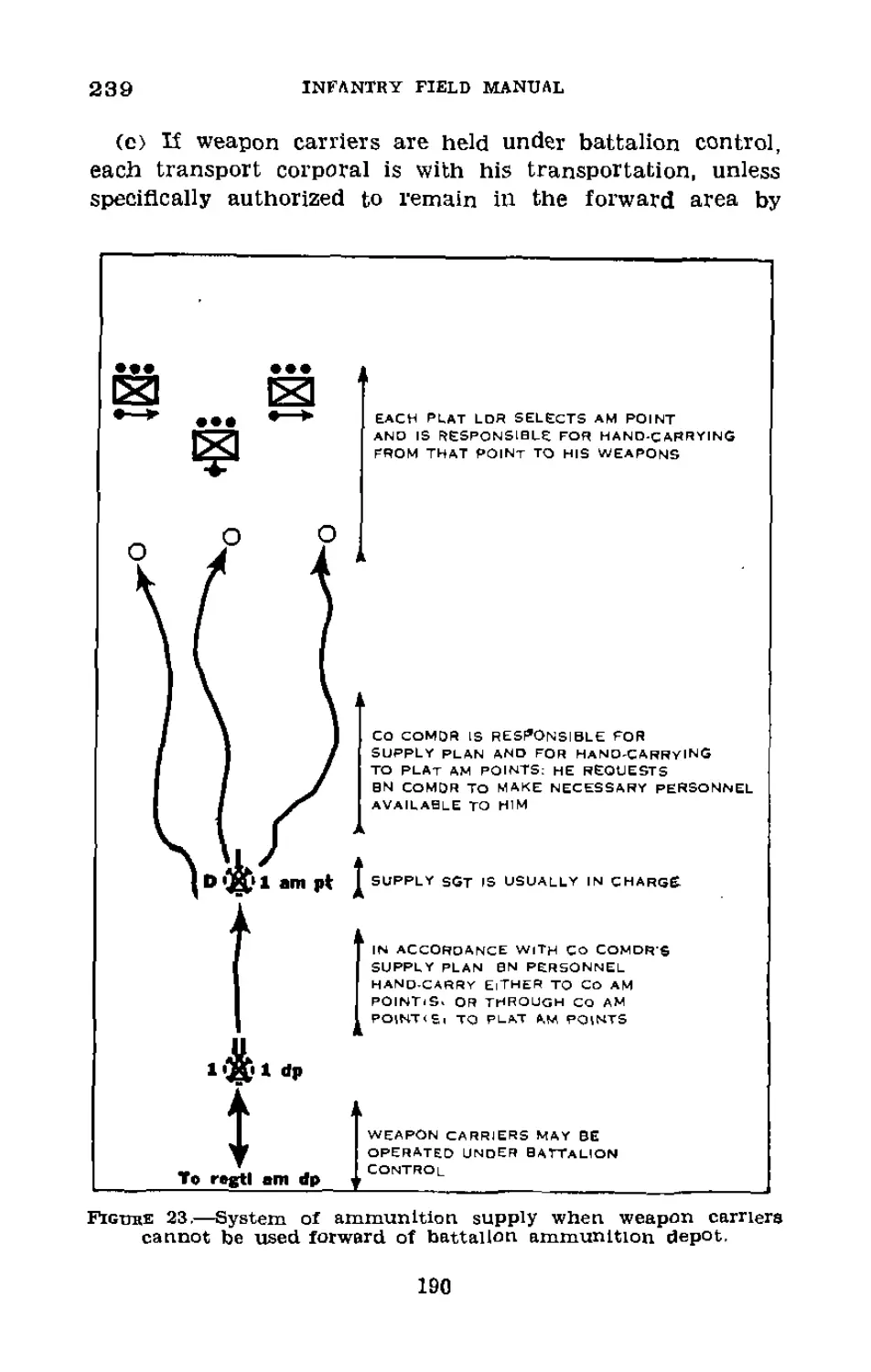
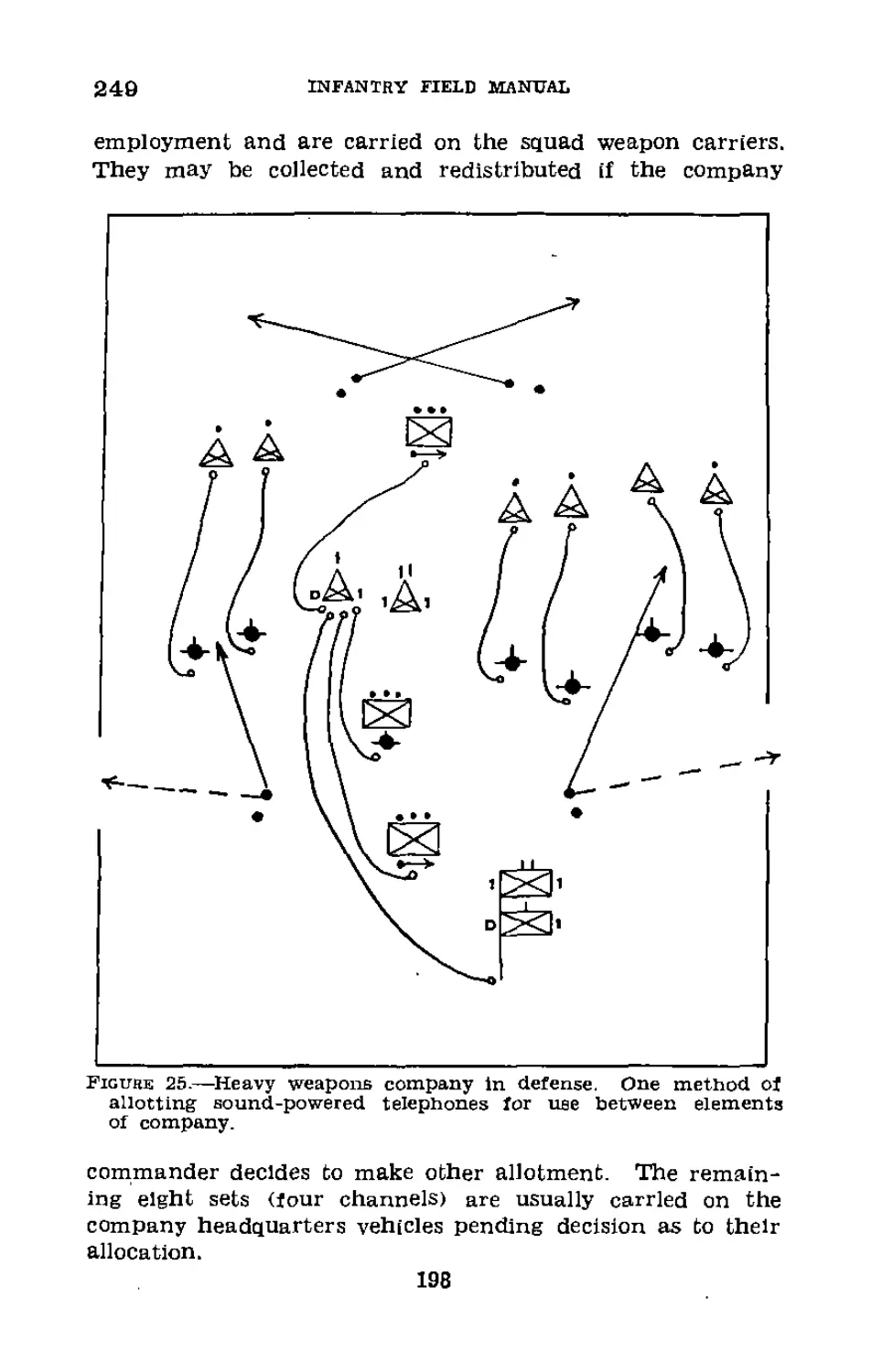
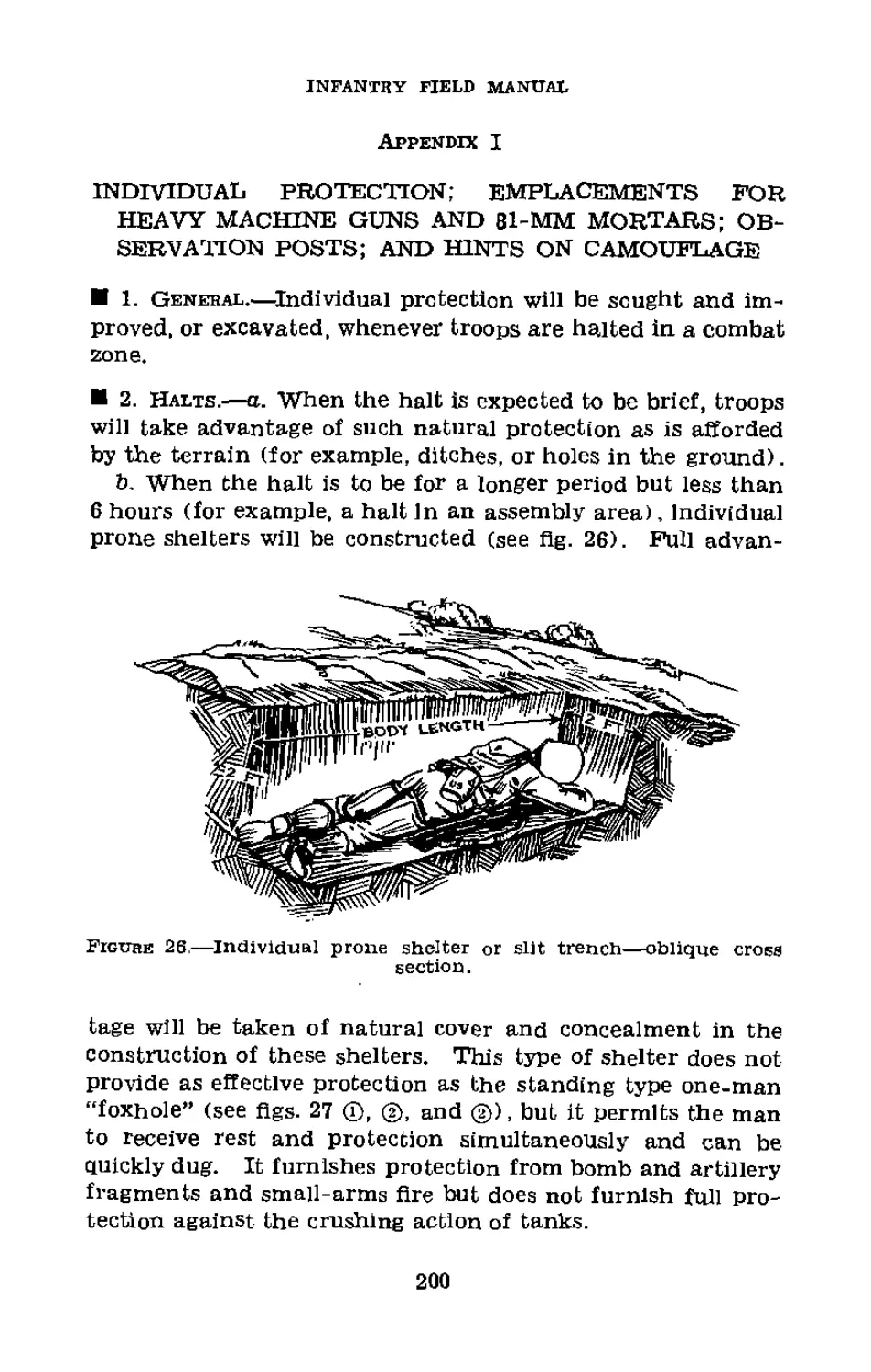
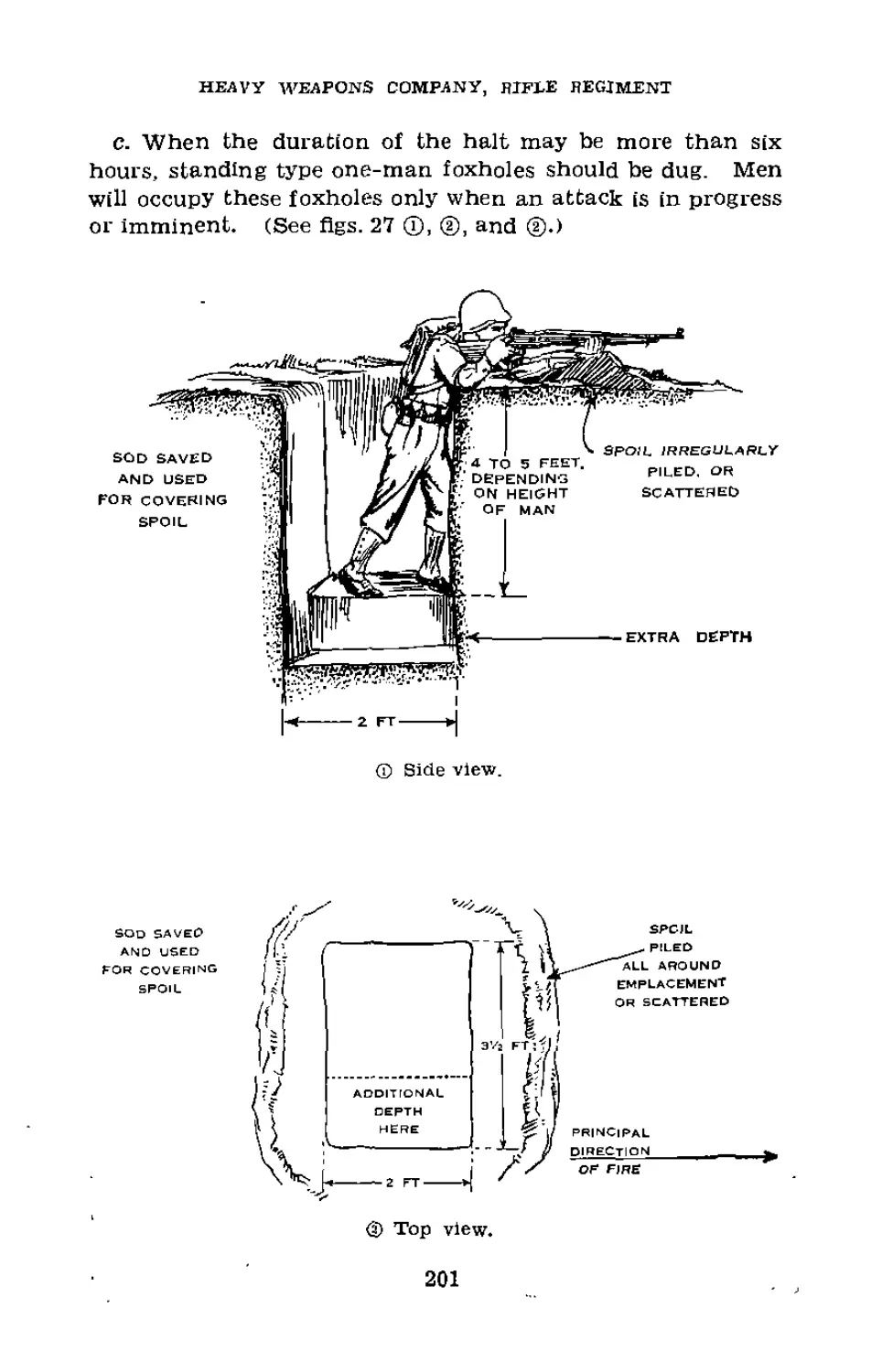
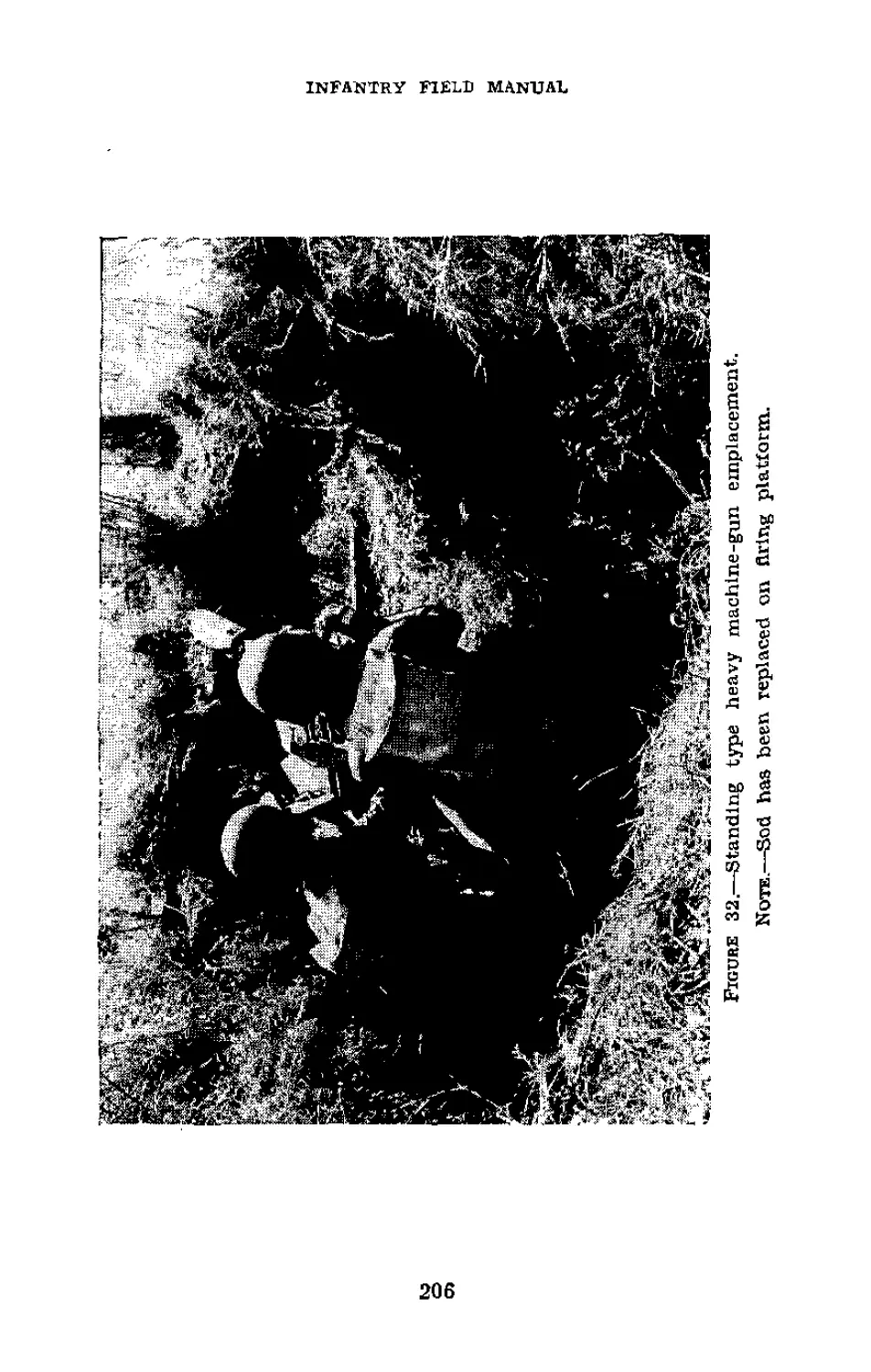
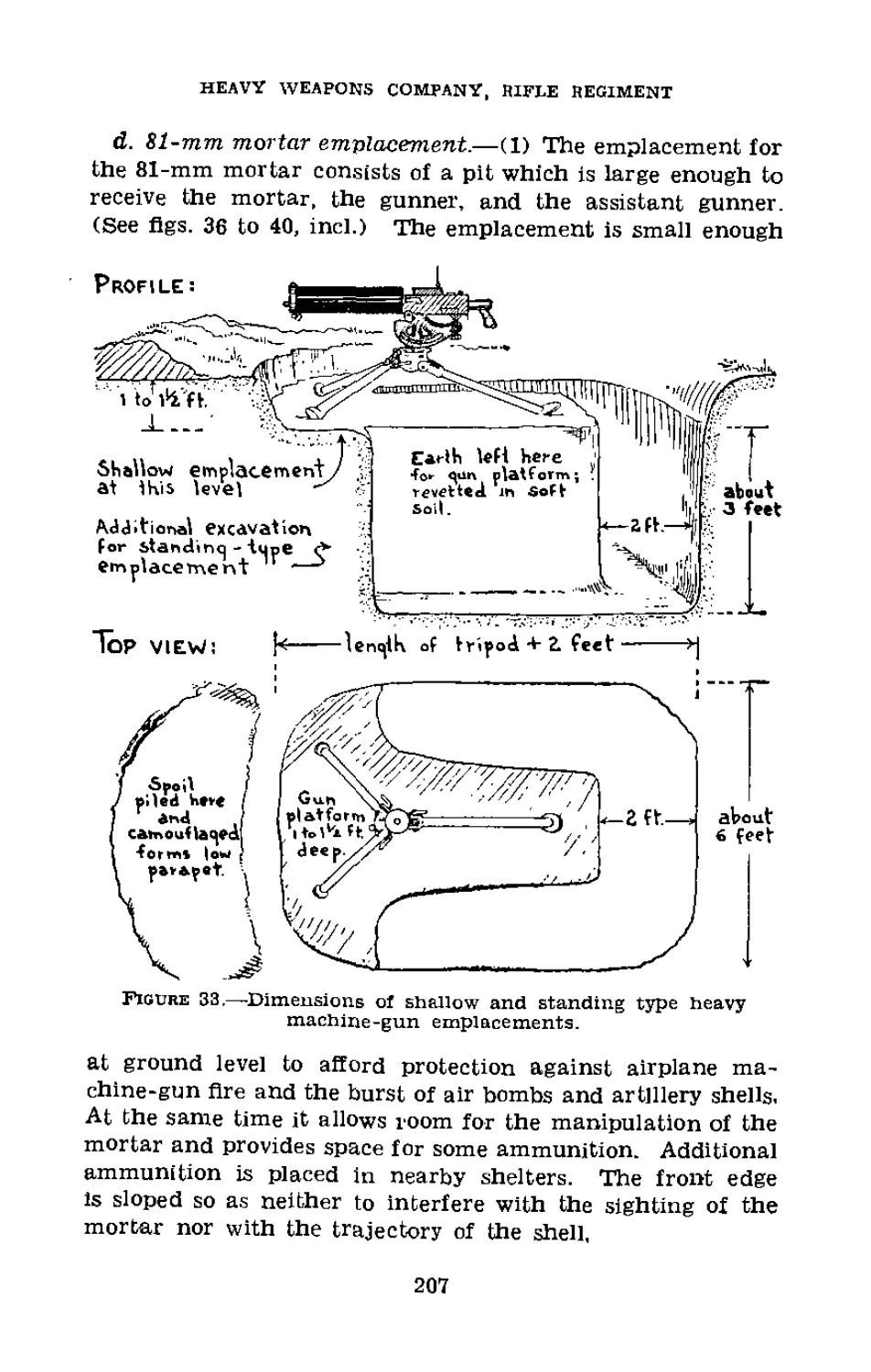
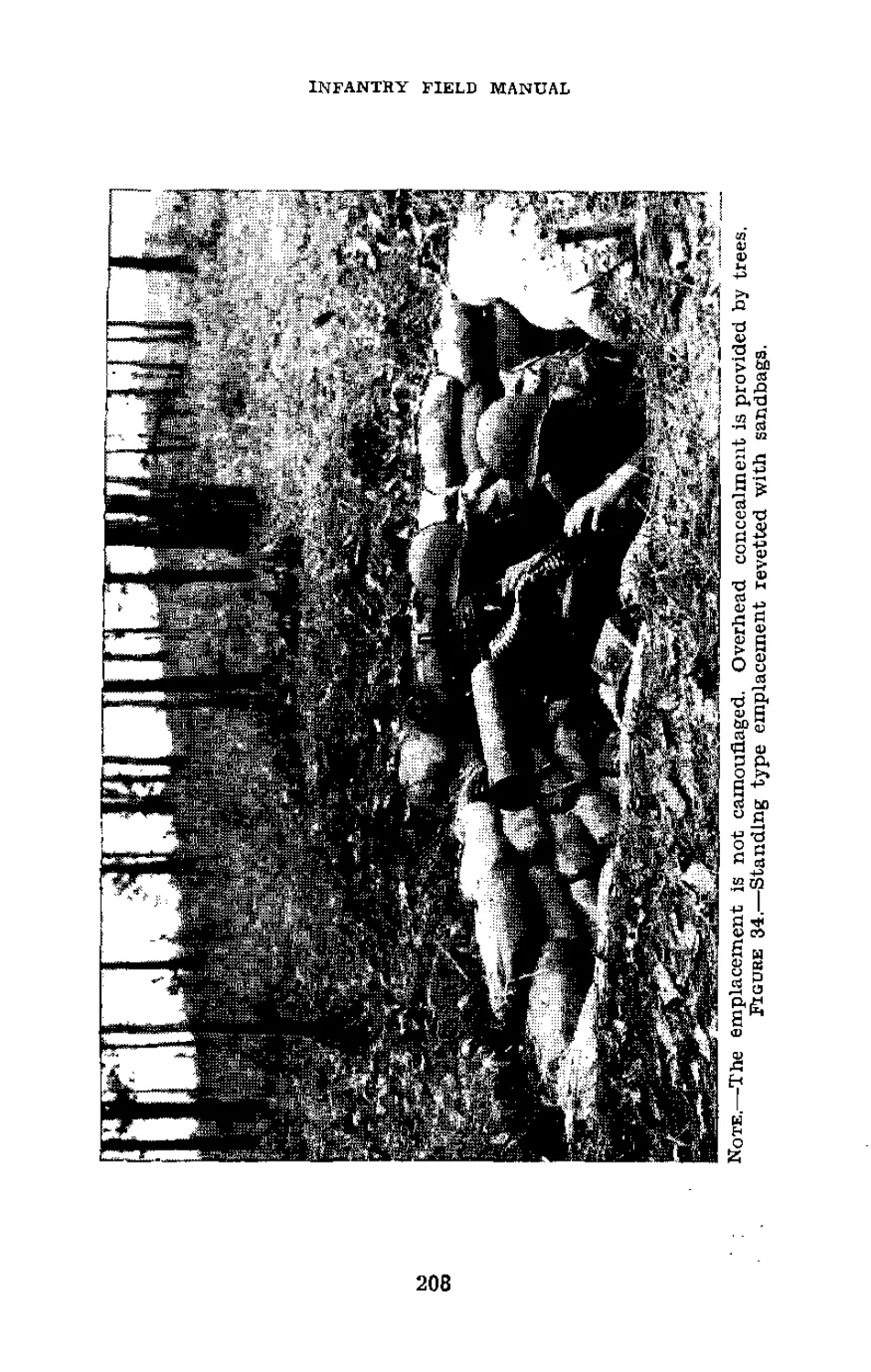
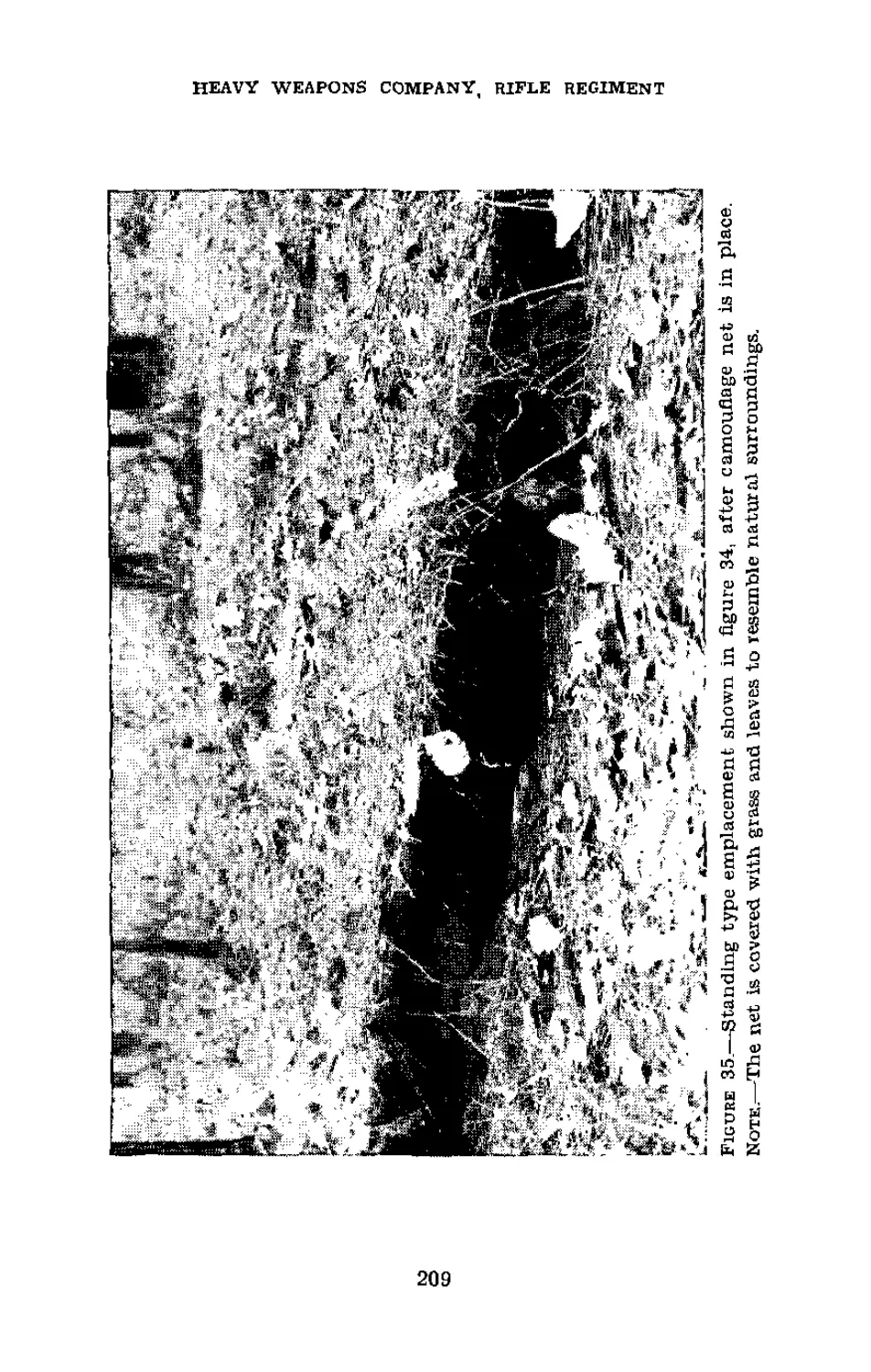
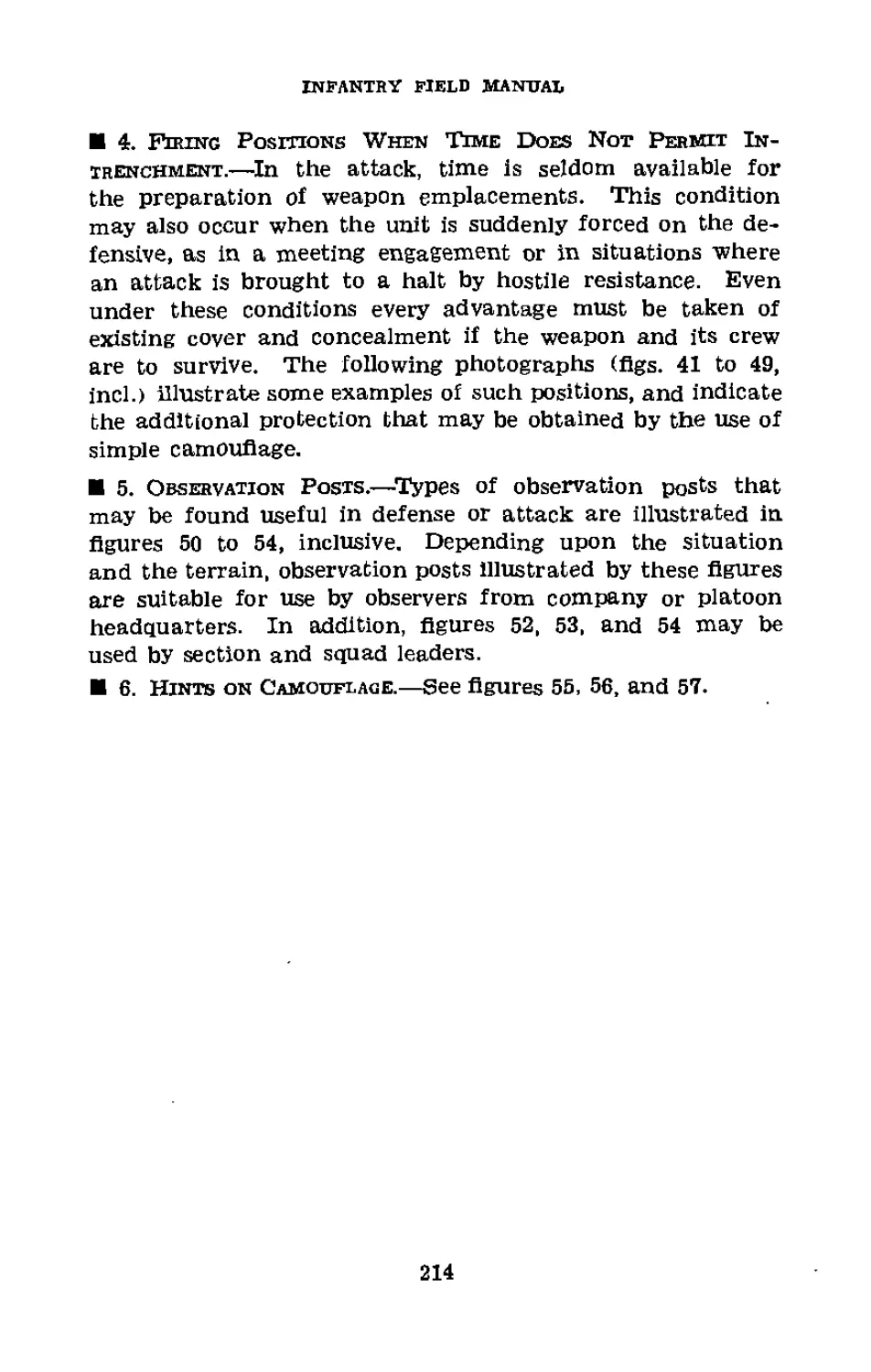
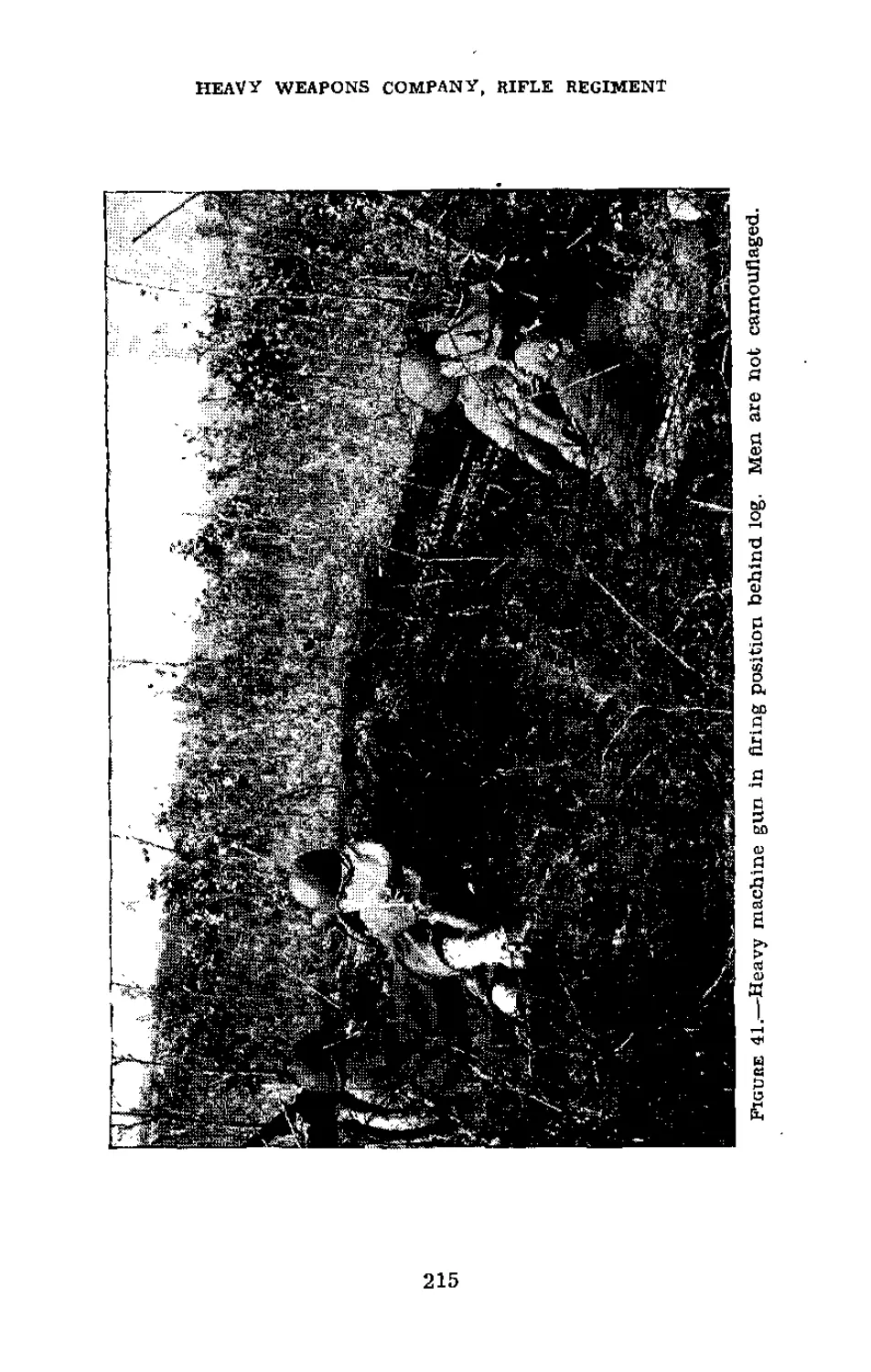
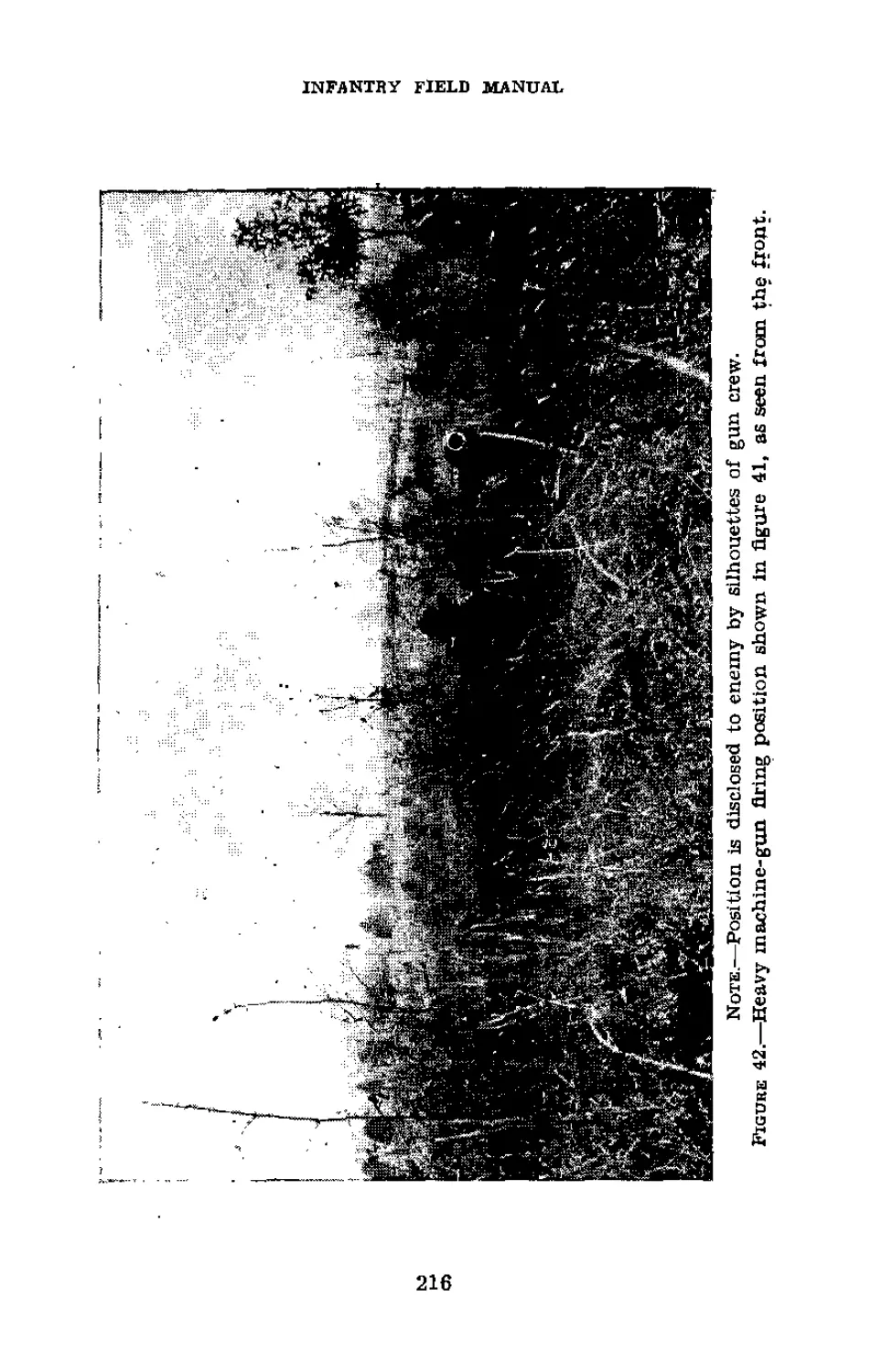
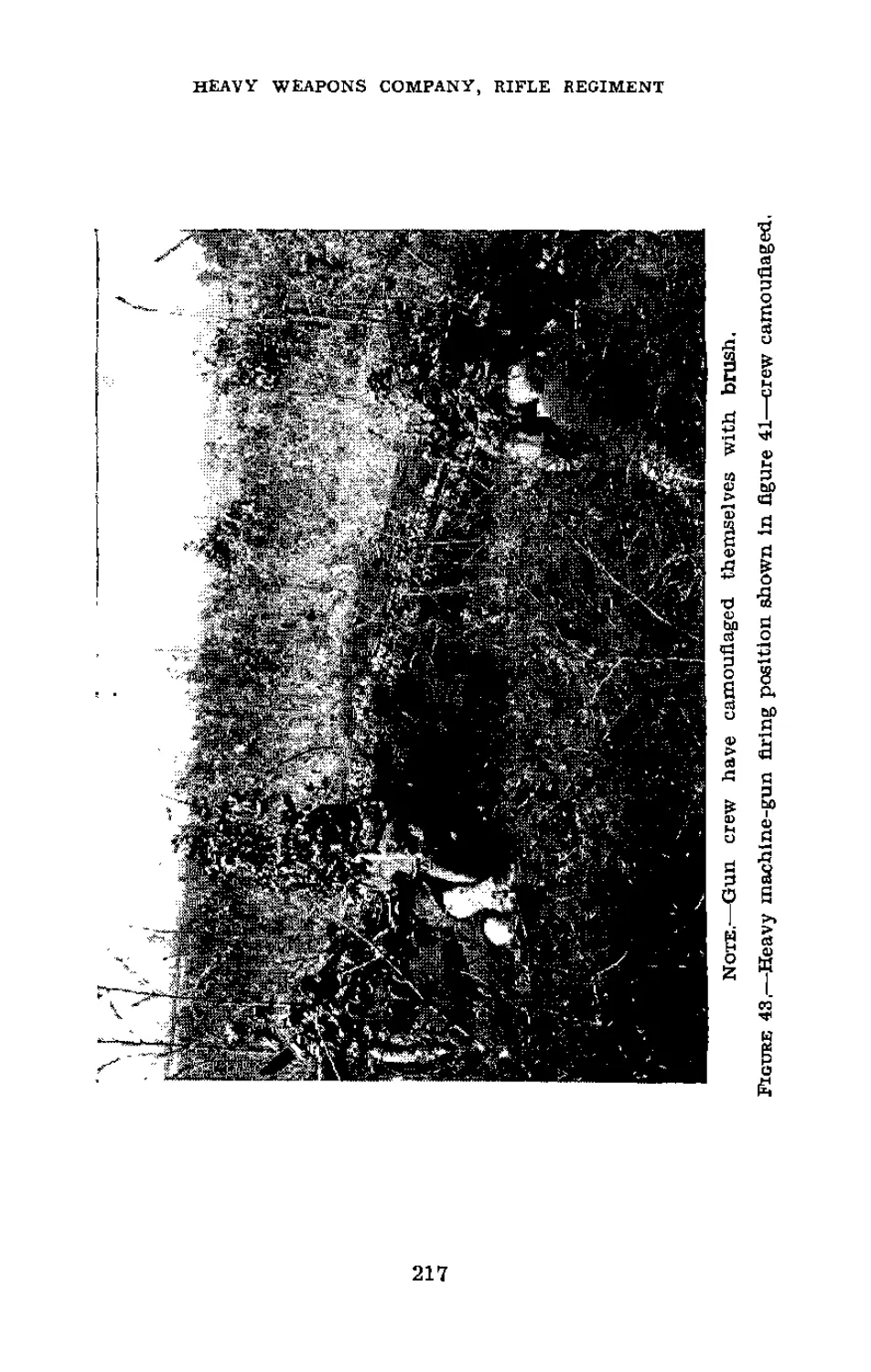
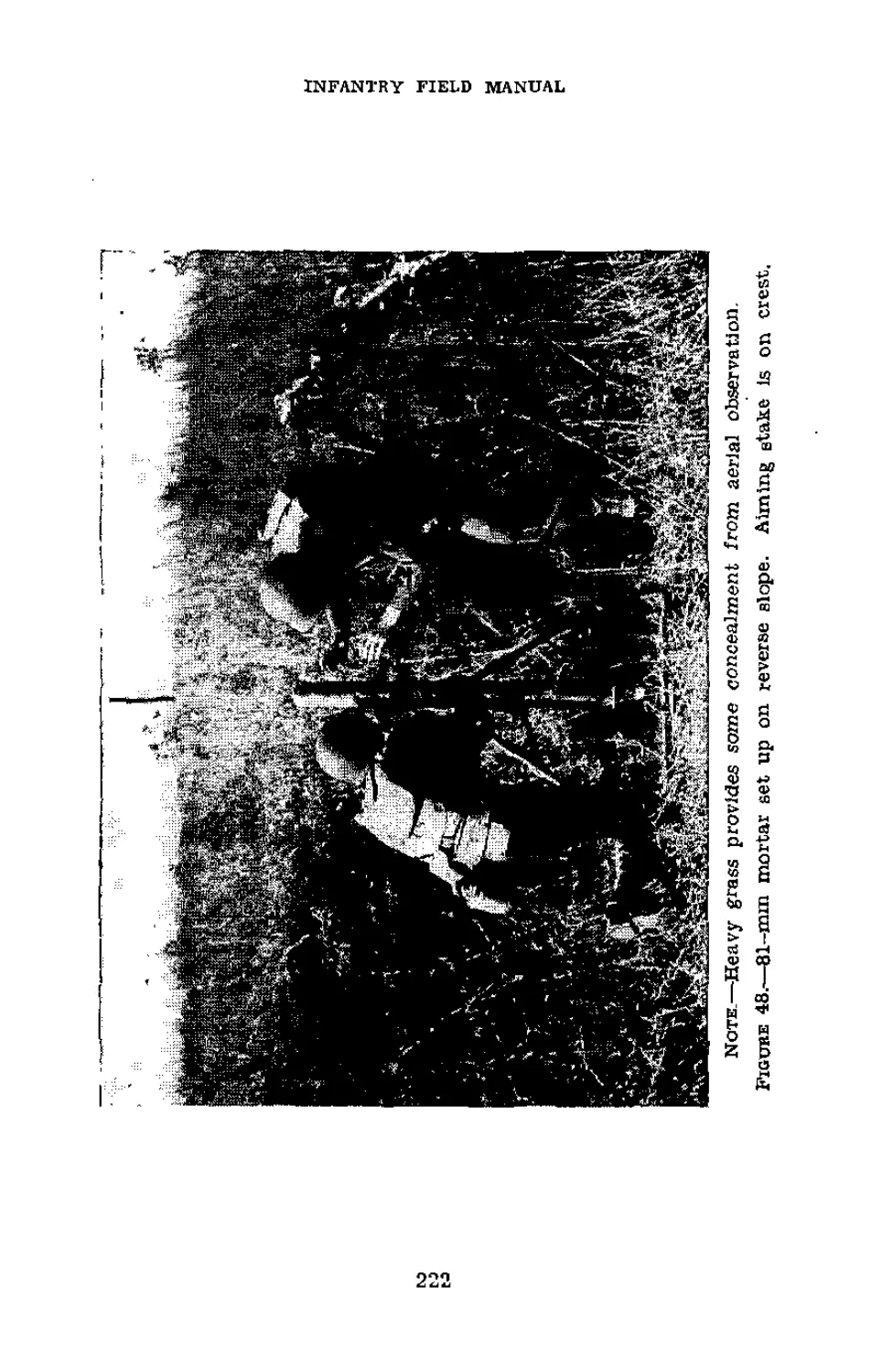
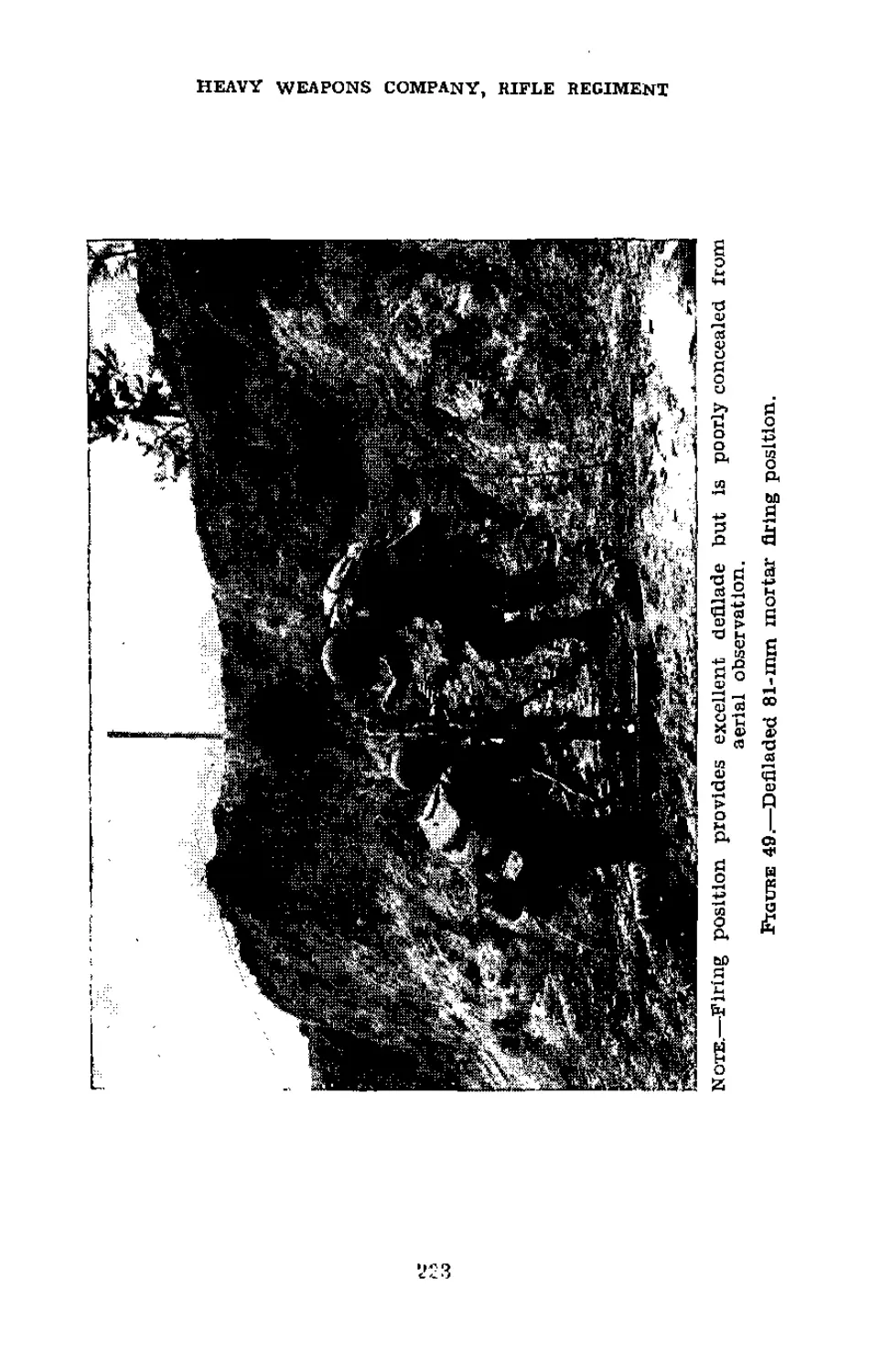
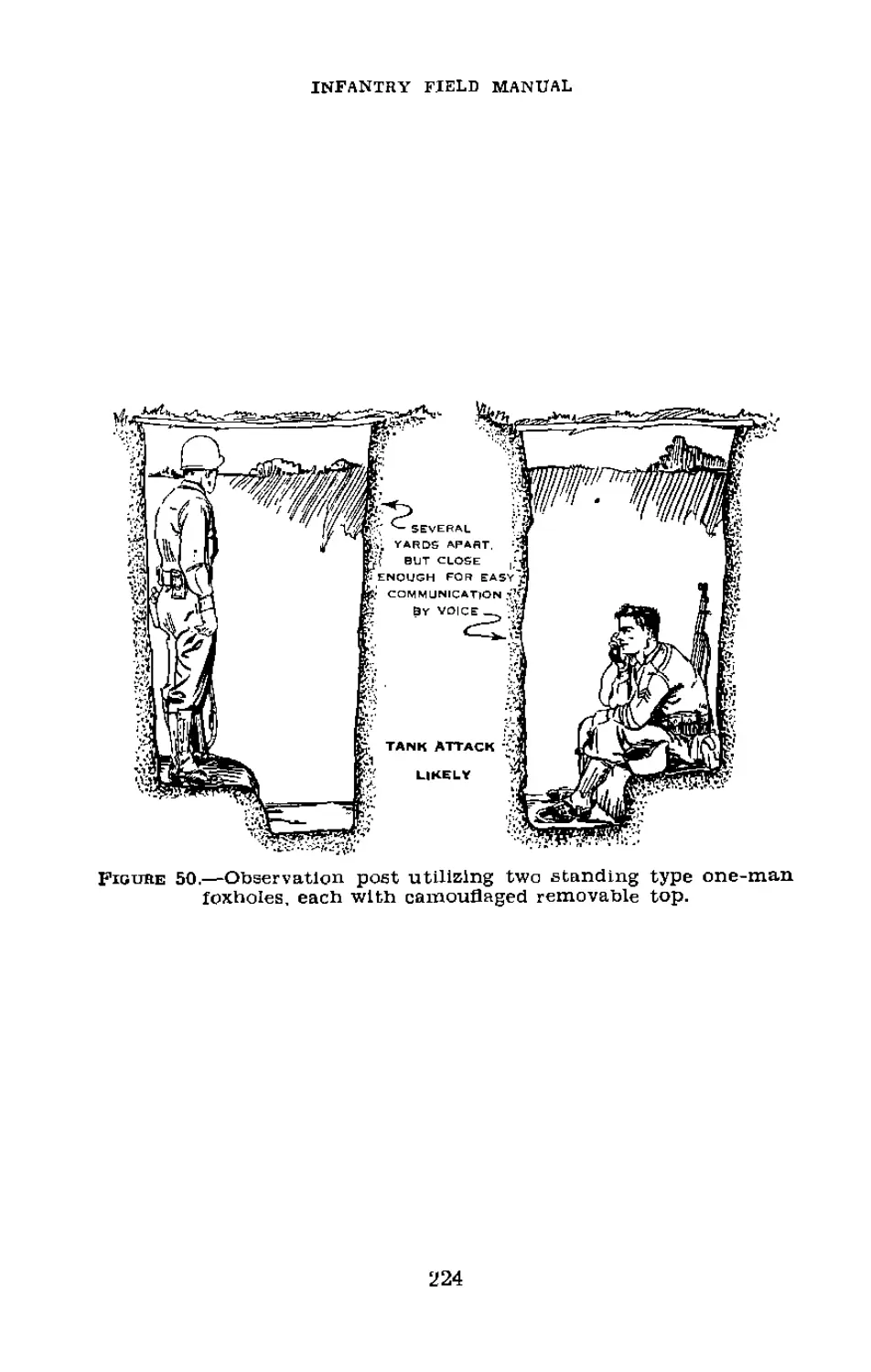
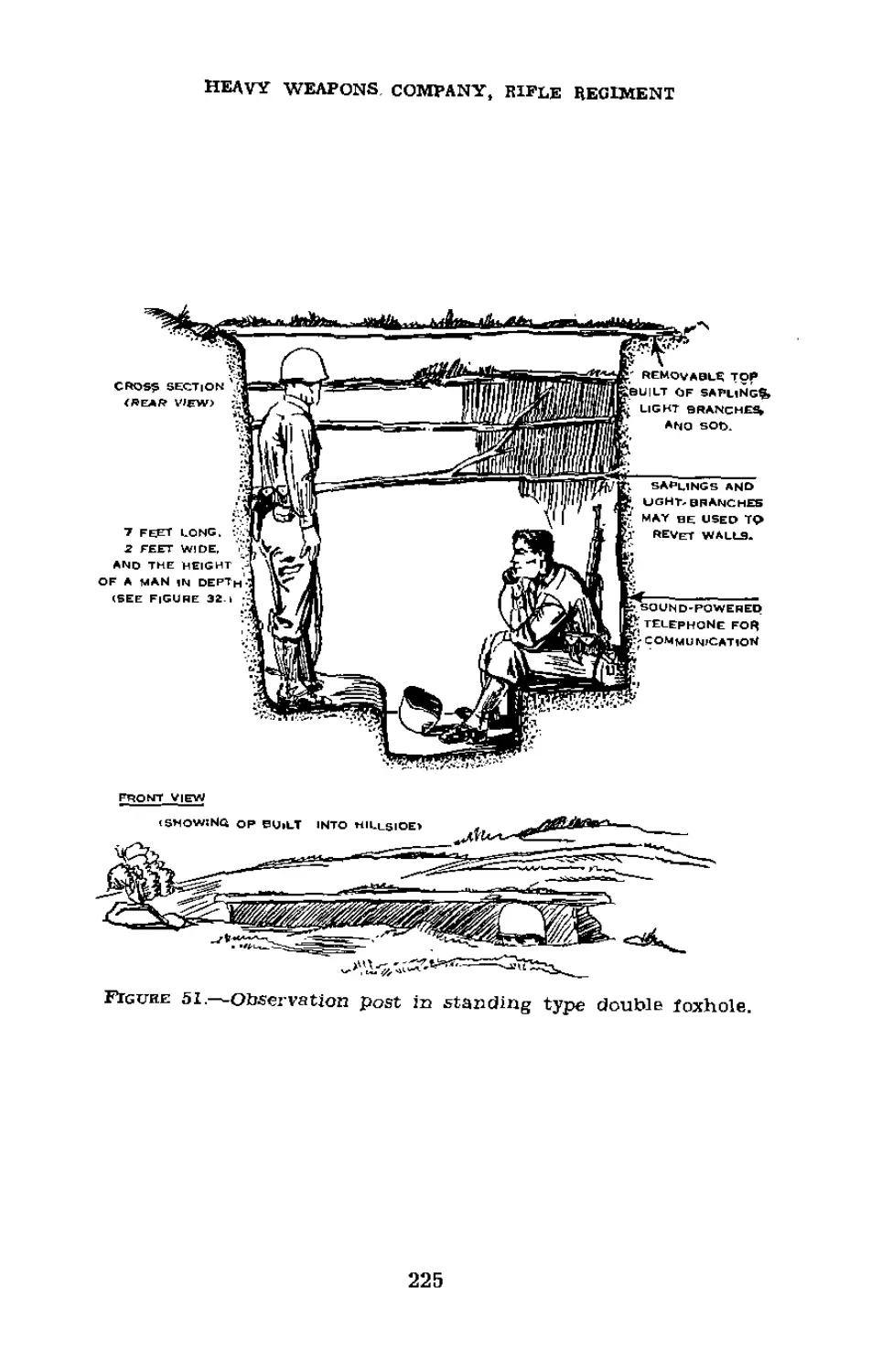


Tags: weapons military affairs
Year: 1942

Text
                    FM 7-15
WAR DEPARTMENT
INFANTRY FIELD MANUAL
HEAVY WEAPONS COMPANY,
RIFLE REGIMENT
May 19, 1942
FM 7-15
INFANTRY FIELD MANUAL
HEAVY WEAPONS COMPANY,
RIFLE REGIMENT
UNITED STATES
GOVERNMENT PRINTING OFFICE
WASHINGTON : 1942
WAR DEPARTMENT,
Washington, May 19, 1942.
FM 7-15, Infantry Field Manual, Heavy Weapons Company,
Rifle Regiment, is published for the information and guidance
of all concerned.
[A. G. 062.11 (4—18-42).]
By order of the Secretary of War:
G. C. MARSHALL,
Chief of Staff.
Official:
J. A. ULIO,
Major General,
The Adjutant General.
Distribution :
D 7 (2); R 7 (3); Bn 7 (5) ; IC 7 (20).
(For explanation of symbols see FM 21-6.)
n
TABLE OF CONTENTS
Chapter 1. General.	Paragraphs Page
Section I. Composition, armament, and
equipment-----------------------------------  1-6	1
II. Tactical employment of heavy
weapons company______________________ 7—18	7
Chapter	2.	Marches and bivouac-------------  19-24	19
Chapter	3.	Offensive combat.
Section I. General------------------------- 25	26
II.	Approach march__________________ 26-29	30
III.	Reconnaissance prior to attack,
and orders-________________________  30—33	38
IV.	Attack_________________________ 34 44	44
V.	Night attack__________________ 45—47	52
VI.	Raids___________________________  48	56
VII.	Attack in woods_______________ 49-51	56
VIII.	Attack of towns	and	villages___	52	59
IX.	Attack Of river	line._________ 53—55	60
Chapter 4. Defense and retrograde movements.
Section I. Reconnaissance, organization of
fires, and	conduct of defense__ 56-70	64
II.	Retrograde	movements__________ 71—72	79
III.	Defense in woods.________,_____ 73	81
IV.	Defense in	towns and villages--	74	82
V.	Defense of	river llne-___________ 75	83
VI.	Defense against air-borne  opera-
tions---------------------------------  76	85
Chapter 5- Caliber .30 machine-gun platoon.
Section I. General_________________________77—81	88
II. Attack______________________   82-99	90
III. Defense_____________________ 100-119	105
Chapter 6.	Caliber .30 machine-gun section and
squad.
Section I. General______________________ 120-126	116
II.	Attack______________________ 127-142	118
1П. Defense______________________ 143-152	130
Chapter 7.	81-mm mortar platoon.
Section I. General___________________________ 153—158	137
II.	Attack-_____________-__________ 159-176	140
III.	Defense-._____________________ 177-194	152
Chapter 8.	81-mm mortar section and squad.
Section I. General___________________________ 195-202	162
П. Attack_____________________   203-217	165
III.	Defense______________________21B-231	174
Chapter 9.	Administration.
Section I. Supply__________________________ 232-241	179
II.	Medical service	and evacuation_ 242—245	193
III.	Motor maintenance_______________ 246	194
Chapter 10.	Signal communication_______________ 247-251	195
Appendix I. Individual protection; emplacements
for heavy machine guns and 81-mm
mortars; observation posts; and
hints on camouflage____________________________ 1-6	200
II. Directives for tactical training of
heavy weapons company_____________ 1-6	230
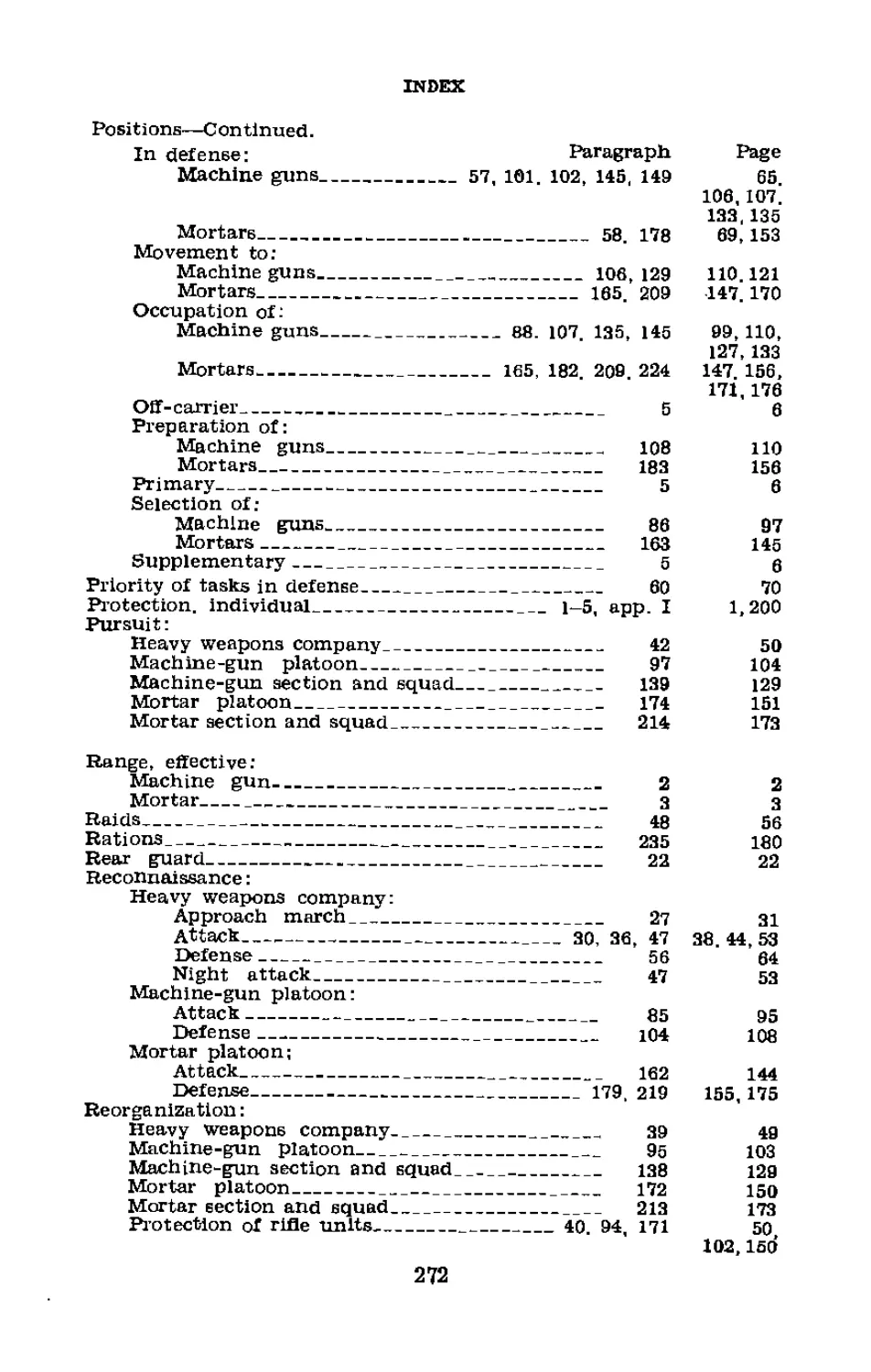
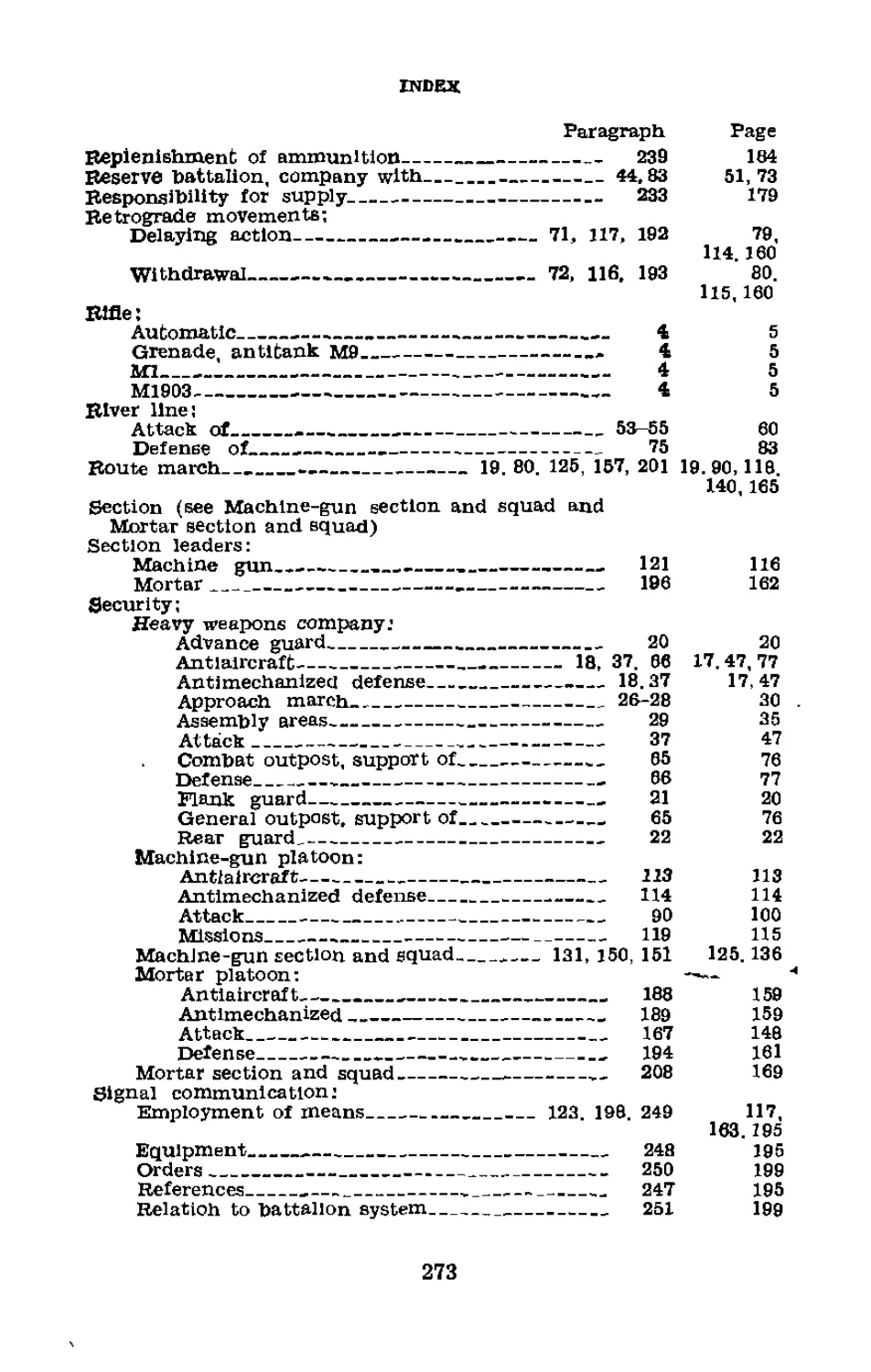
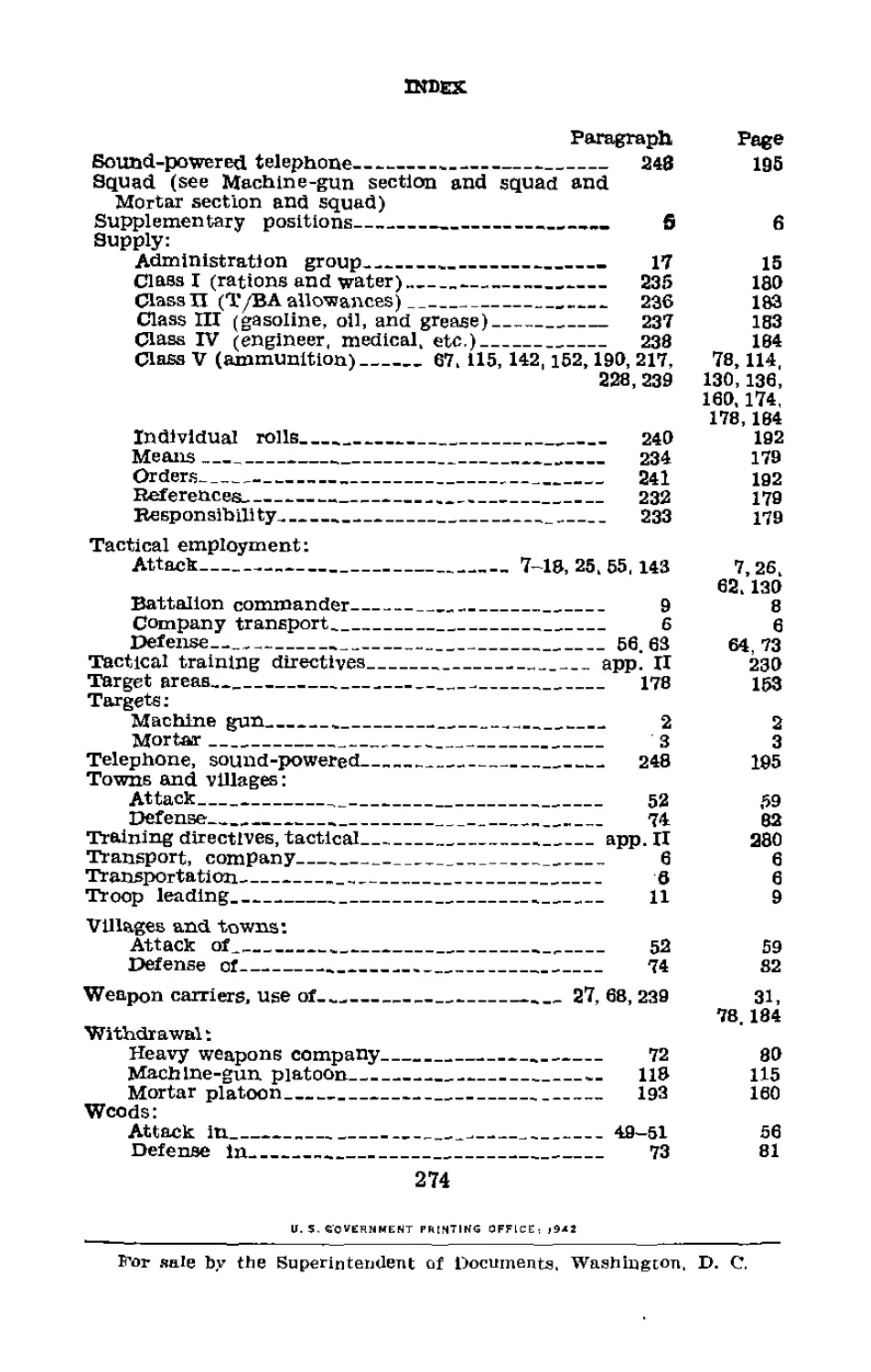
Index___________________________________.____________ 263
1П
FM 7-15
i
INFANTRY FIELD MANUAL
HEAVY WEAPONS COMPANY, RIFLE REGIMENT
CHAPTER 1
GENERAL
Paragraphs
Section I. Composition, armament, and equipment_ 1-6
П. Tactical employment of heavy weapons company_7—18
Section I
COMPOSITION, ARMAMENT, AND EQUIPMENT
 1. Composition.—a. Company.—The heavy weapons com-
pany consists of a company headquarters, two caliber .30 heavy
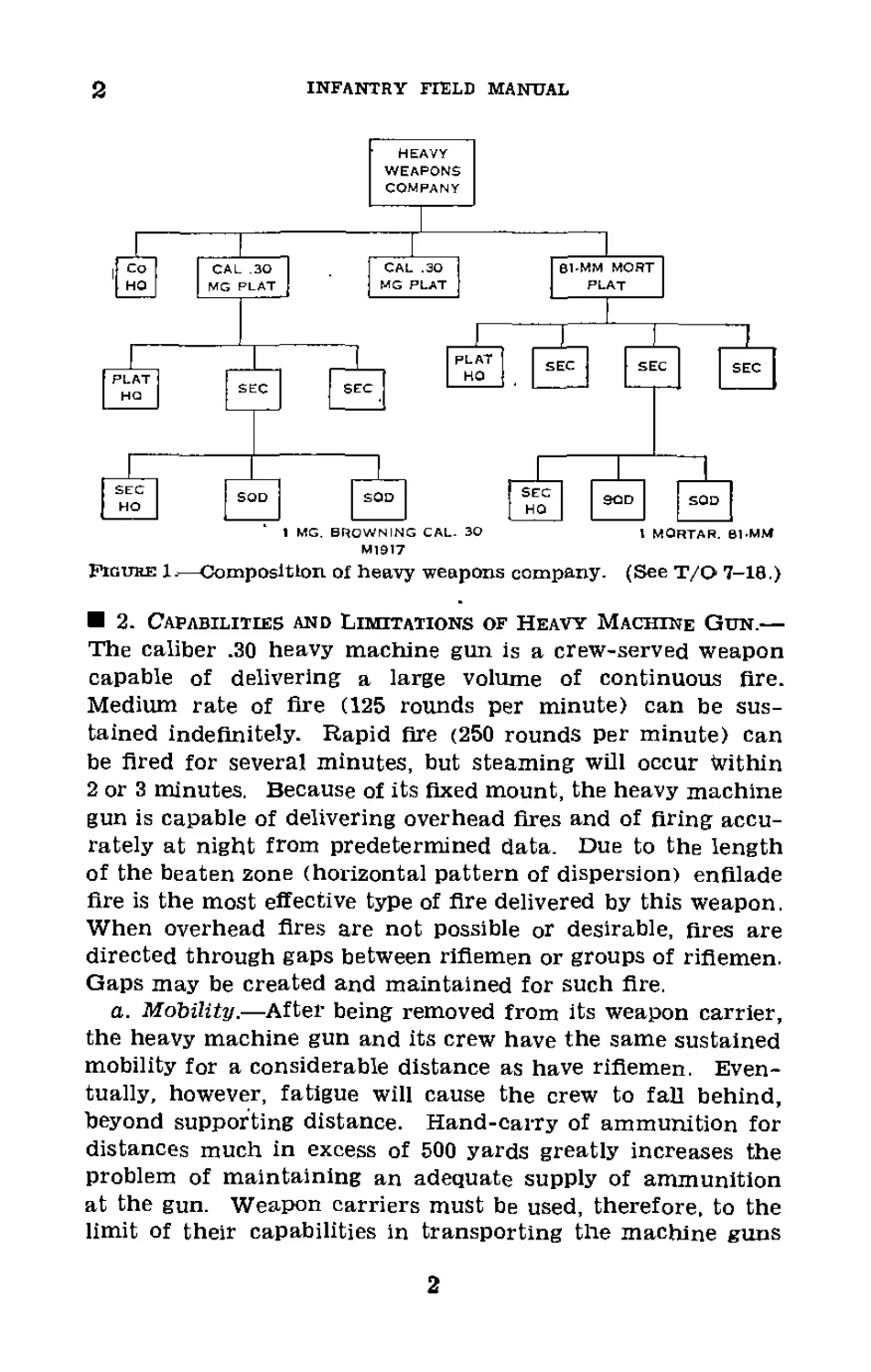
machine-gun platoons, and one 81-mm mortar platoon. (See
fig. 1.) For details of organization, armament, and equip-
ment, see Tables of Organization and Table of Basic Allow-
ances .
b. Company headquarters.—(1) The company headquar-
ters is composed of a command group and an administration
group.
(2) The command group consists of the company com-
mander, reconnaissance officer, first sergeant, reconnaissance
and signal sergeant, transport sergeant, motor mechanics,
bugler, orderly, and messengers. Chauffeurs who drive the
command trucks assigned to company headquarters, and basic
privates, are included in the command group.
(3) Hie administration group consists of the supply ser-
geant, mess sergeant, cooks and cooks’ helpers, armorer-
artificer, and the company clerk.
c. Platoons.—For composition, refer to figure 1 and see
paragraphs 78 and 154.
1
2
INFANTRY FIELD MANUAL
1 MG. BROWNING CAL. 30	1 MORTAR. 01.MM
M1917
Figuhe —Composition of heavy weapons company. (See T/O 7-18.)
 2. Capabilities and Limitations of Heavy Machine Gun.—
The caliber .30 heavy machine gun is a clew-served weapon
capable of delivering a large volume of continuous fire.
Medium rate of fire (125 rounds per minute) can be sus-
tained indefinitely. Rapid fire (250 rounds per minute) can
be fired for several minutes, but steaming will occur tvithin
2 or 3 minutes. Because of its fixed mount, the heavy machine
gun is capable of delivering overhead fires and of firing accu-
rately at night from predetermined data. Due to the length
of the beaten zone (horizontal pattern of dispersion) enfilade
fire is the most effective type of fire delivered by this weapon.
When overhead fires are not possible or desirable, fires are
directed through gaps between riflemen or groups of riflemen.
Gaps may be created and maintained for such fire.
a.	Mobility.—After being removed from its weapon carrier,
the heavy machine gun and its crew have the same sustained
mobility for a considerable distance as have riflemen. Even-
tually, however, fatigue will cause the crew to fall behind,
beyond supporting distance. Hand-carry of ammunition for
distances much in excess of 500 yards greatly increases the
problem of maintaining an adequate supply of ammunition
at the gun. Weapon carriers must be used, therefore, to the
limit of their capabilities in transporting the machine guns
2
HEAVY WEAPONS COMPANY, HIFLE HEGIMENT
2—3
and supplying them with ammunition. See limitations on the
use of weapon carriers, paragraph 6b (2).
b.	Ranges.—(1) The effective range of the machine gun,
employing direct fire, is limited by observation. Observation
will rarely be effective beyond 2,000 yards.
(2) The effectiveness of the machine gun, employing indi-
rect fire, is limited by its maximum effective range and by the
facilities for obtaining accurate firing data. (See FM 23-45
and 23-55.)
c.	Vulnerability.—An enemy will search for the location of
machine guns. The distinctive noise of firing, the muzzle
blast, dust clouds caused by firing, and the silhouette of the
gun, all tend to disclose its location. Therefore, firing posi-
tions should, whenever practicable, be selected in position
defilade or partial defilade. See paragraph 25b (3) and
figures 7, 8, and 9. When time permits, the machine gun
should be well dug in. For machine-gun emplacements, see
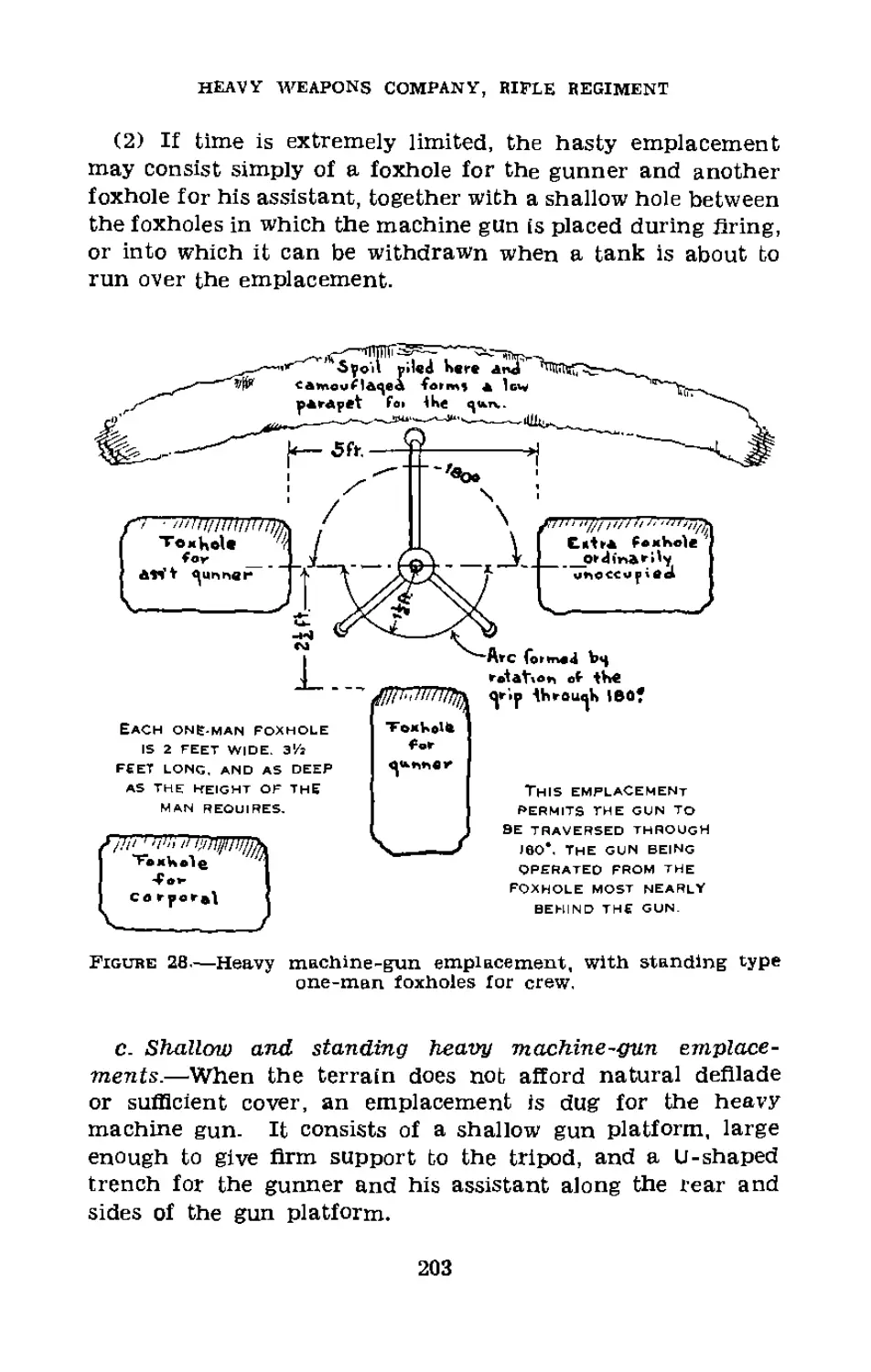
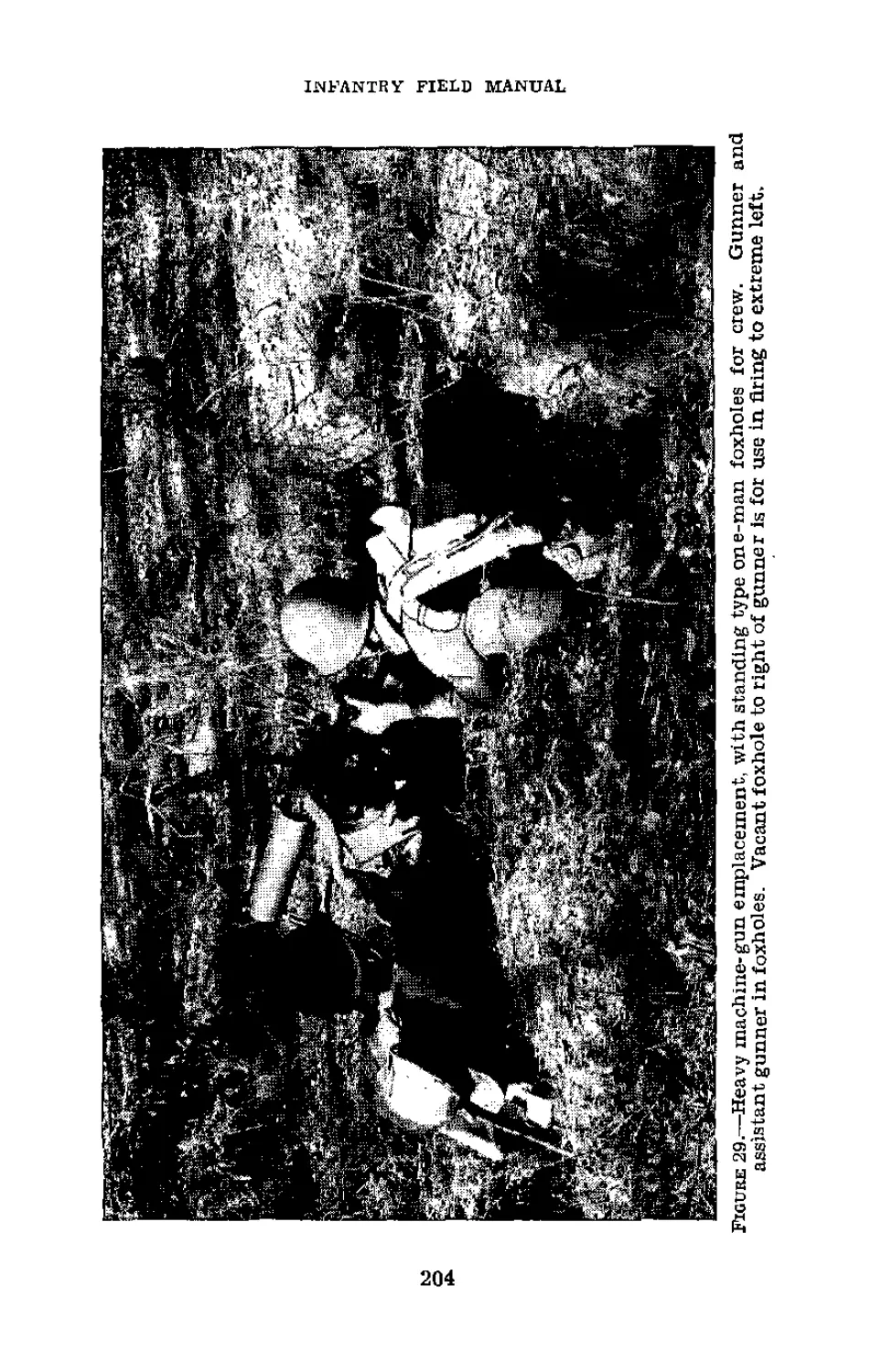
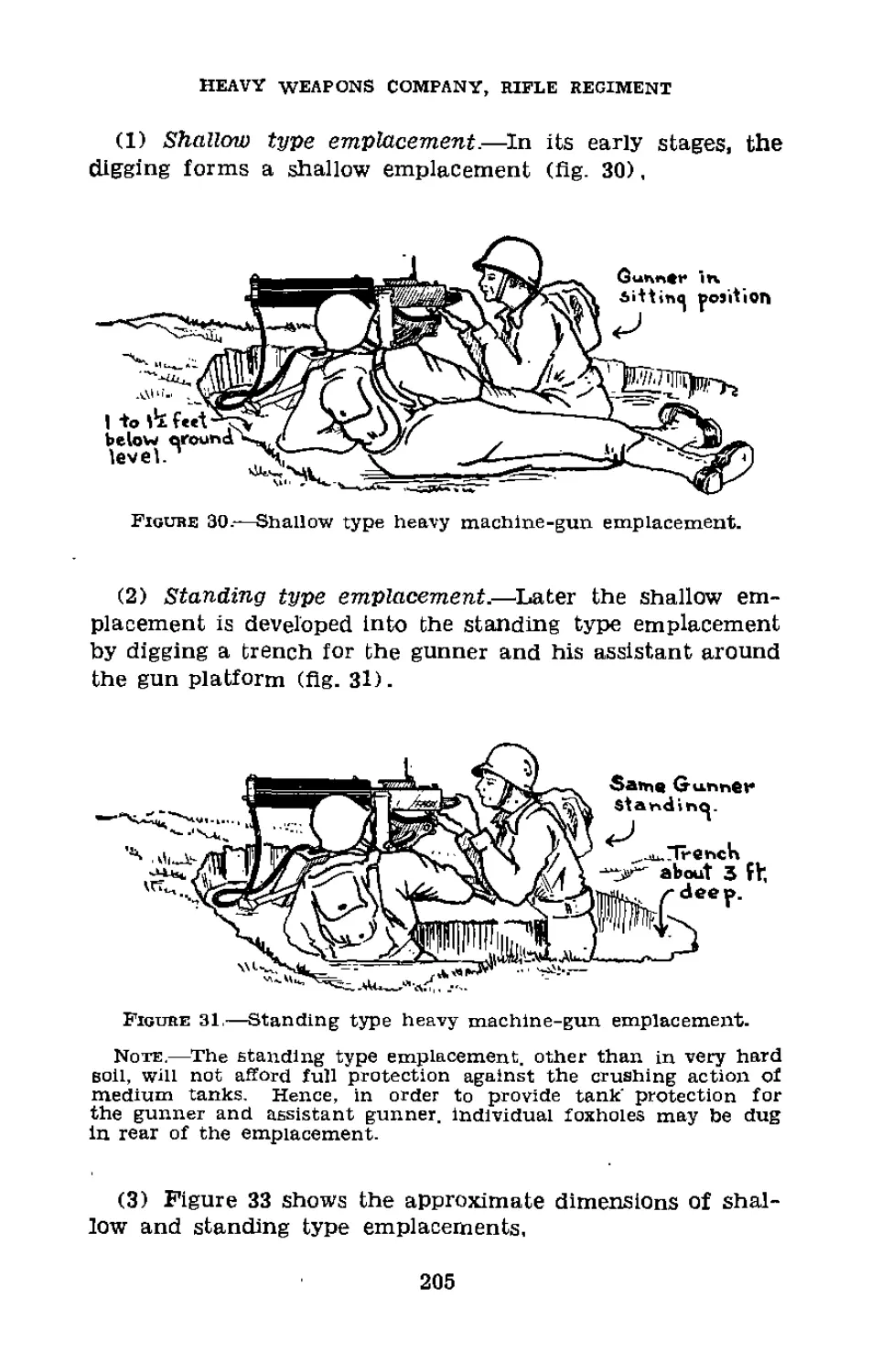
appendix I and figures 28, 29, and 30.
d.	Targets.—-The hostile target most dangerous, at the
moment, to friendly troops is the primary target. Suitable
targets are—
(1)	Exposed personnel, particularly if in close formation,
or in depth with respect to the line of fire.
(2)	Intrenched personnel, observation posts, machine guns,
or antitank guns, for destruction or neutralization. Neutral-
ization is accomplished by hampering or interrupting move-
ment or action, and thereby reducing or destroying the com-
bat efficiency of the target.
(3)	Low-flying airplanes. The effective slant range of
heavy machine guns against low-flying airplanes does not
exceed 1,000 yards. For antiaircraft fires, see paragraph 18.
(4)	Mechanized vehicles. For conduct of crews and fire
against mechanized vehicles, see paragraph 18.
 3. Capabilities and Limitations of 81-mm Mobtab.—The
81-mm mortar is a crew-served weapon. Each mortar is
capable of firing an effective concentration in an area 100 by
100 yards. The use of the mortar for firing concentrations is
limited by the supply of ammunition. (See FM 23-90.)
a.	Mobility.—The 81-mm mortar has approximately the
same mobility as the heavy machine gun. Its ammunition
3
3
INFANTRY FIELD MANUAL
supply is more difficult, both because of the weight of the
projectile and because of the rapidity with which the initial
.supply may be exhausted.
b.	Ranges.—The effective range is limited by observation
rather than by the maximum range of the weapon. The
range of the light shell is from 100 to 3,300 yards; the range
of the heavy shell is from 300 to 2,650 yards. Effective ob-
servation, however, will rarely be obtained beyond 2,000 yards.
Mortar fires should not be placed less than 200 yards from
friendly troops.
c.	Vulnerability.—Due to its high-angle trajectory and
effective range, a wide choice may be exercised in the selec-
tion of firing positions, provided observation is available.
Advantage should be taken of deep defilade, or of woods
which afford openings through which the mortar can fire.
Firing positions should be selected which protect the crew
from the fires of rifles and machine guns, and reduce the
vulnerability of the mortar and crew to hostile artillery fires
and air attack. However, each firing position must be suffi-
ciently close to its observation post to permit effective control
of fires with available means of signal communication. (See
par. 198.)
d.	Targets.—The necessity for conserving ammunition sup-
ply demands careful selection of mortar targets, particularly
In offensive combat. Suitable targets are—
(1)	Located, or approximately located, hostile machine
guns, mortars, and antitank guns.
(2)	Observed point or small area targets protected from
effective fire of rifles and machine guns, such as personnel or
weapons in road cuts, embankments, or intrenchments. Re-
verse slopes and woods, which afford approaches defiladed
from the fire of rifles and machine guns, are suitable targets
In defensive combat. In offensive combat, reverse slopes and
woods also are suitable targets in harassing a retreating
enemy, or to disrupt known or suspected movement or assem-
bly of reserves. However, priority is always given to observed
targets.
(3)	Positions having overhead cover—heavy shell only.
(4)	Areas to be smoked in order to deny hostile observa-
tion.
4
HEAVY WEAPONS COMPANY, RIFLE REGIMENT
4
 4. Individual Weapons.—a. Pistols, carbines, rifles, and
hand grenades.—These are individual weapons. Their pri-
mary tactical use in the heavy weapons company is the
emergency defense of the individual, groups, crew-served
weapons, and company installations. When elements of the
heavy weapons company are isolated from other units, rifle
elements are detailed for their close protection.
b. Browning automatic rifle.—The primary tactical use of
the Browning automatic rifle in the heavy weapons company
is the antiaircraft defense of the company transport; its
secondary use is for the local protection of the company
transport from ground attack. One Browning automatic
rifle is mounted on a pedestal mount on one weapon carrier
in each section of the company. The section leader designates
one man to ride this carrier and man the automatic rifle
until the heavy weapons are unloaded; thereafter the chauf-
feur, or any other available individual such as the transport
corporal, may man this weapon for emergency use. For
conditions governing antiaircraft fires, see paragraph 18.
c. Antitank rifle grenade M9.—(1) The antitank rifle gre-
nade, HE, M9, is provided for the purpose of combating tanks
and armored vehicles. (See FM 23-30.) These grenades
are fired from a U. S. rifle, caliber .30, M1903, which is
organic equipment of each heavy machine-gun and mortar
section.
(2) Each rifle from which the grenade is to be fired is
provided with a soft rubber pad to be placed over the butt,
and also with a launcher (muzzle extension) which fits over
the muzzle and into the base of the fin-tail assembly, to hold
the grenade in place during the period of aiming. The rifle
may be fired from the prone, standing, sitting, or kneeling
positions, or from a foxhole or slit trench, д practice grenade
Mil is provided for Instruction in training, marksmanship,
and technique of fire.
(3) Within its effective range, approximately 75 yards,
the high explosive grenade M9 is effective against all known
light and medium tanks. The M1903 rifle can also be used
for firing at ground or air targets with caliber .30 ammuni-
tion. The section leader designates a man to ride one of
his weapon carriers and protect the carriers until his heavy
5
4-в
INFANTRY FIELD MANUAL
weapons are unloaded; thereafter he employs the section
antitank rifle for the local protection of his heavy weapons
and their crews. (See par. 18.)
 5. Types of Positions.—a. Firing positions.—The com-
pany, or its platoons and sections, are assigned position areas
in which firing positions of their heavy machine guns or
mortars are to be located. These firing positions are classi-
fied as—
(1)	Primary position.—The firing position from which the
weapon can best execute its primary fire mission.
(2)	Alternate position.—A firing position from which the
same fire mission can be executed as from the primary posi-
tion. It is used to enable the weapon to continue its mission
when enemy Are, or the threat of fire, makes it necessary to
move the weapon and its crew from its primary firing posi-
tion in order to avoid destruction. In open terrain, an
alternate position should be at least 100 yards from the
primary position.
(3)	Supplementary position.—A firing position from which
the weapon can accomplish secondary fire missions which
cannot be accomplished from primary or alternate positions.
b. Off-carrier position.—The off-carrier position is the
point at which the weapon, its initial supply of ammunition,
and its accessories are removed from the weapon carrier.
From that point they are brought by hand to a cover posi-
tion or firing position. The off-carrier position should afford
defilade and concealment for carriers and men.
C. Cover position.—Whenever practicable, squad leaders se-
lect cover positions near firing positions. The cover position
affords defilade and concealment for members of the squad
when they are not required to remain at the firing position.
When the cover position is occupied, observers continue to
watch for suitable targets and for hostile attack against the
unit.
 6. Equipment and Transportation.—a. Reference.—For or-
ganic transportation, see Table of Organization; for equip-
ment, see Table of Basic Allowances.
b. Tactical employment of company transport.—(1) Pur-
pose.—The heavy weapons company is assigned one or more
6
heavy weapons company, rifle regiment?
6-7
motor vehicles for the purpose of command and communi-
cation; each squad is equipped with one weapon carrier to
transport crew-served weapons with a minimum gun crew,
spare parts, accessories, fire control equipment, and ammu-
nition. A large proportion of the company moves on foot.
(2) Limitations.—The use of weapon carriers to transport
weapons and ammunition may be prevented by hostile fires or
impassable conditions of terrain.
(3) Control.—The control of the company transport may
vary from regimental control to platoon control.
(a)	In situations where contact with the enemy is not im-
minent, company transport, except that of units employed on
antiaircraft security missions, may be grouped with other
battalion transport under regimental or battalion control.
(b)	In a route march, carriers are released to platoons
engaged on security missions. In an approach march,
weapons transported by weapon carriers must be readily ac-
cessible; carriers should be released to the platoon when the
terrain is favorable for cross-country movement; otherwise,
they move under company or battalion control.
(c)	In the attack, carriers are released to platoons prior
to entry into combat, and remain under platoon control unless
otherwise specified by the company or battalion commander.
However, between the company ammunition point and the
platoon areas the movement of carriers engaged in ammuni-
tion supply is under company control except for elements of
the company attached to rifle units. (See paragraph 239b.)
(Й) In the defense, all battalion transport of forward bat-
talions, except that required for communication and control,
will usually be held under regimental control at a selected
location in rear of the battle position. Carriers of a reserve
battalion may be retained under battalion control in the
battalion assembly area.
Section II
TACTICAL EMPLOYMENT OF HEAVY WEAPONS
COMPANY
 7. Characteristics.—The heavy weapons company is capa-
ble of little or no independent action. It cannot take ground
7
7-10
INFANTRY FIELD MANUAL
and it cannot hold ground indefinitely without the assistance
of rifle units. It is capable of strong fire concentrations at
critical points. Adequate observation is essential for effec-
tive accomplishment of its mission.
 8. Mission.—The mission of the heavy weapons company
is to give continuous close support and protection to the rifle
companies. Protection includes protection against air at-
tack; protection of the flanks; protection of reorganizations
and consolidations; and protection of assembly areas and
bivouacs.
 9. Tactical Employment by Battalion Commander.—The
battalion commander makes the basic decisions governing
the tactical employment of the heavy weapons company. He
announces in orders the position area, or areas, assigned to
the company and the areas or sectors in which its fires will
be concentrated or distributed in support of his plan of
action. He may attach elements of the company to rifle
units. During the action, he anticipates, plans, and orders
the shifting or concentration of fires required by changing
conditions.
 10. General Duties of Company Commander.—a. The com-
pany commander is responsible for the discipline, adminis-
tration, vehicle maintenance, supply, training, and control of
his company; he is responsible for its tactical employment in
conformity with orders received from the battalion com-
mander. While he may accept advice and suggestions from
his subordinates, he alone is responsible for what his unit
does or fails to do.
b. In conformity with standing operating procedure of
his battalion and regiment, the company commander de-
velops and perfects routine procedure and teamwork.
c. Through timely reconnaissance, the Company com-
mander assists the battalion commander in the development
of the plan for employing the weapons of his company. He
submits recommendations for the employment of the com-
pany when so directed by the battalion commander. By
orders to his platoon leaders he disposes and employs the
platoon of his company so as best to deliver the fires ordered
8
HEAVY WEAPONS COMPANY, RIFLE REGIMENT 10-12
by the battalion commander. Based on these orders, de-
tailed fire plans are developed by platoon leaders for the
employment of their units; if time permits, these fire plans
are submitted to the company commander for approval and
coordination.
 11. Planning, Preparation, and Supervision.—a. The co-
ordinated employment of his unit in combat involves con-
tinuous anticipation and planning on the part of the company
commander. It requires continuous supervision of activities
of the elements and individuals of the company in the execu-
tion of their part of the company action.
b. Upon receipt of the battalion field order, or based on
prior instructions from the battalion commander, the com-
pany commander should—
(1)	Analyze all parts of the order which affect his unit.
(2)	Briefly consult with other officers present at the time
the order is issued concerning details of cooperation, and
fire support.
(3)	Plan his reconnaissance.
(4)	Issue early instructions for any preparatory movement
or dispositions of the company.
(5)	Inform his second-in-command and first sergeant of
his route of reconnaissance, and the place and time his sub-
ordinates are to assemble to receive the company field order,
if such assembly is practicable.
(6)	Make his reconnaissance and -estimate of the situa-
tion; prepare his plan of action; and formulate his company
order.
(7)	Issue his field order to his subordinate leaders.
(8)	Check the arrangements for supply of ammunition.
(9)	Supervise the execution of his orders.
 12. Duties of Company Commander in Combat.—The com-
pany commander performs the following duties in combat:
a.	Makes such reconnaissances as may be directed by the
battalion commander and the additional reconnaissances re-
quired for the proper performance of his mission.
b.	Orders and supervises the movement of his company
to its initial filing position areas in accordance with battalion
orders; assures himself that the company is ready to accom-
plish its missions effectively.
9
12-13
INFANTRY FIELD MANUAL
c.	Keeps informed of everything pertaining to his mission
that occurs on the front and to the flanks of the battalion.
d.	Maintains liaison with the battalion commander and
keeps him informed of the situation as it pertains to the
employment of the company.
e.	Maintains liaison with the battalion command post, the
platoons of the company, the battalion ammunition distribut-
ing point, and the front-line rifle companies (see par. 16b).
f.	Anticipates the needs for fires to support rifle units, and
for fires to protect the flanks of the battalion; in accordance
with the battalion fire plan, arranges for the delivery of such
fires on the appropriate targets at the proper time.
g.	In a moving situation, reconnoiters for new position
areas, sectors of fire, and routes of displacement for weapons,
weapon carriers, and ammunition.
h.	Orders and supervises the displacement of weapons in
accordance with the battalion plan of action.
i.	Assists adjacent battalions whenever this can be done
without detriment to the support, or protection, of the ele-
ments of his own battalion.
j.	Insures an adequate supply of ammunition for each of
his platoons.
 13. Estimate of the Situation.—a. The commander of a
heavy weapons unit is given his mission by the next higher
commander. His estimate of the situation is concerned with
determining how best 'to carry out the assigned mission.
(See FM 101-5.)
b.	The mission is the dominating factor; it must be accom-
plished. The enemy is the least certain factor, whose strength
and exact dispositions will often be known only partially,
sometimes not at all, since he will rarely disclose them until
forced to do so. The third factor is the terrain as it exists
in the particular zone of action or defense area. It must be
evaluated to determine how it will affect what can be done
both by the enemy and by our troops.
c.	In making his estimate, the commander of a heavy
weapons unit must consider the following items:
(1)	The proposed movements of rifle elements that are to
be supported and protected in the attack,- or the probable
10
HEAVY WEAPONS COMPANY, RIFLE REGIMENT 18-14
movements of hostile elements that must be stopped In the
defense.
(2)	The terrain as it affords observation, concealment, and
fields of fire to the enemy for use in firing against, or launch-
ing surprise attacks on, our attacking, or defending, troops.
Because of his incomplete knowledge of the enemy, the com-
mander must determine not only where enemy guns and men
are located but also where others might reasonably be located.
(3)	The terrain as it affords favorable approaches (wooded
draws, ditches, cultivated fields, and so on) for the advance
of friendly troops in the attack or for the movement of hostile
troops in the defense.
(4)	The terrain as it affords favorable observation, fields
of fire, and firing positions for his weapons to support and
protect the friendly attacking or defending troops.
(5)	The terrain as it affords routes, protected from hostile
observation and small-arms fire, for the displacement of
weapons and for the movement of weapon carriers and ammu-
nition.
(6)	The situation on the flanks. Are they exposed, or are
they protected by the location or action of friendly troops?
(7)	The localities where smoke or supporting fires, pro-
vided by higher units, are to be placed, in order that his own
supporting or protecting fires may be properly coordinated
with them.
d.	Considering the above items together, the unit leader
must arrive at an answer to the following questions:
What is the situation, friendly and hostile, as it exists on
the ground and in the ail'?
What can the enemy do on the ground?
What must I do, on this ground, to use my weapons and
men to best advantage In accomplishing my assigned mis-
sion? The answer to the last question provides the leader
with the basis for his decision of what to do, and where,
when, and how to do it, in order to meet the situation which
confronts him.
 14. Fire Control.—a. Fire control includes all operations
connected with the preparation and actual application, of fire
to a target. It implies the ability of the leader to open fire
at the instant he desires, adjust the fire of his weapons upon
11
14-15
INFANTRY FIELD MANUAL
the target, shift the Are from one target to another, regulate
its rate, and cease firing at will. Lack of proper fire control
results in loss of surprise effect, premature disclosure of
position, misapplication of Are on unimportant targets, and
wastage of ammunition. Discipline and correct technical
training are fundamental in assuring fire control.
b.	The chain of Are control within the company is as
follows:
(1)	The company commander's field order assigns a mis-
sion to each platoon; or gives the firing position area(s) each
platoon will occupy and the targets it will engage, or the
sector of fire it will cover, Instructions may be included for
the opening of fire, lifting or shifting of fire, and the rate of
fire. These orders rarely prescribe the technique to be em-
ployed in carrying them out.
(2)	The platoon leader's order to his section leaders assigns
a mission to each section; or gives the firing position area
each section will occupy and the targets It will engage, or the
sector of fire it will cover. In addition, it frequently pre-
scribes the technique to be employed in engaging targets.
(3)	The section leader's order to his squad leaders pre-
scribes the location for each weapon, the targets to be engaged
or sector of fire to be covered, and the technique to be em-
ployed.
(4)	The squad leader is primarily concerned with fire disci-
pline and with observation and adjustment of fire on the
target.
c.	In the absence of orders from the next higher com-
mander, fire is opened, lifted, or shifted, and its rate is regu-
lated ,by platoon, section, or squad leaders.
 15. Orders,—a. The company commander must express his
plan of action In the form of specific missions to his subordi-
nate units. Company field orders are usually issued orally or
in the form of messages,
b. Prior to combat, the situation may permit the assembly
of subordinates to receive the complete field order, This facili-
tates orientation prior to issuance, and insures complete un-
derstanding by all subordinates, If time is limited prior to
12
HEAVY WEAPONS COMPANY, RIFLE REGIMENT 15-16
commitment of the company or its elements, or if subordinate
leaders cannot be assembled, the company commander usually
issues fragmentary orders. (See FM 101-5.) These orders
may be issued personally, through a representative, or as a
written message.
c. Leaders of units which are engaged with the enemy must
not be taken away from their units for the purpose of receiv-
ing orders. The order issued to each subordinate leader must
be clear and precise, and must contain all details necessary
to enable the subordinate to carry out his assigned mission.
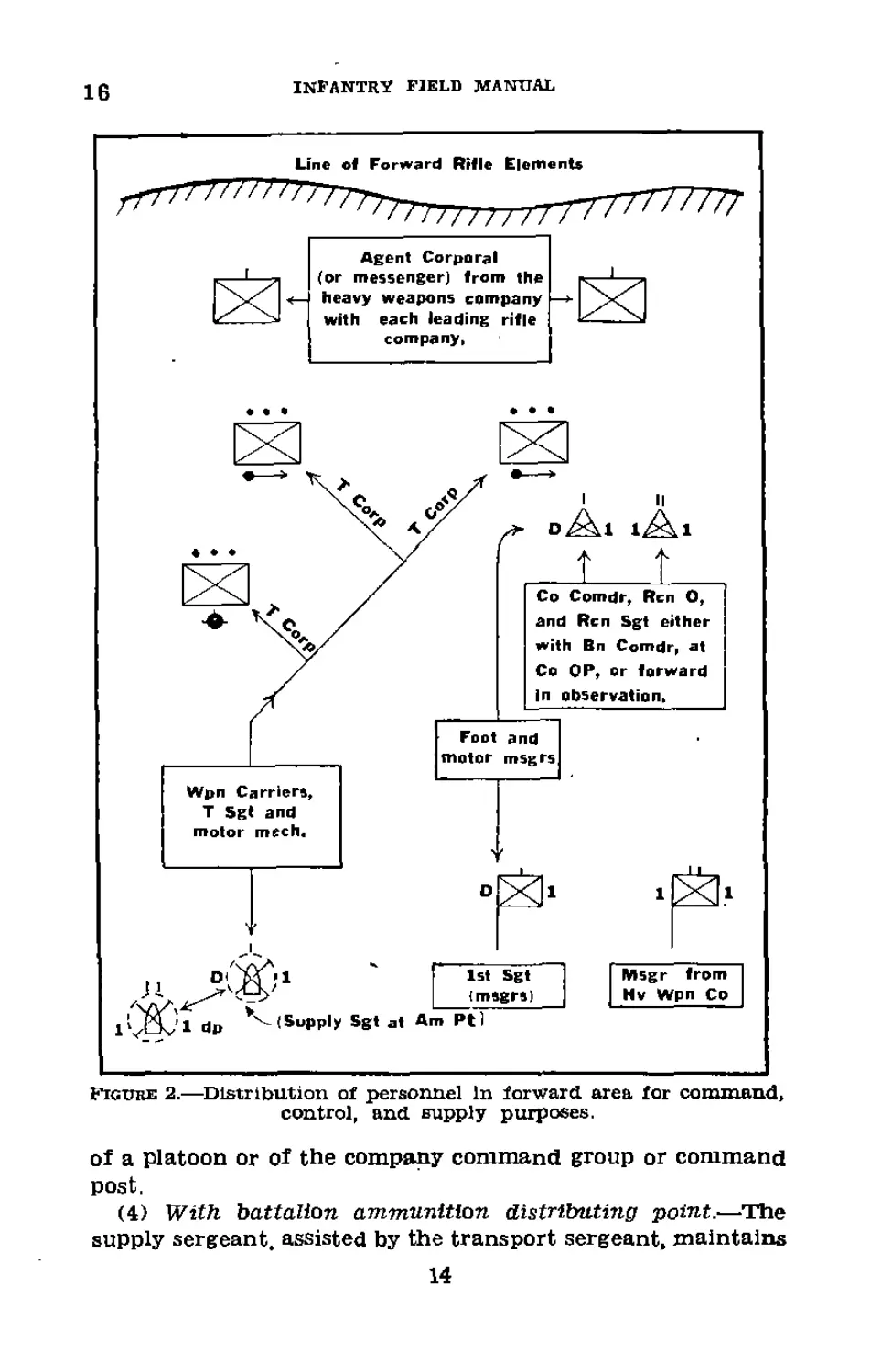
 16. Liaison.—a. The normal distribution of personnel of
the heavy weapons company for command, control, and sup-
ply purposes in the forward area during an attack is shown
in figure 2. In general, personnel are distributed similarly
in defensive combat.
b. The heavy weapons company commander is responsible
for liaison as follows:
(1)	With battalion commander.—The company observation
post is located in the vicinity of the battalion observation
post. The commander remains with the battalion com-
mander, except when duties require his presence elsewhere.
During such absence, the company commander designates a
representative to remain with the battalion commander.
This representative should preferably be the reconnaissance
officer, reconnaissance and signal sergeant, or any other
noncommissioned officer or suitably trained private readily
available.
(2)	With battalion command post.—The company com-
mand post is located in the vicinity of the battalion com-
mand post. The first sergeant operates the company
command post. He sends a messenger to the battalion com-
mand post when the battalion develops for combat, and sees
that this messenger service is maintained.
(3)	With platoons of company.—Upon deployment of the
company, the company command group is augmented by one
messenger from each platoon. Platoon messengers are used
for communication with their platoons. Company messen-
gers may be used for this purpose. Messengers are ex-
changed each time a major change is made in the location
13
16
INFANTRY FIELD MANUAL
Line of Forward Rifle Elements
77ГГП7Т7
Figure 2.—Distribution of personnel In forward area for command,
control, and supply purposes.
of a platoon or of the company command group or command
post.
(4)	With battalion ammunition distributing point.—The
supply sergeant, assisted by the transport sergeant, maintains
14
HEAVY WEAPONS COMPANY, RIFLE REGIMENT 16-17
liaison with the first sergeant at the command post, with
the battalion transport officer, and with the transport
corporals of the platoons.
(5)	With attacking or de fending rifle companies.—Prior
to combat, the company commander issues instructions for
the establishment of liaison with each front-line rifle com-
pany. Usually, a front-line rifle company is assigned the
agent corporal from the platoon whose fires will most directly
support it. The task of each agent is to assist the rifle com-
pany commander to whom assigned by keeping him informed
of the location and missions of the platoon and providing
technical information when it is desired. It is desirable that
a messenger, or a basic private trained as a messenger,
accompany each agent.
 17. Duties of Personnel of Company Headquarters.—a.
Use of command group.—The company commander employs
his command group primarily to assist him in making the nec-
essary preparation for combat and in controlling his company
during combat. A suggested division of duties among mem-
bers of this group is given below. However, each company
commander should prescribe the posts and duties of his own
command group so as to utilize individual capabilities to best
advantage.
b. Duties of command group.—(1) The reconnaissance offi-
cer, who is second-in-command of the company, keeps
abreast of the tactical situation as it affects the company.
He replaces the company commander, should the latter be-
come a casualty. His primary duty, assisted by the recon-
naissance detail (reconnaissance and signal sergeant, bugler,
and a messenger), is reconnaissance for initial and subse-
quent firing position areas, targets, off-carrier positions,
routes for displacement, and ammunition supply. Prior to
combat he may report to the battalion commander, with the
reconnaissance detail, to perform such reconnaissance as may
be directed. This reconnaissance will, in general, pertain
to the employment of the heavy weapons company in sup-
porting a particular battalion plan of action. Reconnaissance
may be made of the entire battalion area to determine suit-
able position areas and possible targets to provide the bat-
15
17
INFANTRY FIELD MANUAL
talion commander with detailed information on which to base
the battalion plan of action, The reconnaissance officer may
assist in the computation of firing data. He may utilize mem-
bers of the reconnaissance detail to assist platoon leaders
in the movement of their platoons to initial and subsequent
firing positions.
(2)	The first sergeant is the principal enlisted assistant of
the company commander. His duties will vary widely during
combat from administrative and supply matters to actual
command of a platoon, if casualties necessitate such replace-
ment. One of his primary duties is the maintenance of com-
munication from the company command post with the ele-
ments of the company, the battalion command post, and the
company commander. (See chapter 10.)
(3)	The reconnaissance and signal sergeant is the first
assistant of the reconnaissance officer. His primary duty
is reconnaissance.
(4)	The transport sergeant is responsible to the company
commander for the maintenance of vehicles. During com-
bat, he assists the company supply sergeant; in compliance
with the latter’s instructions, he controls the movement of
vehicles engaged in ammunition supply between the company
ammunition point and platoon areas. The transport ser-
geant supervises the camouflage and concealment of vehicles.
He checks and, if necessary, changes their locations to insure
the maximum protection against hostile air and mechanized
attack. He takes over the duties of the supply sergeant when
the latter is not present in the forward area. (See par.
239b (2) (d).)
(5)	The motor mechanics assist the transport sergeant in
the maintenance of vehicles (second echelon maintenance).
(6)	The bugler is trained as a messenger and observer.
He is employed to assist the company commander and the
reconnaissance officer in observation and control.
(7)	The orderly is trained as a messenger and observer.
He accompanies the company commander wherever he goes
and assists him in observation and control.
(8)	All messengers are also trained as observers and may
be used to man observation posts.
(9)	The chauffeurs assigned to company headquarters may
16
HEAVY WEAPONS COMPANY, RIFLE REGIMENT 17-18
be used as motor messengers. All chauffeurs, including those
driving weapon carriers, are responsible for the habitual
camouflage and concealment of their individual vehicles and
for their protection against aircraft. They perform first
echelon maintenance of their vehicles,
(10)	Basic privates are trained as replacements and as mes-
sengers. Until actually assigned as replacements, they are
employed as directed by the company commander,
c. Duties of administration group.—(1) The supply ser-
geant is usually present in the forward area during combat.
He assists the company commander in supply and is usually
made responsible to the company commander for the opera-
tion of the company ammunition point,
(2) For duties of other members of this group, see para-
graph 234a.
 18. Standard Measures for Antiaircraft Security and Anti-
mechanized Defense.—a. Warning system.—Timely warning
is a vital factor in reducing losses from air or mechanized
attack. Air-antitank guards are detailed for the protection
of the company, or to protect separate platoons. These guards
are assigned sectors of observation,
b. Standard warning signal.—(1) In transmitting warning
of the approach or presence of hostile aircraft or mechanized
vehicles, air-antitank guards, or other personnel engaged on
security missions, use the following signals:
(a)	Three long blasts of a whistle, vehicular horn, siren,
or klaxon, repeated several times;
(b)	Three equally spaced shots with-а rifle, automatic rifle,
carbine, or pistol; or
(c)	Three short bursts from a machine gun or submachine
gun.
(2) In daylight, the individual giving the signal points in
the direction of impending danger. At night, the warning
signal is supplemented by voice warning to indicate the direc-
tion of danger,
(3) All organic means of communication are immediately
employed to transmit the warning signal throughout the com-
pany or separate platoon.
17
18
INFANTRY FIELD MANUAL
c. Action in case of attack.—(1) General.—Upon receipt of
warning of hostile air or mechanized attack, foot troops on
the march clear the road, disperse, and take cover. In any
situation, personnel utilize nearby holes or ditches for indi-
vidual protection; they take advantage of any nearby obstacles
to tank movement. Weapon carriers, if with the company,
clear the probable impact area of air attack and move into
suitable nearby locations which provide obstacles to tank
movement.
(2) Antiaircraft fires.—In the absence of orders, the com-
pany commander decides whether or not Are will be opened
on hostile airplanes. When concealment is essential and is
believed to have been achieved, no weapons fire at hostile
airplanes. If attacked from the air, heavy machine-gun
crews, the operator of the carrier automatic rifle, and all men
armed with rifles and carbines open fire as soon as the hostile
airplanes are within effective range of their respective weap-
ons. When both air and ground targets exist, heavy ma-
chine guns Are on the target which, in the judgment of the
respective platoon or section leaders, offers the greatest threat
to the accomplishment of the assigned mission.
(3) Antimechanised fires.—In case of attack by tanks or
more lightly armored vehicles, one man in each section em-
ploys antitank rifle grenades within effective range (75 yards).
Primary targets for rifles, carbines, and heavy machine guns
are hostile foot troops. These weapons do not ordinarily
Are on approaching tanks, but do Are on lightly armored
vehicles, such as personnel carriers or scout cars, which come
within effective range'Of their respective weapons. Having
taken cover against tanks, personnel and weapons return
to their firing positions as soon as the tanks have passed, in
order to fire on approaching foot troops.
d. References.—Active and passive measures for both anti-
aircraft security and antimechanized defense will vary with
the situation. Various situations are discussed in paragraphs
27 c and d (approach march), 29 (assembly area), 37 (attack),
and 64 e and 66 (defense).
18
HEAVY WEAPONS COMPANY, RIFLE REGIMENT
19
CHAPTER 2
MARCHES AND BIVOUAC
 19. Route March.—a. In route column the heavy weapons
company moves in the battalion formation as directed by the
battalion commander.
b. The company may move in two echelons—a foot echelon
and a motor echelon. The motor echelon comprises all ve-
hicles not required for command, control, and security.
(1) When the foot and motor elements are separated in
route column, a minimum machine-gun crew of two men
rides each machine-gun weapon carrier, prepared to operate
the heavy machine gun for antiaircraft fires. In addition to
the chauffeur, one man rides the weapon carrier of each
machine-gun or mortar section that is equipped with an auto-
matic rifle. The primary mission of this man is to operate
the automatic rifle in antiaircraft defense. One man rides
the other carrier of its section to operate the M1903 rifle
primarily for antitank defense. (See par. 4.)
(2) The battalion commander ordinarily directs either that
heavy machine-gun weapon carriers be distributed through
the depth of the battalion column to protect it against hostile
air attack, or that these elements occupy successive firing
positions near the route of march. He may direct that ma-
chine-gun elements precede the column to provide antiaircraft
security at defiles, or to establish this security around an
assembly area prior to arrival of the battalion. Leaders of
heavy machine-gun platoons, sections, and squads employed
on such missions remain with their weapons; the foot elements
of these units march In the company foot column.
c.	The company, less any elements assigned security mis-
sions, may move as a unit. Weapon carriers may then move
by bounds immediately behind the foot elements of the
company, or each weapon carrier may move with its squad.
Combat must never find weapons separated from the gun
squads.
d.	When marching on a road under threat of air attack,
foot elements of the company march in column of twos, one
file on each side of the road.
19
19-21
INFANTRY FIELD MANUAL
e.	Upon receipt of warning of an air or mechanized attack,
action is taken as indicated in paragraph 18e.
 20. Advance Guard.—a. When the heavy weapons company
is part of an advance guard, the company commander accom-
panies the advance guard commander.
b. During the advance, the company commander should
employ his reconnaissance officer, assisted by a detail, to
follow the advance party. When resistance is encountered,
the reconnaissance officer reconnoiters promptly for pos-
sible observation posts, firing positions, and routes thereto.
The reconnaissance detail usually includes a representative
from each platoon. These representatives guide platoons to
initial firing positions to support the action of the advance
guard. Organic vehicles of the company headquarters may
be used to carry the reconnaissance detail.
e. Heavy machine guns on carriers, with skeleton crews,
may provide antiaircraft protection to the advance guard
as described in paragraph 19b.
d. Weapon carriers of elements not attached to the sup-
port (or advance party), or not required for antiaircraft
protection, may be retained under battalion control and move
with the motor elements of the battalion. When contact
with the enemy becomes imminent, they are brought for-
ward and released to their units. Foot elements usually
march with the reserve of the advance guard. Where early
use of machine-gun support for the leading rifle company is
foreseen, some machine-gun units may march with the sup-
port.
e. When a platoon, or other element of the company,
forms part of the advance guard, while the remainder of
the company marches with the main body, its conduct is
analogous to that of the company as described above.
 21. Flank Guard.—a. The mission of a flank guard is to
protect a marching column from observation and surprise
from the flank, and, in the event of an attack in force, to
provide the necessary time and space for the deployment
of the main body. The heavy weapons company, or portions
thereof, may form a part of the flank guard. (See FM 100-5.)
b. (1) When the locality from which an attack can be
20
HEAVY WEAPONS COMPANY, RIFLE REGIMENT
21
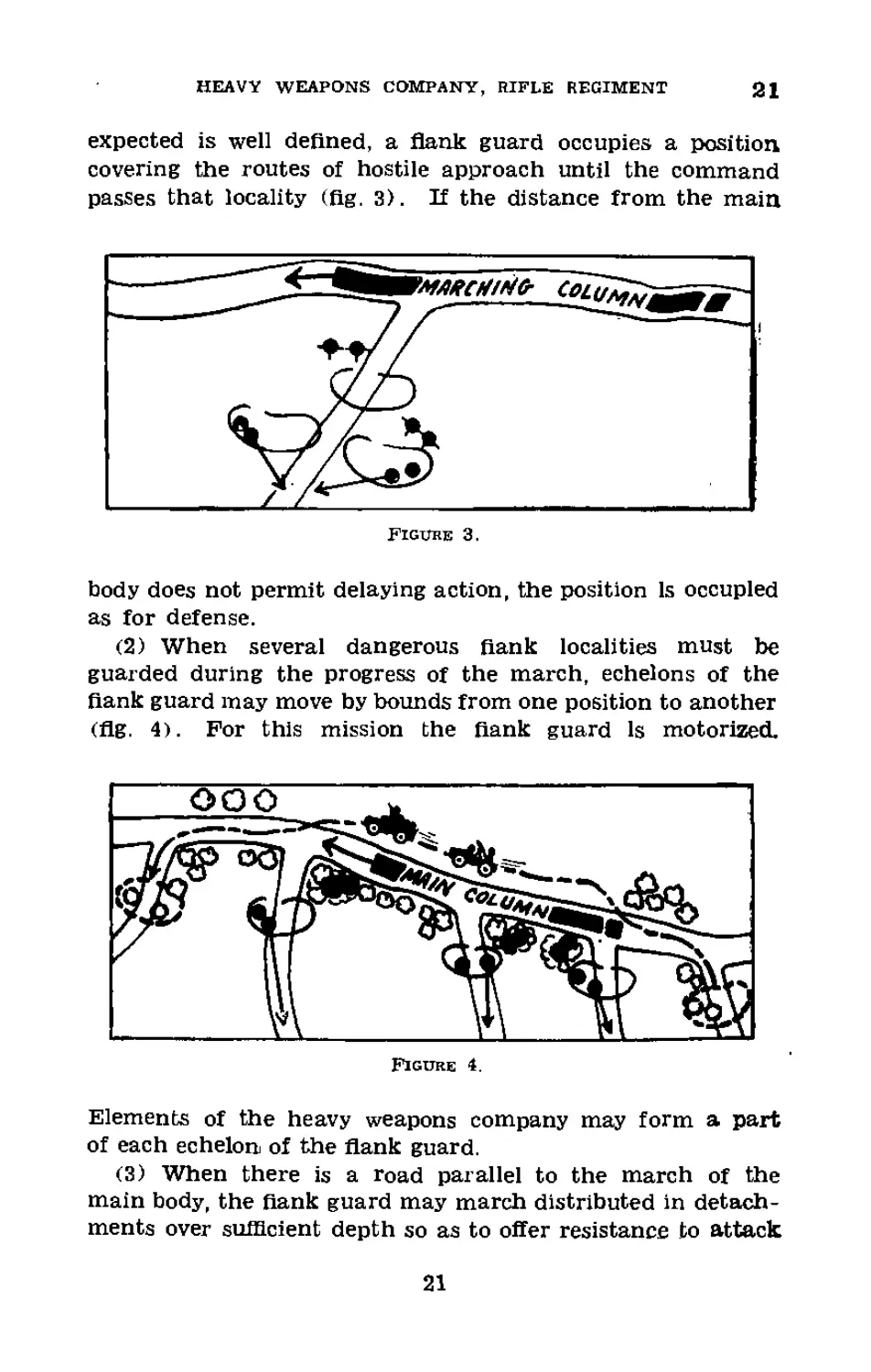
expected is well defined, a flank guard occupies a position
covering the routes of hostile approach until the command
passes that locality (tig. 3). If the distance from the main
body does not permit delaying action, the position Is occupied
as for defense.
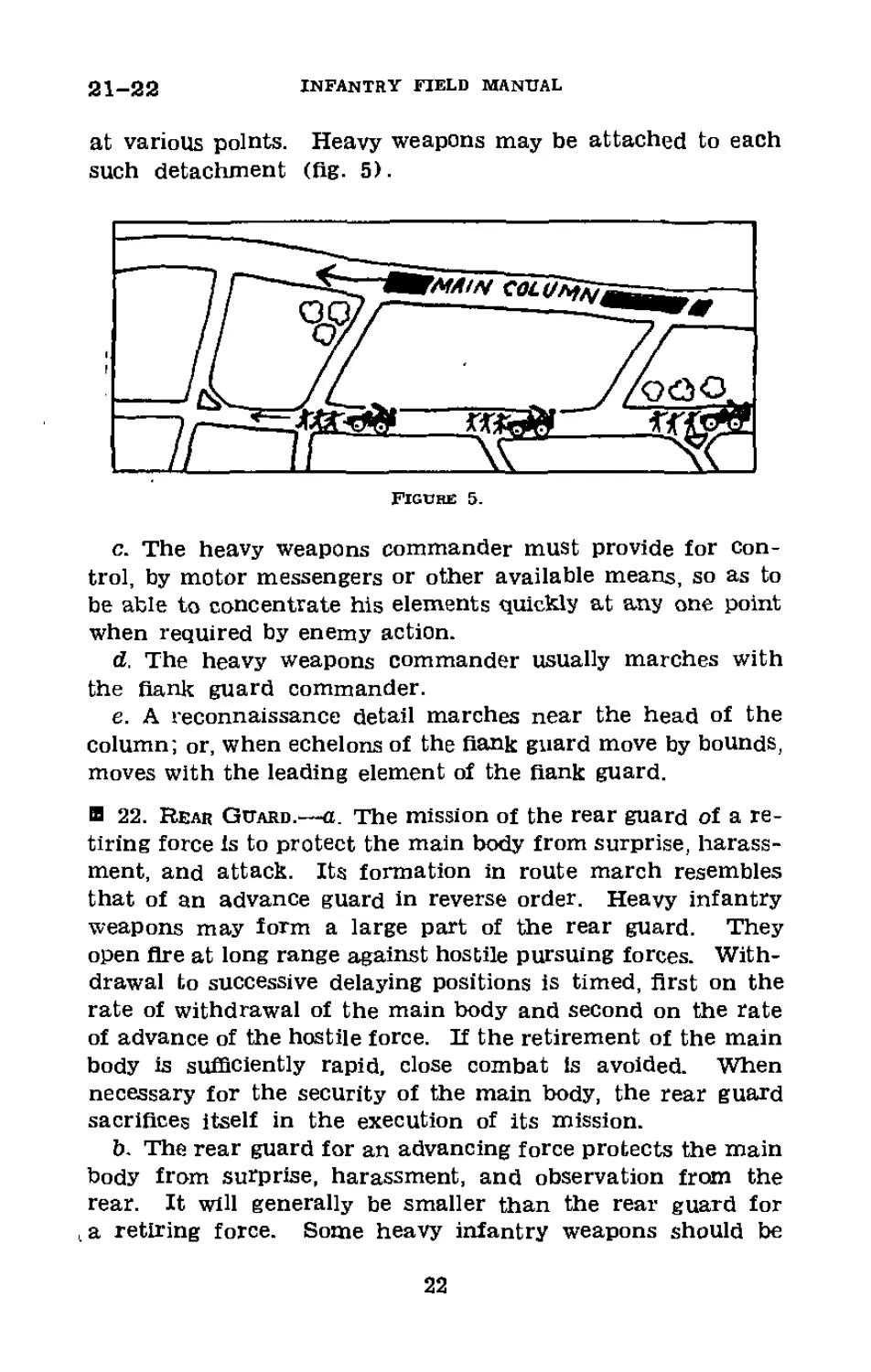
(2) When several dangerous flank localities must be
guarded during the progress of the march, echelons of the
flank guard may move by bounds from one position to another
(flg. 4). For this mission the flank guard Is motorized.
Figure 4.
Elements of the heavy weapons company may form a part
of each echelon of the flank guard.
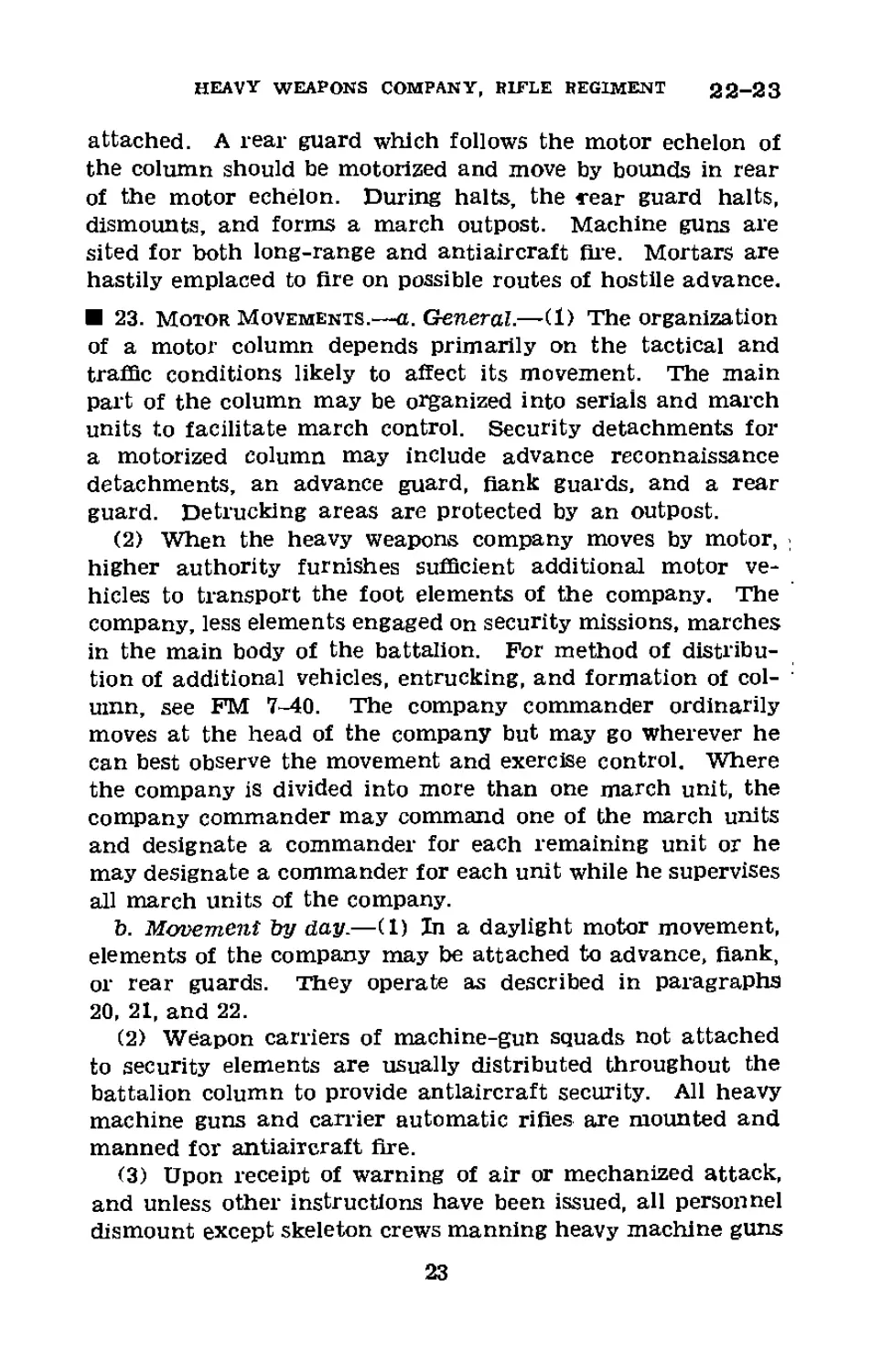
(3) When there is a road parallel to the march of the
main body, the flank guard may march distributed in detach-
ments over sufficient depth so as to offer resistance to attack
21
21-22
infantry field manual
at various points. Heavy weapons may be attached to each
such detachment (fig. 5).
FiGtfHE 5.
c.	The heavy weapons commander must provide for Con-
trol, by motor messengers or other available means, so as to
be able to concentrate his elements quickly at any one point
when required by enemy action.
d.	The heavy weapons commander usually marches with
the flank guard commander.
e.	A reconnaissance detail marches near the head of the
column; or, when echelons of the flank guard move by bounds,
moves with the leading element of the flank guard.
И 22. Rear Guard.—a. The mission of the rear guard of a re-
tiring force Is to protect the main body from surprise, harass-
ment, and attack. Its formation in route march resembles
that of an advance guard in reverse order. Heavy infantry
weapons may form a large part of the rear guard. They
open fire at long range against hostile pursuing forces. With-
drawal to successive delaying positions is timed, first on the
rate of withdrawal of the main body and second on the rate
of advance of the hostile force. If the retirement of the main
body is sufficiently rapid, close combat is avoided. When
necessary for the security of the main body, the rear guard
sacrifices itself in the execution of its mission.
b.	The rear guard for an advancing force protects the main
body from surprise, harassment, and observation from the
rear. It will generally be smaller than the rear guard for
a retiring force. Some heavy infantry weapons should be
22
HEAVY WEAPONS COMPANY, RIFLE REGIMENT 22-23
attached. A rear guard which follows the motor echelon of
the column should be motorized and move by bounds in rear
of the motor echelon. During halts, the rear guard halts,
dismounts, and forms a march outpost. Machine guns are
sited for both long-range and antiaircraft fire. Mortars are
hastily emplaced to fire on possible routes of hostile advance.
 23. Motor Movements.—a. General.—(1) The organization
of a motor column depends primarily on the tactical and
traffic conditions likely to affect its movement. The main
part of the column may be organized into serials and march
units to facilitate march control. Security detachments for
a motorized column may include advance reconnaissance
detachments, an advance guard, flank guards, and a rear
guard. Detrucking areas are protected by an outpost.
(2) When the heavy weapons company moves by motor, ;
higher authority furnishes sufficient additional motor ve-
hicles to transport the foot elements of the company. The
company, less elements engaged on security missions, marches
in the main body of the battalion. For method of distribu-
tion of additional vehicles, entrucking, and formation of col- •
umn, see FM 7-40. The company commander ordinarily
moves at the head of the company but may go wherever he
can best observe the movement and exercise control. Where
the company is divided into more than one march unit, the
company commander may command one of the march units
and designate a commander for each remaining unit or he
may designate a commander for each unit while he supervises
all march units of the company.
b. Mtyvemenl by day.—(1) In a daylight motor movement,
elements of the company may be attached to advance, flank,
or rear guards. They operate as described in paragraphs
20, 21, and 22.
(2) Weapon carriers of machine-gun squads not attached
to security elements are usually distributed throughout the
battalion column to provide antiaircraft security. All heavy
machine guns and carrier automatic rifles are mounted and
manned for antiaircraft fire.
(3) Upon receipt of warning of air or mechanized attack,
and unless other instructions have been issued, all personnel
dismount except skeleton crews manning heavy machine guns
23
33-24
INFANTRY FIELD MANUAL
and Individuals manning carrier automatic rifles. Action is
taken as Indicated in paragraph 18c.
c. Movement by night.—(1) In a night' motor movement,
elements of the company are seldom attached to advance,
flank, or rear guards. Weapon carriers of machine-gun
squads may, however, be distributed throughout the battalion
column.
(2)	Special measures must be taken to maintain direction
and control. Regardless of directional aids provided by the
battalion or higher commanders, the company commander re-
mains responsible for following the proper route. He is usu-
ally furnished a route sketch, but should reconnoiter the route
in daylight whenever practicable. The reconnaissance officer,
or reconnaissance and signal sergeant, accompanies the bat-
talion commander as a liaison agent; a representative of
each platoon (usually the agent corporal) rides in the same
vehicle with the company commander, or in the vehicle
immediately in rear.
(3)	Strict march discipline is necessary to keep vehicles
closed up, to prevent elements from becoming lost, to avoid
accident, and to prevent smoking or unauthorized use of
lights. Chauffeurs should be relieved every two hours, pro-
vided with hot coffee if practicable, and required to dismount
and exercise at all halts. Each vehicle commander, .riding
beside the chauffeur, by conversation and other means, assures
himself that the chauffeur stays awake.
(4)	If the column is attacked by hostile airplanes, only
weapons specifically designated by the battalion commander
open fire.
 24. Bivouac.—a. General.—The battalion commander des-
ignates the location of the company bivouac area. The com-
pany commander assigns areas to the elements of his com-
pany. He designates the location of the company command
post, kitchen, and latrines. Unless the company transport is
under battalion control, he requires vehicles (less those em-
ployed on security missions) to be irregularly spaced, dis-
persed, and concealed or camouflaged. He verifies that a
messenger from each platoon is with the company head-
quarters, and that each of these messengers knows the exact
location of his platoon headquarters. He designates a point
24
HEAVY WEAPONS COMPANY, RIFLE REGIMENT	‘24
at which the company will assemble in emergencies, particu-
larly during hours of darkness. He reconnoiters and, as
necessary, has marked routes of egress for night movement.
b. Security.—(1) Elements of the heavy weapons company
may be attached to the supports of the outpost established
by the battalion or higher commander. Heavy weapons are
emplaced for long-range Are and are also assigned secondary
antiaircraft security missions. For the defense of the outpost
line of resistance close-defensive fires are planned and-posi-
tions are selected from which these fires can be delivered.
(2)	The battalion commander may direct that heavy ma-
chine guns not attached to the outpost be employed to
protect the battalion bivouac area against air attack. These
guns should be assigned positions around the perimeter of
the bivouac area. High ground should be utilized so .as to
permit Are on attacking airplanes approaching from any
direction. Platoons employed on antiaircraft security post
air-antitank guards. Fires are withheld except in icase of
actual attack.	J
(3)	An interior guard is established to maintain camoU-
Aage discipline and. in case of attack, to alert that;partof >
the company not engaged on security missions. The 'inte-
rior guard is especially alert for any indication of attack
with gas, tanks, or other mechanized vehicles, and aircraft.
Individual protective trenches will be dug for all personnel to
provide protection against air or mechanized attack; these
trenches or foxholes and shelter tents, if erected, must be
concealed from aerial observation. Protective trenches are
occupied only when an attack is in progress or imminent.
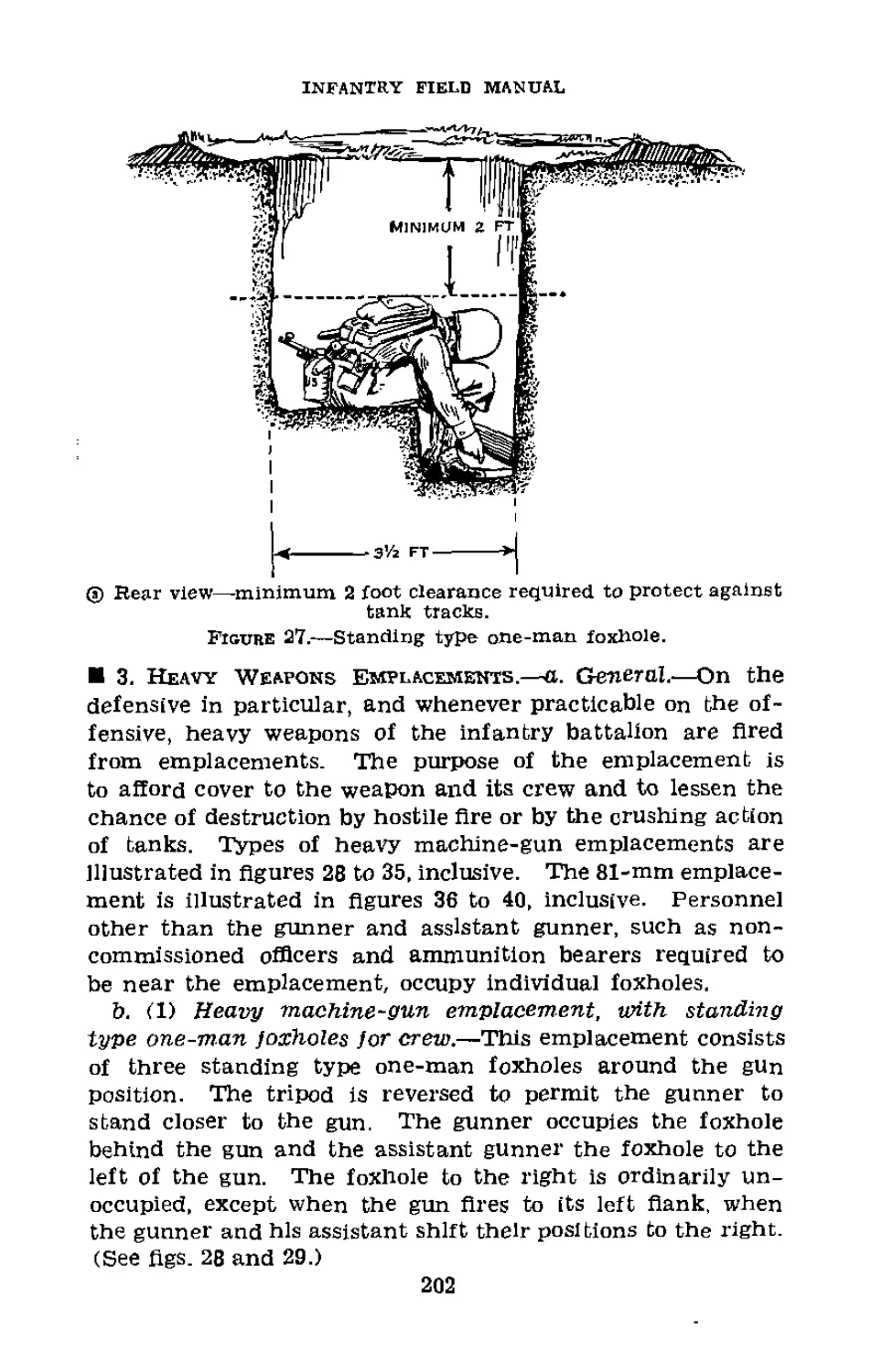
(See Ags. 26 and 27.)
(4)	One man of each section not engaged on security mis-
sions is armed with the M1903 ride and antitank ride gre-
nades (see paragraph 4c) for antitank defense; these men
are located so as best to protect that part of the company
located in the bivouac area. Men charged with antitank
defense of sections engaged on security missions are with
their respective sections. Hostile tanks, or lightly armored
vehicles, are combatted with antitank ride grenades as
described in paragraph 18c.
25
35
INFANTBY FIELD MANUAL
CHAPTER 3
OFFENSIVE COMBAT
Paragraphs
Section I. General_________________________________________  25
II.	Approach march_________________________________26-29
HI. Reconnaissance prior	to attack, and orders_____30-33
IV.	Attack___________________________________     34-44
V.	Night attack_________________________________  45-47
VI.	Raids___________________________________________ 48
VII.	Attack in woods_______________________________49-51
VIII.	Attack of towns and	villages._____________ 52
IX.	Attack of river line__________ _______________53-55
Section I
GENERAL
 25. Tactical Employment.—a. Attack missions.—The gen-
eral missions of the company and its elements in the attack
are—
(1) To give close support to leading rifle companies.—(a)
Heavy machine guns and mortars are employed by the bat-
talion commander to engage by fire hostile elements oppos-
ing the advance of his attacking echelon. These hostile
elements may include any observed in adjacent zones of
action or those located within effective range in rear of the
hostile front-line elements. For suitable targets for each
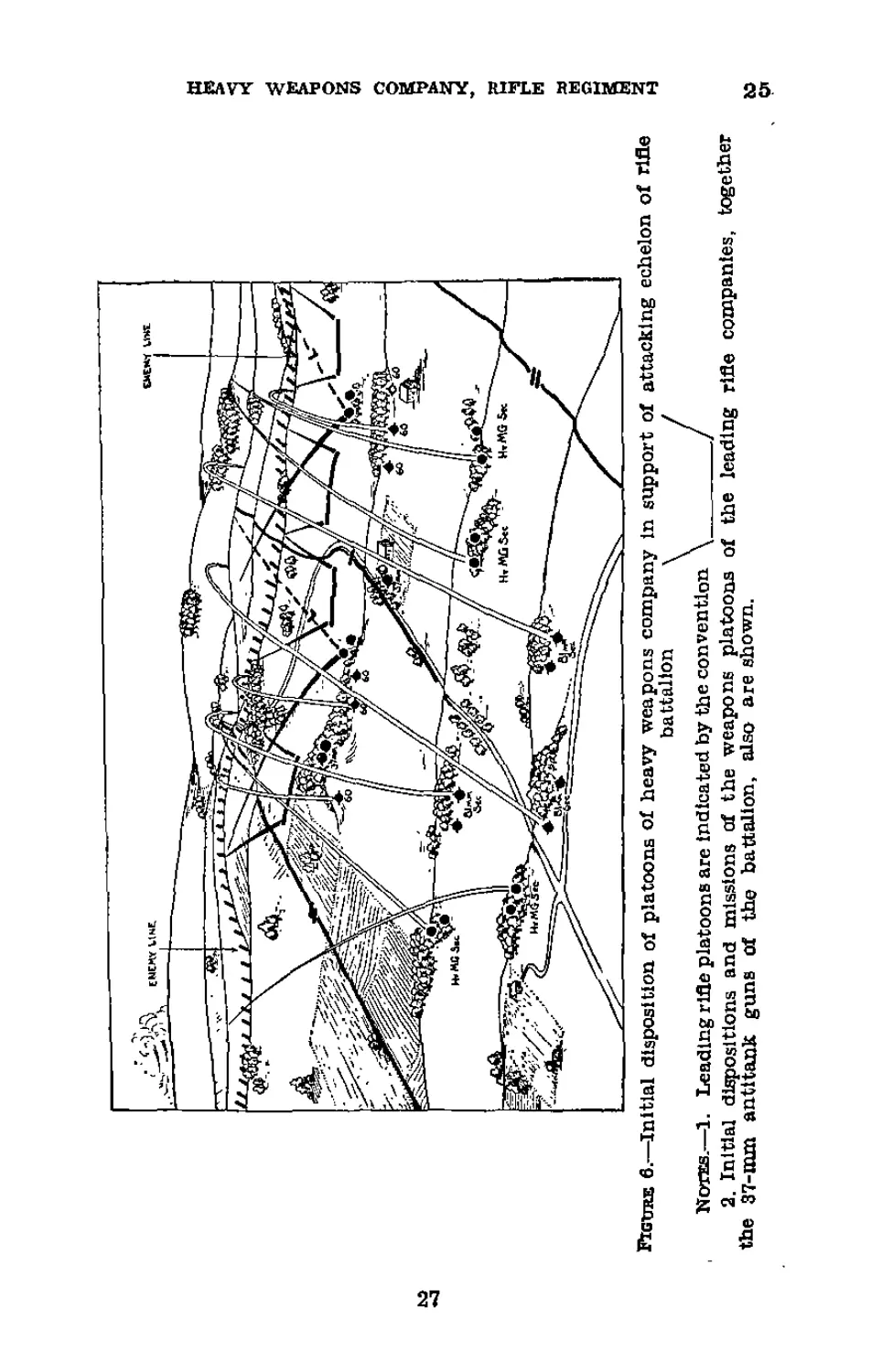
weapon, see paragraphs 2d and 3d. (See fig. 6.)
(b)	Short preparatory machine-gun fires may be em-
ployed. in conjunction with an artillery preparation.
(c)	The employment of the mortar platoon is affected by
the weight and bulk of its ammunition, which increase the
difficulty of supply, and by the fact that smoke shell usually
comprises approximately 20 percent of the total load car-
ried in all supply echelons of the division. Mortars may be
employed to place smoke screens of limited extent and dura-
tion. Since mortars can safely place Are closer to the at-
tacking riflemen than can artillery, mortar unit leaders
must be alert to engage suitable targets left unengaged
when artillery fires are shifted to rearward hostile positions.
(d)	When fires are masked by the advance of the at-
tacking echelon, elements of the heavy weapons company
must shift their fires to adjacent or rearward targets, or
must displace.
26
ьо
HEAVY WEAPONS COMPANY, RIFLE REGIMENT
Ftguhe 6.—Initial disposition of platoons of heavy weapons company in support of attacking echelon of rifle
battalion у	/
Notes.—1. Leading rifle platoons are indicated by the convention \___________/
2. Initial dispositions and missions of the weapons platoons of the leading rifle companies, together
the 37-mm antitank guns of the battalion, also are shown.
to
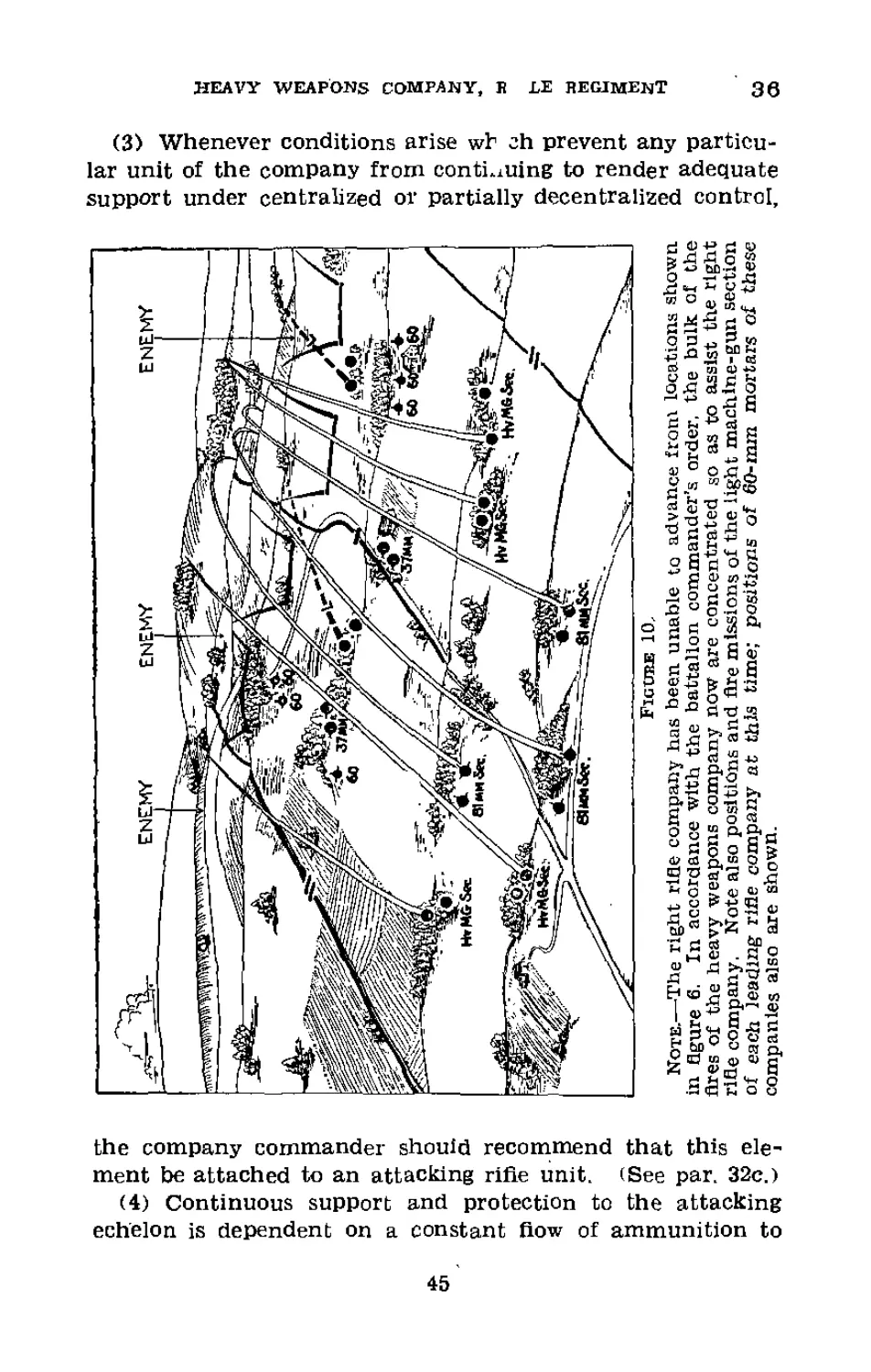
сл
Й5
INFANTRY FIELD MANUAL
(2)	To protect flanks of battalion.—Provision is made for
flank protective fires by heavy machine guns and mortars
whenever the location, or the advance, of the battalion creates
an exposed flank. Flank protection automatically becomes
a mission Of a machine-gun platoon occupying positions on
an exposed flank. Flank protective fires are opened upon ob-
servation of enemy action, upon signal, or upon call from
rifle companies. Information or observation of the exact
location of friendly rifle elements which might be endangered
by those fires is imperative.
(3)	To protect battalion against hostile low-flying air-
planes.—Heavy machine-gun platoons furnish such antiair-
craft protection for the battalion as is consistent with ground
missions. In case of air attack, unless specific orders to the
contrary have been issued, platoon and section leaders exercise
their own judgment and engage whichever target, air or
ground, is of greatest immediate danger to the units they
are supporting.
(4)	To support attacks made in conjunction with tanks.—
When the infantry attack is supported by tanks, the primary
mission of the heavy weapons company is the neutralization
of hostile antitank weapons. Fires in close support of tank
advances must be observed fires. Heavy machine-gun and
mortar crews open fire on all antitank weapons which dis-
close themselves. The heavy machine guns also fire to pro-
tect friendly tanks against attack by hostile infantry when
the tanks are halted on or in front of the objective. As soon
as the objective is captured, a portion of the company should
move forward promptly and establish itself in firing posi-
tions on the objective.
b. Location of firing position areas of mortar and machine-
gun platoons.—(1) The position areas assigned to mortar and
machine-gun platoons must permit the selection of firing
positions from which fire can be placed on all assigned tar-
gets, or on any target appearing in assigned sectors of fire.
They must also permit the selection of observation posts
from which the fire of each weapon can be adjusted on its
targets, and from which the advance of friendly troops who
might be endangered by its fire can be observed. Observa-
tion posts for machine-gun units must be at or near the guns.
28
HEAVY WEAPONS COMPANY, RIFLE REGIMENT
25
Those for mortars are preferably located within voice or arm-
and-hand signaling distance of the weapons; they must at
least be close enough to the weapons to enable communica-
tion to be maintained with the facilities allotted to the
platoon.
(2) The position area, or areas, assigned the . mortar,
platoon or its elements should, if practicable, also afford firing
positions fully defiladed from small-arms fire, and concealed
from aerial observation.
(3) If practicable, the firing position area assigned a
machine-gun platoon should permit both overhead and
flanking fires for the close support of the attacking echelon.
If position areas permitting overhead fires cannot be secured,
gaps between attacking infantry units must bs utilized. The
position area should also permit firing positions to be
selected in position defilade or partial defilade.
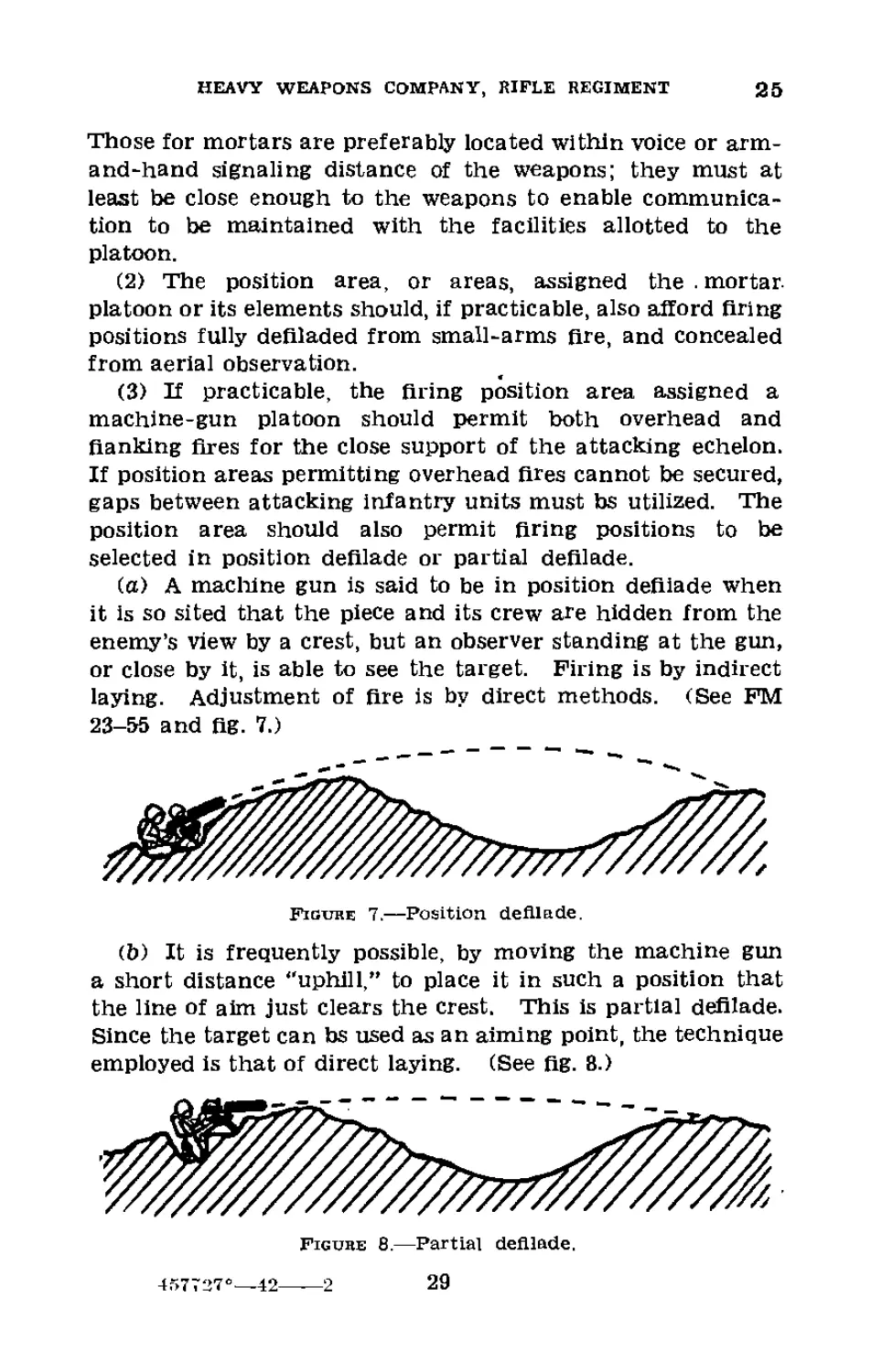
(a)	A machine gun is said to be in position defilade when
it is so sited that the piece and its crew are hidden from the
enemy’s view by a crest, but an observer standing at the gun,
or close by it, is able to see the target. Firing is by indirect
laying. Adjustment of fire is by direct methods. (See FM
23-55 and fig. 7.)
Figure 7.—Position defilade.
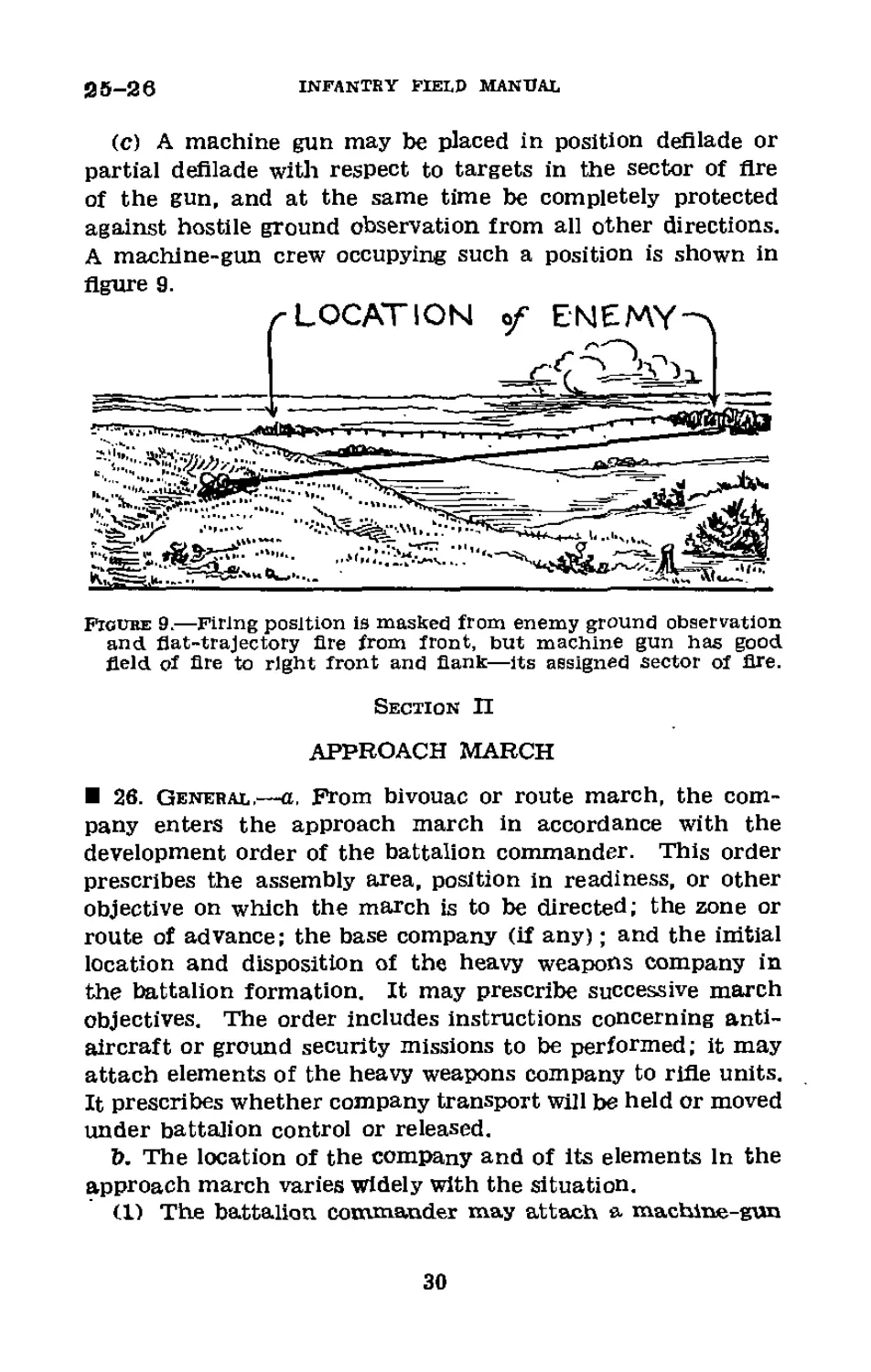
(b)	It is frequently possible, by moving the machine gun
a short distance "uphill,” to place it in such a position that
the line of aim just clears the crest. This is partial defilade.
Since the target can bs used as an aiming point, the technique
employed is that of direct laying. (See fig. 8.)
Figure 8.—Partial defilade.
457727е—42——2	29
05-26
INFANTRY FIELD MANUAL
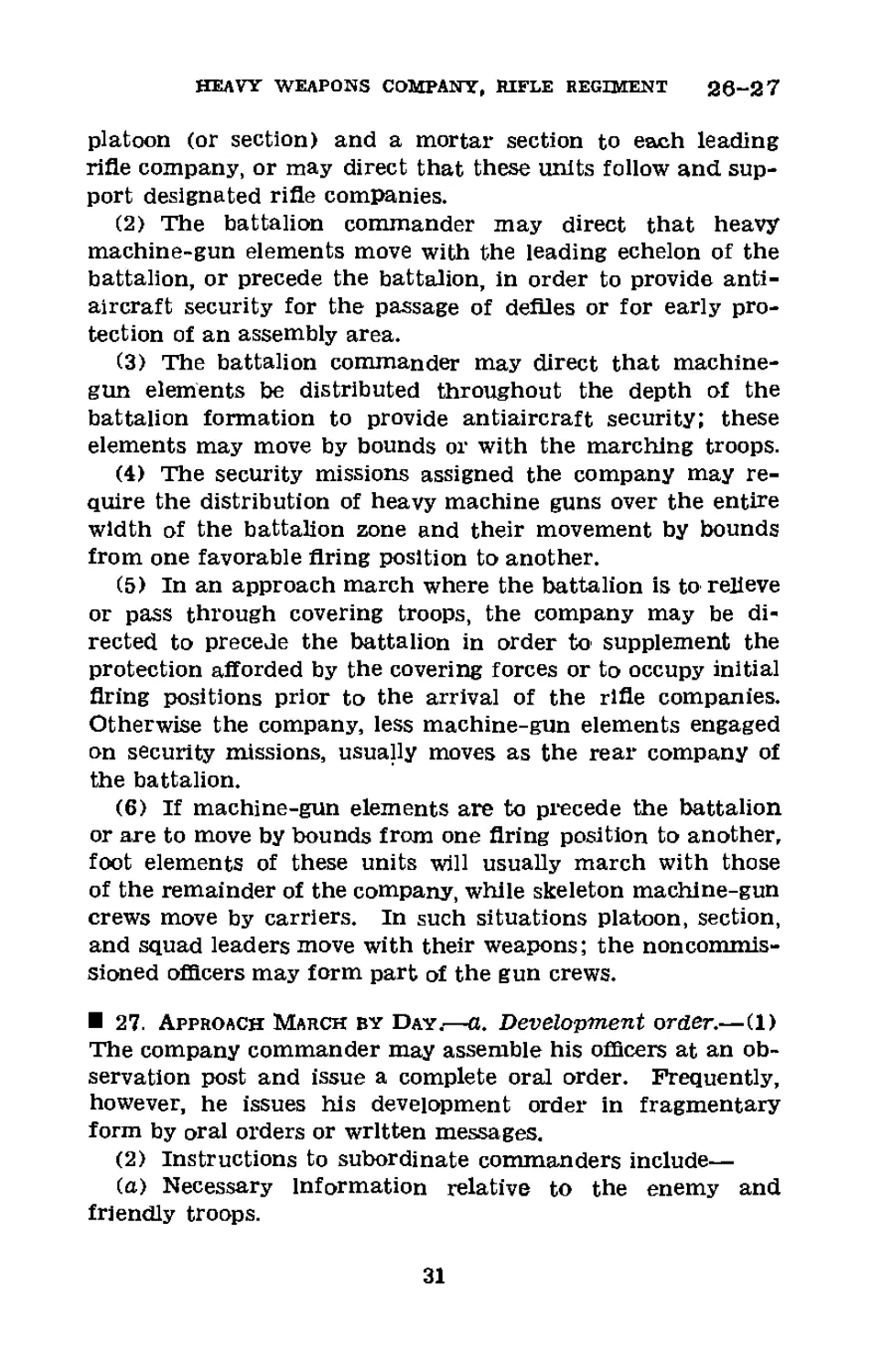
(c)	A machine gun may be placed in position defilade or
partial defilade with respect to targets in the sector of fire
of the gun, and at the same time be completely protected
against hostile ground observation from all other directions.
A machine-gun crew occupying such a position is shown in
г LOCATION о/ ENEMY
figure 9.
Figube 9.—Firing position is masked from enemy ground observation
and fiat-trajectory fire from front, but machine gun has good
field of fire to right front and flank—its assigned sector of fire.
Section П
APPROACH MARCH
 26. General,—a, From bivouac or route march, the com-
pany enters the approach march in accordance with the
development order of the battalion commander. This order
prescribes the assembly area, position in readiness, or other
objective on which the march is to be directed; the zone or
route of advance; the base company (if any); and the initial
location and disposition of the heavy weapons company in
the battalion formation. It may prescribe successive march
objectives. The order includes instructions concerning anti-
aircraft or ground security missions to be performed; it may
attach elements of the heavy weapons company to rifle units.
It prescribes whether company transport will be held or moved
under battalion control or released.
b. The location of the company and of its elements In the
approach march varies widely with the situation.
(1)	The battalion commander may attach a machine-gun
30
HEAVY WEAPONS COMPANY, RIFLE REGIMENT 26-27
platoon (or section) and a mortar section to each leading
rifle company, or may direct that these units follow and sup-
port designated rifle companies.
(2)	The battalion commander may direct that heavy
machine-gun elements move with the leading echelon of the
battalion, or precede the battalion, in order to provide anti-
aircraft security for the passage of defiles or for early pro-
tection of an assembly area.
(3)	The battalion commander may direct that machine-
gun elements be distributed throughout the depth of the
battalion formation to provide antiaircraft security; these
elements may move by bounds or with the marching troops.
(4)	The security missions assigned the company may re-
quire the distribution of heavy machine guns over the entire
width of the battalion zone and their movement by bounds
from one favorable firing position to another.
(5)	In an approach march where the battalion is to relieve
or pass through covering troops, the company may be di-
rected to precede the battalion in order to supplement the
protection afforded by the covering forces or to occupy initial
firing positions prior to the arrival of the rifle companies.
Otherwise the company, less machine-gun elements engaged
on security missions, usually moves as the rear company of
the battalion.
(6)	If machine-gun elements are to precede the battalion
or are to move by bounds from one firing position to another,
foot elements of these units will usually march with those
of the remainder of the company, while skeleton machine-gun
crews move by carriers. In such situations platoon, section,
and squad leaders move with their weapons; the noncommis-
sioned officers may form part of the gun crews.
 27. Approach March by Day.—a. Development order.—(1)
The company commander may assemble his officers at an ob-
servation post and issue a complete oral order. Frequently,
however, he issues his development order in fragmentary
form by oral orders or written messages.
(2)	Instructions to subordinate commanders include—
(a)	Necessary Information relative to the enemy and
friendly troops.
31
37
INFANTRY FIELD MANUAL
(b)	The march objective(s) of the company.
(c)	Initial formation of the company to include the loca-
tion of each element detailed on antiaircraft or ground secu-
rity missions, in accordance with the battalion order, and the
designation, where necessary, of a base unit.
(d)	The direction of march of each platoon or detached
element, or the unit on which it is to guide; its security
mission (s) or, in the absence of such a mission, whether
it is to be prepared for immediate ground action throughout
the movement; its method of movement (see b below); and
its successive march objectives, if any.
(e)	Instructions for air-antitank guards, which may in-
clude the assignment of sectors of observation to platoons
so as to provide all-around protection.
(/) Any action to be taken in case of air or mechanized
attack not covered by battalion standing operating
procedure.
(ff) Position and route of movement of the company com-
mander.
(3)	Orders for the movement of any element of the com-
pany which is attached to a rifle unit must be promptly issued.
These orders will include instructions as to its method of
movement (see b below).
b.	Use of weapon carriers.—(1) if practicable, weapon car-
riers should move with all elements of the company assigned
security missions or otherwise required to be prepared for
prompt action. If this is not practicable, due to the situation
or to terrain conditions, these elements must hand-carry
their weapons and initial supply of ammunition.
(2) The instructions concerning the method of movement
of each platoon, or detached element, direct whether its
weapon carriers will move assembled under company control
or with the unit. When moved under company control, the
point where carriers will later be available to the unit/is an-
nounced, if practicable. If the carriers are to move with the
unit but have not joined it, the time and place at which they
will be released to the unit is announced.
c.	Antiaircraft security.—So far as the missions of the
company will permit, chief reliance for protection against
aerial observation and attack is placed on the use of dispersed
32
HEAVY WEAPONS COMPANY, BIFLE REGIMENT
27
formations and on the utilization of all available cover and
concealment. However, the automatic rifle that is mounted
on one weapon carrier of each section is manned, and each
heavy machine gun, until removed from its carrier, is mounted
for antiaircraft fire and manned by a skeleton crew. For a
discussion of antiaircraft fires see paragraph 18c. When fire
is opened, individuals armed with the rifle or carbine partici-
pate when airplanes come within effective range of their
weapons.
d.	Antimechanized defense.—(1) Whenever heavy weapons
are being carried on the weapon carriers, one man of each
section, armed with the M1903 rifle and antitank rifle gre-
nades, rides that section carrier which is not equipped with an
automatic rifle. When weapons are removed from the car-
riers, this man joins the foot elements of his section.
(2) Action against mechanized attack is discussed in para-
graph 18c.
e.	Reconnaissance during approach march.—(1) The com-
pany commander is responsible for initiating and continuing
reconnaissance throughout the approach march. The recon-
naissance detail joins the battalion command group at the
beginning of the march and remains with it until the bat-
talion commander announces a tentative plan of action or
directs reconnaissance. The reconnaissance detail may be
headed either by the company commander or the reconnais-
sance officer. If the company commander heads the recon-
naissance detail, the reconnaissance officer, or a platoon
leader, is placed in control of the movements of the company.
(2)	The reconnaissance detail executes such reconnais-
sances as are directed by the battalion commander and re-
ports results at times and places designated by him. These
reconnaissances deal especially with the location of gassed
areas, areas exposed to hostile observation, stream crossings,
and detours around obstacles to motor movement, and with
the employment of the heavy machine guns and mortars
under tentative plans of action indicated by the battalion
commander. Maps and aerial photographs, if available, are
used to supplement study of the ground. Friendly troops to
the front and on the flanks are valuable sources of informa-
33
27
INFANTRY FIELD MANUAL
tlon. Information of importance to the conduct of the com-
pany should be transmitted promptly to it.
(3)	The company commander, if not with the reconnais-
sance detail, or the officer in control of the movement Of the
company, conducts similar close-in reconnaissance of the
zone or route of advance with the assistance of remaining
members of the command group.
(4)	Although other company transport may be held under
battalion control, the company command truck and messenger
truck are employed to facilitate the movements of the com-
pany commander and of the reconnaissance detail, unless
the battalion commander specifically prohibits their use.
Similarly, the platoon headquarters truck is ordinarily re-
leased to each platoon leader.
/. Conduct of approach march.—(1) Based on the infor-
mation obtained from reconnaissance agencies, the company
commander, or the officer in direct control of the movement
of the company, regulates the disposition and movement of
the company. He prescribes formations and movements so as
to reduce losses from air or mechanized attack or from artil-
lery fire, conceal the movement from hostile ground and air
observation as far as practicable, facilitate prompt employ-
ment, and comply with any changes made by the battalion
commander in the security missions of the company. Gassed
areas are detoured. Areas being shelled and prominent ter-
rain features are avoided if possible. If the weapon carriers
are moving under company control, they are required to
follow concealed routes as far as practicable. If areas being
shelled or exposed to hostile observation cannot be avoided,
the vehicles are required to cross these areas individually at
high speed after the foot elements have cleared them.
(2)	When contact becomes imminent, the company may be
ordered to occupy successive firing positions to cover the ad-
vance of the rifle companies. The movement of the company
should then be so conducted that at least one mortar section,
and half of the machine guns, are in firing positions at all
times.
(3)	If the situation requires the battalion to attack directly
from the approach march, the company commander may
designate the firing position area that each platoon is to
34
HEAVY WEAPONS COMPANY, RIFLE REGIMENT 27-29
occupy as its final march objective. Ordinarily, however, a
concealed or defiladed area in the vicinity of the platoon
position area is designated. If practicable, a guide should lead
each platoon to its area.
 28. Approach March by Night.—a. A night approach march
is executed at reduced distances along routes which, if pos-
sible, have .been carefully reconnoitered and marked in day-
light. If executed off roads, routes should be plotted on maps
and marches directed by compass and by the use of landmarks.
b.	If required by conditions of visibility and threat of air
attack, the battalion order may prescribe that machine-gun
elements be distributed throughout the depth of the battalion
formation.
c.	If, for all or part of the march, the company is given, a
separate route or is assigned a zone of advance and march
objectives, a daylight reconnaissance should be made by the
company commander or by personnel designated by him. The
purpose of the reconnaissance is to secure accurate compass
directions, plot and mark the route(s), and post guides at
critical points. Circuitous routes which follow easily dis-
tinguishable terrain features are usually preferable to routes
more direct but less clearly marked.
d.	The company commander's order for a night approach
march cover's the same matters as his order for a daylight
approach march. (See par. 27a.)
e.	Company transport not required for command purposes
or for prescribed security missions is usually held in a con-
cealed area and moved forward, frequently under battalion
control, in time to reach the final march objective shortly
after the foot troops.
 29. Company in Assembly Area (Position) .—a. At times,
the battalion may go into action directly from the approach
march, If practicable, however, it occupies an assembly area,
preliminary to deployment for attack, in order to organize
and coordinate the attack and dispose of equipment not essen-
tial to combat. The assembly area is protected by a covering
force, an outpost, or local security detachments.
b. (1) During the daylight occupation of an assembly area,
the battalion commander will usually direct that part or all of
35
29
INFANTRY FIELD MANUAL
the heavy machine guns be emplaced for the antiaircraft pro-
tection of the area. The company commander assigns sectors
of Are and one or more position areas to each platoon so
employed. Whenever practicable, these position areas are
located on high ground, on or near the perimeter of the
assembly area, so as to afford observation and Are in all
directions. The extent of the perimeter may require that
guns be emplaced singly. If possible, however, the company
commander should direct that they be emplaced by sections
in order to increase the density of Are. Based on the battalion
commander’s instructions, the company commander pre-
scribes the conditions under which Are will be opened on
hostile airplanes. (See par. 18c.)
(2) The battalion commander may also direct that ma-
chine-gun and mortar units be prepared to furnish Are sup-
port to the covering force, outpost, or local security elements.
The company commander assigns a position area to each
such element and prescribes its mission. The Aring positions
and missions are similar to those for units attached to a
bivouac outpost. (See par. 24b(D.)
c. The movement of the remainder of the company (which
may include the heavy machine-gun platoons less leaders and
skeleton crews) into its portion of the assembly area must be
made without halting so as to insure the uninterrupted for-
ward movement of elements in rear. This is facilitated by
having a guide precede the company, locate the assigned area,
and rejoin the company just before it arrives at the entrance
to the battalion assembly area. Together with guides from
the rihe companies, this guide is usually ordered forward by
the battalion commander in advance of the battalion. The
company commander, or officer in control of the movement of
the company, can further facilitate movement into the assem-
bly area by using either one of the following methods:
(1) Delegate to the company guide the division of the com-
pany area into platoon areas. When the company nears its
assembly area, send forward one guide from each platoon to
join the company guide, locate the area assigned his platoon,
and rejoin his platoon in time to conduct it without interrup-
tion into its area.
(2) As the company nears the assembly area, personally
36
HEAVY WEAPONS COMPANY, RIFLE REGIMENT
29
precede the company with the company guide and members
of the command group, spot members of the command group
as guides along the route to the company's area, rapidly re-
connoiter the area, and divide it into platoon areas. As
each platoon arrives at the entrance to the company area,
point out the area it is to occupy.
d. Unless all weapon carriers have already been released to
the company, one or two guides should be sent to the bat-
talion command post, or other point designated by the bat-
talion commander, in time to meet the weapon carriers and
lead them to the company’s location.
e. The company commander, or the officer in control of
the movement of the company, must require that troops and
vehicles within the assembly area be immediately dispersed.
He must insure that they take advantage of all available con-
cealment and accidents of the terrain so as to avoid detection
by hostile aerial observation and minimize the effect of hostile
artillery or aerial bombardment. He must also insure that
advantage is taken of all obstacles to tank movement, such
as streams or closely spaced stumps, boulders, and large trees.
He establishes an interior guard to maintain proper dis-
persion of personnel and prevent exposure to aerial or ground
observation.
/. Each individual not adequately protected by natural cover
will dig an individual shelter. (See figs. 26 and 27.)
g.	Standing operating procedure of the battalion will usually
govern the establishment of the warning system and prescribe
that fires on low-fiylng aircraft be withheld unless the assem-
bly area is actually attacked. Weapon carrier automatic
rifles may be dismounted and placed in positions where they
can fire more effectively against hostile aircraft. One man of
each section not engaged on security missions is armed with
the section M1903 rifle and antitank rifle grenades for anti-
mechanized defense; these men are posted so as best to pro-
tect that part of the company located in the assembly area.
Against mechanized attack, action is taken as prescribed in
paragraph 18c.
h.	While the company is in the assembly area, the company
commander is also responsible that:
(1)	Men are given all possible rest.
37
29-30
INFANTRY FIELD MANUAL
(2)	The physical condition and equipment of each indi-
vidual is checked by his immediate leader, if time permits.
(3)	Individual rolls, if carried, are stacked and concealed
in an accessible location as directed by the battalion com-
mander.
(4)	Ammunition which has been expended is replenished.
i.	If the company is to remain in the area after dark, an
emergency assembly point should be designated and routes
marked to facilitate prompt, orderly movement from the area
during darkness.
Section HI
RECONNAISSANCE PRIOR TO ATTACK, AND ORDERS
 30. Reconnaissance.—a. (1) During a daylight approach
march, reconnaissance by the reconnaissance detail of the
heavy weapons company must be continuous under the super-
vision of the battalion commander. (See par. 27e.) This
reconnaissance may permit the battalion commander to an-
nounce without delay his scheme of maneuver and plan of
supporting fires.
(2) At other times the battalion commander may desire
additional reconnaissance prior to making his final decision
with reference to the battalion scheme of maneuver and plan
of fires. This reconnaissance may pertain to the employment
of the company in supporting a tentative battalion plan of
action, or it may cover the entire battalion zone of action
to determine the capabilities of the heavy weapons company
and provide the battalion commander with detailed Informa-
tion on which to base his plan of action. The battalion com-
mander may direct the commander of the heavy weapons
company to accompany him on his reconnaissance or to meet
him at a fixed time and place, prepared to submit recom-
mendations for the employment of the company. In these
situations the company commander is responsible for recon-
noitering the ground to determine where weapons can best be
emplaced and what targets can satisfactorily be covered from
the selected firing position areas.
(3) When time is extremely limited, the heavy weapons
38
HEAVY WEAPONS COMPANY. RIFLE REGIMENT 30-81
company, or any of its elements, may be directed to occupy
initial firing positions as determined either from a map study
or from hasty reconnaissance. Any necessary corrective ac-
tion is taken later by the company or battalion commander.
b. (1) Timely reconnaissance is extremely Important. It
will permit the undelayed movement of platoons from the
approach march, or from the battalion assembly area, to
thsir off-carrier positions and thence directly to their re-
spective firing position areas. (If the battalion commander
has placed no limitation on forward movement of vehicles,
off-carrier position (s) should be as far forward as weapon
carriers can be moved without separating them from the
foot elements of their units or exposing them to ground ob-
servation and fiat-trajectory fire.)
(2)	The company commander must plan the reconnais-
sance in order to achieve the maximum results in the time
available. A battalion area is too large for one individual
properly to reconnoiter in a limited time. Assistants must
therefore be used. The area should be divided between the
reconnaissance officer and the reconnaissance sergeant; or, if
time is pressing, between them and the company commander.
Each of these individuals, accompanied by a bugler or messen-
ger, reconnoiters his assigned area to locate firing position
areas, observation posts, and covered routes by which they
can be reached, and to determine the targets or sectors of
fire which can be effectively engaged.
(3)	The plan of reconnaissance should also provide for the
immediate establishment of one or more observation posts,
in order to determine the locations of hostile automatic
weapons and intrenched groups, and the probable locations
of hostile observation posts. This information is necessary
for the correct assignment of targets or sectors of fire to
platoons.
(4)	Detailed information of the enemy can often best be
obtained from the commanders of units already in contact
with the enemy. Therefore the plan of reconnaissance should
also include arrangements for contacting these commanders.
 31. Cooperation and Coordination With Field Artillery
and Cannon Company.—a. Afield artillery battalion (105-mm
howitzers) is usually placed in direct support of an. infantry
39
31-32
INFANTRY FIELD MANUAL
regiment in offensive combat. Contact is established be-
tween the infantry regiment and artillery battalion by com-
mand liaison (contact between the respective commanders)
and by artillery liaison sections attached to front-line Infan-
try battalions. Contact may be established by battery for-
ward observers with infantry front-line companies in their
vicinity.
b. By the assignment of missions, the infantry battalion
commander coordinates the fire of the heavy weapons com-
pany with the artillery fires and with the fires of the regi-
mental cannon company. The commander of the heavy weap-
ons company, either directly or through the battalion com-
mander, should maintain contact with the artillery liaison
officer and with the commander of any supporting element
of the cannon company. He and his platoon leaders estab-
lish contact with nearby artillery forward observers, and
observers from the cannon company, on every practicable
occasion. They also are on the alert to engage targets which
escape the fires of the artillery or cannon company.
 32. Control.—a. Combat control of the company.—Deci-
sion as to the tactical use of the company rests with the
battalion commander, who directs the employment of the
company as a whole so as best to promote the battalion plan
of attack. The company commander receives his mission in
the battalion attack order, which is specific with reference
to position areas, and targets or sectors of fire, for each type
of weapon. In addition, the battalion order may indicate the
conditions governing displacement, and provisions for ammu-
nition supply.
b. Combat control by the company commander.—(1) Gen-
eral.—The amount of control the company commander exer-
cises over his platoons during the attack depends on numerous
factors, such as; time available to reconnoiter and issue or-
ders; observation of the zone of action; ability to contact his
unit; and speed and Intensity of the action. These factors
may vary at different stages of the attack.
(2) Centralized control.—With good observation over the
battalion zone of action and ability to maintain uninterrupted
contact with his platoons, the company commander, by
retaining centralized fire control of all elements, gains flex-
40
HEAVY WEAPONS COMPANY, RIFLE REGIMENT
32
ibility and better coordination of fires, and a corresponding
increase in timely Are effects. Signal communication from
the company observation post to the respective platoons will
be primarily by means of sound-powered telephones, radio-
telephones (if the battalion commander makes them avail-
able to the company), and foot messengers. Where possible,
visual signaling will be employed.
(3) Partially decentralized control.—Conditions justifying
completely centralized fire control cannot often be expected,
except in the initial stage of the deliberately planned attack.
The situation will often require the decentralization, or par-
tial decentralization, of fire control to one or more platoon
leaders, and may require similar decentralization of other
command functions. When conditions do not permit com-
pletely centralized fire control, the company commander may
designate firing position areas, targets, and the time of dis-
placement of one or more platoons; retain control of the
movement of weapon carriers in rear of platoon position
areas; and continue to control ammunition supply to the
platoon position areas. Similarly, when matters in addition
to fire control are decentralized to the control of platoon
leaders, the company commander will employ all the resources
at his command to secure maximum fire support by using his
command group personnel to locate firing positions and tar-
gets, to assist in securing firing data, and to assist in move-
ment of vehicles and in ammunition supply. There are in-
numerable variations of partially decentralized control. Each
situation must be solved by determining the best method of
controlling fire, ammunition supply, and displacement in or-
der to give the maximum support and protection to the
leading rifle companies and adequately protect the flanks of
the battalion. Examples are as follows:
(a)	A machine-gun platoon, or a mortar section, may be
assigned an initial position area and initial targets, and
be directed thereafter to support a particular rifle company.
In such a situation, the leader of the machine-gun or mortar
unit establishes liaison with the rifle company commander
as directed by the heavy weapons company commander
(usually by sending his corporal agent to the rifle company).
After execution of the initial fire mission the platoon, or
41
32-33
INFANTRY FIELD MANUAL
section, fires all missions requested by the rifle company
commander and, at the discretion of its leader, displaces to
forward positions from which it can continue to support
the rifle company. Its leader is responsible that the heavy
weapons company commander is informed of its actual loca-
tion after each displacement.
(b)	A machine-gun or mortar platoon may be assigned its
initial position area and given a sector of fire. Its platoon
leader may be instructed to open fire on signal or to engage
targets as observed in its sector of fire, but to displace
forward only on order of the company commander.
c. Attachment.—Units of the heavy weapons company may
be attached to other units and pass completely from the
control of the company commander. Such attachment is
justified only when there is no adequate way of giving needed
support with the supporting unit operating under either cen-
tralized or partially decentralized control. Such conditions
might arise, for example, when a rifle company is operating
in pursuit, on a distant security mission, or over extremely
difficult terrain which makes adequate signal communication
between the heavy weapons company commander and the
supporting unit from his company impracticable. When an
element of the heavy weapons company is attached to a rifle
unit, the rifle unit commander exercises all of the command
functions normally exercised by the heavy weapons company
commander.
й. Initiative of leaders.—It is the duty of the company
commander and of each platoon leader to give continuous,
effective fire support to the attack of the battalion, in accord-
ance with the battalion commander’s initial order and his
subsequent instructions. The company commander and the
platoon leaders do not wait for requests from supported
units before delivering supporting and protective fires. By
keeping closely in touch with the situation, they habitually
anticipate the requirements of the attacking companies and
deliver fires as the need for them arises.
 33. Orders of Company Commander.—a. Following the
issuance of the battalion attack order, the company com-
mander should consult with other officers present regarding
details of cooperation and fire support, issue instructions
42
HEAVY WEAPONS COMPANY, RIFLE REGIMENT	33
for any preparatory movement or activities of the company,
arrange for the assembly of his subordinates to receive the
order (when that is practicable), plan and conduct any fur-
ther reconnaissance which may be necessary, and prepare
his company order. He should issue timely instructions for
the movement of any element of the company which is to be
attached to a rifle unit.
b. Whenever practicable, the company commander Issues
his attack order to the platoon leaders, the reconnaissance
officer, and selected noncommissioned officers at a location
affording cover and concealment, and from which terrain
features and known enemy positions can be pointed out on
the ground as the situation is explained and the order is
issued. In rapidly moving situations, assembly of leaders is
not practicable and orders must be issued in fragmentary
form to individual platoon leaders, either orally or by written
messages.
c. The attack order, whether issued in complete or frag-
mentary form, covers—
(1)	Necessary information of the enemy and of friendly
troops.
(2)	The battalion zone of action and objective, the general
battalion plan of attack, and the mission of the company.
(3)	The mission of each platoon in support of the attack-
ing echelon, and as many of the following details as practi-
cable: the off-carrier position; the platoon position area and
its targets or sector of fire; priority of fires; coordination
with other supporting fires; and conditions for opening fire.
The rate of fire or type of mortar shell to be employed
initially may be prescribed when required by the state of
ammunition supply, or when it is an essential part of the
battalion commander’s plan of fires. For each platoon en-
gaged on a security mission, the order should also indicate
at what time, or under what conditions, it will move to its
initial firing position.
(4)	Instructions concerning control of weapon carriers;
provisions for ammunition supply; location of battalion aid
station.
(5)	Location of battalion and company command posts;
location of company commander.
43
34-36
INFANTRY FIELD MANUAL
Section IV
ATTACK
 34. Location of Company Commander.—The company com-
mander remains with the battalion commander except when
combat duties require his presence elsewhere. During such
absence, the company commander designates a liaison agent
to remain with the battalion commander.
	35. Observation Post.—Wherever feasible, the company
observation post is located in the vicinity of the battalion ob-
servation post so as to facilitate communication with the
battalion commander. (See fig. 2.) If possible, the observa-
tion post should afford a clear view over the entire battalion
zone of action. When this is not practicable, more than one
observation post is usually established.
	36. Conduct of Attack.—a. General.—(1) During the at-
tack the company Commander observes and controls the
action of his Company and, as necessary, directs the shifting
of supporting fires in accordance with the battalion com-
mander’s orders and plan of attack, and with developments
in the situation. Most effective results are obtained by con-
centrating fires to assist the advance of a part of the attack-
ing echelon of the battalion. As the action progresses fires
are concentrated on those targets whose destruction or neu-
tralization will most effectively assist the advance. (See
fig. 10).
(2)	When an adjacent unit has progressed more rapidly,
the battalion commander may direct that position areas in
ita zone of action be occupied by elements of the company,
so as to secure more effective Are on resistance In front
of the attacking echelon, or to support an envelopment by
the reserve company. The company commander selects the
elements which are to displace and Issues the necessary orders
Covering their movement and subsequent action. Either the
battalion commander or the heavy weapons company com-
mander coordinates with the adjacent unit commander the
movement of the heavy weapons into the zone of the adjacent
unit.
44
HEAVY WEAPONS COMPANY, В LE HEGIMENT
36
(3)	Whenever conditions arise wb ch prevent any particu-
lar unit of the company from continuing to render adequate
support under centralized or partially decentralized control,
the company commander should recommend that this ele-
ment be attached to an attacking rifle unit. (See par. 32c.)
(4)	Continuous support and protection to the attacking
echelon is dependent on a constant flow of ammunition to
45
36
INF. -THY FIELD MANUAL
the weapons. One of 1 le company commander’s principal
duties during the attack 13 to insure the uninterrupted supply
of ammunition to his platoons. For details, see paragraph 239.
(5)	For employment of means of signal communication
in the attack, see chapter 10.
b. Reconnaissance during attack.—Reconnaissance must
be continuous throughout the attack. The company com-
mander is responsible that propsr reconnaissance is made
for more advanced firing positions and observation posts,
routes thereto, targets, and defiladed locations and routes
for weapon carriers. The reconnaissance officer and recon-
naissance sergeant carry out such reconnaissance as the
company commander may direct. Accompanied by other
personnel of the reconnaissance detail, each may be directed
to follow one of the rifle companies of the attacking echelon.
Moving from cover to cover, they occupy advanced obser-
vation posts from which they are able to observe the attack-
ing echelon and communicate with the observation post of
the company by prearranged visual signals or by portable
radiotelephone. They signal, when necessary, for the lifting
or cessation of fires. They may guide platoons to newly
assigned position areas.
c. Displacement.—(1) When fires are masked, or when
the distance to the attacking echelon prevents close support
and flank protection by the heavy weapons company, ele-
ments of the company must initiate timely displacement.
When a platoon (or section) is given a mission order to follow
and support a particular rifle unit, it displaces on order
of the platoon Cor section) leader. When under centralized
control, platoon leaders notify the company commander
when they can no longer conduct fire missions from present
positions, or when new positions must be occupied for the
protection of an exposed flank.
(2)	Whenever possible, (Ле battalion commander antici-
pates the time for displacement of heavy weapons by the
early designation of more advanced position areas and tar-
gets (or sectors of Are). This duty may be delegated to the
company commander, or his recommendations may be called
for. In either case the company commander must keep-
abreast of the situation and the battalion, commander’s plans
46
HEAVY WEAPONS COMPANY, RIFLE REGIMENT 36-37
by means of his own observation and reconnaissance, his
contact with the battalion commander, and the information
he receives from his reconnaissance detail and platoon lead-
ers. This will enable him to anticipate the need for the
displacement of the platoons and make early provisions for
its prompt accomplishment. At the proper time he orders
displacement of the platoons either in accordance with the
battalion commander’s instructions or, to insure continuous
close support and protection to the attacking echelon, on
his own initiative.
(3)	The displacement of machine guns may be effected
by platoon echelon, or by section echelon in each platoon.
Displacement by platoon echelon favors prompt reestablish-
ment of the Are support of the entire platoon. However,
the necessity for providing continuous support and protection
to the attacking echelon of the battalion, the need for keep-
ing some weapons in position as protection against counter-
attack, or the distance separating platoons, will frequently
make displacement by section echelon necessary or desirable.
In either case, the echelon remaining in position takes over
the fire missions of the echelon that is displacing and is
charged particularly with protective fires to the front and
flanks. It opens flank protective fires upon its own obser-
vation, or upon signal or call from attacking rifle companies,
(4)	When effective observation for the mortars no longer
exists, a displacement should be initiated regardless of the
situation of the machine guns. The mortar platoon usually
displaces by section echelons for the reasons given in (3)
above’ for machine guns.
(5)	Weapon carriers are used whenever the situation per-
mits. However, on open terrain or where the battalion is
confronted with continuous resistance, displacement by car-
rier will seldom be practicable. The need for ammunition
also will frequently preclude use of carriers for displacement
of weapons.
(6)	The commander of the heavy weapons company fre-
quently displaces his observation post with the initial dis-
placement of weapon units.
 37. Antiaircraft Security and Antimechanized Defense.—
a. Warning system.—As a routine measure of protection
47
37-38
INFANTRY FIELD MANUAL
throughout the attack, standing orders should require each
platoon leader to detail one or more air-antitank guards.
The company commander may assign sectors of observation
to each platoon so as to provide more effective all-around
protection.
b. Antiaircraft security.—(1) Each element of the com-
pany relies chiefly on passive antiaircraft measures for its
own security. Time for preparing cover will rarely be avail-
able, and advantage must be taken of such natural features
as are in the immediate vicinity of each unit or individual.
To avoid detection by hostile aerial or ground observation,
firing positions which afford concealment and have covered
routes leading to them are utilized to the fullest practicable
extent. Firing positions for machine guns within the edges
of woods, or in brush, standing crops, or tall weeds will be
difficult for the enemy to locate. Wherever practicable, mor-
tars should be located in defilade on reverse slopes. Fre-
quent movement of heavy weapons to previously selected
alternate firing positions may be necessary where successive
air attacks are delivered or enemy artillery concentrations
are fired.
(2) For antiaircraft fires, see paragraphs 18c and 25a (3>.
(3) Carriers habitually are dispersed and concealed when
in rear of their respective platoons, or when at the company
ammunition point. If directly attacked, chauffeurs of weapon
carriers employ the carrier automatic rifle (if their vehicles
are so equipped), or their rifles, for antiaircraft Are.
c. Antimechanized defense.—(1) One man of each section,
armed with the M1903 rifle and antitank rifle grenades,
accompanies his section for its close-in antimechanized
protection.
(2) The command post and company ammunition point,
wherever practicable, are located on terrain unfavorable for
tank movement. When halted, weapon carriers are located
to take advantage of natural obstacles.
(3) For action against mechanized attack see paragraph
18c (3).
 38. Supporting Fires During Assault.—a. In the attack,
hostile resistance is frequently reduced by a series of local
48
HEAVY WEAPONS COMPANY, RIFLE REGIMENT 38-39
assaults delivered by rifle companies or platoons. (See
FM 7-10 and 7-40.)
(1) During the assault, machine guns take advantage of
any gaps between assaulting units to maintain fire on the
hostile position. If no gaps exist, machine-gun fires are
shifted to observed targets deeper in the hostile position or
on the flanks. Mortars also shift their fires to similar ob-
served targets. Mortars may also fire on targets in defilade,
such as troops in assembly areas or advancing by covered
approaches. Sufficient ammunition must be on hand at the
conclusion of the assault, however, to establish protective fires
against a counterattack.
(2) In some situations, such as the attack of a rifle unit
making an enveloping maneuver by a covered route, the
supporting heavy weapons units may not be able to observe
the movements of the attacking riflemen. In such a situa-
tion, supporting fires must be shifted on a prearranged signal
given by the rifle unit.
b. Where the entire battalion is held up in front of hostile
resistance that cannot be outflanked, the battalion com-
mander arranges for a prepared and coordinated assault, sup-
ported by the regimental cannon company, the artillery, and
his heavy weapons units. He either fixes a time for the lift-
ing of supporting fires and delivery of the assault, or employs
a prearranged signal for this purpose. Units of the heavy
weapons company shift fires to other targets and fire through
gaps as described in a above. When tanks are to assist the
attack, careful timing of the tank action and supporting fires
must be assured.
 39. Reorganization.—Complete reorganization of the com-
pany usually is postponed until the final battalion objective
is reached, but advantage is taken of a temporary cessation
of combat to carry out partial reorganization. Leaders who
have become casualties are replaced; ammunition bearers or
basic privates replace other casualties. Adjustments are made
by reassignment of key men. Ammunition supply is replen-
ished. By utilizing its individual as well as crew-served
weapons, each platoon provides its own local protection while
the reorganization is in progress.
49
40-42
INFANTRY FICLD MANUAL
 40. Protecting Reorganization of Battalion.—a. At times
it is necessary for the attacking echelon of the battalion to
halt and reorganize before continuing the advance. The
machine guns and mortars are the chief source of protection
for the battalion at this time, when it is particularly vul-
nerable to hostile counterattack. As necessary, units of the
heavy weapons company are displaced at once to positions
from which to cover the front and hanks of the battalion.
This displacement must be anticipated if it is to be completed
in time to give the required protection to the attacking
echelon.
b. While the reorganization is in progress, the company
commander reconnoiters for observation posts and position
areas from which to support the attack when it is resumed.
 41. Resuming Attack After Reorganization.—The posi-
tions used in covering a reorganization may be unsuitable
for providing maximum support to the attack when it is
resumed. Prior to resumption of the attack, the company
commander orders such changes of position as may be neces-
sary to insure effective Are support. The company com-
mander must exercise care and judgment in timing move-
ments to the new positions, in order that a surprise action
of the enemy may not hnd all weapons in movement and
unable to open fire promptly.
 42. Pursuit.•—a. General.—Upon capture of the final ob-
jective. battalions in the attacking echelon may be ordered to
continue the advance, maintain pressure on the defeated
enemy, and prevent his successful withdrawal, while an
encircling force seeks to block his retreat. (See FM 100-5.)
b. Direct pressure.—The commander of a battalion execut-
ing direct pressure will usually attach elements of the heavy
weapons company to rifle companies, or direct that these ele-
ments render close support to designated rifle units (partially
decentralized control). With two rifle companies in the at-
tacking echelon of a battalion, one heavy machine-gun pla-
toon and one mortar section may render close support or be
attached to each leading rifle company, while the mortar
platoon, less two sections, operates under company control.
50
HEAVY WEAPONS COMPANY, RIFLE REGIMENT 40-44
Where feasible, weapons are displaced on carriers. Each
platoon leader keeps the company commander informed of
his location. The company commander assures maintenance
of ammunition supply. He keeps subordinates informed of
the location of the battalion ammunition distributing point,
and insures that their supply of ammunition is uninterrupted.
c. Encircling force.—A heavy weapons company with an
encircling force will usually be provided with motors for the
transportation of foot elements. During a motor movement,
heavy weapons elements may be attached to advance, flank,
or rear guards of the encircling force, and heavy machine-gun
units may be given antiaircraft security missions.
 43. Action When Advance Is Halted.—When the advance
of the battalion is definitely halted by hostile resistance, the
leading rifle companies dig in on the ground then held. The
heavy weapons Company commander employs his weapons,
displacing them when necessary, to protect the attacking
echelon during its organization of the ground. (See par. 40.)
He conducts reconnaissance for more suitable defensive posi-
tions and for positions from which the attack may be
supported when it is resumed. As a result of his reconnais-
sance and based on the instructions of the battalion comman-
der, the company commander directs the occupation of the
appropriate positions.
 44. Heavy Weapons Company of Reserve Battalion,—a.
The regimental commander may temporarily detach all or
part of the heavy weapons company of a reserve battalion for
use on special missions, such as to support the leading bat-
talions of the regiment in the initial stages of an attack.
When practicable, its initial firing positions should be close
to the area occupied by its battalion. Under any condition
the heavy weapons company of the reserve battalion must be
available to the battalion when it is committed to action.
The regimental commander usually releases the company, or
its elements, to its battalion commander when its fires are
masked or when its mission has been completed.
b. Whenever the heavy machine guns of a reserve battalion
are present with that battalion, these guns are employed for
its antiaircraft security.
51
45-46
JFANTRY FIELD MANUAL
Section V
NIGHT ATTACK
 45. General.—There are three basic requirements for the
successful employment of heavy weapons in support of a
night attack. These are:
a.	The readiness of heavy weapons platoons and sections to
deliver protective fires instantly upon call or prearranged
signal.—This requirement necessitates the selection of suitable
firing positions, and the preparation of accurate night firing
data, during daylight. It also requires that all leaders of
squads or higher units, as well as observers, thoroughly under-
stand any prearranged signals to be employed. If pyrotechnic
signals are to be used, it is necessary that these individuals
know the direction in which to look for them. Pyrotechnic
signals must be supplemented by other means.
b.	The preservation of secrecy prior to and during the
attack.—Normal night fires are continued. Other firing, ex-
cept emergency protective fires, is ordinarily prohibited until
after the objective is captured. However, under certain con-
ditions the assault may be prepared by artillery fire. The
requirements of secrecy demand care in all daylight prepara-
tions and prohibition of the use of motor transportation near
or forward of the area of departure of the attacking force,
until after the objective has been captured.
c.	The readiness of heavy weapons to fire in close defense
of the captured objective, against any hostile counterattack
which may be launched at daylight.—This requires the prompt
forward displacement of all or part of the heavy weapons
company to firing positions located on or near the objective.
 46. General Plan of Employment.—a. All protective fires
prior to daylight may be furnished by heavy weapons ele-
ments of adjacent battalions, by the cannon company, and
by supporting artillery, m this case, the heavy weapons
company may be directed to follow the attacking echelon by
bounds, at such a distance as will preclude the possibility
of intermingling with the attacking force. The company
must be in position and prepared to fire by daybreak. (See
FM 100-5.)
b. (1) Usually, however, the participating heavy weapons
52
HEAVY WEAPONS COMPANY, RIFLE REGIMENT 46-47
company itself must be prepared to provide protective fires,
In conjunction with the cannon company and supporting
artillery. These fires include fires to “box in’’ the objective,
In order to protect reorganization or withdrawal, and any
additional fires needed to cover possible routes of hostile
counterattack against the captured objective.
(2)	Heavy weapons are usually employed for protective
fires as follows;
(a)	Heavy machine guns are emplaced to provide bands
of fire along the flanks of the assigned zone of action.
(b)	Mortars are emplaced so as to be prepared to fire upon
the objective and upon hostile positions immediately in rear
and adjacent thereto, to thicken artillery fires, and to cover
dead spaces in the bands of machine-gun fire,
(3)	Weapons are emplaced under cover of darkness,
(4)	The firing positions of the heavy weapons for the
defense of the captured objective should possess the same
general characteristics as those employed in the defense of
other positions. They are tentatively selected by the company
commander from a study of his map or aerial photograph.
(5)	Reconnaissance elements of the company closely follow
the attacking echelon, in order to determine the location
of new firing positions on the ground and to guide the heavy
weapons units to these positions as they arrive in the vicinity
of the captured objective,
(6)	Forward displacement should begin promptly after the
attacking echelon captures the objective. If the entire com-
pany is to move to the captured position, displacement must
be made in two echelons.
 47. Preparation and Conduct.—a. Reconnaissance.—(1)
Upon the receipt of the battalion commander’s warning order
or tentative plan of attack, the heavy weapons company
commander immediately plans the reconnaissance which he
deems necessary. He habitualiy employs his reconnaissance
detail, supplemented by one or more platoon leaders and such
enlisted assistants as the respective platoon leaders may
select, to assist him in reconnaissance. He selects, preferably
by means of ground reconnaissance, general firing position
areas for each of his platoons from which to deliver protective
fires. If the remaining period of daylight is short, he may
53
47
INFANTRY FIELD MANUAL
select these areas from a map. He then issues detailed
instructions to carry out his plan of reconnaissance to his
reconnaissance officer, reconnaissance sergeant, and platoon
leaders. Reconnaissances are initiated without delay.
(2) Reconnaissance groups conduct their operations with
extreme care in order to hide their activity from hostile
observation. They select and mark the exact location at
which each weapon is to be emplaced in the areas assigned
the respective platoons, and compute the firing data neces-
sary for the weapon to execute its fires. They select and
mark routes to the firing positions. They select routes for
the movement of those weapons which are to displace after
the objective is captured, and verify compass directions.
They then report to the heavy weapons company com-
mander at the time and place specified by him, with the
results of their reconnaissances.
(3) If he has not already done so, the company commander
should make a personal terrain reconnaissance while his
reconnaissance details are reconnoitering, in order to obtain
an accurate general picture of the terrain and to select land-
marks for use during darkness. This reconnaissance is
frequently made in company with the battalion commander.
At the end of the reconnaissance, or at a time and place
designated by the battalion commander, the company com-
mander presents his recommendations for the employment
of his company to the battalion commander. Since displace-
ment by weapon carriers will seldom be practicable, a request
for the attachment of additional personnel, to assist in the
hand-carry of ammunition, will ordinarily be included if
elements of the company are to displace to the objective.
Such additional personnel may be furnished from the bat-
talion ammunition and pioneer section or from the reserve
rifle company,
b.	Orders.—Upon receipt of the battalion night-attack
order, the company commander issues his own attack order.
The company order is issued in minute detail and, in addi-
tion to the usual items covered in an attack order, it includes
the following:
(1)	Provisions for reconnaissance personnel to guide heavy
weapons elements to their Initial firing positions.
54
heavy weapons company, RIFLE REGIMENT
47
(2)	Arrangements for opening and lifting protective fires,
including any pyrotechnic signals prescribed for use during
the attack.
(3)	Arrangements for the advance of heavy weapons com-
pany reconnaissance elements with the attacking echelon.
(4)	Instructions for the forward displacement of heavy
weapons. These instructions usually call for the use of col-
umn formations, well closed up.
(5)	Arrangements for reconnaissance personnel to meet
heavy weapons elements on the captured objective and guide
them to their new firing positions.
(6)	Arrangements for the hand-carry of additional am-
munition during forward displacement.
(7)	Means of identification as prescribed by the battalion
commander.
c.	Action while attack is in progress.—(1) After heavy
weapons are emplaced in their initial firing positions prior
to the attack, the company commander insures that each fir-
ing position and the firing data for each weapon are verified
by an officer.
(2) During the period of readiness to deliver protective
fires, the company commander either accompanies the bat-
talion commander or remains at the battalion observation
post or command post. When the attacking echelon has cap-
tured the objective, he accompanies the battalion commander
to his new observation post and then supervises the occupa-
tion of firing positions by the elements of the company dis-
placing to the vicinity of the objective.
(3) Protective fires are laid down and lifted upon call or
signal from the commander of the attacking force.
d. Displacement.—Heavy weapons platoons and sections
which displace to the captured objective should be met at
prearranged points by guides from the reconnaissance detail.
These guides conduct them to their new position areas. Un-
less there is bright moonlight, however, it is frequently im-
possible to select the exact firing positions for machine guns,
or observation posts for mortars, prior to dawn. In such
cases, tentative positions are occupied, but the selection of
the final positions, their occupation, and any necessary
camouflage, must be completed without delay immediately
after dawn.
55
48-49
INFANTRY FIELD MANUAL
Section VI
RAIDS
 48. Support of Raid.—a. When supporting a daylight raid
or a night raid, the heavy weapons company may be given
either or both of the following general missions:
(1) Fire a preparation on the objective to be raided.
(2) During the raid and the subsequent withdrawal, box-in
the objective by fire on hostile positions adjacent to and in
rear of, and on avenues of enemy approach to, the objective.
b.	The targets to be engaged by the heavy weapons com-
pany, and the times or signals for commencing and lifting
fires, will be prescribed by the battalion commander.
c.	Unless the raid is to be conducted by a very small force,
artillery and other supporting weapons will ordinarily partici-
pate in the preparatory fires, as well as in fires to box-in the
objective. Prior conferences with the commanders of these
units are necessary in order to insure coordination of fires.
d.	Time is usually available for registration prior to a raid.
Whenever prior registration is possible, advantage should be
taken of the opportunity, since accurate delivery of the pre-
scribed fires is essential under any condition of visibility. To
preserve secrecy, registration should include fires on points
other than the assigned targets. Whenever possible, registra-
tion fires should be spread out over a period of more than
one day.
e.	Ordinarily heavy weapons will be employed from their
initial firing positions, and displacement will not be required
during the raid.
Section VII
ATTACK IN WOODS
 49. Attack of Near Edge—The employment of heavy
weapons in an attack against the near edge of woods is. in
general, the same as in an attack against any normal objec-
tive. Machine-gun and mortar fires are directed against the
near end lateral edges of the woods so as to provide close
support for the attacking echelon. Special attention is given
to hostile weapons, located outside the woods, in positions
from which flanking fire may be brought against the attack.
56
HEAVY WEAPONS COMPANY, RIFLE REGIMENT
50
 50. Attack Within Woods.—a. General.—(1) The employ-
ment of heavy weapons within woods presents special diffi-
culties which must be overcome by specialized training. How-
ever, fire support is provided in a manner which parallels
normal employment as closely as the density of the woods
permits. (See FM 100-5.)
(2)	The concealment afforded by the woods offers oppor-
tunity for surprise attack by hostile patrols or by hostile
elements bypassed by leading rifle units. Unless rifle units
are detailed for close-in protection of heavy weapons ele-
ments, this protection should be provided by small patrols
formed from men armed with carbines and rifles. This pro-
tection is required both when moving and when in firing
positions, and should cover the flanks and the rear.
b.Conduct.—(1) Factors such as difficulty in maintaining
direction, contact, and control; short and obstructed fields
of fire; and lack or scarcity of suitable observation points,
limit the effective use of heavy weapons in woods. The extent
to which these factors affect the employment of these weapons
depends upon the degree to which the density of the woods
limits visibility and impedes movement.
(2)	These difficulties are overcome, in part, by the follow-
ing measures:
(a)	Compass directions are habitually prescribed.
(b)	The company advances in one or more columns, or in
line of small columns, depending upon its specific mission.
Contact between columns, by connecting groups if necessary,
is maintained continuously.
(c)	When wide frontages and restricted visibility increase
the difficulties of control to the point where prompt delivery
of supporting fires is seriously retarded, elements of the heavy
weapons company may be designated to support certain spe-
cific rifle units. Such elements, under platoon or section
control, closely follow the supported unit and maintain visual
contact with it. Frequently, it will be desirable to attach
elements of the heavy weapons company to rifle companies.
(d)	Reconnaissance elements of the company move with
leading rifle units.
(e)	The heavy weapons company, less elements directed to
57
50-51
INFANTRY FIELD MANUAL
support specific rifle units, closely follows the attacking
echelon, prepared to render prompt fire support.
(/) Fire control is usually exercised from front-line posi-
tions. Suitable observation may also be obtained from tree
tops and large clearings.
(3)	The bulk of the heavy machine-gun elements, less their
weapon carriers, usually follow closely behind the attacking
echelon until supporting fires are needed. If more suitable
firing position areas are not available, machine-gun Are is
then delivered from positions near, and through gaps be-
tween, front-line rifle elements. Machine guns also are em-
ployed to cover roads, trails, and clearings, particularly during
halts. If the lateral edge of the woods is within or near the
battalion zone of action, machine guns may be emplaced there
to cover the flank of rifie or heavy weapons elements advanc-
ing within the woods and to provide antiaircraft security.
(4)	Every effort is made to locate successive firing positions
having suitable overhead clearance for the mortars. If such
positions are available or can be prepared with reasonable
speed, the mortar platoon may be displaced by section to these
successive positions. Weapon carriers are employed for this
purpose, whenever practicable. In this manner a part of the
mortar strength of the company is continuously in position,
prepared to render prompt support to the leading echelon.
Because of the excessive distances which may be involved in
this method of mortar employment, Are control must usually
be exercised by means of portable radiotelephone.
 51. Exit From Woods.—The employment of heavy weapons
during the debouchment from the woods is similar to their
normal use in attack. Since the edge of woods is a favorable
target for hostile artillery, heavy weapons should be emplaced
as far within the woods as the fields of fire therefrom permit.
They should also be prepared for rapid displacement to new
positions outside the woods as soon as these become available.
If time is available, lanes are cut for fiat-trajectory weapons,
and overhead clearing is effected for mortar positions.
58
Heavy weapons company, rifle regiment
52
Section Vin
ATTACK OF TOWNS AND VILLAGES
 52. Support of Attack of Towns and Villages.—a. Gen-
eral.—For a general discussion of combat in towns see FM
100-5.
b.	Attack of the near edge-—The fire support provided by
the heavy weapons company in the attack of the near edge,
or perimeter, of a town or village is similar to that provided
in the attack against the near edge of a woods.
c.	Attack within town or village.—(1) The advance of rifle
units from the near edge of the town or village is usually by
bounds from street to street, or from house to house. The Are
support provided by the heavy weapons company is consid-
erably restricted, but there is usually greater opportunity for
effective employment of 81-mm mortars than in woods. This
is due to better observation, and to the ability of rille units
to designate targets on which mortar Are is desired.
(2)	Since it is difficult for leading rifle units to mop up
completely as they advance, and hostile elements which have
been bypassed may attack heavy weapons units, close-in pro-
tection to flanks and rear must be provided.
(3)	Heavy machine guns are usually emplaced to sweep the
main thoroughfares. They may advance by bounds behind
leading rifle units. Machine-gun Are is directed against any
remunerative hostile resistance encountered, particularly to
neutralize hostile fire from doors, windows, or roofs of houses,
or from apertures in barricades.
(4)	The 81-mm mortars are emplaced initially in the vi-
cinity of the near edge of the town or village. Mortar observa-
tion is obtained from house tops, windows, and forward posi-
tions in the streets.
d.	Exit from town or village.—During the exit from a town
or village, the elements of the heavy weapons company are
employed in a manner similar to that during the debouchment
from woods.
59
53-54
INFANTRY FIELD MANUAL
Section IX
ATTACK OF RIVER LINE
 53. General.—a. The conduct of the infantry battalion in
the attack of a river line is covered in FM 7-20.
b.	The actual crossing operation may be made under any
of the following circumstances:
(1)	When the enemy is not actively holding the river line.
(2)	When enemy forces holding the line of the river are
weak and no defensive organization has been accomplished
by them.
(3)	Where mobile ground forces or parachute units precede
the troops making the crossing in order to secure the far
bank, and the effort of the troops making the crossing is
principally to effect prompt reinforcement of such forces.
(4)	Where strong hostile forces, organized for defense, hold
the far bank.
c.	When the enemy does not actively hold the river line or
when mobile ground forces or parachutists have seized the
far bank, the heavy weapons company is not actively employed
until after reaching the far side of the river. Its employment
is then identical with that for any attack except that, at least
initially, ammunition must be brought across the river by
boats or rafts and then hand-carried to the weapon positions.
d.	The following discussion deals with the employment of
the heavy weapons company when the far bank of the river
is held by the enemy, either weakly or in strength.
 54. Tactical Employment of Heavy Weapons.—a. The spe-
cific points of tactics which affect the employment of heavy
weapons units are as follows:
(1)	If the attack is to be made during daylight, the crossing
is usually effected under the cover of the fire of all available
heavy weapons. These include the heavy weapons of reserve
battalions as well a_s those of battalions in the attacking
echelon.
(2)	If the crossing is to be made at or just before dawn,
heavy weapons are emplaced to cover the crossing but remain
silent until the attack is discovered. In this situation, all
60
HEAVY WEAPONS COMPANY, RIFLE REGIMENT
54
preparations, except the forward movement of the company,
are completed during daylight of the previous day. The
weapons are moved into firing positions during darkness just
prior to the hour of attack.
(3)	Heavy machine guns are emplaced near the river to
cover the principal crossings and to sweep long stretches of
the opposite shore. The wide crossing front of the battalion,
coupled with the thick vegetation often found along streams,
frequently requires the wide separation of machine-gun pla-
toons and makes control by the company commander diffi-
cult. For this reason, a machine-gun platoon usually is given
the mission of supporting a particular rifle company during
and after its crossing.
(4)	If practicable, the 81-mm mortars are emplaced ini-
tially so as to cover the entire crossing front. This may
necessitate wide separation of mortar sections. If the entire
front cannot be coveredr the mortars are emplaced to cover
the principal crossing points, with particular reference to
the actual or probable locations of hostile automatic weapons
on the opposite shore,
b. The following additional items affect the employment of
heavy weapons units of the leading battalions:
(1)	Reconnaissance elements cross with the leading rifle
companies.
(2)	All heavy weapons should be transported across the
stream as soon as the hostile bank is cleared of resistance.
(3)	After the crossing is effected, heavy weapons provide
close support to rifle units during the advance to the initial
battalion objective.
(4)	When the initial battalion objective is captured, heavy
weapons units are emplaced without delay to support the
attack against the next objective.
(5)	All practicable preparations, including the issuance of
orders and instructions by leaders, are completed before the
company departs from its initial assembly area.
(6)	All preparations should be characterized by extreme
thoroughness. Orders and instructions are issued in minute
detail.
457727° —42-----3
61
55
INFANTRY FIELD MANUAL
 55. Planning and Conduct of Attack.—a. Initial prepara-
tions.—Upon the receipt of warning orders, the company
commander takes the following preliminary actions:
(1)	Makes a detailed study of the map, or photomap, in
order to plan his ground reconnaissance.
(2)	Selects reconnaissance details to asist him, and issues
the necessary instructions to them. These instructions in-
clude the secrecy measures to be'observed during the recon-
naissance.
(3)	Selects the time and place for the issuance of his
company attack order, and provides for the assembly of his
company officers.
b.	Planning and reconnaissance.—The planning and recon-
naissance of the company commander, assisted by his recon-
naissance detail, should include the following:
(1)	Contacting friendly security detachments in order to
obtain recent information of hostile positions and activity.
(2)	The selection of firing position areas for each platoon
which is to support the initial crossing. Reconnaissance of
final assembly areas for all other platoons.
(3)	Determination of targets, or sectors of fire, for each
platoon.
(4)	Selection of favorable observation posts on both sides
of the stream.
(5)	Selection of crossing points for each platoon.
(6)	Selection of assembly areas on the hostile shore.
(7)	Reconnaissance and marking of routes from the initial
assembly area to final assembly areas or firing position areas,
including the location of off-carrier positions.
(8)	Selection of routes from final assembly areas and
firing position areas to the crossing points. If the movement
is to take place before daylight, these routes should be marked.
(9)	A bivouac for the use of company transport during the
crossing operations may be designated by the battalion com-
mander or selected by the company commander. This area is
reconnoitered by the company commander and guides of
subordinate units. It should provide concealment and de-
filade for all vehicles.
(10)	Study of the ammunition supply problem. Frequently
additional personnel must be detailed to act as extra ammu-
62
heavy weapons company, rifle regiment
55
nition bearers until normal supply of ammunition by weapon
carriers can be reestablished. The battalion commander
should be requested to attach the necessary personnel.
c.	Actions of company commander after completing recon-
naissance.—After completing his reconnaissance and tenta-
tive plan, the company commander confers with the
battalion commander and submits his recommendations for
the employment of the heavy weapons company. .Upon re-
ceipt of the battalion order, he confers briefly with rifle
company commanders in order to coordinate operations, and
then proceeds to meet his own subordinates and issue the
company attack order. (See FM 100-5 and 7—40.)
d.	Conduct of the attack.—(1) Heavy weapons platoons of
an attacking battalion, from assigned positions, carry out
their missions in support of the crossing of the leading rifle
elements until the hostile bank is cleared of resistance.
Then, according to prearranged plans and orders, the
heavy weapons company crosses, usually with the second
wave. Platoons support the attack according to previously
assigned missions until the initial battalion objective is cap-
tured. Upon arrival at this objective, the company com-
mander makes the necessary preparations (reorganization,
reassignment of missions, resupply of ammunition, and similar
matters) for the continuation of the attack to the next
objective.
(2)	Until weapon carriers can cross and normal supply
can be reestablished, ammunition supply must be maintained
by ammunition carriers of the platoons, assisted by any at-
tached personnel. The battalion will usually establish an
advanced ammunition distributing point by means of carrying
parties.
63
56
INFANTRY FIELD MANUAL
CHAPTER 4
DEFENSE AND RETROGRADE MOVEMENTS
Paragraphs
Section I. Reconnaissance, organization of fires, and conduct
of defense..___________________________________... 56—70
II.	Retrograde movements______________________________ 71-72
III.	Defense In woods_________________________________ 73
IV.	Defense in towns and villages.____________...---- 74
V.	Defense of river line______________________________ 75
VI.	Defense against air-borne operations_____________ 76
Section I
RECONNAISSANCE, ORGANIZATION OF FIRES, AND
CONDUCT OF DEFENSE
 56. Reconnaissance Prior to Occupation of Front-Line
Battalion Defense Area.—a. Depending Upon the situation
and the time available, the reconnaissance prior to the occu-
pation of a front-line battalion defense area will vary from a
detailed study of the position and the approaches thereto,
made on the ground, to a map reconnaissance made in order
to get the troops in position as rapidly as possible.
b. When time is available for a detailed reconnaissance,
the heavy weapons company commander will usually be di-
rected to accompany the battalion commander. Selected
members of the company reconnaissance detail may accom-
pany him.
(1)	The reconnaissance will usually cover the foreground
of the position to determine areas that can be swept by
fiat-trajectory fire and those areas affording covered routes
of approach or forming-up points for enemy infantry which
must be covered by mortar fire; general locations for machine
guns in close support of the main line of resistance; and the
plan of close defensive fires. The reconnaissance of the in-
terior of the position seeks to determine likely areas of
hostile penetration and locations for rear machine guns from
which to limit such penetrations; general locations for mor-
tars and for machine guns sited for long-range fire; and sup-
plementary positions for rear machine guns from which to
protect, the flanks of the battalion.
64
HEAVY WEAPONS COMPANY, RIFLE REGIMENT 56-57
(2)	Upon completion of the ground reconnaissance with
the battalion commander, the heavy weapons company com-
mander will usually be sufficiently acquainted with the bat-
talion plan of defense so that he may be released without
further orders.
(3)	Additional reconnaissance may be necessary in order
to locate more accurately firing position areas, routes of ap-
proach thereto, and off-carrier positions; and to select the
location of the company ammunition point, company com-
mand post, and observation post. Much of this reconnais-
sance may be delegated to the reconnaissance detail, or to
platoon leaders after they arrive on the position.
C. The battalion commander may have the heavy weapons
company commander make his reconnaissance independ-
ently, and recommend the locations and mission for the com-
pany prior to the issuance of the battalion commander’s
defense order. When the selection of locations for heavy ma-
chine guns in close support of the main line of resistance
and plans for close defensive fires are made by the company
commander he must be accurately informed as to the general
trace of the main line of resistance.
d. When the necessity for immediate occupation of the
position precludes a prior ground reconnaissance, the bat-
talion commander will indicate the general location of the
main line of resistance and assign areas to rifle companies;
he may attach a portion of the heavy weapons to rifle com-
panies, and assign missions to the remaining weapons of the
heavy weapons Company. In the continued occupation of
the position, these initial measures are readjusted under a
coordinated battalion fire plan. Heavy weapons units at-
tached to rifle companies are then usually returned to com-
pany control.
 57. Organization of Machine-Gun Fires of Front-Line
Battalion.—a, Distribution of machine guns.—Machine guns
are distributed in width and depth throughout the battalion
area. The positions and missions of the light machine guns
of the rifle companies are prescribed by the battalion com-
mander and coordinated with the heavy machine guns. (See
flg. 11 for schematic representation.)
S5
57
INFANTRY FIELD MANUAL
Figure 11.—Schematic diagram of plan of close defensive fires of
front-line battalion.
b. Machine guns in close support of the main line of resist-
ance.—(1) Usually one platoon of heavy machine guns is
assigned positions and missions in close support of the main
line of resistance. These guns and the light machine guns
66
HEAVY WEAPONS COMPANY, RIFLE REGIMENT
57
of the front-line rifle companies include in their sectors of
fire the more important areas of hostile approach that can
be covered by flat-trajectory fire. As nearly as practicable,
the machine guns are sited to fire interlocking bands of flank-
ing, grazing fire (final protective lines) across the front of
the battalion under any conditions of visibility, Initial sec-
tors of fire to be maintained under the battalion fire plan
usually will not exceed 1,600 mils, so that fires will not be too
greatly dispersed. However, machine guns must be prepared
to fight in any direction. If the emplacement or terrain does
not permit fire in all directions, nearby positions are selected
for emergency use.
(2) Machine guns in close support of the main line of
resistance are usually sited by section, so that both guns
execute identical Are missions, On terrain which permits
two divergent lines of grazing fire, each gun may be assigned
an individual final protective line, In such case, one of these
final protective lines is designated as the primary line to be
maintained by the section and both guns must be able to fire
on this line. Long-range fire missions may be assigned the
heavy machine guns, to be fired from supplementary firing
positions sufficiently removed from the main line of resistance
to avoid disclosing the location of that line, provided covered
routes are available to primary positions- (See fig. 11.)
c. Rear heavy machine guns.—The remaining platoon of
heavy machine guns is assigned positions in rear of the main
line of resistance. Initially the rear echelon of heavy machine
guns may be attached to the combat outpost, if covered routes
of withdrawal to the battalion defense area are available.
Firing positions to be occupied upon withdrawal to the battle
position are selected by the heavy weapons company com-
mander. Emplacements are constructed, necessary fields of
fire cleared, and firing data computed for long-range missions.
The company commander may charge the reconnaissance
officer with this work. If there is insufficient time for these
tasks to be accomplished by personnel of the heavy weapons
company, the company commander requests the battalion
commander to make additional working parties available to
him. Rear heavy machine guns have the following missions:
(1)	Long-range fires.—These fires are preferably delivered
67
57
INFANTRY FIELD MANUAL
from defiladed positions from which observers standing at
or near the gun positions can observe the target. These posi-
tions may be forward of the defense areas organized by the
reserve company of the battalion. Long-range missions are
preferably fired by platoon; however, if the position does not
afford partial defilade, distribution is by section.
(2)	Stopping hostile penetrations.—Rear guns are assigned
supplementary firing positions so as to fire against likely areas
of penetration within the battalion area, and for the protec-
tion of the flanks of the battalion. These missions are usually
assigned to sections. Where there are several likely areas
of penetration, single guns may be employed. One or more
supplementary positions may be required for each gun. Gen-
erally these positions are in the vicinity of the defense areas
organized by the reserve company of the battalion. They
may be as far forward as the support areas of the front-line
rifle companies.
(3)	Support of counterattack.—The counterattack of the
battalion reserve is supported by all available weapons.
Counterattack plans prepared prior to enemy attack provide
for the support to be rendered by various components of the
company in the different situations.
(4)	Antiaircraft defense.—Antiaircraft defense is a con-
stant mission of heavy machine guns in rear areas. (See
par. 66a (2).)
(5)	Coordination of rifle company light machine guns.—
In the battalion plan of fire, the heavy weapons company
commander will usually be charged with the coordination of
fires of the light machine guns of the rifie companies.
(a)	For forward rifle companies, this coordination includes
locations, sectors of fire, and final protective lines. When
possible, light machine guns are emplaced within their com-
pany areas.
(b)	The light machine guns of the reserve company may
be used in close support of the main line of resistance; how-
ever, they are usually emplaced in the rear area for limitation
of penetrations and for flank protection. When the reserve
company is employed in counterattack or defense, its light
machine guns must be returned to it-
68
HEAVY weapons company, rifle regiment
58
 58. Organization of 81-mm Mortar Fires of Front-Line
Battalion.—a. Distribution of mortars.—The 81-mm mortars
are emplaced generally in rear of the support platoons of the
front-line rifle companies, so that minor penetrations will
not force them to displace. They are distributed, usually by
section, both laterally and in depth so that in case of a deep
penetration some mortars can fire continuously while others
displace to the rear. Mortars occupy the best defiladed posi-
tions consistent with effective observation of fire, but should
not be located in the more likely avenues of hostile pene-
tration.
b. Missions of 81-mm mortars.—(1) Long-range fires.—
Mortar fires are planned to take the enemy under fire as
early as possible, firing against hostile assembly areas and
covered avenues of approach. In order to reach out farther
and render close support to the combat outpost, some of
the mortars initially may be emplaced in forward supple-
mentary positions within communicating distance (mile
by sound-powered telephone) of the observation afforded on
the line of the combat outpost.
(2)	Close defensive fires.—One primary target area is as-
signed to each mortar. These target areas are coordinated
with the final protective fires of forward machine guns, and
with the normal barrages of the cannon company and sup-
porting artillery. Primary target areas are located as close
to the main line of resistance as safety will permit (200 yards
minimum), so that the combination of close defensive fires
will present a continuous curtain of fire across the front of
the position. (Front-line rifle companies cover small gaps
by the fire of their 60-mm mortars.)
(3)	Fires within position.—Fires within the position to
cover areas of likely penetration are planned. To accom-
plish these fires for deep penetrations, supplementary posi-
tions to the rear will usually be required.
(4)	Support of counterattacks.—Mortar fires in support
of counterattacks by the battalion reserve are planned to:
(a)	Soften up the penetrating force.
(b)	Prevent the entrance of additional enemy forces into
the penetrated area.
(c)	Deny hostile observation with smoke.
69
58-60
INFANTRY FIELD MANUAL
c. Designation of target areas,—Target areas on which
fires are planned for close defense of the main line of re-
sistance are designated as primary target areas. All other
planned fires are termed secondary target areas. These
secondary areas are numbered, and are so shown on the
squad range card.
 59, Coordination of Fire Plan of Front-Line Battalion,—
a. The company commander assists the battalion commander
throughout the development and coordination of the bat-
talion fire plan, He emplaces his weapons in accordance with
the battalion commander’s instructions. During the organ-
ization of the position he makes such recommendations for
changes in missions or dispositions of his weapons, and the
light machine guns of the rifle companies, as are called for
by the battalion commander or required by the situation.
He coordinates the final protective line fires of his company
with wire entanglements and other tactical obstacles that
are prescribed in the battalion order. The exact selection
of primary, alternate, and supplementary firing positions, the
location of platoon and squad observation posts, the siting
of weapons, and the construction of weapon emplacements,
are the specific duties of each platoon leader. (See par. 5.)
b. When the fire plan is completed, the company com-
mander submits to the battalion commander a sketch or
overlay showing the exact locations of weapons, the sectors
of fire of all machine guns, the final protective lines of for-
ward machine guns, and the primary and secondary targets
of the 81-mm mortars. Firing data are drawn to scale, and
accurately show the areas that will be covered by fires and
the dead spaces in final protective lines. Reference to the
map, or air photo, used in preparation of the overlay, and
coordinate intersections, are included on an overlay. For
example of such an overlay, see figure 12.
 60. Priority of Tasks in Organization of Ground.—a.
The orders of the battalion commander indicate the priority
of tasks in the organization of the ground by a front-line
battalion. Normally the priority of work is as follows: clear-
ing fields of Are; digging and camouflaging primary machine-
gun and mortar emplacements, and the construction of ob-
70
Figure 12.—Company commander's overlay, showing planned fires
of heavy weapons company of front-line battalion.
servation posts for all mortars; digging alternate and supple-
mentary emplacements; constructing alternate observation
posts for the mortars; and constructing standing type one-
man foxholes for personnel not manning the weapons. For
rear guns, the preparation of firing positions to limit hostile
penetration usually will be given first priority. Working de-
tails should be so organized as to permit several of these tasks
to progress concurrently. Camouflage is carried On continu-
71
60-62
INFANTRY FIELD MANUAL
ously throughout all work. For construction of emplace-
ments and foxholes, see appendix I.
b. If the defensive is assumed in the presence of the enemy,
observation is first assured and heavy weapons are placed in
emergency firing positions or hastily emplaced so as to give
prompt support to the front-line rifle companies. Later,
when the situation permits or if darkness intervenes, the
weapons are redisposed and emplacements constructed so as
to insure the maximum coordination of supporting fires.
	61. Dummy Works.—Dummy works serve to mislead the
enemy and disperse his fire. The general location for such
work is prescribed by the battalion commander. The heavy
weapons company may be required to construct the dummy
machine-gun emplacements. They should closely resemble
genuine works, be constructed where true works might rea-
sonably be located, and bear evidence of an attempt at
camouflage. Dummy works clearly recognizable to the enemy
as such merely give valuable negative information. Dummy
works are prepared concurrently with other works.
	62. Orders of Commander of Heavy Weapons Company—
Front-Line Battalion.—a. After receiving his orders from
the battalion commander for the employment of his com-
pany, the company commander transmits the battalion
commander’s orders to his platoon leaders in the form of
orders and instructions. This may be done by—
(1)	Assembling the platoon leaders at one place for the
issuance of a complete oral field order;
(2)	Issuing the field order in fragmentary form, either
orally or by messages to platoon leaders; or
(3)	Conducting the platoon leaders to the areas their
respective platoons are to occupy and issuing the instruc-
tions on the ground.
When time is limited, the company commander may use
his reconnaissance officer to conduct one or more platoons
to their firing position areas and there repeat to them the
company commander’s instructions for the employment of
their platoons.
b. The field order of the company commander covers—
(1)	So much of the information of the enemy and of
friendly troops as is pertinent.
72
HEAVY WEAPONS COMPANY, RIFLE REGIMENT 62-63
(2)	Course of the main line of resistance.
(3)	Primary and supplementary firing position areas for
the sections of each platoon and missions to be fired from
each position.
(4)	Conditions for opening fire in primary and in supple-
mentary firing positions, to include instructions for antiair-
craft fire; provisions for the protection of mine fields by
fire, if required by the battalion order.
(5)	Priority of construction of emplacements; measures
for concealment; camouflage.
(6)	Ammunition supply.
(7)	Location of battalion aid station.
(8)	Company command post, location of company com-
mander, and signal communications (sound-powered tele-
phones, radiotelephone if made available to the company,
and pyrotechnic signals). (See FM 100-5 and 101-5.)
 63. Heavy Weapons Company of Reserve Battalion.—The
heavy weapons company of a battalion in regimental reserve
may be assigned any or all of the following missions:
a.	Long-range Ате support of main line of resistance.—The
regimental order prescribes the fire missions of machine-
gun and mortar platoons and their general firing position
areas. These fires will usually be delivered from locations
in the rear areas of the front-line battalions. Heavy ma-
chine guns also are charged with antiaircraft fire. When the
reserve battalion occupies its defense area(s) or counterat-
tacks, the heavy weapons are released to battalion control.
b.	Fire support for defense areas to be occupied, upon regi-
mental order, by ride companies of reserve battalion.—Posi-
tions in rear of front-line battalions which serve to block
probable penetrations, or to prevent the envelopment of p
flank of the battle position, are reconnoitered by the conr-
mander of the reserve battalion in accordance with instruc-
tions of the regimental commander. If time permits, these
supplementary positions are dug in. The commander of
the heavy weapons company of the reserve battalion assists
the battalion commander in the development and coordina-
tion of the fire plans for these defense areas. He recon-
noiters for routes for the movement of his heavy weapons
from their initial firing positions.
73
63-64
INFANTRY FIELD MANUAL
c.	Support of counterattack.—(1) The commander of a
reserve battalion prepares counterattack plans to meet vari-
ous possible situations. The plans for the use of the heavy
weapons company are coordinated with those of the rifle
units.
(2) Counterattacks by reserve companies of forward bat-
talions may be supported by the fire of heavy weapons units
of the reserve battalion from their initial long-range firing
positions. Such fires are prescribed by the regimental com-
mander and are coordinated by the commander of the front-
line battalion being supported.
 64. Conduct of Defense—Heavy Weapons Company of
Front-Line Battalion.—a. Actions before enemy attack.—
When the commander of the heavy weapons company observes
or is informed of indications of an enemy attack, he at once
places his platoons in readiness. Machine-gun and mortar
crews take their combat posts, and communications are re-
tested. Personnel take advantage of emplacements and indi-
vidual foxholes in order to reduce casualties during hostile
artillery preparations, aerial attack, or other preparatory
fires.
b.	Long-range fires during enemy advance.—As the hostile
advance comes within their range, all heavy weapons sited
for long-range fires, to include the heavy weapons of the
reserve battalion, open fire. Heavy machine-gun fires are
directed particularly on enemy groups and crew-served
weapons exposing themselves to view within effective range.
Preferred targets for mortars are covered routes of approach,
enemy units in areas defiladed from machine-gun fire, and
heavy weapons.
c.	Fires as enemy advances his attack.—As the hostile
attack advances, it is met by an increasing number of de-
fensive fires. Machine guns on or near the main line of
resistance withhold their fires until the attacker is within
500 yards of the position, Premature disclosure of positions
invites hostile bombardment. However, machine guns in
supplementary positions for long-range fire open fire on suit-
able targets at effective ranges. Guns which temporarily
occupy supplementary positions for long-range fire but
whose primary mission is close support of the main line of
74
HEAVY WEAPONS COMPANY, RIFLE REGIMENT
64
resistance are moved to their primary firing positions in time
to perform their primary missions. (See par. 66a for anti-
aircraft fires.)
d.	Close-in defense.—If the enemy succeeds in effecting a
close approach to the main line of resistance, close-in pre-
arranged fires are released. Forward machine guns switch
to their final protective lines upon order or prearranged
signal; rear machine guns deliver overhead fires; mortars fire
on their primary target areas; and the cannon company and
supporting artillery lay down their normal barrages. These
final protective fires are released as provided in the unit
fire plan; for example, on pyrotechnic signals sent up by
front-line company commanders, on call from observers,
or on orders of the battalion or regimental commander.
Final protective fires are delivered under all conditions of
visibility. If made on call from the front line, they are
delivered only by those weapons which support the area from
which the call is made, and not along the entire line.
e.	Antitank, defense.—When tanks lead the hostile attack,
machine-gun and mortar crews withhold their fires. When
foot troops accompany the tanks, the crews fire at these
accompanying troops. When tanks near the position, crews
lower their machine guns or mortars to the bottom of their
emplacements, and take individual cover. In each section
the man who is armed with the M1903 rifle and antitank
rifle grenades is posted for local protection of the section
area; he employs antitank rifle grenades against tanks ap-
proaching within effective range (75 yards) of his position.
As soon as the tanks have passed, heavy weapons are re-
mounted and fires are resumed on the following infantry.
(See par. 18c.)
f.	Actions of company commander during hostile attack.—
The company commander occupies his observation post dur-
ing the hostile attack. (The company observation post
usually is located in the vicinity of the battalion observation
post.) From this point, assisted by his reconnaissance
officer, the company commander continuously observes the
conduct of the supporting fires in order to keep both himself
and the battalion commander informed of the situation, and
make any necessary changes in fire missions or dispositions.
75
64-65
INFANTRY FIELD MANUAL
The company commander, either personally or through a
representative, maintains close contact with the battalion
commander. Signal communication between the company
observation post and each platoon is maintained by all avail-
able means.
 65, Supporting an Outpost.—a. Support of a general out-
post.—The general outpost may be established and controlled
by higher authority, or it may be furnished from front-line
infantry regiments and its action coordinated by higher
authority. Its mission is to provide time for the main force
to prepare itself for combat, to deceive the enemy as to the
location of the battle position, and to delay and disorganize
his advance. A battalion assigned to the general outpost is
frequently given a delaying mission. For employment of the
heavy weapons company in delaying action, see paragraph 71.
b. Support of combat outpost.—(1) Combat outposts, de-
tailed from each battalion holding a sector of the battle posi-
tion, cover the foreground of the battle position when the
general outpost is at a considerable distance from the main
line of resistance, when the enemy situation prevents the
establishment of a general outpost, or when battle is inter-
rupted by nightfall. The mission of combat outposts is to
provide local security or, when there are no friendly troops to
their front, to perform those duties of the general outpost
which their strength and location permit.
(2)	When the combat outpost is located on terrain which
permits long-range fire, and covered routes of withdrawal
COMBAT
OUT POST
COMBAT
OUTPOST
LINE
SECOND
MLR. delaying
POSITION
Figure 13.—Combat outpost—heavy machine guns sited for long-
range and delaying missions.
76
HEAVY WEAPONS COMPANY, RIFLE REGIMENT 65-66
exist, heavy machine guns may be attached to it. (See flg.
13.) The platoon, or section, assigned to this mission should
be taken from units assigned to positions in rear of the main
line of resistance. (See par. 57c.)
(3)	The withdrawal of heavy machine guns is initiated
in time to place them in their primary positions in the bat-
talion defense area before the hostile attack strikes the main
line of resistance. If this withdrawal is to be made over a
considerable distance, it is desirable to use the machine gun
weapon carriers. When the weapon carriers are to be used,
they should be held under cover near the machine-gun
positions.
(4)	Mortars may be located initially to support the combat
outpost and to provide close supporting fires to cover its
withdrawal. Their location should be as far to the rear as
effective fire observation and communication permit. Their
weapon carriers should be held under nearby cover.
 66. Antiaircraft Security.—a. Active.—(1) In case of at-
tack by hostile aircraft, heavy machine guns and their crews,
which occupy positions on or near the main line of resistance
and which have been withholding their fires so as not to
disclose the position prematurely, take cover in their pre-
pared emplacements. In case of attack by hostile aircraft
after these guns have opened fire on ground targets, they
Are on the airplanes within effective range when, in the
judgment of machine-gun platoon or section leaders, such
targets offer a greater threat to the accomplishment of their
mission than do ground targets.
(2) Heavy machine guns assigned missions in close support
of the main line of resistance which temporarily occupy
supplementary positions removed from the main line of re-
sistance, and heavy machine guns located for long-range
missions in rear of the main line of resistance, fire on attack-
ing airplanes within effective range at any time when, in the
judgment of the respective platoon or section leaders, such
targets offer a greater threat than do ground targets.
(3) Heavy machine guns of the reserve battalion, as well
as those with outposts, conform to the doctrines of (2) above.
b. Passive.—Advantage is taken of natural features, com-
bined with skillful camouflage, to prevent discovery by hostile
77
(3(3-70
INFANTRY FIELD MANUAL
aviation of emplacements and other installations. All means
are taken to provide protective concealment of primary,
alternate, and supplementary emplacements and to defeat
hostile aerial photography. (See FM 5-20.)
	67. Ammunition Supply.—For initial ammunition supply
and replenishment of ammunition, see paragraph 239.
	68. Use of Weapon Carriers.—a. As soon as the prescribed
amounts of ammunition have been dumped on the position,
weapon carriers of front-line battalions are withdrawn to
the rear under control of higher authority.
b. The regimental order may prescribe that the weapon
carriers of the reserve battalion remain with their battalion.
	69. Supporting the Defense.—Upon the continued occupa-
tion of a position, hasty fortifications are improved and fire
plans are more highly developed. The construction of addi-
tional alternate and supplementary emplacements for heavy
weapons, with improvement of routes of displacement
throughout the battle position, permits a high degree of
flexibility of fires. Communications are expanded to include
intracompany telephones, and a more elaborate system of
observation is organized. Large amounts of ammunition are
stocked and extensive firing data prepared for machine guns
and mortars.
	70. Dispositions at Night or in Fog or Smoke.—a. It is
usually necessary to make certain adjustments to meet
conditions of reduced visibility. Front lines may be held in
greater density at night by establishing additional rifle and
heavy weapon elements in intervals which are not adequately
covered by final protective fires. At night, light and heavy
machine guns are laid on their final protective lines.
Mortars are laid on their primary target areas. Rear ma-
chine guns may be employed to deliver long-range harassing
and interdiction fires, or may occupy supplementary positions
for limitation of penetrations or flanking fires in accordance
with the battalion fire plan. Higher authority prescribes
the means to be employed for illuminating the foreground.
The signal operation instructions of the divison may pre-
scribe prearranged pyrotechnic signals to be employed at
night by subordinate commanders.
78
HEAVY WEAPONS COMPANY. RIFLE REGIMENT 70-71
b. Fog or smoke creates conditions similar to those prevail-
ing at night. Smoke blinds the defender’s observation. It
does not affect the fire of machine guns and mortars when
these weapons are laid by predetermined data, but it prevents
the adjustment of fire. The duration of fog or smoke is
uncertain. The battalion commander must decide in each
situation what night dispositions are to be adopted. When
the foreground of the position becomes invisible, all heavy
weapons immediately are laid to fire their close defensive
fires.
Section П
RETROGRADE MOVEMENTS
 71. Delaying Action.—a. Machine-gun and mortar units
to be withdrawn with rifle companies are usually attached
to those companies for the execution of delaying mis-
sions. Positions affording long-range fields of fire for heavy
machine guns and covered routes of withdrawal are essential.
These positions may be found near, a topographical crest.
(See fig. 14.) Heavy machine guns open Are at maximum
Figure 14.—Delaying action—heavy machine gun sited behind
topographical crest lor execution of long-range missions. With-
drawal to be effected before close contact with enemy occurs.
effective range. If withdrawal is to commence prior to close
contact, positions suitable for the delivery of close grazing
fire to flank the probable approaches are of little or no
importance. Each machine-gun section is usually assigned
a wide sector for observed fire. The mortars execute long-
range fires, especially in defiles or in ravines which afford
79
71-72
INFANTRY FIELD MANUAL
covered routes of approach. The firing positions selected for
the machine guns and mortars should facilitate withdrawal
by carriers.
b. Weapon carriers are utilized, wherever practicable, for
movement of heavy machine guns and mortars. They are
held in defiladed areas, as close as practicable to their
weapons. Only sufficient ammunition is dumped at the
weapon position to execute the contemplated mission.
c. The withdrawal of the forward rifle companies is usually
protected by some heavy machine guns and mortars. These
weapons may be withdrawn to rear positions for this purpose
and usually will be attached to the battalion covering force
(which is assigned positions to the rear by the battalion
commander to cover the withdrawal of the forward rifle units).
The battalion covering force acts as a delaying force for the
battalion during its movement to the second delaying posi-
tion. (See FM 7-20 and 7—40.) Selection of such rear posi-
tions, and plans for their occupancy, as well as selection of
successive delaying positions to be occupied by the battalion,
is accomplished as soon as the forward position is occupied.
Machine guns protected by small rifle groups may be left
on advantageous intermediate positions to slow down the
hostile advance and cover road blocks and demolitions.
These groups initiate their withdrawal in time to prevent
capture.
 72. Withdrawal.—a. Night withdrawal.—(1) Heavy
weapons emplaced in the area of a forward rifle company,
less those to remain with the battalion covering force, are
usually attached to that rifle company for withdrawal to the
designated battalion assembly area. In the early stages of
the withdrawal, heavy weapons must ordinarily be moved by
hand. Considerations of secrecy prohibit the movement of
carriers to advanced positions. The forward limit for carriers
will be fixed by battalion orders. When reloaded, carriers
may be dispatched individually to the battalion assembly
area. Units of the heavy weapons company come under
company control at that point. The company commander
arranges for the assembly of the company, to include the
posting of guides for carriers and foot detachments in the
assembly area.
80
HEAVY WEAPONS COMPANY, RIFLE REGIMENT 72-73
(2) The covering force includes machine guns and mortars.
These are single weapons left in position with minimum
crews. These weapons conduct fire to simulate normal ac-
tivity. In accordance with the regimental order, the bat-
talion commander will designate the number of heavy ma-
chine guns and mortars that will be left in position by the
respective platoons. Weapon carriers of each element of the
covering force are left with the covering force. These car-
riers are held under control of the battalion covering force
commander and join their respective units at times and
points designated by him.
(3) All movements at night are made without lights; un-
necessary noises are avoided.
b. Daylight withdrawal.—Machine-gun and mortar fires
are extensively used to cover the withdrawal of other ele-
ments of the battalion. Rear machine guns cover the with-
drawal of front-line units by overhead fire and by fire
through gaps in the line. Forward guns are usually attached
to rifle companies for the withdrawal. Rear guns may be
retained under company control, or attached to the battalion
covering force.
Section III
DEFENSE IN WOODS
 73. Fire Support of Heavy Weapons Company.—a. Gen-
eral.—The fire plan for a defense in woods is the same as
that for defense in more open terrain. However, greater
reliance must be placed on close defensive fires because of
lack of observation and limited fields of fire. Heavy weapons
emplaced in woods must be given adequate rifle protection
to prevent their destruction by infiltrating enemy personnel.
b.	Fire lanes and clearings.—Lanes are cut for machine-
gun fires along the front and flanks of organized areas.
(See fig. 15.) Thinning trees, cutting off lower limbs, and
cutting undergrowth is less conspicuous from the air and
ground than a more complete clearing. Clearings must be
skillfully executed in order not to disclose the defensive
position and system of fires. Extensive use is made of wire
entanglements whose forward edges are swept with flanking
fires so as to hold the attacker in these prepared fire lanes.
81
73-74
INFANTRY FIELD MANUAL
Figure 15.—Wrong and right methods of clearing fire lanes for
machine guns—defense in woods (shown schematically).
c.	Heavy machine guns,—Little or no opportunity will exist
for long-range machine-gun fires, and guns in rear of the
main line of resistance are emplaced well forward for limita-
tion of penetrations. Either they are sited along existing
paths, or Are lanes are cut. Supplementary machine-gun
positions for flank protection and for supplementary interior
fires in depth are prepared.
d.	Mortars,—The high-angle Ате of the 81-mm mortal-
permits mortsr units to be sited in small clearings; its plung-
ing Are is affected little by the trees. Observers may be
located in the forward edge of the woods or in trees near
mortar positions.
Section IV
DEFENSE IN TOWNS AND VILLAGES
 74. Fire Support of Heavy Weapons Company.—a. Fires
on approaches.—When the defense is conducted within a
82
HEAVY WEAPONS COMPANY, RIFLE REGIMENT 74-75
town or village, machine-иип and mortar fires are employed
to cover the streets which lead to the defensive position.
Flanking machine-gun fires are planned on the lateral streets
or roads in order to secure interlocking bands of fire across
the front of the position. Close defensive mortar fires are
planned to cover the principal approaches.
b, Firing positions for heavy machine guns.—Overhead fires
from rear machine guns may be obtained from upper stories
of well-constructed buildings. When employed to fire through
windows, the machine guns are placed well back from the
windows in older to avoid disclosing their locations. When
possible, loopholes are cut in the walls, and inside firing em-
placements are protected by sandbags. Buildings particularly
vulnerable to artillery fire and those which present a fire
hazard are avoided. If hostile aviation is active, machine
guns are not emplaced on roofs.
c. Improvement of firing positions.—Heavy weapons em-
placed on hard-surfaced streets, which prevent the digging
of emplacements, are protected by sandbags or other im-
provised barricades. Camouflage is employed'; overhead cover
is improvised to give protection to the crew from debris
falling from nearby buildings.
Section V
DEFENSE OF RIVER LINE
 75. Fire Support of Heavy Weapons Company.—a. Bat-
talion defending normal frontage.—When a river line is being
used as an obstacle directly in front of the main line of re-
sistance (see FM 100-5) and the battalion is defending a
normal frontage '1,000 2,500 yards), the fires of the heavy
weapons company are planned as on any other comparable
terrain. (See fig. 16.)
(1)	The main line of resistance may be located on the
near bank of the river. In such defense, close defensive fires
are planned on the river itself or on the far bank, depending
on the width of the river and height of the banks.
(2)	In order to secure better concealment and better fields
of fire, the main line of resistance may be withdrawn slightly
from the river and fires planned against probable points of
83
75
INFANTRY FIELD MANUAL
Figure 16.—-Battalion defending river line—normal frontage. Plan
of supporting fires of heavy weapons company.
crossing on the far bank. Close defensive fires also are
planned to hold the near bank under prearranged fires.
(3)	In either case given above, long-range fires are planned
to cover the approaches to the far bank- Security forces
operate on the far side of the river.
b. Battalion defending wide frontage.—When the bat-
talion is charged with the defense of a wide area, as in de-
fensive-offensive action (see FM 100-5), the near bank of
the river may be lightly held by outguards. In such defense
the bulk of the battalion is held mobile, prepared to occupy
any one of several possible defense areas so as to block
the attempted crossing. (See fig. 17.)
(1) Machine-gun units are attached to the outguards.
Final protective fires axe planned for these guns. Mortar
sections may initially be widely dispersed laterally in order
to bring immediate fire on any portion of the river.
(2) Routes of movement are planned for all weapons to
shift them rapidly from initial locations to defense areas to
be occupied, by the battalion. Provisions for the protection
84
HEAVY WEAPONS COMPANY, RIFLE REGIMENT 75—76
Figure 17,—Battalion defending river line—wide frontage. Plan
of supporting fires of heavy weapons company.
of the flanks of the battalion are made by holding .a .mobile
reserve and preparing supplementary flank positions for rear
machine guns.
Section VI
DEFENSE AGAINST AIR-BORNE OPERATIONS
 76. Defensive Action of Heavy Weapons Company.—a.
Hostile air-borne forces may be expected to have one or
more of the following missions:
(1)	Seizure of a critical area in conjunction with, or pend-
ing the arrival of, other forces.
(2)	Destruction and demoralization in exploitation, of a
success.
(3)	Destruction of supplies and Communications in rear
areas of the opposing forces.
&. Immediately preceding an attempted landing by air-
borne troops, enemy combat aviation may be expected .to
85
7Q	INFANTRY FIELD MANUAL
bomb and machine-gun intensively all defenses surround-
ing the selected landing area. During and following a land-
ing, they may be expected to continue machine-gun and
low altitude bombing attacks.
c.	Troops transported by air include parachute troops and
air landing troops.
(1)	Troops landing by parachutes are practically defense-
less until they have reached the ground, disposed of their
parachutes, secured their rifles, light machine guns, and
mortars, and formed into small fighting units. Until such
time, parachute troops can be dealt with readily by small
fighting units which quickly close in on them before they can
secure their weapons and organize into small units.
(2)	Air landing troops, transported by airplanes or gliders,
aie ordinarily landed in combat units equipped with all in-
fantry weapons and portable means of signal communication.
Weapons and equipment landed.with them may include light
artillery, the smaller types of vehicles, and light tanks. Ordi-
narily these troops can land only after suitable landing areas
have been seized by parachute troops.
d.	The mission of defending infantry is to destroy para-
chutists while descending and parachutists and air landing
troops who have landed, before they are able to assemble their
equipment and units and reorganize.
e.	The commander must so employ his available personnel
that an attempted parachute landing will be met with sur-
prise by the maximum coordinated fire. This requires a care-
ful plan involving the preparation of weapon emplacements,
including alternate emplacements for all-around fire, pro-
vision for rapidly alerting all personnel, careful concealment
and camouflage of all defensive works, and the distribution
of available forces into elements for fixed defense and local
mobile reserves. It is particularly important that plans of
fire and movement be prepared and executed so that friendly
, troops do not fire into friendly troops.
f.	Heavy machine-gun targets include enemy aircraft
within a slant range of 1,000 yards, descending parachutists,
and any airplanes, gliders, and troop units that may affect a
landing. Mortar targets include landed airplanes and glid-
, ers, and areas defiladed from fiat-trajectory fire in which
86
HEAVY WEAPONS COMPANY, RIFLE REGIMENT
76
enemy landings have been observed (or reported by the warn-
ing service), or in which hostile troops are known to be reor-
ganizing preparatory to an attack. In so far as practicable,
these fires are prepared in advance, under direction of the
company commander or higher authority.
g.	Machine-gun emplacements intended primarily for the
defense against air-borne operations are located on com-
manding ground, well dug in and camouflaged. Mortar
emplacements are defiladed and concealed. Ail observation
posts and command posts are carefully camouflaged. Rifle
units should be detailed for the local protection of all heavy
weapons units. Weapon carriers are dispersed and con-
cealed. As a means of protection against air bombing, stand-
ing type one-man foxholes must be prepared for use by all
individuals not in weapon emplacements. Formations, as
well as routes and methods of movement, should be planned
to reduce losses from the intensive air attacks which are to
be expected.
h.	All members of the heavy weapons company armed with
rifles or carbines and not required for the operation or con-
trol of heavy machine guns and mortars, together with rifle
units detailed for local protection of heavy weapons units,
participate in fire fights in their immediate vicinity. Unless
otherwise ordered, chauffeurs remain with ther vehicles and
operate the carrier automatic rifles.
87
77-79
INFANTRY FIELD MANUAL
CHAPTER 5
CALIBER .30 MACHINE-GUN PLATOON
Paragraphs
Section- I,	General______________________________________  77-81
II.	Attack______________________________________   82-99
HI.	Defense___________________________________   100-11&
Section I
GENERAL
 77. References.—For mechanical training, gun drill,
marksmanship, fire orders, and technique of fire, see FM
23-55. For extended order drill, see FM 22-5. For the train-
ing of individuals in other weapons, see FM 23-5, 23-7, 23-10,
23-15, 23-30, and 23-35.
' 76. Composition.—The heavy machine-gun platoon is com-
posed, of a command group (headquarters) and two sections.
The command group comprises a platoon leader, platoon
sergeant, agent corporal, instrument corporal, transport cor-
poral, chauffeur (s) who drive(s) the truck(s) assigned to pla-
toon headquarters, messengers, and basic privates.
 79. Duties of command Group.—a. Platoon leader.—The
platoon leader is responsible for the training, discipline, con-
trol,.and tactical employment of his platoon. He receives his
orders; from the heavy weapons company commander, except
when the platoon is attached to a rifle unit and is thereby
placed temporarily under the direct orders of the rifle unit
commander. The platoon leader, assisted by his command
group; controls the action of his platoon through timely orders
issued.to his section leaders. During combat, he is responsible
for1 the effective delivery of the fires required by his mission.
He- responsible that alternate and supplementary firing
positions are selected and are occupied when necessary to
avoid hostile fire or to carry out an assigned mission; that
displacements are promptly and properly made when directed
by7 the company commander, or when necessary to comply
with his mission; that his fires do not endanger friendly
troops; that adequate amounts of ammunition are delivered
to the guns from the point where ammunition, is made avail-
88
HKAVY WEAPONS COMPANY, RIFLE REGIMENT
'79
able by the company commander; and that reorganizations
are made when necessary to maintain combat efficiency. For
signal communication he employs foot messengers, chauffeurs
of trucks assigned to his platoon headquarters, and arm-and-
hand or pyrotechnic signals. When they are made available
to him, he employs sound-powered telephones and radio-
telephones (see ch. 10).
b.	Platoon sergeant.—The platoon sergeant is second-in-
command of the platoon. On the march he usually moves at
the rear of the foot elements of the platoon in order to
maintain control. He takes charge of the platoon when the
platoon leader is absent. In attack he is located in rear of
the platoon observation post so as to supervise the activities
of ammunition bearers and perform any other duties as-
signed by the platoon leader. During forward displacements,
he actively commands the rear element of the platoon. In a
defensive situation, he may be with a section that is widely
separated from the platoon leader, or be located toward the
rear of the platoon area so as to facilitate communication with
the company.
c.	Agent corporal.—The agent corporal assists the platoon
leader in reconnaissance when so directed. In the attack,
the agent corporal usually acts as a liaison agent with the
commander of an attacking rifle company. In defense, he is
usually employed to maintain liaison between the commander
of the heavy weapons company and the machine-gun platoon.
He assists the instrument corporal whenever practicable, and
is trained and prepared to assume his duties.
d.	Instrument corporal.—The instrument corporal has
charge of the platoon fire-control equipment. He assists the
platoon leader in reconnaissance, in preparing firing data, in
the search for targets, in surveillance of the progress and
safety of friendly troops, and in the control of fire. He estab-
lishes platoon observation posts, and assists in liaison duties.
e.	Transport corporal.—In accordance with orders, the
transport corporal conducts the platoon weapon carriers dur-
ing their operation as ammunition supply vehicles as well as
during the transportation of weapons. See paragraph 241
for duties pertaining to ammunition supply. He insures the
security of the vehicles by timely reconnaissance, dispersion
89
79-82
INFANTRY FIELD MANUAL
in defilade, concealment, camouflage, and the fire of carrier
weapons. He closely supervises the first echelon maintenance
of all platoon vehicles.
/. Chauffeurs.—The chauffeur(s) drive(s) the vehicle(s)
assigned to platoon headquarters. They conceal and camou-
flage their vehicles at all halts and carry out the instructions
of the transport corporal, when released by the platoon
leader. Each chauffeur is responsible for the first echelon
maintenance of his vehicle.
g. Messengers.—Messengers are used to transmit oral and
written messages. They may act as observers, perform secu-
rity missions, or operate sound-powered telephones or other
signal equipment assigned to the platoon. One messenger is
habitually sent to the company commander when the company
develops for combat.
h. Basic privates.—Basic privates are trained as replace-
ments for members of squads. Until assigned as replace-
ments, they are employed as messengers or ammunition
bearers.
	80. Marches.—For dispositions, missions, and conduct of
the platoon in route march; when a part of an advance guard,
flank guard, or rear guard; or during movement by motor, see
paragraphs 19 to 23, inclusive.
И 81. Bivouac.—The platoon, or some of its elements, may be
attached to the supports of the bivouac outpost; or it may be
disposed for the antiaircraft security of the bivouac. For
details of dispositions and missions, see paragraph 24.
Section И
ATTACK
	82. Approach March by Day.—a. The company com-
mander’s development order, frequently issued in fragmen-
tary form, prescribes the mission of the platoon during the
approach march. The platoon is ordinarily given an anti-
aircraft security mission; it may be given a ground security
mission in addition to its antiaircraft security mission. The
platoon may be directed to follow and support a leading rifle
company, or may be attached to it. For other details see
paragraphs 26 and 27.
90
HEAVY WEAPONS COMPANY, RIFLE REGIMENT	82
• b. (1) When the platoon marches as a unit, the platoon
leader may dispose it in line of sections, in platoon column,
or with sections echeloned. A formation in line of sections is
generally best adapted to rapid movement over exposed ter-
rain, but increases the difficulties of control. Platoon col-
umn permits maximum control. This formation is used to
take advantage of covered or concealed routes of advance, to
avoid obstacles, to move through gaps between areas under’
hostile fire, and for movement through woods, fog, or smoke.
A formation with one section echeloned to the right or left
rear is more easily controlled than sections abreast; it also
facilitates rapid entry into action toward an exposed flank.
(2)	The platoon leader usually prescribes the initial forma-
tion within each section, but section leaders are authorized
to change this formation whenever required by the terrain or :
the situation.	..... :
(3)	When weapon carriers which have been released to ’
the platoon cannot move rapidly because of broken terrain,
or limited visibility, the foot elements and carriers may move
together. However, where conditions permit, the carriers
usually follow the foot elements by short bounds. In such
movements the carriers should be within arm-and-hand
signaling distance of their units at all times. At the end of
each bound the carriers are halted, if possible, in folds of the
ground which afford protection against shell fragments and
fiat-trajectory fire. Each carrier should also be concealed
from air observation. At any halt expected to be of some
duration, camouflage of carriers is started immediately.
While the machine guns are on the carriers, they are mounted
and manned for antiaircraft fire, the carrier automatic rifle
of each section is manned, and one man rides the other
carrier of each section with the M1903 rifle and antitank
rifle grenades for antitank defense. Under these circum-
stances air-antitank guards are detailed from the personnel
transported on weapon carriers as well as from the foot
elements.
(4)	Each squad having an antiaircraft mission, or other-
wise required to be prepared for prompt action, must have
its gun and initial ammunition supply constantly with it;
this requires hand-carrying whenever the carriers cannot
91
82
INFANTRY FIELD MANUAL
closely follow the foot elements. When weapon carriers ac-
company the platoon, the platoon leader makes any changes
in their disposition required by signals or messages from the
company commander (or from the officer in control of the
movement of the company) or necessitated by changes in the
terrain. At various times, therefore, the platoon leader’s
decision may be:
(a)	To have weapons on weapon carriers, each carrier
accompanying its squad.
(b)	To have weapons on weapon carriers, the latter fol-
lowing the foot elements by short bounds.
(c)	To have weapons carried by hand, the weapon car-
riers following the foot elements by short bounds.
(d)	To have weapons carried by hand, the weapon car-
riers moving forward in an extended column in rear of foot
elements.
(5)	When the platoon guides on another unit, contact
must be maintained by connecting files whenever the inter-
vening terrain makes visual contact difficult. Double con-
necting files Increase the certainty of maintaining contact.
(6)	The platoon leader usually controls the direction of
advance by designating the command group as the base unit
and directing Its movements. Since the platoon sergeant
follows the foot elements of the platoon, the platoon leader
designates a temporary leader for the command group. If
a march objective assigned the platoon by the company com-
mander cannot be pointed out to the leader of the base unit,
the movement is made in a series of bounds to intermediate
platoon march objectives. The platoon leader should indi-
cate the next march objective to the base unit in time to
prevent halting on the preceding objective or to reduce to
the minimum any unavoidable halt.
(7)	The platoon leader moves where he can reconnoiter
the zone of advance of the platoon and direct the movement
of his leading or base element. When necessary to accom-
plish. properly an assigned security mission, he sends ob-
servers to nearby observation points. He leads the platoon
around heavily shelled areas, or takes advantage of lulls in
the hostile fire to send it across such areas by rushes. Sec-
tions may be directed to cross, in a single rush, any danger-
92
HEAVY WEAPONS COMPANY, RIFLE REGIMENT 82-83
ous area such as a road or ridge exposed to hostile obser-
vation. In these rushes, carriers may be directed to follow
their squads or sections closely, to cross the area at high
speed after the foot elements have cleared, or to detour
around the area. Minor detours should be made around
any prominent point. Gassed areas are avoided.
c.	If the company order directs that the foot elements of
the platoon march with the main body of the company while
an assigned security mission is performed by skeleton crews
moving by carriers, the platoon sergeant usually is placed In
charge of the foot elements. He receives instructions con-
cerning the location and initial disposition of the foot ele-
ments from the company commander or from the officer in
control of the movement of the company. Unless attached to,
or directed to follow, another platoon, he conducts the march
of the foot elements in a manner similar to that outlined in
b(2), (5), and (7) above. The platoon, section, and squad
leaders move with the carriers and skeleton crews.
d.	Throughout the approach march, the platoon leader
should observe for firing positions for use either In carrying
out any assigned security mission, or to be used if the platoon
Is ordered to cover the advance of the rifle companies or the
enemy is encountered unexpectedly. He should also observe
for off-carrier positions.
e.	If the situation requires the battalion to attack directly
from the approach march, the company commander (or the
commander of the rifle unit to which the platoon is attached)
will usually designate a concealed or defiladed area in the
vicinity of the platoon's firing position area as the final
march objective of the platoon. The firing position area
itself may be designated. The platoon may be furnished
guides to lead it to its position area.
 83. Approach March by Night.—a. A night approach
march is executed along routes which, if possible, have been
carefully reconnoitered and marked in daylight. The pla-
toon may be distributed by sections or squads throughout the
depth of the battalion formation, with the mission of firing
on attacking hostile airplanes. (See par. 28b.) If the pla-
toon has no security mission, Its transport is usually held
under battalion or company control in a concealed area in
457727 е 42—4	93
83-84
INFANTRY FIELD MANUAL
rear, and released to the platoon in the new assembly area
shortly after the arrival of the foot elements. Under these
circumstances, the foot elements of the platoon usually move
in platoon column with reduced distances.
Ъ. When the platoon is given a separate route, or is as-
signed a zone of advance and march objectives, the platoon
leader makes such daylight reconnaissance as is practicable
in order to secure accurate compass directions, plot and mark
the route, and post guides at critical points, Where feasible,
the route selected should follow easily distinguishable terrain
features in preference to routes more direct but less clearly
marked.
c. Contact is maintained; connecting files are used when-
ever necessary.
 84. Assembly Area (Position).—a. The platoon may enter
the fire fight directly from the approach march. However, if
practicable, the battalion occupies an assembly area prelim-
inary to deployment for attack, under protection provided
by a covering force, an outpost, or local security elements. In
the assembly area the platoon usually is employed on antiair-
craft security missions but may be part of the covering force
or outpost, or may be assigned the mission of fire support for
local security elements. Occasionally the platoon may be re-
inforced by the attachment of riflemen and directed to pro-
vide local security for the battalion against ground attack
from a specified direction.
b. Based on the orders received from the company com-
mander, the platoon leader assigns the section position areas
and the section or squad sectors of fire, and prescribes the con-
ditions under which fire is to be opened.
(1)	For details of positions for antiaircraft fire, see para-
graph 128b. In the absence of instructions from the com-
pany commander, fire against hostile airplanes should be pro-
hibited unless they actually attack the assembly area or it
is obvious that they have discovered it and they are in effective
range.
(2)	The actions of the platoon when part of the covering
force or outpost, or when supporting local security elements,
are similar to its conduct when in support of a combat outpost.
(See par. 65b.)
94
HEAVY WEAPONS COMPANY, RIFLE REGIMENT 84-85
(3)	When the platoon constitutes a local security element.
Its mission, in case of attack, is to provide time for the main
body of the battalion to prepare for combat. Positions are
selected which will permit fire to be opened at long range and
the enemy to be held under constant fire as he approaches the
position. As necessary supplementary positions permitting
fire to the flanks are also selected. Attached riflemen are
employed to patrol areas where observation is limited and to
provide close-in rifle protection to the machine-gun positions.
(4)	One man in each section, armed with the M1903 rifle
and antitank rifle grenades, is posted for antimechanized pro-
tection of his section. The platoon leader may adjust his
location to provide better protection for the entire platoon.
(5)	The platoon, less foot elements, may be directed to pre-
cede the battalion in order to occupy its firing positions prior
to the arrival of the battalion. The orders may prescribe
only that the platoon move to a general area from which it
will either reinforce the fires of troops already in position, or
provide protection against air or ground attack from one or
more specified directions. Selection of the platoon firing posi-
tion area is then the responsibility of the platoon leader. The
foot elements of the platoon, arriving later, may rejoin their
squads or may occupy an assigned portion of the company
assembly area.
c. The platoon leader or, in his absence, the platoon ser-
geant insures that vehicles and men are dispersed and con-
cealed, that men not adequately protected in holes or ditches
dig individual prone shelter (see fig. 26), that the physical
condition and equipment of each individual are checked, and
that men are rested as much as possible. Individual rolls,
if- carried, are removed and stacked in an accessible covered
location as directed by the company commander. Ammuni-
tion which has been expended is replaced.
 85. Reconnaissance and Planning Prior to Attack.—a.
In attack, the platoon ordinarily is employed as an integral
part of the heavy weapons company, either directly under
control of the company commander, or under mission orders
issued by him from time to time. (See par. 32b (3).) When
terrain conditions make communication with the company
95
86
INFANTRY FIELD MANUAL
commander inadequate, the platoon may be attached to a
leading rifle company.
b.	During the halt in the assembly area (or while en route
to, or after arrival at, the final march objective, if no assem-
bly area is occupied), the platoon leader usually will be
summoned to join the company commander, or the com-
mander of the unit to which attached, for orders. Occa-
sionally the attack order will be received in the form of a
message. When summoned to receive the attack order, the
platoon leader usually takes with him the instrument cor-
poral, a messenger, and also the agent corporal if he is not
performing a liaison mission.
c.	For missions which may suitably be assigned the ma-
chine gun platoon in attack see paragraph 25a. For details
of an attack order see FM 101-5 and paragraph 33 of this
manual.
d.	(1) When the attack order indicates that immediate
forward displacement of the platoon is required, the platoon
leader should, before proceeding on reconnaissance, signal the
platoon forward, or order the movement by messages to the
platoon sergeant and to any elements detached from the
platoon. The platoon usually is directed to move to a con-
cealed and defiladed area in the vicinity of its initial firing
positions. The signal or message should indicate whether or
not weapon carriers are to be used. If carriers are to be
used, and the company commander has not designated the
off-carrier position (either in the assembly area or farther
forward), the platoon leader should prescribe its location.
It should be the most forward point to which carriers can be
moved without separating them from the foot elements or
exposing them to ground observation and flat-trajectory Are.
Instructions that section leaders are to lead their sections, or
to report to the platoon leader without delay, should be
included.
(2)	Suitable instructions should also be issued for the
movement of any section or squad which is tQ be attached
to a rifle unit.
e.	If the platoon is given the mission of supporting a par-
ticular rifle company, the platoon leader must contact the
rifle company commander to learn his plans and his desires
06
HEAVY WEAPONS COMPANY, RIFLE REGIMENT 85-86
with reference to machine-gun support. When not given
such a support mission, he should endeavor to contact the
rifle company commander in whose zone of action his platoon
is to be located, so as to be familiar with the plan of action
for the rifle company.
/. On reconnaissance, the platoon leader, accompanied by
his assistants, locates the assigned firing position area, or
selects one if none has been assigned. He selects an observa-
tion post affording the clearest available field of view over
his sector of fire, and requires the instrument corporal to
establish the platoon observation post. He identifies his
targets or sector of fire, points occupied by the enemy, and
points of likely enemy occupation. He notes the disposition
of friendly rifle elements already in position. He then plans
the employment of his platoon and locates the firing position
areas of the sections. With the assistance of the instrument
corporal, he computes firing data, for assigned targets, for
localities that may be occupied by the enemy, and for key ter-
rain features. He surveys the zones of action of rifle units
which might be endangered by his fires and establishes the
necessary safety limits for the fires of the platoon, He deter-
mines; the danger space in front of his machine guns and
takes necessary measures to prevent messengers or other
personnel from entering it. He then returns to meet his
platoon if it has already moved forward; otherwise he either
rejoins the platoon and leads it forward or, by signal or
message, directs that the section leaders report to him for
orders, and that the platoon move forward to the firing posi-
tion area.
 86. Selection of Firing Position Areas.—a. Where the
platoon leader has latitude in selecting his firing position
area, his primary consideration must be to select an area
from which the mission or missions of the platoon can be
accomplished, and which can be properly occupied in the time
available. Where more than one possible area fulfills these
conditions, factors to be considered in deciding between them
are—
(1)	The field of fire.
(2)	Possible interference with nearby rifle troops or other
supporting weapons.
97
86-87
INFANTRY FIELD MANUAL
(3)	Safety for guns and personnel—areas which permit
selection of positions affording concealment and protection
against air or mechanized attack should always be sought.
(4)	Rearward routes of approach to the firing positions.
(5)	Access to routes for displacement forward.
(6)	Ease of maintaining contact with the rifle unit being
supported. See the detailed discussion of these factors in
paragraph 130.
b. Whenever the platoon occupies defiladed primary posi-
tions, the platoon leader selects supplementary positions to
which the machine guns may be moved quickly to execute
secondary or subsequent fire missions, such as resistance to
adjacent units or engagement of emergency targets. Like-
wise he selects alternate firing positions for use when hostile
fire threatens destruction of the guns and their crews. (See
par. 5.)
 87. Orders.—a. If practicable, the platoon leader gives his
attack order to the section leaders in the vicinity of their
firing position areas. His order includes—
(1)	Pertinent information of the enemy and dur own
troops.
(2)	Mission (s) of the platoon.
(3)	Initial position area and fire mission of each section
(targets or sector of fire, or rifle unit to be supported).
.	(4) Any restrictions on the opening or conduct of fire.
(5)	Location of alternate and supplementary position areas
and the signals for occupying them.
(6)	Instructions concerning any security measures to be
taken, such as the posting of air-anti tank guards.
(7)	Instructions for watching certain areas or sectors in
which secondary or emergency targets may appear.
(8)	Instructions concerning ammunition expenditures and
supply.
(9)	Location of the battalion aid station.
(10)	Location of the platoon observation post.
(11)	Instructions as to how or when sections are to occupy
their positions may be included.
(12)	A fire order, or the pertinent parts of it, if desired.
If a fire order is to be issued later, section leaders should be
so informed.
98
HEAVY WEAPONS COMPANY, RIFLE REGIMENT 87-89
b. If the platoon sergeant is not present when the platoon
leader gives the order, the platoon leader acquaints him with
its contents at the first opportunity. The platoon sergeant,
and the transport corporal if available, are informed of the
final details of ammunition supply, including the disposition
and employment of weapon carriers under platoon control,
 88. Occupation of Firing Positions,—a. The platoon leader
sets the time for the occupation of firing positions so as to
allow time for the sections to be prepared to execute their
initial fires. The platoon leader supervises the occupation
of firing positions, the establishment of observation posts,
and the arrangements for ammunition supply. He notifies
the company commander when occupation of positions has
been completed, and informs him of the safety limits and
fire capabilities of the platoon.
b. In occupying firing positions, the first consideration
must be to get the guns into firing positions on time, without
being seen, and with the fewest possible casualties. Posi-
tions which cannot be occupied except under enemy observa-
tion are entered rapidly at the last possible moment,
	89, Observation of Fire,-—Effective machine-gun fire de-
pends upon observation. The platoon, section, and squad
observation posts must provide continuous observation of the
location and movements of the attacking echelon, and of
the'sector of fire or target areas assigned to the platoon. The
observers located at these posts call at the proper time for
the cessation or lifting of fires dangerous to the supported
units. The platoon observation post should be close enough
to the firing positions to facilitate the prompt transmission of
fire orders to section leaders, preferably by arm-and-hand
signals. Throughout the attack, observers located at the
platoon observation post determine ranges to convenient ref-
erence points so as to facilitate prompt engagement of all
targets of opportunity which appear in the field of fire.
Supplementary platoon observation posts are established as
necessary, from which to observe the situation on the flanks.
They are also established so as to permit observation of the
99
89-91
INFANTRY FIELD MANUAL
company observation post when any fire control signals are
expected from the company commander.
	90. Security.—a- The platoon leader complies With all
orders of the company commander regarding air-antitank
guards; in the absence of orders he continuously maintains
his own guards. Concealment, dispersion, and use of ground
unfavorable for tank movement are employed as means of
protection. (See pars. 18c (2) and (3) and 37.)
b. Unless closely protected by rifle units, the platoon must
also maintain observation to its flanks and rear in order
to prevent surprise attack by hostile patrols or by hostile
elements bypassed during the attack.
 91. Fires During Attack.—a. General.—Unless otherwise
directed, the platoon leader employs his platoon as a fire
unit whenever possible, in order to gain surprise and mass
its fires. Within the latitude permitted him by company
order, the platoon leader exercises the utmost energy and
initiative in searching for and engaging targets. His selec-
tion of targets is based on his knowledge of the distribution
and known effect of the fires of rifle units, 81-mm mortars,
cannon company weapons, and artillery, on the probable
effectiveness of his own fires, and on the status of ammunition
supply. (See also par. 25.)
b.	Close support fires.—Unless otherwise clearly indicated
by the mission о/ the platoon, fires against crew-served
weapons (particularly machine guns) and organized defense
areas directly opposing the advance of the attacking rifle
units, are of primary importance throughout the attack.
c.	Long-range fires.—The terrain may permit the suc-
cessive engagement of targets in rear of the hostile forward
positions from the initial firing position area. In such cases,
whenever the fire of the platoon on a primary target is
masked by the advance of the supported rifle unit, a new
safety limit is established and the next rearward target of
greatest importance is engaged.
d.	Flanking fires.—When the progress of a supported rifle
unit is greater than that of an adjacent rifle unit, the platoon
must be prepared both to assist the retarded unit and to
furnish flank protective fires to the supported unit. It assists
100
HEAVY WEAPONS COMPANY, RIFLE REGIMENT 91-92
a retarded unit of its own battalion on the initiative of the
platoon leader when such action will not jeopardize Its pri-
mary mission of close support. Direct assistance to an ad-
jacent battalion is furnished only when ordered. Observa-
tion of the flanks, with particular attention to areas on
exposed flanks which are favorable for hostile counterattacks,
must be continuous.
 92. Displacement.—a. The platoon will Are from initial
positions as long as its Are assists the advancing troops.
When the Are is masked by the advance of friendly troops,
or when for any reason Are is no longer practicable from
its present position, the platoon must be advanced promptly
and energetically to new flring positions which will permit
continued close support and protection of the attacking rifle
Units.
b.	The commander of the heavy weapons company tor the
commander of a rifle company to which the platoon is at-
tached) may order that the platoon displace forward when
notified by the platoon leader that his fires are masked. In
other cases, such as when the platoon is acting in support
of a particular rifle unit, this decision may be delegated to
the platoon leader by appropriate instructions. Similarly,
the location of the new firing positions, the routes thereto,
and the missions to be executed after displacement, may
be prescribed by the company commander or left to the
initiative of the platoon leader. In either case the platoon
leader plans ahead for the timely forward displacement of
the platoon by constant observation of the progress of sup-
ported units, by close liaison with the commander who may
direct or request the displacement, and by reconnaissance
to the front made by designated platoon personnel. The
instrument corporal or the agent corporal may be used for
this reconnaissance.
c.	The platoon may displace forward as a unit when so
ordered by the company commander. In such case other
elements of the company habitually take over any remaining
missions of the platoon and cover its advance, except in
isolated instances (such as in rapid pursuit) when the situa-
tion may clearly indicate that coverage is unnecessary. How-
ever, the normal method of advancing the platoon is by
101
92-94
INFANTRY FIELD MANUAL
section. One section advances to a new firing position while
the other remains in position. The section remaining in
position covers the displacing section and remains ready
to engage a hostile counterattack; it continues to support
the attack by fire if targets are seen which can be fired on
without endangering friendly troops. It usually remains in
position until the leading section has occupied its new firing
position.
d.	The platoon leader, accompanied by available members
of his command group, precedes the platoon in order to
reconnoiter the route and the next firing position area.
Before leaving, he prescribes, in orders to the platoon ser-
geant and section leaders, the method of advance to be used
(see / below) and indicates the route or routes to be followed.
He may direct the displacing section(s) to follow him at a
given distance, or he may direct that they advance by bounds
on his signal. When displacing by section echelon, he may
designate the time of movement for the rear section, or direct
that it advance on his signal.
e.	When each section arrives at the new location, the
platoon leader indicates its position area, designates the
targets to be engaged, prescribes the rate and kind of fire
to be employed, and, in general, conducts the fire as at the
initial firing position.
/. Displacement is usually by hand. Displacement by car-
rier may be advantageously employed in pursuit or where
the enemy is fighting a delaying action.
 93. Supporting Fires During Assault.—During the assault,
any portion of the platoon not displacing supports the as-
saulting units. It takes advantage of gaps between rifle units
to maintain fire on the hostile position or fires long-range
frontal and flanking fires which will assist the assaulting
troops to capture and retain the position. The element re-
maining in position also furnishes antiaircraft security, and
must be in constant readiness to engage hostile counter-
attacks. (See FM 7—10 and 7-40.)
 94. Protecting Reorganization of Leading Rifle Units.—a.
Leading rifle units, after capture of a hostile position, may
halt to permit reorganization. During such a period hostile
102
HEAVY WEAPONS COMPANY, RIFLE REGIMENT 94—96
counterattack may be expected. One of the principal means
of protection against counterattacks is the quickly developed
fire power of machine guns. Machine guns therefore must
be disposed promptly to give the greatest possible assistance
in holding the captured position.
b. When protection of rifle units, during reorganization,
cannot be provided from the positions occupied by the ma-
chine guns prior to the reorganization, prompt forward
displacement is necessary. Where displacements have been
left to the judgment of the platoon leader, he should make
the decision to displace as soon as it is evident that the
hostile position will be captured. One section should be
started forward in time to reach the hostile position within
a few minutes after its capture. Where protection can be
afforded from the present position area, the platoon leader
may modify the siting of guns whose positions are unsuitable
for protecting the reorganization. In such cases the changes
of position are made with as little movement as possible and
must be rapidly accomplished.
	95. Reorganization of Platoon.—If possible, complete re-
organization of the platoon should be postponed until the
battalion objective is captured; however, partial reorganiza-
tion must be effected whenever casualties, or disorganization,
have seriously affected its fighting efficiency. Any reorganiza-
tion should be carried out during a temporary cessation in
the combat. Frequently the period during which the platoon
is protecting the reorganization of rifle units offers the best
opportunity for this purpose. Leaders who have become
casualties are replaced; ammunition bearers or basic privates
replace other casualties. Adjustments are made within the
platoon by reassignment of key men. Ammunition supply
is replenished. The platoon provides its own iocal protection
while the reorganization is in progress, utilizing its individual
as well as its crew-served weapons.
	96. Resuming Attack.—During the reorganization of the
leading rifle units, the platoon leader contacts the commander
under whose orders the platoon is operating, in order to secure
instructions regarding the mission to be performed by the
platoon when the attack is resumed. A new position area
103
96-97
INFANTRY FIELD MANUAL
may be assigned to the platoon, or it may be given a mission
requiring selection of a new area. The platoon leader
promptly completes the reconnaissance and other preliminary
arrangements necessary to permit rapid occupation of the
new positions. Movements to and occupation of new posi-
tions must be accomplished at such time as to assure effective
support of the renewed attack.
 97. Pursuit.—a. General.—Upon capture of the final ob-
jective, a pursuit may be ordered. Battalions in the attack-
ing echelon then continue the advance in order to maintain
direct pressure on the enemy and prevent his successful
withdrawal. At the same time, other forces may carry out
an encircling maneuver to block the hostile retreat.
b.	Direct pressure.—(1) When the machine-gun platoon is
part of a battalion which is pursuing the enemy by direct
pressure, it usually is attached to a rifle company or is
directed to render close support to a designated rifle com-
pany. (See par. 42b.) At times a squad or section may be
attached to a rifle unit, while the remainder of the platoon
is directed to support another rifle unit. In either situation,
weapon carriers are usually released to the platoon. Car-
riers are used whenever practicable for the movement of
guns, skeleton crews, and ammunition.
(2) The initial stages of the pursuit often closely resemble
an approach march. The platoon must be constantly pre-
pared both to defend itself and to provide protection to the
unit which it is supporting, or to which it is attached, in
case of hostile air attack. It must also be prepared to go into
action, at a moment’s notice, against ground targets to the
front or to a flank. When hostile resistance is encountered,
firing positions affording long and wide fields of fire are se-
lected whenever available. In particular, positions are sought
from which effective fires can be delivered on rearward
groups of the enemy and on roads or defiles through which the
enemy must retire.
c.	Encircling force.—When the platoon is with an encir-
cling force, it will usually be provided with motors for the
movement of its foot elements. The platoon, or any of its
elements, may be assigned antiaircraft missions during the
104
HEAVY WEAPONS COMPANY, RIFLE REGIMENT 97-100
movement of the pursuing force or may be attached to an
advance, flank, or rear guard.
d.	Initiative of subordinate leaders.—Pursuit usually de-
mands decentralization of action and always requires exer-
cise of great initiative, judgment, and aggressiveness on the
part of platoon, section, and squad leaders.
 98. Action When Advance Is Halted.—When the advance
of the battalion is definitely halted by hostile resistance, the
leading rifle companies dig in on the ground held. The pla-
toon is employed to protect the attacking echelon, during its
organization of the ground, in the same manner as for pro-
tecting a reorganization. It may later be ordered to occupy
more suitable defensive positions or to move to positions from
which a resumption of the attack may be supported. The
platoon leader’s actions are then identical with those dis-
cussed under paragraph 96 for resuming the attack.
 99. Special Operations.—For the employment of the ma-
chine-gun platoon in support of a raid or night attack, dur-
ing combat in woods or villages, and in river crossings, see
sections V to IX, inclusive, of chapter 3.
Section III
defense
 100. Distribution of Machine Guns.—a. Front-line bat-
talion.—Heavy machine guns of a front-line battalion are dis-
tributed throughout the battalion area. Usually one platoon
is assigned positions and missions in close support of the main
line of resistance. The remaining platoon is usually assigned
positions and missions in rear of the main line of resistance.
(See fig. 11.)
b. Reserve battalion.—By regimental order, heavy machine
guns of a reserve battalion are usually assigned firing positions
in the rear areas of front-line battalions and are given initial
missions of long-range fire in support of the main line of
resistance. Supplementary firing positions within defense
areas to be occupied by the reserve battalion also are assigned.
The platoons are released to the battalion when it occupies
its defense areas or is employed in counterattack. (See par.
63a.)
105
101
INFANTRY FIELD MANUAL
 101. Missions and Positions of Heavy Machine Guns in
Close Support of Main Line of Resistance.—a. The company
order will generally indicate a firing position area for each
section, the area (sector of fire) it is to cover, and the approxi-
mate direction of final protective line(s). Both guns of the
section are sited to cover the same sector of fire. Where
the terrain permits of divergent final protective lines, they
may be assigned by the platoon leader. However, the line
indicated by the company commander is the primary line and
fires must be maintained along this line by the section; if the
gun firing the primary line goes out of action, the section
leader immediately switches the other gun Of the section onto
the primary line.
b.	(1) Close rifle protection to prevent the rushing or out-
flanking of machine guns is essential. Where rifle units on
the main line of resistance wire in their defense areas, firing
positions are selected within the protective wire. Where the
terrain permits, primary firing positions are selected slightly
to the rear of rifle units so as to obtain protection to the front-
(See fig. 11.)
(2)	Firing positions within hand grenade range (50 yards)
о/ a defiladed approach, such as the head of a draw or ditch,
must be avoided.
(3)	Ammunition bearers not employed in maintaining the
supply of ammunition are located to afford close protection
to the section (fig. 18.)
These bearers join the fire fight within the effective range
of their weapons.
c.	The piatoon leader designates alternate positions from
which, as nearly as possible, the same sector of fire can be
covered and fire along the final protective line can be de-
livered. The primary and alternate emplacements are sepa-
rated by at least 100 yards in open terrain. In each position
the two guns should be separated by at least 30 yards.
d.	Supplementary positions and missions may be assigned
forward guns by the company order. Supplementary posi-
tions from which long-range fire missions are to be fired must
be far enough in front, or in rear, of platoon defense areas
so as not to disclose the location of the main line of resistance.
A covered route to the primary firing position must be
av£dlaW®.
106
HEAVY WEAPONS COMPANY, RIFLE REGIMENT 101-102
•o
0
Figure 18.—Враге ammunition bearers protect machine-gun section.
 102. Missions and Positions of Rear Heavy Machine Guns
of Front-Line Battalion.—a. Heavy machine guns in rear of
the main line of resistance may be assigned several locations
and missions by the company order.
(1)	Long-range fire.—The primary mission of these guns is
long-range overhead fire delivered in front of the main line of
resistance. The guns are preferably sited by platoon for this
mission. If the position does not afford at least partial defi-
lade, distribution is by section, and a sector of fire is assigned
each section. Defiladed positions are desirable from which
observers standing at or near the gun positions can observe
the target. For night positions, see paragraph 118.
107
102-104
INFANTRY FIELD MANUAL
(2)	Limitation of penetrations.—Supplementary firing po-
sitions are assigned from which to fire along or against the
flank of likely avenues of penetration within the battalion
area. The company order will usually include a fire mission
and a general location for each section. More than one sup-
plementary position for each section or gun may be assigned.
Generally these positions are in the vicinity of the defense
areas prepared by the reserve company of the battalion.
They may be as far forward as the support areas of the front-
line rifle companies.
(3)	Flank protection.—Supplementary positions for each
section may be assigned for the flank protection of the bat-
talion.
(4)	Support of counterattack.—Plans are prepared for the
use of rear guns in support of contemplated counterattacks
of the reserve company. These plans are prepared by col-
laboration between the reserve company commander and the
machine-gun unit commander.
b. Initially, part or all of the rear heavy machine guns of
a front-line battalion may be attached to the combat outpost.
If all rear guns are so employed, the heavy weapons company
commander will select firing positions to be occupied upon
withdrawal to the battalion defense area, and have the
emplacements prepared and firing data computed. The com-
mander of the machine-gun elements with the combat outpost
must be informed by his company commander of the location
of and routes to these rear positions.
 103. Alternate and Supplementary Firing Positions.—Al-
ternate firing positions are prepared for each machine-gun
position as time permits and in the order of priority an-
nounced in the company order. Platoon and section leaders
move to alternate positions upon their own initiative. Move-
ment to or from supplementary positions is made only on
company or battalion order, except when an emergency, such
as a flank attack, requires such action and communication
with the company commander cannot be secured immediately.
	104. Reconnaissance.—a. Upon receipt of the company
defense order (see par. 62), the leader of a machine-gun
platoon takes such steps as are necessary to move his pla-
108
HEAVY WEAPONS COMPANY, RIFLE REGIMENT Ю4-105
toon to its assigned area. The platoon sergeant brings the
platoon forward. The platoon leader, accompanied by such
personnel as he desires (agent corporal, instrument corporal,
messenger) usually precedes the platoon to reconnoiter sec-
tion firing position areas from which each section can ac-
complish its prescribed mission, locations of friendly troops,
the sector of fire assigned each section, and the location for
the piatoon observation post. The leader of a machine-gun
platoon in close support of the main line of resistance also
determines the exact direction of the final protective line(s)
assigned each of his sections.
b. In the hasty occupation of a position by a front-line
battalion, when lack of time has prevented the development
of a complete battalion fire pian, the sections of one of the
platoons may be attached initially to front-line companies.
The other piatoon may be attached to the reserve rifle com-
pany or held under control of the heavy weapons company.
When attached to a rifle company, the machine-gun pla-
toon leader, under the direction of the rifle company com-
mander concerned, reconnoiters for locations from which
he can best protect the company defense areas. As time per-
mits, more detailed reconnaissance follows, and initial meas-
ures are readjusted in accordance with a coordinated fire
plan of the battalion.
	105. Orders of Platoon Leader,—If practicable, the pla-
toon leader issues an orai field order to his section lead-
ers on the ground to be occupied by the section. His order
includes—
a.	Essential information of the enemy.
b.	Location of adjacent troops, or areas to be occupied
by them.
c.	Primary and alternate firing positions for each section
and missions, to include sectors of fire. (For forward guns
only, final protective lines are assigned.)
d.	Supplementary position areas, and missions to be fired,
if prescribed.
e.	Instructions for opening fire.
f.	Organization of the ground to include clearing fields
of fire, type of emplacements, cover for personnel, and priority
of work.
109
105-108
INFANTRY FIELD MANUAL
g.	Instructions governing ammunition supply.
h.	Location of battalion aid station.
i.	Location of platoon leader (platoon observation post).
	106. Movement to Positions.—If the situation permits, the
platoon leader directs that weapon carriers unload in the
vicinity of the gun positions. Otherwise the platoon leader
instructs the platoon sergeant to move the platoon to the
nearest available cover and concealment where the guns,
their equipment, and ammunition are unloaded from the
carriers and sent forward to the firing positions.
	107. Occupation of Positions.-—a. During the organization
of the position, the platoon leader insures that guns are set
up in temporary firing positions to cover their assigned sectors
of fire.
b. Every precaution is exercised to prevent discovery of
machine-gun positions by the enemy. Regardless of the
effectiveness ci concealment, all unnecessary movement must
be avoided. During inactive periods, the positions are oc-
cupied by skeleton crews; other men occupy nearby cover
positions.
 108. Preparation of Position.—a. The platoon leader is
responsible for the preparation of firing positions and for the
later development and improvement of the work. Work on
the position is begun as soon as possible after it is occupied.
The platoon leader supervises the improvement of the work.
Figure 19,—Machine-gun sector of fire before field of fire has been
cleared.
110
HEAVY WEAPONS COMPANY, RIFLE REGIMENT
108
Excavations and paths are camouflaged. Upon the continued
occupation of a position, splinter-proof overhead cover is con-
structed at each gun emplacement. (See appendix I.)
b. Clearing of fire lanes through brush or pat dies of woods
is held to the minimum necessary for effective fires, since
more complete clearing may indicate firing positions to ground
and air observers, or be discernible on aerial photographs.
Fire lanes can be adequately cleared by cutting out heavier
clumps of brush or chopping off the lower limbs of trees. (See
fig. 15.) Tactical wire, if employed, is strung along the near
side of final protective lines, so that the wire will stop the
enemy in the line of fire.
Figure 20.—Wrong and right methods of clearing field of fire.
111
109-110
INFANTRY FIELD MANUAL
	109. Preparation of Firing Data.--In order that the heavy
machine guns may be prepared to deliver fire promptly on
likely targets in any situation, and under any conditions of
visibility, firing data are prepared for each gun position and
recorded on range cards. For the preparation of range cards,
see FM 23-55.
	110. Fire Plans.—a. As soon as locations for emplacements
have been selected and final protective lines have been de-
termined, the platoon leader submits an overlay or sketch
of his dispositions to his company commander. The overlay
or sketch shows the exact location of each primary firing
position and sector of fire; for a platoon in close support of
the main line of resistance, all final protective lines are
shown. Final protective lines are drawn to scale and show
the extent of the line and any dead spaces in that line. The
overlay also shows alternate and supplementary firing posi-
tions. Reference to the map or airphoto from which the
overlay was made, and coordinate intersections, are included
on the overlay. See figure 12 for data pertaining to each
heavy machine-gun piatoon as reported by the company com-
mander to the battalion commander,
b. The platoon leader insures that all members of the
platoon are thoroughly familiar with aU the details of the
action to be taken against enemy attack. It will usually be
impossible for the platoon leader to exercise continuous per-
sonal control over both sections once the actual fight has
begun. Section leaders will be called on to make most of the
decisions as to the targets to be engaged. They must, there-
fore, be given detailed instructions as to how they will per-
form their missions and the emergency signals prescribed for
final protective fires. The platoon leader makes frequent in-
spections to insure that his orders have been understood
and are being carried out. He questions the section leaders
as to what they will do if the enemy attacks from different
directions, or under various conditions of visibility. As neces-
essary, he issues additional instructions concerning action to
be taken. He examines sentinels at the emplacements to
assure himself that they understand their duties.
112
HEAVY-WEAPONS COMPANY, RIFLE REGIMENT Ц1-113
W 111. Observation of Fire.—a. Where the two sections of
the platoon are emplaced in the same general area, the ob-
servation post of the platoon leader should be located so
as to provide observation over their sectors of fire and be
sufficiently near to the gun positions to permit constant and
immediate control of fire. Where the sections of the platoon
are widely separated, the platoon leader places himself where
he can best oversee the actions of the section with the more
important mission. However, he is free to go wherever he is
needed. The platoon sergeant may be with the other section,
or located toward the rear of the platoon area so as to
facilitate communication with the company.
b. Where the platoon Is attached to a rifle company, the
platoon observation post should be near the observation post
of that company.
 112. Fires During Defense.-—a. A platoon with long-range
fire missions opens fire as soon as the enemy comes within
range. If the platoon has a primary mission of close defense
of the main line of resistance and is located in supplementary
long-range firing positions, it displaces in ample time to
occupy its primary firing positions. As the enemy approaches,
guns in rear of the main line of resistance continue their
long-range fire missions.
b. Machine guns on or near the main line of resistance
do not disclose their firing positions until the main hostile
attack is under way. Ordinarily fires are withheld until the
foot elements of the enemy approach within 500 yards of the
position and present suitable targets. (See FM 7-40.) Scouts
preceding the main hostile attacking echelon are not consid-
ered suitable targets for machine guns. As the enemy ad-
vances closer, the fires of the machine guns become more
and more enfilading until the guns eventually fire on their
final protective lines. When front-line units call for close
defensive fires, only those machine guns whose final protec-
tive lines protect the unit calling for such fires lay on their
final protective lines.
• 113. Antiaircraft Security.—For active and passive meas-
ures for antiaircraft security, see paragraphs 18c and 66.
113
114-117
INFANTRY FIELD MANUAL
 114, Antimechanized Defense.—For actions to be taken in
case of tank attack, see paragraphs 18c and 64e.
 115. Ammunition Supply.—a. The amount of ammunition
to be placed on the position is prescribed by higher head-
quarters. The platoon leader allots the proportionate amounts
to be placed at primary, alternate, and supplementary posi-
tions, Replenishment cannot be expected before dark; hence
ammunition expenditures must be carefully supervised. (See
par, 239.)
b. Ammunition shelters are located conveniently to each
gun crew. Shelters may be provided by tunneling, or extend-
ing the gun emplacement to either side and roofing the top
of the shelter with light logs and earth, suitably camouflaged.
The floor of the ammunition shelter should be slightly higher
than the floor of the emplacement and sloped toward the
emplacement so as to provide drainage. The essential re-
quirements for ammunition are that it be convenient for the
gun crew, and be kept dry and concealed.
	116, Dispositions at Night or in Fog or Smoke.—During
periods of reduced visibility guns are prepared to deliver pre-
arranged fires. Guns in close support of the main line of
resistance are habitually laid on their final protective lines
at night, or in fog or smoke. As prescribed by the battalion
fire plan, rear guns either occupy primary firing positions
for long-range harassing and interdiction fires, or supple-
mentary positions for limitation of penetrations, or flank
protection. For iong-range fire at night the positions se-
lected should provide complete defilade in order to hide the
muzzle blast. The positions may be other than those occu-
pied for long-range fire during daylight.
	117, Delaying Action,—a. Generally all heavy machine
guns will be located initially on the delaying position for
iong-range fire.
b.	Positions are selected near the topographical crest from
which long-range fires can be executed. Early reconnais-
sance for routes of withdrawal and subsequent rear positions
is initiated. The weapon carriers are held close in rear of
the crest on the contemplated route of withdrawal. (See
114
HEAVY WEAPONS COMPANY, RIFLE REGIMENT 117-119
fig. 14.) Only sufficient ammunition for the immediate
mission is placed at each gun position,
c.	Displacement to the rear may be by squad, section, or
platoon.
d.	Intermediate positions between successive delaying po-
sitions may be occupied by one or more machine guns, pro-
tected by small rifle groups. They occupy positions cover-
ing road blocks, demolitions, or advantageous locations from
which the hostile advance can be taken under long-range
fire. These groups initiate their withdrawal in time to pre-
vent destruction or capture.
	118. Withdrawal.—For doctrines and methods of employ-
ment of heavy machine guns in night withdrawal and day-
light withdrawal, see paragraph 72.
	119. Heavy Machine-Gun Platoon on Security Mis-
sions.—a, The platoon may be employed with an advance
guard, a flank guard, a rear guard, or an outpost.
(1) Advance guard action is characterized by rapid at-
tack. For employment of the machine-gun platoon as part
of an advance guard, see paragraph 20.
(2) Flank guard, rear guard, and outpost actions are, in
general, forms of delaying action. For employment of ma-
chine guns with a flank guard, rear guard, outpost, and in a
delaying action, see paragraphs 21, 22, 65, and 71, respec-
tively.
b. The platoon, or any of its elements, may be employed to
cover antitank obstacles such as road blocks or mine fields.
When protecting a mine field, the unit leader establishes a
traffic warning patrol over the mine field, in order to prevent
damage by mines to friendly vehicles, The firing positions
should be so located that the obstacles can be kept under fire
under any condition of visibility; the positions should also
be outside the zone of dispersion of artillery fire or dive
bombing directed at the obstacle, dug in, and well concealed.
Men armed with carbines, or any attached riflemen, must be
so located as to prevent hostile patrols from encircling the
positions without coming under obseivation and fire.
115
120—121
INFANTRY FIELD MANUAL
CHAPTER 6
CALIBER .30 MACHINE-GUN SECTION AND SQUAD
Paragraphs
Section I, General______________________________ 120-126
II. Attack.______________________________ 127-142
III. Defense______________________________ 143-152
Section I
GENERAL
	120. Composition.—The caliber .30 machine-gun section
consists of a section leader and two squads. Each squad
comprises: a corporal (squad leader), a gunner, an assistant
gunner, ammunition bearers, and a chauffeur.
	121. Duties of Leaders.—a. General.—Section and squad
leaders are responsible at all times for the training, discipline,
appearance, and conduct of the members of their units.
b. Section leader.—The section leader leads his section in
route march and in approach march. In combat, he selects
and assigns locations for the squads within the firing posi-
tion area assigned the section; assigns targets or sectors of
fire to squads; controls the fire of the section; regulates the
displacement of the weapons; and insures replenishment of
ammunition by the ammunition bearers. Whenever greater
efficiency will result, he combines the squad ammunition
bearers under his control. If the bearers are unable to
maintain an adequate ammunition supply, he makes timely
requests to the platoon leader for ammunition. Whenever
the machine guns are being transported on weapon carriers
he details one man to operate the section carrier automatic
rifle and another man, armed with the section M1903 rifle
and antitank rifle grenades, to ride the other carrier for
antitank defense. (See par. 18c.)
c. Squad leader.—The squad leader leads the squad to its
designated location. He is charged with the selection of the
exact firing position, and its preparation and occupation;
entrenchment; camouflage; observation and adjustment of
fire; fire discipline; and the employment of his ammunition
bearers to replenish the ammunition supply of his squad.
118
heavy weapons company, rifle regiment 122-124
 122. Command.—a. The section and squad are usually em-
ployed as part of the platoon. The platoon leader may exer-
cise direct command, determine the action required by each
change in the situation, and issue the necessary orders; or he
may issue orders requiring that a section, or squad, engage all
suitable targets appearing in a given area or that it support
a particular rifle unit. When the section or squad is support-
ing a particular rifle unit, the section or squad leader will
comply with all requests for fires from the supported unit
unless such requests are in conflict with instructions issued
by his platoon leader.
b. When the section or squad is attached to a rifle unit,
the commander of the unit to which it is attached exercises
direct command over the attached unit.
 123. Communication.—Communication within the section
(and from the section to the platoon leader, or to the com-
mander of a rifle unit to which the section may be attached)
is chiefly by voice or arm-and-hand signals. Ammunition
bearers are used as messengers when necessary. Exception-
ally the section may be furnished with other means of com-
munication such as sound-powered telephones. (See ch. 10.)
 124. Conduct of Fire.—a. The section is the basic Are unit.
The employment of both guns against the same target gives
greater density and effect to the Are, facilitates covering deep
or wide targets effectively, and provides considerable insurance
against the Are being interrupted in case of stoppages. The
two guns are given separate missions only when absolutely
necessary to accomplish the mission assigned the section.
b.	Fire is conducted in accordance with the technique set
forth in FM 23-55. Machine-gun crews and leaders con-
stantly watch for signals from the next higher leader, who
may direct the opening or cessation of Are, that the rate of
Are be changed, or that the Are be shifted to new targets.
c.	Whenever control by the platoon leader (or by the
officer commanding a rifle unit to which the section or squad
is attached) becomes impracticable, the section or squad
leader conducts his fires according to his judgment in con-
formity with his mission and his knowledge of the flre sup-
port to be rendered by other weapons.
117
124-127
INFANTRY FIELD MANUAL
d.	When a squad is detached from its section, or when fire
control by the section leader becomes impracticable, the
squad leader must conduct his fires according to his own
judgment, and display the same initiative as is required of
the section leader.
e.	Even though the squad is reduced by casualties, machine-
gun fire can be conducted effectively from one firing position
by one determined member. Displacement, however, usually
will be impracticable under such a condition.
/. When ammunition must be hand-carried long distances,
careful regulation of its expenditure is essential, in order that
there may be sufficient ammunition on hand to engage
important targets as they appear.
	125. Marches.—For dispositions, missions, and conduct of
the section and squad in route march, or when part of ad-
vance, flank, or rear guards, or for movement by motor, see
paragraphs 19 to 23 inclusive.
	126. Bivouac.—The section may be attached to the bivouac
outpost or disposed for the antiaircraft security of the bivouac
proper. Antiaircraft missions are conducted as prescribed in
paragraph 128b. For other details, see paragraph 24.
Section II
ATTACK
 127. Approach March.—a. General.—The approach march
may be made in daylight or at night. The machine-gun
section usually marches as a part of the platoon, and its
initial formation and location in the platoon formation are
prescribed by the platoon leader. The section leader may
change the initial formation (disposition) of the section upon
his own initiative in order to take advantage of cover, avoid
undue casualties, maintain control, or increase the section’s
readiness to go into action, if the section is directed to guide
on another unit, connecting files (preferably double) should
be employed whenever the terrain, or lack of visibility, makes
it likely that visual contact may be broken.
b.	Approach march by day.—(1) The section ordinarily is
given an antiaircraft security mission; it may be given a
118
HEAVY WEAPONS COMPANY, RIFLE REGIMENT
12
ground security mission in addition to its antiaircraft mission.
It may be directed to follow and support a leading rifle unit,
or it may be attached to that unit. The platoon leader either
will direct that weapon carriers accompany the section or that
the machine guns and an initial ammunition supply be car-
ried by hand. When transported by carriers, the guns are
mounted for antiaircraft fire and manned by skeleton crews
of two men. These men are in addition to the chauffeurs
and the men who operate the section automatic rifle and the
Ml903 rifle. (See par. 121b.) An assigned mission may be
accomplished by skeleton crews moving by weapon carriers
separately from the remainder of the section. In such cases
the section and squad leaders accompany the guns and car-
riers (if necessary, as members.of the skeleton crews), while
the remainder of the section moves with the foot elements ®f
the platoon.
(2)	When the entire section marches as a unit, the section
leader should precede his section by a short distance; squad
leaders watch him for signals and insure that their squads
make the best use of available cover and concealment.
(3)	If the section is detached from the platoon, the section
leader controls the movement of weapon carriers accom-
panying the section, provides air-antitank guards, and rec-
onnoiters in advance of the section for dangerous areas, and
for possible off-carrier and firing positions, (See par. 82.)
The leader of a squad detached from its section performs the
duties outlined above for the section leader,
c.	Approach march by night.—Cl) If required by conditions
of visibility, the section may be detached from its platoon
and assigned a location in the battalion formation with the
mission of antiaircraft security. At times a squad may be
detached from the section and given a similar mission,
(2)	Unless the section has such an antiaircraft mission, its
weapon carriers usually are held in rear; they are brought
forward under control of a higher unit and rejoin the fobt
elements of the section after these elements arrive at their
destination,
(3)	Close supervision must be exercised by the section and
squad leaders to prevent loss of contact or direction, and
straggling by individuals.
119
127-128
INFANTRY FIELD MANUAL
d.	Approach march—dispositions.—(1) The section may be
disposed in section column, in line of squads, or with squads
echeloned to the right or left. These formations have the
same advantages, disadvantages, and usefulness as the sim-
ilar formations for the platoon. (See par. 82b.)
(2) The usual formation for the squad is squad column.
For rapid crossing of dangerous areas, the squad leader may
deploy the squad as skirmishers.
 128. Assembly Area (Position),—a. (1) At times the sec-
tion may enter the fire fight directly from the approach
march. However, if the battalion occupies an assembly area
preliminary to deployment for attack, the section is usually
employed, ordinarily as part of its platoon, on one of the
missions discussed in paragraph 84a. Occasionally the sec-
tion, reinforced by the attachment of riflemen, may con-
stitute a local security element; such a mission Is performed
as prescribed for the platoon in paragraph 84b(3),
(2) The orders received may direct that the guns be
bandied only by skeleton crews. Section and squad leaders
are with their guns. In some situations the platoon leader
may taks the sksleton crews forward on weapon carriers,
in advance of the battalion, so as to occupy the firing posi-
tions before the battalion arrives. Depending on the mission
assigned and on other factors of the situation, the platoon
leader may direct that the other members of the squads,
arriving later, rejoin the gun crews or occupy a portion of
the company assembly area under command of the platoon
sergeant.
b.	When the section is assigned an antiaircraft mission,
positions should be selected which will permit fire on attack-
ing airplanes from any direction. Each carrier is placed
under cover. Since the halt in the assembly area may be
temporary, the necessary protection to guns and crews from
bomb fragments or aerial machine-gun fire should be pro-
vided by mounting the guns in existing ditohes or small
holes. If these are not available, emplacements are dug.
The gun position is camouflaged unless there is sufficient
natural cover to conceal it from aerial observation. Per-
sonnel not required at the gun position are dispersed and
120
HEAVY WEAPONS COMPANY, RIFLE REGIMENT 128-129
utilize ditches, holes, foxholes, or individual prone shelters
for their protection. (See appendix I.) The two guns of
the section are separated by at least 50 yards. If one gun
of the section is so located that it cannot Are at airplanes
approaching from a given direction, the other gun should
be able to fire effectively in that direction. Personnel at the
guns must be constantly on the alert; reliefs are provided
if the assembly area is occupied for more than two hours.
Observers (air-antitank guards) are posted to give warning
of the approach of hostile airplanes or tanks.
c.	If the platoon leader does not prescribe a location and
mission for the section M1903 rifle, it is placed to cover the
most likely avenue of approach for armored vehicles. Other
positions are selected to which it can be moved promptly
should armored vehicles attack from other directions.
d.	While the battalion Is In the assembly area, squad leaders
inspect the physical condition of every man under their imme-
diate control. (See FM 21-10.) Each man’s equipment is
also checked, as well as the squad weapon, ammunition, and
equipment. The section leader should supervise this inspec-
tion and take steps to replace ammunition which has been
expended. Personnel not present in the vicinity of the guns
are inspected by the platoon sergeant.
 129. Movement to Initial Firing Positions.—a. (1) When
the situation requires the battalion to move directly from the
approach march into an attack without halting in an assem-
bly area, the platoon leader Cor the commander of a rifle
unit to which the section is attached) usually will assign a
covered location near the firing position area of the section as
the final march objective.
(2) When the battalion is to occupy an assembly area, the
section is directed, by message or signal, to move from its
antiaircraft or other firing positions Cor from its position in
the assembly area, if it is not being employed on security
missions) to a covered location near the section’s firing posi-
tion area.
C3) In either situation given above, these instructions will
usually direct whether the guns and ammunition are to be
carried farther forward by weapon carriers and may specify
the off-carrier location.
121
129
INFANTRY FIELD MANUAL
b.	The platoon may move forward as a unit under the
platoon sergeant, while the section leaders report without
delay to the platoon leader to receive their orders. Or each
section leader may lead his section until it reaches a point
where the covered location near the firing position area and
the area itself can be pointed out to the senior squad leader,
He should then issue brief instructions for the further move-
ment of the section, turn control over to the senior squad
leader, and proceed immediately to report to the platoon
leader or, if attached to a rifle unit, to the commander of that
unit.
c.	The off-carrier position should be as far forward as
practicable in order to conserve the strength of personnel prior
to the attack. The primary mission of the weapon carriers
after the attack starts is to maintain an uninterrupted supply
of ammunition within hand-carrying distance of the firing
positions. Therefore, the weapon carriers must not be
brought so far forward that they are exposed to hostile
ground observation and flat-trajectory fire, nor should they
become very far separated from the foot elements of the
section. If the carriers transporting the weapons and am-
munition are allowed to take a circuitous route in order to get
farther forward, they may be delayed and the section may
not be able to go into firing positions in time to perform its
initial mission. Therefore, whenever a point is reached
where the carriers cannot be moved farther forward without
either separating them from the foot elements of the section
or exposing them to hostile observation and fire, the guns
and an Initial supply of ammunition should be removed from
the carriers and hand-carried the remainder of the distance.
d.	On reporting to the platoon leader (or to the officer
commanding the unit to which the section Is attached), rhe
section leader orients himself and receives the attack order.
For contents of the order, see paragraph 87.
e.	Having received the order, the section leader rapidly
reconnoiters his assigned position area, selects the approxi-
mate locations for the two machine guns, determines how he
will engage the assigned targets or cover the assigned sector
of fire, and selects the section observation post.
122
heavy weapons company, rifle regiment
130
 130. Selection of Firing Positions.—a. Definitions.—For
definition of primary, alternate, and supplementary firing
positions, see paragraph 5a.
b. Factors.—Factors to be considered by squad and section
leaders in selecting firing positions in the attack are:
(1) The mission.—This is the paramount factor; all others
are secondary. The firing position must permit fire to be
placed on all assigned targets, or on any target appearing in
the assigned sector of fire. To accomplish the mission effec-
tively, the squad leader must be located close enough to the
gun to permit control by voice or by arm-and-hand signals,
and yet be able to observe the target, or targets, and adjust
the fire of the gun on them. Also, from his iocation, the
squad leader must be able to observe friendly rifle units, at
least when they near the safety limit of the gun, so as to
order that the fire be stopped (or shifted to other targets)
before it will endanger friendly troops.
(2) Location.—(a) Whether the gun is in position defilade
or partial defilade with respect to its targets or sector of fire,
it should be so located that it is protected in all other direc-
tions from hostile observation and flat-trajectory fire. (See
par. 25b (3) (c) and fig. 9.) Thorough reconnaissance of the
section's position area is usually required in order to find such
positions, but they must be found and used if they exist. Oth-
erwise the gun will soon be discovered, and either destroyed or
forced to move to escape destruction. Where mounds or
buildings are lacking, the side slopes of hills usuaiiy offer the
best positions.
(b) Often position defilade near an inconspicuous crest can
be used initially and later, by a short forward movement
of the guns, partially defiladed positions can be used for
accomplishing subsequent fire missions. Frequently a gun
can be laid, by means of the sight, from a position providing
partial defilade and then be moved carefully a yard or two
to the rear into position defilade, without causing any diffi-
culty in adjusting fire on the target.
(c> In selecting any firing position, the following items
must be considered:
1.	How will trees or other obstacles interfere with
the fire?
123
130
INFANTKY field manual
2.	If a particular rifle unit is to be supported from its
line of departure to the main hostile positions, is
the field of fire of sufficient length and width,
and can the progress of the supported unit be
constantly observed? If definite targets are as-
signed, are the ranges to the targets and the
facilities for observation such that effective fire
can be accurately placed on the targets?
3.	As determined by the safety rules for lateral and
overhead fire, will friendly troops probably be
so located that they mask the fire of the gun
at any time when its fire must be effective?
These considerations dictate the use of fairly commanding
ground or of gaps between attacking units. Where safety
to the attacking units requires such action, the guns are
placed well forward, even though machine guns draw fire.
(3 > Safety for guns and personnel-—If it is possible to fire
overhead, or through a gap, firing positions among the leading
rifle units are undesirable, because hostile fire concentrated
on these rifle units may put the machine guns out of action
at the time they are needed most to gain fire superiority.
Other factors that the leader must consider are—
(a)	Can the guns be placed from 30 to 100 yards apart
to prevent one shell from destroying both?
(b)	Are the flanks of the firing position protected by ad-
jacent troops? If not, can the exposed flank or flanks be
watched by observers to prevent surprise attack?
(c)	Are alternate positions available, if their use becomes
necessary?
(d)	Does the position take the best advantage of any exist-
ing natural or artificial tank obstacles as protection against
hostile mechanized counterattack?
(e)	Are there any holes or ditches close to the position in
which the gun and personnel can be sheltered, should the
position be subjected to hostile mechanized or air attack, or
artillery or mortar bombardment?
(/) Does the position provide terrain features, or vegeta-
tion, to conceal the gun and crew from enemy ground and
aerial observation?
(4)	Time available for occupying firing positions.—In the
124
HEAVY WEAPONS COMPANY, RIFLE REGIMENT 130-13Э
attack, time usually is short. This element alone may re-
quire the discarding of the best firing positions in favor of
less desirable ones which can be more quickly occupied. The
available time can be fully utilized only by planning ahead,
by making timely and speedy reconnaissance, and by devel-
oping smooth teamwork in the squad.
(5)	Routes to firing positions.—The length and passability
of, and the concealment and cover on, routss from the rear
must be considered in choosing a firing position. These
factors materially affect the ability of the unit to occupy the
position without excessive casualties and to keep an adequate
ammunition supply at the gun. Easy access to covered
routes by which the gun can be moved to alternate or
supplementary positions and by which it can be displaced
forward as the attack progresses, is also important.
(6)	Contact with unit being supported.—Another important
consideration is whether contact can be made without diffi-
culty with a rifle unit being supported, or the next higher
machine-gun unit.
 131. Security Measures.—a. Ordinarily the platoon leader
directs the posting of air-aiititank guards to give warning
of hostile air, mechanized, or infantry attack on machine-
gun positions. When the section Is attached to a rifle unit,
or when its firing positions are widely separated from those
of the remainder of the platoon, the section leader main-
tains his own guards unless he has received instructions to
the contrary.
b. The M1903 rifle and antitank rifle grenades are em-
ployed for the close-in protection of the section against
hostile armored vehicles. (See par. 18c.)
c. For antiaircraft security, the squad and section rely
chiefly on dispersion of personnel and equipment and on the
use of cover and concealment. The conditions under which
the machine guns and other weapons Are on hostile airplanes
are prescribed in paragraph 18c.
 132. Occupation of Firing Positions.—a. Upon completing
his reconnaissance of the position area, the section leader
calls, or signals, his squad leaders forward to a location from
Which their firing positions and targets, or sectors of Are, can
457727°—42---5	125
13Й-133
INFANTRY FIELD MANUAL
be pointed out to them. He then issues his orders and super-
vises the occupation of the firing positions by the squads.
Ъ. Squad leaders select the exact firing positions of their
guns. At the proper time they call or signal their squads for-
ward, emplace the guns, and issue necessary instructions to
members of their squads.
e. (1) In order to avoid casualties, and to enable the ini-
tial burst of fire to be delivered by surprise, every effort is
made to occupy firing positions without being detected by
the enemy. Any shiny articles of equipment are covered or
smudged. When time permits, members of the squad enter
an exposed firing position individually, by creeping or
crawling.
(2) If the firing position is completely exposed to hostile
observation, and time does not permit entering by individual
movement, it should be entered with the utmost speed just
before fire is to be opened.
d. The platoon leader, or the leader of a rifle unit to which
the section is attached, is notified as soon as the section is
in position and ready to fire.
 133. Orders.—a. The section leader’s attack order to his
squad leaders should include—
(1)	Necessary information of the enemy and of friendly
troops.
(2)	Mission of the section.
(3)	Boundaries of the sector of fire, or the location of the
target or targets.
(4)	Firing position for each squad.
(5)	Any necessary instructions as to how or when the
squad firing positions are to be occupied.
(6)	Instructions for posting air-antitank guards; instruc-
tions concerning observation for secondary targets or for
guarding against surprise attack by hostile infantry.
(7)	The location of the battalion aid station.
(8)	Instructions concerning ammunition supply.
(9)	The location of the section and platoon leaders.
(10)	The fire order, including the time to open fire, if
desired; if not. the squad leaders should be informed that
the fire order will be issued later.
b.	Later orders issued by the section leader contain only
126
HEAVY WEAPONS COMPANY, RIFLE REGIMENT 133-186
those items necessary for squad leaders to perform subse-
quent missions efficiently.
c.	Squad leaders are questioned to insure their under-
standing of all orders.
d.	Squad leaders issue orders which include only so much
of the matter contained in the section order as pertains to
their squads.
e.	All elements of fire orders are repeated as received, ele-
ment by element, by all subordinates. Whenever practi-
cable, arm-and-hand signals are used both to give and to
acknowledge orders.
/. For fire orders, see FM 23-55.
 134. Observation of Fire.—a. The section leader estab-
lishes an observation post in the immediate vicinity of the
filing positions. The observation post should satisfy these
requirements:
(1)	provide a good view of the target (s) or sector of fire,
including observation of friendly troops at points where
they may come within the line of fire.
(2)	permit constant and immediate control of fire.
(3)	Permit prompt receipt of instructions from the next
higher leader, preferably, by signal.
b. For post of the squad leader, see paragraph 130b(l).
	135. Occupation of Alternate and Supplementary Posi-
tions.—These positions ordinarily are occupied on orders
from the next higher leaders. However, in the absence of
such orders, the section Cor squad) leader is authorized to
move to alternate positions whenever hostile fire threatens
destruction of the gun and crew. The section Cor squad)
leader orders movement to supplementary positions on his
own initiative when given a mission which requires observed
supplementary targets to be engaged without further orders.
When a section Cor squad) is detached from its platoon (or
section), its leader decides when alternate or supplementary
positions are to be occupied.
	136. Fires During the Attack and Assault.—A section (or
squad) attached to a rifle unit, or with a mission of support-
ing a particular rifle unit, employs its fires as prescribed for
127
136-137
IJJFAKTRY FIELD MANUAL
the platoon. (See pars, 91 and 93.) The section (or squad)
leader notifies the next higher leader as soon as his fires
are masked,
 137, Displacement.—a, When the section is operating as
part of the platoon, displacements are made as directed by
the platoon leader. Ordinarily the section then displaces as
a unit, The platoon leader will direct whether the displace-
ment is to be commenced on order or when fire is masked.
Either prior to or during the displacement, he will assign
the new position area and the new targets or missions, The
section leader precedes the section at a distance which will
enable him to reconnoiter the route and still maintain control
of the section by signal, Upon arriving at the new position
area, the section leader observes the location of friendly
front-line troops, notes the enemy activity, locates an ob-
servation post from which the new targets or sector of fire-
can be observed, and determines the approximate location of
the firing positions. He then summons the squad leaders
and issues the necessary orders; the positions are occupied,
in the same manner as are the initial firing positions.
b. When the section is detached from the platoon (as, for
example, with a mission to follow and support a particular
rifle unit) the section leader decides when displacements are
to be made. A displacement is made when fire is masked,
by the advancing rifle units, when necessary to provide pro-
tection to a supported rifle unit during a reorganization, or
whenever otherwise necessary to accomplish the assigned,
mission. Unless the section leader has been notified that
other units will cover his displacement and provide protec-
tion against hostile counterattacks, he usually orders the sec-
tion to displace by squad echelon, One squad remains in its
present firing position, prepared to fire on hostile counter-
attacks or on hostile elements hindering the advance of the
supported rifle unit or the movement of the displacing squad,
until the latter has readied its new firing position area,
After instructing the leader of the rear squad as to the area
he is to watch, when to displace, and what route his squad
later will follow, the section leader leads the displacing squad
to the new position area as described in a above. Whenever
128
HEAVY WEAPONS COMPANY, RIFLE REGIMENT 137-139
possible, the movement should be made by concealed and
covered routes.
c. When the section Is attached to a rifle unit, the com-
mander of that unit may order all displacements or may
leave decision as to when and where to displace to the judg-
ment of the section leader. Before the attack starts, if he
has not been told whether or not he may displace on his own
initiative, the section leader should ask the rifle unit com-
mander for definite instructions.
 138. Reorganization.—a. The section may be employed to
protect front-line rifle units while they reorganize. Heavy
machine guns occupy positions from which they are able to
protect the front and flanks of the supported unit and Are
on attacking airplanes.
b. Section and squad leaders take advantage of every lull
during tlie reorganization of the supported rifle unit to reor-
ganize their own units and replenish ammunition supply.
Key men who are casualties are replaced by other members
of the squads. As necessary, the strength of the two squads
is equalized by transfers from one squad to the other. The
squad or section leader makes contact with the commander
of the unit under whom he is operating to get instructions
as to the mission of the unit' when the attack Is resumed.
Frequently the next mission cannot be accomplished from the
same positions occupied to protect the reorganization; a new
position area may be assigned, or the section leader may be
directed to select it. The reconnaissance of the new area
must be completed promptly. As far as practicable, orders
are issued and other preparations are made in advance, so
that the movement to the new positions can be completed in
the short time usually available.
	139. Pursuit.—Pursuit, except by Are, is undertaken only
when ordered by the commander under whom the section is
operating. The section may be employed as an integral part
of its platoon; it may be attached to a rifle unit; or it may be
given orders to follow and support a designated rifle unit.
Pursuit is conducted as prescribed for the platoon in para-
graph 97.
129
140-143
INFANTRY FIELD MANUAL
	140. Action When Advance is Halted.—If the advance of
the battalion is definitely halted by hostile resistance, the sec-
tion is employed to protect the leading rifle companies while
they organize the ground for defense. It takes measures as
discussed in paragraph 138.
	141. Special Operations.—For the details of employment
in support of a raid or night attack, during combat in woods
or villages, and in river crossings, see sections V to IX, in-
clusive, chapter 3.
	142. Ammunition Supply in Attack.—a. When the section
is operating under control of the platoon leader, he keeps the
section leader informed of the nearest location at which a
loaded weapon carrier is spotted, or at which ammunition
has been dumped.
b. If tlie section is attached to a rifle unit, the section leader
must secure instructions from the commander of the unit
to which he Is attached as to whether he is to send his
weapon carriers directly to the battalion ammunition dis-
tributing point for refill, or whether they will operate under
the supervision of a designated representative of the rifle
unit commander. If the platoon transport corporal does not
accompany the section, the section leader should place the
senior chauffeur in direct charge of the carriers.
C. Weapon carriers of the platoon, when loaded with am-
munition, are disposed to take advantage of all available
cover and concealment. Chauffeurs of rear carriers keep
in contact with the chauffeur of the next preceding carrier,
by signals or by moving forward on foot. As a carrier moves
forward to a new concealed location, the next carrier in rear
may move forward and occupy the position just vacated.
When a carrier is sent to the rear for refill, and is loaded, it
moves forward and takes position at the rear of the chain of
carriers.
Section III
DEFENSE
 143. Tactical Employment—Section in Close Support of
Main Line of Resistance.—a. Orders when attached to rifle
company.—In the hasty occupation of a defensive position,
130
HEAVY WEAPONS COMPANY, RIFLE REGIMENT
143
the heavy machine-gun section may initially be attached to a
rifle company. When thus attached, the section leader re-
ceives his instructions from the rifle company commander,
and emplaces his section so as best to protect the rifle com-
pany area. (See par. 104b.)
b. Orders from platoon leader.—When time permits a more
deliberate occupation of a position, the section leader re-
ceives his orders from his platoon leader. The platoon leader
assigns flring positions and missions in accordance with the
company commander’s orders (battalion Are plan).
Cl) The section leader usually receives the platoon leader’s
orders on the ground to be occupied by his section. The
order will include primary and alternate flring positions for
the section; sector of fire; and direction of final protective
Jine(s). Supplementary firing positions may be assigned.
(See par. 105.)
(2) The section leader determines the exact locations of
primary and alternate firing positions for each gun of the
section within the area prescribed by the platoon leader.
He makes contact with the leaders of adjacent rifle platoons
in order to insure coordination between his firing positions
and the dispositions of the rifle platoons. His firing posi-
tions must neitiler mask the fire of rifle units, nor be masked
by them.
c. Selection of firing positions.—(1) Primary firing posi-
tions.—(a) The section leader selects the exact location for
primary firing positions so that both guns of the section
are able to cover the assigned sector, and obtain the maxi-
mum extent of grazing fire on the assigned final protective
line. He emplaces his guns at least 30 yards apart. If
two divergent final protective lines are assigned, both guns
must be so located as to be able to fire along the designated
primary line.
(b) It is essential that cover and concealment be provided
for each firing position. Locations are sought that are de-
filaded from all directions except the area included in the
fire sector. Whenever time permits, emplacements for each
gun are dug. If time is lacking, firing positions affording
partial defilade to the front are selected. Such positions may
be found in depressions or folds in the ground. (See par.
25b (3) (b) and fig. 8.)
131
143-144
INFANTRY FIELD MANUAL
(2) Alternate firing positions.—An alternate firing position
is selected for each gun, from which, as nearly as practicable,
the same sector of fire can be covered and fire along the
final protective line can be delivered as from the primary
firing position. Each alternate position should be far enough
from its primary position so that hostile fires directed against
the primary position will not endanger the alternate position
(at least 100 yards in open terrain). The section leader is
authorized to move either gun of Ills section to its alternate
position when such movement will keep It in action longer
and more effectively. Emplacements are concealed or camou-
flaged.
(3) Supplementary firing positions.—(a) Locations of sup-
plementary firing positions for the guns may be designated,
and the missions to be fired from them prescribed, by the
platoon leader In accordance with the company order.
(b) The section leader is not authorized to move either
of his guns from a primary or alternate firing position to a
supplementary position except—
1. On direct order of the platoon leader.
2. When an emergency, such as a flank attack, requires
such action and communication with the platoon
leader cannot be secured immediately.
 144. Orders—Section nr Close Support of Main Line of
Resistance.—a. The section leader issues his oral field order
to the squad leaders on the ground to be occupied by the
section. His order includes—
(1)	Essential information of the enemy.
(2)	Location of adjacent troops.
(3)	Firing positions.
(4)	Sector of fire and final protective line(s).
(5)	Instructions for opening fire.
(8) Type of emplacements to be dug in each position, and
priority of construction.
(7)	Fields of fire to be cleared.
(8)	Ammunition supply.
(9)	Location of battalion aid station.
(10)	Location of platoon leader.
b. The squad leader then issues his order. In addition
132
HEAVY WEAPONS COMPANY, RIFLE REGIMENT 144-146
to matter contained in the section leader’s order which per-
tafns to his squad, the squad leader’s order assigns tasks to
each member of the squad,
 145, Organization of position—Section in Close Support
of Main Line of Resistance.—a. (I) As soon as the squad
arrives at the indicated position, the gun is temporarily
mounted to cover the assigned sector of fire. The sector of
fire is indicated on the ground by locating and pointing out
definite terrain features to the gun crews. The methods of
covering the sector depends upon its width, and is designated
by the section leader.
(2)	The gunner and assistant gunner construct the primary
gun emplacement, (See figs. 33 to 35, incl,) The corporal’s
foxhole is dug a few paces to the right or left rear of the
emplacement, at a location from which the corporal can
observe the sector of fire, supervise the actions of the gun
crew, and communicate readily by arm-and-hand signals
with the section leader. Ammunition bearers not employed
in maintaining the supply of ammunition are located to af-
ford close protection to the section. Individuals dig stand-
ing type one-man foxholes (see appendix I),
(3)	Routes are selected by which the crew may move the
gun to its alternate or supplementary positions. Since crawl
trenches are difficult to camouflage and may disclose the
locations of gun positions from the air, routes between posi-
tions should follow existing defilade, ditches, or drainage lines.
Where narrow crawl trenches must be provided in order
to connect covered areas, they should be dug, where prac-
ticable, in areas (under the limbs and foliage of trees and
bushes) concealed from air observation. If tills is imprac-
ticable, a crawl trench connecting two emplacements should
be extended at least 100 yards beyond each emplacement,
(4)	The section leader's standing type foxhole is dug at
a point from which he can overlook the sector of fire and
control the fire of the section,
(5)	Primary firing positions are completed first. The
orders of the platoon leader will include the priority of
organization of alternate and supplementary positions.
(6)	Natural cover Is utilized wherever possible. The cam-
ouflage of all works on the position is planned simultaneously
133
146-147
INFANTRY FIELD MANUAL
with their construction. Parapets are sodded as fast as they
are finished. Additional sod required for parapets is dug
at a considerable distance from the gun position, and is
selected to resemble the sod in the immediate vicinity of
the gun position. Existing paths are used, wherever possible.
New paths, unavoidably formed, either are carried past the
gun position for at least 100 yards, or are made to end in
woods or bushes.
b. The squad leader prepares a range card for each firing
position.
c. If the position is organized prior to contact with the
enemy, the section is withdrawn to nearby cover when all
work on the position has been completed. Both guns are left
mounted in their primary emplacements. One man remains
on duty with each gun at all times.
 146. Final Protective Line.—a. In the absence of other
instructions, fires on the final protective line are opened
with the gun clamped in its most advantageous position for
grazing fire. The fire should not be closer to friendly troops
than 50 yards. This will prevent ricochets endangering
the troops and will stop the approach of the enemy before he
reaches hand-grenade range. Where tactical wire entangle-
ments are constructed In front of the main line of resistance,
the final protective line will lie just in front of the wire.
b. As soon as the guns are brought to the primary firing
position, each squad leader lias a member of the crew walk
the final protective line, while the gunner observes him
through the sights. The gun is then laid to produce the
maximum extent of grazing fire. The extent of the line and
dead spaces in the line are reported to the platoon leader.
(See FM 23-55.)
c. A different final protective line may be assigned to each
gun of the section. In such case, if the gun firing on the
primary line goes out of action, the section leader causes
the other gun of the section to switch immadiately to the
primary line.
 147. Fire Plan—Section in Close Support of Main Lins
of Resistance.—a. The section fire plan is based on the
instructions of the platoon leader. It includes conditions
134
HEAVY WEAPONS COMPANY, RIFLE REGIMENT 147-149
under which fires will be opened; conditions for moving to
supplementary positions; conditions for firing on the final
protective line, the prescribed signal for such fire, and the
location from which the signal will be fired; distribution of
fire within the assigned sector; and measures for control
and conduct of fire. (See FM 23-55.)
b. When final protective flies are called for from the front
line, only those machine guns open fire whose final protective
lines protect the rifle unit calling for such fire.
c. (1) During periods of good visibility the section leader
determines the rate and duration of fire on final protective
lines.
(2) Under conditions of reduced visibility the battalion
order may prescribe the rate and duration of fire. In the
absence of instructions, the usual section rate of fire on final
protective lines is 250 rounds per minute for two minutes,
and then 125 rounds per minute until ordered to cease fire.
The section leader prescribes whether the section rate of fire
will be maintained by one gun, or by both guns, each firing
at a slower rate of fire and firing alternating bursts.
 148. Observation of Fire—Section in Close Support of
Main Line of Resistance.—a. During combat the section
leader observes his assigned sector of'fire and issues the nec-
essary fire orders to squad leaders for the designation of
targets and distribution of fires. The squad leader observes
the effect of his fire on each,target and makes such adjust-
ments as are required,
b. At night, in addition to one man on duty with each gun,
each section posts three reliefs, each of one observer. In
addition to general surveillance of the sector of fire, the
observer watches particularly the location from which the
signal for final protective fires is to be fired,
 149. Rear Heavy Machine Guns of Front-Line Bat-
talion.—a. A section located in rear of the main line of re-
sistance may be given any or all of the following missions;
long-range fire, limitation of penetrations, flank protection
of the battaiion, and support of counterattack.
b. Firing positions for these missions, and the sectors and
principal direction of fire from each position, are assigned
135
149-152
INFANTRY FIELD MANUAL
by the platoon leader. The section leader selects the exact
locations, and has his squads construct and occupy the firing
positions, as described for a section in close support of the
main line of resistance. Each gun is mounted to deliver its
most advantageous fire on the principal direction line. Al-
ternate emplacements also are prepared, from which the
same fire missions can be executed as from primary em-
placements.
 150. Antiaircraft Security and Antimechanized Defense.—
a. For active and passive measures for antiaircraft security,
see paragraphs 18c and 66.
b. For action against mechanized attack, see paragraphs
18c and 64e.
	151. Security Missions.—The heavy machine gun section,
when employed on security missions, operates as described for
the platoon in paragraph 119.
	152. Ammunition Supply.—For ammunition supply, see
paragraph 115.
136
HEAVY WEAPONS COMPANY, RIFLE REGIMENT 158-156
CHAPTER 7
81-MM MORTAR PLATOON
Paragraphs
Section I. General_____________________________________ 153-158
П. Attack____________________________________   159-176
III. Defense_________________________________    177-194
Section I
GENERAL
	153. References.—For mechanical training, gun drill,
marksmanship, fire orders, and technique of fire, see FM
23-90. For extended order drill, see FM 22-5. For the train-
ing of individuals in other weapons, see FM 23-5, 23-7, 23-10,
23-15, 23-30, and 23-35.
	154. Composition.—The 81-mm mortar platoon is com-
posed of a command group (headquarters) and three sec-
tions. The command group comprises a platoon leader, pla-
toon sergeant, agent corporal, instrument corporal; transport
corporal, chauffeur(s) who drive(s) the truck(s) assigned to
platoon headquarters, messengers, and basic privates.
 155. Duties of Command Group.—a. Platoon leader.—The
platoon leader is responsible for the training, discipline, con-
trol, and tactical employment of his platoon. He receives
his orders from the heavy weapons company commander
except when the platoon is attached to a rifle unit and is
thereby placed temporarily under the direct orders of the
rifle unit commander. The platoon leader, assisted by his
command group, controls the action of his platoon through
timely orders to his section leaders. During combat he is
responsible for the effective delivery of the fires required by
his mission. He is also responsible that alternate and sup-
plementary firing positions are selected, and are occupied
when necessary to avoid hostile fire or to carry out an as-
signed mission; that displacements are promptly and prop-
erly made when directed by the company commander or
when necessary to comply with his mission; that his fires
do not endanger friendly troops; that adequate amounts of
137
166
INFANTRY FIELD MANUAL
ammunition are delivered to the mortars from the point
where ammunition is made available by the company com-
mander; and that reorganizations are made when necessary
to maintain combat efficiency. For signal communication
he employs foot messengers, chauffeur (s) of truck (s) as-
signed to his platoon headquarters, and arm-and-hand or
pyrotechnic signals. When they are made available to him,
he employs sound-powered telephones and radiotelephones
(see ch. 10).
b.	Platoon sergeant.—The platoon sergeant is second-in-
command of the platoon. On the march he ordinarily moves
at tlie rear of the foot elements of the platoon in order to
maintain control and keep in touch with the situation to
the flanks and rear. He takes charge of the platoon when
the platoon leader is absent. During an attack he remains
at or in rear of the mortar firing positions and is responsible
to the platoon leader for maintaining an adequate flow of
ammunition to the mortars. During forward displacements,
he commands the rear element(s) of the platoon. In a de-
fensive situation he is located toward the rear where he can
observe the operation of the mortar crews and supervise
ammunition supply.
c.	Agent corporal.—The agent corporal assists the platoon
leader in reconnaissance when so directed. His. principal
mission in combat is to act as a liaison agent with supported
rifle units, or between the company commander and the
mortar platoon, as required by the situation. He assists the
instrument corporal whenever practicable and is trained and
prepared to assume the latter’s duties.
d.	Instrument corporal.—The instrument corporal lias
charge of the platoon fire-control equipment. He assists the
platoon leader in reconnaissance, in preparing firing data,
in the search for targets, in surveillance of the progress and
safety of friendly troops, and in the control of fire. He estab-
lishes platoon observation posts, and assists in liaison duties.
e.	Transport corporal.—In accordance with orders, the
transport corporal conducts the platoon weapon carriers dur-
ing their operation as ammunition supply vehicles as well
as during the transportation of weapons. See paragraph
239 for duties pertaining to ammunition supply. He insures
138
HEAVY WEAPONS COMPANY, RIFLE REGIMENT 155-160
the security of the vehicles by timely reconnaissance, disper-
sion in defilade, concealment, camouflage, and the fire of
carrier weapons. He closely supervises the first echelon
maintenance of all platoon vehicles.
f.	Chauffeurs.—The chauffeur (s) drive(s) the vehicle(s) as-
signed to platoon headquarters. They conceal and camou-
flage their vehicles at all halts and carry out the instructions
of the transport corporal, when released by the platoon
leader. Each chauffeur is responsible for the first echelon
maintenance of his vehicle.
g.	Messengers.—Messengers are used to transmit oral and
written messages. They may act as observers, perform se-
curity missions, or operate sound-powered telephones or
other signal equipment assigned to the platoon. One mes-
senger is habitually sent to the company commander when
the company develops for combat.
h.	Basic privates.—Basic privates are trained as replace-
ments for members of squads. Until assigned as replace-
ments, they are employed as messengers or ammunition
bearers.
 156. Conduct of Fire.—a. The squad is the basic fire unit
and establishes its own obseivation post. A single mortar
can effectively cover a target area 100 by 100 yards. For
technique of fire, see FM 23-90.
b.	Sectors of fire are assigned to each section. When prac-
ticable, the squads of the section are grouped so that the
section leader can" exercise close personal supervision of his
section. Section control insures continuity of fire on a target,
simplifies the supply of ammunition, and permits greater
flexibility of fires.
c.	Within each section one noncommissioned officer is
constantly in charge of the mortar positions, while the others
function as observers. The platoon leader prescribes the
post of the section leader whenever this is a necessary part
of his plan for the employment of the section. For further
details, see paragraph 199.
d.	In order to deliver accurate surprise fires, thorough
training in range estimation, In issuing fire orders, In laying
and firing the mortar, in sensing, and in adjustment of fire
is essential.
139
160-169
INFANTRY FIELD MANUAL
e.	When the status of ammunition supply permits, initial
adjustment on a point some distance from the target may
permit surprise fire for effect on the target itself.
	157. MarcheSj—For dispositions, missions, and conduct of
the platoon in route march; when part of an advance guard,
flank guard, or rear guard; or during movement by motor,
see paragraphs 19 to 23, inclusive.
	158. Bivouac.—The platoon, or some of its elements, may
be attached to the supports of the bivouac outpost. Other-
wise it occupies an assigned portion of the bivouac. For
details of dispositions and missions, see paragraph 24.
Section II
ATTACK
 159. Approach March by Day.—a. The company com-
mander's development order, frequently issued in fragmen-
tary form, will state whether readiness for immediate ground
action is required throughout the movement. For other de-
tails, see paragraphs 26 and 27.
b. Both the company commander and reconnaissance
officer may accompany the battalion commander during the
march. If the machine gun piatoon leaders are engaged in
security missions, the mortar platoon leader frequently will
be charged with controlling the disposition and movement of
his own platoon and elements of the machine-gun platoons
moving with it. (See par. 27e and /.)
c. Exceptionally, as directed by the battalion commander,
tlie company commander will attach two sections of the
mortar platoon to leading rifle companies or direct that they
follow and support these companies. Otherwise, the platoon
leader may dispose it in line of sections, in platoon column,
or with sections echeloned.
(1) A formation in line of sections Is generally best adapted
to rapid movement over exposed terrain, but increases the
difficulties of control. Platoon column permits maximum
control; this formation is used to take advantage of covered
or concealed routes of advance, to avoid obstacles, to move
through gaps between areas under hostile fire, and for move-
140
HEAVY WEAPONS COMPANY, RIFLE REGIMENT 159
ment through woods, fog, or smoke. A formation with sec-
tions echeloned to the right or left rear is more easily
controlled than sections abreast; it also facilitates rapid
entry into action toward an exposed flank.
(2) The platoon leader usually prescribes the initial forma-
tion within each section, but section leaders are authorized
to change this formation whenever required by the terrain or
the situation.
d. When weapon carriers which have been released to the
platoon cannot move rapidly bacause of broken terrain or
limited visibility, the foot elements and carriers may move
together. However, where conditions permit, the carriers
usually follow the foot elements by short bounds. In such
movements the carriers should be within arm-and-hand sig-
naling distance of their units at all times. At the end of
each bound the carriers are halted, if possible, in folds of the
ground which afford protection against shell fragments and
flat-trajectory Are. Each carrier should also be concealed
from air observation. At any halt expected to be of some
duration, camouflage of carriers is begun immediately.
Whenever the mortars are transported by weapon carriers,
the carrier automatic rifle of each section is manned and
one man rides the other carrier of the section with the
M1903 rifle and antitank rifle grenade for antitank defense.
e. Each squad required to be prepared for prompt action
must have its mortar and initial ammunition supply con-
stantly with it. This requires hand-carrying whenever the
carriers cannot closely follow the foot elements. When
weapon carriers accompany the platoon, the platoon leader
makes any changes in their dispositions required by signals
or messages from the company commander (or other officer
in control of the movement of the company), or necessitated
by changes in the terrain. At various times, therefore, the
platoon leader’s decision may be:
(1)	To have weapons on weapon carriers, each carrier
accompanying its squad.
(2)	To have weapons on weapon carriers, the latter fol-
lowing the foot elements by short bounds.
(3)	To have weapons carried by hand, the weapon carriers
following the foot elements by short bounds.
141
169
INFANTRY FIELD MANUAL
(4)	To have weapons carried by hand, the weapon carriers
moving forward in an extended column in rear of foot
elements.
/. When the platoon guides on another unit, contact must
be maintained by connecting flies whenever the intervening
terrain makes visual contact difficult. Double connecting
files increase the certainty of maintaining contact.
g. The platoon leader usually controls the direction of ad-
vance by designating the command group as the base unit
and directing its movements. Since the platoon sergeant
follows the foot elements of the platoon, the platoon leader
designates a temporary leader for the command group. If
a march objective assigned the platoon by the company com-
mander cannot be pointed out to the leader of the base unit,
the movement is made in a series of bounds to intermediate
platoon march objectives. The platoon leader should indi-
cate the next march objective to the base unit in time to
prevent halting on the preceding objective or to reduce to
the minimum any unavoidable halt.
h. The platoon leader precedes the platoon sufficiently to
reconnoiter the zone of advance of the platoon and direct
the movement of his leading element. He leads the platoon
around heavily shelled areas, or takes advantage of lulls in
the hostile fire to send it across such areas by rushes. Sec-
tions may be directed to cross, in a single rush, any dangerous
area such as a road or ridge exposed to hostile observation.
In these rushes, carriers may be directed to follow their
squads or sections closely, to cross the area at high speed
after the foot elements have cleared, or to detour around
the area. Minor detours should be made around any promi-
nent point. Gassed areas are avoided.
i. Throughout the approach march the platoon leader
Should observe for firing positions for his weapons and for
off-carrier positions.
j. If the situation requires the battalion to attack directly
from the approach march, the company commander will
usually designate a concealed or defiladed area in the vicin-
ity of tlie platoon’s firing position area as the final march
objective of the platoon. The firing position area may be
designated. The company commander may furnish guides
142
Heavy weapons company, rifle regiment 159-iei
to lead the platoon to its position area. If the platoon leader
Is summoned to report for orders, he turns the platoon over
to the platoon sergeant and issues the necessary instructions
for the conduct of the platoon in his absence.
 160. Approach March by Night.—a. A night approach
march is executed along routes which, if possible, have been
carefully reconnoitered and marked in daylight. Platoon
transport is usually held under battalion or company control
in a concealed area in rear and released to the platoon in
the new assembly area shortly after the arrival of the foot
elements. The foot elements of the platoon are frequently
directed to follow another unit at a prescribed distance; un-
less the distance is so short that visual contact can be other-
wise maintained, connecting files must be employed.
b. When the platoon is given a separate route, or is assigned,
a zone of advance and march objectives, the platoon leader
makes such daylight reconnaissance as is practicable to se-
cure accurate compass directions, plot and mark the route,
and post guides at critical points. Where feasible, the route
should follow easily distinguishable terrain features in prefer-
ence to routes more direct but less clearly jnarked.
c. For purposes of control, the platoon usually moves in
platoon column with reduced distances.
 161. Assembly Area (Position).—a. At times the platoon
may enter the fire fight directly from the approach march.
However, if practicable, the battalion occupies an assembly
area preliminary to deployment for attack, protected by a
covering force, an outpost, or local security elements. All
or part of the platoon may be assigned the mission of fire
support for the covering force, outpost, or local security ele-
ments. This may require the occupation of firing positions
outside the company assembly area.
b. The actions of any elements of the platoon given a
fire support mission are similar to their actions when in
support of a combat outpost. (See par. 65b.)
c. The platoon leader or, in his absence, the platoon ser-
geant, insures that men and vehicles are dispersed and con-
cealed in the assembly area. In accordance with the com-
pany plan of defense, one man in each section, armed with
the M1903 rifle and antitank rifle grenades, is posted to cover
143
101-162	INFANTRY FIELD MANUAL
a likely avenue of tank approach to the comps ny area.
Each man is required to utilize existing ditches or holes, or
to dig an individual prone shelter (see fig. 26) as protec-
tion against shell or bomb fragments. Individual rolls, if
carried, are removed and stacked In an accessible covered
location as directed by the company commander. Any am-
munition which has been expended is replaced. Squad and
section leaders check each man’s physical condition and
eqnipment and squad equipment; the platoon leader or pla-
toon sergeant supervises this inspection. Men are given the
maximum rest consistent with the above requirements.
 162. Reconnaissance and Planning Prior to Attack.—a.
During the halt In the assembly area (or while en route to
or after arrival at the final march objective if no assembly
area is occupied) the platoon leader will usually be sum-
moned to join the company commander for orders. Oc-
casionally the attack order will be received in the form of a
message. When summoned to receive the attack order, the
platoon leader usually takes with him the instrument cor-
poral and a messenger. If the agent corporal is not per-
forming a liaison mission, he also accompanies the platoon
leader. For tactical employment of 81-mm mortars in the
attack, see paragraph 25.
b. The attack order will direct any attachment of an ele-
ment of the platoon to a rifle unit and will prescribe the
missions of the platoon in support of the attacking echelon
of the battalion. For additional details of the order, see
paragraph 33.
c. (1) When the attack order indicates that immediate
forward displacement of the platoon is required, the pla-
toon leader should signal the platoon forward, or order the
movement by a message to the platoon sergeant, before he
proceeds on reconnaissance. The platoon is usually directed
to move to a concealed and defiladed area in the vicinity of
its Initial firing positions. The instructions should include
whether or not weapon carriers are to be used. If carriers
are to be used and the company commander has not desig-
nated the off-carrier position (either in the assembly area
or farther forward) the platoon leader should prescribe its
location. It should be the most forward point to which car-
144
heavy weapons company, rifle regiment 162-163
Tiers can be moved without separating them from the foot
elements or exposing them to ground observation and fiat-
trajectory fire. Instructions that section leaders are to lead
their sections or to report to the platoon leader without
delay should be included.
(2) Instructions should be Issued at this time for the move-
ment of a section or squad which is to be attached to a
rifle unit.
d. Accompanied by his assistants, the platoon leader then
reconnoiters the assigned firing position area, or selects one
if none lias been assigned. He identifies his sector(s) of
fire, points occupied by the enemy, and points of likely enemy
occupation. He notes the disposition of friendly rifle ele-
ments already in position. He determines the localities in
which the observation posts of the sections ehould be placed,
in order adequately to cover the platoon sector(s) of fire.
Based on this reconnaissance, he plans the employment of
his platoon, locates the firing position areas of the sections,
and determines their sectors of fire. He also selects a posi-
tion for the platoon observation post and requires the in-
strument corpora] to establish it. With the assistance of
the instrument corporal, he determines firing data for tar-
gets, for localities that may be occupied by the enemy, and
for key terrain features. He surveys the zones of action of
rifle units which may be endangered by his fires and locates
points on the ground beyond which they cannot advance
with safety unless his mortars cease fire or lift to rearward
targets. He then returns to meet his platoon, if it has
already moved forward; otherwise he either rejoins the pla-
toon and leads it forward or, by signal or message, directs
that the section leaders report to him and that the platoon
move forward to the firing position area.
 163. Selection of Firing Position Areas.—a, Desirable
characteristics sought in selecting mortar positions are—
(1)	Proximity to observation. The position should be close
enough to suitable observation to permit communication by
voice or arm-and-hand signals.
(2)	Cover for mortars and crews.
(3)	Concealment from ground and air observation.
(4)	A covered route of approach for ammunition supply.
145
163—164
INFANTRY FIELD MANUAL
(5)	Convenience to the combatjocation of the commander
from whom fire missions will be received.
(6)	As far forward as a reasonable compromise with the
other desirable characteristics will permit.
b.	Good observation is essential to effective mortar fires.
Therefore, whenever possible within the limits allowed by
the company commander’s orders, the platoon leader locates
the firing position area of each section in terrain which af-
fords good observation over its sector of fire. Such command-
ing terrain usually affords suitable mortar positions on its
rear slopes, within voice or arm-and-hand signaling distance
of the observation. When this is not possible the section posi-
tion areas must be close enough to suitable observation to
maintain communication by available means (one-half mile
is the maximum distance if sound-powered telephones are
furnished by the company commander).
c.	When it is impracticable to obtain observation over the
entire battalion zone from one general area, sections are sepa-
rated by greater distances. Fire control is then largely decen-
tralized to section leaders.
d.	Tlie position area assigned each section should be large
enough to permit the two mortars to be separated by 50 to
100 yards so as to reduce the likelihood of both being put out
of action by a single shell. Wherever possible, section position
areas should be separated by at least 100 yards.
e.	In addition to the primary positions, the platoon leader
selects one or more alternate position areas for each section.
These alternate positions are occupied by section leaders on
their own initiative. He also selects supplementary position
areas to which sections may be moved on his order to execute
secondary or subsequent fire missions, such as assistance to
adjacent units or engagement of emergency targets. Excep-
tionally, section leaders are authorized to occupy these posi-
tions on their own initiative. (See par. 5.)
 164. Orders.—a. If practicable, the platoon leader gives his
attack order to the section leaders at a location from which
their sectors of fire and their firing position areas can be
pointed out. His order includes—
(1)	Pertinent information of the enemy and oUr own troops.
(2)	Mission(s) of the platoon,
146
HEAVY WEAPONS COMPANY, RIFLE REGIMENT 104-100
(3)	Initial position area and fire mission of each section,
Including its sector of fire and such firing data as have been
prepared.
(4)	Locality in which the observation posts of each section
are to be placed/
(5)	Any restrictions on the opening or conduct of fire.
(6)	Location of supplementary and alternate position areas
and the signals for occupying them.
(7)	Instructions concerning any security measures to be
taken, such as the posting of air-antitank guards.
(8)	Instructions for watching certain areas or sectors in
which secondary or emergency targets may appear.
(9)	Any necessary instructions concerning ammunition ex-
penditures and supply.
(10)	Location of the battalion aid station.
(11)	Location of the platoon and company observation
posts and of the company command post.
b. If the platoon sergeant is not present when the platoon
leader gives the order, the platoon leader acquaints him with
its contents at the first opportunity. The platoon sergeant
and the transport corporal are informed of the final details
of ammunition supply, including the disposition and employ-
ment of weapon carriers under platoon control.
	165. Occupation of Firing Positions.—Weapons must be
emplaced in adequate time to assure that the sections are pre-
pared to execute their initial fires. The platoon leader noti-
fies the company commander when all guns are in firing
position and observation posts are established.
	166. Observation of Fire.—a. The platoon and squad ob-
servation posts must provide good observation over the
assigned sector(s) of fire, including observation of the loca-
tion and movements of the attacking echelon. The observers
located at these posts call at the proper time for the cessation
or shifting of fires dangerous to the supported units.
b. The platoon observation post should be located on com-
manding ground from which all or the major part of the bat-
talion zone of action can be seen. Its location should permit
communication with the sections by arm-and-hand signals.
Throughout the attack, observers located at the platoon ob-
147
166-108
INFANTRY FIELD MANUAL
serration post determine ranges to convenient reference points
so as to facilitate prompt engagement of all targets of oppor-
tunity which appear in the field of fire. Supplementary
platoon observation posts are established as necessary to
observe the situation on the flanks and to permit visual con-
tact with the company observation post. One or more alter-
nate platoon observation posts should be selected and pre-
pared for use should hostile fire or smoke require movement
from the primary observation post. Covered routes between
the various observation posts should be reconnoitered.
 167. Security.—a. Hie platoon leader complies with all
orders of the company commander regarding air-antitank
guards. In the absence of orders he maintains his own
guards. Concealment, dispersion, and use of ground unfavor-
able for tank movement are employed as means of protec-
tion against air or mechanized attack. For further details,
see paragraphs 18c (2) and (3) and 37.
b. Unless closely protected by rifle units, the platoon must
also maintain observation to its flanks and rear in order to
prevent surprise attack by hostile patrols or by hostile ele-
ments bypassed during the attack.
 168. Fires During Attack.—a. General.—The mortars may
fire only a small part of the time during an attack, but they
are kept in constant readiness to engage suitable targets
promptly. The platoon, if not displacing to a new position,
is always in position—either firing or prepared to fire.
b.	Close support fires.—Unless otherwise clearly indicated
by the mission of the platoon, fires against suitable targets
(see par. 3d) directly opposing the advance of the attacking
rifle units are of primary importance throughout the attack.
The platoon leader must insure the prompt engagement of
suitable targets which are left unengaged when artillery fires
are shifted.
c.	Long-range fires.—Available observation may permit the
successive engagement of targets in rear of the hostile for-
ward positions from the initial firing position area. In such
cases, as the fire of each squad or section fs masked by the
advance of the supported rifle units the squad or section lifts
its fire to rearward targets. The company commander may
148
HEAVY WEAPONS COMPANY, RIFLE REGIMENT 168-169
direct that fire be placed on reverse slopes which are known
or suspected to be occupied by hostile reserves.
d.	Flankiyig fires.—When the progress of its own battalion
fs greater than that of an adjacent battalion, the platoon must
be prepared both to assist the retarded unit, if ordered to
do so, and to furnish flank protective fires to its own bat-
talion. To this end constant observation of the flanks is
maintained, especially of areas which are favorable for hos-
tile counterattacks.
 169. Displacement.—a. The platoon will fire from initial
positions as long as its fire assists the advancing troops.
When the fire is masked, or is about to be masked, by the
advance of friendly troops, or when observation becomes
deficient, the platoon must be advanced promptly and ener-
getically to new firing positions which will permit close sup-
port and protection of the attacking rifle units to be con-
tinued.
b.	Displacement may be by order of the company com-
mander or he may delegate this decision to the platoon
leader. Similarly, the location of the new firing positions,
tile routes thereto, and the fire missions to be executed after
displacement may be prescribed by the company commander,
or left to the initiative of the platoon leader. Under any
conditions, the platoon leader must plan for the timely for-
ward displacement of the platoon by observation of the prog-
ress of supported units, close liaison with the company com-
mander, and reconnaissance by designated platoon personnel.
c.	The platoon may displace forward as a unit when so
ordered by the company commander. However, the normal
method of advancing the platoon is by section. One or two
sections advance to a new firing position, while the other
section (s) remain in position ready to engage suitable enemy
targets. The platoon leader, accompanied by available mem-
bers of his command group, precedes the leading section(s)
in order to reconnoiter the route and the next firing posi-
tion area(s). Before leaving, in orders to the platoon ser-
geant and section leaders, he prescribes the method of ad-
vance to be used (see e below), indicates the route or routes
to be followed, directs the displacing sections to follow him
at a given distance or to advance by bounds on his signal.
149
169-172
INFANTRY FIELD MANUAL
He may designate the time, or signal, for movement of the
section(s) remaining in position.
d.	When each section arrives at its new location, the pla-
toon leader indicates its position area, designates the targets
to be engaged or the new sector of fire, and in general, con-
ducts the fire as at the initial firing position.
e.	Displacement is usually by hand. Exceptions may occur
in pursuit, or when the enemy is fighting a delaying action.
 170. Supporting Fires During Assault.—During the assault
by rifle units, any portion of the platoon not displacing must
be particularly alert to engage suitable observed targets in
rear of the position being assaulted,'or on its flanks, whose
neutralization will assist the assaulting troops to capture and
retain the position. For further details, see paragraph 38.
 171. Protecting Reorganization of Leading Rifle Units.—
a. Leading rifle units, after capture of a hostile position, may
halt to permit reorganization. During such a period, hostile
counterattacks may be expected and protection by heavy
weapons is essential.
Ъ. When protection of the reorganizing rifle units cannot
be provided from the positions occupied for support of the
attack, prompt forward displacement is necessary. Where
displacements have been left to the judgment of the platoon
leader, he should make the decision to displace as soon as the
action indicates that the hostile position will be captured. At
least one section should be started forward in time to reach
the hostile position within a few minutes after its capture.
c. The mortars are sited to cover avenues of approach that
cannot be adequately covered by other weapons of the bat-
talion, and to fire on hostile heavy weapons and counter-
attacking troops.
	172. Reorganization of Platoon.—If possible, complete re-
organization of the platoon is postponed until the battalion
objective is captured. However, partial reorganization must
be effected whenever casualties, or disorganization, have
seriously affected its fighting efficiency. Any reorganization
should be carried out during a temporary cessation in the
combat. Frequently the period during which the platoon is
protecting the reorganization of rifle units offers the best
150
HEAVY WEAPONS COMPANY, RIFLE REGIMENT 173-174
opportunity for this purpose. Leaders who have become
casualties are replaced; ammunition bearers or basic privates
replace other casualties. Adjustments are made within the
platoon by reassignment of key men. Ammunition supply
is replenished. The platoon provides its own local protection
while the reorganization is in progress, utilizing its individual
as well as its crew-served weapons.
	173. Resuming Attack.—During the reorganization of the
leading rifle units, the company commander may assign new
position area(s) to the platoon, or may assign new attack
missions which require the selection of new areas. The
platoon leader must then promptly complete the reconnais-
sance and other preliminary steps necessary to permit rapid
occupation of the new positions. Movement to them is made
when directed by the company commander.
	174. Pursuit.—a. General.—Upon capture of the final ob-
jective a pursuit may be ordered. Battalions in the attacking
echelon continue the advance in order to maintain direct
pressure on the enemy and prevent Iris successful withdrawal.
At the same time, other forces may execute an encircling
maneuver to block the hostile retreat.
b.	Direct pressure.— (1) Squads or sections or the platoon
may be attached to rifle units pursuing the enemy by direct
pressure. (See par. 42b.) Weapon carriers are usually re-
leased to the platoon. Carriers are used whenever prac-
ticable for the movement of guns, skeleton crews, and
ammunition.
(2)	The initial stages of the pursuit often closely resemble
an approach march. The platoon must employ dispersed
formations, utilize all available concealment, and be prepared
to defend itself with its individual weapons in case of hostile
air attack. It must also be prepared to go into action promptly
against ground targets to the front or to a flank. When hos-
tile resistance is encountered, firing positions affording ob-
servation by which effective fires can be delivered on rear-
ward groups of the enemy, and on roads or defiles through
which the enemy must retire, are selected whenever available.
c.	Encircling force.—When the platoon is with an encircling
force in pursuit, it will usually be provided with motors for
151
174-177
INFANTRY FIELD MANUAL
the movement of its foot elements. During the movement
of the pursuing force, the platoon or any of its elements
may be attached to an advance, flank, or rear guard.
d.	Initiative of subordinate leaders.—Pursuit usually re-
quires decentralization of action and demands the utmost in
initiative, judgment, and aggressiveness on the part of pla-
toon, section, and squad leaders.
	175. Action When Advance Is Halted.—When the advance
of the battalion is definitely halted by hostile resistance, the
leading rifle companies pass to the defensive on the ground
held. The platoon is employed to protect the attacking
echelon, during its organization of the ground, in the same
manner as for protecting a reorganization; suitable defensive
formations are adopted for the defense of the position.
	176. Special Operations.—For the employment of the pla-
toon in support of a raid or night attack, during combat in
woods or villages, and in river crossings, see sections V to
IX, inclusive, chapter 3.
Section HI
DEFENSE
	177. Distribution of Mortars.—a. 81-mm mortars of
front-line battalion.—Mortars are distributed, generally by
section, both laterally and in depth. Firing positions are
usually located in rear of the support platoons of the for-
ward rifle companies so that minor penetrations of the main
line of resistance will not force them to displace to the rear
in order to fire on the captured locality. (See par. 58a and
fig. 11.)
b. 81-mm mortars of reserve battalion.—By regimental
order, 81-mm mortars of a reserve battalion are usually
assigned firing positions in the rear areas of front-line bat-
talions, and are given initial missions in support of the main
line of resistance. Firing positions within defense areas to
be occupied by the reserve battalion are also assigned. The
platoon is released to the battalion when it occupies its de-
fense areas or is employed in counterattack. (See par. 63.)
152
HEAVY WEAPONS COMPANY, RIFLE REGIMENT 178
 178. Missions and Positions of Mortar Platoon of Front-
Line Battalion.—a. General.—The company order will assign
the firing missions to the platoon and indicate general firing
position areas for the sections.
b.	Missions.—Missions for mortars may include—
(1)	Secondary target areas forward of position.—Pre-
arranged fires in front of the position cover reverse slopes,
wooded areas, ravines, and other areas defiladed from fiat-
trajectory fire. Firing data are prepared for as many target
areas as time permits; they cover areas, within the sectors
of fire, from the immediate front of the position to the limit
of effective range and observation.
(a)	The platoon leader divides the battalion front into
overlapping sectors of fire and assigns one sector to each
section. Both prearranged fires and fires on targets of oppor-
tunity, which lie within the sector of fire of a particular
section, will usually be executed by that section.
(b)	One or two sections may be given initial missions of
close support of the combat outpost. Upon the withdrawal of
the combat outpost, these mortars displace to their primary
firing positions. When the mortars are attached to the
combat outpost the withdrawal is ordered by the combat
outpost commander.
(2)	Massing of fires.—The battalion fire plan may pre-
scribe areas where mortar fires are ^to be massed. Each
section prepares data to fire into such areas.
(3)	Primary target areas.—Primary target areas (one for
each mortar) are assigned as part of the battalion fire plan.
These target areas are located as close to the main line of
resistance as safety will permit. The close defensive fires of
al] supporting weapons (machine guns, mortars, artillery,
and infantry cannon) are coordinated by the battalion com-
mander, go that tile combination of these fires will present
a continuous curtain of fire across the front of the bat-
talion. Primary target areas for the mortars usually will
not be designated until the final protective lines of the
machine guns in close support of the main line of resistance
have been determined. (See par. 58.) The platoon leader
assigns one of these primary target areas to each mortar
squad.
153
178
INFANTRY FIELD MANUAL
(4)	Fires within position.—Fires within the position are
planned to cover areas of likely penetration. To accomplish
these fires against deep penetrations, supplementary positions
to the rear wiil usually be designated,
(5)	Support of counterattack.—Counterattacks to regain
lost portions of the main line of resistance are planned by the
commander of the battaiion reserve. These counterattacks
are supported by all available fire. The mortar platoon
leader plans the supporting fire for his platoon. These sup-
porting fires may include massing of fire on the penetrated
area, fire across the base of the penetration to prevent rhe
entrance of additional enemy forces into the penetrated area,
and smoke missions to deny hostile observation. The de-
tails of the supporting fire plan include the initial mission
to be fired, rate of fire, length of time the mission is to be
continued or signal to lift or shift fires, and subsequent
mission.
c.	Firing positions.—(1) Within the localities designated
in the company order, the platoon leader selects firing posi-
tions for each section. Firing positions must be within com-
municating distance of observation posts from which the fire
sector can be observed. When practicable, mortars are em-
placed within arm-and-hand signaling distance of the ob-
servation post. The firing position should provide defilade
and concealment, and facilitate ammunition supply by motor.
(2) Ammunition bearers not employed in maintaining the
supply of ammunition are located to afford close protection
to tlie section.
d. Alternate and supplementary firing positions.-—The pla-
toon leader designates alternate observation posts and alter-
nate firing positions for each section. The primary and al-
ternate firing positions are separated by at least 100 yards.
In each position the two mortars are separated by at least
30 yards. Alternate firing positions are prepared for each
mortar position as time permits, and in the order of priority
announced in the company order. Section leaders are au-
thorized to move to alternate positions upon their own ini-
tiative. Displacement to supplementary positions is coordi-
nated by the platoon leader, so that some mortars remain in
firing positions at aii times. (See par. 5.)
154
HEAVY WEAPONS COMPANY, RIFLE REGIMENT 179-180
	179. Reconnaissance.—Upon receipt of the company de-
fense order the leader of the mortar platoon takes such steps
as are necessary to move his platoon to its assigned area.
The platoon sergeant brings the platoon forward. The pla-
toon leader, accompanied by such personnel as he desires
(agent corporal, instrument corporal, messenger), usually
precedes the platoon. His reconnaissance of the assigned
area seeks to determine sectors of fire for each section, squad
observation posts, section firing position areas, locations of
friendly troops, and the location for the platoon observation
post. He makes such reconnaissance of the foreground of
the battalion area as time permits.
	180. Orders of Platoon Leader.—a. The platoon leader
issues an oral field order to his section leaders. His order
includes—
(1)	Essential information of the enemy.
(2)	Location of the main line of resistance and local se-
curity forces.
(3)	Primary and alternate firing position areas for each
section.
(4)	Observation posts for each squad.
(5)	Sectors of fire; primary and secondary target areas.
(6)	Supplementary firing position areas and missions to be
fired, if prescribed,
(7)	Instructions for opening fires, including the signal for
firing on primary target areas.
(8)	Organization of the ground to include type of emplace-
ments, cover for personnel, and priority of construction.
(9)	Instructions governing ammunition supply.
(10)	Location of battalion aid station.
(11)	Location of platoon leader.
b. The order usually will be issued in fragmentary form.
Initial orders covering firing positions, ammunition supply,
and organization of the ground preferably are issued from a
location from which the platoon leader can point out the
firing positions. Instructions regarding sectors of fire and
target areas should be issued at a point overlooking the
foreground of the position.
155
181-184
INFANTRY FIELD MANUAL
	181. Movement to Positions.—If the situation permits,
the platoon leader directs that weapon carriers unload in
the vicinity of the mortar positions. Otherwise the platoon
leader instructs the platoon sergeant to move the platoon
to the nearest available cover and concealment. At that point
tlie mortars, their equipment, and ammunition are unloaded
from the carriers and sent forward to the firing positions.
	182. Occupation of Positions.—a. During the organiza-
tion of the positions, the platoon leader insures that ob-
servers are posted at squad observation posts and that mor-
tars are set up in temporary firing positions to cover their
assigned sectors of fire.
Ъ. Every precaution is exercised to prevent discovery of
mortar positions and observation posts by the enemy. Re-
gardless of the effectiveness of concealment, all unnecessary
movement must be avoided. During inactive periods, the
positions are occupied by skeleton crews; other men occupy
nearby cover positions.
 183. Preparation of Position.—a. The platoon leader is
responsible for the preparation of firing positions and for
the later development and improvement of the work. Work
on the positions is begun as soon as possible after they are
occupied. Excavations are camouflaged. Wherever possible,
existing paths are used. Where new paths must be formed,
either they are carried past the mortar emplacements and
observation posts for at least 100 yards, or they are made to
terminate in woods or brush. Upon the continued occupa-
tion of the position, splinter-proof overhead cover is con-
structed at each observation post. (See appendix I.)
b. Overhead clearing to permit fire from wooded areas is
held to the minimum necessary for effective fire, since more
complete clearing may indicate firing positions to air ob-
servers, or be discernable on aerial photographs.
 184. Preparation of Firing Data.—a. Firing data are pre-
pared for each mortar position and recorded on range cards.
Data are determined for laying on primary and secondary
target areas. Secondary targets are numbered for reference
only. The range card data for the secondary target nearest
156
HEAVY WEAPONS COMPANY, RIFLE REGIMENT 184-186
a target of opportunity form the basis for the delivery of fire
cn the target of opportunity.
b. Firing data for defiladed targets are determined by taking
the azimuth and pacing the distance from some reference
point that is visible from the observation post. Having ob-
tained firing data for several key target areas, fires may be
readily shifted to other nearby target areas.
c. The platoon leader, assisted by the agent corporal and
instrument corporal, makes such reconnaissance of the fore-
ground of the position to locate target areas and prepare
.firing data as time and the situation permit. Upon their
arrival, section leaders supplement this reconnaissance for
their sectors. For details of technique in the preparation of
firing data, see FM 23-90.
 185. Fire plans.—a. As soon as locations for emplacements
have been selected and target areas have been determined,
the platoon leader submits an overlay or sketch of his disposi-
tions to his company commander. The overlay or sketch
shows the exact location of each primary firing position, the
sector of fire for each section, and primary and secondary
target areas. The overlay also shows alternate and supple-
mentary firing positions. Reference to the map or airphoto
from which the overlay was made, and coordinate intersec-
tions, are included on the overlay. See figure 21 for example
of an overlay showing the prepared fires of a mortar platoon.
b. It will usually be impossible for the platoon leader to
exercise continuous personal control over all sections once
the actual fight has begun. Section or squad leaders will be
called on to make most of the decisions as to the targets to
be engaged. The platoon leader therefore insures that all
members of the platoon are thoroughly familiar with all
the details of the action to be taken in case of enemy attack.
c. The platoon leader makes frequent inspections to insure
that his orders have been understood and are being carried
out. He questions the section and squad leaders as to what
they will do in case the enemy attacks from different direc-
tions, or under various conditions of visibility. He examines
sentinels on duty at the emplacements to assure himself that
they understand their duties.
457727°—42-
157
185
INFANTRY FIELD MANUAL
£1плЛ^ -SnAWt CoD
Л оо р/л , la M.ay
браод! Тпоца Mo. 36
3vruJdk-,
Figuhe 21.—Platoon leader’s overlay, showing firing positions and
planned fires—schematic.
Note,—In many cases, the observation available to a mortar sec-
tion will not lie to the immediate front of its firing position. This
will necessitate assignment of a sector of fire extending to the left
front or right front of that section. For example, in the above
diagram it might be necessary to assign the right section the central
sector of fire, and the center section the right sector of fire. This
would involve a change in the numbers given primary target areas,
since each is given the number of the squad to which it is assigned,
Hence, in this example, Ml and М2 would become М3 and M4.
respectively; М3 and M4 would become Ml and М2, respectively.
No change would be made in M5 and M6.
158
HEAVY WEAPONS COMPANY, RIFEE REGIMENT 186-189
 186. Observation of Fire,—a. The platoon observation
post is located so as to afford observation over as much of
the foreground of the battalion position as possible, or over
the more important part of the foreground, and to facilitate
control. The platoon sergeant is located toward the rear
where he can supervise the operation of the mortar crews
and ammunition supply. Within the section, one noncom-
missioned officer usually acts as observer for each squad and
one noncommissioned officer remains in charge of the mortar
positions. The platoon leader may prescribe the posts of the
noncommissioned officers of the section. (See par. 223.)
b. Alternate and supplementary observation posts are se-
lected for the platoon leader and Squad observers.
c. If arrangements can be made to clear friendly troops
from the vicinity of target areas, mortar fires should be
adjusted prior to hostile contact. The massing of surprise
fires is facilitated by prior adjustment.
 187. Fires During Defense.—The battalion Are plan pre-
scribes the time, or conditions, under which fires wlli be
released. With an ample supply of ammunition, mortars
usually fire at maximum effective range at targets within
their sectors of fire. The hostile attack is held under fire as
it advances toward the position. Favorable mortar targets
are covered routes of approach, hostile assembly areas, and
hostile mortars and machine guns in defiladed positions. As
the enemy advances closer, fires are laid on primary target
areas. When a front-line unit calls for close defensive fires,
only those mortars open fire whose primary target areas
protect the unit calling for such fire.
	188. Antiaircraft Security,—Measures for antiaircraft
security of the mortar platoon are passive in character. Ad-
vantage is taken of all available natural cover and conceal-
ment, Camouflage is employed to provide concealment of
emplacements from ground observers, as well as from aerial
observation and photography.
	189. Antimechanized Defense.—If a hostile tank attacks a
mortar emplacement, tile mortar crew takes advantage of
the emplacement and individual foxholes for protection. The
crew resumes its fire mission as soon as the tank passes. The
159
189-193
INFANTRY FIELD MANUAL
M1903 rifle and antitank rifle grenades are used to combat
tanks attacking the section firing position.
 190. Ammunition Supply.—a. The amount of ammunition
to be placed on the position is prescribed by higher headquar-
ters. The platoon leader allots the proportionate amounts
to be placed at primary, alternate, and supplementary posi-
tions. After depositing the prescribed ammunition, weapon
carriers move to the rear, remain concealed, and await orders.
Replenishment cannot be expected before dark; hence ammu-
nition expenditures must be carefully supervised. (See par.
239.)
b. Ammunition shelters are located so as to be convenient
to each mortar position. Shelters may be provided by tun-
neling, or extending the mortar emplacement to either side
and roofing the extension. The roof should be constructed,
of logs and earth at least one foot thick to minimize the
effect of explosion. The floor of the ammunition shelter
should slope toward the emplacement so as to provide drain-
age. The essential requirements are to keep ammunition dry
and well concealed.
	191. Dispositions at Night or in Fog or Smoke.—During
periods of reduced visibility, Are missions for mortars include
those fires that may be prescribed by battalion and also
fires on primary target areas.
	192. Delaying Action.—a. Initially mortars are usually
emplaced well forward for long-range flres. They will gen-
erally be withdrawn to positions with the covering force in
time to assist the withdrawal of the forward elements. Rear
positions, successive delaying positions, and routes are recon-
noitered and selected early. Weapon carriers are retained
as near the mortar positions as practicable. (See par. 71.)
b. Where wide frontages have been assigned to rifle units,
and mortars are to withdraw with those units, elements of the
mortar platoon may be attached to rifle companies.
 193. Withdrawal.—a. Night withdrawal.—(1) The mortar
platoon, less mortars left with the battalion covering force,
may be withdrawn directly to the battalion assembly area,
or attached to rifle units in whose areas the mortars are
160
HEAVY WEAPONS COMPANY, RIFLE REGIMENT 103-104
located. Routes of withdrawal and the assembly area are
reconnoitered during daylight.
(2) Mortars are hand-carried to the rear to the location
designated by the battalion order as the forward limit of
transportation. (See par. 72a.)
(3) The number of mortars to be left in position with the
covering force is prescribed in the battalion order. These
are usually single mortars. Only enough men are left with
each mortar to carry it out by hand on the withdrawal of
the covering force. These mortars conduct fire to simulate
normal activity. Ammunition requirements are carefully
estimated to require the minimum evacuation or destruction
of ammunition when the weapons withdraw.
b. Daylight withdrawal.—(1) The mortar platoon is with-
drawn in accordance with the battalion plan. Some mortars
will usually be left in position until rifle platoons on the main
line of resistance have been withdrawn. Supplementary
positions in rear of the battalion reserve may be occupied
by other mortars.
(2) Mortars fire on those targets, whether weapons or per-
sonnel, most threatening to the withdrawal of the forward
units.
 194. 81-mm Mortar Platoon in Security Missions.—The
platoon may be employed with an advance guard, a rear
guard, a flank guard, or an outpost.
a.	Advance guard action is characterized by rapid attack.
For employment of the 81-mm mortar platoon as part of
an advance guard, see paragraph 20.
b.	Flank guard, rear guard, and outpost actions are, in
general, forms of delaying action. For flank guard, see par-
agraph 21; for rear guard, see paragraph 22; for outpost,
see paragraph 65. and for delaying action, see paragraph 71.
161
194—190
INFANTRY FIELD MANUAL
CHAPTER 8
81-MM MORTAR SECTION AND SQUAD
Paragraphs
Section I. General___________________________________ - 195-202
II. Attack______________________________________ 203-217
Ш. Defense_______________________________________218-231
Section I
GENERAL
 195. Composition.—The 81-mm mortar section consists
of a section leader and two squads. Each squad consists of a
squad leader, a gunner, an assistant gunner, ammunition
bearers, and a chauffeur who drives the squad weapon carrier.
 196. Duties of Leaders.—a. General.—Section and squad
leaders are responsible for the training, discipline, appear-
ance, and conduct of the members of their units.
b. Section leader.—The section leader leads his section in
route march and in appi-oach march. In combat he selects
and assigns general locations for the squads within the posi-
tion area assigned the section; assigns observation posts and
targets or sectors of fire to squads; supervises the fire of the
section (see par. 156b); regulates the displacement of the
weapons; and insures replenishment of ammunition by the
ammunition bearers. Whenever greater efficiency will result,
he combines the squad ammunition bearers under his control.
If the bearers are unable to maintain an adequate ammuni-
tion supply, he makes timely requests to the platoon leader
for ammunition. Whenever the mortars are being trans-
ported on weapon carriers he details one man to operate the
section carrier automatic rifle and another man, armed with
the section M1903 rifle and antitank rifle grenades, to ride
the other carrier for antitank defense. (See par. 18c.)
c. Squad leader.—The squad leader is charged with the
movement of the squad to designated locations; the selec-
tion of the exact location, and the preparation and occupa-
tion of firing positions and squad observation posts; i n trench -
ment; camouflage; and the engagement of targets.
162
HEAVY WEAPONS COMPANY, RIFLE REGIMENT 197-199
 197. Command.—a. The squad and section are usually em-
ployed as an integral part of the piatoon. The piatoon
leader may exercise direct control, determine the action re-
quired by each change in the situation, and issue the nec-
essary orders; or he may direct that a section, or squad,
engage ail suitable targets appearing in a given area or that
it support a particular rifle unit. In the iatter case the sec-
tion or squad leader will comply with all requests for fires
from the supported unit unless such requests are in conflict
with instructions issued by his platoon leader.
b. If the squad or section is attached to a rifle unit, the
commander of the unit to which it is attached exercises direct
command over the attached unit.
 198. Communication.—a. Communication from the section
to the platoon leader, or to the commander of a rifle unit
to which the section may be attached or which it may be
supporting, is primarily by voice or arm-and-hand signals;
ammunition bearers may be used as messengers when nec-
essary.
b. Two sets of reel equipment CE-11 (each set comprising
one sound-powered telephone handset and one breast reel
containing y4 mile of light wire) are usually allocated to each
squad by the company commander and carried in the squad
weapon carrier. The two sets provide telephone communica-
tion (one channel) over a maximum distance of mile.
Additional wire may be provided by the company commander.
(See ch. 10.) This equipment is furnished for communi-
cation between the squad observation post and the mortar
positions when the two are so far separated that Are control
cannot be satisfactorily exercised by voice or arm-and-hand
signals. In moving situations requiring frequent displace-
ment of the mortars, every effort should be made to locate the
mortars within visual signaling distance of their observation
posts.
 199. Observation and control of Fire.—One noncommis-
sioned officer of the section remains in charge of the mortar
positions at all times to supervise ammunition supply and the
execution of Are orders by the mortar crews. The other two
noncommissioned officers of the section are the observers at
183
199-200
INFANTRY FIELD MANUAL
the squad observation posts. They control and adjust the
fire of the respective mortars for which they are observing.
a.	The section leader may divide the section sector of fire
into two overlapping squad sectors. Each squad fires on
suitable targets within its assigned sector and fires on targets
in adjacent sectors as secondary missions when there are no
remunerative targets in its own sector. The section leader
may mass the fires of both mortars on particularly favorable
or threatening targets. If die sector of the section is nar-
row, each squad may be assigned the entire sector.
b.	Each squad engages suitable targets within its sector
and fires into adjacent sectors as secondary missions. When
necessary, the section leader specifies the time of opening
fire; he may restrict the expenditure of ammunition, either
by limiting die type of targets that may be fired on, or by
limiting the number of rounds that may be expended on a
single target, or by a combination of both methods. If die
section leader remains in charge of die mortar positions,
he communicates with his squad leaders at their observation
posts by voice and arm-and-hand signals; or, if the mortars
are separated from the observation posts by a considerable
distance, he uses sound-powered telephones.
 200. Conduct of Fire.—a. Fire is conducted in accordance
with die technique set forth in FM 23-90. Mortar crews and
leaders must be alert at all times for signals or commands
from the next higher leader, which may direct the opening
or cessation of fire, that the rate of fire be changed, or that
the fire be shifted to new targets.
b. Whenever control by the piatoon leader (or by the officer
commanding a rifle unit to which the section or squad is
attached) becomes impracticable, die section or squad leader
conducts his fires according to his own judgment in con-
formity with his mission and his knowledge of the fire sup-
port to be rendered by other weapons. If he is operating
under a mission order (as, for exampie, to support a particular
rifle unit), he unhesitatingly opens fire on each favorable
target that appears in the area covered by his mission. He
must not wait each time to receive a request from die sup-
ported unit, but must anticipate its needs for fire support and
deliver the needed fires whether or not they are requested.
164
HEAVY WEAPONS COMPANY, RIFLE REGIMENT 200-203
o. Careful regulation of ammunition expenditure is essen-
tial, especially when the ammunition must be carried long
distances by hand. Sufficient ammunition must be on hand
to engage important targets as they appear.
	201. Marches.—For dispositions, missions, and conduct of
the section and squad in route march; or when part of ad-
vance, flank, or rear guards; or for movement by motor, see
paragraphs 19 to 23, inclusive.
	202. Bivouac.—See paragraph 24.
Section II
ATTACK
 203. Approach March.—a. General.—(1) The approach
march may be made in daylight or at night. The mortar sec-
tion usually marches as a part of the platoon, and its initial
formation and location in the platoon formation are pre-
scribed by the platoon leader. Occasionally the section or
squad may be attached to, or directed to follow and support,
a leading rifle company. The section leader may change the
initial formation (disposition) of the section upon his own
initiative in order to take advantage of cover, avoid undue
casualties, maintain control, or increase the section’s readi-
ness to go into action. If the section is directed to guide on
another unit, connecting files (preferably double) should be
employed whenever the terrain or lack of visibility makes it
likely that visual contact may be broken.
(2) In daylight, the section leader should precede his unit
by a short distance; squad leaders watch him for signals and
insure that their squads make the best use of available cover
and concealment. If the section is detached from the
platoon, the section leader controls the movement of weapon
carriers accompanying the section, provides air-antitank
guards, reconnoiters in advance of the section for dangerous
areas, determines how they can be avoided or how they should
be crossed, and reconnoiters for possible off-carrier and firing
positions. (See par. 159.) The leader of a squad detached
from its section performs the duties outlined above for the
section leader.
165
203-204
INFANTHY FIELD MANUAL
(3) At night, close supervision must be exercised by the
section and squad leaders to prevent loss of direction or
straggling.
b, Approach march—dispositions.—(1) The section may
be disposed in section column, in line of squads, or with squads
echeloned to the right or left. These formations have the
same advantages, disadvantages, and usefulness as the similar
formations for the platoon. (See par. 159c.)
(2) The usual formation for the squad is squad column.
For rapid crossing of dangerous areas, the squad leader may
deploy the squad as skirmishers.
 204. Assembly Abea (Position).—a. At times the section
may enter the fire fight directly from the approach inarch,
However, if the battalion occupies an assembly area prelimi-
nary to deployment for attack, the section may be given the
mission of fire support for the covering force, outpost, or
local security elements which protect the assembly area.
When the section is thus employed, observation posts are
established and firing positions selected as described in para-
graphs 65 and 161. Since the halt in the assembly area is
usually temporary, the necessary protection to weapons and
crews from bomb fragments or aerial machine-gun fire
should be provided by mounting the mortars in existing
ditches or small holes. If these are not available, emplace-
ments are dug. (See appendix I.) Positions are camouflaged
unless there is sufficient natural cover to conceal them from
aerial observation. Forward observers and personnel at the
firing positions must be constantly alert; reliefs are provided
if the assembly area is to be occupied for more than two
hours. Personnel not required at the mortar positions utilize
existing ditches or holes, or dig protective entrenchments.
(See figs. 26 and 27.) Weapon carriers are placed in covered
positions and concealed. If the platoon leader does not pre-
scribe a location and mission for the section antitank rifle, it
is placed to cover the most likely avenue of approach for
armored vehicles.
b. If the section is assigned a location In the assembly
area, action is taken by the platoon leader as indicated in
paragraph 161.
c, While the battalion is halted In the assembly area, squad
166
HEAVY WEAPONS COMPANY, RIFLE REGIMENT 204~206
leaders inspect the physical condition of every man. (See
FM 21-10.) Each man’s equipment is also checked, as well
as the squad weapon and equipment. The section leader
supervises this inspection. Any ammunition which lias been
expended is replaced.
 205. Movement to Initial Firing Positions.—a. (1) When
the situation requires the battalion to move directly from
the approach march into an attack without halting in an
assembly area, the platoon leader (or the commander of a
rifle unit to which the section is attached) usually will
assign a covered location near the firing position area of the
section as the final march objective.
(2) When the battalion is to occupy an assembly area, the
section is directed to move from its local security positions,
or from its position in the assembly area if it is not being
employed on security missions, to a covered location near
the section’s firing position area.
(3) Instructions for the movement forward will usually
direct whether the mortars and ammunition are to be car-
ried farther forward by weapon carriers and, if so, may spec-
ify the off-carrier position.
b.	The platoon may move forward as a unit under the
platoon sergeant, while the section leaders report without
delay to the piatoon leader to receive their orders. Or each
section leader may lead his section until it reaches a point
where the covered location near the firing position area and
the area itself can be pointed out to the senior squad leader.
He should then issue brief instructions for the further move-
ment of the section, turn control over to the senior squad
leader, .and precede the section as rapidly as possible to re-
port to the piatoon leader or, if attached to a rifle unit, to
the commander of that unit.
c.	The off-carrier position should be as far forward as
practicable in order to conserve the .strength of personnel
prior to the attack. The primary mission of the weapon car-
riers after the attack starts is to maintain an uninterrupted
supply of ammunition within hand-carrying distance of the
firing positions. Therefore, the weapon carriers are brought
as far forward as possible without exposing them to hostile
ground observation and flat-trajectory Are. If the carriers
167
205-206
INFANTRY FIELD MANUAL
transporting the weapons and ammunition are allowed to
take a circuitous route in order to get farther forward, they
may be delayed and the section may not be able to go into
firing positions in time to perform its initial mission. When-
ever, therefore, a point is reached where the carriers cannot
be moved farther forward without either separating them
from the foot elements of the section or exposing them to
hostile observation and fire, the mortars and an Initial sup-
ply of ammunition should be removed from the carriers and
hand-carried the remainder of the distance.
d.	On reporting to the platoon leader (or to the officer
commanding the unit to which the section is attached) the
section leader orients himself and receives the attack order,
For contents of the order see paragraph 164.
e.	Having received the order, the section leader rapidly
reconnoiters his assigned position area, selects the approxi-
mate locations for the two mortars, determines how he will
engage the assigned targets or cover the assigned sector of
fire, and selects locations for the mortar observation posts.
He decides which noncommissioned officer is to remain in
charge of the mortar positions, if this has not been pre-
scribed. (See par. 199.)
 206. Selection of Firing Positions.—a. The two mortars
should be separated from 50 to 100 yards, to reduce the
chances of both being put out of action by a single shell.
Wherever possible, each mortar position should—
(1)	Be close enough to the squad observation post to permit
the transmission of fire orders by voice or by arm-and-hand
signals. (Because of the frequent displacements in attack,
sound-powered telephones should be used only when fire con-
trol cannot be exercised efficiently by other means of com-
munication.)
(2)	Provide protection from file, and concealment from
air or ground observation, for the mortar and the crew. If
possible, it should be situated among natural tank obstacles,
(3)	Have a covered route (for ammunition supply) lead-
ing to it from the rear.
b. If mortar positions providing the necessary cover and
concealment, and to which an adequate supply of ammuni-
tion can be maintained, cannot be found within voice or arm-
168
HEAVY WEAPONS COMPANY, RIFLE REGIMENT 206-208
and-hand signaling distance of die squad observation posts,
the positions must be located close enough to permit fire
orders to be transmitted by sound-powered telephone or,
if this means of communication is not available, by the relay
of signals. (See par. 198.)
c. The section leader selects alternate positions and noti-
fies squad leaders of their iocation. There should be a route
between the primary and alternate firing positions which
is protected from hostile fire.
 207. Observation Posts.—a. The observation post for each
mortar should satisfy the following requirements:
(1)	Provide a good view of the targets or sector of fire,
including observation of the friendly rifle troops being sup-
ported.
(2)	permit receipt of instructions from the next higher
leader, by signal if possible.
(3)	Provide concealment from enemy observation and, If
possible, cover from hostile flre.
(4)	If practicable, be close enough to the mortar position
to permit flre control by voice or arm-and-hand signal.
b. Section or squad leaders select alternate observation
posts, to be used if hostile fire forces them to move, or when
the primary posts are blinded by smoke, if practicable, the
location selected for the alternate observation post should af-
ford a route from the primary observation post that is pro-
tected from flat-trajectory fire.
c. In the movement into primary or alternate observation
posts, as well as during their occupation, care must be taken
to avoid ali unnecessary movement or exposure that would
attract hostile attention and flre.
 208. Security Measures.—a. Ordinarily the platoon leader
directs the posting of air-antitank guards to give warning of
hostile air, mechanized, or infantry attack on the mortar
positions. When the section is attached to a rifle unit, or
its firing positions are widely separated from those of the
remainder of the platoon, the section leader maintains his
own guards unless he has received instructions to the con-
trary. Under similar circumstances, the section leader is
responsible for utilizing any available ground unfavorable for
169
208-209
INFANTRY FIELD MANUAL
tank movement, both during displacements and for firing
positions.
b. It is the section leader’s duty to employ the section
M1903 rifle and antitank rifle grenades for close-in protection
against hostile armored vehicles. The section leader may
decide to carry this weapon himself during the action. If
not, he decides where it is to be posted and who is to use it,
and issues instructions accordingly. (See par. 4.)
c. For antiaircraft security the squad and section rely
chiefly on dispersion of personnel and equipment and on the
use of cover and concealment. In the absence of specific
orders, fire against hostile low-flying airplanes should be
prohibited unless they actually attack the section, or it is
obvious that they have discovered its location. When fire is
opened, all available men armed with rifles or carbines
participate. (See par. 18e.)
 209. Occupation of Firing Positions.—a. Upon completing
his reconnaissance, the section leader signals his squad
leaders forward to a location from which their firing posi-
tions can be pointed out to them. If the squad targets or
sectors of Are can be seen from this point, the section leader
then issues his complete order. Otherwise he issues sufficient
instructions to enable the squads to occupy their firing posi-
tions and completes his order later, preferably by visiting
each squad leader.
b. Squad leaders select the exact firing positions of their
mortars, call or signal their squads forward, direct the em-
placement of the mortars, and issue instructions concerning
dispersion and use of cover by members of the squad. Am-
munition is distributed, each pile being placed under cover.
The positions are improved as time permits. If cover and
concealment is lacking, each mortar should be Well dug in
and camouflaged.
c. The platoon leader, or the leader of a rifle unit to which
the section is attached, is notified аз soon ад the section is in
position and ready to fire. When time permits, the section
leader includes a simple sketch, or overlay, showing the dis-
positions of the section and reference points in the enemy
areas which may be used in designating targets.
170
HEAVY WEAPONS COMPANY, RIFLE REGIMENT 210-211
 210. Orders.—a. The section leader’s attack order to his
squad leaders should include—
(1)	Necessary information of the enemy and of friendly
troops.
(2)	Mission of the section.
(3)	General location of each squad’s observation posts
and of its primary, alternate, and supplementary firing posi-
tions (if not already indicated); and the boundaries of its
sector of fire, or the location of its targets.
(4)	Any restrictions on the opening or conduct of fire.
(5)	Instructions for posting air-antitank guards; any
necessary instructions concerning observation for secondary
targets, or for guarding against surprise attack by hostile
infantry..
(6)	Location of the battalion aid station.
(7)	Instructions concerning ammunition supply.	t
(8)	Announcement as to which noncommissioned officer
is to be in charge of the mortar positions.
(9)	Location of the platoon observation post.
(10)	A fire order, if desired. If one is to be issued later,
a statement to that effect should be included.
b. Later orders issued by the section leader contain only
those items necessary for squad leaders to perform subse-
quent missions efficiently.
e. Squad leaders are questioned to insure their understand-
ing of the important details of all orders, or they may be
required to repeat them. In addition, all elements of fire
orders are repeated as received, element by element, by all
subordinates. Whenever practicable, arm-and-hand signals
are used, both to give and to acknowledge orders.
d. For fire orders, see FM 23-90.
 211. Occupation of Alternate and Supplementary Posi-
tions.—a. Observers move to alternate observation posts on
their own initiative when movement is necessitated by hostile
fire or smoke. (See par. 5.)
b. Section leaders are authorized to move the mortars to
alternate firing positions whenever hostile fire threatens de-
struction of the mortars and their crews. When the section
leader acts as observer, he may delegate authority to make
tills movement to the squad leader in charge of the mortar
171
211-212
INFANTRY FIELD MANUAL
positions but should require the squad leader to inform him
immediately of the movement.
c. Movements to supplementary firing positions are ordi-
narily made only when directed by the platoon leader. The
exception is when the section is given a mission which re-
quires it to engage targets from supplementary positions with-
out further orders from the platoon leader.
 212. Displacement.—a. The squad (or section) leader noti-
fies the next higher leader when his fires are masked, or are
about to become masked, by the advance of friendly rifle
troops, or when observation becomes deficient.
b. When the section is operating as part of the platoon,
displacements are made as directed by the platoon leader.
Under these conditions the section ordinarily displaces as
a unit. The platoon leader directs whether the displacement
will be begun on order, or when fire is masked. Either prior
to, or during the course of, the displacement he will assign
the new position area and the new targets or missions. The
section leader precedes the section at a distance which will
enable him to reconnoiter the route and still maintain control
of the section by signal. On arriving at the new position area,
the section leader observes the location of front-line friendly
troops, notes the enemy activity, locates observation posts
from which the new targets or sector of fire can be observed,
and determines the approximate location of the firing posi-
tions. The squad leaders are then summoned, necessary orders
issued, and the positions occupied in the same manner as are
the Initial firing positions.
c. When the section Is separated from the platoon (as, for
example, when given an order to follow and support a par-
ticular rifle unit), the section leader decides when displace-
ments are to be made. They are made when flre is masked
by the advancing rifle units, when necessary to provide pro-
tection to a supported rifle unit during a reorganization, or
whenever otherwise necessary to accomplish the assigned mis-
sion. Tile section usually displaces by squad echelon. After
instructing the rear squad as to the area to be watched, when
to displace, and what route to follow, the section leader leads
the displacing squad, to the new position area as described, in
b above.
172
HEAVY WEAPONS COMPANY, RIFLE REGIMENT Й12-Й16
d, When the section is attached to a rifle unit, the com-
mander of that unit may order all displacements, or may
leave decision as to when and where to displace to the judg-
ment of the section leader, Before the attack starts, if he has
not been told whether or not he may displace on his own
initiative, the section leader should ask the rifle unit com-
mander for definite instructions.
 213. Reorganization.—a. As the attack progresses, the sec-
tion may be employed to protect front-line rifle units while
they reorganize. Mortar positions and observation posts are
selected from which the section can cover the front and flanks
of the supported unit.
b. Section and squad leaders take advantage of every lull
during the reorganization of the supported rifle unit to reor-
ganize their own units and replenish ammunition supply.
Key men who are casualties are replaced by other members
of the squads. If necessary, the strength of the two squads
is equalized by transfers from one squad to the other. Con-
tact is made with the leader under whose orders the unit is
operating to secure instructions as to the mission of the unit
when the attack is resumed. Frequently the next mission
cannot be accomplished from the same positions occupied
to protect the reorganization; reconnaissance for suitable new
positions must be made promptly. Instructions are secured
from the next higher leader as to when movement to the new
positions can be made. As far as practicable orders are
issued and other preparations made in advance, so that the
movement to the new positions can be completed in the short
time usually available.
	214. Pursuit.—Pursuit, except by fire, is undertaken only
when ordered by the commander under whom the section is
operating. The section may be employed as an integral part
of its platoon; it may be attached to a rifle unit; or it may
be given orders to follow and support a designated rifle unit.
Pursuit is conducted as prescribed for the platoon in para-
graph 174.
	215. Action When Advance Is Halted.—-When the advance
of the battalion is definitely halted by hostile resistance, the
section is employed to protect the leading rifle companies
173
215-218
INFANTRY FIELD MANUAL
while they organize the ground for defense. Its action is
similar to that discussed in paragraph 213 for reorganization.
	216. Special Operations.—For the details of employment
at night, during combat in woods or villages, and in river
crossings, see sections V to IX, inclusive, of chapter 3.
	217. Ammunition Supply in Attack.—a. When the section
is operating as part of the platoon, the platoon leader keeps
the section leader informed of the nearest location at which
a loaded weapon carrier is spotted, or at which ammunition
has been dumped.
b. If the section is attached to a rifle unit, the section leader
must secure instructions from the commander of the unit to
vzhich he is attached as to whether he is to send his weapon
carriers directly to the battalion ammunition distributing
point for refill, or whether they will operate under the super-
vision of a designated representative of the rifle unit
commander.
c. Weapon carriers loaded with ammunition are disposed
to take advantage of all available cover and concealment.
Chauffeurs keep in contact by signals or by moving forward
on foot. As a carrier moves forward to a new concealed loca-
tion, the next carrier in rear moves forward and occupies the
position just vacated. When a carrier is sent to the rear
for refill, the next carrier in rear may move forward and
occupy the vacated position.
Section IH
DEFENSE
 218. Tactical Employment.—a. 81-mm mortars of front-
line battalion.—(1) The platoon leader assigns specific mis-
sions to each section in accordance with the company order.
The platoon order usually will be issued in fragmentary form.
Initial orders covering primary and alternate firing positions,
ammunition supply, and organization of the ground preferably
are issued from a location from which the platoon leader can
point out the firing positions. Instructions regarding obser-
vation posts and sector of fire for the section (to include a
primary target area and secondary target areas for each
174
HEAVY WEAPONS COMPANY, RIFLE REGIMENT 218-221
squad) should be issued at a point overlooking the foreground
of the position. For other details included in the platoon
leader's order, see paragraph 180.
(2) In addition to these normal missions, a section may be
emplaced initially in support of the combat outpost. When
so employed, the platoon leader may use other personnel to
prepare its primary and .alternate firing positions and the
necessary firing data for missions in support of the battle
position. A section supporting the combat outpost is with-
drawn from forward positions to its primary firing positions
in time to execute assigned missions in support of the battle
position. (See par. 176b (1).)
b. 81-mm mortars of reserve battalion.—Missions and po-
sitions of the 81-mm mortars of a reserve battalion are usually
assigned by regimental order. (See par. 63.)
 219. Reconnaissance.—Upon completion of the platoon
order, the leader of a mortar section of a front-line battalion
selects observation posts, or verifies those assigned by the
platoon leader. (For conduct of fire, see par. 156; for obser-
vation and control of flre, see par. 199.) The section leader
makes such forward reconnaissances as are necessary to
identify registration points and target areas, and to prepare
firing data. He ascertains the location of the main line of
resistance and nearby rifle units. He locates routes to his
position for replenishment of ammunition, and marks them,
if necessary.
 220. Selection of Firing Positions.—Within the firing
position areas assigned by the platoon leader, the section
leader selects the location for each mortar. Each firing posi-
tion should be defiladed and concealed, and must be within
communicating distance of the observation posts (not over
one-half mile if sound-powered telephones are employed).
The two mortars should be sufficiently far apart (30 yards
minimum) to avoid simultaneous destruction by a single
shell.
 221. Alternate Firing Positions.—At least one alternate
firing position is selected for each mortar; alternate positions
for the section should be at least 100 yards from the primary
firing position. Alternate observation posts may be neces-
175
221-224
INFANTRY FIELD MANUAL
sary. Section leaders are authorized to move their sections
to alternate firing positions if required by hostile fires. (See
par. 5.)
	222. Supplementary Firing Positions.—The platoon leader
may assign supplementary firing positions to the rear from
which fire may be delivered on deep penetrations within the
battalion area. Movement to supplementary positions is
coordinated by the platoon leader in order to keep some
mortars firing at all times.
	223. Orders.—The orders of section and squad leaders fol-
low generally the outline of the order of the platoon leader.
(.See par. 180.) Unless prescribed by the platoon leader, the
section leader designates the noncommissioned officer who will
remain in charge of the mortar positions to supervise ammuni-
tion supply and the execution of fire orders. (See par. 199.)
	224. Occupation and Organization of Firing Positions.—a.
As soon as the squad arrives at the indicated position, the
mortar is temporarily mounted to cover the assigned sector
of fire. An observer remains at the observation post. The
section leader indicates the sector of fire to the corporal by
pointing out definite terrain features.
b.	The gunner and assistant gunner construct the primary
mortar emplacement. When ammunition has been dis-
tributed, the other members of the squad start preparation of
the alternate emplacements. Individual standing type fox-
holes are dug for all members of the squad. (See appendix I.)
(Ammunition bearers who remain at the position are located
to provide close protection to the section.)
c.	Routes are selected by which the crew may move the
mortar to its alternate or supplementary positions.
d.	Primary firing positions are completed first. The order
of the platoon leader will include the priority of reorganiza-
tion of alternate and supplementary positions.
e.	Camouflage is carried on concurrently with all steps in
the organization of the position. Camouflage discipline in-
cludes avoidance of making new paths (or vehicle tracks)
leading to emplacements or observation posts. Where such
paths are unavoidably formed, they are carried beyond the
mortar emplacement or observation post. Spoil from pits is
176
HEAVY WEAPONS COMPANY, RIFLE REGIMENT 224-227
carried off or sodded over as soon as dug. Camouflage nets
are placed over emplacements as soon as practicable.
	225. Sectors of Fire.—Sections are assigned overlapping
sectors of fire. The section leader divides the secfor into
two overlapping squad sectors, or, if the observation posts
of the squads are near each other, he may have each mortar
cover the entire sector. Each squad fires on targets of
opportunity within its assigned sector. It fires on target
areas in adjacent sectors as secondary missions.
	226. Target Areas.—a. Mortar target areas are classified
as primary and secondary.
b.	Each mortar squad is assigned one primary target area
by the platoon leader. The squad must be prepared to deliver
fire promptly on this area whenever the prearranged signal
for close defensive fires is given. When not firing on other
targets, the mortar is laid on the primary target area.
c.	Secondary target areas in front of the position cover
reverse slopes, wooded areas, ravines, and other areas de-
filaded from fiat-trajectory fire. Firing data are prepared
for as many secondary target areas as time permits. They
cover areas extending from the limit of effective range and
observation to areas on, and in rear of, the main line of
resistance to limit hostile penetration and support friendly
counterattack.
d.	Mortar fires should be at least 200 yards from friendly
troops.
 227. Fire Plan.—a. Firing data.—Firing data for the as-
signed primary target area and for secondary target areas
are prepared as a range card by the squad leader. (See FM
23-90.) These fires are known as prearranged fires.
b. Fire plan.—The fire plan includes instructions under
which fires are opened; for moving to supplementary posi-
tions; and for firing on the primary target area, the pre-
scribed signal for such fire, and the location from which the
signal will be given.
(1) Fires on secondary targets.—Secondary fires are exe-
cuted in accordance with the approved fire plan, or upon the
initiative of the squad or section leader if opening of such
fire is left to their judgment.
177
327-231
INFANTRY FIELD MANUAL
(2) Fires on primary targets.—(a) fire on the primary
target area may be called for by the mortar observer if a
remunerative target is presented, by prearranged signal from
a front-line unit, or by order of higher authority. When
such fire is called for by signal from a front-line unit, only
those mortars whose primary target areas protect that unit
open fire. The battalion fire plan designates those mortars
that will fire on signal from a specified area.
(b) If the observer (squad or section leader) can see the
target, he determines the rate and duration of fire within the
limitation placed on ammunition expenditure by higher au-
thority. When the observer cannot see the target because of
fog, smoke, darkness, or defilade, he maintains the rate and
duration of fire as specified in the battalion fire plan. In the
absence of instructions, the usual rate Is 9 rounds per minute
for two minutes, and thereafter 6 rounds per minute until
ordered to cease flre.
	228. Ammunition Supply.—Replenishment of ammunition
usually cannot be accomplished prior to dark. The section
leader must exercise careful supervision over ammunition
expenditures. For construction of ammunition shelters, see
paragraph 190b. (See fig. 36.)
	229. Dispositions at Night or in Fog or Smoke.—During
periods of reduced visibility, methods of engaging targets are
the same as those employed for prearranged fires at any other
time. Due to lack of observation, the effect will be uncer-
tain. For the technique of night laying, see FM 23-90.
	230. Antiaircraft Security.—The mortar section employs
passive measures for antiaircraft security. (See par. 188.)
	231. Antimechanized Defense.—When a tank nears the em-
placement, the mortar crew takes advantage of the emplace-
ment and individual foxholes for protection. The crew
resumes its fire mission as soon as the tank passes. The sec-
tion leader employs the M1903 rifle and antitank rifle grenades
to combat tanks approaching within 75 yards of the section
position.
178
HEAVY WEAPONS COMPANY, RIFLE REGIMENT 232-234
CHAPTER 9
ADMINISTRATION
Paragraphs
Section I. Supply--------------------------------------232-241
II. Medical service and evacuation_____________ 242-245
III. Motor maintenance__________________________ 246
Section I
SUPPLY
	232, References.—For definitions, fundamentals, and
methods relating to supply, see FM 100-10; for logistical data,
see FM 101-10; for supply within the infantry regiment, see
FM 7 -30 and 7-40.
	233. Responsibility.—Supply is a responsibility of com-
mand which cannot be delegated. The company is the basic
unit with administrative functions. The company com-
mander is responsible for making timely requests for sup-
plies, and for distributing supplies to his company. The
company is also responsible for the supply of attached units
or personnel.
	234. Means.—a. personnel.—The administration group in
company headquarters consists of the following personnel,
whose duties and locations are as indicated;
(1)	ilfess sergeant, cooks, and cooks' helpers.—The mess
sergeant is responsible to the company commander for check-
ing rations and water issued to the company, the division
of rations into meals, the supervision of the cooks and cooks’
helpers in the preparation of meals, and for the distribution
of meals to the company. Usually, he and Ills assistants are
in the regimental train bivouac, working under the direct
supervision of the commander of the service company.
(2)	Supply sergeant and armorer-artificer.—The supply
sergeant is responsible for checking and distributing sup-
plies, except rations and water, and for the supervision of
the activities of the armorer-artificer. During combat the
supply sergeant will usually be in the forward area in order
to assist the company commander in matters relating to
179
234-235
INFANTRY FIELD MANUAL
supply, particularly ammunition supply. He may be located
at the company ammunition point. (See par. 239b (2).)
The armorer-artificer will usually be located in the train
bivouac where he assists in the checking and distribution of
supplies, executes minor repairs on .weapons, and performs
simple carpentry tasks.
(3)	Company clerk.—The company clerk keeps the com-
pany records. As a member of the regimental personnel sec-
tion, he is employed under the personnel officer. In the
field the personnel section may be separated from the regi-
ment, and operate and move with the rear echelon of the
division or corps; otherwise, it operates in the regimental
train bivouac.
b. Transportation.—(1) The company transport comprises
those vehicles organically assigned to the company. Ordi-
narily, these vehicles are used for command, communication,
and the transportation of weapons, ammunition, and certain
personnel of the company.
(2) Vehicles in the battalion section of the kitchen and
baggage train are allotted to the company. These vehicles
carry organizational equipment, rations, water, and other
impedimenta not carried on company transport. When part
of the organic loads have been dumped, kitchen and baggage
train vehicles may be used to haul the individual rolls of
personnel.
(3) In the battalion section of the ammunition train, one
or more vehicles are allotted to the heavy weapons company.
Initially, this transportation carries loads of small-arms and
mortar ammunition and special ammunition (grenades and
pyrotechnics) in quantities prescribed in the Table of Basic
Allowances. Their employment in ammunition supply is
discussed in paragraph 239.
 235. Class I Supply.—a. General.—(1) Rations and water
are the principal items of class I supply for the company.
These items are consumed at a relatively uniform daily rate,
irrespective of combat operations.
(2) A ration Is the allowance of food for one person for
one day. The field ration is ordinarily issued in time of war,
national emergency, or during field training. It is issued
in kind; its components and substitutes are prescribed by the
180
HEAVY WEAPONS COMPANY, RIFLE REGIMENT 336
War Department or by the commander of the field forces.
It may consist of field rations А, В, C, or D, or combinations
of these. See FM 7-30 for a description of these rations and
their uses.
(3) Troops should receive three meals daily. At least
two of these meals should be hot. Plans for feeding troops
are based upon the tactical situation, availability of vehicles,
road net, traffic conditions, terrain, and weather. Methods
of preparation and distribution of rations are discussed in.
FM 7-30.
b. Attachments for rations.—Mess personnel at the kitchen
location will be informed of any attachments for rations
in time to insure the preparation of an adequate amount of
food and the appropriate loading of kitchen vehicles to secure
proper distribution. If mess personnel are at a company
mess location, the information is furnished by the company
commander; if at a battalion kitchen location, by the bat-
talion supply officer; if under regimental control in the train
bivouac area, by the service company commander, who, in
turn, has been furnished the feeding plan by the regimental
supply officer.
c. Battalion release of kitchen and baggage vehicles; ac-
tion by company.—(1) The kitchen and baggage train usually
moves and bivouacs under regimental control. The bet-
talion section of the train is released to battalion control when
necessary.
C2> The battalion supply officer (S-4) formulates a plan fol*
feeding the companies of the battalion. The plan includes
the time and place of release of kitchen vehicles and the
time and place they are to revert to battalion control. After
approval of the plan by the battalion commander, the bat-
talion supply officer advises each company commander of the
details of the plan and arranges for company guides. (See
d below.)
(3) The company provides a guide, who meets the company
kitchen vehicles at the battalion point of release and con-
ducts them over the most suitable route to the company mess
location. The company commander is responsible for re-
turning these vehicles to battalion control at the prescribed
point, on or before the hour specified in the battalion plan.
181
235
INFANTRY FIELD MANUAL
d. Company mess location; method of distributing rations
and water to individuals.—(1) The company mess location
should be as near the troops to be fed'as tactical conditions
permit. The location should afford concealment from hostile
observation and should provide defilade from hostile flat-
trajectory fires. The company commander selects the
company mess location, and insures that the men of his com-
pany and those of any attached elements are fed. The feed-
ing of personnel at detached posts must not be overlooked.
(2) (a) After the kitchen vehicles arrive at the company
mess location, feeding of troops begins as soon as preparations
are completed. If a majority of the men can be served at the
mess location, this is the most satisfactory method of feeding.
Care must be taken to prevent congestion at the mess. Dis-
persion may be secured by serving the meai by squad, and re-
quiring that squads remain separated by safe distances while
at or near the mess location. Food and water in containers
may be transported by carrying parties to those men who can-
not come to the mess.
(b) In some instances elements of the company will be
employed at a considerable distance from the mess. It may
be practicable to deliver food and water containers to these
elements by use of a company vehicle, such as a weapon
carrier; or platoons or sections may be attached to nearby
companies. When expedient, kitchen transportation of com-
panies adjacent to heavy weapons elements may deliver and
return food and water containers of these elements. In any
event, it is incumbent upon the commander of the heavy
weapons company to make timely recommendations to the
battalion commander of a plan for distribution of rations
which will insure that his men are fed.
(c) Platoon leaders, after being informed of the time,
place, and method to be used for the distribution of the
meal, are responsible for having carrying parties, or organic
platoon transportation, present at the company mess loca-
tion when the kitchen vehicles arrive. Each carrying party,
or the driver of the platoon vehicle, is informed as to the
latest hour at which the empty containers must be returned
to the company mess location.
\ (3) Filled water containers are sent forward with meals.
182
HEAVY WEAPONS COMPANY, RIFLE REGIMENT 235-237
Canteens are refilled at the company mess location. This
is expedited by emptying containers into sterlizing bags
having multiple outlets from which the canteens may be re-
filled. When men are unable to come to the mess location,
their canteens may be brought to the mess location by others
and refilled, or water may be transported to them in water
containers by carrying parties or company vehicles. Water is
replenished locally wherever practicable. Before use, how-
ever, this water must be tested, purified if necessary, and its
use approved by appropriate medical personnel. For details
of water purification see FM 8-40.
 236. Class II Supply.—a. General.—Class П supplies
comprise articles for which allowances are established by
Table of Basic Allowances. Type items are clothing, gas
masks, arms, trucks, and items of signal equipment.
b. Replacement.—(1) Clothing and individual equipment
are ordinarily replaced during periods when the company
is not engaged in combat.
(2) When weapons or prescribed items of individual or
organizational equipment are required during combat to re-
place those which have been damaged, destroyed, or lost, the
company sends its requests through command channels to
the regiment. Small amounts are usually involved, and de-
livery is made through the same channels as for class I
supplies.
C3> The company sends back damaged weapons and
equipment to the train bivouac by kitchen vehicle or other
transport going to the rear. The armorer-artificer makes
such repairs as lie can. The supply sergeant, or armorer-
artificer, arranges with the supply office group (8-4 section)
of the service company to turn in and secure replacement
for articles damaged beyond local repair.
 237. Class III Supply.—a. General.—Class IH supplies
for the company consist of gasoline, lubricating oil, and
grease. The regiment carries a reserve of gasoline and oil
in container's. A part of this reserve may be distributed to
individual vehicles. These containers and the fuel tanks of
vehicles are refilled at every opportunity.
b. Distribution.—Cl) During movement or in combat, the
183
Й87-339	infantry FIELD manual
regiment and higher headquarters will establish class lU
distributing points for the resupply of motor fuel. At such
points resupply may be effected by exchanging empty for
filled containers or by the direct fining of vehicle tanks from
multiple-outlet trucks.
(2) Individual vehicles sent to rear area supply establish-
ments are serviced with gasoline and oil at these points.
Other vehicles are resupplied at or from the regimental gas
and oil distributing point which is established in the regi-
mental train bivouac or other suitable location. To facilitate
supply, small stocks of class III supplies may be established
at the battalion ammunition distributing point, or filled con-
tainers may be delivered With class I supplies to the company
area.
 238. Class IV Supply.—a. General.—Class IV supplies
comprise articles which are not covered in Table of Basic
Allowances and the demands for which are directly related to
the operations contemplated or in progress, except articles
In class III and class V. Engineer field fortification materials
are the principal class IV items of concern to the company.
b.	Engineer supply.—The company commander is informed
by the battalion commander as to where and when engineer
field fortification materials will be furnished. Likewise,
when additional intrenching tools are to be furnished by
the battalion, he is informed of the details of distribution.
c.	Medical supply.—During combat, emergency require-
ments are obtained by informal request to the nearest
medical unit.
d.	Other supplies.—Other items of class IV supply, such as
additional field wire, additional decontamination apparatus,
and the like, are obtained by informal requisition, either
orally or by message, sent through command channels to
the regiment.
 239. Class V Supply.—a. General-—(1) Class V supplies
include all classes of ammunition, pyrotechnics, antitank
mines, and chemicals.
184
HEAVY WEAPONS COMPANY, RIFLE REGIMENT 339
(2) Initial supply of ammunition for the heavy weapons
company is carried as follows:
Carried on—
For individual weapons_______________Individual soldier.
Weapon carriers.
Battalion section of
the regimental
ammunl 11 о n
train.
Division train.
For crew-served weapons________i_____Weapon carriers.
Battalion section of
the regimental
ammunition
train.
Division train.
(3) The Table of Basic Allowances prescribes the amounts
of ammunition carried.
t>. Replenishment during offensive combat.—(1) Control of
weapon carriers.—(a) During route marches the company
weapon carriers, except those of elements engaged on ground
or antiaircraft security missions, usually move by bounds in
rear of the foot elements of the battalion or regiment.
(t>) Prior to entry into combat, weapon carriers are re-
leased to company control and join their platoons as directed
by the company commander.
(c) The transport corporals conduct weapon carriers to
selected off-carrier locations, which are as near as practicable
to the initial firing positions of the weapons of each platoon.
(d) Ammunition in the amount prescribed by the company
commander Is unloaded at, or carried forward to, the initial
machine-gun and mortar positions. The remaining ammuni-
tion should then be placed on one or more weapon carriers,
and the empty weapon carriers sent back to the company
ammunition point. (See FM 7-30.)
(2) Replenishment—g спета I.—(a) Responsibility.—The
battalion commander is responsible for the delivery of am-
munition to one or more points selected by the company
commander from which the latter can effect distribution
to his platoons with the means at his disposal. The battalion
transport officer supervises, coordinates, and expedites the
movement of ammunition-carrying vehicles forward of the
battalion ammunition distributing point. The company
commander is responsible for making an adequate supply of
185
239
INFANTRY FIELD MANUAL
ammunition available to his platoons. The platoon leader is
responsible for the delivery of ammunition to his weapons.
Figure 22 shows the system of ammunition supply when con-
1'ОЙС11 dp
EACH PLAT LDR IS RESPONSIBLE
FOR HAND^CARRY FROM MOST
ADVANCED TRUCK TO HIS WEAPONS.
EACH TRANSPORT CORPORAL KEEPS
HIS PLAT LDR ADVISED OF LOCATION
OF HIS LEADING truck, sends emptied
TRUCK TO REAR. REPLACES WITH
LOADED TRUCK,
CO COMDR IS RESPONSIBLE FOR
SUPPLY PLAN WHICH INCLUDES MAKING
AN ADEQUATE SUPPLY OF AMMUNITION
AVAILABLE TO VMS PLATOONS.
T SGT CONTROLS MOVEMENT OF
TRUCKS BETWEEN CO AM POiNTiS*
AND PLAT AREAS TRUCKS TAKE
ADVANTAGE OF AVAILABLE COVER AND
CONCEALMENT
Co am PoiNTtS) near bn am DP'
SUPPLY SGT USUALLY |N CHARGE.
WEAPON CARRIERS cTRUCKS) ARE
POINT'S, UNDER BATTALION CONTROL
To ragtl am dp
Figube 22,—-System at ammunition supply when conditions permit
operation of weapon carriers in forward area.
186
HEAVY WEAPONS COMPANY, RIFLE REGIMENT
239
ditions permit the operation of weapon carriers in the forward
area.
(&) Battalion ammunition distributing point.—The bat-
talion ammunition distributing point is located in the most
practicable advanced' area. It is operated under the super-
vision of the battalion supply officer by personnel of the
battalion ammunition and pioneer section. In attack, the
battalion ammunition distributing point is advanced by
bounds along a route of ammunition advance prescribed by
the battalion commander.
(c)	Company ammunition point.—The company com-
mander selects one or more company ammunition points.
Desirable characteristics of a company ammunition point
are:
1.	Location at or in rear of the point where covered
routes to the platoons diverge.
2.	Concealment from air and ground observation.
3.	Defilade from hostile flat-trajectory fire.
4.	Ease of identification.
5.	Facility of motor movement to the rear.
The company ammunition point(s) may be near the bat-
talion ammunition distributing point or at a more forward
location. If combat and terrain conditions permit the oper-
ation of motor vehicles in the forward area, the company
ammunition point (s) will usually be located near the bat-
talion ammunition distributing point. Where hand-carry
forward of the battalion ammunition distributing point is
required, the company ammunition point(s) will usually be
located farther forward.
(d)	Operating personnel.—The supply sergeant assisted by
the transport sergeant or other personnel designated by the
company commander operate the company ammunition
point(s).
(3) Replenishment by weapon carrier.—(a) When condi-
tions permit the operation of vehicles forward of the bat-
talion ammunition distributing point, each platoon retains
one loaded weapon carrier as near its weapon positions as
practicable. (See fig. 22.) If sections are widely separated,
a loaded weapon carrier may be retained near each section.
The initial locations of these vehicles may be forward of the
187
339
INFANTRY FIELD MANUAL
off-carrier position, using circuitous routes, if necessary, to
move forward under Cover. The platoon leader, acting
through his transport corporal, moves the most advanced
vehicle(s) forward as the platoon advances. Squad am-
munition bearers carry ammunition from the vehicle to the
positions of the weapons. Other loaded weapon carriers are
echeloned to the rear. They may be anywhere along the
platoon route of advance between the company ammunition
point(s) and the platoon firing position area. The platoon
transport corporal maintains contact between these vehicles
and the platoon. As soon as a weapon carrier under platoon
control is emptied, the transport corporal replaces it with a
loaded vehicle and dispatches the emptied vehicle through the
company ammunition point to the battalion ammunition dis-
tributing point. Before dispatching the emptied carrier, the
transport corporal contacts the platoon leader, ascertains the
type of ammunition desired, and gives the chauffeur a mes-
sage indicating these requirements. At the battalion am-
munition distributing point, this message is turned over to the
battalion supply officer, who lias the vehicle refilled and re-
turned to tlie company ammunition point from which it
came. In the absence of other instructions, the vehicle is
dispatched from the company ammunition point along the
prescribed route to the platoon from which it came.
(b)	The transport sergeant controls the movement of ve-
hicles between the company ammunition point(s) and the
platoon areas.
(c)	In combat, platoon carriers remain under platoon con-
trol unless otherwise specified by the company or battalion
commander. The company commander may keep or regain
control of platoon carriers at any time. Control by the com-
pany commander may be dictated by the following con-
siderations:
1.	Concealment and cover are reasonably available in
some central location for disposing the carriers.
2.	One platoon lias suffered vehicle losses which neces-
sitate employing the carriers of another platoon
for its supply.
3.	Control can be more efficiently exercised by com-
pany personnel.
188
HEAVY WEAPONS COMPANY, RIFLE REGIMENT
239
(d)	A platoon leader confronted with emergency ammuni-
tion requirements notifies the company commander, who may
direct the diversion of certain amounts of ammunition to
that platoon.
 (4) Replenishment, by hand-carrying.—(a) Where condi-
tions do not permit the operation of vehicles forward of the
battalion ammunition distributing point, the company ammu-
nition point (s) usually will be at the farthest practicable
point forward of the battalion ammunition point. (See
fig. 23.) The system of supply is fundamentally the same as
described in (3) above, except that ammunition is carried
by hand,
1.	Hand-carrying of ammunition between the battalion
ammunition distributing point and the company
ammunition point(s) is accomplished by the bat-
talion ammunition and pioneer section, or by
other personnel made available by the battalion
commander,
2.	The company commander is responsible for the
hand-carrying of ammunition between the com-
pany ammunition point(s) and the ammunition
point selected by each platoon leader. The com-
pany commander endeavors to foresee the need
for such hand-carrying and makes timely re-
quests to the battalion commander for any
needed assistance. The battalion commander
may arrange for ammunition to be hand-carried
by battalion personnel through the company am-
munition point(s) to platoon ammunition points,
or may attach members of the battalion ammu-
nition and pioneer section to the company for
the necessary hand-carrying within the company
area.
3.	Each platoon leader is responsible for hand-carrying
of ammunition by squad ammunition bearers
from his platoon ammunition point to the firing
positions of his weapons.
(b) The platoon transportation is held under company or
battalion control at a designated location in rear.
457727°—42--—7
189
239
INFANTRY FIELD MANUAL
(e)	If weapon carriers are held under battalion control,
each transport corporal is with his transportation, unless
specifically authorized to remain in the forward area by
EACH PLAT LDR SELECTS AM POINT
AND IS RESPONSIBLE FOR HAND-CARRYING
FROM THAT POINT TO HIS WEAPONS
CO COMDR IS RESPONSIBLE FOR
SUPPLY PLAN AND FOR HAND-CARRYING
TO PLAT AM POINTS: HE REQUESTS
BN COMDR TO MAKE NECESSARY PERSONNEL
available to him
J SUPPLY SGT IS USUALLY IN CHARGE
IN ACCORDANCE WITH CO COMDR S
SUPPLY PLAN ON PERSONNEL
HAND-CARRY EiTHER TO CO AM
POINTjSl or through co am
POINT<£i TO PLAT AM POINTS
1 i <>₽
t
To regtl am dp
WEAPON CARRIERS MAY BE
OPERATED UNDER BATTALION
CONTROL
Figube 23,—System of ammunition supply when weapon carriers
cannot be used forward of battalion ammunition depot.
ISO
HEAVY WEAPONS COMPANY, RIFLE REGIMENT
239
the company or battalion commander. When authorized to
remain in the forward area, each transport corporal main-
tains liaison between his platoon and the company ammuni-
tion point in order to keep the supply sergeant informed as
to platoon requirements. Special requests for priority to fill
emergency needs are made to the company commander by
piatoon leaders as in supply by vehicle.
(d) The company commander keeps the battalion informed
of his requirements, either by special messenger or by send-
ing requests back to the battalion ammunition distributing
point by the battalion carrying party.
(5) Replenishment when platoon or section is attached to
rifle company.—The rifle company commander is responsible
for the supply of the attached heavy weapons. The supply
of the platoon or section is the same as when it operates as
part of the heavy weapons company.
c. Replenishment during defensive operations.—Cl) The
quantity of ammunition to be placed on the position having
been prescribed by the battalion commander and unloaded on
the position, replenishment should not be required prior to
nightfall. After contact is made with the enemy, replenish-
ment of ammunition within the company generally will be
made under cover of darkness. Loaded weapon carriers are
delivered by battalion to the company ammunition points.
Loads are usually dumped at the company ammunition point
and the vehicles returned to the battalion ammunition dis-
tribution point. Additional loads brought forward are also
ordinarily dumped at the company ammunition point.
(2) Distribution to platoon is effected by hand-carry. If
conditions permit the vehicles to move directly to the weapon
positions, the company ammunition point Is merely a control
station. Platoon leaders report the amount of ammunition
on hand. Based on these reports, the company commander
effects distribution.
d. Replenishment during rapidly moving situations.—In
a rapid forward movement, such as advance guard or pursuit,
the system of ammunition supply is similar to that in attack.
It must be expected that distances will be greater between
supply points, with a consequent greater time lag which
must be taken into consideration in figuring ammunition
191
239-241
INFANTRY FIELD MANUAL
supply requirements. An additional initial allowance and
the requisite transportation for its movement may be fur-
nished by higher headquarters.
e. Replenishment in retrograde movements.—During ret-
rograde movements there will seldom be replenishment of
ammunition to forward areas. Sufficient amounts for the
contemplated action are left with each unit. Ammunition-
carrying vehicles may be released to the company on rear
positions or resupply may be effected by the establishment
of dumps by higher headquarters on rearward positions or
en route thereto. The battalion commander will inform the
company commander of the location of such dumps.
 240. Individual Rolls.—On the march the individual rolls
of members of the company may be transported in kitchen
and baggage train vehicles when part of the organic loads
have been dumped. Roll's are delivered to the company dur-
ing long halts when the duration of the halt and weather
conditions warrant. The battalion supply officer effects de-
livery of rolls to companies of the battalion and recovers
the rolls at the time prescribed by the battalion commander.
During offensive combat, rolls may be sent forward with sup-
per and collected by the battalion supply officer after the
serving of breakfast. In defensive situations, the members
of the company often may keep individual rolls with them.
 241. Orders.—a. Administrative matters in the company
order may include such of the following items as are appli-
cable:
(1)	Location of company ammunition point and of bat-
talion ammunition distributing point.
(2)	Battalion route of advance of ammunition (in attack
only).
(3)	Amount of ammunition to be placed on position (in
defense only).
(4)	Disposition of company vehicles.
(5)	Location .of battalion aid station.
b. Additional instructions of an administrative nature may
be included in the order, or issued later In fragmentary form
to those concerned. These instrutions may include the plan
for feeding, the detailing of guides, carrying parties, or other
such matters.
192
HEAVY WEAPONS COMPANY, RIFLE REGIMENT 242-245
Section П
MEDICAL SERVICE AND EVACUATION
	242. References.—For details of the composition and
equipment of the medical detachment of the infantry regi-
ment, see Tables of Organization and Table of Basic Allow-
ances. For general mission, organization, and functions of
the headquarters and battalion sections of the medical de-
tachment, see FM 7-30.
	243. Personnel and Duties.—The two medical department
enlisted men serving with the heavy weapons company are
known as company aid men; they are members of tire com-
pany aid squad of the battalion medical section. They are
attached to the company when it is on the march, in bivouac,
or in combat. Each of these men carries two pouches con-
taining first-aid equipment, such as dressing, bandages, and
tourniquets. Their duties are as follows:
a.	To maintain contact with die heavy weapons company.
b.	To administer first aid where needed,
c.	To instruct walking sick and wounded as to the exact
location of tile battalion aid station and the route to be used
in proceeding thereto.
d.	To send information to their battalion surgeon by litter
bearers and walking wounded. Their messages give the loca-
tion of the company and die approximate number and loca-
tion of casualties in the company area.
e.	In combat, to place all seriously wounded in defiladed
locations along the route of advance, dins facilitating the
work of litter bearers.
	244. Litter Bearers.—Litter bearers follow behind die com-
pany aid men and remove the seriously wounded to the
battalion aid station, which is established and operated by
the aid station squad.
	245. Orders,—The company order should always include
information as to the location of the battalion aid station.
This information should be made known to all members in
the company.
193
246
infantry field manual
Section III
Motor maintenance
 246. Performance of Motor Maintenance.—a. The com-
pany commander is responsible for the operation and main-
tenance of his vehicles. Operating personnel are carefully
selected. The most important link in the chain of vehicle
operation is the driver. He is selected for his ability, judg-
ment, and conscientious performance of duty. He is in-
structed in his duties, the inspections required of him, and
the first echelon maintenance operations that he is required
to perform. By personal observation and by frequent inspec-
tions, the company commander insures that these operations
are accomplished.
b. The company motor mechanics, under supervision of the
transport sergeant, are charged with second echelon mainte-
nance. A mobile maintenance crew from the service com-
pany supplements their work. The battalion transport officer
supervises and coordinates their activities.
c. Vehicles requiring third or fourth echelon maintenance
are reported to the battalion commander. For echelons of
maintenance, see FM 25-10.
194
HEAVY WEAPONS COMPANY, RIFLE REGIMENT 247-249
CHAPTER 10
SIGNAL COMMUNICATION
	247. References.—For methods of installing, operating,
and maintaining the means of signal communication, see FM
24-5. For details of signal communication methods and
procedure within the infantry regiment, see FM 7-25. •
	248. Equipment.—a. The heavy weapons company has 20
sets of reel equipment CE-11 (sound-powered telephone hand-
set). Each, set comprises one sound-powered telephone
handset and one breast reel containing % mile of light wire.
A tool equipment set, type TE-33, consisting of a knife and
pliers carried in a small leather pouch, is authorized for each
set of reel equipment CE-11 and is obtained by requisition.
In order to establish communication between two points, it
is necessary to use two sets of reel equipment. As much wire
as is needed, using either one or both reels, is installed be-
tween the two points, and a telephone handset is clipped on
each end of the line. Thus, one channel of communication
may be established over a maximum distance of % mile.
Ten channels can be established in the company. When
desired, additional handsets may be attached to the circuit,
thus establishing a party line.
b.	The ground signal projector M4 and the Very pistol
Mil are devices for projecting pyrotechnic signals. One
ground signal projector M4 is issued to each heavy weapons
company and one Very pistol is issued to each platoon.
c.	The flag set consists of an orange-colored flag mounted
on a staff. Two sets are issued to the company.
d.	Flashlights are issued in accordance with Table of Basic
Allowances. A whistle is issued to each officer and to the
first sergeant, each platoon sergeant, and each section
leader.
 249. Employment of Means of Signal Communication.—a.
Arm-and-hand signals are the principal means of visual sig-
naling employed by the heavy weapons company. This means
is employed by platoon, section, and squad leaders to control
their units during movement or during firing. For pre-
scribed arm-and-hand signals, see FM 22-5 and FM 23-90.
195
249
infantry field manual
b.	other means of visual signaling, such as flashlights,
flags, or pyrotechnics, are used to send only the simplest kind
of prearranged messages. Pyrotechnics are used in accord-
ance with the battalion commander’s instructions, which in
turn are based on signal operation instructions of higher
headquarters. Elements of the heavy weapons company de-
liver prearranged supporting fires when called for by the
prescribed pyrotechnic signal. These fires cease or shift after
a certain specified length of time, on order, or upon another
such prescribed signal.
c.	Whistles are used primarily to give the standard warn-
ing signal of air or mechanized attack—three long blasts, re-
peated several times. The whistle is also used by leaders to
fix the attention of their units preparatory to giving com-
mands or other signals.
d.	Foot messengers are used for communication within the
company, and with the headquarters of the battalion and
with other units, when a more rapid means of communica-
tion is not available. One messenger is habitually sent to
the battalion command post upon the initiation of any tacti-
cal mission; likewise, one messenger from each platoon re-
ports to the company commander. Chauffeurs of company
vehicles may be used as motor messengers when such use
will not conflict with other duties or interfere with ammuni-
tion supply. Messengers are trained to take brief notes when
receiving oral messages, and to deliver messages promptly and
correctly. Ordinarily only one simple oral message Is given
to a messenger at one time.
e.	(1) The 20 sound-powered telephone sets (10 channels)
authorized for the heavy weapons company are allotted by
the company commander to meet the tactical situation. Two
possible allotments are illustrated in figures 24 and 25.
(2)	A heavy machine-gun platoon may be allotted one or
more channels for communication with its sections, if the
situation warrants such use.
(3)	Where the company and battalion command posts are
separated by several hundred yards, it may be desirable to
maintain communication between them by sound-powered
telephones.
(4)	There are many other possible combinations, Including
196
HEAVY WEAPONS COMPANY, RIFLE REGIMENT
240
the use of party lines (more than two stations connected
with each other).
Figure 24.—Heavy weapons company In attack. One method of
allotting sound-powered telephones for use between elements
of company.
(5)	Since the usual allotment provides two sets (one
channel) for use between the observation post and the firing
position of each mortar squad, these two sets are usually
issued to mortar squads in. advance of any contemplated
197
240
INFANTRY FIELD MANUAL
employment and are carried on the squad weapon carriers.
They may be collected and redistributed if the company
Figure 25.—Heavy weapons company in defense. One method of
allotting sound-powered telephones for use between elements
of company.
commander decides to make other allotment. The remain-
ing eight sets (four channels) are usually carried on the
company headquarters vehicles pending decision as to their
allocation.
198
HEAVY WEAPONS COMPANY, RIFLE REGIMENT 250-251
 250. Orders Concerning Signal Communication.—a. The
field order issued by the commander of the heavy weapons
company for each distinct operation may contain instruc-
tions for signal communication. Frequently such instructions
consist only of the location of the commander or his com-
mand post. Other instructions relative to signal communica-
tion may be issued in fragmentary form. Such instructions
include the allotment within the company of the available
means of signal communication, and the signal operation
instructions of higher headquarters that are applicable to the
company.
b. In the defense, final protective fires may be delivered
upon pyrotechnic signal from front-line rifle units. Instruc-
tions for the delivery of these fires are covered in the company
commander’s field order. Platoon leaders insure that all
personnel understand this signal and the location or loca-
tions from which it may be fired.
c. Standing operating procedure is used, insofar as prac-
ticable, to simplify and abbreviate orders.
 251. Relation to Battalion Communication System.—a.
During combat, the company observation post is usually
located in the vicinity of the battalion observation post, and
the company command post is in the vicinity of the battalion
command post. (See par. 16 and fig. 2.)
b. In a rapidly moving situation the heavy weapons com-
pany may be allotted one or more portable radiotelephones
from the battalion communication section for communication
with battalion headquarters or with an isolated platoon.
Also, when practicable and desirable during any phase of
combat, the battalion commander may allot two or more of
these portable radiotelephones for communication with the
heavy weapons company commander, when separated from
him, or for communication between the company and bat-
talion command posts when these are separated.
c. In defense, the battalion commander may allot one
battery-operated telephone, connected with the battalion
switchboard, for telephone communication between the heavy
weapons company command post and the battalion command
post.
199
INFANTRY MELD MANUAL
Appendix I
INDIVIDUAL PROTECTION; EMPLACEMENTS FOR
HEAVY MACHINE GUNS AND 81-MM MORTARS; OB-
SERVATION POSTS; AND HINTS ON CAMOUFLAGE
	1. General.—Individual protection will be sought and im-
proved, or excavated, whenever troops are halted in a combat
zone.
	2. Halts.—a. When the halt is expected to be brief, troops
will take advantage of such natural protection as is afforded
by the terrain (for example, ditches, or holes in the ground).
b. When the halt is to be for a longer period but less than
6 hours (for example, a halt In an assembly area), Individual
prone shelters will be constructed (see fig. 26). Full advan-
Figttbe 26,—Individual prone shelter or slit trench—oblique cross
section.
tage will be taken of natural cover and concealment in the
construction of these shelters. This type of shelter does not
provide as effective protection as the standing type one-man
“foxhole” (see figs. 27 ©, ©, and ©), but it permits the man
to receive rest and protection simultaneously and can be
quickly dug. It furnishes protection from bomb and artillery
fragments and small-arms fire but does not furnish full pro-
tection against the crushing action of tanks.
200
HEAVY WEAPONS COMPANY, WFJ-E HEGJMENT
c. When the duration of the halt may be more than six
hours, standing type one-man foxholes should be dug. Men
will occupy these foxholes only when an attack is in progress
or imminent. (See figs. 27 ®, ®, and ®.)
® Bide view.
SOD SAVED
AND USED
FOR COVERING
SPOIL
@ Top view.
201
INFANTRY field manual
(?) Rear view—-minimum 2 foot clearance required to protect against
tank tracks.
Figure 27.—Standing type one-man foxbole.
 3. Heavy Weapons Emplacements.—a. General.—On the
defensive in particular, and whenever practicable on the of-
fensive, heavy weapons of the infantry battalion are fired
from emplacements. The purpose of the emplacement is
to afford cover to the weapon and its crew and to lessen the
chance of destruction by hostile fire or by the crushing action
of tanks. Types of heavy machine-gun emplacements are
Illustrated in figures 28 to 35, inclusive. The 81-mm emplace-
ment is illustrated in figures 36 to 40, inclusive. Personnel
other than the gunner and assistant gunner, such as non-
commissioned officers and ammunition bearers required to
be near the emplacement, occupy individual foxholes.
Ъ. (1) Heavy machine-gun emplacement, with standing
type one-man foxholes for crew.—This emplacement consists
of three standing type one-man foxholes around the gun
position. The tripod is reversed to permit the gunner to
stand closer to the gun. The gunner occupies the foxhole
behind the gun and the assistant gunner the foxhole to the
left of the gun. The foxhole to the right is ordinarily un-
occupied, except when the gun fires to its left flank, when
the gunner and his assistant shift their positions to the right.
(See figs. 28 and 29.)
202
HEAVY WEAPONS COMPANY, RIFLE REGIMENT
(2) If time is extremely limited, the hasty emplacement
may consist simply of a foxhole for the gunner and another
foxhole for his assistant, together with a shallow hole between
the foxholes in which the machine gun is placed during firing,
or into which it can be withdrawn when a tank is about to
run over the emplacement.
Figure 28.—Heavy machine-gun emplacement, with standing type
one-man foxholes for crew.
c. Shallow and standing heavy machine-gun emplace-
ments.—When the terrain does not afford natural defilade
or sufficient cover, an emplacement is dug for the heavy
machine gun. It consists of a shallow gun platform, large
enough to give firm support to the tripod, and a U-shaped
trench for the gunner and his assistant along the rear and
sides of the gun platform.
203
204
Figure 29.-—Heavy machine-gun emplacement, with standing type one-man foxholes for crew. Gunner and
assistant gunner in foxholes. Vacant foxhole to right of gunner is for use in firing to extreme left.
INFANTRY FIELD MANUAL
HEAVY WEAPONS COMPANY, RIFLE REGIMENT
(1)	Shallow type emplacement.—In
digging forms a shallow emplacement
its early stages, the
(fig. 30),
Figure 30.—Shallow type heavy machine-gun emplacement.
(2)	Standing type emplacement.—Later the shallow em-
placement is developed into the standing type emplacement
by digging a trench for the gunner and his assistant around
the gun platform (fig. 31).
Figure 31,—Standing type heavy machine-gun emplacement.
Note.—The standing type emplacement, other than in very hard
Boil, will not afford full protection against the crushing action of
medium tanks. Hence, in order to provide tank' protection for
the gunner and assistant gunner, individual foxholes may be dug
in rear of the emplacement.
(3)	Figure 33 shows the approximate dimensions of shal-
low and standing type emplacements,
205
206
Figure 32.—Standing type heavy machine-gun emplacement.
Note.—Sod has been replaced on firing platform.
INFANTRY FIELD MANUAL
HEAVY WEAPONS COMPANY, RIFLE REGIMENT
d. 81-mm mortar emplacement.—(1) The emplacement for
the 81-mm mortar consists of a pit which is large enough to
receive the mortar, the gunner, and the assistant gunner.
(See figs. 36 to 40, incl.) The emplacement is small enough
Figure 33Dimensions of shallow and standing type heavy
machine-gun emplacements.
at ground level to afford protection against airplane ma-
chine-gun fire and the burst of air bombs and artillery shells.
At the same time it allows room for the manipulation of the
mortar and provides space for some ammunition. Additional
ammunition is placed in nearby shelters. The front edge
is sloped so as neither to interfere with the sighting of the
mortar nor with the trajectory of the shell,
207
208
Note.—The emplacement is not camouflaged. Overhead concealment is provided by trees.
Figure 34.—Standing type emplacement revetted with sandbags.
INFANTRY FIELD MANUAL
Figure 35.—Standing type emplacement shown in figure 34, after camouflage net is in place.
Note.—-The net is covered with grass and leaves to resemble natural surroundings.
HEAVY WEAPONS COMPANY, RIFLE REGIMENT
INFANTRY FIELD MANUAL
(2) A profile of the 81-mm mortar emplacement, with No.
2 loading the mortar, is shown in figure 37.
(3) A top view of the mortar pit is shown in figure 38.
e. In siting heavy weapons, observation, good field of fire,
and protection for the weapon and its crew are given first
Notes.- 1. Size of the pit will vary with different size men, but the
dimensions are roughly 5 feet wide by 6 feet long at ground level,
and about 4*/2 feet in depth.
2.	The gunner and his assistant will each require space roughly 3
feet in diameter to permit accurate manipulation of the mortar.
This space will also permit some shifting of the bipod to right or
left when it is necessary to change direction of fire.
3.	Spoil from the pit is camouflaged to match natural growth In
the area, or is hidden.
4.	Foxholes for members of the mortar squad and additional am-
munition shelters are prepared near the emplacement.
Figuae 36.—Sketch of 81-mm mortar emplacement with crew in
action.
priority. Unit leaders must provide suitably for ammunition
supply, communication, and control, camouflage, and drain-
age of positions.
/. The weapon squad must be trained to make resourceful
and rapid use of hasty field fortifications and the natural
features of the terrain.
210
HEAVY WEAPONS COMPANY, RIFLE REGIMENT
Nore.—Maximum width at ground level is about 5 feet. Length of
emplacement is about 6 feet.
Figure 37.—Profile of 81-mm mortar emplacement.
Figure 38.—81-mm mortar emplacement, top view.
211
212
Figure 39.—81-mm mortar emplaced on reverse slope.
infantry field manual
ьо
I—*
w
Figuhe 40.—81-mm mortar emplacement shown in figure 39, but concealed with camouflage net and
grass to resemble natural surroundings.
HEAVY WEAPONS COMPANY, RIFLE REGIMENT
INFANTRY FIELD MANUAL
 4. Firing Positions When Time Does Not Permit In-
trenchment.—In the attack, time is seldom available for
the preparation of weapon emplacements. This condition
may also occur when the unit is suddenly forced on the de-
fensive, as in a meeting engagement or in situations where
an attack is brought to a halt by hostile resistance. Even
under these conditions every advantage must be taken of
existing cover and concealment if the weapon and its crew
are to survive. The following photographs (figs. 41 to 49,
incl.) illustrate some examples of such positions, and indicate
the additional protection that may be obtained by the use of
simple camouflage.
	5. Observation Posts.—Types of observation posts that
may be found useful in defense or attack are illustrated in
figures 50 to 54, inclusive. Depending upon the situation
and the terrain, observation posts Illustrated by these figures
are suitable for use by observers from company or platoon
headquarters. In addition, figures 52, 53, and 54 may be
used by section and squad leaders.
	6. Hints on Camouflage.—See figures 55, 56, and 57.
214
215
Figure 41.—Heavy machine gun in firing position behind, log. Men are hot camouflaged.
HEAVY WEAPONS COMPANY, RIFLE REGIMENT
216
Note.—position is disclosed to enemy by silhouettes of gun crew-
Figure 42.—Heavy machine-gun firing position shown in figure 41, as seen from the front.
INFANTRY FIELD MANUAL
217
HEAVY WEAPONS COMPANY, RIFLE REGIMENT
Note.-—Gun. crew have camouflaged themselves with brush.
Figure 43,—Heavy machine-gun firing position shown in figure 41—crew camouflaged,
ы
INFANTRY FIELD MANUAL
Note.—Silhouettes are broken by camouflage, and men are Indistinguishable from a distance.
Figure 44.—Heavy machine-gun firing position shown in figure 41, as seen from front—crew
camouflaged.
219
Note.—Each member of crew is camouflaged.
Figure 46.—Heavy machine-gun firing position in partial defilade behind low bank.
HEAVY WEAPONS COMPANY, RIFLE REGIMENT
230
INFANTRY FIELD MANUAL
Note.—-Machine gun is firing through natural gap in brush.
Figure 46.—-Heavy machine-gun field of Are as viewed from rear of firing position
shown in figure 45.
457727='- 42--8	221
HEAVY WEAPONS COMPANY, RIFLE REGIMENT
Note.—Brush and camouflage conceal the position.
Figure 47.—Heavy machine-gun firing position shown in figure 45, as seen from front.
co
to
INFANTRY FIELD MANUAL
Note.—Heavy grass provides some concealment from aerial observation.
Figure 48.—81-mm mortar set up on reverse slope. Aiming stake Is on crest.
HEAVY WEAPONS COMPANY, RIFLE REGIMENT
Note.—Firing position provides excellent defilade but is poorly concealed from
aerial observation.
Figure 49.—Defiladed 81-mm mortar firing position.
INFANTRY FIELD MANUAL
Figure 50.—Observation post utilizing two standing type one-man
foxholes, each with camouflaged removable top.
224
HEAVY WEAPONS COMPANY, RIFLE REGIMENT
Ftguhe 51.—Observation post in standing type double foxhole.
225
infantry field manual
Figure 52. Observation post in a tree. Choose a tree near edee of
woods or in. grove so that surrounding foliage will form a back-
ground for and screen the observer.
226
HEAVY WEAPONS COMPANY, RIFLE REGIMENT
Figure 53.—Observation post behind a log. Observer’s face should
be smeared with mud or charcoal to prevent it from reflecting
light. Camouflaged clothing or a covering of net or burlap will
reduce possibility of detection by enemy air or ground troops.
Ftguke 54.—Observation post In a hedge.
227
INFANTRY FIELD MANUAL

ф Wrong: To Introduce unusual growth attracts attention.
aU^1	Ж	l; i^t! !	'? ^AiALvi*J.:vlte.- .'.’.'дхл<ц
ф Right: On barren ground, leave positions bare.
Figure 55.—Camouflage.
Ф Wrong: To strew spoil with grass lying flat is unnatural. Also,
grass lying flat will reflect light and be easily picked up on aerial
photographs.

Л>,
© Right; Cover spoil with sod or grass growing naturally.
Figure 56.—Camouflage.
228
HEAVY WEAPONS COMPANY, RIFLE REGIMENT
® Wrong: Branches and brush plied horizontally are unnatural.
@ Right; Branches and. brush should be placed in growing position.
Fisube 57.—Camouflage.
229
INFANTRT FIELD MANUAL
Appendix II
DIRECTIVES FOR TACTICAL TRAINING
OF
HEAVY WEAPONS COMPANY
 1. General.—a. The directives which follow are designed to
assist company officers and others in the preparation and
conduct of tactical exercises and field maneuvers, in which
heavy weapons companies will participate as a part of their
field training. The directives cover most of the actions in
which a heavy weapons company will be involved during its
approach to the battlefield and during combat. They are to
be considered as guides only and may be expanded or modified
as local situations, and the particular needs of individual units,
may warrant. A heavy weapons company, however, will not
be considered as being fully trained prior to its participation
in exercises covering all phases of each type of operation out-
lined in the directives.
b. In addition to serving as guides for the tactical training
of units, the directives cover essential points that should be
covered by superior commanders in testing the tactical
efficiency of heavy weapons companies.
	2. Preparation.—For a general discussion of the prepara-
tion of field exercises and field maneuvers, see FM 21-5. The
directives in this appendix show the definite phases of combat
to be covered in each exercise.
	3. Conduct.—a. For the control and conduct of field exer-
cises and maneuvers, see FM 21-5. The unit should be
allowed to solve the problem as it sees fit. The officer conduct-
ing the exercises should have in mind solutions to the various
situations that will confront the unit, but he does not force
the unit, or any parts of It, to follow his preconceived notions
as to what actions should be taken. Umpires may assess
penalties or inject events which will serve to cause the units
to act in a suitable manner should the need arise. These
control measures, however, must be logical and appropriate.
b.	For the responsibilities, duties, and conduct of umpires
see FM 101-5.
230
HEAVY WEAPONS COMPANY, RIFLE REGIMENT
c.	Information transmitted by an umpire must ordinarily
be so expressed as to give the commanders full liberty in
determining their actions.
(1)	The following are examples of correctly phrased
information:
“Friendly troops have now advanced to within 200 yards of
the target upon which your mortar is firing.’’
“An enemy machine gun has just opened fire from that
large clump of bushes.”
“Over there near the bridge (pointing) four shell impacts
close together—four more shell impacts—another four.”
"The enemy attacking forces are now advancing within
100 yards of the forward defense areas of Company__________
A_______flare (specifying the signal for final protective fires)
is sent up from that area.’’
“A shell strikes 300 yards in front of you.” Two minutes
later: "Shell coming; impact 100 yards behind you.”
"The advanced weapon carrier of your section lias just
been destroyed by shell fire.”
"The troops which you are supporting have just passed over
that ridge (beyond supporting distance). You have received
no orders.”
"Enemy attack plane, flying low, approaching from right
front, fires at column, and disappears to the rear.”
"Airplane motor can be heard.” "One airplane to the
south. Too high to identify.”
"You see drops of oily liquid on the grass.”
“You notice an unfamiliar chemical odor.”
"A shell fragment smashes the longitudinal spirit-level of
your mortar.”
"The riflemen supported by your machine-gun platoon
have now reached the safety limit for your fires.”
"You observe 12 enemy riflemen emerging from those woods
in line of skirmishers.”
(Aside to squad leader during hostile machine-gun fire.)
"You have been hit—you are unconscious. Fall to the
ground.” (Note the reaction of the squad.)
“Our own artillery fire is now falling along the edge of the
woods over there (pointing).”
231
infantry field MANUAL
(2)- Examples of: improperly phrased information are as
follows:,
“You are unable to advance any farther at this point,”
"Bed must withdraw here.”
Vague exclamation: "Shells are falling here,” instead, of.
Information as to type of shells, areas of impact, and dura-
tion of fire. Intensity, area, and time limits should be given.
Shouting “Gas” instead of: "You smell mustard.”
Permitting troops to halt and remain inactive without giv-
ing them information.
The information is properly given only when the umpire
describes the effect of weapons or enemy maneuver and per-
mits the leader concerned to make his own decision.
d.	Full use should be made of noncommissioned officers as
umpires.
	4. Critique.—For a discussion of the critique, which is
always a part of each exercise, see FM. 21-5. Critiques may
be held at any stage of an exercise. The chief umpire and'
his assistants should make notes for use at the critique held
on the ground at the conclusion of the exercise.
	5. General Principles.—Ample time will be given each unit
to solve its problems logically. Reconnaissance must be
made, subordinate leaders assembled, when suitable, and
orders issued. Full use must be made of such concealment
and cover as the terrain provides. If troops are rushed
through preparatory measures and move freely over terrain
under hostile observation, they will gain unnatural impres-
sions that later- may be disastrous.
232
HEAVY WEAPONS COMPANY, RIFLE REGIMENT
 8. Directives—Heavy Weapons Company (see FM 7-5,
7-15, 7-20, and 100-5).
a.	With advance guard battalion.
Scope
A problem Involving the heavy
weapons company as part of an
advance guard battalion.
Situations to be based on bat-
talion orders which require com-
pany to provide security for the
battalion against air attacks,
and to be drawn so as to re-
quire—
(1)	Advance guard order of
company commander to Include
provision for antiaircraft secur-
ity for the column as prescribed
by battalion order, and disposi-
tion of the remaining transport
and foot elements.
(2)	Continuous reconnais-
sance during forward move-
ment.
(3)	Decisions, plans, and or-
ders by the company commander
in an action involving hostile
ground elements and requiring
support from heavy weapons
during action by the support
of the advance guard.
Ь.	Approach march as part
Scope
A problem involving the heavy
weapons company In daylight
approach march.
Situation, based on battalion
order, to be drawn so as to
require—
(1)	Development order of com-
pany commander; company to
move on a broad front, provide
antiaircraft security for bat-
talion, and be ready for imme-
diate action against ground
forces.
Standard
The company commander
should be with the advance
guard commander; keep in-
formed of the situation; make
prompt decisions; issue clear and
concise oral orders.
Air-antitank guards should be
detailed. Machine guns should
be mounted on carriers, with
skeleton crews. In each section
one man should ride a carrier
to man the carrier automatic
rifle and one man should ride
the other carrier with the sec-
tion M1903 rifle and antitank
rifle grenades. Armored vehicles
approaching within 75 yards are
fired on with antitank rifle gren-
ades.
The company commander em-
ploys a reconnaissance detail to
follow the advance party and
reconnoiter for observation
posts, flring positions, and routes
thereto. Reconnaissance must
be continuous.
Action In support of the ad-
vance guard should be prompt,
aggressive, and without further
detailed reconnaissance. Guides
expedite movement of platoons
into firing positions. An anti-
tank rifle is with each section
committed to action.
of battalion.
Standard
Orders should be oral, brief,
and clear. Fragmentary orders
may be issued.
The company moves on a
broad front without loss of di-
rection or control, and makes
maximum use of cover and con-
cealment. weapon carriers may
be released to units on favorable
terrain; otherwise weapons and
ammunition are hand-carried
and carriers move under com-
pany control.
233
INFANTRY FJELD MANUAL
(2)	Maximum use of terrain
and suitable dispositions for
antiaircraft and antimechanized
protection of company.
(3)	Movement into assembly
area; suitable dispositions for
antiaircraft protection of bat-
talion assembly area and for
antimechanized protection of
company portion of assembly
area.
c.	Security—outpost.
Scope
A problem involving the heavy
weapons company in support of
a rifle battalion which is desig-
nated to provide security for a
resting command at night; the
battalion order to constitute
two supports and prescribe a re-
serve.
Situation to be drawn so as to
require:
(1)	Daylight reconnaissance of
the outpost position by the
company commander.
(2 > Recommendations for dis-
positions and missions of ele-
ments of the heavy weapons
company.
(3)	Outpost order of the com-
pany commander.
(4)	Occupation of outpost
position.
(5)	Plan for feeding.
Air-antitank guards should be
detailed. Machine guns while
on carriers are manned by skele-
ton crews. Their movement is
regulated to afford maximum
protection to the battalion.
"While weapons are on car-
riers, the section carrier auto-
matic rifle and antitank rifle are
manned on carriers; otherwise
the antitank rifle is with its
section.
Reconnaissance detail is with
battalion command group until
battalion commander an-
nounces tentative plan, or as-
signs reconnaissance mission.
Movement into assembly area
should be quiet and orderly, and
be accomplished without halt-
ing.
Antiaircraft protection is post-
ed promptly on commanding
ground around assembly area.
Antitank rifles are located to
protect company portion of as-
sembly area.
Standard
The company comander
should accompany the battalion
commander on his reconnais-
sance of the outpost position.
All heavy machine gnna
should be attached to the sup-
ports. 81 -mm mortars should
be retained under company con-
trol if adequate support of the
outpost can be obtained from a
centralized point of observation;
otherwise one section should be
attached to each support and
the remaining section held un-
der company control.
The company commander
should issue an oral order to his
platoon leaders. Attachment of
elements of the company to the
supports should be made prior
to the movement of the supports
to their respective locations.
Timely provision should be
made to feed those elements of
the company attached to sup-
ports with the units to which
attached.
234
HEAVY WEAPONS COMPANY, RIFLE REGIMENT
d.	Preparations for attack at daylight.
Scope	Standard
A problem involving the heavy
weapons company in occupation
of a final assembly area by
night, to Include selection of
firing positions and movement
thereto preparatory to support-
ing a daylight attack.
A company commander to be
furnished extracts of battalion
movement order and attack
order. Situation to show that
reconnaissance is protected by
friendly advanced elements.
Situations to be drawn so as
to require:
(1)	Daylight reconnaissance
of routes, assembly area, and
firing positions.
(2)	Movement under com-
pany control to assembly area,
at night, by routes partially
across country.
(3)	Occupation of final as-
sembly area.
(4)	Movement to and occu-
pation of firing positions under
cover of darkness.
(5)	Complete readiness at day-
light to support attack.
Routes should be reconnoi-
tered in daylight; if off roads,
they should be plotted by com-
pass. They should be marked,
or guides posted at cri tlcal
points.
During daylight, firing posi-
tions should be selected and
marked, firing data prepared,
and guides familiarized with
routes from assembly area.
Secrecy measures, including
movement of vehicles without
lights, should be enforced.
Locations for platoons in as-
sembly area should be selected
so as to facilitate movement to
firing positions. On arrival at
area, company guides should
lead platoons to their locations.
Movement from assembly area
should be by hand. Weapons,
with initial ammunition sup-
ply, should be in position and
necessary communication facil-
ities established in time to sup-
port attack at daylight. Orders
should include arrangements for
replenishment of ammunition.
Throughout the problem or-
ders should be oral, concise, and
contain all details necessary for
subordinates to carry out as-
signed missions.
e.	Attack during daylight—heavy weapons company of re-
serve battalion.
Scope
A problem involving the heavy
Weapons company of a reserve
battalion supporting the Initial
regimental attack and rejoining
its own battalion prior to Its
employment.
Situations to be drawn so es
to require—
(1)	Necessary reconnaissance,
orders, and troop leading for the
selection and occupation of posi-
tions from which to support the
Initial attack.
Standard
Positions selected must permit
delivery of prescribed supporting
fires, and facilitate withdrawal
of weapons units from action on
completion of the mission.
Orders in all situations should
be oral, concise, and issued In
time to permit necessary recon-
naissance by subordinates.
Positions should be prepared
and occupied without confusion
and In such a manner as to pre-
vent discovery by the enemy.
235
INFANTRY FIELD MANUAL
(2)	Preparation of firing data.
(3)	Delivery of supporting
fires.
(4)	Going out of action on
order of the company com-
mander when fires are masked
or mission is completed; as-
sembly of company; and move-
ment to join the remainder of
the battalion prior to its being
committed to action.
Firing data should be prepared
so as to enable all weapons to
fire the prescribed missions un-
der any conditions of visibility.
Fires ordered should be delivered
promptly and accurately.
Advance preparations should
be made to enable the platoons
to go out of action, load weap-
ons on carriers, and move via
previously reconnoitered routes
to rejoin the battalion at any
point directed.
When fires are masked, or
when mission is completed, the
company should rejoin the bat-
talion promptly.
Movement should take full
advantage of all available cover
and concealment. Expended am-
munition should be promptly
replaced.
f.	Attack during daylight — heavy weapons company of
interior battalion.
Scope
A problem involving the
heavy weapons company of an
interior rifle battalion, during
the conduct of an attack during
daylight.
Situations to be drawn so as
to require—
(1)	Retention by company
commander of decision as to
time of initial displacements,
location of new firing position
areas, and missions to be accom-
plished after displacement.
(2)	Execution of fires in ini-
tial support of attack.
(3)	Concentration of fires to
assist, in capture of battalion
objective.
(4)	Reconnaissance for new
positions, targets, and sectors of
fire.
(5)	Timely decisions and or-
ders for displacement to ad-
vanced firing positions and for
fires to protect flanks.
(6)	Antiaircraft security and
antimechanized defense of com-
pany elements.
Standard
The company commander
should employ the reconnais-
sance detail to reconnoiter and
report data an routes, advanced
firing position areas, targets, ob-
servation posts, and defiladed
positions for weapon carriers.
In accordance with the bat-
talion commander's plan and de-
velopments in the situation, the
company commander should
shift fires and displace elements
of company to give continuous
support and protection to the
attacking echelon.
Displacements should be by
echelon; at least one machine-
gun section and one mortar sec-
tion should remain in position,
ready to continue support and
counter hostile reaction, until
displacing echelon is in new po-
sitions.
Air-antitank guards should be
established ЬУ each platoon.
Passive means of antiaircraft
and antimechanized protection
should be employed, both for
236
HEAVY WEAPONS COMPANY, RIFLE REGIMENT
(7) Replenishment of ammu-
nition.
(8) Signal communication
and liaison.
weapon crews and carriers. An-
titank rifles should be employed
for local protection of weapons
and crews.
The company commander
must insure that adequate
amounts of ammunition are
made available to platcons. He
usually should be with the bat-
talion commander and maintain
liaison, by available means, with
his platoons, each leading rifle
company, and the battalion CP
and Am DP.
ff. Continuation of attack.
Scope
A problem involving the em-
ployment of the heavy weapons
company in continuation of the
attack.
The battalion has just halted
on an objective for reorganiza-
tion prior to continuing the at-
tack.
Situations to be drawn so as
to require:
(1)	Displacement of the
heavy weapons company from
firing positions used for sup-
port of the attack, to include
its dispositions to cover the re-
organization of the battalion.
(2)	Reorganization of the
company.
(3)	Reconnaissance for new
firing position areas and targets,
or sectors of fire.
(4)	Movement to new position
areas in time to support resump-
tion of attack.
(5)	Replenishment of am-
munition.
Standard
The company commander
promptly should dispose ele-
ments of his command to pro-
tect the front and flanks of the
battalion against counterattack.
Displacement should be made as
prescribed in the preceding di-
rective (daylight attack). He
should direct reorganization of
the company and replace any
losses in company headquarters.
Platoon leaders reorganize
their units and replace leaders
and key men who have become
casualties.
Ammunition should be replen-
ished during reorganization.
While reorganization is in
progress, the company com-
mander. assisted by the recon-
naissance detail, reconnoiters
for observation posts and posi-
tion areas from which to support
the resumption of the attack.
He should insure that ele-
ments of the company occupy
new position areas in time to
take part In any preparatory fires
ordered by the battalion com-
mander, ahd that adequate se-
curity measures are taken to pre-
vent surprise during movements
to firing positions.
237
INFANTRY FIELD MANUAL
Л. Defense—occupation and
in daylight.
Scope
A problem involving the
heavy weapons company in the
occupation and organization of
a front-line battalion defense
area in daylight.
The quantity of ammunition
to be placed од the position
should be prescribed.
Situation to be drawn so as
to require—
(1)	Reconnaissance by the
company commander and the
reconnaissance detail.
(2)	Movement of the com-
pany onto the position.
(3)	Issuance of orders by the
company commander.
(4)	Employment of the com-
pany in accordance with the
battalion order.
(5)	Preparedness to meet at-
tack.
(6)	Establishment of com-
munications.
(7)	Ammunition supply.
(8)	Preparation of an over-
lay showing the company flre
plan.
organisation о/ defense area
Standard
The company commander
should accompany the battalion
commander on his reconnais-
sance and make such recom-
mendations for the employment
of his company as are required.
The reconnaissance officer and
reconnaissance detail should re-
connoiter for machine-gun and
mortar locations as directed by
the company commander.
The movement to position
should be prompt, orderly, and
by concealed routes, and should
place the weapons as near their
flring positions as practicable.
Fragmentary orders should be
issued to each platoon leader
on the ground which his platoon
is to occupy.
The fires of the company
should be coordinated with the
fires of the light machine guns
of the rifle companies, in ac-
cordance With the battalion
plan.
All weapons should be mount-
ed to cover their assigned sec-
tors of flre as soon as they are
unloaded on position.
Emplacements, ammunition
shelters, and individual fox-
holes should be dug.
Communication should be es-
tablished between company and
platoon headquarters by all
available means.
A company ammunition point
should de designated. Ammu-
nition should be placed at the
position of each weapon. As
soon as the required amounts of
ammunition are placed on posi-
tion, weapon carriers should be
returned to the battalion am-
munition distributing point.
Upon completion of the flre
plan, an overlay should be sub-
mitted promptly to the battalion
commander.
238
HEAVY WEAPONS COMPANY, RIFLE REGIMENT
i. Defense—occupation and organization of defense area at
night.
Scope
A problem involving the heavy
weapons company m the occu-
pation and organization of a
front-line battalion defense area
at night.
The quantity of ammunition
to be placed on position should
be prescribed.
Situation to be drawn so as
to require:
(1)	Daylight reconnaissance
by the company commander.
(2)	Issuance of orders by the
company commander.
(3)	Movement of the com-
pany onto position after dark.
(4)	Employment of the com-
pany in accordance with the bat-
talion order.
(5)	Preparedness to meet at-
tack.
(6)	Establishment of commu-
nications.
(7)	Ammunition supply.
y. Conduct of defense.
Scope
A problem involving the heavy
weapons company of an Inte-
rior front-line battalion in de-
fense.
The company should be oc-
cupying and defending a pre-
pared battle position. Rifle
units may be represented.
Situation to be drawn so as
to require:
(1) Action In support of with-
drawal of the combat outpost.
Standard
The company commander
should accompany the battalion
commander on his reconnais-
sance of the position during day-
light.
Platoon leaders, or their rep-
resentatives, should be given an
opportunity to stake out posi-
tions before dark.
Fragmentary orders should be
issued on the ground to be oc-
cupied by each platoon.
Movement into position should
be without lights and with no
unnecessary noise.
All emplacements an<J fox-
holes should be dug and camou-
flaged before daylight. Neces-
sary camouflage measures ad-
justed after daybreak.
A company ammunition point
Should be designated and am-
munition distributed during
darkness. All vehicles should
be sent to rear prior to daylight.
Prior to dawn the company
should Ьё alerted, weapons
manned, minor adjustments of
positions made as required, and
all weapon crews prepared to
meet a hostile attack.
All available means of signal
communication should be used
and prompt communication be
maintained between company
and platoon headquarters.
Standard
Withdrawal of the combat
outpost should be supported by
Are of weapons at a distance
from main line of resistance.
Heavy machine guns in posi-
tions on or near the main line
of resistance should not open
fire on any target, air or ground,
until profitable ground targets
are within 500 yards of the bat-
tle position.
Attacking airplanes are fired
239
INFANTRY FIELD MANUAL
(2)	Action against air attack. .
(3)	Action during artillery
bombardment,
(4)	Action against tank at-
tack,
(5)	Action against attack of
foot troops,
(6)	Action against a penetra-
tion in the battalion defense
area.
on by machine guns which have
already opened fire if such tar-
get is more dangerous than
ground targets,
Personnel should take cover
during artillery bombardment,
but be prepared to man weapons
promptly.
Weapons should be lowered to
the bottom, of their emplace-
ments in time to prevent their
being crushed by hostile tanks,
In each section, antitank rifle
grenades should be employed
against tanks at ranges of 75
yards or less,
Mortars, and machine guns
sited for long-range fires, Are on
remunerative ground targets
within effective range, Machine
guns in close support or main
line of resistance open Are only
when the enemy (except scouts
or small patrols) comes within
500 yards of the battle position.
Close defensive fires should be
opened on prearranged signal Or
on initiation of enemy assault.
Rear machine guns should oc-
cupy supplementary positions to
limit penetration. Mortars
should fire on penetrated area.
If depth of enemy penetration
requires mortars to displace to
the rear, displacement should
be by section so that some mor-
tars can Are at all times.
k. Night withdrawal.
Scope
A problem involving the heavy
weapons company of a front-
line battalion in a night with-
drawal.
Furnish pertinent extracts of
battalion order to heavy weap-
ons company commander, in-
cluding the number of heavy
weapons that will be left with
the covering force.
Situation to be drawn so as to
require—
(1) Designation of weapons
to remain with the covering
force,
Standard
Weapons left with covering
force are single weapons left in
position with minimum crews.
Weapons left with covering force
withdraw with rifle elements to
which they are attached, and
rejoin the heavy weapons com-
pany as specified by the order
of the battalion covering force
commander. Weapon carriers for
these weapons are ordinarily left
under control of the battalion
covering foros commander.
Oral orders for the withdrawal
of the company (less elements
240
HEAVY WEAPONS COMPANY,, RIFtE’ REGIMENT
(2)	Issuance of company
order.
(3)	withdrawal: of company,
less elements with covering
force; weapons to be withdrawn
by hand' to forward carrier posi-
tions,
(4)	Resumption of control by
the company commander.
(6) Withdrawal' of elements
left with covering force.
(6) Ammunition supply and1
replenishment.
with the covering-force)’ should
' be issued by the company com-
mander or his representatives
during personal visits to sub-
ordinates.
Company commander must
insure that weapon carriers meet
squads at designated forward:
positions. Guides are posted to
mark route to battalion as-
sembly area. Company is re-
formed' at battalion assembly
area. Company should be re-
formed without confusion, with
the minimum of noise, and pre-
pared to move to the rear.
Movement should be orderly,
and without lights. Bunching
of Vehicles should be avoided,
either on the road or in the as-
sembly area.
Adequate amounts of ammu-
nition should be left for weap-
ons with the covering force.
Provision should be made for
replenishment of ammunition
for all' other elements of the
company.
I. Daylight withdrawal.
Scope
A problem involving the heavy
weapons company in a daylight,
withdrawal from a front-line
battalion defense area.
Rifle units should be repre-
sented. Front-line units should
be closely engaged.
Heavy machine-gun units in
front-line company defense areas
should be attached to rifle com-
panles.for the withdrawal.
Situation to be drawn so as to
require:
Withdrawal to be initiated
without prior reconnaissance.
(2) Close flre support of the
withdrawal of front-line rifle
units by heavy weapons with
the battalion covering force.
(3) Withdrawal of the ele-
ments of the company to the
battalion assembly area.
(4) Preparedness for prompt
action against air or ground
attack during the withdrawal.
Standard
Forward machine-gun units
should assist rifle companies, to
which they are attached, in
breaking contact.
Elements with the battalion
covering force should cover with-
drawal of front-line units by
overhead Are and fire through
gaps.
Mortars fire from positions in
rear of battalion covering force
against all dangerous targets.
Machine guns fire promptly on
air and ground targets. They
engage those targets most dan-
gerous to the withdrawal of the
battalion.
Company commander should
arrange for weapon carriers to
Join units at most forward loca-
tion practicable. Control of
company should be regained in
battalion assembly area.
241
INFANTRY FIELD MANUAL
m. Delaying action.
Scope
A problem involving the heavy
weapons company In delaying
action following a daylight with-
drawal.
The rifle elements of the bat-
talion should be represented.
The battalion should be in posi-
tion, with two rifle companies
on the first delaying position
and the remaining rifle com-
pany constituting the covering
force.
Heavy weapons to be with-
drawn with rifle units on first
delaying position should be at-
tached to those units. Some
machine guns and mortars
should be attached to, or sup-
port the action of, the battalion
covering force.
Situation to be drawn bo as
to require—
(1)	Reconnaissance of second
delaying position and routes
thereto.
(2)	Selection of Intermediate
delaying positions.
(3)	Withdrawal to second de-
laying position,
(4)	Ammunition supply.
(5)	Occupation of, and action
on, second delaying position.
n. Action when advance is
Scope
A problem involving the heavy
weapons company of a battalion
which is forced to assume the
defensive, following an unsuc-
cessful attack.
Situation to be drawn so as
to require—
Standard
Company commander should
remain with his company. Re-
connaissance should be con-
ducted by the reconnaissance of-
ficer and reconnaissance detail.
Intermediate positions for
machine guns from which they
can slow up the hostile pursuit
should be selected.
Weapons units occupying in-
t erme di at e posi tions withdraw
in time to prevent capture or
destruction.
Heavy weapons to be with-
drawn with rifle units on first
delaying position should be at-
tached to these. units for the
withdrawal. Some machine guns
and mortars should be attached
to, or support the action of, the
battalion covering force during
the withdrawal.
Weapon carriers should be used
during the withdrawal. Exces-
sive amounts of ammunition
should not be dumped at any
position.
When second delaying posi-
tion is occupied, heavy weapons
revert to company control. All
machine guns should be placed
initially in forward positions
near topographical crests for
long-range fire. Mortars should
be placed In first defilade in rear
of second delaying position.
Machine-gun sections should be
assigned wide sectors for ob-
served fire. All heavy weapons
open fire at maximum ranges
against the hostile advanos.
halted.
Standard
Brief, fragmentary orders
should promptly advise all sub-
ordinates of the change In the
tactical situation and mission
of the company.
Prompt reconnaissance by the
company commander should
242
heavy weapons company, rifle regiment
(1)	Initial disposition ci ele-
ments of the company in .posi-
tions in which they might logi-
cally have been at the conclusion
of an unsuccessful attack.
(2)	Orders for and conduct of
the initial assumption ci the
defense.
(3)	Prompt reconnaissance
and issuance of orders for any
changes in dispositions which
should be made during daylight.
(4)	Other necessary changes
in disposition and work of or-
ganization to be effected under
cover of darkness, to Include ad-
ministrative and supply arrange-
ments.
o.	Attack in woods.
Scope
A problem involving the heavy
weapons company of an interior
rifle battalion In an attack in
woods.
"When the problem begins, the
company either may be sup-
porting the attack of the bat-
talion against the near edge of
the woods, or all heavy weap-
ons may be occupying positions
to protect the reorganization of
the leading rifle companies after
they have captured the near
edge of the woods.
Situations to be drawn so as
to require the necessary recon-
naissance, orders, and conduct
for—
(1)	An advance of at least
1,000 yards through woods, fol-
lowing the leading rifle compa-
nies.
(2)	Support of attack against
hostile positions within the
woods by leading rifle companies.
(3)	Covering reorganization
of rifle units at far edge of
woods; plans and orders for sup-
porting the debouchment of the
provide detailed information of
the terrain and of the disposi-
tion of all weapons of the com-
pany. Practicable minor ad-
justments should be made to
provide depth, to insure flank
protection, and to take better
advantage of favorable terrain
and secure flanking fire. Em-
placements and individual pro-
tection should be constructed to
the fullest extent possible, using
individual intrenching tools.
Detailed plans should be com-
pleted and orders issued during
daylight for all changes that are
to be effected under cover of
darkness.
During darkness, weapons
should be moved where neces-
sary; emplacements constructed
and stocked with ammunition;
weapon carriers dispatched to
rear; and troops fed.
Standard
In the advance through the
woods, reconnaissance elements
should accompany leading rifle
units.
Depending upon the difficulty
of control, machine-gun units
may be ordered to follow and
support designated rifle compa-
nies, be attached to rifle units,
or be employed directly under
the company commander. These
units should maintain visual
contact with preceding rifle
units, and between their own
subordinate elements; If neces-
sary, connecting groups or files
should be employed. Machine
guns should Are through gaps
between leading rifle elements.
They should be located to cover
roads, trails, and clearings, par-
ticularly during halts.
If woods are sufficiently sparse
to provide numerous mortar fir-
ing positions, the mortar pla-
toon may follow the attacking
echelon as a unit. In dense
woods, every effort should be
made to have a portion of the
243
INFANTRY FIELD MANUAL
attacking echelon from the
woods.
mortars constantly in position,
prepared to support leading rifle
units. Local clearings should be
utilized and the platoon ad-
vanced by echelofn, using
Weapon carriers whenever prac-
ticable. Observers must closely
follow leading rifle units and
be in communication with mor-
tars by sound-powered tele-
phone or radiotelephone, if
made available.
Unless closely covered by rifle
units, the company should pro-
vide close-in protection to flanks
and rear.
Firing positions to cover the
debouchment from the woods
should be as far within the
woods as observation and fields
of Are therefrom permit.
p.	Defense—heavy weapons company of battalion in regi-
mental reserve.
Scope
A problem involving the heavy
weapons company of a bat-
talion which is in its assembly
area in regimental reserve.
Furnish extracts of battalion
defense order to company com-
mander, to include general flr-
ingposition areas for long-range
Are missions and the battalion
plan for counterattack.
Situations to be drawn so as
to require—
(1)	Reconnaissance, selection,
and occupation of initial long-
range firing positions.
(2)	Selection of firing posi-
tion areas within the battalion
defense area.
(3)	Selection of firing posi-
tion areas from which to sup-
port the counterattack of the
reserve battalion.
(4)	Ammunition supply.
(5)	Conduct of defense to In-
clude ;
(a) Delivery of long-range
fire.
Standard
Reconnaissance and selection
of initial long-range firing posi-
tions in the vicinity of reserve
areas of front-line battalions.
Movement of the company
thereto and occupation of posi-
tions should proceed without
delay.
Reconnaissance of the defense
area of the reserve battalion
should be made with the bat-
talion commander. Close de-
fensive fires should be planned
for this area.
The company commander, and
a representative from each pla-
toon, should reconnoiter routes
to supplementary firing posi-
tions from which to support
counterattack.
Some ammunition should be
placed at each firing position.
When terrain permits, one
weapon carrier should be held
under cover near each initial
section firing position to move
weapons and ammunition to
244
heavy weapons company, rifle regiment
(b) Support of the counter-
attack of the reserve battalion.
supplementary positions. If
cover is scarce, priority should be
given to the mortar platoon.
Facilities for command and
communication should insure
prompt and accurate delivery of
long-range fires. Advance plan-
ning and reconnaissance should
result in the counterattack be-
ing supported by the Are of all
of the weapons of the company.
 7. Directives—Caliber .30 Machine-gun Platoon (see FM
7-5 and 7-15).
a. Antiaircraft security on march.
Scope	Standard
A problem Involving a ma-
chine-gun platoon in provid-
ing antiaircraft security for a
marching column.
Situation to be based on a
company march order assigning
an antiaircraft mission to the
platoon and to be drawn so as
to require—
(1) A series of decisions, ac-
tions, and orders of the platoon
leader in executing his mission
Over varied terrain.
(a)	Where movement along
parallel roads Is practicable.
(b)	Where cross-country
movement is necessary.
(c)	Where movement outside
the column is impossible.
(2) Protection for movement
of the column through a short
defile.
Orders should be fragmen-
tary, clear, and concise. Recon-
naissance of the platoon leader
should be continuous during the
march.
Skeleton crews should be de-
tailed to each machine-gun
weapon carrier. Section and
squad leaders may accompany
the carriers as part of crews. In
each section, one man should
ride a carrier to man the carrier
automatic rifle and one man
should ride the other carrier
with the section M1903 rifle and
antitank rifle grenades. Foot
elements of the platoon march
In the column, as directed by the
company order, under command
of the platoon sergeant.
Where movement along paral-
lel roads or across country is
practicable, sections should
"leap frog" to selected positions.
Where movement outside the
column is impossible, the
weapon carriers should be dis-
tributed throughout the col-
umn.
To protect the movement of
the column through a defile, ma-
chine guns should be mounted
to provide all around protection.
Note.—At each firing position,
guns should he removed from
carriers; within sections, each
gun should be able to cover the
aerial dead space of the other
gun.
245
INFANTRY FIELD MANUAL
b,	Approach march.
Scope
A problem Involving a ma-
chine-gun platoon as part of a
leading battalion in an approach
march.
The company development
order to specify the initial for-
mation and location of the pla-
toon. and its employment for
antiaircraft protection through-
out the march; weapon carriers
to be released to platoon con-
trol.
Situation to be drawn so as
to require.1
(1)	Actions and orders of the
platoon leader to conforn to
changes in terrain and situa-
tion,
i2)	Eased upon a company
order issued later in the prob-
lem, the selection and occupa-
tion of firing positions to pro-
vide antiaircraft security to the
battalion assembly area from
specified directions.
Standard
Reconnaissance of the platoon
leader should be continuous.
He should issue instructions
promptly for changes in disposi-
tions and for crossing or avoid-
ing exposed areas or obstacles.
The platoon should move
without loss of direction or con-
trol and should make maximum
use of cover and concealment
consistent with its assigned mis-
sion. Air-antitank guards
should be detailed. The carrier
automatic rifle of each section
should be manned.
On favorable terrain, weapon
carriers should follow foot ele-
ments by short bounds; other-
wise the foot elements and wea-
pon carriers may move together,
"When weapon carriers are
with, or closely follow, foot ele-
ments, machine guns should be
mounted on weapon carriers and
manned by skeleton crews;
otherwise guns and ammuni-
tion should be hand-carried un-
til carriers can rejoin. Section
M1903 rifles should accompany
the machine guns for antitank
protection whether guns are on
carriers or are carried by hand.
For antiaircraft security of
the assembly area, guns should
be emplaced by section unless
the area the platoon is to pro-
tect is so large as to require em-
placement by single guns. Po-
sitions should permit all-around
fire, if possible, and should
insure that airplanes approach-
ing from any direction will
come under Are of at least one
gun at maximum effective slant
range (1,000 yards). Guns and
personnel should be concealed
from observation and dug-ln or
protected by natural cover.
Carriers should be concealed at
least 200 yards from gun posi-
tions.
246
HEAVY WEAPONS COMPANY, RIFLE REGIMENT
c,	Security—outpost.
Scope
A problem involving a ma-
chine-gun platoon which is at-
tached to a combat outpost.
The location of the combat
outpost should be sufficiently
distent to make the use of
weapon carriers advisable. The
platoon should be attached to
the combat outpost prior to
movement to position.
Situation to be drawn so as
to require—
(1)	Movement to combat out-
post position.
(2)	Selection and occupation
of positions,
(3)	Ammunition supply.
(4)	Conduct of action to in-
clude:
(a)	Fire action.
(b)	Withdrawal to battle po-
sition .
Standard
During movement to the out-
post position, the platoon should
be prepared to deliver antiair-
craft fires.
Off-carrler positions should be
selected in defilade close to the
outpost line of resistance.
Guns should be set up im-
mediately in temporary long-
range firing positions.
Platoon leader should recon-
noiter the position with the
combat outpost commander in
order to select gun positions.
Section or single gun positions
should be selected to permit
long-range fire, and fire in the
intervals between outguards.
Weapon carriers should be
concealed in defilade near gun
positions. Only enough ammu-
nition is dumped at each gun
position to execute contemplated
missions.
Wide sectors of fire should be
assigned. Fire should be opened
promptly on targets at maxi-
mum effective range.
Withdrawal should be initi-
ated on orders of combat outpost
commander.
Previously designated and rec-
onnoitered routes of withdrawal
should be used.
d, Preparation for attack during daylight.
Scope
A problem involving a ma-
chine-gun platoon in preparing
to support an attack during
daylight.
Situation to be based on the
company attack order assigning
the platoon an initial firing
position area and a mission to
follow and support a rifle com-
pany in the attacking echelon.
Situation to be drawn so as to
require—
(1)	Prompt movement of pla-
toon to firing position area.
(2)	Coordination with com-
Sta.nda.rd
The platoon leader should
have the platoon sergeant move
the platoon to the vicinity of
the firing position area, and ar-
range for section leaders to Join
him at a designated place for
orders.
The platoon leader should
contact the rifle company com-
mander he is supporting, and
determine the rifle company
plan of action and the support-
ing fires needed. After the as-
signed position area has been lo-
cated on the ground, he should
247
INFANTRY FIELD MANUAL
pany commander of supported
rifle company.
(3)	Reconnaissance for attack
by platoon leader.
(4)	Issuance of orders to sec-
tion leaders.
(5)	Occupation of positions.
e. Support of attack during
Scope
A problem- involving a ma-
chine-gun platoon in support of
an attack during daylight.
Situation- to be based on the
company order to follow and
support a rifle company in the
attacking, echelon (thus placing
displacement under platoon con-
trol ) and to be drawn so as to
require:
(1) Fire control by platoon
Tender
(2)1 Timely initiation of dis-
placement,
(3)	Actions and orders to meet
hostile counterattack during
displacement.
(4)	Completion of displace-
ment, to include movement for-
ward Of loaded weapon carriers.
(5)	Replenishment of ammu-
nition.
employ his agent corporal to
maintain liaison with the rifle
company commander.
During his reconnaissance, the
platoon leader rihOuld determine
friendly and hostile dispositions,
select section position areas
within his assigned position
area, establish the platoon ob-
servation post, and prepare fir-
ing data.
"When practicable, orders
should be issued to each section
leader near hts firing position
area. The orders should be clear
and concise. Section leaders
must be allowed time for neces-
sary actions and orders.
Sections should be close
enough together to facilitate pla-
toon control, but individual guns
should be separated by at least
30 yards.
Primary consideration must be
given to getting guns into posi-
tion on time, without being
seen, and with a minimum of
casualties. If completely ex-
posed. positions should be en-
tered rapidly and boldly at the
latest moment.
daylight.
Standard
Whenever practicable, the pla-
toon leader should control the
fire of his platoon as a unit.
However, exposed positions may
necessitate delegation of control
by the assignment of sectors of
fire to section leaders, The pla-
toon leader should take prompt
action to engage new target(s)
while maintaining fire on the
original target(s).
Displacement should be ac-
complished without unnecessary
delay and with full utilization
of available cover. When his
fires are masked, the platoon
leader, accompanied by his in-
strument corporal, should move
forward rapidly, orient himself
by making contact with his
agent corporal (or the rifle com-
pany commander), make a hasty
248
HEAVY WEAPONS COMPANY, RIFLE REGIMENT
reconnaissance, and be prepared
to issue orders on arrival of the
leading section.
The section remaining on the
old position should cover the
displacement and, If practicable,
continue Are support. If an en-
emy counterattack is launched,
the rear section should engage
it; If possible, the section en.
route also should take position
and Are on it.
When the forward section is
in position, the rear section
should be moved forward with-
out delay.
The leading section should
displace with an adequate sun-
ply of ammunition. At least the
leading weapon carrier should
be moved as close to new firing
positions as available defilade
and concealment permit.
/. Continuation of attack—action upon capture of bat-
talion objective.
Scope	Standard
A problem involving a ma-
chine-gun platoon in continua-
tion of the attack.
Situations to be based on the
company order to follow and
support a rifie company in the
attacking echelon, and to be
drawn so as to require—
(1)	Employment of the pla-
toon to cover the reorganization
of the rifie company it ie sup-
porting.
(2)	Reorganization of the pla-
toon.
(3)	occupation of new posi-
tion areas from which the pla-
toon can support the attack
when it is resumed,
(4)	Replenishment of ammu-
nition.
The machine guns should be
emplaced, and their fires coordi-
nated, to protect the reorganiza-
tion of the rifle company, which
the platoon has been support-
ing, against counterattack.
Any necessary reorganization
of the platoon should be accom-
plished during this period. The
platoon leader should replace
leaders who have become cas-
ualties; gun crews should be re-
organized; ammunition should
be replenished; and the platoon
leader should report his casual-
ties and ammunition require-
ments to his company com-
mander.
During the reorganization the
platoon leader should Initiate
reconnaissance of new positions.
Position areas should be desig-
nated and arrangements accom-
plished to facilitate movement
to them. Time of movement
should be coordinated with rifle
company commander; all guns
should not be in movement at
the same time.
249
INFANTRY FIELD MANUAL
(7. Defense—occupation and organization of positions in
close support of main line of resistance in daylight.
Scope
A problem involving a ma-
chine-gun platoon in the occu-
pation and organization of posi-
tions in close support of the
main line of resistance in day-
light.
Pertinent extracts of the com-
pany order should be furnished.
The quantity of ammunition to
be placed on position should be
prescribed.
Situation to be drawn so as to
require:
(1)	Reconnaissance and issu-
ance of orders by platoon leader.
(2)	Occupation of the posi-
tion.
(3)	Organization of the
ground.
(4)	Disposition of ammuni-
tion.
(5)	Preparation of an overlay
showing the platoon Are plan.
Standard
The platoon leader should
reconnoiter hts assigned area to
select section firing positions,
and determine the trace of the
main line of resistance and the
location of adjacent rifle units.
He should issue bis orders to
hie section leaders on the ground
the section is to occupy; he
should point out to each section
leader his sector of Are and di-
rection of Anal protective line.
The guns should be mounted
to cover their assigned sectors of
Are as soon as they are unloaded
on position. One man should
remain at each machine gun at
all times.
Emplacements should be dug
and individual foxholes pre-
pared. Alternate and supple-
mentary emplacements should
be selected and prepared.
Ammunition should be placed
at each firing position. The
platoon leader should deter-
mine the amounts to be placed
at each position. Ammunition
should be stored in dry shelters.
An overlay showing primary
firing positions, sectors of fire,
and final protective lines should
be prepared and sent to the
company commander.
h. Defense—occupation and organization of positions in
close support of main line of resistance at night.
Scope
A problem involving a ma-
chine-gun platoon in the night
occupation and organization of
a position in close support of
the main line of resistance.
The quantity of ammunition
to be placed on position should
be prescribed.
Situation to be drawn so as to
require—-
(1)	Daylight reconnaissance
Standard
The platoon section, and
squad leaders, should recon-
noiter the position during day-
light and stake out the exact
gun positions and directions of
final protective lines.
The platoon should be led in-
to position quietly and without
lights. Unnecessary noise
should be avoided.
250
HEAVY WEAPONS COMPANY, RIFLE REGIMENT
by platoon section, and squad
leaders.
(2)	Movement of platoon in-
to position after dark.
(3)	Location of weapons in
compliance with company order.
(4)	Organization of the
ground.
(5)	Ammunition supply.
(6)	Preparedness to meet at-
tack.
i. Defense—occupation and
in daylight
Scope
A problem Involving a ma-
chlne-gUn platoon in the occu-
pation and organization of po-
sitions in rear of the main line
of resistance.
pertinent extracts of the com-
pany order should be furnished.
Extracts of plans for counterat-
tack by the reserve company of
the battalion should be fur-
nished to the platoon leader.
Situation to be drawn so as to
require—
(1)	Reconnaissance of the
platoon leader.
(2)	Issuance of orders by the
platoon leader.
(3)	Occupation and organiza-
tion of the primary position.
(4)	Development of plans to
support the counterattack of the
battalion reserve.
Machine guns should be laid
to fire as nearly as practicable
on their designated final pro-
tective lines.
Primary and alternate em-
placements, ammunition shel-
ters, and individual foxholes
should be prepared and camou-
flaged before daylight.
Ammunition should be placed
at each firing position.
One man should be on duty
at each gun and one observer
should be posted by each section
throughout the night.
Before dawn all men should
occupy their battle positions,
prepared to repel a hostile at-
tack. Minor adjustments in
dispositions should be made as
required.
organization of rear positions
Standard
The platoon leader should re-
connoiter for and select firing
positions, within areas assigned
by the company order, from
which the platoon can accom-
plish long-range fire missions,
limit penetrations, and provide
flank protection for the bat-
talion. Where practicable, posi-
tions for long-range fire should
provide defilade and permit the
platoon to be employed as a
unit. Supplementary firing po-
sitions by section (Or, if neces-
sary, by single gun) should be
selected for limitation of pene-
trations and flank protection.
The platoon leader should Is-
sue his order to section leaders
at their primary firing positions.
After the organization of the
primary position has been
started, section leaders should be
taken to supplementary posi-
tions and issued additional or-
ders prescribing the missions to
be fired from such positions.
Organization of positions
should be accomplished in the
priority announced in the com-
pany order.
251
INFANTRY FIELD MANUAL
j. Conduct of defense.
Scope
A problem involving a ma-
chine-gun platoon in close sup-
port of the main line of
resistance.
The platoon should be oc-
cupying a prepared defensive po-
sition, Rifle units should be
represented.
Situation to be drawn so as to
require—
(1)	Action against air attack.
(2)	Action during artillery
bombardment.
(3)	Action against tank at-
tack.
(4)	Action against attack of
foot troops.
(5)	Action against attack
from rear.
The platoon leader should plan
the use of his platoon in sup-
port of the counterattack. All
members of the platoon should
be acquainted with the details
of the plan.
Standard
Until enemy foot troops have
approached within 500 yards of
the MLR, any machine guns
temporarily located in supple-
mentary firing positions for
long-range missions should flre
on attacking airplanes if such
targets offer a greater threat
than do ground targets. Ma-
chine guns located in primary or
alternate firing positions on or
near the MLR should take cover
in their emplacements.
During artillery bombardment,
personnel should take cover in
foxholes and emplacements,
prepared to man weapons
promptly.
Machine guns should be low-
ered to the bottom of their em-
placements in time to prevent
being crushed by hostile tanks.
Firing positions should be re-
sumed as soon as tanks pass the
emplacements. In each section,
antitank rifle grenades should be
employed against tanks at
ranges of 75 yards or less.
Fire should be withheld from
primary or alternate emplace-
ments until profitable ground
targets are within 500 yards.
(Individual scouts are unprofit-
able targets.) If the position
then is attacked by airplanes,
they are fired on if they offer a
greater immediate threat than
do ground targets. Guns should
flre on final protective lines on
prearranged signal, or when
enemy infantry units reach the
final protective lines.
Machine guns should be pre-
pared to fire in any direction.
When the enemy encircles the
position, they should fire at
targets most dangerous to main-
tenance of the position.
HEAVY WEAPONS COMPANY, RIFLE REGIMENT
k. Night withdrawal.
Scope
A problem Involving a front-
line machine-gun platoon in a
night withdrawal.
Furnish company withdrawal
order to platoon leader, to in-
clude the number of machine
guns to be left with the covering
force, instructions for attach-
ment during the withdrawal of
elements of the platoon to rifle
companies in whose areas they
are located, and provision for
company guides.
Situation to be drawn so as to
require—
(1)	Daylight reconnaissance
of routes of withdrawal to, and
identification of. forward weapon
carrier positions,
(2)	Issuance of platoon order.
(3)	Withdrawal of platoon,
less elements left with the cov-
ering force.
(4)	Resumption of control by
the platoon leader.
(5)	Movement to battalion
assembly area.
(6)	Withdrawal of elements
left with covering force.
(7)	Ammunition supply.
2. Daylight withdrawal.
Scope
A problem involving a ma-
chine-gun platoon in a daylight
withdrawal from the main line
of resistance.
Rifle units should be repre-
Standard
Platoon leader should remain
with his platoon. Reconnais-
sance should be conducted by
the platoon sergeant, or other
designated personnel.
Platoon leader should issue his
orders to section leaders at their
combat stations, and designate
each machine gun that will be
left with the covering force. A
corporal and two men should be
left with each gun attached to
the covering force.
A guide should be posted at
forward weapon carrier position
to meet weapon carriers and
squads. The platoon should
withdraw by hand-carry to for-
ward carrier positions under
control of the rifle company in
whose area the platoon is lo-
cated.
Upon reloading, weapon car-
riers should be dispatched to
battalion assembly area, Com-
pany guides direct their move-
ment, Foct elements move to
rear with the rifle company,
platoon should be reassem-
bled in the battalion assembly
area and reported to the com-
pany commander.
Sufficient ammunition for
their missions should be left
with guns that remain with the
covering force. As much ammu-
nition as practicable is carried
оиъ with the platoon.
Elements with the covering
force withdraw with it and re-
join the heavy weapons com-
pany ss ordered by the covering
force commander.
Standard
Hasty reconnaissance should
be initiated immediately upon
receipt of the withdrawal order,
for positions to the rear from
which the sections can support
457727'
9
253
INFANTRY FIELD MANUAL
sen ted. The platoon should be
emplaced initially in the area of
one front-line rifle company
which is closely engaged with the
enemy.
The withdrawal should be ini-
tiated, without prior warning to
the platoon leader, by the com-
pany commander informing him
of the withdrawal, announcing
the attachment of the platoon to
the rifle company in whose area
it is located, and stating that
weapon carriers are en route to
a specific location.
Situation to be drawn so as
to require—
(1)	Close fire support of the
withdrawal of the rifle company.
(2)	Ammunition supply.
(3)	Assembly of the platoon
and movement to battalion as-
sembly area.
(4)	Preparedness for prompt
action against ground and air
attack.
m. Attack in woods.
Scope
A problem involving a ma-
chine-gun platoon in an attack
in woods,
When the problem begins, the
platoon either may be support-
ing the attack ci a rifle com-
pany against the near edge of
the woods or all guns may be
emplaced to protect the reor-
ganization of the rifle company
after It has captured the near
edge of the woods.
Situation to be drawn so as
to require the necessary recon-
naissance, orders, and conduct,
In compliance with company or-
ders, for—
(1)	An advance, by hand, of
at least 1,000 yards through
woods with the mission of fol-
lowing and supporting a leading
rifle company.
(2)	Support of an attack
against hostile positions within
the woods by the rifle company.
the withdrawal. Suitable provi-
sions should be made for maxi-
mum use of weapon carriers,
Continuous fire support should
be provided by displacing sec-
tions to the rear by squad eche-
lon. Machine guhs left on the
main line of resistance should
withdraw with the last rifle ele-
ments.
As much ammunition as prac-
ticable should be carried out.
Control of the platoon should
be regained as quickly as possi-
ble.
The platoon should be pre-
pared to flre promptly on hostile
aircraft or on ground targets ap-
pearing on the front or flank.
Standard
The attack against the near
edge of the woods (if conducted)
is similar to any daylight attack
against a hostile position. Liai-
son between the platoon and the
company it is supporting should
be established prior to the start
of the attack.
During the advance through
the woods, the platoon leader,
with his instrument corporal
and other available members of
bls command group, should ac-
company or be in close contact
with the rifle company com-
mander. The platoon should
maintain visual contact with the
rifle company it is supporting.
Similar contact should be main-
tained between all elements of
the platoon. Connecting groups,
or fllee, should be employed, if
necessary.
When hostile forces are en-
countered, firing positions
254
heavy weapons company, rifle regiment
(3)	Covering reorganization
of the rifle company at the far
edge of the woods and complete
preparations to support its de-
bouchment from the woods.
n. Defense — machine-gun
mental reserve.
Scope
A problem involving a ma-
chine-gun platoon of a reserve
battalion.
Furnish extracts of the com-
pany defense order to the pla-
toon leader, to include primary
firing position for long-range
fire and supplementary positions
and plan of fires in support of
counterattack of the reserve
battalion.
Situation to be drawn so as
to require:
(1)	Reconnaissance, occupa-
tion, and organization of pri-
mary firing positions for long-
range fires.
(2)	Selection and construc-
tion of alternate firing position.
(3)	Reconnaissance of routes
to supplementary firing posi-
tions from which to sifpport the
battalion counterattack.
(4)	Conduct of defense to in-
clude :
(fl) Delivery of long-range
fires.
(b) Movement to supple-
mentary firing positions and the
support of the battalion coun-
terattack.
should be promptly selected and
occupied, and supporting fires
should be delivered without de-
lay. The positions selected
should permit fire through gaps
between leading rifle elements
and must usually be in close
proximity to the front lines.
The machine guns should be
promptly emplaced to cover
roads, trails, or clearings, par-
ticularly during halts by the
rifle company.
Firing positions to cover reor-
ganization and debouchment
from the woods should be as far
within the woods as observation
and fields of Are therefrom per-
mit.
platoon of battalion in regi-
Standard
Primary firing positions should
afford defilade and permit an
observer standing at each gun
position to observe the target.
Alternate positions should be
at least 100 yards from the pri-
mary positions and permit the
delivery of the same fires as from
the primary positions.
Supplementary firing positions
should be selected and con-
structed from which to support
the counterattack of the reserve
battalion.
The route selected to supple-
mentary positions should afford
cover and concealment. If avail-
able cover permits, movement
should be by weapon carriers.
Fires should be delivered
promptly and accurately. Safety
clearances for overhead Are
should be computed.
Movement to supplementary
positions should be quickly exe-
cuted. Fires in support of the
battalion counterattack should
be opened, lilted, or shifted in
accordance with the company
fire plan.
255
INFANTRY FIELD MANUAL
 8. Directives—81-mm Mortar Platoon (see FM 7-5 and
7-15).
a. Approach march.
Scope	Standard
A problem involving the mor- The platoon leader should con-
tar platoon as part of a leading
battalion in an approach march.
The company development
order to specify the initial for-
mation and location of the pla-
toon, and to require it to be
prepared for prompt action
throughout the march; weapon
carriers to be released to platoon
control.
Situation to be drawn so as to
require—-
(1) Actions and orders of the
platoon leader to Conform to
changes in terrain and situa-
tion.
(2) Based upon a company
order issued later in the prob-
lem. occupation of firing posi-
tions, and displacement by
echelon, to cover advance of
leading rifle units during later
stages of march.
b. Preparations for attack at
Scope
A problem involving the mor-
tar platoon in occupation of a
final assembly area by night, to
include selection of firing posi-
tions, and movement thereto
preparatory to supporting a day-
light attack.
stantly reconnoiter for best
routes and for possible firing and
off-carrier positions. He should
issue instructions promptly for
changes in dispositions so as to
utilize cover and concealment,
to cross or avoid exposed areas
or obstacles, or to increase readi-
ness for action.
On favorable terrain, weapon
carriers should follow foot ele-
ments by short .bounds; other-
wise the foot elements and car-
riers may move together. When
carriers cannot move with foot
elements, or closely follow
them, mortars and ammunition
should be hand-carried until
carriers can rejoin,
The platoon leader should de-
tail air-antitank guards. Sec-
tion M1903 rifles should accom-
pany the mortars for antitank
protection, whether mortars are
on carriers or carried by hand.
While mortars are on carriers
personnel should be detailed to
operate the carrier automatic
rifle of each section. When
mortars are carried by hand, the
chauffeur or other suitable per-
sonnel man the automatic rifle,
When covering movement of
rifle units, at least one section
should constantly be in firing
positions.
dawn,
Standard
During daylight, routes from
assembly area to section position
areas should be reconnoitered
and either marked or plotted by
compass; guides familiarized
with the routes; firing positions
and observation posts selected
258
HEAVY WEAPONS COMPANY, TUPLE REGIMENT
Movement to, and occupation
of, assembly area to be under
company control. Company
order to assign firing position
areas and initial fire support
mission to platoon.
Situation to be based on at-
tack by the battalion on an 800-
to 1,000-yard frontage and
drawn so as to require—
(1)	Relatively wide separation
of sections to cover battalion
zone of action.
(2)	Daylight reconnaissance
of firing positions and routes
thereto from assembly area.
(3)	Movement at night, across
country, from assembly area to
firing positions.
(4)	Complete readiness at day-
light to support the arttack.
C. Support of attack during
Scope
A problem involving the mor-
tar platoon in support of a day-
light attack.
Situation to be based on the
company attack order assigning
a general position area and mis-
sion (e) to the platoon, and to
be drawn so as to require—
(1)	Selection by platoon lead-
er of a primary and an alternate
firing position area for each sec-
tion and a supplementary posi-
tion area for at least one section.
(2)	Prompt movement of pla-
toon to primary position areas.
(3)	Engagement of assigned
targets and targets of oppor-
tunity.
(4)	Movement, by at least one
section, to supplementary posi-
tions on order of platoon leader.
(5)	Replenishment of ammu-
nition.
and marked; and firing data pre-
pared.
Daylight reconnaissance
should be so planned, and sub-
ordinates utilized, as to com-
plete ail necessary preparations
in the available time.
All orders should be oral, con-
cise, and contain all details nec-
essary for subordinates to carry
out assigned missions.
Movement from assembly area
should be by hand; secrecy
measures should be enforced.
Mortars, with initial ammuni-
tion supply, should be in posi-
tion and necessary communica-
tions established to observation
posts in time to support attack
at daylight. Orders should in-
clude arrangements for resupply
of ammunition.
daylight.
Standard
Hie platoon leader should Ini-
tiate or continue the movement
of the platoon in vicinity of the
primary firing position area(s)
and arrange for section leaders
to join him for orders without
delay.
During his reconnaissance the
platoon leader should determine
friendly and hostile dispositions,
select section position areas, lo-
cate the platoon observation
post, and secure firing data. Al-
ternate position areas should be
at least 100 yards from primary
areas. Each position area must
be so located that observation
can be obtained within the max-
imum distance at which prompt
communication with mortar
positions can be maintained
with available means.
Orders to section leaders
should be clear, concise, and
contain ail matter necessary for
them to accomplish their mis-
sions. They may be fragmen-
tary. They should be issued at
point(s) from which position
areas, targets, and boundaries of
sectors of fire can be pointed out.
257
INFANTRY FIELD MANUAL
They should assign position,
areas and a sector of fire to each
section and, if necessary, Indi-
cate the general location of Its,
observation posts. Targets as-
signed to the platoon should be
allocated to sections.
Within sections, mortars-
should be 50 to 100 yards apart.
The platoon sergeant should
supervise the movement of am-
munition from leading weapon
carrier(s) to firing positions and
insure replenishment to sec-
tions m compliance with pla-
toon leader’s instructions.
. Prior planning should permit
prompt redistribution of sectors-
of fire.
d.	Continuation of attack.
Scope
A problem involving the mor-
tar platoon In continued sup-
port of an attack during day-
light; to follow the situation
given ш the preceding directive.
Situation to be based on the
company attack order assigning
a position area and mlssion(s)
to the platoon and to be drawn
so as to require—
(1)	Occupation of alternate
observation posts by squad and
section observers.
(2)	Occupation of alternate
firing position areas on initia-
tive of section leaders or non-
commissioned officers in charge
of section firing positions.
(3)	Prompt initiation of for-
ward displacement by platoon
leader in order to continue as-
signed mlssion(s) when fires
from initial position areas are
masked,
(4)	Actions and orders to
meet hostile counterattack dur-
ing displacement.
(5)	Completion of displace-
ment. Including movement for-
ward of loaded weapon carriers.
(6)	Replenishment of ammu-
nition.
Standard
Alternate observation posts
should be selected by observers.
Alternate observation posts and
firing positions should be occu-
pied whenever smoke blinds ob-
servation or hostile fire threat-
ens destruction.
Displacement should be by
section and, normally, by hand.
At least one section, able to fire
in the direction of the most
probable hostile counterattack,
should remain in position until
remaining sections have occu-
pied new firing positions.
Tire platoon leader should de-
velop a plan for displacement
so that It may be accomplished
without unnecessary delay and
with full utilization of available
cover. When his fires are
masked, the platoon leader (ac-
companied by his instrument
corporal and a messenger)
should move forward rapidly,
orient himself on the situation,
make a hasty reconnaissance,
and be prepared to issue orders
upon arrival of the' displacing
eection(s).
Tire section(s) remaining in
the old positions should con-
tinue supporting fires If prac-
ticable. In event of counterat-
tack during displacement, the
258
HEAVY WEAPONS COMPANY, RIFLE REGIMENT
e.	Security—outpost.
Scope,
A problem involving an 81-mm
mortar platoon in support of a
combat outpost.
One section, with its weapon
carriers, should be attached to
and be in position with the
combat outpost. The platoon,
less one section, should be in po-
sition in a front-line battalion
defense area.
Situation to be drawn so as
to require—
(1)	Preparation of firing po-
sitions within the battle position
and computation of firing data
for the section with the combat
outpost.
(2)	Plan of fire to support the
withdrawal of the combat out-
post.
(3)	Coordination of fires with
the withdrawal of the combat
outpost. (The platoon leader
should be informed when the
combat outpost initiates its
withdrawal,)
(4)	Upon orders of the com-
bat outpost commander, with-
drawal of the section attached to
the combat outpost.
(5)	Ammunition supply.
sectlon(s) remaining in position
should engage it and, if possible,
at least one displacing section
should also take position rapidly
and fire on the counterattack.
When the forward section(s)
are in position, the rear sec-
tion(s) should be moved forward
without delay.
The leading section(s) should
displace with an adequate sup-
ply of ammunition. At least
the leading weapon carrier(s)
should be moved as close to new
positions as available defilade
and concealment permit.
Standard
The platton leader should pre-
pare firing positions within the
battle position, and secure fir-
ing data, for the section at-
tached to the combat outpost.
The platoon leader should plan
fires to cover the withdrawal of
the combat outpost after as-
certaining the routes of with-
drawal.
Mortar observers should be lo-
cated so as to keep the routes of
withdrawal under surveillance.
The section with the combat
outpost should withdraw direct-
ly to the battle position; where
practicable, it should use its
weapon carriers for the with-
drawal . The pl atoon leader
should arrange for guides to
meet the section, conduct it to
its firing position, and furnish
it with the prepared firing data.
Ammunition on its weapon car-
riers should be promptly un-
loaded and the emptied Carriers
reported to the battalion trans-
port officer.
/. Defense—occupational and organization of defense areas
tn daylight (see also FM 7-20).
Scope
A problem involving an 81-mm
mortar platoon in the occupa-
tion and organization of firing
Standard
Upon receipt of the company
order, the platoon leader should
have the platoon sergeant move
259
Infantry field manual
positions in a front-line battal-
ion defense area in daylight.
With the platoon some dis-
tance in rear of the defense
area, the platoon leader to be
called forward and furnished
pertinent extracts of the com-
pany defense order, to include
the quantity of ammunition to
be placed on the position.
Situation to be drawn so as
to require—
(1)	Reconnaissance and or-
ders of the platoon leader.
(2)	Prompt movement to and
occupation of the position.
(3)	Organization of the
ground.
(4)	Ammunition supply.
(5)	Computation of firing
data.
(6)	Preparation of an overlay
showing the platoon fire plan.
gr. Conduct of defense.
Scope
A problem involving the 81-
mm mortar platoon of a front-
line battalion in defense.
The platoon should be occupy-
ing a prepared defensive posi-
tion.
Situation to be drawn so as to
require—-
(1)	Action in support of the
withdrawal of the combat out-
post.
(2)	Action during air attack.
(3)	Action during artillery
bombardment.
(4)	Action, against tank at-
tack.
the platoon forward; with such
assistants as he desires, he then
should promptly Select section
firing positions and observation
posts, and determine a sector of
fire for each section.
He should issue fragmentary
orders to the section leaders,
pointing out on the ground the
firing positions for the sections,
observation posts, sectors of fire,
and target areas.
As each section arrives at its
firing position area, mortars
should be set up and observers
posted to cover assigned sectors
of fire.
Mortar pita and individual
foxholes should then be dug
and camouflaged.
Ammunition shelters should
be dug at each primary, alter-
nate, or supplementary position.
Ammunition should be distrib-
uted to each firing position.
Firing data should be com-
puted by the platoon leader (or
by his reconnaissance agents),
if time permits, and by the sec-
tion leaders as Soon as they
arrive on position.
The platoon leader should
send an overlay showing firing
positions for all mortars, sectors
of fire, and primary and second-
ary target areas, to the com-
pany commander.
Standard
Mortars should deliver prear-
ranged Ares to cover the with-
drawal of the combat outpost.
Personnel should take cover
during air attack, but be pre-
.pared to man mortars promptly.
When fired on by artillery, sec-
tion leaders (or noncommis-
sioned officers in direct charge
of the firing positions) should
move the mortars to alternate
firing positions, if conditions
permit, so as to continue delivery
of flre. Otherwise, personnel
should take cover, prepared to
man mortars promptly.
260
HEAVY WEAPONS COMPANY, RIFLE REGIMENT
(5) Action against attack of
foot troops.
(6) Action against a penetra-
tion in the battalion area.
Weapons should be lowered to
the bottom of their emplace-
ments in time to prevent being
crushed by hcetile tanks. In
each section, antitank rifle gre-
nades should be employed
against tanks at ranges of 75
yards or less.
Mortars should fire on profit-
able targets within effective
range. Fires should be laid on
primary target areas on prear-
ranged signal, or when the en-
emy reaches these areas.
Mortar fire should be placed
on hostile groups that have
penetrated the position. If
depth of penetration forces mor-
tars to displace to rear supple-
mentary positions, the platoon
leader should echelon the dis-
placement by section so that
some mortars can fire at all
times.
h. Delaying action.
Scope
A problem involving an 81-
mm mortar platoon in delaying
action.
The battalion should be in
position with two rifle compa-
nies (represented) on the first
delaying position supported by
the entire mortar platoon. The
remaining rifle company (also
represented) should constitute
the covering force.
The heavy weapons company
order should direct the with-
drawal of the platoon to posi-
tions with the covering force,
announce the conditions under
which withdrawal is to com-
mence, and prescribe that one
section is then to be attached to
the covering force. It should
also direct that the platoon, less
one section, will withdraw on
order to the second delaying
position.
Situation to be drawn so as
to require—
(1)	Reconnaissance of with-
drawal to, and occupation of,
positions with battalion cover-
ing force.	. .
Standard
Reconnaissance of all rear po-
sitions, and routes thereto,
should be made by the pla-
toon sergeant or other desig-
nated personnel. The platoon
leader should remain with his
platoon.
Prior to the withdrawal of
rifle companies from the first
delaying position, the mortar
platoon should be withdrawn to
positions 'with the battalion
covering force. The withdrawal
should be by section, some mor-
tars being in firing position at
all times.
Positions selected from which
to support the covering force
and second delaying position
should be well forward in def-
ilade, and near covered routes
of withdrawal. Plring data for
positions should be prepared.
Weapon carriers should be
held near the mortar positions
to facilitate withdrawal.
Only sufficient ammunition
for the immediate mission
should be unloaded and placed
at each mortar position.
261
INFANTRY FIELD MANUAL
(2)	Reconnaissance of posi-
tions to support second delay-
ing position.
(3)	withdrawal of platoon
(less elements attached to cov-
ering force) and occupation of
positions to support the second
delaying position,
(4)	Ammunition supply,
i, Attack in woods.
Scope
A problem involving the mor-
tar platoon in an attack in
woods.
If part of the battalion equip-
ment, a minimum of three ra-
diotelephones should be fur-
nished the platoon to permit
one radiotelephone with a for-
ward observing detail, one with
an echelon in position, and one
available for use by an echelon
occupying more advanced posi-
tions. weapon carriers should
be released to platoon control.
When the problem begins,
the platoon either may be sup-
porting the attack of the bat-
talion against the near edge of
the woods, or all mortars may
be emplaced to protect the re-
organization of the leading rifle
companies after they have cap-
tured the near edge of the
woods.
Situations to be drawn so as
to require, in compliance with
company orders—
(1) An advanos of at least
1,000 yards through woods, with
the mission of being prepared
to support promptly attacks
made by leading rifle companies
against hostile positions within
the woods. Advance to be pro-
tected by local security ele-
ments from the reserve rifle
company.
(2) Covering reorgan ization
of rifle units at far edge of
woods; and complete prepara-
tions to support their debouch-
ment from woods,
Standard
The attack against the near
edge of the woods (if conducted)
ts similar to any daylight attack
against a hostile position.
During an advance through
woods sufficiently sparse to pro-
vide numerous mortar firing po-
sitions, the mortar platoon may
follow and support the attack-
ing echelon of the battalion as
a unit.
In dense woods every effort
should be made to have at least
ons section constantly in posi-
tion, prepared to fire, Recon-
naissance should be planned to
insure thorough and rapid
search for firing positions which
afford overhead clearance or
permit clearance to be prepared
rapidly,
Reconnaissance details should
be Improvised as necessary.
Both these details and observers
should accompany or closely
follow leading rifle units, Ob-
server (s) should be in commu-
nication by radiotelephone or
sound-powered telephone with
those mortars which are in po-
sition. To expedite displace-
ments, carriers should be used to
greatest practicable extent.
luring positions to cover tha
reorganization and the debouch-
ment from the woods should ba
at least 200 yards within the
woods In order to avoid Area
directed at the edge of the
woods. Observation and signal
communication should be or-
ganized to permit engagement
of any targets opposing de-
bouchment.
262
INDEX
Administration:	Paragraph	Page
Medical service and evacuation___________ 242-245	193
Motor maintenance--------------------------   246	194
Supply__________________________________ 232—241.	179
Administration group--------------------------- 1, 17	1, 15
Administrative orders____________________________ 241	192
Advance guards________________________________  20,27	20,31
Aid men, company_______________________________   243	193
Air-borne operations, defense against_____________ 76	85
Alternate positions_______________________________ 5
Ammunition supply:	6
лъгаск______________________________
174, 184
Defense__________________ 67, 115, 152, 190, 228, 239	78, 114,
136, 160,
178. 184
General_____________________________________ 239	184
Antiaircraft security________ 18, 37, 66, 113, 150, 188, 230 17, 47, 77,
113, 136,
159, 178
Antimechanized defense_______ 18, 37, 64, 114, 150, 189, 231 17. 47, 74,
114, 136,
159,178
Antitank rifle grenades___________________________ 4	5
Approach march:
Heavy weapons company_________________________26-29	30
Machine-gun. platoon________________________  82,83	90.93
Machine-gun section and	squad_________________ 127	118
Mortar platoon______________________________ 159, 160	140, 143
Mortar section and squads..___________________  203	165
Artillery, coordination with__________________    31,59	39,70
rX&aaUlL buppui LlllH ill co UUJ ’’Ag-_Auu, ни то, lue,
127,150
Assembly a~'as:
Heavy capons company_____________________ 29	35
Machine-gun platoon___________'__________ 84	94
Machine-gun section and squad____________ 128	120
Mortar platoon---------------------.----- 161	143
Mortar section and squad_________________ 204	166
Attack:
Heavy weapons company:
Action when advance Is halted_______________ 43	51
Ammunition supply____________________   239	184
Antiaircraft security and antimechanized
defense. _------------------------------ 37	47
Approach march-.____________________  26-29	30
Assault, supporting ftres	during-------- 38	48
Assembly area------------------------	29	35
Attachment____________________________   32	40
Conduct of attack_______________________ 36	44
Control______________________ _______ 32	40
263
INDEX
. Attack—Continued.
Heavy weapons company—Continued.	Paragraph
Coordination with artillery and cannon
company________________________________ 31
Displacement________________________36
Firing positions, location of____________ 25
Firing positions, without intrenchinent. 4, app. Г
Missions--------------------------------- 25
Night attacks_______________________   45-47
Observation post------------------------- 35
Orders____________________________     33,47
Protecting reorganization_______________  40
Pursuit________________________________   42
Raids, support of...___________________   48
Reconnaissance___________________   30,36,47
Reorganization__________________________  39
Reserve batt allon----------------------  44
River lines___________________________ 53-55
Resuming attack after reorganization.___	41
Signal communication________________ 247-351
Towns__________________________________   52
Villages_____________ . ._______________ 52
Woods________________________________  49-51
Machine-gun platoon:
Action when advance is halted____________ 98
Approach march. ---------------------  82,83
Assembly area__________________________   84
Assault, supporting fires_______________  93
Displacement_____________________________ 92
Fires________________________________     91
Observation of fire______________________ 89
Occupation of firing positions___________ 88
Orders________________________________    87
Protecting reorganization_______________  94
Pursuit________________________________   97
Reconnaissance-------------------------   35
Reorganization-----------------------     95
Resuming attack__________ __________—	96
Security______________________________    90
Selection of firing position areas--—	86
Special operations-----------------------   99
Supporting fires during assault__________ 93
Machine-gun section and squad;
Action when advance Is halted______________ 140
Ammunition supply----------------------- 142
Approach march__________________________ 127
Assembly areas_________________________  128
Displacement____________________________   137
Fires during attack and assault________	13Й
Movement to initial firing positions.-	129
Observation of fire----------__---------  134
Occupation of alternate and supplemen-
tary positions--------------------------  135
Occupation of firing positions--------- 132
Orders_________________________________     133
Pursuit___________________________________ 139
Page
39
44
26
5, 200
26
52
44
42, 53
50
50
56
38, 44, 53
49
51
47
50
195
59
59
56
105
90,93
94
102
101
100
99
99
98
102
104
95
103
103
100
97
105
102
130
130
118
130
128
127
131
137
127
125
126
129
264
INDEX
Attack—Continued.	.
Machine-gun section and squad—Con.	Paragrapn
Reorganization — ----------------------  138
Security measures---------------------- 131
Selection of firing positions—---------- 130
Special operations______________________ 141
Mortar platoon:
Action when advance is halted___________ 175
Approach march----__---------------- 159,160
Assault, supporting fires during-------- 170
Assembly area-----_--------------------- 161
Displacement____________________________ 169
Fires ---------------------------------  168
Observation of fire_____________________ 166
Occupation of firing positions----_____	165
Orders------------------------------     164
Pursuit______________________________    174
Reconnaissance and plans________________ 162
Reorganization_________________________171, 172
Resuming the attack,____________________ 173
Security____________________________     167
Selection of firing position areas______ 163
Special operations--------------------   176
Mortar section and squad:
Action when advance is halted___________ 215
Ammunition supply___________________     217
Approach march_________________________ 203
Assembly area__________________________  204
Displacement -----------------------     212
Movement to initial firing positions_____	205
Observation posts______________________ 207
Occupation of alternate and supplementary
positions_____________________________ 211
Occupation of firing positions________   209
Orders--------------------------------- 210
Pursuit________________________________  214
Reorganization_________________________ 213
Security measures_______________________ 208
Selection of firing positions___________ 206
Special operations_____________________—	216
Battalion commander, tactical employment by_____	9
Bivouac:
Heavy weapons company________________________ 24
Machine-gun platoon------------------------   81
Machine-gun section and squad--------------- 126
Mortar platoon_____________________________—	158
Mortar section and squad____________________ 202
Cannon company, coordination with_________________ 31
Capabilities and limitations:
Heavy machine gun----------------------------- 2
Mortar_____________________•_____'--------- 3
Carbine_______________________________________    4
Characteristics of heavy weapons company________	7
Classes of supply___________________________  235-239
Combat orders of company commander__________15,33,62
Page
129
125
123
130
152
140,143
150
143
149
148
147
147
146
151
144
150
151
148
145
152
173
174
165
166
172
167
169
171
170
171
173
173
169
168
174
8
24
90
118
140
165
39
2
3
5
7
180
12, 42. 72
265
INDEX
Command group:	Paragraph
Heavy weapons company___________________ 1,17
Machine-gun platoon_______________________ 79
Mortar platoon___________________________	155
Communication (see Signal communication J
Company (see Heavy weapons company)
Company commander, duties_______________ 10,12,33
Composition:
Heavy weapons company______________________ 1
Machine-gun platoon_______________________ 78
Machine-gun section and squad____________ 120
Mortar platoon_________________________   154
Mortar section and squad________________  195
Conduct of attack___________________________   36
Conduct of fire In attack:
Machine guns___________________ 36, 91, 124, 136
Mortars________________________ 36. 156, 168, 200
Conduct of fire in defense;
Machine guns___________________ 64. 112, 124, 146
Mortars___________,____________, 64, 156, 187, 200
Control of combat by company commander______	32
Coordination________________________________—	31
Page
1,15
88
137
8, 9, 42
1
88
116
137
162
44
44,100
117,127
44, 139,
148, 184
74, 113,
117,134
74 139,
159. 164
40
39
Defense:
Heavy weapons company!
Air-borne operations, against_________ 76	85
Ammunition supply___---------_-------- 67.239	78,184
Antiaircraft security-----------------__ 18,66	17. 77
Antimechanized defense________________18, 64	17. 74
Conduct of defense____________________ 64	74
Continued defense, support	of----------- 69	78
Delaying action___________________________ 71	79
Dispositions at night, or	in	fog or smoke. 70	78
Dummy works_____________________________   61	72
Emplacements__________________________3, app. I 3,200
Fire plan_____________________-------- 59	70
Night dispositions, or in fog or smoke-	70	78
Orders__________________________________   62	72
Outpost, supporting_______________________ 65	76
Organization of fires_____________________ 57	65
Machine guns__________________________ 57	65
Mortars_____________________________   58	69
Plan______________________________________ 54	60
Priority of tasks_________________________ 60	70
Reconnaissance____________________________ 56	64
Reserve battalion_________________________ 63	73
River line______________________________   75	83
Road block, defense of____________________ 71	79
Towns and villages.'________—____— 	74	82
Use of weapon carriers____________________ 68	76
Withdrawal___________________—________ 72	80
Woods____________________________________  73	81
266
INDEX
Defense—Continued,	„	.	_
Machine-gun platoon:	Paragraph	Page
Alternate positions_________________ 10Э	108
Ammunition supply------------------- 116	114
Antiaircraft security_______________ 113	113
Antimechanized defense______________ 114	114
Close support of main line of resistance-.	101	106
Dispositions at night, or in	fog or smoke.	116	114
Distribution of machine guns________ 100	105
Fire plans______________________________ 110	112
Fires during defense______________________ 112	113
Firing data, preparation of_________ 109	112
Location of platoon leader___________ 105, 111	109,113
Mine field, protection of_________________ 119	115
Missions_____________________________  101,102	106,107
Movement to positions_____________________ 106	110
Observation posts___________________________ Ш	113
Occupation of positions___________________ 107	110
Organization of ground—'______________ 101,102	106,107
Preparation of position___________________ 108	110
Platoon defense order________________—	105	109
Rear machine guns of front-line battalion. 102	107
Reconnaissance____________________________ 104	108
Retrograde movements___________________117,118	114,115
Security missions_________________________ 119	115
Supplementary firing positions____________ 103	108
Machine-gun section and squad:
Ammunition supply_________________________ 152	136
Antiaircraft security___________________ 150	136
Antimechanized defense-------------------- 150	136
Final protective line_____________________ 146	134
Fire plan_________________________________ 147	134
Observation of fire_______________________ 148	135
Orders___________________________________  144	132
Organization of position__________________ 145	133
Rear machine guns_________________________ 149	135
Security missions_________________________ 151	136
Tactical employment_______________________ 143	130
Mortar platoon;
Ammunition supply_________________________ 190	160
Antiaircraft security_____________________ 188	159
Antimechanized defense____________________ 189	159
Delaying action___________________________ 192	160
Dispositions at night, or in fog or smoke.. 191	160
Distribution of mortars_________________	177	152
Fire plans________________________________ 185	157
Fires during defense______________________ 187	159
Missions and positions of mortar platoon
of front-line battalion__________________ 178	153
Movement to positions_____________________ 181	156
Observation of fire_______________________ 186	159
Occupation of positions___________________ 182	156
Orders of platoon leader__________________ 180	155
Preparation of positions__________________ 183	156
Preparations of firing data_______________ 184	156
Reconnaissance____________________________ 179	155
267
IKDEX
jjejense—uuiihhuuu.	л
Mortar Platoon—Continued.	Paragraph	Page
Security missions________________________ 194	161
Withdrawal____— ------------------------- 193	160
Mortar section and equad:
Alternate firing positions_______________ 221	175
Ammunition supply--------------------—	228	178
Antiaircraft security-------------------  230	178
Antimechanized defense_________________   231	178
Dispositions at night, or in fog or smoke.- 229	178
Fire plans_____________________________   227	177
Occupation and organization of firing
positions_____________________________    224	176
Orders___________________________________ 223	176
Reconnaissance___________________________ 219	175
Sectors of fire________________________   225	177
Selection of firing positions____________ 220	175
Supplementary firing positions----------- 222	176
Tactical employment____________________   218	174
Target area______________________________ 226	177
Delaying action:
Heavy weapons company_________________________ 71	79
Machine-gun platoon------------------------   117	114
Mortar platoon_______________________________ 192	160
Development order_________________________________ 27	31
Directives for tactical training-------------- app.II	230
Displacement:
Machine-gun platoon------------------------- 92	101
Machine-gun section and squad_______________  137	128
Mortar platoon-----------------------------   169	149
Mortar section and squad-------------------- 212	172
Dispositions at night, or in fog or smoke- 70.116. 191	78.
114,160
Dummy works_____________________________________ 61	72
Duties:
Attached medical (aid men)_________________ 243	193
Company adminis&atlon	group_______________ 17	15
Company command group----------------------- 17	15
9, 15,42
Machine-gun platoon command group____________ 79	88
Machine-gun section and squad leaders___	121	116
Mortar platoon command group_________________  155	137
Mortar section and squad leaders_____________ 196	162
Emplacements for heavy weapons______________3. app. I 3, 200
Equipment_________________________________________ 6	6
Estimate of situation___________________________  13	10
Evacuation______________________________________ 244	193
Final protective lines________________________   146	134
Fire, conduct of (see Conduct ci fire)
Fire, control_________________________________    14	11
69, 112,
268
INDEX
Paragraph
Firing position areas_________________________ 25
Firing positions, emplacements, and without in-
trenchment________________________________3, 4, app. I
Flank guard___________________________________ 21
Page
26
3,5, 200
20
Gasoline supply_________________________________ 231	183
Heavy weapons company:
Advance guard_______________________________ 20,27	20,31
Antiaircraft security and antimechanized de-
fense_______________________________________   18	17
Approach march______________________________ 26-29	’	30
Attack______________________________________ 25-55	26
Bivouacs______________________________________  24	24
Capabilities of machine guns and mortars_____	2,3	2,3
Characteristics______________________________    7	7
Composition_____________________________________ 1	1
Defense_____________________________________ 56-76	64
Delaying action______________________________   71	79
U  --------------------------1U.	□□	O,
9,15,42
Equipment and transportation___________.  6	6
Estimate of situation_______________________    13	10
Fire control__________________________________  14	11
Flank guard____________________________________ 21	20
Individual -weapons____________________________  4	5
Liaison---------------------------------------- 16	13
Marches______________________________________19-23	19
Mission_______________________________________   8	8
Orders by commander____________________________ 15	12
Positions, types of_____________________________ 5	6
Rear guard_____________________________________ 22	22
Route march____________________________________ 19	19
Tactical employment_____________________________ 9	8
Tactical training directives_______________app. П 230
With a reserve battalion.-_____________________ 44	51
Withdrawal_____________________________________ 72	80
Heavy weapons emplacements_________________3, app. I 3,200
Individual rolls___________________________________   240
Individual weapons_____________________________________ 4
Individual protection-------------------------1-5, app. I
Initiative of leaders--------------------------------- 32
192
5
1, 200
40
Liaison___________________________________________ 16	13
Machine-gun platoon:
Attack-----------------------------------------82-99
Bivouac____________________________________ 81
Compos! tion_____________________________   78
Defense___________________________     100-119
Delaying action___________________________ 117
Duties of command group-------------------- 79
Individual protection___________________&PP- I
Marches_____*___________________________ 80
90
90
88
105
114
88
200
90
269
INDEX
Machine-gun platoon—Continued.	Paragraph
References________________________________ 77
Security missions.^.._____________________ 119
Tactical training directives^___________ app. П
Withdrawal______________________________    118
Machine-gun section and squad:
Attack______________________________________127-142
Bivouac____________________________________ 126
Command___________________________________  122
Communication____________________________   123
Composition________________________________ 120
Conduct of fire_________________________    124
Defense ________________________________143-152
Duties of leaders__________________________ 121
Marches____________________________________ 125
Security missions_______________________    151
Marches:
Heavy weapons company_____________________    19-23
Machine-gun platoon_________________________ 80
Machine-gun section and squad______________ 125
Mortar platoon---------------------------   157
Mortar section and squad___________________ 201
Missions erf heavy weapons company_ _------------ 8
Mortar platoon:
Attack_________________________________ 159—176
Bivouac____________________________________ !58
Composition_______________________________  154
Conduct of fire------------—-------------- 156
Defense--------------------------_----177-194
Duties of command group-------------------- 155
Individual protection---------------------app.l
Marches____________________________________ 157
References________________________________  153
Security missions__________________________ 194
Tactical training directives______________app. П
Mortar section and squad:
Attack_____________________________________ 203-217
Bivouac__________________________________   202
Command____________________________________ 197
Communication_____________________________  198
Conduct of fire---------------------------- 200
Defense_______________________________  21S-231
Duties of leaders-------------------------- 196
Marches____________________________________ 201
Observation and control of flre__-----—	199
Motor maintenance______________________________ 246
Motor movements--------------------------------- 23
Movement to firing pceltions:
Machine guns___________________________ 106,129
Mortars________________________________ 181,205
Night:
Attack_____________________________________45-47
Defense_________________________________70, 116,191
Page
88
115
230
115
118
118
117
117
116
117
130
116
118
136
19
90
118
140
165
8
140
140
137
139
152
137
200
140
137
161
230
165
165
163
163
184
174
162
165
163
194
23
110,121
156, 167
52
78,
114,160
270
INDEX
Observation post:	Paragraph	Page
Heavy weapons company____________________ 35	44
Machine-gun platoon________________-_____89,111	99,113
Machine-gun section	and squad__________ 134. 148	127,135
Mortar platoon___________________________166,166	147,159
Mortar section and squad_______________ 199, 207	163,169
Typse__________________________________5, app. I	6,200
Occupation, and. organization of positions. (See
Positions.)
Orders:
Heavy weapons company:
Attack___________________________-------- 33,47	42,53
Defense________________________________   62	72
In general_______________________________ 15	12
Medical_________________________________ 245	1 93
Signal communication____________________ 250	199
Supply__________________________________ 241	192
Machine-gun platoon:
Attack ____________________________________   87	98
Defense_________________________________   105	109
Machine-gun section and squad:
Attack _____________________________________  133	126
Defense—----------------------------—	144	132
Mortar platoon:
Attack----------------------------------- 164	146
Defense------------------------------ 180	155
Mortar section and squad:
Attack____________________________________   210	171
Defense________________________-_____ 223	176
Organization of the ground_______________________ 60	70
Outposts, support of-_________________________    65	76
Pistol________________________________________ 4
Plans;
Heavy weapons company:
Attack________________________________________ 55
Defense________________________ 57, 58, 59, 70
Machine-gun platoon;
Attack___________________________________ 85
Defense-_______________________104, 110, 147
Fire________________________________ 110, 147
Mortar platoon:
Attack___________________________________ 162
Defense----------------------------- 185, 227
Platoon (see Machine-gun platoon and Mortar platoon)
Positions:
Alternate________________________________ 5
5
62
65,
69, 70, 79
95
108,
112,134
112,134
144
157, 177
6
Cover______________________________________ 5	6
Emplacements_____________________________3, app. I 3, 200
Firing positions____________________________ 5, 25	6, 26
In attack:
Machine guns______________4, app. I, 25, 86, 135 5,200,26,
97,127
Mortars______________________4, app. I, 25, 163	5, 200,
26,145
271
INDEX
Po si 11 ons—C on ti nu ed.
In defense:	Paragraph
Machine guns_____________ 57, 101. 102, 145, 149
Mortars_____________________________________58.	178
Movement to:
Machineguns_________________________  106,	129
Mortars______________________________ 165.	209
Occupation of:
Machine guns__________________ 88. 107. 1Я5, 145
Mortars_______________________ 165, 182. 209. 224
Off-carrier_______________________________ 5
Preparation of:
Machine guns__________________________ 108
Mortars_______________________________ 183
Primary______________________________.____ 5
Selection of:
Machine guns_______________________________ 86
Mortars_________________________________   163
Supplementary-----------------------------_	5
Priority of tasks in defense____________________    60
Protection, individual____________________1—5, app. I
Pursuit:
Heavy weapons company__________________________ 42
Machine-gun platoon_________________________    97
Machine-gun section and squad_______________ 139
Mortar platoon____________________________      174
Mortar section and squad__________________ 214
Range, effective:
Machine gun_____________________________________ 2
Mortar_________________________________________  3
Raids-----____-------------------------------- 48
Rations.________________________________________   235
Rear guard_____________________________________     22
Reconnaissance:
Heavy weapons company:
Approach march_______________________________ 27
Attack____________________________ 30, 36, 47
Defense________________________________     56
Night attack_____________________________   47
Machine-gun platoon:
Attack__________________________________    85
Defense_________________________________  104
Mortar platoon;
Attack______________________________________   162
Defense_______________________________179, 219
Reorganization:
Heavy weapons company. ___________________ 39
Machine-gun platoon________________________ 95
Machine-gun section and squad__.__________ 138
Mortar platoon____________________________ 172
Mortar section and squad__________________ 213
Protection of rifle units____________ 40. 94, 171
Page
65.
106,107.
133,135
69,153
110.121
147. 170
99,110,
127,133
147. 156,
171,176
6
110
156
6
97
145
6
70
1,200
50
104
129
151
173
2
3
56
180
22
31
38. 44, 53
64
53
95
108
144
155,175
49
103
129
150
173
50,
102,150
272
index
Paragraph Page
Replenishment of ammunition_____________________ 239
Reserve battalion, company with—-------------- 44,83
Responsibility for supply_______________________ 233
Retrograde movements;
Delaying action-----------------------71, 117, 192
Withdrawal____________________________72, 116, 193
Rifle:
Automatic_____________________________________ 4
Grenade, antitank M9_______________________—	4
Ml____________________________________________ 4
Ml903----------------------------------------  4
River line:
Attack of______-______-____________________53—55
Defense of_____-______-____________________ 75
Route march-_______—-------------- 19. 80. 125, 157, 201
Section (see Machine-gun section and squad and
Mortar section and squad)
Section leaders:
Machine gun,..___________-___________________ 121
Mortar_____________________________________ 196
Security;
Heavy weapons company.'
Advance guard__________________________ 20
Antiaircraft-----------------_____18, 37. 66
Antimechanized defense____________-____18.37
Approach march_________________________26-28
Assembly areas___________________________ 29
Attack___________________________________ 37
Combat outpost, support of_______________ 65
Defense________________________________-	06
Flank guard------------------------------ 21
General outpost,	support of______________ 65
Rear guard,------------------------------ 22
Machine-gun platoon:
Antiaircraft-------------------------------- 113
Antimechanized	defense-------------- 114
Attack___________________________________ 90
Missions______________________________   119
Machine-gun section and squad-------— 131, 150, 151
Mortar platoon:
Antiaircraft__________________________   188
Antimechanized__________________________ 189
Attack__________________________________ 167
Defense___________-_______-______________ 194
Mortar section and squad__________________   208
Signal communication:
Employment of means_______________________ 123. 198. 249
Equipment___________________________________ 248
Orders______________________________________ 250
References-------------------------------    247
Relation to battalion system---------------- 251
184
51, 73
179
79,
114.160
80.
115,160
5
5
5
5
60
33
19.90, 118.
140,165
116
162
20
17. 47, 77
17, 47
30
35
47
76
77
20
76
22
113
114
100
115
125. 136
159
159
148
161
169
117,
163. 195
195
199
195
199
273
INDEX
Paragraph Page
Sound-powered telephone________________________ 248	195
Squad (see Machine-gun section and squad and
Mortar section and squad)
Supplementary positions___________________________  fi	6
Supply:
Administration group___________________________ 17	15
Class I (rations and water)___________________ 235	180
ClassII (T/BA allowances) ____________________ 236	183
Class П1 (gasoline, oil, and grease)__________ 237	183
Class IV (engineer, medical, etc.)____________ 238	184
228,239	130,136,
160,174,
178,184
Individual	rolls______________________________ 240	192
Means_________________________________________ 234	179
Orders________________________________________ 241	192
References____________________________________ 232	179
Responsibility________________________________ 233	179
Tactical employment:
fib	J  и 4	L yu (	»
62,130
Battalion commander__________________________ 9	8
Company transport____________________________ 6	6
Defense—_____________________________________ 56. 63	64, 73
Tactical training directives_____________________app. II 230
Target areas_____________________________________ 178	153
Targets:
Machine gun_____________________________________  2	2
Mortar___________________________________________ 3	3
Telephone, sound-powered___________________________ 248	195
Towns and villages:
Attack________________________________________   52	59
Defense_______________________________________   74	82
Training directives, tactical____________________app. II 280
Transport, company_________________________________   6	6
Transportation_______________________________________ S	6
Troop leading_______________________________________ 11	9
Villages and towns:
Attack of_________________________________________   52	59
Defense of______________________________________ 74	82
78.184
Withdrawal:
Heavy weapons company________________________ 72	80
Machine-gun platoon_________________________ 118	115
Mortar platoon______________________________ 193	160
Weeds:
Attack in________________________________  49-51	56
Defense in___________________________________ 73	81
274
U. S, GOVERNMENT PRINTING OFFICE, j942
Por sale by the Superintendent of Documents» Washington, D. C,