/
















Tags: weapons warfare intelligence communities military equipment
Year: 1975


Text
                    UNITED STATES ARMY TRAINING AND bdttftftlE C0MWW
i я JF? Ж
Л, ,? 3 £
1	J» ,H
TRADOC
BULLETIN
• WEAPONS
•	TACTICS
•	TRAINING
31 DECEMBER 1975
REPORT DOCUMENTATION PAGE			Form Approved 0MB No. 0704 0188
Public reporting burden for this collection of information is estimated to average 1 hour per response, including the time for reviewing instructions, searching existing data sources, gathering and maintaining the data needed, and completing and reviewing the collection of information. Send comments regarding this burden estimate or any other aspect of this collection of information, including suggestions for reducing this burden, to Washington Headquarters Services, Directorate for Information Operations and Reports, 1215 Jefferson Davis Highway, Suite 1204, Arlington, VA 22202-4302, and to the Office of Management and Budget, Paperwork Reduction Project (0704-0188), Washington, DC 20503.
1. AGENCY USE ONLY (Leaveblank)	2.REP0RTDATE	3. REPORT TYPE AND DATES COVERED 31 December 1975 FINAL
4. TITLE AND SUBTITLE TRADOC BULLETIN 8. MODERN WEAPONS ON THE MODERN BATTLEFIELD			5. FUNDING NUMBERS
6. AUTHOR(S)
7, PERFORMING ORGANIZATION NAME(S) AND ADDRESS(ES) HQ U.S. ARMY TRAINING AND DOCTRINE COMMAND ATTN: ATTNG-CON FORT MONROE VIRGINIA 23651			8. PERFORMING ORGANIZATION REPORT NUMBER
9. SPONSORING / MONITORING AGENCY NAME(S) AND ADDRESS(ES)			10. SPONSORING/MONITORING AGENCY REPORT NUMBER
11. SUPPLEMENTARY NOTES See TRADOC Bulletin 7 dated 30 June 1977
12a. DISTRIBUTION / AVAILABILITY STATEMENT APPROVED FOR PUBLIC RELEASE; DISTRIBUTION IS UNLIMITED.			12b. DISTRIBUTION CODE
13. ABSTRACT (Maximum 200 words)
14. SUBJECT TERMS				15. NUMBER OF PAGES 48
				16. PRICE CODE
17. SECURITY CLASSIFICATION OF REPORT UNCLASSIFIED	18. SECURITY CLASSIFICATION OF THIS PAGE UNCLASSIFIED	19. SECURITY CLASSIFICATION OF ABSTRACT UNCLASSIFIED		20. LIMITATION OF ABSTRACT UNLIMITED
NSN 7540-01-280-5500
Standard Form 298 {Rev. 289)
Prescribed by ANSI Std. Z39 18 298-102
USAPPC V1.00
г-'	--------------------
This TRADOC BULLETIN is intended to provide to commanders, and others
concerned with military training, timely information on weapons, tactics,
and training. It is not intended to supplant doctrinal publications, but to
supplement material on "'how to fight" with data derived from tests,
recent intelligence, or other sources.
TRAINERS' NOTE: The format of this bulletin is designed to help trainers
identify and extract needed information. TASOs have master copies of
the diagrams and pictures in this bulletin, from which you can order slides
for use in unit schools or other training.
Comment or criticism is welcome, and should be directed to:
COMMANDER
US ARMY TRAINING AND DOCTRINE COMMAND
ATTN: ATTNG-CON (TEL: AUTOVON 680-2972/3153)
FORT MONROE, VIRGINIA 23651
< - --........................................
UNITED STATES ARMY
TRAINING AND DOCTRINE COMMAND
BULLETIN NO. 8
Modern Weapons on the Modern Battlefield
OVERVIEW: NEW LETHALITY---------
DURING the past several decades, the nature of battle has
changed-not abruptly but nonetheless significantly. Today’s
battlefield presents challenges beyond any the US has
ever faced. Great numbers of weapons of advanced
destructiveness have been provided by major powers to client
states; arms purchased by minor but affluent nations have
further spread the latest military technology throughout the
world. Recent wars between small nations have developed
intensities formerly considered within the capabilities of large
states only.
CONTENTS
PAGE
Overview: NEW LETHALITY .................................... 1
Trends:
TANKS....... .............................................. 2
INFANTRY ................................................. 7
ARTILLERY................................................ 13
AIR DEFENSE ARTILLERY.................................... 19
AIR POWER ............................................... 21
WAR IN THE ELECTROMAGNETIC SPECTRUM ..................... 23
BATTLE CONCEPT........................................... 26
1
. . TRADOC BULLETIN NO. 8
THE POTENTIAL FOR VIOLENCE
IS AT AN ALL-TIME HIGH
TRENDS: TANKS
ALL GREAT ARMIES REST THEIR
LAND COMBAT POWER UPON
THE TANK
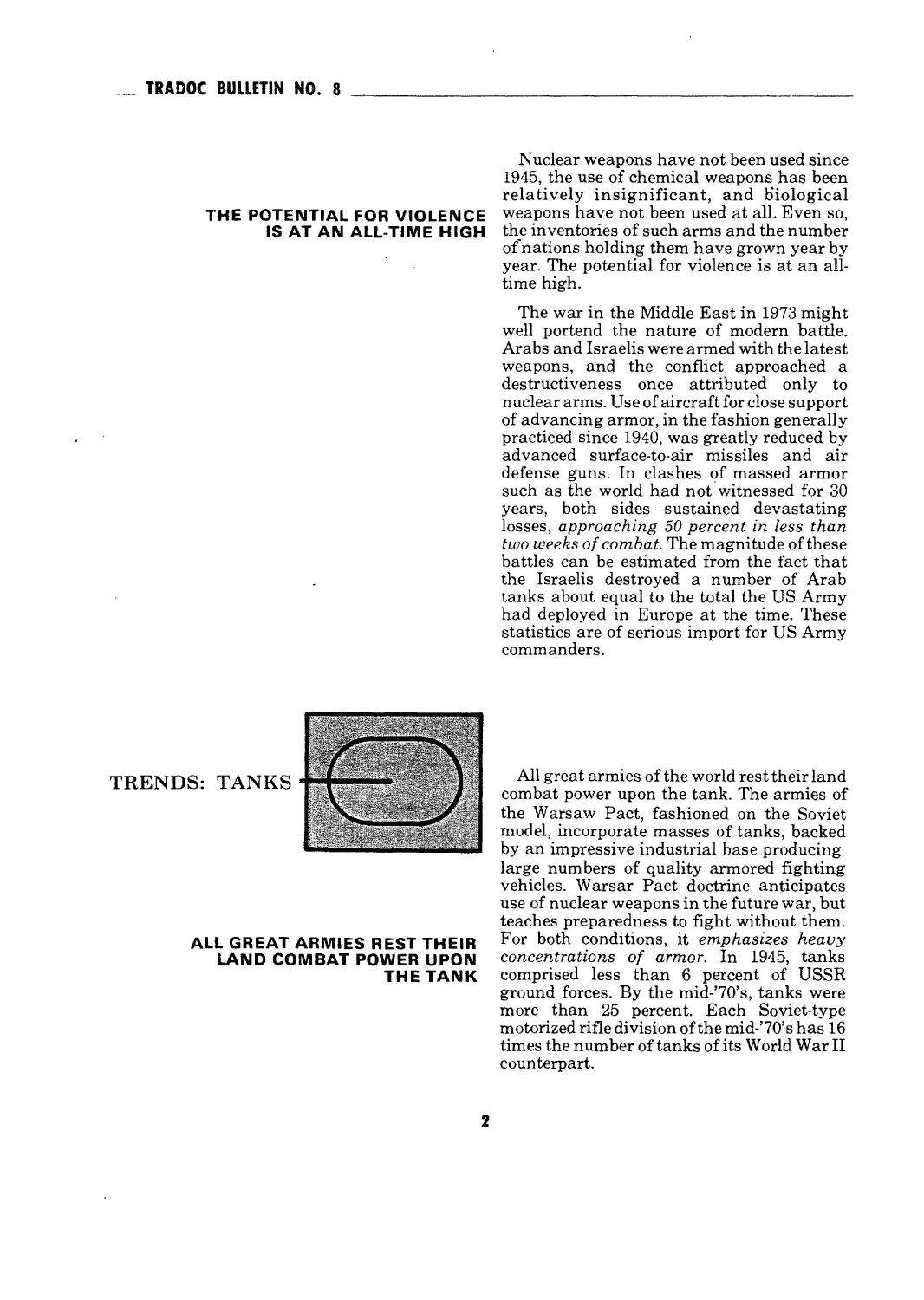
Nuclear weapons have not been used since
1945, the use of chemical weapons has been
relatively insignificant, and biological
weapons have not been used at all. Even so,
the inventories of such arms and the number
of nations holding them have grown year by
year. The potential for violence is at an all-
time high.
The war in the Middle East in 1973 might
well portend the nature of modern battle.
Arabs and Israelis were armed with the latest
weapons, and the conflict approached a
destructiveness once attributed only to
nuclear arms. Use of aircraft for close support
of advancing armor, in the fashion generally
practiced since 1940, was greatly reduced by
advanced surface-to-air missiles and air
defense guns. In clashes of massed armor
such as the world had not witnessed for 30
years, both sides sustained devastating
losses, approaching 50 percent in less than
two weeks of combat. The magnitude of these
battles can be estimated from the fact that
the Israelis destroyed a number of Arab
tanks about equal to the total the US Army
had deployed in Europe at the time. These
statistics are of serious import for US Army
commanders.
All great armies of the world rest their land
combat power upon the tank. The armies of
the Warsaw Pact, fashioned on the Soviet
model, incorporate masses of tanks, backed
by an impressive industrial base producing
large numbers of quality armored fighting
vehicles. Wars ar Pact doctrine anticipates
use of nuclear weapons in the future war, but
teaches preparedness to fight without them.
For both conditions, it emphasizes heavy
concentrations of armor. In 1945, tanks
comprised less than 6 percent of USSR
ground forces. By the mid-’70’s, tanks were
more than 25 percent. Each Soviet-type
motorized rifle division of the mid-’70’s has 16
times the number of tanks of its World War II
counterpart.
2
TRADOC вишта ж 8
Similarly, tank strength is the foundation
of NATO defense: the armies of the Federal
Republic of Germany, the United States,
Great Britain, and their Allies maintain
strong tank forces in Central Europe, France,
Sweden, Japan, the Chinese People’s
Republic, and nations of the Middle East and
South Asia have all made significant
investments in tank design, or procurement
or both. Few states, even among the poorer
nations, are without armored forces.
In the Arab-Israeli War of 1973, both sides
relied heavily upon the tank for both defense
and offense. Notwithstanding the fact that
unparalleled numbers of infantry antiarmor
weapons of advanced designs were used on
both sides, and caused high attrition, the
tank was the crucial factor on the battlefield.
The tank was both the backbone of the
defense and the key to successful attack. The
tank, however, could not operate
effectively outside the combined arms
team of tanks, infantry, artillery, and
air defense.
Firepower. Modern tanks are
significantly more lethal than the armored
vehicles which fought in World War II.
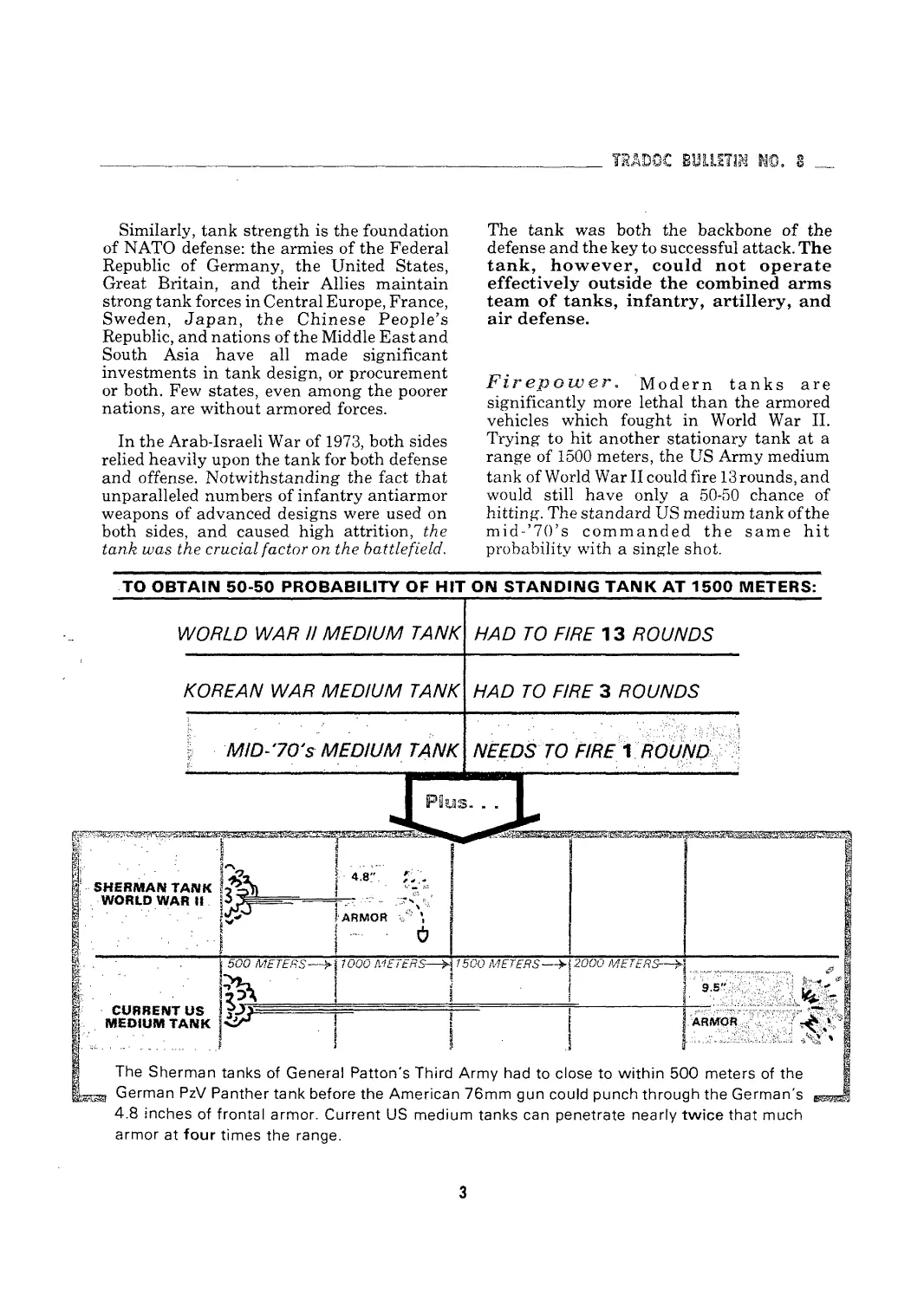
Trying to hit another stationary tank at a
range of 1500 meters, the US Army medium
tank of World War II could fire 13 rounds, and
would still have only a 50-50 chance of
hitting. The standard US medium tank of the
mid-’70’s commanded the same hit
probability with a single shot.
TO OBTAIN 50-50 PROBABILITY OF HIT ON STANDING TANK AT 1500 METERS:
WORLD WAR // MEDIUM TANK HAD TO FIRE 13 ROUNDS
KOREAN WAR MEDIUM TANK HAD TO FIRE 3 ROUNDS
I

M!D-'70's MEDIUM TANK
NEEDS TO FIRE 1 ROUND

Paus. . .
Г SHERMAN TANK W
WORLD WAR II p
4.8:
1 ARMOR
500 METERS—1000 METERS—&
1500 METERS—ME
9.S"
CURRENT US
MEDIUM TANK
| ARMOR
The Sherman tanks of General Patton's Third Army had to close to within 500 meters of the
German PzV Panther tank before the American 76mm gun could punch through the German's
4.8 inches of frontal armor. Current US medium tanks can penetrate nearly twice that much
armor at four times the range.
3
TRADOC BULLETIN NO. 8
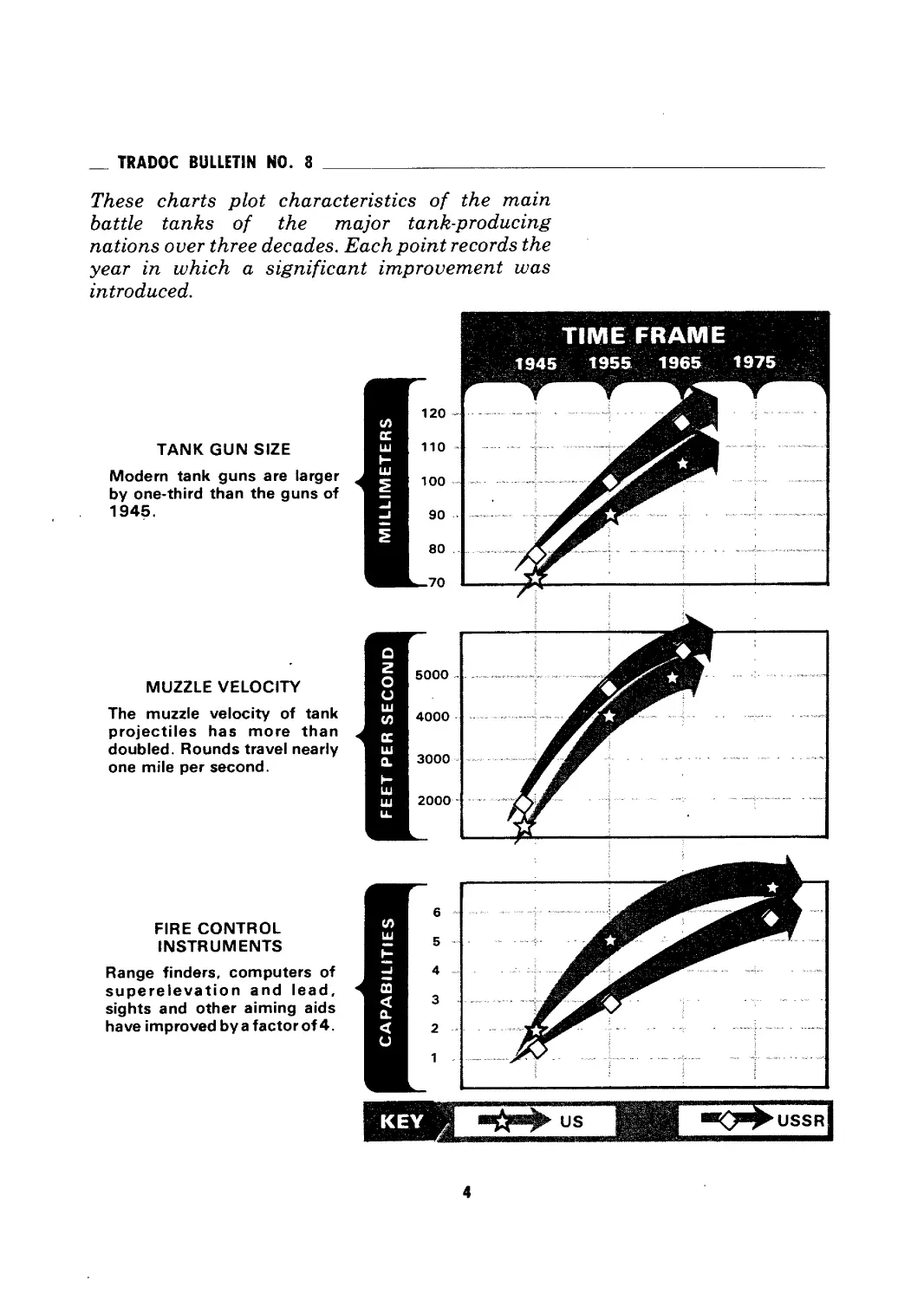
These charts plot characteristics of the main
battle tanks of the major tank-producing
nations over three decades. Each point records the
year in which a significant improvement was
introduced.
TANK GUN SIZE
Modern tank guns are larger
by one-third than the guns of
1945.
MUZZLE VELOCITY
The muzzle velocity of tank
projectiles has more than
doubled. Rounds travel nearly
one mile per second.
FIRE CONTROL
INSTRUMENTS
Range finders, computers of
superelevation and lead,
sights and other aiming aids
have improved by a factor of 4.
4
TRADOC ВШЕШ МО. 8
Improvements in gun accuracy and range have
increased the area a single tank can command
with its weapon.
50-50 PROBABILITY HIT
ACCURACY OF RANGE
FINDERS
Since most tank misses are
caused by inaccurate range
estimation, the unaided
optical sights of WW II were
replaced first by stereoscopic
range finders, then by
coincidence range finders, and
finally, in the mid-'70's, by
laser range finders.
ADVANCE IN TANK
CANNON TECHNOLOGY
Taken together, these
advances have increased hit
probabilities ten-fold—and
future tanks will mount guns
of even greater range and
accuracy.
COMMAND OF GROUND
One implication of this
increase in range and hitting
power is that the tank
influences much more terrain
than formerly. The tactical
reach of the modem tanker
extends over 7 times as much
ground.
5
TRADOC BULLETIN NO. 8 _______________________________________________________-
Armor Protection and Mobility.
Modern tanks have not only bigger guns,
improved ammunition, and more
sophisticated fire control apparatus, but
armor protection roughly double that of
World War II tanks. Nonetheless, the chief
tank-producing nations have designed their
main battle tanks to constrain bulk, and to
balance increases in engines, track and
suspension systems.
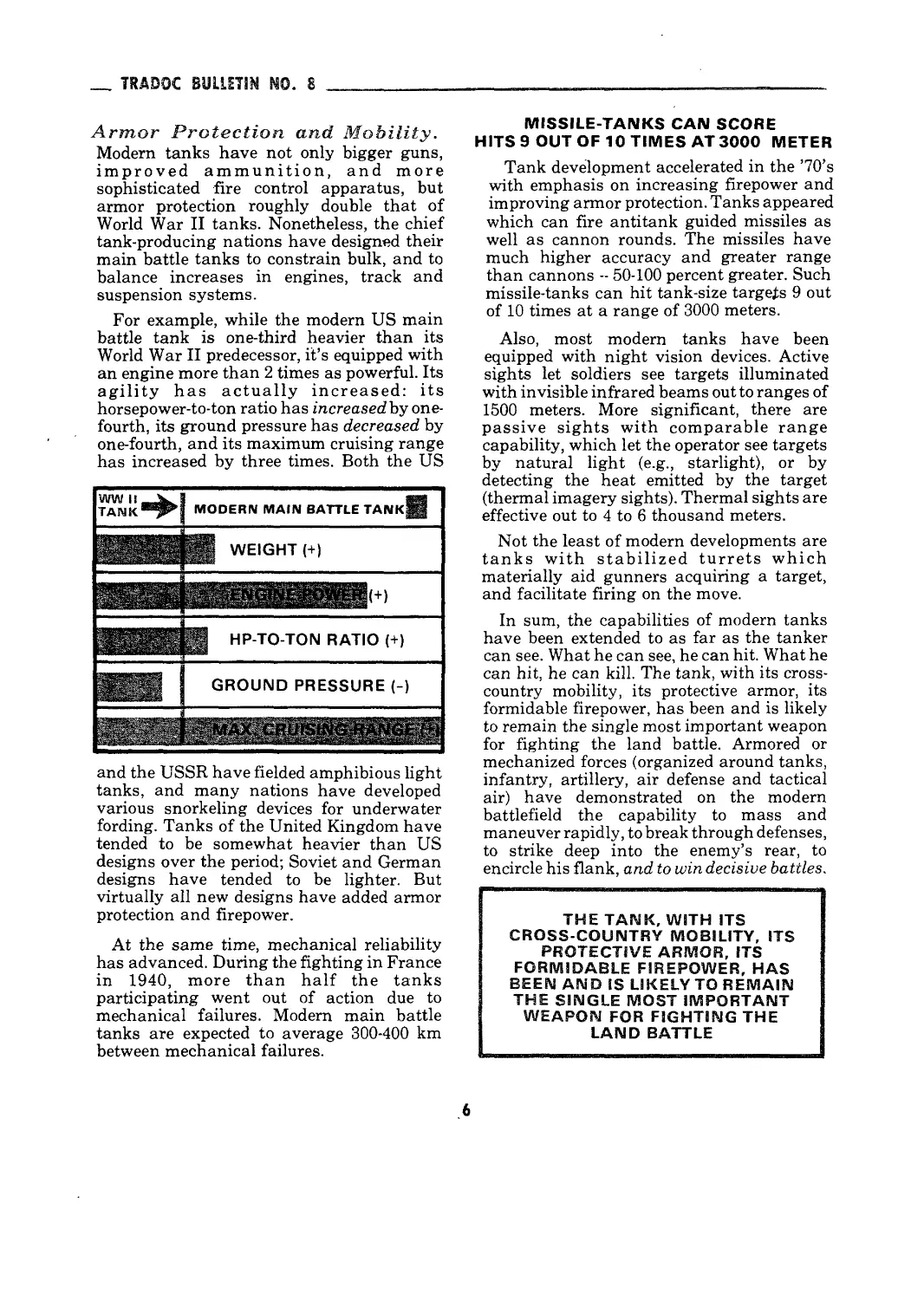
For example, while the modern US main
battle tank is one-third heavier than its
World War II predecessor, it’s equipped with
an engine more than 2 times as powerful. Its
agility has actually increased: its
horsepower-to-ton ratio has increased by one-
fourth, its ground pressure has decreased by
one-fourth, and its maximum cruising range
has increased by three times. Both the US
and the USSR have fielded amphibious light
tanks, and many nations have developed
various snorkeling devices for underwater
fording. Tanks of the United Kingdom have
tended to be somewhat heavier than US
designs over the period; Soviet and German
designs have tended to be lighter. But
virtually all new designs have added armor
protection and firepower.
At the same time, mechanical reliability
has advanced. During the fighting in France
in 1940, more than half the tanks
participating went out of action due to
mechanical failures. Modern main battle
tanks are expected to average 300-400 km
between mechanical failures.
MISSILE-TANKS CAN SCORE
HITS 9 OUT OF 10 TIMES AT 3000 METER
Tank development accelerated in the ’70’s
with emphasis on increasing firepower and
improving armor protection. Tanks appeared
which can fire antitank guided missiles as
well as cannon rounds. The missiles have
much higher accuracy and greater range
than cannons -- 50-100 percent greater. Such
missile-tanks can hit tank-size targets 9 out
of 10 times at a range of 3000 meters.
Also, most modern tanks have been
equipped with night vision devices. Active
sights let soldiers see targets illuminated
with invisible infrared beams out to ranges of
1500 meters. More significant, there are
passive sights with comparable range
capability, which let the operator see targets
by natural light (e.g., starlight), or by
detecting the heat emitted by the target
(thermal imagery sights). Thermal sights are
effective out to 4 to 6 thousand meters.
Not the least of modern developments are
tanks with stabilized turrets which
materially aid gunners acquiring a target,
and facilitate firing on the move.
In sum, the capabilities of modern tanks
have been extended to as far as the tanker
can see. What he can see, he can hit. What he
can hit, he can kill. The tank, with its cross-
country mobility, its protective armor, its
formidable firepower, has been and is likely
to remain the single most important weapon
for fighting the land battle. Armored or
mechanized forces (organized around tanks,
infantry, artillery, air defense and tactical
air) have demonstrated on the modern
battlefield the capability to mass and
maneuver rapidly, to break through defenses,
to strike deep into the enemy’s rear, to
encircle his flank, and to win decisive battles.
THE TANK, WITH ITS
CROSS-COUNTRY MOBILITY, ITS
PROTECTIVE ARMOR, ITS
FORMIDABLE FIREPOWER, HAS
BEEN AND IS LIKELY TO REMAIN
THE SINGLE MOST IMPORTANT
WEAPON FOR FIGHTING THE
LAND BATTLE
6
TRADOC BULLETIN HO. 8 „
TRENDS:
Modern infantry is significantly more
capable than its World War II counterparts,
but especially so in three main respects --
antiarmor weapons, mobility, and night
vision.
INFANTRY CAN
INFLICT HEAVY LOSSES
ON ARMORED FORCES AT
LONG AND SHORT RANGES
Antiarmor Weapons. Tanks were
invented to defeat the infantry defenses of
World War I, and remained, for nearly 50
years, the nemesis of infantry. During World
War II, shoulder-launched rockets with
shape-charge explosives (e.g., bazooka,
panzerfaust) began to erode the tank’s
invincibility. But rockets and the related
recoilless rifles which followed soon
thereafter, called for infantrymen
courageous enough to duel a tank well within
the lethal range of the tank’s cannons and
machineguns. Now, well-trained infantry
can inflict heavy losses on armored forces at
both long and short ranges. Mechanized
infantry equipped with TOW and DRAGON
can support tanks in both the offense and the
defense against tank-heavy enemy forces.
7
TRADOC BULLETIN NO. 8 ________________________________________________________________
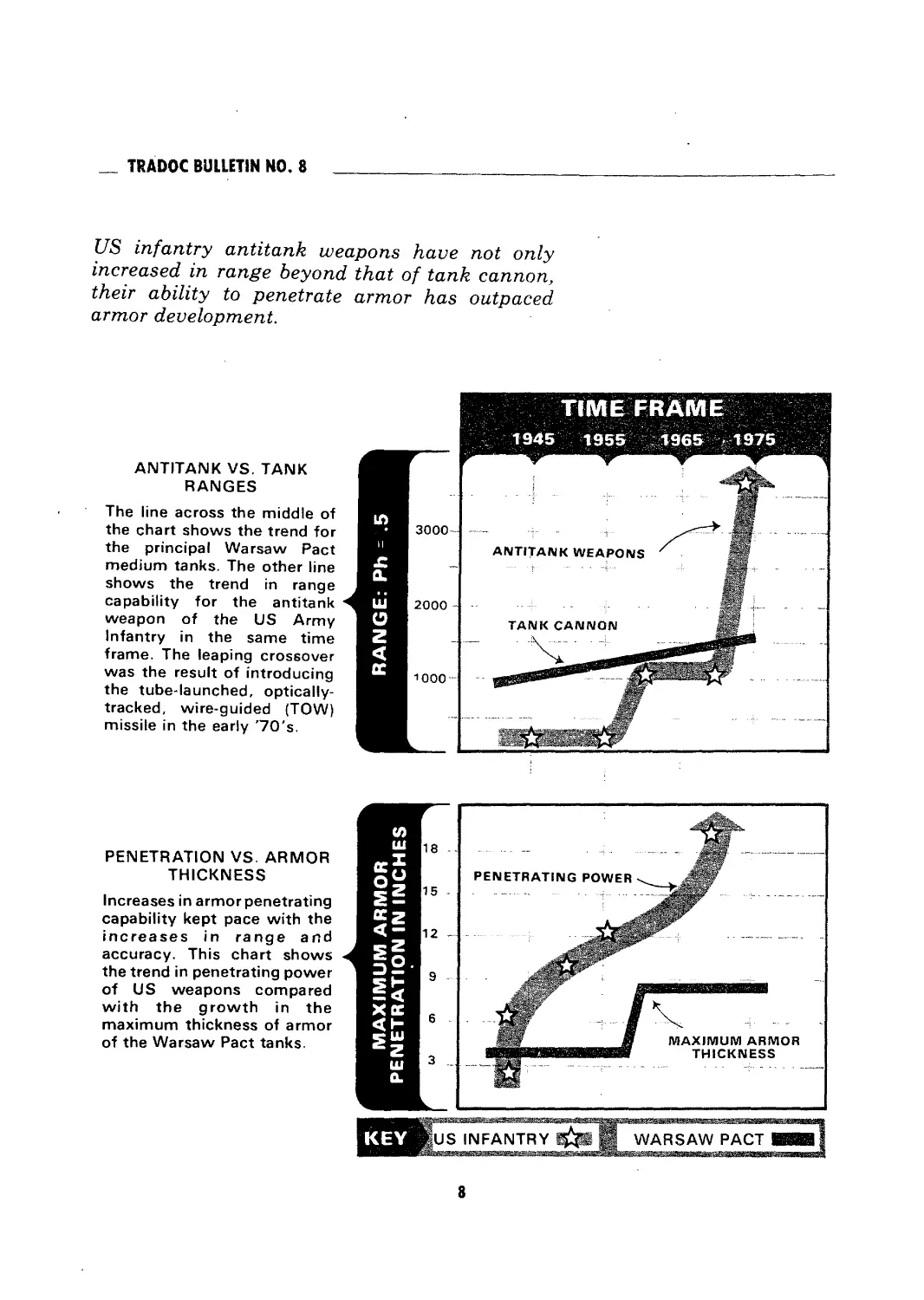
L7S infantry antitank weapons have not only
increased in range beyond that of tank cannon,
their ability to penetrate armor has outpaced
armor development.
ANTITANK VS. TANK
RANGES
The line across the middle of
the chart shows the trend for
the principal Warsaw Pact
medium tanks. The other line
shows the trend in range
capability for the antitank
weapon of the US Army
Infantry in the same time
frame. The leaping crossover
was the result of introducing
the tube-launched, optically-
tracked, wire-guided (TOW)
missile in the early '70's,
PENETRATION VS. ARMOR
THICKNESS
Increases in armor penetrating
capability kept pace with the
increases in range and
accuracy. This chart shows
the trend in penetrating power
of US weapons compared
with the growth in the
maximum thickness of armor
of the Warsaw Pact tanks.
8
1Ш1Ж ВОШТШ МО. 8
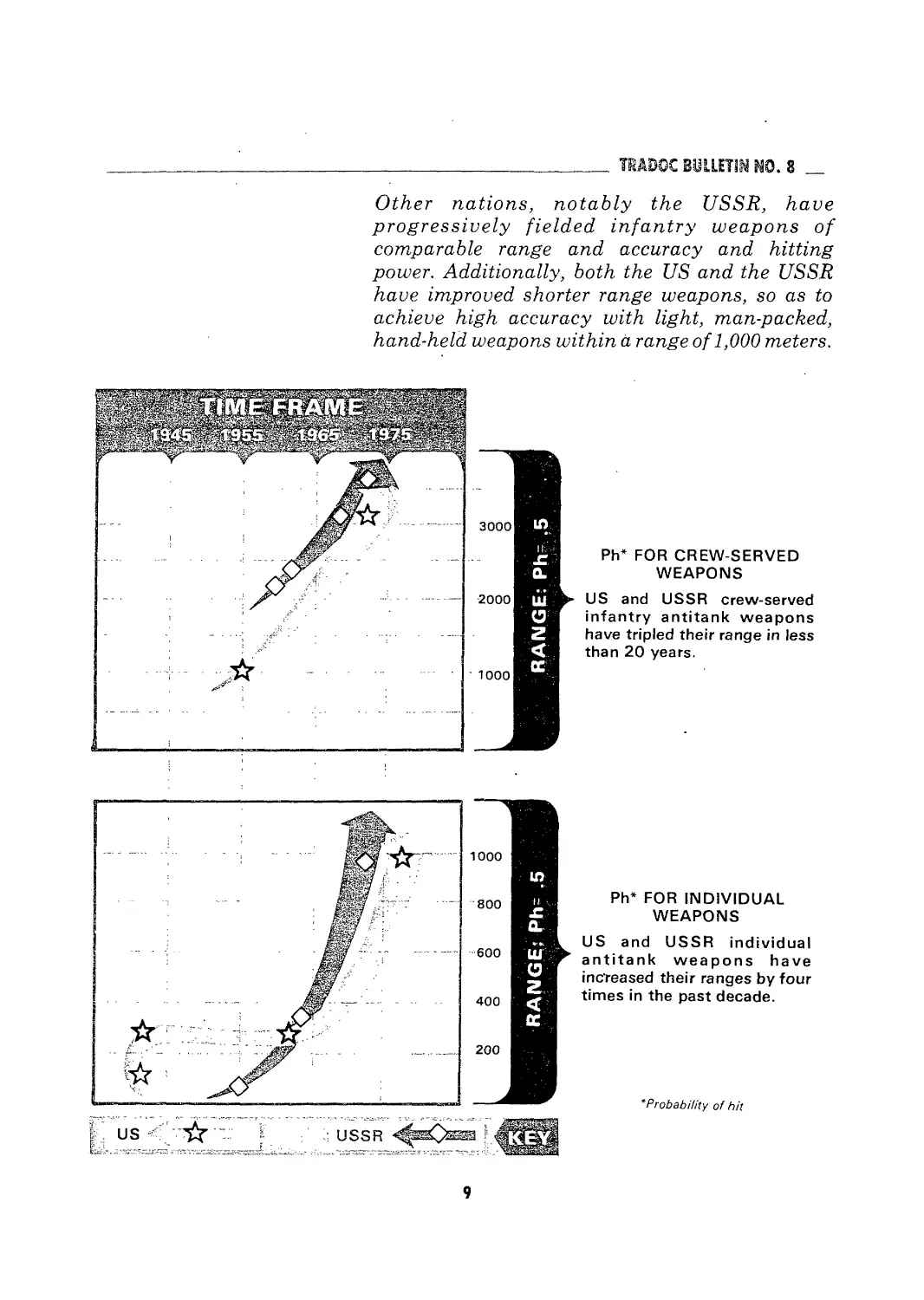
Other nations, notably the USSR, have
progressively fielded infantry weapons of
comparable range and accuracy and hitting
power. Additionally, both the US and the USSR
have improved shorter range weapons, so as to
achieve high accuracy with light, man-packed,
hand-held weapons within a range of 1,000 meters.
USSR
Ph* FOR CREW-SERVED
WEAPONS
US and USSR crew-served
infantry antitank weapons
have tripled their range in less
than 20 years.
Ph* FOR INDIVIDUAL
WEAPONS
US and USSR individual
antitank weapons have
increased their ranges by four
times in the past decade.
★Probability of hit
9
TRADOC BULLETIN NO. 8
Mobility, By the end of WWII, most armies
had concluded that armored vehicles for
carrying infantry into battle had limited
utility on the battlefield. The Soviet Army, for
example, taught that when infantry was
required for the support of tanks, the infantry
should ride the tanks to the assault position,
and then fight on foot through the objective.
However, as the tank increased its mobility
— its operating range, its agility, its ability to
cross soft ground — the inability of infantry
on foot (or even in trucks) to keep up with
tanks, began to inhibit exploitation of the full
combat power of the tank. Moreover, as
armies considered the use of nuclear weapons
on the battlefield, it became apparent that
infantry on foot or in trucks were much more
vulnerable than those in armored vehicles.
Additionally, advances in conventional
artillery munitions, particularly those which
cause casualties among unprotected
personnel from air-burst weapons, indicated
a need for overhead armor protection for
advancing infantry. In the ’50’s, a
pronounced trend developed toward
"mechanization" -- armored vehicles
especially designed for carrying infantry.
After some experimentation with full-
tracked, fully-enclosed troop carriers pooled
at division level for the purpose of providing
armored mobility to infantry units as
required, the major armies made such
vehicles organic to the infantry squad or
section.
By the early ’70’s, these vehicles were
equipped with both the new antitank guided
missiles, and large automatic weapons
capable of suppressing enemy infantry at
ranges of 1,000 meters and beyond.
Doctrinally, emphasis shifted from armored
vehicles for taxiing troops into battle, to an
10

infantry combat vehicle which fights as part
of the mechanized infantry squad
throughout its operations.
MECHANIZATION OF INFANTRY
By the mid-'70's, one out of every two
infantrymen in the US Army active
forces was a member of an armored
personnel carrier mounted force.
• • •
In Soviet-equipped forces, armored
personnel carriers were 37 times more
numerous than in the 1945 Red Army.
Mechanization provides infantry units
advantages in tactical mobility over foot or
truck-borne units. But the greatest advances
in infantry mobility have been brought about
by the introduction into combat of the
helicopter. As the helicopter has advanced in
speed, operating range, air-worthiness, and
maintainability, it has emerged as a fully
capable member of the combined arms team.
The US Army, which has had more
experience with helicopters in battle than
any other army in the world, has exploited
the helicopter in its organizations, weapons
system design, tactics and techniques.
Provided helicopters, the infantry
commander on the modern battlefield
possesses tactical flexibility, command
means, and logistics markedly better than
those at the disposal of his predecessors in
WW II or Korea.
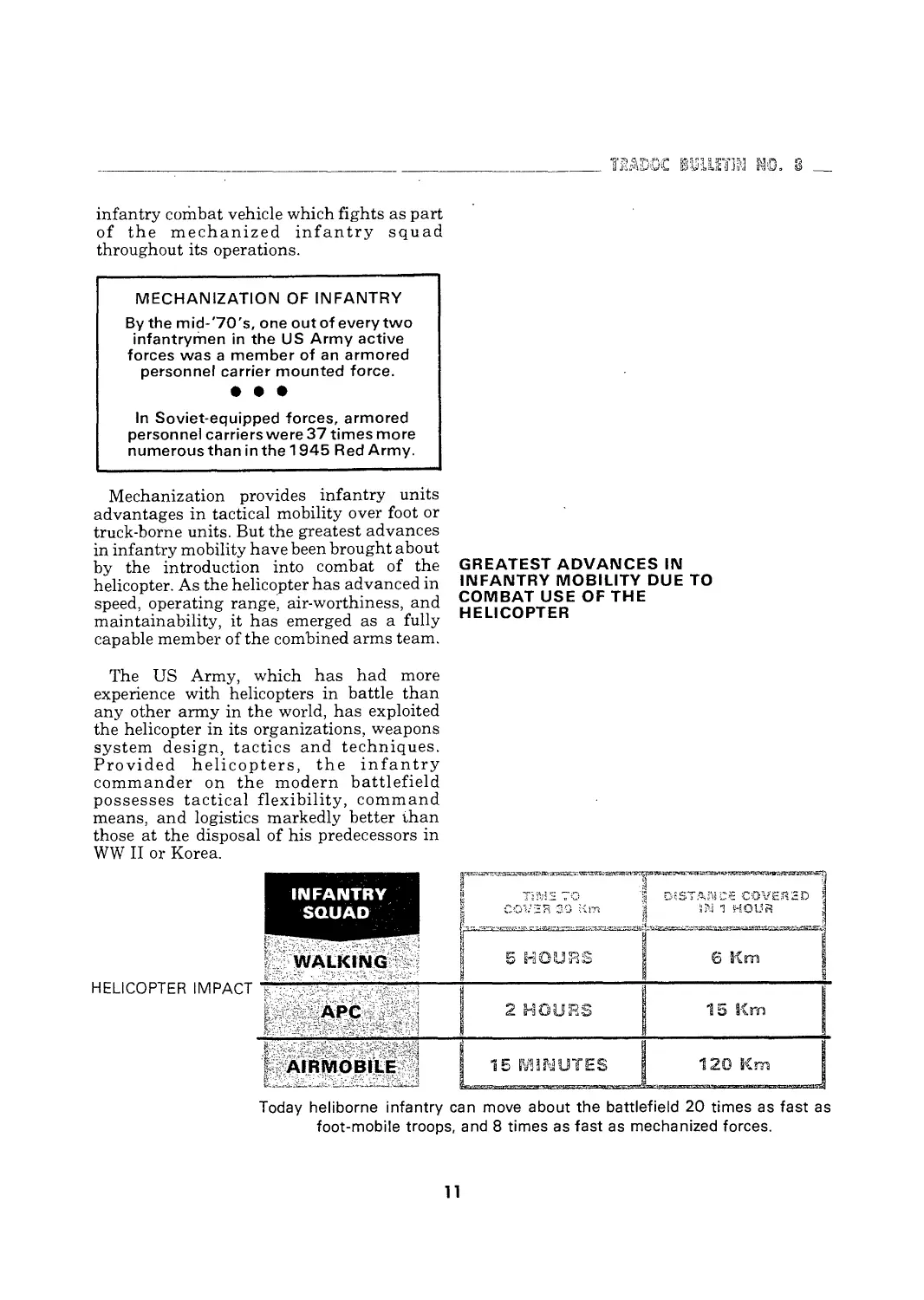
INFANTRY
SQUAD
j WALKING
HELICOPTER IMPACT
AIRMOBILE
GREATEST ADVANCES IN
INFANTRY MOBILITY DUE TO
COMBAT USE OF THE
HELICOPTER
Today heliborne infantry can move about the battlefield 20 times as fast as
foot-mobile troops, and 8 times as fast as mechanized forces.
11
_ TRADOC BULLETIN NO. 8______________________
Night Vision. Thirty years ago, the most
advanced aids to infantry vision at night
were infrared detectors which required an
infrared light source to illuminate the target
area. Such devices were employed for
pointing infantry weapons (and for driving
at night as an aid to mobility), but their range
was limited. They also suffered the
disadvantage that an enemy equipped with
infrared detectors could see the light source.
In the mid-’60’s, image intensifiers
became available which operated with
existing light-starlight, moonlight, sky glow
from cities, or battlefield fires. The first of
these devices in the US Army, packaged as a
telescope for aiming a rifle, weighed only 20
per cent as much as the earlier infrared
device. At about the same time, the US Army
fielded larger crew-served weapon sights
using image intensifiers with capabilities of
1200 meters under starlight, and 2,000 meters
under moonlight. And for the same weight,
this device had over 4 times the range of
earlier infrared equipment.
Image intensifiers are completely passive;
that is, it is impossible for the enemy to detect
them in use. By the mid-’70’s, this technology
had led to small, night vision aids permitting
an infantryman or a helicopter pilot to see
effectively at night.
Also emerging in the mid-’70’s were
thermal sights, entirely passive like the
image intensifiers, but which detect heat
radiation and construct images based
thereon. These sights are particularly useful
in penetrating atmospheric haze, fog, snow
or rain clutters, light foliage, and
camouflage. These devices are small,
relatively lightweight, and can be used at
night or in daylight.
Flexibility. Of all combatants in modern
battle, infantry is the least protected, the
most vulnerable. Nonetheless, during the
past decades, infantrymen have developed
battlefield techniques and tactics enabling
them to survive against the most lethal
conventional weapons and to continue as a
versatile component of the combined arms
team. In fact, in places where armored or
mechanized forces cannot maneuver freely
(sections of swamps, mountains, jungles, or
cities), infantry maintains the central role.
Most countries have armed their
infantrymen with automatic weapons, as
well as other lighter, more lethal weapons. In
the ’70’s, the US infantryman can carry his
equipment, rations, rifle and ammunition
plus he may carry items unavailable to his
WW II predecessor — a command-detonated
antipersonnel mine (CLAYMORE), two to
three light antitank weapons (LAW) and an
armored vest.
The infantryman of air assault, airborne,
or infantry type divisions fights afoot, but, in
some cases, his mobility can be greater than
that of his mechanized counterpart.
Strategically, he is easier to deploy. On the
battlefield, he and his weapons can be moved
about by helicopter. He can often achieve
surprise more readily than armored task
forces, and more quickly develop critical
mass. Dug in, he is difficult to dislodge. He
can ambush advancing armor, seize and hold
key terrain, block against a breakthrough,
and slow and canalize a penetration.
The mechanized infantryman can fight
from his armored carrier while maneuvering
across the battlefield, adding his suppressive
fires and observation to armored task forces.
When tanks cannot advance because of
reduced visibility, he takes the lead. He can,
by fire and movement, eliminate antitank
gunners concealed in woods or buildings,
breach minefields, and employ stealth or
airmobility to seize key terrain.
WHERE ARMORED OR
MECHANIZED FORCES CANNOT
MANEUVER FREELY, INFANTRY
MAINTAINS THE CENTRAL ROLE
12
___________________________________________________TRADOC виШТШ NO. 8 _
TRENDS: FIELD ARTILLERY
ARTILLERY CAUSED MORE THAN
HALF OF THE CASUALTIES
DURING WORLD WAR II
During WW II, the necessity for massed
and sustained firepower closely integrated
with large and mobile maneuver forces
accelerated artillery developments. Artillery
emerged as the greatest casualty producer of
that war, causing more than half of the
casualties sustained by all armies. Modern
artillery weapons and munitions and
techniques for their employment have
significantly improved in the last thirty
years, and all major armies hold substantial
artillery inventories. And almost all of the
smaller nations have been provided modern
artillery weapons by the larger world powers.
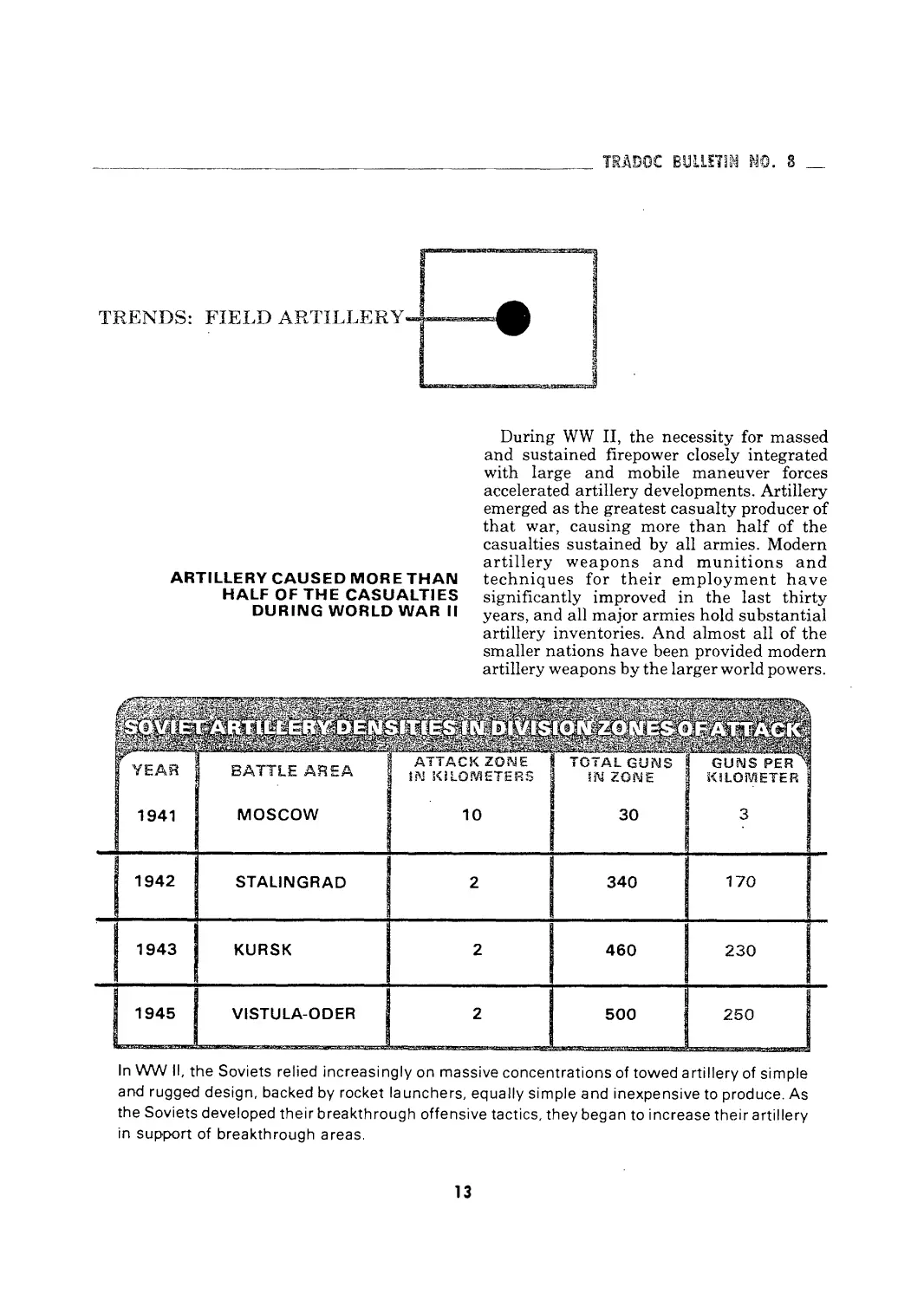
	Г YEAR 1941	BATTLE AREA MOSCOW	PattackzoneT tot a l gu n s 1 Ш KILOMETERS |	IN ZONE 10	I	30	I GUNSPER^ KILOMETER
	1942	STALINGRAD	2	I	340 в	170	;
	1943	KURSK	,	I 4.0	230
	1945	VISTULA-ODER	2	I	500	250	।
In WW II, the Soviets relied increasingly on massive concentrations of towed artillery of simple
and rugged design, backed by rocket launchers, equally simple and inexpensive to produce. As
the Soviets developed their breakthrough offensive tactics, they began to increase their artillery
in support of breakthrough areas.
13
TRADOC BULIETIN NO. 8
Soviet doctrine continued to stress
offensive breakthrough tactics into the ’70’s,
requiring artillery densities of 70-100 tubes
per kilometer in support of the leading
maneuver forces. Client nations of the
Soviets have adopted similar techniques, as
evidenced in the 1973 Middle-East War:
There, under Soviet tutelage, the Syrians
fielded 1200 artillery cannon and the
Egyptians massed 2000 tubes to support their
Suez crossing. To put these figures into
perspective, US artillery in Europe at that
time numbered less than 500 tubes.
US techniques for concentrating artillery
during WW II relied on sophisticated fire
control procedures to mass the fires of
separated units onto a single target area.
With these techniques and improved radio
communications, one forward observer could
request and receive the fires of all of the
artillery battalions operating within the
corps and in range of the target. Time on
target (TOT) surprise fire techniques
produced high shock effect among
unprepared and exposed infantry.
Responsiveness and lethality were
significantly increased in 1943 with the
introduction of the variable time (VT) fuze.
And US artillery increasingly emphasized
self-propelled weapons to maintain the fast
tempo of mobile warfare. These
developments were further refined following
WW II and remain significant elements of US
artillery doctrine.
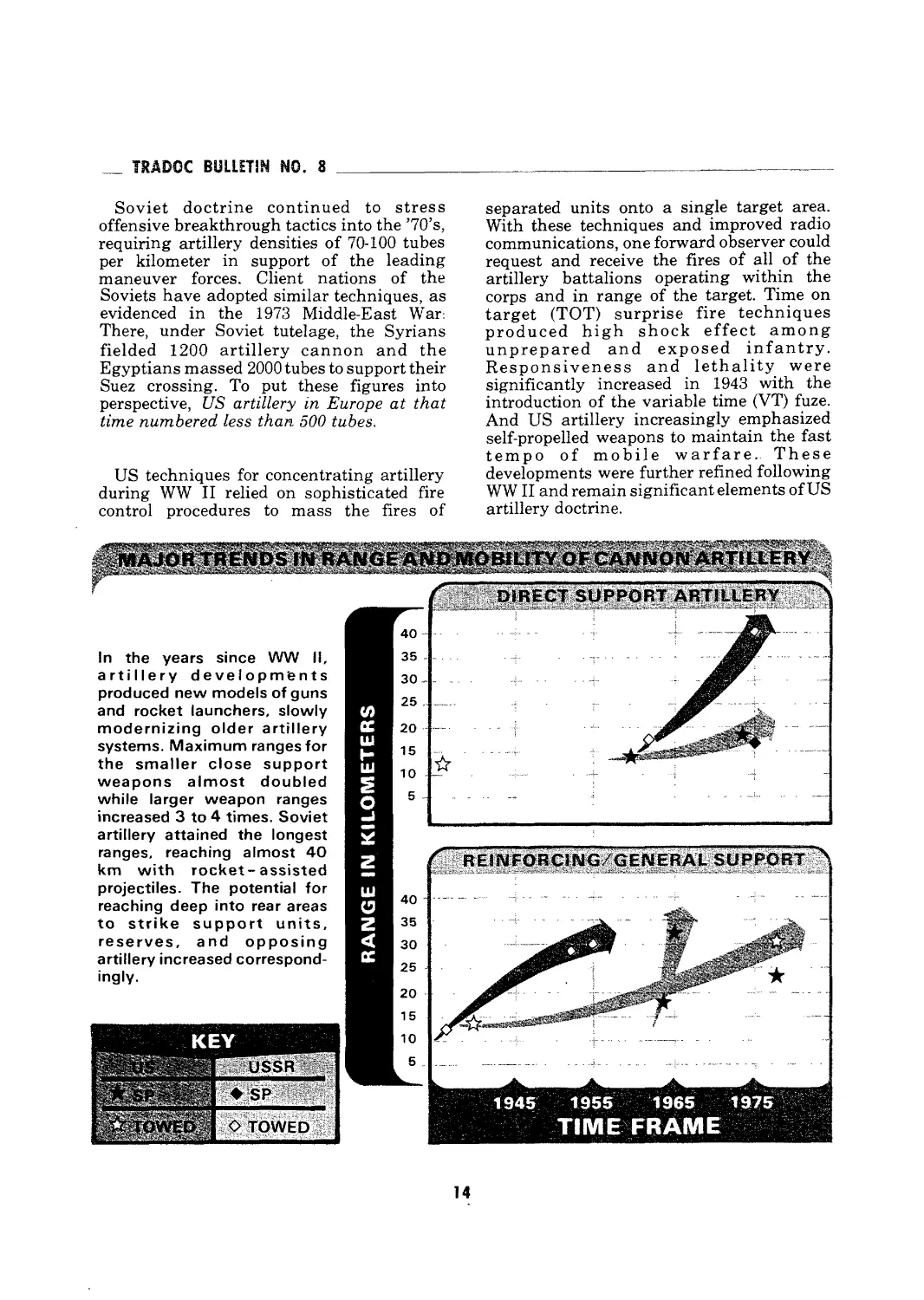
MAJOR TRENDS IN RANGE AND MOBILITY OF CANNON ARTILLERY
In the years since WW II,
artillery developments
produced new models of guns
and rocket launchers, slowly
modernizing older artillery
systems. Maximum ranges for
the smaller close support
weapons almost doubled
while larger weapon ranges
increased 3 to 4 times. Soviet
artillery attained the longest
ranges, reaching almost 40
km with rocket-assisted
projectiles. The potential for
reaching deep into rear areas
to strike support units,
reserves, and opposing
artillery increased correspond-
ingly.
KEY
USSR
»sp -
O TOWED

14
—________„___-.................................. ТЙАЭОС ВШПЖ NO. 8
The Soviets continued to produce large
quantities of towed artillery cannon and
rocket launchers to support their offensive
tactics and in the ’70’s maintained the largest
inventory of artillery weapons held by the
major powers.
Artillery Munitions. Since 1945, new
explosives and munitions have greatly
increased the fire power equivalency per
shell. Improved conventional munitions,
when compared to ordinary high explosive
rounds, provide up to 4 times the amount of
casualty effect against personnel targets.
Projectiles with time delay sub-munitions
extend the suppression capability of a single
round over a considerable period of time after
impact, and small scatterable antitank
mines can be employed by indirect artillery
fire. The US, unlike the Soviets, continued to
use VT fuzes extensively.
In the mid-’70’s, US artillery made
revolutionary advances in lethality, adding a
point destruction capability to its traditional
role of suppression. Precision guided
projectiles fired from standard cannon can
kill single tanks with a very high probability
of first round success. These projectiles are
terminally guided to either a moving or
stationary target by a forward observer
illuminating the target with a laser
designator. Multiple targets can be hit in
quick succession.
Mobility. Improvements in artillery
ground mobility, particularly in Western
armies, increased the capability of artillery to
keep pace with the increasing tempo of
modern mechanized warfare. Artillery in US ARTILLERY IN US ARMORED AND
armored and mechanized divisions is MECHANIZED DIVISIONS IS
entirely self-propelled, enabling it to move ENTIRELY SELF-PROPELLED
with fast . armored thrusts, or displace
laterally to concentrate fires quickly in a
threatened defensive sector. The Soviets, in
contrast, support their mechanized forces
with extensive numbers of towed cannon and
motorized rocket launchers. In the early ’70’s,
the Soviets recognized the mobility
limitations of towed artillery to support their
doctrine of fast and deep offensive
operations, and began to increase their
inventories of self-propelled guns.
15
_ TRADOC BULLETIN NO, 8
By the ’60’s, newly developed air mobility
techniques allowed US artillery to operate
with the combined arms team in areas where
few roads existed, or the terrain otherwise
denied rapid ground movement. Forty to fifty
percent reductions in cannon weights,
coupled with improved air transport
capabilities, reduced long distance
deployment times from weeks to hours. In a
strategic deployment, medium and light
artillery can now be airlanded on
unimproved runways, and light towed
artillery pieces can be dropped by parachute
with a maneuver force.
Fire Control and Coordination. Since
WW II, advances in fire direction,
observation, and coordination have similarly
added to the responsiveness, flexibility, and
accuracy of modern artillery firepower. In the
’60’s, small tactical fife direction computers
in US battalions and batteries reduced
response times and eased the massing of
surprise fires and the transfer to new targets.
In the ’70’s, laser range finders used by US
forward observers reduced initial target
range estimation errors from 400 meters,
common to earlier map and binocular
methods, down to as close as 10 meters. Since
FO range estimation is key to fast and
accurate adjusted fire, laser ranging
produces significant increases in first round
effect.
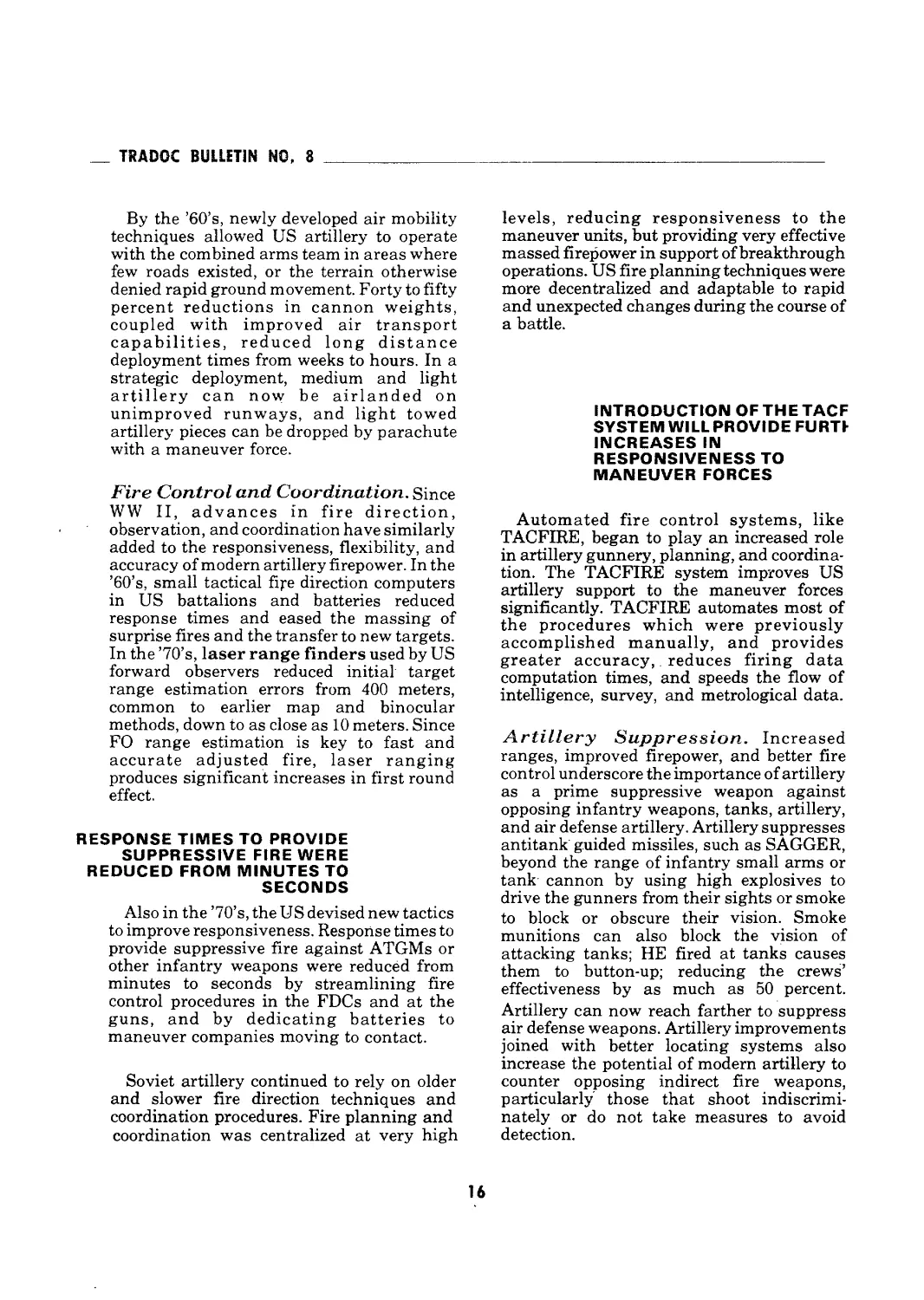
RESPONSE TIMES TO PROVIDE
SUPPRESSIVE FIRE WERE
REDUCED FROM MINUTES TO
SECONDS
Also in the ’70’s, the US devised new tactics
to improve responsiveness. Response times to
provide suppressive fire against ATGMs or
other infantry weapons were reduced from
minutes to seconds by streamlining fire
control procedures in the FDCs and at the
guns, and by dedicating batteries to
maneuver companies moving to contact.
Soviet artillery continued to rely on older
and slower fire direction techniques and
coordination procedures. Fire planning and
coordination was centralized at very high
levels, reducing responsiveness to the
maneuver units, but providing very effective
massed firepower in support of breakthrough
operations. US fire planning techniques were
more decentralized and adaptable to rapid
and unexpected changes during the course of
a battle.
INTRODUCTION OF THE TACF
SYSTEM WILL PROVIDE FURTI-
INCREASES IN
RESPONSIVENESS TO
MANEUVER FORCES
Automated fire control systems, like
TACFIRE, began to play an increased role
in artillery gunnery, planning, and coordina-
tion. The TACFIRE system improves US
artillery support to the maneuver forces
significantly. TACFIRE automates most of
the procedures which were previously
accomplished manually, and provides
greater accuracy,. reduces firing data
computation times, and speeds the flow of
intelligence, survey, and metrological data.
Artillery Suppression. Increased
ranges, improved firepower, and better fire
control underscore the importance of artillery
as a prime suppressive weapon against
opposing infantry weapons, tanks, artillery,
and air defense artillery. Artillery suppresses
antitank guided missiles, such as SAGGER,
beyond the range of infantry small arms or
tank cannon by using high explosives to
drive the gunners from their sights or smoke
to block or obscure their vision. Smoke
munitions can also block the vision of
attacking tanks; HE fired at tanks causes
them to button-up; reducing the crews’
effectiveness by as much as 50 percent.
Artillery can now reach farther to suppress
air defense weapons. Artillery improvements
joined with better locating systems also
increase the potential of modern artillery to
counter opposing indirect fire weapons,
particularly those that shoot indiscrimi-
nately or do not take measures to avoid
detection.
16
____;___________________ moot ига 8
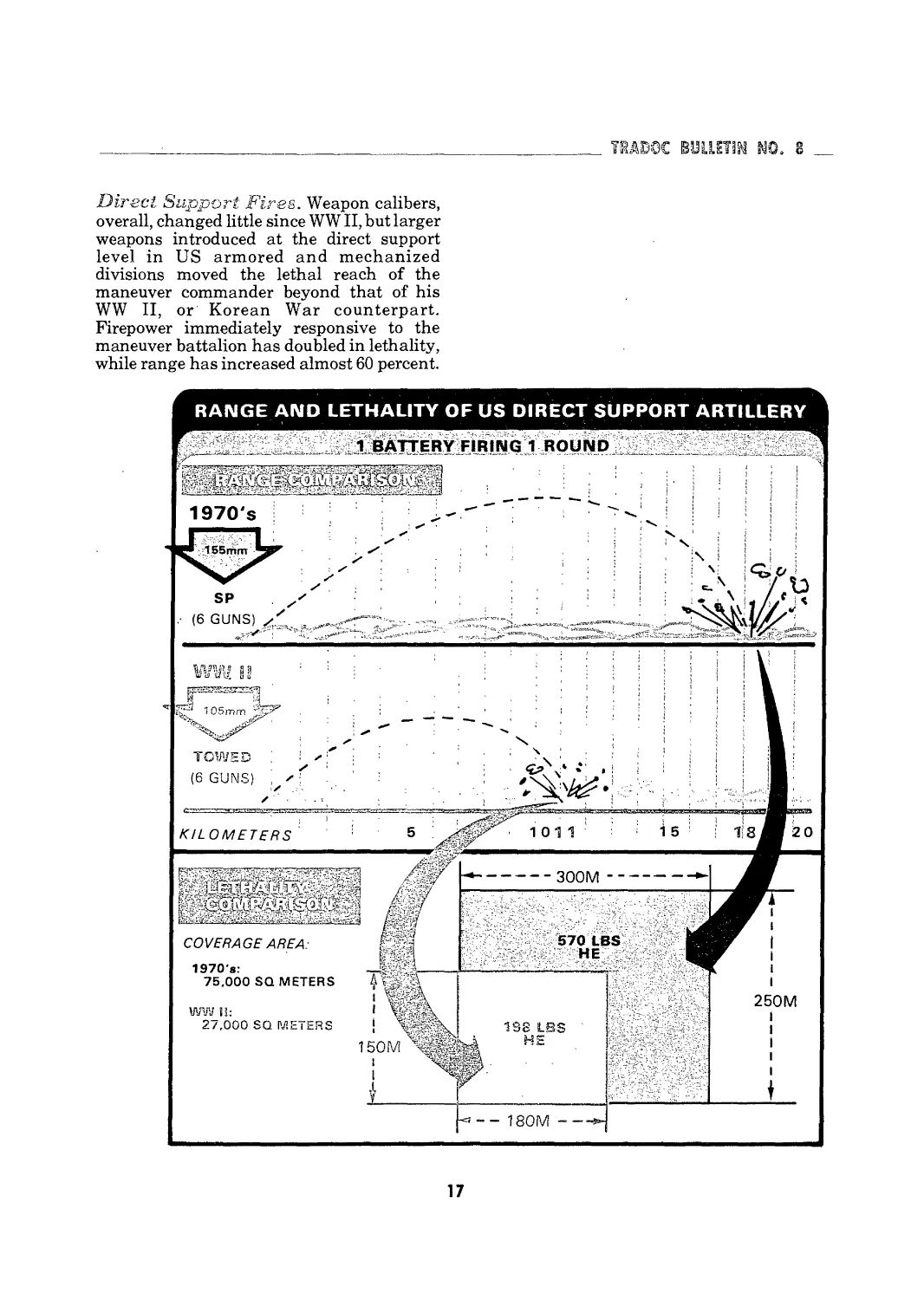
Direct Support Fires. Weapon calibers,
overall, changed little since WWII, but larger
weapons introduced at the direct support
level in US armored and mechanized
divisions moved the lethal reach of the
maneuver commander beyond that of his
WW II, or Korean War counterpart.
Firepower immediately responsive to the
maneuver battalion has doubled in lethality,
while range has increased almost 60 percent.
RANGE AND LETHALITY OF US DIRECT SUPPORT ARTILLERY
Г _	. 1 BATTERY FIRING 1 ROUND
1970 s
180M -—
17
„ THADOC BULLETIN NO. 8
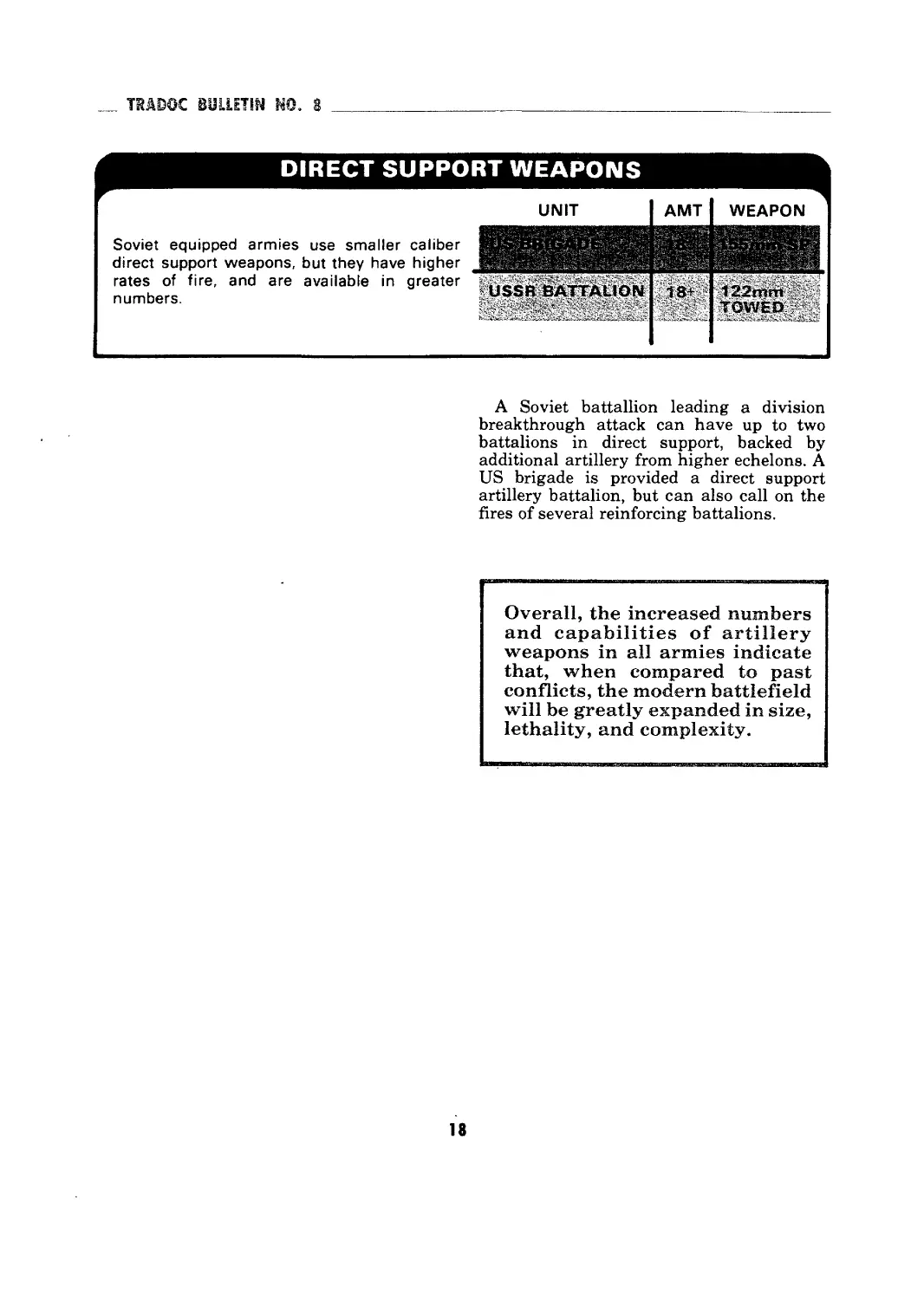
DIRECT SUPPORT WEAPONS
	UNIT	AMT	WEAPON
Soviet equipped armies use smaller caliber direct support weapons, but they have higher rates of fire, and are available in greater numbers.	' USSR BATTALION	18+	T22mrrt “ TOWED ; ”

A Soviet battailion leading a division
breakthrough attack can have up to two
battalions in direct support, backed by
additional artillery from higher echelons. A
US brigade is provided a direct support
artillery battalion, but can also call on the
fires of several reinforcing battalions.
Overall, the increased numbers
and capabilities of artillery
weapons in all armies indicate
that, when compared to past
conflicts, the modern battlefield
will be greatly expanded in size,
lethality, and complexity.
18
m iVJ 8 tE’SriftM fell-ft*
и atf'J s4'M
TRENDS:
AIR DEFENSE ARTILLERY
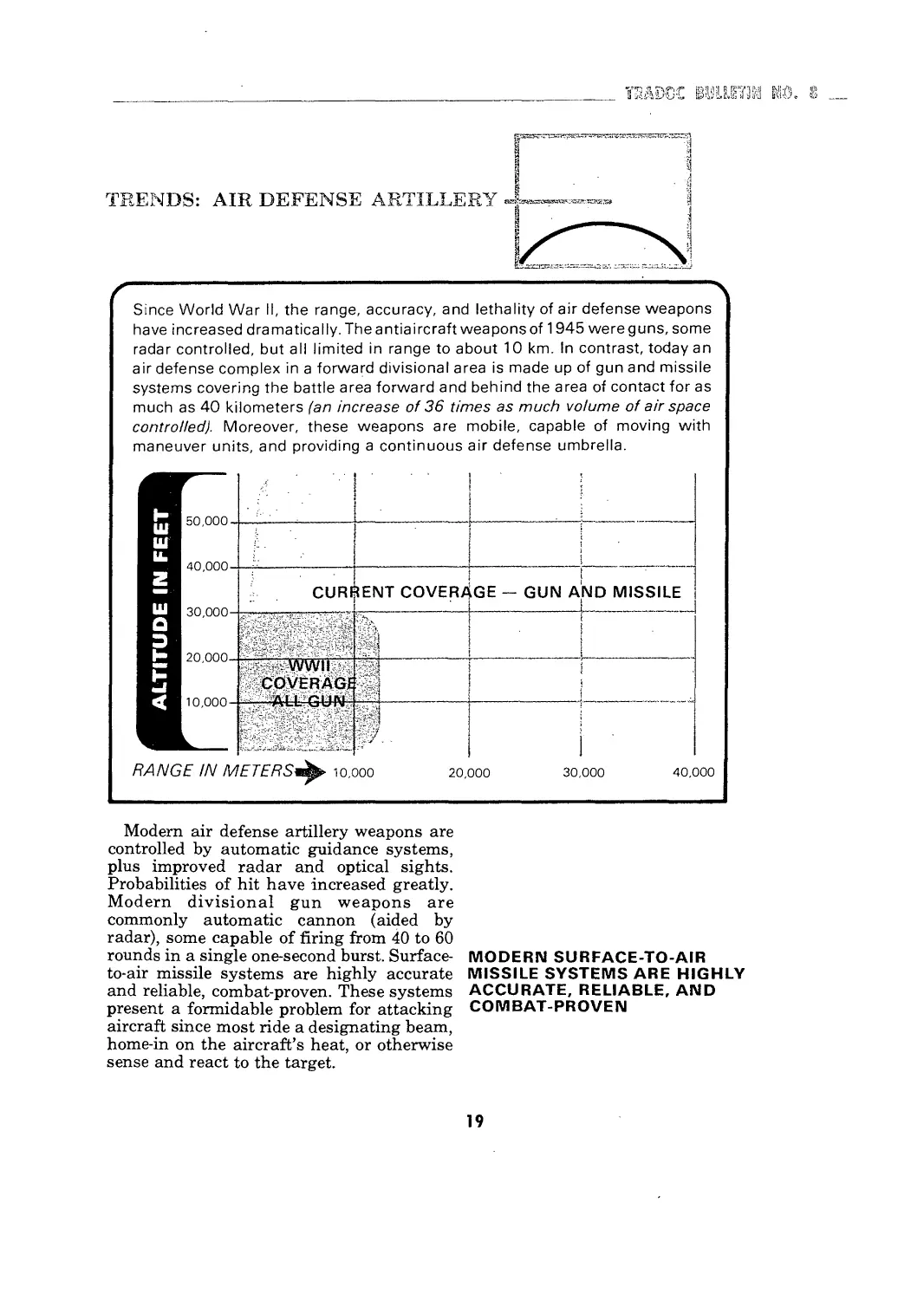
Since World War II, the range, accuracy, and lethality of air defense weapons
have increased dramatically. The antiaircraft weapons of 1945 were guns, some
radar controlled, but all limited in range to about 10 km. In contrast, today an
air defense complex in a forward divisional area is made up of gun and missile
systems covering the battle area forward and behind the area of contact for as
much as 40 kilometers (an increase of 36 times as much volume of air space
controlled). Moreover, these weapons are mobile, capable of moving with
maneuver units, and providing a continuous air defense umbrella.
RANGE IN METERS^ 10,000
20,000	30,000	40,000
Modem air defense artillery weapons are
controlled by automatic guidance systems,
plus improved radar and optical sights.
Probabilities of hit have increased greatly.
Modern divisional gun weapons are
commonly automatic cannon (aided by
radar), some capable of firing from 40 to 60
rounds in a single one-second burst. Surface-
to-air missile systems are highly accurate
and reliable, combat-proven. These systems
present a formidable problem for attacking
aircraft since most ride a designating beam,
home-in on the aircraft’s heat, or otherwise
sense and react to the target.
MODERN SURFACE-TO-AIR
MISSILE SYSTEMS ARE HIGHLY
ACCURATE, RELIABLE, AND
COMBAT-PROVEN
19
TRADOC BULLETIN NO. 8
Perhaps the most striking air defense
development is the implanting of
sophisticated weapons in maneuver units. In
all advanced armies, infantry, armor, and
artillery units are equipped with weapons
which can knock jet aircraft out of the sky.
Therefore, besides the air defense artillery
weapons and a multitude of direct fire
weapons in maneuver units, attacking air
forces must contend with soldier-operated,
surface-to-air missile systems. Weapons such
as the US Redeye and the Soviet SA-7 are
relatively simple to use and, although small
and light, have high hit probabilities against
low-flying, high-performance aircraft or
helicopters.
The addition of such weapons to maneuver
units is one dimension of the proliferation of
modem air defenses.
In 1945, a US division typically
had 64 air defense weapons, all
inaccurate and short range. In
the mid-'70's, the number of
weapons with marked ad-
vances in accuracy and range,
had increased to 113; Soviet-
equipped divisions include an
even larger number.
Air defense is integral to the combined
arms team. All means to prevent suppression
of our air defense weapons and ways to
suppress enemy weapons must be sought. No
modern army can expect to win in battle
unless its maneuver forces operate
under a cohesive, extensive, and mobile
umbrella of modern air defense.
20
TRADOC ШЕШ Ж. В
Close A ir Support. During World War II,
air superiority — defeat of the opposing air
force — was the first mission for most high
performance aircraft. Support missions were,
more often that not, flown against convoys,
trains, and other targets of opportunity in the
enemy rear area. Close air support was
regarded a novelty, and doctrine and
procedures for coordinating ground and air
operations were relatively crude. Maneuver
units had to consider close air support as a
supplement to their operations rather than as
a component of the combined arms team. If
they could get air support, they might use it,
but they had to prepare to do without. Close
air support really meant attacking targets to
the immediate front of ground forces, yet
control between ground and air attackers
was minimal.
Experience of three decades has changed
the concept and practice of close air support.
In some advanced forces, including those of
the US, aircraft are dedicated to the support
of the maneuver arms in recognition of the
fact that the battlefield will provide an
abundance of targets that can be destroyed
by close air support. Tactical air is in some
armies an integral part of the combined
arms team.
21
TRADOC BULLETIN NO. 8 ........... ....
US tactical aircraft are far more
powerful than those of 1945. The
USAAF P47 of WW II, for instance,
could fly 100 miles to a target, stay for
less than half an hour, deliver 20-mm
cannon fire and two 250 pound
bombs, and return to its air base.
Today, the USAF A10 carries 30
times as much ordnance—about
16,000 pounds of cannon
ammunition, bombs or missiles. The
A10 can fly to a target 250 milesfrom
home base, monitor the target area
for as much as 2 hours, deliver its
ordnance, and return. In addition, the
ordnance itself is far more lethal. The
GAU-8 Gatling gun in the A10, for
example, fires a 1.5 pound projectile
capable of destroying tanks, armored
personnel carriers, and other
armored targets. The GAU-8 is 7
times more lethal than conventional
20-mm guns, and for the first time
combines the accuracy and flexibility
of a gun with a true tank-killing
capability.
MODERN AIRCRAFT ARE
CONSIDERED COMPONENTS OF
THE COMBINED ARMS TEAM
But the main ordnance of modern attac
aircraft is guided bombs and missiles. Thes
weapons have caused an exponents
improvement in single-shot kill probability.
"Smart" bombs, those with electron
steering, and guided missiles, such as tl
Maverick, can achieve high probability of h
and kill. Operational tests and experienc
from the 1973 Middle East War clear]
demonstrated the effectiveness of attac
fighters against tanks. Moreover, bot
guided missiles and "smart" bombs provic
stand-off capabilities which combine the
greatly increased accuracy with sharp]
reduced exposure of the attacker to opposin
air defenses.
Modem tactical aircraft with improve
ordnance are now considered components <
the combined arms team. In addition to cIoj
support missions for ground units, tl
aircraft of today permit rapid development <
destructive force beyond the immedia
battlefield to deep-lying targets.
22
______________________швос войти Ж1
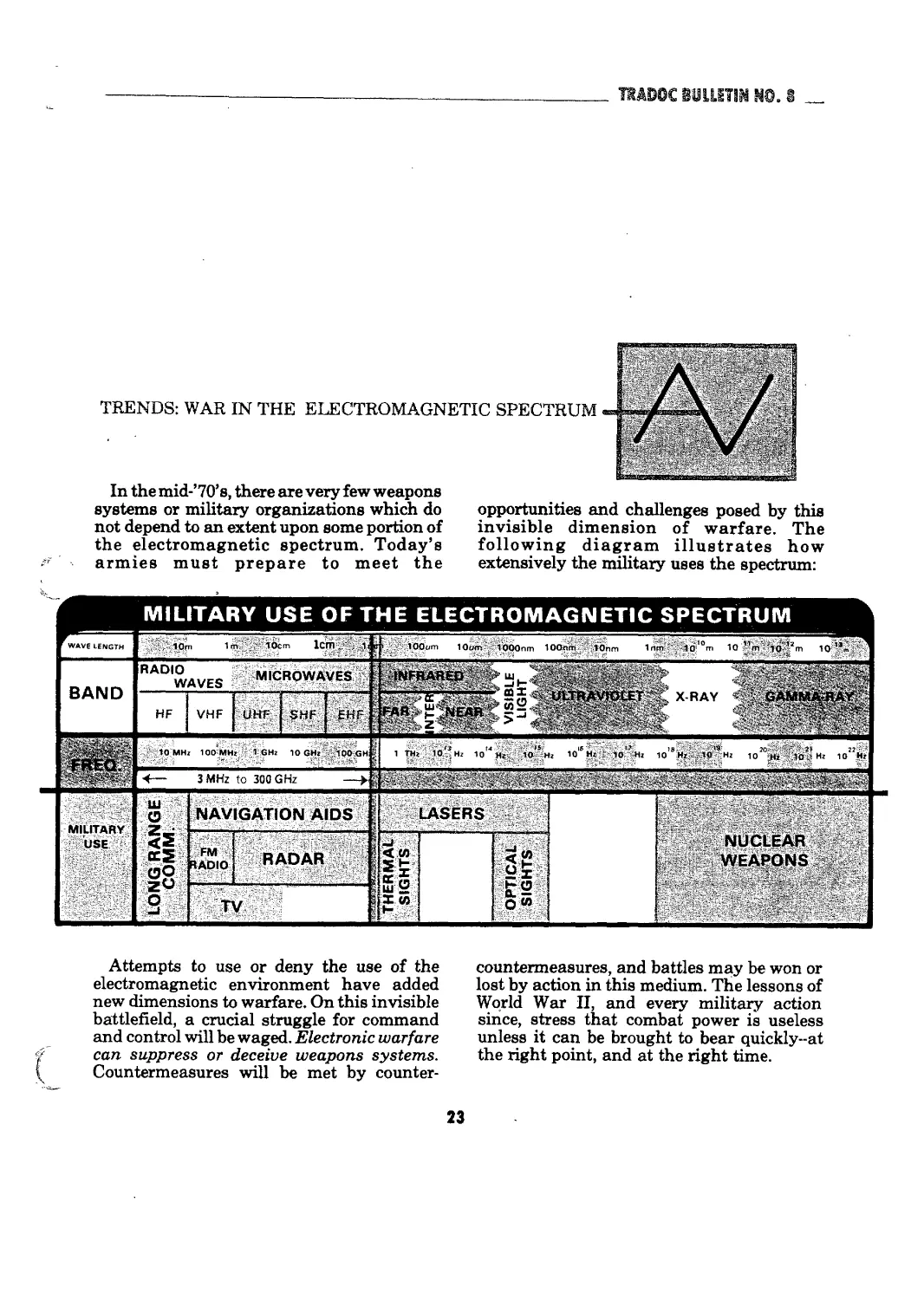
TRENDS: WAR IN THE ELECTROMAGNETIC SPECTRUM
In the mid-’70’s, there are very few weapons
systems or military organizations which do
not depend to an extent upon some portion of
the electromagnetic spectrum. Today’s
armies must prepare to meet the
opportunities and challenges posed by this
invisible dimension of warfare. The
following diagram illustrates how
extensively the military uses the spectrum:
MILITARY USE OF THE ELECTROMAGNETIC SPECTRUM
WAVE LENGTH
10m
' 10c 1cm
BAND
RADwaves microwaves
HF VHF
UHF
SHF

10 MHz 100 MHz 1 GHz 10 GHz
3 MHz to 300 GHz
100.GH »

о
£
10 Ho
lOOum 10u(n lOOOnm 100am
X-RAY
Hr Ю, Hz
1 THz
IO Hz
MILITARY
USE
Ш
0 .
Z_;
0O
zU
о
NAVIGATION AIDS J;
LASERS
FM
RADIO
RADAR
Й
< W
<2
NUCLEAR
WEAPONS >
TV
fiS
o«
Attempts to use or deny the use of the
electromagnetic environment have added
new dimensions to warfare. On this invisible
battlefield, a crucial struggle for command
and control will be waged. Electronic warfare
can suppress or deceive weapons systems.
Countermeasures will be met by counter-
countermeasures, and battles may be won or
lost by action in this medium. The lessons of
World War II, and every military action
since, stress that combat power is useless
unless it can be brought to bear quickly-at
the right point, and at the right time.
23
__ TRADOC BULLETIN НО. 8
EXPECT INTERFERENCE,
INTERCEPTION, AND JAMMING
OF COMMUNICATIONS
Communications are key to command and
control, and the US Army acquired great
strength over the past three decades through
improved communications. One analysis of
modem battle predicts more than 500 US FM
nets will operate in a US corps area. There
will be nearly the same number of enemy
nets, all using the same group of wave
lengths. The congestion indicates that even if
neither side tries to interfere with the other,
there may be few clear channels for
commanders. Whether there is unintentional
interference or not, however, we can expect
interception and deliberate jamming.
THE DIRECTION FINDING THREAT
All modern armies possess powerful
transmitters for deliberate jamming
or blocking parts of the spectrum.
Moreover, all have equipment for
locating an emitter. Using the
principle called direction finding (DF),
it is possible to pinpoint a radar
emitter within 50 meters and a VHF
communications emitter within a
CEP of 1 km. Effective DF target-
acquisition range tends to be less
than US VHF radio communications
ranges, but all radios operated within
a US forward brigade area are
vulnerable to DF. If there is an
unobstructed line-of-sight between
the DF station and any radio in the
brigade area, that radio can be heard
by the intercept station and located —
"fixed." Now satellites can be used to
locate both heat and emitters. If it can
be fixed, it can be attacked.
24
TRADOC BULLETIN NO. 8
The Middle-East War of 1973, in a very real
sense, brought out the need for control of the
electromagnetic spectrum. Both sides were
well equipped and both used electronic
measures and countermeasures in
conjunction with other combat power. For
example, suppression of air defenses featured
concerted DF, extensive electronic jamming,
and use of homing missiles to eliminate the
radar systems which controlled opposing
surface-to-air missiles. Electronic sensing
devices, radar and infrared were used to
locate ground forces, even foot patrols, and to
take them under fire. Tank attacks were met
with barrages of radio jamming designed to
block effective use of tactical radios for
coordinating movement and command and
control.
TANK ATTACKS MET WITH
BARRAGES OF RADIO JAMMING
Any combatant whose controls are exposed
to his enemy, or who is denied use of means to
convey orders, provide for fire support, or
arrange for logistics and administration, is
prone to defeat, whatever his strength in
numbers of weapons.
The US Army will face new challenges in
the battle for the electromagnetic spectrum.
We must use for our benefit all advances in
electronic technology -- suppression of enemy
weapons systems, intelligence gathering,
and target detection. And we must be able to
cope with or counter the enemy’s attempts to
use the spectrum against us.
25
„ TRADOC BULLETIN NO. 8
TREND: BATTLE CONCEPT
Tactical Mobility. Since World War II, all
armed forces have pursued heightened
mobility through advanced technology and
organizational forms adapted to new means
of moving, shooting, and communicating. By
the mid-’70’s, there was a pronounced
organizational trend toward increasing the
percentage of armored and mechanized
troops in Soviet-equipped ground forces.
Airmobility was also being stressed,
although less prominently than in US
doctrine.
THE "AIRMOBILE” CONCEPT IS
THE MOST DRAMATIC
ORGANIZATIONAL ADVANCE IN
THE US ARMY
US organizational trends since 1945 have
evidenced an army striving to increase
tactical mobility. While the percentage of
armored or mechanized forces has risen in
the US Army, the most dramatic
organizational advance has been the
adoption of the "airmobile" concept. With
combat experience in Southeast Asia, the US
Army is the world's foremost exponent of
airmobility. By the mid-*70’s, the US had
fielded organizations designed to move
infantry and artillery about the battlefield
rapidly by helicopter, plus air cavalry and
attack helicopter forces. The US, almost
uniquely, regarded air cavalry as important
for reconnaissance and economy of force, a
way for a commander to exert influence over
large areas. Attack helicopter units provided
a ground commander an aerial antitank force
with a mobility differential 10 to 20 times
greater than armored reserves.
Strategic Mobility. A nation’s ability to
project combat forces rapidly to any place in
the world may shape its national power.
Since future conflicts are likely to be short
and violent, the need for a swift build-up of
combat units is greater than ever before.
26
TRADOC BULLETIN NO. 8 _
Forces must not only be trained for
immediate commitment to battle, but they
must be provided the means to transport
them to the scene of the conflict.
Sealift has long been the traditional means
for projecting US combat power abroad. And
it remains today the backbone of strategic
mobility. Without it, very large forces cannot
be deployed or continuously resupplied. The
advent of modern roll on/roll off shipping
and containerization has significantly
reduced the time required to deploy large
forces. The US Navy, responsible.for keeping
the sea lanes open, and American and allied
shipping can provide US land forces
significant capabilities to operate overseas.
The most dramatic increase, however, in
strategic mobility for US land forces has
come about via airlift.
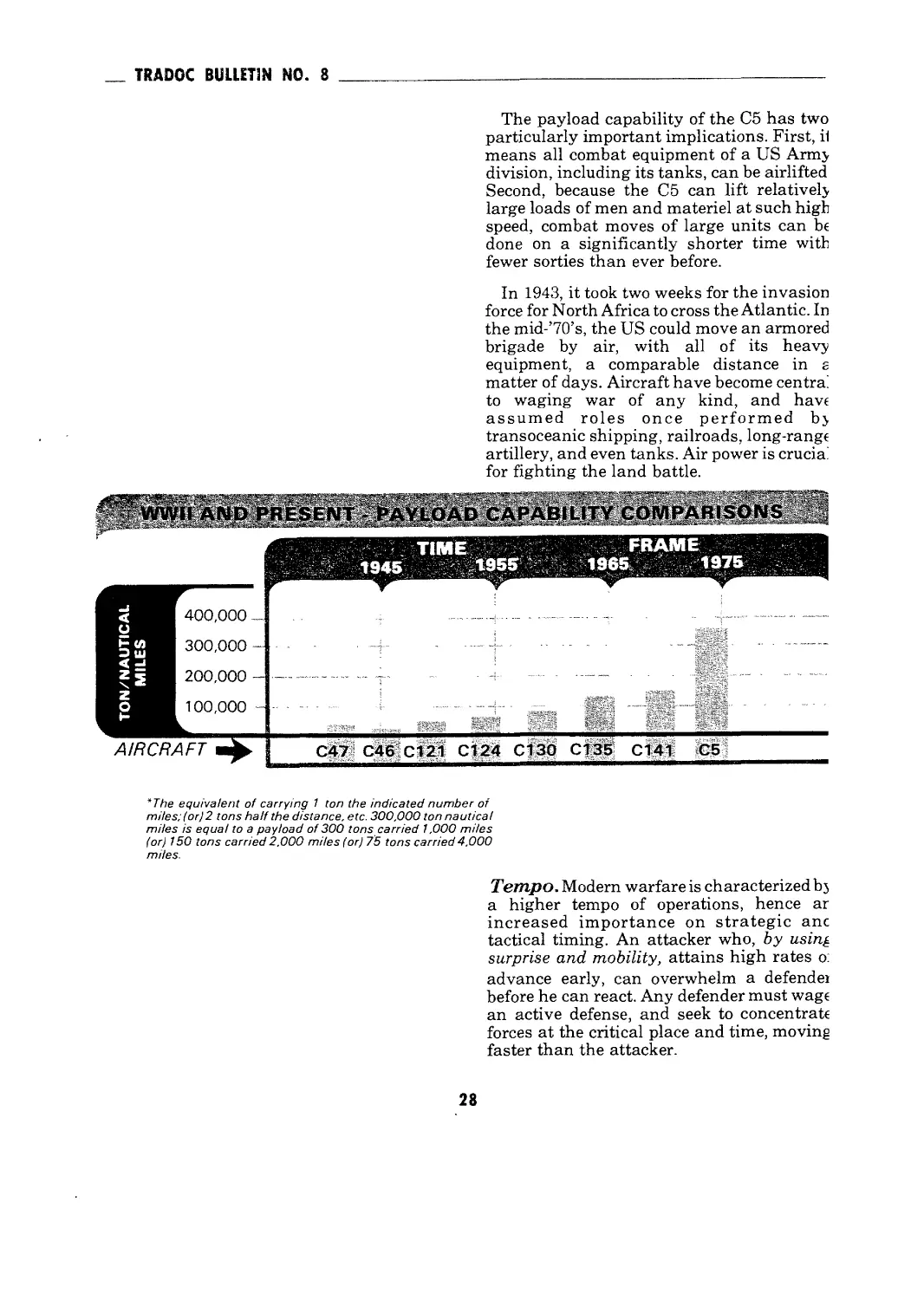
TYPICAL PAYLOAD AND RANGE
Aircraft designed for inter-theater
airlift have a 13-fold increase in
payload and a 6-fold increase in
capacity over their WW II
predecessors. With the C5A, tanks,
APCs, artillery pieces, and
helicopters can be airlanded
overseas in hours. All in all,
considering payload, range, and
speed, the C5 is 100 times more
productive than its World War II
counterpart, the C47.
MILES	1000	2000	3000	4000
C47 ISO
C130 ИПВКНЙ
SPEED MORE THAN 500 MPH — More than
twice that of the C47.
27
TRADOC BULLETIN NO. 8
The payload capability of the C5 has two
particularly important implications. First, ii
means all combat equipment of a US Army
division, including its tanks, can be airlifted
Second, because the C5 can lift relatively
large loads of men and materiel at such high
speed, combat moves of large units can be
done on a significantly shorter time with
fewer sorties than ever before.
In 1943, it took two weeks for the invasion
force for North Africa to cross the Atlantic. In
the mid-’70’s, the US could move an armored
brigade by air, with all of its heavy
equipment, a comparable distance in s
matter of days. Aircraft have become central
to waging war of any kind, and have
assumed roles once performed by
transoceanic shipping, railroads, long-range
artillery, and even tanks. Air power is crucia’
for fighting the land battle.
WWII AND PRESENT - PAYLOAD CAPABILITY COMPARISONS
TIME	FRAME
1945	.-1955'.,	1955.	.1975
TON/NAUTICAL
MILES
400,000
300,000 -
200,000 -
100,000 -
C47 C46 C121 C124 C130 C135 C141 C5
*The equivalent of carrying 1 ton the indicated number of
mites;(or]2 tons half the distance, etc. 300,000 ton nautical
miles is equal to a pay toad of 300 tons carried 1,000 miles
(or} 150 tons carried 2.000 miles (or) 75 tons carried 4,000
miles.
Tempo. Modern warfare is characterized by
a higher tempo of operations, hence ar
increased importance on strategic anc
tactical timing. An attacker who, by using
surprise and mobility, attains high rates o:
advance early, can overwhelm a defendei
before he can react. Any defender must wage
an active defense, and seek to concentrate
forces at the critical place and time, moving
faster than the attacker.
28
TRADOC ВУШТШ Ж 8
Fifty years ago, a highly trained army
division was considered capable of
advancing only 2 to 4 km per day. In 1939, the
German Army introduced the world to
"lightning war," the Blitzkrieg. In France,
after three days spent penetrating the thick
Ardennes forest and closing up to the River
Meuse, Guderian’s XIX Corps covered 250 km
to the English Channel in 8 days, averaging
30.5 km a day (its best drive in one day was 90
km). Rommel’s 7th Panzer Division covered
177 km in 8 days at 22 km average per day. In
Russia, German initial rates of advance were
similar. Guderian’s 2d Panzer Group covered
665 km in 24 days, averaging 28 km per day
(its best advance in one day was 120 km).
The Soviet Army in WWII quickly learned
the value of maintaining high rates of
advance, and of driving for deep objectives.
This table, taken from a mid-’70’s Soviet
source, shows the trend toward the greater
depth of objectives assigned to Red Army
divisions.
DEPTH OF DIVISION OBJECTIVES FOR THE SOVIET ARMY
INTERMEDIATE
OBJECTIVE
FINAL OBJECTIVE
OF THE DAY
INITIAL
OBJECTIVE
WORLD WAR 1	|	.8 — 1.2			1 \	: 2 -	4
WORLD WAR II	i
1941	|	1.5— 2.5		—	j	3 -	4
1942	|	2-3	1	—	|	4 —	6
1943	| 	2 — 4	1	—	I	5 ”	7	j
1944	|	3-5	л	5 — 7	i w—	12	|
1945	I 3-5	1	6 — 8	I	18-	20	I
CURRENT	I I	15 — 20	i r i				|	35-	40. ' • -'I
	1	J		I
As can be seen from the table, the Soviets
perceive division objectives ten times deeper
than they sought at the outset of World War
II.
Soviet Army doctrine strongly holds that
mobility and a high tempo of combat
operations bring success in battle. They hold
this to be especially true in nuclear warfare-
a high rate of advance reduces the danger of
troop destruction by enemy nuclear strikes.
Forces opposing Soviet equipped and trained
troops must expect intense, highly mobile
combat. Battle will be fought on a scale and
at a tempo rarely seen in all history.
The commander who seeks a greater understanding of a specific
modern battlefield must first appreciate the potential of the world’s
first line armies. The leader on the modern battlefield must be an
expert in weapons effects and employment-both his own and those
of the enemy. War is becoming increasingly complex. Morale and
motivation must be backed up in weapons and tactical proficiency.
This is the new and growing dimension of war.
29
OBTAINING TRADOC BULLETINS
Purpose. A series of TRADOC Bulletins are being published by HQ TRADOC to provide
commanders timely technical information on weapons, tactics and training technique. It is no
intended to supplant doctrinal publications, but to supplement material on “How to fight” wit!
data derived from tests, recent intelligence, or other sources, which probe “why?”
Applicability. TRADOC Bulletins are developed by Headquarters, TRADOC using the mos
comprehensive and current military and civilian data available. Army Training and Evaluatior
Programs (ARTEP), Field Manuals (FM) and Training Circulars (TC) will continue to be th<
primary training references. TRADOC Bulletins will supplement them with an explanation of whj
we are training in a given manner. TRADOC Bulletins should enable commanders to bette
stimulate and motivate subordinates to understand why we train the way we do.
Index of Series. TRADOC Bulletins are cataloged in DA Pamphlet 310-3, “Index of Doctrinal
Training and Organizational Publications.” The series are numbered consecutively and eacl
TRADOC Bulletin is announced at time of printing in the information bulletin distributed to al
pinpoint account holders by the US Army AG Publications Center.
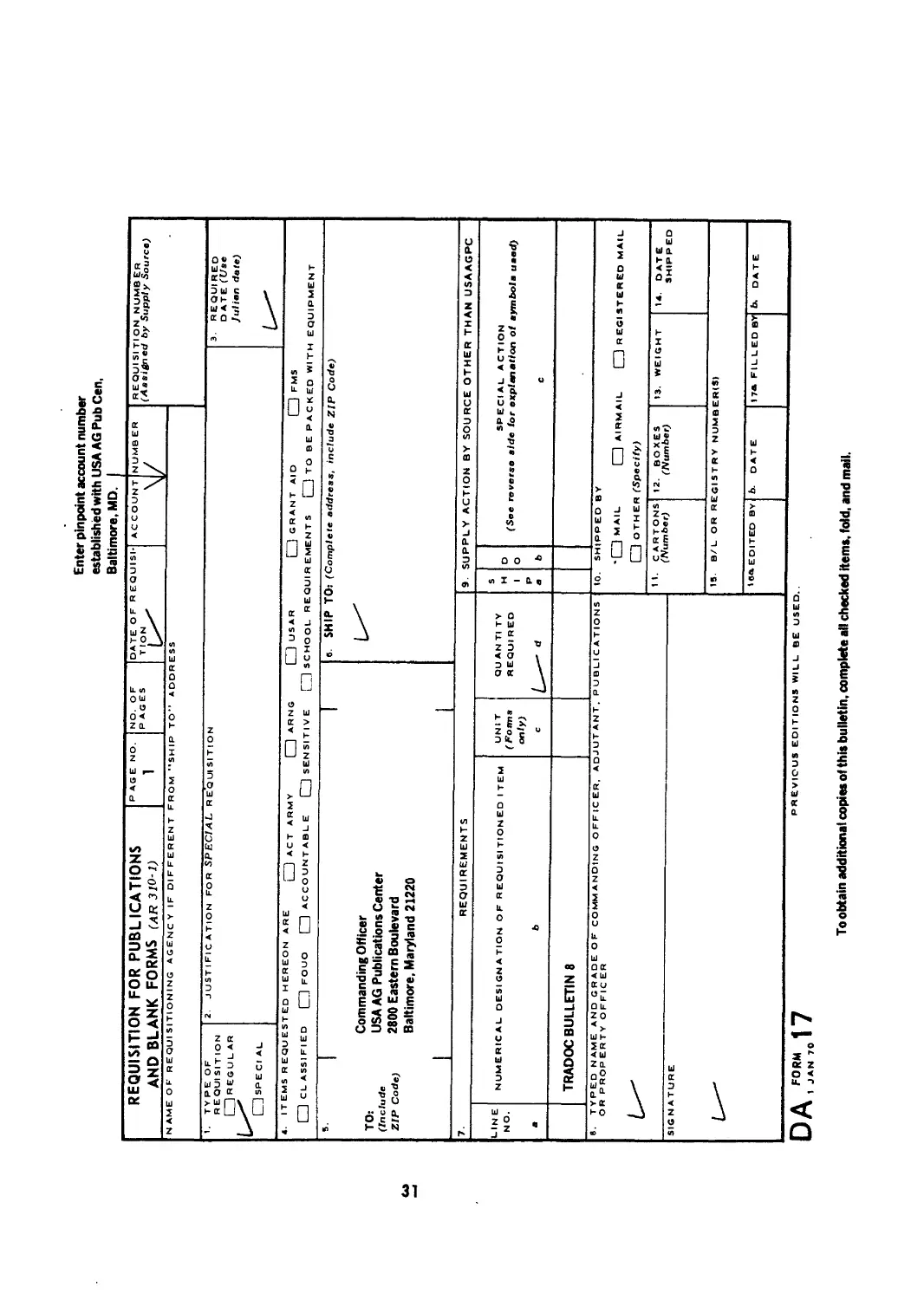
Additional Copies. Submit DA Form 17 to order more copies of this TRADOC Bulletin.
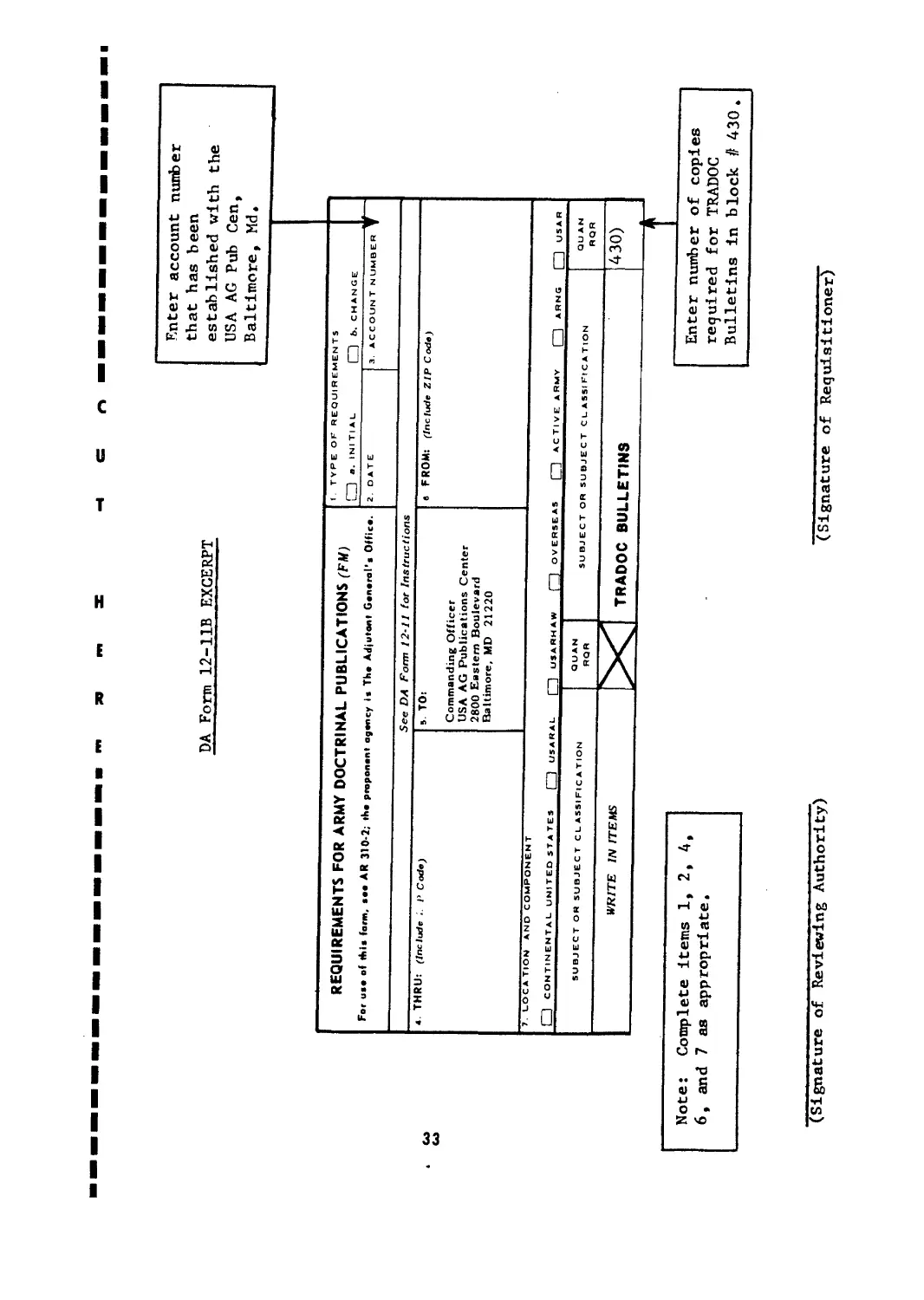
Permanent Distribution. Pinpoint account holders receiving TRADOC Bulletin Number 1 fron
Baltimore will automatically receive two copies of all subsequent issues unless a DA Form 12-1 IB i;
submitted to change that quantity. Others desiring to be added to the permanent distribution lis
for TRADOC Bulletins must submit a DA Form 12-11B. Units which are required to submi
publication requests through another headquarters should send the completed excerpt throug]
proper authority.
Reference for Distribution Procedures. DA Pamphlet 310-10 explains the pinpoint distribution
system and how to establish or update an existing account at the US Army AG Publication
Center. TC 21-6-1, “Use Your Training Publications,” will be helpful also in understanding th
pinpoint system.
30
<А»
Enter pinpoint account number
established with USA AG Pub Cen,
Baltimore, MD.
REQUISITION FOR PUBLICATIONS AND BLANK FORMS (AR310-1)	PAGE NO. 1	NO. О F P AGES	DATE О F R EQUISI' T bON^^	ACCOUNT	NUMB ER
NAME OF REQUISITIONING AGENCY IF DIFFERENT FROM "SHIP TO" ADDRESS
REQUISITION NUMBER
(Assigned by Supply Source)
ITEMS REQUESTED HEREON ARE
REQUISITION
3. REQUIRED
DATE (Use
Julien date)
5.
TO:
(Include
ZIP Code)
Commanding Officer
USA AG Publications Center
2800 Eastern Boulevard
Baltimore, Maryland 21220
SHIP TO: (Complete address, include ZIP Code)
REQUIREMENTS
9. SUPPLY ACTION BY SOURCE OTHER THAN USAAGPC
NUMERICAL DESIGNATION OF REQUISITIONED ITEM
TRADOC BULLETIN 8
QU AN Tl TV
REQUIRED
UNIT
( Poems
ои/у)
SPECIAL ACTION
(See reverse side for explanetion of symbol a used)
SIG NATURE
OTHER (Specify)
	1 1. C ARTONS (Number)	12. BOXES (Number)	13. WEIGHT	14. DATE SHIPPED
	IS. B/L OR REGISTRY NUMBERISI
	ISA EDITED BY	b. DATE	17» FILLED BY	b. DATE
DA
PREVIOUS EDITIONS WILL BE USED..
To obtain additional copies of this bulletin, complete all checked items, fold, and mail.
DEPARTMENT OF THE ARMY
OFFICIAL BUSINESS
PENALTY FOR PRIVATE USE >300
postage and fees paid
department of the army
DOD-314
Commander
US Army AG Publications Center
2800 Eastern Boulevard
Baltimore, Maryland 21220
I
I
I
I
I
I
I
I
I
I
I
I
I
I
c
и
T
(Fold and mail to above)
R
32
DA Form 12-1IB EXCERPT
Enter account number
that has been
established with the
USA AG Pub Cen,
Baltimore, Md.
REQUIREMENTS FOR ARMY DOCTRINAL PUBLICATIONS (FM) For uee of thie form, •*« AR 310-2; the proponent agency ic The Adjutant General’* Office.				I. TVPE OF REQUIREMENTS t__J e. INITIAL	( 1 b. CHANGE
				2. DATE	3. ACCOUNT NUMBER
See DA Form 12-11 for Instructions
4. THRU: (Include P Code)	s TO: Commanding Officer USA AG Publications Center 2800 Eastern Boulevard Baltimore, MD 21220			в FROM: (Include ZIP Code)
1. LOCATION AND COMPONENT ! I CONTINENTAL UNITED STATES	[~j U5ARAL	[_J USARHAW	[ _J OVERSEAS	|	} ACTIVE ARMV	[ ] AR№ [ ] USAR
SUBJECT OR SUBJECT CLASSIFICATION		QUAN RQR	SUBJECT OR SUBJECT CLASSIFICATION			QU AN RQR
WRITE IN ITEMS			TRADOC BULLETINS			430)
Note: Complete items 1, 2, 4,
6, and 7 as appropriate.
Enter number of copies
required for TRADOC
Bulletins in block # 430»
(Signature of Reviewing Authority)
(Signature of Requisitioner)
DEPARTMENT OF THE ARMY
OFFICIAL BUSINESS
PENALTY FOR PRIVATE USE 4300
POSTAGE AND FEES РАЮ
DEPARTMENT of the army
DOD-314
Commander
US Army AG Publications Center
2800 Eastern Boulevard
Baltimore, Maryland 21220
I
I
I
I
I
I
I
I
I
I
I
I
I
I
c
и
T
H
(Fold and mail to above)
R
I
I
I
I
I
I
I
I
I
I
I
I
I
34	I
I
I
TRADOC BULLETIN NO. 8
FEEDBACK
TRADOC Bulletins present information aimed at communicating principles, facts, the "why" of our doctrine,
and other data important to soldiers. We'd like to know if we hit the target. Please respond to this
questionnaire, cut out, fold and mail. Your reply will help in our efforts to fit your needs.
Rank Branch. Serving in a unit □ Yes □ No
1.	Did this bulletin
	give you information you didn't know before
	_remind you of valuable data you already know
	just rehash data you already knew.
2.____Whom do you think is the appropriate target audience? (Check any or all)
_____.platoon leaders	company commanders
	battalion commanders _division commanders
3.	Where do you think this data should be used?
	service schools________unit training (EM) __unit training (Officers)
4.	Indicate your opinion about the coverage of each trend.
TREND:	not enough	about right	too much
Overview
Tanks
Infantry
Artillery
Air Defense Artillery
Air Power
EW
Battle Concept
5.	Which TRADOC Bulletins have you read?
___#1 (C) Range and Lethality of US and Soviet Anti-Armor Weapons (U)
___#2 (C) Soviet ATGMs: Capabilities and Countermeasures (U)
___#2U Soviet ATGMs: Capabilities and Countermeasures
___#3 (C) Soviet RPG-7 Anti-Tank Grenade Launcher (U)
6.	Other comments
35
DEPARTMENT OF THE ARMY
OFFICIAL BUSINESS
PENALTY FOR PRIVATE USE 1300
POSTAGE ANO FEES PAID
DEPARTMENT OF THE ARMY
DOD-314
COMMANDER
US ARMY TRAINING AND DOCTRINE COMMAND
ATTN: ATTNG-CON (TEL: AUTOVON 680-2972/3135)
FORT MONROE, VIRGINIA 23651
I
I
I
I
I
I
I
I
I
I
I
I
I
I
C
U
H
(Fold and mail to above)
R
E
i
i
i
i
i
i
i
i
i
i
i
i
i
i
i
i
।
TRADOC BULLETIN NO. 8
31 December 1975
General, United States Army
Commanding
DISTRIBUTION:
Active Army, ARNG, USAR: To be distributed in accordance with: All DA Form 12-11 accounts
(2 copies each); DA Form 12-11 В requirements forTRADOC BulletinsfQty rqr block no. 430);
and DA Form 12-11 В requirements for Operations of Army Forces in the Field (Qty rqr block
no. 405). Additional copies can be requisitioned (DA Form 17) from the US Army Adjutant
General Publications Center, 2800 Eastern Boulevard, Baltimore, MD 21220.