/


































































Author: Зайцев С.Ю.
Tags: экономика экономический анализ история экономики издательство санкт-петербург
Year: 2018


Text
                    Санкт-Петербургский государственный университет
На правах рукописи
Зайцев Станислав Юрьевич
Модели взаимодействия транснациональных корпораций (ТНК) и
современного государства
Специальность 23.00.02 – Политические институты, процессы и технологии
Диссертация
на соискание ученой степени
кандидата политических наук
Научный руководитель –
доктор социологических наук,
профессор Грибанова
Галина Исааковна
Санкт-Петербург
2018

2
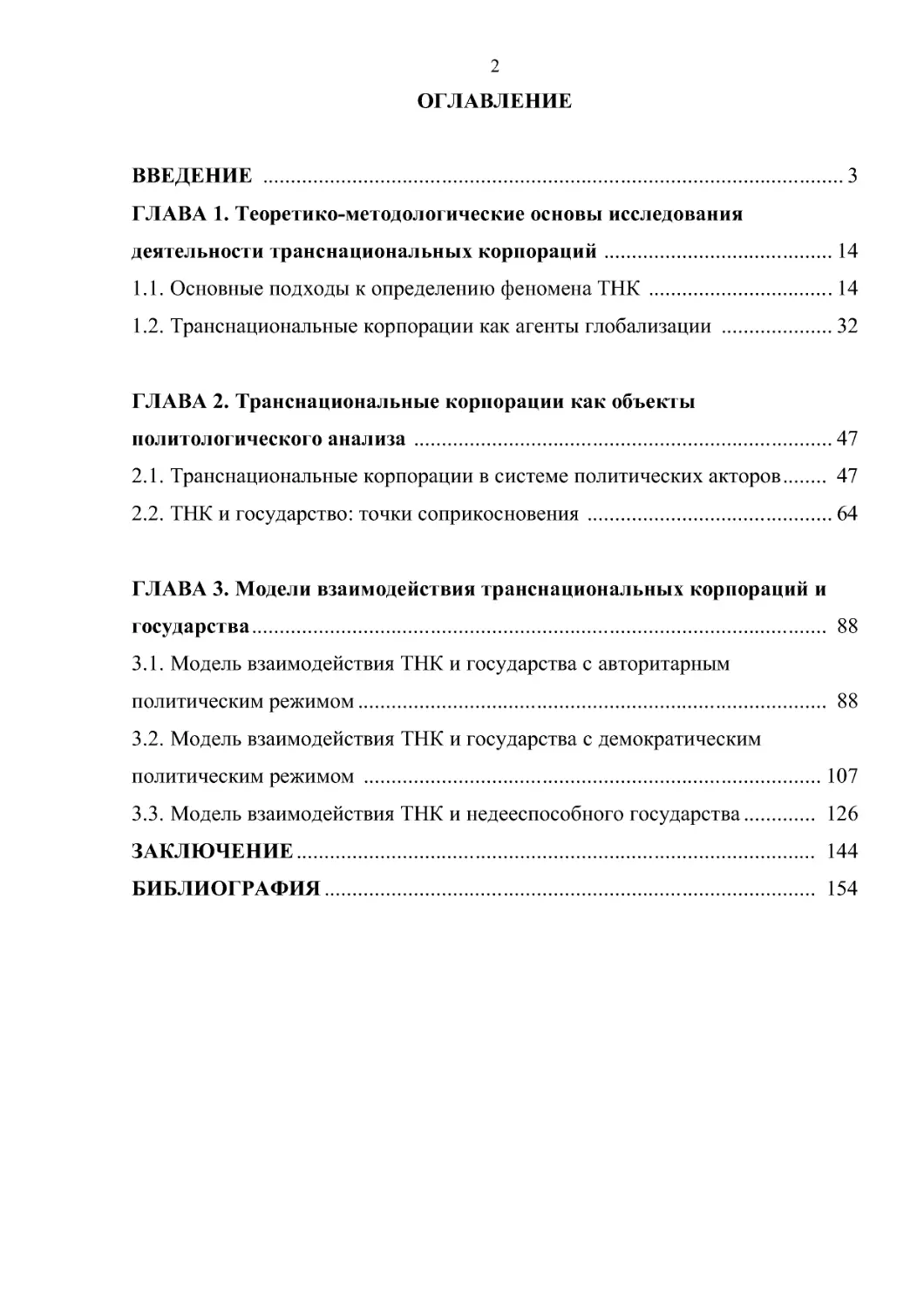
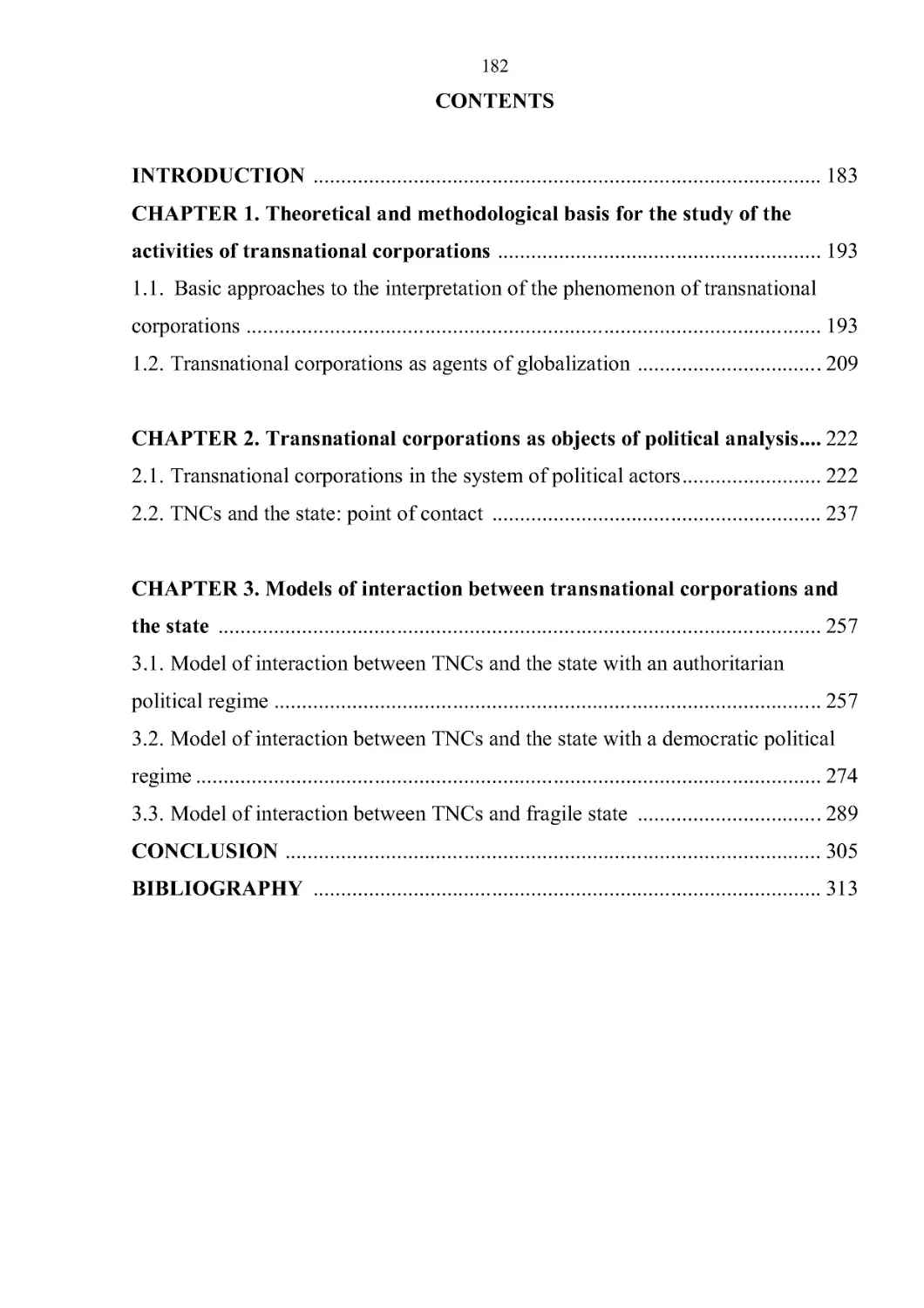
ОГЛАВЛЕНИЕ
ВВЕДЕНИЕ ........................................................................................................ 3
ГЛАВА 1. Теоретико-методологические основы исследования
деятельности транснациональных корпораций ................................ ......... 14
1.1 . Основные подходы к определению феномена ТНК ................................. 14
1.2 . Транснациональные корпорации как агенты глобализации .................... 32
ГЛАВА 2. Транснациональные корпорации как объекты
политологического анализа ........................................................................... 47
2.1 . Транснациональные корпорации в системе политических акторов ........ 47
2.2 . ТНК и государство: точки соприкосновения ................................ ............ 64
ГЛАВА 3. Модели взаимодействия транснациональных корпораций и
государства ................................ ................................ ................................ ....... 88
3.1 . Модель взаимодействия ТНК и государства с авторитарным
политическим режимом ................................ ................................ .................... 88
3.2 . Модель взаимодействия ТНК и государства с демократическим
политическим режимом ................................ ................................ .................. 107
3.3 . Модель взаимодействия ТНК и недееспособного государства ............. 126
ЗАКЛЮЧЕНИЕ ............................................................................................. 144
БИБЛИОГРАФИЯ ........................................................................................ 154

3
ВВЕДЕНИЕ
Актуальность темы исследования. Феномен глобализации, пик
развития которого пришелся на временной период конца ХХ – начала ХХI
века, характеризуется глубокими изменениями во всех отраслях жизни: в
политике,
экономике,
науке,
процессах
передачи
информации,
использовании ресурсов и т.д . Для мировой политики важным результатом
глобализации и сопутствующих процессов стало увеличение числа акторов,
стремящихся к достижению власти, допуску к принятию решений и учету
своего мнения по вопросам развития страны и мира. К таким «новым
политическим акторам» можно отнести надгосударственные организации и
объединения (ООН, НАТО), международные некоммерческие организации
(Гринпис, Всемирный фонд дикой природы, Врачи без границ, движения
антиглобалистов) и экономические институты (Всемирный банк, ВТО) и т.д .
Решения и действия вышеназванных организаций в различной степени
оказывают влияние на политические процессы отдельных стран, а участие в
таких объединениях как ВТО или НАТО и взятые на себя обязательства, если
не размывает суверенитет государства, то стимулирует создание новых форм
и подходов к взаимодействию между различными участниками и группами
интересов. Такими важными участниками с середины ХХ века стали
транснациональные корпорации (ТНК).
Повышение уровня участия ТНК в мировой политике и политической
сфере отдельного государства связано, во-первых, с ростом прибылей
бизнес-фирм и реализацией их монополистических преимуществ; во -вторых,
с открывшейся, благодаря глобализации, возможностью трансграничного
передвижения капитала и прямых иностранных инвестиций; в-третьих, с
успешной конвертацией экономических успехов в политическое влияние.
Однако, несмотря на всё многообразие и обилие научной литературы,
посвященной развитию транснациональных корпораций, несправедливо
малое количество внимания уделяется проблемам их взаимодействия с

4
отдельными государствами. Данное противоречие, отчасти, связано с тем,
что ТНК являются объектом исследования экономистов и политологов,
специализирующихся на проблемах международных отношений. С другой
стороны, в центре политических исследований на локальном уровне ТНК не
обособляются как отдельные участники сферы бизнеса. На наш взгляд,
изучение ТНК как участников политического процесса на уровне отдельных
стран требует использования других методологических оснований и
исследовательских подходов к данному феномену.
Степень
научной
разработанности
проблемы.
Основная
проблематика диссертационного исследования имеет научный задел в виде
большого массива, прежде всего, зарубежной и отечественной литературы,
посвященной феномену транснациональных корпораций, основным способам
их функционирования, а также доступным экономическим, управленческим
и политическим ресурсам.
Признанными авторитетами в изучении деятельности ТНК являются Р.
Вернон, Р. Гилпин, Т. Моран, А. Рагман и др.,
1
работы которых в 1960-1970-х
годах способствовали росту интереса к этим участникам социально-
экономического и политического процессов.
Исследования Дж. Гэлбрейта, Р. Коуза, Р. Портера, Г. Иетто -Джиллис,
А.Г. Мовсесяна, П.И. Хвойника и др.
2
фокусировались на деятельности
корпораций в рамках существующей экономической системы.
1
Vernon R. Economic sovereignty at bay // Foreign Affairs. – 1968. – Vol.47. – Issue 1. – p p .110-122; Вернон Р.
Буря над многонациональными / Пер. с англ. – М., Издательство «Прогресс», 1982. – 272 с.; Vernon R. The
Harvard Multinational Enterprise Project in historical perspective // Transnational Corporations. – 1999. – Vol.8. –
No.2 .
–
pp.35 -50; Gilpin R. The Political Economy of the Multinational Corporation: Three Contrasting
Perspectives // The American Political Science Review.
–
1976.
–
Vol.70.
–
No.1 .
–
pp.184-191; Moran T.H.
Transnational Strategies of Protection and Defense by Multinational Corporations: Spreading the Risk and Raising
the Cost for Nationalization in Natural Resources // International Organization. – 1973. – Vol.27. – No.2 . – p p.273-
287; Moran T.H. Multinational corporations and dependency: a dialogue for dependentistas and non -dependentistas
// International Organization. – 1978. – Vol.32. – No.1 . – p p.79 -100; Rugman A.M. Forty years of the theory of the
transnational corpor ation // Transnational Corporations. – 1999. – Vol.8 . – No.2 . – pp .51-70 .
2
Гэлбрейт Джон Кеннет, Новое индустриальное общество. Избранное / Дж. К . Гэлбрейт. – М.: Эксмо, 2008.
–
1200 с.; Коуз Р. Фирма, рынок и право / Пер. с англ. – М .: Новое Издательство, 2007. – 2 2 4 с.; Портер М.
Международная конкуренция: Пер. с англ. / Под ред. и с предисловием В.Д . Щетинина. – М .: Междунар.
отношения, 1993.
–
896 с.; Ietto-Gillies G. The Theory of the Transnational Corporation at 50+ // Economic
Thought. – 2014. – Vol.3. – Issue 2. – pp .38 -57; Мовсесян А.Г. Транснационализация в мировой экономике:
Учебное пособие.
–
М.: Финансовая академия при Правительстве РФ, 2001.
–
316 с.; Хвойник П.И.
Международное предпринимательство: анализ зарубежного опыта / П.И . Хвойник, Ю.В. Аджубей, И.Е.
Артемьев и др. – М.: Наука, 1992. – 205 с.

5
Как важнейшие участники процессов глобализации и системы
международных
отношений
транснациональные
корпорации
рассматриваются в работах Д. Бхагвади, У. Бека, Д. Стиглица, Дж. Ная-
младшего и Р. Кохэна, З. Бжезинского, С. Хантингтона, П. Дж. Бока, Л.Д .
Градобитовой и Т.М . Исаченко, Э.Г . Соловьева, Н.А. Комлевой и др.
1
Деятельности транснациональных корпораций в политическом
процессе и взаимодействию с государственными институтами посвящены
работы таких отечественных и зарубежных ученых как Р.И. Гайнутдинов,
А.Н. Голиков, С.П. Перегудов, Г.С . Фединяк, С. Афонцев, М. Шимаи, Р.
Абделяль, Т. Бейтс, Дж. Бадуэн, А. Чендлер-младший и Б. Мазлич, Дж.
Фринас и Дж. Вуд, Н. Йенсен, А. Шерер и Г. Палаццо и др.
2
1
Бхагвати Д., В защиту глобализации / Пер. с англ. под ред. В.Л.Иноземцева. – М .: Ладомир, 2005. – 4 48 с.;
Бек У., Что такое глобализация? / Пер. с нем. А.Григорьева и В.Седельника; Общая редакция и послесл.
А.Филиппова. – М .: Прогресс-Традиция, 2001. – 3 04 с.; Стиглиц Дж., Глобализация. Тревожные тенденции.
[Электронный ресурс]. URL: http://www.library.fa.ru/files/Stiglitz-global.pdf. (Дата обращения: 02.08 .2018);
Nye Jr. J., Multinational corporations in world politics // Foreign Affairs. – 1974. – Vol.53. – Issue 1. – p p .153-175;
Huntington S. Transnational organizations in world politics // World Politics. – 1973. – Vol.25. – Issue 3. – p p.334-
368; Bock P.G. Transnational corporation and private foreign policy // Society. – 1974. – Vol.11. – Issue 2. – p p .
44-50; Bock P.G., Fuccillo V.J. Transnational corporations as international political actors // Studies in Comparative
International Development.
–
1975.
–
Vol.10.
–
Issue 2.
–
pp.51-77; Градобитова Л.Д ., Исаченко Т.М.
Транснациональные корпорации в современных международных экономических отношениях. Учебное
пособие. МГИМО. – М .: Издательство «АНКИЛ», 2002. – 1 2 4 с.; Соловьев Э.Г. ТНК в мировой политике и
мировой экономике: проблемы, тенденции, перспективы / Отв. ред. – к.пол.н. Э .Г. Соловьев. – М .: ИМЭМО
РАН, 2005.
–
130 с.; Комлева Н.А. Глобальные корпорации как акторы современного геополитического
процесса // ПОЛИТЭКС. – 2013. – Т .9 - No 3 . – С. 107-118.
2
Гайнутдинов Р.И. Бизнес и политика в современном обществе: Монография. – СПб.: Изд-во РГПУ им. А.И.
Герцена, 2005.
–
207 с.; Голиков А.Н. ТНК и развивающиеся страны: углубление противоречий.
–
М.:
Междунар. отношения, 1978.
–
168 с.; Перегудов С.П. Корпоративный капитал в мировой и российской
политике. – М .: ИМЭМО РАН, 2005. – 9 9 с.; Перегудов С.П. Крупная корпорация как субъект публичной
политики [Текст]: учеб. пособие для вузов / С.П. Перегудов; Гос. ун-т
–
Высшая школа экономики. – М .:
Изд. дом ГУ ВШЭ, 2006. – 163 с.; Фединяк Г.С. Транснациональная корпорация как участник гражданско-
правовых договоров с принимающим государством: [монография]. – К.: Аттика, 2011. – 3 72 с.; Афонцев С.
Будущее ТНК: тенденции и сценарии для мировой политики // Российский совет по международным делам.
17.08.2012. [Электронный ресурс]. URL: http://russiancouncil.ru/analytics-and-comments/analytics/budushchee-
tnk-tendentsii-i-stsenarii-dlya-mirovoy-politiki/. (Дата обращения: 02.08 .2018); Шимаи М. Государство и
транснациональные компании // Проблемы теории и практики управления.
–
1999.
-
No 4. [Электронный
ресурс]. URL: http://vasilievaa.narod.ru/10_4 _99.htm (Дата обращения: 02.08 .2018); Шимаи М. Роль и влияние
транснациональных корпораций в глобальных сдвигах в конце ХХ столетия // Проблемы теории и практики
управления.
–
1999.
-
No 3. [Электронный ресурс]. URL: http://vasilievaa.narod.ru/5_3 _99 .htm (Дата
обращения: 02.08 .2018); Abdelal R. The Multinational Firm and Geopolitics: Europe, Russian Energy, and Power
// Business and Politics.
–
2015.
–
Vol.17.
–
Issue 3.
–
pp.553 -576; Bates T. The impact of multinational
corporations on power relations in South Africa // The Review of Black Political Economy. – 1983. – Issue 12. –
No.2. – p p .133-143; Boddewyn J.J. Political Aspects of MNE Theory // Journal of International Busin ess Studies. –
1988. – Vol.19. – No.3 . – p p .341-363; Boddewyn J.J., Brewer T.L . International-Business political behavior: new
theoretical directions // Academy of Management Review. – 1994. – Vol.19. – No.1 . – pp .119-143; Boddewyn J.J .,
International business–government relations research 1945–2015: Concepts, typologies, theories and methodologies
// Journal of World Business.
–
2016.
–
Vol.51.
–
No.1.
–
pp.10-22; Chandler Jr. A ., Mazlish B. Leviathans:
multinational corporations and the new global history. Cambridge University Press, 2005. – 2 49 p.; Frynas J.G.,
Wood G. Oil & War in Angola // Review of African Political Economy. – 2001. – Vol.28. – No.90 . – p p .587 -606;

6
Работы Л.В . Сморгунова, А.В. Курочкина, А.С. Шерстобитова, Н.Х .
Вафиной, М.А. Портного, Ч. Линдблома, Р. Родеса и С. Биндера, Г.
Биглейзера и Дж. Стаатса, К. Витко и др.
1
посвящены изучению состояния и
анализу характеристик современного государства.
При всем
многообразии изучаемых аспектов деятельности
транснациональных корпораций в современном научном знании остались
некоторые пробелы, которые мы постарались заполнить своим
диссертационным исследованием. В первую очередь это касается того, что до
сих пор основной переменной для анализа выбранной ТНК стратегии в той
или иной стране являлось её отнесение к экономически развитым или
развивающимся странам. Для экономических дисциплин и научного
менеджмента такое разделение вполне обосновано и может способствовать
достижению целей, поставленных в рамках исследования. Однако разделение
на экономически развитые и развивающиеся страны не может быть основной
характеристикой
при
политологическом
анализе
взаимодействия
государственных институтов и транснациональных корпораций. На наш
взгляд, для политической науки важнее не экономическое состояние страны,
а то, к какому типу политического режима относится сформировавшаяся
система общественных и политических институтов. Именно политический
режим станет ключевой характеристикой современного государства, на
Scherer A.G., Palazzo G. Handbook of research on global corporate citizenship. Edward Elgar Publishing Limited.
2008. – 592 p.
1
Сморгунов Л.В., Шерстобитов А.С. Политические сети: Теория и методы анализа: Учебник для студентов
вузов / Л.В. Сморгунов, А.С. Шерстобитов. – М .: Издательство «Аспект-Пресс», 2014. – 320 с.; Сморгунов
Л.В., Тимофеева Л.Н. GR-связи с государством: теория, практика и механизмы взаимодействия бизнеса и
гражданского общества с государством. Учебное пособие.
–
М.: Российская политическая энциклопедия
(РОССПЭН), 2012. – 407 с.; Курочкин А.В., Шерстобитов А.С. Политика и государственное управление в
условиях сетевого общества – СПб.: Изд-во С. - Петербург. ун-та, 2012.
-
151 с.; Вафина Н.Х.
Транснационализация производства в свете теории самоорганизации экономических систем.
–
М.:
Финансовая академия при Правительстве Российской Федерации; Казань: Изд-во КГФЭИ, 2002.
–
316 с.;
Портной М.А. Государство и рынок: американская модель. Под ред. д.э.н., проф. М.А. Портного и д.э.н.,
проф. В.Б. Супяна. – М .: Издательство «Анкил», 1999. – 435 с.; Линдблом Ч. Политика и рынки. Политико-
экономические системы мира / Пер. с англ.
–
М.: Институт комплексных стратегических исследований,
2005.
–
448 с.; Rhodes R., Binder S., Rockman B. The Oxford Handbook of Political Institutions. Oxford
University Press, New York. 2006. – 817 p.; Biglaiser G., Staats J.L. Do political Institutions Affect Foreign Direct
Investment? A Survey of U.S. Corporations in Latin America // Political Research Quarterly. – 2010. – Vol.63. –
Issue 3. – pp .508 -522; Witko C. Campaign Contributions, Access, and Government Contracting // Journal of Public
Administration Research and Theory. – 2011. – Vol.21. – Issue 4. – p p .761-778 .

7
основе которой будет построен наш анализ его взаимодействия с
транснациональными корпорациями и сделана попытка описать основные
характеристики моделей этого взаимодействия.
Объектом диссертационного исследования является деятельность
транснациональных корпораций как участников политического процесса.
Предмет исследования - модели взаимодействия транснациональных
корпораций и государственных институтов в странах с различными
политическими режимами.
Цель диссертационного исследования - выявление основных моделей
политического поведения транснациональных корпораций в странах с
авторитарным и демократическим политическим режимом, а также в странах
с недееспособными государственными институтами.
Достижение поставленной цели реализуется путем решения
следующих исследовательских задач:
-
Дать оценку основным подходам к изучению деятельности
транснациональных корпораций;
-
Определить место и роль транснациональных корпораций в
современных процессах глобализации;
-
Выявить основные черты транснациональных корпораций как
участников политических процессов;
-
Охарактеризовать
основные
подходы
к
взаимодействию
современного государства и транснациональных корпораций;
-
Выделить особенности моделей участия транснациональных
корпораций в политических процессах стран с различными типами
политических режимов.
Методологическая основа исследования представляет собой
применение широкого спектра научных подходов, применяемых для анализа
внутренней политики государства и сферы международных отношений.
Транснациональные корпорации, прежде всего, являются бизнес-
единицами. Поэтому при анализе их положения в политической системе

8
общества
необходимо
использовать
плюралистический
подход,
рассматривающий представителей бизнеса как группы интересов, и
неокорпоративистский подход, изучающий позиции бизнеса в системе
взаимоотношений с государством и профсоюзами.
Для анализа доминирующих организационных практик и правил
взаимодействия в политико-экономической сфере необходимо использовать
неоинституциональный подход. Он позволяет изучить весь спектр
формальных и неформальных способов закрепления своего положения
транснациональными корпорациями в принимающей стране, а также опыт
сотрудничества с правительством страны происхождения.
Теория рационального выбора при изучении деятельности ТНК
позволяет рассматривать цели и способы их достижения не только самими
корпорациями, но и другими политико-экономическими акторами разных
уровней (профсоюзы, заинтересованные индивиды, местный бизнес).
Особого внимания заслуживает возможность в рамках данной методологии
проанализировать коллективные действия различных участников по
отстаиванию своих интересов и прав.
Использование сетевого подхода обусловлено тем, что ТНК стали
важными акторами политических процессов на локальном и международном
уровнях. Однако единолично добиться поставленных целей в современном
мире, с множеством политических субъектов, уже невозможно. Поэтому
формируется сложная система взаимосвязей, сетей между участниками,
создаваемых для совместных действий, обмена ресурсами и реализации
общих интересов.
Применение сравнительного метода позволит изучить характер
взаимоотношений, деятельности и форм влияния транснациональны х
корпораций на принятие решений и развитие государственных институтов в
странах, с различными типами политических режимов (стабильными или
нестабильными, авторитарными или демократическими) и уровнем

9
социально-экономического
развития
(развитые,
развивающиеся
и
слаборазвитые страны).
Эмпирическую базу диссертации составляют:
1. Рейтинги ведущих ТНК, ежегодно публикующиеся в журналах
Forbes, Fortune и Financial Times, а также рейтинг транснационализации
ЮНКТАД;
2. База политических режимов А. Хадениуса и Я. Теорела, а также
показатели Индекса недееспособности государств (Failed States Index),
составленного организацией Фонд мира совместно с журналом Foreign
Policy;
3. Материалы средств массовой информации, доклады аналитических
центров и правозащитных организаций, сайты государственных органов и
транснациональных корпораций.
Научная новизна исследования заключается в следующих
положениях:
-
на основе изученного массива научных источников выделены
базовые характеристики транснациональных корпораций как политических
акторов;
-
определено место и роль транснациональных корпораций в
современном политическом процессе на глобальном (как агентов
глобализации) и локальном (как важных политических акторов) уровнях;
-
выявлена специфика и характеристики моделей взаимодействия
транснациональных корпораций и современных государств в зависимости от
установившегося типа политического режима.
Положения, выносимые на защиту:
1. Развитие института транснациональных корпораций способствовало
росту интереса к данному феномену со стороны всего спектра социальных
наук. Политология может рассматривать ТНК как участников политических
процессов, способных конвертировать экономическое превосходство в
политическое влияние. Транснациональные корпорации – это крупные

10
бизнес компании, имеющие единую глобальную стратегию развития и
стремящиеся к доминирующему положению на рынках нескольких стран
путем развития сети филиалов и дочерних фирм и относительно
неограниченного инвестирования капитала.
2. Глобализация сделала транснациональные корпорации важными
агентами
происходящих
социально-политических
изменений.
Транснациональные корпорации обладают субъектностью только на уровне
отдельной страны, при взаимодействии с социумом и государственными
институтами. На более высоком уровне они выступают агентами
глобализации, подстраивая свои стратегии под сопутствующие изменения и
взаимодействуя с другими участниками данной системы. При этом они не
являются самыми мощными акторами в плане применения силы, но влияют
на социум путем участия в формировании и развитии экономики
государства, а также потребительского поведения населения.
3. Деятельность транснациональных корпораций осуществляется на
глобальном и локальном уровнях. На глобальном уровне взаимодействие
происходит с
международными организациями и институциями,
национальными государствами как участниками международных отношений,
транснациональными некоммерческими и международными организациями.
На локальном уровне взаимодействие происходит между транснациональной
корпорацией (в стране происхождения или в принимающей стране) и
политическими элитами, государственными институтами, бизнесом,
профсоюзами, гражданским обществом.
4. Как политические акторы транснациональные корпорации обладают
такими ресурсами и характеристиками как: способность конвертирования
экономических преимуществ в политическое влияние; внешнеполитическая
поддержка страны базирования ТНК; лучшее управление доступными
ресурсами и внедрением инновационных практик (в том числе в сфере
управления) по сравнению с государством; технологическое превосходство
международного бизнеса перед местными предпринимателями, делающее их

11
важными участниками развития стратегически важных для государства
отраслей экономики; слабый контроль ТНК со стороны гражданского
общества.
5. Основное взаимодействие транснациональных корпораций на
локальном уровне происходит с институтами государства. Единицей анализа
взаимодействия является такая характеристика современного государства как
установившийся политический режим – авторитарный или демократический.
Также проведен анализ деятельности ТНК в странах с недееспособными
государственными институтами. В каждой модели взаимодействия ТНК и
государственных институтов выделено три этапа: подготовительный этап, на
котором проводится анализ экономического, политического, социального и
военного (в случае взаимодействия с недееспособными государствами)
положений в стране и принимается решение о целесообразности начала
бизнес-деятельности; этап входа, в процессе которого транснациональная
корпорация начинает свою работу в экономическом и политическом поле
принимающей страны; этап функционирования, на котором ТНК развивают
свою деятельность, а также проявляется характер и инструменты
взаимодействия с политическим руководством страны.
Теоретическая значимость диссертации заключается в обосновании
целесообразности изучения деятельности транснациональных корпораций
как политических акторов в их взаимодействии с государственными
институтами; в улучшении понимания специфики деятельности ТНК в
политическом и экономическом полях различных стран в зависимости от
типа политического режима
Практическая значимость настоящей диссертации состоит в
возможности использования основных положений, выводов и материалов в
учебно-образовательном процессе, а также при разработке и проведении
отдельных учебных курсов по проблемам взаимодействия представителей
бизнеса и государства. Результаты исследования также могут быть
востребованы: федеральными и региональными органами власти,

12
отвечающими за внешние и внутренние экономические отношения и
привлечение
прямых
иностранных
инвестиций; представителями
объединений и союзов, включающих в себя крупный отечественный и
зарубежный бизнес; аналитическими центрами, специализирующимися на
исследованиях и оказании услуг по налаживанию взаимодействия бизнеса и
государства.
Апробация результатов исследования. Основные результаты и
выводы исследования апробированы автором в виде публикаций статей в
журналах, входящих в перечень рецензируемых научных изданий,
рекомендованных ВАК Министерства образования и науки РФ, в которых
должны быть опубликованы научные результаты диссертаций на соискание
ученой степени кандидата наук
1
, а также в ходе выступления с докладами на
следующих конференциях:
- Зайцев С.Ю . Модели взаимодействия транснациональных корпораций
и государства: политологический подход // Материалы международного
молодежного научного форума «Ломоносов-2018» / Отв. ред. И.А.
Алешковский, А.В. Андриянов, Е.А. Антипов. [Электронный ресурс] - М .:
МАКС Пресс, 2018.
-
Зайцев С.Ю . Особенности деятельности транснациональных
корпораций в странах Африки // Ex oriente lux: Вторая международная
студенческая конференция востоковедов и африканистов. Санкт-Петербург,
20-21 октября 2017 г.: материалы конференции / [отв. ред.: к. филол. н. А.В.
Челнокова]. – СПб.: Издательство «ЮПИ», 2017. – 160 с. С .109.
-
Зайцев С.Ю . Взаимодействие ТНК, общества и государства в
социальной сфере // Предпринимательство и реформы в России: тезисы
докладов XXII международной конференции молодых учёных-экономистов
(Санкт-Петербург, 1 –2 декабря 2016 г.) / редкол.: А.В. Белов (отв. ред.), С.А.
1
Зайцев С.Ю. Взаимодействие транснациональных корпораций и государства: политологический анализ //
Вестник Поволжского института управления. 2017. Том 17. No6 . С.37 -45; Зайцев С.Ю. Транснациональные
корпорации как агенты глобализации // ОБЩЕСТВО: политика, экономика, право. 2018. No1. С.15-19;
Зайцев С.Ю. Основные способы интерпретации феномена транснациональных корпораций в социальных
науках // Вестник Пермского университета. Политология. 2017. No4. С.165-180.

13
Белозёров, А.В. Воронцовский, В.О . Титов [и др.]. —
СПб.: Изд-во С. -
Петерб. ун-та, 2016. С. 157 -158.
-
Зайцев С.Ю . Деятельность транснациональных корпораций как вызов
государственному суверенитету // Россия в новом геополитическом
измерении: материалы VII международной молодежной конференции.
–
СПб.: Скифия-принт, 2016. С . 137-139.
Структура диссертационного исследования. Диссертация состоит из
введения, трех глав, заключения и списка литературы. Общий объем работы
составляет 180 страниц.

14
ГЛАВА 1. Теоретико-методологические основы исследования
деятельности транснациональных корпораций
1.1. Основные подходы к интерпретации феномена транснациональных
корпораций
Последние 25 лет развития человечества, сопровождающиеся
усилением глобализации и глубокими изменениями в различных сферах
человеческой деятельности,
привели
к
рождению
и
усилению
трансграничных участников политических и экономических процессов.
Демократизация политической системы, либерализация экономики, процессы
информатизации, развитие транспортных сетей и способов доставки товаров
из одного конца света в другой привели к тому, что физические границы и
территории того или иного государства уже не играют большой роли в его
развитии как это было в предшествующих эпохах. В соответствии с этим,
растет роль субъектов, способных ставить и достигать целей, независимых от
наличия границ и национального состава населения. Одними из таких
субъектов являются транснациональные корпорации (ТНК).
По данным Конференции ООН по торговле и развитию (ЮНКТАД) в
мире насчитывается порядка 77 тыс. материнских и 770 тыс. дочерних
компаний ТНК. В них занято около 62 млн. сотрудников, а сумма оборота
составляет $4 трлн.
1
Наличие подобных ресурсов позволяет говорить о том,
что транснациональные корпорации находятся на этапе активного развития, а
также имеют возможности играть большую роль в современном
миропорядке.
Институт транснациональных корпораций стал объектом интереса
нескольких научных дисциплин. Большой вклад в исследования ТНК внесли,
естественно, представители экономической науки, в которой бизнес (как
1
World Investment Report 2006. FDI from Developing and Transition Economies: Implications for Development.
United Nations, 2006. P.XVIII. [Электронный ресурс]. URL: http://unctad.org/en/Docs/wir2006_en.pdf. (Дата
обращения: 02.08.2018).

15
основной участник экономического процесса) является одним из главны х
предметов исследований. С развитием глобализации интерес к данному
феномену проявили ученые, изучающие международные отношения,
которые уделяли внимание месту ТНК в современном мироустройстве и их
роли в его создании. Изучению внутреннего взаимодействия между штаб-
квартирой корпорации и дочерними компаниями, а также повышению
эффективности управления крупной фирмой, посвятили себя представители
научного менеджмента. Объектом изучения юридических наук стали
вопросы нарушения транснациональными корпорациями прав человека,
соблюдения международных договоров, а также феномен корпоративной
социальной ответственности бизнеса.
В самом общем виде транснациональные корпорации можно
определить
как
крупные
фирмы,
имеющие
свои
филиалы
(представительства) в нескольких странах и осуществляющие продажи
товаров и услуг на различных национальных рынках. Такое определение не
лишено недостатков, так как не учитывает такие аспекты, как наличие
прямых иностранных инвестиций, структуру капитала, характеристики
страны базирования и принимающей стороны и т.д . Поэтому, в процессе
исследования, мы выделим основные характеристики и атрибуты ТНК, а
затем сформулируем рабочее определение, использование которого
приблизит нас к решению поставленных задач.
В научной литературе существует некоторая разность определений.
Например, А.Г . Мовсесян считает транснациональную корпорацию одним из
видов (наравне с многонациональной корпорацией) международной
корпорации, а основным детерминантом является осуществление прямы х
иностранных инвестиций (ПИИ) в различные страны мира. Главное различие
между ТНК и МНК состоит в том, что у первых головная компания
принадлежит одной стране, а у вторых – головная компания состоит из

16
капитала представителей двух и более стран.
1
Увеличение возможностей
покупки акций компании и снятие барьеров на передвижение капитала
снимает это различие в определениях. Таким образом, не следует множить их
количество, а стоит сосредоточиться на тех преимуществах, которые ТНК
получают из своего положения. Об этом же говорит и Г. Иетто-Джиллис,
указывающая, что термин «транснациональная корпорация» подчеркивает
способность компаний действовать через границы различных государств, а
не в одном из них. Способность планирования, организации и контроля
деятельности в разных странах «даёт им (транснациональным корпорациям –
Прим.) определенные преимущества, когда они имеют дело с акторами,
такими как работники или даже правительства, которые не могут работать и
координировать действия настолько эффективно через национальные
границы».
2
Один из самых цитируемых исследователей международного бизнеса
Р. Вернон под транснациональной корпорацией понимает «кластер,
состоящий
из
нескольких
предприятий разной
национальности,
объединенных
общей
собственностью
и
реализующих
единую
управленческую стратегию».
3
Такое определение хорошо характеризует
деятельность таких фирм как Ford, Nestle, IBM и Phillips, в которых работа
штаб-квартир, поставщиков и сборочных производств осуществляется в
разных странах с той или иной степенью автономии. Получается, что
несколько средних и мелких фирм образуют одну корпорацию. Однако
ответственность за качество конечного продукта и координацию работ по его
созданию несет головной офис компании.
В одной из своих работ Г. Иетто -Джиллис выделяет элементы, внесшие
большой вклад в рост и развитие деятельности транснациональны х
корпораций: технологические усовершенствования в области транспорта и
1
Мовсесян А.Г . Транснационализация в мировой экономике: Учебное пособие. – М.: Финансовая академия
при Правительстве РФ, 2001. С.36.
2
Sprague J., Ietto-Gillies G. Transnational corporations in twenty-first century capitalism // Critical perspectives on
international business. – 2014. – Vol.10. – Issue 1/2. P.41.
3
Vernon R. Economic sovereignty at bay // Foreign Affairs. – 1968. – Vol.47. – Issue 1. P.114 .

17
связи; организационные и управленческие инновации в крупных компания х
и институтах; благоприятная политическая обстановка после Второй
мировой войны; реализация программ либерализации и приватизации в
развитых и развивающихся странах за последние 30 лет.
1
Первые два
элемента позволили компаниям осуществлять контроль и управление
деятельностью на расстоянии. Одним из характерных нововведений стало
размещение процесса производства в развивающихся странах, а
высокотехнологичных процессов, требовавших иных навыков, в развитых
странах. В политической среде происходит переход от конфронтации между
ТНК и национальными правительствами в 1960-1970-х годах к
сотрудничеству между ними (с 1980-х до наших дней).
2
Благодаря
тенденции, направленной на либерализацию и открытие рынков,
транснациональные корпорации получили возможность входа на территорию
новых стран, расширения своей деятельности, а также выигрыша
конкуренции по причине превосходства в ресурсах.
Проанализировав более 300 исследований за период 1987-2007 годов,
посвященных деятельности ТНК, Р. Аггарвал, Д. Беррил и др. выделили
наиболее применяемые в научной литературе характеристики для
определения
транснациональных
корпораций. Наличие
дочерних
предприятий и филиалов, как основной атрибут ТНК, упоминается в 210
работах. На втором месте стоит осуществление международных продаж (118
работ).
3
Работу дочерних фирм и высокий уровень продаж могут себе
позволить крупные компании, использующие свой размер для получения
конкурентного преимущества на рынке.
Классик экономической теории Р. Коуз доказывал, что увеличению
фирмы способствуют, во-первых, снижение трансакционных издержек; во-
вторых, снижение предпринимателем числа ошибок в своей деятельности; в-
1
Ietto-Gillies G. The Theory of the Transnational Corporation at 50+ // Economic Thought. – 2014. – Vol.3. – Issue
2. P.40.
2
Ibid.
3
Aggarwal R., Berrill J., Hutson E., Kearney C. What is a multinational corporation? Classifying the degree of firm-
level multinationality // International Business Review. – 2011. – Vol. 20. P.560.

18
третьих, снижение цены факторов производства.
1
Решив эти проблемы,
компания укрепит своё положение на рынке и будет успешно достигать задач
по запланированным темпам экономического роста, создавая сеть из своих
филиалов, поставщиков и представительств. Соответственно, при
транснациональном характере фирма является системой контрактов между
своими филиалами и структурными подразделениями, а рыночные
отношения здесь заменяются внутрифирменными. Далее, работа сети
филиалов и представительств обеспечивает фирму информацией о наиболее
эффективных практиках работы в разных странах, применении
инновационных подходов к управлению и способам сотрудничества с
другими участниками экономических и политических процессов. В
совокупности это и позволяет снизить количество ошибок в своей бизнес-
деятельности. Возможность же распределения работ по созданию продукта в
наиболее соответствующих этому условиях позволяет снизить цену факторов
производства для транснациональной корпорации.
Похожей точки зрения придерживается и Д. Гэлбрейт, который
определяет корпорацию как крупную фирму, способную, с одной стороны,
экономить на производственных издержках, а с другой - стремящейся к
монопольному положению на рынке. Однако размер фирмы обусловлен не
только этими двумя требованиями, но и планированием, включающим в себя
контроль спроса и предложения, обеспечение капиталом и минимизацию
риска.
2
Реализация функции планирования осуществляется в интересах
техноструктуры корпорации, т.е . совокупности всех сотрудников фирмы,
принимающих решения,
обладающих специальными знаниями и
способностями.
3
В основе техноструктуры лежит групповое принятие
решений (акционерами, менеджерами высшего звена и т.д .), а не
единственного предпринимателя. К основным целям техноструктуры как
организации управления американский исследователь относит обеспечение
1
Коуз Р. Фирма, рынок и право / Пер. с англ. – М.: Новое Издательство, 2007. С.47.
2
Гэлбрейт Джон Кеннет, Новое индустриальное общество. Избранное / Дж. К . Гэлбрейт. – М.: Эксмо, 2008.
С.88.
3
Там же. С.84.

19
гарантированного уровня прибыли и максимальный темп роста доступны х
средств. К дополнительным целям относятся составляющие явления, позже
получившего название корпоративной социальной ответственности. В
интерпретации Гэлбрайта это «создание лучшего общества и улучшение
образования; лучшее понимание системы свободного предпринимательства;
эффективная борьба с болезнями сердца, эмфиземой, алкоголизмом, твердым
шанкром и другими болезнями; участие в той или иной политической
партии; возрождение систематического соблюдения религиозных обрядов».
1
Важным, помимо экономических факторов, здесь является обезличенность
корпорации, выражающаяся в общем интересе акционеров, а также
некоторое размывание ответственности при негативных последствиях её
деятельности.
Наиболее полный список основных характеристик транснациональны х
корпораций дал отечественный экономист П.И. Хвойник:
-
Достаточно крупный размер фирмы, позволяющий ей применять весь
арсенал средств международной деятельности и пользоваться их
преимуществами;
-
Не обязательно полная и безраздельная монополия, но в любом
случае необходимые элементы монопольного положения на рынке,
связанного не только с крупным размером фирмы, но и с
преимущественными позициями в отдельных областях производства, научно -
технического прогресса, сбыта, финансов и т.д .;
-
Наличие интернациональной производственной структуры, развитое
внутрифирменное разделение труда между расположенными в различных
странах подразделениями этой структуры;
-
Значительная, пусть даже не решающая, но достаточно существенная
доля зарубежных операций в общей деятельности фирмы, по крайней мере
по одному из главных направлений;
1
Гэлбрейт Джон Кеннет, Новое индустриальное общество. Избранное / Дж. К . Гэлбрейт. – М.: Эксмо, 2008.
С.161.

20
-
Транснациональный
характер
операций,
верховенство
расположенного в стране базирования центра принятия стратегических
решений, его контроль над всеми звеньями своего интернационального
производственного комплекса;
-
Осуществление хотя бы части своих международных операций в
рамках внутрифирменной, внутрикорпорационной структуры, обладание
соответствующим международным механизмом;
-
Наличие единой глобальной стратегии, подчиняющей деятельность
зарубежных подразделений интересам фирмы в целом;
-
Транснационализация капитала, пусть даже в сочетании с его
интернационализацией, господство капитала одной страны, прежде всего
путем прямых зарубежных инвестиций, а также при помощи других форм
контроля, не обязательно связанных с владением собственностью за
рубежом.
1
В отличие от советских экономистов, считающих причиной усиления
транснациональных корпораций их монопольное положение, М. Портер
таковой считает конкуренцию. По мнению американского исследователя, в
процессе глобализации и ужесточения конкуренции крупная фирма уже не
может ограничиваться деятельностью на национальном рынке, поэтому она
формирует глобальный подход к стратегии. «Фирма не может долго
поддерживать преимущество в международной конкуренции, не используя и
не расширяя свои преимущества, связанные с базированием в своей стране, с
помощью глобального подхода к стратегии».
2
Глобальная стратегия
позволяет использовать преимущества базирования в своей стране
(доступность кредитов, правовая защита, политическое представительство), а
также, по возможности, нивелировать его недостатки (высокие налоги,
сильные профсоюзы, коррупция).
1
Хвойник П.И . Международное предпринимательство: анализ зарубежного опыта / П.И. Хвойник, Ю.В.
Аджубей, И.Е. Артемьев и др. – М.: Наука, 1992. С.14 -15.
2
Портер М. Международная конкуренция: Пер. с англ. / Под ред. и с предисловием В.Д . Щетинина. – М.:
Междунар. отношения, 1993. С.628.

21
По Портеру, глобальный подход к стратегии состоит из нескольких
элементов. Во-первых, это необходимость продажи товара во всем мире, а не
только в стране базирования (на внутреннем рынке). При этом
международные продажи должны рассматриваться как неотъемлемая часть
бизнеса фирмы, а не дополнительная. Вторым элементом является
размещение различных видов деятельности (сборочные производства,
НИОКР, добыча сырья и т.д .) в других странах, позволяющее использовать
местные преимущества, компенсировать различные неблагоприятные
моменты и облегчить выход на местные рынки. Третьим элементом
глобального подхода является координация и интеграция различных видов
деятельности в мировом масштабе для достижения более широких познаний,
использования устойчивой репутации фирменного знака и успешного
обслуживания международных покупателей.
1
Возвращаясь к вопросу о конкуренции можно выделить группы
преимуществ, которые имеют транснациональные компании перед другими
типами бизнес-фирм. К географическим конкурентным преимуществам
можно отнести выгоды, получаемые от места расположения штаб-квартиры
корпорации и её дочерних предприятий: это доступ к природным ресурсам и
транспортным системам (выход к морю, например), оптимальное
расположение предприятий в принимающей стране; к финансовым
конкурентным преимуществам можно отнести возможности привлечения
инвестиций и крупных заемных средств и их выгодного вложения, получение
максимальной прибыли от вложенных средств и минимизация рисков,
оперативное
перемещение
внутрифирменного
капитала
через
государственные
границы;
к
производственным
конкурентным
преимуществам можно отнести возможности по диверсификации
производства, контроль над процессом создания продукта и его сбытом
путем построения технологической цепочки предприятий; к управленческим
1
Портер М. Международная конкуренция: Пер. с англ. / Под ред. и с предисловием В.Д . Щетинина. – М .:
Междунар. отношения, 1993. С.628-629.

22
конкурентным преимуществам относятся установление эффективной
организационной структуры компании, возможность привлечения на высший
и средний уровень управления квалифицированных специалистов,
обладающих международным опытом или знающих культуру принимающей
страны; к политическим конкурентным преимуществам можно отнести
выгоды,
извлекаемые
из
различий
политических
систем
или
законодательства принимающих стран, из использования преимуществ
налоговой системы, разницы курсов валют, преодоления протекционистских
барьеров и антимонопольного законодательства, а также эффективно
функционирующие институты поддержки ПИИ.
В международном частном праве под транснациональной корпорацией
понимается «экономически единое предприятие, имеющее несколько
юридически самостоятельных или зависимых подразделений различной
национальности, проводящее единую экономическую политику и
руководство».
1
С юридической точки зрения сложность определения
транснациональной корпорации заключается в том, что данный термин
обозначает не одну компанию, а несколько хозяйствующих субъектов,
интегрированных в систему производства, поставок и распределения.
Специалист по международному праву М.М . Богуславский определяет
транснациональную корпорацию как группу юридических лиц, имеющих
национальность (подданство) разных стран мира, основанную на системе
участия в уставных капиталах участников (институциональные ТНК) или
участники которых связаны договорными отношениями (договорные ТНК).
2
Ученый выделяет два подхода к регулированию ТНК средствами
национальных правовых систем. Согласно субъектному подходу (entity
approach) право применяется в отношении каждого юридического лица
(филиала), входящего в структуру ТНК на территории государства. Согласно
1
Королев А.Е . Транснациональные корпорации как субъекты международного частного права: диссертация
на соискание ученой степени кандидата юридических наук. Специальность 12.00 .03 – гражданское право,
предпринимательское право, семейное право, международное частное право. Саратов, 2001. С.121 .
2
Богуславский М.М. Международное частное право: учебник / М.М . Богуславский. 6 -е изд., перераб. и доп.
–
М.: Норма; ИНФРА-М, 2011. С.203.

23
подходу с точки зрения имущественного комплекса (enterprise approach)
право применяется в отношении всех структурных единиц ТНК.
1
Однако в
таком случае система правоприменения должна быть международной, но её
нет.
А.В. Асосков основную сложность в формулировании дефиниции ТНК
видит в том, что при инвестировании капитала на территории иностранного
государства организационно-правовая форма филиалов установлена в
соответствии с внутренним законодательством данного государства. Таким
образом, «с правовой точки зрения ТНК является не единым субъектом права
(коммерческой организацией, пусть и имеющей свои обособленные
подразделения в различных странах мира), а совокупностью формально
самостоятельных юридических лиц, созданных в соответствии с
законодательством различных стран».
2
В центре внимания исследований А.В. Асоскова лежит проблема
правоприменения в отношении транснациональных корпораций. В силу
экономической и управленческой зависимости подразделений, входящих в
структуру корпорации, к ТНК нельзя применить законодательство о
коммерческих юридических лицах, но и «наделение ТНК международной
правосубъектностью, приравнивание их статуса к правовому статусу
суверенного государства нарушает основные принципы, на которых основана
система международного публичного права».
3
Проанализировав принципы и
методы правового регулирования в ряде стран (Германия, Франция, США,
Россия), автор делает вывод о несостоятельности законодательства
отдельного государства осуществлять эффективное решение проблем
частноправового статуса ТНК. Высокий потенциал в этом вопросе имеет
направление конструирования наднациональных организационно-правовых
форм регулирования путем унификации международных и национальны х
1
Богуславский М.М. Международное частное право: учебник / М.М . Богуславский. 6 -е изд., перераб. и доп.
–
М.: Норма; ИНФРА-М, 2011. С.205.
2
Асосков А.В. Правовые формы участия юридических лиц в международном коммерческом обороте. – М .:
«Статут», 2003. С.309.
3
Там же. С.309.

24
правовых систем.
1
Однако такой способ неприемлем для большинства
современных государств, так как для них недопустимо передать часть
национального суверенитета в международные структуры.
С юридической точки зрения транснациональные корпорации, наравне
с некоммерческими и религиозными организациями, относятся к частной
сфере права, т.е . подчинены государству и регулируются его институтами.
Они не могут издавать законы, применяемые ко всем гражданам государства,
но делают это внутри себя. Повышение экономической роли ТНК на
международной арене вызвало интерес к законодательной базе,
регулирующей их деятельность.
В силу сложившейся международной правовой системы призывы
соблюдения транснациональными корпорациями прав человека носят
декларативный характер. Таким образом, из-за невозможности наказания за
неисполнение закона различные документы ООН являются не более чем
рекомендациями.
2
Например, согласно принятым Нормам ответственности
транснациональных корпораций и других бизнес образований по защите прав
человека, Организация Объединенных Наций «настоятельно призывает
приложить все усилия для того, чтобы эти нормы стали широко известны и
уважаемы».
3
Согласно документу, ТНК и другие коммерческие организации
обязаны поощрять, исполнять, соблюдать и защищать право на равные
возможности
и
отсутствие
дискриминации,
право
на
личную
неприкосновенность, права рабочих, уважение национального суверенитета,
обязательства в отношении защиты прав потребителей и защиты
окружающей среды.
4
1
Асосков А.В. Правовые формы участия юридических лиц в международном коммерческом обороте. – М.:
«Статут», 2003. С .335.
2
Подробнее см.: Carasco E.F., Singh J.B. Towards holding transnational corporations responsible for human rights
// European Business Review. – 2010. – Vol.22 . – Issue 4. – p p .432-445.
3
Norms on the Responsibilities of Transnational Corporations and Other Business Enterprises with Regard to
Human Rights, Sub Commission on the Promotion of Human Rights // University of Minnesota. Human Rights
Library. [Электронный ресурс]. URL: http://hrlibrary.umn.edu/links/norms-Aug2003.html (Дата обращения:
02.08.2018).
4
Ibid.

25
Е. Париотти назы вает такие документы источниками «мягкого права»,
т.е. они не являются юридически обязательными и не имеют каких-либо
механизмов принуждения, но стремятся установить принципы и стандарты,
которые необходимо применять на практике.
1
Решение проблемы
исследователь видит в расширении бизнесом деятельности в области
корпоративной социальной ответственности (КСО). В таком случае, ТНК
имеют возможность стать важными субъектами установления норм и
стандартов в этой области. Развитие КСО также предполагает не только
действия фирмы в интересах акционеров, но и внесение вклада в социальное
развитие, и удовлетворение потребностей более широкого круга
заинтересованных сторон. К обязательствам в поле корпоративной
социальной ответственности можно отнести уважение суверенитета и
политической
системы
принимающего
государства,
соблюдение
гражданских и коллективных прав, воздержание от коррупционных практик,
соблюдение законодательства в области налогов и конкуренции, а также
обязанность ТНК не злоупотреблять своей экономической властью для
ухудшения благосостояния стран, в которых они действуют.
2
По мнению Карстена Новрота, транснациональные корпорации могут
быть ключевыми субъектами развития международного экономического
права. Такое положение должно подкрепляться соответствием деятельности
транснациональных акторов принципам включенности (inclusiveness),
прозрачности (transparency) и ответственности (responsibility).
3
Принцип включенности предполагает участие ТНК и других
негосударственных акторов в процессах мирового экономического развития
и правового регулирования, в том числе путем более активной работы в
рамках международных организаций, например, ВТО.
1
Pariotti E. International soft law, human right and non -state actors: toward the accountability of transnational
corporations // Human Right Review. – 2009. – Vol.10. P.145.
2
Ibid. P.145.
3
Nowrot K. Transnational corporations as steering subjects in international economic law: two competing visions of
the future? // Indiana Journal of Global Legal Studies. – 2011. – Vol.18. - No.2 (summer). P.836.

26
Принцип прозрачности относится к процессам принятия решений и
урегулирования споров и содействует продвижению и защите интересов
общества. Открытость принятия решений позволяет учесть мнение всех
стейкхолдеров, а также снизить риск несоблюдения договоренностей между
акторами.
Принцип ответственности предполагает, что все влиятельные
субъекты, участвующие в правотворческой и правоприменительной
деятельности разделяют стремление к достижению общего блага.
1
Такое стремление к достижению общего блага путем взаимодействия
между всеми заинтересованными участниками является заделом для
применения к анализу деятельности ТНК сетевого подхода.
Представители научного менеджмента определяют транснациональную
корпорацию как форму организации и деятельности любой компании,
основанной на кооперации производства и торговли в разных странах мира
при управлении из одной страны.
2
При этом большое внимание уделено
способам осуществления такого управления. На сегодняшний день, ТНК уже
не являются полностью иерархическими структурами с жесткой вертикалью
и системой подчинения. Многие функции делегируются дочерним
компаниям на местах (в случае работы в разных странах) или организуется
горизонтальное сотрудничество определенных функциональных отделов.
3
Однако автономия некоторых единиц и горизонтальная структура работы не
отменяет основного разделения внутри транснациональной корпорации на
материнскую компанию и дочерние предприятия.
Под материнской (или головной) компанией обычно понимают
компанию, контролирующую деятельность всех подразделений и филиалов,
входящих в корпорацию. «Она является административным центром
управления, где принимаются основные стратегические решения. Головная
1
Nowrot K. Transnational corporations as steering subjects in international economic law: two competing visions of
the future? // Indiana Journal of Global Legal Studies. – 2011. – Vol.18. - No.2 (summer). pp .836 -841.
2
Черезов А.В., Рубинштейн Т.Б. Корпорации. Корпоративное управление / А.А. Чемезов, Т.Б. Рубинштейн.
–
М.: ЗАО «Издательство «Экономика», 2006. С.109.
3
Подробнее см. Черезов А.В., Рубинштейн Т.Б. Корпорации. Корпоративное управление / А.А. Чемезов,
Т.Б. Рубинштейн. – М.: ЗАО «Издательство «Экономика», 2006.

27
компания определяет степень зависимости от нее и характер
взаимоотношений друг с другом всех структурных подразделений
компании».
1
К функциям материнской компании относятся:
-
Выработка основных бизнес-стратегий международной компании;
-
Руководство
технической,
инвестиционной,
финансовой,
производственной, сбытовой и кадровой политикой компании;
-
Координация деятельности всех подразделений;
-
Руководство подразделениями по функциональным линиям;
-
Принятие решений о ликвидации неэффективных структур;
-
Контроль за выполнением основных плановых показателей
деятельности подразделений и компании в целом, внесение в них
корректировок;
-
Руководство политикой слияний и поглощений, вступление в
альянсы.
2
Основную деятельность на территории принимающей страны
осуществляют дочерние компании и филиалы крупных корпораций.
«Дочерняя компания – это юридически и хозяйственно самостоятельное
подразделение фирмы, подчиняющееся головному центру в финансовом
отношении. Как правило, дочерние компании являются акционерными
обществами, контрольный пакет акций которых принадлежит материнской
компании. В зависимости от методов управления, применяемых в
международных
компаниях,
дочерние
компании
могут решать
самостоятельно достаточно широкий круг вопросов: проводить исследования
и разработки, внедрять новую продукцию, управлять производственной и
сбытовой политикой, инвестировать средства в новые проекты и т.п.».
3
К. Бартлет и С. Гошал подчеркивают, что сегодня транснациональные
корпорации являются наиболее эффективно работающими за рубежом
1
Кузьмина Т.И. Международный менеджмент. Управление в международных компаниях: Учебник. – М.:
ИД ФБК-ПРЕСС, 2004. С.31.
2
Там же. С.32.
3
Там же. С.34.

28
организациями. Их работа и деятельность осуществляются в условиях
жесткой конкуренции и быстрых постоянных перемен.
1
Американские
исследователи выделили четыре организационных фактора, позволяющих
транснациональным корпорациям эффективно вести бизнес в разных
странах.
1. Переход от одномерных к многомерным способностям. Проявляется
в повышении эффективности деятельности менеджмента путем лучшего
взаимодействия функциональных отделов компании, увеличением роли
географического менеджмента, позволяющего анализировать и реагировать
на потребности различных национальных рынков.
2. Переход от симметрии к дифференцированию. Проявляется в
усложнении системы планирования и контроля из -за различий в
географической, культурной, социальной среде.
3. Переход от зависимости и независимости к взаимозависимости.
Проявляется в достижении каждым подразделением корпорации своих целей
и оказании помощи другим бизнес-единицам. Такая помощь осуществляется
в виде обмена информацией, совместного решения проблем, кооперативной
поддержки филиалов, выполнения совместных программ и коллективных
действий.
4. Переход от координации к кооптации. Проявляется в виде процесса
достижения организацией общего понимания корпоративных целей,
приоритетов и ценностей, идентификации с ними и их реализации. В случае
успешной работы такой системы каждое подразделение может регулировать
свою работу в соответствии с основными целями.
2
Проанализировав подходы различных научных дисциплин, мы
определяем транснациональные корпорации как крупные бизнес
компании, имеющие единую глобальную стратегию развития и стремящиеся
к доминирующему положению на рынках нескольких стран путем развития
1
Бартлет К., Гошал С. Управление через границы: новые организационные подходы // Минцберг Г., Куинн
Дж.Б., Гошал С. Стратегический процесс / Пер. с англ. под ред. Ю.Н. Каптуревского. – СПб: Питер, 2011.
С.603.
2
Там же. С.594-603 .

29
сети филиалов и дочерних фирм и относительно неограниченного
инвестирования капитала.
Для демонстрации положения транснациональных корпораций рядом
специализированных журналов и международных организаций составляются
рейтинги крупнейших компаний.
Самым популярным таким рейтингом является Forbes Global 2000,
ежегодно публикуемый в одноименном журнале. Компании оцениваются по
четырем показателям – объеме продаж (sales), прибыли (profits), стоимости
активов (assets) и капитализации (market values). По каждому из параметров
отдельно составляются списки из 2000 компаний. За каждое место
начисляется определенное количество баллов. Сумма баллов, набранная в
четырех списках, и будет учтена в окончательном рейтинге.
1
По состоянию на 2016 год лидером списка стал китайский банк ICBC
(Industrial and Commercial Bank of China). Всего в первой десятке
представлено четыре китайских, пять американских и одна японская
компании. В Forbes Global 2000 также попали 25 российских компаний –
Газпром (53 место в общем списке), Роснефть (75 место), Сбербанк (102
место), Лукойл (122 место) и т.д .
2
Ключевым показателем рейтинга крупнейших компаний Financial
Times 500 является рыночная капитализация, которая высчитывается путем
умножения цены акций на их выпущенное количество.
3
В 2015 году список
возглавляла компания Apple ($724 млрд.). Затем, почти с двукратным
отставанием, шли нефтяная компания Exxon Mobile и холдинговая Berkshire
Hathaway (по $356 млрд.). На четвертом и пятом местах расположились
представители IT-отрасли Google и Microsoft. Однако, так как цена акций,
торгующихся на различных рынках, колеблется в зависимости от баланса
1
2016 Forbes Global 2000: How we crunch the number. Murphy Andrea. Forbes. 25.05 .2016. [Электронный
ресурс]. URL: http://www.forbes.com/sites/andreamurphy/2016/05/25/how-we-crunch -the-
numbers/#3d054a8662b7. (Дата обращения: 02.08.2018).
2
The world’s biggest public companies 2016. Forbes. [Электронный ресурс]. URL:
http://www.forbes.com/global2000/list/#header :position . (Дата обращения: 02.08.2018).
3
FT 500 2015. Introduction and methodology. See how the top global companies were ranked. A -B. Dullforce.
Financial Times. June 19, 2015. [Электронный ресурс]. URL: https://www.ft.com/content/1fda5794-169f-11e5-
b07f-00144feabdc0. (Дата обращения: 02.08 .2018).

30
спроса и предложения или на неё влияют другие факторы, то данный
показатель не может считаться основным в длительной перспективе. Здесь
характерным примером является случай с японской компанией Nintendo и
выпуском ею популярной игры для смартфонов Pokemon Go в июле 2016.
Через две недели после выхода приложения капитализация компании
выросла почти в два раза – до $42,5 млрд.
1
К началу 2017 года, после
окончания эйфории и неудачного запуска других проектов, рыночная
капитализация Nintendo снизилась до $29,3 млрд.
2
Основным показателем рейтинга The Fortune Global 500 одноименного
журнала является ежегодный доход компании (revenues). Третий год подряд
лидером списка является американская компания Walmart, владеющая
крупнейшей сетью магазинов в США (доход $482 млрд.). Однако по прибыли
данная компания занимает лишь двадцатое место ($14 млрд.). Второе место
занимает китайская корпорация State Grid Corporation of China ($329 млрд.),
специализирующаяся на строительстве и эксплуатации электрических сетей.
Также в первой десятке представлены пять нефтяных компаний (China
National Petroleum, Sinopec Group, Royal Dutch Shell, Exxon Mobile, British
Petroleum), две автомобильные (Volkswagen, Toyota Motor) и одна
компьютерная компания (Apple).
3
Из российских компаний в рейтинг Fortune Global 500 попали Газпром
(56 место, доход $99 млрд.), Лукойл (76 место, доход $84 млрд.), Роснефть
(118 место, доход $64 млрд.), Сбербанк (199 место, доход $45 млрд.), Банк
ВТБ (478 место, доход $22 млрд.).
4
Одним из ключевых показателей деятельности корпораций является их
экономическая активность за рубежом. Для сопоставления объема
1
Nintendo’s market cap doubles to $42 bln since Pokemon GO launch. Sano Hideyuki. Reuters. 20.07 .2016.
[Электронный ресурс]. URL: http://in.reuters.com/article/nintendo-pokemon-stocks-idINKCN0ZZ0L8. (Дата
обращения: 02.08.2018).
2
Капитализация Nintendo сократилась на $1,14 млрд. после презентации новой консоли. MT5 Forex Trading
Portal. 13.01.2017. [Электронный ресурс]. URL: http://www.mt5.com/ru/prime_news/26241-kapitalizatsiya-
nintendo-sokratilas-na -$114-mlrd-posle-prezentatsii-novoy. (Дата обращения: 02.08 .2018).
3
Fortune Global 500. 2016. [Электронный ресурс]. URL: http://beta.fortune.com/global500/list/. (Дата
обращения: 02.08.2018).
4
Ibid.

31
производства товаров и услуг на внутренних и внешних рынках используется
индекс транснационализации компании, рекомендованный ЮНКТАД. Он
рассчитывается как среднеарифметическое трех показателей: отношение
объемов зарубежных активов к общему числу активов; отношение объемов
зарубежных продаж к общему объему продаж; отношение сотрудников
зарубежных филиалов к общему числу сотрудников корпорации. И.Г .
Владимирова
предлагает
такой вид формулы расчета
индекса
транснационализации ЮНКТАД:
Iтр = (Аз/Ао + Пз/По + Шз/Шо) : 3,
где Iтр — индекс транснационализации;
Аз — зарубежные активы;
Ао — общие активы;
Пз — объем продаж товаров и услуг зарубежными филиалами;
По — общий объем продаж товаров и услуг;
Шз — зарубежный штат;
Шо — общий штат работников компании.
1
Лидером по объему зарубежных активов в 2015 году стала британская
нефтяная компания Royal Dutch Shell ($288 млрд. зарубежных активов и $340
млрд. всего), на втором месте – японская автомобильная компания Toyota
Motor Corporation ($273 млрд. и $422 млрд.), на третьем – американская
General Electric ($257 млрд. и $492 млрд.).
2
Однако, непосредственно по уровню транснационализации, т.е . числу
процентов зарубежной деятельности корпорации в её общем объеме, первое
место занимает автралийско-британский горно-металлургический концерн
Rio-Tinto с показателем 99,2% ($91,2 млрд. объем зарубежных активов и
$91,5 млрд. общий объем активов, 54 346 работников за рубежом и 54 888
1
Владимирова И.Г. Исследование уровня транснационализации компаний // Менеджмент в России и за
рубежом. – 2001. - No6 . [Электронный ресурс]. URL: http://www.cfin.ru/press/management/2001-6/12.shtml.
(Дата обращения: 02.08 .2018).
2
World Investment Report 2016: Annex Tables. Annex table 24. The world’s top 100 non -financial MNEs, ranked
by foreign assets, 2015. [Электронный ресурс]. URL:
http://unctad.org/en/Pages/DIAE/World%20Investment%20Report/Annex-Tables.aspx. (Дата обращения:
02.08.2018).

32
работников всего). На втором месте – голландская телекоммуникационная
компания Altice c показателем 97%. На третьем голландская пивоваренная
компания Heineken – 96,6%.
1
Несмотря на интерес со стороны перечисленных дисциплин и
подходов, функционирование института транснациональных корпораций,
равно как и отдельные фирмы, нельзя рассматривать сами по себе. Их
необходимо включить в некую общую рамку, контекст, в котором они
взаимодействуют
с
другими
экономическими,
социальными
и
политическими акторами. Этой рамкой является глобализация, давшая
сильный
толчок
развитию
транснациональных
корпораций
и
способствующая усилению их позиций в международной и локальной
политике.
1.2. Транснациональные корпорации как агенты глобализации
Феномен глобализации на протяжении последних 20-25 лет является
одним из основных объектов исследования социальных наук. Однако,
несмотря на обилие научной и публицистической литературы, данное
явление, его развитие, возникающие проблемы и последствия до конца не
изучены. Отчасти это связано с многообразием и развитием наличествующих
агентов, усложнением процессов взаимодействия между ними, изменением
ролей и степени влияния. Транснациональные корпорации стали как раз
такими агентами и сумели больше других участников извлечь выгоду из
происходящих изменений.
В рамках параграфа невозможно привести все дефиниции и описать
характеристики глобализации, но определенный срез работ и их анализ
необходимо провести.
1
World Investment Report 2016: Annex Tables. Annex table 24. The world’s top 100 non -financial MNEs, ranked
by
foreign
assets,
2015.
[Электронный
ресурс].
URL:
http://unctad.org/en/Pages/DIAE/World%20Investment%20Report/Annex-Tables.aspx.
(Дата
обращения:
02.08.2018).

33
Американские исследователи Д. Хелд, Д. Гольдблатт, Э. Макгро и Д.
Перратон определяют глобализацию как «процесс (или совокупность
процессов), который воплощает в себе трансформацию пространственной
организации социальных отношений и взаимодействий – измеряемую с
помощью таких показателей, как их протяженность, интенсивность, скорость
и воздействие, - порождающую межконтинентальные или межрегиональные
потоки и структуры активности, взаимодействий и проявлений власти».
1
Однако такие процессы не проходят гладко и вызывают сопротивление и
противодействие сил, стремящихся их ограничить или вовсе от них
отказаться. Это может проявляться в росте национализма, радикализма,
терроризма и т.д .
Далее авторы выделяют четыре типа воздействия глобализации на
современный мир:
1) Воздействие в сфере принятия решений. Имеется в виду степень, в
которой формирование и реализация политики какого -либо актора
(правительство, корпорация, профсоюзы, НКО и т.д .) зависит от глобальных
сил и обстоятельств.
2) Институциональное воздействие. В отличие от мотивов принятия
решений, связано с формированием и функционированием тех условий и
правил игры, в которых данные решения реализуются;
3) Распределительные (дистрибутивные) воздействия глобализации
подразумевают способы влияния на расстановку и отношения социальны х
сил (групп, классов, сообществ) в тех или иных странах.
4) Структурное воздействие, т.е . уровень формирования социальных,
экономических и политических моделей поведения и повседневной жизни
внутри той или иной страны.
2
В самом общем виде понимает глобализацию С.В. Мартыненко. Так, в
одной из своих работ, автор определяет глобализацию как «процесс
1
Хелд Д., Гольдблатт Д., Макгро Э., Перратон Д. Глобальные трансформации: политика, экономика,
культура / Пер. с англ. В.В. Сошова и др. – М.: Прогресс, 2004. С.19.
2
Там же. С.21 .

34
срастания политических, экономических, социальных, культурных сфер
разных государств через их взаимопроникновение и установление
взаимозависимости в общем организме мировой жизни, где существует
разделение функций ради единства его функционирования».
1
Автор точно
уловил этот всеобъемлющий характер глобализации и её неизбежность. Рост
возможностей по включению в глобализационные процессы еще больше
усиливает объединение мира и связи между участниками.
В своей следующей работе С.В. Мартыненко уделяет внимание
возможностям глобализации противостоять монополии тех или иных акторов
на реализацию управленческих решений и злоупотребление этими
решениями. Ключевым аспектом глобализации является борьба с
монополизацией. «Эта проблема решается за счет создания множества
«мостиков», которые перебрасываются от одной локальности к другой,
«мостиков» от социальных явлений – к экономическим, политическим,
интеллектуальным, образовательным».
2
Следует отметить, что при
глобализации никакие институты не имеют монополию на власть и влияние:
ни государства, ни транснациональные корпорации, ни международные
организации. Таким образом, отмечает С.В. Мартыненко, в процессе
глобализации осуществляется страховка (хеджирование) социальных и
прочих отношений, связей и появляется возможность, с минимальными
потерями для человечества, передавать функции одних агентов другим. Здесь
автор приводит пример различных финансовых центров (бирж). Их
количество, географическая и временная рассеянность, в случае сбоя одной
из них, позволяет проводить операции на других площадках. Благодаря
этому негативные последствия не будут глобальными.
3
На наш взгляд, к ослаблению роли государства при глобализации ведет
не столько деятельность ТНК, а в принципе усиление всех их участников – от
международных организаций до отдельного индивида, который благодаря
1
Мартыненко С.В. Политическая глобализация. – М., Издательский дом «Академия», 2008. С.52.
2
Мартыненко С.В. Глобализация в системе социально-политических координат. - М.: Издательский дом
«Академия», 2011. С.49.
3
Там же. С.61.

35
развитию Интернета и социальных сетей может решать часть своих проблем
с минимальным участием государственных институтов. Таким образом,
глобализация носит неизбежный и всеобъемлющий характер, а рост
возможностей по включению в данный процесс еще больше ускоряет
объединение мира и усиливает связи между участниками.
Анализируя феномен глобализации Х. Кхан разделяет его на три
составляющие: экономическая глобализация, политическая и социальная.
Так, экономическая глобализация характеризуется расширением торговы х
связей, аутсорсингом производства, расширением деятельности ТНК и
ростом влияния международных финансовых институтов. Благодаря
сетевому характеру отношений между головными и дочерними
подразделениями корпораций происходит процесс накопления капитала и его
проникновение в разные страны, что, в свою очередь, укрепляет кооперацию
между участниками. Политическая глобализация выражается в повышении
уровня взаимодействия между странами при решении мировых проблем, а
также в создании общего ценностного базиса в виде реализации
политических и гражданских свобод, прав человека и т.д . Социальная
глобализация
характеризуется
принятием
общей
культуры
и
универсализацией идей в сфере потребления продуктов питания, развлечений
и других аспектов жизни индивида и общества.
1
Здесь автор, с одной
стороны, делает попытку анализа феномена глобализации путем
рассмотрения отдельных его сфер. Но при более детальном рассмотрении мы
видим, что данные сферы связаны настолько тесно, что эффективный анализ
одной из них обязательно будет опираться и на изучение остальных. И это
при условии, что данные сферы будут находиться в статике. При
динамическом состоянии грань между данными сферами, на наш взгляд,
будет размываться еще больше.
1
Khan H.A. Globalization and Quality of Government: an Analysis of the Relationship // Public Organization
Review. - 2017. - Vol.17. - No.4 . P.515.

36
Немецкий социолог У. Бек отдельно выделяет такую важную
характеристику глобализации как политизация жизни. Причем политическое
относится уже не только к национальным государствам или непосредственно
традиционным политическим акторам, оно становится всеобъемлющим,
почти тотальным. «На какой бы содержательный аспект ни указывала новая
риторика глобализации (экономика, рынки, борьба за рабочие места,
производство, товары и услуги, финансовые потоки, информация, стили
жизни), в каждом случае бросаются в глаза политические последствия,
вызванные к жизни действием механизмов экономического риска
глобализации: институты индустриального общества, до того как бы
полностью закрытые для политики, могут «дать трещину» и открыться для
политического вмешательства».
1
Таким образом, глобализация открыла
крупному международному бизнесу, в лице ТНК, возможность играть роль
не только в установлении экономического порядка, но и формировать
общество путем передвижения капитала, определения страны в системе
мирового разделения труда, повышения/понижения уровня оплаты налогов и
т.д. Установившаяся под влиянием этих факторов социальная структура
определяет политическую систему, институты и модели отношений не
только на национальном уровне, но и глобальном, и региональном. В
процессе глобализации «...национальные государства и их суверенитет
вплетаются в паутину транснациональных акторов и подчиняются их
властным возможностям, их ориентации и идентичности».
2
Эту же мысль еще в семидесятых годах XX века выражали
исследователи международных отношений Дж. Най-младший и Р. Кохэн.
Для них крупные корпорации уже давно стали участниками
транснационального взаимодействия, то есть такого типа поведения, при
котором различные акторы (бизнес, профсоюзы, гражданские организации и
т.д.) реализуют совместные цели с иностранными правительствами или
1
Бек У., Что такое глобализация? – М.: Прогресс-Традиция, 2001. С. 9.
2
Там же. С.26

37
обществами, обходя собственное правительство.
1
Расширение такого рода
интеракции связано с изменением среды, если угодно сокращением
пространства, благодаря развитию транспорта, увеличению скорости
передачи информации и т.п .
Экономист Д. Бхагвати отмечает высокую степень интеграции
национальных хозяйств в мировую систему путем внешней торговли,
прямых иностранных инвестиций (осуществляемых ТНК), миграции
населения и обмена технологиями.
2
Автор также выделяет фундаментальные
особенности современной глобализации:
1. Снижение государством барьеров на пути потоков товаров и
инвестиций и увеличение темпов роста научно-технического прогресса;
2. Ускорение движения услуг и капиталов благодаря развитию
информационных технологий;
3. Обострение конкуренции и увеличение жесткости рынка из-за его
глобального характера. Как следствие, у его малых участников сильнее
развивается чувство экономической уязвимости и незащищенности;
4. Усиление взаимозависимости государств и конкуренция за
привлечение инвестиций ограничивает их способность действовать в
интересах собственных граждан.
3
Збигнев Бжезинский выделяет в качестве основной характеристики
глобализации лишение государством своего традиционного суверенитета.
Однако властные возможности не распределяются по горизонтали между
другими участниками политических процессов, а переходят основному
бенефециару – Соединенным Штатам Америки. По мнению исследователя,
такое положение дел связано со средоточением в США глобальных
институтов и глобальной взаимозависимостью в эпоху мгновенной передачи
1
Най Дж. С. мл ., Кохэн Р.О. Транснациональные отношения и мировая политика // Теория международных
отношений: Хрестоматия / Сост., науч. ред. и коммент. П.А. Цыганкова. М.: Гардарики, 2002. С.155.
2
Бхагвати Д., В защиту глобализации - М.: Ладомир, 2005. С.6.
3
Там же. С.16-19.

38
информации.
1
Усилению роли США также способствует расширение и
укрепление личных связей между иностранными политиками и
бизнесменами с американскими коллегами (путем, например, совместного
обучения в университетах), а также появление глобальной элиты,
обладающей высокой мобильностью, глобалистскими взглядами и
транснациональной лояльностью.
2
Основная задача этой группы – удержание
своего высокого положения, которое достигается путем опоры на
экономическую, политическую и военную мощь США.
По мнению З. Бжезинского, глобализация является ключом к
пониманию современных мировых политических процессов, основным
фактором, определяющим направление перемен мирового развития. В этом
смысле, продвижение идей глобализации, её восприятие как благотворного
процесса стало близко к идеологической догме. «Она (глобализация – З .С .)
несет в себе все черты идеологии: она оказалась исторически своевременной,
была обращена к ключевым властным элитам, обладающим общими
интересами, содержала критику того, что следовало отрицать, и обещала
лучшее будущее».
3
Так глобализация и важнейшая роль США в процессе её
установления стала одним из инструментов легитимации современного
международного порядка.
В деятельности транснациональных корпораций Бжезинский видит
достижение положительных результатов в вопросах сокращения детского
труда, борьбы с бедностью и защиты окружающей среды.
4
Возможно, такой
узкий взгляд на деятельность ТНК связан с тем, что Бжезинский, во-первых,
считает главным двигателем глобализации государство, а, во-вторых,
Соединенные Штаты Америки для него – это совокупность многих
институтов и акторов (граждане, государственные институты, корпорации,
международные организации),
поэтому он весьма
поверхностно
1
Бжезинский Зб., Выбор. Мировое господство или глобальное лидерство / Пер. с англ.
–
М.: Междунар.
отношения, 2007. С.177.
2
Там же. С.178.
3
Там же. С.188.
4
Там же. С.190.

39
рассматривает их деятельность по отдельности. Тогда остается непонятным,
насколько успешно такое количество участников формирует общий интерес,
какими рамками он ограничен и насколько прочно такое сотрудничество.
Один из самых известных критиков глобализации экономист Джозеф
Стиглиц выделяет основные негативные моменты данного процесса. Это
усиление в ряде развивающихся стран разрыва между богатыми и бедными;
подверженность
финансовым
кризисам
из-за
неправильной
макроэкономической политики; продвижение интересов западных государств
и бизнеса путем исполнения рекомендаций наднациональных институтов –
Мирового валютного фонда (МВФ) и Всемирного банка (ВБ). «Запад так
продвигал
программу
глобализации,
чтобы
обеспечить
себе
непропорционально большую долю выгод за счет развивающихся стран.
Несправедливым было то, что более развитые промышленные страны
отказывались открыть свои рынки для товаров развивающихся стран,
например сохраняя свои квоты на множество товаров ― от текстиля до
сахара - и настаивали в то же время на том, чтобы те открыли свои рынки для
товаров из более богатых стран; несправедливым было то, что развитые
промышленные страны продолжали субсидировать свое сельское хозяйство,
затрудняя развивающимся странам конкуренцию и настаивая при этом на
том, чтобы развивающиеся страны ликвидировали свои субсидии
производству промышленных товаров».
1
При слабом контроле импорта
капиталов и товаров внутренний производитель проигрывал конкуренцию
крупным иностранным корпорациям, что, в свою очередь, не приводило к
экономическому росту. «Польза от глобализации очень часто была гораздо
меньше, чем утверждали ее защитники, а ее цена гораздо выше, поскольку
разрушалась среда обитания, в политические процессы проникала
коррупция, и, кроме того, быстрые перемены не давали странам времени для
культурной адаптации. Кризисы, за которыми следовала массовая
1
Стиглиц Дж., Глобализация. Тревожные тенденции. С.10. [Электронный ресурс]. URL:
http://www.library.fa.ru/files/Stiglitz-global.pdf. (Дата обращения: 02.08 .2018).

40
безработица, влекли за собой более долговременные проблемы распада
социальных структур ― от актов насилия в Латинской Америке до
этнических конфликтов в других частях света, например в Индонезии».
1
Таким образом, зафиксируем, что в современных исследованиях
глобализация, с одной стороны, определяется как процесс, а с другой – как
идеология и программа, позволяющая её сильным участники еще больше
наращивать свои ресурсы. Однако, как сказано выше, если результатом
данного
процесса является
некая
трансформация существующей
действительности, то мы каким -то образом должны зафиксировать её
текущее состояние и спрогнозировать конечное. Сильная взаимозависимость
частей и наличие определенной логики функционирования позволяет
говорить, в текущем моменте, о глобализации как системе, т.е . более или
менее установившейся действительностью, ряд качеств которой уже
необратимы. Мы, скорее всего, уже не вернемся в мир без компьютера или в
мир вообще без международных организаций с национальными
государствами как основными игроками на мировой арене. В политической
сфере в систему глобализации включены новые модели взаимоотношений
участников. И в этой глобализированной системе транснациональные
корпорации являются не самыми мощными акторами в плане применения
силы, но важнейшими по влиянию на социум путем содействия
экономическому развитию или формирования его предпочтений и взглядов
через медиакорпорации.
Транснациональные корпорации в своей деятельности ограниченны
жесткими условиями. Они не могут себе позволить вести бизнес в ряде
бедных государств, неспособных предложить благоприятной среды для
инвестиций или не обладающих конкурентными преимуществами в виде
дешевой рабочей силы или наличием полезных ископаемых. «Эти
государства-неудачники сталкиваются с жесткой реальностью: для
1
Стиглиц Дж., Глобализация. Тревожные тенденции. С.11 . [Электронный ресурс]. URL:
http://www.library.fa.ru/files/Stiglitz-global.pdf. (Дата обращения: 02.08 .2018).

41
привлечения транснациональных корпораций недостаточно хорошей
политики и системы управления... Воистину неуспешными остаются
немногие страны, у которых вообще нет шансов на процветание из-за
отсутствия потенциала для развития торговли, привлечения иностранных
инвестиций и эмиграции граждан, а также из-за политических кризисов (как
в раздираемых войнами государствах Африки)».
1
Если же руководство ТНК принимает решение о ведении бизнеса в
бедных странах, то правительства последних начинают соперничать между
собой за привлечение этих инвесторов, предоставляя более выгодные
условия деятельности (например, с помощью налоговых льгот). Такой
процесс получил название «гонки по нисходящей» и грозит принимающим
странам проигрышем в результате неграмотной финансовой и налоговой
политики.
Мы полагаем, что транснациональные корпорации являются
субъектами только на уровне отдельной страны. На более же высоком уровне
они выступают лишь агентами, своего рода проводниками, глобализации. Её
развитие неподвластно воле ТНК и последние вынуждены подстраивать свои
стратегии под изменяющуюся среду. Иными словами, какие бы действия не
предпринимали ТНК и другие участники мировых процессов глобализацию
уже не остановить и необходимо как-то приспосабливаться и пытаться,
синхронизируясь с ней, добиваться своих целей.
В научной литературе понятие «агент» получило наибольшее
употребление в социологии и экономике.
Если рассматривать ТНК как агентов по Бурдье,
2
то получится, что они
уже включены в поле глобализации. Они не формируют правила
глобализации, а знают их, поддерживают и действуют в существующих
рамках. Поле глобализации уже задано, а действия транснациональны х
корпораций сводятся к его воспроизведению и преобразованию. В этом поле
1
Бхагвати Д., В защиту глобализации – М.: Ладомир, 2005. С.220-221 .
2
Бурдье П. Социология политики: Пер. с фρ. / Сост., общ. ред. и предисл. Н.А. Шматко. — M.: Socio-Logos,
1993. — 336 с.

42
ТНК находятся в похожих условиях и зависимости от его состояния, а
значит, могут иметь сходные интересы и практики не только как бизнес-
единицы (основной интерес – получение прибыли), но и как
распространители установившейся структуры отношений.
Так, после развала СССР и разрушения модели биполярного мира,
транснациональные корпорации США доминировали в экономической сфере,
как и их страна происхождения. Однако успешное политико-экономическое
развитие Китая и начало изменений в системе международных отношений,
позволили крупным корпорациям Поднебесной поддержать эти изменения в
мировой структуре и повернуть вектор глобализации. Это выражается,
например, в увеличении доли рынка микроэлектроники китайскими ТНК, а
также ростом инвестиций китайского бизнеса в страны Африки и страны
«Нового Шелкового пути», что, несомненно, является драйвером
геополитических изменений на ближайшие годы.
В экономической науке под агентом понимается индивидуум или
организация, участвующие в производстве, распределении и обмене ресурсов
в условиях рыночной системы. В основе действий экономических агентов
лежит рациональность при принятии решений и оптимальность выбора,
базирующиеся на полной (в идеале) информации о рынках и действиях
других участников. В рамках экономических моделей агенты всегда будут
действовать автоматически, одинаковым образом реагируя на состояние и
характеристики системы. В реальности же агент «постоянно пытается найти
новые средства реализации своих интересов – новые технологии, новые
торговые связи, новые финансовые инструменты и т. д . В результате
характер роли несколько меняется, механизмы отбора соответственно
изменяют интересы исполнителей ролей и в результате вся экономическая
система непрерывно качественно изменяется».
1
При такой трактовке,
транснациональные корпорации расширяют сферу охвата глобализации, а
1
Поспелов И.Г . Экономические агенты и системы балансов: Препринт WP2/2001/03 − М.: ГУ-ВШЭ, 2001.
С.8.

43
также дифференцируют связи с другими участниками, формируя новые
модели и принципы взаимодействия и сотрудничества. Это позволяет
говорить о том, что ТНК и другие экономические агенты получают
ощутимую выгоду от сотрудничества в рамках установившейся системы
глобализации, т.е . являются участниками игры с ненулевой суммой.
Отношения сотрудничества и взаимной выгоды устанавливаются
между ТНК, с одной стороны, и государствами (страной базирования и
принимающей страной), профсоюзами, международными организациями с
другой. Взаимный интерес обеспечивает поиск механизмов координации
деятельности и платформ для согласования курса, проводимого каждым
участником. Это же является залогом того, что агенты встраиваются в
систему глобализации и становятся её драйверами в зависимости от
имеющихся ресурсов. Транснациональные корпорации, благодаря своему
опыту работы в разных странах и доступу к технологиям, продвигают
глобализационные идеи, так как это способствует развитию бизнеса и
повышению доходов.
Таким образом, роль транснациональных корпораций как агентов
глобализации, заключается в выполнении следующих операций:
1. Перетекание финансового капитала, материальных ресурсов и
технологий из одних стран в другие;
2. Включение принимающей страны в мировую экономику и
международное разделение труда;
3. Формирование общей модели потребительского поведения (прежде
всего среднего класса) для жителей всех стран;
4. Благодаря крупным корпорациям в IT-сфере (Facebook, Google,
Microsoft) и развитию Интернета создается мировое единое информационное
пространство;
5. Рост взаимозависимости участников способствует поиску
возможностей диалога и механизмов сотрудничества.

44
Все вышеизложенное показывает, что, несмотря на различные кризисы
и риски, глобализация будет оставаться основополагающим трендом в
развитии всех подсистем общества. Уровень вовлеченности в неё позволяет
говорить о том, что взаимодействие между участниками будет только
возрастать. Как следствие, ни один из них не будет обладать возможностями
управления глобализацией, в том числе и транснациональные корпорации,
являющиеся агентами этой системы.
Однако научно-техническое развитие ставит новые вызовы как перед
обществом, так и перед ТНК. Развитие аддитивных технологий, 3D печати и
других способов создания продукта заставляет задуматься, а смогут ли ТНК
сохранить свое положение в производстве товаров и формировании моделей
потребления? Насколько в таком случае изменится их степень влияния на
глобализационные процессы? В ближайшее время, на эти вопросы предстоит
ответить, в том числе и научному сообществу.
Выводы по первой главе:
1. Основной
вклад
в
исследования
по
проблематике
транснациональных корпораций внесли представители экономической науки,
уделив внимание таким аспектам, как потоки прямых иностранных
инвестиций (ПИИ), конкуренция с другими бизнес-единицами, рост фирмы
за счет снижения трансакционных издержек и т.д . Однако развитие данного
феномена и расширение сферы деятельности ТНК вызвало рост интереса со
стороны других социальных дисциплин.
Так,
специалисты
по
международным отношениям рассматривают место транснациональных
корпораций в современном мироустройстве и глобальном порядке.
Представители управленческих наук анализируют взаимоотношения между
штаб-квартирой и дочерними компаниями ТНК, а также меры повышения
эффективности деятельности фирм.
Соблюдение
прав человека,
трансграничное взаимодействие и социальная ответственность ТНК
являются объектами изучения юридических дисциплин.

45
2. Под транснациональными корпорациями мы будем понимать
крупные бизнес компании, имеющие единую глобальную стратегию развития
и стремящиеся к доминирующему положению на рынках нескольких стран
путем развития сети филиалов и дочерних фирм и относительно
неограниченного инвестирования капитала. Данное определение отражает, с
одной стороны, стремление ТНК к установлению монополии в своей
рыночной нише и её переносу на другие сферы (социальную, политическую),
а с другой стороны – их высокие возможности по развитию трансграничной
деятельности, координируемой головным офисом.
Важнейшей функцией ТНК является осуществление прямы х
иностранных инвестиций в экономику принимающих стран (host-country).
Именно вложения в различные экономические сектора, инфраструктуру и
другие проекты впоследствии позволяют транснациональным корпорациям
участвовать в сфере политики.
3. Существует несколько основных рейтингов крупнейших ТНК,
которые ежегодно составляются ведущими бизнес-журналами – Forbes,
Financial Times, Fortune. Здесь наблюдается доминирование корпораций из
США и Китая, ведущих бизнес в нефтяной, банковской и IT отраслях.
4. Глобализация
способствовала
повышению
экономической
устойчивости транснациональных корпораций, сделав их важными агентами
социально-политических изменений. При глобализации ни один из
участников не имеет возможности установить монополию на власть и
единолично выстраивать данный процесс. В глобализированной системе
ТНК не являются самыми мощными акторами в плане применения силы, но
они влияют на социум путем участия в формировании и развитии экономики
государства, формировании поведения и потребительских предпочтений
населения. Транснациональные корпорации обладают субъектностью только
на уровне отдельной страны, при взаимодействии с социумом и
государственными институтами. На более высоком уровне они выступают
агентами глобализации, подстраивая свои стратегии под сопутствующие

46
изменения и взаимодействуя с другими участниками данной системы. Как
агенты глобализации ТНК больше выступают в своей экономической
сущности. Однако с ростом взаимозависимости всех сфер жизни,
размыванием экономических, социальных, политических и культурны х
границ, ресурсы и возможности
транснациональных
корпораций
распространяются и на эти сферы.

47
ГЛАВА 2. Транснациональные корпорации как объекты
политологического анализа
2.1. Транснациональные корпорации в системе политических акторов
Представители
политической
науки
могут рассматривать
транснациональные корпорации как участников политических процессов,
способных перевести свой экономический капитал во властные ресурсы. Это
позволяет им влиять на принятие решений государства, как основного
политического субъекта, обладающего легитимностью, а также использовать
законодательные, управленческие и прочие инструменты, тем или иным
образом формирующие социальную среду.
Анализ транснациональных корпораций как политических акторов
можно проводить на нескольких уровнях – глобальном, региональном,
национальном (страновом) и местном. Для решения задач нашего
исследования важнейшими уровнями являются глобальный и национальный
(страновой). Из-за нежелания создавать дискуссию о существующих
подходах к различиям между дефинициями «страновой» и «национальный»
мы будем использовать наименование «локальный» по отношению к уровню
отдельной страны.
Таким образом, проводить анализ ТНК как политических акторов мы
будем на двух уровнях - глобальном и локальном. На глобальном уровне
ТНК необходимо рассматривать во взаимодействии с основными
участниками мировой политики: международными институтами и
организациями,
национальными
государствами
(именно
в
поле
международных
отношений),
глобальными
некоммерческими
и
правозащитными организациями. На локальном уровне, в физических и
политических границах одной страны, взаимодействие осуществляется с
национальными политическими элитами, государственными институтами,
бизнесом, профсоюзами, гражданским обществом.

48
На глобальном уровне действия акторов обычно рассматривают с
позиций либерального, реалистического и различных марксистских (мир-
системная теория, теория зависимости) подходов, в которых основная роль
отведена межгосударственному сотрудничеству. Однако, с ростом числа
участников, разнообразия их отношений и динамики изменений среды, для
анализа глобальной политики необходимо применять более сложные
подходы. Такими, например, являются сетевой и синергетический подходы.
Использование сетевого подхода в анализе глобальной политики и
международных отношений позволяет установить наличие связей и
плотности взаимодействия между акторами. Необходимость его применения
обусловлена тем, что он отходит от государствоцентричного взгляда на
мировую политику и способен охватить действия и положение остальны х
участников этой сферы. Согласно основным положениям сетевой
методологии, во-первых, государственные институты теряют свой статус
единственных политических субъектов, принимающих решения; во -вторых,
государственные институты рассматриваются в связке с другими
политическими акторами, вступая с ними в процесс обмена ресурсами; в-
третьих,
осуществляется
переход
от
иерархической
системы
государственного управления к сетевому типу – governance или «управление
без правительства».
1
В самом общем виде сеть можно определить как совокупность
отношений между отдельными лицами, группами или организациями.
2
Особо
стоит отметить, что такие отношения должны иметь положительный
характер, так как только в этом случае можно говорить о сотрудничестве и
стремлении к реализации общего интереса. Российские ученые Л.В.
Сморгунов и А.С . Шерстобитов выделяют ряд характеристик, присущих
политическим сетям в публичной сфере. Стоит отметить, что данные
1
Сморгунов Л.В., Шерстобитов А.С. Политические сети: Теория и методы анализа: Учебник для студентов
вузов / Л.В. Сморгунов, А.С. Шерстобитов. – М.: Издательство «Аспект-Пресс», 2014. С.22 -23.
2
Ansell C. Network Institutionalism // The Oxford Handbook of Political Institutions / Ed. by Rhodes R., Binder S.,
Rockman B. Oxford University Press, New York. 2006. P .76.

49
характеристики применимы к сетям как глобального, так и локального
уровня политического управления:
1) Сети являются структурой управления публичными делами,
связывающей государство, представителей бизнеса и гражданского
общества, имеющих общий интерес;
2) Выработка соглашений и реализация решений осуществляется
акторами в процессе обмена имеющимися ресурсами (властными,
управленческими, финансовыми, информационными и т.д .);
3) Наличие у участников сети общего интереса, реализация которого и
становится важным мотивом её создания;
4) Преобладание горизонтальных отношений над иерархическими, при
которых участники имеют равные возможности по формированию общего
решения;
5) Сеть является договорной структурой, состоящей из набора
контрактов, основанных на формальных и неформальных правилах
коммуникации.
1
Н.В. Таранова определяет сеть как особую форму организации и
взаимодействия элементов в системе, важнейшей характеристикой которой
является отсутствие приоритетов в выстраивании вертикальных и
горизонтальных связей между элементами системы.
2
Исследователь выделяет
три разновидности сетей на международном уровне:
1) Сети, действующие «внутри» мирового сообщества, прочно
связанные с гражданскими обществами и государствами, на основе которых
они образовались;
2) Сети, идентичность которых не имеет прямого отношения к
конкретным государствам;
1
Сморгунов Л.В., Шерстобитов А.С. Политические сети: Теория и методы анализа: Учебник для студентов
вузов / Л.В. Сморгунов, А.С. Шерстобитов. – М.: Издательство «Аспект-Пресс», 2014. С.28-29.
2
Таранова Н.В. Сетевой подход в исследованиях международных отношений и процесса глобализации //
Вестник Санкт-Петербургского университета. Серия 6. Политология. Международные отношения. – 2008. -
Вып.1 . С.173

50
3) «Антисистемные» и «дестабилизирующие» сети.
1
К последней разновидности можно отнести сети различных
антиглобалистских движений и террористических организаций, стремящихся
к радикальному изменению или разрушению существующего миропорядка.
К первым двум можно отнести различные сети, участниками которых могут
быть и транснациональные корпорации. Так, например, большинство
транснациональных корпораций из азиатских стран (Японии, Китая, Южной
Кореи) можно отнести к первой разновидности сетей, опирающейся в своей
деятельности на местное государство. Отчасти это связано с тем, что в то или
иное время правительство играло большую роль в развитии корпоративного
сектора. Также не стоит сбрасывать со счетов влияние такого фактора как
культурные
особенности
ведения
бизнеса
в
этих
странах.
Транснациональные
корпорации,
для которых характерна слабая
идентификация с определенным государством, имеют в своей основе капитал
представителей нескольких стран и разветвленную сеть филиалов,
конкуренция за ресурсы которых внутри компании «размывает»
национальную идентичность (в том числе и своих сотрудников) и страновую
принадлежность. К таким компаниям можно отнести Royal Dutch Shell,
British Petroleum, ExxonMobil.
Исследователи Н. Дахан, Д. Дох и Т. Гуай определяют политические
сети как «самоорганизующиеся группы, которые координируют растущее
число государственных (лиц, принимающих решения) и частных (групп
интересов) акторов с целью разработки и осуществления публичной
политики».
2
Создание политических сетей позволяет влиять на
институциональное развитие на всех уровнях власти и управления. Так,
участие транснациональных корпораций ученые рассматривают в трех типа х
1
Таранова Н.В. Сетевой подход в исследованиях международных отношений и процесса глобализации //
Вестник Санкт-Петербургского университета. Серия 6. Политология. Международные отношения. – 2008. -
Вып.1 . С.176.
2
Dahan N., Doh J., Guay T. The role of multinational corporations in transnational institution building: A policy
network perspective // Human Relations. – 2006. – Vol.59. – Issue 11. P.1578.

51
сетей: в политических сообществах (policy communities), эпистемических
сообществах (epistemic communities) и проблемных сетях (issue networks).
Для участия в работе политических сообществ транснациональные
корпорации сначала должны получить доступ к ним. Характерной чертой
такого типа сетей является стабильность состава участников. Поэтому
членство в сети не может быть поставлено под сомнение в ближайшей
перспективе. После включения в сеть ТНК начинают сотрудничество с
другими акторами в виде обмена ресурсами. Они могут предоставлять
ресурсы единолично или вместе с другими участниками (например,
различные статистические данные о деятельности фирмы или данные по всей
отрасли). Если корпорации предоставляют информацию и ресурсы, от
которых зависят лица, принимающие решения, то можно говорить о
контроле над сетью. В качестве примера такого типа сети авторы приводят
деятельность Трансатлантического бизнес-диалога (Transatlantic Business
Dialogue – TABD), созданного в 1995 году Министерством торговли США и
Европейской Комиссией и сотней ведущих ТНК. Основной целью
Трансатлантического бизнес-диалога обозначено содействие общению между
бизнесом и государством на самом высоком уровне.
1
В процессе работы
транснациональные корпорации превратились в более важных участников,
чем правительства, и стали формировать повестку дня в своих интересах.
Вторым типом сети на глобальном уровне, в котором участвуют ТНК,
является эпистемическое сообщество. Бизнес-корпорации сосредоточены на
производстве и распространении полезного знания как основного ресурса для
лиц, принимающих решения. Деятельность ТНК в рамках такой сети
происходит в виде проведения научных исследований, написания экспертных
заключений (опираясь на работы собственных инженеров и ученых),
составления статистических отчетов, их публичное представление и
1
Trans-Atlantic Business Council. [Электронный ресурс]. URL: http://www.transatlanticbusiness.org/tabd/ (Дата
обращения: 02.08.2018).

52
обсуждение, а также представление и распространение среди должностных
лиц и СМИ.
При участии в проблемных сетях, транснациональные корпорации
будут искать союзников для формирования временных коалиций, работа
которых направлена на решение определенной проблемы. Большое число
участников позволяет обеспечить широкую поддержку своей позиции и
снизить поддержку конкурентов. «Кроме того, государственные лица,
принимающие решения, не могут иметь тесной связи с конкретными
акторами из-за
высокого общественного
контроля и давления
конкурирующих участников и сетей, поэтому участники проблемных сетей,
как правило, используют сочетание кооперативного (предоставление ценных
ресурсов для официальных лиц) и агрессивного поведения (например, угроза
лишения поставок необходимых ресурсов) по отношению к ним».
1
Распространение сетевого взаимодействия и рост числа участников
ставит новые задачи по совершенствованию управляемости современного
мира, повышению его безопасности и благосостояния. Отсутствие
глобального легитимного органа принуждения, способного заставить всех
акторов соблюдать нормы и правила, является стимулом к поиску различны х
форм повышения эффективности сетевого взаимодействия.
С позиций синергетического подхода транснациональные корпорации,
наравне с
международными организациями и государственными
структурами,
являются субъектами
мирового
хозяйства,
которое
представляет собой открытую систему, основанную на принципа х
самоорганизации, и вовлекающую в этот процесс национальные экономики.
2
Все элементы данной системы в том или ином виде взаимодействуют между
собой, способствуя изменениям и образованию альтернативных путей
развития среды. «С усложнением экономического развития (за счет роста
потоков информации, относительно коротких сроков принятия решений, их
1
Dahan N., Doh J., Guay T. The role of multinational corporations in transnational institution building: A policy
network perspective // Human Relations. – 2006. – Vol.59. – Issue 11. P .1588.
2
Вафина Н.Х. Транснационализация производства в свете теории самоорганизации экономических систем.
–
М.: Финансовая академия при Правительстве Российской Федерации; Казань: Изд-во КГФЭИ, 2002. C.130.

53
многовариантности, высокой степени случайности многих экономических
явлений и т.п.) усложняются процессы поиска, распределения, концентрации
элементов, необходимых для обеспечения эффективной производительной
деятельности.
Чрезмерная
концентрация
элементов
и
действий
экономических субъектов весьма осложняет результаты самоорганизации
мировой экономики».
1
Конкуренция и разнообразие политических,
экономических и социальных акторов позволяет системе оставаться
открытой (получать информацию и менять своё состояние в соответствии с
получаемыми сигналами) и быть в состоянии неустойчивости,
способствующей её динамическому развитию.
Большое количество участников на глобальном уровне способствует
неупорядоченному взаимодействию между ними. Так, транснациональные
корпорации могут сотрудничать и с государственными институтами страны
происхождения, и принимающей страны, а также влиять на внутренние
политические процессы через свои филиалы, через партнеров или через
международные институты. Многообразие таких участников и динамика их
взаимодействий приводит глобальную систему из хаотичного состояния в
стабильное. При этом понятие «хаос» в синергетике не носит негативного
смысла, а выступает в значении неупорядоченности, из которой рождается
процесс самоорганизации, изменяющий характеристики системы.
Российский исследователь Д. Темников выделяет три принципа теории
самоорганизации, которые можно использовать при анализе глобальной
системы отношений:
1) Открытость системы, т.е . наличие в ней источников и стоков обмена
веществом, энергией и/или информацией со средой, в которой она находится
и функционирует. Эти источники имеют место в каждой точке системы;
1
Вафина Н.Х. Транснационализация производства в свете теории самоорганизации экономических систем. –
М.: Финансовая академия при Правительстве Российской Федерации; Казань: Изд-во КГФЭИ, 2002. С.131.

54
2) Неравновесность системы,
т.е .
наличие
макроскопических
процессов обмена веществом, энергией и/или информацией внутри самой
системы;
3) Нелинейность системы, т.е . наличие у системы в некоторых
критических точках – точках бифуркации – нескол ьких путей развития.
Бифуркация появляется в крайне неустойчивом состоянии системы, когда
повышается восприимчивость к внешним воздействиям среды и ускоряются
внутрисистемные обменные процессы.
1
Следовательно, деятельность транснациональных корпораций как
элементов глобальной системы можно рассматривать через призму теории
самоорганизации. Так обмен энергией и информацией с системой и средой
может осуществляться путем купли-продажи продукции ТНК, анализа
рынков и потребительского поведения (структура потребления может
показывать уровень развития и благосостояния людей).
Состояние неравновесности системы, в указанном выше смысле,
характеризуется взаимодействием (как в форме сотрудничества, так и в
форме конфликта) ТНК с другими акторами – государствами, другими
фирмами, профсоюзами, международными институтами, НКО и т.д . В
процессе этих взаимодействий, как раз и осуществляется обмен ресурсами и
информацией внутри системы, способствующие её развитию.
Касаемо нелинейности развития системы и места ТНК в нем, здесь
можно выделить несколько точек бифуркации, влияющих на место
корпораций в системе и их вес в ней: это и установление Бреттон-Вудской
системы, которая расширила возможности ТНК по участию в финансовых
операциях, и рост технического развития человечества, позволяющий
действовать глобально, и развал СССР, способствующий расширению
рынков западных ТНК на бывшие зоны советского контроля.
1
Темников Д. Синергетический подход к анализу международной политики. Опыт адаптации понятий //
Международные процессы. – 2009. – Т.7. - No2 (20). С.87 .

55
Рост количества транснациональных корпораций, а также увеличение
их объемов производства и продаж привели к тому, что в современной
научной литературе появилась точка зрения, которая явно преувеличивает
силу и влияние ТНК на политические процессы и общество в целом.
Например, А.И. Владимиров в 2012 году попытался описать сценарий
«Железная пята ТНК», в котором крупные корпорации, в целях разрешения
национальных, религиозных и прочих коллизий, сформируют «Альянс»,
сотрудничество в рамках которого должно будет привести к формированию
«нового мирового порядка». Данный процесс, по мнению автора, будет
проходить в несколько этапов:
-
Замещение существующих государственных и международных
учреждений
корпоративными
представительствами
и
институтом
посредников, формируемыми «Альянсом» и подотчетными исключительно
ему;
-
Создание системы корпоративных территорий, равных по площади
большим национальным государствам и покрывающих практически все
основные зоны сырьевых ресурсов планеты;
-
Создание
принципиально
иной
системы
международных
взаимодействий во всех сферах функционирования цивилизаций, другого
международного права и принципиально иной системы международной
военно-политической безопасности.
1
Переход к «новому мировому порядку» будет осуществлен,
естественно, военным путем при активных действиях частных военны х
компаний (ЧВК) и различного рода хорошо обученных наемников. Военный
конфликт между силами «Альянса» и национальными государствами «будет
непродолжительным и закончится тем, что государства не найдут способов
противостоять его финансовой, ресурсной, информационной и собственно
военной мощи и примут его условия».
2
1
Владимиров А.И., «Железная пята ТНК»: глобализация, война и мир третьего тысячелетия. // Пространство
и время. No 1(7), 2012. С. 48.
2
Там же. С.49.

56
На наш взгляд, реальность такого сценария маловероятна в силу, во-
первых, сложности координации и коммуникации между ТНК как
участниками подобного «Альянса» и конкуренцией в бизнес-сфере. Во-
вторых, в данный сценарий изначально заложена слабость института
государства, что является сильным допущением. В -третьих, существует риск,
что затраты на войну и ликвидацию её последствий значительно превысят
возможные выгоды от установления «нового порядка». Автор в своей статье
даже не задается подобными вопросами.
Менее пессимистичным по сути, но более амбициозным по названию,
взгляд на природу и развитие транснациональных корпораций представляют
авторы
коллективной
монографии 2005 года
«Левиафаны.
Многонациональные корпорации и новая глобальная история» Альфред
Чандлер-младший и Брюс Мазлич. По мнению исследователей, новым видом
Левиафана, пронизывающим своей властью общество и бросающим вызов
национальному государству и региональным организациям, являются
транснациональные корпорации. Такое положение достигается не путем
заключения общественного договора, как в классической работе Томаса
Гоббса, а благодаря инновациям в коммуникационных и транспортных
системах, от которых и зависит развитие современных ТНК. «Их сила и
последствия практически непредсказуемы – не только в экономике, но и в
политике, обществе, культуре и ценностях. Транснациональные корпорации
оказывают влияние почти на все сферы современной жизни: от разработки
политики защиты окружающей среды до решений в сфере международной
безопасности, от вопросов самоидентификации до решения общественны х
проблем, и от работы будущего до будущего национального государства и
даже региональных и международных организаций и объединений».
1
Выход ТНК за пределы своей экономической деятельности в
политическую и общественную сферы предъявляет к ним требования,
1
Chandler Jr. A., Mazlish B. Leviathans: multinational corporations and the new global history. Cambridge
University Press, 2005. Р.2.

57
характерные для основных их участников (партии, правительства и т.д .), то
есть прозрачность (transparency) и суверенитет.
Как отмечают Чандлер-младший и Мазлич, требования прозрачности
фирмы, во-первых, входят в противоречие со стремлением к секретности со
стороны менеджмента, поскольку такая открытость не позволяет скрывать
негативные последствия деятельности корпорации, например в сфере защиты
окружающей среды. Во-вторых, спрос на прозрачность в деятельности
транснациональных корпораций связан с развитием демократии. Если ТНК
обладают большим влиянием на экономику, политику и социум, то логичным
ли будет формировать его руководство общественным голосованием, а не
только голосованием акционеров или совета директоров?
1
Проблема суверенитета при изучении транснациональных корпораций
несколько шире. Во-первых, остается неясным в каких рамках в современны х
условиях может осуществляться полнота власти внутри ТНК и в
территориальных границах, в пределах которых они работают. Во-вторых,
деятельность ТНК в сфере международной торговли, обмена валют и
миграции рабочей силы сужает поле действия суверенитета национальны х
государств. В -третьих, ограничению действий государственных органов по
реализации интересов граждан способствует уровень корпоративной власти в
системе общества.
Американский исследователь Брайан Роуч предлагает несколько
критериев, по которым можно определить наличие корпоративной власти в
экономической и общественной сферах.
Первым критерием ученый выделяет концентрацию производства и
наличие в экономике страны отраслей, в которых доминирует небольшое
число фирм (олигополия). В США, например, к таким отраслям относятся:
нефтехимическая промышленность, телекоммуникации, производство и
1
Chandler Jr. A., Mazlish B. Leviathans: multinational corporations and the new global history. Cambridge
University Press, 2005. P.9.

58
обслуживание кредитных карт, переработка отходов и распределение
природного газа.
Вторым критерием является снижение роли профсоюзов и
непосредственно количества их членов. Автор приводит данные за 1980-1994
гг., согласно которым число членов профсоюзов сократилось в 13 из 19
стран, входящих в Организацию экономического сотрудничества и развития
(ОЭСР), т.е . в развитых демократических странах с рыночной экономикой.
Третьим критерием автор выделяет долю налоговых поступлений от
корпораций. Крупные компании используют политическую власть для
снижения налогового бремени и стремятся переложить выплаты на плечи
других налогоплательщиков.
Четвертым критерием является субсидирование правительством
корпоративного сектора. В США, например, Национальный институт
здоровья финансирует медицинские исследования, направленные на
получение новых лекарств. Однако патенты на эти препараты получают
бизнес-корпорации, впоследствии и присваивающие себе основные
прибыли.
1
Отдельным пунктом Б. Роуч выделяет мобильность корпораций,
позволяющую им выбирать страны, с наиболее благоприятными условиями
для ведения бизнеса. Причем проблема здесь заключается в том, что
правительства таких стран конкурируют друг с другом за приход ТНК и идут
на большие уступки и льготы (налоговые, условия охраны труда и т.д .) для
иностранного капитала.
Для успешного развития бизнеса и снижения связанных с этим рисков,
руководство ТНК стремится быть включенным в политику на локальном и
глобальном уровнях, используя ресурсы для продвижения своих интересов. В
политическом поле транснациональные корпорации могут использовать все
традиционные инструменты влияния на принятие решений, доступные
1
Roach B. A primer on multinational corporation // Chandler Jr. A., Mazlish B. Leviathans: multinational
corporations and the new global history. Cambridge University Press, 2005. pp . 31 – 35 .

59
участникам политического процесса. Это лоббизм, как основной инструмент
воздействия на органы государственной власти различного уровня. Участие в
электоральных процессах различного уровня путем оказания любых видов
поддержки тем или иным кандидатам в обмен на содействие бизнесу в
будущем или уже осуществленное ранее. Инструменты GR для выстраивания
плотных и долгосрочных систем партнерства и сотрудничества. А также
коррупция как способ достижения поставленной перед топ-менеджментом
корпорации цели.
Помимо этого важным ресурсом транснациональных корпораций как
политических акторов является поддержка их деятельности правительством
страны базирования (home-country). Сотрудничество между ТНК и
правительством, стремящимся к достижению своих внешнеполитических
целей, строится на общности интересов. Так, во времена «холодной войны»
правительство США и крупные американские корпорации совместно
противостояли установлению про-коммунистических режимов в странах
Латинской Америки даже не взирая на некоторые противоречия внутри своей
страны. После 1991-го года степень такого взаимодействия между
правительством США и ТНК на международной арене стала слабее. Однако в
своем
развитии
китайские
транснациональные
корпорации
с
государственным участием, а с начала 2000-х и российские государственные
корпорации, пользуются данным инструментом для экспансии в страны
Африки, Латинской Америки, Восточной Европы и Ближнего Востока.
Благодаря способности привлекать людей, ранее занимавших крупные
государственные должности, транснациональные корпорации используют их
опыт и практики в своей экспансии. Так, американский исследователь П.Дж.
Бок, анализируя международную стратегию компании ITT еще в 1974 году
(после свержения режима Сальвадора Альенде в Чили), указывает на
схожесть её структуры со структурой Государственного департамента США.
Автор отмечает высокий уровень анализа политической обстановки в мире
на тот момент, и какие угрозы или меры поддержки ожидают компанию в

60
той или иной стране. Этому способствует назначение бывших высших
госслужащих и руководителей разведывательных служб в совет директоров
компании.
1
П.Дж. Бок выделяет основные характеристики внешней политики ITT,
которые, в рамках нашей работы, можно экстраполировать и на другие
транснациональные корпорации:
1) Компания имеет политическую идеологию, выходящую за рамки
простой защиты или продвижения своих коммерческих интересов.
Выражения, употребляемые во внутренней переписке компании, напоминают
риторику представителей парламента или органов исполнительной власти;
2) Интересы компании осознаются в отрыве от национальны х
интересов. Транснациональные корпорации воспринимают отношения с
государственными институтами в системе «мы-они». Это разделение
касается правительств и страны базирования, и принимающей страны.
Интерес к сотрудничеству, например, с Государственным департаментом
США, возникает только в условиях, если руководство последнего согласно
поддерживать действия фирмы за рубежом;
3) Компания ведет политическую разведывательную деятельность,
которая по масштабу и деталям слабо отличается от собранных данных
спецслужб её страны;
4) В процессе своей деятельности компания готова использовать
инструменты, выходящие далеко за рамки обычной коммерческой практики,
и более напоминающие инструменты внешней политики государства;
5) Компания готова создавать союзы или коалиции с другими
акторами для достижения своих политических целей. Можно выделить три
группы потенциальных союзников по коалиции – представители
политического класса или оппозиции внутри принимающей страны; другие
транснациональные корпорации, работающие в стране, помогающие создать
1
Bock P.G. Transnational corporation and private foreign policy // Society. – 1974. – Vol.11. – Issue 2. P.45.

61
давление на проводимый экономический и политический курсы;
государственные ведомства и спецслужбы страны базирования;
6) Компания оценивает полезность представителей своей страны для
достижения её целей;
7) Компания
оценивает
все
аспекты
внешнеполитической
деятельности страны и публикует внутрикорпоративные документы
(доклады, аналитические записки), выходящие далеко за рамки её
коммерческих интересов.
1
В российской политической науке большой вклад в изучение
корпораций и влияния бизнеса на политический процесс внес С.П.
Перегудов. Несмотря на то, что эмпирическим материалом в работа х
исследователя служит существование и развитие российских финансово-
промышленных групп, а также отношения между государством и местными
крупными фирмами, ряд положений его подхода можно использовать и
применительно к нашим исследовательским задачам.
Так,
политический
потенциал
корпораций С.П. Перегудов
рассматривает как сумму следующих слагаемых, задействованных в
политическом процессе:
1) Экономический вес и роль корпорации и корпоративного сектора в
целом. Отсюда, чем выше зависимость экономики от крупного бизнеса, тем
больше возможностей его влияния на политику;
2) Осознание руководством корпорации или держателями капитала
уникальности своего бизнеса, политической роли и силы;
3) Человеческий капитал, который автор рассматривает через призму
российской специфики, относя сюда жителей местности и города, где
функционирует фирма, а также сотрудников и членов их семей;
4) Корпоративная
солидарность
и
сплоченность
в
узком
(внутрикорпоративном) и широком (со всеми «участниками») смысле, а
также социально-политический бэкграунд топ-менеджеров;
1
Bock P.G. Transnational corporation and private foreign policy // Society. – 1974. – Vol.11. – Issue 2. pp .46-48.

62
5) Распределение собственности как в отдельных компаниях, так и в
корпоративном секторе в целом;
6) Административный ресурс, т.е . личные, неформальные связи
высшего менеджмента и полномочных представителей государственной
власти на самых разных уровнях;
7) Международные позиции и связи;
8) Высокая способность к согласованию, координации и отстаиванию
интересов.
1
Немецкие исследователи Хельмут и Герхард Вилке рассматривают
ТНК как политических акторов не из-за наличия властного ил и
экономического ресурса, а осознания политической ответственности за свою
деятельность, порождающую определенные обязанности. Происходит
процесс политизации корпораций, когда фирмы обходят опосредованное
участие в принятии решений внутри политической системы (лоббизм,
финансирование партий, артикуляция интересов и формирование
общественного мнения) и сами реализуют программы в области
здравоохранения, образования и управления инфраструктурой в рамка х
корпоративной социальной ответственности и корпоративного гражданства.
Однако авторы считают такую тенденцию опасной, так как на данный
момент только государство претендует на законность представления
интересов граждан. В противном случае, принцип демократии «один человек
–
один голос» оказался бы под угрозой и голоса хозяев корпорации были бы
выше, чем у остальных граждан.
2
На наш взгляд, как политические акторы транснациональные
корпорации обладают следующими ресурсами и характеристиками:
1. Высокий уровень материальных ресурсов и возможность прямы х
иностранных инвестиций позволяет расширять степень своего политического
1
Перегудов С.П. Крупная корпорация как субъект публичной политики [Текст]: учеб. пособие для вузов /
С.П. Перегудов; Гос. ун-т – Высшая школа экономики. – М.: Изд. дом ГУ ВШЭ, 2006. С.25-34.
2
Willke H., Willke G. The corporation as a political actor? A systems theory perspective // Ed. by Scherer A.G.,
Palazzo G. Handbook of research on global corporate citizenship. Edward Elgar Publishing Limited. 2008. pp . 554 -
555.

63
участия в принимающей стране. Политическая активность и взаимодействие
с государственными институтами может проявляться в таких формах как
лоббизм, спонсирование партий и политических кампаний конкретных
кандидатов, коррупция и др.;
2. Внешнеполитическая поддержка страны базирования ТНК. Хотя
сегодня уже сложно говорить о принадлежности крупных корпораций
конкретной стране, можно найти случаи, когда действия правительства
способствовали успехам в их бизнесе. Так, например, компания Halliburton
получала государственные заказы на обслуживание армии США во время
войн в Афганистане и Ираке, а также подряды на тушение нефтяных скважин
и ремонт оборудования, используемого в добывающей промышленности;
1
3. Важным преимуществом корпорации перед государством является
её лучшее управление доступными ресурсами и внедрение инноваций в
процессы своей жизнедеятельности. Относительно быстрое принятие
решений в ТНК, не обремененных соблюдением парламентских процедур
или бюрократических издержек, способствует лучшей реакции на
изменяющиеся условия;
4. Технологическое превосходство ТНК перед национальными
компаниями принимающей страны, а, следовательно, доступ к развитию
стратегических объектов и отраслей. Так, компания Shell, благодаря
внедрению технологий по сжижению природного газа, совместно с
государственной Qatar Petroleum, открыла завод в г. Рас-Лаффан на сумму
более $18 млрд.
2
Именно обладание данной технологией сделало возможным
такое сотрудничество и вы ход Shell на рынок Катара;
5. Слабый контроль ТНК со стороны гражданского общества.
Несмотря на то, что гражданское общество, как и бизнес, становится
глобальным, различные изменения и привлечение к ответственности
(принятие кодексов КСО, увольнение топ-менеджеров, выплаты штрафов)
1
Американская армия раскрыла доходы бывшей компании Дика Чейни в Ираке. 28.08 .2013. [Электронный
ресурс]. URL: https://lenta.ru/iraq/2003/08/28/halliburton/. (Дата обращения: 02.08 .2018).
2
Завод Pearl GTL в Катаре. [Электронный ресурс]. URL: http://oilguru.ru/bibliotieka/zavod-pearl-gtl-v-katarie.
(Дата обращения: 02.08 .2018).

64
носят ситуативный
характер и не
приводят к необходимым
институциональным трансформациям.
1
Таким образом, можно констатировать, что транснациональные корпо-
рации обладают необходимыми ресурсами и традиционными инструментами
(лоббизм, GR, выборы, коррупция), позволяющими влиять на принятие
политических решений, формирование и реализацию государственной
политики (особенно в слаборазвитых странах). Следовательно, они могут
если не подрывать возможности реализации всей полноты государственного
суверенитета, то существенно ограничивать действия государственны х
институтов в отношении своего бизнеса и некоторых правовых норм. Такое
положение дел позволяет говорить о том, что анализ моделей
взаимодействия между ТНК и государством, а также рассмотрение
конкретных случаев влияния международного капитала на политический
процесс внутри страны, в перспективе, должны стать важной темой
исследований в политической науке.
2.2. ТНК и государство: точки соприкосновения
Несмотря на глобализацию и усложнение мира, в том числе и мира
политики, государство остается единственным актором, обладающим
легитимностью, правом представительства общенациональных интересов и
приоритетом в управлении общественными институтами. По этой причине,
взаимодействие
между
транснациональными
корпорациями
и
государственными институтами является важной частью политологического
анализа.
Один из ведущих исследователей транснациональных корпораций
американец Р. Вернон, изучал их деятельность и взаимоотношения с
правительствами развитых и развивающихся стран. Прежде всего, он
1
Подробнее см. Панкевич Н.В. ТНК: гражданско-политический контроль в условиях денационализации //
Мировая экономика и международные отношения. - 2012. - No3 . - С.34-42 .

65
уточнил, что проблемы между ТНК и государством возникают не по причине
налогообложения, юридических коллизий, конкуренции и т.д ., а находятся в
сферах экономической гегемонии и зависимости. Напряженность вызывают:
стремление к созданию экономической системы исходя из вкусов и
интересов США; неоднозначные последствия процесса индустриализации;
национальная принадлежность корпораций и деятельность их филиалов в
принимающей стране; появление новых политических и социальных сил,
стремящихся
к
усилению
мощи
национального
государства
(социалистические партии, бизнес и правительства консервативного толка).
1
Основными точками противоречий между ТНК и правительствами
развитых стран Р. Вернон выделяет следующие:
-
Сфера
национальной безопасности.
Филиалы
корпораций,
работающих на территории вражеской страны или её сателлитов, исправно
выполняли взятые на себя обязательства по созданию и поставке товаров и
технологий для военных нужд;
-
Создание европейских консорциумов в высокотехнологических
отраслях сопровождалось проблемами координации между группами
работников из разных стран. Помимо этого, «в тех случаях, когда
правительство какой-либо из стран-участниц консорциума сталкивалось с
политическим кризисом, деятельность консорциума замораживалась на уже
достигнутом уровне, так как невозможно было добиться новых инструкций
от правительства. Даже в тех случаях, когда политические кризисы не
создавали проблем, участие в консорциуме нескольких государств вызывало
дополнительные трудности при решении незапланированных или
непредвиденных ситуаций. Технические специалисты считали себя
обязанными действовать в пределах имевшихся у них полномочий, даже
когда обстоятельства требовали их коренного пересмотра»
2
;
1
Вернон Р. Буря над многонациональными / Пер. с англ. – М., Издательство «Прогресс», 1982. С.45-51.
2
Там же. С.135.

66
-
Противоречия между ТНК и национальными профсоюзными
объединениями. Лидеры последних считают деятельность международных
компаний угрозой своим интересам, выражающейся в двух формах. «Одна
связана с тем, что профсоюзные лидеры считают необходимым наличие
сильного и жизнеспособного национального государства, а другая – с их
стремлением к главенствующим и неприступным позициям в переговорах».
1
Несмотря на отраслевое и идеологическое многообразие, основой
объединения усилий является общая цель, а именно «государство всеобщего
благоденствия» и такие характерные для него атрибуты как пенсионные
выплаты, доступное здравоохранение, достойные условия труда и его
оплаты. Помимо этого, сильное развитое государство может способствовать
включению представителей профсоюзных объединений в административные
органы предприятий;
-
Риск утраты страной рабочих мест, накопленных сбережений граждан
и запасов иностранной валюты;
-
Использование транснациональными корпорациями «налоговых
гаваней», приводящее к недополучению налоговых поступлений в бюджет
страны базирования. Сюда же можно отнести различия в налогообложении в
принимающих странах и странах базирования, когда налоговые ставки
способствуют более выгодному ведению бизнеса за рубежом.
Выводы, к которым пришел Р. Вернон в результате анализа
деятельности ТНК в развивающихся странах, мы считаем необходимым
привести полностью. «Возможность любого правительства приказать той или
иной фирме приступить к осуществлению конкретной задачи в целях
поддержки государственной политики, например перенести свою
деятельность в отсталый район или поддерживать на определенном уровне
цены на важнейшие товары, явно уменьшилась; в настоящее время, как
никогда прежде, крупные фирмы обладают широкими возможностями делать
выбор между соперничающими странами. В то же время число
1
Вернон Р. Буря над многонациональными / Пер. с англ. – М., Издательство «Прогресс», 1982. С.136.

67
многонациональных компаний, действующих в любом крупном секторе
промышленности развитых стран, имеет тенденцию с годами возрастать.
Соответственно существует больше предприятий, к которым то или иное
правительство может обращаться для осуществления какой-либо
национальной задачи. В некоторых случаях бурный рост числа
многонациональных компаний может оказаться важным фактором,
способствующим укреплению позиций правительства, в других же –
растущая мобильность таких компаний, наоборот, может вызвать ослабление
роли правительства... В то же время, однако, правительства богатых
промышленно развитых стран как будто начинают обращать больше
внимания на ослабление их власти в новой ситуации, что в свою очередь
усилило у них ощущение напряженности, вызываемое тенденцией к
созданию многонациональных фирм».
1
Для транснациональных корпораций и развивающихся стран к
основным точкам противоречий Вернон относит следующие:
-
Высокая степень вовлеченности транснационального бизнеса в
экономику страны;
-
Идеологические противоречия между правительством и ТНК.
Иностранные инвесторы и бизнесмены предпочитают действовать в
стабильной и доброжелательной экономической среде. «В ряде
развивающихся стран... многонациональные компании резко расширяли
свою деятельность непосредственно после прихода к власти правых
правительств или свертывали её сразу же после того, как власть переходила в
руки левого руководства».
2
-
Ассоциирование мощи ТНК с мощью стран, в которых находятся
штаб-квартиры этих компаний. Автор отмечает, что в 1950-1960-е годы
многонациональные корпорации в развивающихся странах становились
более уязвимыми к давлению и нападкам со стороны их правительств,
1
Вернон Р. Буря над многонациональными / Пер. с англ. – М., Издательство «Прогресс», 1982. С.163-164.
2
Там же. С.169.

68
вследствие частичной потери промышленно развитыми странами
способностей к принуждению и убеждению.
1
Причинами такого положения
стало развитие СССР и усиление про-социалистических сил в
развивающихся странах, а также падение уровня положительного отношения
к США. Присутствие транснациональных корпораций в развивающихся
странах «... вызывало враждебность по отношению к ним со стороны тех,
кто стремился добиться сильного национального государства, свободного от
иностранного
влияния;
кого
пугали
издержки,
связанные
с
индустриализацией; кто вел борьбу против капитализма как системы и тех,
кто не доверял политике промышленно развитых стран, особенно
Соединенных Штатов».
2
-
Историческое наследие, выражающееся в деятельности ТНК, ставшей
результатом неравноправных позиций сторон или несправедливых
отношений, существовавших в прошлом;
-
Требования правительств принимающих стран по привлечению
местных бизнесменов в качестве партнеров дочерних компаний крупных
корпораций.
Все вышеперечисленные положения можно привести в табличный вид:
Таблица 1. Точки противоречий между ТНК и правительствами
различных стран
Противоречия между ТНК и
правительствами развитых стран
Противоречия между ТНК и
правительствами развивающихся стран
Сфера
национальной безопасности.
Филиалы корпораций, работающих на
территории вражеской страны или её
сателлитов, исправно выполняли взятые на
себя обязательства по созданию и поставке
товаров и технологий для военных нужд
Высокая
степень
вовлеченности
транснационального бизнеса в экономику
страны
Коллективные
действия
ТНК и
правительств через создание европейских
консорциумов в высокотехнологических
отраслях.
Такие
объединения
сопровождались
проблемами координации между группами
Идеологические противоречия между
правительством и ТНК.
Иностранные инвесторы и бизнесмены
предпочитают действовать в стабильной и
доброжелательной экономической среде.
Поэтому в случае прихода к власти
1
Вернон Р. Буря над многонациональными / Пер. с англ. – М., Издательство «Прогресс», 1982. С .170-171.
2
Там же. С.171.

69
работников из разных стран. В случае
политического кризиса или избрания
нового правительства в одной из стран-
участниц консорциума, корпорации несли
временные и финансовые издержки из-за
изменений условий работы
«правых» правительств ТНК расширяли
свою деятельность в стране, а при
укреплении «левых» сил старались снизить
риски и сократить уровень участия в
экономике такой страны
Противоречия
между
ТНК
и
национальными
профсоюзными
объединениями.
Лидеры последних считают деятельность
ТНК угрозой становлению государства
всеобщего благоденствия
Ассоциирование мощи ТНК с мощью
стран, в которых находятся штаб-квартиры
этих компаний
Риск утраты рабочих мест, накопленных
сбережений граждан и запасов иностранной
валюты внутри страны
Историческое наследие, выражающееся в
деятельности ТНК, ставшей результатом
неравноправных позиций сторон или
несправедливых
отношений,
существовавших в прошлом
Использование
транснациональными
корпорациями
«налоговых
гаваней»,
приводящее к недополучению денежных
поступлений в бюджет страны базирования.
Сюда же можно отнести различия в
налогообложении в принимающих странах
и странах базирования, когда налоговые
ставки способствуют более выгодному
ведению бизнеса за рубежом
Требования правительств принимающих
стран привлекать местных бизнесменов в
качестве партнеров дочерних компаний
крупных корпораций
Так как в условиях глобализации не снимается проблема разделения на
развитые и развивающиеся страны, то транснациональные корпорации будут
стремиться к извлечению выгоды из такого положения дел. С другой
стороны, нельзя однозначно утверждать, что их действия будут оказывать
негативное влияние на принимающие страны. Ведь во многих случая х
именно приход в страну крупного бизнеса и выстраивание местным
правительством о тношений с ведущими ТНК способствовали переходу из
развивающихся в развитые страны (Южная Корея, Сингапур, отчасти Китай
и др.).
Американские исследователи Джин Бадуэн и Томас Бревер
рассматривают взаимоотношения государства и международного бизнеса с
позиций поведенческого подхода. Для ученых ТНК являются акторами,
которые придерживаются определенных форм политического поведения для
достижения своих стратегических целей. Их влияние направлено на

70
участников, расположенных вне рыночной среды – государство, группы
интересов, интеллигенцию, общество и осуществляется путем таких
действий как уступки, уклонение от соблюдения законов, переговоры,
сотрудничество, формирование коалиций, кооптация.
1
Основными причинами привлекательности политической сферы для
крупного транснационального бизнеса являются: возможность правительства
своими законами устанавливать победителей и проигравших игроков рынка;
возможность политического поведения (участия) может быть не следствием
богатства фирмы, а результатом использования таких ресурсов как время,
организаторские способности, законность деятельности, доступ к
конфиденциальной информации; тайный сговор (как форма коллективного
действия) является допустимым в политической сфере, в отличие от
рыночной; политическая власть может сохраняться дольше экономической,
хотя её получение требует много времени, следовательно, она может
обеспечить более устойчивые конкурентные преимущества; в политически
сконструированных средах акторы всегда могут извлечь выгоду.
2
Таким
образом, участие в политике и взаимодействии с государственными
институтами способствует достижению транснациональными корпорациями
своих стратегических целей.
Бадуэн и Бревер выделяют следующие факторы, влияющие на
формирование определенных стратегий политического поведения.
Во-первых, это тип фирмы и характерные для них задачи. Например,
риски и возможности компаний, занимающихся импортом-экспортом
товаров, отличаются от тех, с которыми сталкиваются ТНК, вкладывающие
капитал за границей или работающие внутри страны по франшизе.
Во-вторых, на политическое поведение бизнес-фирмы влияет отрасль, в
которой она осуществляет свою деятельность.
1
Boddewyn J.J., Brewer T.L . International-Business political behavior: new theoretical directions // Academy of
Management Review. – 1994. – Vol.19. – No.1 . pp .120-121 .
2
Ibid. P.121 .

71
В-третьих, на политическое поведение фирм влияют нерыночные
условия, в которых они работают. Например, включенность государства в те
или иные международные альянсы и договоры, взаимодействие
правительства с профсоюзами и оппозицией, отношения с соседними
государствами и др.
1
На основе этих предпосылок исследователи выделили две стратегии
поведения ТНК при взаимодействии с государством – переговорные
(bargaining) и непереговорные (nonbargaining). В центре переговорных
стратегий лежит возможность торга и пересмотра условий деятельности ТНК
в стране, изменение форм взаимоотношений между бизнесом и
правительством и т.д . Непереговорные стратегии применяются в тех случаях,
когда к деятельности ТНК предъявляются жесткие безусловные требования,
которые необходимо неукоснительно соблюдать.
Для удобства представления мы приведем используемые стратегии
поведения ТНК в табличный вид, а затем дадим их описание.
Таблица 2. Стратегии поведения ТНК при взаимодействии с
государством
Переговорные
Непереговорные
Партнерство
- Получение выгоды обоими участниками
взаимодействия
- Ориентация на долгосрочное
сотрудничество
Соблюдение
- Удовлетворение существующими
институциональными условиями
- Прозрачность «правил игры»
Конфликт
- Игра с нулевой суммой
- Стремление к полному присвоению ренты
Избегание
- Уход корпорации из страны
- Закрытие филиалов
- Снижение инвестиций
Обход
- Т НК не удовлетворены существующими
правилами
- Использование незаконных методов
работы
К переговорным политическим стратегиям ученые относят партнерство
и конфликт. В основе такого вида поведения лежат следующие предпосылки:
1
Boddewyn J.J., Brewer T.L. International-Business political behavior: new theoretical directions // Academy of
Management Review. – 1994. – Vol.19. – No.1 . pp .122 -123.

72
во-первых, корпорации хотят экспортировать товары, инвестировать за
рубежом и вступать в альянсы с иностранными фирмами для увеличения
прибыли и доли в мировом рынке, а также диверсифицировать
географические риски, чтобы получить доступ к ресурсам других стран; во-
вторых, правительство имеет свои собственные интересы, выражающиеся в
минимизации зависимости от других стран и зарубежных фирм, а также в
достижении экономического роста и конкурентоспособности; в-третьих,
правительства не всегда могут навязать свою волю иностранным фирмам,
поскольку последние не могут быть принуждены к инвестированию или
торговле.
1
В обстановке конфликта между ТНК и правительством последнее
стремится присвоить себе ренту или большую её часть, полученную от
предпринимательской деятельности в стране. В свою очередь, бизнес
пытается прибыль вернуть или оставить у себя. Здесь правительство и
корпорации выступают участниками игры с нулевой суммой, стремясь к
получению единоличного выигрыша и установлению контроля над
ресурсами. Между ТНК и государством осуществляется торг, в котором
каждый из акторов пытается уменьшить выгоды другого и получить прибыль
за его счет. Такая ситуация возникает при равном или близком к равному
объему ресурсов у государства и ТНК.
В основе партнерского поведения лежит получение выгоды обоими
участниками взаимодействия – правительства и международного бизнеса.
Для такого типа поведения характерны переходы от краткосрочных сделок к
долговременным отношениям, от конфликта к кооперации или совместному
управлению, от зависимости к взаимозависимости, от поиска возможностей
сотрудничества к выстраиванию доверительных отношений.
2
Транснациональные корпорации стремятся к изменению политической
среды легальными и нелегальными способами. Однако, большие
1
Boddewyn J.J., Brewer T.L . International-Business political behavior: new theoretical directions // Academy of
Management Review. – 1994. – Vol.19. – No.1 . P.129.
2
Ibid. P.130.

73
возможности для бизнеса представляет способность правительства
обеспечить преимущества определенным фирмам в условиях нерыночной
конкуренции, а также способствовать провалам рынков и генерировать их
несовершенство.
1
Последнее позволяет ТНК использовать свои ресурсы и
конкурентные преимущества для достижения монопольного положения в
таких рыночных секторах.
К непереговорным политическим стратегиям Бадуэн и Бревер относят
стратегии соблюдения (compliance), избегания (avoidance) и обхода
(circumvention). В таких случаях государство обладает политическими
ресурсами по созданию законных барьеров или стимулов, способствующих
эффективному развитию экономики и рынков. Транснациональным
корпорациям позволен ввоз капитала и разрешена деятельность по
установленным суверенным государством «правилам игры ».
Многие международные и инвестиционные фирмы удовлетворены
существующими требованиями, созданными правительствами страны
происхождения или принимающих стран. Транснациональные корпорации
соблюдают установленные правила, потому что (а) правительство не сильно
ограничивает действия фирмы и её бизнес-операции, (б) правительство
обеспечивает привлекательные условия для инвестиций (налоговые отсрочки
или «каникулы»), (в) правительство не поддается контролю и влиянию со
стороны отдельной корпорации.
2
В том случае, если сформированные правила не удовлетворяют бизнес,
то корпорации используют стратегии избегания, вывозя капитал из страны,
сокращая объемы производства и вложений, закрывая зарубежные филиалы
и т.п.
Стратегии обхода используются в том случае, если корпорация не
удовлетворена правилами, но, по тем или иным причинам, не хочет уходить
из страны. Тогда применяются незаконные методы работы (контрабанда,
1
Boddewyn J.J., Brewer T.L . International-Business political behavior: new theoretical directions // Academy of
Management Review. – 1994. – Vol.19. – No.1 . P.130.
2
Ibid. P.128.

74
создание местных «подставных» фирм). Однако, в случае обнаружения,
фирма может понести большие потери от такого способа ведения бизнеса.
Таким образом, в нашем исследовании важно понимание того, какими
способами осуществляется взаимодействие между государством и
транснациональными корпорациями: через формулирование и соблюдение
«правил игры» и их институциональное закрепление; или же путем прямого
взаимодействия между государством и ТНК. От правильного выбора
стратегии взаимодействия с государством зависит успешность работы фирмы
в стране.
В своей статье 2016 года Джин Бадуэн анализирует периоды
взаимоотношений между транснациональным бизнесом и государством с
1945 по 2015 годы, а также выделяет основные теоретические подходы и
методологии исследования, применяемые для изучения данной проблемы.
Первый период 1945-1979 гг. американский исследователь назвал
«эрой конфронтационных отношений» (era of confrontational relations).
Возросшее влияние ТНК и прямых иностранных инвестиций, по мнению
автора,
вызвало
недоумение
среди ученых,
бизнесменов
и
правительственных чиновников, занятых созданием послевоенного мира.
Было непонятно, хорошо или плохо участие транснационального бизнеса в
этих процессах, на каких условиях оно осуществляется и т.д .
Особой проблемой взаимоотношения с
транснациональными
корпорациями стали для новых национальных государств, образованных в
результате второй волны демократизации (по Хантингтону), т.е . для бывших
колоний. С одной стороны, таким странам было необходимо повышать
эффективность государственного управления и экономической политики, с
другой стороны для этого не было соответствующего опыта. «По ряду
причин, включая антиколониалистские реакции на экономику и
политические идеологии и практики своих бывших европейских хозяев и
доминирование Соединенных Штатов, эти новые страны выступали за
автаркию, государственную собственность и контроль над ключевыми

75
отраслями промышленности для проведения политики импортозамещения,
что способствовало усилению Советского Союза. В этом отношении, многие
развивающиеся страны флиртовали с «экономическим планированием» в
новой кейнсианской поствоенной среде, а также угрожали регулированием
деятельности ТНК».
1
Скандалы
с
незаконной деятельностью
транснациональны х
корпораций негативно сказались на имидже последних как честных
бизнесменов, уходящих от высоких налогов и действующих не только в
своих интересах, но и во благо граждан принимающей страны. Теперь, в
большинстве своем, ТНК предстают как расхитители природных богатств и
империалисты, для выполнения своих целей подкупающие авторитарных
правителей и элиты, становящихся марионетками в руках международного
крупного бизнеса.
С другой стороны, в этот период «иностранные инвесторы часто
сталкиваются с полной или «ползучей» экспроприацией, политической
нестабильностью,
сопротивлением
рабочих,
нехваткой долларов,
ограничениями на торговлю и платежи, инвестиционным контролем,
законами, исключающими или уменьшающими их собственность, а также с
вмешательством иностранного правительства в их бизнес».
2
Таким образом, можно заключить, что в основе конфронтационных
отношений между государствами и транснациональными корпорациями
лежали страхи и недовольство вмешательством крупного бизнеса во
внутреннюю политику, а также несправедливое разделение дохода от
торговли природными ресурсами. В свою очередь корпорации были
недовольны высокими рисками и ограничениями на инвестиции, на импорт
технологий и управлением со стороны правительства. Выходу из
конфронтации способствовало установление единых правил игры (в
основном, на добровольных началах) с помощью ряда деклараций в рамках
1
Boddewyn J.J., International business–government relations research 1945–2015: Concepts, typologies, theories
and methodologies // Journal of World Business. – 2016. – Vol.51. – Issue 1. P.11 .
2
Ibid.

76
Международной организации труда, Организации экономического
сотрудничества и развития и Организации объединенных наций.
Период с 1980-го по 2000-й год Бадуэн называет «эрой размещения»
(era of more accommodating relations). В результате либерализации
законодательства в финансовой сфере и свободному перемещению
капиталов, экономики многих стран (в том числе и Восточной Европы,
осуществивших переход к демократии) стали более гостеприимными для
транснациональных корпораций. «Неолиберализм» объяснял поворот к
рыночной системе многих развивающихся стран и преимущества открытости
мировой экономики, а МНК стали рассматриваться как основные силы
глобализации капитализма, региональной интеграции (например, в рамках
Европейского Союза) и ответственного корпоративного управления».
1
Давление международных организаций, таких как МВФ, ВТО и
Мировой банк, увеличивш их свое влияние в рамках политики
Вашингтонского
консенсуса,
а
также
повышение
активности
транснационального бизнеса, способствовали более мягкому отношению
национальных правительств к работе иностранных фирм внутри страны.
Правительства принимающих стран стали поощрять приход крупны х
иностранных фирм, развивая различные виды кооперации и партнерства.
Основная сложность данного периода заключалась в том, что
происходит усиление финансовых корпораций. Теперь приход иностранной
фирмы не обязательно означает с троительство завода, электростанции или
нефтеперерабатывающего комплекса. Осуществляется только перевод денег,
финансы виртуализируются, а вот последствия становятся вполне
реальными. Поэтому, как отмечает Бадуэн, Азиатский финансовый кризис
1997-1998 годов ознаменовал окончание периода размещения в отношениях
государств и транснациональных корпораций.
1
Boddewyn J.J., International business–government relations research 1945–2015: Concepts, typologies, theories
and methodologies // Journal of World Business. – 2016. – Vol.51. – Issue 1. P.13.

77
Третий период - «конкурирующих отношений» (era of competing
relations) - начался в 2001 году и продолжается по сей день. Здесь
конкуренция происходит не только по линии «государство - международный
бизнес», но включает таких участников как НКО, профсоюзы, суверенные
фонды, а также криминальные и террористические сети, действующие, в том
числе, и на территории несостоявшихся государств.
Помимо этого, в данный период возросло число ТНК из развивающихся
стран Юго-Восточной Азии и Латинской Америки, деятельность которых
часто поддерживается государством. Здесь Бадуэн обозначает интересную
проблему. При ведении бизнеса в той или иной стране западные ТНК, в
связке с международными организациями вроде МВФ или Всемирного
Банка, способствуют реструктуризации экономики и открытию рынков
принимающей стороны в соответствии с либеральной идеологией. «Вместо
этого, ПИИ Китая – в основном через государственные предприятия –
сосредоточились на вложении в получение сырья, без требования каких-либо
политических и экономических реформ и уважения прав человека, но с
обеспечением китайским правительством финансирования, инфраструктуры
и развития местных сообществ в принимающей стране».
1
Отчасти именно это
способствует успешной экспансии Китая в страны Африки, Ближнего
Востока и Средней Азии, где преобладают авторитарные политические
режимы.
Венгерский исследователь М. Шимаи выделил три типа отношений
между государствами и транснациональными корпорациями: конфликтные,
кооперационные и нейтральные.
Основные конфликты между государством и ТНК происходят по
поводу автономии последних в своей деятельности на территории страны и
их принадлежности к субъектам мирового хозяйства, способным
разрабатывать глобальную стратегию и создавать центры по принятию
1
Boddewyn J.J., International business–government relations research 1945–2015: Concepts, typologies, theories
and methodologies // Journal of World Business. – 2016. – Vol. 51. – Issue 1. P.17.

78
глобальных решений. «Но поскольку государства – основные политические
элементы международной системы, все компании должны действовать в
определяемых ими юридических и институциональных рамках. Естественно,
в силу транснационального характера им приходится осуществлять свою
корпоративную стратегию в различной культурной среде, одновременно в
нескольких юридических и политических системах. Специфика структуры
ТНК, их продукции и услуг должна соответствовать рынкам и юрисдикции
стран, в которых они действуют».
1
Как раз сложности с адаптацией
глобальной стратегии фирмы к институциональным и культурным
особенностям страны способствуют усилению противоречий между
правительством, стремящимся к отстаиванию интересов граждан (в случае
демократического
политического
режима),
и
транснациональной
корпорацией, стремящейся снизить затраты на нивелирование этих
особенностей (проявляется, например, в виде единообразия линейки товаров
или предоставляемых услуг от страны к стране).
В основе кооперации между государством и ТНК лежит зависимость
эффективности проводимой политики от успеха функционирующих на рынке
корпораций. Рост доходов последних является стимулом для других
компаний инвестировать в этой стране и, следовательно, способствовать
экономическому развитию и укреплению правящего режима.
Нейтральность
во
взаимоотношениях
государства
и
транснациональных корпораций обеспечивается установлением единых
«правил игры», сформированных в результате глобализации, касающихся
либерализации торговли и благоприятствования иностранным инвестициям и
передвижению капитала.
Также М. Шимаи выделяет две сферы отношений ТНК с
государствами. С одной стороны – это отношение между материнской
структурой корпорации и правительством ее родины. С другой – между
1
Шимаи М. Государство и транснациональные компании // Проблемы теории и практики управления.
–
1999. - No4. [Электронный ресурс]. Режим доступа: http://vasilievaa.narod.ru/10_4_99.htm. (Дата обращения:
02.08.2018).

79
корпорацией и правительством принимающей страны, на территории
которой располагаются дочерние предприятия.
По мнению ученого, правительства страны базирования «будут
принимать меры для защиты их инвестиций за рубежом прежде всего путем
заключения соответствующих двусторонних соглашений, исключающих
двойное
налогообложение,
предотвращать
их
экспроприацию
и
национализацию и стремиться к двусторонним и многосторонним гарантиям
капиталовложений и интеллектуальной собственности».
1
Однако снижение
налоговых поступлений в бюджет или уменьшение рабочих мест могут
вызывать определенное беспокойство и напряжение правительства в
отношении «своих» транснациональных корпораций.
В основе сложностей между корпорацией и правительством
принимающей страны, по мнению М. Шимаи, лежит несовпадение интересов
и асимметрия власти. «Такая асимметрия ощущается сразу же, как только обе
стороны пытаются максимизировать свои выгоды. ТНК, как правило,
экономически намного сильнее, чем большинство принимающих их стран.
Они нередко стараются использовать свою мощь, чтобы оказывать давление
на местные правительства, принуждая их минимизировать свои налоговые
обязательства или добиваясь получения особых льгот в финансовой сфере,
инфраструктуре, защите рынка и т.д . В качестве ответных акций многие
страны применяют запреты и ограничения, а также национализацию и
экспроприацию собственности (особенно активно эти меры использовались
после второй мировой войны)».
2
Стоит отметить, что такое положение
характерно скорее для развивающихся и слаборазвитых стран. В этом
утверждении автор упускает из виду деятельность ТНК развитых стран на
территории других развитых стран, в которых на момент их прихода
сформировались эффективные институты, и установился стабильный
демократический режим.
1
Шимаи М. Государство и транснациональные компании // Проблемы теории и практики управления.
–
1999. - No4. [Электронный ресурс]. URL: http://vasilievaa.narod.ru/10_4 _99 .htm. (Дата обращения: 02.08.2018).
2
Там же.

80
Похожие модели взаимодействия государства и транснациональны х
корпораций выделил в своей диссертации А.А . Сазонов. В основе такого
взаимодействия лежит стремление к обладанию властными ресурсами,
прежде всего влиянию на население.
1) Традиционное взаимодействие, при котором сохраняется главенство
государства над ТНК.
В рамках этой модели «...государство фактически становится
хозяином, владельцем крупных частных компаний, пресекает всякие
поползновения бизнеса заниматься политикой. Оно полностью ко нтролирует
финансовые потоки внутри национальных (региональных) границ, таким
образом определяя степень доступа корпорации к другим рычагам борьбы.
Доступ к ресурсам ограничен рамками необходимого для нормальной
хозяйственной деятельности корпораций. Корпорация, следовательно,
перестает быть активным «игроком».
1
Транснациональные корпорации и крупный бизнес выступают лишь
как исполнители социально-политических функций, а не как полноценные
субъекты. Имиджевые и политические выгоды получает государство. «Оно
же имеет самые широкие возможности для осуществления технологической
модернизации, введения единой денежной единицы, формирования контроля
за деятельностью рынков (финансовых и реальных). Кроме того, такой
сценарий способствует решению глобальных проблем, таких как
неравенство, голод, международная преступность».
2
Примерами
традиционного
взаимодействия
автор
указывает
деятельность правительств Великобритании, Исландии и Германии по
частичной национализации коммерческих банков вследствие финансового
кризиса 2008 года, а также национализацию частных компаний,
1
Сазонов А.А. Взаимодействие государства и транснациональной корпорации как фактор мировой
политики. Диссертация на соискание ученой степени кандидата политических наук. Специальность:
23.00.04. - Политические проблемы международных отношений, глобального и регионального развития. –
Москва, 2011. С.70.
2
Там же.

81
преимущественно нефтедобывающих, в Латинской Америке (Боливия,
Венесуэла).
1
Слабым местом данной модели является, во-первых, идеализация роли
государства как института решения локальных (экономических, социальных,
политических) и глобальных проблем. Во-вторых, полное отсутствие
политической субъектности крупного бизнеса вульгаризирует анализ
сложившейся системы отношений и действий основных участников. В -
третьих, отказ от разграничения мотивов (прежде всего в приведенных
примерах) в деятельности государства по отношению к крупным фирмам и
транснациональным корпорациям. В первом случае, государство выступает
как своего рода опора для крупных банков и общества, объединенных общим
интересом (недопущение банкротства и его негативных последствий), и,
непосредственно, тратит деньги на поддержку банковского сектора
(например, в 2008 году Германское правительство выкупило 25% акций
Commerzbank за 10 млрд. евро
2
). Во втором случае, государство
национализирует предприятия для увеличения доходной базы с целью
реализации выбранного политического курса.
В защиту «традиционного сценария» автор выдвигает два тезиса. «Во-
первых, популярность мер государственного вмешательства может еще
больше возрасти в случае, если они покажут хорошие результаты. Во-вторых,
всеобщее признание бессилия чисто рыночных механизмов в эффективной
(социально безболезненной) борьбе с кризисом может спровоцировать
дальнейшее усиление государственного участия в экономиках обществ,
ориентированных на социальную стабильность (таких как страны Северной
Европы, некоторые страны арабского мира и др.)».
3
1
Сазонов А.А. Взаимодействие государства и транснациональной корпорации как фактор мировой
политики. Диссертация на соискание ученой степени кандидата политических наук. Специальность:
23.00.04. - Политические проблемы международных отношений, глобального и регионального развития. –
Москва, 2011. С.71-75 .
2
Как правильно национализировать банк: мировой опыт // Факты. 19.12 .2016. [Электронный ресурс]. URL:
http://fakty.ictv.ua/ru/ukraine/20161219-yak-pravylno-natsionalizuvaty-bank-svitovyj-dosvid/. (Дата обращения:
02.08.2018).
3
Сазонов А.А. Взаимодействие государства и транснациональной корпорации как фактор мировой
политики. Диссертация на соискание ученой степени кандидата политических наук. Специальность:

82
2) Дружественное взаимодополнение, сотрудничество.
В основе модели сотрудничества лежит разделение ответственности и
рисков между государством и ТНК в с праведливых, удовлетворяющих обе
стороны, пропорциях. Развитие таких отношений связано с переложением
части государственных обязанностей на представителей крупного бизнеса.
«Для корпораций, в случае данного сценария, выигрыш заключается в
передаче части рисков своей деятельности на плечи государства, получая
взамен долгосрочные выгоды: лояльность населения, формирование имиджа
надежного партнера, долгосрочные денежные потоки. Кроме того, данная
модель, благодаря мотивационной составляющей, открывает возможности
для эффективной борьбы с такими глобальными проблемами, как голод и
ухудшение экономики».
1
В качестве примеров дружественного взаимодополнения автор
приводит государственно-частное партнерство в Великобритании в 1980-
1990-е годы.
3) Конфронтация.
Для реализации данного сценария транснациональные корпорации
должны обладать таким объемом властных и иных ресурсов, который
позволил бы им вступить в противостояние с институтами государства. «При
этом открытая борьба – не единственный для крупного бизнеса путь;
известно, что благодаря контролю за факторами власти, корпорации могут
иметь настолько сильное лобби, что государственные институты будут
выступать в роли обслуживающей бизнес надстройки».
2
Крупные
корпорации занимают доминирующее положение в политике и экономике
страны, выводя из-под контроля государства властные ресурсы. «Оно
перестает контролировать денежные потоки, что ведёт к утрате рычагов
23.00.04. - Политические проблемы международных отношений, глобального и регионального развития. –
Москва, 2011. С.75.
1
Сазонов А.А. Взаимодействие государства и транснациональной корпорации как фактор мировой
политики. Диссертация на соискание ученой степени кандидата политических наук. Специальность:
23.00.04. - Политические проблемы международных отношений, глобального и регионального развития. –
Москва, 2011. С.79.
2
Там же. С.102.

83
силового (армия, правоохранительные органы), а также социального
воздействия (массовая культура)».
1
Российский исследователь С. Афонцев рассматривает три сценария
взаимодействия ТНК и национальных государств, проводя аналогию с
лесными джунглями.
Согласно первому сценарию – «Фикусы-душители» - « ... укрепление
экономических позиций ТНК будет вести к росту их политического влияния,
которое будет проявляться в последовательном «захвате» сфер
регулирования, ранее относившихся к компетенции государств и
международных правительственных организаций».
2
Влияние на процесс
принятия политических решений будет осуществляться сверху вниз, путем
давления международных институтов и объединений на правительство. «На
фоне окончательного краха модели «социального государства» растущий
потенциал ТНК в сфере обеспечения экономических и социальных
потребностей работников и транснациональная мобильность последних
приведут к тому, что принцип корпоративной лояльности возьмет верх над
принципом национального гражданства, превращая ТНК в ведущие центры
формирования транснациональной гражданской идентичности».
3
В таком
случае транснациональные корпорации, подобно фикусам-душителям,
задавят национальное государство и сформируют новую политико -
экономическую систему современности. Государственные институты, в свою
очередь, должны будут конкурировать не только за инвестиции со стороны
бизнеса, но и за лояльность «корпоративного гражданина», тем самым
сохраняя остатки национального суверенитета.
Второй сценарий – «Паутина лиан» - предполагает сотрудничество
между ТНК, международными организациями, гражданским обществом и
1
Сазонов А.А. Взаимодействие государства и транснациональной корпорации как фактор мировой
политики. Диссертация на соискание ученой степени кандидата политических наук. Специальность:
23.00.04. - Политические проблемы международных отношений, глобального и регионального развития. –
Москва, 2011. С.102.
2
Афонцев С. Будущее ТНК: тенденции и сценарии для мировой политики // Российский совет по
международным делам. 17.08 .2012. [Электронный ресурс]. URL: http://russiancouncil.ru/analytics-and-
comments/analytics/budushchee-tnk-tendentsii-i-stsenarii-dlya-mirovoy-politiki/. (Дата обращения: 02.08 .2018).
3
Там же.

84
национальным
государством.
Структура управления
политико-
экономическими процессами на глобальном и локальном уровнях будет
опираться на «паутину» механизмов взаимодействия между участниками,
реализации общих интересов и конфигурации коалиций, сформированных по
определенным вопросам.
Третий сценарий – «Баобабы в саванне» - предполагает объединение
усилий национальных государств и субъектов гражданского общества для
осуществления давления на ТНК, сужения рамок деятельности для
транснационального бизнеса и увеличения его социальной ответс твенности.
«В этом случае как численность, так и «экономическая мощь» ТНК окажутся
в разы меньше, чем при альтернативных сценариях, а своеобразным
«оазисом» транснационального бизнеса могут стать государственные ТНК».
1
Последним будет значительно удобнее формировать отношения с
правительствами как страны происхождения, так и принимающими странами
(в случае, например, схожести культур или исторического положительного
опыта сотрудничества).
Данные сценарии носят вероятностный характер и представляют собой
идеальные типы отношений между ТНК и государствами. Однако некоторые
положения, упомянутые автором, уже реализуются в ряде стран.
Как было сказано выше, выбор необходимой стратегии при
взаимодействии ТНК и государства обусловлен наличием и объемом
доступных участникам ресурсов. Помимо этого, важной переменной является
установленный в принимающей стране политический режим. Именно вид
политического режима – демократический или авторитарный – определяет те
проблемы, с которыми сталкиваются транснациональные корпорации в своей
деятельности.
1
Афонцев С. Будущее ТНК: тенденции и сценарии для мировой политики // Российский совет по
международным делам. 17.08.2012. [Электронный ресурс]. URL: http://russiancouncil.ru/analytics-and-
comments/analytics/budushchee-tnk-tendentsii-i-stsenarii-dlya-mirovoy-politiki/. (Дата обращения: 02.08 .2018).

85
Выводы по второй главе:
1. Анализ деятельности транснациональных корпораций как
политических акторов осуществляется на двух уровнях: глобальном и
локальном (страновом). Применение сетевого и синергетического подхода
для анализа мировой политики и международных отношений позволяет
изучить ТНК не как участников этих процессов «самих по себе», а во
взаимодействии с другими акторами и средой. На глобальном уровне такое
взаимодействие происходит с международными организациями и
институциями,
национальными
государствами
как
участниками
международных отношений, транснациональными некоммерческими и
международными организациями. В основе взаимодействия между
участниками сетей на глобальном уровне лежит обмен ресурсами
(информационными, властными, управленческими и т.д .), реализация общих
интересов, согласование позиций, отход от иерархических систем в
управлении обществом.
Применение синергетического подхода к деятельности ТНК на
глобальном уровне позволяет определить основные точки бифуркации,
способствующие росту их влияния и возможностей (установление Бреттон-
Вудской системы, распад СССР и др.); выявить основные пути обмена
энергией и информацией с системой и средой (размещение сети филиалов,
анализ рынков, уровня продаж, потребительского поведения); определить
положения и роли участников системы в её функционировании, получить
информацию о её внутренних изменениях, прогнозировать дальнейшие
развитие.
2. Используя доступные ресурсы и конкурентные преимущества
транснациональные корпорации стремятся достигать своих целей и
отстаивать интересы на локальном уровне. При анализе взаимодействия на
локальном уровне также целесообразно применять сетевой подход. На этом
уровне взаимодействие происходит между транснациональной корпорацией
(в стране базирования или в принимающей стране) и политическими

86
элитами,
государственными
институтами,
бизнесом,
профсоюзами,
гражданским обществом. Транснациональные корпорации обладают
необходимыми ресурсами и традиционными политическими инструментами
(лоббизм, выборы, GR, коррупция), позволяющими влиять на принятие
решений, формирование и реализацию государственной политики.
3. Как политические акторы транснациональные корпорации обладают
такими ресурсами и характеристиками как: способность конвертирования
экономических преимуществ в политическое влияние; внешнеполитическая
поддержка страны базирования ТНК; лучшее управление доступными
ресурсами и внедрение инновационных практик (в том числе в сфере
управления) по сравнению с государством; технологическое превос ходство
международного бизнеса перед местными предпринимателями делает их
важными участниками развития стратегически важных для государства
отраслей экономики; слабый контроль ТНК со стороны гражданского
общества. Это позволяет транснациональным корпорациям входить в
политическое поле принимающей страны и страны базирования.
4. Так как государство обладает легитимностью и правом реализации
суверенитета на своей территории, то анализ взаимодействия между ним и
транснациональными корпорациями является важной задачей политической
науки. Для нас важно определить способы, инструменты и стратегии,
используемые при таком взаимодействии.
По характеру отношений модели взаимодействия между ТНК и
государством делятся на кооперационные (сотрудничества), конфликтные и
нейтральные.
В зависимости от объема ресурсов модель взаимодействия может быть
с доминирующей ролью государства, если правительство обладает большим
объемом ресурсов; при равном или близком к равному объему ресурсов –
дружественное взаимодополнение и сотрудничество (в виде государственно-
частного партнерства и реализации совместных проектов); скрытая или явная

87
конфронтация или доминирование в случае, если объем ресурсов больше у
ТНК.
В зависимости
от
жесткости
требований,
предъявляемых
государственными институтами, ТНК могут выбрать две группы стратегий
взаимодействия – переговорные (в случае возможности прямого выхода на
лиц, принимающих решения, слабой экономической позиции и уязвимости
правительства, важности для государства отрасли, в которой функционирует
фирма) и непереговорные (при наличии жестких требований в части
соблюдения законов, равного доступа всех участников на рынок,
эффективной деятельности государственных институтов и судебной
системы). К переговорным стратегиям относятся партнерство и конфликт, то
есть условия среды, в которых осуществляется торг между правительством и
корпорацией. К непереговорным – соблюдение, избегание и обход, в
зависимости от рыночных и политических условий, в которых действуют все
представители международного бизнеса в данной стране.

88
ГЛАВА 3. Модели взаимодействия транснациональных корпораций и
государства
3.1. Модель взаимодействия ТНК и государства с авторитарным
политическим режимом
В основе существования авторитарного политического режима лежит
концентрация всей полноты власти в руках ограниченной группы, партии
или одного лица. Для нашего исследования не является принципиальным
разделение авторитарных режимов на олигархические, бюрократические,
военные или патримониальные типы. Поэтому мы ограничились лишь
набором общих черт, характерных для авторитаризма в целом.
Так, наиболее универсальные характеристики авторитарных режимов
выделил российский исследователь А.П. Цыганков. Среди них:
-
Стремление исключить политическую оппозицию (если таковая
существует) из процесса артикуляции политических позиций и принятия
решений;
-
Стремление использовать силу в разрешении конфликтных ситуаций
и отсутствие демократических механизмов контроля за осуществлением
власти;
-
Стремление поставить под свой контроль все потенциально
оппозиционные общественные институты — семью, традиции, группы
интересов, средства массовой информации и коммуникации и пр.;
-
Относительно слабая укорененность власти в обществе и
вытекающие отсюда желание и, одновременно, неспособность режима
подчинить общество всеобъемлющему контролю;
-
Перманентные, но чаще всего не слишком результативные поиски
режимом новых источников власти (традиции и харизма лидера) и новой,
способной сплотить элиту и общество идеологии;

89
-
Относительная закрытость правящей элиты, которая сочетается с
наличием внутри нее разногласий и борющихся за власть группировок.
1
Данные характеристики авторитарного режима являются для
транснациональных корпораций внешними условиями, в которых они
осуществляют свою деятельность. Совокупность этих условий, в свою
очередь, формирует набор факторов, влияющих на выбор стратегии
взаимодействия ТНК и институтов государства.
Для дальнейшего анализа мы будем использовать базу А. Хадениуса и
Я. Теорела по оценке авторитарных режимов, содержащую данные о более
190 странах с 1972 по 2014 гг.
2
Так как транснациональные корпорации являются инструментом
получения прямых иностранных инвестиций (ПИИ), целесообразно
упомянуть те вызовы, которые они помогают решить авторитарным
правителям. Хороший анализ подобных проблем, связанных со
стабильностью режима, провели Д. Бак и Ч. Мун. Исследователи
показывают, что высокий уровень иностранных инвестиций способствует
увеличению ресурсов для поддержки элитной коалиции. Чем больше
инвестиций и работающих в стране ТНК, тем выше поддержка элитой
существующей политической системы. Кроме того, для включенности элит в
распределение ресурсов автократ может наделить их такой привилегией, как
участие в совместном с иностранной компанией предприятии.
3
Элиты,
получающие материальные и иные выгоды при работе с иностранными
компаниями, будут стремиться как к стабильности существующего
политического режима и проводимого политического курса, так и к
расширению деятельности сотрудничающих с ними зарубежных фирм.
1
Цыганков А.П. Современные политические режимы: структура, типология, динамика. – М.: Интерпракс,
1995. С.170.
2
Подробнее о составлении индекса см. Нисневич Ю.А. Индексы развития государств мира [Текст]:
справочник / О.Т. Гаспарян, Р.У. Камалова, Е.А. Кочешкова и др.; под ред. Ю.А. Нисневича; Нац. Исслед.
Ун-т «Высшая школа экономики». – М.: Изд. дом Высшей школы экономики, 2014. – 2 47 с. и Authoritarian
Regimes Dataset. 2017. [Электронный ресурс]. URL: https://sites.google.com/site/authoritarianregimedataset/data.
(Дата обращения: 02.08 .2018).
3
Bak D., Moon C. Foreign Direct Investment and Authoritarian Stability // Comparative political Studies. – 2016. –
Vol.49. – Issue 14. P.1999.

90
Подобная политика снижает риски элитного заговора с целью смены
правителя. В этом случае, автократу необходимо соблюдать баланс между
уровнем ресурсной поддержки элит и благосостоянием населения страны.
Также
авторы
отмечают
преимущественное
использование
авторитарными правительствами переговорных стратегий (по Бадуэну и
Бреверу). «Хотя инвестиционные решения принимаются частными
компаниями, инвестиционные условия в значительной степени определяются
политикой правительства принимающей страны. МНК должны вести
переговоры об условиях инвестирования с авторитарным правительством
принимающей страны: например, принимающее государство может
устанавливать требования к эффективности для иностранных инвестиций
(деятельности иностранных предприятий – З.С .), такие как создание
совместных предприятий, передача технологий, обязательства по занятости и
обучению сотрудников. То есть, авторитарное правительство принимающей
страны может, в значительной степени, напрямую участвовать в договоре о
ПИИ в качестве ключевого субъекта и может манипулировать процессом
распределения экономических выгод путем назначения потенциальны х
бенефициаров».
1
Для крупных корпораций важна стабильность «правил игры» и
установившихся институтов (формальных и неформальных), которые эти
правила формируют. Так как в авторитарных режимах власть осуществляется
одной персоной и приближенной к ней узкой группой лиц, то ТНК стремятся
установить связи и создать коалицию именно с ними. Ограниченность
некоторых институтов в авторитарных режимах дает транснациональным
корпорациям возможность проявления коррупционного поведения, т.е .
взаимодействия между экономическими и политическими акторами,
позволяющего за определенные материальные и нематериальные блага
добиваться необходимых преференций для фирмы.
1
Bak D., Moon C. Foreign Direct Investment and Authoritarian Stability // Comparative political Studies. – 2016. –
Vol.49. – Issue 14. pp.2001-2002.

91
Применение коррупционных практик позволяет транснациональным
корпорациям выйти на рынки принимающей страны, минуя конкуренцию с
другими бизнес-игроками. Кроме того, в процессе укрепления связей между
ТНК (одной или группы) с одной стороны и политической элитой (или
элитной коалицией) с другой, первые имеют возможности устанавливать
институциональные рамки развития своей отрасли. Однако изменения или
конфликты в политической элите и, как результат, отстранение от власти
покровительствующей
компаниям
группировки,
повышают
риски
деятельности транснациональных корпораций в стране.
Анализ коррупционных практик производится исходя из двух посылов.
С одной стороны, транснациональные компании способны переносить такие
практики из одной страны в другую, тем самым участвуя в процессе
глобализации коррупции. С другой стороны, ТНК лишь включаются и
принимают уже существующие виды коррупционного поведения.
Так в 2011 году нефтяные компании Shell и Eni заплатили $1,1 млрд. за
месторождение OPL-245 у побережья Нигерии (режим ограниченной
многопартийности по базе авторитарных режимов Хадениуса и Теорела).
Однако эти деньги использовались не на благо граждан страны, а были
предназначены бывшему министру природных ресурсов Дану Этете,
который через подставные компании владел этим месторождением.
Благодаря раскрытию переписки топ-менеджеров Shell, организация Global
Witness в своем докладе указывает, что руководство компании знало, что
деньги перейдут высшим чиновникам нигерийского правительства. «Shell
позиционирует себя как добропорядочная нефтяная компания: она
подчиняется законам, создает рабочие места и уважает права человека в
странах, в которых добывает нефть. Тем не менее, наше расследование
показывает, что высшие руководители компании сознательно участвуют в
обширной схеме взяточничества, которая лишает Нигерию жизненно важны х

92
денежных
средств».
1
Расследования
правоохранительных
органов
Великобритании, Италии, Голландии и США негативно повлияли на
настроения инвесторов к Shell, в том числе тех людей, которые доверяли ей
свои пенсионные накопления (преимущественно британцы).
Важно понимать, что в случае Shell и Нигерии, компания не являлась
жертвой существующего порядка. Такое предположение мы можем сделать
из следующего абзаца, приведенного в докладе:
«Страна (принимающая – З .С .) всегда была важна для Shell. Энн
Пикард, бывший вице-президент компании по работе в Африке, сказала
высокопоставленному дипломату США в Нигерии в 2009 году, что Shell
«имеет своих людей в необходимых министерствах» в стране и поэтому
«Shell имеет доступ ко всему, что делается в этих министерствах».
2
Корпорация Shell выбрала стратегию партнерства в своей работе в
Нигерии. При наличествующих у компании ресурсах такая стратегия была
наиболее эффективной, так как обеспечила приобретение необходимого
месторождения и позволила компании получить поддержку лиц,
принимающих политические решения. Применение коррупционных практик
позволяет ТНК не только встраиваться в существующий политический
режим, но и способствует его укреплению. Корпорация, как сильный актор,
не выступает опорой режима, но в состоянии блокировать какие-либо
изменения в его функционировании, если эти изменения вступают в
противоречия с её деятельностью и выгодами. Это касается демократизации
режима, появления новых или усиления существующих политических
акторов.
Данный случай также показал, что расследование коррупции со
стороны транснациональных
корпораций
и
привлечение
их
к
ответственности наиболее эффективно осуществляются при содействии
1
Shell knew. Emails show senior executives at UK’s biggest company knew it was party to a vast bribery scheme //
Global Witness. April 2017. P.2. [Электронный ресурс]. URL: https://www.globalwitness.org/ru/campaigns/oil-
gas-and-mining/shell-knew/. (Дата обращения: 02.08.2018).
2
Ibid. P.5.

93
институтов гражданского общества и правоохранительных органов
нескольких стран.
Большие риски для деятельности ТНК в авторитарных странах несет
перспектива экспроприации или национализации мощностей компании. В
данном аспекте государство обладает большими преимуществами перед
иностранными компаниями, т.к. в авторитарных странах неприкосновенность
частной собственности обеспечивается благосклонностью правящего класса.
Пик применения инструмента экспроприации пришелся на середину 1970-х
годов, а затем пошел на спад. Однако, в начале 2000-х годов, с приходом к
власти в Латинской Америке представителей «левых» сил (прежде всего Уго
Чавеса и Эво Моралеса), интерес к данной проблеме вновь стал возрастать.
Руководство стран, проводящих политику экспроприации, преследует
следующие цели:
1) Перенос ответственности за неудачную экономическую и
социальную политику на иностранные компании;
2) Усиление популистской риторики для мобилизации массовой
поддержки;
3) Пополнение государственного бюджета за счет присвоения
прибыли;
4) Передел собственности с целью удовлетворения аппетитов
политической элиты;
5) Устранение конкурентов другими рыночными игроками;
6) Стремление стать страной базирования для ТНК в рамках процессов
авторитарной модернизации.
В целом можно отметить, что в той или иной степени, с помощью
национализации авторитарный лидер стремится удержать своё положение, а
обладая возможностью управлять большими ресурсами, он может
реализовывать свой политический курс независимо от степени влияния
других акторов.

94
В одной из своих статей, Куан Ли показал, что риски экспроприации
для иностранного бизнеса выше в странах именно с авторитарным
политическим режимом. Анализ базы в 523 случая в 65 странах в период с
1960 по 1992 год показал, что в демократических странах зафиксировано 97
случаев экспроприации (20%), а оставшиеся 426 – в авторитарных.
1
Наиболее
известным
примером
экспроприации иностранной
собственности являются действия правительства Веласко Альварадо в Перу в
1960-1970-е годы (военный режим по базе авторитарных режимов Хадениуса
и Теорела). Согласно так называемой Доктрине Веласко, основные принципы
экономической политики сводились к следующему: «1) основные богатства и
природные ресурсы должны принадлежать государству; 2) экономическое
развитие направляется на удовлетворение интересов нации в целом, а не на
стремление к наживе отдельных лиц и группировок; 3) иностранные
капиталовложения должны содействовать росту национальной экономики; 4)
указанные мероприятия призваны укреплять независимость страны и
улучшать условия жизни народа».
2
Начинаются экономические реформы, в
рамках которых проходит нацио нализация крупных иностранных
предприятий и банков, а разрешение на добычу нефти становится
возможным получить только в сотрудничестве с государственной Petróleos
del Perú, которой были переданы акции экспроприированных компаний.
Государство установило контроль над рынками телекоммуникаций, а к 1974
году 42 из 79 крупнейших предприятий Перу находились под его контролем.
3
Несмотря на экономический рост в первые годы реформ, позже
правительству Альварадо пришлось прибегнуть к помощи международных
организаций и инвестициям от частных компаний, во-первых, для снижения
политического давления Соединенных Штатов Америки; во-вторых, для
ликвидации последствий целого ряда землетрясений 1970-1972 годов; в-
1
Li Q. Democracy, Autocracy, and Expropriation of Foreign Direct Investment // Comparative Political
Studies. – 2009. – Vol. 42 . – No.8 . P.1102.
2
Созина С.А., Янчук И.И ., Ларин Е.А., Макеева Л.А., Селиванова И.В. История Перу с древнейших времен
до конца XX века. – М.: Наука, 2000. С.359.
3
Там же. С.362.

95
третьих, для увеличения
возможностей развития новой стадии
экономического подъема.
Большие риски для работы транснациональной корпорации также
несет желание автократа использовать национализацию и экспроприацию её
собственности для проведения популистской политики.
Одним из наиболее ярких подобных случаев является политика
национализации в Венесуэле в период президентства Уго Чавеса 1999–2013
гг. (режим ограниченной многопартийности по базе авторитарных режимов
Хадениуса и Теорела). Здесь национализация в нефтяном и банковском
секторах хорошо укладывалась в рамки идеологии «социализма XXI века»
(оглашена в июле 2005 во время телеобращения к нации), в основании
которой лежало намерение увеличить государственное вмешательство в
экономику и изменить систему распределения нефтяных доходов. Важными
характеристиками «социализма XXI века» в Венесуэле являются, во-первых,
доминирование бывших и действующих военных на всех этажах власти,
якобы помогающих достижению общественного блага. И, во -вторых,
боливаризм как философская основа, отличающаяся от большевизма и
маоизма в других моделях.
1
Популизм как основание политики и риторики Уго Чавеса требовал
изменения экономической модели в сфере перераспределения нефтяной
ренты. Для этого были предприняты такие шаги как установление полного
контроля над компанией PDVSA, которая, несмотря на то, что являлась
государственной, получила определенную свободу в ходе либеральной
политики предыдущего правительства и действовала сообразно своим
бизнес-интересам, сдавая в аренду иностранным компаниям богатые
ресурсами территории. PDVSA сама не разрабатывала нефтеносные участки,
а участвовала лишь в соглашениях о разделе продукции с ведущими ТНК в
данной отрасли (Exxon Mobil, Total, ConocoPhillips и др.).
1
Подробнее о толковании идей боливаризма венесуэльскими публицистами см. Дабагян Э.С. Венесуэла:
траектория политического процесса. – М.: ООО «АВАНГЛИОН-ПРИНТ», 2011. – 265 с.

96
Т.Ю . Русакова считает, что установлению правительственного
контроля над PDVSA способствовал и растущие цены на нефть, а также то,
что компания была «государством в государстве», корпорацией, обладающей
огромными ресурсами, что делало её идеальным инструментом для
реализации политики перераспределения доходов в рамках концепции
социальной ответственности компании, а также приумножения средств,
необходимых для реализации социальных масштабных проектов».
1
В декабре 2002 года руководство и сотрудники компании начали
забастовку, направленную на подрыв работы целой отрасли. Вот как
описывает события тех дней Н.Н. Платошкин: «На сей раз она (забастовка –
З.С .) была очень опасной для экономики страны, т.к. на работу не вышли
почти все «белые воротнички» PDVSA. Intesa – дочерняя фирма
американской компании SAIC – полностью отключила всю компьютерную
систему сбыта и распределения нефтепродуктов. «Меритократы» готовились
к длительному локауту вплоть до отставки Чавеса – они унесли с собой из
офисов не только личные вещи, но и жесткие диски многих компьютеров...
Прекратились разгрузки танкеров с нефтепродуктами, поставки бензина и
дизельного топлива на заправки».
2
Проблема доставки была решена с
помощью армии, которая стала развозить бензин по стране. То есть,
решению проблем и, в конечном счете, достижению поставленных целей
способствовало создание правительственной коалиции с одним из главны х
политических акторов страны – военными.
После поражения забастовки в начале 2003 года PDVSA стала
действительно государственной компанией, а в марте вышла на свой
привычный уровень добычи нефти – 3 млн. баррелей в сутки.
Принципиальным отличием в сотрудничестве с зарубежными ТНК стало то,
что PDVSA теперь не просто давала им лицензии на разработку
1
Русакова Т.Ю. Венесуэла: радикал-популизм и формирование политического курса У. Чавеса. Диссертация
на соискание ученой степени кандидата политических наук. Специальность: 23.00.02. – Политические
институты, процессы и технологии. – Москва, 2010. С.97.
2
Платошкин Н.Н. Венесуэла и Чавес: биография страны и человека: монография / Н.Н. Платошкин. – М.:
Издательство Московского гуманитарного университета, 2015. С .333 -334.

97
месторождений, а создавала совместные предприятия, в которых должна
была владеть 50-70% акций.
В данном случае руководство корпорации выбрало стратегию
конфликта с правительством страны. Однако, отсутствие силового ресурса,
ограниченность инструментов воздействия и неспособность сформировать
коалицию (с представителями режима, другими партиями и корпорациями)
не позволило разрешить этот конфликт в пользу компании.
Несмотря на то, что основной конфликт проходил между PDVSA и
правительством страны базирования, ряд шагов, ориентированных на рост
участия государства в нефтяном секторе, коснулся и иностранных ТНК. Это,
прежде всего, касается повышения налога на недропользование в 2004 году
(с 1 до 16%), налога на прибыль для иностранных компаний (с 34 до 50%), а
также, уже упоминающееся, получение контрольного пакета акций как в
новых предприятиях, так и уже в работающих. Большая часть зарубежных
ТНК согласились с предложенными условиями и размером компенсации.
Так, доля французской Total в одном из совместных предприятий снизилась с
47 до 30%. 60% акций перешло к PDVSA согласно принятым законам, а
оставшиеся почти 10% - норвежской Statoil. В ходе переговоров также была
определена компенсация в размере $1,8 млрд. для выплаты этим компаниям.
Однако два нефтяных гиганта – ExxonMobil и ConocoPhillips – не
согласились с размером компенсации и отказались продать свою долю в
предприятиях, занимающихся разработкой месторождений в бассейне реки
Ориноко. Обе компании вышли из проектов и обратились в Международный
центр по регулированию инвестиционных споров с иском к правительству
Венесуэлы. В 2012 году арбитражный суд решил, что компенсация
ExxonMobil должна составлять $908 млн., а CococoPhillips – $66,8 млн.
1
Однако, несмотря на суды и конфликты, ConocoPhillips продолжила участвовать в
нескольких проектах с государственной PDVSA как на территории Венесуэлы, так
1
Платошкин Н.Н. Венесуэла и Чавес: биография страны и человека: монография / Н.Н. Платошкин. – М .:
Издательство Московского гуманитарного университета, 2015. С .396 .

98
и в США. Это говорит о том, что взаимоотношения между государствами и ТНК
выстраиваются не на какой-то единой жесткой платформе, а имеют гибкую
структуру, позволяющую реализовывать несколько, фактически независимых,
проектов. Кроме того, одной из причин применения разных стратегий Total, с
одной стороны, согласившейся с условиями правительства Венесуэлы, и
ExxonMobil и ConocoPhillips, с другой, может быть поддержка или её отсутствие со
стороны правительства страны происхождения. Корпорации из США действовали
в отношении Венесуэлы в том же русле, что и такие политические институты как
Президент, Государственный Департамент США и другие и, теоретически, могли
рассчитывать на их поддержку. То есть, оказание давления, критика и
напряженность отношений между двумя странами определила и жесткую позицию
ТНК по отношению к правительству принимающей страны (в данном случае
Венесуэлы). В то же время, Total не могла бы рассчитывать на большую поддержку
со стороны правительства страны происхождения, так как влияние Франции в
Латинской Америке и в Венесуэле в частности очень ограниченно.
Помимо
нефтяного сектора,
национализация затронула сферы
телекоммуникаций и банковский сектор. В апреле 2007 в рамках реализации
концепции «социализма XXI века» была ренационализирована телекомпания
CANTV, большая часть акций которой, по итогам приватизации 1991 года, стала
принадлежать крупным иностранным ТНК (General Telephone &
Electric Corporation, AT&T, Telefónica Internacional de España в сумме владели
72% акций компании). Однако большая прибыль от продажи нефти и
высокие темпы роста рынка телекоммуникаций заставили правительство
обратить внимание на CANTV и выкупить порядка 79% акций компании. Что
касается банковского сектора, то в 2009 году правительством была завершена
покупка Banco de Venezuela у испанской Grupo Santander на сумму чуть
более $1 млрд. По мнению Т.Ю . Русаковой благодаря такой операции
правительство получило возможность финансирования важных секторов
экономики по льготным ставкам. «Тем самым, Чавес приобрел финансовый
рычаг для проведения политики в этой сфере. Такие действия привели к

99
падению стоимости акций крупных банков и ТНК, работающих в этой
стране».
1
Интересным, прежде всего по своим последствиям, является случай
национализации Sidor - крупнейшего производителя стали в стране, до этого
принадлежавшего аргентинской компании Ternium. В мае 2007 года Чавес
подписал указ о национализации компании, против которой, за несколько
месяцев до этого, выступили её работники и профсоюзы. Отказ руководства
компании удовлетворить требования работников, послужил поводом к
забастовкам и столкновениям с национальной гвардией штата Боливар.
После проведения переговоров между представителями компании,
профсоюзов и правительства, было принято окончательное решение о
национализации компании. В мае 2009 года стороны договорились об
окончательной сумме компенсации в $1,97 млрд. Однако такие результаты
действий были неудовлетворительными как для граждан, так и для
компании. «Поначалу они (граждане) испытывали энтузиазм по поводу
национализации, надеясь на повышение материального благосостояния. Так,
в частности, произошло в случае с установлением контроля над крупнейшим
металлургическим комбинатом Sidor, принадлежавшем зарубежной фирме.
Затем наступила пора разочарований, когда стало очевидно, что на
государственных предприятиях не придерживаются цивилизованных норм
отношений между трудом и капиталом, подобно тем, какие существовали в
недалеком
прошлом».
2
Для компании Sidor основным
итогом
национализации стало ежегодное падение объемов производства стали. Так,
в 2007 году завод производил 4,3 млн. тонн стали, а в 2016 объем
производства составил лишь 307 тыс. тонн.
3
Так как причины этого лежат не
1
Русакова Т.Ю. Венесуэла: радикал-популизм и формирование политического курса У. Чавеса. Диссертация
на соискание ученой степени кандидата политических наук. Специальность: 23.00.02.
–
Политические
институты, процессы и технологии. – Москва, 2010. С.99.
2
Дабагян Э.С. Венесуэла: траектория политического процесса. – М .: ООО «АВАНГЛИОН-ПРИНТ», 2011.
С.149.
3
Sidor opero en 2016 a 6% de su capacidad instalada. Maria Ramirez Cabello. Correo del Caroni. 22 .01.2017.
[Электронный ресурс]. URL: http://www.correodelcaroni.com/index.php/economia/item/53011-produccion-en-
sidor-no-llego-ni-al-10-de-su -record-productivo-en-2016. (Дата обращения: 02.08 .2018).

100
в области политической науки, мы ограничимся просто констатацией
данного факта.
В целом можно сказать, что национализация иностранных предприятий
имела негативные политические и экономические последствия. Об этом
говорят и события сегодняшнего дня (политический кризис в Венесуэле), и
более ранние показатели оттока иностранного капитала вследствие
проводимой экономической политики. Ведь после начала национализации в
2006-2008 гг. отток иностранного капитала в сумме составил $8 млрд.
1
Поэтому, те выгоды, которые получило правительство Уго Чавеса в виде
поддержки популистской политики, обернулись коллапсом в экономической
сфере.
Помимо этого, национализация промышленности может привести к
созданию государственных корпораций, стремящихся к интернализации
производства и увеличению количества бизнес-операций за границей. Как
показывает исследование Льонга и Сиерры, для успешного развития таких
государственных корпораций важен тип процесса национализации
(консенсусный, а не конфликтный) и взаимный интерес правительства и
менеджмента компании.
2
Авторы на примере нефтяных компаний
нескольких развивающихся стран показали возможные модели развития
государственных корпораций, стремящихся к международной деятельности.
Одним из условий успеха становится сотрудничество между руководителями
ТНК и ГК в области создания единой бизнес-единицы с установленной долей
акций каждого участника. Совместная разработка нефтяных ресурсов
(имеющихся у государственной компании) путем применения новейших
технологий (имеющихся у ТНК), позволит таким предприятиям встроиться в
систему глобальных рынков. Помимо этого, исследователями выделяются
такие преимущества сотрудничества как проведение структурных реформ,
позволяющих
облегчить
деятельность
бизнеса;
кредитование
и
1
Семенов В.Л. Пойдут ли российские инвестиции в Венесуэлу? // Мировая энергетика. 2009. No1.
[Электронный ресурс]. URL: http://www.worldenergy.ru/doc_20_56 _2934.html. (Дата обращения: 02.08 .2018)
2
Luong P.J., Sierra J. The domestic political conditions for International economic expansion: lessons from Latin
American national oil companies // Comparative Political Studies. – 2015. – Vol.48. – No.14. P.2013.

101
государственное финансирование проектов совместного предприятия;
поддержка правительством компаний в их зарубежной деятельности.
1
Последствиями национализации конфликтного характера Льонг и
Сиерра указывают: 1) Силовые действия правительства в отношении ТНК,
что может привести к дефициту технологических, финансовых и
управленческих ресурсов; 2) Смещение баланса сил в компании в сторону
профсоюзов. При экспроприации и национализации государство опирается
на поддержку объединений рабочих, тем самым повышая их статус и
влияние в этом процессе. «Это создает возможности для профсоюзов
действовать как вето игрок при любой стратегии компании, которая
противоречит их интересам».
2
3) Структурная реформа нефтяного сектора
для закрепления существующих правил игры, результаты которой могут
отпугнуть инвесторов.
Важно также понимать, что приход крупных инвесторов в страны с
авторитарным правительством связан и с его идеологической ориентацией. В
том случае, если у власти стоят представители «левого» спектра
(коммунисты,
социалисты),
то
экономическая
политика
может
сопровождаться такими действиями как повышение налогов, ограничения на
вывоз капитала, поддержка профсоюзных движений, а, в крайнем случае,
экспроприация собственности и запрет деятельности иностранных
предприятий. Препятствием такой агрессивной политики может стать
экономический спад или кризис из -за того, что вместе с капиталами и
предприятиями, уйдут и технологии, например, добычи сырья или заводского
производства. В этом случае, государственные компании будут принимать
такие непопулярные меры как снижение объемов производства, сокращение
персонала, поддержка убыточных предприятий. В конечном счете, это
приведет к недовольству и протестам уже против «левого» правительства.
1
Luong P.J., Sierra J. The domestic political conditions for International economic expansion: lessons from Latin
American national oil companies // Comparative Political Studies. – 2015. – Vol.48. – No.14. P.2019.
2
Ibid. P.2017.

102
Стабильность политического режима и устойчивость элитных групп в
системе вызывают доверие у ТНК как крупных инвесторов еще и тем, что
авторитарные правительства меньше подвержены изменениям через
электоральные процедуры, а значит и на резкие повороты во внутренней
политике. Это важно в случае сохранения, например, разрешения на
разработку нефтяных месторождений или строительства инфраструктурных
объектов. В том случае, если в руководстве страны важную роль играют
военные или другие силовые группы, транснациональным корпорациям
рациональнее поддержать данный режим, т.к. возможности легальной
оппозиции или уличных протестующих прийти к власти значительно ниже,
чем вероятность сохранения status quo.
Быстрый рост IT-индустрии в конце XX – начале XXI вв.
способствовал транснационализации деятельности компаний, занятых в этом
секторе. Такие корпорации как Facebook и Google, благодаря своим
коммуникационным и информационным возможностям, принимают участие
в политических процессах в авторитарных странах. Как правило, при этом
используются не классические формы влияния на политический класс
(лоббизм), а опосредованные, когда формирование сознания и картины мира
индивида и его последующие действия приводят к изменениям в
политической сфере. Ярким примером такого случая являются события
Арабской весны 2010-2011 гг., когда социальные сети (в том числе и
американские Facebook и Twitter) стали основными инструментами
коммуникации и координации действий протестных масс.
В данном случае, ведущие социальные сети были лишь посредником в
процессах изменения политических режимов и элит. Но что делать
транснациональным IT-корпорациям в том случае, если они работают в
стране со стабильным авторитарным политическим режимом? Случай
поисковой компании Google в Китае показывает, что в такой ситуации
целесообразнее идти на сотрудничество с правительством.

103
Начало работы поискового гиганта в Китае (однопартийный режим по
базе авторитарных режимов Хадениуса и Теорела) приходится на 2000 год.
Работа сервиса осуществлялась в китайском сегменте сети Интернет, но
рабочие серверы находились за пределами Китая. Однако в 2002 году доступ
к результатам поиска имел непос тоянный характер, а в некоторых случаях
запрашиваемая
информация,
по
весьма
чувствительным
для
Коммунистической партии Китая
проблемам,
была блокирована
провайдерами. Фильтрация запросов, касающихся Тибета, событий на
площади Таньянмэнь, секты Фалуньгун и др., привела к медленной работе
всего поискового сервиса, в результате чего Google потеряла долю рынка и
понесла имиджевые и финансовые издержки.
Перед менеджментом компании встал выбор: уйти c растущего
китайского рынка или принять существующие правила игры, разработав
отдельную поисковую систему Google.cn и переведя рабочие серверы в
Китай, которые должны будут подчиняться государственной цензуре. При
этом отбор тем и терминов, которые будут ей подвергаться, составила сама
компания.
1
Вторая стратегия, которую и выбрала Google, позволила вполне
успешно конкурировать с Baidu на китайском рынке интернет-поисковиков.
Задача закрепиться на одном из крупнейших рынков стала для Google важнее
права на свободу информации и перспектив демократизации данного сектора
в Китае.
Проведенный анализ позволил нам выявить и представить в табличном
виде ключевые факторы, влияющие на выбор стратегий взаимодействия
между транснациональными корпорациями и государствами с авторитарным
политическим режимом.
1
Подробнее об этическом аспекте этого случая см. Brenkert J. Google, Human Rights, and Moral
Compromise // Journal of Business Ethics. – 2009. - Vol. 85 . - No.4 . - p p.453-478

104
Таблица 3. Факторы, влияющие на выбор стратегии взаимодействия
ТНК и государств в странах с авторитарным политическим режимом
Факторы, влияющие на
выбор стратегии
взаимодействия ТНК и
государства
Описание представленного
фактора
Пример
Устойчивость руководящих
групп
Безопасность инвестиций
ТНК обеспечивается низкой
гражданской активностью
жителей
принимающей
страны,
легитимностью
политического режима и
невозможностью
в
ближайшие годы сменить
его руководство по причине
репрессий
и
давления,
ущемления свобод, слабости
гражданского
общества,
веры в избранность лидеров
и т.п . Это позволяет режиму
устанавливать
жесткие
правила ведения бизнеса
-
Сотрудничество
корпорации
Shell
и
правящей династии в Катаре
в сфере добычи газа;
-
Создание зон свободной
торговли
и
льготного
налогообложения в Китае,
запрет
на
работу
транснациональных
корпораций в сфере СМИ,
опросов
общественного
мнения,
геодезии
и
картографии
и
других
отраслей.
Государство является
ключевым субъектом
политико-экономических
процессов
Правильное определение
приоритетов и мотивации
деятельности государства и
политических
элит
позволяет
транснациональным
корпорациям
выбрать
эффективную
стратегию
взаимодействия
-
Стратегия Google по
переводу серверов в Китай,
принятие
условий,
выдвинутых государством;
-
Ужесточение
правительством Китая мер
регулирования инвестиций
местных корпораций за
рубежом.
Высокий уровень коррупции
Выход
на
рынок
принимающей страны и
ведение
бизнеса
сопровождается
определенным
уровнем
коррупционных издержек
-
Коррупционные
схемы
компаний Shell и Eni в
Нигерии,
раскрытые
органами
правопорядка
Великобритании,
США,
Голландии и Италии;
-
Выплата
французской
Total $60 млн. чиновникам
Ирана за получение прав на
нефтяные
и
газовые
месторождения.
Угроза национализации и
экспроприации
собственности компании
Для
пополнения
государственного бюджета,
а
также
обеспечения
проводимого
идеологического
курса
авторитарные
лидеры
применяют
инструменты
национализации
собственности и ресурсов
-
Случаи национализации
правительством Венесуэлы
Sidor, Banco de Venezuela и
других компаний;
-
Национализация
нефтяных ресурсов
и
повышение налогов для
зарубежных
компаний
президентом Боливии Эво

105
действующих
на
их
территории ТНК
Моралесом.
Использование
государственных
корпораций как
инструмента
взаимодействия с ТНК
Для выхода на рынки
принимающей страны ТНК
необходимо
заключать
договора или участвовать в
совместных
проектах
с
крупными
компаниями,
напрямую
или
опосредованно
представляющими
государство
-
Взаимодействие
государственной PDVSA и
иностранных Total, Statoil,
ExxonMobil, ConocoPhillips
в Венесуэле.
Выявление основных факторов, влияющих на выбор стратегий
корпорации, позволяет нам перейти к описанию модели взаимодействия ТНК
и государства с авторитарным политическим режимом.
Для транснациональной корпорации существует две основные точки
входа для ведения деятельности в стране – экономическое поле и
политическое поле. Для успешного входа руководству и менеджменту
корпорации необходимо провести анализ структуры экономики, налогового
законодательства, системы финансового регулирования. В части политики
необходимо выявить основных политических акторов и лиц из окружения
автократа, определить реальный уровень стабильности и поддержки
руководства страны со стороны граждан, выявить основные конфликты
среди правящей элиты. Доступными и наиболее релевантными
инструментами по поиску, анализу и представлению данной информации
является экономическая и политическая экспертиза, а также социологические
исследования. Со своей стороны, руководство ТНК должно определить
превышают ли выгоды и потенциальные прибыли от работы в таких
условиях те издержки, которые будет нести компания. Данный этап можно
назвать подготовительным. По его результатам принимается положительное
или отрицательное решение о работе на территории страны.
В случае положительного решения наступает этап входа. Корпорация
заключает договора о сотрудничестве и открывает свои филиалы или
перемещает производственные мощности на территорию принимающей

106
страны. В том случае, если транснациональная корпорация входит в
экономическое поле страны по приглашению автократа и сотрудничает с
высшими руководителями страны, т.е . осознает примат политики над
экономикой, более вероятно, что она станет важным партнером и будет
иметь гарантии об отсутс твии давления. Кроме того, ТНК способна
устанавливать правила игры и выдвигать условия, необходимые для
эффективности своей деятельности. В случае если ТНК сначала входит в
экономическое поле, т.е . действует согласно требованиям законодательства
принимающей страны, то она принимает уже существующие правила
ведения бизнеса, а в случае попыток их изменений будет подвергаться
давлению со стороны государства.
На этапе функционирования
транснациональные
корпорации
осуществляют свою бизнес-деятельность. Целью вза имодействия с
государственными институтами и элитами является влияние на процесс
принятия политических решений. При авторитарном режиме для этого
осуществляется прямая коммуникация с лицами, принимающими эти
решения, путем включения их представителей с состав совета директоров
местного филиала транснациональной корпорации, создания совместных
предприятий с местными компаниями или государственными корпорациями,
имеющими выход на руководство страны и близкими к государственным
структурам.
Деятельность ТНК должна приносить ощутимую выгоду руководству
страны. Выгода проявляется в виде реального развития экономики страны
путем притока иностранных инвестиций, развития стратегических секторов
экономики, повышения качества жизни граждан. С другой стороны,
деятельность ТНК может приносить выгоду только политическому
руководству страны, а не широким слоям населения. Это проявляется в
коррупции и увеличении доходов правящего класса. Для ТНК коррупция
является быстрым и эффективным способом добиться преференций для
приобретения необходимых ресурсов, усиления экономических и ины х

107
преимуществ, ускорения принятия решений, необходимых для её работы, в
политической и законодательной сфере. Для ТНК, действующих в стране без
поддержки автократа и правящей элиты, коррупция является способом
защиты от давления со стороны государственных чиновников. Они
принимают такую ситуацию, т.к. выгоды от ведения бизнеса превышают
коррупционные и иные издержки.
Транснациональные корпорации, которые связаны с автократом и
политической элитой страны,
поддерживают установившийся
и
функционирующий политический режим. Интересом ТНК в политической
сфере является стабильность режима и устойчивость правящих групп, с
которыми связаны конкретные фирмы. «Правила игры », принятые
транснациональными корпорациями и политическими акторами, действуют
пока система сохраняет своё положение. В случае смены политического
режима или элиты меняются и установившиеся правила, модели
сотрудничества, стратегии всех акторов сети взаимодействия, а также
появляются новые риски для ТНК. К таким рискам относятся
национализация и экспроприация собственности компании, санкции за
сотрудничество с авторитарным режимом, повышение давления на
руководство местного филиала компании и др. Если повышаются риски и
потери транснациональной корпорации от деятельности в подобных
условиях, то принимается решение об уходе из экономического и
политического поля данной страны.
3.2. Модель взаимодействия ТНК и государства с демократическим
политическим режимом
В самом обобщенном виде, основными атрибутами демократических
режимов являются:
-
Устойчивая система разделения властей;
-
Гарантии соблюдения прав и свобод граждан;

108
-
Принятие решения большинством голосов;
-
Формирование представительных органов власти путем свободных
выборов;
-
Включенность оппозиции в политическую и государственную
деятельность.
В основе существования демократического политического режима
лежит представительство интересов граждан или групп, а также защита
возможностей
этого
представительства
законодательным
путем.
Транснациональные корпорации, как участники бизнес-процессов, являются
такой немонолитной группой, способной отстаивать свои интересы, влиять
на общественное мнение путем различного вида пребывания в
информационном поле, а также использовать инструменты GR, лоббизма и
т.д.
Особенностью ТНК в контексте демократических режимов является то,
что подавляющее большинство компаний имеют происхождение из
демократических стран. Важным фактором здесь является эффективность
политических
институтов,
способствующих расширению
бизнес-
деятельности. Например, такой институт как суд может успешно разрешать
конфликты транснациональных корпораций как между собой, так и с
органами государственной власти. Доступность и положительные качества
такого инструмента позволяют устанавливать «правила игры » для все х
участников политико -экономических процессов. Стабильность правил
позволяет компаниям выстраивать свои стратегии на несколько лет вперед. В
том случае, если это институты принимающей страны, то входящие ТНК
могут опираться на историю взаимоотношений между государственными
акторами и крупным бизнесом.
Существенным преимуществом демократических режимов, с точки
зрения ТНК, является физическая безопасность персонала и ресурсов.
Отчасти это связано с тем, что демократические страны редко воюют между
собой. Кроме того, как отмечают Р. Блентон и Ш. Блентон ущемление прав

109
граждан и репрессии, применяемые в странах с авторитарными режимами,
могут свидетельствовать о неспособности правительства обеспечивать и
удерживать благосостояние граждан на необходимом уровне. При такой
ситуации авторитарные правительства подвержены рискам нестабильности,
которые, в случае развития негативного сценария, могут представлять угрозу
как для деятельности ТНК, так и для жизни персонала.
1
Демократические
режимы застрахованы от проявлений политической нестабильности в стране
тем, что в случае неудовлетворительного экономического или социального
положения граждане могут сменить правительство электоральным путем.
Натан Йенсен в своем исследовании выделяет такой важный фактор
как доверие
транснациональных
корпораций
к
демократическим
правительствам. Повышению доверия к системе способствует большое число
вето-игроков, т.е . индивидуальных или коллективных акторов, согласие
которых требуется для изменения политического курса.
2
К таким вето-
игрокам можно отнести президента, представительные институты и палаты
парламента, суды различных инстанций, внутриполитические министерства,
службы и ведомства, центральный банк, а также референдумы как один из
вариантов коллективного представительства интересов граждан. Перечень
вето-игроков не ограничивается только государственными институтами, но
может включать также профсоюзные объединения и бизнес-сообщества
(например,
при
обсуждении
уровня
заработной
платы
или
продолжительности рабочего дня). В основе отношений вето -игроков лежит
система сдержек и противовесов. Большое число вето -игроков повышает
стабильность политической системы, так как её смена влечет за собой
увеличение издержек для каждого актора.
Вторым фактором Йенсен выделяет постоянство институтов при
непостоянстве лидеров. В случае инвестиций в экономику страны
«демократические лидеры несут ответственность за свои действия, в том
1
Blanton R.G., Blanton S.L. Rights, Institutions, and Foreign Direct Investment: An Empirical Assessment //
Foreign Policy Analysis. – 2012. – Vol.8. – No.4 . P.433.
2
Tsebelis G. Decision Making in Political Systems: Veto Players in Presidentialism, Parliamentarism,
Multicameralism and Multipartyism // British Journal of Political Science. – 1995. - Vol.25. – No.3 . P.301.

110
числе за отказ от обещаний или угрозы. Эти публичные издержки важны и
для международных инвесторов. Если правительства заключают соглашения
с многонациональными компаниями, а после того, как инвестиции были
сделаны, отказываются от выполнения контрактов, демократические лидеры
могут понести электоральные издержки. Негативный электоральный
потенциал таких расходов может ограничить политических лидеров».
1
Устойчивость и прозрачность демократических институтов позволяет
менеджменту ТНК лучше прогнозировать изменения в социальной,
экономической и политической действительности. Тем самым повышается
уровень эффективности выбранных стратегий для достижения своих целей.
Законодательные рамки четко обозначают допустимые меры влияния ТНК на
принятие политических решений в демократических режимах, а в случае
нарушений есть возможность доказать свою невиновность в суде.
Важной характеристикой демократических стран является высокий
уровень
качества
расследований
коррупционных
практик
транснациональных корпораций и доведение этих расследований до суда.
Причем это касается нарушений не только внутри развитой демократической
страны, но и в других, развивающихся и слаборазвитых странах. Так,
деятельность Комиссии по ценным бумагам и биржам США и принятие в
1977 году Закона о коррупции за рубежом (Foreign Corrupt Practices Act)
способствовали привлечению ТНК к ответственности за дачу взяток и
подкуп официальных лиц с целью получения, сохранения и эффективного
управления бизнесом. Обладая экстерриториальным действием, юрисдикция
данного закона распространяется на международный уровень. К
ответственности может быть привлечена любая компания, выпускающая
акции в США, а наказания в виде штрафов и взысканий идут в бюджет США.
1
Jensen N.M. Democratic Governance and Multinational Corporations: Political Regimes and Inflows of
Foreign Direct Investment // International Organization. – 2003. – Vol. 57 . – No.3 . P.595.

111
Таблица 4. Результаты расследований Комиссии по ценным бумагам и
биржам США по нарушению Закона о коррупции за рубежом в 2016-2017
гг.
1
No
Название
компании
Описание ситуации
Дата выхода
пресс-релиза
2017 год
1
Telia
Шведская телекоммуникационная компания
согласилась выплатить $965 млн. за нарушение
FCPA при ведении бизнеса в Узбекистане
21 сентября
2017 года
2
Halliburton
Компания согласилась выплатить $29,2 млн., а
бывший вице-президент оштрафован на $75
тыс. за подкуп местной компании в Анголе с
целью получения выгодных контрактов на
обслуживание нефтяной отрасли
27 июля 2017
года
3
Och-
Ziff Capital
Management
Group
Бывшие
топ-менеджеры представительства
компании в Африке были обвинены в даче
многомиллионных взяток высокопоставленным
чиновникам Ливии, Чада, Нигера, Гвинеи и
Демократической Республики Конго для
обеспечения сделок с природными ресурсами.
Компания согласилась выплатить штраф в
размере $413 млн.
26 января 2017
года
4
Orthofix
International
Техасская
компания
по
производству
медицинского
оборудования
согласилась
выплатить более $14 млн. за нарушения её
дочерним филиалом в Бразилии правил
бухгалтерского учета и манипуляции с
выручкой
18 января 2017
года
5
SQM
Чилийская химическая и горнодобывающая
компания согласилась выплатить более $30 млн.
за дачу взяток местным политическим деятелям
13 января 2017
года
6
Bio met
Компания-производитель медицинских изделий
из Индианы согласилась выплатить более $30
млн. за подкуп мексиканских и бразильских
чиновников с целью упрощения ввоза и
контрабанды стоматологической продукции
12 января 2017
года
7
Cadbury
Limited /
Mondelez
International
Компания-производитель пищевых продуктов
согласилась выплатить $13 млн. за незаконные
платежи для получения лицензий и одобрения
на строительство шоколадной фабрики в Бадди,
Индия
6 января 2017
года
2016 год
1
General Cable
Corporation
Компания-производитель
кабелей
и
проводников
из
Кентукки
согласилась
выплатить более $75 млн. за незаконные
выплаты
государственным
чиновникам
29 декабря 2016
года
1
Данные за период с 1978 по 2015 гг. см. U.S. Securities and Exchange Commission. [Электронный ресурс].
URL: https://www.sec.gov/spotlight/fcpa/fcpa-cases.shtml. (Дата обращения: 02.08 .2018)

112
Анголы,
Бангладеш,
Китая,
Египта,
Индонезии и Таиланда для получения и
сохранения права ведения бизнеса в этих
странах, а также за нарушение правил
бухгалтерского учета
2
Teva
Pharmaceutical
Компания согласилась выплатить $519 млн. за
дачу взяток государственным чиновникам в
России, Украине и Мексике
22 декабря 2016
года
3
Braskem S.A.
Бразильский производитель нефтехимической
продукции согласился выплатить $957 млн. за
дачу взяток местным чиновникам
21 декабря 2016
года
4
JPMorgan
Компания согласилась выплатить $264 млн. за
коррупционное
поведение
в
Азиатско-
Тихоокеанском
регионе,
предоставляя
рабочие места и стажировки близким
родственникам
и
друзьям
местных
правительственных чиновников в обход
обычному процессу трудоустройства. Эти
шаги позволяли фирме успешно сохранять и
развивать свой бизнес
17 ноября 2016
года
5
Embraer
Бразильский
производитель
самолетов
согласился выплатить $205 млн. за подкуп
государственных
чиновников
в
Доминиканской республике,
Саудовской
Аравии, Мозамбике и Индии
24 октября 2016
года
6 GlaxoSmithKline
Британская
фармацевтическая
компания
согласилась заплатить штраф в $20 млн. за
подкуп чиновников в Китае
30 сентября
2016 года
7
Anheuser-Busch
InBev
Бельгийская
пивоваренная
компания
согласилась выплатить $6 млн. за подкуп
индийских чиновников и нарушение правил
бухгалтерского учета
28 сентября
2016 года
8
Nu Skin
Enterprises
Косметическая компания из Юты согласилась
выплатить штраф в размере $765 тыс. за дачу
взятки
в
виде
отчислений
в
благотворительный фонд в Китае
20 сентября
2016 года
9 Jun Ping Zhang
Бывший исполнительной директор дочерней
компании Harris Corporation в Китае
согласился выплатить штраф в размере $46
тыс.
за
дачу
взяток
китайским
государственным чиновникам в виде подарков
13 сентября
2016 года
10
AstraZeneca
Американская
биофармацевтическая
компания согласилась выплатить более $5
млн. за незаконные выплаты иностранным
должностным лицам в Китае и России
30 августа 2016
года
11
Key Energy
Services
Нефтесервисная
компания
согласилась
выплатить $5 млн. за подкуп сотрудника и
нарушение при ведении переговоров с
государственной мексиканской компанией
Pemex
11 августа 2016
года
12
LAN Airlines
Чилийская
авиакомпания
согласилась
выплатить более $22 млн. за дачу взяток для
25 июля 2016
года

113
урегулирования споров с профсоюзами
13 Johnson Controls
Американский поставщик систем вентиляции,
отопления
и
охлаждения
согласился
выплатить $14 млн. за то, что его дочерняя
компания в Китае давала взятки сотрудникам
государственных верфей и чиновникам
11 июля 2016
года
14 Analogic Corp.
Производитель медицинского оборудования
согласился
выплатить
$15 млн.
для
урегулирования
дел,
связанных
со
взяточничеством и оффшорными операциями
21 июня 2016
года
15
Akamai
Techno logies
Американский интернет-провайдер заключил
соглашение с SEC, по которому компания
выплатит $650 тыс. за дачу взяток
высокопоставленным китайским чиновникам.
Низкая сумма объясняется тем, что фирма
незамедлительно сообщила о проступке и
сотрудничала с SEC
7 июня 2016
года
16
Nortek
Американская
строительная
компания
согласилась
выплатить
$300 тыс. за
незаконные платежи и подарки, сделанные
китайским чиновникам для получения льгот,
снижения таможенных пошлин, налогов и
сборов
7 июня 2016
года
17 Las Vegas Sands
Представитель игорного бизнеса согласился
выплатить $9 млн. за финансовые махинации,
связанные с оплатой работы консультантов по
содействию развитию бизнеса в Китае и
Макао
7 апреля 2016
года
18
Novartis AG
Фармацевтическая
компания
согласилась
выплатить $25 млн. для урегулирования
обвинений в коррупции в отношении её
китайского филиала
23 марта 2016
года
19
Nordion Inc.
Канадская медицинская компания согласилась
выплатить $500 тыс. за то, что её сотрудник
использовал коррупционные схемы для
продвижения продукции фирмы в России
3 марта 2016
года
20
Qualco mm
Телекоммуникационная компания согласилась
выплатить $7,5 млн. за найм на работу в США
родственников китайских чиновников и
расширение для них трудовых преференций,
что способствовало развитию бизнеса в этой
стране
1 марта 2016
года
21
VimpelCo m
Голландский
телекоммуникационный
провайдер согласился выплатить штраф в
размере $795 млн.
за использование
незаконных методов получения и развития
бизнеса в Узбекистане
18 февраля 2016
года
22
PTC
Компания-разработчик
программного
обеспечения согласилась выплатить $28 млн.
за подкуп китайских чиновников для помощи
в развитии бизнеса
16 февраля 2016
года
23
SciClo ne
Калифорнийская фармацевтическая компания 4 февраля 2016

114
Pharmaceuticals согласилась выплатить $12 млн.
для
урегулирования
дела
о
финансовых
махинациях
и
подкупе
сотрудников
медицинский учреждений Китая
24
SAP SE
Производитель ПО согласился отказаться от
прибыли за продажи своей продукции в
размере $3,7 млн.,
чтобы урегулировать
обвинения в даче взятки крупному чиновнику
из Панамы
2 января 2016
года
О.Дж. Отусания, С. Лайво и Г.Б. Адейейе представили и
проанализировали случаи коррупционного поведения транснациональны х
корпораций из западных стран в Нигерии, которая самостоятельно не может
привлечь данные компании к ответственности. (В статье упоминаются такие
компании как Siemens, Halliburton, Sagem SA of France, Noble corporation).
Причины неспособности справиться с коррупцией авторы видят в
неразвитости политических институтов и зависимости от прямы х
иностранных инвестиций. Из-за закрытости политической системы широкая
общественность узнала о взяточничестве благодаря расследованиям
Комиссии по ценным бумагам и биржам США и Министерства юстиции
США. При этом само нигерийское правительство отказывается от
проведения политики, способной минимизировать коррупцию, и удерживает
своё право на принятие решения о проведении расследований.
1
Страны с развитыми демократическими институтами способны если не
искоренить
полностью
коррупцию,
связанную
с
деятельностью
транснациональных корпораций, на своей территории, то существенно
снизить издержки от неё и наказать виновных в её применении. Примером
борьбы с коррупцией с участием ТНК в демократической стране является
случай Samsung и Южной Кореи (демократия по базе авторитарных режимов
Хадениуса и Теорела). Несмотря на многолетнее плотное сотрудничество
между государством и местными крупными корпорациями (в виде чеболей –
особой формы организации бизнеса в Южной Корее, характеризующейся
1
Otusanya O.J., Lauwo S., Adeyeye G.B., A Critical Examination of the Multinational Companies’ Anti-Corruption
Policy in Nigeria // Accountancy Business and the Public Interest 2012. pp. 37 -38 . [Электронный ресурс]. URL:
http://visar.csustan.edu/aaba/Otusanya2012.pdf. (Дата обращения: 02.08 .2018).

115
семейной клановостью, концентрацией ресурсов и непрозрачностью
финансов) Samsung, Hyundai Motor Group и др., представители последних
часто становятся обвиняемыми в коррупционном поведении. Под угрозой
наказания оказываются не только владельцы и менеджеры компаний, но и
высшие руководители государства. Так, в конце 2016 года президент Южной
Кореи Пак Кын Хе была обвинена в получении взяток, злоупотреблении
служебным положением и разглашении государственных тайн. Данные
действия позволяли оказывать влияние на решения правительства в пользу
крупных корпораций. Например, концерн по производству одежды Lotte
получил право беспошлинной торговли, что нанесло ущерб экономике
страны.
1
Под следствием находится вице-президент компании Samsung,
которому вменяется передача взятки в $36 млн. подруге президента в обмен
на поддержку правительством по слиянию двух связанных с компанией
структур.
2
Важнейшую роль в таком исходе дела сыграла эффективность
демократических политических институтов, а также многотысячные
протесты граждан, требовавших отставки президента. Такие институты как
прокуратура и суд действовали по установленным законам, не затягивая
ведение этого дела. Эффективная работа гражданского общества также
оказала давление на государство для того, чтобы последнее действовало в
интересах населения, а не крупных отечественных или иностранных
корпораций. Такая мера как проведение акции протеста является редкостью и
носит ситуативный характер. В итоге, 9 декабря 2016 года парламент страны
выразил импичмент Пак Кын Хе (234 голоса из 300), приостанавливающий
её полномочия, а в марте 2017 года Конституционный суд вынес решение об
отставке президента и лишении иммунитета. Важным условием такого
результата стало достижение всеми вето-игроками консенсуса относительно
1
Посадили президента. Красная линия. 22 .06.2017. [Электронный ресурс]. URL:
http://www.rline.tv/svobodnyj-korrespondent/korrupciya-yuzhnaya-koreya/. (Дата обращения: 02.08 .2018).
2
Суд в Южной Корее арестовал фактического руководителя Samsung по делу о коррупции в правительстве.
Альберт Хабибрахимов. Vc.ru – новости о бизнесе и технологиях. 17.02.2017. [Электронный ресурс]. URL:
https://vc.ru/22034-samsung-head-arrest. (Дата обращения: 02.08.2018).

116
дальнейшего хода этого дела и развития страны. Кроме того, благодаря
системе разделения властей, характерной для демократии, не произошло
затяжных внутренних кризисов из-за отстранения политического
руководства страны.
В данном случае крупные корпорации применяли стратегию
партнерства во взаимодействии с высшими органами власти. Однако, такая
стратегия, при раскрытии коррупционных схем и наказании виновных как со
стороны корпорации, так и со стороны государства, приводит к финансовым
и имиджевым потерям бизнес-актора. Таким образом, в демократических
странах при применении стратегии партнерства целесообразно использовать
законные практики влияния на принятие политических решений, а не
коррупционные.
Участие демократических государств в работе наднациональны х
организаций и международных торговых объединений позволяет ТНК
выступать не в качестве ответчиков в суде, а истцов, апеллировать к
договорам и добиваться возмещения убытков от протекционистской
политики в этих странах. В случае же неудачного для ТНК разрешения
судебного спора в демократических странах отсутствует риск усиления
конфликта между участниками и применения давления на собственника.
Представители транснациональной корпорации подают в суд на
государство принимающей страны, используя для этого наднациональные
органы и международные договоры и соглашения. Примером такого
соглашения
является
Трансатлантическое
торгово -инвестиционное
партнерство (ТТИП), целью которого является свободная торговля между
США и Европейским Союзом. Данное соглашение снимает нормативные
различия между США и европейскими странами, предоставляя крупному
бизнесу право подавать в суд на правительства суверенных стран. Джордж

117
Монбио основным механизмом реализации данного права называет
арбитражное урегулирование споров между инвесторами и государством.
1
Так, принятие парламентом Австралии (демократия по базе
авторитарных режимов Хадениуса и Теорела) в 2012 году Закона о продаже
сигарет в универсальных упаковках зеленого и коричневого цветов с
множеством сообщений о вреде курения и фотографиями последствий
курения, позволило табачной корпорации Philip Morris подать иск против
правительства из-за упущенной выгоды от таких ограничений.
Производитель сигарет требовал отмены данного закона и возмещения
убытков на несколько миллиардов долларов. Однако в 2016 году
Международный арбитражный суд в Гааге отклонил их иск, признав его
«неприемлемым для рассмотрения».
2
Подобные случаи происходят не только в новообразованны х
международных институтах, но и в более ранних. Так, в 1997 году в рамка х
Североамериканских соглашений о свободной торговле (NAFTA),
американская компания Ethyl Corp подала в суд на правительство Канады
(демократия по базе авторитарных режимов Хадениуса и Теорела) за то, что
парламент этой страны запретил импорт и транспортировку добавки MMT,
которую законодатели посчитали опасным токсином. Ethyl Corp утверждала,
что «канадский запрет на MMT нарушает ряд положений НАФТА и
предусматривает реституцию $251 млн. для покрытия убытков, вызванны х
«экспроприацией» завода по производству MMT и нанесении ущерба
репутации компании».
3
(Экспроприация в данных соглашениях трактуется
широко. Это не только присвоение государством завода или продукции, но и
«принятие мер, равносильных экспроприации». Действия Канады Ethyl Corp
1
This transatlantic trade deal is full-frontal assault on democracy. George Monbiot. The Guardian. 04.11.2013.
[Электронный ресурс]. URL: https://www.theguardian.com/commentisfree/2013/nov/04/us-trade-deal-full-frontal-
assault-on-democracy. (Дата обращения: 02.08 .2018).
2
Табачный гигант Philip Morris проиграл суд против властей Австралии. Информационный портал
Право.ру. 17.05.2016. [Электронный ресурс]. URL: https://pravo.ru/interpravo/news/view/129146/. (Дата
обращения: 02.08.2018).
3
NAFTA & Environmental Laws: Ethyl Corp. v. Government of Canada. Michelle Sforza, Marc Vallianatos.
Global Forum Policy. April. 1997. [Электронный ресурс]. URL:
https://www.globalpolicy.org/component/content/article/212/45381.html. (Дата обращения: 02.08.2018).

118
посчитала такими мерами). В результате правительство Канады согласилось
на внесудебное урегулирование спора и выплатило компании $13 млн.
1
В указанных случаях руководство ТНК выбрало стратегию конфликта
в отношениях с государственными институтами. Однако противостояние
решалось не в политическом поле, а в правовом, где решение вопроса в
пользу одной из сторон не приводит к обострению конфликта.
Такое положение дел в очередной раз ставит вопросы о пределах
государственного суверенитета и примате международных законов над
внутренними. В том случае, если транснациональные корпорации, считая
действия государства ущемлением своих интересов, подают иски против
этих государств на большие суммы, то парламент и правительство страны
должно будет отвечать на вопрос о том, какую цену надо будет заплатить за
общественное благо.
Размывание политического суверенитета и успешное встраивание
демократических стран в глобализацию стимулирует транснациональные
корпорации более активно взаимодействовать с наднациональными
организациями. Последние, ориентируясь на мировое развитие, найдут
общие интересы с ТНК. Государство же, взяв на себя обязательства по
выполнению международных договоров и участию в наднациональны х
организациях, в том числе по проведению политики открытого рынка,
представляет себя как надежного участника экономических и политических
процессов, способного обеспечить определенную норму прибыли за прямые
иностранные инвестиции и защиту частной собственности. Проведение
либеральной политики обеспечивает отказ правительства от вмешательства в
рыночные процессы и чрезмерное регулирование различных сфер.
Нарушение подписанных соглашений влечет за собой негативные
внутренние и внешние последствия. Поддержка мировым сообществом и
участие в международных организациях способствует надежности
1
Об этом и других случаях споров между ТНК и Канадой см. NAFTA’s chapter 11 makes Canada most-sued
country under Free Trade Tribunals. Sunny Freeman. Huffington Post. 14 .01.2015. [Электронный ресурс]. URL:
http://www.huffingtonpost.ca/2015/01/14/canada-sued-investor -state-dispute-ccpa_n_6471460.html.
(Дата
обращения: 02.08.2018).

119
демократических режимов. Это может проявляться в том, что
демократические страны не подвергаются различным санкциям или эмбарго,
так как международные институты поддерживают существующие правила
игры. Кроме того, участие в международных организациях, например в ВТО,
является гарантией инвесторам того, что правительство принимающей
страны не будет предпринимать неожиданных действий в финансовой и
экономической сфере.
Важной составляющей прихода ТНК в страну является защита права
собственности демократическим правительством. Это позволяет руководству
компании лучше планировать деятельность и формировать стратегии
развития, не боясь вкладывать дополнительные средства в бизнес.
Возможности отстаивания интересов в рамках закона, в т.ч. через судебную
систему, позволяет ТНК не беспокоиться о физическом лишении своих
мощностей из-за желания президента или премьер-министра. Максимальной
угрозой
является
выплата
штрафа,
например,
за
нарушение
природоохранного законодательства и т.п.
Стремление демократических правительств к свободе конкуренции на
рынках играет на руку крупным корпорациям, т.к. их доминирующее
положение на глобальном и национальном уровнях позволяет использовать
преимущества в ресурсах, экономии на издержках и в качестве персонала и
быть значительно успешнее других участников рынка. В таком случае
риском здесь может быть нарушение монопольного законодательства
принимающей страны.
В некоторых случаях,
транснациональным
корпорациям в
демократических странах необходимо самим отстаивать либеральные
ценности и права, вступая в конфликт с государством по линии «свобода
личности – национальная безопасность». Именно по этим проблемам
произошел недавний конфликт между Федеральным бюро расследований
США и Apple, одной из ведущих IT-компаний.

120
Причиной конфликта послужили требования ФБР получить доступ к
мобильному телефону производства Apple, принадлежавшего террористу
Сайеду Фаруку. У спецслужб США не было возможности самостоятельно
обойти блокировки, установленные в устройстве, и они обратились к Apple с
требованием взломать телефон путем создания специального программного
обеспечения. Однако, создание такой программы, по мнению компании,
станет угрозой сохранения
конфиденциальности данных других
пользователей, а также нанесет ущерб её репутации.
1
В феврале 2016 года
суд штата Калифорния обязал Apple создать такое ПО, что повлекло за собой
широкие публичные обсуждения и информационное противостояние: на
стороне Apple выступили почти все крупные IT-компании, общественные
организации, ряд политиков и правозащитников. В свою очередь на сторону
ФБР встали представители силовых ведомств, ряд политиков-консерваторов
и т.д . Борьба закончилась за день до очередного судебного заседания в марте
2016 года, когда ФБР заявило, что получило доступ к данным телефона с
помощью третьей стороны – Cellebrite - израильской фирмы,
специализирующейся на системах безопасности.
Данный случай подтолкнул другие IT-компании к созданию новы х
систем шифрования и поиску путей, позволяющих снять с себя
ответственность за доступ к данным своих пользователей. Кроме того,
довольно жесткую позицию, как по вопросу безопасности, так и по
отношению к IT-компаниям занял президент Дональд Трамп. Ожидается, что
конфликт между этими сторонами будет происходить на протяжении всего
срока его президентства.
2
Транснациональный бизнес, как один из сильнейших игроков в
обществе и обладатель большого количества ресурсов, может позволить себе
1
Подробнее о технической стороне вопроса см. Враг государства: зачем Apple ввязалась в войну с ФБР.
Елизавета
Архангельская.
РосБизнесКонсалтинг.
28.02.2016. [Электронный
ресурс]. URL.
https://www.rbc.ru/technology_and_media/28/02/2016/56d025419a79472a54f59b79?from=rbc_choice.
(Дата
обращения: 02.08.2018).
2
Apple vs. FBI one year later: Still stuck in limbo. Shara Tibken. Интернет-портал cnet.com. 15.02.2017.
[Электронный ресурс]. URL: https://www.cnet.com/news/apple-vs-fbi-one-year-later -still-stuck-in-limbo/. (Дата
обращения: 02.08.2018).

121
эффективно проводить и лоббировать необходимые ему решения. Это, в том
числе, касается и назначения на высшие государственные должности. Так, в
США, уже довольно долгое время министром финансов становятся топ-
менеджеры крупнейших банков. Например, нынешний министр финансов
Стивен Мнучин 18 лет проработал в банке Goldman Sachs, где стал вице-
президентом. Генри Полсон, министр финансов в кабинете Джорджа Буша-
младшего, семь лет занимал должность генерального директора Goldman
Sachs. Роберт Рубин, до того как стать министром при Билле Клинтоне, был
топ-менеджером этой же корпорации.
После победы на выборах нынешнего президента США Дональда
Трампа, государственным секретарем стал Рекс Тиллерсон, одиннадцать лет
занимавший должность председателя совета директоров нефтяной
корпорации ExxonMobil. Это тоже не первый человек, связанный с крупными
транснациональными корпорациями, занявший этот пост. Так, Хилари
Клинтон (государственный секретарь США 2009 - 2013 гг.) в 1986-1992 годах
была членом совета директоров компании Walmart, а Кондолиза Райс (2005 –
2009 гг.) входила в советы директоров Chevron, Charles Schwab Corporation,
Hewlett-Packard и других крупных компаний.
Если рассматривать такое положение с точки зрения марксистского
подхода, то можно прийти к выводу, что политическая система США
является неотъемлемым инструментом, который использует крупный бизнес
для сохранения своего доминирующего положения. Однако, если подходить
к этому с точки зрения плюралистического подхода, и рассматривать
крупный бизнес как хорошо скоординированную группу, обладающую
гораздо большими финансовыми ресурсами и эффективной коммуникацией,
сплоченностью, то можно сделать вывод, что именно наличие этих
составляющих позволяет им проводить необходимые решения внутри
демократической системы, а также, частично, делегировать своих
представителей в политический класс.

122
Можно сказать, что переход руководителей корпораций на
государственную службу является одной из форм проявления стратегии
партнерства между ТНК и демократическим государством. Важно отметить,
что занимая правительственные посты, руководители компаний переносят на
государственную службу те компетенции и навыки, которые сформировались
и развились как раз в корпоративном секторе. Этот опыт позволяет им
выстраивать личные связи с политиками и бизнесменами других стран, а
также переводить сотрудничество из экономической в политическую сферу.
При этом для выходцев из крупного бизнеса, занимающих государственные
посты, также существует ограничение на пребывание в должности в форме
выборов президента и смены его политической команды.
Проведенный анализ позволил нам выявить и представить в табличном
виде ключевые факторы, влияющие на выбор стратегий взаимодействия
между транснациональными
корпорациями
и
государствами
с
демократическим политическим режимом.
Таблица 5. Факторы, влияющие на выбор стратегии взаимодействия
ТНК и государств в странах с демократическим политическим режимом
Факторы, влияющие на
выбор стратегии
взаимодействия ТНК и
государства
Описание представленного
фактора
Пример
Эффективность институтов,
отвечающих за развитие
бизнеса
Данный фактор может
быть выражен в низком
количестве барьеров выхода
на рынок принимающей
страны, а также в наличии
широкого
набора
инструментов
по
установлению
«правил
игры»,
способствующих
деятельности ТНК и других
видов бизнеса
-
Политика концентрации
производства во Франции
путем
государственной
поддержки
крупных
корпораций
(субсидирование,
предоставление займов и
кредитов,
льготное
налогообложение);
-
Агентство
при
правительстве США ОПИК
обеспечивает страхование
инвестиций за рубежом и
предоставление
кредитов
корпорациям из США.
Стабильность политической
системы
Обеспечивается высоким
уровнем
доверия
к
политическим институтам и
-
Поддержка
правительством Германии
Commerzbank
для

123
существующему
порядку;
смена политического курса
происходит
путем
проведения выборов
недопущения
его
банкротства, в том числе и в
интересах граждан.
Доверие руководства ТНК к
правительству и выполнение
его предписаний
Высокий уровень доверия
возникает
вследствие
большого
числа
вето-
игроков, действующих в
системе
сдержек
и
противовесов
-
Наложение Конгрессом
США
запрета
на
деятельность ExxonMobil в
России по причине санкций;
-
Запрет Конгрессом США
продажи самолетов Boeing в
Иран
как
государство,
поддерживающее
терроризм;
-
Участие в программах
частно-государственного
партнерства
в
Великобритании;
-
Выплата
корпорацией
British Petroleum штрафов на
сумму $62 млрд. за разлив
нефти
в
Мексиканском
заливе.
Возможность защиты своих
прав в суде
Участие
в
наднациональных
экономических институтах и
организациях
заставляет
государство
выполнять
взятые
на
себя
обязательства
в
части
либерализации экономики и
развития рынка
-
Суд между компанией
Philip
Morris
и
правительством Австралии
о возмещении упущенной
выгоды;
-
Суд между Ethyl Corp и
правительством Канады за
нарушение международных
соглашений.
Свободная экономическая
конкуренция
Высокий
уровень
конкурентных преимуществ
и концентрация ресурсов
позволяет ТНК извлекать
максимальную выгоду из
свободной конкуренции с
местным бизнесом
-
Приобретение немецкой
Volkswagen
чешской
компании Skoda по причине
неконкурентоспособности
последней
в
условиях
либерализации и свободного
рынка.
Высокий уровень влияния
негосударственных акторов
Сильные профсоюзы и
развитое
гражданское
общество могут оказывать
давление на деятельность
ТНК
-
Забастовка сотрудников
немецкой
авиакомпании
Lufthansa с требованием
повышения зарплаты;
-
Митинг
с
80 000
участников
в
Австрии
против планов увеличения
рабочей недели до 60 часов;
-
Гражданское движение
Occupy
Wall
Street,
направленное
против
действий банков и крупных
корпораций в США.
Высокие риски при
Эффективные
-
Привлечение к уголовной

124
использовании
коррупционных практик
правоохранительная
и
судебная
системы
повышают коррупционные
издержки
для ТНК и
государственных служащих
ответственности
главы
Samsung
и
президента
Южной
Кореи
за
коррупцию.
Делегирование
представителей ТНК на
государственные должности
Большое
количество
ресурсов и эффективность
коммуникации
позволяют
представителям компаний
занимать государственные
должности
-
Назначение
Рекса
Тиллерсона,
экс-
руководителя
корпорации
ExxonMobil, на должность
Госсекретаря США;
-
Назначение
Андрея
Бабиса (компания Agrofert)
министром финансов Чехии
в 2013 году;
-
Назначение
на
пост
министра науки (1998-2006)
Великобритании
Дэвида
Сейнсбери,
совладельца
сети
супермаркетов
Sainsbury’s.
Выявление основных факторов, влияющих на выбор стратегий
корпорации, позволяет нам перейти к описанию модели взаимодействия ТНК
и государства с демократическим политическим режимом.
При взаимодействии
с
транснациональными
корпорациями
демократическое государство выступает в двух ипостасях: с одной стороны
как страна происхождения, с другой – как принимающая страна. На
подготовительном этапе руководству транснациональных корпораций
необходимо
проанализировать
эффективность
существующих
государственных институтов, налоговую и финансовую политику, меры
поддержки иностранных инвестиций, а также включенность страны в
различные международные организации и институты развития. Для такого
анализа целесообразно привлекать как внутренние ресурсы компании, так и
внешних экспертов из международных организаций (например, Всемирного
банка), консультантов из страны происхождения ТНК и страны базирования.
Стоит отметить, что в странах с демократическим политическим режимом
объектом анализа и экспертизы является в первую очередь экономическое
поле, так как именно оно является приоритетной точкой входа и

125
деятельности корпорации. По результатам анализа принимается решение о
начале работе в той или иной стране.
На этапе входа корпорации не договариваются напрямую с
руководством демократической страны о преференциях и условиях
функционирования, а действуют в уже существующих рамках,
установленных для ведения бизнеса. В демократических странах данные
рамки могут устанавливаться в соответствии со взятыми на себя
обязательствами при вхождении в международные организации и
институции, т.е. являются достаточно широкими и открытыми для
иностранных инвестиций и капитала.
На этапе
функционирования,
благодаря ресурсному
и
организационному преимуществам перед другими участниками рынка,
транснациональные
корпорации занимают
высокое
положение
в
экономическом поле, которое могут конвертировать во влияние на процесс
принятия решений. Спектр политических решений, затрагивающих интересы
ТНК достаточно узок, т.к. балансируется влиянием других внешних и
внутренних акторов. Такой баланс достигается эффективной работой
системы представительства групповых интересов. Взаимодействие ТНК с
государственными институтами принимающей страны осуществляется в
виде участия в работе объединений представителей бизнеса страны,
способных сформулировать общий интерес конкретной отрасли или сферы
экономики и представить свои предложения на рассмотрение органов власти.
Инструменты лоббизма активно используются в странах, в которых данная
практика
подкреплена
законодательством.
При взаимодействии
транснациональных корпораций и государства принимающей страны важную
роль играют институты судебной власти, отстаивающие демократические
принципы и способные разрешить возникающие конфликты между акторами.
Более широкие рамки и спектр инструментов взаимодействия между
ТНК и государством применяется в тех случаях, когда корпорации действуют
в стране базирования. Их влияние на процесс принятия политических

126
решений обеспечивается устойчивым доминирующим положением в
экономической сфере страны. Инструментами взаимодействия ТНК и
государства в стране базирования являются лоббизм, позволяющий включать
интересы бизнеса в государственные программы, правовые документы или
оказывать содействие в решении конкретного вопроса; спонсирование
избирательных кампаний кандидатов в представительные органы власти и
партий в парламент. В случае успешного избрания кандидат или партия
будут отстаивать и интересы корпорации. Третьим инструментом
взаимодействия
является
переход
представителей бизнеса
на
государственную службу и наоборот – переход государственных служащих в
бизнес.
Такая
циркуляция
позволяет
выстраивать эффективную
коммуникацию участников благодаря плотности сети взаимодействия и
способностям участников выявлять потребности других акторов. Это
ускоряет процесс переговоров и принятие необходимых решений.
3.3. Модель взаимодействия ТНК и недееспособного государства
Кроме стран с устойчивыми авторитарными или демократическими
режимами
транснациональные
корпорации
осуществляют
свою
экономическую и политическую деятельность в нестабильных или слабых
государствах, т.е . на территории тех стран, где идут гражданские войны,
военные конфликты и низка роль и эффективность работы местного
правительства. В этих случаях следует говорить о
наличии
неконтролируемых
государственными
институтами
территорий,
характеризующихся высоким уровнем преступности или военных действий,
бедностью, социально-экономической отсталостью и т.д . Очень емкое
определение данного феномена сформулировали российские ученые А.Б.
Себенцов и В.А. Колосов, понимающие неконтролируемые территории как
«часть государственной территории страны, где центральные власти не
способны или не хотят полноценно осуществлять силовой и иные виды

127
контроля, а также участвовать в создании и распределении политических
благ».
1
Одной из причин политической нестабильности на определенны х
территориях является борьба за природные ресурсы. Так, в ряде африканских
стран театрами военных действий были нефтеносные районы или
территории, на которых есть алмазные рудники и другие источники
полезных ископаемых. При слабости государственных институтов такие
источники становятся объектом интереса и получения ресурсов для
различных вооруженных формирований, устанавливающих на этих
территориях свои законы и порядки, основанные на «праве сильного». С
другой стороны, в случае гражданской войны,
руководство таких
территорий может являться бенефициаром данного положения и получать
все выгоды от использования природных ресурсов. Кроме того, важно
понимать, что воюющие стороны и акторы конфликта не всегда стремятся к
его полному прекращению. Например, повстанческие группы могут грабить
население подконтрольных им территорий, а офицеры правительственной
армии получать выгоды от мародерства и участия в незаконной торговле.
Акторы скорее стремятся реализовать свои экономические интересы путем
отлаженной работы в зоне конфликта. Это же относится и к
транснациональным корпорациям,
которым может быть выгодна
сложившаяся военная и экономическая ситуация и у которых есть
возможности как для разрешения гражданского конфликта путем
медиаторства, так и для его затягивания путем поддержки одной из сторон.
Иностранный бизнес должен быть готов пойти на определенные
экономические и политические издержки ради работы на такой территории.
Отбор стран для дальнейшего анализа мы проводили на основе
показателей Индекса недееспособности государств (Failed States Index),
1
Себенцов А.Б ., Колосов В.А. Феномен неконтролируемых территорий в современном мире // Полис.
–
2012. – No.2 . С.38 .

128
составленный организацией Фонд мира совместно с журналом Foreign
Policy.
1
Прежде всего, важно отметить, что транснациональные корпорации,
работая в условиях гражданских войн и политической нестабильности, во-
первых, идут на существенные риски безопасности персонала и объектов
собственности. Во-вторых, оказывают негативное влияние на развитие
конфликта, так как напрямую или косвенно поддерживает одну из сторон
(например, путем выпла ты за нефтяные концессии и разрешение на добычу
полезных ископаемых). Такая поддержка выражается в том, что на
полученные деньги, правительство или вторая сторона закупают новое
вооружение, способствуя очередному витку боевых действий и развития
конфликта. В -третьих, оказываются под прессом общественного мнения
страны базирования, её правительства и международных правозащитных
организаций. Давление со стороны глобального гражданского общества и
требования соблюдения различных норм корпоративной социальной
ответственности
в
какой-то
мере
позволяют
ТНК выглядеть
добропорядочными субъектами, стремящимися обезопасить жизнь граждан и
дать им работу на территориях недееспособных государств. При этом,
несмотря на то, что действия ТНК являются законными, они всё равно могут
рассматриваться как соучастники конфликта. Так, например, в период
Второй гражданской войны в Судане (1983-2005 гг.) как правительство, так и
повстанческие группы, использовали транснациональные корпорации «в
качестве средства для получения необходимых доходов и установления
международных связей для доступа к поставкам оружия и продолжения
боевых действий. Кроме того, представители частного сектора стали
1
Подробнее об истории и методологии составления рейтинга см. Нисневич Ю.А. Индексы развития
государств мира [Текст]: справочник / О.Т . Гаспарян, Р.У. Камалова, Е.А. Кочешкова и др.; под ред. Ю.А.
Нисневича; Нац. Исслед. Ун-т «Высшая школа экономики». – М.: Изд. дом Высшей школы экономики, 2014.
С.59 -65 . и Fragile States Index 2017. The Fund for Peace. pp .44 . [Электронный ресурс]. URL:
https://reliefweb.int/sites/reliefweb.int/files/resources/951171705-Fragile-States-Index-Annual-Report-2017.pdf.
(Дата обращения: 02.08 .2018).

129
источником обогащения правящих элит, что во многих случаях усилило
политическое и социальное недовольство, которые привели к конфликту».
1
Стоит отметить, что важнейшей причиной начала Второй гражданской
войны в Судане стала попытка президента Джафара Нимейри взять под
контроль центрального правительства нефтяные месторождения на юге
страны. Разведкой и развитием целого ряда месторождений на протяжении
почти 10 лет (после подписания Аддис-Абебского соглашения) занималась
американская корпорация Chevron. Однако с началом нового конфликта
руководство Chevron приняло решение об уходе с нефтяного рынка Судана,
то есть выбрала стратегию избегания по классификации Бадуэна и Бревера.
Среди причин такого шага Л. Пэтью выделяет следующие: снижение уровня
безопасности работы в стране, одним из последствий которого стало
убийство трех сотрудников при нападении на объекты компании; уровень
экономических и прочих рисков не соответствовал прибыли, которую
получала компания при низких ценах на нефть; давление правительства
США на Судан как государство, поддерживающее международный
терроризм.
2
В ответ на это правительство Судана стало приглашать средние
нефтедобывающие компании из Европы, Северной Америки и
развивающихся стран Азии для разработки нефтяных месторождений.
Последние, в отличие от западных корпораций, были менее восприимчивы к
обвинениям в соучастии в эскалации конфликта и массовых убийствах
мирных жителей. Это же можно сказать о China National Petroleum
Corporation (CNPC), для которой экономические и геополитические интересы
китайского государства важнее внутренних проблем принимающей страны.
Кроме того, важным фактором прихода азиатских ТНК на рынки
нестабильных стран является слабая конкуренция, так как западные фирмы,
прежде всего из-за международного давления, из них уходят.
1
Patey L.A. State rules: Oil companies and armed conflict in Sudan // Third World Quarterly. – 2007. -
Vol.28. –
No.5 . P.999.
2
Ibid. pp.1002-1005.

130
Другой способ взаимодействия с западными ТНК использовало
правительство Анголы на протяжении гражданской войны 1975-2002 гг. Для
контроля нефтяного рынка прокоммунистическая МПЛА (Народное
движение за освобождение Анголы – Партия труда) в 1976 году создала
национальную нефтяную корпорацию Sonangol и обязала иностранные
компании создавать с ней совместные предприятия и соглашения о разделе
продукции. Такие крупные корпорации как Chevron, Total, ExxonMobil и
British Petroleum согласились на эти условия, а последняя с 2001 года
предоставляет публичные отчеты о своей работе в Анголе, содержащие,
например, информацию об объемах добычи нефти по каждому
принадлежащему компании блоку и денежные суммы, затрачиваемые на
зарплаты сотрудников и налоговые отчисления государству.
Однако в период гражданской войны нападения группировки УНИТА
на нефтяную инфраструктуру приводили и к сокращению уровня суточной
добычи нефти, и к высоким рискам для местного населения и иностранных
специалистов. Многочисленные атаки на промышленные объекты и
похищения сотрудников заставляли транснациональные корпорации и
государство искать пути совместного решения проблем безопасности. Так,
правительство Анголы выделило одни из лучших армейских подразделений
для защиты нефтяных установок – добровольческие кубинские отряды,
воевавшие на стороне МПЛА в гражданскую войну. Дж. Фринас и Дж. Вуд
отмечают, что кубинские войска использовались для защиты нефтяных
установок. «Это создало ироничную ситуацию, когда американские
компании
были
защищены
коммунистическими
войсками
от
поддерживаемых США повстанцев, а также осуществляли налоговые
платежи ангольскому правительству, которые, в свою очередь,
использовались против этих повстанцев».
1
1
Frynas J.G., Wood G. Oil & War in Angola // Review of African Political Economy. – 2001. – Vol.28. – No.90 .
P.593.

131
Интересным в данном кейсе также является то, что группировка
УНИТА, в отличие от правительства, концентрировала свою деятельность не
на добыче нефти, а на незаконном обороте алмазов, которыми были богаты
захваченные территории. Как установил в своём расследовании для ООН
Роберт Фаулер, также в покупке алмазов были заинтересованы ТНК,
например, De Beers, ведущий игрок на этом рынке. Так, в период с 1992 и
1998 гг. группировка УНИТА получила порядка $3,7 млрд. за незаконную
продажу алмазов, добытых на подконтрольных территориях.
1
Сотрудничая с
группировкой УНИТА, а не с правительством, корпорация De Beers выбрала
стратегию обхода, так как зависела от поставщика, контролирующего
конкретную территорию.
Прибыль от продажи нефти и алмазов МПЛА и УНИТА использовали
для покупки оружия, что, естественно, приводило к росту насилия и
эскалации конфликта. Наличие у всех участников конфликта доступа к
природным ресурсам долгое время не позволяло сделать шаги по реализации
проекта мирного сосуществования и поиска политического решения
проблемы.
Можно сделать вывод, что большое количество акторов, в основе
влияния которых лежит наличие вооруженных формирований, заставляет
транснациональные корпорации часть прибылей тратить на противостояние
или защиту от них. Это проявляется как в прямой поддержке более или менее
эффективного с военной точки зрения правительства, так и в сотрудничестве
с преступными группировками, контролирующими территории, в которых
заинтересована конкретная корпорация.
Для реализации своих интересов в Анголе транснациональные
корпорации, прежде всего представители нефтяного бизнеса, использовали
непрозрачные схемы влияния на лиц, принимающих решения. Дж. Фринас и
Д. Вуд выделяют несколько инструментов, которые помогали ТНК наладить
коммуникацию с представителями государственной власти:
1
Arnold G. The New South Africa. Macmillam Press Ltd. 2000. P. 131.

132
1. Крупные
пожертвования
и
взносы
транснациональными
корпорациями в социальные фонды государственной фирмы Sonangol, а
также передача средств на инициативы социального развития, реализуемые в
рамках деятельности Фонда Эдуардо душ Сантоша, многолетнего президента
Анголы;
2. Финансирование транснациональными компаниями и банками
поставок оружия и работы военных специалистов в зоне конфликта.
Впоследствии эти фирмы, в том числе частные военные компании, получали
определенную долю в предприятиях, занимающихся разработкой нефтяных
месторождений, или концессии на добычу алмазов;
3. Использование транснациональными корпорациями возможностей
страны базирования по оказанию военной помощи и поставке вооружений
правительству Анголы в обмен на нефтяные концессии.
1
Важно отметить, что при работе в условиях военного конфликта всегда
остается риск экспроприации и захвата собственности транснациональной
корпорации, а также невозможности выполнения условий уже заключенных
договоров. Это может произойти в случае изменения военной обстановки,
когда одна из сторон теряет контроль над территорией, на которой находятся
мощности корпорации. С такой проблемой столкнулась российская
добывающая компания «Роснефть» в провинции Киркук, находящейся под
контролем Иракского Курдистана. Подписав в июне 2017 года соглашения с
руководством автономии о покупке экспортной нефти на $3 млрд.
«Роснефть» выплатила аванс в размере $1 млрд. Однако, в октябре того же
года Центральное правительство Ирака, в результате военной операции,
перехватило контроль над провинцией и отказалось выполнять заключенные
соглашения, так как они противоречат Конституции страны.
2
1
Frynas J.G., Wood G. Oil & War in Angola // Review of African Political Economy. – 2001. – Vol.28. – No.90.
pp.598 -601.
2
Подробнее см. «Роснефть» осталась без нефти и $1 млрд. Ольга Мордюшенко, Дмитрий Козлов.
Коммерсантъ. 07 .11 .2017. [Электронный ресурс]. URL:
https://www.kommersant.ru/doc/3460501?from=doc_vrez. (Дата обращения: 02.08 .2018).

133
Условия нестабильности и военного конфликта, конечно, несут в себе
определенные риски для международного бизнеса. Можно сделать вывод,
что в условиях слабости государства, образования «серых» зон и размытости
«правил игры », ТНК и другие акторы используют весь спектр доступных им
методов влияния на политический процесс. Одним из таких методов является
привлечение транснациональными корпорациями частных военны х
компаний для защиты своих объектов, сотрудников и товаров. Так,
например, в 2002 году корпорация Chevron заключила контракт с британской
компанией C4S для защиты от повстанцев своих объектов в Нигерии.
Впоследствии, контракт на обеспечение безопасности превратился в
контракт по борьбе с повстанцами, активное участие в которой приняли
военно-морские силы страны.
1
В последние несколько десятилетий частные военные компании (ЧВК)
стали важными акторами процессов, происходящих в странах с нестабильной
социально-экономической и политической ситуацией. В связи с напряженной
международной обстановкой, ростом числа «горячих точек» и созданием
соответствующего информационного фона, в общественном сознании ЧВК
представляются как хорошо вооруженные банды наемников, участвующие в
боевых действиях в любой точке мира. Однако, чаще всего, их деятельность
четко структурирована и организована, а прямое участие в боевых действиях
является лишь малой частью их работы. Так, основными услугами, которые
ЧВК предоставляют государствам и транснациональным корпорациям,
являются: обеспечение личной безопасности руководящего персонала
компании или государственных чиновников; защита жилых и рабочих зон
корпорации; сбор и анализ разведывательной информации о регионе, в
котором ТНК осуществляет или планирует осуществлять свою деятельность;
формирование безопасных логистических маршрутов для товаров и
персонала компании; тактическое военное консультирование; подготовка сил
1
The Chaos Company. William Langewiesche. Vanity Fair. April 2014. [Элетронный ресурс]. URL:
https://www.vanityfair .com/news/business/2014/04/g4s-global-security-company. (Дата обращения: 02.08.2018).

134
правопорядка и армии, в том числе обучение работе с новыми системами
вооружения.
Таблица 6. Спектр услуг, предоставляемых частными военными
компаниями своим заказчикам
Услуги ЧВК для крупных бизнес
корпораций
Услуги ЧВК для государства
Обеспечение
личной безопасности
персонала и руководства компании
Обеспечение
безопасности
местных
чиновников и иностранных дипломатов
Защита жилых и рабочих зон корпорации
Тактическое военное консультирование
Сбор
и
анализ
разведывательной
информации о регионе
Подготовка сил правопорядка и армии, в
том числе обучение работе с новыми
системами вооружения
Формирование
безопасных
логистических маршрутов для товаров и
персонала компании
Развитие международной экономической экспансии и высокая
конкуренция заставили ТНК искать возможности для своей деятельности в
нестабильных странах. Поэтому услуги, предоставляемые частными
военными компаниями, стали востребованы и со стороны крупных
корпораций. Например, с развитием китайской экономической стратегии
«Один пояс – один путь», а также выходом государственных корпораций (в
т.ч. CNPC и Sinopec) на рынки Юго -Восточной Азии и Африки, жизнь
китайских граждан в таких странах как Южный Судан, Эфиопия, Ливия,
Афганистан, Пакистан и др. стала подвергаться опасности. Для защиты и,
при необходимости, эвакуации сотрудников из этих стран были привлечены
китайские частные военные компании DeWe и Shandong Huawei Security
Group.
1
Последняя особенно активно сотрудничает с нефтедобывающими
корпорациями, работающими на территории Ирака и Афганистана, а также
со строительными и транспортными компаниями.
2
1
Подробнее об операциях китайских ЧВК см. «Один пояс и один путь»: китайские ЧВК и безопасность
экономической экспансии Поднебесной. Илья Плеханов. Альманах «Искусство войны». 27.03 .2017.
[Электронный ресурс]. URL: http://navoine.info/china-pmc-exp.html. (Дата обращения: 02.08 .2018).
2
Конкуренция со стороны китайских ЧВК – вопрос времени. Валерий Бовал. Военное обозрение.
18.09.2013. [Электронный ресурс]. URL: https://topwar .ru/33436-konkurenciya-so-storon y-kitayskih -chvk-
vopros-vremeni.html. (Дата обращения: 02.08.2018).

135
Однако наибольшего уровня вовлеченности и синтеза между частными
военными компаниями и транснациональными корпорациями был достигнут
западными представителями. Так, компания KBR (Kelog, Brown&Root)
является дочерней фирмой нефтяной Halliburton и специализируется на
строительстве и обслуживании военных объектов США за рубежом, а также
поставках продуктов питания и топлива. География деятельности компании
широка – она занималась строительством и обслуживанием американских баз
на Балканах, в Ираке и Афганистане. Став одним из ведущих поставщиков
Министерства обороны и армии США, KBR за свою работу в Ираке
заработала более $40 млрд.
1
Другой моделью сотрудничества транснациональных корпораций и
ЧВК является слияние и поглощение. Так, L-3 Communications, дочернее
предприятие компании Lockheed Martin, специализирующееся на
производстве и поставках военного снаряжения и оборудования, потратило
$40 млн. на приобретение компании Military Professional Resources Inc.
(MPRI). Последняя занималась тем, что осуществляла военное
консультирование по безопасности и тактическим операциям в Боснии,
Македонии, Хорватии, Колумбии, Анголе и Нигерии, а также, возможно,
участвовала в военных операциях, проводимых на территории бывшей
Югославии. Примечательно, что во время Балканской войны, инструкторы и
консультанты MPRI работали и на Армию освобождения Косово, и на
вооруженные силы Македонии.
2
Таким образом, можно заключить, что сотрудничество между
транснациональными корпорациями и ЧВК реализуется в тех сферах, в
которых не могут эффективно работать слабые институты недееспособных
государств, т.е . в области безопасности объектов и персонала, транспорта и
логистики. Заполнение этих ниш рыночными игроками может
1
Коновалов И.П., Валецкий О.В. Эволюция частных военных компаний. – П ушкино: Центр стратегической
конъюнктуры, 2013. С .69 .
2
Phillips P., McClintock R., Carneiro M., Crabtree J. Twenty-First-Century Fascism Private Military Companies in
Service to the Transnational Capitalist Class // Huff M., Lee Roth A. Censored 2016: The Top Censored Stories and
Media Analysis of 2014-2015. Seven Stories Press. 2015. P.266.

136
способствовать развитию региона и повышает перспективы окончания
конфликтов. С другой стороны, важной целью для ТНК является
безопасность ресурсов и инвестиций в стране. Так как в последние годы
рыночный сегмент частных военных корпораций растет, то существует
вероятность, что при такой тенденции транснациональным корпорациям
будет легче оплачивать услуги ЧВК, чем всерьез заниматься разрешением
военного конфликта и выстраиванием политического поля в стране.
Одним из путей такого выстраивания политического поля является
медиаторство со стороны ТНК, целью которого является окончание
конфликта путем организации мирного политического процесса и
становления общественных институтов.
Примером такого медиаторства в гражданских конфликтах является
случай с участием компании Lonrho в Мозамбике. Основная деятельность
британского конгломерата Lonrho сосредоточена в сфере агропроизводства,
строительства инфраструктуры и транспортных сетей. Гражданская война в
Мозамбике между правительством и группировкой РЕНАМО 1976–1992 гг.
повышала риски инвестиций и снижала эффективность уже существующих
бизнес-проектов, например, по выращиванию томатов, чая, хлопка, делала
убыточными гостиничный бизнес и объекты нефтяной инфраструктуры, в
том числе нефтепровод между г. Бейра и Родезией. В июне 1982 года
руководство Lonhro подписало секретные договора с лидерами РЕНАМО о
ежемесячных выплатах (с июня по август) $500 тыс. за то, что повстанцы не
будут атаковать нефтепровод. Позже действия соглашений распространились
и на агробизнес компании. Стоит отметить, что к моменту окончания войны
в 1992 году общая сумма выплат Lonhro составила порядка $5 млн.
1
Однако, несмотря на договоренности и снижение числа атак на свои
объекты, Lonhro не могла развивать бизнес на полную мощность, так как
затраты на безопасность были достаточно высоки. Топ-менеджментом
1
Vines A. The Business of Peace: “Tiny” Rowland, Financial Incentives and the Mozambican Settlement // Ed.
Armon J., Hendrickson D., Vines A. Accord: An International Review of Peace Initiatives. The Mozambican Peace
Process in Perspective. 1998. P.67.

137
компании было принято решение об изменении стратегии и своей роли в
конфликте. Тини Роланд, председатель правления Lonhro, выступил с
инициативой разрешения конфликта и организации мирных переговоров.
Используя принципы «челночной дипломатии» он обеспечил коммуникацию
всех конфликтующих сторон и предложил иностранным правительствам (в
том числе Португалии и США) выступить посредниками на переговорах.
Ускорению хода переговоров также способствовало то, что Lonhro взяла на
себя финансовые и транспортные издержки.
1
В данном случае, корпорация
Lonhro сначала использовала стратегию обхода и сотрудничества с
повстанцами.
Для установления эффективного сотрудничества с
правительством принимающей страны и изменения стратегии было
необходимо изменить условия среды, то есть установить перемирие. Одним
из катализаторов этих изменений выступила транснациональная корпорация.
Проведенный анализ позволил нам выявить и представить в табличном
виде ключевые факторы, влияющие на выбор стратегий взаимодействия
между транснациональными корпорациями и руководством недееспособных
государств.
Таблица 7. Факторы, влияющие на выбор стратегии взаимодействия
ТНК и недееспособных государств
Факторы, влияющие на
выбор стратегии
взаимодействия ТНК и
государства
Описание представленного
фактора
Пример
Ведение бизнеса в условиях
конфликтов
ТНК
действуют
в
условиях конфликтов, как
правило, в странах, богатых
природными
ресурсами.
Здесь ниже стоимость входа
в
эту сферу, дешевле
добыча,
но
основные
затраты
приходятся
на
обеспечение безопасности
ресурсов и персонала. Также
существует риск остановки
-
Гражданская война в
Ливии прервала добычу
нефти и геологоразведочные
работы корпорации Shell в
этой стране.
1
Подробнее о переговорах и роли Тини Роланда см. Vines A. The Business of Peace: “Tiny” Rowland,
Financial Incentives and the Mozambican Settlement // Ed. Armon J., Hendrickson D., Vines A. Accord: An
International Review of Peace Initiatives. The Mozambican Peace Process in Perspective. 1998. pp.66 -74.

138
ведения бизнеса
Наличие незаконных
вооруженных
формирований
Действия
вооруженных
группировок несут угрозу
собственности и персоналу
компании;
деятельность
ТНК и поддержка одной из
сторон может задерживать
разрешение конфликта
-
Покупка у повстанцев
алмазов корпорацией De
Beers в Анголе;
-
Уход British Petroleum из
Ливии в 2014 году из-за
трудностей по обеспечению
безопасности персонала и
собственности корпорации.
Давление со стороны
правительства страны
базирования и
международных
организаций
Такое
давление
происходит по
причине
нарушений прав человека в
зоне конфликта как самой
корпорацией, так и местным
правительством
-
Давление со стороны
государственных
институтов
США
на
корпорацию Chevron за её
деятельность в Судане –
государстве,
поддерживающем
международный терроризм.
Высокий уровень коррупции
Слабость
институтов
ведет к развитию коррупции
как
со
стороны
правительства страны, так и
местных органов власти
-
Получение
горнодобывющими
American Mineral Fields и
Tenke Mining доступа к
цинковым,
медным
и
кобальтовым рудникам в
Демократической
Республике Конго за взятку
Лорану-Дезире Кабиле.
Использование
государственных
корпораций как
инструмента
взаимодействия с ТНК
Для выхода на рынок и
использования
непрозрачных
практик
сотрудничества необходимо
заключать договора или
участвовать в совместных
проектах
с
крупными
государственными
компаниями, близкими к
правителю страны
-
Реализация западными и
азиатскими
ТНК
совместных
проектов
с
Sonangol в Анголе.
Угроза национализации и
экспроприации
собственности
В
случае
утраты
правительством
контроля
над территорией или смены
этого
правительства
вооруженным
путем
собственность корпорации
может
быть
экспроприирована,
а
предыдущие
договоренности
пересмотрены
-
Разрыв договоренностей
между
Иракским
Курдистаном и российской
Роснефтью
после
установления контроля над
территорией Центральным
Правительством Ирака.
Высокий уровень влияния
негосударственных акторов
Зона конфликта является
центром
внимания
правозащитных
организаций,
преступных
структур,
вооруженных
-
Сотрудничество Chevron
и
частной
военной
компанией C4S в Нигерии;
-
Медиаторство
корпорации Lonhro при

139
группировок и
частных
военных
компаний.
Перечисленные участники
стремятся повлиять на ход
конфликта
в
своих
интересах. В этих условиях
ТНК
тоже
могут
эффективно
использовать
конкурентные
преимущества в социальной
и политической сфере
конфликте в Мозамбике.
Выявление основных факторов, влияющих на выбор стратегий
корпорации, позволяет нам перейти к описанию модели взаимодействия ТНК
и недееспособных государств.
На подготовительном этапе руководство транснациональной
корпорации проводит анализ политического поля и военной обстановки. В
политическом поле выделяются ключевые акторы, их ресурсы, стратегии
участия в военном или гражданском конфликте. При анализе военной
обстановки изучаются ресурсы вооруженных акторов, контролируемая ими
территория и перспективы её расширения, риски, возникающие при
эскалации конфликта. Такой анализ целесообразно проводить путем сбора
разведывательных данных и привлечения военных экспертов, специалистов
по региону, действующих или бывших государственных служащих,
работающих в подобных условиях - дипломатов и специалистов
министерства иностранных дел, военных и т.п. Руководство ТНК должно
определить превышают ли выгоды и потенциальные прибыли от работы в
таких условиях те издержки и затраты, которые будет нести компания.
Такими издержками и затратами обычно являются: необходимость
привлечения частных военных компаний, риски, касающиеся безопасности
персонала, потенциальные потери, которые может нести корпорация в стране
базирования из-за деятельности в условиях вооруженного конфликта
(давление со стороны общества, правительства или надгосударственны х
институтов, репутационные издержки), трудности с привлечением

140
инвестиций. По результатам анализа руководство и менеджмент ТНК
принимают решение о работе на территории недееспособного государства.
На этапе входа транснациональная корпорация заключает договора о
сотрудничестве с правительством, привлекает ЧВК для безопасности
персонала
и
объектов
собственности,
привлекает
ресурсы
(правительственные или свои собственные) для создания необходимой
инфраструктуры. Так как в недееспособных государствах плохо развита
система образования, то дополнительные расходы ТНК идут на обучение
местного персонала. Важным шагом ТНК на этапе входа является создание
коалиций с политическими и вооруженными акторами, а также другими
корпорациями, работающими в стране.
На этапе функционирования
транснациональные
корпорации
осуществляют свою бизнес-деятельность в условиях вооруженного
конфликта. Основным интересом правительства является получение
дополнительных средств на ведение войны, поступающих в виде налогов от
работы ТНК, а также расширение сотрудничества со страной происхождения
корпорации в сфере поставок стрелкового и иного вида оружия.
Транснациональной корпорации выгодно становиться агентом по
выстраиванию отношений и способствовать переговорам по поставкам
вооружений, т.к. это позволяет как минимум сохранить статус-кво на
территории принимающей страны, а как максимум – способствует
доминированию поддерживаемой стороны. Последнее может привести к
расширению присутствия ТНК в экономическом и политическом поле
страны.
В странах, богатых нефтью и иными ресурсами, правительство не
является слабым актором. Благодаря развитию конкуренции среди сырьевы х
ТНК оно формирует наиболее выгодные для себя условия сотрудничества не
только в экономической, но и политической и военной сферах. Привлечение
иностранных бизнес-акторов может стать заделом для его расширения.

141
На процесс выстраивания взаимодействия ТНК и руководством
принимающей страны оказывает влияние позиция правительства страны
базирования. Если принимающая страна, пусть и при наличии внутреннего
конфликта, входит в сферу интересов правительства страны базирования
ТНК и пользуется его поддержкой, то такое взаимодействие может стать
долгосрочным.
Руководство
транснациональной корпорации будет
использовать стратегию партнерства. В случае, если правительство страны
базирования оказывает давление как на руководство корпорации, так и
руководство принимающей страны, то используется стратегия ухода, так как
подобное отношение к ТНК приведет к серьезным финансовым и
имиджевым потерям.
Одним из явлений, сопровождающих течение вооруженного
конфликта, является наличие и расширение «серых» зон, в которых
применяются незаконные инструменты взаимодействия с государством.
Сюда включаются незаконные поставки оружия, в которых могут
участвовать корпорации, правительство страны базирования и работающие с
ними ЧВК. Ситуация военного конфликта позволяет развиваться
коррупционным практикам взаимодействия ТНК не только с центральным
правительством принимающей страны, но и местными губернаторами,
военной элитой, чиновниками. Предметом коррупции служит доступ к
месторождениям полезных ископаемых и получение разрешения на их
разработку.
Другим способом взаимодействия между ТНК и правительством в
недееспособном государстве является сотрудничество с государственными
компаниями, участие с ними в совместных проектах, финансирование
различных фондов и программ. Вложения в эти фонды затем тратятся на
укрепление власти правящей группы и её поддержку.
Нестабильность военно-политической обстановки в недееспособных
странах приводит к риску непрогнозируемых и быстрых изменений «правил
игры» со стороны руководства по отношению к ТНК. На принятие подобных

142
решений могут действовать такие факторы как изменение позиций акторов
среди политической элиты; повышение конкуренции и появление новых
корпораций на территории страны, предлагающих более выгодные условия
сотрудничества; мировые колебания цен на природные ресурсы; давление в
поле международных отношений со стороны правительства страны
базирования транснациональной корпорации; смена внешнеполитического
вектора развития принимающей страны. Такое развитие событий ведет к
уходу транснациональной корпорации из страны. Кроме того, причинами
ухода могут стать внутрифирменные факторы, связанные с увеличением
издержек при работе на территории недееспособного государства,
повышением риска для жизни персонала компании и её собственности.
После рассмотрения деятельности транснациональных корпораций в
странах с авторитарными и демократическими политическими режимами, а
также в условиях недееспособности государства, мы можем представить
факторы, имеющие влияние на взаимодействие ТНК и государства в
исследуемых моделях. Знаком «+» мы обозначаем наличие фактора, а знаком
«-»
- его отсутствие.
Таблица 8. Наличие/отсутствие факторов, влияющих на модели
взаимодействия ТНК и государств с различными типами политических
режимов
Факторы,
влияющие на
выбор стратегии
взаимодействия
ТНК и государства
Авторитарный
политический
режим
Демократический
политический
режим
Недееспособное
государство
Устойчивость
руководящих групп
+
-
-
Стабильность
политической
системы
-
+
-
Доверие
руководства ТНК к
правительству
-
+
-
Возможность
защиты своих прав в
суде
-
+
-
Свободная
-
+
-

143
экономическая
конкуренция
Высокий уровень
коррупции
+
-
+
Создание
государственных
корпораций как
инструмента
взаимодействия
+
-
+
Угроза
национализации и
экспроприации
собственности
+
-
+
Давление со
стороны государства
+
-
-
Высокий уровень
влияния
негосударственных
акторов
-
+
+
Наличие незаконных
вооруженных
формирований
-
-
+
Использование представленных данных позволит менеджменту
корпорации улучшить свою работу в сфере анализа рисков и
прогнозирования развития политического процесса в той или иной стране. С
другой стороны, руководящая элита принимающей страны или страны
базирования ТНК может пойти на модернизацию политической системы и
государственных институтов для создания более комфортных условий
деятельности экономических агентов. Впоследствии это может привести к
изменению типа политического режима и смене модели взаимодействия
транснациональных корпораций и государства.

144
ЗАКЛЮЧЕНИЕ
Взаимодействие государственных институтов с другими участниками
политических, экономических и социальных процессов вызывает
исследовательский интерес со стороны научного сообщества. На
современном этапе мирового развития важными участниками такого
взаимодействия
стали
транснациональные
корпорации
(ТНК),
распространяющие своё влияние не только на экономическую, но и другие
сферы жизни общества. В фокусе нашего внимания оказались такие
проблемы как выбор оптимальных стратегий взаимодействия между
транснациональными корпорациями и государством
в политико-
экономической сфере, а также место ТНК в политических процессах на
глобальном и национальном уровнях. Основываясь на исследованиях
отечественных и зарубежных ученых, занимающихся проблемами развития
транснационального бизнеса, а также на анализе собранного эмпирического
материала мы можем представить выводы и результаты проведенной работы:
1. Институт транснациональных корпораций и отдельные компании
являются объектами исследования представителей экономической науки с
середины 1960-х годов. По мере развития интерес к данному феномену
проявляют
представители юриспруденции,
научного
менеджмента,
международных отношений и политической науки. Западные исследователи
выделяют две ключе вые характеристики транснациональных корпораций -
наличие сети филиалов и поставщиков в разных странах, и осуществление
прямых иностранных инвестиций в экономику принимающих государств.
Однако опора только на указанные характеристики существенно
ограничивает рамки анализа деятельности ТНК. Расширению этих рамок
способствовало представление отечественных исследователей, отмечающих
такие характеристики ТНК как стремление к монопольному положению на
рынке (в том числе путем политического воздействия на правительство
принимающей страны) и использование всего спектра доступных ресурсов и

145
конкурентных преимуществ перед местным бизнесом и другими акторами.
Применяемое в ходе исследования рабочее определение транснациональны х
корпораций позволило объединить эти подходы для объективного анализа их
деятельности.
2. Глобализация стала важным фактором развития транснациональны х
корпораций, так как позволила последним использовать свои конкурентные
преимущества на всех уровнях экономического взаимодействия. Этому
способствовали упрощение путей перемещения финансового капитала из
одной страны в другую, совершенствование транспортных систем и
увеличение спектра возможностей воздействия на политические процессы
различных уровней. Транснациональные корпорации, в контексте
глобализации, выступают в своей экономической сущности, тем самым
выполняя следующие операции: перетекание финансового капитала,
материальных ресурсов и технологий из одних стран в другие; включение
принимающей страны в мировую экономику и международное разделение
труда; формирование общей модели потребительского поведения (прежде
всего среднего класса) для жителей всех стран; создание мирового единого
информационного пространства (прежде всего, благодаря деятельности IT-
корпораций); реализация возможностей диалога и создание механизмов
сотрудничества между участниками. Занимая устойчивое положение в
экономической сфере, транснациональные корпорации используют свои
ресурсы для распространения влияния на другие сферы – политическую,
культурную, социальную и др. При этом, укрепление системы глобализации
способствует тому, что никто из участников (корпорации, государства,
международные организации, индивиды и т.д .) не может эффективно влиять
на направление её развития. Следовательно, транснациональные корпорации
не обладают субъектностью в этом поле, а выступают агентами
глобализации, действуя в заданных условиях, подстраивая свои стратегии в
соответствии с установленными условиями и воспроизводя существующие
рамки данного феномена.

146
3. Установлено, что способность транснациональных корпораций
эффективно конвертировать экономические ресурсы во властные делает их
важными политическими акторами на глобальном уровне и уровне отдельной
страны. Большой рост числа участников, разнообразие их отношений и
способов взаимодействия, а также динамика изменений среды сделали
необходимым применение таких сложных подходов к анализу глобального
уровня как сетевой и синергетический.
Сетевой подход позволяет установить наличие связей и плотности
взаимодействия между акторами на глобальном уровне. Благодаря отходу от
государствоцентричного взгляда на мировую политику, есть возможность
анализа действий и положения других участников в этой системе.
Взаимодействие между транснациональными корпорациями и другими
акторами происходит в виде обмена ресурсами, их объединения для
достижения общих целей или решения определенной проблемы. Для
научных исследований выявление данных факторов позволит повысить
качество анализа отдельных случаев сетевого взаимодействия с участием
транснациональных корпораций, а также расширить знания об их роли при
принятии политических решений.
Синергетический подход предполагает, что взаимодействие всех
элементов глобальной системы между собой способствует изменениям и
образованию альтернативных путей развития среды. Так, транснациональные
корпорации взаимодействуют с государственными институтами страны
базирования и принимающей страны как через свои филиалы, так и через
международные институты. Многообразие участников и динамика их
отношений приводит глобальную систему из неупорядоченного состояния в
стабильное. Взаимодействие ТНК с другими акторами – государствами,
другими фирмами, профсоюзами, международными институтами, НКО –
происходит путем купли-продажи различной продукции, анализа рынков и
формирования потребительского поведения. Как раз в таком взаимодействии

147
и осуществляется обмен энергией и информацией внутри системы,
способствующие её развитию.
Используя синергетический подход, мы выделили несколько точек
бифуркации,
которые
существенно
повлияли
на
положение
транснациональных корпораций в современной глобальной среде:
установление Бреттон-Вудской системы, которая упростила участие
компаний в валютных операциях; рост технического развития человечества,
позволивший действовать глобально; развал СССР, способствующий
расширению рынков западных ТНК на бывшие зоны советского контроля.
4. В современной научной и публицистической литературе часто
встречаются идеи, согласно которым транснациональные корпорации
предстают агрессивными участниками политико -экономической сферы,
стремящимися изменить существующий мировой порядок и установить
некую форму диктатуры международного бизнеса. Мотивы, уровень влияния
и спектр возможностей ТНК в таких подходах сильно преувеличены.
Транснациональные
корпорации
скорее
стремятся
к
передаче
ответственности и денежных расходов другим участникам (в частности
государству), а не к установлению полного контроля над неприбыльными
активами. Для этого им необходимо выстраивать сети взаимодействия и
коалиции с другими политическими и экономическим акторами. Для
создания или входа в сеть транснациональные корпорации могут
представлять следующие типы ресурсов: материальные и инвестиционные
ресурсы, которые можно применять для поддержки существующей
политико-экономической системы, политической элиты в определенном
государстве, развития национальной экономики принимающей страны;
благодаря лоббистским возможностям и встроенности в установленные
институты ТНК могут брать на себя коммуникационную функцию во
взаимоотношениях между принимающей страной и страной базирования;
эффективное внедрение технологических инноваций и разработок
способствует развитию стратегических отраслей военной и гражданской

148
промышленности как в стране базирования, так и в принимающей стране, а
также позволяет укрепить связи в политической среде.
5. Анализ существующих исследований, посвященных взаимодействию
транснациональных корпораций и государственных институтов, выявил
пробелы,
которые
возможно
восполнить
в
ходе
применения
политологических подходов к данной проблематике. Предлагая в качестве
основных факторов, которые влияют на выбор транснациональными
корпорациями своих стратегий, экономическое положение страны (развитые
и развивающиеся страны у Р. Вернона), «правила игры » в рыночной среде,
установленные государством (Дж. Бадуэн и Т. Бревер), характер отношений с
государственными институтами (М. Шимаи, А.А. Сазонов, С. Афонцев),
исследователи упускают такую важную детерминанту как установившийся в
стране политический режим.
Политический
режим
является
ключевой
характеристикой
современного государства. Установленные правила и инструменты
применения властных практик определяют взаимоотношения государства с
различными акторами в политической, экономической, военной, социальной
и других сферах. Применение политического режима в качестве переменной
позволило, во-первых, уйти от анализа взаимодействия транснациональны х
корпораций с неким абстрактным государством; во-вторых, уточнить
требования к собранным эмпирическим материалам; в-третьих, выявить
основные условия и факторы, влияющие на выбор транснациональными
корпорациями стратегий участия в политических процессах определенны х
стран.
6. Установлено, что взаимодействие между транснациональными
корпорациями и государствами осуществляется под влиянием ряда факторов.
В государствах с авторитарным типом политического режима к таким
факторам относятся: устойчивость руководящих групп в политической
системе и государственных институтах; роль государства как ключевого
субъекта политико-экономических процессов на территории страны; высокий

149
уровень коррупции в органах власти; высокие риски экспроприации и
национализации
собственности
транснациональной
корпорации;
использование
государственных
корпораций
как
инструмента
взаимодействия с ТНК.
В государствах с демократическим типом политического режима
взаимодействие с ТНК осуществляется под влиянием следующих факторов:
стабильность политической системы, подкрепляемая высоким уровнем
доверия к политическим институтам и существующему порядку;
эффективность институтов, отвечающих за развитие бизнеса; доверие
руководства
транснациональных
корпораций
к
правительству
и
государственным органам и выполнение их предписаний; возможность для
ТНК отстаивания и защиты своих прав в судах различных инстанций и
уровней; свободная экономическая конкуренция, позволяющая ТНК
извлекать максимальную выгоду из своего доминирующего положения;
высокий уровень влияния негосударственных акторов; высокие риски
использования коррупционных практик из -за эффективной работы
правоохранительной и судебной систем; возможности делегирования
представителей крупного бизнеса на государственные должности.
На взаимодействие между транснациональными корпорациями и
недееспособными государствами влияют следующие факторы: ведение
бизнеса осуществляется в условиях гражданских, военных и иных
конфликтов; наличие и активная деятельность незаконных вооруженных
формирований; давление на ТНК со стороны правительства страны
базирования и международных организаций; высокий уровень коррупции в
принимающей стране; использование государственных корпораций как
инструмента взаимодействия с ТНК; высокий уровень влияния
негосударственных акторов.
7. Результаты анализа работы транснациональных корпораций в
указанных выше условиях позволили нам выявить специфику и представить
основные характеристики моделей взаимодействия ТНК и государства в

150
авторитарном и демократическом политических режимах, а также в условия х
недееспособности государственных институтов.
Для всех трех моделей взаимодействия характерно наличие нескольких
этапов, через которые проходят ТНК и государства как его участники: на
подготовительном этапе руководство и менеджмент корпорации проводят
анализ экономических и политических условий в принимающей стране,
устанавливают ключевых акторов и группы интересов, определяют основные
риски и потенциальные выгоды при работе в стране; на этапе входа ТНК
ведут переговоры с государством по созданию выгодных условий работы и
характеру сотрудничества или начинают встраиваться в существующие
системы отношений в экономическом и политическом полях; на этапе
функционирования транснациональные корпорации осуществляют свою
бизнес-деятельность,
в
процессе
которой
оформляются
рамки
взаимодействия с государственными институтами и политическими
акторами, формируются точки и сферы сотрудничества или конфликта
между ними, а также проявляются механизмы и инструменты такого
взаимодействия.
Модель взаимодействия ТНК и государства с авторитарным типом
политического режима обладает следующими специфическими чертами:
-
транснациональные корпорации ведут переговоры об условиях
бизнес-деятельности и путях входа в экономическое и политическое поле
напрямую с руководством государства;
-
инвестиции со стороны ТНК в разработку и модернизацию
стратегических отраслей производства принимающей страны повышают
плотность сотрудничества с политической элитой;
-
транснациональные корпорации включаются в широкие элитные
коалиции, что позволяет им поддерживать установившийся политический
режим;

151
-
одним из наиболее применяемых инструментов взаимодействия
между ТНК и руководством страны является создание совместных
предприятий или реализация проектов с государственными корпорациями;
-
существующие «правила игры» действуют, пока правящая группа
сохраняет устойчивое положение в политической системе. В противном
случае они могут быть пересмотрены, и корпорация понесет ущерб.
Модель взаимодействия ТНК и государства с демократическим типом
политического режима обладает следующими специфическими чертами:
-
широкие рамки ведения и развития бизнеса, ограниченные лишь
соблюдением
существующего
законодательства,
позволяют
транснациональным корпорациям использовать свои конкурентные
преимущества для увеличения доходов. Затем доход, полученный от ведения
бизнеса, используется для законного влияния на процесс принятия решений
при помощи инструментов лоббизма, GR и поддержки партий или
кандидатов на выборах в представительные органы власти;
-
наличие большого числа вето-игроков позволяет ТНК участвовать в
процессах переговоров и формирования общего интереса, который
учитывается при реализации государственной политики;
-
в зависимости от интерпретации национальных интересов и
интересов граждан различные государственные институты могут как
поддерживать действия транснациональных корпораций на внутренней или
международной арене (субсидирование, кредитование, предотвращение
банкротства), так и препятствовать ведению бизнес-деятельности (запрет на
сделки, ограничение экспорта и импорта товаров);
-
назначение топ-менеджеров крупных корпораций на высокие
государственные должности позволяет улучшить коммуникацию между
руководителями обоих институтов и добиваться реализации общих целей на
внутренней и международной аренах;
-
высокое влияние международных организаций и институтов на
внутреннюю политику демократического государства обеспечивает

152
транснациональным
корпорациям
определенный
уровень
защиты
инвестиций, а также укрепляет возможности использования правовы х
инструментов при взаимодействии с органами власти.
Модель взаимодействия ТНК и недееспособного государства обладает
следующими специфическими чертами:
-
военная обстановка
на
территории принимающей страны
обусловливает поиск необходимых партнеров для транснациональной
корпорации. Если руководство страны, несмотря на все трудности, может
обеспечить определенный уровень защиты собственности ТНК, то именно с
ним будет выстраиваться сотрудничество;
-
выстраивание широких коалиций с политическими, военными и
экономическими акторами позволяет транснациональным корпорациям вести
бизнес на данной территории и обеспечивать безопасность ресурсной базы;
-
транснациональные корпорации становятся важными игроками по
выстраиванию коммуникации между руководством принимающей страны и
страны базирования, особенно если последняя расширяет сферы своего
влияния на международной арене;
-
транснациональные корпорации могут включать определенные
территории в зону своей ответственности и улучшать на них условия жизни,
повышать доступность и качество образования и медицинских услуг;
-
напряженная обстановка и неэффективность правовых институтов
является базой развития коррупционных практик во взаимодействии ТНК с
высшими руководителями страны, центральным правительством, местными
губернаторами и полевыми командирами.
8. Данная работа является первым приближением к проблеме
деятельности транснациональных корпораций в сфере политики. В
дальнейших исследованиях целесообразно сконцентрироваться на решении
следующих задач: во -первых, увеличить базу случаев, отражающих
взаимодействие ТНК с государственными институтами и их влияние на ход
политического процесса. Во-вторых, выявить механизмы и инструменты,

153
которые используют ТНК для представления интересов в международных
организациях и институтах, распоряжения которых необходимо выполнять
странам-участницам.
В-третьих,
оценить
перспективы
развития
транснационализации деятельности государственных корпораций, а также
охарактеризовать их как участников политических процессов в стране
происхождения и в принимающей стране.

154
БИБЛИОГРАФИЯ
Монографии на русском языке
1. Асосков А.В. Правовые формы участия юридических лиц в
международном коммерческом обороте. – М .: «Статут», 2003. – 349 с.
2. Астапович А.З. Международные корпорации США: тенденции и
противоречия развития. – М .: Изд-во «Наука», 1978. – 192 с.
3. Астапович А.З. Транснациональный капитал США в мировом
хозяйстве. – М .: Наука, 1990. – 200 с.
4. Бархатов В.И., Кондратьев Н.И. Транснациональные корпорации в
условиях глобализации экономики: Монография.
–
Челябинск: Челяб. гос.
ун-т, 2007. – 255 с.
5. Бек У., Что такое глобализация? / Пер. с нем. А.Григорьева и
В.Седельника; Общая редакция и послесл. А.Филиппова.
–
М.: Прогресс-
Традиция, 2001. – 3 04 с.
6. Белоус Т.Я . Международные монополии и вывоз капитала. – М .: Изд-
во «Наука», 1982. – 322 с.
7. Берлин А.Д., Григор Г.Э. Корпоративный лоббизм: теория и практика.
–
М.: Издательский дом Международного университета в Москве, 2005. – 200
с.
8. Бжезинский Зб., Выбор. Мировое господство или глобальное лидерство
/ Пер. с англ. – М.: Междунар. отношения, 2007. – 288 с.
9. Богуславский М.М . Международное частное право: учебник / М.М .
Богуславский. 6 -е изд., перераб. и доп. – М .: Норма; ИНФРА-М, 2011. – 704
с.
10. Братимов О.В ., Горский Ю.М ., Делягин М.Г ., Коваленко А.А. Практика
глобализации: игры и правила новой эпохи. – М .: ИНФРА-М, 2000. – 344 с.
11. Бурдье П. Социология политики: Пер. с фρ. / Сост., общ. ред. и
предисл. Н.А . Шматко. — M .: Socio-Logos, 1993. — 3 3 6 с.

155
12. Бхагвати Д., В защиту глобализации / Пер. с англ. под ред.
В.Л.Иноземцева. – М .: Ладомир, 2005. – 4 48 с.
13. Вафина Н.Х. Транснационализация производства в свете теории
самоорганизации экономических систем.
–
М.: Финансовая академия при
Правительстве Российской Федерации; Казань: Изд-во КГФЭИ, 2002. – 316 с.
14. Вернон Р. Буря над многонациональными / Пер. с англ.
–
М.,
Издательство «Прогресс», 1982. – 2 7 2 с.
15. Вернер К., Вайс Г. Черная книга корпораций / Клаус Вернер, Ганс
Вайс; [пер. с нем. О . Колосовой, А. Шавердяна].
–
Екатеринбург.:
Ультра.Культура, 2007. – 4 16 с.
16. Гайнутдинов Р.И . Бизнес и политика в современном обществе:
Монография. – СПб.: Изд-во РГПУ им. А .И . Герцена, 2005. – 207 с.
17. Глухарев Л.И. Западноевропейская интеграция и международные
монополии. – М .: Междунар. отношения, 1978. – 2 7 2 с.
18. Голиков А.Н. ТНК и развивающиеся страны: углубление
противоречий. – М .: Междунар. отношения, 1978. – 168 с.
19. Градобитова Л.Д ., Исаченко Т.М . Транснациональные корпорации в
современных международных экономических отношениях. Учебное пособие.
МГИМО. – М .: Издательство «АНКИЛ», 2002. – 1 2 4 с.
20. Гэлбрейт Джон Кеннет, Новое индустриальное общество. Избранное /
Дж. К. Гэлбрейт. – М.: Эксмо, 2008. – 1200 с.
21. Дабагян Э.С. Венесуэла: траектория политического процесса.
–
М.:
ООО «АВАНГЛИОН-ПРИНТ», 2011. – 265 c.
22. Демидова Л.С . Государственно -монополистический капитализм США:
монополистический капитал / Л.С . Демидова, В.Ф . Железова, Ю.Б. Кочеврин
и др. – М.: Наука, 1989. – 232 с.
23. Иванов И.Д . Империи финансовых магнатов: (транснациональные
корпорации в экономике и политике империализма) / А.З. Астапович, А.В.
Березной, А.К . Гливаковский и др. Отв. ред. И.Д . Иванов. – М .: Мысль, 1988.
–
212 с.

156
24. Иванов И.Д. Международные корпорации в мировой экономике. – М .:
Мысль, 1976. – 215 с.
25. Караганов С.А. США: Транснациональные корпорации и внешняя
политика. – М; Изд-во «Наука», 1984. – 1 76 с.
26. Ковалевский А. А. Транснациональный бизнес и развивающиеся
страны: механизм экономического взаимодействия.
–
М.: Наука. Главная
редакция восточной литературы, 1990. – 163 с.
27. Колесов В.П. Глобализация мирового хозяйства и национальные
интересы России / Под ред. В.П. Колесова. – М .: Экономический факультет
МГУ, ТЕИС, 2002 – 631 с.
28. Коновалов И.П ., Валецкий О.В. Эволюция частных военных компаний.
–
Пушкино: Центр стратегической конъюнктуры, 2013. – 136 с.
29. Кортен Д. Когда корпорации правят миром. – СПб.: «Агентство «ВиТ-
принт», 2002. – 328 с.
30. Кортунов С.В. Мировая политика в условиях кризиса: Учеб. пособие
для студентов вузов / Под ред. С .В. Кортунова. – М .: Аспект Пресс, 2010. –
464 с.
31. Коуз Р. Фирма, рынок и право / Пер. с англ. – М .: Новое Издательство,
2007. – 224 с.
32. Кузьмина Т.И. Международный менеджмент. Управление в
международных компаниях: Учебник. – М .: ИД ФБК-ПРЕСС, 2004. – 2 40 с.
33. Курицкий А.Б. Транснациональные корпорации в информационном
обществе. – С . -Петербург: Издательство Судостроение, 1998. – 230 с.
34. Курочкин А.В., Шерстобитов А.С . Политика и государственное
управление в условиях сетевого общества – СПб.: Изд-во С. - Петербург. ун-
та, 2012. - 151 с.
35. Левин И.Д .,
Туманов В.А. Политический механизм диктатуры
монополий. – М ., Издательство «Наука», 1974. – 3 6 0 с.

157
36. Линдблом Ч. Политика и рынки. Политико -экономические системы
мира / Пер. с англ.
–
М.: Институт комплексных стратегических
исследований, 2005. – 4 48 с.
37. Мартыненко С.В. Глобализация в системе социально -политических
координат. - М .: Издательский дом «Академия», 2011. – 190 с.
38. Мартыненко С.В. Политическая глобализация. – М ., Издательский дом
«Академия», 2008. – 2 56 с.
39. Минцберг Г., Куинн Дж.Б., Гошал С. Стратегический процесс / Пер. с
англ. под ред. Ю.Н. Каптуревского. – СПб: Питер, 2011. – 6 8 8 с.
40. Михайлушин А.И.,
Шимко П.Д . Экономика транснациональной
компании: Учеб. пособие. – СПб.: СПБГИЭУ, 2005. – 375 с.
41. Мовсесян А.Г . Транснационализация в мировой экономике: Учебное
пособие. – М .: Финансовая академия при Правительстве РФ, 2001. – 316 с.
42. Муравьев А.В . Транснациональные корпорации: учеб. пособие.
–
М.:
ФГБОУ ВПО МГУЛ, 2014. – 1 20 с.
43. Наталуха В.В . Международный частный бизнес и государство.
–
М.:
Междунар. отношения, 1985. – 192 с.
44. Нисневич Ю.А. Индексы развития государств мира [Текст]: справочник
/ О.Т. Гаспарян, Р.У. Камалова, Е.А. Кочешкова и др.; под ред. Ю.А.
Нисневича; Нац. Исслед. Ун-т «Высшая школа экономики».
–
М.: Изд. дом
Высшей школы экономики, 2014. – 2 4 7 с.
45. Павленко Ю.Г . Корпоративная экономика в институциональном
контексте. – М .: Институт экономики РАН, 2002. – 1 7 1 с.
46. Павроз А.В. Лоббизм: институциональные основания и практики
политического влияния в демократических обществах. – СПб.: Издательство
РХГА, 2016. – 172 с.
47. Павроз А.В. Группы интересов в политике. СПб.: Издательство РХГА,
2015. – 168 с.
48. Перегудов С.П. Корпоративный капитал в мировой и российской
политике. – М .: ИМЭМО РАН, 2005. – 9 9 с.

158
49. Перегудов С.П. Крупная корпорация как субъект публичной политики
[Текст]: учеб. пособие для вузов / С.П. Перегудов; Гос. ун-т
–
Высшая школа
экономики. – М .: Изд. дом ГУ ВШЭ, 2006. – 163 с.
50. Платошкин Н.Н . Венесуэла и Чавес: биография страны и человека:
монография / Н.Н. Платошкин.
–
М.: Издательство Московского
гуманитарного университета, 2015. – 4 58 c.
51. Попова
О.В. Аналитические
технологии
прогнозирования
политических процессов: учебник / под ред. О .В. Поповой.
–
Москва: РГ-
Пресс, 2013. – 3 92 с.
52. Попович Н. Стратегия глобальной корпорации / Ненад Попович. – М .:
ЗАО «Издательство «Экономика», 2009. – 358 с.
53. Пороховский А.А. Большой бизнес: путь к господству: (империализм и
товарные отношения). – М .: Мысль, 1985. – 207 с.
54. Портер М. Международная конкуренция: Пер. с англ. / Под ред. и с
предисловием В.Д . Щетинина. – М .: Междунар. отношения, 1993. – 8 9 6 с.
55. Портной М.А . Государство и рынок: американская модель. Под ред.
д.э .н., проф. М .А. Портного и д.э .н., проф. В.Б. Супяна. – М .: Издательство
«Анкил», 1999. – 435 с.
56. Поспелов И.Г . Экономические агенты и системы балансов: Препринт
WP2/2001/03 − М.: ГУ-ВШЭ, 2001. − 6 8 с.
57. Савинова Е.А . Государственное регулирование деятельности
транснациональных корпораций в развивающихся странах: научно-
аналитический обзор. – М .: ИНИОН АН СССР, 1987. – 76 с.
58. Сидоров М.Н. Влияние транснациональных корпораций на мировую
финансовую систему: монография / под ред. д .э .н., проф. Сидорова М.Н.;
Московский университет им. С .Ю . Витте – М .: изд. ЧОУВО «МУ им. С .Ю .
Витте», 2014. – 148 с.
59. Смирнов А.С . Развитие корпоративной экономики: Монография. - М .:
Изд-во РАГС, 2006. – 1 7 2 с.

159
60. Сморгунов Л.В., Тимофеева Л.Н. GR-связи с государством: теория,
практика и механизмы взаимодействия бизнеса и гражданского общества с
государством. Учебное пособие / под ред. Л.В. Сморгунова, Л.Н.
Тимофеевой.
–
М.: Российская политическая энциклопедия (РОССПЭН),
2012. – 407 с.
61. Сморгунов Л.В., Шерстобитов А.С . Политические сети: Теория и
методы анализа: Учебник для студентов вузов / Л.В. Сморгунов, А.С .
Шерстобитов. – М .: Издательство «Аспект-Пресс», 2014. – 320 с.
62. Созина С.А., Янчук И.И., Ларин Е.А., Макеева Л.А., Селиванова И.В.
История Перу с древнейших времен до конца XX века. – М .: Наука, 2000. –
476 с.
63. Соловьев Э.Г . ТНК в мировой политике и мировой экономике:
проблемы, тенденции, перспективы / Отв. ред. – к.пол.н. Э.Г . Соловьев. – М .:
ИМЭМО РАН, 2005. – 130 с.
64. Степанян Т.М . Современные транснациональные корпорации в
условиях глобализации мировой экономики: Монография.
–
М.: РГОТУПС,
2007. – 144 с.
65. Стиглиц Дж., Глобализация. Тревожные тенденции. [Электронный
ресурс]. URL: http://www.library.fa.ru/files/Stiglitz-global.pdf. (Дата
обращения: 02.08 .2018).
66. Стриженко А.А . Глобализация бизнеса и конкурентоспособность
транснациональных компаний: Монография / Алт. гос. техн. ун-т им . И.И.
Ползунова. – Барнаул: Изд-во АлтГТУ, 2005. – 284 с.
67. Тургаев А.С ., Хренов А.Е. Политология: Учебное пособие / Под ред.
А.С. Тургаева, А.Е. Хренова. – СПб.: Питер, 2005. – 560 с.
68. Фединяк Г.С . Транснациональная корпорация как участник
гражданско-правовых
договоров
с
принимающим
государством:
[монография]. – К .: Аттика, 2011. – 372 с.
69. Федотова В.Г ., Колпаков В.А., Федотова Н.Н. Глобальный капитализм:
три великие трансформации. – М .: Культурная революция, 2008. – 6 0 8 с.

160
70. Филиппов В.А.,
Богатырева Л.В. Аналитические центры и
транснациональные корпорации. – М .: ЛЕНАНД, 2008. – 1 5 2 с.
71. Хвойник П.И . Международное
предпринимательство: анализ
зарубежного опыта / П.И. Хвойник, Ю.В . Аджубей, И.Е. Артемьев и др. – М .:
Наука, 1992. – 205 с.
72. Хелд Д.,
Гольдбатт Д.,
Макгро Э.,
Перратон Д. Глобальные
трансформации: политика, экономика, культура / Пер. с англ. В.В. Сошова и
др. – М.: Прогресс, 2004. – 5 76 с.
73. Цыганков А.П. Современные политические режимы: структура,
типология, динамика. – М .: Интерпракс, 1995. – 296 с.
74. Цыганков П.А. Теория международных отношений: Хрестоматия /
Сост., науч. ред. и коммент. П.А. Цыганкова. – М .: Гардарики, 2002. – 400 с.
75. Черезов А.В.,
Рубинштейн Т.Б. Корпорации. Корпоративное
управление / А.В. Черезов, Т.Б. Рубинштейн.
–
М.: ЗАО «Издательство
«Экономика», 2006. – 4 78 с.
76. Шахрай С.М . Глобализация. Государство. Право: теоретико-
методологические проблемы (вопросы теории и практики). Монография.
–
М.: Государственный научно -исследовательский институт системного
анализа Счетной Палаты Российской Федерации, 2003. – 4 16 с.
77. Щетинин В.Д . Экономическая дипломатия: Учебное пособие.
–
М.:
Междунар. отношения, 2001. – 280 с.
Статьи на русском языке
1. Афонцев С. Будущее ТНК: тенденции и сценарии для мировой
политики // Российский совет по международным делам. 17 .08 .2012.
[Электронный
ресурс].
URL:
http://russiancouncil.ru/analytics-and-
comments/analytics/budushchee-tnk-tendentsii-i-stsenarii-dlya-mirovoy-politiki/.
(Дата обращения: 02.08 .2018).

161
2. Балуев Д.Г ., Каминченко Д.И. Политические ценности и нормы в
деятельности ТНК // ПОЛИТЭКС. – 2014. – Т.10 - No 1. – С . 52 -61.
3. Владимиров А.И. «Железная пята ТНК»: глобализация, война и мир
третьего тысячелетия. // Пространство и время. – 2012. -
No1(7). - С.47-50.
4. Владимирова И.Г . Исследование уровня транснационализации
компаний [Электронный ресурс] // Менеджмент в России и за рубежом.
–
2001.
-
No6. URL: http://www.cfin.ru/press/management/2001-6/12.shtml. (Дата
обращения: 02.08 .2018).
5. Глухова А.В. Суверенитет versus конкурентоспособность: трудный
выбор государства // Социологические исследования. – 2016. - No 2. – С . 83 -
92.
6. Гуторов В.А . Глобализация и кризис современного государства //
Научные труды Северо-Западного института управления. – 2017. – Т .8 - No 3
(30). – С. 60 -77.
7. Комлева Н.А. Глобальные корпорации как акторы современного
геополитического процесса // ПОЛИТЭКС. – 2013. – Т.9 - No 3 . – С . 107-118.
8. Панкевич Н.В . Политико-правовое регулирование деятельности ТНК:
вызовы, возможности и противоречия // Полития. – 2011. - No 3. – С. 55 -69.
9. Панкевич Н.В . ТНК: гражданско -политический контроль в условиях
денационализации // Мировая экономика и международные отношения.
-
2012. - No3. - С. 34-42.
10. Себенцов А.Б ., Колосов В.А. Феномен неконтролируемых территорий в
современном мире // Полис. – 2012. – No2 – С . 31-46.
11. Семенов В.Л. Пойдут ли российские инвестиции в Венесуэлу? //
Мировая
энергетика.
2009. No1. [Электронный
ресурс]. URL:
http://www.worldenergy.ru/doc_20_56_2934.html. (Дата обращения: 02.08 .2018)
12. Сенькович В. Западные лоббисты на службе аравийских монархий //
Российский совет по международным делам. 29.12 .2015. URL:
http://russiancouncil.ru/inner/?id_4=7070#top-content
(Дата
обращения:
02.08 .2018).

162
13. Таранова Н.В . Сетевой подход в исследованиях международных
отношений и процесса глобализации // Вестник Санкт-Петербургского
университета. Серия 6. Политология. Международные отношения.
–
2008.
-
Вып.1. – С. 173 – 180.
14. Темников Д. Синергетический подход к анализу международной
политики. Опыт адаптации понятий // Международные процессы. – 2009. – Т.
7. - No2(20). – С.83-93.
15. Шимаи М. Государство и транснациональные компании // Проблемы
теории и практики управления.
–
1999.
-
No 4. [Электронный ресурс]. URL:
http://vasilievaa.narod.ru/10_4 _99 .htm (Дата обращения: 02.08 .2018).
16. Шимаи М. Роль и влияние транснациональных корпораций в
глобальных сдвигах в конце ХХ столетия // Проблемы теории и практики
управления.
–
1999.
-
No 3. [Электронный ресурс]. URL:
http://vasilievaa.narod.ru/5_3 _99 .htm (Дата обращения: 02.08 .2018).
Диссертации и авторефераты на русском языке
1. Королев А.Е. Транснациональные корпорации как субъекты
международного частного права: диссертация на соискание ученой степени
кандидата юридических наук. Специальность 12.00 .03 – гражданское право,
предпринимательское право, семейное право, международное частное право.
Саратов, 2001. – 132 с.
2. Русакова Т.Ю . Венесуэла: радикал -популизм и формирование
политического курса У. Чавеса. Диссертация на соискание ученой степени
кандидата политических наук. Специальность: 23.00 .02.
–
Политические
институты, процессы и технологии. – Москва, 2010. – 1 43 с.
3. Сазонов А.А. Взаимодействие государства и транснациональной
корпорации как фактор мировой политики. Диссертация на соискание ученой
степени кандидата политических наук. Специальность: 23.00 .04.
-

163
Политические проблемы международных отношений, глобального и
регионального развития. – Москва, 2011. – 1 2 7 с.
Монографии на иностранных языках
1. Arnold G. The New South Africa. Macmillan Press Ltd. 2000. – 214 p.
2. Behrman J.N . National interests and the multinational enterprise: tensions
among the North Atlantic countries. Prentice-Hall, 1970. – 194 p.
3. Bergsten C.F., Horst T., Moran T.H. American multinationals and American
interests. Brooking Institution, 1978. – 535 p.
4. Buckley P.J ., Clegg J. Multinational Enterprises in Less Developed
Countries. Palgrave Macmillan UK, 1991. – 353 p.
5. Chandler Jr. A., Mazlish B. Leviathans: multinational corporations and the
new global history. Cambridge University Press, 2005. – 2 49 p.
6. Culpepper P.D . Quiet Politics and Business Power: Corporate Control in
Europe and Japan. Cambridge University Press, 2010. – 221 p.
7. De Soysa I. Foreign Direct Investment, Democracy and Development:
Assessing Contours, Correlates and Concomitants of Globalization. London,
Routledge. 2003. – 1 76 p.
8. Dorrenbacher C., Geppert M. Politics and power in the multinational
corporation: the role of institutions, interests and identities. Cambridge University
Press. 2011. – 4 56 p.
9. Dunning J.H. Governments, Globalization, and International Business.
Oxford University Press, 1997. – 536 p.
10. Huff M., Lee Roth A. Censored 2016: The Top Censored Stories and Media
Analysis of 2014-2015. Seven Stories Press. 2015. – 352 p.
11. Jensen N.M . Nation-States and the Multinational Corporation: A Political
Economy of Foreign Direct Investment. Princeton University Press, 2008. – 2 2 4 p .
12. Kaysen C. The American corporation today. Oxford University Press: New
York, Oxford, 1996. – 512 p.

164
13. Millward R. Private and Public Enterprice in Europe. Energy,
Telecommunications and Transport, 1830-1990. Cambridge University Press.
2005. – 351 p.
14. Nölke A. Multinational Corporations from Emerging Markets: State
Capitalism 3.0 . Palgrave Macmillan. 2014. – 232 p.
15. Overbeek H., van Apeldoom B., Nolke A. The transnational politics of
corporate governance regulation. Routledge. 2007. – 288 p.
16. Pies I., Koslowski P. Corporate Citizenship and New Governance: The
Political Role of Corporations. Springer Science + Business Media B.V . 2011. –
193 p.
17. Rhodes R., Binder S., Rockman B. The Oxford Handbook of Political
Institutions. Oxford University Press, New York. 2006. – 817 p.
18. Scherer A.G ., Palazzo G. Handbook of research on global corporate
citizenship. Edward Elgar Publishing Limited. 2008. – 592 p.
19. Singer P.W . Corporate Warriors. The Rise of the Privatized Military
Industry. Cornell University Press. 2008. – 349 p.
20. Victor D.G ., Hults D.R ., Thurber M.C . Oil and Governance: State-Owned
Enterprises and the World Energy Supply. Cambridge University Press. 2012.
–
1036 p.
21. Westra L. The supranational corporation: beyond the multinationals / by
Laura Westra. Brill. Leiden, Boston. 2013. – 2 20 p.
22. Willetts P. Non-Governmental Organizations in World Politics: The
Construction of Global Governance. London and New York: Routledge. – 193 p.
Статьи на иностранных языках
1. Abdelal R. The Multinational Firm and Geopolitics: Europe, Russian
Energy, and Power // Business and Politics. – 2015. – Vol.17 . – Issue 3. – p p .553-
576.

165
2. Ackroyd S., Murphy J. Transnational corporations, socio-economic change
and recurrent crisis // Critical perspectives on international business.
–
2013.
–
Vol.9. – Issue 4. – pp.336 -357.
3. Aggarval R., Berrill J., Hutson E., Kearney C. What is multinational
corporation? Classifying the degree of firm-level multinationality // International
Business Review. – 2011. – No.20. – p p .557 –577 .
4. Andia T., Chorev N. Making knowledge legitimate: transnational advocacy
networks’ campaigns against tobacco, infant formula and pharmaceuticals //
Global Networks. – 2017. – Vol.17 . – Issue 2. – p p .255 –280.
5. Armon J., Hendrickson D., Vines A. Accord: An International Review of
Peace Initiatives. The Mozambican Peace Process in Perspective. 1998. – 105 p.
URL: http://www.c -r.org/downloads/Accord%203%20-%20webversion.pdf. (Дата
обращения: 02.08 .2018).
6. Asiedu E., Lien D. Democracy, foreign direct investment and natural
resources // Journal of International Economics. – 2011. – Vol.84. – p p .99 -111 .
7. Backer L.C . Multinational Corporations as Objects and Sources of
Transnational Regulation // ILSA Journal of International & Comparative Law. –
2008. – Vol.14 . – No.2. – p p .499-523.
8. Backer L.C . Private Actors and Public Governance Beyond the State: The
Multinational Corporation, the Financial Stability Board, and the Global
Governance Order // Indiana Journal of Global Legal Studies. – 2011. – Vol.18. –
Issue 2. – p p .751 -802.
9. Bak D., Moon C. Foreign Direct Investment and Authoritarian Stability //
Comparative political Studies. – 2016. – Vol.49. – Issue 14. – p p .1998-2037.
10. Bates T. The impact of multinational corporations on power relations in
South Africa // The Review of Black Political Economy. – 1983. – Vol.12 . – Issue
2. – p p .133-143.
11. Biglaiser G., Staats J.L. Do political Institutions Affect Foreign Direct
Investment? A Survey of U.S. Corporations in Latin America // Political Research
Quarterly. – 2010. – Vol.63 . – Issue 3. – p p .508-522 .

166
12. Biersteker T.J . The Illusion of State Power: Transnational Corporations and
the Neutralization of Host-Country Legislation // Journal of Peace Research.
–
1980. – Vol.17. – No.3. – pp.207-221.
13. Blanton R.G ., Blanton S.L. Rights, Institutions, and Foreign Direct
Investment: An Empirical Assessment // Foreign Policy Analysis. – 2012. – Vol.8 .
–
No.4. – pp.431–451.
14. Bock P.G . Transnational corporation and private foreign policy // Society. –
1974. – Vol.11. – Issue 2. – pp. 44 -50.
15. Bock P.G., Fuccillo V.J . Transnational corporations as international political
actors // Studies in Comparative International Development.
–
1975.
–
Vol.10.
–
Issue 2. – pp.51 -77.
16. Boddewyn J.J . Political Aspects of MNE Theory // Journal of International
Business Studies. – 1988. – Vol.19. – No.3 . – p p .341-363 .
17. Boddewyn J.J ., Brewer T.L. International-Business political behavior: new
theoretical directions // Academy of Management Review.
–
1994.
–
Vol.19.
–
No.1 . – pp .119-143.
18. Boddewyn J.J ., International business–government relations research 1945–
2015: Concepts, typologies, theories and methodologies // Journal of World
Business. – 2016. – Vol.51. – Issue 1. – pp.10-22.
19. Bonanno A. Globalization, Transnational Corporations, the State and
Democracy // International Journal of Sociology of Agriculture and Food. – 2004.
–
Vol.12 . – p p .37-48.
20. Bonica A. Avenues of influence: on the political expenditures of
corporations and their directors and executives // Business and Politics. – 2016. –
Vol.18. – Issue 4. – p p .367-394.
21. Brenkert G.G . Google, Human Rights, and Moral Compromise // Journal of
Business Ethics. – 2009. – Vol.85. – No.4 . – p p . 453-478.
22. Brewer T.L. Trends in International Business, Thought, and Literature: The
Past and Future of Political Analysis for International Business // International
Executive. – 1993. – Vol.35. – Issue 6. – pp .539-548.

167
23. Bucheli M., Salvaj E. Reputation and Political Legitimacy ITT in Chile,
1927 – 1972 // Business History Review. – 2013. – Vol. 87. – No.4 . – pp .729-756.
24. Buckley P., Ghauri P. Globalization, Economic Geography and the Strategy
of Multinational Enterprises // Journal of International Business Studies. – 2004. -
Vol.35. - No.2. - pp.81-98.
25. Burris V. The Two Faces of Capital: Corporations and Individual Capitalists
as Political Actors // American Sociological Review. – 2001. – Vol.66 . – No.3 . –
pp.361-381.
26. Busse M. Transnational Corporations and Repression of Political Rights and
Civil Liberties: An Empirical Analysis // Kyklos.
–
2004.
–
Vol.57 .
–
Issue 1. –
pp.45 -65.
27. Buthe T., Milner H. The politics of Foreign Direct Investment into
Developing Countries: Increasing FDI through International Trade Agreements? //
American Journal of Political Science. – 2008. – Vol.52. – No.4. – pp.741 -762.
28. Cairns G., Perspectives on a personal critique of international business //
Critical perspectives on international business. – 2005. – Vol.1 . – Issue 1. – p p .43-
55.
29. Calliess G-P. Introduction: Transnational Corporations Revisited // Indiana
Journal of Global Legal Studies. – 2011. – Vol.18. – No.2 . – p p .601-615.
30. Carasco E.F., Singh J.B. Towards holding transnational corporations
responsible for human rights // European Business Review.
–
2010.
–
Vol.22 .
–
Issue 4. – p p .432-445 .
31. Cassel D. Corporate Initiatives: A Second Human Rights Revolution? //
Fordham International Law Journal. – 1995. – Vol.19. – Issue 5. – p p .1963-1984.
32. Cowling K., Tomlinson P. Globalization and corporative power //
Contributions to Political Economy. – 2005. – Vol.24 . - p p .33 –54
33. Cragg A.W . Business, Globalization, and the Logic and Ethics of Corruption
// International Journal. – 1998. – Vol.53. – No.4 . – p p.643-660 .
34. Cuerva-Cazurra A. Corruption in international business // Journal of World
Business. – 2016. – Vol. 51. – pp.35-49.

168
35. Czinkota M., Knight G., Liesch P., Steen J. Terrorism and international
business: A research agenda // Journal of International Business Studies. – 2010. –
Vol.41 . – No.5 . – p p .826-843.
36. Dahan N., Doh J., Guay T. The role of multinational corporations in
transnational institution building: A policy network perspective // Human
Relations. – 2006. – Vol.59. – Issue 11. – p p .1571 -1600.
37. Deng P., Yang X., Wang L., Doyle B. Chinese Investment in Advanced
Economies: Opportunities and Challenges // Thunderbird International Business
Review – 2017. – Vol.59. – No.4 . – p p .461-471 .
38. Drucker P. The Global Economy and the Nation-State // Foreign Affairs. –
1997.
–
Vol.75 .
–
No.5 . (September/October). [Электронный ресурс]. URL:
https://www.foreignaffairs.com/articles/1997-09 -01/global-economy-and-nation-
state (Дата обращения: 02.08 .2018).
39. Drucker P.F., Multinationals and developing countries: myths and realities //
Foreign Affairs. – 1974. – Vol.53. – Issue 1. – p p .121 -134.
40. Ehrlich S., Jones E. Whom do European corporations lobby? The domestic
institutional determinants of interest group activity in the European Union //
Business & Politics. – 2016. – Vol.18. – No.4 . – p p .467-488.
41. Evans P.B. National Autonomy and Econo mic Development: Critical
Perspectives on Multinational Corporations in Poor Countries // International
Organization. – 1971. – Vol.25 . – No.3 . – pp .675-692.
42. Farrell H., Newman A.L. Structuring power: business and authority beyond
the nation state // Business and Politics. – 2015. – Vol.17 . – Issue 3. – p p .527 -552 .
43. Fink A. Donations to Political Parties: Investing Corporations and
Consuming Individuals? // Kyklos. – 2017. – Vol.70. – No.2 . – p p .220-255 .
44. Franko L.G . The death of diversification? The focusing of the world's
industrial firms, 1980–2000 // Business Horizons. – 2004. – Vol.47 . – Issue 4. –
pp.41 -50.
45. Frynas J.G ., Wood G. Oil & War in Angola // Review of African Political
Economy. – 2001. – Vol.28. – No.90 . – p p .587-606 .

169
46. Gilpin R. The Political Economy of the Multinational Corporation: Three
Contrasting Perspectives // The American Political Science Review.
–
1976.
–
Vol.70. – No.1 . – p p .184-191.
47. Gladwin T.N ., Walter I. How multinationals can manage social and political
forces // Journal of Business Strategy. – 1980. – Vol.1 . – Issue 1. – p p .54 -68 .
48. Goold M., Pettifer D., Young D. Redesigning the Corporate Centre //
European Management Journal. – 2001. – Vol.19. – No.1. – pp.83 -91.
49. Hadani M., Bonardi J-P., Dahan N.M . Corporate political activity, public
policy uncertainty, and firm outcomes: A meta-analysis // Strategic Organization. –
2017. – Vol.15. – No.3. – pp.338 – 366.
50. Hadjikhani A., Lee J. -W., Ghauri P.N . Network view of MNC’s socio-
political behavior // Journal of Business Research. – 2008. – Vol.61. – Issue 9. –
pp.912-924.
51. Haslam P. Globalization and effective sovereignty: a theoretical approach to
the State in International political economy // Studies in Political Economy.
–
1999. – Vol.58. – p p .41 -58.
52. Hazenberg J. Transnational Corporations and Human Rights Duties: Perfect
and Imperfect // Human Rights Review. – 2016. - Vol.17 . – Issue 4. – p p .479-500.
53. He X., Eden L., Hitt M.A. Shared Governance: Institutional Investors as a
Counterbalance to the State in State Owned Multinationals // Journal of
International Management. – 2016. – Vol.22 . – Issue 2. – p p.115 -130.
54. Henisz V.J . The Institutional Environment for Multinational Investment //
Journal of Law, Economics, & Organization. – 2000. -
Vol.16. - No.2. - pp.334-
364.
55. Heum P.A., Foreigners as Domestic Citizens: Multinational Corporations
and the Nation State // Cooperation and Conflict.
-
1979 – Vol.14 .
–
Issue 1.
–
pp.35-47 .
56. Higgot R.A., Underhill G.R .D ., Bieler A. Non-State Actors and Authority in
the Global System. Routledge: London and New York, 2000. – 320 p.

170
57. Honke J., Thauer C.R. Multinational Corporations and Service Provision in
Sub-Saharan Africa: Legitimacy and Institutional Matter // Governance: An
International Journal of Policy, Administration, and Institutions. – 2014. – Vol. 28.
–
No.4 . – p p .697-716.
58. Humphries C. Corporations, Pacs and the Strategic Link between
Contributions and Lobbying Activities // The Western Political Quarterly. – 1991.
–
Vol.44 . – No.2 . – p p .353-372.
59. Huntington S. Transnational organizations in world politics // World
Politics. – 1973. – Vol.25 . – Issue 3. – p p .334-368 .
60. Idemudia U. Business and peace in the Niger Delta: what we know and what
we need to know // African security review. – 2017. – Vol.26. – No.1. – pp.41 -61.
61. Ietto-Gillies G. The Theory of the Transnational Corporation at 50+ //
Economic Thought. – 2014. – Vol.3. – Issue 2. – pp.38 -57.
62. Jakobsen J., de Soysa I. Do Foreign Investors Punish Democracy? // Kyklos.
–
2006. – Vol.59. – Issue 3. – p p .383 -410.
63. Jeffrey Leonard H., Multinational corporations and politics in developing
countries // World Politics. – 1980. – Vol.32. – Issue 3. – p p.454 -484.
64. Jensen N.M . Democratic Governance and Multinational Corporations:
Political Regimes and Inflows of Foreign Direct Investment // International
Organization. – 2003. – Vol.57 . – No.3 . – pp .587-616.
65. Kapfer S. Multinational Corporations and the Erosion of State Sovereignty.
2006.
[Электронный
ресурс].
URL:
http://pol.illinoisstate.edu/downloads/conferences/2006/Kapfer2006.pdf. (Дата
обращения: 02.08 .2018).
66. Karp D.J . Transnational corporations in ‘bad states’: human rights duties,
legitimate authority and the rule of law in international political theory //
International Theory. – 2009. – Vol.1 . – Issue 1. – p p .87-118.
67. Khan H.A. Globalization and the Quality of Government: an Analysis of the
Relationship // Public Organization Review. – 2017. – Vol.17. – No.4. – pp.509-
524.

171
68. Khanna P., Francis D. Rise of the Titans. Going stateless to maximize
profits, multinational companies are vying with governments for global power.
Who is winning? // Foreign Policy. – 2016. – March/April. – p p .51 -55 .
69. Klapp M.G . The state – landlord or entrepreneur? // International
Organization. – 1982. – Vol.36. – No.3. – pp.575 -607.
70. Kline J.A. TNC codes and national sovereignty: deciding when TNCs
should engage in political activity // Transnational Corporations. - 2005. - Vol.14 . -
No.3
(December).
[Электронный
ресурс].
URL:
http://unctad.org/en/docs/iteiit20059a2_en.pdf. (Дата обращения: 02.08 .2018).
71. Knutsen C.H., Kotsadam A., Olsen E.H., Wig T. Mining and Local
Corruption in Africa // American Journal of Political Science. – 2017. – Vol.61. –
No.2 . – p p .320-334.
72. Koivumaeki R. -I., Evading the Constraints of Globalization: Oil and Gas
Nationalization in Venezuela and Bolivia // Comparative Politics.
–
2015.
–
Vol.48. – No.1 . – p p .107-125 .
73. Kwok C., Tadesse S. The MNC as an Agent of Change for Host-Country
Institutions: FDI and Corruption // Journal of International Business Studies.
–
2006. - Vol37. - No.6 . - p p .767-785.
74. Leonard E.,
Pulignano V.,
Lamare R.,
Edwards T. Multinational
corporations as political players // Transfer. – 2014. – Vol.20. – Issue 2. – p p .171 -
182.
75. Li Q. Democracy, Autocracy, and Expropriation of Foreign Direct
Investment // Comparative Political Studies. – 2009. – Vol.42 . – No.8 . – p p .1098-
1127.
76. Loewe P., Williamson P., Wood R.C. Five Styles of Strategy Innovation and
How to Use Them // European Management Journal. – 2001. – Vol.19. – No.1. –
pp.115 -125 .
77. Lundan S.M. The Coevolution of Transnational Corporations and
Institutions // Indiana Journal of Global Legal Studies. – 2011. – Vol.18. – No.2 . –
pp.639 -663 .

172
78. Luong P.J ., Sierra J. The domestic political conditions for International
economic expansion: lessons from Latin American national oil companies //
Comparative Political Studies. – 2015. – Vol.48. - No.14 . – p p .2010-2043.
79. Macleod S., Lewis D., Transnational corporations: Power, influence and
responsibility // Global Social Policy. – 2004. – Vol.4 . – Issue 1. – p p .77 -98 .
80. March J. The Business Firm as a Political Coalition // The Journal of
Politics. – 1962. -
Vol.24. - No.4. -
pp.662-678.
81. McLean J. The Transnational Corporation in History: Lessons for Today? //
Indiana Law Journal. – 2004. - Vol.79. -
No.2. – pp.363 – 377.
82. Momoh Z. Multinational Corporations (MNCs) and Corruption in Africa //
Journal of Management and Social Sciences. – 2016. – Vol.5. – No.2. – pp.80 -96 .
83. Moran T.H. Multinational corporations and dependency: a dialogue for
dependentistas and non-dependentistas // International Organization.
–
1978.
–
Vol.32. – No.1 . – p p .79-100.
84. Moran T.H. Transnational Strategies of Protection and Defense by
Multinational Corporations: Spreading the Risk and Raising the Cost for
Nationalization in Natural Resources // International Organization.
–
1973.
–
Vol.27 . – No.2 . – p p .273-287.
85. Muchlinski P. The Changing Face of Transnational Business Governance:
Private Corporate Law Liability and Accountability of Transnational Groups in a
Post-Financial Crisis World // Indiana Journal of Global Legal Studies. – 2011. –
Vol.18. – No.2 . – p p .665-705.
86. Nasiritousi N., Hjerpe M., Bäckstrand K. Normative arguments for non-state
actor participation in international policymaking processes: Functionalism,
neocorporatism or democratic pluralism? // European Journal of International
Relations. – 2016. – Vol.22 . – No.4 . – p p .920-943.
87. Nowrot K. Transnational corporations as steering subjects in international
economic law: two competing visions of the future? // Indiana Journal of Global
Legal Studies. – 2011. – Vol.18. – No.2
–
pp.803 -842.

173
88. Nye Jr. J ., Multinational corporations in world politics // Foreign Affairs. –
1974. – Vol.53. – Issue 1. – p p .153-175 .
89. Oneal J.R . The Affinity of Foreign Investors for Authoritarian Regimes //
Political Research Quarterly. – 1994. – Vol.47 . – No.3. – p p .565-588.
90. Osegowitsch T., Madhok A. Vertical integration is dead, or is it? // Business
Horizons. – 2003. – Vol.46. – Issue 2. – pp.25 -34.
91. Otusanya O.J ., Lauwo S., Adeyeye G.B. , A Critical Examination of the
Multinational Companies’ Anti-Corruption Policy in Nigeria // Accountancy
Business and the Public Interest 2012.
–
52 p. [Электронный ресурс]. URL:
http://visar.csustan.edu/aaba/Otusanya2012.pdf. (Дата обращения: 02.08 .2018).
92. Palmer E., Multinational corporations and social contract // Journal of
Business Ethics. – 2001. – Vol.31. – Issue 3. – p p.245 -238.
93. Pariotti E. International soft law, human right and non-state actors: toward
the accountability of transnational corporations // Human Right Review. – 2009. –
Vol.10. – No.2 . – p p .139–155 .
94. Patey L.A. State rules: Oil companies and armed conflict in Sudan // Third
World Quarterly. – 2007. -
Vol.28. – No.5 . – p p .997-1016.
95. Patey L.A. Understanding Multinational Corporations in War-torn Societies:
Sudan in Focus. Danish Institute for International Studies. April 2016.
–
10 p.
[Электронный
ресурс].
URL:
https://www.files.ethz.ch/isn/16895/Multinational_corporations_sudaninfocus.pdf.
(Дата обращения: 02.08 .2018).
96. Pisani M.J . Radical Political Regimes in the Americas and MNC Responses
// Latin American Business Review. – 2002. – Vol.3 . – No.32. – p p .17 -42 .
97. Radice H. Transnational corporations and global capitalism: reflections on
the last 40 years // Critical perspectives on international business. – 2014. – Vol.10.
–
Issue 1/2. – p p .21 -34.
98. Ray D.M . Corporations and American Foreign Relations // The Annals of
the American Academy of Political and Social Science.
–
1972.
–
Vol. 403.
–
pp.80 -92.

174
99. Robinson R., Dickson J., Knutsen J. From multinational to transnational? //
Thunderbird International Business Review. – 1993. – Vol.35. – Issue 6. – p p .477 -
496.
100. Rodriguez P., Uhlenbruck K., Eden L. Government corruption and the entry
strategies of multinationals // Academy of Management Review. – 2005. - Vol.30 .
-
No.2. - pp.383 –396.
101. Rodman K. Sanctions at bay? Hegemonic decline, multinational
corporations, and U.S. economic sanctions since the pipeline case // International
Organization. – 1995. – Vol.49. – No.1 . – pp .105-137.
102. Rogers P.N . Multinational Corporations: A European View // The Annals of
the American Academy of Political and Social Science.
–
1972.
–
Vol. 403.
–
pp.58-66 .
103. Rondinelli D.A. Globalization of Sustainable Development: Principles and
Practices in Transnational Corporations // Multinational Business Review. – 2007.
–
Vol.15. – No.1. – pp.1 -24.
104. Rondinelli D.A. Transnational Corporations: International Citizens or New
Sovereigns? // Business and Society Review.
–
2002.
–
Vol.107.
–
Issue 4.
–
pp.391-413.
105. Rugman A.M. Forty years of the theory of the transnational corporation //
Transnational Corporations. – 1999. – Vol.8. – No.2. – pp.51 -70.
106. Rugman A.M . Multinational Enterprises and Public Policy // Journal of
International Business Studies. – 1998. – Vol.29. – No.1 . – p p .115 -136.
107. Salamon L.M ., Siegfried J.J . Economic Power and Political Influence: The
Impact of Industry Structure on Public Policy // The American Political Science
Review. – 1977. – Vol.71 . – No.3 . – p p .1026-1043.
108. Scherer A.G ., Palazzo G., Baumann D. Global rules and private actors:
toward a new role of the transnational corporation in global governance // Business
Ethics Quarterly. – 2006. – Vol.16. – Issue 4. – p p . 505-532.

175
109. Sprague J., Ietto-Gillies G. Transnational corporations in twenty-first
century capitalism // Critical perspectives on international business.
–
2014.
–
Vol.10. – Issue 1/2. – p p .35-50.
110. Stopford J. Multinational Corporations // Foreign Policy.
–
Winter 1998-
1999. - No.113. – pp.12 -24.
111. Teubner G. Self-Constitutionalizing TNCs? On the Linkage of “Private” and
“ Public” Corporate Codes of Conduct // Indiana Journal of Global Legal Studies. –
2011. – Vol.18. – No.2 . – p p .617-638 .
112. Toporowski J. The transnational company after globalization // Futures.
–
2010. – No.42 . – p p .920-925.
113. Tsebelis G. Decision Making in Political Systems: Veto Players in
Presidentialism, Parliamentarism, Multicameralism and Multipartyism // British
Journal of Political Science. – 1995. - Vol.25 . – No.3 . – p p .289-325.
114. Vernon R. Economic sovereignty at bay // Foreign Affairs. – 1968. – Vol.47 .
–
Issue 1. – p p .110-122 .
115. Vernon R. The Harvard Multinational Enterprise Project in historical
perspective // Transnational Corporations. – 1999. – Vol.8 . – No.2 . – p p .35-50.
116. Vitali S, Battiston S. The Community Structure of the Global Corporate
Network // PLoS One. – 2014. – Vol.9. – Issue 8. – pp.1 -13.
117. Vivoda V. International oil companies, US Government and energy security
policy: An interest-based analysis // International Journal of Global Energy Issues.
–
2010. – Vol.33. – No.1 -2. – pp.73-88.
118. Weinstein F.B. Multinational corporations and the Third World: the case of
Japan and Southeast Asia // International Organization. – 1976. – Vol.30 . – Issue 3.
–
pp.373-404.
119. Wernerfelt B. A Resource-based View of the Firm // Strategic Management
Journal. – 1984. – Vol. 5. – pp.171 -180.
120. Witko C. Campaign Contributions, Access, and Government Contracting //
Journal of Public Administration Research and Theory. – 2011. – Vol.21 . – Issue
4. – p p .761-778.

176
121. Yeo S. Geopolitics of search: Google versus China? // Media, Culture &
Society. – 2016. – Vol.38. – No.4. – pp.591 – 605.
122. Yusuf H., Omoteso K. Combating environmental irresponsibility of
transnational corporations in Africa: an empirical analysis // Local Environment.
The International Journal of Justice and Sustainability. – 2016. – Vol.21 . – No.11 .
–
pp.1372-1386.
123. Zanfei A. Globalization at bay? Multinational growth and technology
spillover // Critical perspectives on international business. – 2005. – Vol.1 . – Issue
1. – pp.5 -17.
124. Zhu B. MNCs, Rents, and Corruption: Evidence from China // American
Journal of Political Science. – 2017. – Vol.61. – No.1 . – p p .84-99 .
Материалы из сети Интернет
1. Американская армия раскрыла доходы бывшей компании Дика Чейни в
Ираке.
28.08 .2013.
[Электронный
ресурс].
URL:
https://lenta.ru/iraq/2003/08/28/halliburton/. (Дата обращения: 02.08 .2018).
2. Враг государства: зачем Apple ввязалась в войну с ФБР. Елизавета
Архангельская. РосБизнесКонсалтинг. 28.02.2016. [Электронный ресурс].
URL.
https://www.rbc.ru/technology_and_media/28/02/2016/56d025419a79472a54f59b
79?from=rbc_choice. (Дата обращения: 02.08 .2018).
3. Завод Pearl GTL в Катаре. [Электронный ресурс]. URL:
http://oilguru.ru/bibliotieka/zavod-pearl-gtl-v-katarie.
(Дата
обращения:
02.08 .2018).
4. Как правильно национализировать банк: мировой опыт // Факты.
19.12 .2016.
[Электронный
ресурс].
URL:
http://fakty.ictv.ua/ru/ukraine/20161219-yak-pravylno-natsionalizuvaty-bank-
svitovyj-dosvid/. (Дата обращения: 02.08 .2018).

177
5. Капитализация Nintendo сократилась на $1,14 млрд. после презентации
новой консоли. MT5 Forex Trading Portal. 13.01.2017. [Электронный ресурс].
URL:
http://www.mt5.com/ru/prime_news/26241-kapitalizatsiya-nintendo-
sokratilas-na-$114-mlrd-posle-prezentatsii-novoy. (Дата обращения: 02.08 .2018).
6. Конкуренция со стороны китайских ЧВК – вопрос времени. Валерий
Бовал. Военное обозрение. 18.09 .2013. [Электронный ресурс]. URL:
https://topwar.ru/33436-konkurenciya-so -storony-kitayskih-chvk-vopros-
vremeni.html. (Дата обращения: 02.08 .2018).
7. Один пояс и один путь»: китайские ЧВК и безопасность экономической
экспансии Поднебесной. Илья Плеханов. Альманах «Искусство войны».
27.03 .2017. [Электронный ресурс]. URL: http://navoine.info/china-pmc-
exp.html. (Дата обращения: 02.08 .2018).
8. Посадили президента. Красная линия. 22 .06 .2017. [Электронный ресурс].
URL: http://www.rline.tv/svobodnyj-korrespondent/korrupciya-yuzhnaya-koreya/.
(Дата обращения: 02.08 .2018).
9. «Роснефть» осталась без нефти и $1 млрд. Ольга Мордюшенко, Дмитрий
Козлов.
Коммерсантъ.
07.11 .2017. [Электронный
ресурс]. URL:
https://www.kommersant.ru/doc/3460501?from=doc_vrez. (Дата обращения:
02.08 .2018).
10. Суд в Южной Корее арестовал фактического руководителя Samsung по
делу о коррупции в правительстве. Альберт Хабибрахимов. Vc.ru – новости о
бизнесе и технологиях. 17 .02.2017. [Электронный ресурс]. URL:
https://vc.ru/22034-samsung-head-arrest. (Дата обращения: 02.08 .2018).
11. Табачный гигант Philip Morris проиграл суд против властей Австралии.
Информационный портал Право.ру. 17 .05.2016. [Электронный ресурс]. URL:
https://pravo.ru/interpravo/news/view/129146/. (Дата обращения: 02.08 .2018).
12. 2016 Forbes Global 2000: How we crunch the number. Murphy Andrea.
Forbes.
25.05.2016.
[Электронный
ресурс].
URL:
http://www.forbes.com/sites/andreamurphy/2016/05/25/how-we-crunch-the-
numbers/#3d054a8662b7. (Дата обращения: 02.08 .2018).

178
13. Apple vs. FBI one year later: Still stuck in limbo. Shara Tibken. Интернет-
портал
cnet.com.
15.02.2017. [Электронный
ресурс]. URL:
https://www.cnet.com/news/apple-vs-fbi-one-year-later-still-stuck-in-limbo/. (Дата
обращения: 02.08 .2018).
14. Authoritarian Regimes Dataset. 2017. [Электронный ресурс]. URL:
https://sites.google.com/site/authoritarianregimedataset/data. (Дата обращения:
02.08 .2018).
15. Fortune
Global 500. 2016. [Электронный
ресурс]. URL:
http://beta.fortune.com/global500/list/. (Дата обращения: 02.08 .2018).
16. Fragile States Index 2017. The Fund for Peace. pp . 44 . [Электронный
ресурс]. URL: https://reliefweb.int/sites/reliefweb.int/files/resources/951171705-
Fragile-States-Index-Annual-Report-2017.pdf. (Дата обращения: 02.08 .2018).
17. FT 500 2015. Introduction and methodology. See how the top global
companies were ranked. A -B. Dullforce. Financial Times. June 19, 2015.
[Электронный ресурс]. URL: https://www.ft.com/content/1fda5794-169f-11e5-
b07f-00144feabdc0. (Дата обращения: 02.08 .2018).
18. NAFTA’s chapter 11 makes Canada most-sued country under Free Trade
Tribunals. Sunny Freeman. Huffington Post. 14 .01.2015. [Электронный ресурс].
URL:
http://www.huffingtonpost.ca/2015/01/14/canada-sued-investor-state-
dispute-ccpa_n_6471460.html. (Дата обращения: 02.08 .2018).
19. NAFTA & Environmental Laws: Ethyl Corp. v. Government of Canada.
Michelle Sforza, Marc Vallianatos. Global Forum Policy. April.,
1997.
[Электронный
ресурс].
URL:
https://www.globalpolicy.org/component/content/article/212/45381.html. (Дата
обращения: 02.08 .2018).
20. Nintendo’s market cap doubles to $42 bln since Pokemon GO launch. Sano
Hideyuki. Reuters.
20.07.2016. [Электронный
ресурс]. URL:
http://in.reuters.com/article/nintendo-pokemon-stocks-idINKCN0ZZ0L8. (Дата
обращения: 02.08 .2018).

179
21. Norms on the Responsibilities of Transnational Corporations and Other
Business Enterprises with Regard to Human Rights, Sub Commission on the
Promotion of Human Rights // University of Minnesota. Human Rights Library.
[Электронный ресурс]. URL: http://hrlibrary.umn .edu/links/norms-Aug2003.html
(Дата обращения: 02.08 .2018).
22. Shell knew. Emails show senior executives at UK’s biggest company knew it
was party to a vast bribery scheme // Global Witness. April 2017.
–
16 p.
[Электронный ресурс]. URL: https://www.globalwitness.org/ru/campaigns/oil-
gas-and-mining/shell-knew/. (Дата обращения: 02.08 .2018).
23. Sidor opero en 2016 a 6% de su capacidad instalada. Maria Ramirez Cabello.
Correo
del Caroni. 22 .01.2017. [Электронный
ресурс]. URL:
http://www.correodelcaroni.com/index.php/economia/item/53011-produccion-en-
sidor-no-llego-ni-al-10-de-su-record-productivo-en-2016. (Дата
обращения:
02.08 .2018).
24. The Chaos Company. William Langewiesche. Vanity Fair. April 2014.
[Элетронный
ресурс].
URL:
https://www.vanityfair.com/news/business/2014/04/g4s-global-security-company.
(Дата обращения: 02.08 .2018).
25. The world’s biggest public companies 2016. Forbes. [Электронный ресурс].
URL: http://www.forbes.com/global2000/list/#header:position. (Дата обращения:
02.08 .2018).
26. This transatlantic trade deal is full-frontal assault on democracy. George
Monbiot. The Guardian. 04.11 .2013. [Электронный ресурс]. URL:
https://www.theguardian.com/commentisfree/2013/nov/04/us-trade-deal-full-
frontal-assault-on-democracy. (Дата обращения: 02.08 .2018).
27. Trans-Atlantic Business Council. [Электронный ресурс]. URL:
http://www.transatlanticbusiness.org/tabd/ (Дата обращения: 02.08 .2018).
28. U.S. Securities and Exchange Commission. [Электронный ресурс]. URL:
https://www.sec .gov. (Дата обращения: 02.08 .2018).

180
29. World Investment Report 2006. FDI from Developing and Transition
Economies: Implications for Development. United Nations, 2006. [Электронный
ресурс]. URL: http://unctad.org/en/Docs/wir2006_en.pdf. (Дата обращения:
02.08 .2018).
30. World Investment Report 2016: Annex Tables. Annex table 24. The world’s
top 100 non-financial MNEs, ranked by foreign assets, 2015. [Электронный
ресурс].
URL:
http://unctad.org/en/Pages/DIAE/World%20Investment%20Report/Annex-
Tables.aspx. (Дата обращения: 02.08 .2018).

Saint-Petersburg State University
Manuscript copyright
Zaitsev Stanislav Yuriyvich
Models of interaction between transnational corporations (TNCs) and the
modern state
Specialty 23.00 .02 – Political institutions, processes and technologies
Dissertation
for a scientific degree of
candidate of Political Sciences
Academic supervisor:
Doctor of Sociology, professor
Gribanova Galina Isaakovna
Saint-Petersburg
2018

182
CONTENTS
INTRODUCTION ........................................................................................... 183
CHAPTER 1. Theoretical and methodological basis for the study of the
activities of transnational corporations .......................................................... 193
1.1. Basic approaches to the interpretation of the phenomenon of transnational
corporations ....................................................................................................... 193
1.2 . Transnational corporations as agents of globalization ................................. 209
CHAPTER 2. Transnational corporations as objects of political analysis.... 222
2.1 . Transnational corporations in the system of political actors ......................... 222
2.2 . TNCs and the state: point of contact ........................................................... 237
CHAPTER 3. Models of interaction between transnational corporations and
the state ............................................................................................................ 257
3.1 . Model of interaction between TNCs and the state with an authoritarian
political regime .................................................................................................. 257
3.2 . Model of interaction between TNCs and the state with a democratic political
regime ................................................................................................................ 274
3.3 . Model of interaction between TNCs and fragile state ................................. 289
CONCLUSION ................................................................................................ 305
BIBLIOGRAPHY ........................................................................................... 313

183
INTRODUCTION
Relevance of the research topic. The phenomenon of globalization, the
peak of development of which fell on the time period of the late twentieth and
early twenty-first centuries, is characterized by profound changes in all spheres of
life: politics, economy, science, information transfer processes, use of resources,
etc. For world politics, an important result of globalization and related processes
has been an increase in the number of actors seeking to achieve power, access to
decision-making and consideration of their views on the development of the
country and the world. Such “new political actors” include supranational
organizations and associations (UN, NATO), international non-profit organizations
(Greenpeace, World Wildlife Fund, Doctors Without Borders, anti-globalization
movements) and economic institutions (World Bank, WTO), etc. The decisions
and actions of the above-mentioned organizations have a varying effect on the
political processes of individual countries, and participation in such associations as
the WTO or NATO and the undertaken commitments, if not dilutes the sovereignty
of the state, but stimulate the creation of new forms and approaches to interaction
between different actors and interest groups. Such important participants since the
middle of the twentieth century have become transnational corporations (TNCs).
Increasing the level of participation TNC in world politics and political
sphere of an individual state is connected, first, with the growth of profits of
business firms and the realization of their monopolistic advantages; secondly, with
the opening, thanks to globalization, of the possibility of cross-border movement of
capital and foreign direct investment; thirdly, with the successful conversion of
economic successes into political influence.
However, despite all the diversity and multiplicity of scientific literature on
the development of transnational corporations, an unjustifiably small amount of
attention is paid to the problems of their interaction with individual states. This
contradiction, in part, is due to the fact that TNCs are the object of research of
economists and political scientists specializing in the problems of international

184
relations. On the other hand, in the focus of political research at the local level,
TNCs do not stand apart as separate participants in the business sphere. In our
opinion, the study of TNCs as participants in the political process at the level of
individual countries requires the use of other methodological grounds and research
approaches to this phenomenon.
The degree of scientific development of the problem. The main problems
of the dissertation research have a scientific background in the form of a large
quantity, first of all, of foreign and domestic literature on the phenomenon of
transnational corporations, the main ways of their functioning, as well as
affordable economic, managerial and political resources.
Recognized authorities in the study of the activities of TNCs are R. Vernon,
R. Gilpin, T. Moran, A. Ragman and other authors
1
whose works in the 1960s and
1970s contributed to the growth of interest in these participants in socio-economic
and political processes.
Studies J. Galbraith, R. Coase, R. Porter, G. Ietto-Gillis, A.G . Movsesyan,
P.I. Khvoynik and other authors
2
focused on the activities of corporations within
the existing economic system.
As the most important participants in the processes of globalization and the
system of international relations, transnational corporations are considered in the
works of D. Bhagwati, W. Beck, D. Stiglitz, J. Nye, Jr. and R. Cohen, Z.
1
Vernon R. Economic sovereignty at bay // Foreign Affairs. – 1968. – Vol.47. – Issue 1. – p p .110-122; Vernon R.
Storm over multinationals / Trans. with English. - M ., Publishing House “Progress”, 1982. - 272 p.; Vernon R. The
Harvard Multinational Enterprise Project in historical perspective // Transnational Corporations. – 1999. – Vol.8. –
No.2 .
–
pp.35 -50; Gilpin R. The Political Economy of the Multinational Corporation: Three Contrasting
Perspectives // The American Political Science Review.
–
1976.
–
Vol.70.
–
No.1 .
–
pp.184-191; Moran T.H.
Transnational Strategies of Protection and Defense by Multinational Corporations: Spreading the Risk and Raising
the Cost for Nationalization in Natural Resources // International Organization. – 1973. – Vol.27. – No.2 . – p p.273-
287; Moran T.H. Multinational corporations and dependency: a dialogue for dependentistas and non -dependentistas
// International Organization. – 1978. – Vol.32. – No.1 . – p p.79 -100; Rugman A.M. Forty years of the theory of the
transnational corporation // Transnational Corporations. – 1999. – Vol.8 . – No.2 . – pp .51-70 .
2
Galbraith John Kenneth, New Industrial Society. Selected / J.K. Galbraith. – M.: Eksmo, 2008. - 1 200 p.; Coase R.
The firm, the market and the law / Trans. with English.
-
M.: Novoe Izdatel’stvo, 2007.
-
224 p.; Porter M.
International competition: Trans. with English. / Ed. and with a foreword by V.D. Shchetinin. – M .: Mezhdunar.
otnosheniya, 1993.
-
896 p.; Ietto-Gillies G. The Theory of the Transnational Corporation at 50+ // Economic
Thought.
–
2014.
–
Vol.3.
–
Issue 2.
–
pp.38 -57; Movsesyan A.G. Transnationalization in the world economy:
Textbook. – M .: Financial Academy under the Government of the Russian Federation, 2001. - 316 p.; Hvoynik P.I .
International entrepreneurship: analysis of foreign experience / P.I . Hvoynik, Y.V. Adzhubei, I.E. Artemiev et al. –
M.: Nauka, 1992. - 205 p.

185
Brzezinski, S. Huntington, P. J . Bock, L.D . Gradobitova and T.M . Isachenko, E.G .
Solovyov, N.A. Komleva and others authors.
1
The activities of transnational corporations in the political process and
interaction with government institutions are devoted to the work of such domestic
and foreign scientists as R.I. Gainutdinov, A.N . Golikov, S.P. Peregudov, G.S.
Fedinyak, S. Afontsev, M. Shimai, R. Abdelal, T. Bates, J. Boddewyn, A.
Chandler Jr. and B. Mazlich, J. Frynas and J. Wood, N. Jensen, A. Scherer and G.
Palazzo and others authors.
2
The works of L.V . Smorgunov, A.V . Kurochkin, A.S. Sherstobitov, N.H.
Vafina, M.A. Portnoy, C. Lindblom, R. Rhodes and S. Binder, G. Biglaiser and J.
1
Bhagwati D., In defense of globalization / Trans. with English. Ed. V.L. Inozemtsev. – M .: Ladomir, 2005. - 4 48
p.; Beck U., What is globalization? / Transl. with German. A. Grigoryev and V. Sedelnik; General revision and post-
s. A . Filippov. – M .: Progress-Traditsiya, 2001. - 3 04 p.; Stiglitz J., Globalization. Disturbing trends. [Electronic
resource]. URL: http://www.library.fa.ru/files/Stiglitz-global.pdf. (Date viewed: 08/02/2018); Nye Jr. J.,
Multinational corporations in world politics // Foreign Affairs.
–
1974.
–
Vol.53.
–
Issue 1.
–
pp.153-175;
Huntington S. Transnational organizations in world politics // World Politics. – 1973. – Vol.25. – Issue 3. – p p.334-
368; Bock P.G. Transnational corporation and private foreign policy // Society. – 1974. – Vol.11. – Issue 2. – p p .
44-50; Bock P.G., Fuccillo V.J. Transnational corporations as international political actors // Studies in Comparative
International Development.
–
1975.
–
Vol.10.
–
Issue 2.
–
pp.51-77; Gradobitova L.D., Isachenko T.M.
Transnational corporations in modern international economic relations. Textbook. MGIMO. – M.: Publishing House
ANKIL, 2002.
-
124 p.; Soloviev E.G. TNCs in world politics and the world economy: problems, trends,
perspectives / Responsible editor - Ph.D. E .G. Soloviev. – M .: IMEMO RAS, 2005. - 130 p.; Komleva N.A. Global
corporations as actors of the modern geopolitical process // POLITEX. - 2013. - T .9 - No. 3. - P. 107-118.
2
Gainutdinov R.I . Business and politics in modern society: Monograph. - SPb.: Publishing House of the Russian
State Pedagogical University. A.I . Herzen, 2005. - 207 p.; Golikov A.N. TNCs and developing countries: deepening
of contradictions. – M.: Mezhdunar. otnosheniya, 1978.
-
168 p.; Peregudov S.P. Corporate capital in world and
Russian politics. – M.: IMEMO RAN, 2005. - 9 9 p.; Per egudov S.P. Large corporation as a subject of public policy
[Text]: Textbook. manual for universities / S.P. Peregudov; State University - Higher School of Economics. - M .:
The Publishing House of the State University of Higher School of Economics, 2006.
-
163 p.; Fedynyak G.S.
Transnational corporation as a participant to civil law contracts with the host state: [monograph]. - K.: Attika, 2011.
-
372 p.; Afontsev S. The Future of TNCs: Trends and Scenarios for World Politics // The Russian Council for
International Affairs. 08/17/2012. [Electronic resource]. URL: http://russiancouncil.ru/analytics-and-
comments/analytics/budushchee-tnk-tendentsii-i-stsenarii-dlya-mirovoy-politiki/. (Date viewed: 08/02/2018);
Shimai M. State and transnational companies // Problems of theory and practice of management.
-
1999. - No4.
[Electronic resource]. URL: http://vasilievaa.narod.ru/10_4 _99 .htm. (Date viewed: 08/02/2018); Shimai M. The role
and influence of transnational corporations in global shifts at the end of the twentieth century // Problems of
Management Theory and Practice. - 1999. - No 3. [Electronic resource]. URL: http://vasilievaa.narod.ru/5_3 _99.htm.
(Date viewed: 08/02/2018); Abdelal R. The Multinational Firm and Geopolitics: Europe, Russian Energy, and
Power // Business and Politics. – 2015. – Vol.17. – Issue 3. – p p .553 -576; Bates T. The impact of multinational
corporations on power relations in South Africa // The Review of Black Political Economy. – 1983. – Vol.12 . –
Issue 2. – p p .133-143; Boddewyn J.J . Political Aspects of MNE Theory // Journal of International Business Studies.
–
1988. – Vol.19. – No.3 . – p p.341-363; Boddewyn J.J., Brewer T.L . International-Business political behavior: new
theoretical directions // Academy of Management Review. – 1994. – Vol.19. – No.1 . – pp .119-143; Boddewyn J.J .,
International business–government relations research 1945–2015: Concepts, typologies, theories and methodologies
// Journal of World Business.
–
2016.
–
Vol.51.
–
No.1.
–
pp.10-22; Chandler Jr. A ., Mazlish B. Leviathans:
multinational corporations and the new global history. Cambridge University Press, 2005.
–
249 p.; Frynas J.G.,
Wood G. Oil & War in Angola // Review of African Political Economy. – 2001. – Vol.28. – No.90 . – p p.587 -606;

186
Staats, C. Witko and others authors
1
are devoted to the study of the state and
analysis of the characteristics of the modern state.
With all the diversity of the studied aspects of the activities of transnational
corporations in modern scientific knowledge there are some gaps that we tried to
fill our dissertation research. First of all, this concerns the fact that until now the
main variable for analyzing the chosen TNC strategy in a given country was its
attribution to economically developed or developing countries. For economic
disciplines and scientific management, such a division is fully justified and can
contribute to the achievement of the objectives set in the study. However, the
division into economically developed and developing countries can not be the main
characteristic in the political analysis of the interaction between state institutions
and transnational corporations. In our opinion, for political science, it is more
important not the economic status of the country, but the type of political regime
that belongs to the formed system of public and political institutions. It is the
political regime that will become the key characteristic of the modern state, on the
basis of which our analysis of its interaction with transnational corporations will be
built and an attempt is made to describe the main characteristics of models of this
interaction.
The object of the dissertation research is the activity of transnational
corporations as participants in the political process.
1
Smorgunov L.V ., Sherstobitov A.S. Political Networks: Theory and Methods of Analysis: A Textbook for
University Students / L.V. Smorgunov, A.S. Sherstobitov. – M .: Publishing house “Aspect-Press”, 2014. - 320 p.;
Smorgunov L.V., Timofeeva L.N. GR-communications with the government: theory, practice and mechanisms of
interaction between business and civil society with the government. Textbook / ed. L.V. Smorgunov, L.N.
Timofeeva.
-
Moscow: The Russian Political Encyclopedia (ROSSPEN), 2012.
-
407 p.; Kurochkin A.V .,
Sherstobitov A.S. Polity and public administration in a networked society - St. Petersburg: Publishing house St.
Petersburg University, 2012. - 151 p.; Vafina N.H. Transnationalization of production in the light of the theory of
self-organization of economic systems. – M .: Financial Academy under the Government of the Russian Federation;
Kazan: Publishing House KSFEI, 2002. - 316 p.; Portnoy M.A . State and market: American model. Ed. Doctor of
economic sciences, prof. M.A. Portnoy and doctor of economic sciences, prof. V.B. Soupyan.
–
M.: Publishing
house “Ankil”, 1999. - 435 p.; Lindblom C. Politics and markets. The world's political economic systems/ Trans.
with English. – M .: Institute for Complex Strategic Studies, 2005. - 4 48 p.; Rhodes R., Binder S., Rockman B. The
Oxford Handbook of Political Institutions. Oxford University Press, New York. 2006. – 817 p.; Biglaiser G., Staats
J.L. Do political Institutions Affect Foreign Direct Investment? A Survey of U.S. Corporations in Latin America //
Political Research Quarterly. – 2010. – Vol.63. – Issue 3. – p p .508 -522; Witko C. Campaign Contributions, Access,
and Government Contracting // Journal of Public Administration Research and Theory. – 2011. – Vol.21. – Issue 4.
–
pp.761-778 .

187
The subject of the study is the models of interaction between transnational
corporations and state institutions in countries with different political regimes.
The purpose of the dissertation research is to identify the main models of
the political behavior of transnational corporations in countries with authoritarian
and democratic political regimes, as well as in countries with instability state
institutions.
The attainment of this goal is realized by solving the following research
tasks:
-
To assess the main approaches to studying the activities of transnational
corporations;
-
To determine the place and role of transnational corporations in modern
processes of globalization;
-
Identify the main characteristics of transnational corporations as
participants in political processes;
-
To characterize the main approaches to the interaction of the modern state
and transnational corporations;
-
Identify particularities of models of the participation of transnational
corporations in the political processes of countries with different types of political
regimes.
The methodological basis of the research is the application of a wide
range of scientific approaches used to analyze domestic policy and the sphere of
international relations.
First of all, transnational corporations are business units. Therefore, when
analyzing their position in the political system of society, it is necessary to use a
plural approach that considers business as a group of interests, and a neo-
corporatism approach that studies the position of business in the system of
relations with the state and trade unions.
For analyze the dominant organizational practices and rules of interaction in
the political and economic sphere, it is necessary to use a neo-institutional
approach. It allows us to explore the full range of formal and informal ways of

188
consolidating his position by transnational corporations in the host country, as well
as the experience of cooperation with the government of the home country.
The theory of rational choice in the study of the activities of TNCs allows us
to consider the goals and ways to achieve them not only by corporations
themselves, but also by other politico-economic actors at different levels (trade
unions, interested individuals, local businesses). Particular attention should be paid
to the possibility, within the framework of this methodology, to analyze the
collective actions of various participants in defending their interests and rights.
The use of the network approach is due to the fact that TNCs have become
important actors in political processes at the local and international levels.
However, it is no longer possible to achieve the goals set in the modern world, with
many political actors alone. Therefore, is formed a complex system of
interrelations, networks between participants, created for collaboration, exchange
of resources and realization of common interests.
The use of the comparative method will make it possible to study the nature
of the interrelations, activities and forms of influence of transnational corporations
on decision-making and the development of state institutions in countries with
different types of political regimes (stable or unstable, authoritarian or democratic)
and the level of socioeconomic development (developed, developing and
underdeveloped countries).
The empirical base of the thesis is:
1. Ratings of leading TNCs published annually in the Forbes, Fortune and
Financial Times journals, as well as the UNCTAD transnationalization rating;
2. The base of political regimes A. Hadenius and J. Teorell, as well as the
indicators of the Failed States Index, compiled by the World Peace Foundation in
conjunction with Foreign Policy magazine.
3. Materials of the mass media, reports of analytical centers and human
rights organizations, websites of state bodies and transnational corporations.
The scientific novelty of the study is the following:

189
-
on the basis of the studied array of scientific sources, the basic
characteristics of transnational corporations as political actors have been singled
out;
-
defined the position and role of transnational corporations in the modern
political process at the global (as agents of globalization) and local (as important
political actors) levels;
-
the specifics and characteristics of models of interaction between
transnational corporations and modern states are revealed depending on the
established type of political regime.
Provisions for the thesis defense:
1. The development of the institution of transnational corporations
contributed to the growth of interest in this phenomenon from the whole spectrum
of social sciences. Political science can view TNCs as participants in political
processes capable of converting economic superiority into political influence. To
solve the presented research problems, we formulated the author’s definition of
TNCs. Transnational corporations are big business companies with a single global
development strategy and seeking to a dominant position in the markets of several
countries through the development of a network of branches and subsidiaries and
relatively unlimited capital investment.
2. Globalization has made transnational corporations important agents of
socio-political changes. Transnational corporations have subjectivity only at the
level of a single country, in interaction with the society and state institutions. At a
higher level, they act as agents of globalization, adjusting their strategies for the
accompanying changes and interacting with other participants in the system.
However, they are not the most powerful actors in terms of the use of force, but
they affect the society by participating in the formation and development of the
state's economy, as well as consumer behavior of the population.
3. The activities of transnational corporations are carried out at the global
and local levels. At the global level, interaction occurs with international
organizations and institutions, national states as participants in international

190
relations, transnational non-profit and international organizations. At the local
level, interaction occurs between a transnational corporation (in the home country
or in the host country) and political elites, government institutions, business, trade
unions, civil society.
4. As political actors, transnational corporations have the following
resources and characteristics: the ability to convert economic benefits to political
influence; foreign policy support to the home country of TNCs; better management
of available resources and the introduction of innovative practices (including in the
sphere of management) compared with the state; technological superiority of
international business to local entrepreneurs, making them important participants
in the development of strategically important sectors of the economy for the state;
weak control of TNCs by civil society.
5. The main interaction of transnational corporations at the local level
occurs with the institutions of government. The unit of the analysis of interaction is
such characteristic of the modern state as the established political regime -
authoritarian or democratic. Also, an analysis of the activities of TNCs in countries
with fragile state institutions was conducted. In each model of interaction between
TNCs and state institutions, three stages are identified: the preparatory stage,
which analyzes the economic, political, social and military (in the case of
interaction with incompetent states) positions in the country and decides on the
expediency of starting business activities; the entry phase, during which the
transnational corporation begins its work in the economic and political field of the
host country; the stage of functioning in which TNCs develop their activities, as
well as the nature and tools of interaction with the country's political leadership.
The theoretical significance of the dissertation is to justify the expediency
of studying the activities of transnational corporations as political actors in their
interaction with state institutions; in improving the understanding of the specifics
of TNCs activities in the political and economic fields of different countries,
depending on the type of political regime

191
The practical significance of this dissertation consists in the possibility of
using the main theses, conclusions and materials in the educational process, as well
as in the development and conduct of separate training courses on the problems of
interaction between representatives of business and government. The results of the
survey may also be in demand: federal and regional authorities responsible for
foreign and domestic economic relations and attracting foreign direct investment;
representatives of associations and unions, which include a large domestic and
foreign business; analytical centers specializing in research and provision of
services for establishing interaction between business and the state.
Approbation of research results. The main results and conclusions of the
research were approved by the author in the form of publications of articles in
journals included in the list of peer-reviewed scientific publications recommended
by the Higher Attestation Commission of the Ministry of Education and Science of
the Russian Federation in which the scientific results of theses for the degree of
PhD should be published,
1
reports at the following conferences:
-
Zaitsev S.Y . Models of interaction between transnational corporations and
the state: the political approach // Materials of the international youth scientific
forum “Lomonosov-2018” / Otv. Ed. I.A. Aleshkovsky, A.V . Andriyanov, E.A.
Antipov. [Electronic resource] - Moscow: MAKS Press, 2018.
-
Zaitsev S.Y . Particular qualities of the activities of transnational
corporations in Africa // Ex oriente lux: the 2
nd
International Student Conference
on Asian and African Studies. St. Petersburg, November 20-21, 2017: Proceedings
/ Ed. by A. V . Chelnokova. St. Petersburg: “UPI”, 2017. – 160 p. P.109.
-
Zaitsev S.Y . Interaction between transnational corporations, society and
state in the social sphere // Entrepreneurship and Reforms in Russia: Theses of
report of the XXII International Conference of Young Scientists and Economists
(Saint-Petersburg, December 1-2, 2016) // Ed.: A.V . Belov, S.A. Belozerov, A.V .
1
Zaytsev S.Y . Interaction of transnational corporations and the state: political analysis // Bulletin of the Volga
Region Institute of Administration. – 2017. - Vol.17. - No 6 . - p p .37 -45; Zaytsev S.Y. Transnational corporations as
agents of globalization // SOCIETY: politics, economics, law. – 2018. – No 1. – p p .15-19; Zaytsev S.Y. The main
ways of interpreting the phenomenon of transnational corporations in social sciences // Review of Political Science.
–
2017. - No 4. - pp .165-180.

192
Vorontsovsky, V.O . Titov [and others]. - St. Petersburg: Publishing S. - Petersburg.
Univ., 2016. P. 157 -158.
-
Zaitsev S.Y . Activity of transnational corporations as a challenge to state
sovereignty // Russia in a new geopolitical dimension: materials of the VII
International Youth Conference. - St. Petersburg.: Scythia-print, 2016. P. 137-139.
Structure of dissertation research. The thesis consists of an introduction,
three chapters, conclusion and bibliography. The total amount of work is 180
pages.

193
CHAPTER 1. Theoretical and methodological basis for the study of the
activities of transnational corporations
1.1. Basic approaches to the interpretation of the phenomenon of
transnational corporations
The last 25 years of human development, accompanied by the intensification
of globalization and profound changes in various spheres of human activity, have
led to the start and strengthening of cross-border participants in political and
economic processes. The democratization of the political system, the liberalization
of the economy, the processes of informatization, the development of transport
networks and ways of delivering goods from one end of the world to another have
led to the fact that the physical boundaries and territories of a state no longer play a
big role in its development, as it was in the previous epochs. In accordance with
this, the role of actors capable of setting and achieving goals independent of the
presence of borders and the national composition of the population is growing. One
of such subjects are transnational corporations (TNCs).
According to the United Nations Conference on Trade and Development
(UNCTAD), the world has about 77,000 parent and 770,000 subsidiaries of TNCs.
They employ about 62 million workers, and the turnover is $4 trillion.
1
The
availability of such resources allows us to say that transnational corporations are at
the stage of active development, and also have the opportunity to play a large role
in the modern world order.
The Institute of Transnational Corporations has become the object of interest
in several scientific disciplines. A great contribution to the studies of TNCs was
made by representatives of economic science, in which business (as the main
participant in the economic process) is one of the main subjects of researches. With
the development of globalization, interest in this phenomenon was shown by
1
World Investment Report 2006. FDI from Developing and Transition Economies: Implications for Development.
United Nations, 2006. [Electronic resource]. URL: http://unctad.org/en/Docs/wir2006_en.pdf. (Date viewed:
08/02/2018).

194
scientists studying international relations, who paid attention to the position of
TNCs in the modern world order and their role in creating it. The study of the
internal interaction between the headquarters of the corporation and its
subsidiaries, as well as improving the management efficiency of a big firm, has
been devoted to representatives of scientific management. The object of studying
the jurisprudence were the issues of violation by transnational corporations of
human rights, follow the international treaties, as well as the phenomenon of
corporate social responsibility of business.
In the most general form, transnational corporations can be defined as big
firms that have branches in several countries and sell goods and services in various
national markets. This a definition is not without defects, since it does not take into
account such aspects as the presence of foreign direct investment, structure of
capital, the characteristics of the home country and the host country, and so on.
Therefore, in the process of research, we will identify the main characteristics and
attributes of TNCs, and formulate a working definition, use of which will bring us
closer to solving the tasks.
There is a certain difference in definitions in the scientific literature. For
example, A.G . Movsesyan considers a transnational corporation to be one of the
types (along with a multinational corporation) of an international corporation, and
the main determinant is the implementation of foreign direct investment (FDI) in
various countries of the world. The main difference between TNCs and MNEs is
that the first parent company belongs to one country, and the second - the parent
company consists of the capital of representatives of two or more countries.
1
Increasing the ability to purchase shares of the company and removing barriers to
the movement of capital removes this difference in definitions. Thus, their number
should not be multiplied, but it is worth concentrating on the advantages that TNCs
derive from their position. This is also said by G. Ietto-Gillies, who points out that
the term “transnational corporation” emphasizes the ability of companies to act
1
Movsesyan A.G. Transnationalization in the world economy: Textbook. – M.: Financial Academy under the
Government of the Russian Federation, 2001. P.36.

195
across the borders of different states, and not in one of them. The ability to plan,
organize and control activities in different countries “gives them (transnational
corporations – Notes) specific advantages when they deal with actors who cannot
operate and coordinate so effectively across national frontiers such as labour or
even governments”.
1
One of the most cited researchers of international business R. Vernon under
a transnational corporation understands “cluster of corporations of diverse
nationality joined together by ties of common ownership and responsive to a
common management strategy”.
2
This definition well characterizes the activities of
companies such as Ford, Nestle, IBM and Phillips, in which the work of
headquarters, suppliers and assembly plants is carried out in different countries
with varying degrees of autonomy. It turns out that several medium and small
firms form one corporation. However, the head office of the company is
responsible for the quality of the final product and for coordinating the work on its
creation.
In one of his works G. Ietto-Gillies highlight the elements that made a great
contribution to the growth and development of activities of transnational
corporations: the developments in transportation and in communications
technologies and costs; the organizational innovation within large companies and
institutions; the favorable political environment after the Second World War; the
liberalization and privatization programmes of many developed and developing
countries in the last 30 years.
3
The first two elements allowed companies to control
and manage activities from a distance. One of the characteristic innovations was
the deployment of the production process in developing countries, and high-tech
processes that required other skills in developed countries. In the political
environment, there is a transition from confrontation between TNCs and national
governments in the 1960s-1970s to cooperation between them (from the 1980s to
1
Sprague J., Ietto-Gillies G. Transnational corporations in twenty-first century capitalism // Critical perspectives on
international business. – 2014. – Vol.10. – Issue 1/2. P.41.
2
Vernon R. Economic sovereignty at bay // Foreign Affairs. – 1968. – Vol.47. – Issue 1. P .114 .
3
Ietto-Gillies G. The Theory of the Transnational Corporation at 50+ // Economic Thought. – 2014. – Vol.3. – Issue
2. P.40.

196
the present day).
1
Thanks to the tendency towards liberalization and opening of
markets, transnational corporations were able to enter the territory of new
countries, expand their activities, and win the competition because of superiority in
resources.
Analyzing more than 300 studies for the period of 1987-2007 on the
activities of TNCs, R. Aggarwal, J. Berrill and al. identified the characteristics
most used in the scientific literature for the definition of transnational corporations.
The presence of subsidiaries and affiliates, as the main attribute of TNCs, is
mentioned in 210 works. In second place is the implementation of international
sales (118 works). The work of subsidiaries and a high level of sales can be
afforded by large companies using their size to gain a competitive advantage in the
market.
2
The classic of economic theory R. Coase argued that the increase in the firm
is contribute, firstly, by the reduction of transaction costs; secondly, the
entrepreneur's reduction in the number of errors in his activities; thirdly, a decrease
in the price of production factors.
3
Having solved these problems, the company
will strengthen its position in the market and will successfully achieve its goals for
the planned rates of economic growth, creating a network of its branches, suppliers
and representative offices. Accordingly, with a transnational nature, the firm is a
system of contracts between its branches and structural subdivisions, and market
relations are replaced by intra-firm ones. Further, the network of branches and
representative offices provides the firm with information on the most effective
practices of working in different countries, the application of innovative
approaches to management and ways of cooperation with other participants in
economic and political processes. Together, this allows you to reduce the number
of mistakes in your business activities. The possibility of distribution of works on
1
Ietto-Gillies G. The Theory of the Transnational Corporation at 50+ // Economic Thought. – 2014. – Vol.3. – Issue
2. P.40.
2
Aggarwal R., Berrill J., Hutson E., Kearney C. What is a multinational corporation? Classifying the degree of firm-
level multinationality // International Business Review. – 2011. – Vol. 20. P.560.
3
Coase R. The firm, the market and the law / Trans. with English. - M .: Novoe Izdatel’stvo, 2007. P.47.

197
the creation of a product in the most appropriate conditions allows reducing the
price of production factors for a transnational corporation.
A similar point of view is also maintained by D. Galbraith, who defines the
corporation as a large firm capable, on the one hand, of saving on production costs,
and on the other hand, seeking for a monopoly position in the market. However,
the size of the firm is determined not only by these two requirements, but also by
planning, which includes controlling demand and supply, providing capital and
minimizing risk.
1
The realization of the planning function is carried out in the
interests of the corporation's technostructure, i.e . the totality of all employees of
the firm making decisions, possessing special knowledge and abilities.
2
At the
heart of the technostructure lies the group decision-making (shareholders, senior
managers, etc.), and not the sole entrepreneur. To the main goals of the
technostructure as management organizations, the American researcher refers to
ensuring a guaranteed level of profit and the maximum growth rate of available
funds. Additional goals include the components of the phenomenon, later called
corporate social responsibility. In Galbraith's interpretation, it is “creating a better
society and improving education; better understanding of the system of free
enterprise; Effective control of heart disease, emphysema, alcoholism, hard
chancre and other diseases; participation in a particular political party; revival of
systematic observance of religious rites” .
3
Important, in addition to economic
factors, here is the depersonalization of the corporation, expressed in the common
interest of shareholders, as well as some dilution of responsibility in the negative
consequences of its activities.
The most complete list of the main characteristics of transnational
corporations was given by the Russian economist P.I. Hvoynick:
-
A fairly large size of the firm, which allows it to apply the entire arsenal of
international activities and take advantage of them;
1
Galbraith John Kenneth, New Industrial Society. Selected / J.K. Galbraith. – M.: Eksmo, 2008. P.88 .
2
Ibid. P.84.
3
Ibid.. P.161.

198
-
Not necessarily a complete and undivided monopoly, but in any case the
necessary elements of a monopoly position in the market, connected not only with
the large size of the firm, but also with preferential positions in certain areas of
production, scientific and technological progress, sales, finance, etc.;
-
Presence of an international production structure, developed intra-firm
division of labor between the units of this structure located in different countries;
-
Significant, albeit not decisive, but significant enough share of foreign
operations in the general activities of the firm, at least in one of the main
directions;
-
Transnational nature of operations, the supremacy of the strategic decision
making center located in the home country, its control over all links of its
international production complex;
-
The implementation of at least part of its international operations within
the internal, internal corporate structure, the possession of an appropriate
international mechanism;
-
The availability of a unified global strategy that subordinates the activities
of foreign units to the interests of the firm as a whole;
-
The transnationalization of capital, even if combined with its
internationalization, dominates the capital of one country, primarily through direct
foreign investment, as well as through other forms of control, not necessarily
related to owning property abroad.
1
In contrast to Soviet economists, who consider the monopoly position to be
the reason for the strengthening of transnational corporations, M. Porter considers
as such a competition. According to the American researcher, in the process of
globalization and toughening of competition, a large firm can no longer be limited
to activities on the national market, so it forms a global approach to strategy. “ A
firm can not long maintain an advantage in international competition without using
or expanding its advantages associated with the basing in its country, with the help
1
Hvoynik P.I . International entrepreneurship: analysis of foreign experience / P.I. Hvoynik, Y.V. Adzhubei, I.E .
Artemiev et al. – M .: Nauka, 1992. pp .14 -15.

199
of a global approach to strategy”.
1
The global strategy allows you to take
advantage of the home base in your country (credit availability, legal protection,
political representation), and, if possible, level out its shortcomings (high taxes,
strong trade unions, corruption).
According to Porter, the global approach to strategy consists of several
elements. First, it is the need to sell goods all over the world, and not just in the
home country (on the domestic market). At the same time, international sales
should be considered as an integral part of the firm's business, and not an
additional one. The second element is the placement of various activities (assembly
production, R&D, raw materials extraction, etc.) in other countries, which allows
using local advantages, compensating for various adverse events and facilitating
access to local markets. The third element of the global approach is the
coordination and integration of various activities globally to achieve broader
knowledge, the use of a sustainable reputation for a brand name and the successful
service of international customer.
2
Returning to the issue of competition, we can distinguish the groups of
advantages that transnational companies have over other types of business firms.
Geographical competitive advantages include the benefits derived from the
location of the headquarters of the corporation and its subsidiaries: access to
natural resources and transport systems (access to the sea, for example), the
optimal location of enterprises in the host country; to financial competitive
advantages include the possibility of attracting investments and large borrowed
funds and their profitable investment, obtaining maximum profit from the invested
funds and minimizing risks, prompt movement of intra-company capital across
state borders; to industrial competitive advantages include opportunities to
diversify production, control over the process of creating a product and marketing
it by building a technological chain of enterprises; to administrative competitive
advantages include the establishment of an effective organizational structure of the
1
Porter M. International competition: Trans. with English. / Ed. and with a foreword by V.D. Shchetinin. – M.:
Mezhdunar. otnosheniya, 1993. P.628.
2
Ibid. pp .628-629.

200
company, the possibility of attracting to the highest and average levels of
management of qualified professionals with international experience or knowledge
of the culture of the host country; the political competitive advantages include the
benefits derived from differences in political systems or the laws of the host
countries, the use of the advantages of the tax system, the difference in exchange
rates, the overcoming of protectionist barriers and antitrust laws, and the efficient
institutions for supporting FDI.
In international private law, a transnational corporation is “an economically
integrated enterprise with several legally independent or dependent divisions of
different nationalities, pursuing a unified economic policy and leadership”.
1
From
a legal point of view, the complexity of defining a transnational corporation lies in
the fact that this term denotes not one company, but several economic entities
integrated into the production, supply and distribution system.
Specialist in International Law M.M . Boguslavsky defines a transnational
corporation as a group of legal objects having a nationality (citizenship) of
different countries of the world, based on a system of participation in the
authorized capitals of participants (institutional TNCs) or whose participants are
bound by contractual relations (contractual TNCs).
2
The scientist identifies two
approaches to regulating TNCs with the help of national legal systems. According
to the entity approach, the law applies to each legal object (branch) that is part of
the structure of TNCs in the territory of the state. According to the approach from
the point of view of the enterprise approach, the law applies to all TNC structural
units.
3
However, in this case, the law enforcement system should be international,
but it is not.
A.V . Asoskov, the main difficulty in formulating the definition of TNCs is
that when investing capital on the territory of a foreign state, the organizational and
legal form of the branches is established in accordance with the domestic
1
Korolev A.E . Transnational corporations as subjects of private international law. Dissertation for the degree of
Candidate of Juridical Sciences. Specialty 12.00.03 - civil law, business law, family law, international private law. -
Saratov, 2001. P.121 .
2
Boguslavsky M.M. International private law: a textbook / М.М. Boguslavsky. 6 ed., Revised. and additional. – M.:
Norma; INFRA-M, 2011. P.203.
3
Ibid. P.205.

201
legislation of that state. Thus, “ from the legal point of view, the TNC is not a
single subject of law (a commercial organization, even though it has its own
separate subdivisions in various countries of the world), but an aggregate of
formally independent legal entities created in accordance with the legislation of
various countries”.
1
The focus of research A.V. Asoskov’s is the problem of law enforcement in
relation to transnational corporations. Due to the economic and managerial
dependence of the subdivisions of the corporation structure, the legislation on
commercial legal subjects can not be applied to TNCs, but “granting TNCs
international legal personality, equating their status with the legal status of a
sovereign state violates the basic principles on which the system of international
public law is based”.
2
Having analyzed the principles and methods of legal
regulation in a number of countries (Germany, France, the USA, Russia), the
author concludes that the legislation of an individual state can not be effectively
implemented to solve the problems of the private legal status of TNCs. High
potential in this matter has the direction of designing supranational organizational
and legal forms of regulation by unifying international and national legal systems.
3
However, such a method is unacceptable for most modern states, since it is
inadmissible for them to transfer part of their national sovereignty to international
structures.
From a legal point of view, transnational corporations, along with non-profit
and religious organizations, belong to the private sphere of law, i.e . are submit to
the state and are regulated by its institutions. They can not issue laws applicable to
all citizens of the state, but they do it within themselves. Increasing the economic
role of TNCs in the international arena has provoked interest in the legislative
framework governing their activities.
Under the existing international legal system, calls for the observance of
human rights by transnational corporations are declarative. Thus, due to the
1
Asoskov A.V. Legal forms of participation of legal entities in international commercial turnover. – M.: Statut,
2003. P.309 .
2
Ibid.
3
Ibid. P .335

202
impossibility of punishment for non-compliance with the law, various UN
documents are no more than recommendations.
1
For example, according to the
accepted norms of responsibility of transnational corporations and other business
entities for the protection of human rights, the United Nations “urges that every
effort be made so that they become generally known and respected” .
2
According to
the document, TNCs and other commercial organizations are obliged to promote,
fulfill, observe and protect the right to equal opportunities and non-discrimination,
the right to personal integrity, the rights of workers, respect for national
sovereignty, obligations with regard to consumer protection and environmental
protection.
3
E. Pariotti calls such documents sources of “soft law”, i.e . they are not
legally binding and do not have any compulsion mechanisms, but seek to establish
principles and standards that need to be applied in practice.
4
The researcher sees
the solution of the problem in the expansion of business in the field of corporate
social responsibility (CSR). In this case, TNCs have the opportunity to become
important actors in installation norms and standards in this area. The development
of CSR also suggests not only the actions of the firm in the interests of
shareholders, but also the contribution to social development, and the satisfaction
of the needs of a wider range of stakeholders. Commitments in the field of
corporate social responsibility include respect for the sovereignty and political
system of the host country, observance of civil and collective rights, abstention
from corrupt practices, compliance with tax and competition laws, and the duty of
TNCs not to abuse their economic power to worsen the welfare of countries, in
which they operate.
1
See more Carasco E.F., Singh J.B. Towards holding transnational corporations responsible for human rights //
European Business Review. – 2010. – Vol.22. – Issue 4. pp .432-445.
2
Norms on the Responsibilities of Transnational Corporations and Other Business Enterprises with Regard to
Human Rights, Sub Commission on the Promotion of Human Rights // University of Minnesota. Human Rights
Library. [Electronic resource]. URL: http://hrlibrary.umn.edu/links/norms-Aug2003.html. (Date viewed:
08/02/2018).
3
Ibid.
4
Pariotti E. International soft law, human right and non -state actors: toward the accountability of transnational
corporations // Human Right Review. – 2009. – Vol.10. P.145.

203
According to Carsten Nowrot, transnational corporations can be key subjects
in the development of international economic law. Such a situation should be
supported by the conformity of the activities of transnational actors to the
principles of inclusiveness, transparency and responsibility.
1
The principle of inclusiveness implies the participation of TNCs and other
non-state actors in the processes of world economic development and legal
regulation, including through more active work within the framework of
international organizations, for example, the WTO.
The principle of transparency refers to the processes of decision-making and
dispute settlement and helps the promotion and protection of the interests of
society. Openness of decision-making allows to take into account the opinion of all
stakeholders, as well as to reduce the risk of non-compliance of agreements
between actors.
The principle of responsibility assumes that all influential subjects involved
in law-making and law-enforcement activities share the desire to achieve the
common good.
2
Such a aspiration to achieve a common good through interaction between all
stakeholders is a reason for applying the network approach to the analysis of
TNCs' activities.
Representatives of scientific management define a transnational corporation
as a form of organization and activity of any company based on the cooperation of
production and trade in different countries of the world under management from
one country.
3
At the same time, much attention is paid to the ways of
implementing such management. To date, TNCs are no longer completely
hierarchical structures with a hard vertical and subordination system. Many
functions are delegated to subsidiaries on the ground (in case of work in different
countries) or horizontal cooperation of certain functional departments is organized.
1
Nowrot K. Transnational corporations as steering subjects in international economic law: two competing visions of
the future? // Indiana Journal of Global Legal Studies. – 2011. – Vol.18. - No.2 (summer). P.836.
2
Ibid. pp .836 -841.
3
Cherezov A.V., Rubinshtein T.B. Corporations. Corporate Governance / А.V. Cher ezov, Т.B. Rubinstein. – M.:
ZAO «Izdatel'stvo «Ekonomika», 2006. P.109.

204
However, the autonomy of some units and the horizontal structure of the work do
not cancel the main division within the transnational corporation into the parent
company and subsidiaries.
Under the parent company is usually understood as a company that controls
the activities of all divisions and branches that are members of the corporation. “ It
is the administrative center of management, where the main strategic decisions are
made. The parent company determines the degree of dependence on it and the
character of the relationship with each other of all the structural divisions of the
company”.
1
The functions of the parent company include:
-
Development of the main business strategies of the international company;
-
Management of technical, investment, financial, production, marketing and
staff policies of the company;
-
Coordination of activities of all units;
-
Management of functional units;
-
Decision-making on liquidation of inefficient structures;
-
Control over the implementation of the main planned indicators of the
activities of the units and the company as a whole, making corrections in them;
-
Managing the policy of mergers and absorptions, joining alliances.
2
The main activities in the territory of the host country are carried out by
subsidiaries and branches of large corporations. “ A subsidiary company is a legally
and economically independent subdivision of a firm that is financially subordinate
to the head center. As a rule, subsidiaries are joint-stock companies, the controlling
interest of which belongs to the parent company. Depending on the management
methods used in international companies, subsidiaries can solve a wide range of
issues on their own: conduct research and development, introduce new products,
manage production and marketing policies, invest in new projects, etc. ” .
3
1
Kuzmina T.I . International Management. Management in international companies: Textbook. – M.: ID FBK-
PRESS, 2004. P.31.
2
Ibid. P.32.
3
Ibid. P.34.

205
K. Bartlett and S. Ghoshal emphasize that today transnational corporations
are the most efficient organizations working abroad. Their work and activities are
carried out under conditions of intense competition and rapid constant changes.
American researchers identified four organizational factors that allow transnational
corporations to effectively conduct business in different countries.
1. The transition from one-dimensional to multidimensional abilities. It is
manifested in improving the effectiveness of management through better
interaction between functional departments of the company, increasing the role of
geographical management, allowing to analyze and to respond to the needs of
various national markets.
2. The transition from symmetry to differentiation. It is manifested in the
complication of the planning and control system due to differences in the
geographical, cultural and social environment.
3. The transition from dependence and independence to interdependence. It
is manifested in the achievement by each division of the corporation of its goals
and rendering assistance to other business units. Such assistance is provided in the
form of information exchange, joint problem solving, cooperative support of
branches, implementation of joint programs and collective actions.
4. The transition from coordination to co-optation. It is manifested in the
form of the process of achieving the organization's common understanding of
corporate goals, priorities and values, identification with them and their realization.
In the case of successful operation of such a system, each unit can regulate its work
in accordance with the main objectives.
1
Having analyzed the approaches of various scientific fields, we define
transnational corporations as big business companies with a single global
development strategy and seek for a dominant position in the markets of several
countries through the development of a network of branches and subsidiaries and
relatively unlimited capital investment.
1
Bartlett C., Goshal S. Managing across borders: new organizational approaches // Mintzberg G., Quinn J.B, Goshal
S. The strategic process / Trans. with English. Ed. Y.N. Kapturevsky. - St. Petersburg: Piter , 2011. pp .594-603 .

206
To demonstrate the position of transnational corporations a number of
specialized journals and international organizations compile ratings of the largest
companies.
The most popular such rating is Forbes Global 2000, published annually in
magazine. Companies are measured by four indicators - sales, profits, assets and
market values. For each of parameters are compiled separately lists of 2000
companies. For each place a certain number of points are awarded. The sum of
points scored in four lists will be taken into account in the final rating.
1
As of 2016, the list leader was the Chinese bank ICBC (Industrial and
Commercial Bank of China). In total, the top ten list includes four Chinese, five
American and one Japanese companies. Forbes Global 2000 also got 25 Russian
companies - Gazprom (53rd place in the general list), Rosneft (75th place),
Sberbank (102nd place), Lukoil (122nd place), etc.
2
The key indicator of the rating of the largest companies of the Financial
Times 500 is market capitalization, which is calculated by multiplying the share
price by their issued amount.
3
In 2015, the list was headed by Apple ($724 billion).
Then, almost two-fold behind, placed the oil company Exxon Mobile and holding
Berkshire Hathaway (for $356 billion). The fourth and fifth places are located
representatives of the IT industry, Google and Microsoft. However, since the price
of shares traded in different markets varies depending on the balance of supply and
demand or other factors influence it, this indicator can not be considered the main
one in the long term. Here is a case in point with the Japanese company Nintendo
and the release of its popular game for smartphones Pokemon Go in July 2016.
Two weeks after the application, the company's capitalization nearly doubled - to
1
2016 Forbes Global 2000: How we crunch the number. Murphy Andrea. Forbes. 25.05 .2016. [Electronic resource].
URL: http://www.forbes.com/sites/andreamurphy/2016/05/25/how-we-crunch-the-numbers/#3d054a8662b7. (Date
viewed: 08/02/2018).
2
The world’s biggest public companies 2016. Forbes. [Electronic resource]. URL:
http://www.forbes.com/global2000/list/#header:position . (Date viewed: 08/02/2018).
3
FT 500 2015. Introduction and methodology. See how the top global companies were ranked. A -B. Dullforce.
Financial Times. 06/19/2015. [Electronic resource]. URL: https://www.ft.com/content/1fda5794-169f-11e5-b07f-
00144feabdc0. (Date viewed: 08/02/2018).

207
$42.5 billion.
1
By early 2017, after the euphoria and the unsuccessful start of other
projects, Nintendo's market capitalization had dropped to $29.3 billion.
2
The main indicator of the rating of The Fortune Global 500 is the annual
revenue of the company. The third year in a row, the list leader is the American
company Walmart, which owns the largest chain of stores in the US (revenue $482
billion). However, for profit, this company takes only the twentieth place ($14
billion). The second place is occupied by the Chinese corporation State Grid
Corporation of China ($329 billion), specializing in the construction and operation
of electrical networks. Also in the top ten are five oil companies (China National
Petroleum, Sinopec Group, Royal Dutch Shell, Exxon Mobile, British Petroleum),
two cars (Volkswagen, Toyota Motor) and one computer company (Apple).
3
Of the Russian companies, Gazprom (56th place, revenue $99 billion),
Lukoil (76th place, revenue $84 billion), Rosneft (118th place, revenue $64
billion), Sberbank (199th place, revenue $45bn), Bank VTB (478th place, revenue
$22 billion).
4
One of the key indicators of the activities of corporations is their economic
activity abroad. To compare the volume of production of goods and services in
domestic and foreign markets is used the company's transnationalization index,
recommended by UNCTAD. It is calculated as the arithmetic average of three
indicators: the ratio of the volumes of foreign assets to the total number of assets;
the ratio of the volumes of foreign sales to the total sales volume; the ratio of
employees of foreign branches to the total number of employees of the corporation.
I.G . Vladimirova proposes this kind of formula for calculating the transnational
index of UNCTAD:
Iтр = (Аз/Ао + Пз/По + Шз/Шо) : 3,
1
Nintendo’s market cap doubles to $42 bln since Pokemon GO launch. Sano Hideyuki. Reuters. 20.07 .2016.
[Electronic resource]. URL: http://in.reuters.com/article/nintendo-pokemon-stocks-idINKCN0ZZ0L8. (Date viewed:
08/02/2018).
2
Capitalization of Nintendo fell by $ 1.14 billion after the presentation of the new console. MT5 Forex Trading
Portal. 01/13/2012. [Electronic resource]. URL: http://www.mt5.com/ru/prime_news/26241-kapitalizatsiya-
nintendo-sokratilas-na -$114-mlrd-posle-prezentatsii-novoy. (Date viewed: 08/02/2018).
3
Fortune Global 500. 2016. [Electronic resource]. URL: http://beta.fortune.com/global500/list/. (Date viewed:
08/02/2018).
4
Ibid.

208
where Iтр — transnationalization index;
Аз — foreign assets;
Ао — total assets;
Пз — sales of goods and services by foreign branches;
По — total sales of goods and services;
Шз — foreign staff;
Шо — general staff of the company.
1
The leader of foreign assets in 2015 was the British oil company Royal
Dutch Shell ($ 288 billion of foreign assets and $340 billion total), followed by
Japanese automobile company Toyota Motor Corporation ($273 billion and $422
billion), the third - US General Electric ($257 billion and $492 billion).
2
However, directly on the level of transnationalization, i.e . the percentage of
foreign operations of the corporation in its total volume, the first place is taken by
the Austral-British mining and metals group Rio-Tinto with a 99.2% ($91.2 billion
in foreign assets and $91.5 billion in total assets, 54,346 employees abroad and 54
888 employees in total). In second place - the Dutch telecommunications company
Altice with indicator 97%. On the third, the Dutch brewing company Heineken -
96.6%.
3
Despite the interest on the part of these disciplines and approaches, the
functioning of the institute of transnational corporations, as well as individual
firms, can not be viewed on their own. They need to be included in a common
framework, the context in which they interact with other economic, social and
political actors. This framework is globalization, giving a strong impulse to the
development of transnational corporations and contributing to the strengthening of
their positions in international and local politics.
1
Vladimirova I.G. Investigation of the level of transnationalization of companies [Electronic resource] //
Management in Russia and abroad. – 2001. - No6 . URL: http://www.cfin.ru/press/management/2001-6/12.shtml.
(Date viewed: 08/02/2018).
2
World Investment Report 2016: Annex Tables. Annex table 24. The world’s top 100 non -financial MNEs, ranked
by foreign assets, 2015. [Electronic resource]. URL:
http://unctad.org/en/Pages/DIAE/World%20Investment%20Report/Annex-Tables.aspx. (Date viewed: 08/02/2018).
3
Ibid.

209
1.2. Transnational corporations as agents of globalization
The phenomenon of globalization over the past 20-25 years is one of the
main objects of social science research. However, despite the abundance of
scientific and publicistic literature, this phenomenon, its development, emerging
problems and consequences are not fully understood. In part, this is due to the
diversity and development of existing agents, the complication of the processes of
interaction between them, changing roles and the degree of influence.
Transnational corporations have become just such agents and have been able to
benefit more than the other participants from the changes.
Within the framework of the paragraph, it is impossible to bring all the
definitions and describe the characteristics of globalization, but a certain section of
the work and their analysis must be carried out.
American researchers D. Held, D. Goldblatt, A. McGrew and D. Perraton
define globalization as a “process (or set of processes) that embodies the
transformation of the spatial organization of social relations and interactions -
measured by indicators such as their length, intensity, speed and impact -
generating intercontinental or interregional flows and structures of activity,
interactions and manifestations of power” .
1
However, such processes do not go
smoothly and cause resistance and opposition of forces seeking to limit or
completely reject them. This can be manifested in the growth of nationalism,
radicalism, terrorism, etc.
Further, the authors distinguish four types of globalization impact on the
modern world:
1) Impact in the sphere of decision-making. This refers to the extent to
which the formation and implementation of the policy of any actor (government,
corporation, trade unions, NGOs, etc.) depends on global forces and circumstances.
1
Held D., Goldblatt D., McGrew A., Perraton J. Global Transformations: Politics, Economics, Culture / Trans. with
English. V.V. Soshov et al. – M .: Progress, 2004. P.19.

210
2) Institutional impact. Unlike the motives for making decisions, it is
connected with the formation and functioning of those conditions and rules of the
game in which these decisions are implemented;
3) Distributive effects of globalization imply ways to influence the
alignment and relationships of social forces (groups, classes, communities) in these
or those countries.
4) Structural impact, i.e. level of the formation of social, economic and
political patterns of behavior and daily life within a country.
1
S.V . Martynenko understands globalization in its most general form. Thus,
in one of his works, the author defines globalization as “the process of fusion of
the political, economic, social, cultural spheres of different states through their
interpenetration and the establishment of interdependence in the general body of
world life, where there is a division of functions for the sake of the unity of its
functioning”.
2
The author exactly grasped this comprehensive nature of
globalization and its inevitability. The growth of opportunities for inclusion in
globalization processes further strengthens the unification of the world and the
links between the participants.
In his next work, S.V . Martynenko pays attention to the opportunities of
globalization to oppose the monopoly of certain actors to realization of managerial
decisions and abuse of these decisions. The key aspect of globalization is the fight
against monopolization. “ This problem decides by creating a set of “bridges” that
are transferred from one locality to another, “ bridges” from social phenomenon - to
economic, political, intellectual and educational”.
3
It should be noted that in
globalization, no institutions have a monopoly on power and influence: nor states,
nor transnational corporations, nor international organizations. Thus, emphasis
S.V . Martynenko, in the process of globalization, insurance (hedging) of social and
other relations and ties takes place and there is an opportunity, with minimal losses
1
Held D., Goldblatt D., McGrew A., Perraton J. Global Transformations: Politics, Economics, Culture / Trans. with
English. V.V. Soshov et al. – M .: Progress, 2004. P.21 .
2
Martynenko S.V . Political globalization. - M.: Publishing house "Academiya", 2008. P. 52.
3
Martynenko S.V. Globalization in the system of socio-political coordinates. - M.: The publishing house
"Academiya", 2011. P.49.

211
for humanity, to transfer the functions of some agents to others. Here the author
gives an example of various financial centers (stock exchanges). Their number,
geographic and temporal distraction, in case of failure of one of them, allows
conducting operations on other sites. Due to this, the negative consequences will
not be global.
1
In our view, the weakening of the role of the state in globalization is driven
not so much by the activities of TNCs, but, in principle, by the strengthening of all
their participants - from international organizations to a single individual who,
thanks to the development of the Internet and social networks, can solve part of his
problems with minimal participation of state institutions. Thus, globalization is
inevitable and comprehensive, and the growth of opportunities for inclusion in this
process further accelerates the unification of the world and strengthens the
communication between the participants.
Analyzing the phenomenon of globalization, H. Khan divides it on three
components: economic globalization, political globalization and social
globalization. Thus, economic globalization is characterized by the expansion of
trade relations, the outsourcing of production, the expansion of TNCs and the
growing influence of international financial institutions. Thus, economic
globalization is characterized by the expansion of trade relations, the outsourcing
of production, the expansion of TNCs and the growing influence of international
financial institutions. Due to the network nature of the relationship between the
parent and subsidiaries of corporations, the process of capital accumulation and its
penetration into different countries is taking place, which in turn strengthens the
cooperation between the participants. Political globalization is expressed in
increasing the level of interaction between countries in decide world problems, as
well as in creating a common value basis in the form of the realization of political
and civil liberties, human rights, etc. Social globalization is characterized by the
adoption of a common culture and universalization of ideas in the sphere of food
1
Martynenko S.V . Globalization in the system of socio-political coordinates.
-
M.: The publishing house
"Academiya", 2011. P.49.

212
consumption, entertainment and other aspects of the life of the individual and
society.
1
Here the author, on the one hand, makes an attempt to analyze the
phenomenon of globalization by examining its separate spheres. But with a more
detailed examination, we see that these spheres are connected so closely that an
effective analysis of one of them will necessarily rely on the study of the others.
And this is provided that these spheres will be in static. In the dynamic condition,
the line between these spheres, in our opinion, will be blurred even more.
German sociologist U. Beck separately identifies such an important
characteristic of globalization as the politicization of life. German sociologist W.
Beck separately identifies such an important characteristic of globalization as the
politicization of life. Moreover, political applies not only to national states or
directly to traditional political actors, it becomes all-embracing, almost total.
“ Whatever the content aspect of the new rhetoric of globalization (economy,
markets, struggle for jobs, production, goods and services, financial flows,
information, life styles), in every case, the political consequences caused by the
operation of mechanisms economic risk of globalization: the institutions of the
industrial society, before they are completely closed to politics, can “crack” and
open for political interference”.
2
Thus, globalization has opened up a major
international business, in the person of TNCs, the opportunity to play a role not
only in establishing the economic order, but also to form a society through the
movement of capital, the definition of a country in the system of the world division
of labor, raising / lowering the level of tax payment, etc. The social structure
established under the influence of these factors determines the political system,
institutions and models of relations not only at the national level, but also globally
and regionally. In the process of globalization, “ ... national states and their
1
Khan H.A. Globalization and Quality of Government: an Analysis of the Relationship // Public Organization
Review. - 2017. - Vol.17. - No.4 . P.515.
2
Beck U. What is globalization? / Transl. with German. A . Grigoryev and V. Sedelnik; General revision and post-s.
A. Filippov. – M.: Progress-Traditsiya, 2001. P.9 .

213
sovereignty are included into the web of transnational actors and subject to their
power capabilities, their orientation and identity”.
1
This same idea was expressed in the seventies of the twentieth century by
international relations researchers J. Nye Jr. and R. Cohen. For them, large
corporations have long become participants in transnational interaction, that is, a
type of behavior in which different actors (business, trade unions, civil
organizations, etc.) implement joint goals with foreign governments or societies,
detour their own government.
2
Expansion of this kind of interaction is associated
with a change in the environment, if desired, a reduction in space, due to the
development of transport, an increase in the speed of information transfer, etc.
Economist D. Bhagwati notes the high degree of integration of national
economies into the world system through foreign trade, foreign direct investment
(carried out by TNCs), population migration and technology exchanges.
3
The
author also highlights the fundamental features of modern globalization:
1. Reducing the state barriers to the flow of goods and investment and
increasing the growth rate of scientific and technological progress;
2. Accelerating the movement of services and capital through the
development of information technology;
3. Exacerbation of competition and increase in market rigidity due to its
global nature. As a consequence, its small participants develop a stronger sense of
economic vulnerability and insecurity;
4. Strengthening the interdependence of states and competition for
attracting investments limits their ability to act in the interests of their own
citizens.
4
Zbigniew Brzezinski highlight as the main characteristic of globalization is
the state's deprivation of its traditional sovereignty. However, power opportunities
are not distributed horizontally between other participants in political processes,
1
Beck U. What is globalization? / Transl. with German. A . Grigoryev and V. Sedelnik; General revision and post-s.
A. Filippov. – M.: Progress-Traditsiya, 2001. P.26
2
Nye J.S. (J)., Keohane R.O. Transnational relations and world politics // Theory of International Relations:
Anthology / Compilation, Scientific Editing and Commentary Tsygankov. – M.: Gardariki, 2002. P.155.
3
Bhagwati D., In defense of globalization / Trans. with English. Ed. V.L. Inozemtsev. – M.: Ladomir, 2005. P.6 .
4
Ibid. pp .16-19.

214
but pass to the main beneficiary - the United States of America. According to the
researcher, this situation of affairs is connected with the concentration of global
institutions in the US and global interdependence in the era of instantaneous
information transfer.
1
Strengthening the role of the United States is also facilitated
by the expansion and intensification of personal connections between foreign
politicians and businessmen with American colleagues (through, for example, joint
university education), and the emergence of a global elite with high mobility,
globalist views and transnational loyalty.
2
The main task of this group is to support
its high position, which is achieved by relying on the economic, political and
military power of the United States.
According to Z. Brzezinski, globalization is the key to understanding
modern world political processes, the main factor determining the direction of the
changes in world development. In this sense, the promotion of the ideas of
globalization, its perception as a beneficial process has become close to ideological
dogma. “ It (globalization – Z.S .) carries in itself all the features of ideology: it
turned out to be historically timely, was addressed to key power elites with
common interests, contained criticism of what should be denied, and promised a
better future”.
3
So globalization and the most important role of the United States in
the process of its establishment has become one of the instruments of legitimizing
the modern international order.
In the activities of transnational corporations, Brzezinski sees the attainment
of positive results in reducing child labor, combating poverty and protecting the
environment.
4
Perhaps such a narrow view of the activities of TNCs is due to the
fact that Brzezinski, firstly, regards the state as the main engine of globalization,
and secondly, the United States of America for him is the totality of many
institutions and actors (citizens, state institutions, corporations, international
organizations), therefore he very superficially considers their activity separately.
1
Brzezinski Z. The choice: global domination or global leadership / Trans. with English. – M.: Mezhdunar.
otnosheniya, 2007. P.177.
2
Ibid. P.178.
3
Ibid. P.188.
4
Ibid. P.190.

215
Then it remains unclear how successfully such a number of participants form a
common interest, what frames it is limited to and how firmly such cooperation.
One of the most famous critics of globalization, economist Joseph Stiglitz
highlights the main negative aspects of this process. This is a widening gap in the
number of developing countries between rich and poor; susceptibility to financial
crises due to incorrect macroeconomic policies; promotion of the interests of
Western states and business by implementing the recommendations of
supranational institutions - the World Monetary Fund (IMF) and the World Bank
(WB). “ The West has so advanced the globalization program to secure a
disproportionately large share of the benefits from developing countries. It was
unfair that more developed industrial countries refused to open their markets to the
products of developing countries, for example, keeping their quotas on a variety of
goods - from textiles to sugar - and insisted, at the same time, that they open their
markets for goods from the richer countries; it was unfair that developed industrial
countries continued to subsidize their agriculture, making developing countries
more competitive and insisting that developing countries eliminate their subsidies
for the production of manufactured goods”.
1
With a weak control of imports of
capital and goods, the domestic producer lost competition to large foreign
corporations, which, in turn, did not lead to economic growth. “ The benefits of
globalization were often much less than those advocated by its defenders, and its
price is much higher, because the habitat was collapsing, corruption was
penetrating the political processes, and besides, rapid changes did not give
countries time for cultural adaptation. The crises followed by massive
unemployment led to longer-term problems of the disintegration of social
structures - from acts of violence in Latin America to ethnic conflicts in other parts
of the world, for example in Indonesia”.
2
Thus, we note that in modern studies, globalization, on the one hand, is
defined as a process, and on the other, as an ideology and a program that allows its
1
Stiglitz J. Globalization. Disturbing trends. P.10. [Electronic resource]. URL:
http://www.library.fa.ru/files/Stiglitz-global.pdf. (Date viewed: 08/02/2018).
2
Ibid.

216
strong participants to further increase their resources. However, as said above, if
the result of this process is a certain transformation of the existing reality, then we
somehow have to fix its current condition and predict the final condition. Strong
interdependence of parts and the existence of a certain logic of functioning allow
us to say, at the current moment, about globalization as a system, i.e. more or less
established reality, a number of qualities of which are already irreversible. We,
most likely, will not return to the world without a computer or in the world at all
without international organizations with national states as the main players on the
world stage. In the political sphere, new models of the participants' relationships
are included in the system of globalization. And in this globalized system,
transnational corporations are not the most powerful actors in terms of the use of
force, but the most important in influencing the society by promoting economic
development or form its preferences and views through media corporations.
Transnational corporations in their activities are limited by hard conditions.
They can not afford to conduct business in a number of poor countries that are
unable to offer a favorable environment for investment or who do not have
competitive advantages in the form of cheap labor or the availability of minerals.
“ These states-losers face a tough reality: to attract transnational corporations, good
policies and governance are not enough ... Few countries that truly do not have a
chance of prosperity because of a lack of potential to develop trade, attract foreign
investment and emigration of citizens are truly unsuccessful, and also because of
political crises (as in the war-ridden states of Africa)”.
1
If the management of TNC makes a decision to conduct business in poor
countries, then the governments of the latter begin to compete with each other for
attracting these investors, providing more favorable conditions of business (for
example, through tax concessions). This process was called the “race to the
bottom” and threatens the host countries as a result of illiterate financial and tax
policies.
1
Bhagwati D. In defense of globalization / Trans. with English. Ed. V.L. Inozemtsev. – M.: Ladomir, 2005. P.220-
221.

217
We think that transnational corporations are subjects only at the level of a
single country. At a higher level, they are only agents, a kind of conductors, of
globalization. Its development is beyond the will of TNCs and the latter are forced
to adapt their strategies to a changing environment. In other words, no matter what
actions the TNC and other participants in the global processes take, globalization
can no longer be stopped and it is necessary to somehow adapt and try,
synchronizing with it, to achieve its goals.
In the scientific literature, the term “agent” has received the greatest use in
sociology and economics.
If we consider TNCs as agents in Bourdieu's researches
1
, it turns out that
they are already included in the field of globalization. They do not form the rules
of globalization, but they know them, support and act within the existing
framework. The field of globalization is already set, and the actions of
transnational corporations are reduced to its reproduction and transformation. In
this field, TNCs are in similar conditions and dependencies on their status, which
means they can have similar interests and practices not only as business units (the
main interest is profit making), but also as distributors of the established structure
of relations.
So, after the collapse of the USSR and the destruction of the bipolar world
model, US transnational corporations dominated the economic sphere, like their
home country. However, the successful political and economic development of
China and the beginning of changes in the system of international relations have
allowed the large corporations of this country to support these changes in the world
structure and turn the vector of globalization. This is reflected, for example, in the
increase in the share of the microelectronics market by Chinese TNCs, as well as in
the growth of Chinese business investment in Africa and in countries of the New
Silk Road, which undoubtedly is the driver of geopolitical changes for the coming
years.
1
Bourdieu P. Sociology of Politics: Trans. with French / Comp., ed. and the preface. N.A. Shmatko. - M .: Socio-
Logos, 1993. - 336 p.

218
In economic science, an agent is an individual or an organization involved in
the production, distribution and exchange of resources in a market system. At the
heart of the actions of economic agents is the rationality in decision-making and
the optimality of choice, based on complete (ideally) information about the
markets and actions of other participants. Within the framework of economic
models, agents will always act automatically, reacting in the same way to the state
and characteristics of the system. In reality, the agent “is constantly trying to find
new ways to realize its interests - new technologies, new trade links, new financial
instruments, etc. As a result, the character of the role changes somewhat, the
selection mechanisms accordingly change the interests of the performers of roles
and as a result the entire economic system continuously qualitatively changes”.
1
With this interpretation, transnational corporations expand the scope of
globalization, and differentiate connections with other participants, forming new
models and principles of interaction and cooperation. This allows us to say that
TNCs and other economic agents receive material benefits from cooperation within
the framework of the established system of globalization, i.e . are participants in a
game with a nonzero sum.
The relations of cooperation and mutual benefit are established between
TNC, on the one hand, and by the states (home country and host country), trade
unions, international organizations on the other. Mutual interest provides a search
for mechanisms for coordination of activities and platforms to agree on the course
conducted by each participant. This is also a guarantee that agents are built into the
globalization system and become its drivers depending on available resources.
Transnational corporations, thanks to their experience of working in different
countries and access to technology, promote globalization ideas, as it helps to
develop business and increase incomes.
Thus, the role of transnational corporations as agents of globalization is to
perform the next operations:
1
Pospelov I.G. Economic agents and systems of balances: Preprint WP2 / 2001/03 - M.: SU-HSE, 2001. P.8 .

219
1. Overflow of financial capital, material resources and technologies fro m
one country to another;
2. The inclusion of the host country in the world economy and the
international division of labor;
3. Formation of a common model of consumer behavior (primarily of the
middle class) for residents of all countries;
4. Thanks to large corporations in the IT sector (Facebook, Google,
Microsoft) and the development of the Internet, a single global information space
is created;
5. Increasing the interdependence of participants helps to find opportunities
for dialogue and cooperation mechanisms.
All of the above shows that, despite the various crises and risks,
globalization will remain a fundamental trend in the development of all subsystems
of society. The level of involvement in it allows us to say that the interaction
between the participants will only increase. As a consequence, none of them will
have the capacity to manage globalization, including transnational corporations
that are agents of this system.
However, scientific and technological development formulate new
challenges both for society and for TNCs. The development of additive
technologies, 3D printing and other ways of creating a product makes us wonder
whether TNCs will be able to maintain their position in the production of goods
and the formation models of consumption? How much in this case will their degree
of influence on globalization processes change? In the near future, these questions
are to be answered, including the scientific community.
Conclusions on the first chapter:
1. Representatives of economic science made a major contribution to
research on the problems of transnational corporations, focusing on such aspects as
foreign direct investment flows, competition with other business units, growth of
the firm through lower transaction costs, etc. However, the development of this

220
phenomenon and the expansion of the sphere of TNC activities have caused an
increase in interest from other social disciplines. Thus, experts in international
relations consider the place of transnational corporations in the modern world order
and the global order. Representatives of management sciences analyze the
relationship between the headquarters and subsidiaries of TNCs, as well as
measures to increase the efficiency of firms. Respect for human rights, cross-
border interaction and social responsibility of TNCs are subjects of the study of
legal disciplines.
2. By transnational corporations, we will understand as big business
companies with a single global development strategy and seek for a dominant
position in the markets of several countries through the development of a network
of branches and subsidiaries and relatively unlimited capital investment. This
definition reflects, on the one hand, the tendency of TNCs to establish a monopoly
in their market niche and its transfer to other spheres (social, political), and on the
other hand, their high opportunities for developing cross-border activities
coordinated by the head office.
The most important function of TNCs is the implementation of foreign
direct investment in the host economy. It is investments in various economic
sectors, infrastructure and other projects that subsequently allow transnational
corporations to participate in politics.
3. There are several major ratings of the largest TNCs, which are compiled
annually by leading business magazines - Forbes, Financial Times, Fortune. Here
domination of corporations from the USA and China is observed.
4. Globalization has contributed to increasing the economic stability of
transnational corporations, making them important agents of socio-political
change. With globalization, none of the participants has the opportunity to
establish a monopoly on power and single-handedly build this process. In a
globalized system, TNCs are not the most powerful actors in terms of the use of
force, but they affect the society by participating in form and developing the state's
economy, form the behavior and consumer preferences of the population.

221
Transnational corporations have subjectivity only at the level of a single country,
in interaction with the society and state institutions. Transnational corporations are
actors only at the state level. At a higher level, they act as agents of globalization,
adjusting their strategies for the accompanying changes and interacting with other
participants in the system. As agents of globalization, TNCs are more prominent in
their economic essence. However, with the growing interdependence of all spheres
of life, the erosion of economic, social, political and cultural borders, the resources
and capabilities of transnational corporations extend to these spheres.

222
CHAPTER 2. Transnational corporations as objects of political analysis
2.1. Transnational corporations in the system of political actors
Representatives of political science can view transnational corporations as
participants in political processes capable of transferring their economic capital to
power resources. This allows them to influence the decision-making of the state, as
the main political subject with legitimacy, and also use legislative, managerial and
other tools that somehow form the social environment.
The analysis of transnational corporations as political actors can be carried
out at several levels - global, regional, national (country) and local. To solve the
problems of our research, the most important levels are global and national
(country). Because of the reluctance to create a discussion about the existing
approaches to the differences between “country” and “national” definitions, we
will use the term “local” with respect to the level of a particular country.
Thus, we will analyze TNCs as political actors on two levels - global and
local. At the global level, TNCs need to be considered in cooperation with key
players in world politics: international institutions and organizations, national
states (in the field of international relations), global non-profit and human rights
organizations. At the local level, in the physical and political boundaries of one
country, interaction is realized with national political elites, state institutions,
business, trade unions, civil society.
At the global level, actions of actors are usually viewed from the standpoint
of liberal, realistic and different Marxist approaches (world-system theory,
dependence theory), in which the main role is assigned to interstate cooperation.
However, with the growing number of participants, the diversity of their relations
and the dynamics of environmental changes, more complex approaches need to be
applied to global policy analysis. Such, for example, are network and synergetic
approaches.

223
The use of a network approach in the analysis of global politics and
international relations makes it possible to establish the existence of connections
and the density of interaction between actors. The need for its application is due to
the fact that it departs from the state-centered view of world politics and is able to
cover the actions and position of the remaining participants in this sphere.
According to the main provisions of the network methodology, first, state
institutions lose their status as the only political decision-makers; secondly, state
institutions are considered in conjunction with other political actors, entering into
the process of exchanging resources with them; thirdly, the transition from a
hierarchical system of public administration to a network type - governance or
“ governance without government”.
1
In the most general form, a network can be defined as the aggregate of
relations between individuals, groups or organizations. It is especially worth noting
that such relations should have a positive character, since only in this case one can
talk about cooperation and the desire to realize the common interest. In the most
general form, a network can be defined as the aggregate of relations between
individuals, groups or organizations. It is especially worth noting that such
relations should have a positive character, since only in this case one can talk about
cooperation and the desire to realize the common interest. Russian scientists L.V .
Smorgunov and A.S. Sherstobitov identify a number of characteristics inherent in
political networks in the public sphere. It should be noted that these characteristics
are applicable to networks of both global and local level of political management:
1) Networks are a structure for managing public affairs, connecting the
state, representatives of business and civil society of common interest;
2) The development of agreements and implementation of decisions is
carried out in the process of exchanging actors with available resources
(authoritative, managerial, financial, information, etc.);
1
Smorgunov L.V., Sherstobitov A.S. Political Networks: Theor y and Methods of Analysis: A Textbook for
University Students / L.V. Smorgunov, A.S. Sherstobitov. – M.: Publishing house "Aspect-Press", 2014. P.22 -23.

224
3) Presence of common interest among the network participants, the
realization of which becomes an important motive for its creation;
4) The predominance of horizontal relations over hierarchical relations, in
which participants have equal opportunities to form a common solution;
5) The network is a contractual framework consisting of a set of contracts
based on formal and informal communication rules.
1
N.V . Taranova defines the network as a special form of organization and
interaction of elements in the system, the most important characteristic of which is
the lack of priorities in building vertical and horizontal links between the elements
of the system.
2
The researcher identifies three types of networks at the international
level:
1) Networks operating “within” the world community firmly connected with
civil societies and states on the basis of which they were formed;
2) Networks whose identity is not directly related to specific states;
3) “Antisystem” and “destabilizing” networks.
3
The latter variety includes networks of various anti-globalization movements
and terrorist organizations that are striving to radically change or destroy the
existing world order. The first two can be attributed to various networks, of which
there may be transnational corporations. So, for example, most transnational
corporations from Asian countries (Japan, China, South Korea) can be attributed to
the first type of networks, based in their activities on the local state. This is partly
due to the fact that at one time or another government played a large role in the
development of the corporate sector. Also, we should not discount the influence of
such a factor as the cultural peculiarities of doing business in these countries.
Transnational corporations, which are characterized by weak identification with a
certain state, are based on the capital of representatives of several countries and an
extensive network of branches whose competition for the resources within the
1
Smorgunov L.V., Sherstobitov A.S. Political Networks: Theor y and Methods of Analysis: A Textbook for
University Students / L.V. Smorgunov, A.S. Sherstobitov. – M.: Publishing house "Aspect-Press", 2014. P.28-29.
2
Taranova N.V. The Network Approach in the Studies of International Relations and the Process of Globalization //
Bulletin of the St. Petersburg University. Series 6. Political science. International relationships. - 2008. - Issue 1.
P.173
3
Ibid. P .176.

225
company “dilutes” the national (including their employees) and country identity.
These companies include Royal Dutch Shell, British Petroleum, ExxonMobil.
Researchers N. Dahan, J. Doh and T. Guay define political networks as “a
self-organizing group that coordinates a growing number of public (decision-
makers) and private (interest groups) actors for the purpose of formulating and
implementing public policies”.
1
The creation of political networks allows to
influence the institutional development at all levels of government and
administration. Thus, scientists consider the participation of transnational
corporations in three types of networks: in policy communities, epistemic
communities and issue networks.
To participate in the work of political communities, transnational
corporations must first gain access to them. A characteristic feature of this type of
network is the stability of the participants. Therefore, membership in the network
can not be questioned in the short term. After inclusion in the network, TNCs begin
cooperation with other actors in the form of exchange of resources. They can
provide resources alone or together with other participants (for example, various
statistics about the activities of the firm or data across the industry). If corporations
provide information and resources on which decision makers depend, then we can
talk about control over the network. As an example of this type of network, the
authors cite the activities of the Transatlantic Business Dialogue (TABD),
established in 1995 by the US Department of Commerce and the European
Commission and one hundred leading TNCs. The main objective of the
Transatlantic Business Dialogue is to promote communication between business
and the state at the highest level.
2
In the process of work, transnational
corporations have become more important participants than governments, and
began to shape the agenda in their own interests.
The second type of network at the global level, in which TNCs participate, is
the epistemic community. Business corporations are focused on produce and
1
Dahan N., Doh J., Guay T. The role of multinational corporations in transnational institution building: A policy
network perspective // Human Relations. – 2006. – Vol.59. – Issue 11. P.1578.
2
Trans-Atlantic Business Council. [Electronic resource]. URL: http://www.transatlanticbusiness.org/tabd/. (Date
viewed: 08/02/2018).

226
distribute useful knowledge as the main resource for decision-makers. The
activities of TNCs within this network are carried out in the form of research,
writing expert opinions (drawing on the work of their own engineers and
scientists), compiling statistical reports, publicly presenting and discussing them,
as well as presenting and disseminating them to officials and the media.
With participation in issue networks, transnational corporations will seek
allies to form temporary coalitions, whose work is aimed at solving a certain
problem. A large number of participants allow us to provide broad support for our
position and reduce the support of competitors. “ Also, as public decision-makers
cannot develop an overtly tight relationship with any particular actor because of
high public scrutiny, and are solicited by competing actors and networks, issue
networks tend to use a mix of cooperative (supplying resources values by officials)
and aggressive behaviors (e.g. threatening to cut off resource supply) when relating
to public decision-makers”.
1
The spread of network interaction and the growth of the number of
participants put new tasks to improve the manageability of the modern world,
improve its security and well-being. The absence of a global legitimate coercive
body capable of forcing all actors to comply with the rules and regulations is an
incentive to search for various forms of increasing the effectiveness of network
interaction.
From the position of a synergetic approach, transnational corporations, along
with international organizations and state structures, are subjects of the world
economy, which is an open system based on the principles of self-organization and
involving national economies in this process.
2
All elements of this system in one
form or another interact with each other, contributing to changes and the formation
of alternative ways of developing the environment. “ With the complication of
economic development (due to the growth of information flows, relatively short
1
Dahan N., Doh J., Guay T. The role of multinational corporations in transnational in stitution building: A policy
network perspective // Human Relations. – 2006. – Vol.59. – Issue 11. P.1588.
2
Vafina N.H. Transnationalization of production in the light of the theory of self-organization of economic systems.
–
M.: Financial Academy under the Government of the Russian Federation; Kazan: Publishing House KSFEI, 2002.
P.130.

227
terms of decision-making, their multivariance, high degree of randomness of many
economic phenomena, etc.), the processes of search, distribution, concentration of
elements necessary to ensure effective productive activity become more
complicated. Excessive concentration of elements and actions of economic entities
complicates the results of self-organization of the world economy”.
1
Competition
and the diversity of political, economic and social actors allows the system to
remain open (to receive information and change its condition in accordance with
the signals received) and be in a condition of instability that contributes to its
dynamic development.
A big number of participants at the global level contribute to the disordered
interaction between them. Thus, transnational corporations can cooperate with the
state institutions of the home country and the host country, and also influence
internal political processes through their branches, through partners or through
international institutions. The variety of such participants and the dynamics of their
interactions lead the global system from a chaotic state to a stable one. In this case,
the concept of “chaos” in synergetic does not have a negative connotation, but acts
in the sense of disorder, from which a process of self-organization that changes the
characteristics of the system is born.
The Russian researcher D. Temnikov outlines three principles of the theory
of self-organization, which can be used in the analysis of the global system of
relations:
1) Openness of the system, i.e. the presence in it of sources and channels of
the exchange of matter, energy and / or information with the environment in which
it is located and functions. These sources occur at each point of the system;
2) Nonequilibrium of the system, i.e . the presence of macroscopic processes
of substance, energy and / or information exchange within the system itself;
3) Nonlinearity of the system, i.e . the presence of several paths of
development in the system at certain critical points - points-bifurcation. The
1
Vafina N.H. Transnationalization of production in the light of the theory of self-organization of economic systems.
–
M.: Financial Academy under the Government of the Russian Federation; Kazan: Publishing House KSFEI, 2002.
P.131.

228
bifurcation appears in the highly unstable state of the system, when the
susceptibility to external influences of the environment increases and the
intrasystemic metabolic processes are accelerated.
1
Consequently, the activities of transnational corporations as elements of the
global system can be viewed through the prism of the theory of self-organization.
So the exchange of energy and information with the system and environment can
be carried out by buying and selling TNC products, analyzing markets and
consumer behavior (the structure of consumption can show the level of
development and well-being of people).
The state of disequilibrium of the system, in the sense indicated above, is
characterized by interaction (both in the form of cooperation and in the form of a
conflict) of TNCs with other actors - states, other firms, trade unions, international
institutions, NGOs, etc. In the process of these interactions, it is precisely the
exchange of resources and information within the system that facilitate its
development.
With regard to the non-linearity of the development of the system and the
place of TNCs in it, several bifurcation points can be distinguished here that affect
the place of corporations in the system and their weight in it: this is the
establishment of the Bretton Woods system, which has expanded TNCs ability to
participate in financial transactions, growth of technological development of
mankind, allowing to act globally, and the collapse of the USSR, which contributes
to expanding the markets of Western TNCs to former zones of Soviet control.
The growth of the number of transnational corporations, as well as the
increase in their production and sales volumes, led to the emergence of a point of
view in modern scientific literature that clearly exaggerates the power and
influence of TNCs on political processes and society as a whole.
For example, in 2012 A.I. Vladimirov tried to describe the scenario of the
“ Iron heel of TNCs”, in which large corporations, in order to resolve national,
1
Temnikov D. Synergetic approach to the analysis of international politics. Experience of adaptation of concepts //
International processes. - 2009. - T. 7. - No. 2 (20). P.87 .

229
religious and other conflicts, will form an “Alliance”, the cooperation within which
will lead to the formation of a “new world order”. This process, according to the
author, will take place in several stages:
-
Substitution of existing state and international institutions by corporate
branches and the institution of intermediaries, formed by “Alliance” and
accountable exclusively to him;
-
Creation of a system of corporate territories that are equal in size to big
national states and cover practically all the main zones of the world's raw materials
resources;
-
Creation of a fundamentally different system of international interaction in
all spheres of the functioning of civilizations, other international law and a
fundamentally different system of international military-political security.
1
The transition to a “new world order” will, of course, be carried out by
military means with the active actions of private military companies (PMCs) and
various kinds of well-trained mercenaries. The military conflict between the forces
of the “Alliance” and the national states “will be short-lived and end with the fact
that the states will not find ways to withstand its financial, resource, information
and military power itself and will accept its terms”.
2
In our view, the reality of such a scenario is unlikely, in the first place, the
complexity of coordination and communication between TNCs as participants in
such an “Alliance” and competition in the business sphere. Secondly, in this
scenario, the weakness of the state institution was originally laid, which is a strong
assumption. Thirdly, there is a risk that the costs of war and the elimination of its
consequences will greatly exceed the possible benefits of establishing a “new
order”. The author in his article does not even ask such questions.
Less pessimistic in essence, but more ambitious by name, the view of the
nature and development of transnational corporations is represented by A.
Chandler Jr. and B. Mazlish in collective monograph “Leviathans: multinational
1
Vladimirov A.I. "The Iron heel of TNCs": globalization, war and the world of the third millennium. // Space and
time. - 2012. - No. 1 (7). P.48.
2
Ibid. P.49.

230
corporations and the new global history” .
According to the researchers,
transnational corporations are a new type of Leviathan, piercing its power society
and challenging the national state and regional organizations. This situation is
achieved not through the conclusion of a social contract, as in the classical work of
Thomas Hobbes, but thanks to innovations in communication and transport
systems on which the development of modern multinationals depends. “ Their
power and effects are almost incalculable – not only to the economy but also to
politics, society, culture, and values. Multinational corporations have an impact on
almost every sphere of modern life from policymaking on the environment to
international security, from issues of personal identity to issues of community, and
from the future of work to the future of the nation-state and even of regional and
international bodies and alliances”.
1
The exit of TNCs beyond their economic activities into the political and
public spheres makes them demands that are characteristic of their main
participants (parties, governments, etc.), that is, transparency and sovereignty.
According to Chandler Jr. and Mazlish, the requirements for transparency of
the company, firstly, contradict the desire for secrecy on the part of management,
since such openness does not allow to hide the negative consequences of the
corporation's activities, for example, in the sphere of environmental protection.
Secondly, the demand for transparency in the activities of transnational
corporations is linked to the development of democracy. If TNCs have a great
influence on the economy, politics and society, is it logical to form its leadership
by public voting, and not just by voting of shareholders or the board of directors?
2
The problem of sovereignty in the study of transnational corporations is
somewhat broader. First, it remains unclear in what framework in modern
conditions the fullness of power within TNCs and within the territorial boundaries
within which they operate can be exercised. Secondly, the activities of TNCs in the
sphere of international trade, currency exchange and migration of labor force
1
Chandler Jr. A., Mazlish B. Leviathans: multinational corporations and the new global history. Cambridge
University Press, 2005. Р.2.
2
Ibid. P.9.

231
narrows the scope of the sovereignty of national states. Thirdly, the level of
corporate power in the system of society contributes to the restriction of the actions
of state bodies in realizing the interests of citizens.
American researcher Brian Roach offers several criteria by which to
determine the existence of corporate power in the economic and public spheres.
The scientist marks the first criterion of the concentration of production and
the presence in the country's economy of industries dominated by a small number
of firms (oligopoly). In the USA, for example, such industries include:
petrochemical industry, telecommunications, credit card production and
maintenance, waste processing and distribution of natural gas.
The second criterion is to reduce the role of trade unions and directly the
number of their members. The author cites data for 1980-1994, according to which
the number of trade union members was reduced in 13 of the 19 countries that are
members of the Organization for Economic Cooperation and Development
(OECD), i.e . in developed democratic countries with a market economy.
The third criterion is the author highlight a share of tax revenues from
corporations. Large companies use political power to reduce the tax burden and
seek to shift payments to the shoulders of other taxpayers.
The fourth criterion is government subsidization of the corporate sector. In
the USA, for example, the National Institute of Health finances medical research
aimed at obtaining new drugs. However, patents for these drugs are given to
business corporations, and subsequently appropriating major profits.
1
A separate item B. Roach emphasizes the mobility of corporations, allowing
them to choose countries with the most favorable conditions for doing business.
And the problem here is that the governments of such countries compete with each
other for the arrival of TNCs and make large concessions and benefits (tax, labor
protection, etc.) for foreign capital.
1
Roach B. A primer on multinational corporation // Chandler Jr. A., Mazlish B. Leviathans: multinational
corporations and the new global history. Cambridge University Press, 2005. pp .31 – 35.

232
To successfully develop the business and reduce the associated risks, TNC
management seeks to be included in the policy at the local and global levels, using
resources to advance its interests. In a political field, transnational corporations can
use all the traditional instruments of influence on decision-making that are
accessible to participants in the political process. This is lobbying, as the main tool
for influencing government bodies at various levels. Participation in electoral
processes at various levels by providing any type of support to certain candidates
in exchange for facilitating business in the future or already implemented earlier.
GR instruments for building dense and long-term partnership and cooperation
systems. And also corruption as a way to achieve the goal set for the top
management of the corporation.
In addition, an important resource of transnational corporations as political
actors is the support of their activities by the home-country government.
Cooperation between TNCs and the government, striving to achieve its foreign
policy goals, is built on a community of interests. Thus, during the Cold War, the
US government and large American corporations jointly opposed the establishment
of pro-communist regimes in Latin American countries even despite some
contradictions within their country. After 1991, the degree of such interaction
between the US government and TNCs in the international arena has become
weaker. However, in their development, Chinese multinational corporations with
state participation, and since the early 2000s and Russian state corporations, have
been using this tool for expansion into the countries of Africa, Latin America,
Eastern Europe and the Middle East.
Due to the ability to attract people who previously held large public
positions, transnational corporations use their experience and practices in their
expansion. So, the American researcher P.G . Bock, analyzing the international
strategy of ITT in 1974 (after the overthrow of Salvador Allende's regime in
Chile), points to the similarity of its structure with the structure of the US State
Department. The author notes a high level of analysis of the political situation in
the world at that time, and what threats or support measures await the company in

233
this or that country. This is facilitated by the appointment of former senior civil
servants and heads of intelligence services to the company's board of directors.
1
P.G . Bock highlights the main characteristics of the foreign policy of ITT,
which, within the framework of our work, can be extrapolated to other
transnational corporations:
1) The company has a political ideology that goes beyond simple protection
or promotion of its commercial interests. Expressions used in the internal
correspondence of the company resemble the rhetoric of representatives of
parliament or executive bodies;
2) Company interest is perceived as distinct from national interest.
Transnational corporations perceive relations with state institutions in the “we-
they” system. This division concerns governments and the home country, and the
host country. Interest in cooperation, for example, with the US Department of
State, arises only if the latter's management agrees to support the company's
activities abroad;
3) The company collects and evaluates political intelligence which in scope
and detail is not easily distinguishable from that collected and evaluated by its
home country;
4) In the execution o fits policy the company is willing to use instruments
going well beyond normal commercial practices and resembling the national
foreign policy instruments;
5) The company is ready to create alliances or coalitions with other actors to
achieve its political goals. There are three groups of potential allies in the coalition:
representatives of the political class or opposition within the host country; other
transnational corporations working in the country, helping to create pressure on the
conducted economic and political courses; state departments and special services
of the country-basing;
6) The company evaluates official representatives of its home country for
usefulness to company purposes;
1
Bock P.G. Transnational corporation and private foreign policy // Society. – 1974. – Vol.11. – Issue 2. P.45.

234
7) The company evaluates all aspects of the country's foreign policy and
publishes internal corporate documents (reports, analytical notes) that go far
beyond its commercial interests.
1
In the Russian political science, a great contribution to the study of
corporations and the influence of business on the political process was made by
S.P. Peregudov. Despite the fact that the existence and development of Russian
financial and industrial groups, as well as relations between the state and local
large firms, serve as an empirical material in the researcher's work, a number of
provisions of his approach can be used and applied to our research tasks.
Thus, the political potential of corporations S.P. Peregudov considers as the
sum of the following components involved in the political process:
1) The economic weight and role of the corporation and the corporate sector
as a whole. Hence, the higher the dependence of the economy on large business,
the more possibilities for its influence on politics;
2) Awareness of the leadership of the corporation or the holders of capital of
the uniqueness of their business, political role and power;
3) Human capital, which the author views through the prism of Russian
specifics, referring here residents of the locality and city where the firm operates,
as well as employees and members of their families;
4) Corporate solidarity and cohesion in a narrow (intracorporate) and broad
(with all “participants”) sense, as well as the social and political background of top
managers;
5) Distribution of property both in individual companies and in the
corporate sector as a whole;
6) Administrative resource, i.e . personal, informal relations of top
management and plenipotentiary representatives of state power at various levels;
7) International positions and relations;
8) High ability to coordinate, coordinate and advocate interests.
1
1
Bock P.G. Transnational corporation and private foreign policy // Society. – 1974. – Vol.11. – Issue 2. pp .46-48.

235
German researchers Helmut and Gerhard Willke consider TNCs as political
actors not because of the existence of a power or economic resource, but political
responsibility for their activities, which generates certain duties. There is a process
of politicization of corporations, when firms bypass indirect participation in
decision-making within the political system (lobbying, party financing, articulation
of interests and the formation of public opinion) and themselves implement
programs in health, education and infrastructure management within the
framework of corporate social responsibility and corporate citizenship. However,
the authors consider this trend to be dangerous, since at the moment only the state
claims the legality of representing the interests of citizens. Otherwise, the principle
of democracy “one person - one vote” would be in jeopardy and the voices of the
owners of the corporation would be higher than those of the rest of the citizens.
2
In our opinion, as a political actor, transnational corporations have the
following resources and characteristics:
1. The high level of material resources and the possibility of foreign direct
investment allow one to expand the degree of political participation in the host
country. Political activity and interaction with state institutions can manifest
themselves in such forms as lobbyism, sponsoring parties and political companies
of specific candidates, corruption, etc.;
2. Foreign policy support of the home country of TNCs. Although it is now
difficult to talk about the ownership of large corporations in a particular country,
one can find cases in which government actions have contributed to the successes
in their business. For example, Halliburton received state orders for servicing the
US Army during the wars in Afghanistan and Iraq, as well as contracts for
quenching oil wells and repairing equipment used in the extractive industry;3
1
Peregudov S.P. Large corporation as a subject of public policy [Text]: Textbook. manual for universities / S.P.
Peregudov; State University - Higher School of Economics. - M .: The Publishing House of the State University of
Higher School of Economics, 2006. pp .25-34.
2
Willke H., Willke G. The corporation as a political actor ? A systems theory perspective // Ed. by Scherer A.G.,
Palazzo G. Handbook of research on global corporate citizenship. Edward Elgar Publishing Limited. 2008. pp .554 -
555.
3
The US Army disclosed the income of former company Dick Cheney in Iraq. 08/28/2013. [Electronic resource].
URL: https://lenta.ru/iraq/2003/08/28/halliburton/. (Date viewed: 08/02/2018).

236
3. An important advantage of a corporation to the state is its better
management of available resources and the introduction of innovations in the
processes of its life. Relatively fast decision-making in TNCs, not burdened by
parliamentary procedures or bureaucratic costs, contributes to a better response to
changing conditions;
4. Technological superiority of TNCs to the national companies of the host
country, and, consequently, access to the development of strategic facilities and
industries. So, Shell, through the introduction of technologies for liquefying
natural gas, together with the state-owned Qatar Petroleum, opened a plant in Ras-
Laffan for more than $18 billion.
1
It is the possession of this technology that made
such cooperation possible and Shell's entry into the Qatar market;
5. Weak control of TNCs by civil society. Despite the fact that civil society,
like business, is becoming global, various changes and bringing to account
(adoption of CSR codes, dismissal of top managers, payment of fines) are
situational and do not lead to the necessary institutional transformations.
2
Thus, it can be stated that transnational corporations possess the necessary
resources and traditional tools (lobbyism, elections, corruption) that allow
influencing the adoption of political decisions, the formation and implementation
of state policy (especially in underdeveloped countries). Consequently, they can, if
not undermine the possibility of realizing the fullness of state sovereignty, then
significantly restrict the actions of state institutions regarding their business and
certain legal norms. This state of affairs allows us to say that the analysis of
models of interaction between TNCs and the state, as well as the consideration of
specific cases of the influence of international capital on the political process
within the country, should in the future become an important topic of research in
political science.
1
Pearl GTL factory in Qatar. [Electronic resource]. URL: http://oilguru.ru/bibliotieka/zavod-pearl-gtl-v-katarie.
(Date viewed: 08/02/2018).
2
More details Pankevich N.V. TNC: civil-political control under conditions of denationalization // World Economy
and International Relations. - 2012. - No3 . pp .34-42 .

237
2.2. TNCs and the state: point of contact
Despite the globalization and complications of the world, including the
world of politics, the state remains the only actor with legitimacy, the right to
represent national interests and the priority in managing public institutions. For this
reason, the interaction between transnational corporations and state institutions is
an important part of political science analysis.
One of the leading researchers of transnational corporations, the American
R. Vernon, studied their activities and relationships with the governments of
developed and developing countries. First of all, he clarified that the problems
between TNCs and the state arise not because of taxation, legal collisions,
competition, etc., but are in the spheres of economic hegemony and dependence.
Tension causes: the desire to create an economic system based on the tastes and
interests of the United States; ambiguous consequences of the industrialization
process; nationality of corporations and the activities of their branches in the host
country; the emergence of new political and social forces that seek to strengthen
the power of the national state (socialist parties, business and governments of a
conservative nature).
1
R. Vernon notes the following the main points of the contradictions between
TNCs and the governments of developed countries:
-
The sphere of national security. Branches of corporations working in the
territory of the enemy country or its satellites, regularly fulfilled their obligations
to create and supply goods and technologies for military needs;
-
The creation of European consortiums in high-tech industries was
accompanied by problems of coordination between groups of workers fro m
different countries. In addition, “ in cases where the government of any of the
member countries of the consortium faced a political crisis, the activities of the
consortium were frozen at the level already reached, since it was impossible to
obtain new instructions from the government. Even in cases when political crises
1
Vernon R. Storm over multinationals / Trans. with English. - M., Publishing House "Progress", 1982. pp .45-51.

238
did not create problems, participation in a consortium of several states caused
additional difficulties in solving unplanned or unforeseen situations. Technical
specialists considered themselves obliged to act within their powers, even w hen
circumstances required their fundamental revision”;
1
-
Contradictions between TNCs and national trade union associations. The
leaders of the latter consider the activities of international companies a threat to
their interests, expressed in two forms. “ One is connected with the fact that trade
union leaders consider it necessary to have a strong and viable nation state, and the
other - with their desire for dominant and unassailable positions in the
negotiations”.
2
Despite the sectoral and ideological diversity, the common goal,
namely the “welfare state” and such characteristic attributes as pension payments,
affordable health care, decent working conditions and its payment, is the basis for
uniting efforts. In addition, a strong developed state can facilitate the inclusion of
trade union representatives in the administrative bodies of enterprises;
-
The risk of losing the country jobs, accumulated savings of citizens and
foreign exchange reserves;
-
The use of “tax havens” by transnational corporations, resulting in a
shortage of tax revenues to the home country's budget. This also includes
differences in taxation in host countries and home countries, when tax rates
contribute to a more profitable conduct of business abroad.
The conclusions to which R. Vernon came as a result of analyzing the
activities of TNCs in developing countries, we consider it necessary to cite
completely. “ The ability of any government to order a firm to undertake a specific
task in support of public policy, for example to move its activities to a backward
region or maintain a certain level of prices for important commodities, has clearly
decreased; now, as never before, large firms have extensive opportunities to make
a choice between rival countries. At the same time, the number of multinational
companies operating in any major industrial sector of developed countries tends to
1
Vernon R. Storm over multinationals / Trans. with English. - M., Publishing House "Progress", 1982. P.135.
2
Ibid. P.136.

239
grow with years. Accordingly, there are more enterprises to which this or that
government can apply for the implementation of a national task. In some cases, the
rapid growth in the number of multinational companies may be an important factor
contributing to the strengthening of the position of the government, in others - the
growing mobility of such companies, on the contrary, may weaken the role of the
government... However, at the same time, the governments of the rich
industrialized countries seem to be beginning to pay more attention to the
weakening of their power in the new situation, which in turn has increased their
sense of tension caused by the tendency to create multinational firms”.
1
For transnational corporations and developing countries, Vernon attributes
the following to the main points of controversy:
-
High degree of involvement of transnational business in the economy of
the country;
-
Ideological contradictions between the government and TNCs. Foreign
investors and businessmen prefer to operate in a stable and friendly economic
environment. “ In a number of developing countries ... multinational companies
have drastically expanded their activities directly after the right-wing governments
came to power or rolled it up right after the power passed into the hands of the left
leadership”.
2
-
Associating the power of TNCs with the power of the countries in which
the headquarters of these companies are located. The author notes that in the
1950s-1960s, multinational corporations in developing countries became more
vulnerable to pressure and attacks from their governments, partly as a result of the
partial loss of coercion and conviction by the industrialized countries.
3
The reasons
for this situation were the development of the USSR and the strengthening of pro-
socialist forces in developing countries, as well as the drop in the level of positive
attitude toward the United States. The presence of transnational corporations in
developing countries “ ... caused hostility towards them from those who sought to
1
Vernon R. Storm over multinationals / Trans. with English. - M., Publishing House "Progress", 1982. pp .163-164.
2
Ibid P.169.
3
Ibid. pp.170-171.

240
achieve a strong national state free of foreign influence; who were frightened by
the costs associated with industrialization; who waged a struggle against capitalis m
as a system and those who did not trust the policies of the industrialized countries,
especially the United States”.
1
-
Historical heritage, expressed in the activities of TNCs, resulting from
unequal positions of the parties or unjust relations that existed in the past;
-
Requirements of host governments to attract local businessmen as partners
of subsidiaries of large corporations.
All of the above points can be summarized as table:
Table No 1. Points of contradiction between TNCs and governments of
different countries
Contradictions between TNCs and
governments of developed countries
Contradictions between TNCs and
governments of developing countries
The sphere o f national security. Branches of
corporations working in the territory of the
enemy country or its satellites have regularly
fulfilled their obligations to create and supply
goods and techno logies for military needs
The high degree of invo lvement of
transnational business in the economy of the
country
Collective actions o f TNCs and governments
through the creation of European consortiums
in high-tech industries.
Such associations were acco mpanied by
problems o f coordination between groups of
workers from different countries. In the event
of a political crisis or the election of a new
government in one of the member countries of
the consortium,
corporations
incurred
temporary and financial costs due to changes in
working conditions
Ideological contradictions between the
government and TNCs.
Foreign investors and businessmen prefer to
operate in a stable and friendly econo mic
environment. Therefore, when the “right”
governments came to power, TNCs expanded
their activities in the country, and while
strengthening the “left” forces, they tried to
reduce risks and reduce the level of
participation in the economy of such a country
Contradictions between TNCs and national
trade union associations.
The leaders of the latter consider the activity
of TNCs a threat to the emergence of a welfare
state
The association of the power of TNCs with
the power of the countries in which the
headquarters of these companies are located
The risk of loss of jobs, accumulated savings
of citizens and foreign exchange reserves
inside the country
Historical heritage, expressed in the activities
of TNCs, resulting from unequal positions of
the parties or unfair relations that existed in the
past
The use o f “tax havens” by transnational
corporations, which leads to a shortage of cash
receipts to the budget of the host country. This
also includes differences in taxation in host
Requirements of host governments to attract
local businessmen as partners of subsidiaries of
big corporations
1
Vernon R. Storm over multinationals / Trans. with English. - M., Publishing House "Progr ess", 1982. P.171.

241
countries and home countries, when tax rates
contribute to more profitable business abroad
Since under the conditions of globalization does not remove the problem of
division into developed and developing countries, transnational corporations will
seek to derive benefits from this status quo. On the other hand, it can not be
unequivocally asserted that their actions will have a negative impact on the host
countries. After all, in many cases it was the arrival of large business in the country
and the formation of relations with leading TNCs by the local government that
facilitated the transition from developing to developed countries (South Korea,
Singapore, in part China, etc.).
American researchers Jean Boddewyn and Thomas Brewer consider the
relationship between the state and international business from the standpoint of a
behavioral approach. For scientists, TNCs are actors who adhere to certain forms
of political behavior to achieve their strategic goals. Their influence is directed at
participants outside the market environment - the state, interest groups, the
intelligentsia, society and is carried out through actions such as concessions,
evasion of laws, negotiations, cooperation, formation of coalitions, cooptation.
1
The main reasons for the attractiveness of the political sphere for large
transnational business are: the government's ability to establish by its own laws
winners and losers of the market players; the possibility of political behavior
(participation) may not be a consequence of the wealth of the firm, but the result of
the use of such resources as time, organizational abilities, the legitimacy of
activities, access to confidential information; secret collusion (as a form of
collective action) is permissible in the political sphere, unlike the market one;
political power can last longer than economic, although its acquisition requires a
lot of time, therefore, it can provide more sustainable competitive advantages; in
politically constructed environments, actors can always benefit.
2
Thus,
1
Boddewyn J.J., Brewer T.L . International-Business political behavior: new theoretical directions // Academy of
Management Review. – 1994. – Vol.19. – No.1 . pp .120-121 .
2
Ibid. P.121

242
participation in politics and interaction with state institutions helps the
transnational corporations achieve their strategic goals.
Boddewyn and Brewer identify the following factors that influence the
formation of certain strategies of political behavior.
First, it is the type of firm and the tasks that are characteristic of them. For
example, the risks and opportunities of companies involved in the import-export of
goods differ from those faced by TNCs investing abroad or working domestically
under a franchise.
Secondly, the political behavior of a business firm is influenced by the
industry in which it operates.
Thirdly, the political behavior of firms is affected by the non-market
conditions in which they operate. For example, the involvement of the state in
certain international alliances and treaties, the interaction of the government with
trade unions and the opposition, relations with neighboring states, etc.
1
Based on these assumptions, the researchers identified two strategies for the
behavior of TNCs when interacting with the state - bargaining and nonbargaining.
The center of bargaining strategies is the opportunity to bargain and revise the
conditions for TNCs in the country, change the forms of the relationship between
business and government, etc. Nonbargaining strategies are applied in cases when
strict unconditional requirements are imposed on the activities of TNCs, which
must be strictly observed.
For the convenience, we present the TNC's behavior strategies used in a
tabular form, and then give their description.
Table No2. Strategies for the behavior of TNCs in interaction with the state
Bargaining
Nonbargaining
Partnership
- Benefit fro m both actors relationship
- Orientation to long-term cooperation
Compliance
- Satisfaction with existing institutional
conditions
- Transparency of the rules of the game
Conflict
- A zero-sum game
Avoidance
- Corporate departure from the country
1
Boddewyn J.J., Brewer T.L . International-Business political behavior: new theoretical directions // Academy of
Management Review. – 1994. – Vol.19. – No.1 . pp .122 -123.

243
- Aspiration to complete assignment of rent
- C losing of branches
- Reducing invest ment
Circumvention
- TNCs are not satisfied with the existing rules
- Use of illegal methods of work
Scientists refer to partnership policy and conflict as bargaining political
strategies. This kind of behavior is based on the following prerequisites: first,
corporations want to export goods, invest abroad and enter into alliances with
foreign firms to increase profits and share in the world market, and diversify
geographical risks in order to gain access to resources of other countries; secondly,
the government has its own interests, expressed in minimizing dependence on
other countries and foreign firms, as well as in achieving economic growth and
competitiveness; thirdly, governments can not always impose their will on foreign
firms, since the latter can not be forced to invest or trade.
1
In the context of a conflict between TNCs and the government, the latter
seeks to appropriate to itself the rent or a large part of it derived fro m
entrepreneurial activities in the country. In turn, the business tries to return the
profit or to keep for yourself. Here, the government and corporations act as
participants in a zero-sum game, striving to obtain a single win and establish
control over resources. Between TNCs and the state, bargaining is conducted, in
which each of the actors tries to reduce the profits of the other and make a profit at
his expense. Such a situation arises when the state and TNCs have equal or close to
equal resources.
At the heart of partnership behavior is the benefit of both parties to the
interaction - government and international business. For this type of behavior are
characteristic is transitions from spot transactions to futures relationships, from
conflict to cooperation or joint management, from dependence to interdependence,
from seeking cooperation opportunities to building trust relationships.
2
1
Boddewyn J.J., Brewer T.L . International-Business political behavior: new theoretical directions // Academy of
Management Review. – 1994. – Vol.19. – No.1 . P.129.
2
Ibid. P.130.

244
Transnational corporations seek to change the political environment in legal
and illegal ways. However, great business opportunities represent the
government’s ability to provide advantages to certain firms in the conditions of
non-market competition, and to promote market failures and generate their
imperfections.
1
The latter allows TNCs to use their resources and competitive
advantages to achieve a monopoly in such market sectors.
To nonbargaining political strategies, Boddewyn and Brewer include
compliance, avoidance and circumvention strategies. In such cases, the state has
the political resources to create legitimate barriers or incentives that promote the
effective development of the economy and markets. Transnational corporations are
allowed to import capital and are allowed to operate according to “the rules of the
game” established by the sovereign state.
Many international and investment firms are satisfied with the existing
requirements created by the governments of home or host countries. Transnational
corporations follow the established rules because (a) the government does not
severely restrict the firm's activities and its business operations, (b) the government
provides attractive conditions for investment (tax deferrals or “holidays”), (c) the
government is immune to control and influence from a separate corporation.
2
In the event that the formed rules do not satisfy the business, corporations
use avoidance strategies, exporting capital from the country, cutting production
and investment, closing foreign branches, etc.
The circumvention strategies are used if the corporation is not satisfied with
the rules, but, for one reason or another, do not want to leave the country. Then
illegal methods of work are used (contraband, creation of local “fake” firms).
However, in case of detection, the firm may incur large losses from such a way of
doing business.
Thereby, in our study it is important to understand the ways in which the
interaction between the state and transnational corporations is carried out: through
1
Boddewyn J.J., Brewer T.L . International-Business political behavior: new theoretical directions // Academy of
Management Review. – 1994. – Vol.19. – No.1 . P.130.
2
Ibid. P.128.

245
the formulation and observance of the “rules of the game” and their institutional
fixing; or through direct interaction between the state and TNCs. From the correct
choice of the strategy of interaction with the state depends the success of the firm
in the country.
In his article in 2016, Jean Boddewyn analyzes the periods of the
relationship between transnational business and the state from 1945 to 2015, and
also outlines the main theoretical approaches and research methodologies used to
study this problem.
The first period of 1945-1979 the American researcher called the “era of
confrontational relations”. The increased influence of TNCs and foreign direct
investment, according to the author, caused confusion among scientists,
businessmen and government officials engaged in the creation of the post-war
world. It was unclear whether the transnational business was involved in these
processes well, or badly, on what terms it was implemented, etc.
A special problem with the relationship with transnational corporations has
become for the new nation states formed as a result of the second wave of
democratization (according to Huntington), i.e . for the ex-colonies. “ For a variety
of reasons including an anticolonialist reaction against the economic and political
ideologies and practices of their former European masters and of the dominant
United States, these new countries favored autarky, government ownership and
control of key industries as well as import substitution – all policies also promoted
by the powerful Soviet Union. For that matter, many developed countries were
flirting with “economic planning” in the new Keynesian post-war environment and
were also threatening MNEs with regulation”.
1
Scandals with the illegal activities of transnational corporations adversely
affected the image of the latter as honest businessmen who are exempt from high
taxes and act not only in their own interests, but also for the benefit of the citizens
of the host country. Now, for the most part, TNCs appear as embezzlers of natural
1
Boddewyn J.J ., International business–government relations research 1945–2015: Concepts, typologies, theories
and methodologies // Journal of World Business. – 2016. – Vol.51. – Issue 1. P.11 .

246
resources and imperialists, bribing authoritarian rulers and elites to realize their
goals, becoming puppets in the hands of international big business.
On the other hand, during this period “foreign investors often faced full or
“ creeping” expropriation, political instability, labor resistance, dollar shortages,
restraints on trade and payments, investment controls, laws excluding or reducing
their ownership, and foreign-government interventions in their business”.
1
Thus, it can be concluded that at the heart of the confrontational relations
between states and transnational corporations lay fears and discontent with the
interference of big business in domestic politics, as well as the unfair division of
income from the trade in natural resources. In turn, the corporations were unhappy
with the high risks and restrictions on investment, technology imports and
government management. The establishment of unified “rules of the game”
(mainly on a voluntary basis) through the series of declarations within the
framework of the International Labor Organization, the Organization for Economic
Cooperation and Development and the United Nations contributed to the way out
of confrontation.
The period from 1980 to 2000, Boddewyn calls “era of more
accommodating relations”. As a result of the liberalization of the legislation in the
financial sphere and the free movement of capital, the economies of many
countries (including Eastern Europe, which made the transition to democracy) have
become more open for transnational corporations. “ Neo-liberalism” accounted for
the turn toward the market system in many emerging economies and for the
openness of the world economy while MNEs came to be seen as the main drivers
in the globalization of capitalism, regional integration (e.g., the European Union)
and responsive corporate governance”.
2
The pressure of international organizations, such as the IMF, the WTO and
the World Bank, which increased their influence within the framework of the
Washington Consensus policy, as well as the increase in the activity of
1
Boddewyn J.J ., International business–government relations research 1945–2015: Concepts, typologies, theories
and methodologies // Journal of World Business. – 2016. – Vol.51. – Issue 1. P.11 .
2
Ibid. P .13.

247
transnational business, contributed to a more gentle attitude of national
governments to the work of foreign firms inside the country. The governments of
the host countries began to encourage the arrival of large foreign firms, developing
various types of cooperation and partnership.
The main difficulty of this period was that financial corporations are
becoming stronger. Now the arrival of a foreign firm does not necessarily mean the
construction of a plant, a power station or an oil refining complex. Only the
transfer of money is carried out, the finances are virtualized, but the consequences
become quite real. Therefore, as noted by Boddewyn, the Asian financial crisis of
1997-1998 marked the end of the period of placement in the relations of states and
transnational corporations.
The third period, “era of competing relations” , began in 2001 and continues
to this day. Here, competition takes place not only through the “state-international
business” line, but includes such participants as NGOs, trade unions, sovereign
funds, as well as criminal and terrorist networks operating, including in the
territory of failed states.
In addition, at this time, the number of TNCs from the developing countries
of Southeast Asia and Latin America has increased, whose activities are often
supported by the state. Here Boddewyn denotes an interesting problem. When
doing business in a particular country, western TNCs, in conjunction with
international organizations like the IMF or the World Bank, contribute to economic
restructuring and the opening of host markets in accordance with liberal ideology.
“ Instead, Chinese FDI – much of it through SOEs – has focused on obtaining raw
materials without attempting any political and economic reform or respect for
human rights while China’s government provides financing, infrastructure and
community development to the host countries” .
1
In part, this is what contributes to
the successful expansion of China into the countries of Africa, the Middle East and
Central Asia, where authoritarian political regimes predominate.
1
Boddewyn J.J ., International business–government relations research 1945–2015: Concepts, typologies, theories
and methodologies // Journal of World Business. – 2016. – Vol. 51. – Issue 1. P.17.

248
The Hungarian researcher M. Shimai singled out three types of relations
between states and transnational corporations: conflict, cooperative and neutral.
The main conflicts between the state and TNCs are about autonomy of the
latter in their activities on the territory of the country and their belonging to subject
for world economic entities capable of developing a global strategy and creating
centers for global decision-making. “ But since the states are the main political
elements of the international system, all companies must act in the legal and
institutional frameworks that they define. Naturally, due to the transnational
character, they have to implement their corporate strategy in different cultural
environments, simultaneously in several legal and political systems. The specifics
of the structure of TNCs, their products and services should correspond to the
markets and jurisdictions of the countries in which they operate”.
1
It is precisely
the difficulties in adapting the company's global strategy to the institutional and
cultural characteristics of the country that contribute to increasing contradictions
between the government striving to uphold the interests of citizens (in the case of a
democratic political regime) and a transnational corporation seeking to reduce the
costs of leveling these features (manifested, for example, in the uniformity of the
product line or the services provided from country to country).
The cooperation between the state and TNCs is based on the dependence of
the effectiveness of the political course on the success of corporations operating in
the market. The growth of incomes of the latter is an incentive for other companies
to invest in this country and, consequently, promote economic development and
strengthen the ruling regime.
Neutrality in the relations between the state and transnational corporations is
ensured by the establishment of unified “rules of the game” formed as a result of
globalization, concerning the liberalization of trade and favoring foreign
investment and the movement of capital.
1
Shimai M. State and transnational companies // Problems of theory and practice of management. - 1999. - No4.
[Electronic resource]. URL: http://vasilievaa.narod.ru/10_4 _99 .htm. (Date viewed: 08/02/2018).

249
Also, M. Shimai identifies two areas of TNC relations with states. On the
one hand, this is the relationship between the parent corporation and the
government of its home country. On the other hand, between the corporation and
the host government, on the territory of which the subsidiaries are located.
According to the scientist, the governments of the home country “will take
measures to protect their investments abroad primarily by concluding appropriate
bilateral agreements that exclude double taxation, preventing their expropriation
and nationalization and striving for bilateral and multilateral guarantees of
investment and intellectual property”.
1
However, a decrease in tax revenues to the
budget or job cuts may cause some concern and tensions in the government over
“ their” transnational corporations.
At the heart of the tensions between the corporation and the host
government, according to M. Shimai, lies the mismatch of interests and the
asymmetry of power. “ Such asymmetry is felt right away, as soon as both sides try
to maximize their benefits. TNCs tend to be economically much stronger than most
of the host countries. They often try to use their power to pressure on local
governments, forcing them to minimize their tax obligations or seeking special
benefits in the financial sector, infrastructure, market protection, etc. As reciprocal
actions, many countries apply prohibitions and restrictions, as well as
nationalization and expropriation of property (these measures were used especially
after the Second World War)”.
2
It is worth noting that this situation is more typical
for developing and underdeveloped countries. In this statement, the author
overlooks the activities of the TNCs of developed countries in the territories of
other developed countries, where effective institutions were formed at the time of
their arrival, and a stable democratic regime was established.
Similar models of interaction between the state and transnational
corporations were singled out in his dissertation by A.A. Sazonov. At the heart of
1
Shimai M. State and transnational companies // Problems of theory and practice of management. - 1999. - No4.
[Electronic resource]. URL: http://vasilievaa.narod.ru/10_4 _99 .htm. (Date viewed: 08/02/2018).
2
Ibid.

250
this interaction lies the desire to possess the power resources, especially the impact
on the population.
1) Traditional interaction, which preserves the state's supremacy over TNCs.
Within the framework of this model “ ... the state actually becomes the
owner, the owner of large private companies, suppresses any attempts of the
business to engage in politics. It fully controls financial flows within national
(regional) borders, thereby determining the degree of the corporation's access to
other levers of struggle. Access to resources is limited to the framework necessary
for normal economic activities of corporations. The corporation, therefore, ceases
to be an active “player”.
1
Transnational corporations and big business act only as executors of socio-
political functions, and not as full-fledged subjects. Image and political benefits are
received by the state. “ It also has the widest opportunities for technological
modernization, the introduction of a single monetary unit, the formation of control
over the activities of markets (financial and real). In addition, such a scenario
contributes to the solution of global problems, such as inequality, hunger,
international crime”.
2
Examples of traditional interaction include the work of the governments of
Great Britain, Iceland and Germany on the partial nationalization of commercial
banks due to the financial crisis of 2008, as well as the nationalization o f private
companies, mainly oil producers, in Latin America (Bolivia, Venezuela).
3
The weak point of this model is, first, the idealization of the role of the state
as an institution for solving local (economic, social, political) and global problems.
Secondly, the complete absence of political subjectness of big business vulgarizes
the analysis of the existing system of relations and actions of the main participants.
Thirdly, the refusal to distinguish between motives (primarily in the above
examples) in the activities of the state in relation to large firms and transnational
1
Sazonov A.A. Interaction between the state and transnational corporation as a factor of world politics. Dissertation
for the degree of candidate of political science. Specialty: 23.00 .04. - Political problems of international relations,
global and regional development. - Moscow, 2011. P.70.
2
Ibid.
3
Ibid. pp .71-75 .

251
corporations. In the first case, the state acts as a kind of support for large banks and
a society united by a common interest (avoidance of bankruptcy and its negative
consequences) and, directly, spends money on supporting the banking sector (for
example, in 2008, the German government bought out 25% stake in Commerzbank
for 10 billion euro
1
). In the second case, the state nationalizes enterprises to
increase the revenue base in order to implement the chosen political course.
In defense of the “traditional scenario” the author puts forward two theses.
“ Firstly, the popularity of state intervention measures can increase even more if
they show good results. Secondly, the general recognition of the impotence of
purely market mechanisms in an effective (socially painless) fight against the crisis
can provoke further strengthening of state participation in the societies oriented
toward social stability (such as the countries of Northern Europe, some countries of
the Arab world, etc.)”.
2
2) Friendly complementarity, cooperation.
The model of cooperation lies at the division of responsibility and risks
between the state and TNCs in fair, satisfying both sides, proportions. The
development of such relations is connected with the transfer of part of the state
duties to representatives of large business. “ For corporations, in the case of this
scenario, the gain is to transfer part of the risks of their activities to the state's
shoulders, receiving long-term benefits in return: loyalty of the population,
formation of a reliable partner image, long-term cash flows. In addition, this
model, thanks to the motivational component, opens the door to effective struggle
against such global problems as hunger and the degradation of the economy”.
3
As examples of friendly complementarity, the author leads public-private
partnerships in Great Britain in the 1980s-1990s.
3) Confrontation.
1
How correctly to nationalize the bank: world experience // Facts. 12/19/2016. [Electronic resource]. URL:
http://fakty.ictv.ua/ru/ukraine/20161219-yak-pravylno-natsionalizuvaty-bank-svitovyj-dosvid/. (Date viewed:
08/02/2018).
2
Sazonov A.A. Interaction between the state and transnational corporation as a factor of world politics. Dissertation
for the degree of candidate of political science. Specialty: 23.00 .04. - Political problems of international relations,
global and regional development. - Moscow, 2011. P.75.
3
Ibid. P.79.

252
To realize this scenario, transnational corporations must have such a volume
of power and other resources that would allow them to enter into confrontation
with the institutions of the state. “ At the same time, open struggle is not the only
way for big business; It is well known that due to the control over the factors of
power, corporations can have such a strong lobby that state institutions will act as a
service-supporting superstructure”.
1
Large corporations occupy a dominant
position in the country's politics and economy, deriving from the state's control the
power resources. “ It ceases to control cash flows, which leads to the loss of levers
of power (the army, law enforcement agencies), as well as social impact (mass
culture)”.
2
Russian researcher S. Afontsev considers three scenarios of interaction
between TNCs and national states, drawing an analogy with forest jungles.
According to the first scenario – “ Ficuses-stranglers” – “ ... strengthening the
economic position of TNCs will lead to an increase in their political influence,
which will manifest themselves in the consistent “seizure” of regulatory spheres
formerly relevant to the competence of states and international governmental
organizations”.
3
The impact on the political decision-making process will be top-
down, through the pressure of international institutions and associations on the
government. “ Against the backdrop of the final collapse of the “social state”
model, the growing potential of TNCs in the sphere of ensuring the economic and
social needs of workers and the transnational mobility of the latter will lead to the
principle of corporate loyalty taking precedence over the principle of national
citizenship, turning TNCs into the leading centers for the formation of
transnational civil identity”.
4
In these case, transnational corporations, like the
stranglers, will crush the national state and form a new political and economic
system of our time. State institutions, in turn, will have to compete not only for
1
Sazonov A.A. Interaction between the state and transnational corporation as a factor of world politics. Dissertation
for the degree of candidate of political science. Specialty: 23.00 .04. - Political problems of international relation s,
global and regional development. - Moscow, 2011. P.102.
2
Ibid.
3
Afontsev S. The Future of TNCs: Trends and Scenarios for World Politics // The Russian Council for International
Affairs.
08/17/2012.
[Electronic
resource].
URL:
http://russiancouncil.ru/analytics-and-
comments/analytics/budushchee-tnk-tendentsii-i-stsenarii-dlya-mirovoy-politiki/. (Date viewed: 08/02/2018).
4
Ibid.

253
investments from business, but also for the loyalty of the “corporate citizen”,
thereby preserving the remnants of national sovereignty.
The second scenario – “ Web of Lianas” - involves cooperation between
TNCs, international organizations, civil society and the nation-state. The structure
of the management of political and economic processes at the global and local
levels will be based on the “web” of mechanisms of interaction between the
participants, the realization of common interests and the configuration of coalitions
formed on certain issues.
The third scenario – “ the Baobab in the Savannah” - involves cooperation
the efforts of national states and civil society actors to put pressure on TNCs,
narrowing the frameworks of activities for transnational business and increasing its
social responsibility. “ In this case, both the number and “economic power” of
TNCs will be several times less than under alternative scenarios, and state TNCs
can become a kind of oasis “of transnational business”.
1
The latter will be much
more convenient to form relations with the governments of both the home country
and the host countries (in case, for example, the similarity of cultures or the
historical positive experience of cooperation).
These scenarios are probabilistic and represent ideal types of relations
between TNCs and states. In addition, some provisions mentioned by the author
are already being implemented in a number of countries.
As it was said above, the choice of the necessary strategy in the interaction
between TNCs and the state is due to the availability and the amount of resources
to participants. In addition, an important variable is the political regime established
in the host country. It is the kind of political regime - democratic or authoritarian -
that determines the problems that transnational corporations face in their activities.
1
Afontsev S. The Future of TNCs: Trends and Scenarios for World Politics // The Russian Council for International
Affairs. 08/17/2012. [Electronic resource]. URL: http://russiancouncil.ru/analytics-and-
comments/analytics/budushchee-tnk-tendentsii-i-stsenarii-dlya-mirovoy-politiki/. (Date viewed: 08/02/2018).

254
Conclusions to the second chapter:
1. Analysis of the activities of transnational corporations as political actors
takes place on two levels: global and local (country). The application of a network
and synergetic approaches to the analysis of world politics and international
relations allows studying TNCs not as participants in these processes “on their
own”, but in interaction with other actors and the environment. At the global level,
such interaction occurs with international organizations and institutions, national
states as participants in international relations, transnational non-profit and
international organizations. At the basis of the interaction between network
participants at the global level is the exchange of resources (information, power,
management, etc.), the implementation of common interests, reconciliation of
positions and departure from hierarchical systems in the management of society.
The application of the synergetic approach to the activities of TNCs at the
global level allows us to identify the main points of bifurcation that contribute to
the growth of their influence and capabilities (the establishment of the Bretton
Woods system, the disintegration of the USSR, etc.); Identify the main ways of
exchanging energy and information with the system and the environment (location
of the branch network, analysis of markets, sales level, consumer behavior);
determine the positions and roles of participants in the system in its functioning,
obtain information about its internal changes, predict further development.
2. Using available resources and competitive advantages, transnational
corporations seek to achieve their goals and defend interests at the local level (at
the level of a single country). When analyzing the interaction at the local level, it is
also advisable to apply the network approach. At this level, interaction takes place
between a transnational corporation (in the country of origin or in the host country)
and political elites, state institutions, business, trade unions, civil society.
Transnational corporations have the necessary resources and traditional political
instruments (lobbyism, elections, corruption) that allow them to influence decision
making, the formation and implementation of state policy.

255
3. As political actors, transnational corporations have such resources and
characteristics as: the ability to convert economic benefits into political influence;
foreign policy support to the home country of TNCs; better management of
available resources and the introduction of innovative practices (including in the
sphere of management) compared with the state; technological superiority of
international business to local entrepreneurs makes them important participants in
the development of strategically important sectors of the economy for the state;
weak control of TNCs by civil society. This allows transnational corporations to
enter the political field of the host country and the home country.
4. Since the state has legitimacy and the right to realize sovereignty in its
territory, the analysis of the interaction between it and transnational corporations is
an important task of political science. It is important for us to determine the ways,
tools and strategies used in this interaction.
By the nature of the relationship, the models of interaction between TNCs
and the state are divided into cooperative (cooperation), conflict and neutral.
Depending on the volume of resources, the interaction model can be with the
dominant role of the state if the government has a large amount of resources; with
equal or close to equal resources - friendly complementarity and cooperation (in
the form of public-private partnerships and joint implementation of projects); latent
or overt confrontation or dominance if the amount of resources is greater for
TNCs.
Depending on the rigidity of the requirements set by state institutions, TNCs
can choose two groups of interaction strategies – bargaining (in case of direct
access to decision makers, weakly economic position and vulnerability of the
government, importance for the state of the industry in which the firm operates)
and nonbargaining (if there are strict requirements for compliance with laws, equal
access of all participants to the market, effective operation of state institutions and
the judiciary). Bargaining strategies include partnership and conflict, that is, the
environment in which bargaining is taking place between the government and the
corporation. Non-negotiable strategies include compliance, avoidance and

256
circumvention, depending on the market and political conditions in which all
representatives of international business in a given country operate.

257
CHAPTER 3. Models of interaction between transnational corporations and
the state
3.1. Model of interaction between TNCs and the state with an authoritarian
political regime
At the heart of the existence of an authoritarian political regime is the
concentration of the full power in the hands of a limited group, party or one person.
For our study, it is not fundamental to divide authoritarian regimes into oligarchic,
bureaucratic, military or patrimonial types. Therefore, we limited ourselves to a set
of common treats characteristic of authoritarianism as a whole.
Thus, the most universal characteristics of authoritarian regimes were
identified by the Russian researcher A.P. Tsygankov. Among them:
-
The desire to exclude the political opposition (if any) from the process of
articulation of political positions and decision-making;
-
Striving to use force to resolve conflict situations and lack of democratic
mechanisms to monitor the exercise of power;
-
The desire to put under its control all potentially oppositional social
institutions - the family, traditions, interest groups, the media and communications,
etc.;
-
Relatively weak sustainability of power in society and the resulting desire
and, at the same time, the inability of the regime to subordinate society to
comprehensive control;
-
Permanent, but often not very productive, searches by the regime for new
sources of power (tradition and charisma of the leader) and a new ideology,
capable of uniting the elite and society;
-
The relative closeness of the ruling elite, which is combined with the
presence within it of disagreements and groups, struggling for power.
1
1
Tsygankov A.P . Modern political regimes: structure, typology, dynamics. – M .: Interprax, 1995. P.170.

258
These characteristics of the authoritarian regime are for the transnational
corporations the external conditions in which they carry out their activities. The
aggregate of these conditions forms a set of factors influencing the choice of the
strategy for interaction between TNCs and state institutions.
For further analysis, we will use the database of A. Hadenius and Y. Teorell
on the evaluation of authoritarian regimes, containing data on more than 190
countries from 1972 to 2014.
1
Since transnational corporations are an instrument for obtaining foreign
direct investment (FDI), it is necessary to mention those challenges that they help
resolve authoritarian rulers. A good analysis of such problems associated with the
stability of the regime was conducted by D. Bak and C. Moon. Researchers show
that a high level of foreign investment contributes to increasing resources to
support the elite coalition. The more investments and TNCs working in the
country, the higher the support for the elites of the existing political system. In
addition, for the inclusion of elites in the distribution of resources, the autocrat can
grant them such a privilege as participation in a joint venture with a foreign
company.
2
Elites who receive material and other benefits when working with
foreign companies will strive for both the stability of the existing political regime
and the policy pursued, and for the expansion of the activities of foreign firms
cooperating with them. Such a policy reduces the risks of an elite conspiracy to
change the ruler. In this case, an autocrat should balance the level of resource
support for elites and the welfare of the population of the country.
Also, the authors note the predominant use of bargaining strategies by
authoritarian governments (according to Boddewyn and Brever). “ Although
investment decisions are made by private companies, investment conditions are
largely shaped by the policies of host government. MNCs must negotiate the terms
1
More information about index compilation see Nisnevich Y.A. Indices of development of the states of the world
[Text]: reference book / О.Т. Gasparyan, R.U. Kamalova, E.A. Kocheshkova and others; Ed. Y.A. Nisnevich;
National Research University "Higher School of Econ omics".
-
M.: Publishing house of the Higher School of
Economics, 2014.
-
247 p. and Authoritarian Regimes Dataset. 2017. [Electronic resource]. URL:
https://sites.google.com/site/authoritarianregimedataset/data. (Date viewed: 08/02/2018).
2
Bak D., Moon C. Foreign Direct Investment and Authoritarian Stability // Comparative political Studies. – 2016. –
Vol.49. – Issue 14. P.1999.

259
of investment with an authoritarian host government: For example, the host
government may impose a number of performance requirements on foreign
investments, such as joint venture with local industries, technology transfer, and
employment and training commitments. That is, an authoritarian host government
can directly engage in FDI contract as a key actor to a significant extent, and can
manipulate the process of distributing economic benefits by assigning potential
beneficiaries”.
1
For large corporations, the stability of the “rules of the game” and the
established institutions (formal and informal) that formulate these rules is
important. Since in authoritarian regimes power is exercised by one person and a
narrow group of persons close to it, TNCs seek to establish links and create a
coalition with them. The limited nature of some institutions in authoritarian
regimes gives transnational corporations the possibility of manifesting corrupt
behavior, i.e . interaction between economic and political actors, allowing for
certain material and non-material benefits to seek the necessary preferences for the
firm.
The use of corruption practices allows transnational corporations to enter the
markets of the host country, bypassing competition with other business players. In
addition, in the process of strengthening the links between TNCs (one or group) on
the one hand and the political elite (or elite coalition) on the other, the first have
the opportunity to establish the institutional framework for the development of
their industry. In addition, in the process of strengthening the links between TNCs
(one or group) on the one hand and the political elite (or elite coalition) on the
other, the former have the opportunity to establish the institutional framework for
the development of their industry. However, changes or conflicts in the political
elite and, as a result, the exclusion of the grouping from the power of the patronage
companies, increase the risks of the activities of transnational corporations in the
country.
1
Bak D., Moon C. Foreign Direct Investment and Authoritarian Stability // Comparative political Studies. – 2016. –
Vol.49. – Issue 14. pp.2001-2002.

260
The analysis of corruption practices is based on two messages. On the one
hand, transnational companies are able to transfer such practices from one country
to another, thereby participating in the process of globalization of corruption. On
the other hand, TNCs only join and take on existing types of corruption behavior.
So in 2011, oil companies Shell and Eni paid $1.1 billion for the OPL-245
field off the coast of Nigeria (the regime of a limited multi-party system based on
the authoritarian regimes of Hadenius and Teorell). However, this money was not
used for the benefit of the citizens of the country, but were intended for the former
Minister of Natural Resources Dan Etete, who through the front companies owned
this deposit. Thanks to the disclosure of the correspondence of Shell's top
managers, Global Witness in its report indicates that the company's management
knew that the money would pass to top officials of the Nigerian government.
“ Shell portrays itself as an oil company that does good: obeying laws, creating jobs
and respecting the human rights of people in the countries where it drills for oil.
Yet our new investigation finds evidence of the company’s most senior bosses
knowingly participating in a vast bribery scheme that would rob Nigeria of life-
saving funds”.
1
Investigations by law enforcement agencies of Great Britain, Italy,
the Netherlands and the USA adversely affected investor sentiment towards Shell,
including those people who trusted it with their retirement savings (mostly British).
It is important to understand that in the case of Shell and Nigeria, the
company was not a victim of the existing order. Such an assumption can be made
from the following paragraph given in the report:
“ The country has always been important for Shell. Ann Pickard, its former
Executive Vice President for Africa, told a senior US diplomat in Nigeria in 2009
that Shell “had seconded people to all the relevant ministries” in the country and
1
Shell knew. Emails show senior executives at UK’s biggest company knew it was party to a vast bribery scheme //
Global Witness. April 2017. P.2 . [Electronic resource]. URL: https://www.globalwitness.org/ru/campaigns/oil-gas-
and-mining/shell-knew/. (Date viewed: 08/02/2018).

261
that “Shell consequently had access to everything that was being done in those
ministries”.
1
Shell has chosen a partnership strategy in its work in Nigeria. Given the
resources available to the company, this strategy was the most effective, as it
ensured the acquisition of the required field and allowed the company to receive
support from policy-makers. The use of corrupt practices allows TNCs not only to
integrate into the existing political regime, but also helps to strengthen it. The
corporation, as a strong actor, does not mainstay the regime, but is able to block
any changes in its functioning, if these changes conflict with its activities and
benefits. This concerns the democratization of the regime, the emergence of new or
strengthening of existing political actors.
This case also showed that the investigation of corruption by the
transnational corporations and bringing them to justice are most effectively
implemented with the assistance of civil society institutions and law enforcement
agencies of several countries.
The prospect of expropriation or nationalization of the company's capacities
carries great risks for the activities of TNCs in authoritarian countries. In this
aspect, the state has great advantages over foreign companies, because In
authoritarian countries, the inviolability of private property is ensured by the
benevolence of the ruling class. The peak of the use of the instrument of
expropriation occurred in the mid-1970s, and then went on to decline. However, in
the early 2000s, with the coming to power in Latin America of representatives of
the “left” forces (primarily Hugo Chavez and Evo Morales), interest in this issue
once again began to increase. The leadership of the countries pursuing the
expropriation policy pursues the following objectives:
1) Transfer of responsibility for failed economic and social policies to
foreign companies;
2) Strengthen populist rhetoric to mobilize mass support;
1
Shell knew. Emails show senior executives at UK’s biggest company knew it was party to a vast briber y scheme //
Global Witness. April 2017. P.5 . [Electronic resource]. URL: https://www.globalwitness.org/ru/campaigns/oil-gas-
and-mining/shell-knew/. (Date viewed: 08/02/2018).

262
3) Replenishment of the state budget at the expense of appropriation of
profit;
4) Redistribution of property in order to satisfy the appetites of the political
elite;
5) Elimination of competitors by other market players;
6) The desire to become a home country for TNCs within the framework of
authoritarian modernization processes.
On the whole, it can be noted that to some extent, with the help of
nationalization, an authoritarian leader seeks to retain his position, and having the
ability to manage large resources, he can realize his political course regardless of
the degree of influence of other actors.
In one of his articles, Quan Li showed that the risks of expropriation for
foreign business are higher in countries with an authoritarian political regime. The
analysis of the base in 523 cases in 65 countries between 1960 and 1992 showed
that in the democratic countries 97 cases of expropriation (20%) were recorded,
and the remaining 426 - in authoritarian ones.
1
The most famous example of the expropriation of foreign property is the
actions of the Velasco Alvarado government in Peru in the 1960s-1970s (the
military regime based on the authoritarian regimes of Hadenius and Teorell).
According to the so-called Velasco Doctrine, the main principles of economic
policy were as follows: “1) the basic wealth and natural resources must belong to
the state; 2) economic development is directed to the satisfaction of the interests of
the nation as a whole, and not to the desire for the profit of individuals and groups;
3) foreign investment should contribute to the growth of the national economy; 4)
these activities are designed to strengthen the independence of the country and
improve the living conditions of the people” .
2
Economic reforms are starting,
under which the nationalization of large foreign enterprises and banks is being
carried out, and a permit for oil production is only possible in cooperation with the
1
Li Q. Democracy, Autocracy, and Expropriation of Foreign Direct Investment // Comparative Political Studies. –
2009. – Vol. 42 . – No.8 . P.1102.
2
Sozina S.A., Yanchuk I.I ., Larin E.A., Makeeva L.A., Selivanova I.V. The history of Peru from ancient times to
the end of the 20th century. – M.: Nauka, 2000. P.359 .

263
state Petróleos del Perú, to which the shares of expropriated companies were
transferred. The state established control over the telecommunications markets, and
by 1974 42 of the 79 largest enterprises in Peru were under its control.
1
Despite economic growth in the early years of reform, later the government
of Alvarado had to resort to the help of international organizations and investments
from private companies, first, to reduce the political pressure of the United States
of America; secondly, to eliminate the consequences of a number of earthquakes in
1970-1972; thirdly, to increase the opportunities for the development of a new
stage of economic recovery.
Great risks for the work of a transnational corporation are the desire of an
autocrat to use the nationalization and expropriation of her property to carry out
populist policies.
One of the brightest cases of the policy of nationalization of recent times is
Venezuela, during the period of Hugo Chavez's presidency of 1999–2013 (the
regime of a limited multi-party system based on the authoritarian regimes of
Hadenius and Teorell). Here, nationalization in the oil and banking sectors is well
within the ideology of “socialism of the 21st century” (announced in July 2005
during a telecast to the nation), which was based on the intention to increase state
intervention in the economy and change the system of distribution of oil revenues.
Important characteristics of the “socialism of the XXI century” in Venezuela are,
first, the dominance of old and active military forces on all levels of government,
supposedly helping to achieve the public good. And, secondly, bolivarism as a
philosophical basis, different from bolshevism and maoism in other models.
2
Populism as the basis of politics and rhetoric of Hugo Chavez demanded a
change in the economic model in the sphere of redistribution of oil rents. To this
steps have been taken to establish full control over the company PDVSA, which,
although it was state-owned, gained some freedom in the liberal policies of the
previous government and acted in accordance with its business interests, leasing to
1
Sozina S.A., Yanchuk I.I ., Larin E.A., Makeeva L.A., Selivanova I.V. The history of Peru from ancient times to
the end of the 20th century. – M.: Nauka, 2000. P.362.
2
More on the interpretation of Bolivarian ideas by Venezuelan publicists, see Dabagian E.S. Venezuela: the
trajectory of the political process. – M.: AVANGLION-PRINT, 2011. - 265 p.

264
foreign companies resource-rich territories. PDVSA itself did not develop oil
fields, but participated only in production sharing agreements with leading TNCs
in the industry (Exxon Mobil, Total, ConocoPhillips, etc.).
T.Y . Rusakova believes that the establishment of government control over
the PDVSA was promoted by rising oil prices and also by the fact that the
company was a “state in the state”, a corporation with huge resources, which made
it an ideal tool for implementing the policy of redistribution of income within the
framework of the company's social responsibility concept, as well as augmenting
the funds needed to implement social large-scale projects”.
1
In December 2002, the management and employees of the company started a
strike aimed at undermining the work of the whole industry. N .N . Platoshkin
describes the events of those days: “Meritocrats” were preparing for a long lockout
until the resignation of Chavez - they carried with them from offices not only
personal things, but also hard drives of many computers. The unloading of tankers
with oil products, the supply of gasoline and diesel fuel for refueling has stopped”.
2
The problem of delivery was solved with the help of the army, which began to
deliver gasoline throughout the country. That solving problems and, ultimately, the
attainment of the set goals was facilitated by the creation of a government coalition
with one of the country's main political actors, the military.
After the defeat of the strike in early 2003, PDVSA became a truly state-
owned company, and in March reached its usual level of oil production - 3 million
barrels per day. The main difference in cooperation with foreign multinationals
was that PDVSA now not only gave them licenses to develop fields, but created
joint ventures in which they had to own 50-70% of the shares.
In this case, the management of the corporation chose the strategy of the
conflict with the government of the country. However, the lack of a power
resource, the limited instruments of influence and the inability to form a coalition
1
Rusakova T.Y. Venezuela: the radical populism and the formation of the political course of H. Chavez.
Dissertation for the degree of candidate of political science. Specialty: 23.00.02. - Political institutions, processes
and technologies. - Moscow, 2010. P.97.
2
Platoshkin N.N. Venezuela and Chavez: the biography of the country and man: monograph / N.N. Platosh kin. –
M.: Publishing house of the Moscow Humanitarian University, 2015. pp .333 -334.

265
(with representatives of the regime, other parties and corporations) did not resolve
this conflict in favor of the company.
Despite the fact that the main conflict took place between the PDVSA and
the government of the home country, a number of steps aimed at increasing the
state's participation in the oil sector touched on foreign TNCs. First of all, it
concerns the increase of the subsoil use tax in 2004 (from 1 to 16%), the profit tax
for foreign companies (from 34 to 50%), as well as the already mentioned
acquisition of a controlling stake in new enterprises, and already in working. Most
of the foreign TNCs agreed with the proposed conditions and the amount of
compensation. Thus, the share of French Total in one of the joint ventures
decreased from 47 to 30%. 60% of the shares passed to the PDVSA according to
the laws adopted, and the remaining almost 10% - Norwegian Statoil. During the
negotiations, compensation in the amount of $1.8 billion to pay these companies.
However, the two oil giants - ExxonMobil and ConocoPhillips - did not agree with
the amount of compensation and refused to sell their share in the companies
involved in the development of deposits in the Orinoco river basin. Both
companies withdrew from the projects and appealed to the International Center for
the Regulation of Investment Disputes with a lawsuit against the government of
Venezuela. In 2012, the arbitration court decided that compensation for
ExxonMobil should be $908 million, and CococoPhillips - $66.8 million.
1
However, despite the trials and conflicts, ConocoPhillips continued to participate
in several projects with the state PDVSA both in Venezuela and in the USA. This
suggests that relations between states and TNCs are not built on any single rigid
platform, but have a flexible structure that allows the implementation of several,
virtually independent projects. In addition, one of the reasons for applying the
different strategies of Total, on the one hand, agreed with the terms of the
Venezuelan government, and ExxonMobil and ConocoPhillips, on the other, may
be support or its absence from the government of the home country. Corporations
1
Platoshkin N.N. Venezuela and Chavez: the biography of the country and man: monograph / N.N. Platosh kin. –
M.: Publishing house of the Moscow Humanitarian University, 2015. P.396.

266
from the United States acted on Venezuela in the same vein as political institutions
such as the President, the US State Department and others, and, theoretically, could
count on their support. That is, the pressure, criticism and tensions between the two
countries have also determined the hard position of TNCs about the government of
the host country (in this case Venezuela). At the same time, Total could not count
on much support from the government of the home country, since the influence of
France in Latin America and Venezuela in particular is very limited.
In addition to the oil sector, nationalization has affected telecommunications
and the banking sector. In April 2007, as part of the implementation of the concept
of “socialism of the 21st century” , CANTV was re-nationalized, most of its shares,
following the privatization of 1991, became owned by large foreign TNCs
(General Telephone & Electric Corporation, AT&T, Telefónica Internacional de
España in total owned 72% of the company's shares). However, the big profit from
oil sales and high growth rates of the telecommunications market forced the
government to pay attention to CANTV and buy back about 79% of the company's
shares. As for the banking sector, in 2009 the government completed the purchase
of Banco de Venezuela from the Spanish Grupo Santander for a little more than $1
billion. According to T.Y . Rusakova thanks to such an operation, the government
was able to finance important sectors of the economy at preferential rates. “ By the
same token, Chavez has acquired a financial leverage for policy implementation in
this area. Such actions led to a drop in the value of shares of large banks and
multinationals operating in this country”.
1
Interesting, especially in its consequences, is the case of the nationalization
of Sidor, the largest steel producer in the country, previously owned by the
Argentine company Ternium. In May 2007, Chavez signed a decree on the
nationalization of the company, against which perform, several months before, her
workers and trade unions. The refusal of the company's management to meet the
demands of employees, served as an excuse for strikes and clashes with the
1
Rusakova T.Y. Venezuela: the radical populism and the formation of the political course of H. Chavez.
Dissertation for the degree of candidate of political science. Specialty: 23.00.02. - Political institutions, processes
and technologies. - Moscow, 2010. P.99.

267
National Guard from Bolivar. After the negotiations between the representatives of
the company, trade unions and the government, a final decision was made on the
nationalization of the company. In May 2009, the parties agreed on the final
amount of compensation of $1.97 billion. However, such results of actions were
unsatisfactory both for citizens and for the company. “ Initially, they (citizens) were
enthusiastic about nationalization, hoping for an increase in material well-being.
So, in particular, it happened in the case of establishing control over the largest
metallurgical plant Sidor, which belonged to a foreign firm. Then came the time of
disappointment, when it became obvious that state enterprises do not adhere to
civilized norms of the relationship between labor and capital, similar to those that
existed in the recent past”.
1
For Sidor, the main result of nationalization was the
annual drop in steel production. So, in 2007 the plant produced 4.3 million tons of
steel, and in 2016 the production volume was only 307 thousand tons.
2
Since the
reasons for this lie not in the field of political science, we confine ourselves to
simply stating this fact.
In general, it can be said that the nationalization of foreign enterprises had
negative political and economic consequences. This is indicated by the events of
today (the political crisis in Venezuela), and earlier indicators of the outflow of
foreign capital as a result of economic policy. After the start of nationalization in
2006-2008 the outflow of foreign capital totaled $8 billion.
3
Therefore, the benefits
that the Hugo Chavez government received in the form of support for populist
politics turned into a collapse in the economic sphere.
In addition, the nationalization of industry can lead to the creation of state
corporations seeking to internalize production and increase the number business
operations abroad. As the study of Luong and Sierra shows, for the successful
development of such state corporations, the type of nationalization process
(consensus, not conflict) is important, and the mutual interest of the government
1
Dabagian E.S. Venezuela: the trajector y of the political process. – M.: AVANGLION-PRINT, 2011. P.149.
2
Sidor opero en 2016 a 6% de su capacidad instalada. Maria Ramirez Cabello. Correo del Caroni. 22.01.2017.
[Electronic resource]. URL: http://www.correodelcaroni.com/index.php/economia/item/53011-produccion-en-sidor-
no-llego-ni-al-10-de-su -record-productivo-en-2016. (Date viewed: 08/02/2018).
3
Semenov V.L. Will Russian investment go to Venezuela? // World Power Engineering. 2009. No1. [Electronic
resource]. URL: http://www.worldenergy.ru/doc_20_56 _2934.html. (Date viewed: 08/02/2018).

268
and management of the company.
1
The authors, using the example of oil
companies of several developing countries, showed possible models for the
development of state corporations seeking international activity. One of the
conditions for success is the cooperation between the heads of TNCs and the state
corporation in the field of creating a single business unit with an established share
of each participant's shares. Cooperative development of oil resources (available
from the state company) by applying the latest technologies (available from TNCs)
will allow such enterprises to integrate into the system of global markets. In
addition, researchers highlight such advantages of cooperation as carrying out
structural reforms that make it easier to do business; crediting and state financing
of joint venture projects; government support of companies in their foreign
activities.
2
Consequences of the nationalization of the conflicting nature of Luong and
Sierra indicate: 1) The government's power actions against TNCs, which can lead
to a shortage of technological, financial and managerial resources; 2) The shift in
the balance of power in the company towards trade unions. With expropriation and
nationalization, the state relies on the support of workers associations, thereby
increasing their status and influence in this process. “ This creates the potential for
unions to act as a veto player to any company strategy that runs against their
interests”.
3
3) Structural reform of the oil sector to consolidate existing “rules of
the game”, the results of which can scare off investors.
It is also important to understand that the arrival of large investors in
countries with an authoritarian government is also connected with its ideological
orientation. In the event that representatives of the “left” spectrum (communists,
socialists) are in power, economic policy can be accompanied by such actions as
raising taxes, restricting the export of capital, supporting trade union movements,
and, in extreme cases, expropriating property and banning activities foreign
enterprises. An barrier to such an aggressive policy may be an economic recession
1
Luong P.J., Sierra J. The domestic political conditions for International economic expansion: lessons from Latin
American national oil companies // Comparative Political Studies. – 2015. – Vol.48. – No.14. P.2013.
2
Ibid. P.2019.
3
Ibid. P.2017.

269
or a crisis due to the fact that, together with capital and enterprises, technology will
also go away, for example, raw materials or factory production. In this case, state-
owned companies will take such unpopular measures as reducing production,
reducing staff, supporting loss-making enterprises. Ultimately, this will lead to
discontent and protests against the already “left” government.
The stability of the political regime and the stability of elite groups in the
system cause trust among TNCs as big investors also because authoritarian
governments are less susceptible to change through electoral procedures, and hence
to sharp turns in domestic policy. This is important in the event of the preservation,
for example, of permits to develop oil fields or the construction of infrastructure
facilities. If military or other power groups play an important role in the country's
leadership, it is more rational for transnational corporations to support this regime.
The possibility of a legal opposition or street protesters to come to power is much
lower than the probability of maintaining the status quo.
The fast growth of the IT industry in the late XX - early XXI centuries
facilitated the transnationalization of companies engaged in this sector. Such
corporations as Facebook and Google, thanks to their communication and
information capabilities, participate in political processes in authoritarian
countries. As a rule, it does not use classical forms of influence on the political
class (lobbyism), but indirect ones, when the formation of consciousness and
pictures of the individual's world and its subsequent actions lead to changes in the
political sphere. A bright example of such a case are the events of the Arab Spring
2010-2011, when social networks (including American Facebook and Twitter)
became the main tools for communication and coordination of protest mass
actions.
In this case, the leading social networks were only an intermediary in the
processes of changing political regimes and elites. But what should transnational
IT corporations do if they work in a country with a stable authoritarian political
regime? The case of the Google search company in China shows that in such a
situation it is more expedient to go to cooperation with the government.

270
The beginning of the work of the search giant in China (one-party regime
based on the authoritarian regimes of Hadenius and Teorell) falls on the 2000. The
work of the service was carried out in the Chinese segment of the Internet, but the
working servers were located outside of China. However, in 2002, access to search
results was unstable, and in some cases the information requested, on very
sensitive issues for the Communist Party of China, was blocked by providers.
Filtering requests for Tibet, Tiananmen Massacre, Falun Gong sect, etc., led to a
slow work of the entire search service, as a result of which Google lost market
share and incurred image and financial costs.
The management of the company had a choice: to leave the growing Chinese
market or to accept the existing “rules of the game” by developing a separate
Google.cn search engine and transferring working servers to China, which would
be subject to state censorship. At the same time, the company itself selected the
topics and terms that will be subject to it.
1
The second strategy, which chose
Google, has quite successfully competed with Baidu in the Chinese Internet search
engine market. The task to gain a foothold in one of the largest markets was for
Google more important than the right to freedom of information and the prospects
for democratization of this sector in China.
The analysis allowed us to identify and present in a tabular form the key
factors influencing the choice of interaction strategies between transnational
corporations and states with an authoritarian political regime.
Table No 3. Factors influencing the choice of strategy for interaction between
TNCs and states in countries with an authoritarian political regime
Factors influencing the
choice of strategy for
interaction between TNCs
and the state
Description of the presented
factor
Example
Sustainability of leadership
groups
The safety of TNC
investments is ensured by the
low civilian activity of the
inhabitants of the host
country, the legitimacy of the
-
Cooperation
of
Shell
Corporation and the ruling
dynasty in Qatar in the field of
gas production;
-
Creation of free trade zones
1
For more on the ethical dimension of this case, see Brenkert J. Google, Human Rights, and Moral Compromise //
Journal of Business Ethics. – 2009. - Vol. 85 . - No.4 . - pp .453-478.

271
political regime and the
impossibility in the co ming
years to change its leadership
due to repression and pressure,
infringement of freedo m,
weakness of civil society, faith
in elected leaders, etc. This
allows the regime to establish
strict business rules
and preferential taxation in
China, ban on the work of
transnational corporations in
the media, public opinio n
polls,
geodesy
and
cartography
and
other
industries.
The state is the key subject of
political and economic
processes
Correct
definitio n
of
priorities and motivation of
the state and political elites
allows
transnational
corporations to choose an
effective
strategy
of
interaction
-
Google's
strategy of
transferring servers to China,
the acceptance o f conditions
put forward by the state;
-
Toughening
by
the
government of China o f
measures o f regulation o f
investments
of
local
corporations abroad.
High level of corruption
Entering the host market
and
doing business
is
accompanied by a certain level
of corruption costs
-
Corruption schemes o f
Shell and Eni companies in
Nigeria, disclosed by law
enforcement agencies of Great
Britain, USA, Holland and
Italy;
-
Payment of French Total $
60 millio n to Iranian o fficials
for obtaining rights to oil and
gas fields.
The threat of nationalization
and expropriation of co mpany
property
To replenish the state
budget, as well as to ensure
the ideological course being
conducted,
authoritarian
leaders use tools to nationalize
the property and resources of
TNCs operating on their
territory
-
Cases of nationalization by
the government of Venezuela
Sidor, Banco de Venezuela
and other companies;
-
Nationalization
of
oil
resources and tax increases for
foreign co mpanies by Bolivian
President Evo Morales.
Use of state corporations as an
instrument of interaction with
TNCs
To enter the markets of the
host country, TNCs must enter
into contracts or participate in
joint projects with large
companies directly
or
indirectly representing the
state
-
Interaction of the state
PDVSA and foreign Total,
Statoil,
ExxonMobil,
ConocoPhillips in Venezuela.
The identification of the main factors influencing the choice of corporate
strategies allows us to proceed to a description of the model of interaction between
TNCs and the state with an authoritarian political regime.

272
For a transnational corporation there are two main entry points for
conducting business in the country - the economic field and the political field. To
successfully enter the leadership and management of the corporation, it is
necessary to analyze the structure of the economy, tax legislation, and the financial
regulation system. In terms of politics, it is necessary to identify the main political
actors and individuals from the autocrat environment, to determine the real level of
stability and support of the country's leadership by citizens, to identify the main
conflicts among the ruling elite. Accessible and most relevant tools for the search,
analysis and presentation of this information are economic and political expertise,
as well as sociological researches. For their part, TNC management must
determine whether the benefits and potential profits from operating under such
conditions exceed the costs that the company will incur. This stage can be called
preparatory. Based on its results, a positive or negative decision is taken about
working in the country.
In case of a positive decision, the entry phase begins. The corporation enters
into cooperation agreements and opens its branches or moves production capacity
to the territory of the host country. In the event that the transnational corporation
enters the economic field of the country at the invitation of an autocrat and
cooperates with the country's top leaders, i.e . aware of the primacy of politics over
the economy, it is more likely that it will become an important partner and will
have guarantees of no pressure. In addition, the TNC is able to establish “the rules
of the game” and put forward the conditions necessary for the effectiveness of its
activities. In the event that TNCs first enter the economic field, i.e . acts according
to the requirements of the legislation of the host country, it accepts the existing
rules of doing business, and in the event of attempts to change them, it will be
subjected to pressure from the state.
At the stage of functioning, transnational corporations carry out their
business activities. The goal of interaction with state institutions and elites is to
influence the process of making political decisions. In the authoritarian regime,
direct communication with the decision makers is carried out by including their

273
representatives with the board of directors of the local branch of the transnational
corporation, creating joint ventures with local companies or state corporations that
have access to the country's leadership and are close to government structures.
The activities of TNCs should bring tangible benefits to the country's
leadership. The benefit is manifested in the form of real development of the
country's economy through the inflow of foreign investments, the development of
strategic sectors of the economy, improving the quality of life of citizens. On the
other hand, the activities of TNCs can only benefit the country's political
leadership, not the general public. This is manifested in corruption and increased
incomes of the ruling class. For TNCs, corruption is a quick and effective way to
obtain preferences for acquiring the necessary resources, strengthening economic
and other advantages, speeding up the adoption of decisions necessary for its work,
in the political and legislative spheres. For TNCs operating in the country without
the support of an autocrat and the ruling elite, corruption is a way of protecting
against pressure from government officials. They accept this situation, because the
benefits of doing business exceed corruption and other costs.
Transnational corporations, which are connected with the autocrat and
political elite of the country, maintain an established and functioning political
regime. The interest of TNCs in the political sphere is the stability of the regime
and the stability of the ruling groups, with which specific firms are linked. “The
rules of the game”, adopted by transnational corporations and political actors, are
in effect so long as the system maintains its position. In the event of a change in
the political regime or the elite, the established rules, models of cooperation, the
strategies of all actors in the network of interaction, and new risks for TNCs also
change. These risks include the nationalization and expropriation of the company's
property, sanctions for cooperation with the authoritarian regime, increasing
pressure on the management of the local branch of the company, etc. If the risks
and losses of a transnational corporation increase from activities under similar
conditions, a decision is made to withdraw from the economic and political fields
country.

274
3.2. Model of interaction between TNCs and the state with a democratic
political regime
In the most generalized form, the main attributes of democratic regimes are:
- A stable system of separation of powers;
- Guarantees of observance of citizens' rights and freedoms;
- Decision-making by majority of votes;
- Formation of representative bodies of power through free elections;
- Inclusion of the opposition in political and public activities.
The existence of a democratic political regime is based on the representation
of the interests of citizens or groups, as well as the protection of the possibilities of
this representation by legislative means. Transnational corporations, as participants
in business processes, are such a non-monolithic group capable of defending their
interests, influencing public opinion through a different type of stay in the
information field, and using tools of GR, lobbying, etc.
The peculiarity of TNCs in the context of democratic regimes is that the
overwhelming majority of companies have an origin from democratic countries.
An important factor here is the effectiveness of political institutions that facilitate
the expansion of business activities. For example, an institution such as a court can
successfully resolve conflicts between transnational corporations both among
themselves and with state authorities. The availability and positive qualities of
such a tool allow us to establish “the rules of the game” for all participants in
political and economic processes. The stability of the rules allows companies to
build their strategies for several years ahead. In the event that these are the
institutions of the host country, incoming TNCs can draw on the history of the
relationship between state actors and big business.
An essential advantage of democratic regimes, from the point of view of
TNCs, is the physical safety of personnel and resources. In part, this is due to the
fact that democratic countries rarely fight among themselves. In addition,
according to R. Blanton and S. Blanton, violation of the rights of citizens and

275
repression applied in countries with authoritarian regimes may indicate the
inability of the government to provide and retain the well-being of citizens at the
required level. In such a situation, authoritarian governments are exposed to
instability risks, which, if a negative scenario develops, may pose a threat to both
the activities of TNCs and the lives of staff.
1
Democratic regimes are insured
against manifestations of political instability in the country by the fact that in case
of an unsatisfactory economic or social situation citizens can change the
government electorally.
Nathan Jensen in his study highlights such an important factor as the trust of
transnational corporations to democratic governments. Increased confidence in the
system is facilitated by a large number of veto players, that is, individual or
collective actors whose consent is required to change the political course.
2
These
veto-players include the president, representative institutions and chambers of the
parliament, courts of various instances, internal ministries, services and agencies,
the central bank, as well as referendums as one of the options for collective
representation of the interests of citizens. The list of veto players is not limited
only to state institutions, but it can also include trade union associations and
business communities (for example, when discussing the level of wages or the
duration of a working day). At the heart of the veto players' relationship is a system
of checks and balances. A large number of veto players increase the stability of the
political system, since its replacement entails an increase in costs for each actor.
The second factor Jensen emphasizes the constancy of institutions with the
inconsistency of leaders. In the case of investment in the economy of the country
“ democratic leaders are held accountable for their actions, including reneging on a
promise or threat. These audience costs can also be important for multinational
investors. If governments make agreements with multinational firms and renege on
the contracts after the investment has been made, democratic leaders may suffer
1
Blanton R.G., Blanton S.L. Rights, Institutions, and Foreign Direct Investment: An Empirical Assessment //
Foreign Policy Analysis. – 2012. – Vol.8. – No.4 . P.433.
2
Tsebelis G. Decision Making in Political Systems: Veto Players in Presidentialism, Parliamentarism,
Multicameralism and Multipartyism // British Journal of Political Science. – 1995. - Vol.25. – No.3 . P.301.

276
electoral costs. The potential for these electoral backlashes may constrain
democratic leaders”.
1
The stability and transparency of democratic institutions allows TNC
management to better predict changes in social, economic and political reality.
This increases the level of effectiveness of the selected strategies to achieve their
goals. The legislative framework clearly identifies permissible measures of TNC
influence on political decision-making in democratic regimes, and in case of
violations, it is possible to prove their innocence in court.
An important characteristic of democratic countries is the high level of
quality of investigations of corruption practices of transnational corporations and
bringing these investigations to court of law. And this concerns violations not only
within a developed democratic country, but also in other developing and
underdeveloped countries. For example, the activities of the US Securities and
Exchange Commission and the adoption in 1977 of the Foreign Corrupt Practices
Act helped bring TNCs to account for bribery and bribery of officials in order to
obtain, maintain and manage the business effectively. Possessing an extraterritorial
effect, the jurisdiction of this law extends to the international level. Any company
that issues shares in the US can be brought to responsibility, and punishments in
the form of fines and penalties go to the US budget.
Table No 4. Results of investigations by the US Securities and Exchange
Commission on violation of the Foreign Corrupt Practices Act (FCPA) in
2016-2017
No
Company
Situation
Date of the
press release
2017
1
Telia
Swedish telecommunications co mpany agreed to
pay $965 million for violation of FCPA while
doing business in Uzbekistan
September 21,
2017
2
Halliburton
The co mpany agreed to pay $29.2 millio n, and the
former vice president was fined $75,000 for bribing
a local company in Angola to obtain profitable
contracts for servicing the oil industry
July 27, 2017
3
Och-
Ex-top-managers o f the co mpany's representative January 26, 2017
1
Jensen N.M. Democratic Governance and Multinational Corporations: Political Regimes and Inflows of Foreign
Direct Investment // International Organization. – 2003. – Vol. 57 . – No.3 . P.595 .

277
Ziff Capital
Management
Group
office in Africa were accused of giving multi-
millio n bribes to high-ranking officials of Libya,
Chad, Niger, Guinea and the Democratic Republic
of the Congo to ensure transactions with natural
resources. The Company agreed to pay a fine of
$413 millio n
4
Orthofix
International
The Texas medical equipment company agreed to
pay more than $14 million for violations by its
subsidiary in Brazil of accounting rules and
manipulation of proceeds
January 18, 2017
5
SQM
The Chilean chemical and mining co mpany agreed
to pay more than $30 millio n for bribing local
politicians
January 13, 2017
6
Bio met
The manufacturer of medical products from Indiana
has agreed to pay more than $30 million for bribing
Mexican and Brazilian o fficials to simplify the
import and smuggling of dental products
January 12, 2017
7
Cadbury
Limited/Mondel
ez International
The food company has agreed to pay $13 millio n
for illegal payments to obtain licenses and approval
for the construction of a chocolate factory in
Buddy, India
January 6, 2017
2016
1
General Cable
Corporation
The cable and conductor manufacturer fro m
Kentucky agreed to pay more than $75 millio n
for illegal payments to government officials in
Angola, Bangladesh, China, Egypt, Indonesia and
Thailand to obtain and retain the right to conduct
business in these countries, and for violating the
accounting rules accounting
December 29,
2016
2
Teva
Pharmaceutical
The co mpany agreed to pay $519 millio n for
bribes to government officials in Russia, Ukraine
and Mexico
December 22,
2016
3
Braskem S.A.
The Brazilian petrochemical producer agreed to
pay $957 millio n for giving bribes to local
officials
December 21,
2016
4
JPMorgan
The co mpany agreed to pay $264 millio n for
corruption behavior in the Asia-Pacific region,
providing jobs and internships to close relatives
and friends of local government officials,
bypassing the normal employment process. These
steps allowed the co mpany to successfully
maintain and develop its business
November 17,
2016
5
Embraer
The Brazilian aircraft manufacturer agreed to pay
$205 millio n for bribing government officials in
the Dominican Republic, Saudi Arabia,
Mozambique and India
October 24, 2016
6 GlaxoSmithKline
The British pharmaceutical company agreed to
pay a fine of $20 millio n for bribing officials in
China
September 30,
2016
7
Anheuser-Busch
InBev
The Belgian brewing co mpany agreed to pay $6
millio n for bribing Indian o fficials and violating
accounting rules
September 28,
2016

278
8
Nu Skin
Enterprises
The cosmetics company from Utah has agreed to
pay a fine o f $765,000 for giving bribes in the
form of deductions to a charitable foundation in
China
September 20,
2016
9 Jun Ping Zhang
The former executive director of a subsidiary of
Harris Corporation in China agreed to pay a fine
of $46,000 for giving bribes to Chinese
government officials in the form of gifts
September 13,
2016
10
AstraZeneca
The American biopharmaceutical co mpany
agreed to pay more than $5 millio n for illegal
payments to foreign officials in China and Russia
August 30, 2016
11
Key Energy
Services
The oil service co mpany agreed to pay $5 millio n
for bribing an employee and a violation in
negotiating with the Mexican state company
Pemex
August 11, 2016
12
LAN Airlines
The Chilean airline agreed to pay more than $22
million for bribery to settle disputes with trade
unio ns
July 25, 2016
13 Johnson Controls
The US supplier o f ventilation, heating and
cooling systems agreed to pay $14 million for the
fact that its subsidiary in China gave bribes to
employees of state shipyards and officials
July 11, 2016
14 Analogic Corp.
The manufacturer of medical equipment agreed to
pay $15 millio n to settle cases invo lving briber y
and offshore operations
June 21, 2016
15
Akamai
Techno logies
The American Internet provider has signed an
agreement with the SEC, under which the
company will pay $650,000 for giving bribes to
high-ranking Chinese o fficials. The low amount
is due to the fact that the firm immediately
reported a misconduct and cooperated with the
SEC
June 7, 2016
16
Nortek
The US construction company agreed to pay
$300,000 for illegal payments and gifts made to
Chinese o fficials to obtain benefits, reduce
customs duties, taxes and fees
June 7, 2016
17 Las Vegas Sands
A gambling representative agreed to pay $9
millio n for financial fraud related to the payment
of consultants to promote business development
in China and Macao
April 7, 2016
18
Novartis AG
The pharmaceutical co mpany agreed to pay $25
million to settle allegations of corruption in
relation to its Chinese branch
March 23, 2016
19
Nordion Inc.
The Canadian medical co mpany agreed to pay
$500,000 for the fact that its employee used
corrupt schemes to promote the company's
products in Russia
March 3, 2016
20
Qualco mm
The teleco mmunications co mpany agreed to pay
$7.5 millio n for recruiting relatives of Chinese
officials to work in the United States and
extending the labor preferences for them, which
contributed to the development of business in that
March 1, 2016

279
country
21
VimpelCo m
The Dutch teleco mmunications provider agreed
to pay a fine o f $795 millio n for using illegal
methods of obtaining and developing business in
Uzbekistan
February 18,
2016
22
PTC
The software co mpany agreed to pay $28 millio n
for bribing Chinese officials to help develop
business
February 16,
2016
23
SciClo ne
Pharmaceuticals
California Pharmaceutical Co mpany agreed to
pay $12 millio n to settle the case of financial
fraud and bribery of employees of China's
medical institutions
February 4, 2016
24
SAP SE
The software maker agreed to abandon profits for
sales of its products in the amount of $3.7 million
to settle allegations of bribing a major official
fro m Panama
January 2, 2016
O.J . Otusanya, S. Lauwo and G.B. Adeyeye presented and analyzed cases of
corrupt behavior of transnational corporations from Western countries in Nigeria,
which alone can not attract company data to account. (The article mentions
companies such as Siemens, Halliburton, Sagem SA of France, Noble
Corporation). The authors see the reasons for the inability to cope with corruption
in the underdevelopment of political institutions and dependence on foreign direct
investment. Because of the closed nature of the political system, the general public
learned about bribery through investigations by the US Securities and Exchange
Commission and the US Department of Justice. At the same time, the Nigerian
government itself refuses to pursue a policy capable of minimizing corruption, and
retains its right to decide on conducting investigations.
1
Countries with developed democratic institutions are able, if not completely
eradicate the corruption associated with the activities of transnational corporations,
on their territory, then significantly reduce costs from it and punish those
responsible for its use. An example of the fight against corruption involving TNCs
in a democratic country is the case of Samsung and South Korea (democracy based
on authoritarian regimes Hadenius and Teorell). Despite many years of close
cooperation between the state and local large corporations (in the form of chaebols
1
Otusanya O.J., Lauwo S., Adeyeye G.B., A Critical Examination of the Multinational Companies’ Anti-Corruption
Policy in Nigeria // Accountancy Business and the Public Interest 2012. pp .37 -38 . [Electronic resource]. URL:
http://visar.csustan.edu/aaba/Otusanya2012.pdf. (Date viewed: 08/02/2018).

280
-
a special form of business organization in South Korea, characterized by family
clanness, concentration of resources and lack of transparency of finance),
Samsung, Hyundai Motor Group, etc., representatives of the latter often become
accused of corruption behavior. Not only the owners and managers of companies,
but also the top leaders of the state, are under the threat of punishment. So, at the
end of 2016, South Korean President Park Geun-hye was accused of taking bribes,
abusing his official position and divulging state secrets. These actions allowed to
influence the decisions of the government in favor of large corporations. For
example, the clothing company Lotte received the right to duty-free trade, which
damaged the country's economy.
1
Under investigation is vice-president of
Samsung, who is charged with transferring a bribe of $36 million to the president's
girlfriend in exchange for government support for the merger of two related
structures.
2
The most important role in this outcome of the case was played by the
effectiveness of democratic political institutions, as well as many thousands of
protests of citizens demanding the resignation of the president. Such institutions as
the prosecutor's office and the court acted according to established laws, without
delaying the conduct of this case. Effective work of civil society also put pressure
on the state to ensure that the latter acted in the interests of the population, rather
than large domestic or foreign corporations. Such a measure as holding a protest
action is a rarity and has a situational nature. In sum, on 9 December 2016 the
parliament of the country expressed its impeachment Park Geun-hye (234 votes out
of 300), suspending its powers, and in March 2017 the Constitutional Court ruled
that the president should be dismissed and deprived of immunity. An important
condition for this result was the achievement by all veto players of a consensus on
the further course of this matter and the development of the country. In addition,
thanks to the system of separation of powers, characteristic for democracy, there
1
Imprison the president. Red line. 06/22/2017. [Electronic resource]. URL: http://www.rline.tv/svobodnyj-
korrespondent/korrupciya-yuzhnaya-koreya/. (Date viewed: 08/02/2018).
2
The court in South Korea arrested the actual head of Samsung in the case of corruption in the government. Albert
Habibrahimov. Vc.ru - news about business and technology. 02/17/2012. [Electronic resource]. URL:
https://vc.ru/22034-samsung-head-arrest. (Date viewed: 08/02/2018).

281
were no protracted internal crises due to the removal of the country's political
leadership.
In this case, large corporations used a partnership strategy in interaction with
higher authorities. However, such a strategy, when disclosing corrupt schemes and
punishing perpetrators both from the corporation and the state, leads to financial
and image losses of the business actor. Thus, in democratic countries, when
applying a partnership strategy, it is advisable to use legitimate practices to
influence political decision-making, not corruption.
The participation of democratic states in the work of supranational
organizations and international trade associations allows TNCs to act not as
defendants in court but as plaintiffs, to appeal to treaties and seek reparation for
losses from protectionist policies in these countries. In the case of an unsuccessful
dispute resolution in a democratic country for TNCs, there is no risk of increasing
conflict between participants and applying pressure on the owner.
Representatives of a transnational corporation sue the host country, using
supranational bodies and international treaties and agreements. An example of such
an agreement is the Trans-Atlantic Trade and Investment Partnership (TTIP),
whose goal is free trade between the United States and the European Union. This
agreement removes regulatory differences between the US and European countries,
giving large businesses the right to sue governments of sovereign countries.
George Monbiot called the arbitration settlement of disputes between investors and
the state the main mechanism for realizing this right.
1
Thus, the adoption by the Australian Parliament (democracy based on
authoritarian regimes Hadenius and Teorell) in 2012, the Law on the Sale of
Cigarettes in universal green and brown packages, with many reports of the
dangers of smoking and photographs of the effects of smoking, allowed the
tobacco company, Philip Morris, for lost profits from such restrictions. The
cigarette maker demanded the repeal of this law and compensation for losses of
1
This transatlantic trade deal is full-frontal assault on democracy. George Monbiot. The Gurdian. 11/04/2013.
[Electronic resource]. URL: https://www.theguardian.com/commentisfree/2013/nov/04/us-trade-deal-full-frontal-
assault-on-democracy. (Date viewed: 08/02/2018).

282
several billion dollars. However, in 2016 the International Arbitration Court in The
Hague rejected their claim, recognizing it as “unacceptable for consideration”.
1
Such cases occur not only in newly formed international institutions, but
also in earlier ones. So, in 1997, under the North American Free Trade Agreements
(NAFTA), the American company Ethyl Corp sued the government of Canada
(democracy based on authoritarian regimes Hadenius and Theorell) for the fact that
the parliament of this country banned import and transport of MMT, which
legislators deemed a dangerous toxin. “ Ethyl claims that the Canadian ban on
MMT violates various provisions of NAFTA and seeks restitution of $251 million
to cover losses resulting from the “expropriation” of both its MMT production
plant and its “good reputation”.
2
(Expropriation in these agreements is broadly
interpreted: it is not only the appropriation by the state of a plant or products, but
also “the adoption of measures equivalent to expropriation”. Actions by Canada
Ethyl Corp considered such measures). As a result, the Government of Canada
agreed to an out-of-court settlement of the dispute and paid the company $13
million.
3
In these cases, TNC management has chosen a conflict strategy toward state
institutions. However, the confrontation was decided not in the political field, but
in the legal field, where the resolution of the issue in favor of one of the parties
does not lead to an aggravation of the conflict.
This situation once again raises questions about the limits of state
sovereignty and the primacy of international laws over internal ones. In the event
that transnational corporations, considering actions of the state as infringement of
their interests, file lawsuits against these states for large sums, the parliament and
1
Tobacco giant Philip Morris lost the court against the Australian authorities. Information portal Pravo.ru.
05/17/2016. [Electronic resource]. URL: https://pravo.ru/interpravo/news/view/129146/. (Date viewed: 08/02/2018).
2
NAFTA & Environmental Laws: Ethyl Corp. v. Government of Canada. Michelle Sforza, Marc Vallianatos.
Global
Forum
Policy.
April.,
1997.
[Electronic
resource].
URL:
https://www.globalpolicy.org/component/content/article/212/45381.html. (Date viewed: 08/02/2018).
3
This and other cases of disputes between TNCs and Canada, see NAFTA’s chapter 11 makes Canada most-sued
country under Free Trade Tribunals. Sunny Freeman. Huffington Post. 01/14/2015. [Electronic resource]. URL:
http://www.huffingtonpost.ca/2015/01/14/canada-sued-investor -state-dispute-ccpa_n_6471460.html. (Date viewed:
08/02/2018).

283
the government of the country will have to answer the question of what price it will
be necessary to pay for the public good.
The erosion of political sovereignty and the successful integration of
democratic countries into globalization stimulates transnational corporations to
interact more actively with supranational organizations. The latter, guided by
world development, will find common interests with TNCs. The state, on the other
hand, has undertaken to fulfill international treaties and participate in supranational
organizations, including the implementation of an open market policy, representing
itself as a reliable participant in economic and political processes capable of
ensuring a certain rate of return for foreign direct investment and protection of
private property. The implementation of a liberal policy ensures the government's
refusal to interfere in market processes and excessive regulation of various spheres.
Violation of the signed agreements entails negative internal and external
consequences. The support of the world community and participation in
international organizations contributes to the reliability of democratic regimes.
This can be manifested in the fact that democratic countries are not subject to
various sanctions or embargoes, since international institutions support the existing
“ rules of the game”. In addition, participation in international organizations, such
as the WTO, is a guarantee to investors that the host government will not take
unexpected actions in the financial and economic sphere.
An important component of the arrival of TNCs in the country is the
protection of property rights by a democratic government. These allow the
company’s management to better plan activities and formulate development
strategies, without fear of investing additional funds in the business. Opportunities
to defend interests within the law, including through the judicial system, allows
TNCs not worrying about physically withdrawing their capacities because of the
desire of the president or the prime minister. The maximum threat is the payment
of a fine, for example, for violation of environmental legislation, etc.
The desire of democratic governments for free competition in markets plays
into the hands of large corporations, because their dominant position at the global

284
and national levels makes it possible to take advantage of the resources, save on
costs and in the quality of personnel and be significantly more successful than
other market participants. In this case, the risk here may be a violation of the
monopoly legislation of the host country.
In some cases, transnational corporations in democratic countries need to
defend liberal values and rights by entering into conflict with the state through line
“ personal freedom - national security”. It was on these issues that a recent conflict
occurred between the US Federal Bureau of Investigation and Apple, one of the
leading IT-companies.
The reason for the conflict was the FBI's demands to get access to a mobile
phone manufactured by Apple, owned by terrorist Syed Farook. The US security
services did not have the opportunity to bypass the locks installed in the device and
they appealed to Apple with a requirement to hack the phone by creating special
software. However, the creation of such a program, according to the company, will
become a threat to the confidentiality of data of other users, and also damage its
reputation.
1
In February 2016, California court ordered Apple to create such
software, which led to a wide public debate and information confrontation: on the
side of Apple, almost all major IT companies, public organizations, a number of
politicians and human rights activists spoke. In turn, on the side of the FBI were
representatives of the law enforcement agencies, a number of conservative
politicians, etc. The fight ended the day before the next court session in March
2016, when the FBI announced that it had access to the data of the phone with the
help of a third party - Cellebrite, an Israeli company specializing in security
systems.
This case prompted other IT companies to create new encryption systems
and search for ways to remove responsibility for accessing their users’ data. In
addition, President Donald Trump took a rather tough stance, both on security
1
More about the technical side of the issue see The enemy of the state: why did Apple engage in a war with the FBI.
Elizaveta
Arkhangel'skaya.
RosBusinessConsulting. 02/28/2016. [Electronic
resource]. URL.
https://www.rbc.ru/technology_and_media/28/02/2016/56d025419a79472a54f59b79?from=rbc_choice.
(Date
viewed: 08/02/2018).

285
issues and in relation to IT companies. It is expected that the conflict between these
parties will occur throughout the term of his presidency.
1
Transnational business, as one of the strongest players in the society and the
owner of a large number of resources, can afford to effectively conduct and lobby
the necessary decisions. This, in particular, applies to appointments to senior
government posts. So, in the USA, for quite a long time, the top managers of the
largest banks are becoming finance ministers. For example, the current Minister of
Finance Stephen Mnuchin spent 18 years at Goldman Sachs, where he became vice
president. Henry Paulson, the Minister of Finance in the office of George W. Bush,
for seven years, was the CEO of Goldman Sachs. Robert Rubin, before becoming a
minister under Bill Clinton, was the top manager of the same corporation.
After the victory of the current US President, Donald Trump, Secretary of
State became Rex Tillerson, who served eleven years as chairman of the board of
directors of the oil corporation ExxonMobil. This is also not the first person
connected with large transnational corporations, who took this post. For example,
Hilary Clinton (US Secretary of State in 2009-2013) was a member of the board of
directors of Wal-Mart in 1986-1992, and Condoleezza Rice (2005-2009) was on
the boards of Chevron, Charles Schwab Corporation, Hewlett-Packard and other
large companies.
If we consider this situation from the point of view of the Marxist approach,
we can conclude that the US political system is an integral tool that uses large
business to maintain its dominant position. However, if we approach this from the
point of view of a plural approach and consider large business as a well-
coordinated group with much greater financial resources and effective
communication and cohesion, it can be concluded that it is precisely the
availability of these components that allows them to make the necessary decisions
within the democratic system, and, in part, delegate their representatives to the
political class.
1
Apple vs. FBI one year later: Still stuck in limbo. Shara Tibken. Интернет-портал cnet.com. 02/15/2017.
[Electronic resource]. URL: https://www.cnet.com/news/apple-vs-fbi-one-year-later -still-stuck-in-limbo/. (Date
viewed: 08/02/2018).

286
It can be said that the transition of corporate executives to public service is
one of the manifestations of a partnership strategy between TNCs and a democratic
state. It is important to note that in occupying government posts, company
executives transfer to the civil service those competencies and skills that were
formed and developed in the corporate sector. This experience allows them to build
personal ties with politicians and businessmen of other countries, as well as
transfer cooperation from the economic to the political sphere. At the same time
for immigrants from big business holding government posts, there is also a
restriction on tenure in the form of presidential elections and the change of his
political team.
The analysis allowed us to identify and present in a tabular form the key
factors influencing the choice of strategies for interaction between transnational
corporations and states with a democratic political regime.
Table No 5. Factors influencing the choice of strategy for interaction between
TNCs and states in countries with a democratic political regime
Factors influencing the
choice of strategy for
interaction between TNCs
and the state
Description of the presented
factor
Example
The effectiveness of
institutions responsible for
business development
This factor can be expressed
in the low number of barriers
to entry into the host market,
as well as in the availability of
a wide range of tools to
establish “rules of the game”
that facilitate the activities of
TNCs and other types of
business
-
The policy of concentration
of production in France
through government support
for
large
corporations
(subsidies, loans and credits,
preferential taxation);
-
Agency under the US
government OPIC provides
insurance for invest ments
abroad
and loans
to
corporations from the United
States.
Stability of the political
system
It is ensured by a high level
of confidence in political
institutions and the existing
order; The change in the
political course takes place
through elections
-
Support
fro m
the
Government of Germany
Commerzbank to prevent its
bankruptcy, including in the
interests of citizens.
The trust of TNC management
to the government and the
implementation of its
requirements
A high level of trust arises
from the large number of veto
players operating in the
system of checks and balances
-
The imposition by the US
Congress of a ban on the
activities of ExxonMobil in
Russia because of sanctions;

287
-
Prohibition by the US
Congress of the sale of Boeing
aircraft to Iran as a state that
supports terrorism;
-
Participation in public-
private partnership programs
in the UK;
-
Payment
by British
Petroleum Corporation of
fines of $ 62 billion for oil
spill in the Gulf of Mexico
The possibility of protecting
one's rights in court
Participation
in
supranational
economic
institutions and organizations
compels the state to perform
its obligations regarding the
liberalization o f the economy
and the development of the
market
-
A court between Philip
Morris and the Government of
Australia for the compensation
of lost profits;
-
A court between Ethyl
Corp and the Government of
Canada
for
violating
international agreements.
Free economic competition
The high level
of
competitive advantages and
concentration of resources
allows TNCs to derive
maximum benefit from free
competition
with local
business
-
The acquisitio n of the
German Volkswagen by the
Czech co mpany Skoda due to
its lack of competitiveness in a
liberalized and free market.
High level of influence of
non-state actors
Strong trade unions and a
developed civil society can
exert pressure on the activities
of TNCs
-
Strike of employees of the
German airline Lufthansa with
a demand for higher wages;
-
Mass meeting with 80,000
participants in Austria against
plans to increase the working
week to 60 hours;
-
The civil
mo vement
Occupy Wall Street, directed
against the actions of banks
and large corporations in the
United States.
High risks when using corrupt
practices
Effective law enforcement
and judicial systems increase
corruption costs for TNCs and
civil servants
-
Bringing to criminal
responsibility the head of
Samsung and the President of
South Korea for corruption.
Delegation of TNC
representatives to public office
A large number o f resources
and the effectiveness o f
communication
allo w
representatives o f co mpanies
to hold public office
-
Appoint ment
of Rex
Tillerson, ExxonMobil ex-
CEO, as US Secretary of
State;
-
Appoint ment of Andrei
Babis (Agrofert company) as
Czech Minister of Finance in
2013;
-
Appointment to the post of
Minister of Science (1998-

288
2006) of Great Britain David
Seinsbury,
co-owner
of
supermarket
chain
Sainsbury's.
Identifying the main factors that influence the choice of corporate strategies
allows us to proceed to a description of the model of interaction between TNCs
and the state with a democratic political regime.
When interacting with transnational corporations, a democratic state acts in
two forms: on the one hand as a home country, on the other as a host country. At
the preparatory stage, the management of transnational corporations needs to
analyze the effectiveness of existing state institutions, tax and financial policies,
measures to support foreign investment, as well as the country's involvement in
various international organizations and development institutions. For such an
analysis, it is advisable to involve both internal resources of the company and
external experts from international organizations (for example, the World Bank),
consultants from the home country of TNCs and the host country. It should be
noted that in countries with a democratic political regime, the object of analysis
and expertise is primarily the economic field, since it is the priority entry point and
the activities of the corporation. Based on the results of the analysis, a decision is
made to start work in a particular country.
At the stage of entry, corporations do not negotiate directly with the
leadership of a democratic country about preferences and operating conditions, but
operate in the already existing framework established for doing business. In
democratic countries, these frameworks can be established in accordance with their
obligations when entering international organizations and institutions, i.e . it is
sufficiently broad and open to foreign investment and capital.
At the stage of functioning, due to the resource and organizational
advantages to other market participants, transnational corporations occupy a high
position in the economic field, which can be converted into influence on the
decision-making process. The range of political decisions affecting the interests of
TNCs is rather narrow as balanced by the influence of other external and internal

289
actors. Such a balance is achieved by an effective system of representation of
group interests. The interaction of TNCs with the state institutions of the host
country is carried out in the form of participation in the work of associations of
representatives of the country's business, able to formulate a common interest of a
particular industry or sphere of the economy and submit their proposals to the
authorities. Lobbyism tools are actively used in countries where this practice is
backed by legislation. With the interaction of transnational corporations and the
host country, an important role is played by judicial institutions that uphold
democratic principles and are able to resolve emerging conflicts between actors.
A wider scope and range of tools for interaction between TNCs and the state
applies when corporations operate in the home country. Their influence on the
process of making political decisions is ensured by a stable dominant position in
the economic sphere of the country. Tools of interaction between TNCs and the
state in the home country are lobbying, allowing including the interests of business
in government programs, legal documents or assisting in decide a specific issue;
sponsoring election campaigns of candidates to representative bodies and parties to
the parliament. In case of successful election, the candidate or party will defend the
interests of the corporation. The third tool of interaction is the transition of
business representatives to the public service and conversely - the transition of
civil servants into business. This circulation allows building effective
communication of participants due to the density of the network of interaction and
the ability of participants to identify the needs of other actors. This speeds up the
process of negotiations and making the necessary decisions.
3.3. Model of interaction between TNCs and fragile states
In addition to countries with stable authoritarian or democratic regimes,
transnational corporations carry out their economic and political activities in
fragile or weak states, that is, on the territory of those countries where there are
civil wars, military conflicts and the role and effectiveness of the local government

290
is low. In these cases, one should speak about the presence of territories that are
not controlled by state institutions, characterized by a high level of crime or
military actions, poverty, socioeconomic backwardness, etc. A very capacious
definition of this phenomenon was formulated by Russian scientists A.B.
Sebentsov and V.A. Kolosov, who understand uncontrolled territories as “part of
the state territory of the country where the central authorities are unable or
unwilling to fully exercise force and other kinds of control, and also participate in
the creation and distribution of political goods”.
1
One of the reasons for political instability in certain territories is the struggle
for natural resources. So, in a number of African countries, theaters of military
operations were oil-bearing areas or territories on which there are diamond mines
and other sources of minerals. With the weakness of state institutions, such sources
become an object of interest and receive resources for various armed groups that
establish their laws and procedures based on the “right of the strong” in these
territories. On the other hand, in case of civil war, the leadership of such territories
can be the beneficiaries of this provision and receive all the benefits from the use
of natural resources. In addition, it is important to understand that the belligerents
and actors of the conflict do not always seek to completely stop it. For example,
insurgent groups can plunder the population of territories under their control, and
government army officers benefit from looting and participation in illegal trade.
Actors are more likely to realize their economic interests by working well in the
conflict zone. The same applies to transnational corporations, which can benefit
from the current military and economic situation and who have the opportunity
both to resolve the civil conflict through mediation and to drag it out by supporting
one of the parties. Foreign business should be prepared to make certain economic
and political costs for the sake of working in such a territory.
1
Sebentsov A.B., Kolosov V.A. Phenomenon of uncontrolled territories in the modern world // Polis.
-
2012. –
No.2. P.38 .

291
We selected countries for further analysis on the basis of the Failed States
Index indicators compiled by the World Peace Foundation in conjunction with
Foreign Policy.
1
Primarily, it is important to note that transnational corporations, working in
conditions of civil wars and political instability, first, go to significant risks to the
safety of personnel and property. Secondly, they have a negative impact on the
development of the conflict, since it directly or indirectly supports one of the
parties (for example, by paying for oil concessions and permits for mining). Such
support is expressed in the fact that the money received, the government or the
second party purchases new weapons, contributing to another round of fighting and
the development of the conflict. Thirdly, they are under the pressure of public
opinion of the home country, its government and international human rights
organizations. Pressure from the global civil society and the requirement to comply
with various norms of corporate social responsibility to some extent allow TNCs to
look like good actors who are trying to protect the lives of citizens and give the m
work in the territories of failed states. At the same time, despite the fact that the
actions of TNCs are legal, they can still be considered as complicit in the conflict.
For example, during the Second Civil War in Sudan (1983-2005), both the
government and the insurgent groups used transnational corporations “as vehicles
to earn the needed revenue and establish the required international connections to
access military arms and continue fighting. Furthermore, the private sector has
provided a source of self-enrichment for ruling elites, which in many cases has
magnified the political and social grievances that brought on conflict in the first
place”.
2
It should be noted that the most important reason for the Second Civil War
in Sudan was the attempt of President Jaafar Nimeiry to take control of the central
1
More information about index compilation see Nisnevich Y.A. Indices of development of the states of the world
[Text]: reference book / О.Т. Gasparyan, R.U. Kamalova, E.A. Kocheshkova and others; Ed. Y.A. Nisnevich;
National Research University "Higher School of Economics."
-
M.: Publishing house of the Higher School of
Economics, 2014. - 2 47 p. and и Fragile States Index 2017. The Fund for Peace. pp . 44. [Electronic resource]. URL:
https://reliefweb.int/sites/reliefweb.int/files/resources/951171705-Fragile-States-Index-Annual-Report-2017.pdf.
(Date viewed: 08/02/2018).
2
Patey L.A. State rules: Oil companies and armed conflict in Sudan // Third World Quarterly. – 2007. -
Vol.28. –
No.5 . P.999.

292
government of oil fields in the south of the country. Exploration and development
of a number of deposits for almost 10 years (after the signing of the Addis Ababa
Agreement) was engaged in the American corporation Chevron. However, with the
onset of a new conflict, Chevron management decided to withdraw from the
Sudanese oil market, that is, chose the strategy of avoidance according to the
classification of Boddewyn and Brewer. Among the reasons for this step, L. Patey
outlines the following: a decrease in the level of job security in the country, one of
the consequences of which was the killing of three employees in the attack on the
company's facilities; the level of economic and other risks did not match the profit
that the company received at low oil prices; the pressure of the US government on
the Sudan as a state that supports international terrorism.
1
In response, the Government of the Sudan has begun to invite medium-sized
oil producers from Europe, North America and the developing countries of Asia to
work oil fields. The latter, unlike Western corporations, were less susceptible to
accusations of complicity in the escalation of the conflict and massacres of
civilians. The same can be said of the China National Petroleum Corporation
(CNPC), for which the economic and geopolitical interests of the Chinese state are
more important than the domestic problems of the host country. In addition, an
important factor in the arrival of Asian multinationals in the markets of unstable
countries is weak competition, since Western firms, primarily because of
international pressure, are leaving them.
Another way of interacting with Western TNCs was to use the government
of Angola during the civil war of 1975-2002. In order to control the oil market, the
pro-Communist MPLA (People's Movement for the Liberation of Angola - Labor
Party) in 1976 created the national oil corporation Sonangol and obliged foreign
companies to set up joint ventures and production sharing agreements with it.
Large corporations such as Chevron, Total, Exxon-Mobil and British Petroleum
have agreed to these conditions, and the latter since 2001 has provided public
1
Patey L.A. State rules: Oil companies and armed conflict in Sudan // Third World Quarterly. – 2007. -
Vol.28. –
No.5 . pp .1002-1005.

293
reports on its work in Angola containing, for example, information on oil
production for each block owned by the company and cash amounts, spent on staff
salaries and tax deductions to the state.
However, during the civil war, UNITA's attacks on the oil infrastructure led
to a reduction in the level of daily oil production, and to high risks for the local
population and foreign specialists. Numerous attacks on industrial facilities and
abductions of employees forced multinational corporations and the state to look for
ways to jointly solve security problems. Thus, the Government of Angola has
allocated some of the best army units for the protection of oil installations -
voluntary Cuban troops, who fought on the side of the MPLA in civil war. J .
Frynas and G. Wood note that “this created an ironic situation whereby US
companies were protected by communist troops against US-supported rebels, and
also made tax payments to the Angolan government, which were in turn used
against those rebels” .
1
It is also interesting in this case that the UNITA group, unlike the
government, concentrated its activities not on oil production, but on illegal
trafficking in diamonds that were rich in the seized territories. As Robert Fowler
found in his investigation for the United Nations, TNCs were also interested in
buying diamonds, for example, De Beers, the leading player in this market. Thus,
according to some sources, in the period from 1992 and 1998, the UNITA group
received about $3.7 billion dollars for the illegal sale of diamonds mined in
controlled areas.
2
Cooperating with the UNITA grouping, not with the government,
De Beers Corporation chose a circumvention strategy, as it depended on the
supplier controlling the specific territory.
The profits from the sale of oil and diamonds to the MPLA and UNITA
were used to purchase weapons, which naturally led to increased violence and
escalation of the conflict. The fact that all participants in the conflict had access to
1
Frynas J.G., Wood G. Oil & War in Angola // Review of African Political Economy. – 2001. – Vol.28. – No.90.
P.593.
2
Arnold G. The New South Africa. Macmillam Press Ltd. 2000. P. 131.

294
natural resources for a long time did not allow them to take steps to implement the
project of peaceful coexistence and search for a political solution to the problem.
It can be concluded that a large number of factors, the influence of which is
based on the presence of armed groups, makes transnational corporations spend
part of the profits on confrontation or protection against them. This manifests itself
both in direct support of a more or less effective from the military point of view of
the government, and in cooperation with criminal groups controlling territories in
which a particular corporation is interested.
To realize their interests in Angola, transnational corporations, primarily
representatives of the oil business, used opaque schemes of influence on decision-
makers. J . Frynas and G. Wood singled out several tools that helped TNCs
establish communication with government officials:
1. Large donations and contributions from transnational corporations to the
social funds of state-owned Sonangol, as well as the transfer of funds to social
development initiatives implemented as part of the activities of the Eduardo dos
Santos Foundation, the multi-annual president of Angola;
2. Financing by transnational companies and banks of arms supplies and the
work of military specialists in the conflict zone. Subsequently, these firms,
including private military companies, received a certain share in enterprises
engaged in the development of oil fields, or concessions for the extraction of
diamonds;
3. The use by transnational corporations of the capabilities of the home
country to provide military assistance and the supply of arms to the Government of
Angola in exchange for oil concessions.
1
It is important to note that when working in a military conflict, there is
always a risk of expropriation and seizure of the property of a transnational
corporation, as well as the impossibility of fulfilling the terms of agreements
already concluded. This can happen if the military situation changes, when one of
1
Frynas J.G., Wood G. Oil & War in Angola // Review of African Political Economy. – 2001. – Vol.28. – No.90.
pp.598 -601.

295
the parties loses control over the territory on which the corporation's capacities are
located. This problem was faced by the Russian mining company Rosneft in the
province of Kirkuk, which is under the control of Iraqi Kurdistan. By signing in
June 2017 agreements with the leadership of the autonomy on the purchase of
export oil for $3 billion, Rosneft paid an advance of $1 billion. However, in
October of the same year, the Central Government of Iraq, as a result of the
military operation, intercepted control over the province and refused to comply
concluded agreements, as they contradict the Constitution of the country.
1
The conditions of instability and military conflict, of course, carry certain
risks for international business. It can be concluded that in conditions of state
weakness, the formation of “gray” zones and the blurring of “the rules of the
game”, TNCs and other actors use the full range of methods available to them to
influence the political process.
One such method is the involvement of private military companies by
transnational corporations to protect their facilities, employees and goods. For
example, in 2002, Chevron entered into a contract with the British company C4S to
protect its rebels from objects in Nigeria. Subsequently, the security contract
became a contract for the fight against insurgents, the active participation of which
was taken by the naval forces of the country.
2
In the past few decades, private military companies (PMCs) have become
important actors in processes occurring in countries with an unstable socio-
economic and political situation. In connection with the tense international
situation, the growing number of “hot spots” and the creation of an appropriate
information background, in the public mind PMCs are presented as well-armed
gangs of mercenaries participating in combat operations anywhere in the world.
However, most often, their activities are clearly structured and organized, and
direct participation in hostilities is only a small part of their work. So, the main
1
More details Rosneft remained without oil and $ 1 billion. Olga Mordyushenko, Dmitry Kozlov. Kommersant.
11/07/2017. [Electronic resource]. URL: https://www.kommersant.ru/doc/3460501?from=doc_vrez. (Date viewed:
08/02/2018).
2
The Chaos Company. William Langewiesche. Vanity Fair. April 2014. [Electronic resource]. URL:
https://www.vanityfair.com/news/business/2014/04/g4s-global-security-company. (Date viewed: 08/02/2018).

296
services that PMCs provide to states and transnational corporations are: ensuring
the personal safety of the company's management personnel or government
officials; protection of residential and working areas of the corporation; collection
and analysis of intelligence information on the region in which TNCs carry out or
plan to carry out their activities; formation of safe logistics routes for goods and
personnel of the company; tactical military consulting; training law enforcement
and the army, including training in working with new systems weapons.
Table No 6. The range of services provided by private military companies to
their customers
PMC services for big business
corporations
PMC services for the state
Ensuring the personal safety of personnel
and co mpany management
Ensuring the security of local officials and
foreign diplo mats
Protection of residential and working areas
of the corporation
Tactical military consulting
Collection and analysis of intelligence
information about the region
Training of law enforcement and army
forces, including training in working with new
weapons systems
Forming of safe logistics routes for goods
and personnel of the company
The development of international economic expansion and high competition
forced TNCs to seek opportunities for their activities in unstable countries.
Therefore, the services provided by private military companies have become in
demand also on the part of large corporations. For example, with the development
of the Chinese economic strategy “One belt - one way”, and the release of state
corporations (including CNPC and Sinopec) to the markets of Southeast Asia and
Africa, the life of Chinese citizens in countries such as South Sudan, Ethiopia ,
Libya, Afghanistan, Pakistan, and others became endangered. To protect and, if
necessary, the evacuation of employees from these countries, Chinese private
military companies DeWe and Shandong Huawei Security Group were brought in.
1
1
More on the operations of Chinese PMCs see One belt and one way: Chinese PMCs and the security of economic
expansion of the Celestial Empire. Ilya Plekhanov. Almanac "The Art of War". 03/27/2012. [Electronic resource].
URL: http://navoine.info/china-pmc-exp.html. (Date viewed: 08/02/2018).

297
The latter particularly actively cooperates with oil producing corporations working
in Iraq and Afghanistan, as well as with construction and transport companies.
1
However, the greatest level of involvement and synthesis between private
military companies and transnational corporations was achieved by Western
representatives. For example, KBR (Kelog, Brown&Root) is a subsidiary of oil
corporation Halliburton and specializes in the construction and maintenance of US
military facilities abroad, as well as the supply of food and fuel. The geography of
the company's activities is wide - it was engaged in the construction and
maintenance of American bases in the Balkans, Iraq and Afghanistan. Becoming
one of the leading suppliers of the Ministry of Defense and the US Army, KBR
earned more than $40 billion for its work in Iraq.
2
Another model of cooperation between transnational corporations and PMCs
is mergers and acquisitions. Thus, L-3 Communications, a subsidiary of Lockheed
Martin, specializing in the production and supply of military equipment and
facilities, spent $40 million on the acquisition of Military Professional Resources
Inc. (MPRI). The latter was engaged in military advisory on security and tactical
operations in Bosnia, Macedonia, Croatia, Colombia, Angola and Nigeria, and
possibly participated in military operations in the territory of the former
Yugoslavia. It is noteworthy that during the Balkan War, MPRI instructors and
consultants worked for both the Kosovo Liberation Army and the Macedonian
Armed Forces.
3
Thus, it can be concluded that cooperation between transnational
corporations and PMCs is realized in those areas in which weak institutions of
fragile states can not work efficiently, i.e . in the field of security of object and
personnel, transport and logistics. Filling these niches with market players can
contribute to the development of the region and increases the prospects for the end
1
The competition from the Chinese PMCs is a matter of time. Valery Boval. Military Review. 09/18/2013.
[Electronic resource]. URL: https://topwar.ru/33436-konkurenciya-so -storony-kitayskih -chvk-vopros-vremeni.html.
(Date viewed: 08/02/2018).
2
Konovalov I.P., Valetsky O.V. Evolution of private military companies. - Pushkino: Center for strategic
conjuncture, 2013. P.69.
3
Phillips P., McClintock R., Carneiro M., Crabtree J. Twenty-First-Century Fascism Private Military Companies in
Service to the Transnational Capitalist Class // Huff M., Lee Roth A. Censored 2016: The Top Censored Stories and
Media Analysis of 2014-2015. Seven Stories Press. 2015. P.266.

298
of conflicts. On the other hand, an important goal for TNCs is the safety of
resources and investments in the country. Since the market segment of private
military corporations has been growing in recent years, it is likely that with such a
trend, it will be easier for transnational corporations to pay for PMC services than
for seriously resolving a military conflict and building a political field in the
country.
One of the ways to build such a political field is mediation on the part of
TNCs, whose goal is to end the conflict through the organization of a peaceful
political process and the establishment of public institutions.
An example of such mediation in civil conflicts is the case involving Lonrho
in Mozambique. The main activity of the British conglomerate Lonrho is
concentrated in the field of agro-production, construction of infrastructure and
transport networks. The civil war in Mozambique between the government and the
RENAMO group of 1976-1992 increased the risks of investment and reduced the
effectiveness of existing business projects, for example, growing tomatoes, tea,
cotton, making the hotel business and oil infrastructure objects unprofitable,
including the oil pipeline between Beira and Rhodesia. In June 1982, the
leadership of Lonhro signed secret agreements with the leaders of RENAMO on
monthly payments (from June to August) of $500 thousand for the fact that the
rebels will not attack the pipeline. Later, the agreements were extended to the
agribusiness of the company. It is worth noting that by the time of the end of the
war in 1992, the total amount of Lonhro payments was about $5 million.
1
However, despite the agreements and the reduction in the number of attacks
on its facilities, Lonhro could not develop the business at full capacity, since the
costs of security were quite high. The top management of the company decided to
change the strategy and its role in the conflict. Tiny Roland, chairman of the board
of Lonhro, came up with an initiative to resolve the conflict and organize peace
negotiations. Using the principles of “shuttle diplomacy”, he ensured the
1
Vines A. The Business of Peace: “Tiny” Rowland, Financial Incentives and the Mozambican Settlement // Ed.
Armon J., Hendrickson D., Vines A. Accord: An International Review of Peace Initiatives. The Mozambican Peace
Process in Perspective. 1998. P.67 .

299
communication of all conflicting parties and attracted foreign governments
(including Portugal and the United States) to mediate in the negotiations. The
acceleration of the negotiations was also facilitated by the fact that Lonhro
assumed financial and transportation costs.
1
In this case, Lonhro Corporation first
used the strategy of circumvention and partnership with the insurgents. To
establish effective cooperation with the host government and change of strategy, it
was necessary to change the conditions of the environment, that is, to establish a
truce. One of the catalysts for these changes was the transnational corporation.
The analysis allowed us to identify and present in a tabular form the key
factors influencing the choice of strategies for interaction between transnational
corporations and the leadership of fragile states.
According to the results of our research, in addition to the above, the main
characteristics of the model of interaction between transnational corporations and
fragile states include.
Table No 7. Factors influencing the choice of strategy for interaction between
TNCs and failed states
Factors influencing the
choice of strategy for
interaction between TNCs
and the state
Description of the presented
factor
Example
Doing business in conflict
situations
TNCs operate in conflict
situations, usually in countries
rich in natural resources. Here
the cost of entering this area is
lower, the extraction is
cheaper, but the main costs are
to ensure the safety of
resources
and personnel.
There is also the risk of
stopping doing business
-
Civil
war
in Libya
interrupted oil production and
exploration work of Shell
Corporation in this country.
Availability of illegal armed
formations
Actions by armed groups
threaten
property
and
company personnel; the
activities of TNCs and the
support of one of the parties
can delay the decisio n o f the
conflict
-
Purchase fro m diamo nd
insurgents by De Beers
Corporation in Angola;
-
The depart of British
Petroleum from Libya in 2014
due to difficulties in ensuring
the safety of personnel and
1
For more details about the negotiations and the role of Tiny Roland, see Vines A. The Business of Peace: “Tiny”
Rowland, Financial Incentives and the Mozambican Settlement // Ed. Armon J., Hendrickson D., Vines A. Accord:
An International Review of Peace Initiatives. The Mozambican Peace Process in Perspective. 1998. pp .66 -74.

300
corporate property.
Pressure from the government
of the home country and
international organizations
Such pressure
occurs
because of human rights
violations in the conflict zone
both by the corporation itself
and by the local government
-
Pressure
from
US
government institutions on the
Chevron Corporation for its
activities in the Sudan - a state
that supports international
terrorism.
High level of corruption
The weakness of institutions
leads to the development of
corruption both by the
government
and
local
authorities
-
Obtaining access to zinc,
copper and cobalt mines in the
Democratic Republic of the
Congo for bribing Laurent-
Desire Kabila by mining
American Mineral Fields and
Tenke Mining.
Use of state corporations as an
instrument of interaction with
TNCs
To enter the market and use
opaque cooperation practices,
it is necessary to conclude
contracts or participate in joint
projects with large state-
owned companies close to the
ruler of the country
-
Implementation of Western
and Asian TNCs in joint
projects with Sonangol in
Angola.
The threat of nationalization
and expropriation of property
In case of loss of control
over the territory by the
government or the change of
this government by armed
means, the ownership of the
corporation
may
be
expropriated and previous
agreements have been revised
-
The
breakdown
of
agreements between the Iraqi
Kurdistan
and Russian
Rosneft
after
the
establishment of control over
the territory of the Central
Government of Iraq.
High level of influence of
non-state actors
The conflict zone is the
focus of attention of human
rights organizations, criminal
organizations, armed groups
and
private
military
companies.
The listed
participants seek to influence
the course of the conflict in
their own interests. In these
conditions, TNCs can also
make
effective
use
of
competitive advantages in the
social and political sphere
-
Cooperation
between
Chevron and the private
military company C4S in
Nigeria;
-
Mediation
of Lonhro
Corporation in the conflict in
Mozambique.
The identification of the main factors influencing the choice of corporate
strategies allows us to proceed to a description of the model of interaction between
TNCs and fragile states.

301
At the preparatory stage, the management of the transnational corporation
conducts an analysis of the political field and the military situation. In the political
field, key actors, their resources, strategies for participation in a military or civil
conflict are highlighted. When analyzing the military situation, the resources of
armed actors, the territory controlled by them and the prospects for its expansion,
risks arising from escalation of the conflict are studied. Such an analysis is
expedient to be carried out by gathering intelligence data and involving military
experts, experts in the region, acting or former civil servants working in similar
conditions - diplomats and specialists from the Ministry of Foreign Affairs,
military, etc. The leadership of TNCs should determine whether the benefits and
potential profits from operating in such circumstances exceed the costs and costs
that the company will incur. Such costs and expenses are usually: the need to
attract private military companies, the risks related to the safety of personnel, the
potential losses that a corporation may have in the home country because of
activities in an armed conflict (pressure from society, the government of the home
country or supranational institutions, reputational costs), difficulties with attracting
investments. Based on the results of the analysis, the leadership and management
of TNCs make a decision to work in the territory of the fragile state.
At the entry stage, the transnational corporation enters into cooperation
agreements with the government, attracts PMCs for the safety of personnel and
property, attracts resources (government or its own) to create the necessary
infrastructure. Since fragile states have poorly developed education system,
additional expenses of TNCs are used to train local staff. An important step for
TNCs at the entry stage is to build coalitions with political and armed actors, as
well as other corporations operating in the country.
At the stage of functioning, transnational corporations carry out their
business activities in the conditions of armed conflict. The main interest of the
government is to receive additional funds for warfare, coming in the form of taxes
from the work of TNCs, as well as expanding cooperation with the home country
of the corporation in the supply of small arms and other weapons. The

302
transnational corporation benefits from becoming an agent for building relations
and facilitating negotiations on the supply of arms, this allows at least to maintain
the status quo in the territory of the host country, and as a maximum - contributes
to the dominance of the supported party. The latter may lead to the expansion of
the presence of TNCs in the economic and political field of the country.
In countries rich in oil and other resources, the government is not a weak
actor. Thanks to the development of competition among raw TNCs, it forms the
most favorable conditions for cooperation not only in the economic, but also in the
political and military spheres. Attraction of foreign business actors may be
stepping stone for its expansion.
The process of building up the interaction between TNCs and the leadership
of the host country is influenced by the position of the government of the home
country. If the host country, even if there is an internal conflict within the scope of
the interests of the government home country of TNC and enjoy its support, such
interaction can become long-term. The leadership of the transnational corporation
will use the partnership strategy. If the home country government exerts pressure
on both the management of the corporation and the leadership of the host country,
then a withdrawal strategy is used, since such an attitude towards TNCs will lead
to serious financial and image losses.
One of the phenomena accompanying the course of the armed conflict is the
presence and expansion of “gray” zones, in which illegal instruments of interaction
with the state are used. This includes illegal arms transfers, in which corporations,
the home country government and PMCs working with them can participate. The
situation of the military conflict allows developing corrupt practices of TNC
interaction not only with the central government of the host country, but also with
local governors, the military elite, and officials. The subject of corruption is access
to mineral deposits and obtaining permission to develop them.
Another way of interaction between TNCs and the government in an fragile
state is cooperation with state companies, participation with them in joint projects,

303
financing of various funds and programs. Investments in these funds are then spent
on strengthening the power of the ruling group and its support.
The instability of the military-political situation in the fragile countries leads
to the risk of unpredictable and rapid changes in the “rules of the game” from the
direction of the leadership towards TNCs. Such decisions can be influenced by
such factors as the change of actor’s positions among the political elite; increasing
competition and the emergence of new corporations in the country, offering more
favorable terms of cooperation; world price fluctuations in natural resources;
pressure in the field of international relations on the part of the government of the
home country of a transnational corporation; a change in the foreign policy vector
of the development of the host country. This development of events leads to the
departure of the transnational corporation from the country. In addition, the reasons
for leaving may be internal factors associated with increased costs when working
in the fragile state, increasing the risk to the life of the company's personnel and its
property.
After considering the activities of transnational corporations in countries
with authoritarian and democratic political regimes, as well as in fragile states, we
can present factors having an impact on the interaction of TNCs and the state in the
models under study. The “+” sign denotes the presence of a factor, and the “ -“ sign
indicates its absence.
Table No 8. Presence / absence of factors influencing the models of interaction
between TNCs and states with different types of political regimes
Factors affecting the
interaction of TNCs
and the state
Authoritarian
political regime
Democratic political
regime
Fragile state
Sustainability of
leading groups
+
-
-
Stability of the
political system
-
+
-
The trust of TNC
management to the
government
-
+
-
The possibility of
protecting one's rights
in court
-
+
-
Free econo mic
-
+
-

304
competition
High level of
corruption
+
-
+
Creation of state
corporations as an
instrument of
interaction
+
-
+
The threat of
nationalization and
expropriation of
property
+
-
+
Pressure from the
state
+
-
-
High level of
influence of non-state
actors
-
+
+
Availability of illegal
armed formations
-
-
+
Using the presented data will allow the corporation management to improve
its work in the sphere of risk analysis and forecasting the development of the
political process in a particular country. On the other hand, the leading elite of the
host country or the home country of TNCs can go on upgrading the political
system and state institutions to create more comfortable conditions for economic
agents. Subsequently, this may lead to a change in the type of political regime and
a change in the model of interaction between transnational corporations and the
state.

305
CONCLUSION
The interaction of state institutions with other participants in political,
economic and social processes is scientific interest on the part of the scientific
community. At the modern stage of world development, transnational corporations
(TNCs) have become important participants in such cooperation, spreading their
influence not only on the economic, but also on other spheres of society. The focus
of our attention turned out to be such problems as the choice of optimal strategies
for interaction between transnational corporations and the state in the political and
economic sphere, as well as the place of TNCs in political processes at the global
and national levels. Based on the research of domestic and foreign scientists
dealing with the development of transnational business, as well as analyzing the
collected empirical material, we can present the conclusions and results of the
work done:
1. The Institute of transnational corporations and individual companies have
been the objects of research of representatives of economic science since the mid-
1960s. In process of development interest to this phenomenon is shown by
representatives of jurisprudence, scientific management, the international relations
and a political science. Western researchers identify two key characteristics of
transnational corporations - the presence of a network of branches and suppliers in
different countries, and the implementation of foreign direct investment in the
economies of host countries. However, reliance only on these characteristics
significantly limits the scope of analysis of the activities of TNCs. The expansion
of this framework was facilitated by the presentation of domestic researchers, who
noted such characteristics of TNCs as a desire for monopoly position in the market
(including through political influence on the host government) and use of the full
range of available resources and competitive advantages over local business and
other actors. The working definition of transnational corporations used during the
study made it possible to combine these approaches for an objective analysis of
their activities.

306
2. Globalization has become an important factor in the development of
transnational corporations, as it allowed the latter to use their competitive
advantages at all levels of economic interaction. This was facilitated by
simplifying the ways of moving financial capital from one country to another,
improving transport systems and increasing the range of opportunities for
influencing political processes at various levels. Transnational corporations, in the
context of globalization, act in their economic essence, thereby performing the
following operations: the flow of financial capital, material resources and
technology from one country to another; the inclusion of the host country in the
world economy and the international division of labor; formation of a general
model of consumer behavior (primarily of the middle class) for residents of all
countries; creation of a global unified information space (first of all, thanks to the
activities of IT corporations); realization of opportunities for dialogue and creation
of mechanisms of cooperation between participants. Occupying a stable position in
the economic sphere, transnational corporations use their resources to spread
influence on other spheres - political, cultural, social, etc. At the same time,
strengthening the system of globalization contributes to the fact that none of the
participants (corporations, states, international organizations, individuals, etc.) can
effectively influence the direction of its development. Consequently, transnational
corporations do not have subjectivity in this field, but act as agents of
globalization, acting under given conditions, adjusting their strategies in
accordance with established conditions and reproducing the existing framework of
this phenomenon.
3. It has been established that the ability of transnational corporations to
effectively convert economic resources to power makes them important political
actors at the global level and the level of a single country. The large increase in the
number of participants, the variety of their relations and modes of interaction, and
the dynamics of environmental changes made it necessary to apply such complex
approaches to global level analysis as network and synergistic.

307
The network approach allows installing the presence of connections and the
density of interaction between actors at the global level. Due to a departure from
the state-centered view of world politics, it is possible to analyze the actions and
position of other participants in this system. The interaction between transnational
corporations and other actors takes place in the form of an exchange of resources,
their unification to achieve common goals or solve a particular problem. For
scientific research, identifying these factors will improve the quality of the analysis
of individual cases of network interaction with the participation of transnational
corporations, and also expand knowledge about their role in making political
decisions.
The synergetic approach assumes that the interaction of all elements of the
global system among themselves contributes to changes and the formation of
alternative ways of developing the environment. Thus, transnational corporations
interact with the state institutions of the home country and the host country both
through their branches and through international institutions. The diversity of
participants and the dynamics of their relations lead the global system from an
unordered state to a stable one. The interaction of TNCs with other actors - states,
other firms, trade unions, international institutions, NGOs - occurs through the sale
of various products, analysis of markets and the formation of consumer behavior. It
is precisely in this interaction that the energy and information exchange within the
system that facilitates its development is exchanged.
Using a synergistic approach, we identified several bifurcation points that
significantly influenced the position of transnational corporations in today's global
environment: the establishment of the Bretton Woods system, which facilitated the
participation of companies in foreign exchange transactions; the growth of the
technical development of mankind, which allowed to act globally; the collapse of
the USSR, contributing to the expansion of the markets of Western TNCs to the
former Soviet control zones.
4. In modern scientific and journalistic literature, there are often ideas that
transnational corporations appear as aggressive participants in the political and

308
economic sphere, seeking to change the existing world order and establish some
form of dictatorship of international business. Motives, the level of influence and
the range of TNC capabilities in such approaches are greatly exaggerated.
Transnational corporations tend to transfer responsibility and money costs to other
participants (in particular the state), and not to establish full control over non-
profitable assets. To do this, they need to build networks of interaction and
coalitions with other political and economic actors. To create or enter the network,
transnational corporations can represent the following types of resources: material
and investment resources that can be used to support the existing political and
economic system, the political elite in a particular state, the development of the
national economy of the host country; thanks to lobbying opportunities and
embeddings in established institutions, TNCs can take on the communication
function in the relationship between the host country and the home country; the
effective introduction of technological innovations and developments contributes
to the development of strategic branches of the military and civilian industry both
in the home country and in the host country, and also allows to strengthen ties in
the political environment.
5. An analysis of existing studies on the interaction of transnational
corporations and state institutions revealed gaps that could be filled in the
application of political approaches to this problem. Proposing as the main factors
that influence the choice of transnational corporations of their strategies, the
economic situation of the country (developed and developing countries in R.
Vernon), “ the rules of the game” in the market environment established by the
state (J. Boddewyn and T. Brewer), the nature of relations with state institutions
(M. Shimai, A.A. Sazonov, S. Afontsev), researchers miss such an important
determinant as the established political regime in the country.
The political regime is a key characteristic of the modern state. The
established rules and instruments for the use of power practices determine the
relationship between the state and various actors in the political, economic,
military, social and other spheres. The application of the political regime as an

309
variable made it possible, first, to avoid analyzing the interaction of transnational
corporations with an abstract state; second, to clarify the requirements for the
collected empirical materials; third, to identify the main conditions and factors that
influence the choice of transnational corporations to participate in the political
processes of certain countries.
6. It is established that the interaction between transnational corporations
and states is influenced by a number of factors. In states with an authoritarian type
of political regime, such factors include: the stability of leading groups in the
political system and state institutions; the role of the state as a key subject of
political and economic processes in the country; high level of corruption in
government bodies; high risks of expropriation and nationalization of the property
of a transnational corporation; the use of state corporations as an instrument of
interaction with TNCs.
In states with a democratic type of political regime, interaction with TNCs is
influenced by the following factors: stability of the political system, supported by a
high level of trust in political institutions and the existing order; the effectiveness
of institutions responsible for business development; trust of the management of
transnational corporations to the government and state bodies and the fulfillment of
their instructions; opportunity for TNCs to defend their rights in courts of different
levels and levels; free economic competition, allowing TNCs to derive maximum
benefit from their dominant position; high level of influence of non-state actors;
high risks of using corrupt practices due to effective work of law enforcement and
judicial systems; the possibility of delegating large business representatives to
public positions.
Interaction between transnational corporations and fragile states is
influenced by the following factors: business is conducted in conditions of civil,
military and other conflicts; presence and active activity of illegal armed
formations; pressure on TNCs by the host government and international
organizations; high levels of corruption in the host country; use of state

310
corporations as an instrument of interaction with TNCs; a high level of influence of
non-state actors.
7. The results of the analysis of the work of transnational corporations in the
above conditions allowed us to identify the specifics and to present the main
characteristics of models of interaction between TNCs and the state in authoritarian
and democratic political regimes, as well as in the conditions of fragile of state
institutions.
For all three models of interaction, there are several stages through which
TNCs and states pass as participants: at the preparatory stage, the corporation's
management and management analyze the economic and political conditions in the
host country, establish key actors and interest groups, identify the main risks and
potential benefits when working in the country; at the stage of entry, TNCs are
negotiating with the state to create favorable working conditions and the nature of
cooperation or are beginning to build into existing systems of relations in the
economic and political fields; at the stage of functioning, transnational
corporations carry out their business activities, during which a framework for
interaction with state institutions and political actors is formed, points and spheres
of cooperation or conflict between them are formed, and mechanisms and
instruments of such interaction are manifested.
The model of interaction between TNCs and the state with an authoritarian
type of political regime has the following specific features:
-
transnational corporations negotiate the terms of business activity and the
ways of entering the economic and political field directly with the leadership of the
state;
-
investments from TNCs in the development and modernization of strategic
industries of the host country increase the density of cooperation with the political
elite;
-
transnational corporations are included in broad elite coalitions, which
allows them to maintain an established political regime;

311
-
one of the most used tools for interaction between TNCs and the country's
leadership is the creation of joint ventures or the implementation of projects with
state corporations;
-
existing "rules of the game" are in effect, while the ruling group maintains
a stable position in the political system. Otherwise, they may be reconsidered, and
the corporation will suffer damage.
The model of interaction between TNCs and the state with a democratic type
of political regime has the following specific features:
-
the broad frameworks of business management and development, limited
only by compliance with existing legislation, allows transnational corporations to
use their competitive advantages to increase revenues. Then, the income received
from doing business is used to legitimately influence the decision-making process
with the tools of lobbyism, GR and support for parties or candidates for elections
to representative bodies of power;
-
the presence of a large number of veto players allows TNCs to participate
in the negotiation processes and the formation of a common interest that is taken
into account in the implementation of public policy;
-
depending on the interpretation of the national interests and interests of
citizens, various state institutions can both support the actions of transnational
corporations in the domestic or international arena (subsidizing, lending,
preventing bankruptcy) and hinder the conduct of business activities (prohibition
of transactions, restriction of exports and imports of goods);
-
appointment of top-managers of large corporations to high government
positions allows improving communication between the leaders of both institutions
and achieving the implementation of common goals in the domestic and
international arenas;
-
the high influence of international organizations and institutions on the
domestic policy of a democratic state provides transnational corporations with a
certain level of investment protection, and also strengthens the use of legal
instruments in interaction with government bodies.

312
The model of interaction between TNCs and incompetent states has the
following specific features:
-
the military situation on the territory of the host country determines the
search for the necessary partners for the transnational corporation. If the leadership
of the country, despite all the difficulties, can provide a certain level of protection
of TNC ownership, it is with it that cooperation will be built;
-
the formation of broad coalitions with political, military and economic
actors allows transnational corporations to conduct business in this territory and
ensure the safety of the resource base;
-
transnational corporations are becoming important players in building
communication between the leadership of the host country and the home country,
especially if the latter expands its sphere of influence in the international arena;
-
transnational corporations may include certain territories in their area of
responsibility and improve their living conditions, improve the accessibility and
quality of education and health services;
-
the tense situation and ineffectiveness of legal institutions are the basis for
the development of corrupt practices in the interaction of TNCs with the country's
top leaders, the central government, local governors and field commanders.
8. This work is the first approximation to the problem of the activities of
transnational corporations in the sphere of politics. In further research, it is
advisable to concentrate on the following tasks: first, to increase the base of cases
reflecting the interaction of TNCs with state institutions and their influence on the
course of the political process. Secondly, to identify the mechanisms and tools that
TNCs use to represent interests in international organizations and institutions,
whose orders are to be implemented by the participating countries. Thirdly, to
assess the prospects for the development of the transnationalization of state
corporations, and to characterize them as participants in political processes in the
country of origin and in the host country.

313
BIBLIOGRAPHY
Monographs in Russian
1. Asoskov A.V . Legal forms of participation of legal entities in international
commercial turnover. – M .: Statut, 2003. - 349 p.
2. Astapovich A.Z. International corporations of the USA: tendencies and
contradictions of development. – M .: Publishing house “Nauka”, 1978. - 192 p.
3. Astapovich A.Z. Transnational capital of the USA in the world economy. –
М.: Nauka, 1990. – 200 с.
4. Barkhatov V.I., Kondratiev N.I. Transnational corporations in a globalized
economy: Monograph. - C helyabinsk: Chelyabinsk state University, 2007. - 2 5 5 p .
5. Beck U., What is globalization? / Transl. with German. A. Grigoryev and V.
Sedelnik; General revision and post-s. A . Filippov.
–
M.: Progress-Traditsiya,
2001. - 304 p.
6. Belous T.Y . International monopolies and export of capital. – M .: Publishing
house “Nauka”, 1982. - 322 p.
7. Berlin A.D ., Grigor G.E. Corporate lobbyism: theory and practice.
–
M.:
Publishing house of the International University in Moscow, 2005. - 200 p.
8. Bhagwati D., In defense of globalization / Trans. with English. Ed. V .L.
Inozemtsev. – M.: Ladomir, 2005. - 448 p.
9. Boguslavsky M.M . International private law: a textbook / М.М .
Boguslavsky. 6 ed., Revised. and additional. – M .: Norma; INFRA-M, 2011. - 704
p.
10. Bourdieu P. Sociology of Politics: Trans. with French / Comp., ed. and the
preface. N .A. Shmatko. - M .: Socio-Logos, 1993. - 3 3 6 p.
11. Bratimov O.V ., Gorsky Y.M ., Delyagin M.G ., Kovalenko A.A. The practice
of globalization: the games and rules of a new era. – M.: INFRA-M, 2000. - 344 p.
12. Brzezinski Z. The choice: global domination or global leadership / Trans.
with English. – M .: Mezhdunar. otnosheniya, 2007. - 288 p.

314
13. Cherezov A.V ., Rubinshtein T.B. Corporations. Corporate Governance /
А.V . Cherezov, Т.B. Rubinstein.
–
M.: ZAO “Izdatel'stvo “Ekonomika”, 2006.
-
478 p.
14. Coase R. The firm, the market and the law / Trans. with English.
-
M.:
Novoe Izdatel’stvo, 2007. - 2 2 4 p .
15. Dabagian E.S. Venezuela: the trajectory of the political process.
–
M.:
AVANGLION-PRINT, 2011. - 265 p.
16. Demidova L.S. US state monopoly capitalism: monopoly capital / L.S.
Demidova, V.F. Zhelezova, Y.B. Kochevrin and others – Mo.: Nauka, 1989. - 232
p.
17. Fedotova V.G ., Kolpakov V.A., Fedotova N.N . Global capitalism: three
great transformations. – M.: Kul'turnaya revolyutsiya, 2008. - 608 p.
18. Fedynyak G.S. Transnational corporation as a participant to civil law
contracts with the host state: [monograph]. - K .: Attika, 2011. - 372 p.
19. Filippov V.A., Bogatyreva L.V . Analytical centers and transnational
corporations. – M.: LENAND, 2008. - 152 p.
20. Gainutdinov R.I. Business and politics in modern society: Monograph.
-
SPb.: Publishing House of the Russian State Pedagogical University. A.I. Herzen,
2005. - 207 p.
21. Galbraith John Kenneth, New Industrial Society. Selected / J.K. Galbraith. –
M.: Eksmo, 2008. - 1200 p.
22. Glukharev L.I. Western European integration and international monopolies.
–
M.: Mezhdunar. otnosheniya, 1978. - 272 p.
23. Golikov A.N . TNCs and developing countries: deepening of contradictions.
–
M.: Mezhdunar. otnosheniya, 1978. - 168 p.
24. Gradobitova L.D ., Isachenko T.M . Transnational corporations in modern
international economic relations. Textbook. MGIMO.
–
M.: Publishing House
ANKIL, 2002. - 124 p.

315
25. Held D., Goldblatt D., McGrew A., Perraton J. Global Transformations:
Politics, Economics, Culture / Trans. with English. V .V . Soshov et al.
–
M.:
Progress, 2004. - 5 76 p.
26. Hvoynik P.I. International entrepreneurship: analysis of foreign experience /
P.I. Hvoynik, Y.V . Adzhubei, I.E . Artemiev et al. – M .: Nauka, 1992. - 205 p.
27. Ivanov I.D. International corporations in the world economy. – M.: Mysl’,
1976. - 215 p.
28. Ivanov I.D. The empire of financial magnates: (transnational corporations in
the economy and politics of imperialism) / A.Z. Astapovich, A.V . Bereznoy, A.K.
Glivakovsky and others. Ed. I.D. Ivanov. - M .: Mysl’, 1988. - 212 p.
29. Karaganov S.A. USA: Transnational corporations and foreign policy. – M.:
Publishing house “Nauka”, 1984. - 1 76 p.
30. Kolesov V.P. Globalization of the world economy and national interests of
Russia / Ed. V .P. Kolesova.
–
M.: The Faculty of Economics, Moscow State
University, TEIS, 2002 - 631 p.
31. Konovalov I.P., Valetsky O.V . Evolution of private military companies.
-
Pushkino: Center for strategic conjuncture, 2013. - 136 p.
32. Korten D. When corporations rule the world.
-
St. Petersburg: “Agency
“ WiT-print”, 2002. - 328 p.
33. Kortunov S.V . World Policy in a crisis: Textbook for university students /
Ed. S.V . Kortunov. – M .: Aspect Press, 2010. - 464 p.
34. Kovalevsky A. A. Transnational business and developing countries: the
mechanism of economic interaction.
–
M.: Nauka. The main edition of eastern
literature, 1990. - 163 p.
35. Kuritsky A.B. Transnational corporations in the information society.
-
St.
Petersburg: Publishing House Sudostroenie, 1998. - 230 p.
36. Kurochkin A.V ., Sherstobitov A.S. Polity and public administration in a
networked society - St. Petersburg: Publishing house St. Petersburg University,
2012. - 151 p.

316
37. Kuzmina T.I. International Management. Management in international
companies: Textbook. – M.: ID FBK-PRESS, 2004. - 240 p.
38. Levin I.D ., Tumanov V.A. Political mechanism of the dictatorship of
monopolies. - M .: Publishing House "Nauka", 1974. - 3 6 0 p.
39. Lindblom C. Politics and markets. The world's political economic systems/
Trans. with English. – M .: Institute for Complex Strategic Studies, 2005. - 4 48 p.
40. Martynenko S.V . Globalization in the system of socio-political coordinates.
-
M.: The publishing house “Academiya”, 2011. - 190 p.
41. Martynenko S.V . Political globalization.
-
M.: Publishing house
“ Academiya”, 2008. - 2 56 p.
42. Mihailushin A.I., Shimko P.D . Economics of a transnational company:
Textbook. - SPb .: SPBGIEU, 2005. - 375 p.
43. Mintzberg G., Quinn J.B, Goshal S. The strategic process / Trans. with
English. Ed. Y .N . Kapturevsky. - St. Petersburg: Piter, 2011. - 6 8 8 p.
44. Movsesyan A.G . Transnationalization in the world economy: Textbook.
–
M.: Financial Academy under the Government of the Russian Federation, 2001. -
316 p.
45. Muravev A.V . Transnational corporations: Textbook.
–
M.: FGBOU VPO
MGUL, 2014. - 1 20 p.
46. Nataluha V.V . International private business and the state. – M .: Mezhdunar.
otnosheniya, 1985. - 192 p.
47. Nisnevich Y.A. Indices of development of the states of the world [Text]:
reference book / О.Т. Gasparyan, R.U . Kamalova, E.A. Kocheshkova and others;
Ed. Y .A. Nisnevich; National Research University "Higher School of Economics".
-
M.: Publishing house of the Higher School of Economics, 2014. - 2 4 7 p .
48. Pavlenko Y.G . Corporate economy in the institutional context.
–
M.:
Institute of Economics, Russian Academy of Sciences, 2002. - 171 p.
49. Pavroz A.V . Interest groups in politics. SPb.: Publishing RHGA, 2015. - 168
p.

317
50. Pavroz A.V . Lobbyism: institutional foundations and practices of political
influence in democratic societies. - SPb.: Publishing RHGA, 2016. - 1 7 2 p .
51. Peregudov S.P. Corporate capital in world and Russian politics.
–
M.:
IMEMO RAN, 2005. - 9 9 p.
52. Peregudov S.P. Large corporation as a subject of public policy [Text]:
Textbook. manual for universities / S.P. Peregudov; State University - Higher
School of Economics.
-
M.: The Publishing House of the State University of
Higher School of Economics, 2006. - 163 p.
53. Platoshkin N.N . Venezuela and Chavez: the biography of the country and
man: monograph / N.N . Platoshkin.
–
M.: Publishing house of the Moscow
Humanitarian University, 2015. - 4 58 c.
54. Popova O.V . Analytical technologies for forecasting political processes:
textbook / ed. O .V . Popova. - Moscow: RG-Press, 2013. - 3 92 p.
55. Popovich N. The strategy of a global corporation / Nenad Popovich.
-
Moscow: ZAO “Izdatel'stvo “Ekonomika”, 2009. - 358 p.
56. Porokhovsky A.A. Big business: the path to domination: (imperialism and
commodity relations). – M .: Mysl’, 1985. - 207 p.
57. Porter M. International competition: Trans. with English. / Ed. and with a
foreword by V.D. Shchetinin. – M.: Mezhdunar. otnosheniya, 1993. - 896 p.
58. Portnoy M.A. State and market: American model. Ed. Doctor of economic
sciences, prof. M.A. Portnoy and doctor of economic sciences, prof. V.B. Soupya n.
–
M.: Publishing house “Ankil”, 1999. - 435 p.
59. Pospelov I.G. Economic agents and systems of balances: Preprint WP2 /
2001/03 - M .: SU-HSE, 2001. - 6 8 p.
60. Savinova E.A. State regulation of the activities of transnational corporations
in developing countries: a scientific and analytical review. – M .: INION AN SSSR,
1987. - 76 p.
61. Shakhray S.M . Globalization. State. Law: theoretical and methodological
problems (questions of theory and practice). Monograph.
-
M.: State Scientific

318
Research Institute of System Analysis of the Accounts Chamber of the Russian
Federation, 2003. - 4 16 p.
62. Shchetinin V.D . Economic Diplomacy: Textbook.
–
M.: Mezhdunar.
otnosheniya, 2001. - 280 p.
63. Sidorov M.N. The influence of transnational corporations on the world
financial system: monograph / ed. Doctor of economic sciences, prof. Sidorov
M.N .; Moscow University. S.Y . Witte – M .: Publishing house COUVO “MU
named after S.Y . Witte”, 2014. - 1 48 p.
64. Smirnov A.S. Development of the corporate economy: Monograph.
-
M.:
Publishing House of the Russian Academy of Civil Service, 2006. - 172 p.
65. Smorgunov L.V ., Sherstobitov A.S. Political Networks: Theory and
Methods of Analysis: A Textbook for University Students / L.V . Smorgunov, A.S.
Sherstobitov. – M .: Publishing house “Aspect-Press”, 2014. - 320 p.
66. Smorgunov L.V .,
Timofeeva L.N . GR-communications with the
government: theory, practice and mechanisms of interaction between business and
civil society with the government. Textbook / ed. L.V . Smorgunov, L.N .
Timofeeva.
-
Moscow: The Russian Political Encyclopedia (ROSSPEN), 2012.
-
407 p.
67. Soloviev E.G . TNCs in world politics and the world economy: problems,
trends, perspectives / Responsible editor - Ph.D . E.G . Soloviev.
–
M.: IMEMO
RAS, 2005. - 130 p.
68. Sozina S.A., Yanchuk I.I., Larin E.A., Makeeva L.A ., Selivanova I.V . The
history of Peru from ancient times to the end of the 20th century.
–
M.: Nauka,
2000. - 476 p.
69. Stepanyan Т.М . Modern transnational corporations in the context of
globalization of the world economy: Monograph. - Moscow: RGOTUPS, 2007. -
144 s.
70. Stiglitz J., Globalization. Disturbing trends. [Electronic resource]. URL:
http://www.library.fa.ru/files/Stiglitz -global.pdf. (Date viewed: 08/02/2018).

319
71. Strizhenko A.A. Globalization of business and competitiveness of
transnational companies: Monograph / Altai State Technical University named
after I.I. Polzunov. - Barnaul: Publishing house of AltSTU, 2005. - 284 p.
72. Tsygankov A.P. Modern political regimes: structure, typology, dynamics. –
M.: Interprax, 1995. - 296 p.
73. Tsygankov P.A. Theory of International Relations: Anthology /
Compilation, Scientific Editing and Commentary Tsygankov.
–
M.: Gardariki,
2002. - 400 p.
74. Turgaev A.S., Khrenov A.E. Political Science: Textbook / Ed. A.S. Turgaev,
A.E. Khrenov. - St. Petersburg: Piter, 2005. - 560 p.
75. Vafina N.H. Transnationalization of production in the light of the theory of
self-organization of economic systems.
–
M.: Financial Academy under the
Government of the Russian Federation; Kazan: Publishing House KSFEI, 2002. -
316 p.
76. Vernon R. Storm over multinationals / Trans. with English. - M ., Publishing
House “Progress”, 1982. - 272 p.
77. Werner K., Weiss H. The Black Book of Corporations / Klaus Werner, Hans
Weiss; [trans. with him. O . Kolosova, A. Shaverdyan].
-
Ekaterinburg:
Ultra.Culture, 2007. - 4 16 p.
Articles in Russian
1. Afontsev S. The Future of TNCs: Trends and Scenarios for World Politics //
The Russian Council for International Affairs. 08/17/2012. [Electronic resource].
URL: http://russiancouncil.ru/analytics-and-comments/analytics/budushchee-tnk-
tendentsii-i-stsenarii-dlya-mirovoy-politiki/. (Date viewed: 08/02/2018).
2. Baluev D.G ., Kaminchenko D.I. Political values and norms in the activities
of TNCs // POLITEX. - 2014. - T.10 - No.1. - pp. 52 -61.
3. Glukhova A.V . Sovereignty versus competitiveness: a difficult choice of the
state // Sociological research. - 2016. - No.2 . - p p . 83 -92.

320
4. Gutorov V.A. Globalization and the crisis of the modern state // Scientific
works of the North-Western Institute of Management. - 2017. - T .8 - No. 3 (30). -
pp. 60 -77.
5. Komleva N.A. Global corporations as actors of the modern geopolitical
process // POLITEX. - 2013. - T.9 - No. 3 . - pp . 107-118.
6. Pankevich N.V . Politico-legal regulation of TNCs: challenges, opportunities
and contradictions // Politeia. - 2011. - No. 3. - pp. 55 -69.
7. Pankevich N.V . TNC: civil-political control under conditions of
denationalization // World Economy and International Relations.
-
2012. - No3. -
pp. 34-42 .
8. Sebentsov A.B., Kolosov V.A. Phenomenon of uncontrolled territories in the
modern world // Polis. - 2012. - No2 - pp . 31-46.
9. Semenov V.L. Will Russian investment go to Venezuela? // World Power
Engineering.
2009.
No
1.
[Electronic
resource].
URL:
http://www.worldenergy.ru/doc_20_56_2934.html. (Date viewed: 08/02/2018).
10. Senkovich V. Western lobbyists in the service of the Arabian monarchies //
Russian Council for International Affairs. 12/29/2015. [Electronic resource]. URL:
http://russiancouncil.ru/inner/?id_4=7070#top-content. (Date viewed: 08/02/2018).
11. Shimai M. State and transnational companies // Problems of theory and
practice of management.
-
1999.
-
No 4. [Electronic resource]. URL:
http://vasilievaa.narod.ru/10_4 _99 .htm. (Date viewed: 08/02/2018).
12. Shimai M. The role and influence of transnational corporations in global
shifts at the end of the twentieth century // Problems of Management Theory and
Practice.
-
1999.
-
No 3. [Electronic
resource]. URL:
http://vasilievaa.narod.ru/5_3 _99 .htm. (Date viewed: 08/02/2018).
13. Taranova N.V . The Network Approach in the Studies of International
Relations and the Process of Globalization // Bulletin of the St. Petersburg
University. Series 6. Political science. International relationships. - 2008. - Issue 1.
-
pp. 173 - 180.

321
14. Temnikov D. Synergetic approach to the analysis of international politics.
Experience of adaptation of concepts // International processes. - 2009. - T. 7 . - No.
2 (20). - pp. 83 -93.
15. Vladimirov A.I. “ The Iron heel of TNCs”: globalization, war and the world
of the third millennium. // Space and time. - 2012. - No. 1 (7). - pp. 47 -50.
16. Vladimirova I.G. Investigation of the level of transnationalization of
companies [Electronic resource] // Management in Russia and abroad.
–
2001.
-
No6. URL: http://www.cfin.ru/press/management/2001-6/12.shtml. (Date viewed:
08/02/2018).
Dissertations and abstracts in Russian
1. Korolev A.E . Transnational corporations as subjects of private international
law. Dissertation for the degree of Candidate of Juridical Sciences. Specialty
12.00 .03 - civil law, business law, family law, international private law. - Saratov,
2001. - 132 p.
2. Rusakova T.Y. Venezuela: the radical populism and the formation of the
political course of H. Chavez. Dissertation for the degree of candidate of political
science. Specialty: 23.00 .02. - Political institutions, processes and technologies. -
Moscow, 2010. - 1 43 p.
3. Sazonov A.A. Interaction between the state and transnational corporation as
a factor of world politics. Dissertation for the degree of candidate of political
science. Specialty: 23.00 .04. - Political problems of international relations, global
and regional development. - Moscow, 2011. - 127 p.
Monographs in foreign languages
1. Arnold G. The New South Africa. Macmillam Press Ltd. 2000. – 214 p.
2. Behrman J.N . National interests and the multinational enterprise: tensions
among the North Atlantic countries. Prentice-Hall, 1970. – 194 p.

322
3. Bergsten C.F., Horst T., Moran T.H. American multinationals and American
interests. Brooking Institution, 1978. – 535 p.
4. Buckley P.J ., Clegg J. Multinational Enterprises in Less Developed
Countries. Palgrave Macmillan UK, 1991. – 353 p.
5. Chandler Jr. A., Mazlish B. Leviathans: multinational corporations and the
new global history. Cambridge University Press, 2005. – 2 49 p.
6. Culpepper P.D . Quiet Politics and Business Power: Corporate Control in
Europe and Japan. Cambridge University Press, 2010. – 221 p.
7. De Soysa I. Foreign Direct Investment, Democracy and Development:
Assessing Contours, Correlates and Concomitants of Globalization. London,
Routledge. 2003. – 1 76 p.
8. Dorrenbacher C., Geppert M. Politics and power in the multinational
corporation: the role of institutions, interests and identities. Cambridge University
Press. 2011. – 4 56 p.
9. Dunning J.H. Governments, Globalization, and International Business.
Oxford University Press, 1997. – 536 p.
10. Huff M., Lee Roth A. Censored 2016: The Top Censored Stories and Media
Analysis of 2014-2015. Seven Stories Press. 2015. – 352 p.
11. Jensen N.M . Nation-States and the Multinational Corporation: A Political
Economy of Foreign Direct Investment. Princeton University Press, 2008. – 2 2 4 p .
12. Kaysen C. The American corporation today. Oxford University Press: New
York, Oxford, 1996. – 512 p.
13. Overbeek H., van Apeldoom B., Nolke A. The transnational politics of
corporate governance regulation. Routledge. 2007. – 288 p.
14. Millward R. Private and Public Enterprice in Europe. Energy,
Telecommunications and Transport, 1830-1990. Cambridge University Press.
2005. – 351 p.
15. Nölke A. Multinational Corporations from Emerging Markets: State
Capitalism 3.0 . Palgrave Macmillan. 2014. – 232 p.

323
16. Pies I., Koslowski P. Corporate Citizenship and New Governance: The
Political Role of Corporations. Springer Science + Business Media B.V . 2011. –
193 p.
17. Rhodes R., Binder S., Rockman B. The Oxford Handbook of Political
Institutions. Oxford University Press, New York. 2006. – 817 p.
18. Scherer A.G ., Palazzo G. Handbook of research on global corporate
citizenship. Edward Elgar Publishing Limited. 2008. – 592 p.
19. Singer P.W . Corporate Warriors. The Rise of the Privatized Military
Industry. Cornell University Press. 2008. – 349 p.
20. Victor D.G., Hults D.R., Thurber M.C . Oil and Governance: State-Owned
Enterprises and the World Energy Supply. Cambridge University Press. 2012.
–
1036 p.
21. Westra L. The supranational corporation: beyond the multinationals / by
Laura Westra. Brill. Leiden, Boston. 2013. – 2 20 p.
22. Willetts P. Non-Governmental Organizations in World Politics: The
Construction of Global Governance. London and New York: Routledge. – 193 p.
Articles in foreign languages
1. Abdelal R. The Multinational Firm and Geopolitics: Europe, Russian
Energy, and Power // Business and Politics. – 2015. – Vol.17 . – Issue 3. – p p .553-
576.
2. Ackroyd S., Murphy J. Transnational corporations, socio-economic change
and recurrent crisis // Critical perspectives on international business.
–
2013.
–
Vol.9. – Issue 4. – pp.336 -357.
3. Aggarval R., Berrill J., Hutson E., Kearney C. What is multinational
corporation? Classifying the degree of firm-level multinationality // International
Business Rewiew. – 2011. – No.20. – p p .557 –577 .

324
4. Andia T., Chorev N. Making knowledge legitimate: transnational advocacy
networks’ campaigns against tobacco, infant formula and pharmaceuticals //
Global Networks. – 2017. – Vol.17 . – Issue 2. – p p .255 –280.
5. Armon J., Hendrickson D., Vines A. Accord: An International Review of
Peace Initiatives. The Mozambican Peace Process in Perspective. 1998. – 105 p.
[Electronic resource]. URL: http://www.c -r.org/downloads/Accord%203%20-
%20webversion.pdf. (Date viewed: 08/02/2018).
6. Asiedu E., Lien D. Democracy, foreign direct investment and natural
resources // Journal of International Economics. – 2011. – Vol.84. – p p .99 -111 .
7. Backer L.C . Multinational Corporations as Objects and Sources of
Transnational Regulation // ILSA Journal of International & Comparative Law. –
2008. – Vol.14 . – No.2. – p p .499-523.
8. Backer L.C . Private Actors and Public Governance Beyond the State: The
Multinational Corporation, the Financial Stability Board, and the Global
Governance Order // Indiana Journal of Global Legal Studies. – 2011. – Vol.18. –
Issue 2. – p p .751 -802.
9. Bak D., Moon C. Foreign Direct Investment and Authoritarian Stability //
Comparative political Studies. – 2016. – Vol.49. – Issue 14. – p p .1998-2037.
10. Bates T. The impact of multinational corporations on power relations in
South Africa // The Review of Black Political Economy. – 1983. – Vol.12 . – Issue
2. – p p .133-143.
11. Biglaiser G., Staats J.L. Do political Institutions Affect Foreign Direct
Investment? A Survey of U.S. Corporations in Latin America // Political Research
Quarterly. – 2010. – Vol.63 . – Issue 3. – p p .508-522 .
12. Biersteker T.J . The Illusion of State Power: Transnational Corporations and
the Neutralization of Host-Country Legislation // Journal of Peace Research.
–
1980. – Vol.17. – No.3. – pp.207-221.
13. Blanton R.G ., Blanton S.L. Rights, Institutions, and Foreign Direct
Investment: An Empirical Assessment // Foreign Policy Analysis. – 2012. – Vol.8 .
–
No.4. – pp.431–451.

325
14. Bock P.G . Transnational corporation and private foreign policy // Society. –
1974. – Vol.11. – Issue 2. – pp. 44 -50.
15. Bock P.G ., Fuccillo V.J . Transnational corporations as international political
actors // Studies in Comparative International Development.
–
1975.
–
Vol.10.
–
Issue 2. – pp.51 -77.
16. Boddewyn J.J . Political Aspects of MNE Theory // Journal of International
Business Studies. – 1988. – Vol.19. – No.3 . – p p .341-363 .
17. Boddewyn J.J ., Brewer T.L. International-Business political behavior: new
theoretical directions // Academy of Management Review.
–
1994.
–
Vol.19.
–
No.1 . – pp .119-143.
18. Boddewyn J.J ., International business–government relations research 1945–
2015: Concepts, typologies, theories and methodologies // Journal of World
Business. – 2016. – Vol.51. – Issue 1. – pp.10-22.
19. Bonanno A. Globalization, Transnational Corporations, the State and
Democracy // International Journal of Sociology of Agriculture and Food. – 2004.
–
Vol.12 . – p p .37-48.
20. Bonica A. Avenues of influence: on the political expenditures of
corporations and their directors and executives // Business and Politics. – 2016. –
Vol.18. – Issue 4. – p p .367-394.
21. Brenkert G.G . Google, Human Rights, and Moral Compromise // Journal of
Business Ethics. – 2009. – Vol.85. – No.4 . – p p . 453-478.
22. Brewer T.L. Trends in International Business, Thought, and Literature: The
Past and Future of Political Analysis for International Business // International
Executive. – 1993. – Vol.35. – Issue 6. – pp .539-548.
23. Bucheli M., Salvaj E. Reputation and Political Legitimacy ITT in Chile,
1927 – 1972 // Business History Review. – 2013. – Vol. 87. – No.4 . – pp .729-756.
24. Buckley P., Ghauri P. Globalization, Economic Geography and the Strategy
of Multinational Enterprises // Journal of International Business Studies. – 2004. -
Vol.35. - No.2. - pp.81-98.

326
25. Burris V. The Two Faces of Capital: Corporations and Individual Capitalists
as Political Actors // American Sociological Review. – 2001. – Vol.66 . – No.3 . –
pp.361-381.
26. Busse M. Transnational Corporations and Repression of Political Rights and
Civil Liberties: An Empirical Analysis // Kyklos.
–
2004.
–
Vol.57 .
–
Issue 1. –
pp.45 -65.
27. Buthe T., Milner H. The politics of Foreign Direct Investment into
Developing Countries: Increasing FDI through International Trade Agreements? //
American Journal of Political Science. – 2008. – Vol.52. – No.4. – pp.741 -762.
28. Cairns G., Perspectives on a personal critique of international business //
Critical perspectives on international business. – 2005. – Vol.1 . – Issue 1. – p p .43-
55.
29. Calliess G-P. Introduction: Transnational Corporations Revisited // Indiana
Journal of Global Legal Studies. – 2011. – Vol.18. – No.2 . – p p .601-615.
30. Carasco E.F., Singh J.B. Towards holding transnational corporations
responsible for human rights // European Business Review.
–
2010.
–
Vol.22 .
–
Issue 4. – p p .432-445 .
31. Cassel D. Corporate Initiatives: A Second Human Rights Revolution? //
Fordham International Law Journal. – 1995. – Vol.19. – Issue 5. – p p .1963-1984.
32. Cowling K., Tomlinson P. Globalization and corporative power //
Contributions to Political Economy. – 2005. – Vol.24 . - p p .33 –54
33. Cragg A.W . Business, Globalization, and the Logic and Ethics of Corruption
// International Journal. – 1998. – Vol.53. – No.4 . – p p.643-660 .
34. Cuerva-Cazurra A. Corruption in international business // Journal of World
Business. – 2016. – Vol. 51. – pp.35-49.
35. Czinkota M., Knight G., Liesch P., Steen J. Terrorism and international
business: A research agenda // Journal of International Business Studies. – 2010. –
Vol.41 . – No.5 . – p p .826-843.

327
36. Dahan N., Doh J., Guay T. The role of multinational corporations in
transnational institution building: A policy network perspective // Human
Relations. – 2006. – Vol.59. – Issue 11. – p p .1571 -1600.
37. Deng P., Yang X., Wang L., Doyle B. Chinese Investment in Advanced
Economies: Opportunities and Challenges // Thunderbird International Business
Review – 2017. – Vol.59. – No.4 . – p p .461-471 .
38. Drucker P. The Global Economy and the Nation-State // Foreign Affairs. –
1997.
–
Vol.75 .
–
No.5 . (September/October). [Electronic resource]. URL:
https://www.foreignaffairs.com/articles/1997-09 -01/global-economy-and-nation-
state. (Date viewed: 08/02/2018).
39. Drucker P.F., Multinationals and developing countries: myths and realities //
Foreign Affairs. – 1974. – Vol.53. – Issue 1. – p p .121 -134.
40. Ehrlich S., Jones E. Whom do European corporations lobby? The domestic
institutional determinants of interest group activity in the European Union //
Business & Politics. – 2016. – Vol.18. – No.4 . – p p .467-488.
41. Evans P.B. National Autonomy and Economic Development: Critical
Perspectives on Multinational Corporations in Poor Countries // International
Organization. – 1971. – Vol.25 . – No.3 . – pp .675-692.
42. Farrell H., Newman A.L. Structuring power: business and authority beyond
the nation state // Business and Politics. – 2015. – Vol.17 . – Issue 3. – p p .527 -552 .
43. Fink A. Donations to Political Parties: Investing Corporations and
Consuming Individuals? // Kyklos. – 2017. – Vol.70. – No.2 . – p p .220-255 .
44. Franko L.G . The death of diversification? The focusing of the world's
industrial firms, 1980–2000 // Business Horizons. – 2004. – Vol.47 . – Issue 4. –
pp.41 -50.
45. Frynas J.G ., Wood G. Oil & War in Angola // Review of African Political
Economy. – 2001. – Vol.28. – No.90 . – p p .587-606 .
46. Gilpin R. The Political Economy of the Multinational Corporation: Three
Contrasting Perspectives // The American Political Science Review.
–
1976.
–
Vol.70. – No.1 . – p p .184-191.

328
47. Gladwin T.N ., Walter I. How multinationals can manage social and political
forces // Journal of Business Strategy. – 1980. – Vol.1 . – Issue 1. – p p .54 -68 .
48. Goold M., Pettifer D., Young D. Redesigning the Corporate Centre //
European Management Journal. – 2001. – Vol.19. – No.1. – pp.83 -91.
49. Hadani M., Bonardi J-P., Dahan N.M . Corporate political activity, public
policy uncertainty, and firm outcomes: A meta-analysis // Strategic Organization. –
2017. – Vol.15. – No.3. – pp.338 – 366.
50. Hadjikhani A., Lee J. -W., Ghauri P.N . Network view of MNC’s socio-
political behavior // Journal of Business Research. – 2008. – Vol.61. – Issue 9. –
pp.912-924.
51. Haslam P. Globalization and effective sovereignty: a theoretical approach to
the State in International political economy // Studies in Political Economy.
–
1999. – Vol.58. – p p .41 -58.
52. Hazenberg J. Transnational Corporations and Human Rights Duties: Perfect
and Imperfect // Human Rights Review. – 2016. - Vol.17 . – Issue 4. – p p .479-500.
53. He X., Eden L., Hitt M.A. Shared Governance: Institutional Investors as a
Counterbalance to the State in State Owned Multinationals // Journal of
International Management. – 2016. – Vol.22 . – Issue 2. – p p.115 -130.
54. Henisz V.J . The Institutional Environment for Multinational Investment //
Journal of Law, Economics, & Organization. – 2000. -
Vol.16. - No.2. - pp.334-
364.
55. Heum P.A., Foreigners as Domestic Citizens: Multinational Corporations
and the Nation State // Cooperation and Conflict.
-
1979 – Vol.14 .
–
Issue 1.
–
pp.35-47 .
56. Higgot R.A., Underhill G.R .D ., Bieler A. Non-State Actors and Authority in
the Global System. Routledge: London and New York, 2000. – 320 p.
57. Honke J., Thauer C.R. Multinational Corporations and Service Provision in
Sub-Saharan Africa: Legitimacy and Institutional Matter // Governance: An
International Journal of Policy, Administration, and Institutions. – 2014. – Vol. 28.
–
No.4 . – p p .697-716.

329
58. Humphries C. Corporations, Pacs and the Strategic Link between
Contributions and Lobbying Activities // The Western Political Quarterly. – 1991.
–
Vol.44 . – No.2 . – p p .353-372.
59. Huntington S. Transnational organizations in world politics // World
Politics. – 1973. – Vol.25 . – Issue 3. – p p .334-368 .
60. Idemudia U. Business and peace in the Niger Delta: what we know and what
we need to know // African security review. – 2017. – Vol.26. – No.1. – pp.41 -61.
61. Ietto-Gillies G. The Theory of the Transnational Corporation at 50+ //
Economic Thought. – 2014. – Vol.3. – Issue 2. – pp.38 -57.
62. Jakobsen J., de Soysa I. Do Foreign Investors Punish Democracy? // Kyklos.
–
2006. – Vol.59. – Issue 3. – p p .383 -410.
63. Jeffrey Leonard H., Multinational corporations and politics in developing
countries // World Politics. – 1980. – Vol.32. – Issue 3. – p p.454 -484.
64. Jensen N.M . Democratic Governance and Multinational Corporations:
Political Regimes and Inflows of Foreign Direct Investment // International
Organization. – 2003. – Vol.57 . – No.3 . – pp .587-616.
65. Kapfer S. Multinational Corporations and the Erosion of State Sovereignty.
2006.
[Electronic
resource].
URL:
http://pol.illinoisstate.edu/downloads/conferences/2006/Kapfer2006.pdf.
(Date
viewed: 08/02/2018).
66. Karp D.J . Transnational corporations in ‘bad states’: human rights duties,
legitimate authority and the rule of law in international political theory //
International Theory. – 2009. – Vol.1 . – Issue 1. – p p .87-118.
67. Khan H.A. Globalization and the Quality of Government: an Analysis of the
Relationship // Public Organization Review. – 2017. – Vol.17. – No.4. – pp.509-
524.
68. Khanna P., Francis D. Rise of the Titans. Going stateless to maximize
profits, multinational companies are vying with governments for global power.
Who is winning? // Foreign Policy. – 2016. – March/April. – p p .51 -55 .

330
69. Klapp M.G . The state – landlord or entrepreneur? // International
Organization. – 1982. – Vol.36 . – No.3 . – pp .575 -607.
70. Kline J.A. TNC codes and national sovereignty: deciding when TNCs
should engage in political activity // Transnational Corporations. - 2005. - Vol.14 . -
No.3
(December).
[Electronic
resource].
URL:
http://unctad.org/en/docs/iteiit20059a2_en.pdf. (Date viewed: 08/02/2018).
71. Knutsen C.H., Kotsadam A., Olsen E.H., Wig T. Mining and Local
Corruption in Africa // American Journal of Political Science. – 2017. – Vol.61. –
No.2 . – p p .320-334.
72. Koivumaeki R. -I., Evading the Constraints of Globalization: Oil and Gas
Nationalization in Venezuela and Bolivia // Comparative Politics.
–
2015.
–
Vol.48. – No.1 . – p p .107-125 .
73. Kwok C., Tadesse S. The MNC as an Agent of Change for Host-Country
Institutions: FDI and Corruption // Journal of International Business Studies.
–
2006. - Vol37. - No.6 . - p p .767-785
74. Leonard E.,
Pulignano V.,
Lamare R.,
Edwards T. Multinational
corporations as political players // Transfer. – 2014. – Vol.20. – Issue 2. – p p .171 -
182.
75. Li Q. Democracy, Autocracy, and Expropriation of Foreign Direct
Investment // Comparative Political Studies. – 2009. – Vol.42 . – No.8 . – p p .1098-
1127.
76. Loewe P., Williamson P., Wood R.C. Five Styles of Strategy Innovation and
How to Use Them // European Management Journal. – 2001. – Vol.19. – No.1. –
pp.115 -125 .
77. Lundan S.M. The Coevolution of Transnational Corporations and
Institutions // Indiana Journal of Global Legal Studies. – 2011. – Vol.18. – No.2 . –
pp.639 -663 .
78. Luong P.J ., Sierra J. The domestic political conditions for International
economic expansion: lessons from Latin American national oil companies //
Comparative Political Studies. – 2015. – Vol.48. - No.14 . – p p .2010-2043.

331
79. Macleod S., Lewis D., Transnational corporations: Power, influence and
responsibility // Global Social Policy. – 2004. – Vol.4 . – Issue 1. – p p .77 -98 .
80. March J. The Business Firm as a Political Coalition // The Journal of
Politics. – 1962. -
Vol.24. - No.4. -
pp.662-678.
81. McLean J. The Transnational Corporation in History: Lessons for Today? //
Indiana Law Journal. – 2004. - Vol.79. -
No.2. – pp.363 – 377.
82. Momoh Z. Multinational Corporations (MNCs) and Corruption in Africa //
Journal of Management and Social Sciences. – 2016. – Vol.5. – No.2. – pp.80 -96.
83. Moran T.H. Multinational corporations and dependency: a dialogue for
dependentistas and non-dependentistas // International Organization.
–
1978.
–
Vol.32. – No.1 . – p p .79-100.
84. Moran T.H. Transnational Strategies of Protection and Defense by
Multinational Corporations: Spreading the Risk and Raising the Cost for
Nationalization in Natural Resources // International Organization.
–
1973.
–
Vol.27 . – No.2 . – p p .273-287.
85. Muchlinski P. The Changing Face of Transnational Business Governance:
Private Corporate Law Liability and Accountability of Transnational Groups in a
Post-Financial Crisis W orld // Indiana Journal of Global Legal Studies. – 2011. –
Vol.18. – No.2 . – p p .665-705.
86. Nasiritousi N., Hjerpe M., Bäckstrand K. Normative arguments for non-state
actor participation in international policymaking processes: Functionalism,
neocorporatism or democratic pluralism? // European Journal of International
Relations. – 2016. – Vol.22 . – No.4 . – p p .920-943.
87. Nowrot K. Transnational corporations as steering subjects in international
economic law: two competing visions of the future? // Indiana Journal of Global
Legal Studies. – 2011. – Vol.18. – No.2
–
pp.803 -842.
88. Nye Jr. J ., Multinational corporations in world politics // Foreign Affairs. –
1974. – Vol.53. – Issue 1. – p p .153-175 .
89. Oneal J.R . The Affinity of Foreign Investors for Authoritarian Regimes //
Political Research Quarterly. – 1994. – Vol.47 . – No.3. – p p .565-588.

332
90. Osegowitsch T., Madhok A. Vertical integration is dead, or is it? // Business
Horizons. – 2003. – Vol.46. – Issue 2. – pp.25 -34.
91. Otusanya O.J ., Lauwo S., Adeyeye G.B. , A Critical Examination of the
Multinational Companies’ Anti-Corruption Policy in Nigeria // Accountancy
Business and the Public Interest 2012.
–
52 p. [Electronic resource]. URL:
http://visar.csustan.edu/aaba/Otusanya2012.pdf. (Date viewed: 08/02/2018).
92. Palmer E., Multinational corporations and social contract // Journal of
Business Ethics. – 2001. – Vol.31. – Issue 3. – p p .245 -238.
93. Pariotti E. International soft law, human right and non-state actors: toward
the accountability of transnational corporations // Human Right Review. – 2009. –
Vol.10. – No.2 . – p p .139–155 .
94. Patey L.A. State rules: Oil co mpanies and armed conflict in Sudan // Third
World Quarterly. – 2007. -
Vol.28. – No.5 . – p p .997-1016.
95. Patey L.A. Understanding Multinational Corporations in War-torn Societies:
Sudan in Focus. Danish Institute for International Studies. April 2016.
–
10 p.
[Electronic
resource].
URL:
https://www.files.ethz.ch/isn/16895/Multinational_corporations_sudaninfocus.pdf.
(Date viewed: 08/02/2018).
96. Pisani M.J . Radical Political Regimes in the Americas and MNC Responses
// Latin American Business Review. – 2002. – Vol.3 . – No.32. – p p .17 -42 .
97. Radice H. Transnational corporations and global capitalism: reflections on
the last 40 years // Critical perspectives on international business. – 2014. – Vol.10.
–
Issue 1/2. – p p .21 -34.
98. Ray D.M . Corporations and American Foreign Relations // The Annals of
the American Academy of Political and Social Science.
–
1972.
–
Vol. 403.
–
pp.80 -92.
99. Robinson R., Dickson J., Knutsen J. From multinational to transnational? //
Thunderbird International Business Review. – 1993. – Vol.35. – Issue 6. – p p .477 -
496.

333
100. Rodriguez P., Uhlenbruck K., Eden L. Government corruption and the entry
strategies of multinationals // Academy of Management Review. – 2005. - Vol.30 .
-
No.2. - pp.383 –396.
101. .Rodman K. Sanctions at bay? Hegemonic decline, multinational
corporations, and U.S. economic sanctions since the pipeline case // International
Organization. – 1995. – Vol.49. – No.1 . – pp .105-137.
102. Rogers P.N. Multinational Corporations: A European View // The Annals of
the American Academy of Political and Social Science.
–
1972.
–
Vol. 403.
–
pp.58-66 .
103. Rondinelli D.A. Globalization of Sustainable Development: Principles and
Practices in Transnational Corporations // Multinational Business Review. – 2007.
–
Vol.15. – No.1. – pp.1 -24.
104. Rondinelli D.A. Transnational Corporations: International Citizens or New
Sovereigns? // Business and Society Review.
–
2002.
–
Vol.107.
–
Issue 4.
–
pp.391-413.
105. Rugman A.M. Forty years of the theory of the transnational corporation //
Transnational Corporations. – 1999. – Vol.8. – No.2. – pp.51 -70.
106. Rugman A.M . Multinational Enterprises and Public Policy // Journal of
International Business Studies. – 1998. – Vol.29. – No.1 . – p p .115 -136.
107. Salamon L.M ., Siegfried J.J . Economic Power and Political Influence: The
Impact of Industry Structure on Public Policy // The American Political Science
Review. – 1977. – Vol.71 . – No.3 . – p p .1026-1043.
108. Scherer A.G ., Palazzo G., Baumann D. Global rules and private actors:
toward a new role of the transnational corporation in global governance // Business
Ethics Quarterly. – 2006. – Vol.16. – Issue 4. – p p . 505-532.
109. Sprague J., Ietto-Gillies G. Transnational corporations in twenty-first
century capitalism // Critical perspectives on international business.
–
2014.
–
Vol.10. – Issue 1/2. – p p .35-50.
110. Stopford J. Multinational Corporations // Foreign Policy.
–
Winter 1998-
1999. - No.113. – pp.12 -24.

334
111. Teubner G. Self-Constitutionalizing TNCs? On the Linkage of “Private” and
“ Public” Corporate Codes of Conduct // Indiana Journal of Global Legal Studies. –
2011. – Vol.18. – No.2 . – p p .617-638 .
112. Toporowski J. The transnational company after globalization // Futures.
–
2010. – No.42 . – p p .920-925.
113. Tsebelis G. Decision Making in Political Systems: Veto Players in
Presidentialism, Parliamentarism, Multicameralism and Multipartyism // British
Journal of Political Science. – 1995. - Vol.25 . – No.3 . – p p .289-325.
114. Vernon R. Economic sovereignty at bay // Foreign Affairs. – 1968. – Vol.47 .
–
Issue 1. – p p .110-122 .
115. Vernon R. The Harvard Multinational Enterprise Project in historical
perspective // Transnational Corporations. – 1999. – Vol.8 . – No.2 . – p p .35-50.
116. Vitali S, Battiston S. The Community Structure of the Global Corporate
Network // PLoS One. – 2014. – Vol.9. – Issue 8. – pp.1 -13.
117. Vivoda V. International oil companies, US Government and energy security
policy: An interest-based analysis // International Journal of Global Energy Issues.
–
2010. – Vol.33. – No.1 -2. – pp.73-88.
118. Weinstein F.B. Multinational corporations and the Third World: the case of
Japan and Southeast Asia // International Organization. – 1976. – Vol.30 . – Issue 3.
–
pp.373-404.
119. Wernerfelt B. A Resource-based View of the Firm // Strategic Management
Journal. – 1984. – Vol. 5. – pp.171 -180.
120. Witko C. Campaign Contributions, Access, and Government Contracting //
Journal of Public Administration Research and Theory. – 2011. – Vol.21 . – Issue
4. – p p .761-778.
121. Yeo S. Geopolitics of search: Google versus China? // Media, Culture &
Society. – 2016. – Vol.38. – No.4. – pp.591 – 605.
122. Yusuf H., Omoteso K. Combating environmental irresponsibility of
transnational corporations in Africa: an empirical analysis // Local Environment.

335
The International Journal of Justice and Sustainability. – 2016. – Vol.21 . – No.11 .
–
pp.1372-1386.
123. Zanfei A. Globalization at bay? Multinational growth and technology
spillover // Critical perspectives on international business. – 2005. – Vol.1 . – Issue
1. – pp.5 -17.
124. Zhu B. MNCs, Rents, and Corruption: Evidence from China // American
Journal of Political Science. – 2017. – Vol.61. – No.1 . – p p .84-99 .
Materials from the Internet
1. 2016 Forbes Global 2000: How we crunch the number. Murphy Andrea.
Forbes.
25.05.2016.
[Electronic
resource].
URL:
http://www.forbes.com/sites/andreamurphy/2016/05/25/how-we-crunch-the-
numbers/#3d054a8662b7. (Date viewed: 08/02/2018).
2. Apple vs. FBI one year later: Still stuck in limbo. Shara Tibken. Internet-
portal
cnet.com.
15.02.2017.
[Electronic
resource].
URL:
https://www.cnet.com/news/apple-vs-fbi-one-year-later-still-stuck-in-limbo/. (Date
viewed: 08/02/2018).
3. Authoritarian Regimes Dataset. 2017. [Electronic resource]. URL:
https://sites.google.com/site/authoritarianregimedataset/data.
(Date
viewed:
08/02/2018).
4. Capitalization of Nintendo fell by $ 1.14 billion after the presentation of the
new console. MT5 Forex Trading Portal. 01/13/2012. [Electronic resource]. URL:
http://www.mt5.com/ru/prime_news/26241-kapitalizatsiya-nintendo-sokratilas-na-
$114-mlrd-posle-prezentatsii-novoy. (Date viewed: 08/02/2018).
5. Fortune
Global 500. 2016. [Electronic
resource]. URL:
http://beta.fortune.com/global500/list/. (Date viewed: 08/02/2018).
6. Fragile States Index 2017. The Fund for Peace. pp . 44. [Electronic resource].
URL: https://reliefweb.int/sites/reliefweb.int/files/resources/951171705-Fragile-
States-Index-Annual-Report-2017.pdf. (Date viewed: 08/02/2018).

336
7. FT 500 2015. Introduction and methodology. See how the top global
companies were ranked. A -B. Dullforce. Financial Times. 06/19/2015. [Electronic
resource].
URL:
https://www.ft.com/content/1fda5794-169f-11e5-b07f-
00144feabdc0. (Date viewed: 08/02/2018).
8. How correctly to nationalize the bank: world experience / / Facts. 12/19/2016.
[Electronic
resource]. URL: http://fakty.ictv.ua/ru/ukraine/20161219-yak-
pravylno-natsionalizuvaty-bank-svitovyj-dosvid/. (Date viewed: 08/02/2018).
9. Imprison the president. Red line. 06/22/2017. [Electronic resource]. URL:
http://www.rline.tv/svobodnyj-korrespondent/korrupciya-yuzhnaya-koreya/. (Date
viewed: 08/02/2018).
10. NAFTA & Environmental Laws: Ethyl Corp. v. Government of Canada.
Michelle Sforza, Marc Vallianatos. Global Forum Policy. April., 1997. [Electronic
resource].
URL:
https://www.globalpolicy.org/component/content/article/212/45381.html. (Date
viewed: 08/02/2018).
11. NAFTA’s chapter 11 makes Canada most-sued country under Free Trade
Tribunals. Sunny Freeman. Huffington Post. 01/14/2015. [Electronic resource].
URL:
http://www.huffingtonpost.ca/2015/01/14/canada-sued-investor-state-
dispute-ccpa_n_6471460.html. (Date viewed: 08/02/2018).
12. Nintendo’s market cap doubles to $42 bln since Pokemon GO launch. Sano
Hideyuki.
Reuters.
20.07.2016.
[Electronic
resource].
URL:
http://in.reuters.com/article/nintendo-pokemon-stocks-idINKCN0ZZ0L8. (Date
viewed: 08/02/2018).
13. Norms on the Responsibilities of Transnational Corporations and Other
Business Enterprises with Regard to Human Rights, Sub Commission on the
Promotion of Human Rights // University of Minnesota. Human Rights Library.
[Electronic resource]. URL: http://hrlibrary.umn.edu/links/norms-Aug2003.html.
(Date viewed: 08/02/2018).
14. One belt and one way: Chinese PMCs and the security of economic expansion
of the Celestial Empire. Ilya Plekhanov. Almanac “The Art of War”. 03/27/2012.

337
[Electronic resource]. URL: http://navoine.info/china-pmc-exp.html. (Date viewed:
08/02/2018).
15. Pearl
GTL factory in Qatar.
[Electronic
resource]. URL:
http://oilguru.ru/bibliotieka/zavod-pearl-gtl-v-katarie. (Date viewed: 08/02/2018).
16. Rosneft remained without oil and $ 1 billion. Olga Mordyushenko, Dmitry
Kozlov.
Kommersant.
11/07/2017. [Electronic
resource]. URL:
https://www.kommersant.ru/doc/3460501?from=doc_vrez.
(Date
viewed:
08/02/2018).
17. Shell knew. Emails show senior executives at UK’s biggest company knew it
was party to a vast bribery scheme // Global Witness. April 2017.
–
16 p.
[Electronic resource]. URL: https://www.globalwitness.org/ru/campaigns/oil-gas-
and-mining/shell-knew/. (Date viewed: 08/02/2018).
18. Sidor opero en 2016 a 6% de su capacidad instalada. Maria Ramirez Cabello.
Correo
del Caroni. 22 .01.2017. [Electronic
resource]. URL:
http://www.correodelcaroni.com/index.php/economia/item/53011-produccion-en-
sidor-no-llego-ni-al-10-de-su-record-productivo-en-2016.
(Date
viewed:
08/02/2018).
19. The Chaos Company. William Langewiesche. Vanity Fair. April 2014.
[Electronic
resource].
URL:
https://www.vanityfair.com/news/business/2014/04/g4s-global-security-company.
(Date viewed: 08/02/2018).
20. The competition from the Chinese PMCs is a matter of time. Valery Boval.
Military Review. 09/18/2013. [Electronic resource]. URL: https://topwar.ru/33436-
konkurenciya-so -storony-kitayskih-chvk-vopros-vremeni.html. (Date viewed:
08/02/2018).
21. The court in South Korea arrested the actual head of Samsung in the case of
corruption in the government. Albert Habibrahimov. Vc.ru - news about business
and technology. 02/17/2012. [Electronic resource]. URL: https://vc.ru/22034-
samsung-head-arrest. (Date viewed: 08/02/2018).

338
22. The enemy of the state: why did Apple engage in a war with the FBI.
Elizaveta Arkhangel'skaya. RosBusinessConsulting. 02/28/2016. [Electronic
resource].
URL.
https://www.rbc.ru/technology_and_media/28/02/2016/56d025419a79472a54f59b
79?from=rbc_choice. (Date viewed: 08/02/2018).
23. The US Army disclosed the income of former company Dick Cheney in Iraq.
08/28/2013.
[Electronic
resource].
URL:
https://lenta.ru/iraq/2003/08/28/halliburton/. (Date viewed: 08/02/2018).
24. The world’s biggest public companies 2016. Forbes. [Electronic resource].
URL: http://www.forbes.com/global2000/list/#header:position. (Date viewed:
08/02/2018).
25. This transatlantic trade deal is full-frontal assault on democracy. George
Monbiot. The Guardian.
04.11 .2013. [Electronic
resource]. URL:
https://www.theguardian.com/commentisfree/2013/nov/04/us-trade-deal-full-
frontal-assault-on-democracy. (Date viewed: 08/02/2018).
26. Tobacco giant Philip Morris lost the court against the Australian authorities.
Information portal Pravo.ru. 05/17/2016. [Electronic resource]. URL:
https://pravo.ru/interpravo/news/view/129146/. (Date viewed: 08/02/2018).
27. Trans-Atlantic Business
Council. [Electronic
resource]. URL:
http://www.transatlanticbusiness.org/tabd/. (Date viewed: 08/02/2018).
28. U.S. Securities and Exchange Commission. [Electronic resource]. URL:
https://www.sec .gov. (Date viewed: 08/02/2018).
29. World Investment Report 2006. FDI from Developing and Transition
Economies: Implications for Development. United Nations, 2006. [Electronic
resource]. URL: http://unctad.org/en/Docs/wir2006_en.pdf. (Date viewed:
08/02/2018).
30. World Investment Report 2016: Annex Tables. Annex table 24. The world’s
top 100 non-financial MNEs, ranked by foreign assets, 2015. [Electronic resource].
URL: http://unctad.org/en/Pages/DIAE/World%20Investment%20Report/Annex-
Tables.aspx. (Date viewed: 08/02/2018).